seeking refuge in Abbey’s country

Phallic-arches-national-park
Edward Abbey presaged America’s current path to tyranny forty years ago and predicted that the end of American democracy would be coincident with the destruction of the wilderness.

What’s the connection between democracy and wilderness? Personal liberty is a fleeting commodity, according to Abbey, and history has shown that governments invariably move toward totalitarianism. When faced with authoritarian governance, wilderness is crucial because it serves as both a refuge from political oppression and a base for guerrilla warfare. Uprisings in urban settings are too quickly quelled by those with better weaponry, but hidden in mountain, desert or jungle settings, revolutionaries can gain an edge on establishment forces and engage in protracted — sometimes successful — battle. Consider Che in the mountains, the Vietcong in the jungle, Osama bin Laden in a desert cave.

From Desert Solitaire:

Suppose we were planning to impose a dictatorial regime upon the American people — the following preparations would be essential:

1. Concentrate the populace in megalopolitan masses so they can be kept under close surveillance and where, in the case of trouble, they can be bombed, burned, gassed or machine-gunned with a minimum of expense and waste.

2. Mechanize agriculture to the highest degree of refinement, thus forcing most of the scattered farm and ranching population into the cities. Such a policy is desirable because farmers, woodsmen, cowboys, Indians, fishermen and other relatively self-sufficient types are difficult to manage unless displaced from their natural environment.

3. Restrict the possession of firearms to the police and the regular military organizations.

4. Encourage or at least fail to discourage population growth. Large masses of people are more easily manipulated and dominated than scattered individuals.

5. Continue military conscription. Nothing excels military training for creating in young men an attitude of prompt, cheeful obedience to officially constituted authority.

6. Divert attention from deep conflicts within the society by engaging in foreign wars; make support of these wars a test of loyalty, thereby exposing and isolating potential opposition to the new order.

7. Overlay the nation with a finely reticulated network of communications, airlines and interstate autobahns.

8. Raze the wilderness. Dam the rivers, flood the canyons, drain the swamps, log the forests, strip-mine the hills, bulldoze the mountains, irrigate the deserts and improve the national parks into national parking lots.

In a final round of environmental fuck-yous, the Bush administration has offered up significant portions of pristine Utah wilderness to oil exploration. Aside from one notable monkeywrenching incident, the trashing of the American wilderness continues unabated.

Shots from my recent cave-hunting trip to Abbey’s country!

Toyota-Sequoia-offroad-Arches
Back-road-Arches
Arches-original-entrance
landscape-arch-arches
klondike-bluffs-arches
juniper-arches
ice-desert-arches
Marie-tree-hugger-arches
balanced-rock-near-abbey-arches
toyota-sequoia-arches
fiery-furnace-arches
delicate-arch-utah-license
cairns-delicate-arch-trail

Nonviolent vigils will be death of Gazans

Venezuela Statue of Liberty throws a shoe!GAZA PROTESTS PROLIFERATE! Demonstrators are occupying Israeli consulates, storming embassies, harassing pro-Israeli rallies, and spilling blood on Zionist memorials. Not that anything is working so far. Meanwhile, in non-stories for the press, the usual non-confrontational passivists are lighting candles in memory of the slain. Are they anticipating, in their non-violent wisdom, the eminent extinction of the Palestinians of Gaza? Pacifists seem more comfortable to commemorate the ideological sacrifice of martyrs sooner than advocate for the survival of the endangered.

Others are not content to mourn Zionism’s ultimate triumph. Here’s the best analysis yet I’ve encountered for antiwar strategists.

Oslo protests

In Caracas, the protests have the support of the state. Venezuelan president Chavez expelled the Israeli Ambassador and called his nation’s Jews to repudiate Israel’s inhumanity in Gaza:

“Now I hope that the Venezuelan Jewish community speaks out against this barbarism. Do it. Don’t you strongly reject all acts of persecution?”

Here is the Free Palestine Alliance statement released January 9, 2008:

The Massacre Intensifies:

As we prepare this thirteenth FPA statement, the Zionist army was continuing what it does best the wholesale slaughter of children and unarmed civilians. As would be expected of the current state of affairs of the US-controlled international scene, the massacre of the Palestinian people in the Gaza Strip is continuing despite yesterday’s feeble UN Security Council resolution that calls for Israel to immediately stop its attack. Actually, the US-Zionist leadership went the other way — more and more attacks. The Israeli Zionist army was given additional orders to escalate the conquest as it enters into a third phase of obliteration. Simultaneously as the Israeli cabinet was giving orders for a higher kill and destruction ratio, the US Senate was not going to be outdone by Zionists. It had to add to its long and shameful record. So it secretly issued a fast-tracked resolution fully supporting the ongoing massacre and giving Israel the needed cover. We ask, is this Senate resolution in the best interest of the people of the US?

But is it not the legacy and norm of the US-Israeli alliance to discard the will of the people of the US and the world. Is it not their norm to discard any and all UN resolutions that may remotely disagree with their strategic plans? The examples are far too many to list, including both UN General Assembly and Security Council resolutions dating as far back as 1947.

Yesterday’s UN resolution was approved by 14 of the 15 nations that currently sit on the Security Council, with the US abstaining. As would be expected, the resolution did not address the deadly siege that has been imposed on the Palestinian people in the Gaza Strip, nor did it condemn outright the fascistic actions of the Zionist polity.

Sadly, Palestinian victims have now reached at least 800 murdered and more than 3,300 injured. And these numbers are certain to climb substantially. Yesterday alone, fifty Palestinians were found murdered under their destroyed homes, some with their bodies already beginning to decompose. The Red Cross reported finding 4 near-death children slumped near and over their decomposing dead mothers. These children, like many others, were reported by the Red Cross to have been left without rescue in starvation and thirst for four full days around their killed mothers due to attacks on rescue workers.

On the very same day the UN Security Council resolution was issued, the United Nations Relief and Works Agency (UNRWA) that serves approximately 800,000 Palestinian refugees in the Gaza Strip decided that it was forced to fully halt its services. This decision came following the killing of one of UNRWA’s truck drivers, and due to the extreme conditions imposed by the Zionist army on relief workers. The UNRWA also strongly condemned the Israeli cover-up used to justify the bombardment of the Al-Fakhoura school that murdered and injured over 100 children and their parents.

Come Out in Force Tomorrow:

The people of the US have a moral obligation to turn out in massive numbers tomorrow, Saturday, from Washington, DC to San Francisco, Los Angeles and in between, to send a clear message that this campaign of murder must stop at once. In DC, we will be right there to send a message to the Bush administration, the incoming Barak administration, and to the entire US Congress. In San Francisco, where the United Nations took its first founding steps, we can highlight the charade of UN resolutions and international diplomacy, pointing to the double standards and outright racist behavior of the US and its allies. In Los Angeles and all other cities and towns, we can and must mobilize to join in protest in the largest possible numbers. This is the time to stand for what is moral and just. We cannot continue funding Israel while the people of the US are in dire need for funds right here to rescue homes and towns from collapse.

Rather than pay for the destruction of the Gaza Strip, let us pay for the construction of roadways, parks, and schools.

Rather than destroy thousands of Palestinian homes, let us fix the collapsing housing market and keep people in their own homes.

Rather than send more people homeless, let us protect folks from evictions and foreclosures.

Rather than kill doctors, nurses, and relief workers, let us build hospitals and provide health care to the millions without it.

This is our time to let Obama know that he could very easily stimulate both the economy and the morality of the US by stopping all funds used to kill babies and their mothers. Instead, we can invest these same funds in the education and upbringing of millions of impoverished children, right here in the US.

This is indeed our time, folks, and we must come out to lead the US Congress and administrations to the moral high ground. The interest of the US and its people is best served by supporting the construction of US infrastructure, housing, schools, hospitals, and by creating jobs at a living wage. Rather than kill Arab unionists, let us support strengthening unions and their demand for a respectable life and wages.

This is our time to show that Palestine is but a symbol for ALL just struggles. Struggles we all wage every day in various forms. The massacre against the Palestinian people should focus a very bright spotlight on what is wrong with US policies: US tax dollars are being sent to the Israeli army under US diplomatic cover, and are being used to boost corporations that manufacture military hardware, to conquer and destroy countries like Iraq and Afghanistan, rather than rescuing a failing nation from its impending economic depression.

Signs of Defeat:

We regard the UN Security Council Resolution as a fig leaf void of legitimacy. For one thing, it came 13 days following the massacre, and after more than 4,100 Palestinian casualties between killed and injured. It appears that key power-brokers at the UN had hoped that by waiting long enough (13 days) without action, the Zionists could in fact secure a political and military victory.

While the resolution attempts to provide a diplomatic cover for the Israelis and the US as a way out of their unattainable goals, it is nonetheless a clear indication that the ongoing conquest is unable to achieve any Zionist political gain. In fact, politically speaking, the US-Zionist-Arab regime tripartite axis is only achieving the very opposite of what they had intended through this massacre: (1) the Palestinians have achieved massive international, Arab, and Palestinian support; (2) the possibility for appointing a client regime in the Gaza Strip is non-existent; (3) the sustenance of the Abbas PA in its current formation has become very uncertain; and (4) the little legitimacy some Arab regimes have is that much more diminished.

To the extreme dismay of the US and Zionist leaders, the UN resolution demands an immediate stop to the attacks and the opening of all crossings; and it opens the gates for humanitarian aid. Hence, rejected by the Zionist leadership at once. Due to the weight of the pressure on US Arab allies, who could not under any circumstance return home empty-handed, the US had no choice but to abstain rather than give its usual veto — a way to give the US-supported despots a piece of paper to wave in the face of a sea of millions and millions in protest everywhere. Ironically, the gravity of the massacre made a full circle, compromising the stability of the alliance that is responsible for its implementation. The more violent the attack, the more stubborn the resistance, the more widespread the support, and the weaker the grip of despotic regimes.

Let us join the millions who have taken to the streets thus far, including today, in thousands of towns and cities in the world. There are those who are volunteering as doctors, nurses, and rescue workers, with many already killed and injured; there are those who are giving blood to hospitals and to the Red Cross and Red Crescent; those who are protesting; many are writing, painting, dancing and singing for freedom and liberation; and there are those who are holding sit-ins, and those who are giving flowers of appreciation to the Venezuelan government for their principled stance. All are out, and all are outraged.

Come and join!

Take your stand and come out tomorrow. Make it known that this massacre cannot continue!

All Out in Solidarity with the Palestinian People!

The Free Palestine Alliance

January 9, 2009

And this report from A.N.S.W.E.R. about Sunday’s march on DC:

From Washington, DC to San Francisco, Los Angeles, and Worldwide–Hundreds of Thousands March to Let Gaza Live!

On Sat., Jan. 10, hundreds of cities, and hundreds of thousands of people, responded to the call for an International Day of Emergency Action to support the people of Gaza. Outside the United States, marches took place in London, Edinburgh, Cairo, Athens, Kuala Lumpur, Beirut, Seoul, Mexico City, Jakarta, Montreal, Paris, Barcelona, Marseilles, Lyon, Oslo, Berlin, Bern, Karachi, Nablus, New Delhi, Amman, Sarajevo, Ramallah, Stockholm, and Tokyo. The protests continue to grow — today, another 250,000 took to the streets in Spain and more than 100,000 in Algeria.

In the U.S., the Day of Action was initiated on just one week’s notice by a call from the ANSWER Coalition, Muslim American Society Freedom, Free Palestine Alliance, National Council of Arab Americans, and Al-Awda – International Palestine Right to Return Coalition. In Washington DC, over 20,000 took to the streets in the freezing rain to demand, “Let Gaza Live!” The streets were so backed up that thousands of people in buses and cars were still arriving after the march had left Lafayette Park.

The demonstration began with a rally at the White House. Featured speakers included former Congresswoman Cynthia McKinney, who was just on a humanitarian relief mission attempting to bring supplies to Gaza when the boat she was on was intentionally struck by an Israeli military vessel; Mahdi Bray, Executive Director, Muslim American Society Freedom; Rev. Graylan Hagler, National President of Ministers for Racial, Social and Economic Justice; Mounzer Sleiman, Vice Chairman, National Council of Arab Americans; Ralph Nader; Paul Zulkowitz, Jews Against the Occupation; Brian Becker, National Coordinator, ANSWER Coalition; Mara Verheyden-Hilliard, attorney and co-founder, Partnership for Civil Justice; and others.

The spirited march then led to the Washington Post, where demonstrators denounced the paper for its biased pro-Israeli coverage of the massacre and its complete blackout of protest activities in the United States.

In San Francisco, 10,000 took part in the march and rally. The rally included a huge outpouring from the local Arab community, and energetic participation from Bay Area youth.

A crowd of 2000 demonstrators confronted a heavy police presence in downtown Orlando for the “Let Gaza Live: Florida Statewide March for Palestine” called by Act Now to Stop War and End Racism Coalition/Florida—just six days prior. The demonstration is the largest anti-war demonstration in Florida in more than a decade and certainly the largest ever protest in Florida calling for a free Palestine. Police tried to intimidate marchers by initially searching all bags, forcing protesters to remove sticks from signs, and denying the use of amplified sound. Organizers and protesters challenged and pushed back their unwarranted scare tactics, and the protest turned out to be a powerful success.

In Los Angeles, 10,000 people participated in a regional mass march and rally to “Let Gaza Live” at the Westwood Federal Building. Hundreds of Palestinian flags and signs reading “Stop bombing Gaza!” and “The real terrorists: U.S./Israel war machine!” lined all sides of the street and the lawn in front of the federal government headquarters. It was the largest protest and the first major march in Southern California since the Israeli bombing campaign and invasion began.

A funeral procession led the march with makeshift coffins draped with Palestinian flags, representing the hundreds of people killed by Israel’s genocidal attack on Gaza. Hundreds of children followed, along with a huge, hand-made Palestinian flag, in a contingent organized by the Palestinian American Women’s Association.

The worldwide movement is continuing to grow with more protests today, Jan. 11. There will be countless other actions in the days to come. Today in New York City, the police carried out a violent assault against those marching in mid-town Manhattan in support of the people of Palestine. A number of people were injured and arrested.

With the support of the United States, the Israeli military machine has expanded its invasion into urban areas of Gaza. The death toll among Palestinians is now nearly 900, with many thousands wounded. The injured and hungry of Gaza have no relief. We must do everything in our power to deepen and broaden this movement in the coming days.

Santa bought little; Barack to throw paper dollars into air

homeless in carsThe Christmas shopping season was the worst in four decades with sales slumping everywhere. Wal-Mart and other retailers warn after weak December So our new fearless leader, Barack, plans to continue Bush’s program of throwing deficit dollars into the wind towards the rich. Everybody’s on board the road to bankrupting the US government!

What happens if the printing out of new dollars to give to bankrupt companies ‘fails’? What happens if they still go under? Who will have been placed into holding the debt? Why that would be you and your kids, and you might well not even have your over mortgaged house as a roof over your head, nor have a job to hold onto? Due to the loss of value to the national currency, you could find prices going UP, Up, UP! You will find yourself living in a country sunk into holding trillions of dollars of debt it now owes.

However, since your country’s government will still be holding the balance of the world’s nuclear weaponry, there is a silver radioactive cloud to the future here. What country is going to be collecting on what your government owes them? Sound like a scene from the movie, The Godfather? What’s a little collateral damage here or there since you are a Proud American? What’s a little debt among ‘friends’?

A week or so ago I came across a homeless person living in his car, but he had bumper stickers placed all over it with ‘United We Stand’ as the message. That can be your inspiring message in this rather bleak scenario. At least you will be an American and America does best at passing off misery onto others… others like YOU.

LAs Homeless blog asks, Do we set up car parks for Homeless Living? A good question…

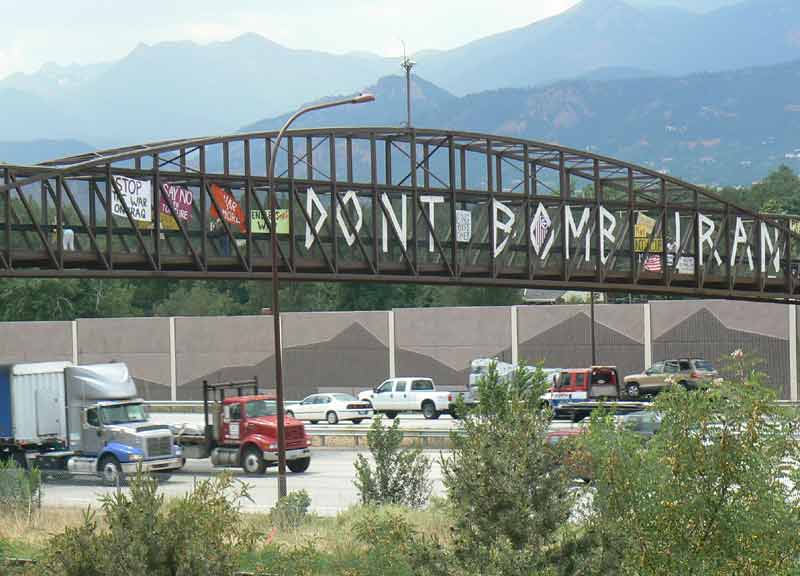
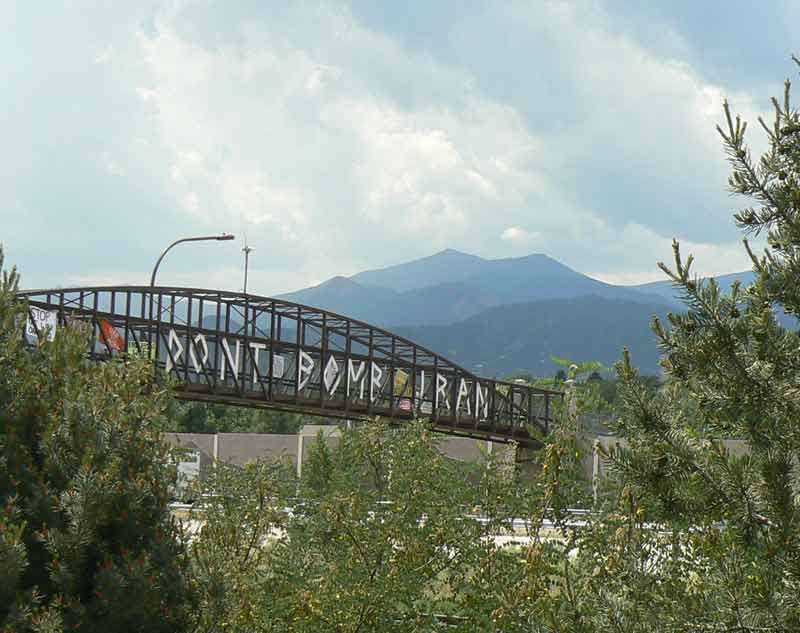
Colorado Springs Don’t Bomb Iran

High visibility message Dont Bomb Iran
Our IRAQ MORATORIUM message could be seen from the Uintah intersection. DON’T BOMB IRAN was so visible, we invited the attention of three unwanted parties.

Closer shot
First a representative from the Parks and Rec Department told us we had to stop because we were “hindering progress.” City PoliceAsked what that meant, she would only repeat we were “hindering progress” as if it was the only talking point she had been given. Mark regaled her with court rulings which have upheld our right to do what we were doing. She spent the rest of the time on her cell phone. Two CSPD officers joined her on the periphery but left after a half hour.

Next came an altercation with two young men and a woman, one of the men claiming to be a soldier, who were very belligerent and tried to tear down our peace flag. Rita bravely made them back off.

CDOT SUV
Later, two gentlemen emerged from a dark SUV, donned orange jackets and hardhats and come to inform us our sign was not permitted by Colorado statute. They claimed that we posed a safety hazzard, unless approved ahead of time. We challenged the idea that we were a safety concern, “approved” or not. Now that they’d observed us, did they think we presented a safety problem? CDOTIt was not theirs to decide. We assured them we were going to carry on and promised certainly to leave nothing behind after we were finished. The two left without further incidence. Naturally all this attention gave us incentive to prolong our action until after 2pm.

We received the usual honks and loud truck blasts of support. Our extended stay reached thousands of motorists. Not only did they see we were against the war, but against the next war.

from car

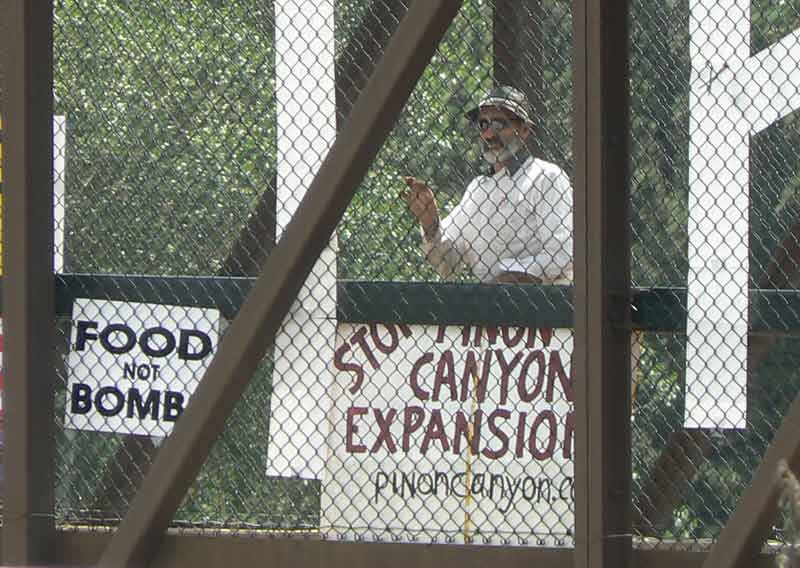
Save Pinon Canyon

trucks

Front Range

Global economic rapists are at it again

G8 protest
Why protest the G8 Summit July 7-9? Those hoodlums always look so determined. Here’s the rationale by the Emergency Exit Collective:

The 2008 G8 on Hokkaido, a Strategic Assessment
Emergency Exit Collective
Bristol, Mayday, 2008

The authors of this document are a collection of activists, scholars, and writers currently based in the United States and Western Europe who have gotten to know and work with each other in the movement against capitalist globalization. We’re writing this at the request of some members of No! G8 Action Japan, who asked us for a broad strategic analysis of the state of struggle as we see it, and particularly, of the role of the G8, what it represents, the dangers and opportunities that may lie hidden in the moment. It is in no sense programmatic. Mainly, it is an attempt to develop tools that we hope will be helpful for organizers, or for anyone engaged in the struggle against global capital.

I
It is our condition as human beings that we produce our lives in common.

II
Let us then try to see the world from the perspective of the planet’s commoners, taking the word in that sense: those whose most essential tradition is cooperation in the making and maintenance of human social life, yet who have had to do so under conditions of suffering and separation; deprived, ignored, devalued, divided into hierarchies, pitted against each other for our very physical survival. In one sense we are all commoners. But it’s equally true that just about everyone, at least in some ways, at some points, plays the role of the rulers—of those who expropriate, devalue and divide—or at the very least benefits from such divisions.

Obviously some do more than others. It is at the peak of this pyramid that we encounter groups like the G8.

III
The G8’s perspective is that of the aristocrats, the rulers: those who command and maintain that global machinery of violence that defends existing borders and lines of separation: whether national borders with their detention camps for migrants, or property regimes, with their prisons for the poor. They live by constantly claiming title to the products of others collective creativity and labour, and in thus doing they create the poor; they create scarcity in the midst of plenty, and divide us on a daily basis; they create financial districts that loot resources from across the world, and in thus doing they turn the spirit of human creativity into a spiritual desert; close or privatize parks, public water taps and libraries, hospitals, youth centers, universities, schools, public swimming pools, and instead endlessly build shopping malls that channels convivial life into a means of commodity circulation; work toward turning global ecological catastrophe into business opportunities.

These are the people who presume to speak in the name of the “international community” even as they hide in their gated communities or meet protected by phalanxes of riot cops. It is critical to bear in mind that the ultimate aim of their policies is never to create community but to introduce and maintain divisions that set common people at each other’s throats. The neoliberal project, which has been their main instrument for doing so for the last three decades, is premised on a constant effort either to uproot or destroy any communal or democratic system whereby ordinary people govern their own affairs or maintain common resources for the common good, or, to reorganize each tiny remaining commons as an isolated node in a market system in which livelihood is never guaranteed, where the gain of one community must necessarily be at the expense of others. Insofar as they are willing to appeal to high-minded principles of common humanity, and encourage global cooperation, only and exactly to the extent that is required to maintain this system of universal competition.

IV
At the present time, the G8—the annual summit of the leaders of “industrial democracies”—is the key coordinative institution charged with the task of maintaining this neoliberal project, or of reforming it, revising it, adapting it to the changing condition of planetary class relations. The role of the G8 has always been to define the broad strategic horizons through which the next wave of planetary capital accumulation can occur. This means that its main task is to answer the question of how 3?4 in the present conditions of multiple crises and struggles 3?4 to subordinate social relations among the producing commoners of the planet to capital’s supreme value: profit.

V
Originally founded as the G7 in 1975 as a means of coordinating financial strategies for dealing with the ‘70s energy crisis, then expanded after the end of the Cold War to include Russia, its currently face a moment of profound impasse in the governance of planetary class relations: the greatest since the ‘70s energy crisis itself.

VI
The ‘70s energy crisis represented the final death-pangs of what might be termed the Cold War settlement, shattered by a quarter century of popular struggle. It’s worth returning briefly to this history.

The geopolitical arrangements put in place after World War II were above all designed to forestall the threat of revolution. In the immediate wake of the war, not only did much of the world lie in ruins, most of world’s population had abandoned any assumption about the inevitability of existing social arrangements. The advent of the Cold War had the effect of boxing movements for social change into a bipolar straightjacket. On the one hand, the former Allied and Axis powers that were later to unite in the G7 (the US, Canada, UK, France, Italy, Germany, Japan)—the “industrialized democracies”, as they like to call themselves—engaged in a massive project of co-optation. Their governments continued the process, begun in the ‘30s, of taking over social welfare institutions that had originally been created by popular movements (from insurance schemes to public libraries), even to expand them, on condition that they now be managed by state-appointed bureaucracies rather than by those who used them, buying off unions and the working classes more generally with policies meant to guarantee high wages, job security and the promise of educational advance—all in exchange for political loyalty, productivity increases and wage divisions within national and planetary working class itself. The Sino-Soviet bloc—which effectively became a kind of junior partner within the overall power structure, and its allies remained to trap revolutionary energies into the task of reproducing similar bureaucracies elsewhere. Both the US and USSR secured their dominance after the war by refusing to demobilize, instead locking the planet in a permanent threat of nuclear annihilation, a terrible vision of absolute cosmic power.

VII
Almost immediately, though, this arrangement was challenged by a series of revolts from those whose work was required to maintain the system, but who were, effectively, left outside the deal: first, peasants and the urban poor in the colonies and former colonies of the Global South, next, disenfranchised minorities in the home countries (in the US, the Civil Rights movement, then Black Power), and finally and most significantly, by the explosion of the women’s movement of the late ‘60s and early ‘70s—the revolt of that majority of humanity whose largely unremunerated labor made the very existence “the economy” possible. This appears to have been the tipping point.

VIII
The problem was that the Cold War settlement was never meant to include everyone. It by definition couldn’t. Once matters reached tipping point, then, the rulers scotched the settlement. All deals were off. The oil shock was first edge of the counter-offensive, breaking the back of existing working class organizations, driving home the message that there was nothing guaranteed about prosperity. Under the aegis of the newly hatched G7, this counter-offensive involved a series of interwoven strategies that were later to give rise to what is known as neoliberalism.

IX
These strategies resulted in what came to be known as “Structural Adjustment” both in the North and in the South, accompanied by trade and financial liberalization. This, in turn, made possible crucial structural changes in our planetary production in common extending the role of the market to discipline our lives and divide us into more and more polarized wage hierarchy. This involved:

· In the immediate wake of ‘70s oil shock, petrodollars were recycled from OPEC into Northern banks that then lent them, at extortionate rates of interest, to developing countries of the Global South. This was the origin of the famous “Third World Debt Crisis.” The existence of this debt allowed institutions like the IMF to impose its monetarist orthodoxy on most of the planet for roughly twenty years, in the process, stripping away most of even those modest social protections that had been won by the world’s poor—large numbers of whom were plunged into a situation of absolute desperation.

· It also opened a period of new enclosures through the capitalist imposition of structural adjustment policies, manipulation of environmental and social catastrophes like war, or for that matter through the authoritarian dictates of “socialist” regimes. Through such means, large sections of the world’s population have over the past thirty years been dispossessed from resources previously held in common, either by dint of long traditions, or as the fruits of past struggles and past settlements.

· Through financial deregulation and trade liberalization, neoliberal capital, which emerged from the G7 strategies to deal with the 1970s crisis aimed thus at turning the “class war” in communities, factories, offices, streets and fields against the engine of competition, into a planetary “civil war”, pitting each community of commoners against every other community of commoners.

· Neoliberal capital has done this by imposing an ethos of “efficiency” and rhetoric of “lowering the costs of production” applied so broadly that mechanisms of competition have come to pervade every sphere of life. In fact these terms are euphemisms, for a more fundamental demand: that capital be exempt from taking any reduction in profit to finance the costs of reproduction of human bodies and their social and natural environments (which it does not count as costs) and which are, effectively, “exernalized” onto communities and nature.

· The enclosure of resources and entitlements won in previous generations of struggles both in the North and the South, in turn, created the conditions for increasing the wage hierarchies (both global and local), by which commoners work for capital—wage hierarchies reproduced economically through pervasive competition, but culturally, through male dominance, xenophobia and racism. These wage gaps, in turn, made it possible to reduce the value of Northern workers’ labour power, by introducing commodities that enter in their wage basket at a fraction of what their cost might otherwise have been. The planetary expansion of sweatshops means that American workers (for example) can buy cargo pants or lawn-mowers made in Cambodia at Walmart, or buy tomatoes grown by undocumented Mexican workers in California, or even, in many cases, hire Jamaican or Filipina nurses to take care of children and aged grandparents at such low prices, that their employers have been able to lower real wages without pushing most of them into penury. In the South, meanwhile, this situation has made it possible to discipline new masses of workers into factories and assembly lines, fields and offices, thus extending enormously capital’s reach in defining the terms—the what, the how, the how much—of social production.

· These different forms of enclosures, both North and South, mean that commoners have become increasingly dependent on the market to reproduce their livelihoods, with less power to resist the violence and arrogance of those whose priorities is only to seek profit, less power to set a limit to the market discipline running their lives, more prone to turn against one another in wars with other commoners who share the same pressures of having to run the same competitive race, but not the same rights and the same access to the wage. All this has meant a generalized state of precarity, where nothing can be taken for granted.

X
In turn, this manipulation of currency and commodity flows constituting neoliberal globalization became the basis for the creation of the planet’s first genuine global bureaucracy.

· This was multi-tiered, with finance capital at the peak, then the ever-expanding trade bureaucracies (IMF, WTO, EU, World Bank, etc), then transnational corporations, and finally, the endless varieties of NGOs that proliferated throughout the period—almost all of which shared the same neoliberal orthodoxy, even as they substituted themselves for social welfare functions once reserved for states.

· The existence of this overarching apparatus, in turn, allowed poorer countries previously under the control of authoritarian regimes beholden to one or another side in the Cold War to adopt “democratic” forms of government. This did allow a restoration of formal civil liberties, but very little that could really merit the name of democracy (the rule of the “demos”, i.e., of the commoners). They were in fact constitutional republics, and the overwhelming trend during the period was to strip legislatures, that branch of government most open to popular pressure, of most of their powers, which were increasingly shifted to the executive and judicial branches, even as these latter, in turn, largely ended up enacting policies developed overseas, by global bureaucrats.

· This entire bureaucratic arrangement was justified, paradoxically enough, by an ideology of extreme individualism. On the level of ideas, neoliberalism relied on a systematic cooptation of the themes of popular struggle of the ‘60s: autonomy, pleasure, personal liberation, the rejection of all forms of bureaucratic control and authority. All these were repackaged as the very essence of capitalism, and the market reframed as a revolutionary force of liberation.

· The entire arrangement, in turn, was made possible by a preemptive attitude towards popular struggle. The breaking of unions and retreat of mass social movements from the late ‘70s onwards was only made possible by a massive shift of state resources into the machinery of violence: armies, prisons and police (secret and otherwise) and an endless variety of private “security services”, all with their attendant propaganda machines, which tended to increase even as other forms of social spending were cut back, among other things absorbing increasing portions of the former proletariat, making the security apparatus an increasingly large proportion of total social spending. This approach has been very successful in holding back mass opposition to capital in much of the world (especially West Europe and North America), and above all, in making it possible to argue there are no viable alternatives. But in doing so, has created strains on the system so profound it threatens to undermine it entirely.

XI
The latter point deserves elaboration. The element of force is, on any number of levels, the weak point of the system. This is not only on the constitutional level, where the question of how to integrate the emerging global bureaucratic apparatus, and existing military arrangements, has never been resolved. It is above all an economic problem. It is quite clear that the maintenance of elaborate security machinery is an absolute imperative of neoliberalism. One need only observe what happened with the collapse of the Soviet bloc in Eastern Europe: where one might have expected the Cold War victors to demand the dismantling of the army, secret police and secret prisons, and to maintain and develop the existing industrial base, in fact, what they did was absolutely the opposite: in fact, the only part of the industrial base that has managed fully to maintain itself has been the parts required to maintained the security apparatus itself! Critical too is the element of preemption: the governing classes in North America, for example, are willing to go to almost unimaginable lengths to ensure social movements never feel they are accomplishing anything. The current Gulf War is an excellent example: US military operations appear to be organized first and foremost to be protest-proof, to ensure that what happened in Vietnam (mass mobilization at home, widespread revolt within the army overseas) could never be repeated. This means above all that US casualties must always be kept to a minimum. The result are rules of engagement, and practices like the use of air power within cities ostensibly already controlled by occupation forces, so obviously guaranteed to maximize the killing of innocents and galvanizing hatred against the occupiers that they ensure the war itself cannot be won. Yet this approach can be taken as the very paradigm for neoliberal security regimes. Consider security arrangements around trade summits, where police are so determined prevent protestors from achieving tactical victories that they are often willing to effectively shut down the summits themselves. So too in overall strategy. In North America, such enormous resources are poured into the apparatus of repression, militarization, and propaganda that class struggle, labor action, mass movements seem to disappear entirely. It is thus possible to claim we have entered a new age where old conflicts are irrelevant. This is tremendously demoralizing of course for opponents of the system; but those running the system seem to find that demoralization so essential they don’t seem to care that the resultant apparatus (police, prisons, military, etc) is, effectively, sinking the entire US economy under its dead weight.

XII
The current crisis is not primarily geopolitical in nature. It is a crisis of neoliberalism itself. But it takes place against the backdrop of profound geopolitical realignments. The decline of North American power, both economic and geopolitical has been accompanied by the rise of Northeast Asia (and to a increasing extent, South Asia as well). While the Northeast Asian region is still divided by painful Cold War cleavages—the fortified lines across the Taiwan straits and at the 38th parallel in Korea…—the sheer realities of economic entanglement can be expected to lead to a gradual easing of tensions and a rise to global hegemony, as the region becomes the new center of gravity of the global economy, of the creation of new science and technology, ultimately, of political and military power. This may, quite likely, be a gradual and lengthy process. But in the meantime, very old patterns are rapidly reemerging: China reestablishing relations with ancient tributary states from Korea to Vietnam, radical Islamists attempting to reestablish their ancient role as the guardians of finance and piety at the in the Central Asian caravan routes and across Indian Ocean, every sort of Medieval trade diaspora reemerging… In the process, old political models remerge as well: the Chinese principle of the state transcending law, the Islamic principle of a legal order transcending any state. Everywhere, we see the revival too of ancient forms of exploitation—feudalism, slavery, debt peonage—often entangled in the newest forms of technology, but still echoing all the worst abuses of the Middle Ages. A scramble for resources has begun, with US occupation of Iraq and saber-rattling throughout the surrounding region clearly meant (at least in part) to place a potential stranglehold the energy supply of China; Chinese attempts to outflank with its own scramble for Africa, with increasing forays into South America and even Eastern Europe. The Chinese invasion into Africa (not as of yet at least a military invasion, but already involving the movement of hundreds of thousands of people), is changing the world in ways that will probably be felt for centuries. Meanwhile, the nations of South America, the first victims of the “Washington consensus” have managed to largely wriggle free from the US colonial orbit, while the US, its forces tied down in the Middle East, has for the moment at least abandoned it, is desperately struggling to keep its grip Mexico, Central America and the Caribbean—its own “near abroad”.

XIII
In another age all this might have led to war—that is, not just colonial occupations, police actions, or proxy wars (which are obviously already taking place), but direct military confrontations between the armies of major powers. It still could; accidents happen; but there is reason to believe that, when it comes to moments of critical decision, the loyalties of the global elites are increasingly to each other, and not to the national entities for whom they claim to speak. There is some compelling evidence for this.

Take for example when the US elites panicked at the prospect of the massive budget surpluses of the late 1990s. As Alan Greenspan, head of the Federal Reserve at the time warned, if these were allowed to stand they would have flooded government coffers with so many trillions of dollars that it could only have lead to some form of creeping socialism, even, he predicted, to the government acquiring “equity stakes” in key US corporations. The more excitable of capitalism’s managers actually began contemplating scenarios where the capitalist system itself would be imperiled. The only possible solution was massive tax cuts; these were duly enacted, and did indeed manage to turn surpluses into enormous deficits, financed by the sale of treasury bonds to Japan and China. Conditions have thus now reached a point where it is beginning to look as if the most likely long term outcome for the US (its technological and industrial base decaying, sinking under the burden of its enormous security spending) will be to end up serve as junior partner and military enforcer for East Asia capital. Its rulers, or at least a significant proportion of them, would prefer to hand global hegemony to the rulers of China (provided the latter abandon Communism) than to return to any sort of New Deal compromise with their “own” working classes.

A second example lies in the origins of what has been called the current “Bretton Woods II” system of currency arrangements, which underline a close working together of some “surplus” and “deficit” countries within global circuits. The macroeconomic manifestation of the planetary restructuring outlined in XIX underlines both the huge US trade deficit that so much seem to worry many commentators, and the possibility to continually generate new debt instruments like the one that has recently resulted in the sub-prime crisis. The ongoing recycling of accumulated surplus of countries exporting to the USA such as China and oil producing countries is what has allowed financiers to create new credit instruments in the USA. Hence, the “deal” offered by the masters in the United States to its commoners has been this: ‘you, give us a relative social peace and accept capitalist markets as the main means through which you reproduce your own livelihoods, and we will give you access to cheaper consumption goods, access to credit for buying cars and homes, and access to education, health, pensions and social security through the speculative means of stock markets and housing prices.’ Similar compromises were reached in all the G8 countries.

Meanwhile, there is the problem of maintaining any sort of social peace with the hundreds of millions of unemployed, underemployed, dispossessed commoners currently swelling the shanty-towns of Asia, Africa, and Latin America as a result of ongoing enclosures (which have speeded up within China and India in particular, even as “structural adjustment policies” in Africa and Latin America have been derailed). Any prospect of maintaining peace in these circumstances would ordinarily require either extremely high rates of economic growth—which globally have not been forthcoming, since outside of China, growth rates in the developing world have been much lower than they were in the ‘50s, ‘60s, or even ‘70s—or extremely high levels of repression, lest matters descend into rebellion or generalized civil war. The latter has of course occurred in many parts of the world currently neglected by capital, but in favored regions, such as the coastal provinces of China, or “free trade” zones of India, Egypt, or Mexico, commoners are being offered a different sort of deal: industrial employment at wages that, while very low by international standards, are still substantially higher than anything currently obtainable in the impoverished countryside; and above all the promise, through the intervention of Western markets and (privatized) knowledge, of gradually improving conditions of living. While over the least few years wages in many such areas seem to be growing, thanks to the intensification of popular struggles, such gains are inherently vulnerable: the effect of recent food inflation has been to cut real wages back dramatically—and threaten millions with starvation.

What we really want to stress here, though, is that the long-term promise being offered to the South is just as untenable as the idea that US or European consumers can indefinitely expand their conditions of life through the use of mortgages and credit cards.

What’s being offered the new dispossessed is a transposition of the American dream. The idea is that the lifestyle and consumption patterns of existing Chinese, Indian, or Brazilian or Zambian urban middle classes (already modeled on Northern ones) will eventually become available to the children of today’s miners, maquila or plantation laborers, until, ultimately, everyone on earth is brought up to roughly the same level of consumption. Put in these terms, the argument is absurd. The idea that all six billion of us can become “middle class” is obviously impossible. First of all there is a simple problem of resources. It doesn’t matter how many bottles we recycle or how energy efficient are the light bulbs we use, there’s just no way the earth’s ecosystem can accommodate six billion people driving in private cars to work in air-conditioned cubicles before periodically flying off to vacation in Acapulco or Tahiti. To maintain the style of living and producing in common we now identify with “middle classness” on a planetary scale would require several additional planets.

This much has been pointed out repeatedly. But the second point is no less important. What this vision of betterment ultimately proposes is that it would be possible to build universal prosperity and human dignity on a system of wage labor. This is fantasy. Historically, wages are always the contractual face for system of command and degradation, and a means of disguising exploitation: expressing value for work only on condition of stealing value without work— and there is no reason to believe they could ever be anything else. This is why, as history has also shown, human beings will always avoid working for wages if they have any other viable option. For a system based on wage labor to come into being, such options must therefore be made unavailable. This in turn means that such systems are always premised on structures of exclusion: on the prior existence of borders and property regimes maintained by violence. Finally, historically, it has always proved impossible to maintain any sizeable class of wage-earners in relative prosperity without basing that prosperity, directly or indirectly, on the unwaged labor of others—on slave-labor, women’s domestic labor, the forced labor of colonial subjects, the work of women and men in peasant communities halfway around the world—by people who are even more systematically exploited, degraded, and immiserated. For that reason, such systems have always depended not only on setting wage-earners against each other by inciting bigotry, prejudice, hostility, resentment, violence, but also by inciting the same between men and women, between the people of different continents (“race”), between the generations.

From the perspective of the whole, then, the dream of universal middle class “betterment” must necessarily be an illusion constructed in between the Scylla of ecological disaster, and the Charybdis of poverty, detritus, and hatred: precisely, the two pillars of today’s strategic impasse faced by the G8.

XIV
How then do we describe the current impasse of capitalist governance?

To a large degree, it is the effect of a sudden and extremely effective upswing of popular resistance—one all the more extraordinary considering the huge resources that had been invested in preventing such movements from breaking out.

On the one hand, the turn of the millennium saw a vast and sudden flowering of new anti-capitalist movements, a veritable planetary uprising against neoliberalism by commoners in Latin America, India, Africa, Asia, across the North Atlantic world’s former colonies and ultimately, within the cities of the former colonial powers themselves. As a result, the neoliberal project lies shattered. What came to be called the “anti-globalization” movement took aim at the trade bureaucracies—the obvious weak link in the emerging institutions of global administration—but it was merely the most visible aspect of this uprising. It was however an extraordinarily successful one. Not only was the WTO halted in its tracks, but all major trade initiatives (MAI, FTAA…) scuttled. The World Bank was hobbled and the power of the IMF over most of the world’s population, effectively, destroyed. The latter, once the terror of the Global South, is now a shattered remnant of its former self, reduced to selling off its gold reserves and desperately searching for a new global mission.

In many ways though spectacular street actions were merely the most visible aspects of much broader changes: the resurgence of labor unions, in certain parts of the world, the flowering of economic and social alternatives on the grassroots levels in every part of the world, from new forms of direct democracy of indigenous communities like El Alto in Bolivia or self-managed factories in Paraguay, to township movements in South Africa, farming cooperatives in India, squatters’ movements in Korea, experiments in permaculture in Europe or “Islamic economics” among the urban poor in the Middle East. We have seen the development of thousands of forms of mutual aid association, most of which have not even made it onto the radar of the global media, often have almost no ideological unity and which may not even be aware of each other’s existence, but nonetheless share a common desire to mark a practical break with capitalism, and which, most importantly, hold out the prospect of creating new forms of planetary commons that can—and in some cases are—beginning to knit together to provide the outlines of genuine alternative vision of what a non-capitalist future might look like.

The reaction of the world’s rulers was predictable. The planetary uprising had occurred during a time when the global security apparatus was beginning to look like it lacked a purpose, when the world threatened to return to a state of peace. The response—aided of course, by the intervention of some of the US’ former Cold War allies, reorganized now under the name of Al Qaeda—was a return to global warfare. But this too failed. The “war on terror”—as an attempt to impose US military power as the ultimate enforcer of the neoliberal model—has collapsed as well in the face of almost universal popular resistance. This is the nature of their “impasse”.

At the same time, the top-heavy, inefficient US model of military capitalism—a model created in large part to prevent the dangers of social movements, but which the US has also sought to export to some degree simply because of its profligacy and inefficiency, to prevent the rest of the world from too rapidly overtaking them—has proved so wasteful of resources that it threatens to plunge the entire planet into ecological and social crisis. Drought, disaster, famines, combine with endless campaigns of enclosure, foreclosure, to cast the very means of survival—food, water, shelter—into question for the bulk of the world’s population.

XV
In the rulers’ language the crisis understood, first and foremost, as a problem of regulating cash flows, of reestablishing, as they like to put it, a new “financial architecture”. Obviously they are aware of the broader problems. Their promotional literature has always been full of it. From the earliest days of the G7, through to the days after the Cold War, when Russia was added as a reward for embracing capitalism, they have always claimed that their chief concerns include

· the reduction of global poverty

· sustainable environmental policies

· sustainable global energy policies

· stable financial institutions governing global trade and currency transactions

If one were to take such claims seriously, it’s hard to see their overall performance as anything but a catastrophic failure. At the present moment, all of these are in crisis mode: there are food riots, global warming, peak oil, and the threat of financial meltdown, bursting of credit bubbles, currency crises, a global credit crunch. [**Failure on this scale however, opens opportunities for the G8 themselves, as summit of the global bureaucracy, to reconfigure the strategic horizon. Therefore, it’s always with the last of these that they are especially concerned. ]The real problem, from the perspective of the G8, is one of reinvestment: particularly, of the profits of the energy sector, but also, now, of emerging industrial powers outside the circle of the G8 itself. The neoliberal solution in the ‘70s had been to recycle OPEC’s petrodollars into banks that would use it much of the world into debt bondage, imposing regimes of fiscal austerity that, for the most part, stopped development (and hence, the emergence potential rivals) in its tracks. By the ‘90s, however, much East Asia in particular had broken free of this regime. Attempts to reimpose IMF-style discipline during the Asian financial crisis of 1997 largely backfired. So a new compromise was found, the so-called Bretton Woods II: to recycle the profits from the rapidly expanding industrial economies of East Asia into US treasury debt, artificially supporting the value of the dollar and allowing a continual stream of cheap exports that, aided by the US housing bubble, kept North Atlantic economies afloat and buy off workers there with cheap oil and even cheaper consumer goods even as real wages shrank. This solution however soon proved a temporary expedient. Bush regime’s attempt to lock it in by the invasion of Iraq, which was meant to lead to the forced privatization of Iraqi oil fields, and, ultimately, of the global oil industry as a whole, collapsed in the face of massive popular resistance (just as Saddam Hussein’s attempt to introduce neoliberal reforms in Iraq had failed when he was still acting as American deputy in the ‘90s). Instead, the simultaneous demand for petroleum for both Chinese manufacturers and American consumers caused a dramatic spike in the price of oil. What’s more, rents from oil and gas production are now being used to pay off the old debts from the ‘80s (especially in Asia and Latin America, which have by now paid back their IMF debts entirely), and—increasingly—to create state-managed Sovereign Wealth Funds that have largely replaced institutions like the IMF as the institutions capable of making long-term strategic investments. The IMF, purposeless, tottering on the brink of insolvency, has been reduced to trying to come up with “best practices” guidelines for fund managers working for governments in Singapore, Seoul, and Abu Dhabi.

There can be no question this time around of freezing out countries like China, India, or even Brazil. The question for capital’s planners, rather, is how to channel these new concentrations of capital in such a way that they reinforce the logic of the system instead of undermining it.

XVI
How can this be done? This is where appeals to universal human values, to common membership in an “international community” come in to play. “We all must pull together for the good of the planet,” we will be told. The money must be reinvested “to save the earth.”

To some degree this was always the G8 line: this is a group has been making an issue of climate change since 1983. Doing so was in one sense a response to the environmental movements of the ‘70s and ‘80s. The resultant emphasis on biofuels and “green energy” was from their point of view, the perfect strategy, seizing on an issue that seemed to transcend class, appropriating ideas and issues that emerged from social movements (and hence coopting and undermining especially their radical wings), and finally, ensuring such initiatives are pursued not through any form of democratic self-organization but “market mechanisms”—to effective make the sense of public interest productive for capitalism.

What we can expect now is a two-pronged attack. On the one hand, they will use the crisis to attempt to reverse the gains of past social movements: to put nuclear energy back on the table to deal with the energy crisis and global warming, or genetically modified foods to deal with the food crisis. Prime Minister Fukuda, the host of the current summit, for example, is already proposing the nuclear power is the “solution” to the global warming crisis, even as the German delegation resists. On the other, and even more insidiously, they will try once again to co-opt the ideas and solutions that have emerged from our struggles as a way of ultimately undermining them. Appropriating such ideas is simply what rulers do: the bosses brain is always under the workers’ hat. But the ultimate aim is to answer the intensification of class struggle, of the danger of new forms of democracy, with another wave of enclosures, to restore a situation where commoners’ attempts to create broader regimes of cooperation are stymied, and people are plunged back into mutual competition.

We can already see the outlines of how this might be done. There are already suggestions that Sovereign Wealth Funds put aside a certain (miniscule) proportion of their money for food aid, but only as tied to a larger project of global financial restructuring. The World Bank, largely bereft of its earlier role organizing dams and pipe-lines across the world, has been funding development in China’s poorer provinces, freeing the Chinese government to carry out similar projects in Southeast Asia, Africa, and even Latin America (where, of course, they cannot effectively be held to any sort of labor or environmental standards). There is the possibility of a new class deal in China itself, whose workers can be allowed higher standards of living if new low wage zones are created elsewhere—for instance, Africa (the continent where struggles over maintaining the commons have been most intense in current decades)—with the help of Chinese infrastructural projects. Above of all, money will be channeled into addressing climate change, into the development of alternative energy, which will require enormous investments, in such a way as to ensure that whatever energy resources do become important in this millennium, they can never be democratized—that the emerging notion of a petroleum commons, that energy resources are to some degree a common patrimony meant primarily to serve the community as a whole, that is beginning to develop in parts of the Middle East and South America—not be reproduced in whatever comes next.

Since this will ultimately have to be backed up by the threat of violence, the G8 will inevitably have to struggle with how to (yet again) rethink enforcement mechanisms. The latest move , now that the US “war on terror” paradigm has obviously failed, would appear to be a return to NATO, part of a reinvention of the “European security architecture” being proposed at the upcoming G8 meetings in Italy in 2009 on the 60th anniversary of NATO’s foundation—but part of a much broader movement of the militarization of social conflict, projecting potential resource wars, demographic upheavals resulting from climate change, and radical social movements as potential military problems to be resolved by military means. Opposition to this new project is already shaping up as the major new European mobilization for the year following the current G-8.

XVII
While the G-8 sit at the pinnacle of a system of violence, their preferred idiom is monetary. Their impulse whenever possible is to translate all problems into money, financial structures, currency flows—a substance whose movements they carefully monitor and control.

Money, on might say, is their poetry—a poetry whose letters are written in our blood. It is their highest and most abstract form of expression, their way of making statements about the ultimate truth of the world, even if it operates in large part by making things disappear. How else could it be possible to argue—no, to assume as a matter of common sense—that the love, care, and concern of a person who tends to the needs of children, teaching, minding, helping them to become decent , thoughtful, human beings, or who grows and prepares food, is worth ten thousand times less than someone who spends the same time designing a brand logo, moving abstract blips across a globe, or denying others health care.

The role of money however has changed profoundly since 1971 when the dollar was delinked from gold. This has created a profound realignment of temporal horizons. Once money could be said to be primarily congealed results of past profit and exploitation. As capital, it was dead labor. Millions of indigenous Americans and Africans had their lives pillaged and destroyed in the gold mines in order to be rendered into value. The logic of finance capital, of credit structures, certainly always existed as well (it is at least as old as industrial capital; possibly older), but in recent decades these logic of financial capital has come to echo and re-echo on every level of our lives. In the UK 97% of money in circulation is debt, in the US, 98%. Governments run on deficit financing, wealthy economies on consumer debt, the poor are enticed with microcredit schemes, debts are packaged and repackaged in complex financial derivatives and traded back and forth. Debt however is simply a promise, the expectation of future profit; capital thus increasingly brings the future into the present—a future that, it insists, must always be the same in nature, even if must also be greater in magnitude, since of course the entire system is premised on continual growth. Where once financiers calculated and traded in the precise measure of our degradation, having taken everything from us and turned it into money, now money has flipped, to become the measure of our future degradation—at the same time as it binds us to endlessly working in the present.

The result is a strange moral paradox. Love, loyalty, honor, commitment—to our families, for example, which means to our shared homes, which means to the payment of monthly mortgage debts—becomes a matter of maintaining loyalty to a system which ultimately tells us that such commitments are not a value in themselves. This organization of imaginative horizons, which ultimately come down to a colonization of the very principle of hope, has come to supplement the traditional evocation of fear (of penury, homelessness, joblessness, disease and death). This colonization paralyzes any thought of opposition to a system that almost everyone ultimately knows is not only an insult to everything they really cherish, but a travesty of genuine hope, since, because no system can really expand forever on a finite planet, everyone is aware on some level that in the final analysis they are dealing with a kind of global pyramid scheme, what we are ultimately buying and selling is the real promise of global social and environmental apocalypse.

XVIII
Finally then we come to the really difficult, strategic questions. Where are the vulnerabilities? Where is hope? Obviously we have no certain answers here. No one could. But perhaps the proceeding analysis opens up some possibilities that anti-capitalist organizers might find useful to explore.

One thing that might be helpful is to rethink our initial terms. Consider communism. We are used to thinking of it as a total system that perhaps existed long ago, and to the desire to bring about an analogous system at some point in the future—usually, at whatever cost. It seems to us that dreams of communist futures were never purely fantasies; they were simply projections of existing forms of cooperation, of commoning, by which we already make the world in the present. Communism in this sense is already the basis of almost everything, what brings people and societies into being, what maintains them, the elemental ground of all human thought and action. There is absolutely nothing utopian here. What is utopian, really, is the notion that any form of social organization, especially capitalism, could ever exist that was not entirely premised on the prior existence of communism. If this is true, the most pressing question is simply how to make that power visible, to burst forth, to become the basis for strategic visions, in the face of a tremendous and antagonistic power committed to destroying it—but at the same time, ensuring that despite the challenge they face, they never again become entangled with forms of violence of their own that make them the basis for yet another tawdry elite. After all, the solidarity we extend to one another, is it not itself a form of communism? And is it not so above because it is not coerced?

Another thing that might be helpful is to rethink our notion of crisis. There was a time when simply describing the fact that capitalism was in a state of crisis, driven by irreconcilable contradictions, was taken to suggest that it was heading for a cliff. By now, it seems abundantly clear that this is not the case. Capitalism is always in a crisis. The crisis never goes away. Financial markets are always producing bubbles of one sort or another; those bubbles always burst, sometimes catastrophically; often entire national economies collapse, sometimes the global markets system itself begins to come apart. But every time the structure is reassembled. Slowly, painfully, dutifully, the pieces always end up being put back together once again.

Perhaps we should be asking: why?

In searching for an answer, it seems to us, we might also do well to put aside another familiar habit of radical thought: the tendency to sort the world into separate levels—material realities, the domain of ideas or “consciousness”, the level of technologies and organizations of violence—treating these as if these were separate domains that each work according to separate logics, and then arguing which “determines” which. In fact they cannot be disentangled. A factory may be a physical thing, but the ownership of a factory is a social relation, a legal fantasy that is based partly on the belief that law exists, and partly on the existence of armies and police. Armies and police on the other hand exist partly because of factories providing them with guns, vehicles, and equipment, but also, because those carrying the guns and riding in the vehicles believe they are working for an abstract entity they call “the government”, which they love, fear, and ultimately, whose existence they take for granted by a kind of faith, since historically, those armed organizations tend to melt away immediately the moment they lose faith that the government actually exists. Obviously exactly the same can be said of money. It’s value is constantly being produced by eminently material practices involving time clocks, bank machines, mints, and transatlantic computer cables, not to mention love, greed, and fear, but at the same time, all this too rests on a kind of faith that all these things will continue to interact in more or less the same way. It is all very material, but it also reflects a certain assumption of eternity: the reason that the machine can always be placed back together is, simply, because everyone assumes it must. This is because they cannot realistically imagine plausible alternatives; they cannot imagine plausible alternatives because of the extraordinarily sophisticated machinery of preemptive violence that ensure any such alternatives are uprooted or contained (even if that violence is itself organized around a fear that itself rests on a similar form of faith.) One cannot even say it’s circular. It’s more a kind of endless, unstable spiral. To subvert the system is then, to intervene in such a way that the whole apparatus begins to spin apart.

XIX
It appears to us that one key element here—one often neglected in revolutionary strategy—is the role of the global middle classes. This is a class that, much though it varies from country (in places like the US and Japan, overwhelming majorities consider themselves middle class; in, say, Cambodia or Zambia, only very small percentages), almost everywhere provides the key constituency of the G8 outside of the ruling elite themselves. It has become a truism, an article of faith in itself in global policy circles, that national middle class is everywhere the necessary basis for democracy. In fact, middle classes are rarely much interested in democracy in any meaningful sense of that word (that is, of the self-organization or self-governance of communities). They tend to be quite suspicious of it. Historically, middle classes have tended to encourage the establishment of constitutional republics with only limited democratic elements (sometimes, none at all). This is because their real passion is for a “betterment”, for the prosperity and advance of conditions of life for their children—and this betterment, since it is as noted above entirely premised on structures of exclusion, requires “security”. Actually the middle classes depend on security on every level: personal security, social security (various forms of government support, which even when it is withdrawn from the poor tends to be maintained for the middle classes), security against any sudden or dramatic changes in the nature of existing institutions. Thus, politically, the middle classes are attached not to democracy (which, especially in its radical forms, might disrupt all this), but to the rule of law. In the political sense, then, being “middle class” means existing outside the notorious “state of exception” to which the majority of the world’s people are relegated. It means being able to see a policeman and feel safer, not even more insecure. This would help explain why within the richest countries, the overwhelming majority of the population will claim to be “middle class” when speaking in the abstract, even if most will also instantly switch back to calling themselves “working class” when talking about their relation to their boss.

That rule of law, in turn, allows them to live in that temporal horizon where the market and other existing institutions (schools, governments, law firms, real estate brokerages…) can be imagined as lasting forever in more or less the same form. The middle classes can thus be defined as those who live in the eternity of capitalism. (The elites don’t; they live in history, they don’t assume things will always be the same. The disenfranchized don’t; they don’t have the luxury; they live in a state of precarity where little or nothing can safely be assumed.) Their entire lives are based on assuming that the institutional forms they are accustomed to will always be the same, for themselves and their grandchildren, and their “betterment” will be proportional to the increase in the level of monetary wealth and consumption. This is why every time global capital enters one of its periodic crises, every time banks collapse, factories close, and markets prove unworkable, or even, when the world collapses in war, the managers and dentists will tend to support any program that guarantees the fragments will be dutifully pieced back together in roughly the same form—even if all are, at the same time, burdened by at least a vague sense that the whole system is unfair and probably heading for catastrophe.

XIX
The strategic question then is, how to shatter this sense of inevitability? History provides one obvious suggestion. The last time the system really neared self-destruction was in the 1930s, when what might have otherwise been an ordinary turn of the boom-bust cycle turned into a depression so profound that it took a world war to pull out of it. What was different? The existence of an alternative: a Soviet economy that, whatever its obvious brutalities, was expanding at breakneck pace at the very moment market systems were undergoing collapse. Alternatives shatter the sense of inevitability, that the system must, necessarily, be patched together in the same form; this is why it becomes an absolute imperative of global governance that even small viable experiments in other ways of organizing communities be wiped out, or, if that is not possible, that no one knows about them.

If nothing else, this explains the extraordinary importance attached to the security services and preemption of popular struggle. Commoning, where it already exists, must be made invisible. Alternatives— Zapatistas in Chiapas, APPO in Oaxaca, worker-managed factories in Argentina or Paraguay, community-run water systems in South Africa or Bolivia, living alternatives of farming or fishing communities in India or Indonesia, or a thousand other examples—must be made to disappear, if not squelched or destroyed, then marginalized to the point they seem irrelevant, ridiculous. If the managers of the global system are so determined to do this they are willing to invest such enormous resources into security apparatus that it threatens to sink the system entirely, it is because they are aware that they are working with a house of cards. That the principle of hope and expectation on which capitalism rests would evaporate instantly if almost any other principle of hope or expectation seemed viable.

The knowledge of alternatives, then, is itself a material force.

Without them, of course, the shattering of any sense of certainty has exactly the opposite effect. It becomes pure precarity, an insecurity so profound that it becomes impossible to project oneself in history in any form, so that the one-time certainties of middle class life itself becomes a kind of utopian horizon, a desperate dream, the only possible principle of hope beyond which one cannot really imagine anything. At the moment, this seems the favorite weapon of neoliberalism: whether promulgated through economic violence, or the more direct, traditional kind.

One form of resistance that might prove quite useful here – and is already being discussed in some quarters – are campaigns against debt itself. Not demands for debt forgiveness, but campaigns of debt resistance.

XX
In this sense the great slogan of the global justice movement, “another world is possible”, represents the ultimate threat to existing power structures. But in another sense we can even say we have already begun to move beyond that. Another world is not merely possible. It is inevitable. On the one hand, as we have pointed out, such a world is already in existence in the innumerable circuits of social cooperation and production in common based on different values than those of profit and accumulation through which we already create our lives, and without which capitalism itself would be impossible. On the other, a different world is inevitable because capitalism—a system based on infinite material expansion—simply cannot continue forever on a finite world. At some point, if humanity is to survive at all, we will be living in a system that is not based on infinite material expansion. That is, something other than capitalism.

The problem is there is no absolute guarantee that ‘something’ will be any better. It’s pretty easy to imagine “other worlds” that would be even worse. We really don’t have any idea what might happen. To what extent will the new world still organized around commoditization of life, profit, and pervasive competition? Or a reemergence of even older forms of hierarchy and degradation? How, if we do overcome capitalism directly, by the building and interweaving of new forms of global commons, do we protect ourselves against the reemergence of new forms of hierarchy and division that we might not now even be able to imagine?

It seems to us that the decisive battles that will decide the contours of this new world will necessarily be battles around values. First and foremost are values of solidarity among commoners. Since after all, every rape of a woman by a man or the racist murder of an African immigrant by a European worker is worth a division in capital’s army.

Similarly, imagining our struggles as value struggles might allow us to see current struggles over global energy policies and over the role of money and finance today as just an opening salvo of an even larger social conflict to come. For instance, there’s no need to demonize petroleum, for example, as a thing in itself. Energy products have always tended to play the role of a “basic good”, in the sense that their production and distribution becomes the physical basis for all other forms of human cooperation, at the same time as its control tends to organize social and even international relations. Forests and wood played such a role from the time of the Magna Carta to the American Revolution, sugar did so during the rise of European colonial empires in the 17th and 18th centuries, fossil fuels do so today. There is nothing intrinsically good or bad about fossil fuel. Oil is simply solar radiation, once processed by living beings, now stored in fossil form. The question is of control and distribution. This is the real flaw in the rhetoric over “peak oil”: the entire argument is premised on the assumption that, for the next century at least, global markets will be the only means of distribution. Otherwise the use of oil would depend on needs, which would be impossible to predict precisely because they depend on the form of production in common we adopt. The question thus should be: how does the anti-capitalist movement peak the oil? How does it become the crisis for a system of unlimited expansion?

It is the view of the authors of this text that the most radical planetary movements that have emerged to challenge the G8 are those that direct us towards exactly these kind of questions. Those which go beyond merely asking how to explode the role money plays in framing our horizons, or even challenging the assumption of the endless expansion of “the economy”, to ask why we assume something called “the economy” even exists, and what other ways we can begin imagining our material relations with one another. The planetary women’s movement, in its many manifestations, has and continues to play perhaps the most important role of all here, in calling for us to reimagine our most basic assumptions about work, to remember that the basic business of human life is not actually the production of communities but the production, the mutual shaping of human beings. The most inspiring of these movements are those that call for us to move beyond a mere challenge to the role of money to reimagine value: to ask ourselves how can we best create a situation where everyone is secure enough in their basic needs to be able to pursue those forms of value they decide are ultimately important to them. To move beyond a mere challenge to the tyranny of debt to ask ourselves what we ultimately owe to one another and to our environment. That recognize that none this needs to invented from whole cloth. It’s all already there, immanent in the way everyone, as commoners, create the world together on a daily basis. And that asking these questions is never, and can never be, an abstract exercise, but is necessarily part of a process by which we are already beginning to knit these forms of commons together into new forms of global commons that will allow entirely new conceptions of our place in history.

It is to those already engaged in such a project that we offer these initial thoughts on our current strategic situation.

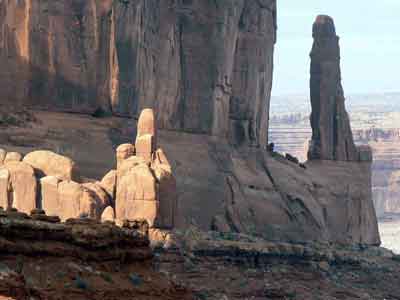
The community service chain gang

Support your local sheriff
Involuntary roadside workers may not be as conspicuous as when they wore the stripes of yore, but they’re there. You thought those bright orange vests belonged to Parks and Rec personnel? Often they are citizens repaying a debt to society. More specifically, a sweat equity forfeiture to the sheriff.

Municipal courts and prosecutors levy community service hours as a penalty for misdemeanors. While we might envision “community service,” as lauded recently by Barack Obama, as helping a charity for example, or doing social work, in reality it’s whatever the local government needs done on the cheap. They pay the private agency which validates your hours, you work for free.

While municipal courts, and the traffic tickets that drive them, serve chiefly as cash registers for the local administrators, one can easily imagine the growing incentive to harvest unpaid labor for services that require work. These are jobs that could be going to union laborers, or landscaper contractors. Instead the burden is being put on the common citizen, usually the ones least able to fend off the arbitrary enforcement of law.

In the age of electronic ankle bracelets, work-release programs, and house arrest, there’s no need for striped coveralls and chains. Bring your own leather gloves and sunscreen and put your shoulder to the facade of our healthy looking community. It’s becoming a prison planet without us really seeing it. Wages are shrinking, the cost of living rises, the pursuit of happiness dissipates, and you’re throwing your back and your dignity into tasks that once upon a time you would have proclaimed were why we all pay taxes.

National Day of Prayer versus May Day

Join us this May DayA billion years to raise the tree frog
 
A hundred million years of lovers curling against each other in sleep
 
Half a million years of campfire sparks ascending to the stars
 
Twenty-one centuries since Spartacus and his fellow slaves brought Rome to its knees
 
Two centuries since the Luddites demonstrated the proper treatment of workplace technology
 
One hundred and twenty years since the Chicago government used the Haymarket disturbance to justify the execution of seven innocent men: “Hang these men and you kill Anarchy in this country!”

A century since anarchist Leon Czolgosz proved them wrong by assassinating President William McKinley

Eighty years since Henry Ford tried to buy off workers with the weekend

Sixteen years since the rioters of Los Angeles showed what it takes to get justice in this country

Eight and a half years since the WTO protests shattered plate glass in Seattle and complacency across the world

One day to gather in our communities, to celebrate the coming of spring and the potential of resistance

Counting the days to our next chance to make history

Eleven weeks to the international day of action against climate change called to coincide with the G8 meetings in Russia*

Eight months to plan unpermitted marches and rowdy street parties for New Year’s Eve

Nine months to prepare a surprise for the next Presidential Inauguration

A decade to establish radical social centers and free schools in every community

Twenty years to explore everything that can be accomplished while wearing a mask

A generation to replace grocery stores with gardens and cough syrup with licorice root

A century for dairy cows and toy poodles to go feral

Five hundred years to melt down cannons into wine goblets, water pipes and sleigh bells

A millennium for the dandelions growing out of the sidewalk to become redwoods

…and the rest of eternity to enjoy

(*Adapted from Crimethinc, MAYDAY 2006)

Corral Bluffs safe from tire track erosion

COLORADO SPRINGS- El Paso County Board of Commissioners decided today not to pursue a proposed Corral Bluffs OHV park. Their reluctant vote followed a recommendation from El Paso Parks Department that the site would be inappropriate for motorcycle trails. Open Space proponents exchanged smiles at the unexpected turn, but bore the brunt of scolding as the board tripped over each other to pander to their yokel constituency.

Our speakers today were careful to point out the argument had never been against OHV parks in general, merely for this site. Off-road motorcycling being a recreational orientation like any other. As if gas-guzzling, air-noise-polluting, and terrain-shredding were inalienable rights, a God-given American pursuit of happiness guaranteed by the Constitution.

El Paso hayseeds.

The El Paso County commissioners could have made this vote a stand on environmental grounds and heralded the Pikes Peak region’s awakening to the enlightened frame of mind generally attributed to the rest of Colorado. But no, El Paso County are proud hayseeds.

Voting down the OHV turned into protestations for having to do the right thing, without understanding, nor fully believing why. This included repeated admonitions to the Open Space group for its presumed condescending attitude toward the lowly off-road bikers. One commissioner even called upon the presumed eco-nimby crowd to help their motorcycle-preoccupied brethren to find a suitable alternative OHV location, and “not a dump, or under power lines,” etc. She would “hold [our] feet to the fire” until an OHV site was found for them.

Do we have to?

With receding fuel supplies, global warming, and a rising appreciation for man’s unsustainable environmental footprint, the days of feeling entitled to moshing about on motorized dirt devastators are probably coming to a close. I’m not sure how to defend the argument that hillbillies must be permitted their heritage of behaving badly.

It’s fun? I’m sure it is. So was bear-baiting I’m sure, and spitting, smoking or snag-hooking spawning salmon. Having come up against man’s better judgement, maybe it’s time to rain on our off-road thrill-seeking destructo-hicks. Who has the time to police whether they can tell an anthill from a pile of sawdust? They’ll scatter either like it was confetti.

A chief argument made by Commissioner Bensberg had to do with the sticker fees already collected from motorcycle owners. They’re entitled to something for that. I say they’re entitled to get their money back. Having collected the fee is not a reason to keep prostituting your down syndrome sister once someone with better judgment has let you know it’s wrong. Give the fee back. Go pimp something else, if that’s all you know to do.

El Paso County is clearly a poor steward of our land resources. Beside the sprawl, beside the lacking mass-transit system, look at our mountain scape. How are we doing? There are the mining scars along the Front Range, our part of the Front Range, where we shave for aggregate because it’s cheaper than digging for it like every other town. The mining companies have old, pre-environmental contracts, but apparently we do not care enough to stop them. For tourists, our mountains are our natural resource. How much deep-thinking do we have to do to figure out they are worth more than cheap aggregate?

There’s the Pikes Peak Highway. Still unpaved, despite the environmental devastation it causes. Was it the advent of automobiles that convinced civilized man to pave the roads? Did I say autos? I meant Romans. Of course, paved roads came late to the American West, but they came when we tired of wiping the mud off our boots every time we crossed the street. Later we learned that paved roads are better for the environment. Well some folks believe that.

There are the ridge top homes. Pikes Peak is the only region of Colorado where homes are permitted on ridge tops. The practice is terrible for erosion and flooding, not to mention everyone else’s view, but in these parts we say Okie Dokie!

Of proposed methods for saving the archeology of Corral Bluffs, Commissioner Bensberg professed he didn’t see how either flooding or paving would preserve the artifacts, hence his preference for motorcycle trails. If you are not prepared to follow the recommendation of experts because your inexpert self doesn’t understand it, you’re probably not suited to vote on the matter.

Pikes Peak region trustees can point to the mining scars on the Front Range, the still unpaved Pikes Peak Highway, and the ridge top homes as proof that Colorado Springs won’t be told how to care for nature. And we’ll look to serve the OHV throwbacks too. Give those yokels their spitoons!

The Rosa Parks Lone Rider Theory

Rosa Parks photographed after the Montgomery Bus Boycott, posed with newspaper reporter“Rosa Parks did so act on her own!” I’m faced with this repudiation yet again, as J’s high school class revisits the civil rights movement. Their reading list includes Howard Zinn, but still the lesson plan is determined to press home the Parks as lone rider theory.

It makes a heroic story, to tell of lone brave Parks (she’s even painted as elderly, are you kidding me?), riding home from a tiring day at work, so tired that she becomes tired of being told to go to the back of the bus. She stands her ground, an example to us all, and changes history.

Yes it is inspiring, yes it feels empowering. But IS it empowering? Does it empower you to stand up to injustice in the face of harsh, legal if also physical, consequence? Have you yet? You’re no Rosa Parks I could confidently guess, and it’s not your fault.

Do you doubt that there haven’t been countless upstarts, individuals railing against repressive authority, who’ve spoken their piece, made their gesture, only to be humbled by arrest, jail, judges, fines, and the ridicule of the community? It happens all the time. They are marginalized, broken, and ultimately worn down.

Let me describe another kind of heroism. Working for civil rights activists as a stenographer, being in on the discussions about who would make the strongest test case, and picking the right moment mindful of the preparations needed to mobilize colleagues to rally to your defense; thus committing your act of civil disobedience with ready support. Is that any less heroic? I’d suggest it takes more bravery because you know you are launching a political act that will have legs. And it will require more from you than just anger or being tired.

Cindy Sheehan didn’t just march down to Crawford Texas and pitch her lone tent. She consulted with an incredible network of organizers to conceive the plan, Code Pink maven Medea Benjamin among them

Rosa Parks and the bus she rode in on launched a key maneuver for the civil rights movement, and that’s certainly not a lesson the establishment wants to teach its children. Teach them that history is made by individuals, unique, gifted iconoclasts, with whom you’d have to have delusions of grandeur to identify. “You Sir, are no Kennedy,” or Gandhi, Mother Teresa, Rosa Parks. It’s the monarchist belief that only special people are endowed to rule. No need for commoners to concern themselves, the aptitude for nobility is hereditary.

Don’t teach children that to change anything you have to take on the establishment with its own weapons. Idealistic youth don’t want to hear that you have to fight politicians with politics.

You don’t have to become the system to defeat it, but you have to inhabit the system and understand that it operates with the mechanisms of human nature. You must play the system, and no one, absolutely no one, has ever done it alone. Not even Eve.

Was Rosa Parks an iPod-wearing  rebel-without-a-cause? Not hardly.

I am voting against McCain

I’m voting against McCain.
 
Saying there isn’t any difference between the candidates is like stating there’s no difference physically or philosophically between you and me, or me and Eric or you and Eric.

The Anti-Immigrant crowd are howling for Obama’s blood as well. They’re suggesting absurdly that his father planned to smuggle a future terrorist into america in the womb of an American citizen.

The Wall is so unworkable just as a physical engineering problem, it’s clear to you, clear to me, and probably clear to each and every candidate for any office higher than Dog Warden that it’s a massive, expensive Feel-Good giveaway to construction workers, until after the election at least.

Any one issue, like the Wall or the War or Health Care or Wiretapping, … they all converge on one simple, monstrous Elephant in the Parlor fact…

Allowing any Bush Annointed Bush Replacement, such as McCain, to win even by the slightest of margins, will be seen by the 19% Jackass Squad as an overwhelming mandate to Implement every stinkin’ one of the Chimp’s signing statements and Executive Orders, to replace the Constitution, as Bush put it “stop waving the Constitution in my face It’s just a goddamned piece of paper” yeah, THAT Constitution, with the so-called Patriot Act.

There’s plenty of criticism of the Constitution from the left as well, it seems to be somewhat of a dinosaur, it has regressive Articles, some of which were stricken from the use but not from the letter of the law, like a black man being worth 1/3 of a White man in the census.

BUT the Patriot Act in conjunction with the Signing Statements, the Executive Orders, the Attorney General refusing to enforce Contempt of Congress citations or subpoenas from Congress, the Supreme Court backing his sorry ass on that, the Vice President saying he’s neither Executive Branch nor Legislative, but instead is some kind of Super-Executive above all laws…
Pure retrogressive.

The trend wipes all legal issues raised since the Code of Hammurabi.

“Badges? We don’ need no steenkeeng Badges!” or warrants, or probable cause, or finding somebody guilty UNDER THE LAW, or a legitimate reason to invade any country on earth…

Any vote that will put that Jackass McCain on the throne will be a vote for the utter destruction of America and every place and person on Earth that the American Empire can take down with it.

It will be a vote for Absolute Rule, “we told you to, that’s why” Rule.

Tony, man, I love you brother, but pissing away your vote for Nader would be even worse than voting directly for McCain. Even worse than sitting home and refusing to vote.

Nader could have done something truly hellified in the political sphere by running for Congress, in the 60s or even today.

Under the Constitution the Congress would have an extreme hold over the power of the presidency. He had the support in and out of Congress to do it.

And the support to have effected some real hard-core changes over the past 40 years.

40 years of that kind of working for change would translate into a real chance for being President. I just get the feeling, though, that not putting in that kind of time or effort shows that he really doesn’t want to be the President.

He doesn’t actually want, at least in any way that’s obvious, to have the responsibility or be in the position of change.

Voting for him would be voting for No Change, save for the change in the number of milestones on the road to a collective National Grave.

I personally ain’t ready to do that.

You see the political situation here in the Springs, you saw it in Highland and University Parks, Houston, El Paso, and even in other countries, like in the Distrito Federal in Mexico. The situation of no change except for steady worsening.

No, Obama isn’t going to Save America. Not just no, but hell to da fuck no…
Despite the “Cult-like Supporters” slur, everybody or most everybody who intends to vote for him realizes that.

Voting for No Change, though, Guarantees the Damnation of America.

MLK Celebration? Where? When?

We always hear it called the ‘MLK Celebration’, but I’m not sure what there is to celebrate? I went with my daughter last night to the ‘MLK Parade’ and it was a truly sad sack affair.

At the chapel many were already leaving by the time we pulled up trailing at the end of the walk, and one Black man was telling another that he was a Republican. And of course there was the Obama people, who I didn’t have the heart to talk about Ronald Reagan’s legacy with them. And there were the prayers and a video of Martin addressing a big crowd in the past. Why the ‘celebration’ though? Where was the celebration in all this?

How about a Malcolm X Celebration? Make him the center of a national holiday where George W. Bush could talk about he was such a big hero to the American people. I mean, why pick on poor old Martin Luther King like our society does annually? Rosa Parks Day Celebration anybody? Let’s turn them all into Gods, and not just Martin.

Actually I think Martin Luther King was probably a hero. The same nitwitty, praying-all-the-time types that he is now a god to, were people he had to work with all the time back when he was alive. Hallelujah! Praise the Lord! He was a miracle man this MLK to get these types of people to do anything.

And he really didn’t. It was rioters and Jewish communists who really helped the cause out the most. And poor folk who got the shit kicked out of them by White thugs calling themselves police. The religious crowd back then didn’t do much more than the religious crowd does today, and today they barely get out of the church doors to do much more than shop. And back then it was mainly the same, I believe.!!!

MLK is like Lenin’s body, it’s time to bury him and let him rest in peace. We need to make a real celebration and not just a fossilized one. Not a celebration of a dream not achieved, since MLK would not be celebrating if he was around today.

MLK was a leader who they wanted to break and brake the crowds back then, but he wouldn’t do so. So today, they use him dead to do what he wouldn’t do for the big shots back then. MLK Celebration? What’s there to celebrate?

Ancient Costa Rica for sale

Denver-Art-Museum-LibeskindThe kids are still on Christmas break and are starting to show definite signs of cabin fever. To stave off a domestic implosion, we took a trip up to the Denver Art Museum yesterday. The DAM recently opened a spectacular addition designed by Daniel Libeskind, the architect chosen to rebuild the World Trade Center site. But I had an ulterior motive. I’d recently read about the DAMs 16,000-piece assemblage of pre-Columbian and Spanish Colonial art, including one of the world’s largest collections of Costa Rican artifacts, nearly 2,000 items, donated to the museum by Denver businessman, Frederick Mayer, and his wife. I wanted to check it out.

We’re planning a trip to Costa Rica. Although not much is known about pre-Columbian Costa Rica in comparison to the high cultures of Mexico and South America, recent excavations have uncovered numerous artifacts, including jade carvings. Jade is green and pretty and shiny, perfect for an art lover of my caliber, so I wanted to see it for myself. Call it a bit of research before hitting the craft markets in Sarchi!

Sure enough, Eric and I lost ourselves in a huge room filled with thousands of artifacts. Stone, ceramic, textiles, gold and, oh yes, jade. After an hour or so, we’d barely made a dent in the pre-Columbian collection. Vowing a subsequent visit to the Spanish Colonial galleries, we left to collect the kids before their art experience became Night-mare at the Museum.

As always, looking at ancient artifacts leads me into lofty reverie of past worlds and bare-chested warriors. But this time I couldn’t help but wonder about Jan and Frederick Mayer as well. Certainly amazement and appreciation for their commitment to art and to philanthropy. But really, how on earth had one couple managed to collect this much art from a small Central American country? And why aren’t many of the beautiful pieces residing in Costa Rica, teaching and providing inspiration to Costa Ricans? Especially because Costa Rican pre-Columbian history is not nearly as well-documented as that of its neighbors.

Costa Rica has taken significant measures to protect their natural environment from exploitation. Nearly 20% of the land is set aside for preserves, parks or refuges of some sort. But after my trip to the Denver Art Museum, I’m thinking that perhaps Costa Rica should endeavor to protect other national treasures, especially art created by the hands of largely unknown ancestors, from passionate and well-meaning American oilmen.

Jade museum Costa RicaI will visit the museums in San Jose and let you know how they measure up against the breathtaking Denver Art Museum, with its encyclopedic collection of pre-Columbian Costa Rican artifacts–and hopefully return with a few shiny jade replicas of my own!

Build it [in SL] and they will come

There’s an interesting trait of human nature I see playing out on the ever opening expanses of the Internet. It’s evident in dramatic relief too in Second Life. I suppose it’s the combination of man’s entrepreneurial spirit and the Protestant industrial ethic that promotes work as fun.
Erase everything that came before

While the Internet and virtual worlds offer play of unlimited horizon, I find I am less likely to encounter a playful cricket than I am Aesop’s ant. And here’s where I see this dynamic playing out.

In Second Life we’re all building. Building, building. Mortgaging to buy more land, to terraform, to implement designs, the quicker to await the vast unwashed. Everybody’s doing it, but that’s the game, to build. Buy and build, actually.

On the web everyone’s building blogs, pages, platforms, venues, waiting for the bon-vivants and their big-spending ways. Build it and they shall come seems to be the prevailing assumption.

Build it and they shall come only applied to the ghost of Shoeless Joe. In Second Life and on the Internet, we all want to be builders.

There’s something too I think of the Gold Rush spirit, this time wise to the adage that the real fortunes were made not panning for gold, but in selling the picks and shovels. So we lay siege online, squirreling away what we can, situating ourselves to better sell the tools as the public rushes in. But the incoming masses need not follow a trail west, nor flee lands of less opportunity. The virtual world expands for all. We can all homestead, we need neither rail nor city centers. Room for all. How do you make a buck, where’s there’s no need for a middle man?

In Second Life what I see are new worlds unfolding, neighborhoods, theme parks, entire high concept environments, growing in all directions except more populous. I’ve even seen tract housing, like urban sprawl, except there’s no burgeoning migration. The Second Life universe is a boom town on its outer reaches, without the resources which will eventually be needed to support it. In this case, even just others to show interest.

Here’s a survey for the Blog Reader Project survey. If you want to invest the interest.

Defense industry’s so-called gravy train

Senator Ken Salazar described Colorado Springs as a crown jewel in our nation’s defense arsenal. The Pikes Peak area is indeed a magnet for the weapons industry because of our military installations. We have Fort Carson (3rd Armored Cav), Peterson AFB (Missile Space Command), Schriever AFB, of course NORAD and the Air Force Academy.
Mysterious Navy Pier 13We even have a land-locked high-altitude facility for the Navy.

We’re often reminded that the military keeps Colorado Springs afloat. In fact the County Commissioners, City Council and the Chamber of Commerce, egged on by car dealers and land developers, seize at every chance to lure the Defense Department budget to this city. Currently they’re trying to expand the Pinon Canyon Maneuver Site, against the unanimous desires of the Southeast area ranchers, the state legislature, even much of the city population.

Now, consider this incongruity: over the last several years, both El Paso County and the City of Colorado Springs have had to cut back their services to save money. At a time when the war business has been flush with income! County offices have reduced their hours. The city has abandoned many services altogether. Street medians are no longer maintained by city crews. Toilet facilities at city parks have simply been left locked. The only reason we’ve been able to grow the police force is by paying for them by issuing more citations. Let’s call that a nuisance tax.

The gravy train is a lie, isn’t it? We pay for the military presence in Colorado Springs with higher crime, predatory retailers, porn joints, all the low wage jobs required by businesses which cater to soldiers, and as a result, a disproportionate drain on our social services. What do we get in return? An impoverished infrastructure and the dubious privilege of schooling our kids with offspring very likely disadvantaged by troubled families and questionable role models.

A Progressive state of mind

My friend belongs to the Pikes Peak Inter-Religious Clergy Alliance. The members are from a diversity of denominations, but feel united by their common stand on social issues. Progressive issues actually. “We would have included Progressive in the name except for its connotation of Palestine-Israel advocacy.”
 
I love it.

Here’s what Wikipedia describes as the tenets of progressivism, a political movement started at the dawn of the last century, and its accomplishments:

Democracy
. Ballot initiative
. Direct primary
. Direct election of U.S. Senators
. Referendum
. Recall
. Secret ballot
. Women’s suffrage

Efficiency
. Professional administrators
. Centralization of decision-making process
. Movements to eliminate governmental corruption

Regulation of large corporations and monopolies
. Trust-busting
. Regulation
. Socialism
. Laissez-Faire

Social justice
. Development of professional social workers
. The building of Settlement Houses
. The enactment of child labor laws
. Support for the goals of organized labor
. Prohibition laws

Environmentalism
. National parks and wildlife refuges

Torturing the universities, future feminine possibilities for Colorado College

Pity the universities these days. They have become wildlife havens for America’s torturers. Southern Methodist University in Dallas is to house the papers of the head torturer advocate of them all, George W. Bush, in his ‘presidential library’. Stanford gets Donald Rumsfield. And now the University of Florida took it upon itself to take up the media rehabilitation program of Alberto Gonzalez. Whoopee, Students!

Here at home the local rag, The Gazette, today continued in its campaign to pretend that Global Warming is nothing to be concerned about, health care for all is too expensive to be implemented in the US, and YES, that water boarding is ‘uncomfortable, not torture’. So what, since at least local students have the ‘liberal’ Colorado College to find refuge in, right?

No, this local institution has graduated Dick Cheney’s wife and both his daughters, too (Lynn, Elizabeth, and Mary). And the college’s board of directors has Suzanne Woolsey , wife of super neo con advocate of fighting a continual, decades long ‘world war’ against the Muslim World, exCIA Head James Woolsey, sitting in as Vice Chair of the Colorado College Board of Trustees, emphasis on VICE.

These women folk ‘belonging to’ such noted torturers and torture advocates, Dick Cheney and James Woolsey, make it just right, that Colorado College and its Department of Political Science should house a proposed ‘Library of Women That Love Torturers’. There, we could see the love letters between these prominent ladies and their torturer husbands, dads, and lovers!

It would be a credit for the local military community’s institutions, too! Visit the Air Force Academy, then step over to Colorado College to see the more feminine side of US militarism, and women who love the torturers behind it. Other cities have their water parks, but Colorado Springs could have their waterboarding park!

Maybe our mayor, Lionel Rivera, and the entire city council will get behind this idea? We can only propose… but Colorado College should not let itself fall behind in the academic love affair with noted American torturers! Now can it? Maybe it could open up by next Halloween?

Patria, Socialismo, o Muerte!

Patria, Socialismo, o Muerte! Do you recognize this sentiment? It is the slogan, ‘Live Free, or Die’ that New Hampshire has made famous as a symbolism of American determination, but in Venezuelan Spanish. Hey, the Dawn of Hope (Amanecer de la Esperanza) is there just like it was once when the American Colonies fought for their independence from the British throne.

This time, though, it is the hope for freedom from US imperialism that sparks such strong South American sentiment, rather like that former New Hampshire colony spirit of resistance. Venezuela is tired of their oppressive King George just as once the founders of this country were once tired of another King George. Venezuela today, Patria, Socialismo, o Muerte! Sixteen minutes in Spanish, but you’ll get the message, I am sure. Well worth the watch.

Privatizing the loo

John out-house rip offPrivatization is nothing but a scam to lower wages and pocket the difference.
 
A few years ago our city Republicans decided to pull a porta-potty switcheroo. First they convinced the citizens it was too expensive to maintain public facilities in the city parks. To save money they leased portable outhouses from Republican businessmen. Thus the city workers who normally cleaned the bathrooms lost those jobs, union jobs of course. The contractors who supply the Port-a-lets hire day laborers to hose the plastic units down, making for a tremendous savings in labor cost. Every dollar that would have gone for a living wage, benefits, retirement, etc, goes right into stinky Mr. Port-a-let’s pocket.

Might I add there’s a stretch of Highway 24 on the west side of Colorado Springs where, if you have your window rolled down, you can smell a back yard where they service Port-a-lets.

Meanwhile city park patrons are left with the plastic Port-a-let experience, instead of the brick facilities they once paid for thirty or so years ago, unveiled at a ribbon cutting ceremony, when local politicians were not so visionary with their greed.

Palmer Park, hidden treasure of Colorado Springs

Colorado Springs is blessed with having a spectacular natural setting, no doubt about that. I have now passed a little over 4 months of my life here and if I had to list one thing that the city has done well, it would be setting aside Palmer Park for the people’s use. It is defintely the city’s hidden treasure and my family and I use it on at least a weekly basis. Our dog is especially in love with the park (though not the official dog park there), and that’s part of what makes the park special. It is a special place for bikes and horses, too, and even the most incapacitated person can probably be wheeled down to the main scenic lookout for the big view.

Sure, there are other great parks here, but none is located so smack dab in the middle of the city. It is as central to Colorado Springs as Central Park is to New York City. What blows me away is that it hardly is mentioned in any tour guide and its main lookout is sometimes without a solitary visitor, even in the middle of the most pleasant afternoons. Out of state tourists and even other Colorado folk tend to head to Garden of the Gods, Pikes Peak, and the water falls, as most of them have not a clue that Palmer Park even exists and that it is someplace special. But there are many parts of the country where if such a park was available people would drive for hundreds of miles to visit it.

One of the things most lamentable about how our country has misdeveloped itself is how it has destroyed downtowns, central plazas, and people places of all kinds. So get out and use Palmer Park, for you are lucky to have it here. From where my family moved from, we didn’t have sidewalks in many neighborhoods, let alone a place like this park. Even now we discover new hiking trails every time we go there. There is variety at Palmer, if you go beyond what might first meet the eye.

Certainly, Palmer Park is a model for what every city needs to do. Every American city needs places to hike, not just more roads to drive on. Palmer Park is the crown jewel of Colorado’s interurban trail systems, but defintely not recognizzed as such. It has miles of safe hiking/walking trails that are something that’s a cross between city walks, and remote trails in the wilderness, yet still located in the heart of the city. Other cities would envy this city if only they new Palmer Park even existed. More than any other attribute of Colorado Springs, Palmer is what makes this city a more attractive place than Denver to live in. IMO, it’s definitely the heart of Colorado Springs, even if the Pentagon and Church have robbed much of its soul. It’s not downtown, it’s not speactacular like Garden of the Gods. It’s doesn’t have a lake in the center of it. It’s not high up like Pikes Peak.. It’s just Palmer Park, the best place in town for taking a walk.

Death of Brad Will sparks US protests against Mexican government

Tourist destinationThe murder of journalist Brad Will by Mexican government death squads in Oaxaca City last Friday, has brought out multiple US protests at Mexican consulates around the US. And once again, the international spotlight is being turned on the Mexican government like it was previously, when the Zapatistas began their uprising in Chiapas. Mexico, prodded by the US Clinton Adminstration to allow the reign of another polticial party other than the PRI, has in actuality changed not in the least. The PRI institutional dictatorship of old has now morphed into a PRI-PAN alliance for the updated dictatorship of today. A PRI-PAN alliance that conspires together to steal elections, murder off opposition, and to rape and pillage the country on behalf of the US multinational corporations.

Brad Will was an inspirational younger US radical like Rachel Corrie, who was in like fashion murdered by the Israeli military 3 1/2 years ago. Both were dedicated to helping out foreign peoples who were being repressed with the complicity and political support of our own US government. The martyrdom of both have helped open the eyes of many an American to world events that they had been ignoring. We learn, from the sacrifice of their lives, about just how evil is Amercian foreign policy. And we have learned that there are some Americans who are not complacent, but rather are involved in trying to make the world a better place.

Mexico is not a safe place, neither for American travelers nor for the Mexican people themselves. And it is kept unsafe and desperate, due to American interference into the politics of that nation. Our elites are integrally linked with the Mexican elites, and both are sorry and corrupt. And both elites are bankrupting the common folk of their respective nations through militarism, cronyism, and impunity for the corporate criminals that reign supreme in both nations. Brad Will hoped to open eyes with his independent journalism, which he did for no salary. Sadly, he became another of the many victims of Mexico’s government death squads.

Israel and Mexico hope that the Americans, Rachel Corrie and Brad Will, will be forgotten. But they won’t be. Instead, they have inspired us to do more. The Palestinians and the Native Mexican-Americans of Chiapas and Oaxaca have inspired us to resist more, also. We live in a sick world society led by our own US government, and we owe people everywhere to resist more from inside this nation itself. Let us remember the examples of Rachel Corrie and Brad Will, and not let the official media bury their stories. Thank you, ‘Democracy Now’ for your special report today on the life of Brad Will. He was an inspiring young man.

Our city’s rejection of the EWO memorial, clarified

May I address City Staff Liaison Bob Stovall’s assertion in the Gazette that, contrary to what was reported, the City of Colorado Springs was willing to host the Eyes Wide Open 2,757 boot memorial? I represented the Justice and Peace Commission in asking the city for the use of Memorial Park. The Park and Recreation Department declined our request, telling us Memorial Park was unavailable because of previously scheduled football leagues. Since it was the PPJPC’s opinion that the first and only visit of the EWO traveling Iraq War memorial might merit relocating a couple days of regular football games, we approached the City Council to prevail upon the park supervisors on our behalf. This the City Council would not do.

In subsequent pronouncements Mayor Lionel Rivera tried to clarify that the city was not opposed to the memorial, only that its organizers needed to go through the proper channels like everyone else. This was bureaucratic doublespeak, like pretending to be accommodating while your subordinates keep the doors locked shut until it is too late. I found it also insulting that a national effort to highlight the sacrifices of America’s men and women in Iraq would be stonewalled and accorded no greater consideration than that given weekly football games.

EWO at Colorado CollegeNow of course it is safe for the city to claim the parks department had penciled us in. In fact we were told no and we had to proceed with our backup choice, Colorado College. Memorial Park was where I saw the traveling Vietnam Memorial and where I felt the Iraq memorial would have been most accessible and most appreciated. All along, Memorial Park was where we hoped the city would accommodate the memory of our soldiers.

Homeless vets, the Iraq generation

There’s a little discount store I like to frequent where I get inexpensive health food. I crossed paths there today with some homeless young men. It was only a matter of time I thought, before the truly needy discovered this little store, known so far only by less needy bohemians.

They were Iraq vets, young men, hair grown long, vagabonds, not unfriendly, not talkative either except with each other. The conversation didn’t get far because the three reeked of lived-in clothes. You think you can bear it when first one approaches, but in enclosed quarters the smell pierces your nostrils and persists even hours later. I had to leave.

They were vets yes, in a war they wanted nothing to do with. It was fucked up. Don’t blame me, one of them said, it’s the assholes in charge. They had more colorful words for assholes.

We’re not supposed to blame you, I countered? Well I do. I blame Rumsfeld of course, and Bush & Co, but I blame the soldiers too. I blame them plenty. The soldiers marched off to war, got in our face with their militarism, had their families cheerlead for them. Soldiers killed a mess of Iraqis, innocent people by the vast majority. Now the soldiers come home and threaten us with their PTSD and reckless anger. You three are choosing to protest militarism by dropping out, but what about protesting more visibly? What you’re doing now is as selfish as your decision to go along in the first place. You are vicitms, my God, look at you, but you were also the perpetrators.

Tell me, how do we send a message to the other soldiers? How do we reach the soldiers still doing the deeds, torturing, murdering, raping the prostitutes, raiding the houses, smashing the tableware, kicking the children?

I say, incarcerate them. Let them know the judgment awaiting them at home. Make them consider making a moral decision to stop providing the muscle for Bush’s crimes of war. Sure Rumsfeld is guilty, but you’re all guilty. It’s a tough break, but you’re complicit whether you agreed or not. The boys walked out as I walked out.

The Vietnam War left a legacy of homeless vets to roam our streets and parks to this day. Obviously the next generation is already on that trail, stretching their government checks to cover food and drug, here and there. In Manitou it’s easy to live in the foothills. A bum can be social or anti-social. When the weather gets cold he will move down to the shelter.

In the meantime the homeless vets will reek up my favorite places with their slept-in combat boots and their mental ill-health not up to facing their consciences. They might even pose a threat to the neighborhood when they’re drunk, I can’t judge them on that in advance.

These boys didn’t seem un-bright, but they’re adding nothing to the community once again. If they were not the dreck of society before they went to war, they are now.

Colorado Springs IQ ranking

This weekend’s Gazette reported that Colorado Springs ranked 16th among America’s brainiest cities.
 
Although that may not be saying much in light of the US intelligence quotient these days, I still find the story hard to believe.

Other indicators: driving aptitude
According to local traffic systems professionals, the traffic lights at Colorado Springs intersections are adjusted by CDOT to a very slow rate. This setting provides for longer yellow lights in general as well as a longer gap between stop and go. They do not call this a remedial measure, but it is the lapse from when one direction is given red to when the perpendicular direction is given green, basically the space of time during which both directions sit simultaneously before a red light. Engineers set the timing according to local driving proficiency. Perhaps it’s just me linking that factor to IQ.

Colorado Springs level of idiocy is reflected in other local regulatory agencies. Although the area receives considerable revenue from Pikes Peak or Bust tourism, residents oversee everyday the ongoing destruction of their mountain view, their single natural resource.

Visual reflex impairment
The Snake Canyon Quarry continues to deepen and widen, within everyone’s focal range of their famous single peak. The Springs even has an older depleted mine, a similarly shaved mountain a couple foothills north which is tersely called “the scar.” It’s supposed to be a reminder of what we don’t want to do again. But Snake Canyon continues to dust our furniture and pit our windshields yet we refuse to seek our simple aggregate elsewhere. Other cities don’t have mountains to appropriate to sand their streets in the winter. They have to dig discrete pits at the outskirts of town instead. Apparently we don’t mind looking at our open pits. It’s more expensive to dig than it is to shave.

Likewise, El Paso is the only county in Colorado which permits building on mountain ridgetops. Ridgetop homes create erosion problems for everyone beneath, from the silting of the creeks to landslides to flash floods to lost vegetation. And it spoils the Pikes Peak viewshed. Within plain sight.

Foresight
Colorado Springs residents have also accepted recent cuts to their parks services. Park toilet facilities have been boarded or demolished and replaced with Port-a-let plastic outhouses because they’re cheaper to maintain. So are latrine trenches, but would we abide them? Well, maybe.

City officials have also decided they cannot afford to maintain the boulevard medians. They are selling the opportunity to local businesses in exchange for a posting “maintained by” advertisement. This at the same time the city utility overpays its executives and installs televisions in their elevators.

Impaired empathy
Colorado Springs has demonstrated its simplemindedness to the nation at large. We’re famous for our idiocy, though your judgement might depend on your politics. Our city was the epicenter of the Amendment Two debacle. This was where religious extremists attempted to deprive homosexuals of their right to minority protection. The measure was overturned in state court, but it got its healthy start here.

We are home to Dobson’s child spanking doctrine, Ted Haggard’s military-theocracy incubator, and multiple christian fundamentalist publishing houses. Anyone can open these books or tune into the TV broadcasts to sample our inanity. Again I’m equating inanity to IQ.

Cuckoldry
Colorado Springs is also staunchly Republican. We excuse this to mean Conservative, but Bush’s run of things in DC has put the lie to that claim. Colorado Springs’ Republican representatives have supported the most cockeye, transparently thieving policies that our corporate lobbyists have concocted. Colorado Springs voters are dumb, perhaps the percent that vote are not the percent winning accolades for being brainy.

To be accurate, I should admit that by “brainiest,” the Gazette meant the most educated. They were citing a CNN Money Magazine study based on census records which ranked cities of over 250,000 by the percentage of their populations which held Bachelors Degrees. Maybe this doesn’t indict Colorado Springs exactly. Maybe this says something more about the accreditation of our colleges, I’d guess the Colorado party schools. Go in dumb, come out dumb too. Of that, Colorado Springs is proof.

Bigger jails or bigger hearts

Nearly half a million people are now behind bars in the United States for nonviolent drug law violations, which is more than all of Western Europe — with a larger population — incarcerates for everything!

Our country also has the most religious denominations and has one of the highest rates for church attendance outside of the Muslim world.

What is wrong with this picture?

In the late 1980s the University of Colorado sponsored a survey seeking public opinion regarding building more prisons as a safety measure. The majority of respondents did not think more prisons would make them feel safer.

Many who reported they would feel safer with more prisons were employees or families of the police, sheriff and corrections departments. A conclusion could be that those working in criminal justice fields may have the most reasons to be fearful.

Are they afraid of traffic violators or DUI offenders, many of whom fill our jails, or is the fear predominately about nonviolent inmates who, upon release, may become violent?

Another conclusion could be one expressed by a local deputy sheriff who, several years ago, made this quip at a County Task Force meeting on Alternatives to Incarceration: “We are the only ones with job security around here!”

My El Paso County Criminal Justice education began at those meetings, where I learned:

· Various groups were protecting their turf and were adverse to using alternatives if someone else was providing them.

· No one in the task force seemed to know if there were any local use of electronic monitoring.

· Illegal drug use and mandatory minimum sentences were the main reasons prison expansion was accelerating.

This year my experience as a representative on the Justice Advisory Council has reinforced earlier observations.

I have also learned there is an overcrowding situation because of increased numbers of women behind bars (many for drug-related offenses), unfortunately indicating more children become social service statistics and likely future juvenile detainees.

There is general agreement, at least in one subcommittee, that jail alternatives such as PR bond release and electronic monitoring, along with behavioral and addiction counseling, could be utilized to a much greater degree for nonviolent offenders. Such modalities have proven successful and very cost effective in other jurisdictions.

And judges need to be better informed about available sentencing alternatives.

Common sense dictates that other solutions be tried if the $40 billion we have been spending annually in the United States to solve the drug problem remains unsuccessful. We need to stop protecting and enhancing a system that has failed over and over again.

It is time to bring about change. To do so, we must all become informed about city and county budgets and the percentage of our tax dollars being spent on criminal justice issues compared to quality of life matters that provide the following:

Health and wellness assistance for those unable to afford health insurance; free recreational opportunities in public parks and trails for residents and visitors; public transit to help our youth, elderly and disabled get to these important destinations and to help ex-inmates get to their jobs; and places to park and connect with a bus, lessening roadway congestion.

We must request the media provide complete and unbiased local government information in a timely fashion.

We must contact county commissioners as well as City Council members, giving them our perspectives on issues and ideas for solutions while demanding accountability.

We also need to contact our federal and state General Assembly members and seek changes to legislation that has contributed to our problems instead of improving the health, safety and welfare of all.

Finally, we must examine our own motivations toward and involvement with the less fortunate in our community and resolve to assist small groups and agencies that are helping people help themselves.

(Printed in YOUR TURN, THE INDEPENDENT, December 19, 2002)