G8 Summit presides over the world’s growing economic collapse

G8 Big Guy So what’s going on over in Japan at the G8 summit? What are the big shots doing over there? Few follow these mysterious proceedings in the press because it all seems so inscrutable. Besides, we are taught to believe, the rich and powerful kind fathers that they be know what they are doing and all will certainly be worked out for the rest of us for the best.

So let’s cut through some of this crap for a sec and think about it a little, why don’t we? It is not that hard to see what’s really going on, since all one has to do is occasionally look at the business sections of the press and there we see an increasing panic setting in. Will there be a CRASH is the big question? And the business press increasingly is aware that YES, there will be. Why is that?

The G8 has 3 major problems it is dealing with, and they haven’t a clue in how to successfully manage any of the 3 crises! Let’s list the BIG 3 problem areas then…

1) Declining world energy supplies in oil, with resulting rise in prices (including food items) due to this. Energy is needed for movement. 2) Impending world ecological collapse due to centuries of over exploitation of natural resources. Ecological stability is necessary for life. 3) Economic Bubble due to be burst soon. Markets do not have any relation now to economic activity actually necessary for human well being. Two big examples are the US ‘health system’ and the Pentagon managed military industrial welfare system for the big corporations. Two gigantic overgrown leeches on world economic activity.

So what will the G8 predictably do to deal with these 3 areas of crisis? Will they do anything different? The answer is simply NO, they will not, and that is precisely why the business sectors themselves are beginning to panic. They see it as simply that there is nothing that they can do, and they are right. Under their guidance, or lack of it, the world will simply begin to collapse big time. It is up to the little people (who the big people have total contempt for despite having no answers for anything themselves) to do something about it, or we will all perish.

Meanwhile, go shopping (while you still can) or watch some more TV. It beats being thrown in jail.

Global economic rapists are at it again

G8 protest
Why protest the G8 Summit July 7-9? Those hoodlums always look so determined. Here’s the rationale by the Emergency Exit Collective:

The 2008 G8 on Hokkaido, a Strategic Assessment
Emergency Exit Collective
Bristol, Mayday, 2008

The authors of this document are a collection of activists, scholars, and writers currently based in the United States and Western Europe who have gotten to know and work with each other in the movement against capitalist globalization. We’re writing this at the request of some members of No! G8 Action Japan, who asked us for a broad strategic analysis of the state of struggle as we see it, and particularly, of the role of the G8, what it represents, the dangers and opportunities that may lie hidden in the moment. It is in no sense programmatic. Mainly, it is an attempt to develop tools that we hope will be helpful for organizers, or for anyone engaged in the struggle against global capital.

I
It is our condition as human beings that we produce our lives in common.

II
Let us then try to see the world from the perspective of the planet’s commoners, taking the word in that sense: those whose most essential tradition is cooperation in the making and maintenance of human social life, yet who have had to do so under conditions of suffering and separation; deprived, ignored, devalued, divided into hierarchies, pitted against each other for our very physical survival. In one sense we are all commoners. But it’s equally true that just about everyone, at least in some ways, at some points, plays the role of the rulers—of those who expropriate, devalue and divide—or at the very least benefits from such divisions.

Obviously some do more than others. It is at the peak of this pyramid that we encounter groups like the G8.

III
The G8’s perspective is that of the aristocrats, the rulers: those who command and maintain that global machinery of violence that defends existing borders and lines of separation: whether national borders with their detention camps for migrants, or property regimes, with their prisons for the poor. They live by constantly claiming title to the products of others collective creativity and labour, and in thus doing they create the poor; they create scarcity in the midst of plenty, and divide us on a daily basis; they create financial districts that loot resources from across the world, and in thus doing they turn the spirit of human creativity into a spiritual desert; close or privatize parks, public water taps and libraries, hospitals, youth centers, universities, schools, public swimming pools, and instead endlessly build shopping malls that channels convivial life into a means of commodity circulation; work toward turning global ecological catastrophe into business opportunities.

These are the people who presume to speak in the name of the “international community” even as they hide in their gated communities or meet protected by phalanxes of riot cops. It is critical to bear in mind that the ultimate aim of their policies is never to create community but to introduce and maintain divisions that set common people at each other’s throats. The neoliberal project, which has been their main instrument for doing so for the last three decades, is premised on a constant effort either to uproot or destroy any communal or democratic system whereby ordinary people govern their own affairs or maintain common resources for the common good, or, to reorganize each tiny remaining commons as an isolated node in a market system in which livelihood is never guaranteed, where the gain of one community must necessarily be at the expense of others. Insofar as they are willing to appeal to high-minded principles of common humanity, and encourage global cooperation, only and exactly to the extent that is required to maintain this system of universal competition.

IV
At the present time, the G8—the annual summit of the leaders of “industrial democracies”—is the key coordinative institution charged with the task of maintaining this neoliberal project, or of reforming it, revising it, adapting it to the changing condition of planetary class relations. The role of the G8 has always been to define the broad strategic horizons through which the next wave of planetary capital accumulation can occur. This means that its main task is to answer the question of how 3?4 in the present conditions of multiple crises and struggles 3?4 to subordinate social relations among the producing commoners of the planet to capital’s supreme value: profit.

V
Originally founded as the G7 in 1975 as a means of coordinating financial strategies for dealing with the ‘70s energy crisis, then expanded after the end of the Cold War to include Russia, its currently face a moment of profound impasse in the governance of planetary class relations: the greatest since the ‘70s energy crisis itself.

VI
The ‘70s energy crisis represented the final death-pangs of what might be termed the Cold War settlement, shattered by a quarter century of popular struggle. It’s worth returning briefly to this history.

The geopolitical arrangements put in place after World War II were above all designed to forestall the threat of revolution. In the immediate wake of the war, not only did much of the world lie in ruins, most of world’s population had abandoned any assumption about the inevitability of existing social arrangements. The advent of the Cold War had the effect of boxing movements for social change into a bipolar straightjacket. On the one hand, the former Allied and Axis powers that were later to unite in the G7 (the US, Canada, UK, France, Italy, Germany, Japan)—the “industrialized democracies”, as they like to call themselves—engaged in a massive project of co-optation. Their governments continued the process, begun in the ‘30s, of taking over social welfare institutions that had originally been created by popular movements (from insurance schemes to public libraries), even to expand them, on condition that they now be managed by state-appointed bureaucracies rather than by those who used them, buying off unions and the working classes more generally with policies meant to guarantee high wages, job security and the promise of educational advance—all in exchange for political loyalty, productivity increases and wage divisions within national and planetary working class itself. The Sino-Soviet bloc—which effectively became a kind of junior partner within the overall power structure, and its allies remained to trap revolutionary energies into the task of reproducing similar bureaucracies elsewhere. Both the US and USSR secured their dominance after the war by refusing to demobilize, instead locking the planet in a permanent threat of nuclear annihilation, a terrible vision of absolute cosmic power.

VII
Almost immediately, though, this arrangement was challenged by a series of revolts from those whose work was required to maintain the system, but who were, effectively, left outside the deal: first, peasants and the urban poor in the colonies and former colonies of the Global South, next, disenfranchised minorities in the home countries (in the US, the Civil Rights movement, then Black Power), and finally and most significantly, by the explosion of the women’s movement of the late ‘60s and early ‘70s—the revolt of that majority of humanity whose largely unremunerated labor made the very existence “the economy” possible. This appears to have been the tipping point.

VIII
The problem was that the Cold War settlement was never meant to include everyone. It by definition couldn’t. Once matters reached tipping point, then, the rulers scotched the settlement. All deals were off. The oil shock was first edge of the counter-offensive, breaking the back of existing working class organizations, driving home the message that there was nothing guaranteed about prosperity. Under the aegis of the newly hatched G7, this counter-offensive involved a series of interwoven strategies that were later to give rise to what is known as neoliberalism.

IX
These strategies resulted in what came to be known as “Structural Adjustment” both in the North and in the South, accompanied by trade and financial liberalization. This, in turn, made possible crucial structural changes in our planetary production in common extending the role of the market to discipline our lives and divide us into more and more polarized wage hierarchy. This involved:

· In the immediate wake of ‘70s oil shock, petrodollars were recycled from OPEC into Northern banks that then lent them, at extortionate rates of interest, to developing countries of the Global South. This was the origin of the famous “Third World Debt Crisis.” The existence of this debt allowed institutions like the IMF to impose its monetarist orthodoxy on most of the planet for roughly twenty years, in the process, stripping away most of even those modest social protections that had been won by the world’s poor—large numbers of whom were plunged into a situation of absolute desperation.

· It also opened a period of new enclosures through the capitalist imposition of structural adjustment policies, manipulation of environmental and social catastrophes like war, or for that matter through the authoritarian dictates of “socialist” regimes. Through such means, large sections of the world’s population have over the past thirty years been dispossessed from resources previously held in common, either by dint of long traditions, or as the fruits of past struggles and past settlements.

· Through financial deregulation and trade liberalization, neoliberal capital, which emerged from the G7 strategies to deal with the 1970s crisis aimed thus at turning the “class war” in communities, factories, offices, streets and fields against the engine of competition, into a planetary “civil war”, pitting each community of commoners against every other community of commoners.

· Neoliberal capital has done this by imposing an ethos of “efficiency” and rhetoric of “lowering the costs of production” applied so broadly that mechanisms of competition have come to pervade every sphere of life. In fact these terms are euphemisms, for a more fundamental demand: that capital be exempt from taking any reduction in profit to finance the costs of reproduction of human bodies and their social and natural environments (which it does not count as costs) and which are, effectively, “exernalized” onto communities and nature.

· The enclosure of resources and entitlements won in previous generations of struggles both in the North and the South, in turn, created the conditions for increasing the wage hierarchies (both global and local), by which commoners work for capital—wage hierarchies reproduced economically through pervasive competition, but culturally, through male dominance, xenophobia and racism. These wage gaps, in turn, made it possible to reduce the value of Northern workers’ labour power, by introducing commodities that enter in their wage basket at a fraction of what their cost might otherwise have been. The planetary expansion of sweatshops means that American workers (for example) can buy cargo pants or lawn-mowers made in Cambodia at Walmart, or buy tomatoes grown by undocumented Mexican workers in California, or even, in many cases, hire Jamaican or Filipina nurses to take care of children and aged grandparents at such low prices, that their employers have been able to lower real wages without pushing most of them into penury. In the South, meanwhile, this situation has made it possible to discipline new masses of workers into factories and assembly lines, fields and offices, thus extending enormously capital’s reach in defining the terms—the what, the how, the how much—of social production.

· These different forms of enclosures, both North and South, mean that commoners have become increasingly dependent on the market to reproduce their livelihoods, with less power to resist the violence and arrogance of those whose priorities is only to seek profit, less power to set a limit to the market discipline running their lives, more prone to turn against one another in wars with other commoners who share the same pressures of having to run the same competitive race, but not the same rights and the same access to the wage. All this has meant a generalized state of precarity, where nothing can be taken for granted.

X
In turn, this manipulation of currency and commodity flows constituting neoliberal globalization became the basis for the creation of the planet’s first genuine global bureaucracy.

· This was multi-tiered, with finance capital at the peak, then the ever-expanding trade bureaucracies (IMF, WTO, EU, World Bank, etc), then transnational corporations, and finally, the endless varieties of NGOs that proliferated throughout the period—almost all of which shared the same neoliberal orthodoxy, even as they substituted themselves for social welfare functions once reserved for states.

· The existence of this overarching apparatus, in turn, allowed poorer countries previously under the control of authoritarian regimes beholden to one or another side in the Cold War to adopt “democratic” forms of government. This did allow a restoration of formal civil liberties, but very little that could really merit the name of democracy (the rule of the “demos”, i.e., of the commoners). They were in fact constitutional republics, and the overwhelming trend during the period was to strip legislatures, that branch of government most open to popular pressure, of most of their powers, which were increasingly shifted to the executive and judicial branches, even as these latter, in turn, largely ended up enacting policies developed overseas, by global bureaucrats.

· This entire bureaucratic arrangement was justified, paradoxically enough, by an ideology of extreme individualism. On the level of ideas, neoliberalism relied on a systematic cooptation of the themes of popular struggle of the ‘60s: autonomy, pleasure, personal liberation, the rejection of all forms of bureaucratic control and authority. All these were repackaged as the very essence of capitalism, and the market reframed as a revolutionary force of liberation.

· The entire arrangement, in turn, was made possible by a preemptive attitude towards popular struggle. The breaking of unions and retreat of mass social movements from the late ‘70s onwards was only made possible by a massive shift of state resources into the machinery of violence: armies, prisons and police (secret and otherwise) and an endless variety of private “security services”, all with their attendant propaganda machines, which tended to increase even as other forms of social spending were cut back, among other things absorbing increasing portions of the former proletariat, making the security apparatus an increasingly large proportion of total social spending. This approach has been very successful in holding back mass opposition to capital in much of the world (especially West Europe and North America), and above all, in making it possible to argue there are no viable alternatives. But in doing so, has created strains on the system so profound it threatens to undermine it entirely.

XI
The latter point deserves elaboration. The element of force is, on any number of levels, the weak point of the system. This is not only on the constitutional level, where the question of how to integrate the emerging global bureaucratic apparatus, and existing military arrangements, has never been resolved. It is above all an economic problem. It is quite clear that the maintenance of elaborate security machinery is an absolute imperative of neoliberalism. One need only observe what happened with the collapse of the Soviet bloc in Eastern Europe: where one might have expected the Cold War victors to demand the dismantling of the army, secret police and secret prisons, and to maintain and develop the existing industrial base, in fact, what they did was absolutely the opposite: in fact, the only part of the industrial base that has managed fully to maintain itself has been the parts required to maintained the security apparatus itself! Critical too is the element of preemption: the governing classes in North America, for example, are willing to go to almost unimaginable lengths to ensure social movements never feel they are accomplishing anything. The current Gulf War is an excellent example: US military operations appear to be organized first and foremost to be protest-proof, to ensure that what happened in Vietnam (mass mobilization at home, widespread revolt within the army overseas) could never be repeated. This means above all that US casualties must always be kept to a minimum. The result are rules of engagement, and practices like the use of air power within cities ostensibly already controlled by occupation forces, so obviously guaranteed to maximize the killing of innocents and galvanizing hatred against the occupiers that they ensure the war itself cannot be won. Yet this approach can be taken as the very paradigm for neoliberal security regimes. Consider security arrangements around trade summits, where police are so determined prevent protestors from achieving tactical victories that they are often willing to effectively shut down the summits themselves. So too in overall strategy. In North America, such enormous resources are poured into the apparatus of repression, militarization, and propaganda that class struggle, labor action, mass movements seem to disappear entirely. It is thus possible to claim we have entered a new age where old conflicts are irrelevant. This is tremendously demoralizing of course for opponents of the system; but those running the system seem to find that demoralization so essential they don’t seem to care that the resultant apparatus (police, prisons, military, etc) is, effectively, sinking the entire US economy under its dead weight.

XII
The current crisis is not primarily geopolitical in nature. It is a crisis of neoliberalism itself. But it takes place against the backdrop of profound geopolitical realignments. The decline of North American power, both economic and geopolitical has been accompanied by the rise of Northeast Asia (and to a increasing extent, South Asia as well). While the Northeast Asian region is still divided by painful Cold War cleavages—the fortified lines across the Taiwan straits and at the 38th parallel in Korea…—the sheer realities of economic entanglement can be expected to lead to a gradual easing of tensions and a rise to global hegemony, as the region becomes the new center of gravity of the global economy, of the creation of new science and technology, ultimately, of political and military power. This may, quite likely, be a gradual and lengthy process. But in the meantime, very old patterns are rapidly reemerging: China reestablishing relations with ancient tributary states from Korea to Vietnam, radical Islamists attempting to reestablish their ancient role as the guardians of finance and piety at the in the Central Asian caravan routes and across Indian Ocean, every sort of Medieval trade diaspora reemerging… In the process, old political models remerge as well: the Chinese principle of the state transcending law, the Islamic principle of a legal order transcending any state. Everywhere, we see the revival too of ancient forms of exploitation—feudalism, slavery, debt peonage—often entangled in the newest forms of technology, but still echoing all the worst abuses of the Middle Ages. A scramble for resources has begun, with US occupation of Iraq and saber-rattling throughout the surrounding region clearly meant (at least in part) to place a potential stranglehold the energy supply of China; Chinese attempts to outflank with its own scramble for Africa, with increasing forays into South America and even Eastern Europe. The Chinese invasion into Africa (not as of yet at least a military invasion, but already involving the movement of hundreds of thousands of people), is changing the world in ways that will probably be felt for centuries. Meanwhile, the nations of South America, the first victims of the “Washington consensus” have managed to largely wriggle free from the US colonial orbit, while the US, its forces tied down in the Middle East, has for the moment at least abandoned it, is desperately struggling to keep its grip Mexico, Central America and the Caribbean—its own “near abroad”.

XIII
In another age all this might have led to war—that is, not just colonial occupations, police actions, or proxy wars (which are obviously already taking place), but direct military confrontations between the armies of major powers. It still could; accidents happen; but there is reason to believe that, when it comes to moments of critical decision, the loyalties of the global elites are increasingly to each other, and not to the national entities for whom they claim to speak. There is some compelling evidence for this.

Take for example when the US elites panicked at the prospect of the massive budget surpluses of the late 1990s. As Alan Greenspan, head of the Federal Reserve at the time warned, if these were allowed to stand they would have flooded government coffers with so many trillions of dollars that it could only have lead to some form of creeping socialism, even, he predicted, to the government acquiring “equity stakes” in key US corporations. The more excitable of capitalism’s managers actually began contemplating scenarios where the capitalist system itself would be imperiled. The only possible solution was massive tax cuts; these were duly enacted, and did indeed manage to turn surpluses into enormous deficits, financed by the sale of treasury bonds to Japan and China. Conditions have thus now reached a point where it is beginning to look as if the most likely long term outcome for the US (its technological and industrial base decaying, sinking under the burden of its enormous security spending) will be to end up serve as junior partner and military enforcer for East Asia capital. Its rulers, or at least a significant proportion of them, would prefer to hand global hegemony to the rulers of China (provided the latter abandon Communism) than to return to any sort of New Deal compromise with their “own” working classes.

A second example lies in the origins of what has been called the current “Bretton Woods II” system of currency arrangements, which underline a close working together of some “surplus” and “deficit” countries within global circuits. The macroeconomic manifestation of the planetary restructuring outlined in XIX underlines both the huge US trade deficit that so much seem to worry many commentators, and the possibility to continually generate new debt instruments like the one that has recently resulted in the sub-prime crisis. The ongoing recycling of accumulated surplus of countries exporting to the USA such as China and oil producing countries is what has allowed financiers to create new credit instruments in the USA. Hence, the “deal” offered by the masters in the United States to its commoners has been this: ‘you, give us a relative social peace and accept capitalist markets as the main means through which you reproduce your own livelihoods, and we will give you access to cheaper consumption goods, access to credit for buying cars and homes, and access to education, health, pensions and social security through the speculative means of stock markets and housing prices.’ Similar compromises were reached in all the G8 countries.

Meanwhile, there is the problem of maintaining any sort of social peace with the hundreds of millions of unemployed, underemployed, dispossessed commoners currently swelling the shanty-towns of Asia, Africa, and Latin America as a result of ongoing enclosures (which have speeded up within China and India in particular, even as “structural adjustment policies” in Africa and Latin America have been derailed). Any prospect of maintaining peace in these circumstances would ordinarily require either extremely high rates of economic growth—which globally have not been forthcoming, since outside of China, growth rates in the developing world have been much lower than they were in the ‘50s, ‘60s, or even ‘70s—or extremely high levels of repression, lest matters descend into rebellion or generalized civil war. The latter has of course occurred in many parts of the world currently neglected by capital, but in favored regions, such as the coastal provinces of China, or “free trade” zones of India, Egypt, or Mexico, commoners are being offered a different sort of deal: industrial employment at wages that, while very low by international standards, are still substantially higher than anything currently obtainable in the impoverished countryside; and above all the promise, through the intervention of Western markets and (privatized) knowledge, of gradually improving conditions of living. While over the least few years wages in many such areas seem to be growing, thanks to the intensification of popular struggles, such gains are inherently vulnerable: the effect of recent food inflation has been to cut real wages back dramatically—and threaten millions with starvation.

What we really want to stress here, though, is that the long-term promise being offered to the South is just as untenable as the idea that US or European consumers can indefinitely expand their conditions of life through the use of mortgages and credit cards.

What’s being offered the new dispossessed is a transposition of the American dream. The idea is that the lifestyle and consumption patterns of existing Chinese, Indian, or Brazilian or Zambian urban middle classes (already modeled on Northern ones) will eventually become available to the children of today’s miners, maquila or plantation laborers, until, ultimately, everyone on earth is brought up to roughly the same level of consumption. Put in these terms, the argument is absurd. The idea that all six billion of us can become “middle class” is obviously impossible. First of all there is a simple problem of resources. It doesn’t matter how many bottles we recycle or how energy efficient are the light bulbs we use, there’s just no way the earth’s ecosystem can accommodate six billion people driving in private cars to work in air-conditioned cubicles before periodically flying off to vacation in Acapulco or Tahiti. To maintain the style of living and producing in common we now identify with “middle classness” on a planetary scale would require several additional planets.

This much has been pointed out repeatedly. But the second point is no less important. What this vision of betterment ultimately proposes is that it would be possible to build universal prosperity and human dignity on a system of wage labor. This is fantasy. Historically, wages are always the contractual face for system of command and degradation, and a means of disguising exploitation: expressing value for work only on condition of stealing value without work— and there is no reason to believe they could ever be anything else. This is why, as history has also shown, human beings will always avoid working for wages if they have any other viable option. For a system based on wage labor to come into being, such options must therefore be made unavailable. This in turn means that such systems are always premised on structures of exclusion: on the prior existence of borders and property regimes maintained by violence. Finally, historically, it has always proved impossible to maintain any sizeable class of wage-earners in relative prosperity without basing that prosperity, directly or indirectly, on the unwaged labor of others—on slave-labor, women’s domestic labor, the forced labor of colonial subjects, the work of women and men in peasant communities halfway around the world—by people who are even more systematically exploited, degraded, and immiserated. For that reason, such systems have always depended not only on setting wage-earners against each other by inciting bigotry, prejudice, hostility, resentment, violence, but also by inciting the same between men and women, between the people of different continents (“race”), between the generations.

From the perspective of the whole, then, the dream of universal middle class “betterment” must necessarily be an illusion constructed in between the Scylla of ecological disaster, and the Charybdis of poverty, detritus, and hatred: precisely, the two pillars of today’s strategic impasse faced by the G8.

XIV
How then do we describe the current impasse of capitalist governance?

To a large degree, it is the effect of a sudden and extremely effective upswing of popular resistance—one all the more extraordinary considering the huge resources that had been invested in preventing such movements from breaking out.

On the one hand, the turn of the millennium saw a vast and sudden flowering of new anti-capitalist movements, a veritable planetary uprising against neoliberalism by commoners in Latin America, India, Africa, Asia, across the North Atlantic world’s former colonies and ultimately, within the cities of the former colonial powers themselves. As a result, the neoliberal project lies shattered. What came to be called the “anti-globalization” movement took aim at the trade bureaucracies—the obvious weak link in the emerging institutions of global administration—but it was merely the most visible aspect of this uprising. It was however an extraordinarily successful one. Not only was the WTO halted in its tracks, but all major trade initiatives (MAI, FTAA…) scuttled. The World Bank was hobbled and the power of the IMF over most of the world’s population, effectively, destroyed. The latter, once the terror of the Global South, is now a shattered remnant of its former self, reduced to selling off its gold reserves and desperately searching for a new global mission.

In many ways though spectacular street actions were merely the most visible aspects of much broader changes: the resurgence of labor unions, in certain parts of the world, the flowering of economic and social alternatives on the grassroots levels in every part of the world, from new forms of direct democracy of indigenous communities like El Alto in Bolivia or self-managed factories in Paraguay, to township movements in South Africa, farming cooperatives in India, squatters’ movements in Korea, experiments in permaculture in Europe or “Islamic economics” among the urban poor in the Middle East. We have seen the development of thousands of forms of mutual aid association, most of which have not even made it onto the radar of the global media, often have almost no ideological unity and which may not even be aware of each other’s existence, but nonetheless share a common desire to mark a practical break with capitalism, and which, most importantly, hold out the prospect of creating new forms of planetary commons that can—and in some cases are—beginning to knit together to provide the outlines of genuine alternative vision of what a non-capitalist future might look like.

The reaction of the world’s rulers was predictable. The planetary uprising had occurred during a time when the global security apparatus was beginning to look like it lacked a purpose, when the world threatened to return to a state of peace. The response—aided of course, by the intervention of some of the US’ former Cold War allies, reorganized now under the name of Al Qaeda—was a return to global warfare. But this too failed. The “war on terror”—as an attempt to impose US military power as the ultimate enforcer of the neoliberal model—has collapsed as well in the face of almost universal popular resistance. This is the nature of their “impasse”.

At the same time, the top-heavy, inefficient US model of military capitalism—a model created in large part to prevent the dangers of social movements, but which the US has also sought to export to some degree simply because of its profligacy and inefficiency, to prevent the rest of the world from too rapidly overtaking them—has proved so wasteful of resources that it threatens to plunge the entire planet into ecological and social crisis. Drought, disaster, famines, combine with endless campaigns of enclosure, foreclosure, to cast the very means of survival—food, water, shelter—into question for the bulk of the world’s population.

XV
In the rulers’ language the crisis understood, first and foremost, as a problem of regulating cash flows, of reestablishing, as they like to put it, a new “financial architecture”. Obviously they are aware of the broader problems. Their promotional literature has always been full of it. From the earliest days of the G7, through to the days after the Cold War, when Russia was added as a reward for embracing capitalism, they have always claimed that their chief concerns include

· the reduction of global poverty

· sustainable environmental policies

· sustainable global energy policies

· stable financial institutions governing global trade and currency transactions

If one were to take such claims seriously, it’s hard to see their overall performance as anything but a catastrophic failure. At the present moment, all of these are in crisis mode: there are food riots, global warming, peak oil, and the threat of financial meltdown, bursting of credit bubbles, currency crises, a global credit crunch. [**Failure on this scale however, opens opportunities for the G8 themselves, as summit of the global bureaucracy, to reconfigure the strategic horizon. Therefore, it’s always with the last of these that they are especially concerned. ]The real problem, from the perspective of the G8, is one of reinvestment: particularly, of the profits of the energy sector, but also, now, of emerging industrial powers outside the circle of the G8 itself. The neoliberal solution in the ‘70s had been to recycle OPEC’s petrodollars into banks that would use it much of the world into debt bondage, imposing regimes of fiscal austerity that, for the most part, stopped development (and hence, the emergence potential rivals) in its tracks. By the ‘90s, however, much East Asia in particular had broken free of this regime. Attempts to reimpose IMF-style discipline during the Asian financial crisis of 1997 largely backfired. So a new compromise was found, the so-called Bretton Woods II: to recycle the profits from the rapidly expanding industrial economies of East Asia into US treasury debt, artificially supporting the value of the dollar and allowing a continual stream of cheap exports that, aided by the US housing bubble, kept North Atlantic economies afloat and buy off workers there with cheap oil and even cheaper consumer goods even as real wages shrank. This solution however soon proved a temporary expedient. Bush regime’s attempt to lock it in by the invasion of Iraq, which was meant to lead to the forced privatization of Iraqi oil fields, and, ultimately, of the global oil industry as a whole, collapsed in the face of massive popular resistance (just as Saddam Hussein’s attempt to introduce neoliberal reforms in Iraq had failed when he was still acting as American deputy in the ‘90s). Instead, the simultaneous demand for petroleum for both Chinese manufacturers and American consumers caused a dramatic spike in the price of oil. What’s more, rents from oil and gas production are now being used to pay off the old debts from the ‘80s (especially in Asia and Latin America, which have by now paid back their IMF debts entirely), and—increasingly—to create state-managed Sovereign Wealth Funds that have largely replaced institutions like the IMF as the institutions capable of making long-term strategic investments. The IMF, purposeless, tottering on the brink of insolvency, has been reduced to trying to come up with “best practices” guidelines for fund managers working for governments in Singapore, Seoul, and Abu Dhabi.

There can be no question this time around of freezing out countries like China, India, or even Brazil. The question for capital’s planners, rather, is how to channel these new concentrations of capital in such a way that they reinforce the logic of the system instead of undermining it.

XVI
How can this be done? This is where appeals to universal human values, to common membership in an “international community” come in to play. “We all must pull together for the good of the planet,” we will be told. The money must be reinvested “to save the earth.”

To some degree this was always the G8 line: this is a group has been making an issue of climate change since 1983. Doing so was in one sense a response to the environmental movements of the ‘70s and ‘80s. The resultant emphasis on biofuels and “green energy” was from their point of view, the perfect strategy, seizing on an issue that seemed to transcend class, appropriating ideas and issues that emerged from social movements (and hence coopting and undermining especially their radical wings), and finally, ensuring such initiatives are pursued not through any form of democratic self-organization but “market mechanisms”—to effective make the sense of public interest productive for capitalism.

What we can expect now is a two-pronged attack. On the one hand, they will use the crisis to attempt to reverse the gains of past social movements: to put nuclear energy back on the table to deal with the energy crisis and global warming, or genetically modified foods to deal with the food crisis. Prime Minister Fukuda, the host of the current summit, for example, is already proposing the nuclear power is the “solution” to the global warming crisis, even as the German delegation resists. On the other, and even more insidiously, they will try once again to co-opt the ideas and solutions that have emerged from our struggles as a way of ultimately undermining them. Appropriating such ideas is simply what rulers do: the bosses brain is always under the workers’ hat. But the ultimate aim is to answer the intensification of class struggle, of the danger of new forms of democracy, with another wave of enclosures, to restore a situation where commoners’ attempts to create broader regimes of cooperation are stymied, and people are plunged back into mutual competition.

We can already see the outlines of how this might be done. There are already suggestions that Sovereign Wealth Funds put aside a certain (miniscule) proportion of their money for food aid, but only as tied to a larger project of global financial restructuring. The World Bank, largely bereft of its earlier role organizing dams and pipe-lines across the world, has been funding development in China’s poorer provinces, freeing the Chinese government to carry out similar projects in Southeast Asia, Africa, and even Latin America (where, of course, they cannot effectively be held to any sort of labor or environmental standards). There is the possibility of a new class deal in China itself, whose workers can be allowed higher standards of living if new low wage zones are created elsewhere—for instance, Africa (the continent where struggles over maintaining the commons have been most intense in current decades)—with the help of Chinese infrastructural projects. Above of all, money will be channeled into addressing climate change, into the development of alternative energy, which will require enormous investments, in such a way as to ensure that whatever energy resources do become important in this millennium, they can never be democratized—that the emerging notion of a petroleum commons, that energy resources are to some degree a common patrimony meant primarily to serve the community as a whole, that is beginning to develop in parts of the Middle East and South America—not be reproduced in whatever comes next.

Since this will ultimately have to be backed up by the threat of violence, the G8 will inevitably have to struggle with how to (yet again) rethink enforcement mechanisms. The latest move , now that the US “war on terror” paradigm has obviously failed, would appear to be a return to NATO, part of a reinvention of the “European security architecture” being proposed at the upcoming G8 meetings in Italy in 2009 on the 60th anniversary of NATO’s foundation—but part of a much broader movement of the militarization of social conflict, projecting potential resource wars, demographic upheavals resulting from climate change, and radical social movements as potential military problems to be resolved by military means. Opposition to this new project is already shaping up as the major new European mobilization for the year following the current G-8.

XVII
While the G-8 sit at the pinnacle of a system of violence, their preferred idiom is monetary. Their impulse whenever possible is to translate all problems into money, financial structures, currency flows—a substance whose movements they carefully monitor and control.

Money, on might say, is their poetry—a poetry whose letters are written in our blood. It is their highest and most abstract form of expression, their way of making statements about the ultimate truth of the world, even if it operates in large part by making things disappear. How else could it be possible to argue—no, to assume as a matter of common sense—that the love, care, and concern of a person who tends to the needs of children, teaching, minding, helping them to become decent , thoughtful, human beings, or who grows and prepares food, is worth ten thousand times less than someone who spends the same time designing a brand logo, moving abstract blips across a globe, or denying others health care.

The role of money however has changed profoundly since 1971 when the dollar was delinked from gold. This has created a profound realignment of temporal horizons. Once money could be said to be primarily congealed results of past profit and exploitation. As capital, it was dead labor. Millions of indigenous Americans and Africans had their lives pillaged and destroyed in the gold mines in order to be rendered into value. The logic of finance capital, of credit structures, certainly always existed as well (it is at least as old as industrial capital; possibly older), but in recent decades these logic of financial capital has come to echo and re-echo on every level of our lives. In the UK 97% of money in circulation is debt, in the US, 98%. Governments run on deficit financing, wealthy economies on consumer debt, the poor are enticed with microcredit schemes, debts are packaged and repackaged in complex financial derivatives and traded back and forth. Debt however is simply a promise, the expectation of future profit; capital thus increasingly brings the future into the present—a future that, it insists, must always be the same in nature, even if must also be greater in magnitude, since of course the entire system is premised on continual growth. Where once financiers calculated and traded in the precise measure of our degradation, having taken everything from us and turned it into money, now money has flipped, to become the measure of our future degradation—at the same time as it binds us to endlessly working in the present.

The result is a strange moral paradox. Love, loyalty, honor, commitment—to our families, for example, which means to our shared homes, which means to the payment of monthly mortgage debts—becomes a matter of maintaining loyalty to a system which ultimately tells us that such commitments are not a value in themselves. This organization of imaginative horizons, which ultimately come down to a colonization of the very principle of hope, has come to supplement the traditional evocation of fear (of penury, homelessness, joblessness, disease and death). This colonization paralyzes any thought of opposition to a system that almost everyone ultimately knows is not only an insult to everything they really cherish, but a travesty of genuine hope, since, because no system can really expand forever on a finite planet, everyone is aware on some level that in the final analysis they are dealing with a kind of global pyramid scheme, what we are ultimately buying and selling is the real promise of global social and environmental apocalypse.

XVIII
Finally then we come to the really difficult, strategic questions. Where are the vulnerabilities? Where is hope? Obviously we have no certain answers here. No one could. But perhaps the proceeding analysis opens up some possibilities that anti-capitalist organizers might find useful to explore.

One thing that might be helpful is to rethink our initial terms. Consider communism. We are used to thinking of it as a total system that perhaps existed long ago, and to the desire to bring about an analogous system at some point in the future—usually, at whatever cost. It seems to us that dreams of communist futures were never purely fantasies; they were simply projections of existing forms of cooperation, of commoning, by which we already make the world in the present. Communism in this sense is already the basis of almost everything, what brings people and societies into being, what maintains them, the elemental ground of all human thought and action. There is absolutely nothing utopian here. What is utopian, really, is the notion that any form of social organization, especially capitalism, could ever exist that was not entirely premised on the prior existence of communism. If this is true, the most pressing question is simply how to make that power visible, to burst forth, to become the basis for strategic visions, in the face of a tremendous and antagonistic power committed to destroying it—but at the same time, ensuring that despite the challenge they face, they never again become entangled with forms of violence of their own that make them the basis for yet another tawdry elite. After all, the solidarity we extend to one another, is it not itself a form of communism? And is it not so above because it is not coerced?

Another thing that might be helpful is to rethink our notion of crisis. There was a time when simply describing the fact that capitalism was in a state of crisis, driven by irreconcilable contradictions, was taken to suggest that it was heading for a cliff. By now, it seems abundantly clear that this is not the case. Capitalism is always in a crisis. The crisis never goes away. Financial markets are always producing bubbles of one sort or another; those bubbles always burst, sometimes catastrophically; often entire national economies collapse, sometimes the global markets system itself begins to come apart. But every time the structure is reassembled. Slowly, painfully, dutifully, the pieces always end up being put back together once again.

Perhaps we should be asking: why?

In searching for an answer, it seems to us, we might also do well to put aside another familiar habit of radical thought: the tendency to sort the world into separate levels—material realities, the domain of ideas or “consciousness”, the level of technologies and organizations of violence—treating these as if these were separate domains that each work according to separate logics, and then arguing which “determines” which. In fact they cannot be disentangled. A factory may be a physical thing, but the ownership of a factory is a social relation, a legal fantasy that is based partly on the belief that law exists, and partly on the existence of armies and police. Armies and police on the other hand exist partly because of factories providing them with guns, vehicles, and equipment, but also, because those carrying the guns and riding in the vehicles believe they are working for an abstract entity they call “the government”, which they love, fear, and ultimately, whose existence they take for granted by a kind of faith, since historically, those armed organizations tend to melt away immediately the moment they lose faith that the government actually exists. Obviously exactly the same can be said of money. It’s value is constantly being produced by eminently material practices involving time clocks, bank machines, mints, and transatlantic computer cables, not to mention love, greed, and fear, but at the same time, all this too rests on a kind of faith that all these things will continue to interact in more or less the same way. It is all very material, but it also reflects a certain assumption of eternity: the reason that the machine can always be placed back together is, simply, because everyone assumes it must. This is because they cannot realistically imagine plausible alternatives; they cannot imagine plausible alternatives because of the extraordinarily sophisticated machinery of preemptive violence that ensure any such alternatives are uprooted or contained (even if that violence is itself organized around a fear that itself rests on a similar form of faith.) One cannot even say it’s circular. It’s more a kind of endless, unstable spiral. To subvert the system is then, to intervene in such a way that the whole apparatus begins to spin apart.

XIX
It appears to us that one key element here—one often neglected in revolutionary strategy—is the role of the global middle classes. This is a class that, much though it varies from country (in places like the US and Japan, overwhelming majorities consider themselves middle class; in, say, Cambodia or Zambia, only very small percentages), almost everywhere provides the key constituency of the G8 outside of the ruling elite themselves. It has become a truism, an article of faith in itself in global policy circles, that national middle class is everywhere the necessary basis for democracy. In fact, middle classes are rarely much interested in democracy in any meaningful sense of that word (that is, of the self-organization or self-governance of communities). They tend to be quite suspicious of it. Historically, middle classes have tended to encourage the establishment of constitutional republics with only limited democratic elements (sometimes, none at all). This is because their real passion is for a “betterment”, for the prosperity and advance of conditions of life for their children—and this betterment, since it is as noted above entirely premised on structures of exclusion, requires “security”. Actually the middle classes depend on security on every level: personal security, social security (various forms of government support, which even when it is withdrawn from the poor tends to be maintained for the middle classes), security against any sudden or dramatic changes in the nature of existing institutions. Thus, politically, the middle classes are attached not to democracy (which, especially in its radical forms, might disrupt all this), but to the rule of law. In the political sense, then, being “middle class” means existing outside the notorious “state of exception” to which the majority of the world’s people are relegated. It means being able to see a policeman and feel safer, not even more insecure. This would help explain why within the richest countries, the overwhelming majority of the population will claim to be “middle class” when speaking in the abstract, even if most will also instantly switch back to calling themselves “working class” when talking about their relation to their boss.

That rule of law, in turn, allows them to live in that temporal horizon where the market and other existing institutions (schools, governments, law firms, real estate brokerages…) can be imagined as lasting forever in more or less the same form. The middle classes can thus be defined as those who live in the eternity of capitalism. (The elites don’t; they live in history, they don’t assume things will always be the same. The disenfranchized don’t; they don’t have the luxury; they live in a state of precarity where little or nothing can safely be assumed.) Their entire lives are based on assuming that the institutional forms they are accustomed to will always be the same, for themselves and their grandchildren, and their “betterment” will be proportional to the increase in the level of monetary wealth and consumption. This is why every time global capital enters one of its periodic crises, every time banks collapse, factories close, and markets prove unworkable, or even, when the world collapses in war, the managers and dentists will tend to support any program that guarantees the fragments will be dutifully pieced back together in roughly the same form—even if all are, at the same time, burdened by at least a vague sense that the whole system is unfair and probably heading for catastrophe.

XIX
The strategic question then is, how to shatter this sense of inevitability? History provides one obvious suggestion. The last time the system really neared self-destruction was in the 1930s, when what might have otherwise been an ordinary turn of the boom-bust cycle turned into a depression so profound that it took a world war to pull out of it. What was different? The existence of an alternative: a Soviet economy that, whatever its obvious brutalities, was expanding at breakneck pace at the very moment market systems were undergoing collapse. Alternatives shatter the sense of inevitability, that the system must, necessarily, be patched together in the same form; this is why it becomes an absolute imperative of global governance that even small viable experiments in other ways of organizing communities be wiped out, or, if that is not possible, that no one knows about them.

If nothing else, this explains the extraordinary importance attached to the security services and preemption of popular struggle. Commoning, where it already exists, must be made invisible. Alternatives— Zapatistas in Chiapas, APPO in Oaxaca, worker-managed factories in Argentina or Paraguay, community-run water systems in South Africa or Bolivia, living alternatives of farming or fishing communities in India or Indonesia, or a thousand other examples—must be made to disappear, if not squelched or destroyed, then marginalized to the point they seem irrelevant, ridiculous. If the managers of the global system are so determined to do this they are willing to invest such enormous resources into security apparatus that it threatens to sink the system entirely, it is because they are aware that they are working with a house of cards. That the principle of hope and expectation on which capitalism rests would evaporate instantly if almost any other principle of hope or expectation seemed viable.

The knowledge of alternatives, then, is itself a material force.

Without them, of course, the shattering of any sense of certainty has exactly the opposite effect. It becomes pure precarity, an insecurity so profound that it becomes impossible to project oneself in history in any form, so that the one-time certainties of middle class life itself becomes a kind of utopian horizon, a desperate dream, the only possible principle of hope beyond which one cannot really imagine anything. At the moment, this seems the favorite weapon of neoliberalism: whether promulgated through economic violence, or the more direct, traditional kind.

One form of resistance that might prove quite useful here – and is already being discussed in some quarters – are campaigns against debt itself. Not demands for debt forgiveness, but campaigns of debt resistance.

XX
In this sense the great slogan of the global justice movement, “another world is possible”, represents the ultimate threat to existing power structures. But in another sense we can even say we have already begun to move beyond that. Another world is not merely possible. It is inevitable. On the one hand, as we have pointed out, such a world is already in existence in the innumerable circuits of social cooperation and production in common based on different values than those of profit and accumulation through which we already create our lives, and without which capitalism itself would be impossible. On the other, a different world is inevitable because capitalism—a system based on infinite material expansion—simply cannot continue forever on a finite world. At some point, if humanity is to survive at all, we will be living in a system that is not based on infinite material expansion. That is, something other than capitalism.

The problem is there is no absolute guarantee that ‘something’ will be any better. It’s pretty easy to imagine “other worlds” that would be even worse. We really don’t have any idea what might happen. To what extent will the new world still organized around commoditization of life, profit, and pervasive competition? Or a reemergence of even older forms of hierarchy and degradation? How, if we do overcome capitalism directly, by the building and interweaving of new forms of global commons, do we protect ourselves against the reemergence of new forms of hierarchy and division that we might not now even be able to imagine?

It seems to us that the decisive battles that will decide the contours of this new world will necessarily be battles around values. First and foremost are values of solidarity among commoners. Since after all, every rape of a woman by a man or the racist murder of an African immigrant by a European worker is worth a division in capital’s army.

Similarly, imagining our struggles as value struggles might allow us to see current struggles over global energy policies and over the role of money and finance today as just an opening salvo of an even larger social conflict to come. For instance, there’s no need to demonize petroleum, for example, as a thing in itself. Energy products have always tended to play the role of a “basic good”, in the sense that their production and distribution becomes the physical basis for all other forms of human cooperation, at the same time as its control tends to organize social and even international relations. Forests and wood played such a role from the time of the Magna Carta to the American Revolution, sugar did so during the rise of European colonial empires in the 17th and 18th centuries, fossil fuels do so today. There is nothing intrinsically good or bad about fossil fuel. Oil is simply solar radiation, once processed by living beings, now stored in fossil form. The question is of control and distribution. This is the real flaw in the rhetoric over “peak oil”: the entire argument is premised on the assumption that, for the next century at least, global markets will be the only means of distribution. Otherwise the use of oil would depend on needs, which would be impossible to predict precisely because they depend on the form of production in common we adopt. The question thus should be: how does the anti-capitalist movement peak the oil? How does it become the crisis for a system of unlimited expansion?

It is the view of the authors of this text that the most radical planetary movements that have emerged to challenge the G8 are those that direct us towards exactly these kind of questions. Those which go beyond merely asking how to explode the role money plays in framing our horizons, or even challenging the assumption of the endless expansion of “the economy”, to ask why we assume something called “the economy” even exists, and what other ways we can begin imagining our material relations with one another. The planetary women’s movement, in its many manifestations, has and continues to play perhaps the most important role of all here, in calling for us to reimagine our most basic assumptions about work, to remember that the basic business of human life is not actually the production of communities but the production, the mutual shaping of human beings. The most inspiring of these movements are those that call for us to move beyond a mere challenge to the role of money to reimagine value: to ask ourselves how can we best create a situation where everyone is secure enough in their basic needs to be able to pursue those forms of value they decide are ultimately important to them. To move beyond a mere challenge to the tyranny of debt to ask ourselves what we ultimately owe to one another and to our environment. That recognize that none this needs to invented from whole cloth. It’s all already there, immanent in the way everyone, as commoners, create the world together on a daily basis. And that asking these questions is never, and can never be, an abstract exercise, but is necessarily part of a process by which we are already beginning to knit these forms of commons together into new forms of global commons that will allow entirely new conceptions of our place in history.

It is to those already engaged in such a project that we offer these initial thoughts on our current strategic situation.

Was Albert Einstein all that bright?

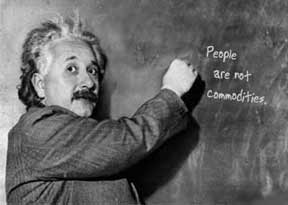
Albert Einstein at the chalkboard“The economic anarchy of capitalist society as it exists today is, in my opinion, the real source of the evil… I am convinced there is only one way to eliminate these grave evils, namely through the establishment of a socialist economy, accompanied by an educational system which would be oriented toward social goals.”

Socialism is not inherently totalitarian. To advocate for an equitable distribution of wealth, to look after the poor and feeble, to provide health, education, and opportunity for all, is to be a socialist. Not by coincidence, these are the very reasons socialism is feared by capitalists and slandered by their educational system. The Red Scare was not about Commie infiltrators but a creeping social consciousness. “Democrats” are the lip service which corporate power has to pay to keep human beings from wising up and demanding their due.

Is there a single humanitarian whom you admire for his/her brilliance and grace, who advocates capitalism? Albert Einstein was a socialist.

Our little Nero has another fire in him

Bush precursor, Twilight Zone tyrant Anthony FremontOur IQ-pip-squeak-in-chief wrecks the US economy, slaughters a million people, steers the planet straight toward an iceberg, and now he’s trying to extort Americans to drill for oil on the coasts and in ANWR. Bush is still let to speak at the microphone, WHY?
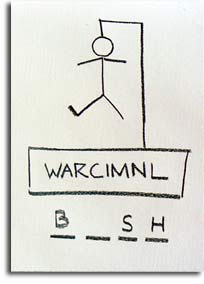
 
Impeach the damnable cretin! Can we afford this? IMPEACH HIM NOW!

The reckless minutio-maniac has delivered the Mid East oil fields to his cronies, high gas prices to the oil profiteers, and now thinks he can use both to extort the public into surrendering protected American lands out of their desperation to ease their personal gasoline crunch.

Dumbshit consumers are locked into gas-guzzling SUVs which they can’t trade in for a Lada, and so have no recourse but to pray for a roll-back of gas prices to literally yesterday.

Are we going to let George W. Bush continue his tyrannical reign of malignant idiocy? Do you remember the scene from Twilight Zone where the terrorized town folk were too afraid to rebel against their ten-year-old telepathic oppressor? It would simply have taken two of them to jump him, but all were eager to submit to his whims, repeat the mantra “It’s a good life,” and let the demonic boy cast dissenters one by one out of sight, out of mind, to a cornfield that might as well have been Guantanamo.

List of top privately held US companies

The shift of businesses into private ownership represents the eroding stake which common Americans have in the Capitalist system. Stock holdings in most public corporations are predominantly in wealthy hands, but private corporations drop even the pretense of serving the middle class economy. Biggest ($90B) is Koch Industries which provides “beef, fuels, fertilizer and plastics.”

Forbes has a list of America’s largest privately held companies, 424 of which have yearly earnings over one billion dollars. We’ve grouped them by category for easier perusal, ranked by their earnings. Colorado is headquarters to twelve: TransMontaigne, First Data, Pro-Build Holdings, CH2N Hill Cos, Vistar, Sports Authority, Leprino Foods, Hensel Phelps Construction, TIC Holdings, MediaNews Group and NWH.

CONSUMER PRODUCTS:
Mars VA -Combos, Dove, M&Ms, Pedigree, Snickers, Uncle Ben’s Rice
Levi Strauss & Co CA Textile – Apparel Clothing
SC Johnson & Son WI Personal Products
Ashley Furniture Industries WI Home Furnishings & Fixtures
Rich Products NY Confectioners
MGA Entertainment CA Toys & Games
Mary Kay TX Cleaning Products
Alticor MI Personal Products
Conair CT Personal Products
JohnsonDiversey WI Cleaning Products
ViewSonic CA Computer Peripherals
New Balance Athletic Shoe MA Textile – Apparel Footwear
Dawn Food Products MI Confectioners to Starbucks, Krispy Kreme
Roll International CA -Teleflora, Fiji Water, POM, Suterra
Genmar Holdings MN Recreational Boats
Williamson-Dickie Manufacturing TX Textile – Apparel Clothing
McKee Foods TN Confectioners: Little Debbie, Sunbelt
Samsonite MA Personal Products
NewPage OH Paper & Paper Products
Bose MA Electronic Equipment
WL Gore & Associates DE Textile – Apparel Clothing
Milliken & Co SC Textile – Apparel Clothing
MTD Products OH Recreational Goods, Other

RETAILERS:
Toys “R” Us NJ Toy & Hobby Stores
Dollar General TN Discount, Variety Stores
Menard WI Home Improvement Stores
Neiman Marcus Group TX Department Stores
84 Lumber PA Home Improvement Stores
Hallmark Cards MO Entertainment – Diversified
Michaels Stores TX Specialty Retail, Other
Belk NC Department Stores
Burlington Coat Factory NJ Apparel Stores
Linens ‘n Things NJ Home Furnishing Stores
Sports Authority CO Sporting Goods Stores
Bass Pro Shops MO Sporting Goods Stores
Fry’s Electronics CA Specialty Retail, Other
Mervyns CA Department Stores
Follett IL Specialty Retail, Other
General Parts NC Auto Parts Stores
ShopKo Stores Operating WI Discount, Variety Stores
Petco Animal Supplies CA Specialty Retail, Other
Discount Tire AZ Auto Parts Stores
Guitar Center CA Music & Video Stores
Academy Sports & Outdoors TX Sporting Goods Stores
Rooms To Go FL Home Furnishing Stores
Hobby Lobby Stores OK Toy & Hobby Stores
Barnes & Noble College Booksellers NJ Specialty Retail, Other
Duane Reade NY Drug Stores
LL Bean ME Catalog & Mail Order Houses
Newegg.com CA Specialty Retail, Other
GNC PA Drug Stores
Goody’s Family Clothing TN Department Stores
Les Schwab Tire Centers OR Auto Parts Stores
Beall’s FL Department Stores
PC Richard & Son NY Specialty Retail, Other
Micro Electronics OH Specialty Retail, Other
Sutherland Lumber MO Home Improvement Stores
Boscov’s PA Department Stores
24 Hour Fitness Worldwide CA Consumer Services
Ritz Camera Centers MD Specialty Retail, Other
Schottenstein Stores OH Home Furnishing Stores
Cinemark USA TX General Entertainment
Marc Glassman OH Drug Stores
Bally Total Fitness IL Specialized Health Services
ClubCorp TX Consumer Services
Forever 21 CA Apparel Stores
BrandsMart USA FL Specialty Retail, Other
Steve and Barry’s NY Apparel Stores

HOSPITALITY:
Hilton Hotels CA Lodging
Love’s Travel Stops OK Lodging
Carlson Cos MN Lodging
Global Hyatt IL Lodging
Delaware North Cos NY Specialty Eateries
Ilitch Holdings MI Restaurants
Buffets MN Restaurants

GROCERS:
Meijer MI Grocery Stores
HE Butt Grocery TX Grocery Stores
Giant Eagle PA Grocery Stores
Cumberland Farms MA Grocery Stores
QuikTrip OK Grocery Stores
Hy-Vee IA Grocery Stores
Save Mart Supermarkets CA Grocery Stores
RaceTrac Petroleum GA Grocery Stores
Wawa PA Grocery Stores
Wegmans Food Markets NY Grocery Stores
Bi-Lo Holdings SC Grocery Stores
Stater Bros CA Grocery Stores
Sheetz PA Grocery Stores
Raley’s CA Grocery Stores
Golub NY Grocery Stores
WinCo Foods ID Grocery Stores
Schnuck Markets MO Grocery Stores
Demoulas Super Markets MA Grocery Stores
Brookshire Grocery TX Grocery Stores
Bashas’ AZ Grocery Stores
Houchens Industries KY Grocery Stores
Holiday Cos MN Grocery Stores
Marsh Supermarkets IN Grocery Stores
K-VA-T Food Stores VA Grocery Stores
Kum & Go IA Grocery Stores
Big Y Foods MA Grocery Stores
Gate Petroleum FL Grocery Stores
Foodarama Supermarkets NJ Grocery Stores
Thorntons KY Grocery Stores
Brookshire Brothers TX Grocery Stores
Minyard Food Stores TX Grocery Stores
Inserra Supermarkets NJ Grocery Stores
Stewart’s Shops NY Grocery Stores

FOOD SUPPLY:
C&S Wholesale Grocers NH Food Wholesale
US Foodservice MD Food – Major Diversified
Reyes Holdings IL Food Wholesale
Gordon Food Service MI Food Wholesale
MBM NC Food Wholesale
OSI Group IL Meat Products
Roundy’s Supermarkets WI Food Wholesale
HT Hackney TN Food Wholesale
Keystone Foods PA Meat Products
Perdue Farms MD Meat Products
Schwan Food MN Dairy Products
Eby-Brown IL Food Wholesale
Schreiber Foods WI Dairy Products
Vistar CO Food Wholesale: ROMA
Alex Lee NC Food Wholesale
Grocers Supply TX Food Wholesale
HP Hood MA Dairy Products
Services Group of America AZ Food Wholesale
Dot Foods IL Food Wholesale
Leprino Foods CO Dairy Products: mozzarella cheese
Rosen’s Diversified MN Meat Products
Ben E Keith TX Food Wholesale
Smart & Final CA Food Wholesale
Maines Paper & Food Service NY Food Wholesale
Foster Farms CA Meat Products
Koch Foods IL Meat Products
Red Chamber Group CA Food Wholesale
Shamrock Foods AZ Food Wholesale
ContiGroup Cos NY Meat Products
Pinnacle Foods NJ Food – Major Diversified
Great Lakes Cheese OH Dairy Products
GSC Enterprises TX Food Wholesale
Michael Foods MN Dairy Products
Bozzuto’s CT Food Wholesale
Goya Foods NJ Food – Major Diversified
Wells’ Dairy IA Dairy Products

FARMING:
Cargill MN Farm Products
Transammonia NY Agricultural Chemicals
Murdock Holding Company CA Farm Products
DeBruce Grain MO Farm Products
Scoular NE Farm Products
JR Simplot ID Farm Products
Golden State Foods CA Farm Products
Dunavant Enterprises TN Farm Products
Bartlett & Co MO Farm Products

DRINK:
Southern Wine & Spirits FL Beverages – Wineries & Distillers
Charmer Sunbelt Group NY Beverages – Wineries & Distillers
Republic National Distributing Company TX Wineries & Distillers
Glazer’s Wholesale Drug TX Beverages – Wineries & Distillers
E&J Gallo Winery CA Beverages – Wineries & Distillers
Young’s Market CA Beverages – Wineries & Distillers
Honickman Affiliates NJ Beverages – Soft Drinks
Wirtz IL Beverages – Wineries & Distillers
Topa Equities CA Beverages – Wineries & Distillers

HEALTH:
US Oncology TX Hospitals
Vanguard Health Systems TN Hospitals
Quintiles Transnational NC Medical Laboratories & Research
Golden Living AR Home Health Care
Medline Industries IL Medical Instruments & Supplies
Bausch & Lomb NY Medical Appliances & Equipment
Biomet IN Medical Instruments & Supplies
Iasis Healthcare TN Hospitals
Life Care Centers of America TN Long-Term Care Facilities
Select Medical PA Long-Term Care Facilities
Catalent Pharma Solutions NJ Medical Instruments & Supplies
Ardent Health Services TN Hospitals
FHC Health Systems VA Specialized Health Services
Concentra Operating TX Specialized Health Services
Gateway Health Plan PA Health Care Plans
SavaSeniorCare GA Long-Term Care Facilities
TeamHealth TN Medical Practitioners
Cook Group IN Medical Instruments & Supplies

MEDIA:
Cox Enterprises GA Entertainment – Diversified
Advance Publications NY Publishing – Newspapers
Bloomberg NY Information & Delivery Services
Hearst NY Publishing – Newspapers
International Data Group MA Publishing – Periodicals
Reader’s Digest Association NY Publishing – Periodicals
AMC Entertainment MO General Entertainment
Univision Communications NY Entertainment – Diversified
Quad/Graphics WI Publishing – Periodicals
Ebsco Industries AL Publishing – Periodicals
Landmark Communications VA Publishing – Newspapers
Taylor MN Publishing – Periodicals
Metro-Goldwyn-Mayer CA General Entertainment
MediaNews Group CO Newspapers: Denver Post, Detroit News

INVESTMENT:
GMAC Financial Services MI Mortgage Investment
Fidelity Investments MA Asset Management
Capital Group Cos CA Asset Management
Edward Jones MO Investment Brokerage – National
LPL Financial Services CA Investment Brokerage – National

AUTOMOTIVE:
Chrysler MI Auto Manufacturers
Gulf States Toyota TX Auto Manufacturers – Major
JM Family Enterprises FL Auto Manufacturers
Tower Automotive MI Auto Parts
Cooper-Standard Automotive MI Auto Parts
Affinia Group MI Auto Parts
Guardian Industries MI Auto Parts
CC Industries IL Auto Parts
American Tire Distributors Holdings NC Auto Parts
Remy International IN Auto Parts
Plastech Engineered Products MI Auto Parts
Key Safety Systems MI Auto Parts
Interstate Battery Systems of America TX Auto Parts
KAR Holdings IN Auto Dealerships

BUSINESS:
PricewaterhouseCoopers NY Business Services
Ernst & Young NY Business Services
First Data CO Business Services
Allegis Group MD Information Technology Services
SunGard Data Systems PA Business Software & Services
Booz Allen Hamilton VA Technical Services
Grant Thornton International IL Business Services
Asplundh Tree Expert PA Business Services
SAS Institute NC Business Software & Services
Skadden, Arps NY Business Services
Reynolds and Reynolds OH Business Software & Services
Bain & Co MA Business Services
Jones Day OH Business Services
Freeman TX Business Services
Sidley Austin IL Business Services
White & Case NY Business Services
NCO Group PA Business Services
Alsco UT Business Services
Kirkland & Ellis IL Business Services
Affinion Group CT Business Services
RGIS Holdings MI Business Services
Mayer Brown IL Business Services
Lifetouch MN Business Services
Weil, Gotshal & Manges NY Business Services
Keane CA Business Services
Latham & Watkins CA Business Services
Guthy-Renker CA Business Services
Haworth MI Business Equipment
Vertis MD Marketing Services
Towers Perrin CT Management Services
Visant NY Marketing Services

CONSTRUCTION:
Bechtel CA Heavy Construction
Peter Kiewit Sons’ NE Heavy Construction
CH2M Hill Cos CO Heavy Construction
Whiting-Turner Contracting MD Heavy Construction
Gilbane RI Heavy Construction
Parsons CA Heavy Construction
JE Dunn Construction Group MO Heavy Construction
Black & Veatch KS Heavy Construction
Hensel Phelps Construction CO Heavy Construction
McCarthy Building Cos MO Heavy Construction
Yates Cos MS Heavy Construction
Hunt Construction Group AZ Heavy Construction
TIC Holdings CO Heavy Construction
Parsons Brinckerhoff NY Heavy Construction
Swinerton CA Heavy Construction
Zachry Construction TX Heavy Construction
AG Spanos Cos CA Heavy Construction
Turner Industries Group LA Heavy Construction
Barton Malow MI Heavy Construction
M A Mortenson MN Heavy Construction
Day & Zimmermann PA Heavy Construction
Warren Equipment TX Heavy Construction
Austin Industries TX Heavy Construction

BUILDING:
Pro-Build Holdings CO Building Materials Wholesale
Kohler WI General Building Materials
Clark Enterprises MD General Contractors
JF Shea CA Residential Construction
Structure Tone NY General Contractors
Jeld-Wen OR General Building Materials
Andersen MN General Building Materials
ABC Supply WI Building Materials Wholesale
Walsh Group IL General Contractors
Tishman Construction NY General Contractors
NTK Holdings RI General Building Materials
WinWholesale OH Building Materials Wholesale
Brasfield & Gorrie AL General Contractors
G-I Holdings NJ General Building Materials
Bradco Supply NJ Building Materials Wholesale
National Gypsum NC General Building Materials
Hoffman OR General Contractors
DPR Construction CA General Contractors
David Weekley Homes TX Residential Construction
Pella IA General Building Materials
BE&K AL General Contractors
William Lyon Homes CA Residential Construction
Weitz IA General Contractors
Mercedes Homes FL Residential Construction
Rooney Holdings FL General Contractors
Associated Materials OH General Building Materials
Beaulieu of America Group GA Home Furnishings & Fixtures
Suffolk Construction MA General Contractors
Kimball Hill IL Residential Construction
Drees Co KY Residential Construction
Shapell Industries CA Residential Construction
MWH CO General Contractors
Pacific Coast Building Products CA General Building Materials

WOOD:
Boise Cascade ID Lumber, Wood Production
Sierra Pacific Industries CA Lumber, Wood Production
North Pacific Group OR Lumber, Wood Production
Roseburg Forest Products OR Lumber, Wood Production
Columbia Forest Prods OR Lumber, Wood Production
Hampton Affiliates OR Lumber, Wood Production

EXTRACTION:
SemGroup OK Oil & Gas Refining & Marketing
Flying J UT Oil & Gas Refining & Marketing
TransMontaigne CO Oil & Gas Pipelines
Drummond AL Nonmetallic Mineral Mining
Sinclair Oil UT Oil & Gas Refining & Marketing
Colonial Group GA Oil & Gas Refining & Marketing
Oxbow FL Nonmetallic Mineral Mining
Ergon MS Oil & Gas Refining & Marketing
Red Apple Group NY Oil & Gas Refining & Marketing
Mansfield Oil GA Oil & Gas Refining & Marketing
Truman Arnold Cos TX Oil & Gas Refining & Marketing
Hunt Consolidated/Hunt Oil TX Oil & Gas Drilling & Exploration
Red Man Pipe & Supply OK Oil & Gas Equipment & Services
Dresser TX Oil & Gas Equipment & Services
Warren Equities RI Oil & Gas Refining & Marketing
Merit Energy TX Oil & Gas Refining & Marketing
Arctic Slope Regional AK Oil & Gas Refining & Marketing
US Oil WI Oil & Gas Refining & Marketing
Camac International TX Oil & Gas Drilling & Exploration

UTILITIES:
Energy Future Holdings TX Electric Utilities
Tenaska Energy NE Diversified Utilities

CONGLOMERATES:
Platinum Equity CA -USRobotics
Sammons Enterprises TX -Midland National Life Insurance, Briggs
Ingram Industries TN
Berwind PA -Elmers Glue
Petters Group Worldwide MN
Washington Cos MT -mining, rail, marine, equip

ELECTRONIC:
CDW IL Computer Based Systems
Freescale Semiconductor TX Semiconductor – Specialized
Avaya NJ Communication Equipment
Graybar Electric MO Electronics Wholesale
Kingston Technology CA Semiconductor- Memory Chips
Brightstar FL Communication Equipment
World Wide Technology MO Computers Wholesale
Infor GA Computer Based Systems

INDUSTRIAL:
Marmon Group IL Industrial Equipment & Components
Southwire GA Industrial Equipment & Components
Aleris International OH Metal Fabrication
Amsted Industries IL Diversified Machinery
O’Neal Steel AL Steel & Iron
Heico Cos IL Industrial Equipment & Components
Renco Group NY Steel & Iron
Metals USA TX Metal Fabrication
McWane AL Industrial Equipment & Components
McJunkin WV Industrial Equipment & Components
Electro-Motive Diesel IL Industrial Equipment & Components
Crown Equipment OH Industrial Equipment & Components
Rexnord WI Industrial Equipment & Components
Tang Industries NV Metal Fabrication
Soave Enterprises MI Steel & Iron
Indalex IL Aluminum
Euramax International GA Metal Fabrication
Advanced Drainage Systems OH Industrial Equipment & Components
Goss International IL Industrial Equipment & Components
Swagelok OH Industrial Equipment & Components
Utility Trailer Manufacturing CA Industrial Equipment & Components

CHEMICAL:
Koch Industries KS Chemicals – Major Diversified
Hexion Specialty Chemicals OH Specialty Chemicals
InterTech Group SC Synthetics
Berry Plastics IN Rubber & Plastics
JM Huber NJ Specialty Chemicals
Carpenter VA Synthetics
Wilbur-Ellis CA Agricultural Chemicals
International Specialty Products NJ Specialty Chemicals
Sigma Plastics Group NJ Synthetics
ICC Industries NY Specialty Chemicals
Nypro MA Rubber & Plastics

PAPER:
Central National-Gottesman NY Paper & Paper Products
Verso Paper TN Paper & Paper Products
The Kraft Group MA Paper & Paper Products
Gould Paper NY Paper & Paper Products
Appleton Papers WI Paper & Paper Products

TRANSPORTATION:
Unisource Worldwide GA Packaging & Containers
Schneider National WI Trucking
Swift Transportation AZ Trucks & Other Vehicles
Graham Packaging Holdings PA Packaging & Containers
Solo Cup IL Packaging & Containers
UniGroup MO Trucking
Altivity Packaging IL Packaging & Containers
SSA Marine WA Shipping
Dart Container MI Packaging & Containers
Plastipak Holdings MI Packaging & Containers
Crowley Maritime FL Shipping
Estes Express Lines VA Trucking
Global Aero Logistics IN Air Services, Other
Printpack GA Packaging & Containers
Pliant IL Packaging & Containers
Crete Carrier NE Trucking

WHOLESALE:
Kinray NY Drugs Wholesale
Consolidated Elec Distributors CA Wholesale, Other
VWR International PA Wholesale, Other
Anderson Cos AL Wholesale, Other
Quality King Distributors NY Drugs Wholesale
Software House Intl NJ Electronics Wholesale
Baker & Taylor NC Wholesale, Other
JM Smith SC Drugs Wholesale
D&H Distributing PA Computers Wholesale
Ma Labs CA Electronics Wholesale
Apex Oil MO Wholesale, Other
ASI CA Computers Wholesale
Orgill TN Wholesale, Other

MISC. SERVICES:
Enterprise Rent-A-Car MO Rental & Leasing Services
Frank Consolidated Enterprises IL Rental & Leasing Services
McKinsey & Co NY Research Services
Travelport NJ Consumer Services
HealthMarkets TX Insurance Brokers
West Corp NE Diversified Communication Services
Boston Consulting Group MA Research Services
Knowledge Learning OR Education & Training Services
Maritz MO Research Services
Education Management PA Education & Training Services
Laureate Education MD Education & Training Services

MISC:
JD Heiskell & Co CA NA
Vought Aircraft Industries TX Aerospace/Defense – Major Diversified
Ash Grove Cement KS NA
Deseret Management UT NA
Safety-Kleen Systems TX Waste Management

Bush the unimpeachable war criminal

HangmanRemember when Bill Clinton was “rebuked” for misleading Congress about the nature of his conduct with a White House intern? I’m sorry. I meant IMPEACHED.
 
A decade later legislators have concluded that Bush deliberately misled Congress and the American people about Iraq, al-Qaeda, et al, drawing the nation into an illegal war, resulting in untold deaths and a ruined economy. Is Bush impeached? Indicted? No, he’s REBUKED.

Anarchism as applied to washing dishes

WASH YOUR OWN DISHES via CrimethInc

CAPITALISM
You wash the dishes, the ones who own them profit.
 
ANARCHISM
We all share in the dishwashing.

DEMOCRACY
Even as a dishwasher, you deserve a say in which politician is best suited to protect the economy that keeps you in the kitchen.

NATIONALISM
Forget about those dishes for a second — you’re a citizen of the proudest hation on earth!

LIBERTARIANISM
You wash the dishes, the owner profits even more.

FASCISM
The Mexicans who washed the dishes are deported, the Jews who owned the place are imprisoned, and everyone else is conscripted for military service.

UNEMPLOYMENT
The only thing worse than being trapped in a dish room is being trapped outside one.

NEO-LIBERALISM (AKA “Free Trade”)
The dishes are shipped overseas to be washed and you’re free to develop your own combination of Unemployment and Nationalism

REFORM
Smaller stack, warmer water, longer breaks –same dishes!

SOCIALISM
Dishwashers’ wages increase just enough to afford higher takes

COMMUNISM
From each according to his means, to each according to his need –as determined outside the dish room.

MARXISM
Between shifts, the dishwasher studies the intricacies of dialectical materialism. It turns out that thanks to his efforts, the dirty dishes have been accumulating value for his boss to invest in more dishes. The stuff about the dictatorship of the proletariat is more perplexing, but the party theorists reassure him that it makes perfect sense to them. Under their direction, he joins his fellow dishwashers in a risky coup d’etat. Afterwards, he is distraught to find himself still in the kitchen, washing dishes for the party bureaucrats. The bureaucrats reassure him that they will eventually wither away.

SYNDICALISM
The dishwashers join labor syndicates that send representatives to a council, at which it is decided which dishes are to be washed and when.

ANARCHA-FEMINISM
You wash the dishes for the boss — who washes the dishes at home?

ANARCHO-PRIMITIVISM
Down with dishes!

ANARCHO-PUNK
Down with washing!

INSURRECTIONARY ANARCHISM
A quixotic attempt to distill a political theory from the practice of smashing dishes.

-Crimethinc

No Army expansion into Pinon Canyon

PCEOC Truck-sized billboard along Interstate 25
PUEBLO, COLORADO- The Pinon Canyon Expansion Opposition Coalition (PCMiSCRAP) folks are parking semi-trailer billboards along I-25 to make certain the US Army expansion team gets their message. The ranchers have also scheduled their own public meetings to preempt the Army “Public Scoping” PR presentations.

KIM, COLORADO- The Pinon Canyon Expansion Opposition Coalition will give the public an honest chance to comment on the proposed military expansion of the Pinon Canyon Maneuver Site, on three consecutive nights, just prior to the Army’s scoping hearings which will exclude testimony on the subject.

PCEOC hearing times are:
Tuesday, May 20, in Trinidad
Trinidad State Jr College, Massari Auditorium from 4 to 6p

Wednesday, May 21, in Colorado Springs
Crowne Plaza Hotel, Salon C (Grand Ballroom) from 3 to 6p

Thursday, May 22, in La Junta
Otero Junior College, Mc Bride Hall #137 from 4 to 6p

Army officials announced scoping hearings to discuss bringing additional troops to Fort Carson but said the hearings have nothing to do with the proposed expansion of the PCMS. The communities of Southeastern Colorado know this is not true and that the two issues are undeniably linked.

“The Army knows that a majority of Coloradans, a majority of state lawmakers and a majority of federal lawmakers oppose the expansion,” said PCEOC President Lon Robertson. “By excluding any discussion of PCMS from the scoping hearings, Army officials are attempting to avoid a difficult subject and skirt federal law.”

In 2007, Congress passed and the President signed into law a military appropriations bill which outlawed all funding on the proposed expansion of the PCMS.

“If the Army held a hearing on expanding the site, they’d violate the law so instead, they are pretending that increasing the force at Fort Carson will have no impact,” Robertson said. “In reality, if they get more brigades at Fort Carson, we know they will turn around and demand more acreage on which to train them.

“And the real question is why won’t the Army take no for an answer?” Robertson said. “This has been dragging on too long and even the threat of expansion is having devastating effects on our communities and economy.”

The Army is behaving lawlessly and now it seems they don’t even follow their own guidelines set by the Base Realignment and Closure Commission (BRACC). The additional troops cited in this latest effort completely exceed the numbers stated in the 2005 BRACC report.

The Pinon Canyon Expansion Opposition Coalition, or PCEOC, is a broad-based coalition representing communities across Southern Colorado in their opposition to the proposed military expansion. PCEOC members include business owners, teachers, students, elected officials, ranchers, environmentalists and many others.

The coalition is united in its opposition to any expansion of PCMS. No funding, no expansion.

A vaccine for PTSD.

There is a natural (perhaps “unnatural”) Immunity Factor to counter Post Traumatic Stress Disorder…

It’s called “sociopathy” and its evil twin “narcissism”.

I know, some people will only accept the opinion of Army scientists on what causes or prevents the disease, so I’ll use a paraphrase of their definitions.

It started to be a really really noticeable problem at the time of our Civil War and the Crimean War(s)…

A time when large standing armies of conscripts were suddenly the norm rather than an aberration.

A time of weapons technologies wherein somebody you could not see or hear, somebody perhaps miles away, could kill you, or your comrades, large numbers of you at a time.

But the truly extraordinary stress, wasn’t from the sudden spurts of violence, not directly, at least.

It was the vastly longer times Between barrages, between battles…

The disruption of you natural Circadian rhythms, sleep patterns and waking patterns, the “attack at dawn” because Dawn is the point at which all living creatures, from the lowest proto-bacterium to the Great Apes, and Humans, are at their lowest level of energy.

So you had to be awake, and aware, by dawn. Guards have to be maintained at all hours… thus intermittent episodes of sleep deprivation. And that not on a regular basis.

The randomness of that is also a factor.

Then there’s the acts of pure murder. You can train yourself to ignore your conscience, or be trained en masse to ignore your collective conscience… to supress the certain knowledge that you are doing something totally against your basic humanity…

But the Basic Training itself, aka Indoctrination, aka Pavlovian Conditioning, aka Brainwashing, is designed not to strenghten your resolve, or your ability to think logically… but to break those barriers, those mental and spiritual bits of armor provided by God, that keep most people from committing outrageous crimes.

You can, if your indoctrination is constantly reinforced, maintain that level of denial… but only for as long as your indoctrination is reinforced.

Once you are separated from your army, or from your cult, or whatever group is brainwashing you, the denial becomes harder and harder to maintain.

False “patriotism”, or devotion to whatever OTHER similar lower-case “g” god you’ve been trained to worship, and a simple fear of admitting, mostly to yourself or your comrades, that you have done wrong, is a very powerful reason to keep it sublimated, to bottle it and suppress it.

Alcohol and other drugs are one really commonly used method.

Perhaps it’s the reason members of the military are actually Encouraged to drink. Somebody who’s a total drunkard might be punished or looked down upon, but so are tee-totallers.

People who abstain from social drinking are actually looked upon as having antisocial tendencies, or at least, not being as suggestible, “not a team player”.

So, what would be a good, non-destructive vaccine, a good prevention for PTSD?

not maintaining a Standing Army for one.

It might sound kind of idealistic, like what would then prevent some foreign power from invading and enslaving America…

Well, for one thing, we haven’t been invaded since 1814. And then it was one of the Superpowers of its time, Great Britain. And they couldn’t maintain their other, bigger wars and still attempt to occupy even those small patches of American ground that they DID gain.

Too much drain on their manpower, materiel and other resources, especially money.

Much like our Federal Government spending DEFICIT after 7 years of Bush is now 5 times (approximately) the Government Budget for the entire 4 years of the “tax and spend liberal” Carter Administration. Add in, (or subtract) an equal amount which was the Projected SURPLUS for 2007, made in 2001 when Bush took office.

That might sound like phantom accounting, unless you realize that the “Liberation” was projected to actually make a profit.

Just not for, you know, the average American or the average “Liberated” Iraqi.

And this is from the economy that the Capitalist Masters say is “The Strongest on earth”.

Israel, one of our proxy states, could not maintain an occupation in Lebanon even with massive American money aid. They can’t maintain an occupation of the West Bank, populated with the poorest Arab nation there is, where their most advanced military technology is a reworked Russian rocket-propelled grenade… without massive American financing.

If we had simply left “goddam insane” alone in 1991, the other Arab nations, and the simple economics, would have ended the invasion.

We’re a rich nation, how would the poorest nations maintain it? Historically, they’ve done it the way Hussein maintained his battle with Iran… with massive amounts of money.

Donated money.

So it’s do-able. People who point out that it’s never worked before fail to recall the other side of that equation, it’s never been tried before.

The same people who say we need to pour (literally) countless trillions of dollars into occupying the Arabian Peninsula for the rest of our national existence, were the same ones who cut the funding for every actual Peace initiative whenever a snag was hit in the progress thereof.

That’s the REAL “surrender mentality”.

The notion that peace would be very difficult to achieve, therefore we shouldn’t even try, and just surrender to Endless War and the Dictatorship necessary to maintain it.

And the economic degradation. And the inescapable fact that our children or grandchildren or hell, maybe even our very own generation, would be occupied by a foreign power when the Empire falls.

And then there’s the medical costs, not least the cost of PTSD.

Even if somebody doesn’t have full-blown psychoses as a result of PTSD, it degrades the physical health, medical problems like Diabetes, Heart, lung, kidney diseases, even arthritis, become more common. The human immune system is suppressed by PTSD.

That’s the most common symptom of it, actually, according to the Army. The most expensive.

We have one candidate for president, has said that he WILL cut “social spending”, like public health, VETERANS health care, etc etc etc.. to fund his Masters (Satans) Endless War.

We need to innocculate the entire American public against PTSD, with the knowledge that war is NOT a “necessary evil”. With the knowledge of WHY it can be ended and HOW it can be ended.

It beats living Hell out of the alternative possibilities probabilities.

Hunger, shortages and Wall Street

What can we expect of a capitalist system gorging itself on the misery of others? The energized “food speculators” have found another way now to skim money off of commodities (and off those producing them) by racing out of their burnt down, failing criminal derivatives scams – that are and will continue to cause job loss, retirement and savings loss, home equity loss – and into food.

This should be stopped immediately by Congress in the interests of the nation and the poorest countries that are now experiencing riots and unrest over high prices and shortages. But you can bet the millionaires in Congress are profiting from this hideous behavior and won’t do a god damn thing about it other than throw money, our money, at it. Worthless solutions from bankrupt minds.The liars in the mainstream media blame everything else but the real cause …the Wall Street vipers. This is our American culture …profit at all and any costs.

Ethanol is turning out to be a speculative tool as well, besides taking land away from corn grown for cattle feed and humans. Sugar cane, other forms of bio-fuel will become speculator targets as well. Even water! All of this investing in commodities is driven by the falling dollar created by the Fed who crashed the dollar!! Lowering interest rates and opening cheap credit windows to Wall Street floods the economy with more worthless paper. This is driving the commodities bubble as well. Investors are trying to hedge against losses from the subprime/derivatives scams. It’s all related… not as the mainstream news claims that weather or high oil prices are driving this. Bullpucky.

“According to Grünewald, “Raw materials are the mega-trend of the decade,” and his company intends to intensify its involvement in both water and agricultural stocks. MIC investment in wheat alone has already yielded profit levels of 93 percent for the 2,500 members of the club.” – WSWS

Read these two articles and see if Wall Street is mentioned: NY Sun: food rationing or Yahoo: food crisis.

Higher food prices now being driven by higher fuel prices

We can now see the first effects of the world energy crisis, as local grocery stores are creeping their prices of basic foods upward. The dollar stores also are not exactly dollar stores these days, and never will be again. There are two reasons for these price hikes.

First off, the Pentagon is doing this to us. We are throwing them money (and hence the military suppliers and contractors money, too) like it is going out of style. This is money we simply don’t have, and therefore it is coming from loans to our government, who then passes it off to those that have literally bought the government.

We know who eventually will get stuck with paying off these bad debts, too. It will be the working class and lower middle class of our country. And meanwhile, the rich suck at this gigantic welfare program (teat) with absolutely no shame, as they wave the American flag outside all their offices pretending to be the great patriots. The lower echelons of this fraud get 10% off!

Second cause of the rising prices is simply that we have hit the crisis of declining world oil supplies head on, and nobody has any solution to it beyond trying to corner the world supply (Thank you, Dick Cheney and Dumbo Dubya). But capturing control of world petroleum supply doesn’t exactly increase it, even if such a plot were to be ever successful. All in all, we still have yet to come up with an alternative to the mobility of oil transport, and we are dependent on oil, as we have been for all the later half of the industrial revolution.

Some think that the solution is turning back to coal. Some think it is turning to the deadly nuclear option. Some dream of sun, hydrogen fuel cells, and wind. Meanwhile, in the real world, it is still oil that fuels civilization, uh ‘civilization’ as we know it.

We currently have a rapacious economic system that expands constantly at nature’s expense. Nature is now fed up with it, even if our family and neighbors are not. Nature is run down, and will be run out if we continue this way.

Meanwhile, the prices have begun to inch up and we grow uncomfortable here at home. Elsewhere, things have grown more desperate from the start. Ahead, it is $4/ gallon prices this summer, and the sky will certainly be the limit. Oil barrel prices flown up from below $10 a barrel (not adjusted for inflation) as close back as the mid- ’80s some 22 years ago, to heading towards $120 a barrel right now. It is easy to see how our dollars are now being turned to pennies and we haven’t seen anything yet.

There are some horrible times for the world ahead as the world begins to run into shorter and shorter supply of oil. Meanwhile, let’s shop if we can, shall we not? It’s going to be much harder to do that soon.

Gazette advocates for Iraq withdrawal

LTE- Regarding your editorial IRAQ: NO MORE HOLD AND PRAY, I’m very glad to see your paper finally suggest that “this war should make Americans more skeptical the next time a political leader suggest war.” While your editorial now recommends that US forces get out of Iraq, will the Gazette also advocate for a just withdrawal? In particular that out of care not to abandon the Iraqi people, instead of sticking around to shoot more, we should fund an international force to rebuild their country. America owes a large war reparation to the victims of its illegal war.

If the usual critics now taunt you with accusations you want to “cut and run,” reassure them the US must certainly cut an extraordinarily large check for what it has done. If the American public thinks the war has hurt our economy, wait until we face up to giving restitution to those we’ve harmed. We all understand that what cost 1.2 trillion to destroy, will cost several trillion more to restore. There can be no peace without justice.

By the way, the fiasco in Iraq was predicted by many, before it started. You laud the skepticism now, why not cut the dissident voices a little slack the next time they are trying to prevent wayward and wanton actions?

Are they leaping from buildings yet? It’s time to pay the piper…

Here in Colorado, watching the world economic meltdown is a little like watching a horrible storm coming our way. We see the terrible whether predictions on TV and in the paper, but it has yet to truly hit us and our neighbors still… Wall St. braces for thousands of pink slips But down on Wall Street, many fine paying jobs are going down as the billionaires jockey for position to profit off the misery and the inevitable fallout coming from the eating of little fish by the bigger.

Are they leaping from the top stories of the Manhattan sky scrapers yet? The world hunger riots have already begun, as have the resource wars. This time is different though. There is less and less of nature to loot, so this is not just a downturn of the normal capitalist business cycle. Planet Earth is in a big mess.

We sat around twiddling our thumbs too long while the big boys ran all over the world. There is a big price to pay for having played stupid so long. It’s coming time to pay the piper. Good bye ’50s forever.

Food riots, economic sustainability, and the historical economic rate of growth

foodAs the world moves toward recession/ depression, dragged down by the bursting US bubble economy, food riots are beginning to occur in multiple locales around the planet. The inflation rate in 2007 for food staple prices has been around 40%. See WFP food aid costs up “dramatically” in past weeks for the figure. The world population is currently growing at something less than 2% per year.
The annual world population growth rate reached its peak in the late 1960s, when it was at 2% and above. The rate of increase has therefore almost halved since its peak of 2.19 percent, which was reached in 1963, to the current 1.15%.

The annual population growth rate is currently declining and is projected to continue to decline in the coming years, but the pace of the future change is uncertain (1). Currently, it is estimated that it will become less than 1% by 2020 and less than 0.5% by 2050.

See world meter population information from where these percentage figures were copied.

So what is the historical capitalist economic rate of growth? That is the rate of growth needed for capitalism to not go into an economic down spin, and that necessary percent of growth is considered to be about 3% by most economists.

Note that this rate of growth needed in GDP is actually higher than the rate of population growth. In other words, even without a growth in world population capitalism needs to continually increase production to maintain the numbers of jobs given to the workers, or employment of them. However, it is this increasing production of goods (most of them quite unnecessary goods) that is decimating the ecology of the planet, and not mere population growth alone.

What we have is a world economy that is not feeding the world’s population adequately, is not maintaining the world’s ecological stability, not providing employment security, and yet is still expanding, which without that expansion in production of goods it would go into an economic crisis of increased world unemployment!

When rates of annual capitalist expansion of GDP go below the average annual rate of economic growth by capitalism, that is called an economic depression, and leads to world political instability, such as we had in the ’30s. That is the ebb in the capitalist business cycle, as opposed to the peak.

The increasing number of riots and upheaval around the world due to the rising world food prices, is simply the first signs that capitalist economic activity is not meeting major human needs once again.

Do you even feel secure right here in the US? Enough said then. The capitalist business has you in its clutches, and in fact, has us all in its clutches as it tears the planet’s ecology apart. It would be impossible to make this monster economically sustainable. It just isn’t. And that’s no matter how many solar panels Fort Carson might install, or ‘green’ companies you might invest in.

Today’s Forecast- more media shit storms ahead for your local area

What’s the political weather pattern look like, Dude? Is it safe to go out? Not exactly, for this is a presidential election year and big business owns the media. So look out! Today’s forecast is, more media shit storms ahead! Currently we are now floating into the Bermuda Triangle of candidential coverage.

Weatherman Bob Bageant has got it about right in his Media Shit Storms and Heartland Reality Isn’t it lovely in Springtime America? Just watch out for the hail storm of shit!

Heil, McCain and do you have any spare change, Mr Black Man? Wonder what Hillary is cooking? It’s a Wonderland, America is! Now a commercial for the US Army. Back after this commercial break…

Is the Dalai Lama an intelligence asset?

We know, or should by now, that the U.S.’s own terrorist organization, the CIA, is behind all foreign relation actions and assassinations, mostly of the covert kind. They cover themselves by using NGO’s, front companies, black banks, and contracting services with private intelligence and mercenary companies. Kay Griggs also claims the mob is still linked closely to CIA. She should know. But why would the Dalai Lama be on the CIA’s payroll? Because Tibet plays into the larger plan of the CIA & Pentagon’s long-standing practice of spreading “democracy.” For whatever nefarious capitalist reasons.

But China has used capitalism to strengthen it’s Stalinist tyrant “communist” bureaucracy with huge influx of dollars and also allowing U.S. investment bankers to make billions. Maybe the party is over since the US economy is in the dumper? Or the Pentagon is concerned about Chinas influence in West and North Africa? The media attention is telling. Whatever Chinas human rights abuses, the Bush administrations Iraq civilian deaths and civilian deaths from Clinton’s Iraq sanctions are far more criminal (genocide anyone?) than the totality of China’s. China and Russia are also challenging U.S. NATO expansions and making overtures to India to see the U.S. for what it is… a world bully and war criminal, looking to steal resources and geography in any way it can.

From Global Research:

“What has the Dalai Lama actually achieved for Tibetans inside Tibet? If his goal has been independence for Tibet or, more recently, greater autonomy, then he has been a miserable failure. He has kept Tibet on the front pages around the world, but to what end? The main achievement seems to have been to become a celebrity. Possibly, had he stayed quiet, fewer Tibetans might have been tortured, killed and generally suppressed by China.”

From Global Research:

“Indeed, with the CIA’s deep involvement with the Free Tibet Movement and its funding of the suspiciously well-informed Radio Free Asia, it would seem somewhat unlikely that any revolt could have been planned or occurred without the prior knowledge, and even perhaps the agreement, of the National Clandestine Service (formerly known as the Directorate of Operations) at CIA headquarters in Langley.”

From WSWS:

“The campaign against the Beijing summer games, predictably,
has become a political football, used for generally reactionary
purposes. The long-standing links between Tibetan nationalist
forces and the Central Intelligence Agency, which financed, armed
and helped instigate the 1959 uprising against Chinese rule, are
common knowledge. In the more recent period, CIA conduits like
the National Endowment for Democracy (NED), set up by the Reagan
administration in 1984, have provided funds to Tibetan separatist
movements”

Cynthia McKinney and Cindy Sheehan together in Mexico City!

Below, we reprint 2 speeches made in Mexico City Friday, just yesterday, April 4, 2008. The speech Greed … by Cindy Sheehan, and another speech by Cynthia McKinney that is without title.

Cynthia McKinney
Segundo Encuentro Continental de los Trabajadores
Mexico City, Mexico, April 4, 2008

Brothers and Sisters in the Movement

I am happy to be here in Mexico City where the people all over Latin
America are on the move:

On the move for justice, self-determination, and peace.

I love that you have created a Power to the People movement with your
votes that is stronger than the mightiest military force on the
planet!

With the power of your vote you have taken your countries back.

Now, all we have to do is to count all the votes in the United States
and Mexico!

In the 2000 U.S. Presidential election, an estimated six million
people went to the polls and voted, but their votes weren’t counted.

In 2000, and again in 2004, Democrats helped to install Republicans
into power rather than fight for the victory that the voters had
given them.

As a result of this kind of collusion, the Democratic majority in our
Congress has failed to impeach Bush. They have failed to institute a
livable wage, stop the multiple wars the U.S. is fighting right now,
and they have failed to protect human rights anywhere in the world,
including even at home.

That’s why I left the Democratic Party.

I refused to become complicit in war crimes, crimes against humanity,
crimes against the peace, spying on the American people, and ripping
our Bill of Rights to shreds.

And so I declared my independence from the U.S. leadership that gave
us tax cuts for the wealthy and a country 53 trillion dollars in debt
and Hurricane Katrina.

To my brothers and sisters at this Conference and in the United
States, I say:

Hands off Haiti!

Hands off Bolivia, Nicaragua, and Argentina now making a claim for
the Falklands!

Hands off Venezuela and Ecuador!

No to Plan Mexico; No to Plan Colombia! Hands off Pemex!

And finally, it was on this date, 40 years ago, that Dr. Martin
Luther King, Jr. was murdered.

We now know that Dr. King was murdered as part of a conspiracy that
included his own government. Hatched in the bowels of the Pentagon,
where so many other regime change operations have been hatched, the
government of the United States launched regime change at home on
Black America. We blacks in the United States have long known the
pain and the consequences of having authentic leadership snatched
from us; of having someone else pick our leaders before we pick them
ourselves.

I am proud to join this international movement for
self-determination; for justice and for peace. Despite today’s
difficulties, we must never let our dream be deferred. We in the U.S.
gain inspiration from your successes here so we can carry the
struggle to every nook and cranny of the United States.

Que vivan los pueblos de america!

Cindy Sheehan -Key Note Speech “GREED”
Segundo Encuentro Continental de los Trabajadores
Mexico City, Mexico, April 4, 2008

First of all I would like to thank the International Labor Council and the Electrician’s Union for such a warm welcome and I would like to assure you all, my brothers and sisters that I represent millions of North Americans who are in solidarity with you, because we are also plagued with an illegitimate President!

Once, a couple of years ago, I was getting a pedicure in the deep south in the USA, of all places, and my pedicurist was a Latina from Mexico. She lived two hours from where she and her husband owned the shop and she left her young son home with her mother-in-law for six days a week, while she and her husband toiled at the shop. She was very sweet and sympathetic to my situation as a mother whose son was killed in Iraq, but she looked up from my feet at one point and asked me: “Why do you Americans have to have everything. If you all weren’t so greedy, I could still live in my country with my family.” Greedy? Hmm? Her earnest and passionate comment gave me much to think about.

Dictionary.com defines greed as the rapacious desire, especially for wealth or possessions

Greed is also one of the seven deadly sins and I know more than most Americans that the same twisted drive for, not just a fair share of prosperity, but ALL the prosperity is what caused my son’s death and, similarly, my nail persons’ need to have to leave the beloved country of her birth.

Greed is not what drives Latin Americans to try and cross the border to go north, existential necessity is; but corporate-capitalist greed is what makes the dangerous journey necessary. Building walls on the border is not the way to solve the immigration “problem” just as invading two countries and killing innocent civilians was not the way to solve the terrorism problem. Healing the systems of oppression that cause immigration is the way to solve the “problem.” People in Latin America want the right to not have to emigrate. Like my pedicurist, they want to be able to make a good living in their own countries.

In a study done by the Economic Policy Institute in 2004, it was found that 5% of the US population owns 58% of the wealth and only 1.2% of the wealth is owned by 40% of our citizenry. I am sure if a similar study were done, this disparity would be much wider in these days of irresponsible corporate bailouts while Americans are losing their homes at the rate of 250,000 a month and the war economy has made the fat cats astronomical profits while robbing our communities of essential services and needed infrastructure improvements. The Milton Friedman model of disaster capitalism, which Naomi Klein exposes so well in her book, Shock Doctrine, is responsible for economic disaster from New Orleans to Baghdad and the basic underlying root sickness of this is greed.

Statistics can be easily manipulated as we know the statistics reporting the “success” of free trade agreements such as NAFTA are. Facts, numbers and experiential data cannot be so easily manipulated, though. In the years since the Clinton administration (with the support of my Congressional opponent, Nancy Pelosi) foisted NAFTA on our continent, both Mexico and the US have lost farmland and good paying jobs. Many of our manufacturing jobs have gone overseas to Indonesia or China and the Wal Martization of our cultures creeps up on us unchecked and corporations such as Wal Mart have been the main beneficiaries of NAFTA to the detriment of working class people in both countries.

What can we do to improve the situation and reclaim our prosperity from the control of the 21st Century Robber Barons and slave-traders?

First of all, “free” trade treaties should be replaced with fair trade agreements. Small business owners and workers should be protected from being crushed under the heels of multi-national corporations. Any agreement should have protection for workers. A worker who makes shoes, computers, cars, or grows crops should make the same livable wage in Mexico or China, as they would in America. There would be no incentive for off-shoring jobs or relocating manufacturing plants if workers in China made the same wages as workers in America.

All workers should be guaranteed the basic human right of being able to belong to a union. Unions elevate the conditions of workers and families and should remain a strong political force for good and not allow them selves to be beaten into submission or weakness by governmental or corporate pressure. (But aren’t the corporations and governments so intimately linked these days in their fascistic oppression of us average citizens?)

The fragile ecology of our planet must be protected in these agreements and the same standard of sustainability and environmental protections should be uniformly recognized and practiced globally.

Small farmers should be protected from the encroachment of “agri-giants” and their lands protected from the eminent domain of greed.

I know there are many more solutions and a comprehensive platform of “No human left behind” would guarantee the rights of all humans to safe and plentiful food and drinking water; shelter; good and free education; sustainable employment; security and safety from US corporate-militarism; and the basic rights that were guaranteed of: life, liberty and the pursuit of happiness.

For far too long, the United States of America has greedily gobbled up too much of global wealth and resources and our chickens of greed and violence are coming home to roost. As alarming as these trends are, we North Americans are only slightly beginning to feel the ravages of what we have been manufacturing and exporting for years: death and destruction. A new paradigm of global sharing and caring must be implemented and today is the beginning.

Today, as we commemorate and mourn the death of Dr. Martin Luther King, Jr who was assassinated 40 years ago in Memphis, Tn; and as I mourn the murder by the war machine of my son Casey, who was killed in Sadr City, Baghdad 4 years ago today—we must renew our commitment to peace and justice to honor their sacrifices and the sacrifices of others who have also gone before us. We just celebrated the birthday of Cesar Chavez who dedicated his life to the most marginalized and exploited of workers and I am constantly inspired by the devotion of people like Dr. King, Casey and Cesar Chavez andI hope that we all take inspiration to rededicate our lives to peace and justice.

We must build upon the coalition that we have gathered here in this beautiful and historic place to include every group that we are a part of. We can no longer say that we have to focus on “one” issue, because all the issues are the same. My country is waging deadly and lost-cause occupations of Iraq and Afghanistan and so many groups in my country say that we have to focus on bringing our troops home and not become “distracted” by other issues. Profound economic inequality and unchecked greed is the root cause of these occupations as it is the root cause of the occupation of Palestine by Israel and all the violence in the world’s hot-spots today.

In our coalition, we must educate our brothers and sisters that equalizing prosperity and neutralizing greed are the solutions to these acute problems.

I also stand here in solidarity with my brothers and sisters who are working in the Legitimate Government of Mexico to prevent the illegitimate government from privatizing PEMEX. The oil of Mexico belongs to the people of Mexico, and if I can’t be here with you all to block the crimes with my body then I will definitely be with you in spirit.

Thank you for allowing me to speak. It has been an honor to be here.

PROTESTCOLORADO targets the 2008 Colorado State Democratic Convention

The City of Colorado Springs has interesting plans for you if you feel inclined to raise a citizen’s voice at the 2008 State Democratic Convention to be held May 16-17 at the World Arena. The city is hosting a public forum or two, scheduled to run at the same time as the convention, for the public to vent its concerns without having to disrupt the Democratic Party activities. Possible demonstration areas for the 2008 Democratic State Convention As for protest, they are hoping to see no more than the 2005 Bush visit demo which police contained to the west side of Venetucci Boulevard. This time however, there will be no presidential secret service prerogative to commandeer public property.
 
You may be excited about Obama, but has he promised anything substantive on issues dear to you? Come let the Democrats know what you think of their centrism –when it leaves unresolved immigration, economy, labor, environment, health care and war. Join the fun on Friday evening, May 16, as the delegates arrive, and all day Saturday May 17.
No permits are needed. Check PROTEST COLORADO for updates on logistics. Make this Representative Democracy a Participatory Democracy!

Death spiral economy

The fascist business model in full view, unapologetic. Unaccountable. The Democrats have no intention of changing it. They have to protect their major donors. Obama is fully backed by Wall Street capitalists. He talks the talk of reform but he cannot and won’t walk the walk. He won’t tell you the real problem is the FED who created this mess. He’s just another black face in a high place. Powerless. Selling the illusion of hope. No substance.

USB bank today declaring more massive losses/write-offs. Muni-bonds and huge retirement funds will soon be reporting major losses. Member of PERA? Watch out! And of course when states start hurting bad, the taxes on these criminals who created this won’t be raised, nor fees increased on the oil companies who’ve raked in massive profits over the last 5 years… rather services and state education funding will be cut dramatically. Adding to the death spiral. Don’t you just love American capitalism? It’s a war/service cheap imports, low wages race to the bottom economy. And the vultures are coming out picking the bones of the unemployed and devalued real estate. Predators and scavengers. That’s the real U.S. economy.

We’ve lost all the gains from our productivity, we could have enjoyed, to these corporations and bankers/financial firms and war arms mfgrs. in their increased profits and paper schemes. Then by job loss, then poverty, our few possessions are lost-sold to the bottom feeders and other desperate folk.

A new American Socialism is needed that will stop war, take back the control of the currency from the Fed, abolish the IRS, abolish the corporate structure, abolish Wall Street and its speculators and commodities traders, and make the banks use social credit with low or no interest loans. Only low admin fees allowed. Then fully fund education through college, provide a national dividend to all citizens, fund a natl. health insurance program and return the means and ownership of production to the workers so that no non-productive parasitical outsider (stockholder) can make a profit from that company. Then turn our economy inward to the benefit of our people first with few exceptions in limited import and exports. And a radical energy transformation to zero point sources and hydrogen. Of course non of this will ever happen. As a famous autistic said: “I’m not a stupid person… Jenny.”

“Not surprisingly, neither in Paulson’s remarks nor in the 214 pages of the plan he released is there any suggestion that Wall Street firms or their top executives be called to account and held legally culpable for the economic and social disaster that has resulted from their reckless and often deceptive, if not outright illegal, policies and actions. US Treasury plan shields Wall Street speculators” -wsws.org

April Fools: The Fox To Guard The Banking Henhouse
– by Dr. Ellen Brown – 2008-03-31

U.S. Treasury Regulatory Reform Proposals: Hapless, Helpless, Hopeless
– by Richard C. Cook – 2008-03-31

New World Order. A Planned World Economy
Mankind at the Turning Point Part 3
– by Brent Jessop – 2008-03-31

Republicans and “Free Market” Zealots Bring Death to America
– by Paul Craig Roberts – 2008-03-30

Economic Cycles and Political Trends in the United States
Part I – by Prof. Rodrigue Tremblay – 2008-03-28

Is an International Financial Conspiracy Driving World Events?
Bankers now control national monetary systems in their entirety.
– by Richard C. Cook – 2008-03-27

The Fed’s Bailout: Whose Money Is It?
– by Richard C. Cook – 2008-03-23

Speculative Onslaught. Crisis of the World Financial System: The Financial Predators had a Ball
Danger of a domino collapse of banks akin to that in Europe in 1931?
– by F. William Engdahl – 2008-02-23

Derivatives – A Potential Financial Tsunami?
– by Daniel Apple, Rick Baugnon -2008-03-21

A New President Should Seize Control of the U.S. Monetary System
– by Richard C. Cook – 2008-03-20

Corrupt Fed wants control

These bastards are brazen thieves and agents of disinformation. Has the entire fricking country gone stupid? We are witnessing the transfer of vast sums of our money… not theirs, ours… to them!! And a Fed who wants to get the SEC out of the way so they can do it! Paulson, Bernake, Greenspan, Volker, Rubin… all wall street thieves and crooks, liars and scum. This is the fascist business model in full head long dive to the bottom with the Fed cleaning up the mess and divvying up the bailout money to their wall street buddies. For the next 6 months.

This had to be planned. No concerned economic professional in their right mind would have let this happen. The Fed is responsible for the housing bubble, the subprime crime, the weak dollar and now for looting the U.S. citizen treasury!! JP Morgan, Morgan Stanley, Merrill Lynch, Goldman Sachs, Citigroup, Bank America… they’re all going down. They’ve all got the CDO-SIV-Hedge Fund cancer bad. Why is the Fed taking on all this worthless paper and risk? All for show. They create and destroy money all the time.

Regardless, they will bail them all out… on our tab. Bear Stearns was sacrificed to keep JP Morgan on life support. But you can bet the Bear Stearns management got out before the crash of stock price. I think the SEC would investigate that right? And how is it that the Fed can act alone on these things, and the Congress (many of whom voted to repeal the Glass-Steagal act with Clinton) [there’s a question for Hillary] in the aftermath asks their sniveling little questions of how the deal was structured? Because the Fed runs the show. It is a private banking system… not a government agency! We are witnessing the power of the central banking system that was set up in Europe by the Bauers (Rothchilds), the Greens, the Schifts, the Warburgs…all German banking Zionists. Then brought to the U.S. (The Money Masters -dvd). Talmudist Jews by the way. Sold out Germany with the British to bring U.S. into WWI. Even though Germany was offering England a return to peace with no reparations or conditions.

Now, what happened to that 2.4 trillion that went missing from the Pentagon… just before 9-11? Hmmmm Dov Zakhiem might know. Another Zionist and dual Israeli/U.S. citizen who was in charge of the Pentagons budget as comptroller. Funny how that “plane” hit the accounting area of the Pentagon, destroying all evidence and records of misplaced funds. Darn the luck. Who’d have thought?

Will the Obama speech trump tribalism?

The press misleads us about the war, the economy, the environment, our health, even our food. Would you care to proffer one topic for which they do not present a perspective skewed by corporate interest? I can’t. Our national media cannot still broach the suggestion that our president is an imbecilic jackass. And now they’re fawning over Obama.

Oh the usual Fox buffoons are raising their objections, but I suspect it’s their turn as good cop bad cop, further building this perfect storm of electoral excitement. Everywhere I go, I hear friends talking about Obama’s speech. Oh it was some speech. Historic? Momentous? But are those their words? To compare it to JFK means to eclipse MLK like he was unsliced bread. Have you heard the speech? Is this buzz generating from you?

As a theatrical chorus setting the tone, the media is showing a wildly selective memory in rationalizing their adulation. Did we/they mean to skip over Reagan? He gave good speech. Many actors have made memorable speeches. And politicians. I favor James Galloway’s speech before the Senate, before that, I remember Oliver North’s.

Men of substance can make great speeches. Literary heros come to mind. What would happen if Americans held the presidential candidates to those standards? Czechoslovakia did. Couldn’t the most powerful elected office in the world command a higher wisdom quotient?

Barack Obama is certainly quick witted and persuasive. Has he persuaded you with the intelligence he’s displayed as a legislator? Going to war, the Patriot Act, Torture, Impeachment? Has he voiced concerns for health care reform, for example? You think Obama isn’t at liberty to be candid about those problems NOW?

Back to the media: who do you suppose our corporations, Wall Street, the World Bank, and the Military Industrial Complex want to see in our highest office? Bush is term limited, so who’s the next “best man for the job?”

I can see Americans voting for a woman, half the population are women, one hundred percent of everybody’s mothers are women. We’ve always entrusted teaching and nursing to women. More and more of our professors, judges, mayors, and governors are women. Hillary Clinton not only has political experience, she’s had a close personal brush with the top job. And to assuage any chauvinists, Hillary will have a male presidential chaperone, the traditional spouse and mentor, himself a role model to chauvinists. Is this woman electable? You have only to look beyond the media defamation to see a fully competent “bitch”.

Barack Obama’s speech may have addressed the issue of race in America with a finesse to make you swoon. So did he resolve it, put it to bed, as the media would like our own excited buzzings to conclude? Racism is in our hands, isn’t it?

I’d like to ask you, if you’ll turn off the telly for a mo, in your heart of hearts, will American voters, 90% of them who are white and can get into the polls unobstructed, will they vote for a black man? Visualize the red state voters who returned Bush to office for a second term. Visualize the ugly operatives, Christians and Blacks among them, who conspire to uphold Neo-conservative power, will they acquiesce to a black challenger?

I too would like to hope, but I’d like to hope Americans wake up to the difficult, self-critical rhetoric it’s going to take to reclaim our democracy. God Damn the anti-democratic corporate mouthpieces for offering us a calculated false hope. When Obama looses, they’ll shame us for not showing faith enough in hope.

Betrayus redux

So, now, the one general Bush could find willing to be his bag-man and “take one for the Team” is apparently not happy taking one for the Team, and taking another one for the Team, and then taking another one…

Apparently, the Surge is not working as splendiferously as Mr Bush lies to us. It’s gotten so bad the trained liars are circumventing the story by screaming about shit that means absolutely nothing, but does keep our minds off the fact that the situation in Iraq sucks much dog. And now even Petraeus is saying it.

The latest “scandal! Outrage! there must be Blood shed!” is about a presidential candidates preacher saying that (gasp!) there’s RACISM IN AMERICA!

Hard to follow an act like that. WC Fields or Foy or one of those Last of the Vaudevilleans, great actors, said you should never try to follow an act involving animals or children. I guess the Chimp and his ministry of Lies kinda qualify as both.

But the slaughter goes on… sure, you can keep the boot heel firmly on the necks of the conquered, provided you’re willing to spend the economy of your entire nation to do it.

Then one day, you have to let up, you can’t keep the boot heel on the neck forever. Physical and logistical impossibility.

But it’s not really as sad and pathetic as it seems…

actually, it’s much much worse…

Maybe that’s part of the reason Bush is willing to put the already overstretched military, most of the combat-ready brigades are already in the line of fire, in the line of Further and More intense Fire with his really stupid idea to jump a nation with 5 times the population of the nation they can’t govern effectively.

Some of the Military in town here have called this “sedition” to say things like that.

The actual charge of sedition is to teach the violent overthrow of the government and laws of the united states.

George Bush has not only TAUGHT this doctrine, he and his Gang of Thugs have accomplished it. And put in place a system wherein they might be able to make their Terroristic Dictatorship permanent.

Soldiers and Airmen read this, I know because when I first looked for the blog (not knowing the name) I googled “camp casey colorado springs” and got a discussion forum for soldiers, who were saying that we are seditious.

Fellas, your Commander in Thief is the one committing sedition. You guys swore the same oath I did, and incidentally, the one Bush swore once when he joined the National Guard and twice as POTUS, to uphold and defend the Constitution against all enemies, foreign AND Domestic. That would be the same Constitution he and his group of thugs Openly Declared they would eliminate, by whatever means they considered necessary. The one Bush called “just a piece of goddamned paper” in one of his Imperial Hissie Fits when he was informed that the actions he was proposing were unconstitutional.

He wants to use you as instruments of his Imperial Will, and is willing to make a burnt offering of YOUR blood in the sands of Arabia, but, if you notice, not HIS blood.

To deny this, or denounce this, you first have to read it. Some of your officers will want to suppress this idea by mocking it into disappearing. Or use your muscle to Threaten it into disappearing.

The Romans tried that with Judaism and Christianity.

How’d that work out for y’all?

And I say that because you are the heirs to that empire. Have fun trying to destroy an idea.

You’ll drive yourselves mad trying.

Ask your General with the name of a Roman Legionnaire.

Ask your president whose foreign policy is an exact copy of that offered by Emperor Caligula “Let them hate, so long as they Fear”.

No more reporting on the beef recall?

Suspect beef product ON HOLD on school shelvesThe largest beef recall in history has taught us what, so far? That 37 million pounds went to the USDA school lunch program, which was distributed to schools unknown. We quietly presume the USDA had been pawning off the questionable product to the poor and dismissible among our population. But why won’t they release the names of the schools? In whispered tones with food program insiders, you learn why. Because the USDA product goes to ALL schools. (NOTE: Corpus Christi School found the recalled meat on their shelves and made the switch to a safer supplier, shouldn’t your school do the same?)

While all or any of the Colorado schools may have taken delivery of the Hallmark suspect product, the USDA school food program in Colorado gets the bulk of its meat from Advanced Meatpacking out of Oklahoma. Advanced is regarded by industry watchers as likely worse than Hallmark. We’re not talking about the tip of an iceberg, we’re [not] talking about the as yet largely unexposed large underbelly of American factory farming.

What’s so bad about US meat that foreign markets won’t buy it? Our government regulators won’t test it adequately. Individual meatpackers who want to submit their product for voluntary testing are prevented by the USDA, for fear of creating a stigma around non-tested meat.

Other countries test their 100% of their herd animals for BSE. They also prohibit the feeding of rendered animals to other animals. This is the process by which BSE spreads. The US does not prohibit the use of rendered feed. US calves are raised on a diet of milk and blood: milk fortified with the blood of their predecessors. It redefines “adulterated” I think.

US methods to prevent mad cow disease resemble more the measures necessary not to see it. The official word is that the USA doesn’t have mad cow disease. Cattle which display the traits resembling mad cow disease in Europe, here are called “downer cows.” Our safety guidelines are thus: keep those cows from reaching the meat packers. Easy enough, unless you run across slaughterhouse workers with the initiate to use forklifts and chains to harvest downed cows like any other. Then you need video cameras to catch them.

But video cameras cannot catch the biggest flaw in this screening process. Most cattle infected with BSE do not begin to show symptoms until after they are two years old. Most cattle in the US reach the slaughterhouse before they are two.

Even with a breach of our paltry preventive procedures, the USDA is still unwilling to say their prescribed screening is insufficient.

Perhaps the USDA fears that implementing European testing standards would reveal a huge chunk of US beef to be tainted with mad cow. This would profoundly impact the food industry and our economy as a whole. Perhaps a few thousand CJD fatalities five years from now is a small price to pay for stability now. Besides, those in the know have money to buy organic beef from verifiable sources. The prosperity of the market has always been borne on the backs and at the expense of the common mortal. CJD means fewer to reach retirement.

Newspapers don’t want to touch this subject, many of their advertisers are restaurants which can’t afford to deal in the more expensive meats. Alternative news-weeklies rely on supermarkets for their distribution sites.

(NOTE: Except Ralph Routon and the Independent, March 6)

No one wants to shake consumer confidence in the food supply. The problem extends beyond beef, beyond poultry, beyond farmed fish, beyond ocean fisheries, beyond imported produce, beyond domestic agribusiness, beyond pesticides, irradiation and biogenetics. So the media is not going to start with any of it. As it is with the American health care system, your health is up to you.

By the way, most of the meat being recalled has already been consumed. Of what’s left, the USDA is only asking schools to set it aside for the time being. It is being neither recalled, nor destroyed. Probably it would be too alarming to ask cafeteria workers to destroy what only a day before they had been serving up for their kids for years.

This is good news for you, if you want to find out which schools were serving the bad meat. You still have a chance to call those responsible for the food service at your child’s school. Public or private, I assure you the probability is similar. Ask them if they’ve got the recalled Hallmark stock on hold.

April 15 tax protest

Many people will be protesting April 15th. Will you? Non-compliance is key.
 
Why are we paying income taxes to a thoroughly corrupt and malfeasant federal government? Why are we timid and compliant in the face of, and with the daily evidence of, a well funded predatory fascist military state, protecting the profits and property of the wealthy corporate class, closing in all around us and robbing us of our children’s futures?

Should you stop paying income tax? You decide.

The income tax “law” was based on a fraud of a kind of taxation called un-apportioned direct tax that supposedly became legal through the 16th Amendment to the Constitution. But………the Supreme court ruled since 1914, 3 times no less, that the 16th Amendment conferred no new tax of personal income on the individual and changed no existing taxing power or category, nor added a new category (called un-apportioned direct tax) that didn’t exist before the 16th Amendment. That’s the truth of it. Though tax lawyers and CPAs wail and moan that the 16th amendment is what makes us pay taxes. They are ignorant. They are complicit. They do not know the Supreme court rulings. The extent of the governments taxing powers do not include the un-incorporated individual earner. Your earnings are fruits of your labor, not taxable profits or capital gains.

Don’t believe me?

Here I’ve attached, a brief from a man who has put 9 years of his life into researching the lie and is calling the DOJ, certain Congress members and the IRS out on the rug for this deception. You can use the exact same information of the Supreme Court cases to fight this. And when enough of us do, the IRS and the income tax will go away. On personal income anyway………not corporate earnings.

But don’t fall for a “Fair Tax” (30% sales tax) proposal to replace the lost IRS revenue that some in the tax protest movement are pushing. Very regressive tax as the wealthy will avoid it and buy goods offshore or through tax trusts, shelters etc… and the working and middle classes will foot the bill. (The poor would be exempt from it.) But……. point is, we wouldn’t need to replace the revenue if the Feds collected the money transferred away to shelters and off shore accounts by the wealthy elites/corporations, and cut the Pentagons budget by 75%. Including closing most of the bases around the world. Or nationalized our coal, gas, oil and mineral reserves to become the property of all Americans. Citizens in Alaska receive a monthly dividend from their oil! All gold mined in this country becomes the property of 2 giant corporations when it should be all of ours.

Think the rich corporations are paying more in income tax? Of the income tax money collected, the corporations pay approx. 270 bil. Individuals pay approx. 700 bil. Sure there are a lot more individuals than corporations. But the mass of the individuals are working and middle class paying an illegal tax on their labor. And with inflation (crashing dollar value due to lower Fed interest rate and mass infusion of more worthless money into the economy) you’re losing the battle to hold on to any gains.

Are you a W4 refund taxpayer? That is, do you get a refund at the end of the year by claiming withholding? Wouldn’t it make more sense to get your entire paycheck without withholding, thereby your full worth? Lets make the Federal govt. figure out another way. Read the W4 withholding fraud below.

Still feel like paying your personal income taxes? If so, is it because you’re afraid of the IRS? Sure it is. They don’t want you to discover the Supreme court rulings that make the 16th amendment irrelevant. But they know the deception is soon coming to an end.

Check these videos. Tom Cryer, a lawyer in Shreveport, found not guilty of tax evasion recently. Hasn’t filed for 10 years.
http://www.truthattack.org/page4.php

Information from lawmens listserve:
http://groups.yahoo.com/group/national_lawman/join

“The Michigan legislature is now in the process of repealing the state income tax, as they have been informed that the state income tax relies on the federal income tax being properly applied.”

A recent email:

Dear Lawmen and Others: The government has a headache and still it is trying to fool all the people all the time. Read the following:

The Justice Department, on the heels of a split verdict in its tax evasion prosecution of actor Wesley Snipes, is planning a crackdown on the so-called tax protester movement.

The protesters, or tax deniers, assert a constitutional right to avoid federal taxes, relying in part on century-old Supreme Court decisions. Their ranks are growing to include white-collar professionals, and they are costing the government millions in revenue, officials say.

“Too many people succumb to the fallacy, the illusion, that you don’t have to pay any tax under any set of conditions,” said Assistant Attorney General Nathan Hochman, the new head of the Justice Department’s tax division. “That is a growing problem.”

Notice how Mr. Hochman words his statement in an attempt to deceive the public. No one claims that we don’t have to pay any tax under any set of conditions! That is simply deception, lies and deceit. What Mr. Hochman is avoiding saying is that the income tax laws and the constitutional federal taxing powers are entwined into a massive scheme to deceive the American people. Mr. Hochman, we don’t pay you to lie to the American people and subvert our Constitution! The Constitutional taxing power of the federal government is limited to 1) Direct Apportioned taxes, 2) Excises, 3) Duties, and 4) Imposts. There are no other authorized taxing powers of the federal government, as has been stated in numerous Supreme Court rulings.

Mr. Hochman, are you trying to say that precedence law no longer applies if it is good case law and has never been overturned? Are you crazy? Mr. Hochman, where did you get your law degree? From Disney World? Are you trying to say that the Supreme Court of the U.S. did not have the authority to rule on these matters? Are you crazy?

Mr. Hochman, do you know that the Constitution is over 200 years old? Does that mean it is out of date in your eyes? Are you crazy? Are you saying that subject matter jurisdiction does not apply to the cases on income tax?

Mr. Hochman, do you know that the corporate income tax is a tax on the privilege of incorporation, and not a direct tax on the income of the corporation? Do you know that the corporate income tax is an excise tax? Do you know that a direct tax is a tax on the person, property or rights of an individual? Do you know that all direct taxes must be apportioned? Do you know that there has been no direct apportioned tax imposed on the general population since 1861? Do you know that Title 26 does not impose any direct apportioned tax on the general population?

Can you rebut any of these propositions, Mr. Hochman?

And if you find all this hard to believe, then why does 26 USC 7608 limit all enforcement authority of all domestic agents to ATF taxes? Why did the IRS have to stoop to out and out lies and claim that all persons, even private employees of private employers, must have deductions taken from their paychecks under the authority of 26 USC 3401-05? You are a lawyer, Mr. Hochman, and you can perfectly well read the regulations that explain who is an employee and who is not an employee, for the purposes of withholding.

Who are YOU, Mr. Hochman, to presume that your government position entitles you to deceive and defraud the American people? Are you crazy?

Have you ever heard of precedence decisions? Have you read the Anastasoff case of 2000, in which the 8th Circuit stated that the American Courts get their power from precedence? Do you know that? Do you believe that? If you don’t, then you should talk to a psychiatric counselor, not a legal counselor!

Let’s put our slogan out in front of the public so the government cannot suppress the information on direct un-apportioned taxes anymore. The government’s fraudulent claim that the prohibition was overturned by the 16th Amendment, is rebutted by the STEWARD case, 24 years after the 16th Amendment was passed. Nothing has changed that since 1937.The last direct apportioned tax was in 1861.

Everyone should put the slogan on direct taxes on their signature lines. That is the issue.
No direct un-apportioned tax confirmed by the US Supreme Court rulings in CHAS. C. STEWARD MACH. CO. v. DAVIS, 301 U.S. 548, 581-582(1937)

A recent email:
To make a provable case, just look at the STEWARD case (1937), 24 years after the passage of the 16th Amendment.
“Steward” ruled that the sovereign has the authority to impose 1) Direct Taxes with “apportionment”, 2) Excises, 3) Duties, and 4) Imposts. Then Stewart goes further to state that there are NO other taxing powers, even though there have been many attempts to claim there was another taxing power given to the sovereign. The Court stated that not in a hundred years has there been such a taxing power discovered. All federal taxes must fall into one of the four classes.

The Appeals Judge in my case made a false statement in his ruling. He said that Conces claims that the government cannot levy a tax on individuals and non-incorporated businesses. He is DEAD wrong! I didn’t say that. The Supreme Court said first, that individuals could always be taxed from the very beginning, but if it was a direct tax, it must be apportioned. The last apportioned tax was in 1861.