Ship of Fools and other Liberals

theodore kaczynskiSUNY Binghamton student Tim LaPietra coaxed Ted Kaczynski to write a parable for the Autumn 1999 issue of the campus publication OFF! Predictably, the peer review of SHIP OF FOOLS was snarky, e.g. Watership Dim and Rime of the Ancient Unibomber, but no match for Kaczynski’s send up.

Ship of Fools

Once upon a time, the captain and the mates of a ship grew so vain of their seamanship, so full of hubris and so impressed with themselves, that they went mad. They turned the ship north and sailed until they met with icebergs and dangerous floes, and they kept sailing north into more and more perilous waters, solely in order to give themselves opportunities to perform ever-more-brilliant feats of seamanship.

As the ship reached higher and higher latitudes, the passengers and crew became increasingly uncomfortable. They began quarreling among themselves and complaining of the conditions under which they lived.

“Shiver me timbers,” said an able seaman, “if this ain’t the worst voyage I’ve ever been on. The deck is slick with ice; when I’m on lookout the wind cuts through me jacket like a knife; every time I reef the foresail I blamed-near freeze me fingers; and all I get for it is a miserable five shillings a month!”

“You think you have it bad!” said a lady passenger. “I can’t sleep at night for the cold. Ladies on this ship don’t get as many blankets as the men. It isn’t fair!”

A Mexican sailor chimed in: “¡Chingado! I’m only getting half the wages of the Anglo seamen. We need plenty of food to keep us warm in this climate, and I’m not getting my share; the Anglos get more. And the worst of it is that the mates always give me orders in English instead of Spanish.”

“I have more reason to complain than anybody,” said an American Indian sailor. “If the palefaces hadn’t robbed me of my ancestral lands, I wouldn’t even be on this ship, here among the icebergs and arctic winds. I would just be paddling a canoe on a nice, placid lake. I deserve compensation. At the very least, the captain should let me run a crap game so that I can make some money.”

The bosun spoke up: “Yesterday the first mate called me a ‘fruit’ just because I suck cocks. I have a right to suck cocks without being called names for it!”

It’s not only humans who are mistreated on this ship,” interjected an animal-lover among the passengers, her voice quivering with indignation. “Why, last week I saw the second mate kick the ship’s dog twice!”

One of the passengers was a college professor. Wringing his hands he exclaimed, “All this is just awful! It’s immoral! It’s racism, sexism, speciesism, homophobia, and exploitation of the working class! It’s discrimination! We must have social justice: Equal wages for the Mexican sailor, higher wages for all sailors, compensation for the Indian, equal blankets for the ladies, a guaranteed right to suck cocks, and no more kicking the dog!”

“Yes, yes!” shouted the passengers. “Aye-aye!” shouted the crew. “It’s discrimination! We have to demand our rights!” The cabin boy cleared his throat.

“Ahem. You all have good reasons to complain. But it seems to me that what we really have to do is get this ship turned around and headed back south, because if we keep going north we’re sure to be wrecked sooner or later, and then your wages, your blankets, and your right to suck cocks won’t do you any good, because we’ll all drown.”

But no one paid any attention to him, because he was only the cabin boy.

The captain and the mates, from their station on the poop deck, had been watching and listening.

Now they smiled and winked at one another, and at a gesture from the captain the third mate came down from the poop deck, sauntered over to where the passengers and crew were gathered, and shouldered his way in amongst them. He put a very serious expression on his face and spoke thusly:

“We officers have to admit that some really inexcusable things have been happening on this ship. We hadn’t realized how bad the situation was until we heard your complaints. We are men of good will and want to do right by you. But – well – the captain is rather conservative and set in his ways, and may have to be prodded a bit before he’ll make any substantial changes. My personal opinion is that if you protest vigorously – but always peacefully and without violating any of the ship’s rules – you would shake the captain out of his inertia and force him to address the problems of which you so justly complain.”

Having said this, the third mate headed back toward the poop deck. As he went, the passengers and crew called after him, “Moderate! Reformer! Goody-liberal! Captain’s stooge!” But they nevertheless did as he said. They gathered in a body before the poop deck, shouted insults at the officers, and demanded their rights: “I want higher wages and better working conditions,” cried the able seaman.

“Equal blankets for women,” cried the lady passenger. “I want to receive my orders in Spanish,” cried the Mexican sailor. “I want the right to run a crap game,” cried the Indian sailor. “I don’t want to be called a fruit,” cried the bosun. “No more kicking the dog,” cried the animal lover. “Revolution now,” cried the professor.

The captain and the mates huddled together and conferred for several minutes, winking, nodding and smiling at one another all the while. Then the captain stepped to the front of the poop deck and, with a great show of benevolence, announced that the able seaman’s wages would be raised to six shillings a month; the Mexican sailor’s wages would be raised to two-thirds the wages of an Anglo seaman, and the order to reef the foresail would be given in Spanish; lady passengers would receive one more blanket; the Indian sailor would be allowed to run a crap game on Saturday nights; the bosun wouldn’t be called a fruit as long as he kept his cocksucking strictly private; and the dog wouldn’t be kicked unless he did something really naughty, such as stealing food from the galley.

The passengers and crew celebrated these concessions as a great victory, but the next morning, they were again feeling dissatisfied.

“Six shillings a month is a pittance, and I still freeze me fingers when I reef the foresail,” grumbled the able seaman. “I’m still not getting the same wages as the Anglos, or enough food for this climate,” said the Mexican sailor. “We women still don’t have enough blankets to keep us warm,” said the lady passenger. The other crewmen and passengers voiced similar complaints, and the professor egged them on.

When they were done, the cabin boy spoke up – louder this time so that the others could not easily ignore him: “It’s really terrible that the dog gets kicked for stealing a bit of bread from the galley, and that women don’t have equal blankets, and that the able seaman gets his fingers frozen; and I don’t see why the bosun shouldn’t suck cocks if he wants to. But look how thick the icebergs are now, and how the wind blows harder and harder! We’ve got to turn this ship back toward the south, because if we keep going north we’ll be wrecked and drowned.”

“Oh yes,” said the bosun, “It’s just so awful that we keep heading north. But why should I have to keep cocksucking in the closet? Why should I be called a fruit? Ain’t I as good as everyone else?”

“Sailing north is terrible,” said the lady passenger. “But don’t you see? That’s exactly why women need more blankets to keep them warm. I demand equal blankets for women now!”

“It’s quite true,” said the professor, “that sailing to the north imposes great hardships on all of us. But changing course toward the south would be unrealistic. You can’t turn back the clock. We must find a mature way of dealing with the situation.”

“Look,” said the cabin boy, “If we let those four madmen up on the poop deck have their way, we’ll all be drowned. If we ever get the ship out of danger, then we can worry about working conditions, blankets for women, and the right to suck cocks. But first we’ve got to get this vessel turned around. If a few of us get together, make a plan, and show some courage, we can save ourselves. It wouldn’t take many of us – six or eight would do. We could charge the poop, chuck those lunatics overboard, and turn the ship to the south.”

The professor elevated his nose and said sternly, “I don’t believe in violence. It’s immoral.”

“It’s unethical ever to use violence,” said the bosun.

“I’m terrified of violence,” said the lady passenger.

The captain and the mates had been watching and listening all the while. At a signal from the captain, the third mate stepped down to the main deck. He went about among the passengers and crew, telling them that there were still many problems on the ship.

“We have made much progress,” he said, “But much remains to be done. Working conditions for the able seaman are still hard, the Mexican still isn’t getting the same wages as the Anglos, the women still don’t have quite as many blankets as the men, the Indian’s Saturday-night crap game is a paltry compensation for his lost lands, it’s unfair to the bosun that he has to keep his cocksucking in the closet, and the dog still gets kicked at times.

“I think the captain needs to be prodded again. It would help if you all would put on another protest – as long as it remains nonviolent.”

As the third mate walked back toward the stern, the passengers and the crew shouted insults after him, but they nevertheless did what he said and gathered in front of the poop deck for another protest. They ranted and raved and brandished their fists, and they even threw a rotten egg at the captain (which he skillfully dodged).

After hearing their complaints, the captain and the mates huddled for a conference, during which they winked and grinned broadly at one another. Then the captain stepped to the front of the poop deck and announced that the able seaman would be given gloves to keep his fingers warm, the Mexican sailor would receive wages equal to three-fourths the wages of an Anglo seaman, the women would receive yet another blanket, the Indian sailor could run a crap game on Saturday and Sunday nights, the bosun would be allowed to suck cocks publicly after dark, and no one could kick the dog without special permission from the captain.

The passengers and crew were ecstatic over this great revolutionary victory, but by the next morning they were again feeling dissatisfied and began grumbling about the same old hardships.

The cabin boy this time was getting angry.

“You damn fools!” he shouted. “Don’t you see what the captain and the mates are doing? They’re keeping you occupied with your trivial grievances about blankets and wages and the dog being kicked so that you won’t think about what is really wrong with this ship —- that it’s getting farther and farther to the north and we’re all going to be drowned. If just a few of you would come to your senses, get together, and charge the poop deck, we could turn this ship around and save ourselves.

But all you do is whine about petty little issues like working conditions and crap games and the right to suck cocks.”

The passengers and the crew were incensed.

“Petty!!” cried the Mexican, “Do you think it’s reasonable that I get only three-fourths the wages of an Anglo sailor? Is that petty?

“How can you call my grievance trivial? shouted the bosun. “Don’t you know how humiliating it is to be called a fruit?”

“Kicking the dog is not a ‘petty little issue!’” screamed the animal-lover.

“It’s heartless, cruel, and brutal!”

“Alright then,” answered the cabin boy. “These issues are not petty and trivial. Kicking the dog is cruel and brutal and it is humiliating to be called a fruit. But in comparison to our real problem – in comparison to the fact that the ship is still heading north – your grievances are petty and trivial, because if we don’t get this ship turned around soon, we’re all going to drown.”

“Fascist!” said the professor.

“Counterrevolutionary!” said the lady passenger. And all of the passengers and crew chimed in one after another, calling the cabin boy a fascist and a counterrevolutionary.

They pushed him away and went back to grumbling about wages, and about blankets for women, and about the right to suck cocks, and about how the dog was treated. The ship kept sailing north, and after a while it was crushed between two icebergs and everyone drowned.

Christians are why I do not believe in Christianity

Confirmed: Obama considering Hillary for either Secretary of State, or to answer the phones at 3 am. She’s already publicly declared an interest in the later.

NeoNazi Republicans retaliate against Obama win with hundreds of hate crimes nationwide. [AP]

Church of h8. “Know a tree by its fruit.”

Hoping the Supreme Court will steal another election for the GOP, nutcase Republican Alan Keyes files suit challenging Obama’s election.

Obama’s Chief of Staff Rahm Emanuel shocks Arab community by appologizing for his father’s ugly anti-Arab comments.

Excerpts from Thomas McCullock’s Nov 18 notes, thomasmc.com.

If McBush and Obama were in collusion all along…

They sure were sloppy about it. Logic, people, logic.. why would an intelligent group of people condone and inflame a very large group of very heavily armed very stupid people, like the McPalin Supporters, who are somewhat to the right of Attila the Hun?

McPalin of course weren’t the brightest bubbles in the bath.

Aren’t. They’re still alive.

Nutjobs with guns don’t make much good for anything or anybody.

Even Hitler had to get rid of his version of Our Dear Friends here who, amongst other lovely tokens of peace, threw a rotten deer head at an Obama rally.

Palin’s BrownShirts might not be as easy to get rid of from the P.O.V. of either an Obama or McCain administration.

And many of these FruitBaskets simply and plainly stated intentions to Kill President Obama.

Assuming a small amount of rational thought processes and attributing them to a man, who, unlike our current President, actually went to Harvard on his own merit, rather than Legacy Points, or “Affirmative Action for Stupid Rich Kids”…

…and assuming that he had the intelligence AND the calm determination to see it through all the way to even being nominated, far less elected,…

These are the actions of a Rational, Intelligent, Educated man.

NOT somebody who would either take one gun and place it against his temple, and pull the trigger in a game of Russian Roulette, much less place thousands or even tens of thousands of Lunatics carrying fully loaded, round in the chamber, finger on the trigger guns against himself.

Somebody who would do that would be either an Idiot or a Lunatic or Both.

I could see, you know, Palin believing that she could control a herd of Armed Lunatics, but she IS an idiot.

McCain’s concession speech should be an eye opener.

These weren’t the usual Street Rabble who throw bottles at us from their moving cars when we stand vigil, you know, not the Shock Troops…

Hand-picked, more thoroughly vetted than Sarah Herself was, …

And they were ready to go for the throat.

The first round of cat-calls and boos, when he shut them down, then said a couple more sentences, they started booing and cat-calling again and chanting John McCain John McCain John McCain, then he shut them down again, and at the conclusion the boos were louder, and this time they verbally abandoned him, in response to his making the first really rational attempt to calm their blood-lust he made since before the convention… they started chanting USA USA USA USA USA

The Economic Meltdown Was Staged As an Act of Class War

Free Levi!

The Kleptocrats are pulling the biggest heist in world history. They created money out of nothing, and are now dumping all that worthless paper on the taxpayers. The Robber Barrons took the money and ran, and are now planning their next, even bigger, heist.

Even arch conservative Bill Kristol is balking at the trillion dollar heist being pulled on the taxpayer. And he isn’t the only one.

Know them by their fruits. McCain’s campaign manager made $2 million blocking regulations for the mortgage “industry.”

McCain: “I’m glad I deregulated Wall Street.”

Fed Chairman and Treasury Secretary told Senate on Friday that complete meltdown of our entire financial system is just days away. Or, as John McCain would say, “the fundamentals of our economy are strong.” Just not in our favor. And their “rescue plan” is likely to finish off our economy all together. All because, 8 years ago, half the voters thought it would be cute to vote for the guy they’d like to have a beer with. Maybe America deserves to fail.

Bare market. Fed moves to rescue Goldman Sachs and Morgan Stanley.

USA is collapsing just like USSR. It’s now unavoidable, the only question is, what comes after?

John McCain (KKK Party) scapegoats blacks for financial crisis. Oh, and BTW, Obama is black, so he must be in cahoots!

Non-elitist John McCain owns THIRTEEN cars.

One swindle after another. McCain thinks a market-based reform of the health care crisis is called for, since that worked so well with Wall St.

Saturday Night Live skit reveals the truth about the McCain campaign better than all the news networks combined.

Judge orders Cheney to preserve records. As if he’s ever obeyed the law before.

NASA to hold press conference Tuesday about death of our solar system.

Excerpts from Thomas McCullock’s Sept 22 notes, thomasmc.com.

High Hopes for Hurricane Gustav

In 2005, I was skeptical of the imminent threat posed by Katrina. TV forecasters are always hyping the worst. But if Hurricane Gustav does blow to fruition: Please Gustav, spare the people of Cuba, spare the black and the poor of New Orleans. But otherwise, GO GO GODZILLA!

When Hurricane Katrina hit New Orleans, TV images seen the world over left fellow developed countries amazed that the USA couldn’t look after itself. How could a natural disaster cause such carnage in a supposedly technologically advanced nation? Our government officials looked like fools, both for being ill prepared and for their ineffectual scramble to bring aid. Americans have learned that little was done to prepare for a Katrina. We’ve now seen that rebuilding has less to do with restoring the victims’ homes than providing a huge land grab for land developers.

Let it happen again. Rain upon the resorts and casinos, batter the rich neighborhoods who wouldn’t let Katrina’s afflicted cross their bridge to safety. Let Gustav make a mucky swamp of Nouveau-riche Orleans. Let Bush and his “Good Job” Three Stooges take the spotlight again. Consider it a rerun for those whose Katrina memories have lapsed. Let all Americans soak up what a clown car sideshow Bush & Co has been.

We hear that the GOP is considering postponing their convention in Minneapolis St Paul so that they’re not seen waving flags while poor black Americas are floating on flood waters. If the RNC is rescheduled, I’m making plans to get there just to laugh at the heartless white fatties and their ignorant fans.

Big Rock Candy Mountain unsafe for kids

big rock candy mountainHere was a true bit of American folk wisdom, Harry McClintock’s everyman philosophy whose context was whitewashed for the sake of children and the Protestant work ethic. The original lyrics of the hobo’s nirvana, Big Rock Candy Mountain, where omitted or reformed, are reprinted in bold here.

BIG ROCK CANDY MOUNTAIN
Harry McClintock, circa 1890

One evening as the sun went down
And the jungle fires were burning,
Down the track came a hobo hiking,
And he said, “Boys, I’m not turning.
I’m headed for a land that’s far away
Besides the crystal fountains.
So come with me, we’ll go and see
The Big Rock Candy Mountains.

In the Big Rock Candy Mountains,
There’s a land that’s fair and bright,
Where the handouts grow on bushes
And you sleep out every night.
Where the boxcars all are empty
And the sun shines every day
And the birds and the bees
And the cigarette trees
The lemonade springs
Where the bluebird sings
In the Big Rock Candy Mountains.

In the Big Rock Candy Mountains
All the cops have wooden legs
And the bulldogs all have rubber teeth
And the hens lay soft-boiled eggs.
The farmers’ trees are full of fruit
And the barns are full of hay.

Oh I’m bound to go
Where there ain’t no snow
Where the rain don’t fall
The winds don’t blow
In the Big Rock Candy Mountains.

In the Big Rock Candy Mountains
You never change your socks
And the little streams of alcohol
Come trickling down the rocks.
The brakemen have to tip their hats
And the railway bulls are blind.

There’s a lake of stew
And of whiskey too
You can paddle all around it
In a big canoe
In the Big Rock Candy Mountains

In the Big Rock Candy Mountains,
The jails are made of tin.
And you can walk right out again,
As soon as you are in.
There ain’t no short-handled shovels,
No axes, saws nor picks,
I’m bound to stay
Where you sleep all day,
Where they hung the jerk
That invented work
In the Big Rock Candy Mountains.

….
I’ll see you all this coming fall
In the Big Rock Candy Mountains

….
The punk rolled up his big blue eyes
And said to the jocker, “Sandy,
I’ve hiked and hiked and wandered too,
But I ain’t seen any candy.
I’ve hiked and hiked till my feet are sore
And I’ll be damned if I hike any more
To be buggered sore like a hobo’s whore
In the Big Rock Candy Mountains.”

Finding respite in Beijing’s hutongs

Beijing hutongs
BEIJING- Since I arrived in China I’ve made it my mission to avoid Westerners. Hitting the Beijing historical sites a week before the Games, then traveling by overnight train to Xi’an (three Chinese and me in a tiny cubicle with four bunks — now that was fun), I’ve found myself immersed in a sea of Asian faces. An odd feeling, but not as odd as being surrounded by only Chinese voices.

The Chinese are a garrulous people, speaking in monosyllabic singsong nasal tones, downright noisy by my standards. Interestingly, though, the sounds don’t bother me at all. The voices seem to blend with the screeching of the cicadas or the chirping of the birds. I hear them, but since I don’t understand the language, or even the intonation, the noise becomes like background music to me. Less intrusive than listening to my iPod because I don’t feel compelled to fast forward, contemplate lyrics, or sing along. I think it’s like being deaf, only with sound.

Avoiding Westerners has become more difficult now that the Games are underway. Yesterday, I found a safe haven in the hutongs of old Beijing. For several hundred years, the majority of Beijing residents lived in siheyuan, which are housing compounds with rooms arranged around a central courtyard. The hutongs, or narrow alleyways, run between rows of siheyuan. Hutong has come to refer to neighborhoods set up this way.

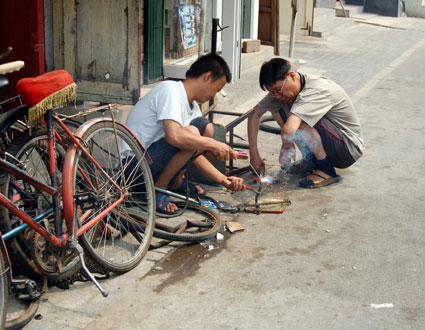
Life in the hutongs is a slow and simple affair. Elderly women sit side-by-side on stools barely six inches off the ground. The old men squat around wooden game boards, occasionally laughing at one thing or another. Middle-aged women sew or cook in tiny rooms with open doors, always facing the street so as not to miss any of the goings-on. Little children do as little children do everywhere. I didn’t see many young men and women in the hutongs. I imagine they were somewhere in the city, straddling the divide between the old and new China.

Wherever I walked, the people stared at me with undisguised curiosity. They didn’t appear friendly, nor unfriendly. They simply watched. I would return their gaze for a moment, bow my head slightly and smile. “Nin hao,” I’d say, hoping that my attempt to singsong the syllables didn’t pain them too much. Without fail, they smiled and returned the greeting enthusiastically. Often they offered me whatever they had in their hands—a piece of fruit, a paper fan, a plastic-beaded bracelet. I would point to my camera, asking permission to take a picture. They would laugh and blush and hide behind each other in protest. I wasn’t sure how to interpret their apparent reticence, but I thought it was best to accept it at face value and photograph the laundry or the bicycles instead.

With the modernization of Beijing, many residents have moved from the hutong to the high-rise. But I found that a few traditional hutongs, home to lovely people who can remember when, may still be found by a girl on a quest to avoid the West.

Beijing hutongs
Beijing hutongs
Beijing hutongsBeijing hutongsBeijing hutongsBeijing hutongsBeijing hutongsBeijing hutongsBeijing hutongsbeijing hutongsBeijing hutongs

Hairy monkeys of old Beijing

Beijing handicraftBEIJING- Eric once told me that he liked hanging around his artist friend, Patti Smithsonian, because she saw creative potential in nearly everything. He’d see a stack of old paper and head for the garbage can. She’d stop him. “Don’t throw that away! Let’s tear it into strips and make a papier-mâché hat!” That kind of thing.

I’ve since experienced the same thing with my project-princess daughter. Packing materials, raffia, old lightbulbs, used ribbon — nothing gets tossed until I’ve run it by my little artist’s eye.

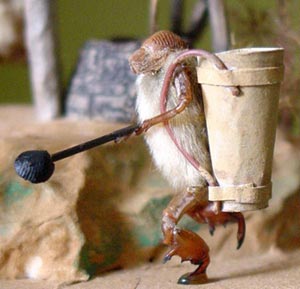
Winding my way through the hutongs of central Beijing yesterday, I came across something that will give Devon and Patti a year’s worth of new ideas. Hairy monkeys. An old folk handicraft started in the late Qing dynasty, hairy monkeys are made from the furry magnolia bud and the shed skin of the ever-present and super-screechy cicada. Resembling human beings in action — fortune tellers, barbers, fruit sellers, street hawkers — the hairy monkeys recall the urban life and customs of old Beijingers. Treasures from childhood, the monkeys are still loved by the elderly hutong-dwellers.

I found them completely hilarious and charming. I know Devon will, too. The already-long list of things I can’t pitch out will get even longer as it grows to encompass the entire outdoors.

Global economic rapists are at it again

G8 protest
Why protest the G8 Summit July 7-9? Those hoodlums always look so determined. Here’s the rationale by the Emergency Exit Collective:

The 2008 G8 on Hokkaido, a Strategic Assessment
Emergency Exit Collective
Bristol, Mayday, 2008

The authors of this document are a collection of activists, scholars, and writers currently based in the United States and Western Europe who have gotten to know and work with each other in the movement against capitalist globalization. We’re writing this at the request of some members of No! G8 Action Japan, who asked us for a broad strategic analysis of the state of struggle as we see it, and particularly, of the role of the G8, what it represents, the dangers and opportunities that may lie hidden in the moment. It is in no sense programmatic. Mainly, it is an attempt to develop tools that we hope will be helpful for organizers, or for anyone engaged in the struggle against global capital.

I
It is our condition as human beings that we produce our lives in common.

II
Let us then try to see the world from the perspective of the planet’s commoners, taking the word in that sense: those whose most essential tradition is cooperation in the making and maintenance of human social life, yet who have had to do so under conditions of suffering and separation; deprived, ignored, devalued, divided into hierarchies, pitted against each other for our very physical survival. In one sense we are all commoners. But it’s equally true that just about everyone, at least in some ways, at some points, plays the role of the rulers—of those who expropriate, devalue and divide—or at the very least benefits from such divisions.

Obviously some do more than others. It is at the peak of this pyramid that we encounter groups like the G8.

III
The G8’s perspective is that of the aristocrats, the rulers: those who command and maintain that global machinery of violence that defends existing borders and lines of separation: whether national borders with their detention camps for migrants, or property regimes, with their prisons for the poor. They live by constantly claiming title to the products of others collective creativity and labour, and in thus doing they create the poor; they create scarcity in the midst of plenty, and divide us on a daily basis; they create financial districts that loot resources from across the world, and in thus doing they turn the spirit of human creativity into a spiritual desert; close or privatize parks, public water taps and libraries, hospitals, youth centers, universities, schools, public swimming pools, and instead endlessly build shopping malls that channels convivial life into a means of commodity circulation; work toward turning global ecological catastrophe into business opportunities.

These are the people who presume to speak in the name of the “international community” even as they hide in their gated communities or meet protected by phalanxes of riot cops. It is critical to bear in mind that the ultimate aim of their policies is never to create community but to introduce and maintain divisions that set common people at each other’s throats. The neoliberal project, which has been their main instrument for doing so for the last three decades, is premised on a constant effort either to uproot or destroy any communal or democratic system whereby ordinary people govern their own affairs or maintain common resources for the common good, or, to reorganize each tiny remaining commons as an isolated node in a market system in which livelihood is never guaranteed, where the gain of one community must necessarily be at the expense of others. Insofar as they are willing to appeal to high-minded principles of common humanity, and encourage global cooperation, only and exactly to the extent that is required to maintain this system of universal competition.

IV
At the present time, the G8—the annual summit of the leaders of “industrial democracies”—is the key coordinative institution charged with the task of maintaining this neoliberal project, or of reforming it, revising it, adapting it to the changing condition of planetary class relations. The role of the G8 has always been to define the broad strategic horizons through which the next wave of planetary capital accumulation can occur. This means that its main task is to answer the question of how 3?4 in the present conditions of multiple crises and struggles 3?4 to subordinate social relations among the producing commoners of the planet to capital’s supreme value: profit.

V
Originally founded as the G7 in 1975 as a means of coordinating financial strategies for dealing with the ‘70s energy crisis, then expanded after the end of the Cold War to include Russia, its currently face a moment of profound impasse in the governance of planetary class relations: the greatest since the ‘70s energy crisis itself.

VI
The ‘70s energy crisis represented the final death-pangs of what might be termed the Cold War settlement, shattered by a quarter century of popular struggle. It’s worth returning briefly to this history.

The geopolitical arrangements put in place after World War II were above all designed to forestall the threat of revolution. In the immediate wake of the war, not only did much of the world lie in ruins, most of world’s population had abandoned any assumption about the inevitability of existing social arrangements. The advent of the Cold War had the effect of boxing movements for social change into a bipolar straightjacket. On the one hand, the former Allied and Axis powers that were later to unite in the G7 (the US, Canada, UK, France, Italy, Germany, Japan)—the “industrialized democracies”, as they like to call themselves—engaged in a massive project of co-optation. Their governments continued the process, begun in the ‘30s, of taking over social welfare institutions that had originally been created by popular movements (from insurance schemes to public libraries), even to expand them, on condition that they now be managed by state-appointed bureaucracies rather than by those who used them, buying off unions and the working classes more generally with policies meant to guarantee high wages, job security and the promise of educational advance—all in exchange for political loyalty, productivity increases and wage divisions within national and planetary working class itself. The Sino-Soviet bloc—which effectively became a kind of junior partner within the overall power structure, and its allies remained to trap revolutionary energies into the task of reproducing similar bureaucracies elsewhere. Both the US and USSR secured their dominance after the war by refusing to demobilize, instead locking the planet in a permanent threat of nuclear annihilation, a terrible vision of absolute cosmic power.

VII
Almost immediately, though, this arrangement was challenged by a series of revolts from those whose work was required to maintain the system, but who were, effectively, left outside the deal: first, peasants and the urban poor in the colonies and former colonies of the Global South, next, disenfranchised minorities in the home countries (in the US, the Civil Rights movement, then Black Power), and finally and most significantly, by the explosion of the women’s movement of the late ‘60s and early ‘70s—the revolt of that majority of humanity whose largely unremunerated labor made the very existence “the economy” possible. This appears to have been the tipping point.

VIII
The problem was that the Cold War settlement was never meant to include everyone. It by definition couldn’t. Once matters reached tipping point, then, the rulers scotched the settlement. All deals were off. The oil shock was first edge of the counter-offensive, breaking the back of existing working class organizations, driving home the message that there was nothing guaranteed about prosperity. Under the aegis of the newly hatched G7, this counter-offensive involved a series of interwoven strategies that were later to give rise to what is known as neoliberalism.

IX
These strategies resulted in what came to be known as “Structural Adjustment” both in the North and in the South, accompanied by trade and financial liberalization. This, in turn, made possible crucial structural changes in our planetary production in common extending the role of the market to discipline our lives and divide us into more and more polarized wage hierarchy. This involved:

· In the immediate wake of ‘70s oil shock, petrodollars were recycled from OPEC into Northern banks that then lent them, at extortionate rates of interest, to developing countries of the Global South. This was the origin of the famous “Third World Debt Crisis.” The existence of this debt allowed institutions like the IMF to impose its monetarist orthodoxy on most of the planet for roughly twenty years, in the process, stripping away most of even those modest social protections that had been won by the world’s poor—large numbers of whom were plunged into a situation of absolute desperation.

· It also opened a period of new enclosures through the capitalist imposition of structural adjustment policies, manipulation of environmental and social catastrophes like war, or for that matter through the authoritarian dictates of “socialist” regimes. Through such means, large sections of the world’s population have over the past thirty years been dispossessed from resources previously held in common, either by dint of long traditions, or as the fruits of past struggles and past settlements.

· Through financial deregulation and trade liberalization, neoliberal capital, which emerged from the G7 strategies to deal with the 1970s crisis aimed thus at turning the “class war” in communities, factories, offices, streets and fields against the engine of competition, into a planetary “civil war”, pitting each community of commoners against every other community of commoners.

· Neoliberal capital has done this by imposing an ethos of “efficiency” and rhetoric of “lowering the costs of production” applied so broadly that mechanisms of competition have come to pervade every sphere of life. In fact these terms are euphemisms, for a more fundamental demand: that capital be exempt from taking any reduction in profit to finance the costs of reproduction of human bodies and their social and natural environments (which it does not count as costs) and which are, effectively, “exernalized” onto communities and nature.

· The enclosure of resources and entitlements won in previous generations of struggles both in the North and the South, in turn, created the conditions for increasing the wage hierarchies (both global and local), by which commoners work for capital—wage hierarchies reproduced economically through pervasive competition, but culturally, through male dominance, xenophobia and racism. These wage gaps, in turn, made it possible to reduce the value of Northern workers’ labour power, by introducing commodities that enter in their wage basket at a fraction of what their cost might otherwise have been. The planetary expansion of sweatshops means that American workers (for example) can buy cargo pants or lawn-mowers made in Cambodia at Walmart, or buy tomatoes grown by undocumented Mexican workers in California, or even, in many cases, hire Jamaican or Filipina nurses to take care of children and aged grandparents at such low prices, that their employers have been able to lower real wages without pushing most of them into penury. In the South, meanwhile, this situation has made it possible to discipline new masses of workers into factories and assembly lines, fields and offices, thus extending enormously capital’s reach in defining the terms—the what, the how, the how much—of social production.

· These different forms of enclosures, both North and South, mean that commoners have become increasingly dependent on the market to reproduce their livelihoods, with less power to resist the violence and arrogance of those whose priorities is only to seek profit, less power to set a limit to the market discipline running their lives, more prone to turn against one another in wars with other commoners who share the same pressures of having to run the same competitive race, but not the same rights and the same access to the wage. All this has meant a generalized state of precarity, where nothing can be taken for granted.

X
In turn, this manipulation of currency and commodity flows constituting neoliberal globalization became the basis for the creation of the planet’s first genuine global bureaucracy.

· This was multi-tiered, with finance capital at the peak, then the ever-expanding trade bureaucracies (IMF, WTO, EU, World Bank, etc), then transnational corporations, and finally, the endless varieties of NGOs that proliferated throughout the period—almost all of which shared the same neoliberal orthodoxy, even as they substituted themselves for social welfare functions once reserved for states.

· The existence of this overarching apparatus, in turn, allowed poorer countries previously under the control of authoritarian regimes beholden to one or another side in the Cold War to adopt “democratic” forms of government. This did allow a restoration of formal civil liberties, but very little that could really merit the name of democracy (the rule of the “demos”, i.e., of the commoners). They were in fact constitutional republics, and the overwhelming trend during the period was to strip legislatures, that branch of government most open to popular pressure, of most of their powers, which were increasingly shifted to the executive and judicial branches, even as these latter, in turn, largely ended up enacting policies developed overseas, by global bureaucrats.

· This entire bureaucratic arrangement was justified, paradoxically enough, by an ideology of extreme individualism. On the level of ideas, neoliberalism relied on a systematic cooptation of the themes of popular struggle of the ‘60s: autonomy, pleasure, personal liberation, the rejection of all forms of bureaucratic control and authority. All these were repackaged as the very essence of capitalism, and the market reframed as a revolutionary force of liberation.

· The entire arrangement, in turn, was made possible by a preemptive attitude towards popular struggle. The breaking of unions and retreat of mass social movements from the late ‘70s onwards was only made possible by a massive shift of state resources into the machinery of violence: armies, prisons and police (secret and otherwise) and an endless variety of private “security services”, all with their attendant propaganda machines, which tended to increase even as other forms of social spending were cut back, among other things absorbing increasing portions of the former proletariat, making the security apparatus an increasingly large proportion of total social spending. This approach has been very successful in holding back mass opposition to capital in much of the world (especially West Europe and North America), and above all, in making it possible to argue there are no viable alternatives. But in doing so, has created strains on the system so profound it threatens to undermine it entirely.

XI
The latter point deserves elaboration. The element of force is, on any number of levels, the weak point of the system. This is not only on the constitutional level, where the question of how to integrate the emerging global bureaucratic apparatus, and existing military arrangements, has never been resolved. It is above all an economic problem. It is quite clear that the maintenance of elaborate security machinery is an absolute imperative of neoliberalism. One need only observe what happened with the collapse of the Soviet bloc in Eastern Europe: where one might have expected the Cold War victors to demand the dismantling of the army, secret police and secret prisons, and to maintain and develop the existing industrial base, in fact, what they did was absolutely the opposite: in fact, the only part of the industrial base that has managed fully to maintain itself has been the parts required to maintained the security apparatus itself! Critical too is the element of preemption: the governing classes in North America, for example, are willing to go to almost unimaginable lengths to ensure social movements never feel they are accomplishing anything. The current Gulf War is an excellent example: US military operations appear to be organized first and foremost to be protest-proof, to ensure that what happened in Vietnam (mass mobilization at home, widespread revolt within the army overseas) could never be repeated. This means above all that US casualties must always be kept to a minimum. The result are rules of engagement, and practices like the use of air power within cities ostensibly already controlled by occupation forces, so obviously guaranteed to maximize the killing of innocents and galvanizing hatred against the occupiers that they ensure the war itself cannot be won. Yet this approach can be taken as the very paradigm for neoliberal security regimes. Consider security arrangements around trade summits, where police are so determined prevent protestors from achieving tactical victories that they are often willing to effectively shut down the summits themselves. So too in overall strategy. In North America, such enormous resources are poured into the apparatus of repression, militarization, and propaganda that class struggle, labor action, mass movements seem to disappear entirely. It is thus possible to claim we have entered a new age where old conflicts are irrelevant. This is tremendously demoralizing of course for opponents of the system; but those running the system seem to find that demoralization so essential they don’t seem to care that the resultant apparatus (police, prisons, military, etc) is, effectively, sinking the entire US economy under its dead weight.

XII
The current crisis is not primarily geopolitical in nature. It is a crisis of neoliberalism itself. But it takes place against the backdrop of profound geopolitical realignments. The decline of North American power, both economic and geopolitical has been accompanied by the rise of Northeast Asia (and to a increasing extent, South Asia as well). While the Northeast Asian region is still divided by painful Cold War cleavages—the fortified lines across the Taiwan straits and at the 38th parallel in Korea…—the sheer realities of economic entanglement can be expected to lead to a gradual easing of tensions and a rise to global hegemony, as the region becomes the new center of gravity of the global economy, of the creation of new science and technology, ultimately, of political and military power. This may, quite likely, be a gradual and lengthy process. But in the meantime, very old patterns are rapidly reemerging: China reestablishing relations with ancient tributary states from Korea to Vietnam, radical Islamists attempting to reestablish their ancient role as the guardians of finance and piety at the in the Central Asian caravan routes and across Indian Ocean, every sort of Medieval trade diaspora reemerging… In the process, old political models remerge as well: the Chinese principle of the state transcending law, the Islamic principle of a legal order transcending any state. Everywhere, we see the revival too of ancient forms of exploitation—feudalism, slavery, debt peonage—often entangled in the newest forms of technology, but still echoing all the worst abuses of the Middle Ages. A scramble for resources has begun, with US occupation of Iraq and saber-rattling throughout the surrounding region clearly meant (at least in part) to place a potential stranglehold the energy supply of China; Chinese attempts to outflank with its own scramble for Africa, with increasing forays into South America and even Eastern Europe. The Chinese invasion into Africa (not as of yet at least a military invasion, but already involving the movement of hundreds of thousands of people), is changing the world in ways that will probably be felt for centuries. Meanwhile, the nations of South America, the first victims of the “Washington consensus” have managed to largely wriggle free from the US colonial orbit, while the US, its forces tied down in the Middle East, has for the moment at least abandoned it, is desperately struggling to keep its grip Mexico, Central America and the Caribbean—its own “near abroad”.

XIII
In another age all this might have led to war—that is, not just colonial occupations, police actions, or proxy wars (which are obviously already taking place), but direct military confrontations between the armies of major powers. It still could; accidents happen; but there is reason to believe that, when it comes to moments of critical decision, the loyalties of the global elites are increasingly to each other, and not to the national entities for whom they claim to speak. There is some compelling evidence for this.

Take for example when the US elites panicked at the prospect of the massive budget surpluses of the late 1990s. As Alan Greenspan, head of the Federal Reserve at the time warned, if these were allowed to stand they would have flooded government coffers with so many trillions of dollars that it could only have lead to some form of creeping socialism, even, he predicted, to the government acquiring “equity stakes” in key US corporations. The more excitable of capitalism’s managers actually began contemplating scenarios where the capitalist system itself would be imperiled. The only possible solution was massive tax cuts; these were duly enacted, and did indeed manage to turn surpluses into enormous deficits, financed by the sale of treasury bonds to Japan and China. Conditions have thus now reached a point where it is beginning to look as if the most likely long term outcome for the US (its technological and industrial base decaying, sinking under the burden of its enormous security spending) will be to end up serve as junior partner and military enforcer for East Asia capital. Its rulers, or at least a significant proportion of them, would prefer to hand global hegemony to the rulers of China (provided the latter abandon Communism) than to return to any sort of New Deal compromise with their “own” working classes.

A second example lies in the origins of what has been called the current “Bretton Woods II” system of currency arrangements, which underline a close working together of some “surplus” and “deficit” countries within global circuits. The macroeconomic manifestation of the planetary restructuring outlined in XIX underlines both the huge US trade deficit that so much seem to worry many commentators, and the possibility to continually generate new debt instruments like the one that has recently resulted in the sub-prime crisis. The ongoing recycling of accumulated surplus of countries exporting to the USA such as China and oil producing countries is what has allowed financiers to create new credit instruments in the USA. Hence, the “deal” offered by the masters in the United States to its commoners has been this: ‘you, give us a relative social peace and accept capitalist markets as the main means through which you reproduce your own livelihoods, and we will give you access to cheaper consumption goods, access to credit for buying cars and homes, and access to education, health, pensions and social security through the speculative means of stock markets and housing prices.’ Similar compromises were reached in all the G8 countries.

Meanwhile, there is the problem of maintaining any sort of social peace with the hundreds of millions of unemployed, underemployed, dispossessed commoners currently swelling the shanty-towns of Asia, Africa, and Latin America as a result of ongoing enclosures (which have speeded up within China and India in particular, even as “structural adjustment policies” in Africa and Latin America have been derailed). Any prospect of maintaining peace in these circumstances would ordinarily require either extremely high rates of economic growth—which globally have not been forthcoming, since outside of China, growth rates in the developing world have been much lower than they were in the ‘50s, ‘60s, or even ‘70s—or extremely high levels of repression, lest matters descend into rebellion or generalized civil war. The latter has of course occurred in many parts of the world currently neglected by capital, but in favored regions, such as the coastal provinces of China, or “free trade” zones of India, Egypt, or Mexico, commoners are being offered a different sort of deal: industrial employment at wages that, while very low by international standards, are still substantially higher than anything currently obtainable in the impoverished countryside; and above all the promise, through the intervention of Western markets and (privatized) knowledge, of gradually improving conditions of living. While over the least few years wages in many such areas seem to be growing, thanks to the intensification of popular struggles, such gains are inherently vulnerable: the effect of recent food inflation has been to cut real wages back dramatically—and threaten millions with starvation.

What we really want to stress here, though, is that the long-term promise being offered to the South is just as untenable as the idea that US or European consumers can indefinitely expand their conditions of life through the use of mortgages and credit cards.

What’s being offered the new dispossessed is a transposition of the American dream. The idea is that the lifestyle and consumption patterns of existing Chinese, Indian, or Brazilian or Zambian urban middle classes (already modeled on Northern ones) will eventually become available to the children of today’s miners, maquila or plantation laborers, until, ultimately, everyone on earth is brought up to roughly the same level of consumption. Put in these terms, the argument is absurd. The idea that all six billion of us can become “middle class” is obviously impossible. First of all there is a simple problem of resources. It doesn’t matter how many bottles we recycle or how energy efficient are the light bulbs we use, there’s just no way the earth’s ecosystem can accommodate six billion people driving in private cars to work in air-conditioned cubicles before periodically flying off to vacation in Acapulco or Tahiti. To maintain the style of living and producing in common we now identify with “middle classness” on a planetary scale would require several additional planets.

This much has been pointed out repeatedly. But the second point is no less important. What this vision of betterment ultimately proposes is that it would be possible to build universal prosperity and human dignity on a system of wage labor. This is fantasy. Historically, wages are always the contractual face for system of command and degradation, and a means of disguising exploitation: expressing value for work only on condition of stealing value without work— and there is no reason to believe they could ever be anything else. This is why, as history has also shown, human beings will always avoid working for wages if they have any other viable option. For a system based on wage labor to come into being, such options must therefore be made unavailable. This in turn means that such systems are always premised on structures of exclusion: on the prior existence of borders and property regimes maintained by violence. Finally, historically, it has always proved impossible to maintain any sizeable class of wage-earners in relative prosperity without basing that prosperity, directly or indirectly, on the unwaged labor of others—on slave-labor, women’s domestic labor, the forced labor of colonial subjects, the work of women and men in peasant communities halfway around the world—by people who are even more systematically exploited, degraded, and immiserated. For that reason, such systems have always depended not only on setting wage-earners against each other by inciting bigotry, prejudice, hostility, resentment, violence, but also by inciting the same between men and women, between the people of different continents (“race”), between the generations.

From the perspective of the whole, then, the dream of universal middle class “betterment” must necessarily be an illusion constructed in between the Scylla of ecological disaster, and the Charybdis of poverty, detritus, and hatred: precisely, the two pillars of today’s strategic impasse faced by the G8.

XIV
How then do we describe the current impasse of capitalist governance?

To a large degree, it is the effect of a sudden and extremely effective upswing of popular resistance—one all the more extraordinary considering the huge resources that had been invested in preventing such movements from breaking out.

On the one hand, the turn of the millennium saw a vast and sudden flowering of new anti-capitalist movements, a veritable planetary uprising against neoliberalism by commoners in Latin America, India, Africa, Asia, across the North Atlantic world’s former colonies and ultimately, within the cities of the former colonial powers themselves. As a result, the neoliberal project lies shattered. What came to be called the “anti-globalization” movement took aim at the trade bureaucracies—the obvious weak link in the emerging institutions of global administration—but it was merely the most visible aspect of this uprising. It was however an extraordinarily successful one. Not only was the WTO halted in its tracks, but all major trade initiatives (MAI, FTAA…) scuttled. The World Bank was hobbled and the power of the IMF over most of the world’s population, effectively, destroyed. The latter, once the terror of the Global South, is now a shattered remnant of its former self, reduced to selling off its gold reserves and desperately searching for a new global mission.

In many ways though spectacular street actions were merely the most visible aspects of much broader changes: the resurgence of labor unions, in certain parts of the world, the flowering of economic and social alternatives on the grassroots levels in every part of the world, from new forms of direct democracy of indigenous communities like El Alto in Bolivia or self-managed factories in Paraguay, to township movements in South Africa, farming cooperatives in India, squatters’ movements in Korea, experiments in permaculture in Europe or “Islamic economics” among the urban poor in the Middle East. We have seen the development of thousands of forms of mutual aid association, most of which have not even made it onto the radar of the global media, often have almost no ideological unity and which may not even be aware of each other’s existence, but nonetheless share a common desire to mark a practical break with capitalism, and which, most importantly, hold out the prospect of creating new forms of planetary commons that can—and in some cases are—beginning to knit together to provide the outlines of genuine alternative vision of what a non-capitalist future might look like.

The reaction of the world’s rulers was predictable. The planetary uprising had occurred during a time when the global security apparatus was beginning to look like it lacked a purpose, when the world threatened to return to a state of peace. The response—aided of course, by the intervention of some of the US’ former Cold War allies, reorganized now under the name of Al Qaeda—was a return to global warfare. But this too failed. The “war on terror”—as an attempt to impose US military power as the ultimate enforcer of the neoliberal model—has collapsed as well in the face of almost universal popular resistance. This is the nature of their “impasse”.

At the same time, the top-heavy, inefficient US model of military capitalism—a model created in large part to prevent the dangers of social movements, but which the US has also sought to export to some degree simply because of its profligacy and inefficiency, to prevent the rest of the world from too rapidly overtaking them—has proved so wasteful of resources that it threatens to plunge the entire planet into ecological and social crisis. Drought, disaster, famines, combine with endless campaigns of enclosure, foreclosure, to cast the very means of survival—food, water, shelter—into question for the bulk of the world’s population.

XV
In the rulers’ language the crisis understood, first and foremost, as a problem of regulating cash flows, of reestablishing, as they like to put it, a new “financial architecture”. Obviously they are aware of the broader problems. Their promotional literature has always been full of it. From the earliest days of the G7, through to the days after the Cold War, when Russia was added as a reward for embracing capitalism, they have always claimed that their chief concerns include

· the reduction of global poverty

· sustainable environmental policies

· sustainable global energy policies

· stable financial institutions governing global trade and currency transactions

If one were to take such claims seriously, it’s hard to see their overall performance as anything but a catastrophic failure. At the present moment, all of these are in crisis mode: there are food riots, global warming, peak oil, and the threat of financial meltdown, bursting of credit bubbles, currency crises, a global credit crunch. [**Failure on this scale however, opens opportunities for the G8 themselves, as summit of the global bureaucracy, to reconfigure the strategic horizon. Therefore, it’s always with the last of these that they are especially concerned. ]The real problem, from the perspective of the G8, is one of reinvestment: particularly, of the profits of the energy sector, but also, now, of emerging industrial powers outside the circle of the G8 itself. The neoliberal solution in the ‘70s had been to recycle OPEC’s petrodollars into banks that would use it much of the world into debt bondage, imposing regimes of fiscal austerity that, for the most part, stopped development (and hence, the emergence potential rivals) in its tracks. By the ‘90s, however, much East Asia in particular had broken free of this regime. Attempts to reimpose IMF-style discipline during the Asian financial crisis of 1997 largely backfired. So a new compromise was found, the so-called Bretton Woods II: to recycle the profits from the rapidly expanding industrial economies of East Asia into US treasury debt, artificially supporting the value of the dollar and allowing a continual stream of cheap exports that, aided by the US housing bubble, kept North Atlantic economies afloat and buy off workers there with cheap oil and even cheaper consumer goods even as real wages shrank. This solution however soon proved a temporary expedient. Bush regime’s attempt to lock it in by the invasion of Iraq, which was meant to lead to the forced privatization of Iraqi oil fields, and, ultimately, of the global oil industry as a whole, collapsed in the face of massive popular resistance (just as Saddam Hussein’s attempt to introduce neoliberal reforms in Iraq had failed when he was still acting as American deputy in the ‘90s). Instead, the simultaneous demand for petroleum for both Chinese manufacturers and American consumers caused a dramatic spike in the price of oil. What’s more, rents from oil and gas production are now being used to pay off the old debts from the ‘80s (especially in Asia and Latin America, which have by now paid back their IMF debts entirely), and—increasingly—to create state-managed Sovereign Wealth Funds that have largely replaced institutions like the IMF as the institutions capable of making long-term strategic investments. The IMF, purposeless, tottering on the brink of insolvency, has been reduced to trying to come up with “best practices” guidelines for fund managers working for governments in Singapore, Seoul, and Abu Dhabi.

There can be no question this time around of freezing out countries like China, India, or even Brazil. The question for capital’s planners, rather, is how to channel these new concentrations of capital in such a way that they reinforce the logic of the system instead of undermining it.

XVI
How can this be done? This is where appeals to universal human values, to common membership in an “international community” come in to play. “We all must pull together for the good of the planet,” we will be told. The money must be reinvested “to save the earth.”

To some degree this was always the G8 line: this is a group has been making an issue of climate change since 1983. Doing so was in one sense a response to the environmental movements of the ‘70s and ‘80s. The resultant emphasis on biofuels and “green energy” was from their point of view, the perfect strategy, seizing on an issue that seemed to transcend class, appropriating ideas and issues that emerged from social movements (and hence coopting and undermining especially their radical wings), and finally, ensuring such initiatives are pursued not through any form of democratic self-organization but “market mechanisms”—to effective make the sense of public interest productive for capitalism.

What we can expect now is a two-pronged attack. On the one hand, they will use the crisis to attempt to reverse the gains of past social movements: to put nuclear energy back on the table to deal with the energy crisis and global warming, or genetically modified foods to deal with the food crisis. Prime Minister Fukuda, the host of the current summit, for example, is already proposing the nuclear power is the “solution” to the global warming crisis, even as the German delegation resists. On the other, and even more insidiously, they will try once again to co-opt the ideas and solutions that have emerged from our struggles as a way of ultimately undermining them. Appropriating such ideas is simply what rulers do: the bosses brain is always under the workers’ hat. But the ultimate aim is to answer the intensification of class struggle, of the danger of new forms of democracy, with another wave of enclosures, to restore a situation where commoners’ attempts to create broader regimes of cooperation are stymied, and people are plunged back into mutual competition.

We can already see the outlines of how this might be done. There are already suggestions that Sovereign Wealth Funds put aside a certain (miniscule) proportion of their money for food aid, but only as tied to a larger project of global financial restructuring. The World Bank, largely bereft of its earlier role organizing dams and pipe-lines across the world, has been funding development in China’s poorer provinces, freeing the Chinese government to carry out similar projects in Southeast Asia, Africa, and even Latin America (where, of course, they cannot effectively be held to any sort of labor or environmental standards). There is the possibility of a new class deal in China itself, whose workers can be allowed higher standards of living if new low wage zones are created elsewhere—for instance, Africa (the continent where struggles over maintaining the commons have been most intense in current decades)—with the help of Chinese infrastructural projects. Above of all, money will be channeled into addressing climate change, into the development of alternative energy, which will require enormous investments, in such a way as to ensure that whatever energy resources do become important in this millennium, they can never be democratized—that the emerging notion of a petroleum commons, that energy resources are to some degree a common patrimony meant primarily to serve the community as a whole, that is beginning to develop in parts of the Middle East and South America—not be reproduced in whatever comes next.

Since this will ultimately have to be backed up by the threat of violence, the G8 will inevitably have to struggle with how to (yet again) rethink enforcement mechanisms. The latest move , now that the US “war on terror” paradigm has obviously failed, would appear to be a return to NATO, part of a reinvention of the “European security architecture” being proposed at the upcoming G8 meetings in Italy in 2009 on the 60th anniversary of NATO’s foundation—but part of a much broader movement of the militarization of social conflict, projecting potential resource wars, demographic upheavals resulting from climate change, and radical social movements as potential military problems to be resolved by military means. Opposition to this new project is already shaping up as the major new European mobilization for the year following the current G-8.

XVII
While the G-8 sit at the pinnacle of a system of violence, their preferred idiom is monetary. Their impulse whenever possible is to translate all problems into money, financial structures, currency flows—a substance whose movements they carefully monitor and control.

Money, on might say, is their poetry—a poetry whose letters are written in our blood. It is their highest and most abstract form of expression, their way of making statements about the ultimate truth of the world, even if it operates in large part by making things disappear. How else could it be possible to argue—no, to assume as a matter of common sense—that the love, care, and concern of a person who tends to the needs of children, teaching, minding, helping them to become decent , thoughtful, human beings, or who grows and prepares food, is worth ten thousand times less than someone who spends the same time designing a brand logo, moving abstract blips across a globe, or denying others health care.

The role of money however has changed profoundly since 1971 when the dollar was delinked from gold. This has created a profound realignment of temporal horizons. Once money could be said to be primarily congealed results of past profit and exploitation. As capital, it was dead labor. Millions of indigenous Americans and Africans had their lives pillaged and destroyed in the gold mines in order to be rendered into value. The logic of finance capital, of credit structures, certainly always existed as well (it is at least as old as industrial capital; possibly older), but in recent decades these logic of financial capital has come to echo and re-echo on every level of our lives. In the UK 97% of money in circulation is debt, in the US, 98%. Governments run on deficit financing, wealthy economies on consumer debt, the poor are enticed with microcredit schemes, debts are packaged and repackaged in complex financial derivatives and traded back and forth. Debt however is simply a promise, the expectation of future profit; capital thus increasingly brings the future into the present—a future that, it insists, must always be the same in nature, even if must also be greater in magnitude, since of course the entire system is premised on continual growth. Where once financiers calculated and traded in the precise measure of our degradation, having taken everything from us and turned it into money, now money has flipped, to become the measure of our future degradation—at the same time as it binds us to endlessly working in the present.

The result is a strange moral paradox. Love, loyalty, honor, commitment—to our families, for example, which means to our shared homes, which means to the payment of monthly mortgage debts—becomes a matter of maintaining loyalty to a system which ultimately tells us that such commitments are not a value in themselves. This organization of imaginative horizons, which ultimately come down to a colonization of the very principle of hope, has come to supplement the traditional evocation of fear (of penury, homelessness, joblessness, disease and death). This colonization paralyzes any thought of opposition to a system that almost everyone ultimately knows is not only an insult to everything they really cherish, but a travesty of genuine hope, since, because no system can really expand forever on a finite planet, everyone is aware on some level that in the final analysis they are dealing with a kind of global pyramid scheme, what we are ultimately buying and selling is the real promise of global social and environmental apocalypse.

XVIII
Finally then we come to the really difficult, strategic questions. Where are the vulnerabilities? Where is hope? Obviously we have no certain answers here. No one could. But perhaps the proceeding analysis opens up some possibilities that anti-capitalist organizers might find useful to explore.

One thing that might be helpful is to rethink our initial terms. Consider communism. We are used to thinking of it as a total system that perhaps existed long ago, and to the desire to bring about an analogous system at some point in the future—usually, at whatever cost. It seems to us that dreams of communist futures were never purely fantasies; they were simply projections of existing forms of cooperation, of commoning, by which we already make the world in the present. Communism in this sense is already the basis of almost everything, what brings people and societies into being, what maintains them, the elemental ground of all human thought and action. There is absolutely nothing utopian here. What is utopian, really, is the notion that any form of social organization, especially capitalism, could ever exist that was not entirely premised on the prior existence of communism. If this is true, the most pressing question is simply how to make that power visible, to burst forth, to become the basis for strategic visions, in the face of a tremendous and antagonistic power committed to destroying it—but at the same time, ensuring that despite the challenge they face, they never again become entangled with forms of violence of their own that make them the basis for yet another tawdry elite. After all, the solidarity we extend to one another, is it not itself a form of communism? And is it not so above because it is not coerced?

Another thing that might be helpful is to rethink our notion of crisis. There was a time when simply describing the fact that capitalism was in a state of crisis, driven by irreconcilable contradictions, was taken to suggest that it was heading for a cliff. By now, it seems abundantly clear that this is not the case. Capitalism is always in a crisis. The crisis never goes away. Financial markets are always producing bubbles of one sort or another; those bubbles always burst, sometimes catastrophically; often entire national economies collapse, sometimes the global markets system itself begins to come apart. But every time the structure is reassembled. Slowly, painfully, dutifully, the pieces always end up being put back together once again.

Perhaps we should be asking: why?

In searching for an answer, it seems to us, we might also do well to put aside another familiar habit of radical thought: the tendency to sort the world into separate levels—material realities, the domain of ideas or “consciousness”, the level of technologies and organizations of violence—treating these as if these were separate domains that each work according to separate logics, and then arguing which “determines” which. In fact they cannot be disentangled. A factory may be a physical thing, but the ownership of a factory is a social relation, a legal fantasy that is based partly on the belief that law exists, and partly on the existence of armies and police. Armies and police on the other hand exist partly because of factories providing them with guns, vehicles, and equipment, but also, because those carrying the guns and riding in the vehicles believe they are working for an abstract entity they call “the government”, which they love, fear, and ultimately, whose existence they take for granted by a kind of faith, since historically, those armed organizations tend to melt away immediately the moment they lose faith that the government actually exists. Obviously exactly the same can be said of money. It’s value is constantly being produced by eminently material practices involving time clocks, bank machines, mints, and transatlantic computer cables, not to mention love, greed, and fear, but at the same time, all this too rests on a kind of faith that all these things will continue to interact in more or less the same way. It is all very material, but it also reflects a certain assumption of eternity: the reason that the machine can always be placed back together is, simply, because everyone assumes it must. This is because they cannot realistically imagine plausible alternatives; they cannot imagine plausible alternatives because of the extraordinarily sophisticated machinery of preemptive violence that ensure any such alternatives are uprooted or contained (even if that violence is itself organized around a fear that itself rests on a similar form of faith.) One cannot even say it’s circular. It’s more a kind of endless, unstable spiral. To subvert the system is then, to intervene in such a way that the whole apparatus begins to spin apart.

XIX
It appears to us that one key element here—one often neglected in revolutionary strategy—is the role of the global middle classes. This is a class that, much though it varies from country (in places like the US and Japan, overwhelming majorities consider themselves middle class; in, say, Cambodia or Zambia, only very small percentages), almost everywhere provides the key constituency of the G8 outside of the ruling elite themselves. It has become a truism, an article of faith in itself in global policy circles, that national middle class is everywhere the necessary basis for democracy. In fact, middle classes are rarely much interested in democracy in any meaningful sense of that word (that is, of the self-organization or self-governance of communities). They tend to be quite suspicious of it. Historically, middle classes have tended to encourage the establishment of constitutional republics with only limited democratic elements (sometimes, none at all). This is because their real passion is for a “betterment”, for the prosperity and advance of conditions of life for their children—and this betterment, since it is as noted above entirely premised on structures of exclusion, requires “security”. Actually the middle classes depend on security on every level: personal security, social security (various forms of government support, which even when it is withdrawn from the poor tends to be maintained for the middle classes), security against any sudden or dramatic changes in the nature of existing institutions. Thus, politically, the middle classes are attached not to democracy (which, especially in its radical forms, might disrupt all this), but to the rule of law. In the political sense, then, being “middle class” means existing outside the notorious “state of exception” to which the majority of the world’s people are relegated. It means being able to see a policeman and feel safer, not even more insecure. This would help explain why within the richest countries, the overwhelming majority of the population will claim to be “middle class” when speaking in the abstract, even if most will also instantly switch back to calling themselves “working class” when talking about their relation to their boss.

That rule of law, in turn, allows them to live in that temporal horizon where the market and other existing institutions (schools, governments, law firms, real estate brokerages…) can be imagined as lasting forever in more or less the same form. The middle classes can thus be defined as those who live in the eternity of capitalism. (The elites don’t; they live in history, they don’t assume things will always be the same. The disenfranchized don’t; they don’t have the luxury; they live in a state of precarity where little or nothing can safely be assumed.) Their entire lives are based on assuming that the institutional forms they are accustomed to will always be the same, for themselves and their grandchildren, and their “betterment” will be proportional to the increase in the level of monetary wealth and consumption. This is why every time global capital enters one of its periodic crises, every time banks collapse, factories close, and markets prove unworkable, or even, when the world collapses in war, the managers and dentists will tend to support any program that guarantees the fragments will be dutifully pieced back together in roughly the same form—even if all are, at the same time, burdened by at least a vague sense that the whole system is unfair and probably heading for catastrophe.

XIX
The strategic question then is, how to shatter this sense of inevitability? History provides one obvious suggestion. The last time the system really neared self-destruction was in the 1930s, when what might have otherwise been an ordinary turn of the boom-bust cycle turned into a depression so profound that it took a world war to pull out of it. What was different? The existence of an alternative: a Soviet economy that, whatever its obvious brutalities, was expanding at breakneck pace at the very moment market systems were undergoing collapse. Alternatives shatter the sense of inevitability, that the system must, necessarily, be patched together in the same form; this is why it becomes an absolute imperative of global governance that even small viable experiments in other ways of organizing communities be wiped out, or, if that is not possible, that no one knows about them.

If nothing else, this explains the extraordinary importance attached to the security services and preemption of popular struggle. Commoning, where it already exists, must be made invisible. Alternatives— Zapatistas in Chiapas, APPO in Oaxaca, worker-managed factories in Argentina or Paraguay, community-run water systems in South Africa or Bolivia, living alternatives of farming or fishing communities in India or Indonesia, or a thousand other examples—must be made to disappear, if not squelched or destroyed, then marginalized to the point they seem irrelevant, ridiculous. If the managers of the global system are so determined to do this they are willing to invest such enormous resources into security apparatus that it threatens to sink the system entirely, it is because they are aware that they are working with a house of cards. That the principle of hope and expectation on which capitalism rests would evaporate instantly if almost any other principle of hope or expectation seemed viable.

The knowledge of alternatives, then, is itself a material force.

Without them, of course, the shattering of any sense of certainty has exactly the opposite effect. It becomes pure precarity, an insecurity so profound that it becomes impossible to project oneself in history in any form, so that the one-time certainties of middle class life itself becomes a kind of utopian horizon, a desperate dream, the only possible principle of hope beyond which one cannot really imagine anything. At the moment, this seems the favorite weapon of neoliberalism: whether promulgated through economic violence, or the more direct, traditional kind.

One form of resistance that might prove quite useful here – and is already being discussed in some quarters – are campaigns against debt itself. Not demands for debt forgiveness, but campaigns of debt resistance.

XX
In this sense the great slogan of the global justice movement, “another world is possible”, represents the ultimate threat to existing power structures. But in another sense we can even say we have already begun to move beyond that. Another world is not merely possible. It is inevitable. On the one hand, as we have pointed out, such a world is already in existence in the innumerable circuits of social cooperation and production in common based on different values than those of profit and accumulation through which we already create our lives, and without which capitalism itself would be impossible. On the other, a different world is inevitable because capitalism—a system based on infinite material expansion—simply cannot continue forever on a finite world. At some point, if humanity is to survive at all, we will be living in a system that is not based on infinite material expansion. That is, something other than capitalism.

The problem is there is no absolute guarantee that ‘something’ will be any better. It’s pretty easy to imagine “other worlds” that would be even worse. We really don’t have any idea what might happen. To what extent will the new world still organized around commoditization of life, profit, and pervasive competition? Or a reemergence of even older forms of hierarchy and degradation? How, if we do overcome capitalism directly, by the building and interweaving of new forms of global commons, do we protect ourselves against the reemergence of new forms of hierarchy and division that we might not now even be able to imagine?

It seems to us that the decisive battles that will decide the contours of this new world will necessarily be battles around values. First and foremost are values of solidarity among commoners. Since after all, every rape of a woman by a man or the racist murder of an African immigrant by a European worker is worth a division in capital’s army.

Similarly, imagining our struggles as value struggles might allow us to see current struggles over global energy policies and over the role of money and finance today as just an opening salvo of an even larger social conflict to come. For instance, there’s no need to demonize petroleum, for example, as a thing in itself. Energy products have always tended to play the role of a “basic good”, in the sense that their production and distribution becomes the physical basis for all other forms of human cooperation, at the same time as its control tends to organize social and even international relations. Forests and wood played such a role from the time of the Magna Carta to the American Revolution, sugar did so during the rise of European colonial empires in the 17th and 18th centuries, fossil fuels do so today. There is nothing intrinsically good or bad about fossil fuel. Oil is simply solar radiation, once processed by living beings, now stored in fossil form. The question is of control and distribution. This is the real flaw in the rhetoric over “peak oil”: the entire argument is premised on the assumption that, for the next century at least, global markets will be the only means of distribution. Otherwise the use of oil would depend on needs, which would be impossible to predict precisely because they depend on the form of production in common we adopt. The question thus should be: how does the anti-capitalist movement peak the oil? How does it become the crisis for a system of unlimited expansion?

It is the view of the authors of this text that the most radical planetary movements that have emerged to challenge the G8 are those that direct us towards exactly these kind of questions. Those which go beyond merely asking how to explode the role money plays in framing our horizons, or even challenging the assumption of the endless expansion of “the economy”, to ask why we assume something called “the economy” even exists, and what other ways we can begin imagining our material relations with one another. The planetary women’s movement, in its many manifestations, has and continues to play perhaps the most important role of all here, in calling for us to reimagine our most basic assumptions about work, to remember that the basic business of human life is not actually the production of communities but the production, the mutual shaping of human beings. The most inspiring of these movements are those that call for us to move beyond a mere challenge to the role of money to reimagine value: to ask ourselves how can we best create a situation where everyone is secure enough in their basic needs to be able to pursue those forms of value they decide are ultimately important to them. To move beyond a mere challenge to the tyranny of debt to ask ourselves what we ultimately owe to one another and to our environment. That recognize that none this needs to invented from whole cloth. It’s all already there, immanent in the way everyone, as commoners, create the world together on a daily basis. And that asking these questions is never, and can never be, an abstract exercise, but is necessarily part of a process by which we are already beginning to knit these forms of commons together into new forms of global commons that will allow entirely new conceptions of our place in history.

It is to those already engaged in such a project that we offer these initial thoughts on our current strategic situation.

Helen Keller: Oh blind vanity of slaves!

helen-keller-blind-soldier-socialist-isolationist-pacifist-sedition“It is in your power to refuse to carry the artillery … You do not need to make a great noise about it. With the silence and dignity of creators you can end wars and the system of selfishness and exploitation that causes wars. All you need to do to bring about this stupendous revolution is to straighten up and fold your arms.”

Strike Against War

To begin with, I have a word to say to my good friends, the editors, and others who are moved to pity me. Some people are grieved because they imagine I am in the hands of unscrupulous persons who lead me astray and persuade me to espouse unpopular causes and make me the mouthpiece of their propaganda. Now, let it be understood once and for all that I do not want their pity; I would not change places with one of them. I know what I am talking about. My sources of information are as good and reliable as anybody else’s. I have papers and magazines from England, France, Germany and Austria that I can read myself. Not all the editors I have met can do that. Quite a number of them have to take their French and German second hand. No, I will not disparage the editors. They are an overworked, misunderstood class. Let them remember, though, that if I cannot see the fire at the end of their cigarettes, neither can they thread a needle in the dark. All I ask, gentlemen, is a fair field and no favor. I have entered the fight against preparedness and against the economic system under which we live. It is to be a fight to the finish, and I ask no quarter.

The future of the world rests in the hands of America. The future of America rests on the backs of 80,000,000 working men and women and their children. We are facing a grave crisis in our national life. The few who profit from the labor of the masses want to organize the workers into an army which will protect the interests of the capitalists. You are urged to add to the heavy burdens you already bear, the burden of a larger army and many additional warships. It is in your power to refuse to carry the artillery and the dread-noughts and to shake off some of the burdens, too, such as limousines, steam yachts and country estates. You do not need to make a great noise about it. With the silence and dignity of creators you can end wars and the system of selfishness and exploitation that causes wars. All you need to do to bring about this stupendous revolution is to straighten up and fold your arms.

We are not preparing to defend our country. Even if we were as helpless as Congressman Gardner says we are, we have no enemies foolhardy enough to attempt to invade the United States. The talk about attack from Germany and Japan is absurd. Germany has its hands full and will be busy with its own affairs for some generations after the European war is over.

With full control of the Atlantic Ocean and the Mediterranean Sea, the allies failed to land enough men to defeat the Turks at Gallipoli; and then they failed again to land an army at Salonica in time to check the Bulgarian invasion of Serbia. The conquest of America by water is a nightmare confined exclusively to ignorant persons and members of the Navy League.

Yet, everywhere, we hear fear advanced as argument for armament. It reminds me of a fable I read. A certain man found a horseshoe. His neighbor began to weep and wail because, as he justly pointed out, the man who found the horseshoe might someday find a horse. Having found the shoe, he might shoe him. The neighbor’s child might some day go so near the horse’s heels as to be kicked, and die. Undoubtedly the two families would quarrel and fight, and several valuable lives would be lost through the finding of the horseshoe. You know the last war we had we quite accidentally picked up some islands in the Pacific Ocean which may some day be the cause of a quarrel between ourselves and Japan. I’d rather drop those islands right now and forget about them than go to war to keep them. Wouldn’t you?

Congress is not preparing to defend the people of the United States. It is planning to protect the capital of American speculators and investors in Mexico, South America, China, and the Philippine Islands. Incidentally this preparation will benefit the manufacturers of munitions and war machines.

Until recently there were uses in the United States for the money taken from the workers. But American labor is exploited almost to the limit now, and our national resources have all been appropriated. Still the profits keep piling up new capital. Our flourishing industry in implements of murder is filling the vaults of New York’s banks with gold. And a dollar that is not being used to make a slave of some human being is not fulfilling its purpose in the capitalistic scheme. That dollar must be invested in South America, Mexico, China, or the Philippines.

It was no accident that the Navy League came into prominence at the same time that the National City Bank of New York established a branch in Buenos Aires. It is not a mere coincidence that six business associates of J.P. Morgan are officials of defense leagues. And chance did not dictate that Mayor Mitchel should appoint to his Committee of Safety a thousand men that represent a fifth of the wealth of the United States. These men want their foreign investments protected.

Every modern war has had its root in exploitation. The Civil War was fought to decide whether the slaveholders of the South or the capitalists of the North should exploit the West. The Spanish-American War decided that the United States should exploit Cuba and the Philippines. The South African War decided that the British should exploit the diamond mines. The Russo-Japanese War decided that Japan should exploit Korea. The present war is to decide who shall exploit the Balkans, Turkey, Persia, Egypt, India, China, Africa. And we are whetting our sword to scare the victors into sharing the spoils with us. Now, the workers are not interested in the spoils; they will not get any of them anyway.

The preparedness propagandists have still another object, and a very important one. They want to give the people something to think about besides their own unhappy condition. They know the cost of living is high, wages are low, employment is uncertain and will be much more so when the European call for munitions stops. No matter how hard and incessantly the people work, they often cannot afford the comforts of life; many cannot obtain the necessities.

Every few days we are given a new war scare to lend realism to their propaganda. They have had us on the verge of war over the Lusitania, the Gulflight, the Ancona, and now they want the workingmen to become excited over the sinking of the Persia. The workingman has no interest in any of these ships. The Germans might sink every vessel on the Atlantic Ocean and the Mediterranean Sea, and kill Americans with every one–the American workingman would still have no reason to go to war.

All the machinery of the system has been set in motion. Above the complaint and din of the protest from the workers is heard the voice of authority.

“Friends,” it says, “fellow workmen, patriots; your country is in danger! There are foes on all sides of us. There is nothing between us and our enemies except the Pacific Ocean and the Atlantic Ocean. Look at what has happened to Belgium. Consider the fate of Serbia. Will you murmur about low wages when your country, your very liberties, are in jeopardy? What are the miseries you endure compared to the humiliation of having a victorious German army sail up the East River? Quit your whining, get busy and prepare to defend your firesides and your flag. Get an army, get a navy; be ready to meet the invaders like the loyal-hearted freemen you are.”

Will the workers walk into this trap? Will they be fooled again? I am afraid so. The people have always been amenable to oratory of this sort. The workers know they have no enemies except their masters. They know that their citizenship papers are no warrant for the safety of themselves or their wives and children. They know that honest sweat, persistent toil and years of struggle bring them nothing worth holding on to, worth fighting for. Yet, deep down in their foolish hearts they believe they have a country. Oh blind vanity of slaves!

The clever ones, up in the high places know how childish and silly the workers are. They know that if the government dresses them up in khaki and gives them a rifle and starts them off with a brass band and waving banners, they will go forth to fight valiantly for their own enemies. They are taught that brave men die for their country’s honor. What a price to pay for an abstraction–the lives of millions of young men; other millions crippled and blinded for life; existence made hideous for still more millions of human being; the achievement and inheritance of generations swept away in a moment–and nobody better off for all the misery! This terrible sacrifice would be comprehensible if the thing you die for and call country fed, clothed, housed and warmed you, educated and cherished your children. I thinkthe workers are the most unselfish of the children of men; they toil and live and die for other people’s country, other people’s sentiments, other people’s liberties and other people’s happiness! The workers have no liberties of their own; they are not free when they are compelled to work twelve or ten or eight hours a day. they are not free when they are ill paid for their exhausting toil. They are not free when their children must labor in mines, mills and factories or starve, and when their women may be driven by poverty to lives of shame. They are not free when they are clubbed and imprisoned because they go on strike for a raise of wages and for the elemental justice that is their right as human beings.

We are not free unless the men who frame and execute the laws represent the interests of the lives of the people and no other interest. The ballot does not make a free man out of a wage slave. there has never existed a truly free and democratic nation in the world. From time immemorial men have followed with blind loyalty the strong men who had the power of money and of armies. Even while battlefields were piled high with their own dead they have tilled the lands of the rulers and have been robbed of the fruits of their labor. They have built palaces and pyramids, temples and cathedrals that held no real shrine of liberty.

As civilization has grown more complex the workers have become more and more enslaved, until today they are little more than parts of the machines they operate. Daily they face the dangers of railroad, bridge, skyscraper, freight train, stokehold, stockyard, lumber raft and min. Panting and training at the docks, on the railroads and underground and on the seas, they move the traffic and pass from land to land the precious commodities that make it possible for us to live. And what is their reward? A scanty wage, often poverty, rents, taxes, tributes and war indemnities.

The kind of preparedness the workers want is reorganization and reconstruction of their whole life, such as has never been attempted by statesmen or governments. The Germans found out years ago that they could not raise good soldiers in the slums so they abolished the slums. They saw to it that all the people had at least a few of the essentials of civilization–decent lodging, clean streets, wholesome if scanty food, proper medical care and proper safeguards for the workers in their occupations. That is only a small part of what should be done, but what wonders that one step toward the right sort of preparedness has wrought for Germany! For eighteen months it has kept itself free from invasion while carrying on an extended war of conquest, and its armies are still pressing on with unabated vigor. It is your business to force these reforms on the Administration. Let there be no more talk about what a government can or cannot do. All these things have been done by all the belligerent nations in the hurly-burly of war. Every fundamental industry has been managed better by the governments than by private corporations.

It is your duty to insist upon still more radical measure. It is your business to see that no child is employed in an industrial establishment or mine or store, and that no worker in needlessly exposed to accident or disease. It is your business to make them give you clean cities, free from smoke, dirt and congestion. It is your business to make them pay you a living wage. It is your business to see that this kind of preparedness is carried into every department on the nation, until everyone has a chance to be well born, well nourished, rightly educated, intelligent and serviceable to the country at all times.

Strike against all ordinances and laws and institutions that continue the slaughter of peace and the butcheries of war. Srike against war, for without you no battles can be fought. Strike against manufacturing shrapnel and gas bombs and all other tools of murder. Strike against preparedness that means death and misery to millions of human being. Be not dumb, obedient slaves in an army of destruction. Be heroes in an army of construction.

-Helen Keller at Carnegie Hall, Strike Against War, New York City, January 5, 1916

We have fed you all for a thousand years

One two three four, I declare a class war
 
Here’s an old labor anthem, addressed to the idle rich who claim the fruit of other men’s labor. To whom belongs the wealth generated by work?

We have fed you all for a thousand years

We have fed you all for a thousand years
And you hail us still unfed,
Though there’s never a dollar of all your wealth
But marks the workers’ dead.
We have yielded our best to give you rest
And you lie on crimson wool.
Then if blood be the price of all your wealth,
Good God! We have paid it in full!

There is never a mine blown skyward now
But we’re buried alive for you.
There’s never a wreck drifts shoreward now
But we are its ghastly crew.
Go reckon our dead by the forges red
And the factories where we spin.
If blood be the price of your cursed wealth,
Good God! We have paid it in!

We have fed you all a thousand years-
For that was our doom, you know,
From the days when you chained us in your fields
To the strike a week ago.
You have taken our lives, and our babies and wives,
And we’re told it’s your legal share,
But if blood be the price of your lawful wealth,
Good God! We bought it fair!

And for good measure, from Finian’s Rainbow:
When the Idle Poor Become the Idle Rich

When the idle poor become the idle rich.
You’ll never know just who is who, or who is which.
Won’t it be rich?
When everyone’s poor relative becomes a ‘Rockefellative’,
And palms no longer itch. What a switch!

When we all wear ermine and plastic teeth
How will we determine who’s who underneath?
And when all your neighbors are upper class,
You won’t know your ‘Joneses’ from your ‘Ass-tors’

Let’s toast the day
The day we drink that drinky up, but with a little pinkie up.
The day on which the idle poor become the idle rich

When a rich man doesn’t want to work
He’s a bon vivant. Yes, he’s a bon vivant.
But when a poor man doesn’t want to work,
He’s a loafer, he’s a lounger,
He’s a lazy good for nothing, he’s a jerk!

When a rich man loses on a horse
Isn’t he a sport, oh isn’t he a sport?
When a poor man looses on a horse
He’s a gambler, he’s a spender,
He’s a low life, he’s a reason for divorce!

When a rich man chases after dames
He’s a man about town, a man about town.
But when a poor man chases after dames
He’s a bounder, he’s a rounder,
He’s a rotter, and a lot of dirty names!

When the idle poor become the idle rich
You’ll never know just who is who or who is which.
No one will see the Irish or the Slav in you
‘Cause when you’re on Park Avenue,
Cornelius and Mike, look alike

When poor Tweedle Dum is rich Tweedle Dee
This discrimination will no longer be.
When we’re in the dough and off of the nut
You won’t know your banker from your but…ler.

Let’s make the switch.
With just a few annuities, we’ll hide these incongruities
With clothes from Abercrombie-Fitch
When the idle poor become the idle rich!

Hay bellies

I’ve read quite a bit about vegetarianism over the years. Nutritionists assert that in order to be healthy a vegetarian must actively seek the full complement of amino acids that make up protein, Hay ride the building blocks of our bodies, by consuming protein. This sounds like a reasonable assertion, but does it hold true in nature? Do living organisms, all of which are basically organized proteins, require ingested protein to survive?

Think of cows. What do they eat as they grow fat and delicious, merrily trotting the path to becoming culinary delights for the non-vegetarian population? Do they eat thick steaks, succulent chickens, light flaky fish, or the other white meat, pork? No, of course they don’t. They eat only plants — grass and hay — and only as much as they need.

Recent research suggests that our grains, fruits and veggies have become less nutritious over the past century. Man’s interference with the growth of plants — breeding for certain marketable traits, using chemical pesticides, artificially propping up the depleted soil with chemical fertilizers, speeding the ripening process — has resulted in not only dangerous food, but less nutritious food.

Animals are instinctive. They know what they need. They neither over- nor under indulge. I mean, have you ever seen an overstuffed cow, lying on her side in a meadow, moaning oh my god, I feel like a fat cow? No, nature provides every needed nutrient, in proper portions and proportions, for our cattle.

Or at least she used to. These days, ranchers do, in fact, encounter fat cows, dissatisfied cows, cows with big hay bellies. When cows aren’t getting needed nutrients from the grass they eat, they eat more, and more again, until they do. The fact that ranchers are seeing hay bellies is an indication that food ain’t what it used to be.

We have a similar problem. As Big Food alters the natural food supply to ensure that food looks pretty, has a long shelf life, is conveniently packaged, transported, and prepared, we are starving to death. Without micronutrients like resveratrol to signal satiety, without phytochemicals, enzymes, vitamins and minerals to nourish and support our biochemical processes, we’re eating more and more to gain needed nutrients, and we’re getting fatter and unhealthier in the process.

Tiny doomsday prophets

If we listen closely, there’s a small voice in the wilderness, calling out to us, warning of a coming transformation.
 
No, it’s not John the Baptist. It’s America’s honey bee, dying by the millions, prophesying the demise of the country’s fruit and vegetable supplies.

More than a hundred crops rely on bee pollination for survival, yet bees are dying off by the millions — 90% of the feral bee population has died — due to a mysterious condition called Colony Collapse Disorder. No doubt it is due to man’s interference with delicate natural goings-on, and his extreme disrespect for the Earth herself. The health of the planet is being sacrificed on the the altar of corporate ignorance and greed.

A really amazing documentary called Vanishing of the Bees is in the works. Check out the trailer here. Seriously, check it out.

If this war, and those to follow, global warming, environmental toxins, inaccessible health care, the credit collapse, the burning of the Constitution, the destruction of community, apocalyptic Christian Zionism, the lies and deceptions and ugliness and hate and greed of this current administration, and the next, aren’t enough to cause self-examination and a commitment to change, this may very well be the thing that gets our attention.

Albert Einstein said if honey bees become extinct, human society will follow in four years.

Pre-e-e-pare ye the way of desolation and death. . . .

Go Vegie!

Vegetarianism is not for everybody, but it would be a great thing if it was the in thing for most of us. Too bad that in America, the vegetables and fruits available to buy are most often pathetic things, costly, and even rotten at times. The factory farm model of production just is not very appetizing, and many turn to fat, artificial colors, and chemicals to try to get some ´taste´in what they eat. Instead, we get health problems that slowly waste many of us away. Here are the Top Ten Reasons to Go Vegetarian During World Vegetarian Week (May 19-25)

We should certainly try to stop killing ourselves and our families though buying and eating so much poor quality meat products. Complete vegetarianism (even partial vegetarianism) is a good target goal for us to strive for.

FDA rapists on the loose, again

Bachelorette nutrition One of my favorite jump starts to the day is a breakfast of cottage cheese, fresh fruit and almonds. It’s is a simple meal, easy to prepare, and represents a near-perfect combination of protein, carbohydrate and healthy fat. It’s the almonds that provide the magic. In addition to a low glycemic index, which curtails a heavy duty insulin response, almond intake protects proteins from oxidative damage while delivering vitamin E and other antioxidants, magnesium, calcium, folic acid, protein, fiber and living enzymes.

Thank goodness that the USA has a near lock on almond production. 70% of the world’s almonds come from California. I can only thank goodness that raw almonds are readily available in our bountiful land, even at most corporate grocery stores.

Oh, but wait. The FDA recently decided that all California almonds must be either irradiated or chemically pasteurized prior to sale. Not so for almonds exported to other countries. No. This particular punishment is reserved especially for the American people.

What this means is that our pristine, nutritious and beautiful almonds are subjected to gross degradation by FDA rapists. Irradiation exposes food products to extremely high levels of radiation that kill bacteria, parasites and fungi. Never mind that animal studies have shown that irradiation may promote chromosomal damage and cancer. And never mind that toxic radiation demolishes the nutritional value of food.

Chemical pasteurization is even more dangerous. The technique used is called propylene oxide fumigation, which makes use of a chemical compound that the EPA has classified as a probable human carcinogen. Here’s another interesting note: Propylene oxide was once used in racing fuel, but in 1993 the National Hot Rod Association banned its use because of cancer concerns. Yet this poison is used to pasteurize almonds and other foods – EPA and FDA approved. Oh yeah, baaaaby, just gimme the purple stamp!

One comforting tidbit, we needn’t worry our purty heads over this because it’s all being done without our knowledge or approval. Ya’ll know that ignorance is bliss. The FDA — that trusty public servant — has allowed almond growers to pretend that it’s business as usual. California almond growers may still label their almonds “natural” and “raw” even though they’ve been corrupted by irradiation and chemical pasteurization.

The FDA is tired of being held accountable by the vocal few. They are more than willing and able to fly under the radar. And, obviously, California almond growers are happy to fly with them. One of them should stand tall and expose the FDA for the abusive piece of shit that it is. If they’d take that leap of faith, I’d buy their almonds — though they be unfit for consumption — until the poor drugged fallen cows come home!

For our children’s sake, ban food dyes

Food dyes are a completely unnecessary product from a consumerist point of view. They add no value other than to hide away the bad visual effects of artificial food and badly handled food, so as such, they have value only for large manufacturing concerns trying to sell us trash foods.

They are the true sign of factory produced food that looks like Fruit Loops, tastes as bad as Fruit Loops, and is as nutritionally harmful as this pseudo cereal is for your kids. Plus, food dyes are linked to hyperactivity. So why not just ban them altogether?

Banning food dyes is just good public health policy. Of course, in the US there is no real public health policy at this time, since the capitalist ‘free market’ mentality is running rampant and destroying public health. It’s time to change that. Ban food dyes in our US diet.

Eco regressive marketing

Here’s an idea whose time should not have come: PLASTIC CANS. Supermarket repackaging
Canned fruit purveyors figured out that unlike baked beans or peas, the visual appeal of their produce could be a selling point. As a result, clear plastic bottles lend the appearance of an upscale alternative and command over three times the price -and social cost. What was a recyclable can, is now more plastic landfill. What was a safe container, will now leech plastic into your fruit.

April 15 tax protest

Many people will be protesting April 15th. Will you? Non-compliance is key.
 
Why are we paying income taxes to a thoroughly corrupt and malfeasant federal government? Why are we timid and compliant in the face of, and with the daily evidence of, a well funded predatory fascist military state, protecting the profits and property of the wealthy corporate class, closing in all around us and robbing us of our children’s futures?

Should you stop paying income tax? You decide.

The income tax “law” was based on a fraud of a kind of taxation called un-apportioned direct tax that supposedly became legal through the 16th Amendment to the Constitution. But………the Supreme court ruled since 1914, 3 times no less, that the 16th Amendment conferred no new tax of personal income on the individual and changed no existing taxing power or category, nor added a new category (called un-apportioned direct tax) that didn’t exist before the 16th Amendment. That’s the truth of it. Though tax lawyers and CPAs wail and moan that the 16th amendment is what makes us pay taxes. They are ignorant. They are complicit. They do not know the Supreme court rulings. The extent of the governments taxing powers do not include the un-incorporated individual earner. Your earnings are fruits of your labor, not taxable profits or capital gains.

Don’t believe me?

Here I’ve attached, a brief from a man who has put 9 years of his life into researching the lie and is calling the DOJ, certain Congress members and the IRS out on the rug for this deception. You can use the exact same information of the Supreme Court cases to fight this. And when enough of us do, the IRS and the income tax will go away. On personal income anyway………not corporate earnings.

But don’t fall for a “Fair Tax” (30% sales tax) proposal to replace the lost IRS revenue that some in the tax protest movement are pushing. Very regressive tax as the wealthy will avoid it and buy goods offshore or through tax trusts, shelters etc… and the working and middle classes will foot the bill. (The poor would be exempt from it.) But……. point is, we wouldn’t need to replace the revenue if the Feds collected the money transferred away to shelters and off shore accounts by the wealthy elites/corporations, and cut the Pentagons budget by 75%. Including closing most of the bases around the world. Or nationalized our coal, gas, oil and mineral reserves to become the property of all Americans. Citizens in Alaska receive a monthly dividend from their oil! All gold mined in this country becomes the property of 2 giant corporations when it should be all of ours.

Think the rich corporations are paying more in income tax? Of the income tax money collected, the corporations pay approx. 270 bil. Individuals pay approx. 700 bil. Sure there are a lot more individuals than corporations. But the mass of the individuals are working and middle class paying an illegal tax on their labor. And with inflation (crashing dollar value due to lower Fed interest rate and mass infusion of more worthless money into the economy) you’re losing the battle to hold on to any gains.

Are you a W4 refund taxpayer? That is, do you get a refund at the end of the year by claiming withholding? Wouldn’t it make more sense to get your entire paycheck without withholding, thereby your full worth? Lets make the Federal govt. figure out another way. Read the W4 withholding fraud below.

Still feel like paying your personal income taxes? If so, is it because you’re afraid of the IRS? Sure it is. They don’t want you to discover the Supreme court rulings that make the 16th amendment irrelevant. But they know the deception is soon coming to an end.

Check these videos. Tom Cryer, a lawyer in Shreveport, found not guilty of tax evasion recently. Hasn’t filed for 10 years.
http://www.truthattack.org/page4.php

Information from lawmens listserve:
http://groups.yahoo.com/group/national_lawman/join

“The Michigan legislature is now in the process of repealing the state income tax, as they have been informed that the state income tax relies on the federal income tax being properly applied.”

A recent email:

Dear Lawmen and Others: The government has a headache and still it is trying to fool all the people all the time. Read the following:

The Justice Department, on the heels of a split verdict in its tax evasion prosecution of actor Wesley Snipes, is planning a crackdown on the so-called tax protester movement.

The protesters, or tax deniers, assert a constitutional right to avoid federal taxes, relying in part on century-old Supreme Court decisions. Their ranks are growing to include white-collar professionals, and they are costing the government millions in revenue, officials say.

“Too many people succumb to the fallacy, the illusion, that you don’t have to pay any tax under any set of conditions,” said Assistant Attorney General Nathan Hochman, the new head of the Justice Department’s tax division. “That is a growing problem.”

Notice how Mr. Hochman words his statement in an attempt to deceive the public. No one claims that we don’t have to pay any tax under any set of conditions! That is simply deception, lies and deceit. What Mr. Hochman is avoiding saying is that the income tax laws and the constitutional federal taxing powers are entwined into a massive scheme to deceive the American people. Mr. Hochman, we don’t pay you to lie to the American people and subvert our Constitution! The Constitutional taxing power of the federal government is limited to 1) Direct Apportioned taxes, 2) Excises, 3) Duties, and 4) Imposts. There are no other authorized taxing powers of the federal government, as has been stated in numerous Supreme Court rulings.

Mr. Hochman, are you trying to say that precedence law no longer applies if it is good case law and has never been overturned? Are you crazy? Mr. Hochman, where did you get your law degree? From Disney World? Are you trying to say that the Supreme Court of the U.S. did not have the authority to rule on these matters? Are you crazy?

Mr. Hochman, do you know that the Constitution is over 200 years old? Does that mean it is out of date in your eyes? Are you crazy? Are you saying that subject matter jurisdiction does not apply to the cases on income tax?

Mr. Hochman, do you know that the corporate income tax is a tax on the privilege of incorporation, and not a direct tax on the income of the corporation? Do you know that the corporate income tax is an excise tax? Do you know that a direct tax is a tax on the person, property or rights of an individual? Do you know that all direct taxes must be apportioned? Do you know that there has been no direct apportioned tax imposed on the general population since 1861? Do you know that Title 26 does not impose any direct apportioned tax on the general population?

Can you rebut any of these propositions, Mr. Hochman?

And if you find all this hard to believe, then why does 26 USC 7608 limit all enforcement authority of all domestic agents to ATF taxes? Why did the IRS have to stoop to out and out lies and claim that all persons, even private employees of private employers, must have deductions taken from their paychecks under the authority of 26 USC 3401-05? You are a lawyer, Mr. Hochman, and you can perfectly well read the regulations that explain who is an employee and who is not an employee, for the purposes of withholding.

Who are YOU, Mr. Hochman, to presume that your government position entitles you to deceive and defraud the American people? Are you crazy?

Have you ever heard of precedence decisions? Have you read the Anastasoff case of 2000, in which the 8th Circuit stated that the American Courts get their power from precedence? Do you know that? Do you believe that? If you don’t, then you should talk to a psychiatric counselor, not a legal counselor!

Let’s put our slogan out in front of the public so the government cannot suppress the information on direct un-apportioned taxes anymore. The government’s fraudulent claim that the prohibition was overturned by the 16th Amendment, is rebutted by the STEWARD case, 24 years after the 16th Amendment was passed. Nothing has changed that since 1937.The last direct apportioned tax was in 1861.

Everyone should put the slogan on direct taxes on their signature lines. That is the issue.
No direct un-apportioned tax confirmed by the US Supreme Court rulings in CHAS. C. STEWARD MACH. CO. v. DAVIS, 301 U.S. 548, 581-582(1937)

A recent email:
To make a provable case, just look at the STEWARD case (1937), 24 years after the passage of the 16th Amendment.
“Steward” ruled that the sovereign has the authority to impose 1) Direct Taxes with “apportionment”, 2) Excises, 3) Duties, and 4) Imposts. Then Stewart goes further to state that there are NO other taxing powers, even though there have been many attempts to claim there was another taxing power given to the sovereign. The Court stated that not in a hundred years has there been such a taxing power discovered. All federal taxes must fall into one of the four classes.

The Appeals Judge in my case made a false statement in his ruling. He said that Conces claims that the government cannot levy a tax on individuals and non-incorporated businesses. He is DEAD wrong! I didn’t say that. The Supreme Court said first, that individuals could always be taxed from the very beginning, but if it was a direct tax, it must be apportioned. The last apportioned tax was in 1861.

Stokely Carmichael on liberal pitfalls

Most liberals are naive to other thinking or to the insightful speeches of the socialist black activists of the 60’s. Stokely Carmichael saw the powerlessness of the liberal that other moderate Negro leaders wouldn’t attempt or couldn’t see.

The Black Panthers saw through the petty liberal ideology that always sought cooperation with the capitalists, or as Stokely put it, the oppressors. He talked of liberals and peace activists rejection of violence as a means to achieve real change. Real change defined as eliminating capitalism which is the very root of our dilemma. Is it that the progressive/liberal ideology is largely bankrupt? That it goes nowhere often and deceives its followers into static worn out Gandhi-Goodman, no alternative strategies that always succumb to the real power that is the fascists source of control? Violence? Yes is the answer.

Less a massive armed militant mobilization and a clean break from the stink that is capitalism, there will never be a fair social system that works for the vast working class population. And a re-education of our children away from fascisms model and as to the truth about democratic socialism.

“What we want to do for our people, the oppressed, is to begin to legitimize violence in their minds. So that for us violence against the oppressor will be expedient. This is very important, because we have all been brainwashed into accepting questions of moral judgment when violence is used against the oppressor.”

The Pitfalls of Liberalism
by Stokely Carmichael (Kwame Ture)
(From the book; “Stokely Speaks – From Black Power to Pan Africanism”)

Whenever one writes about a problem in the United States, especially concerning the racial atmosphere, the problem written about is usually black people that they are either extremist, irresponsible, or ideologically naive.

What we want to do here is to talk about white society, and the liberal segment of white society, because we want to prove the pitfalls of liberalism, that is, the pitfalls of liberals in their political thinking.

Whenever articles are written, whenever political speeches are given, or whenever analysis are made about a situation, it is assumed that certain people of one group, either the left or the right, the rich or the poor, the whites or the blacks, are causing polarization. The fact is that conditions cause polarization, and that certain people can act as catalysts to speed up the polarization; for example, Rap Brown or Huey Newton can be a catalyst for speeding up the polarization of blacks against whites in the United States, but the conditions are already there. George Wallace can speed up the polarization of white against blacks in America, but again, the conditions are already there.

Many people want to know why, out of the entire white segment of society, we want to criticize the liberals. We have to criticize them because they represent the liaison between other groups, between the oppressed and the oppressor. The liberal tries to become an arbitrator, but he is incapable of solving the problems. He promises the oppressor that he can keep the oppressed under control; that he will stop them from becoming illegal (in this case illegal means violent). At the same time, he promises the oppressed that he will be able to alleviate their suffering – in due time. Historically, of course, we know this is impossible, and our era will not escape history.

The most perturbing question for the liberal is the question of violence. The liberals initial reaction to violence is to try to convince the oppressed that violence is an incorrect tactic, that violence will not work, that violence never accomplishes anything. The Europeans took America through violence and through violence they established the most powerful country in the world. Through violence they maintain the most powerful country in the world. It is absolutely absurd for one to say that violence never accomplishes anything.

Today power is defined by the amount of violence one can bring against one’s enemy – that is how you decide how powerful a country is; power is defined not by the number of people living in a country, it is not based on the amount of resources to be found in that country, it is not based upon the good will of the leaders or the majority of that people. When one talks about a powerful country, one is talking precisely about the amount of violence that that country can heap upon its enemy. We must be clear in our minds about that. Russia is a powerful country, not because there are so many millions of Russians but because Russia has great atomic strength, great atomic power, which of course is violence. America can unleash an infinite amount of violence, and that is the only way one considers American powerful. No one considers Vietnam powerful, because Vietnam cannot unleash the same amount of violence. Yet if one wanted to define power as the ability to do, it seems to me that Vietnam is much more powerful than the United States. But because we have been conditioned by Western thoughts today to equate power with violence, we tend to do that at all times, except when the oppressed begin to equate power with violence….then it becomes an “incorrect” equation.

Most societies in the West are not opposed to violence. The oppressor is only opposed to violence when the oppressed talk about using violence against the oppressor. Then the question of violence is raised as the incorrect means to attain one’s ends. Witness, for example, that Britain, France, and the United States have time and time again armed black people to fight their enemies for them. France armed Senegalese in World War 2, Britain of course armed Africa and the West Indies, and the United States always armed the Africans living in the United States. But that is only to fight against their enemy, and the question of violence is never raised. The only time the United States or England or France will become concerned about the question of violence is when the people whom they armed to kill their enemies will pick up those arms against them. For example, practically every country in the West today is giving guns either to Nigeria or the Biafra. They do not mind giving those guns to those people as long as they use them to kill each other, but they will never give them guns to kill another white man or to fight another white country.

The way the oppressor tries to stop the oppressed from using violence as a means to attain liberation is to raise ethical or moral questions about violence. I want to state emphatically here that violence in any society is neither moral nor is it ethical. It is neither right nor is it wrong. It is just simply a question of who has the power to legalize violence.

It is not a question of whether it is right to kill or it is wrong to kill; killing goes on. Let me give an example. If I were in Vietnam, if I killed thirty yellow people who were pointed out to me by white Americans as my enemy, I would be given a medal. I would become a hero. I would have killed America’s enemy – but America’s enemy is not my enemy. If I were to kill thirty white policemen in Washington, D.C. who have been brutalizing my people and who are my enemy, I would get the electric chair. It is simply a question of who has the power to legalize violence. In Vietnam our violence is legalized by white America. In Washington, D.C., my violence is not legalized, because Africans living in Washington, D.C., do not have the power to legalize their violence.

I used that example only to point out that the oppressor never really puts an ethical or moral judgment on violence, except when the oppressed picks up guns against the oppressor. For the oppressor, violence is simply the expedient thing to do.

Is it not violent for a child to go to bed hungry in the richest country in the world? I think that is violent. But that type of violence is so institutionalized that it becomes a part of our way of life. Not only do we accept poverty, we even find it normal. And that again is because the oppressor makes his violence a part of the functioning society. But the violence of the oppressed becomes disruptive. It is disruptive to the ruling circles of a given society. And because it is disruptive it is therefore very easy to recognize, and therefore it becomes the target of all those who in fact do not want to change the society. What we want to do for our people, the oppressed, is to begin to legitimize violence in their minds. So that for us violence against the oppressor will be expedient. This is very important, because we have all been brainwashed into accepting questions of moral judgment when violence is used against the oppressor.

If I kill in Vietnam I am allowed to go free; it has been legalized for me. I has not been legitimatized in my mind. I must legitimatize it in my own mind, and even though it is legal I may never legitimatize in in my own mind. There are a lot of people who came back from Vietnam, who have killed where killing was legalized, but who still have psychological problems over the fact that they have killed. We must understand, however, that to legitimatize killing in one’s mind does not make it legal. For example, I have completely legitimatized in my mind the killing of white policemen who terrorize black communities. However, if I get caught killing a white policeman, I have to go to jail, because I do not as yet have the power to legalize that type of killing. The oppressed must begin to legitimatize that type of violence in the minds of our people, even though it is illegal at this time, and we have to keep striving every chance we get to attain that end.

Now, I think the biggest problem with the white liberal in America, and perhaps the liberal around the world, is that his primary task is to stop confrontation, stop conflicts, not to redress grievances, but to stop confrontation. And this is very clear, it must become very, very clear in all our minds. Because once we see what the primary task of the liberal is, then we can see the necessity of not wasting time with him. His primary role is to stop confrontation. Because the liberal assumes a priori that a confrontation is not going to solve the problem. This of course, is an incorrect assumption. We know that.

We need not waste time showing that this assumption of the liberals is clearly ridiculous. I think that history has shown that confrontation in many cases has resolved quite a number of problems – look at the Russian revolution, the Cuban revolution, the Chinese revolution. In many cases, stopping confrontation really means prolonging suffering.

The liberal is so preoccupied with stopping confrontation that he usually finds himself defending and calling for law and order, the law and order of the oppressor. Confrontation would disrupt the smooth functioning of the society and so the politics of the liberal leads him into a position where he finds himself politically aligned with the oppressor rather than with the oppressed.

The reason the liberal seeks to stop confrontation – and this is the second pitfall of liberalism – is that his role, regardless of what he says, is really to maintain the status quo, rather than to change it. He enjoys economic stability from the status quo and if he fights for change he is risking his economic stability. What the liberal is really saying is that he hopes to bring about justice and economic stability for everyone through reform, that somehow the society will be able to keep expanding without redistribution the wealth.

This leads to the third pitfall of the liberal. The liberal is afraid to alienate anyone, and therefore he is incapable of presenting any clear alternative.

Look at the past presidential campaign in the United States between Nixon, Wallace, and Humphrey. Nixon and Humphrey, because they try to consider themselves some sort of liberals, did not offer any alternatives. But Wallace did, he offered clear alternatives. Because Wallace was not afraid to alienate, he was not afraid to point out who had caused errors in the past, and who should be punished. The liberals are afraid to alienate anyone in society. They paint such a rosy picture of society and they tell us that while things have been bad in the past, somehow they can become good in the future without restructuring society at all.

What the liberal really wants is to bring about change which will not in any way endanger his position. The liberal says, “It is a fact that you are poor, and it is a fact that some people are rich but we can make you rich without affecting those people who are rich”. I do not know how poor people are going to get economic security without affecting the rich in a given country, unless one is going to exploit other peoples. I think that if we followed the logic of the liberal to its conclusion we would find that all we can get from it is that in order for a society to become suitable we must begin to exploit other peoples.

Fourth, I do not think that liberals understand the difference between influences and power, and the liberals get confused seeking influence rather than power. The conservatives on the right wing, or the fascists, understand power, though, and they move to consolidate power while the liberal pushes for influence.

Let us examine the period before civil rights legislation in the United States. There was a coalition of the labor movement, the student movement, and the church for the passage of certain civil rights legislation; while these groups formed a broad liberal coalition, and while they were able to exert their influence to get certain legislation passed, they did not have the power to implement the legislation once it became law. After they got certain legislation passed they had to ask the people whom they were fighting to implement the very things that they had not wanted to implement in the past. The liberal fights for influence to bring about change, not for the power to implement the change. If one really wants to change a society, one does not fight to influence change and then leave the change to someone else to bring about. If the liberals are serious they must fight for power and not for influence.

These pitfalls are present in his politics because the liberal is part of the oppressor. He enjoys the status quo while he himself may not be actively oppressing other people, he enjoys the fruits of that oppression. And he rhetorically tries to claim the he is disgusted with the system as it is.

While the liberal is part of the oppressor, he is the most powerless segment within that group. Therefore when he seeks to talk about change, he always confronts the oppressed rather than the oppressor. He does not seek to influence the oppressor, he seeks to influence the oppressed. He says to the oppressed, time and time again, “You don’t need guns, you are moving too fast, you are too radical, you are too extreme.” He never says to the oppressor, “You are too extreme in your treatment of the oppressed,” because he is powerless among the oppressors, even if he is part of that group; but he has influence, or, at least, he is more powerful than the oppressed, and he enjoys this power by always cautioning, condemning, or certainly trying to direct and lead the movements of the oppressed.

To keep the oppressed from discovering his pitfalls the liberal talks about humanism. He talks about individual freedom, about individual relationships. One cannot talk about human idealism in a society that is run by fascists. If one wants a society that is in fact humanistic, one has to ensure that the political entity, the political state, is one that will allow humanism. And so if one really wants a state where human idealism is a reality, one has to be able to control the political state. What the liberal has to do is to fight for power, to go for the political state and then, once the liberal has done this, he will be able to ensure the type of human idealism in the society that he always talks about.

Because of the above reasons, because the liberal is incapable of bringing about the human idealism which he preaches, what usually happens is that the oppressed, whom he has been talking to finally becomes totally disgusted with the liberal and begins to think that the liberal has been sent to the oppressed to misdirect their struggle, to rule them. So whether the liberal likes it or not, he finds himself being lumped, by the oppressed, with the oppressor – of course he is part of that group. The final confrontation, when it does come about, will of course include the liberal on the side of the oppressor. Therefore if the oppressed really wants a revolutionary change, he has no choice but to rid himself of those liberals in his rank.

Kwame Ture
(aka Stokely Carmichael)

Kwame Ture was born Stokely Carmichael on June 29, 1941 in Port of Spain, Trinidad, the son of Adolphus and Mabel Carmichael. He immigrated to the United States in 1952 with his family and settled in New York, New York. He graduated from the academically elite Bronx High School of Science in 1960 and made the decision to attend Howard University. Howard University conferred on him a Bachelor of Science Degree in Philosophy in 1964.

It was while in Washington that Stokely became deeply involved in the “Freedom Rides,” “Sit-Ins,” and other demonstrations to challenge segregation in American society. He participated with the Congress of Racial Equality (CORE) and the Nonviolent Action Group (NAG). He later joined the Student Nonviolent Coordinating Committee (SNCC) and was elected its National Chairman in June 1966. While in Greenville, Mississippi, he along with his friend and colleague Willie Ricks, rallied the cry “Black Power” which became the most popular slogan of the Civil Rights era. Consequently, he became the primary spokesman for the Black Power ideology. In 1967, he coauthored with Charles V. Hamilton, Black Power, the Politics of Liberation in America. That same year, Stokely was disassociated from SNCC and he became the Prime Minister of the Black Panthers, headquartered in Oakland, California. He soon became disenchanted with the Panthers and moved to Guinea, West Africa.

While residing in Africa, Stokely Carmichael changed his name to “Kwame Ture” to honor Kwame Nkrumah, who led Ghana to independence from Britain, and, Sekou Toure, who was President of Guinea and his mentor. For more than 30 years, Ture led the All-African People’s Revolutionary Party and devoted the rest of his life to Pan Africanism, a movement to uproot the inequities of racism for people of African descent and to develop an economic and cultural coalition among the African Diaspora.

In 1998, at the age of 57, Kwame Ture died from complications of prostate cancer. To the end he answered the telephone, “ready for the revolution.” His marriage to Miriam Makeba and Guinean physician Marlyatou Barry ended in divorce. He has one son, Bokar, who resides in the United States.

Ugly Dolls more than skin deep

Handcrafted to look sloppyDo you remember several years ago, when Ugly Dolls crawled out of the Cabbage Patch like that season’s Troll Doll? We have an obsession with fugly. Except they were trendy, hand sewn in someone’s attic and sold at exclusive boutiques, but had the aesthetic sophistication of sock monkeys, sharing 98% of their DNA.

Uglydolls were the must-have gift for those whose taste was thread-bare chic. These eclectic one-of-a-kind one-offs were, it appeared, sewn by a single hand, or at most by several one-handed cottage industrialists. The design called for single flat panels stitched together without too much care, with scraps fastened cockeye to form the features. Of course the price you paid for such deliberate off-the-wall on-the-mark anti-production-value plush toys reflected where you could get them. Melrose Avenue haute-suture or Ebay.

I found an Uglydoll display at a local boutique and saw the burgeoning cast of character-actors and side-kicks the collection has become. Plus now, to spare the mythical not-so-nimble seamstresses behind the first batch, these new generation Uglies herald from China. There is no good reason I suppose to deny the mass market access to the fruit of playful creative ninnies. But lo, the price tags are still show-off high! Is there no consumer benefit to derive from 55¢/hr wages?

Running shoes which are priced $150 at retail cost less than $2 to make. But we know Nike has to recoup an incredible amount for R&D. They’ve got us running on air for goodness sake, that technological leap had to be expensive. Plus someone’s got to pony up for the clever ads. Nike CEO Phil Knight doesn’t advertise just for the sake of his vanity.

The only engineering required with ugly plush toys is how to inject into the factory process the “slight variations which enhances [sic] their appearance of uniqueness.” Can you picture Chinese overseers enforcing deliberately sloppy -but fastidious- handiwork?

So why would the prices be kept so high? Even if sold only through specialty stores which require a 100% Keystone markup, there would still be leeway.

Can you do the math? Probably the labor expended to make one plush toy would remain constant over the varying production scenarios. Let’s compare the options: Manufacturing wages in the US have declined sharply, but at $12/hour, for how much did they have to sell the original Ugly? If we were considering a sweatshop in Los Angeles, the wage would be $4-$6/hour. So now we’ve half-ed it. Contracting a factory in Saipan or Guam, among the US possessions, would mean half again as much, $2-$3/hour and we’d still get to say MADE IN AMERICA. Moving the production to Mainland China means a prison wage of $0.55/hour. That’s less than 1/20th of the original cost.

Unless we hear news reports of Chinese laborers landing dream jobs sewing Ugly Dolls from straw to gold, somebody is making quite a grotesque, not even fugly, mark-up.

The 911 profiteer action, an assessment

Layla holds down the Northwest cornerI’ll let you in on a confidential assessment of the recent 9/11 action: it was a success. What I’d prefer you keep confidential is the strategy behind why.
 
First off, it does no good to say attendance was “sparse.” Attendance was sufficient, in fact, probably ideal as we stayed out of trouble. We had people to occupy all four corners with banners, such that drivers arriving from every direction could read our statements and show their approval. The profiteer-contractors in the office buildings, their security guards outside, and the media in attendance saw and heard the public support which we received.

Further, people who did not or could not attend the action should be let to feel good about it happening without them. Plus, the more people who were not there, the more who think is was better than it was. For example, more people enjoy knowing they can come to Uncle Wilber Fountain than actually come. It’s the principle of open space: it serves as personal mental elbow space only as it remains uncrowded. And vicarious enjoyment has a quite better satisfaction rate, by definition.
Marie give peace a chance
On the organizational level, low attendance was not a fault of membership, but from complications of inadequate preparation. Surmountable errors. Likewise, low media attention was a result of the same shortcoming.

Tuesday’s event reminds us that a curbside bannering does not have to receive media coverage to make waves. We got our message to thousands of commuters and interacted with them with eye contact and they with their horns. We came away energized and empowered by the discovery of a new fruitful location.

Eric and Peter mann Northeast corner

Security officers for Raytheon on Northeast corner

Gary and Becky dance on the Southeast corner

National Cemetery I-25 scenic viewpoint

Concrete waves of grey
Did you hear Senator Salazar say at this morning’s city council chambers meeting, that he’d like to see as part of the Fort Carson expansion, a local national military cemetery to rival the one at Arlington? Because as retired General Bentley Rayburn reported, there’s a growing need, “and Fort Logan’s filling up.” Always thinking about our boys, aren’t they?

Senator Salazar painted the picture for everyone, a cemetery visible from Interstate 25, to rival the size of the already famous national cemeteries. It will be seen by the millions who travel the Front Range corridor each day, military headstones stretching wide expanses, reaching into the foothills of the Rockies, into our purple mountains majesty I guess. Does Salazar want to seize by eminent domain the fruited plain for somber waves of gray?

It’s one thing to refashion America the Beautiful to honor the fallen, and God knows there’s nothing wrong with I-25 drivers being confronted with the human cost of our folly, but how cynical is it, to favor expansion of Fort Carson and the Pinon Canyon Maneuver Site so that you can station more military personnel here and fill the cemetery that much faster?

There wasn’t time to read the questions recorded on the note cards Salazar’s people had collected to record the meeting’s only public input. How many graves do you envision Mr. Salazar, before Arlington Southwest, let’s call it, will make the impression you have in mind?

You are how you eat

There are land crabs around the cenotes of Yucatan which burrow in the mud, eating the mud actually. They’re bright blue and red. We don’t eat them because they taste like mud. It occurred to me today as I ate a naturally-grown apple, actively hoping to avoid a worm, that perhaps a worm growing in an apple might taste of apple.

If man has traditionally avoided worms, I’m not about to buck tradition. I wondered if eating raw produce in the days before pesticides involved the little ritual I was mindful to adopt between each bite. A blemish at the base suggested to me that something might already be eating this fruit. But it didn’t seem too difficult to plan to avoid the path already taken. I would simply take a bite, then check the corresponding area to see if a hole indicated a trail into the chunk in my mouth. If so, I could spit it out. If not I could chew with peace of mind.

What an unsettling experience, in retrospect, having to hold each morsel in escrow in my mouth until it was deduced to be safe. Thanks to modern chemistry we are accustomed to chowing down our food, without care, without pause, and without maybe that little bit more appreciation.

Brand name taste is an abstraction

A friend of mine is a restauranteur who by his own admission doesn’t know much about wine. Never the less his wine rep was bringing over a bottle of Chateau d’Yquem for some occasion. I asked my friend if he’d read up on Sauterne vintages, the better to appreciate it. He looked at me quizzically. I persisted, thinking something along the lines of Tom Wolfe’s Painted Word, that you had to know about the theory of abstract art to appreciate what you saw. I didn’t get far because my friend was attuned to the un-abstract measure of his customer’s palate. Did they taste a distinctive quality? That was enough. You don’t need a text to appreciate pre-abstract art. Epicure likewise is not abstract.

Many aspects of our lives have become experiences of abstract quality. We may not prefer a fashion, but are happy enough with it so long as we believe others like it. A designer label says what we want about us, regardless whether we have a say about it. Marketing goes a long way to produce our appreciation. When we use the product we feel ourselves in the commercial. For some beverages, I’m certain the commercial has become the product. We begin enjoying the Coke from the first cold beads of condensation on the can, through the Shtffk of cracking the pop tab, until it’s down our throat. Right then we all know Coke doesn’t satisfy our thirst, because we already want more. It satisfies our craving to inhabit the Coke world.

Sugar is not an acquired taste, but wanting to be a Pepper is. Breakfast cereal feeds a pathetic sweet tooth. Cheap beer and the new soft-liquors feed conditioned desires.

Not only is the processed food industry relying on its talent to taylor our appetite, it undermines our reliance on our own senses. If something is not advertised, can it be of value? Ice cream flavored of cookies ‘n cream isn’t good enough unless they are Oreo brand cookies. Toffee must be Heath Bars, peanut butter must be Reeses. Except for regional salsas or steak marinades, products fade from the supermarket shelves if nt cross branded with a national identity. This has become an easier feat for the big guys because they’ve conglomerated so many diverse products, from babies diapers to tobacco.

The brand name is now the critical ingredient which we all taste with our imagination, crafted by ceaseless ad campaigns. A product’s advertising is itself a stipend paid to the media companies to ensure a brand stays on the public palate. Remember Oh Henry? Somebody lapsed in their payment.

Now the powerhouse food corps are using the same manipulative method to plant doubt in the consumer’s mind about their own ability to judge taste. (I remember an subscription tag line for GQ magazine to this effect: You don’t know fashion, let GQ tell you.) How could what you think tastes good, have any bearing on what they tell you tastes good?

With health food the fearful conglomerates caution, how do you know it’s really organic? But isn’t that the same assumption I threw at my friend? It’s true with processed food, we can’t taste BGH or Mad Cow spinal matter, or protein additives necessarily. But other factors like refined sugars, fats, or chemical pesticides we can detect. In the produce department, it’s not just a matter of stickers that say “organic” or higher prices or more easily blemished fruit, it’s the taste. Organic produce tastes fuller, richer, more pleasing, more satisfying.

Our own natural sense of taste tells us whether we are enjoying it or not. No textbook, afficionado’s article, or 30 second commercial need tell us what we think of that apple. Or what we think of the non-stickered apple which tastes like the floor cleaner we thought they used in the supermarket. That isn’t the floor we were smelling, it was the apples. If it weren’t for the antiseptic packaging, the inert food content and the slick marketing directing our taste buds, we’d realize the whole supermarket smelled of Union Carbide and Monsanto.