Liberating Egypt over Hosni Mubarak’s dead body, if they must


Besieged Egyptian dictator Hosni Mubarak refuses to step down. He told the 2 1/2 million strong demonstration in Tahrir Square that he intends to die in Egypt. If the protesters likewise promised to accede only over their dead bodies, I’m certain the Western press would report it as a provocation and in the interest of stability Mubarak would dutifully comply. So what’s a peaceful flash-mob to do? The spontaneously united Egyptian public may not see themselves as revolutionary avengers, but Mubarak seems resolved to play the doomed despot. First the shameful digital blackout, then unleashing his plain-clothed thugs –not counting his 30-year reign of torture and corruption– the more than a hundred peaceful petitioners killed outright this past week may already warrant calls for his head.

While you may think Mubarak has plumbed the depths of despicable last acts, the protesters are still vulnerable to his clutches. His looter/saboteurs can be unmasked as security agents, his pro-Mubarak counter-protesters revealed to be armed strike-breakers, the army soldiers can be lured over to the people’s side, but Mubarak retains the facility to direct pinpoint arrests and detentions.

Many key protest organizers are missing, and there’s time for the remainder to fall prey.

An interesting fracas has been playing out on Twitter, where help is being solicited to confirm who’s been arrested. The appeals come from alarmed participants, worried for their comrades, but curiously there is disagreement over who is or isn’t missing. That’s clue one that something’s amiss. At first glance, disinformation agents might be trying to spread confusion, but the probability is more sinister. By pretending to want confirmation of the whereabouts of particular key organizers, Mubarak’s police state can locate and pounce on them. In the chaos of the demonstrations, it won’t even look methodical. Similarly, unsuspecting protest participants are volunteering to help identify faces in particular arrest videos, in an innocent accounting of heads, without thinking it’s the sate who wants to know.

The Egyptian youth spearheading the protests are laying siege to Cairo, hoping Hosni Mubarak will eventually capitulate. Every day has presented the expectation that the massive public display would shame the dictator to resign. The planned march to his palace today was meant to be a one way storming of the Bastille.

Curiously, opposition spokesman Mohamed ElBaradei, the only prominent voice at hand, gave President Mubarak until Friday to step down. “D-day” it’s being called, which stands for departure, presumably for the English hearing media. Rome wasn’t built in a day, baby steps, etc, but I can’t help but worry that the endurance of the demonstrators will be the more sorely tried. They, not Mubarak, have to face the counter-revolutionary public reaction to the disruptive effects of a prolonged stalemate. They have to face the long knives of Mubarak’s thugs, rumored to outnumber the million man number. And they the protest leaders will disappear with the regularly of their bathroom visits, as Mubarak’s security apparatus discovers one by one who and where they are.

The Western media is already complaining that the revolution has no ascending leadership. The organizers are wise to keep their heads down. Wait and see who survives until Friday.

The sinking of Judea, aka the Palestine

The sinking of the JudeaIn his novel Youth, Joseph Conrad wrote about a doomed coal steamer named “Judea.”
 
A propos of nothing much (Conrad’s theme was not solely about hubris), the story was based on events in Conrad’s own life and his early maritime experiences on a ship which was actually called “Palestine.”

Gaza’s Youth Manifesto For Change!

From anonymous young voices in Gaza, reprinted from Facebook group:Gaza Youth Breaks Out (GYBO), file under Jailhouse Literature.
 
Fuck Hamas. Fuck Israel. Fuck Fatah. Fuck UN. Fuck UNWRA. Fuck USA! We, the youth in Gaza, are so fed up with Israel, Hamas, the occupation, the violations of human rights and the indifference of the international community…

(Via THE GUARDIAN UK, which chose an incendiary if wildly inappropriate photo to represent the Gaza cyber rebels.)

GAZA’S YOUTH MANIFESTO FOR CHANGE

Fuck Hamas. Fuck Israel. Fuck Fatah. Fuck UN. Fuck UNWRA. Fuck USA! We, the youth in Gaza, are so fed up with Israel, Hamas, the occupation, the violations of human rights and the indifference of the international community! We want to scream and break this wall of silence, injustice and indifference like the Israeli F16’s breaking the wall of sound; scream with all the power in our souls in order to release this immense frustration that consumes us because of this fucking situation we live in; we are like lice between two nails living a nightmare inside a nightmare, no room for hope, no space for freedom. We are sick of being caught in this political struggle; sick of coal dark nights with airplanes circling above our homes; sick of innocent farmers getting shot in the buffer zone because they are taking care of their lands; sick of bearded guys walking around with their guns abusing their power, beating up or incarcerating young people demonstrating for what they believe in; sick of the wall of shame that separates us from the rest of our country and keeps us imprisoned in a stamp-sized piece of land; sick of being portrayed as terrorists, homemade fanatics with explosives in our pockets and evil in our eyes; sick of the indifference we meet from the international community, the so-called experts in expressing concerns and drafting resolutions but cowards in enforcing anything they agree on; we are sick and tired of living a shitty life, being kept in jail by Israel, beaten up by Hamas and completely ignored by the rest of the world.
 
There is a revolution growing inside of us, an immense dissatisfaction and frustration that will destroy us unless we find a way of canalizing this energy into something that can challenge the status quo and give us some kind of hope. The final drop that made our hearts tremble with frustration and hopelessness happened 30th November, when Hamas’ officers came to Sharek Youth Forum, a leading youth organization (www.sharek.ps) with their guns, lies and aggressiveness, throwing everybody outside, incarcerating some and prohibiting Sharek from working. A few days later, demonstrators in front of Sharek were beaten and some incarcerated. We are really living a nightmare inside a nightmare. It is difficult to find words for the pressure we are under. We barely survived the Operation Cast Lead, where Israel very effectively bombed the shit out of us, destroying thousands of homes and even more lives and dreams. They did not get rid of Hamas, as they intended, but they sure scared us forever and distributed post traumatic stress syndrome to everybody, as there was nowhere to run.
 
We are youth with heavy hearts. We carry in ourselves a heaviness so immense that it makes it difficult to us to enjoy the sunset. How to enjoy it when dark clouds paint the horizon and bleak memories run past our eyes every time we close them? We smile in order to hide the pain. We laugh in order to forget the war. We hope in order not to commit suicide here and now. During the war we got the unmistakable feeling that Israel wanted to erase us from the face of the earth. During the last years Hamas has been doing all they can to control our thoughts, behaviour and aspirations. We are a generation of young people used to face missiles, carrying what seems to be a impossible mission of living a normal and healthy life, and only barely tolerated by a massive organization that has spread in our society as a malicious cancer disease, causing mayhem and effectively killing all living cells, thoughts and dreams on its way as well as paralyzing people with its terror regime. Not to mention the prison we live in, a prison sustained by a so-called democratic country.
 
History is repeating itself in its most cruel way and nobody seems to care. We are scared. Here in Gaza we are scared of being incarcerated, interrogated, hit, tortured, bombed, killed. We are afraid of living, because every single step we take has to be considered and well-thought, there are limitations everywhere, we cannot move as we want, say what we want, do what we want, sometimes we even cant think what we want because the occupation has occupied our brains and hearts so terrible that it hurts and it makes us want to shed endless tears of frustration and rage!
 
We do not want to hate, we do not want to feel all of this feelings, we do not want to be victims anymore. ENOUGH! Enough pain, enough tears, enough suffering, enough control, limitations, unjust justifications, terror, torture, excuses, bombings, sleepless nights, dead civilians, black memories, bleak future, heart aching present, disturbed politics, fanatic politicians, religious bullshit, enough incarceration! WE SAY STOP! This is not the future we want!
 
We want three things. We want to be free. We want to be able to live a normal life. We want peace. Is that too much to ask? We are a peace movement consistent of young people in Gaza and supporters elsewhere that will not rest until the truth about Gaza is known by everybody in this whole world and in such a degree that no more silent consent or loud indifference will be accepted.
 
This is the Gazan youth’s manifesto for change!
 
We will start by destroying the occupation that surrounds ourselves, we will break free from this mental incarceration and regain our dignity and self respect.  We will carry our heads high even though we will face resistance. We will work day and night in order to change these miserable conditions we are living under. We will build dreams where we meet walls. 
 
We only hope that you – yes, you reading this statement right now! – can support us. In order to find out how, please write on our wall or contact us directly: freegazayouth@hotmail.com
 
We want to be free, we want to live, we want peace.
 
FREE GAZA YOUTH!

Are FBI raids on activists focused on UNAC strategies?

The UNAC is claiming that recent FBI raids on the offices of various antiwar organizations are linked to those which attended its July conference, an attempt to coordinate national antiwar activities.

Even the title of the conference was never pinned down. Here are the 28 action points decided for the upcoming year, which reads like a clearinghouse of ideas.

Action Program Adopted by the National Conference to Bring the Troops Home Now!

Albany, New York, July 25, 2010

1.
The Rainbow PUSH Coalition and the United Auto Workers (UAW) have invited peace organizations to endorse and participate in a campaign for Jobs, Justice, and Peace. We endorse this campaign and plan to be a part of it. On August 28, 2010, in Detroit, we will march on the anniversary of that day in 1963 when Walter Reuther, president of the UAW, Martin Luther King, Jr., and other civil rights leaders joined with hundreds of thousands of Americans for the March on Washington. In Detroit, prior to the March on Washington, 125,000 marchers participated in the Freedom Walk led by Dr. King. At the march, King delivered his “I Have a Dream” speech for the first time before sharing it with the world in Washington. This year, a massive march has been called for October 2 in Washington. We will begin to build momentum again in Detroit on August 28th. We also endorse the August 28, 2010 Reclaim the Dream Rally and March called by Rev. Al Sharpton and the National Action Network to begin at 11 a.m. at Dunbar High School, 1301 New Jersey Avenue Northwest, Washington D.C. .

2.
Endorse, promote and mobilize for the Saturday, October 2nd “One Nation” march on Washington, DC initiated by 1199SEIU and the NAACP, now being promoted by a growing coalition, which includes the AFL-CIO and U.S. Labor Against the War, and civil rights, peace and other social justice forces in support of the demand for jobs, redirection of national resources from militarism and war to meeting human needs, fully funding vital social programs, and addressing the fiscal crisis of state and local governments. Organize and build an antiwar contingent to participate in the march. Launch a full-scale campaign to get endorsements for the October 2 march on Washington commencing with the final plenary session of this conference.

3.
Endorse the call issued by a range of student groups for Thursday, October 7, as a national day of action to defend education from the horrendous budget cuts that are laying off teachers, closing schools, raising tuition and limiting access to education, especially for working and low income people. Demand “Money for Education, not U.S. Occupations” and otherwise link the cuts in spending for education to the astronomical costs of U.S. wars and occupations.

4.
Devote October 7-16 to organizing local and regional protests to commemorate the ninth anniversary of the invasion and occupation of Afghanistan through demonstrations, marches, rallies, vigils, teach-ins, cultural events and other actions to demand an immediate end to the wars and occupations in both Iraq and Afghanistan and complete withdrawal of all military forces and private security contractors and other mercenaries. The nature and scheduling of these events will reflect the needs of local sponsors and should be designed to attract broad co-sponsorship and diverse participation of antiwar forces with other social justice organizations and progressive constituencies.

5.
The U.S. military is the largest polluter in the world. Therefore, we endorse the “climate chaos” demonstration in Washington D.C. on October 11, coordinated by the National Campaign for Nonviolent Resistance.

6.
Support and build Remember Fallujah Week November 15-19.

7.
Join the new and existing broad-based campaigns to fund human needs and cut the military budget. Join with organizations representing the fight against cutbacks (especially labor and community groups) to build coalitions at the city/town, state and national level. Draft resolutions for city councils, town and village meetings and voter referendum ballot questions linking astronomical war spending to denial of essential public services at home. (Model resolutions and ballot questions will be circulated for consideration of local groups.) Obtain endorsements of elected officials, town and city councils, state parties and legislatures, and labor bodies. Work the legislative process to make military spending an issue. Oppose specific military funding programs and bills, and couple them with human needs funding issues. Use lobbying and other forms of protest, including civil disobedience campaigns, to focus attention on the issue.

8.
Mid-March, 2011 nationally coordinated local teach-ins and protests to mark the eighth year of the Iraq War and to prepare for bi-coastal spring demonstrations the following month.

9.
Bi-Coastal mass spring mobilizations in New York City, San Francisco and Los Angeles on April 9, 2011. These will be accompanied by distinct and separate non-violent direct actions on the same day. A prime component of these mobilizations will be major efforts to include broad new forces from youth to veterans to trade unionists to civil and human rights groups to the Arab, Muslim and other oppressed communities, to environmental organizations, social justice and faith-based groups. Veterans and military families will be key to these mobilizations with special efforts to organize this community to be the lead contingent. Launch a full-scale campaign to get endorsements for these actions commencing with the final plenary session of this conference.

10.
Select a week prior to or after the April actions for local lobbying of elected officials at a time when Congress is not in session. Lobbying to take multiple forms from meeting with local officials to protests at their offices and homes. We will attend the town hall meetings of our Congresspersons and confront them vigorously on their support for the wars and occupations of Iraq and Afghanistan and sanctions on Iran. We also will press them on the unconstitutional diminution of the civil liberties of all Americans and targeted populations.

11.
Consistent with the call to include broad popular sectors of society in our efforts and to contend with the challenges of opposing U.S. wars and occupations while also rejecting attacks at home, National Peace Conference participants will join May Day actions on May 1, 2011, so as to unite all those standing against war and for rights. U.S. military and trade wars force millions of refugees and migrants to the U.S., where they face growing repression, including mass detentions and deportations. Many immigrants, including youth, are forced into the military, through the economic draft as well as under threat of deportation and using false promises of citizenship. By standing together as one on May Day, the antiwar and immigrant rights movements make clear their united stand against U.S. wars and for the rights of all at home and abroad.

12.
National tours: Organize, over a series of months, nationally-coordinated tours of prominent speakers and local activists that link the demands for immediate withdrawal to the demands for funding social programs, as outlined above. Encourage alternatives to military/lethal intervention, relying on research and experience of local and international peace team efforts.

13.
Pressure on Iran from the U.S., Israel and other quarters continues to rise and the threat of a catastrophic military attack on Iran, as well as the ratcheting up of punitive sanctions that primarily impact the people of that country, are of grave concern. In the event of an imminent U.S. government attack on Iran, or such an attack, or a U.S.-backed Israeli attack against Iran, or any other major international crisis triggered by U.S. military action, a continuations committee approved by the conference will mount rapid, broad and nationally coordinated protests by antiwar and social justice activists.

14.
In the event of U.S.-backed military action by Israel against Palestinians, aid activists attempting to end the blockade of Gaza, or attacks on other countries such as Lebanon, Syria, or Iran, a continuations committee approved by the conference will condemn such attacks and support widespread protest actions.

15.
In solidarity with the antiwar movements of Japan and Korea, each calling for U.S. Troops to Get Out Now, and given the great increase in U.S. military preparations against the Democratic People’s Republic of Korea, National Peace Conference participants will organize immediate protests following any attack by the U.S. on Korea. U.S. war preparations include stockpiling hundreds of bunker-busters and conducting major war games near the territorial waters of China and Korea. In keeping with our stand for the right of self-determination and our demand of Out Now, the National Peace Conference calls for Bringing All U.S. Troops Home Now!

16.
Support actions to end the Israeli occupation and repression of Palestinians and the blockade of Gaza.

17.
Support actions aimed at dismantling the Cold War nuclear, biological, radiological and chemical weapons and delivery systems. Support actions aimed at stopping the nuclear renaissance of this Administration, which has proposed to spend $80 billion over the next 10 years to build three new nuclear bomb making facilities and “well over” $100 billion over the same period to modernize nuclear weapons delivery systems. We must support actions aimed at dismantling nuclear, biological, radiological and chemical weapons and delivery systems. We must oppose the re-opening of the uranium mining industry, new nuclear power plants, and extraction of other fossil fuels that the military consumes.

18.
Work in solidarity with GIs, veterans, and military families to support their campaigns and calls for action. Demand support for the troops when they return home and support efforts to counter military recruitment.

19.
Take actions against war profiteers, including oil and energy companies, weapons manufacturers, and engineering firms, whose contractors are working to insure U.S. economic control of Iraq’s and Afghanistan’s resources.

20.
Support actions, educational efforts and lobbying campaigns to promote a transition to a sustainable peace economy.

21.
Develop and implement a multi-pronged national media campaign which includes the following: the honing of a message which will capture our message: “End the Wars and Occupations, Bring the Dollars Home;” a fundraising campaign which would enable the creation and national placement and broadcast of professionally developed print ads as public service radio and television spots which communicate this imperative to the public as a whole (which would involve coordinated outreach to some major funders); outreach to sympathetic media artists to enable the creation of these pieces; an intentional, aggressive, coordinated campaign to garner interviews on as many targeted national news venues as possible which would feature movement voices speaking our nationally coordinated message to the honed; a plan to place on message op-ed pieces in papers around the country on a nationally coordinated schedule.

22.
We demand the immediate and total withdrawal of U.S. military forces, mercenaries and contractors from Afghanistan and Iraq, and an end to drone attacks on Pakistan, Afghanistan and other countries and call for self-determination for the people of all countries. In this demand is the necessity for full truth and transparency regarding all U.S./NATO actions and an expanded development of independent news sources for broad public knowledge of the state of the wars and occupations. We demand an end to censorship of news topics and full democratic access to freedom of information within the U.S. NATO Military Industrial Media Empire.

23.
We call for the equal participation of women in all aspects of the antiwar movement. We propose nonviolent direct actions either in Congressional offices or other appropriate and strategic locations, possibly defense contractors, Federal Buildings, or military bases in the U.S. These actions would be local and coordinated nationally, i.e., the same day for everyone (times may vary). The actions would probably result in arrests for sitting in after offices close. Entering certain facilities could also result in arrests. Participants would be prepared for that possible outcome before joining the action. Nonviolence training would be offered locally, with lists of trainers being made available. The message/demand would be a vote, a congressional action to end the wars: Iraq, Afghanistan, Pakistan. Close U.S. bases. Costs of war and financial issues related to social needs neglected because of war spending would need to be studied and statements regarding same be prepared before the actions. Press release would encourage coverage because of the actions being local and nationally coordinated.

24.
We will convene one or more committees or conferences for the purpose of identifying and arranging boycotts, sit-ins, and other actions that directly interfere with the immoral aspects of the violence and wars that we protest.

25.
We call for the immediate release from Israeli prisons of Mordechai Vanunu and for ending restrictions on his right to speak. We also call upon the Israeli government to let him travel freely and to leave Israel permanently if he so desires.

26.
We oppose the prosecution for Bradley Manning for being the source of the Wikileaks leaks. Manning has done what all GIs should do when they see war crimes: expose them! Bradley Manning’s prosecution sends a message that if you expose illegal activity in the military, you will be prosecuted. We call for the unconditional release of Bradley Manning and an end to all war crimes.

27.
We call for building and expanding the movement for peace by consciously and continually linking it with the urgent necessity to create jobs and fund social needs. We call for support from the antiwar movement to tie the wars and the funding for the wars to the urgent domestic issues through leaflets, signs, banners and active participation in the growing number of mass actions demanding jobs, health care, housing, education and immigrant rights such as:

July 25 – March in Albany in Support of Muslims Targeted by Preemptive Prosecution called by the Muslim Solidarity Committee and Project SALAM.

July 29 & 30 – Boycott Arizona Actions across the country as racist Arizona law SB 1070 goes into effect, including the mass march July 30 in NYC as the Arizona Diamondbacks play the Mets.

All the other mass actions listed above leading up to the bi-coastal actions on April 9, 2011.

28.
The continuations committee elected at this conference shall reach out to other peace and social justice groups holding protests in the fall of 2010 and the spring of 2011, where such groups’ demands and tactics are not inconsistent with those adopted at the UNAC conference, on behalf of exploring ways to maximize unity within the peace and social justice movements this fall and next spring.

Which was more awesome: power of nonviolence, or right of self-defense?

IDF raid on Mavi Marmara, Freedom Flotilla
Give praise to Allah where praise is due

As the Freedom Flotilla made its slow approach last week, a popular Huffpo article pronounced the convoy a testament to the awesome power of nonviolence. That sentiment went about as viral as activist-geeks can get. But the blockade running denouement proved something of the opposite, didn’t it? I hope the sanctimonious pacifist will be brave enough to admit it. The Muslim Brotherhood bravely charging the Israeli navy was surely the definition of martyr, if anyone has ever earned it. Without pushing the IDF to bare its authoritarian fangs, there would have been no story, no outrage, the end. An entirely compliant convoy would have been led by the nose to Ashdod and diplomatic compromise. Neither Gandhi nor King nor Mandela gained without a massacre they didn’t provoke. It’s a slander to their legacy that nonviolent movements have been co-opted by religious purists who subordinate social justice to self-fulfilment, generally in the guise of your post-earthly reward. Labor organizers used to curse the industrialists’ first line of union busters, the churches which practiced appeasement and promised “pie in the sky when you die, by and by.”

We may view and review the IDF night vision tapes which recorded the hardly nonviolent reception given Israel’s would-be swashbuckling commandos. Those convoy defenders delivering the first blows may appear to be having way too much fun for our sense of propriety. But it’s hard to begrudge men who’ve suffered under the Israeli boot, perhaps even Israeli torture, who’ve never gotten closer to their oppressors than an Israeli sniper’s range would allow. Perhaps they have loved ones to avenge, or ideals higher than secular humanists can credit. Whatever hatred or anger, the bravery it took to lift metal pipes against modern firepower is undeniable. And just like the stone-throwers of their youth, this is the indomitable spirit that buoys their survival. Without this fight, their numbers would entropy to servitude and attrition, lifeless bodies suspended on their invader’s web, to feed the occupier’s young until they are gone.

From our church pews and academic perches we can supplicate they heed the road most honorably traveled. What do Westerners know of pragmatics? At best our reality is theoretical. Really, who are we, we are always wrong. We can neither elect presidents who matter, nor pass legislation that does not agree with our corporate landlords. And we presume to advise on struggles that mean life and death.

Am I saying that there is no efficacy to nonviolent action? Not at all. But I do say, give human nature and righteous anger its due. Nonviolent passivity is for sheep. It will lead us all to an unceremonious death. Wolves count on sheep that don’t bite back. If humans can be divided between wolves and sheep, be upfront with the sheep and perhaps you’ll rouse in some of them a wolf’s courage. That is what will lift your collective humanity.

At this moment a second wave of the Freedom Flotilla is poised to make a second go at Gaza. The MV Rachel Corrie waits in mid Mediterranean for reinforcements to join it, whereupon it too will push Israel’s buttons. Rumors are already circulating that a diplomatic compromise may already have been reached to divert the aid supplies through Egypt. Of course that rumor was spread about the recent flotilla. From the horses mouth however, the Rachel Corrie crew are expressing the desire to avoid a similar disaster, they vow to sit peaceably with arms raised lest IDF interlopers mistake resistance.

This may be the false pacifist bluster that led Israel to underestimate the fighting spirit of the Mavi Marmara’s above deck. Or it may be genuine. Which Israeli game theorists will be eager to plug and play. The MV Rachel Corrie wheelhouse will be handed to the IDF just as a harbor pilot boards to guide a ship into port, IDF gunboats serving as tugboats, aid supplies unloaded at Ashdod, then transferred through an approved border crossing with as much fanfare as collaboration with occupiers will garner. Humanitarian relief delivered but no blockade breached. A Pyrrhic victory that means private interests will forever subsidize the bill which Israel owes.

I have more faith than that in the Free Gaza Movement, they’ve played their cards superbly, if of course lacking the visual aids which it would seem would greatly enliven media coverage. But I’m second guessing there too. Perhaps an imagined picture is better than the reality mundane. The public knows enough about what happened on the Mavi Marmara with just a sliver of video coverage. Even with IDF fine-tuned selective snippets, the public imagination can run with the truth. And organizers are not at liberty to praise the Marmara martyrs. So I will.

I was dismayed when heard on the Marmara’s last video stream, someone pleading with the “brotherhood” to cease their resistance because the activists were facing live ammunition. The admonition was in English, meaning most of the brotherhood would not understand it anyway. If you watched the continuous broadcast, it was almost exclusively in Turkish, suited to its main audience in Turkey. When participants wanted to testify in another language, many onscreen slunk their shoulders until the Turkish was back. Bilingual announcers who asked the hosts which language they should speak were always advised against English. So when the final plea was made to the “brotherhood,” the language seemed deliberately aimed at the Western viewer, a telltale conceit that would bolster Israel’s version of events.

For the most part, what Israel says happened is what happened, to the most significant degree. A lot of damning gunfire may have been omitted from the IDF tapes volunteered to skew public perception, but what pretext more did the brotherhood need to defend the ship against the surprise nocturnal invaders? None.

Just as Israel insists on its right to defend itself, it can hardly deny the convoy the same right.

What is utterly clear is that the Muslim brotherhood didn’t raise its arms chanting Kumbaya, neither did they lock arms to be trampled afoot. As the Israeli special-ops came down from the helicopters, the brotherhood gave them their best wallops. They had no guns, nor swords nor explosives nor booby-traps. They showed amazing restraint for the anger they carried. Yet in the face of overwhelming firepower they ran straight forward, some of them armed only with a plastic chair. I had practically to sympathize with the soldiers coming one at a time down the ropes. That brave first one certainly caught the brunt of a violent ride. Only an inhumanly ardent partisan could not feel pain for that solitary first Israeli battered like a rag doll. We are certainly never treated to videos which have shown that IDF soldiers might feel the pangs in the face of what the violence they are committing.

Americans upset by viral Single Ladies video don’t know their ass from TandA

Screengrab from Yak Films World of Dance videoYou thought ours was an oversexed culture obsessed with youth, but the recent furor over a viral video shows Americans don’t know their ass from their T & A.

Obviously everyone is aghast about too-young dancers gyrating to Beyonce’s SINGLE LADIES, but I think it says something hilarious about our ineptitude with sexuality. Like the mess of clueless philistines weighing in, I too am inexpert at what titillates about 7-year-olds, and it’s not going to stop me either.

Can we agree the Beyonce hit is lewd? I’m guessing her video was unremarkable, I recall the SNL spoof was camp, but what are Beyonce’s lyrics except deliberately crass? You expect a performance of “Single Ladies” to transcend its theme? You’re going to be offended regardless who is lip-syncing it.

Putting aside whether your daughter belongs onstage participating, where have you been? This is dance. Call it Vulgar Nouveaux or Burlesque Outré, it dates to Madonna’s mother’s virginity. This is dance, all you Kansans, onstage and on screen. Flashdance had nothing on Broadway, American Gigolo hid the sex behind clothes. Beside the point. Young dancers aspiring to tomorrow’s auditions want to learn what their role models are teaching. Children today love Spongebob, but they’re watching South Park and Family Guy too. The only uncomfortable party in the room is you.

I recently attended an elementary school talent show that included some dance-schooled troopers. Some of their precocious moves were admittedly out of place and some even off-putting, but it didn’t stop parents from appreciating the talent and obvious dedicated effort. Our little tarts didn’t come close, by the way, to the spirited Single Ladies performance, clearly well choreographed, taught, and executed.

Was outraged America also so unsophisticated to notice that the now infamous video was a multiple camera production? This wasn’t a family recording leaked by an indignant relative. It was a World of Dance competition where no one watching showed any shock at the performance. While I confess I’m still offended by the Jon-Benet pageant aesthetic, these costumes and the next Britney backup dancers did not surprise.

What entertained me most were the comments threading from the now multiple postings of the video. The original post accumulated over two million views and had to be removed for reasons that are self-explanatory apparently. On account of poorly-spelled death threats, I imagine. Eventually you’ll find observations defending the performance, but for the overwhelming part, everyone wants to weigh their indignation against the next, accuse the dancers’ parents of child abuse and round up a posse to chase the pedophiles they’re sure are lurking.

What I find endearing about their best Sunday earnestness is that these commenters wouldn’t know a stripper’s pole from where they get their haircut. Even as internet porn is so pervasive, and we worry it has saturated our psyche, it turns out the prurient pretenders– as hypocritical we know, as Republican congressmen– know as much about erotica as a prudes.

Even more entertaining is a certain tenor to their comments, part of a trend I’m horrified to recognize has been overtaking blogdom. It began I suppose when the personal computer extended the internet outside the lab. Emails used to abide a scientist’s protocol, then with the world-wide-web came spam. Blogs began with people who had something to say, and when comments deregulated to chat rooms, in came the freaks.

There’s a common tone to compulsive opinion-givers, I recognize it too often as I offer my own. It pervades the blogosphere now almost to have rendered discussion threads unreadable. It’s a tone of tone-deafness, in vocabulary, grammar and attitude. Related to a person not knowing what they’re talking about, the tell-tale ingredient is that they don’t care about the subject either. It’s a characteristic recognized in forced conversations and poor sales pitches, not always obvious when we’re regurgitating differences of opinion or ideology.

If I didn’t always before recognize the ignorance in the insincerity, this Tea Party tinctured pile-on has given me the scent.

The too-cursory indignation Middle America is showing about these 7-year-old dancers strikes a feeble, unfunny note. It’s the puritanical call for women of all ages to reduce themselves behind burqas, coming from voices self-loathing and unworldly.

Would you believe Fortune 500 corps & “Bat Gangs?” Yeah, that’s the ticket.

Poverty threatens sense of prosperityFrom the same mouth that told reporters the ludicrous tale that scouts from two Fortune 500 companies told a local realtor (let’s leave her unnamed, shall we) they rejected locating in Colorado Springs on account of the city’s homeless camps along I-25 –yeah right– comes a really despicable meme she’s now trying to spread of teenage “bat gangs” purportedly terrorizing our homeless.

The fabrication serves two purposes: to lend urgency to efforts to get the homeless out of their tents, and to scare the vulnerable would-be victims themselves. A tent isn’t shelter enough if there are gangs of youth ready to bludgeon every homeless they encounter.

I was almost taken in myself when I received this email titled “HOMELESS ATTACKS”, the text of which has also been copy and pasted unto other online forums:

Sitting here with a homeless friend who got beat up by the Bat Gang on Saturday. He said it was 8 kids with baseball bats who attacked him under the Bijou Bridge. He was taken to Memorial Hospital and spent the night. He got stitches around his right eye and his right elbow.

We’re lucky he is alive! Again we need your support to transition the homeless out of the tent camps to shelters.

It turns out a user “Beepbeep” has been peddling this hard on local websites, luckily without much traction. Any ideas about how to intervene if she lands another TV interview? Fear-mongering like this slanders the CSPD and further erodes the image of Colorado Springs.

A search of the Gazette brings up the murder last year of a vagrant on the I-25 pedestrian overpass, killed with a baseball bat. A teen bragged to his a friend about the crime, and now the friend may be implicated as well. This is a development from the recent trial. From this our enterprising Iago has extrapolated a “bat gang” of malevolent teens, to put fear into stories told around homeless campfires.

Her most recent example cannot be corroborated. Even given the benefit of the doubt, our misinformant may have fallen dupe to a homeless cliche, the public drunk’s version of “a dog ate my homework.” I remember from friends cleaning up their act at the Salvation Army, when someone fell off the wagon and returned literally bruised, from a fall or fight they were too inebriated to remember, the blame was cast away from themselves. What happened was often a recurring theme, the bang-up attributed to “teenage tormentors” armed with bats.

Can you think of a more despicable strategy, to haunt the neighborhood with a fictional specter, all for the sake of trying to shoo the homeless out of town. It’s the KKK’s burning cross strategy isn’t it?

Ojore Nuru Lutalo, aka Leroy Bunting arrested with Anarchist literature

Anarchist Ojore Nuru LutaloFormer political prisoner Ojore Nuru Lutalo, ne Leroy Bunting, was pulled off an Amtrak train in La Junta, Colorado, for scaring fellow passengers with his cell phone conversation. The FBI’s Colorado Springs Joint Terrorism Task Force was alerted about the 64 year-old armed with anarchist literature from the “Afrikan Liberation Army” (sic) which he had obtained while speaking at the LA Anarchist Book Fair for the Anarchist Black Cross, a prison rights organization. Just yesterday I listened to a local law enforcement type defend the 2nd Amendment, the right to bear arms, by suggesting that if we substituted “books” for guns, no one would think to regulate them. His compatriots seem to have confused the argument by charging the former Black Liberation Army member for “endangering public transportation” with what they called terrorist recruiting propaganda.

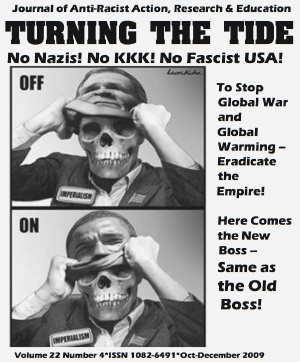
Journal Turning the TideAccording to the Pueblo Chieftain, police found “a large amount of propaganda recruiting materials from the Afrikan Liberation Army, including photos of President Barack Obama and other items that raised suspicions.”

Break the Chains reports that Ojore was released Yesterday, and will return to the Otero District Court for an appearance February 5th, the charge now “Interfering with Public Transportation.”

How absolutely disingenuous to misquote the source of the so-called Anarchist literature, seeing as reportedly there was so much of it. This is the usual media disinfo to prevent giving the causes visibility. The Pueblo Chieftain has obtained the affidavit of the arrest, which should list the items found on Ojore. Until that’s made available, we can search online for what he was likely carrying. Our bet, they don’t want to call attention to the New Afrikan Liberation Front (NALF).

Here’s a list of the exhibitors at the 2nd Anarchist Book Fair:

Anarchist type brochuresSemiotext(e)
www.semiotexte.com
Earth First Journal
www.earthfirstjournal.org
Taala Hooghan: Infoshop & Youth Media Arts Center
www.taalahooghan.org
Modesto Anarcho
www.modestoanarcho.org
South Central Farmers
www.southcentralfarmers.com
Skylight Books
www.skylightbooks.com
Institute for Anarchist Studies
www.anarchist-studies.org
Critical Resistance
www.criticalresistance.org
Las Vegas Alliance of the Libertarian Left sonv.libertarianleft.org
Catholic Worker
www.lacatholicworker.org
Anti-Racist Action/Turning the Tide
www.antiracistaction.us
Anarchist Black Cross Federation L.A. www.abcf.net/la
PM press
www.pmpress.org
Microcosom Publishing
www.microcosmpublishing.com
AK press
www.akpress.org
Little black cart
www.littleblackcart.com
Make/Shift magazine
www.makeshiftmag.com
Journal of aesthetics and protest
www.journalofaestheticsandprotest.org
R.A.C. : Revolutionary Autonomous Communities
www.revolutionaryautonomouscommunities.blogspot.com
I.W.W
www.iww.org

Then there is also the Southside ABCF zine collection, the Crossroad Newletter, and the publications of the Spear and Shield. Here’s the New Afrikan Declaration of Independence, as printed on Prairie Fire:

“New Afrikan Declaration of Independence”

WE, New Afrikan People in America, in consequence of arriving at a knowledge of ourselves as a people with dignity, long deprived of that knowledge; as a consequence of revolting with every decimal of our collective and individual beings against the oppression that for three hundred years has destroyed and broken and warped the bodies and minds and spirits of our people in America, in consequence of our raging desire to be free of this oppression, to destroy this oppression wherever it assaults humankind in the world, and in consequence of inextinguishable determination to go a different way, to build a new and better world, do hereby declare ourselves forever free and independent of the jurisdiction of the United State of America and the obligations which that country¹s unilateral decision to make our ancestors and ourselves paper-citizens placed on us.

We claim no rights from the United States of America other than those rights belonging to human beings anywhere in the world, and these include the right to damages, reparations, due us from the grievous injuries sustained by our ancestors and ourselves by reason of United States lawlessness.

Ours is a revolution against oppression–our own oppression and that of all people in the world. And it is a revolution for a better life, a better station for all, a surer harmony with the forces of life in the universe. We therefore see these aims as the aims of our revolution:

    • To free black people in America from oppression;
  • To support and wage the world revolution until all people everywhere are so free;
  • To build a new Society that is better than what We now know and as perfect as We can make it;
  • To assure all people in the New Society maximum opportunity and equal access to that maximum;
  • To promote industriousness, responsibility, scholarship, and service;
  • To create conditions in which freedom of religion abounds and the pursuit of God and/or destiny, place and purpose of humankind in the Universe will be without hindrance;
  • To build a Black independent nation where no sect or religious creed subverts or impedes the building of the New Society, the New State Government, or achievement of the Aims of the Revolution as set forth in this Declaration;
  • To end exploitation of human beings by each other or the environment;
  • To assure equality of rights for the sexes;
  • To end color and class discrimination, while not abolishing salubrious diversity, and to promote self-respect and mutual understanding among all people in the society;
  • To protect and promote the personal dignity and integrity of the individual, and his or her natural rights;
  • To place the major means of production and trade in the trust of the state to assure the benefits of this earth and our genius and labor to society and all its members, and
  • To encourage and reward the individual for hard work and initiative and insight and devotion to the Revolution.

In mutual trust and great expectation, We the undersigned, for ourselves and for those who look to us but are unable personally to affix their signatures hereto, do join in this solemn Declaration of Independence, and to support this Declaration and to assure the success of the Revolution, We pledge without reservation ourselves, our talents, and all our worldly goods.

Or the creed:

“New Afrikan Creed”

1. i believe in the spirituality, humanity and genius of Black people, and in our new pursuit of these values.

2. i believe in the family and the community, and in the community as a family, and i will work to make this concept live.

3. i believe in the community as more important than the individual.

4. i believe in constant struggle for freedom, to end oppression and build a better world. i believe in collective struggle; in fashioning victory in concert with my brothers and sisters.

5. i believe that the fundamental reason our oppression continues is that We, as a people, lack the power to control our lives.

6. i believe that fundamental way to gain that power, and end oppression, is to build a sovereign Black nation.

7. i believe that all the land in America, upon which We have lived for a long time, which We have worked and built upon, and which We have fought to stay on, is land that belongs to us as a people.

8. i believe in the Malcolm X Doctrine: that We must organize upon this land, and hold a plebiscite, to tell the world by a vote that We are free and our land independent, and that, after the vote, We must stand ready to defend ourselves, establishing the nation beyond contradiction.

9. Therefore, i pledge to struggle without cease, until We have won sovereignty. i pledge to struggle without fail until We have built a better condition than the world has yet known.

10. i will give my life, if that is necessary; i will give my time, my mind, my strength, and my wealth because this IS necessary.

11. i will follow my chosen leaders and help them.

12. i will love my brothers and sisters as myself.

13. i will steal nothing from a brother or sister, cheat no brother or sister, misuse no brother or sister, inform on no brother or sister, and spread no gossip.

14. i will keep myself clean in body, dress and speech, knowing that i am a light set on a hill, a true representative of what We are building.

15. i will be patient and uplifting with the deaf, dumb and blind, and i will seek by word and deed to heal the Black family, to bring into the Movement and into the Community mothers and fathers, brothers and sisters left by the wayside.

Now, freely and of my own will, i pledge this Creed, for the sake of freedom for my people and a better world, on pain of disgrace and banishment if i prove false. For, i am no longer deaf, dumb or blind. i am, by inspiration of the ancestors and grace of the Creator — a New Afrikan.

COP15 protest arrests leave what next

Latest update on Copenhagen demonstrations, from Greenpeace organizer Brinkley Hutchings: “Everyday at the negotiations we have flash mobs, clapping attention-grabbers, and youth crying out to be heard. But the delegates and decision-makers are wearing their earmuffs and blinders, doing everything they can to avoid hearing what we (the youth) have to say. *It has become really apparent that we must escalate.*”

Jokenhagen, the COP15 that wasn’t

You heard about the Yes Men successfully pulling off another stunt in Copenhagen? The delegates were fooled, even the media, and so unsurprisingly, the substance of their theatrics is being glossed over. While the reporters track the footprints to sort truth from facade, they are wiping all traces behind them. Url-shortening conduit bit.ly warns for example that clicking through might endanger your browser. The Yes Men prank Canada is as far as most news stories go. Why Canada — is the more to the story.
climate debt agents good cop15

First the substance: Canada is a wealthy-nation holdout on the climate talks. Its conservative government is offering to curb carbon emissions by a mere 3% etc. So the Yes Men thought they’d lead by example, role-playing Canada stepping up as all industrialized powers must. Their special announcement was called AGENDA 2020, wherein Canada pledged a 40% cut in emissions by 2020, to reach a 80% cut by 2050. Plus they vowed a “climate debt mechanism” comprising 1% of Canada’s GDP, climbing to 5% by 2030, to go toward emissions reduction and clean energy projects in Africa.

Drastic cuts, and huge payments of “climate debt” are what scientists project will be necessary to reach the environmental 350ppm line in the sand. A COP15 without such figures will be a failure. It’s small wonder the media is describing this “prank” without mentioning what was said.

Some Canadian outlets are providing reasonable detail of the commotion which was provoked. Check out the Globe and Mail, then the Toronto Star for good overviews.

The operation as it unfurled: preparations and execution were a collaboration between YM and the red-jacketed Climate Debt Agents (CDA).

0. YM begin tweeting as Canadian envoy PM Jim Prentice
(example: “My staff have notified me of a fake account pretending to represent me. It is @JimPrentice hope we can get it removed shortly. 5:31 AM Dec 14th from web” )

1. YM botch amusing anti-CocaCola prank

2. YM as Prentice tweets special announcement of a bold step forward.

3. YM (enviro-canada.com) offers Environment Canada press release

4. CDA fakes press conference outlining AGENDA 2020

5. Another CDA press conference features the envoy from Uganda, applauding Canada

6. Phony YM Wall Street Journal European Edition picks up story

7. YM (as ec-gc.ca) Environment Canadia press release pretending to denounce fraudulent prank

8. And the obligatory CDA press conference.

9. The real Canadian delegates provide the hijinks from there.

Championing minor pranks here and there as they toured for the release of their new movie The Yes Men Save the World, a reputation no doubt preceded them to the Climate Conference. The Yes Men anti-CocaCola prank earlier this week was stopped after just 20 seconds, but may have been a ruse to resolve expectations that they were obviously in Copenhagen to do something.

The CBC covers the moves of the Canadian and US delegates to get a handle on their PR. Interesting too were the frantic efforts to unmask the deception. While web sleuths followed the internet clues, a CBC reader comments that so far we’ve heard nothing yet of detective work in pursuit of whoever “hacked” the Climategate emails.

The press conferences are available on Youtube COP15DK, although their credibility is enhanced by the websites constructed around them.

AGENDA 2020

UGANDA RESPONDS

CANADA RETRACTS

CLIMATE DEBT AGENTS TAKE RESPONSIBILITY

Of course the Yes Men released their own article to tell the story:

Copenhagen spoof shames Canada; Climate Debt No Joke

by The Yes Men

African, Danish and Canadian youth join the Yes Men to demand climate justice and skewer Canadian climate policy.

COPENHAGEN, Denmark – “Canada is ‘red-faced’!” (Globe and Mail) “Copenhagen spoof shames Canada!” (Guardian) “Hoax slices through Canadian spin on warming!” (The Toronto Star) “A childish prank!” (Stephen Harper, Prime Minister of Canada)

What at first looked like the flip-flop of the century has been revealed as a sophisticated ruse by a coalition of African, North American, and European activists. The purpose: to highlight the most powerful nations’ obstruction of meaningful progress in Copenhagen, to push for just climate debt reparations, and to call out Canada in particular for its terrible climate policy.

The elaborate intercontinental operation was spearheaded by a group of concerned Canadian citizens, the “Climate Debt Agents” from ActionAid, and The Yes Men. It involved the creation of a best-case scenario in which Canadian government representatives unleashed a bold new initiative to curb emissions and spearhead a “Climate Debt Mechanism” for the developing world.

The ruse started at 2:00 PM Monday, when journalists around the world were surprised to receive a press release from “Environment Canada” (enviro-canada.com, a copy of ec.gc.ca) that claimed Canada was reversing its position on climate change.

In the release, Canada’s Environment Minister, Jim Prentice, waxed lyrical. “Canada is taking the long view on the world economy,” said Prentice. “Nobody benefits from a world in peril. Contributing to the development of other nations and taking full responsibilities for our emissions is simple Canadian good sense.”

Thirty minutes later, the same “Environment Canada” sent out another press release, congratulating itself on Uganda’s excited response to the earlier fake announcement. A video featuring an impassioned response by “Margaret Matembe,” supposedly a COP15 delegate from Uganda, was embedded in a fake COP15 website. “Canada, until now you have blocked climate negotiations and refused to reduce emissions,” said “Matembe.” “Of course, you do sit on the world’s second-largest oil reserve. But for us it isn’t a mere economic issue – it’s about drought, famine, and disease.”

(The video was shot in a replica of the Bella Center’s briefing room, at Frederiksholms Kanal 4, in the center of Copenhagen. Matembe was actually Kodili Chandia, a “Climate Debt Agent” from ActionAid, a collective of activists that push for rich countries to help those most affected by climate change for adaptation and mitigation projects. The “Climate Debt Agents,” with their signature bright red suits, have been a ubiquitous presence in Copenhagen during the climate summit.)

Then it was time for Canada to react. One hour later, another “Environment Canada” (this one at ec-gc.ca) released a bombastic response to the original release. This one quot ed Jim Prentice, Canada’s Minister for the Environment, decrying the original announcement: “It is the height of cruelty, hypocrisy, and immorality to infuse with false hopes the spirit of people who are already, and will additionally, bear the brunt of climate change’s terrible human effects. Canada deplores this moral misfire.”

Because almost none of the resulting news coverage even mentioned Uganda or “Matembe’s” response, a fourth release was sent from the second website (ec-gc.ca).

Meanwhile, in the real world

The real Canadian government’s reactions were almost as strange as the fake ones in the release. Dimitri Soudas, a spokesperson for the Canadian Prime Minister, emailed reporters and blamed Steven Guilbeault, cofounder of Quebec-based Equiterre. “More time should be dedicated to playing a constructive role instead of childish pranks,” said Soudas in a first email, while misspelling Guilbeault’s name.

Guilbeault demanded an apology. “A better way to use his time would probably be to advise the Canadian government to change its deeply flawed position on climate,” said Guilbeault.

Soudas and Guilbeault were seen exchanging angry words in the hallway outside of Canada’s 3:30pm press conference, which did not start until 4:30pm, and at which the Canadians refused to answer any questions about the flurry of false releases.

More raised voices were heard when Stephen Chu, the US Secretary of Energy, refused to pose for a photo with his Canadian counterpart, Jim Prentice. After Steve Kelly, Prentice’s chief of staff, begged for 10 minutes, the US guy finally asked why a photo was so important. Kelly replied that “we were carpetbagged this morning by [environmental non-governmental organizations] with a false press release. I gotta change the story.”

Why Blame Canada?

The only country in the world to have abandoned the Kyoto Protocol’s emissions and climate debt targets, Canada also has the most energy-intensive, destructive and polluting oil reserves in the world. The Alberta tar sands, according to The Economist, are in fact the world’s biggest single industrial source of carbon emissions.

“By not agreeing to emissions reductions, Canada is holding a loaded gun to our heads, and seems ready to pull the trigger on millions of us around the globe, ” said Margaret Matembe aka Kodili Chandia of the “Climate Debt Agents.” “They leave us no choice but to see them as criminal.”

At last year’s climate summit in Poznan, Poland, over 400 civil society organizations voted Canada worst of all nations in blocking progress towards a binding climate treaty. Will Canada take the dubious prize again this year in Copenhagen?

“The Canadian government is not listening to its citizens,” says Sarah Ramsey, a resident of Alberta who has seen the destruction of the tar sands firsthand. Ramsey traveled to Copenhagen to give voice to a generation of young Canadians. “We are discouraged and demoralized by our government’s position on climate change. We decided to lend our government a hand, and show them what good leadership looks like.”

In solidarity with the delegates from the G77 Bloc of nations, today’s intervention was also meant to highlight an issue at the heart of the ongoing talks-the issue of climate justice, and the climate debt that the developed world owes the developing world. Seventy-five percent of the historical emissions that created the climate crisis came from 20% of the world’s population in developed countries, according to the UN, yet up to 80% of the impacts of the climate crisis are experienced in the developing world, according to the World Bank.

“I meant every word I said,” says Kodili Chandia, a spokesperson for the Climate Debt Agents, who spoke out as a member of the Ugandan delegation. “This debate isn’t just about facts and figures and abstract concepts of fairness-the drought we are seeing right now in East Africa is directly threatening the lives of millions of people, including farmers in my own family. We have not created this problem but we are living with the consequences. That’s why I still say: It’s time for rich countries to pay their climate debt.”

– 30 –

There will be a press conference today at the “good” Bella Center used to shoot the fake announcement videos: 1pm, Frederiksholms Kanal 4, Copenhgaen.

More dream announcements coming soon! Come make your own or stay tuned at good-cop15.org.

FOR IMMEDIATE RELEASE
Tuesday, December 15, 2009

We Are United For a Peaceful Obama

Come to Acacia Park, TUESDAY, 5PM
ACACIA PARK, 5PM- COLORADANS FOR PEACE are not alone urging President Obama to escalate his attention to the antiwar mandate given him by the American voters. Michael Moore & Keith Olbermann have made eleventh hour pleas, and the nation’s prominent antiwar activists signed a collective letter to President Obama (see below). Here are the national organizations taking to the streets tomorrow:

United Against Afghan Escalation, Women Say No To War (Code Pink), No Escalation in Afghanistan (UFPJ), Veterans Oppose Troop Build-up (IVAW), US Labor Against War, A.N.S.W.E.R., Stop the Escalation (World Can’t Wait), American Friends Service Committee (AFSC), Just Foreign Policy, Pax Christi USA, Peace Action, Progressive Democrats of America, The Peace and Justice Resource Center and Voters for Peace.

The letter composed by the National Assembly:

President Barack Obama?
The White House?Washington, D.C.
November 30, 2009

Dear President Obama,
With millions of U.S. people feeling the fear and desperation of no longer having a home; with millions feeling the terror and loss of dignity that comes with unemployment; with millions of our children slipping further into poverty and hunger, your decision to deploy thousands more troops and throw hundreds of billions more dollars into prolonging the profoundly tragic war in Afghanistan strikes us as utter folly. We believe this decision represents a war against ordinary people, both here in the United States and in Afghanistan.  The war in Afghanistan, if continued, will result in the deaths of hundreds if not thousands of U.S. troops, and untold thousands of Afghans.

Polls indicate that a majority of those who labored with so much hope to elect you as president now fear that you will make a wrong decision — a tragic decision that will destroy their dreams for America. More tragic is the price of your decision. It will be paid with the blood, suffering and broken hearts of our young troops, their loved ones and an even greater number of Afghan men, women and children.

The U.S. military claims that this war must be fought to protect U.S. national security, but we believe it is being waged to expand U.S. empire in the interests of oil and pipeline companies.

Your decision to escalate U.S. troops and continue the occupation will cause other people in other lands to despise the U.S. as a menacing military power that violates international law. Keep in mind that to most of the peoples of the world, widening the war in Afghanistan will look exactly like what it is: the world’s richest nation making war on one of the world’s very poorest.

The war must be ended now. Humanitarian aid programs should address the deep poverty that has always been a part of the life of Afghan people.

We will keep opposing this war in every nonviolent way possible. We will urge elected representatives to cut all funding for war. Some of us will be led to withhold our taxes, practice civil resistance, and promote slowdowns and strikes at schools and workplaces.

In short, President Obama, we will do everything in our power, as nonviolent peace activists, to build the kind of massive movement –which today represents the sentiments of a majority of the American people–that will play a key role in ending U.S. war in Afghanistan.

Such would be the folly of a decision to escalate troop deployment and such is the depth of our opposition to the death and suffering it would cause.

Sincerely, (Signers names listed in alphabetical order)

Jack Amoureux, Executive Committee
Military Families Speak Out

Michael Baxter
Catholic Peace Fellowship

Medea Benjamin, Co-founder
Global Exchange

Frida Berrigan
Witness Against Torture

Elaine Brower
World Can’t Wait

Leslie Cagan, Co-Founder
United for Peace and Justice

Tom Cornell
Catholic Peace Fellowship

Matt Daloisio
War Resisters League

Marie Dennis, Director
Maryknoll Office for Global Concerns

Robby Diesu
Our Spring Break

Pat Elder, Co-coordinator
National Network Opposing Militarization of Youth

Mike Ferner, President
Veterans For Peace

Joy First, Convener
National Campaign for Nonviolent Resistance

Sara Flounders, Co-Director
International Action Center

Sunil Freeman
ANSWER Coalition, Washington, D.C.

Diana Gibson, Coordinator
Multifaith Voices for Peace and Justice

Jerry Gordon, Co-Coordinator
National Assembly To End Iraq and Afghanistan Wars and Occupation

Rabbi Lynn Gottlieb
Shomer Shalom Network for Jewish Nonviolence

David Hartsough
Peaceworkers San Francisco

Mike Hearington, Steering Committee
Georgia Peace and Justice Coalition, Atlanta

Larry Holmes, Coordinator
Troops Out Now Coalition

Mark C. Johnson, Ph.D., Executive Director
Fellowship of Reconciliation

Hany Khalil
War Times

Kathy Kelly, Co-Coordinator
Voices for Creative Nonviolence

Leslie Kielson , Co-Chair
United for Peace and Justice

Malachy Kilbride
National Campaign for Nonviolent Resistance

Adele Kubein, Executive Committee
Military Families Speak Out

Jeff Mackler, Co-Coordinator
National Assembly to End Iraq and Afghanistan Wars and Occupations

Imam Abdul Malik Mujahid, Chair-Elect
World Parliament of Religion

Michael T. McPhearson, Executive Director
Veterans For Peace

Gael Murphy, Co-founder
Code Pink

Michael Nagler, Founder
Metta Center for Nonviolence

Max Obuszewski, Director
Baltimore Nonviolence Center

Pete Perry
Peace of the Action

Dave Robinson, Executive
Director Pax Christi USA

Terry Rockefeller
September 11th Families For Peaceful Tomorrows

Samina Sundas, Founding Executive Director
American Muslim Voice

David Swanson
AfterDowningStreet.org

Carmen Trotta
Catholic Worker

Nancy Tsou, Coordinator
Rockland Coalition for Peace and Justice

Kevin Zeese
Voters for Peace

And Michael Moore’s letter:

An Open Letter to President Obama from Michael Moore

Monday, November 30th, 2009

Dear President Obama,

Do you really want to be the new “war president”? If you go to West Point tomorrow night (Tuesday, 8pm) and announce that you are increasing, rather than withdrawing, the troops in Afghanistan, you are the new war president. Pure and simple. And with that you will do the worst possible thing you could do — destroy the hopes and dreams so many millions have placed in you. With just one speech tomorrow night you will turn a multitude of young people who were the backbone of your campaign into disillusioned cynics. You will teach them what they’ve always heard is true — that all politicians are alike. I simply can’t believe you’re about to do what they say you are going to do. Please say it isn’t so.

It is not your job to do what the generals tell you to do. We are a civilian-run government. WE tell the Joint Chiefs what to do, not the other way around. That’s the way General Washington insisted it must be. That’s what President Truman told General MacArthur when MacArthur wanted to invade China. “You’re fired!,” said Truman, and that was that. And you should have fired Gen. McChrystal when he went to the press to preempt you, telling the press what YOU had to do. Let me be blunt: We love our kids in the armed services, but we f*#&in’ hate these generals, from Westmoreland in Vietnam to, yes, even Colin Powell for lying to the UN with his made-up drawings of WMD (he has since sought redemption).

So now you feel backed into a corner. 30 years ago this past Thursday (Thanksgiving) the Soviet generals had a cool idea — “Let’s invade Afghanistan!” Well, that turned out to be the final nail in the USSR coffin.

There’s a reason they don’t call Afghanistan the “Garden State” (though they probably should, seeing how the corrupt President Karzai, whom we back, has his brother in the heroin trade raising poppies). Afghanistan’s nickname is the “Graveyard of Empires.” If you don’t believe it, give the British a call. I’d have you call Genghis Khan but I lost his number. I do have Gorbachev’s number though. It’s + 41 22 789 1662. I’m sure he could give you an earful about the historic blunder you’re about to commit.

With our economic collapse still in full swing and our precious young men and women being sacrificed on the altar of arrogance and greed, the breakdown of this great civilization we call America will head, full throttle, into oblivion if you become the “war president.” Empires never think the end is near, until the end is here. Empires think that more evil will force the heathens to toe the line — and yet it never works. The heathens usually tear them to shreds.

Choose carefully, President Obama. You of all people know that it doesn’t have to be this way. You still have a few hours to listen to your heart, and your own clear thinking. You know that nothing good can come from sending more troops halfway around the world to a place neither you nor they understand, to achieve an objective that neither you nor they understand, in a country that does not want us there. You can feel it in your bones.

I know you know that there are LESS than a hundred al-Qaeda left in Afghanistan! A hundred thousand troops trying to crush a hundred guys living in caves? Are you serious? Have you drunk Bush’s Kool-Aid? I refuse to believe it.

Your potential decision to expand the war (while saying that you’re doing it so you can “end the war”) will do more to set your legacy in stone than any of the great things you’ve said and done in your first year. One more throwing a bone from you to the Republicans and the coalition of the hopeful and the hopeless may be gone — and this nation will be back in the hands of the haters quicker than you can shout “tea bag!”

Choose carefully, Mr. President. Your corporate backers are going to abandon you as soon as it is clear you are a one-term president and that the nation will be safely back in the hands of the usual idiots who do their bidding. That could be Wednesday morning.

We the people still love you. We the people still have a sliver of hope. But we the people can’t take it anymore. We can’t take your caving in, over and over, when we elected you by a big, wide margin of millions to get in there and get the job done. What part of “landslide victory” don’t you understand?

Don’t be deceived into thinking that sending a few more troops into Afghanistan will make a difference, or earn you the respect of the haters. They will not stop until this country is torn asunder and every last dollar is extracted from the poor and soon-to-be poor. You could send a million troops over there and the crazy Right still wouldn’t be happy. You would still be the victim of their incessant venom on hate radio and television because no matter what you do, you can’t change the one thing about yourself that sends them over the edge.

The haters were not the ones who elected you, and they can’t be won over by abandoning the rest of us.

President Obama, it’s time to come home. Ask your neighbors in Chicago and the parents of the young men and women doing the fighting and dying if they want more billions and more troops sent to Afghanistan. Do you think they will say, “No, we don’t need health care, we don’t need jobs, we don’t need homes. You go on ahead, Mr. President, and send our wealth and our sons and daughters overseas, ’cause we don’t need them, either.”

What would Martin Luther King, Jr. do? What would your grandmother do? Not send more poor people to kill other poor people who pose no threat to them, that’s what they’d do. Not spend billions and trillions to wage war while American children are sleeping on the streets and standing in bread lines.

All of us that voted and prayed for you and cried the night of your victory have endured an Orwellian hell of eight years of crimes committed in our name: torture, rendition, suspension of the bill of rights, invading nations who had not attacked us, blowing up neighborhoods that Saddam “might” be in (but never was), slaughtering wedding parties in Afghanistan. We watched as hundreds of thousands of Iraqi civilians were slaughtered and tens of thousands of our brave young men and women were killed, maimed, or endured mental anguish — the full terror of which we scarcely know.

When we elected you we didn’t expect miracles. We didn’t even expect much change. But we expected some. We thought you would stop the madness. Stop the killing. Stop the insane idea that men with guns can reorganize a nation that doesn’t even function as a nation and never, ever has.

Stop, stop, stop! For the sake of the lives of young Americans and Afghan civilians, stop. For the sake of your presidency, hope, and the future of our nation, stop. For God’s sake, stop.

Tonight we still have hope.

Tomorrow, we shall see. The ball is in your court. You DON’T have to do this. You can be a profile in courage. You can be your mother’s son.

We’re counting on you.

Yours,
Michael Moore

Stop recruiting US soldier terrorists

Did I hear this right — Minnesota families are alarmed that their young men are recruited to travel overseas to commit acts of terrorism? Except reporters aren’t talking about shadowy military recruiters with unfettered access to US classrooms and kindergartens enticing American youth to join the global capitalist Jihad, the alarm is about Somali relatives enjoining their fellow refugees to return to their homeland to defend Somalia against Ethiopian invaders.

Trouble is, al-Shabaab, the organization leading the fight in Somalia is being declared a terrorist organization by the US Government. Strange really, because the only acts of terrorism in Somalia are being committed by the US military or their Ethiopian proxy. But terrorism has always been defined by authoritarian propagandists as only what the enemy does. Whether it is a state or an insurgency.

I should think this is problematic when the definition of terrorism is linked to a religious cause. Radical Islam, it would seem, becomes by definition a terrorist goal. Is there not something about the separation of church and state that should hinder the US from deciding that one religion can be outlawed?

Doesn’t this mark an escalation of US state oppression — for the state to decide on which side of foreign struggles its citizens are permitted to weigh? How are foreign populist movements to manage lobbyists in Washington to ensure their struggle isn’t blacklisted as “terrorist?”

It does open the door to American domestic counter-recruiting efforts. Declare the US military a terrorist organization, and we can halt its recruiters in their tracks. No more fresh recruit pipeline to the occupation zones, no more “underground railroad” to Fort Hood. Have the US Congress declare our military a perpetrator of terrorism. It’s not a difficult argument to make. Evidence goes back to before US independence, when “Americans” fought dirty against the continent’s aboriginal population. Now examples of US state sponsored terrorism are gratuitous. The young men we send on Jihad return with haunted consciences from the acts they inflict on innocent populations. What are the motives of indiscriminate bombing, apprehension and torture, but pure terrorism to buttress subjugation to US goals?

I protest UC students self interest

UC students are occupying campus buildings, in scenes gloriously reminiscent of the 60s. Debbie Downers have foretold that an antiwar movement would not catch the interest of youth until there was a military draft to affect them. They are right. We’ve seen marches and rallies for peace, but it took a tuition hike to light a fire under these selfish tight asses. The students are right to be enraged by a 30% tuition rise, but have they a case to justify civil disobedience? They’re rebelling against the result of an economy going bust, of the middle class losing the privilege to educated its kids. Rise up, protest, but make it look like more than about your entitlement to a post-highschool social life.

Ward Churchill to speak for O’odham

O'odham rightsAccording to Censored News, Activist and scholar Ward Churchill will speak at the Unitarian Universalist Church of Tucson, 4831 W. 22nd St., on November 13, 2009 at 7:00 p.m. to benefit O’odham VOICE Against the Wall, which since 2003 has organized and advocated for the traditional O’odham leaders and elders of the Tohono O’odham communities in the southern territory of the United States and northern territory of Mexico. Professor Churchill’s talk is part of the “Apartheid in America: Surviving Occupation in O’odham Lands”

O’odham activist Ofelia Rivas will also participate. The event is sponsored by the Dry River Radical Resource Center, the Earth First! Journal, and Voices against the Wall.

Here’s some background on the O’odham struggle:

pamphlet cover illustrationBy J. D. Hendricks, 2004
TIAMAT PUBLICATIONS #5

The People Who Emerged From the Earth

Over two thousand years ago the descendents of the O’odham moved into the southwestern region of the area now claimed by the U.S. as the state of Arizona. 1 The O’odham have had one of the longest histories of contact with the forces of European colonization compared with the rest of the native North American peoples. The O’odham’s first contact with Spanish invaders took place in the mid 16th century; nearly one hundred years before the colonization of the North Atlantic coast and Great Lakes regions were begun by the French and English colonists. As such, the history of the O’odham provides a good context for an investigation of the colonization of Native North America, and more specifically, an investigation of the interplay between, and results of, the varied responses to colonization – that of collaboration, accommodation, and resistance.

Many histories of the O’odham refer to these desert people as the Papago. The term Papago was a name given to the O’odham by the Spanish colonizers, and is likely the result of a Spanish corruption of the O’odham word “papabi” which was the O’odham name for one of their principal bean varieties. Thus, the Spanish colonizers term for the O’odham (Papago) came to mean “the bean eaters.” 2 For the purposes of this study I will refrain from the use of the term Papago and will refer to “the people” 3 by their traditional pre-colonial name. 4

As is often the case, with the name Papago being a good example, European constructs are often imposed upon indigenous peoples by the historians that seek to portray their past. This result can occur when historians seek to glorify European norms and traditions at the expense of indigenous ones, and can also be the result of the subconscious indoctrination of the historian by the dominant culture – in this case that of western style industrial civilization. In other cases it can be the result of a simple uncritical usage of language.

One of the most dominant and reoccurring “civilized” constructs imposed upon indigenous peoples history is the commonly understood notion that the O’odham, or any other indigenous North American culture for that matter, existed as a totality or uniformed mass. This study will seek to use the history of the interaction between the O’odham peoples and the United States, both its government and its peoples, to deconstruct this myth of the totality and provide a history of the O’odham’s varied responses to colonization from an anti-colonial and anti-industrial perspective. By investigating various important case studies in O’odham history, and looking not only at resistance but also accommodation and collaboration, it is hoped that this work will help to provide a more realistic historical picture of the effects of colonization, and the intentions and reactions of both the colonizer and the colonized. Within the previously stated context and theoretical framework, this study will argue that while the O’odham responded to the U.S. invasion of their lands in various ways, the choices to resist, accommodate, or collaborate with the forces of colonization did not affect the overall U.S. policy concerning the O’odham – that policy being the eventual total assimilation of the O’odham into the dominant “civilized” industrial system. 5

This investigation will include a strong focus on O’odham resistance to colonization, as any anti-colonial history should, however it will not discount or ignore the many historical occurrences of accommodation, and in some cases outright collaboration, with the colonizers. It is important to always keep in mind that none of the actions and reactions in any of the case studies looked at are attributable to the O’odham as a “totality,” but rather are attributable only to the various groupings of O’odham, be they incarnated in the form of the individual, the clan, the village, an economic or spiritual grouping, or an established political organization.

A God of Civilization and Coercion Comes to the O’odham

The O’odham’s first encounter with Spanish invaders took place in the mid sixteenth century when a group of conquistadors led by Alvaro Nunez Cabeza de Vaca entered O’odham territory in search of gold. These men did not find the riches they were looking for and left the desert region to return to the Spanish colony. However, soon after word spread of the O’odham villages on the northern periphery of the Spanish colony, missionaries began to travel north to bring God and “civilization” to the native people residing there. By 1686, Catholic missionaries had formed a few small missions in O’odham territory using what they believed to be the influence of their soft power 6 techniques to lure the O’odham into their missions where they were then subjected to a rigorous schedule of cultural indoctrination. Most O’odham historians, including Winston Erickson, 7 and to a lesser extent, Bernard Fontana 8 have, during this time period, focused on the O’odham who chose to reside nearby and within these early missions, thus painting a picture of the O’odham as accepting of Spanish influence and cultural indoctrination.

However a closer look at this time period reveals that mission O’odham were only a small percentage of the total population of O’odham residing in the Sonoran desert 9 and that the ones who were there may not have been so for the reasons that the colonizers believed. San Xavier del Bac, the largest mission in O’odham lands, as well as many other missions, took advantage of the fact that the desert O’odham migrated in the dry winter months to the Northern Piman settlements along the rivers to work the small farm plots for sustenance. 10 The Catholic missions inserted themselves into this traditional pattern. Those O’odham who worked and lived near the missions were, for the most part, seasonal residents, which shows that the missions were viewed merely as being of utilitarian value. Thus, the O’odham as a totality were not necessarily accommodating to or interested in anything the missionaries had to offer per se, and when the missionaries began to employ “hard power” techniques and abuse or overstep the grounds for their welcome it did not go without consequence. 11

Accommodating and ignoring the missionaries was not the only response to colonization practiced by the O’odham during the seventeenth and eighteenth centuries. Although historians such as Erickson feel that “the missions did serve the O’odham well….,” 12 that assertion is contradicted by the fact that there were many large scale rebellions waged against the missions from outside and from within. In 1695, 1751, 1756, and 1776, large scale rebellions occurred in which missionaries were killed and their missions burned to the ground. 13 In some cases these rebellions were the doing of joint O’odham/Apache alliances, which is significant considering that many histories of the O’odham and Apache portray them as immemorial enemies. This may be the result of the fact that by the early nineteenth century the Spanish government initiated a campaign of divide and conquer that was continued later by the Mexican and U.S. governments to turn the O’odham and Apache against one another, thus easing the project of their subjugation.

A Change in the Occupation Government: Washington Enters O’odham Lands

In 1821, Mexican Independence from Spain was achieved and interest in the O’odham dropped away nearly entirely. By 1828, the new and secular Mexican government began the process of shutting down the missions in O’odham territory and by 1842, the last of the missions were closed. Soon after, in 1846, the United Stated initiated a war for territorial expansion against Mexico. This war was not of immediate consequence to the O’odham peoples. Isolated in desert regions, the fighting between the two occupation powers affected them little in the short run. However, the signing of the Treaty of Guadalupe Hidalgo in 1848, which ended the war, would lay the foundations for a series of disastrous events which would affect the O’odham in very negative ways.

Of greatest consequence to the O’odham was the fact that the boundary between the United States and Mexico was not finalized by the treaty of Guadalupe Hidalgo. The boundary was designated by Article Five of the Treaty as being an arbitrary line roughly following the 32nd parallel, an area which runs through the southern part of modern Arizona. To the east, the border was provided by the Rio Grande. The exact boundary line along the 32nd parallel was to be decided at a later date. It is also important to note here that the Treaty also provided that all Mexican citizens absorbed by the United States were to be granted U.S. citizenship, which included all indigenous peoples in the annexed territory since under Mexican law they were considered citizens. In the treaty the United States also assumed the responsibility for preventing cross border raiding into Mexico by the southwestern tribes, specifically the Apache. 14

In the aftermath of the signing of the treaty of Guadalupe Hidalgo, it became quickly apparent that an acceptable border between Mexico and the United States along the 32nd parallel would not be achieved. An official survey expedition was assembled by the United States and Mexico in 1849 to trace out the boundary between the two countries with little success. Various borderlines were agreed to and then abandoned and re-made by the United States, sometimes in a unilateral decision that dismissed the positions of the Mexican government altogether. 15

The principal concern for the United States was to secure title to an area of land in northern Sonora, Mexico that was ideally suited for the construction of a portion of the southern continental railroad whose building was being discussed in the U.S. Congress at the time. One of the main advocates for this southern railroad route was a South Carolina man by the name of Colonel James Gadsden. Gadsden’s history of connections to powerful business, military, and political leaders is very interesting and his appointment by the United States to be Minister to Mexico in 1853 serves as a very informative source to gauge the United States’ intentions towards Native Americans and the O’odham in particular.

James Gadsden was born into an influential southern family and graduated from Yale University. After enlisting and serving in the war of 1812, Gadsden was sent to the Florida territory with Andrew Jackson to aid in the campaign of removal and extermination being waged against the Seminole Indians, which took place from 1816-1818. After this war against the Seminole, Gadsden was appointed by President Monroe as commissioner to oversee the removal of the Seminole Indians to Indian Territory. Like the more famous removal of the Cherokee, the removal of the Seminole, and the high death rate suffered as a result, unarguably constituted genocide. 16 As a reward for a job well done, Gadsden was appointed by Monroe to a seat on the legislative council of the territory of Florida, thus beginning Gadsden’s political career. In 1840, Gadsden was elected President of the Louisville, Charleston, and Cincinnati Railroad. In 1853, the Secretary of War, an ardent white supremacist and slavery defender by the name of Jefferson Davis, appointed Gadsden to be Minister to Mexico. 17 As Minister to Mexico, one of Gadsden’s primary missions was to negotiate a final demarcation of the boundary between the U.S. and Mexico. Although Gadsden was a zealous believer in Manifest Destiny, his ideas concerning racial Anglo-Saxonism 18 caused him to be an opponent of the total annexation of Mexico. Gadsden, like many racist U.S. politicians of that time, felt that the total absorption of Mexico and its non-Anglo population into the United States would pollute the Anglo bloodline too much and thus he sought only to gain enough territory for the United States to build the southern pacific route. 19 Thus, a man who had presided over a war of genocide against the Seminole Indians, was a devout racist, and who had obvious conflicts of interest due to his connections to the railroads, was put into a position to determine the territorial boundary between the United States and Mexico and in the process also determine the boundaries of the O’odham’s land. With its appointment of Gadsden, the intent of the U.S. government could not be clearer. Business interests and territorial expansion were to run roughshod, by any means necessary, over any native peoples who stood in the way.

It is no surprise that when James Gadsden finally successfully negotiated a treaty with Santa Anna to secure what is now the southern portion of Arizona, the O’odham were not consulted. In fact, the Gadsden Treaty, signed into law in 1853, did not contain any mention of the O’odham at all. Considering that the new boundary line put in place by the Gadsden Treaty literally split the traditional O’odham lands in two, it is obvious that the intentions of the United States were in no way benevolent. Here it is also important to point out that the terms of the Gadsden Treaty specifically included the same citizenship provisions which were spelled out in the earlier Treaty of Guadalupe Hidalgo. 20 Although the Gadsden treaty was of great significance for the O’odham, their isolation and the outbreak of the Civil War enabled them to live another decade in relative isolation from Anglo encroachment.

Assimilation, Cultural Destruction, Double Speak and Ordained Genocide

The causes which the Almighty originates, when in their appointed time he wills that one race of men – as in races of lower animals – shall disappear off the face of the earth and give place to another race, and so on, in the great cycle traced out by Himself, which may be seen, but has reasons too deep to be fathomed by us. The races of the mammoths and mastodons, and the great sloths, came and passed away: The red man of America is passing away!
–United States Congress Committee on Indian Affairs report, 1865. 21

No doubt with similar justifications in mind as those of the Committee on Indian Affairs, Anglo settlers began their invasion of O’odham lands less than a year after the conclusion of the Civil War. The Homestead Act had opened up the lands of Southern Arizona to Anglo squatters and in 1866, one of the first of many bills was passed by Congress granting mineral rights to any citizen who claimed them. 22 Every one of these homesteads opened and every resource extraction operation initiated without the express consent of the O’odham represented an illegal action under the Gadsden Treaty. The citizenship provisions of the Gadsden Treaty had granted citizenship to all former Mexican citizens and the O’odham were, by legal definition, included in this formulation. The United States, however, refused to consider “uncivilized” peoples as being worthy of the protections granted to citizens by the fourth amendment of the U.S. Constitution, which prohibits the expropriation of property. This refusal of the United States government to follow its own laws pertaining to Native Americans when those laws happen to stand in the way of U.S. interests has been a common occurrence in United States Indian policy. This land grab was only the first of many illegalities committed against the O’odham people by the United States and its citizens. In this respect the O’odham are in a special position when compared with many other tribes. While the theft of native lands by the United States Government was usually legally justified by treaty stipulations signed between a tribe and the U.S. government, this justification could not and cannot be used in the case of the O’odham since no treaty was ever signed with the O’odham by the United States Government. 23

For the most part, the O’odham did not resist this initial incursion of Anglo settlement, rather the O’odham practiced accommodation and moved farther out into the desert to shield themselves from the new settlers invading their lands. Traditional ways were maintained with the exception of the introduction of cattle ranching. The O’odham territory was well suited for the raising of cattle and a good number of O’odham became cattle ranchers, both for purposes of subsistence as well as for sale to Anglos residing in and around Tucson. In the 1880s, as increasing numbers of Anglo cattle ranchers began to invade and take over their pasture, some O’odham began to resist.

The O’odham resisted by stealing the Anglo cattle herds which were rounded up and driven south to be sold on the Mexican market. The expropriation of Anglo cattle herds was not isolated, and it became a major concern for the settlers and the government. In at least one case, a large cattle outfit was driven out of business. 24 The concern over this outbreak of O’odham theft of Anglo cattle was large enough that newspapers as far away as Los Angeles ran stories about the phenomenon. For the most part these stories seem to have been deliberately used to justify the enclosure of the O’odham into reservations as the government and Anglo cattle ranchers seized the opportunity to gain even more O’odham land by arguing that it was an unfair burden for the Anglo cattle ranchers to have to “support” the O’odham. 25 Here, in previous case study, we have another common attribute of U.S. Indian policy in general, and one which occurs again and again in the history of O’odham contact with the U.S. government and Anglo settlers – blaming the victim.

Another official position of United States Indian policy during this time period was that everything done to the Indians was, in the words of Indian Commissioner J. Q. Smith, in their own “best interests.” 26 Whether this obvious sham was based on a subconscious guilt and delusion or was a cynical example of “double-speak,” it is obvious that Native American’s best interest’s were the last thing on the government’s mind. Nevertheless, with this reasoning as justification, the first official reservation for the O’odham was created by executive order of President Grant on July 1, 1874. This small reservation surrounded the Old Catholic mission at San Xavier del Bac. It is estimated that only about ten percent 27 of the desert O’odham took up residence within this reservation – these were labeled as “civilized” O’odham by U.S. census takers. The vast majority of O’odham were labeled as “wild” and continued to live in the vast desert regions west of San Xavier del Bac. While it is obvious that the desert O’odham were resisting cultural assimilation by avoidance, even the mission O’odham maintained a resistance to European culture as the next example will illustrate.

While visiting the old mission at San Xavier a newspaper columnist from the Los Angeles Times wrote that upon her visit in 1882, she could see “not a single civilized human habitation within miles.” This writer goes on to state that the O’odham’s dwellings were in the form of “conical mud huts.” In the casual racism and Social Darwinist rhetoric of the period she also adds that,

“The Papagos are but little in advance of gophers and prairie dogs in their habitations.” 28

The point is that after more than 200 years of European influence, even the mission O’odham continued to build their traditional shelters. 29

Progressivism and Cultural Genocide: The Dawes Act

In 1887, the General Allotment Act, also known as the Dawes Act, was signed into law. The Dawes Act was the staging point for the forced assimilation of those remnants of Native American groupings which had not been totally decimated by the preceding period of “Indian Wars” and forced relocations. The essential function of the Dawes Act was to disrupt traditional tribal land holding patterns and thus force Native Americans into the Anglo system of private property. The O’odham, like most other Native American cultures, did not have a concept of private property – land was held in common for the benefit of the village group. Communally held land was an essential pre-requisite for their Anarchistic political system and extremely de-centralized tribal structure. 30

The first section of the Dawes Act provides for equal “sections” of land to be parceled out to each “head of family.” This head of family was always understood to be the father of each family when land was allotted. Thus, this first section of the act not only attempted to destroy the communal land system of Native Americans, it also instituted Patriarchy as the basis for social functioning in Native America. 31 In addition, Section Five of the Act also provides that any un-allotted lands be subject to purchase by the United States government. Section Six and Seven provide that all monies paid by the U.S. for un-allotted Native lands be held for each tribe by the U.S. Treasury and “subject to appropriation” by the U.S. government to repay itself for the implementation of allotment as well as to provide for the “civilization” of Native Americans. 32 In less veiled words, these sections are basically stating that Native Americans will be forced to pay for their own cultural annihilation.

This interpretation of the intent of the Dawes Act becomes clearer when one looks at the arguments and debates that took place in Congress and within self described progressive “Indian rights” groups such as the Indian Rights Association. Critics of the Dawes Act in Congress such as Rep. Russell Errett understood that

“the main purpose of this bill is not to help the Indian troubles so much as it is to provide a method for getting at the valuable Indian lands and opening them up for settlement.” 33

And Senator Dawes, the namesake of the final bill, speaking of the land and resources of Native Americans stated that

“civilization has got after these possessions with a greed never before equaled but it is idle to expect to stay it….” 34

As for the progressive Indian Rights Association, they argued that

“the organization of the Indians into tribes is, and has been, one of the most serious hindrances to the advancement of civilization, and that every effort should be made to secure disintegration of all tribal organizations….” 35

And one of their leaders, Reverend L. Abbott, provided justification with the statement:

“Barbarism has no rights which civilization is bound to respect.” 36

So here we have a self-proclaimed progressive Indian Rights organization arguing for cultural genocide and against the notion that Native Americans have any rights that civilized people are bound to respect! This conclusion provides a perfect example of the essence of “progressive” or “civilized” thought.

The Dawes Act had a much less devastating effect for the O’odham than it did for many other Native American tribes. At the time of its passage, the only official reservation for the O’odham was the San Xavier reservation which, as was stated earlier, was only a small 71,090 acre reservation around the old mission San Xavier del Bac. When the allotment agent came to San Xavier in 1890, he allotted out 41,600 acres of land to the 363 O’odham whom he counted in his census as being resident at the time. 37 The vast majority of the O’odham still continued to live west of San Xavier in the expansive desert regions and were little affected by the allotment schemes. Even those O’odham who lived in San Xavier and were allotted land paid little attention to the artificial boundaries drawn on paper which supposedly privatized their land – they continued to farm and graze the land communally. 38 This refusal to abide by the provisions of the Dawes Act is also a form of resistance to cultural assimilation and adds one more example to show that for those O’odham who resisted, the most often employed method of resistance was non-compliance and avoidance. This specific response to colonization was made possible by the isolation and expansiveness of their desert home, which many Anglo’s continued to view as a “hopeless desert.” 39

The Domestication of the “Wild Papago”

The vast majority of the O’odham continued to resist assimilation and maintained a fairly traditional lifestyle – minus the introduction of cattle herding and horse rearing. In the twenty years following the passage of the Dawes Act, a growing effort was made to enclose the “Wild Papago” 40 and forcibly strip them of their traditional culture and instill them with the “civilized” values of the industrial Anglo. As was mentioned previously in the paper, ranchers and the government used O’odham cattle theft from Anglo ranchers as one tool to justify the enclosure of the O’odham within a reservation. During this period, Anglo Cattle ranchers continued to encroach deeper and deeper into O’odham territory and scuffles began to break out.

In another classic example of the “blame the victim” tactic, a pro-enclosure story was printed in the Los Angeles Times, no doubt to build public pressure for the domestication of the “Wild Papago.” The story concerns a group of O’odham who had resisted an Anglo cattleman’s attempts to enclose one of their water sources. When these O’odham continually tore down the fence that this cattleman had built, the rancher filed a report with the local Indian Agency sheriff to have the men arrested. When the sheriff arrived to arrest the O’odham responsible for defending their water source, he was taken hostage. The sheriff was later released unharmed; however, the incident was used to make the argument that such troubles can only be expected to increase if the O’odham were not enclosed on a reservation where they could be more easily controlled and monitored. 41

The tactic of occupying and diverting natural water sources was one of the tools used by the Anglo settlers and government to destroy the self sufficiency of the O’odham and force them into reservations where they would be dependent on the government for their water and would thus be easier to control and monitor. Some of the O’odham clearly understood what was happening, which is evidenced by instances of resistance both to the enclosure of natural water sources as well as resistance to the drilling of wells. One example of the U.S. government using water as a tool of forced cultural assimilation can be found by looking at an event recorded by an O’odham calendar stick 42 keeper. In 1912, the O’odham residing in the village of Santa Rosa, an isolated and traditional village in the western desert region of O’odham territory, were paid a visit by an Anglo Indian Commissioner who wished to drill a well for them. The Chief of the village objected to the drilling of the well on the grounds that it would disturb their culture, their autonomy and their self-sufficiency. The government agent proceeded to have the well drilled anyway. Upon completion of the well, the Chief of the village, according to the calendar stick keeper, stated that

“the well must be left alone and, in order that the Papagos might continue their old life, water must still be carried from the spring in the foothills.” 43

However, the prohibition by the Chief could not be upheld due to the overwhelming convenience of the new well and after a period of abstaining from its usage, the village of Santa Rosa (including the Chief) gave in and thus was assimilated into the industrial system by being made dependent on the Government well. 44 During this same time period, encroaching Anglo farmers engaged in the diversion of O’odham water sources to irrigate their farms. This practice served as another method of forcing the self sufficient O’odham into a relationship of dependence upon the government. In many areas so much water was diverted that the O’odham could no longer grow their traditional summer crops. 45

In 1919, the first incarnation of an O’odham reservation to enclose the nearly two million acres of desert that the “Wild Papago” were residing in was established. The formation of the desert O’odham reservation in 1919 ushered in a period of exponentially increased government interference in O’odham matters, and of course, the various forms of coercive assimilation were multiplied. By 1933, thirty-two unwanted wells were drilled all over the new reservation. 46 The well drilling was often opposed by those who were trying to maintain the O’odham Him’dag – the traditional ways of the desert people.

Resistance and Collaboration: O’odham Responses to Forced Modernization

In contrast to the traditional O’odham who had maintained resistance to cultural assimilation for the past 300 years, there was also a small number of O’odham based in the new reservation that welcomed collaboration with the forces of Anglo modernization and advocated for cultural accommodation and in some instances for total cultural assimilation. These men would later form an organization called the Papago Good Government League, which would serve as the propaganda arm of the Bureau of Indian Affairs and government policy in general. The leadership of this new faction had been taken from their families as youths and placed in Protestant boarding schools to be culturally indoctrinated. The Tucson Presbyterian Training School was one of the indoctrination centers where many future members of the Good Government League had been sent. 47

Religious indoctrination, whether Catholic or Protestant, has always been one of the most powerful tools of colonization and its justification used by European invaders against the indigenous peoples of the Americas. The necessary counterpart to the forced indoctrination of Christian principals and morals has always been the repression of indigenous spiritual practices. The United States government understood the profound power that traditional spiritual practices had in maintaining group solidarity and cohesion and it is for this reason that such spiritual practices were made illegal and repressed historically. In 1883, a Court of Indian Offenses was established by congress at the request of Secretary of Interior Henry M. Teller to eliminate traditional spiritual practices. In a report to the commissioner of Indian Affairs, Teller laid out his goals and his rationale stating that,

“If it is the purpose of the Government to civilize the Indians, they must be compelled to desist from the savage and barbarous practices that are calculated to continue them in savagery….”

Teller went on to associate those who resisted the repression of their spirituality with the “non-progressive” faction of Indians and labeled traditional spiritualism as “debauchery,” “diabolism,” and “savagery.” The overarching argument of his letter is that in order to civilize the Indians and bring them into the industrial system, their traditional spiritualism must be destroyed. As an initial step towards this end, Teller advised that Medicine Men be “compelled” to desist from their practice of “deception.” 48

Although the Court of Indian Offenses advocated that coercion be used to repress and destroy indigenous spiritualism, it failed to succeed in this project even when it used force to try to stop traditional spiritual rituals. According to Historian Edward Spicer, the only thing the Court succeeded in doing was driving traditional spiritual practices underground. In the case of many resistant O’odham, traditional spiritual practices were continued without regard to regulations or prohibitions against them, and in many cases, federal authorities resorted to repression and arrest to try to stop these practices. One traditional spiritual practice of the O’odham which was particularly hated by the Protestant Missionaries and Indian Agents was the Vi-kita ceremony.

The Vi-kita ceremony of the O’odham has been written about and studied by many Anglo historians and anthropologists, the most prominent being Columbia Anthropologist Ruth Underhill. 49 Before going into a short description of the Vi-kita it is important to understand that this ceremony varied depending on who was conducting it and where it was being conducted. Peter Blaine, an influential O’odham man sympathetic to the traditional ways, wrote in his autobiography about Underhill’s methods. Blaine explained the traditional way for the O’odham to tell about their past was to do it

“in a group so that everybody had a chance to talk and tell it their way. Underhill was talking to just one man…Dr. Underhill was wrong all the way in how she got her information.” 50

As scholars from the dominant culture often do, Underhill had applied her own notions of hierarchy, authority and individualism to her work with the O’odham and totally disregarded their traditional methods of conveying information in a communal fashion.

The Vi-kita itself was a yearly rain and fertility festival preformed to initiate and give thanks for the yearly summer rains. The ceremony itself consisted of the communal singing of rain songs, dancing, intimate encounters, and the consumption of Navait (Saguaro wine), an alcoholic drink made by the fermentation of Saguaro Cactus buds. The consumption of this wine was meant to symbolize the connection between the sky and the earth. The intake of the Navait was representative of the earth’s intake of rain. Participants drank Navait until vomiting occurred as this act embodied the clouds issuing forth rain unto the earth. It was a powerful ceremony that bonded the O’odham with the elements of nature.

When Protestant missionaries, and a small number of Protestant O’odham in the Good Government League, backed by U.S. Indian Agents, began their attempts to usurp power on the newly formed western O’odham (Sells) 51 reservation in the early 20th century, one of the first things they attacked was the practice of the Vi-kita ceremony. In the early 1930s, Peter Blaine explained that the traditional O’odham from the San Xavier reservation would travel to the western reservation for the Vi-kita. He states that,

“In the late 1920s the government tried to stop this wine drinking ceremony on the Sells reservation. But no Papago or Agency police could ever stop it.”

In one instance Blaine tells the story of how he helped defend three traditional O’odham Vi-kita ceremony leaders when they were arrested by agents from the Indian Bureau and jailed in Tucson. During the trial, a group of Protestant O’odham men from the Good Government League 52 argued for the repression of the ceremony – one of these men, Richard Hendrix, would continue to plague the traditional O’odham in future encounters. To respond to the collaborationist Good Government League, the resistant traditional O’odham formed the League of Papago Chiefs to counter the attempts of the Protestant Good Government League to usurp control on the reservation. 53

The Indian Reorganization Act and O’odham land rights

On June 18th, 1934, President Roosevelt signed into law the Indian Reorganization Act which finally stopped the forced allotment process initiated by the Dawes Act in 1887. The Indian Reorganization Act was viewed by its proponents as being in the best interests of the Indians. One of the reasons for this view was the fact that the Dawes Act and its forced allotment provisions had resulted in the loss of 90,000,000 acres of tribal lands and it was hoped by some, including then Indian Commissioner John Collier, that the Indian Reorganization Act could be used to regain some of this lost land.

The public was also encouraged to view the Indian Reorganization Act as being beneficial for Native Americans. A large article in the Los Angles Times entitled “The Bill to Return Indian Rights” stated that:

“After a century of graft, plunder and injustice, this bill has the objective of handing their own souls back to the Indians.” 54

However, such optimism and notions of cultural relativism were not held by all. As a precursor to the Indian Reorganization Act, a report was prepared for the Secretary of the Interior in 1928 to lay out the need for a change in Federal Indian Policy. The report stated that the “great majority of Indians are ultimately to merge into the general population” and that it was the government’s responsibility to assimilate Native Americans into “white civilization” because “the hands of the clock cannot be turned backwards.” Sympathetic attempts to help Native Americans retain their culture were stigmatized as attempts to “preserve them as museum specimens.” 55 Indian Commissioner John Collier was one of those who believed that Native Americans should retain their culture and that “the awakening of the racial spirit must be sustained….” 56 However, although the finalized Indian Reorganization Act did contain elements that were meant to “help” Native Americans, many of its articles were still designed to impose “civilized” systems on Native Americans.

It can be argued that the intent of the finalized Indian Reorganization Act was to initiate a new chapter in the push for the total cultural assimilation of the Native American tribes. The argument that there was no qualitative change between the Dawes Act and the Reorganization Act is legitimate. The Indian Reorganization Act provides the examples for the argument. The main tool of assimilation in the Indian Reorganization Act was the provision in Section 17 which allowed for Native American tribes to form their own tribal governments, constitutions and laws which, although it is not specifically stated, were intended to be Anglo in structure and functioning. In the case that these native governments were not sufficiently acceptable to the U.S. government, section 17 also provided that all Tribal Government formations must be “approved by the Secretary of the Interior.” 57 This clearly shows that the intent of the Act was not to allow Native Americans to become fully autonomous, either culturally or politically. For a tribe such as the O’odham, which had a long history of decentralization and consensus decision making, the imposition of western style liberal democracy, with its attendant centralization and majority rule system, was an obvious method of forced cultural indoctrination. Peter Blaine, who was mentioned earlier, was an O’odham man who had sympathy for the traditional, decentralized and communal way of O’odham societal organization. When the collaborationist Papago Good Government League began to maneuver themselves into the position of representing all of the O’odham, Blaine took it upon himself to lead the charge to discredit their assertions to business interests and the Federal Government that they represented the O’odham. Blaine wrote that:

“This so-called council represented only their own church people, but they took it upon themselves to become a council for all Papagos. They had meetings. Nobody attended them but these four guys because most people didn’t recognize them as leaders.” 58

In 1934 Blaine, along with another O’odham from the Gila Bend reservation named Leon Pancho became the first O’odham to travel to Washington D.C. These two men were sent as representatives of the traditional chiefs of the O’odham villages to argue against a recent court order that closed the Sells reservation to outside, Anglo owned, mining. The court order was a result of a lawsuit brought by the members of the Good Government League, including Richard Hendrix, who had teamed up with outside lawyers. These lawyers were to receive as payment a ten percent share of all land reclaimed from the mining companies, or a monetary equivalent. As this entire procedure was done behind the backs of the majority of the O’odham, when it was revealed, there was great resentment towards the Good Government League by many of the O’odham.

While in Washington D.C., Blaine was informed of the pending Indian Reorganization Act, and he became a supporter of the Act due to its provision allowing for the self government of Native Americans, as well as a provision in section Six that allowed the Secretary of Interior to manage mineral, mining, and livestock on the reservation. 59 In the case of the O’odham this meant that the reservation would be re-opened to mining and they would regain an important means of economic sustenance. According to Blaine, the mines were an important economic resource for the O’odham as they provided jobs and a market where beef and other O’odham products could be sold. 60 This is yet another unfortunate example of how the incursion of Anglo industrial technology served to destroy the self-sufficiency of the O’odham by making them dependent on it for survival.

Whether or not the mines were truly in the best interest of the O’odham is a complex topic which cannot be dealt with here. However it should be stated that Blaine and his companions’ trip to Washington D.C. was financed by the Tucson Chamber of Commerce, an organization that functioned in support of the mining interests, not the O’odham. This Tucson Chamber of Commerce was the same organization that had aggressively petitioned President Wilson to rescind his 1916 act forming the Sells reservation because it prevented Anglo agricultural interests from exploiting the area’s “best agricultural and grazing lands.” 61

Resistance to and Collaboration with the “White Man’s War”

Not long after the passage of the Indian Reorganization Act and the formation of the first O’odham Tribal Government, the United States declared war on Japan, thus entering World War II. The participation of Native Americans in World War II has been well publicized, especially the role the Dineh (Navajo) played as code talkers in the South Pacific. The United States government and the mainstream media portrayed Native Americans as being eager to fight for their homeland, and eager to assimilate into “white civilization” once they returned from the war. Nearly 25,000 62 Native Americans served in the United States military during World War II, many of whom were no doubt under the impression that their service would be rewarded with increased “rights” after the war’s end. Instead, as a “reward” for Native Americans participation in World War II the United States government established the Indian Claims commission in 1946 to legalize the U.S. occupation of Native American Lands never granted to the U.S. by treaty, passed House Concurrent Resolution 108 to terminate tribal recognition as separate entities from the Federal Government, and then instituted a plan in 1954 to relocate Native Americans off the reservation and into “Indian Ghettos” in the nation’s large cities. 63 These were the “rewards” for participation in World War II.

Like many other Native American Tribes, some of the O’odham Nations members participated in World War II. Ruth Underhill claims that the O’odham enlisted to serve in World War II “in droves” 64 and it is documented that the O’odham tribal government bought $10,000 in war bonds. 65 However, the extent of this involvement was distorted by the media, academia, and even some of the O’odham leaders in the tribal government. Richard Hendrix, a former member of the collaborationist Good Government League, had risen to prominence in the new O’odham tribal government by this time and was interviewed by the Arizona Archaeological and Historical Society on November 16, 1942. In this interview Hendrix exposed the extent to which he had allowed his mind to be colonized and assimilated into that of the dominant white culture. Speaking of colonization in general and World War II in particular, Hendrix stated that the O’odham had:

Learned to love the American government and they learned to love the Stars and Stripes. And when the war came and the time came for our boys to be registered, there was no exception. They registered just the same as white boys did. And now they are out fighting alongside the white boys, the American boys. They are just as anxious as the white boys to kill as many Japs, to kill as many Germans, and they are very anxious to win this great war so that the Papago people in this desert land may continue to enjoy the freedom of their homes. 66

Hendrix’s internalization of white supremacist racial notions is a heart breaking and shocking example of the extent to which he had accepted the ideology of “white civilization.” In addition, his assertion that every O’odham boy registered for the war with “no exception” is glaringly false.

Aside from the fact that there are always exceptions to everything, there was also a large scale organized resistance to World War II led by an old Chief and medicine man, Pia Machita, and his band of traditional O’odham who resided in an isolated village in the north western area of the Sells Reservation known as the Hickwan district. According to Peter Blaine, the O’odham residing in some of the most isolated villages in the Hickwan district had not seen a white man until the 1930s, and continued to practice the traditional O’odham Him’dag. 67 When Pia Machita was informed of the compulsory registration of young O’odham boys for induction into World War II, he instructed the youth of his village to refuse to sign the registration forms when they were visited by the local Indian Agent. Pia Machita was a very traditional leader who refused cultural assimilation and would not accept the authority of the Bureau of Indian Affairs or the O’odham tribal government. Finally, after all efforts to persuade Pia Machita’s village to register had failed, the tribal chief of police and a gang of Federal Marshals led by U.S. Marshall Ben McKinney invaded the village at two in the morning on October 16th, 1941, with tear gas bombs and guns drawn – when the Marshals attempted to take Pia Machita into custody some of the young men from the village used force to liberate him and severely beat one of the federal marshals. In the face of this resistance, the government agents and their local collaborators retreated to Tucson. When the Attorney General’s Office heard of the resistance on the O’odham reservation, they immediately got involved in the effort to repress this draft resistance movement as quickly as possible to prevent its possible spread to other reservations. By May 17th, 1941, after a period of about six months of trying to track down Pia Machita and his small band of men, Marshall McKinney and O’odham collaborators including Jose Ignacio from the tribal government, surrounded Pia Machita in the village of Stoa Pitk and took him into custody without incident. 68

Peter Blaine was the O’odham tribal chairman during the time that Pia Machita was leading the draft resistance movement. Although he did not believe that Pia Machita and his men were threats in any way, he was annoyed by what he perceived to be their stubbornness and attributed their draft resistance to his belief that they “didn’t really understand what they were doing.” 69 In reality, it was Blaine who did not understand the reasons behind Pia Machita and his men’s resistance to enlistment. Pia Machita and his men understood very well what they were doing – they were resisting giving aid to a government that they understood was their enemy. Given this understanding, and given the dictionary definition of the word “collaboration,” it becomes necessary to label those O’odham who participated in the arrest of Pia Machita as such – collaborators. The understanding that the U.S. government was the enemy of the traditional O’odham of the Hickwan district was based upon a long history of attempts by the U.S. government to force the Traditional O’odham of that area to abandon the Him’dag and embrace elements of Anglo “progress” such as dams, railroads, wells, and the protestant religion. Despite Peter Blaine’s inability to understand why the O’odham in the Hickwan district rejected Anglo-civilization in its totality, he still maintained sympathy for the people there. When Pia Machita and two co-defendants were finally sentenced to serve 18 months in prison at Terminal Island Federal Prison for their roles in leading the resistance movement, Peter Blaine eventually came to their aid and used his connections as tribal chairman to persuade the sentencing Judge to release Pia Machita early and allow him to return to the reservation and his family. 70

Conclusion

The history of the O’odham’s contact with the United States government has been one marked by a persistent current of resistance to cultural assimilation into “white civilization.” This resistance has included a variety of tactics and actions. The favored tactic of resistance to assimilation for many of the O’odham groupings seems to have been that of avoidance and feigned accommodation to Anglo culture when expedient. However, as was evidenced by the O’odham’s early history of contact with the Spanish, they did not refrain from waging armed resistance to colonization when they were pushed into a situation where other tactics might have been ineffectual.

In addition to resistance and accommodation, it has also been shown that some of the O’odham choose to engage in direct collaboration with the Anglo colonization of their lands and minds. As this paper has shown, the levels of collaborative activity amongst the O’odham varied, and so did the effects of such collaboration. When investigating instances of collaboration it is always important to understand the context which produced them and to remember that the ultimate blame for a situation of oppression should always be placed upon the group committing the acts of repression – in this case the United States government and allied business interests. It is important to show such examples of collaboration and to understand that all human cultures who have been the victim of colonization have invariably contained individuals who chose to collaborate for a variety of reasons. The O’odham are no exception to this rule. Making apologies for collaboration or failing to mention the instances where such collaboration did occur creates a historical distortion and does nothing to aid present struggles for liberation.

The O’odham responses to colonization never represented a totality, but a strong current of resistance is evident throughout their history. In regards to the United States government, it can be said, given the primary sources looked at, and the final drafts of laws signed and policies followed, that the intent of the United States government toward all Native American tribes, when it was not outright genocidal, has been the cultural destruction and absorption of remaining Native Americans into the dominant industrial culture of “white civilization.” Regardless of the varying tactics used, and the various lip service about “best interests” and “justice,” it has been shown that there has never been a qualitative change in United States policy toward the O’odham people and Native Americans in general. The O’odham have maintained aspects of their traditional culture despite the best efforts of the government to force assimilation, not as a result of such efforts. A continuing current of struggle between the forces of colonization and resistance has persisted for centuries, in all its various forms, within the minds and bodies of many O’odham and will continue until liberation.

NOTES:

1
This date is based on archeological evidence gathered by E.W. Haury in Ventana Cave. Haury, E.W. The Stratigraphy and Archeology of Ventana Cave Arizona. Tuscon: University of Arizona Press, 1950. Cited from Williams, Thomas R. “The Structure of the Socialization Process in Papago Indian Society.” Social Forces, Vol.36, No.3. p.253.

2
Fontana, Bernard L. Of Earth and Little Rain: The Papago Indians. Tuscon: University of Arizona Press, 1989. pp.37-39.

3
The name “O’odham” is roughly translated as “the people” in the Piman dialect spoken by the various O’odham groupings.

4
In 1986 the tribal government of the Papago reservation officially changed its name to the Tohono O’odham Nation.

5
The term “civilized” is a problematic historical term, and its definition tends to be very subjective. The meaning of the term and its use as a label is heavily influenced by how the author and the reader understand its meaning. For the purposes of this paper, the term “civilized” refers to the totality of the “western” cultural, political, and economic system – and most importantly the belief that technological/industrial progress is inherently beneficial and liberatory. For most, being labeled “civilized” is viewed as a positive and the label of “un-civilized” or “savage” is viewed in the reverse. However, for the purposes of this study it is imperative to understand that this author views “civilization” itself as an inherently oppressive and destructive entity, and this must be kept in mind to correctly understand the arguments and analyses in the paper.

6
The term “soft power” refers to the concept of gaining influence and control over another group by means of the attraction of the dominating group’s cultural attributes and the use of commodification rather than using military might and coercion (“hard power”) to gain that influence. See Joseph S. Nye, Jr. Soft Power: The means to success in world politics. New York: Perseus Books, 2004.

7
Erickson, Winston T. Sharing the Desert: The Tohono O’odham in History. Tucson: University of Arizona Press, 2003.

8
Fontana, Bernard L. Of Earth and Little Rain: The Papago Indians. Tucson: University of Arizona Press, 1989.

9
According to Catholic missionary records, the numbers of mission O’odham during this time period were somewhere around 2,000. However, according to population estimates there were at least 10,000 O’odham peoples living in this area. See Fontana, Bernard L. Of Earth and Little Rain . pp.11,46.

10
Fontana, Bernard L., p.40.

11
It is well documented that many of the Missions resorted to physical abuse, forced confinement and occasional murder to coerce the O’odham into compliance. San Xavier del Bac, the largest and most famous of Catholic missions in O’odham lands was built with forced labor. See Daniel McCool; “Federal Indian Policy and the Sacred Mountains of the Papago Indians.” Journal of Ethnic Studies 9.3 (1981).p59.

12
Erickson, Winston P., p.66.

13
Fontana, Bernard L., pp.61-64.

14
Treaty of Guadalupe Hidalgo, Feb 2nd, 1848. United States Statutes At Large, pp. 922-943

15
For a detailed treatment of this series of events see; Garber, Paul N. The Gadsden Treaty. Glouchester: Peter Smith, 1959.

16
For more information on the removal of the Seminole; Stannard, David E. American Holocaust: The Conquest of the New World. New York: Oxford University Press, 1992. P.124. For additional information about the Seminole Wars see; Churchill, Ward. “A Little Matter Of Genocide: Holocaust and Denial in the Americas 1492 to the Present.” San Francisco: City Lights Books, 1997.

17
All dates for the political appointments of James Gadsden are cited from Paul Garber’s “The Gadsden Treaty.” Pages 74-81.

18
Racial Anglo-Saxonism was a belief popular in the later 19th century which held that Europeans of Anglo-Saxon descent were at the forefront of evolution and were responsible to bring civilization to the world. This ideology was used as a convenient justification for the extermination and removal of Native Americans. For a detailed study of this ideology see: Horsman, Reginald. Race And Manifest Destiny: The Origins of American Racial Anglo-Saxonism. Cambridge: Harvard University Press, 1981.

19
For a detailed investigation of the role that the railroads played in the Gadsden purchase see; Schmidt, Louis B. “Manifest Opportunity and the Gadsden Purchase.” Arizona and the West, vol.3 (autumn 1961).

20
Forbes, Jack D. The Papago-Apache Treaty of 1853: Property Rights and Religious Liberties of the O’odham, Maricopa and Other Native Peoples. Davis: Native American Studies Tecumseh Center, U.C. Davis, 1979. p.1.

21
United States Congress. Joint Special Committee. Condition of The Indian Tribes. Report of the joint special committee, appointed under joint resolution of March 3, 1865. With an appendix. Washington, D.C.: United States Government Printing Office, 1865.

22
Erickson, p.77

23
During this time period many treaties were negotiated with native tribes in the regions west of the Mississippi to gain legal justification for the United States’ theft of their lands. For a detailed list of treaties signed between the United States and Native American tribes, see the compendium edited by Charles J. Kappler. Indian Affairs: Laws and Treaties. 7 volumes. Washington, D.C.: Unites States Government Printing Office, 1903-4.

24
Spicer, Edward H. Cycles of Conquest: The Impact of Spain, Mexico, and the United States on the Indians of the Southwest, 1533-1960. Tucson: The University of Arizona Press, 1962. p.138.

25
“Arizona News; Papago Cattle-thieves Brought to Justice.” Los Angeles Times. Feb 1, 1894. Also see: “Arizona News; Report Showing the Depredations Committed by Papago Indians on Stockmen’s Herds.” Los Angeles Times. June 8, 1895, In addition see; “Arizona News: Papagoes Destroying Cattle in Large Numbers.” Los Angeles Times. Mar 23, 1894.

26
Kehoe, Lawrence. “Our New Indian Policy and Religious Liberty.” Catholic World, vol. 26 (Oct. 1887). P.96.

27
Erickson p.78.

28
“Tucson And Fort Lowell; Notes of a Visitor – The Church of San Xavier.” Los Angeles Times. Nov 18, 1882.

29
The Spanish had brought the adobe style of construction to the O’odham but, although the resources for adobe construction were readily available to the O’odham at San Xavier, they continued to build their traditional grass huts.

30
For a detailed study of traditional O’odham tribal structure and life style see; Underhill, Ruth M. Social Organization of the Papago Indians. Columbia: Columbia University Press, 1939. ________. Papago Woman. New York: Holt, Rinehart and Winston, 1979.

31
For the most part, traditional Native American societies exhibited gender parallelism and were rarely if ever patriarchal by definition. For a detailed study of gender in Native America see: Allen, Paula G. The Sacred Hoop: Recovering the Feminine in American Indian Traditions. Boston: Beacon Press, 1986.

32
All direct quotations from Dawes Act. General Allotment Act (Dawes Act). February 8, 1887. Printed in its totality in: Prucha, Francis, P. ed. Documents of United States Indian Policy. 3rd ed. Lincoln: University of Nebraska Press, 2000.

33
U.S. Congress, House Committee on Indian Affairs, Lands in Severalty to Indians: Report to Accompany H.R. 5038, 46th Cong., 2nd sess., May 28, 1880, H. Rept. 1576, pp.7-10. Reproduced in: Washburn, Wilcomb E. The Assault on Indian Tribalism: The General Allotment Law (Dawes Act) of 1887. Philadelphia: J.B. Lippincott Co., 1975.

34
Letter from Henry L. Dawes to Henry M. Teller (Commissioner of Indian Affairs), September 19, 1882. Dawes Papers, Library of Congress, Washington, D.C. Reproduced in: Washburn, Wilcomb E. The Assault on Indian Tribalism: The General Allotment Law (Dawes Act) of 1887. Philadelphia: J.B. Lippincott Co., 1975.

35
Washburn, Wilcomb E. The Assault on Indian Tribalism: The General Allotment Law (Dawes Act) of 1887. P.12.

36
Washburn, p.16.

37
Fontana, pp. 77-79.

38
Erickson, p. 92.

39
“Baboquivari Peak.” Los Angeles Times. Nov 4, 1894.

40
The term “Wild Papago” was a term used by the government and media to marginalize those O’odham who continued to resist “civilization.”

41
“The Indian War Cloud.” Los Angeles Times. May 22, 1885.

42
The Calendar Stick was a device used by the O’odham as a tool to aid in the remembering of their history. The Calendar Stick itself was a cactus stick on which notches were carved at various intervals which aided the history keeper in the remembrance of events.

43
Fontana, p.54.

44
This example is meant to show the insidious nature of industrial technology and is not intended to place any blame on this specific group of O’odham for their ultimate choice to begin using the well. This example is given to show how industrial technology always comes with strings attached. In this case, once the village becomes dependent on the well they in turn become dependent on the Anglo civilization which is needed to maintain the functioning of such a well, and thus become less able to resist other Anglo incursions. In addition it must be pointed out here that the traditional water gathering procedure talked about was preformed by O’odham women. Due to this fact, some may feel that by resisting the building of the well, the male O’odham are in fact seeking to perpetuate patriarchy. It is true that the O’odham did have a system of gendered roles, but the overall system made room for exceptions and is best characterized as one of gender parallelism, not patriarchy. It is the Anglo industrial system that brought patriarchy to the O’odham. For more information see: Underhill, Ruth. Papago Woman. New York: Holt, Rinehart and Winston, 1979. Also see: Allen, Paula G. The Sacred Hoop: Recovering the Feminine in American Indian Traditions. Boston: Beacon Press, 1986.

45
Forbes, Jack D. The Papago-Apache Treaty of 1853: Property Rights and Religious Liberties of the O’odham, Maricopa and Other Native Peoples. Davis: Native American Studies Tecumseh Center, U.C. Davis, 1979. pp..5-8.

46
Spicer, p. 140.

47
Spicer, p.141.

48
All quotes taken directly from: House Executive Document no.1, 48th Cong., 1st sess., serial 2190, pp.x-xii. Reproduced in; Prucha, Francis, P. ed. Documents of United States Indian Policy. 3rd ed. Lincoln: University of Nebraska Press, 2000.

49
For a detailed account of the Vi-kita see: Davis, Edward H. The Papago Ceremony of Vikita. New York: Museum of The American Indian, 1920. Also see: Underhill, Ruth. Papago Woman. New York: Holt, Rinehart and Winston, 1979.

50
Blaine, Peter. Papagos and Politics. Tucson: The Arizona Historical Society, 1981. p.42.

51
The expansive western O’odham reservation was officially called the Sells reservation. It was named after the first Indian agent in the region, John Sells.

52
The Good Government League was formed by a small group of Protestant O’odham who used the organization to advocate for the assimilation of the O’odham into Anglo civilization as well as to promote general U.S. Indian policy.

53
Blaine, pp.40-50.

54
“Bill To Return Indian Rights ” Los Angeles Times. June 8, 1934.

55
Lewis Meriam et al., The Problem of Indian Administration. Baltimore: Johns Hopkins Press, 1928. Selection printed in: Prucha, Francis, P. ed. Documents of United States Indian Policy. 3rd ed. Lincoln: University of Nebraska Press, 2000.

56
Annual Report of the Secretary of Interior, 1934, pp.78-83. Reprinted in; Prucha, Francis, P. ed. Documents of United States Indian Policy. 3rd ed. Lincoln: University of Nebraska Press, 2000.

57
Wheeler-Howard Act (Indian Reorganization Act) June 18, 1934. U.S. Statutes at Large, 48:984-88. Re-printed in: Prucha, Francis, P. ed. Documents of United States Indian Policy. 3rd ed. Lincoln: University of Nebraska Press, 2000.

58
Blaine, p.50.

59
Wheeler-Howard Act (Indian Reorganization Act) June 18, 1934. U.S. Statutes at Large, 48:984-88. Re-printed in: Prucha, Francis, P. ed. Documents of United States Indian Policy. 3rd ed. Lincoln: University of Nebraska Press, 2000.

60
Blaine, pp.50-53.

61
McCool, Daniel. “Federal Indian Policy and the Sacred Mountains of the Papago Indians.” Journal of Ethnic Studies 9.3 (1981). p.62.

62
Holm, Tom. “Fighting A White Mans War: The Extent and Legacy of American Indian Participation in World War II.” The Journal of Ethnic Studies. 9.2. p.70.

63
For more on this aspect of the Indian Claims Commission, and a discussion about the termination act see: Forbes, Jack D. The Papago-Apache Treaty of 1853: Property Rights and Religious Liberties of the O’odham, Maricopa and Other Native Peoples. Davis: Native American Studies Tecumseh Center, U.C. Davis, 1979.

64
Underhill, Ruth. Papago Woman. New York: Holt, Rinehart and Winston, 1979. P.94.

65
Blaine, p.115.

66
Hendrix, Richard. Talk by Richard Hendricks, Prominent Papago Indian, Given at the Arizona Archaeological and Historical Society, November 16, 1942. The Kiva, vol. 8 (Nov. 1942).

67
Blaine, p.92.

68
Flaccus, Elmer. “Arizona’s Last Great Indian War: The Saga of Pia Machita.” The Journal of Arizona History, vol. 22 (1981).

69
Blaine, p.101.

70
Blain, pp.103-4.

© 2004, REPRODUCTION FOR NON-PROFIT INFORMATIONAL PURPOSES IS ALLOWED

The Famous Oprah Video punks who?

Oprah famous video black eyed peas good day
You find it by searching for FAMOUS + OPRAH + VIDEO. Because hyperbole arcs the hyperlink. Allegedly, the viral clip is being removed as fast as websites are putting it up. I’ll bet the reason would have more to do with James Frey and Augusten Burroughs baldfaced disingenuity than copyright infringement or Oprah being embarrassed by pedestrian plagiarism. The performance by the Black Eyed Peas, taped live in downtown Chicago for the 24th season of Oprah’s talk show, purports to ignite a spontaneous dance, to Oprah’s joyful astonishment. While the video may be a crowd-pleaser, it certifies corporate music’s lack of originality, and the American TV tube’s despicable boobness.

The jubilant TODAY’S GONNA BE A GOOD DAY scenario borrows of course from the T-mobile commercial featuring a dance production taped at a Liverpool train station, set to a medley of powerhouse dance numbers. At first fellow commuters are surprised. By the end we realize the entirety has been choreographed. Youtube viewers would recognize the contrivance from the Belgian train station scene, where ordinary commuters begin dancing to a favorite song from The Sound of Music, until the whole crowd is participating.

Is dance so highly infectious? There’s something people really love about seeing that theme play out. It gives viewers warm fuzzy feelings having to do with belonging to community. There’s nothing wrong with the Black Eyed Peas wanting to reap that same enthusiasm for their pretend live video. Who holds it against pop to imitate from anything?

Their job of commercial entertainment is to popularize, and an Antwerp central station is hardly a setting familiar to Americans. Better a live concert audience, youthful, outside, wearing the usual panoply of Disney colors, living in the moment, attached to no context of exterior lives, a high school musical on a sunny day, reality TV on vivid.

Both predecessors feature onlookers who stare transfixed, some calling friends on their cellphones, others recording what they see. In both sequences, often those standing on the periphery turn out also to be participants, eventually joining in the dance.

In Oprah’s version, she is the lone spectator, watching incredulous from onstage. Like the train station commuters, she holds a cellphone aloft, eager to record the dance epidemic as it spreads throughout her “audience.” Apparently, it’s not enough today to drop your jaw to show surprise, you have to pull out your camera to show how you know when seeing defies believing. What, is Oprah going to Youtube it? Would her television audience worry that the impromptu dance was going to pass without someone recording it for posterity?

Oprah’s spontaneous wonder may have passed for genuine before a television audience who didn’t see the dance coming, but on the instant replay, how will Oprah’s act play? Are we to believe she didn’t know about the Christo scale choreographed event? If the stunt had been planned as a surprise, do you suppose Oprah wouldn’t have noticed her audience was suddenly uniformly younger and more fit, wearing uniformly bright colors evenly distributed across the monitor screens. Failing that, do you imagine someone as skilled as Oprah at communicating with peoples en masse, wouldn’t detect that this audience had something up its sleeve? It’s probably no false flattery to brag that Chicago is not big enough for Oprah and a surprise party of thousands, without invitations coming across her desk.

The Black Eyed Peas dance bomb may have made wonderful television, and it might have been even better if Oprah had winked instead of gasped. Because now the scene is simply contrived. To watch it in hindsight, as has become the norm for television in the Youtube age, there’s Oprah punking us all.

CNN did it with Balloon Boy, FOX does it for politics, and the rest do it for the war: false concern, contrived conclusions. American media nourishes with falsity. Musicians lip-sinc, Yo-Yo Ma faked his performance at the inauguration, as we learned all instrumentalists do in cold weather.

Communist with a small c

SDS Chairperson Bernardine DorhnToday’s antiwar movement wants for 60s marketing flair. This example comes by way of embittered sixties chronicler Todd Gitlin, the student for a Democratic Society eclipsed by the Radical Youth Movement and future Weather Underground leader Bernardine Dohrn, later the FBI’s “most dangerous woman in America.” Gitlin complains that Dorn titillated followers by proclaiming herself a “Communist with a small c.”

Walt Whitman was not Grandpa Moses

Poet Walt Whitman at age 37A new Levi’s commercial overlays Walt Whitman’s O PIONEERS on scenes of fashion-conscious youth, distilling substance like just another stylizing element. It reminds me of the false portraits our society is content to hang over its radicals. This week, a statue of Helen Keller was unveiled at the US Capitol. Commemorated safely for being an advocate for the disabled, Keller is represented at age seven, before she became the notorious socialist and antiwar crusader. The reverse fate befalls Whitman, who is always represented as a massively-bearded authority figure, and not the authority-challenging reprobate.

Barack Obama is your president

Does the presidential plane say NIGGER?COLORADO SPRINGS- The superintendent of District 12 schools announced Friday that Barack Obama’s address to schoolchildren on Tuesday will not be shown in his district’s schools. I’m no defender of this president, but I have to ask, what possible rationale could excuse such disrespect? It’s probably too easy to decry racism, so what’s left?

Personally, of course, I could imagine steering schoolchildren clear of George W. Bush. Old President Bush had a 13% or so approval rating. Foreign leaders dismissed him as a moron. It was whispered that he’d resumed drinking, and it was common knowledge that he’d been a cocaine user until his forties. George Bush was no example for impressionable youth. What parent could hold him up as a role model, other than the town drunk or village idiot who was not to be emulated? But I’m certain the same schools just a year ago would never have crossed that president.

Setting aside his surprising political turns, Barack Obama projects inspiring leadership qualities. He speaks intelligently with attentiveness and compassion. His message to children is to be one of encouragement in the hard times ahead, dealing with the increased imperative of higher education. Recent generations have been growing successively nihilistic. Perhaps the economy’s turn is an appropriate occasion for a president to address our nation’s kids. We like to call them our future.

Bush gave our schools the disastrous NO CHILD LEFT BEHIND ACT which completely degraded public schools and ushered the calls for privatization of education under the guise of Charter Schools. In Colorado, Bush’s measure prompted the CSAPs, which hobble teachers by requiring classes to focus on passing standardized tests, instead of teaching broader lessons. Bush’s act also guarantees that military recruiters have access to the personal records of our children at their most vulnerable, to more easily prey upon them when they are rebellious teens. Bush was no friend of schoolchildren.

Election button 2008Obama on the other hand won a decisive victory in November, and no small number of his supporters were young children. Many teachers were pushing for Obama and his promise of hope, in the midst of a culture of pessimism sowed by George W. and his destructive agendas. Bush waged war against everything schoolchildren are fostered to care about. Obama’s campaign represented salvation for our planet. How now are school administrators prepared to extricate the students from their own personal rapport with the new president?

To quote a favorite Twit, Badbanana:

Obama is going to address the nation’s schoolchildren? One good fart joke and the Democrats control Congress for 60 years.

We know of course the high pitched extremists groups whom the superintendent thinks he is placating. They are the Teabaggers and Birthers who reject Obama as president. “He’s not my president” they say. They learned the phrase from their adversaries who protested the stolen elections of 2000 and 2004, but never understood its meaning. Obviously they have nothing to teach children about the workings of democracy.

At the recent health care town hall hosted by Congressman Doug Lamborn, I had a chance to witness these Birthers, so named because they reject Barack Obama’s birth certificate. They are so certain that Obama will be discovered to be foreign born and will thus be stripped of the presidency. “Three More Months, Three More Months” they countered, while progressive citizens were chanting for health care reform.

Ed Bircham of Bircham Office ProductsLocal wing nut business owner Ed Bircham was dancing a jig singing “Ho Ho, Obama’s Got To Go, Ho Ho.” Egged on by KVOR djs and unabashed gay-bashers, Ed Bircham repeated his calls for Obama’s removal from office.
Incredible. Obama hasn’t done anything yet –which is my complaint– so what have the teabaggers against him? It’s patently absurd, if it wasn’t so obviously bigoted. “No Country For Old Bigots” I yelled.

Actually I joined local NAACP leader James Tucker in interjecting “Obama Is Your President” between Bircham’s call for his ouster. “Respect Your President” we found ourselves saying, even as I knew that I would not hold myself to such restraint. On the other hand, my opposition to President Obama has nothing to do with his skin color. On what principles do these white men disagree with Barack Obama, except that they’re not about to show deference to a nigger?

National Assembly is antiwar exclusively

unite-against-the-warReports are emerging from July’s National Assembly, the vital effort to unite antiwar forces into a common movement. Delegates from the major peace organizations hammered out a strategy to address Iraq, Afghanistan, Pakistan and Palestine. Missing from the consensus? Nonviolence, and good riddance. It goes without saying that humanitarian activists are peaceful. To legislate a dogma of non-confrontation plays right into the hands of the authoritarians. Here’s the official report:
AN ASSESSMENT OF THE FIRST YEAR OF THE NATIONAL ASSEMBLY TO END THE IRAQ AND AFGHANISTAN WARS AND OCCUPATIONS

Address given by Marilyn Levin, member, National Assembly Administrative Body, and Planning Committee, Greater Boston United for Justice with Peace Coalition, to the National Antiwar Conference held July 10-12, 2009 in Pittsburgh, Pennsylvania

July 10-12, 2009, 255 people representing diverse organizations and constituencies from all over the country came together in Pittsburgh:

1) To look at where we are today,

2) To articulate our long range goals to rejuvenate the antiwar movement towards building a massive movement capable of forcing an end to their wars and occupations, to take our money back from the war machine to meet pressing social needs, and to save our planet for our children, and

3) To develop and vote for action plans as steps to realize these objectives.

All of our major objectives were accomplished and we leave today with a comprehensive action agenda to carry us through to next spring. Everyone had a chance to speak and differences were aired without rancor or splits to achieve unity in action.

Friday night’s speakers, along with many conference participants, grappled with how to unify and broaden the movement. Saturday afternoon and Sunday morning, we presented a great roster of workshops covering the major issues we face today. Saturday night’s rally was dynamic and inspiring.

There were two highlights of the conference for me. First was the international component where activist comrades joined us from Canada and courageous labor leaders of powerful mass movements in Haiti and Guadaloupe reminded us that imperialism and the struggle against it are global. There was a statement by members of the Viva Palestina aid convoy detained in Egypt. We passed motions in solidarity with the struggles of the people of Haiti, Honduras, and Palestine.

The second highlight was the discussion on Iran, where, in spite of strong passions stirred up by the rapidly evolving events there, we were able to illuminate the issues and debate our differences. Finally, we were able to agree on a unity position that all could embrace, as well as meeting the foremost call of the Iranians – US Hands off! No Sanctions! No interventions! Self-determination for the Iranian people! A wonderful example of a united front –- as inclusive as possible and taking principled positions that most will accept and act on.

So what is the National Assembly? What you saw this weekend explains who we are and how we function.

Democracy. All were invited and all perspectives welcomed. There was acceptance of the will of the conference even when it diverged from the proposals put forward by the leadership body. We were especially gratified that representatives from all the major antiwar coalitions came and addressed our conference.

Our willingness to struggle for unity and compromise when needed in order to move forward, as evidenced by a leadership that did not impose personal political views on others in service to unity.

An organization that admits to and learns from its mistakes and accepts its limitations when the unity we seek can’t yet be achieved.

An organization that has built a growing cadre of leaders that has developed trust, a structure that works, and a strong working relationship.

And finally, confidence, vision, and optimism. Confidence that we can provide leadership in rebooting our movement. A vision regarding how to accomplish that and an understanding of the necessity for these kinds of conferences leading to action. Optimism that masses of people will move in opposition to these horrendous policies that bring death and destruction and that they will have the power to change the world.

I’ve been asked to give an assessment of the first year since our initiation as an ongoing network with a mission, from our first conference in June, 2008 until today. Last year, we weren’t sure anyone would come and lo and behold 400 people came together in Cleveland to inaugurate a year of activities and set up a structure to maintain our work. A lot has transpired in that year and the National Assembly is well on its way as an established organization recognized throughout the movement as providing leadership and promoting a direction towards growth.

I need to start a little earlier and go back to why the National Assembly was called into existence in the first place.

What we saw, in the spring of 2008, was a movement at a low ebb – one that was shrinking rather than growing in spite of the war dragging on — this while the antiwar sentiment couldn’t be higher, and the disapproval rating for the Bush Administration couldn’t have been lower. From the high point of the largest action against the Iraq War in September, 2005 which drew 700,000 people, there was a pulling away from mass action by significant sections of the movement which supported electoral politics as the central strategy, in spite of a recurring pattern of disappointment when Democratic “antiwar” candidates voted again and again for war and war funding, and a split between the two major national coalitions, UFPJ and ANSWER, one that continues to this day. For the first time in five years, there was not enough unity or mass action perspective for any national demonstrations to take place marking the 5th year of the occupation of Iraq. Fundamentally, there was a vacuum of leadership.

Some far-sighted people like Jerry Gordon and Jeff Mackler, with experience gained from leadership in the last powerful antiwar movement that ended the Vietnam War, felt impelled to act. They began to organize a base of diverse but like-minded activists committed to building and expanding an effective antiwar movement in this country. The vehicle to accomplish this was the first national assembly, a national conference to pull activists together, to analyze the present state of the movement, to discuss where we needed to go and the actions that were needed to get us there.

We developed a unity statement with five basic principles that we hold today as the basis for where we stand:

1) Unity – all sections of the movement working together for common goals and actions;

2) Political Independence – no affiliations or support to any political party;

3) Democracy – decision-making at conferences with one person, one vote;

4) Mass Action – as the central strategy for organizing while embracing other forms of
outreach and protest; and

5) Out Now – the central demand to withdraw all military forces, contractors, and bases
from the countries where the U.S. was waging war on the people.

It seems simple but no one else saw it that way. Our conference was unique in the history of the present movement.

The organizers didn’t know what the mood and composition or strength of the conference would be, so we were cautious and minimal in the program we posed to the conference. We focused on Out Now from Iraq and modest action proposals, not being strong enough to initiate national actions on our own. The conference participants were ahead of us and ready to tackle the larger issues. Proposals were passed to add “Out Now from Afghanistan”, “End U.S. Support for the Occupation of Palestine”, and “Hands off Iran” to our set of demands, and given what has transpired in these areas, we were well prepared to take on a major role.

October 10th actions held in 20 cities were endorsed as well as a call for December actions building towards what we hoped would be unified, nationally coordinated bicoastal mass actions in the spring of 2009, the 6th year of the Iraq occupation. When Gaza was brutally assaulted, we joined with ANSWER and others to march in Washington and to demonstrate in the streets all over the country, and we’re still working under Palestinian leadership to bring justice and relief to a beleaguered population.

We made a concerted effort to find a common date for spring bi-coastal mobilizations. As you know, ANSWER chose March 21st as a day of united protests which we endorsed, while UFPJ called for a national march on Wall St. on April 4th. A number of National Assembly supporters who were also delegates to the UFPJ conference in December formed a mass action unity caucus and went to the conference with a resolution to allow delegates to vote for one or both actions but this was rejected. We’ll keep trying for 2010. The National Assembly endorsed and built both actions and marched behind our signs with our demands. The demonstrations were small (but spirited) and still of major importance.

For us, it’s quality, not quantity, as we position ourselves to be in the forefront as the pendulum swings in our direction once again.

Some take the position that mass demonstrations are not effective, unless we can pull 100,000 protestors into the streets. This is short-sighted and does not address how we get from small to large. Any successful movement for change doesn’t start with 100,000 people, and there has never been significant social change without mass actions. I remember my first anti-Vietnam war demonstration was in 1963 in Detroit and we had 15 people. In 1965, SDS called the first national march against the war in Washington. 25,000 people turned out and we thought it was huge!

Everyone talks about reaching out to the thousands of young people who mobilized to elect Obama. We agree, but we say the way to do this is by offering education and action. Action beyond calling, and emailing, and faxing the politicians they placed in office.

Why are mass demonstrations so important to building a powerful movement? It is because they accomplish so much in the process of building them. They provide:

Continuity. You can’t build anything by starting anew each time. Each action should lead to the next action or open national conference, with success building upon success. We need a continuity of leadership that builds trust and a reputation for integrity, and that learns lessons to improve. We need a continuity of organization and structure that can implement the tasks before us.

Visibility. Actions in the street give heart to the people the U.S. is attacking and occupying, letting them know that they are not alone. Mass actions create solidarity, offering support to anti-war soldiers, vets and their families, and a counter-force to the economic draft facing our youth, and they strengthen and deepen the antiwar sentiment of the people.

Inspiration. New people are brought into the movement, especially the youth, through activism. Have you ever talked to young people coming to a mass demonstration for the first time? They are inspired and thrilled to hear powerful speakers who are leaders of social justice movements and soldiers resisting the wars. They see they are not alone and get a taste of the power of large numbers of people marching together. They are energized to go home and join with others to continue to organize opposition to brutal U.S. wars and occupations. This is the way to reach out to the Obama supporters.

Explanation. An analysis of what is going on is offered along with tying together what seem at first to be disparate elements, i.e., war is tied to the economy, the war budget, bail-outs of the rich, the lack of basic needs being met, justice denied, and the impoverishment of the people.

Pressure on Government. People in this country are taught to be quiet. We’re told that our job is to elect officials whom we agree with periodically and then go home and wait while they fix things. This conveniently maintains the status quo but it sure doesn’t put pressure on them, or scare them, or force social change. Mass actions provide the most effective way to make significant change happen.

Let’s look at the present period. Obama’s election was based in large part on the hopes and aspirations of Americans for peace and a better life based on the promises and assumed promises that were made of peace, justice, and prosperity, which have not and will not be met.

Contrary to expectations, the previous administration’s policies are continued with a more handsome and articulate face. We all know that rather than winding down, wars and interventions are escalating and the rapacious greed of this immoral system knows no bounds.

Simultaneously, the economic crisis is causing terrible hardship for working people and for people who are no longer able to find work and their families. They are using this self-created financial disaster to further cut the standard of living and eliminate a secure future for older people and the young.

It was very moving and yet appalling to see this visually demonstrated when Robin Alexander of the United Electrical Workers Union asked people in the audience to stand who were unemployed, personally knew of soldier casualties, lived in communities where services were being cut, or who were otherwise negatively impacted by the wars and the failing economy. Nearly the entire room, a microcosm of the wider society, was standing by the end of that exercise.

It is inevitable that the present period of quiescence and hanging on to the hope that Obama and the new Congress will save us will come to a crashing end. People will not sit idly by forever while the world around them collapses. We are already seeing the beginnings of stirring. There is a greater willingness to go out in the streets to protest. There is more organizing taking place on campuses, more young people joining the movement. The many proposals for October actions are an indication that there is a widespread awareness of the need for actions this fall and the conviction that the movement must find common dates.

Brian Becker, National Coordinator of ANSWER, urged that we all work together to mount nationally coordinated actions next spring. Michael McPhearson, Co-Chair of UFPJ and Executive Director of Veterans for Peace, announced his support for October 17 and his willingness to do what he could to spur unified actions in the spring of 2010. We must have the faith and confidence that the people have the power to end the atrocities resulting from U.S. wars and occupations, and that they will recognize and utilize this power. As this happens, we must build a stronger antiwar movement that is able to provide leadership and the optimism to forge ahead no matter what the opposition throws at us.

The National Assembly to End the Iraq and Afghanistan Wars and Occupations is helping to provide that leadership and the vision that is needed. Although young and small, in one short year, we are now a force to be taken seriously and negotiated with, and by our persistent call for unity and mass action, our demonstrated ability to organize, and our coordinated strategy for revitalizing the movement, we are having an impact larger than our forces would indicate. In some ways, we too are a product of (and some say an antidote to) the 2008 election. To counter the malaise of the movement, we have quietly been building a solid core of activists and leaders around the country that understand the importance of a united front organized around principled demands and mass actions, not just calling Washington politicians when bills come up and crises happen.

At this conference, we have laid out an ambitious program of action that will take us through the spring of 2010. We are proud that we could provide the kick off for national organizing to bring a massive turnout to Pittsburgh for the G-20 protests September 25. Homeland Security is already making preparations to keep protesters hidden and stifle our right to speak out, but we won’t be silenced.

Following that, are a series of October building actions, culminating in large local and regional demonstrations on October 17 marking dates of significance related to the Iraq and Afghanistan wars and occupations and remembering the legacy of the anti-Vietnam war movement. Throughout the year, we will organize educational programs, support various forms of protest and organize around the inevitable emergencies caused by our government’s unholy interventions and threats to other nations.

We have initiated a Free Palestine Working Committee to ensure this work, which includes the growing boycott, divestment, and sanctions campaigns and the efforts to break the siege of Gaza, continues to be in the forefront and fully integrated in our work until justice and self-determination and return is in the hands of the Palestinians.

And lastly, we will continue to advocate for unity of the movement and once again bring thousands to Washington and the West Coast in the spring, to let our government and the world know that the U.S. movement against wars and occupations is alive and will not be quiet.

We will march and continue to march until all U.S. forces come home, bases are dismantled, and the sovereign people of the world have the right to control their own resources and determine their own futures, and the war budget becomes the peace budget.

Don’t sit on the sidelines and watch history being made. We urge all organizations to join the National Assembly and to play your part in building and shaping the powerful movement that is coming.

All out for the September 25 G-20 march in Pittsburgh! All out for the actions in early October! All out October 17!

Burn your uniforms…

All those who sat and watched and cheered when the Colorado Springs Gestapo beat elderly and disabled persons for the non-crime of participation in a parade, and still say after two and a half years that you’re “fighting for Freedom”. Bullshit. You had a chance to stand for freedom right here in America and in all that time chose not to do so.
Military both Active Duty and Paramilitary Youth groups like the Scouts and Devilpups and Young Marines… burn your uniforms. You’ve soiled them with the blood of Americans, repeatedly.

Your fascist attitudes and actions have earned you shame, yet you have not enough pride or dignity to even be embarrassed by your hypocrisy and Lies.

“Freedom” for only those who agree with you is slavery to everybody else. To say otherwise you shame the very name of Liberty.

And, when you do so you destroy your OWN liberty as well. You willingly put on the collar and the leash and the muzzle.

On YOURSELVES.

Since the subject came up…

Some of our Anti-Worker friends have tried to point out the error of our collective way and convince us that the Boss-Man is only looking out for our best interest, and we should feel privileged to work for less than it costs us to survive, and raise our families, and one day perhaps retire… in other words, the amount it takes US to produce our labor. Since we’d then have to find some other ways to survive in anything more than Abject Poverty, we would not only be working essentially for free, for the One Master, we would have to subsidize it with outside labor. In Short, WE would be paying for the privilege of working, for King Soopers or whoever else.

This reminded me of a story I once read, by a gentleman named Samuel Clemens.

About a youth named Thomas Sawyer.

Forthwith to the tale, then:

He took up his brush and went tranquilly to work. Ben Rogers hove in
sight presently–the very boy, of all boys, whose ridicule he had been
dreading. Ben’s gait was the hop-skip-and-jump–proof enough that his
heart was light and his anticipations high. He was eating an apple, and
giving a long, melodious whoop, at intervals, followed by a deep-toned
ding-dong-dong, ding-dong-dong, for he was personating a steamboat. As
he drew near, he slackened speed, took the middle of the street, leaned
far over to starboard and rounded to ponderously and with laborious
pomp and circumstance–for he was personating the Big Missouri, and
considered himself to be drawing nine feet of water. He was boat and
captain and engine-bells combined, so he had to imagine himself
standing on his own hurricane-deck giving the orders and executing them:

“Stop her, sir! Ting-a-ling-ling!” The headway ran almost out, and he
drew up slowly toward the sidewalk.

“Ship up to back! Ting-a-ling-ling!” His arms straightened and
stiffened down his sides.

“Set her back on the stabboard! Ting-a-ling-ling! Chow! ch-chow-wow!
Chow!” His right hand, meantime, describing stately circles–for it was
representing a forty-foot wheel.

“Let her go back on the labboard! Ting-a-lingling! Chow-ch-chow-chow!”
The left hand began to describe circles.

“Stop the stabboard! Ting-a-ling-ling! Stop the labboard! Come ahead
on the stabboard! Stop her! Let your outside turn over slow!
Ting-a-ling-ling! Chow-ow-ow! Get out that head-line! LIVELY now!
Come–out with your spring-line–what’re you about there! Take a turn
round that stump with the bight of it! Stand by that stage, now–let her
go! Done with the engines, sir! Ting-a-ling-ling! SH’T! S’H’T! SH’T!”
(trying the gauge-cocks).

Tom went on whitewashing–paid no attention to the steamboat. Ben
stared a moment and then said: “Hi-YI! YOU’RE up a stump, ain’t you!”

No answer. Tom surveyed his last touch with the eye of an artist, then
he gave his brush another gentle sweep and surveyed the result, as
before. Ben ranged up alongside of him. Tom’s mouth watered for the
apple, but he stuck to his work. Ben said:

“Hello, old chap, you got to work, hey?”

Tom wheeled suddenly and said:

“Why, it’s you, Ben! I warn’t noticing.”

“Say–I’m going in a-swimming, I am. Don’t you wish you could? But of
course you’d druther WORK–wouldn’t you? Course you would!”

Tom contemplated the boy a bit, and said:

“What do you call work?”

“Why, ain’t THAT work?”

Tom resumed his whitewashing, and answered carelessly:

“Well, maybe it is, and maybe it ain’t. All I know, is, it suits Tom
Sawyer.”

“Oh come, now, you don’t mean to let on that you LIKE it?”

The brush continued to move.

“Like it? Well, I don’t see why I oughtn’t to like it. Does a boy get
a chance to whitewash a fence every day?”

That put the thing in a new light. Ben stopped nibbling his apple. Tom
swept his brush daintily back and forth–stepped back to note the
effect–added a touch here and there–criticised the effect again–Ben
watching every move and getting more and more interested, more and more
absorbed. Presently he said:

“Say, Tom, let ME whitewash a little.”

Tom considered, was about to consent; but he altered his mind:

“No–no–I reckon it wouldn’t hardly do, Ben. You see, Aunt Polly’s
awful particular about this fence–right here on the street, you know
–but if it was the back fence I wouldn’t mind and SHE wouldn’t. Yes,
she’s awful particular about this fence; it’s got to be done very
careful; I reckon there ain’t one boy in a thousand, maybe two
thousand, that can do it the way it’s got to be done.”

“No–is that so? Oh come, now–lemme just try. Only just a little–I’d
let YOU, if you was me, Tom.”

“Ben, I’d like to, honest injun; but Aunt Polly–well, Jim wanted to
do it, but she wouldn’t let him; Sid wanted to do it, and she wouldn’t
let Sid. Now don’t you see how I’m fixed? If you was to tackle this
fence and anything was to happen to it–”

“Oh, shucks, I’ll be just as careful. Now lemme try. Say–I’ll give
you the core of my apple.”

“Well, here–No, Ben, now don’t. I’m afeard–”

“I’ll give you ALL of it!”

Tom gave up the brush with reluctance in his face, but alacrity in his
heart. And while the late steamer Big Missouri worked and sweated in
the sun, the retired artist sat on a barrel in the shade close by,
dangled his legs, munched his apple, and planned the slaughter of more
innocents. There was no lack of material; boys happened along every
little while; they came to jeer, but remained to whitewash. By the time
Ben was fagged out, Tom had traded the next chance to Billy Fisher for
a kite, in good repair; and when he played out, Johnny Miller bought in
for a dead rat and a string to swing it with–and so on, and so on,
hour after hour. And when the middle of the afternoon came, from being
a poor poverty-stricken boy in the morning, Tom was literally rolling
in wealth. He had besides the things before mentioned, twelve marbles,
part of a jews-harp, a piece of blue bottle-glass to look through, a
spool cannon, a key that wouldn’t unlock anything, a fragment of chalk,
a glass stopper of a decanter, a tin soldier, a couple of tadpoles, six
fire-crackers, a kitten with only one eye, a brass doorknob, a
dog-collar–but no dog–the handle of a knife, four pieces of
orange-peel, and a dilapidated old window sash.

He had had a nice, good, idle time all the while–plenty of company
–and the fence had three coats of whitewash on it! If he hadn’t run out
of whitewash he would have bankrupted every boy in the village.

Tom said to himself that it was not such a hollow world, after all. He
had discovered a great law of human action, without knowing it–namely,
that in order to make a man or a boy covet a thing, it is only
necessary to make the thing difficult to attain. If he had been a great
and wise philosopher, like the writer of this book, he would now have
comprehended that Work consists of whatever a body is OBLIGED to do,
and that Play consists of whatever a body is not obliged to do. And
this would help him to understand why constructing artificial flowers
or performing on a tread-mill is work, while rolling ten-pins or
climbing Mont Blanc is only amusement. There are wealthy gentlemen in
England who drive four-horse passenger-coaches twenty or thirty miles
on a daily line, in the summer, because the privilege costs them
considerable money; but if they were offered wages for the service,
that would turn it into work and then they would resign.

The boy mused awhile over the substantial change which had taken place
in his worldly circumstances…

Perhaps the latest Gentleman who offered us much the same deal, or to be arrested(!) at public expense, which no doubt he, being a “libertarian” would object to King Soopers or Safeway having to pay taxes to subsidize…

Perhaps this latest Young Gentleman would go unto the Owners of King Soopers and Safeway and offer them money to Tongue Wash their Boots for them.

Rather than do it for free as he does now.

Lacrosse fought & equipped by warriors

Warrior Sports
Need another tipoff that the sport of lacrosse is early combat training? The leading equipment purveyor is Warrior Sports.

This photo was taken at the 2009 Jamboree in Denver Colorado, where teams of little white boys converged to declare state champions. The sea of white was interrupted by a single black team, a girls team, I conjecture because women’s lacrosse is played more like field hockey, necessitating much less protective gear. From sticks to heads, to helmet, to Kevlar, every element of Lacrosse gear had a starting price of $120, going up.

Schools don’t have budgets to support both football and lacrosse armature. Lacrosse leagues are sort of the charter schools of youth sports: only those with disposable incomes need apply. If African American youth dominate you school sport programs, why not take you Anglo-Saxon tykes to fields where they can dominate each other without a challenger’s interruption? But I digress.

Lacrosse is for tots who already harbor an innate itch to thrust handguns forward, but have to be taught that, in every useful gunfight save those of James Bond, standard issue is an assault rifle, which necessitates both hands, and best represented in early boot camp as its earliest belligerent incarnation: the stick.

Kids like lacrosse because they get to swing their sticks at others with wild abandon. It’s especially fun, I’m told, when you really hate your opponents.

High Country Earth First Denver Meeting

Earth First roadshowHigh Country Earth First is hosting the EF! ROADSHOW, in DENVER, May 25-26: Monday 2pm in Cheesman Park, and Tuesday 6pm at the Gypsy House.
 
Four ongoing EF! projects in Colorado: DENVER: Stop I-70 Expansion through North Denver; SAN LUIS VALLEY: Halt gas drilling in Baca National Wildlife Refuge: and WESTERN SLOPE: Red Cliff mine campaign and Feral Futures (May 24 – June 7).

From “Rockslide,” High Country Earth First!

The need for resistance in solidarity with the wild has never been louder or clearer than it is today; the EF! roadshow is a great tool for growing that resistance. There are countless examples to draw from in the story of radical movements before us: militant labor organizing tours, anti-fascist resistance recruitment and international speaking tours to build cross-border solidarity. The origin of Earth First! itself is credited to a few roadshows that kicked it all off in the early 1980s. We are building on this tradition; akin to a fellowship crossing Middle Earth to amass insurgents to face Mordor head-on.

List-serves and websites aren’t enough
This Roadshow’s primary intention is to strengthen our radical grassroots ecological network. For almost 30 years, we have been an organized voice bridging conservation biology with grassroots community organizing, road blockading and eco-sabotage. In the past 5 years we have seen numbers and experience-level in the EF! movement decline drastically. Yet, our place has never been more urgent. New groups are popping up across the country, but they are detached from many of the groups, history, and skills that came before them. We can’t afford to stumble and make the same mistakes over again.

We are at the tail end of a decade where corporate globalization rooted itself in the US and spread across the planet like a plague. And now that the reality of climate change is finally sinking into the mainstream consciousness, the same superpowers that pushed so-called ‘free trade’ policies to exploit wild nature more efficiently are promoting carbon trading in attempt to make a profitable industry out of the disasters they’ve created. The spineless Big Green environmental NGOs are scrambling for crumbs and cutting deals with the industry for shallow public relations victories. Earth First! must rise and recognize that it’s presence is a strong component of making the broader environmental movement truly effective. We are its spine, or as an EF! co-founder, Howie Wolke, has put it, we are the lions of a movement ‘ecosystem’. Our niche is critical, and its presence (or absence) is felt deeply by our surroundings.

We need to reconnect the multi-generational aspect of Earth First! that has fallen by the wayside in recent years. We need to broaden our network’s base—from radical rural grandparents to revolutionary urban youth. We need re-establish lost relationships with scholars and scientists who resonate with us. We need to re-inspire musicians and artists to contribute their passion to our battles.

When it comes down to it, solid movements are based on strong personal relationships; and real relationships don’t go very far over the internet. We need face-to-face interaction to build trust with—and support for—each other.

From EF! Here is a glimpse of ongoing local and national campaigns and projects related to EF!. They could all use your support in a variety of ways—from fundraising to showing up in person. Please contact the organizing groups directly to find out what they need most:

Northern California Redwood Defense
Since the fall of Maxxam/Pacific Lumber, forest defenders in the Redwoods have been directing attention on another logging empire: Green Diamond Resource Company (formerly Simpson). In the last 10 years they have clear-cut 52,000 acres of Northern California forests. They are killing off endangered Spotted Owls and have aspirations to sell off thousands of acres in Humboldt County for Salmon killing suburban development. We have set up multiple treesit villages to oppose the destruction, and we need your help TODAY.
www.efhumboldt.org

Appalachian Anti-Mountain Top Removal
The presence of coal plants are threats to the lives within both the human community and the mountain ecosystem. One of the most biologically flourishing areas of the world is being environmentally and socially impoverished by companies practicing mountain top removal. Mountain top removal clogs streams, destroys forests, threatens biodiversity and forces coalfield residents into the unjust choice between income and well-being.
www.blueridgeef.com

Stop I-69 in Indiana
I-69 is a NAFTA superhighway, already constructed from Canada to Indianapolis and projected to extend down into Mexico. This highway is intended for the mass transportation of goods and resources, to further exploit workers and the land, and to lessen companies’ accountability in terms of human and environmental rights. In 2008, they began construction of this road through southwestern Indiana, which will evict hundreds of rural families, destroy hundreds of acres of land, and devastate the habitats of countless species of animals, including the endangered Indiana Bat. www.stopi69.wordpress.com

Fight Development in the North Woods of Maine
The largest piece of undeveloped land east of the Mississippi is under attack. Plum Creek, the nation’s largest corporate landowner, is in the process of rezoning 20,000 acres of the Moosehead Lake region in Maine for luxury house and resorts, while trying to balance it off with a fraudulent conservation easement plan. This plan would still allow timber harvesting, commercial water extraction and the building of new infrastructure, among many other ecologically devastating practices. www.maineearthfirst.wordpress.com

Defend the Last Free-Roaming Wild Buffalo in Montana
The Buffalo Field Campaign (BFC) is the only group working in the field, everyday, to stop the slaughter and harassment of Yellowstone’s wild buffalo. Volunteers from around the world defend buffalo on their traditional winter habitat and advocate for their protection. Our daily patrols stand with the buffalo on the ground they choose to be on, and document every move made against them. Tactics range from video documentation to nonviolent civil disobedience. www.buffalofieldcampaign.org

Fight new Copper Mines and Roads in the Deserts of Arizona
Chuk’shon Earth First! is fighting the proposed Rosemont Copper Mine in the Santa Rita Mountains, which is greenwashing itself by claiming a need for increased copper extraction for the solar panel industry. The group is also opposing the expansion of I-10, part of the Department of Transportation’s “Corridors of the Future” program to increase capacity of global industrial commerce. The proposed I-10 Bypass would bisect wild/rural lands and facilitate more sprawl between Tucson and Phoenix. www.chukshonef.wordpress.com

Blue Mountain Biodiversity Project in eastern Oregon
Blue Mountains Biodiversity Project (BMBP) formed in 1991 to increase regional and national awareness of the Blue Mountains ecosystems, to ensure the protection for and reintroduction of diverse native wildlife species, to promote ecologically sound restoration and address the root causes of ecological and community instability. They have trained countless EF!ers is forest monitoring. They are one of the country’s premier grassroots ‘paper-wrenchers’, filing legal challenges that help make our blockades successful. They can be reached at 541-385-9167

Stop Florida Power & Light from trashing the Everglades
Everglades Earth First! (EEF!) have been battling FPL’s plans to build the country’s largest fossil fuel power plant in the Loxahatchee Basin; a headwaters to the remaining Everglades ecosystem. EEF! Is also challenging over 500 miles of new gas pipelines and 2 new Liquified Natural Gas (LNG) facilities. Get more details: www.evergladesearthfirst.org

Stop Gas Drilling in Western New York
There is a proposal on the table to begin one of the largest fossil fuel exploration projects in the country. This project would result hundreds of millions of tons of CO2 emissions, along with the impacts of pipelines, power plants, and new LNG storage facilities. Get in touch with Shale Shock: www.shaleshock.org

Bank of America, Stop Funding Coal!
A national campaign is well underway to stop Bank of America (BoA), who is the largest investor to Mountain Top Removal coal mining. The company recently offered lip-service to address their support for the coal industry, but have made no real steps towards cutting ties with King Coal. With BoA locations in cities across the U.S., this campaign can easily be supported in a decentralized fashion. Give ‘em hell! For more info: www.ran.org

No 2010 Olympics
The Native Youth Movement and other First Nations groups in occupied Canada have called for full-scale resistance to the Winter Olympics proposed in British Colombia. The Olympics proposal includes a mess of development, ski-resorts and infrastructure on indigenous land. Learn more at: www.no2010.com

Root Force
This project is a research database and strategic think tank for direct action intended to target corporate/colonial infrastructure, such as: roads, dams, power plants, and mines. Their website offers background information on transnational companies, government agencies and their local affiliations across the United States. www.rootforce.org

UCSB Prof William Robinson pro-Semite

Putting down the Warsaw Ghetto uprising
Wouldn’t you think it bad form for Israeli militants to behave like Nazis, while immunizing themselves with the self-righteous indignation that any criticism of their actions can simply be dismissed as “anti-Semitic?” Photographs and confessions emerging from the IDF’s atrocities in Gaza just beg comparison the German Einsatzgruppen in Poland. Earlier this year UC Santa Barbara professor William Robinson forwarded an email photo essay to a UCSB listserv, the already much-circulated side by side comparison to the WWII atrocities. Two students complained, plagiarizing stock IDF lingo. Now the Anti-Defamation League wants Robinson to recant. With IDF propagandists pouring on the bullshit, let’s revisit the documents.

As has already been noted, Professor Robinson is a harsh critic of US foreign policy, and already a likely target for the goon squad enforcers of Western Capitalism. Not many of America’s actions are defensible, so Robinson has to be attacked by desperate means. Lucky for the lackey-jackals, Robinson chose to criticize Israel’s atrocities against the Palestinians of Gaza. Bingo!

The Israeli propaganda machine has armed aspiring Israel-defenders with a blanket rebuttal: just yell “ANTI-SEMITISM!” And what a load of crap that is. Much turns on the definition of “anti-Semitism.” It packs the punch of meaning someone who hates Jews, but the advocates of Zionism have expanded the definition into 3-D! Zionist apologist Nathan Sharansky has coined the 3D definition of ant-Semitism: demonization of Israel, double standards, and delegitimization. You don’t have to look closely to note that those points outline all the rebuttals of criticisms of Israel and any question of the legitimacy of the Zionist usurpation of Palestine.

The criticisms posed by those concerned for the fate of Gaza are the same expressed by a large portion of the Israeli Jewish population as well. But the US Israeli lobby, militantly Zionist, has the complicity of the US war-mongering corporate media, thus the IDF Megaphone protestations get traction. These are the same cheap shots leveled against Ward Churchill. By flooding the internet to create the sensation that the indignation was shared, the IDF spammers have been successful in slandering these dissenting academics.

Since we’re seeing this technique being slopped unto our comment forums, let’s examine the statement for which Robinson is being attacked. First we’ll present Robinson’s email. The next post will feature the ensuing letters of complaint, two from UCSB students, and third from the ADL.

Original Email
Here is Professor Robinson’s original email, including his attachment of the Judith Stone article. This accompanied the aforementioned photo essay he forwarded.

Subject: [socforum] parallel images of Nazis and Israelis
From: “William I. Robinson” …
Date: Mon, 19 Jan 2009 21:00:05

If Martin Luther King were alive on this day of January 19, 2009, there is no doubt that he would be condemning the Israeli aggression against Gaza along with U.S. military and political support for Israeli war crimes, or that he would be standing shoulder to shoulder with the Palestinians. I am forwarding some horrific, parallel images of Nazi atrocities against the Jews and Israeli atrocities against the Palestinians. Perhaps the most frightening are not those providing a graphic depiction of the carnage but that which shows Israeli children writing “with love” on a bomb that will tear apart Palestinian children.

Gaza is Israel’s Warsaw – a vast concentration camp that confined and blockaded Palestinians, subjecting them to the slow death of malnutrition, disease and despair, nearly two years before their subjection to the quick death of Israeli bombs. We are witness to a slow-motion process of genocide (Websters: “the systematic killing of, or a program of action intended to destroy, a whole national or ethnic group”), a process whose objective is not so much to physically eliminate each and every Palestinian than to eliminate the Palestinians as a people in any meaningful sense of the notion of people-hood.

The Israeli army is the fifth most potent military machine in the world and one that is backed by a propaganda machine that rivals and may well surpass that of the U.S., a machine that dares to make the ludicrous and obnoxious claim that opposition to the policies and practices of the Israeli state is anti-Semitism. It should be no surprise that a state founded on the negation of a people was one of the principal backers of the apartheid South African state not to mention of the Latin American military dictatorships until those regimes collapsed under mass protest, and today arms, trains, and advises military and paramilitary forces in Colombia, one of the world’s worst human rights violators.

Below is an article written by a U.S. Jew and sent to a Jewish newspaper. The editor of the paper was fired for publishing it.

Quest for Justice

By Judith Stone

I am a Jew. I was a participant in the Rally for the Right of Return to Palestine. It was the right thing to do.

I’ve heard about the European holocaust against the Jews since I was a small child. I’ve visited the memorials in Washington, DC and Jerusalem dedicated to Jewish lives lost and I’ve cried at the recognition to what level of atrocity mankind is capable of sinking.

Where are the Jews of conscience? No righteous malice can be held against the survivors of Hitler’s holocaust. These fragments of humanity were in no position to make choices beyond that of personal survival. We must not forget that being a survivor or a co-religionist of the victims of the European Holocaust does not grant dispensation from abiding by the rules of humanity.

“Never again” as a motto, rings hollow when it means “never again to us alone.” My generation was raised being led to believe that the biblical land was a vast desert inhabited by a handful of impoverished Palestinians living with their camels and eking out a living in the sand. The arrival of the Jews was touted as a tremendous benefit to these desert dwellers. Golda Mier even assured us that there “is no Palestinian problem.”

We know now this picture wasn’t as it was painted. Palestine was a land filled with people who called it home. There were thriving towns and villages, schools and hospitals. There were Jews, Christians and Muslims. In fact, prior to the occupation, Jews represented a mere 7 percent of the population and owned 3 percent of the land.

Taking the blinders off for a moment, I see a second atrocity perpetuated by the very people who should be exquisitely sensitive to the suffering of others. These people knew what it felt like to be ordered out of your home at gun point and forced to march into the night to unknown destinations or face execution on the spot. The people who displaced the Palestinians knew first hand what it means to watch your home in flames, to surrender everything dear to your heart at a moment’s notice. Bulldozers leveled hundreds of villages, along with the remains of the village inhabitants, the old and the young. This was nothing new to the world.

Poland is a vast graveyard of the Jews of Europe. Israel is the final resting place of the massacred Palestinian people. A short distance from the memorial to the Jewish children lost to the holocaust in Europe there is a leveled parking lot. Under this parking lot is what’s left of a once flourishing village and the bodies of men, women and children whose only crime was taking up needed space and not leaving graciously. This particular burial marker reads: “Public Parking”.

I’ve talked with Palestinians. I have yet to meet a Palestinian who hasn’t lost a member of their family to the Israeli Shoah, nor a Palestinian who cannot name a relative or friend languishing under inhumane conditions in an Israeli prison. Time and time again, Israel is cited for human rights violations to no avail. On a recent trip to Israel, I visited the refugee camps inhabited by a people who have waited 52 years in these ‘temporary’ camps to go home. Every Palestinian grandparent can tell you the name of their village, their street, and where the olive trees were planted. Their grandchildren may never have been home, but they can tell you where their great-grandfather lies buried and where the village well stood. The press has fostered the portrait of the Palestinian terrorist. But, the victims who rose up against human indignity in the Warsaw Ghetto are called heroes. Those who lost their lives are called martyrs. The Palestinian who tosses a rock in desperation is a terrorist.

Two years ago I drove through Palestine and watched intricate sprinkler systems watering lush green lawns of Zionist settlers in their new condominium complexes, surrounded by armed guards and barbed wire in the midst of a Palestinian community where there was not adequate water to drink and the surrounding fields were sandy and dry. University professor Moshe Zimmerman reported in the Jerusalem Post (April 30, 1995), “The Jewish children of Hebron are just like Hitler’s youth.”

We Jews are suing for restitution, lost wages, compensation for homes, land, slave labor and back wages in Europe. Am I a traitor of a Jew for supporting the right of return of the Palestinian refugees to their birthplace and compensation for what was taken that cannot be returned?

The Jewish dead cannot be brought back to life and neither can the Palestinian massacred be resurrected. David Ben Gurion said, “Let us not ignore the truth among ourselves…politically, we are the aggressors and they defend themselves…The country is theirs, because they inhabit it, whereas we want to come here and settle down, and in their view we want to take away from them their country…”

Palestine is a land that has been occupied and emptied of its people. It’s cultural and physical landmarks have been obliterated and replaced by tidy Hebrew signs. The history of a people was the first thing eradicated by the occupiers. The history of the indigenous people has been all but eradicated as though they never existed. And all this has been hailed by the world as a miraculous act of G-d. We must recognize that Israel’s existence is not even a question of legality so much as it is an illegal fait accompli realized through the use of force while supported by the Western powers. The UN missions directed at Israel in attempting to correct its violations of have thus far been futile.

In Hertzl’s “The Jewish State,” the father of Zionism said, “…We must investigate and take possession of the new Jewish country by means of every modern expedient.” I guess I agree with Ehud Barak (3 June 1998) when he said, “If I were a Palestinian, I’d also join a terror group.” I’d go a step further perhaps. Rather than throwing little stones in desperation, I’d hurtle a boulder.

Hopefully, somewhere deep inside, every Jew of conscience knows that this was no war; that this was not G-d’s restitution of the holy land to it’s rightful owners. We know that a human atrocity was and continues to be perpetuated against an innocent people who couldn’t come up with the arms and money to defend themselves against the western powers bent upon their demise as a people.

We cannot continue to say, “But what were we to do?” Zionism is not synonymous with Judaism. I wholly support the rally of the right of return of the Palestinian people.

The beaten generation, defined in 1989

Twenty years ago, on The The’s MIND BOMB, Matt Johnson identified the systemic knee-capping of GEN X, and thence Y, Zero and O.

THE BEAT(EN) GENERATION

When you cast your eyes upon the skylines of this …
Once proud nation,
Can you sense the fear and the hatred
Growing in the hearts of its population?

And our youth, oh youth, are being seduced
By the greedy hands of politics and half truths.

The beaten generation, the beaten generation,
Reared on a diet of prejudice and misinformation.
The beaten generation, the beaten generation
Open your eyes, open your imagination.

We’re being sedated by the gasoline fumes
And hypnotised by the satellites
Into believing what is good and what is right.

You may be worshipping the temples of Mammon
Or lost in the prisons of religion,
But can you still walk back to happiness
When you’ve nowhere left to run?

If they send in the special police
To deliver us from evil and keep us from peace.

Then won’t the words sit ill upon their tongues
When they tell us justice is being done
That freedom lives in the barrels of a warm gun?

The beaten generation, the beaten generation,
Reared on a diet of prejudice and misinformation.
The beaten generation, the beaten generation,
Open your eyes, open your imagination.