Who is the economy calling stupid?

Okay, I’ve had enough of our readiness to believe, about the economy, that nobody knows what’s going on. Nobody will tell you what’s going on, is what’s going on.

Even my deepest thinking friend tells me, “Eric, they really don’t know” (The game theorists, the would-be global axis shifters, don’t know.) He may be right, but that’s not who we’re talking about. Between those guys, and you and I, who have no clue about where the economy is going, is a hand-basket courier. That composite abstraction at the handlebars knows the destination, he’s being paid cost-plus for the delivery, and he knows enough to collect his fee in advance.

We thought “it’s the economy, stupid” was directed at George Bush the Senior. Who is/was stupid? I’m finding the syncronicity of Alanis Morissette’s Jagged Little Pill song “Isn’t it ironic?” superlatively ironic. The era when a mass audience un-learned the meaning of irony, was when the joke was really on us.

Today the accepted theme to describe the economy is: nobody knows. I recently heard the governor of Colorado speak to the need for budget cuts in these hard times. He introduced the subject of the economic downturn by explaining, almost as a throwaway foregone conclusion, “Nobody saw this coming.”

I thought, really? This is what Americans are satisfied to expect for leadership? Elected authority figures return our system to us, broken, with not a mea culpa, but mea confuso. And we buy it.

For me, this no-comprendo motif doesn’t play well in Adagio. Today DC’s new lawmakers want to know what’s become of the first half of the TARP bailout money, and the good-enough-for-primetime answer is “nobody knows.” Don’t you just want to stand up and beg your fellow audience members for a collective show of incredulity? “NOBODY KNOWS?!”

Whoever pocketed the 350 Billion, KNOWS.

From explanations of the graft in Iraq, we the television public KNOW that just one million dollars in t-bills weighs more than you can get past surveillance cameras.

From nighttime video of the economic collapse in Argentina, documentary footage viewers know it takes a continuous train of armored trucks to do a run on the banks before the public gets there.

By the way, I’m certain Billion is always capitalized, out of respect for its size.

“Nobody knows” where went the 350 Billion? No. Nobody who knows, intends to tell us.

Either way, we don’t get to know, but the distinction makes a difference, don’t you think? The excuse we’re given for not dwelling on this incongruity, nudge nudge wink wink, is that all misdirection is for the sake of consumer confidence.

To look behind the green curtain is to become dis-illusioned. If you explain the slight of hand, instead of building confidence, you throw fuel on consumer doubt.

The better economists opposed the bailout. Hundreds of them signed a petition to tell us what’s going on is a heist. Under George Bush, bankers have been making off with the US treasury. What they couldn’t spend pay themselves to foist a war, or give themselves in tax cuts, they are having to abscond with under cover of an eleventh hour “bailout.”

The best of the honest economists, Paul Krugman, was given a Nobel Prize. At the same time, our president-to-the-rescue is saying he’d consider the advice of “even Paul Krugman,” like Krugman is a fringe opinion.

Do we empower the American public beast with a truer education about what’s happening to their finances, or do we narrow their peripheral foresight like the gangway to the abbatoire?

P.T. Barnum said no one ever went broke underestimating the American public. Barnum saw opportunity and he took it. I’ll bet he wasn’t satisfied to invest his winnings on the advice of the public’s broker.

The economy is tanking because the Bush investment banker free-for-all is over.

The cash heart of the consumer confidence fattened-calf is already in the bloody hands of the high priests. The American consumer is what’s being thrown off the wall. And the communal wealth of America’s middle class can’t be put together again because the pieces which formed Humpty Dumpty’s actual pre-confidence-ballooned size are going to come up missing.

Not missing, exactly. Look at the corporate jets, private skyboxes, enormous estates, private island kingdoms and advance ticket sales of quarter-million-dollar fares into space.

With much recent ballyhoo, George Bush set aside for protection some nature preserves in the Pacific. Unlike Yellowstone, or Yosemite, these parks of azure coral reefs are inaccessible. To you.

Barack Obama’s spread-the-wealth-around campaign lingo had nothing to do with the mad scramble to divvy the pot. Obama represents our non-insider’s reflexive grab for the fewer spoons. If Obama represents a wisening up at all.

Beyond buy low, sell high, here’s an example of how the scam worked: If a $100K house can be made seem worth $500K, a broker gets five times the commission, say $60K instead of $12K, and collects that money in cash. When the cows come home, you’ve got just a house, and let’s admit that value is arbitrary. But the broker is free and clear, his gleaning of a cash value done.

And actually, your house is not even worth the cost to build it. As the democratic capitalist apparatus downgrades, and the wealthy lose empathy for the lower classes, your house is worth just the value of the shelter it provides. Look at the concern they show for your health care. Your well-being, food and shelter wise, is worth only as much as the value you add to your landlord’s pleasure.

Spending money you don’t have to pay for the debts

cash geometryU.S. budget deficit swells to record $455 billion Need a Trillion $$$ for the troubled Big Guys? How about spending almost half a Trillion $$$ this year you don’t have in hand, and then do the same in 2009!!!? Let’s see now???… 1/2 Trillion $$$ PLUS 1/2 Trillion $$$ equals????
Yeah, that’s right! It equals an Economic Bailout Plan! These guys are geniuses!

And now for some more math! The Dow almost broke 15,000 a few years back (2). Now it’s headed for 7,500. 7,500 is about half of almost 15,000, if my calculator is doing this right? Yep! These guys are geniuses!

Obama not to change a thing

military-budgetObama is not going to change a thing and that is not me saying it, but one of Obama’s chief aides, or at least so thinks the Wall Street Journal. OCTOBER 3, 2008 Obama Adviser Doesn’t Expect Defense Cuts

Isn’t that just nice? Here we have all the people screaming before about Bush’s War, and now they are almost all planning to vote for a guy who’s going to keep the War Budget right where it’s at! Why? Well they are Democrats, aren’t they?

This gets even worse when one thinks about what the bloated military budget and the deficit spending keeping it afloat is doing to the American and world economies. Where is Mr. Change here? He is for sinking the US people and the US dollar straight down into the gutter. He is for draining the country of its wealth and putting it into the private hands of a very few. He is for a bloated military. He is for permanent war.

What strikes one about the ruling classes servants, McCain and Obama, is how much alike they really are in their political programs of give away to the super rich. It is no accident that neither had the slightest difference in how they came out to support Bush’s Federal Giveaway program for the looters from the US Treasury. Neither said that they had alternative programs for America that $700,000,000,000 could better be spent upon. Not a whisper of difference between the two. They’re both with the Big Boys.

If you are looking for a move away from US militarism under Obama, then look again. Both the Republicans and Democrats are completely controlled by the military suppliers;companies like Lockheed, Boeing , Northrop, etc. ‘Scrubbing’ them my ass! The only scrubbing that will get done by Obama and his sidekicks will be the American general public and not the military suppliers. I don’t believe he’ll touch them in the least, do you?

Singin’ the Bail-out blues…

..except nothing that ugly could possibly be put to music..

There’s a massive effort from the Far Right to blame the Liberals, blame the Working poor (whispered rumors are that it’s those MINORITIES) when the evidence has been staring us right in the face for all this time.

Infomercials on how to Get Rich Without Trying filled the late-night, early morning TeeVee…

The loans that were defaulted, turns out that not only most but the Vast Majority of them were to people who were speculating.

Not people who were buying homes to actually, you know, LIVE in them.

The “Flip that house” show is still on HGTV…

Buy a house at a flexible rate, wait while the real estate value goes up, then sell it at a profit.

The Infomercials promised that you could do this with “little or even NO money down! How could you possibly lose?”

Buy a house with no money, sell it a week later, pay off the balance of your mortgage and use the rest as paper collateral, “Cash Instrument” on another loan, preferably two, and do the same thing over again.

“How could you possibly lose?”

ummm… maybe by following the instructions, yeah, that’s a fast way to lose.

NOW, How Much Would You Pay? BUT WAIT! THERE’S MORE!

these “Cash Instruments” essentially a post-dated check backed by an extremely ætherial government guarantee of payment…

then get used as collateral for secondary and tertiary levels of loans.

Now, the Republican-controlled Congress, (until January 07), top heavy with Harvard MBAs and even Doctorates in Economics, and of course the Investment Banks and the Brokerage Houses, for some reason now they’re saying they’re the victims, that none of them had the experience or the intellect to spot a Pyramid Scam in the works.

Especially not when given a 15 year head start on spotting it.

They say they were forced to give loans to Poor Risk (meaning: underpaid Minorities) customers, but neglect to mention that most of those owner-occupant houses didn’t default.

They also weren’t “required by Federal Law” to push the bank guarantees off onto the Speculators, in fact, they seem to be complicit in those crimes.

And all these Financial Experts, especially those in Congress, like McCain, have had their Corporate Sponsors spend Large Money telling us how vigilant they were over our economy…

WELL, DUH!!

So the most they can claim is Not Guilty By Reason of Massive Incompetence.

But they come, not hat in hand, not humbly, but Arrogantly, demanding that we pay their bills, with no questions and no oversight.

Because, so they say, they’re the only ones who have the competence and experience to do it.

my yass.

We’ve just experienced the full measure of their “Competence”

Then there’s the little matter of that Federal Insurance on the mortgages.

It wasn’t there. Why was that insurance not there?

Two Words: Eye Rack.

Seems Mr Bush, whose Grandpoppy, Poppy and brothers are all Bankers, has had a little Fancy Finance Finagling going on to “pay” the bills on that mess.

It makes the Treasonous Actions of Reagan, North, Poindexter Bush Sr Secord and Casey look like a trial run.

Which essentially it was.

This time instead of funding the Cuba Libre, the Contras, the Medellin Cartel, the Taliban, Hizbollah and al Qa’eda, it goes directly into the American Taliban in other words BlackWater, Halliburton and other more highly organized Terrorist Groups.

But they’re going to blame the entire collapse on a relative handful of low-budget homeowners.

Eat the Rich.

Credit crunch is a symptom of US economic malaise, not the cause of it

Texas A and MTaxpayers gifting the rich with $7,000,000,000 will not stop the coming capitalist depression at all, because it simply does not address the root causes of anything. We have been told that this crisis is merely the fault of toxic debts piling up from an American ‘housing bubble’, which happened due the crookedness of a few bad apples. Yes, its true, they add a few more details to this sob story but that is essentially all there is to the story line, with none of the American corporate ‘leadership’ class taking any personal or political responsibility at all. That is not too surprising about these moralizing immoralists at all. It is par for their course.

But the root cause of the capitalist downturn is about much more than a credit crunch cause or a real estate mortgages beginning the collapse. It is actually about the deficit military spending that corporate America has led us into with their stupid and asinine wars against shadows of their own making. Despite the destruction caused on that fateful day termed ‘9/11’, it could have been nothing more than a temporary and unfortunate side show for our country, but instead it was seized on by the military, policing, and corporate communities to justify skyrocketing their budgets, incomes, and profits. They went on a borrowing spree using foreign credit!

They did not buy anything of real value or substance though, and they progressively bankrupted the bulk of Americans by doing their borrowing, all the time while waving Old Glory and talking of American pride and national security, which they were busy undermining. ‘USA, USA, USA’ became the cry of the dunces they had marching behind them. They tortured not only Pentagon held POWs, but the American soul itself. The big guys total control over political life is what got us down into the pit.

Now, the only economic ‘security’ left for Americans is in the seeming ability to drag others down economically with us. Since we were such fat consumers here in the land of milk and honey, many depended on supplying us. However that market is about to collapse. Add to that that the whole world is left holding much of the valueless paper that our ruling class force fed to them at guns length. And, of course, we still have the biggest arsenal around. That almost makes our Federal Government just like any insane neighbor with an insanely huge gun collection, but barely living while dependent on food stamps to eat some fast food Chinese once and a while. Sarah and Dick to go hunting with perhaps?

Look around? The American auto industry just asked and got close to $30 billion in ‘bailout’ loot, too. It’s about to sink. And the biggest economic sink of them all is about to sink in the days ahead, also. Quite simply, our military is not sustainable. That is the cause of our economic malaise, not the housing market getting squeezed. All industry and finance got dragged down together in mass, and not just car sales and real estate.

The idiots of our country continue to want to wave the flag. They continue wanting to pump borrowed money into fighting unnecessary foreign wars like it is all some sort of crazed football game being played on the pro level! They like that corporate logo of Old Glory just as they do not mind all the corporate advertising hanging all over the place at the stadiums they hang out at weekends. They like the political and corporate cheerleaders, same as they like the young coed types with bonbons. at their games. This is their None Entiendo game done ever so Grande. Beep, beep, beep beep… Fireworks display!

The root cause of the economic downturn is deficit spending and deficit thinking by our neighbors, especially so in our White Conservative Christian neighborhoods, church on every other block. To sum it up, throwing $700,000,000,000 of tax money at the failed businesses solves nothing. It’s like throwing more weight on that old football bonfire.

Remember that collapse of the Texas A&M bonfire pileup several years ago? That’s the type of thinking America has on board at present. The economic bonfire stack is merely being set for collapse with this stupid bailout that they will eventually put through, because our nation is too dumb to have stopped it when we could. That picture of the Aggie bonfire before it collapsed is just like the Federal deficit debt pileup that is due to come crashing down on all of us. They constructed it out of vainglory.

Seven hundred times N,OOO,OOO,OOO!

Is the strategy to pay this ransom, then have the robbers intercepted as they make their escape? What other excuse will Democrats Pelosi and Reid offer for coming home with a bag full of 140,000,000,000 wooden nickels? That money’s gone if we don’t STOP THEM! STOP THEM NOW!

We hear pundits say the bailout sum is beyond comprehension. Nonsense. It’s our prosperity, our health, the pursuit of happiness we offer our children and take for granted. Gone. Unless there is still time to shout down the miscreants in Washington. As we see the politicians of every stripe complicit in this heist, and insufficient outcry in the streets, isn’t it hard not to conclude Americans are getting what they deserve? If you have any gut feeling that you DO NOT WANT TO STAND IDLY BY, listen to Michael Moore: (although the DC email/phone connection appears to have been pulled.)

Friends,

Let me cut to the chase. The biggest robbery in the history of this country is taking place as you read this. Though no guns are being used, 300 million hostages are being taken. Make no mistake about it: After stealing a half trillion dollars to line the pockets of their war-profiteering backers for the past five years, after lining the pockets of their fellow oilmen to the tune of over a hundred billion dollars in just the last two years, Bush and his cronies — who must soon vacate the White House — are looting the U.S. Treasury of every dollar they can grab. They are swiping as much of the silverware as they can on their way out the door.

No matter what they say, no matter how many scare words they use, they are up to their old tricks of creating fear and confusion in order to make and keep themselves and the upper one percent filthy rich. Just read the first four paragraphs of the lead story in last Monday’s New York Times and you can see what the real deal is:

“Even as policy makers worked on details of a $700 billion bailout of the financial industry, Wall Street began looking for ways to profit from it.

“Financial firms were lobbying to have all manner of troubled investments covered, not just those related to mortgages.

“At the same time, investment firms were jockeying to oversee all the assets that Treasury plans to take off the books of financial institutions, a role that could earn them hundreds of millions of dollars a year in fees.

“Nobody wants to be left out of Treasury’s proposal to buy up bad assets of financial institutions.”

Unbelievable. Wall Street and its backers created this mess and now they are going to clean up like bandits. Even Rudy Giuliani is lobbying for his firm to be hired (and paid) to “consult” in the bailout.

The problem is, nobody truly knows what this “collapse” is all about. Even Treasury Secretary Paulson admitted he doesn’t know the exact amount that is needed (he just picked the $700 billion number out of his head!). The head of the congressional budget office said he can’t figure it out nor can he explain it to anyone.

And yet, they are screeching about how the end is near! Panic! Recession! The Great Depression! Y2K! Bird flu! Killer bees! We must pass the bailout bill today!! The sky is falling! The sky is falling!

Falling for whom? NOTHING in this “bailout” package will lower the price of the gas you have to put in your car to get to work. NOTHING in this bill will protect you from losing your home. NOTHING in this bill will give you health insurance.

Health insurance? Mike, why are you bringing this up? What’s this got to do with the Wall Street collapse?

It has everything to do with it. This so-called “collapse” was triggered by the massive defaulting and foreclosures going on with people’s home mortgages. Do you know why so many Americans are losing their homes? To hear the Republicans describe it, it’s because too many working class idiots were given mortgages that they really couldn’t afford. Here’s the truth: The number one cause of people declaring bankruptcy is because of medical bills. Let me state this simply: If we had had universal health coverage, this mortgage “crisis” may never have happened.

This bailout’s mission is to protect the obscene amount of wealth that has been accumulated in the last eight years. It’s to protect the top shareholders who own and control corporate America. It’s to make sure their yachts and mansions and “way of life” go uninterrupted while the rest of America suffers and struggles to pay the bills. Let the rich suffer for once. Let them pay for the bailout. We are spending 400 million dollars a day on the war in Iraq. Let them end the war immediately and save us all another half-trillion dollars!

I have to stop writing this and you have to stop reading it. They are staging a financial coup this morning in our country. They are hoping Congress will act fast before they stop to think, before we have a chance to stop them ourselves. So stop reading this and do something — NOW! Here’s what you can do immediately:

1. Call or e-mail Senator Obama. Tell him he does not need to be sitting there trying to help prop up Bush and Cheney and the mess they’ve made. Tell him we know he has the smarts to slow this thing down and figure out what’s the best route to take. Tell him the rich have to pay for whatever help is offered. Use the leverage we have now to insist on a moratorium on home foreclosures, to insist on a move to universal health coverage, and tell him that we the people need to be in charge of the economic decisions that affect our lives, not the barons of Wall Street.

2. Take to the streets. Participate in one of the hundreds of quickly-called demonstrations that are taking place all over the country (especially those near Wall Street and DC).

3. Call your Representative in Congress and your Senators. (click here to find their phone numbers). Tell them what you told Senator Obama.

When you screw up in life, there is hell to pay. Each and every one of you reading this knows that basic lesson and has paid the consequences of your actions at some point. In this great democracy, we cannot let there be one set of rules for the vast majority of hard-working citizens, and another set of rules for the elite, who, when they screw up, are handed one more gift on a silver platter. No more! Not again!

Yours,
Michael Moore
MMFlint@aol.com
MichaelMoore.com

P.S. Having read further the details of this bailout bill, you need to know you are being lied to. They talk about how they will prevent golden parachutes. It says NOTHING about what these executives and fat cats will make in SALARY. According to Rep. Brad Sherman of California, these top managers will continue to receive million-dollar-a-month paychecks under this new bill. There is no direct ownership given to the American people for the money being handed over. Foreign banks and investors will be allowed to receive billion-dollar handouts. A large chunk of this $700 billion is going to be given directly to Chinese and Middle Eastern banks. There is NO guarantee of ever seeing that money again.

P.P.S. From talking to people I know in DC, they say the reason so many Dems are behind this is because Wall Street this weekend put a gun to their heads and said either turn over the $700 billion or the first thing we’ll start blowing up are the pension funds and 401(k)s of your middle class constituents. The Dems are scared they may make good on their threat. But this is not the time to back down or act like the typical Democrat we have witnessed for the last eight years. The Dems handed a stolen election over to Bush. The Dems gave Bush the votes he needed to invade a sovereign country. Once they took over Congress in 2007, they refused to pull the plug on the war. And now they have been cowered into being accomplices in the crime of the century. You have to call them now and say “NO!” If we let them do this, just imagine how hard it will be to get anything good done when President Obama is in the White House. THESE DEMOCRATS ARE ONLY AS STRONG AS THE BACKBONE WE GIVE THEM. CALL CONGRESS NOW.

Economic meltdown and the deafening silence of Barack Obama

lipstick pigBarack Obama has had ample opportunity to articulate a different program than George Bush and McCain’s foreign policy of continual war, militarism, and imperialism yet failed to do so. But still possibly some redeeming of his character and political program was possible in regards to domestic issues? However he has completely failed that test, too, and has shown no signs of opposing any of the Bush-McCain agenda to transfer the colossal private debt of America’s private financial institutions onto the Federal Budget itself. In short, he too favors bankrupting the American people as a whole by saddling the American tax payer with private debt run up by the super rich economic elites of our country.

What we have seen is a turn from ‘trickle down’ theorizing by the bought and paid for talking heads of media and business to an open assault on the American people that we should all call and label the Flood Up Economic Doctrine. Instead of just ‘socialism’ for the military industrial complex, we now will see ‘socialism’ being advocated and put into place for the Military industrial financial complex. None of this is socialism, of course, but rather is nothing more than corporate welfare provided by from the money of workers the capitalist class exploits.

Barack Obama is a pig in liberal lipstick here. In fact, women do like him and give more than twice the amount to his campaign as they do to the other campaign with bright red lipstick, the McCain-Palin louts. But there is nothing different about these two groupings, except the label branding. Barack Obama, too, will give away public money to bail out the super rich, though in fact, they will merely sink the American public and provide no real ‘bailout’ at all.

Vote for Obama hoping for some different policies, but it appears that you will become quickly disappointed. It is most probably that Obama and the Democrats will move into the White House, if only because the branding of the McCain ticket is having to cover up the ugliest pig with lipstick on of them all. They are having to paint lipstick on George W. Bush, and that is a sorry sight to the American public by now. Look for further signs of electrical economic collapse in the Whither Forecast for tomorrow.

Transferring bankruptcy from the private sector to the public sector

EagleWith all this bad private debt being hauled in by the US government hardly any notice has been given to the idea that the US Federal Government itself is putting itself at risk of default, too? In a way a governmental default (declaration of bankruptcy) would be a sort of poetic justice for the people of a country whose government has played an integral part in putting other governments around the globe into default with creditors in the past.

After all for just one given example, how much did America cry for Argentina when its government broke down? The US government had much to do with that governmental default, too, despite the fact that it occurred in a place we hardly even consider as being on the map.

Bill for US rescue package could reach $1 trillion All this bad debt taken in by the Feds can be covered easily by issuing paper dollars that Americans will be forced to use as currency, but what about others outside our national borders? They will simply devalue the US dollar in relation to their own currencies which will not be necessarily be covering bad debt of their own. When goods are imported into the US, we may well begin to see the start up of first $5 Stores, and then $10 Stores for those on tight budgets. The sky can be the limit here, can it not?

At some point foreigners may simply say ENOUGH. None of your dollars are worth even the paper they are written on and we will not accept them at all. Your country is BANKRUPT. So transferring private bad debt (‘toxic’ is the word they actually use) into the hands of the Federal government is no panacea at all. By itself, it cannot turn the situation around at all, as it merely buys time and transfers ‘responsibilities’ onto others, mainly onto the American people instead of America’s super-rich.

Transit crash used as excuse for taxpayer-paid LA cop fest

Hundreds attend funeral of LAPD officer killed in Metrolink crash And just why is it that cops get paid to go to this funeral and it makes headlines for the cops?

There were at least 24 other people that have died from this case of poorly constructed mass transit lines and the ensuing crash that occurred, so shouldn’t money go to fix these problems and save lives instead of going to salaries for cops at funerals and advertisement for spending money on yet more thugs in uniforms? We need this money for social services and other government budget items, things like safer mass transit systems funding for example and not more funding for yet more uniformed cop thuggery in this country.

The cops get paid oodles of money for no good reason. The recent events at the Democratic and Republican Party conventions are also illustrative of the excessive Let’s Feed The Uniforms mentality that is bankrupting us around the country. How much was spent for that excessive use of thuggery force by the cops? And what was so damn special about the cop that died in this tragic accident that she merits the city paying its officers to do their thing at this ceremony? What about the funeral expenses of the other who have died? What about the medical care of the injured, many of whom lacked insurance and adequate medical coverage because of that?

This country has its priorities totally screwed up, and this cop fest is just one more illustration of that. It’s time to stop glorifying the cops. It’s time to stop having our money stolen away to deed the cops more and more donuts. They are goons for the rich and only ever marginally ever do anything for the working classes. The community needs to police itself and get rid of this excessive funding that now goes to prisons and uniformed thugs.

In Money We Trust

For decades, Republicans cried that Democrats were the problem. If only the voters would give the GOP control over the White House and Congress, they would fix everything. End pork-barrel spending, balance the budget, get the gov’t out of our private lives. In 2002, the voters took them up on it, and today the country is on the verge of collapse. And the Republicans have the nerve to try and blame the Democrats for it. Are Americans really that stupid? I guess we’ll find out in November.

NBC News exposes Palin’s lies. I guess they probably shouldn’t have demonized the “liberal” media at the convention, huh?

AP refuses to comply with SS demand that they turn over all copies of emails hacked from Palin’s hacked email account. The last I heard, this was still the USA, where Bush’s thugs don’t get to censor news they don’t like.

John McCain knows that lobbyists are what’s wrong with Washington. That’s why he hired EIGHTY THREE to run his campaign!

Excerpts from Thomas McCullock’s Sept 18 notes, thomasmc.com.

Tuesday night helicopters over Denver

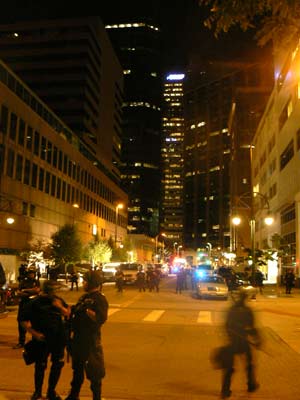
den-mon-vertical.jpgDENVER- Night has just fallen and a helicopter searchlight has moved from North of the Capitol, to Civic Center Park, to the downtown center. Police in riot gear are rounding corners off to the North East. Police troops riding SUVs are coming from the southern parts. I’m riding on the 16th Street Mall shuttle. As I get out, I see the bus has been followed by two white vans full of policemen. Across my path toward where Marie is waiting are a dozen bicycle cops.

Of course here we are live-blogging about DPD troop movements. Suddenly the server seems to be acting buggy.

If you think I’m suffering delusions of grandeur when I imagine that every cop I pass seems to be reporting the event into his headpiece, consider the budget they’re spending on all of us.

Denver spent fifty million on DNC security, including a Super Fusion Center. They expected fifty thousand protesters. That makes for some easy math. $50M divided by 50k means a thousand dollars of equipment and manpower had been allocated for each protester. Since fewer than expected showed up, that’s a lot of intelligence firepower to spread over quite a bit fewer than 50 thousand protesters.

If we figure the demonstrations thus far have drawn five thousand persons of interest. Would that mean $10,000 is being spent on each? Probably the figure’s more like 1,000 people who could be considered to pose an imagined risk. That would mean $50,000 per. Over the course of five days, that’s $10,000 each person, each day. Figuring 90% of the security budget might have been spent on equipment, $1,000 per day would remain to pay, what, seven law enforcement personnel working overtime for each citizen suspect?

If you consider yourself unpredictably active enough to be among those thousand, tomorrow, when you are facing a line of armor clad riot cops, pick out seven and have them call you Sir.

It’d be a symbolic gesture. Probably the actual DPD staff allocated to you personally is comprised of three riot cops, one plain-clothed informer, and two surveillance analysts. Does that leave one unaccounted for? One full time person working on who knows what about you? Very likely.

It’s hard not to feel special.

Money making opportunity at the DNC

Shake Your Money MakerDENVER- Recreate-68’s Monday 5PM event “Shake Your Money Maker” is about encircling the Denver Mint and levitating it to return the banking system’s hoarded riches to the people. If that doesn’t sound lucrative enough for you, other Take Back the Streets actions are promoted with fliers which promise to improve your material conditions. While some might think that’s an all out call for looting, organizers insist participation is “character enriching.” But the DNC will indeed provide a high road to riches if you read the news from NY.

Come to demonstrate. March. Put your body smack dab into your right to assemble. Do what you know you have a legal right to do. Let them arrest you for that.

The Denver Police Department is circulating a brochure with tips for DNC protesters. Right at the top they explain, that regardless whether you think you’re in the right, if a police officer orders you to disperse, you must. Oh MUST you?

A law abiding citizen must obey a lawful order given you by an officer of the law. Do you sense what’s missing in their instruction?

The DPD has also issued instructions to its first responders to be on the lookout for protesters with maps and bikes which could be used to aid and abet demonstrators with violent intentions.

Get yourself caught up in their dragnet. Be detained. Then step right up into the line for the class action suit that will follow.

Less you feel like you’re gamaing the system, don’t worry, the lawsuit award has been budgeted. That’s been the pattern. Clear the streets, pay the legal claims against you. Until the penalty is really punitive, cities which face mass protests will continue to violate its citizen’s civil liberties.

Take the money. It may be the only instance where Homeland Security spending will go to the disadvantaged or you.

Peace community impostors

impostor and saboteurWhether by willful incompetence or by sabotage, the damage is the same.
 
ACCUSED: meeting in secret with Police, un-publicizing events, un-coordinating the volunteers, stymieing meetings, neglecting a website, and stopping others from addressing such tasks; paying themselves 130% of the budget; insubordination and interfering with the board of directors to avoid oversight; hindering, thwarting or otherwise prohibiting successful planning and execution of activities.

Tattoos and Ayn Rand Thought

gazette.jpg ———– The Gazette editorialist got out his little Ayn Rand ‘Atlas Shrugged’ book last Monday, waved it in the air, and pronounced it a good thing that El Paso County (Big Bad Government!) was no longer going to inspect tattoo parlors in the area. This is the same nut case at the paper that is all ‘for the troops’. Well, who does he think goes to many of these tattoo parlors? Well, it is the troops, Sir.

The Gazette is run my a bunch of sad sack ideologues who are always against Big Government, except when Big, Big, BIG GOVERNMENT is destroying somebody else’s country and making Big, Big, BIG BUSINESS a killing in tax payer paid government contracts. But when it comes to protecting the troops from getting AIDS or Hepatitis at the tattoo parlor, well The Gazette is against the County checking out the sanitation there! Sick. See below…
———————————-

July 14, 2008 – 9:57PM The Gazette
SELF-POLICING TATTOO JOINTS
Don’t involve county in body art

You walk into Bob’s Tattoos seeking service. You want a bone through your nose and the Virgin Mary etched into your arm. Something’s not right. You’re struck by the stench of kitty litter and other strange smells. You’re introduced to 300-pound Bob, the parlor’s founding partner and managing artist. Bob wears a grubby muscle shirt and Dolfin shorts to show off his own tattoos. They don’t look so good, but that’s OK because Bob explains he got them in prison, and not at Bob’s Tattoos. What do you do?

A. Look for a certificate from the county that says Bob’s OK to pierce your nose and jam ink into your skin.

B. Leave, and do some research. Speak with multiple peers with good body art, and ask them which parlors do it best. Find a reputable shop, check it through the Better Business Bureau, and then personally assess the risks.

Unless you’re ultra brave, the correct answer is “B.” After all, even Bob’s Tattoos could look good on the day of a county inspection. And even a once-good tattoo business can go downhill after getting a stamp of approval from the county.

The right tattoo on the right part of the right person can be a fine thing. But good, safe results aren’t something the county can or should try to ensure. If ever there were an activity in which the buyer must beware, it’s the business of shopping for body art.

The mere fact that so-called painful cuts to El Paso County’s budget involve the elimination of tattoo parlor inspections indicates fiscal excess. The health department has no legitimate reason for spending nearly $30,000 annually to inspect tattoo parlors.

It’s not in question that dirty body art tools can lead to infection and disease. But nobody is required to commission a tattoo, and the majority of citizens never do. It’s a risk anyone can easily avoid by simply choosing against body art. Those who do seek tattoos and such ought to be responsible for assessing the risks themselves. The tattoo-free public shouldn’t be forced to subsidize needless, private, elective bodily expressions.

The county’s Board of Health plans to vote Wednesday on whether to permanently eliminate inspections, and most certainly they should. Tattoo artists are organizing to converge on the meeting, however, urging the county to maintain inspections.

The fact that responsible tattoo parlors favor county inspections isn’t surprising. An approval certificate is like a valuable reward for good, clean practices. The inspection requirement creates a layer of bureaucracy that serves as a hurdle to entry. It dissuades cheap, startup fly-by-night operators from wanting to set up shop and compete. It also eases concerns of customers who might otherwise ask lots of questions or chicken out of getting tattooed.

Tattoo artists, however, don’t need government to give them a useful stamp of approval. Reputations speak for themselves, and stamps of approval are best obtained through private associations of professionals. Free publications that sell advertising, for example, pay private auditing associations to verify circulations. Without the audit, it’s hard to compete. Lawyers join private associations, such as the American Bar Association, that enforce standards on members and offer assurances to customers. Good tattoo artists, if they wish to separate themselves from the riffraff, need to form a credible organization that sells a stamp of approval to those who qualify.

No stamp of approval, however, should weigh in too heavily when it comes to letting someone inject ink beneath your skin. Few transactions require more personal information and diligence than the purchase of a tattoo. Good, safe tattoos aren’t something the county can or should guarantee. Nothing can replace the ages old advice: Buyer beware. Besides, tattoos are free-spirited expressions of individuality. Don’t involve the county in what’s otherwise a solid act of rebellion.

CSPD forced to give unwarranted tickets

COLORADO SPRINGS- Of course it’s imperative to take a hard line on dishonest officers of the law. But I have mixed emotions about these two: 2 MOTORCYCLE COPS FALSIFIED TICKET NUMBERS. They weren’t issuing unwarranted tickets. No, they were in trouble for wanting NOT to give out unwarranted tickets. Should that be discouraged? Let’s give the officers a medal for bringing a bad bit of law enforcement policy to light. But I want to see a third policeman in bigger trouble. incredibly, “A police spokesman said there are no ticket quotas.”

Wouldn’t you say that policemen who lie to us about how laws are being enforced are about as bad as it could possibly get? “Lt David Whitlock said no such order exists in the General Orders that govern Colorado Springs police.” Why were the traffic officers compelled to falsify their ticket numbers? The forked-tongue spokesman “could not rule out the possibility of a ‘minimum performance standard.’

There it is. Totalitarian doublespeak. We don’t torture people in jail, we just have ‘minimum comfort requirements.’ What assholes!

We don’t want quotas by any definition! We may laugh about means to keep police officers from the donut shops, but it’s up to their supervisors to make sure they are doing their jobs. We don’t need them returning with scalps to prove they’ve been busy, regardless whether their victims were law-breakers. Can we mandate that traffic cops write forty tickets a day if they don’t encounter 40 infractions on their rounds? By relying on revenue from traffic citations to meet their budget requirements, the CSPD may be encouraging worse falsification. False charges, false witness, false arrest.

How exactly did management catch up with these two? Was there a budget shortfall when forecasted ticket earnings -based on the policemen’s paperwork- did not match the Municipal Court takings?

Global economic rapists are at it again

G8 protest
Why protest the G8 Summit July 7-9? Those hoodlums always look so determined. Here’s the rationale by the Emergency Exit Collective:

The 2008 G8 on Hokkaido, a Strategic Assessment
Emergency Exit Collective
Bristol, Mayday, 2008

The authors of this document are a collection of activists, scholars, and writers currently based in the United States and Western Europe who have gotten to know and work with each other in the movement against capitalist globalization. We’re writing this at the request of some members of No! G8 Action Japan, who asked us for a broad strategic analysis of the state of struggle as we see it, and particularly, of the role of the G8, what it represents, the dangers and opportunities that may lie hidden in the moment. It is in no sense programmatic. Mainly, it is an attempt to develop tools that we hope will be helpful for organizers, or for anyone engaged in the struggle against global capital.

I
It is our condition as human beings that we produce our lives in common.

II
Let us then try to see the world from the perspective of the planet’s commoners, taking the word in that sense: those whose most essential tradition is cooperation in the making and maintenance of human social life, yet who have had to do so under conditions of suffering and separation; deprived, ignored, devalued, divided into hierarchies, pitted against each other for our very physical survival. In one sense we are all commoners. But it’s equally true that just about everyone, at least in some ways, at some points, plays the role of the rulers—of those who expropriate, devalue and divide—or at the very least benefits from such divisions.

Obviously some do more than others. It is at the peak of this pyramid that we encounter groups like the G8.

III
The G8’s perspective is that of the aristocrats, the rulers: those who command and maintain that global machinery of violence that defends existing borders and lines of separation: whether national borders with their detention camps for migrants, or property regimes, with their prisons for the poor. They live by constantly claiming title to the products of others collective creativity and labour, and in thus doing they create the poor; they create scarcity in the midst of plenty, and divide us on a daily basis; they create financial districts that loot resources from across the world, and in thus doing they turn the spirit of human creativity into a spiritual desert; close or privatize parks, public water taps and libraries, hospitals, youth centers, universities, schools, public swimming pools, and instead endlessly build shopping malls that channels convivial life into a means of commodity circulation; work toward turning global ecological catastrophe into business opportunities.

These are the people who presume to speak in the name of the “international community” even as they hide in their gated communities or meet protected by phalanxes of riot cops. It is critical to bear in mind that the ultimate aim of their policies is never to create community but to introduce and maintain divisions that set common people at each other’s throats. The neoliberal project, which has been their main instrument for doing so for the last three decades, is premised on a constant effort either to uproot or destroy any communal or democratic system whereby ordinary people govern their own affairs or maintain common resources for the common good, or, to reorganize each tiny remaining commons as an isolated node in a market system in which livelihood is never guaranteed, where the gain of one community must necessarily be at the expense of others. Insofar as they are willing to appeal to high-minded principles of common humanity, and encourage global cooperation, only and exactly to the extent that is required to maintain this system of universal competition.

IV
At the present time, the G8—the annual summit of the leaders of “industrial democracies”—is the key coordinative institution charged with the task of maintaining this neoliberal project, or of reforming it, revising it, adapting it to the changing condition of planetary class relations. The role of the G8 has always been to define the broad strategic horizons through which the next wave of planetary capital accumulation can occur. This means that its main task is to answer the question of how 3?4 in the present conditions of multiple crises and struggles 3?4 to subordinate social relations among the producing commoners of the planet to capital’s supreme value: profit.

V
Originally founded as the G7 in 1975 as a means of coordinating financial strategies for dealing with the ‘70s energy crisis, then expanded after the end of the Cold War to include Russia, its currently face a moment of profound impasse in the governance of planetary class relations: the greatest since the ‘70s energy crisis itself.

VI
The ‘70s energy crisis represented the final death-pangs of what might be termed the Cold War settlement, shattered by a quarter century of popular struggle. It’s worth returning briefly to this history.

The geopolitical arrangements put in place after World War II were above all designed to forestall the threat of revolution. In the immediate wake of the war, not only did much of the world lie in ruins, most of world’s population had abandoned any assumption about the inevitability of existing social arrangements. The advent of the Cold War had the effect of boxing movements for social change into a bipolar straightjacket. On the one hand, the former Allied and Axis powers that were later to unite in the G7 (the US, Canada, UK, France, Italy, Germany, Japan)—the “industrialized democracies”, as they like to call themselves—engaged in a massive project of co-optation. Their governments continued the process, begun in the ‘30s, of taking over social welfare institutions that had originally been created by popular movements (from insurance schemes to public libraries), even to expand them, on condition that they now be managed by state-appointed bureaucracies rather than by those who used them, buying off unions and the working classes more generally with policies meant to guarantee high wages, job security and the promise of educational advance—all in exchange for political loyalty, productivity increases and wage divisions within national and planetary working class itself. The Sino-Soviet bloc—which effectively became a kind of junior partner within the overall power structure, and its allies remained to trap revolutionary energies into the task of reproducing similar bureaucracies elsewhere. Both the US and USSR secured their dominance after the war by refusing to demobilize, instead locking the planet in a permanent threat of nuclear annihilation, a terrible vision of absolute cosmic power.

VII
Almost immediately, though, this arrangement was challenged by a series of revolts from those whose work was required to maintain the system, but who were, effectively, left outside the deal: first, peasants and the urban poor in the colonies and former colonies of the Global South, next, disenfranchised minorities in the home countries (in the US, the Civil Rights movement, then Black Power), and finally and most significantly, by the explosion of the women’s movement of the late ‘60s and early ‘70s—the revolt of that majority of humanity whose largely unremunerated labor made the very existence “the economy” possible. This appears to have been the tipping point.

VIII
The problem was that the Cold War settlement was never meant to include everyone. It by definition couldn’t. Once matters reached tipping point, then, the rulers scotched the settlement. All deals were off. The oil shock was first edge of the counter-offensive, breaking the back of existing working class organizations, driving home the message that there was nothing guaranteed about prosperity. Under the aegis of the newly hatched G7, this counter-offensive involved a series of interwoven strategies that were later to give rise to what is known as neoliberalism.

IX
These strategies resulted in what came to be known as “Structural Adjustment” both in the North and in the South, accompanied by trade and financial liberalization. This, in turn, made possible crucial structural changes in our planetary production in common extending the role of the market to discipline our lives and divide us into more and more polarized wage hierarchy. This involved:

· In the immediate wake of ‘70s oil shock, petrodollars were recycled from OPEC into Northern banks that then lent them, at extortionate rates of interest, to developing countries of the Global South. This was the origin of the famous “Third World Debt Crisis.” The existence of this debt allowed institutions like the IMF to impose its monetarist orthodoxy on most of the planet for roughly twenty years, in the process, stripping away most of even those modest social protections that had been won by the world’s poor—large numbers of whom were plunged into a situation of absolute desperation.

· It also opened a period of new enclosures through the capitalist imposition of structural adjustment policies, manipulation of environmental and social catastrophes like war, or for that matter through the authoritarian dictates of “socialist” regimes. Through such means, large sections of the world’s population have over the past thirty years been dispossessed from resources previously held in common, either by dint of long traditions, or as the fruits of past struggles and past settlements.

· Through financial deregulation and trade liberalization, neoliberal capital, which emerged from the G7 strategies to deal with the 1970s crisis aimed thus at turning the “class war” in communities, factories, offices, streets and fields against the engine of competition, into a planetary “civil war”, pitting each community of commoners against every other community of commoners.

· Neoliberal capital has done this by imposing an ethos of “efficiency” and rhetoric of “lowering the costs of production” applied so broadly that mechanisms of competition have come to pervade every sphere of life. In fact these terms are euphemisms, for a more fundamental demand: that capital be exempt from taking any reduction in profit to finance the costs of reproduction of human bodies and their social and natural environments (which it does not count as costs) and which are, effectively, “exernalized” onto communities and nature.

· The enclosure of resources and entitlements won in previous generations of struggles both in the North and the South, in turn, created the conditions for increasing the wage hierarchies (both global and local), by which commoners work for capital—wage hierarchies reproduced economically through pervasive competition, but culturally, through male dominance, xenophobia and racism. These wage gaps, in turn, made it possible to reduce the value of Northern workers’ labour power, by introducing commodities that enter in their wage basket at a fraction of what their cost might otherwise have been. The planetary expansion of sweatshops means that American workers (for example) can buy cargo pants or lawn-mowers made in Cambodia at Walmart, or buy tomatoes grown by undocumented Mexican workers in California, or even, in many cases, hire Jamaican or Filipina nurses to take care of children and aged grandparents at such low prices, that their employers have been able to lower real wages without pushing most of them into penury. In the South, meanwhile, this situation has made it possible to discipline new masses of workers into factories and assembly lines, fields and offices, thus extending enormously capital’s reach in defining the terms—the what, the how, the how much—of social production.

· These different forms of enclosures, both North and South, mean that commoners have become increasingly dependent on the market to reproduce their livelihoods, with less power to resist the violence and arrogance of those whose priorities is only to seek profit, less power to set a limit to the market discipline running their lives, more prone to turn against one another in wars with other commoners who share the same pressures of having to run the same competitive race, but not the same rights and the same access to the wage. All this has meant a generalized state of precarity, where nothing can be taken for granted.

X
In turn, this manipulation of currency and commodity flows constituting neoliberal globalization became the basis for the creation of the planet’s first genuine global bureaucracy.

· This was multi-tiered, with finance capital at the peak, then the ever-expanding trade bureaucracies (IMF, WTO, EU, World Bank, etc), then transnational corporations, and finally, the endless varieties of NGOs that proliferated throughout the period—almost all of which shared the same neoliberal orthodoxy, even as they substituted themselves for social welfare functions once reserved for states.

· The existence of this overarching apparatus, in turn, allowed poorer countries previously under the control of authoritarian regimes beholden to one or another side in the Cold War to adopt “democratic” forms of government. This did allow a restoration of formal civil liberties, but very little that could really merit the name of democracy (the rule of the “demos”, i.e., of the commoners). They were in fact constitutional republics, and the overwhelming trend during the period was to strip legislatures, that branch of government most open to popular pressure, of most of their powers, which were increasingly shifted to the executive and judicial branches, even as these latter, in turn, largely ended up enacting policies developed overseas, by global bureaucrats.

· This entire bureaucratic arrangement was justified, paradoxically enough, by an ideology of extreme individualism. On the level of ideas, neoliberalism relied on a systematic cooptation of the themes of popular struggle of the ‘60s: autonomy, pleasure, personal liberation, the rejection of all forms of bureaucratic control and authority. All these were repackaged as the very essence of capitalism, and the market reframed as a revolutionary force of liberation.

· The entire arrangement, in turn, was made possible by a preemptive attitude towards popular struggle. The breaking of unions and retreat of mass social movements from the late ‘70s onwards was only made possible by a massive shift of state resources into the machinery of violence: armies, prisons and police (secret and otherwise) and an endless variety of private “security services”, all with their attendant propaganda machines, which tended to increase even as other forms of social spending were cut back, among other things absorbing increasing portions of the former proletariat, making the security apparatus an increasingly large proportion of total social spending. This approach has been very successful in holding back mass opposition to capital in much of the world (especially West Europe and North America), and above all, in making it possible to argue there are no viable alternatives. But in doing so, has created strains on the system so profound it threatens to undermine it entirely.

XI
The latter point deserves elaboration. The element of force is, on any number of levels, the weak point of the system. This is not only on the constitutional level, where the question of how to integrate the emerging global bureaucratic apparatus, and existing military arrangements, has never been resolved. It is above all an economic problem. It is quite clear that the maintenance of elaborate security machinery is an absolute imperative of neoliberalism. One need only observe what happened with the collapse of the Soviet bloc in Eastern Europe: where one might have expected the Cold War victors to demand the dismantling of the army, secret police and secret prisons, and to maintain and develop the existing industrial base, in fact, what they did was absolutely the opposite: in fact, the only part of the industrial base that has managed fully to maintain itself has been the parts required to maintained the security apparatus itself! Critical too is the element of preemption: the governing classes in North America, for example, are willing to go to almost unimaginable lengths to ensure social movements never feel they are accomplishing anything. The current Gulf War is an excellent example: US military operations appear to be organized first and foremost to be protest-proof, to ensure that what happened in Vietnam (mass mobilization at home, widespread revolt within the army overseas) could never be repeated. This means above all that US casualties must always be kept to a minimum. The result are rules of engagement, and practices like the use of air power within cities ostensibly already controlled by occupation forces, so obviously guaranteed to maximize the killing of innocents and galvanizing hatred against the occupiers that they ensure the war itself cannot be won. Yet this approach can be taken as the very paradigm for neoliberal security regimes. Consider security arrangements around trade summits, where police are so determined prevent protestors from achieving tactical victories that they are often willing to effectively shut down the summits themselves. So too in overall strategy. In North America, such enormous resources are poured into the apparatus of repression, militarization, and propaganda that class struggle, labor action, mass movements seem to disappear entirely. It is thus possible to claim we have entered a new age where old conflicts are irrelevant. This is tremendously demoralizing of course for opponents of the system; but those running the system seem to find that demoralization so essential they don’t seem to care that the resultant apparatus (police, prisons, military, etc) is, effectively, sinking the entire US economy under its dead weight.

XII
The current crisis is not primarily geopolitical in nature. It is a crisis of neoliberalism itself. But it takes place against the backdrop of profound geopolitical realignments. The decline of North American power, both economic and geopolitical has been accompanied by the rise of Northeast Asia (and to a increasing extent, South Asia as well). While the Northeast Asian region is still divided by painful Cold War cleavages—the fortified lines across the Taiwan straits and at the 38th parallel in Korea…—the sheer realities of economic entanglement can be expected to lead to a gradual easing of tensions and a rise to global hegemony, as the region becomes the new center of gravity of the global economy, of the creation of new science and technology, ultimately, of political and military power. This may, quite likely, be a gradual and lengthy process. But in the meantime, very old patterns are rapidly reemerging: China reestablishing relations with ancient tributary states from Korea to Vietnam, radical Islamists attempting to reestablish their ancient role as the guardians of finance and piety at the in the Central Asian caravan routes and across Indian Ocean, every sort of Medieval trade diaspora reemerging… In the process, old political models remerge as well: the Chinese principle of the state transcending law, the Islamic principle of a legal order transcending any state. Everywhere, we see the revival too of ancient forms of exploitation—feudalism, slavery, debt peonage—often entangled in the newest forms of technology, but still echoing all the worst abuses of the Middle Ages. A scramble for resources has begun, with US occupation of Iraq and saber-rattling throughout the surrounding region clearly meant (at least in part) to place a potential stranglehold the energy supply of China; Chinese attempts to outflank with its own scramble for Africa, with increasing forays into South America and even Eastern Europe. The Chinese invasion into Africa (not as of yet at least a military invasion, but already involving the movement of hundreds of thousands of people), is changing the world in ways that will probably be felt for centuries. Meanwhile, the nations of South America, the first victims of the “Washington consensus” have managed to largely wriggle free from the US colonial orbit, while the US, its forces tied down in the Middle East, has for the moment at least abandoned it, is desperately struggling to keep its grip Mexico, Central America and the Caribbean—its own “near abroad”.

XIII
In another age all this might have led to war—that is, not just colonial occupations, police actions, or proxy wars (which are obviously already taking place), but direct military confrontations between the armies of major powers. It still could; accidents happen; but there is reason to believe that, when it comes to moments of critical decision, the loyalties of the global elites are increasingly to each other, and not to the national entities for whom they claim to speak. There is some compelling evidence for this.

Take for example when the US elites panicked at the prospect of the massive budget surpluses of the late 1990s. As Alan Greenspan, head of the Federal Reserve at the time warned, if these were allowed to stand they would have flooded government coffers with so many trillions of dollars that it could only have lead to some form of creeping socialism, even, he predicted, to the government acquiring “equity stakes” in key US corporations. The more excitable of capitalism’s managers actually began contemplating scenarios where the capitalist system itself would be imperiled. The only possible solution was massive tax cuts; these were duly enacted, and did indeed manage to turn surpluses into enormous deficits, financed by the sale of treasury bonds to Japan and China. Conditions have thus now reached a point where it is beginning to look as if the most likely long term outcome for the US (its technological and industrial base decaying, sinking under the burden of its enormous security spending) will be to end up serve as junior partner and military enforcer for East Asia capital. Its rulers, or at least a significant proportion of them, would prefer to hand global hegemony to the rulers of China (provided the latter abandon Communism) than to return to any sort of New Deal compromise with their “own” working classes.

A second example lies in the origins of what has been called the current “Bretton Woods II” system of currency arrangements, which underline a close working together of some “surplus” and “deficit” countries within global circuits. The macroeconomic manifestation of the planetary restructuring outlined in XIX underlines both the huge US trade deficit that so much seem to worry many commentators, and the possibility to continually generate new debt instruments like the one that has recently resulted in the sub-prime crisis. The ongoing recycling of accumulated surplus of countries exporting to the USA such as China and oil producing countries is what has allowed financiers to create new credit instruments in the USA. Hence, the “deal” offered by the masters in the United States to its commoners has been this: ‘you, give us a relative social peace and accept capitalist markets as the main means through which you reproduce your own livelihoods, and we will give you access to cheaper consumption goods, access to credit for buying cars and homes, and access to education, health, pensions and social security through the speculative means of stock markets and housing prices.’ Similar compromises were reached in all the G8 countries.

Meanwhile, there is the problem of maintaining any sort of social peace with the hundreds of millions of unemployed, underemployed, dispossessed commoners currently swelling the shanty-towns of Asia, Africa, and Latin America as a result of ongoing enclosures (which have speeded up within China and India in particular, even as “structural adjustment policies” in Africa and Latin America have been derailed). Any prospect of maintaining peace in these circumstances would ordinarily require either extremely high rates of economic growth—which globally have not been forthcoming, since outside of China, growth rates in the developing world have been much lower than they were in the ‘50s, ‘60s, or even ‘70s—or extremely high levels of repression, lest matters descend into rebellion or generalized civil war. The latter has of course occurred in many parts of the world currently neglected by capital, but in favored regions, such as the coastal provinces of China, or “free trade” zones of India, Egypt, or Mexico, commoners are being offered a different sort of deal: industrial employment at wages that, while very low by international standards, are still substantially higher than anything currently obtainable in the impoverished countryside; and above all the promise, through the intervention of Western markets and (privatized) knowledge, of gradually improving conditions of living. While over the least few years wages in many such areas seem to be growing, thanks to the intensification of popular struggles, such gains are inherently vulnerable: the effect of recent food inflation has been to cut real wages back dramatically—and threaten millions with starvation.

What we really want to stress here, though, is that the long-term promise being offered to the South is just as untenable as the idea that US or European consumers can indefinitely expand their conditions of life through the use of mortgages and credit cards.

What’s being offered the new dispossessed is a transposition of the American dream. The idea is that the lifestyle and consumption patterns of existing Chinese, Indian, or Brazilian or Zambian urban middle classes (already modeled on Northern ones) will eventually become available to the children of today’s miners, maquila or plantation laborers, until, ultimately, everyone on earth is brought up to roughly the same level of consumption. Put in these terms, the argument is absurd. The idea that all six billion of us can become “middle class” is obviously impossible. First of all there is a simple problem of resources. It doesn’t matter how many bottles we recycle or how energy efficient are the light bulbs we use, there’s just no way the earth’s ecosystem can accommodate six billion people driving in private cars to work in air-conditioned cubicles before periodically flying off to vacation in Acapulco or Tahiti. To maintain the style of living and producing in common we now identify with “middle classness” on a planetary scale would require several additional planets.

This much has been pointed out repeatedly. But the second point is no less important. What this vision of betterment ultimately proposes is that it would be possible to build universal prosperity and human dignity on a system of wage labor. This is fantasy. Historically, wages are always the contractual face for system of command and degradation, and a means of disguising exploitation: expressing value for work only on condition of stealing value without work— and there is no reason to believe they could ever be anything else. This is why, as history has also shown, human beings will always avoid working for wages if they have any other viable option. For a system based on wage labor to come into being, such options must therefore be made unavailable. This in turn means that such systems are always premised on structures of exclusion: on the prior existence of borders and property regimes maintained by violence. Finally, historically, it has always proved impossible to maintain any sizeable class of wage-earners in relative prosperity without basing that prosperity, directly or indirectly, on the unwaged labor of others—on slave-labor, women’s domestic labor, the forced labor of colonial subjects, the work of women and men in peasant communities halfway around the world—by people who are even more systematically exploited, degraded, and immiserated. For that reason, such systems have always depended not only on setting wage-earners against each other by inciting bigotry, prejudice, hostility, resentment, violence, but also by inciting the same between men and women, between the people of different continents (“race”), between the generations.

From the perspective of the whole, then, the dream of universal middle class “betterment” must necessarily be an illusion constructed in between the Scylla of ecological disaster, and the Charybdis of poverty, detritus, and hatred: precisely, the two pillars of today’s strategic impasse faced by the G8.

XIV
How then do we describe the current impasse of capitalist governance?

To a large degree, it is the effect of a sudden and extremely effective upswing of popular resistance—one all the more extraordinary considering the huge resources that had been invested in preventing such movements from breaking out.

On the one hand, the turn of the millennium saw a vast and sudden flowering of new anti-capitalist movements, a veritable planetary uprising against neoliberalism by commoners in Latin America, India, Africa, Asia, across the North Atlantic world’s former colonies and ultimately, within the cities of the former colonial powers themselves. As a result, the neoliberal project lies shattered. What came to be called the “anti-globalization” movement took aim at the trade bureaucracies—the obvious weak link in the emerging institutions of global administration—but it was merely the most visible aspect of this uprising. It was however an extraordinarily successful one. Not only was the WTO halted in its tracks, but all major trade initiatives (MAI, FTAA…) scuttled. The World Bank was hobbled and the power of the IMF over most of the world’s population, effectively, destroyed. The latter, once the terror of the Global South, is now a shattered remnant of its former self, reduced to selling off its gold reserves and desperately searching for a new global mission.

In many ways though spectacular street actions were merely the most visible aspects of much broader changes: the resurgence of labor unions, in certain parts of the world, the flowering of economic and social alternatives on the grassroots levels in every part of the world, from new forms of direct democracy of indigenous communities like El Alto in Bolivia or self-managed factories in Paraguay, to township movements in South Africa, farming cooperatives in India, squatters’ movements in Korea, experiments in permaculture in Europe or “Islamic economics” among the urban poor in the Middle East. We have seen the development of thousands of forms of mutual aid association, most of which have not even made it onto the radar of the global media, often have almost no ideological unity and which may not even be aware of each other’s existence, but nonetheless share a common desire to mark a practical break with capitalism, and which, most importantly, hold out the prospect of creating new forms of planetary commons that can—and in some cases are—beginning to knit together to provide the outlines of genuine alternative vision of what a non-capitalist future might look like.

The reaction of the world’s rulers was predictable. The planetary uprising had occurred during a time when the global security apparatus was beginning to look like it lacked a purpose, when the world threatened to return to a state of peace. The response—aided of course, by the intervention of some of the US’ former Cold War allies, reorganized now under the name of Al Qaeda—was a return to global warfare. But this too failed. The “war on terror”—as an attempt to impose US military power as the ultimate enforcer of the neoliberal model—has collapsed as well in the face of almost universal popular resistance. This is the nature of their “impasse”.

At the same time, the top-heavy, inefficient US model of military capitalism—a model created in large part to prevent the dangers of social movements, but which the US has also sought to export to some degree simply because of its profligacy and inefficiency, to prevent the rest of the world from too rapidly overtaking them—has proved so wasteful of resources that it threatens to plunge the entire planet into ecological and social crisis. Drought, disaster, famines, combine with endless campaigns of enclosure, foreclosure, to cast the very means of survival—food, water, shelter—into question for the bulk of the world’s population.

XV
In the rulers’ language the crisis understood, first and foremost, as a problem of regulating cash flows, of reestablishing, as they like to put it, a new “financial architecture”. Obviously they are aware of the broader problems. Their promotional literature has always been full of it. From the earliest days of the G7, through to the days after the Cold War, when Russia was added as a reward for embracing capitalism, they have always claimed that their chief concerns include

· the reduction of global poverty

· sustainable environmental policies

· sustainable global energy policies

· stable financial institutions governing global trade and currency transactions

If one were to take such claims seriously, it’s hard to see their overall performance as anything but a catastrophic failure. At the present moment, all of these are in crisis mode: there are food riots, global warming, peak oil, and the threat of financial meltdown, bursting of credit bubbles, currency crises, a global credit crunch. [**Failure on this scale however, opens opportunities for the G8 themselves, as summit of the global bureaucracy, to reconfigure the strategic horizon. Therefore, it’s always with the last of these that they are especially concerned. ]The real problem, from the perspective of the G8, is one of reinvestment: particularly, of the profits of the energy sector, but also, now, of emerging industrial powers outside the circle of the G8 itself. The neoliberal solution in the ‘70s had been to recycle OPEC’s petrodollars into banks that would use it much of the world into debt bondage, imposing regimes of fiscal austerity that, for the most part, stopped development (and hence, the emergence potential rivals) in its tracks. By the ‘90s, however, much East Asia in particular had broken free of this regime. Attempts to reimpose IMF-style discipline during the Asian financial crisis of 1997 largely backfired. So a new compromise was found, the so-called Bretton Woods II: to recycle the profits from the rapidly expanding industrial economies of East Asia into US treasury debt, artificially supporting the value of the dollar and allowing a continual stream of cheap exports that, aided by the US housing bubble, kept North Atlantic economies afloat and buy off workers there with cheap oil and even cheaper consumer goods even as real wages shrank. This solution however soon proved a temporary expedient. Bush regime’s attempt to lock it in by the invasion of Iraq, which was meant to lead to the forced privatization of Iraqi oil fields, and, ultimately, of the global oil industry as a whole, collapsed in the face of massive popular resistance (just as Saddam Hussein’s attempt to introduce neoliberal reforms in Iraq had failed when he was still acting as American deputy in the ‘90s). Instead, the simultaneous demand for petroleum for both Chinese manufacturers and American consumers caused a dramatic spike in the price of oil. What’s more, rents from oil and gas production are now being used to pay off the old debts from the ‘80s (especially in Asia and Latin America, which have by now paid back their IMF debts entirely), and—increasingly—to create state-managed Sovereign Wealth Funds that have largely replaced institutions like the IMF as the institutions capable of making long-term strategic investments. The IMF, purposeless, tottering on the brink of insolvency, has been reduced to trying to come up with “best practices” guidelines for fund managers working for governments in Singapore, Seoul, and Abu Dhabi.

There can be no question this time around of freezing out countries like China, India, or even Brazil. The question for capital’s planners, rather, is how to channel these new concentrations of capital in such a way that they reinforce the logic of the system instead of undermining it.

XVI
How can this be done? This is where appeals to universal human values, to common membership in an “international community” come in to play. “We all must pull together for the good of the planet,” we will be told. The money must be reinvested “to save the earth.”

To some degree this was always the G8 line: this is a group has been making an issue of climate change since 1983. Doing so was in one sense a response to the environmental movements of the ‘70s and ‘80s. The resultant emphasis on biofuels and “green energy” was from their point of view, the perfect strategy, seizing on an issue that seemed to transcend class, appropriating ideas and issues that emerged from social movements (and hence coopting and undermining especially their radical wings), and finally, ensuring such initiatives are pursued not through any form of democratic self-organization but “market mechanisms”—to effective make the sense of public interest productive for capitalism.

What we can expect now is a two-pronged attack. On the one hand, they will use the crisis to attempt to reverse the gains of past social movements: to put nuclear energy back on the table to deal with the energy crisis and global warming, or genetically modified foods to deal with the food crisis. Prime Minister Fukuda, the host of the current summit, for example, is already proposing the nuclear power is the “solution” to the global warming crisis, even as the German delegation resists. On the other, and even more insidiously, they will try once again to co-opt the ideas and solutions that have emerged from our struggles as a way of ultimately undermining them. Appropriating such ideas is simply what rulers do: the bosses brain is always under the workers’ hat. But the ultimate aim is to answer the intensification of class struggle, of the danger of new forms of democracy, with another wave of enclosures, to restore a situation where commoners’ attempts to create broader regimes of cooperation are stymied, and people are plunged back into mutual competition.

We can already see the outlines of how this might be done. There are already suggestions that Sovereign Wealth Funds put aside a certain (miniscule) proportion of their money for food aid, but only as tied to a larger project of global financial restructuring. The World Bank, largely bereft of its earlier role organizing dams and pipe-lines across the world, has been funding development in China’s poorer provinces, freeing the Chinese government to carry out similar projects in Southeast Asia, Africa, and even Latin America (where, of course, they cannot effectively be held to any sort of labor or environmental standards). There is the possibility of a new class deal in China itself, whose workers can be allowed higher standards of living if new low wage zones are created elsewhere—for instance, Africa (the continent where struggles over maintaining the commons have been most intense in current decades)—with the help of Chinese infrastructural projects. Above of all, money will be channeled into addressing climate change, into the development of alternative energy, which will require enormous investments, in such a way as to ensure that whatever energy resources do become important in this millennium, they can never be democratized—that the emerging notion of a petroleum commons, that energy resources are to some degree a common patrimony meant primarily to serve the community as a whole, that is beginning to develop in parts of the Middle East and South America—not be reproduced in whatever comes next.

Since this will ultimately have to be backed up by the threat of violence, the G8 will inevitably have to struggle with how to (yet again) rethink enforcement mechanisms. The latest move , now that the US “war on terror” paradigm has obviously failed, would appear to be a return to NATO, part of a reinvention of the “European security architecture” being proposed at the upcoming G8 meetings in Italy in 2009 on the 60th anniversary of NATO’s foundation—but part of a much broader movement of the militarization of social conflict, projecting potential resource wars, demographic upheavals resulting from climate change, and radical social movements as potential military problems to be resolved by military means. Opposition to this new project is already shaping up as the major new European mobilization for the year following the current G-8.

XVII
While the G-8 sit at the pinnacle of a system of violence, their preferred idiom is monetary. Their impulse whenever possible is to translate all problems into money, financial structures, currency flows—a substance whose movements they carefully monitor and control.

Money, on might say, is their poetry—a poetry whose letters are written in our blood. It is their highest and most abstract form of expression, their way of making statements about the ultimate truth of the world, even if it operates in large part by making things disappear. How else could it be possible to argue—no, to assume as a matter of common sense—that the love, care, and concern of a person who tends to the needs of children, teaching, minding, helping them to become decent , thoughtful, human beings, or who grows and prepares food, is worth ten thousand times less than someone who spends the same time designing a brand logo, moving abstract blips across a globe, or denying others health care.

The role of money however has changed profoundly since 1971 when the dollar was delinked from gold. This has created a profound realignment of temporal horizons. Once money could be said to be primarily congealed results of past profit and exploitation. As capital, it was dead labor. Millions of indigenous Americans and Africans had their lives pillaged and destroyed in the gold mines in order to be rendered into value. The logic of finance capital, of credit structures, certainly always existed as well (it is at least as old as industrial capital; possibly older), but in recent decades these logic of financial capital has come to echo and re-echo on every level of our lives. In the UK 97% of money in circulation is debt, in the US, 98%. Governments run on deficit financing, wealthy economies on consumer debt, the poor are enticed with microcredit schemes, debts are packaged and repackaged in complex financial derivatives and traded back and forth. Debt however is simply a promise, the expectation of future profit; capital thus increasingly brings the future into the present—a future that, it insists, must always be the same in nature, even if must also be greater in magnitude, since of course the entire system is premised on continual growth. Where once financiers calculated and traded in the precise measure of our degradation, having taken everything from us and turned it into money, now money has flipped, to become the measure of our future degradation—at the same time as it binds us to endlessly working in the present.

The result is a strange moral paradox. Love, loyalty, honor, commitment—to our families, for example, which means to our shared homes, which means to the payment of monthly mortgage debts—becomes a matter of maintaining loyalty to a system which ultimately tells us that such commitments are not a value in themselves. This organization of imaginative horizons, which ultimately come down to a colonization of the very principle of hope, has come to supplement the traditional evocation of fear (of penury, homelessness, joblessness, disease and death). This colonization paralyzes any thought of opposition to a system that almost everyone ultimately knows is not only an insult to everything they really cherish, but a travesty of genuine hope, since, because no system can really expand forever on a finite planet, everyone is aware on some level that in the final analysis they are dealing with a kind of global pyramid scheme, what we are ultimately buying and selling is the real promise of global social and environmental apocalypse.

XVIII
Finally then we come to the really difficult, strategic questions. Where are the vulnerabilities? Where is hope? Obviously we have no certain answers here. No one could. But perhaps the proceeding analysis opens up some possibilities that anti-capitalist organizers might find useful to explore.

One thing that might be helpful is to rethink our initial terms. Consider communism. We are used to thinking of it as a total system that perhaps existed long ago, and to the desire to bring about an analogous system at some point in the future—usually, at whatever cost. It seems to us that dreams of communist futures were never purely fantasies; they were simply projections of existing forms of cooperation, of commoning, by which we already make the world in the present. Communism in this sense is already the basis of almost everything, what brings people and societies into being, what maintains them, the elemental ground of all human thought and action. There is absolutely nothing utopian here. What is utopian, really, is the notion that any form of social organization, especially capitalism, could ever exist that was not entirely premised on the prior existence of communism. If this is true, the most pressing question is simply how to make that power visible, to burst forth, to become the basis for strategic visions, in the face of a tremendous and antagonistic power committed to destroying it—but at the same time, ensuring that despite the challenge they face, they never again become entangled with forms of violence of their own that make them the basis for yet another tawdry elite. After all, the solidarity we extend to one another, is it not itself a form of communism? And is it not so above because it is not coerced?

Another thing that might be helpful is to rethink our notion of crisis. There was a time when simply describing the fact that capitalism was in a state of crisis, driven by irreconcilable contradictions, was taken to suggest that it was heading for a cliff. By now, it seems abundantly clear that this is not the case. Capitalism is always in a crisis. The crisis never goes away. Financial markets are always producing bubbles of one sort or another; those bubbles always burst, sometimes catastrophically; often entire national economies collapse, sometimes the global markets system itself begins to come apart. But every time the structure is reassembled. Slowly, painfully, dutifully, the pieces always end up being put back together once again.

Perhaps we should be asking: why?

In searching for an answer, it seems to us, we might also do well to put aside another familiar habit of radical thought: the tendency to sort the world into separate levels—material realities, the domain of ideas or “consciousness”, the level of technologies and organizations of violence—treating these as if these were separate domains that each work according to separate logics, and then arguing which “determines” which. In fact they cannot be disentangled. A factory may be a physical thing, but the ownership of a factory is a social relation, a legal fantasy that is based partly on the belief that law exists, and partly on the existence of armies and police. Armies and police on the other hand exist partly because of factories providing them with guns, vehicles, and equipment, but also, because those carrying the guns and riding in the vehicles believe they are working for an abstract entity they call “the government”, which they love, fear, and ultimately, whose existence they take for granted by a kind of faith, since historically, those armed organizations tend to melt away immediately the moment they lose faith that the government actually exists. Obviously exactly the same can be said of money. It’s value is constantly being produced by eminently material practices involving time clocks, bank machines, mints, and transatlantic computer cables, not to mention love, greed, and fear, but at the same time, all this too rests on a kind of faith that all these things will continue to interact in more or less the same way. It is all very material, but it also reflects a certain assumption of eternity: the reason that the machine can always be placed back together is, simply, because everyone assumes it must. This is because they cannot realistically imagine plausible alternatives; they cannot imagine plausible alternatives because of the extraordinarily sophisticated machinery of preemptive violence that ensure any such alternatives are uprooted or contained (even if that violence is itself organized around a fear that itself rests on a similar form of faith.) One cannot even say it’s circular. It’s more a kind of endless, unstable spiral. To subvert the system is then, to intervene in such a way that the whole apparatus begins to spin apart.

XIX
It appears to us that one key element here—one often neglected in revolutionary strategy—is the role of the global middle classes. This is a class that, much though it varies from country (in places like the US and Japan, overwhelming majorities consider themselves middle class; in, say, Cambodia or Zambia, only very small percentages), almost everywhere provides the key constituency of the G8 outside of the ruling elite themselves. It has become a truism, an article of faith in itself in global policy circles, that national middle class is everywhere the necessary basis for democracy. In fact, middle classes are rarely much interested in democracy in any meaningful sense of that word (that is, of the self-organization or self-governance of communities). They tend to be quite suspicious of it. Historically, middle classes have tended to encourage the establishment of constitutional republics with only limited democratic elements (sometimes, none at all). This is because their real passion is for a “betterment”, for the prosperity and advance of conditions of life for their children—and this betterment, since it is as noted above entirely premised on structures of exclusion, requires “security”. Actually the middle classes depend on security on every level: personal security, social security (various forms of government support, which even when it is withdrawn from the poor tends to be maintained for the middle classes), security against any sudden or dramatic changes in the nature of existing institutions. Thus, politically, the middle classes are attached not to democracy (which, especially in its radical forms, might disrupt all this), but to the rule of law. In the political sense, then, being “middle class” means existing outside the notorious “state of exception” to which the majority of the world’s people are relegated. It means being able to see a policeman and feel safer, not even more insecure. This would help explain why within the richest countries, the overwhelming majority of the population will claim to be “middle class” when speaking in the abstract, even if most will also instantly switch back to calling themselves “working class” when talking about their relation to their boss.

That rule of law, in turn, allows them to live in that temporal horizon where the market and other existing institutions (schools, governments, law firms, real estate brokerages…) can be imagined as lasting forever in more or less the same form. The middle classes can thus be defined as those who live in the eternity of capitalism. (The elites don’t; they live in history, they don’t assume things will always be the same. The disenfranchized don’t; they don’t have the luxury; they live in a state of precarity where little or nothing can safely be assumed.) Their entire lives are based on assuming that the institutional forms they are accustomed to will always be the same, for themselves and their grandchildren, and their “betterment” will be proportional to the increase in the level of monetary wealth and consumption. This is why every time global capital enters one of its periodic crises, every time banks collapse, factories close, and markets prove unworkable, or even, when the world collapses in war, the managers and dentists will tend to support any program that guarantees the fragments will be dutifully pieced back together in roughly the same form—even if all are, at the same time, burdened by at least a vague sense that the whole system is unfair and probably heading for catastrophe.

XIX
The strategic question then is, how to shatter this sense of inevitability? History provides one obvious suggestion. The last time the system really neared self-destruction was in the 1930s, when what might have otherwise been an ordinary turn of the boom-bust cycle turned into a depression so profound that it took a world war to pull out of it. What was different? The existence of an alternative: a Soviet economy that, whatever its obvious brutalities, was expanding at breakneck pace at the very moment market systems were undergoing collapse. Alternatives shatter the sense of inevitability, that the system must, necessarily, be patched together in the same form; this is why it becomes an absolute imperative of global governance that even small viable experiments in other ways of organizing communities be wiped out, or, if that is not possible, that no one knows about them.

If nothing else, this explains the extraordinary importance attached to the security services and preemption of popular struggle. Commoning, where it already exists, must be made invisible. Alternatives— Zapatistas in Chiapas, APPO in Oaxaca, worker-managed factories in Argentina or Paraguay, community-run water systems in South Africa or Bolivia, living alternatives of farming or fishing communities in India or Indonesia, or a thousand other examples—must be made to disappear, if not squelched or destroyed, then marginalized to the point they seem irrelevant, ridiculous. If the managers of the global system are so determined to do this they are willing to invest such enormous resources into security apparatus that it threatens to sink the system entirely, it is because they are aware that they are working with a house of cards. That the principle of hope and expectation on which capitalism rests would evaporate instantly if almost any other principle of hope or expectation seemed viable.

The knowledge of alternatives, then, is itself a material force.

Without them, of course, the shattering of any sense of certainty has exactly the opposite effect. It becomes pure precarity, an insecurity so profound that it becomes impossible to project oneself in history in any form, so that the one-time certainties of middle class life itself becomes a kind of utopian horizon, a desperate dream, the only possible principle of hope beyond which one cannot really imagine anything. At the moment, this seems the favorite weapon of neoliberalism: whether promulgated through economic violence, or the more direct, traditional kind.

One form of resistance that might prove quite useful here – and is already being discussed in some quarters – are campaigns against debt itself. Not demands for debt forgiveness, but campaigns of debt resistance.

XX
In this sense the great slogan of the global justice movement, “another world is possible”, represents the ultimate threat to existing power structures. But in another sense we can even say we have already begun to move beyond that. Another world is not merely possible. It is inevitable. On the one hand, as we have pointed out, such a world is already in existence in the innumerable circuits of social cooperation and production in common based on different values than those of profit and accumulation through which we already create our lives, and without which capitalism itself would be impossible. On the other, a different world is inevitable because capitalism—a system based on infinite material expansion—simply cannot continue forever on a finite world. At some point, if humanity is to survive at all, we will be living in a system that is not based on infinite material expansion. That is, something other than capitalism.

The problem is there is no absolute guarantee that ‘something’ will be any better. It’s pretty easy to imagine “other worlds” that would be even worse. We really don’t have any idea what might happen. To what extent will the new world still organized around commoditization of life, profit, and pervasive competition? Or a reemergence of even older forms of hierarchy and degradation? How, if we do overcome capitalism directly, by the building and interweaving of new forms of global commons, do we protect ourselves against the reemergence of new forms of hierarchy and division that we might not now even be able to imagine?

It seems to us that the decisive battles that will decide the contours of this new world will necessarily be battles around values. First and foremost are values of solidarity among commoners. Since after all, every rape of a woman by a man or the racist murder of an African immigrant by a European worker is worth a division in capital’s army.

Similarly, imagining our struggles as value struggles might allow us to see current struggles over global energy policies and over the role of money and finance today as just an opening salvo of an even larger social conflict to come. For instance, there’s no need to demonize petroleum, for example, as a thing in itself. Energy products have always tended to play the role of a “basic good”, in the sense that their production and distribution becomes the physical basis for all other forms of human cooperation, at the same time as its control tends to organize social and even international relations. Forests and wood played such a role from the time of the Magna Carta to the American Revolution, sugar did so during the rise of European colonial empires in the 17th and 18th centuries, fossil fuels do so today. There is nothing intrinsically good or bad about fossil fuel. Oil is simply solar radiation, once processed by living beings, now stored in fossil form. The question is of control and distribution. This is the real flaw in the rhetoric over “peak oil”: the entire argument is premised on the assumption that, for the next century at least, global markets will be the only means of distribution. Otherwise the use of oil would depend on needs, which would be impossible to predict precisely because they depend on the form of production in common we adopt. The question thus should be: how does the anti-capitalist movement peak the oil? How does it become the crisis for a system of unlimited expansion?

It is the view of the authors of this text that the most radical planetary movements that have emerged to challenge the G8 are those that direct us towards exactly these kind of questions. Those which go beyond merely asking how to explode the role money plays in framing our horizons, or even challenging the assumption of the endless expansion of “the economy”, to ask why we assume something called “the economy” even exists, and what other ways we can begin imagining our material relations with one another. The planetary women’s movement, in its many manifestations, has and continues to play perhaps the most important role of all here, in calling for us to reimagine our most basic assumptions about work, to remember that the basic business of human life is not actually the production of communities but the production, the mutual shaping of human beings. The most inspiring of these movements are those that call for us to move beyond a mere challenge to the role of money to reimagine value: to ask ourselves how can we best create a situation where everyone is secure enough in their basic needs to be able to pursue those forms of value they decide are ultimately important to them. To move beyond a mere challenge to the tyranny of debt to ask ourselves what we ultimately owe to one another and to our environment. That recognize that none this needs to invented from whole cloth. It’s all already there, immanent in the way everyone, as commoners, create the world together on a daily basis. And that asking these questions is never, and can never be, an abstract exercise, but is necessarily part of a process by which we are already beginning to knit these forms of commons together into new forms of global commons that will allow entirely new conceptions of our place in history.

It is to those already engaged in such a project that we offer these initial thoughts on our current strategic situation.

Election year 9/11 Kool-aid inoculation

Why is it that people who want to re-investigate the official 9/11 account are thought to be dragging their heels in the past, but publishing industry flag-wavers can trot out the orthodox 9/11 dogma every election cycle to repave America’s jack-boot stay-the-course resolve?
Pentagon hit by something smaller than a jet plane

This week it’s Firefight, a book about the firefighting aspect of the still-veiled 9/11 attack on the Pentagon which destroyed Department of Defense offices which contained, of all darned things, their budget data. NPR’s Fresh Air featured an interview of the Firestorm co-authors, one of them a volunteer firefighter and Iraq veteran, with nary a question about the peculiarities of the Pentagon disaster, but plenty of evocative details. Jet fuel, plenty of it, spreading all over the roof, etc, etc. with nothing of bodies, aircraft parts, or unbroken glass, un-scorched lawns, no etcetera.

If I was a too-devious-for-my-own-good Neocon stink-tank thinkee at Presidio Press, I’d concentrate on a detail to make this story recall the audience’s own false-memory of the event. Being so clever I’d know that the most powerful memory trigger is smell. But how to reference a smell if everyone’s experience was primarily through television visuals -not even that, actually? Perhaps the suggestive power of radio could evoke the illusion of smell if enough radio land characters were to belabor its significance…

For the Pentagon story in Firefight, that detail would be “horse hair” in the ceiling insulation. Not only was this apparently a striking memory for the firefighters, but interviewer Terry Gross reaffirmed that America’s 2001 media audience had fixated on the curious detail as well. Had you?

Oddly today the subject didn’t lead to explanations about the use of horse hair insulation, or the impediment it might have created for firefighting. Nope, just the smell. On top, added the co-author, of the smell of all that jet-fuel don’t you know. Of course.

They’re hoping for our sense of smell-memory to kick in, because of course our sight-memory wasn’t there either. We have only print-news accounts to go by, the still photos themselves dispute the official story.

But there was video we didn’t see, and haven’t yet seen.

The book begins with a reference to the adjacent Citgo gas station, but not its cameras. Why did federal agents immediately confiscate all security camera video that had captured the incident and subsequently release only a couple seconds of footage that actually shows nothing? If an American readership is sought for this new book, by guys who’ve taken this long to do the research, would there be no interest in answering the predominant curiosity out there? Was it a jet that pierced the Pentagon?

The Firefight book is re-writing the emerging 9/11 narrative, re-branding, re-imprinting the 9/11 mythology for the election year John McCain Neocon reelection.

The reason for the timing of this coincidental to election year publication was that one of the authors was waylaid by a couple deployments to Iraq. Wonderful! An alibi AND a not-unsubtle tying of 9/11 to Iraq. Host Terry Gross preempted listener skepticism by asking what the soldier author thought of what’s been shown to be a debunked linking of Saddam Hussein to 9/11. His answer of course, a soldier’s duty to his nation’s call, regardless the leadership’s methods.

Throw in the author’s IED head-trauma injury that has left his memory impaired. Now he’s a wounded vet, deserving of our patronage, and his personally responsibility to these 9/11 untruths will be inoculated from the eventual debunking of this treasonous 9/11 lie.

What a thoroughly wrapped package! Unfortunately for the clever stinkers a not inconsiderable portion of the American public believe the Pentagon was hit by a missile, and their smell-memory is of fish.

Pinon Canyon public meeting WED 3PM

Pinon Canyon- Our land, our families, our heritage -PCEOC
COLORADO SPRINGS, COLO- As previously announced, the Army is conduction a public scoping meeting on May 21 at the Crowne Plaza Hotel in Colorado Springs about their tentative Pinon Canyon takings. At 6:30pm they’ll outline their need to Grow-The-Army (GTA) on account of the GD-GWOT. Southeastern Colorado ranchers intend to voice their opposition at an early session 3-6pm and boycott the 6:30 public relations meeting. Here’s an invitation from Bill Sulzman:

What: Ranchers Coalition meeting.
When: Wednesday May 21, 3 – 6 PM.
Where: the Crowne Plaza Hotel (Circle and I-25)

Why?

This is an extremely important meeting in the long term struggle to prevent the Army from seizing a huge chunk of ranch land in Southeast Colorado in the area adjacent to the current Pinon Canyon Maneuver site in Las Animas County. This is one of three meetings organized by the opposing ranchers and their coalition. The reason for this time and place is that it precedes an official Army scoping hearing on Fort Carson troop expansion at the same hotel starting at 6:30 PM on May 21.

The official scoping meeting is a charade (in my opinion) . The Environmental Impact Statement that is the end goal of this process is almost certainly a done deal. At least 95% of what will finally be written is already in place in a series of formulas that are always the same when the Army does an EIS. Those who take part in scoping hearings and later hearings on a draft EIS validate the process without any real effect on the final decision. For that reason the ranchers are asking us to boycott the official session and attend their meeting to get the latest information on what is really happening.

This is a very critical point in the campaign. The Army will almost certainly use this latest troop increase proposal, on top of those already mandated by the BRAC process. to add one more argument to their call for hundreds of thousands if not millions of acres of southeast Colorado grassland, evicting ranchers in the process.

It is our chance to show solidarity with folks we usually do not have much interaction with. I believe their cause is just and urge as many of you as possible to stop by at whatever time you can get there on the 21st whether that is at 3 or 4 or 5 o’clock or later.

I think we also know that a further huge increase in our city’s dependence on Pentagon dollars is a bad idea in its own right. City and county budgets are already in the red. Water and energy concerns and social service shortfalls are already dogging our community. When is enough enough? See official announcement below.

Hope to see you there.

Bill Sulzman

A vaccine for PTSD.

There is a natural (perhaps “unnatural”) Immunity Factor to counter Post Traumatic Stress Disorder…

It’s called “sociopathy” and its evil twin “narcissism”.

I know, some people will only accept the opinion of Army scientists on what causes or prevents the disease, so I’ll use a paraphrase of their definitions.

It started to be a really really noticeable problem at the time of our Civil War and the Crimean War(s)…

A time when large standing armies of conscripts were suddenly the norm rather than an aberration.

A time of weapons technologies wherein somebody you could not see or hear, somebody perhaps miles away, could kill you, or your comrades, large numbers of you at a time.

But the truly extraordinary stress, wasn’t from the sudden spurts of violence, not directly, at least.

It was the vastly longer times Between barrages, between battles…

The disruption of you natural Circadian rhythms, sleep patterns and waking patterns, the “attack at dawn” because Dawn is the point at which all living creatures, from the lowest proto-bacterium to the Great Apes, and Humans, are at their lowest level of energy.

So you had to be awake, and aware, by dawn. Guards have to be maintained at all hours… thus intermittent episodes of sleep deprivation. And that not on a regular basis.

The randomness of that is also a factor.

Then there’s the acts of pure murder. You can train yourself to ignore your conscience, or be trained en masse to ignore your collective conscience… to supress the certain knowledge that you are doing something totally against your basic humanity…

But the Basic Training itself, aka Indoctrination, aka Pavlovian Conditioning, aka Brainwashing, is designed not to strenghten your resolve, or your ability to think logically… but to break those barriers, those mental and spiritual bits of armor provided by God, that keep most people from committing outrageous crimes.

You can, if your indoctrination is constantly reinforced, maintain that level of denial… but only for as long as your indoctrination is reinforced.

Once you are separated from your army, or from your cult, or whatever group is brainwashing you, the denial becomes harder and harder to maintain.

False “patriotism”, or devotion to whatever OTHER similar lower-case “g” god you’ve been trained to worship, and a simple fear of admitting, mostly to yourself or your comrades, that you have done wrong, is a very powerful reason to keep it sublimated, to bottle it and suppress it.

Alcohol and other drugs are one really commonly used method.

Perhaps it’s the reason members of the military are actually Encouraged to drink. Somebody who’s a total drunkard might be punished or looked down upon, but so are tee-totallers.

People who abstain from social drinking are actually looked upon as having antisocial tendencies, or at least, not being as suggestible, “not a team player”.

So, what would be a good, non-destructive vaccine, a good prevention for PTSD?

not maintaining a Standing Army for one.

It might sound kind of idealistic, like what would then prevent some foreign power from invading and enslaving America…

Well, for one thing, we haven’t been invaded since 1814. And then it was one of the Superpowers of its time, Great Britain. And they couldn’t maintain their other, bigger wars and still attempt to occupy even those small patches of American ground that they DID gain.

Too much drain on their manpower, materiel and other resources, especially money.

Much like our Federal Government spending DEFICIT after 7 years of Bush is now 5 times (approximately) the Government Budget for the entire 4 years of the “tax and spend liberal” Carter Administration. Add in, (or subtract) an equal amount which was the Projected SURPLUS for 2007, made in 2001 when Bush took office.

That might sound like phantom accounting, unless you realize that the “Liberation” was projected to actually make a profit.

Just not for, you know, the average American or the average “Liberated” Iraqi.

And this is from the economy that the Capitalist Masters say is “The Strongest on earth”.

Israel, one of our proxy states, could not maintain an occupation in Lebanon even with massive American money aid. They can’t maintain an occupation of the West Bank, populated with the poorest Arab nation there is, where their most advanced military technology is a reworked Russian rocket-propelled grenade… without massive American financing.

If we had simply left “goddam insane” alone in 1991, the other Arab nations, and the simple economics, would have ended the invasion.

We’re a rich nation, how would the poorest nations maintain it? Historically, they’ve done it the way Hussein maintained his battle with Iran… with massive amounts of money.

Donated money.

So it’s do-able. People who point out that it’s never worked before fail to recall the other side of that equation, it’s never been tried before.

The same people who say we need to pour (literally) countless trillions of dollars into occupying the Arabian Peninsula for the rest of our national existence, were the same ones who cut the funding for every actual Peace initiative whenever a snag was hit in the progress thereof.

That’s the REAL “surrender mentality”.

The notion that peace would be very difficult to achieve, therefore we shouldn’t even try, and just surrender to Endless War and the Dictatorship necessary to maintain it.

And the economic degradation. And the inescapable fact that our children or grandchildren or hell, maybe even our very own generation, would be occupied by a foreign power when the Empire falls.

And then there’s the medical costs, not least the cost of PTSD.

Even if somebody doesn’t have full-blown psychoses as a result of PTSD, it degrades the physical health, medical problems like Diabetes, Heart, lung, kidney diseases, even arthritis, become more common. The human immune system is suppressed by PTSD.

That’s the most common symptom of it, actually, according to the Army. The most expensive.

We have one candidate for president, has said that he WILL cut “social spending”, like public health, VETERANS health care, etc etc etc.. to fund his Masters (Satans) Endless War.

We need to innocculate the entire American public against PTSD, with the knowledge that war is NOT a “necessary evil”. With the knowledge of WHY it can be ended and HOW it can be ended.

It beats living Hell out of the alternative possibilities probabilities.

Corrupt Fed wants control

These bastards are brazen thieves and agents of disinformation. Has the entire fricking country gone stupid? We are witnessing the transfer of vast sums of our money… not theirs, ours… to them!! And a Fed who wants to get the SEC out of the way so they can do it! Paulson, Bernake, Greenspan, Volker, Rubin… all wall street thieves and crooks, liars and scum. This is the fascist business model in full head long dive to the bottom with the Fed cleaning up the mess and divvying up the bailout money to their wall street buddies. For the next 6 months.

This had to be planned. No concerned economic professional in their right mind would have let this happen. The Fed is responsible for the housing bubble, the subprime crime, the weak dollar and now for looting the U.S. citizen treasury!! JP Morgan, Morgan Stanley, Merrill Lynch, Goldman Sachs, Citigroup, Bank America… they’re all going down. They’ve all got the CDO-SIV-Hedge Fund cancer bad. Why is the Fed taking on all this worthless paper and risk? All for show. They create and destroy money all the time.

Regardless, they will bail them all out… on our tab. Bear Stearns was sacrificed to keep JP Morgan on life support. But you can bet the Bear Stearns management got out before the crash of stock price. I think the SEC would investigate that right? And how is it that the Fed can act alone on these things, and the Congress (many of whom voted to repeal the Glass-Steagal act with Clinton) [there’s a question for Hillary] in the aftermath asks their sniveling little questions of how the deal was structured? Because the Fed runs the show. It is a private banking system… not a government agency! We are witnessing the power of the central banking system that was set up in Europe by the Bauers (Rothchilds), the Greens, the Schifts, the Warburgs…all German banking Zionists. Then brought to the U.S. (The Money Masters -dvd). Talmudist Jews by the way. Sold out Germany with the British to bring U.S. into WWI. Even though Germany was offering England a return to peace with no reparations or conditions.

Now, what happened to that 2.4 trillion that went missing from the Pentagon… just before 9-11? Hmmmm Dov Zakhiem might know. Another Zionist and dual Israeli/U.S. citizen who was in charge of the Pentagons budget as comptroller. Funny how that “plane” hit the accounting area of the Pentagon, destroying all evidence and records of misplaced funds. Darn the luck. Who’d have thought?

Bush does math the same way he does English…

Like “nukular” or “is our children learning”

Take for instance, the lies told to get us into Iraq errr Iran errrr D) all of the above. The crazy dictator who was poised to attack his neighbors, the threat to world security, the anthrax, smallpox, mousepox, yellow cake Uranium, and of course the 500 metric tonnes of Nerve Gas… 1,102,311.3 pounds… which is substantially more than Zero. zilch nada rien nix bupkis… (I checked the actual conversion on a units calculator).

Now, I never learned the formulae for Algebra or Calculus or even most Geometry. I know that Pie are round and Cornbread are squared.

I can do math intuitively. Most of the time it works.

A trillion dollars is 1 million squared. 1,000,000 x 1,000,000. it’s been pointed out that even a trillion mosquitoes would be hard to lose, misplace, hide…
…and they weigh less than a tenth of a gram.

(Except for the east Texas mosquitoes, the ones you carry an extra shotgun with you in order to provide Anti-aircraft fire against them… big as turkeys, and everybody gets a drumstick…)

But the low estimate is that a Trillion dollars is well, unACCOUNTed for. The money missing from the Republican party’s own trust fund is by their published estimate, $990,000, or 99% of a million.

And of course, having a cool Megabucks walk away without permission, and the Senators on the watchdog accounting agency give the investigators a blatantly forged document that’s allegedly an “internal audit”,
the Great Bunch of Guys who did this are the ones who say the missing funds are just under a mill…

and the regulators and investigators who say that it’s over 3 million, why they’re just lying…

A projected $5 Terabucks surplus has not only been wiped, but now is a $5 trillion deficit.

Bush’s own investments in Carlyle Group, heavily damaged by their predatory lending practices, coupled with quickly laundering the funds by selling the bogus mortgages, They just almost got wiped out but a miracle occurred, they got a bailout.

Not the people who lost their homes, no, they still have to “git out! Now!”…

Now, you don’t hear that very loudly spoken on the news… Just as a Deus ex Machina coincidence, that announcement was made while the Bush-anointed federal prosecutors were handcuffing the “Sheriff of Wall Street”, the most powerful overseer and regulator and, the one most outspoken against the Bush deregulation and the havoc it was known beforehand that it would cause..
Over a prostitution scandal.

That scandal kind of overwhelms the 220 Billion dollars that are being used to bail out a company in which the President of the United States has large holdings.

220 billion just as a coincidence is 8 months of budget for “tax & spend Democrat Liberal” Jimmy Carter.

His entire budget for his entire term of office came to just over a trillion. Which is just under a third of the budget for this year for Bush.

that’s one Very Bad error in basic math the BushMaster made.

More to follow…

When in Rome, do you know what to do?

Apparently the music at Give Peace a Dance was terrible -in the opinion of those over 50 who excused themselves early because they thought the noise was deafening and/or cacophonous. Had the PPJPC targeted the dance to younger people, I’m sure critical reviews would have been favorable.

Outreach to community subgroups different from your own, might by definition, require stepping outside your comfort zone. Catering to youth might mean a buffet at odds with your palate. So what? Don’t go. But if you admit the need to embrace age diversity into your organization, perhaps you have to tolerate some of their ways.

Likewise if you’re thinking to reach out to “the internets,” there’s a chance the language and discourse of that world might be too coarse for your sensibilities. Send internet emissaries to do your courting. That’s the principle behind ambassadors. Send someone who can speak to the natives. Don’t venture where you might be fainthearted.

Courting diversity and different strokes is paramount to building a broader community consensus. It may be a compromise of your particular taste, and it may feel like one hell of a compromise, but it shouldn’t mean compromising your fundamental principles.

Covering your ears to bear the discord is a far cry from disparaging your own ideals in order to ingratiate yourself with potential recruits. I’d sooner speak in another language to reach people foreign to my cause, than speak English but repudiate my origins in order to find agreement with erstwhile opponents.

There might be something honorable in cozying up to your enemy to show them you are flesh and blood like them. If they agree with you on one thing, perhaps they will become acclimatized to consider another. It’s a fitting long term goal, but in the meantime, what? Do you grab knives and partake in the crimes you are against?

The PPJPC has a group of members interested in the cause of sustainability. Our opponent, the war machine, has a PR department that has glommed unto “sustainability.” On one side you could call that green-washing the business of death and destruction. Neither death, nor destruction being sustainable. On the other side of the argument, you could say that the mother of all budgets being splurged on promoting sustainability cannot but help. Both sides can be true.

So death might be portrayed as fertilizing the soil for new life. Feeding the cycle of life, TM Disney. Do we no longer hold sacred the sanctity of each life span individuated from the cycles?

Killing is wrong, no matter how much fertilizer you are able to make. Reaching across to the sustainability crowd, by minimizing anti-war ideals as merely differences of opinion, is to compromise not just taste, but substance.

April 15 tax protest

Many people will be protesting April 15th. Will you? Non-compliance is key.
 
Why are we paying income taxes to a thoroughly corrupt and malfeasant federal government? Why are we timid and compliant in the face of, and with the daily evidence of, a well funded predatory fascist military state, protecting the profits and property of the wealthy corporate class, closing in all around us and robbing us of our children’s futures?

Should you stop paying income tax? You decide.

The income tax “law” was based on a fraud of a kind of taxation called un-apportioned direct tax that supposedly became legal through the 16th Amendment to the Constitution. But………the Supreme court ruled since 1914, 3 times no less, that the 16th Amendment conferred no new tax of personal income on the individual and changed no existing taxing power or category, nor added a new category (called un-apportioned direct tax) that didn’t exist before the 16th Amendment. That’s the truth of it. Though tax lawyers and CPAs wail and moan that the 16th amendment is what makes us pay taxes. They are ignorant. They are complicit. They do not know the Supreme court rulings. The extent of the governments taxing powers do not include the un-incorporated individual earner. Your earnings are fruits of your labor, not taxable profits or capital gains.

Don’t believe me?

Here I’ve attached, a brief from a man who has put 9 years of his life into researching the lie and is calling the DOJ, certain Congress members and the IRS out on the rug for this deception. You can use the exact same information of the Supreme Court cases to fight this. And when enough of us do, the IRS and the income tax will go away. On personal income anyway………not corporate earnings.

But don’t fall for a “Fair Tax” (30% sales tax) proposal to replace the lost IRS revenue that some in the tax protest movement are pushing. Very regressive tax as the wealthy will avoid it and buy goods offshore or through tax trusts, shelters etc… and the working and middle classes will foot the bill. (The poor would be exempt from it.) But……. point is, we wouldn’t need to replace the revenue if the Feds collected the money transferred away to shelters and off shore accounts by the wealthy elites/corporations, and cut the Pentagons budget by 75%. Including closing most of the bases around the world. Or nationalized our coal, gas, oil and mineral reserves to become the property of all Americans. Citizens in Alaska receive a monthly dividend from their oil! All gold mined in this country becomes the property of 2 giant corporations when it should be all of ours.

Think the rich corporations are paying more in income tax? Of the income tax money collected, the corporations pay approx. 270 bil. Individuals pay approx. 700 bil. Sure there are a lot more individuals than corporations. But the mass of the individuals are working and middle class paying an illegal tax on their labor. And with inflation (crashing dollar value due to lower Fed interest rate and mass infusion of more worthless money into the economy) you’re losing the battle to hold on to any gains.

Are you a W4 refund taxpayer? That is, do you get a refund at the end of the year by claiming withholding? Wouldn’t it make more sense to get your entire paycheck without withholding, thereby your full worth? Lets make the Federal govt. figure out another way. Read the W4 withholding fraud below.

Still feel like paying your personal income taxes? If so, is it because you’re afraid of the IRS? Sure it is. They don’t want you to discover the Supreme court rulings that make the 16th amendment irrelevant. But they know the deception is soon coming to an end.

Check these videos. Tom Cryer, a lawyer in Shreveport, found not guilty of tax evasion recently. Hasn’t filed for 10 years.
http://www.truthattack.org/page4.php

Information from lawmens listserve:
http://groups.yahoo.com/group/national_lawman/join

“The Michigan legislature is now in the process of repealing the state income tax, as they have been informed that the state income tax relies on the federal income tax being properly applied.”

A recent email:

Dear Lawmen and Others: The government has a headache and still it is trying to fool all the people all the time. Read the following:

The Justice Department, on the heels of a split verdict in its tax evasion prosecution of actor Wesley Snipes, is planning a crackdown on the so-called tax protester movement.

The protesters, or tax deniers, assert a constitutional right to avoid federal taxes, relying in part on century-old Supreme Court decisions. Their ranks are growing to include white-collar professionals, and they are costing the government millions in revenue, officials say.

“Too many people succumb to the fallacy, the illusion, that you don’t have to pay any tax under any set of conditions,” said Assistant Attorney General Nathan Hochman, the new head of the Justice Department’s tax division. “That is a growing problem.”

Notice how Mr. Hochman words his statement in an attempt to deceive the public. No one claims that we don’t have to pay any tax under any set of conditions! That is simply deception, lies and deceit. What Mr. Hochman is avoiding saying is that the income tax laws and the constitutional federal taxing powers are entwined into a massive scheme to deceive the American people. Mr. Hochman, we don’t pay you to lie to the American people and subvert our Constitution! The Constitutional taxing power of the federal government is limited to 1) Direct Apportioned taxes, 2) Excises, 3) Duties, and 4) Imposts. There are no other authorized taxing powers of the federal government, as has been stated in numerous Supreme Court rulings.

Mr. Hochman, are you trying to say that precedence law no longer applies if it is good case law and has never been overturned? Are you crazy? Mr. Hochman, where did you get your law degree? From Disney World? Are you trying to say that the Supreme Court of the U.S. did not have the authority to rule on these matters? Are you crazy?

Mr. Hochman, do you know that the Constitution is over 200 years old? Does that mean it is out of date in your eyes? Are you crazy? Are you saying that subject matter jurisdiction does not apply to the cases on income tax?

Mr. Hochman, do you know that the corporate income tax is a tax on the privilege of incorporation, and not a direct tax on the income of the corporation? Do you know that the corporate income tax is an excise tax? Do you know that a direct tax is a tax on the person, property or rights of an individual? Do you know that all direct taxes must be apportioned? Do you know that there has been no direct apportioned tax imposed on the general population since 1861? Do you know that Title 26 does not impose any direct apportioned tax on the general population?

Can you rebut any of these propositions, Mr. Hochman?

And if you find all this hard to believe, then why does 26 USC 7608 limit all enforcement authority of all domestic agents to ATF taxes? Why did the IRS have to stoop to out and out lies and claim that all persons, even private employees of private employers, must have deductions taken from their paychecks under the authority of 26 USC 3401-05? You are a lawyer, Mr. Hochman, and you can perfectly well read the regulations that explain who is an employee and who is not an employee, for the purposes of withholding.

Who are YOU, Mr. Hochman, to presume that your government position entitles you to deceive and defraud the American people? Are you crazy?

Have you ever heard of precedence decisions? Have you read the Anastasoff case of 2000, in which the 8th Circuit stated that the American Courts get their power from precedence? Do you know that? Do you believe that? If you don’t, then you should talk to a psychiatric counselor, not a legal counselor!

Let’s put our slogan out in front of the public so the government cannot suppress the information on direct un-apportioned taxes anymore. The government’s fraudulent claim that the prohibition was overturned by the 16th Amendment, is rebutted by the STEWARD case, 24 years after the 16th Amendment was passed. Nothing has changed that since 1937.The last direct apportioned tax was in 1861.

Everyone should put the slogan on direct taxes on their signature lines. That is the issue.
No direct un-apportioned tax confirmed by the US Supreme Court rulings in CHAS. C. STEWARD MACH. CO. v. DAVIS, 301 U.S. 548, 581-582(1937)

A recent email:
To make a provable case, just look at the STEWARD case (1937), 24 years after the passage of the 16th Amendment.
“Steward” ruled that the sovereign has the authority to impose 1) Direct Taxes with “apportionment”, 2) Excises, 3) Duties, and 4) Imposts. Then Stewart goes further to state that there are NO other taxing powers, even though there have been many attempts to claim there was another taxing power given to the sovereign. The Court stated that not in a hundred years has there been such a taxing power discovered. All federal taxes must fall into one of the four classes.

The Appeals Judge in my case made a false statement in his ruling. He said that Conces claims that the government cannot levy a tax on individuals and non-incorporated businesses. He is DEAD wrong! I didn’t say that. The Supreme Court said first, that individuals could always be taxed from the very beginning, but if it was a direct tax, it must be apportioned. The last apportioned tax was in 1861.

What does a billion dollars look like?

We hear money has been spirited away by the billions in Iraq. Leading some to wonder what that amount of cash would look like in the tangible sense. For example, would a billion dollars be visible from Google Earth?
Stealth bomber crashes at Anderson Air Force Base in Guam
Last week in Guam, Americans were offered an opportunity to see 71.7 tons of money go up in smoke. By some accounts, “The Spirit of Kansas” was a 2.5 billion dollar plane, others say the B-2 bomber costs 1.2 billion dollars. Hopefully the insurance adjusters will sort it out. The crash represented three to six times more than the Hubble lens, or a solid fraction of our armaments budget.

Knowing we are in over our heads

One reason we have governments, for you inquiring civil libertarians, is for guidance. I can certainly think of two matters which might always evade common man’s grasp: nutrition and economics.

In spite of all best efforts to educate a public, we may have to agree that nutrition and economics are too big for the layman to grapple. We elect representatives to Washington to advise our lives about complexities like these.

Take for example the fudgsicle, it’s “low fat” but probably not on the whole going to make you skinnier. By the taste, the fudgsicle is made of sugar. So where does that put it, as obesity causal factors go?

Regulating calorie intake vis-a-vis carbs, electrolytes, supplements, additives, toxins and who knows what, is not a static math problem. It’s about maintaining a buoyant equilibrium as we move our bodies forward in our mortal trajectory. It’s like keeping the steam pressure up on an old locomotive, there was a reason the train drivers were called engineers. A steam engine didn’t start and go like its Lionel Train facsimile, it had to be tended, coaxed and fed lest it a) falter or b) explode.

Not everyone can be an engineer. We can read how-tos, and feel good about taking the levers, but ultimately the pop-guides are written to take us in circles to the next self-help over-simplification.

Likewise, not everyone can understand economic theory. We like to apply our bookkeeping common sense, our coupon-clipping savvy, and Nike GTD ethic to the federal budget: just balance it, but spreading greater prosperity is much more complicated than that. Try conducting even domestic trading with “neither a borrower nor a lender be.”

That’s why we elect administrators, that’s why we make them give big speeches to demonstrate their competence. We know we want smart people to be in charge. You’d think that concern would be intuitive, but we have learned it to be otherwise.

Evidently we need at the very least to be taught in our schools that our leaders must have more than the common sense of our drinking buddies. Our educational system must keep citizens up to speed to appreciate that governance is a demanding task. We don’t need to know the complexities, but we need to know enough to tell buffoons like Rush Limbaugh, Bill O’Reilly, and Sean Hannity that their homespun drivel is for uneducated morons.