Stop recruiting US soldier terrorists

Did I hear this right — Minnesota families are alarmed that their young men are recruited to travel overseas to commit acts of terrorism? Except reporters aren’t talking about shadowy military recruiters with unfettered access to US classrooms and kindergartens enticing American youth to join the global capitalist Jihad, the alarm is about Somali relatives enjoining their fellow refugees to return to their homeland to defend Somalia against Ethiopian invaders.

Trouble is, al-Shabaab, the organization leading the fight in Somalia is being declared a terrorist organization by the US Government. Strange really, because the only acts of terrorism in Somalia are being committed by the US military or their Ethiopian proxy. But terrorism has always been defined by authoritarian propagandists as only what the enemy does. Whether it is a state or an insurgency.

I should think this is problematic when the definition of terrorism is linked to a religious cause. Radical Islam, it would seem, becomes by definition a terrorist goal. Is there not something about the separation of church and state that should hinder the US from deciding that one religion can be outlawed?

Doesn’t this mark an escalation of US state oppression — for the state to decide on which side of foreign struggles its citizens are permitted to weigh? How are foreign populist movements to manage lobbyists in Washington to ensure their struggle isn’t blacklisted as “terrorist?”

It does open the door to American domestic counter-recruiting efforts. Declare the US military a terrorist organization, and we can halt its recruiters in their tracks. No more fresh recruit pipeline to the occupation zones, no more “underground railroad” to Fort Hood. Have the US Congress declare our military a perpetrator of terrorism. It’s not a difficult argument to make. Evidence goes back to before US independence, when “Americans” fought dirty against the continent’s aboriginal population. Now examples of US state sponsored terrorism are gratuitous. The young men we send on Jihad return with haunted consciences from the acts they inflict on innocent populations. What are the motives of indiscriminate bombing, apprehension and torture, but pure terrorism to buttress subjugation to US goals?

Israel sends deputy consul general to CC

End the occupationThe Israel Today event changed the speakers on us, instead of the Israeli Consul General to Los Angeles, it’s the Deputy Consul Gil Artzyeli. But the act’s still on. Get to Gaylord hall sometime before noon, it’s the conference room at the Southeast corner of the Worner Center building. We’ll stand outside with our repudiation of Mr. Artzyeli’s message, then go inside to assure the discussion steers toward being honest. I found this quote by Artzyeli, addressing the Denver Jewish community earlier this year about the Gaza incursion:

“This is not a war for territory … The first war is to protect the citizens of Israel, the second war is against Iran and the third war is against lies and disinformation.”

Any takers? My first question, if I’m given the chance: Mr. Artzyeli, are you here only to speak, or will you listen?

Cyndy Kulp put together a handout for the occasion:

Human Rights Issues in “Israel Today”

Israel is a pariah nation condemned by the UN and much of the international community for its multiple violations of international human rights law, including:

• Continuing the occupation of the Palestinian people

• Building housing settlements on confiscated land

• Seizing additional land and property from Palestinians to build “The Wall”, highways for the exclusive use of Israelis, and military areas, etc.

• Using extremely disproportionate and indiscriminate force in the invasion of the Gaza Strip during “Operation Cast Lead” in Dec. 2008

• Inflicting heavy casualties on Palestinians, many civilians and children with no way to escape the bombing

• Refusing to compensate the 5.8 million Palestinian refugees and their descendants who were displaced from their homes and properties during 1948

Israeli Diplomats, like our speaker today, should not be given a public platform from which to promote their views as long as they refuse to recognize and cooperate with international laws.

HERE ARE FURTHER DETAILS:

? In June 1967, the Israeli military invaded the West Bank, Gaza and East Jerusalem. These areas of historic Palestine under military control are the “Occupied Territories,” comprising some 3.5 million Palestinians, and they are systematically being incorporated into the state of Israel in violation of international law.

? Life under occupation is very harsh. The Palestinians have virtually no human or civil rights. Unemployment is rampant. In order to go about their daily lives, the people in the Occupied Territories must line up and go through multiple checkpoints manned by the Israeli army. Proper paperwork, including Palestinian ID’s, and permits are required to pass through, and many people are denied entry, even into East Jerusalem which is Palestinian territory and home to many hospitals, schools, and employers.

? Israel has built 200+ settlements in the West Bank, and over 400,000 Israelis have moved onto Palestinian land. Many of the settlers are armed and aggressive extremists, and their actions are regularly protected by Israeli Defense Forces.

? Israel has seized a majority of the West Bank land as military bases, settlements, security areas, “land reserves,” by-pass roads linking settlements with Israel, and other areas forbidden to Palestinians. Palestinians are confined to small fragmented areas resembling Bantustans in an Israeli version of Apartheid.

?? Israel’s sovereignty in Jerusalem is questioned by the international community, and contrary to what the Israelis would like you to believe, Jerusalem does not belong to Israel. This is why other nations have their embassies in Tel Aviv instead.

? East Jerusalem was declared as an occupied territory in UN Security Council Resolution 242 which specifically emphasized the “inadmissibility of the acquisition of territory by war.” Yet Israel continues to seize homes and land and allow Israeli settlers to move into East Jerusalem.

? Over 10,000 Palestinian homes have been destroyed, leaving 30,000 people homeless. Housing demolitions and displacement are common for Palestinian families, and they are powerless to protect their properties or get legal permission to build homes.

? The Gaza strip remains under siege today. Despite the withdrawal of Israeli settlers in 2005, Israel still controls entry into Gaza. People cannot leave and cannot get the goods and services they need. They are literally locked into a ghetto.

? In Dec. 2008, Israel invaded the Gaza strip, causing massive destruction and Palestinian causalities. The vast majority of the Palestinians killed in Israel’s operation were innocent civilians rather than combatants, according to a new report by B’Tselem, an Israeli human rights organization. Of the 1,387 deaths, 773 were non combatants. 320 of these were under the age of 18, and 109 were women.

? Nine Israelis were killed during the Gaza war — four by rocket fire on southern Israel, including three civilians and one soldier, while the other five were soldiers killed in combat, primarily from “friendly fire” incidents.

? The Goldstone Report which investigated the Gaza Invasion for the UN concluded that both Israel and the Palestinians had committed violations of International Law, but that Israel because of it’s huge army and sophisticated weaponry was more culpable and guilty of Crimes Against Humanity in it’s 2008/09 Gaza onslaught.

? U.S. aid has made Israel’s army one of the most powerful military forces in the world. Israel is using U.S. F-16 fighters and Apache helicopters in attacks against Palestinian civilians. This violates the U.S. Foreign Arms Export Act. Over $3 billion in US foreign aid is given to Israel, and most of it is used for military operations.

There Will Be No Security For ISRAEL Until There Is Justice For PALESTINE.

Resources For more information:
Israeli Committee Against House Demolitions
B’tselem: The Israeli Information Center for Human Rights in the Occupied Territories
Bethlehem University
Mazin Qumsiyeh
Machsom Watch
Breaking the Silence
Women in Black
Sabeel

Stop the Wall Campaign

US Campaign to End the Occupation

–END THE OCCUPATION
–COMPLY WITH INTERNATIONAL LAWS
–FREEZE SETTLEMENTS
–NEGOTIATE AN EQUITABLE SOLUTION ON LAND AND WATER

The US claims to be an “honest broker” –fair to both sides– in the so-called peace process. At the same time, the U.S. proclaimed itself the unswerving ally of Israel. These roles are contradictory. Massive U.S. aid funds the occupation. Since 1949, the U.S. has given Israel well over $100 billion in grants, loans and other assistance. This amounts to over $15,000 per Israeli citizen. ?
A genuine peace with a minimum of justice requires an independent and viable Palestinian state on the territories occupied by Israel in 1967 (West Bank, Gaza, East Jerusalem). Jerusalem should be shared as the capital of both Israel and Palestine. Palestine should be an equal neighbor alongside Israel with peace and security for both peoples. ?

Obama ate a fish who knew Lincoln

bottom feederFishermen have always called it the Slimehead fish. It’s sorta-scientific name is Darwin’s Slimehead. But when bottom-of-the-barrel scraping began for the ocean’s remaining fisheries, fishmongers created a market for the never-thought-palatable deep bottom feeder by renaming it the Orange Roughy.

That much you’ve probably heard before.

Really, what’s in a name? A fish by any other name will smell too. Is there a fish story without hyperbole, that does not smell fishy? The idiom comes from the experience-honed doubt that the fishmonger’s catch is not fresh. People know steak is dead cow, so does it matter that Orange Roughy is Slimehead, Monkfish is Goosefish, Rock Salmon is Spiny Dogfish, or Tilapia is Mouthbrooder?

Actually Israeli exporters wanted to give Tilapia a biblical makeover, asserting the Tilapia from the Sea of Galilee, should be called St. Peter’s Fish, but US regulators intervened. In the Gospel of Matthew 17:27, apostle Peter tells tax collectors where they can go. In more than that many words he tells them to go fish, and from the mouth of the “first fish they catch,” they will find the four drachmas he owes them. The FDA didn’t buy it either. By the way, if you doubt Wikipedia has Zionist preoccupations, sniff the first paragraph of their entry for Tilapia. Maybe we are about to see whether Wiki momentum can surfeit the vernacular.

The US government also intervened when fish wholesalers wanted to rename the Patagonian Toothfish as Chilean Sea Bass. It’s not a Bass. And the poor Teethfish, like the Slimehead, are now endangered.

Because man’s traditional food fishes have become depleted, we’re having now to make meals of the dregs. And the populations of these deep sea dwellers have less resiliency than the coastal stocks. In the case of the Toothfish and the Slimehead, it’s because they grow very slowly. The Slimehead can grow to be 150 years old. They don’t become sexually reproductive until they are 33, and that’s not in dogfish years. Fishing operations which harvest entire sea mounts decimate every generation at once, leaving none who can spawn.

Would it give you an unsettled feeling to consume something so ancient? If we’re talking a pre-Phylloxera wine, it could be a great thing. But a fish that old has been absorbing mercury from the height of the industrial revolution onwards. So there might be a health benefit for showing deference to your fish elders.

It recently upset me to learn that with modern agriculture we eat cattle before they’re two, when they’re barely adolescent. Now I wonder what’s too old. We revere elephants and tortoises for their longevity, such ancient beings we don’t eat.

I’m old enough to remember learning about the old carp in the fountains of Paris, who also lived quite long. French schoolchildren could marvel that some carp still lived who might have glimpsed Napoleon.

A Slimehead Orange Roughy caught today could have lived in the time of Lincoln. Certainly those fish drag-netted in the 1970s, when the Orange Roughy exotic star was contrived to rise, were contemporaries of John Wilkes Booth. Though swimming many thousand feet below sea level, Roughy might have encountered a fresh shipwreck of Lincoln’s era, carrying gold sent from the west coast to finance the Civil War.

Today finds Americans awaiting their and their fellow man’s emancipation from war, torture, illegal detention, economic enslavement, usury, exploitation, impoverishment, enfeeblement and poisoning. Since just the new millennium Americans learned quick to participate again in their political system. They elected what many thought impossible, an African American president. The voters placed all their hope in Barack Obama, and their faith in party politics foretold that Obama’s majority would deliver the mandate he was given. Obama’s first days were anticipated to rival FDRs. Obama’s legacy could already be measured for laurels because it meant simply reversing the calamity of his predecessor. By such a deliverance alone, it was visualized, Obama would stand beside Abraham Lincoln, America’s greatest president.

Abraham Obama may be an unjustly loft comparison, as wanting to believe Obama deserves the Nobel Peace Prize. But what else was an expectant public to do? They put him in office, they believed his promises. He spoke of change, they wanted change. What swiftly Bush had done, they wanted undone. And Obama assured all that he heard them.

And has it worked out that way? Obama’s speeches begin where the last one ends. They’re long, they’re reasoned, but where at first Americans reveled at a suddenly well-spoken president, now they wish he’d stop talking and start doing. Apparently “yes we can” meant “you can wait” –more likely “hi Mom” or “cheese.” Now the hand which Obama raises so famously to give assurance, is looking more like just the hand.

It may be dawning on many that this junior senator from Illinois didn’t have to debate Frederick Douglas, build a log cabin, read Aristotle by candlelight, or climb a long leadership ladder to get to Washington DC. It may be occurring to them that Obama’s speech at the 2004 Democratic National Convention, was the only accomplishment they’d seen of this unknown senator from the land of Lincoln.

An Orange Roughy served on fine porcelain may turn out to be the only thing our President Obama shares with Abraham Lincoln.

And very likely, you ate one too. So if stone-carvers are already bidding on the project to add someone’s face to Mount Rushmore, your likeness may be as appropriate as any.

Social justice, peace and reparations

black is back coalition
Stop U.S. Occupation and War inside U.S. and Abroad! We demand the end of U.S. support for the colonial government of Israel and recognition of all rights of the Palestinian people. We demand the immediate, unconditional withdrawal of all U.S. troops from the Middle East. We demand the removal of U.S. troops and contractors from Colombia and an end to counterinsurgent intervention in Venezuela and South America.

Abdullah puts lives of Afghans first

Afghanistan has been shown its new leader! After a disputed election and Hamid Karzai’s refusal to address the corruption, King Obama threatened to have his troops continue cleaving the country apart until another election. This weekend challenger Abdullah Abdullah rose above Kabul’s puppet government, by demonstrating his love for Afghanistan. Rather than be a pretext for America’s continuing occupation, Abdullah has forsworn his ambitions to the presidency. Let American decision makers stew on that.

It was a brilliant move. Abdullah Abdullah takes page from King Solomon playbook, puts Afghanistan first, sooner than have Obama continue to split babies in two until another election. Obama has excused his Afghanistan indecision based on pretending to need a legitimate election result to emerge from puppets and warlords. Meanwhile the innocent casualties continue to mount.

Ward Churchill to speak for O’odham

O'odham rightsAccording to Censored News, Activist and scholar Ward Churchill will speak at the Unitarian Universalist Church of Tucson, 4831 W. 22nd St., on November 13, 2009 at 7:00 p.m. to benefit O’odham VOICE Against the Wall, which since 2003 has organized and advocated for the traditional O’odham leaders and elders of the Tohono O’odham communities in the southern territory of the United States and northern territory of Mexico. Professor Churchill’s talk is part of the “Apartheid in America: Surviving Occupation in O’odham Lands”

O’odham activist Ofelia Rivas will also participate. The event is sponsored by the Dry River Radical Resource Center, the Earth First! Journal, and Voices against the Wall.

Here’s some background on the O’odham struggle:

pamphlet cover illustrationBy J. D. Hendricks, 2004
TIAMAT PUBLICATIONS #5

The People Who Emerged From the Earth

Over two thousand years ago the descendents of the O’odham moved into the southwestern region of the area now claimed by the U.S. as the state of Arizona. 1 The O’odham have had one of the longest histories of contact with the forces of European colonization compared with the rest of the native North American peoples. The O’odham’s first contact with Spanish invaders took place in the mid 16th century; nearly one hundred years before the colonization of the North Atlantic coast and Great Lakes regions were begun by the French and English colonists. As such, the history of the O’odham provides a good context for an investigation of the colonization of Native North America, and more specifically, an investigation of the interplay between, and results of, the varied responses to colonization – that of collaboration, accommodation, and resistance.

Many histories of the O’odham refer to these desert people as the Papago. The term Papago was a name given to the O’odham by the Spanish colonizers, and is likely the result of a Spanish corruption of the O’odham word “papabi” which was the O’odham name for one of their principal bean varieties. Thus, the Spanish colonizers term for the O’odham (Papago) came to mean “the bean eaters.” 2 For the purposes of this study I will refrain from the use of the term Papago and will refer to “the people” 3 by their traditional pre-colonial name. 4

As is often the case, with the name Papago being a good example, European constructs are often imposed upon indigenous peoples by the historians that seek to portray their past. This result can occur when historians seek to glorify European norms and traditions at the expense of indigenous ones, and can also be the result of the subconscious indoctrination of the historian by the dominant culture – in this case that of western style industrial civilization. In other cases it can be the result of a simple uncritical usage of language.

One of the most dominant and reoccurring “civilized” constructs imposed upon indigenous peoples history is the commonly understood notion that the O’odham, or any other indigenous North American culture for that matter, existed as a totality or uniformed mass. This study will seek to use the history of the interaction between the O’odham peoples and the United States, both its government and its peoples, to deconstruct this myth of the totality and provide a history of the O’odham’s varied responses to colonization from an anti-colonial and anti-industrial perspective. By investigating various important case studies in O’odham history, and looking not only at resistance but also accommodation and collaboration, it is hoped that this work will help to provide a more realistic historical picture of the effects of colonization, and the intentions and reactions of both the colonizer and the colonized. Within the previously stated context and theoretical framework, this study will argue that while the O’odham responded to the U.S. invasion of their lands in various ways, the choices to resist, accommodate, or collaborate with the forces of colonization did not affect the overall U.S. policy concerning the O’odham – that policy being the eventual total assimilation of the O’odham into the dominant “civilized” industrial system. 5

This investigation will include a strong focus on O’odham resistance to colonization, as any anti-colonial history should, however it will not discount or ignore the many historical occurrences of accommodation, and in some cases outright collaboration, with the colonizers. It is important to always keep in mind that none of the actions and reactions in any of the case studies looked at are attributable to the O’odham as a “totality,” but rather are attributable only to the various groupings of O’odham, be they incarnated in the form of the individual, the clan, the village, an economic or spiritual grouping, or an established political organization.

A God of Civilization and Coercion Comes to the O’odham

The O’odham’s first encounter with Spanish invaders took place in the mid sixteenth century when a group of conquistadors led by Alvaro Nunez Cabeza de Vaca entered O’odham territory in search of gold. These men did not find the riches they were looking for and left the desert region to return to the Spanish colony. However, soon after word spread of the O’odham villages on the northern periphery of the Spanish colony, missionaries began to travel north to bring God and “civilization” to the native people residing there. By 1686, Catholic missionaries had formed a few small missions in O’odham territory using what they believed to be the influence of their soft power 6 techniques to lure the O’odham into their missions where they were then subjected to a rigorous schedule of cultural indoctrination. Most O’odham historians, including Winston Erickson, 7 and to a lesser extent, Bernard Fontana 8 have, during this time period, focused on the O’odham who chose to reside nearby and within these early missions, thus painting a picture of the O’odham as accepting of Spanish influence and cultural indoctrination.

However a closer look at this time period reveals that mission O’odham were only a small percentage of the total population of O’odham residing in the Sonoran desert 9 and that the ones who were there may not have been so for the reasons that the colonizers believed. San Xavier del Bac, the largest mission in O’odham lands, as well as many other missions, took advantage of the fact that the desert O’odham migrated in the dry winter months to the Northern Piman settlements along the rivers to work the small farm plots for sustenance. 10 The Catholic missions inserted themselves into this traditional pattern. Those O’odham who worked and lived near the missions were, for the most part, seasonal residents, which shows that the missions were viewed merely as being of utilitarian value. Thus, the O’odham as a totality were not necessarily accommodating to or interested in anything the missionaries had to offer per se, and when the missionaries began to employ “hard power” techniques and abuse or overstep the grounds for their welcome it did not go without consequence. 11

Accommodating and ignoring the missionaries was not the only response to colonization practiced by the O’odham during the seventeenth and eighteenth centuries. Although historians such as Erickson feel that “the missions did serve the O’odham well….,” 12 that assertion is contradicted by the fact that there were many large scale rebellions waged against the missions from outside and from within. In 1695, 1751, 1756, and 1776, large scale rebellions occurred in which missionaries were killed and their missions burned to the ground. 13 In some cases these rebellions were the doing of joint O’odham/Apache alliances, which is significant considering that many histories of the O’odham and Apache portray them as immemorial enemies. This may be the result of the fact that by the early nineteenth century the Spanish government initiated a campaign of divide and conquer that was continued later by the Mexican and U.S. governments to turn the O’odham and Apache against one another, thus easing the project of their subjugation.

A Change in the Occupation Government: Washington Enters O’odham Lands

In 1821, Mexican Independence from Spain was achieved and interest in the O’odham dropped away nearly entirely. By 1828, the new and secular Mexican government began the process of shutting down the missions in O’odham territory and by 1842, the last of the missions were closed. Soon after, in 1846, the United Stated initiated a war for territorial expansion against Mexico. This war was not of immediate consequence to the O’odham peoples. Isolated in desert regions, the fighting between the two occupation powers affected them little in the short run. However, the signing of the Treaty of Guadalupe Hidalgo in 1848, which ended the war, would lay the foundations for a series of disastrous events which would affect the O’odham in very negative ways.

Of greatest consequence to the O’odham was the fact that the boundary between the United States and Mexico was not finalized by the treaty of Guadalupe Hidalgo. The boundary was designated by Article Five of the Treaty as being an arbitrary line roughly following the 32nd parallel, an area which runs through the southern part of modern Arizona. To the east, the border was provided by the Rio Grande. The exact boundary line along the 32nd parallel was to be decided at a later date. It is also important to note here that the Treaty also provided that all Mexican citizens absorbed by the United States were to be granted U.S. citizenship, which included all indigenous peoples in the annexed territory since under Mexican law they were considered citizens. In the treaty the United States also assumed the responsibility for preventing cross border raiding into Mexico by the southwestern tribes, specifically the Apache. 14

In the aftermath of the signing of the treaty of Guadalupe Hidalgo, it became quickly apparent that an acceptable border between Mexico and the United States along the 32nd parallel would not be achieved. An official survey expedition was assembled by the United States and Mexico in 1849 to trace out the boundary between the two countries with little success. Various borderlines were agreed to and then abandoned and re-made by the United States, sometimes in a unilateral decision that dismissed the positions of the Mexican government altogether. 15

The principal concern for the United States was to secure title to an area of land in northern Sonora, Mexico that was ideally suited for the construction of a portion of the southern continental railroad whose building was being discussed in the U.S. Congress at the time. One of the main advocates for this southern railroad route was a South Carolina man by the name of Colonel James Gadsden. Gadsden’s history of connections to powerful business, military, and political leaders is very interesting and his appointment by the United States to be Minister to Mexico in 1853 serves as a very informative source to gauge the United States’ intentions towards Native Americans and the O’odham in particular.

James Gadsden was born into an influential southern family and graduated from Yale University. After enlisting and serving in the war of 1812, Gadsden was sent to the Florida territory with Andrew Jackson to aid in the campaign of removal and extermination being waged against the Seminole Indians, which took place from 1816-1818. After this war against the Seminole, Gadsden was appointed by President Monroe as commissioner to oversee the removal of the Seminole Indians to Indian Territory. Like the more famous removal of the Cherokee, the removal of the Seminole, and the high death rate suffered as a result, unarguably constituted genocide. 16 As a reward for a job well done, Gadsden was appointed by Monroe to a seat on the legislative council of the territory of Florida, thus beginning Gadsden’s political career. In 1840, Gadsden was elected President of the Louisville, Charleston, and Cincinnati Railroad. In 1853, the Secretary of War, an ardent white supremacist and slavery defender by the name of Jefferson Davis, appointed Gadsden to be Minister to Mexico. 17 As Minister to Mexico, one of Gadsden’s primary missions was to negotiate a final demarcation of the boundary between the U.S. and Mexico. Although Gadsden was a zealous believer in Manifest Destiny, his ideas concerning racial Anglo-Saxonism 18 caused him to be an opponent of the total annexation of Mexico. Gadsden, like many racist U.S. politicians of that time, felt that the total absorption of Mexico and its non-Anglo population into the United States would pollute the Anglo bloodline too much and thus he sought only to gain enough territory for the United States to build the southern pacific route. 19 Thus, a man who had presided over a war of genocide against the Seminole Indians, was a devout racist, and who had obvious conflicts of interest due to his connections to the railroads, was put into a position to determine the territorial boundary between the United States and Mexico and in the process also determine the boundaries of the O’odham’s land. With its appointment of Gadsden, the intent of the U.S. government could not be clearer. Business interests and territorial expansion were to run roughshod, by any means necessary, over any native peoples who stood in the way.

It is no surprise that when James Gadsden finally successfully negotiated a treaty with Santa Anna to secure what is now the southern portion of Arizona, the O’odham were not consulted. In fact, the Gadsden Treaty, signed into law in 1853, did not contain any mention of the O’odham at all. Considering that the new boundary line put in place by the Gadsden Treaty literally split the traditional O’odham lands in two, it is obvious that the intentions of the United States were in no way benevolent. Here it is also important to point out that the terms of the Gadsden Treaty specifically included the same citizenship provisions which were spelled out in the earlier Treaty of Guadalupe Hidalgo. 20 Although the Gadsden treaty was of great significance for the O’odham, their isolation and the outbreak of the Civil War enabled them to live another decade in relative isolation from Anglo encroachment.

Assimilation, Cultural Destruction, Double Speak and Ordained Genocide

The causes which the Almighty originates, when in their appointed time he wills that one race of men – as in races of lower animals – shall disappear off the face of the earth and give place to another race, and so on, in the great cycle traced out by Himself, which may be seen, but has reasons too deep to be fathomed by us. The races of the mammoths and mastodons, and the great sloths, came and passed away: The red man of America is passing away!
–United States Congress Committee on Indian Affairs report, 1865. 21

No doubt with similar justifications in mind as those of the Committee on Indian Affairs, Anglo settlers began their invasion of O’odham lands less than a year after the conclusion of the Civil War. The Homestead Act had opened up the lands of Southern Arizona to Anglo squatters and in 1866, one of the first of many bills was passed by Congress granting mineral rights to any citizen who claimed them. 22 Every one of these homesteads opened and every resource extraction operation initiated without the express consent of the O’odham represented an illegal action under the Gadsden Treaty. The citizenship provisions of the Gadsden Treaty had granted citizenship to all former Mexican citizens and the O’odham were, by legal definition, included in this formulation. The United States, however, refused to consider “uncivilized” peoples as being worthy of the protections granted to citizens by the fourth amendment of the U.S. Constitution, which prohibits the expropriation of property. This refusal of the United States government to follow its own laws pertaining to Native Americans when those laws happen to stand in the way of U.S. interests has been a common occurrence in United States Indian policy. This land grab was only the first of many illegalities committed against the O’odham people by the United States and its citizens. In this respect the O’odham are in a special position when compared with many other tribes. While the theft of native lands by the United States Government was usually legally justified by treaty stipulations signed between a tribe and the U.S. government, this justification could not and cannot be used in the case of the O’odham since no treaty was ever signed with the O’odham by the United States Government. 23

For the most part, the O’odham did not resist this initial incursion of Anglo settlement, rather the O’odham practiced accommodation and moved farther out into the desert to shield themselves from the new settlers invading their lands. Traditional ways were maintained with the exception of the introduction of cattle ranching. The O’odham territory was well suited for the raising of cattle and a good number of O’odham became cattle ranchers, both for purposes of subsistence as well as for sale to Anglos residing in and around Tucson. In the 1880s, as increasing numbers of Anglo cattle ranchers began to invade and take over their pasture, some O’odham began to resist.

The O’odham resisted by stealing the Anglo cattle herds which were rounded up and driven south to be sold on the Mexican market. The expropriation of Anglo cattle herds was not isolated, and it became a major concern for the settlers and the government. In at least one case, a large cattle outfit was driven out of business. 24 The concern over this outbreak of O’odham theft of Anglo cattle was large enough that newspapers as far away as Los Angeles ran stories about the phenomenon. For the most part these stories seem to have been deliberately used to justify the enclosure of the O’odham into reservations as the government and Anglo cattle ranchers seized the opportunity to gain even more O’odham land by arguing that it was an unfair burden for the Anglo cattle ranchers to have to “support” the O’odham. 25 Here, in previous case study, we have another common attribute of U.S. Indian policy in general, and one which occurs again and again in the history of O’odham contact with the U.S. government and Anglo settlers – blaming the victim.

Another official position of United States Indian policy during this time period was that everything done to the Indians was, in the words of Indian Commissioner J. Q. Smith, in their own “best interests.” 26 Whether this obvious sham was based on a subconscious guilt and delusion or was a cynical example of “double-speak,” it is obvious that Native American’s best interest’s were the last thing on the government’s mind. Nevertheless, with this reasoning as justification, the first official reservation for the O’odham was created by executive order of President Grant on July 1, 1874. This small reservation surrounded the Old Catholic mission at San Xavier del Bac. It is estimated that only about ten percent 27 of the desert O’odham took up residence within this reservation – these were labeled as “civilized” O’odham by U.S. census takers. The vast majority of O’odham were labeled as “wild” and continued to live in the vast desert regions west of San Xavier del Bac. While it is obvious that the desert O’odham were resisting cultural assimilation by avoidance, even the mission O’odham maintained a resistance to European culture as the next example will illustrate.

While visiting the old mission at San Xavier a newspaper columnist from the Los Angeles Times wrote that upon her visit in 1882, she could see “not a single civilized human habitation within miles.” This writer goes on to state that the O’odham’s dwellings were in the form of “conical mud huts.” In the casual racism and Social Darwinist rhetoric of the period she also adds that,

“The Papagos are but little in advance of gophers and prairie dogs in their habitations.” 28

The point is that after more than 200 years of European influence, even the mission O’odham continued to build their traditional shelters. 29

Progressivism and Cultural Genocide: The Dawes Act

In 1887, the General Allotment Act, also known as the Dawes Act, was signed into law. The Dawes Act was the staging point for the forced assimilation of those remnants of Native American groupings which had not been totally decimated by the preceding period of “Indian Wars” and forced relocations. The essential function of the Dawes Act was to disrupt traditional tribal land holding patterns and thus force Native Americans into the Anglo system of private property. The O’odham, like most other Native American cultures, did not have a concept of private property – land was held in common for the benefit of the village group. Communally held land was an essential pre-requisite for their Anarchistic political system and extremely de-centralized tribal structure. 30

The first section of the Dawes Act provides for equal “sections” of land to be parceled out to each “head of family.” This head of family was always understood to be the father of each family when land was allotted. Thus, this first section of the act not only attempted to destroy the communal land system of Native Americans, it also instituted Patriarchy as the basis for social functioning in Native America. 31 In addition, Section Five of the Act also provides that any un-allotted lands be subject to purchase by the United States government. Section Six and Seven provide that all monies paid by the U.S. for un-allotted Native lands be held for each tribe by the U.S. Treasury and “subject to appropriation” by the U.S. government to repay itself for the implementation of allotment as well as to provide for the “civilization” of Native Americans. 32 In less veiled words, these sections are basically stating that Native Americans will be forced to pay for their own cultural annihilation.

This interpretation of the intent of the Dawes Act becomes clearer when one looks at the arguments and debates that took place in Congress and within self described progressive “Indian rights” groups such as the Indian Rights Association. Critics of the Dawes Act in Congress such as Rep. Russell Errett understood that

“the main purpose of this bill is not to help the Indian troubles so much as it is to provide a method for getting at the valuable Indian lands and opening them up for settlement.” 33

And Senator Dawes, the namesake of the final bill, speaking of the land and resources of Native Americans stated that

“civilization has got after these possessions with a greed never before equaled but it is idle to expect to stay it….” 34

As for the progressive Indian Rights Association, they argued that

“the organization of the Indians into tribes is, and has been, one of the most serious hindrances to the advancement of civilization, and that every effort should be made to secure disintegration of all tribal organizations….” 35

And one of their leaders, Reverend L. Abbott, provided justification with the statement:

“Barbarism has no rights which civilization is bound to respect.” 36

So here we have a self-proclaimed progressive Indian Rights organization arguing for cultural genocide and against the notion that Native Americans have any rights that civilized people are bound to respect! This conclusion provides a perfect example of the essence of “progressive” or “civilized” thought.

The Dawes Act had a much less devastating effect for the O’odham than it did for many other Native American tribes. At the time of its passage, the only official reservation for the O’odham was the San Xavier reservation which, as was stated earlier, was only a small 71,090 acre reservation around the old mission San Xavier del Bac. When the allotment agent came to San Xavier in 1890, he allotted out 41,600 acres of land to the 363 O’odham whom he counted in his census as being resident at the time. 37 The vast majority of the O’odham still continued to live west of San Xavier in the expansive desert regions and were little affected by the allotment schemes. Even those O’odham who lived in San Xavier and were allotted land paid little attention to the artificial boundaries drawn on paper which supposedly privatized their land – they continued to farm and graze the land communally. 38 This refusal to abide by the provisions of the Dawes Act is also a form of resistance to cultural assimilation and adds one more example to show that for those O’odham who resisted, the most often employed method of resistance was non-compliance and avoidance. This specific response to colonization was made possible by the isolation and expansiveness of their desert home, which many Anglo’s continued to view as a “hopeless desert.” 39

The Domestication of the “Wild Papago”

The vast majority of the O’odham continued to resist assimilation and maintained a fairly traditional lifestyle – minus the introduction of cattle herding and horse rearing. In the twenty years following the passage of the Dawes Act, a growing effort was made to enclose the “Wild Papago” 40 and forcibly strip them of their traditional culture and instill them with the “civilized” values of the industrial Anglo. As was mentioned previously in the paper, ranchers and the government used O’odham cattle theft from Anglo ranchers as one tool to justify the enclosure of the O’odham within a reservation. During this period, Anglo Cattle ranchers continued to encroach deeper and deeper into O’odham territory and scuffles began to break out.

In another classic example of the “blame the victim” tactic, a pro-enclosure story was printed in the Los Angeles Times, no doubt to build public pressure for the domestication of the “Wild Papago.” The story concerns a group of O’odham who had resisted an Anglo cattleman’s attempts to enclose one of their water sources. When these O’odham continually tore down the fence that this cattleman had built, the rancher filed a report with the local Indian Agency sheriff to have the men arrested. When the sheriff arrived to arrest the O’odham responsible for defending their water source, he was taken hostage. The sheriff was later released unharmed; however, the incident was used to make the argument that such troubles can only be expected to increase if the O’odham were not enclosed on a reservation where they could be more easily controlled and monitored. 41

The tactic of occupying and diverting natural water sources was one of the tools used by the Anglo settlers and government to destroy the self sufficiency of the O’odham and force them into reservations where they would be dependent on the government for their water and would thus be easier to control and monitor. Some of the O’odham clearly understood what was happening, which is evidenced by instances of resistance both to the enclosure of natural water sources as well as resistance to the drilling of wells. One example of the U.S. government using water as a tool of forced cultural assimilation can be found by looking at an event recorded by an O’odham calendar stick 42 keeper. In 1912, the O’odham residing in the village of Santa Rosa, an isolated and traditional village in the western desert region of O’odham territory, were paid a visit by an Anglo Indian Commissioner who wished to drill a well for them. The Chief of the village objected to the drilling of the well on the grounds that it would disturb their culture, their autonomy and their self-sufficiency. The government agent proceeded to have the well drilled anyway. Upon completion of the well, the Chief of the village, according to the calendar stick keeper, stated that

“the well must be left alone and, in order that the Papagos might continue their old life, water must still be carried from the spring in the foothills.” 43

However, the prohibition by the Chief could not be upheld due to the overwhelming convenience of the new well and after a period of abstaining from its usage, the village of Santa Rosa (including the Chief) gave in and thus was assimilated into the industrial system by being made dependent on the Government well. 44 During this same time period, encroaching Anglo farmers engaged in the diversion of O’odham water sources to irrigate their farms. This practice served as another method of forcing the self sufficient O’odham into a relationship of dependence upon the government. In many areas so much water was diverted that the O’odham could no longer grow their traditional summer crops. 45

In 1919, the first incarnation of an O’odham reservation to enclose the nearly two million acres of desert that the “Wild Papago” were residing in was established. The formation of the desert O’odham reservation in 1919 ushered in a period of exponentially increased government interference in O’odham matters, and of course, the various forms of coercive assimilation were multiplied. By 1933, thirty-two unwanted wells were drilled all over the new reservation. 46 The well drilling was often opposed by those who were trying to maintain the O’odham Him’dag – the traditional ways of the desert people.

Resistance and Collaboration: O’odham Responses to Forced Modernization

In contrast to the traditional O’odham who had maintained resistance to cultural assimilation for the past 300 years, there was also a small number of O’odham based in the new reservation that welcomed collaboration with the forces of Anglo modernization and advocated for cultural accommodation and in some instances for total cultural assimilation. These men would later form an organization called the Papago Good Government League, which would serve as the propaganda arm of the Bureau of Indian Affairs and government policy in general. The leadership of this new faction had been taken from their families as youths and placed in Protestant boarding schools to be culturally indoctrinated. The Tucson Presbyterian Training School was one of the indoctrination centers where many future members of the Good Government League had been sent. 47

Religious indoctrination, whether Catholic or Protestant, has always been one of the most powerful tools of colonization and its justification used by European invaders against the indigenous peoples of the Americas. The necessary counterpart to the forced indoctrination of Christian principals and morals has always been the repression of indigenous spiritual practices. The United States government understood the profound power that traditional spiritual practices had in maintaining group solidarity and cohesion and it is for this reason that such spiritual practices were made illegal and repressed historically. In 1883, a Court of Indian Offenses was established by congress at the request of Secretary of Interior Henry M. Teller to eliminate traditional spiritual practices. In a report to the commissioner of Indian Affairs, Teller laid out his goals and his rationale stating that,

“If it is the purpose of the Government to civilize the Indians, they must be compelled to desist from the savage and barbarous practices that are calculated to continue them in savagery….”

Teller went on to associate those who resisted the repression of their spirituality with the “non-progressive” faction of Indians and labeled traditional spiritualism as “debauchery,” “diabolism,” and “savagery.” The overarching argument of his letter is that in order to civilize the Indians and bring them into the industrial system, their traditional spiritualism must be destroyed. As an initial step towards this end, Teller advised that Medicine Men be “compelled” to desist from their practice of “deception.” 48

Although the Court of Indian Offenses advocated that coercion be used to repress and destroy indigenous spiritualism, it failed to succeed in this project even when it used force to try to stop traditional spiritual rituals. According to Historian Edward Spicer, the only thing the Court succeeded in doing was driving traditional spiritual practices underground. In the case of many resistant O’odham, traditional spiritual practices were continued without regard to regulations or prohibitions against them, and in many cases, federal authorities resorted to repression and arrest to try to stop these practices. One traditional spiritual practice of the O’odham which was particularly hated by the Protestant Missionaries and Indian Agents was the Vi-kita ceremony.

The Vi-kita ceremony of the O’odham has been written about and studied by many Anglo historians and anthropologists, the most prominent being Columbia Anthropologist Ruth Underhill. 49 Before going into a short description of the Vi-kita it is important to understand that this ceremony varied depending on who was conducting it and where it was being conducted. Peter Blaine, an influential O’odham man sympathetic to the traditional ways, wrote in his autobiography about Underhill’s methods. Blaine explained the traditional way for the O’odham to tell about their past was to do it

“in a group so that everybody had a chance to talk and tell it their way. Underhill was talking to just one man…Dr. Underhill was wrong all the way in how she got her information.” 50

As scholars from the dominant culture often do, Underhill had applied her own notions of hierarchy, authority and individualism to her work with the O’odham and totally disregarded their traditional methods of conveying information in a communal fashion.

The Vi-kita itself was a yearly rain and fertility festival preformed to initiate and give thanks for the yearly summer rains. The ceremony itself consisted of the communal singing of rain songs, dancing, intimate encounters, and the consumption of Navait (Saguaro wine), an alcoholic drink made by the fermentation of Saguaro Cactus buds. The consumption of this wine was meant to symbolize the connection between the sky and the earth. The intake of the Navait was representative of the earth’s intake of rain. Participants drank Navait until vomiting occurred as this act embodied the clouds issuing forth rain unto the earth. It was a powerful ceremony that bonded the O’odham with the elements of nature.

When Protestant missionaries, and a small number of Protestant O’odham in the Good Government League, backed by U.S. Indian Agents, began their attempts to usurp power on the newly formed western O’odham (Sells) 51 reservation in the early 20th century, one of the first things they attacked was the practice of the Vi-kita ceremony. In the early 1930s, Peter Blaine explained that the traditional O’odham from the San Xavier reservation would travel to the western reservation for the Vi-kita. He states that,

“In the late 1920s the government tried to stop this wine drinking ceremony on the Sells reservation. But no Papago or Agency police could ever stop it.”

In one instance Blaine tells the story of how he helped defend three traditional O’odham Vi-kita ceremony leaders when they were arrested by agents from the Indian Bureau and jailed in Tucson. During the trial, a group of Protestant O’odham men from the Good Government League 52 argued for the repression of the ceremony – one of these men, Richard Hendrix, would continue to plague the traditional O’odham in future encounters. To respond to the collaborationist Good Government League, the resistant traditional O’odham formed the League of Papago Chiefs to counter the attempts of the Protestant Good Government League to usurp control on the reservation. 53

The Indian Reorganization Act and O’odham land rights

On June 18th, 1934, President Roosevelt signed into law the Indian Reorganization Act which finally stopped the forced allotment process initiated by the Dawes Act in 1887. The Indian Reorganization Act was viewed by its proponents as being in the best interests of the Indians. One of the reasons for this view was the fact that the Dawes Act and its forced allotment provisions had resulted in the loss of 90,000,000 acres of tribal lands and it was hoped by some, including then Indian Commissioner John Collier, that the Indian Reorganization Act could be used to regain some of this lost land.

The public was also encouraged to view the Indian Reorganization Act as being beneficial for Native Americans. A large article in the Los Angles Times entitled “The Bill to Return Indian Rights” stated that:

“After a century of graft, plunder and injustice, this bill has the objective of handing their own souls back to the Indians.” 54

However, such optimism and notions of cultural relativism were not held by all. As a precursor to the Indian Reorganization Act, a report was prepared for the Secretary of the Interior in 1928 to lay out the need for a change in Federal Indian Policy. The report stated that the “great majority of Indians are ultimately to merge into the general population” and that it was the government’s responsibility to assimilate Native Americans into “white civilization” because “the hands of the clock cannot be turned backwards.” Sympathetic attempts to help Native Americans retain their culture were stigmatized as attempts to “preserve them as museum specimens.” 55 Indian Commissioner John Collier was one of those who believed that Native Americans should retain their culture and that “the awakening of the racial spirit must be sustained….” 56 However, although the finalized Indian Reorganization Act did contain elements that were meant to “help” Native Americans, many of its articles were still designed to impose “civilized” systems on Native Americans.

It can be argued that the intent of the finalized Indian Reorganization Act was to initiate a new chapter in the push for the total cultural assimilation of the Native American tribes. The argument that there was no qualitative change between the Dawes Act and the Reorganization Act is legitimate. The Indian Reorganization Act provides the examples for the argument. The main tool of assimilation in the Indian Reorganization Act was the provision in Section 17 which allowed for Native American tribes to form their own tribal governments, constitutions and laws which, although it is not specifically stated, were intended to be Anglo in structure and functioning. In the case that these native governments were not sufficiently acceptable to the U.S. government, section 17 also provided that all Tribal Government formations must be “approved by the Secretary of the Interior.” 57 This clearly shows that the intent of the Act was not to allow Native Americans to become fully autonomous, either culturally or politically. For a tribe such as the O’odham, which had a long history of decentralization and consensus decision making, the imposition of western style liberal democracy, with its attendant centralization and majority rule system, was an obvious method of forced cultural indoctrination. Peter Blaine, who was mentioned earlier, was an O’odham man who had sympathy for the traditional, decentralized and communal way of O’odham societal organization. When the collaborationist Papago Good Government League began to maneuver themselves into the position of representing all of the O’odham, Blaine took it upon himself to lead the charge to discredit their assertions to business interests and the Federal Government that they represented the O’odham. Blaine wrote that:

“This so-called council represented only their own church people, but they took it upon themselves to become a council for all Papagos. They had meetings. Nobody attended them but these four guys because most people didn’t recognize them as leaders.” 58

In 1934 Blaine, along with another O’odham from the Gila Bend reservation named Leon Pancho became the first O’odham to travel to Washington D.C. These two men were sent as representatives of the traditional chiefs of the O’odham villages to argue against a recent court order that closed the Sells reservation to outside, Anglo owned, mining. The court order was a result of a lawsuit brought by the members of the Good Government League, including Richard Hendrix, who had teamed up with outside lawyers. These lawyers were to receive as payment a ten percent share of all land reclaimed from the mining companies, or a monetary equivalent. As this entire procedure was done behind the backs of the majority of the O’odham, when it was revealed, there was great resentment towards the Good Government League by many of the O’odham.

While in Washington D.C., Blaine was informed of the pending Indian Reorganization Act, and he became a supporter of the Act due to its provision allowing for the self government of Native Americans, as well as a provision in section Six that allowed the Secretary of Interior to manage mineral, mining, and livestock on the reservation. 59 In the case of the O’odham this meant that the reservation would be re-opened to mining and they would regain an important means of economic sustenance. According to Blaine, the mines were an important economic resource for the O’odham as they provided jobs and a market where beef and other O’odham products could be sold. 60 This is yet another unfortunate example of how the incursion of Anglo industrial technology served to destroy the self-sufficiency of the O’odham by making them dependent on it for survival.

Whether or not the mines were truly in the best interest of the O’odham is a complex topic which cannot be dealt with here. However it should be stated that Blaine and his companions’ trip to Washington D.C. was financed by the Tucson Chamber of Commerce, an organization that functioned in support of the mining interests, not the O’odham. This Tucson Chamber of Commerce was the same organization that had aggressively petitioned President Wilson to rescind his 1916 act forming the Sells reservation because it prevented Anglo agricultural interests from exploiting the area’s “best agricultural and grazing lands.” 61

Resistance to and Collaboration with the “White Man’s War”

Not long after the passage of the Indian Reorganization Act and the formation of the first O’odham Tribal Government, the United States declared war on Japan, thus entering World War II. The participation of Native Americans in World War II has been well publicized, especially the role the Dineh (Navajo) played as code talkers in the South Pacific. The United States government and the mainstream media portrayed Native Americans as being eager to fight for their homeland, and eager to assimilate into “white civilization” once they returned from the war. Nearly 25,000 62 Native Americans served in the United States military during World War II, many of whom were no doubt under the impression that their service would be rewarded with increased “rights” after the war’s end. Instead, as a “reward” for Native Americans participation in World War II the United States government established the Indian Claims commission in 1946 to legalize the U.S. occupation of Native American Lands never granted to the U.S. by treaty, passed House Concurrent Resolution 108 to terminate tribal recognition as separate entities from the Federal Government, and then instituted a plan in 1954 to relocate Native Americans off the reservation and into “Indian Ghettos” in the nation’s large cities. 63 These were the “rewards” for participation in World War II.

Like many other Native American Tribes, some of the O’odham Nations members participated in World War II. Ruth Underhill claims that the O’odham enlisted to serve in World War II “in droves” 64 and it is documented that the O’odham tribal government bought $10,000 in war bonds. 65 However, the extent of this involvement was distorted by the media, academia, and even some of the O’odham leaders in the tribal government. Richard Hendrix, a former member of the collaborationist Good Government League, had risen to prominence in the new O’odham tribal government by this time and was interviewed by the Arizona Archaeological and Historical Society on November 16, 1942. In this interview Hendrix exposed the extent to which he had allowed his mind to be colonized and assimilated into that of the dominant white culture. Speaking of colonization in general and World War II in particular, Hendrix stated that the O’odham had:

Learned to love the American government and they learned to love the Stars and Stripes. And when the war came and the time came for our boys to be registered, there was no exception. They registered just the same as white boys did. And now they are out fighting alongside the white boys, the American boys. They are just as anxious as the white boys to kill as many Japs, to kill as many Germans, and they are very anxious to win this great war so that the Papago people in this desert land may continue to enjoy the freedom of their homes. 66

Hendrix’s internalization of white supremacist racial notions is a heart breaking and shocking example of the extent to which he had accepted the ideology of “white civilization.” In addition, his assertion that every O’odham boy registered for the war with “no exception” is glaringly false.

Aside from the fact that there are always exceptions to everything, there was also a large scale organized resistance to World War II led by an old Chief and medicine man, Pia Machita, and his band of traditional O’odham who resided in an isolated village in the north western area of the Sells Reservation known as the Hickwan district. According to Peter Blaine, the O’odham residing in some of the most isolated villages in the Hickwan district had not seen a white man until the 1930s, and continued to practice the traditional O’odham Him’dag. 67 When Pia Machita was informed of the compulsory registration of young O’odham boys for induction into World War II, he instructed the youth of his village to refuse to sign the registration forms when they were visited by the local Indian Agent. Pia Machita was a very traditional leader who refused cultural assimilation and would not accept the authority of the Bureau of Indian Affairs or the O’odham tribal government. Finally, after all efforts to persuade Pia Machita’s village to register had failed, the tribal chief of police and a gang of Federal Marshals led by U.S. Marshall Ben McKinney invaded the village at two in the morning on October 16th, 1941, with tear gas bombs and guns drawn – when the Marshals attempted to take Pia Machita into custody some of the young men from the village used force to liberate him and severely beat one of the federal marshals. In the face of this resistance, the government agents and their local collaborators retreated to Tucson. When the Attorney General’s Office heard of the resistance on the O’odham reservation, they immediately got involved in the effort to repress this draft resistance movement as quickly as possible to prevent its possible spread to other reservations. By May 17th, 1941, after a period of about six months of trying to track down Pia Machita and his small band of men, Marshall McKinney and O’odham collaborators including Jose Ignacio from the tribal government, surrounded Pia Machita in the village of Stoa Pitk and took him into custody without incident. 68

Peter Blaine was the O’odham tribal chairman during the time that Pia Machita was leading the draft resistance movement. Although he did not believe that Pia Machita and his men were threats in any way, he was annoyed by what he perceived to be their stubbornness and attributed their draft resistance to his belief that they “didn’t really understand what they were doing.” 69 In reality, it was Blaine who did not understand the reasons behind Pia Machita and his men’s resistance to enlistment. Pia Machita and his men understood very well what they were doing – they were resisting giving aid to a government that they understood was their enemy. Given this understanding, and given the dictionary definition of the word “collaboration,” it becomes necessary to label those O’odham who participated in the arrest of Pia Machita as such – collaborators. The understanding that the U.S. government was the enemy of the traditional O’odham of the Hickwan district was based upon a long history of attempts by the U.S. government to force the Traditional O’odham of that area to abandon the Him’dag and embrace elements of Anglo “progress” such as dams, railroads, wells, and the protestant religion. Despite Peter Blaine’s inability to understand why the O’odham in the Hickwan district rejected Anglo-civilization in its totality, he still maintained sympathy for the people there. When Pia Machita and two co-defendants were finally sentenced to serve 18 months in prison at Terminal Island Federal Prison for their roles in leading the resistance movement, Peter Blaine eventually came to their aid and used his connections as tribal chairman to persuade the sentencing Judge to release Pia Machita early and allow him to return to the reservation and his family. 70

Conclusion

The history of the O’odham’s contact with the United States government has been one marked by a persistent current of resistance to cultural assimilation into “white civilization.” This resistance has included a variety of tactics and actions. The favored tactic of resistance to assimilation for many of the O’odham groupings seems to have been that of avoidance and feigned accommodation to Anglo culture when expedient. However, as was evidenced by the O’odham’s early history of contact with the Spanish, they did not refrain from waging armed resistance to colonization when they were pushed into a situation where other tactics might have been ineffectual.

In addition to resistance and accommodation, it has also been shown that some of the O’odham choose to engage in direct collaboration with the Anglo colonization of their lands and minds. As this paper has shown, the levels of collaborative activity amongst the O’odham varied, and so did the effects of such collaboration. When investigating instances of collaboration it is always important to understand the context which produced them and to remember that the ultimate blame for a situation of oppression should always be placed upon the group committing the acts of repression – in this case the United States government and allied business interests. It is important to show such examples of collaboration and to understand that all human cultures who have been the victim of colonization have invariably contained individuals who chose to collaborate for a variety of reasons. The O’odham are no exception to this rule. Making apologies for collaboration or failing to mention the instances where such collaboration did occur creates a historical distortion and does nothing to aid present struggles for liberation.

The O’odham responses to colonization never represented a totality, but a strong current of resistance is evident throughout their history. In regards to the United States government, it can be said, given the primary sources looked at, and the final drafts of laws signed and policies followed, that the intent of the United States government toward all Native American tribes, when it was not outright genocidal, has been the cultural destruction and absorption of remaining Native Americans into the dominant industrial culture of “white civilization.” Regardless of the varying tactics used, and the various lip service about “best interests” and “justice,” it has been shown that there has never been a qualitative change in United States policy toward the O’odham people and Native Americans in general. The O’odham have maintained aspects of their traditional culture despite the best efforts of the government to force assimilation, not as a result of such efforts. A continuing current of struggle between the forces of colonization and resistance has persisted for centuries, in all its various forms, within the minds and bodies of many O’odham and will continue until liberation.

NOTES:

1
This date is based on archeological evidence gathered by E.W. Haury in Ventana Cave. Haury, E.W. The Stratigraphy and Archeology of Ventana Cave Arizona. Tuscon: University of Arizona Press, 1950. Cited from Williams, Thomas R. “The Structure of the Socialization Process in Papago Indian Society.” Social Forces, Vol.36, No.3. p.253.

2
Fontana, Bernard L. Of Earth and Little Rain: The Papago Indians. Tuscon: University of Arizona Press, 1989. pp.37-39.

3
The name “O’odham” is roughly translated as “the people” in the Piman dialect spoken by the various O’odham groupings.

4
In 1986 the tribal government of the Papago reservation officially changed its name to the Tohono O’odham Nation.

5
The term “civilized” is a problematic historical term, and its definition tends to be very subjective. The meaning of the term and its use as a label is heavily influenced by how the author and the reader understand its meaning. For the purposes of this paper, the term “civilized” refers to the totality of the “western” cultural, political, and economic system – and most importantly the belief that technological/industrial progress is inherently beneficial and liberatory. For most, being labeled “civilized” is viewed as a positive and the label of “un-civilized” or “savage” is viewed in the reverse. However, for the purposes of this study it is imperative to understand that this author views “civilization” itself as an inherently oppressive and destructive entity, and this must be kept in mind to correctly understand the arguments and analyses in the paper.

6
The term “soft power” refers to the concept of gaining influence and control over another group by means of the attraction of the dominating group’s cultural attributes and the use of commodification rather than using military might and coercion (“hard power”) to gain that influence. See Joseph S. Nye, Jr. Soft Power: The means to success in world politics. New York: Perseus Books, 2004.

7
Erickson, Winston T. Sharing the Desert: The Tohono O’odham in History. Tucson: University of Arizona Press, 2003.

8
Fontana, Bernard L. Of Earth and Little Rain: The Papago Indians. Tucson: University of Arizona Press, 1989.

9
According to Catholic missionary records, the numbers of mission O’odham during this time period were somewhere around 2,000. However, according to population estimates there were at least 10,000 O’odham peoples living in this area. See Fontana, Bernard L. Of Earth and Little Rain . pp.11,46.

10
Fontana, Bernard L., p.40.

11
It is well documented that many of the Missions resorted to physical abuse, forced confinement and occasional murder to coerce the O’odham into compliance. San Xavier del Bac, the largest and most famous of Catholic missions in O’odham lands was built with forced labor. See Daniel McCool; “Federal Indian Policy and the Sacred Mountains of the Papago Indians.” Journal of Ethnic Studies 9.3 (1981).p59.

12
Erickson, Winston P., p.66.

13
Fontana, Bernard L., pp.61-64.

14
Treaty of Guadalupe Hidalgo, Feb 2nd, 1848. United States Statutes At Large, pp. 922-943

15
For a detailed treatment of this series of events see; Garber, Paul N. The Gadsden Treaty. Glouchester: Peter Smith, 1959.

16
For more information on the removal of the Seminole; Stannard, David E. American Holocaust: The Conquest of the New World. New York: Oxford University Press, 1992. P.124. For additional information about the Seminole Wars see; Churchill, Ward. “A Little Matter Of Genocide: Holocaust and Denial in the Americas 1492 to the Present.” San Francisco: City Lights Books, 1997.

17
All dates for the political appointments of James Gadsden are cited from Paul Garber’s “The Gadsden Treaty.” Pages 74-81.

18
Racial Anglo-Saxonism was a belief popular in the later 19th century which held that Europeans of Anglo-Saxon descent were at the forefront of evolution and were responsible to bring civilization to the world. This ideology was used as a convenient justification for the extermination and removal of Native Americans. For a detailed study of this ideology see: Horsman, Reginald. Race And Manifest Destiny: The Origins of American Racial Anglo-Saxonism. Cambridge: Harvard University Press, 1981.

19
For a detailed investigation of the role that the railroads played in the Gadsden purchase see; Schmidt, Louis B. “Manifest Opportunity and the Gadsden Purchase.” Arizona and the West, vol.3 (autumn 1961).

20
Forbes, Jack D. The Papago-Apache Treaty of 1853: Property Rights and Religious Liberties of the O’odham, Maricopa and Other Native Peoples. Davis: Native American Studies Tecumseh Center, U.C. Davis, 1979. p.1.

21
United States Congress. Joint Special Committee. Condition of The Indian Tribes. Report of the joint special committee, appointed under joint resolution of March 3, 1865. With an appendix. Washington, D.C.: United States Government Printing Office, 1865.

22
Erickson, p.77

23
During this time period many treaties were negotiated with native tribes in the regions west of the Mississippi to gain legal justification for the United States’ theft of their lands. For a detailed list of treaties signed between the United States and Native American tribes, see the compendium edited by Charles J. Kappler. Indian Affairs: Laws and Treaties. 7 volumes. Washington, D.C.: Unites States Government Printing Office, 1903-4.

24
Spicer, Edward H. Cycles of Conquest: The Impact of Spain, Mexico, and the United States on the Indians of the Southwest, 1533-1960. Tucson: The University of Arizona Press, 1962. p.138.

25
“Arizona News; Papago Cattle-thieves Brought to Justice.” Los Angeles Times. Feb 1, 1894. Also see: “Arizona News; Report Showing the Depredations Committed by Papago Indians on Stockmen’s Herds.” Los Angeles Times. June 8, 1895, In addition see; “Arizona News: Papagoes Destroying Cattle in Large Numbers.” Los Angeles Times. Mar 23, 1894.

26
Kehoe, Lawrence. “Our New Indian Policy and Religious Liberty.” Catholic World, vol. 26 (Oct. 1887). P.96.

27
Erickson p.78.

28
“Tucson And Fort Lowell; Notes of a Visitor – The Church of San Xavier.” Los Angeles Times. Nov 18, 1882.

29
The Spanish had brought the adobe style of construction to the O’odham but, although the resources for adobe construction were readily available to the O’odham at San Xavier, they continued to build their traditional grass huts.

30
For a detailed study of traditional O’odham tribal structure and life style see; Underhill, Ruth M. Social Organization of the Papago Indians. Columbia: Columbia University Press, 1939. ________. Papago Woman. New York: Holt, Rinehart and Winston, 1979.

31
For the most part, traditional Native American societies exhibited gender parallelism and were rarely if ever patriarchal by definition. For a detailed study of gender in Native America see: Allen, Paula G. The Sacred Hoop: Recovering the Feminine in American Indian Traditions. Boston: Beacon Press, 1986.

32
All direct quotations from Dawes Act. General Allotment Act (Dawes Act). February 8, 1887. Printed in its totality in: Prucha, Francis, P. ed. Documents of United States Indian Policy. 3rd ed. Lincoln: University of Nebraska Press, 2000.

33
U.S. Congress, House Committee on Indian Affairs, Lands in Severalty to Indians: Report to Accompany H.R. 5038, 46th Cong., 2nd sess., May 28, 1880, H. Rept. 1576, pp.7-10. Reproduced in: Washburn, Wilcomb E. The Assault on Indian Tribalism: The General Allotment Law (Dawes Act) of 1887. Philadelphia: J.B. Lippincott Co., 1975.

34
Letter from Henry L. Dawes to Henry M. Teller (Commissioner of Indian Affairs), September 19, 1882. Dawes Papers, Library of Congress, Washington, D.C. Reproduced in: Washburn, Wilcomb E. The Assault on Indian Tribalism: The General Allotment Law (Dawes Act) of 1887. Philadelphia: J.B. Lippincott Co., 1975.

35
Washburn, Wilcomb E. The Assault on Indian Tribalism: The General Allotment Law (Dawes Act) of 1887. P.12.

36
Washburn, p.16.

37
Fontana, pp. 77-79.

38
Erickson, p. 92.

39
“Baboquivari Peak.” Los Angeles Times. Nov 4, 1894.

40
The term “Wild Papago” was a term used by the government and media to marginalize those O’odham who continued to resist “civilization.”

41
“The Indian War Cloud.” Los Angeles Times. May 22, 1885.

42
The Calendar Stick was a device used by the O’odham as a tool to aid in the remembering of their history. The Calendar Stick itself was a cactus stick on which notches were carved at various intervals which aided the history keeper in the remembrance of events.

43
Fontana, p.54.

44
This example is meant to show the insidious nature of industrial technology and is not intended to place any blame on this specific group of O’odham for their ultimate choice to begin using the well. This example is given to show how industrial technology always comes with strings attached. In this case, once the village becomes dependent on the well they in turn become dependent on the Anglo civilization which is needed to maintain the functioning of such a well, and thus become less able to resist other Anglo incursions. In addition it must be pointed out here that the traditional water gathering procedure talked about was preformed by O’odham women. Due to this fact, some may feel that by resisting the building of the well, the male O’odham are in fact seeking to perpetuate patriarchy. It is true that the O’odham did have a system of gendered roles, but the overall system made room for exceptions and is best characterized as one of gender parallelism, not patriarchy. It is the Anglo industrial system that brought patriarchy to the O’odham. For more information see: Underhill, Ruth. Papago Woman. New York: Holt, Rinehart and Winston, 1979. Also see: Allen, Paula G. The Sacred Hoop: Recovering the Feminine in American Indian Traditions. Boston: Beacon Press, 1986.

45
Forbes, Jack D. The Papago-Apache Treaty of 1853: Property Rights and Religious Liberties of the O’odham, Maricopa and Other Native Peoples. Davis: Native American Studies Tecumseh Center, U.C. Davis, 1979. pp..5-8.

46
Spicer, p. 140.

47
Spicer, p.141.

48
All quotes taken directly from: House Executive Document no.1, 48th Cong., 1st sess., serial 2190, pp.x-xii. Reproduced in; Prucha, Francis, P. ed. Documents of United States Indian Policy. 3rd ed. Lincoln: University of Nebraska Press, 2000.

49
For a detailed account of the Vi-kita see: Davis, Edward H. The Papago Ceremony of Vikita. New York: Museum of The American Indian, 1920. Also see: Underhill, Ruth. Papago Woman. New York: Holt, Rinehart and Winston, 1979.

50
Blaine, Peter. Papagos and Politics. Tucson: The Arizona Historical Society, 1981. p.42.

51
The expansive western O’odham reservation was officially called the Sells reservation. It was named after the first Indian agent in the region, John Sells.

52
The Good Government League was formed by a small group of Protestant O’odham who used the organization to advocate for the assimilation of the O’odham into Anglo civilization as well as to promote general U.S. Indian policy.

53
Blaine, pp.40-50.

54
“Bill To Return Indian Rights ” Los Angeles Times. June 8, 1934.

55
Lewis Meriam et al., The Problem of Indian Administration. Baltimore: Johns Hopkins Press, 1928. Selection printed in: Prucha, Francis, P. ed. Documents of United States Indian Policy. 3rd ed. Lincoln: University of Nebraska Press, 2000.

56
Annual Report of the Secretary of Interior, 1934, pp.78-83. Reprinted in; Prucha, Francis, P. ed. Documents of United States Indian Policy. 3rd ed. Lincoln: University of Nebraska Press, 2000.

57
Wheeler-Howard Act (Indian Reorganization Act) June 18, 1934. U.S. Statutes at Large, 48:984-88. Re-printed in: Prucha, Francis, P. ed. Documents of United States Indian Policy. 3rd ed. Lincoln: University of Nebraska Press, 2000.

58
Blaine, p.50.

59
Wheeler-Howard Act (Indian Reorganization Act) June 18, 1934. U.S. Statutes at Large, 48:984-88. Re-printed in: Prucha, Francis, P. ed. Documents of United States Indian Policy. 3rd ed. Lincoln: University of Nebraska Press, 2000.

60
Blaine, pp.50-53.

61
McCool, Daniel. “Federal Indian Policy and the Sacred Mountains of the Papago Indians.” Journal of Ethnic Studies 9.3 (1981). p.62.

62
Holm, Tom. “Fighting A White Mans War: The Extent and Legacy of American Indian Participation in World War II.” The Journal of Ethnic Studies. 9.2. p.70.

63
For more on this aspect of the Indian Claims Commission, and a discussion about the termination act see: Forbes, Jack D. The Papago-Apache Treaty of 1853: Property Rights and Religious Liberties of the O’odham, Maricopa and Other Native Peoples. Davis: Native American Studies Tecumseh Center, U.C. Davis, 1979.

64
Underhill, Ruth. Papago Woman. New York: Holt, Rinehart and Winston, 1979. P.94.

65
Blaine, p.115.

66
Hendrix, Richard. Talk by Richard Hendricks, Prominent Papago Indian, Given at the Arizona Archaeological and Historical Society, November 16, 1942. The Kiva, vol. 8 (Nov. 1942).

67
Blaine, p.92.

68
Flaccus, Elmer. “Arizona’s Last Great Indian War: The Saga of Pia Machita.” The Journal of Arizona History, vol. 22 (1981).

69
Blaine, p.101.

70
Blain, pp.103-4.

© 2004, REPRODUCTION FOR NON-PROFIT INFORMATIONAL PURPOSES IS ALLOWED

Uzi Landau doesn’t steal Palestinian homes because there is no such thing

Dr. Uzi Landau speaks to University of Colorado Denver, October 28
DENVER- Israeli PR envoy Uzi Landau addressed CU Denver students today, the majority of whom were antagonistic to his message. Denver policemen lined the walls, altar and choir loft, as Landau went on about the mortal threat which “extremist” Islam poses to Judeo-Christian civilization. Landau likened Iran to Nazi Germany and Ahmadinejad to Hitler, but had no comparison for the nefarious and subversive terror plots which Iran has been foisting on the free world. I’m thinking perhaps, like the CIA or Mossad?

Landau entered the room strangely like a Mafia don, flanked by an entourage of black coats and security. A well dressed man and a woman who an hour earlier had been loitering behind me as I protested outside, and whom I took to be Russian when I heard them speak to each other, now appeared as part of Landau’s party.

CU Denver Auraria Campus in front of church

Due to the sudden snowfall, the campus closed for the afternoon. As a result, the turnout for Landau’s speech was sparse. The security detail of Denver and campus police officers which subjected attendees to metal detectors and bag searches, and kept vigil from the sidelines, would have been disproportionate even if all the seats had been filled. One got the impression that law enforcement were there to assure the audience stayed awake and respectful. Policemen could be seen conspicuously conferring about the seating area occupied by activist Glenn Spagnuolo and his colleagues. When Glenn rose and walked forward to queue for the microphone, a handful of the officers adjusted their positions accordingly.

Glenn was responsible for pulling together voices to oppose Uzi Landau’s appearance. Glenn had a personal connection to Landau, having worked in the occupied territories like Rachel Corrie, and knew the activist who was ultimately killed by a bulldozer working under orders of Uzi Landau. Subsequent to that event, Glenn was deported to Jordan.

When Glenn announced the protest against Landau’s visit, the CU organizers were faced with additional security costs, for which they had no budget. Attempts were made to negotiate calling off the protest. Ultimately the Israeli embassy fronted the funds for the added police.

You might ask, against whom were the officers protecting Uzi Landau? Considering audience members had already been search for weapons, were the police trying to prevent a citizen’s arrest?

The good news, Israeli PR envoy Uzi Landau is not a very good speaker. His heavy accent and habit of letting his voice trail off confident the audience is hanging on his words, makes Landau a fortuitous emissary for those cheering against a military attack upon Iran. The bad news is that landau is as far right as they come, and if he’s reaching sympathetic ears, there are too many racist Americans without any understanding of international law.

I was surprised to discover that this Israeli minister’s talking points were no more nuanced than the flack we receive at this website from IDF Internet Megaphone trolls. Landau reflected the same disrespect for the people from whom lands were taken, and are still being taken. He argued that soldiers must be permitted to target insurgents regardless the civilian casualties.

Landau spoke confidently without batting an eye about the plight of Palestinians. He justified increased Israeli settlements based on Israel’s better record of land stewardship, and of course, he argued that anti-Semitism nugget: why should there be any lands forbidden to Jews? Specifically, to paraphrase: “If Israel can be 20% Palestinian, why cannot the Occupied Territories be 20% Jewish?”

Because Israel then builds walls around settlements and claims more land.

To his credit, Uzi Landau was entertainingly pugilistic in his response to audience questions. Instead of ignoring comments being made out of turn, he took them on, so confident and self-righteous he was about Israel’s actions. Even in Gaza, even in the context of over 60 years of occupation. But to Landau, the Palestinian Problem is dismissed easily. Palestinians don’t exist. They didn’t exist, they didn’t accept the offers of statehood when given the chance, their opportunity past, they never were.

Landau accused his detractors of offering no facts. He, on the other hand, came equipped with facts. One fact of his, from history: Even before it was declared a Jewish nation by the UN, the land of Israel had been in continuous possession of the Jews. So called “Palestinians” only came to the area for the jobs the Israelis offered them.

One of the best questions posed had to do with borders. If G-d promised the holy land to the Jews, which land was that precisely, as defined by what borders? For example, the UN granted land to inaugurate the nation of Israel. It didn’t include Jerusalem, nor much of to what Israel is laying claim. Does the “promised land” encompass more than Israel has even now? What can be the expected boundaries of Israel’s assumed birthright?

Dr. Landau didn’t dwell long on this polemic, except to say with a smile: “that will depend on our neighbors.”

On whose border will Israel attack Iran

With all of Israel’s gesticulation about Iran, you might think the axis of evil bordered on Israel. Especially given reports that Israel plans to launch ground assaults on Iran after December. Oddly it does not.
US encirclement of Iran
At minimum, Israeli forces would have to cross Jordan or Syria, then Iraq or Turkey, to reach Iran. French newspaper Le Canard Enchainé reports that the IDF has ordered combat rations and is assembling elite commando units. On whose sovereign land will Israel mobilize?

Barack Obama Nobel Prizefighter

Barack Obama action figure James BondAt what line in the sand will we be able to say for certain that President Obama’s hope bubble is a bust? Half of you are laughing at my naivety, the others are hushing me with your fingers crossed. Will it take a nuclear attack on Iran? More bailout? Less health? For example, when will we know whether Obama will be more a Kissinger Peace Laureate than a Mandela? A decision on Afghanistan? We have it already.

The BBC is reporting that as the US thanked Britain for recommitting forces to NATO in Afghanistan, it assured its British allies that Obama would soon be substantially increasing our own military forces. The announcement is to be made next week, the surge, 45,000 more soldiers. The White House emphatically denies this story, stating that President Obama “had not yet made a decision on troop numbers” and “would make up his mind in the coming weeks.”

And there’s your answer. And we’ve had it for awhile.

I’ll bet as a supporter of Barack Obama, you had made up your mind on Iraq and Afghanistan before you elected the hope candidate. You probably based your support for Senator Obama on the intuition that a young man smart as that had already made up his mind too, certainly on the moral issues.

What does it mean now, that Obama might be still thinking on it?

If Obama had made up his mind, or has, he’s struggling now to make up his mind about how to tell you.

Withdrawing from Iraq and Afghanistan is not ethically complicated. Financially it’s a tough move because you’ve got all those war contractor profiteers who’ve got to be weened cautiously. But there is no intermediary way. So long as the US retains authority, it’s an occupation. So long as one US company is collecting reconstruction funds, the US is serving its own interests. Rationalizations to remain as peacekeepers are just excuses to keep our hand in the till. There is no peacekeeping role for the US. We must get out, and proffer gobs of restitution.

You know who should get the Nobel Peace Prize? The Nobel committee. For their valiant hopeful effort, at the risk of looking foolish. They merit at least a nomination for Time Magazine Persons Of The Year.

Turkish TV series AYRILIK shows IDF crimes in Gaza, unauthorized portrayal

Israeli Foreign Minister Avigdor Lieberman has summoned Israel’s ambassador in Ankara to complain that a TV series on Turkey’s state television station TRT1 is inciting anger at Israeli human rights abuses in Palestine. The drama series AYRILIK (“Farewell”) is set in current day Gaza, against a backdrop of the brutality lDF soldiers shown shooting innocent children of the occupation and military incursions. Israel most objects to scenes of IDF forces shown killing civilians and children. One might ask, what would you have the IDF shooting?

What crimes have not been substantiated by numerous humanitarian groups? Only Israel and the US have been blocking the Goldstone Report at the UN, which urges scrutiny of the 2009 incursion into Gaza.

Columbus fall from grace not predicted by Mayan Long Count Calendar

1977 Playboy cartoonFor centuries, we’ve had only engravings to depict the Christopher Columbus discovery of the New World. With the moving pictures of today (a growing number in color according to IMdB), you’d think by now one or two would have caught the real Admiral Cristóbal Colón in blood-red technicolor, terrorizing his new minions with cruel Spanish steel.

Today is still celebrated by the US as Columbus Day. Elsewhere, October 10 is designated International Indigenous Peoples Day.

Accounts in Mexico say the Maya predicted the European invasion which was to plunge the Americas into eternal darkness. They foretold when, 1492 and how, bearded white men delivering uncompromising savagery. Based on the accuracy of this prediction, supposedly, many now have begun to scrutinize another pre-Columbian calculation, the end of the world in the year 2012. It’s odd we accept an unflattering characterization of our scourge, without embracing our inheritance and ongoing role. The villains were our ancestors. We are our fathers.

It’s not just the Italian Americans who cling to the heroic myth of Christopher Columbus. Every white immigrant, and let’s be fair, the hispanic are white too, has an interest in soft-pedalling over the Columbus genocides. The European program of enslavement and pillage continues on these continents today, even as the North American colony serves as platform for the exploitation of all the developing worlds. Every Anglo-Iberian is complicit in extorting indigenous peoples of their well-being and heritage. It would probably be no exaggeration to say that the modern equivalent is not far removed from forcing native populations to slave for gold on pain of dismemberment. Columbus’s men grilled the Indians slowly over spits, or cut off both hands so victims couldn’t staunch their own bleeding. Today’s conquistadors on Capitalism’s wild frontiers use much the same methods.

To re-frame Spain’s discovery with a genocidal agenda is to understand how the competing French and English enterprises redoubled the brutality. Western expansion was invasion. Manifest Destiny was promised land rationalization. Settlements were occupation, and are occupation. To see Columbus in his true horror is to see today’s Indian reservations for what they are, concentration camps for the last embers of the American insurgency. We Anglos and Iberians are inheritors of stolen destinies. Lives stolen 500 years ago and futures we are stealing still.

Meanwhile, Westerners distract their consciences with THE END IS NIGH prophesies. Has there been a lifetime since creation when mankind didn’t fear the end of the world? In recent decades it wasn’t the Rapture, it wasn’t Y2K, so now it’s the end of the Mayan Calendar, whose schedule of events ends in 2012. New Age astrologists have pinpointed a specific date, December 21, 2012. Really. To me that date bears a suspicious resemblance to the symmetric time events which thrill digital watch wearers. December 21 is of course the Day After the end of time, the unknowable vacuum which follows the end: 12-20-2012. On a metric calendar, that’s 20.12.2012. Spooky.

I want Obama to win a JUSTICE prize

Bush-to-Hague-international-criminal-courtThen our Nobel Laureate can restore Habeas Corpus, stop rendition and torture, repeal the Patriot Act, confess to illegal wars, war crimes and crimes against humanity, end all occupations, smash the weapons trade, pursue antitrust action against banks and multinational monopolies, abolish the Fed, IMF, World Bank and WTO, renounce globalism and free trade neoliberalism, own up to climate change and third world plunder, initiate restitution for US misrule, and #prosecutebushnowgoddamnit!

Picture of Israeli worth 20 Palestinians

Galid Shalit kidnapped by Hamas in 2006At first glance the trade betrayed a racist inequity. This week Israel agreed to release twenty Palestinian women in exchange for one Israeli held captive by Hamas. Not for the release of IDF soldier Gilad Shalit, just for proof that he was still alive.

What is the worth of one Israeli? At first his captors demanded the release of all Palestinian women and girls. Later they asked for the release of 1,000 detainees. But the relative values are reversed. Shalit is the lone POW held by Palestine. Israel incarcerates an estimated 11,000, most detained for obstructing the construction of the Apartheid Wall. Exchanging Shalit would represent a trade of 100% for 9%. Don’t worry, Israel’s occupation forces can always capture more.

Gilad Shalit is the first IDF soldier captured by the Palestinians since 1994. Israel on the other hand, with the collaboration of Fatah, can arrest civilians whenever they choose.

Shalit’s capture is an interesting story. Israel claims to have received warning of the eminent kidnap attempt. The day before, IDF soldiers raided a house belonging to a suspected Hamas militant. They arrested his two sons, a doctor and a lawyer. Their torture allegedly extracted details of a cross-border raid. As a result, technically I suppose you could say, their intelligence officers “received warning.” However Israel was unable to thwart the tank operator’s capture.

Shalit has served as the pretext for many ensuing incursions into Gaza, at a great cost to Palestinian lives. Draw your own conclusions.

Israel propagates this story to assert that Gilad Shalit was “kidnapped,” invoking a litany of international laws which Israel wields against Hamas. With shameless hypocrisy, Israelis protest the inhumanities suffered by Shalit, ignoring the documentation of thousands of imprisoned Palestinian subjected to worse. The irony of Israel’s complaints becomes tedious: lack of International Red Cross access, parental visitation, regular correspondence, information of his exact whereabouts, etc. This in light of Israel’s refusal to permit oversight of its Palestinian detainees, or to denounce its tortures. What gall to decry the fate of one soldier, taken prisoner while on duty, with Israel’s demonstrated eagerness to expend ordnance and harass Palestinian civilians at whim.

Shalit has prompted Israel to launch aerial bombardments, and restrict border checkpoints in the effort to extort his release, or to pit Palestinian sentiments against Hamas, who refuse to release Shalit in spite of the collective punishment meted to its people.

The Israelis had reason to doubt that Gilad Shalit, captured by Hamas in 2006, was not dead. After all, the IDF was confident that their January incursion into Gaza had destroyed all known Hamas hiding places.

Military drones mirror public retreat

CLOSE GUANTANAMO is being interpreted literally, meaning close just the facility, but move the detainees to illegal incarceration elsewhere. Likewise, BRING THE TROOPS HOME means pacing a withdrawal with an increased deployment of military drones to keep up the killing. That’s what the antiwar voice gets for pandering to the American preoccupation with only our own casualties. The latest Adbusters juxtaposes these surrogate killing machines with the western public’s retreat into virtual communities.

Pblks‘ Douglas Haddow had this to say in the latest issue, about the increasing use of surveillance attack drones, while the US withdraws “troops” from its militarized war zones.

…when we remove the humans from the equation — when war becomes literally inhuman — what’s left to debate? War crimes will become guiltless: a mere twisting of knobs. Slowly, with each OS update, innocent casualties will be curbed to an acceptable level. The Marine will be replaced by the computer programmer — a meek nerd so far from the action as to be absolved completely of its consequences.

With robots off fighting our wars for us, we’ll have nothing left to do but quietly sip our lattes and liten to our iPods. While somewhere, far off in the distance, a drone may or may not be dropping 50kg units of hellfire on some yet-to-be-named combatants. It’s not even post moral … it’s a Zen algorithm that melts steel.

This is a strange indicator of our retreat into the virtual when you consider that our so-called enemies are willing to sacrifice everything, their own bodies and very existence for a chance to kill one or two of our soldiers. We see their tactics as irrational, and they see us perhaps as we already are: machines.

Ahmadinejad denial downgraded to jibe

Before Mahmoud Ahmadinejad’s Al-Quds remarks could be translated, Zionist mouthpieces were fomenting outrage about a new “Holocaust Denial.” By the time DC, London, Paris and Berlin were pushed to repudiate the Iranian president’s statement, and real transcripts hit the stands, newspapers have had to downgrade it as a Holocaust Jibe. Ahmadinejab didn’t deny the Holocaust, he denied the “Holocaust Myth.” The part justifying the state of Israel. Official narratives promoted by Holocaust Museums prominently feature the conclusion that Jews can only escape extermination by occupying to the Middle East.

At the Al-Quds rally, marking the day of solidarity to support the continuing struggle of the Palestinian people, Ahmadinejad did say:

“The very existence of this [Israeli] regime is an insult to the dignity of the people.”

“They [the Western powers] launched the myth of the Holocaust. They lied, they put on a show and then they support the Jews.

“The pretext for establishing the Zionist regime is a lie… a lie which relies on an unreliable claim, a mythical claim, and the occupation of Palestine has nothing to do with the Holocaust.”

“This claim is corrupt and the pretext is corrupt. This regime’s days are numbered and it is on its way to collapse. This regime is dying.”

Greg Mortenson US occupation pitchman

Red Rocks concertGreg Mortenson, stealth poster boy for the GWOT Pax Americana, nominated for the same Nobel suggested for Henry Kissinger, will be in Denver this Sunday at Red Rocks, to emcee JOURNEY OF HOPE, to collect “Pennies For Peace” to build Western Education settlements to justify more US military advance camps, and to lead a “Prayer For Peace.” Wanna bet it’s not an Islamic prayer?

Don’t buy Israeli Apartheid

Boycott, Divest, IsraelInteresting counterpoint in Ha’aretz this morning about the Goldstone Report on the recent war crimes committed in Gaza, where the UN commission found grounds to investigate both Hamas and Israel for violations.

Hamas rejects the charges based on population’s right to resist illegal occupation. The Israeli administration was indignant with a more complicated rationale. In the face of having inflicted 100 times more casualties, most of them civilian, Amira Hass wrote about The one thing worse than denying the Gaza report, which is to justify the crimes. Ari Shavit took a further tack, arguing that the UN must hold Obama to same standard as Israel. My favorite analysis of the moral predicament Israel finds itself rationalizing, is by Jihad el-Khazen.

One man dared

Muntadhar al zaidi was tortured
I’d like to revisit photographs of George Bush. On everyone pictured standing next to him, I’ll stamp “NOT AL-ZAIDI,” meaning, NOT A HERO. The tag would apply to all of us of course, but in particular, to those who had a chance -but didn’t- to confront the naked emperor. The single bravest man in the world, Muntadhar al Zaidi, was released from prison this week, to recount the torture he endured for his act. Is your courage bolstered or tempered by his example? We are inspired by the unbroken Al Zaidi, but his keepers, our governments, know how to repress our audacity. We’re let to celebrate Al Zaidi as a hero, but he has also been made an example, for rule by state terrorism.

Said al Zaidi: “What provoked me to a confrontation was the injustice that has befallen my people, and the way in which the occupation wanted to humiliate my country by placing it and its people—the elderly, women, children and men—under its boot. At the time the Iraqi prime minister appeared on satellite channels saying he would not sleep until he was assured of Bush’s safety, I found ample bedding and cover. As the prime minister was speaking, I was being tortured in the most cruel manner, being electrocuted, beaten with cables, beaten with metal rods.”

George McGovern, 5pm, Colo. College

QUESTION: WHY an antiwar protest at elder statesman George McGovern’s appearance at Colorado College? (Cornerstone Arts Center, South Theater, 5PM) He supports unions, health care, progressive causes; he has been against US interventions in the Middle East, Africa and Central America, and he’s very outspoken against the occupations of Afghanistan and Iraq.
ANSWER: YES, but what about YOU?

Osama on Obama

The usual channels have yielded another video from Osama bin Laden, wherein a still photo of the al-Qaeda godfather accompanies an audio “statement to the American people,” purportedly recorded June 4. Here is the full English translation of the 10 minute tape. First, two questions.

ONE: I find it interesting that the message echoes what most anti-imperialists already believe. From a Chavez, or Ahmadinejad, this text would be timid. Throw in the unverified nature of this transmission, the mystery of whether Osama lives, or whose interest he really served, and this new tape subverts somebody’s message, but whose?

For example, in the new tape, Osama bin Laden recommends three books. The NYT is quick to tell us that any recommendation from bin Laden is certainly unwelcome by any author. The books? The Israel Lobby and US Foreign Policy, Jimmy Carter’s Palestine: Peace not Apartheid, and Confessions of an Economic Hit Man. The NYT just as quickly dismissed the titles as well.

TWO: Why does no one release the full translation of Osama’s message? Newspapers comment on his statements based on interpretations made by US intelligence contractors, who themselves do not release their translations to the public.

Are there no Arabic speakers who wish to translate bin Laden’s words for the international audience? Why is everyone content to hear what the US government says is Osama’s message?

Extracts the US media is reprinting of Osama’s message:

“Reasonable people know that Obama is a powerless man who will not be able to end the war as he promised, but rather, will continue it to the highest point possible.”

“The bitter truth is that the neoconservatives continue to cast their heavy shadows upon you.”

“Ask yourselves to determine your position: is your security, your blood, your children, your money, your jobs, your homes, your economy, and your reputation dearer to you than the security of the Israelis, their children and their economy?

“If you choose your security and cessation of war … this requires you to work to punish those on your side who play with our security.”

“The time has come for you to liberate yourselves from fear and the ideological terrorism of neo-conservatives and the Israeli lobby.”

“The reason for our dispute with you is your support for your ally Israel, occupying our land in Palestine.”

“If you think about your situation well, you will know that the White House is occupied by pressure groups.”

“Rather than fighting to liberate Iraq — as Bush claimed — it should have been liberated.”

“If you stop the war, then fine. Otherwise we will have no choice but to continue our war of attrition on every front… If you choose safety and stopping wars, as opinion polls show you do, then we are ready to respond to this.”

“You have only changed the faces in the White House.”

The full English translation, courtesy of the NEFA Foundation:

“All praise is due to Allah who created [the] creation for His servants and commanded them to justice, and who permitted those who have been unjustly treated to carry out similar vengeance against their oppressors…”

“O’ people of America, my speech to you is a reminder of the reasons behind [September] 11 and what took place in its aftermath in the form of wars, and claims, and the path to escape from its causes. Specifically, I draw attention to the families of those who were killed during these events, and those who have recently called for open investigations to determine the causes that led to them— this is your first step in the right direction amongst many steps that deliberately missed the path throughout eight years of little prosper that have passed you by. And it is correct that the American people should have sympathy for them, because the longer it takes you to recognize the real causes, the higher a price you will pay, needlessly. Thus, since the administration in the White House—one of the sides in this struggle— has appealed to you for years that war is necessary to ensure your security, then, to understand the truth, a wise man would want to heed and listen to both sides of the struggle, so lend me your ears.”

“First, I say: we have shown and declared many times over more than two and a half decades that our dispute with you [is based on] your support of your allies; the Israeli occupiers of our land in Palestine. It was this stance—along with other injustices—that moved us to carry out the events of September 11. If you realized the extent of our suffering caused by the injustices of the Jews backed by your administration, then you would understand that both of our nations are victims of the policies laid down by the White House, which in reality is nothing but a puppet in the hands of powerful interest groups, specifically big corporations and the Israel lobby.”

“And, the best voice who has tried to explain to you the reasons behind [September] 11 is one of your own citizens, the veteran former CIA agent whose conscience awoke in his eighth decade [of age] and he decided to tell the truth despite the pressure against him, and explained for you the message behind September 11. Thus, he carried out some actions for this purpose

specifically, from within that is his book titled, ‘Apology of a Mercenary.’ Similarly, with regards to the suffering of our people in Palestine, Obama recently confessed in his speech in Cairo to the suffering of our people there [in Palestine], under occupation and sanctions. And the matter becomes even clearer if you read what your former president Jimmy Carter has written about the Israeli discrimination against our people in Palestine, or had you listened to his statement some weeks ago, while visiting besieged and ravaged Gaza, when he said, ‘the people of Gaza are treated more like animals than human beings’…”

“And here we should pause for a moment, for anyone with an atom’s weight of mercy is compelled to sympathize with the suffering of the elderly, women, and children under the fatal siege, while above them the Zionists pour down burning American-made white-phosphorus bombs. Life there is miserable beyond any conception, such as the number of children who are dying in the hands of their fathers and doctors because of a lack of food, medicine, and basic electricity. It is truthfully a stain of shame on the forehands of all world politicians who facilitate this, and the people who ally with them with prior knowledge of their intentions—along with the influence from the Israeli lobby in America. The details regarding this have been clarified by two of your citizens, they are John Mearsheimer and Steven Walt in the book ‘The Israel Lobby in the United States.’ Upon reading these various suggested works, you will discover the truth and you will be terribly shocked by the scale of the deception that has been used against you. You will also discover that, even today, those who issue statements from inside the White House and claim that your wars against us are necessary for your security are the same ones who worked under the regime of Cheney and Bush, and marketed their former policies of fear to safeguard the interests of large corporations at the expense of your blood and economy. Truthfully, those are the ones responsible for forcing war upon you, not the mujahideen—as we are [merely] defending the right to liberate our land.”

“And should you consider your situation at some depth, then you will discover that the White House is actually occupied by interest groups, and that it [the White House] should have been liberated, instead of fighting to liberate Iraq as Bush claimed. The role of a White House leader in today’s atmosphere, regardless of his name, is like a train conductor who has no choice but to move forward on the rails laid down by interest groups—or else its path will be obstructed—and who lives in fear that his fate will be that of the former president [John F.] Kennedy and his brother.”

“The conclusion of my speech: it is time to liberate yourselves from the fear and mental terrorism that the neo-conservatives and the Israeli Lobby have used to manipulate you. Put the issue of your alliance with the Israelis up for debate and ask yourselves what your stance is: is your own security, blood, children, money, jobs, homes, economy, and reputation more important to you, or do you prefer the safety of the Israelis, their children, and economy? If you choose your own security and bring the war to a halt—and this is what the opinion polls have shown is most popular—then you must work and replace the hands of those from amongst you who have endangered our safety, and we are ready to respond to this decision in accordance with sound and just principles that have been previously mentioned. And here, there is an important point that requires attention regarding the war and stopping it: when Bush took power and appointed a secretary of defense who had assisted in killing two million suffering villagers in Vietnam, intelligent people predicted on that day that Bush was preparing for new massacres during his term in office, and this is what occurred in Iraq and Afghanistan. Then, Obama took charge and kept Cheney and Bush’s men—those from the senior leadership in the Pentagon—like Gates, Mullen, and Petraeus. Intelligent people understand that Obama is a weak man who cannot stop the war like he promised, but instead, he will postpone it to the greatest possible degree. If he was really in control, then he would have handed over leadership to the generals who have opposed this foolish war—like the former forces commander General Sanchez and the head of Central Command who was forced by Bush to resign shortly before leaving the White House because of his opposition to the war. Instead, he [Bush] appointed someone else who would press on after him.”

“Furthermore, Obama—under the pretext of his willingness to cooperate with the Republicans— has tricked you with a big fraud, as he kept the most important and most dangerous secretary— Cheney’s man—to continue the war. It will become clear to you over the coming days that you have changed nothing in the White House except faces—the bitter truth is that the neo-conservatives are still heavily shadowing you.”

“Returning back to the original point, if you stop the war, then so be it. But otherwise, it is inevitable that we will continue our war of extermination against you on all possible fronts, just as we annihilated the Soviet Union for a decade until it was dismantled, by the grace of Allah. So, go ahead and prolong this war as long as you want, but you are engaged in a miserable losing war for the interests of others that seems to have no end in sight. The Russian Generals—who were shaken by the battles in Afghanistan—warned you what the outcome of the war would be before it began, but you refuse to listen to those who advise you. This war is being financed through ghoulish interests, the morale of your soldiers is collapsing, and they are committing suicide on a daily basis to escape it. It is a failed war, Allah willing.”

“This is has all been prescribed for you by the doctors Cheney and Bush as medicine for the events of September 11, yet, the bitterness and loss this has caused is worse than that of the events themselves. The accumulated debt alone has almost led to the collapse of the entire American economy. It has been said, some illnesses are tolerated more than their medicine. And we, by the grace of Allah, continue to carry our weapons slung over our shoulders, fighting the evil powers in the east and west for thirty years, and in all that time, we have not recorded a single incident of suicide despite the global pursuit targeting us, praise be to Allah. This should tell you something about the righteousness of our doctrine and the justice of our cause. Allah-willing, we are moving forward on our path to liberate our land; patience is our weapon and we seek victory from Allah, and we will not abandon Al-Aqsa Mosque, as our grasp on Palestine is greater than our grasp onto our souls… Thus, you can lengthen the war as you desire, [but] by Allah, we will not compromise in the least over it.”

The original Arabic transcript:

????? ??? ???? ?????? ???????? ??????? ?????? ?????? ? ???? ??????? ?? ????? ?? ????? ??????.?????? ????? . .?????? ????? ???????? ? ????? ??? ????? ??????? ?????? ?????? ??? ??? ????? ?? ????? ???????? ??????? ?????? ?? ????? ? ?????? ?????? ??? ???????? ?? ??? ??????? ?????? ?????? ?????? ????? ????? ?????? ??????? ??? ?????? ?????? ?????? ?? ??????? ?????? ?? ??? ????? ????? ????? ?????? ?? ??? ???? ????? ???? ???? ??? ????? .????? ?????? ???????? ??? ?? ???? ????? ??? ??? ?????? ??????? ???? ??????? ????? ?????? ???? ???? ????? ? ??? ???? ????? ????? ?????? ??? ??? ???? ?????? ?? ????? ??? ???? ??? ?? ???? ??? ????? ?????? ????? ????? ? ??? ??? ???? ???? ??????? ?? ??????? ??? ???? ?????? ??????? ??????? ? ???????? ??????? .
????????? ???? : ???? ?? ?????? ?????? ?????? ????? ??? ???? ?? ????? ????? ?? ??? ?????? ???? ?? ????? ???????? ???????????? ???????? ?????? ?????? ? ??????? ??? ?? ??? ??????? ?????? ?? ???? ????? ?????? ?????? ?????? ??? ? ??? ????? ??? ???????? ?? ???? ?????? ??? ????? ?? ???????? ??? ?????? ?? ??? ?????????? ????? ?????? ????? ?????? ? ????? ?? ?? ??????? ????? ?? ???? ?????? ????? ??????? ??????? ?????? ??????? ?????????? .???? ?? ???? ?? ???? ??? ????? ?????? ??? ?? ??? ???????? ?????? ??????? ?????? ?? ???? ?? ??? ????? ?????? ????? ?? ???? ?????? ???? ?? ???? ??????? ??? ????????? ? ????? ??? ????? ?????? ??? ???? ???? ??????? ???? ????? ???? ???? ????? ??????? : ( ?????? ????? ??????? ) .????? ???? ??? ????? ?? ?????? ????? ?? ?????? ? ??? ???? ?????? ?????? ?? ????? ?? ??????? ??????? ????? ???? ???????? ??? ???????? ??????? ? ?????? ????? ?????? ??? ????? ?? ???? ?????? ?????? ????? ?? ?????? ???????????? ??? ????? ?? ?????? ????? ?? ??????? ??? ?????? ??? ?????? ?????? ?????? ???? ??????? ???????? ????? ??? ??? : ” ?? ???? ??? ???????? ???? ???????? ???? ?? ????? ????? ” ? ?????? ???? ???? ??????.????? ????? ?????? ?????? ? ??? ??? ???? ?? ??? ????? ????? ???? ?? ???? ? ?? ???? ??? ?? ?????? ?? ????? ?????????? ?? ?????? ??????? ???????? ???????? ??? ?????? ?????? ? ???? ??? ??? ????? ???????? ????? ??????? ?????? ??????? ????????? ????? , ??????? ???? ??????? ????? ?????? , ??? ???? ??? ??????? ?????? ??? ???? ?????? ???????? ???? ?????? ??????? ??????? ???????? ? ???? ??? ???? ??? ?? ???? ???? ?????? ??????? ???? ??? ?????? ?? ????? ? ??? ???? ????? ????? ? ??????? ?? ?????? ?????????? ?? ?????? , ????? ?????? ??? ????? ?? ???????? ??? ??? ???????? ?????? ???? ?? ???? ( ?????? ?????????? ?? ???????? ??????? ) ? ???? ??????? ????? ???????? ??????? ??? ??????? ???????? ?????? ????? ???? ??????? ???? ???? ????? ???????? ????? ?? ????? ?????? ????? ?? ???? ????? ?????? ??????? ?? ?????? ???? ?????? ?????? ???? ?? ?????? ??? ????? ????? ???? ??????? ??????? ??????? ??????? ??????? ?????? ??????? ?????? ??? ????? ??? ???? ?????? ????????? , ?????? ?? ?? ??????? ????? ?????? ????? ?????? ???? ????????? , ???? ???? ????? ?? ???? ?????? ????? .???? ?????? ?? ????? ????? ?????? ?? ????? ?????? ???? ?? ?????? ????? ???? ????? ????? ??? ?????? ????? ?? ?????? ?????? ?????? ??? ??? ??? ? ??????? ???? ????? ?????? ?? ??? ??????? ??? ????? ?? ???? ????? ???? ?? ???? ??? ?? ???? ??? ??????? ???? ?????? ?????? ????? ??? ???? ????? ????? ???? ?? ???? ????? ????? ?????? ?????? ???? ?????.??????? ????? : ?? ?????? ?? ??????? ?? ????? ???????? ?????? ???? ?????? ????? ????????? ????? ??????? ?????????? ? ?????? ??? ????? ?? ???????????? ??? ????? ?????? ???????? ?????? ??????? ?????? ?? ????? ??????? ???????? ???????? ???????? ??????? ????????? ??????? ??? ????? , ?? ??? ???????????? ???????? ????????? ? ??? ?????? ????? ?????? ?????? – ???? ?? ?????? ????????? ????? – ???? ????? ???? ????? ????? ??? ???? ???????? ?????? ?? ????? , ???? ??????? ??????? ?? ??? ?????? ??? ??? ????? ?????? ??? ????? .????? ???? ???? ????? ???????? ????? ????? ????? ???????? ??? ??? ????? ????? ??? ?????? ????? ?????? ?????? ???? ?? ???? ?? ??? ??????? ?? ???????? ?????????? ?? ?????? ? ????? ???? ??????? ?? ??? ???? ?????? ?????? ?? ???? ???? ?? ??? ?? ?????? ?????????? ? ?? ??? ????? ?????? ????? ??? ???? ????? ???? ?? ???????? ?????? ?? ????? ?????? ????? ????? ???????? ??? ??????? ?? ?????? ???? ?????? ?? ?????? ?? ???? ????? ??? ??? ?? ?????? ??? ???? ????? ????? ? ??? ??? ?? ?? ????? ??? ?????? ??????? ????????? ????????? ???? ????? ??????? ????? ?????? ?? ?????? ?????? ??????? ?????? ?????? ??????? ?????? ???? ????? ??? ??? ????????? ??? ??????? ????? ?????? ????? ????? ???? ??????? ????? ?????? ????? ??? ?? ?????? ?? ???? .????? ?? ?????? ??? ???? ???????? ??????? ?? ?????????? ? ??? ????? ????? ???? ??? ???? ??? ??? ????? ????? ?? ???? ????? ??????? ????? ? ??????? ??? ?? ?????? ???? ?? ?????? ?? ????? ?????? ??? ?????? ??? ?? ???????? ?????? ?? ?? ????????? ????? ?? ????? ????? ??????? ??????? ?????.
?? ?????? ??? ?? ??? ??? ?????? ????? ???? , ???? ?? ???? ?????? ???? ?????? ??? ?? ?????? ??? ????????? ??? ??? ???? ??????? ??????? ??? ???????? ??????? ????????? ???? ???? ??? ?? ???? ???? ???? ????? ????? ????? ??? ??? ? ??????? ?? ????? ?? ???? ????? ?????? ????? ?????? ?????? ????? ????? ?? ???? ??? ?????? ?? ????? .????? ????? ??????? ????? ????? ?????? ??????? ?? ????????? ?????? ????? ??? ?? ??????? ? ?????? ?? ????? ???????? , ????? ??????? ??? ???????? ?????? ??????? ????? ????? ? ??????? ??????? ??????? ??????? ?????? ?????? ???? ? ??? ???? ?????? ???? ???? ????? . ????? ????? ????? ??? ???????? ????? ???? ????? ?????? ?????? ??? ? ????? ??????? ???????? ???? ?? ????? ??????? ????? ? ??? ?? ?????? ??????? ????? ???? ??????? ?????? ??? ? ??? ??? : ????? ?? ??? ?????? ????? .????? ???? ???? ????? ???? ?????? ??? ??????? ? ????? ?????? ???? ?? ????? ?????? ??? ?????? ??? ? ??? ??????? ????? ???? ?????? ????? ??? ???????? ??????? ??? ???? ????? ??????? ? ???? ?????? ?? ????? ??????? ?????? ?????? ? ???? ???? ???? ????? ?? ?????? ?????? ????? , ?????? ????? ??? ???? ????? ????? ? ??? ?????? ?? ??????? ??????? ??????? ???? ?? ?????? ???????? .???????????? ??? ?????? ?? ??????? ? ?????? ??? ?????? ???????? ?????? ..???? ???? ????? ?????? ???????? ?????? ????? ?????????? ???? ?????????? ?????
???????? ??? ?? ???? ????? .

Speak 2 x 4 to power, just do it.

Nike inspired assault on WTCFound this brilliant submission in the Start-Propaganda collection. The Reichtag Fire false- flag attack will have nothing on the debris of the WTC. For your 8th commemoration of the enigmatic event which is still used to justify the occupation of Afghanistan, check out the Italian documentary ZERO. My favorite segment is George Bush on the perpetrators of 9/11: “It’s hard for Americans to imagine how evil the people are who are doing this.” Less and less so.

In keeping the anniversary of 9/11, we also revisited the sentimental documentary by the Naudet brothers, whose video had captured the impact of the first plane, and the ensuing action of the firefighters inside Building One. Excised from the final cut were the firehouse discussions of other explosions they’d heard and their observations that the collapses resembled demolitions. Those clips are accessible online, and now you’ll recognize the individual firemen. Perhaps those details were deemed inappropriate for the CBS audience in 2004.

It’s also sad to look upon these interviews of men who later worked ceaselessly at Ground Zero, often without masks, and wonder how many are now dead, or dying of respiratory ailments, victims of the government fraud about the safety of the environment in the aftermath of the disaster.

Watching the doomed firemen ascend into the WTC without a thought that the towers might collapse, and being shown the buildings vaporize, narrated by uncritical newspeople, we cannot wonder now but did they take American viewers for idiots?

Among the many documentaries which question the official version of events, Italian Telemaco’s ZERO: an Investigation into 9-11 takes the least sensational approach. Italian celebrities, a laughing physicist (and Nobel laureate), and Gore Vidal shrug off the sheer pretense of the USA narrative.

Watching the original 911 exposés like 911 Loose Change and 911 Conspiracy – In Plane Sight gets old doesn’t it? Not because their presentation is shrill, but because unanswered, what can they do but repeat themselves?

The mainstream response has only been to dismiss the 911 Truth movement as Conspiracy Theory. Throw Alex Jones’ Prison Planet TV into the mix with his 9/11 The Road To Tyranny and alternative versions of September 11th, 2001, begin to look paranoid.

For a fresh perspective from the UK, check out 911 and the British Broadcasting Conspiracy.

Remember, the mainstream media which dismisses 9/11 truth seekers as conspiracy theorists, is the same media which is now telling us that the American public does not want universal health care.

The same media which has been “questioning” Global Warming now puts the onus for change on whether an American public will believe Global Warming.

The same corporate media is owned, and speaks for, big agra, big pharma, big oil, and the arms industry.

Is there a Monsanto/Cargill/Archer-Daniels-Midland conspiracy to monopolize the food supply? Is there a military industrial conspiracy to foment war and instability? Is there a globalization conspiracy to harness developing world resources while enslaving all peoples?

Who is the corporate media to defend the 911 myth against accusations of conspiracy?

What the impregnability of the accepted 9/11 story means to me, is that the 911 Truth Movement clings to an outdated notion that what the population knows matters. In a post-democratic world it doesn’t. The people can believe their feudal overlords to be ogres, so long as it isn’t uttered with intent to dethrone. Then it’s heresy.

About Afghanistan, shoot the messenger

OSPAAAL posterThis time let’s learn something from the travesty of Vietnam. The interests which drove US soldiers into the hamlets of Southeast Asia are directing the massacres today. We call them the hawks, as if war was mere blood sport. Though South Vietnamese collaborators were forced to flee for their lives from Saigon, their US cohorts were never held to account. This time as America extricates itself from terrorizing Afghanistan, let’s note those among us with blood on our hands and prosecute. Not the soldiers, but the warmongers in the charge: those commanders who every month reported the war “is still winnable” those propagandists who blamed the failure of occupation on waning public resolve, those politicians who rationalized inhumanity, and the war industrialists, all of them.
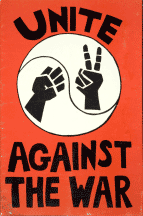
The Doug Lamborn health care town hall

I can hire one half of the working class to kill the other half.
          –the words of 19th century robber baron Jay Gould were on my mind as I contemplated the loud mob at Congressman Doug Lamborn’s health care town hall meeting. No one had to hire them to speak against fixing America’s medical system. Citizens of other developed nations surely pity Americans for ranking 37th in the world. They can puzzle at the American idiot’s unwillingness to improve it, but how simply pathetic the idiot’s preoccupation that no less fortunate should share it.

We arrived at the Woodland Park event a couple hours early, and so from our car were able to overhear several earlybird teabaggers rehearse their arguments. They discussed lines that had impressed them from other town halls. As the wingnut numbers grew, the most frequent introductory joke was to cajole each newcomer as the insurance industry plant.

I’m not cynical enough to suspect that any of the Woodland Park shrunken heads could have been paid agents. But I was emboldened to anticipate that without Rush or Glenn Beck present, these dittoheads might easily be disarrayed into a cacophony of bobbleheads, and I was right.

National Assembly is antiwar exclusively

unite-against-the-warReports are emerging from July’s National Assembly, the vital effort to unite antiwar forces into a common movement. Delegates from the major peace organizations hammered out a strategy to address Iraq, Afghanistan, Pakistan and Palestine. Missing from the consensus? Nonviolence, and good riddance. It goes without saying that humanitarian activists are peaceful. To legislate a dogma of non-confrontation plays right into the hands of the authoritarians. Here’s the official report:

AN ASSESSMENT OF THE FIRST YEAR OF THE NATIONAL ASSEMBLY TO END THE IRAQ AND AFGHANISTAN WARS AND OCCUPATIONS

Address given by Marilyn Levin, member, National Assembly Administrative Body, and Planning Committee, Greater Boston United for Justice with Peace Coalition, to the National Antiwar Conference held July 10-12, 2009 in Pittsburgh, Pennsylvania

July 10-12, 2009, 255 people representing diverse organizations and constituencies from all over the country came together in Pittsburgh:

1) To look at where we are today,

2) To articulate our long range goals to rejuvenate the antiwar movement towards building a massive movement capable of forcing an end to their wars and occupations, to take our money back from the war machine to meet pressing social needs, and to save our planet for our children, and

3) To develop and vote for action plans as steps to realize these objectives.

All of our major objectives were accomplished and we leave today with a comprehensive action agenda to carry us through to next spring. Everyone had a chance to speak and differences were aired without rancor or splits to achieve unity in action.

Friday night’s speakers, along with many conference participants, grappled with how to unify and broaden the movement. Saturday afternoon and Sunday morning, we presented a great roster of workshops covering the major issues we face today. Saturday night’s rally was dynamic and inspiring.

There were two highlights of the conference for me. First was the international component where activist comrades joined us from Canada and courageous labor leaders of powerful mass movements in Haiti and Guadaloupe reminded us that imperialism and the struggle against it are global. There was a statement by members of the Viva Palestina aid convoy detained in Egypt. We passed motions in solidarity with the struggles of the people of Haiti, Honduras, and Palestine.

The second highlight was the discussion on Iran, where, in spite of strong passions stirred up by the rapidly evolving events there, we were able to illuminate the issues and debate our differences. Finally, we were able to agree on a unity position that all could embrace, as well as meeting the foremost call of the Iranians – US Hands off! No Sanctions! No interventions! Self-determination for the Iranian people! A wonderful example of a united front –- as inclusive as possible and taking principled positions that most will accept and act on.

So what is the National Assembly? What you saw this weekend explains who we are and how we function.

Democracy. All were invited and all perspectives welcomed. There was acceptance of the will of the conference even when it diverged from the proposals put forward by the leadership body. We were especially gratified that representatives from all the major antiwar coalitions came and addressed our conference.

Our willingness to struggle for unity and compromise when needed in order to move forward, as evidenced by a leadership that did not impose personal political views on others in service to unity.

An organization that admits to and learns from its mistakes and accepts its limitations when the unity we seek can’t yet be achieved.

An organization that has built a growing cadre of leaders that has developed trust, a structure that works, and a strong working relationship.

And finally, confidence, vision, and optimism. Confidence that we can provide leadership in rebooting our movement. A vision regarding how to accomplish that and an understanding of the necessity for these kinds of conferences leading to action. Optimism that masses of people will move in opposition to these horrendous policies that bring death and destruction and that they will have the power to change the world.

I’ve been asked to give an assessment of the first year since our initiation as an ongoing network with a mission, from our first conference in June, 2008 until today. Last year, we weren’t sure anyone would come and lo and behold 400 people came together in Cleveland to inaugurate a year of activities and set up a structure to maintain our work. A lot has transpired in that year and the National Assembly is well on its way as an established organization recognized throughout the movement as providing leadership and promoting a direction towards growth.

I need to start a little earlier and go back to why the National Assembly was called into existence in the first place.

What we saw, in the spring of 2008, was a movement at a low ebb – one that was shrinking rather than growing in spite of the war dragging on — this while the antiwar sentiment couldn’t be higher, and the disapproval rating for the Bush Administration couldn’t have been lower. From the high point of the largest action against the Iraq War in September, 2005 which drew 700,000 people, there was a pulling away from mass action by significant sections of the movement which supported electoral politics as the central strategy, in spite of a recurring pattern of disappointment when Democratic “antiwar” candidates voted again and again for war and war funding, and a split between the two major national coalitions, UFPJ and ANSWER, one that continues to this day. For the first time in five years, there was not enough unity or mass action perspective for any national demonstrations to take place marking the 5th year of the occupation of Iraq. Fundamentally, there was a vacuum of leadership.

Some far-sighted people like Jerry Gordon and Jeff Mackler, with experience gained from leadership in the last powerful antiwar movement that ended the Vietnam War, felt impelled to act. They began to organize a base of diverse but like-minded activists committed to building and expanding an effective antiwar movement in this country. The vehicle to accomplish this was the first national assembly, a national conference to pull activists together, to analyze the present state of the movement, to discuss where we needed to go and the actions that were needed to get us there.

We developed a unity statement with five basic principles that we hold today as the basis for where we stand:

1) Unity – all sections of the movement working together for common goals and actions;

2) Political Independence – no affiliations or support to any political party;

3) Democracy – decision-making at conferences with one person, one vote;

4) Mass Action – as the central strategy for organizing while embracing other forms of
outreach and protest; and

5) Out Now – the central demand to withdraw all military forces, contractors, and bases
from the countries where the U.S. was waging war on the people.

It seems simple but no one else saw it that way. Our conference was unique in the history of the present movement.

The organizers didn’t know what the mood and composition or strength of the conference would be, so we were cautious and minimal in the program we posed to the conference. We focused on Out Now from Iraq and modest action proposals, not being strong enough to initiate national actions on our own. The conference participants were ahead of us and ready to tackle the larger issues. Proposals were passed to add “Out Now from Afghanistan”, “End U.S. Support for the Occupation of Palestine”, and “Hands off Iran” to our set of demands, and given what has transpired in these areas, we were well prepared to take on a major role.

October 10th actions held in 20 cities were endorsed as well as a call for December actions building towards what we hoped would be unified, nationally coordinated bicoastal mass actions in the spring of 2009, the 6th year of the Iraq occupation. When Gaza was brutally assaulted, we joined with ANSWER and others to march in Washington and to demonstrate in the streets all over the country, and we’re still working under Palestinian leadership to bring justice and relief to a beleaguered population.

We made a concerted effort to find a common date for spring bi-coastal mobilizations. As you know, ANSWER chose March 21st as a day of united protests which we endorsed, while UFPJ called for a national march on Wall St. on April 4th. A number of National Assembly supporters who were also delegates to the UFPJ conference in December formed a mass action unity caucus and went to the conference with a resolution to allow delegates to vote for one or both actions but this was rejected. We’ll keep trying for 2010. The National Assembly endorsed and built both actions and marched behind our signs with our demands. The demonstrations were small (but spirited) and still of major importance.

For us, it’s quality, not quantity, as we position ourselves to be in the forefront as the pendulum swings in our direction once again.

Some take the position that mass demonstrations are not effective, unless we can pull 100,000 protestors into the streets. This is short-sighted and does not address how we get from small to large. Any successful movement for change doesn’t start with 100,000 people, and there has never been significant social change without mass actions. I remember my first anti-Vietnam war demonstration was in 1963 in Detroit and we had 15 people. In 1965, SDS called the first national march against the war in Washington. 25,000 people turned out and we thought it was huge!

Everyone talks about reaching out to the thousands of young people who mobilized to elect Obama. We agree, but we say the way to do this is by offering education and action. Action beyond calling, and emailing, and faxing the politicians they placed in office.

Why are mass demonstrations so important to building a powerful movement? It is because they accomplish so much in the process of building them. They provide:

Continuity. You can’t build anything by starting anew each time. Each action should lead to the next action or open national conference, with success building upon success. We need a continuity of leadership that builds trust and a reputation for integrity, and that learns lessons to improve. We need a continuity of organization and structure that can implement the tasks before us.

Visibility. Actions in the street give heart to the people the U.S. is attacking and occupying, letting them know that they are not alone. Mass actions create solidarity, offering support to anti-war soldiers, vets and their families, and a counter-force to the economic draft facing our youth, and they strengthen and deepen the antiwar sentiment of the people.

Inspiration. New people are brought into the movement, especially the youth, through activism. Have you ever talked to young people coming to a mass demonstration for the first time? They are inspired and thrilled to hear powerful speakers who are leaders of social justice movements and soldiers resisting the wars. They see they are not alone and get a taste of the power of large numbers of people marching together. They are energized to go home and join with others to continue to organize opposition to brutal U.S. wars and occupations. This is the way to reach out to the Obama supporters.

Explanation. An analysis of what is going on is offered along with tying together what seem at first to be disparate elements, i.e., war is tied to the economy, the war budget, bail-outs of the rich, the lack of basic needs being met, justice denied, and the impoverishment of the people.

Pressure on Government. People in this country are taught to be quiet. We’re told that our job is to elect officials whom we agree with periodically and then go home and wait while they fix things. This conveniently maintains the status quo but it sure doesn’t put pressure on them, or scare them, or force social change. Mass actions provide the most effective way to make significant change happen.

Let’s look at the present period. Obama’s election was based in large part on the hopes and aspirations of Americans for peace and a better life based on the promises and assumed promises that were made of peace, justice, and prosperity, which have not and will not be met.

Contrary to expectations, the previous administration’s policies are continued with a more handsome and articulate face. We all know that rather than winding down, wars and interventions are escalating and the rapacious greed of this immoral system knows no bounds.

Simultaneously, the economic crisis is causing terrible hardship for working people and for people who are no longer able to find work and their families. They are using this self-created financial disaster to further cut the standard of living and eliminate a secure future for older people and the young.

It was very moving and yet appalling to see this visually demonstrated when Robin Alexander of the United Electrical Workers Union asked people in the audience to stand who were unemployed, personally knew of soldier casualties, lived in communities where services were being cut, or who were otherwise negatively impacted by the wars and the failing economy. Nearly the entire room, a microcosm of the wider society, was standing by the end of that exercise.

It is inevitable that the present period of quiescence and hanging on to the hope that Obama and the new Congress will save us will come to a crashing end. People will not sit idly by forever while the world around them collapses. We are already seeing the beginnings of stirring. There is a greater willingness to go out in the streets to protest. There is more organizing taking place on campuses, more young people joining the movement. The many proposals for October actions are an indication that there is a widespread awareness of the need for actions this fall and the conviction that the movement must find common dates.

Brian Becker, National Coordinator of ANSWER, urged that we all work together to mount nationally coordinated actions next spring. Michael McPhearson, Co-Chair of UFPJ and Executive Director of Veterans for Peace, announced his support for October 17 and his willingness to do what he could to spur unified actions in the spring of 2010. We must have the faith and confidence that the people have the power to end the atrocities resulting from U.S. wars and occupations, and that they will recognize and utilize this power. As this happens, we must build a stronger antiwar movement that is able to provide leadership and the optimism to forge ahead no matter what the opposition throws at us.

The National Assembly to End the Iraq and Afghanistan Wars and Occupations is helping to provide that leadership and the vision that is needed. Although young and small, in one short year, we are now a force to be taken seriously and negotiated with, and by our persistent call for unity and mass action, our demonstrated ability to organize, and our coordinated strategy for revitalizing the movement, we are having an impact larger than our forces would indicate. In some ways, we too are a product of (and some say an antidote to) the 2008 election. To counter the malaise of the movement, we have quietly been building a solid core of activists and leaders around the country that understand the importance of a united front organized around principled demands and mass actions, not just calling Washington politicians when bills come up and crises happen.

At this conference, we have laid out an ambitious program of action that will take us through the spring of 2010. We are proud that we could provide the kick off for national organizing to bring a massive turnout to Pittsburgh for the G-20 protests September 25. Homeland Security is already making preparations to keep protesters hidden and stifle our right to speak out, but we won’t be silenced.

Following that, are a series of October building actions, culminating in large local and regional demonstrations on October 17 marking dates of significance related to the Iraq and Afghanistan wars and occupations and remembering the legacy of the anti-Vietnam war movement. Throughout the year, we will organize educational programs, support various forms of protest and organize around the inevitable emergencies caused by our government’s unholy interventions and threats to other nations.

We have initiated a Free Palestine Working Committee to ensure this work, which includes the growing boycott, divestment, and sanctions campaigns and the efforts to break the siege of Gaza, continues to be in the forefront and fully integrated in our work until justice and self-determination and return is in the hands of the Palestinians.

And lastly, we will continue to advocate for unity of the movement and once again bring thousands to Washington and the West Coast in the spring, to let our government and the world know that the U.S. movement against wars and occupations is alive and will not be quiet.

We will march and continue to march until all U.S. forces come home, bases are dismantled, and the sovereign people of the world have the right to control their own resources and determine their own futures, and the war budget becomes the peace budget.

Don’t sit on the sidelines and watch history being made. We urge all organizations to join the National Assembly and to play your part in building and shaping the powerful movement that is coming.

All out for the September 25 G-20 march in Pittsburgh! All out for the actions in early October! All out October 17!