Who did not play Faust for George Bush

I’d like to compile a collection of letters from famous personages in which they decline to dance with the Bush Administration. Were there many?

Shouldn’t any artist/musician/author or intellectual/humanitarian of note have publicly refused to collaborate with the immoral tyrant and his saccharine-smile patronizing librarian wife?

I have some favorites:
Mr. Feiffer Regrets -by Jules Feiffer, 2002
Poets Against War -Sam Hamill, 2003
Statement of Conscience -by Jennifer Warn, 2003
Open Letter to Laura Bush -by Sharon Olds, 2005

Archived copies are below:

Mr. Feiffer Regrets

October 12, 2002

Mrs. George W. Bush
The White House
Washington, DC

Dear Mrs. Bush,

I wish that I could come to your National Book Festival breakfast at the White House on Saturday, but after giving it much thought, I can’t attend.

I was thrilled to be invited, along with other writers and illustrators, to help celebrate your campaign to inspire young people in the pleasures of reading.

But I find it unbearably ironic that, while the uses of language are celebrated by you and your renowned guests, elsewhere in the White House language is being traduced and transformed to nudge us into war.

There are honest arguments on both sides of the Iraq debate (such as it is), but it seems necessary on the occasion of a celebration of reading to press the point that words, at their finest, don’t set out to confuse or obscure. Their aim is to clarify.

But clarity is not what we’re getting from your husband’s White House. It seems that clarity would deny him a war.

I am a father and a grandfather. As every parent knows, most children can intuit whether the stories their parents tell them are true or if they’re making them up.

The American people are able to tell too.

I am delighted to participate in National Book Festival events scheduled for the Library of Congress and the Capitol grounds. But as for your breakfast, may I convey my regrets and best wishes to you and your guests.

Sincerely,
/s/Jules Feiffer

Sam Hamill

Dear Friends and Fellow Poets:

“When I picked up my mail and saw the letter marked “The White House,” I felt no joy. Rather I was overcome by a kind of nausea as I read the card enclosed:

Laura Bush requests the pleasure of your company at a reception and White House Symposium on “Poetry and the American Voice” on Wednesday, February 12, 2003 at one o’clock

Only the day before I had read a lengthy report on George Bush’s proposed “Shock and Awe” attack on Iraq, calling for saturation bombing that would be like the firebombing of Dresden or Tokyo, killing countless innocent civilians.

I believe the only legitimate response to such a morally bankrupt and unconscionable idea is to reconstitute a Poets Against the War movement like the one organized to speak out against the war in Vietnam.

I am asking every poet to speak up for the conscience of our country and lend his or her name to our petition against this war, and to make February 12 a day of Poetry Against the War. We will compile an anthology of protest to be presented to the White House on that afternoon…

Statement of Conscience -Jennifer Warn

February 12, 2003

Mrs. Laura Bush
1600 Pennsylvania Avenue
Washington, D.C.

Dear Laura Bush,

Thank you for inviting me to the White House symposium on Poetry and the American Voice. Your call to better understand and celebrate the poetry of Walt Whitman, Emily Dickinson and Langston Hughes led me and many thousands of American poets to find their voices of dissent.

Since January 30th poets in many countries have joined in an upsurge of conscience and compassion, submitting over [15,000] poems to the Poets Against the War web site (www.poetsagainstthewar.org), organizing hundreds of anti-war poetry readings around the world, and joining with millions of others in vigils, processions, prayers and intercessions, lobbying and rallying for peace.

You have inadvertently presented a gift to the American people and to the world by providing poets an opportunity to express their most passionately held beliefs about their vision for the world’s future. Your gesture has revealed the very relationship it was meant to deny: the connection between poetry and politics, between literature and reality. Another great American poet, Wallace Stevens, presented this relationship succinctly:

“In life what is most important is the truth as it is, while in arts and letters what is most important is the truth as we see it.”

This wisdom is excerpted from “Imagination as Value,” an essay in the long tradition of poets puzzling over the power of poetry and asserting its place in a world primarily shaped by the machinations of politics and money.

What is poetry’s power? Why should you, vested with the power of the White House as First Lady, pay attention to such a rush of words at this late hour?

Poetry’s power lies in its perceptive ability to describe both inner and outer realities. In reading a poem we experience the paradoxical delight and anguish of human life. Poetry holds a mirror to the reality that our political systems and values create and in doing so reveals both the limitations of our current state and life’s endless possibilities. In its refracted light we see our intangible connections, the irrefutable unity of all people and beings on the planet.

We invite you to read this selection of poems which represents some of the most powerful in the Poetry Against the War Anthology. These poems were written by Pulitzer Prize winners, former U.S. poets laureate, and poets who work as professors, business people, homemakers and veterans. Those who have submitted poems or personal statements to register their opposition to ill-considered military action, including a pre-emptive strike on Iraq, honor a long and rich tradition of thoughtful and moral opposition by poets and other artists to senseless and murderous policies, including those of our own government.

We believe that the world is poised on the knife-edge of a decision between war and peace. It is our hope and conviction that peaceful American voices, conveyed in part and without historical precedent by the poets of this country, may help to avert a disaster of tragic proportions.

We call upon the Bush administration to halt the headlong rush toward war, to heed the voices of the people of the world, and to seek peaceful means of resolving conflicts in company with the world community.

Never before in history have so many poets gathered to speak in a single voice.

Sincerely,

Emily Warn
Poets Against the War

Open letter to Laura Bush -Sharon Olds

September 19, 2005

Laura Bush
First Lady
The White House

Dear Mrs. Bush,

I am writing to let you know why I am not able to accept your kind invitation to give a presentation at the National Book Festival on September 24, or to attend your dinner at the Library of Congress or the breakfast at the White House.

In one way, it’s a very appealing invitation. The idea of speaking at a festival attended by 85,000 people is inspiring! The possibility of finding new readers is exciting for a poet in personal terms, and in terms of the desire that poetry serve its constituents–all of us who need the pleasure, and the inner and outer news, it delivers.

And the concept of a community of readers and writers has long been dear to my heart. As a professor of creative writing in the graduate school of a major university, I have had the chance to be a part of some magnificent outreach writing workshops in which our students have become teachers. Over the years, they have taught in a variety of settings: a women’s prison, several New York City public high schools, an oncology ward for children. Our initial program, at a 900-bed state hospital for the severely physically challenged, has been running now for twenty years, creating along the way lasting friendships between young MFA candidates and their students–long-term residents at the hospital who, in their humor, courage and wisdom, become our teachers.

When you have witnessed someone nonspeaking and almost nonmoving spell out, with a toe, on a big plastic alphabet chart, letter by letter, his new poem, you have experienced, close up, the passion and essentialness of writing. When you have held up a small cardboard alphabet card for a writer who is completely nonspeaking and nonmoving (except for the eyes), and pointed first to the A, then the B, then C, then D, until you get to the first letter of the first word of the first line of the poem she has been composing in her head all week, and she lifts her eyes when that letter is touched to say yes, you feel with a fresh immediacy the human drive for creation, self-expression, accuracy, honesty and wit–and the importance of writing, which celebrates the value of each person’s unique story and song.

So the prospect of a festival of books seemed wonderful to me. I thought of the opportunity to talk about how to start up an outreach program. I thought of the chance to sell some books, sign some books and meet some of the citizens of Washington, DC. I thought that I could try to find a way, even as your guest, with respect, to speak about my deep feeling that we should not have invaded Iraq, and to declare my belief that the wish to invade another culture and another country–with the resultant loss of life and limb for our brave soldiers, and for the noncombatants in their home terrain–did not come out of our democracy but was instead a decision made “at the top” and forced on the people by distorted language, and by untruths. I hoped to express the fear that we have begun to live in the shadows of tyranny and religious chauvinism–the opposites of the liberty, tolerance and diversity our nation aspires to.

I tried to see my way clear to attend the festival in order to bear witness–as an American who loves her country and its principles and its writing–against this undeclared and devastating war.

But I could not face the idea of breaking bread with you. I knew that if I sat down to eat with you, it would feel to me as if I were condoning what I see to be the wild, highhanded actions of the Bush Administration.

What kept coming to the fore of my mind was that I would be taking food from the hand of the First Lady who represents the Administration that unleashed this war and that wills its continuation, even to the extent of permitting “extraordinary rendition”: flying people to other countries where they will be tortured for us.

So many Americans who had felt pride in our country now feel anguish and shame, for the current regime of blood, wounds and fire. I thought of the clean linens at your table, the shining knives and the flames of the candles, and I could not stomach it.

Sincerely,
SHARON OLDS

Ft Carson shredding casualty records

pfc-albert-nelson-document-shredded
IS THE US-ARMY-BEDMATE-GAZETTE GOING TO REPORT THIS STORY? Salon Magazine was leaked helmet-cam video showing the 2006 deaths of two US soldiers in Ramadi, by friendly fire, which the US Army is still attributing to Iraqi insurgents. Within hours of breaking the story, soldiers working in Fort Carson offices were ordered to shred the documents relating to the slain PFCs. Fortunately Salon was leaked this development as well.

Watch the video. Pay no heed to the warnings of graphic violence and profanity. What the tape reveals is the inanity of all the soldiers’ conduct. First, a very imprudent peek through a window at a US tank, which more than likely prompted the tank to fire. As a result, the helmet wearer is knocked to the floor, a soldier on the floor above is wounded (and dies), and another on the roof is killed. What followed was discussion about whether the tank had fired the single round, countered by the commanding officer repeating that the official attribution would be mortar fire until a report proved otherwise. Despite that fact that all the soldiers coming up to the commander are reporting that the tank had fired, and he tells them “I agree with you–.” Also, during the entire sequence no other shot is heard.

It will be interesting to see what Fort Carson intended to accomplish by shredding the records of PFCs Albert Nelson and Roger Suarez. In particular because some of the documents were spirited aside and sent to Salon. Was the Army intending to produce revised versions to support their official report of the soldiers deaths?

The gilded age and the police nightstick

Oscar of the Waldorf cookbookA legacy institution of the Gilded Age is the Waldorf=Astoria Hotel. Most of us only know it from the nutty salad, the mysterious Red Velvet Cake recipe, Thousand Island Dressing and Veal Oscar named for the famous maitre d’ hotel. I encountered the book of recipes collected by “Oscar of the Waldorf” and its cover illustration caught my eye. The coachman and carriage don’t look so opulent to us today, but do you recognize a timeless trapping of affluence? There’s nothing else in the picture but the policeman and his nightstick.

We almost dismiss the incongruity of the attendant police officer. That’s because he’s Officer Friendly to us, circa the 1950s egalitarian economic boom, earned post New Deal and post WWII, when law enforcement began to serve and protect the middle class share of the pie. Before those times, whose order did the police enforce?

Could the Waldorf diorama have featured some other occupation at the curb? A newsboy, a shoeshine, or a traffic director? If the cabbie is picking up late night revelers, why not depict a doorman or lamplighter?

If this scene did not include the policeman, he’d be missing.

The Gilded Age of the soaring wealth of bankers and industrialists, of the steel, coal, and rail robber barons, came at the expense of poverty wages for all the rest. The homeless of America’s eastern cities died in the streets, if they crossed the paths of the leisure class at all. As in London, where the bobbies were celebrated for carrying no guns, cops on the beat didn’t need more than a nightstick to beat back beggars and riffraff.

Just as in the Waldorf illustration, the policeman’s nightstick isn’t holstered, it is fingered idly like a baton. We’ve seen it in countless Chaplin, Keaton, and Keystone reels. The policeman’s baton might be carried idly, and animated mindlessly as a clerk might twirl a pencil, but the gyrations telegraphed a swinging function meant to be understood.

Today, a modern financial crisis has finally hit the post industrial era, and unemployment is taking a precipitous plunge. The repercussions for the American middle class are yet unclear to most, their comforts still too tangible to fathom gone. But our modern times have already seen the resurgence of the Rich And Famous, (to even beyond the lunge of our Super-Lotto winners, who always chose the sub-six-figure annuity). Exclusive cars, toy submarines and tickets into space cost multi-millions, but the rich have that money to burn. Common Americans have also watched the armoring of their police, using weapons which offend us, but which protect the security of institutional wealth. Para-military police forces are the natural escalation of the right-to-bear-arms arms-race, the equivalent of nightsticks to quell our social disquiet.

Already aren’t we seeing the police block the public’s way, lest we soil the red carpet of the well-heeled? Aren’t police blocking free speech in public spaces, when the monied media has decided it wants the backdrop to serve their message? Wait until we are gazing covetously upon the gilded extravagances, from the alley side of the gilded wrought iron gate.
guilded age of the nightstick
Wiki notes:
Thousand Island Dressing came to the Waldorf from the so-named Lake Ontario waterway where New York’s super rich had their summer homes. The $100 recipe for Red Velvet Cake was the urban myth which resurfaced as the $250 Neiman Marcus chocolate chip cookie.

The original Waldorf Hotel was built by an Astor whose middle name was Waldorf, next door to an aunt with whom he was feuding. Later another Astor convinced her to move uptown and replaced her home with a taller hotel named the Astoria. The two luxurious hotels hyphened via the Peacock Alley, inspiring the popular song “Meet me at the hyphen.” In 1931 the landmark was moved to accommodate the Empire State Building, and was purchased in 1949 by Conrad Hilton who added the double-hyphen flourish, completely in the spirit of gilded ornamentation.

Iraqi POW sentenced for resisting US

Hold your fucking horses of the Apocalypse! Can you believe this red, white, our colors don’t smell, shit? An Iraqi fighter is sentenced to hang for killing three US soldiers? We’re condemning normal acts of war because they make American crimes look bombastic in comparison? The crime committed in this case, is a military injustice.

Why charge this Iraqi? For killing his US adversaries in 2006, or for showing unsportsmanlike behavior in how he killed them? Do we hold the same standard for our killers in uniform? Do we overlook the conduct of US predator/reaper drone virtual-pilots sniping at foreign civilians from video consoles stateside?

The world has been shown that US soldiers can kill, rape, burn, torture, go on homicidal rampages, on duty or off, and pass go, and collect $200. Our private mercenaries are allowed to do worse apparently, and not even the Iraqi people can object.

In fact, negotiations on the US lease agreement of occupied Iraq have stalled over the Iraqi demands to be able to hold US soldiers accountable for crimes they commit at least while not on official duty. Forget on. Those are war crimes. Those crimes will be accountable one day to a world court, and there’s no statute of limitations. Speaking of which, prosecuting an enemy for his right to defend himself and his homeland is in itself a war crime. The Iraqi insurgent resistance fighters and the Iraqi people are protected by the laws of war. Iraq is an occupied country, trying to fend off its invaders.

To execute this Iraqi will be a further war crime, but what care we? In for a penny, in for 1.2 million Iraqis. Sue us.

Meet Joe the Ex-Roofer…

Because McCain is promoting this cat who has the false tag of “Joe the Plumber”.

Real Name: Sam.

Real Occupation: Professional Liar. No plumbing license issued to him. plumbing is a job that requires a license. I know. … I used to work construction.

Until one day a combination of a Slave Market, an un-bonded, un-insured, un-regulated Pendejo who ran a “Small Business” like Joe the Plumber bitches about…

had the brilliant idea of taking the ladders to the Other Job Site, to save money of course, and the OSHA and EPA people who would ordinarily have hamstrung this Hard-Working Small Business Owner with useless safety regulations…

“Safety regulations? We don’ need no steenkeen’ Safety Regulations” and prevented him from having Me, Joe the Pissed-off-Ex-Roofer, and everybody else on the crew using a damned conveyor belt as a ramp to get on and off the roof, well,

Those Socialist Commie Pinko Liberal “Nanny State” watchdogs had been leashed, muzzled, then shot mercilessly.

So they pretty blew off my Right Foot, actually it was dislocated, and broke three bones… and my Left knee, which had a descending fracture of the Tibial Plateau and a meniscus tear (they repaired the tear 12 years later once the got around to removing the “temporary” hardware that the Right To Work, Tort Reform, Workfare state of Texas had let stay… and stay… and stay some more…

And unseen damage to the LEFT foot and ankle as well.

Finally, after more than a decade of fighting to get any health care at all, to get SSI and Medicaid Finally and THANK GOD FOR “socialized medicine”… they took out the hardware that was supposed to come out after 2 years but turned out to be 14…

The Talus was necrosed. Means it was a dead bone within my foot and ankle.

So more surgery, where they drilled a foot-long hole up through the bones that make up the pivot of the ankle joint, and put in a Titanium shank.

Just so I won’t accidentally step wrong and splinter the damaged and decayed bone structure.

Now, they’ve found two weeks ago, that my Left Talus is the same way.

I heard John McCain talking about “Joe the Plumber” and talking about how Barack Obama was going to take away money from the “hard working Americans” and give it to people who don’t work as hard…

And, he’s putting ME in that Second Group.

I’ll do something I rarely do, I’ll Challenge Sam the Non-Plumber to come and say something like that to My Face, so I can kick every square inch of his anatomy using my busted up feet.

That BITCH ASS Punk Wannabee and his Master, Scion of Privilege John McCain, who never worked a day in his Worthless Life, practically calling me a BUM and “not as hard a worker” as them.

Yeah, it’s bizarre..

I don’t know for sure if the O-man himself bought the food for us, or his campaign people here in town.

Either way it’s a touch of Class that no way in Hell would the McCain people be able to match.

Because Obama, and the people who are working for his campaign, are people who Give a Damn.

None of the StormFront supplied bull-poo about “palling around with terrorists”, none of the “his middle name is Hussein” like that seriously makes three quarters of a measurable amount of difference…

It comes down to People, which is what America the nation is all about.

McCain and Palin, don’t give a damn and they fly their “Don’t-Give-A-Damn'” flag proudly.

They spread the hatred like the toxic waste it truly is and don’t take any responsibility for the consequences.

I didn’t put anything up on Tribe about just yet, nor did I post here about what’s happening to my foot.

Most of the regular Tribe folks have heard about my right foot, about the work accident and all that.

Now, it turns out, the LEFT foot has a similar problem. I guess it’s natural that it slipped under the Medical Radar, what with Texas having neglected the entire damage for 12 years, other than the initial surgeries…

But a bone called the Talus, in my right foot and now, the left one as well, died, necrosed.

That’s another story.

This is about Miss Johnnie, and the Obama Campaign people and Obama himself.

Some of the Right Wing, when they’re not trying to smear and sneer him with the word that’s an insult only to the Right Wing, “Muslim”, like to scream that he’s a Radical Christian.

Let us pause momentarily and meditate upon that… “Radical Christian”…

ok, time’s up.

Hey, he’s famous for quietly being a Radical Christian and allowing his life to be his witness.

If he’s a shill for “No Change At All” I don’t see it.

I wrote to the alfrankenweb forum about it first.

There’s a lot of good back and forth between them and Tribe.

Miss Johnnie is “just another” victim of the Way Things Are…

We’re not remarkable, and that, you see, is the really frightening part.

Our nation has melted down to where only the most extremist Clown Squad could possibly even try to pretend that we have some kind of Leave it to Beaver Because Father Knows Best, Lucy mythical White Suburban utopia.

Just the events of the last year would make your jaw drop to the floor, and …

To a certain mindset, we’re supposed to Just smile, and pretend that everything is Normal.

To the campaign workers, and to Obama himself, I’d like to say Thank you…

To the ones who want us to Vote Fear, Vote Same, Vote Stay-the-course, I’d like to say —k you.

They’ve had quite enough time ruining our nation.

Now, we have to rebuild.

Seems like they let loose an Elephant into our collective living room and he trashed the place, pooped on the floor, drank out of the toilet and punched holes in all the walls.

The cleaning bill alone is going to be monstrous.

Jonah and the Obama Chinese food story

(Editor’s note: Jonah posted this account yesterday on Alfrankenweb, which reached the Rec List on Daily Kos. Now I’m fielding emails and calls inquiring whether Jonah is real. Here are the Alfrankenweb posts, until Jonah can give us an update.)

OK, so this is the story as I finally got straight.

I was out scrounging scrap metal today, to get enough food money to last us through the weekend.

I came home and Miss Johnnie, my landlady, was crying and showing me a table full of food.

I thought one of our friends or my relatives had come over and bought for us.

But it was bought, according to the lady who owns the restaurant, by Barack Obama over the phone.

After the Obama Campaign Workers came to the door, and were listening to Miss Johnnie describe why she, a registered republican, was voting for Obama.

She showed a picture of her daughter Michelle the Marine who had been deployed to Iraq twice, and is still pending discharge because of the Stop Loss.

All her kids in fact.

And her late husband, who had died of Agent Orange from his service in VietNam.

About that time the campaign workers started making phone calls and she got to talk to Obama.

She was in tears while telling me all this so I got the story wrong at first.

She talked about the War, about the health care bill that got turned down because it was “too expensive” but the Rich Thieves got to take 16 times as much just because they had broken the economy with their wild schemes.

About the VA messing around with the repayment of the medical expenses she had borne by herself over the 12 years since her husband died, over nitpicky paperwork errors on Their Part.

About me being out against doctor’s orders scrounging scrap metal just to make it through til monday.

One of the volunteers was a Marine and a Nam Vet, so much for the notion that Veterans are all voting for McCain, (despite his continued votes to screw the veterans the same way the VA is messing up Miss Johnnie’s paperwork and payments)

Miss Johnnie, understandably, doesn’t talk without a great deal of emotion on those subjects.

So after the Volunteers left, about 20 minutes later a very large order of Chinese food charged to Obama came to the door.

The Delivery man is a recent immigrant and doesn’t speak English, so he called his boss, who confirmed it but said it was supposed to be a surprise.

Enough food to last until Monday.

I came in with this really pitiful half gallon of milk and about a meal worth of food and some cat food.. and she was crying and showing me all the food.

And said that Obama had bought it for us.

I didn’t get the story quite right the first time, so I thought he had been there in person.

Not quite, but you know how in the Churches people say “I’ll be there in spirit”?

He was there in a way that really counts.

McCain has a fake falsified made-up “Joe the Plumber” who turns out to be a white-collar person named Sam and not even a plumber…

Obama now has Miss Johnnie the Viet-Nam Widow and a Real Joe the Ex-Roofer with Busted Feet.

That’s why Obama wins.

He’s Real, his concern for the people is Real, and the people who supporting him, WE’RE real too.

Hell, I don’t know where to research it myself.

There’s been a flood of out-of-state volunteers past two days, because Ms Sarah was doing her Schtick at the baseball park to a tame crowd.

Tame as in no Nasty Obama Supporters being let through to ask all kinds of icky-poo questions.

I went in yesterday and mentioned at the welcome desk at Obama HQ about the FreakSquad chalking the death-threat or death-wish either one on the sidewalk essentially directly across the street from them.

The restaurant is “Coal Mine Dragon” at 1720 W Uintah, the Springs. The lady who runs it is Second Generation Chinese. She told Miss Johnnie that it was Obama paying the tab, and that it was supposed to have been secret.

If it was merely the Volunteers calling in the order, and the restaurant owner not getting it out clearly distinguished, that’s still great.

as to was he the one who spoke to her, he identified himself as such.

If he was a clever impostor doing a good imitation that’s more improbable.

Not much reason anybody would, especially as Obama wouldn’t tolerate it.

if he confirms it himself is the best proof I could think of.

Who has that kind of pull to hotline direct to Obama during a rally?

Congressman Mark Udall, that’s who.

He told Miss Johnnie about being a Marine himself, I had thought “damn, that sounds a lot like Mark Udall…”

And, sure enough…

Run the pack of clowns out of office.

There’s some tidying up to do, seems like a herd of Elephants has gone through the national living room, pooping on the floors, breaking stuff and drinking out of the toilet.

If I’m not mistaken, some poor clerk at the VA in Denver is going to have a rude surprise Monday morning.

Mark Udall is running on Workers Rights, and Veterans Affairs… very large issues here in Colorado.

The “Terror Connection” they’ve been trying to tar Obama with, with Udall it’s “the Department of Peace” and Labor Unions.

His opponent is making big talk from those same National Attack Ads just like with the “Daschle Democrats” Ads with the bobble heads…

Well, Daschle was proven RIGHT about Iraq.

Trying to paint Udall as a hippie-dippy doper (seriously, they’ve been using that angle) when he’s a Marine and a Nam Vet, I think they bit off a chunk of the wrong sandwich.

I don’t know what all the names of the meals are, one involved a lot of chicken and broccoli, mushrooms… oh man..

Another same recipe, stir fried, with steak in it.

Cabbage rolls and rice with more chicken in it…

I think I like this restaurant and plan to give them my patronage.

The bill came to just under $40 bux.

If you’re in Colorado, vote no on 47 and there’s two more Blatantly union busting amendments there.

Oh, there’s an attack ad on right now….

These freaks need to be slapped repeatedly, in fact I’ll start a thread about that…

I had to reboot the puter, knocked my keyboard connection loose.

We have one cat, Keenan, neutered male.

She built him cat-runs at three of the windows, we can’t let him outside because our next-door neighbor is a Confirmed Cat-Kicker.

Last summer she contracted Leishmaniasis, which is also called the Baghdad Boil, in Mesopotamia it’s spread by the bite of a flea…

They gave her Antibiotics for it, and for the Mycelin Resistant Staph Aureole that goes with it.

This has affected her inner ear, because the antibiotics were so strong.

At the time we thought it was her lymphatic cancer coming out of remission.

After her husband died, she was waiting on getting her Widow’s Pension, the VA wasn’t even acknowledging that her husband had died of Agent Orange.

It took a few years for that. That’s when she had the lymphoma.

She was out on the street while taking chemo.

Last year she started to try for her CHAMPVA benefits, so she could get meaningful health care.

The ones who come to the forum to blast “Socialized Medicine” don’t know the least part of what the hell they’re putting out, or putting down.

We had the paperwork and forms from the VA to take to the Air Force to get her Widowed Spouse ID card, to get the CHAMPVA started.

We rode the bus across town to Peterson AFB, they allowed her onto the base, but not me, made me get off the bus and wait outside.

Which I prefer anyway, when I left the Air Force, I LEFT.

The guards at the gate, they weren’t Air Force, didn’t have any insignia or rank or name tags, but I knew they weren’t SPs because the SPs are stone freaky about maintaining a spit-shined appearance.

Turns out they’re mercenaries, I thought at first Blackwater but it seems it’s a different group of Mercs.

All the same to me.

At the Admin building another Mercenary, not Air Force personnel, clerk told her that the VA was full of shit, everything changed with nine eleven, don’t you know there’s a war on yadda yadda and threatened to have her arrested.

This year we finally got her ID card, got her CHAMPVA started.

Any Vets reading this, be-the-hell-ware because this is what they’re fixin’ to do to YOU next if McInasane gets in power.

So she’s owed 11 years worth of reimbursement for all the medical care she had to pay for out of pocket, even with the next to worthless Colorado Indigent Care Program insurance (Look up “worthless” in the dictionary and right next to it will be a picture of CICP) one of those “Massive Entitlement Programs For Bums” that McCain bitches about.

She got some reimbursement but is owed about 5 times as much more.

They keep bouncing her claims back, saying the forms are “incomplete”.

Utter bullshit, because I went over their claim as to what information was missing, and it was all right there in the papers.

That’s why I believe somebody from Mark Udall’s office is going to give them a Nasty Note Monday.

That’s the status so far.

The Health Care meltdown in Colorado is almost as bad as it was in Texas when I left.

Privatized everything. Well, I can testify, it didn’t work in Texas, and it surely ain’t working in Colorado either.

I get SSI and Medicaid. Miss Johnnie gets a Widows pension and CHAMPVA.

I supplement it by repairing computers and selling them, and the Scrap Metal.

I’ve been making more money off the scrap metal than the computers though.

The internet is part of our Cable package.

And, it’s necessary for the repairs I do to the computers, otherwise we would have ditched that part and just used dial-up.

The past month I haven’t been able to scrap, doctor’s orders.

That drop in income brought us near the edge.

We have for vehicles three bicycles, two of them mine, and she can’t ride hers anymore because of some of her injuries.

And ride the bus for further transportation.

I don’t drive anyway, never learned because it would be too dangerous.

Trust me on that.

But I’ve been getting on fairly well using the bicycles.

Until last month.

On top of that, scrap prices are down, way down… and there’s more competition for what scrap there is.

This is what’s happening across America.

I find out on November 5th what exact kind of surgery is going to be needed, for the foot I thought was uninjured 16 years ago.

I do know part of it is going to involve removal of a bone, the Cuboid.

I won’t have a leg to stand on.

It would be really really cool, you know, if this situation were anywhere near being unique.

Fact is, it ain’t.

That’s why there’s this:

I’m not dancing with joy that McCain is going to lose…

I’m rejoicing that America now has a chance to WIN.

Thanks, but we’re getting there. You might need it yourself soon anyway.

Stocks are tanking like mad.

Gas prices are down to 3 a gallon but that’s mostly because so much business, small and large, has crashed that there’s a huge drop in actual consumption.

First law of economics, supply and demand.

There’s going to be money coming in, just a question of when.

We both know how to make money, just we aren’t going to try doing anything on credit, build from a cash-only base.

Johnnie used to be a business owner, she and her husband did custom printing. Before his illness got to him they had over a million in the bank.

That’s how quick a catastrophic illness can do you down.

“difficult” and “impossible” are two separate equations, if something is difficult that just means it’s possible.

It’s a challenge more than anything. I hope.

I’ve got good skills I can adapt, like these computer skills.

This one I’m using now I built up from parts I salvaged, part of the scrap metal deal.

Here in town there WAS a steady supply of one-off computers, like, HP would come out with the newest mainboard and all the HP employees would get a discount on the new one, and either sell the older ones cheap or donate them to the ARC or Goodwill. Here’s a really good business tip, something you might want to invest yourself into, a new mainboard combination comes out roughly every 6 months and the older one, the one that’s King of the Jungle today, is going to be only worth half of what it is today.
Same with all the parts.

And for all practical purposes, the best there is today, in 6 months will still be able to run any software package there is. Not much point in buying a brand new computer, unless you’re developing software specifically for the newest chipset. so I’m developing a base of people who will want to buy good computers, that’ll do whatever they want, just at an amazingly lower price than they would pay to HP or Dell.
it’s more a matter of timing your purchases than anything else.

Now HP is closing down most of their local operations here, moving some to Albuquerque and some to iirc Little Rock.

But I’ll adapt. Part of it is that I don’t have a huge monetary investment in anything, mostly my investment has been in skills.

At least we have a plan, and are getting, slowly to be sure, but it is building up, the means to implement the plan.

Dire straits are familiar territory for me. At least I know my way around.

There’s good coming onto the horizon.

Oval Office is NOT an Alzheimers Ward!

john mccainTheir surge failed. GOP retreats from Colorado invasion, and preparing for a crushing defeat everywhere.

Treasury Secretary, now in charge of bailout, says he “regrets” being 100% wrong about US economy.

Say it ain’t so, Joe “the Plumber” purged from voter rolls by GOP attempts to block voting?

Conservative Washington Post endorses Obama.

I’m John McCain, and you WILL listen to me!

In Missouri, RepubliKKKans have gone from burning crosses, to
burning Obama signs
.

Excerpts from Thomas McCullock’s Oct 17 notes, thomasmc.com.

How “The Surge” is working, Kiss Our Boot…

I know I’m going to get a lot of hate-responses for this from the Semi-Literate Establishment Members…The Surge is working only as a propaganda piece to fool the already fooled

The “surge” is proving that if you hold somebody’s neck under your boot heel he can’t fight back… but you can’t keep the boot heel there forever. Hitler found that lesson out.

Meanwhile Right Wing politicians are playing it up as though the Surge can go on indefinitely… at least until they get enough votes to continue the war that is so very profitable For THEM.

And if anybody mentions, like in my initial sentence, that it’s not sustainable,
they have a well trained Idiot Chorus Live who will loudly chant “The Surge IS Working The Surge IS Working The Surge IS four legs good, two legs baaaaaaddddd!”

Along with some pathetic crap like “My country right or wrong”,

which means that they intend to keep doing wrong in the name of OUR country

and anybody who doesn’t like it had better “Love it or Leave it”,

Which in turn means if they can get people who don’t like their Terroristic Emperor running (Ruining?) OUR country we should just leave and thus allow them to drive America further into the ground, unchallenged.
They would be able to do to America what they’re continuing to do to Iraq.

If the Surge had worked, and if, as our frequent Propaganda Visitors have told us, the People of Iraq are very much in favor of continued subservience to and domination by the American Oil Companies,

Then surely when the Publicly Funded Mercenary Military takes their boot off their collective neck, they will be Good Little Obedient Servants of The Empire and stay down, only rising up enough to Kiss The Jackboots…

So what’s preventing you from lifting your boot off their necks?
.

McCain THE BOLD NEW ECONOMIC PLAN: no taxes for the filthy-rich.

Halloween
Breaking news: McCAIN LINKED TO SADDAM HUSSEIN!

Must see: The bizarro NeoFascist mindset of Sarah Palin supporters. [video]

Ethics investigation of Sarah Palin expands. Will Republicans actually vote for a candidate who comes with her own built-in impeachable scandals? You betcha!

GOP strategist says McCain “put country at risk” by picking Palin.

It’s panic time for the GOP.

Comrade Bush to nationalize major banks. Who knew the Republicans were such closet Communists?

If you think Bush’s economy stinks, wait ’till you smell McCain’s!

Thou shalt not oppose the GOP. Student activist being tried as a terrorist for protesting at RNC.

Canada to shut down internet on election day.

The “success” of McCain’s surge: Iraqis who dare to return home are being killed.

Excerpts from Thomas McCullock’s Oct 14 notes, thomasmc.com.

Enough of red white and proud bigots

monkey-bigotWhen Oh When can we unleash on the professional elements in our culture who’ve been driving the basest common denominator into the mud? Mud wrestling, motor-cross, monster- trucks and other mugly indulgences clearly proven now to be anything but harmless.

When are we going to take the country singer drunkards, talk radio buffoons, TV talking-lowbrows, and hirsute airheads off to work the carnies where they belong? parking-lot-bigot Mindless amusements have produced a mindless public as bigoted and idiotic as it is vacuous. Cynical, narcissistic and post-ironic are really just terms of flattery for detached deluded know-nothings.

Have you ever seen Americans Uglier than these?

Here’s someone who attended a McCain rally with a simian effigy of Obama, another idiot who closed his parking lot to Obama supporters, and a so-called independent voter who’s defying the landslide trend and swaying toward McCain. independent-voter-for-mccain Let’s also give honorable mention to the five Alaskan Republican legislators who tried to halt the investigation into Palin’s misconduct as governor. Rep. Wes Keller, Rep. Mike Kelly, Rep. Bob Lynn, Sen. Fred Dyson, and Sen. Tom Wagoner.

And how about the October [13] surprise of a resurgent Wall Street, rallying on cue to McCain’s “soaring” speech, marking his “comeback” on the rising tide of nothing but his same old bullshit verbiage, and most of all, diverting news desks from the Palin Troopergate guilty verdict. I’m afraid the GOP is never going to go broke underestimating the American public.

Capitalist medicine turns to robotics

cyborg nurse
Russian scientists design mechanical nurse and they are also working on designing a robotic surgeon, too! Not to be outdone by Russian mechanical robotic nurses and surgeons, the Japanese apparently are banking more on using cyborgs in the capitalist medical field. Americans are still most heavily into computerized systems, it seems, as the hospitals there are into the use of computers to program and flowchart flesh and blood nursing/ medical staff more and more?.

Maybe you are in need of the Robotic Physiotherapist’ on its way, whose ultrasound behavior you can surely count on? And the Pentagon has already developed the robotic EMT known as Vecna BEAR Robot For Battlefield Extraction And Retrieval. Capitalist medicine is a science and not an art, and a lab rat can get no better care than what is ahead for us.

Are your elderly parents in need of care? Then the u-BOT 5 Robot is there to help them out! Love a caregiver? Don’t get pincered in!

Capitalism has failed. It is time to try something else

The devil is in the details


America is Lost. The Senate of the Damned (2/3 of which is not up for reelection, so they can ignore the will of the voters) passed an $800B givaway for the filthy-rich on Wall St, nothing for Americans losing their homes. They actually added $100B in bribes to the already rejected extortion package.

Will Congress succeed in throwing a magic TARP over our eyes, and let Wall St. abscond with another $Trillion of taxpayer money? If ever there was a time for a second American Revolution, this is it.

Never mention the greed. Nutcase Conservatives again try to scapegoat minorities for Wall St. meltdown. Just like Hitler blamed the Jews for Germany’s economic collapse.

In taped interview, McCain proves what an asshole and liar he really is. I hear his handlers are worried about him going postal before the election.

Another huge success for McCain’s surge. Dozens killed in Baghdad bombings this morning.

Muslim clerics issue fatwa against new Pakistani president, for flirting with the slutty tramp Sarah Palin.

I’m going to the store to buy some popcorn, tonight is when Sarah Palin makes a complete fool of herself debating Biden, and tomorrow the Republicans will have to hide their faces in shame at the thought of having to vote for her. But hey, a contract is a contract, even with the Devil himself.

Excerpts from Thomas McCullock’s Oct 2nd notes, thomasmc.com.

JUST SAY NO to the WS Bailout Bandits

Plaza of the Rockies brokersMEET -AFTER WORK- TUESDAY at the corner of SMITH BARNEY and MORGAN STANLEY, where DAIN RAUSCHER meets BOOZ ALLEN HAMILTON at the Plaza of the Rockies Building. That’s where Colorado Springs needs to voice its objections to a bailout for the Wall Street extortionists. Don’t hand over America’s wealth to the money traders! Scribble your sentiments on the back of whatever poster-board is lying around your office and meet at TEJON & COLORADO from 4:30-5:30PM. Bring determination to tell them NO! (You can RSVP with TrueMajority.)

Some poster suggestions from ML:

Eat the Rich
Eat the Oligarchs
Eat the Plutocracy
No Corporate Welfare
Socialism for the Rich
Bailout is a Sellout
Fight them on Wall Street so we don’t have to fight them on Main Street
Scrape the GOP off the Treasury
No welfare surge for the rich
Are you better off than you were 4 years ago?
Let the Banks Burn
Jail (arrest) Paulson
FEDup USA
Give bankers bail-not Bailout
Rescue Main Street not Wall Street
Back-STABilization
Private Debt=Private Liability
$1 Trillion Bailout = 20% Inflation
No cash for crooks!
Don’t blame me- I voted for Kucinich
Leverage This
Bailout: The Audacity of DOPES
No Cash for Trash
You Broke it- You Bought It

Democrats Sell Out America To the Lowest Bidder

I used to think that people who voted Republican were the stupidest people on earth, now I’m beginning to suspect it’s actually the elected Democrats. Here they are railroading through a bailout that 2 out of 3 Americans oppose, and acting like they are some sort of heroes for bankrupting the American taxpayers against their will. I will never vote for a Democrat again.

Are we under Martial Law?

Real life VAMPIRES exposed!

Economists: bailout will NOT fix the economy, it’s just a gift to the filthy rich.

McCain is an even bigger fraud than Bush. After making such a big deal about returning to DC to “save America,” he doesn’t even show up on Capitol Hill, says he can “just phone it in.”

I don’t want John McCain gambling away America’s future, do you?

Is McCain dying of cancer?

McCain’s “surge” succeeds, again.

Palin supports cross-border raids into Pakistan, the very thing McCain attacked Obama for supporting, during the debate.

I’m not even curious, obviously Fort Hill, SC Mayor Funderburk has sold his soul to the Devil.

Excerpts from Thomas McCullock’s Sept 29 notes, thomasmc.com.

A letter from an American Soldier

I received a well written letter yesterday from an American Soldier. It was addressed to me, but I thought I’d post his arguments for general comment.

Mr. Verlo,

I stumbled upon your website by a pure stroke of accidental misfortune while searching for current news on the Fort Carson Installation.. My wife, my son and I are from Colorado, and I am an American Soldier. I am college educated and studied Middle-Eastern history, and I am well versed as it pertains to Mesopotamia, global-terror and global insurgencies.

I have deployed to Iraq twice and Afghanistan once. In 2003-2004 I served in Al-Fallujah and Ar-Ramadi in the Al-Anbar province, and in 2005-2006 in Tal’afar in the western Ninewah province with the 3d Armored Cavalry from Fort Carson (maybe you heard about the letter that Najim Abdullah wrote to George Bush about my unit?).

I spent seven months in Afghanistan training Afghani Security Forces, and would go back again to either country to serve for one reason only: to support my Soldiers. Although I am career-military, I do not now, nor did I ever support the Bush Administration or the pretenses under which we invaded Iraq. But, unfortunately, our elected officials thrust us into this mess, and we (Americans and American Military alike) are essentially left to deal with it. I am writing to you to comment on a few articles that you have authored, and provide my own opinions and citations.

First, in your article titled: “It’s in the Percentages”, you note that “apparently” 30% of Soldiers don’t have a high school education, 30% are returning with PTSD and 25% percent of their children are considered “special needs”. These are very interesting statistics, yet, you provided no citations. You go on to state that (and I quote): “I find it an absolute nightmare to imagine soldiers in positions of authority, making life and death decisions over others, who don’t know right from wrong, history from high stakes poker, or intelligence from drunken stupor. How do you reason with someone whose only motivation is their next beer?” and “It’s a war crime to subject civilian populations to rule by incompetents”. Again, very interesting. Here are some solid statistics for you, as well as citations. I chose to contrast military service members to college students in this case, but the same could be applied to any demographic (i.e., individuals who were recently laid off nation-wide, or illegal immigrants).

– 40% of college students who come from middle to upper class families engage in binge drinking on a regular (weekly) basis, as opposed to 26% of military personnel who have recently returned from combat tours overseas, where they suffered some sort of physical and/or emotional trauma (ABC news poll, 2007/2008). In addition, over 22,000 service members have called suicide hotlines in an attempt to get help (VA poll, 2008).

– 20% of college students engage in heavy drug use, as opposed to less than 5% of military personnel (ABC News Poll, 2007).

Here’s my favorite one:

3% of all college women report sexual assault at some point in their college career. In 2007, there were 2,212 reported cases of sexual assault on military installations by service members. In a military that exceeds roughly 2,000,000 people, that’s less than 1%.

Second, in your article titled: “Turning out to support fewer Troops”, you allude to Soldiers “riding in on a black cloud”. Hmmm, I’m not quite sure I understand that one. Is this a reference to the environmental damage we do with our vehicles, or the perceived “evil” that we bring with us because we are all, in fact, rapists, murderers and psychopaths?

Third, in your article titled: “Colorado Springs Military Community”, you state that (and I quote) “FIVE MAJOR MILITARY INSTALLATIONS ALREADY AND THE CITY AND COUNTY ARE BROKE”. El Paso County is broke? Since when? I would love to see a citation in reference to this one, because I have “Googled” it to no end and have found nothing that would lead me to believe anything but the contrary. The Colorado Springs Economic Development Corporation reports that: “Colorado Springs has a 3.1 million labor force within an hour radius, a Fast track permitting and planning program (30-60 days), 27 Fortune 500 Companies and a quality of life which is 70% the cost of coastal communities” (CSEDC 2008).

Sir, I have read your opinions on the media (many of which I share with you, by the way), so I would presume that you think this is a fabrication. Here’s the bottom line; the military presence in Colorado (the big, scary war-machine that we are) boosts the economy of the area due to its service members buying cars, houses (and paying taxes on their properties), shopping at local businesses, applying for and receiving loans from local banks, etc. There is no doubt in my mind that if the military left Colorado Springs, the city would continue to thrive, but the economy would noticeably decline anywhere that 30,000 people leave, military or not.

Fourth and final, in your article titled: “On Jan 14 let us not expand Fort Carson”, you state that more military in the area would make (and I quote) “Colorado Springs even more dependent on poor paying jobs, predatory businesses, and skyrocketing social problems. Only developers, car-dealers, pawn shops, strip clubs, liquor stores, social workers, jails and mortuaries benefit from a higher soldier population”. Wow, seriously? These are only issues tied to the influx of more military in the area? So, if 3,000 recently released convicted felons chose Colorado Springs as their new home, it would have less of an impact? Or how about 3,000 illegal immigrants, or 3,000 pregnant teenagers?

Well, let’s go ahead and analyze this a bit further. Developers and car-dealers will benefit from ANY new arrivals to the area, not just military. In reference to pawn shops and strip clubs, the owners of these businesses know exactly what they are doing by placing them outside of military installations. Service members are targeted by these establishments. That’s why they are placed where they are in the community. The same can be said for pay-day loan houses and used car dealerships on Powers and Academy blvd. But if you placed strip clubs next to colleges, would it still be the military that held the higher attendance record? It’s all about business strategy my friend, not the assumption that all military service members are sex-crazed, alcoholic lunatics.

Social workers, jails and mortuaries benefit wherever there are people with problems, criminals and people who have died. I suppose that again, it’s only military who fall into these categories. Ah yes, and our children are even more screwed up than we are. The fact that you said (and I quote): “The rest of us suffer increased crime and their children’s behavioral problems in our schools” vividly displays your utter incompetence and lack of any compassionate notion. You realize that less than 30% of military children who have been separated from a parent experience behavioral issues (USA Today poll, 2008)? The percentage of non-military children who experience behavioral issues as a result of a parent’s incarceration, or divorce, or even domestic abuse is almost twice as high.

Sir, I will be the first to admit that military service members are not perfect. But we are human beings, who are susceptible to the same things that civilians are. We are an easy target, because so many of us are returning home from Iraq and Afghanistan with severe problems, after having served in a war that has lost most of it’s public support (and rightly so).

What I have a hard time understanding is why people such as you exercise your freedoms of speech, protest, religion, etc, and then malign the very people who provide, protect and preserve those liberties? I am as anti-Bush as the average American left-wing protestor, but to blame service members for the actions of their elected leadership is immoral. You are essentially grouping us with Nazi’s, which is absolutely ridiculous. The Nazis’ goal was global domination, and they had no clearly defined rule of engagement. They knew that what they were doing was wrong, and did it anyway.

Does the US Military have people who behave in this manner? Absolutely, and they are dealt with within the justice system for their actions. We are in fact “just following orders” with our presence in the Middle-East. As I realize that this was also the defense of Nazi war criminals at Nurnberg, allow me to elaborate. The US military has clearly defined Rules of Engagement, and our greater mission is to stabilize an unstable region, not global control as conspiracy theorists would have everyone believe. Unless you have a solid understanding of counter-terror and counterinsurgency doctrine, you are in no position to presume anything about the US Military in the Middle-East (unless YOU have been there) other than the fact that we invaded Iraq under false pretenses. I’ll give you that one, and take it for myself as well.

Sir, have you ever held a young Iraqi child in your arms, returning him to his parents as they kiss you and your Soldiers’ cheeks, after he had been treated at a US facility because terrorists sodomized him and cut out his tongue? Have you ever looked straight into the eyes of a terrorist, who swore allegiance to Zarqawi and proclaimed himself a “holy warrior”, and seen pure evil? And while your medical personnel treated him for burns (which were sustained when he poured kerosene on a child and his father and attempted to set them on fire publicly, only succeeding to set himself on fire) he spoke perfect English and vowed to remember your name and kill your family? I presume you would view this as our fault, correct?

But here’s the difference between the American Soldier and everyone else: when it is our fault, we acknowledge it, and DO something about it. We help people, good and bad, bottom line. Do bad things happen? Of course. Are all Soldiers and Marines upright citizens? Of course not.. That’s why one Marine out of 30,000 threw a puppy off of a cliff, and four Soldiers out of 121,000 raped a 14-year old girl and killed her family. These actions were inexcusable and tragic, and the individuals in question were/are being dealt with. To generalize every American service member based on these isolated incidents vividly shows your lack of any rational thought.

So in closing, allow me to say that whether you care to acknowledge it or not, it is the MILITARY who grant and preserve liberties and who TRULY make a difference, not politicians, protestors, or half-minded anti-war bloggers. And understand (or don’t) why we are involved in the Global War on Terror, it is because it doesn’t matter whether or not you are white, black, Canadian, American, gay, straight, blind, deaf, or how many anti-Bush websites you manage or protests you attend, there are fundamentalist extremists who want to murder you and your family because you represent western culture.

I want this war to be over so badly that it consumes me at times. I do not want my son to have to see what I have seen as a result of a failed administration. Sir, we are human beings also, and I gladly serve to protect the liberty and freedom of individuals like you who don’t support me at all. So at your next rally, or the next article you write which slanders US service members, take a moment to reflect on your freedoms, and understand who it is that truly grants them. I wish you all continued health and happiness.

Sincerely,

[D.]

Sha’aria Palin…

Might not be here this morning. Apparently she’s flying back to Alaska because Baby Track is now being shipped off to the Meatgrinder she so whole-heartedly endorsed, When It Was Other Mothers’ Sons Being Sent.

On 9/11 how very symbolic…

Of course, if the Surge Is Working, Dammit!, like Sha’aria and McBush Jr keep insisting is the truth, why would Little Track be sent there? There would be no need.

Much like the Ft Carson soldier who was buried Monday. Allegedly, he was told that he didn’t need his Kevlar body armor because he was in a “Safe” area of Iraq. …hmmmm…

Don’t the “The Surge IS Working, Dammit!” professional (and amateur) Propagandists tell us that ALL of Iraq is now a “safe zone”?

Of course, the Army, strangely, aren’t on that particular bandwagon all the way.

They told the young mans family that there’s still no such thing as a Safe Zone there, and that Standing Operating Procedure is STILL “lock and load”, (rifles, shotguns and pistols with ammunition and a round in the chamber, ready to fire) Body Armor and Helmet securely fastened on.

That’s pretty extreme for a country which is Officially “Pacified”.

Insurgents, prairie dogs and Laser Tag

I remember discovering the difference between target shooting and Laser Tag. At a firing range you could look calmly down your gun sight and concentrate without distraction. Same with hunting. But Laser Tag, Paintball, or the doubtlessly misnomered Airsoft, let you experience what it’s like to be shot at. Who would believe aiming a gun is so different under fire?

In Laser Tag, you had to wear an infrared sensor to make yourself a target to your opponent’s fire. We used to wrap the sensor belt around our heads because it seemed the most fair vulnerability. Otherwise it was too easy to obscure your sensor between you and the ground or against whatever you were hiding behind. On your forehead, the sensor would become visible whenever you yourself attempted to poke up your head to take a shot.

I learned to cheat by crawling under cars to obscure my forehead in the undercarriage while my line of sight remained unimpeded. Of course I was a sitting duck when spotted. But from no matter what covered position, I found it much harder to take aim when adversaries were directing their fire at me.

If you’d succeeded in concealing your vantage point, you were free to concentrate on your aim. But now you were challenged with a further trembling sensation in your fingers. Now there was a heightened hesitation to pull the trigger, because the moment you did, your position would be revealed and you’d attract fire.

This is the predicament we discount when we think of military snipers. Though it seems quite plainly cowardly to shoot unsuspecting opponents from a concealed position, often snipers have to operate from hiding places deep in enemy territory. When they finally take their shot, snipers become prey themselves.

I think about this immediate blowback consequence when I think of Iraqis or Afghans who contemplate taking aim at the US military machine. Insurgents face technology and firepower to obliterate the very hill from which they might be shooting. It would seem that anyone who would dare to stand armed against US forces would be a suicide bomber. It’s near certain death to fire a Kalashnikov knowing that US electronics can very quickly extrapolate your location and bring ordinance against you like a fly-swatter against a fly.

In WWII against Japan, we held a sad esteem for the suicide pilots of the last desperate Japanese efforts. The Kamikazes would pilot explosive laden aircraft which had no landing gears in case they changed their minds. It seemed like lunacy, and often they were young, and barely trained.

I wondered if our soldiers accord the Iraqi or Afghan insurgents a similar awed respect. To merely raise your head from the rubble, without Kevlar armor, requires a bravery to defy the gods. What a cost to try to defend your homeland against America’s overwhelming might. I couldn’t do it. You draw almost certain overkill coming from unforeseen points, high in the sky, laser-guided by a team of technicians in climate controlled comfort on the other side of the planet, who are not themselves under fire. We’ve rendered all our adversaries into suicide bombers. How dare our behind-the-lines officers call them cowardly?

Air National Guardsmen are aiming Preditor and Reaper Drones from home

Bush has brought the Global War On Terrorism to American shores! Air National Guardsmen deployed at stateside bases are piloting and aiming the Predator and Reaper drones against peoples in Iraq, Iran, Afghanistan, Pakistan, and victims yet unreported. Do you doubt they might be Filipinos, Colombians, Bolivians and South Georgians? If any of those aforementioned want to defend themselves, they could only attack those shooting at them from Arizona, California, Nevada and Texas.

Residents of those states should know they are living in war zones if they live adjacent these installations. Do you know any of these soldiers? The specialists who guide and track the munitions directly to their target’s alarmed faces are called “Sensor Operators” and have been experiencing PTSD right at home!

214th Reconnaissance Group
Tucson, Arizona

163rd Reconnaissance Wing & 196th Reconnaissance Squadron
March Air Reserve Base, California

432nd Reconnaissance Wing
Creech Air Force Base, Nevada

14th Reconnaissance Wing
Ellington Field Joint Reserve Base, Houston, Texas

In case the CBS article is removed, we’ll mirror it here:

The Air National Guardsmen who operate Predator drones over Iraq via remote control, launching deadly missile attacks from the safety of Southern California 7,000 miles away, are suffering some of the same psychological stresses as their comrades on the battlefield.

Working in air-conditioned trailers, Predator pilots observe the field of battle through a bank of video screens and kill enemy fighters with a few computer keystrokes. Then, after their shifts are over, they get to drive home and sleep in their own beds.

But that whiplash transition is taking a toll on some of them mentally, and so is the way the unmanned aircraft’s cameras enable them to see people getting killed in high-resolution detail, some officers say.

“When you come in (with a fighter jet) at 500-600 mph, drop a 500-pound bomb and then fly away, you don’t see what happens,” said Col. Albert K. Aimar, who is commander of the 163rd Reconnaissance Wing here and has a bachelor’s degree in psychology. “Now you watch it all the way to impact, and I mean it’s very vivid, it’s right there and personal. So it does stay in people’s minds for a long time.”

He said the stresses are “causing some family issues, some relationship issues.” He and other Predator officers would not elaborate.

But the 163rd has called in a full-time chaplain and enlisted the services of psychologists and psychiatrists to help ease the mental strain on these remote-control warriors, Aimar said. Similarly, chaplains have been brought in at Predator bases in Texas, Arizona and Nevada.

In interviews with five of the dozens of pilots and sensor operators at the various bases, none said they had been particularly troubled by their mission, but they acknowledged it comes with unique challenges, and sometimes makes for a strange existence.

“It’s bizarre, I guess,” said Lt. Col. Michael Lenahan, a Predator pilot and operations director for the 196th Reconnaissance Squadron here. “It is quite different, going from potentially shooting a missile, then going to your kid’s soccer game.”

Among the stresses cited by the operators and their commanders: the exhaustion that comes with the shift work of this 24-7 assignment; the classified nature of the job that demands silence at the breakfast table; and the images transmitted via video.

A Predator’s cameras are powerful enough to allow an operator to distinguish between a man and a woman, and between different weapons on the ground. While the resolution is generally not high enough to make out faces, it is sharp, commanders say.

Often, the military also directs Predators to linger over a target after an attack so that the damage can be assessed.

“You do stick around and see the aftermath of what you did, and that does personalize the fight,” said Col. Chris Chambliss, commander of the active-duty 432nd Wing at Creech Air Force Base, Nev. “You have a pretty good optical picture of the individuals on the ground. The images can be pretty graphic, pretty vivid, and those are the things we try to offset. We know that some folks have, in some cases, problems.”

Chambliss said his experience flying F-16 fighter jets on bombing runs in Iraq during the 1990s prepared him for his current job as a Predator pilot. But Chambliss and several other wing leaders said they were concerned about the sensor operators, who sit next to pilots in the ground control station. Often, the sensor operators are on their first assignment and just 18 or 19 years old, officers said.

While the pilot actually fires the missile, the sensor operator uses laser instruments to guide it all the way to its target.

On four or five occasions, sensor operators have sought out a chaplain or supervisor after an attack, Chambliss said. He emphasized that the number of such cases is very small compared to the number of people involved in Predator operations.

Col. Rodney Horn, vice commander of the 14th Reconnaissance Wing at Ellington Field Joint Reserve Base near Houston, said his unit went out of it way to impress upon sensor operators the sometimes lethal nature of the job. “No one’s walking into it blind,” he said.

Master Sgt. Keith LeQuire, a 48-year-old sensor operator here, said the 163rd asks prospective sensor operators whether they are prepared for the deadly serious mission. “No one’s been naive enough to come in to interview but not know about that aspect of the job,” he said.

Unlike soldiers living together in the war zone, the Predator operators do not have the close locker-room-style camaraderie that allows buddies to talk about the day’s events and blow off steam. But many Predator operators at Creech employ a decompression ritual during the long ride home, said Air Force Lt. Col. Robert P. Herz.

“They’re putting a missile down somebody’s chimney and taking out bad guys, and the next thing they’re taking their wife out to dinner, their kids to school,” said Herz, a Ph.D. who interviewed pilots and sensor operators for a doctoral dissertation on human error in Predator accidents.

“A lot of them have told me, `I’m glad I’ve got the hour drive.’ It gives them that whole amount of time to leave it behind,” Herz said. “They get in their bus or car and they go into a zone _ they say, `For the next hour I’m decompressing, I’m getting re-engaged into what it’s like to be a civilian.'”

Col. Gregg Davies, commander of the 214th Reconnaissance Group in Tucson, Ariz., said he knows of no member of his team who has experienced any trauma from launching a Predator attack.

Himself a Predator pilot, Davies said he has found the work rewarding. The Arizona Air National Guard unit flies Predators in both the Iraq and Afghanistan war zones. It has often provided protection for American convoys, and its personnel have seen insurgents planting roadside bombs.

“If we can have an effect there where we can take people out, that’s a real plus in terms of saving American lives,” Davies said. “Our folks look at it as they’re in the fight, they’re saving lives. They don’t feel too bad about that.”

The US spreads its aggression from the Balkans to the Caucasus region

South OssetiaTskhinvali, capital of South Ossetia.
 
The attack of the Georgian military, allied with the US and NATO, against Russian supported South Ossetia has widened the US military encirclement of Russia to another level and another region. The US Antiwar Movement has slept in the years since the ex-Soviet Union fell from the blows of the Cold War and ignored the continued US belligerence towards a now capitalist Russia.

Much of this ‘Peace’ Movement consists of liberals immersed in a reactionary campaign against China, another nation that the Pentagon and US government are waging a world war against, though the fighting between these 2 countries now is mainly at the level of propaganda wars. In regards to China, the liberal ‘Peacenics’ find themselves allied more with the Pentagon than they do with their beloved abstract ‘nonviolence’ religion. And they definitely are allied with voting for the Democratic Party, a pro-war party of the corporations.

Most of the liberal US and European Left actively supported the US-NATO bombardment of Yugoslavia, so they are even more poorly placed to understand the inter relationship between the previous fighting in the Balkans, and the now hot eruption of war in South Ossetia and Georgia. In short, they are in a total fog of complete ignorance about how the bipartisan US government has promoted policies of aggression towards Russia that has led up to this new fighting.

The liberals that make up the ‘Peace Community’ don’t like to come to grips with the realities of US society at all. They want to think that if they just tinker a little that the whole nation will begin to see how righteous they are. They are on Cloud Nine when it comes to understanding basic US geopolitics around the Globe, and their idea of a ‘Peace’ Rapture is totally void of reality. This is a hard fight and they are only into offering a choreographed film of ‘resistance’, not roughing it out to build an Antiwar Movement any larger than their small liberal church followings.

We can expect a surge of international propaganda pushed by the US government and its allies where they promote themselves though the media as being goodhearted and completely disinterested observers of this fighting from afar. Far from that, the US and its allies are flat smack dab in the middle of the responsibility for this Georgian attack on South Ossetia, and Russia is unlikely to back off and allow the US con game much room for maneuver.

Russia tried to warn the US and its allies that making Kosovo an independent country would provoke this sort of new fighting where their country would be directly involved and utterly resistant to being forced to surrender their own national interests before the onslaught of US aggression. But the hawks in the US government, both DP and RP hawks, would have none of it and today we are where we are now with this new war breaking out. The timing of this war’s beginning comes just several months after the US-NATO broke Kosovo off of Yugoslavia, and that is no coincidence.

This is a dangerous game the US ruling corporate class is playing with all our lives. We must build a Movement that will stop them, and that means we must expand the Antiwar Movement from being just a tiny group of religious pacifist fools, like what is currently the case. These are nice enough people alright and they have the best of intentions, it is simply that their theology is not the building block necessary to build a larger response amongst the US population to US militarism in today’s world.

The US military buildup is colossal and it must be braked and dismantled for the world to ever live in any peace.

Tiananmen Square before Olympic spirit

Beijing 2008 boycott
Human rights activists are crying foul about China’s role in Tibet and Burma. Here’s a illustrated time-line of the events which led to the totalitarian repression of the Tiananmen protests of 1989. Reprinted from Christus Rex.

Beijing Spring -A look back at the 1989 Spring that impacted a nation. Visit original website to see archival video footage from the CBS Evening News with Dan Rather.

April 15
Hu YaobangFormer Communist Party chief Hu Yaobang, a leading reformist, dies of a heart attack at the age of 73. Students at Beijing University put up posters praising Hu that indirectly criticize the opponents who forced his resignation following student demonstrations in 1986-87.
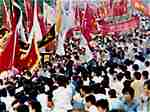
 

Students marchApril 17
Thousands of students march in Beijing and Shanghai shouting “long live Hu Yaobang, long live democracy, long live freedom, long live the rule of law.”


April 18
2,000 students from Beijing bicycle into Tiananmen Square and protest before the Great Hall of the People. Student leaders, including Wang DanIncluded in their demands for democratic reforms is the repudiation of official campaigns against freedom of the press.

April 21
Crowds of up to 100,000 demonstators gather in Tiananmen Square to mourn Hu.
Policeman supporting students

April 22
Students defy police orders to leave the square, while riots break out in the provincial capitals of Xian and Changsha. Official memorial ceremonies are held for Hu at the Great Hall of the People.

Student strike at Beijing University


April 23
Beijing students announce a boycott of university classes.
 

April 24
Tens of thousands of students at Beijing universities go on strike, demanding a dialog with the government.

Student rally in the squareApril 27
Bolstered by broad-based support, more than 150,000 students surge past police lines and fill Tiananmen Square, chanting slogans for democracy and freedom.

April 29
Government officials meet with student leaders, but independent student groups say they will continue a class boycott at 41 university campuses in Beijing.

May 2
6,000 students march in Shanghai.

May 4
100,000 students and supporters march on Tiananmen square to celebrate the 70th anniversary of Student hunger strike China’s first student movement, while similar demonstrations are held in Shanghai, Nanjing and other cities. 300 journalists protest outside the official Xinhua News Agency.

May 9
Journalists petition the government for freedom of the press.

May 13
2,000 students begin a hunger strike in Tiananmen Square.

Rally on the eve of GorbachevMay 15
Government deadline for students to leave the square comes and goes. A welcoming ceremony for Soviet leader Mikhail Gorbachev’s state visit is moved to the airport.

tienanmen-12-rally.jpgMay 16
Hundreds of thousands of demonstrators occupy the square.

May 18
One million people march in support of the hunger strikers. Li PengLi Peng, Premier of the State Council, issues a stern warning to student leaders and refuses to discuss their demands.

May 19
Zhoa ZiyangA tearful Zhao Ziyang, China’s General Secretary, makes a pre-dawn visit to weakened hunger strikers. Li also visits the students briefly. In the evening the students decide to end the hunger strike, but quickly change their mind when Li and President Yang Shangkun announce martial law. Zhao reportedly resigns or is ousted from power after failing to convince Li and others to compromise.

Yang ShangkunMay 20, 1989
Chinese authorities ‘pull the plug’ on Dan Rather who is reporting live from Beijing.

May 28
About 80,000 people (mostly students from outside the capital) demonstrate but, unlike past rallies, few workers participate.
Goddess of Democracy
May 30
Students unveil their “Goddess of Democracy,” a replica of the Statue of Liberty, on the square. The government calls it an insult to the nation.

May 31
Farmers and workers stage the first of several pro-government rallies in Beijing’s suburbs.

June 1
The Beijing Municipal Government bans all foreign press coverage of the demonstrations.

June 3
Tens of thousands of troops advance on the city shortly after midnight, but are repulsed by residents who put up barricades. PLA troops stopped by civilians By the afternoon 5,000 troops appear outside the Great Hall of the People, but are again surrounded and stopped. In the final assault that evening, troops shoot and beat their way to the square.

Taping the beginnings of the massacre, correspondent Richard Roth is arrested.

June 4
Troops occupy the square and smash the “Goddess of Democracy” with tanks. The shooting continues with soldiers periodically firing on crowds gathered on the outskirts of the square. Residents set fire to more than 100 military trucks and armored personnel carriers. The government claims the “counterrevolutionary riots” have been suppressed. Meanwhile, riots break out in southwestern Chengdu.

Richard Roth is released and reports further on the night’s violence.
PLA troops confront civilians
June 5
There are reports of clashes between rival military groups around Beijing. President Bush condemns the “bloody and violent” crackdown and orders a suspension of U.S. military sales and contacts with the Chinese government.

June 5, 1989
Richard Roth reports: one anonymous man stops a column of 18 tanks.
Wounded civilian
June 6
Foreign embassies advise their nationals to leave China. The government says 300 people were killed and 7,000 injured in the crackdown, but claims most of the dead were soldiers. There are more reports of clashes between military units. Six people are killed in Shanghai when a train runs through a barricade. The U.S. State Department announces that dissident Fang Lizhi and his wife have sought refuge in the U.S. Embassy.
An advancing tank
June 7
Troops, responding to what they say is sniper fire, shoot into a foreign diplomatic compound. The United States and other governments order the mandatory evacuation of dependents of diplomatic personnel.

June 8
Premier Li Peng appears in public for the first time since the crackdown to congratulate troops.
Deng Xiaoping
June 9
China’s leader Deng Xiaoping appears for the first time since May 16. In a speech to military officers he blames the turmoil on counterrevolutionaries attempting to overthrow communism.

Motorcycle crushed by a tankJune 10
Beijing authorities announce the arrest of more than 400 people, including student and labor leaders.

June 11
The government issues a warrant for the arrest of Fang Lizhi and his wife, saying they committed crimes of “counterrevolutionary propaganda and instigation.” Fang Lizhi

June 12
The government bans all independent student and labor organizations and says police and soldiers should shoot all “rioters and counterrevolutionaries.”PLA tank on patrol

June 13
The government issues a wanted list for 21 student activists who led the democracy movement.
Student leader Wang Dan

June 14
China orders the expulsion of Associated Press reporter John Pomfret and Voice of America Bureau Chief Alan Pessin.

June 15
Three Shanghai men are sentenced to death for burning a train that ran over protesters. The nationwide arrest total reaches above 1,000.
Soldiers seen through window of burned vehicle
June 17
A Beijing court sentences eight people to death for attacking soldiers and burning vehicles during the June 3-4 assault.

June 18
Politburo member Qiao Shi appears prominently in the official media, adding to speculation the party security man will replace Zhao.

A burned tank
June 20
The government nullifies all exit permits in an apparent attempt to stop fugitives from leaving the country.

Al-Qaeda in Iraq back in Afghanistan!

Do you chose to believe this yarn? It’s not long, it’s circular. US casualties in Afghanistan have surpassed casualties in Iraq, and to explain it maybe, US military spokesman have revealed they believe the leadership of al-Qaeda in Iraq is now back in Afghanistan!

Let’s see. We attacked Afghanistan because the Taliban refused to rein in its terrorist arm, purportedly named al-Qaeda. Which may or may not be a figment of US military intelligence imagination. We know about al-Qaeda only through our military interrogator, plus the 19-known hijackers who were dead before there was public mention of al-Qaeda, and no al-Qaeda charges have stuck to any Guantanamo inmate so far.

We can’t find it, do we know “it” exists?

So we attack Iraq which had no known al-Qaeda, until, our same dubious military intelligence people inform us there is an “al-Qaeda in Iraq,” actually, in Mesopotamia, actually, in the Land of the Two Rivers. Depending on the translation.

Was the original logo IN ENGLISH? Actually Osama’s gang was a CIA creation, so the origial al-Qaeda tattoo may have been designed in Langly, then put back and forth through Babblefish to obscure the non-Arabic speaking origins. Or not.

Fair enough, but we still only have our propaganda team to vouch for it, and have we ever known them to tell us anything truthful? Every time insurgents are engaged we hear our forces have killed an al-Qaeda leader. It’s usually the first we’ve heard of the person, and the last. Except the guy they’ve now killed twice.

So every act of violence in Iraq is blamed on AQII until we want to talk about the “surge” working. If we want to declare the “surge” a success, AQII has to goway. And where better than to where it came from (maybe?) Afghanistan!

If we surge into Afghanistan, which Barack Obama has declared we should do, and if THAT’S a hit, soon enough we’ll have it cornered to be al-Qaida in a Cave, and then al-Qaeda in Osama’s Teevee Room!

If we applied the same logic to the Weapons of Mass Destruction supposed to be in Iraq, we could look for them where they came from. The WMD in American chemical weapons companies!

The urge to SURGE

storm-surge.jpgMy wife has been away for a month and when she returns, I plan to call out my troops to SURGE! Don’t laugh, if an old flake like John McCain can bait Obama about not being man enough to vote to SURGE, certainly I shouldn’t be an unpatriotic, limp wristed wimp like Brother Hussein. You know what I mean, Dudes?

This sicko macho rhetoric from the military is on a par with their use of homosexual rape in Iraqi jails. It’s on a par with the US police using homosexual rape as a weapon in US prisons, too. It’s on a par with all the perversions and sadism coming down from the top shits at the White House, and backed up by the Top Democratic Party shits in Congress.

Let’s see? We have this giant do-nothing military industrial complex with literally millions taking home their government socialism pay checks for being office workers, techs, IT specialists, and wander in circle grunts, and they need this sort of sexual rhetoric about ‘SURGING’, and they want to purge those who won’t SURGE to keep their welfare checks a rolling?

The urge to SURGE is government pornography, that’s all. The reality is a raped Iraq and Afghanistan and nothing more. We need to purge the SURGE now!

John Edwards Fathers Bat Boy, Mother is Space Alien!

Nurse! Confused old man camplains, saying surge started almost a year before it did, and that it protected a man who was actually assassinated. [video]

Remember: McCain had a “love child” with a black prostitute! National Enquirer claims John Edwards has a “love child” with another woman. Considering the source, I’m surprised they didn’t claim the baby was Bat Boy, and the mother was a space alien. Oh, and never mind that the alleged mother says the story is total bullshit. Republicans love bullshit!

A government of lies. One of the most deceitful rules our joke of a Congress runs by, is that members have a certain number of days when they can “revise” their testimony in the Congressional Record. So, they can lie their asses off in front of the cameras, and change their story later. Lamar Smith (R-TX) has now taken that to the extreme. While Karl Rove committed contempt of Congress by refusing to obey a subpoena to testify about his involvement in the prosecution of AL Governor Siegelman (D), Lamar has now submitted a fictitious account of Rove actually testifying, thus removing the possibility of contempt charges being filed.

This is the history the delusionists can’t wait to destroy. National Geographic issue on the wonders of Iran.

With apologies to Monty Python. Nobody ever expects the Domionist Agenda! When Dominionism started its rise to power back in the 80s, I was a fundamentalist myself. I remember an issue of Christianity Today warning there was nothing Christian about the movement, and suggesting it was actually the religion of the AntiChrist. Maybe there are prophets, after all.

Reagan worshippers revive their demand that Reagan’s face be put on the $10 bill. What more could you ask to reward the man who brought us all the concept of deregulation, which has destroyed the American economy, and made WE THE PEOPLE little more than slaves to the Corporate Elite? On the other hand, we could put his face on the penny, and then quit minting it because it isn’t worth anything anymore.

Uh oh. Israel is now losing the support of the NeoCons.

Obama quickly losing support of antiwar activists.

What’s missing from The Reich? Slavery!

Can’t get on a plane because someone with a name just 8 letters different is on the terrorist watch list? Can you get off it? Politiburo says “nyet!”

Kinky! Charles Rangel (D-NY) files ethics probe…of himself.

Congresswoman Sally Kern (R-OK) caught trying to smuggle a gun into Capitol. Maybe the gays made her do it? She blames them for everything else.

Hatemongering bigot warns House hearing of black gang raping lesbians if Don’t Ask, Don’t Tell is overtuned. “Oh, and did I mention they’re black!

Speaking of rape. Congratulations on your winning bid to buy Fannie Mae and Freddie Mac. I wonder which of the Bush clan is making a billion off of this bailout?

Excerpts from Thomas McCullock’s notes July 24, thomasmc.com.

Global economic rapists are at it again

G8 protest
Why protest the G8 Summit July 7-9? Those hoodlums always look so determined. Here’s the rationale by the Emergency Exit Collective:

The 2008 G8 on Hokkaido, a Strategic Assessment
Emergency Exit Collective
Bristol, Mayday, 2008

The authors of this document are a collection of activists, scholars, and writers currently based in the United States and Western Europe who have gotten to know and work with each other in the movement against capitalist globalization. We’re writing this at the request of some members of No! G8 Action Japan, who asked us for a broad strategic analysis of the state of struggle as we see it, and particularly, of the role of the G8, what it represents, the dangers and opportunities that may lie hidden in the moment. It is in no sense programmatic. Mainly, it is an attempt to develop tools that we hope will be helpful for organizers, or for anyone engaged in the struggle against global capital.

I
It is our condition as human beings that we produce our lives in common.

II
Let us then try to see the world from the perspective of the planet’s commoners, taking the word in that sense: those whose most essential tradition is cooperation in the making and maintenance of human social life, yet who have had to do so under conditions of suffering and separation; deprived, ignored, devalued, divided into hierarchies, pitted against each other for our very physical survival. In one sense we are all commoners. But it’s equally true that just about everyone, at least in some ways, at some points, plays the role of the rulers—of those who expropriate, devalue and divide—or at the very least benefits from such divisions.

Obviously some do more than others. It is at the peak of this pyramid that we encounter groups like the G8.

III
The G8’s perspective is that of the aristocrats, the rulers: those who command and maintain that global machinery of violence that defends existing borders and lines of separation: whether national borders with their detention camps for migrants, or property regimes, with their prisons for the poor. They live by constantly claiming title to the products of others collective creativity and labour, and in thus doing they create the poor; they create scarcity in the midst of plenty, and divide us on a daily basis; they create financial districts that loot resources from across the world, and in thus doing they turn the spirit of human creativity into a spiritual desert; close or privatize parks, public water taps and libraries, hospitals, youth centers, universities, schools, public swimming pools, and instead endlessly build shopping malls that channels convivial life into a means of commodity circulation; work toward turning global ecological catastrophe into business opportunities.

These are the people who presume to speak in the name of the “international community” even as they hide in their gated communities or meet protected by phalanxes of riot cops. It is critical to bear in mind that the ultimate aim of their policies is never to create community but to introduce and maintain divisions that set common people at each other’s throats. The neoliberal project, which has been their main instrument for doing so for the last three decades, is premised on a constant effort either to uproot or destroy any communal or democratic system whereby ordinary people govern their own affairs or maintain common resources for the common good, or, to reorganize each tiny remaining commons as an isolated node in a market system in which livelihood is never guaranteed, where the gain of one community must necessarily be at the expense of others. Insofar as they are willing to appeal to high-minded principles of common humanity, and encourage global cooperation, only and exactly to the extent that is required to maintain this system of universal competition.

IV
At the present time, the G8—the annual summit of the leaders of “industrial democracies”—is the key coordinative institution charged with the task of maintaining this neoliberal project, or of reforming it, revising it, adapting it to the changing condition of planetary class relations. The role of the G8 has always been to define the broad strategic horizons through which the next wave of planetary capital accumulation can occur. This means that its main task is to answer the question of how 3?4 in the present conditions of multiple crises and struggles 3?4 to subordinate social relations among the producing commoners of the planet to capital’s supreme value: profit.

V
Originally founded as the G7 in 1975 as a means of coordinating financial strategies for dealing with the ‘70s energy crisis, then expanded after the end of the Cold War to include Russia, its currently face a moment of profound impasse in the governance of planetary class relations: the greatest since the ‘70s energy crisis itself.

VI
The ‘70s energy crisis represented the final death-pangs of what might be termed the Cold War settlement, shattered by a quarter century of popular struggle. It’s worth returning briefly to this history.

The geopolitical arrangements put in place after World War II were above all designed to forestall the threat of revolution. In the immediate wake of the war, not only did much of the world lie in ruins, most of world’s population had abandoned any assumption about the inevitability of existing social arrangements. The advent of the Cold War had the effect of boxing movements for social change into a bipolar straightjacket. On the one hand, the former Allied and Axis powers that were later to unite in the G7 (the US, Canada, UK, France, Italy, Germany, Japan)—the “industrialized democracies”, as they like to call themselves—engaged in a massive project of co-optation. Their governments continued the process, begun in the ‘30s, of taking over social welfare institutions that had originally been created by popular movements (from insurance schemes to public libraries), even to expand them, on condition that they now be managed by state-appointed bureaucracies rather than by those who used them, buying off unions and the working classes more generally with policies meant to guarantee high wages, job security and the promise of educational advance—all in exchange for political loyalty, productivity increases and wage divisions within national and planetary working class itself. The Sino-Soviet bloc—which effectively became a kind of junior partner within the overall power structure, and its allies remained to trap revolutionary energies into the task of reproducing similar bureaucracies elsewhere. Both the US and USSR secured their dominance after the war by refusing to demobilize, instead locking the planet in a permanent threat of nuclear annihilation, a terrible vision of absolute cosmic power.

VII
Almost immediately, though, this arrangement was challenged by a series of revolts from those whose work was required to maintain the system, but who were, effectively, left outside the deal: first, peasants and the urban poor in the colonies and former colonies of the Global South, next, disenfranchised minorities in the home countries (in the US, the Civil Rights movement, then Black Power), and finally and most significantly, by the explosion of the women’s movement of the late ‘60s and early ‘70s—the revolt of that majority of humanity whose largely unremunerated labor made the very existence “the economy” possible. This appears to have been the tipping point.

VIII
The problem was that the Cold War settlement was never meant to include everyone. It by definition couldn’t. Once matters reached tipping point, then, the rulers scotched the settlement. All deals were off. The oil shock was first edge of the counter-offensive, breaking the back of existing working class organizations, driving home the message that there was nothing guaranteed about prosperity. Under the aegis of the newly hatched G7, this counter-offensive involved a series of interwoven strategies that were later to give rise to what is known as neoliberalism.

IX
These strategies resulted in what came to be known as “Structural Adjustment” both in the North and in the South, accompanied by trade and financial liberalization. This, in turn, made possible crucial structural changes in our planetary production in common extending the role of the market to discipline our lives and divide us into more and more polarized wage hierarchy. This involved:

· In the immediate wake of ‘70s oil shock, petrodollars were recycled from OPEC into Northern banks that then lent them, at extortionate rates of interest, to developing countries of the Global South. This was the origin of the famous “Third World Debt Crisis.” The existence of this debt allowed institutions like the IMF to impose its monetarist orthodoxy on most of the planet for roughly twenty years, in the process, stripping away most of even those modest social protections that had been won by the world’s poor—large numbers of whom were plunged into a situation of absolute desperation.

· It also opened a period of new enclosures through the capitalist imposition of structural adjustment policies, manipulation of environmental and social catastrophes like war, or for that matter through the authoritarian dictates of “socialist” regimes. Through such means, large sections of the world’s population have over the past thirty years been dispossessed from resources previously held in common, either by dint of long traditions, or as the fruits of past struggles and past settlements.

· Through financial deregulation and trade liberalization, neoliberal capital, which emerged from the G7 strategies to deal with the 1970s crisis aimed thus at turning the “class war” in communities, factories, offices, streets and fields against the engine of competition, into a planetary “civil war”, pitting each community of commoners against every other community of commoners.

· Neoliberal capital has done this by imposing an ethos of “efficiency” and rhetoric of “lowering the costs of production” applied so broadly that mechanisms of competition have come to pervade every sphere of life. In fact these terms are euphemisms, for a more fundamental demand: that capital be exempt from taking any reduction in profit to finance the costs of reproduction of human bodies and their social and natural environments (which it does not count as costs) and which are, effectively, “exernalized” onto communities and nature.

· The enclosure of resources and entitlements won in previous generations of struggles both in the North and the South, in turn, created the conditions for increasing the wage hierarchies (both global and local), by which commoners work for capital—wage hierarchies reproduced economically through pervasive competition, but culturally, through male dominance, xenophobia and racism. These wage gaps, in turn, made it possible to reduce the value of Northern workers’ labour power, by introducing commodities that enter in their wage basket at a fraction of what their cost might otherwise have been. The planetary expansion of sweatshops means that American workers (for example) can buy cargo pants or lawn-mowers made in Cambodia at Walmart, or buy tomatoes grown by undocumented Mexican workers in California, or even, in many cases, hire Jamaican or Filipina nurses to take care of children and aged grandparents at such low prices, that their employers have been able to lower real wages without pushing most of them into penury. In the South, meanwhile, this situation has made it possible to discipline new masses of workers into factories and assembly lines, fields and offices, thus extending enormously capital’s reach in defining the terms—the what, the how, the how much—of social production.

· These different forms of enclosures, both North and South, mean that commoners have become increasingly dependent on the market to reproduce their livelihoods, with less power to resist the violence and arrogance of those whose priorities is only to seek profit, less power to set a limit to the market discipline running their lives, more prone to turn against one another in wars with other commoners who share the same pressures of having to run the same competitive race, but not the same rights and the same access to the wage. All this has meant a generalized state of precarity, where nothing can be taken for granted.

X
In turn, this manipulation of currency and commodity flows constituting neoliberal globalization became the basis for the creation of the planet’s first genuine global bureaucracy.

· This was multi-tiered, with finance capital at the peak, then the ever-expanding trade bureaucracies (IMF, WTO, EU, World Bank, etc), then transnational corporations, and finally, the endless varieties of NGOs that proliferated throughout the period—almost all of which shared the same neoliberal orthodoxy, even as they substituted themselves for social welfare functions once reserved for states.

· The existence of this overarching apparatus, in turn, allowed poorer countries previously under the control of authoritarian regimes beholden to one or another side in the Cold War to adopt “democratic” forms of government. This did allow a restoration of formal civil liberties, but very little that could really merit the name of democracy (the rule of the “demos”, i.e., of the commoners). They were in fact constitutional republics, and the overwhelming trend during the period was to strip legislatures, that branch of government most open to popular pressure, of most of their powers, which were increasingly shifted to the executive and judicial branches, even as these latter, in turn, largely ended up enacting policies developed overseas, by global bureaucrats.

· This entire bureaucratic arrangement was justified, paradoxically enough, by an ideology of extreme individualism. On the level of ideas, neoliberalism relied on a systematic cooptation of the themes of popular struggle of the ‘60s: autonomy, pleasure, personal liberation, the rejection of all forms of bureaucratic control and authority. All these were repackaged as the very essence of capitalism, and the market reframed as a revolutionary force of liberation.

· The entire arrangement, in turn, was made possible by a preemptive attitude towards popular struggle. The breaking of unions and retreat of mass social movements from the late ‘70s onwards was only made possible by a massive shift of state resources into the machinery of violence: armies, prisons and police (secret and otherwise) and an endless variety of private “security services”, all with their attendant propaganda machines, which tended to increase even as other forms of social spending were cut back, among other things absorbing increasing portions of the former proletariat, making the security apparatus an increasingly large proportion of total social spending. This approach has been very successful in holding back mass opposition to capital in much of the world (especially West Europe and North America), and above all, in making it possible to argue there are no viable alternatives. But in doing so, has created strains on the system so profound it threatens to undermine it entirely.

XI
The latter point deserves elaboration. The element of force is, on any number of levels, the weak point of the system. This is not only on the constitutional level, where the question of how to integrate the emerging global bureaucratic apparatus, and existing military arrangements, has never been resolved. It is above all an economic problem. It is quite clear that the maintenance of elaborate security machinery is an absolute imperative of neoliberalism. One need only observe what happened with the collapse of the Soviet bloc in Eastern Europe: where one might have expected the Cold War victors to demand the dismantling of the army, secret police and secret prisons, and to maintain and develop the existing industrial base, in fact, what they did was absolutely the opposite: in fact, the only part of the industrial base that has managed fully to maintain itself has been the parts required to maintained the security apparatus itself! Critical too is the element of preemption: the governing classes in North America, for example, are willing to go to almost unimaginable lengths to ensure social movements never feel they are accomplishing anything. The current Gulf War is an excellent example: US military operations appear to be organized first and foremost to be protest-proof, to ensure that what happened in Vietnam (mass mobilization at home, widespread revolt within the army overseas) could never be repeated. This means above all that US casualties must always be kept to a minimum. The result are rules of engagement, and practices like the use of air power within cities ostensibly already controlled by occupation forces, so obviously guaranteed to maximize the killing of innocents and galvanizing hatred against the occupiers that they ensure the war itself cannot be won. Yet this approach can be taken as the very paradigm for neoliberal security regimes. Consider security arrangements around trade summits, where police are so determined prevent protestors from achieving tactical victories that they are often willing to effectively shut down the summits themselves. So too in overall strategy. In North America, such enormous resources are poured into the apparatus of repression, militarization, and propaganda that class struggle, labor action, mass movements seem to disappear entirely. It is thus possible to claim we have entered a new age where old conflicts are irrelevant. This is tremendously demoralizing of course for opponents of the system; but those running the system seem to find that demoralization so essential they don’t seem to care that the resultant apparatus (police, prisons, military, etc) is, effectively, sinking the entire US economy under its dead weight.

XII
The current crisis is not primarily geopolitical in nature. It is a crisis of neoliberalism itself. But it takes place against the backdrop of profound geopolitical realignments. The decline of North American power, both economic and geopolitical has been accompanied by the rise of Northeast Asia (and to a increasing extent, South Asia as well). While the Northeast Asian region is still divided by painful Cold War cleavages—the fortified lines across the Taiwan straits and at the 38th parallel in Korea…—the sheer realities of economic entanglement can be expected to lead to a gradual easing of tensions and a rise to global hegemony, as the region becomes the new center of gravity of the global economy, of the creation of new science and technology, ultimately, of political and military power. This may, quite likely, be a gradual and lengthy process. But in the meantime, very old patterns are rapidly reemerging: China reestablishing relations with ancient tributary states from Korea to Vietnam, radical Islamists attempting to reestablish their ancient role as the guardians of finance and piety at the in the Central Asian caravan routes and across Indian Ocean, every sort of Medieval trade diaspora reemerging… In the process, old political models remerge as well: the Chinese principle of the state transcending law, the Islamic principle of a legal order transcending any state. Everywhere, we see the revival too of ancient forms of exploitation—feudalism, slavery, debt peonage—often entangled in the newest forms of technology, but still echoing all the worst abuses of the Middle Ages. A scramble for resources has begun, with US occupation of Iraq and saber-rattling throughout the surrounding region clearly meant (at least in part) to place a potential stranglehold the energy supply of China; Chinese attempts to outflank with its own scramble for Africa, with increasing forays into South America and even Eastern Europe. The Chinese invasion into Africa (not as of yet at least a military invasion, but already involving the movement of hundreds of thousands of people), is changing the world in ways that will probably be felt for centuries. Meanwhile, the nations of South America, the first victims of the “Washington consensus” have managed to largely wriggle free from the US colonial orbit, while the US, its forces tied down in the Middle East, has for the moment at least abandoned it, is desperately struggling to keep its grip Mexico, Central America and the Caribbean—its own “near abroad”.

XIII
In another age all this might have led to war—that is, not just colonial occupations, police actions, or proxy wars (which are obviously already taking place), but direct military confrontations between the armies of major powers. It still could; accidents happen; but there is reason to believe that, when it comes to moments of critical decision, the loyalties of the global elites are increasingly to each other, and not to the national entities for whom they claim to speak. There is some compelling evidence for this.

Take for example when the US elites panicked at the prospect of the massive budget surpluses of the late 1990s. As Alan Greenspan, head of the Federal Reserve at the time warned, if these were allowed to stand they would have flooded government coffers with so many trillions of dollars that it could only have lead to some form of creeping socialism, even, he predicted, to the government acquiring “equity stakes” in key US corporations. The more excitable of capitalism’s managers actually began contemplating scenarios where the capitalist system itself would be imperiled. The only possible solution was massive tax cuts; these were duly enacted, and did indeed manage to turn surpluses into enormous deficits, financed by the sale of treasury bonds to Japan and China. Conditions have thus now reached a point where it is beginning to look as if the most likely long term outcome for the US (its technological and industrial base decaying, sinking under the burden of its enormous security spending) will be to end up serve as junior partner and military enforcer for East Asia capital. Its rulers, or at least a significant proportion of them, would prefer to hand global hegemony to the rulers of China (provided the latter abandon Communism) than to return to any sort of New Deal compromise with their “own” working classes.

A second example lies in the origins of what has been called the current “Bretton Woods II” system of currency arrangements, which underline a close working together of some “surplus” and “deficit” countries within global circuits. The macroeconomic manifestation of the planetary restructuring outlined in XIX underlines both the huge US trade deficit that so much seem to worry many commentators, and the possibility to continually generate new debt instruments like the one that has recently resulted in the sub-prime crisis. The ongoing recycling of accumulated surplus of countries exporting to the USA such as China and oil producing countries is what has allowed financiers to create new credit instruments in the USA. Hence, the “deal” offered by the masters in the United States to its commoners has been this: ‘you, give us a relative social peace and accept capitalist markets as the main means through which you reproduce your own livelihoods, and we will give you access to cheaper consumption goods, access to credit for buying cars and homes, and access to education, health, pensions and social security through the speculative means of stock markets and housing prices.’ Similar compromises were reached in all the G8 countries.

Meanwhile, there is the problem of maintaining any sort of social peace with the hundreds of millions of unemployed, underemployed, dispossessed commoners currently swelling the shanty-towns of Asia, Africa, and Latin America as a result of ongoing enclosures (which have speeded up within China and India in particular, even as “structural adjustment policies” in Africa and Latin America have been derailed). Any prospect of maintaining peace in these circumstances would ordinarily require either extremely high rates of economic growth—which globally have not been forthcoming, since outside of China, growth rates in the developing world have been much lower than they were in the ‘50s, ‘60s, or even ‘70s—or extremely high levels of repression, lest matters descend into rebellion or generalized civil war. The latter has of course occurred in many parts of the world currently neglected by capital, but in favored regions, such as the coastal provinces of China, or “free trade” zones of India, Egypt, or Mexico, commoners are being offered a different sort of deal: industrial employment at wages that, while very low by international standards, are still substantially higher than anything currently obtainable in the impoverished countryside; and above all the promise, through the intervention of Western markets and (privatized) knowledge, of gradually improving conditions of living. While over the least few years wages in many such areas seem to be growing, thanks to the intensification of popular struggles, such gains are inherently vulnerable: the effect of recent food inflation has been to cut real wages back dramatically—and threaten millions with starvation.

What we really want to stress here, though, is that the long-term promise being offered to the South is just as untenable as the idea that US or European consumers can indefinitely expand their conditions of life through the use of mortgages and credit cards.

What’s being offered the new dispossessed is a transposition of the American dream. The idea is that the lifestyle and consumption patterns of existing Chinese, Indian, or Brazilian or Zambian urban middle classes (already modeled on Northern ones) will eventually become available to the children of today’s miners, maquila or plantation laborers, until, ultimately, everyone on earth is brought up to roughly the same level of consumption. Put in these terms, the argument is absurd. The idea that all six billion of us can become “middle class” is obviously impossible. First of all there is a simple problem of resources. It doesn’t matter how many bottles we recycle or how energy efficient are the light bulbs we use, there’s just no way the earth’s ecosystem can accommodate six billion people driving in private cars to work in air-conditioned cubicles before periodically flying off to vacation in Acapulco or Tahiti. To maintain the style of living and producing in common we now identify with “middle classness” on a planetary scale would require several additional planets.

This much has been pointed out repeatedly. But the second point is no less important. What this vision of betterment ultimately proposes is that it would be possible to build universal prosperity and human dignity on a system of wage labor. This is fantasy. Historically, wages are always the contractual face for system of command and degradation, and a means of disguising exploitation: expressing value for work only on condition of stealing value without work— and there is no reason to believe they could ever be anything else. This is why, as history has also shown, human beings will always avoid working for wages if they have any other viable option. For a system based on wage labor to come into being, such options must therefore be made unavailable. This in turn means that such systems are always premised on structures of exclusion: on the prior existence of borders and property regimes maintained by violence. Finally, historically, it has always proved impossible to maintain any sizeable class of wage-earners in relative prosperity without basing that prosperity, directly or indirectly, on the unwaged labor of others—on slave-labor, women’s domestic labor, the forced labor of colonial subjects, the work of women and men in peasant communities halfway around the world—by people who are even more systematically exploited, degraded, and immiserated. For that reason, such systems have always depended not only on setting wage-earners against each other by inciting bigotry, prejudice, hostility, resentment, violence, but also by inciting the same between men and women, between the people of different continents (“race”), between the generations.

From the perspective of the whole, then, the dream of universal middle class “betterment” must necessarily be an illusion constructed in between the Scylla of ecological disaster, and the Charybdis of poverty, detritus, and hatred: precisely, the two pillars of today’s strategic impasse faced by the G8.

XIV
How then do we describe the current impasse of capitalist governance?

To a large degree, it is the effect of a sudden and extremely effective upswing of popular resistance—one all the more extraordinary considering the huge resources that had been invested in preventing such movements from breaking out.

On the one hand, the turn of the millennium saw a vast and sudden flowering of new anti-capitalist movements, a veritable planetary uprising against neoliberalism by commoners in Latin America, India, Africa, Asia, across the North Atlantic world’s former colonies and ultimately, within the cities of the former colonial powers themselves. As a result, the neoliberal project lies shattered. What came to be called the “anti-globalization” movement took aim at the trade bureaucracies—the obvious weak link in the emerging institutions of global administration—but it was merely the most visible aspect of this uprising. It was however an extraordinarily successful one. Not only was the WTO halted in its tracks, but all major trade initiatives (MAI, FTAA…) scuttled. The World Bank was hobbled and the power of the IMF over most of the world’s population, effectively, destroyed. The latter, once the terror of the Global South, is now a shattered remnant of its former self, reduced to selling off its gold reserves and desperately searching for a new global mission.

In many ways though spectacular street actions were merely the most visible aspects of much broader changes: the resurgence of labor unions, in certain parts of the world, the flowering of economic and social alternatives on the grassroots levels in every part of the world, from new forms of direct democracy of indigenous communities like El Alto in Bolivia or self-managed factories in Paraguay, to township movements in South Africa, farming cooperatives in India, squatters’ movements in Korea, experiments in permaculture in Europe or “Islamic economics” among the urban poor in the Middle East. We have seen the development of thousands of forms of mutual aid association, most of which have not even made it onto the radar of the global media, often have almost no ideological unity and which may not even be aware of each other’s existence, but nonetheless share a common desire to mark a practical break with capitalism, and which, most importantly, hold out the prospect of creating new forms of planetary commons that can—and in some cases are—beginning to knit together to provide the outlines of genuine alternative vision of what a non-capitalist future might look like.

The reaction of the world’s rulers was predictable. The planetary uprising had occurred during a time when the global security apparatus was beginning to look like it lacked a purpose, when the world threatened to return to a state of peace. The response—aided of course, by the intervention of some of the US’ former Cold War allies, reorganized now under the name of Al Qaeda—was a return to global warfare. But this too failed. The “war on terror”—as an attempt to impose US military power as the ultimate enforcer of the neoliberal model—has collapsed as well in the face of almost universal popular resistance. This is the nature of their “impasse”.

At the same time, the top-heavy, inefficient US model of military capitalism—a model created in large part to prevent the dangers of social movements, but which the US has also sought to export to some degree simply because of its profligacy and inefficiency, to prevent the rest of the world from too rapidly overtaking them—has proved so wasteful of resources that it threatens to plunge the entire planet into ecological and social crisis. Drought, disaster, famines, combine with endless campaigns of enclosure, foreclosure, to cast the very means of survival—food, water, shelter—into question for the bulk of the world’s population.

XV
In the rulers’ language the crisis understood, first and foremost, as a problem of regulating cash flows, of reestablishing, as they like to put it, a new “financial architecture”. Obviously they are aware of the broader problems. Their promotional literature has always been full of it. From the earliest days of the G7, through to the days after the Cold War, when Russia was added as a reward for embracing capitalism, they have always claimed that their chief concerns include

· the reduction of global poverty

· sustainable environmental policies

· sustainable global energy policies

· stable financial institutions governing global trade and currency transactions

If one were to take such claims seriously, it’s hard to see their overall performance as anything but a catastrophic failure. At the present moment, all of these are in crisis mode: there are food riots, global warming, peak oil, and the threat of financial meltdown, bursting of credit bubbles, currency crises, a global credit crunch. [**Failure on this scale however, opens opportunities for the G8 themselves, as summit of the global bureaucracy, to reconfigure the strategic horizon. Therefore, it’s always with the last of these that they are especially concerned. ]The real problem, from the perspective of the G8, is one of reinvestment: particularly, of the profits of the energy sector, but also, now, of emerging industrial powers outside the circle of the G8 itself. The neoliberal solution in the ‘70s had been to recycle OPEC’s petrodollars into banks that would use it much of the world into debt bondage, imposing regimes of fiscal austerity that, for the most part, stopped development (and hence, the emergence potential rivals) in its tracks. By the ‘90s, however, much East Asia in particular had broken free of this regime. Attempts to reimpose IMF-style discipline during the Asian financial crisis of 1997 largely backfired. So a new compromise was found, the so-called Bretton Woods II: to recycle the profits from the rapidly expanding industrial economies of East Asia into US treasury debt, artificially supporting the value of the dollar and allowing a continual stream of cheap exports that, aided by the US housing bubble, kept North Atlantic economies afloat and buy off workers there with cheap oil and even cheaper consumer goods even as real wages shrank. This solution however soon proved a temporary expedient. Bush regime’s attempt to lock it in by the invasion of Iraq, which was meant to lead to the forced privatization of Iraqi oil fields, and, ultimately, of the global oil industry as a whole, collapsed in the face of massive popular resistance (just as Saddam Hussein’s attempt to introduce neoliberal reforms in Iraq had failed when he was still acting as American deputy in the ‘90s). Instead, the simultaneous demand for petroleum for both Chinese manufacturers and American consumers caused a dramatic spike in the price of oil. What’s more, rents from oil and gas production are now being used to pay off the old debts from the ‘80s (especially in Asia and Latin America, which have by now paid back their IMF debts entirely), and—increasingly—to create state-managed Sovereign Wealth Funds that have largely replaced institutions like the IMF as the institutions capable of making long-term strategic investments. The IMF, purposeless, tottering on the brink of insolvency, has been reduced to trying to come up with “best practices” guidelines for fund managers working for governments in Singapore, Seoul, and Abu Dhabi.

There can be no question this time around of freezing out countries like China, India, or even Brazil. The question for capital’s planners, rather, is how to channel these new concentrations of capital in such a way that they reinforce the logic of the system instead of undermining it.

XVI
How can this be done? This is where appeals to universal human values, to common membership in an “international community” come in to play. “We all must pull together for the good of the planet,” we will be told. The money must be reinvested “to save the earth.”

To some degree this was always the G8 line: this is a group has been making an issue of climate change since 1983. Doing so was in one sense a response to the environmental movements of the ‘70s and ‘80s. The resultant emphasis on biofuels and “green energy” was from their point of view, the perfect strategy, seizing on an issue that seemed to transcend class, appropriating ideas and issues that emerged from social movements (and hence coopting and undermining especially their radical wings), and finally, ensuring such initiatives are pursued not through any form of democratic self-organization but “market mechanisms”—to effective make the sense of public interest productive for capitalism.

What we can expect now is a two-pronged attack. On the one hand, they will use the crisis to attempt to reverse the gains of past social movements: to put nuclear energy back on the table to deal with the energy crisis and global warming, or genetically modified foods to deal with the food crisis. Prime Minister Fukuda, the host of the current summit, for example, is already proposing the nuclear power is the “solution” to the global warming crisis, even as the German delegation resists. On the other, and even more insidiously, they will try once again to co-opt the ideas and solutions that have emerged from our struggles as a way of ultimately undermining them. Appropriating such ideas is simply what rulers do: the bosses brain is always under the workers’ hat. But the ultimate aim is to answer the intensification of class struggle, of the danger of new forms of democracy, with another wave of enclosures, to restore a situation where commoners’ attempts to create broader regimes of cooperation are stymied, and people are plunged back into mutual competition.

We can already see the outlines of how this might be done. There are already suggestions that Sovereign Wealth Funds put aside a certain (miniscule) proportion of their money for food aid, but only as tied to a larger project of global financial restructuring. The World Bank, largely bereft of its earlier role organizing dams and pipe-lines across the world, has been funding development in China’s poorer provinces, freeing the Chinese government to carry out similar projects in Southeast Asia, Africa, and even Latin America (where, of course, they cannot effectively be held to any sort of labor or environmental standards). There is the possibility of a new class deal in China itself, whose workers can be allowed higher standards of living if new low wage zones are created elsewhere—for instance, Africa (the continent where struggles over maintaining the commons have been most intense in current decades)—with the help of Chinese infrastructural projects. Above of all, money will be channeled into addressing climate change, into the development of alternative energy, which will require enormous investments, in such a way as to ensure that whatever energy resources do become important in this millennium, they can never be democratized—that the emerging notion of a petroleum commons, that energy resources are to some degree a common patrimony meant primarily to serve the community as a whole, that is beginning to develop in parts of the Middle East and South America—not be reproduced in whatever comes next.

Since this will ultimately have to be backed up by the threat of violence, the G8 will inevitably have to struggle with how to (yet again) rethink enforcement mechanisms. The latest move , now that the US “war on terror” paradigm has obviously failed, would appear to be a return to NATO, part of a reinvention of the “European security architecture” being proposed at the upcoming G8 meetings in Italy in 2009 on the 60th anniversary of NATO’s foundation—but part of a much broader movement of the militarization of social conflict, projecting potential resource wars, demographic upheavals resulting from climate change, and radical social movements as potential military problems to be resolved by military means. Opposition to this new project is already shaping up as the major new European mobilization for the year following the current G-8.

XVII
While the G-8 sit at the pinnacle of a system of violence, their preferred idiom is monetary. Their impulse whenever possible is to translate all problems into money, financial structures, currency flows—a substance whose movements they carefully monitor and control.

Money, on might say, is their poetry—a poetry whose letters are written in our blood. It is their highest and most abstract form of expression, their way of making statements about the ultimate truth of the world, even if it operates in large part by making things disappear. How else could it be possible to argue—no, to assume as a matter of common sense—that the love, care, and concern of a person who tends to the needs of children, teaching, minding, helping them to become decent , thoughtful, human beings, or who grows and prepares food, is worth ten thousand times less than someone who spends the same time designing a brand logo, moving abstract blips across a globe, or denying others health care.

The role of money however has changed profoundly since 1971 when the dollar was delinked from gold. This has created a profound realignment of temporal horizons. Once money could be said to be primarily congealed results of past profit and exploitation. As capital, it was dead labor. Millions of indigenous Americans and Africans had their lives pillaged and destroyed in the gold mines in order to be rendered into value. The logic of finance capital, of credit structures, certainly always existed as well (it is at least as old as industrial capital; possibly older), but in recent decades these logic of financial capital has come to echo and re-echo on every level of our lives. In the UK 97% of money in circulation is debt, in the US, 98%. Governments run on deficit financing, wealthy economies on consumer debt, the poor are enticed with microcredit schemes, debts are packaged and repackaged in complex financial derivatives and traded back and forth. Debt however is simply a promise, the expectation of future profit; capital thus increasingly brings the future into the present—a future that, it insists, must always be the same in nature, even if must also be greater in magnitude, since of course the entire system is premised on continual growth. Where once financiers calculated and traded in the precise measure of our degradation, having taken everything from us and turned it into money, now money has flipped, to become the measure of our future degradation—at the same time as it binds us to endlessly working in the present.

The result is a strange moral paradox. Love, loyalty, honor, commitment—to our families, for example, which means to our shared homes, which means to the payment of monthly mortgage debts—becomes a matter of maintaining loyalty to a system which ultimately tells us that such commitments are not a value in themselves. This organization of imaginative horizons, which ultimately come down to a colonization of the very principle of hope, has come to supplement the traditional evocation of fear (of penury, homelessness, joblessness, disease and death). This colonization paralyzes any thought of opposition to a system that almost everyone ultimately knows is not only an insult to everything they really cherish, but a travesty of genuine hope, since, because no system can really expand forever on a finite planet, everyone is aware on some level that in the final analysis they are dealing with a kind of global pyramid scheme, what we are ultimately buying and selling is the real promise of global social and environmental apocalypse.

XVIII
Finally then we come to the really difficult, strategic questions. Where are the vulnerabilities? Where is hope? Obviously we have no certain answers here. No one could. But perhaps the proceeding analysis opens up some possibilities that anti-capitalist organizers might find useful to explore.

One thing that might be helpful is to rethink our initial terms. Consider communism. We are used to thinking of it as a total system that perhaps existed long ago, and to the desire to bring about an analogous system at some point in the future—usually, at whatever cost. It seems to us that dreams of communist futures were never purely fantasies; they were simply projections of existing forms of cooperation, of commoning, by which we already make the world in the present. Communism in this sense is already the basis of almost everything, what brings people and societies into being, what maintains them, the elemental ground of all human thought and action. There is absolutely nothing utopian here. What is utopian, really, is the notion that any form of social organization, especially capitalism, could ever exist that was not entirely premised on the prior existence of communism. If this is true, the most pressing question is simply how to make that power visible, to burst forth, to become the basis for strategic visions, in the face of a tremendous and antagonistic power committed to destroying it—but at the same time, ensuring that despite the challenge they face, they never again become entangled with forms of violence of their own that make them the basis for yet another tawdry elite. After all, the solidarity we extend to one another, is it not itself a form of communism? And is it not so above because it is not coerced?

Another thing that might be helpful is to rethink our notion of crisis. There was a time when simply describing the fact that capitalism was in a state of crisis, driven by irreconcilable contradictions, was taken to suggest that it was heading for a cliff. By now, it seems abundantly clear that this is not the case. Capitalism is always in a crisis. The crisis never goes away. Financial markets are always producing bubbles of one sort or another; those bubbles always burst, sometimes catastrophically; often entire national economies collapse, sometimes the global markets system itself begins to come apart. But every time the structure is reassembled. Slowly, painfully, dutifully, the pieces always end up being put back together once again.

Perhaps we should be asking: why?

In searching for an answer, it seems to us, we might also do well to put aside another familiar habit of radical thought: the tendency to sort the world into separate levels—material realities, the domain of ideas or “consciousness”, the level of technologies and organizations of violence—treating these as if these were separate domains that each work according to separate logics, and then arguing which “determines” which. In fact they cannot be disentangled. A factory may be a physical thing, but the ownership of a factory is a social relation, a legal fantasy that is based partly on the belief that law exists, and partly on the existence of armies and police. Armies and police on the other hand exist partly because of factories providing them with guns, vehicles, and equipment, but also, because those carrying the guns and riding in the vehicles believe they are working for an abstract entity they call “the government”, which they love, fear, and ultimately, whose existence they take for granted by a kind of faith, since historically, those armed organizations tend to melt away immediately the moment they lose faith that the government actually exists. Obviously exactly the same can be said of money. It’s value is constantly being produced by eminently material practices involving time clocks, bank machines, mints, and transatlantic computer cables, not to mention love, greed, and fear, but at the same time, all this too rests on a kind of faith that all these things will continue to interact in more or less the same way. It is all very material, but it also reflects a certain assumption of eternity: the reason that the machine can always be placed back together is, simply, because everyone assumes it must. This is because they cannot realistically imagine plausible alternatives; they cannot imagine plausible alternatives because of the extraordinarily sophisticated machinery of preemptive violence that ensure any such alternatives are uprooted or contained (even if that violence is itself organized around a fear that itself rests on a similar form of faith.) One cannot even say it’s circular. It’s more a kind of endless, unstable spiral. To subvert the system is then, to intervene in such a way that the whole apparatus begins to spin apart.

XIX
It appears to us that one key element here—one often neglected in revolutionary strategy—is the role of the global middle classes. This is a class that, much though it varies from country (in places like the US and Japan, overwhelming majorities consider themselves middle class; in, say, Cambodia or Zambia, only very small percentages), almost everywhere provides the key constituency of the G8 outside of the ruling elite themselves. It has become a truism, an article of faith in itself in global policy circles, that national middle class is everywhere the necessary basis for democracy. In fact, middle classes are rarely much interested in democracy in any meaningful sense of that word (that is, of the self-organization or self-governance of communities). They tend to be quite suspicious of it. Historically, middle classes have tended to encourage the establishment of constitutional republics with only limited democratic elements (sometimes, none at all). This is because their real passion is for a “betterment”, for the prosperity and advance of conditions of life for their children—and this betterment, since it is as noted above entirely premised on structures of exclusion, requires “security”. Actually the middle classes depend on security on every level: personal security, social security (various forms of government support, which even when it is withdrawn from the poor tends to be maintained for the middle classes), security against any sudden or dramatic changes in the nature of existing institutions. Thus, politically, the middle classes are attached not to democracy (which, especially in its radical forms, might disrupt all this), but to the rule of law. In the political sense, then, being “middle class” means existing outside the notorious “state of exception” to which the majority of the world’s people are relegated. It means being able to see a policeman and feel safer, not even more insecure. This would help explain why within the richest countries, the overwhelming majority of the population will claim to be “middle class” when speaking in the abstract, even if most will also instantly switch back to calling themselves “working class” when talking about their relation to their boss.

That rule of law, in turn, allows them to live in that temporal horizon where the market and other existing institutions (schools, governments, law firms, real estate brokerages…) can be imagined as lasting forever in more or less the same form. The middle classes can thus be defined as those who live in the eternity of capitalism. (The elites don’t; they live in history, they don’t assume things will always be the same. The disenfranchized don’t; they don’t have the luxury; they live in a state of precarity where little or nothing can safely be assumed.) Their entire lives are based on assuming that the institutional forms they are accustomed to will always be the same, for themselves and their grandchildren, and their “betterment” will be proportional to the increase in the level of monetary wealth and consumption. This is why every time global capital enters one of its periodic crises, every time banks collapse, factories close, and markets prove unworkable, or even, when the world collapses in war, the managers and dentists will tend to support any program that guarantees the fragments will be dutifully pieced back together in roughly the same form—even if all are, at the same time, burdened by at least a vague sense that the whole system is unfair and probably heading for catastrophe.

XIX
The strategic question then is, how to shatter this sense of inevitability? History provides one obvious suggestion. The last time the system really neared self-destruction was in the 1930s, when what might have otherwise been an ordinary turn of the boom-bust cycle turned into a depression so profound that it took a world war to pull out of it. What was different? The existence of an alternative: a Soviet economy that, whatever its obvious brutalities, was expanding at breakneck pace at the very moment market systems were undergoing collapse. Alternatives shatter the sense of inevitability, that the system must, necessarily, be patched together in the same form; this is why it becomes an absolute imperative of global governance that even small viable experiments in other ways of organizing communities be wiped out, or, if that is not possible, that no one knows about them.

If nothing else, this explains the extraordinary importance attached to the security services and preemption of popular struggle. Commoning, where it already exists, must be made invisible. Alternatives— Zapatistas in Chiapas, APPO in Oaxaca, worker-managed factories in Argentina or Paraguay, community-run water systems in South Africa or Bolivia, living alternatives of farming or fishing communities in India or Indonesia, or a thousand other examples—must be made to disappear, if not squelched or destroyed, then marginalized to the point they seem irrelevant, ridiculous. If the managers of the global system are so determined to do this they are willing to invest such enormous resources into security apparatus that it threatens to sink the system entirely, it is because they are aware that they are working with a house of cards. That the principle of hope and expectation on which capitalism rests would evaporate instantly if almost any other principle of hope or expectation seemed viable.

The knowledge of alternatives, then, is itself a material force.

Without them, of course, the shattering of any sense of certainty has exactly the opposite effect. It becomes pure precarity, an insecurity so profound that it becomes impossible to project oneself in history in any form, so that the one-time certainties of middle class life itself becomes a kind of utopian horizon, a desperate dream, the only possible principle of hope beyond which one cannot really imagine anything. At the moment, this seems the favorite weapon of neoliberalism: whether promulgated through economic violence, or the more direct, traditional kind.

One form of resistance that might prove quite useful here – and is already being discussed in some quarters – are campaigns against debt itself. Not demands for debt forgiveness, but campaigns of debt resistance.

XX
In this sense the great slogan of the global justice movement, “another world is possible”, represents the ultimate threat to existing power structures. But in another sense we can even say we have already begun to move beyond that. Another world is not merely possible. It is inevitable. On the one hand, as we have pointed out, such a world is already in existence in the innumerable circuits of social cooperation and production in common based on different values than those of profit and accumulation through which we already create our lives, and without which capitalism itself would be impossible. On the other, a different world is inevitable because capitalism—a system based on infinite material expansion—simply cannot continue forever on a finite world. At some point, if humanity is to survive at all, we will be living in a system that is not based on infinite material expansion. That is, something other than capitalism.

The problem is there is no absolute guarantee that ‘something’ will be any better. It’s pretty easy to imagine “other worlds” that would be even worse. We really don’t have any idea what might happen. To what extent will the new world still organized around commoditization of life, profit, and pervasive competition? Or a reemergence of even older forms of hierarchy and degradation? How, if we do overcome capitalism directly, by the building and interweaving of new forms of global commons, do we protect ourselves against the reemergence of new forms of hierarchy and division that we might not now even be able to imagine?

It seems to us that the decisive battles that will decide the contours of this new world will necessarily be battles around values. First and foremost are values of solidarity among commoners. Since after all, every rape of a woman by a man or the racist murder of an African immigrant by a European worker is worth a division in capital’s army.

Similarly, imagining our struggles as value struggles might allow us to see current struggles over global energy policies and over the role of money and finance today as just an opening salvo of an even larger social conflict to come. For instance, there’s no need to demonize petroleum, for example, as a thing in itself. Energy products have always tended to play the role of a “basic good”, in the sense that their production and distribution becomes the physical basis for all other forms of human cooperation, at the same time as its control tends to organize social and even international relations. Forests and wood played such a role from the time of the Magna Carta to the American Revolution, sugar did so during the rise of European colonial empires in the 17th and 18th centuries, fossil fuels do so today. There is nothing intrinsically good or bad about fossil fuel. Oil is simply solar radiation, once processed by living beings, now stored in fossil form. The question is of control and distribution. This is the real flaw in the rhetoric over “peak oil”: the entire argument is premised on the assumption that, for the next century at least, global markets will be the only means of distribution. Otherwise the use of oil would depend on needs, which would be impossible to predict precisely because they depend on the form of production in common we adopt. The question thus should be: how does the anti-capitalist movement peak the oil? How does it become the crisis for a system of unlimited expansion?

It is the view of the authors of this text that the most radical planetary movements that have emerged to challenge the G8 are those that direct us towards exactly these kind of questions. Those which go beyond merely asking how to explode the role money plays in framing our horizons, or even challenging the assumption of the endless expansion of “the economy”, to ask why we assume something called “the economy” even exists, and what other ways we can begin imagining our material relations with one another. The planetary women’s movement, in its many manifestations, has and continues to play perhaps the most important role of all here, in calling for us to reimagine our most basic assumptions about work, to remember that the basic business of human life is not actually the production of communities but the production, the mutual shaping of human beings. The most inspiring of these movements are those that call for us to move beyond a mere challenge to the role of money to reimagine value: to ask ourselves how can we best create a situation where everyone is secure enough in their basic needs to be able to pursue those forms of value they decide are ultimately important to them. To move beyond a mere challenge to the tyranny of debt to ask ourselves what we ultimately owe to one another and to our environment. That recognize that none this needs to invented from whole cloth. It’s all already there, immanent in the way everyone, as commoners, create the world together on a daily basis. And that asking these questions is never, and can never be, an abstract exercise, but is necessarily part of a process by which we are already beginning to knit these forms of commons together into new forms of global commons that will allow entirely new conceptions of our place in history.

It is to those already engaged in such a project that we offer these initial thoughts on our current strategic situation.