Remember the Maine? Egyptians will.

Remember the Maine? In 1898 a popular uprising was threatening Spanish rule in Cuba. alright, it's actually the USS Baltimore, Flaccus Brothers Prepared Mustard The US Navy cruised to the rescue. The rescue of whom, we never got the chance to find out. An explosion aboard the USS Maine gave America the pretext to blame a Spanish torpedo. An America inflamed by a jingoist press declared war on Spain and promptly seized her colonies “to protect US interests,” by coincidence just as the indigenous populations were overcoming their colonizer and were about to win their freedom. Today a US attack fleet speeds toward Egypt. Washington asserts its mission is to evacuate US nationals if need be.

I’d like to imagine the amphibious assault ship USS Kearsarge will position itself off Egypt’s coast to facilitate the Egyptian government’s stable transition to Democracy.

Perhaps the fleet intends to augment the security which Hosni Mubarak is deliberately destabilizing in Egypt. Perhaps they will offer medical care for Egyptian protesters denied access to Cairo hospitals if their wounds incriminate the government. Perhaps sophisticated Navy electronics will provide an alternate internet backbone if Mubarak tries cut his people off the web. Perhaps the US Navy can help jam the state television station still broadcasting lies to the broader population. I’m hoping our navy can erect a gallows prominently on the bow, to threaten Mubarak, speaking in the only language the despicable dictator might understand, an urgency he doesn’t feel from the peaceful protesters of Tahrir Square.

Possible?

Is it more likely to be a false flag like the Maine? Remember the USS Liberty? That was a US intelligence ship attacked in 1967 by unmarked Israeli planes, hoping that Egypt would catch the blame? There was more to that story and anyway it didn’t work out.

Remember whatever boat it was attacked/not-attacked in the Gulf of Tonkin Incident? That worked.

“Showing the Flag” doesn’t have to be false flag. Remember the USS Cole? Worked in Yemen. Traditional foreign policy teaches that gunboat diplomacy asserts military dominance. Actually it runs a calculated risk. It draws out indignation and a show of defiance. Because a military wants to flush out resistance sooner than being taken by surprise.

Remember the enterprising Marines in Iraq who drove around with a megaphone insulting the Prophet Mohammad? They repeated Jesus Killed Mohammad until every last proud Muslim to renounce their blasphemy was baptized in an obliteration of firepower.

Remember the Maine? Americans remember the Maine like it remembers the Alamo or 9-11. We have no idea. We have no sense of deja vu about the US spreading its forces in defense of empire. I’m really hoping this is not the equivalent of the Soviets sending their tanks into Hungary in 1956.

But Americans have nothing on the educated Egyptians. Whatever America’s gunships have in mind, the Arab world has seen it. Jan25 organizers continue to defy media expectations about the movement losing steam. Attendance keep rising, yesterday pro-Mubarak citizens were proclaiming their changed allegiance. Today the labor unions are recognizing the imperative of launching a general strike, and protesters are venturing outside of the central demonstrations, threatening government buildings and facilities.

With every successive day of victories for the Democracy-seeking demonstrators of Tahrir Square, I have every confidence that the Egyptians will outwit this latest US envoy convoy.

Egypt = Gaza

It’s an open air prison, a police state where all opposition voices are arrested. Our press is reporting the arrest of foreign journalist, what about the murder or disappearance of the #Jan25 organizers. On Thursday after a leadership consultation with Mohamed ElBaradei, the internet coordinators of the Tahrir Square uprising were arrested as they left ElBaradei’s house, with four further members of the April 6 Youth, a list of missing which now includes: Amr Salah, Shady El Ghazaly Harb, Naser Abdel Hamid, Ahmed Doma, Amr Ezz, Mostafa Shawky, Mohamed Arafat, Amal Sharaf.

Walk Like an Egyptian, You Wish

Western pyramid-gawkers since Napoleon have denigrated modern Egypt for the backwater it had become, its great civilization long extinguished. But it was a US dictator-imposed facade, with contemporary Egyptians dismissed as oil-less lackeys of the Euro-Zionist enterprise. How does the past week of Days of Rage in Hahrir Square, a measured, peaceful uprising redubbed by Fahmi Huweidi as “the Noble Anger,” reflect the immense dignity shown by a people who know they represent the heart of the Arab world?

Revolution in Egypt: cue the jackals

The struggle in Egypt between spontaneous uprising and desperate measures taken by Mubarak has become complicated by covert intelligence action. Looters have been unmasked as security agents, the police withdrew from the streets only to reappear as thugs unleashed on the vulnerable public. As the popular revolution appears irreversible, world bankers and investors are threatening to destabilize Egypt with the usual market sanctions.

US president can’t even make a speech

I MEAN, so effective was President Obama’s delivery that huge swaths of the American public who had come to hold him in clear disdain were safely put back under his spell. So self assured and competent was he that the only explanation his audience can now conjure for Obama’s dismal failures thus far, now called his partial-successes, is resignation about the political adversaries being obviously too great. They argue the presidency has only limited power, the ruling oligarchs hold all the cards, Obama has achieved wonders all things considered. Apparently the President of the United States has such diminished authority he can’t even explain all that in plain English to his national audience. You think he could defy the corporate media to pull the plug on a wardrobe malfunction. Obama would have a popular uprising of Tunisian magnitude if he lent his oratory skills to putting the public wrath in gear. Instead, more unbearable demispeak — I had to unplug from the news cycle. The Tucson tragedy became Obama’s Oklahoma City Moment, another Waco for American aspirations for change.

Your father’s Lili Marlene, specifically

On the subject of historical misconceptions, you might say I’m hugely sentimental. So the tale of Lili Marlene catches me up like a honey trap. What does the name conjure for you? A Nazi Mata Hari? A fictional musical persona beloved by soldiers on both sides of the Good War? While even antiwar sentiments wax nostalgic about its universal love-conquers-all popularity, the WWII melody evokes romantic memories fueled by dueling propagandas. And when a victorious meme writes the history, it can erase its footprints, leading from what was effectively a literary rape.

A recent folk reference for example, an otherwise impeccably adroit Lili Marlene Walks Away, about Marlene the streetwalker, leaves me just sick in the heart.

The historical narrative has it that Lili Marlene was actually Lili and Marleen, two girlfriends for whom German soldier Hans Liep pined from the trenches of WWI. With unchivalrous poetic license Liep conflated the two and penned a love poem as it might have been written to him, “signed, Lili Marleen.” Two decades later a German composer set the words to music and then came the outbreak of the next war. The original recording by Lale Anderson was a flop until broadcasts to the front lines over Radio Belgrade captivated homesick Wehrmacht soldiers and eventually the lovelorn battling on both sides. Lili Marlene emerged the most popular song of all time, translated in as many languages as fought in the war. Was this owed to a universal empathy toward the pangs of love, or was it the appeal of a truly catchy melody and lyrics carefully crafted to suit the moment? And how did Lili’s character become redefined?

For the German audience, the character of Lili Marlene did not change. For some the song lost its sheen for having been co-opted by the Third Reich war machine. But even as the singer’s living embodiment of “Lili Marleen” became tarnished by her Faustian-won fame, the title role of “Lili” remained the non-fictional love interest with whom her soldier lover spent every furtive off-duty moment, revisited in memory and in anticipation. Concurrent translations across the European continent stuck to the same essential theme, owing no doubt to listeners being in the main multilingual. They understood enough of the original German not to be sold another Lili Marlene. English was another story, but the Allies didn’t start it.

Nazi propaganda minister Joseph Goebbels at first banned the song because he saw it as demoralizing to soldiers enduring the deprivations of war. He referred to Lili Marlene as “The tearjerker with the death-dance smell” until its popularity reached a critical mass even he couldn’t stop. When opposing forces seemed also to succumb to the song’s wiles, Goebbels sought to intensify the poison’s venom.

The original German lyric was written in an ambiguous voice, either that of the soldier or his faithful girl, revisiting their every last moment together and the promise of more. Even as the imagery may have been accepted as a soldier’s fantasies, the singer’s female gender was consistent with the voice of his lover’s reassurances. As a result, the original singer came to personify the character Lili Marleen. For soldiers of every side the voice they heard was that of “Lili Marlene.”

The popular account goes that when Allied soldiers were observed singing along to Radio Belgrade, an English lyric was ordered post haste lest American GIs and British Tommies be singing in German. Rarely mentioned is that the seduction interrupted had been in English.

A recent compilation of nearly 200 different renditions of Lili Marlene gives an unprecedented look into the WWII propaganda battle waged over control of the Lili Marlene narrative. Many of the key recordings have reached Youtube.

When the Germans surmised that Allied soldiers wanted to do more than whistle along, a lyric was devised for them which changed the ambiguity of the narrator to the first person. YOUR Lili Marleen became MY Lili Marlene. And oddly, but for reasons un-mysterious obviously, the vocalist remained a woman. The English version was supposed to be a translation after all, and no one was under any illusion that the song’s original appeal with soldiers was not owed to the enchantment of the chanteuse.

The plodding, dripping sentimentality of the melody also lent well to marches. Lili Marleen, in English, Marlene, was an ideal tonic for a war long on effort and deprivation.

An American GI today could still be forgiven for hearing Lili Marlene and saying: those aren’t the lyrics I remember. Late and post war USO tours effaced the earlier Nazi radio broadcasts. There was a German English version before the British and American after that, when Lili of the home front became the seductress became the whore.

If the song conjures an American image at all, it’s Marlene Dietrich, who subsequently claimed the song for her own, perhaps why it’s named Marlene and not Marleen, I don’t know. But her vampy rendition colors interpretations to this day. An American film star from the 30s, Dietrich is still mistakenly remembered as a reformed German double agent, possibly the Axis Sally propagandist who originated her namesake song. To my mind, familiarity would be the only reason to favor Dietrich’s rendition of Lili Marlene. The original 1938 German and its first English incarnation in 1942 were both by Lale Andersen, easily the most moving. But Marlene Dietrich wasn’t selling love, or was, to be more precise.

The lyric to the original German recording translates thus:

In front of the barracks, in front of the main gate,
Stood a lamppost, if it stands there still,
So will we see each other there again,
By the lamppost we’ll stand,
As before, Lili Marleen. As before, Lili Marleen.

Our two shadows looked like one.
That we were so much in love, at a glance anyone could see.
And everyone will see it,
When we stand by the lamppost,
As before, Lili Marleen. As before, Lili Marleen.

(The motif of female narrator was conceded by a 1943 BBC propaganda rerecording made for broadcast back to Germany. Instead of a love song, the lyric became a war-weary rant where a hoarse-throated middle-aged “Lili” calls for an uprising against Hitler. Loosely translated it went:

Maybe you’ll die in Russia, maybe you’ll die in Africa,
You will die somewhere, that’s what your Führer wants.
But if you see us again, where will this lamppost be?
In another Germany.
Your Lili Marleen.

The Führer is a oppressor, that’s what we all see,
Making every child an orphan, every woman a widow,
It’s all his fault, I want to see? him at the lamppost,
Hang him up at the lamppost.
Your Lili Marleen.

)

The German propagandists were more insidious with their subversion of Andersen’s 1942 recording, sticking closely to the original setting, shifting the narrator squarely to the male, relegating Lili not just to the third person but to the past, and interjecting heaping doses of sentimentality:

Underneath the lantern, by the barrack gate,
There I met Marleen every night at eight.
That was a time in early Spring,
When birds all sing, then love was king
Of my heart and Marleen’s, of my heart and Marleen’s.

The next verse begins with a cringe-worthy overstep of a military put-down, perhaps however to divert critical faculties from the real manipulation. Even though the song is now in English, the soldiers expect it serves German propaganda. Disarmed by the amateurish mocking of “retreat,” the listener is vulnerable as the rest of the lyric preys on a soldier’s insecurity about his sweetheart’s fidelity, the longer the war years become interminable. The subject is the usual propaganda leaflet fare, but animated with the potency of music. Faithful “as before” became “time would part” Marlene.

Waiting for the drumbeat, signaling retreat,
Walking in the shadows, where all lovers meet.
Yes those were days of long ago,
I loved her so, I couldn’t know
That time would part Marleen, that time would part Marleen.

The pace leadens to deliver the fatal pronouncement, again the anticipation of reunion becomes perseveration and lament:

When I heard the bugle, calling me away,
By the gate I kissed her, kissed her tears away.
And by the flick’ring lantern’s light,
I held her tight, t’was our last night,
My last night with Marleen, my last night with Marleen.

The last verse repeats the first, which I omitted earlier. It’s a call to action, obviously absent the original, “Now is the time-” meaning desertion into the aforementioned shadows, “to meet your-” and I must admit to be unsure of a transcription. From Andersen’s accent to the unclear recording quality of her backup chorus, it’s difficult to determine whom Lili wants the soldier to meet. “Your girl” and two other words which rhyme with girl, the first begins with P, the last with S.

Still I hear the bugle, hear its silv’ry call,
Carried by the night air, telling one and all:
Now is the time to meet your pearl,
To meet your girl, to meet your soul,
As once I met Marleen, my sweet Lili Marleen.

Your girl, not Lili Marleen. She’s gone, a love lost to regret. In their German-accented affected English, the male chorus appeared to provide a mocking echo “Now is the time to meet your death.”

Needless to say it was imperative that while Radio Belgrade reached the English and American soldiers in North Africa and Italy, the Allies had to record an antidote. A first version by a Brit kept with the romantic original:

In the dark of evening, where you stand and wait,
Hangs a lantern gleaming by the barrack gate.
We’ll meet again by lantern shine
As we did once upon a time.
We two Lili Marlene, we two Lili Marlene.

Our shadows once stood facing, a tall one and a small.
They mingled in embracing, upon the lighted wall.
And passers by could see and tell
Who kissed my shadow there so well:
My girl Lili Marlene, my girl Lili Marlene.

But that didn’t address the problem of demoralization, Goebbels’ original concern shared by military commanders no matter which side: soldiers overtaken by depression.

Plus the Allies needed less a song about the girl back home than one about the German lass awaiting the Yankee conqueror. Who are we kidding? Lili Marlene’s German voice did not invoke thoughts of home so much as a foreign woman taunting, however innocent, from behind enemy lines. Eventually those lands would be overrun, her lover to die in their defense, Lili to await the last man standing. How many soldiers listened to Radio Belgrade and did not fantasize about cuckolding their adversary with his beloved Lili Marlene? The Allied troops needed a Lili of not-unfaithful character, but one available to them. It was no big leap for an American lyricist to transform Fritz’s Lili, faithfully waiting for him under the lamppost, to “Lili of the Lamplight,” the only type of German woman with whom American GIs would be able to get near, a prostitute.

Underneath the lantern by the barrack gate,
Darling I remember the way you used to wait.
Twas there that you whispered tenderly
That you loved me, you’d always be
My Lili of the lamplight, my own Lili Marlene.

You’ll always be mine? My love? No, my lover by the lamplight. In the new scheme, the mentions of love and tears become sublimated by kisses, caresses, whispers of tender nothings and feet waiting in the street. Sung to the Allied troops as they marched unto Berlin by a husky voiced vamp. That’s your Lili Marlene.

Nonviolence is the refuge of cowards

I say this with the full authority of my own personal experience: nonviolence is for cowards. When push has come to shove, I stepped to the sidewalk but I am so full of admiration for those who stayed in the line of fire. Today much of the world commemorates Bastille Day, France’s unique independence day, because it launched the French Revolution. Not just a revolution for the masses of humanity, but their Enlightenment. Storming the Bastilles was no small transformative event, and the sans-culottes were not led by urgings to keep it nonviolent. The monarchy took heed, as it had for every historic concession, because the citizenry had it scared to death.

Have you changed social inequity by voting in the polls? Have you found justice via protest? Sought, beseeched, was as far as you got. Violent uprising has not lately looking too effective either. But it’s got the track record.

I’m not saying I’m up to the task, but I assure you I have the courage to be nonviolent in spades.

It is a most self-aggrandizing dishonesty that holds nonviolence to be brave. There is nothing easier than to take the path of least resistance. I don’t mean to downplay the audacity to protest, as opposed to conforming, although isn’t sticking to your principles squarly self-indulgent? I claim no credit for failing to bend on matters of principle. In fact, sometimes I feel positively anti-social.

But taken the next step, what’s easier than subjecting yourself to the authority of the sword? Again it’s the principle of not becoming like your abuser, another no-brainer, but no-bravery required.

Standing up for what you believe? Easy-peasy. To the death? Positively cowardly lion.

This is you inner dialog, be honest: I defy your authority, but only so far. I reject your physical oppression, but just kidding. I call for the total destruction of your hierarchy, but only in words, I’m entitled, and you can’t lay a finger on me because I’m playing by the rules.

Hope of getting anywhere: dismal. Modern social movements have only Gandhi and Mandela as purported success stories. But I’ll not insult the elders. The Gandhi and Mandela of our textbooks bear no resemblance to the reality, they are false role-models put forth by fascists who want to blunt every effort to rise against power.

Oh, nonviolence is the higher ideal, sure. Lovely. Browny points for the afterlife. Trickle-up transcendence has as much potential for success as awaiting extraterrestrials or building playing fields for disgraced baseball reincarnates.

Unless power wants to transcend the human experience, and lift all of us with it, mankind is not going anywhere. The only way you’re going to levitate powerful heads is with a guillotine. Dreadfully eighteenth century, but check out the horrific bygone days from which they’re reconstituting torture and feudalism.

You can probably contrive a litany of rationalizations for why it would be beneath you, but imagine picking up a gun and having a go against the overwhelming power of the state. Now that’s terrifying.

Thinking outside the bomb, in the box

THINK OUTSIDE THE BOMB is a clever antiwar appropriation of Taco Bell’s inventive twist, but since when does imitation break from a box? And does “the bomb” mean what it used to? By the look of their logo, the TOTB activists are not talking about the A-bomb, nor bunker-busters, nor smart-bombs, nor predator drones. Intentionally or not, TOTB they’re invoking the proverbial cartoon explosive, wielded by anarchists or other insurgents, the only means by which social uprisings have ever transcended the box.

“The bomb” was the feared Armageddon of the early nuclear age. More recently, “Food Not Bombs” conflates bombs with militarism because modern war-making, aka peace-keeping, is dominated by aerial bombing. Returning to “bomb” in the singular insinuates nukes, or the mutually-assured destructiveness of endlessly reciprocated violence. So let’s see the bomb depicted more as a nuclear warhead or an artillery shell.

Intrinsic to the plea for nonviolence is the determination to subdue the military instinct with transcendence. And when have proponents of nonviolence exerted jurisdiction over anyone but themselves? Lead by example they cry. We will defeat the barbarians by not becoming barbarians ourselves. Turn the other cheek, the meek shall inherit the earth. I rather suspect, quoth Camelot: “It’s not the earth the meek inherit, it’s the dirt.”

To warmongers I say: think. In of itself, thinking is outside the box enough for you. To peaceniks: exchanging the challenges of human reality for a spiritual realm, is a religious balm that dates to antiquity, about as inside the box as it gets.

Think Iran is coming down too hard on inciters of protest? Remember Neda!

Angel of Freedom of Green RevolutionYou might not have expected me to invoke the name of Neda Agha Soltan(i), the Green Revolution bystander “whose name in Farsi means ‘voice'” and whose angelic face adorned every subsequent Iranian reform movement ephemera. Remember the video where pretty Neda was shot by an unseen gunman, left to die on camera, the footage used to rally indignation against Mahmoud Ahmadinejad’s evident barbarity? Curiously our media chose to break from its usual sensibilities about snuff films. Remember your own blood lust? What fate were you wishing then for poor Neda’s killers? No doubt Iran would like to see justice for Neda too. They’ve conducted inquiries about who killed the unsuspecting martyr. Have you?

The Iranian government blames US operatives for instigating the reformist uprising, prompting Tehran’s secular class to take their grievances to the streets. They point to Iranian student groups organized by nonprofits funded by the West. They hold capitalist rabble-rousers accountable for inciting impressionable consumer wannabes to push against the riot police. They know the US is spending beaucoup black budget bucks to destabilize Iranian society. “Promoting Democracy” in Farsi means subverting leadership, and where there’s been a revolutionary movement against the established order, the USA habitually sets about to breed counter-revolutionaries. But that doesn’t explain Neda.

Political movements have infinitely more potential when there’s a martyr, and it’s a strategy no US adviser leaves to nuance. Movements have succeeded without them, but no psych-ops crafted scenario has done without. You wonder who volunteers for the role? We’ve seen recent examples, I can think of an incident in Honduras, were protesters pretended one of their number had been felled. But such is the weakness of the good guys, they’re not about to kill someone as a means to an end. Can we say the same about the good guys of the CIA?

When the saintly Neda was killed onscreen, the Iranian government immediately suspected a plot. Was it one of their soldiers who killed her, standing at an isolated corner, part of no confrontation? By whose orders would he have fired?

Who said the reelection of Ahmadinejad was rigged? None but the Americans. Who egged on the crowds to overturn a democratically elected government? America. Who branded the reform movement, and levitated it via social media?

Who else but America color-codes its exported “revolutions?”

“Remember Neda” has become the rallying cry of Iranian expats and Shah loyalists in exile. They’ll change their tune when authorities in Iran finger her murderers.

When Iran executes those responsible for the covert machinations meant to provoke an uprising to satisfy the US call for regime change, it’s not for crying out “freedom” but for yelling “fire” in a crowded theater, pointing at Neda.

Labadee: Royal Caribbean’s Neo Haiti

Labadee oasis seas boi caimanFormer President Bill Clinton is heading to Haiti, again. As UN special envoy to Haiti, he paid a visit last year as a guest of the Royal Caribbean cruise ship line to promote their tourist facility at La’Badie. Said CEO Adam Goldstein: “Labadee is just a great example of the way that things can work in a very positive way in this country.” Are those new ways or old? The secured compound, laying under the protection of the old French colonial capitol, greets 7,000 cruise passengers a week, even this week, many of whom don’t know they’re in “Haiti,” on an old slave plantation, or what may have been the crucible of real Islamic rebel voodoo!

I didn’t know about the private resort of Labadee, but my attention was drawn in December to the announcement of the launch of The Oasis of the Seas, the largest cruise ship ever devised. It was leaving the shipyards of Finland, having to pass under a Danish suspension bridge at low tide, so titanic was she. I took note because the headline announced her maiden destination to be Haiti, an odd place I thought, to be ostentatious.

The spotlight which the recent earthquake has brought on the poverty in Haiti had me wondering if all seventeen decks of the Oasis of the Seas were gawking at the suffering masses awaiting aid in Port-au-Prince. Not a chance. The Oasis, and Royal Caribbean’s fleet of floating carbon boots harbor at a secluded oasis which the cruise line rents from Haiti. Its income represents the largest portion of Haiti’s tourism revenue. If you thought President Obama’s offer of $100 Million was stingy, you can calculate Royal Caribbean’s avarice on one hand.

The tragic earthquake hasn’t interrupted the cruises. It this tragedy has an upside, it’s that some vacationers are expressing less facility stuffing down a burger knowing most Haitians await relief.

Haiti receives $6 for each tourist who disembarks to zip-line, buy trinkets from licensed vendors, and sun on Christoper Columbus Beach. They’re told it was his old stomping ground –which actually can be said of Hispaniola’s entire northern coastline. Likewise the same is true about the slave plantations which, from the port of Cap Francois, provided 40% of Europe’s sugar and 60% of its coffee. Today Haiti is renowned as the poorest land in the Western Hemisphere. The verdant lands of La Partie Du Nord –of Les Grand Blancs— are separated from the Haitian population by a mountainous Massif, and in the case of Labadee, with barbed wire.

habitation-slave-plantationsRoyal Caribbean boasts that its operations are critical to the Haitian economy. It employs hundreds, but contrast that with what the coast could provide if it wasn’t privatized. The resort draws from a cheap labor pool of an unlimited mass of Haitians who are kept with no other options but to hope they can replace the couple hundred employees confined to the cruise line compound.

And yes, the cruise itineraries avoid mention of Haiti, attributing Labadee as a “private island” of Hispaniola. The private island concept is not new, cruise ship operators began several decades back to seek to give their customers refuge from the growing throngs of third world poor who paddle out to the ship hoping for first world largess. Another motive was that cruise lines could also monopolize where their passengers could spend their money while ashore. What began as exclusive contracts with port destinations, very notoriously the Alaskan inland passage, became ventures where cruise line operators bought entire tracks of properties retired from oil or military use, whether half islands, or merely beaches, recast as private beaches, populated by private workforces.

Disney Cruise Line: Castaway Cay, Bahamas
Princess Cruises: Princess Cays, Eleuthera, Bahamas
Norwegian Cruise Line: Great Stirrup Cay, Bahamas
Holland/Carnival: Half Moon Bay, Little San Salvador Island, Bahamas
Royal Caribbean/Celebrity: Coco Cay, Bahamas; Labadee, Hispaniola

According to the Royal Caribbean promotional material, the spelling Labadee is anglicized for English-speakers. It’s named after the Marquis de La’Badie, a “Frenchman who first settled the area in the 1600s.”

At one time the French plantation owners were comforted by their remote location, buffered they thought from the potential of slave rebellions from the south. In fact, Haiti’s famed uprising began in the north, not far at all from La’Badie. Off the Royal Caribbean itinerary, but only a stone’s throw away, that is to say, within distance of incoming stones, are landmarks important to the celebrated revolution: Haiti’s first copper mine, site of a lone concentration of Islamic slaves, and the Bois Caiman of lore.

The area of Cape Haitien, as it’s called today, holds two of Haiti’s geography secrets. One, the conclusive location of La Villa de Navidad, where Christopher Columbus built his first European settlement in the New World, a fort made of the timbers of the wrecked flagship Santa Maria; Columbus returned the next year to find his men murdered and the houses burned to the ground. Archeologists are still looking to find definitive traces in Caracol or Bord de Mer de Limonade.

Second, the site of the Bwa Kayiman, the ceremony which launched Haiti’s famed slave rebellion led by Toussaint Louverture. Some scholars have begun to question whether it happened at all. They base their skepticism on the absence of written testaments. Although it’s popularly understood that the gathering of conspirators was confessed under torture by rebels captured by the French authorities. The cynics suggest the story was a fabrication to demonize the black slaves and that:

the manuscript minutes of these interrogations have survived in the French National Archives and make no mention of this or any other vodun ceremony.

That’s something to wrap your mind around, that transcripts remain of torture sessions conducted so many years ago.

Naturally the secret gathering had to escape the suspicions of the French slaveholders, but the infamy of the declaration of the Bois Caiman has inspired every Bolivarian insurrection since, from Bolivar, to Marti, Sandino, Castro, Moralles and Chavez. Revisionists seeking to tamp the populist spirit question why its location remains a mystery. Oral tradition holds that the rebels gathered in an open space in the forests of Morne Rouge.

Morne Rouge, the place where BC ceremony hypotheses converge, is also the only place in Haiti to retain an important Islamic cult. This is because the first wave of slaves were from the Senegambian region and had already undergone heavy Islamic influence. Up to date, Mori Barthelemy and followers of the region maintain this tradition, with honor to the sun, specific funeral rites and so on. If one returns to sources of the 16th century, one finds that there is where the first copper mines were established by the Spaniards, when they started giving up on the gold.

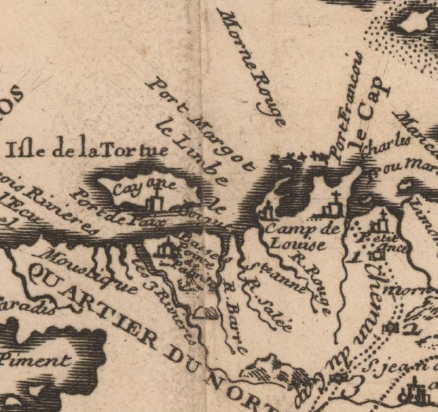
You can find Labadee, 19° 47? 11? N, 72° 14? 44? W on any modern map. Pondering The Cape it occupies, and the deep water harbor it is able to afford a behemoth like the Oasis of the Seas, I was led to research the mysteries of Haiti’s NORD, and survey the progression of place names on European maps which span the years.

haiti
This is Cristóbal Colón‘s own recollection of the northern coast of what he called La Isla Española, marking his first landing at San Nicolas Môle, the island of Tortuga, Fort Navidad, and the landmark Monte Cristi whose height guided Columbus and led him to name Hispaniola after Spain.

haiti charlevoix
A later map made by the French attempts to show the divisions of the indigenous tribes. The site marked “Premier Etablissment” marks Navidad, built near the Taíno cultural center of Hayti-Bohío-Quisqueya.

haiti Vinckeboons
A 1639 Dutch map shows Cap François. On the south shore of Isla Tortuga lies the beach Playa Cyan, across the water from the river Rio dos Caymanis. Also note the hills to the east called Mançanilla, these divided the peaceful Taíno from the warring Caciq. The location name derives from the Manchineel Trees whose poison berries they used to poison the tips of their arrows.

haiti monte christo
French map circa 1723 marks Cayne opposite the Iron Coast of L’Ile de la Tortue. There’s also a typical sailor’s landmark: Pointe des Palmiers (trans. Point of the Palms). The promontory of Cap François has here become Le Cap (The Cape). It shelters Port St. François, east of the heights of Morne Rouge and Mines de Cuivre (trans. copper mines).

haiti labat
French map of Cape Francois dated 1722 adds Le Limbe, the first area which the rebel slaves put to the torch; and Le Chemin du Cap, the main road to the valleys of the south.

haiti Ponce
This 1796 French map features another sailor’s aid, Pointe Tête de Chein (trans. Dog’s Head Point). The fortification battery on the Cape was built upon Roche à Picolet. This map was drawn after the rebellion of 1791. The Morne Rouge (trans. Red Heights) is now designated as Ravine du Morne au Diable and the Acul à Sabal. The Devil’s Ravine is the present location of Royal Caribbean’s Labadee.

The poor of Haiti are still taking heat for the Bwa Kayiman having been a pact with the devil.

haiti bellin
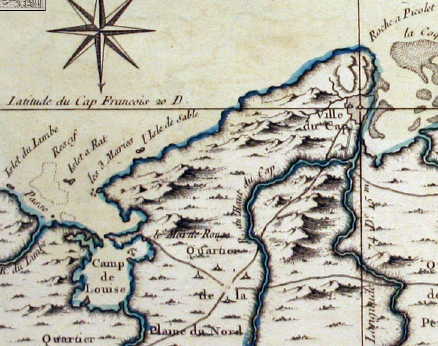
I add this 1764 map for personal interest. Few maps even today mark L’Islet à Rat (trans. Rat Island), which Columbus called La Amiga, was an aid to navigation out of his anchorage at Bay of Acul which he called Cabo de Caribata.

This map also details how colonial French St Domingue was divided into districts, here the Ville du Cap, the Quartier de Plaine du Nord and Camp de Louise.

haiti moreau
This 1770 map of Cap François and Environs distinguishes the larger slavery plantations.

haiti labadi

On the subject of Columbus, isn’t it surprising to reconcile the current verdict on his genocidal behavior, with the histories which have glorified his stature? After all, the primary accounts have never changed. How did earlier biographers overlook the damning and salacious details? One very polite telling of Columbus’ adventures, written by Filson Young published in 1906 provides a prim example. Here Young addresses the kidnap and rape of the indians whom Columbus encountered:

…his taking of the women raises a question which must be in the mind of any one who studies this extraordinary voyage—the question of the treatment of native women by the Spaniards. Columbus is entirely silent on the subject; but taking into account the nature of the Spanish rabble that formed his company, and his own views as to the right which he had to possess the persons and goods of the native inhabitants, I am afraid that there can be very little doubt that in this matter there is a good reason, for his silence. So far as Columbus himself was concerned, it is probable that he was innocent enough; he was not a sensualist by nature, and he was far too much interested and absorbed in the principal objects of his expedition, and had too great a sense of his own personal dignity, to have indulged in excesses that would, thus sanctioned by him, have produced a very disastrous effect on the somewhat rickety discipline of his crew. He was too wise a master, however, to forbid anything that it was not in his power to prevent; and it is probable that he shut his eyes to much that, if he did not tolerate it, he at any rate regarded as a matter of no very great importance. His crew had by this time learned to know their commander well enough not to commit under his eyes offences for which he would have been sure to punish them.

[Giving a list of instructions to the men Columbus planned to leave behind at La Navidad, among them: ]

…and especially to be on their guard to avoid injury or violence to the women, “by which they would cause scandal and set a bad example to the Indians and show the infamy of the Christians.”

no kolumbus day christopher columbusAnd here’s the rub. In this passage the author shows if we do not absolve Columbus, we indict ourselves.

The ruffianly crew had in their minds only the immediate possession of what they could get from the Indians; the Admiral had in his mind the whole possession of the islands and the bodies and souls of its inhabitants. If you take a piece of gold without giving a glass bead in exchange for it, it is called stealing; if you take a country and its inhabitants, and steal their peace from them, and give them blood and servitude in exchange for it, it is called colonisation and Empire-building. Every one understands the distinction; but so few people see the difference that Columbus of all men may be excused for his unconsciousness of it.

Rush is right. Make him pay for Haiti.

Reading 538’s excellent qualified defense of Pat Robertson‘s accusation that Haiti really had made a pact with the devil, I am prompted to weigh in behind Rush Limbaugh’s hypocritical rant that the American public has already paid enough for Haiti’s relief, “it’s called the US Income Tax.” Well it’s true. It is the role of government to see after the suffering among us. Of course you’d think conservatives like Limbaugh wouldn’t highlight that role while images of disaster haunt us, because they’re the ones behind depleting the aid coffers. Bush’s tax cuts for the rich alone could have relieved Haiti, Katrina and every Tsunami in between without costing tearful American TV viewers one extra dime of credit card debt.

The Haitian rebels made this prayer to their god in 1791. European slave owners might conclude an insurgent god would be their devil. This prayer was recited by rebellion priestess Boukman at the Bois Caiman (Bwa Kayiman). French speakers can read it in Creole.

The god who created the earth; who created the sun that gives us light. The god who holds up the ocean; who makes the thunder roar. Our God who has ears to hear. You who are hidden in the clouds; who watch us from where you are. You see all that the white has made us suffer. The white man’s god asks him to commit crimes. But the god within us wants to do good. Our god, who is so good, so just, He orders us to revenge our wrongs. It’s He who will direct our arms and bring us the victory. It’s He who will assist us. We all should throw away the image of the white men’s god who is so pitiless. Listen to the voice for liberty that speaks in all our hearts.

The Toussaint Louverture Project is an online documentation of our western hemisphere’s only successful slave uprising.

Just as the USA still refuses to let Cuba free its people from our tyranny after 40 years, so did the Western powers fight to keep Haiti from success, lest their free slaves inspire ours.

Good news for Haiti

Haiti presidential palace succumbs to earthquake
On the bright side of Haiti’s catastrophic earthquake, American puppet René Préval has been cut down a few notches, a whole couple stories actually. Here’s the presidential palace before January 12 and after. The pretender Preval has been Our Man in Port-au-Prince subsequent to the US-arranged a coup in 2004 to depose the democratically elected Jean-Bertrand Aristide (for the second time). The popular Aristide was a threat to exploitation interests.

While Americans rally to provide relief to the Haitians, let’s not be too incredulous about the state of their poverty. Here’s A.N.S.W.E.R.’s recent statement to highlight this teaching moment:

All of us are joining in the outpouring of solidarity from people all over the hemisphere and world who are sending humanitarian aid and assistance to the people of Haiti.

At such a moment, it is also important to put this catastrophe into a political and social context. Without this context, it is impossible to understand both the monumental problems facing Haiti and, most importantly, the solutions that can allow Haiti to survive and thrive. Hillary Clinton said today, “It is biblical, the tragedy that continues to daunt Haiti and the Haitian people.” This hypocritical statement that blames Haiti’s suffering exclusively on an “act of God” masks the role of U.S. and French imperialism in the region.

In this email message, we have included some background information about Haiti that helps establish the real context:

Haitian Prime Minister Jean-Max Bellerive stated today that as many as 100,000 Haitians may be dead. International media is reporting bodies being piled along streets surrounded by the rubble from thousands of collapsed buildings. Estimates of the economic damage are in the hundreds of millions of dollars. Haiti’s large shantytown population was particularly hard hit by the tragedy.

As CNN, ABC and every other major corporate media outlet will be quick to point out, Haiti is the poorest country in the entire Western hemisphere. But not a single word is uttered as to why Haiti is poor. Poverty, unlike earthquakes, is no natural disaster.

The answer lies in more than two centuries of U.S. hostility to the island nation, whose hard-won independence from the French was only the beginning of its struggle for liberation.

In 1804, what had begun as a slave uprising more than a decade earlier culminated in freedom from the grips of French colonialism, making Haiti the first Latin American colony to win its independence and the world’s first Black republic. Prior to the victory of the Haitian people, George Washington and then-Secretary of State Thomas Jefferson had supported France out of fear that Haiti would inspire uprisings among the U.S. slave population. The U.S. slave-owning aristocracy was horrified at Haiti’s newly earned freedom.

U.S. interference became an integral part of Haitian history, culminating in a direct military occupation from 1915 to 1934. Through economic and military intervention, Haiti was subjugated as U.S. capital developed a railroad and acquired plantations. In a gesture of colonial arrogance, Franklin D. Roosevelt, who was the assistant secretary of the Navy at the time, drafted a constitution for Haiti which, among other things, allowed foreigners to own land. U.S. officials would later find an accommodation with the dictator François “Papa Doc” Duvalier, and then his son Jean-Claude “Baby Doc” Duvalier, as Haiti suffered under their brutal repressive policies.

In the 1980s and 1990s, U.S. policy toward Haiti sought the reorganization of the Haitian economy to better serve the interests of foreign capital. The U.S. Agency for International Development (USAID) was instrumental in shifting Haitian agriculture away from grain production, paving the way for dependence on food imports. Ruined Haitian farmers flocked to the cities in search of a livelihood, resulting in the swelling of the precarious shantytowns found in Port-au-Prince and other urban centers.

Who has benefited from these policies? U.S. food producers profited from increased exports to Haitian markets. Foreign corporations that had set up shop in Haitian cities benefitted from the super-exploitation of cheap labor flowing from the countryside. But for the people of Haiti, there was only greater misery and destitution.

Washington orchestrated the overthrow of the democratically elected Haitian President Jean-Bertrand Aristide—not once, but twice, in 1991 and 2004. Haiti has been under a U.S.-backed U.N. occupation for nearly six years. Aristide did not earn the animosity of U.S. leaders for his moderate reforms; he earned it when he garnered support among Haiti’s poor, which crystallized into a mass popular movement. Two hundred years on, U.S. officials are still horrified by the prospect of a truly independent Haiti.

The unstable, makeshift dwellings imposed upon Haitians by Washington’s neoliberal policies have now, for many, been turned into graves. Those same policies are to blame for the lack of hospitals, ambulances, fire trucks, rescue equipment, food and medicine. The blow dealt by such a natural disaster to an economy made so fragile from decades of plundering will greatly magnify the suffering of the Haitian people.

Natural disasters are inevitable, but resource allocation and planning can play a decisive role in mitigating their impact and dealing with the aftermath. Haiti and neighboring Cuba, who are no strangers to violent tropical storms, were both hit hard in 2008 by a series of hurricanes—which, unlike earthquakes, are predictable. While more than 800 lives were lost in Haiti, less than 10 people died in Cuba. Unlike Haiti, Cuba had a coordinated evacuation plan and post-hurricane rescue efforts that were centrally planned by the Cuban government. This was only possible because Cuban society is not organized according to the needs of foreign capital, but rather according to the needs of the Cuban people.

In a televised speech earlier today, President Obama has announced that USAID and the Departments of State and Defense will be working to support the rescue and relief efforts in Haiti in the coming days. Ironically, these are the same government entities responsible for the implementation of the economic and military policies that reduced Haiti to ruins even before the earthquake hit.

Counterfeiting Iran’s Green Movement

Iranian banknotes
Here’s an interesting twist on currency counterfeiting: the forged defacement of Iranian banknotes. Sure it’s a real bill, with real doodles, but did it circulate beyond anyone’s kitchen table? Hmm.

At this moment, Iranian students are protesting a video aired by the government purporting to depict demonstrators defiling a poster of the Ayatollah. They assert the footage was fabricated to accuse them of being counter-revolutionaries. In such a climate, how likely is it students are defacing his image on currency and then passing it on?

It appears to me, this “Banknote Uprising” meme is a shameless and unimaginative contrivance, devised in some expat’s Parisian apartment, to pretend Tehran is being flooded with green-marked bills, hoping to prompt real Iranians to take real risks for such a scheme.

A French account quotes a “Alireza, an artist and journalist in Tehran.”

“Mirhossein Mousavi asked young people to use their imagination. And that’s what they’ve done. These banknotes, marked with images and slogans, are everywhere. I have some myself. The central bank tried to take them out of circulation, but there are so many, they had to give up on the idea. For the young people it’s a way of saying ‘We’re here. The green movement is still going on.'”

You can trace the “Banknote Uprising” story from here to here. A closer source being perhaps here. None offer a hint about from where the bills emerged, or even why we should conclude they have been penned by students.

Customizing currency is an easy thing to do in the privacy of your own home, you can even mount and frame your work, or immortalize it on the internet. But is it fair to pretend it passed through the hands of accomplices and ordinary citizens, merchants and bankers, and back again?

Even in America, imagine writing something unpopular on a bill, and trying to convince a local business owner to accept it, knowing he has to exchange it with others, make the same pitch, and ultimately someone has to cough it up to a bank teller. In America the only penalty you face is the proverbial admonishment that it’s a federal crime to deface US currency, yada yada. But what if the person on the other side of the transaction is really offended? Can you do it anonymously? Money passing hands is the very definition of paper trail.

The gist of this meme is to suggest that disenfranchisement with the government is so prevalent that dissenting slogans are circulating freely as citizens pass money from one to another. Is that true? It supports the theory that the last elections in Iran were stolen. But no evidence of fraud has emerged except as made by the US-backed reform parties. The usual international election watchdogs do not report the wrongdoings they observed in abundance in Afghanistan for example.

Writing slogans on currency is not uncommon. Before the last election, I know people who wrote pro-Obama on every bill that passed their hands. Before that there was always something cute to pass along on dollar bills. Kilroy was here, maybe? But I don’t recall any examples of those marked bills or others, coming back.

The Green Movement protesters of Tehran deserve our admiration for their heroism. Not because they represent a democratic uprising, but for being caught between a repressive system, and Western agitators bent on contriving dissent to serve their own goals of regime change.

I think the forgers give themselves away with their choice of slogans. Have a gander at: Khamenei the non-believer is servant of Putin. OR They stole oil money and give it to Chavez. Best of all are the photos of half-dozen bills marked with a rubber stamp, arrayed before the stamp and ink pad. That’s a how-to illustration, not evidence of currency floating through the market.

Shah of Iran on banknoteThe reporting references Iran’s cultural heritage of marking banknotes with dissenting messages. An example is provided of a banknote with the image of the Shah of Iran, defaced by a rubber stamp on the occasion of the Islamic Revolution. But that’s quite another case, where Iran’s currency couldn’t be pulled immediately upon the Shah’s downfall. The existing bills had to be laundered with an official stamp until new bills could be printed to replace them.

Banknote Uprising we can wish. Do it yourself, but don’t con others into acts you’re not foolhardy enough to try yourself.

“Where techology meets mahem” in Chino Prison, have fun!

mock prison riotUh.. we’re hearing nothing about a violent prison riot quelled this weekend in California. The rioting involved 1,300 inmates out of 5,900 crowded in the California Institute for Men, East of Los Angeles, otherwise know as CHINO. Why the silence? Correctional officers got the uprising well in hand, minus one burned facility, thanks to the annual industry trade show called MOCK PRISON RIOT. Its slogan is “Where Technology Meets Mahem.”

Training is offered to law enforcement and military too. Register Now! “We hope your experience as a role player is educational, informative, and most of all exciting and enjoyable!”

The Spirit of Revolt

There are periods in the life of human society when revolution becomes an imperative necessity, when it proclaims itself as inevitable. New ideas germinate everywhere, seeking to force their way into the light, to find an application in life. These ideas are opposed by the inertia of those whose interest it is to maintain the old order; they suffocate in the stifling atmosphere of prejudice and traditions. The accepted ideas of the constitution of the state, of the laws of social equilibrium, of the political and economic interrelations of citizens, can hold out no longer against the implacable criticism which is daily undermining them?…?Political, economic and social institutions are crumbling. The social structure, having become uninhabitable, is hindering, even preventing, the development of seeds which are being propagated within its damaged walls and being brought forth around them.

The need for a new life becomes apparent. The code of established morality, that which governs the greater number of people in their daily life, no longer seems sufficient. What formerly seems just is now felt to be a crying injustice. The morality of yesterday is today recognized as revolting immorality. The conflict between new ideas and old traditions flames up in every class of society?…?the popular conscience rises up against the scandals which breed amidst the privileged and leisured, against the crimes committed in the name of “the law of the stronger,” or in order to maintain these privileges. Those who long for the triumph of justice, those who would put new ideas into practice, are soon forced to recognize that the realization of their generous, humanitarian and regenerating ideas cannot take place in a society thus constituted. They perceive the necessity of a revolutionary whirlwind which will sweep away all this rottenness, revive sluggish hearts with its breath and bring to mankind that spirit of devotion, self-denial and heroism, without which society sinks through degradation and vileness into complete disintegration.

In periods of frenzied haste toward wealth, of feverish speculation and of crisis, of the sudden downfall of great industries and the ephemeral expansion of other branches of production, of scandalous fortunes amassed in a few years and dissipated as quickly, it becomes evident that the economic institutions which control production and exchange are far from giving to society the prosperity which they are supposed to guarantee. They produce precisely the opposite result. Instead of order they bring forth chaos; instead of prosperity, poverty and insecurity; instead of reconciled interests, war – a perpetual war of the exploiter against the worker, of exploiters and of workers among themselves. Human society is seen to be splitting more and more into two hostile camps, and at the same time to be subdividing into thousands of small groups waging merciless war against each other. Weary of these wars, weary of the miseries which they cause, society rushes to seek a new organization. It clamors loudly for a complete remodeling of the system of property ownership, of production, of exchange all economic relations which spring from it.

The machinery of government, entrusted with the maintenance of the existing order, continues to function, but at every turn of its deteriorated gears, it slips and stops. Its working becomes more and more difficult, and the dissatisfaction caused by its defects grows continuously. Every day gives rise to a new demand. “Reform this,” “Reform that,” is heard from all sides. “War, finance, taxes, courts, police, everything would have to be remodeled, reorganized, established on a new basis,” say the reformers. And yet all know that it is impossible to make things over, to remodel anything at all because everything is interrelated; everything would have to be remade at once. And how can society be remodeled when it is divided into two openly hostile camps? To satisfy the discontented would be only to create new malcontents.

Incapable of undertaking reforms, since this would mean paving the way for revolution, and at the same time too impotent to be frankly reactionary, the governing bodies apply themselves to half-measures which can satisfy nobody, and only cause new dissatisfaction. The mediocrities who, in such transition periods, undertake to steer the ship of state, think of but one thing: to enrich themselves against the coming debacle. Attacked from all sides they defend themselves awkwardly, they evade, they commit blunder upon blunder and they soon succeed in cutting the last rope of salvation. They drown the prestige of the government in ridicule, caused by their own incapacity.

Such periods demand revolution. It becomes a social necessity; the situation itself is revolutionary.

When we study in the works of our greatest historians the genesis and development of vast revolutionary convulsions, we generally find under the heading “The Cause of the Revolution” a gripping picture of the situation on the eve of events. The misery of the people, the general insecurity, the vexatious measures of the government, the odious scandals laying bare the immense vices of society, the new ideas struggling to come to the surface and repulsed by the incapacity of the supporters of the former regime – nothing is omitted. Examining this picture, one arrives at the conviction that the revolution was indeed inevitable, and that there was no other way out than by the road of insurrection?…?But, between this pacific arguing and insurrection or revolt, there is a wide abyss – that abyss which, for the greatest part of humanity, lies between reasoning and action, thought and the will to act. How has this abyss been bridged??…?How was it that words, so often spoken and lost in the air like the empty chiming of bells, were changed in actions?

The answer is easy. Action. The continuous action, ceaselessly renewed, of minorities brings about this transformation. Courage, devotion, the spirit of sacrifice, are as contagious as cowardice, submission and panic.

What forms will this action take? All forms – indeed, the most varied forms, dictated by circumstances, temperament and the means at disposal. Sometimes tragic, sometimes humorous, but always daring; sometimes collective, sometimes purely individual, this policy of action will neglect none of the means at hand, no event of public life, in order to keep the spirit alive, to propagate and find expression for dissatisfaction, to excite hatred against exploiters, to ridicule the government and expose its weakness and above all and always, by actual example, to awaken courage and fan the spirit of revolt.

When a revolutionary situation arises in a country, before the spirit of revolt is sufficiently awakened in the masses to express itself in violent demonstrations in the streets or by rebellions and uprisings, it is through action that minorities succeed in awakening that feeling of independence and that spirit of audacity without which no revolution can come to a head.

Men of courage, not satisfied with words, but ever searching for the means to transform them into action – men of integrity for whom the act is one with the idea, for whom prison, exile and death are preferable to a life contrary to their principles, intrepid souls who know that it is necessary to dare in order to succeed – these are the lonely sentinels who enter the battle long before the masses are sufficiently roused to raise openly the banner of insurrection and to march, arms in hand, to the conquest of their rights?…?Whoever has a slight knowledge of history and a fairly clear head knows perfectly well from the beginning that theoretical propaganda for revolution will necessarily express itself in action long before the theoreticians have decided that the moment to act has come.

Nevertheless the cautious theoreticians are angry at these madmen, they excommunicate them, they anathematize them. But the madmen win sympathy, the mass of the people secretly applaud their courage and they find imitators?…?Acts of illegal protest, of revolt, of vengeance, multiply.

Indifference from this point on is impossible?…?By actions which compel general attention, the new idea seeps into people’s minds and wins converts?…?Above all, it awakens the spirit of the revolt: it breeds daring?…?The people observe that the monster is not so terrible as they thought; they begin dimly to perceive that a few energetic efforts will be sufficient to throw it down. Hope is born in their hearts, and let us remember that if exasperation often drives men to revolt, it is always hope – the hope of victory – which makes revolutions.

The government resists; it is savage in its repressions. But, though formerly persecution killed the energy of the oppressed, now, in periods of excitement, it produces the opposite result. It provokes new acts of revolt, individual and collective. It drives the rebels to heroism, and in rapid succession these acts spread, become general, develop. The revolutionary party is strengthened by elements, which up to this time were hostile or indifferent to it. The general disintegration penetrates into the government, the ruling classes, the privileged. Some of them advocate resistance to the limit; others are in favor of concessions; others, again, go so far as to declare themselves ready to renounce their privileges for the moment, in order to appease the spirit of revolt, hoping to dominate again later on. The unity of the government and the privileged class is broken.

The ruling class may also try to find safety in savage reaction. But it is now too late; the battle only becomes more bitter, more terrible, and the revolution which is looming will only be more bloody. On the other hand, the smallest concession of the governing classes, since it comes too late, since it has been snatched in struggle, only awakes the revolutionary spirit still more. The common people, who formerly would have been satisfied with the smallest concession, observe now that the enemy is wavering. They foresee victory, they feel their courage growing, and the same men who were formerly crushed by misery and were content to sigh in secret, now lift their heads and march proudly to the conquest of a better future.

Finally, the revolution breaks out, the more terrible as the preceding struggles were bitter.

The Spirit of Revolt, Pyotr Kropotkin, 1880.

Right wing Simpletons, Call Home!

The heavily funded campaign for Right Wing Simpletons to call their Congressmen and tell them how afraid they are of Health Care Reform is ramping up, I just heard their Hate Speech commercial from the other room.

It’s like the Tea-Baggers and the “mass protest” outside the Letterman show, Camera Angle is everything.

The “massive protest” outside the Letterman Show on behalf of Simple Sarah was actually FIFTEEN
and they were outnumbered two-to-one by the cameras. You wouldn’t know it from the way it was portrayed, though.

Same with the highly contrived “Tea Parties”.
With the right camera work, it makes the Stupid Parade look like a massive Grass-roots uprising.

It wouldn’t take more than a couple hundred thousand to jam the switchboards at the Congressional Office Building.

The Right Wing “leaders” know that, and they hope their Demented Disciples will call in, and that it’ll look so much like a Massive Uprising even with only a fraction of a percent of 1% of the population actually taking part.

Levin was on the radio a few weeks ago bitching and whining about the Energy and environmental legislation passing in spite of the Rigged Call-in Campaign.

Here’s a thought, Right Wing Losers….

Maybe the Congressmen have caught on to it.

Maybe people who are smart enough to get elected to Congress are also smart enough to get a “heads up” when such a contrived “Grass roots” campaign is about to be launched.

Moldova’s riots

What in the world is going on in Moldova, where the losers of the election just tore up some major government buildings? Might a small Trotskyist group, Popular Resistance offer some insight into the situation? They say that the ‘communist’ winners of the election are just another group of neo-liberals wanting to privatize the entire country on behalf of Western corporations.

And another commentary, this time from Moscow Times says that the riots in Moldova Underscores Failed Russian Policy as the US stages another Color Revolution.

This how the article begins…

Anti-government protests in Moldova this week unfolded in a similar manner to Western-backed uprisings that toppled governments in Georgia, Ukraine, Kyrgyzstan and Serbia in recent years.

But what should worry the Kremlin is not the threat of a similar uprising at home but the fact that both Moldovan President Vladimir Voronin and the opposition groups turned to the West instead of Russia to mediate the conflict, analysts said Wednesday.

Because of the shortsightedness of Russian diplomacy and its failure to project its own “soft” power, the Kremlin faces the possibility of being sidelined once again in a former Soviet state that it considers to be within its realm of influence…

I am the soldier who slept in your home.

dear-citizen-of-gazaWhen Voices For Creative Nonviolence activist Kathy Kelly visited Colorado Springs, she spoke of survivors of a family in Gaza who returned to their home to find a message left etched on their wall by an IDF soldier, it read “Sorry.” Kelly saw in it the glimmer of hope that Israeli soldiers were beginning to show some humanity. Hasbara efforts have taken this gesture a reservist’s letter step further. You can read it below uncut. Does it look to you like these propagandists need some counseling advice? Probably the rapist is the last person who should be asking his victim to be calm, especially by recounting the details of the violation, and especially if the rapist is unrepentant and laying out the justification for his act. Parental Advisory: Graphic Insensitivity.

Holy Fucking Shit you will not believe it! It’s one thing for us to tolerate pedantic lectures online, quite another if the bastard had quartered in our home in the meantime.

From AISH, via Israel Activism and the Hasbara fellowships. Seriously, this is a letter the Israeli press is touting to try to reach Gazans with the message that they must blame Hamas.

DEAR CITIZEN OF GAZA: I am the soldier who slept in your home.

Hello,

While the world watches the ruins in Gaza, you return to your home which remains standing. However, I am sure that it is clear to you that someone was in your home while you were away.

I am that someone.

I spent long hours imagining how you would react when you walked into your home. How you would feel when you understood that IDF soldiers had slept on your mattresses and used your blankets to keep warm.

I knew that it would make you angry and sad and that you would feel this violation of the most intimate areas of your life by those defined as your enemies, with stinging humiliation. I am convinced that you hate me with unbridled hatred, and you do not have even the tiniest desire to hear what I have to say. At the same time, it is important for me to say the following in the hope that there is even the minutest chance that you will hear me.

I spent many days in your home. You and your family’s presence was felt in every corner. I saw your family portraits on the wall, and I thought of my family. I saw your wife’s perfume bottles on the bureau, and I thought of my wife. I saw your children’s toys and their English language schoolbooks. I saw your personal computer and how you set up the modem and wireless phone next to the screen, just as I do.

I wanted you to know that despite the immense disorder you found in your house that was created during a search for explosives and tunnels (which were indeed found in other homes), we did our best to treat your possessions with respect. When I moved the computer table, I disconnected the cables and lay them down neatly on the floor, as I would do with my own computer. I even covered the computer from dust with a piece of cloth. I tried to put back the clothes that fell when we moved the closet although not the same as you would have done, but at least in such a way that nothing would get lost.

I know that the devastation, the bullet holes in your walls and the destruction of those homes near you place my descriptions in a ridiculous light. Still, I need you to understand me, us, and hope that you will channel your anger and criticism to the right places.

I decided to write you this letter specifically because I stayed in your home.

I can surmise that you are intelligent and educated and there are those in your household that are university students. Your children learn English, and you are connected to the Internet. You are not ignorant; you know what is going on around you.

Therefore, I am sure you know that Qassam rockets were launched from your neighborhood into Israeli towns and cities.

How could you see these weekly launches and not think that one day we would say “enough”?! Did you ever consider that it is perhaps wrong to launch rockets at innocent civilians trying to lead a normal life, much like you? How long did you think we would sit back without reacting?

I can hear you saying “it’s not me, it’s Hamas”. My intuition tells me you are not their most avid supporter. If you look closely at the sad reality in which your people live, and you do not try to deceive yourself or make excuses about “occupation”, you must certainly reach the conclusion that the Hamas is your real enemy.

The reality is so simple, even a seven year old can understand: Israel withdrew from the Gaza strip, removing military bases and its citizens from Gush Katif. Nonetheless, we continued to provide you with electricity, water, and goods (and this I know very well as during my reserve duty I guarded the border crossings more than once, and witnessed hundreds of trucks full of goods entering a blockade-free Gaza every day).

Despite all this, for reasons that cannot be understood and with a lack of any rational logic, Hamas launched missiles on Israeli towns. For three years we clenched our teeth and restrained ourselves. In the end, we could not take it anymore and entered the Gaza strip, into your neighborhood, in order to remove those who want to kill us. A reality that is painful but very easy to explain.

You must lead a civil uprising against Hamas.

As soon as you agree with me that Hamas is your enemy and because of them, your people are miserable, you will also understand that the change must come from within. I am acutely aware of the fact that what I say is easier to write than to do, but I do not see any other way. You, who are connected to the world and concerned about your children’s education, must lead, together with your friends, a civil uprising against Hamas.

I swear to you, that if the citizens of Gaza were busy paving roads, building schools, opening factories and cultural institutions instead of dwelling in self pity, arms smuggling and nurturing a hatred to your Israeli neighbors, your homes would not be in ruins right now. If your leaders were not corrupt and motivated by hatred, your home would not have been harmed. If someone would have stood up and shouted that there is no point in launching missiles on innocent civilians, I would not have to stand in your kitchen as a soldier.

You don’t have money, you tell me? You have more than you can imagine.

Even before Hamas took control of Gaza, during the time of Yasser Arafat, millions if not billions of dollars donated by the world community to the Palestinians was used for purchasing arms or taken directly to your leaders bank accounts. Gulf States, the emirates – your brothers, your flesh and blood, are some of the richest nations in the world. If there was even a small feeling of solidarity between Arab nations, if these nations had but the smallest interest in reconstructing the Palestinian people – your situation would be very different.

You must be familiar with Singapore. The land mass there is not much larger than the Gaza strip and it is considered to be the second most populated country in the world. Yet, Singapore is a successful, prospering, and well managed country. Why not the same for you?

My friend, I would like to call you by name, but I will not do so publicly. I want you to know that I am 100% at peace with what my country did, what my army did, and what I did. However, I feel your pain. I am sorry for the destruction you are finding in your neighborhood at this moment. On a personal level, I did what I could to minimize the damage to your home as much as possible.

In my opinion, we have a lot more in common than you might imagine. I am a civilian, not a soldier, and in my private life I have nothing to do with the military. However, I have an obligation to leave my home, put on a uniform, and protect my family every time we are attacked. I have no desire to be in your home wearing a uniform again and I would be more than happy to sit with you as a guest on your beautiful balcony, drinking sweet tea seasoned with the sage growing in your garden.

The only person who could make that dream a reality is you. Take responsibility for yourself, your family, your people, and start to take control of your destiny. How? I do not know. Maybe there is something to be learned from the Jewish people who rose up from the most destructive human tragedy of the 20th century, and instead of sinking into self-pity, built a flourishing and prospering country. It is possible, and it is in your hands.

I am ready to be there to provide a shoulder of support and help to you.

But only you can move the wheels of history.

Regards,
Yishai, (Reserve Soldier)

I’m actually unconvinced this was a real soldier. Too many of the GIYUS Megaphone talking points are woven into the letter. Singapore even!

It would surely be anti-Semitic to conclude easily that the Israeli propagandists are this dumb. The true motive of this letter cannot be to win Palestinian hearts, but to spread the effect of the state terror. The IDF couldn’t defile every Gaza home before being forced to cut their incursion short. With such letters the Israeli soldiers can make felt that violation by all Gazans.

Was the IDF incursion/invasion about stopping the rockets or about terrorizing the Gazans until they are driven from the land?

seeking refuge in Abbey’s country

Phallic-arches-national-park
Edward Abbey presaged America’s current path to tyranny forty years ago and predicted that the end of American democracy would be coincident with the destruction of the wilderness.

What’s the connection between democracy and wilderness? Personal liberty is a fleeting commodity, according to Abbey, and history has shown that governments invariably move toward totalitarianism. When faced with authoritarian governance, wilderness is crucial because it serves as both a refuge from political oppression and a base for guerrilla warfare. Uprisings in urban settings are too quickly quelled by those with better weaponry, but hidden in mountain, desert or jungle settings, revolutionaries can gain an edge on establishment forces and engage in protracted — sometimes successful — battle. Consider Che in the mountains, the Vietcong in the jungle, Osama bin Laden in a desert cave.

From Desert Solitaire:

Suppose we were planning to impose a dictatorial regime upon the American people — the following preparations would be essential:

1. Concentrate the populace in megalopolitan masses so they can be kept under close surveillance and where, in the case of trouble, they can be bombed, burned, gassed or machine-gunned with a minimum of expense and waste.

2. Mechanize agriculture to the highest degree of refinement, thus forcing most of the scattered farm and ranching population into the cities. Such a policy is desirable because farmers, woodsmen, cowboys, Indians, fishermen and other relatively self-sufficient types are difficult to manage unless displaced from their natural environment.

3. Restrict the possession of firearms to the police and the regular military organizations.

4. Encourage or at least fail to discourage population growth. Large masses of people are more easily manipulated and dominated than scattered individuals.

5. Continue military conscription. Nothing excels military training for creating in young men an attitude of prompt, cheeful obedience to officially constituted authority.

6. Divert attention from deep conflicts within the society by engaging in foreign wars; make support of these wars a test of loyalty, thereby exposing and isolating potential opposition to the new order.

7. Overlay the nation with a finely reticulated network of communications, airlines and interstate autobahns.

8. Raze the wilderness. Dam the rivers, flood the canyons, drain the swamps, log the forests, strip-mine the hills, bulldoze the mountains, irrigate the deserts and improve the national parks into national parking lots.

In a final round of environmental fuck-yous, the Bush administration has offered up significant portions of pristine Utah wilderness to oil exploration. Aside from one notable monkeywrenching incident, the trashing of the American wilderness continues unabated.

Shots from my recent cave-hunting trip to Abbey’s country!

Toyota-Sequoia-offroad-Arches
Back-road-Arches
Arches-original-entrance
landscape-arch-arches
klondike-bluffs-arches
juniper-arches
ice-desert-arches
Marie-tree-hugger-arches
balanced-rock-near-abbey-arches
toyota-sequoia-arches
fiery-furnace-arches
delicate-arch-utah-license
cairns-delicate-arch-trail

RIP- Maria Dimitriadi

Maria Dimintriadi, an antifascist Greek singer whose music is famous world wide, has just recently died of lung cancer. Her songs have also been an inspiration for the youth uprising against the current Greek regime.

Here are four selections of Maria Dimitriadi’s music on youtube “diokse ti lypi palikari”, MARIA DIMITRIADI, “thalassa platia”, “Mia fora ki ena kero”

Alexandros Grigoropoulos was killed by the Greek police in Athens in December 6th 2008. He was only 15 years old and his death sparked extreme violent riots all over Greece. Here is Maria Dimitriadi’s singing once again used as a tribute to this child murdered by the Greek police. R.I.P. Alexandros Grigoropoulos

Also see The Red-Hearted Voice of Greece; Mourning Maria Dimitriadi By CHRIS PAPALEONARDOS for a link to more music by this great Greek singer.

PPJPC exits stage left, lily-livered left

COLORADO SPRINGS- Oh How Sad! After a long and storied legacy, the Pikes Peak Justice & Peace Commission is closing its doors. Why now –a time of rising injustice and vanishing peace on every continent?! Technically they’ve only announced divestment of their goods in order to move into a tiny office, but the PPJPC is also postponing all activity until after the election. The next event planned is a victory celebration of “regime change” even though the presumptive new regime has promised escalations of war in Asia, Africa and South America, and continued economic class war at home. And it gets worse.

The bastards, literally bastards not by coincidence I’m sure, have gutted the famed peace organization of its activities, of its participants, of its reputation, legacy and potential and now they’re selling off its possessions.

These include the group’s “memorabilia,” as if PPJPC’s aims weren’t still outgoing. Wouldn’t you think the causes still cry out for those materials? All the tools and equipment gathered over the years are now being demobilized. The posters, banners, puppets, flags, props, costumes, made by activists, for the good fight. Are you kidding me?!

And the PPJPC library, an extensive collection of books about social justice and nonviolence are being scattered to the wind of the same garage sale. These books, painstakingly assembled for the cause and donated by so many members so that the PPJPC office would have a permanent reference library are now being sold to defray the costs of moving. And keeping the staff.

For what? Administrating the liquidation? Have PPJPC members been asked to contribute more and more, chiefly so that the organization can be dismantled and slipped into a coma? To keep the staff paid? When the PPJPC membership at large figure out that they’ve been subsidizing their own deliberately paralyzing iv-drip, they are going to invent their own choice words for these soft-spoken traitors.

I’D SUGGEST someone attending the going-out-of-the-peace-making-business-sale if only to rescue the materials we’ll need to keep up the fight. If it didn’t mean giving more money to the usurpers! That’s extortion, taking our money to reclaim what we donated already! What unmitigated passive aggressive violence.

These paid staff manipulated the tendency of all small groups to take the road most traveled. Specifically, to hush up in the perceived interest of self-preservation. This manifests itself among a minority in the PPJPC who follow a cultish spiritual belief that the only way to stop a wayward wagon is to throw yourself under the wheel. Eventually it’s hoped the driver will stop out of pangs of conscience. Other concerned passengers, who might want to gesticulate or address the driver, are scolded for not giving the sacrificial sheep the opportunity to incubate their guilt bomb in peace.

These self-appointed arbiters of “pacifism” take the “peace” in J&P to mean a quiet, undisturbed, reverential, leave-me-in-peace, peace. It’s the “nonviolent” dogma that has been used to defuse slave uprisings for millennia. It’s the traditional disservice which religion deals in its role to make the oppressed accept their mistreatment at the hands of their oppressors. While we might concentrate on religion’s role in starting wars, we overlook their constant undermining of justice.

Do I have something personal at stake in this unraveling development? I most certainly do! Over the past years, I joined a number of energetic activists in raising the visibility of the local peace movement. We gave it a public signature and a heretofore elusive acclaim, which was bringing in much more public participation. What became of the green peace campaign? Jettisoned. Abandoned. Cast off by the staff and select members who didn’t want an expanded interest in their activities. What are we left to conclude about people who espouse a concern to invite community, but shun populist appeal? Hypocrites is the most polite I can muster.

I’m so sorry to have left the organization to such vultures. I owe my fellow members quite an apology.

Mozambique by AK-47, book and hoe

mozambique kalashnikovThis is a detail from the national flag of Mozambique. What a refreshing update on the tools of people power. Lenin’s workers of the world needed hammer and sickle. In Mozambique it takes book, hoe and Kalashnikov. Education, agriculture, and the means to secure them from Capitalism. I looked for Mozambique at the Beijing opening ceremonies. The AK-47 is the antithetical symbol of the Olympics, patronized by heads of state, not coup leaders at the crest of popular uprisings.

Before China’s 8-8-8 was Burma’s 8888

Repression in BurmaThe superlatives were flying at the opening ceremonies of the Beijing Hyperbowl: it was China’s defining moment of the modern age, on, the newscasters said, “eight eight of o’ eight.” But before 888 in Beijing was August 8 of 1988 in Rangoon, known as the 8888 Uprising. This movement for democratic reform in Burma was brutally suppressed by General Ne Win who directed that his soldiers’ “Guns were not to shoot upwards.” This resulted in the massacre of 3,000 students and priests and a military coup which survives today, supported by the Chinese government.

Global economic rapists are at it again

G8 protest
Why protest the G8 Summit July 7-9? Those hoodlums always look so determined. Here’s the rationale by the Emergency Exit Collective:

The 2008 G8 on Hokkaido, a Strategic Assessment
Emergency Exit Collective
Bristol, Mayday, 2008

The authors of this document are a collection of activists, scholars, and writers currently based in the United States and Western Europe who have gotten to know and work with each other in the movement against capitalist globalization. We’re writing this at the request of some members of No! G8 Action Japan, who asked us for a broad strategic analysis of the state of struggle as we see it, and particularly, of the role of the G8, what it represents, the dangers and opportunities that may lie hidden in the moment. It is in no sense programmatic. Mainly, it is an attempt to develop tools that we hope will be helpful for organizers, or for anyone engaged in the struggle against global capital.

I
It is our condition as human beings that we produce our lives in common.

II
Let us then try to see the world from the perspective of the planet’s commoners, taking the word in that sense: those whose most essential tradition is cooperation in the making and maintenance of human social life, yet who have had to do so under conditions of suffering and separation; deprived, ignored, devalued, divided into hierarchies, pitted against each other for our very physical survival. In one sense we are all commoners. But it’s equally true that just about everyone, at least in some ways, at some points, plays the role of the rulers—of those who expropriate, devalue and divide—or at the very least benefits from such divisions.

Obviously some do more than others. It is at the peak of this pyramid that we encounter groups like the G8.

III
The G8’s perspective is that of the aristocrats, the rulers: those who command and maintain that global machinery of violence that defends existing borders and lines of separation: whether national borders with their detention camps for migrants, or property regimes, with their prisons for the poor. They live by constantly claiming title to the products of others collective creativity and labour, and in thus doing they create the poor; they create scarcity in the midst of plenty, and divide us on a daily basis; they create financial districts that loot resources from across the world, and in thus doing they turn the spirit of human creativity into a spiritual desert; close or privatize parks, public water taps and libraries, hospitals, youth centers, universities, schools, public swimming pools, and instead endlessly build shopping malls that channels convivial life into a means of commodity circulation; work toward turning global ecological catastrophe into business opportunities.

These are the people who presume to speak in the name of the “international community” even as they hide in their gated communities or meet protected by phalanxes of riot cops. It is critical to bear in mind that the ultimate aim of their policies is never to create community but to introduce and maintain divisions that set common people at each other’s throats. The neoliberal project, which has been their main instrument for doing so for the last three decades, is premised on a constant effort either to uproot or destroy any communal or democratic system whereby ordinary people govern their own affairs or maintain common resources for the common good, or, to reorganize each tiny remaining commons as an isolated node in a market system in which livelihood is never guaranteed, where the gain of one community must necessarily be at the expense of others. Insofar as they are willing to appeal to high-minded principles of common humanity, and encourage global cooperation, only and exactly to the extent that is required to maintain this system of universal competition.

IV
At the present time, the G8—the annual summit of the leaders of “industrial democracies”—is the key coordinative institution charged with the task of maintaining this neoliberal project, or of reforming it, revising it, adapting it to the changing condition of planetary class relations. The role of the G8 has always been to define the broad strategic horizons through which the next wave of planetary capital accumulation can occur. This means that its main task is to answer the question of how 3?4 in the present conditions of multiple crises and struggles 3?4 to subordinate social relations among the producing commoners of the planet to capital’s supreme value: profit.

V
Originally founded as the G7 in 1975 as a means of coordinating financial strategies for dealing with the ‘70s energy crisis, then expanded after the end of the Cold War to include Russia, its currently face a moment of profound impasse in the governance of planetary class relations: the greatest since the ‘70s energy crisis itself.

VI
The ‘70s energy crisis represented the final death-pangs of what might be termed the Cold War settlement, shattered by a quarter century of popular struggle. It’s worth returning briefly to this history.

The geopolitical arrangements put in place after World War II were above all designed to forestall the threat of revolution. In the immediate wake of the war, not only did much of the world lie in ruins, most of world’s population had abandoned any assumption about the inevitability of existing social arrangements. The advent of the Cold War had the effect of boxing movements for social change into a bipolar straightjacket. On the one hand, the former Allied and Axis powers that were later to unite in the G7 (the US, Canada, UK, France, Italy, Germany, Japan)—the “industrialized democracies”, as they like to call themselves—engaged in a massive project of co-optation. Their governments continued the process, begun in the ‘30s, of taking over social welfare institutions that had originally been created by popular movements (from insurance schemes to public libraries), even to expand them, on condition that they now be managed by state-appointed bureaucracies rather than by those who used them, buying off unions and the working classes more generally with policies meant to guarantee high wages, job security and the promise of educational advance—all in exchange for political loyalty, productivity increases and wage divisions within national and planetary working class itself. The Sino-Soviet bloc—which effectively became a kind of junior partner within the overall power structure, and its allies remained to trap revolutionary energies into the task of reproducing similar bureaucracies elsewhere. Both the US and USSR secured their dominance after the war by refusing to demobilize, instead locking the planet in a permanent threat of nuclear annihilation, a terrible vision of absolute cosmic power.

VII
Almost immediately, though, this arrangement was challenged by a series of revolts from those whose work was required to maintain the system, but who were, effectively, left outside the deal: first, peasants and the urban poor in the colonies and former colonies of the Global South, next, disenfranchised minorities in the home countries (in the US, the Civil Rights movement, then Black Power), and finally and most significantly, by the explosion of the women’s movement of the late ‘60s and early ‘70s—the revolt of that majority of humanity whose largely unremunerated labor made the very existence “the economy” possible. This appears to have been the tipping point.

VIII
The problem was that the Cold War settlement was never meant to include everyone. It by definition couldn’t. Once matters reached tipping point, then, the rulers scotched the settlement. All deals were off. The oil shock was first edge of the counter-offensive, breaking the back of existing working class organizations, driving home the message that there was nothing guaranteed about prosperity. Under the aegis of the newly hatched G7, this counter-offensive involved a series of interwoven strategies that were later to give rise to what is known as neoliberalism.

IX
These strategies resulted in what came to be known as “Structural Adjustment” both in the North and in the South, accompanied by trade and financial liberalization. This, in turn, made possible crucial structural changes in our planetary production in common extending the role of the market to discipline our lives and divide us into more and more polarized wage hierarchy. This involved:

· In the immediate wake of ‘70s oil shock, petrodollars were recycled from OPEC into Northern banks that then lent them, at extortionate rates of interest, to developing countries of the Global South. This was the origin of the famous “Third World Debt Crisis.” The existence of this debt allowed institutions like the IMF to impose its monetarist orthodoxy on most of the planet for roughly twenty years, in the process, stripping away most of even those modest social protections that had been won by the world’s poor—large numbers of whom were plunged into a situation of absolute desperation.

· It also opened a period of new enclosures through the capitalist imposition of structural adjustment policies, manipulation of environmental and social catastrophes like war, or for that matter through the authoritarian dictates of “socialist” regimes. Through such means, large sections of the world’s population have over the past thirty years been dispossessed from resources previously held in common, either by dint of long traditions, or as the fruits of past struggles and past settlements.

· Through financial deregulation and trade liberalization, neoliberal capital, which emerged from the G7 strategies to deal with the 1970s crisis aimed thus at turning the “class war” in communities, factories, offices, streets and fields against the engine of competition, into a planetary “civil war”, pitting each community of commoners against every other community of commoners.

· Neoliberal capital has done this by imposing an ethos of “efficiency” and rhetoric of “lowering the costs of production” applied so broadly that mechanisms of competition have come to pervade every sphere of life. In fact these terms are euphemisms, for a more fundamental demand: that capital be exempt from taking any reduction in profit to finance the costs of reproduction of human bodies and their social and natural environments (which it does not count as costs) and which are, effectively, “exernalized” onto communities and nature.

· The enclosure of resources and entitlements won in previous generations of struggles both in the North and the South, in turn, created the conditions for increasing the wage hierarchies (both global and local), by which commoners work for capital—wage hierarchies reproduced economically through pervasive competition, but culturally, through male dominance, xenophobia and racism. These wage gaps, in turn, made it possible to reduce the value of Northern workers’ labour power, by introducing commodities that enter in their wage basket at a fraction of what their cost might otherwise have been. The planetary expansion of sweatshops means that American workers (for example) can buy cargo pants or lawn-mowers made in Cambodia at Walmart, or buy tomatoes grown by undocumented Mexican workers in California, or even, in many cases, hire Jamaican or Filipina nurses to take care of children and aged grandparents at such low prices, that their employers have been able to lower real wages without pushing most of them into penury. In the South, meanwhile, this situation has made it possible to discipline new masses of workers into factories and assembly lines, fields and offices, thus extending enormously capital’s reach in defining the terms—the what, the how, the how much—of social production.

· These different forms of enclosures, both North and South, mean that commoners have become increasingly dependent on the market to reproduce their livelihoods, with less power to resist the violence and arrogance of those whose priorities is only to seek profit, less power to set a limit to the market discipline running their lives, more prone to turn against one another in wars with other commoners who share the same pressures of having to run the same competitive race, but not the same rights and the same access to the wage. All this has meant a generalized state of precarity, where nothing can be taken for granted.

X
In turn, this manipulation of currency and commodity flows constituting neoliberal globalization became the basis for the creation of the planet’s first genuine global bureaucracy.

· This was multi-tiered, with finance capital at the peak, then the ever-expanding trade bureaucracies (IMF, WTO, EU, World Bank, etc), then transnational corporations, and finally, the endless varieties of NGOs that proliferated throughout the period—almost all of which shared the same neoliberal orthodoxy, even as they substituted themselves for social welfare functions once reserved for states.

· The existence of this overarching apparatus, in turn, allowed poorer countries previously under the control of authoritarian regimes beholden to one or another side in the Cold War to adopt “democratic” forms of government. This did allow a restoration of formal civil liberties, but very little that could really merit the name of democracy (the rule of the “demos”, i.e., of the commoners). They were in fact constitutional republics, and the overwhelming trend during the period was to strip legislatures, that branch of government most open to popular pressure, of most of their powers, which were increasingly shifted to the executive and judicial branches, even as these latter, in turn, largely ended up enacting policies developed overseas, by global bureaucrats.

· This entire bureaucratic arrangement was justified, paradoxically enough, by an ideology of extreme individualism. On the level of ideas, neoliberalism relied on a systematic cooptation of the themes of popular struggle of the ‘60s: autonomy, pleasure, personal liberation, the rejection of all forms of bureaucratic control and authority. All these were repackaged as the very essence of capitalism, and the market reframed as a revolutionary force of liberation.

· The entire arrangement, in turn, was made possible by a preemptive attitude towards popular struggle. The breaking of unions and retreat of mass social movements from the late ‘70s onwards was only made possible by a massive shift of state resources into the machinery of violence: armies, prisons and police (secret and otherwise) and an endless variety of private “security services”, all with their attendant propaganda machines, which tended to increase even as other forms of social spending were cut back, among other things absorbing increasing portions of the former proletariat, making the security apparatus an increasingly large proportion of total social spending. This approach has been very successful in holding back mass opposition to capital in much of the world (especially West Europe and North America), and above all, in making it possible to argue there are no viable alternatives. But in doing so, has created strains on the system so profound it threatens to undermine it entirely.

XI
The latter point deserves elaboration. The element of force is, on any number of levels, the weak point of the system. This is not only on the constitutional level, where the question of how to integrate the emerging global bureaucratic apparatus, and existing military arrangements, has never been resolved. It is above all an economic problem. It is quite clear that the maintenance of elaborate security machinery is an absolute imperative of neoliberalism. One need only observe what happened with the collapse of the Soviet bloc in Eastern Europe: where one might have expected the Cold War victors to demand the dismantling of the army, secret police and secret prisons, and to maintain and develop the existing industrial base, in fact, what they did was absolutely the opposite: in fact, the only part of the industrial base that has managed fully to maintain itself has been the parts required to maintained the security apparatus itself! Critical too is the element of preemption: the governing classes in North America, for example, are willing to go to almost unimaginable lengths to ensure social movements never feel they are accomplishing anything. The current Gulf War is an excellent example: US military operations appear to be organized first and foremost to be protest-proof, to ensure that what happened in Vietnam (mass mobilization at home, widespread revolt within the army overseas) could never be repeated. This means above all that US casualties must always be kept to a minimum. The result are rules of engagement, and practices like the use of air power within cities ostensibly already controlled by occupation forces, so obviously guaranteed to maximize the killing of innocents and galvanizing hatred against the occupiers that they ensure the war itself cannot be won. Yet this approach can be taken as the very paradigm for neoliberal security regimes. Consider security arrangements around trade summits, where police are so determined prevent protestors from achieving tactical victories that they are often willing to effectively shut down the summits themselves. So too in overall strategy. In North America, such enormous resources are poured into the apparatus of repression, militarization, and propaganda that class struggle, labor action, mass movements seem to disappear entirely. It is thus possible to claim we have entered a new age where old conflicts are irrelevant. This is tremendously demoralizing of course for opponents of the system; but those running the system seem to find that demoralization so essential they don’t seem to care that the resultant apparatus (police, prisons, military, etc) is, effectively, sinking the entire US economy under its dead weight.

XII
The current crisis is not primarily geopolitical in nature. It is a crisis of neoliberalism itself. But it takes place against the backdrop of profound geopolitical realignments. The decline of North American power, both economic and geopolitical has been accompanied by the rise of Northeast Asia (and to a increasing extent, South Asia as well). While the Northeast Asian region is still divided by painful Cold War cleavages—the fortified lines across the Taiwan straits and at the 38th parallel in Korea…—the sheer realities of economic entanglement can be expected to lead to a gradual easing of tensions and a rise to global hegemony, as the region becomes the new center of gravity of the global economy, of the creation of new science and technology, ultimately, of political and military power. This may, quite likely, be a gradual and lengthy process. But in the meantime, very old patterns are rapidly reemerging: China reestablishing relations with ancient tributary states from Korea to Vietnam, radical Islamists attempting to reestablish their ancient role as the guardians of finance and piety at the in the Central Asian caravan routes and across Indian Ocean, every sort of Medieval trade diaspora reemerging… In the process, old political models remerge as well: the Chinese principle of the state transcending law, the Islamic principle of a legal order transcending any state. Everywhere, we see the revival too of ancient forms of exploitation—feudalism, slavery, debt peonage—often entangled in the newest forms of technology, but still echoing all the worst abuses of the Middle Ages. A scramble for resources has begun, with US occupation of Iraq and saber-rattling throughout the surrounding region clearly meant (at least in part) to place a potential stranglehold the energy supply of China; Chinese attempts to outflank with its own scramble for Africa, with increasing forays into South America and even Eastern Europe. The Chinese invasion into Africa (not as of yet at least a military invasion, but already involving the movement of hundreds of thousands of people), is changing the world in ways that will probably be felt for centuries. Meanwhile, the nations of South America, the first victims of the “Washington consensus” have managed to largely wriggle free from the US colonial orbit, while the US, its forces tied down in the Middle East, has for the moment at least abandoned it, is desperately struggling to keep its grip Mexico, Central America and the Caribbean—its own “near abroad”.

XIII
In another age all this might have led to war—that is, not just colonial occupations, police actions, or proxy wars (which are obviously already taking place), but direct military confrontations between the armies of major powers. It still could; accidents happen; but there is reason to believe that, when it comes to moments of critical decision, the loyalties of the global elites are increasingly to each other, and not to the national entities for whom they claim to speak. There is some compelling evidence for this.

Take for example when the US elites panicked at the prospect of the massive budget surpluses of the late 1990s. As Alan Greenspan, head of the Federal Reserve at the time warned, if these were allowed to stand they would have flooded government coffers with so many trillions of dollars that it could only have lead to some form of creeping socialism, even, he predicted, to the government acquiring “equity stakes” in key US corporations. The more excitable of capitalism’s managers actually began contemplating scenarios where the capitalist system itself would be imperiled. The only possible solution was massive tax cuts; these were duly enacted, and did indeed manage to turn surpluses into enormous deficits, financed by the sale of treasury bonds to Japan and China. Conditions have thus now reached a point where it is beginning to look as if the most likely long term outcome for the US (its technological and industrial base decaying, sinking under the burden of its enormous security spending) will be to end up serve as junior partner and military enforcer for East Asia capital. Its rulers, or at least a significant proportion of them, would prefer to hand global hegemony to the rulers of China (provided the latter abandon Communism) than to return to any sort of New Deal compromise with their “own” working classes.

A second example lies in the origins of what has been called the current “Bretton Woods II” system of currency arrangements, which underline a close working together of some “surplus” and “deficit” countries within global circuits. The macroeconomic manifestation of the planetary restructuring outlined in XIX underlines both the huge US trade deficit that so much seem to worry many commentators, and the possibility to continually generate new debt instruments like the one that has recently resulted in the sub-prime crisis. The ongoing recycling of accumulated surplus of countries exporting to the USA such as China and oil producing countries is what has allowed financiers to create new credit instruments in the USA. Hence, the “deal” offered by the masters in the United States to its commoners has been this: ‘you, give us a relative social peace and accept capitalist markets as the main means through which you reproduce your own livelihoods, and we will give you access to cheaper consumption goods, access to credit for buying cars and homes, and access to education, health, pensions and social security through the speculative means of stock markets and housing prices.’ Similar compromises were reached in all the G8 countries.

Meanwhile, there is the problem of maintaining any sort of social peace with the hundreds of millions of unemployed, underemployed, dispossessed commoners currently swelling the shanty-towns of Asia, Africa, and Latin America as a result of ongoing enclosures (which have speeded up within China and India in particular, even as “structural adjustment policies” in Africa and Latin America have been derailed). Any prospect of maintaining peace in these circumstances would ordinarily require either extremely high rates of economic growth—which globally have not been forthcoming, since outside of China, growth rates in the developing world have been much lower than they were in the ‘50s, ‘60s, or even ‘70s—or extremely high levels of repression, lest matters descend into rebellion or generalized civil war. The latter has of course occurred in many parts of the world currently neglected by capital, but in favored regions, such as the coastal provinces of China, or “free trade” zones of India, Egypt, or Mexico, commoners are being offered a different sort of deal: industrial employment at wages that, while very low by international standards, are still substantially higher than anything currently obtainable in the impoverished countryside; and above all the promise, through the intervention of Western markets and (privatized) knowledge, of gradually improving conditions of living. While over the least few years wages in many such areas seem to be growing, thanks to the intensification of popular struggles, such gains are inherently vulnerable: the effect of recent food inflation has been to cut real wages back dramatically—and threaten millions with starvation.

What we really want to stress here, though, is that the long-term promise being offered to the South is just as untenable as the idea that US or European consumers can indefinitely expand their conditions of life through the use of mortgages and credit cards.

What’s being offered the new dispossessed is a transposition of the American dream. The idea is that the lifestyle and consumption patterns of existing Chinese, Indian, or Brazilian or Zambian urban middle classes (already modeled on Northern ones) will eventually become available to the children of today’s miners, maquila or plantation laborers, until, ultimately, everyone on earth is brought up to roughly the same level of consumption. Put in these terms, the argument is absurd. The idea that all six billion of us can become “middle class” is obviously impossible. First of all there is a simple problem of resources. It doesn’t matter how many bottles we recycle or how energy efficient are the light bulbs we use, there’s just no way the earth’s ecosystem can accommodate six billion people driving in private cars to work in air-conditioned cubicles before periodically flying off to vacation in Acapulco or Tahiti. To maintain the style of living and producing in common we now identify with “middle classness” on a planetary scale would require several additional planets.

This much has been pointed out repeatedly. But the second point is no less important. What this vision of betterment ultimately proposes is that it would be possible to build universal prosperity and human dignity on a system of wage labor. This is fantasy. Historically, wages are always the contractual face for system of command and degradation, and a means of disguising exploitation: expressing value for work only on condition of stealing value without work— and there is no reason to believe they could ever be anything else. This is why, as history has also shown, human beings will always avoid working for wages if they have any other viable option. For a system based on wage labor to come into being, such options must therefore be made unavailable. This in turn means that such systems are always premised on structures of exclusion: on the prior existence of borders and property regimes maintained by violence. Finally, historically, it has always proved impossible to maintain any sizeable class of wage-earners in relative prosperity without basing that prosperity, directly or indirectly, on the unwaged labor of others—on slave-labor, women’s domestic labor, the forced labor of colonial subjects, the work of women and men in peasant communities halfway around the world—by people who are even more systematically exploited, degraded, and immiserated. For that reason, such systems have always depended not only on setting wage-earners against each other by inciting bigotry, prejudice, hostility, resentment, violence, but also by inciting the same between men and women, between the people of different continents (“race”), between the generations.

From the perspective of the whole, then, the dream of universal middle class “betterment” must necessarily be an illusion constructed in between the Scylla of ecological disaster, and the Charybdis of poverty, detritus, and hatred: precisely, the two pillars of today’s strategic impasse faced by the G8.

XIV
How then do we describe the current impasse of capitalist governance?

To a large degree, it is the effect of a sudden and extremely effective upswing of popular resistance—one all the more extraordinary considering the huge resources that had been invested in preventing such movements from breaking out.

On the one hand, the turn of the millennium saw a vast and sudden flowering of new anti-capitalist movements, a veritable planetary uprising against neoliberalism by commoners in Latin America, India, Africa, Asia, across the North Atlantic world’s former colonies and ultimately, within the cities of the former colonial powers themselves. As a result, the neoliberal project lies shattered. What came to be called the “anti-globalization” movement took aim at the trade bureaucracies—the obvious weak link in the emerging institutions of global administration—but it was merely the most visible aspect of this uprising. It was however an extraordinarily successful one. Not only was the WTO halted in its tracks, but all major trade initiatives (MAI, FTAA…) scuttled. The World Bank was hobbled and the power of the IMF over most of the world’s population, effectively, destroyed. The latter, once the terror of the Global South, is now a shattered remnant of its former self, reduced to selling off its gold reserves and desperately searching for a new global mission.

In many ways though spectacular street actions were merely the most visible aspects of much broader changes: the resurgence of labor unions, in certain parts of the world, the flowering of economic and social alternatives on the grassroots levels in every part of the world, from new forms of direct democracy of indigenous communities like El Alto in Bolivia or self-managed factories in Paraguay, to township movements in South Africa, farming cooperatives in India, squatters’ movements in Korea, experiments in permaculture in Europe or “Islamic economics” among the urban poor in the Middle East. We have seen the development of thousands of forms of mutual aid association, most of which have not even made it onto the radar of the global media, often have almost no ideological unity and which may not even be aware of each other’s existence, but nonetheless share a common desire to mark a practical break with capitalism, and which, most importantly, hold out the prospect of creating new forms of planetary commons that can—and in some cases are—beginning to knit together to provide the outlines of genuine alternative vision of what a non-capitalist future might look like.

The reaction of the world’s rulers was predictable. The planetary uprising had occurred during a time when the global security apparatus was beginning to look like it lacked a purpose, when the world threatened to return to a state of peace. The response—aided of course, by the intervention of some of the US’ former Cold War allies, reorganized now under the name of Al Qaeda—was a return to global warfare. But this too failed. The “war on terror”—as an attempt to impose US military power as the ultimate enforcer of the neoliberal model—has collapsed as well in the face of almost universal popular resistance. This is the nature of their “impasse”.

At the same time, the top-heavy, inefficient US model of military capitalism—a model created in large part to prevent the dangers of social movements, but which the US has also sought to export to some degree simply because of its profligacy and inefficiency, to prevent the rest of the world from too rapidly overtaking them—has proved so wasteful of resources that it threatens to plunge the entire planet into ecological and social crisis. Drought, disaster, famines, combine with endless campaigns of enclosure, foreclosure, to cast the very means of survival—food, water, shelter—into question for the bulk of the world’s population.

XV
In the rulers’ language the crisis understood, first and foremost, as a problem of regulating cash flows, of reestablishing, as they like to put it, a new “financial architecture”. Obviously they are aware of the broader problems. Their promotional literature has always been full of it. From the earliest days of the G7, through to the days after the Cold War, when Russia was added as a reward for embracing capitalism, they have always claimed that their chief concerns include

· the reduction of global poverty

· sustainable environmental policies

· sustainable global energy policies

· stable financial institutions governing global trade and currency transactions

If one were to take such claims seriously, it’s hard to see their overall performance as anything but a catastrophic failure. At the present moment, all of these are in crisis mode: there are food riots, global warming, peak oil, and the threat of financial meltdown, bursting of credit bubbles, currency crises, a global credit crunch. [**Failure on this scale however, opens opportunities for the G8 themselves, as summit of the global bureaucracy, to reconfigure the strategic horizon. Therefore, it’s always with the last of these that they are especially concerned. ]The real problem, from the perspective of the G8, is one of reinvestment: particularly, of the profits of the energy sector, but also, now, of emerging industrial powers outside the circle of the G8 itself. The neoliberal solution in the ‘70s had been to recycle OPEC’s petrodollars into banks that would use it much of the world into debt bondage, imposing regimes of fiscal austerity that, for the most part, stopped development (and hence, the emergence potential rivals) in its tracks. By the ‘90s, however, much East Asia in particular had broken free of this regime. Attempts to reimpose IMF-style discipline during the Asian financial crisis of 1997 largely backfired. So a new compromise was found, the so-called Bretton Woods II: to recycle the profits from the rapidly expanding industrial economies of East Asia into US treasury debt, artificially supporting the value of the dollar and allowing a continual stream of cheap exports that, aided by the US housing bubble, kept North Atlantic economies afloat and buy off workers there with cheap oil and even cheaper consumer goods even as real wages shrank. This solution however soon proved a temporary expedient. Bush regime’s attempt to lock it in by the invasion of Iraq, which was meant to lead to the forced privatization of Iraqi oil fields, and, ultimately, of the global oil industry as a whole, collapsed in the face of massive popular resistance (just as Saddam Hussein’s attempt to introduce neoliberal reforms in Iraq had failed when he was still acting as American deputy in the ‘90s). Instead, the simultaneous demand for petroleum for both Chinese manufacturers and American consumers caused a dramatic spike in the price of oil. What’s more, rents from oil and gas production are now being used to pay off the old debts from the ‘80s (especially in Asia and Latin America, which have by now paid back their IMF debts entirely), and—increasingly—to create state-managed Sovereign Wealth Funds that have largely replaced institutions like the IMF as the institutions capable of making long-term strategic investments. The IMF, purposeless, tottering on the brink of insolvency, has been reduced to trying to come up with “best practices” guidelines for fund managers working for governments in Singapore, Seoul, and Abu Dhabi.

There can be no question this time around of freezing out countries like China, India, or even Brazil. The question for capital’s planners, rather, is how to channel these new concentrations of capital in such a way that they reinforce the logic of the system instead of undermining it.

XVI
How can this be done? This is where appeals to universal human values, to common membership in an “international community” come in to play. “We all must pull together for the good of the planet,” we will be told. The money must be reinvested “to save the earth.”

To some degree this was always the G8 line: this is a group has been making an issue of climate change since 1983. Doing so was in one sense a response to the environmental movements of the ‘70s and ‘80s. The resultant emphasis on biofuels and “green energy” was from their point of view, the perfect strategy, seizing on an issue that seemed to transcend class, appropriating ideas and issues that emerged from social movements (and hence coopting and undermining especially their radical wings), and finally, ensuring such initiatives are pursued not through any form of democratic self-organization but “market mechanisms”—to effective make the sense of public interest productive for capitalism.

What we can expect now is a two-pronged attack. On the one hand, they will use the crisis to attempt to reverse the gains of past social movements: to put nuclear energy back on the table to deal with the energy crisis and global warming, or genetically modified foods to deal with the food crisis. Prime Minister Fukuda, the host of the current summit, for example, is already proposing the nuclear power is the “solution” to the global warming crisis, even as the German delegation resists. On the other, and even more insidiously, they will try once again to co-opt the ideas and solutions that have emerged from our struggles as a way of ultimately undermining them. Appropriating such ideas is simply what rulers do: the bosses brain is always under the workers’ hat. But the ultimate aim is to answer the intensification of class struggle, of the danger of new forms of democracy, with another wave of enclosures, to restore a situation where commoners’ attempts to create broader regimes of cooperation are stymied, and people are plunged back into mutual competition.

We can already see the outlines of how this might be done. There are already suggestions that Sovereign Wealth Funds put aside a certain (miniscule) proportion of their money for food aid, but only as tied to a larger project of global financial restructuring. The World Bank, largely bereft of its earlier role organizing dams and pipe-lines across the world, has been funding development in China’s poorer provinces, freeing the Chinese government to carry out similar projects in Southeast Asia, Africa, and even Latin America (where, of course, they cannot effectively be held to any sort of labor or environmental standards). There is the possibility of a new class deal in China itself, whose workers can be allowed higher standards of living if new low wage zones are created elsewhere—for instance, Africa (the continent where struggles over maintaining the commons have been most intense in current decades)—with the help of Chinese infrastructural projects. Above of all, money will be channeled into addressing climate change, into the development of alternative energy, which will require enormous investments, in such a way as to ensure that whatever energy resources do become important in this millennium, they can never be democratized—that the emerging notion of a petroleum commons, that energy resources are to some degree a common patrimony meant primarily to serve the community as a whole, that is beginning to develop in parts of the Middle East and South America—not be reproduced in whatever comes next.

Since this will ultimately have to be backed up by the threat of violence, the G8 will inevitably have to struggle with how to (yet again) rethink enforcement mechanisms. The latest move , now that the US “war on terror” paradigm has obviously failed, would appear to be a return to NATO, part of a reinvention of the “European security architecture” being proposed at the upcoming G8 meetings in Italy in 2009 on the 60th anniversary of NATO’s foundation—but part of a much broader movement of the militarization of social conflict, projecting potential resource wars, demographic upheavals resulting from climate change, and radical social movements as potential military problems to be resolved by military means. Opposition to this new project is already shaping up as the major new European mobilization for the year following the current G-8.

XVII
While the G-8 sit at the pinnacle of a system of violence, their preferred idiom is monetary. Their impulse whenever possible is to translate all problems into money, financial structures, currency flows—a substance whose movements they carefully monitor and control.

Money, on might say, is their poetry—a poetry whose letters are written in our blood. It is their highest and most abstract form of expression, their way of making statements about the ultimate truth of the world, even if it operates in large part by making things disappear. How else could it be possible to argue—no, to assume as a matter of common sense—that the love, care, and concern of a person who tends to the needs of children, teaching, minding, helping them to become decent , thoughtful, human beings, or who grows and prepares food, is worth ten thousand times less than someone who spends the same time designing a brand logo, moving abstract blips across a globe, or denying others health care.

The role of money however has changed profoundly since 1971 when the dollar was delinked from gold. This has created a profound realignment of temporal horizons. Once money could be said to be primarily congealed results of past profit and exploitation. As capital, it was dead labor. Millions of indigenous Americans and Africans had their lives pillaged and destroyed in the gold mines in order to be rendered into value. The logic of finance capital, of credit structures, certainly always existed as well (it is at least as old as industrial capital; possibly older), but in recent decades these logic of financial capital has come to echo and re-echo on every level of our lives. In the UK 97% of money in circulation is debt, in the US, 98%. Governments run on deficit financing, wealthy economies on consumer debt, the poor are enticed with microcredit schemes, debts are packaged and repackaged in complex financial derivatives and traded back and forth. Debt however is simply a promise, the expectation of future profit; capital thus increasingly brings the future into the present—a future that, it insists, must always be the same in nature, even if must also be greater in magnitude, since of course the entire system is premised on continual growth. Where once financiers calculated and traded in the precise measure of our degradation, having taken everything from us and turned it into money, now money has flipped, to become the measure of our future degradation—at the same time as it binds us to endlessly working in the present.

The result is a strange moral paradox. Love, loyalty, honor, commitment—to our families, for example, which means to our shared homes, which means to the payment of monthly mortgage debts—becomes a matter of maintaining loyalty to a system which ultimately tells us that such commitments are not a value in themselves. This organization of imaginative horizons, which ultimately come down to a colonization of the very principle of hope, has come to supplement the traditional evocation of fear (of penury, homelessness, joblessness, disease and death). This colonization paralyzes any thought of opposition to a system that almost everyone ultimately knows is not only an insult to everything they really cherish, but a travesty of genuine hope, since, because no system can really expand forever on a finite planet, everyone is aware on some level that in the final analysis they are dealing with a kind of global pyramid scheme, what we are ultimately buying and selling is the real promise of global social and environmental apocalypse.

XVIII
Finally then we come to the really difficult, strategic questions. Where are the vulnerabilities? Where is hope? Obviously we have no certain answers here. No one could. But perhaps the proceeding analysis opens up some possibilities that anti-capitalist organizers might find useful to explore.

One thing that might be helpful is to rethink our initial terms. Consider communism. We are used to thinking of it as a total system that perhaps existed long ago, and to the desire to bring about an analogous system at some point in the future—usually, at whatever cost. It seems to us that dreams of communist futures were never purely fantasies; they were simply projections of existing forms of cooperation, of commoning, by which we already make the world in the present. Communism in this sense is already the basis of almost everything, what brings people and societies into being, what maintains them, the elemental ground of all human thought and action. There is absolutely nothing utopian here. What is utopian, really, is the notion that any form of social organization, especially capitalism, could ever exist that was not entirely premised on the prior existence of communism. If this is true, the most pressing question is simply how to make that power visible, to burst forth, to become the basis for strategic visions, in the face of a tremendous and antagonistic power committed to destroying it—but at the same time, ensuring that despite the challenge they face, they never again become entangled with forms of violence of their own that make them the basis for yet another tawdry elite. After all, the solidarity we extend to one another, is it not itself a form of communism? And is it not so above because it is not coerced?

Another thing that might be helpful is to rethink our notion of crisis. There was a time when simply describing the fact that capitalism was in a state of crisis, driven by irreconcilable contradictions, was taken to suggest that it was heading for a cliff. By now, it seems abundantly clear that this is not the case. Capitalism is always in a crisis. The crisis never goes away. Financial markets are always producing bubbles of one sort or another; those bubbles always burst, sometimes catastrophically; often entire national economies collapse, sometimes the global markets system itself begins to come apart. But every time the structure is reassembled. Slowly, painfully, dutifully, the pieces always end up being put back together once again.

Perhaps we should be asking: why?

In searching for an answer, it seems to us, we might also do well to put aside another familiar habit of radical thought: the tendency to sort the world into separate levels—material realities, the domain of ideas or “consciousness”, the level of technologies and organizations of violence—treating these as if these were separate domains that each work according to separate logics, and then arguing which “determines” which. In fact they cannot be disentangled. A factory may be a physical thing, but the ownership of a factory is a social relation, a legal fantasy that is based partly on the belief that law exists, and partly on the existence of armies and police. Armies and police on the other hand exist partly because of factories providing them with guns, vehicles, and equipment, but also, because those carrying the guns and riding in the vehicles believe they are working for an abstract entity they call “the government”, which they love, fear, and ultimately, whose existence they take for granted by a kind of faith, since historically, those armed organizations tend to melt away immediately the moment they lose faith that the government actually exists. Obviously exactly the same can be said of money. It’s value is constantly being produced by eminently material practices involving time clocks, bank machines, mints, and transatlantic computer cables, not to mention love, greed, and fear, but at the same time, all this too rests on a kind of faith that all these things will continue to interact in more or less the same way. It is all very material, but it also reflects a certain assumption of eternity: the reason that the machine can always be placed back together is, simply, because everyone assumes it must. This is because they cannot realistically imagine plausible alternatives; they cannot imagine plausible alternatives because of the extraordinarily sophisticated machinery of preemptive violence that ensure any such alternatives are uprooted or contained (even if that violence is itself organized around a fear that itself rests on a similar form of faith.) One cannot even say it’s circular. It’s more a kind of endless, unstable spiral. To subvert the system is then, to intervene in such a way that the whole apparatus begins to spin apart.

XIX
It appears to us that one key element here—one often neglected in revolutionary strategy—is the role of the global middle classes. This is a class that, much though it varies from country (in places like the US and Japan, overwhelming majorities consider themselves middle class; in, say, Cambodia or Zambia, only very small percentages), almost everywhere provides the key constituency of the G8 outside of the ruling elite themselves. It has become a truism, an article of faith in itself in global policy circles, that national middle class is everywhere the necessary basis for democracy. In fact, middle classes are rarely much interested in democracy in any meaningful sense of that word (that is, of the self-organization or self-governance of communities). They tend to be quite suspicious of it. Historically, middle classes have tended to encourage the establishment of constitutional republics with only limited democratic elements (sometimes, none at all). This is because their real passion is for a “betterment”, for the prosperity and advance of conditions of life for their children—and this betterment, since it is as noted above entirely premised on structures of exclusion, requires “security”. Actually the middle classes depend on security on every level: personal security, social security (various forms of government support, which even when it is withdrawn from the poor tends to be maintained for the middle classes), security against any sudden or dramatic changes in the nature of existing institutions. Thus, politically, the middle classes are attached not to democracy (which, especially in its radical forms, might disrupt all this), but to the rule of law. In the political sense, then, being “middle class” means existing outside the notorious “state of exception” to which the majority of the world’s people are relegated. It means being able to see a policeman and feel safer, not even more insecure. This would help explain why within the richest countries, the overwhelming majority of the population will claim to be “middle class” when speaking in the abstract, even if most will also instantly switch back to calling themselves “working class” when talking about their relation to their boss.

That rule of law, in turn, allows them to live in that temporal horizon where the market and other existing institutions (schools, governments, law firms, real estate brokerages…) can be imagined as lasting forever in more or less the same form. The middle classes can thus be defined as those who live in the eternity of capitalism. (The elites don’t; they live in history, they don’t assume things will always be the same. The disenfranchized don’t; they don’t have the luxury; they live in a state of precarity where little or nothing can safely be assumed.) Their entire lives are based on assuming that the institutional forms they are accustomed to will always be the same, for themselves and their grandchildren, and their “betterment” will be proportional to the increase in the level of monetary wealth and consumption. This is why every time global capital enters one of its periodic crises, every time banks collapse, factories close, and markets prove unworkable, or even, when the world collapses in war, the managers and dentists will tend to support any program that guarantees the fragments will be dutifully pieced back together in roughly the same form—even if all are, at the same time, burdened by at least a vague sense that the whole system is unfair and probably heading for catastrophe.

XIX
The strategic question then is, how to shatter this sense of inevitability? History provides one obvious suggestion. The last time the system really neared self-destruction was in the 1930s, when what might have otherwise been an ordinary turn of the boom-bust cycle turned into a depression so profound that it took a world war to pull out of it. What was different? The existence of an alternative: a Soviet economy that, whatever its obvious brutalities, was expanding at breakneck pace at the very moment market systems were undergoing collapse. Alternatives shatter the sense of inevitability, that the system must, necessarily, be patched together in the same form; this is why it becomes an absolute imperative of global governance that even small viable experiments in other ways of organizing communities be wiped out, or, if that is not possible, that no one knows about them.

If nothing else, this explains the extraordinary importance attached to the security services and preemption of popular struggle. Commoning, where it already exists, must be made invisible. Alternatives— Zapatistas in Chiapas, APPO in Oaxaca, worker-managed factories in Argentina or Paraguay, community-run water systems in South Africa or Bolivia, living alternatives of farming or fishing communities in India or Indonesia, or a thousand other examples—must be made to disappear, if not squelched or destroyed, then marginalized to the point they seem irrelevant, ridiculous. If the managers of the global system are so determined to do this they are willing to invest such enormous resources into security apparatus that it threatens to sink the system entirely, it is because they are aware that they are working with a house of cards. That the principle of hope and expectation on which capitalism rests would evaporate instantly if almost any other principle of hope or expectation seemed viable.

The knowledge of alternatives, then, is itself a material force.

Without them, of course, the shattering of any sense of certainty has exactly the opposite effect. It becomes pure precarity, an insecurity so profound that it becomes impossible to project oneself in history in any form, so that the one-time certainties of middle class life itself becomes a kind of utopian horizon, a desperate dream, the only possible principle of hope beyond which one cannot really imagine anything. At the moment, this seems the favorite weapon of neoliberalism: whether promulgated through economic violence, or the more direct, traditional kind.

One form of resistance that might prove quite useful here – and is already being discussed in some quarters – are campaigns against debt itself. Not demands for debt forgiveness, but campaigns of debt resistance.

XX
In this sense the great slogan of the global justice movement, “another world is possible”, represents the ultimate threat to existing power structures. But in another sense we can even say we have already begun to move beyond that. Another world is not merely possible. It is inevitable. On the one hand, as we have pointed out, such a world is already in existence in the innumerable circuits of social cooperation and production in common based on different values than those of profit and accumulation through which we already create our lives, and without which capitalism itself would be impossible. On the other, a different world is inevitable because capitalism—a system based on infinite material expansion—simply cannot continue forever on a finite world. At some point, if humanity is to survive at all, we will be living in a system that is not based on infinite material expansion. That is, something other than capitalism.

The problem is there is no absolute guarantee that ‘something’ will be any better. It’s pretty easy to imagine “other worlds” that would be even worse. We really don’t have any idea what might happen. To what extent will the new world still organized around commoditization of life, profit, and pervasive competition? Or a reemergence of even older forms of hierarchy and degradation? How, if we do overcome capitalism directly, by the building and interweaving of new forms of global commons, do we protect ourselves against the reemergence of new forms of hierarchy and division that we might not now even be able to imagine?

It seems to us that the decisive battles that will decide the contours of this new world will necessarily be battles around values. First and foremost are values of solidarity among commoners. Since after all, every rape of a woman by a man or the racist murder of an African immigrant by a European worker is worth a division in capital’s army.

Similarly, imagining our struggles as value struggles might allow us to see current struggles over global energy policies and over the role of money and finance today as just an opening salvo of an even larger social conflict to come. For instance, there’s no need to demonize petroleum, for example, as a thing in itself. Energy products have always tended to play the role of a “basic good”, in the sense that their production and distribution becomes the physical basis for all other forms of human cooperation, at the same time as its control tends to organize social and even international relations. Forests and wood played such a role from the time of the Magna Carta to the American Revolution, sugar did so during the rise of European colonial empires in the 17th and 18th centuries, fossil fuels do so today. There is nothing intrinsically good or bad about fossil fuel. Oil is simply solar radiation, once processed by living beings, now stored in fossil form. The question is of control and distribution. This is the real flaw in the rhetoric over “peak oil”: the entire argument is premised on the assumption that, for the next century at least, global markets will be the only means of distribution. Otherwise the use of oil would depend on needs, which would be impossible to predict precisely because they depend on the form of production in common we adopt. The question thus should be: how does the anti-capitalist movement peak the oil? How does it become the crisis for a system of unlimited expansion?

It is the view of the authors of this text that the most radical planetary movements that have emerged to challenge the G8 are those that direct us towards exactly these kind of questions. Those which go beyond merely asking how to explode the role money plays in framing our horizons, or even challenging the assumption of the endless expansion of “the economy”, to ask why we assume something called “the economy” even exists, and what other ways we can begin imagining our material relations with one another. The planetary women’s movement, in its many manifestations, has and continues to play perhaps the most important role of all here, in calling for us to reimagine our most basic assumptions about work, to remember that the basic business of human life is not actually the production of communities but the production, the mutual shaping of human beings. The most inspiring of these movements are those that call for us to move beyond a mere challenge to the role of money to reimagine value: to ask ourselves how can we best create a situation where everyone is secure enough in their basic needs to be able to pursue those forms of value they decide are ultimately important to them. To move beyond a mere challenge to the tyranny of debt to ask ourselves what we ultimately owe to one another and to our environment. That recognize that none this needs to invented from whole cloth. It’s all already there, immanent in the way everyone, as commoners, create the world together on a daily basis. And that asking these questions is never, and can never be, an abstract exercise, but is necessarily part of a process by which we are already beginning to knit these forms of commons together into new forms of global commons that will allow entirely new conceptions of our place in history.

It is to those already engaged in such a project that we offer these initial thoughts on our current strategic situation.

Is the Dalai Lama an intelligence asset?

We know, or should by now, that the U.S.’s own terrorist organization, the CIA, is behind all foreign relation actions and assassinations, mostly of the covert kind. They cover themselves by using NGO’s, front companies, black banks, and contracting services with private intelligence and mercenary companies. Kay Griggs also claims the mob is still linked closely to CIA. She should know. But why would the Dalai Lama be on the CIA’s payroll? Because Tibet plays into the larger plan of the CIA & Pentagon’s long-standing practice of spreading “democracy.” For whatever nefarious capitalist reasons.

But China has used capitalism to strengthen it’s Stalinist tyrant “communist” bureaucracy with huge influx of dollars and also allowing U.S. investment bankers to make billions. Maybe the party is over since the US economy is in the dumper? Or the Pentagon is concerned about Chinas influence in West and North Africa? The media attention is telling. Whatever Chinas human rights abuses, the Bush administrations Iraq civilian deaths and civilian deaths from Clinton’s Iraq sanctions are far more criminal (genocide anyone?) than the totality of China’s. China and Russia are also challenging U.S. NATO expansions and making overtures to India to see the U.S. for what it is… a world bully and war criminal, looking to steal resources and geography in any way it can.

From Global Research:

“What has the Dalai Lama actually achieved for Tibetans inside Tibet? If his goal has been independence for Tibet or, more recently, greater autonomy, then he has been a miserable failure. He has kept Tibet on the front pages around the world, but to what end? The main achievement seems to have been to become a celebrity. Possibly, had he stayed quiet, fewer Tibetans might have been tortured, killed and generally suppressed by China.”

From Global Research:

“Indeed, with the CIA’s deep involvement with the Free Tibet Movement and its funding of the suspiciously well-informed Radio Free Asia, it would seem somewhat unlikely that any revolt could have been planned or occurred without the prior knowledge, and even perhaps the agreement, of the National Clandestine Service (formerly known as the Directorate of Operations) at CIA headquarters in Langley.”

From WSWS:

“The campaign against the Beijing summer games, predictably,
has become a political football, used for generally reactionary
purposes. The long-standing links between Tibetan nationalist
forces and the Central Intelligence Agency, which financed, armed
and helped instigate the 1959 uprising against Chinese rule, are
common knowledge. In the more recent period, CIA conduits like
the National Endowment for Democracy (NED), set up by the Reagan
administration in 1984, have provided funds to Tibetan separatist
movements”