Name, rank, serial number, pantie size

When you’re an al-Qaeda brand POW, you’re expected to give more than the Geneva Conventions’ name, rank and serial number. From Umar Farouk Abdulmutallab, US interrogators want to know the who, what and where about the explosives party in his pants but forget HOW the Christmas concoction was supposed to formulate itself into a terrorist attack. Should Americans be assured with the news today that “Abdulmutallab is cooperating with US intelligence?” His captors going back and forth about whether a pantie bomber is entitled to US civil rights sound like coercion of an American citizen to me. On top of the torture.

By all means tell them how you came to wrap yourself in C-4 plastique, more than likely you had a point to make, you might as well express it now. How sad that the American public has forgotten it is entitled to the freedom not to explain.

I went to a baby shower once where guests has to smell diapers filled with melted candy bars, the object being to differentiate one from the other, the gag being that the scenario looked like we were sniffing poo. It’s not a task I would entrust with the TSA. The American public should make their media talking heads do this when another diaper bomber comes up the gangway. Ants in the pants do not constitute an ant army invasion. Loose gunpowder does not a firecracker make. Explosives with no means of detonation do not make a bomber, a bullet in the hand is not worth a gunman.

What was Amtrak Terrorist Ojore Lutalo reading that got him arrested?

Journal Turning the TideWas this among the Anarchist literature which provoked the arrest of Amtrak Terrorist Ojore Lutalo in La Junta last week? Until we get the detailed affidavit, NMT is soliciting input from the exhibitors of the LA Anarchist Book Fair of JAN 24, as to which of their publications Ojore might have picked up that so excited his accusers. Who among them for example, is recruiting terrorists or propagandizing against America?

We are inviting every participant of the book fair from which Ojore was returning to submit their best candidate for subversive message for which law officers of Southern Colorado, advised by the local FBI, determined to be propaganda for wrong side of their “War on Terror.” Contact us or append your suggestions below.

Former BLA POW Lutalo is being charged with endangering his fellow passengers with a cell phone conversation purportedly overheard and interpreted to forewarn of a terrorist act, but once that misunderstanding was cleared, the unarmed prison-rights activist could have been left to go on his way. Instead Ojore was detained because of suspicions aroused by reading material he was carrying. I’m not sure even the bomb-making instructions of the Anarchist Cookbook would be grounds to get anyone arrested. Clearly the subject matter of Ojore’s literature will be a critical factor in unmasking the police state which celebrates its service in protecting the American public from terror.

By coincidence, I’m familiar with the train station in La Junta, and with that Amtrack stop. Several years back I once intercepted my sister as she crossed the country my rail. It was her birthday and I had the time to walk hastily through more than half of the cars, find where she was sitting, deliver a cake, light some candles, have a conversation, take some pictures, hug at the door, and descend to the platform when the train had to get on its way. I’m not convinced that police officers didn’t have enough time to size up the 64-year-old Lutalo, diffused the misunderstanding, and let him go on his way, for being the non-threatening passenger he was, if of course his skin was admittedly darker than made his fellow passengers comfortable. At the MOST, officers could have ridden with him the twenty minutes to the next stop at Lamar, while they sorted things out with whoever was so spooked by what they overheard.

That Lutalo was taken from the train and arrested, owes quite a bit to what the police reported to have found on him. Not weapons, nor explosives, but literature. Recruiting material for terrorists, and troubling images of President Obama.

If the press won’t report what books Ojore was carrying, the better to characterize them as propaganda; attributing them only to “Afrikan Liberation Army” or “New Afrikan Anarchist” neither of which are actual organizations that might profit by receiving national focus, here is YOUR opportunity to receive media scrutiny.

Perhaps YOUR literature was what piqued the interest of the police. Perhaps it was a how-to on organic farming that La Junta police knew was aimed at subverting Big Agra’s domination of the heartland. Perhaps by their judgment any criticism of America’s political system can be considered too radical and seditious.

Even if your publications didn’t feature “images of Obama,” certainly you could step up and issue a press release to apologize in advance if your “Anarchist” title, for example about running community soup kitchens, was construed to be a recruiting tool for terrorism.

This is an ideal opportunity for YOU, as a purveyor of potentially dangerous literature, to announce what titles you feature that are so informative as to be considered so subversive of our system that Americans must be protected from them. If you are inclined, please write about your catalog and its potential to alarm law enforcement and send us the link!

Ojore Nuru Lutalo, aka Leroy Bunting arrested with Anarchist literature

Anarchist Ojore Nuru LutaloFormer political prisoner Ojore Nuru Lutalo, ne Leroy Bunting, was pulled off an Amtrak train in La Junta, Colorado, for scaring fellow passengers with his cell phone conversation. The FBI’s Colorado Springs Joint Terrorism Task Force was alerted about the 64 year-old armed with anarchist literature from the “Afrikan Liberation Army” (sic) which he had obtained while speaking at the LA Anarchist Book Fair for the Anarchist Black Cross, a prison rights organization. Just yesterday I listened to a local law enforcement type defend the 2nd Amendment, the right to bear arms, by suggesting that if we substituted “books” for guns, no one would think to regulate them. His compatriots seem to have confused the argument by charging the former Black Liberation Army member for “endangering public transportation” with what they called terrorist recruiting propaganda.

Journal Turning the TideAccording to the Pueblo Chieftain, police found “a large amount of propaganda recruiting materials from the Afrikan Liberation Army, including photos of President Barack Obama and other items that raised suspicions.”

Break the Chains reports that Ojore was released Yesterday, and will return to the Otero District Court for an appearance February 5th, the charge now “Interfering with Public Transportation.”

How absolutely disingenuous to misquote the source of the so-called Anarchist literature, seeing as reportedly there was so much of it. This is the usual media disinfo to prevent giving the causes visibility. The Pueblo Chieftain has obtained the affidavit of the arrest, which should list the items found on Ojore. Until that’s made available, we can search online for what he was likely carrying. Our bet, they don’t want to call attention to the New Afrikan Liberation Front (NALF).

Here’s a list of the exhibitors at the 2nd Anarchist Book Fair:

Anarchist type brochuresSemiotext(e)
www.semiotexte.com
Earth First Journal
www.earthfirstjournal.org
Taala Hooghan: Infoshop & Youth Media Arts Center
www.taalahooghan.org
Modesto Anarcho
www.modestoanarcho.org
South Central Farmers
www.southcentralfarmers.com
Skylight Books
www.skylightbooks.com
Institute for Anarchist Studies
www.anarchist-studies.org
Critical Resistance
www.criticalresistance.org
Las Vegas Alliance of the Libertarian Left sonv.libertarianleft.org
Catholic Worker
www.lacatholicworker.org
Anti-Racist Action/Turning the Tide
www.antiracistaction.us
Anarchist Black Cross Federation L.A. www.abcf.net/la
PM press
www.pmpress.org
Microcosom Publishing
www.microcosmpublishing.com
AK press
www.akpress.org
Little black cart
www.littleblackcart.com
Make/Shift magazine
www.makeshiftmag.com
Journal of aesthetics and protest
www.journalofaestheticsandprotest.org
R.A.C. : Revolutionary Autonomous Communities
www.revolutionaryautonomouscommunities.blogspot.com
I.W.W
www.iww.org

Then there is also the Southside ABCF zine collection, the Crossroad Newletter, and the publications of the Spear and Shield. Here’s the New Afrikan Declaration of Independence, as printed on Prairie Fire:

“New Afrikan Declaration of Independence”

WE, New Afrikan People in America, in consequence of arriving at a knowledge of ourselves as a people with dignity, long deprived of that knowledge; as a consequence of revolting with every decimal of our collective and individual beings against the oppression that for three hundred years has destroyed and broken and warped the bodies and minds and spirits of our people in America, in consequence of our raging desire to be free of this oppression, to destroy this oppression wherever it assaults humankind in the world, and in consequence of inextinguishable determination to go a different way, to build a new and better world, do hereby declare ourselves forever free and independent of the jurisdiction of the United State of America and the obligations which that country¹s unilateral decision to make our ancestors and ourselves paper-citizens placed on us.

We claim no rights from the United States of America other than those rights belonging to human beings anywhere in the world, and these include the right to damages, reparations, due us from the grievous injuries sustained by our ancestors and ourselves by reason of United States lawlessness.

Ours is a revolution against oppression–our own oppression and that of all people in the world. And it is a revolution for a better life, a better station for all, a surer harmony with the forces of life in the universe. We therefore see these aims as the aims of our revolution:

    • To free black people in America from oppression;
  • To support and wage the world revolution until all people everywhere are so free;
  • To build a new Society that is better than what We now know and as perfect as We can make it;
  • To assure all people in the New Society maximum opportunity and equal access to that maximum;
  • To promote industriousness, responsibility, scholarship, and service;
  • To create conditions in which freedom of religion abounds and the pursuit of God and/or destiny, place and purpose of humankind in the Universe will be without hindrance;
  • To build a Black independent nation where no sect or religious creed subverts or impedes the building of the New Society, the New State Government, or achievement of the Aims of the Revolution as set forth in this Declaration;
  • To end exploitation of human beings by each other or the environment;
  • To assure equality of rights for the sexes;
  • To end color and class discrimination, while not abolishing salubrious diversity, and to promote self-respect and mutual understanding among all people in the society;
  • To protect and promote the personal dignity and integrity of the individual, and his or her natural rights;
  • To place the major means of production and trade in the trust of the state to assure the benefits of this earth and our genius and labor to society and all its members, and
  • To encourage and reward the individual for hard work and initiative and insight and devotion to the Revolution.

In mutual trust and great expectation, We the undersigned, for ourselves and for those who look to us but are unable personally to affix their signatures hereto, do join in this solemn Declaration of Independence, and to support this Declaration and to assure the success of the Revolution, We pledge without reservation ourselves, our talents, and all our worldly goods.

Or the creed:

“New Afrikan Creed”

1. i believe in the spirituality, humanity and genius of Black people, and in our new pursuit of these values.

2. i believe in the family and the community, and in the community as a family, and i will work to make this concept live.

3. i believe in the community as more important than the individual.

4. i believe in constant struggle for freedom, to end oppression and build a better world. i believe in collective struggle; in fashioning victory in concert with my brothers and sisters.

5. i believe that the fundamental reason our oppression continues is that We, as a people, lack the power to control our lives.

6. i believe that fundamental way to gain that power, and end oppression, is to build a sovereign Black nation.

7. i believe that all the land in America, upon which We have lived for a long time, which We have worked and built upon, and which We have fought to stay on, is land that belongs to us as a people.

8. i believe in the Malcolm X Doctrine: that We must organize upon this land, and hold a plebiscite, to tell the world by a vote that We are free and our land independent, and that, after the vote, We must stand ready to defend ourselves, establishing the nation beyond contradiction.

9. Therefore, i pledge to struggle without cease, until We have won sovereignty. i pledge to struggle without fail until We have built a better condition than the world has yet known.

10. i will give my life, if that is necessary; i will give my time, my mind, my strength, and my wealth because this IS necessary.

11. i will follow my chosen leaders and help them.

12. i will love my brothers and sisters as myself.

13. i will steal nothing from a brother or sister, cheat no brother or sister, misuse no brother or sister, inform on no brother or sister, and spread no gossip.

14. i will keep myself clean in body, dress and speech, knowing that i am a light set on a hill, a true representative of what We are building.

15. i will be patient and uplifting with the deaf, dumb and blind, and i will seek by word and deed to heal the Black family, to bring into the Movement and into the Community mothers and fathers, brothers and sisters left by the wayside.

Now, freely and of my own will, i pledge this Creed, for the sake of freedom for my people and a better world, on pain of disgrace and banishment if i prove false. For, i am no longer deaf, dumb or blind. i am, by inspiration of the ancestors and grace of the Creator — a New Afrikan.

Ahmadinejad’s Triangle of Wickedness

When Iranian particle physicist Masoud Ali Mohammadi was assassinated last week Minotaur Advanced Development Programs Division black ops patch with a remote control bomb, Iran accused the west and its clandestine operatives, a consortium Mahmoud Ahmadinejad called the “Triangle of Wickedness.” There would be more discussion about what he meant, if western pundits weren’t embarrassed by the expression’s apt rebuke to Bush’s “Axis of Evil.” It defines Iran’s own War on Terror.

The GWOT is a war on Islam, pure and simple, because you can’t have a war on an emotion. Although, terror certainly describes the military strategy of the offensive we’ve launched against Muslims. In truth, GWOT stand for Global War OF Terror.

What are drones and covert hit squads but state sanctioned terrorism? If 9/11 was evil, we should agree that terrorizing millions as a result is pure wickedness. Even if another skyscraper attack loomed, I doubt that terrifies even most Americans.

US Black OpsI wonder if a similar preponderance of the populations of Afghanistan, Pakistan, Iraq, Yemen or Somalia feel confident they will not be collateral to some drone attack or nighttime raid. Likewise, is anyone at all living in Lebanon, Palestine, Egypt or Sudan safe from kidnap by the intelligence services of Israel?

What was Axis of Evil but a retread of the label we assigned to our WWII enemies? Axis was a perfectly appropriate geographic definition for the belligerent (say we) nations around which the rest of the world waged war. And since moral relativism, evil can rise nevermore above banal. Who didn’t laugh when Bush sought to strike terror with the term? No doubt Axis of Evil came from the same Madison Avenue as War on Terror and Nine Eleven, tested on focus groups not meant to think to hard on them.

Perhaps we’ve grown too sheepish to look for meaning in political slogans. “The Audacity of Hope” springs to mind. Pundits are certainly drawing a blank on Triangle of Wickedness. Dilbert cartoonist Scott Adams took a crack at it, comparing axis and triangle as meaningless pith, proving that a cynical office humorist brings nothing to the table if it’s not a conference table. He joked about losing something in the translation, but dismissed the “triangle” as the US, Israel and Miscellaneous.

It’s interesting that we’re looking for that third angle to be a nation, even though the asymmetry of our war on terror allows that foes are not necessarily sovereign states. Ahmadinejad defined the third component of our wicked triumvirate as the clandestine extra-judicial branch; the not insignificant power wielded by the CIA, Mossad, military intelligence, and the unseemly work it sub-contracts.

patchIt may be that the translation of triangle failed Ahmadinejad. To me he’s describing a trinity: the father, son and holy ghost. They serve each other, one of them invisibly, except for the evidence of its deeds.

And don’t you just love “wickedness?” It ascribes a motive much more human than evil, entirely unholy.

Martin Luther King Day marks his death

Martin Luther King Jr arrest mug shotMLK 2010- The memory of Martin Luther King Jr. has been cuffed and confined as well as if it had been assassinated. The dream he had of empowerment for the powerless is frozen now en memoriam, neutralized, the masses left only to hope for an end to racism and oppression. It’s an ideology for simple folk, isn’t it? We can all have equality and justice, so long as we want to possess it only vicariously, in our dreams. Asking for it, nay demanding it, is to commit violence to the decorum of our betters. Pragmatism has meant codifying King’s ideals to the liking of his adversaries. MLK Day is theirs. It should be celebrated on April 4 to mark his death.

Labadee: Royal Caribbean’s Neo Haiti

Labadee oasis seas boi caimanFormer President Bill Clinton is heading to Haiti, again. As UN special envoy to Haiti, he paid a visit last year as a guest of the Royal Caribbean cruise ship line to promote their tourist facility at La’Badie. Said CEO Adam Goldstein: “Labadee is just a great example of the way that things can work in a very positive way in this country.” Are those new ways or old? The secured compound, laying under the protection of the old French colonial capitol, greets 7,000 cruise passengers a week, even this week, many of whom don’t know they’re in “Haiti,” on an old slave plantation, or what may have been the crucible of real Islamic rebel voodoo!

I didn’t know about the private resort of Labadee, but my attention was drawn in December to the announcement of the launch of The Oasis of the Seas, the largest cruise ship ever devised. It was leaving the shipyards of Finland, having to pass under a Danish suspension bridge at low tide, so titanic was she. I took note because the headline announced her maiden destination to be Haiti, an odd place I thought, to be ostentatious.

The spotlight which the recent earthquake has brought on the poverty in Haiti had me wondering if all seventeen decks of the Oasis of the Seas were gawking at the suffering masses awaiting aid in Port-au-Prince. Not a chance. The Oasis, and Royal Caribbean’s fleet of floating carbon boots harbor at a secluded oasis which the cruise line rents from Haiti. Its income represents the largest portion of Haiti’s tourism revenue. If you thought President Obama’s offer of $100 Million was stingy, you can calculate Royal Caribbean’s avarice on one hand.

The tragic earthquake hasn’t interrupted the cruises. It this tragedy has an upside, it’s that some vacationers are expressing less facility stuffing down a burger knowing most Haitians await relief.

Haiti receives $6 for each tourist who disembarks to zip-line, buy trinkets from licensed vendors, and sun on Christoper Columbus Beach. They’re told it was his old stomping ground –which actually can be said of Hispaniola’s entire northern coastline. Likewise the same is true about the slave plantations which, from the port of Cap Francois, provided 40% of Europe’s sugar and 60% of its coffee. Today Haiti is renowned as the poorest land in the Western Hemisphere. The verdant lands of La Partie Du Nord –of Les Grand Blancs— are separated from the Haitian population by a mountainous Massif, and in the case of Labadee, with barbed wire.

habitation-slave-plantationsRoyal Caribbean boasts that its operations are critical to the Haitian economy. It employs hundreds, but contrast that with what the coast could provide if it wasn’t privatized. The resort draws from a cheap labor pool of an unlimited mass of Haitians who are kept with no other options but to hope they can replace the couple hundred employees confined to the cruise line compound.

And yes, the cruise itineraries avoid mention of Haiti, attributing Labadee as a “private island” of Hispaniola. The private island concept is not new, cruise ship operators began several decades back to seek to give their customers refuge from the growing throngs of third world poor who paddle out to the ship hoping for first world largess. Another motive was that cruise lines could also monopolize where their passengers could spend their money while ashore. What began as exclusive contracts with port destinations, very notoriously the Alaskan inland passage, became ventures where cruise line operators bought entire tracks of properties retired from oil or military use, whether half islands, or merely beaches, recast as private beaches, populated by private workforces.

Disney Cruise Line: Castaway Cay, Bahamas
Princess Cruises: Princess Cays, Eleuthera, Bahamas
Norwegian Cruise Line: Great Stirrup Cay, Bahamas
Holland/Carnival: Half Moon Bay, Little San Salvador Island, Bahamas
Royal Caribbean/Celebrity: Coco Cay, Bahamas; Labadee, Hispaniola

According to the Royal Caribbean promotional material, the spelling Labadee is anglicized for English-speakers. It’s named after the Marquis de La’Badie, a “Frenchman who first settled the area in the 1600s.”

At one time the French plantation owners were comforted by their remote location, buffered they thought from the potential of slave rebellions from the south. In fact, Haiti’s famed uprising began in the north, not far at all from La’Badie. Off the Royal Caribbean itinerary, but only a stone’s throw away, that is to say, within distance of incoming stones, are landmarks important to the celebrated revolution: Haiti’s first copper mine, site of a lone concentration of Islamic slaves, and the Bois Caiman of lore.

The area of Cape Haitien, as it’s called today, holds two of Haiti’s geography secrets. One, the conclusive location of La Villa de Navidad, where Christopher Columbus built his first European settlement in the New World, a fort made of the timbers of the wrecked flagship Santa Maria; Columbus returned the next year to find his men murdered and the houses burned to the ground. Archeologists are still looking to find definitive traces in Caracol or Bord de Mer de Limonade.

Second, the site of the Bwa Kayiman, the ceremony which launched Haiti’s famed slave rebellion led by Toussaint Louverture. Some scholars have begun to question whether it happened at all. They base their skepticism on the absence of written testaments. Although it’s popularly understood that the gathering of conspirators was confessed under torture by rebels captured by the French authorities. The cynics suggest the story was a fabrication to demonize the black slaves and that:

the manuscript minutes of these interrogations have survived in the French National Archives and make no mention of this or any other vodun ceremony.

That’s something to wrap your mind around, that transcripts remain of torture sessions conducted so many years ago.

Naturally the secret gathering had to escape the suspicions of the French slaveholders, but the infamy of the declaration of the Bois Caiman has inspired every Bolivarian insurrection since, from Bolivar, to Marti, Sandino, Castro, Moralles and Chavez. Revisionists seeking to tamp the populist spirit question why its location remains a mystery. Oral tradition holds that the rebels gathered in an open space in the forests of Morne Rouge.

Morne Rouge, the place where BC ceremony hypotheses converge, is also the only place in Haiti to retain an important Islamic cult. This is because the first wave of slaves were from the Senegambian region and had already undergone heavy Islamic influence. Up to date, Mori Barthelemy and followers of the region maintain this tradition, with honor to the sun, specific funeral rites and so on. If one returns to sources of the 16th century, one finds that there is where the first copper mines were established by the Spaniards, when they started giving up on the gold.

You can find Labadee, 19° 47? 11? N, 72° 14? 44? W on any modern map. Pondering The Cape it occupies, and the deep water harbor it is able to afford a behemoth like the Oasis of the Seas, I was led to research the mysteries of Haiti’s NORD, and survey the progression of place names on European maps which span the years.

haiti
This is Cristóbal Colón‘s own recollection of the northern coast of what he called La Isla Española, marking his first landing at San Nicolas Môle, the island of Tortuga, Fort Navidad, and the landmark Monte Cristi whose height guided Columbus and led him to name Hispaniola after Spain.

haiti charlevoix
A later map made by the French attempts to show the divisions of the indigenous tribes. The site marked “Premier Etablissment” marks Navidad, built near the Taíno cultural center of Hayti-Bohío-Quisqueya.

haiti Vinckeboons
A 1639 Dutch map shows Cap François. On the south shore of Isla Tortuga lies the beach Playa Cyan, across the water from the river Rio dos Caymanis. Also note the hills to the east called Mançanilla, these divided the peaceful Taíno from the warring Caciq. The location name derives from the Manchineel Trees whose poison berries they used to poison the tips of their arrows.

haiti monte christo
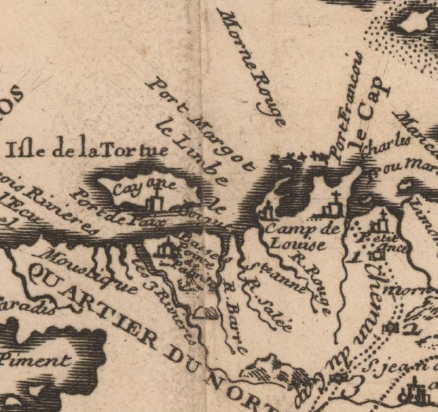
French map circa 1723 marks Cayne opposite the Iron Coast of L’Ile de la Tortue. There’s also a typical sailor’s landmark: Pointe des Palmiers (trans. Point of the Palms). The promontory of Cap François has here become Le Cap (The Cape). It shelters Port St. François, east of the heights of Morne Rouge and Mines de Cuivre (trans. copper mines).

haiti labat
French map of Cape Francois dated 1722 adds Le Limbe, the first area which the rebel slaves put to the torch; and Le Chemin du Cap, the main road to the valleys of the south.

haiti Ponce
This 1796 French map features another sailor’s aid, Pointe Tête de Chein (trans. Dog’s Head Point). The fortification battery on the Cape was built upon Roche à Picolet. This map was drawn after the rebellion of 1791. The Morne Rouge (trans. Red Heights) is now designated as Ravine du Morne au Diable and the Acul à Sabal. The Devil’s Ravine is the present location of Royal Caribbean’s Labadee.

The poor of Haiti are still taking heat for the Bwa Kayiman having been a pact with the devil.

haiti bellin
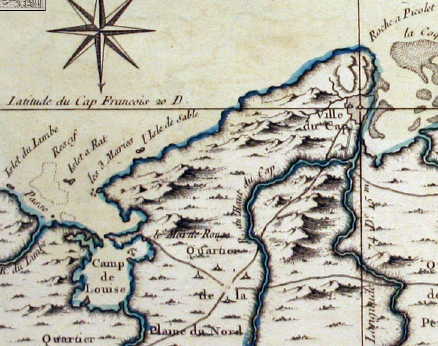
I add this 1764 map for personal interest. Few maps even today mark L’Islet à Rat (trans. Rat Island), which Columbus called La Amiga, was an aid to navigation out of his anchorage at Bay of Acul which he called Cabo de Caribata.

This map also details how colonial French St Domingue was divided into districts, here the Ville du Cap, the Quartier de Plaine du Nord and Camp de Louise.

haiti moreau
This 1770 map of Cap François and Environs distinguishes the larger slavery plantations.

haiti labadi

On the subject of Columbus, isn’t it surprising to reconcile the current verdict on his genocidal behavior, with the histories which have glorified his stature? After all, the primary accounts have never changed. How did earlier biographers overlook the damning and salacious details? One very polite telling of Columbus’ adventures, written by Filson Young published in 1906 provides a prim example. Here Young addresses the kidnap and rape of the indians whom Columbus encountered:

…his taking of the women raises a question which must be in the mind of any one who studies this extraordinary voyage—the question of the treatment of native women by the Spaniards. Columbus is entirely silent on the subject; but taking into account the nature of the Spanish rabble that formed his company, and his own views as to the right which he had to possess the persons and goods of the native inhabitants, I am afraid that there can be very little doubt that in this matter there is a good reason, for his silence. So far as Columbus himself was concerned, it is probable that he was innocent enough; he was not a sensualist by nature, and he was far too much interested and absorbed in the principal objects of his expedition, and had too great a sense of his own personal dignity, to have indulged in excesses that would, thus sanctioned by him, have produced a very disastrous effect on the somewhat rickety discipline of his crew. He was too wise a master, however, to forbid anything that it was not in his power to prevent; and it is probable that he shut his eyes to much that, if he did not tolerate it, he at any rate regarded as a matter of no very great importance. His crew had by this time learned to know their commander well enough not to commit under his eyes offences for which he would have been sure to punish them.

[Giving a list of instructions to the men Columbus planned to leave behind at La Navidad, among them: ]

…and especially to be on their guard to avoid injury or violence to the women, “by which they would cause scandal and set a bad example to the Indians and show the infamy of the Christians.”

no kolumbus day christopher columbusAnd here’s the rub. In this passage the author shows if we do not absolve Columbus, we indict ourselves.

The ruffianly crew had in their minds only the immediate possession of what they could get from the Indians; the Admiral had in his mind the whole possession of the islands and the bodies and souls of its inhabitants. If you take a piece of gold without giving a glass bead in exchange for it, it is called stealing; if you take a country and its inhabitants, and steal their peace from them, and give them blood and servitude in exchange for it, it is called colonisation and Empire-building. Every one understands the distinction; but so few people see the difference that Columbus of all men may be excused for his unconsciousness of it.

Rush is right. Make him pay for Haiti.

Reading 538’s excellent qualified defense of Pat Robertson‘s accusation that Haiti really had made a pact with the devil, I am prompted to weigh in behind Rush Limbaugh’s hypocritical rant that the American public has already paid enough for Haiti’s relief, “it’s called the US Income Tax.” Well it’s true. It is the role of government to see after the suffering among us. Of course you’d think conservatives like Limbaugh wouldn’t highlight that role while images of disaster haunt us, because they’re the ones behind depleting the aid coffers. Bush’s tax cuts for the rich alone could have relieved Haiti, Katrina and every Tsunami in between without costing tearful American TV viewers one extra dime of credit card debt.

The Haitian rebels made this prayer to their god in 1791. European slave owners might conclude an insurgent god would be their devil. This prayer was recited by rebellion priestess Boukman at the Bois Caiman (Bwa Kayiman). French speakers can read it in Creole.

The god who created the earth; who created the sun that gives us light. The god who holds up the ocean; who makes the thunder roar. Our God who has ears to hear. You who are hidden in the clouds; who watch us from where you are. You see all that the white has made us suffer. The white man’s god asks him to commit crimes. But the god within us wants to do good. Our god, who is so good, so just, He orders us to revenge our wrongs. It’s He who will direct our arms and bring us the victory. It’s He who will assist us. We all should throw away the image of the white men’s god who is so pitiless. Listen to the voice for liberty that speaks in all our hearts.

The Toussaint Louverture Project is an online documentation of our western hemisphere’s only successful slave uprising.

Just as the USA still refuses to let Cuba free its people from our tyranny after 40 years, so did the Western powers fight to keep Haiti from success, lest their free slaves inspire ours.

Beyond MLK worship: Beyond Vietnam

MLK“A time comes when silence is betrayal. That time has come for us in relation to Vietnam.”
Martin Luther King Beyond Vietnam: Time to Break the Silence
Full text of 1967 speech below.

Riverside Church, New York City, 4 April 1967

I come to this magnificent house of worship tonight because my conscience leaves me no other choice. I join with you in this meeting because I am in deepest agreement with the aims and work of the organization which has brought us together: Clergy and Laymen Concerned about Vietnam. The recent statement of your executive committee are the sentiments of my own heart and I found myself in full accord when I read its opening lines:

“A time comes when silence is betrayal.”

That time has come for us in relation to Vietnam.

The truth of these words is beyond doubt but the mission to which they call us is a most difficult one. Even when pressed by the demands of inner truth, men do not easily assume the task of opposing their government’s policy, especially in time of war. Nor does the human spirit move without great difficulty against all the apathy of conformist thought within one’s own bosom and in the surrounding world. Moreover when the issues at hand seem as perplexed as they often do in the case of this dreadful conflict we are always on the verge of being mesmerized by uncertainty; but we must move on.

Some of us who have already begun to break the silence of the night have found that the calling to speak is often a vocation of agony, but we must speak. We must speak with all the humility that is appropriate to our limited vision, but we must speak. And we must rejoice as well, for surely this is the first time in our nation’s history that a significant number of its religious leaders have chosen to move beyond the prophesying of smooth patriotism to the high grounds of a firm dissent based upon the mandates of conscience and the reading of history. Perhaps a new spirit is rising among us. If it is, let us trace its movement well and pray that our own inner being may be sensitive to its guidance, for we are deeply in need of a new way beyond the darkness that seems so close around us.

Over the past two years, as I have moved to break the betrayal of my own silences and to speak from the burnings of my own heart, as I have called for radical departures from the destruction of Vietnam, many persons have questioned me about the wisdom of my path. At the heart of their concerns this query has often loomed large and loud: Why are you speaking about war, Dr. King? Why are you joining the voices of dissent? Peace and civil rights don’t mix, they say. Aren’t you hurting the cause of your people, they ask? And when I hear them, though I often understand the source of their concern, I am nevertheless greatly saddened, for such questions mean that the inquirers have not really known me, my commitment or my calling. Indeed, their questions suggest that they do not know the world in which they live.

“I wish not to speak with Hanoi and the National Liberation Front, but rather to my fellow Americans who, with me, bear the greatest responsibility in ending a conflict that has exacted a heavy price on both continents.”

In the light of such tragic misunderstandings, I deem it of signal importance to try to state clearly, and I trust concisely, why I believe that the path from Dexter Avenue Baptist Church — the church in Montgomery, Alabama, where I began my pastorate — leads clearly to this sanctuary tonight.

I come to this platform tonight to make a passionate plea to my beloved nation. This speech is not addressed to Hanoi or to the National Liberation Front. It is not addressed to China or to Russia.

Nor is it an attempt to overlook the ambiguity of the total situation and the need for a collective solution to the tragedy of Vietnam. Neither is it an attempt to make North Vietnam or the National Liberation Front paragons of virtue, nor to overlook the role they can play in a successful resolution of the problem. While they both may have justifiable reason to be suspicious of the good faith of the United States, life and history give eloquent testimony to the fact that conflicts are never resolved without trustful give and take on both sides.

Tonight, however, I wish not to speak with Hanoi and the NLF, but rather to my fellow Americans, who, with me, bear the greatest responsibility in ending a conflict that has exacted a heavy price on both continents.

The Importance of Vietnam

Since I am a preacher by trade, I suppose it is not surprising that I have seven major reasons for bringing Vietnam into the field of my moral vision. There is at the outset a very obvious and almost facile connection between the war in Vietnam and the struggle I, and others, have been waging in America. A few years ago there was a shining moment in that struggle. It seemed as if there was a real promise of hope for the poor — both black and white — through the poverty program. There were experiments, hopes, new beginnings. Then came the buildup in Vietnam and I watched the program broken and eviscerated as if it were some idle political plaything of a society gone mad on war, and I knew that America would never invest the necessary funds or energies in rehabilitation of its poor so long as adventures like Vietnam continued to draw men and skills and money like some demonic destructive suction tube. So I was increasingly compelled to see the war as an enemy of the poor and to attack it as such.

“For the sake of those boys,
for the sake of this governent,
for the sake of hundreds of thousands
trembling under our violence,
I cannot be silent.”

Perhaps the more tragic recognition of reality took place when it became clear to me that the war was doing far more than devastating the hopes of the poor at home. It was sending their sons and their brothers and their husbands to fight and to die in extraordinarily high proportions relative to the rest of the population. We were taking the black young men who had been crippled by our society and sending them eight thousand miles away to guarantee liberties in Southeast Asia which they had not found in southwest Georgia and East Harlem. So we have been repeatedly faced with the cruel irony of watching Negro and white boys on TV screens as they kill and die together for a nation that has been unable to seat them together in the same schools. So we watch them in brutal solidarity burning the huts of a poor village, but we realize that they would never live on the same block in Detroit. I could not be silent in the face of such cruel manipulation of the poor.

My third reason moves to an even deeper level of awareness, for it grows out of my experience in the ghettoes of the North over the last three years — especially the last three summers. As I have walked among the desperate, rejected and angry young men I have told them that Molotov cocktails and rifles would not solve their problems. I have tried to offer them my deepest compassion while maintaining my conviction that social change comes most meaningfully through nonviolent action. But they asked — and rightly so — what about Vietnam? They asked if our own nation wasn’t using massive doses of violence to solve its problems, to bring about the changes it wanted. Their questions hit home, and I knew that I could never again raise my voice against the violence of the oppressed in the ghettos without having first spoken clearly to the greatest purveyor of violence in the world today — my own government. For the sake of those boys, for the sake of this government, for the sake of hundreds of thousands trembling under our violence, I cannot be silent.

For those who ask the question, “Aren’t you a civil rights leader?” and thereby mean to exclude me from the movement for peace, I have this further answer. In 1957 when a group of us formed the Southern Christian Leadership Conference, we chose as our motto: “To save the soul of America.” We were convinced that we could not limit our vision to certain rights for black people, but instead affirmed the conviction that America would never be free or saved from itself unless the descendants of its slaves were loosed completely from the shackles they still wear. In a way we were agreeing with Langston Hughes, that black bard of Harlem, who had written earlier:

O, yes,
I say it plain,
America never was America to me,
And yet I swear this oath —
America will be!

Now, it should be incandescently clear that no one who has any concern for the integrity and life of America today can ignore the present war. If America’s soul becomes totally poisoned, part of the autopsy must read Vietnam. It can never be saved so long as it destroys the deepest hopes of men the world over. So it is that those of us who are yet determined that America will be are led down the path of protest and dissent, working for the health of our land.

“Surely we must see
that the men we supported
pressed them to their violence.”

As if the weight of such a commitment to the life and health of America were not enough, another burden of responsibility was placed upon me in 1964; and I cannot forget that the Nobel Prize for Peace was also a commission — a commission to work harder than I had ever worked before for “the brotherhood of man.” This is a calling that takes me beyond national allegiances, but even if it were not present I would yet have to live with the meaning of my commitment to the ministry of Jesus Christ. To me the relationship of this ministry to the making of peace is so obvious that I sometimes marvel at those who ask me why I am speaking against the war. Could it be that they do not know that the good news was meant for all men — for Communist and capitalist, for their children and ours, for black and for white, for revolutionary and conservative? Have they forgotten that my ministry is in obedience to the one who loved his enemies so fully that he died for them? What then can I say to the “Vietcong” or to Castro or to Mao as a faithful minister of this one? Can I threaten them with death or must I not share with them my life?

Finally, as I try to delineate for you and for myself the road that leads from Montgomery to this place I would have offered all that was most valid if I simply said that I must be true to my conviction that I share with all men the calling to be a son of the living God. Beyond the calling of race or nation or creed is this vocation of sonship and brotherhood, and because I believe that the Father is deeply concerned especially for his suffering and helpless and outcast children, I come tonight to speak for them.

This I believe to be the privilege and the burden of all of us who deem ourselves bound by allegiances and loyalties which are broader and deeper than nationalism and which go beyond our nation’s self-defined goals and positions. We are called to speak for the weak, for the voiceless, for victims of our nation and for those it calls enemy, for no document from human hands can make these humans any less our brothers.

Strange Liberators

And as I ponder the madness of Vietnam and search within myself for ways to understand and respond to compassion my mind goes constantly to the people of that peninsula. I speak now not of the soldiers of each side, not of the junta in Saigon, but simply of the people who have been living under the curse of war for almost three continuous decades now. I think of them too because it is clear to me that there will be no meaningful solution there until some attempt is made to know them and hear their broken cries.

“Before long they must know
that their government has sent them
into a struggle among Vietnamese,
and the more sophisticated surely realize
that we are on the side of the wealthy
and the secure
while we create hell for the poor.”

They must see Americans as strange liberators. The Vietnamese people proclaimed their own independence in 1945 after a combined French and Japanese occupation, and before the Communist revolution in China. They were led by Ho Chi Minh. Even though they quoted the American Declaration of Independence in their own document of freedom, we refused to recognize them. Instead, we decided to support France in its re-conquest of her former colony.

Our government felt then that the Vietnamese people were not “ready” for independence, and we again fell victim to the deadly Western arrogance that has poisoned the international atmosphere for so long. With that tragic decision we rejected a revolutionary government seeking self-determination, and a government that had been established not by China (for whom the Vietnamese have no great love) but by clearly indigenous forces that included some Communists. For the peasants this new government meant real land reform, one of the most important needs in their lives.

For nine years following 1945 we denied the people of Vietnam the right of independence. For nine years we vigorously supported the French in their abortive effort to re-colonize Vietnam.

Before the end of the war we were meeting eighty percent of the French war costs. Even before the French were defeated at Dien Bien Phu, they began to despair of the reckless action, but we did not. We encouraged them with our huge financial and military supplies to continue the war even after they had lost the will. Soon we would be paying almost the full costs of this tragic attempt at re-colonization.

After the French were defeated it looked as if independence and land reform would come again through the Geneva agreements. But instead there came the United States, determined that Ho should not unify the temporarily divided nation, and the peasants watched again as we supported one of the most vicious modern dictators — our chosen man, Premier Diem. The peasants watched and cringed as Diem ruthlessly routed out all opposition, supported their extortionist landlords and refused even to discuss reunification with the north. The peasants watched as all this was presided over by U.S. influence and then by increasing numbers of U.S. troops who came to help quell the insurgency that Diem’s methods had aroused. When Diem was overthrown they may have been happy, but the long line of military dictatorships seemed to offer no real change — especially in terms of their need for land and peace.

The only change came from America as we increased our troop commitments in support of governments which were singularly corrupt, inept and without popular support. All the while the people read our leaflets and received regular promises of peace and democracy — and land reform. Now they languish under our bombs and consider us – not their fellow Vietnamese — the real enemy. They move sadly and apathetically as we herd them off the land of their fathers into concentration camps where minimal social needs are rarely met. They know they must move or be destroyed by our bombs. So they go — primarily women and children and the aged.

“Somehow this madness must cease.”

They watch as we poison their water, as we kill a million acres of their crops. They must weep as the bulldozers roar through their areas preparing to destroy the precious trees. They wander into the hospitals, with at least twenty casualties from American firepower for one “Vietcong-inflicted” injury. So far we may have killed a million of them — mostly children. They wander into the towns and see thousands of the children, homeless, without clothes, running in packs on the streets like animals. They see the children, degraded by our soldiers as they beg for food. They see the children selling their sisters to our soldiers, soliciting for their mothers.

What do the peasants think as we ally ourselves with the landlords and as we refuse to put any action into our many words concerning land reform? What do they think as we test our latest weapons on them, just as the Germans tested out new medicine and new tortures in the concentration camps of Europe? Where are the roots of the independent Vietnam we claim to be building? Is it among these voiceless ones?

We have destroyed their two most cherished institutions: the family and the village. We have destroyed their land and their crops. We have cooperated in the crushing of the nation’s only non-Communist revolutionary political force — the Unified Buddhist church. We have supported the enemies of the peasants of Saigon. We have corrupted their women and children and killed their men. What liberators?

Now there is little left to build on — save bitterness. Soon the only solid physical foundations remaining will be found at our military bases and in the concrete of the concentration camps we call fortified hamlets. The peasants may well wonder if we plan to build our new Vietnam on such grounds as these? Could we blame them for such thoughts? We must speak for them and raise the questions they cannot raise. These too are our brothers.

Perhaps the more difficult but no less necessary task is to speak for those who have been designated as our enemies. What of the National Liberation Front — that strangely anonymous group we call VC or Communists? What must they think of us in America when they realize that we permitted the repression and cruelty of Diem which helped to bring them into being as a resistance group in the south? What do they think of our condoning the violence which led to their own taking up of arms? How can they believe in our integrity when now we speak of “aggression from the north” as if there were nothing more essential to the war? How can they trust us when now we charge them with violence after the murderous reign of Diem and charge them with violence while we pour every new weapon of death into their land? Surely we must understand their feelings even if we do not condone their actions. Surely we must see that the men we supported pressed them to their violence. Surely we must see that our own computerized plans of destruction simply dwarf their greatest acts.

“We must continue to raise our voices if our nation persists in its perverse ways in Vietnam.”

How do they judge us when our officials know that their membership is less than twenty-five percent Communist and yet insist on giving them the blanket name? What must they be thinking when they know that we are aware of their control of major sections of Vietnam and yet we appear ready to allow national elections in which this highly organized political parallel government will have no part? They ask how we can speak of free elections when the Saigon press is censored and controlled by the military junta. And they are surely right to wonder what kind of new government we plan to help form without them — the only party in real touch with the peasants. They question our political goals and they deny the reality of a peace settlement from which they will be excluded. Their questions are frighteningly relevant. Is our nation planning to build on political myth again and then shore it up with the power of new violence?

Here is the true meaning and value of compassion and nonviolence when it helps us to see the enemy’s point of view, to hear his questions, to know his assessment of ourselves. For from his view we may indeed see the basic weaknesses of our own condition, and if we are mature, we may learn and grow and profit from the wisdom of the brothers who are called the opposition.

So, too, with Hanoi. In the north, where our bombs now pummel the land, and our mines endanger the waterways, we are met by a deep but understandable mistrust. To speak for them is to explain this lack of confidence in Western words, and especially their distrust of American intentions now. In Hanoi are the men who led the nation to independence against the Japanese and the French, the men who sought membership in the French commonwealth and were betrayed by the weakness of Paris and the willfulness of the colonial armies. It was they who led a second struggle against French domination at tremendous costs, and then were persuaded to give up the land they controlled between the thirteenth and seventeenth parallel as a temporary measure at Geneva. After 1954 they watched us conspire with Diem to prevent elections which would have surely brought Ho Chi Minh to power over a united Vietnam, and they realized they had been betrayed again.

When we ask why they do not leap to negotiate, these things must be remembered. Also it must be clear that the leaders of Hanoi considered the presence of American troops in support of the Diem regime to have been the initial military breach of the Geneva agreements concerning foreign troops, and they remind us that they did not begin to send in any large number of supplies or men until American forces had moved into the tens of thousands.

“When machines and computers,
profit motives and property rights
are considered more important than people,
the giant triplets of
racism,
materialism
and militarism
are incapable of being conquered.”

Hanoi remembers how our leaders refused to tell us the truth about the earlier North Vietnamese overtures for peace, how the president claimed that none existed when they had clearly been made. Ho Chi Minh has watched as America has spoken of peace and built up its forces, and now he has surely heard of the increasing international rumors of American plans for an invasion of the north. He knows the bombing and shelling and mining we are doing are part of traditional pre-invasion strategy. Perhaps only his sense of humor and of irony can save him when he hears the most powerful nation of the world speaking of aggression as it drops thousands of bombs on a poor weak nation more than eight thousand miles away from its shores.

At this point I should make it clear that while I have tried in these last few minutes to give a voice to the voiceless on Vietnam and to understand the arguments of those who are called enemy, I am as deeply concerned about our troops there as anything else. For it occurs to me that what we are submitting them to in Vietnam is not simply the brutalizing process that goes on in any war where armies face each other and seek to destroy. We are adding cynicism to the process of death, for they must know after a short period there that none of the things we claim to be fighting for are really involved. Before long they must know that their government has sent them into a struggle among Vietnamese, and the more sophisticated surely realize that we are on the side of the wealthy and the secure while we create hell for the poor.

This Madness Must Cease

Somehow this madness must cease. We must stop now. I speak as a child of God and brother to the suffering poor of Vietnam. I speak for those whose land is being laid waste, whose homes are being destroyed, whose culture is being subverted. I speak for the poor of America who are paying the double price of smashed hopes at home and death and corruption in Vietnam. I speak as a citizen of the world, for the world as it stands aghast at the path we have taken. I speak as an American to the leaders of my own nation. The great initiative in this war is ours. The initiative to stop it must be ours.

This is the message of the great Buddhist leaders of Vietnam. Recently one of them wrote these words:

“Each day the war goes on the hatred increases in the heart of the Vietnamese and in the hearts of those of humanitarian instinct. The Americans are forcing even their friends into becoming their enemies. It is curious that the Americans, who calculate so carefully on the possibilities of military victory, do not realize that in the process they are incurring deep psychological and political defeat. The image of America will never again be the image of revolution, freedom and democracy, but the image of violence and militarism.”

“A nation that continues
year after year
to spend more money on military defense
than on programs of social uplift
is approaching spiritual death.”

If we continue, there will be no doubt in my mind and in the mind of the world that we have no honorable intentions in Vietnam. It will become clear that our minimal expectation is to occupy it as an American colony and men will not refrain from thinking that our maximum hope is to goad China into a war so that we may bomb her nuclear installations. If we do not stop our war against the people of Vietnam immediately the world will be left with no other alternative than to see this as some horribly clumsy and deadly game we have decided to play.

The world now demands a maturity of America that we may not be able to achieve. It demands that we admit that we have been wrong from the beginning of our adventure in Vietnam, that we have been detrimental to the life of the Vietnamese people. The situation is one in which we must be ready to turn sharply from our present ways.

In order to atone for our sins and errors in Vietnam, we should take the initiative in bringing a halt to this tragic war. I would like to suggest five concrete things that our government should do immediately to begin the long and difficult process of extricating ourselves from this nightmarish conflict:

• End all bombing in North and South Vietnam

• Declare a unilateral cease-fire in the hope that such action will create the atmosphere for negotiation.

• Take immediate steps to prevent other battlegrounds in Southeast Asia by curtailing our military buildup in Thailand and our interference in Laos.

• Realistically accept the fact that the National Liberation Front has substantial support in South Vietnam and must thereby play a role in any meaningful negotiations and in any future Vietnam government.

• Set a date that we will remove all foreign troops from Vietnam in accordance with the 1954 Geneva agreement.

Part of our ongoing commitment might well express itself in an offer to grant asylum to any Vietnamese who fears for his life under a new regime which included the Liberation Front. Then we must make what reparations we can for the damage we have done. We most provide the medical aid that is badly needed, making it available in this country if necessary.

Protesting The War

Meanwhile we in the churches and synagogues have a continuing task while we urge our government to disengage itself from a disgraceful commitment. We must continue to raise our voices if our nation persists in its perverse ways in Vietnam. We must be prepared to match actions with words by seeking out every creative means of protest possible.

As we counsel young men concerning military service we must clarify for them our nation’s role in Vietnam and challenge them with the alternative of conscientious objection. I am pleased to say that this is the path now being chosen by more than seventy students at my own alma mater, Morehouse College, and I recommend it to all who find the American course in Vietnam a dishonorable and unjust one. Moreover I would encourage all ministers of draft age to give up their ministerial exemptions and seek status as conscientious objectors. These are the times for real choices and not false ones. We are at the moment when our lives must be placed on the line if our nation is to survive its own folly. Every man of humane convictions must decide on the protest that best suits his convictions, but we must all protest.

“If we do not act
we shall surely be dragged down
the long and shameful corridors of time
reserved for those who possess
power without compassion,
might without morality,
and strength without sight.”

There is something seductively tempting about stopping there and sending us all off on what in some circles has become a popular crusade against the war in Vietnam. I say we must enter the struggle, but I wish to go on now to say something even more disturbing. The war in Vietnam is but a symptom of a far deeper malady within the American spirit, and if we ignore this sobering reality we will find ourselves organizing clergy-and laymen-concerned committees for the next generation. They will be concerned about Guatemala and Peru. They will be concerned about Thailand and Cambodia. They will be concerned about Mozambique and South Africa. We will be marching for these and a dozen other names and attending rallies without end unless there is a significant and profound change in American life and policy. Such thoughts take us beyond Vietnam, but not beyond our calling as sons of the living God.

In 1957 a sensitive American official overseas said that it seemed to him that our nation was on the wrong side of a world revolution. During the past ten years we have seen emerge a pattern of suppression which now has justified the presence of U.S. military “advisors” in Venezuela. This need to maintain social stability for our investments accounts for the counter-revolutionary action of American forces in Guatemala. It tells why American helicopters are being used against guerrillas in Colombia and why American napalm and green beret forces have already been active against rebels in Peru. It is with such activity in mind that the words of the late John F. Kennedy come back to haunt us. Five years ago he said,

“Those who make peaceful revolution impossible will make violent revolution inevitable.”

Increasingly, by choice or by accident, this is the role our nation has taken — the role of those who make peaceful revolution impossible by refusing to give up the privileges and the pleasures that come from the immense profits of overseas investment.

I am convinced that if we are to get on the right side of the world revolution, we as a nation must undergo a radical revolution of values. We must rapidly begin the shift from a “thing-oriented” society to a “person-oriented” society. When machines and computers, profit motives and property rights are considered more important than people, the giant triplets of racism, materialism, and militarism are incapable of being conquered.

A true revolution of values will soon cause us to question the fairness and justice of many of our past and present policies. On the one hand we are called to play the good Samaritan on life’s roadside; but that will be only an initial act. One day we must come to see that the whole Jericho road must be transformed so that men and women will not be constantly beaten and robbed as they make their journey on life’s highway.

True compassion is more than flinging a coin to a beggar; it is not haphazard and superficial. It comes to see that an edifice which produces beggars needs restructuring. A true revolution of values will soon look uneasily on the glaring contrast of poverty and wealth. With righteous indignation, it will look across the seas and see individual capitalists of the West investing huge sums of money in Asia, Africa and South America, only to take the profits out with no concern for the social betterment of the countries, and say: “This is not just.”

It will look at our alliance with the landed gentry of Latin America and say: “This is not just.”

The Western arrogance of feeling that it has everything to teach others and nothing to learn from them is not just.

A true revolution of values will lay hands on the world order and say of war: “This way of settling differences is not just.”

This business of burning human beings with napalm, of filling our nation’s homes with orphans and widows, of injecting poisonous drugs of hate into veins of people normally humane, of sending men home from dark and bloody battlefields physically handicapped and psychologically deranged, cannot be reconciled with wisdom, justice and love. A nation that continues year after year to spend more money on military defense than on programs of social uplift is approaching spiritual death.

America, the richest and most powerful nation in the world, can well lead the way in this revolution of values. There is nothing, except a tragic death wish, to prevent us from reordering our priorities, so that the pursuit of peace will take precedence over the pursuit of war. There is nothing to keep us from molding a recalcitrant status quo with bruised hands until we have fashioned it into a brotherhood.

This kind of positive revolution of values is our best defense against communism. War is not the answer. Communism will never be defeated by the use of atomic bombs or nuclear weapons. Let us not join those who shout war and through their misguided passions urge the United States to relinquish its participation in the United Nations. These are days which demand wise restraint and calm reasonableness. We must not call everyone a Communist or an appeaser who advocates the seating of Red China in the United Nations and who recognizes that hate and hysteria are not the final answers to the problem of these turbulent days. We must not engage in a negative anti-communism, but rather in a positive thrust for democracy, realizing that our greatest defense against communism is to take offensive action in behalf of justice. We must with positive action seek to remove those conditions of poverty, insecurity and injustice which are the fertile soil in which the seed of communism grows and develops.

The People Are Important

These are revolutionary times. All over the globe men are revolting against old systems of exploitation and oppression and out of the wombs of a frail world new systems of justice and equality are being born. The shirtless and barefoot people of the land are rising up as never before. “The people who sat in darkness have seen a great light.” We in the West must support these revolutions. It is a sad fact that, because of comfort, complacency, a morbid fear of communism, and our proneness to adjust to injustice, the Western nations that initiated so much of the revolutionary spirit of the modern world have now become the arch anti-revolutionaries. This has driven many to feel that only Marxism has the revolutionary spirit. Therefore, communism is a judgment against our failure to make democracy real and follow through on the revolutions we initiated. Our only hope today lies in our ability to recapture the revolutionary spirit and go out into a sometimes hostile world declaring eternal hostility to poverty, racism, and militarism. With this powerful commitment we shall boldly challenge the status quo and unjust mores and thereby speed the day when “every valley shall be exalted, and every mountain and hill shall be made low, and the crooked shall be made straight and the rough places plain.”

A genuine revolution of values means in the final analysis that our loyalties must become ecumenical rather than sectional. Every nation must now develop an overriding loyalty to mankind as a whole in order to preserve the best in their individual societies.

This call for a world-wide fellowship that lifts neighborly concern beyond one’s tribe, race, class and nation is in reality a call for an all-embracing and unconditional love for all men. This oft misunderstood and misinterpreted concept – so readily dismissed by the Nietzsches of the world as a weak and cowardly force – has now become an absolute necessity for the survival of man. When I speak of love I am not speaking of some sentimental and weak response. I am speaking of that force which all of the great religions have seen as the supreme unifying principle of life. Love is somehow the key that unlocks the door which leads to ultimate reality. This Hindu-Moslem-Christian-Jewish-Buddhist belief about ultimate reality is beautifully summed up in the first epistle of Saint John:

Let us love one another; for love is God and everyone that loveth is born of God and knoweth God. He that loveth not knoweth not God; for God is love. If we love one another God dwelleth in us, and his love is perfected in us.

Let us hope that this spirit will become the order of the day. We can no longer afford to worship the god of hate or bow before the altar of retaliation. The oceans of history are made turbulent by the ever-rising tides of hate. History is cluttered with the wreckage of nations and individuals that pursued this self-defeating path of hate. As Arnold Toynbee says :

“Love is the ultimate force that makes for the saving choice of life and good against the damning choice of death and evil. Therefore the first hope in our inventory must be the hope that love is going to have the last word.”

We are now faced with the fact that tomorrow is today. We are confronted with the fierce urgency of now. In this unfolding conundrum of life and history there is such a thing as being too late. Procrastination is still the thief of time. Life often leaves us standing bare, naked and dejected with a lost opportunity. The “tide in the affairs of men” does not remain at the flood; it ebbs. We may cry out desperately for time to pause in her passage, but time is deaf to every plea and rushes on. Over the bleached bones and jumbled residue of numerous civilizations are written the pathetic words: “Too late.”

There is an invisible book of life that faithfully records our vigilance or our neglect. “The moving finger writes, and having writ moves on…” We still have a choice today; nonviolent coexistence or violent co-annihilation.

We must move past indecision to action. We must find new ways to speak for peace in Vietnam and justice throughout the developing world – a world that borders on our doors. If we do not act we shall surely be dragged down the long dark and shameful corridors of time reserved for those who possess power without compassion, might without morality, and strength without sight.

Now let us begin. Now let us rededicate ourselves to the long and bitter – but beautiful – struggle for a new world. This is the calling of the sons of God, and our brothers wait eagerly for our response. Shall we say the odds are too great? Shall we tell them the struggle is too hard? Will our message be that the forces of American life militate against their arrival as full men, and we send our deepest regrets? Or will there be another message, of longing, of hope, of solidarity with their yearnings, of commitment to their cause, whatever the cost? The choice is ours, and though we might prefer it otherwise we must choose in this crucial moment of human history.

As that noble bard of yesterday, James Russell Lowell, eloquently stated:

Once to every man and nation
Comes the moment to decide,
In the strife of truth and falsehood,
For the good or evil side;
Some great cause, God’s new Messiah,
Off’ring each the bloom or blight,
And the choice goes by forever
Twixt that darkness and that light.
Though the cause of evil prosper,
Yet ’tis truth alone is strong;
Though her portion be the scaffold,
And upon the throne be wrong:
Yet that scaffold sways the future,
And behind the dim unknown,
Standeth God within the shadow
Keeping watch above his own.

Did you know John Yoo is not in jail?

john-woo-daily-showThis is the kind of civility that I just can’t stomach. Berkeley Law Professor John Yoo, author of the Torture Memos which Bushco’s blimpnecks took for their greenlight to water-board, was a guest yesterday on the Daily Show. Short of Jon Stewart orchestrating a citizen’s arrest, or reality television setting Gitmo alumni upon Woo like bears on honey, I don’t want to see the John Yoo walking free.

I could see that Stewart had planned some zingers which Yoo was able to dodge, and afterward Stewart behaved like Hannibal Lecter had just passed through, but on the whole I think hosting criminals like Yoo is ill advised. For one, you have to shake his hand. Then of course the nature of television entertainment –unless you are Mike Wallace who’s just strode into the mark’s office– has you trying to make light of the interview, the whole of which has been choreographed for laughs. Worst of all I believe, are the too-many times a host finds himself asking the audience to give it up for the guest.

When Stewart first announced the night’s guest was to be John Yoo, the audience appropriately enough did not cheer. Of course when it came time for the cretin’s entrance, the applause was obligatory. And so it followed, each subsequent punctuation. How else are the audience members supposed to show their enthusiasm? It’s true, their energy is critical to the stage energy.

Stephen Colbert solves the applaud-the-bad-guy paradox by taking a victory lap himself when the audience applauds the introduction of the guest. But usually Colbert’s show specializes in leftist guests with whom the audience is sympathetic, so the maneuver is more for bringing the studio audience unto Colbert’s role-playing for the Right. Integral to his act is an audience that mimics O’Reilly-Limbaugh ditto-heads. A veritable right wing audience could never be brought to even show civility to a guest they’re told is hostile.

And I guess I long for a little more of that genuine sentiment. It began for me when I saw Sarah Palin treated with effusive cordiality on Saturday Night Live. Again the audience was expected to applaud Palin, if in fact they were really just excited to see her roasted.

John Yoo and ilk, the whole Bush troops, must be prosecuted and jailed. That they walk about at large, free to second guess President Obama’s terrorism strategies are nothing to laugh at. I’ll cop to being humorless on this point.

NOTES:
Excerpt, March 13, 2002 Memorandum

“… neither the GPW (Third Geneva Convention) nor the Torture Convention restrict the President’s legal authority to transfer prisoners captured in the Afghanistan conflict to third countries. Although the GPW places conditions on the transfer of POWs, neither al-Qaeda nor Taliban prisoners are legally entitled to POW status, and hence there are no GPW conditions placed on their transfer. While the Torture Convention arguably might govern transfer of these prisoners, it does not apply extraterritorially.”

Excerpt, August 1, 2002 Memo

“Under international law, therefore, the United States thus is bound only by the text of the Torture Conventions as modified by the first Bush administration’s understanding.”

It’s a picture worth a thousand ships

Israeli Deputy Foreign Minster Ayalon and Turkish ambassadorAt first the story read like diplomatic sensitivities ruffled by no more than your typical office power feng shui: the Turkish ambassador to Israel was not seated at a height commensurate with his host, the flag of his nation was not displayed, the Israeli deputy minister would not shake his hand. Rather it was Deputy Foreign Minister Danny Ayalon himself who called the reporters’ attentions to the intentional affronts, lest it was not obvious enough from the photograph. To what do the Turks owe Israel’s displeasure? Turkey’s PM has been criticizing Israel’s crimes in Gaza, to no greater degree than has been confirmed by the UN Goldstone Report. Here’s to hoping that Turkish pride will answer appropriately.

It’s been a traditional role of ambassadors to suffer their host’s anger at a perceived provocation. Didn’t Ivan the Terrible once send emissaries packing after he’d nailed their hats to their heads? Often in less diplomatic times, envoys were beheaded, to usually ruinous result. In modern times, suffering indignity to foreign dignitaries is enough to send your message. But today too, media images have come to have a greater reach across the world. I’m thinking in particular the Muslim populaces. Let’s see what kind of posture of subservience Israel can expect of Turkey.

Said one Turkish parliamentarian: “The word scandal is not enough to describe this move.” And it seems unlikely that Israel will apologize, Ayalon already responding: “In terms of the diplomatic tactics available, this was the minimum that was warranted given the repeated provocations by political and other players in Turkey.”

Perhaps Israel was emboldened by Egypt’s recent display of obedience to the mission of starving Gaza. Israel’s violent repression of the people of Gaza is meeting with growing criticism, and perhaps they expect Turkish Prime Minister Recep Tayyip Erdogan to heel dutifully.

What might the minimum of responses be from Turkey, given the sway the US holds over its actions, in light too of its aspiration to rise through the EU?

With Egypt’s intention to fortify its Gaza border to curtail tunneling, and its announcement to permit no further aid from reaching the besieged Palestinians, the path remains only for someone to reach Gaza by sea. I’m hoping it will be the Turks.

Why couldn’t a Sea Shepherd Conservation Society type flotilla mount a seaborne rescue of Gaza? I’d bet televising such an adventure would find a bigger audience than Whale Wars.

Aid groups have been trying, with sporadic success, to breach Israel’s naval blockade of the Gaza coast. Perhaps it’s time for a nation to lend some military vessels to the task. Why not? The United Nations considers Israel’s embargo of Gaza to be illegal. Why shouldn’t a local power sail right before the Israeli warships to escort relief supplies to the Gazans? Let’s see whose ships will look down on whose.

israel-humiliates-turkey-ambassador

UPDATE: Here it is, the Free Gaza Movement is putting together a flotilla!

Where is humanitarian airlift for Gaza?

The Berlin airlift siege C-47
When the Soviet Union laid siege to West Berlin in 1947, the Western powers mounted a famous airlift to supply the city’s inhabitants for ten months until the siege was broken. At its height, the Berlin Airlift hauled almost 9,000 tons per day. By contrast, the Palestinians of the Gaza Strip remain besieged for two and a half years now, where is the humanitarian effort to save them?

The West’s official abandonment of the Gazans is shameful.

Gaza today has a similar population in number and density, also living in post-war squalor. A chief difference is that instead of a conqueror trying to impose a common currency to force assimilation, Palestine’s occupier wants to purge the people of the lands it want to absorb. The siege of Gaza represents living conditions made so dire that its victims want only to leave.

The recent Viva Palestina aid convoy to Gaza was the third successful effort to supply the people of Gaza. Counting also the attempts to bring supplies by boat, how do these methods compare to the help mobilized for Berlin?

At the close of the latest effort, leader George Galloway was ceremoniously banned from returning to Egypt. Some of the convoy’s participants still await flights out of Cairo, all of them declared persona non grata. Although Venezuelan upstart Hugo Chavez will reportedly be supporting the next Viva Palestina convoy this summer, Egypt has now declared that no aid effort will be allowed through its border crossing to Gaza.

Why will no foreign government support an airlift to Gaza –even if it means parachuting supplies? Or why not a naval convoy to breach the barricade? Israel repeats that Gaza is not occupied. A challenge to Gaza’s maritime sovereignty could settle that matter.

Upon arrival in Gaza, a participant in the aid convoy summarized his motivation to bring relief supplies to the people of Gaza: “because they deserve it.”

William Blum – Anti-Empire Report

Here’s William Blum’s latest essay, on Lincoln Gordon, Brazil, Cuba, and the 2009 Nobel Laureate, reprinted from www.killinghope.org.

THE ANTI-EMPIRE REPORT
By William Blum, January 6, 2009

The American elite

Lincoln Gordon died a few weeks ago at the age of 96. He had graduated summa cum laude from Harvard at the age of 19, received a doctorate from Oxford as a Rhodes Scholar, published his first book at 22, with dozens more to follow on government, economics, and foreign policy in Europe and Latin America. He joined the Harvard faculty at 23. Dr. Gordon was an executive on the War Production Board during World War II, a top administrator of Marshall Plan programs in postwar Europe, ambassador to Brazil, held other high positions at the State Department and the White House, a fellow at the Woodrow Wilson International Center for Scholars, economist at the Brookings Institution, president of Johns Hopkins University. President Lyndon B. Johnson praised Gordon’s diplomatic service as "a rare combination of experience, idealism and practical judgment".

You get the picture? Boy wonder, intellectual shining light, distinguished leader of men, outstanding American patriot.

Abraham Lincoln Gordon was also Washington’s on-site, and very active, director in Brazil of the military coup in 1964 which overthrew the moderately leftist government of João Goulart and condemned the people of Brazil to more than 20 years of an unspeakably brutal dictatorship. Human-rights campaigners have long maintained that Brazil’s military regime originated the idea of the desaparecidos, "the disappeared", and exported torture methods across Latin America. In 2007, the Brazilian government published a 500-page book, "The Right to Memory and the Truth", which outlines the systematic torture, rape and disappearance of nearly 500 left-wing activists, and includes photos of corpses and torture victims. Currently, Brazilian President Luiz Inácio Lula da Silva is proposing a commission to investigate allegations of torture by the military during the 1964-1985 dictatorship. (When will the United States create a commission to investigate its own torture?)

In a cable to Washington after the coup, Gordon stated — in a remark that might have had difficulty getting past the lips of even John Foster Dulles — that without the coup there could have been a "total loss to the West of all South American Republics". (It was actually the beginning of a series of fascistic anti-communist coups that trapped the southern half of South America in a decades-long nightmare, culminating in "Operation Condor", in which the various dictatorships, aided by the CIA, cooperated in hunting down and killing leftists.)

Gordon later testified at a congressional hearing and while denying completely any connection to the coup in Brazil he stated that the coup was "the single most decisive victory of freedom in the mid-twentieth century."

Listen to a phone conversation between President Johnson and Thomas Mann, Assistant Secretary of State for Inter-American Affairs, April 3, 1964, two days after the coup:

MANN: I hope you’re as happy about Brazil as I am.

LBJ: I am.

MANN: I think that’s the most important thing that’s happened in the hemisphere in three years.

LBJ: I hope they give us some credit instead of hell.1

So the next time you’re faced with a boy wonder from Harvard, try to keep your adulation in check no matter what office the man attains, even — oh, just choosing a position at random — the presidency of the United States. Keep your eyes focused not on these "liberal" … "best and brightest" who come and go, but on US foreign policy which remains the same decade after decade. There are dozens of Brazils and Lincoln Gordons in America’s past. In its present. In its future. They’re the diplomatic equivalent of the guys who ran Enron, AIG and Goldman Sachs.

Of course, not all of our foreign policy officials are like that. Some are worse.

And remember the words of convicted spy Alger Hiss: Prison was "a good corrective to three years at Harvard."

Mothers, don’t let your children grow up to be Nobel Peace Prize winners

In November I wrote:

Question: How many countries do you have to be at war with to be disqualified from receiving the Nobel Peace Prize?

Answer: Five. Barack Obama has waged war against only Pakistan, Afghanistan, Iraq and Somalia. He’s holding off on Iran until he actually gets the prize.

Well, on December 10 the president clutched the prize in his blood-stained hands. But then the Nobel Laureate surprised us. On December 17 the United States fired cruise missiles at people in … not Iran, but Yemen, all "terrorists" of course, who were, needless to say, planning "an imminent attack against a U.S. asset".2 A week later the United States carried out another attack against "senior al-Qaeda operatives" in Yemen.3

Reports are that the Nobel Peace Prize Committee in Norway is now in conference to determine whether to raise the maximum number of wars allowed to ten. Given the committee’s ignoble history, I imagine that Obama is taking part in the discussion. As is Henry Kissinger.

The targets of these attacks in Yemen reportedly include fighters coming from Afghanistan and Iraq, confirmation of the warnings long given — even by the CIA and the Pentagon — that those US interventions were creating new anti-American terrorists. (That’s anti-American foreign policy, not necessarily anything else American.) How long before the United States will be waging war in some other god-forsaken land against anti-American terrorists whose numbers include fighters from Yemen? Or Pakistan? Or Somalia? Or Palestine?

Our blessed country is currently involved in so many bloody imperial adventures around the world that one needs a scorecard to keep up. Rick Rozoff of StopNATO has provided this for us in some detail.4

For this entire century, almost all these anti-American terrorists have been typically referred to as "al-Qaeda", as if you have to be a member of something called al-Qaeda to resent bombs falling on your house or wedding party; as if there’s a precise and meaningful distinction between people retaliating against American terrorism while being a member of al-Qaeda and people retaliating against American terrorism while NOT being a member of al-Qaeda. However, there is not necessarily even such an animal as a "member of al-Qaeda", albeit there now exists "al-Qaeda in Iraq" and "al-Qaeda in the Arabian Peninsula". Anti-American terrorists do know how to choose a name that attracts attention in the world media, that appears formidable, that scares Americans. Governments have learned to label their insurgents "al-Qaeda" to start the military aid flowing from Washington, just like they yelled "communist" during the Cold War. And from the perspective of those conducting the War on Terror, the bigger and more threatening the enemy, the better — more funding, greater prestige, enhanced career advancement. Just like with the creation of something called The International Communist Conspiracy.

It’s not just the American bombings, invasions and occupations that spur the terrorists on, but the American torture. Here’s Bowe Robert Bergdahl, US soldier captured in Afghanistan, speaking on a video made by his Taliban captors: He said he had been well-treated, contrasting his fate to that of prisoners held in US military prisons, such as the infamous Abu Ghraib prison in Iraq. "I bear witness I was continuously treated as a human being, with dignity, and I had nobody deprive me of my clothes and take pictures of me naked. I had no dogs barking at me or biting me as my country has done to their Muslim prisoners in the jails that I have mentioned."5

Of course the Taliban provided the script, but what was the script based on? What inspired them to use such words and images, to make such references?

Cuba. Again. Still. Forever.

More than 50 years now it is. The propaganda and hypocrisy of the American mainstream media seems endless and unwavering. They can not accept the fact that Cuban leaders are humane or rational. Here’s the Washington Post of December 13 writing about an American arrested in Cuba:

"The Cuban government has arrested an American citizen working on contract for the U.S. Agency for International Development who was distributing cellphones and laptop computers to Cuban activists. … Under Cuban law … a Cuban citizen or a foreign visitor can be arrested for nearly anything under the claim of ‘dangerousness’."

That sounds just awful, doesn’t it? Imagine being subject to arrest for whatever someone may choose to label "dangerousness". But the exact same thing has happened repeatedly in the United States since the Bolshevik Revolution of 1917. We don’t use the word "dangerousness". We speak of "national security". Or, more recently, "terrorism". Or "providing material support to terrorism".

The arrested American works for Development Alternatives, Inc. (DAI), a US government contractor that provides services to the State Department, the Pentagon and the US Agency for International Development (USAID). In 2008, DAI was funded by the US Congress to "promote transition to democracy" in Cuba. Yes, Oh Happy Day!, we’re bringing democracy to Cuba just as we’re bringing it to Afghanistan and Iraq. In 2002, DAI was contracted by USAID to work in Venezuela and proceeded to fund the same groups that a few months earlier had worked to stage a coup — temporarily successful — against President Hugo Chávez. DAI performed other subversive work in Venezuela and has also been active in Afghanistan, Pakistan, and other hotspots. "Subversive" is what Washington would label an organization like DAI if they behaved in the same way in the United States in behalf of a foreign government.6

The American mainstream media never makes its readers aware of the following (so I do so repeatedly): The United States is to the Cuban government like al-Qaeda is to the government in Washington, only much more powerful and much closer. Since the Cuban revolution, the United States and anti-Castro Cuban exiles in the US have inflicted upon Cuba greater damage and greater loss of life than what happened in New York and Washington on September 11, 2001. Cuban dissidents typically have had very close, indeed intimate, political and financial connections to American government agents. Would the US government ignore a group of Americans receiving funds or communication equipment from al-Qaeda and/or engaging in repeated meetings with known leaders of that organization? In the past few years, the American government has arrested a great many people in the US and abroad solely on the basis of alleged ties to al-Qaeda, with a lot less evidence to go by than Cuba has had with its dissidents’ ties to the United States, evidence usually gathered by Cuban double agents. Virtually all of Cuba’s "political prisoners" are such dissidents.

The Washington Post story continued:

"The Cuban government granted ordinary citizens the right to buy cellphones just last year." Period.

What does one make of such a statement without further information? How could the Cuban government have been so insensitive to people’s needs for so many years? Well, that must be just the way a "totalitarian" state behaves. But the fact is that because of the disintegration of the Soviet bloc, with a major loss to Cuba of its foreign trade, combined with the relentless US economic aggression, the Caribbean island was hit by a great energy shortage beginning in the 1990s, which caused repeated blackouts. Cuban authorities had no choice but to limit the sale of energy-hogging electrical devices such as cell phones; but once the country returned to energy sufficiency the restrictions were revoked.

"Cubans who want to log on [to the Internet] often have to give their names to the government."

What does that mean? Americans, thank God, can log onto the Internet without giving their names to the government. Their Internet Service Provider does it for them, furnishing their names to the government, along with their emails, when requested.

"Access to some Web sites is restricted."

Which ones? Why? More importantly, what information might a Cuban discover on the Internet that the government would not want him to know about? I can’t imagine. Cubans are in constant touch with relatives in the US, by mail and in person. They get US television programs from Miami. International conferences on all manner of political, economic and social subjects are held regularly in Cuba. What does the American media think is the great secret being kept from the Cuban people by the nasty commie government?

"Cuba has a nascent blogging community, led by the popular commentator Yoani Sánchez, who often writes about how she and her husband are followed and harassed by government agents because of her Web posts. Sánchez has repeatedly applied for permission to leave the country to accept journalism awards, so far unsuccessfully."

According to a well-documented account7, Sánchez’s tale of government abuse appears rather exaggerated. Moreover, she moved to Switzerland in 2002, lived there for two years, and then voluntarily returned to Cuba. On the other hand, in January 2006 I was invited to attend a book fair in Cuba, where one of my books, newly translated into Spanish, was being presented. However, the government of the United States would not give me permission to go. My application to travel to Cuba had also been rejected in 1998 by the Clinton administration.

"’Counterrevolutionary activities’, which include mild protests and critical writings, carry the risk of censure or arrest. Anti-government graffiti and speech are considered serious crimes."

Raise your hand if you or someone you know of was ever arrested in the United States for taking part in a protest. And substitute "pro al-Qaeda" for "counterrevolutionary" and for "anti-government" and think of the thousands imprisoned the past eight years by the United States all over the world for … for what? In most cases there’s no clear answer. Or the answer is clear: (a) being in the wrong place at the wrong time, or (b) being turned in to collect a bounty offered by the United States, or (c) thought crimes. And whatever the reason for the imprisonment, they were likely tortured. Even the most fanatical anti-Castroites don’t accuse Cuba of that. In the period of the Cuban revolution, since 1959, Cuba has had one of the very best records on human rights in the hemisphere. See my essay: "The United States, Cuba and this thing called Democracy".8

There’s no case of anyone arrested in Cuba that compares in injustice and cruelty to the arrest in 1998 by the United States government of those who came to be known as the "Cuban Five", sentenced in Florida to exceedingly long prison terms for trying to stem terrorist acts against Cuba emanating from the US.9 It would be lovely if the Cuban government could trade their DAI prisoner for the five. Cuba, on several occasions, has proposed to Washington the exchange of a number of what the US regards as "political prisoners" in Cuba for the five Cubans held in the United States. So far the United States has not agreed to do so.

Notes

  1. Michael Beschloss, Taking Charge: The Johnson White House Tapes 1963-1964 (New York, 1997), p.306. All other sources for this section on Gordon can be found in: Washington Post, December 22, 2009, obituary; The Guardian (London), August 31, 2007; William Blum, "Killing Hope", chapter 27
  2. ABC News, December 17, 2009; Washington Post, December 19, 2009
  3. Washington Post, December 25, 2009
  4. Stop NATO, "2010: U.S. To Wage War Throughout The World", December 30, 2009. To get on the StopNATO mailing list write to r_rozoff@yahoo.com. To see back issues: http://groups.yahoo.com/group/stopnato/
  5. Reuters, December 25, 2009
  6. For more details on DAI, see Eva Golinger, "The Chávez Code: Cracking US Intervention in Venezuela" (2006) and her website, posting for December 31, 2009
  7. Salim Lamrani, professor at Paris Descartes University, "The Contradictions of Cuban Blogger Yoani Sanchez", Monthly Review magazine, November 12, 2009
  8. http://killinghope.org/bblum6/democ.htm
  9. http://killinghope.org/bblum6/polpris.htm

A bird in the hand is worth health care and a climate consensus in the bush

Don’t let perfect be the enemy of good. It’s better than nothing. We’re getting it from all direction now, from Copenhagen to the health care bill. The message is delivered by experienced elder statesmen whose benevolence we do not question because they are retired and have no horse in the race -yet they have access to the halls of power where real stakeholders are denied? Silver hair and silver tongues pitch: “Those who say a bad deal is better than no deal are dead wrong.” You’re kidding me Grandpa.

And what’s this for a perverted adage: “One step forward is better than two steps back?”

I’m seeing Obama being praised for revising his schedule to get to Copenhagen on the last day, for knowing how late is fashionable when the party’s a dud. But that’s not a leader. Obama could have given life to the party, instead he ops to give the Gettysburg Address.

Sticks and stones can hurt Berlusconi

Silvio BerlusconiWounded premier kept for four days in the hospital. At a young age we’re taught to pretend that words cannot hurt us like sticks and stones. Later we accord to words more power even than paper, scissors, rock –those of us for whom violence is only a surreality.

Both delusions it seems to me come of a world inured by a void of physical hardship. I can’t help but believe that Silvio Berlusconi’s assailant got a message across to the Italian despot that none before had been able to connect, no matter their shouts, pleas or accusations.

Will Berlusconi rebound like Hitler or Stalin after the attempts on their lives? This wasn’t an assassination attempt, whether or not Massimo Tartaglia’s act was premeditated. And it wasn’t a conspiracy either. Massimo by his own hand cut the pompous autocrat down to a mortal stature.

I’m guessing Berlusconi is no stranger to fist fights, he probably pulls his errant subjects’ fingers off using the piers himself. But it’s probably been awhile since he’s been sucker punched. A sudden, uninvited violence like that is the closest example Berlusconi can experience of the institutional violence his regime and ours visit upon innocent people. From out of nowhere.

If Berlusconi and his fellow autocratic leaders beef up their security after this episode, so what? If it now becomes virtually impossible for a common man to get within arms length, or even shoe-throwing distance of a world leader, so what? What expectations do we have that there has ever been communication at that level? Massimo’s gesture, like al-Zaidi’s puts closure on the facade of our leadership. We must communicate among ourselves. Nothing comes of begging crumbs from people in power.

It fills me with inspiration, it really does, to look the wounded visage of Silvio Berlusconi’s, his untouchable countenance wiped clean away.

That said, my favorite scene from Jim Carrey’s How the Grinch Stole Christmas comes at the end, after he’s gotten the best of the despicable Whoville mayor. “No hard feeling?” the Grinch asks, leaning in close and extending his hand. But instead of shaking his hand, he points his finger into the mayor’s face and laughs: Hahahahahaha Hahahahahahaha Hahahahahahahaha Hahahahahahahah!

Jokenhagen, the COP15 that wasn’t

You heard about the Yes Men successfully pulling off another stunt in Copenhagen? The delegates were fooled, even the media, and so unsurprisingly, the substance of their theatrics is being glossed over. While the reporters track the footprints to sort truth from facade, they are wiping all traces behind them. Url-shortening conduit bit.ly warns for example that clicking through might endanger your browser. The Yes Men prank Canada is as far as most news stories go. Why Canada — is the more to the story.
climate debt agents good cop15

First the substance: Canada is a wealthy-nation holdout on the climate talks. Its conservative government is offering to curb carbon emissions by a mere 3% etc. So the Yes Men thought they’d lead by example, role-playing Canada stepping up as all industrialized powers must. Their special announcement was called AGENDA 2020, wherein Canada pledged a 40% cut in emissions by 2020, to reach a 80% cut by 2050. Plus they vowed a “climate debt mechanism” comprising 1% of Canada’s GDP, climbing to 5% by 2030, to go toward emissions reduction and clean energy projects in Africa.

Drastic cuts, and huge payments of “climate debt” are what scientists project will be necessary to reach the environmental 350ppm line in the sand. A COP15 without such figures will be a failure. It’s small wonder the media is describing this “prank” without mentioning what was said.

Some Canadian outlets are providing reasonable detail of the commotion which was provoked. Check out the Globe and Mail, then the Toronto Star for good overviews.

The operation as it unfurled: preparations and execution were a collaboration between YM and the red-jacketed Climate Debt Agents (CDA).

0. YM begin tweeting as Canadian envoy PM Jim Prentice
(example: “My staff have notified me of a fake account pretending to represent me. It is @JimPrentice hope we can get it removed shortly. 5:31 AM Dec 14th from web” )

1. YM botch amusing anti-CocaCola prank

2. YM as Prentice tweets special announcement of a bold step forward.

3. YM (enviro-canada.com) offers Environment Canada press release

4. CDA fakes press conference outlining AGENDA 2020

5. Another CDA press conference features the envoy from Uganda, applauding Canada

6. Phony YM Wall Street Journal European Edition picks up story

7. YM (as ec-gc.ca) Environment Canadia press release pretending to denounce fraudulent prank

8. And the obligatory CDA press conference.

9. The real Canadian delegates provide the hijinks from there.

Championing minor pranks here and there as they toured for the release of their new movie The Yes Men Save the World, a reputation no doubt preceded them to the Climate Conference. The Yes Men anti-CocaCola prank earlier this week was stopped after just 20 seconds, but may have been a ruse to resolve expectations that they were obviously in Copenhagen to do something.

The CBC covers the moves of the Canadian and US delegates to get a handle on their PR. Interesting too were the frantic efforts to unmask the deception. While web sleuths followed the internet clues, a CBC reader comments that so far we’ve heard nothing yet of detective work in pursuit of whoever “hacked” the Climategate emails.

The press conferences are available on Youtube COP15DK, although their credibility is enhanced by the websites constructed around them.

AGENDA 2020

UGANDA RESPONDS

CANADA RETRACTS

CLIMATE DEBT AGENTS TAKE RESPONSIBILITY

Of course the Yes Men released their own article to tell the story:

Copenhagen spoof shames Canada; Climate Debt No Joke

by The Yes Men

African, Danish and Canadian youth join the Yes Men to demand climate justice and skewer Canadian climate policy.

COPENHAGEN, Denmark – “Canada is ‘red-faced’!” (Globe and Mail) “Copenhagen spoof shames Canada!” (Guardian) “Hoax slices through Canadian spin on warming!” (The Toronto Star) “A childish prank!” (Stephen Harper, Prime Minister of Canada)

What at first looked like the flip-flop of the century has been revealed as a sophisticated ruse by a coalition of African, North American, and European activists. The purpose: to highlight the most powerful nations’ obstruction of meaningful progress in Copenhagen, to push for just climate debt reparations, and to call out Canada in particular for its terrible climate policy.

The elaborate intercontinental operation was spearheaded by a group of concerned Canadian citizens, the “Climate Debt Agents” from ActionAid, and The Yes Men. It involved the creation of a best-case scenario in which Canadian government representatives unleashed a bold new initiative to curb emissions and spearhead a “Climate Debt Mechanism” for the developing world.

The ruse started at 2:00 PM Monday, when journalists around the world were surprised to receive a press release from “Environment Canada” (enviro-canada.com, a copy of ec.gc.ca) that claimed Canada was reversing its position on climate change.

In the release, Canada’s Environment Minister, Jim Prentice, waxed lyrical. “Canada is taking the long view on the world economy,” said Prentice. “Nobody benefits from a world in peril. Contributing to the development of other nations and taking full responsibilities for our emissions is simple Canadian good sense.”

Thirty minutes later, the same “Environment Canada” sent out another press release, congratulating itself on Uganda’s excited response to the earlier fake announcement. A video featuring an impassioned response by “Margaret Matembe,” supposedly a COP15 delegate from Uganda, was embedded in a fake COP15 website. “Canada, until now you have blocked climate negotiations and refused to reduce emissions,” said “Matembe.” “Of course, you do sit on the world’s second-largest oil reserve. But for us it isn’t a mere economic issue – it’s about drought, famine, and disease.”

(The video was shot in a replica of the Bella Center’s briefing room, at Frederiksholms Kanal 4, in the center of Copenhagen. Matembe was actually Kodili Chandia, a “Climate Debt Agent” from ActionAid, a collective of activists that push for rich countries to help those most affected by climate change for adaptation and mitigation projects. The “Climate Debt Agents,” with their signature bright red suits, have been a ubiquitous presence in Copenhagen during the climate summit.)

Then it was time for Canada to react. One hour later, another “Environment Canada” (this one at ec-gc.ca) released a bombastic response to the original release. This one quot ed Jim Prentice, Canada’s Minister for the Environment, decrying the original announcement: “It is the height of cruelty, hypocrisy, and immorality to infuse with false hopes the spirit of people who are already, and will additionally, bear the brunt of climate change’s terrible human effects. Canada deplores this moral misfire.”

Because almost none of the resulting news coverage even mentioned Uganda or “Matembe’s” response, a fourth release was sent from the second website (ec-gc.ca).

Meanwhile, in the real world

The real Canadian government’s reactions were almost as strange as the fake ones in the release. Dimitri Soudas, a spokesperson for the Canadian Prime Minister, emailed reporters and blamed Steven Guilbeault, cofounder of Quebec-based Equiterre. “More time should be dedicated to playing a constructive role instead of childish pranks,” said Soudas in a first email, while misspelling Guilbeault’s name.

Guilbeault demanded an apology. “A better way to use his time would probably be to advise the Canadian government to change its deeply flawed position on climate,” said Guilbeault.

Soudas and Guilbeault were seen exchanging angry words in the hallway outside of Canada’s 3:30pm press conference, which did not start until 4:30pm, and at which the Canadians refused to answer any questions about the flurry of false releases.

More raised voices were heard when Stephen Chu, the US Secretary of Energy, refused to pose for a photo with his Canadian counterpart, Jim Prentice. After Steve Kelly, Prentice’s chief of staff, begged for 10 minutes, the US guy finally asked why a photo was so important. Kelly replied that “we were carpetbagged this morning by [environmental non-governmental organizations] with a false press release. I gotta change the story.”

Why Blame Canada?

The only country in the world to have abandoned the Kyoto Protocol’s emissions and climate debt targets, Canada also has the most energy-intensive, destructive and polluting oil reserves in the world. The Alberta tar sands, according to The Economist, are in fact the world’s biggest single industrial source of carbon emissions.

“By not agreeing to emissions reductions, Canada is holding a loaded gun to our heads, and seems ready to pull the trigger on millions of us around the globe, ” said Margaret Matembe aka Kodili Chandia of the “Climate Debt Agents.” “They leave us no choice but to see them as criminal.”

At last year’s climate summit in Poznan, Poland, over 400 civil society organizations voted Canada worst of all nations in blocking progress towards a binding climate treaty. Will Canada take the dubious prize again this year in Copenhagen?

“The Canadian government is not listening to its citizens,” says Sarah Ramsey, a resident of Alberta who has seen the destruction of the tar sands firsthand. Ramsey traveled to Copenhagen to give voice to a generation of young Canadians. “We are discouraged and demoralized by our government’s position on climate change. We decided to lend our government a hand, and show them what good leadership looks like.”

In solidarity with the delegates from the G77 Bloc of nations, today’s intervention was also meant to highlight an issue at the heart of the ongoing talks-the issue of climate justice, and the climate debt that the developed world owes the developing world. Seventy-five percent of the historical emissions that created the climate crisis came from 20% of the world’s population in developed countries, according to the UN, yet up to 80% of the impacts of the climate crisis are experienced in the developing world, according to the World Bank.

“I meant every word I said,” says Kodili Chandia, a spokesperson for the Climate Debt Agents, who spoke out as a member of the Ugandan delegation. “This debate isn’t just about facts and figures and abstract concepts of fairness-the drought we are seeing right now in East Africa is directly threatening the lives of millions of people, including farmers in my own family. We have not created this problem but we are living with the consequences. That’s why I still say: It’s time for rich countries to pay their climate debt.”

– 30 –

There will be a press conference today at the “good” Bella Center used to shoot the fake announcement videos: 1pm, Frederiksholms Kanal 4, Copenhgaen.

More dream announcements coming soon! Come make your own or stay tuned at good-cop15.org.

FOR IMMEDIATE RELEASE
Tuesday, December 15, 2009

DoD tells court: you and whose army?

We know what happens if you and I are found In Contempt of Court. Well, maybe we only know from television. Defendants who defy the judge wind up with a time out in jail. Journalists who aren’t forthcoming famously sit in a cell until they decide to cooperate. What happens when the entity held in contempt is a government agency? For example, the biggest agency, protected by the world’s most powerful military? This week the US Department of Defense was held in contempt for blatantly ignoring a court directive. Now what?

The Caracas Commitment Si Se Puede

You might imagine the multinational corporate media would blackout the talk of a 5th Socialist International. They are most determined to censor the issues which the world’s leftist parties are resolved to address. Where Obama 2008 and Copenhagen 2009 project a vacuum of ideological momentum, check out the Caracas Commitment.

The Caracas Commitment
November 25, 2009?
By Declaration from World Meeting of Left Parties?
November 19-21 Caracas, Venezuela

Political parties and organizations from Latin America, the Caribbean, Europe, Africa, Asia, and Oceania commemorate and celebrate the unity and solidarity that brought us together in Caracas, Bolivarian Republic of Venezuela, and from this libertarian city we would like to express our revolutionary rebelliousness. We are glad of and committed to the proud presence of the forces of change in a special moment of history. Likewise, we are proud to reaffirm our conviction to definitively sow, grow and win Socialism of the 21st century.

In this regard, we want to sign the Commitment of Caracas as a revolutionary guide for the challenges ahead of us. We have gathered with the aim of unifying criteria and giving concrete answers that allow us to defend our sovereignty, our social victories, and the freedom of our peoples in the face of the generalized crisis of the world capitalist system and the new threats spreading over our region and the whole world with the establishment and strengthening of military bases in the sister republics of Colombia, Panama, Aruba, Curacao, the Dutch Antilles, as well as the aggression against Ecuadorian territory, and the invasions of Iraq and Afghanistan.

We consider that the world capitalist system is going through one of its most severe crises, which has shaken its very foundations and brought with it consequences that jeopardize the survival of humanity. Likewise, capitalism and the logic of capital, destroys the environment and biodiversity, bringing with it consequences of climate change, global warming and the destruction of life.

One of the epicentres of the capitalist crisis is in the economic domain; this highlights the limitations of unbridled free markets ruled by private monopolies. In this situation, some governments have been asked to intervene to prevent the collapse of vital economic sectors, for instance, through the implementation of bailouts to bank institutions that amount to hundreds of billions of dollars. Said governments have been asked to stimulate their economies by increasing public expenditure in order to mitigate the recession and the private sector decline, which evidences the end of the supposedly irrefutable “truth” of neo-liberalism that of non-intervention of the State in economic affairs.

In this regard, it is very timely to promote an in-depth discussion on the economic crisis, the role of the State and the construction of a new financial architecture.

In summary, the capitalist crisis cannot be reduced simply to a financial crisis; it is a structural crisis of capital which combines the economic crisis, with an ecological crisis, a food crisis, and an energy crisis, which together represents a mortal threat to humanity and mother earth. Faced with this crisis, left-wing movements and parties see the defence of nature and the construction of an ecologically sustainable society as a fundamental axis of our struggle for a better world.

In recent years, progressive and left-wing movements of the Latin American region have accumulated forces, and stimulated transformations, throwing up leaders that today hold important government spaces. This has represented an important blow to the empire because the peoples have rebelled against the domination that has been imposed on them, and have left behind their fear to express their values and principles, showing the empire that we will not allow any more interference in our internal affairs, and that we are willing to defend our sovereignty.

This meeting is held at a historic time, characterized by a new imperialistic offensive against the peoples and governments of the region and of the world, a pretension supported by the oligarchies and ultraconservative right-wing, with the objective of recovering spaces lost as a consequence of the advancement of revolutionary process of liberation developing in Latin America. These are expressed through the creation of regional organizations such as ALBA, UNASUR, PETROCARIBE, Banco del Sur, the Sao Paulo Forum, COPPPAL, among others; where the main principles inspiring these processes are those of solidarity, complementarity, social priority over economic advantage, respect for self-determination of the peoples in open opposition to the policies of imperial domination. For these reasons, the right-wing forces in partnership with the empire have launched an offensive to combat the advance and development of the peoples’ struggles, especially those against the overexploitation of human beings, racist discrimination, cultural oppression, in defence of natural resources, of the land and territory from the perspective of the left and progressive movements and of world transformation.

We reflect on the fact that these events have led the U.S administration to set strategies to undermine, torpedo and destabilize the advancement of these processes of change and recuperation of sovereignty. To this end, the US has implemented policies expressed through an ideological and media offensive that aim to discredit the revolutionary and progressive governments of the region, labelling them as totalitarian governments, violators of human rights, with links to drug-trafficking operations, and terrorism; and also questioning the legitimacy of their origin. This is the reason for the relentless fury with which all the empire’s means of propaganda and its agents inside our own countries continuously attack the experiences in Venezuela, Ecuador, Nicaragua, Bolivia, and Paraguay, as with its maintenance of the blockade against revolutionary and independent Cuba.

Part of the strategy activated by the U.S. Empire is evidenced by the coup in Honduras, as well as in other destabilizing initiatives in Central America, attempting to impose the oligarchic interests that have already left hundreds of victims, while a disgusting wave of cynicism tries to cover up the dictatorship imposed by the U.S. administration with a false veil of democracy. Along with this, it is developing a military offensive with the idea of maintaining political and military hegemony in the region, for which it is promoting new geopolitical allies, generating destabilization and disturbing peace in the region and globally through military intimidation, with the help of its allies in the internal oligarchies, who are shown to be complicit in the actions taken by the empire, giving away their sovereignty, and opening spaces for the empire’s actions.

We consider that this new offensive is specifically expressed through two important events that took place this year in the continent: The coup in Honduras, and the installation of military bases in Colombia and Panama, as well as the strengthening of the already existing ones in our region. The coup in Honduras is nothing but a display of hypocrisy by the empire, a way to intimidate the rest of the governments in the region. It is a test-laboratory that aims to set a precedent that can be applied as a new coup model and a way to encourage the right to plot against the transformational and independent processes.

We denounce the military agreement between the Colombian government and the United States administration strengthens the U.S.’s military strategy, whose contents are expressed in the so-called “White Book.” This confirms that the development of the agreement will guarantee a projection of continental and intercontinental military power, the strengthening of transportation capability and air mobility to guarantee the improvement of its action capability, in order to provide the right conditions to have access to energy sources. It also consolidates its political partnership with the regional oligarchy for the control of Colombian territory and its projection in the Andes and in the rest of South America. All this scaffolding and consolidation of military architecture entails a serious threat for peace in the region and the world.

The installation of military bases in the region and their interrelation with the different bases spread throughout the world is not only confined to the military sphere, but rather forms part of the establishment of a general policy of domination and expansion directed by the U.S. These bases constitute strategic points to dominate all the countries in Central and Latin America and the rest of the world.

The treaty for the installation of military bases in Colombia is preceded by Plan Colombia, which was already an example of U.S. interference in the affairs of Colombia and the region using the fight against drug trafficking and terrorism as an excuse. However, it has been shown that drug trafficking levels have increased in Colombia; therefore, the plan is no longer justified given that no favourable results have been obtained since its implementation, that would justify a new treaty with the U.S.

Today, the global strategy headed by the U.S. concerning drug trafficking is a complete failure. Its results are summarised by a rapid processes of accumulation of illegal capital, increased consumption of drugs and exacerbation of criminality, whose victims are the peoples of Latin America, especially the Colombian people. This strategy should be revisited and modified, and should be oriented towards a different logic that focuses on drug consumption as a public health issue. In Colombia, drug trafficking has assumed the form of paramilitarism, and turned into a political project the scope of which and persons responsible should be investigated so that the truth is known, so that justice prevails and the terror of the civilian population ceases.

We, the peoples of the world, declare that we will not give up the spaces we have managed to conquer after years of struggle and resistance; and we commit ourselves to regain those which have been taken from us. Therefore, we need to defend the processes of change and the unfolding revolutions since they are based on sovereign decisions made by the peoples.

Agreements

1. Mobilization and Condemnation of U.S. Military Bases

1.1.
To organize global protests against the U.S. military bases from December 12th to 17th, 2009. Various leftwing parties and social movements will promote forums, concerts, protest marches and any other creative activity within the context of this event.

1.2.
To establish a global mobilization front for the political denouncement of the U.S. military bases. This group will be made up by social leaders, left-wing parties, lawmakers, artists, among others, who will visit different countries with the aim of raising awareness in forums, press conferences and news and above all in gatherings with each country’s peoples.

1.3.
To organize students, young people, workers and women in order to establish a common agenda of vigilance and to denounce against the military bases throughout the world.

1.4.
To organize a global legal forum to challenge the installation of the U.S. military bases. This forum is conceived as a space for the condemnation of illegalities committed against the sovereignty and self-determination of the peoples and the imposition of a hegemonic imperialist model.

1.5.
To organise a global trial against paramilitarism in Colombia bringing testimonies and evidence to international bodies of justice.

1.6.
To promote a global trial against George Bush for crimes against humanity, as the person principally responsible for the genocide against the peoples of Iraq and Afghanistan.

1.7.
To promote a campaign for the creation of constitutional and legal provisions in all of our countries against the installation of military bases and deployment of nuclear weapons of mass destruction.

1.8.
To promote, from the different social organizations and movements of the countries present in this meeting, a political solution for the Colombian conflict.

1.9.
To organise solidarity with the Colombian people against the imperial aggression that the military bases entail in Colombian territory.

2. Installation and Development of a Platform of Joint Action by Left-Wing Parties of the World

2.1.
To establish a space of articulation of progressive and left-wing organizations and parties that allows for coordinating policies against the aggression towards the peoples, the condemnation of the aggressions against governments elected democratically, the installation of military bases, the violation of sovereignty and against xenophobia, the defence of immigrants’ rights, peace, and the environment, and peasant, labour, indigenous and afro-descendent movements.

2.2.
To set up a Temporary Executive Secretariat (TES) that allows for the coordination of a common working agenda, policy making, and follow-up on the agreements reached within the framework of this international encounter. Said Secretariat undertakes to inform about relevant events in the world, and to define specific action plans: statements, declarations, condemnations, mobilizations, observations and other issues that may be decided.

2.3.
To set up an agenda of permanent ideological debate on the fundamental aspects of the process of construction of socialism.

2.4.
To prepare common working agendas with participation from Latin America, Europe, Africa, Asia and Oceania.

2.5.
To organize solidarity of the people’s of the world with the Bolivarian revolution and President Hugo Chávez, in response to the constant imperial attacks.

2.6.
To commemorate the centenary of Clara Zetkin’s proposal to celebrate March 8th as the International Day of Women. The parties undertake to celebrate this day insofar as possible.

2.7.
To summon a meeting to be held in Caracas in April 2010 in commemoration of the bicentenary of our Latin American and Caribbean independences.

3. Organization of a World Movement of Militants for a Culture of Peace

3.1.
To promote the establishment of peace bases, by peace supporters, who will coordinate actions and denouncements against interventionism and war sponsored by imperialism through activities such as: forums, cultural events, and debates to promote the ethical behaviour of anti-violence, full participation in social life, respect for human rights and fundamental freedoms, acknowledgement of the cultural identities of our peoples and strengthening the framework of integration. This space seeks to raise awareness among all citizens in rejection of all forms of domination, internal or external intervention, and to reinforce the culture of peace. To struggle relentlessly for a world with no nuclear weapons, no weapons of mass destruction, no military bases, no foreign interference, and no economic blockades, as our peoples need peace and are absolutely entitled to attain development. Promote the American continent as a territory of peace, home to the construction of a free and sovereign world.

3.2.
To organize a Peace Parliament as a political space to exchange common endeavours among the world’s progressive and left-wing parliamentarians, and to know the historical, economic, legal, political and environmental aspects key for the defence of peace. Hereby we recommend holding the first meeting in February 2010.

4. Artillery Of International Communication to Emancipate Revolutionary Consciousness

4.1.
To discuss a public communication policy at an inter-regional level that aims to improve the media battle, and to convey the values of socialism among the peoples.

4.2.
To promote the creation and consolidation of alternative and community communication media to break the media siege, promote an International Alternative Left-wing Media Coordination Office that creates links to provide for improved information exchange among our countries, in which Telesur and Radiosur can be spearheads for this action.

4.3.
To create a website of all of the progressive and left-wing parties and movements in the world as a means to ensure permanent exchange and the development of an emancipating and alternative communication.

4.4.
To promote a movement of artists, writers and filmmakers to promote and develop festivals of small, short and full-length films that reflects the advancement and the struggle of peoples in revolution.

4.5.
To hold a meeting or international forum of alternative left-wing media.

5. Mobilize All Popular Organizations in Unrestricted Support for the People of Honduras

5.1.
To promote an international trial against the coup plotters in Honduras before the International Criminal Court for the abuses and crimes committed.

5.2.
Refuse to recognize the illegal electoral process they aim to carry out in Honduras.

5.3.
To carry out a world vigil on Election Day in Honduras in order to protest against the intention to legitimize the coup, coordinated by the permanent committee that emerges from this encounter.

5.4.
To coordinate the actions of left-wing parties worldwide to curb the imperialist pretensions of using the coup in Honduras as a strategy against the Latin American and Caribbean progressive processes and governments.

5.5.
To unite with the people of Honduras through a global solidarity movement for people’s resistance and for the pursuit of democratic and participatory paths that allow for the establishment of progressive governments committed to common welfare and social justice.

5.6.
To undertake actions geared towards denouncing before multilateral bodies, and within the framework of international law, the abduction of José Manuel Zelaya, legitimate President of Honduras, that facilitated the rupture of constitutional order in Honduras. It is necessary to determine responsibility among those who participated directly in this crime, and even among those who allowed his aircraft to go in and out Costa Rica without trying to detain the kidnappers of the Honduran president.

6. Solidarity with the Peoples of the World

6.1.
The Left-wing Parties of the International Meeting of Caracas agree to demand the immediate liberation of the five Cuban heroes unfairly imprisoned in American jails. They are authentic anti-terrorist fighters that caused no harm to U.S. national security, whose work was oriented towards preventing the terrorist attacks prepared by the terrorist counterrevolution against Cuba. The Five Heroes were subject to a biased judicial process, condemned by broad sectors of humanity, and stigmatized by a conspiracy of silence by the mainstream media. Given the impossibility of winning justice via judicial means, we call upon all political left-wing parties of the world to increase actions for their immediate liberation. We call on President Obama to utilize his executive power and set these Five Heroes of Humanity free.

6.2.
The International Meeting of Left-wing Parties resolutely demands the immediate and unconditional cessation of the criminal U.S. blockade that harmed the Cuban people so badly over the last fifty years. The blockade should come to an end right now in order to fulfil the will of the 187 countries that recently declared themselves against this act of genocide during the UN General Assembly.

6.3.
To unite with the people of Haiti in the struggle for the return of President Jean Bertrand Aristide to his country.

6.4.
We propose to study the possibility to grant a residence in Venezuela to Jean Bertrand Aristide, who was kidnapped and overthrown as Haiti’s president by U.S. imperialism.

6.5.
We express the need to declare a permanent alert aimed at preventing any type of breach of the constitutional order that may hinder the process of democratic change underway in Paraguay.

6.6.
We denounce the neoliberal privatizing advance in Mexico expressly in the case of the Electric Energy state-owned company, a heritage of the people, which aims through the massive firing of 45,000 workers to intimidate the union force, “Luz y Fuerza”, which constitutes another offensive of the Empire in Central and North America.

6.7.
To declare our solidarity with the peoples of the world that have suffered and are still suffering imperial aggressions, especially, the 50 year-long genocidal blockade against Cuba; the threat against the people of Paraguay; the slaughter of the Palestinian people; the illegal occupation of part of the territory of the Republic of Western Sahara and the invasion of Iraq and Afghanistan which today is expanding into Pakistan; the illegal sanctions imposed against Zimbabwe and the constant threat against Iran, among others.

Caracas, November 21st, 2009

Declaration of Solidarity with the People of Cuba

The Left-wing Parties of the International Meeting of Caracas agree to demand the immediate liberation of the five Cuban heroes unfairly imprisoned in U.S. prisons. They are authentic anti-terrorist fighters that caused no harm to US national security, whose work was oriented towards preventing the terrorist attacks prepared by the terrorist counterrevolution against Cuba. The Five Heroes were subject to a biased judicial process, condemned by broad sectors of humanity, and stigmatized by a conspiracy of silence by the mainstream media.

Given the impossibility of winning justice via judicial means, we call upon all political left-wing parties of the world to increase actions for their immediate liberation. We call on President Obama to utilize his executive power and set these Five Heroes of Humanity free.

The International Meeting of Left-wing Parties resolutely demands the immediate and unconditional cessation of the criminal U.S. blockade that harmed the Cuban people so badly over the last fifty years. The blockade should come to an end right now in order to fulfill the will of the 187 countries that recently declared themselves against this act of genocide during the UN General Assembly.

Caracas, November 21, 2009

Special Declaration on the Coup D’état in Honduras

We, left-wing parties of Latin America, Africa, Europe, Asia and Oceania, present in the international encounter of left-wing parties, reject the coup d’état against the constitutional government of citizen’s power of the President of Honduras Manuel Zelaya Rosales.

Cognizant of the situation of repression, persecution and murder against the Honduran people and the permanent military harassment against president Manuel Zelaya Rosales, which represents a breach of the rule of law in the sister nation of Honduras:

We support the actions of the national resistance front in its struggle to restore democracy.

We demand and support the sovereign right of the Honduran people to call for a national constituent assembly to establish direct democracy and to ensure the broadest political participation of the people in public affairs.

We denounce the United States intervention and its national and international reactionary right-wing allies and their connection with the coup, which hinders the construction of democracy in Honduras and in the world.

We condemn and repudiate the permanent violation of political and social human rights as well as the violation freedom of speech, promoted and perpetrated by the de facto powers, the Supreme Court of Justice, the National Congress of the Republic, the Ministry of Defence and Security since June 28, 2009.

We reiterate our demand to international governments and bodies, not to recognize the results of the general elections to be held on November 29, 2009 in Honduras, due to the lack of constitutional guarantees and the legal conditions necessary for a fair, transparent and reliable electoral process, the lack of reliable observers that can vouch for the results of this electoral process, which has already been rejected by most international governments, bodies and international public opinion.

To propose and promote an international trial against coup plotters and their accomplices in Honduras before the International Criminal Court, for the illegal actions, abuses and crimes they committed, while developing actions aimed at denouncing to the relevant bodies and in the framework of the international law, the violation of the rights and the kidnapping of the legitimate president of Honduras Manuel Zelaya Rosales, because it is necessary to establish the responsibility of those who participated directly and internally in the perpetration of this crime.

We urge national and international human rights organizations to support these measures, to carry on the campaign of denunciation and vigilance with permanent observers in face of the renewed human rights violations, particularly the persecution and sanction through the loss of jobs for political reasons against the members and supporters of the resistance and president Manuel Zelaya.

We repudiate and condemn the attacks against the diplomatic corps of the embassies of the Federative Republic of Brazil and the Republic of Argentina, and the embassies of the member countries of the Bolivarian Alliance for the Peoples of our America (ALBA); and express our solidarity with the heroic work of the staff of these diplomatic missions, who have been victims of harassment and hostility by the coup plotters.

We agree to establish coordination among left-wing parties of the world to exert pressure to oust the de facto government and for the restoration of the constitutional president and the right of the Honduran people to install a national constituent assembly that allows for deepening direct democracy.

We urge governments, international bodies and companies to maintain and intensify economic and commercial sanctions to business accomplices and supporters of the coup in Honduras, and to maintain an attitude of vigilance, to break all relations that recognize the coup plotters and the de facto government officers, as well as to take migration control measures that hinder the movement of people who have the purpose of voting in another country where elections are held with the aim of changing the results through the transfer of votes from one country to the other.

We agree not to recognize the international and national observers of the electoral process who are aligned and conspire to attempt to give legitimacy to an electoral process devoid of legality and legitimacy. We demand that rather than observing an illegal and illegitimate process, the return of the state of democratic law and the constitutional government of citizen power Honduras President Manuel Zelaya Rosales is guaranteed.

Caracas, November 21, 2009

Special Decision

The international encounter of Left-wing Political parties held in Caracas on November 19, 20 and 21, 2009, received the proposal made by Commander Hugo Chavez Frias to convoke the V Socialist International as a space for socialist-oriented parties, movements and currents in which we can harmonize a common strategy for the struggle against imperialism, the overthrow of capitalism by socialism and solidarity based economic integration of a new type. We assessed that proposition in terms of its historical dimension which calls for a new spirit of internationalism and agreed, for the purpose of achieving it in the short term, to create a WORKING GROUP comprised of those socialist parties, currents and social movements who endorse the initiative, to prepare an agenda which defines the objectives, contents and mechanisms of this global revolutionary body. We call for an initial constitutive event for April 2010 in the City of Caracas. Furthermore, those parties, socialist currents and social movements who have not expressed themselves on this matter can subject this proposal to the examination of their legitimate directive bodies.

Caracas, November 21, 2009

Vaneigem on energy as commodity

NMT’s in-house Situationist has been conceptualizing a way forward well expressed in this May 2009 interview of Raoul Vaneigem:
Situationist“We are being “offered” biofuels on the condition we agree to transgenic rapeseed farming. Eco-tourism will accelerate the plundering of our biosphere. Windmill farms are being built without any advantage to the consumers. Those are the areas where intervention is possible. Natural resources belong to us, they are free, they must be made to serve the freedom of life. It will be up to the communities to secure their own energy and food independence so as to free themselves from the control of the multinationals and their state vassals everywhere. Claiming natural power for our use means reclaiming our own existence first. Only creativity will rid us of work. …

Freeness is the only absolute weapon capable of shattering the mighty self-destruction machine set in motion by consumer society, whose implosion is still releasing, like a deadly gas, bottom-line mentality, cupidity, financial gain, profit, and predation. Museums and culture should be free, for sure, but so should public services, currently prey to the scamming multinationals and states. Free trains, buses, subways, free healthcare, free schools, free water, air, electricity, free power, all through alternative networks to be set up. As freeness spreads, new solidarity networks will eradicate the stranglehold of the commodity. This is because life is a free gift, a continuous creation that the market’s vile profiteering alone deprives us of.”
–Raoul Vaneigem, 2009

Interviewed by Hans Ulrich Obrist, for e-flux, Journal #6. See original article or the copy mirrored below:

In Conversation with Raoul Vaneigem

Hans Ulrich Obrist: I just visited Edouard Glissant and Patrick Chamoiseau, who have written an appeal to Barack Obama. What would your appeal and/or advice be to Obama?

Raoul Vaneigem: I refuse to cultivate any relationship whatsoever with people of power. I agree with the Zapatistas from Chiapas who want nothing to do with either the state or its masters, the multinational mafias. I call for civil disobedience so that local communities can form, coordinate, and begin self-producing natural power, a more natural form of farming, and public services that are finally liberated from the scams of government by the Left or the Right. On the other hand, I welcome the appeal by Chamoiseau, Glissant, and their friends for the creation of an existence in which the poetry of a life rediscovered will put an end to the deadly stranglehold of the commodity.

HUO: Could we talk about your beginnings? How did your participation in situationism begin, and what was your fundamental contribution? At the outset of your relationship with the SI, there was the figure of Henri Lefebvre. What did he mean to you at the time? Why did you decide to send him poetic essays?

RV: I would first like to clarify that situationism is an ideology that the situationists were unanimous in rejecting. The term “situationist” was ever only a token of identification. Its particularity kept us from being mistaken for the throngs of ideologues. I have nothing in common with the spectacular recuperation of a project that, in my case, has remained revolutionary throughout. My participation in a group that has now disappeared was an important moment in my personal evolution, an evolution I have personally pressed on with in the spirit of the situationist project at its most revolutionary. My own radicality absolves me from any label. I grew up in an environment in which our fighting spirit was fueled by working class consciousness and a rather festive conception of existence. I found Lefebvre’s Critique of Everyday Life captivating. When La Somme et le reste [The Sum and the Remainder] was published, I sent him an essay of sorts on “poetry and revolution” that was an attempt to unify radical concepts, Lettrist language, music, and film imagery by crediting them all with the common virtue of making the people’s blood boil. Lefebvre kindly responded by putting me in touch with Guy Debord who immediately invited me to Paris. The two of us had very different temperaments, but we would agree over a period of nearly ten years on the need to bring consumer society to an end and to found a new society on the principle of self-management, where life supersedes survival and the existential angst that it generates.

HUO: Which situationist projects remain unrealized?

RV: Psychogeography, the construction of situations, the superseding of predatory behavior. The radicality, which, notwithstanding some lapses, never ceased to motivate us, remains a source of inspiration to this day. Its effects are just beginning to manifest themselves in the autonomous groups that are now coming to grips with the collapse of financial capitalism.

HUO: The Situationist International defined the situationist as someone who commits her- or himself to the construction of situations. What were those situations for you, concretely? How would you define the situationist project in 2009?

RV: By its very style of living and thinking, our group was already sketching out a situation, like a beachhead active within enemy territory. The military metaphor is questionable, but it does convey our will to liberate daily life from the control and stranglehold of an economy based on the profitable exploitation of man. We formed a “group-at-risk” that was conscious of the hostility of the dominant world, of the need for radical rupture, and of the danger of giving in to the paranoia typical of minds under siege. By showing its limits and its weaknesses, the situationist experience can also be seen as a critical meditation on the new type of society sketched out by the Paris Commune, by the Makhnovist movement and the Republic of Councils wiped out by Lenin and Trotsky, by the libertarian communities in Spain later smashed by the Communist Party. The situationist project is not about what happens once consumer society is rejected and a genuinely human society has emerged. Rather, it illuminates now how lifestyle can supersede survival, predatory behavior, power, trade and the death-reflex.

HUO: You and Guy Debord are the main protagonists of the situationist movement. How do you see Debord’s role and your role?

RV: Not as roles. That is precisely what situationism in its most ridiculous version aims at: reducing us to cardboard cut-outs that it can then set up against one another according to the spectacle’s standard operating procedure. I am simply the spokesman, among others, of a radical consciousness. I just do what I can to see that resistance to market exploitation is transformed into an offensive of life, and that an art of living sweeps away the ruins of oppression.

HUO: What were your reasons for resigning from the group?

RV: Following the occupation movements of May 1968, we knew that some recuperation was afoot. We were familiar with the mechanisms of alienation that would falsify our ideas and fit them neatly into the cultural puzzle. It became clear to us, during the last conference in Venice, that we had failed to shatter those mechanisms, that in fact they were shattering us from the inside. The group was crumbling, the Venice conference was demonstrating its increasing uselessness, and the only answers put forward were commensurate with the self-parody we had fallen into. Dissension intensified to the point of paranoid denunciation: of betrayals of radicality, of breaches of revolutionary spirit, of dereliction of conscience. Those times of catharsis and anathema are now long past, and it might be useful to examine how it is that we sowed the seeds of failure for which the group ended up paying such a heavy price. The shipwreck, however, did not indiscriminately sweep away to the shores of oblivion all of us who participated in the adventure. The group vanished in such a way as to allow the individuals to either consolidate their radicality, disown it, or lapse into the imposture of radicalism. I have attempted to analyze our experimental adventure in Entre le deuil du monde et la joie de vivre [Between Mourning the World and Exuberant Life].

HUO: You have written a lot on life, not survival. What is the difference?

RV: Survival is budgeted life. The system of exploitation of nature and man, starting in the Middle Neolithic with intensive farming, caused an involution in which creativity—a quality specific to humans—was supplanted by work, by the production of a covetous power. Creative life, as had begun to unfold during the Paleolithic, declined and gave way to a brutish struggle for subsistence. From then on, predation, which defines animal behavior, became the generator of all economic mechanisms.

HUO: Today, more than forty years after May ‘68, how do you feel life and society have evolved?

RV: We are witnessing the collapse of financial capitalism. This was easily predictable. Even among economists, where one finds even more idiots than in the political sphere, a number had been sounding the alarm for a decade or so. Our situation is paradoxical: never in Europe have the forces of repression been so weakened, yet never have the exploited masses been so passive. Still, insurrectional consciousness always sleeps with one eye open. The arrogance, incompetence, and powerlessness of the governing classes will eventually rouse it from its slumber, as will the progression in hearts and minds of what was most radical about May 1968.

HUO: Your new book takes us on a trip “between mourning the world and exuberant life.” You revisit May ‘68. What is left of May ‘68? Has it all been appropriated?

RV: Even if we are today seeing recycled ideologies and old religious infirmities being patched up in a hurry and tossed out to feed a general despair, which our ruling wheelers and dealers cash in on, they cannot conceal for long the shift in civilization revealed by May 1968. The break with patriarchal values is final. We are moving toward the end of the exploitation of nature, of work, of trade, of predation, of separation from the self, of sacrifice, of guilt, of the forsaking of happiness, of the fetishizing of money, of power, of hierarchy, of contempt for and fear of women, of the misleading of children, of intellectual dominion, of military and police despotism, of religions, of ideologies, of repression and the deadly resolutions of psychic tensions. This is not a fact I am describing, but an ongoing process that simply requires from us increased vigilance, awareness, and solidarity with life. We have to reground ourselves in order to rebuild—on human foundations—a world that has been ruined by the inhumanity of the cult of the commodity.

HUO: What do you think of the current moment, in 2009? Jean-Pierre Page has just published Penser l’après crise [Thinking the After-Crisis]. For him, everything must be reinvented. He says that a new world is emerging now in which the attempt to establish a US-led globalization has been aborted.

RV: The agrarian economy of the Ancien Régime was a fossilized form that was shattered by the emerging free-trade economy, from the 1789 revolution on. Similarly, the stock-dabbling speculative capitalism whose debacle we now witness is about to give way to a capitalism reenergized by the production of non-polluting natural power, the return to use value, organic farming, a hastily patched-up public sector, and a hypocritical moralization of trade. The future belongs to self-managed communities that produce indispensable goods and services for all (natural power, biodiversity, education, health centers, transport, metal and textile production . . .). The idea is to produce for us, for our own use—that is to say, no longer in order to sell them—goods that we are currently forced to buy at market prices even though they were conceived and manufactured by workers. It is time to break with the laws of a political racketeering that is designing, together with its own bankruptcy, that of our existence.

HUO: Is this a war of a new kind, as Page claims? An economic Third World War?

RV: We are at war, yes, but this is not an economic war. It is a world war against the economy. Against the economy that for thousands of years has been based on the exploitation of nature and man. And against a patched-up capitalism that will try to save its skin by investing in natural power and making us pay the high price for that which—once the new means of production are created—will be free as the wind, the sun, and the energy of plants and soil. If we do not exit economic reality and create a human reality in its place, we will once again allow market barbarism to live on.

HUO: In his book Making Globalization Work, Joseph Stiglitz argues for a reorganization of globalization along the lines of greater justice, in order to shrink global imbalances. What do you think of globalization? How does one get rid of profit as motive and pursue well-being instead? How does one escape from the growth imperative?

RV: The moralization of profit is an illusion and a fraud. There must be a decisive break with an economic system that has consistently spread ruin and destruction while pretending, amidst constant destitution, to deliver a most hypothetical well-being. Human relations must supersede and cancel out commercial relations. Civil disobedience means disregarding the decisions of a government that embezzles from its citizens to support the embezzlements of financial capitalism. Why pay taxes to the bankster-state, taxes vainly used to try to plug the sinkhole of corruption, when we could allocate them instead to the self-management of free power networks in every local community? The direct democracy of self-managed councils has every right to ignore the decrees of corrupt parliamentary democracy. Civil disobedience towards a state that is plundering us is a right. It is up to us to capitalize on this epochal shift to create communities where desire for life overwhelms the tyranny of money and power. We need concern ourselves neither with government debt, which covers up a massive defrauding of the public interest, nor with that contrivance of profit they call “growth.” From now on, the aim of local communities should be to produce for themselves and by themselves all goods of social value, meeting the needs of all—authentic needs, that is, not needs prefabricated by consumerist propaganda.

HUO: Edouard Glissant distinguishes between globality and globalization. Globalization eradicates differences and homogenizes, while globality is a global dialogue that produces differences. What do you think of his notion of globality?

RV: For me, it should mean acting locally and globally through a federation of communities in which our pork-barreling, corrupt parliamentary democracy is made obsolete by direct democracy. Local councils will be set up to take measures in favor of the environment and the daily lives of everyone. The situationists have called this “creating situations that rule out any backtracking.”

HUO: Might the current miscarriages of globalization have the same dangerous effects as the miscarriages of the previous globalization from the ‘30s? You have written that what was already intolerable in ‘68 when the economy was booming is even more intolerable today. Do you think the current economic despair might push the new generations to rebel?

RV: The crisis of the ‘30s was an economic crisis. What we are facing today is an implosion of the economy as a management system. It is the collapse of market civilization and the emergence of human civilization. The current turmoil signals a deep shift: the reference points of the old patriarchal world are vanishing. Percolating instead, still just barely and confusedly, are the early markers of a lifestyle that is genuinely human, an alliance with nature that puts an end to its exploitation, rape, and plundering. The worst would be the unawareness of life, the absence of sentient intelligence, violence without conscience. Nothing is more profitable to the racketeering mafias than chaos, despair, suicidal rebellion, and the nihilism that is spread by mercenary greed, in which money, even devalued in a panic, remains the only value.

HUO: In his book Utopistics, Immanuel Wallerstein claims that our world system is undergoing a structural crisis. He predicts it will take another twenty to fifty years for a more democratic and egalitarian system to replace it. He believes that the future belongs to “demarketized,” free-of-charge institutions (on the model, say, of public libraries). So we must oppose the marketization of water and air.1 What is your view?

RV: I do not know how long the current transformation will take (hopefully not too long, as I would like to witness it). But I have no doubt that this new alliance with the forces of life and nature will disseminate equality and freeness. We must go beyond our natural indignation at profit’s appropriation of our water, air, soil, environment, plants, animals. We must establish collectives that are capable of managing natural resources for the benefit of human interests, not market interests. This process of reappropriation that I foresee has a name: self-management, an experience attempted many times in hostile historical contexts. At this point, given the implosion of consumer society, it appears to be the only solution from both an individual and social point of view.

HUO: In your writing you have described the work imperative as an inhuman, almost animal condition. Do you consider market society to be a regression?

RV: As I mentioned above, evolution in the Paleolithic age meant the development of creativity—the distinctive trait of the human species as it breaks free from its original animality. But during the Neolithic, the osmotic relationship to nature loosened progressively, as intensive agriculture became based on looting and the exploitation of natural resources. It was also then that religion surfaced as an institution, society stratified, the reign of patriarchy began, of contempt for women, and of priests and kings with their stream of wars, destitution, and violence. Creation gave way to work, life to survival, jouissance to the animal predation that the appropriation economy confiscates, transcends, and spiritualizes. In this sense market civilization is indeed a regression in which technical progress supersedes human progress.

HUO: For you, what is a life in progress?

RV: Advancing from survival, the struggle for subsistence and predation to a new art of living, by recreating the world for the benefit of all.

HUO: My interviews often focus on the connections between art and architecture/urbanism, or literature and architecture/urbanism. Could you tell me about the Bureau of Unitary Urbanism?

RV: That was an idea more than a project. It was about the urgency of rebuilding our social fabric, so damaged by the stranglehold of the market. Such a rebuilding effort goes hand in hand with the rebuilding by individuals of their own daily existence. That is what psychogeography is really about: a passionate and critical deciphering of what in our environment needs to be destroyed, subjected to détournement, rebuilt.

HUO: In your view there is no such thing as urbanism?

RV: Urbanism is the ideological gridding and control of individuals and society by an economic system that exploits man and Earth and transforms life into a commodity. The danger in the self-built housing movement that is growing today would be to pay more attention to saving money than to the poetry of a new style of life.

HUO: How do you see cities in the year 2009? What kind of unitary urbanism for the third millennium? How do you envision the future of cities? What is your favorite city? You call Oarystis the city of desire. Oarystis takes its inspiration from the world of childhood and femininity. Nothing is static in Oarystis. John Cage once said that, like nature, “one never reaches a point of shapedness or finishedness. The situation is in constant unpredictable change.”2 Do you agree with Cage?

RV: I love wandering through Venice and Prague. I appreciate Mantua, Rome, Bologna, Barcelona, and certain districts of Paris. I care less about architecture than about how much human warmth its beauty has been capable of sustaining. Even Brussels, so devastated by real estate developers and disgraceful architects (remember that in the dialect of Brussels, “architect” is an insult), has held on to some wonderful bistros. Strolling from one to the next gives Brussels a charm that urbanism has deprived it of altogether. The Oarystis I describe is not an ideal city or a model space (all models are totalitarian). It is a clumsy and naïve rough draft for an experiment I still hope might one day be undertaken—so I agree with John Cage. This is not a diagram, but an experimental proposition that the creation of an environment is one and the same as the creation by individuals of their own future.

HUO: Is Oarystis based on natural power, like the Metabolist cities? Rem Koolhaas and I are working on a book on the Japanese Metabolists. When I read your wonderful text on Oarystis, I was reminded of that movement from the 1960s, especially the floating cities, Kikutake’s water cities. Is Oarystis a Metabolist city?

RV: When Oarystis was published, the architect Philippe Rothier and Diane Hennebert, who ran Brussels’ Architecture Museum at the time, rightly criticized me for ignoring the imaginative projects of a new generation of builders. Now that the old world is collapsing, the fusion of free natural power, self-built housing techniques, and the reinvention of sensual form is going to be decisive. So it is useful to remember that technical inventiveness must stem from the reinvention of individual and collective life. That is to say, what allows for genuine rupture and ecstatic inventiveness is self-management: the management by individuals and councils of their own lives and environment through direct democracy. Let us entrust the boundless freedoms of the imaginary to childhood and the child within us.

HUO: Several years ago I interviewed Constant on New Babylon. What were your dialogues with Constant and how do you see New Babylon today?

RV: I never met Constant, who if I am not mistaken had been expelled before my own association with the SI. New Babylon’s flaw is that it privileges technology over the formation of an individual and collective way of life—the necessary basis of any architectural concept. An architectural project only interests me if it is about the construction of daily life.

HUO: How can the city of the future contribute to biodiversity?

RV: By drawing inspiration from Alphonse Allais, by encouraging the countryside to infiltrate the city. By creating zones of organic farming, gardens, vegetable plots, and farms inside urban space. After all, there are so many bureaucratic and parasitical buildings that can’t wait to give way to fertile, pleasant land that is useful to all. Architects and squatters, build us some hanging gardens where we can go for walks, eat, and live!

HUO: Oarystis is in the form of a maze, but it is also influenced by Venice and its public piazzas. Could you tell us about the form of Oarystis?

RV: Our internal space-time is maze-like. In it, each of us is at once Theseus, Ariadne, and Minotaur. Our dérives would gain in awareness, alertness, harmony, and happiness if only external space-time could offer meanders that could conjure up the possible courses of our futures, as an analogy or echo of sorts—one that favors games of life, and prevents their inversion into games of death.

HUO: Will museums be abolished? Could you discuss the amphitheater of memory? A protestation against oblivion?

RV: The museum suffers from being a closed space in which works waste away. Painting, sculpture, music belong to the street, like the façades that contemplate us and come back to life when we greet them. Like life and love, learning is a continuous flow that enjoys the privilege of irrigating and fertilizing our sentient intelligence. Nothing is more contagious than creation. But the past also carries with it all the dross of our inhumanity. What should we do with it? A museum of horrors, of the barbarism of the past? I attempted to answer the question of the “duty of memory” in Ni pardon, ni talion [Neither Forgiveness Nor Retribution]:

Most of the great men we were brought up to worship were nothing more than cynical or sly murderers. History as taught in schools and peddled by an overflowing and hagiographic literature is a model of falsehood; to borrow a fashionable term, it is negationist. It might not deny the reality of gas chambers, it might no longer erect monuments to the glory of Stalin, Mao or Hitler, but it persists in celebrating the brutish conqueror: Alexander, called the Great—whose mentor was Aristotle, it is proudly intoned—Julius Caesar, Genghis Khan, Tamerlane, Napoleon, the throngs of generals, slaughterers of peoples, petty tyrants of the city or the state, torturer–judges, Javerts of every ilk, conniving diplomats, rapists and killers contracted by religions and ideologies; so much high renown carved from baseness, wickedness, and abjection. I am not suggesting we should unpave the avenues of official history and pave the side alleys instead. We are not in need of a purged history, but of a knowledge that scoops out into broad daylight facts that have been obscured, generation after generation, by the unceasing stratification of prejudice. I am not calling for a tribunal of the mind to begin condemning a bunch of undesirables who have been bizarrely put up on pedestals and celebrated in the motley pantheons of official memory. I just want to see the list of their crimes, the mention of their victims, the recollection of those who confronted them added to the inventory of their unsavory eulogies. I am not suggesting that the name of Francisco Ferrer wipe out that of his murderer, Alfonso XIII, but that at the very least everything be known of both. How dare textbooks still cultivate any respect for Bonaparte, responsible for the death of millions, for Louis XIV, slaughterer of peasants and persecutor of Protestants and freethinkers? For Calvin, murderer of Jacques Gruet and Michel Servet and dictator of Geneva, whose citizens, in tribute to Sébastien Castellion, would one day resolve to destroy the emblems and signs of such an unworthy worship? While Spain has now toppled the effigies of Francoism and rescinded the street names imposed by fascism, we somehow tolerate, towering in the sky of Paris, that Sacré-Coeur whose execrable architecture glorifies the crushing of the Commune. In Belgium there are still avenues and monuments honoring King Leopold II, one of the most cynical criminals of the nineteenth century, whose “red rubber” policy—denounced by Mark Twain, by Roger Casement (who paid for this with his life), by Edward Dene Morel, and more recently by Adam Hochschild—has so far bothered nary a conscience. This is a not a call to blow up his statues or to chisel away the inscriptions that celebrate him. This is a call to Belgian and Congolese citizens to cleanse and disinfect public places of this stain, the stain of one of the worst sponsors of colonial savagery. Paradoxically, I do tend to believe that forgetting can be productive, when it comes to the perpetrators of inhumanity. A forgetting that does not eradicate remembering, that does not blue-pencil memory, that is not an enforceable judgment, but that proceeds rather from a spontaneous feeling of revulsion, like a last-minute pivot to avoid dog droppings on the sidewalk. Once they have been exposed for their inhumanity, I wish for the instigators of past brutalities to be buried in the shroud of their wrongs. Let the memory of the crime obliterate the memory of the criminal.
3

HUO: Learning is deserting schools and going to the streets. Are streets becoming Thinkbelts? Cedric Price’s Potteries Thinkbelt used abandoned railroads for pop-up schools. What and where is learning today?

RV: Learning is permanent for all of us regardless of age. Curiosity feeds the desire to know. The call to teach stems from the pleasure of transmitting life: neither an imposition nor a power relation, it is pure gift, like life, from which it flows. Economic totalitarianism has ripped learning away from life, whose creative conscience it ought to be. We want to disseminate everywhere this poetry of knowledge that gives itself. Against school as a closed-off space (a barrack in the past, a slave market nowadays), we must invent nomadic learning.

HUO: How do you foresee the twenty-first-century university?

RV: The demise of the university: it will be liquidated by the quest for and daily practice of a universal learning of which it has always been but a pale travesty.

HUO: Could you tell me about the freeness principle (I am extremely interested in this; as a curator I have always believed museums should be free—Art for All, as Gilbert and George put it).

RV: Freeness is the only absolute weapon capable of shattering the mighty self-destruction machine set in motion by consumer society, whose implosion is still releasing, like a deadly gas, bottom-line mentality, cupidity, financial gain, profit, and predation. Museums and culture should be free, for sure, but so should public services, currently prey to the scamming multinationals and states. Free trains, buses, subways, free healthcare, free schools, free water, air, electricity, free power, all through alternative networks to be set up. As freeness spreads, new solidarity networks will eradicate the stranglehold of the commodity. This is because life is a free gift, a continuous creation that the market’s vile profiteering alone deprives us of.

HUO: Where is love in Oarystis?

RV: Everywhere. The love affair, as complex as it is simple, will serve as the building block for the new solidarity relations that sooner or later will supersede selfish calculation, competition, competitiveness, and predation, causes of our societies’ dehumanization.

HUO: Where is the city of the dead? In a forest rather than a cemetery?

RV: Yes, a forest, an auditorium in which the voices of the dead will speak amidst the lushness of nature, where life continuously creates itself anew.

HUO: Have you dreamt up other utopian cities apart from Oarystis? Or a concrete utopia in relation to the city?

RV: No, but I have not given up hope that such projects might mushroom and be realized one day, as we begin reconstructing a world devastated by the racketeering mafias.

HUO: In 1991 I founded a Robert Walser museum, a strollological museum, in Switzerland. I have always been fascinated by your notion of the stroll. Could you say something about your urban strolls with and without Debord? What about Walser’s? Have other strollologists inspired you?

RV: I hold Robert Walser in high regard, as many do. His lucidity and sense of dérive enchanted Kafka. I have always been fascinated by the long journey Hölderlin undertook following his break-up with Diotima. I admire Chatwin’s Songlines, in which he somehow manages to turn the most innocuous of walks into an intonation of the paths of fate, as though we were in the heart of the Australian bush. And I appreciate the strolls of Léon-Paul Fargue and the learning of Héron de Villefosse. My psychogeographic dérives with Guy Debord in Paris, Barcelona, Brussels, Beersel, and Antwerp were exceptional moments, combining theoretical speculation, sentient intelligence, the critical analysis of beings and places, and the pleasure of cheerful drinking. Our homeports were pleasant bistros with a warm atmosphere, havens where one was oneself because one felt in the air something of the authentic life, however fragile and short-lived. It was an identical mood that guided our wanderings through the streets, the lanes and the alleys, through the meanderings of a pleasure that our every step helped us gauge in terms of what it might take to expand and refine it just a little further. I have a feeling that the neighborhoods destroyed by the likes of Haussmann, Pompidou, and the real estate barbarians will one day be rebuilt by their inhabitants in the spirit of the joy and the life they once harbored.

HUO: What possibilities do you see for disalienation and détournement in 2009?

RV: This is a time of unprecedented chaos in material and moral conditions. Human values are going to have to compensate for the effects of the only value that has prevailed so far: money. But the implosion of financial totalitarianism means that this currency, which has so tripped us up, is now doomed to devaluation and a loss of all meaning. The absurdity of money is becoming concrete. It will gradually give way to new forms of exchange that will hasten its disappearance and lead to a gift economy.

HUO: What are the conditions for dialogue in 2009? Is there a way out of this system of isolation?

RV: Dialogue with power is neither possible nor desirable. Power has always acted unilaterally, by organizing chaos, by spreading fear, by forcing individuals and communities into selfish and blind withdrawal. As a matter of course, we will invent new solidarity networks and new intervention councils for the well-being of all of us and each of us, overriding the fiats of the state and its mafioso-political hierarchies. The voice of lived poetry will sweep away the last remaining echoes of a discourse in which words are in profit’s pay.

HUO: In your recent books you discuss your existence and temporality. The homogenizing forces of globalization homogenize time, and vice versa. How does one break with this? Could you discuss the temporality of happiness, as a notion?

RV: The productivity- and profit-based economy has implanted into lived human reality a separate reality structured by its ruling mechanisms: predation, competition and competitiveness, acquisitiveness and the struggle for power and subsistence. For thousands of years such denatured human behaviors have been deemed natural. The temporality of draining, erosion, tiredness, and decay is determined by labor, an activity that dominates and corrupts all others. The temporality of desire, love, and creation has a density that fractures the temporality of survival cadenced by work. Replacing the temporality of money will be a temporality of desire, a beyond-the-mirror, an opening to uncharted territories.

HUO: Is life ageless?

RV: I don’t claim that life is ageless. But since survival is nothing but permanent agony relieved by premature death, a renatured life that cultivates its full potential for passion and creation would surely achieve enough vitality to delay its endpoint considerably.

HUO: The Revolution of Everyday Life was a trigger for May ’68, and you have stated in other interviews that it is your key book that you are continually rewriting. Was the book an epiphany? How did it change the course of your work? What had you been doing previously?

RV: The book was prompted by an urgent need I was feeling at the time for a new perspective on the world and on myself, to pull me out of my state of survival, by means other than through suicide. This critical take on a consumer society that was corrupting and destroying life so relentlessly made me aware and conscious of my own life drive. And it became clear to me very quickly that this wasn’t a purely solipsistic project, that many readers were finding their own major concerns echoed there.

HUO: The Revolution of Everyday Life ends on an optimistic note: “We have a world of pleasures to win, and nothing to lose but boredom.”4 Are you still an optimist today?

RV: “Pessimists, what is it you were hoping for?,” Scutenaire wrote. I am neither a pessimist nor an optimist. I try to remain faithful to a principle: desire everything, expect nothing.

HUO: What is the most recent version of the book?

RV: Entre le deuil du monde et la joie de vivre [Between Mourning the World and Exuberant Life].

HUO: What book are you working on at the moment?

RV: I would love to have the resources to complete a Dictionary of Heresies, so as to clarify and correct the historical elements included in The Movement of the Free Spirit and Resistance to Christianity.

HUO: The question of temporality also brings us to Proust and his questionnaire (see inset). What might your definition of happiness be in 2009?

RV: Living ever more intensely and passionately in an ever more intense world. To those who sneer at my ecstatic candor, I reply with a phrase that brings me great comfort: “The desire for an other life is that life already.”5

HUO: Do you have unrealized projects? Unrealized books, unrealized projects in fields other than writing, unrealized architectural projects?

RV: My priority is to live better and better in a world that is more and more human. I would love to build the “urban countryside” of Oarystis, but I’m not just waiting patiently, like Fourier at the Palais Royal, for some billionaire to decide to finance the project only to lose everything to the financial crash a minute later.

HUO: What about your collaborations with other artists, painters, sculptors, designers, filmmakers?

RV: I don’t collaborate with anyone. At times I have offered a few texts to artist friends, not as a commentary on their work but as a counterpoint to it. Art moves me when, in it, I can sense its own overcoming, something that goes beyond it; when it nurtures a trace of life that blossoms as a true aspiration, the intuition of a new art of living.

HUO: Could you tell me about Brussels? What does Brussels mean to you? Where do you write?

RV: I live in the country, facing a garden and woods where the rhythm of the seasons has retained its beauty. Brussels as a city has been destroyed by urbanists and architects who are paid by real estate developers. There are still a few districts suitable for nice walks. I am fond of a good dozen wonderful cafés where one can enjoy excellent artisanal beers.

HUO: Do you agree with Geremek’s view that Europe is the big concern of the twenty-first century?

RV: I am not interested in this Europe ruled by racketeering bureaucracies and corrupt democracies. And regions only interest me once they are stripped of their regionalist ideology and are experiencing self-management and direct democracy. I feel neither Belgian nor European. The only homeland is a humanity that is at long last sovereign.

HUO: You have used a lot of pseudonyms. Je est un autre [I is an other]? How do you find or choose pseudonyms? How many pseudonyms have you used? Is there a complete list?

RV: I don’t keep any kind of score. I leave it up to the inspiration of the moment. There is nothing secret about using a pseudonym. Rather, it is about creating a distance, most often in commissioned work. This allows me to have some fun while alleviating my enduring financial difficulties, which I have always refused to resolve by compromising with the world of the spectacle.

HUO: A book that has been used by many artists and architects has been your Dictionnaire de citations pour servir au divertissement et a l’intelligence du temps [Dictionary of Quotations for the Entertainment and Intelligence of Our Time]. Where did that idea come from?

RV: It was a suggestion from my friend Pierre Drachline, who works for the Cherche Midi publishing house.

HUO: You have often criticized environmental movements who try to replace existing capitalism with capitalism of a different type. What do you think of Joseph Beuys? What non-capitalist project or movement do you support?

RV: We are being “offered” biofuels on the condition we agree to transgenic rapeseed farming. Eco-tourism will accelerate the plundering of our biosphere. Windmill farms are being built without any advantage to the consumers. Those are the areas where intervention is possible. Natural resources belong to us, they are free, they must be made to serve the freedom of life. It will be up to the communities to secure their own energy and food independence so as to free themselves from the control of the multinationals and their state vassals everywhere. Claiming natural power for our use means reclaiming our own existence first. Only creativity will rid us of work.

HUO: Last but not least, Rilke wrote that wonderful little book of advice to a young poet. What would your advice be to a young philosopher-writer in 2009?

RV: To apply to his own life the creativity he displays in his work. To follow the path of the heart, of what is most alive in him.

Translated from the French by Eric Anglès

Olbermann offers Obama an out

obama barack hype bondKeith Olbermann’s Special Comment on Afghanistan is being summarized as telling President Obama to Get Out Now. Olbermann’s words stir our enthusiasm, but he leaves damning loopholes as far as I am concerned. The MSNBC newsman conditions his advice to the president with “unless you are right,” then at the end, showing a tact far too reckless, he tells Obama to “listen to yourself.”

No. That’s not why we elected Barack Obama.

The inexperienced senator had no record. Our hope didn’t spring from a demonstration of ability. Obama was elected for the hope he offered because he appeared to be listening to the American people. It would probably have been inconceivable to imagine then that Obama could not but respond to the unprecedented surge of electoral participation prompted by George W. Bush’s wars.

Listen to the people Mr. Obama, and no one else. To ask Obama to listen to himself is to offer him entirely too much slack. Give an authoritarian leader too much rope, that’s more rope he has to hang you.

And then there is no “unless you are right.”

What is that but a straight man’s setup? That line is for the President to show America how sure he is of his decision. The people want a leader who’s offering supreme confidence, so Olbermann is holding the door. He goes on to frame the challenges posed by Afghanistan, as surmountable by a qualified prez. Olbermann invites the President to be “precisely right.” Isn’t that exactly what will sooth the viewers, after Obama has famously taken so much time to arrive at a decision?

But there is no “unless you are right.” Unless Olbermann meant it with an implied irony. But he didn’t. He didn’t say unless black is white, or up is down. Olbermann allowed for the possibility that an escalation could be right.

“If not, Mr. President, this way lies Vietnam.”

IF NOT Olbermann says. Doesn’t he mean no if and or buts?

When Walter Cronkite finally spoke out about Vietnam, and declared the war un-winnable, it was not because it had become un-winnable. It had not transformed into a quagmire, the chance for victory had not escaped us. The illegal and immoral subjugation of the Vietnamese people was never a winnable strategy. Like Iraq and Afghanistan, it was a predictable calamity, a crime. Moral observers knew it from the beginning.

America did not LOSE Vietnam, and we will not LOSE Iraq and Afghanistan. We DESTROYED those landscapes and millions of lives, and we continue to “finish the job.” It’s an immeasurable, apocalyptic tragedy.

If Barack Obama escalates in the footsteps of Lyndon Johnson, it will similarly be no mistake. The travesty is that the American people have once again been waylaid in their determination to find a leader to represent their desire for peace.

Here is the text of Keith Olbermann’s Special Comment:

SPECIAL COMMENT
By Keith Olbermann
Anchor, ‘Countdown’
Mon., Nov . 30, 2009

Mr. President, it now falls to you to be both former Republican Senator George Aiken and the man to whom he spoke, Lyndon Johnson. You must declare victory, and get out.??

You should survey the dismal array of options in front of you — even the orders given out last night — sort them into the unacceptable, the unsuccessful, and the merely un-palatable, and then put your arm down on the table and wipe the entire assortment of them off your desk — off this nation’s desk — and into the scrap heap of history. ??

Unless you are utterly convinced — willing to bet American lives on it — that the military understands the clock is running, and that the check is not blank, and that the Pentagon will go to sleep when you tell it to, even though the Pentagon is a bunch of perpetually 12-year old boys desperate to stay up as late as possible by any means necessary — get out now. ??

We are, at present, fighting, in no particular order, the Taliban; a series of sleazy political-slash-military adventurers, not the least of whom is this mountebank election-fixer Karzai, and what National Security Advisor Jones estimated in October was around eight dozen al-Qaida in the neighborhood.??

But poll after poll, and anecdote after anecdote, of the reality of public opinion inside Afghanistan is that its residents believe we are fighting Afghanistan. That we, Sir, have become an occupying force. Yes: if we leave, Afghanistan certainly will have an occupying force, whether it’s from Pakistan, or consisting of foreign fighters who will try to ally themselves with the Taliban.??

Can you prevent that? Can you convince the Afghans that you can prevent that? Can you convince Americans that it is the only way to un-do Bush and Cheney policy catastrophes dating back to Cheney’s days as Secretary of Defense in the ’90s? If not, Mr. President, this way lies Vietnam. If you liked Iraq, you’ll love Afghanistan with 35,000 more troops, complete with the new wrinkle, straight from the minder-binder lingo of Joseph Heller’s “Catch-22.”??

President Obama will be presenting an exit strategy for Afghanistan. The exit strategy that begins by entering still further. Lose to win, sink to swim, escalate to disengage. And even this disconnect of fundamental logic is predicated on the assumption that once the extra troops go in, when the President says “okay, time for adult swim, Generals, time to get out of the pool and bring the troops with you,” that the Pentagon is just going to say “Yeppers.”??

The Pentagon, often to our eternal relief, but just as often to our eternal regret is in the War business. You were right, Mr. President, to slow the process down, once a series of exit strategies was offered to you by men whose power and in some case livelihoods are predicated on making sure all exit strategies, everywhere, forever, don’t really result in any service-man or woman actually exiting.??

These men are still in the belly of what President Eisenhower so rightly, so prophetically, christened the military-industrial complex. Now and later as the civilian gray eminences with “retired” next to their names, formally lobbying the House and Senate and informally lobbying the nation through television and the printed word, to “engage” here, or “serve” there, or “invest” everywhere, they are, in many cases, just glorified hardware salesmen. ??

It was political and operational brilliance, Sir, to retain Mr. Bush’s last Secretary of Defense Mr. Gates. It was transitional and bipartisan insight, Sir, to maintain General Stanley McChrystal as a key leader in the field. ??

And it was a subtle but powerful reminder to the authoritarian minded War-hawks like John McCain, and the blithering idiots like former Governor Palin, of the Civilian authority of the Constitution it was a picture drawn in crayon for ease of digestion by the Right, to tell our employees at the Pentagon, to take their loaded options and go away and come back with some real ones.??

You reminded them, Mr. President, that Mr. Gates works for the people of the United States of America, not the other way around. You reminded them, Mr. President, that General McChrystal is our employee, not our dictator. You’ve reminded them Mr. President. Now, tonight, remind yourself. Stanley McChrystal.??

General McChrystal has doubtless served his country bravely and honorably and at great risk, but to date his lasting legacy will be as the great facilitator of the obscenity that was transmuting the greatest symbol of this nation’s true patriotism, of its actual willingness to sacrifice, into a distorted circus fun-house mirror version of such selflessness.??

Friendly fire killed Pat Tillman. Mr. McChrystal killed the truth about Pat Tillman. And that willingness to stand truth on its head on behalf of “selling” a war or the generic idea of America being at war to turn a dead hero into a meaningless recruiting poster, should ring essentially relevant right now.??

From the very center of a part of our nation that could lie to the public, could lie to his mother, about what really happened to Pat Tillman, from the very man who was at the operational center of that plan, comes the entire series of plans to help us supposedly find the way out of Afghanistan? We are supposed to believe General McChrystal isn’t lying about Afghanistan???

Didn’t he blow his credibility by lying, so obviously and so painfully, about Pat Tillman? Why are we believing the McChrystals? Their reasons might sound better than the ones they helped George Bush and Dick Cheney fabricate for Iraq, but surely they are just as transparently oblivious of the forest. ??

Half of them insist we must stay in Afghanistan out of fear of not repeating Iraq, while the other half, believing Bush failed in Iraq by having too few troops, insist we must stay in Afghanistan out of fear of repeating Iraq. And they are suddenly sounding frighteningly similar to what the Soviet Generals were telling the Soviet Politicos in the 1980s about Afghanistan.??

Sure it’s not going well, sure we need to get out, we all see that. But first let’s make sure it’s stabilized and then we get out. The Afghans will be impressed by our commitment and will then take over the cost of policing themselves, even though the cost would be several times their gross national product. Just send in those extra troops, just for awhile. Just 350,000.

I’m sorry, did I say 350,000? I meant 35,000. Must be a coffee stain on the paper. Mr. President, last fall, you were elected. Not General McChrystal, not Secretary Gates, not another Bushian Drone of a politician. You. On the Change Ticket. On the pitch that all politicians are not created equal.??

And upon arrival you were greeted by a Three Mile Island of an economy, so bad that in the most paranoid recesses of the mind one could wonder if the Republicans didn’t plan it that way, to leave you in the position of having to prove the ultimate negative, that you staved off worldwide financial collapse, that if you had not done what you so swiftly did, that this “economic cloudy day” would have otherwise been the “biblical flood of finance.”??

So, much of the change for which you were elected, Sir, has thus far been understandably, if begrudgingly, tabled, delayed, made more open-ended. But patience ebbs, Mr. President. And while the first one thousand key decisions of your presidency were already made about the economy, the first public, easy-to-discern, mouse-or-elephant kind of decision comes tomorrow night at West Point at eight o’clock.

You know this, Mr. President: we cannot afford this war. Nothing makes less sense to our economy than the cost of supply for 35,000 new troops. Nothing will do more to slow economic recovery. You might as well shoot the revivified auto industry or embrace John Boehner Health Care Reform and Spray-Tan Reimbursement.

You know this, Mr. President: we cannot afford this war. Nothing makes less sense to our status in the world than for us to re-up as occupiers of Afghanistan and for you to look like you were unable to extricate yourself from a Military Chinese Finger Puzzle left for you by Bush and Cheney and the rest of Halliburton’s hench-men.

And most of all, and those of us who have watched these first nine months trust both your judgment and the fact you know this, Mr. President: unless you are exactly right, we cannot afford this war. For if all else is even, and everything from the opinion of the generals to the opinion of the public is even, we cannot afford to send these troops back into that quagmire for second tours, or thirds, or fourths, or fifths.

We cannot afford this ethically, Sir. The country has, for eight shameful years, forgotten its moral compass and its world purpose. And here is your chance to reassert that there is, in fact, American Exceptionalism. We are better. We know when to stop making our troops suffer, in order to make our generals happy.

You, Sir, called for change, for the better way, for the safety of our citizens including the citizens being wasted in war-for-the-sake-of-war, for a reasserting of our moral force. And we listened. And now you must listen. You must listen to yourself.

We Are United For a Peaceful Obama

Come to Acacia Park, TUESDAY, 5PM
ACACIA PARK, 5PM- COLORADANS FOR PEACE are not alone urging President Obama to escalate his attention to the antiwar mandate given him by the American voters. Michael Moore & Keith Olbermann have made eleventh hour pleas, and the nation’s prominent antiwar activists signed a collective letter to President Obama (see below). Here are the national organizations taking to the streets tomorrow:

United Against Afghan Escalation, Women Say No To War (Code Pink), No Escalation in Afghanistan (UFPJ), Veterans Oppose Troop Build-up (IVAW), US Labor Against War, A.N.S.W.E.R., Stop the Escalation (World Can’t Wait), American Friends Service Committee (AFSC), Just Foreign Policy, Pax Christi USA, Peace Action, Progressive Democrats of America, The Peace and Justice Resource Center and Voters for Peace.

The letter composed by the National Assembly:

President Barack Obama?
The White House?Washington, D.C.
November 30, 2009

Dear President Obama,
With millions of U.S. people feeling the fear and desperation of no longer having a home; with millions feeling the terror and loss of dignity that comes with unemployment; with millions of our children slipping further into poverty and hunger, your decision to deploy thousands more troops and throw hundreds of billions more dollars into prolonging the profoundly tragic war in Afghanistan strikes us as utter folly. We believe this decision represents a war against ordinary people, both here in the United States and in Afghanistan.  The war in Afghanistan, if continued, will result in the deaths of hundreds if not thousands of U.S. troops, and untold thousands of Afghans.

Polls indicate that a majority of those who labored with so much hope to elect you as president now fear that you will make a wrong decision — a tragic decision that will destroy their dreams for America. More tragic is the price of your decision. It will be paid with the blood, suffering and broken hearts of our young troops, their loved ones and an even greater number of Afghan men, women and children.

The U.S. military claims that this war must be fought to protect U.S. national security, but we believe it is being waged to expand U.S. empire in the interests of oil and pipeline companies.

Your decision to escalate U.S. troops and continue the occupation will cause other people in other lands to despise the U.S. as a menacing military power that violates international law. Keep in mind that to most of the peoples of the world, widening the war in Afghanistan will look exactly like what it is: the world’s richest nation making war on one of the world’s very poorest.

The war must be ended now. Humanitarian aid programs should address the deep poverty that has always been a part of the life of Afghan people.

We will keep opposing this war in every nonviolent way possible. We will urge elected representatives to cut all funding for war. Some of us will be led to withhold our taxes, practice civil resistance, and promote slowdowns and strikes at schools and workplaces.

In short, President Obama, we will do everything in our power, as nonviolent peace activists, to build the kind of massive movement –which today represents the sentiments of a majority of the American people–that will play a key role in ending U.S. war in Afghanistan.

Such would be the folly of a decision to escalate troop deployment and such is the depth of our opposition to the death and suffering it would cause.

Sincerely, (Signers names listed in alphabetical order)

Jack Amoureux, Executive Committee
Military Families Speak Out

Michael Baxter
Catholic Peace Fellowship

Medea Benjamin, Co-founder
Global Exchange

Frida Berrigan
Witness Against Torture

Elaine Brower
World Can’t Wait

Leslie Cagan, Co-Founder
United for Peace and Justice

Tom Cornell
Catholic Peace Fellowship

Matt Daloisio
War Resisters League

Marie Dennis, Director
Maryknoll Office for Global Concerns

Robby Diesu
Our Spring Break

Pat Elder, Co-coordinator
National Network Opposing Militarization of Youth

Mike Ferner, President
Veterans For Peace

Joy First, Convener
National Campaign for Nonviolent Resistance

Sara Flounders, Co-Director
International Action Center

Sunil Freeman
ANSWER Coalition, Washington, D.C.

Diana Gibson, Coordinator
Multifaith Voices for Peace and Justice

Jerry Gordon, Co-Coordinator
National Assembly To End Iraq and Afghanistan Wars and Occupation

Rabbi Lynn Gottlieb
Shomer Shalom Network for Jewish Nonviolence

David Hartsough
Peaceworkers San Francisco

Mike Hearington, Steering Committee
Georgia Peace and Justice Coalition, Atlanta

Larry Holmes, Coordinator
Troops Out Now Coalition

Mark C. Johnson, Ph.D., Executive Director
Fellowship of Reconciliation

Hany Khalil
War Times

Kathy Kelly, Co-Coordinator
Voices for Creative Nonviolence

Leslie Kielson , Co-Chair
United for Peace and Justice

Malachy Kilbride
National Campaign for Nonviolent Resistance

Adele Kubein, Executive Committee
Military Families Speak Out

Jeff Mackler, Co-Coordinator
National Assembly to End Iraq and Afghanistan Wars and Occupations

Imam Abdul Malik Mujahid, Chair-Elect
World Parliament of Religion

Michael T. McPhearson, Executive Director
Veterans For Peace

Gael Murphy, Co-founder
Code Pink

Michael Nagler, Founder
Metta Center for Nonviolence

Max Obuszewski, Director
Baltimore Nonviolence Center

Pete Perry
Peace of the Action

Dave Robinson, Executive
Director Pax Christi USA

Terry Rockefeller
September 11th Families For Peaceful Tomorrows

Samina Sundas, Founding Executive Director
American Muslim Voice

David Swanson
AfterDowningStreet.org

Carmen Trotta
Catholic Worker

Nancy Tsou, Coordinator
Rockland Coalition for Peace and Justice

Kevin Zeese
Voters for Peace

And Michael Moore’s letter:

An Open Letter to President Obama from Michael Moore

Monday, November 30th, 2009

Dear President Obama,

Do you really want to be the new “war president”? If you go to West Point tomorrow night (Tuesday, 8pm) and announce that you are increasing, rather than withdrawing, the troops in Afghanistan, you are the new war president. Pure and simple. And with that you will do the worst possible thing you could do — destroy the hopes and dreams so many millions have placed in you. With just one speech tomorrow night you will turn a multitude of young people who were the backbone of your campaign into disillusioned cynics. You will teach them what they’ve always heard is true — that all politicians are alike. I simply can’t believe you’re about to do what they say you are going to do. Please say it isn’t so.

It is not your job to do what the generals tell you to do. We are a civilian-run government. WE tell the Joint Chiefs what to do, not the other way around. That’s the way General Washington insisted it must be. That’s what President Truman told General MacArthur when MacArthur wanted to invade China. “You’re fired!,” said Truman, and that was that. And you should have fired Gen. McChrystal when he went to the press to preempt you, telling the press what YOU had to do. Let me be blunt: We love our kids in the armed services, but we f*#&in’ hate these generals, from Westmoreland in Vietnam to, yes, even Colin Powell for lying to the UN with his made-up drawings of WMD (he has since sought redemption).

So now you feel backed into a corner. 30 years ago this past Thursday (Thanksgiving) the Soviet generals had a cool idea — “Let’s invade Afghanistan!” Well, that turned out to be the final nail in the USSR coffin.

There’s a reason they don’t call Afghanistan the “Garden State” (though they probably should, seeing how the corrupt President Karzai, whom we back, has his brother in the heroin trade raising poppies). Afghanistan’s nickname is the “Graveyard of Empires.” If you don’t believe it, give the British a call. I’d have you call Genghis Khan but I lost his number. I do have Gorbachev’s number though. It’s + 41 22 789 1662. I’m sure he could give you an earful about the historic blunder you’re about to commit.

With our economic collapse still in full swing and our precious young men and women being sacrificed on the altar of arrogance and greed, the breakdown of this great civilization we call America will head, full throttle, into oblivion if you become the “war president.” Empires never think the end is near, until the end is here. Empires think that more evil will force the heathens to toe the line — and yet it never works. The heathens usually tear them to shreds.

Choose carefully, President Obama. You of all people know that it doesn’t have to be this way. You still have a few hours to listen to your heart, and your own clear thinking. You know that nothing good can come from sending more troops halfway around the world to a place neither you nor they understand, to achieve an objective that neither you nor they understand, in a country that does not want us there. You can feel it in your bones.

I know you know that there are LESS than a hundred al-Qaeda left in Afghanistan! A hundred thousand troops trying to crush a hundred guys living in caves? Are you serious? Have you drunk Bush’s Kool-Aid? I refuse to believe it.

Your potential decision to expand the war (while saying that you’re doing it so you can “end the war”) will do more to set your legacy in stone than any of the great things you’ve said and done in your first year. One more throwing a bone from you to the Republicans and the coalition of the hopeful and the hopeless may be gone — and this nation will be back in the hands of the haters quicker than you can shout “tea bag!”

Choose carefully, Mr. President. Your corporate backers are going to abandon you as soon as it is clear you are a one-term president and that the nation will be safely back in the hands of the usual idiots who do their bidding. That could be Wednesday morning.

We the people still love you. We the people still have a sliver of hope. But we the people can’t take it anymore. We can’t take your caving in, over and over, when we elected you by a big, wide margin of millions to get in there and get the job done. What part of “landslide victory” don’t you understand?

Don’t be deceived into thinking that sending a few more troops into Afghanistan will make a difference, or earn you the respect of the haters. They will not stop until this country is torn asunder and every last dollar is extracted from the poor and soon-to-be poor. You could send a million troops over there and the crazy Right still wouldn’t be happy. You would still be the victim of their incessant venom on hate radio and television because no matter what you do, you can’t change the one thing about yourself that sends them over the edge.

The haters were not the ones who elected you, and they can’t be won over by abandoning the rest of us.

President Obama, it’s time to come home. Ask your neighbors in Chicago and the parents of the young men and women doing the fighting and dying if they want more billions and more troops sent to Afghanistan. Do you think they will say, “No, we don’t need health care, we don’t need jobs, we don’t need homes. You go on ahead, Mr. President, and send our wealth and our sons and daughters overseas, ’cause we don’t need them, either.”

What would Martin Luther King, Jr. do? What would your grandmother do? Not send more poor people to kill other poor people who pose no threat to them, that’s what they’d do. Not spend billions and trillions to wage war while American children are sleeping on the streets and standing in bread lines.

All of us that voted and prayed for you and cried the night of your victory have endured an Orwellian hell of eight years of crimes committed in our name: torture, rendition, suspension of the bill of rights, invading nations who had not attacked us, blowing up neighborhoods that Saddam “might” be in (but never was), slaughtering wedding parties in Afghanistan. We watched as hundreds of thousands of Iraqi civilians were slaughtered and tens of thousands of our brave young men and women were killed, maimed, or endured mental anguish — the full terror of which we scarcely know.

When we elected you we didn’t expect miracles. We didn’t even expect much change. But we expected some. We thought you would stop the madness. Stop the killing. Stop the insane idea that men with guns can reorganize a nation that doesn’t even function as a nation and never, ever has.

Stop, stop, stop! For the sake of the lives of young Americans and Afghan civilians, stop. For the sake of your presidency, hope, and the future of our nation, stop. For God’s sake, stop.

Tonight we still have hope.

Tomorrow, we shall see. The ball is in your court. You DON’T have to do this. You can be a profile in courage. You can be your mother’s son.

We’re counting on you.

Yours,
Michael Moore

Did you elect Obama to finish the job?

obama cabbage patch doll

President Obama wants to “finish the job?” What job would that be? Are we talking about a job which Bush started? Because I am pretty sure Mr. Obama was elected NOT to do that. “Finish” Afghanistan? Where was Obama when the rest of us were learning what it meant to try to finish off Vietnam?

We don’t have to look further than Afghanistan to wonder what other jobs Barack Obama is already carrying water for. America is in some trouble if Obama is bent on finishing the job on our civil liberties. Guantanamo is still open isn’t it? Justice is still being obstructed, the Patriot Act still holds, the economy still crumbles; President Obama is doing George Bush’s job just fine.

Whether Afghanistan was about an oil pipeline, striking at Islam, or containing America’s rivals to superpower, it’s also the venture to break the back of the US middle class, and break all pretense of Democracy in America. We’ve gone from republic to empire, with citizens having no say in the matter. That job is done. What is the job Obama intends to finish when he promises to “finish the job?”

Supposedly it took Obama and Co all this decision-making time to come up with “Finish the Job TM.” It’s a branded meme, isn’t it? Like The Surge TM, the Financial Crisis TM and Nine Eleven TM. But like its forerunners, it’s probably no last minute inspiration, but a focus-group tested theme. Damn, who knew the American people wanted Obama to finish what they expended so much energy to have George Bush stop?

Call the White House for carry out

If you think you can influence Obama to get out of Afghanistan, by all means CALL THE WHITE HOUSE NOW! That’s 1-202-456-1111.
Rita Ague reports: “Hi Sisters and Brothers in Peace and Justice Movements: After many attempts, I got through to the White House at 12:45 PM Mountain Time. I said I spoke for many in Colorado and for numerous organizations, including my fully disabled vet brother. I mentioned how many are unable to get through on this heavy call-in day.

“I identified myself as an Old White Woman for Obama, said I’d worked my tail off for him during the campaign, and, like so many, many others, want the U.S. to get out of war mode. End the wars rather than sending more troops. I finished with asking that the Pres. listen to Colin Powell who recently warned about the “terrorism/industrial” complex. I ended with: HEALTH CARE NOT WARFARE! The volunteer at the White House was most receptive to what I said. I sensed smiles and nods of approval. Rita Ague”

From the UFPJ:

While some news reports suggest President Obama is likely to send additional troops, there is still time for the American people to influence this decision! The President must know that there is NOT support for continuing this war that is costing billions of dollars, thousands of lives and increased hardship both in Afghanistan and here at home. The first step is to not send more troops. The next step must be the withdrawal of the troops currently there.

This is the moment when we can have an impact.

Call the White House – 202-456-1111- and tell President Obama:

· No additional troops to be sent to Afghanistan.

· Start the withdrawal of U.S. troops.

· Begin serious diplomacy and dialogue with all parties to the conflict, internal and external, as well as independent Afghan women leaders, without preconditions.

· Redirect the tens of billions of dollars spent yearly on Afghanistan war funding to human needs in Afghanistan and at home

Anti-Castro blogger Yoani Sanchez hears from Obama ahead of Fidel

Havana pseudo-blogger Yoani Sánchez has the ear of President Obama, what a surprise. In the wake of not being able to travel to the US to receive an astroturf accolade from Columbia University, then a much ballyhooed —but uncorroborated— story of Cuban police making her late for a counter-revolutionary “pro-democracy” rally, the ordinary Cuban who wires her posts to her Miami-based anti-Castro blog posed “my seven questions” for President Obama, and lo, received his answers. She showed up Fidel Castro himself, who posed seven questions to candidate Obama in May 2008, because he’s still waiting.

Read Ms Sánchez’s dismissible PR tracts elsewhere. Let’s look at what Comrade Fidel was asking. Why would Obama have trouble summoning answers to these questions?

Is it right for the president of the US to order the assassination of any one person in the world, whatever the pretext?

Is it ethical for the president of the US to order the torture of other human beings?

Should state terrorism be used by a country as powerful as the US as an instrument to bring peace to the planet?

Is an Adjustment Act, applied as punishment to only one country, Cuba, in order to destabilize it, good and honorable when it costs innocent children and mothers their lives?

Are the brain drain and the continuous theft of the best scientific and intellectual minds in poor countries moral and justifiable?

Is it fair to stage preemptive attacks?

Is it honorable and sane to invest millions and millions of dollars in the military-industrial complex, to produce weapons that can destroy life on earth several times over? Is that the way in which the US expresses its respect for freedom, democracy and human rights?

Although condemned by US diplomats, the brief detention of Ms Sánchez may yet prove to have been a fabrication. Wanna wager the Maria Moors Cabot Prize from the Columbia University Graduate School of Journalism is funded by Zionists? I’m always puzzled by what horse Israel could have in the South America or Caribbean races, but they do.

Obama imprisons civil rights attorney Lynne Stewart instead of George Bush

I’ll admit to a disquieting feeling of topsy-turvy. Until now I would have advised war resisters to take the brig and let Bush’s Democratic successor grant them amnesty. But now a trial for the accused 9/11 conspirators approaches, worrying some that the additional protections of a civilian court might result in the accused might be found not-guilty. To which Attorney General Eric Holder says “Failure is not an option.” Hello? And did I hear President Obama correctly –suggesting the 9/11 perpetrators will get the death penalty? I’d be all for it, IF Obama’s hangmen were eyeballing the real perps! Instead this administration has taking civil rights attorney Lynne Stewart to prison, and rehiring Bush spokesperson Dana Perino. What in Hope’s name is going on?

You can send a letter of support to Lynne Stewart at the following address.

Lynne Stewart
53504-054
MCC-NY
150 Park Row
New York, NY NY 10007

Here’s the interview she gave Democracy Now, in her way to turn herself in:

AMY GOODMAN: Civil rights attorney Lynne Stewart has been ordered to prison to begin serving a two-and-a-half-year sentence after a federal appeals court upheld her conviction on Tuesday.

Lynne Stewart was found guilty in 2005 of distributing press releases on behalf of her jailed client, Sheikh Omar Abdel-Rahman, also known as the “Blind Sheikh,” who’s serving a life sentence on terror-related charges. Prosecutors had sought a thirty-year sentence, but Stewart was sentenced to two-and-a-half years after the judge rejected the prosecutors’ argument that she threatened national security and ruled there was no evidence her actions caused any harm.

On Tuesday, a three-judge appeals court panel ordered the trial judge to revoke Stewart’s bond and said she must begin serving her twenty-eight-month sentence. The panel rejected Stewart’s claim she was acting only as a “zealous advocate” for her imprisoned client when she passed messages for him. The appellate ruling said, quote, “a genuinely held intent to represent a client ‘zealously’ is not necessarily inconsistent with criminal intent.”

The panel also described Stewart’s twenty-eight-month sentence as, quote, “strikingly low” and sent the case back to the trial judge to determine whether she deserved a longer prison term. The ruling said Stewart, who’s seventy years old, was to surrender to US marshals immediately, but her lawyers won her an extension until at least 5:00 p.m. today.

Well, Lynne Stewart has come to our studios here in New York. And we welcome you, Lynne, to Democracy Now! Can you describe your reaction to the ruling?

LYNNE STEWART: Well, in its sweeping and negative tone, I must say I was first a little bit shocked, because we had expected, or had hoped, at least, that some of these important constitutional issues would be decided, and then very disappointed, on my own behalf, certainly—personally, you can’t discount—but actually, for all of us, Amy, because these important constitutional issues—the right to speak to your lawyer privately without the government listening in, the right to be safe from having a search conducted of your lawyer’s office—all these things are now swept under the rug and available to the government.

AMY GOODMAN: Can you, for people who haven’t followed your case, explain exactly what happened, why you were charged?

LYNNE STEWART: I represented Sheikh Omar at trial—that was in 1995—along with Ramsey Clark and Abdeen Jabara. I was lead trial counsel. He was convicted in September of ’95, sentenced to a life prison plus a hundred years, or some sort—one of the usual outlandish sentences. We continued, all three of us, to visit him while he was in jail—he was a political client; that means that he is targeted by the government—and because it is so important to prisoners to be able to have access to their lawyers.

Sometime in 1998, I think maybe it was, they imposed severe restrictions on him. That is, his ability to communicate with the outside world, to have interviews, to be able to even call his family, was limited by something called special administrative measures. The lawyers were asked to sign on for these special administrative measures and warned that if these measures were not adhered to, they could indeed lose contact with their client—in other words, be removed from his case.

In 2000, I visited the sheikh, and he asked me to make a press release. This press release had to do with the current status of an organization that at that point was basically defunct, the Gama’a al-Islamiyya. And I agreed to do that. In May of—maybe it was later than that. Sometime in 2000, I made the press release.

Interestingly enough, we found out later that the Clinton administration, under Janet Reno, had the option to prosecute me, and they declined to do so, based on the notion that without lawyers like me or the late Bill Kunstler or many that I could name, the cause of justice is not well served. They need the gadflies.

So, at any rate, they made me sign onto the agreement again not to do this. They did not stop me from representing him. I continued to represent him.

And it was only after 9/11, in April of 2002, that John Ashcroft came to New York, announced the indictment of me, my paralegal and the interpreter for the case, on grounds of materially aiding a terrorist organization. One of the footnotes to the case, of course, is that Ashcroft also appeared on nationwide television with Letterman that night ballyhooing the great work of Bush’s Justice Department in indicting and making the world safe from terrorism.

The course of the case followed. We tried the case in 2005 to a jury, of course sitting not ten blocks from the World Trade Center, and an anonymous jury, I might add, which I think went a long way to contribute to our convictions. And all three of us were convicted. Since that time, the appeals process has followed. The appeal was argued almost two years ago, and the opinion just came like a—actually like a thunderclap yesterday. And to just put it in perspective, I think, it comes hard on the heels of Holder’s announcement that they are bringing the men from Guantanamo to New York to be tried. That—I’ll expand on that, if you wish, but that basically is where we’re at. It’s said that I should be immediately remanded, my bail revoked.

AMY GOODMAN: We’re talking to Lynne Stewart. She could be going to prison at any point. Lynne, I wanted to read to you from the Times, their description, saying,

“In addressing whether [Ms.] Stewart’s sentence was too lenient, Judge Sack wrote that Judge Koeltl had cited her ‘extraordinary’ personal characteristics, and had described her as ‘a dedicated public servant who had, throughout her career, “represented the poor, the disadvantaged and the unpopular.”’

“But Judge Koeltl had declined to determine whether Ms. Stewart had lied at trial, a factor he should have considered in weighing her sentence, Judge Sack wrote. ‘We think that whether Stewart lied under oath at her trial is directly relevant to whether her sentence was appropriate.’”

What they talking about? What is their accusation about you lying at trial?

LYNNE STEWART: Well, of course, I’m not rendering a legal opinion here, Amy, because I’m officially disbarred. But I will say that my understanding of the law is that the judge may consider whether or not a client or a person who testified in their own defense lied or even shaded the truth to their own benefit. And my sense of reading—and I haven’t read them over recently, but my sense of the sentencing was that the judge did consider it, at least in a manner. He basically said he did not think it was relevant, and the court of appeals argued with this.

I, of course, committed no perjury. I spoke on my own behalf. I described what I did. I’m not sure that the court of appeals may have liked what I said, but that is, you know, because the US attorney went into my politics at great length, as if to say, “See, she has radical politics, so we know she would have done something radical.” I’ve always said my politics are very, very different from the sheikh’s politics, and that was an unfair cut. But notwithstanding that, they do have the right to consider it. It can be something, if the judge believed you lied, that can increase your sentence.

I have every reason to believe that Judge Koeltl, who is a most careful judge, a most—a judge described, in the opinion by Judge Calabresi, as being someone who makes very wise decisions, considered it—considered it, rejected it, and went ahead. This was the number—the sentence he arrived at, twenty-eight months, and we hope that he will retain the courage that he had in making that sentence, to stick with it now that the government, through the Second Circuit, has challenged it.

AMY GOODMAN: Lynne Stewart, as you were being sentenced in 2006, you had breast cancer. How are you today? How’s your health?

LYNNE STEWART: The breast cancer is good; I have no recurrence. I just had a mammogram, even though I’m seventy. I don’t know how that falls into the new warnings. But at any rate, I’m cancer-free. I have some other aging problems, woman plumbing stuff, which I actually am scheduled for surgery on December 7th. My lawyers are hoping to be able to go to the Second Circuit and ask them to extend the period of time that I would have to surrender, in order that this surgery may be accomplished right here in New York at Lenox Hill Hospital. We’re not sure of that. It does seem that they’re—

AMY GOODMAN: Can you explain how this happens today, because at this point you have an extension until 5:00 p.m. today—

LYNNE STEWART: Yes.

AMY GOODMAN: —before going to prison? What will happen today?

LYNNE STEWART: Well, the judge has asked the lawyers to research whether he has the power at this point—I mean, this is like ancient English Magna Carta law. You know, the case has been appealed. It’s in the Second Circuit. In order for him to order me to prison, it has to be before him. In other words, the papers, I guess, have to be carried from the upper floor to the lower floor to the district court. He wanted them to research whether or not he can do anything before he has that mandate. He, of course, can decide that I’m turning myself in tomorrow. He can also decide that he doesn’t have it until—usually the mandate takes a week to ten days to come down. So we’re sort of on the edge. It will not preclude my lawyers from going to the circuit directly and asking them to stay their order of my immediate remand and revocation of bail. So we’re sort of on the edge. We’re—

AMY GOODMAN: Do you know where you will be imprisoned?

LYNNE STEWART: Say that again?

AMY GOODMAN: Do you know where you will be imprisoned?

LYNNE STEWART: No. See, that’s one of the other reasons. It’s not only my surgery. It also is the fact that I’ve never been designated and also the fact that the pre-sentence report on which they usually base these designations is three years old at this point. It doesn’t take into account anything that has happened since then.
So we think there are some grounds for extending the time, but I think it’s fair to say that at this point I have brought my books and my medicines with me to go to court this afternoon, and I expect—I expect the worst, being Irish, but hope for the best, because I’m a leftist and always optimistic.

AMY GOODMAN: What books have you brought with you?

LYNNE STEWART: I have Snow by—I never pronounce his name right—Orhan Pamuk. I have The Field of Poppies; I can’t remember the author, terrible, given to me by a dear comrade, Ralph Schoenman. And I have a couple of mysteries, because I’m an addict of mysteries, and it passes the time quickly for me.

AMY GOODMAN: Lynne, would you do anything differently today, or would you do anything differently back then, if you knew what you knew today?

LYNNE STEWART: I think I should have been a little more savvy that the government would come after me. But do anything differently? I don’t—I’d like to think I would not do anything differently, Amy. I made these decisions based on my understanding of what the client needed, what a lawyer was expected to do. They say that you can’t distinguish zeal from criminal intent sometimes. I had no criminal intent whatsoever. This was a considered decision based on the need of the client. And although some people have said press releases aren’t client needs, I think keeping a person alive when they are in prison, held under the conditions which we now know to be torture, totally incognito—not incognito, but totally held without any contact with the outside world except a phone call once a month to his family and to his lawyers, I think it was necessary. I would do it again. I might handle it a little differently, but I would do it again.

AMY GOODMAN: Lynne Stewart, I want to thank you for being with us. I hope we can talk to you in prison. Lynne Stewart has been sentenced to two-and-a-half years in jail, to be served beginning today, unless a judge is able to intervene. Thanks so much for being with us.