
 I was curious about the etymology of the term “drone” applied to military (& DHS) Unmanned Aerial Surveillance aircraft, these days, mostly Armed. Obviously Armed UAS are not named after the stingless unproductive bees whose task it is to impregnate the queen, nor lazy idlers, nor clueless computer sales techies, nor thankless menial worker drones. Anyone who’s been around Radio Controlled model planes knows drones are named for the sound they make, a steady drone as they labor across the sky. While military aerial surveillance predates the Wright Brothers, and RC model airplanes have been around for half that time, it took the advent of asymmetric warfare to open the window to military drones. Their constant buzz offering the most intractable reason.
By “asymmetric” I do not mean the US intelligence code for off-textbook warfare, for counter-insurgency methods outside von Clausewitz etiquette. I mean the inherency they obscure, war between foes lopsided.
Look at a drone’s design. It’s more Gossamer Condor than military aircraft. Obviously an unmanned vehicle comprises fewer mechanical systems because it doesn’t need to propel, nor sustain, a crew of human beings. It might need less armature for the same reason, except of course, today’s drones are of high value in their own right. So why no armament?
Why too, no powerful jet engines or swept wings for aeronautic superiority? This drone looks about as robust as a paper glider. Laymen can distinguish bombers from jet fighters, as they can trucks from a race cars. I’d say the military drone resembles more a stick insect than its accidental namesake the bee. Do Armed UASs have no need for evasive maneuver capability?
I’ll ask another obvious question, why do drones carry no customary insignia designating to whose side it belongs? In particular this element would be of primary importance when encountered by other aircraft.
But a drone doesn’t encounter enemy aircraft, nor allied aircraft who might confuse it for belonging to an adversary, because drones operate where aerial supremacy is already absolute. The key to a drone’s military usefulness is that there is no opponent to shoot it down.
An Armed UAS can drone all it wants, taking its sweet time laying siege to defenseless objectives and other targets of opportunity. The US Predator or Reaper models can glide when they want to surveil in silence, although otherwise their motors project their presence with the deliberate imposition of a school hall monitor. It is more efficient to deter the placing of IEDs than to try to catch insurgents in the act.
Meanwhile all civilians are terrorized by the sound, associating it with sudden, unpredictable and often unjustified destruction and death.
The WWII German Stuka dive bomber had inverted gull wings which were thought to produce a horrifying wail as the notorious aircraft attacked city populations, Guernica among them. In fact the sound was produced by a siren the Nazis called Jericho’s Trumpet, mounted purposefully to spread fear on the ground. Like modern drones, the Stuka were not designed to fend off attackers from the sky.
Before the fighter planes of WWI, artillery spotters would rise in balloons to survey the enemy trenches. From these tethered balloons, artillery strikes could be directed with increasing accuracy. These remote eyes in the sky were the rudiments of aerial surveillance, the precursors to today’s Armed UAS. The balloons were manned obviously, and they weren’t armed, but the spotters they held aloft were despised much as drones are today. When WWI biplanes eventually came along to pick off the balloonists like sitting ducks, the soldiers in the trenches were jubilant.
When the Soviets invaded Afghanistan, the Taliban had been fortified by the US military. We’d helped the Taliban destabilize the region, to force Russia’s hand in rushing to restore order to its southern neighbor. We wanted to draw the Russian troops in before we assisted the Afghan insurgency with the real weapons it needed to combat their invaders’ superior fire power. When Bin Laden’s Mujihadeen and the Taliban got US Stinger Missiles, the Russians could no longer deploy their helicopter gunships with impunity and the end drew near.
Eventually whoever drew the US into its war on Islam, is going to start distributing the means to take the US out. It might be Stinger Missiles or a modern equivalent. Eventually someone will develop sympathy for the victimized Muslims of Pakistan, Afghanistan, Iraq and Gaza (add Somalia, Sudan, Yemen, etc) and help them flick the killer drones from the sky.
Would attacking the drones provide retribution enough, knowing that the real operators are safe in virtual cockpit command centers located safely within US homeland borders. Would it be sufficient to keep clearing the skies of drones, or will our victims have to weed US drones from the roots?
Will the drones prove as easily replaceable as GIs? The American Public keeps count of its lost soldiers, but in no way has this stanched the flow of fresh reinforcements. We do not count expended ordnance, or expensive equipment fallen casualty. Would such tallies discourage the war mongers or encourage weapons industry stockholders?
The American public has shown itself mostly contemptuous of the economic-draft soldiers who man today’s volunteer army, the deaths accumulate, but working poor are expendable. What about those who joined the military to clean up their act? We don’t want those back. After years of war, the public is already seeing too much PTSD, without contemplating bringing all of it home.
Perhaps instead Americans will react to a casualty list of aeronautic losses, maybe for reasons of pure economics. How many helicopters and jets we are losing adds to the federal deficit. But the losses of big equipment might offer the same decision making information we glean from the higher value chess pieces. Rooks and knights represent offensive capability. Hopes for victory or a draw hinge on which of those you have left. No one capitulates based on a count of their pawns. The cumulative tallies will reflect which way the tide is going. Military drones may be worth zero lives, but their destruction will signal an insurgence indomitable.
 At what line in the sand will we be able to say for certain that President Obama’s hope bubble is a bust? Half of you are laughing at my naivety, the others are hushing me with your fingers crossed. Will it take a nuclear attack on Iran? More bailout? Less health? For example, when will we know whether Obama will be more a Kissinger Peace Laureate than a Mandela? A decision on Afghanistan? We have it already.


 At first glance the trade betrayed a racist inequity. This week Israel agreed to release twenty Palestinian women in exchange for one Israeli held captive by Hamas. Not for the release of IDF soldier Gilad Shalit, just for proof that he was still alive.
 Poor Ahmed Latif, killed in Fallujah this week for throwing his slipper at a US patrol. News reports are calling Latif a copycat of Muntadhar al-Zaidi, on the occasion of the Iraqi shoe thrower’s release from custody. Reporters are also suggesting Latif was “mentally disturbed,” instead of simply profoundly disturbed, by a development that might disturb you too.
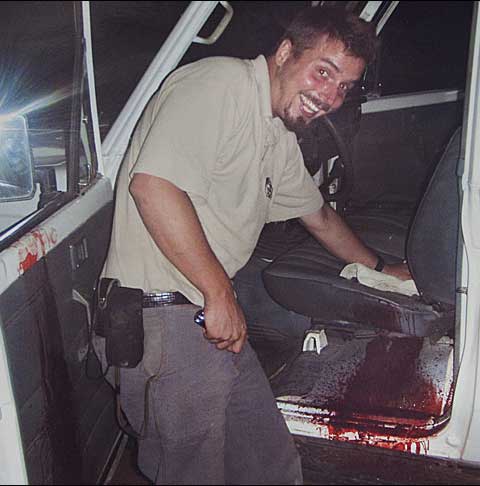 It’s damning photograph. I sought it out after hearing the story of the two Norwegian mercenaries condemned to death in the Congo for the murder of their Congolese driver. Was their black companion killed in an attempt to rob the white adventurers, as they tell it? US news outlets asked Tjostolv Moland’s mothers about the picture of her son, which showed him smiling as he wiped blood from the driver’s seat of their pickup. The mother dismissed it as bad timing, she though her son was probably caught off guard, laughing at a joke unrelated to his morbid task. Boy can Americans relate.
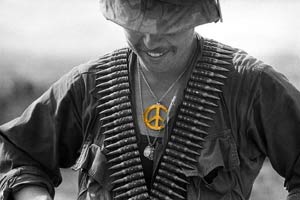 There’s the rub. An iconic photograph from the Vietnam War shows an American GI wearing a peace symbol necklace between a bandoleer of machine gun bullets. Which is it soldier? Nonviolence or destruction? Peace or war? Many Americans cannot make the distinction and think you can have both.
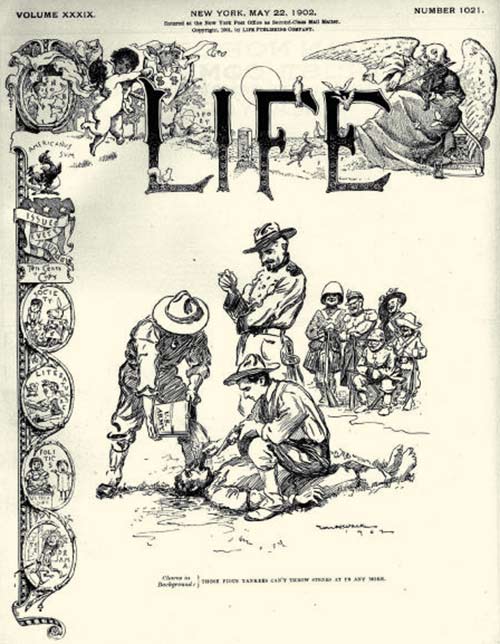
 There it is in closeup. The arms bound at the elbows, the hands pinned, pressure applied to the stomach, a gun held to the poor Cuban’s head, a funnel put into his mouth, and water poured from a bucket marked “U.S. ARMY.”
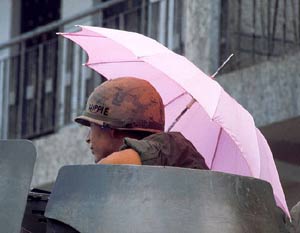 The color pink seems incongruous juxtaposed with war. Code Pink banks on the contrast being inherently diametric. But just as pink can be enlisted to oppose war, it can serve to humanize, even glamorize it.

 Did you catch it on
 While she was on the air, the IDF soldiers repeatedly fired gas canisters, until she could no longer speak, and a cameraman had to come to her rescue with a spare gas mask.
 It was unavoidable. With untold thousands of US men and women returning from Afghanistan and Iraq with missing limbs, somebody was going to want to see that naked.
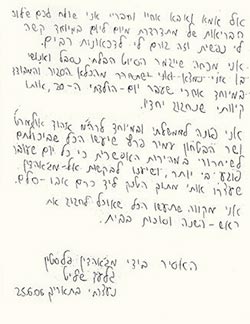 The family of Sgt. Gilad Schalit have leaked a letter they received from him in 2006, where he describes his captivity in Palestine as an
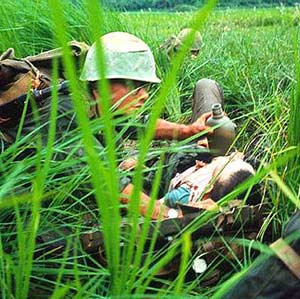 AP photographer Julie Jacobson was reticent to publish her picture of dying US Marine Lance Cpl. Joshua Bernard. Though his father was opposed, the Associated Press overruled. But this was no victory for the public’s right to see a true reflection of war. The D.o.D. is still
 Julie Jacobson facilitated the release of this picture, by letting slip two details pertinent to the official US narrative in Afghanistan. Would you believe, just prior to this engagement, friendly Afghans came out of their houses to tell the US soldiers where they could find the Taliban? Probably to ensure Corporal Bernard’s squad pointed their guns away from their homes, but that’s not how the story was spun. Jacobson recounts that these Afghans were eager to inform on the Taliban.
 This time let’s learn something from the travesty of Vietnam. The interests which drove US soldiers into the hamlets of Southeast Asia are directing the massacres today. We call them the hawks, as if war was mere blood sport. Though South Vietnamese collaborators were forced to flee for their lives from Saigon, their US cohorts were never held to account. This time as America extricates itself from terrorizing Afghanistan, let’s note those among us with blood on our hands and prosecute. Not the soldiers, but the warmongers in the charge: those commanders who every month reported the war
 NMT has obtained screenshots from Atomic Games ‘Six Days in Fallujah,’ traded p2p and remarketed as Six Hours in My Lai. There was no budget to modify the OIF coalition uniforms to resemble the Vietnam GIs, but who’s looking at the clothing? Nostalgic vets will find the rape reenactments unremarkably familar. In reality the mayhem of My Lai and My Khe lasted 28 hours, not six, but industry research indicates that cyber ejaculators rarely have more than a six hour window before a landlady looks in on them.
 Japanese game publisher Konami, forced by civilian outcry to drop a distribution deal for Atomic’s Fallujah first person shooter, is pleased that the salient gangbang modules will find their way to end-user Marine Corps wannabes. Konami already has a bestselling Raper II title, an Okinawa schoolgirl adventure for American servicemen. Konami’s own one-handed programmers are set to adapt the Atomic code for the Japanese market. The human trafficking of Iraqi orphans into US contractor Army brothels becomes Korean Comfort Women; US combat depravity becomes The Rape of Nanking.


