Marching orders from Vets For Peace

Veterans For Peace are stepping forward to plan the unplannable: how to protest the regularly postponed announcement of an escalation in Afghanistan? I forgot how we picked March 19-21 to demonstrate against the attack on Iraq. Did we protest its beginning, or did it start afterward? Bush snuck the “surge” past public outcry, and that’s how Obama will surge Afghanistan. Vets for Peace suggest activists be ready this time with a “March of the Dead” immediately when Obama decides.
death masks

A MARCH OF THE DEAD requires dark cloths, preferably robes or hoods, and plain white masks with eyes and mouth backed with black gauze. Generic masks are available here, for example.

Already this year Obama has doubled US troops in Afghanistan without having to announce a decision.

As far as planning protests, it’s been easy to forecast the thousand-mark milestones of US soldier deaths, and the anniversaries of the wars. How are we to project when a decision is coming? The administration keeps setting back the date for Obama’s decision, owing to the complexity of the issues. Afghanistan may be so complicated, it will never be answered.

Participating in the Veterans For Peace call to action are: Military Families Speak Out, the A.N.S.W.E.R Coalition, National Assembly, National Campaign for Nonviolent Resistance, United for Peace and Justice, and World Can’t Wait.

Let’s add Coloradans For Peace march for the dead.

Our mission, should we chose to accept it:

1) Within the next few days, ideally prior to any decision from President Obama, conduct any of a wide range of local activities — from calling Members of Congress to nonviolent civil resistance and everything in between — demonstrating our opposition to and disgust with any decision to widen the war in Aghanistan. To show unity of purpose, we suggest local “March of the Dead” to Federal Buildings, local Congressional offices and government buildings of any sort.

2) On the day immediately following an announcement to escalate the war in Afghanistan, respond again in a variety of ways. To show unity of purpose, we suggest:

a) making an appointment that day with at least one group that you’re not already a member of — a church, union, civic group, etc. — to go and speak with them about the war

b) return to the streets and again conduct any of a wide range of local activities — from calling Members of Congress to nonviolent civil resistance and everything in between — and be prepared to comment to the news media about the escalation of the war.

Subcomandante Marcos on LA OTRA

EZLN Zapatistas Subcomandante MarcosReading more about the Tohono O’odham, I came across this speech by the EZLN’s masked leader Subcomandante Marcos, delivered at a 2006 tribal gathering of SW Native American insurgents. It’s about the other Mexico, in solidarity with the other Americas: “La Otra.”

Compared his words to President Obama today telling the tribal summit in DC: “You will not be forgotten.” Sounds like a eulogy.

Doesn’t it? Or simply another white man’s empty promise. It appears to me that Obama is playing the forked tongue white man to Americans of every color, giving them assurances that they are now in good hands, yet turning his back on them all when the speeches are through. It’s Obama the great equalizer, making sure that all Americans, Red, White, Brown and Black, get treated like they’re black.

EZLN: A Meeting with the O’odham
By Subcomandante Insurgente Marcos

O'odham meetingLa Otra – The Other Mexico
October 26, 2006

Bueno, Compañeras and Compañeros:

First we just want to thank the Monroy family, who is receiving the Sixth Commission and the Karavana’s compañeros, who are giving us lodging here, in… Rancho el Peñasco is it called? Thank you Compañeros and Compañeras. And thank you to all of you who have endured the six hours that we have been here, and I hope you have a little patience for what I am going to say.

We especially want to thank the traditional O’odham authorities. Don José, Doña Ofelia – I don’t see her anymore – Is Doña Ofelia still here? No? Brenda, Doña Brenda? They’re not here either, what a pity. Doña Alicia? Well, that’s what happened to us. The traditional authorities went away and we came to listen to them. No? But Don José is here, as I want to bring a message from the indigenous Zapatista communities to the Tohono O’odham people, and also for the Navajo and Cherokee people.

What the compañero, the Purépecha chief Salvador said, from the National Indigenous Congress, also represents our thinking. The traditional O’odham chief, Doña Ofelia, pointed out something that we already see in the papers. That thing that a few people are promoting here, the National Indigenous Convention, is a lie. It is really directed by someone who was an official under President Vicente Fox, and later was unemployed and is now involved with the National Indigenous Convention, which is really a movement to support López Obrador. The Indian peoples don’t interest them. The documents, which they are presenting, which those people are distributing, make no mention of the San Andrés Accords, which have cost blood and death not just to Zapatistas, but to more than 40 Indian peoples, tribes and nations of Mexico, who are in agreement with that struggle. We are in agreement with what was expressed by Doña Ofelia, the O’odham traditional authority.

“We are Zapatistas. We live in the last corner of this country. We are of Mayan roots. We are people of Tzeltal, Tzotzil, Tojolabal, Chol, Zoque and Mam roots.” And it is our custom at times to speak, when we speak with other Indian peoples, to use a symbolic language with tales and legends – ”sometimes we speak about our history, our goals, with tales, legends and symbolic language, and in this time that we have this message for the O’odham and Navajos and Cherokees, we take this root.” To pass on this message that the Compañeros sent me to tell you, we will use that resource. Our elders, our chiefs, say that the gods made the world, that they made the men and women of corn first. And they specifically put the heart of corn in them. But the corn ran out and some men and women didn’t get a heart. The color of the earth ran out, and they began to look for other colors. Then, the heart of corn touched people who are white, red or yellow. So there are people here who don’t have the dark color of indigenous people, but they have the heart of corn, so they are here with us. Our oldest ones say, our chiefs, that the people who didn’t get a heart, took care of it later, they occupied the empty space with money, and that it doesn’t matter what color those people have, they have a heart that is the green color of money. And our old ones also say that, every once in a while, the land seeks to protect its O’odham Representative Doña Ofeliaand Subcomandante Marcos children, the men and women of corn. And that a time comes – which is when the night is the most difficult – when the land gets tired and needs those men and women to help it live.

They were killing our people with diseases, we were going to disappear, just like the Kiliwa people are disappearing, a few hundred kilometers from here where we are, where there are only 54 families left. And of them, only four speak the Kiliwa language here in Mexico, on this side.

We want to say to the O’odham nation, to the Navajo – I don’t know if Michelle is still here? No, not her either, well, we don’t have any messenger, I hope that someone tapes it… pardon me, Michelle. What happened is that in our land, our chiefs – I am a Subcomandante, because I am not the chief – my chiefs are men and women like Doña Ofelia, like Don José, 100 percent indigenous. And it fell on me – together with other compañeros – to do other work.

We were already dead and we were called upon to become warriors, according to our legend. And as we were dead, we became what we are: shadows. And in a strict sense we are that: “shadow’s warriors or warriors of the shadows.” And January 1, 1994, on the wall of a bank in San Cristóbal de las Casas, appeared a sign that we painted which said: here we are the forever dead, dying again, but now to live. And that was the message that we were giving to the rest of the world: that in this country and on this planet, one had to fight and be willing to die to be able to survive.

In the story that we are telling – or what they ordered us to tell you – the land protected us after the Spanish invasion, and it made us survive and resist the North American invasion, and it made us live. And after the invasion of money or big capital, the land that made us survive is at the point of dying, precisely because of those above. If you think that they are going to conform themselves to seeing us as poor people, without schools, without medicine, you are wrong: they want us to disappear completely.

For entire decades we have been living with diseases, without education, scratching the earth to be able to take some produce from it. Now they also want that land. The Escalera Nautica will mean the total disappearance of the Yoreme, the Mayo, Cucapá and Yaqui peoples from the whole coast of Sinaloa, Sonora, Baja California and Baja Sur, for hotel and tourist businesses. There’s not going to be anything more than deceit from the government, for the Yoreme, the Yaqui, the O’odham, the Cucupá and the Kiliwa.

The governments and those who lead them want that land to convert it into a commodity. If we permit that, this land is going to be destroyed. And that which protected us, that made us survive, is also going to die. And if that land and that world die, there will be no reason to fight, or to live, or to study.

What we are proposing here is that we have to unite as Indian peoples. Land dies the same way in O’odham, Navajo, Cherokee, Tzeltal, Tzotzil, Purépecha and Náhuatl territory, and we must unite, but not only in Mexico, but on the whole continent.

They, those who are up above, have already shown for hundreds of years, for centuries, that the only thing that they have done has been to destroy the earth. No more – “no more that’s enough” – it’s sufficient. Now we have to take the land’s destiny and its defense into our hands. Don’t leave it one minute more in the hands of the rich. We, those who have the color of the earth and hearts of corn, without regard to our skin color – we have to do it, because if we don’t, the whole world is going to disappear.

To the one who has money, what’s happening is not important. O’odham and Navajo territory is now a territory of death. Your fields, where your culture flourishes, is where poor Mexicans are killed, families who try to cross to the other side. The O’odham and Navajo people cannot permit that. You know that they are converting our lands, besides, into their garbage can: we are their garbage dumps. Toxic wastes, nuclear wastes, are not going to the residential zones, not in New York or Washington: they are going to Indian lands. And land is like the human body; one cannot inject poison into one part without affecting the rest. They think that they will only poison O’odham and Navajo land. They are going to poison everything and they are going to destroy it.

As the National Indigenous Congress compañero said: “we came to invite you, not to ask the government, but to get rid of it.” Not to be praying that the North American and Mexican governments respect O’odham territory, which is divided by the borderline. And we know that the borderline crosses through your people’s ceremonial center. We want that border to disappear, so that once again the O’odham, Navajo and Cherokee nations exist, as well as our peoples, because they already demonstrated that they cannot conduct this world and take it to a good end. We have to do it, not just for our Indian peoples, but for all humanity. Therefore, we say that our struggle is for humanity and against neoliberalism.

We wanted to invite you to join this movement, which is called the Other Campaign, so that as Indian peoples, the history of each 100 years is not repeated again. It is going to be repeated, but one part is going to change.

In 1810, we struggled for independence against Spanish power; in 1910, against the landowner’s power. In 2010 – and even before – we will struggle against the power of money. But, differently than the 200 and 100 years before, now the Indian peoples will have to be respected. The same thing will not occur again: that another comes to power and the Indian peoples disappear again, or suffer the same poverty and scorn. Therefore, as Indian peoples, we form separately inside of the Other Campaign, and separately we talk to each other and separately we make agreements.

Those who are up there above, compañeros and compañeras of Sonora – Yaquis, Yoremes, Cucapás, O’odham – are only going to deceive you. They are going to buy off one or two of you, they are going to take them on a trip – like traveling around with those who distributed the paper just now – around the world, but their people are going to disappear. And if you are the leaders, it is certain, they are going to take you to hotels, or to the conventions those that the politicians have, but your people are going to disappear. And photos of your leaders are going to come out in the newspapers, but the garbage dump is going to poison your land.

And there will be many gatherings and declarations, but our poor Mexican men and women are going to continue dying on Navajo land, or on the land of the O’odham. Those things are not going to change if we continue believing in those above.

And that’s what the Sonoran government is going to do, after this meeting you are going to see it. It is going to declare that it will resolve the indigenous problem, it is going to seek you out and it is going to invite you to the big hotels; it’s going to give you good food, and it is going to put papers in front of you to sign. It is going to give you some aid and some credit. But nothing, absolutely nothing, is going to change in your territories.

The San Andrés Accords, which are the ones that represent the agreement of more than 40 peoples, tribes, nations and neighborhoods of the Indian peoples of Mexico, they say one thing that everyone forgets they say: that indigenous territory is indigenous. No one can do anything in indigenous territory if the community doesn’t accept it. Not putting a garbage dump, or a hotel, not even crossing through your territory without permission from the authorities – which is certainly what the compañera Ofelia was complaining about, and about which we also complain.

That is what we are saying wherever we go. And in this case, we were thinking that we were only going to talk with the O’odham people, or with Indian peoples, but how good it is that you arrived from many places. And especially, the people who are struggling on the other side in the United States, also with Indian peoples, and also with this injustice, this war of annihilation there is against the undocumented.

A little while ago when we were coming here, we crossed the border, there in Sonoyta, we crossed over on the other side and later we returned because we had to come here. But the big extension of the desert was seen and I was thinking – I imagined what all the compañeros from the Karavana – what it was going to mean crossing that desert, without food. If the heat or the cold doesn’t kill you, the Minutemen kill you, or the ranchers, or the motorcyclists, or La Migra. And no one was going to take count, not even the university studies. If we, as Indian people, do not unite… We are proposing a continental gathering of all the original peoples of these lands, in October of the coming year, when 515 years of the “discovery” are completed. Now it was good! 500 years are enough to show that they couldn’t.

And if the governments of the United States or Mexico didn’t see us when we were few, we will see if the world doesn’t see us when all the Indian peoples of this continent – from Tierra del Fuego to Alaska – unite and begin to tell of all the injustices and struggles. And that gathering is going to be in Northwest Mexico, near the border – which does not exist for us – in other words near the Oodham, Navajo, Cherokee, Cucapá, Kiliwa, Yoreme, Yaqui land, where we have been all these days. In a few days, we are making agreements with each other and taking votes, perhaps next month this call that we are proposing will come out.

That is more or less what we want to tell you. I hope you can pass the message to the traditional chiefs: Ofelia, Brenda, Alicia – Don José is here – Michelle: I ask a favor that you pass it to the Navajo people, the compañera with the Cherokee people.

We only ask you that, we are going to talk directly among ourselves and make an agreement. The next time that we come my chiefs will come, I will not come, they sent me first to see how it was. I report to them and then they will come, those that command me, because that is our way.

That is what we want to say, compañeros and compañeras. Many thanks, Good Night.

Ward Churchill to speak for O’odham

O'odham rightsAccording to Censored News, Activist and scholar Ward Churchill will speak at the Unitarian Universalist Church of Tucson, 4831 W. 22nd St., on November 13, 2009 at 7:00 p.m. to benefit O’odham VOICE Against the Wall, which since 2003 has organized and advocated for the traditional O’odham leaders and elders of the Tohono O’odham communities in the southern territory of the United States and northern territory of Mexico. Professor Churchill’s talk is part of the “Apartheid in America: Surviving Occupation in O’odham Lands”

O’odham activist Ofelia Rivas will also participate. The event is sponsored by the Dry River Radical Resource Center, the Earth First! Journal, and Voices against the Wall.

Here’s some background on the O’odham struggle:

pamphlet cover illustrationBy J. D. Hendricks, 2004
TIAMAT PUBLICATIONS #5

The People Who Emerged From the Earth

Over two thousand years ago the descendents of the O’odham moved into the southwestern region of the area now claimed by the U.S. as the state of Arizona. 1 The O’odham have had one of the longest histories of contact with the forces of European colonization compared with the rest of the native North American peoples. The O’odham’s first contact with Spanish invaders took place in the mid 16th century; nearly one hundred years before the colonization of the North Atlantic coast and Great Lakes regions were begun by the French and English colonists. As such, the history of the O’odham provides a good context for an investigation of the colonization of Native North America, and more specifically, an investigation of the interplay between, and results of, the varied responses to colonization – that of collaboration, accommodation, and resistance.

Many histories of the O’odham refer to these desert people as the Papago. The term Papago was a name given to the O’odham by the Spanish colonizers, and is likely the result of a Spanish corruption of the O’odham word “papabi” which was the O’odham name for one of their principal bean varieties. Thus, the Spanish colonizers term for the O’odham (Papago) came to mean “the bean eaters.” 2 For the purposes of this study I will refrain from the use of the term Papago and will refer to “the people” 3 by their traditional pre-colonial name. 4

As is often the case, with the name Papago being a good example, European constructs are often imposed upon indigenous peoples by the historians that seek to portray their past. This result can occur when historians seek to glorify European norms and traditions at the expense of indigenous ones, and can also be the result of the subconscious indoctrination of the historian by the dominant culture – in this case that of western style industrial civilization. In other cases it can be the result of a simple uncritical usage of language.

One of the most dominant and reoccurring “civilized” constructs imposed upon indigenous peoples history is the commonly understood notion that the O’odham, or any other indigenous North American culture for that matter, existed as a totality or uniformed mass. This study will seek to use the history of the interaction between the O’odham peoples and the United States, both its government and its peoples, to deconstruct this myth of the totality and provide a history of the O’odham’s varied responses to colonization from an anti-colonial and anti-industrial perspective. By investigating various important case studies in O’odham history, and looking not only at resistance but also accommodation and collaboration, it is hoped that this work will help to provide a more realistic historical picture of the effects of colonization, and the intentions and reactions of both the colonizer and the colonized. Within the previously stated context and theoretical framework, this study will argue that while the O’odham responded to the U.S. invasion of their lands in various ways, the choices to resist, accommodate, or collaborate with the forces of colonization did not affect the overall U.S. policy concerning the O’odham – that policy being the eventual total assimilation of the O’odham into the dominant “civilized” industrial system. 5

This investigation will include a strong focus on O’odham resistance to colonization, as any anti-colonial history should, however it will not discount or ignore the many historical occurrences of accommodation, and in some cases outright collaboration, with the colonizers. It is important to always keep in mind that none of the actions and reactions in any of the case studies looked at are attributable to the O’odham as a “totality,” but rather are attributable only to the various groupings of O’odham, be they incarnated in the form of the individual, the clan, the village, an economic or spiritual grouping, or an established political organization.

A God of Civilization and Coercion Comes to the O’odham

The O’odham’s first encounter with Spanish invaders took place in the mid sixteenth century when a group of conquistadors led by Alvaro Nunez Cabeza de Vaca entered O’odham territory in search of gold. These men did not find the riches they were looking for and left the desert region to return to the Spanish colony. However, soon after word spread of the O’odham villages on the northern periphery of the Spanish colony, missionaries began to travel north to bring God and “civilization” to the native people residing there. By 1686, Catholic missionaries had formed a few small missions in O’odham territory using what they believed to be the influence of their soft power 6 techniques to lure the O’odham into their missions where they were then subjected to a rigorous schedule of cultural indoctrination. Most O’odham historians, including Winston Erickson, 7 and to a lesser extent, Bernard Fontana 8 have, during this time period, focused on the O’odham who chose to reside nearby and within these early missions, thus painting a picture of the O’odham as accepting of Spanish influence and cultural indoctrination.

However a closer look at this time period reveals that mission O’odham were only a small percentage of the total population of O’odham residing in the Sonoran desert 9 and that the ones who were there may not have been so for the reasons that the colonizers believed. San Xavier del Bac, the largest mission in O’odham lands, as well as many other missions, took advantage of the fact that the desert O’odham migrated in the dry winter months to the Northern Piman settlements along the rivers to work the small farm plots for sustenance. 10 The Catholic missions inserted themselves into this traditional pattern. Those O’odham who worked and lived near the missions were, for the most part, seasonal residents, which shows that the missions were viewed merely as being of utilitarian value. Thus, the O’odham as a totality were not necessarily accommodating to or interested in anything the missionaries had to offer per se, and when the missionaries began to employ “hard power” techniques and abuse or overstep the grounds for their welcome it did not go without consequence. 11

Accommodating and ignoring the missionaries was not the only response to colonization practiced by the O’odham during the seventeenth and eighteenth centuries. Although historians such as Erickson feel that “the missions did serve the O’odham well….,” 12 that assertion is contradicted by the fact that there were many large scale rebellions waged against the missions from outside and from within. In 1695, 1751, 1756, and 1776, large scale rebellions occurred in which missionaries were killed and their missions burned to the ground. 13 In some cases these rebellions were the doing of joint O’odham/Apache alliances, which is significant considering that many histories of the O’odham and Apache portray them as immemorial enemies. This may be the result of the fact that by the early nineteenth century the Spanish government initiated a campaign of divide and conquer that was continued later by the Mexican and U.S. governments to turn the O’odham and Apache against one another, thus easing the project of their subjugation.

A Change in the Occupation Government: Washington Enters O’odham Lands

In 1821, Mexican Independence from Spain was achieved and interest in the O’odham dropped away nearly entirely. By 1828, the new and secular Mexican government began the process of shutting down the missions in O’odham territory and by 1842, the last of the missions were closed. Soon after, in 1846, the United Stated initiated a war for territorial expansion against Mexico. This war was not of immediate consequence to the O’odham peoples. Isolated in desert regions, the fighting between the two occupation powers affected them little in the short run. However, the signing of the Treaty of Guadalupe Hidalgo in 1848, which ended the war, would lay the foundations for a series of disastrous events which would affect the O’odham in very negative ways.

Of greatest consequence to the O’odham was the fact that the boundary between the United States and Mexico was not finalized by the treaty of Guadalupe Hidalgo. The boundary was designated by Article Five of the Treaty as being an arbitrary line roughly following the 32nd parallel, an area which runs through the southern part of modern Arizona. To the east, the border was provided by the Rio Grande. The exact boundary line along the 32nd parallel was to be decided at a later date. It is also important to note here that the Treaty also provided that all Mexican citizens absorbed by the United States were to be granted U.S. citizenship, which included all indigenous peoples in the annexed territory since under Mexican law they were considered citizens. In the treaty the United States also assumed the responsibility for preventing cross border raiding into Mexico by the southwestern tribes, specifically the Apache. 14

In the aftermath of the signing of the treaty of Guadalupe Hidalgo, it became quickly apparent that an acceptable border between Mexico and the United States along the 32nd parallel would not be achieved. An official survey expedition was assembled by the United States and Mexico in 1849 to trace out the boundary between the two countries with little success. Various borderlines were agreed to and then abandoned and re-made by the United States, sometimes in a unilateral decision that dismissed the positions of the Mexican government altogether. 15

The principal concern for the United States was to secure title to an area of land in northern Sonora, Mexico that was ideally suited for the construction of a portion of the southern continental railroad whose building was being discussed in the U.S. Congress at the time. One of the main advocates for this southern railroad route was a South Carolina man by the name of Colonel James Gadsden. Gadsden’s history of connections to powerful business, military, and political leaders is very interesting and his appointment by the United States to be Minister to Mexico in 1853 serves as a very informative source to gauge the United States’ intentions towards Native Americans and the O’odham in particular.

James Gadsden was born into an influential southern family and graduated from Yale University. After enlisting and serving in the war of 1812, Gadsden was sent to the Florida territory with Andrew Jackson to aid in the campaign of removal and extermination being waged against the Seminole Indians, which took place from 1816-1818. After this war against the Seminole, Gadsden was appointed by President Monroe as commissioner to oversee the removal of the Seminole Indians to Indian Territory. Like the more famous removal of the Cherokee, the removal of the Seminole, and the high death rate suffered as a result, unarguably constituted genocide. 16 As a reward for a job well done, Gadsden was appointed by Monroe to a seat on the legislative council of the territory of Florida, thus beginning Gadsden’s political career. In 1840, Gadsden was elected President of the Louisville, Charleston, and Cincinnati Railroad. In 1853, the Secretary of War, an ardent white supremacist and slavery defender by the name of Jefferson Davis, appointed Gadsden to be Minister to Mexico. 17 As Minister to Mexico, one of Gadsden’s primary missions was to negotiate a final demarcation of the boundary between the U.S. and Mexico. Although Gadsden was a zealous believer in Manifest Destiny, his ideas concerning racial Anglo-Saxonism 18 caused him to be an opponent of the total annexation of Mexico. Gadsden, like many racist U.S. politicians of that time, felt that the total absorption of Mexico and its non-Anglo population into the United States would pollute the Anglo bloodline too much and thus he sought only to gain enough territory for the United States to build the southern pacific route. 19 Thus, a man who had presided over a war of genocide against the Seminole Indians, was a devout racist, and who had obvious conflicts of interest due to his connections to the railroads, was put into a position to determine the territorial boundary between the United States and Mexico and in the process also determine the boundaries of the O’odham’s land. With its appointment of Gadsden, the intent of the U.S. government could not be clearer. Business interests and territorial expansion were to run roughshod, by any means necessary, over any native peoples who stood in the way.

It is no surprise that when James Gadsden finally successfully negotiated a treaty with Santa Anna to secure what is now the southern portion of Arizona, the O’odham were not consulted. In fact, the Gadsden Treaty, signed into law in 1853, did not contain any mention of the O’odham at all. Considering that the new boundary line put in place by the Gadsden Treaty literally split the traditional O’odham lands in two, it is obvious that the intentions of the United States were in no way benevolent. Here it is also important to point out that the terms of the Gadsden Treaty specifically included the same citizenship provisions which were spelled out in the earlier Treaty of Guadalupe Hidalgo. 20 Although the Gadsden treaty was of great significance for the O’odham, their isolation and the outbreak of the Civil War enabled them to live another decade in relative isolation from Anglo encroachment.

Assimilation, Cultural Destruction, Double Speak and Ordained Genocide

The causes which the Almighty originates, when in their appointed time he wills that one race of men – as in races of lower animals – shall disappear off the face of the earth and give place to another race, and so on, in the great cycle traced out by Himself, which may be seen, but has reasons too deep to be fathomed by us. The races of the mammoths and mastodons, and the great sloths, came and passed away: The red man of America is passing away!
–United States Congress Committee on Indian Affairs report, 1865. 21

No doubt with similar justifications in mind as those of the Committee on Indian Affairs, Anglo settlers began their invasion of O’odham lands less than a year after the conclusion of the Civil War. The Homestead Act had opened up the lands of Southern Arizona to Anglo squatters and in 1866, one of the first of many bills was passed by Congress granting mineral rights to any citizen who claimed them. 22 Every one of these homesteads opened and every resource extraction operation initiated without the express consent of the O’odham represented an illegal action under the Gadsden Treaty. The citizenship provisions of the Gadsden Treaty had granted citizenship to all former Mexican citizens and the O’odham were, by legal definition, included in this formulation. The United States, however, refused to consider “uncivilized” peoples as being worthy of the protections granted to citizens by the fourth amendment of the U.S. Constitution, which prohibits the expropriation of property. This refusal of the United States government to follow its own laws pertaining to Native Americans when those laws happen to stand in the way of U.S. interests has been a common occurrence in United States Indian policy. This land grab was only the first of many illegalities committed against the O’odham people by the United States and its citizens. In this respect the O’odham are in a special position when compared with many other tribes. While the theft of native lands by the United States Government was usually legally justified by treaty stipulations signed between a tribe and the U.S. government, this justification could not and cannot be used in the case of the O’odham since no treaty was ever signed with the O’odham by the United States Government. 23

For the most part, the O’odham did not resist this initial incursion of Anglo settlement, rather the O’odham practiced accommodation and moved farther out into the desert to shield themselves from the new settlers invading their lands. Traditional ways were maintained with the exception of the introduction of cattle ranching. The O’odham territory was well suited for the raising of cattle and a good number of O’odham became cattle ranchers, both for purposes of subsistence as well as for sale to Anglos residing in and around Tucson. In the 1880s, as increasing numbers of Anglo cattle ranchers began to invade and take over their pasture, some O’odham began to resist.

The O’odham resisted by stealing the Anglo cattle herds which were rounded up and driven south to be sold on the Mexican market. The expropriation of Anglo cattle herds was not isolated, and it became a major concern for the settlers and the government. In at least one case, a large cattle outfit was driven out of business. 24 The concern over this outbreak of O’odham theft of Anglo cattle was large enough that newspapers as far away as Los Angeles ran stories about the phenomenon. For the most part these stories seem to have been deliberately used to justify the enclosure of the O’odham into reservations as the government and Anglo cattle ranchers seized the opportunity to gain even more O’odham land by arguing that it was an unfair burden for the Anglo cattle ranchers to have to “support” the O’odham. 25 Here, in previous case study, we have another common attribute of U.S. Indian policy in general, and one which occurs again and again in the history of O’odham contact with the U.S. government and Anglo settlers – blaming the victim.

Another official position of United States Indian policy during this time period was that everything done to the Indians was, in the words of Indian Commissioner J. Q. Smith, in their own “best interests.” 26 Whether this obvious sham was based on a subconscious guilt and delusion or was a cynical example of “double-speak,” it is obvious that Native American’s best interest’s were the last thing on the government’s mind. Nevertheless, with this reasoning as justification, the first official reservation for the O’odham was created by executive order of President Grant on July 1, 1874. This small reservation surrounded the Old Catholic mission at San Xavier del Bac. It is estimated that only about ten percent 27 of the desert O’odham took up residence within this reservation – these were labeled as “civilized” O’odham by U.S. census takers. The vast majority of O’odham were labeled as “wild” and continued to live in the vast desert regions west of San Xavier del Bac. While it is obvious that the desert O’odham were resisting cultural assimilation by avoidance, even the mission O’odham maintained a resistance to European culture as the next example will illustrate.

While visiting the old mission at San Xavier a newspaper columnist from the Los Angeles Times wrote that upon her visit in 1882, she could see “not a single civilized human habitation within miles.” This writer goes on to state that the O’odham’s dwellings were in the form of “conical mud huts.” In the casual racism and Social Darwinist rhetoric of the period she also adds that,

“The Papagos are but little in advance of gophers and prairie dogs in their habitations.” 28

The point is that after more than 200 years of European influence, even the mission O’odham continued to build their traditional shelters. 29

Progressivism and Cultural Genocide: The Dawes Act

In 1887, the General Allotment Act, also known as the Dawes Act, was signed into law. The Dawes Act was the staging point for the forced assimilation of those remnants of Native American groupings which had not been totally decimated by the preceding period of “Indian Wars” and forced relocations. The essential function of the Dawes Act was to disrupt traditional tribal land holding patterns and thus force Native Americans into the Anglo system of private property. The O’odham, like most other Native American cultures, did not have a concept of private property – land was held in common for the benefit of the village group. Communally held land was an essential pre-requisite for their Anarchistic political system and extremely de-centralized tribal structure. 30

The first section of the Dawes Act provides for equal “sections” of land to be parceled out to each “head of family.” This head of family was always understood to be the father of each family when land was allotted. Thus, this first section of the act not only attempted to destroy the communal land system of Native Americans, it also instituted Patriarchy as the basis for social functioning in Native America. 31 In addition, Section Five of the Act also provides that any un-allotted lands be subject to purchase by the United States government. Section Six and Seven provide that all monies paid by the U.S. for un-allotted Native lands be held for each tribe by the U.S. Treasury and “subject to appropriation” by the U.S. government to repay itself for the implementation of allotment as well as to provide for the “civilization” of Native Americans. 32 In less veiled words, these sections are basically stating that Native Americans will be forced to pay for their own cultural annihilation.

This interpretation of the intent of the Dawes Act becomes clearer when one looks at the arguments and debates that took place in Congress and within self described progressive “Indian rights” groups such as the Indian Rights Association. Critics of the Dawes Act in Congress such as Rep. Russell Errett understood that

“the main purpose of this bill is not to help the Indian troubles so much as it is to provide a method for getting at the valuable Indian lands and opening them up for settlement.” 33

And Senator Dawes, the namesake of the final bill, speaking of the land and resources of Native Americans stated that

“civilization has got after these possessions with a greed never before equaled but it is idle to expect to stay it….” 34

As for the progressive Indian Rights Association, they argued that

“the organization of the Indians into tribes is, and has been, one of the most serious hindrances to the advancement of civilization, and that every effort should be made to secure disintegration of all tribal organizations….” 35

And one of their leaders, Reverend L. Abbott, provided justification with the statement:

“Barbarism has no rights which civilization is bound to respect.” 36

So here we have a self-proclaimed progressive Indian Rights organization arguing for cultural genocide and against the notion that Native Americans have any rights that civilized people are bound to respect! This conclusion provides a perfect example of the essence of “progressive” or “civilized” thought.

The Dawes Act had a much less devastating effect for the O’odham than it did for many other Native American tribes. At the time of its passage, the only official reservation for the O’odham was the San Xavier reservation which, as was stated earlier, was only a small 71,090 acre reservation around the old mission San Xavier del Bac. When the allotment agent came to San Xavier in 1890, he allotted out 41,600 acres of land to the 363 O’odham whom he counted in his census as being resident at the time. 37 The vast majority of the O’odham still continued to live west of San Xavier in the expansive desert regions and were little affected by the allotment schemes. Even those O’odham who lived in San Xavier and were allotted land paid little attention to the artificial boundaries drawn on paper which supposedly privatized their land – they continued to farm and graze the land communally. 38 This refusal to abide by the provisions of the Dawes Act is also a form of resistance to cultural assimilation and adds one more example to show that for those O’odham who resisted, the most often employed method of resistance was non-compliance and avoidance. This specific response to colonization was made possible by the isolation and expansiveness of their desert home, which many Anglo’s continued to view as a “hopeless desert.” 39

The Domestication of the “Wild Papago”

The vast majority of the O’odham continued to resist assimilation and maintained a fairly traditional lifestyle – minus the introduction of cattle herding and horse rearing. In the twenty years following the passage of the Dawes Act, a growing effort was made to enclose the “Wild Papago” 40 and forcibly strip them of their traditional culture and instill them with the “civilized” values of the industrial Anglo. As was mentioned previously in the paper, ranchers and the government used O’odham cattle theft from Anglo ranchers as one tool to justify the enclosure of the O’odham within a reservation. During this period, Anglo Cattle ranchers continued to encroach deeper and deeper into O’odham territory and scuffles began to break out.

In another classic example of the “blame the victim” tactic, a pro-enclosure story was printed in the Los Angeles Times, no doubt to build public pressure for the domestication of the “Wild Papago.” The story concerns a group of O’odham who had resisted an Anglo cattleman’s attempts to enclose one of their water sources. When these O’odham continually tore down the fence that this cattleman had built, the rancher filed a report with the local Indian Agency sheriff to have the men arrested. When the sheriff arrived to arrest the O’odham responsible for defending their water source, he was taken hostage. The sheriff was later released unharmed; however, the incident was used to make the argument that such troubles can only be expected to increase if the O’odham were not enclosed on a reservation where they could be more easily controlled and monitored. 41

The tactic of occupying and diverting natural water sources was one of the tools used by the Anglo settlers and government to destroy the self sufficiency of the O’odham and force them into reservations where they would be dependent on the government for their water and would thus be easier to control and monitor. Some of the O’odham clearly understood what was happening, which is evidenced by instances of resistance both to the enclosure of natural water sources as well as resistance to the drilling of wells. One example of the U.S. government using water as a tool of forced cultural assimilation can be found by looking at an event recorded by an O’odham calendar stick 42 keeper. In 1912, the O’odham residing in the village of Santa Rosa, an isolated and traditional village in the western desert region of O’odham territory, were paid a visit by an Anglo Indian Commissioner who wished to drill a well for them. The Chief of the village objected to the drilling of the well on the grounds that it would disturb their culture, their autonomy and their self-sufficiency. The government agent proceeded to have the well drilled anyway. Upon completion of the well, the Chief of the village, according to the calendar stick keeper, stated that

“the well must be left alone and, in order that the Papagos might continue their old life, water must still be carried from the spring in the foothills.” 43

However, the prohibition by the Chief could not be upheld due to the overwhelming convenience of the new well and after a period of abstaining from its usage, the village of Santa Rosa (including the Chief) gave in and thus was assimilated into the industrial system by being made dependent on the Government well. 44 During this same time period, encroaching Anglo farmers engaged in the diversion of O’odham water sources to irrigate their farms. This practice served as another method of forcing the self sufficient O’odham into a relationship of dependence upon the government. In many areas so much water was diverted that the O’odham could no longer grow their traditional summer crops. 45

In 1919, the first incarnation of an O’odham reservation to enclose the nearly two million acres of desert that the “Wild Papago” were residing in was established. The formation of the desert O’odham reservation in 1919 ushered in a period of exponentially increased government interference in O’odham matters, and of course, the various forms of coercive assimilation were multiplied. By 1933, thirty-two unwanted wells were drilled all over the new reservation. 46 The well drilling was often opposed by those who were trying to maintain the O’odham Him’dag – the traditional ways of the desert people.

Resistance and Collaboration: O’odham Responses to Forced Modernization

In contrast to the traditional O’odham who had maintained resistance to cultural assimilation for the past 300 years, there was also a small number of O’odham based in the new reservation that welcomed collaboration with the forces of Anglo modernization and advocated for cultural accommodation and in some instances for total cultural assimilation. These men would later form an organization called the Papago Good Government League, which would serve as the propaganda arm of the Bureau of Indian Affairs and government policy in general. The leadership of this new faction had been taken from their families as youths and placed in Protestant boarding schools to be culturally indoctrinated. The Tucson Presbyterian Training School was one of the indoctrination centers where many future members of the Good Government League had been sent. 47

Religious indoctrination, whether Catholic or Protestant, has always been one of the most powerful tools of colonization and its justification used by European invaders against the indigenous peoples of the Americas. The necessary counterpart to the forced indoctrination of Christian principals and morals has always been the repression of indigenous spiritual practices. The United States government understood the profound power that traditional spiritual practices had in maintaining group solidarity and cohesion and it is for this reason that such spiritual practices were made illegal and repressed historically. In 1883, a Court of Indian Offenses was established by congress at the request of Secretary of Interior Henry M. Teller to eliminate traditional spiritual practices. In a report to the commissioner of Indian Affairs, Teller laid out his goals and his rationale stating that,

“If it is the purpose of the Government to civilize the Indians, they must be compelled to desist from the savage and barbarous practices that are calculated to continue them in savagery….”

Teller went on to associate those who resisted the repression of their spirituality with the “non-progressive” faction of Indians and labeled traditional spiritualism as “debauchery,” “diabolism,” and “savagery.” The overarching argument of his letter is that in order to civilize the Indians and bring them into the industrial system, their traditional spiritualism must be destroyed. As an initial step towards this end, Teller advised that Medicine Men be “compelled” to desist from their practice of “deception.” 48

Although the Court of Indian Offenses advocated that coercion be used to repress and destroy indigenous spiritualism, it failed to succeed in this project even when it used force to try to stop traditional spiritual rituals. According to Historian Edward Spicer, the only thing the Court succeeded in doing was driving traditional spiritual practices underground. In the case of many resistant O’odham, traditional spiritual practices were continued without regard to regulations or prohibitions against them, and in many cases, federal authorities resorted to repression and arrest to try to stop these practices. One traditional spiritual practice of the O’odham which was particularly hated by the Protestant Missionaries and Indian Agents was the Vi-kita ceremony.

The Vi-kita ceremony of the O’odham has been written about and studied by many Anglo historians and anthropologists, the most prominent being Columbia Anthropologist Ruth Underhill. 49 Before going into a short description of the Vi-kita it is important to understand that this ceremony varied depending on who was conducting it and where it was being conducted. Peter Blaine, an influential O’odham man sympathetic to the traditional ways, wrote in his autobiography about Underhill’s methods. Blaine explained the traditional way for the O’odham to tell about their past was to do it

“in a group so that everybody had a chance to talk and tell it their way. Underhill was talking to just one man…Dr. Underhill was wrong all the way in how she got her information.” 50

As scholars from the dominant culture often do, Underhill had applied her own notions of hierarchy, authority and individualism to her work with the O’odham and totally disregarded their traditional methods of conveying information in a communal fashion.

The Vi-kita itself was a yearly rain and fertility festival preformed to initiate and give thanks for the yearly summer rains. The ceremony itself consisted of the communal singing of rain songs, dancing, intimate encounters, and the consumption of Navait (Saguaro wine), an alcoholic drink made by the fermentation of Saguaro Cactus buds. The consumption of this wine was meant to symbolize the connection between the sky and the earth. The intake of the Navait was representative of the earth’s intake of rain. Participants drank Navait until vomiting occurred as this act embodied the clouds issuing forth rain unto the earth. It was a powerful ceremony that bonded the O’odham with the elements of nature.

When Protestant missionaries, and a small number of Protestant O’odham in the Good Government League, backed by U.S. Indian Agents, began their attempts to usurp power on the newly formed western O’odham (Sells) 51 reservation in the early 20th century, one of the first things they attacked was the practice of the Vi-kita ceremony. In the early 1930s, Peter Blaine explained that the traditional O’odham from the San Xavier reservation would travel to the western reservation for the Vi-kita. He states that,

“In the late 1920s the government tried to stop this wine drinking ceremony on the Sells reservation. But no Papago or Agency police could ever stop it.”

In one instance Blaine tells the story of how he helped defend three traditional O’odham Vi-kita ceremony leaders when they were arrested by agents from the Indian Bureau and jailed in Tucson. During the trial, a group of Protestant O’odham men from the Good Government League 52 argued for the repression of the ceremony – one of these men, Richard Hendrix, would continue to plague the traditional O’odham in future encounters. To respond to the collaborationist Good Government League, the resistant traditional O’odham formed the League of Papago Chiefs to counter the attempts of the Protestant Good Government League to usurp control on the reservation. 53

The Indian Reorganization Act and O’odham land rights

On June 18th, 1934, President Roosevelt signed into law the Indian Reorganization Act which finally stopped the forced allotment process initiated by the Dawes Act in 1887. The Indian Reorganization Act was viewed by its proponents as being in the best interests of the Indians. One of the reasons for this view was the fact that the Dawes Act and its forced allotment provisions had resulted in the loss of 90,000,000 acres of tribal lands and it was hoped by some, including then Indian Commissioner John Collier, that the Indian Reorganization Act could be used to regain some of this lost land.

The public was also encouraged to view the Indian Reorganization Act as being beneficial for Native Americans. A large article in the Los Angles Times entitled “The Bill to Return Indian Rights” stated that:

“After a century of graft, plunder and injustice, this bill has the objective of handing their own souls back to the Indians.” 54

However, such optimism and notions of cultural relativism were not held by all. As a precursor to the Indian Reorganization Act, a report was prepared for the Secretary of the Interior in 1928 to lay out the need for a change in Federal Indian Policy. The report stated that the “great majority of Indians are ultimately to merge into the general population” and that it was the government’s responsibility to assimilate Native Americans into “white civilization” because “the hands of the clock cannot be turned backwards.” Sympathetic attempts to help Native Americans retain their culture were stigmatized as attempts to “preserve them as museum specimens.” 55 Indian Commissioner John Collier was one of those who believed that Native Americans should retain their culture and that “the awakening of the racial spirit must be sustained….” 56 However, although the finalized Indian Reorganization Act did contain elements that were meant to “help” Native Americans, many of its articles were still designed to impose “civilized” systems on Native Americans.

It can be argued that the intent of the finalized Indian Reorganization Act was to initiate a new chapter in the push for the total cultural assimilation of the Native American tribes. The argument that there was no qualitative change between the Dawes Act and the Reorganization Act is legitimate. The Indian Reorganization Act provides the examples for the argument. The main tool of assimilation in the Indian Reorganization Act was the provision in Section 17 which allowed for Native American tribes to form their own tribal governments, constitutions and laws which, although it is not specifically stated, were intended to be Anglo in structure and functioning. In the case that these native governments were not sufficiently acceptable to the U.S. government, section 17 also provided that all Tribal Government formations must be “approved by the Secretary of the Interior.” 57 This clearly shows that the intent of the Act was not to allow Native Americans to become fully autonomous, either culturally or politically. For a tribe such as the O’odham, which had a long history of decentralization and consensus decision making, the imposition of western style liberal democracy, with its attendant centralization and majority rule system, was an obvious method of forced cultural indoctrination. Peter Blaine, who was mentioned earlier, was an O’odham man who had sympathy for the traditional, decentralized and communal way of O’odham societal organization. When the collaborationist Papago Good Government League began to maneuver themselves into the position of representing all of the O’odham, Blaine took it upon himself to lead the charge to discredit their assertions to business interests and the Federal Government that they represented the O’odham. Blaine wrote that:

“This so-called council represented only their own church people, but they took it upon themselves to become a council for all Papagos. They had meetings. Nobody attended them but these four guys because most people didn’t recognize them as leaders.” 58

In 1934 Blaine, along with another O’odham from the Gila Bend reservation named Leon Pancho became the first O’odham to travel to Washington D.C. These two men were sent as representatives of the traditional chiefs of the O’odham villages to argue against a recent court order that closed the Sells reservation to outside, Anglo owned, mining. The court order was a result of a lawsuit brought by the members of the Good Government League, including Richard Hendrix, who had teamed up with outside lawyers. These lawyers were to receive as payment a ten percent share of all land reclaimed from the mining companies, or a monetary equivalent. As this entire procedure was done behind the backs of the majority of the O’odham, when it was revealed, there was great resentment towards the Good Government League by many of the O’odham.

While in Washington D.C., Blaine was informed of the pending Indian Reorganization Act, and he became a supporter of the Act due to its provision allowing for the self government of Native Americans, as well as a provision in section Six that allowed the Secretary of Interior to manage mineral, mining, and livestock on the reservation. 59 In the case of the O’odham this meant that the reservation would be re-opened to mining and they would regain an important means of economic sustenance. According to Blaine, the mines were an important economic resource for the O’odham as they provided jobs and a market where beef and other O’odham products could be sold. 60 This is yet another unfortunate example of how the incursion of Anglo industrial technology served to destroy the self-sufficiency of the O’odham by making them dependent on it for survival.

Whether or not the mines were truly in the best interest of the O’odham is a complex topic which cannot be dealt with here. However it should be stated that Blaine and his companions’ trip to Washington D.C. was financed by the Tucson Chamber of Commerce, an organization that functioned in support of the mining interests, not the O’odham. This Tucson Chamber of Commerce was the same organization that had aggressively petitioned President Wilson to rescind his 1916 act forming the Sells reservation because it prevented Anglo agricultural interests from exploiting the area’s “best agricultural and grazing lands.” 61

Resistance to and Collaboration with the “White Man’s War”

Not long after the passage of the Indian Reorganization Act and the formation of the first O’odham Tribal Government, the United States declared war on Japan, thus entering World War II. The participation of Native Americans in World War II has been well publicized, especially the role the Dineh (Navajo) played as code talkers in the South Pacific. The United States government and the mainstream media portrayed Native Americans as being eager to fight for their homeland, and eager to assimilate into “white civilization” once they returned from the war. Nearly 25,000 62 Native Americans served in the United States military during World War II, many of whom were no doubt under the impression that their service would be rewarded with increased “rights” after the war’s end. Instead, as a “reward” for Native Americans participation in World War II the United States government established the Indian Claims commission in 1946 to legalize the U.S. occupation of Native American Lands never granted to the U.S. by treaty, passed House Concurrent Resolution 108 to terminate tribal recognition as separate entities from the Federal Government, and then instituted a plan in 1954 to relocate Native Americans off the reservation and into “Indian Ghettos” in the nation’s large cities. 63 These were the “rewards” for participation in World War II.

Like many other Native American Tribes, some of the O’odham Nations members participated in World War II. Ruth Underhill claims that the O’odham enlisted to serve in World War II “in droves” 64 and it is documented that the O’odham tribal government bought $10,000 in war bonds. 65 However, the extent of this involvement was distorted by the media, academia, and even some of the O’odham leaders in the tribal government. Richard Hendrix, a former member of the collaborationist Good Government League, had risen to prominence in the new O’odham tribal government by this time and was interviewed by the Arizona Archaeological and Historical Society on November 16, 1942. In this interview Hendrix exposed the extent to which he had allowed his mind to be colonized and assimilated into that of the dominant white culture. Speaking of colonization in general and World War II in particular, Hendrix stated that the O’odham had:

Learned to love the American government and they learned to love the Stars and Stripes. And when the war came and the time came for our boys to be registered, there was no exception. They registered just the same as white boys did. And now they are out fighting alongside the white boys, the American boys. They are just as anxious as the white boys to kill as many Japs, to kill as many Germans, and they are very anxious to win this great war so that the Papago people in this desert land may continue to enjoy the freedom of their homes. 66

Hendrix’s internalization of white supremacist racial notions is a heart breaking and shocking example of the extent to which he had accepted the ideology of “white civilization.” In addition, his assertion that every O’odham boy registered for the war with “no exception” is glaringly false.

Aside from the fact that there are always exceptions to everything, there was also a large scale organized resistance to World War II led by an old Chief and medicine man, Pia Machita, and his band of traditional O’odham who resided in an isolated village in the north western area of the Sells Reservation known as the Hickwan district. According to Peter Blaine, the O’odham residing in some of the most isolated villages in the Hickwan district had not seen a white man until the 1930s, and continued to practice the traditional O’odham Him’dag. 67 When Pia Machita was informed of the compulsory registration of young O’odham boys for induction into World War II, he instructed the youth of his village to refuse to sign the registration forms when they were visited by the local Indian Agent. Pia Machita was a very traditional leader who refused cultural assimilation and would not accept the authority of the Bureau of Indian Affairs or the O’odham tribal government. Finally, after all efforts to persuade Pia Machita’s village to register had failed, the tribal chief of police and a gang of Federal Marshals led by U.S. Marshall Ben McKinney invaded the village at two in the morning on October 16th, 1941, with tear gas bombs and guns drawn – when the Marshals attempted to take Pia Machita into custody some of the young men from the village used force to liberate him and severely beat one of the federal marshals. In the face of this resistance, the government agents and their local collaborators retreated to Tucson. When the Attorney General’s Office heard of the resistance on the O’odham reservation, they immediately got involved in the effort to repress this draft resistance movement as quickly as possible to prevent its possible spread to other reservations. By May 17th, 1941, after a period of about six months of trying to track down Pia Machita and his small band of men, Marshall McKinney and O’odham collaborators including Jose Ignacio from the tribal government, surrounded Pia Machita in the village of Stoa Pitk and took him into custody without incident. 68

Peter Blaine was the O’odham tribal chairman during the time that Pia Machita was leading the draft resistance movement. Although he did not believe that Pia Machita and his men were threats in any way, he was annoyed by what he perceived to be their stubbornness and attributed their draft resistance to his belief that they “didn’t really understand what they were doing.” 69 In reality, it was Blaine who did not understand the reasons behind Pia Machita and his men’s resistance to enlistment. Pia Machita and his men understood very well what they were doing – they were resisting giving aid to a government that they understood was their enemy. Given this understanding, and given the dictionary definition of the word “collaboration,” it becomes necessary to label those O’odham who participated in the arrest of Pia Machita as such – collaborators. The understanding that the U.S. government was the enemy of the traditional O’odham of the Hickwan district was based upon a long history of attempts by the U.S. government to force the Traditional O’odham of that area to abandon the Him’dag and embrace elements of Anglo “progress” such as dams, railroads, wells, and the protestant religion. Despite Peter Blaine’s inability to understand why the O’odham in the Hickwan district rejected Anglo-civilization in its totality, he still maintained sympathy for the people there. When Pia Machita and two co-defendants were finally sentenced to serve 18 months in prison at Terminal Island Federal Prison for their roles in leading the resistance movement, Peter Blaine eventually came to their aid and used his connections as tribal chairman to persuade the sentencing Judge to release Pia Machita early and allow him to return to the reservation and his family. 70

Conclusion

The history of the O’odham’s contact with the United States government has been one marked by a persistent current of resistance to cultural assimilation into “white civilization.” This resistance has included a variety of tactics and actions. The favored tactic of resistance to assimilation for many of the O’odham groupings seems to have been that of avoidance and feigned accommodation to Anglo culture when expedient. However, as was evidenced by the O’odham’s early history of contact with the Spanish, they did not refrain from waging armed resistance to colonization when they were pushed into a situation where other tactics might have been ineffectual.

In addition to resistance and accommodation, it has also been shown that some of the O’odham choose to engage in direct collaboration with the Anglo colonization of their lands and minds. As this paper has shown, the levels of collaborative activity amongst the O’odham varied, and so did the effects of such collaboration. When investigating instances of collaboration it is always important to understand the context which produced them and to remember that the ultimate blame for a situation of oppression should always be placed upon the group committing the acts of repression – in this case the United States government and allied business interests. It is important to show such examples of collaboration and to understand that all human cultures who have been the victim of colonization have invariably contained individuals who chose to collaborate for a variety of reasons. The O’odham are no exception to this rule. Making apologies for collaboration or failing to mention the instances where such collaboration did occur creates a historical distortion and does nothing to aid present struggles for liberation.

The O’odham responses to colonization never represented a totality, but a strong current of resistance is evident throughout their history. In regards to the United States government, it can be said, given the primary sources looked at, and the final drafts of laws signed and policies followed, that the intent of the United States government toward all Native American tribes, when it was not outright genocidal, has been the cultural destruction and absorption of remaining Native Americans into the dominant industrial culture of “white civilization.” Regardless of the varying tactics used, and the various lip service about “best interests” and “justice,” it has been shown that there has never been a qualitative change in United States policy toward the O’odham people and Native Americans in general. The O’odham have maintained aspects of their traditional culture despite the best efforts of the government to force assimilation, not as a result of such efforts. A continuing current of struggle between the forces of colonization and resistance has persisted for centuries, in all its various forms, within the minds and bodies of many O’odham and will continue until liberation.

NOTES:

1
This date is based on archeological evidence gathered by E.W. Haury in Ventana Cave. Haury, E.W. The Stratigraphy and Archeology of Ventana Cave Arizona. Tuscon: University of Arizona Press, 1950. Cited from Williams, Thomas R. “The Structure of the Socialization Process in Papago Indian Society.” Social Forces, Vol.36, No.3. p.253.

2
Fontana, Bernard L. Of Earth and Little Rain: The Papago Indians. Tuscon: University of Arizona Press, 1989. pp.37-39.

3
The name “O’odham” is roughly translated as “the people” in the Piman dialect spoken by the various O’odham groupings.

4
In 1986 the tribal government of the Papago reservation officially changed its name to the Tohono O’odham Nation.

5
The term “civilized” is a problematic historical term, and its definition tends to be very subjective. The meaning of the term and its use as a label is heavily influenced by how the author and the reader understand its meaning. For the purposes of this paper, the term “civilized” refers to the totality of the “western” cultural, political, and economic system – and most importantly the belief that technological/industrial progress is inherently beneficial and liberatory. For most, being labeled “civilized” is viewed as a positive and the label of “un-civilized” or “savage” is viewed in the reverse. However, for the purposes of this study it is imperative to understand that this author views “civilization” itself as an inherently oppressive and destructive entity, and this must be kept in mind to correctly understand the arguments and analyses in the paper.

6
The term “soft power” refers to the concept of gaining influence and control over another group by means of the attraction of the dominating group’s cultural attributes and the use of commodification rather than using military might and coercion (“hard power”) to gain that influence. See Joseph S. Nye, Jr. Soft Power: The means to success in world politics. New York: Perseus Books, 2004.

7
Erickson, Winston T. Sharing the Desert: The Tohono O’odham in History. Tucson: University of Arizona Press, 2003.

8
Fontana, Bernard L. Of Earth and Little Rain: The Papago Indians. Tucson: University of Arizona Press, 1989.

9
According to Catholic missionary records, the numbers of mission O’odham during this time period were somewhere around 2,000. However, according to population estimates there were at least 10,000 O’odham peoples living in this area. See Fontana, Bernard L. Of Earth and Little Rain . pp.11,46.

10
Fontana, Bernard L., p.40.

11
It is well documented that many of the Missions resorted to physical abuse, forced confinement and occasional murder to coerce the O’odham into compliance. San Xavier del Bac, the largest and most famous of Catholic missions in O’odham lands was built with forced labor. See Daniel McCool; “Federal Indian Policy and the Sacred Mountains of the Papago Indians.” Journal of Ethnic Studies 9.3 (1981).p59.

12
Erickson, Winston P., p.66.

13
Fontana, Bernard L., pp.61-64.

14
Treaty of Guadalupe Hidalgo, Feb 2nd, 1848. United States Statutes At Large, pp. 922-943

15
For a detailed treatment of this series of events see; Garber, Paul N. The Gadsden Treaty. Glouchester: Peter Smith, 1959.

16
For more information on the removal of the Seminole; Stannard, David E. American Holocaust: The Conquest of the New World. New York: Oxford University Press, 1992. P.124. For additional information about the Seminole Wars see; Churchill, Ward. “A Little Matter Of Genocide: Holocaust and Denial in the Americas 1492 to the Present.” San Francisco: City Lights Books, 1997.

17
All dates for the political appointments of James Gadsden are cited from Paul Garber’s “The Gadsden Treaty.” Pages 74-81.

18
Racial Anglo-Saxonism was a belief popular in the later 19th century which held that Europeans of Anglo-Saxon descent were at the forefront of evolution and were responsible to bring civilization to the world. This ideology was used as a convenient justification for the extermination and removal of Native Americans. For a detailed study of this ideology see: Horsman, Reginald. Race And Manifest Destiny: The Origins of American Racial Anglo-Saxonism. Cambridge: Harvard University Press, 1981.

19
For a detailed investigation of the role that the railroads played in the Gadsden purchase see; Schmidt, Louis B. “Manifest Opportunity and the Gadsden Purchase.” Arizona and the West, vol.3 (autumn 1961).

20
Forbes, Jack D. The Papago-Apache Treaty of 1853: Property Rights and Religious Liberties of the O’odham, Maricopa and Other Native Peoples. Davis: Native American Studies Tecumseh Center, U.C. Davis, 1979. p.1.

21
United States Congress. Joint Special Committee. Condition of The Indian Tribes. Report of the joint special committee, appointed under joint resolution of March 3, 1865. With an appendix. Washington, D.C.: United States Government Printing Office, 1865.

22
Erickson, p.77

23
During this time period many treaties were negotiated with native tribes in the regions west of the Mississippi to gain legal justification for the United States’ theft of their lands. For a detailed list of treaties signed between the United States and Native American tribes, see the compendium edited by Charles J. Kappler. Indian Affairs: Laws and Treaties. 7 volumes. Washington, D.C.: Unites States Government Printing Office, 1903-4.

24
Spicer, Edward H. Cycles of Conquest: The Impact of Spain, Mexico, and the United States on the Indians of the Southwest, 1533-1960. Tucson: The University of Arizona Press, 1962. p.138.

25
“Arizona News; Papago Cattle-thieves Brought to Justice.” Los Angeles Times. Feb 1, 1894. Also see: “Arizona News; Report Showing the Depredations Committed by Papago Indians on Stockmen’s Herds.” Los Angeles Times. June 8, 1895, In addition see; “Arizona News: Papagoes Destroying Cattle in Large Numbers.” Los Angeles Times. Mar 23, 1894.

26
Kehoe, Lawrence. “Our New Indian Policy and Religious Liberty.” Catholic World, vol. 26 (Oct. 1887). P.96.

27
Erickson p.78.

28
“Tucson And Fort Lowell; Notes of a Visitor – The Church of San Xavier.” Los Angeles Times. Nov 18, 1882.

29
The Spanish had brought the adobe style of construction to the O’odham but, although the resources for adobe construction were readily available to the O’odham at San Xavier, they continued to build their traditional grass huts.

30
For a detailed study of traditional O’odham tribal structure and life style see; Underhill, Ruth M. Social Organization of the Papago Indians. Columbia: Columbia University Press, 1939. ________. Papago Woman. New York: Holt, Rinehart and Winston, 1979.

31
For the most part, traditional Native American societies exhibited gender parallelism and were rarely if ever patriarchal by definition. For a detailed study of gender in Native America see: Allen, Paula G. The Sacred Hoop: Recovering the Feminine in American Indian Traditions. Boston: Beacon Press, 1986.

32
All direct quotations from Dawes Act. General Allotment Act (Dawes Act). February 8, 1887. Printed in its totality in: Prucha, Francis, P. ed. Documents of United States Indian Policy. 3rd ed. Lincoln: University of Nebraska Press, 2000.

33
U.S. Congress, House Committee on Indian Affairs, Lands in Severalty to Indians: Report to Accompany H.R. 5038, 46th Cong., 2nd sess., May 28, 1880, H. Rept. 1576, pp.7-10. Reproduced in: Washburn, Wilcomb E. The Assault on Indian Tribalism: The General Allotment Law (Dawes Act) of 1887. Philadelphia: J.B. Lippincott Co., 1975.

34
Letter from Henry L. Dawes to Henry M. Teller (Commissioner of Indian Affairs), September 19, 1882. Dawes Papers, Library of Congress, Washington, D.C. Reproduced in: Washburn, Wilcomb E. The Assault on Indian Tribalism: The General Allotment Law (Dawes Act) of 1887. Philadelphia: J.B. Lippincott Co., 1975.

35
Washburn, Wilcomb E. The Assault on Indian Tribalism: The General Allotment Law (Dawes Act) of 1887. P.12.

36
Washburn, p.16.

37
Fontana, pp. 77-79.

38
Erickson, p. 92.

39
“Baboquivari Peak.” Los Angeles Times. Nov 4, 1894.

40
The term “Wild Papago” was a term used by the government and media to marginalize those O’odham who continued to resist “civilization.”

41
“The Indian War Cloud.” Los Angeles Times. May 22, 1885.

42
The Calendar Stick was a device used by the O’odham as a tool to aid in the remembering of their history. The Calendar Stick itself was a cactus stick on which notches were carved at various intervals which aided the history keeper in the remembrance of events.

43
Fontana, p.54.

44
This example is meant to show the insidious nature of industrial technology and is not intended to place any blame on this specific group of O’odham for their ultimate choice to begin using the well. This example is given to show how industrial technology always comes with strings attached. In this case, once the village becomes dependent on the well they in turn become dependent on the Anglo civilization which is needed to maintain the functioning of such a well, and thus become less able to resist other Anglo incursions. In addition it must be pointed out here that the traditional water gathering procedure talked about was preformed by O’odham women. Due to this fact, some may feel that by resisting the building of the well, the male O’odham are in fact seeking to perpetuate patriarchy. It is true that the O’odham did have a system of gendered roles, but the overall system made room for exceptions and is best characterized as one of gender parallelism, not patriarchy. It is the Anglo industrial system that brought patriarchy to the O’odham. For more information see: Underhill, Ruth. Papago Woman. New York: Holt, Rinehart and Winston, 1979. Also see: Allen, Paula G. The Sacred Hoop: Recovering the Feminine in American Indian Traditions. Boston: Beacon Press, 1986.

45
Forbes, Jack D. The Papago-Apache Treaty of 1853: Property Rights and Religious Liberties of the O’odham, Maricopa and Other Native Peoples. Davis: Native American Studies Tecumseh Center, U.C. Davis, 1979. pp..5-8.

46
Spicer, p. 140.

47
Spicer, p.141.

48
All quotes taken directly from: House Executive Document no.1, 48th Cong., 1st sess., serial 2190, pp.x-xii. Reproduced in; Prucha, Francis, P. ed. Documents of United States Indian Policy. 3rd ed. Lincoln: University of Nebraska Press, 2000.

49
For a detailed account of the Vi-kita see: Davis, Edward H. The Papago Ceremony of Vikita. New York: Museum of The American Indian, 1920. Also see: Underhill, Ruth. Papago Woman. New York: Holt, Rinehart and Winston, 1979.

50
Blaine, Peter. Papagos and Politics. Tucson: The Arizona Historical Society, 1981. p.42.

51
The expansive western O’odham reservation was officially called the Sells reservation. It was named after the first Indian agent in the region, John Sells.

52
The Good Government League was formed by a small group of Protestant O’odham who used the organization to advocate for the assimilation of the O’odham into Anglo civilization as well as to promote general U.S. Indian policy.

53
Blaine, pp.40-50.

54
“Bill To Return Indian Rights ” Los Angeles Times. June 8, 1934.

55
Lewis Meriam et al., The Problem of Indian Administration. Baltimore: Johns Hopkins Press, 1928. Selection printed in: Prucha, Francis, P. ed. Documents of United States Indian Policy. 3rd ed. Lincoln: University of Nebraska Press, 2000.

56
Annual Report of the Secretary of Interior, 1934, pp.78-83. Reprinted in; Prucha, Francis, P. ed. Documents of United States Indian Policy. 3rd ed. Lincoln: University of Nebraska Press, 2000.

57
Wheeler-Howard Act (Indian Reorganization Act) June 18, 1934. U.S. Statutes at Large, 48:984-88. Re-printed in: Prucha, Francis, P. ed. Documents of United States Indian Policy. 3rd ed. Lincoln: University of Nebraska Press, 2000.

58
Blaine, p.50.

59
Wheeler-Howard Act (Indian Reorganization Act) June 18, 1934. U.S. Statutes at Large, 48:984-88. Re-printed in: Prucha, Francis, P. ed. Documents of United States Indian Policy. 3rd ed. Lincoln: University of Nebraska Press, 2000.

60
Blaine, pp.50-53.

61
McCool, Daniel. “Federal Indian Policy and the Sacred Mountains of the Papago Indians.” Journal of Ethnic Studies 9.3 (1981). p.62.

62
Holm, Tom. “Fighting A White Mans War: The Extent and Legacy of American Indian Participation in World War II.” The Journal of Ethnic Studies. 9.2. p.70.

63
For more on this aspect of the Indian Claims Commission, and a discussion about the termination act see: Forbes, Jack D. The Papago-Apache Treaty of 1853: Property Rights and Religious Liberties of the O’odham, Maricopa and Other Native Peoples. Davis: Native American Studies Tecumseh Center, U.C. Davis, 1979.

64
Underhill, Ruth. Papago Woman. New York: Holt, Rinehart and Winston, 1979. P.94.

65
Blaine, p.115.

66
Hendrix, Richard. Talk by Richard Hendricks, Prominent Papago Indian, Given at the Arizona Archaeological and Historical Society, November 16, 1942. The Kiva, vol. 8 (Nov. 1942).

67
Blaine, p.92.

68
Flaccus, Elmer. “Arizona’s Last Great Indian War: The Saga of Pia Machita.” The Journal of Arizona History, vol. 22 (1981).

69
Blaine, p.101.

70
Blain, pp.103-4.

© 2004, REPRODUCTION FOR NON-PROFIT INFORMATIONAL PURPOSES IS ALLOWED

Health reform nuclear option is HR3200

Health insurance, what is it good for? Absolutely nothing –say it again. President Obama spoke of insurers as nice people who perform a valuable service, but where did the flattery get him? Industry death panels have redoubled their determination to kill the insured and uninsured alike. And facing reforms, they don’t want a “public option,” even if the deal is sweetened with a windfall of mandated insurance premiums. Isn’t it time to cut the greedy murderers from the till? H.R. 3200 proposes Medicare be expanded to cover everyone. Period. The extra coverage will be paid from current insurance company profit margins.

Armed UAS drones need no defending

Predator Unmanned Attack VehicleI was curious about the etymology of the term “drone” applied to military (& DHS) Unmanned Aerial Surveillance aircraft, these days, mostly Armed. Obviously Armed UAS are not named after the stingless unproductive bees whose task it is to impregnate the queen, nor lazy idlers, nor clueless computer sales techies, nor thankless menial worker drones. Anyone who’s been around Radio Controlled model planes knows drones are named for the sound they make, a steady drone as they labor across the sky. While military aerial surveillance predates the Wright Brothers, and RC model airplanes have been around for half that time, it took the advent of asymmetric warfare to open the window to military drones. Their constant buzz offering the most intractable reason.

By “asymmetric” I do not mean the US intelligence code for off-textbook warfare, for counter-insurgency methods outside von Clausewitz etiquette. I mean the inherency they obscure, war between foes lopsided.

Look at a drone’s design. It’s more Gossamer Condor than military aircraft. Obviously an unmanned vehicle comprises fewer mechanical systems because it doesn’t need to propel, nor sustain, a crew of human beings. It might need less armature for the same reason, except of course, today’s drones are of high value in their own right. So why no armament?

Why too, no powerful jet engines or swept wings for aeronautic superiority? This drone looks about as robust as a paper glider. Laymen can distinguish bombers from jet fighters, as they can trucks from a race cars. I’d say the military drone resembles more a stick insect than its accidental namesake the bee. Do Armed UASs have no need for evasive maneuver capability?

I’ll ask another obvious question, why do drones carry no customary insignia designating to whose side it belongs? In particular this element would be of primary importance when encountered by other aircraft.

But a drone doesn’t encounter enemy aircraft, nor allied aircraft who might confuse it for belonging to an adversary, because drones operate where aerial supremacy is already absolute. The key to a drone’s military usefulness is that there is no opponent to shoot it down.

An Armed UAS can drone all it wants, taking its sweet time laying siege to defenseless objectives and other targets of opportunity. The US Predator or Reaper models can glide when they want to surveil in silence, although otherwise their motors project their presence with the deliberate imposition of a school hall monitor. It is more efficient to deter the placing of IEDs than to try to catch insurgents in the act.

Meanwhile all civilians are terrorized by the sound, associating it with sudden, unpredictable and often unjustified destruction and death.

The WWII German Stuka dive bomber had inverted gull wings which were thought to produce a horrifying wail as the notorious aircraft attacked city populations, Guernica among them. In fact the sound was produced by a siren the Nazis called Jericho’s Trumpet, mounted purposefully to spread fear on the ground. Like modern drones, the Stuka were not designed to fend off attackers from the sky.

Before the fighter planes of WWI, artillery spotters would rise in balloons to survey the enemy trenches. From these tethered balloons, artillery strikes could be directed with increasing accuracy. These remote eyes in the sky were the rudiments of aerial surveillance, the precursors to today’s Armed UAS. The balloons were manned obviously, and they weren’t armed, but the spotters they held aloft were despised much as drones are today. When WWI biplanes eventually came along to pick off the balloonists like sitting ducks, the soldiers in the trenches were jubilant.

When the Soviets invaded Afghanistan, the Taliban had been fortified by the US military. We’d helped the Taliban destabilize the region, to force Russia’s hand in rushing to restore order to its southern neighbor. We wanted to draw the Russian troops in before we assisted the Afghan insurgency with the real weapons it needed to combat their invaders’ superior fire power. When Bin Laden’s Mujihadeen and the Taliban got US Stinger Missiles, the Russians could no longer deploy their helicopter gunships with impunity and the end drew near.

Eventually whoever drew the US into its war on Islam, is going to start distributing the means to take the US out. It might be Stinger Missiles or a modern equivalent. Eventually someone will develop sympathy for the victimized Muslims of Pakistan, Afghanistan, Iraq and Gaza (add Somalia, Sudan, Yemen, etc) and help them flick the killer drones from the sky.

Would attacking the drones provide retribution enough, knowing that the real operators are safe in virtual cockpit command centers located safely within US homeland borders. Would it be sufficient to keep clearing the skies of drones, or will our victims have to weed US drones from the roots?

Will the drones prove as easily replaceable as GIs? The American Public keeps count of its lost soldiers, but in no way has this stanched the flow of fresh reinforcements. We do not count expended ordnance, or expensive equipment fallen casualty. Would such tallies discourage the war mongers or encourage weapons industry stockholders?

The American public has shown itself mostly contemptuous of the economic-draft soldiers who man today’s volunteer army, the deaths accumulate, but working poor are expendable. What about those who joined the military to clean up their act? We don’t want those back. After years of war, the public is already seeing too much PTSD, without contemplating bringing all of it home.

Perhaps instead Americans will react to a casualty list of aeronautic losses, maybe for reasons of pure economics. How many helicopters and jets we are losing adds to the federal deficit. But the losses of big equipment might offer the same decision making information we glean from the higher value chess pieces. Rooks and knights represent offensive capability. Hopes for victory or a draw hinge on which of those you have left. No one capitulates based on a count of their pawns. The cumulative tallies will reflect which way the tide is going. Military drones may be worth zero lives, but their destruction will signal an insurgence indomitable.

Top 10 secret armies of the CIA

Found this on the web, will try to retrace provenance, worth a read: The United States have a well known history of providing military support to countries in need. But from time to time, the US Government has provided secret forces. While many are successful, there have also been a number of failures. This is a list of the ten top secret armies of the CIA.

1. Ukrainian Partisans
From 1945 to 1952 the CIA trained and aerially supplied Ukranian partisan units which had originally been organised by he Germans to fight the Soviets during WWII. For seven years, the partisans, operating in the Carpathian Mountains, made sporadic attacks. Finally in 1952, a massive Soviet military force wiped them out.

2. Chinese Brigade in Burma
After the Communist victory in China, Nationalist Chinese soldiers fled into northern Burma. During the early 1950s, the CIA used these soldiers to create a 12,000 man brigade which made raids into Red China. However, the Nationalist soldiers found it more profitable to monopolise the local opium trade.

3. Guatemalan Rebel Army
After Guatemalan president Jacobo Arbenz legalised that country’s communist party and expropriated 400,000 acres of United Fruit banana plantations, the CIA decided to overthrow his government. Guatemalan rebels were trained in Honduras and backed up with a CIA air contingent of bombers and fighter planes. This army invaded Guatemala in 1954, promptly toppling Arbenz’s regine.

4. Sumatran Rebels
In an attempt to overthrow Indonesian president Sukarno in 1958, the CIA sent paramilitary experts and radio operators to the island of Sumatra to organise a revolt. With CIA air support, the rebel army attacked but was quickly defeated. The American government denied involvement even after a CIA b-26 was shot down and its CIA pilot, Allen Pope, was captured.

5. Khamba Horsemen
After the 1950 Chinese invasion of Tibet, the CIA began recruiting Khamba horsemen – fierce warriors who supported Tibet’s religious leader, the Dalai Lama – as they escaped into India in 1959. These Khambas were trained in modern warfare at Camp Hale, high in the rocky mountains near Leadville, Colorado. Transported back to Tibet by the CIA operated Air American, the Khambas organised an army number at its peak some 14,000. By the mid-1960s the Khambas had been abandoned by the CIA but they fought on alone until 1970.

6. Bay of Pigs Invasion Force
In 1960, CIA operatives recruited 1,500 Cuban refugees living in Miami and staged a surprise attack on Fidel Castro’s Cuba. Trained at a base in Guatemala, this small army – complete with an air force consisting of B-26 bombers – landed at the Bay of Pigs on April 19, 1961. The ill-conceived, poorly planned operation ended in disaster, since all but 150 men of the force were either killed or captured within three days.

7. L’armee Clandestine
In 1962, CIA agents recruited Meo tribesmen living in the mountains of Laos to fight as guerrillas against Communist Pathet Lao forces. Called l’armee Clandestine, this unit – paid, trained, and supplied by the CIA – grew into a 30,000 man force. By 1975 the Meos – who had numbers a quarter million in 1962 – had been reduced to 10,000 refugees fleeing into Thailand.

8. Nung Mercenaries
A Chinese hill people living in Vietname, the Nungs were hired and organised by the CIA as a mercenary force, during the Vietnam war. Fearsome and brutal fighters, the Nungs were employed throughout Vietnam and along the Ho Chi Minh Trail. The Nungs proved costly since they refused to fight unless constantly supplied with beer and prostitutes.

9. Peruvian Regiment
Unable to quell guerrilla forces in its eastern Amazonian provinces, Peru called on the US for help in the mid-1960s. The CIA responded by establishing a fortified camp in the area and hiring local Peruvians who were trained by Green Beret personnel on loan from the US army. After crushing the guerrillas, the elite unit was disbanded because of fears it might stage a coup against the government.

10. Congo Mercenary Force
In 1964, during the Congolese Civil War, the CIA established an army in the Congo to back pro-Western leaders Cyril Adoula and Joseph Mobutu. The CIA imported European mercenaries and Cuban pilots – exiles from Cuba – to pilot the CIA air force, composed of transports and B-26 Bombers.

11. The Cambodian Coup
For over 15 years, the CIA had tried various unsuccessful means of deposing Cambodia’s left-leaning Prince Norodom Sihanouk, including assassination attempts. However, in March, 1970, a CIA-backed coup finally did the job. Funded by US tax dollars, armed with US weapons, and trained by American Green Berets, anti-Sihanouk forces called Kampuchea Khmer Krom (KKK) overran the capital of Phnom Penh and took control of the government. With the blessing of the CIA and the Nixon administration, control of Cambodia was placed in the hands of Lon Nol, who would later distinguish himself by dispatching soldiers to butcher tens of thousands of civilians.

12. Kurd Rebels
During the early 1970s the CIA moved into eastern Iraq to organize and supply the Kurds of that area, who were rebelling against the pro-Soviet Iraqi government. The real purpose behind this action was to help the shah of Iran settle a border dispute with Iraq favourably. After an Iranian-Iraq settlement was reached, the CIA withdrew its support from the Kurds, who were then crushed by the Iraqi Army.

13. Angola Mercenary Force
In 1975, after years of bloody fighting and civil unrest in Angola, Portugal resolved to relinquish its hold on the last of its African colonies. The transition was to take place on November 11, with control of the country going to whichever political faction controlled the capital city of Luanda on that date. In the months preceding the change, three groups vied for power: the Popular Movement for the Liberation of Angola (MPLA), the National Front for the Liberation of Angola (FNLA) and the National Union for the Total Independence of Angola (UNITA). By July 1975, the Marxist MPLA had ousted the moderate FNLA and UNITA from Luanda, so the CIA decided to intervene covertly. Over $30 million was spent on the Angolan operation, the bulk of the money going to buy arms and pay French and South African mercenaries, who aided the FNLA and UNITA in their fight. Despite overwhelming evidence to the contrary, US officials categorically denied any involvement in the Angolan conflict. In the end, it was a fruitless military adventure, for the MPLA assumed power and controls Angola to this day.

14. Afghan Mujaheedin
Covert support for the groups fighting against the Soviet invasion of Afghanistan began under President Jimmy Carter in 1979, and was stepped up during the administration of Ronald Reagan. The operation succeeded in its initial goal, as the Soviets were forced to begin withdrawing their forces in 1987. Unfortunately, once the Soviets left, the US essentially ignored Afghanistan as it collapsed into a five-year civil war followed by the rise of the ultra-fundamentalist Taliban. The Taliban provided a haven for Osama bin Laden and al-Qaeda, the perpetrators of the 9/11 terrorist attacks in 2001.

15. Salvadoran Death Squads
As far back as 1964, the CIA helped form ORDEN and ANSESAL, two paramilitary intelligence networks that developed into the Salvadoran death squads. The CIA trained ORDEN leaders in the use of automatic weapons and surveillance techniques, and placed several leaders on the CIA payroll. The CIA also provided detailed intelligence on Salvadoran individuals later murdered by the death squads. During the civil war in El Salvador from 1980 to 1992, the death squads were responsible for 40,000 killings. Even after a public outcry forced President Reagan to denounce the death squads in 1984, CIA support continued.

16. Nicaraguan Contras
On November 23, 1981, President Ronald Reagan signed a top secret National Security Directive authorising the CIA to spend $19 million to recruit and support the Contras, opponents of Nicaragua’s Sandinista government. In supporting the Contras, the CIA carried out several acts of sabotage without the Congressional intelligence committees giving consent – or even being informed beforehand. In response, Congress passed the Boland Amendment, prohibiting the CIA from providing aid to the Contras. Attempts to find alternate sources of funds led to the Iran-Contra scandal. It may also have led the CIA and the Contras to become actively involved in drug smuggling. In 1988, the Senate Subcommittee on Narcotics, Terrorism, and International Operations concluded that individuals in the Contra movement engaged in drug trafficking; that known drug traffickers provided assistance to the Contras; and that ‘there are some serious questions as to whether or not US officials involved in Central America failed to address the drug issue for fear of jeopardizing the war effort against Nicaragua’.

17. Haitian Coup
In 1988, the CIA attempted to intervene in Haiti’s elections with a ‘covert action program’ to undermine the campaign of the eventual winner, Jean-Bertrand Aristide. Three years later, Aristide was overthrown in a bloody coup that killed more than 4,000 civilians. Many of the leaders of the coup had been on the CIA payroll since the mid-1980s. For example, Emmanuel ‘Toto’ Constant, the head of FRAPH, a brutal gang of thugs known for murder, torture, and beatings, admitted to being a paid agent of the CIA. Similarly, the CIA-created Haitian National Intelligence Service (NIS), supposedly created to combat drugs, functioned during the coup as a ‘political intimidation and assassination squad.’ In 1994, an American force of 20,000 was sent to Haiti to allow Aristide to return. Ironically, even after this, the CIA continued working with FRAPH and the NIS. In 2004, Aristide was overthrown once again, with Aristide claiming that US forces had kidnapped him.

18. Venezuelan Coup Attempt
On April 11, 2002, Venezuelan military leaders attempted to overthrow the country’s democratically-elected left-wing president, Hugo Chavez. The coup collapsed after two days as hundreds of thousands of people took to the streets and as units of the military joined with the protestors. The administration of George W. Bush was the only democracy in the Western Hemisphere not to condemn the coup attempt. According to intelligence analyst Wayne Madsen, the CIA had actively organised the coup: ‘The CIA provided Special Operations Group personnel, headed by a lieutenant colonel on loan from the US Special Operations Command at Fort Bragg, North Carolina, to help organise the coup against Chavez.

Obama is no over-hyped Messiah

barack-obama-action-darth
Critics on both sides of Barack Obama’s premature Nobel Prize peddle the same cynical caricature of our new president, as messiah figure likely overburdened by our expectations. It’s a self-defeating setup that didn’t fool the Nobel panel. Obama is not Jesus, he’s Caesar.

I don’t mean to belittle the Son of God, but Obama’s throne has a far greater vantage point to deliver this world from the yoke of the evil empire. This year’s Nobel Peace Prize is a sort of Pay It Forward award to the man who holds the fate of so many in his hands.

You don’t have to believe Obama is the Second Coming, nor even that he’s a good man. So far he’s played Dubya’s apprentice to a tee. But what can you do? Obama’s vainglourious Basterds have everyone by the throat. The Afghans, the Iraqis, the Pakistanis, live but by the grace of his drones, or the whim of his rendition interrogator-torturers. American activists abut his militarized police, American sick expire while on hold with his third party death panels.

The Nobel Prize could be another medal to pretend this American Emperor heralds a break from injustice as the US redoubles wreaking havoc. Or, it could be mankind’s last best only hope to appeal, if not to Obama’s sense of humanity, to his vanity. Is the 2009 Nobel Laureate going to escalate killings and predations on the poor? The choice is Obama’s.

The growing criticism of Barack Obama’s record of inaction furthers the misconception that Obama is a mere figurehead, an affirmative action spokesman to give the US a kinder, gentler image. In fact, Obama sits in the little dictator’s seat. It’s lost no power since the days of Bush.

You might argue that Bush was mere Howdy Doody to powerful oligarchs behind the scenes. Obama may be pulled by the same strings. But unless the puppet masters choose to reveal themselves, a puppet can pretend they don’t exist. And a real flesh and blood man puppet can utterly efface them. I believe the Nobel committee is hoping to appeal to just that man.

Obama doesn’t need Congress, majority or no, nor the American People, nor the corporate media, to decide what he wants to do. He’s not stuck to overturning the tables of the money-changers, or leading by example by dying for us on a cross. Obama doesn’t have to render unto Caesar, he is Caesar. The most powerful there ever was, although I can’t think now if there ever was a good one. The Norse were in no position then to bait one with a peace prize. Here’s hoping.

ADDENDUM:
Barack and Michelle Obama sent out this response to the surprise honor, trying a little false flattery of their own. Here’s the last paragraph:

This award — and the call to action that comes with it — does not belong simply to me or my administration; it belongs to all people around the world who have fought for justice and for peace. And most of all, it belongs to you, the men and women of America, who have dared to hope and have worked so hard to make our world a little better.

Most of all, the men and women of America? Oh My Gosh Honey, Obama is talking about you and me.

8 yrs in Afghanistan, still boot-counting

How is Colorado Springs marking the 8th year of war in Afghanistan? Couple choices. Visiting priest-activist Louie Vitale will speak at Colorado College on the THE MORAL DIMENSION OF DRONE WARFARE.
The moral dimension of drone war
CC students were dissuaded from hosting a peace rally on campus which might have interfered with the week’s homecoming activities. Instead, beginning at 1PM Wednesday, the CC students will chalk the sidewalks of Acacia Park with the names of the 869 US soldiers killed in the Afghan campaign. Coloradans For Peace will join the boot- counting but will commemorate Afghan deaths, whose number is “n/a.”

Iraq slipper thrower killed outright

US-patrol-fallujah-fallouja-falluja-iraqPoor Ahmed Latif, killed in Fallujah this week for throwing his slipper at a US patrol. News reports are calling Latif a copycat of Muntadhar al-Zaidi, on the occasion of the Iraqi shoe thrower’s release from custody. Reporters are also suggesting Latif was “mentally disturbed,” instead of simply profoundly disturbed, by a development that might disturb you too.
First however, a disturbing aspect of this incident which reporters are downplaying and which Latif lived but only briefly to experience. The US soldiers fired on Latif because they thought he’d thrown a grenade. What he threw never exploded, and in fact we only know it was a slipper because bystanders saw it, and because Latif had only one slipper when he was taken to the hospital. The American soldiers couldn’t confirm the account themselves because they hadn’t even looked for whatever came at them that didn’t explode. When the soldiers fired on Latif, he ran. Eventually their bullets overtook him.

What disturbed the now late Latif, enough to prompt him to defy the US soldiers with his slipper, was seeing an American patrol drive down the streets of Fallujah.

Maybe we think that indignation at US occupiers is commonplace in Iraq, and that Iraqis should be practiced by now at repressing their proud urge to throw down insults at hair-trigger Americans. Why now? Why Latif?

The thirty two year-old Latif was so angry to see the American patrol in Fallujah, because he thought that Iraqi cities were no longer under the jurisdiction of American troops. You probably thought that too.

Yet here they were patrolling Ahmed Latif’s neighborhood. Have you been told the US soldiers are still patrolling Fallujah? If Latif’s death can count for something, it can at least serve to alert you that American in Iraq have not moved out of the cities. But the media telling of the late slipper-thrower’s deed, are not elaborating on that detail.

Do we have a soft spot for mercenaries

Norwegian Tjostolv Moland sentenced to death in Kisangani, DRCIt’s damning photograph. I sought it out after hearing the story of the two Norwegian mercenaries condemned to death in the Congo for the murder of their Congolese driver. Was their black companion killed in an attempt to rob the white adventurers, as they tell it? US news outlets asked Tjostolv Moland’s mothers about the picture of her son, which showed him smiling as he wiped blood from the driver’s seat of their pickup. The mother dismissed it as bad timing, she though her son was probably caught off guard, laughing at a joke unrelated to his morbid task. Boy can Americans relate.

Other US newspapers speculated about a fabled Norwegian propensity to laugh at adversity. They also described Norwegian diplomats scrambling to save the two boys from the gallows. It’s true that Norway doesn’t have a death sentence, and therefore does not condone it elsewhere. Otherwise US and BBC portrayal of Norwegian concern for the two mercenaries seemed at odds with Norway’s usual determined pacifism, so I was eager to hear from my relatives there.

The scoop? Contrary to US and UK sentiments and their projection of Norwegian concerns, there is no domestic sympathy for the two wayward boys. None.

The Norwegian public has become well aware that Moland and partner Joshua French have been traveling the Congo as mercenaries, and have been involved in other killings as well. The fact that Congolese courts are trying to extort a large fine from the Norwegian government, based on the accusation of the two travelers being agents of Norway, is due to documents which the two forged to pretend they had active duty contact with the Norwegian military.

In Norway, military service is compulsory. Every Norwegian male has a record of military service. It helps that Norway rarely involves itself with acts of aggression, sanctioned by a fraternity of nations or not. And when soldiers of fortune like Moland and French set about rampaging in Africa, it behooves Norwegian authorities to ensure that their military is not implicated by association.

How fitting that US and UK listeners should presume a reflexive maternal instinct to protect the two white boys, set upon by angry African opportunists. The boys might be mercenaries, but America and Britain have lots of those overseas. Hired guns, paid assassins, professional killers, why quibble with words?

The laws of war grant little grace for mercenaries, but that’s not what English-speaking supporters of imperial expansion want to believe. Mercenaries in the Neocon vernacular are called private contractors. They’re just ordinary soldiers who’ve escaped the poor pay of military service, to the entrepreneurial ranks of war-making free enterprise.

Ten reasons to oppose I-70 expansion

Stop I-70 expansionHigh Country Earth First has set its sights on halting expansion of Interstate 70 through Colorado. This is more than a fight over urban neighborhoods, or Rocky Mountain foothills to be despoiled. The expansion of I-70, like I-29 and others, is about bulking up America’s commercial trucking thoroughfares, the infrastructure critical to greater NAFTA globalism, and the veins into which America feeds its addiction to oil.

Here’s the HCEF flier being distributed to Denver residences.

TOP TEN REASONS TO OPPOSE I-70 EXPANSION

Environmental Racism – More than 90% of the people in Elyria / Swansea neighborhood are people of color and about 30% are officially low-income. Even the government’s official Draft Environmental Impact Statement admits the expansion would have a disproportionate impact on minority and low-income people.

Pollution – I-70 expansion would multiply the long-term impact of noise and air pollution on the community in Elyria / Swansea. Emissions of some air pollutants are expected to increase by 50% in the next 20 years if I-70 is expanded. During the three years of construction, additional noise and air pollution would be created.

Displacement – I-70 realignment would demolish 18 to 53 homes in Elyria/ Swansea. The neighborhood post office would be lost, and residents would have to travel 2 or 3 miles to the nearest post office. Many low-income residents will have to find housing outside of Denver, increasing community destruction.

Job Loss – I-70 realignment would displace 52-58 businesses. The National Western Stock Show, which hires many local residents for temporary labor, would be moved to a new location. Other neighborhood emplowers will also be displaced by expansion or re-routing. Food Access – One of the two grocery stores in the neighborhood, a Latino grocery, would be demolished. The area of North Denver is already underserved by grocers; eliminating more only increases the problem.

Recreation – The I-70 realignment plan would place a vehicle bypass near Elyria Park, increasing vehicle noise, and would create new barriers to the Park by way of increased traffic. This will further the death of the neighborhood by making it even less enjoyable to live in.

Hazardous Wastes – Construction would disturb over 100 acres of hazardous materials sites where arsenic, lead, cadmium, and contaminated soil and groundwater are located. Increased trucking on I-70 will bring greater amounts of haz-mat through the area as well, increasing the risk of accidens and spills.

Land Use – The plan requires over 300 acres of urban land acquisition including 10-41 residential properties, 101-142 commercial properties, and 17 acres of Open Space, space that could be used for homes, schools, gardens, playgrounds, parks, and, more.

Cost – Expansion would cost between $1.3 and $1.9 billion, plus $7 to $10 million yearly in additional maintenance. This at a time when human services is facing massive cuts and education is on a $300 million chopping block.

Wildlife – Realignment would destroy 220 acres of resident mule deer area, 205 acres white tail deer overall range, 50 acres bald eagle winter range and winter prey, 21 acres prarie dog habitat, and increased invasive/noxious weed infestations.

The real solution isn’t expanding the highway, but reducing the traffic. Rather than displacing a neighborhood, destroying the environment, and contributing to global warming, lets create solutions that reduce our reliance on fossil fuels and cars.

The I-70 expansion, what is it? The Colorado Department of Transportation (CDOT) has decided that Interstate 70, the main east/west freeway through Denver needs to be expanded in the section which passes through north Denver, from its intersection with I-25 to Quebec street.

There are two main proposals being considered by CDOT. The first would expand the current viaduct from six to ten lanes and keep I-70 in its current location. The second proposal, and the one favored by the power brokers in Denver, is to reroute (detour) I-70 north from its intersection with I-25 along the Platte river/Brighton boulevard area, and then connect up with highway 270 to where in reconnects with the current I-70 path at Quebec street. This expansion/detour would be eight lanes and add roughly 2 miles to the length of I-70 through this section. The cost for these proposals ranges from 1.25 to 2 BILLION dollars. Either expansion will gut the neighborhoods of Globeville, Elyria, and Swansea, and increase air pollution in other North Denver neighborhoods. These plans are discussed in detail in the Environmental Impact Statement which can be found at www.i-70east.com/

But do we even need an I-70 expansion? CDOT justifies this expansion by saying that we need to expand I-70 to meet future traffic needs, based on growth in the eastern suburbs. However, this urban sprawl is completely unsustainable and may not even happen considering the housing market. The real reason CDOT wants to expand I-70 is to decrease congestion for cross-country truck traffic. Minor slowdowns in urban areas can cost trucking companies millions of dollars; CDOT is really working for the trucking companies, not us.

There’s no real reason to expand I-70. And considering the costs, financially and otherwise (see other side) it seems like more than just a stupid idea but also a downright bad one. Several groups are working to prevent the expansion. They need you to succeed.

Email: noi70expansion@gmail.com to get involved.

The pornography of prosthetics

Amputee pornIt was unavoidable. With untold thousands of US men and women returning from Afghanistan and Iraq with missing limbs, somebody was going to want to see that naked.
I wanted to see the naked figures. Specifically, how many servicemen have been injured, how many of them maimed? Strangely, those statistics are not exposed. Not accounting our soldiers’ sacrifices, to spare a public’s waning jingoist sensibilities, is the real exploitation.

The closest I could get were FOIA documents forced from the VA by Veterans for Common Sense. Current through May 2009, here are the figures as I understand them:

Of 1,101,971 total GWOT veterans, there are 405,022 veterans filing disability claims. (While we’re at it, let’s mention the VA records 4,702 in-service deaths, and 5,621 post-service deaths.)

Sorting past the 49,325 veterans who suffer “Limitation Of Flexion Of Leg” and 41,544 who have “Limited Motion Of The Ankle,” there are 10,179 who’ve applied for Traumatic Injury benefits. This number might include soldiers who’ve lost a limb, but only among the soldiers who were insured.

Servicemembers’ Group Life Insurance Traumatic Injury Protection (TSGLI) is a rider under Servicemembers’ Group Life Insurance (SGLI) that provides for payment to any member of the uniformed services covered by SGLI who sustains a traumatic injury that results in certain severe losses. Through May 31, 2009, 10,179 active duty servicemembers and veterans have applied for TSGLI. Of those, GWOT veterans filed 7,091 claims and 4,409 of those received benefits

I imagine medical supply companies must know the number of artificial limbs they’ve sold to the DoD or to the VA.

Sept 11 – America Reaps What It Sows!

A post-911 perspective by Black Liberation Army prisoner of war Jalil Muntaqim.

U.S. International Warfare Initiates World War III Human Rights During Wartime
By Jalil A. Muntaqim

In the aftermath of the September 11, 2001, attack on the World Trade Center and Pentagon, Americans have displayed their true colors of jingoism, a militaristic spirit of nationalism. Similarly, it was witnessed how the people of Iraq rallied in support of their President, Saddam Hussein, after the U.S. bombed to death 250,000 Iraqis, and continued devastation of that country with collateral damage of 1 million dead women and children. Hence, people rallying in support of their government and representatives is a common phenomenon when a country is attacked by an outsider. The U.S. has been foremost in the world extending foreign policy of free-market economy, to the extent of undermining other countries cultures and ideologies expressed as their way of life. Such conflicts inevitably positions the U.S. as the centerpiece, the bulls-eye for international political dissent, as indicated by demonstrations against the U.S. controlled IMF, WTO and World Bank conferences. The attack on the World Trade Center and Pentagon did not occur in a vacuum. The people that carried out the attacks were not blind followers or robots with an irrational hatred of the U.S. peoples. Rather, this attack was part of an overall blowback to U.S. imperialist policy in support of zionist Israel and opposition to fundamentalist Islam.

There are essentially three primary world ideologies or world views: the capitalist free-market economy/democracy; the socialist production economy; and Islamic theocratic government, of which has been in competition for many decades. However, in the last 20 years the socialist economies has been severely subverted and co-opted by free-market economies, the ideals of American style democracy. This isolated, for the most part, Islamic theocratic ideology and system of government as the principle target of the U.S. in its quest for world hegemony. This reality of competing world views and economies is further complicated due to religious underpinning of beliefs that motivates actions, especially as they are expressed by U.S. and Western European christianity and Israel zionist judaism in opposition to Islam. From the struggles of the Crusades to the present confrontation, the struggle for ideological supremacy reigns, as the faithful continue to proselytize in the name of the Supreme Being.

When geopolitics are combined with religious fervor in the character of nationalist identity and patriotism, rational and logical thinking is shoved aside as matters of the moment takes historical precedents. It has often been said that “Truth Crush to the Earth Will Rise Again”. Since truth is relative to ones belief, can it be safely said that America has reaped what it has sowed? The American truth of capitalist christian democracy and its imperialist hegemonic aspirations has crushed both socialist and Islamic world views. It has extended its avaricious tentacles as the world police and economic harbinger of all that is beneficent, in stark denial of its history as a purveyor of genocides, slavery and colonial violence.

The U.S. was the first to use biological-germ warfare on people when it distributed blankets infected with smallpox to Native Americans; it has refused to apologize for Afrikan slavery acknowledging it engaged in a crime against humanity requiring reparations; it is the first and only country to use the atomic bomb on the people of Hiroshima and Nagasaki and intern thousands of Japanese and Italians in this country; it used carpet bombing and defoliates against the peoples of Vietnam; it has initiated embargoes, coup d’etats and assassinations against those it opposes, while propping-up right-wing military dictators; as well as continued military bombing of Vieques. In essence, the U.S. governments hegemonic goals has created the ire of millions of people throughout the world. While domestically, racial profiling, police killing and mass incarceration of Black and Brown people has eroded patriotic sentiments in opposition to white supremacy.

As America weeps and laments its loss, the public find itself joining the torn ranks of those whose heartaches beat opposing U.S. greed and international profiteering. The American public acquiesce to U.S. international folly has cause them to feel the economic pains of those who live daily in poverty. Indeed, Americans should brace for years of economic uncertainty, where the American ideal of freedom and liberty will resemble plight of those who live under the right-wing dictatorships the U.S. has supported. The tyranny suffered by others in the world as a result of U.S. imperialism, has come full circle to visit this country with the wrath of the U.S. own mechanization. Since the U.S. taught and trained right-wing military dictators in the School of the Americas, including the CIA training of Osama bin Laden in the Afghanistan proxy war against the Russians, it will be this same kind of terrorist activist that will be unleashed on American soil, as El-Hajj Malik Shabazz stated after the assassination of John Kennedy, a matter of the chicken coming home to roost. Therefore, American civil liberties and human rights are being garrotted by the yoke of the right-wing in the name of national security. The legalization of U.S. fascism was initiated with the war against political dissent (Cointelpro); the war against organized crime (RICO laws); the war against illegal drugs (plethora of drug laws) and now culminating in the war against terrorism with the American Joint Anti-Terrorist Taskforce and Office of Home Security, further extending police, FBI and CIA powers to undermine domestic civil liberties and human rights.

The U.S. Secretary of Defense, Donald Rumsfeld, recently stated that the U.S. need to create a new language in defining how to combat terrorism. This Orwellian propaganda in the media espouses the U.S. is venturing in a new type of warfare to defend the American way of life. However, what this double-speak propagates as a long-term and sustained initiative against terrorism is essentially a way of embellishing and enlarging U.S. counter-insurgency activity it has been engaged in since the advent of the Green Berets, Rangers, Delta Force and Navy Seals. The U.S. has been involved in counter-insurgency activity in Afrika, Latin America and Asia for decades. But due to the September 11, 2001, attack on U.S. soil, the government has seized the opportunity to offensively pursue left-wing revolutionaries and Muslim insurgents throughout the world. This U.S. military action extends and substantiates its position as the international police.

Since the establishment of the Trilateral Commission that initiated the process for the development of one world government, the U.S. has broaden its capacity to impose and enforce its will on oppressed peoples globally. The FBI and CIA has been operating in Europe, Afrika, Asia and Latin America establishing the long arm of U.S. law and order. Its bases of operations have conducted surveillance, investigations to arrest, prosecute or neutralize left-wing revolutionaries or Muslim insurgents. As the U.S. consolidates its political and economic influence throughout the world, it will seek to protect its overall hegemonic imperialist goals. After the Gulf War, and the air (bombing) campaign in Yugoslavia, the U.S. has employed its military might to ensure its foreign policy are achieved.

Because NATO has evolved into a European military entity that Russia is seeking to join, today, the U.S. has positioned itself beyond the mission of NATO. The U.S. now concentrates its military might in opposing Islamic countries (Iran, Iraq, Libya, Sudan, Afghanistan, Philippines, etc.) and those the U.S. deem as rogue nations (North Korea, Vietnam, Cuba, etc.). The new military initiatives will be directed to towards Southeast Asia as the secondary target, as it continues to direct the Middle East conflict to preserve its oil investments and zionist interest. As the U.S. expand its imperialist military mission, as seen with committing military troops in Uzbekistan to also protect oil interest in the Caspian Sea, it has sought to redefine itself by targeting what it identify as the terrorist thereat wherever in the world it might exist. Hence, with the employment of conventional warfare combined with counter-insurgency tactical activities, the U.S. has pronounced itself as the military guardian of the world.

Although, the U.S. states its actions are in its self-interest, in terms of what is euphemistically defined as defending the free world, the truth of the matter is this action is a prelude to evolving one world government with the U.S. as its governing authority. Once the Peoples Republic of China becomes a full member of the WTO, and North Korea and Vietnam has been compromised, with Russia becoming an ally of NATO, the U.S. political-military influence in the world will be consolidated. The U.S. geopolitical strategy is not confined to the present crisis in the aftermath of the September 11, 2001, attack and targeting Osama bin Laden as the world’s nemesis. Rather, the U.S. strategy is to preserve its capacity to establish one world government as originally envisioned by the Trilateral Commission.

Nonetheless, there are some serious obstacles to this hegemonic goal, of which the world of fundamentalist Islam has become the principle target. Here, it should be noted that Islam condemns suicide or the mass killings of women, children and non-combatant males. Yet, the U.S., Israel, western Europe, Russia, India and China all view Islam as the enemy. Although, there are over 1.2 billion Muslims in the world, the current alliance of economic interest headed by the U.S., are united to vanquish what they consider the growing menace of fundamentalist Islam. It is with this understanding of U.S. geopolitics one is able to comprehend why the U.S. has redefine its military mission, as opposition to globalization and U.S. imperialism metamorph into a political struggle without borders or territorial imperatives.

The ideological struggle between capitalist free-market economy and Islamic theocratic determinates has exploded into an international conflagration of insurgency with the potential of initiating World War III. The Islamic fundamentalist movements throughout the world has the potential to test the U.S. military, political and economic resolve as the world’s leader and authority of an one world government. With over 1.2 billion adherents, Islam has become a formidable foe to contend with for ideological supremacy in the world’s geopolitics. Even without discussing the religious (moral and ethics) aspects that motivates the geopolitics of Islam in opposition to U.S. imperialist hegemony, the call for Jihad/Holy War against the U.S. presents a serious threat that could precipitate WW-III. Therefore, the U.S. find it necessary to redefine its military mission, develop new language to codify warfare and legitimize its international political and economic purpose. Yet, many of the world’s oppressed peoples’ have already experienced U.S. military counter-insurgency tactics (Ethiopia, Somalia, Nicaragua, Guatemala, Chile, Congo, etc.), including parts of the Islamic world. No matter how or why the U.S. attempts to persuade Americans that it is entering a new type of warfare, in reality it is more of the same, only extending the military arena to further protect its authority to establish one world government.

However, the U.S. is not the homogeneous country that people are deluded into believing exist. Rather, the U.S. has been held together due its ability to exploit the world’s resources and distribute (unequally) the profits amongst its citizens with its culture of conspicuous consumption. But, the recent attack on the U.S., and its aftermath may very well lead to the untangling and unraveling of the U.S. fabric as has been witnessed with the USSR and Yugoslavia. In understanding this true history of U.S. imperialism, outside and within its borders, essentially tells a story of why U.S. imperialism has been and will continue to be attacked.

Ultimately, the U.S. will eventually find itself at war with itself, as the ideology of a free democratic society will be found to be a big lie. This is especially disconcerting as greater restrictions on civil and human rights are made into law eroding the First and Fourth Amendment of the U.S. Constitution. As during the Vietnam conflict, internal contradictions of racism, poverty and inequality will be exacerbated as a result of the U.S. military campaign and domestic undermining of civil and human rights. It is expected that strife in America will eventually become violent dissolving any semblance of the illusion of America the Beautiful. In anticipation of U.S. progressive activist opposing this claimed war against terrorism, the federal government will pass new laws to severely restrict protest, demonstrations and dissent. In the ’60s, U.S. progressive activists evolved the slogan “Bring the War Home!” – the question is what will be the slogan this time, now that the war has been brought home?

Free the Land!!

Who owns images of American dead?

vietnam-wounded-marineAP photographer Julie Jacobson was reticent to publish her picture of dying US Marine Lance Cpl. Joshua Bernard. Though his father was opposed, the Associated Press overruled. But this was no victory for the public’s right to see a true reflection of war. The D.o.D. is still indignant, but I suspect Jacobson’s report was ultimately vetted in their favor. Military propagandists need to represent America’s growing losses in Afghanistan. Jacobson’s image provides their limited hangout. Like the other photographs of casualties which have escaped through embeds, the image of Lance Corporal Bernard is desaturated of blood, and the surrounding events fit the military endorsed narrative.

Have you noticed that all combat images coming out of today’s wars are drab and lifeless. Obviously this motif is not being applied to the PR shots of jets and military hardware, but scenes of soldiering in Iraq and Afghanistan are dusty and grey, like scenes from a dark virtual world.

The colors in Jacobson’s controversial photo are similarly under saturated. Earlier casualty pics have even been rendered as black and white, and this is no exercise of artistic license. Colorless images telegraph little resemblance to our real world lived in color. An emotional distance is created, most obviously like the detachment we feel looking into the past. Everything before the late sixties happened in monocrome. Early color photographs always shock children with the prospect that lives in generations past might have been been lived in a world of contemporary vibrance.

The photographs from Vietnam were helped by that nation’s lush tropical greens. Images of the wounded were all the more gripping –and demoralizing from the military’s point of view– because unlike in Korea and WWII, the blood was red.

Most images taken in Vietnam came through the military staff photographers. The unapproved subjects, which subverted the official face of the war, emerged from the cameras of independent journalists.

dying US marineJulie Jacobson facilitated the release of this picture, by letting slip two details pertinent to the official US narrative in Afghanistan. Would you believe, just prior to this engagement, friendly Afghans came out of their houses to tell the US soldiers where they could find the Taliban? Probably to ensure Corporal Bernard’s squad pointed their guns away from their homes, but that’s not how the story was spun. Jacobson recounts that these Afghans were eager to inform on the Taliban.

The jocular Jacobson records another telltale crowd-pleaser in the aftermath of the Taliban “ambush,” when she found herself flanked by Afghan National Army troops. When the firing started, Jacobson sought immediately the ranks of US soldiers, because the freakin’ ANA Afghans “aren’t very good.”

Today’s media embeds are basically a privatized signal corps. Their photos should belong to the taxpayers. Insinuations that military families should dictate what images can be used, in the event of death, is a cruel irony. Are the families consulted about what Uncle Sam wants to do with their loved one when he’s still alive? Millions of federal tax dollars are spent on our soldiers, all the more when they die. I have little sympathy for the families who couldn’t stand up for their children and protect them from the capricious whims of our military. There is absolutely no reason to ask their permission about what happens when their little soldier meets his/her calculable fate.

Rock Creek Free Press available in COS

The Rock Creek Free Press is available online, but if you want it in print, the DC monthly is available in Colorado Springs at the Bookman, 3163 W. Colorado. The September issue features a speech given by legendary Australian journalist John Pilger on July 4th in San Francisco.

Here’s the RCFP transcript:

Two years ago I spoke at “Socialism in Chicago” about an invisible government which is a term used by Edward Bernays, one the founders of modern propaganda. It was Bernays, who in the 1920s invented public relations as a euphemism for propaganda. And it was Bernays, deploying the ideas of his uncle Sigmund Freud, who campaigned on behalf of the tobacco industry for women to take up smoking as an act of feminist liberation calling cigarettes “tortures of freedom”. At the same time he was involved in the disinformation which was critical in overthrowing the Arbenz government in Guatemala. So you have the association of cigarettes and regime change. The invisible government that Bernays had in mind brought together all media: PR, the press, broadcasting, advertising and their power of branding and image making. In other words, disinformation.

And I suppose I would like to talk today about this invisible government’s most recent achievement, the rise of Barrack Obama and the silencing of much of the left. But all of this has a history, of course and I’d like to go back, take you back some forty years to a sultry and, for me, very memorable day in Viet Nam.

I was a young war correspondent who had just arrived in a village in the Central Highlands called Tuylon. My assignment was to write about a unit of US Marines who had been sent to the village to win hearts and minds. “My orders,” said the Marine Sergeant, “are to sell the American way of liberty, as stated in the Pacification Handbook, this is designed to win the hearts and minds of folks as stated on page 86.” Now, page 86 was headed in capital letters: WHAM (winning hearts and minds). The Marine Unit was a combined action company which explained the Sergeant, meant, “We attack these folks on Mondays and we win their hearts and minds on Tuesdays.” He was joking, of course, but not quite.

The Sergeant, who didn’t speak Vietnamese, had arrived in the village, stood up on a Jeep and said through a bullhorn: “Come on out everybody we’ve got rice and candies and toothbrushes to give you.” This was greeted by silence. “Now listen, either you gooks come on out or we’re going to come right in there and get you!” Now the people of Tuylon finally came out and they stood in line to receive packets of Uncle Ben’s Miracle Rice, Hershey Bars, party balloons, and several thousand toothbrushes. Three portable, battery operated, yellow, flush lavatories were held back for the arrival of the colonel.

And when the colonel arrived that evening, the district chief was summoned and the yellow, flush lavatories unveiled. The colonel cleared his throat and took out a handwritten speech,

“Mr. District Chief and all you nice people,” said the colonel, “what these gifts represent is more than the sum of their parts, they carry the spirit of America. Ladies and gentlemen there’s no place on Earth like America, it’s the land where miracles happen, it’s a guiding light for me and for you. In America, you see, we count ourselves as real lucky as having the greatest democracy the world has ever known and we want you nice people to share in our good fortune.”

Thomas Jefferson, George Washington, even John Winthrope sitting upon a hill got a mention. All that was missing was the Star Bangled Banner playing softly in the background. Of course the villagers had no idea what the colonel was talking about, but when the Marines clapped, they clapped. And when the colonel waved, the children waved. And when he departed the colonel shook the Sergeant’s hand and said: “We’ve got plenty of hearts and minds here, carry on Sergeant.” “Yes Sir.” In Viet Nam I witnessed many scenes like that.

I’d grown up in faraway Australia on a cinematic diet of John Wayne, Randolph Scott, Walt Disney, and Ronald Reagan. The American way of liberty they portrayed might well have been lifted from the WHAM handbook. I’d learned that the United States had won World War II on its own and now led the free world as the chosen society. It was only later when I read Walter Lippmann’s book, Public Opinion, a manual of the invisible government, that I began to understand the power of emotions attached to false ideas and bad histories on a grand scale.

Now, historians call this exceptionalism, the notion that the United States has a divine right to bring what it calls “liberty” to the rest of humanity. Of course this is a very old refrain. The French and British created and celebrated their own civilizing missions while imposing colonial regimes that denied basic civil liberties. However, the power of the American message was, and remains, different. Whereas the Europeans were proud imperialists, Americans are trained to deny their imperialism. As Mexico was conquered and the Marines sent to Nicaragua, American textbooks referred to an Age of Innocence. American motives were always well meaning, moral, exceptional, as the colonel said, “There was no ideology” and that’s still the case.

Americanism is an ideology that is unique because its main feature is its denial that it is an ideology. It’s both conservative and it’s liberal. And it’s right and it’s left. And Barack Obama is its embodiment. Since Obama was elected leading liberals have talked about America returning to its true status as, “a nation of moral ideals”. Those are the words of Paul Krugman, the liberal columnist of The New York Times. In the San Francisco Chronicle, columnist Mark Morford wrote,

“Spiritually advanced people regard the new president as a light worker who can help usher in a new way of being on the planet.”

Tell that to an Afghan child whose family has been blown away by Obama’s bombs. Or a Pakistani child whose house has been visited by one of Obama’s drones. Or a Palestinian child surveying the carnage in Gaza caused by American “smart” weapons, which, disclosed Seymour Hersh, were re-supplied to Israel for use in the slaughter, and I quote; “Only after the Obama team let if be known, it would not object.” The man who stayed silent on Gaza is the man who now condemns Iran.

In a sense, Obama is the myth that is America’s last taboo. His most consistent theme was never “change”, it was power. “The United States,” he said, “leads the world in battling immediate evils and promoting the ultimate good. We must lead by building a 21st century military to ensure the security of our people and advance the security of all people.” And there is this remarkable statement, “At moments of great peril in the past century our leaders ensured that America, by deed and by example, led and lifted the world; that we stood and fought for the freedoms sought by billions of people beyond our borders.” Words like these remind me of the colonel in the village in Viet Nam, as he spun much the same nonsense.

Since 1945, by deed and by example, to use Obama’s words, America has overthrown 50 governments, including democracies, and crushed some 30 liberation movements and bombed countless men, women, and children to death. I’m grateful to Bill Blum for his cataloging of that. And yet, here is the 45th (sic) president of the United States having stacked his government with war mongers and corporate fraudsters and polluters from the Bush and Clinton eras, promising, not only more of the same, but a whole new war in Pakistan. Justified by the murderous clichés of Hilary Clinton, clichés like, “high value targets”. Within three days of his inauguration, Obama was ordering the death of people in faraway countries: Pakistan and Afghanistan. And yet, the peace movement, it seems, is prepared to look the other way and believe that the cool Obama will restore, as Krugman wrote, “the nation of moral ideals.”

Not long ago, I visited the American Museum of History in the celebrated Smithsonian Institute in Washington. One of the most popular exhibitions was called “The Price of Freedom: Americans at War”. It was holiday time and lines of happy people, including many children, shuffled through a Santa’s grotto of war and conquest. When messages about their nation’s great mission were lit up; these included tributes to the; “…exceptional Americans who saved a million lives…” in Viet Nam; where they were, “…determined to stop Communist expansion.” In Iraq other brave Americans, “employed air-strikes of unprecedented precision.” What was shocking was not so much the revisionism of two of the epic crimes of modern times, but the shear scale of omission.

Like all US presidents, Bush and Obama have very much in common. The wars of both presidents and the wars of Clinton and Reagan, Carter and Ford, Nixon and Kennedy are justified by the enduring myth of exceptional America. A myth the late Harold Pinter described as, “a brilliant, witty, highly successful act of hypnosis.”

The clever young man who recently made it to the White House is a very fine hypnotist; partly because it is indeed extraordinary to see an African American at the pinnacle of power in the land of slavery. However, this is the 21st century and race together with gender, and even class, can be very seductive tools of propaganda. For what is so often overlooked and what matters, I believe above all, is the class one serves. George Bush’s inner circle from the State Department to the Supreme Court was perhaps the most multi-racial in presidential history. It was PC par excellence. Think Condoleezza Rice, Colin Powell. It was also the most reactionary. Obama’s very presence in the White House appears to reaffirm the moral nation. He’s a marketing dream. But like Calvin Klein or Benetton, he’s a brand that promises something special, something exciting, almost risqué. As if he might be radical. As if he might enact change. He makes people feel good; he’s a post-modern man with no political baggage. And all that’s fake.

In his book, Dreams From My Father, Obama refers to the job he took after he graduated from Columbia in 1983; he describes his employer as, “…a consulting house to multi-national corporations.” For some reason he doesn’t say who his employer was or what he did there. The employer was Business International Corporation; which has a long history of providing cover for the CIA with covert action and infiltrating unions from the left. I know this because it was especially active in my own country, Australia. Obama doesn’t say what he did at Business International and they may be absolutely nothing sinister. But it seems worthy of inquiry, and debate, as a clue to, perhaps, who the man is.

During his brief period in the senate, Obama voted to continue the wars in Iraq and Afghanistan. He voted for the Patriot Act. He refused to support a bill for single payer health care. He supported the death penalty. As a presidential candidate he received more corporate backing than John McCain. He promised to close Guantanamo as a priority, but instead he has excused torture, reinstated military commissions, kept the Bush gulag intact, and opposed habeas corpus.

Daniel Ellsberg, the great whistleblower, was right, I believe, when he said, that under Bush a military coup had taken place in the United States giving the Pentagon unprecedented powers. These powers have been reinforced by the presence of Robert Gates – a Bush family crony and George W. Bush’s powerful Secretary of Defense. And by all the Bush Pentagon officials and generals who have kept their jobs under Obama.

In the middle of a recession, with millions of Americans losing their jobs and homes, Obama has increased the military budget. In Colombia he is planning to spend 46 million dollars on a new military base that will support a regime backed by death squads and further the tragic history of Washington’s intervention in that region.

In a pseudo-event in Prague, Obama promised a world without nuclear weapons to a global audience, mostly unaware that America is building new tactical nuclear weapons designed to blur the distinction between nuclear and conventional war. Like George Bush, he used the absurdity of Europe threatened by Iran to justify building a missile system aimed at Russia and China. In another pseudo-event, at the Annapolis Naval Academy, decked with flags and uniforms, Obama lied that America had gone to Iraq to bring freedom to that country. He announced that the troops were coming home. This was another deception. The head of the army, General George Casey says, with some authority, that America will be in Iraq for up to a decade. Other generals say fifteen years.

Chris Hedges, the very fine author of Empire of Illusion, puts it very well; “President Obama,” he wrote, “does one thing and brand Obama gets you to believe another.” This is the essence of successful advertising. You buy or do what the advertiser wants because of how they make you feel. And so you are kept in a perpetual state of childishness. He calls this “junk politics”.

But I think the real tragedy is that Obama, the brand, appears to have crippled or absorbed much of the anti-war movement – the peace movement. Out of 256 Democrats in Congress; 30, just 30, are willing to stand up against Obama’s and Nancy Pelosi’s war party. On June the 16th they voted for 106 billion dollars for more war.

The “Out of Iraq” caucus is out of action. Its member can’t even come up with a form of words of why they are silent. On March the 21st, a demonstration at the Pentagon by the once mighty United for Peace and Justice drew only a few thousand. The out-going president of UFPJ, Lesley Kagen, says her people aren’t turning up because, “It’s enough for many of them that Obama has a plan to end the war and that things are moving in the right direction.” And where is the mighty Move On, these days? Where is its campaign against the wars in Iraq and Afghanistan? And what, exactly, was said when Move On’s executive director, Jason Ruben, met Barack Obama at the White House in February?

Yes, a lot of good people mobilized for Obama. But what did they demand of him? Working to elect the Democratic presidential candidate may seem like activism, but it isn’t. Activism doesn’t give up. Activism doesn’t fall silent. Activism doesn’t rely on the opiate of hope. Woody Allen once said, “I felt a lot better when I gave up hope.” Real activism has little time for identity politics which like exceptionalism, can be fake. These are distractions that confuse and sucker good people. And not only in the United States, I can assure you.

I write for the Italian socialist newspaper, Il Manifesto, or rather I used to write for it. In February I sent the editor an article which raised questions about Obama as a progressive force. The article was rejected. Why, I asked? “For the moment,” wrote the editor, “we prefer to maintain a more positive approach to the novelty presented by Obama. We will take on specific issues, but we would not like to say that he will make no difference.” In other words, an American president drafted to promote the most rapacious system in history, is ordained and depoliticized by important sections of the left. It’s a remarkable situation. Remarkable, because those on the, so called, Radical Left have never been more aware, more conscious of the inequities of power. The Green Movement, for example, has raised the consciousness of millions, so that almost every child knows something about global warming. And yet, there seems to be a resistance, within the Green Movement, to the notion of power as a military force, a military project. And perhaps similar observations can also be made about sections of the Feminist Movement and the Gay Movement and certainly the Union Movement.

One of my favorite quotations is from Milan Kundera,

“The struggle of people against power is [the] struggle of memory against forgetting.”

We should never forget that the primary goal of great power is to distract and limit our natural desire for social justice and equity and real democracy.

Long ago Edward Bernays’ invisible government of propaganda elevated big business from its unpopular status as a kind of mafia to that of a patriotic driving force. The “American way of life” began as an advertising slogan. The modern image of Santa Claus was an invention of Coca Cola.

Today we are presented with an extraordinary opportunity. Thanks to the crash of Wall Street and the revelation, for many ordinary people, that the free market has nothing to do with freedom. The opportunity, within our grasp, is to recognize that something is stirring in America that is unfamiliar, perhaps, to many of us on the left, but is related to a great popular movement that’s growing all over the world. Look down at Latin America, less than twenty years ago there was the usual despair, the usual divisions of poverty and freedom, the usual thugs in uniforms running unspeakable regimes. Today for the first time perhaps in 500 years there’s a people’s movement based on the revival of indigenous cultures and language, a genuine populism. The recent amazing achievements in Bolivia, Ecuador, Venezuela, El Salvador, Argentina, Brazil, and Paraguay represent a struggle for community and political rights that is truly historic, with implications for all of us. The successes in Latin America are expressed perversely in the recent overthrow of the government of Honduras, because the smaller the country, the greater is the threat of a good example that the disease of emancipation will spread.

Indeed, right across the world social movements and grass roots organization have emerged to fight free market dogma. They’ve educated governments in the south that food for export is a problem, rather than a solution to global poverty. They’ve politicized ordinary people to stand up for their rights, as in the Philippines and South Africa. Look at the remarkable boycott, disinvestment and sanctions campaign, BDS, for short, aimed at Israel that’s sweeping the world. Israeli ships have been turned away from South Africa and Western Australia. A French company has been forced to abandon plans to build a railway connecting Jerusalem with illegal Israeli settlements. Israeli sporting bodies find themselves isolated. Universities in the United Kingdom have begun to sever ties with Israel. This is how apartheid South Africa was defeated. And this is how the great wind of the 1960s began to blow. And this is how every gain has been won: the end of slavery, universal suffrage, workers rights, civil rights, environmental protection, the list goes on and on.

And that brings us back, here, to the United States, because I believe something is stirring in this country. Are we aware, that in the last eight months millions of angry e-mails, sent by ordinary Americans, have flooded Washington. And I mean millions. People are outright outraged that their lives are attacked; they bear no resemblance to the passive mass presented by the media. Look at the polls; more than 2/3 of Americans say the government should care for those who cannot care for themselves, sixty-four percent would pay higher taxes to guarantee health care for everyone, sixty percent are favorable towards Unions, seventy percent want nuclear disarmament, seventy-two percent want the US completely out of Iraq and so on and so on. But where is much of the left? Where is the social justice movement? Where is the peace movement? Where is the civil rights movement? Ordinary Americans, for too long, have been misrepresented by stereotypes that are contemptuous. James Madison referred to his compatriots in the public as ignorant and meddlesome outsiders. And this contempt is probably as strong today, among the elite, as it was back then. That’s why the progressive attitudes of the public are seldom reported in the media, because they’re not ignorant, they’re subversive, they’re informed and they’re even anti-American. I once asked a friend, the great American war correspondent and humanitarian, Martha Gellhorn, to explain the term “anti-American” to me. “I’ll tell you what anti-American is,” she said in her forceful way, “its what governments and their vested interests call those who honor America by objecting to war and the theft of resources and believing in all of humanity. There are millions of these anti-Americans in the United States, they are ordinary people who belong to no elite and who judge their government in moral terms though they would call it common decency. They are not vain; they are the people with a waitful conscience, the best of America’s citizens. Sure, they disappear from view now and then, but they are like seeds beneath the snow. I would say they are truly exceptional.” Truly exceptional, I like that.

My own guess is that a populism is growing, once again in America evoking a powerful force beneath the surface which has a proud history. From such authentic grass roots Americanism came women suffrage, the eight hour day, graduated income tax, public ownership of railways and communications, the breaking of the power of corporate lobbyists and much more. In other words, real democracy. The American populists were far from perfect, but they often spoke for ordinary people and they were betrayed by leaders who urged them to compromise and merge with the Democratic Party. That was long ago, but how familiar it sounds. My guess is that something is coming again. The signs are there. Noam Chomsky is right when he says that, “Mere sparks can ignite a popular movement that may seem dormant.” No one predicted 1968, no one predicted the fall of apartheid, or the Berlin Wall, or the civil rights movement, or the great Latino rising of a few years ago.

I suggest that we take Woody Allen’s advice and give up on hope and listen, instead, to voices from below. What Obama and the bankers and the generals and the IMF and the CIA and CNN and BBC fear, is ordinary people coming together and acting together. It’s a fear as old as democracy, a fear that suddenly people convert their anger to action as they’ve done so often throughout history.

“At a time of universal deceit,” wrote George Orwell, “telling the truth is a revolutionary act.”

Thank you.

Michele Bachmann urges anti-health teabaggers to slit their wrists, so do it

I may not be not an expert on blood pacts, but I’ve seen them on TV. You cut your palm or finger with a knife or other sharp edge of opportunity, and let your blood mix with that of your newly-resolved comrade. The Colorado Independent reports that US Representative Michelle Bachmann is calling for a blood covenant from her fellow anti-health reformists, and she wants them to be so determined that they “slit their wrists.” We’d like to go the Minnesota congresswoman one further. If the private-insurance-death-panel advocates feel they must defeat health reform because Obama’s measures “have the strength to destroy this country forever,” they could prove their resolve by slitting their throats to really commingle their blood!

Lockerbie bomber(s) get away for good

Libyan Abdel Basset al-Megrahi has been imprisoned in the UK since 2000, for the 1988 bombing of PanAm Flight 103 over Lockerbie Scotland. Libya paid restitution for the act, but maintain their –and al-Megrahi’s– innocence. It was announced yesterday that Al-Megrahi is being freed on humanitarian grounds, because he’s been diagnosed with prostate cancer, and not in exchange for his dropping the appeal of his conviction. Thus ends further inquiry into who else was suspected of responsibility for the suitcase bomb.
Cockpit of Flight103

–which resulted in the deaths of 270 people.

Scottish MP Tam Dalyell has cause for suspicion, as documented in the 1995 The Maltese Doublecross. Prevented from being widely screened, its first venue fire-bombed, the documentary was successfully quashed by the US and UK governments. Lockerbie victim survivors opposed evidence that threatened the compensation they were seeking from Libya.

Maltese Doublecross director Allan Francovich survived attempts to run him off the road, for two years. In 1997 Francovich died while in the custody of US customs agents in Houston, age 56.

Let’s just say that Francovich’s findings bore the same elements and cast of characters as the investigations of award-winning also-dead journalist Gary Webb, found suicided in 2005, with two gunshots to the head.

Defying the police death squads

Good news out of Manipur, India. The “fake encounter” of 27-yr-old Chongkham Sanjit, unmasked as an extra-judicial assassination, has prompted massive rioting against the police of the region. Best photo: Indian schoolboys taunt the death squads with slingshots and marbles.
Indian boys firing at police

India terror suspect arrested then shot

chongkham sanjitA photographer in Manipur, India documented the arrest of terror suspect Chongkham Sanjit on July 23, and wound up witness to an execution. The pics are SFW: the death squad ducked their victim into the adjacent pharmacy. A red circle indicates the arrestee, the arrow in the photo below shows which way he is led to be killed.

chongkham sanjit

chongkham-sanjitNote the soldiers already blocking off the killing spot. The trigger man waits at far right in camouflage cap.

chongkham-sanjitSanjit is following cooperatively.

chongkham-sanjitAn officer pulls out his handgun.

chongkham-sanjit

chongkham-sanjit
Arrestee is suddenly pushed into vacated shop.

chongkham sanjitSanjit’s body is dragged from the shop.

chongkham sanjitDisplayed in military pickup truck, beside body of Rabina Devi, victim of the minutes earlier police crossfire.

Official story: Sanjit wounded four and killed bystander while resisting arrest.

US journalists! Visit scenic Kurdistan!

Sulaimania Sulaimaniya Kurdistan Iraq Irak
US media correspondents, reporters, tv anchors and news directors, get yourselves to scenic Kurdistan asap, visit the mountains of Sulaimania, the waterfalls of Ahmed Awa are apparently recommended. Embeds, lead the way! It may be the only way all you war propagandists will reap what you so justly deserve.

I can’t imagine there’s a single corporate media journalist who wouldn’t be hard pressed to defend the pro-war filter he or she puts on the news for US domestic consumption. Corporate tools? They’re military industrial pitchmen. Advocating death and dismemberment without restraint. Let them plead ignorance. Bullshit. I’d love to see Bill Clinton make a case for all of them.

Antiwar voices are split on whether to charge MSM collaborators for war crimes, for selling the Anglo world on patently illegal wars. But how else are we to be rid of them? America remains locked in a Vulcan mind meld with these impudent, immoral careerists. Perhaps apprehension by the Iranians, and a trial by revolutionary council, is the only justice they might ever meet. Dispatch them to Kurdistan: Assignment Iran! Let the Persians teach Americans the only way to deal with poisonous snakes.

The media song now, to spin the recent errant three in the best light, is that Kurdistan was not an unthinkable destination for tourists such as they, and perfectly safe too. Unless you venture toward the Iran border, where US commandos have been raiding Iranian infrastructure, while the US Navy taunts the Iranian coast in full force. Alas, Kurdistan, quite happy with its undeclared sovereignty from Iraq, has proven to be a safe haven for Anglos.

I remember a most heartbreaking scene from the first month of the war, recorded by an independent American photographer as he worked his way through Kurdistan. Perhaps you recall it.

Do I mean the friendly fire, or accidental, I’m not sure which to put in quotes, bombing which killed coalition troops, but also took out a Kurd ally who may have turned out to rival a more favored ally? No, not that one.

Our photographer was making his second entry into Iraq as I recall, and documented a personal incident thus. He was traveling with a Kurd escort, when an Iraqi combatant broke through with a grenade, determined to blow himself up next to the American.

And I should clarify, I was not rooting against the photographer, but– here’s what happened.

The Iraqi was being held off by a Kurd fighter, but he had pulled the pin on the grenade, and leaned against his opponent, dooming both of them if the Kurd dared to shoot him. The scene unfolded in the progression of stills the photographer snapped as he hastened away. The Iraqi was chest to chest with the Kurd, pleading to be let to get the American. I interpreted his entreaties to say: Brother let me pass, I must reach the American, I have no quarrel with you, let me die with the infidel. The Kurd seemed for a moment to consider the words of his Iraqi brother. American deaths counts many hundred fold, we are brothers fighting the American aggressors, I have committed to die for this act, help me, please let me just reach him.

I could be wrong, he may have been cursing the filthy Kurd for blocking his way. But his locked eyes and sweated brow reflected an earnest human being.

I cannot be sure how long this went on, but the Kurd kept the desperate man at bay, and as soon as the Kurd had wrestled control of the grenade, he shot the would-be assassin point black. The Iraqi fell unceremoniously into the tall weeds. The last image showed his body collapsed in the ditch beside the road. The photographer and his Kurd entourage moved on.

There were honest, unembedded journalists in the early stages of the war. A record number were killed by the US military until none report independently anymore. Journalists working for foreign news agencies are detained in secret US prisons, under the same pretext that we protest of Iran or North Korea.

If we do not have the resolve to string up these blood-thirsty yellow journalists, promulgating lies to justify the continued slaughter of countless innocents, let the Iranians have at them.

The Spirit of Revolt

There are periods in the life of human society when revolution becomes an imperative necessity, when it proclaims itself as inevitable. New ideas germinate everywhere, seeking to force their way into the light, to find an application in life. These ideas are opposed by the inertia of those whose interest it is to maintain the old order; they suffocate in the stifling atmosphere of prejudice and traditions. The accepted ideas of the constitution of the state, of the laws of social equilibrium, of the political and economic interrelations of citizens, can hold out no longer against the implacable criticism which is daily undermining them?…?Political, economic and social institutions are crumbling. The social structure, having become uninhabitable, is hindering, even preventing, the development of seeds which are being propagated within its damaged walls and being brought forth around them.

The need for a new life becomes apparent. The code of established morality, that which governs the greater number of people in their daily life, no longer seems sufficient. What formerly seems just is now felt to be a crying injustice. The morality of yesterday is today recognized as revolting immorality. The conflict between new ideas and old traditions flames up in every class of society?…?the popular conscience rises up against the scandals which breed amidst the privileged and leisured, against the crimes committed in the name of “the law of the stronger,” or in order to maintain these privileges. Those who long for the triumph of justice, those who would put new ideas into practice, are soon forced to recognize that the realization of their generous, humanitarian and regenerating ideas cannot take place in a society thus constituted. They perceive the necessity of a revolutionary whirlwind which will sweep away all this rottenness, revive sluggish hearts with its breath and bring to mankind that spirit of devotion, self-denial and heroism, without which society sinks through degradation and vileness into complete disintegration.

In periods of frenzied haste toward wealth, of feverish speculation and of crisis, of the sudden downfall of great industries and the ephemeral expansion of other branches of production, of scandalous fortunes amassed in a few years and dissipated as quickly, it becomes evident that the economic institutions which control production and exchange are far from giving to society the prosperity which they are supposed to guarantee. They produce precisely the opposite result. Instead of order they bring forth chaos; instead of prosperity, poverty and insecurity; instead of reconciled interests, war – a perpetual war of the exploiter against the worker, of exploiters and of workers among themselves. Human society is seen to be splitting more and more into two hostile camps, and at the same time to be subdividing into thousands of small groups waging merciless war against each other. Weary of these wars, weary of the miseries which they cause, society rushes to seek a new organization. It clamors loudly for a complete remodeling of the system of property ownership, of production, of exchange all economic relations which spring from it.

The machinery of government, entrusted with the maintenance of the existing order, continues to function, but at every turn of its deteriorated gears, it slips and stops. Its working becomes more and more difficult, and the dissatisfaction caused by its defects grows continuously. Every day gives rise to a new demand. “Reform this,” “Reform that,” is heard from all sides. “War, finance, taxes, courts, police, everything would have to be remodeled, reorganized, established on a new basis,” say the reformers. And yet all know that it is impossible to make things over, to remodel anything at all because everything is interrelated; everything would have to be remade at once. And how can society be remodeled when it is divided into two openly hostile camps? To satisfy the discontented would be only to create new malcontents.

Incapable of undertaking reforms, since this would mean paving the way for revolution, and at the same time too impotent to be frankly reactionary, the governing bodies apply themselves to half-measures which can satisfy nobody, and only cause new dissatisfaction. The mediocrities who, in such transition periods, undertake to steer the ship of state, think of but one thing: to enrich themselves against the coming debacle. Attacked from all sides they defend themselves awkwardly, they evade, they commit blunder upon blunder and they soon succeed in cutting the last rope of salvation. They drown the prestige of the government in ridicule, caused by their own incapacity.

Such periods demand revolution. It becomes a social necessity; the situation itself is revolutionary.

When we study in the works of our greatest historians the genesis and development of vast revolutionary convulsions, we generally find under the heading “The Cause of the Revolution” a gripping picture of the situation on the eve of events. The misery of the people, the general insecurity, the vexatious measures of the government, the odious scandals laying bare the immense vices of society, the new ideas struggling to come to the surface and repulsed by the incapacity of the supporters of the former regime – nothing is omitted. Examining this picture, one arrives at the conviction that the revolution was indeed inevitable, and that there was no other way out than by the road of insurrection?…?But, between this pacific arguing and insurrection or revolt, there is a wide abyss – that abyss which, for the greatest part of humanity, lies between reasoning and action, thought and the will to act. How has this abyss been bridged??…?How was it that words, so often spoken and lost in the air like the empty chiming of bells, were changed in actions?

The answer is easy. Action. The continuous action, ceaselessly renewed, of minorities brings about this transformation. Courage, devotion, the spirit of sacrifice, are as contagious as cowardice, submission and panic.

What forms will this action take? All forms – indeed, the most varied forms, dictated by circumstances, temperament and the means at disposal. Sometimes tragic, sometimes humorous, but always daring; sometimes collective, sometimes purely individual, this policy of action will neglect none of the means at hand, no event of public life, in order to keep the spirit alive, to propagate and find expression for dissatisfaction, to excite hatred against exploiters, to ridicule the government and expose its weakness and above all and always, by actual example, to awaken courage and fan the spirit of revolt.

When a revolutionary situation arises in a country, before the spirit of revolt is sufficiently awakened in the masses to express itself in violent demonstrations in the streets or by rebellions and uprisings, it is through action that minorities succeed in awakening that feeling of independence and that spirit of audacity without which no revolution can come to a head.

Men of courage, not satisfied with words, but ever searching for the means to transform them into action – men of integrity for whom the act is one with the idea, for whom prison, exile and death are preferable to a life contrary to their principles, intrepid souls who know that it is necessary to dare in order to succeed – these are the lonely sentinels who enter the battle long before the masses are sufficiently roused to raise openly the banner of insurrection and to march, arms in hand, to the conquest of their rights?…?Whoever has a slight knowledge of history and a fairly clear head knows perfectly well from the beginning that theoretical propaganda for revolution will necessarily express itself in action long before the theoreticians have decided that the moment to act has come.

Nevertheless the cautious theoreticians are angry at these madmen, they excommunicate them, they anathematize them. But the madmen win sympathy, the mass of the people secretly applaud their courage and they find imitators?…?Acts of illegal protest, of revolt, of vengeance, multiply.

Indifference from this point on is impossible?…?By actions which compel general attention, the new idea seeps into people’s minds and wins converts?…?Above all, it awakens the spirit of the revolt: it breeds daring?…?The people observe that the monster is not so terrible as they thought; they begin dimly to perceive that a few energetic efforts will be sufficient to throw it down. Hope is born in their hearts, and let us remember that if exasperation often drives men to revolt, it is always hope – the hope of victory – which makes revolutions.

The government resists; it is savage in its repressions. But, though formerly persecution killed the energy of the oppressed, now, in periods of excitement, it produces the opposite result. It provokes new acts of revolt, individual and collective. It drives the rebels to heroism, and in rapid succession these acts spread, become general, develop. The revolutionary party is strengthened by elements, which up to this time were hostile or indifferent to it. The general disintegration penetrates into the government, the ruling classes, the privileged. Some of them advocate resistance to the limit; others are in favor of concessions; others, again, go so far as to declare themselves ready to renounce their privileges for the moment, in order to appease the spirit of revolt, hoping to dominate again later on. The unity of the government and the privileged class is broken.

The ruling class may also try to find safety in savage reaction. But it is now too late; the battle only becomes more bitter, more terrible, and the revolution which is looming will only be more bloody. On the other hand, the smallest concession of the governing classes, since it comes too late, since it has been snatched in struggle, only awakes the revolutionary spirit still more. The common people, who formerly would have been satisfied with the smallest concession, observe now that the enemy is wavering. They foresee victory, they feel their courage growing, and the same men who were formerly crushed by misery and were content to sigh in secret, now lift their heads and march proudly to the conquest of a better future.

Finally, the revolution breaks out, the more terrible as the preceding struggles were bitter.

The Spirit of Revolt, Pyotr Kropotkin, 1880.

Edmund Burke and the prevalent evil

Everyone wants to quote Edmund Burke: “All that is necessary for evil to prevail is for good men to do nothing.” I just heard it evoked by NPR, raising the alarm about a rash of albino murders in Tanzania, ostensibly for body parts considered to have medicinal value. Albinism has carried a stigma for every one person among 100,000, more in some parts of Africa. I’m sure we’re agreed it must stop. And what of HIV deaths, post-colonial greed-bred strife, slavery, or the dire environmental consequences of our industrial myopia? I offer a revision: “All that is necessary for evil to prevail, is for bad men to harp on the specter of manageable evils so that you don’t face up to the prevalent one.”

Lessons from antiwar antecedents

peace nowI have for several weeks been submerged in the writings and poster art of the revolutionary sixties, and I’ll catch my breath to say this to the Antiwar Now from the Anti-Imperialists Then. We won no victory with the fall of Saigon, the Vietnam War wasn’t ended by protests, bombs, or the fragging of front line officers. The portend is good for those hoping to see the end of the War on Islam, but on the whole it is not.
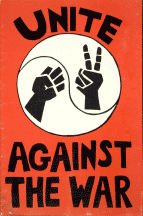
The conflict in Vietnam ended when the ammunition ran out. The military industry spent its wad as it earned its wad. Lucrative mission accomplished. Gun nut thrillcraft ride over. American public opinion turned against the mass killing, the funding dried up, and the hawks receded with their loot.

Then public attention diverted to more selfish worries. The economy. An energy crisis. A surge of concern for a death spiral into environmental disaster. Does this sound familiar? FUCKING A!

Legitimate concerns all, then and now. The problems remain the same. Just as American imperialism will persist unabated. Scholars might say after Vietnam, American militarism had to be tempered, such that the US was compelled to conduct its counter-insurgency genocides by more discrete means.

Like the Red, White and Blue ordnance jamboree of Southeast Asia, the US-Islam War will expend itself. But the war of the capitalist white against indigenous brown will continue unless the Western populations step up to a serious rise in consciousness. Not a higher spiritual conscience, but an honest self-assessment of First-World selfishness.

National Assembly is antiwar exclusively

unite-against-the-warReports are emerging from July’s National Assembly, the vital effort to unite antiwar forces into a common movement. Delegates from the major peace organizations hammered out a strategy to address Iraq, Afghanistan, Pakistan and Palestine. Missing from the consensus? Nonviolence, and good riddance. It goes without saying that humanitarian activists are peaceful. To legislate a dogma of non-confrontation plays right into the hands of the authoritarians. Here’s the official report:
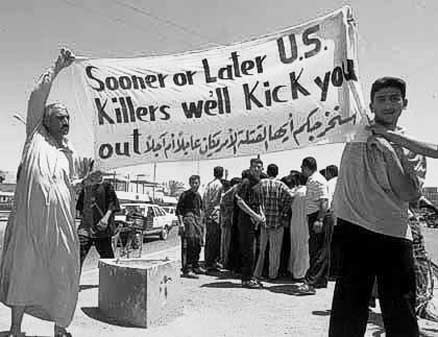
AN ASSESSMENT OF THE FIRST YEAR OF THE NATIONAL ASSEMBLY TO END THE IRAQ AND AFGHANISTAN WARS AND OCCUPATIONS

Address given by Marilyn Levin, member, National Assembly Administrative Body, and Planning Committee, Greater Boston United for Justice with Peace Coalition, to the National Antiwar Conference held July 10-12, 2009 in Pittsburgh, Pennsylvania

July 10-12, 2009, 255 people representing diverse organizations and constituencies from all over the country came together in Pittsburgh:

1) To look at where we are today,

2) To articulate our long range goals to rejuvenate the antiwar movement towards building a massive movement capable of forcing an end to their wars and occupations, to take our money back from the war machine to meet pressing social needs, and to save our planet for our children, and

3) To develop and vote for action plans as steps to realize these objectives.

All of our major objectives were accomplished and we leave today with a comprehensive action agenda to carry us through to next spring. Everyone had a chance to speak and differences were aired without rancor or splits to achieve unity in action.

Friday night’s speakers, along with many conference participants, grappled with how to unify and broaden the movement. Saturday afternoon and Sunday morning, we presented a great roster of workshops covering the major issues we face today. Saturday night’s rally was dynamic and inspiring.

There were two highlights of the conference for me. First was the international component where activist comrades joined us from Canada and courageous labor leaders of powerful mass movements in Haiti and Guadaloupe reminded us that imperialism and the struggle against it are global. There was a statement by members of the Viva Palestina aid convoy detained in Egypt. We passed motions in solidarity with the struggles of the people of Haiti, Honduras, and Palestine.

The second highlight was the discussion on Iran, where, in spite of strong passions stirred up by the rapidly evolving events there, we were able to illuminate the issues and debate our differences. Finally, we were able to agree on a unity position that all could embrace, as well as meeting the foremost call of the Iranians – US Hands off! No Sanctions! No interventions! Self-determination for the Iranian people! A wonderful example of a united front –- as inclusive as possible and taking principled positions that most will accept and act on.

So what is the National Assembly? What you saw this weekend explains who we are and how we function.

Democracy. All were invited and all perspectives welcomed. There was acceptance of the will of the conference even when it diverged from the proposals put forward by the leadership body. We were especially gratified that representatives from all the major antiwar coalitions came and addressed our conference.

Our willingness to struggle for unity and compromise when needed in order to move forward, as evidenced by a leadership that did not impose personal political views on others in service to unity.

An organization that admits to and learns from its mistakes and accepts its limitations when the unity we seek can’t yet be achieved.

An organization that has built a growing cadre of leaders that has developed trust, a structure that works, and a strong working relationship.

And finally, confidence, vision, and optimism. Confidence that we can provide leadership in rebooting our movement. A vision regarding how to accomplish that and an understanding of the necessity for these kinds of conferences leading to action. Optimism that masses of people will move in opposition to these horrendous policies that bring death and destruction and that they will have the power to change the world.

I’ve been asked to give an assessment of the first year since our initiation as an ongoing network with a mission, from our first conference in June, 2008 until today. Last year, we weren’t sure anyone would come and lo and behold 400 people came together in Cleveland to inaugurate a year of activities and set up a structure to maintain our work. A lot has transpired in that year and the National Assembly is well on its way as an established organization recognized throughout the movement as providing leadership and promoting a direction towards growth.

I need to start a little earlier and go back to why the National Assembly was called into existence in the first place.

What we saw, in the spring of 2008, was a movement at a low ebb – one that was shrinking rather than growing in spite of the war dragging on — this while the antiwar sentiment couldn’t be higher, and the disapproval rating for the Bush Administration couldn’t have been lower. From the high point of the largest action against the Iraq War in September, 2005 which drew 700,000 people, there was a pulling away from mass action by significant sections of the movement which supported electoral politics as the central strategy, in spite of a recurring pattern of disappointment when Democratic “antiwar” candidates voted again and again for war and war funding, and a split between the two major national coalitions, UFPJ and ANSWER, one that continues to this day. For the first time in five years, there was not enough unity or mass action perspective for any national demonstrations to take place marking the 5th year of the occupation of Iraq. Fundamentally, there was a vacuum of leadership.

Some far-sighted people like Jerry Gordon and Jeff Mackler, with experience gained from leadership in the last powerful antiwar movement that ended the Vietnam War, felt impelled to act. They began to organize a base of diverse but like-minded activists committed to building and expanding an effective antiwar movement in this country. The vehicle to accomplish this was the first national assembly, a national conference to pull activists together, to analyze the present state of the movement, to discuss where we needed to go and the actions that were needed to get us there.

We developed a unity statement with five basic principles that we hold today as the basis for where we stand:

1) Unity – all sections of the movement working together for common goals and actions;

2) Political Independence – no affiliations or support to any political party;

3) Democracy – decision-making at conferences with one person, one vote;

4) Mass Action – as the central strategy for organizing while embracing other forms of
outreach and protest; and

5) Out Now – the central demand to withdraw all military forces, contractors, and bases
from the countries where the U.S. was waging war on the people.

It seems simple but no one else saw it that way. Our conference was unique in the history of the present movement.

The organizers didn’t know what the mood and composition or strength of the conference would be, so we were cautious and minimal in the program we posed to the conference. We focused on Out Now from Iraq and modest action proposals, not being strong enough to initiate national actions on our own. The conference participants were ahead of us and ready to tackle the larger issues. Proposals were passed to add “Out Now from Afghanistan”, “End U.S. Support for the Occupation of Palestine”, and “Hands off Iran” to our set of demands, and given what has transpired in these areas, we were well prepared to take on a major role.

October 10th actions held in 20 cities were endorsed as well as a call for December actions building towards what we hoped would be unified, nationally coordinated bicoastal mass actions in the spring of 2009, the 6th year of the Iraq occupation. When Gaza was brutally assaulted, we joined with ANSWER and others to march in Washington and to demonstrate in the streets all over the country, and we’re still working under Palestinian leadership to bring justice and relief to a beleaguered population.

We made a concerted effort to find a common date for spring bi-coastal mobilizations. As you know, ANSWER chose March 21st as a day of united protests which we endorsed, while UFPJ called for a national march on Wall St. on April 4th. A number of National Assembly supporters who were also delegates to the UFPJ conference in December formed a mass action unity caucus and went to the conference with a resolution to allow delegates to vote for one or both actions but this was rejected. We’ll keep trying for 2010. The National Assembly endorsed and built both actions and marched behind our signs with our demands. The demonstrations were small (but spirited) and still of major importance.

For us, it’s quality, not quantity, as we position ourselves to be in the forefront as the pendulum swings in our direction once again.

Some take the position that mass demonstrations are not effective, unless we can pull 100,000 protestors into the streets. This is short-sighted and does not address how we get from small to large. Any successful movement for change doesn’t start with 100,000 people, and there has never been significant social change without mass actions. I remember my first anti-Vietnam war demonstration was in 1963 in Detroit and we had 15 people. In 1965, SDS called the first national march against the war in Washington. 25,000 people turned out and we thought it was huge!

Everyone talks about reaching out to the thousands of young people who mobilized to elect Obama. We agree, but we say the way to do this is by offering education and action. Action beyond calling, and emailing, and faxing the politicians they placed in office.

Why are mass demonstrations so important to building a powerful movement? It is because they accomplish so much in the process of building them. They provide:

Continuity. You can’t build anything by starting anew each time. Each action should lead to the next action or open national conference, with success building upon success. We need a continuity of leadership that builds trust and a reputation for integrity, and that learns lessons to improve. We need a continuity of organization and structure that can implement the tasks before us.

Visibility. Actions in the street give heart to the people the U.S. is attacking and occupying, letting them know that they are not alone. Mass actions create solidarity, offering support to anti-war soldiers, vets and their families, and a counter-force to the economic draft facing our youth, and they strengthen and deepen the antiwar sentiment of the people.

Inspiration. New people are brought into the movement, especially the youth, through activism. Have you ever talked to young people coming to a mass demonstration for the first time? They are inspired and thrilled to hear powerful speakers who are leaders of social justice movements and soldiers resisting the wars. They see they are not alone and get a taste of the power of large numbers of people marching together. They are energized to go home and join with others to continue to organize opposition to brutal U.S. wars and occupations. This is the way to reach out to the Obama supporters.

Explanation. An analysis of what is going on is offered along with tying together what seem at first to be disparate elements, i.e., war is tied to the economy, the war budget, bail-outs of the rich, the lack of basic needs being met, justice denied, and the impoverishment of the people.

Pressure on Government. People in this country are taught to be quiet. We’re told that our job is to elect officials whom we agree with periodically and then go home and wait while they fix things. This conveniently maintains the status quo but it sure doesn’t put pressure on them, or scare them, or force social change. Mass actions provide the most effective way to make significant change happen.

Let’s look at the present period. Obama’s election was based in large part on the hopes and aspirations of Americans for peace and a better life based on the promises and assumed promises that were made of peace, justice, and prosperity, which have not and will not be met.

Contrary to expectations, the previous administration’s policies are continued with a more handsome and articulate face. We all know that rather than winding down, wars and interventions are escalating and the rapacious greed of this immoral system knows no bounds.

Simultaneously, the economic crisis is causing terrible hardship for working people and for people who are no longer able to find work and their families. They are using this self-created financial disaster to further cut the standard of living and eliminate a secure future for older people and the young.

It was very moving and yet appalling to see this visually demonstrated when Robin Alexander of the United Electrical Workers Union asked people in the audience to stand who were unemployed, personally knew of soldier casualties, lived in communities where services were being cut, or who were otherwise negatively impacted by the wars and the failing economy. Nearly the entire room, a microcosm of the wider society, was standing by the end of that exercise.

It is inevitable that the present period of quiescence and hanging on to the hope that Obama and the new Congress will save us will come to a crashing end. People will not sit idly by forever while the world around them collapses. We are already seeing the beginnings of stirring. There is a greater willingness to go out in the streets to protest. There is more organizing taking place on campuses, more young people joining the movement. The many proposals for October actions are an indication that there is a widespread awareness of the need for actions this fall and the conviction that the movement must find common dates.

Brian Becker, National Coordinator of ANSWER, urged that we all work together to mount nationally coordinated actions next spring. Michael McPhearson, Co-Chair of UFPJ and Executive Director of Veterans for Peace, announced his support for October 17 and his willingness to do what he could to spur unified actions in the spring of 2010. We must have the faith and confidence that the people have the power to end the atrocities resulting from U.S. wars and occupations, and that they will recognize and utilize this power. As this happens, we must build a stronger antiwar movement that is able to provide leadership and the optimism to forge ahead no matter what the opposition throws at us.

The National Assembly to End the Iraq and Afghanistan Wars and Occupations is helping to provide that leadership and the vision that is needed. Although young and small, in one short year, we are now a force to be taken seriously and negotiated with, and by our persistent call for unity and mass action, our demonstrated ability to organize, and our coordinated strategy for revitalizing the movement, we are having an impact larger than our forces would indicate. In some ways, we too are a product of (and some say an antidote to) the 2008 election. To counter the malaise of the movement, we have quietly been building a solid core of activists and leaders around the country that understand the importance of a united front organized around principled demands and mass actions, not just calling Washington politicians when bills come up and crises happen.

At this conference, we have laid out an ambitious program of action that will take us through the spring of 2010. We are proud that we could provide the kick off for national organizing to bring a massive turnout to Pittsburgh for the G-20 protests September 25. Homeland Security is already making preparations to keep protesters hidden and stifle our right to speak out, but we won’t be silenced.

Following that, are a series of October building actions, culminating in large local and regional demonstrations on October 17 marking dates of significance related to the Iraq and Afghanistan wars and occupations and remembering the legacy of the anti-Vietnam war movement. Throughout the year, we will organize educational programs, support various forms of protest and organize around the inevitable emergencies caused by our government’s unholy interventions and threats to other nations.

We have initiated a Free Palestine Working Committee to ensure this work, which includes the growing boycott, divestment, and sanctions campaigns and the efforts to break the siege of Gaza, continues to be in the forefront and fully integrated in our work until justice and self-determination and return is in the hands of the Palestinians.

And lastly, we will continue to advocate for unity of the movement and once again bring thousands to Washington and the West Coast in the spring, to let our government and the world know that the U.S. movement against wars and occupations is alive and will not be quiet.

We will march and continue to march until all U.S. forces come home, bases are dismantled, and the sovereign people of the world have the right to control their own resources and determine their own futures, and the war budget becomes the peace budget.

Don’t sit on the sidelines and watch history being made. We urge all organizations to join the National Assembly and to play your part in building and shaping the powerful movement that is coming.

All out for the September 25 G-20 march in Pittsburgh! All out for the actions in early October! All out October 17!

The US – Islam War nears halfway mark

I have to do more research, but I’m pretty sure October 7, 2009 should mark the HALFWAY POINT of the US-ISLAM WAR. I realize the Pentagon brass are calling for fifty years more of insurgency suppression in Afghanistan and Iraq, but if we grant them no more time than for America’s longest military intervention, we’ve got another eight years before beating our humiliating retreat.
iraq

Those who insist we could have won the Vietnam War, would have our murderous troops there still. No foreign occupation has succeeded in modern times, with the ongoing exception of Israel, which by its swallowing of Palestine has been skewing the definition of occupation to the Old Testament model of mass extermination. The treacherous method worked against the Native Americans, it may still doom the (Palestinian) Native Israelis.

Afghanistan and Iraq remain occupations, where Vichy puppet governments prosecute genocide against the native resistance. How long before Americans lose their stomach for continuous bloody repression? I cannot account for the Russians in Chechnya, but on the US-Islam front, we are halfway there.

In Afghanistan and Iraq, we may already have surpassed half the civilian death tolls in Vietnam, Cambodia and Laos. It’s hard to say, the US “doesn’t do body counts” now, and we didn’t then either. Our own military casualties grew exponentially in Vietnam. If such statistics bear comparison, today’s numbers cannot be but comparable.

It’s being whispered that American casualties are approaching a multiple of a thousand mark. Official soldier deaths in Afghanistan and Iraq are conjectured to be reaching a round number.

I’m not told how many US mercenaries are being killed. We have as many hired-guns contracted as government soldiers. Want to lay odds on how many body bags they’ve required?

Nor are we told how many US soldiers are being wounded, many of them with injuries which would not have sustained their lives in Vietnam. Surely there is a sad gray area of injury which we could round up as it approximates death.