Lack of government regulations makes Chinese products deadly

china industrySo many Americans seem to want to believe that China is a communist country despite the obvious fact that its capitalist economy’s products remain so deadly due to lack of any real government regulation rather than any supposed socialistic government over-regulation.

Its sweatshops are dangerous to the workers, its schools crumble in earthquakes due to shoddy construction, and the products of its factories are dangerous for human use. All are signs of the defects of a totalitarian capitalist economy build without concern for anything other than quick profits. The latest product that the Chinese are producing that is killing people is infant formula with Melamine, the same substance that killed so many pets in the US when imported here. Chinese baby milk scare ‘severe’

The fact that this capitalist dictatorship is presided by one party calling itself ‘communist’ does not mean much. What ever the defects of a past Maoist regime of Stalinist dictatorship, what China has at present is far removed from that. Today, China has become victim of a counter revolution that has industrialized the country through capitalist production, but turned it into a human rights and ecological disaster zone.

US imperialism in check with Detente

First there’s Georgia, where Russia pushes back US efforts to muscle further NATO expansion. Then in our own hemisphere, Bolivia and Venezuela expel their US ambassadors, as Russian long range bombers land in South America in advance of joint naval maneuvers in the Caribbean. It’s not a resumption of the Cold War with the USSR, Russia is advancing no Communist Iron Curtain. But could a rival super power, in league with the unaligned nations, be a challenge to US hegemony? We could hope so.

The Communist Internationale, the new version of classic music hit

Maxx Klaxon has an updated version of the old musical hit, The Communist Internationale, out. Internationale 2000 Of course, there are many of you out there …lol… that have never heard the original hit version, so check the now out-of-date version out, too. The Communist Internationale (Original, with English Lyrics) It’s really too bad that more churches don’t have their choirs do this hit. I’ll try requesting it down at the Metropolitan Church or the Unitarian.

Russia rejects NATO, refuses to be dismembered like Yugoslavia and Iraq

Bush fun house monkeyWhen the Russian Communist Party re-established capitalism in the former Soviet Union, its top misleaders at the time(including Putin) thought that the place that Russia would be granted in the new world disorder would be somewhat akin to the position that Germany, France, and Italy are granted by the US. These Russian top dogs thought that they would become the new capitalist politicos of capitalist junior partner national governments underneath the broad US Empire’s umbrella. Poor students of Lenin these guys were indeed.

Things started to look very sour as living standards plummeted everywhere in the fSU, not least of all in Russia itself. Then the US began to play off bits and pieces of the fSU against itself, kind of like they are now doing in Iraq. These sad sack formerSoviet Union leaders looked on sadly as they saw Yugoslavia dismembered piece by piece after piece. Divide and conquer, not assimilate and assist as they had rather simply believed would be the case.

Putin is now a leader of a bloc of politicians, generals, and other assorted big wigs in the new Russian capitalist state. They now have lost their previous delusions entirely. They correctly see that it was never meant to be that they would be offered integration into junior partnership with the US and its Western European Klan. The US-Brit kingdom wants only to turn Russia into a gigantic, but utterly divided colony to better plunder the natural resources there.

Russia has had its back against the wall and it has not been able to consolidate an alliance with India and China against the US Empire. The US has so far successfully managed to divide and play off these 3 countries against themselves. Russia is backed against a wall as the US occupies Iraq and Afghanistan and is set to do the same with Iran, and has moved the missile systems of US-NATO into forward positions everywhere. Russia knows that the US government thinks and wants that it can win a nuclear war against them, and has funded and worked to do so for the last 2 decades, not to mention the many decades when Russia was the core of the fSoviet Union.

Further the Russians know that the forces for Peace inside the US and its allied countries are weak, play stupid, and are largely ineffective barriers to the war drive of our governments. They cannot look to these forces as brakes on our own governments.

We are at a scary moment because Russia is starting to refuse to be pushed around any further, yet the thugs that head the US government up have convinced themselves they can bully Russia down all the more, and not less. They think that they can destroy ‘the enemy’, independent countries everywhere. and their arrogance can very well become the fall of us all…. the cause of a Nuclear Winter to go alongside with their overheated Global Warming they are preparing for us all anyway.

We could have stopped this point from arriving, but we dithered, dithered, and dithered doing nothing. Instead of building an Antiwar Movement we have turned over that turf to religious clowns who most of us ignore almost altogether. We further allowed the Democratic Party to posture themselves as our Saviors, when we all along have really known quite well that they were working hand in hand with the Republicans. We made up excuses for that.

Russia has just announced that it was no longer going to listen to NATO’s orders. They are tired of seeing defeat after defeat as they capitulated and capitulated to the US-NATO. Not one of our US politicians has stepped up to denounce the Bush Gang and US government for continuing to threaten violence against Russia. Not one! And hardly a citizen voice has been raised in opposition to the US government-NATO either.

It is a stupid road we have all chosen. Our voices were silent even as our government announced its plan to win a nuclear war against Russia. And to this day it continues to plan to do this, too, yet our mouths are closed and we all pretend it is not happening.

Meanwhile, all we can come up with is to do a circus sideshow event up in Denver for the media to air as infotainment. We have no focus at all until the very sec it all spins out of control. A sideshow circus of poor fools, with poor fools who hate us as spectators (thank you FOX-Murdoch Entertainment) outside with all the police Klan Klowns, and totally unheard by the foolish billionaires inside who will play bingo games with our ‘votes’. What a blast it might be? But Russia is not going to continue being led down the slaughter shoot to be done in no wonder what Carnival of Fools the US might continue to be. Russia has decided to take a stand now rather than later.

Is Vietnam a communist country still?

Since most liberals quite haven’t really caught up with the now ancient news that China is today a capitalist country run by a leftover Stalinist dictatorship, I thought it instructive to point out that Vietnam is not a communist country today either, and for the same reasons. Its Communist Party recently has devolved the previous revolution back into a nationalist run, counterrevolutionary capitalist class economy under Vietnamese Communist Party control and direction.

Last year foreign capitalist investment or FDI hit $20 billion, with Ford, WalMart, and other multinational firms now operating much of the economic activity there. The FDI of Vietnam just 10 years ago was less than $5 billion.

One of the tools to evaluate whether ‘communism’ exists or not is to look at the FDI in a country. Communists are people who try to abolish the capitalist class’s control over the working class, not those who invite foreign capitalists into the country to run the economy. Just because the ruling party might still have ‘communist’ in its name does not automatically mean that they are communist leaders any more.

Counterrevolutions often occur inside previously more radical leadership groupings, like the Vietnamese Communist Party leadership that once fought to kick the Japanese, French, and US out of their country was. Vietnam is not now still a communist country even though it at least still remains independent politically from outsider imperialists. The imperialists do have a way of sneaking back in through their capitalist investment, and for that reason, Leon Trotsky and other revolutionary communist theorists of the past correctly observed that communism could not be permanently build in any one country alone. Capitalism was, and remains so, an international economic system.

Let the Games begin!

Mt Huashan, China
BEIJING- I’ve run myself ragged over the past five days trying to get a sense of China as she gears up for the Debutante Ball, and so far I have a pocket full of threads awaiting a tapestry. I must say, China is a country of great contrasts. A communist country with in-your-face capitalism everywhere. A landscape of unbelievable beauty made hazy by poisoned and polluted air. Oppressive heat and humidity and noisy throngs of people outside; feng shui, gentle music, and cool crisp air inside.

I’m staying at the Beijing Hilton, temporary home of the United States Olympic Committee. As you can imagine, the level of service is over the top. Since the Bush family’s arrival at the hotel next door, security has been tightened and my perfect oasis is now tainted by the presence of wand-wielding uniformed guards.

Worse still, the trophy wives of important men have invaded, and they are putting the staff through their paces. The upside is that they are fun to watch and secretly mock. Regal lionesses to my happy little mountain goat. Ha!

Today the torch arrives in Beijing. The city is electric. I don’t have a ticket to the Opening Ceremonies — no surprise since they run about $3,000 each. But my friend with Olympic connections tells me that we may meet with some last-minute luck, so I’m dressed and ready to go.

For now, I leave you with some pictures of the mountain goat on location!

Mt Huashan, China trail
Mt Huashan, China meditation
Mt Huashan, China gold locks
Mt Huashan, China, Marie Walden
Beijing Tiananmen Square One World
Beijing Tiananmen Square One Dream

Tiananmen Square before Olympic spirit

Beijing 2008 boycott
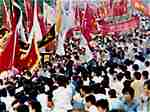
Human rights activists are crying foul about China’s role in Tibet and Burma. Here’s a illustrated time-line of the events which led to the totalitarian repression of the Tiananmen protests of 1989. Reprinted from Christus Rex.

Beijing Spring -A look back at the 1989 Spring that impacted a nation. Visit original website to see archival video footage from the CBS Evening News with Dan Rather.

April 15
Hu YaobangFormer Communist Party chief Hu Yaobang, a leading reformist, dies of a heart attack at the age of 73. Students at Beijing University put up posters praising Hu that indirectly criticize the opponents who forced his resignation following student demonstrations in 1986-87.
 

Students marchApril 17
Thousands of students march in Beijing and Shanghai shouting “long live Hu Yaobang, long live democracy, long live freedom, long live the rule of law.”


April 18
2,000 students from Beijing bicycle into Tiananmen Square and protest before the Great Hall of the People. Student leaders, including Wang DanIncluded in their demands for democratic reforms is the repudiation of official campaigns against freedom of the press.

April 21
Crowds of up to 100,000 demonstators gather in Tiananmen Square to mourn Hu.
Policeman supporting students

April 22
Students defy police orders to leave the square, while riots break out in the provincial capitals of Xian and Changsha. Official memorial ceremonies are held for Hu at the Great Hall of the People.

Student strike at Beijing University


April 23
Beijing students announce a boycott of university classes.
 

April 24
Tens of thousands of students at Beijing universities go on strike, demanding a dialog with the government.

Student rally in the squareApril 27
Bolstered by broad-based support, more than 150,000 students surge past police lines and fill Tiananmen Square, chanting slogans for democracy and freedom.

April 29
Government officials meet with student leaders, but independent student groups say they will continue a class boycott at 41 university campuses in Beijing.

May 2
6,000 students march in Shanghai.

May 4
100,000 students and supporters march on Tiananmen square to celebrate the 70th anniversary of Student hunger strike China’s first student movement, while similar demonstrations are held in Shanghai, Nanjing and other cities. 300 journalists protest outside the official Xinhua News Agency.

May 9
Journalists petition the government for freedom of the press.

May 13
2,000 students begin a hunger strike in Tiananmen Square.

Rally on the eve of GorbachevMay 15
Government deadline for students to leave the square comes and goes. A welcoming ceremony for Soviet leader Mikhail Gorbachev’s state visit is moved to the airport.

tienanmen-12-rally.jpgMay 16
Hundreds of thousands of demonstrators occupy the square.

May 18
One million people march in support of the hunger strikers. Li PengLi Peng, Premier of the State Council, issues a stern warning to student leaders and refuses to discuss their demands.

May 19
Zhoa ZiyangA tearful Zhao Ziyang, China’s General Secretary, makes a pre-dawn visit to weakened hunger strikers. Li also visits the students briefly. In the evening the students decide to end the hunger strike, but quickly change their mind when Li and President Yang Shangkun announce martial law. Zhao reportedly resigns or is ousted from power after failing to convince Li and others to compromise.

Yang ShangkunMay 20, 1989
Chinese authorities ‘pull the plug’ on Dan Rather who is reporting live from Beijing.

May 28
About 80,000 people (mostly students from outside the capital) demonstrate but, unlike past rallies, few workers participate.
Goddess of Democracy
May 30
Students unveil their “Goddess of Democracy,” a replica of the Statue of Liberty, on the square. The government calls it an insult to the nation.

May 31
Farmers and workers stage the first of several pro-government rallies in Beijing’s suburbs.

June 1
The Beijing Municipal Government bans all foreign press coverage of the demonstrations.

June 3
Tens of thousands of troops advance on the city shortly after midnight, but are repulsed by residents who put up barricades. PLA troops stopped by civilians By the afternoon 5,000 troops appear outside the Great Hall of the People, but are again surrounded and stopped. In the final assault that evening, troops shoot and beat their way to the square.

Taping the beginnings of the massacre, correspondent Richard Roth is arrested.

June 4
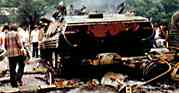
Troops occupy the square and smash the “Goddess of Democracy” with tanks. The shooting continues with soldiers periodically firing on crowds gathered on the outskirts of the square. Residents set fire to more than 100 military trucks and armored personnel carriers. The government claims the “counterrevolutionary riots” have been suppressed. Meanwhile, riots break out in southwestern Chengdu.

Richard Roth is released and reports further on the night’s violence.
PLA troops confront civilians
June 5
There are reports of clashes between rival military groups around Beijing. President Bush condemns the “bloody and violent” crackdown and orders a suspension of U.S. military sales and contacts with the Chinese government.

June 5, 1989
Richard Roth reports: one anonymous man stops a column of 18 tanks.
Wounded civilian
June 6
Foreign embassies advise their nationals to leave China. The government says 300 people were killed and 7,000 injured in the crackdown, but claims most of the dead were soldiers. There are more reports of clashes between military units. Six people are killed in Shanghai when a train runs through a barricade. The U.S. State Department announces that dissident Fang Lizhi and his wife have sought refuge in the U.S. Embassy.
An advancing tank
June 7
Troops, responding to what they say is sniper fire, shoot into a foreign diplomatic compound. The United States and other governments order the mandatory evacuation of dependents of diplomatic personnel.

June 8
Premier Li Peng appears in public for the first time since the crackdown to congratulate troops.
Deng Xiaoping
June 9
China’s leader Deng Xiaoping appears for the first time since May 16. In a speech to military officers he blames the turmoil on counterrevolutionaries attempting to overthrow communism.

Motorcycle crushed by a tankJune 10
Beijing authorities announce the arrest of more than 400 people, including student and labor leaders.

June 11
The government issues a warrant for the arrest of Fang Lizhi and his wife, saying they committed crimes of “counterrevolutionary propaganda and instigation.” Fang Lizhi

June 12
The government bans all independent student and labor organizations and says police and soldiers should shoot all “rioters and counterrevolutionaries.”PLA tank on patrol

June 13
The government issues a wanted list for 21 student activists who led the democracy movement.
Student leader Wang Dan

June 14
China orders the expulsion of Associated Press reporter John Pomfret and Voice of America Bureau Chief Alan Pessin.

June 15
Three Shanghai men are sentenced to death for burning a train that ran over protesters. The nationwide arrest total reaches above 1,000.
Soldiers seen through window of burned vehicle
June 17
A Beijing court sentences eight people to death for attacking soldiers and burning vehicles during the June 3-4 assault.

June 18
Politburo member Qiao Shi appears prominently in the official media, adding to speculation the party security man will replace Zhao.

A burned tank
June 20
The government nullifies all exit permits in an apparent attempt to stop fugitives from leaving the country.

Gitmo is reincarnation of Con Son Island

the abyss stares back at youWhen you delete data on a computer, actually you only erase pointers to the data. The files remain, but you’ve eradicated the addresses of where to find them. Likewise, to get away with a crime, you eliminate the witnesses who could point the finger at you. Luckily internet search engines are still proving impervious to “cleaners” due to the proliferating network of memory hole archivists and blogger sidewalk barkers. Try this at home: Google “tiger cages.” Think you’ll see images of tigers? Hardly! While Americans are being led to infer that John McCain was mistreated by his North Vietnamese jailers, let’s revisit how our forces treated the communist civilian captives. There was a precedence for Guantanamo. Vietnamese non-combatant detainees were caged on an offshore island prison called Con Son.

Row of tiger cages on Con Son Prison
The occasional pots held lye which the guards threw unto the prisoners for purposes of “hygiene.” When the Con Son brutality was found out, the victims were transfered to worse quarters called “cow cages.”

Global economic rapists are at it again

G8 protest
Why protest the G8 Summit July 7-9? Those hoodlums always look so determined. Here’s the rationale by the Emergency Exit Collective:

The 2008 G8 on Hokkaido, a Strategic Assessment
Emergency Exit Collective
Bristol, Mayday, 2008

The authors of this document are a collection of activists, scholars, and writers currently based in the United States and Western Europe who have gotten to know and work with each other in the movement against capitalist globalization. We’re writing this at the request of some members of No! G8 Action Japan, who asked us for a broad strategic analysis of the state of struggle as we see it, and particularly, of the role of the G8, what it represents, the dangers and opportunities that may lie hidden in the moment. It is in no sense programmatic. Mainly, it is an attempt to develop tools that we hope will be helpful for organizers, or for anyone engaged in the struggle against global capital.

I
It is our condition as human beings that we produce our lives in common.

II
Let us then try to see the world from the perspective of the planet’s commoners, taking the word in that sense: those whose most essential tradition is cooperation in the making and maintenance of human social life, yet who have had to do so under conditions of suffering and separation; deprived, ignored, devalued, divided into hierarchies, pitted against each other for our very physical survival. In one sense we are all commoners. But it’s equally true that just about everyone, at least in some ways, at some points, plays the role of the rulers—of those who expropriate, devalue and divide—or at the very least benefits from such divisions.

Obviously some do more than others. It is at the peak of this pyramid that we encounter groups like the G8.

III
The G8’s perspective is that of the aristocrats, the rulers: those who command and maintain that global machinery of violence that defends existing borders and lines of separation: whether national borders with their detention camps for migrants, or property regimes, with their prisons for the poor. They live by constantly claiming title to the products of others collective creativity and labour, and in thus doing they create the poor; they create scarcity in the midst of plenty, and divide us on a daily basis; they create financial districts that loot resources from across the world, and in thus doing they turn the spirit of human creativity into a spiritual desert; close or privatize parks, public water taps and libraries, hospitals, youth centers, universities, schools, public swimming pools, and instead endlessly build shopping malls that channels convivial life into a means of commodity circulation; work toward turning global ecological catastrophe into business opportunities.

These are the people who presume to speak in the name of the “international community” even as they hide in their gated communities or meet protected by phalanxes of riot cops. It is critical to bear in mind that the ultimate aim of their policies is never to create community but to introduce and maintain divisions that set common people at each other’s throats. The neoliberal project, which has been their main instrument for doing so for the last three decades, is premised on a constant effort either to uproot or destroy any communal or democratic system whereby ordinary people govern their own affairs or maintain common resources for the common good, or, to reorganize each tiny remaining commons as an isolated node in a market system in which livelihood is never guaranteed, where the gain of one community must necessarily be at the expense of others. Insofar as they are willing to appeal to high-minded principles of common humanity, and encourage global cooperation, only and exactly to the extent that is required to maintain this system of universal competition.

IV
At the present time, the G8—the annual summit of the leaders of “industrial democracies”—is the key coordinative institution charged with the task of maintaining this neoliberal project, or of reforming it, revising it, adapting it to the changing condition of planetary class relations. The role of the G8 has always been to define the broad strategic horizons through which the next wave of planetary capital accumulation can occur. This means that its main task is to answer the question of how 3?4 in the present conditions of multiple crises and struggles 3?4 to subordinate social relations among the producing commoners of the planet to capital’s supreme value: profit.

V
Originally founded as the G7 in 1975 as a means of coordinating financial strategies for dealing with the ‘70s energy crisis, then expanded after the end of the Cold War to include Russia, its currently face a moment of profound impasse in the governance of planetary class relations: the greatest since the ‘70s energy crisis itself.

VI
The ‘70s energy crisis represented the final death-pangs of what might be termed the Cold War settlement, shattered by a quarter century of popular struggle. It’s worth returning briefly to this history.

The geopolitical arrangements put in place after World War II were above all designed to forestall the threat of revolution. In the immediate wake of the war, not only did much of the world lie in ruins, most of world’s population had abandoned any assumption about the inevitability of existing social arrangements. The advent of the Cold War had the effect of boxing movements for social change into a bipolar straightjacket. On the one hand, the former Allied and Axis powers that were later to unite in the G7 (the US, Canada, UK, France, Italy, Germany, Japan)—the “industrialized democracies”, as they like to call themselves—engaged in a massive project of co-optation. Their governments continued the process, begun in the ‘30s, of taking over social welfare institutions that had originally been created by popular movements (from insurance schemes to public libraries), even to expand them, on condition that they now be managed by state-appointed bureaucracies rather than by those who used them, buying off unions and the working classes more generally with policies meant to guarantee high wages, job security and the promise of educational advance—all in exchange for political loyalty, productivity increases and wage divisions within national and planetary working class itself. The Sino-Soviet bloc—which effectively became a kind of junior partner within the overall power structure, and its allies remained to trap revolutionary energies into the task of reproducing similar bureaucracies elsewhere. Both the US and USSR secured their dominance after the war by refusing to demobilize, instead locking the planet in a permanent threat of nuclear annihilation, a terrible vision of absolute cosmic power.

VII
Almost immediately, though, this arrangement was challenged by a series of revolts from those whose work was required to maintain the system, but who were, effectively, left outside the deal: first, peasants and the urban poor in the colonies and former colonies of the Global South, next, disenfranchised minorities in the home countries (in the US, the Civil Rights movement, then Black Power), and finally and most significantly, by the explosion of the women’s movement of the late ‘60s and early ‘70s—the revolt of that majority of humanity whose largely unremunerated labor made the very existence “the economy” possible. This appears to have been the tipping point.

VIII
The problem was that the Cold War settlement was never meant to include everyone. It by definition couldn’t. Once matters reached tipping point, then, the rulers scotched the settlement. All deals were off. The oil shock was first edge of the counter-offensive, breaking the back of existing working class organizations, driving home the message that there was nothing guaranteed about prosperity. Under the aegis of the newly hatched G7, this counter-offensive involved a series of interwoven strategies that were later to give rise to what is known as neoliberalism.

IX
These strategies resulted in what came to be known as “Structural Adjustment” both in the North and in the South, accompanied by trade and financial liberalization. This, in turn, made possible crucial structural changes in our planetary production in common extending the role of the market to discipline our lives and divide us into more and more polarized wage hierarchy. This involved:

· In the immediate wake of ‘70s oil shock, petrodollars were recycled from OPEC into Northern banks that then lent them, at extortionate rates of interest, to developing countries of the Global South. This was the origin of the famous “Third World Debt Crisis.” The existence of this debt allowed institutions like the IMF to impose its monetarist orthodoxy on most of the planet for roughly twenty years, in the process, stripping away most of even those modest social protections that had been won by the world’s poor—large numbers of whom were plunged into a situation of absolute desperation.

· It also opened a period of new enclosures through the capitalist imposition of structural adjustment policies, manipulation of environmental and social catastrophes like war, or for that matter through the authoritarian dictates of “socialist” regimes. Through such means, large sections of the world’s population have over the past thirty years been dispossessed from resources previously held in common, either by dint of long traditions, or as the fruits of past struggles and past settlements.

· Through financial deregulation and trade liberalization, neoliberal capital, which emerged from the G7 strategies to deal with the 1970s crisis aimed thus at turning the “class war” in communities, factories, offices, streets and fields against the engine of competition, into a planetary “civil war”, pitting each community of commoners against every other community of commoners.

· Neoliberal capital has done this by imposing an ethos of “efficiency” and rhetoric of “lowering the costs of production” applied so broadly that mechanisms of competition have come to pervade every sphere of life. In fact these terms are euphemisms, for a more fundamental demand: that capital be exempt from taking any reduction in profit to finance the costs of reproduction of human bodies and their social and natural environments (which it does not count as costs) and which are, effectively, “exernalized” onto communities and nature.

· The enclosure of resources and entitlements won in previous generations of struggles both in the North and the South, in turn, created the conditions for increasing the wage hierarchies (both global and local), by which commoners work for capital—wage hierarchies reproduced economically through pervasive competition, but culturally, through male dominance, xenophobia and racism. These wage gaps, in turn, made it possible to reduce the value of Northern workers’ labour power, by introducing commodities that enter in their wage basket at a fraction of what their cost might otherwise have been. The planetary expansion of sweatshops means that American workers (for example) can buy cargo pants or lawn-mowers made in Cambodia at Walmart, or buy tomatoes grown by undocumented Mexican workers in California, or even, in many cases, hire Jamaican or Filipina nurses to take care of children and aged grandparents at such low prices, that their employers have been able to lower real wages without pushing most of them into penury. In the South, meanwhile, this situation has made it possible to discipline new masses of workers into factories and assembly lines, fields and offices, thus extending enormously capital’s reach in defining the terms—the what, the how, the how much—of social production.

· These different forms of enclosures, both North and South, mean that commoners have become increasingly dependent on the market to reproduce their livelihoods, with less power to resist the violence and arrogance of those whose priorities is only to seek profit, less power to set a limit to the market discipline running their lives, more prone to turn against one another in wars with other commoners who share the same pressures of having to run the same competitive race, but not the same rights and the same access to the wage. All this has meant a generalized state of precarity, where nothing can be taken for granted.

X
In turn, this manipulation of currency and commodity flows constituting neoliberal globalization became the basis for the creation of the planet’s first genuine global bureaucracy.

· This was multi-tiered, with finance capital at the peak, then the ever-expanding trade bureaucracies (IMF, WTO, EU, World Bank, etc), then transnational corporations, and finally, the endless varieties of NGOs that proliferated throughout the period—almost all of which shared the same neoliberal orthodoxy, even as they substituted themselves for social welfare functions once reserved for states.

· The existence of this overarching apparatus, in turn, allowed poorer countries previously under the control of authoritarian regimes beholden to one or another side in the Cold War to adopt “democratic” forms of government. This did allow a restoration of formal civil liberties, but very little that could really merit the name of democracy (the rule of the “demos”, i.e., of the commoners). They were in fact constitutional republics, and the overwhelming trend during the period was to strip legislatures, that branch of government most open to popular pressure, of most of their powers, which were increasingly shifted to the executive and judicial branches, even as these latter, in turn, largely ended up enacting policies developed overseas, by global bureaucrats.

· This entire bureaucratic arrangement was justified, paradoxically enough, by an ideology of extreme individualism. On the level of ideas, neoliberalism relied on a systematic cooptation of the themes of popular struggle of the ‘60s: autonomy, pleasure, personal liberation, the rejection of all forms of bureaucratic control and authority. All these were repackaged as the very essence of capitalism, and the market reframed as a revolutionary force of liberation.

· The entire arrangement, in turn, was made possible by a preemptive attitude towards popular struggle. The breaking of unions and retreat of mass social movements from the late ‘70s onwards was only made possible by a massive shift of state resources into the machinery of violence: armies, prisons and police (secret and otherwise) and an endless variety of private “security services”, all with their attendant propaganda machines, which tended to increase even as other forms of social spending were cut back, among other things absorbing increasing portions of the former proletariat, making the security apparatus an increasingly large proportion of total social spending. This approach has been very successful in holding back mass opposition to capital in much of the world (especially West Europe and North America), and above all, in making it possible to argue there are no viable alternatives. But in doing so, has created strains on the system so profound it threatens to undermine it entirely.

XI
The latter point deserves elaboration. The element of force is, on any number of levels, the weak point of the system. This is not only on the constitutional level, where the question of how to integrate the emerging global bureaucratic apparatus, and existing military arrangements, has never been resolved. It is above all an economic problem. It is quite clear that the maintenance of elaborate security machinery is an absolute imperative of neoliberalism. One need only observe what happened with the collapse of the Soviet bloc in Eastern Europe: where one might have expected the Cold War victors to demand the dismantling of the army, secret police and secret prisons, and to maintain and develop the existing industrial base, in fact, what they did was absolutely the opposite: in fact, the only part of the industrial base that has managed fully to maintain itself has been the parts required to maintained the security apparatus itself! Critical too is the element of preemption: the governing classes in North America, for example, are willing to go to almost unimaginable lengths to ensure social movements never feel they are accomplishing anything. The current Gulf War is an excellent example: US military operations appear to be organized first and foremost to be protest-proof, to ensure that what happened in Vietnam (mass mobilization at home, widespread revolt within the army overseas) could never be repeated. This means above all that US casualties must always be kept to a minimum. The result are rules of engagement, and practices like the use of air power within cities ostensibly already controlled by occupation forces, so obviously guaranteed to maximize the killing of innocents and galvanizing hatred against the occupiers that they ensure the war itself cannot be won. Yet this approach can be taken as the very paradigm for neoliberal security regimes. Consider security arrangements around trade summits, where police are so determined prevent protestors from achieving tactical victories that they are often willing to effectively shut down the summits themselves. So too in overall strategy. In North America, such enormous resources are poured into the apparatus of repression, militarization, and propaganda that class struggle, labor action, mass movements seem to disappear entirely. It is thus possible to claim we have entered a new age where old conflicts are irrelevant. This is tremendously demoralizing of course for opponents of the system; but those running the system seem to find that demoralization so essential they don’t seem to care that the resultant apparatus (police, prisons, military, etc) is, effectively, sinking the entire US economy under its dead weight.

XII
The current crisis is not primarily geopolitical in nature. It is a crisis of neoliberalism itself. But it takes place against the backdrop of profound geopolitical realignments. The decline of North American power, both economic and geopolitical has been accompanied by the rise of Northeast Asia (and to a increasing extent, South Asia as well). While the Northeast Asian region is still divided by painful Cold War cleavages—the fortified lines across the Taiwan straits and at the 38th parallel in Korea…—the sheer realities of economic entanglement can be expected to lead to a gradual easing of tensions and a rise to global hegemony, as the region becomes the new center of gravity of the global economy, of the creation of new science and technology, ultimately, of political and military power. This may, quite likely, be a gradual and lengthy process. But in the meantime, very old patterns are rapidly reemerging: China reestablishing relations with ancient tributary states from Korea to Vietnam, radical Islamists attempting to reestablish their ancient role as the guardians of finance and piety at the in the Central Asian caravan routes and across Indian Ocean, every sort of Medieval trade diaspora reemerging… In the process, old political models remerge as well: the Chinese principle of the state transcending law, the Islamic principle of a legal order transcending any state. Everywhere, we see the revival too of ancient forms of exploitation—feudalism, slavery, debt peonage—often entangled in the newest forms of technology, but still echoing all the worst abuses of the Middle Ages. A scramble for resources has begun, with US occupation of Iraq and saber-rattling throughout the surrounding region clearly meant (at least in part) to place a potential stranglehold the energy supply of China; Chinese attempts to outflank with its own scramble for Africa, with increasing forays into South America and even Eastern Europe. The Chinese invasion into Africa (not as of yet at least a military invasion, but already involving the movement of hundreds of thousands of people), is changing the world in ways that will probably be felt for centuries. Meanwhile, the nations of South America, the first victims of the “Washington consensus” have managed to largely wriggle free from the US colonial orbit, while the US, its forces tied down in the Middle East, has for the moment at least abandoned it, is desperately struggling to keep its grip Mexico, Central America and the Caribbean—its own “near abroad”.

XIII
In another age all this might have led to war—that is, not just colonial occupations, police actions, or proxy wars (which are obviously already taking place), but direct military confrontations between the armies of major powers. It still could; accidents happen; but there is reason to believe that, when it comes to moments of critical decision, the loyalties of the global elites are increasingly to each other, and not to the national entities for whom they claim to speak. There is some compelling evidence for this.

Take for example when the US elites panicked at the prospect of the massive budget surpluses of the late 1990s. As Alan Greenspan, head of the Federal Reserve at the time warned, if these were allowed to stand they would have flooded government coffers with so many trillions of dollars that it could only have lead to some form of creeping socialism, even, he predicted, to the government acquiring “equity stakes” in key US corporations. The more excitable of capitalism’s managers actually began contemplating scenarios where the capitalist system itself would be imperiled. The only possible solution was massive tax cuts; these were duly enacted, and did indeed manage to turn surpluses into enormous deficits, financed by the sale of treasury bonds to Japan and China. Conditions have thus now reached a point where it is beginning to look as if the most likely long term outcome for the US (its technological and industrial base decaying, sinking under the burden of its enormous security spending) will be to end up serve as junior partner and military enforcer for East Asia capital. Its rulers, or at least a significant proportion of them, would prefer to hand global hegemony to the rulers of China (provided the latter abandon Communism) than to return to any sort of New Deal compromise with their “own” working classes.

A second example lies in the origins of what has been called the current “Bretton Woods II” system of currency arrangements, which underline a close working together of some “surplus” and “deficit” countries within global circuits. The macroeconomic manifestation of the planetary restructuring outlined in XIX underlines both the huge US trade deficit that so much seem to worry many commentators, and the possibility to continually generate new debt instruments like the one that has recently resulted in the sub-prime crisis. The ongoing recycling of accumulated surplus of countries exporting to the USA such as China and oil producing countries is what has allowed financiers to create new credit instruments in the USA. Hence, the “deal” offered by the masters in the United States to its commoners has been this: ‘you, give us a relative social peace and accept capitalist markets as the main means through which you reproduce your own livelihoods, and we will give you access to cheaper consumption goods, access to credit for buying cars and homes, and access to education, health, pensions and social security through the speculative means of stock markets and housing prices.’ Similar compromises were reached in all the G8 countries.

Meanwhile, there is the problem of maintaining any sort of social peace with the hundreds of millions of unemployed, underemployed, dispossessed commoners currently swelling the shanty-towns of Asia, Africa, and Latin America as a result of ongoing enclosures (which have speeded up within China and India in particular, even as “structural adjustment policies” in Africa and Latin America have been derailed). Any prospect of maintaining peace in these circumstances would ordinarily require either extremely high rates of economic growth—which globally have not been forthcoming, since outside of China, growth rates in the developing world have been much lower than they were in the ‘50s, ‘60s, or even ‘70s—or extremely high levels of repression, lest matters descend into rebellion or generalized civil war. The latter has of course occurred in many parts of the world currently neglected by capital, but in favored regions, such as the coastal provinces of China, or “free trade” zones of India, Egypt, or Mexico, commoners are being offered a different sort of deal: industrial employment at wages that, while very low by international standards, are still substantially higher than anything currently obtainable in the impoverished countryside; and above all the promise, through the intervention of Western markets and (privatized) knowledge, of gradually improving conditions of living. While over the least few years wages in many such areas seem to be growing, thanks to the intensification of popular struggles, such gains are inherently vulnerable: the effect of recent food inflation has been to cut real wages back dramatically—and threaten millions with starvation.

What we really want to stress here, though, is that the long-term promise being offered to the South is just as untenable as the idea that US or European consumers can indefinitely expand their conditions of life through the use of mortgages and credit cards.

What’s being offered the new dispossessed is a transposition of the American dream. The idea is that the lifestyle and consumption patterns of existing Chinese, Indian, or Brazilian or Zambian urban middle classes (already modeled on Northern ones) will eventually become available to the children of today’s miners, maquila or plantation laborers, until, ultimately, everyone on earth is brought up to roughly the same level of consumption. Put in these terms, the argument is absurd. The idea that all six billion of us can become “middle class” is obviously impossible. First of all there is a simple problem of resources. It doesn’t matter how many bottles we recycle or how energy efficient are the light bulbs we use, there’s just no way the earth’s ecosystem can accommodate six billion people driving in private cars to work in air-conditioned cubicles before periodically flying off to vacation in Acapulco or Tahiti. To maintain the style of living and producing in common we now identify with “middle classness” on a planetary scale would require several additional planets.

This much has been pointed out repeatedly. But the second point is no less important. What this vision of betterment ultimately proposes is that it would be possible to build universal prosperity and human dignity on a system of wage labor. This is fantasy. Historically, wages are always the contractual face for system of command and degradation, and a means of disguising exploitation: expressing value for work only on condition of stealing value without work— and there is no reason to believe they could ever be anything else. This is why, as history has also shown, human beings will always avoid working for wages if they have any other viable option. For a system based on wage labor to come into being, such options must therefore be made unavailable. This in turn means that such systems are always premised on structures of exclusion: on the prior existence of borders and property regimes maintained by violence. Finally, historically, it has always proved impossible to maintain any sizeable class of wage-earners in relative prosperity without basing that prosperity, directly or indirectly, on the unwaged labor of others—on slave-labor, women’s domestic labor, the forced labor of colonial subjects, the work of women and men in peasant communities halfway around the world—by people who are even more systematically exploited, degraded, and immiserated. For that reason, such systems have always depended not only on setting wage-earners against each other by inciting bigotry, prejudice, hostility, resentment, violence, but also by inciting the same between men and women, between the people of different continents (“race”), between the generations.

From the perspective of the whole, then, the dream of universal middle class “betterment” must necessarily be an illusion constructed in between the Scylla of ecological disaster, and the Charybdis of poverty, detritus, and hatred: precisely, the two pillars of today’s strategic impasse faced by the G8.

XIV
How then do we describe the current impasse of capitalist governance?

To a large degree, it is the effect of a sudden and extremely effective upswing of popular resistance—one all the more extraordinary considering the huge resources that had been invested in preventing such movements from breaking out.

On the one hand, the turn of the millennium saw a vast and sudden flowering of new anti-capitalist movements, a veritable planetary uprising against neoliberalism by commoners in Latin America, India, Africa, Asia, across the North Atlantic world’s former colonies and ultimately, within the cities of the former colonial powers themselves. As a result, the neoliberal project lies shattered. What came to be called the “anti-globalization” movement took aim at the trade bureaucracies—the obvious weak link in the emerging institutions of global administration—but it was merely the most visible aspect of this uprising. It was however an extraordinarily successful one. Not only was the WTO halted in its tracks, but all major trade initiatives (MAI, FTAA…) scuttled. The World Bank was hobbled and the power of the IMF over most of the world’s population, effectively, destroyed. The latter, once the terror of the Global South, is now a shattered remnant of its former self, reduced to selling off its gold reserves and desperately searching for a new global mission.

In many ways though spectacular street actions were merely the most visible aspects of much broader changes: the resurgence of labor unions, in certain parts of the world, the flowering of economic and social alternatives on the grassroots levels in every part of the world, from new forms of direct democracy of indigenous communities like El Alto in Bolivia or self-managed factories in Paraguay, to township movements in South Africa, farming cooperatives in India, squatters’ movements in Korea, experiments in permaculture in Europe or “Islamic economics” among the urban poor in the Middle East. We have seen the development of thousands of forms of mutual aid association, most of which have not even made it onto the radar of the global media, often have almost no ideological unity and which may not even be aware of each other’s existence, but nonetheless share a common desire to mark a practical break with capitalism, and which, most importantly, hold out the prospect of creating new forms of planetary commons that can—and in some cases are—beginning to knit together to provide the outlines of genuine alternative vision of what a non-capitalist future might look like.

The reaction of the world’s rulers was predictable. The planetary uprising had occurred during a time when the global security apparatus was beginning to look like it lacked a purpose, when the world threatened to return to a state of peace. The response—aided of course, by the intervention of some of the US’ former Cold War allies, reorganized now under the name of Al Qaeda—was a return to global warfare. But this too failed. The “war on terror”—as an attempt to impose US military power as the ultimate enforcer of the neoliberal model—has collapsed as well in the face of almost universal popular resistance. This is the nature of their “impasse”.

At the same time, the top-heavy, inefficient US model of military capitalism—a model created in large part to prevent the dangers of social movements, but which the US has also sought to export to some degree simply because of its profligacy and inefficiency, to prevent the rest of the world from too rapidly overtaking them—has proved so wasteful of resources that it threatens to plunge the entire planet into ecological and social crisis. Drought, disaster, famines, combine with endless campaigns of enclosure, foreclosure, to cast the very means of survival—food, water, shelter—into question for the bulk of the world’s population.

XV
In the rulers’ language the crisis understood, first and foremost, as a problem of regulating cash flows, of reestablishing, as they like to put it, a new “financial architecture”. Obviously they are aware of the broader problems. Their promotional literature has always been full of it. From the earliest days of the G7, through to the days after the Cold War, when Russia was added as a reward for embracing capitalism, they have always claimed that their chief concerns include

· the reduction of global poverty

· sustainable environmental policies

· sustainable global energy policies

· stable financial institutions governing global trade and currency transactions

If one were to take such claims seriously, it’s hard to see their overall performance as anything but a catastrophic failure. At the present moment, all of these are in crisis mode: there are food riots, global warming, peak oil, and the threat of financial meltdown, bursting of credit bubbles, currency crises, a global credit crunch. [**Failure on this scale however, opens opportunities for the G8 themselves, as summit of the global bureaucracy, to reconfigure the strategic horizon. Therefore, it’s always with the last of these that they are especially concerned. ]The real problem, from the perspective of the G8, is one of reinvestment: particularly, of the profits of the energy sector, but also, now, of emerging industrial powers outside the circle of the G8 itself. The neoliberal solution in the ‘70s had been to recycle OPEC’s petrodollars into banks that would use it much of the world into debt bondage, imposing regimes of fiscal austerity that, for the most part, stopped development (and hence, the emergence potential rivals) in its tracks. By the ‘90s, however, much East Asia in particular had broken free of this regime. Attempts to reimpose IMF-style discipline during the Asian financial crisis of 1997 largely backfired. So a new compromise was found, the so-called Bretton Woods II: to recycle the profits from the rapidly expanding industrial economies of East Asia into US treasury debt, artificially supporting the value of the dollar and allowing a continual stream of cheap exports that, aided by the US housing bubble, kept North Atlantic economies afloat and buy off workers there with cheap oil and even cheaper consumer goods even as real wages shrank. This solution however soon proved a temporary expedient. Bush regime’s attempt to lock it in by the invasion of Iraq, which was meant to lead to the forced privatization of Iraqi oil fields, and, ultimately, of the global oil industry as a whole, collapsed in the face of massive popular resistance (just as Saddam Hussein’s attempt to introduce neoliberal reforms in Iraq had failed when he was still acting as American deputy in the ‘90s). Instead, the simultaneous demand for petroleum for both Chinese manufacturers and American consumers caused a dramatic spike in the price of oil. What’s more, rents from oil and gas production are now being used to pay off the old debts from the ‘80s (especially in Asia and Latin America, which have by now paid back their IMF debts entirely), and—increasingly—to create state-managed Sovereign Wealth Funds that have largely replaced institutions like the IMF as the institutions capable of making long-term strategic investments. The IMF, purposeless, tottering on the brink of insolvency, has been reduced to trying to come up with “best practices” guidelines for fund managers working for governments in Singapore, Seoul, and Abu Dhabi.

There can be no question this time around of freezing out countries like China, India, or even Brazil. The question for capital’s planners, rather, is how to channel these new concentrations of capital in such a way that they reinforce the logic of the system instead of undermining it.

XVI
How can this be done? This is where appeals to universal human values, to common membership in an “international community” come in to play. “We all must pull together for the good of the planet,” we will be told. The money must be reinvested “to save the earth.”

To some degree this was always the G8 line: this is a group has been making an issue of climate change since 1983. Doing so was in one sense a response to the environmental movements of the ‘70s and ‘80s. The resultant emphasis on biofuels and “green energy” was from their point of view, the perfect strategy, seizing on an issue that seemed to transcend class, appropriating ideas and issues that emerged from social movements (and hence coopting and undermining especially their radical wings), and finally, ensuring such initiatives are pursued not through any form of democratic self-organization but “market mechanisms”—to effective make the sense of public interest productive for capitalism.

What we can expect now is a two-pronged attack. On the one hand, they will use the crisis to attempt to reverse the gains of past social movements: to put nuclear energy back on the table to deal with the energy crisis and global warming, or genetically modified foods to deal with the food crisis. Prime Minister Fukuda, the host of the current summit, for example, is already proposing the nuclear power is the “solution” to the global warming crisis, even as the German delegation resists. On the other, and even more insidiously, they will try once again to co-opt the ideas and solutions that have emerged from our struggles as a way of ultimately undermining them. Appropriating such ideas is simply what rulers do: the bosses brain is always under the workers’ hat. But the ultimate aim is to answer the intensification of class struggle, of the danger of new forms of democracy, with another wave of enclosures, to restore a situation where commoners’ attempts to create broader regimes of cooperation are stymied, and people are plunged back into mutual competition.

We can already see the outlines of how this might be done. There are already suggestions that Sovereign Wealth Funds put aside a certain (miniscule) proportion of their money for food aid, but only as tied to a larger project of global financial restructuring. The World Bank, largely bereft of its earlier role organizing dams and pipe-lines across the world, has been funding development in China’s poorer provinces, freeing the Chinese government to carry out similar projects in Southeast Asia, Africa, and even Latin America (where, of course, they cannot effectively be held to any sort of labor or environmental standards). There is the possibility of a new class deal in China itself, whose workers can be allowed higher standards of living if new low wage zones are created elsewhere—for instance, Africa (the continent where struggles over maintaining the commons have been most intense in current decades)—with the help of Chinese infrastructural projects. Above of all, money will be channeled into addressing climate change, into the development of alternative energy, which will require enormous investments, in such a way as to ensure that whatever energy resources do become important in this millennium, they can never be democratized—that the emerging notion of a petroleum commons, that energy resources are to some degree a common patrimony meant primarily to serve the community as a whole, that is beginning to develop in parts of the Middle East and South America—not be reproduced in whatever comes next.

Since this will ultimately have to be backed up by the threat of violence, the G8 will inevitably have to struggle with how to (yet again) rethink enforcement mechanisms. The latest move , now that the US “war on terror” paradigm has obviously failed, would appear to be a return to NATO, part of a reinvention of the “European security architecture” being proposed at the upcoming G8 meetings in Italy in 2009 on the 60th anniversary of NATO’s foundation—but part of a much broader movement of the militarization of social conflict, projecting potential resource wars, demographic upheavals resulting from climate change, and radical social movements as potential military problems to be resolved by military means. Opposition to this new project is already shaping up as the major new European mobilization for the year following the current G-8.

XVII
While the G-8 sit at the pinnacle of a system of violence, their preferred idiom is monetary. Their impulse whenever possible is to translate all problems into money, financial structures, currency flows—a substance whose movements they carefully monitor and control.

Money, on might say, is their poetry—a poetry whose letters are written in our blood. It is their highest and most abstract form of expression, their way of making statements about the ultimate truth of the world, even if it operates in large part by making things disappear. How else could it be possible to argue—no, to assume as a matter of common sense—that the love, care, and concern of a person who tends to the needs of children, teaching, minding, helping them to become decent , thoughtful, human beings, or who grows and prepares food, is worth ten thousand times less than someone who spends the same time designing a brand logo, moving abstract blips across a globe, or denying others health care.

The role of money however has changed profoundly since 1971 when the dollar was delinked from gold. This has created a profound realignment of temporal horizons. Once money could be said to be primarily congealed results of past profit and exploitation. As capital, it was dead labor. Millions of indigenous Americans and Africans had their lives pillaged and destroyed in the gold mines in order to be rendered into value. The logic of finance capital, of credit structures, certainly always existed as well (it is at least as old as industrial capital; possibly older), but in recent decades these logic of financial capital has come to echo and re-echo on every level of our lives. In the UK 97% of money in circulation is debt, in the US, 98%. Governments run on deficit financing, wealthy economies on consumer debt, the poor are enticed with microcredit schemes, debts are packaged and repackaged in complex financial derivatives and traded back and forth. Debt however is simply a promise, the expectation of future profit; capital thus increasingly brings the future into the present—a future that, it insists, must always be the same in nature, even if must also be greater in magnitude, since of course the entire system is premised on continual growth. Where once financiers calculated and traded in the precise measure of our degradation, having taken everything from us and turned it into money, now money has flipped, to become the measure of our future degradation—at the same time as it binds us to endlessly working in the present.

The result is a strange moral paradox. Love, loyalty, honor, commitment—to our families, for example, which means to our shared homes, which means to the payment of monthly mortgage debts—becomes a matter of maintaining loyalty to a system which ultimately tells us that such commitments are not a value in themselves. This organization of imaginative horizons, which ultimately come down to a colonization of the very principle of hope, has come to supplement the traditional evocation of fear (of penury, homelessness, joblessness, disease and death). This colonization paralyzes any thought of opposition to a system that almost everyone ultimately knows is not only an insult to everything they really cherish, but a travesty of genuine hope, since, because no system can really expand forever on a finite planet, everyone is aware on some level that in the final analysis they are dealing with a kind of global pyramid scheme, what we are ultimately buying and selling is the real promise of global social and environmental apocalypse.

XVIII
Finally then we come to the really difficult, strategic questions. Where are the vulnerabilities? Where is hope? Obviously we have no certain answers here. No one could. But perhaps the proceeding analysis opens up some possibilities that anti-capitalist organizers might find useful to explore.

One thing that might be helpful is to rethink our initial terms. Consider communism. We are used to thinking of it as a total system that perhaps existed long ago, and to the desire to bring about an analogous system at some point in the future—usually, at whatever cost. It seems to us that dreams of communist futures were never purely fantasies; they were simply projections of existing forms of cooperation, of commoning, by which we already make the world in the present. Communism in this sense is already the basis of almost everything, what brings people and societies into being, what maintains them, the elemental ground of all human thought and action. There is absolutely nothing utopian here. What is utopian, really, is the notion that any form of social organization, especially capitalism, could ever exist that was not entirely premised on the prior existence of communism. If this is true, the most pressing question is simply how to make that power visible, to burst forth, to become the basis for strategic visions, in the face of a tremendous and antagonistic power committed to destroying it—but at the same time, ensuring that despite the challenge they face, they never again become entangled with forms of violence of their own that make them the basis for yet another tawdry elite. After all, the solidarity we extend to one another, is it not itself a form of communism? And is it not so above because it is not coerced?

Another thing that might be helpful is to rethink our notion of crisis. There was a time when simply describing the fact that capitalism was in a state of crisis, driven by irreconcilable contradictions, was taken to suggest that it was heading for a cliff. By now, it seems abundantly clear that this is not the case. Capitalism is always in a crisis. The crisis never goes away. Financial markets are always producing bubbles of one sort or another; those bubbles always burst, sometimes catastrophically; often entire national economies collapse, sometimes the global markets system itself begins to come apart. But every time the structure is reassembled. Slowly, painfully, dutifully, the pieces always end up being put back together once again.

Perhaps we should be asking: why?

In searching for an answer, it seems to us, we might also do well to put aside another familiar habit of radical thought: the tendency to sort the world into separate levels—material realities, the domain of ideas or “consciousness”, the level of technologies and organizations of violence—treating these as if these were separate domains that each work according to separate logics, and then arguing which “determines” which. In fact they cannot be disentangled. A factory may be a physical thing, but the ownership of a factory is a social relation, a legal fantasy that is based partly on the belief that law exists, and partly on the existence of armies and police. Armies and police on the other hand exist partly because of factories providing them with guns, vehicles, and equipment, but also, because those carrying the guns and riding in the vehicles believe they are working for an abstract entity they call “the government”, which they love, fear, and ultimately, whose existence they take for granted by a kind of faith, since historically, those armed organizations tend to melt away immediately the moment they lose faith that the government actually exists. Obviously exactly the same can be said of money. It’s value is constantly being produced by eminently material practices involving time clocks, bank machines, mints, and transatlantic computer cables, not to mention love, greed, and fear, but at the same time, all this too rests on a kind of faith that all these things will continue to interact in more or less the same way. It is all very material, but it also reflects a certain assumption of eternity: the reason that the machine can always be placed back together is, simply, because everyone assumes it must. This is because they cannot realistically imagine plausible alternatives; they cannot imagine plausible alternatives because of the extraordinarily sophisticated machinery of preemptive violence that ensure any such alternatives are uprooted or contained (even if that violence is itself organized around a fear that itself rests on a similar form of faith.) One cannot even say it’s circular. It’s more a kind of endless, unstable spiral. To subvert the system is then, to intervene in such a way that the whole apparatus begins to spin apart.

XIX
It appears to us that one key element here—one often neglected in revolutionary strategy—is the role of the global middle classes. This is a class that, much though it varies from country (in places like the US and Japan, overwhelming majorities consider themselves middle class; in, say, Cambodia or Zambia, only very small percentages), almost everywhere provides the key constituency of the G8 outside of the ruling elite themselves. It has become a truism, an article of faith in itself in global policy circles, that national middle class is everywhere the necessary basis for democracy. In fact, middle classes are rarely much interested in democracy in any meaningful sense of that word (that is, of the self-organization or self-governance of communities). They tend to be quite suspicious of it. Historically, middle classes have tended to encourage the establishment of constitutional republics with only limited democratic elements (sometimes, none at all). This is because their real passion is for a “betterment”, for the prosperity and advance of conditions of life for their children—and this betterment, since it is as noted above entirely premised on structures of exclusion, requires “security”. Actually the middle classes depend on security on every level: personal security, social security (various forms of government support, which even when it is withdrawn from the poor tends to be maintained for the middle classes), security against any sudden or dramatic changes in the nature of existing institutions. Thus, politically, the middle classes are attached not to democracy (which, especially in its radical forms, might disrupt all this), but to the rule of law. In the political sense, then, being “middle class” means existing outside the notorious “state of exception” to which the majority of the world’s people are relegated. It means being able to see a policeman and feel safer, not even more insecure. This would help explain why within the richest countries, the overwhelming majority of the population will claim to be “middle class” when speaking in the abstract, even if most will also instantly switch back to calling themselves “working class” when talking about their relation to their boss.

That rule of law, in turn, allows them to live in that temporal horizon where the market and other existing institutions (schools, governments, law firms, real estate brokerages…) can be imagined as lasting forever in more or less the same form. The middle classes can thus be defined as those who live in the eternity of capitalism. (The elites don’t; they live in history, they don’t assume things will always be the same. The disenfranchized don’t; they don’t have the luxury; they live in a state of precarity where little or nothing can safely be assumed.) Their entire lives are based on assuming that the institutional forms they are accustomed to will always be the same, for themselves and their grandchildren, and their “betterment” will be proportional to the increase in the level of monetary wealth and consumption. This is why every time global capital enters one of its periodic crises, every time banks collapse, factories close, and markets prove unworkable, or even, when the world collapses in war, the managers and dentists will tend to support any program that guarantees the fragments will be dutifully pieced back together in roughly the same form—even if all are, at the same time, burdened by at least a vague sense that the whole system is unfair and probably heading for catastrophe.

XIX
The strategic question then is, how to shatter this sense of inevitability? History provides one obvious suggestion. The last time the system really neared self-destruction was in the 1930s, when what might have otherwise been an ordinary turn of the boom-bust cycle turned into a depression so profound that it took a world war to pull out of it. What was different? The existence of an alternative: a Soviet economy that, whatever its obvious brutalities, was expanding at breakneck pace at the very moment market systems were undergoing collapse. Alternatives shatter the sense of inevitability, that the system must, necessarily, be patched together in the same form; this is why it becomes an absolute imperative of global governance that even small viable experiments in other ways of organizing communities be wiped out, or, if that is not possible, that no one knows about them.

If nothing else, this explains the extraordinary importance attached to the security services and preemption of popular struggle. Commoning, where it already exists, must be made invisible. Alternatives— Zapatistas in Chiapas, APPO in Oaxaca, worker-managed factories in Argentina or Paraguay, community-run water systems in South Africa or Bolivia, living alternatives of farming or fishing communities in India or Indonesia, or a thousand other examples—must be made to disappear, if not squelched or destroyed, then marginalized to the point they seem irrelevant, ridiculous. If the managers of the global system are so determined to do this they are willing to invest such enormous resources into security apparatus that it threatens to sink the system entirely, it is because they are aware that they are working with a house of cards. That the principle of hope and expectation on which capitalism rests would evaporate instantly if almost any other principle of hope or expectation seemed viable.

The knowledge of alternatives, then, is itself a material force.

Without them, of course, the shattering of any sense of certainty has exactly the opposite effect. It becomes pure precarity, an insecurity so profound that it becomes impossible to project oneself in history in any form, so that the one-time certainties of middle class life itself becomes a kind of utopian horizon, a desperate dream, the only possible principle of hope beyond which one cannot really imagine anything. At the moment, this seems the favorite weapon of neoliberalism: whether promulgated through economic violence, or the more direct, traditional kind.

One form of resistance that might prove quite useful here – and is already being discussed in some quarters – are campaigns against debt itself. Not demands for debt forgiveness, but campaigns of debt resistance.

XX
In this sense the great slogan of the global justice movement, “another world is possible”, represents the ultimate threat to existing power structures. But in another sense we can even say we have already begun to move beyond that. Another world is not merely possible. It is inevitable. On the one hand, as we have pointed out, such a world is already in existence in the innumerable circuits of social cooperation and production in common based on different values than those of profit and accumulation through which we already create our lives, and without which capitalism itself would be impossible. On the other, a different world is inevitable because capitalism—a system based on infinite material expansion—simply cannot continue forever on a finite world. At some point, if humanity is to survive at all, we will be living in a system that is not based on infinite material expansion. That is, something other than capitalism.

The problem is there is no absolute guarantee that ‘something’ will be any better. It’s pretty easy to imagine “other worlds” that would be even worse. We really don’t have any idea what might happen. To what extent will the new world still organized around commoditization of life, profit, and pervasive competition? Or a reemergence of even older forms of hierarchy and degradation? How, if we do overcome capitalism directly, by the building and interweaving of new forms of global commons, do we protect ourselves against the reemergence of new forms of hierarchy and division that we might not now even be able to imagine?

It seems to us that the decisive battles that will decide the contours of this new world will necessarily be battles around values. First and foremost are values of solidarity among commoners. Since after all, every rape of a woman by a man or the racist murder of an African immigrant by a European worker is worth a division in capital’s army.

Similarly, imagining our struggles as value struggles might allow us to see current struggles over global energy policies and over the role of money and finance today as just an opening salvo of an even larger social conflict to come. For instance, there’s no need to demonize petroleum, for example, as a thing in itself. Energy products have always tended to play the role of a “basic good”, in the sense that their production and distribution becomes the physical basis for all other forms of human cooperation, at the same time as its control tends to organize social and even international relations. Forests and wood played such a role from the time of the Magna Carta to the American Revolution, sugar did so during the rise of European colonial empires in the 17th and 18th centuries, fossil fuels do so today. There is nothing intrinsically good or bad about fossil fuel. Oil is simply solar radiation, once processed by living beings, now stored in fossil form. The question is of control and distribution. This is the real flaw in the rhetoric over “peak oil”: the entire argument is premised on the assumption that, for the next century at least, global markets will be the only means of distribution. Otherwise the use of oil would depend on needs, which would be impossible to predict precisely because they depend on the form of production in common we adopt. The question thus should be: how does the anti-capitalist movement peak the oil? How does it become the crisis for a system of unlimited expansion?

It is the view of the authors of this text that the most radical planetary movements that have emerged to challenge the G8 are those that direct us towards exactly these kind of questions. Those which go beyond merely asking how to explode the role money plays in framing our horizons, or even challenging the assumption of the endless expansion of “the economy”, to ask why we assume something called “the economy” even exists, and what other ways we can begin imagining our material relations with one another. The planetary women’s movement, in its many manifestations, has and continues to play perhaps the most important role of all here, in calling for us to reimagine our most basic assumptions about work, to remember that the basic business of human life is not actually the production of communities but the production, the mutual shaping of human beings. The most inspiring of these movements are those that call for us to move beyond a mere challenge to the role of money to reimagine value: to ask ourselves how can we best create a situation where everyone is secure enough in their basic needs to be able to pursue those forms of value they decide are ultimately important to them. To move beyond a mere challenge to the tyranny of debt to ask ourselves what we ultimately owe to one another and to our environment. That recognize that none this needs to invented from whole cloth. It’s all already there, immanent in the way everyone, as commoners, create the world together on a daily basis. And that asking these questions is never, and can never be, an abstract exercise, but is necessarily part of a process by which we are already beginning to knit these forms of commons together into new forms of global commons that will allow entirely new conceptions of our place in history.

It is to those already engaged in such a project that we offer these initial thoughts on our current strategic situation.

McCain was dubbed the “POW Songbird”

An excerpt from prisoner of war John McCain’s November 9, 1967 interview for the North Vietnamese newspaper NHAN DAN:
McCain told vietcong about US attack procedures
Vietnam Veterans Against John McCain have released a fact sheet on the highly decorated hero’s service in Vietnam. If this is reminiscent of the Swiftboat shits against John Kerry, at least these vets have the official records and news reports. Apparently John McCain III crashed a total of five planes, received one and a half medals per hour of service, and while the admiral’s son was pampered in the Hanoi Hilton, his extensive singing earned him the name “POW Songbird.”

FACT SHEET: Military record of John Sidney McCain III

Both McCain III’s father and grandfather were Admirals in the United States Navy. His father Admiral John S. ”Junior” McCain was commander of U.S. forces in Europe – later commander of American forces in Vietnam while McCain III was being held prisoner of war. His grandfather John S. McCain, Sr. commanded naval aviation at the Battle of Okinawa in 1945.

McCain III, like his father and grandfather, also attended the United States Naval Academy. McCain III finished near the bottom of his graduating class in 1958.

McCain III lost five U.S. Navy aircraft

1 – Student pilot McCain III lost jet number one in 1958 when he plunged into Corpus Christi Bay while practicing landings.

2 – Pilot McCain III lost another plane two years later while he was deployed in the Mediterranean. ”Flying too low over the Iberian Peninsula, he took out some power lines which led to a spate of newspaper stories in which he was predictably identified as the son of an admiral.

3 – Pilot McCain III lost number three in 1965 when he was returning from flying a Navy trainer solo to Philadelphia for an Army-Navy football game. McCain III radioed, ”I’ve got a flameout” and ejected at one thousand feet. The plane crashed to the ground and McCain III floated to a deserted beach.

4 – Combat pilot McCain III lost his fourth on July 29, 1967, soon after he was assigned to the USS Forrestal as an A-4 Skyhawk combat pilot. While waiting his turn for takeoff, an accidently fired rocket slammed into McCain Jr’s. plane. He escaped from the burning aircraft, but the explosions that followed killed 134 sailors, destroyed at least 20 aircraft, and threatened to sink the ship.

5 – Combat pilot McCain III lost a fifth plane three months later (Oct. 26, 1967) during his 23rd mission over North Vietnam when he failed to avoid a surface-to-air missile. McCain III ejected from the plane breaking both arms and a leg in the process and subsequently parachuted into Truc Bach Lake near Hanoi. After being pulled from the lake by the North Vietnamese, McCain III was bayoneted in his left foot and shoulder and struck by a rifle butt. He was then transported to the Hoa Lo Prison, also known as the Hanoi Hilton.

1973 New York Daily News labeled POW McCain III a “PW Songbird”

On McCain III’s fourth day of being denied medical treatment, slapped, and threatened with death by the communist (they were demanding military information in exchange for medical treatment), McCain III broke and told his interrogator, ”O.K., I’ll give you military information if you will take me to the hospital.” U.S. News and World Report, May 14, 1973 article written by former POW John McCain.

It was then that the communist learned that McCain III’s father was Admiral John S. McCain, the soon-to-be commander of all U.S. Forces in the Pacific. The Vietnamese rushed McCain III to Gai Lam military hospital (U.S. government documents), a medical facility normally unavailable for U.S. POWs.

By Nov. 9, 1967 (U.S. government documents) Hanoi press was quoting McCain III describing his mission including the number of aircraft in his flight, information about rescue ships, and the order of which U.S. attacks would take place.

While still in North Vietnam’s military hospital, McCain III gave an interview to prominent French television reporter Francois Chalais for a series titled Life in Hanoi. Chalais’ interview with McCain III was aired in Europe.

Vietnamese doctors operated on McCain’s Leg in early December, 1967. Six weeks after he was shot down, McCain was taken from the hospital and delivered to a U.S. POW camp.

In May of 1968, McCain III allowed himself to be interviewed by two North Vietnamese generals at separate times.” May 14, 1973 article written by former POW John McCain In August 1968, other POWs learned for the first time that John McCain III had been taken prisoner.

On June 5, 1969, the New York Daily News reported in a article headlined REDS SAY PW SONGBIRD IS PILOT SON OF ADMIRAL,

“…Hanoi has aired a broadcast in which the pilot son of United States Commander in the Pacific, Adm. John McCain, purportedly admits to having bombed civilian targets in North Vietnam and praises medical treatment he has received since being taken prisoner…”

The Washington Post explained McCain III’s broadcast:

“The English-Language broadcast beamed at South Vietnam was one of a series using American prisoners. It was in response to a plea by Defense Secretary Melvin S. Laird, May 19, that North Vietnam treat prisoners according to the humanitarian standards set forth by the Geneva Convention.”

In 1970, McCain III agreed to an interview with Dr. Fernando Barral, a Spanish psychiatrist who was living in Cuba at the time.

The meeting between Barral and McCain III (which was photographed by the Vietnamese) took place away from the prison at the office of the Committee for Foreign Cultural Relations in Hanoi (declassified government document). During the meeting, POW McCain sipped coffee and ate oranges and cakes with the Cuban.

While talking with Barral, McCain III further seriously violated the military Code of Conduct by failing to evade answering questions ”to the utmost of his ability” when he, according government documents, helped Barral by answering questions in Spanish, a language McCain had learned in school. The interview was published in January 1970.

McCain III was released from North Vietnam March 15, 1973

In 1993, during one of his many trips back to Hanoi, McCain asked the Vietnamese not to make public any records they hold pertaining to returned U.S. POWs. McCain III claims, that while a POW, he tried to kill himself.

McCain III was awarded “medals for valor” equal to nearly a medal-and-a-half for each hour he spent in combat

For 23 combat missions (an estimated 20 hours over enemy territory), the U.S. Navy awarded McCain III, the son of famous admirals, a Silver Star, a Legion of Merit for Valor, a Distinguished Flying Cross, three Bronze Stars, two Commendation medals plus two Purple Hearts and a dozen service medals.

“McCain had roughly 20 hours in combat,” explains Bill Bell, a veteran of Vietnam and former chief of the U.S. Office for POW/MIA Affairs — the first official U.S. representative in Vietnam since the 1973 fall of Saigon.

“Since McCain got 28 medals,” Bell continued, “that equals to about a medal-and-a-half for each hour he spent in combat. There were infantry guys — grunts on the ground — who had more than 7,000 hours in combat and I can tell you that there were times and situations where I’m sure a prison cell would have looked pretty good to them by comparison. The question really is how many guys got that number of medals for not being shot down.”

No one is faulting John McCain for collaborating with his Vietnamese captors. He survived captivity, however arduous or not. It is enough to say he is a survivor. It would be too much though to call him a hero.

Democratic Party-glued liberals are running scared!

Hillary!The Democratic Party-glued liberals are running scared as their worst nightmare is about to begin. I am referring to the remaining primaries that will almost all be held over about a 2 week time frame in the middle of this month, May. What if Hillary, with her super-delegates power, takes the DP convention? It might soon be in the cards?
What will all the Norman Solomons, Michael Moores, Medea Benjamins, and the others of their ilk have to do then? They will have to do an about turn from telling us how despicable Hillary is, to then go on and tell us how necessary and essential she is, and that we all just have to vote for her now! How utterly degrading super glue is to the Party-glued liberals, since their fate is so grim.

We are about to see a political turn that is reminiscent of when the American Communist Party faithful of the 1930s had to follow The Turn, when Stalin made the peace pact with Hitler! Then, all of a sudden, the DP loving commies of the time had to begin to twist and shout, against the dangers of Franklin Delano Roosevelt as opposed to just the Nazis! A couple of years later, they were again waving the American flag, and boasting of being the biggest and greatest US patriots ever!

So wait ’till the show begins as the DP glued liberal salesmen begin to sell their used car, the Clinton! It will be the most pathetic song and dance ever, and a single kick to the tires, will clump the clunker down into the dirt.

Whatever you do, don’t buy the damn thing even if offered it on credit, as we really would have to have the rebirth/ reincarnation of another Margaret Thatcher on this side of the Atlantic? It actually might be better to let the Empire’s ship sink with a John at the helm, than a female driver? You know how they are, Macho Men. And we hearsay that it will be they who will decide our fate? Ho-hum…. Can the future really look this bad? A Hillary vs. a John? We might even want Dick back! ???? /////////////////

Is the Dalai Lama an intelligence asset?

We know, or should by now, that the U.S.’s own terrorist organization, the CIA, is behind all foreign relation actions and assassinations, mostly of the covert kind. They cover themselves by using NGO’s, front companies, black banks, and contracting services with private intelligence and mercenary companies. Kay Griggs also claims the mob is still linked closely to CIA. She should know. But why would the Dalai Lama be on the CIA’s payroll? Because Tibet plays into the larger plan of the CIA & Pentagon’s long-standing practice of spreading “democracy.” For whatever nefarious capitalist reasons.

But China has used capitalism to strengthen it’s Stalinist tyrant “communist” bureaucracy with huge influx of dollars and also allowing U.S. investment bankers to make billions. Maybe the party is over since the US economy is in the dumper? Or the Pentagon is concerned about Chinas influence in West and North Africa? The media attention is telling. Whatever Chinas human rights abuses, the Bush administrations Iraq civilian deaths and civilian deaths from Clinton’s Iraq sanctions are far more criminal (genocide anyone?) than the totality of China’s. China and Russia are also challenging U.S. NATO expansions and making overtures to India to see the U.S. for what it is… a world bully and war criminal, looking to steal resources and geography in any way it can.

From Global Research:

“What has the Dalai Lama actually achieved for Tibetans inside Tibet? If his goal has been independence for Tibet or, more recently, greater autonomy, then he has been a miserable failure. He has kept Tibet on the front pages around the world, but to what end? The main achievement seems to have been to become a celebrity. Possibly, had he stayed quiet, fewer Tibetans might have been tortured, killed and generally suppressed by China.”

From Global Research:

“Indeed, with the CIA’s deep involvement with the Free Tibet Movement and its funding of the suspiciously well-informed Radio Free Asia, it would seem somewhat unlikely that any revolt could have been planned or occurred without the prior knowledge, and even perhaps the agreement, of the National Clandestine Service (formerly known as the Directorate of Operations) at CIA headquarters in Langley.”

From WSWS:

“The campaign against the Beijing summer games, predictably,
has become a political football, used for generally reactionary
purposes. The long-standing links between Tibetan nationalist
forces and the Central Intelligence Agency, which financed, armed
and helped instigate the 1959 uprising against Chinese rule, are
common knowledge. In the more recent period, CIA conduits like
the National Endowment for Democracy (NED), set up by the Reagan
administration in 1984, have provided funds to Tibetan separatist
movements”

An American Socialism?

In the current housing bankruptcy “crisis” which was in fact created by the privately owned Fed through interest rates that reached 1% in 2003 combined with lax oversight of the banks, the bail out now being talked about in Congress will help… no surprise… the banks by and large. It is meant to deceive the public again by using words such as “helping” the homeowners, or “saving” peoples homes. NOTE: When you save a mortgage you save the bank’s payments by insuring they keep coming in. Besides the fact that people don’t own their homes, the banks do!

Regardless, in a socialist system this kind of gross manipulation would never have happened in the first place. And the half honest sensible solution by these charlatans in Congress should be to refi these homes to these homebuyers at the new lesser value. Because the value is lost anyway. And these homes were wildly overvalued by an out of control speculatory financial cabal. Besides, the bundled debt obligations and structured investment vehicles are worthless. Adding misery, the value of these homes will keep crashing. The rub? The banks and Investors made millions off these paper schemes and walked away… and probably paid little or no taxes. And now, the home buyers who were preyed upon by these lenders, owe money on a devalued home that was used only as a commodity by the “gentlemen” on Wall St. to manipulate, through the creation of CDO’s and SIVs? Sure! That’s capitalism. Systemic political and corporate corruption. And it’s going to get worse.

Congress desperately needs this property tax, interest payment, revenue stream to keep flowing to the banks and the states. But the reason this is a problem for Congress of “what is the best poison” to cure this, is that to bail out the home buyer who got screwed, is using tax money to keep receiving tax money. It’s double taxation!! And a zero sum game… besides rewarding the crooks. More deficit spending. But the Fed doesn’t care about homeowners and thusly told Congress as much by introducing Paulson’s new scheme to have the Fed take over the duties of the SEC and oversight of the big investment banks and their financial debauchery and chicanery. To keep the graft and secret deals going. The “dark trades” as they’re called. And spineless Congress cannot protest. They are owned by the Fed. In fact they are linked in responsibility by their repealing of the Glass-Steagall act with Greenspan’s urging (which Clinton didn’t veto) and attaching the Commodities Reauthorization Act attached to an appropriations bill in 2000. Ahhh the rewards for the capitalist elite are sweet indeed. No accountability, no worries, no chance of getting the blame. The yellow press at their beckon call.

Socialism would put all properties under the ownership of the people with all rents going to the citizens public fund and distributed to each social association for necessary services, loans, needs. There is no reason for housing or land to have any kind of increased value over the years. NONE. Ask yourself why your car then, doesn’t appreciate in value? Or your furniture? Real estate has been another way to oppress and exploit people by putting them into massive debt and making them pay banks twice the value of the home over the term of the loan. Besides the fleecing by the middlemen realtors and speculators using homes as commodities,(thus the current death spiral in housing). Have you ever looked at your amortization schedule? On a fixed rate 30 year loan? You pay twice or more of purchase price, if you paid off your loan! And you’re paying the bank first. We are insane for agreeing to this but that’s why the banks are the most powerful sector of capitalism. Which include the privately owned Federal Reserve. Oh you say, I made thousands when the market was good! No, you made the banks richer and more powerful by putting the next person into new debt for 30 years at 1 1/2 to 2 times the mortgage payment. Now your house increasing in value, puts upward pricing pressure on all homes and finally drives them out of reach of buyers. Thus the 1% housing bubble. For every person who “wins” in the capitalist system, 8 people lose (and those who depend on them). Otherwise you wouldn’t have a system where 10% of the population own 85% of the household wealth and property. The trick is to keep you thinking you’re winning when you’re really just up to your neck in debt in this American Casino Land.

Capitalism is a constant barrage of fairy tales and propaganda aimed at deluding the masses into believing there is no other way a social/economic system can be run. And that to be rich (or at least have the opportunity-possibility to be) is the ultimate goal because that is the genuine expression of self freedom and self worth! Or the lie that mercantilism and worker owned production could not work alone… without the corporate structure or Wall St. But the facts on the ground show us the truth, that capitalism is a fascist system designed to concentrate wealth at the top, steal our productive gains, and by doing so, makes those at the top the most powerful, privileged members of a society. It’s Monarchical. A plutocracy. Oligarchs rule. Fascism! Congress, the court system and state/city regulatory systems are subservient in every way to maintaining the fascist construct. Question: Ever taken part in an organization by volunteering to help change one of the many injustices in this country? You know what I’m talking about then. Wall after wall after obstacle after pot hole after bought off politician …all lined up to trip you, slip you and flip you upside down. New rules to increase petition signatures required for public ballots. Electronic vote stealing and manipulation. Redistricting. Third parties crushed. City council and board meetings held during weekdays. Hundreds of fees and licenses required to run business. Lobbyists at every turn. Zoning codes that dis-allow creative housing solutions and energy use. State insurance commissions. Mineral rights sold for pennies on the dollar… On and on and on… Unless of course your organization/church is involved in taking up the slack for capitalisms failures… then you’re a Mother Theresa! What’s that saying? “I work to feed the poor, they call me a saint. I ask why the poor have no food, they call me a communist.”

Many people I talk to, on all fronts, are frustrated. And many realize that it is the corporate structure, their power to manipulate policy, to move jobs overseas, encourage wars, and the massive deregulated profit taking and currency manipulation that is at the center core of this American milieu. Besides the fact that no one I talk to has make a thin dime or dollar on Wall St. But the thing I keep running into are differences on how to solve the problem without changing the system drastically. A hypothesis that can be presented is that there is much delusion and neurosis in this land. The idea that we can somehow keep the system we have and make it work for the masses of productive working people, is the delusion as repeatedly, the corrupt one party system consistently proves otherwise. The neurosis is contained within this same idea that is the crux of the delusion. Knowing that something needs to change drastically and on the other hand knowing (by experience or observation) that it is irrational and impossible within the corrupt fascist matrix that will not allow drastic change that is needed. This creates neurosis. The constant tension of this negative psychic entrapment, is energy that has to be released and is finally. Usually negatively in some way. But it could be positive and productive IF there were a real alternative to work toward. Democratic socialism.

Socialists are realists. They are objective creative intelligent humanitarians who know that this delusion and neurosis is not healthy and requires a clean break from the causation. Often I am scoffed at by others for this view. Where? Where would – could this happen? I think that if it’s possible anywhere it would be in a state that seceded from the nation. Vermont’s trying and testing the water. Though even then, there would be no consensus for a socialist form of citizen led, decentralized government. No, until the public is re-educated as to the true intent and purpose of democratic socialism and its platform, and can be persuaded that exploitation of man by man is unacceptable, they will forever bicker and fight among themselves, as children who fight for a place in the lunch line or over possessions. Seemingly without the skills to reassess, re-strategise, and break away from the malignancy present all around us. Socialism takes a deep commitment and concentration to assess the situation on the ground (objectivism) and rationalize, then actualize the alternatives that will then benefit the real producers of capital (us) and replace the owners of the means of production and pushers of propaganda. It’s time to consider socialism as the correct answer to our dilemma.

Cuba is a gayer place today than it was yesterday

Such a repressive place, Cuba! Hateful and nasty communists run the island. They are hateful and nasty that is, unless you happen to be Gay! That’s right, Cuba is a gayer place today than it was yesterday.

And I’m hoping that John Weiss, publisher of The Colorado Springs Independent, will run a piece about how Gay Havana can be! What about it, John? The Castros are gayer than the Teletubbies are even! Gayer than the teachers of Harry Potter! Gayer than Ted Haggard! Yes ! Castro champions gay rights in Cuba Got to love it!

Tibetans riot in China

Tibetans inhabit the poorest province of China, and the average income is only about $400 per year. The Tibetans are an oppressed minority in a capitalist China run by a single party, the very much corrupted Chinese Communist Party, and they occupy a terrain that is a gigantic part of China yet that is very sparsely populated. That makes them a perfect target for US and European manipulation, in the West’s war to marginalize China away from their own control of world power.

Many Western intellectual types are fond of Buddhism, which they see as a peaceful and nonviolent alternative to the dominant religion of their own countries, which is Christianity. They associate Tibet with Buddhism. They love the Dalai Lama, the leader of the Tibetan aristocracy in exile, who is also considered a spiritual Buddhist leader. These Western intellectuals think that all that is Tibetan relates somehow to their beliefs that non-violence is the only method to bring about change in the world, or to achieve inner peace.
However, the rioters in Tibet do not support much anything at all to do with that philosophy. These Buddhist monks and their supporters attacked stores, and burned cars in the streets. They rioted.

see… Dozens killed in Tibetan protests

This event had more in common with the LA riots than with any peaceful, supposedly non-violent religion. This was the action of not only an outraged ethnic grouping, but also a relgious grouping that thinks it is getting a raw deal from the dominant ethnic group. They probably are, but the Western governments are no more concerned about Tibetan welfare than they are about Albanian welfare.

Still, the US and European government see Tibet as a grand opportunity to manipulate Western opinion against Chinese nationalism, in favor of their own nationalisms. That is simply a fact.

See video of riots…. Cars burn in Tibet riots Hardly just ‘non-violence’ in action.

Marx and Steinbeck

Steinbeck Grapes of WrathKarl Marx died today in 1883. Though I consider communism to be largely a failed experiment, I do agree with many of Marx’ tenets. Here is the opening paragraph of The Communist Manifesto:

The history of all hitherto existing society is the history of class struggles. Freeman and slave, patrician and plebian, lord and serf, guild-master and journeyman, in a word, oppressor and oppressed, stood in constant opposition to one another, carried on an uninterrupted, now hidden, now open fight, a fight that each time ended, either in a revolutionary reconstitution of society at large, or in the common ruin of the contending classes.

Today in 1939, John Steinbeck’s The Grapes of Wrath was published. The following passage typifies the message of the book which made Steinbeck and his novel a capitalist-socialist battleground.

One man, one family driven from the land; this rusty car creaking along the highway to the west. I lost my land, a single tractor took my land. I am alone and I am bewildered. And in the night one family camps in a ditch and another family pulls in and the tents come out. The two men squat on their hams and the women and children listen. Here is the node, you who hate change and fear revolution. Keep these two squatting men apart; make them hate, fear, suspect each other…

When word of the book burnings, bannings, denouncements and death threats reached Congress, an Oklahoma representative rose up to “say to you, and to every honest, square-minded reader in America, that the painting Steinbeck made in this book is a lie, a black, infernal creation of a twisted, distorted mind.”

I don’t know if it makes me feel better or worse to know that truth that threatens the status quo has always been suppressed, and its proponents ever maligned. But remember that those on the fringe are the ones whose positions provoke a rethinking of assumptions, who spark epiphanies and change the course of human history. In the immortal words of another rabble rouser, Henry David Thoreau, Let your life be a counter-friction to stop the machine. Yes, let’s!

Fidel Castro’s US public relations problem

Fidel Castro led the Cuban revolutionary forces against Fulgencia Batista
Aww, it’s positively time to tune out the radio. Fidel Castro is stepping down and the Cuban malcontents, the would be scouts for capitalism, the agents of our banks and special interests, the progeny of corrupt Batistas run out in 1959, who cloak themselves as dissidents or oppressed civil rights activists, are jockeying to get in their last digs.

Fidel Castro’s PR problem is that the megaphone is in the hands of a corporate press intent on reclaiming the communist redistribution of wealth from its people.

Cuba Libre [of the US] may not ultimately survive Castro’s retirement and death, but our own people’s revolution would be better served to celebrate the accomplishment he represents. Fidel Castro liberated Cuba from the largest predatory power on Earth, and kept its claws at bay for going on 50 years. He didn’t do it like Gandhi, he wasn’t given the opportunity like Mandela. Castro repossessed the Cuban haciendas at gunpoint, with the same violent determination the Spaniards and Americans had shown in putting down every populist grievance since Christopher Columbus.

If the sinister quality of America’s imperialism is new to you, have a talk with any immigrant up from the south. Those Americans have been fighting the US for over a century. Indigenous populations of the Americas suffered for 400 years to throw off their Spanish occupiers, and no sooner were they succeeding when the USA stepped in to preserve the inequitable colonial power structure. US military (.mil) archives abound with accounts of US interventions throughout Central and South America to protect US business interests there, in the name of halting Communism. In Cuba, like nowhere else, Fidel Castro beat them.

Dubya’s Show Trials

The more elderly generation might well remember Stalin’s Show Trials, or the Moscow Show Trials of 1936-37. These show trials brought by the Soviet Communist Party leader of the time, Joseph Stalin, weakened the country right before Hitler’s onslaught. As a result, millions upon millions more of Soviet citizens died that didn’t have to. These show trials of Stalin destroyed patriotic unity when it was most needed.

The supposed reason Stalin gave for the trials was to protect Soviet communism and Soviet citizens, though, and today we have the preparation under way for Dubya’s Show Trials to supposedly protect Americans from ‘terrorism’. Unfortunately for us Americans, George W. Bush seems to be just as big a dunderhead as Stalin once was. Out of these show trials from Guantanamo will only come misery, so why doesn’t the US population begin to speak up?

Why didn’t the Soviet citizenry oppose the Moscow show trials? The answer is similar to why Americans have remained so quiet post 9/11. The Moscow show trials followed a huge national tragedy caused by Stalin’s attack on the peasantry, which became a 1932 famine that killed around 5,000,000+ people. The Moscow show trials then were actually Stalin’s attempt to deflect blame from himself for this previous catastrophe just a few years before.

Similarly, trying 6 men tortured illegally at Guantanamo to then put at least some of them to death, is Bush’s effort to deflect attention away from his foreign policies which are destroying the financial and social stability of the US Empire and the US population itself. And like the Moscow show trials before, these modern day show trials by the US government will lead to greater strife in the immediate years ahead. There will be new ‘terrorist’ attacks, precisely because the Bush Administration and their Democratic Party enablers have done so damn much, most if it idiotically not well thought out at all.

Dubya’s show trials might well be the preparatory event for a coming world holocaust that might well dwarf what the world went through in WW2. Time will tell. But certainly none of our nation feels any safer now than they did in the immediate days following 9/11/2001, and murdering POWs after torturing them at the Guantanamo Concentration Camp will change none of that.

Pastor Billy, there are some real nuts and perverts out in Manitou Springs

There is a building out there in Manitou Springs that is full of nuts. The building houses the remnants of Pastor Billy Hargis’s ‘Christian Crusade’ , Hargis being a commie-phobic radio evangelist from Texarkana, who lost his ministry when caught screwing with both man and wife in a married couple whose marriage he had just performed! Talking to each other they both discovered that they had both lost their virginity to Billy! Some ministry it certainly was!

Here is how Manitou based Summit Minstries and their ex-Billy Hargis disciple, Pastor David A. Noebel, was described in PublicEye.org back in 1993.

Summit Ministries
Summit Ministries of Manitou Springs, Colorado, is a little-known Religious Right organization whose work is national in scope. It is a 30-year-old Christian organization specializing in educational materials and summer youth retreats. Its president is Rev. David A. Noebel, formerly a prominent preacher in Rev. Billy James Hargis’s Christian Crusade. As early as 1977, Noebel authored The Homosexual Revolution, in which he claims that “homosexuality rapidly is becoming one of America’s most serious social problems.” He has also written several books claiming that rock’n’roll and soul music are communist plots to corrupt US youth. Summit Ministries later published AIDS: Acquired Immune Deficiency Syndrome: A Special Report, co-authored by David Noebel, Wayne C. Lutton, and Paul Cameron. For the last several years, virtually every issue of The Journal, Summit Ministries’ monthly newsletter, has contained several anti-homosexual entries. Summit Ministries has just published Noebel’s new book, Understanding the Times: The Story of the Biblical Christian, Marxist/Leninist and Secular Humanist Worldviews.

Noebel’s background with Rev. Billy James Hargis’s Christian Crusade helps to explain the historical friendly relationship between Summit Ministries and the John Birch Society (JBS). Both the Christian Crusade and the John Birch Society represent a political sector known in political science literature as the “old right.” Born out of the conviction that communism was rampant in the United States, both organizations believed that the civil rights movement was manipulated by communists, that the National Council of Churches promoted communism, and that the United Nations was controlled by communists. In 1962, Rev. Billy James Hargis purchased an old resort hotel in Manitou Springs, which was renamed The Summit. The Summit became a retreat and anti-communism summer college.

Summit’s relationship with the John Birch Society is deeper than mere ideological affinity. In fact, in 1983, a donor responding to a John Birch Society fundraising letter sent a check to Robert Welch of JBS, and received a thank-you letter from Welch. The check, however, was made out to Summit Ministries.

Rev. David Noebel was a member of the John Birch Society until at least 1987, and for many years Summit Ministries took out full-page advertisements for its summer youth retreats in Review of the News and American Opinion, two John Birch Society publications.

Summit Ministries is also politically close to Dr. James Dobson and Focus on the Family. Dr. Dobson, especially since moving to Colorado, leads seminars at Summit Ministries, and his endorsement of Summit’s work was prominent in Summit’s material promoting its 30th anniversary. David Noebel is on the advisory board of Colorado for Family Values.
————————————————————————————–

to see the full article go to Constructing Homophobia
Colorado’s Right-Wing Attack on Homosexuals

Also check out Summit Ministries itself. And for more about David A. Noebel and his Billy James Hargis connections see wikipedia.

And for more about how the Rightwing preacher was laid low by sexual scandal see the 2004 obituary for him in The Guardian.

The falsity of Stalinist “Socialism”

Socialism does not equal tyranny, unlike the claims and demagoguery of the capitalists. A true democratic Socialism and fair market system is a natural course for human society. It is free of predatory and parasitic capitalist schemes to dominate and exploit everyone and everything. It is decentralization of power distributed to citizens, as opposed to the fascist model that benefits from centralization and concentration of power. It can disperse wealth and enrich citizens if they can be de-programmed of their false worship and idolization of wealth as success and exploitation as the norm.

And it doesn’t have to be an exact model of Marx or Engels or Trotsky or Lenin. But it should include the takeover of production from the fascists with community worker councils in control. And the shift away from enslavement of the worlds workers by the bankers and through globalisation. And control of currency back to the citizens. The capitalists are middlemen who get in our way of a just fair society that we have the ability to create. It is they who have created all of the false propaganda about Socialism. They who choke by way of embargoes, sanctions, and political disruption, any countries attempt toward a just socialist society. Their domination as a minority over the majority cannot and should not stand any longer.

Here’s a good read. Dated but still valid. Enjoy. Also enjoy the many thorough and insightful articles on www.wsws.org

Socialism and Democracy
James P. Cannon gave the following talk to a meeting at the Socialist Workers Party’s West Coast Vacation School, September 1, 1957. It was first published in the Fall 1957 International Socialist Review.

Comrades, I am glad to be here with you today, and to accept your invitation to speak on socialism and democracy. Before we can make real headway in the discussion of other important parts of the program, we have to find agreement on what we mean by socialism and what we mean by democracy, and how they are related to each other, and what we are going to say to the American workers about them.

Strange as it may seem, an agreement on these two simple, elementary points, as experience has already demonstrated, will not be arrived at easily. The confusion and demoralization created by Stalinism, and the successful exploitation of this confusion by the ruling capitalists of this country and all their agents and apologists, still hang heavily over all sections of the workers’ movement.

Shakespeare’s Mark Antony reminded us that evil quite often outlives its authors. That is true in the present case also. Stalin is dead; but the crippling influence of Stalinism on the minds of a whole generation of people who considered themselves socialists or communists lives after Stalin.

Now, of course, the Stalinists and their apologists have not created all the confusion in this country about the meaning of socialism, at least not directly. At every step the Stalinist work of befuddlement and demoralization, of debasing words into their opposite meanings, has been supported by reciprocal action of the same kind by the ruling capitalists and their apologists. They have never failed to take the Stalinists at their word, and to point to the Stalinist regime in the Soviet Union, with all of its horrors, and to say: “That is socialism. The American way of life is better.”

They have cynically accepted the Stalinist definition and have obligingly advertised the Soviet Union, with its grinding poverty and glaring inequality, with its ubiquitous police terror, frame-ups, mass murders and slave-labour camps, as a “socialist” order of society. They have utilized the crimes of Stalinism to prejudice the American workers against the very name of socialism. And worst of all, comrades, we have to recognise that this campaign has been widely successful, and that we have to pay for it. We cannot build a strong socialist movement in this country until we overcome this confusion in the minds of the American workers about the real meaning of socialism.

After all that has happened in the past quarter of a century, the American workers have become more acutely sensitive than ever before to the value and importance of democratic rights. That, in my opinion, is the progressive side of their reaction, which we should fully share. The horrors of fascism, as they were revealed in the ’30s, and which were never dreamed of by the socialists in the old days, and the no less monstrous crimes of Stalinism, which became public knowledge later—all this has inspired a fear and hatred of any kind of dictatorship in the minds of the American working class. And to the extent that the Stalinist dictatorship in Russia has been identified with the name of socialism, and that this identification has been taken as a matter of course, the American workers have been prejudiced against socialism. That’s the bitter truth, and it must be looked straight in the face.

The socialist movement in America will not advance again significantly until it regains the initiative and takes the offensive against capitalism and all its agents in the labour movement precisely on the issue of democracy.

The authentic socialist movement, as it was conceived by its founders and as it has developed over the past century, has been the most democratic movement in all history. No formulation of this question can improve on the classic statement of the Communist Manifesto, with which modern scientific socialism was proclaimed to the world in 1848. The Communist Manifesto said:

““All previous historical movements were movements of minorities, or in the interest of minorities. The proletarian movement is the self-conscious, independent movement of the immense majority, in the interest of the immense majority.”

The authors of the Communist Manifesto linked socialism and democracy together as end and means. The “self-conscious, independent movement of the immense majority, in the interest of the immense majority” cannot be anything else but democratic, if we understand by “democracy” the rule of the people, the majority. The Stalinist claim—that the task of reconstructing society on a socialist basis can be farmed out to a privileged and uncontrolled bureaucracy, while the workers remain without voice or vote in the process—is just as foreign to the thoughts of Marx and Engels, and of all their true disciples, as the reformist idea that socialism can be handed down to the workers by degrees by the capitalists who exploit them.

All such fantastic conceptions were answered in advance by the reiterated statement of Marx and Engels that “the emancipation of the working class is the task of the workers themselves.” That is the language of Marx and Engels—“the task of the workers themselves”. That was just another way of saying—as they said explicitly many times—that the socialist reorganization of society requires a workers’ revolution. Such a revolution is unthinkable without the active participation of the majority of the working class, which is itself the big majority of the population. Nothing could be more democratic than that.

Moreover, the great teachers did not limit the democratic action of the working class to the overthrow of bourgeois supremacy. They defined democracy as the form of governmental rule in the transition period between capitalism and socialism. It is explicitly stated in the Communist Manifesto—and I wonder how many people have forgotten this in recent years—“The first step”, said the Manifesto, “in the revolution by the working class, is to raise the proletariat to the position of ruling class, to win the battle of democracy.”

That is the way Marx and Engels formulated the first aim of the revolution—to make the workers the ruling class, to establish democracy, which, in their view, is the same thing. From this precise formulation it is clear that Marx and Engels did not consider the limited, formal democracy under capitalism, which screens the exploitation and the rule of the great majority by the few, as real democracy.

They never taught that the simple nationalization of the forces of production signified the establishment of socialism. That’s not stated by Marx and Engels anywhere. Nationalization only lays the economic foundations for the transition to socialism. Still less could they have sanctioned, even if they had been able to imagine, the monstrous idea that socialism could be realized without freedom and without equality; that nationalized production and planned economy, controlled by a ruthless police dictatorship, complete with prisons, torture chambers and forced-labour camps, could be designated as a “socialist” society. That unspeakable perversion and contradiction of terms belongs to the Stalinists and their apologists.

All the great Marxists defined socialism as a classless society—with abundance, freedom and equality for all; a society in which there would be no state, not even a democratic workers’ state, to say nothing of a state in the monstrous form of a bureaucratic dictatorship of a privileged minority.

The Soviet Union today is a transitional order of society, in which the bureaucratic dictatorship of a privileged minority, far from serving as the agency to bridge the transition to socialism, stands as an obstacle to harmonious development in that direction. In the view of Marx and Engels, and of Lenin and Trotsky who came after them, the transition from capitalism to the classless society of socialism could only be carried out by an ever-expanding democracy, involving the masses of the workers more and more in all phases of social life, by direct participation and control.

Forecasting the socialist future, the Communist Manifesto said: “In place of the old bourgeois society, with its classes and class antagonisms, we shall have an association.” Mark that: “an association”, not a state—“an association in which the free development of each is the condition for the free development of all”.

I say we will not put the socialist movement of this country on the right track and restore its rightful appeal to the best sentiments of the working class of this country and above all to the young, until we begin to call socialism by its right name as the great teachers did. Until we make it clear that we stand for an ever-expanding workers’ democracy as the only road to socialism. Until we root out every vestige of Stalinist perversion and corruption of the meaning of socialism and democracy, and restate the thoughts and formulations of the authentic Marxist teachers.

But the Stalinist definitions of socialism and democracy are not the only perversions that have to be rejected before we can find a sound basis for the regroupment of socialist forces in the United States. The definitions of the social democrats of all hues and gradations are just as false. And in this country they are a still more formidable obstacle because they have deeper roots, and they are nourished by the ruling class itself.

The liberals, the social democrats and the bureaucratic bosses of the American trade unions are red-hot supporters of “democracy”. At least, that is what they say. And they strive to herd the workers into the imperialist war camp under the general slogan of “democracy versus dictatorship”. They speak of democracy as something that stands by itself above the classes and the class struggle, and not as the form of rule of one class over another.

Capitalism, under any kind of government—whether bourgeois democracy or fascism or a military police state—is a system of minority rule, and the principal beneficiaries of capitalist democracy are the small minority of exploiting capitalists; scarcely less so than the slaveowners of ancient times were the actual rulers and the real beneficiaries of the Athenian democracy.

To be sure, the workers in the United States have a right to vote periodically for one of two sets of candidates selected for them by the two capitalist parties. And if they can dodge the witch-hunters, they can exercise the right of free speech and free press. But this formal right of free speech and free press is outweighed rather heavily by the inconvenient circumstance that the small capitalist minority happens to enjoy a complete monopoly of ownership and control of all the big presses, and of television and radio, and of all other means of communication and information.

But even so, with all that, a little democracy is better than none. We socialists have never denied that. And after the experiences of fascism and McCarthyism, and of military and police dictatorships in many parts of the world, and of the horrors of Stalinism, we have all the more reason to value every democratic provision for the protection of human rights and human dignity; to fight for more democracy, not less.

Socialists should not argue with the American worker when he says he wants democracy and doesn’t want to be ruled by a dictatorship. Rather, we should recognise that his demand for human rights and democratic guarantees, now and in the future, is in itself progressive. The socialist task is not to deny democracy, but to expand it and make it more complete. That is the true socialist tradition. The Marxists, throughout the century-long history of our movement, have always valued and defended bourgeois democratic rights, restricted as they were; and have utilized them for the education and organization of the workers in the struggle to establish full democracy by abolishing the capitalist rule altogether.

The right of union organization is a precious right, a democratic right, but it was not “given” to the workers in the United States. It took the mighty and irresistible labour upheaval of the ’30s, culminating in the great sit-down strikes—a semi-revolution of the American workers—to establish in reality the right of union organization in mass-production industry.

When it comes to the administration of workers’ organizations under their control, the social democrats and the reformist labour leaders pay very little respect to their own professed democratic principles. The trade unions in the United States today, as you all know, are administered and controlled by little cliques of richly privileged bureaucrats, who use the union machinery, and the union funds, and a private army of goon squads, and—whenever necessary—the help of the employers and the government, to keep their own “party” in control of the unions, and to suppress and beat down any attempt of the rank and file to form an opposition “party” to put up an opposition slate.

In practice, the American labour bureaucrats, who piously demand democracy in the one-party totalitarian domain of Stalinism, come as close as they can to maintaining a total one-party rule in their own domain. The Stalinist bureaucrats in Russia and the trade-union bureaucrats in the United States are not sisters, but they are much more alike than different. They are essentially of the same breed, a privileged caste dominated above all by motives of self-benefit and self-preservation at the expense of the workers and against the workers.

The privileged bureaucratic caste everywhere is the most formidable obstacle to democracy and socialism. The struggle of the working class in both sections of the now divided world has become, in the most profound meaning of the term, a struggle against the usurping privileged bureaucracy.

In the Soviet Union, it is a struggle to restore the genuine workers’ democracy established by the revolution of 1917. Workers’ democracy has become a burning necessity to assure the harmonious transition to socialism. That is the meaning of the political revolution against the bureaucracy now developing throughout the whole Soviet sphere, which every socialist worthy of the name unreservedly supports.

In the United States, the struggle for workers’ democracy is preeminently a struggle of the rank and file to gain democratic control of their own organizations That is the necessary condition to prepare the final struggle to abolish capitalism and establish democracy in the country as a whole. No party in this country has a right to call itself socialist unless it stands foursquare for the rank-and-file workers of the United States against the bureaucrats.

Capitalism does not survive as a social system by its own strength, but by its influence within the workers’ movement, reflected and expressed by the labour aristocracy and the bureaucracy. So the fight for workers’ democracy is inseparable from the fight for socialism, and is the condition for its victory. Workers’ democracy is the only road to socialism, here in the United States and everywhere else, all the way from Moscow to Los Angeles, and from here to Budapest.

MLK Celebration? Where? When?

We always hear it called the ‘MLK Celebration’, but I’m not sure what there is to celebrate? I went with my daughter last night to the ‘MLK Parade’ and it was a truly sad sack affair.

At the chapel many were already leaving by the time we pulled up trailing at the end of the walk, and one Black man was telling another that he was a Republican. And of course there was the Obama people, who I didn’t have the heart to talk about Ronald Reagan’s legacy with them. And there were the prayers and a video of Martin addressing a big crowd in the past. Why the ‘celebration’ though? Where was the celebration in all this?

How about a Malcolm X Celebration? Make him the center of a national holiday where George W. Bush could talk about he was such a big hero to the American people. I mean, why pick on poor old Martin Luther King like our society does annually? Rosa Parks Day Celebration anybody? Let’s turn them all into Gods, and not just Martin.

Actually I think Martin Luther King was probably a hero. The same nitwitty, praying-all-the-time types that he is now a god to, were people he had to work with all the time back when he was alive. Hallelujah! Praise the Lord! He was a miracle man this MLK to get these types of people to do anything.

And he really didn’t. It was rioters and Jewish communists who really helped the cause out the most. And poor folk who got the shit kicked out of them by White thugs calling themselves police. The religious crowd back then didn’t do much more than the religious crowd does today, and today they barely get out of the church doors to do much more than shop. And back then it was mainly the same, I believe.!!!

MLK is like Lenin’s body, it’s time to bury him and let him rest in peace. We need to make a real celebration and not just a fossilized one. Not a celebration of a dream not achieved, since MLK would not be celebrating if he was around today.

MLK was a leader who they wanted to break and brake the crowds back then, but he wouldn’t do so. So today, they use him dead to do what he wouldn’t do for the big shots back then. MLK Celebration? What’s there to celebrate?

Having a hard Christmas season this year?

Christmas is a sad time for many low lifes, atheists, communists, and Satanists. We get depressed and find it hard to make our way into a department store. In fact, this year I bought most of my Christmas gifts in 7-11. Even there, the consumerist mobs depressed me.

But look how bad Mr. Bean’s Christmas went? (in 3 parts). If we are not careful, many of us might not even make it to the festive New Year’s Eve parties. So be careful, and have a Merry Christmas this year.

PS… Santa is having a rough Christmas, too, this year. Bush haTEs Santa!

Russia’s Crony Capitalism vs ours

Do you feel any safer? I mean now that godless communism was beat back in Russia?
Now all those nukes are in the hands of the crony capitalist elites of that country. Feel any safer?

Our own crony capitalists spent trillions of dollars of our national wealth to win that ‘Cold War’ against the Ruskies. Look what we got!

What we got, is a group of thugs in power in Moscow that look everyday more and more like the Mexican PRI dictatorship we had ruling Mexico south of us for over 1/2 a century. It was the longest running one-party dictatorship in the world before it ceded partial control of its co-thinkers, the Mexican PAN now in office. The calling card of this PRI group of gangsters was the ‘Dedazo’ every 6 years at ‘election’ time, or finger picking of the crony to continue control over all federal power. That’s the system that Russia now has moved to.

Don’t worry… They’re just nukes this Russian PRI has to use on us in any out-of-control, control of the world disputes our own group of nutty gangsters in control might provoke. It would be kinda of like getting caught up in some gang lord shootout, but just with much bigger weapons.

Now, don’t you feel better that those crazy communists no longer run things in Russia? We got it ALL with a bargain price which was a couple of trillion dollars spent, PLUS the penny ante creation of an Fundamentalist Islamic Movement in Afghanistan by our beloved Pentagon.

Merry Christmas, CIA.

The Case of Pedro Zapeta vs The US National Security State

Pedro Zapeta‘s case is a case of the US government robbing the very poor to give to the National Security State.

He was a Guatemalan trying to get back to his native country with savings from his extremely low paying US job as a dishwasher. Instead, the US government seized his piggy bank at the airport! Then they set his deportation up after lifting his wallet, so to speak. So how does the US government treat the well-to-do Guatemalans? Does it rob them, too, like they did this poor Guatemalan, Pedro Zapeta ?

I can answer that myself. In 1985 I flew back from Guatemala City to Houston, Texas. On board, their was a fellow US citizen who was scared to death because we were seated 2 rows right behind a wealthy Guatemalan who I started euphorically making fun of. I have a big mouth and was excited to be going home but my American companion was scared to death. It seems we were seated right behind Mario Sandoval Alarcon.

Who was he? Why was he being waited on by the air steward as if he was royalty? Why was he on a plane going to the US? Below is a little about the guy. The American woman next to me on this flight had to return to Guatemala so I shut up for her sake. Maybe that is what kept me from being thrown out an open door as we flew over Mexico that day. Who knows?

Now here is a bit about ‘Mario’ taken from some info published by Right Web about the US based World Anti-Communist League (WACL) headed up by Jesse Helms for so long ….
———-
Guatemala: In 1954, with the formation of the CIA-sponsored Army of Liberation (AOL) organized to overthrow reformist President Jacobo Arbenz Guzman, Guatemala became fixed in a pattern of anticommunist political violence which persists today. (11)

The Eisenhower administration tagged Arbenz as procommunist and sent E. Howard Hunt of the CIA (and, later, of Watergate fame) to organize the AOL. (45) In 1957, a radical right faction of the government set up by the U.S. to replace Arbenz assassinated his successor, President Castillo Armas, and formed a new party, the National Liberation Movement (MLN).

Mario Sandoval Alarcon was the driving force behind the government, and the MLN became the legitimizer of his paramilitary operations. (11)

Sandoval Alarcon, known as the “godfather,” launched his career in the AOL, and has been head of the WACL in Guatemala since 1972. (11) He was the coordinator of La Mano Blanco, which oversaw the operations of many of the death squads in Central America. La Mano Blanco was coordinated by CAL.

The death squads have terrorized Guatemala since their formation in the 1960s. When interviewed by the authors of Inside the League a political analyst said,”People ask if the death squads are controlled by the [Guatemalan] Army. They are the Army.”(11)

Sandoval Alarcon was head of the National Congress and vice president under Colonel Kjell Laugerud Schell from 1974 to 1978. While vice president, he established close ties with Taiwan through his leadership of WACL. He sent an estimated fifty to seventy Guatemalan army officers to the Academy in Taiwan for training. (11) In 1980, WACL requested that Sandoval Alarcon help D’Aubuisson establish death squads in El Salvador. (11,45)

In 1979, John Singlaub and Daniel Graham of the American Security Council and soon to be founders of the new U.S. WACL branch, the USCWF, visited Guatemala. The purpose of their junket was to begin to heal the relationship between the U.S. and Guatemala that had become strained under the Carter administration. They also informed the Guatemalan government that a Reagan victory would lead to a resumption of military ties between the countries.

Mario Sandoval Alarcon attended President Ronald Reagan’s inaugural ceremonies. (11) Alberto Piedra, WACL member, was appointed ambassador to Guatemala by President Reagan. (38,40)

While Sandoval failed in his bid to become president of Guatemala, he remained the power behind the throne. In 1985, he was still the head of WACL, claimed to have a private army of three thousand, and the ability to put thousands more paramilitary troops into action on short notice. (11)
——-
(End of article. Alarcon is now dead.)

Beware of Hillary Care!

The local business idiots’ rag here in Colorado Springs (The Gazette) has been warning us all about something they call “Hillary Care’. It’s socialized medicine they scream!

The editors of the Right Wing chain mislabeled ‘Freedom Publications’ of which The Gazette is one sheet of, even hate enrolling the poorer of the nation’s children into a government paid health care plan. That would be the first step toward a World Communist government in their opinion. But just what is Hillary Care anyway? In fact, it’s the same thing it was the first time around, or in other words, it’s a sucker punch to the general public.

The original health care proposals by Bill Clinton and wide were a band aid meant to get infected, and infected the American public’s wound became. Things just got worse and the Clintons walked away playing like they were visionaries before their time. Hardly. What their proposals did was set into motion yet further cannibalization of American medical and nursing care by the insurance companies. And they sat by and sat by and sat by.

Hillary has no plan for a single payer system guaranteed by the government such as today vets and some senior citizens get, and a few kids under Chips programs, too. She is not going to propose that the nation be put under one umbrella of equal care equally applied. She is just as much for tiered care under corporate control as George W. Bush is. But she is running her campaign as if this were not true.

Do not get sucker punched by the Clintons again. If you vote for her thinking that at least she will reform the way medical care is delivered in the US you will be voting for change, all the while guaranteeing that it will not come in a way you will like or want. She wants insurance control over your health, not taking away their control over you and your family.

Here is a well written article about the Clintons’ proposals. What went wrong with the Clinton plan? Health Care non-reform the last time The answer is that nothing really went wrong from ‘the vision’ that the Clintons had back then. The insurance companies kept running the entire show.

After opposition to reform quickened as surely it had to, while still in office they dropped any opposition to the big medical corporations they might have ever had, just like it was one big hot potato for them. Hillary is not about to oppose the insurance companies today any more than back then, and is a poor, poor choice to hang hopes on for even the most meager reform of the US Lack of Health System. Vote for her if you want a dirty band aid to be applied while actually wanting and needing major surgery. Hillary is quite a little sugar pill.