Slave Corporations in Murderous Action

Florida bean patch
I gotta tell you, before inputting all this, it is NOT pretty and is potentially very embarrassing for any investors in any industry for which Texas Correctional Industries, Texas Department of Criminal Justice, and Corrections Corporation of America provide Labor.

You might not want the kiddies to know where your family money is coming from. It’s called “Slavery,” the buying and selling of human beings and human lives.

Too bad. I hope to hell if you put the ol’ Parental Censorship on them, their little friends at school will show them this, so they can know what kind of satanic Bastards their Mommies and Daddies are.

I for a while couldn’t find a picture of the Texas chain gang, I know they exist but the guards will forbid cameras anywhere near their operation, if you pass by on a road and try to take a picture they’ll swarm you.

But it looks straight out of a woodcut for Uncle Tom’s Cabin, they make sure the fellows know what their Slave Status is.

Seeing it during cotton picking time is especially disturbing.

But that’s the publicity photo they publish.

But field labor is punishment detail, they make HUGE amounts from things like the Sign Shop, printing everything from license plates to Highway signs to every street-name sign in Texas, they HAVE to buy them from TCI, state law, the inmates get paid exactly $0.00 per hour/day/week/month/year/lifetime.

Data Entry, they used to provide the training for E.D.S. AND had the Data Entry contracts for everybody from every Texas state agency, some federal agencies and private insurance agencies. That one is HUGE.

They also have a print-shop on the same unit, Beto 1 (there’s three Beto units) that prints up car titles, state bonds, get this: Birth and Death Certificates.

The State agencies pay Texas Correctional Industries, the State provides the housing, the facilities for production, and the labor force.

Which they don’t pay.

You might have heard about the Coffield Unit seven years ago, the outside temperature was 120 F.

Only, Coffield Unit is built with panes of glass for the exterior walls.

Not something that, you know, blocks the rays from Mr Sun.

In East Texas in the spring, summer and fall, Mr Sun is NOT your Friend.

The temperatures inside are typically 20 to 30 degrees hotter than outside.

Like a greenhouse.

And, there’s no Air Conditioning. No cold water either. Ice is contraband.

Where that comes in, when the outside temperature was 120, there were a LOT of guys inside their un-ventilated cells 24-7, on Punitive Segregation, for such “crimes” as refusing to be Slaves.

7 years ago the TDCJ *Reported * that 9 inmates died of heat exhaustion while in these cells.

That means, knowing the way the System LIES, the number was a lot more. The guys who never got any visitors and never sent or received mail, they didn’t have any reason whatsoever to tell their families so they simply Didn’t Tell Them.

The Life of a Slave is cheap.

To make it worse, in the Texas system, you can PURCHASE a small electric fan from Commissary, provided you have family or friends on the outside who will put money on your account.

Like I said, they get paid NOTHING for their labor. Texas Correctional Industries and their Greed-head No-Conscience Slave-holder investors, however, DO.

Those inmates who have no money, have no fan.

The ones who are being punished for the “crime” of refusing to work as slaves, had their fans taken away from them… in temperatures estimated to be as high as 150 F.

That means, for any readers who are interested in defending their own profits as shareholders of TCI, the Shareholders are guilty of MURDERING those men for refusing to be slaves.

Any readers who want to make a stink about THAT charge, ok, YOU tell your children and grandchildren where the family funds came from, YOU defend your position, but, hey, have a little bit of Honor and Dignity about yourselves, eh? Show them the Evidence I just presented. Every word of it, including this,

I bet, kids, that Mommy and Daddy and Grandpa and Grandma try to tell you that I’m a liar and must have some kind of Evil Agenda for writing this.

They’re probably telling you I must be a CRIMINAL because I don’t join in to their Celebration of Murderous Greed.

Because I pointed out that Human Bondage is evil.

Work in a capitalist society does make people sick

chain gangIn a previous commentary here at Not My Tribe … I wrote that there was scientific evidence, as well as everyday common sense evidence, that work as defined and dished out by our upper crust bosses under capitalist society in America makes people sick. I was amazed that such a simple and easily verifiable observation provoked so little intelligent discussion by our esteemed readers! What gives?

Personally, I have easily worked about a dozen made-dangerous-by- capitalism job types in my lifetime and feel fortunate that I have not been totally crippled by the experience. Apparently not all of us have had these work experiences though, and not having actually done any of the dangerous work in America might put rather rosy blinkers over the eyes of some few folk about the dangers of American capitalism as well as world capitalism as a whole?

The experience of writing here on this blog about how work under capitalism eats away at workers, and then getting dissed off personally for having brought the subject up at all, I have found profoundly demoralizing. (what discussion began to occur about my previous commentary was quickly erased from this site//// I hope and trust that it does not happen again?). Why write about everyday life for me and others in this country, when one only gets disrespected and put down as being an idiot for doing so? There may very well be much better venues for political expression than this blog if this sort of thing was to become routine here on Not My Tribe?

Back to the subject at hand though. Much work in the US, as in all other capitalist societies is undertaken with little concern for the physical safety, let alone emotional well being, of the workers doing the actual work. Farm workers are put out into fields with cancer causing chemicals all around, not given adequate water to drink under the hot sun, and then are harassed like they are some sort of human vermin by Immigration. Yes, work in a capitalist society does make people sick, and many farm workers get sick here in America. Only a totally hard and contemptuous person would actually call such observations about the dangerousness of work in capitalist America into any kind of real question, IMO.

Farm work is only one single egregious example of the abuse of the American worker (YES, Migrant workers are from the Americas and should be considered American workers), and this abuse of us all who do the actual work goes on in each and every sector of our economy, and the damage to our health is extreme. This is a rather simple and obvious truth, and it should not need for multiple examples to be listed out to anybody, who has been living in US society and not born with a totally dead soul.

I have vacationed myself (kind of) from writing for over a week now, and will not write any further on Not My Tribe unless I feel it has some value. The value I have seen for my writing previously, was that simple observations of current events that were not totally rank with corporate lies was of some value even if done for only a small readership. That can still be of value if allowed here by the powers to be of this blog?

A blog that is written from a consistent Left perspective is a novelty here in Colorado Springs, as it is everywhere in this imperialist and hate driven society we call the USA. There are those who either don’t want that, or are in fact totally lacking in any appreciation for why Left viewpoints need to be given opportunity to rise up from out under the blanket of total corporate censorship and non-sponsorship of such? The motives are many for some folk not wanting a Left perspective ever to be expressed anywhere and always, and I won’t attempt to guess the motives of all who dislike what I have said about work under capitalism. We live in a soceity with multiple life viewpoints and perspectives.

Work under this capitalist society is a sickening experience, and some relief from it can actually be obtained by just being exposed to some simple honesty. That is what I strive to do when I write my commentaries here on Not My Tribe. Most all of you who have read this commentary actually do realize the simple truth that work under bosses put above us in the work force as overseers, is a profoundly alienating and deadly daily grind to our souls and our bodies. Not hard to figure out. I will write about it and other similar topics that express simple truths from a Left perspective. (if allowed to do so?)

TWILIGHT vampires resemble predators of the less mystical sexual variety

stephanie meyer dreams of Babe the PigTWILIGHT- For those parents who have unwittingly encouraged their daughters to delve into Twilight, where our episodic fascination with Dracula lore is adapted for the young adult romance genre, be forewarned that author Stephenie Meyer may have fogged her rose-colored glasses with romantic nostalgia from her Mormon upbringing: old older men, arranged marriages, and, if you’ll pardon the dropped pretense, date rape.

DESPOILER ALERT.
Better you than your child?

Old fashioned matchmaking
First, Meyer’s teenage vampires are generations-old men, stuck reliving their teens, repeating high school to prey on each successive year of students. Matthew McConnaughey played it, minus fangs, in Dazed and Confused: “That’s what I love about these high school girls, man. I get older, they stay the same age.”

Off campus, some of the undead “imprint” on newborns. Want that explained? Meyer’s succubus babies are born fully-conscious, if that’s any excuse, but elders are able to perceive them as soul-partners, and claim dibs to pair with them later. When they are of consumable age, I presume.

Perhaps you find these details to be inconsequential “vampire” technicalities protected by Meyer’s un-poetic license. There’s a zinger in the fourth book which you may find less palatable.

Vampire sex
Because your tween-ager should know to make the distinction?

In book four, Bella marries the 117-year-old high school hold-back Edward Cullen, and finally he consents to consummate their marriage. He’s been withholding his afflictions for fear that vampire sex would kill her. By the way, that’s the romantic dynamic of the first three books, in case you wonder what’s titillating your acts-beyond-her-age young reader.

Typical of respectable novels, and the romance genre too perhaps, the sex scene is glossed over. Bella disrobes and joins Edward for a midnight swim, where he “leads her to deeper waters.” The narrative returns as the sun rises the next morning.

Classy enough for this lowbrow storytelling, except that Meyer earns no credit for obscuring the steamy bits, because the exact details are lost on her post-coital heroine as well. A fog of amnesia covers Bella as she spends the morning trying to reconstruct what exactly happened to her. With only her bruises for clues.

Meyer describes Bella waking feeling as if her skeletal-structure has been crushed like a wishbone, “but in a good way.” Bella discovers that she’s covered in bruises which grow still darker in severity, obscured by a dusting of feathers. Nevermind the injuries apparently, why the feathers? Her ravisher reveals he had to bite “one or two pillows” to keep himself from eviscerating her. For this act of consideration, Bella, and the readers, find Edward all the more endearing. Since vampires kill humans, how sweet that Edward merely vampire-man-handled her.

Bella survived the Twilight climax, and although she doesn’t remember the act, she’s feeling sexually satisfied. I’m open to the possibility that a gender gap might be confusing me. About what is Bella all aglow, if she doesn’t recollect what happened? Conquest? Having hosted a smashing party? I’ll tell you what I think has quenched Bella’s desire, if the Mormon motif is any indication. She’s fulfilled her biological drive. Not to possess Edward, but to become pregnant. In Meyer’s grandiose predestined sense, Bella is triumphant in having attained motherhood.

Do these themes fly over the heads of her impressionable readers? Why put them there.

The scene reads to me like waking from a date-rape drug, although the experience might more likely describe a young Mormon girl coming out of the state of shock induced by the violence of her older experienced polygamist husband rapist. At the least, how she might cope with having endured the brutality of a sexual drive unmatched by her own, and beyond her comprehension.

Men are not to blame, they are but slaves to their monstrous sexual urges. Obviously this is where Meyer looks for humanity in her vampires. Your daughter’s assignment? Assure her presumptive taker that she’s up for the worst he can unleash. She can favor the monster who feigns leniency.

Four books versus two
You may not have to worry about your child reaching the S&M sex, pregnancy, and monstrous-birth scene of Book Four. There’s a good hope that your young sophisticate will tire of Meyer’s underwhelming literary skill before the end of the first tome. There’s an even more likely chance that books three and four will bore her into maturity. Even Meyer’s fans hate the vacuity of those stretches.

Apparently the fourth volume was written as the original sequel, but was rewritten later to make room for the two filler episodes. They upped the Twilight movie take by fifty percent. Every fan is saying you appreciate the movie the most if you’ve read all the material.

What a great publishing scheme! The movie tickets are eight dollars, but the requisite quartet box set, sets you back $100. Ravaging the innocence of America’s tweens? Priceless.
Edward Cullen Robert Pattinson
Twilight the Movie
The biggest anxiety I heard expressed about the movie, was not if it could do the books justice, but whether the character of Edward could possibly live up to his physical perfection in the novel. Judging from audience reviews, film Edward was an exact match, which means Meyer left no room for a reader’s imagination. Is that what young-adult fiction is about?

Stephenie Meyer’s dream crush, as cast in Twilight the Movie, resembles the fittingly abusive Stanley of A Streetcar Named Desire, literally Marlon Brando’s brooding stage turn as the violent husband, wearing an Elvis wig, on lithium, as viewed through a camera lens smeared with Vaseline, probably also a polygamist staple.

How about just a bite?
You might be thinking, what’s wrong with just the first book? Can’t a girl luxuriate in the hyper-romantic swoon over the opening story?

I don’t know. I’ve often been perplexed about the teen Goth living death fixation, nihilism and teen suicide. I suspect they get fuel from mall rat romantics like Stephenie Meyer.

You be the judge. I was able to wrestle a few minutes with our household copy, to see that Meyer opens with this quote:

But of the tree of the knowledge of good and evil, thou shalt not eat of it: for in the day that thou eatest thereof thou shalt surely die.
Genesis 2:17

Does that equate vampirism with the forbidden fruit of knowledge? Meyer followed Dan Brown’s example to find a biblical passage to provide coded authority. More proof that insipid writing multiplies with inbred fiction authors.

In the spirit of taking guidance from a quotation, I entreat you to sample the preface of Twilight, because the Amazon Look Inside sample astutely skips it. If you’ve already read Twilight, please slap yourself on the cheek and try to extricate yourself enough to look at these paragraphs one by one.

Here it is, adulteration entirely courtesy of Meyer. Even if she was twelve when she wrote this, I hope your daughter can show more acuity than she.

PREFACE

I’d never given much thought to how I would die — though I’d had reason enough in the last few months — but even if I had, I would not have imagined it like this.

I stared without breathing across the long room, into the dark eyes of the hunter, and he looked pleasantly back at me.

Surely it was a good way to die, in the place of someone else, someone I loved. Noble, even. That ought to count for something.

I knew that if I’d never gone to Forks, I wouldn’t be facing death now. But, terrified as I was, I couldn’t bring myself to regret the decision. When life offers you a dream so far beyond any of your expectations, it’s not reasonable to grieve when it comes to an end.

The hunter smiled in a friendly way as he sauntered forward to kill me.

I bet Stephenie Meyer cannot even gag herself with a spoon.

‘Change’ that isn’t change: Cronyism trumps empty rhetoric of Obama

changePromises of ‘change’ empty of all real content followed by cronyist selections of long time Democratic Party hacks to replace the Republican hacks of the last 8 years. Yes, it is change of a sort.

We will no longer have the direct thuggishness of the likes of Rumsfeld, Gonzalez, and Cheney in high office to focus on as targets against America’s ruling class viciousness. It’s back to the Slick Willie model of reactionary policies and talking heads. But is back to the Clintonist model of imperial rule ‘CHANGE’?

The latest empty rhetoric of Obama is focused on the promise of a ‘jobs program’, and is designed to take our minds off the hundreds upon hundreds of billions of dollars of give-aways to the biggest corporations the Democratic Party is underwriting with government funds. Obama will introduce his new economic leadership team Monday, a key step toward enacting a huge new economic recovery plan that aims to save or create 2.5 million jobs over the next two years Truth be told, this ‘jobs program’ sounds and looks like more of the Republican Party same, just couched in a different sales pitch.

Obama’s earliest measures have been to load the new Administration with long term Illinois political hacks and tag alongs of Obama, pairing them up with old Clinton regime standbys. It’s not a pretty picture, and when the inevitable failures of the DP Big Federal Government give-aways fail to revive the Pentagon welfare based US capitalist model, the populace of our country will certainly be turned back towards the Republicans who will become labeled by the corporate media as being the future ‘change’. vehicles Meanwhile… the Obama game is starting! It’s the change without change team at work!

Who did not play Faust for George Bush

I’d like to compile a collection of letters from famous personages in which they decline to dance with the Bush Administration. Were there many?

Shouldn’t any artist/musician/author or intellectual/humanitarian of note have publicly refused to collaborate with the immoral tyrant and his saccharine-smile patronizing librarian wife?

I have some favorites:
Mr. Feiffer Regrets -by Jules Feiffer, 2002
Poets Against War -Sam Hamill, 2003
Statement of Conscience -by Jennifer Warn, 2003
Open Letter to Laura Bush -by Sharon Olds, 2005

Archived copies are below:

Mr. Feiffer Regrets

October 12, 2002

Mrs. George W. Bush
The White House
Washington, DC

Dear Mrs. Bush,

I wish that I could come to your National Book Festival breakfast at the White House on Saturday, but after giving it much thought, I can’t attend.

I was thrilled to be invited, along with other writers and illustrators, to help celebrate your campaign to inspire young people in the pleasures of reading.

But I find it unbearably ironic that, while the uses of language are celebrated by you and your renowned guests, elsewhere in the White House language is being traduced and transformed to nudge us into war.

There are honest arguments on both sides of the Iraq debate (such as it is), but it seems necessary on the occasion of a celebration of reading to press the point that words, at their finest, don’t set out to confuse or obscure. Their aim is to clarify.

But clarity is not what we’re getting from your husband’s White House. It seems that clarity would deny him a war.

I am a father and a grandfather. As every parent knows, most children can intuit whether the stories their parents tell them are true or if they’re making them up.

The American people are able to tell too.

I am delighted to participate in National Book Festival events scheduled for the Library of Congress and the Capitol grounds. But as for your breakfast, may I convey my regrets and best wishes to you and your guests.

Sincerely,
/s/Jules Feiffer

Sam Hamill

Dear Friends and Fellow Poets:

“When I picked up my mail and saw the letter marked “The White House,” I felt no joy. Rather I was overcome by a kind of nausea as I read the card enclosed:

Laura Bush requests the pleasure of your company at a reception and White House Symposium on “Poetry and the American Voice” on Wednesday, February 12, 2003 at one o’clock

Only the day before I had read a lengthy report on George Bush’s proposed “Shock and Awe” attack on Iraq, calling for saturation bombing that would be like the firebombing of Dresden or Tokyo, killing countless innocent civilians.

I believe the only legitimate response to such a morally bankrupt and unconscionable idea is to reconstitute a Poets Against the War movement like the one organized to speak out against the war in Vietnam.

I am asking every poet to speak up for the conscience of our country and lend his or her name to our petition against this war, and to make February 12 a day of Poetry Against the War. We will compile an anthology of protest to be presented to the White House on that afternoon…

Statement of Conscience -Jennifer Warn

February 12, 2003

Mrs. Laura Bush
1600 Pennsylvania Avenue
Washington, D.C.

Dear Laura Bush,

Thank you for inviting me to the White House symposium on Poetry and the American Voice. Your call to better understand and celebrate the poetry of Walt Whitman, Emily Dickinson and Langston Hughes led me and many thousands of American poets to find their voices of dissent.

Since January 30th poets in many countries have joined in an upsurge of conscience and compassion, submitting over [15,000] poems to the Poets Against the War web site (www.poetsagainstthewar.org), organizing hundreds of anti-war poetry readings around the world, and joining with millions of others in vigils, processions, prayers and intercessions, lobbying and rallying for peace.

You have inadvertently presented a gift to the American people and to the world by providing poets an opportunity to express their most passionately held beliefs about their vision for the world’s future. Your gesture has revealed the very relationship it was meant to deny: the connection between poetry and politics, between literature and reality. Another great American poet, Wallace Stevens, presented this relationship succinctly:

“In life what is most important is the truth as it is, while in arts and letters what is most important is the truth as we see it.”

This wisdom is excerpted from “Imagination as Value,” an essay in the long tradition of poets puzzling over the power of poetry and asserting its place in a world primarily shaped by the machinations of politics and money.

What is poetry’s power? Why should you, vested with the power of the White House as First Lady, pay attention to such a rush of words at this late hour?

Poetry’s power lies in its perceptive ability to describe both inner and outer realities. In reading a poem we experience the paradoxical delight and anguish of human life. Poetry holds a mirror to the reality that our political systems and values create and in doing so reveals both the limitations of our current state and life’s endless possibilities. In its refracted light we see our intangible connections, the irrefutable unity of all people and beings on the planet.

We invite you to read this selection of poems which represents some of the most powerful in the Poetry Against the War Anthology. These poems were written by Pulitzer Prize winners, former U.S. poets laureate, and poets who work as professors, business people, homemakers and veterans. Those who have submitted poems or personal statements to register their opposition to ill-considered military action, including a pre-emptive strike on Iraq, honor a long and rich tradition of thoughtful and moral opposition by poets and other artists to senseless and murderous policies, including those of our own government.

We believe that the world is poised on the knife-edge of a decision between war and peace. It is our hope and conviction that peaceful American voices, conveyed in part and without historical precedent by the poets of this country, may help to avert a disaster of tragic proportions.

We call upon the Bush administration to halt the headlong rush toward war, to heed the voices of the people of the world, and to seek peaceful means of resolving conflicts in company with the world community.

Never before in history have so many poets gathered to speak in a single voice.

Sincerely,

Emily Warn
Poets Against the War

Open letter to Laura Bush -Sharon Olds

September 19, 2005

Laura Bush
First Lady
The White House

Dear Mrs. Bush,

I am writing to let you know why I am not able to accept your kind invitation to give a presentation at the National Book Festival on September 24, or to attend your dinner at the Library of Congress or the breakfast at the White House.

In one way, it’s a very appealing invitation. The idea of speaking at a festival attended by 85,000 people is inspiring! The possibility of finding new readers is exciting for a poet in personal terms, and in terms of the desire that poetry serve its constituents–all of us who need the pleasure, and the inner and outer news, it delivers.

And the concept of a community of readers and writers has long been dear to my heart. As a professor of creative writing in the graduate school of a major university, I have had the chance to be a part of some magnificent outreach writing workshops in which our students have become teachers. Over the years, they have taught in a variety of settings: a women’s prison, several New York City public high schools, an oncology ward for children. Our initial program, at a 900-bed state hospital for the severely physically challenged, has been running now for twenty years, creating along the way lasting friendships between young MFA candidates and their students–long-term residents at the hospital who, in their humor, courage and wisdom, become our teachers.

When you have witnessed someone nonspeaking and almost nonmoving spell out, with a toe, on a big plastic alphabet chart, letter by letter, his new poem, you have experienced, close up, the passion and essentialness of writing. When you have held up a small cardboard alphabet card for a writer who is completely nonspeaking and nonmoving (except for the eyes), and pointed first to the A, then the B, then C, then D, until you get to the first letter of the first word of the first line of the poem she has been composing in her head all week, and she lifts her eyes when that letter is touched to say yes, you feel with a fresh immediacy the human drive for creation, self-expression, accuracy, honesty and wit–and the importance of writing, which celebrates the value of each person’s unique story and song.

So the prospect of a festival of books seemed wonderful to me. I thought of the opportunity to talk about how to start up an outreach program. I thought of the chance to sell some books, sign some books and meet some of the citizens of Washington, DC. I thought that I could try to find a way, even as your guest, with respect, to speak about my deep feeling that we should not have invaded Iraq, and to declare my belief that the wish to invade another culture and another country–with the resultant loss of life and limb for our brave soldiers, and for the noncombatants in their home terrain–did not come out of our democracy but was instead a decision made “at the top” and forced on the people by distorted language, and by untruths. I hoped to express the fear that we have begun to live in the shadows of tyranny and religious chauvinism–the opposites of the liberty, tolerance and diversity our nation aspires to.

I tried to see my way clear to attend the festival in order to bear witness–as an American who loves her country and its principles and its writing–against this undeclared and devastating war.

But I could not face the idea of breaking bread with you. I knew that if I sat down to eat with you, it would feel to me as if I were condoning what I see to be the wild, highhanded actions of the Bush Administration.

What kept coming to the fore of my mind was that I would be taking food from the hand of the First Lady who represents the Administration that unleashed this war and that wills its continuation, even to the extent of permitting “extraordinary rendition”: flying people to other countries where they will be tortured for us.

So many Americans who had felt pride in our country now feel anguish and shame, for the current regime of blood, wounds and fire. I thought of the clean linens at your table, the shining knives and the flames of the candles, and I could not stomach it.

Sincerely,
SHARON OLDS

Common Dreams? Or is it censorship in common with the corporate media?

Ira ChernusThe biggest liberal website out there online, Common Dreams, informs us with its headline today that ‘OBAMA’S PROGRESSIVES: HOLDING, PUSHING, TUGGING’. Common Dreams has become a major resource for the US Left and liberal community in the last couple of years through its posting of many important commentaries by Leftists and liberals plus its convenient links that many of us use quite often. Unfortunately there is a big weakness of the site, and that is their censorship of commentaries, writers, and readers who are not completely 100% on board with their ‘support the lesser of two evils’, pro-Democratic Party point of view.

As a result, when I go to read their headline, I today get the message that THE WEBSITE DECLINED TO SHOW THIS WEBPAGE (to me) HTTP 403 FORBIDDEN. What is Common Dreams scared of from me?

The exact post I made to one of their commentaries that got me blacklisted from their site was made on election night and was linked the following day to a commentary at Common Dreams, from the one I made here on Not My Tribe titled Sadly, Barack Obama will probably get us OUT of Iraq by getting us INTO Iran. Many people who read Common Dreams material link to other commentaries that back up their opinions and beliefs, and I merely did the same.

But this belief that Obama’s election will lead to yet more war ran counter to their cheeleading for the Democratic Party, and earned me their shunning. And you know what? I still think it is most probable that attacking Iran is a most possible final result, post national arrival of Obama into the White House. How will the Common Dreams’ censor feel if this actually happens? Will he/ she remember the decision to put me permanentl offline from their site, for simply making this observation? Probably not.

I certainly do not feel all alone at all in being treated so shabbily by the Common Dreams Democratic Party cheerleading censor on their site. The site shuns many others, too, including the Libertarian site ANTIWAR.COM that it has never chosen to link to and acts as if the site does not exist. ANTIWAR.COM, you see, is a major resource for those who oppose what they call one of the War Parties, the Democrats? Can’t do that per play book of Common Dreams censorship. Not at all if you want publication there.

Also of note, is that Common Dreams likes anarchists somewhat, linking to the giant academician anarchist site, Znet, but has no links to overt Marxist links. Major antiwar activists (and presidential candidates) like Gloria La Riva will never see any comment of theirs allowed the Common Dreams site. CENSORED by the CD group-ling of ‘OBAMA’S PROGRESSIVES:HOLDING, PUSHING, TUGGING’. More like BLOCKING, I would say, and Common Dreams doesn’t like people that are aware of that, and will comment to that effect on their pro-Democratic Party site.

I could list many people whose comments will never appear at Common Dreams, merely because they are activist Marxists. Many academic anarchists act at election time though as Social Democrats, and Social Democrats can be easily herded into voting Democratic Party in the US. ALLOWED.

The thing about Common Dreams is that they are not real honest, and pretend often to have no bias for the Democrat Party even as they push them with countless articles praising people like Al Gore and Jimmy Carter, et al. With the final days to push to get Barack Obama elected though, they seem to have dropped much of their camouflage and subterfuge and the long time effects will be to make their site less attractive to people who actually do want uncensored Left opinion, and not just cheerleading for the new DP executives in power. The CD approach to activism is to try to herd all ‘Progressives’ into voting the Democratic Party. It really is about that plain and simple, but it would be much better for activism if this major Left resource in the US had a less sectarian and less Democratic Party partisan approach.

So to the question is it Common Dreams, or is it censorship in common with the corporate media? I leave you to contemplate that question? For me, I just know that I can no longer read the site on my home computer, let alone comment on their posted articles, all because I do not share their ‘common dream’, which seems narrowly limited to getting the Democratic Party politicians into office, and propagandizing for them. That’s why I see them as being so like the corporate media itself, which will only endorse one of the two corporate parties, and will censor those who want a different world.

As to those whose commentaries are promoted by Common Dreams? I will be writing to at least one of them, Ira Chernus who lives here in Colorado, and asking him what it feels like to have article after article of his promoting the idea of voting Democratic Party this last election published on the Common Dreams site, and then finding out how Common Dreams has censors who keep opposing ideas to his own offline at their Common Dreams site? I don’t think that Ira, or many of the other nice liberal Democratic Party voting writers, have given this censorship much thought. It reflects poorly on them though, when Common Dreams publishes their commentaries and then keeps ‘Progressives’ from actually being able to challenge their POV. Ira, that is censorship. Have you anything much to say about this?

PS.. That picture above is of Ira Chernus, whose multiple articles framed the Common Dreams site the last weeks of the election. He is a professor who happens to live in The Democratic Party Peoples Republic of Boulder.

It is logical to assume that Barack Obama is God’s answer to our prayers

automatic-prayer-times
 
 
Joel Hunter and Barack Obama, Son of God, were in prayer together just hours before Barack Obama was declared the Grand Victor for running The Empire image repaired! Who is Joel Hunter, and Why Is Obama Praying With Him? All those ‘liberals’ were praying (and not at mosques either) and asking for Jesus and God in Heaven to intervene and throw out Satan and his flock of fallen angels and demons from The White House!

Now it is true, that Joel Hunter and the others that did this conference praying by telephone (I had never even heard of telephone prayer sessions before!) with Barack Obama are probably better ‘theologians’ than say Ted Haggard or Jerry Falwell, but what can one really say about preachers that are so politically adept as to be able to shift with the political winds like this? And how many rings does it take before God picks up the telephone in heaven? But they finally did get through to him, it appears, and their prayers were answered by God. Sweet Jesus!

I’m just jealous you know, and ‘ranting’. I don’t think that Barack Obama will be tele conferencing with atheists like me, with Time-Life writing about it afterwards? We atheists cannot contemplate the intricate complexity of the universe with Barack, and that makes me just furious! He is a Christian Crusader and I am not. PLUS, I cannot speak in tongues with him as many of the tele pastors most certainly can, and did! I am unable to get God to win elections for me, like Joel Hunter implies that God might have done for Barack and him.

Evidently God got fed up with the Bush family and friends (my friends), and he listened to Barack’s prayer to him to intervene! And now because of that, it’s a new America that will be seen now that Satan will soon be removed from DC (God will wait 11 weeks still, respecting election law).

BTW, if you need to have a prayer session by telephone, you can go to Jesus Calls Ministries. Good luck in getting God on the line! May your prayers be answered! May you achieve Heaven on Earth!

heaven-telephone

Sam Not-Really-the Plumber in Ohio Vote Fraud!

according to the Ohio Republicans, and the Dictator in Thief, and his Attorney General…

The Caucus – A New York Times Blog
October 16, 2008, 1:30 pm
Joe in the Spotlight
By Larry Rohter AND Liz Robbins

Joe Wurzelbacher spoke to Senator Barack Obama about taxes while the candidate campaigned near Toledo, Ohio, last week.
SNIPPETY SNIP SNIP

Mr. Wurzelbacher is registered to vote in Lucas County under the name Samuel Joseph Worzelbacher.

“We have his named spelled W-O, instead of W-U,” Linda Howe, executive director of the Lucas County Board of Elections, said in a telephone interview. “Handwriting is sometimes hard to read. He has never corrected it in his registration card.”

The records, she said, showed he voted Republican in the March primary.

OOOPSIE!!! Republican Poster Child is not only a Liar but also, it seems, a Fraudulent Voter!

“Say it Ain’t So, Joe!”

Sarah’s Demented Disciples, at it again…

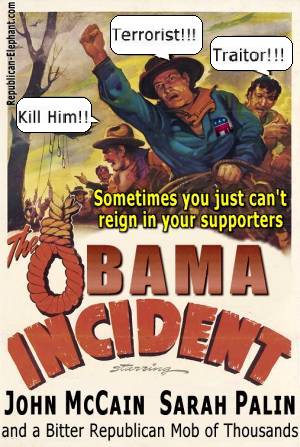
Today, on the bicycle trail at the 8th St and Cimarron intersection, some Neo-Nazi punk wrote in orange chalk “NUKE OBOMA”.
 
I know it was one of Sarah and John’s supporters because the stupid coward bastard couldn’t even spell Obama right.

Sarah handiwork.They’re getting their anti-Obama rhetoric, the accusations of “Terrorism” the racist use of “Muslim”, “Arab”, and “Half-rican American” directly from people like Rush Limbaugh and Corsi, people who DO pal around with Terrorists, StormFront to be exact.

Gunny Bob will probably object to that, but hey, Gunny, three words, Semper… Fi… Bitch…

Pal around with anti-American terrorists like StormFront and that’s what it comes down to, bum.

I started to write “Bubba” but typoed it, and Bum comes closer to the truth anyway.

StormFront is a host for the Nazis and the Klan, both parties who tried their damned worst to deliver America into being a tool of Adolf Hitler, and the Klan is the most prolific Domestic Terror Group in America, they’ve bombed America and Americans repeatedly and almost constantly since 1865.

They’ve killed more AMERICANS than the Viet-Cong, the Weathermen, AND al Qa’eiia COLLECTIVELY.

Now Sarah Palin and to a lesser degree her Ineffectual and doddering “Leader” John McCain are using the propaganda supplied from StormFront to condemn Barack Obama as an “Anti-American”.

How do they get away with it? Simply…

Simple Sarah is “Folksy”.

John McCain, despite going to Annapolis on his father’s dime and graduating therefrom on his daddy’s influence, (I previously misstated that McCain was a Communist Flying Ace with five American planes destroyed, but counting the one he ditched in the lake in North Viet-Nam, because he was a lousy pilot, the total is only 4) despite growing up in Georgetown, and unlike his snark in the second debate, his Daddy wasn’t constantly at sea, his daddy was essentially a high-powered Lobbyist for the Department of Defense and their partners in Murder, the so-called Defense Industry…

Yeah, THAT John McCain, who has expressed his contempt for lobbyists but is the Son of a Lobbyist and has over a hundred and forty of them managing his campaign…

Is “Folksy”

They’ll “aw, gee shucks heckfire you betcha” their slimy way out of taking responsibility for their Pathetic Cowardly Domestic Terrorist fan-club all the while egging them on in their “folksy” speeches.

And had the unmitigated gall to claim that they only campaign in parts of “the Real Pro-American America”

John, Sarah, I’ll try to be polite about this…

Screw it… Bitches, telling your Fan Club / Right Wing Lunatic Cult to KILL AMERICANS, well, hon, that’s Anti American.

You either call off your coward little pathetic Chihuahuas or we’ll call them off.

How’s that for “Folksy”?

Samuel Clemens (Mark Twain) spoke fluent “folksy”.

Held more extremely arduous, strenuous dangerous and every other kind of extremely “ous” jobs than either McCain or Palin have had ANY jobs.

The Right Wing like to adopt his writings as their own, but Tom Sawyer and Innocents Abroad and especially Huckleberry Finn, if they were to read the whole book any of them, would be seen today as they were then, Mocking the pretentiousness of the “Great American Society”.

Nowadays the excuse the Right Wing use to try to ban Huck Finn is because one of the characters is named Nigger Jim.

At the time the precursors of todays Right Wing used the notion that Nigger Jim was probably the smartest person in the whole book.

And was more of a father to young Huck than his own Pap.

Huck’s father was illiterate, and proud of it.

Jim was illiterate but kept there by law.

Huck’s father would put his boot-nails in the shape of a cross so the Devil wouldn’t reach up and grab his ankles.

Huck paid a counterfeit quarter for a counterfeit Psychic Reading where Jim channeled for a hairball from out of a cow’s stomach.

Huck and Tom had a conversation in the prior book where they described the use of a dead cat, a cemetery and a fresh grave as a cure for warts, that Huck had “got the idea from a Nigger, and they know all about superstitions”.

Those who didn’t miss the subtleties of those exchanges and concepts wanted to lynch Mark Twain.

I’m sure McCain and Palin both use the expressing “Pressing the flesh” when referring to their (certainly not elitist) Campaign without completing the phrase, “of the great unwashed”.

I bet they have staff members nearby with Handi-wipes to wash their hands with after shaking hands with Real Working People….

And mouthwash for after they kiss our babies.

That should have been “expression” but was instead a True Error in grammatic structure.

Rather than saying that people who want to go forth and Kill Barack Obama are “Real Americans” and those who don’t are “anti-america”.

That’s not a mistake, it’s a blatant LIE.

The Scamble for Africa- Darfur, Intervention, and the USA

africaThose interested in Darfur might want to check this book, ‘The Scramble for Africa’, out some when it comes out? Especially with the Biden, Obama gang headed towards the White House soon. Certainly this is a timely release for this book.

*** Book of the Month for** **October 2008*

*THE SCRAMBLE FOR AFRICA*

*Darfur — Intervention and the USA*

*Steven Fake and Kevin Funk*

*As massive human suffering continues to engulf the Darfur region of
Sudan, the crisis has garnered a rhetorical circus of saber-rattling and
hand wringing from Western politicians, media, and activists. Yet such
bluster has not halted the violence.*

*In a careful yet scathing indictment of this constellation of
holier-than-thou government leaders, corporate media outlets, and spoon-fed
NGOs, Steven Fake and Kevin Funk reveal the myriad ways in which the West
has failed Darfur.*

*Praise for Scramble for Africa:*

*”A devastating critique of the ‘humanitarian’ response of the United
States to the Darfur crisis. Well-researched, easy to read, and utterly
convincing, a crucial book for anyone concerned about achieving a morally
and politically acceptable U.S. foreign policy.”
–Richard Falk, Milbank Professor of Law Emeritus, Princeton University*

*”Sudan has been a nightmare for many. It still is. The outside world is
responsible as well. This book shows why. The authors avoid easy answers,
and provide a quality analysis with compelling arguments to revise Western
policies.”
–Jan Pronk, Special Representative of the Secretary-General and Head of
Mission for the United Nations Mission in Sudan, 2004-06 *

*”Explosive, masterful, and impeccably fair. Consider it the thinking
person’s guide to Darfur.”
-John Ghazvinian, author of **Untapped: The Scramble for Africa’s Oil*

*STEVEN FAKE and KEVIN FUNK are activists and political commentators whose
writings have been published in such media as **Foreign Policy in Focus,
Common Dreams, CounterPunch, ZNet**, and **Black Commentator**.*

*344 pages, bibliography, index
Paperback ISBN: 978-1-55164-322-9 $19.99
Hardcover ISBN: 978-1-55164-323-6 $39.99*

*For more information on **The Scramble For Africa**, our October Book of
the Month selection, including additional testimonials and Table of
Contents, see **http://www.blackrosebooks.net/darfur.htm*
* *

*The Scramble For Africa will be launched in the Boston area on October
28th. For more information see http://www.blackrosebooks.net/events.htm*

*To Order This Book, Call Toll Free 1-800-565-9523*

*Independent Publishing for Independent Minds*

*What others are saying about Scramble for Africa*

“Kevin Funk and Steven Fake have written a devastating critique of the
‘humanitarian’ response of the United States to the Darfur crisis, while
offering a genuine humane alternative that would lessen the ordeal, if not
bring it to an end. Well-researched, easy to read, and utterly convincing, a
crucial book for anyone concerned about achieving a morally and politically
acceptable U.S. foreign policy.”
*–Richard Falk, Milbank Professor of Law Emeritus, Princeton University, and
since 2002, Visiting Distinguished Professor, Global Studies, UCSB*

“Sudan has been a nightmare for many. It still is. The outside world is
responsible as well. This book shows why. The authors avoid easy answers,
and provide a quality analysis with compelling arguments to revise Western
policies.”
*–Jan Pronk, Special Representative of the Secretary-General and Head of
Mission for the United Nations Mission in Sudan, 2004-06*

“At a time when everyone from George Clooney to George Bush is an instant
expert on Darfur, Kevin Funk and Steven Fake have given us what we so
urgently need: a clear, sober assessment of the conflict and how it fits
into the foreign policy of the United States. With neither fear nor favour,
they take us back stage, show us our blind spots, and come up with some
troubling conclusions. Explosive, masterful, and impeccably fair. Consider
it the thinking person’s guide to Darfur.”
*–John Ghazvinian, author of Untapped: The Scramble for Africa’s Oil*

“A commanding exposé of the duplicitous and damaging role played by US
leaders and others in a dark drama. Well-written, well focused, deeply
informed—an excellent corrective for the many who cannot tell the difference
between humanitarian assistance and imperial aggrandizement.”
*–Michael Parenti, author of ‘Contrary Notions’ and ‘Against Empire’*

“Elegantly written, erudite without being academic, and with a forceful yet
sensible political argument, Scramble for Africa is a must read for anyone
concerned with making sense of one of the most haunting crises of our time.”
*–Stephen Eric Bronner, Rutgers University*

“Scramble for Africa: Darfur Intervention and the USA is the book we’ve all
been waiting for. Clearly written, and scholarly without losing its
skeptical edge, this new work takes on the U.S. Government and the Save
Darfur coalition alike, offering a fresh analysis of Darfur in its larger
geopolitical context. Scramble for Africa belongs on every Darfur activist’s
bookshelf.”
*–David Morse, Darfur activist and journalist*

“So much of what has been written on Darfur is either expression of
humanitarian concern without awareness of the imperial context, or
denunciation of Western perfidy without appreciation of the horrible human
tragedy that has been unfolding. In this extremely well-documented study,
Steve Fake and Kevin Funk combine deep compassion with a keen critical
analysis to show how we might best support the suffering people of Darfur.
This is a book for all those interested in working for a more just world.”
*–Stephen R. Shalom, Professor of Political Science at William Paterson
University in New Jersey and author of, among other works, Imperial Alibis:
Rationalizing US Intervention After the Cold War*

“This extremely well-researched analysis reveals the real goals of US
foreign policy in one of the greatest horrors of our generation. The authors
have produced an essential book for analysts and activists everywhere,
together with a call to action which no-one should ignore.”
*–Mark Curtis, author, Web of Deceit: Britain’s Real Role in the World*

“One of the few works to tackle honestly the vexing question of what is to
be done about Darfur. Cheerleaders for intervention and humanitarians who
persist in rosy fantasies about the U.S. role in the world have had no
trouble advocating “solutions,” but for others on the left the question has
been much more difficult. Not content, like so many, to simply wash their
hands of the question, the authors have constructed a deeply informed and
carefully reasoned argument that addresses seriously the possibilities for
constructive humanitarian interventions in an imperfect world vitiated by
great power interests and political posturing. For the cruise-missile left
and the hard-core anti-interventionist left alike, Darfur is not about
Darfur but about their own self-image; Fake and Funk rightly bring the focus
back to what is best for the people on the ground.”
*–Rahul Mahajan, activist and author of Full Spectrum Dominance: U.S. Power
in Iraq and Beyond*

“At last there is a book on Darfur that places the conflict in the context
of the new ‘scramble for Africa,’ the contest between the old imperialism of
England and its successors, the US and China. Fake and Funk’s analysis
unmasks the propagandistic deploying of powerful language alleging
‘genocide’ and the ‘world’s worst humanitarian crisis’ in Sudan for its
political advantages to the US and its neglect of the suffering of Darfur’s
victims. When analyzing the politics of the ‘Save Darfur Coalition’ the
journalists-authors work with a scalpel in a refreshing and penetrating
analysis of why the Darfur conflict became the ’cause célèbre,’ when it
should have been the war in Iraq. Activists and astute observers of the
contemporary global political scene will find this scrupulously researched
volume a must read, virtually unique among available works on the subject.”
*–Carolyn Fluehr-Lobban, Professor of Anthropology, Rhode Island College,
veteran Sudan researcher*

“For those, like myself, who have long felt both revulsion and confusion by
the humanitarian crisis in Darfur and wished to know more, this is the
perfect handbook. …an objective, dispassionate, meticulously researched
account of the conflict… The authors of Scramble for Africa… startle us with
their documentation of the little known but equally sordid role our own
government has played in Sudan for the past thirty years – suggesting that
our present official “humanitarian concerns” are merely crocodile tears
masking another agenda.”
*–Timothy Kendall, Ph. D., Senior Research Scholar, Dept. of
African-American Studies, Northeastern University and Director of
Archaeological Mission, Jebel Barkal (Karima), Sudan, Sudan Dept. of
Antiquities and Museums (NCAM), Khartoum, Sudan*

“The Scramble for Africa stands against the muck of neo-liberal ideology,
taking us through the Darfur conflict, putting it into history and allowing
us to think of a non-imperialist way to bring peace to a tormented region.
Save Darfur, surely; but as much from Washington as Khartoum, as much from
fantasies of humanitarian intervention as the brutalities of
IMFundamentalism and Islamism.”
*–Vijay Prashad, author, The Darker Nations: A People’s History of the Third
World*

“The Darfur conflict has proven to be intractable, at terrible cost to the
people of that region. There is a crying need for on-going international
activism based on a thorough analysis of Sudan and the role of the US, China
and other states. The Scramble for Africa by Kevin Funk and Steven Fake is a
well-researched, important and progressive contribution in this regard. It
should be widely read, from the White House to the grassroots.”
*–Laurie Nathan, research fellow at the London School of Economics and
member of the African Union mediation team for Darfur in 2005/6*

“This excellent book presents the basic information on the political and
military aspects of the conflict, examines the options from a clear and
transparent ethical position, and presents ways forward with a concern for
broad international implications and concern for the hundreds of thousands
of victims. It is is exactly what is needed and I hope it is very widely
read. I will recommend it to everyone.”
*–Justin Podur, writer and activist*

A.C.O.R.N. is not where vote fraud is at

A.C.O.R.N. 2008
The Association of Community Organizations for Reform Now is under attack for submitting fraudulent voter registration applications. But what the accusers don’t tell you is that by law ACORN is required to submit all forms gathered. ACORN flags those which look suspicious, but election officials feign that ACORN is trying to sneak them through.

So the GOP is pointing the finger at the organization that is itself the victim defrauded by dubiously motivated contractors. Most important, even as this slander has been leveled at ACORN for phony registration forms during past elections, no vote fraud has ultimately ever occurred. This is in contrast to the real election fraud being perpetrated by partisan election officials purging the voter roles in Swing States. The Republicans are fabricating accusations against ACORN to distract journalists from reporting the far larger, and completely effective disenfranchisement of working class voters.

Here are details submitted in ACORN’s own defense:

Fact: ACORN has implemented the most sophisticated quality-control system in the voter engagement field but in almost every state we are required to turn in ALL completed applications, even the ones we know to be problematic.

Fact: ACORN flags in writing incomplete, problem, or suspicious cards when we turn them in,. Unfortunately, some of these same officials then come back weeks or months later and accuse us of deliberately turning in phony cards. In many cases, we can actually prove that these are the same cards we called to their attention.

Fact: Our canvassers are paid by the hour, not by the card . ACORN has a zero-tolerance policy for deliberately falsifying registrations, and in the cases where our internal quality controls have identified this happening we have fired the workers involved and turned them in to election officials and law-enforcement.

Fact: No criminal charges related to voter registration have ever been brought against ACORN or partner organizations. Convictions against individual former ACORN workers have been accomplished with our full cooperation, using the evidence obtained through our quality control and verification processes — evidence which in most cases WE called to the attention of authorities

Fact: Most election officials have recognized ACORN’s good work and praised our quality control systems. Even in the cities where election officials have complained about ACORN, the applications in question represent less than 1% of the thousands and thousands of registrations ACORN has collected.

Fact: Our accusers not only fail to provide any evidence, they fail to suggest a motive: there is virtually no chance anyone would be able to vote fraudulently, so there is no reason to deliberately submit phony registrations. ACORN is committed to ensuring that the greatest possible numbers of people are registered.

Not Sons of Bitches, Dems are bitches

When the Democrats were the minority they seemed so weak. Now in the Majority they’re positively wimps. Pundits tell us it’s a lack of leadership. Why would the corporate media overlook who’s at the whip? It would seem clear that the corporations writing the legislation, funding the campaigns, and paying for the free lunch, are driving the agenda. The GOP is paid to play the white hats, and when a bill is unpopular, the Dems are pushed forward to play the creeps.

On the proposed bailout ripoff, the Dems were not the sons of bitches, they’re just the bitches. I heard a Dem scare-mongeree explain that in spite of loathing the idea of a solution which benefited the wrong people, the bailout was our only option. “All economists agree we have to do this” he said, ignoring quite a few who have urged the opposite. The interviewer interrupted to announce, this just in, the vote had failed and as a result the DOW had plunged by 700 points. She wanted his response: “Oh. My. God.”

As Bush and his GOP team stand in the shadows, the Democrats are thrust forward to “lead” the support for this criminal legislation. Whether the bill won or lost, either way the Democrats would come out looking like shits.

I’m reminded about how an invading army flushes out defenders still hiding. Send your captives into the buildings to spring the booby-traps. Make them open the doors to draw the fire. Among thugs in prison the dirty work is done by the bitches.

Except for Democracy Now, the media won’t report the authentic Democratic efforts to lead. Here’s Dennis Kucinich on the floor of Congress speaking against the bailout and asking: why, why why:

“The $700 billion bailout for Wall Street, is driven by fear not fact. This is too much money in too a short a time going to too few people while too many questions remain unanswered.

Why aren’t we having hearings on the plan we have just received? Why aren’t we questioning the underlying premise of the need for a bailout with taxpayers’ money?

Why have we not considered any alternatives other than to give $700 billion to Wall Street? Why aren’t we asking Wall Street to clean up its own mess?

Why aren’t we passing new laws to stop the speculation, which triggered this? Why aren’t we putting up new regulatory structures to protect investors? How do we even value the $700 billion in toxic assets?

“Why aren’t we helping homeowners directly with their debt burden? Why aren’t we helping American families faced with bankruptcy. Why aren’t we reducing debt for Main Street instead of Wall Street?

Isn’t it time for fundamental change in our debt based monetary system, so we can free ourselves from the manipulation of the Federal Reserve and the banks?

Is this the United States Congress or the board of directors of Goldman Sachs? Wall Street is a place of bears and bulls. It is not smart to force taxpayers to dance with bears or to follow closely behind the bulls.”

Michael Moore is more charitable about the Democrats’ actions yesterday. Here’s his update:

Friends,

Everyone said the bill would pass. The masters of the universe were already making celebratory dinner reservations at Manhattan’s finest restaurants. Personal shoppers in Dallas and Atlanta were dispatched to do the early Christmas gifting. Mad Men of Chicago and Miami were popping corks and toasting each other long before the morning latte run.

But what they didn’t know was that hundreds of thousands of Americans woke up yesterday morning and decided it was time for revolt. The politicians never saw it coming. Millions of phone calls and emails hit Congress so hard it was as if Marshall Dillon, Elliot Ness and Dog the Bounty Hunter had descended on D.C. to stop the looting and arrest the thieves.

The Corporate Crime of the Century was halted by a vote of 228 to 205. It was rare and historic; no one could remember a time when a bill supported by the president and the leadership of both parties went down in defeat. That just never happens.

A lot of people are wondering why the right wing of the Republican Party joined with the left wing of the Democratic Party in voting down the thievery. Forty percent of Democrats and two-thirds of Republicans voted against the bill.

Here’s what happened:

The presidential race may still be close in the polls, but the Congressional races are pointing toward a landslide for the Democrats. Few dispute the prediction that the Republicans are in for a whoopin’ on November 4th. Up to 30 Republican House seats could be lost in what would be a stunning repudiation of their agenda.

The Republican reps are so scared of losing their seats, when this “financial crisis” reared its head two weeks ago, they realized they had just been handed their one and only chance to separate themselves from Bush before the election, while doing something that would make them look like they were on the side of “the people.”

Watching C-Span yesterday morning was one of the best comedy shows I’d seen in ages. There they were, one Republican after another who had backed the war and sunk the country into record debt, who had voted to kill every regulation that would have kept Wall Street in check — there they were, now crying foul and standing up for the little guy! One after another, they stood at the microphone on the House floor and threw Bush under the bus, under the train (even though they had voted to kill off our nation’s trains, too), heck, they would’ve thrown him under the rising waters of the Lower Ninth Ward if they could’ve conjured up another hurricane. You know how your dog acts when sprayed by a skunk? He howls and runs around trying to shake it off, rubbing and rolling himself on every piece of your carpet, trying to get rid of the stench. That’s what it looked like on the Republican side of the aisle yesterday, and it was a sight to behold.

The 95 brave Dems who broke with Barney Frank and Chris Dodd were the real heroes, just like those few who stood up and voted against the war in October of 2002. Watch the remarks from yesterday of Reps. Marcy Kaptur, Sheila Jackson Lee, and Dennis Kucinich. They spoke the truth.

The Dems who voted for the giveaway did so mostly because they were scared by the threats of Wall Street, that if the rich didn’t get their handout, the market would go nuts and then it’s bye-bye stock-based pension and retirement funds.

And guess what? That’s exactly what Wall Street did! The largest, single-day drop in the Dow in the history of the New York Stock exchange. The news anchors last night screamed it out: Americans just lost 1.2 trillion dollars in the stock market!! It’s a financial Pearl Harbor! The sky is falling! Bird flu! Killer Bees!

Of course, sane people know that nobody “lost” anything yesterday, that stocks go up and down and this too shall pass because the rich will now buy low, hold, then sell off, then buy low again.

But for now, Wall Street and its propaganda arm (the networks and media it owns) will continue to try and scare the bejesus out of you. It will be harder to get a loan. Some people will lose their jobs. A weak nation of wimps won’t last long under this torture. Or will we? Is this our line in the sand?

Here’s my guess: The Democratic leadership in the House secretly hoped all along that this lousy bill would go down. With Bush’s proposals shredded, the Dems knew they could then write their own bill that favors the average American, not the upper 10% who were hoping for another kegger of gold.

So the ball is in the Democrats’ hands. The gun from Wall Street remains at their head. Before they make their next move, let me tell you what the media kept silent about while this bill was being debated:

1. The bailout bill had NO enforcement provisions for the so-called oversight group that was going to monitor Wall Street’s spending of the $700 billion;

2. It had NO penalties, fines or imprisonment for any executive who might steal any of the people’s money;

3. It did NOTHING to force banks and lenders to rewrite people’s mortgages to avoid foreclosures — this bill would not have stopped ONE foreclosure!;

4. It had NO teeth anywhere in the entire piece of legislation, using words like “suggested” when referring to the government being paid back for the bailout;

5. Over 200 economists wrote to Congress and said this bill might actually WORSEN the “financial crisis” and cause even MORE of a meltdown.

Put a fork in this slab of pork. It’s over. Now it is time for our side to state very clearly the laws WE want passed. I will send you my proposals later today. We’ve bought ourselves less than 72 hours.

Yours,
Michael Moore

Seven hundred times N,OOO,OOO,OOO!

Is the strategy to pay this ransom, then have the robbers intercepted as they make their escape? What other excuse will Democrats Pelosi and Reid offer for coming home with a bag full of 140,000,000,000 wooden nickels? That money’s gone if we don’t STOP THEM! STOP THEM NOW!

We hear pundits say the bailout sum is beyond comprehension. Nonsense. It’s our prosperity, our health, the pursuit of happiness we offer our children and take for granted. Gone. Unless there is still time to shout down the miscreants in Washington. As we see the politicians of every stripe complicit in this heist, and insufficient outcry in the streets, isn’t it hard not to conclude Americans are getting what they deserve? If you have any gut feeling that you DO NOT WANT TO STAND IDLY BY, listen to Michael Moore: (although the DC email/phone connection appears to have been pulled.)

Friends,

Let me cut to the chase. The biggest robbery in the history of this country is taking place as you read this. Though no guns are being used, 300 million hostages are being taken. Make no mistake about it: After stealing a half trillion dollars to line the pockets of their war-profiteering backers for the past five years, after lining the pockets of their fellow oilmen to the tune of over a hundred billion dollars in just the last two years, Bush and his cronies — who must soon vacate the White House — are looting the U.S. Treasury of every dollar they can grab. They are swiping as much of the silverware as they can on their way out the door.

No matter what they say, no matter how many scare words they use, they are up to their old tricks of creating fear and confusion in order to make and keep themselves and the upper one percent filthy rich. Just read the first four paragraphs of the lead story in last Monday’s New York Times and you can see what the real deal is:

“Even as policy makers worked on details of a $700 billion bailout of the financial industry, Wall Street began looking for ways to profit from it.

“Financial firms were lobbying to have all manner of troubled investments covered, not just those related to mortgages.

“At the same time, investment firms were jockeying to oversee all the assets that Treasury plans to take off the books of financial institutions, a role that could earn them hundreds of millions of dollars a year in fees.

“Nobody wants to be left out of Treasury’s proposal to buy up bad assets of financial institutions.”

Unbelievable. Wall Street and its backers created this mess and now they are going to clean up like bandits. Even Rudy Giuliani is lobbying for his firm to be hired (and paid) to “consult” in the bailout.

The problem is, nobody truly knows what this “collapse” is all about. Even Treasury Secretary Paulson admitted he doesn’t know the exact amount that is needed (he just picked the $700 billion number out of his head!). The head of the congressional budget office said he can’t figure it out nor can he explain it to anyone.

And yet, they are screeching about how the end is near! Panic! Recession! The Great Depression! Y2K! Bird flu! Killer bees! We must pass the bailout bill today!! The sky is falling! The sky is falling!

Falling for whom? NOTHING in this “bailout” package will lower the price of the gas you have to put in your car to get to work. NOTHING in this bill will protect you from losing your home. NOTHING in this bill will give you health insurance.

Health insurance? Mike, why are you bringing this up? What’s this got to do with the Wall Street collapse?

It has everything to do with it. This so-called “collapse” was triggered by the massive defaulting and foreclosures going on with people’s home mortgages. Do you know why so many Americans are losing their homes? To hear the Republicans describe it, it’s because too many working class idiots were given mortgages that they really couldn’t afford. Here’s the truth: The number one cause of people declaring bankruptcy is because of medical bills. Let me state this simply: If we had had universal health coverage, this mortgage “crisis” may never have happened.

This bailout’s mission is to protect the obscene amount of wealth that has been accumulated in the last eight years. It’s to protect the top shareholders who own and control corporate America. It’s to make sure their yachts and mansions and “way of life” go uninterrupted while the rest of America suffers and struggles to pay the bills. Let the rich suffer for once. Let them pay for the bailout. We are spending 400 million dollars a day on the war in Iraq. Let them end the war immediately and save us all another half-trillion dollars!

I have to stop writing this and you have to stop reading it. They are staging a financial coup this morning in our country. They are hoping Congress will act fast before they stop to think, before we have a chance to stop them ourselves. So stop reading this and do something — NOW! Here’s what you can do immediately:

1. Call or e-mail Senator Obama. Tell him he does not need to be sitting there trying to help prop up Bush and Cheney and the mess they’ve made. Tell him we know he has the smarts to slow this thing down and figure out what’s the best route to take. Tell him the rich have to pay for whatever help is offered. Use the leverage we have now to insist on a moratorium on home foreclosures, to insist on a move to universal health coverage, and tell him that we the people need to be in charge of the economic decisions that affect our lives, not the barons of Wall Street.

2. Take to the streets. Participate in one of the hundreds of quickly-called demonstrations that are taking place all over the country (especially those near Wall Street and DC).

3. Call your Representative in Congress and your Senators. (click here to find their phone numbers). Tell them what you told Senator Obama.

When you screw up in life, there is hell to pay. Each and every one of you reading this knows that basic lesson and has paid the consequences of your actions at some point. In this great democracy, we cannot let there be one set of rules for the vast majority of hard-working citizens, and another set of rules for the elite, who, when they screw up, are handed one more gift on a silver platter. No more! Not again!

Yours,
Michael Moore
MMFlint@aol.com
MichaelMoore.com

P.S. Having read further the details of this bailout bill, you need to know you are being lied to. They talk about how they will prevent golden parachutes. It says NOTHING about what these executives and fat cats will make in SALARY. According to Rep. Brad Sherman of California, these top managers will continue to receive million-dollar-a-month paychecks under this new bill. There is no direct ownership given to the American people for the money being handed over. Foreign banks and investors will be allowed to receive billion-dollar handouts. A large chunk of this $700 billion is going to be given directly to Chinese and Middle Eastern banks. There is NO guarantee of ever seeing that money again.

P.P.S. From talking to people I know in DC, they say the reason so many Dems are behind this is because Wall Street this weekend put a gun to their heads and said either turn over the $700 billion or the first thing we’ll start blowing up are the pension funds and 401(k)s of your middle class constituents. The Dems are scared they may make good on their threat. But this is not the time to back down or act like the typical Democrat we have witnessed for the last eight years. The Dems handed a stolen election over to Bush. The Dems gave Bush the votes he needed to invade a sovereign country. Once they took over Congress in 2007, they refused to pull the plug on the war. And now they have been cowered into being accomplices in the crime of the century. You have to call them now and say “NO!” If we let them do this, just imagine how hard it will be to get anything good done when President Obama is in the White House. THESE DEMOCRATS ARE ONLY AS STRONG AS THE BACKBONE WE GIVE THEM. CALL CONGRESS NOW.

He should have quit while he was ahead

john-mccain-wins-debateBefore the debate, before John McCain even announced he’d show up after all, his campaign staff released this announcement on the internet. I’m sure it’s like a newspaper writing obits ahead of time. Maybe McCain’s people wish they’d prepared a version for coming in second.

Today’s best question: Should McCain have quit while he was ahead?

‘Conspiracy to commit riot in furtherance of terrorism’?

pig cartoonAttorneys for Minnesota Nine call criminal charges ‘outrageous’ and YES they are. The real conspiracy is to extend the US government’s unconstitutional lack of legal norms given to tortured US-held POWs in places like Guantanamo to US citizens in places like Minnesota.

The conspiracy is to use the US legal system now held hostage in the hands of international war criminals lodged in DC, and to us it against ordinary Americans that might actually exercise their rights to Free Speech. The real conspiracy is to defend the undemocratic lock that 2 corporate controlled political parties have on our electoral rights in this country by jailing protesters in illegal manner.

Demand that they drop these criminal charges against these defendants now, and urge that the media begin to cover what’s going on in our country now! They are covering up these criminal actions by government policing agencies with a thick screen of silence. Defend your own freedoms (what’s left of them) NOW!

Wrong place, wrong time, wrong lessons from the RNC This columnist writes for a conservative mainstream daily and had to tone it down quite a bit. Still his writing gives a glimpse of the type of police state mentality that the biggest metropolitan area in Minnesota was put through by the federal government.

Shameful that the local politicians actually were too scared and complicit to object, and instead condoned it largely and covered it up. We have the same type of people in city government right here in Colorado Springs.

A letter from an American Soldier

I received a well written letter yesterday from an American Soldier. It was addressed to me, but I thought I’d post his arguments for general comment.

Mr. Verlo,

I stumbled upon your website by a pure stroke of accidental misfortune while searching for current news on the Fort Carson Installation.. My wife, my son and I are from Colorado, and I am an American Soldier. I am college educated and studied Middle-Eastern history, and I am well versed as it pertains to Mesopotamia, global-terror and global insurgencies.

I have deployed to Iraq twice and Afghanistan once. In 2003-2004 I served in Al-Fallujah and Ar-Ramadi in the Al-Anbar province, and in 2005-2006 in Tal’afar in the western Ninewah province with the 3d Armored Cavalry from Fort Carson (maybe you heard about the letter that Najim Abdullah wrote to George Bush about my unit?).

I spent seven months in Afghanistan training Afghani Security Forces, and would go back again to either country to serve for one reason only: to support my Soldiers. Although I am career-military, I do not now, nor did I ever support the Bush Administration or the pretenses under which we invaded Iraq. But, unfortunately, our elected officials thrust us into this mess, and we (Americans and American Military alike) are essentially left to deal with it. I am writing to you to comment on a few articles that you have authored, and provide my own opinions and citations.

First, in your article titled: “It’s in the Percentages”, you note that “apparently” 30% of Soldiers don’t have a high school education, 30% are returning with PTSD and 25% percent of their children are considered “special needs”. These are very interesting statistics, yet, you provided no citations. You go on to state that (and I quote): “I find it an absolute nightmare to imagine soldiers in positions of authority, making life and death decisions over others, who don’t know right from wrong, history from high stakes poker, or intelligence from drunken stupor. How do you reason with someone whose only motivation is their next beer?” and “It’s a war crime to subject civilian populations to rule by incompetents”. Again, very interesting. Here are some solid statistics for you, as well as citations. I chose to contrast military service members to college students in this case, but the same could be applied to any demographic (i.e., individuals who were recently laid off nation-wide, or illegal immigrants).

– 40% of college students who come from middle to upper class families engage in binge drinking on a regular (weekly) basis, as opposed to 26% of military personnel who have recently returned from combat tours overseas, where they suffered some sort of physical and/or emotional trauma (ABC news poll, 2007/2008). In addition, over 22,000 service members have called suicide hotlines in an attempt to get help (VA poll, 2008).

– 20% of college students engage in heavy drug use, as opposed to less than 5% of military personnel (ABC News Poll, 2007).

Here’s my favorite one:

3% of all college women report sexual assault at some point in their college career. In 2007, there were 2,212 reported cases of sexual assault on military installations by service members. In a military that exceeds roughly 2,000,000 people, that’s less than 1%.

Second, in your article titled: “Turning out to support fewer Troops”, you allude to Soldiers “riding in on a black cloud”. Hmmm, I’m not quite sure I understand that one. Is this a reference to the environmental damage we do with our vehicles, or the perceived “evil” that we bring with us because we are all, in fact, rapists, murderers and psychopaths?

Third, in your article titled: “Colorado Springs Military Community”, you state that (and I quote) “FIVE MAJOR MILITARY INSTALLATIONS ALREADY AND THE CITY AND COUNTY ARE BROKE”. El Paso County is broke? Since when? I would love to see a citation in reference to this one, because I have “Googled” it to no end and have found nothing that would lead me to believe anything but the contrary. The Colorado Springs Economic Development Corporation reports that: “Colorado Springs has a 3.1 million labor force within an hour radius, a Fast track permitting and planning program (30-60 days), 27 Fortune 500 Companies and a quality of life which is 70% the cost of coastal communities” (CSEDC 2008).

Sir, I have read your opinions on the media (many of which I share with you, by the way), so I would presume that you think this is a fabrication. Here’s the bottom line; the military presence in Colorado (the big, scary war-machine that we are) boosts the economy of the area due to its service members buying cars, houses (and paying taxes on their properties), shopping at local businesses, applying for and receiving loans from local banks, etc. There is no doubt in my mind that if the military left Colorado Springs, the city would continue to thrive, but the economy would noticeably decline anywhere that 30,000 people leave, military or not.

Fourth and final, in your article titled: “On Jan 14 let us not expand Fort Carson”, you state that more military in the area would make (and I quote) “Colorado Springs even more dependent on poor paying jobs, predatory businesses, and skyrocketing social problems. Only developers, car-dealers, pawn shops, strip clubs, liquor stores, social workers, jails and mortuaries benefit from a higher soldier population”. Wow, seriously? These are only issues tied to the influx of more military in the area? So, if 3,000 recently released convicted felons chose Colorado Springs as their new home, it would have less of an impact? Or how about 3,000 illegal immigrants, or 3,000 pregnant teenagers?

Well, let’s go ahead and analyze this a bit further. Developers and car-dealers will benefit from ANY new arrivals to the area, not just military. In reference to pawn shops and strip clubs, the owners of these businesses know exactly what they are doing by placing them outside of military installations. Service members are targeted by these establishments. That’s why they are placed where they are in the community. The same can be said for pay-day loan houses and used car dealerships on Powers and Academy blvd. But if you placed strip clubs next to colleges, would it still be the military that held the higher attendance record? It’s all about business strategy my friend, not the assumption that all military service members are sex-crazed, alcoholic lunatics.

Social workers, jails and mortuaries benefit wherever there are people with problems, criminals and people who have died. I suppose that again, it’s only military who fall into these categories. Ah yes, and our children are even more screwed up than we are. The fact that you said (and I quote): “The rest of us suffer increased crime and their children’s behavioral problems in our schools” vividly displays your utter incompetence and lack of any compassionate notion. You realize that less than 30% of military children who have been separated from a parent experience behavioral issues (USA Today poll, 2008)? The percentage of non-military children who experience behavioral issues as a result of a parent’s incarceration, or divorce, or even domestic abuse is almost twice as high.

Sir, I will be the first to admit that military service members are not perfect. But we are human beings, who are susceptible to the same things that civilians are. We are an easy target, because so many of us are returning home from Iraq and Afghanistan with severe problems, after having served in a war that has lost most of it’s public support (and rightly so).

What I have a hard time understanding is why people such as you exercise your freedoms of speech, protest, religion, etc, and then malign the very people who provide, protect and preserve those liberties? I am as anti-Bush as the average American left-wing protestor, but to blame service members for the actions of their elected leadership is immoral. You are essentially grouping us with Nazi’s, which is absolutely ridiculous. The Nazis’ goal was global domination, and they had no clearly defined rule of engagement. They knew that what they were doing was wrong, and did it anyway.

Does the US Military have people who behave in this manner? Absolutely, and they are dealt with within the justice system for their actions. We are in fact “just following orders” with our presence in the Middle-East. As I realize that this was also the defense of Nazi war criminals at Nurnberg, allow me to elaborate. The US military has clearly defined Rules of Engagement, and our greater mission is to stabilize an unstable region, not global control as conspiracy theorists would have everyone believe. Unless you have a solid understanding of counter-terror and counterinsurgency doctrine, you are in no position to presume anything about the US Military in the Middle-East (unless YOU have been there) other than the fact that we invaded Iraq under false pretenses. I’ll give you that one, and take it for myself as well.

Sir, have you ever held a young Iraqi child in your arms, returning him to his parents as they kiss you and your Soldiers’ cheeks, after he had been treated at a US facility because terrorists sodomized him and cut out his tongue? Have you ever looked straight into the eyes of a terrorist, who swore allegiance to Zarqawi and proclaimed himself a “holy warrior”, and seen pure evil? And while your medical personnel treated him for burns (which were sustained when he poured kerosene on a child and his father and attempted to set them on fire publicly, only succeeding to set himself on fire) he spoke perfect English and vowed to remember your name and kill your family? I presume you would view this as our fault, correct?

But here’s the difference between the American Soldier and everyone else: when it is our fault, we acknowledge it, and DO something about it. We help people, good and bad, bottom line. Do bad things happen? Of course. Are all Soldiers and Marines upright citizens? Of course not.. That’s why one Marine out of 30,000 threw a puppy off of a cliff, and four Soldiers out of 121,000 raped a 14-year old girl and killed her family. These actions were inexcusable and tragic, and the individuals in question were/are being dealt with. To generalize every American service member based on these isolated incidents vividly shows your lack of any rational thought.

So in closing, allow me to say that whether you care to acknowledge it or not, it is the MILITARY who grant and preserve liberties and who TRULY make a difference, not politicians, protestors, or half-minded anti-war bloggers. And understand (or don’t) why we are involved in the Global War on Terror, it is because it doesn’t matter whether or not you are white, black, Canadian, American, gay, straight, blind, deaf, or how many anti-Bush websites you manage or protests you attend, there are fundamentalist extremists who want to murder you and your family because you represent western culture.

I want this war to be over so badly that it consumes me at times. I do not want my son to have to see what I have seen as a result of a failed administration. Sir, we are human beings also, and I gladly serve to protect the liberty and freedom of individuals like you who don’t support me at all. So at your next rally, or the next article you write which slanders US service members, take a moment to reflect on your freedoms, and understand who it is that truly grants them. I wish you all continued health and happiness.

Sincerely,

[D.]

In the good judgment of the cops

‘Sign here on this ticket for speeding and failure to wear a seat belt (of course!). The bad news is that you have to go to court on this one.’ Thus spoke the cop as the woman sped toward her escape from being raped! In the good judgment of the cops one cannot depend, this case in point.

From our favorite paper, The Gagzette… Woman says traffic cop ignored her claim of rape This story has the ring of truth to it, as anybody stopped by the ticket-writing happy CS PD before surely can sense.

How the US and Georgia violated the South Ossetia peace plan

map_nato_021120.gifThe Russians have issued a peace plan for Georgia and the US to accept, and SURPRISE!
It’s the same peace plan that was in place before, which the US and Georgia violated by entering and attacking South Ossetia. The peace plan calls for non- aggression in South Ossetia to be monitored by peacekeeping troops. FACTBOX-Peace plan for Georgia: what is it? This peace plan is essentially the same one that the European Union has already proposed and that was already once in place.

However, it is obvious to all that the US and Georgian governments do not feel in the least obligated to abide by this plan since they have already violated it once by unilatrally sending troops into South Ossetia. Further the official US government propaganda mills in the US (the New York Times, Washington Post, George Dubya Bush, Rice, etc.) have made it clear with their continued belligerency that this attack on South Ossetia was only the beginning of the continued US government plan to now constantly attack Russia. They have no desire at all to retreat despite the human suffering their war plans are causing. They want to control the natural resources of Asia for US corporate interests and that is all that counts for them.

It seems clear that this is the new Republican plan to try to advance John McCain’s chances for entering into the White House, too, and since the Democrats share the same foreign policy goals of the Republicans they will not be able to counter the Republican offensive but will instead echo everything the Bush Administration does. The Republican plan is to simply reignite Cold War rhetoric against the nationalist capitalist regime of the country today named Russia, and to attack the Democratic Party for being supposedly weak in this campaign.

Liberal pacifists and academic Left Libertarians in the Peace Movement are also not prepared to do anything against this new neocon propaganda offensive against Russia. They also tag along with the Republicans spewing out constant anti- Chinese and anti- Russia vitriol all on their own. Their mantra has always been merely a call to equally and incessantly blame victims of US aggression alongside the blame they toss out against the US government for causing the chaos and conflict in the world today.

But how can a US Antiwar Movement be built on such a foundation like that? In fact, you hardly see these people active even going through the motions of organizing a US Antiwar Movement. It is all talk and writing for the liberal community that they are engaged in and propagandizing for, and nothing of real organizing an Antiwar Movement. By equalizing responsibility as they do, in fact they expose themselves as being US nationalists themselves despite their criticisms of the US corporate government, simply because who is to blame is not equal at all in the least.

Russia and China are now engaged by the US government in a very real war of worldwide proportions, and yet the public in the US is not even vaguely aware in the least of what their own corporate dictatorship government has planned for us all. Where will the next new fighting be started by the militarists in the White House? How can they be stopped without total disaster occurring? The future indeed does look grim.

One aspect of interest is how the US government used Georgia to muscle out the interests of all the Western European countries besides the United Kingdom This fighting has been a US power government play to mold NATO as it wants it to be molded, the Europeans be damned. See the Wall Street Journal commentary… Splits Emerge Within EU

Russia should not take any US talk of peace seriously, since the US government’s actions since the fall of the exSoviet Union have made it already clear that the US corporations merely want to beat down Russia with a big stick.

Henry David Thoreau’s writings about the military

ThoreauMost folk only know about Walden Pond and Henry David Thoreau’s reflections about the tranquility there. They think of him only as some sort of nature writer. However Thoreau was also an American anarchist whose other writings about society are not quite as well disseminated to college students. Below Henry David Thoreau writes about the American military…

A common and natural result of an undue respect for the law
is, that you may see a file of soldiers, colonel, captain,
corporal, privates, powder-monkeys, and all, marching
in admirable order over hill and dale to the wars,
against their wills, ay, against their common sense
and consciences, which makes it very steep marching
indeed, and produces a palpitation of the heart.
They have no doubt that it is a damnable business in
which they are concerned; they are all peaceably inclined.
Now, what are they? Men at all? or small movable forts and
magazines, at the service of some unscrupulous man in power?
Visit the Navy Yard, and behold a marine, such a man as an
American government can make, or such as it can make a man
with its black arts–a mere shadow and reminiscence of
humanity, a man laid out alive and standing, and already, as
one may say, buried under arms with funeral accompaniment,
though it may be,

“Not a drum was heard, not a funeral note,
As his corse to the rampart we hurried;
Not a soldier discharged his farewell shot
O’er the grave where out hero was buried.”

The mass of men serve the state thus, not as men
mainly, but as machines, with their bodies. They are the
standing army, and the militia, jailers, constables, posse
comitatus, etc. In most cases there is no free exercise
whatever of the judgement or of the moral sense; but they
put themselves on a level with wood and earth and stones;
and wooden men can perhaps be manufactured that will serve
the purpose as well. Such command no more respect than men
of straw or a lump of dirt. They have the same sort of
worth only as horses and dogs. Yet such as these even are
commonly esteemed good citizens.

from Civil Disobedience by Henry David Thoreau

Peacefully lost in the fog: American liberals’ denial of reality

Last week saw many a liberal author writing about why, in their opinions, the US government will not start a war against Iran. This is true lost-in-the-fog liberal denial of reality, though why is it? By what combination of stumbles in thought did they reach their conclusions?

These liberal academics (that’s what they are mainly), that believe that an attack on Iran is improbable, simply misread the general US public mindset. They believe that since Bush is so unpopular now that he has become entirely neutered and restrained by general disapproval. But is that really true?

Bush is unpopular so much not because Americans believe that the Iraq War was wrong, but rather because Americans think it wrong that Bush did not wrap up ‘victory’ there as quickly and as easily as they were promised. That does not mean that the general American public is now somehow a group of anti-imperialists. Quite the contrary. They still love American imperialism but just want it done more successfully.

Most liberals actually think that ‘the tide has turned’. As usual, they are totally out of touch with reality in this. Here liberals cannot even organize small street demonstrations against the Pentagon wars currently underway, yet somehow they think that they have the public behind them all the way! Talk about lost in inner space!

Quite simply, liberals mistake the fact that the corporate elite wants a new team in office for a while, with their own delusions that now they are going to get more say in management through the Democrats. You are not, Dummies! You are a side show, and the US government has a bipartisan corporate consensus that their war needs to be extended even more and this time towards Iran.

Real political power comes from independent organization, but liberals mistake groups like MoveOn for being such. They mistake all their tiny little office paid ‘peace’ groups for being a real antiwar movement. They mistake their liberal church group participation for being the necessary work that has to be done. They simply do not get it. They don’t want to get it!

The liberals simply do not have a movement going and neither do we more radical types. We have not yet currently constructed a Labor Movement, a Black or Hispanic Movement, or a Movement to Defend the Environment. These Movements simply do not exist at this time, and without them in place, the US government does not feel restrained in the least.

The government is simply going to continue with their so-called ‘Global War on Terrorism’ until we are able to do something about through our own independent organization. We have not even begun to do that yet, and we certainly are not entrenched in any sort of major success. We are losers up to now, and the liberal Democratic Party voters amongst us are addicted to losing. They lose most often when they ‘win’ even! They mistake losing for victory, thus liberal authors can write about how the Bush Administration will not do this or that, like they, the liberals, are in control now!

Yes, the sad fact of the matter is that America remains with a pro-war mindset. Americans love war! They believe that all war is theirs for the easy win. They simply do not understand why Bush and his Administration are such failures at doing just that. They are simply not antiwar in the least.

Strangely enough, liberals have been developing delusions of grandeur recently. They do think that the tide has changed. However, what evidence is there really that that is actually true? Obama might win? Talk about being really out of the loop in understanding one’s own society though!

We are in a definite danger period now. The oil industry and all the other major corporate industries, too, all want a continued and prolonged global war. They have no public opposition to this so far inside the US. And sad to say, the European middle classes are behind this game plan, too. The European populations are simply not mobilizing themselves against this global warfare. Where is this supposed change in the tide then? Certainly not in Europe, and certainly not here in America.

Sitting around with their thumbs up their rear ends saying that it is improbable that the US will attack Iran is pathetic. It is an excuse for continuing their own lack of success in actually building an independent movement against the war. The liberal community is not doing anything much other than taking it as it comes, and pretending that it won’t come when it will.
They are going to vote, and that is about all.

Global economic rapists are at it again

G8 protest
Why protest the G8 Summit July 7-9? Those hoodlums always look so determined. Here’s the rationale by the Emergency Exit Collective:

The 2008 G8 on Hokkaido, a Strategic Assessment
Emergency Exit Collective
Bristol, Mayday, 2008

The authors of this document are a collection of activists, scholars, and writers currently based in the United States and Western Europe who have gotten to know and work with each other in the movement against capitalist globalization. We’re writing this at the request of some members of No! G8 Action Japan, who asked us for a broad strategic analysis of the state of struggle as we see it, and particularly, of the role of the G8, what it represents, the dangers and opportunities that may lie hidden in the moment. It is in no sense programmatic. Mainly, it is an attempt to develop tools that we hope will be helpful for organizers, or for anyone engaged in the struggle against global capital.

I
It is our condition as human beings that we produce our lives in common.

II
Let us then try to see the world from the perspective of the planet’s commoners, taking the word in that sense: those whose most essential tradition is cooperation in the making and maintenance of human social life, yet who have had to do so under conditions of suffering and separation; deprived, ignored, devalued, divided into hierarchies, pitted against each other for our very physical survival. In one sense we are all commoners. But it’s equally true that just about everyone, at least in some ways, at some points, plays the role of the rulers—of those who expropriate, devalue and divide—or at the very least benefits from such divisions.

Obviously some do more than others. It is at the peak of this pyramid that we encounter groups like the G8.

III
The G8’s perspective is that of the aristocrats, the rulers: those who command and maintain that global machinery of violence that defends existing borders and lines of separation: whether national borders with their detention camps for migrants, or property regimes, with their prisons for the poor. They live by constantly claiming title to the products of others collective creativity and labour, and in thus doing they create the poor; they create scarcity in the midst of plenty, and divide us on a daily basis; they create financial districts that loot resources from across the world, and in thus doing they turn the spirit of human creativity into a spiritual desert; close or privatize parks, public water taps and libraries, hospitals, youth centers, universities, schools, public swimming pools, and instead endlessly build shopping malls that channels convivial life into a means of commodity circulation; work toward turning global ecological catastrophe into business opportunities.

These are the people who presume to speak in the name of the “international community” even as they hide in their gated communities or meet protected by phalanxes of riot cops. It is critical to bear in mind that the ultimate aim of their policies is never to create community but to introduce and maintain divisions that set common people at each other’s throats. The neoliberal project, which has been their main instrument for doing so for the last three decades, is premised on a constant effort either to uproot or destroy any communal or democratic system whereby ordinary people govern their own affairs or maintain common resources for the common good, or, to reorganize each tiny remaining commons as an isolated node in a market system in which livelihood is never guaranteed, where the gain of one community must necessarily be at the expense of others. Insofar as they are willing to appeal to high-minded principles of common humanity, and encourage global cooperation, only and exactly to the extent that is required to maintain this system of universal competition.

IV
At the present time, the G8—the annual summit of the leaders of “industrial democracies”—is the key coordinative institution charged with the task of maintaining this neoliberal project, or of reforming it, revising it, adapting it to the changing condition of planetary class relations. The role of the G8 has always been to define the broad strategic horizons through which the next wave of planetary capital accumulation can occur. This means that its main task is to answer the question of how 3?4 in the present conditions of multiple crises and struggles 3?4 to subordinate social relations among the producing commoners of the planet to capital’s supreme value: profit.

V
Originally founded as the G7 in 1975 as a means of coordinating financial strategies for dealing with the ‘70s energy crisis, then expanded after the end of the Cold War to include Russia, its currently face a moment of profound impasse in the governance of planetary class relations: the greatest since the ‘70s energy crisis itself.

VI
The ‘70s energy crisis represented the final death-pangs of what might be termed the Cold War settlement, shattered by a quarter century of popular struggle. It’s worth returning briefly to this history.

The geopolitical arrangements put in place after World War II were above all designed to forestall the threat of revolution. In the immediate wake of the war, not only did much of the world lie in ruins, most of world’s population had abandoned any assumption about the inevitability of existing social arrangements. The advent of the Cold War had the effect of boxing movements for social change into a bipolar straightjacket. On the one hand, the former Allied and Axis powers that were later to unite in the G7 (the US, Canada, UK, France, Italy, Germany, Japan)—the “industrialized democracies”, as they like to call themselves—engaged in a massive project of co-optation. Their governments continued the process, begun in the ‘30s, of taking over social welfare institutions that had originally been created by popular movements (from insurance schemes to public libraries), even to expand them, on condition that they now be managed by state-appointed bureaucracies rather than by those who used them, buying off unions and the working classes more generally with policies meant to guarantee high wages, job security and the promise of educational advance—all in exchange for political loyalty, productivity increases and wage divisions within national and planetary working class itself. The Sino-Soviet bloc—which effectively became a kind of junior partner within the overall power structure, and its allies remained to trap revolutionary energies into the task of reproducing similar bureaucracies elsewhere. Both the US and USSR secured their dominance after the war by refusing to demobilize, instead locking the planet in a permanent threat of nuclear annihilation, a terrible vision of absolute cosmic power.

VII
Almost immediately, though, this arrangement was challenged by a series of revolts from those whose work was required to maintain the system, but who were, effectively, left outside the deal: first, peasants and the urban poor in the colonies and former colonies of the Global South, next, disenfranchised minorities in the home countries (in the US, the Civil Rights movement, then Black Power), and finally and most significantly, by the explosion of the women’s movement of the late ‘60s and early ‘70s—the revolt of that majority of humanity whose largely unremunerated labor made the very existence “the economy” possible. This appears to have been the tipping point.

VIII
The problem was that the Cold War settlement was never meant to include everyone. It by definition couldn’t. Once matters reached tipping point, then, the rulers scotched the settlement. All deals were off. The oil shock was first edge of the counter-offensive, breaking the back of existing working class organizations, driving home the message that there was nothing guaranteed about prosperity. Under the aegis of the newly hatched G7, this counter-offensive involved a series of interwoven strategies that were later to give rise to what is known as neoliberalism.

IX
These strategies resulted in what came to be known as “Structural Adjustment” both in the North and in the South, accompanied by trade and financial liberalization. This, in turn, made possible crucial structural changes in our planetary production in common extending the role of the market to discipline our lives and divide us into more and more polarized wage hierarchy. This involved:

· In the immediate wake of ‘70s oil shock, petrodollars were recycled from OPEC into Northern banks that then lent them, at extortionate rates of interest, to developing countries of the Global South. This was the origin of the famous “Third World Debt Crisis.” The existence of this debt allowed institutions like the IMF to impose its monetarist orthodoxy on most of the planet for roughly twenty years, in the process, stripping away most of even those modest social protections that had been won by the world’s poor—large numbers of whom were plunged into a situation of absolute desperation.

· It also opened a period of new enclosures through the capitalist imposition of structural adjustment policies, manipulation of environmental and social catastrophes like war, or for that matter through the authoritarian dictates of “socialist” regimes. Through such means, large sections of the world’s population have over the past thirty years been dispossessed from resources previously held in common, either by dint of long traditions, or as the fruits of past struggles and past settlements.

· Through financial deregulation and trade liberalization, neoliberal capital, which emerged from the G7 strategies to deal with the 1970s crisis aimed thus at turning the “class war” in communities, factories, offices, streets and fields against the engine of competition, into a planetary “civil war”, pitting each community of commoners against every other community of commoners.

· Neoliberal capital has done this by imposing an ethos of “efficiency” and rhetoric of “lowering the costs of production” applied so broadly that mechanisms of competition have come to pervade every sphere of life. In fact these terms are euphemisms, for a more fundamental demand: that capital be exempt from taking any reduction in profit to finance the costs of reproduction of human bodies and their social and natural environments (which it does not count as costs) and which are, effectively, “exernalized” onto communities and nature.

· The enclosure of resources and entitlements won in previous generations of struggles both in the North and the South, in turn, created the conditions for increasing the wage hierarchies (both global and local), by which commoners work for capital—wage hierarchies reproduced economically through pervasive competition, but culturally, through male dominance, xenophobia and racism. These wage gaps, in turn, made it possible to reduce the value of Northern workers’ labour power, by introducing commodities that enter in their wage basket at a fraction of what their cost might otherwise have been. The planetary expansion of sweatshops means that American workers (for example) can buy cargo pants or lawn-mowers made in Cambodia at Walmart, or buy tomatoes grown by undocumented Mexican workers in California, or even, in many cases, hire Jamaican or Filipina nurses to take care of children and aged grandparents at such low prices, that their employers have been able to lower real wages without pushing most of them into penury. In the South, meanwhile, this situation has made it possible to discipline new masses of workers into factories and assembly lines, fields and offices, thus extending enormously capital’s reach in defining the terms—the what, the how, the how much—of social production.

· These different forms of enclosures, both North and South, mean that commoners have become increasingly dependent on the market to reproduce their livelihoods, with less power to resist the violence and arrogance of those whose priorities is only to seek profit, less power to set a limit to the market discipline running their lives, more prone to turn against one another in wars with other commoners who share the same pressures of having to run the same competitive race, but not the same rights and the same access to the wage. All this has meant a generalized state of precarity, where nothing can be taken for granted.

X
In turn, this manipulation of currency and commodity flows constituting neoliberal globalization became the basis for the creation of the planet’s first genuine global bureaucracy.

· This was multi-tiered, with finance capital at the peak, then the ever-expanding trade bureaucracies (IMF, WTO, EU, World Bank, etc), then transnational corporations, and finally, the endless varieties of NGOs that proliferated throughout the period—almost all of which shared the same neoliberal orthodoxy, even as they substituted themselves for social welfare functions once reserved for states.

· The existence of this overarching apparatus, in turn, allowed poorer countries previously under the control of authoritarian regimes beholden to one or another side in the Cold War to adopt “democratic” forms of government. This did allow a restoration of formal civil liberties, but very little that could really merit the name of democracy (the rule of the “demos”, i.e., of the commoners). They were in fact constitutional republics, and the overwhelming trend during the period was to strip legislatures, that branch of government most open to popular pressure, of most of their powers, which were increasingly shifted to the executive and judicial branches, even as these latter, in turn, largely ended up enacting policies developed overseas, by global bureaucrats.

· This entire bureaucratic arrangement was justified, paradoxically enough, by an ideology of extreme individualism. On the level of ideas, neoliberalism relied on a systematic cooptation of the themes of popular struggle of the ‘60s: autonomy, pleasure, personal liberation, the rejection of all forms of bureaucratic control and authority. All these were repackaged as the very essence of capitalism, and the market reframed as a revolutionary force of liberation.

· The entire arrangement, in turn, was made possible by a preemptive attitude towards popular struggle. The breaking of unions and retreat of mass social movements from the late ‘70s onwards was only made possible by a massive shift of state resources into the machinery of violence: armies, prisons and police (secret and otherwise) and an endless variety of private “security services”, all with their attendant propaganda machines, which tended to increase even as other forms of social spending were cut back, among other things absorbing increasing portions of the former proletariat, making the security apparatus an increasingly large proportion of total social spending. This approach has been very successful in holding back mass opposition to capital in much of the world (especially West Europe and North America), and above all, in making it possible to argue there are no viable alternatives. But in doing so, has created strains on the system so profound it threatens to undermine it entirely.

XI
The latter point deserves elaboration. The element of force is, on any number of levels, the weak point of the system. This is not only on the constitutional level, where the question of how to integrate the emerging global bureaucratic apparatus, and existing military arrangements, has never been resolved. It is above all an economic problem. It is quite clear that the maintenance of elaborate security machinery is an absolute imperative of neoliberalism. One need only observe what happened with the collapse of the Soviet bloc in Eastern Europe: where one might have expected the Cold War victors to demand the dismantling of the army, secret police and secret prisons, and to maintain and develop the existing industrial base, in fact, what they did was absolutely the opposite: in fact, the only part of the industrial base that has managed fully to maintain itself has been the parts required to maintained the security apparatus itself! Critical too is the element of preemption: the governing classes in North America, for example, are willing to go to almost unimaginable lengths to ensure social movements never feel they are accomplishing anything. The current Gulf War is an excellent example: US military operations appear to be organized first and foremost to be protest-proof, to ensure that what happened in Vietnam (mass mobilization at home, widespread revolt within the army overseas) could never be repeated. This means above all that US casualties must always be kept to a minimum. The result are rules of engagement, and practices like the use of air power within cities ostensibly already controlled by occupation forces, so obviously guaranteed to maximize the killing of innocents and galvanizing hatred against the occupiers that they ensure the war itself cannot be won. Yet this approach can be taken as the very paradigm for neoliberal security regimes. Consider security arrangements around trade summits, where police are so determined prevent protestors from achieving tactical victories that they are often willing to effectively shut down the summits themselves. So too in overall strategy. In North America, such enormous resources are poured into the apparatus of repression, militarization, and propaganda that class struggle, labor action, mass movements seem to disappear entirely. It is thus possible to claim we have entered a new age where old conflicts are irrelevant. This is tremendously demoralizing of course for opponents of the system; but those running the system seem to find that demoralization so essential they don’t seem to care that the resultant apparatus (police, prisons, military, etc) is, effectively, sinking the entire US economy under its dead weight.

XII
The current crisis is not primarily geopolitical in nature. It is a crisis of neoliberalism itself. But it takes place against the backdrop of profound geopolitical realignments. The decline of North American power, both economic and geopolitical has been accompanied by the rise of Northeast Asia (and to a increasing extent, South Asia as well). While the Northeast Asian region is still divided by painful Cold War cleavages—the fortified lines across the Taiwan straits and at the 38th parallel in Korea…—the sheer realities of economic entanglement can be expected to lead to a gradual easing of tensions and a rise to global hegemony, as the region becomes the new center of gravity of the global economy, of the creation of new science and technology, ultimately, of political and military power. This may, quite likely, be a gradual and lengthy process. But in the meantime, very old patterns are rapidly reemerging: China reestablishing relations with ancient tributary states from Korea to Vietnam, radical Islamists attempting to reestablish their ancient role as the guardians of finance and piety at the in the Central Asian caravan routes and across Indian Ocean, every sort of Medieval trade diaspora reemerging… In the process, old political models remerge as well: the Chinese principle of the state transcending law, the Islamic principle of a legal order transcending any state. Everywhere, we see the revival too of ancient forms of exploitation—feudalism, slavery, debt peonage—often entangled in the newest forms of technology, but still echoing all the worst abuses of the Middle Ages. A scramble for resources has begun, with US occupation of Iraq and saber-rattling throughout the surrounding region clearly meant (at least in part) to place a potential stranglehold the energy supply of China; Chinese attempts to outflank with its own scramble for Africa, with increasing forays into South America and even Eastern Europe. The Chinese invasion into Africa (not as of yet at least a military invasion, but already involving the movement of hundreds of thousands of people), is changing the world in ways that will probably be felt for centuries. Meanwhile, the nations of South America, the first victims of the “Washington consensus” have managed to largely wriggle free from the US colonial orbit, while the US, its forces tied down in the Middle East, has for the moment at least abandoned it, is desperately struggling to keep its grip Mexico, Central America and the Caribbean—its own “near abroad”.

XIII
In another age all this might have led to war—that is, not just colonial occupations, police actions, or proxy wars (which are obviously already taking place), but direct military confrontations between the armies of major powers. It still could; accidents happen; but there is reason to believe that, when it comes to moments of critical decision, the loyalties of the global elites are increasingly to each other, and not to the national entities for whom they claim to speak. There is some compelling evidence for this.

Take for example when the US elites panicked at the prospect of the massive budget surpluses of the late 1990s. As Alan Greenspan, head of the Federal Reserve at the time warned, if these were allowed to stand they would have flooded government coffers with so many trillions of dollars that it could only have lead to some form of creeping socialism, even, he predicted, to the government acquiring “equity stakes” in key US corporations. The more excitable of capitalism’s managers actually began contemplating scenarios where the capitalist system itself would be imperiled. The only possible solution was massive tax cuts; these were duly enacted, and did indeed manage to turn surpluses into enormous deficits, financed by the sale of treasury bonds to Japan and China. Conditions have thus now reached a point where it is beginning to look as if the most likely long term outcome for the US (its technological and industrial base decaying, sinking under the burden of its enormous security spending) will be to end up serve as junior partner and military enforcer for East Asia capital. Its rulers, or at least a significant proportion of them, would prefer to hand global hegemony to the rulers of China (provided the latter abandon Communism) than to return to any sort of New Deal compromise with their “own” working classes.

A second example lies in the origins of what has been called the current “Bretton Woods II” system of currency arrangements, which underline a close working together of some “surplus” and “deficit” countries within global circuits. The macroeconomic manifestation of the planetary restructuring outlined in XIX underlines both the huge US trade deficit that so much seem to worry many commentators, and the possibility to continually generate new debt instruments like the one that has recently resulted in the sub-prime crisis. The ongoing recycling of accumulated surplus of countries exporting to the USA such as China and oil producing countries is what has allowed financiers to create new credit instruments in the USA. Hence, the “deal” offered by the masters in the United States to its commoners has been this: ‘you, give us a relative social peace and accept capitalist markets as the main means through which you reproduce your own livelihoods, and we will give you access to cheaper consumption goods, access to credit for buying cars and homes, and access to education, health, pensions and social security through the speculative means of stock markets and housing prices.’ Similar compromises were reached in all the G8 countries.

Meanwhile, there is the problem of maintaining any sort of social peace with the hundreds of millions of unemployed, underemployed, dispossessed commoners currently swelling the shanty-towns of Asia, Africa, and Latin America as a result of ongoing enclosures (which have speeded up within China and India in particular, even as “structural adjustment policies” in Africa and Latin America have been derailed). Any prospect of maintaining peace in these circumstances would ordinarily require either extremely high rates of economic growth—which globally have not been forthcoming, since outside of China, growth rates in the developing world have been much lower than they were in the ‘50s, ‘60s, or even ‘70s—or extremely high levels of repression, lest matters descend into rebellion or generalized civil war. The latter has of course occurred in many parts of the world currently neglected by capital, but in favored regions, such as the coastal provinces of China, or “free trade” zones of India, Egypt, or Mexico, commoners are being offered a different sort of deal: industrial employment at wages that, while very low by international standards, are still substantially higher than anything currently obtainable in the impoverished countryside; and above all the promise, through the intervention of Western markets and (privatized) knowledge, of gradually improving conditions of living. While over the least few years wages in many such areas seem to be growing, thanks to the intensification of popular struggles, such gains are inherently vulnerable: the effect of recent food inflation has been to cut real wages back dramatically—and threaten millions with starvation.

What we really want to stress here, though, is that the long-term promise being offered to the South is just as untenable as the idea that US or European consumers can indefinitely expand their conditions of life through the use of mortgages and credit cards.

What’s being offered the new dispossessed is a transposition of the American dream. The idea is that the lifestyle and consumption patterns of existing Chinese, Indian, or Brazilian or Zambian urban middle classes (already modeled on Northern ones) will eventually become available to the children of today’s miners, maquila or plantation laborers, until, ultimately, everyone on earth is brought up to roughly the same level of consumption. Put in these terms, the argument is absurd. The idea that all six billion of us can become “middle class” is obviously impossible. First of all there is a simple problem of resources. It doesn’t matter how many bottles we recycle or how energy efficient are the light bulbs we use, there’s just no way the earth’s ecosystem can accommodate six billion people driving in private cars to work in air-conditioned cubicles before periodically flying off to vacation in Acapulco or Tahiti. To maintain the style of living and producing in common we now identify with “middle classness” on a planetary scale would require several additional planets.

This much has been pointed out repeatedly. But the second point is no less important. What this vision of betterment ultimately proposes is that it would be possible to build universal prosperity and human dignity on a system of wage labor. This is fantasy. Historically, wages are always the contractual face for system of command and degradation, and a means of disguising exploitation: expressing value for work only on condition of stealing value without work— and there is no reason to believe they could ever be anything else. This is why, as history has also shown, human beings will always avoid working for wages if they have any other viable option. For a system based on wage labor to come into being, such options must therefore be made unavailable. This in turn means that such systems are always premised on structures of exclusion: on the prior existence of borders and property regimes maintained by violence. Finally, historically, it has always proved impossible to maintain any sizeable class of wage-earners in relative prosperity without basing that prosperity, directly or indirectly, on the unwaged labor of others—on slave-labor, women’s domestic labor, the forced labor of colonial subjects, the work of women and men in peasant communities halfway around the world—by people who are even more systematically exploited, degraded, and immiserated. For that reason, such systems have always depended not only on setting wage-earners against each other by inciting bigotry, prejudice, hostility, resentment, violence, but also by inciting the same between men and women, between the people of different continents (“race”), between the generations.

From the perspective of the whole, then, the dream of universal middle class “betterment” must necessarily be an illusion constructed in between the Scylla of ecological disaster, and the Charybdis of poverty, detritus, and hatred: precisely, the two pillars of today’s strategic impasse faced by the G8.

XIV
How then do we describe the current impasse of capitalist governance?

To a large degree, it is the effect of a sudden and extremely effective upswing of popular resistance—one all the more extraordinary considering the huge resources that had been invested in preventing such movements from breaking out.

On the one hand, the turn of the millennium saw a vast and sudden flowering of new anti-capitalist movements, a veritable planetary uprising against neoliberalism by commoners in Latin America, India, Africa, Asia, across the North Atlantic world’s former colonies and ultimately, within the cities of the former colonial powers themselves. As a result, the neoliberal project lies shattered. What came to be called the “anti-globalization” movement took aim at the trade bureaucracies—the obvious weak link in the emerging institutions of global administration—but it was merely the most visible aspect of this uprising. It was however an extraordinarily successful one. Not only was the WTO halted in its tracks, but all major trade initiatives (MAI, FTAA…) scuttled. The World Bank was hobbled and the power of the IMF over most of the world’s population, effectively, destroyed. The latter, once the terror of the Global South, is now a shattered remnant of its former self, reduced to selling off its gold reserves and desperately searching for a new global mission.

In many ways though spectacular street actions were merely the most visible aspects of much broader changes: the resurgence of labor unions, in certain parts of the world, the flowering of economic and social alternatives on the grassroots levels in every part of the world, from new forms of direct democracy of indigenous communities like El Alto in Bolivia or self-managed factories in Paraguay, to township movements in South Africa, farming cooperatives in India, squatters’ movements in Korea, experiments in permaculture in Europe or “Islamic economics” among the urban poor in the Middle East. We have seen the development of thousands of forms of mutual aid association, most of which have not even made it onto the radar of the global media, often have almost no ideological unity and which may not even be aware of each other’s existence, but nonetheless share a common desire to mark a practical break with capitalism, and which, most importantly, hold out the prospect of creating new forms of planetary commons that can—and in some cases are—beginning to knit together to provide the outlines of genuine alternative vision of what a non-capitalist future might look like.

The reaction of the world’s rulers was predictable. The planetary uprising had occurred during a time when the global security apparatus was beginning to look like it lacked a purpose, when the world threatened to return to a state of peace. The response—aided of course, by the intervention of some of the US’ former Cold War allies, reorganized now under the name of Al Qaeda—was a return to global warfare. But this too failed. The “war on terror”—as an attempt to impose US military power as the ultimate enforcer of the neoliberal model—has collapsed as well in the face of almost universal popular resistance. This is the nature of their “impasse”.

At the same time, the top-heavy, inefficient US model of military capitalism—a model created in large part to prevent the dangers of social movements, but which the US has also sought to export to some degree simply because of its profligacy and inefficiency, to prevent the rest of the world from too rapidly overtaking them—has proved so wasteful of resources that it threatens to plunge the entire planet into ecological and social crisis. Drought, disaster, famines, combine with endless campaigns of enclosure, foreclosure, to cast the very means of survival—food, water, shelter—into question for the bulk of the world’s population.

XV
In the rulers’ language the crisis understood, first and foremost, as a problem of regulating cash flows, of reestablishing, as they like to put it, a new “financial architecture”. Obviously they are aware of the broader problems. Their promotional literature has always been full of it. From the earliest days of the G7, through to the days after the Cold War, when Russia was added as a reward for embracing capitalism, they have always claimed that their chief concerns include

· the reduction of global poverty

· sustainable environmental policies

· sustainable global energy policies

· stable financial institutions governing global trade and currency transactions

If one were to take such claims seriously, it’s hard to see their overall performance as anything but a catastrophic failure. At the present moment, all of these are in crisis mode: there are food riots, global warming, peak oil, and the threat of financial meltdown, bursting of credit bubbles, currency crises, a global credit crunch. [**Failure on this scale however, opens opportunities for the G8 themselves, as summit of the global bureaucracy, to reconfigure the strategic horizon. Therefore, it’s always with the last of these that they are especially concerned. ]The real problem, from the perspective of the G8, is one of reinvestment: particularly, of the profits of the energy sector, but also, now, of emerging industrial powers outside the circle of the G8 itself. The neoliberal solution in the ‘70s had been to recycle OPEC’s petrodollars into banks that would use it much of the world into debt bondage, imposing regimes of fiscal austerity that, for the most part, stopped development (and hence, the emergence potential rivals) in its tracks. By the ‘90s, however, much East Asia in particular had broken free of this regime. Attempts to reimpose IMF-style discipline during the Asian financial crisis of 1997 largely backfired. So a new compromise was found, the so-called Bretton Woods II: to recycle the profits from the rapidly expanding industrial economies of East Asia into US treasury debt, artificially supporting the value of the dollar and allowing a continual stream of cheap exports that, aided by the US housing bubble, kept North Atlantic economies afloat and buy off workers there with cheap oil and even cheaper consumer goods even as real wages shrank. This solution however soon proved a temporary expedient. Bush regime’s attempt to lock it in by the invasion of Iraq, which was meant to lead to the forced privatization of Iraqi oil fields, and, ultimately, of the global oil industry as a whole, collapsed in the face of massive popular resistance (just as Saddam Hussein’s attempt to introduce neoliberal reforms in Iraq had failed when he was still acting as American deputy in the ‘90s). Instead, the simultaneous demand for petroleum for both Chinese manufacturers and American consumers caused a dramatic spike in the price of oil. What’s more, rents from oil and gas production are now being used to pay off the old debts from the ‘80s (especially in Asia and Latin America, which have by now paid back their IMF debts entirely), and—increasingly—to create state-managed Sovereign Wealth Funds that have largely replaced institutions like the IMF as the institutions capable of making long-term strategic investments. The IMF, purposeless, tottering on the brink of insolvency, has been reduced to trying to come up with “best practices” guidelines for fund managers working for governments in Singapore, Seoul, and Abu Dhabi.

There can be no question this time around of freezing out countries like China, India, or even Brazil. The question for capital’s planners, rather, is how to channel these new concentrations of capital in such a way that they reinforce the logic of the system instead of undermining it.

XVI
How can this be done? This is where appeals to universal human values, to common membership in an “international community” come in to play. “We all must pull together for the good of the planet,” we will be told. The money must be reinvested “to save the earth.”

To some degree this was always the G8 line: this is a group has been making an issue of climate change since 1983. Doing so was in one sense a response to the environmental movements of the ‘70s and ‘80s. The resultant emphasis on biofuels and “green energy” was from their point of view, the perfect strategy, seizing on an issue that seemed to transcend class, appropriating ideas and issues that emerged from social movements (and hence coopting and undermining especially their radical wings), and finally, ensuring such initiatives are pursued not through any form of democratic self-organization but “market mechanisms”—to effective make the sense of public interest productive for capitalism.

What we can expect now is a two-pronged attack. On the one hand, they will use the crisis to attempt to reverse the gains of past social movements: to put nuclear energy back on the table to deal with the energy crisis and global warming, or genetically modified foods to deal with the food crisis. Prime Minister Fukuda, the host of the current summit, for example, is already proposing the nuclear power is the “solution” to the global warming crisis, even as the German delegation resists. On the other, and even more insidiously, they will try once again to co-opt the ideas and solutions that have emerged from our struggles as a way of ultimately undermining them. Appropriating such ideas is simply what rulers do: the bosses brain is always under the workers’ hat. But the ultimate aim is to answer the intensification of class struggle, of the danger of new forms of democracy, with another wave of enclosures, to restore a situation where commoners’ attempts to create broader regimes of cooperation are stymied, and people are plunged back into mutual competition.

We can already see the outlines of how this might be done. There are already suggestions that Sovereign Wealth Funds put aside a certain (miniscule) proportion of their money for food aid, but only as tied to a larger project of global financial restructuring. The World Bank, largely bereft of its earlier role organizing dams and pipe-lines across the world, has been funding development in China’s poorer provinces, freeing the Chinese government to carry out similar projects in Southeast Asia, Africa, and even Latin America (where, of course, they cannot effectively be held to any sort of labor or environmental standards). There is the possibility of a new class deal in China itself, whose workers can be allowed higher standards of living if new low wage zones are created elsewhere—for instance, Africa (the continent where struggles over maintaining the commons have been most intense in current decades)—with the help of Chinese infrastructural projects. Above of all, money will be channeled into addressing climate change, into the development of alternative energy, which will require enormous investments, in such a way as to ensure that whatever energy resources do become important in this millennium, they can never be democratized—that the emerging notion of a petroleum commons, that energy resources are to some degree a common patrimony meant primarily to serve the community as a whole, that is beginning to develop in parts of the Middle East and South America—not be reproduced in whatever comes next.

Since this will ultimately have to be backed up by the threat of violence, the G8 will inevitably have to struggle with how to (yet again) rethink enforcement mechanisms. The latest move , now that the US “war on terror” paradigm has obviously failed, would appear to be a return to NATO, part of a reinvention of the “European security architecture” being proposed at the upcoming G8 meetings in Italy in 2009 on the 60th anniversary of NATO’s foundation—but part of a much broader movement of the militarization of social conflict, projecting potential resource wars, demographic upheavals resulting from climate change, and radical social movements as potential military problems to be resolved by military means. Opposition to this new project is already shaping up as the major new European mobilization for the year following the current G-8.

XVII
While the G-8 sit at the pinnacle of a system of violence, their preferred idiom is monetary. Their impulse whenever possible is to translate all problems into money, financial structures, currency flows—a substance whose movements they carefully monitor and control.

Money, on might say, is their poetry—a poetry whose letters are written in our blood. It is their highest and most abstract form of expression, their way of making statements about the ultimate truth of the world, even if it operates in large part by making things disappear. How else could it be possible to argue—no, to assume as a matter of common sense—that the love, care, and concern of a person who tends to the needs of children, teaching, minding, helping them to become decent , thoughtful, human beings, or who grows and prepares food, is worth ten thousand times less than someone who spends the same time designing a brand logo, moving abstract blips across a globe, or denying others health care.

The role of money however has changed profoundly since 1971 when the dollar was delinked from gold. This has created a profound realignment of temporal horizons. Once money could be said to be primarily congealed results of past profit and exploitation. As capital, it was dead labor. Millions of indigenous Americans and Africans had their lives pillaged and destroyed in the gold mines in order to be rendered into value. The logic of finance capital, of credit structures, certainly always existed as well (it is at least as old as industrial capital; possibly older), but in recent decades these logic of financial capital has come to echo and re-echo on every level of our lives. In the UK 97% of money in circulation is debt, in the US, 98%. Governments run on deficit financing, wealthy economies on consumer debt, the poor are enticed with microcredit schemes, debts are packaged and repackaged in complex financial derivatives and traded back and forth. Debt however is simply a promise, the expectation of future profit; capital thus increasingly brings the future into the present—a future that, it insists, must always be the same in nature, even if must also be greater in magnitude, since of course the entire system is premised on continual growth. Where once financiers calculated and traded in the precise measure of our degradation, having taken everything from us and turned it into money, now money has flipped, to become the measure of our future degradation—at the same time as it binds us to endlessly working in the present.

The result is a strange moral paradox. Love, loyalty, honor, commitment—to our families, for example, which means to our shared homes, which means to the payment of monthly mortgage debts—becomes a matter of maintaining loyalty to a system which ultimately tells us that such commitments are not a value in themselves. This organization of imaginative horizons, which ultimately come down to a colonization of the very principle of hope, has come to supplement the traditional evocation of fear (of penury, homelessness, joblessness, disease and death). This colonization paralyzes any thought of opposition to a system that almost everyone ultimately knows is not only an insult to everything they really cherish, but a travesty of genuine hope, since, because no system can really expand forever on a finite planet, everyone is aware on some level that in the final analysis they are dealing with a kind of global pyramid scheme, what we are ultimately buying and selling is the real promise of global social and environmental apocalypse.

XVIII
Finally then we come to the really difficult, strategic questions. Where are the vulnerabilities? Where is hope? Obviously we have no certain answers here. No one could. But perhaps the proceeding analysis opens up some possibilities that anti-capitalist organizers might find useful to explore.

One thing that might be helpful is to rethink our initial terms. Consider communism. We are used to thinking of it as a total system that perhaps existed long ago, and to the desire to bring about an analogous system at some point in the future—usually, at whatever cost. It seems to us that dreams of communist futures were never purely fantasies; they were simply projections of existing forms of cooperation, of commoning, by which we already make the world in the present. Communism in this sense is already the basis of almost everything, what brings people and societies into being, what maintains them, the elemental ground of all human thought and action. There is absolutely nothing utopian here. What is utopian, really, is the notion that any form of social organization, especially capitalism, could ever exist that was not entirely premised on the prior existence of communism. If this is true, the most pressing question is simply how to make that power visible, to burst forth, to become the basis for strategic visions, in the face of a tremendous and antagonistic power committed to destroying it—but at the same time, ensuring that despite the challenge they face, they never again become entangled with forms of violence of their own that make them the basis for yet another tawdry elite. After all, the solidarity we extend to one another, is it not itself a form of communism? And is it not so above because it is not coerced?

Another thing that might be helpful is to rethink our notion of crisis. There was a time when simply describing the fact that capitalism was in a state of crisis, driven by irreconcilable contradictions, was taken to suggest that it was heading for a cliff. By now, it seems abundantly clear that this is not the case. Capitalism is always in a crisis. The crisis never goes away. Financial markets are always producing bubbles of one sort or another; those bubbles always burst, sometimes catastrophically; often entire national economies collapse, sometimes the global markets system itself begins to come apart. But every time the structure is reassembled. Slowly, painfully, dutifully, the pieces always end up being put back together once again.

Perhaps we should be asking: why?

In searching for an answer, it seems to us, we might also do well to put aside another familiar habit of radical thought: the tendency to sort the world into separate levels—material realities, the domain of ideas or “consciousness”, the level of technologies and organizations of violence—treating these as if these were separate domains that each work according to separate logics, and then arguing which “determines” which. In fact they cannot be disentangled. A factory may be a physical thing, but the ownership of a factory is a social relation, a legal fantasy that is based partly on the belief that law exists, and partly on the existence of armies and police. Armies and police on the other hand exist partly because of factories providing them with guns, vehicles, and equipment, but also, because those carrying the guns and riding in the vehicles believe they are working for an abstract entity they call “the government”, which they love, fear, and ultimately, whose existence they take for granted by a kind of faith, since historically, those armed organizations tend to melt away immediately the moment they lose faith that the government actually exists. Obviously exactly the same can be said of money. It’s value is constantly being produced by eminently material practices involving time clocks, bank machines, mints, and transatlantic computer cables, not to mention love, greed, and fear, but at the same time, all this too rests on a kind of faith that all these things will continue to interact in more or less the same way. It is all very material, but it also reflects a certain assumption of eternity: the reason that the machine can always be placed back together is, simply, because everyone assumes it must. This is because they cannot realistically imagine plausible alternatives; they cannot imagine plausible alternatives because of the extraordinarily sophisticated machinery of preemptive violence that ensure any such alternatives are uprooted or contained (even if that violence is itself organized around a fear that itself rests on a similar form of faith.) One cannot even say it’s circular. It’s more a kind of endless, unstable spiral. To subvert the system is then, to intervene in such a way that the whole apparatus begins to spin apart.

XIX
It appears to us that one key element here—one often neglected in revolutionary strategy—is the role of the global middle classes. This is a class that, much though it varies from country (in places like the US and Japan, overwhelming majorities consider themselves middle class; in, say, Cambodia or Zambia, only very small percentages), almost everywhere provides the key constituency of the G8 outside of the ruling elite themselves. It has become a truism, an article of faith in itself in global policy circles, that national middle class is everywhere the necessary basis for democracy. In fact, middle classes are rarely much interested in democracy in any meaningful sense of that word (that is, of the self-organization or self-governance of communities). They tend to be quite suspicious of it. Historically, middle classes have tended to encourage the establishment of constitutional republics with only limited democratic elements (sometimes, none at all). This is because their real passion is for a “betterment”, for the prosperity and advance of conditions of life for their children—and this betterment, since it is as noted above entirely premised on structures of exclusion, requires “security”. Actually the middle classes depend on security on every level: personal security, social security (various forms of government support, which even when it is withdrawn from the poor tends to be maintained for the middle classes), security against any sudden or dramatic changes in the nature of existing institutions. Thus, politically, the middle classes are attached not to democracy (which, especially in its radical forms, might disrupt all this), but to the rule of law. In the political sense, then, being “middle class” means existing outside the notorious “state of exception” to which the majority of the world’s people are relegated. It means being able to see a policeman and feel safer, not even more insecure. This would help explain why within the richest countries, the overwhelming majority of the population will claim to be “middle class” when speaking in the abstract, even if most will also instantly switch back to calling themselves “working class” when talking about their relation to their boss.

That rule of law, in turn, allows them to live in that temporal horizon where the market and other existing institutions (schools, governments, law firms, real estate brokerages…) can be imagined as lasting forever in more or less the same form. The middle classes can thus be defined as those who live in the eternity of capitalism. (The elites don’t; they live in history, they don’t assume things will always be the same. The disenfranchized don’t; they don’t have the luxury; they live in a state of precarity where little or nothing can safely be assumed.) Their entire lives are based on assuming that the institutional forms they are accustomed to will always be the same, for themselves and their grandchildren, and their “betterment” will be proportional to the increase in the level of monetary wealth and consumption. This is why every time global capital enters one of its periodic crises, every time banks collapse, factories close, and markets prove unworkable, or even, when the world collapses in war, the managers and dentists will tend to support any program that guarantees the fragments will be dutifully pieced back together in roughly the same form—even if all are, at the same time, burdened by at least a vague sense that the whole system is unfair and probably heading for catastrophe.

XIX
The strategic question then is, how to shatter this sense of inevitability? History provides one obvious suggestion. The last time the system really neared self-destruction was in the 1930s, when what might have otherwise been an ordinary turn of the boom-bust cycle turned into a depression so profound that it took a world war to pull out of it. What was different? The existence of an alternative: a Soviet economy that, whatever its obvious brutalities, was expanding at breakneck pace at the very moment market systems were undergoing collapse. Alternatives shatter the sense of inevitability, that the system must, necessarily, be patched together in the same form; this is why it becomes an absolute imperative of global governance that even small viable experiments in other ways of organizing communities be wiped out, or, if that is not possible, that no one knows about them.

If nothing else, this explains the extraordinary importance attached to the security services and preemption of popular struggle. Commoning, where it already exists, must be made invisible. Alternatives— Zapatistas in Chiapas, APPO in Oaxaca, worker-managed factories in Argentina or Paraguay, community-run water systems in South Africa or Bolivia, living alternatives of farming or fishing communities in India or Indonesia, or a thousand other examples—must be made to disappear, if not squelched or destroyed, then marginalized to the point they seem irrelevant, ridiculous. If the managers of the global system are so determined to do this they are willing to invest such enormous resources into security apparatus that it threatens to sink the system entirely, it is because they are aware that they are working with a house of cards. That the principle of hope and expectation on which capitalism rests would evaporate instantly if almost any other principle of hope or expectation seemed viable.

The knowledge of alternatives, then, is itself a material force.

Without them, of course, the shattering of any sense of certainty has exactly the opposite effect. It becomes pure precarity, an insecurity so profound that it becomes impossible to project oneself in history in any form, so that the one-time certainties of middle class life itself becomes a kind of utopian horizon, a desperate dream, the only possible principle of hope beyond which one cannot really imagine anything. At the moment, this seems the favorite weapon of neoliberalism: whether promulgated through economic violence, or the more direct, traditional kind.

One form of resistance that might prove quite useful here – and is already being discussed in some quarters – are campaigns against debt itself. Not demands for debt forgiveness, but campaigns of debt resistance.

XX
In this sense the great slogan of the global justice movement, “another world is possible”, represents the ultimate threat to existing power structures. But in another sense we can even say we have already begun to move beyond that. Another world is not merely possible. It is inevitable. On the one hand, as we have pointed out, such a world is already in existence in the innumerable circuits of social cooperation and production in common based on different values than those of profit and accumulation through which we already create our lives, and without which capitalism itself would be impossible. On the other, a different world is inevitable because capitalism—a system based on infinite material expansion—simply cannot continue forever on a finite world. At some point, if humanity is to survive at all, we will be living in a system that is not based on infinite material expansion. That is, something other than capitalism.

The problem is there is no absolute guarantee that ‘something’ will be any better. It’s pretty easy to imagine “other worlds” that would be even worse. We really don’t have any idea what might happen. To what extent will the new world still organized around commoditization of life, profit, and pervasive competition? Or a reemergence of even older forms of hierarchy and degradation? How, if we do overcome capitalism directly, by the building and interweaving of new forms of global commons, do we protect ourselves against the reemergence of new forms of hierarchy and division that we might not now even be able to imagine?

It seems to us that the decisive battles that will decide the contours of this new world will necessarily be battles around values. First and foremost are values of solidarity among commoners. Since after all, every rape of a woman by a man or the racist murder of an African immigrant by a European worker is worth a division in capital’s army.

Similarly, imagining our struggles as value struggles might allow us to see current struggles over global energy policies and over the role of money and finance today as just an opening salvo of an even larger social conflict to come. For instance, there’s no need to demonize petroleum, for example, as a thing in itself. Energy products have always tended to play the role of a “basic good”, in the sense that their production and distribution becomes the physical basis for all other forms of human cooperation, at the same time as its control tends to organize social and even international relations. Forests and wood played such a role from the time of the Magna Carta to the American Revolution, sugar did so during the rise of European colonial empires in the 17th and 18th centuries, fossil fuels do so today. There is nothing intrinsically good or bad about fossil fuel. Oil is simply solar radiation, once processed by living beings, now stored in fossil form. The question is of control and distribution. This is the real flaw in the rhetoric over “peak oil”: the entire argument is premised on the assumption that, for the next century at least, global markets will be the only means of distribution. Otherwise the use of oil would depend on needs, which would be impossible to predict precisely because they depend on the form of production in common we adopt. The question thus should be: how does the anti-capitalist movement peak the oil? How does it become the crisis for a system of unlimited expansion?

It is the view of the authors of this text that the most radical planetary movements that have emerged to challenge the G8 are those that direct us towards exactly these kind of questions. Those which go beyond merely asking how to explode the role money plays in framing our horizons, or even challenging the assumption of the endless expansion of “the economy”, to ask why we assume something called “the economy” even exists, and what other ways we can begin imagining our material relations with one another. The planetary women’s movement, in its many manifestations, has and continues to play perhaps the most important role of all here, in calling for us to reimagine our most basic assumptions about work, to remember that the basic business of human life is not actually the production of communities but the production, the mutual shaping of human beings. The most inspiring of these movements are those that call for us to move beyond a mere challenge to the role of money to reimagine value: to ask ourselves how can we best create a situation where everyone is secure enough in their basic needs to be able to pursue those forms of value they decide are ultimately important to them. To move beyond a mere challenge to the tyranny of debt to ask ourselves what we ultimately owe to one another and to our environment. That recognize that none this needs to invented from whole cloth. It’s all already there, immanent in the way everyone, as commoners, create the world together on a daily basis. And that asking these questions is never, and can never be, an abstract exercise, but is necessarily part of a process by which we are already beginning to knit these forms of commons together into new forms of global commons that will allow entirely new conceptions of our place in history.

It is to those already engaged in such a project that we offer these initial thoughts on our current strategic situation.

Chomsky: the US public is irrelevant

Al Jazeera’s INSIDE USA has a recent interview with Noam Chomsky. Chomsky: US public irrelevant. The partial transcript is mirrored below, as is the 2-part video: part 1 and part 2.

Part 2 of the interview:

Partial transcript:

AVI LEWSI: I’d like to start by talking about the US presidential campaign. In writing about the last election in 2004, you called America’s system a “fake democracy” in which the public is hardly more than an irrelevant onlooker, and you’ve been arguing in your work in the last year or so that the candidates this time around are considerably to the right of public opinion on all major issues.

So, the question is, do Americans have any legitimate hope of change this time around? And what is the difference in dynamic between America’s presidential “cup” in 2008 compared to 2004 and 2000?

NOAM CHOMSKY: There’s some differences, and the differences are quite enlightening. I should say, however, that I’m expressing a very conventional thought – 80 per cent of the population thinks, if you read the words of the polls, that the government is run by a few big interests looking out for themselves not for the population [and] 95 per cent of the public thinks that the government ought to pay attention to public opinion but it doesn’t.

As far as the elections are concerned, I forget the exact figure but by about three to one people wish that the elections were about issues, not about marginal character qualities and so on. So I’m right in the mainstream.

There’s some interesting differences between 2004 and 2008 and they’re very revealing, it’s kind of striking that the commentators don’t pick that up because it’s so transparent.

The main domestic issue for years … is the health system – which is understandable as it’s a total disaster.

The last election debate in 2004 was on domestic issues … and the New York Times the next day had an accurate description of it. It said that [former Democratic presidential candidate John] Kerry did not bring up any hint of government involvement in healthcare because it has so little political support, just [the support of] the large majority of the population.

But what he meant was it was not supported by the pharmaceutical industry and wasn’t supported by the financial institutions and so on.

In this election the Democratic candidates all have [health] programmes that are not what the public are asking for but are approaching it and could even turn into it, so what happened between 2004 and 2008?

It’s not a shift in public opinion – that’s the same as before, what happened is a big segment of US corporate power is being so harmed by the healthcare system that they want it changed, namely the manufacturing industry.

So, for example, [car manufacturer] General Motors says that it costs them maybe $1,500 more to produce a car in Detroit then across the border in Windsor, Canada, just because they have a more sensible healthcare system there.

Well, when a big segment of corporate America shifts its position, then it becomes politically possible and has political support. So, therefore, you can begin to talk about it.

AL: But those aren’t changes coming from pressure from below?

CHOMSKY: No, the public is the same, it’s been saying the same for decades, but the public is irrelevant, is understood to be irrelevant. What matters is a few big interests looking after themselves and that’s exactly what the public sees.

AL: And yet, you can see people agitating against the official story, even within the electoral process. There is definitely a new mood in the US, a restlessness among populations who are going to political rallies in unprecedented numbers.

What do you make of this well branded phenomenon of hope – which is obviously part marketing – but is it not also part something else?

CHOMSKY: Well that’s Barack Obama. He has his way, he presents himself – or the way his handlers present him – as basically a kind of blank slate on which you can write whatever you like and there are a few slogans: Hope, unity …

AL: Change?

CHOMSKY: Understandable that Obama is generating “enthusiasm” [Reuters]
For most people in the US the past 30 years have been pretty grim. Now, it’s a rich country, so it’s not like living in southern Africa, but for the majority of the population real wages have stagnated or declined for the past 30 years, there’s been growth but it’s going to the wealthy and into very few pockets, benefits which were never really great have declined, work hours have greatly increased and there isn’t really much to show for it other than staying afloat.

And there is tremendous dissatisfaction with institutions, there’s a lot of talk about Bush’s very low poll ratings, which is correct, but people sometimes overlook the fact that congress’s poll ratings are even lower.

In fact all institutions are just not trusted but disliked, there’s a sense that everything is going wrong.

So when somebody says “hope, change and unity” and kind of talks eloquently and is a nice looking guy and so on then, fine.

AL: If the elite strategy for managing the electorate is to ignore the will of the people as you interpret it through polling data essentially, what is an actual progressive vision of changing the US electoral system? Is it election finance, is it third party activism?

CHOMSKY: We have models right in front of us. Like pick, say, Bolivia, the poorest county in South America. They had a democratic election a couple of years ago that you can’t even dream about in the US. It’s kind of interesting it’s not discussed; it’s a real democratic election.

A large majority of the population became organised and active for the first time in history and elected someone from their own ranks on crucial issues that everyone knew about – control of resource, cultural rights, issues of justice, you know, really serious issues.

And, furthermore, they didn’t just do it on election day by pushing a button, they’ve been struggling about these things for years.

A couple of years before this they managed to drive Bechtel and the World Bank out of the country when they were trying to privatise the war. It was a pretty harsh struggle and a lot of people were killed.

Well, they reached a point where they finally could manifest this through the electoral system – they didn’t have to change the electoral laws, they had to change the way the public acts. And that’s the poorest country in South America.

Actually if we look at the poorest country in the hemisphere – Haiti – the same thing happened in 1990. You know, if peasants in Bolivia and Haiti can do this, it’s ridiculous to say we can’t.

AL: The Democrats in this election campaign have been talking a lot, maybe less so more recently, about withdrawing from Iraq.

What are the chances that a new president will significantly change course on the occupation and might there be any change for the people of Iraq as a result of the electoral moment in the US?

CHOMSKY: Well, one of the few journalists who really covers Iraq intimately from inside is Nir Rosen, who speaks Arabic and passes for Arab, gets through society, has been there for five or six years and has done wonderful reporting. His conclusion, recently published, as he puts it, is there are no solutions.

This has been worse than the Mongol invasions of the 13th century – you can only look for the least bad solution but the country is destroyed.

The war on Iraq has been a catastrophe, Chomsky says [AFP]
And it has in fact been catastrophic. The Democrats are now silenced because of the supposed success of the surge which itself is interesting, it reflects the fact that there’s no principled criticism of the war – so if it turns out that your gaining your goals, well, then it was OK.

We didn’t act that way when the Russians invaded Chechnya and, as it happens, they’re doing much better than the US in Iraq.

In fact what’s actually happening in Iraq is kind of ironic. The Iraqi government, the al-Maliki government, is the sector of Iraqi society most supported by Iran, the so-called army – just another militia – is largely based on the Badr brigade which is trained in Iran, fought on the Iranian side during the Iran-Iraq war, was part of the hated Revolutionary Guard, it didn’t intervene when Saddam was massacring Shiites with US approval after the first Gulf war, that’s the core of the army.

The figure who is most disliked by the Iranians is of course Muqtada al-Sadr, for the same reason he’s disliked by the Americans – he’s independent.

If you read the American press, you’d think his first name was renegade or something, it’s always the “renegade cleric” or the “radical cleric” or something – that’s the phrase that means he’s independent, he has popular support and he doesn’t favour occupation.

Well, the Iranian government doesn’t like him for the same reason. So, they [Iran] are perfectly happy to see the US institute a government that’s receptive to their influence and for the Iraqi people it’s a disaster.

And it’ll become a worse disaster once the effects of the warlordism and tribalism and sectarianism sink in more deeply.

This deformed thing we call Justice

America seems poised to possibly elect a law professor into the White House later this year. Funny that this legal specialist, who taught LAW for 10 years at the University of Chicago, has remained strangely silent as the US government instituted torture into its legal codes, eliminated Habeas Corpus, and trampled whole sale on the US Constitution.

I don’t remember a bleep of protest from this legal specialist during these recent times. Where were you Barack Obama? Your specialty is law, you hide that fact??? It’s because you kept so silent, is it not? You and your party are collaborators, aren’t you?

But this is not about Barack Obama and his loud silence. It is about America’s attitudes toward the police. It is about this deformed thing in America we call Justice. It is about how the people trust the police’s word, even though there is so much evidence that the police consistently fabricate testimony, fabricate evidence, and fabricate the supposed need for their own reproduction as a cancer upon our country… one that is growing, growing, growing., just like the military.

I opened up Parade in the Springs GagShit newspaper this morning to see the question posed, ‘Do we need more police?’ Shouldn’t the question actually be, ‘Don’t we need less police?’ or ‘Are we actually safer with this growing number of police plaguing the US?’ What would your answers be to these questions? Please tax me more, I want more jails?

I borrowed this phrase ‘the deformed thing we call Justice’ from Joe Bageant’s column titled Old Dogs and Hard Time Joe is the closest approximation we have today in America, to having a live Junior version of Studs Terkel on hand. His writings always seem to highlight the real working class issues in America, and I love reading him! Power to the People, Joe!

Here is my last question… Can we really have anything other than a deformed ‘justice’ in a country that hates the common person so much? We don’t respect the common people, for all they do is just work without being able to buy that much. How despicable is America’s attitude toward them.

Dominant elite culture thinks it a crime that poor people who work and consider them lowest on the totem pole! Shame on the common people for being so low and poor!, You Guys. It’s a crime these days to be working poor! Don’t you know it?

Yes, many in America really still want to imprison yet more of the poor and working class. For that, we need yet more police, yet more ‘law’, and yet more weaponry. These perverts… this lowe echelon of worker rabble… are seen to be like foreign Muslims almost. Show them no mercy! Yes, that’s what it’s like in America with this deformed thing the powers-that-are call Justice. ‘Justice’, in the opinions of the authoritarian elites, are them ordering the kicking around of the people who actually do the hard work. The poor are considered dumb louts for doing the work we all depend on! They deserve to be punished think so many of the self- righteous, wanna-be top A-holes!

Protesters forget thinking cap stamina

COLORADO SPRINGS- Such an unfortunate characterization of the J&P.
Gazette reported 5/29/2008- WAR PROTESTERS BAIL EARLY
In the Gazette coverage of the Air Force Academy graduation, the paper featured this teaser on the front page: “War protesters bail early.” The article on page 8 began: “Air Force Academy cadets apparently are made of sterner stuff.” We can’t deny “while the cadets and their families sat through the early morning fog and drizzle, war protesters left rather than wait for the late-arriving President Bush,” but Springs activists rarely show anything but tenacity in making their point. Why would they leave early and give the media such a predictable pot shot? Do we chalk it up exclusively to our antagonistic local daily newspaper?

While it might be unfair to compare the brawn of military officers to that of septuagenarian activists, I fear this was a test of brains, and the space cadets came out on top.

The AFA had announced that President Bush was expected at 9am. His motorcade not having turned up by then prompted diverse deductions: he might have sneaked through another entrance, he might have choppered in, or he might have been called away to emergency affairs of state. Activists might also have become discouraged by the diminishing flow of cars into the event. A lack of passersby is the surest way to take the wind out of a protester’s banner. But the number of incoming having petered to nil would have been the giveaway to Bush’s impending arrival.

A presidential motorcade along an interstate has few escape routes, and so cannot begin before all vehicles have been cleared from its course. Escorts block all on-ramps over 30 minutes before to ensure the procession will encounter nothing to threaten its pace. That the AFA gates were advertised as open to attendees until 9:30am puts to lie the suggestion that Bush was expected by nine. The path would not have been unencumbered until the later time. Indeed police did not begin emptying the interstate until after nine. The motorcade sped into the North Gate by 9:45. Bush was not due to speak until eleven.

Did the protesters lose heart and/or heat? I think what the participants forfeited was thinking for themselves. Through the PPJPC, activists let the AFA relegate demonstrations to the minimally visible North Gate, and they let the AFA misinform them about Bush’s ETA. Compound this to the lukewarm organizing effort and contradictory announcements of the action plans. It’s hard to see how the J&P could have done worse if they’d tried. Low turnout, TV interviews of unprepared interviewees, and the rag-tag bunch ultimately offering the Gazette a pithy swipe at their capitulated spirit.

These are otherwise very determined activists. Usually their self-sacrifice does not include their very mission.

Here’s the full text:

AFA graduation notebook
May 28, 2008 – 5:15PM
By BILL REED and LANCE BENZEL
THE GAZETTE

Protesters miss late-arriving Bush

Air Force Academy cadets apparently are made of sterner stuff than anti-war protesters.

While the cadets and their families sat through the early morning fog and drizzle, anti-war protesters left rather than wait for a late-arriving President Bush.

By the time Bush, whose motorcade was behind schedule, passed through the North Gate, a solitary protester – carrying a sign reading, “War is not the answer” and flashing a peace symbol – was all that remained of a band of 20 people who planned to greet the president.

The rest cleared out amid slate-gray skies before the president pulled past the gate at 9:45 p.m., 45 minutes after his scheduled arrival.

South of the academy, five other protesters stood on a hillside overlooking Interstate 25 near the Fillmore exit and unfurled a cryptic message.

Their 50-foot long banner read, “Mene Mene Tekel Upharsin,” an Aramaic phrase meaning, “It has been counted and counted, weighed and divided.”

The biblical figure Daniel interpreted the so-called “writing on the wall” as a judgment against the king Belshazaar, determining that his acts had been weighed and found deficient and that his kingdom would be divided.

“We wanted to speak to him in a language he purports to listen to, which is the Bible,” said Eric Verlo. “It was a great location for the motorcade to see us.”

Made you look! President Bush sees the handwriting on the wall

bush-afa-motorcade-colorado.jpg
COLORADO SPRINGS, 9:25AM- Bush motorcade travels I-25 en route to the 2008 Air Force Academy graduation ceremony, passing our banner!

Mark Lewis has gathered media reports of the event and the actions at CSaction.

Heading up Academy Boulevard toward State Trooper on I-25 overpass
Hiking to overpass

Security measures for motorcade preclude pedestrians on overpass
State Police

Pattie holds stop-gap protest Peace banner for AFA South Gate
Peace

Unfurling 60ft banner along North Academy Boulevard
MENE MENE TEKEL UPHARSIN
Daniel 5:25 banner

More suitable site 1/4 mile North of Fillmore overpass
Radley

Pattie and Marie struggle against wind and wet
Pattie

Holding banner against fence separating I-25 from frontage road
Handwriting on the frontage fence

Vehicles are cleared from interstate, DHS white SUVs line utility roads
Clearing the path for the motorcade

Motorcade passes
Marie and Bush motorcade

With the esteemed AFA commencement speaker
Pattie and Bush motorcade

Bush armored limo
Eric and Bush motorcade

Mission Accomplished
Eric