Semper Fido Bitches

Semper FidelisCOLO. SPRINGS– Tough crowd at this week’s antiwar bannering: the usual plentiful honks of support, but now intermittent servicemen heckling in crew-cutted indignation. And we haven’t yet inaugurated our WARMONGERS GO TO HELL banner. The best the driver of a white van-load of them could muster was “Semper Fi” so they must have been Marines because they shout it like it means “America! Fuck Yeah!” Are they taught it’s abbreviated Latin for Always Faithful? I believe Fidelis is the root of Fido.

Makes sense, doesn’t it? Man’s faithful companion, the original boot-licker.

Faithful to what honestly? Not the Constitution, or law, liberty or the will of the American People. The US military boot-licking dogs pledge an oath to big oil and the rest of the corporate monied interests. Semper Bitches.

Another soldier-driver asked me with smug arrogance, where was my sign that read “Support the Troops?” Huh? I don’t support the troops. Does he support baby killers, rapists, torturers, drone-pilot-cowards and snipers? WTF. We parted calling each other names. Hippie. Blimp-neck enabler. Dirty hippie. Moron.

Do the other branches of the Defense Department resent the Marines because they don’t have their own pithy Latin je-ne-sais-quoi –literally– to represent their own mistaken-self identity? The Navy and Air Force already have a Native American name, he-who-shoots-from-cover. US Army GIs can modify the USM slogan: Semper Fuckers.

Poetry of Barack Obama invokes MLK but pays true homage to Rod McKuen

Jesus what a bore! Remember when SNL lampooned Sarah Palin’s first prime time TV interview by reenacting it verbatim? They could do that with Obama’ humorless addresses, I think it would make great theater, but the joke’s already abysmally old. Maybe we need a drinking game where everyone paying close attention could drink the moment President Obama mouthed a phrase that wasn’t a cliche or platitude. Alright, not a drinking game.

At least George Bush punctuated his utterances with inanities, funny ones. We appreciate Sarah Palin for the same preposterous gaffs. Obama’s meaningless drone is similarly inane really, divorced from meaning but colorless.

I had to revisit Obama’s Mubarak-steps-down speech to see if there was anything there. His usual podium bedside manner now hits me like chloroform. I’m not sure if Obama’s tennis ball red-state blue-state head swings aren’t calculated to hypnotize, or if the vacuity of his bombast is the prescribed anesthetic.

At first I was going to reprint the speech with the cliches highlighted. I opted to simply reformat it like a poem, putting the carriage return after each cliched platitude. I’ve parenthesized phrases which in Star Trek or ER scripts are called tech-speak, expository details whose particularities are actually irrelevant.

I’ve neither added, nor subtracted from this official transcript. I can hardly believe it myself.

There are very few moments in our lives where we have the privilege to witness history taking place.

The people of Egypt have spoken.

Their voices have been heard.

And Egypt will never be the same.

(By stepping down, President Mubarak)

responded to the Egyptian people’s hunger for change.

but this is not the end of Egypt’s transition. It’s a beginning.

I’m sure there will be difficult days ahead and

many questions remain unanswered.

But I am confident that the people of Egypt can find the answers,

and do so peacefully, constructively, and in the spirit of unity

(that has defined these last few weeks, for Egyptians have made it clear that)

nothing less than genuine democracy will carry the day.

Well, that’s just the opening paragraph. Obama follows it with more expository blah blah blah. He begins by crediting the nonviolence to Egypt’s military, instead of the incredible restraint of the student protesters.

The military has served patriotically and responsibly as a caretaker to the state and will now have to ensure a transition that is credible in the eyes of the Egyptian people.

You’ll note Obama is advising the military on appearances — very likely his definition of “meaningful.” He continues by listing the demands of the Tahrir Square demonstrators, without crediting them, as if this list was his own.

That means protecting the rights of Egypt’s citizens, lifting the emergency law, revising the constitution and other laws to make this change irreversible, and laying out a clear path to elections that are fair and free.

And then it’s a return to platitudes, encapsulating the admonition that Egyptian forums must give access to secular, “pro-democracy,” pro-Zionist pro-globalist concerns.

Above all this transition must bring all of Egypt’s voices to the table for the spirit of peaceful protest and perseverance that the Egyptian people have shown can serve as a powerful wind at the back of this change.

While he has you almost gagging Obama counterattacks with something to blow your drink through your nose. Obama promises to be the kind of friend to the newly free Egyptians that only the day before was supporting their oppressor Mubarak, and promising there’s more help where that came from.

The United States will continue to be a friend and partner to Egypt. We stand ready to provide whatever assistance is necessary and asked for to pursue a credible transition to a democracy.

And back to cliches:

I’m also confident that the same ingenuity and entrepreneurial spirit that the young people of Egypt have shown in recent days can be harnessed to create new opportunity, jobs and businesses that allow the extraordinary potential of this generation to take flight.

Isn’t this the same war-on-the Future speech he’s peddling to his domestic audience?

I know that a democratic Egypt can advance its role of responsible leadership not only in the region but around the world.

Oh you can read the rest for yourself. I’m bored.

Egypt has played a pivotal role in human history for over 6,000 years. But over the last few weeks the wheel of history turned at a blinding pace as the Egyptian people demanded their universal rights.

Alright, one more interruption. Below Obama describes watching events of the Egyptian Revolution, AS IF it was a shared American experience. The irony of course is that he watched it on Al Jazeera, while the rest of America could and did not. They would be at pains to draw the same sympathetic conclusions as he. Obama comes off quite the perceptive, humanitarian bastard.

We saw mothers and fathers carrying their children on their shoulders to show them what true freedom might look like. We saw young Egyptians say, for the first time in my life I really count. My voice is heard. Even though I’m only one person, this is the way real democracy works. We saw protestors chant… ‘We are peaceful, again and again.’

We saw a military that would not fire bullets at the people they were sworn to protect. And we saw doctors and nurses rushing into the streets to care for the wound. Volunteers checking protestors to ensure that they were unarmed. We saw people of faith praying together and chanting Muslims, Christians, we are one. And though we know the strains of faith divide too many in this world and no single event will close that chasm immediately, these scenes show us that we need not be defined by our differences. We can be defined by the common humanity that we share.?And, above all, we saw a new generation emerge, a generation that uses their own creativity and talent and technology to call for a government that represented their hopes and not their fears. A government that is responsive to their boundless aspirations. One Egyptian put it simply — most people have discovered in the last few days that they are worth something, and this cannot be taken away from them anymore. Ever.

This is the power of human dignity, and it can never be denied. Egyptians have inspired us, and they’ve done so by putting the eye to the idea that justice is best gained through violence. For in Egypt it was the moral force of nonviolence, not terrorism, not mindless killing, but nonviolence, moral force that bent the arc of history toward justice once more. And while the sights and sounds that we heard were entirely Egyptian, we can’t help but hear the echoes of history, echoes from Germans tearing down a wall, Indonesian students taking to the streets, Gandhi leading his people down the path justice. As Martin Luther King said in celebrating the birth of a new nation in Ghana while trying to perfect his own, there’s something in the soul that cries out for freedom.

Those were the cries that came from Tahrir square and the entire world has taken note. Today belongs to the people of Egypt, and the American people are moved by these scenes in Cairo and across Egypt because of who we are as a people and the kind of world that we want our children to grow up in. The word ‘Tahrir’ means liberation. It’s a word that speaks to that something in our souls that cries out for freedom. And forever more it will remind us of the Egyptian people, of what they did, of the things that they stood for, and how they changed their country and in doing so changed the world. Thank you.

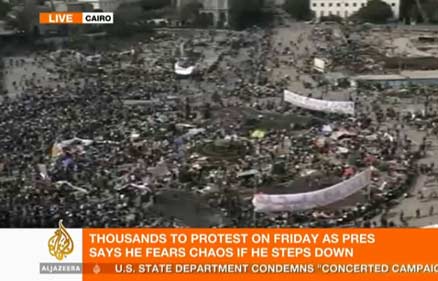
Crowd builds in Al Tahrir Square, Cairo, two million defy Mubarak intimidation

Al Jazeera has reasserted live footage in Cairo today, for the Friday demonstration billed as “Day of Departure” meant to depose dictator Mubarak. Already gone are the US major network talking heads, fleeing in advance the predicted mayhem as if to dot the exclamation point of their Chaos in Egypt meme. Alas, they won’t be here to offer color commentary on the hundreds of dozens of demonstrators of indeterminate religious-political orientation massing for Egyptian on Egyptian rioting. For the rest of us, this is a veritable revolution before our eyes. Perhaps the monumental event of our lifetime. Regardless the outcome, most of us are probably so estranged from reality to recognize it. This is what Democracy looks like.

We only know representative democracy, warped beyond recognition by an electoral college system only a statistician’s mother could love. Switzerland is the only direct democracy we’re taught in school. But democratic participation in Switzerland is not much more complicated than a homeowners association in an affluent neighborhood. People power taking to the street, denouncing the illegitimacy of its authoritarian masters, leaderless, allied, that’s real democracy.

What a shame the American celebrities are missing the party. Williams and Couric fled with the expat community, Amanpour is already giving her veneer of respectability to the next interviewee, Zuckerberg not Assange, because the corporate media wants to call this a Facebook revolution sooner than Wikileaks’. Anderson Cooper is cowering on the hotel floor of an undisclosed location, unafraid to confess that he’s fearing for his life, working that [brown] people-are-revolting angle.

On the heroic independent media side, Democracy Now! correspondent Sharif Abdel Kouddous spent the night in Tahrir Square, sleeping among the activists, half of them with bandaged heads, waking at intervals by the alarm sounding for anticipated stone-throwers.

None of the network journos showed any hesitation to criticize the harassment they encountered on the streets, though blaming Mubarak’s thugs was never explicit, and none of them veered from celebrating the riots as “Egypts killing each other.” Even Al Jazeera pretended to confuse the Pro and Anti sides, failing to discriminate between the side which was armed from the side taking cover, the knife wielders from desperate stone throwers trying to keep their attackers at bay.

Finally this morning an AJ text crawl mentioned 300 fatalities since the protests began January 25th, otherwise there has been scant mention of innocent civilians killed, some of them shot in the head by nighttime snipers.

All of the networks, even Al Jazeera express their incredulity that the demonstrators project no central leadership, failing to speculate why that may be.

Al Jazeera takes care to mention, every time they consult one of their three correspondents on the ground, that they omit speaker identities “for their own safety.” Even when they interview activists, the AJ anchors thank them for being brave enough to reveal their real names. Not discussed is the certain probability that calling out a demonstration leader will direct the security apparatus to deploy their snipers, summary arrest, or detention of family members. As the media wax horrific the barbarity of Cairo’s street culture chaos, they maintain a rudely unrealistic civil pretense to mask Egypt’s cruel police state.

My nightmare scenario, now that I’m looking over millions of peaceful undaunted Egyptians chanting for deliverance from their uncaring dictator? I worry about the US advisors reported to have flown into Cairo this morning, reassuring their cabby, it was reported, that everything was going to be fine.

I worry that Washington has spot on advice to offer Mubarak about how to respond to a “million man march.” After all, that’s old hat for DC. Let ’em eat waffle cake.

American protesters get the same response from Obama as they did from Bush 43. Praise for the glorious display of citizens exercising their constitutional rights. Talk away, shout it to the rooftops. Feel better? I hear you America. Thank you for your faith in the system. You are the change you’ve been waiting for. Please collect your refuse on the way out. Be sure to leave something in the hat to cover the expense of the Port-a-Johns. Thank you America, I’m honored, really. Yes we can, see you at the polls in 2012. Thank you for flying Air of Democracy. Bu’bye.

You can lead a horse to water, but will it give a statement to the press?

From the horse’s mouth: Nope.
On advice of lawyer, don’t talk about arrest. On advice from retired lawyers: civil liberties issue iffy. Advice gleaned from the overworked ACLU: case not as good as others we’ve got. Advice from friends: hope for a plea deal. Request from PPJPC colleagues: pretend we don’t know you. Advice about the press: “Generally they don’t have much interest in this kind of thing.” FAIL.
 
I have to confess, my pretending yesterday about an intentional plan to fly under-the-radar was sarcasm. I had no idea the extent to which the sublimation of the “MEPP” Kulp/Nace arrests was premeditated. No mention of the court date in the PPJPC Active For Justice weekly email, the arrestees’ spirits driven down by the defeatism prescribed above. I raise this criticism not to victimize the defendants further, but to question this apparently endemic predilection for hemlock.

Protesters say arrests unjust

Exactly how valuable is it to have colleagues with legal experience enough to vacillate about your courtroom chances being between cross-your-fingers and dismal? What good a lawyer whose own sense of your pre-verdict innocence is ambivalent? What confidence is lifted being told it will all depend on the judge? I’ve always thought a lawyer who counsels activists to shut up while their prosecution is pending, lest innocence incriminate itself, is not suited to activists as clients.

Most troubling is the impression which the ACLU gives in its habitual reluctance to express enthusiasm for a case. The Denver ACLU in particular is famously overburdened, and they are inundated with solicitations for representation. Better in my opinion to decline with apologies than to leave inquirers doubting their trampled civil liberties may not have been sufficiently flattened. Free speech is either or. Restricted free speech is restricted speech. Or are we prepared to call it the 1.01 Amendment (revised for 2011)?

Behind the scenes, only hours after the fact, the ACLU can reveal that the November arrests and the policy which the city acted upon were patently unconstitutional. So how can we expedite that kind of reassurance to activists before the fact? Because of course such arrests are only serving to scare the public from even thinking about dissent. In fact this is the preemptive aim of these actions.

I count my own success at avoiding arrest, as I find myself defying authority sometimes nose to nose, with nonchalance because I know my rights. I KNOW MY RIGHTS. That argument appears to register with police officers when you say it as if you’re reassuring them, projecting a shrug and a smile, relieving them of having to rationalize acting against you. When you are confident of your rights there is nothing to compromise but practical considerations, lawful orders which the officer is able to show you are warranted.

You can retreat to a public sidewalk once a policeman has proven he had sufficient authority to make the request. A landlord who has contracted the use of his land to tenants does not have absolute say without their consultation. It’s not even reasonable of him to call in the police if no one is complaining and you are not creating a disturbance. To know these things empowers you to stand your ground when overzealous officers of the law think they can throw their weight around. How do we rekindle that essential confidence in our civil rights?

Pictured: Ted Nace with Rita, Pattie, Eric, Esther, Bill, and Loring

The other confidence-stealing factor at play in this case is an activist organization insisting that its members protest under a different name, to avoid offending members who didn’t agree. On its website, the PPJPC claims the MEPP as a subcommittee, but for the day of action and in subsequent news coverage, no affiliation.

If you consider that the Middle East Peace Project’s objective is to win over public awareness and sympathy, it seems horribly defeatist to think that you can’t even appeal to your own fellow members. Not to mention that you can’t trade on the reputation that sustains your mother organization, instead you have to emerge out of the blue, like any other holders of extremist views.

When protesters are having to excuse themselves and the unintended perhaps unwarranted commotion they’ve caused, and have to pretend to be acting autonomously because they can’t make their case to their own colleagues, it’s a recipe for what happened here. Activists kowtowed and self-censored.

And so, how to ally yourself with such impediments? Coloradans For Peace has to cut the PPJPC out of the loop so long as its decision makers are so dominated by naysayers, pretenders, NVC appeasers, and a staff which reports their every intention to the police. You can’t even discuss strategy in such a circle.

Should local Israel boycott arrestees face wrongful charges alone, without your support or media scrutiny?

COLORADO SPRINGS- There’s a plan tomorrow, Thursday Jan 6 at 1:30, for the first court appearance of BDS activists Cyndy Kulp and Ted Nace, arrested in November at a local shopping center, and charged with trespass to curtail their free speech. THE PLAN is for the two Middle East Peace Project activists to follow legal procedures unobtrusively, no press, no statements, no calling attention to the Israeli war crime they were protesting, or now the patently unconstitutional abridgment of their civil liberties. Self-censorship does seem odd when the original goal was to raise public outcry about injustice in Palestine. Isn’t media scrutiny otherwise the only opportunity which knocks when you’re gagged by wrongful arrest? Not much of a plan. Are veteran BDS campaigners Coloradans For Peace going to disrupt tomorrow’s agenda to sweep BDS/Free-Speech under the rug? HELL YES.

A strategy of keeping your head low, of tempering your message to avoid offense, of your sponsors and allies disassociating themselves from you, is a plan for mice not men.

While it might feel unseemly to call attention to yourself, even as a victim of injustice, that’s the same inhibition that keeps so-called advocates for social reform from protesting in public in the first place. Standing on the sidewalk, holding a sign is about trying to draw attention.

Long time peace activists Kulp and Nace need not check their outspoken humanitarian compulsions at the door tomorrow. Please turn up at 1PM tomorrow outside the Municipal Courthouse to show your support and help the two raise their voices to further the message about which they feel so passionately.

COLORADANS FOR PEACE is scheduling a press conference tomorrow at 1PM to object to the city’s recently unveiled policy of enforcing severe limitations on rights guaranteed by the First Amendment. In the past this harassment has been aimed at antiwar protest, now it is being used to silence critics of Israeli Apartheid and the illegal subjugation of the Palestinian people. If either of these issues is important to you, please come lend your voice.

Below is the policy which the City of Colorado Springs is seeking to enforce:

COLORADO SPRINGS POLICE DEPARTMENT BULLETIN

ORIGINATED BY: COMMANDER BRIAN GRADY
APPROVED BY: DC PETER CAREY
DATE ISSUED: 05-17-10
GENERAL TOPIC: FIRST AMENDMENT RIGHTS
SERIAL NO: 013-10(P)

The legal counsel for some large business owners has contacted the City Attorney’s Office to request that the Police Department enforce trespassing laws against individuals circulating petitions or otherwise expressing free speech views on their private property. Senior Attorney Will Bain has communicated with the attorneys and has done legal research to determine the current law regarding free speech on private property. Senior Attorney Bain advised that the private rights of the business owner outweigh the free speech rights of the individual.

Additionally, the research by the City Attorney’s Office indicates that at this time the Citadel Mall, Chapel Hills Mall, the First and Main Shopping Center, the World Arena, and University Village can be interpreted to be public areas due to their size, number of stores, and past court rulings. While the malls and shopping center can still impose time, place, and manner restrictions, the charge of trespass will not be appropriate for these five locations in Colorado Springs when addressing free speech rights. BOLOs have been placed on these addresses as a reminder.

All sergeants and officers shall review the additional changes and detailed procedures to be followed in these type cases, which are outlines in General Order 701, dated 01/13/10.

Here is the Coloradans For Peace press release:

Coloradans For Peace and its social justice allies unequivocally reject the City of Colorado Springs assertion to limit free speech rights on public or private property. We reject the conclusion alleged by the City Attorney that current law allows for initiating trespassing charges to curtail individuals “expressing free speech views.”

Whether against antiwar protesters, or activists boycotting Israeli goods stolen from occupied people in violation of international law, we feel that municipal policies should seek to defend, not inhibit, the First Amendment rights of its residents and citizens.

CFP objects to the attempt to set precedent whereby private property landowners operating facilities open to the public can dictate what civil liberties they will allow or disallow. And we certainly oppose law enforcement behavior which takes it upon itself to enforce trespassing charges without being summoned by the traditional complaints to warrant legitimate intervention by police officers.

PPJPC drops justice & peace in favor of Judas kiss & Participatory militarism

You don’t care what our neighborhood Pikes Peak Justice & Peace Commission has gotten its leash tangled around –I shouldn’t– but the latest is just too funny. FIRST, in November they sponsored an Israel-BDS protest to boycott a local Ahava outlet and promptly got two participants arrested. Wrongly of course, but the police were awaiting them with a letter fashioned for the occasion by the City Attorney giving the CSPD authority to drive the activists from the private property. Although planning had been kept on the QT, do you think the reception might have been due to monthly confabs which the PPJPC executive director keeps with city law enforcement? Later in debriefing, the director pronounced his incredulity that the “new policy” hadn’t been spelled out to him at the last meeting. So what kinds of things do the PPJPC & CSPD discuss? SECOND, just as the PPJPC fell for the Save Darfur intervention-as-peacemaking faketivism, then zipped it for Obama’s false hopetivism, now the pitiful dupes call their Muslim-Jewish-Christian “Evening in Jerusalem” gathering a THREE CUPS OF TEA PARTY! Would this be in deference to Greg Mortenson‘s Western Empire [school] building enterprise? That puts the PPJPC in the company of the Pentagon and the Department of Homeland Security, Mortenson’s biggest boosters. The next chance I get I will ask known J&P’ers I promise you — who are the Idiot Iscariots taking this tack? The PPJPC is soliciting donations from earnest yous and mes in the name of peace and justice, to advocate for forfeiting civil liberties and 3CoT’s participatory militarism.

On the AHAVA arrests, do we know who tipped off the cops? Not really, but we know the city’s actions didn’t spring from the media press releases which went out the day before. How much lead time do you figure is required to solicit a written policy from the city attorney’s office? Who had that kind of foresight?

The official word was that the “new policy” delineating which shopping centers might be major enough to be considered public spaces, and which were only average-sized neighborhood no-free-speech zones, was drafted to preempt populist petitioner Doug Bruce from assailing shoppers at will. But he prevailed against the trespassing charges pressed against him by Costco didn’t he. So that pretext doesn’t wash, and by no stretch of the law would a Costco parking lot be considered public.

There is already legal precedence for shopping centers not being considered the new town squares, and the state of Colorado has already put freedom-seekers aspiring to assemble in malls that they must abide by individual mall rules of conduct. At Chapel Hills mall is means, by permit, one at a time, no more than one day per quarter, no handouts, and a moratorium on all social causes over the holiday shopping period.

So a city-wide policy penned by their counsel giving explicit authority for police to remove activists from private property would seem redundant and by its intentional breadth, unconstitutional. But it gives cops-on-the-beat ground not to vacillate.

However CSPD learned about the J&P plans, wouldn’t it seem a crippling limitation to be meeting with the police on a regular basis to give them a heads up about any events that might concern them?

Keep in mind, the PPJPC executive director is avowedly protest-averse. He’s stated he doesn’t see the value to public demonstrations, and they certainly disrupt his ongoing strategy to ingratiate himself and his non-profit into the fabric of local conformist NGOs.

In the case of the Ahava boycott, though the protest was organized by a subcommittee of the PPJPC, toward the press the activists were told to identify themselves only as Middle East Peace Project. That was the PPJPC wouldn’t be tainted by any negativity which the action might draw. You’d think that choosing to distance yourself from motivated peace activists would be justification enough to pretend not knowing of their plans when the police are chatting you up for clues.

What good does it serve organizers if a parent organization is going to maintain plausible deniability but at the same time is helping law enforcement keep tabs on your plans.

There was nothing illegal about the plan to picket the Ahava store. There was nothing illegal about assembling on a shopping center parking lot which is open to the public. There is no need to alert the local police if the only result is that they will finagle a ruling by which you are prevented from exercising your constitutional guaranteed rights.

Are FBI raids on activists focused on UNAC strategies?

The UNAC is claiming that recent FBI raids on the offices of various antiwar organizations are linked to those which attended its July conference, an attempt to coordinate national antiwar activities.

Even the title of the conference was never pinned down. Here are the 28 action points decided for the upcoming year, which reads like a clearinghouse of ideas.

Action Program Adopted by the National Conference to Bring the Troops Home Now!

Albany, New York, July 25, 2010

1.
The Rainbow PUSH Coalition and the United Auto Workers (UAW) have invited peace organizations to endorse and participate in a campaign for Jobs, Justice, and Peace. We endorse this campaign and plan to be a part of it. On August 28, 2010, in Detroit, we will march on the anniversary of that day in 1963 when Walter Reuther, president of the UAW, Martin Luther King, Jr., and other civil rights leaders joined with hundreds of thousands of Americans for the March on Washington. In Detroit, prior to the March on Washington, 125,000 marchers participated in the Freedom Walk led by Dr. King. At the march, King delivered his “I Have a Dream” speech for the first time before sharing it with the world in Washington. This year, a massive march has been called for October 2 in Washington. We will begin to build momentum again in Detroit on August 28th. We also endorse the August 28, 2010 Reclaim the Dream Rally and March called by Rev. Al Sharpton and the National Action Network to begin at 11 a.m. at Dunbar High School, 1301 New Jersey Avenue Northwest, Washington D.C. .

2.
Endorse, promote and mobilize for the Saturday, October 2nd “One Nation” march on Washington, DC initiated by 1199SEIU and the NAACP, now being promoted by a growing coalition, which includes the AFL-CIO and U.S. Labor Against the War, and civil rights, peace and other social justice forces in support of the demand for jobs, redirection of national resources from militarism and war to meeting human needs, fully funding vital social programs, and addressing the fiscal crisis of state and local governments. Organize and build an antiwar contingent to participate in the march. Launch a full-scale campaign to get endorsements for the October 2 march on Washington commencing with the final plenary session of this conference.

3.
Endorse the call issued by a range of student groups for Thursday, October 7, as a national day of action to defend education from the horrendous budget cuts that are laying off teachers, closing schools, raising tuition and limiting access to education, especially for working and low income people. Demand “Money for Education, not U.S. Occupations” and otherwise link the cuts in spending for education to the astronomical costs of U.S. wars and occupations.

4.
Devote October 7-16 to organizing local and regional protests to commemorate the ninth anniversary of the invasion and occupation of Afghanistan through demonstrations, marches, rallies, vigils, teach-ins, cultural events and other actions to demand an immediate end to the wars and occupations in both Iraq and Afghanistan and complete withdrawal of all military forces and private security contractors and other mercenaries. The nature and scheduling of these events will reflect the needs of local sponsors and should be designed to attract broad co-sponsorship and diverse participation of antiwar forces with other social justice organizations and progressive constituencies.

5.
The U.S. military is the largest polluter in the world. Therefore, we endorse the “climate chaos” demonstration in Washington D.C. on October 11, coordinated by the National Campaign for Nonviolent Resistance.

6.
Support and build Remember Fallujah Week November 15-19.

7.
Join the new and existing broad-based campaigns to fund human needs and cut the military budget. Join with organizations representing the fight against cutbacks (especially labor and community groups) to build coalitions at the city/town, state and national level. Draft resolutions for city councils, town and village meetings and voter referendum ballot questions linking astronomical war spending to denial of essential public services at home. (Model resolutions and ballot questions will be circulated for consideration of local groups.) Obtain endorsements of elected officials, town and city councils, state parties and legislatures, and labor bodies. Work the legislative process to make military spending an issue. Oppose specific military funding programs and bills, and couple them with human needs funding issues. Use lobbying and other forms of protest, including civil disobedience campaigns, to focus attention on the issue.

8.
Mid-March, 2011 nationally coordinated local teach-ins and protests to mark the eighth year of the Iraq War and to prepare for bi-coastal spring demonstrations the following month.

9.
Bi-Coastal mass spring mobilizations in New York City, San Francisco and Los Angeles on April 9, 2011. These will be accompanied by distinct and separate non-violent direct actions on the same day. A prime component of these mobilizations will be major efforts to include broad new forces from youth to veterans to trade unionists to civil and human rights groups to the Arab, Muslim and other oppressed communities, to environmental organizations, social justice and faith-based groups. Veterans and military families will be key to these mobilizations with special efforts to organize this community to be the lead contingent. Launch a full-scale campaign to get endorsements for these actions commencing with the final plenary session of this conference.

10.
Select a week prior to or after the April actions for local lobbying of elected officials at a time when Congress is not in session. Lobbying to take multiple forms from meeting with local officials to protests at their offices and homes. We will attend the town hall meetings of our Congresspersons and confront them vigorously on their support for the wars and occupations of Iraq and Afghanistan and sanctions on Iran. We also will press them on the unconstitutional diminution of the civil liberties of all Americans and targeted populations.

11.
Consistent with the call to include broad popular sectors of society in our efforts and to contend with the challenges of opposing U.S. wars and occupations while also rejecting attacks at home, National Peace Conference participants will join May Day actions on May 1, 2011, so as to unite all those standing against war and for rights. U.S. military and trade wars force millions of refugees and migrants to the U.S., where they face growing repression, including mass detentions and deportations. Many immigrants, including youth, are forced into the military, through the economic draft as well as under threat of deportation and using false promises of citizenship. By standing together as one on May Day, the antiwar and immigrant rights movements make clear their united stand against U.S. wars and for the rights of all at home and abroad.

12.
National tours: Organize, over a series of months, nationally-coordinated tours of prominent speakers and local activists that link the demands for immediate withdrawal to the demands for funding social programs, as outlined above. Encourage alternatives to military/lethal intervention, relying on research and experience of local and international peace team efforts.

13.
Pressure on Iran from the U.S., Israel and other quarters continues to rise and the threat of a catastrophic military attack on Iran, as well as the ratcheting up of punitive sanctions that primarily impact the people of that country, are of grave concern. In the event of an imminent U.S. government attack on Iran, or such an attack, or a U.S.-backed Israeli attack against Iran, or any other major international crisis triggered by U.S. military action, a continuations committee approved by the conference will mount rapid, broad and nationally coordinated protests by antiwar and social justice activists.

14.
In the event of U.S.-backed military action by Israel against Palestinians, aid activists attempting to end the blockade of Gaza, or attacks on other countries such as Lebanon, Syria, or Iran, a continuations committee approved by the conference will condemn such attacks and support widespread protest actions.

15.
In solidarity with the antiwar movements of Japan and Korea, each calling for U.S. Troops to Get Out Now, and given the great increase in U.S. military preparations against the Democratic People’s Republic of Korea, National Peace Conference participants will organize immediate protests following any attack by the U.S. on Korea. U.S. war preparations include stockpiling hundreds of bunker-busters and conducting major war games near the territorial waters of China and Korea. In keeping with our stand for the right of self-determination and our demand of Out Now, the National Peace Conference calls for Bringing All U.S. Troops Home Now!

16.
Support actions to end the Israeli occupation and repression of Palestinians and the blockade of Gaza.

17.
Support actions aimed at dismantling the Cold War nuclear, biological, radiological and chemical weapons and delivery systems. Support actions aimed at stopping the nuclear renaissance of this Administration, which has proposed to spend $80 billion over the next 10 years to build three new nuclear bomb making facilities and “well over” $100 billion over the same period to modernize nuclear weapons delivery systems. We must support actions aimed at dismantling nuclear, biological, radiological and chemical weapons and delivery systems. We must oppose the re-opening of the uranium mining industry, new nuclear power plants, and extraction of other fossil fuels that the military consumes.

18.
Work in solidarity with GIs, veterans, and military families to support their campaigns and calls for action. Demand support for the troops when they return home and support efforts to counter military recruitment.

19.
Take actions against war profiteers, including oil and energy companies, weapons manufacturers, and engineering firms, whose contractors are working to insure U.S. economic control of Iraq’s and Afghanistan’s resources.

20.
Support actions, educational efforts and lobbying campaigns to promote a transition to a sustainable peace economy.

21.
Develop and implement a multi-pronged national media campaign which includes the following: the honing of a message which will capture our message: “End the Wars and Occupations, Bring the Dollars Home;” a fundraising campaign which would enable the creation and national placement and broadcast of professionally developed print ads as public service radio and television spots which communicate this imperative to the public as a whole (which would involve coordinated outreach to some major funders); outreach to sympathetic media artists to enable the creation of these pieces; an intentional, aggressive, coordinated campaign to garner interviews on as many targeted national news venues as possible which would feature movement voices speaking our nationally coordinated message to the honed; a plan to place on message op-ed pieces in papers around the country on a nationally coordinated schedule.

22.
We demand the immediate and total withdrawal of U.S. military forces, mercenaries and contractors from Afghanistan and Iraq, and an end to drone attacks on Pakistan, Afghanistan and other countries and call for self-determination for the people of all countries. In this demand is the necessity for full truth and transparency regarding all U.S./NATO actions and an expanded development of independent news sources for broad public knowledge of the state of the wars and occupations. We demand an end to censorship of news topics and full democratic access to freedom of information within the U.S. NATO Military Industrial Media Empire.

23.
We call for the equal participation of women in all aspects of the antiwar movement. We propose nonviolent direct actions either in Congressional offices or other appropriate and strategic locations, possibly defense contractors, Federal Buildings, or military bases in the U.S. These actions would be local and coordinated nationally, i.e., the same day for everyone (times may vary). The actions would probably result in arrests for sitting in after offices close. Entering certain facilities could also result in arrests. Participants would be prepared for that possible outcome before joining the action. Nonviolence training would be offered locally, with lists of trainers being made available. The message/demand would be a vote, a congressional action to end the wars: Iraq, Afghanistan, Pakistan. Close U.S. bases. Costs of war and financial issues related to social needs neglected because of war spending would need to be studied and statements regarding same be prepared before the actions. Press release would encourage coverage because of the actions being local and nationally coordinated.

24.
We will convene one or more committees or conferences for the purpose of identifying and arranging boycotts, sit-ins, and other actions that directly interfere with the immoral aspects of the violence and wars that we protest.

25.
We call for the immediate release from Israeli prisons of Mordechai Vanunu and for ending restrictions on his right to speak. We also call upon the Israeli government to let him travel freely and to leave Israel permanently if he so desires.

26.
We oppose the prosecution for Bradley Manning for being the source of the Wikileaks leaks. Manning has done what all GIs should do when they see war crimes: expose them! Bradley Manning’s prosecution sends a message that if you expose illegal activity in the military, you will be prosecuted. We call for the unconditional release of Bradley Manning and an end to all war crimes.

27.
We call for building and expanding the movement for peace by consciously and continually linking it with the urgent necessity to create jobs and fund social needs. We call for support from the antiwar movement to tie the wars and the funding for the wars to the urgent domestic issues through leaflets, signs, banners and active participation in the growing number of mass actions demanding jobs, health care, housing, education and immigrant rights such as:

July 25 – March in Albany in Support of Muslims Targeted by Preemptive Prosecution called by the Muslim Solidarity Committee and Project SALAM.

July 29 & 30 – Boycott Arizona Actions across the country as racist Arizona law SB 1070 goes into effect, including the mass march July 30 in NYC as the Arizona Diamondbacks play the Mets.

All the other mass actions listed above leading up to the bi-coastal actions on April 9, 2011.

28.
The continuations committee elected at this conference shall reach out to other peace and social justice groups holding protests in the fall of 2010 and the spring of 2011, where such groups’ demands and tactics are not inconsistent with those adopted at the UNAC conference, on behalf of exploring ways to maximize unity within the peace and social justice movements this fall and next spring.

LTE, 1899: May the thunderbolt which is to fall from heaven upon this nation

For Independence day we might ask: is it more patriotic to support illegal wars than to oppose them? I’d like to revisit a century-old letter to the editor submitted to the Springfield Republican on April 21, 1899, by Caroline Hollingsworth Pemberton a few days after tax day. She wrote to defend another letter writer, critic of America’s imperial expansion into the Philippines, accused of “treason” for suggesting that his taxes should not be funding a war of aggression.

The number of persons who share, without expressing, the sentiments of the young single taxer, F. Stevens, is doubtless increasing daily. It may be a wise economical policy for the government executives to decide that his utterances do not constitute “treason,” for the reason that there are not, and probably never will be, enough prisons in his land to contain all the “traitors” that now reside in it.

Alas! we are all of us made traitors (and against our wills in many cases) by the deliberate acts of those whom we have chosen to represent us. We are already traitors to the high ideals of a free people: traitors to our constitution and to the principles of the Declaration of Independence. Whether we want to or not, we “treacherously” support a policy of “criminal aggression” whenever we lick a revenue stamp and stick it on a check or receipt, and help pay the cost of sacrificing our principles before the world.

My soul loathes this Filipino slaughter, yet I am actively supporting it out of my own pocket every day of my life. I count myself the worst kind of a traitor, –yet it is well that our government has decided to look leniently on traitors, for there are thousands and millions like me, some willingly and many most unwillingly made traitors like myself!

One can choose between two kinds of treason. Mr. Stevens chooses what he takes to be the lesser kind. We have that much choice and that is all that is left to us.

For my part, I pray that the thunderbolt which is to fall from heaven upon this nation for its career of crime in the Pacific ocean may fall quickly and end the iniquities for which in the sight of God we are all individually responsible. If this is “treason” of the peculiar brand that newspapers do not approve, it is to be remembered as an “extenuating circumstance” that my education in treason has not progressed far enough yet for me to distinguish with certainty the various brands, –accidentally, as it were, I have picked up the wrong kind– for which I ask their kindly indulgence.

C. H. Pemberton

Springfield Republican, April 21, 1899

Quoted in The Anti-Imperialist Reader, Volume I, Philip S. Foner, ed., p. 404

ACLU defends Freedom of Speech: that of yours, mine, Nazis or corporations

COLORADO SPRINGS- The local Springs ACLU chapter is challenging the national office’s position on the recent Citizens United victory and I’m torn. I am as anti-corporate as the next rabid class-war insurgent, but the longstanding corporate personhood abomination is a separate abuse than the oppression of civil liberties. It’s clear that one impacts the other, but until we clarify who’s a “who,” the ACLU is determined to exclude no one from First Amendment protection. Make sense?

When and if the immortality advantages of corporate trusts can reigned in, the political power of the individual will be more secure. But an opposite Citizens United verdict would have left American individuals with limits on their speech. You don’t pass respiratory restrictions in Pigville just because the Big Bad Wolf is in town. You charge him with threatening illegal acts, etc, before you abridge the rights of all citizens in the name of security.

In social justice type affinity groups, I certainly believe there are times when the grassroots have to wag their dog gone somnolent. More often however, dissension generates from a malignant insurrection against the founding principles with which the provincial members have lost sight. My experience has been that local ACLU groups, Denver included, are exaggeratedly vigilant about asking “is this a civil liberties issue?” for fear of being seen to address a problem that has become politicized.

Defenders of the last administration for example were desperate to prevent activists from getting the support and sponsorship of established advocacy groups like the ACLU.

Lamentably, believe it or not, some ACLU self-obstructionists differentiate human rights abuses from civil liberties. They see the issue as “partisan.” Because critics of the Patriot Act are often Democrats, Republicans find themselves tasked with defending it. Likewise, illegal war, war crimes, rendition, illegal detention, etc, are also too partisan to address, even as they constitute affronts to the civil liberties of all.

It’s become very clear to me that both Denver and Colorado Springs chapters are dominated by conservative voices who restrict local ACLU activities to conducting public discussion groups, as opposed to speaking out about federal and local abuses which are usual targets of the national office.

The upcoming forum on Corporate Personhood, this Thursday night at Shove Chapel at Colorado College, is clearly outside the purview of civil liberties, but may have escaped our local ACLU’s conservative corporatists explicitly because it goes against the ACLU leadership.

To my mind however, the event will serve two goods. One, we take on corporations, and two our action alerts ACLU Washington about the rotten apples in our midst. Obstructionists are perhaps ever present, but headquarters might generate some guidelines about how to further root them out. A simple essay test about “what are civil liberties” would suffice for me. The next member who points to an ACLU talking point and avers “I don’t see how this is a civil liberties issue” gets the boot.

The most pathetic recurring argument is that the ACLU should only concern itself with the Civil Liberties of “Americans.” The National ACLU has of course argued for the rights of foreign nationals, even those living overseas who have been targets of extradition, as well as peoples of foreign lands under the jurisdiction of American authority; leased properties such as oversees bases for example, and entire nations we’ve invaded. Where should borders demarc free-of-liberties-zones?

The same critics of course show no qualms about US military forces subjugating other peoples in the name of “Freedom” without thought that our liberation of capitalist forces should come with some protections. Pax Americana minus the Americana Bill of Rights.

Challenged about its public support of the Citizens United case, the ACLU offered this unapologetic explanation:

“The ACLU has consistently taken the position that section 203 is facially unconstitutional under the First Amendment because it permits the suppression of core political speech, and our amicus brief takes that position again.”

The fallout has been heated, but I’ve enjoyed the parallels drawn to the infamous occasion when the ACLU protected the right of Nazis to march in the predominantly Jewish Chicago suburb of Skokie Illinois. Yes the ACLU will fight for NAMBLA, Nazis and corporations, and no one bats an eye at the affinity of the three.

The 2009 Amicus Brief which the ACLU filed in support of Citizens United is viewable online (PDF), here are the preface sections:

AMICUS CURIAEBRIEF OF THE AMERICAN CIVIL

LIBERTIES UNION IN SUPPORT OF APPELLANT

ON SUPPLEMENTAL QUESTION

INTEREST OF AMICUS

The American Civil Liberties Union (ACLU) is a nationwide, nonprofit, nonpartisan organization with more than 500,000 members dedicated to the principles of liberty and equality embodied in the Constitution and our nation’s civil rights laws.

For the past three decades, the ACLU has been deeply engaged in the effort to reconcile campaign finance legislation and First Amendment principles, from Buckley v. Valeo, 424 U.S. 1 (1976), where we represented our New York affiliate, to McConnell v. FEC, 540 U.S. 93 (2003), where the ACLU was both co-counsel and plaintiff, to Randall v. Sorrell, 548 U.S. 230 (2006), where we were lead counsel. In addition, the ACLU has appeared as amicus curiae in many of this Court’s campaign finance cases, including FEC v. Wisconsin Right to Life, Inc. (“WRTL”), 551 U.S. 449 (2007).

As framed by the Court’s reargument order, 2009 WL 1841614 (2009), this case presents fundamental questions concerning the constitutionally permissible scope of campaign finance regulation that this Court first confronted in Buckley and subsequently revisited in McConnell and WRTL. The proper resolution of that delicate balance remains an issue of substantial importance to the ACLU and its members.

SUMMARY OF ARGUMENT

The broad prohibition on “electioneering communications” set forth in § 203 of the Bipartisan Campaign Reform Act of 2002 (BCRA), 2 U.S.C. § 441b(b)(2), violates the First Amendment, and the limiting construction adopted by this Court in WRTL is insufficient to save it. Accordingly, the Court should strike down § 203 as facially unconstitutional and overrule that portion of McConnell that holds otherwise.

This brief addresses only that question. It does not address the additional question raised by this Court’s reargument order: namely, whether Austin v. Michigan Chamber of Commerce, 494 U.S. 652 (1990), should be overruled. However, if Austin is overruled and the ban on express advocacy by corporations and unions is struck down, then the ban on “electioneering communications” in § 203 would necessarily fall as a consequence.

Even if Austin is not overruled, § 203 is unconstitutional precisely because it extends beyond the express advocacy at issue in Austin. The history of the McConnell litigation, as well as campaign finance litigation before and after McConnell, demonstrates that there is no precise or predictable way to determine whether or not political speech is the “functional equivalent” of express advocacy.

The decision in WRTL correctly recognized that the BCRA’s prophylactic ban on “electioneering communications” threatened speech that lies at the heart of the First Amendment, including genuine issue ads by nonpartisan organizations like the ACLU. But the reformulated ban crafted by this Court in WRTL continues to threaten core First Amendment speech. Its reliance on the hypothetical response of a reasonable listener still leaves speakers guessing about what speech is lawful and what speech is not. That uncertainty invites arbitrary and discriminatory enforcement. It will also lead many speakers to self-censor rather than risk sanctions or undertake the expense of suing the FEC prior to speaking, especially since most suits will not be resolved until long after the speech is timely and relevant.

In short, § 203 was a poorly conceived effort to restrict political speech and should be struck down.

CS Indy turns to cruel IFES deceiver to voice cautionary best hope for Haiti

IFESWhen it came to coverage of the Haiti earthquake disaster, the CS Indy left it to their Your Turn column, and by “your” they meant YOUR MASSAH. What caught my eye was the headline “Time for a new Haiti” accompanied by the excerpt blurb “Aristide’s return would be a disaster,” written by a pasty diplomat who had a personal hand in Haiti’s ongoing misery. Here is our allegedly progressive newsweekly giving the podium to IFES criminal Richard Soudriette instead of bundling him off to Port Au Prince for a well deserved drubbing.

Mr. Soudriette presided over the International Foundation for Electoral Systems (IFES) from 1988 to 2007, the period which saw two US coups in Haiti, where twice the democratically elected Bertrand Aristide was removed from office by our hands. Who better to have blown the whistle on the US interference than someone observing, even advising and conducting, the elections? That’s ignoring of course that the IFES is actually a private agency which does the CIA’s work, created in the 80s when Congress moved to limit the CIA’s official role destabilizing democracies. Through the IFES, through the National Endowment for Democracy, the CIA continues its intelligence wars subverting foreign governments who threaten America’s corporate rule.

If you want to believe that enterprises like IFES might be serving some good, consider this: if democratic ideals were really being advanced, the US State Department would be proud to do the work. These aren’t subcontracted jobs that wouldn’t benefit from official diplomatic networks. The IFES and ilk are as disreputable cretins as ever wore stuffed shirts, designed to separate people from legitimate representation.

And don’t think all the pitchfork bearing victims of its election racketeering are overseas. The IFES has been an adversary of the American people as Americans have tried to rescue their elections from Diebold and the stolen votes of 2000, 2002, 2004 and 2006.

When will traitorous, undemocratic Neocons like Richard Soudriette meet the wrath they have so richly courted? The Haitians are suffering, there are countless stories of Americans helping in the effort, instead the Indy gives people of Haiti more of the same malignant spin. How did Soudriette explain his expertise on Aristide? He didn’t:

“Unfortunately Aristide is hinting at a comeback despite his two failed terms. Aristide’s return to Haitian politics would be a disaster for the country. His many political allies in the U.S. and abroad would best serve Haiti’s interests by encouraging Aristide to permanently step aside from politics.”

Rather, Soudriette says, we need to back efforts to amend Haiti’s constitution to allow America’s man Preval serve additional terms. Oh, and give more responsibility to USAID, another CIA arm. Why is Soudriette spinning this message to Colorado Springs I wonder?

It’s not enough that Soudriette lent his villainy to Haiti’s disastrous last decades, now two years removed from the job, on the occasion of its most recent natural calamity, Soudriette resurfaces to damn the Haitian people with the same lies, lest they ever catch a break. That’s what makes this brand of conservative bureaucrat so damnable.

And why is the Indy propagating this venomous neo-liberal drivel? It could be highlighting the truly hopeful opportunities which locals have been taking to help the earthquake victims. Tired of watching the US military bureaucracy monopolize and bungle the aid efforts, a Springs surgical team enlisted a local businessman’s private turboprop to spend a week in Port Au Prince effecting miracles. Let’s hear about that story.

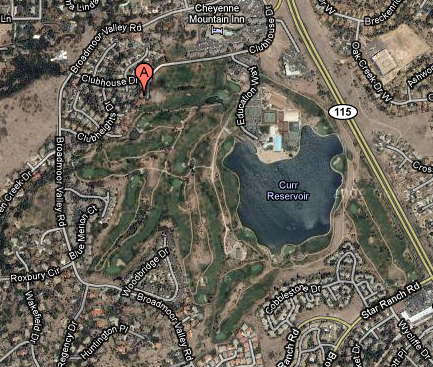
To pick up where we left off with scoundrel Soudriette, he of the many Haitian crony friends in DC, the careerist democracy-thief has moved to Colorado Springs, to lecture for El Pomar, and head the Center for Diplomacy and Democracy, which may be just another shell to which the CIA funnels funding. While stationed in DC for the IFES, Soudriette was also billing from an M Street address for the Conservation International Foundation. The good news is that apart from a CFDD franchise opened in Northern Iraq, no doubt to milk from Iraq reconstruction funds, the headquarters here appears to be merely a residence with a walkout on the golf course of the Country Club of Colorado.

Non profit front on the Country Club of Colorado golf course

A supreme height of cronyism

Forget higher judicial ideals or upholding the constitution; America’s founding fathers shunned corporate trusts. This week’s ruling on Citizen United reiterates that five of our Supreme Court justices are unabashed cronies for the WSJ-feted oligarchs. Roberts, Thomas, Kennedy, Scalia, and Alito –the cabal whose ignoble Gore v. Bush decision stole the 2000 election and birthed the Decade from Hell TM.
bunch of croniesIf you needed another reason to indict George W. Bush, charge his dad H.W. for the First Gulf War, and Ronald Reagan for Nicaragua. Impeach their Supreme Court appointees, and bring racketeering charges against the corporatist bastards who are stealing democracy.

Good news for Haiti

Haiti presidential palace succumbs to earthquake
On the bright side of Haiti’s catastrophic earthquake, American puppet René Préval has been cut down a few notches, a whole couple stories actually. Here’s the presidential palace before January 12 and after. The pretender Preval has been Our Man in Port-au-Prince subsequent to the US-arranged a coup in 2004 to depose the democratically elected Jean-Bertrand Aristide (for the second time). The popular Aristide was a threat to exploitation interests.

While Americans rally to provide relief to the Haitians, let’s not be too incredulous about the state of their poverty. Here’s A.N.S.W.E.R.’s recent statement to highlight this teaching moment:

All of us are joining in the outpouring of solidarity from people all over the hemisphere and world who are sending humanitarian aid and assistance to the people of Haiti.

At such a moment, it is also important to put this catastrophe into a political and social context. Without this context, it is impossible to understand both the monumental problems facing Haiti and, most importantly, the solutions that can allow Haiti to survive and thrive. Hillary Clinton said today, “It is biblical, the tragedy that continues to daunt Haiti and the Haitian people.” This hypocritical statement that blames Haiti’s suffering exclusively on an “act of God” masks the role of U.S. and French imperialism in the region.

In this email message, we have included some background information about Haiti that helps establish the real context:

Haitian Prime Minister Jean-Max Bellerive stated today that as many as 100,000 Haitians may be dead. International media is reporting bodies being piled along streets surrounded by the rubble from thousands of collapsed buildings. Estimates of the economic damage are in the hundreds of millions of dollars. Haiti’s large shantytown population was particularly hard hit by the tragedy.

As CNN, ABC and every other major corporate media outlet will be quick to point out, Haiti is the poorest country in the entire Western hemisphere. But not a single word is uttered as to why Haiti is poor. Poverty, unlike earthquakes, is no natural disaster.

The answer lies in more than two centuries of U.S. hostility to the island nation, whose hard-won independence from the French was only the beginning of its struggle for liberation.

In 1804, what had begun as a slave uprising more than a decade earlier culminated in freedom from the grips of French colonialism, making Haiti the first Latin American colony to win its independence and the world’s first Black republic. Prior to the victory of the Haitian people, George Washington and then-Secretary of State Thomas Jefferson had supported France out of fear that Haiti would inspire uprisings among the U.S. slave population. The U.S. slave-owning aristocracy was horrified at Haiti’s newly earned freedom.

U.S. interference became an integral part of Haitian history, culminating in a direct military occupation from 1915 to 1934. Through economic and military intervention, Haiti was subjugated as U.S. capital developed a railroad and acquired plantations. In a gesture of colonial arrogance, Franklin D. Roosevelt, who was the assistant secretary of the Navy at the time, drafted a constitution for Haiti which, among other things, allowed foreigners to own land. U.S. officials would later find an accommodation with the dictator François “Papa Doc” Duvalier, and then his son Jean-Claude “Baby Doc” Duvalier, as Haiti suffered under their brutal repressive policies.

In the 1980s and 1990s, U.S. policy toward Haiti sought the reorganization of the Haitian economy to better serve the interests of foreign capital. The U.S. Agency for International Development (USAID) was instrumental in shifting Haitian agriculture away from grain production, paving the way for dependence on food imports. Ruined Haitian farmers flocked to the cities in search of a livelihood, resulting in the swelling of the precarious shantytowns found in Port-au-Prince and other urban centers.

Who has benefited from these policies? U.S. food producers profited from increased exports to Haitian markets. Foreign corporations that had set up shop in Haitian cities benefitted from the super-exploitation of cheap labor flowing from the countryside. But for the people of Haiti, there was only greater misery and destitution.

Washington orchestrated the overthrow of the democratically elected Haitian President Jean-Bertrand Aristide—not once, but twice, in 1991 and 2004. Haiti has been under a U.S.-backed U.N. occupation for nearly six years. Aristide did not earn the animosity of U.S. leaders for his moderate reforms; he earned it when he garnered support among Haiti’s poor, which crystallized into a mass popular movement. Two hundred years on, U.S. officials are still horrified by the prospect of a truly independent Haiti.

The unstable, makeshift dwellings imposed upon Haitians by Washington’s neoliberal policies have now, for many, been turned into graves. Those same policies are to blame for the lack of hospitals, ambulances, fire trucks, rescue equipment, food and medicine. The blow dealt by such a natural disaster to an economy made so fragile from decades of plundering will greatly magnify the suffering of the Haitian people.

Natural disasters are inevitable, but resource allocation and planning can play a decisive role in mitigating their impact and dealing with the aftermath. Haiti and neighboring Cuba, who are no strangers to violent tropical storms, were both hit hard in 2008 by a series of hurricanes—which, unlike earthquakes, are predictable. While more than 800 lives were lost in Haiti, less than 10 people died in Cuba. Unlike Haiti, Cuba had a coordinated evacuation plan and post-hurricane rescue efforts that were centrally planned by the Cuban government. This was only possible because Cuban society is not organized according to the needs of foreign capital, but rather according to the needs of the Cuban people.

In a televised speech earlier today, President Obama has announced that USAID and the Departments of State and Defense will be working to support the rescue and relief efforts in Haiti in the coming days. Ironically, these are the same government entities responsible for the implementation of the economic and military policies that reduced Haiti to ruins even before the earthquake hit.

The Caracas Commitment Si Se Puede

You might imagine the multinational corporate media would blackout the talk of a 5th Socialist International. They are most determined to censor the issues which the world’s leftist parties are resolved to address. Where Obama 2008 and Copenhagen 2009 project a vacuum of ideological momentum, check out the Caracas Commitment.

The Caracas Commitment
November 25, 2009?
By Declaration from World Meeting of Left Parties?
November 19-21 Caracas, Venezuela

Political parties and organizations from Latin America, the Caribbean, Europe, Africa, Asia, and Oceania commemorate and celebrate the unity and solidarity that brought us together in Caracas, Bolivarian Republic of Venezuela, and from this libertarian city we would like to express our revolutionary rebelliousness. We are glad of and committed to the proud presence of the forces of change in a special moment of history. Likewise, we are proud to reaffirm our conviction to definitively sow, grow and win Socialism of the 21st century.

In this regard, we want to sign the Commitment of Caracas as a revolutionary guide for the challenges ahead of us. We have gathered with the aim of unifying criteria and giving concrete answers that allow us to defend our sovereignty, our social victories, and the freedom of our peoples in the face of the generalized crisis of the world capitalist system and the new threats spreading over our region and the whole world with the establishment and strengthening of military bases in the sister republics of Colombia, Panama, Aruba, Curacao, the Dutch Antilles, as well as the aggression against Ecuadorian territory, and the invasions of Iraq and Afghanistan.

We consider that the world capitalist system is going through one of its most severe crises, which has shaken its very foundations and brought with it consequences that jeopardize the survival of humanity. Likewise, capitalism and the logic of capital, destroys the environment and biodiversity, bringing with it consequences of climate change, global warming and the destruction of life.

One of the epicentres of the capitalist crisis is in the economic domain; this highlights the limitations of unbridled free markets ruled by private monopolies. In this situation, some governments have been asked to intervene to prevent the collapse of vital economic sectors, for instance, through the implementation of bailouts to bank institutions that amount to hundreds of billions of dollars. Said governments have been asked to stimulate their economies by increasing public expenditure in order to mitigate the recession and the private sector decline, which evidences the end of the supposedly irrefutable “truth” of neo-liberalism that of non-intervention of the State in economic affairs.

In this regard, it is very timely to promote an in-depth discussion on the economic crisis, the role of the State and the construction of a new financial architecture.

In summary, the capitalist crisis cannot be reduced simply to a financial crisis; it is a structural crisis of capital which combines the economic crisis, with an ecological crisis, a food crisis, and an energy crisis, which together represents a mortal threat to humanity and mother earth. Faced with this crisis, left-wing movements and parties see the defence of nature and the construction of an ecologically sustainable society as a fundamental axis of our struggle for a better world.

In recent years, progressive and left-wing movements of the Latin American region have accumulated forces, and stimulated transformations, throwing up leaders that today hold important government spaces. This has represented an important blow to the empire because the peoples have rebelled against the domination that has been imposed on them, and have left behind their fear to express their values and principles, showing the empire that we will not allow any more interference in our internal affairs, and that we are willing to defend our sovereignty.

This meeting is held at a historic time, characterized by a new imperialistic offensive against the peoples and governments of the region and of the world, a pretension supported by the oligarchies and ultraconservative right-wing, with the objective of recovering spaces lost as a consequence of the advancement of revolutionary process of liberation developing in Latin America. These are expressed through the creation of regional organizations such as ALBA, UNASUR, PETROCARIBE, Banco del Sur, the Sao Paulo Forum, COPPPAL, among others; where the main principles inspiring these processes are those of solidarity, complementarity, social priority over economic advantage, respect for self-determination of the peoples in open opposition to the policies of imperial domination. For these reasons, the right-wing forces in partnership with the empire have launched an offensive to combat the advance and development of the peoples’ struggles, especially those against the overexploitation of human beings, racist discrimination, cultural oppression, in defence of natural resources, of the land and territory from the perspective of the left and progressive movements and of world transformation.

We reflect on the fact that these events have led the U.S administration to set strategies to undermine, torpedo and destabilize the advancement of these processes of change and recuperation of sovereignty. To this end, the US has implemented policies expressed through an ideological and media offensive that aim to discredit the revolutionary and progressive governments of the region, labelling them as totalitarian governments, violators of human rights, with links to drug-trafficking operations, and terrorism; and also questioning the legitimacy of their origin. This is the reason for the relentless fury with which all the empire’s means of propaganda and its agents inside our own countries continuously attack the experiences in Venezuela, Ecuador, Nicaragua, Bolivia, and Paraguay, as with its maintenance of the blockade against revolutionary and independent Cuba.

Part of the strategy activated by the U.S. Empire is evidenced by the coup in Honduras, as well as in other destabilizing initiatives in Central America, attempting to impose the oligarchic interests that have already left hundreds of victims, while a disgusting wave of cynicism tries to cover up the dictatorship imposed by the U.S. administration with a false veil of democracy. Along with this, it is developing a military offensive with the idea of maintaining political and military hegemony in the region, for which it is promoting new geopolitical allies, generating destabilization and disturbing peace in the region and globally through military intimidation, with the help of its allies in the internal oligarchies, who are shown to be complicit in the actions taken by the empire, giving away their sovereignty, and opening spaces for the empire’s actions.

We consider that this new offensive is specifically expressed through two important events that took place this year in the continent: The coup in Honduras, and the installation of military bases in Colombia and Panama, as well as the strengthening of the already existing ones in our region. The coup in Honduras is nothing but a display of hypocrisy by the empire, a way to intimidate the rest of the governments in the region. It is a test-laboratory that aims to set a precedent that can be applied as a new coup model and a way to encourage the right to plot against the transformational and independent processes.

We denounce the military agreement between the Colombian government and the United States administration strengthens the U.S.’s military strategy, whose contents are expressed in the so-called “White Book.” This confirms that the development of the agreement will guarantee a projection of continental and intercontinental military power, the strengthening of transportation capability and air mobility to guarantee the improvement of its action capability, in order to provide the right conditions to have access to energy sources. It also consolidates its political partnership with the regional oligarchy for the control of Colombian territory and its projection in the Andes and in the rest of South America. All this scaffolding and consolidation of military architecture entails a serious threat for peace in the region and the world.

The installation of military bases in the region and their interrelation with the different bases spread throughout the world is not only confined to the military sphere, but rather forms part of the establishment of a general policy of domination and expansion directed by the U.S. These bases constitute strategic points to dominate all the countries in Central and Latin America and the rest of the world.

The treaty for the installation of military bases in Colombia is preceded by Plan Colombia, which was already an example of U.S. interference in the affairs of Colombia and the region using the fight against drug trafficking and terrorism as an excuse. However, it has been shown that drug trafficking levels have increased in Colombia; therefore, the plan is no longer justified given that no favourable results have been obtained since its implementation, that would justify a new treaty with the U.S.

Today, the global strategy headed by the U.S. concerning drug trafficking is a complete failure. Its results are summarised by a rapid processes of accumulation of illegal capital, increased consumption of drugs and exacerbation of criminality, whose victims are the peoples of Latin America, especially the Colombian people. This strategy should be revisited and modified, and should be oriented towards a different logic that focuses on drug consumption as a public health issue. In Colombia, drug trafficking has assumed the form of paramilitarism, and turned into a political project the scope of which and persons responsible should be investigated so that the truth is known, so that justice prevails and the terror of the civilian population ceases.

We, the peoples of the world, declare that we will not give up the spaces we have managed to conquer after years of struggle and resistance; and we commit ourselves to regain those which have been taken from us. Therefore, we need to defend the processes of change and the unfolding revolutions since they are based on sovereign decisions made by the peoples.

Agreements

1. Mobilization and Condemnation of U.S. Military Bases

1.1.
To organize global protests against the U.S. military bases from December 12th to 17th, 2009. Various leftwing parties and social movements will promote forums, concerts, protest marches and any other creative activity within the context of this event.

1.2.
To establish a global mobilization front for the political denouncement of the U.S. military bases. This group will be made up by social leaders, left-wing parties, lawmakers, artists, among others, who will visit different countries with the aim of raising awareness in forums, press conferences and news and above all in gatherings with each country’s peoples.

1.3.
To organize students, young people, workers and women in order to establish a common agenda of vigilance and to denounce against the military bases throughout the world.

1.4.
To organize a global legal forum to challenge the installation of the U.S. military bases. This forum is conceived as a space for the condemnation of illegalities committed against the sovereignty and self-determination of the peoples and the imposition of a hegemonic imperialist model.

1.5.
To organise a global trial against paramilitarism in Colombia bringing testimonies and evidence to international bodies of justice.

1.6.
To promote a global trial against George Bush for crimes against humanity, as the person principally responsible for the genocide against the peoples of Iraq and Afghanistan.

1.7.
To promote a campaign for the creation of constitutional and legal provisions in all of our countries against the installation of military bases and deployment of nuclear weapons of mass destruction.

1.8.
To promote, from the different social organizations and movements of the countries present in this meeting, a political solution for the Colombian conflict.

1.9.
To organise solidarity with the Colombian people against the imperial aggression that the military bases entail in Colombian territory.

2. Installation and Development of a Platform of Joint Action by Left-Wing Parties of the World

2.1.
To establish a space of articulation of progressive and left-wing organizations and parties that allows for coordinating policies against the aggression towards the peoples, the condemnation of the aggressions against governments elected democratically, the installation of military bases, the violation of sovereignty and against xenophobia, the defence of immigrants’ rights, peace, and the environment, and peasant, labour, indigenous and afro-descendent movements.

2.2.
To set up a Temporary Executive Secretariat (TES) that allows for the coordination of a common working agenda, policy making, and follow-up on the agreements reached within the framework of this international encounter. Said Secretariat undertakes to inform about relevant events in the world, and to define specific action plans: statements, declarations, condemnations, mobilizations, observations and other issues that may be decided.

2.3.
To set up an agenda of permanent ideological debate on the fundamental aspects of the process of construction of socialism.

2.4.
To prepare common working agendas with participation from Latin America, Europe, Africa, Asia and Oceania.

2.5.
To organize solidarity of the people’s of the world with the Bolivarian revolution and President Hugo Chávez, in response to the constant imperial attacks.

2.6.
To commemorate the centenary of Clara Zetkin’s proposal to celebrate March 8th as the International Day of Women. The parties undertake to celebrate this day insofar as possible.

2.7.
To summon a meeting to be held in Caracas in April 2010 in commemoration of the bicentenary of our Latin American and Caribbean independences.

3. Organization of a World Movement of Militants for a Culture of Peace

3.1.
To promote the establishment of peace bases, by peace supporters, who will coordinate actions and denouncements against interventionism and war sponsored by imperialism through activities such as: forums, cultural events, and debates to promote the ethical behaviour of anti-violence, full participation in social life, respect for human rights and fundamental freedoms, acknowledgement of the cultural identities of our peoples and strengthening the framework of integration. This space seeks to raise awareness among all citizens in rejection of all forms of domination, internal or external intervention, and to reinforce the culture of peace. To struggle relentlessly for a world with no nuclear weapons, no weapons of mass destruction, no military bases, no foreign interference, and no economic blockades, as our peoples need peace and are absolutely entitled to attain development. Promote the American continent as a territory of peace, home to the construction of a free and sovereign world.

3.2.
To organize a Peace Parliament as a political space to exchange common endeavours among the world’s progressive and left-wing parliamentarians, and to know the historical, economic, legal, political and environmental aspects key for the defence of peace. Hereby we recommend holding the first meeting in February 2010.

4. Artillery Of International Communication to Emancipate Revolutionary Consciousness

4.1.
To discuss a public communication policy at an inter-regional level that aims to improve the media battle, and to convey the values of socialism among the peoples.

4.2.
To promote the creation and consolidation of alternative and community communication media to break the media siege, promote an International Alternative Left-wing Media Coordination Office that creates links to provide for improved information exchange among our countries, in which Telesur and Radiosur can be spearheads for this action.

4.3.
To create a website of all of the progressive and left-wing parties and movements in the world as a means to ensure permanent exchange and the development of an emancipating and alternative communication.

4.4.
To promote a movement of artists, writers and filmmakers to promote and develop festivals of small, short and full-length films that reflects the advancement and the struggle of peoples in revolution.

4.5.
To hold a meeting or international forum of alternative left-wing media.

5. Mobilize All Popular Organizations in Unrestricted Support for the People of Honduras

5.1.
To promote an international trial against the coup plotters in Honduras before the International Criminal Court for the abuses and crimes committed.

5.2.
Refuse to recognize the illegal electoral process they aim to carry out in Honduras.

5.3.
To carry out a world vigil on Election Day in Honduras in order to protest against the intention to legitimize the coup, coordinated by the permanent committee that emerges from this encounter.

5.4.
To coordinate the actions of left-wing parties worldwide to curb the imperialist pretensions of using the coup in Honduras as a strategy against the Latin American and Caribbean progressive processes and governments.

5.5.
To unite with the people of Honduras through a global solidarity movement for people’s resistance and for the pursuit of democratic and participatory paths that allow for the establishment of progressive governments committed to common welfare and social justice.

5.6.
To undertake actions geared towards denouncing before multilateral bodies, and within the framework of international law, the abduction of José Manuel Zelaya, legitimate President of Honduras, that facilitated the rupture of constitutional order in Honduras. It is necessary to determine responsibility among those who participated directly in this crime, and even among those who allowed his aircraft to go in and out Costa Rica without trying to detain the kidnappers of the Honduran president.

6. Solidarity with the Peoples of the World

6.1.
The Left-wing Parties of the International Meeting of Caracas agree to demand the immediate liberation of the five Cuban heroes unfairly imprisoned in American jails. They are authentic anti-terrorist fighters that caused no harm to U.S. national security, whose work was oriented towards preventing the terrorist attacks prepared by the terrorist counterrevolution against Cuba. The Five Heroes were subject to a biased judicial process, condemned by broad sectors of humanity, and stigmatized by a conspiracy of silence by the mainstream media. Given the impossibility of winning justice via judicial means, we call upon all political left-wing parties of the world to increase actions for their immediate liberation. We call on President Obama to utilize his executive power and set these Five Heroes of Humanity free.

6.2.
The International Meeting of Left-wing Parties resolutely demands the immediate and unconditional cessation of the criminal U.S. blockade that harmed the Cuban people so badly over the last fifty years. The blockade should come to an end right now in order to fulfil the will of the 187 countries that recently declared themselves against this act of genocide during the UN General Assembly.

6.3.
To unite with the people of Haiti in the struggle for the return of President Jean Bertrand Aristide to his country.

6.4.
We propose to study the possibility to grant a residence in Venezuela to Jean Bertrand Aristide, who was kidnapped and overthrown as Haiti’s president by U.S. imperialism.

6.5.
We express the need to declare a permanent alert aimed at preventing any type of breach of the constitutional order that may hinder the process of democratic change underway in Paraguay.

6.6.
We denounce the neoliberal privatizing advance in Mexico expressly in the case of the Electric Energy state-owned company, a heritage of the people, which aims through the massive firing of 45,000 workers to intimidate the union force, “Luz y Fuerza”, which constitutes another offensive of the Empire in Central and North America.

6.7.
To declare our solidarity with the peoples of the world that have suffered and are still suffering imperial aggressions, especially, the 50 year-long genocidal blockade against Cuba; the threat against the people of Paraguay; the slaughter of the Palestinian people; the illegal occupation of part of the territory of the Republic of Western Sahara and the invasion of Iraq and Afghanistan which today is expanding into Pakistan; the illegal sanctions imposed against Zimbabwe and the constant threat against Iran, among others.

Caracas, November 21st, 2009

Declaration of Solidarity with the People of Cuba

The Left-wing Parties of the International Meeting of Caracas agree to demand the immediate liberation of the five Cuban heroes unfairly imprisoned in U.S. prisons. They are authentic anti-terrorist fighters that caused no harm to US national security, whose work was oriented towards preventing the terrorist attacks prepared by the terrorist counterrevolution against Cuba. The Five Heroes were subject to a biased judicial process, condemned by broad sectors of humanity, and stigmatized by a conspiracy of silence by the mainstream media.

Given the impossibility of winning justice via judicial means, we call upon all political left-wing parties of the world to increase actions for their immediate liberation. We call on President Obama to utilize his executive power and set these Five Heroes of Humanity free.

The International Meeting of Left-wing Parties resolutely demands the immediate and unconditional cessation of the criminal U.S. blockade that harmed the Cuban people so badly over the last fifty years. The blockade should come to an end right now in order to fulfill the will of the 187 countries that recently declared themselves against this act of genocide during the UN General Assembly.

Caracas, November 21, 2009

Special Declaration on the Coup D’état in Honduras

We, left-wing parties of Latin America, Africa, Europe, Asia and Oceania, present in the international encounter of left-wing parties, reject the coup d’état against the constitutional government of citizen’s power of the President of Honduras Manuel Zelaya Rosales.

Cognizant of the situation of repression, persecution and murder against the Honduran people and the permanent military harassment against president Manuel Zelaya Rosales, which represents a breach of the rule of law in the sister nation of Honduras:

We support the actions of the national resistance front in its struggle to restore democracy.

We demand and support the sovereign right of the Honduran people to call for a national constituent assembly to establish direct democracy and to ensure the broadest political participation of the people in public affairs.

We denounce the United States intervention and its national and international reactionary right-wing allies and their connection with the coup, which hinders the construction of democracy in Honduras and in the world.

We condemn and repudiate the permanent violation of political and social human rights as well as the violation freedom of speech, promoted and perpetrated by the de facto powers, the Supreme Court of Justice, the National Congress of the Republic, the Ministry of Defence and Security since June 28, 2009.

We reiterate our demand to international governments and bodies, not to recognize the results of the general elections to be held on November 29, 2009 in Honduras, due to the lack of constitutional guarantees and the legal conditions necessary for a fair, transparent and reliable electoral process, the lack of reliable observers that can vouch for the results of this electoral process, which has already been rejected by most international governments, bodies and international public opinion.

To propose and promote an international trial against coup plotters and their accomplices in Honduras before the International Criminal Court, for the illegal actions, abuses and crimes they committed, while developing actions aimed at denouncing to the relevant bodies and in the framework of the international law, the violation of the rights and the kidnapping of the legitimate president of Honduras Manuel Zelaya Rosales, because it is necessary to establish the responsibility of those who participated directly and internally in the perpetration of this crime.

We urge national and international human rights organizations to support these measures, to carry on the campaign of denunciation and vigilance with permanent observers in face of the renewed human rights violations, particularly the persecution and sanction through the loss of jobs for political reasons against the members and supporters of the resistance and president Manuel Zelaya.

We repudiate and condemn the attacks against the diplomatic corps of the embassies of the Federative Republic of Brazil and the Republic of Argentina, and the embassies of the member countries of the Bolivarian Alliance for the Peoples of our America (ALBA); and express our solidarity with the heroic work of the staff of these diplomatic missions, who have been victims of harassment and hostility by the coup plotters.

We agree to establish coordination among left-wing parties of the world to exert pressure to oust the de facto government and for the restoration of the constitutional president and the right of the Honduran people to install a national constituent assembly that allows for deepening direct democracy.

We urge governments, international bodies and companies to maintain and intensify economic and commercial sanctions to business accomplices and supporters of the coup in Honduras, and to maintain an attitude of vigilance, to break all relations that recognize the coup plotters and the de facto government officers, as well as to take migration control measures that hinder the movement of people who have the purpose of voting in another country where elections are held with the aim of changing the results through the transfer of votes from one country to the other.

We agree not to recognize the international and national observers of the electoral process who are aligned and conspire to attempt to give legitimacy to an electoral process devoid of legality and legitimacy. We demand that rather than observing an illegal and illegitimate process, the return of the state of democratic law and the constitutional government of citizen power Honduras President Manuel Zelaya Rosales is guaranteed.

Caracas, November 21, 2009

Special Decision

The international encounter of Left-wing Political parties held in Caracas on November 19, 20 and 21, 2009, received the proposal made by Commander Hugo Chavez Frias to convoke the V Socialist International as a space for socialist-oriented parties, movements and currents in which we can harmonize a common strategy for the struggle against imperialism, the overthrow of capitalism by socialism and solidarity based economic integration of a new type. We assessed that proposition in terms of its historical dimension which calls for a new spirit of internationalism and agreed, for the purpose of achieving it in the short term, to create a WORKING GROUP comprised of those socialist parties, currents and social movements who endorse the initiative, to prepare an agenda which defines the objectives, contents and mechanisms of this global revolutionary body. We call for an initial constitutive event for April 2010 in the City of Caracas. Furthermore, those parties, socialist currents and social movements who have not expressed themselves on this matter can subject this proposal to the examination of their legitimate directive bodies.

Caracas, November 21, 2009

Olbermann offers Obama an out

obama barack hype bondKeith Olbermann’s Special Comment on Afghanistan is being summarized as telling President Obama to Get Out Now. Olbermann’s words stir our enthusiasm, but he leaves damning loopholes as far as I am concerned. The MSNBC newsman conditions his advice to the president with “unless you are right,” then at the end, showing a tact far too reckless, he tells Obama to “listen to yourself.”

No. That’s not why we elected Barack Obama.

The inexperienced senator had no record. Our hope didn’t spring from a demonstration of ability. Obama was elected for the hope he offered because he appeared to be listening to the American people. It would probably have been inconceivable to imagine then that Obama could not but respond to the unprecedented surge of electoral participation prompted by George W. Bush’s wars.

Listen to the people Mr. Obama, and no one else. To ask Obama to listen to himself is to offer him entirely too much slack. Give an authoritarian leader too much rope, that’s more rope he has to hang you.

And then there is no “unless you are right.”

What is that but a straight man’s setup? That line is for the President to show America how sure he is of his decision. The people want a leader who’s offering supreme confidence, so Olbermann is holding the door. He goes on to frame the challenges posed by Afghanistan, as surmountable by a qualified prez. Olbermann invites the President to be “precisely right.” Isn’t that exactly what will sooth the viewers, after Obama has famously taken so much time to arrive at a decision?

But there is no “unless you are right.” Unless Olbermann meant it with an implied irony. But he didn’t. He didn’t say unless black is white, or up is down. Olbermann allowed for the possibility that an escalation could be right.

“If not, Mr. President, this way lies Vietnam.”

IF NOT Olbermann says. Doesn’t he mean no if and or buts?

When Walter Cronkite finally spoke out about Vietnam, and declared the war un-winnable, it was not because it had become un-winnable. It had not transformed into a quagmire, the chance for victory had not escaped us. The illegal and immoral subjugation of the Vietnamese people was never a winnable strategy. Like Iraq and Afghanistan, it was a predictable calamity, a crime. Moral observers knew it from the beginning.

America did not LOSE Vietnam, and we will not LOSE Iraq and Afghanistan. We DESTROYED those landscapes and millions of lives, and we continue to “finish the job.” It’s an immeasurable, apocalyptic tragedy.

If Barack Obama escalates in the footsteps of Lyndon Johnson, it will similarly be no mistake. The travesty is that the American people have once again been waylaid in their determination to find a leader to represent their desire for peace.

Here is the text of Keith Olbermann’s Special Comment:

SPECIAL COMMENT
By Keith Olbermann
Anchor, ‘Countdown’
Mon., Nov . 30, 2009

Mr. President, it now falls to you to be both former Republican Senator George Aiken and the man to whom he spoke, Lyndon Johnson. You must declare victory, and get out.??

You should survey the dismal array of options in front of you — even the orders given out last night — sort them into the unacceptable, the unsuccessful, and the merely un-palatable, and then put your arm down on the table and wipe the entire assortment of them off your desk — off this nation’s desk — and into the scrap heap of history. ??

Unless you are utterly convinced — willing to bet American lives on it — that the military understands the clock is running, and that the check is not blank, and that the Pentagon will go to sleep when you tell it to, even though the Pentagon is a bunch of perpetually 12-year old boys desperate to stay up as late as possible by any means necessary — get out now. ??

We are, at present, fighting, in no particular order, the Taliban; a series of sleazy political-slash-military adventurers, not the least of whom is this mountebank election-fixer Karzai, and what National Security Advisor Jones estimated in October was around eight dozen al-Qaida in the neighborhood.??

But poll after poll, and anecdote after anecdote, of the reality of public opinion inside Afghanistan is that its residents believe we are fighting Afghanistan. That we, Sir, have become an occupying force. Yes: if we leave, Afghanistan certainly will have an occupying force, whether it’s from Pakistan, or consisting of foreign fighters who will try to ally themselves with the Taliban.??

Can you prevent that? Can you convince the Afghans that you can prevent that? Can you convince Americans that it is the only way to un-do Bush and Cheney policy catastrophes dating back to Cheney’s days as Secretary of Defense in the ’90s? If not, Mr. President, this way lies Vietnam. If you liked Iraq, you’ll love Afghanistan with 35,000 more troops, complete with the new wrinkle, straight from the minder-binder lingo of Joseph Heller’s “Catch-22.”??

President Obama will be presenting an exit strategy for Afghanistan. The exit strategy that begins by entering still further. Lose to win, sink to swim, escalate to disengage. And even this disconnect of fundamental logic is predicated on the assumption that once the extra troops go in, when the President says “okay, time for adult swim, Generals, time to get out of the pool and bring the troops with you,” that the Pentagon is just going to say “Yeppers.”??

The Pentagon, often to our eternal relief, but just as often to our eternal regret is in the War business. You were right, Mr. President, to slow the process down, once a series of exit strategies was offered to you by men whose power and in some case livelihoods are predicated on making sure all exit strategies, everywhere, forever, don’t really result in any service-man or woman actually exiting.??

These men are still in the belly of what President Eisenhower so rightly, so prophetically, christened the military-industrial complex. Now and later as the civilian gray eminences with “retired” next to their names, formally lobbying the House and Senate and informally lobbying the nation through television and the printed word, to “engage” here, or “serve” there, or “invest” everywhere, they are, in many cases, just glorified hardware salesmen. ??

It was political and operational brilliance, Sir, to retain Mr. Bush’s last Secretary of Defense Mr. Gates. It was transitional and bipartisan insight, Sir, to maintain General Stanley McChrystal as a key leader in the field. ??

And it was a subtle but powerful reminder to the authoritarian minded War-hawks like John McCain, and the blithering idiots like former Governor Palin, of the Civilian authority of the Constitution it was a picture drawn in crayon for ease of digestion by the Right, to tell our employees at the Pentagon, to take their loaded options and go away and come back with some real ones.??

You reminded them, Mr. President, that Mr. Gates works for the people of the United States of America, not the other way around. You reminded them, Mr. President, that General McChrystal is our employee, not our dictator. You’ve reminded them Mr. President. Now, tonight, remind yourself. Stanley McChrystal.??

General McChrystal has doubtless served his country bravely and honorably and at great risk, but to date his lasting legacy will be as the great facilitator of the obscenity that was transmuting the greatest symbol of this nation’s true patriotism, of its actual willingness to sacrifice, into a distorted circus fun-house mirror version of such selflessness.??

Friendly fire killed Pat Tillman. Mr. McChrystal killed the truth about Pat Tillman. And that willingness to stand truth on its head on behalf of “selling” a war or the generic idea of America being at war to turn a dead hero into a meaningless recruiting poster, should ring essentially relevant right now.??

From the very center of a part of our nation that could lie to the public, could lie to his mother, about what really happened to Pat Tillman, from the very man who was at the operational center of that plan, comes the entire series of plans to help us supposedly find the way out of Afghanistan? We are supposed to believe General McChrystal isn’t lying about Afghanistan???

Didn’t he blow his credibility by lying, so obviously and so painfully, about Pat Tillman? Why are we believing the McChrystals? Their reasons might sound better than the ones they helped George Bush and Dick Cheney fabricate for Iraq, but surely they are just as transparently oblivious of the forest. ??

Half of them insist we must stay in Afghanistan out of fear of not repeating Iraq, while the other half, believing Bush failed in Iraq by having too few troops, insist we must stay in Afghanistan out of fear of repeating Iraq. And they are suddenly sounding frighteningly similar to what the Soviet Generals were telling the Soviet Politicos in the 1980s about Afghanistan.??

Sure it’s not going well, sure we need to get out, we all see that. But first let’s make sure it’s stabilized and then we get out. The Afghans will be impressed by our commitment and will then take over the cost of policing themselves, even though the cost would be several times their gross national product. Just send in those extra troops, just for awhile. Just 350,000.

I’m sorry, did I say 350,000? I meant 35,000. Must be a coffee stain on the paper. Mr. President, last fall, you were elected. Not General McChrystal, not Secretary Gates, not another Bushian Drone of a politician. You. On the Change Ticket. On the pitch that all politicians are not created equal.??

And upon arrival you were greeted by a Three Mile Island of an economy, so bad that in the most paranoid recesses of the mind one could wonder if the Republicans didn’t plan it that way, to leave you in the position of having to prove the ultimate negative, that you staved off worldwide financial collapse, that if you had not done what you so swiftly did, that this “economic cloudy day” would have otherwise been the “biblical flood of finance.”??

So, much of the change for which you were elected, Sir, has thus far been understandably, if begrudgingly, tabled, delayed, made more open-ended. But patience ebbs, Mr. President. And while the first one thousand key decisions of your presidency were already made about the economy, the first public, easy-to-discern, mouse-or-elephant kind of decision comes tomorrow night at West Point at eight o’clock.

You know this, Mr. President: we cannot afford this war. Nothing makes less sense to our economy than the cost of supply for 35,000 new troops. Nothing will do more to slow economic recovery. You might as well shoot the revivified auto industry or embrace John Boehner Health Care Reform and Spray-Tan Reimbursement.

You know this, Mr. President: we cannot afford this war. Nothing makes less sense to our status in the world than for us to re-up as occupiers of Afghanistan and for you to look like you were unable to extricate yourself from a Military Chinese Finger Puzzle left for you by Bush and Cheney and the rest of Halliburton’s hench-men.

And most of all, and those of us who have watched these first nine months trust both your judgment and the fact you know this, Mr. President: unless you are exactly right, we cannot afford this war. For if all else is even, and everything from the opinion of the generals to the opinion of the public is even, we cannot afford to send these troops back into that quagmire for second tours, or thirds, or fourths, or fifths.

We cannot afford this ethically, Sir. The country has, for eight shameful years, forgotten its moral compass and its world purpose. And here is your chance to reassert that there is, in fact, American Exceptionalism. We are better. We know when to stop making our troops suffer, in order to make our generals happy.

You, Sir, called for change, for the better way, for the safety of our citizens including the citizens being wasted in war-for-the-sake-of-war, for a reasserting of our moral force. And we listened. And now you must listen. You must listen to yourself.

Someone please tell Mrs. Al-Ghizzawi that her husband is cleared for release

Guantanamo legal defense lawyer…if that means anything. It’s a long story, but after waiting eight years locked in Guantanamo, Abdul Hamid Al-Ghizzawi has a tale that could bear listeners. But his lawyer H. Candace Gorman is not allowed to tell it, she’s under court orders to keep mum. Even after details came through the foreign press, a judge ordered that Gorman remove two subsequent posts from The Guantanamo Blog which offered clarification. NMT learned from the Supreme Court Of the United States Blog (SCOTUSBLOG) that Gorman’s articles are still cached. Naturally we have reprinted them here.

Read them and become a state secret yourself.

Just kidding– the information is not ruled to be a state secret, only “protected,” whatever that means. Regardless that the information is already public, Ms. Gorman herself is not permitted to propagate it. You and I can divulge what we wish.

And divulge we must, I’m sure you’ll agree. Whether or not internet mirrors can be penalized, what is this sham of “protected” information? The concept defiles President Obama’s expressed objective of transparent government. This particular information shames our judicial system. Read it and judge for yourself.

You can keep up on Guantanamo attorney Candace Gorman’s latest efforts at gtmoblog.bogspot.com, but you won’t find these two posts: THE MUZZLE IS OFF, and THE MUZZLE IS BACK ON. I’ve also included the text of Judge John Bates’ gag order, and Ms. Gorman’s latest filing. Halfway down I will offer a summary, if you’re in a hurry.

November 17, 2009
THE MUZZLE IS OFF

In June of this year I received a call from a foreign reporter who asked if I could give her a profile of my client Al-Ghizzawi as he was on a list of men whom the US was looking for a new home and her country was considering accepting him. This was the first I had learned that Al-Ghizzawi had been “cleared” by the Obama review team for release. I gave her information about my client and for all I know a story was published about the plight of al-Ghizzawi at Guantanamo, his status as “cleared” and why he needed a country in Europe to take him.

A few days later an attorney from the justice department called to tell me that Al-Ghizzawi was cleared for release and we laughed about the fact that I already knew the information. However the laughing stopped when the attorney told me that the justice department had designated the information as “protected” and I could not tell anyone except my client and those people who had signed on to the protective order (a court document that outlines the procedures for the Guantanamo cases) about his status as “cleared for release.” I told the attorney that he could not declare something “protected” that was already in the public domain. To make a long story short we were not in agreement and the attorney filed an emergency motion with the judge to muzzle me. Despite the fact that the information was in the public domain I was muzzled by the good judge who apparently doesn’t believe that the constitution applies to me. I couldn’t even tell Mr. Al-Ghizzawi’s brother what I thought was good news (I didn’t know then that this was just another stall tactic by the justice department).

Not only was I muzzled but Mr. Al-Ghizzawi’s case was put on hold. The habeas hearing that we had been fighting to obtain literally for years was stayed by the judge despite the fact that the US Supreme Court held in June of 2008 that the men were entitled to swift hearings…. So much for the Supreme Court! The president asked the judges to stop the hearings for those men who were “cleared” for release and the judges have fallen into lockstep, shamefully abandoning their duties as judges.

A few months later when I visited Al-Ghizzawi (at the end of August) he had just received word from his wife that she could no longer wait for his release and she asked him if she would sign papers for a divorce. Bad news is an every day occurrence for Al-Ghizzawi and he was holding up well despite this latest blow.

When I returned from the base I asked the justice department to allow me to contact Al-Ghizzawi’s wife and tell her that he had been cleared for release. I hoped that if she knew he was to be released she would hang in there and not go through with the divorce. I was told they would get back to me. When they didn’t I asked again but they still would not give me the ok. In Court papers I pleaded with the judge to let me tell Al-Ghizzawi’s brother and wife, telling the judge about the wife’s request for a divorce, but the Judge, the same Judge who has apparently decided to ignore the supreme court’s directive for quick habeas hearings, ignored this plea as well.

I seriously thought about disobeying the order and trying to get word to Al-Ghizzawis’ wife and then taking whatever lumps were thrown my way….however, despite the fact that the judicial system has failed Al-Ghizzawi and most of the men at Guantanamo I could not bring myself to blatantly disobey a court order. For five months I have kept this information confidential despite the injustice to both my client, Mr. Al-Ghizzawi, and to what was our rule of law…. until yesterday, when the muzzle was lifted.

This is only part of the story. I will be writing more about this in the future and our friend the talking dog has more to say on this.

Click on the title for his take.

Meanwhile, if you hear from a habeas attorney that his or her case has been stayed you will know about the injustice that their client is continuing to suffer, you will know that the client has been cleared for release, that the attorney cannot discuss that fact and that the judge in that case has abandoned his or her duty to be a judge. You will also know that being cleared for release is just as meaningless as everything else that has been happening to these unfortunate men…. because being cleared for release means nothing.

And the follow-up:

Saturday, November 21, 2009
THE MUZZLE IS BACK ON

Fortunately for all of you….the muzzle only applies to me.

On Tuesday I reported that the Government finally allowed me to discuss matters that had previously been “protected” in regards to my client Al-Ghizzawi. In fact the Government unclassified and allowed for public release a Petition for Original Habeas Corpus that I filed in the U.S. Supreme Court. I released that Petition to the Public in accordance with the Government’s designation of “unclassified.” On Friday the Department of Justice (DOJ) told me that it had made a mistake and that it had apparently violated the Protective Order (an Order that sets out the rules for the DOJ and Habeas counsel in regards to the Guantanamo cases) entered in the case when it “unclassified” and allowed for public release information in the Petition that it wanted to “protect” and that therefore I must remove my post of November 17 because of the DOJ’s mistake. I explained to the DOJ attorneys that the Petition and my Post of November 17th were widely distributed and are available at various sites on the web… they do not seem to care about that ….they only care that I not report about what they are now trying to declare “protected information”…. 5 days after they unclassified the material and made it available for public release.

This is of course outrageous conduct by the DOJ…. in trying to declare something as “protected” after being clearly designated and distributed to the public but what else is new? For those of you who either remember my November 17th post or have it available on your website…. I originally learned of the so called “Protected” information from a public source and the Judge in Al-Ghizzawi’s case still ruled that I could not discuss it. Anyway, later this weekend I will try to provide all of the links that I can find from other sources who properly reported on the petition and my saga regarding it…. for now I am leaving you with these two links…. here and here as I happen to have these easily available.

I also expect several websites and other media outlets to be reporting on this and making the petition available at their websites because they received it from me back when I was allowed to distribute it or otherwise obtained it on the internet. I also provided interviews earlier this week and I expect that those will soon be available too. If any of you have time out there to find some of the websites where this story and petition are published please feel free to provide a link…or if you see it pop up on websites in the coming weeks please provide those links as well.

This is not the end of this story. Under the Protective Order the Government must actually get the Judge’s permission to retroactively keep me (and only me) from publishing and discussion the information that the Government now seeks to “Protect.” The DOJ will have to file a document with the Court explaining why this now very public information should be “protected.” Ultimately it will be the Judge’s decision. If you do not see my post back up that will mean that the Judge agreed with the Government, that I alone cannot talk about those things that you are privy to discuss.

I will just add…. this is just another day in the life of being a habeas counsel.

Are you looking for a summary? Mr. Al-Ghizzawi is among the Guantanamo inmates who have been “cleared for release.” Foreign governments know this, as well as the foreign press. But officially the status is “protected information.” Meanwhile, probably among other tragic developments, Al-Ghizzawi’s wife is seeking a divorce based on her impression that her husband will never be released. And attorney Gorman is forbidden to tell her she knows otherwise.

Except, that being “cleared for release” now has turned out to mean a worse limbo than before. It means all legal motions are suspended, pending a government action that is not forthcoming. Thus Mrs. Al-Ghizzawi’s prediction may be more accurate than the lawyer’s, that her husband is nowhere closer to being released.

And Judge Bates may understand this too.

Below is the Judge’s gag order:

UNITED STATES DISTRICT COURT FOR THE DISTRICT OF COLUMBIA

ABDUL HAMID AL-GHIZZAWI,
Petitioner,
v.
GEORGE W. BUSH, et al.,
Respondents.

Civil Action No. 05-2378 (JDB)

ORDER

Before the Court is [277] respondents’ emergency motion to enforce the protective orders in this case, which was filed yesterday. Respondents ask the Court to order petitioner’s counsel to remove an article from her website that respondents contend reveals protected information. See Resp’ts’ Mot. to Enforce the Protective Orders [Docket Entry 273], at 1. They also request that the Court direct petitioner’s counsel “not to further disseminate ‘protected’ information.” Id. For her part, petitioner’s counsel asserts that the information she posted on her website and used in the article was disclosed by the government before the present dispute. See Pet’r’s Opp’n to Respt’ts’ Mot. [Docket Entry 274], at 5. Accordingly, she offers, “it is an extraordinarily odd situation to permit everyone else in the world to discuss this matter except counsel.” Id. She also suggests that this Court has no jurisdiction to address a filing made in the Supreme Court in petitioner’s original habeas corpus proceeding. See Pet’r’s Supplemental Resp. to Resp’ts’ Mot. [Docket Entry 276], at 2-3.

Petitioner’s counsel is bound by the various protective orders in this case, whether or not any “protected” information is now available on the internet. Here, despite its apparent inadvertent disclosure, the disputed information remains “protected” material. And accordingly, petitioner’s counsel is precluded from disclosing it. Therefore, it is hereby

ORDERED that respondents’ motion is GRANTED pending further order of the Court; it is further

ORDERED that petitioner’s counsel shall remove the article entitled “The Muzzle is Back On” from her website because it contains “protected” information and derivative material; it is further

ORDERED that petitioner’s counsel shall not disclose “protected” information and information or documents derived from “protected” information as defined by the protective orders in this case; and it is further

ORDERED that the parties may file supplemental memoranda, limited to fifteen (15) pages, addressing this matter by not later than December 7, 2009.

SO ORDERED.

/s/
JOHN D. BATES
United States District Judge

Dated: November 25, 2009

And Gorman’s filing of Nov 25:

IN THE UNITED STATES DISTRICT COURT FOR THE DISTRICT OF COLUMBIA

ABDUL HAMID AL-GHIZZAWI
Prisoner, Guantanamo Bay Naval Station, Guantánamo Bay, Cuba;
Petitioner,

v.

Barack Obama, et. al.
Respondents.
)

RESPONSE
motion to
No. 05 cv 2378 (JDB)

PETITIONERS SUPPLEMENTAL RESPONSE IN OPPOSITION TO THE GOVERNMENT’S MOTION FILED UNDER SEAL

Petitioner Abdul Hamid Al-Ghizzawi (“Petitioner” or “Al-Ghizzawi”) hereby supplements her Response to the Governments Motion under seal as follows:

On November 24th, 2009 Counsel for Petitioner filed a Response to a Motion by the Government despite the fact that she had not actually seen the Motion. Counsel did this because of her well reasoned concern that the Government would wait as long as possible to send Counsel the actual Motion (it was emailed to her 1 ½ hours after the notice went out and one hour after she emailed counsel for a copy) and that it would not fully address all of the facts (as is shown by the Motion). Counsel was preparing and did leave for a family gathering prior to receiving the actual Motion by email. After Filing that Response the Government filed a subsequent “notice of classified filing” and according to an email from the Court Security Office that Motion is entitled “Supplemental Memorandum.” Counsel for Petitioner does not have access to that document, which awaits her at the Secure Facility, has no idea of its contents and is therefore not addressing anything that might be in that supplemental memorandum related to the issues herein.

The issue that Counsel seeks to address herein is surprisingly not addressed by the Government in its Motion and that is the jurisdiction of the District Court to address issues raised in Petitioner’s Supreme Court filing. Counsel does not have the answer to this question although she spent some time on the question over the past few days and had hoped that the Government would explain in its Motion how the District Court could provide a remedy to an issue that occurred in a Supreme Court filing. In essence what the Government is asking this Court to do is to apply district court orders to a Supreme Court case. The Government should have the burden of establishing the District Court’s jurisdiction in this uniquely extraordinary circumstance of attempting to have the District Court enjoin the Supreme Court- As it – as it was the in the United States Supreme Court itself where this document was unsealed. As the Government noted in its Motion, the Petition for Original Habeas Corpus was filed in the Supreme Court on October 2, 2009. Petitioner filed the document under seal. The Government then reviewed the Petition and notified counsel and the Supreme Court that the Petition was declassified for public release. A copy of the Petition was attached to the notice by the Government that noted on each and every page that the document was “declassified for public release.” The history of that document after it was cleared is fully set out in Petitioner’s Response. When the Government later decided that it did not want certain of the information in the Petition released to the public instead of seeking relief from the Supreme Court, where the now declassified petition was filed, it instead has come back to the District Court for relief.

When Counsel for Petitioner filed her original habeas case she simultaneously filed a motion with the Supreme Court to ask that the Petition be filed under seal and it was the Supreme Court that sought a declassified version of the Petition for public filing. Counsel for Petitioner believes that the proper course of action that the Government should have taken would have been to file a Motion with the Supreme Court asking to retroactively “protect” certain information that it “declassified for public release” and which it then later determined it wanted to protect.

Wherefore, for the reasons stated in Petitioners original response and this Supplement Counsel asks this Court to deny the Government’s “emergency” Motion.

Respectfully Submitted,

November 25, 2009

/s/
H. Candace Gorman
Counsel for Petitioner

Law Office of H. Candace Gorman
H. Candace Gorman (IL Bar #6184278)

Obama imprisons civil rights attorney Lynne Stewart instead of George Bush

I’ll admit to a disquieting feeling of topsy-turvy. Until now I would have advised war resisters to take the brig and let Bush’s Democratic successor grant them amnesty. But now a trial for the accused 9/11 conspirators approaches, worrying some that the additional protections of a civilian court might result in the accused might be found not-guilty. To which Attorney General Eric Holder says “Failure is not an option.” Hello? And did I hear President Obama correctly –suggesting the 9/11 perpetrators will get the death penalty? I’d be all for it, IF Obama’s hangmen were eyeballing the real perps! Instead this administration has taking civil rights attorney Lynne Stewart to prison, and rehiring Bush spokesperson Dana Perino. What in Hope’s name is going on?

You can send a letter of support to Lynne Stewart at the following address.

Lynne Stewart
53504-054
MCC-NY
150 Park Row
New York, NY NY 10007

Here’s the interview she gave Democracy Now, in her way to turn herself in:

AMY GOODMAN: Civil rights attorney Lynne Stewart has been ordered to prison to begin serving a two-and-a-half-year sentence after a federal appeals court upheld her conviction on Tuesday.

Lynne Stewart was found guilty in 2005 of distributing press releases on behalf of her jailed client, Sheikh Omar Abdel-Rahman, also known as the “Blind Sheikh,” who’s serving a life sentence on terror-related charges. Prosecutors had sought a thirty-year sentence, but Stewart was sentenced to two-and-a-half years after the judge rejected the prosecutors’ argument that she threatened national security and ruled there was no evidence her actions caused any harm.

On Tuesday, a three-judge appeals court panel ordered the trial judge to revoke Stewart’s bond and said she must begin serving her twenty-eight-month sentence. The panel rejected Stewart’s claim she was acting only as a “zealous advocate” for her imprisoned client when she passed messages for him. The appellate ruling said, quote, “a genuinely held intent to represent a client ‘zealously’ is not necessarily inconsistent with criminal intent.”

The panel also described Stewart’s twenty-eight-month sentence as, quote, “strikingly low” and sent the case back to the trial judge to determine whether she deserved a longer prison term. The ruling said Stewart, who’s seventy years old, was to surrender to US marshals immediately, but her lawyers won her an extension until at least 5:00 p.m. today.

Well, Lynne Stewart has come to our studios here in New York. And we welcome you, Lynne, to Democracy Now! Can you describe your reaction to the ruling?

LYNNE STEWART: Well, in its sweeping and negative tone, I must say I was first a little bit shocked, because we had expected, or had hoped, at least, that some of these important constitutional issues would be decided, and then very disappointed, on my own behalf, certainly—personally, you can’t discount—but actually, for all of us, Amy, because these important constitutional issues—the right to speak to your lawyer privately without the government listening in, the right to be safe from having a search conducted of your lawyer’s office—all these things are now swept under the rug and available to the government.

AMY GOODMAN: Can you, for people who haven’t followed your case, explain exactly what happened, why you were charged?

LYNNE STEWART: I represented Sheikh Omar at trial—that was in 1995—along with Ramsey Clark and Abdeen Jabara. I was lead trial counsel. He was convicted in September of ’95, sentenced to a life prison plus a hundred years, or some sort—one of the usual outlandish sentences. We continued, all three of us, to visit him while he was in jail—he was a political client; that means that he is targeted by the government—and because it is so important to prisoners to be able to have access to their lawyers.

Sometime in 1998, I think maybe it was, they imposed severe restrictions on him. That is, his ability to communicate with the outside world, to have interviews, to be able to even call his family, was limited by something called special administrative measures. The lawyers were asked to sign on for these special administrative measures and warned that if these measures were not adhered to, they could indeed lose contact with their client—in other words, be removed from his case.

In 2000, I visited the sheikh, and he asked me to make a press release. This press release had to do with the current status of an organization that at that point was basically defunct, the Gama’a al-Islamiyya. And I agreed to do that. In May of—maybe it was later than that. Sometime in 2000, I made the press release.

Interestingly enough, we found out later that the Clinton administration, under Janet Reno, had the option to prosecute me, and they declined to do so, based on the notion that without lawyers like me or the late Bill Kunstler or many that I could name, the cause of justice is not well served. They need the gadflies.

So, at any rate, they made me sign onto the agreement again not to do this. They did not stop me from representing him. I continued to represent him.

And it was only after 9/11, in April of 2002, that John Ashcroft came to New York, announced the indictment of me, my paralegal and the interpreter for the case, on grounds of materially aiding a terrorist organization. One of the footnotes to the case, of course, is that Ashcroft also appeared on nationwide television with Letterman that night ballyhooing the great work of Bush’s Justice Department in indicting and making the world safe from terrorism.

The course of the case followed. We tried the case in 2005 to a jury, of course sitting not ten blocks from the World Trade Center, and an anonymous jury, I might add, which I think went a long way to contribute to our convictions. And all three of us were convicted. Since that time, the appeals process has followed. The appeal was argued almost two years ago, and the opinion just came like a—actually like a thunderclap yesterday. And to just put it in perspective, I think, it comes hard on the heels of Holder’s announcement that they are bringing the men from Guantanamo to New York to be tried. That—I’ll expand on that, if you wish, but that basically is where we’re at. It’s said that I should be immediately remanded, my bail revoked.

AMY GOODMAN: We’re talking to Lynne Stewart. She could be going to prison at any point. Lynne, I wanted to read to you from the Times, their description, saying,

“In addressing whether [Ms.] Stewart’s sentence was too lenient, Judge Sack wrote that Judge Koeltl had cited her ‘extraordinary’ personal characteristics, and had described her as ‘a dedicated public servant who had, throughout her career, “represented the poor, the disadvantaged and the unpopular.”’

“But Judge Koeltl had declined to determine whether Ms. Stewart had lied at trial, a factor he should have considered in weighing her sentence, Judge Sack wrote. ‘We think that whether Stewart lied under oath at her trial is directly relevant to whether her sentence was appropriate.’”

What they talking about? What is their accusation about you lying at trial?

LYNNE STEWART: Well, of course, I’m not rendering a legal opinion here, Amy, because I’m officially disbarred. But I will say that my understanding of the law is that the judge may consider whether or not a client or a person who testified in their own defense lied or even shaded the truth to their own benefit. And my sense of reading—and I haven’t read them over recently, but my sense of the sentencing was that the judge did consider it, at least in a manner. He basically said he did not think it was relevant, and the court of appeals argued with this.

I, of course, committed no perjury. I spoke on my own behalf. I described what I did. I’m not sure that the court of appeals may have liked what I said, but that is, you know, because the US attorney went into my politics at great length, as if to say, “See, she has radical politics, so we know she would have done something radical.” I’ve always said my politics are very, very different from the sheikh’s politics, and that was an unfair cut. But notwithstanding that, they do have the right to consider it. It can be something, if the judge believed you lied, that can increase your sentence.

I have every reason to believe that Judge Koeltl, who is a most careful judge, a most—a judge described, in the opinion by Judge Calabresi, as being someone who makes very wise decisions, considered it—considered it, rejected it, and went ahead. This was the number—the sentence he arrived at, twenty-eight months, and we hope that he will retain the courage that he had in making that sentence, to stick with it now that the government, through the Second Circuit, has challenged it.

AMY GOODMAN: Lynne Stewart, as you were being sentenced in 2006, you had breast cancer. How are you today? How’s your health?

LYNNE STEWART: The breast cancer is good; I have no recurrence. I just had a mammogram, even though I’m seventy. I don’t know how that falls into the new warnings. But at any rate, I’m cancer-free. I have some other aging problems, woman plumbing stuff, which I actually am scheduled for surgery on December 7th. My lawyers are hoping to be able to go to the Second Circuit and ask them to extend the period of time that I would have to surrender, in order that this surgery may be accomplished right here in New York at Lenox Hill Hospital. We’re not sure of that. It does seem that they’re—

AMY GOODMAN: Can you explain how this happens today, because at this point you have an extension until 5:00 p.m. today—

LYNNE STEWART: Yes.

AMY GOODMAN: —before going to prison? What will happen today?

LYNNE STEWART: Well, the judge has asked the lawyers to research whether he has the power at this point—I mean, this is like ancient English Magna Carta law. You know, the case has been appealed. It’s in the Second Circuit. In order for him to order me to prison, it has to be before him. In other words, the papers, I guess, have to be carried from the upper floor to the lower floor to the district court. He wanted them to research whether or not he can do anything before he has that mandate. He, of course, can decide that I’m turning myself in tomorrow. He can also decide that he doesn’t have it until—usually the mandate takes a week to ten days to come down. So we’re sort of on the edge. It will not preclude my lawyers from going to the circuit directly and asking them to stay their order of my immediate remand and revocation of bail. So we’re sort of on the edge. We’re—

AMY GOODMAN: Do you know where you will be imprisoned?

LYNNE STEWART: Say that again?

AMY GOODMAN: Do you know where you will be imprisoned?

LYNNE STEWART: No. See, that’s one of the other reasons. It’s not only my surgery. It also is the fact that I’ve never been designated and also the fact that the pre-sentence report on which they usually base these designations is three years old at this point. It doesn’t take into account anything that has happened since then.
So we think there are some grounds for extending the time, but I think it’s fair to say that at this point I have brought my books and my medicines with me to go to court this afternoon, and I expect—I expect the worst, being Irish, but hope for the best, because I’m a leftist and always optimistic.

AMY GOODMAN: What books have you brought with you?

LYNNE STEWART: I have Snow by—I never pronounce his name right—Orhan Pamuk. I have The Field of Poppies; I can’t remember the author, terrible, given to me by a dear comrade, Ralph Schoenman. And I have a couple of mysteries, because I’m an addict of mysteries, and it passes the time quickly for me.

AMY GOODMAN: Lynne, would you do anything differently today, or would you do anything differently back then, if you knew what you knew today?

LYNNE STEWART: I think I should have been a little more savvy that the government would come after me. But do anything differently? I don’t—I’d like to think I would not do anything differently, Amy. I made these decisions based on my understanding of what the client needed, what a lawyer was expected to do. They say that you can’t distinguish zeal from criminal intent sometimes. I had no criminal intent whatsoever. This was a considered decision based on the need of the client. And although some people have said press releases aren’t client needs, I think keeping a person alive when they are in prison, held under the conditions which we now know to be torture, totally incognito—not incognito, but totally held without any contact with the outside world except a phone call once a month to his family and to his lawyers, I think it was necessary. I would do it again. I might handle it a little differently, but I would do it again.

AMY GOODMAN: Lynne Stewart, I want to thank you for being with us. I hope we can talk to you in prison. Lynne Stewart has been sentenced to two-and-a-half years in jail, to be served beginning today, unless a judge is able to intervene. Thanks so much for being with us.

Sarah Palin dons lipstick for Dog Dinner

Sarah Palin with lipstick
She’s got a book tour, so what? But Oprah is willing to suffer her for two couch sessions, now Hillary Clinton wants to grant her a beer summit. Foreign leaders can’t get an audience without preconditions. Why is Sarah Palin accorded such stature?

David Letterman protested his contractual obligation to feature reality TV “Survivor” contestants on Late Night. He made them stand at the edge of the stage, at audience level, instead of joining him on the furniture reserved for celebrities and real people lifted from the news. But Letterman’s rejection of the contrived importance of the Survivor casts worked against him. The television audience grown fond of the individual contestants tuned in to see their moment in the spotlight with the king of late night, and felt intimately slighted themselves by Letterman’s haughtiness.

Maybe it’s a lesson the Dem powerbrokers don’t want to relive with John McCain’s last mate from tribe GOP. With the media able to make it all Sarah, all the time, who is the Obama administration to pretend Sarah Palin is just a hockey mom in lipstick –or was it a dog– I’m surprised to have forgotten the distinction.

Actually the distinction is the difference between Sarah Palin being champion idiot at a Dinner Game, or the winner’s date at a Dog Dinner.

I know what they’re doing, and it’s every bit as gruesome as parading the circus freaks. And worse. Those Palin supporters who are also railing at the loss of whatever it was the Constitution meant to them, are going to be proved right.

Of course it depends whether you think Sarah Palin ever had a chance in 2008, or whether she has any viability in 2012. I’m inclined to think not. And I’m pretty sure that’s the consensus of those eagerly pandering to Palin’s political aspirations.

Palin makes an ideal straw candidate. She is who the people want, by “the people” I mean of course, the sans culottes. What’s the new equivalent — the American ill-dressed? Palin appeals to all variety of voters who think politics need a shot of authenticity, whatever. And she hasn’t got a chance, she couldn’t even squeeze a middle school education between now and the start of a 2012 campaign. For the coup de grace, Palin’s character assassins could parade freak two, Levi Johnston, to drop a second shoe.

There’s everything to gain by floating Palin’s balloon, because you prevent opponents from materializing a real one. By all means, inflate Palin’s ego, and let her people’s hopes take flight. Blow, blow, the sky’s the limit.

This is the American two party system at its most efficient. It’s Billie Jean Kings versus Bobby Riggs, all show. Unlike King who only reluctantly agreed to the Battle of the Sexes with the aging baffoon, the Democrats are courting their challenger. The closer she can bring her big mug into camera frame, the bigger the money the Dems can draw from those staking odds.

It’s good for Las Vegas, it’s good for the Dems, it’s good for those who think the Democrats are better then the Repugs, but it’s curtains for democracy.

Senators Cornyn, Smith, Lieberman, Webb, McCain, not common criminals

They want war crimes trials, then book ’em. Senators John Cornyn, Lamar Smith, Joe Lieberman, Jim Webb and John McCain have mouthed off against bringing accused 9/11 mastermind Khalid Sheikh Mohammed to trial in US civilian courts. They want Mohammed and his fellow detainees tried by military tribunals, which have already been condemned as violations of international law. So has voting to support the attack on Iraq, Afghanistan, Guantanamo, secret prisons, etc.

Forget the presumption of innocence. Said Cornyn:

“These terrorists planned and executed the mass murder of thousands of innocent Americans. Treating them like common criminals is unconscionable.”

Added Lieberman, they–

“are war criminals, not common criminals … not American citizens entitled to all the constitutional rights American citizens have in our federal courts.”

Nope, sorry it doesn’t work that way. Our constitution protects the rights of everyone under US jurisdiction. Not to mention the detainees are “alleged” criminals as well.

The senators are perhaps influenced by Khalid Sheikh Mohammed’s media monicker: the self proclaimed mastermind of the 9/11 attacks. That’s a rather inflated attribution based on a confession extracted after an apparently record setting series of water boarding torture sessions.

Unless Attorney General Eric Holder plans to conduct the 9/11 trials under wraps, with the sound off like the kangaroo court lynching of Saddam Hussein, this news could be the most significant development the 9/11 Truth Movement will ever get.

Next step, join the ACLU in urging Holder to try all War on Terror detainees in US civilian courts. This isn’t about keeping American citizens safe. As the Senators rightly miserly point out, this is about according the detainees sufficient rights that they might win an inconveniently fair trial.

Ward Churchill to speak for O’odham

O'odham rightsAccording to Censored News, Activist and scholar Ward Churchill will speak at the Unitarian Universalist Church of Tucson, 4831 W. 22nd St., on November 13, 2009 at 7:00 p.m. to benefit O’odham VOICE Against the Wall, which since 2003 has organized and advocated for the traditional O’odham leaders and elders of the Tohono O’odham communities in the southern territory of the United States and northern territory of Mexico. Professor Churchill’s talk is part of the “Apartheid in America: Surviving Occupation in O’odham Lands”

O’odham activist Ofelia Rivas will also participate. The event is sponsored by the Dry River Radical Resource Center, the Earth First! Journal, and Voices against the Wall.

Here’s some background on the O’odham struggle:

pamphlet cover illustrationBy J. D. Hendricks, 2004
TIAMAT PUBLICATIONS #5

The People Who Emerged From the Earth

Over two thousand years ago the descendents of the O’odham moved into the southwestern region of the area now claimed by the U.S. as the state of Arizona. 1 The O’odham have had one of the longest histories of contact with the forces of European colonization compared with the rest of the native North American peoples. The O’odham’s first contact with Spanish invaders took place in the mid 16th century; nearly one hundred years before the colonization of the North Atlantic coast and Great Lakes regions were begun by the French and English colonists. As such, the history of the O’odham provides a good context for an investigation of the colonization of Native North America, and more specifically, an investigation of the interplay between, and results of, the varied responses to colonization – that of collaboration, accommodation, and resistance.

Many histories of the O’odham refer to these desert people as the Papago. The term Papago was a name given to the O’odham by the Spanish colonizers, and is likely the result of a Spanish corruption of the O’odham word “papabi” which was the O’odham name for one of their principal bean varieties. Thus, the Spanish colonizers term for the O’odham (Papago) came to mean “the bean eaters.” 2 For the purposes of this study I will refrain from the use of the term Papago and will refer to “the people” 3 by their traditional pre-colonial name. 4

As is often the case, with the name Papago being a good example, European constructs are often imposed upon indigenous peoples by the historians that seek to portray their past. This result can occur when historians seek to glorify European norms and traditions at the expense of indigenous ones, and can also be the result of the subconscious indoctrination of the historian by the dominant culture – in this case that of western style industrial civilization. In other cases it can be the result of a simple uncritical usage of language.

One of the most dominant and reoccurring “civilized” constructs imposed upon indigenous peoples history is the commonly understood notion that the O’odham, or any other indigenous North American culture for that matter, existed as a totality or uniformed mass. This study will seek to use the history of the interaction between the O’odham peoples and the United States, both its government and its peoples, to deconstruct this myth of the totality and provide a history of the O’odham’s varied responses to colonization from an anti-colonial and anti-industrial perspective. By investigating various important case studies in O’odham history, and looking not only at resistance but also accommodation and collaboration, it is hoped that this work will help to provide a more realistic historical picture of the effects of colonization, and the intentions and reactions of both the colonizer and the colonized. Within the previously stated context and theoretical framework, this study will argue that while the O’odham responded to the U.S. invasion of their lands in various ways, the choices to resist, accommodate, or collaborate with the forces of colonization did not affect the overall U.S. policy concerning the O’odham – that policy being the eventual total assimilation of the O’odham into the dominant “civilized” industrial system. 5

This investigation will include a strong focus on O’odham resistance to colonization, as any anti-colonial history should, however it will not discount or ignore the many historical occurrences of accommodation, and in some cases outright collaboration, with the colonizers. It is important to always keep in mind that none of the actions and reactions in any of the case studies looked at are attributable to the O’odham as a “totality,” but rather are attributable only to the various groupings of O’odham, be they incarnated in the form of the individual, the clan, the village, an economic or spiritual grouping, or an established political organization.

A God of Civilization and Coercion Comes to the O’odham

The O’odham’s first encounter with Spanish invaders took place in the mid sixteenth century when a group of conquistadors led by Alvaro Nunez Cabeza de Vaca entered O’odham territory in search of gold. These men did not find the riches they were looking for and left the desert region to return to the Spanish colony. However, soon after word spread of the O’odham villages on the northern periphery of the Spanish colony, missionaries began to travel north to bring God and “civilization” to the native people residing there. By 1686, Catholic missionaries had formed a few small missions in O’odham territory using what they believed to be the influence of their soft power 6 techniques to lure the O’odham into their missions where they were then subjected to a rigorous schedule of cultural indoctrination. Most O’odham historians, including Winston Erickson, 7 and to a lesser extent, Bernard Fontana 8 have, during this time period, focused on the O’odham who chose to reside nearby and within these early missions, thus painting a picture of the O’odham as accepting of Spanish influence and cultural indoctrination.

However a closer look at this time period reveals that mission O’odham were only a small percentage of the total population of O’odham residing in the Sonoran desert 9 and that the ones who were there may not have been so for the reasons that the colonizers believed. San Xavier del Bac, the largest mission in O’odham lands, as well as many other missions, took advantage of the fact that the desert O’odham migrated in the dry winter months to the Northern Piman settlements along the rivers to work the small farm plots for sustenance. 10 The Catholic missions inserted themselves into this traditional pattern. Those O’odham who worked and lived near the missions were, for the most part, seasonal residents, which shows that the missions were viewed merely as being of utilitarian value. Thus, the O’odham as a totality were not necessarily accommodating to or interested in anything the missionaries had to offer per se, and when the missionaries began to employ “hard power” techniques and abuse or overstep the grounds for their welcome it did not go without consequence. 11

Accommodating and ignoring the missionaries was not the only response to colonization practiced by the O’odham during the seventeenth and eighteenth centuries. Although historians such as Erickson feel that “the missions did serve the O’odham well….,” 12 that assertion is contradicted by the fact that there were many large scale rebellions waged against the missions from outside and from within. In 1695, 1751, 1756, and 1776, large scale rebellions occurred in which missionaries were killed and their missions burned to the ground. 13 In some cases these rebellions were the doing of joint O’odham/Apache alliances, which is significant considering that many histories of the O’odham and Apache portray them as immemorial enemies. This may be the result of the fact that by the early nineteenth century the Spanish government initiated a campaign of divide and conquer that was continued later by the Mexican and U.S. governments to turn the O’odham and Apache against one another, thus easing the project of their subjugation.

A Change in the Occupation Government: Washington Enters O’odham Lands

In 1821, Mexican Independence from Spain was achieved and interest in the O’odham dropped away nearly entirely. By 1828, the new and secular Mexican government began the process of shutting down the missions in O’odham territory and by 1842, the last of the missions were closed. Soon after, in 1846, the United Stated initiated a war for territorial expansion against Mexico. This war was not of immediate consequence to the O’odham peoples. Isolated in desert regions, the fighting between the two occupation powers affected them little in the short run. However, the signing of the Treaty of Guadalupe Hidalgo in 1848, which ended the war, would lay the foundations for a series of disastrous events which would affect the O’odham in very negative ways.

Of greatest consequence to the O’odham was the fact that the boundary between the United States and Mexico was not finalized by the treaty of Guadalupe Hidalgo. The boundary was designated by Article Five of the Treaty as being an arbitrary line roughly following the 32nd parallel, an area which runs through the southern part of modern Arizona. To the east, the border was provided by the Rio Grande. The exact boundary line along the 32nd parallel was to be decided at a later date. It is also important to note here that the Treaty also provided that all Mexican citizens absorbed by the United States were to be granted U.S. citizenship, which included all indigenous peoples in the annexed territory since under Mexican law they were considered citizens. In the treaty the United States also assumed the responsibility for preventing cross border raiding into Mexico by the southwestern tribes, specifically the Apache. 14

In the aftermath of the signing of the treaty of Guadalupe Hidalgo, it became quickly apparent that an acceptable border between Mexico and the United States along the 32nd parallel would not be achieved. An official survey expedition was assembled by the United States and Mexico in 1849 to trace out the boundary between the two countries with little success. Various borderlines were agreed to and then abandoned and re-made by the United States, sometimes in a unilateral decision that dismissed the positions of the Mexican government altogether. 15

The principal concern for the United States was to secure title to an area of land in northern Sonora, Mexico that was ideally suited for the construction of a portion of the southern continental railroad whose building was being discussed in the U.S. Congress at the time. One of the main advocates for this southern railroad route was a South Carolina man by the name of Colonel James Gadsden. Gadsden’s history of connections to powerful business, military, and political leaders is very interesting and his appointment by the United States to be Minister to Mexico in 1853 serves as a very informative source to gauge the United States’ intentions towards Native Americans and the O’odham in particular.

James Gadsden was born into an influential southern family and graduated from Yale University. After enlisting and serving in the war of 1812, Gadsden was sent to the Florida territory with Andrew Jackson to aid in the campaign of removal and extermination being waged against the Seminole Indians, which took place from 1816-1818. After this war against the Seminole, Gadsden was appointed by President Monroe as commissioner to oversee the removal of the Seminole Indians to Indian Territory. Like the more famous removal of the Cherokee, the removal of the Seminole, and the high death rate suffered as a result, unarguably constituted genocide. 16 As a reward for a job well done, Gadsden was appointed by Monroe to a seat on the legislative council of the territory of Florida, thus beginning Gadsden’s political career. In 1840, Gadsden was elected President of the Louisville, Charleston, and Cincinnati Railroad. In 1853, the Secretary of War, an ardent white supremacist and slavery defender by the name of Jefferson Davis, appointed Gadsden to be Minister to Mexico. 17 As Minister to Mexico, one of Gadsden’s primary missions was to negotiate a final demarcation of the boundary between the U.S. and Mexico. Although Gadsden was a zealous believer in Manifest Destiny, his ideas concerning racial Anglo-Saxonism 18 caused him to be an opponent of the total annexation of Mexico. Gadsden, like many racist U.S. politicians of that time, felt that the total absorption of Mexico and its non-Anglo population into the United States would pollute the Anglo bloodline too much and thus he sought only to gain enough territory for the United States to build the southern pacific route. 19 Thus, a man who had presided over a war of genocide against the Seminole Indians, was a devout racist, and who had obvious conflicts of interest due to his connections to the railroads, was put into a position to determine the territorial boundary between the United States and Mexico and in the process also determine the boundaries of the O’odham’s land. With its appointment of Gadsden, the intent of the U.S. government could not be clearer. Business interests and territorial expansion were to run roughshod, by any means necessary, over any native peoples who stood in the way.

It is no surprise that when James Gadsden finally successfully negotiated a treaty with Santa Anna to secure what is now the southern portion of Arizona, the O’odham were not consulted. In fact, the Gadsden Treaty, signed into law in 1853, did not contain any mention of the O’odham at all. Considering that the new boundary line put in place by the Gadsden Treaty literally split the traditional O’odham lands in two, it is obvious that the intentions of the United States were in no way benevolent. Here it is also important to point out that the terms of the Gadsden Treaty specifically included the same citizenship provisions which were spelled out in the earlier Treaty of Guadalupe Hidalgo. 20 Although the Gadsden treaty was of great significance for the O’odham, their isolation and the outbreak of the Civil War enabled them to live another decade in relative isolation from Anglo encroachment.

Assimilation, Cultural Destruction, Double Speak and Ordained Genocide

The causes which the Almighty originates, when in their appointed time he wills that one race of men – as in races of lower animals – shall disappear off the face of the earth and give place to another race, and so on, in the great cycle traced out by Himself, which may be seen, but has reasons too deep to be fathomed by us. The races of the mammoths and mastodons, and the great sloths, came and passed away: The red man of America is passing away!
–United States Congress Committee on Indian Affairs report, 1865. 21

No doubt with similar justifications in mind as those of the Committee on Indian Affairs, Anglo settlers began their invasion of O’odham lands less than a year after the conclusion of the Civil War. The Homestead Act had opened up the lands of Southern Arizona to Anglo squatters and in 1866, one of the first of many bills was passed by Congress granting mineral rights to any citizen who claimed them. 22 Every one of these homesteads opened and every resource extraction operation initiated without the express consent of the O’odham represented an illegal action under the Gadsden Treaty. The citizenship provisions of the Gadsden Treaty had granted citizenship to all former Mexican citizens and the O’odham were, by legal definition, included in this formulation. The United States, however, refused to consider “uncivilized” peoples as being worthy of the protections granted to citizens by the fourth amendment of the U.S. Constitution, which prohibits the expropriation of property. This refusal of the United States government to follow its own laws pertaining to Native Americans when those laws happen to stand in the way of U.S. interests has been a common occurrence in United States Indian policy. This land grab was only the first of many illegalities committed against the O’odham people by the United States and its citizens. In this respect the O’odham are in a special position when compared with many other tribes. While the theft of native lands by the United States Government was usually legally justified by treaty stipulations signed between a tribe and the U.S. government, this justification could not and cannot be used in the case of the O’odham since no treaty was ever signed with the O’odham by the United States Government. 23

For the most part, the O’odham did not resist this initial incursion of Anglo settlement, rather the O’odham practiced accommodation and moved farther out into the desert to shield themselves from the new settlers invading their lands. Traditional ways were maintained with the exception of the introduction of cattle ranching. The O’odham territory was well suited for the raising of cattle and a good number of O’odham became cattle ranchers, both for purposes of subsistence as well as for sale to Anglos residing in and around Tucson. In the 1880s, as increasing numbers of Anglo cattle ranchers began to invade and take over their pasture, some O’odham began to resist.

The O’odham resisted by stealing the Anglo cattle herds which were rounded up and driven south to be sold on the Mexican market. The expropriation of Anglo cattle herds was not isolated, and it became a major concern for the settlers and the government. In at least one case, a large cattle outfit was driven out of business. 24 The concern over this outbreak of O’odham theft of Anglo cattle was large enough that newspapers as far away as Los Angeles ran stories about the phenomenon. For the most part these stories seem to have been deliberately used to justify the enclosure of the O’odham into reservations as the government and Anglo cattle ranchers seized the opportunity to gain even more O’odham land by arguing that it was an unfair burden for the Anglo cattle ranchers to have to “support” the O’odham. 25 Here, in previous case study, we have another common attribute of U.S. Indian policy in general, and one which occurs again and again in the history of O’odham contact with the U.S. government and Anglo settlers – blaming the victim.

Another official position of United States Indian policy during this time period was that everything done to the Indians was, in the words of Indian Commissioner J. Q. Smith, in their own “best interests.” 26 Whether this obvious sham was based on a subconscious guilt and delusion or was a cynical example of “double-speak,” it is obvious that Native American’s best interest’s were the last thing on the government’s mind. Nevertheless, with this reasoning as justification, the first official reservation for the O’odham was created by executive order of President Grant on July 1, 1874. This small reservation surrounded the Old Catholic mission at San Xavier del Bac. It is estimated that only about ten percent 27 of the desert O’odham took up residence within this reservation – these were labeled as “civilized” O’odham by U.S. census takers. The vast majority of O’odham were labeled as “wild” and continued to live in the vast desert regions west of San Xavier del Bac. While it is obvious that the desert O’odham were resisting cultural assimilation by avoidance, even the mission O’odham maintained a resistance to European culture as the next example will illustrate.

While visiting the old mission at San Xavier a newspaper columnist from the Los Angeles Times wrote that upon her visit in 1882, she could see “not a single civilized human habitation within miles.” This writer goes on to state that the O’odham’s dwellings were in the form of “conical mud huts.” In the casual racism and Social Darwinist rhetoric of the period she also adds that,

“The Papagos are but little in advance of gophers and prairie dogs in their habitations.” 28

The point is that after more than 200 years of European influence, even the mission O’odham continued to build their traditional shelters. 29

Progressivism and Cultural Genocide: The Dawes Act

In 1887, the General Allotment Act, also known as the Dawes Act, was signed into law. The Dawes Act was the staging point for the forced assimilation of those remnants of Native American groupings which had not been totally decimated by the preceding period of “Indian Wars” and forced relocations. The essential function of the Dawes Act was to disrupt traditional tribal land holding patterns and thus force Native Americans into the Anglo system of private property. The O’odham, like most other Native American cultures, did not have a concept of private property – land was held in common for the benefit of the village group. Communally held land was an essential pre-requisite for their Anarchistic political system and extremely de-centralized tribal structure. 30

The first section of the Dawes Act provides for equal “sections” of land to be parceled out to each “head of family.” This head of family was always understood to be the father of each family when land was allotted. Thus, this first section of the act not only attempted to destroy the communal land system of Native Americans, it also instituted Patriarchy as the basis for social functioning in Native America. 31 In addition, Section Five of the Act also provides that any un-allotted lands be subject to purchase by the United States government. Section Six and Seven provide that all monies paid by the U.S. for un-allotted Native lands be held for each tribe by the U.S. Treasury and “subject to appropriation” by the U.S. government to repay itself for the implementation of allotment as well as to provide for the “civilization” of Native Americans. 32 In less veiled words, these sections are basically stating that Native Americans will be forced to pay for their own cultural annihilation.

This interpretation of the intent of the Dawes Act becomes clearer when one looks at the arguments and debates that took place in Congress and within self described progressive “Indian rights” groups such as the Indian Rights Association. Critics of the Dawes Act in Congress such as Rep. Russell Errett understood that

“the main purpose of this bill is not to help the Indian troubles so much as it is to provide a method for getting at the valuable Indian lands and opening them up for settlement.” 33

And Senator Dawes, the namesake of the final bill, speaking of the land and resources of Native Americans stated that

“civilization has got after these possessions with a greed never before equaled but it is idle to expect to stay it….” 34

As for the progressive Indian Rights Association, they argued that

“the organization of the Indians into tribes is, and has been, one of the most serious hindrances to the advancement of civilization, and that every effort should be made to secure disintegration of all tribal organizations….” 35

And one of their leaders, Reverend L. Abbott, provided justification with the statement:

“Barbarism has no rights which civilization is bound to respect.” 36

So here we have a self-proclaimed progressive Indian Rights organization arguing for cultural genocide and against the notion that Native Americans have any rights that civilized people are bound to respect! This conclusion provides a perfect example of the essence of “progressive” or “civilized” thought.

The Dawes Act had a much less devastating effect for the O’odham than it did for many other Native American tribes. At the time of its passage, the only official reservation for the O’odham was the San Xavier reservation which, as was stated earlier, was only a small 71,090 acre reservation around the old mission San Xavier del Bac. When the allotment agent came to San Xavier in 1890, he allotted out 41,600 acres of land to the 363 O’odham whom he counted in his census as being resident at the time. 37 The vast majority of the O’odham still continued to live west of San Xavier in the expansive desert regions and were little affected by the allotment schemes. Even those O’odham who lived in San Xavier and were allotted land paid little attention to the artificial boundaries drawn on paper which supposedly privatized their land – they continued to farm and graze the land communally. 38 This refusal to abide by the provisions of the Dawes Act is also a form of resistance to cultural assimilation and adds one more example to show that for those O’odham who resisted, the most often employed method of resistance was non-compliance and avoidance. This specific response to colonization was made possible by the isolation and expansiveness of their desert home, which many Anglo’s continued to view as a “hopeless desert.” 39

The Domestication of the “Wild Papago”

The vast majority of the O’odham continued to resist assimilation and maintained a fairly traditional lifestyle – minus the introduction of cattle herding and horse rearing. In the twenty years following the passage of the Dawes Act, a growing effort was made to enclose the “Wild Papago” 40 and forcibly strip them of their traditional culture and instill them with the “civilized” values of the industrial Anglo. As was mentioned previously in the paper, ranchers and the government used O’odham cattle theft from Anglo ranchers as one tool to justify the enclosure of the O’odham within a reservation. During this period, Anglo Cattle ranchers continued to encroach deeper and deeper into O’odham territory and scuffles began to break out.

In another classic example of the “blame the victim” tactic, a pro-enclosure story was printed in the Los Angeles Times, no doubt to build public pressure for the domestication of the “Wild Papago.” The story concerns a group of O’odham who had resisted an Anglo cattleman’s attempts to enclose one of their water sources. When these O’odham continually tore down the fence that this cattleman had built, the rancher filed a report with the local Indian Agency sheriff to have the men arrested. When the sheriff arrived to arrest the O’odham responsible for defending their water source, he was taken hostage. The sheriff was later released unharmed; however, the incident was used to make the argument that such troubles can only be expected to increase if the O’odham were not enclosed on a reservation where they could be more easily controlled and monitored. 41

The tactic of occupying and diverting natural water sources was one of the tools used by the Anglo settlers and government to destroy the self sufficiency of the O’odham and force them into reservations where they would be dependent on the government for their water and would thus be easier to control and monitor. Some of the O’odham clearly understood what was happening, which is evidenced by instances of resistance both to the enclosure of natural water sources as well as resistance to the drilling of wells. One example of the U.S. government using water as a tool of forced cultural assimilation can be found by looking at an event recorded by an O’odham calendar stick 42 keeper. In 1912, the O’odham residing in the village of Santa Rosa, an isolated and traditional village in the western desert region of O’odham territory, were paid a visit by an Anglo Indian Commissioner who wished to drill a well for them. The Chief of the village objected to the drilling of the well on the grounds that it would disturb their culture, their autonomy and their self-sufficiency. The government agent proceeded to have the well drilled anyway. Upon completion of the well, the Chief of the village, according to the calendar stick keeper, stated that

“the well must be left alone and, in order that the Papagos might continue their old life, water must still be carried from the spring in the foothills.” 43

However, the prohibition by the Chief could not be upheld due to the overwhelming convenience of the new well and after a period of abstaining from its usage, the village of Santa Rosa (including the Chief) gave in and thus was assimilated into the industrial system by being made dependent on the Government well. 44 During this same time period, encroaching Anglo farmers engaged in the diversion of O’odham water sources to irrigate their farms. This practice served as another method of forcing the self sufficient O’odham into a relationship of dependence upon the government. In many areas so much water was diverted that the O’odham could no longer grow their traditional summer crops. 45

In 1919, the first incarnation of an O’odham reservation to enclose the nearly two million acres of desert that the “Wild Papago” were residing in was established. The formation of the desert O’odham reservation in 1919 ushered in a period of exponentially increased government interference in O’odham matters, and of course, the various forms of coercive assimilation were multiplied. By 1933, thirty-two unwanted wells were drilled all over the new reservation. 46 The well drilling was often opposed by those who were trying to maintain the O’odham Him’dag – the traditional ways of the desert people.

Resistance and Collaboration: O’odham Responses to Forced Modernization

In contrast to the traditional O’odham who had maintained resistance to cultural assimilation for the past 300 years, there was also a small number of O’odham based in the new reservation that welcomed collaboration with the forces of Anglo modernization and advocated for cultural accommodation and in some instances for total cultural assimilation. These men would later form an organization called the Papago Good Government League, which would serve as the propaganda arm of the Bureau of Indian Affairs and government policy in general. The leadership of this new faction had been taken from their families as youths and placed in Protestant boarding schools to be culturally indoctrinated. The Tucson Presbyterian Training School was one of the indoctrination centers where many future members of the Good Government League had been sent. 47

Religious indoctrination, whether Catholic or Protestant, has always been one of the most powerful tools of colonization and its justification used by European invaders against the indigenous peoples of the Americas. The necessary counterpart to the forced indoctrination of Christian principals and morals has always been the repression of indigenous spiritual practices. The United States government understood the profound power that traditional spiritual practices had in maintaining group solidarity and cohesion and it is for this reason that such spiritual practices were made illegal and repressed historically. In 1883, a Court of Indian Offenses was established by congress at the request of Secretary of Interior Henry M. Teller to eliminate traditional spiritual practices. In a report to the commissioner of Indian Affairs, Teller laid out his goals and his rationale stating that,

“If it is the purpose of the Government to civilize the Indians, they must be compelled to desist from the savage and barbarous practices that are calculated to continue them in savagery….”

Teller went on to associate those who resisted the repression of their spirituality with the “non-progressive” faction of Indians and labeled traditional spiritualism as “debauchery,” “diabolism,” and “savagery.” The overarching argument of his letter is that in order to civilize the Indians and bring them into the industrial system, their traditional spiritualism must be destroyed. As an initial step towards this end, Teller advised that Medicine Men be “compelled” to desist from their practice of “deception.” 48

Although the Court of Indian Offenses advocated that coercion be used to repress and destroy indigenous spiritualism, it failed to succeed in this project even when it used force to try to stop traditional spiritual rituals. According to Historian Edward Spicer, the only thing the Court succeeded in doing was driving traditional spiritual practices underground. In the case of many resistant O’odham, traditional spiritual practices were continued without regard to regulations or prohibitions against them, and in many cases, federal authorities resorted to repression and arrest to try to stop these practices. One traditional spiritual practice of the O’odham which was particularly hated by the Protestant Missionaries and Indian Agents was the Vi-kita ceremony.

The Vi-kita ceremony of the O’odham has been written about and studied by many Anglo historians and anthropologists, the most prominent being Columbia Anthropologist Ruth Underhill. 49 Before going into a short description of the Vi-kita it is important to understand that this ceremony varied depending on who was conducting it and where it was being conducted. Peter Blaine, an influential O’odham man sympathetic to the traditional ways, wrote in his autobiography about Underhill’s methods. Blaine explained the traditional way for the O’odham to tell about their past was to do it

“in a group so that everybody had a chance to talk and tell it their way. Underhill was talking to just one man…Dr. Underhill was wrong all the way in how she got her information.” 50

As scholars from the dominant culture often do, Underhill had applied her own notions of hierarchy, authority and individualism to her work with the O’odham and totally disregarded their traditional methods of conveying information in a communal fashion.

The Vi-kita itself was a yearly rain and fertility festival preformed to initiate and give thanks for the yearly summer rains. The ceremony itself consisted of the communal singing of rain songs, dancing, intimate encounters, and the consumption of Navait (Saguaro wine), an alcoholic drink made by the fermentation of Saguaro Cactus buds. The consumption of this wine was meant to symbolize the connection between the sky and the earth. The intake of the Navait was representative of the earth’s intake of rain. Participants drank Navait until vomiting occurred as this act embodied the clouds issuing forth rain unto the earth. It was a powerful ceremony that bonded the O’odham with the elements of nature.

When Protestant missionaries, and a small number of Protestant O’odham in the Good Government League, backed by U.S. Indian Agents, began their attempts to usurp power on the newly formed western O’odham (Sells) 51 reservation in the early 20th century, one of the first things they attacked was the practice of the Vi-kita ceremony. In the early 1930s, Peter Blaine explained that the traditional O’odham from the San Xavier reservation would travel to the western reservation for the Vi-kita. He states that,

“In the late 1920s the government tried to stop this wine drinking ceremony on the Sells reservation. But no Papago or Agency police could ever stop it.”

In one instance Blaine tells the story of how he helped defend three traditional O’odham Vi-kita ceremony leaders when they were arrested by agents from the Indian Bureau and jailed in Tucson. During the trial, a group of Protestant O’odham men from the Good Government League 52 argued for the repression of the ceremony – one of these men, Richard Hendrix, would continue to plague the traditional O’odham in future encounters. To respond to the collaborationist Good Government League, the resistant traditional O’odham formed the League of Papago Chiefs to counter the attempts of the Protestant Good Government League to usurp control on the reservation. 53

The Indian Reorganization Act and O’odham land rights

On June 18th, 1934, President Roosevelt signed into law the Indian Reorganization Act which finally stopped the forced allotment process initiated by the Dawes Act in 1887. The Indian Reorganization Act was viewed by its proponents as being in the best interests of the Indians. One of the reasons for this view was the fact that the Dawes Act and its forced allotment provisions had resulted in the loss of 90,000,000 acres of tribal lands and it was hoped by some, including then Indian Commissioner John Collier, that the Indian Reorganization Act could be used to regain some of this lost land.

The public was also encouraged to view the Indian Reorganization Act as being beneficial for Native Americans. A large article in the Los Angles Times entitled “The Bill to Return Indian Rights” stated that:

“After a century of graft, plunder and injustice, this bill has the objective of handing their own souls back to the Indians.” 54

However, such optimism and notions of cultural relativism were not held by all. As a precursor to the Indian Reorganization Act, a report was prepared for the Secretary of the Interior in 1928 to lay out the need for a change in Federal Indian Policy. The report stated that the “great majority of Indians are ultimately to merge into the general population” and that it was the government’s responsibility to assimilate Native Americans into “white civilization” because “the hands of the clock cannot be turned backwards.” Sympathetic attempts to help Native Americans retain their culture were stigmatized as attempts to “preserve them as museum specimens.” 55 Indian Commissioner John Collier was one of those who believed that Native Americans should retain their culture and that “the awakening of the racial spirit must be sustained….” 56 However, although the finalized Indian Reorganization Act did contain elements that were meant to “help” Native Americans, many of its articles were still designed to impose “civilized” systems on Native Americans.

It can be argued that the intent of the finalized Indian Reorganization Act was to initiate a new chapter in the push for the total cultural assimilation of the Native American tribes. The argument that there was no qualitative change between the Dawes Act and the Reorganization Act is legitimate. The Indian Reorganization Act provides the examples for the argument. The main tool of assimilation in the Indian Reorganization Act was the provision in Section 17 which allowed for Native American tribes to form their own tribal governments, constitutions and laws which, although it is not specifically stated, were intended to be Anglo in structure and functioning. In the case that these native governments were not sufficiently acceptable to the U.S. government, section 17 also provided that all Tribal Government formations must be “approved by the Secretary of the Interior.” 57 This clearly shows that the intent of the Act was not to allow Native Americans to become fully autonomous, either culturally or politically. For a tribe such as the O’odham, which had a long history of decentralization and consensus decision making, the imposition of western style liberal democracy, with its attendant centralization and majority rule system, was an obvious method of forced cultural indoctrination. Peter Blaine, who was mentioned earlier, was an O’odham man who had sympathy for the traditional, decentralized and communal way of O’odham societal organization. When the collaborationist Papago Good Government League began to maneuver themselves into the position of representing all of the O’odham, Blaine took it upon himself to lead the charge to discredit their assertions to business interests and the Federal Government that they represented the O’odham. Blaine wrote that:

“This so-called council represented only their own church people, but they took it upon themselves to become a council for all Papagos. They had meetings. Nobody attended them but these four guys because most people didn’t recognize them as leaders.” 58

In 1934 Blaine, along with another O’odham from the Gila Bend reservation named Leon Pancho became the first O’odham to travel to Washington D.C. These two men were sent as representatives of the traditional chiefs of the O’odham villages to argue against a recent court order that closed the Sells reservation to outside, Anglo owned, mining. The court order was a result of a lawsuit brought by the members of the Good Government League, including Richard Hendrix, who had teamed up with outside lawyers. These lawyers were to receive as payment a ten percent share of all land reclaimed from the mining companies, or a monetary equivalent. As this entire procedure was done behind the backs of the majority of the O’odham, when it was revealed, there was great resentment towards the Good Government League by many of the O’odham.

While in Washington D.C., Blaine was informed of the pending Indian Reorganization Act, and he became a supporter of the Act due to its provision allowing for the self government of Native Americans, as well as a provision in section Six that allowed the Secretary of Interior to manage mineral, mining, and livestock on the reservation. 59 In the case of the O’odham this meant that the reservation would be re-opened to mining and they would regain an important means of economic sustenance. According to Blaine, the mines were an important economic resource for the O’odham as they provided jobs and a market where beef and other O’odham products could be sold. 60 This is yet another unfortunate example of how the incursion of Anglo industrial technology served to destroy the self-sufficiency of the O’odham by making them dependent on it for survival.

Whether or not the mines were truly in the best interest of the O’odham is a complex topic which cannot be dealt with here. However it should be stated that Blaine and his companions’ trip to Washington D.C. was financed by the Tucson Chamber of Commerce, an organization that functioned in support of the mining interests, not the O’odham. This Tucson Chamber of Commerce was the same organization that had aggressively petitioned President Wilson to rescind his 1916 act forming the Sells reservation because it prevented Anglo agricultural interests from exploiting the area’s “best agricultural and grazing lands.” 61

Resistance to and Collaboration with the “White Man’s War”

Not long after the passage of the Indian Reorganization Act and the formation of the first O’odham Tribal Government, the United States declared war on Japan, thus entering World War II. The participation of Native Americans in World War II has been well publicized, especially the role the Dineh (Navajo) played as code talkers in the South Pacific. The United States government and the mainstream media portrayed Native Americans as being eager to fight for their homeland, and eager to assimilate into “white civilization” once they returned from the war. Nearly 25,000 62 Native Americans served in the United States military during World War II, many of whom were no doubt under the impression that their service would be rewarded with increased “rights” after the war’s end. Instead, as a “reward” for Native Americans participation in World War II the United States government established the Indian Claims commission in 1946 to legalize the U.S. occupation of Native American Lands never granted to the U.S. by treaty, passed House Concurrent Resolution 108 to terminate tribal recognition as separate entities from the Federal Government, and then instituted a plan in 1954 to relocate Native Americans off the reservation and into “Indian Ghettos” in the nation’s large cities. 63 These were the “rewards” for participation in World War II.

Like many other Native American Tribes, some of the O’odham Nations members participated in World War II. Ruth Underhill claims that the O’odham enlisted to serve in World War II “in droves” 64 and it is documented that the O’odham tribal government bought $10,000 in war bonds. 65 However, the extent of this involvement was distorted by the media, academia, and even some of the O’odham leaders in the tribal government. Richard Hendrix, a former member of the collaborationist Good Government League, had risen to prominence in the new O’odham tribal government by this time and was interviewed by the Arizona Archaeological and Historical Society on November 16, 1942. In this interview Hendrix exposed the extent to which he had allowed his mind to be colonized and assimilated into that of the dominant white culture. Speaking of colonization in general and World War II in particular, Hendrix stated that the O’odham had:

Learned to love the American government and they learned to love the Stars and Stripes. And when the war came and the time came for our boys to be registered, there was no exception. They registered just the same as white boys did. And now they are out fighting alongside the white boys, the American boys. They are just as anxious as the white boys to kill as many Japs, to kill as many Germans, and they are very anxious to win this great war so that the Papago people in this desert land may continue to enjoy the freedom of their homes. 66

Hendrix’s internalization of white supremacist racial notions is a heart breaking and shocking example of the extent to which he had accepted the ideology of “white civilization.” In addition, his assertion that every O’odham boy registered for the war with “no exception” is glaringly false.

Aside from the fact that there are always exceptions to everything, there was also a large scale organized resistance to World War II led by an old Chief and medicine man, Pia Machita, and his band of traditional O’odham who resided in an isolated village in the north western area of the Sells Reservation known as the Hickwan district. According to Peter Blaine, the O’odham residing in some of the most isolated villages in the Hickwan district had not seen a white man until the 1930s, and continued to practice the traditional O’odham Him’dag. 67 When Pia Machita was informed of the compulsory registration of young O’odham boys for induction into World War II, he instructed the youth of his village to refuse to sign the registration forms when they were visited by the local Indian Agent. Pia Machita was a very traditional leader who refused cultural assimilation and would not accept the authority of the Bureau of Indian Affairs or the O’odham tribal government. Finally, after all efforts to persuade Pia Machita’s village to register had failed, the tribal chief of police and a gang of Federal Marshals led by U.S. Marshall Ben McKinney invaded the village at two in the morning on October 16th, 1941, with tear gas bombs and guns drawn – when the Marshals attempted to take Pia Machita into custody some of the young men from the village used force to liberate him and severely beat one of the federal marshals. In the face of this resistance, the government agents and their local collaborators retreated to Tucson. When the Attorney General’s Office heard of the resistance on the O’odham reservation, they immediately got involved in the effort to repress this draft resistance movement as quickly as possible to prevent its possible spread to other reservations. By May 17th, 1941, after a period of about six months of trying to track down Pia Machita and his small band of men, Marshall McKinney and O’odham collaborators including Jose Ignacio from the tribal government, surrounded Pia Machita in the village of Stoa Pitk and took him into custody without incident. 68

Peter Blaine was the O’odham tribal chairman during the time that Pia Machita was leading the draft resistance movement. Although he did not believe that Pia Machita and his men were threats in any way, he was annoyed by what he perceived to be their stubbornness and attributed their draft resistance to his belief that they “didn’t really understand what they were doing.” 69 In reality, it was Blaine who did not understand the reasons behind Pia Machita and his men’s resistance to enlistment. Pia Machita and his men understood very well what they were doing – they were resisting giving aid to a government that they understood was their enemy. Given this understanding, and given the dictionary definition of the word “collaboration,” it becomes necessary to label those O’odham who participated in the arrest of Pia Machita as such – collaborators. The understanding that the U.S. government was the enemy of the traditional O’odham of the Hickwan district was based upon a long history of attempts by the U.S. government to force the Traditional O’odham of that area to abandon the Him’dag and embrace elements of Anglo “progress” such as dams, railroads, wells, and the protestant religion. Despite Peter Blaine’s inability to understand why the O’odham in the Hickwan district rejected Anglo-civilization in its totality, he still maintained sympathy for the people there. When Pia Machita and two co-defendants were finally sentenced to serve 18 months in prison at Terminal Island Federal Prison for their roles in leading the resistance movement, Peter Blaine eventually came to their aid and used his connections as tribal chairman to persuade the sentencing Judge to release Pia Machita early and allow him to return to the reservation and his family. 70

Conclusion

The history of the O’odham’s contact with the United States government has been one marked by a persistent current of resistance to cultural assimilation into “white civilization.” This resistance has included a variety of tactics and actions. The favored tactic of resistance to assimilation for many of the O’odham groupings seems to have been that of avoidance and feigned accommodation to Anglo culture when expedient. However, as was evidenced by the O’odham’s early history of contact with the Spanish, they did not refrain from waging armed resistance to colonization when they were pushed into a situation where other tactics might have been ineffectual.

In addition to resistance and accommodation, it has also been shown that some of the O’odham choose to engage in direct collaboration with the Anglo colonization of their lands and minds. As this paper has shown, the levels of collaborative activity amongst the O’odham varied, and so did the effects of such collaboration. When investigating instances of collaboration it is always important to understand the context which produced them and to remember that the ultimate blame for a situation of oppression should always be placed upon the group committing the acts of repression – in this case the United States government and allied business interests. It is important to show such examples of collaboration and to understand that all human cultures who have been the victim of colonization have invariably contained individuals who chose to collaborate for a variety of reasons. The O’odham are no exception to this rule. Making apologies for collaboration or failing to mention the instances where such collaboration did occur creates a historical distortion and does nothing to aid present struggles for liberation.

The O’odham responses to colonization never represented a totality, but a strong current of resistance is evident throughout their history. In regards to the United States government, it can be said, given the primary sources looked at, and the final drafts of laws signed and policies followed, that the intent of the United States government toward all Native American tribes, when it was not outright genocidal, has been the cultural destruction and absorption of remaining Native Americans into the dominant industrial culture of “white civilization.” Regardless of the varying tactics used, and the various lip service about “best interests” and “justice,” it has been shown that there has never been a qualitative change in United States policy toward the O’odham people and Native Americans in general. The O’odham have maintained aspects of their traditional culture despite the best efforts of the government to force assimilation, not as a result of such efforts. A continuing current of struggle between the forces of colonization and resistance has persisted for centuries, in all its various forms, within the minds and bodies of many O’odham and will continue until liberation.

NOTES:

1
This date is based on archeological evidence gathered by E.W. Haury in Ventana Cave. Haury, E.W. The Stratigraphy and Archeology of Ventana Cave Arizona. Tuscon: University of Arizona Press, 1950. Cited from Williams, Thomas R. “The Structure of the Socialization Process in Papago Indian Society.” Social Forces, Vol.36, No.3. p.253.

2
Fontana, Bernard L. Of Earth and Little Rain: The Papago Indians. Tuscon: University of Arizona Press, 1989. pp.37-39.

3
The name “O’odham” is roughly translated as “the people” in the Piman dialect spoken by the various O’odham groupings.

4
In 1986 the tribal government of the Papago reservation officially changed its name to the Tohono O’odham Nation.

5
The term “civilized” is a problematic historical term, and its definition tends to be very subjective. The meaning of the term and its use as a label is heavily influenced by how the author and the reader understand its meaning. For the purposes of this paper, the term “civilized” refers to the totality of the “western” cultural, political, and economic system – and most importantly the belief that technological/industrial progress is inherently beneficial and liberatory. For most, being labeled “civilized” is viewed as a positive and the label of “un-civilized” or “savage” is viewed in the reverse. However, for the purposes of this study it is imperative to understand that this author views “civilization” itself as an inherently oppressive and destructive entity, and this must be kept in mind to correctly understand the arguments and analyses in the paper.

6
The term “soft power” refers to the concept of gaining influence and control over another group by means of the attraction of the dominating group’s cultural attributes and the use of commodification rather than using military might and coercion (“hard power”) to gain that influence. See Joseph S. Nye, Jr. Soft Power: The means to success in world politics. New York: Perseus Books, 2004.

7
Erickson, Winston T. Sharing the Desert: The Tohono O’odham in History. Tucson: University of Arizona Press, 2003.

8
Fontana, Bernard L. Of Earth and Little Rain: The Papago Indians. Tucson: University of Arizona Press, 1989.

9
According to Catholic missionary records, the numbers of mission O’odham during this time period were somewhere around 2,000. However, according to population estimates there were at least 10,000 O’odham peoples living in this area. See Fontana, Bernard L. Of Earth and Little Rain . pp.11,46.

10
Fontana, Bernard L., p.40.

11
It is well documented that many of the Missions resorted to physical abuse, forced confinement and occasional murder to coerce the O’odham into compliance. San Xavier del Bac, the largest and most famous of Catholic missions in O’odham lands was built with forced labor. See Daniel McCool; “Federal Indian Policy and the Sacred Mountains of the Papago Indians.” Journal of Ethnic Studies 9.3 (1981).p59.

12
Erickson, Winston P., p.66.

13
Fontana, Bernard L., pp.61-64.

14
Treaty of Guadalupe Hidalgo, Feb 2nd, 1848. United States Statutes At Large, pp. 922-943

15
For a detailed treatment of this series of events see; Garber, Paul N. The Gadsden Treaty. Glouchester: Peter Smith, 1959.

16
For more information on the removal of the Seminole; Stannard, David E. American Holocaust: The Conquest of the New World. New York: Oxford University Press, 1992. P.124. For additional information about the Seminole Wars see; Churchill, Ward. “A Little Matter Of Genocide: Holocaust and Denial in the Americas 1492 to the Present.” San Francisco: City Lights Books, 1997.

17
All dates for the political appointments of James Gadsden are cited from Paul Garber’s “The Gadsden Treaty.” Pages 74-81.

18
Racial Anglo-Saxonism was a belief popular in the later 19th century which held that Europeans of Anglo-Saxon descent were at the forefront of evolution and were responsible to bring civilization to the world. This ideology was used as a convenient justification for the extermination and removal of Native Americans. For a detailed study of this ideology see: Horsman, Reginald. Race And Manifest Destiny: The Origins of American Racial Anglo-Saxonism. Cambridge: Harvard University Press, 1981.

19
For a detailed investigation of the role that the railroads played in the Gadsden purchase see; Schmidt, Louis B. “Manifest Opportunity and the Gadsden Purchase.” Arizona and the West, vol.3 (autumn 1961).

20
Forbes, Jack D. The Papago-Apache Treaty of 1853: Property Rights and Religious Liberties of the O’odham, Maricopa and Other Native Peoples. Davis: Native American Studies Tecumseh Center, U.C. Davis, 1979. p.1.

21
United States Congress. Joint Special Committee. Condition of The Indian Tribes. Report of the joint special committee, appointed under joint resolution of March 3, 1865. With an appendix. Washington, D.C.: United States Government Printing Office, 1865.

22
Erickson, p.77

23
During this time period many treaties were negotiated with native tribes in the regions west of the Mississippi to gain legal justification for the United States’ theft of their lands. For a detailed list of treaties signed between the United States and Native American tribes, see the compendium edited by Charles J. Kappler. Indian Affairs: Laws and Treaties. 7 volumes. Washington, D.C.: Unites States Government Printing Office, 1903-4.

24
Spicer, Edward H. Cycles of Conquest: The Impact of Spain, Mexico, and the United States on the Indians of the Southwest, 1533-1960. Tucson: The University of Arizona Press, 1962. p.138.

25
“Arizona News; Papago Cattle-thieves Brought to Justice.” Los Angeles Times. Feb 1, 1894. Also see: “Arizona News; Report Showing the Depredations Committed by Papago Indians on Stockmen’s Herds.” Los Angeles Times. June 8, 1895, In addition see; “Arizona News: Papagoes Destroying Cattle in Large Numbers.” Los Angeles Times. Mar 23, 1894.

26
Kehoe, Lawrence. “Our New Indian Policy and Religious Liberty.” Catholic World, vol. 26 (Oct. 1887). P.96.

27
Erickson p.78.

28
“Tucson And Fort Lowell; Notes of a Visitor – The Church of San Xavier.” Los Angeles Times. Nov 18, 1882.

29
The Spanish had brought the adobe style of construction to the O’odham but, although the resources for adobe construction were readily available to the O’odham at San Xavier, they continued to build their traditional grass huts.

30
For a detailed study of traditional O’odham tribal structure and life style see; Underhill, Ruth M. Social Organization of the Papago Indians. Columbia: Columbia University Press, 1939. ________. Papago Woman. New York: Holt, Rinehart and Winston, 1979.

31
For the most part, traditional Native American societies exhibited gender parallelism and were rarely if ever patriarchal by definition. For a detailed study of gender in Native America see: Allen, Paula G. The Sacred Hoop: Recovering the Feminine in American Indian Traditions. Boston: Beacon Press, 1986.

32
All direct quotations from Dawes Act. General Allotment Act (Dawes Act). February 8, 1887. Printed in its totality in: Prucha, Francis, P. ed. Documents of United States Indian Policy. 3rd ed. Lincoln: University of Nebraska Press, 2000.

33
U.S. Congress, House Committee on Indian Affairs, Lands in Severalty to Indians: Report to Accompany H.R. 5038, 46th Cong., 2nd sess., May 28, 1880, H. Rept. 1576, pp.7-10. Reproduced in: Washburn, Wilcomb E. The Assault on Indian Tribalism: The General Allotment Law (Dawes Act) of 1887. Philadelphia: J.B. Lippincott Co., 1975.

34
Letter from Henry L. Dawes to Henry M. Teller (Commissioner of Indian Affairs), September 19, 1882. Dawes Papers, Library of Congress, Washington, D.C. Reproduced in: Washburn, Wilcomb E. The Assault on Indian Tribalism: The General Allotment Law (Dawes Act) of 1887. Philadelphia: J.B. Lippincott Co., 1975.

35
Washburn, Wilcomb E. The Assault on Indian Tribalism: The General Allotment Law (Dawes Act) of 1887. P.12.

36
Washburn, p.16.

37
Fontana, pp. 77-79.

38
Erickson, p. 92.

39
“Baboquivari Peak.” Los Angeles Times. Nov 4, 1894.

40
The term “Wild Papago” was a term used by the government and media to marginalize those O’odham who continued to resist “civilization.”

41
“The Indian War Cloud.” Los Angeles Times. May 22, 1885.

42
The Calendar Stick was a device used by the O’odham as a tool to aid in the remembering of their history. The Calendar Stick itself was a cactus stick on which notches were carved at various intervals which aided the history keeper in the remembrance of events.

43
Fontana, p.54.

44
This example is meant to show the insidious nature of industrial technology and is not intended to place any blame on this specific group of O’odham for their ultimate choice to begin using the well. This example is given to show how industrial technology always comes with strings attached. In this case, once the village becomes dependent on the well they in turn become dependent on the Anglo civilization which is needed to maintain the functioning of such a well, and thus become less able to resist other Anglo incursions. In addition it must be pointed out here that the traditional water gathering procedure talked about was preformed by O’odham women. Due to this fact, some may feel that by resisting the building of the well, the male O’odham are in fact seeking to perpetuate patriarchy. It is true that the O’odham did have a system of gendered roles, but the overall system made room for exceptions and is best characterized as one of gender parallelism, not patriarchy. It is the Anglo industrial system that brought patriarchy to the O’odham. For more information see: Underhill, Ruth. Papago Woman. New York: Holt, Rinehart and Winston, 1979. Also see: Allen, Paula G. The Sacred Hoop: Recovering the Feminine in American Indian Traditions. Boston: Beacon Press, 1986.

45
Forbes, Jack D. The Papago-Apache Treaty of 1853: Property Rights and Religious Liberties of the O’odham, Maricopa and Other Native Peoples. Davis: Native American Studies Tecumseh Center, U.C. Davis, 1979. pp..5-8.

46
Spicer, p. 140.

47
Spicer, p.141.

48
All quotes taken directly from: House Executive Document no.1, 48th Cong., 1st sess., serial 2190, pp.x-xii. Reproduced in; Prucha, Francis, P. ed. Documents of United States Indian Policy. 3rd ed. Lincoln: University of Nebraska Press, 2000.

49
For a detailed account of the Vi-kita see: Davis, Edward H. The Papago Ceremony of Vikita. New York: Museum of The American Indian, 1920. Also see: Underhill, Ruth. Papago Woman. New York: Holt, Rinehart and Winston, 1979.

50
Blaine, Peter. Papagos and Politics. Tucson: The Arizona Historical Society, 1981. p.42.

51
The expansive western O’odham reservation was officially called the Sells reservation. It was named after the first Indian agent in the region, John Sells.

52
The Good Government League was formed by a small group of Protestant O’odham who used the organization to advocate for the assimilation of the O’odham into Anglo civilization as well as to promote general U.S. Indian policy.

53
Blaine, pp.40-50.

54
“Bill To Return Indian Rights ” Los Angeles Times. June 8, 1934.

55
Lewis Meriam et al., The Problem of Indian Administration. Baltimore: Johns Hopkins Press, 1928. Selection printed in: Prucha, Francis, P. ed. Documents of United States Indian Policy. 3rd ed. Lincoln: University of Nebraska Press, 2000.

56
Annual Report of the Secretary of Interior, 1934, pp.78-83. Reprinted in; Prucha, Francis, P. ed. Documents of United States Indian Policy. 3rd ed. Lincoln: University of Nebraska Press, 2000.

57
Wheeler-Howard Act (Indian Reorganization Act) June 18, 1934. U.S. Statutes at Large, 48:984-88. Re-printed in: Prucha, Francis, P. ed. Documents of United States Indian Policy. 3rd ed. Lincoln: University of Nebraska Press, 2000.

58
Blaine, p.50.

59
Wheeler-Howard Act (Indian Reorganization Act) June 18, 1934. U.S. Statutes at Large, 48:984-88. Re-printed in: Prucha, Francis, P. ed. Documents of United States Indian Policy. 3rd ed. Lincoln: University of Nebraska Press, 2000.

60
Blaine, pp.50-53.

61
McCool, Daniel. “Federal Indian Policy and the Sacred Mountains of the Papago Indians.” Journal of Ethnic Studies 9.3 (1981). p.62.

62
Holm, Tom. “Fighting A White Mans War: The Extent and Legacy of American Indian Participation in World War II.” The Journal of Ethnic Studies. 9.2. p.70.

63
For more on this aspect of the Indian Claims Commission, and a discussion about the termination act see: Forbes, Jack D. The Papago-Apache Treaty of 1853: Property Rights and Religious Liberties of the O’odham, Maricopa and Other Native Peoples. Davis: Native American Studies Tecumseh Center, U.C. Davis, 1979.

64
Underhill, Ruth. Papago Woman. New York: Holt, Rinehart and Winston, 1979. P.94.

65
Blaine, p.115.

66
Hendrix, Richard. Talk by Richard Hendricks, Prominent Papago Indian, Given at the Arizona Archaeological and Historical Society, November 16, 1942. The Kiva, vol. 8 (Nov. 1942).

67
Blaine, p.92.

68
Flaccus, Elmer. “Arizona’s Last Great Indian War: The Saga of Pia Machita.” The Journal of Arizona History, vol. 22 (1981).

69
Blaine, p.101.

70
Blain, pp.103-4.

© 2004, REPRODUCTION FOR NON-PROFIT INFORMATIONAL PURPOSES IS ALLOWED

FDR wanted an Economic Bill of Rights

You think Dwight D. Eisenhower’s farewell address was a zinger, you should see FDR’s. Unearthed by Michael Moore for his new movie, the footage records Roosevelt declaring his intention to pursue a Second Bill of Rights. FDR died before he could make it happen, and you’ll never feel more sorry for yourself. FDR proposed these economic rights because our “political rights proved inadequate to assure us equality in the pursuit of happiness.” They were: equal rights to a job, fair pay, a home, medical care, retirement, and education. All these would have been affordable to the prospering industrial superpower, before the richest 1% took ownership of 90% of America’s wealth.

Curiously, as revealed in the film, FDR’s diplomats sent to rebuild Europe and Japan, did survive the president, and were able to draft new constitutions which guaranteed those rights. As a result, our former enemies, the refashioned Germans, Italians and Japanese, have all these protections. Theirs are now the most prosperous economies on Earth.

FDR in 1944: Read it and weep.

It is our duty now to begin to lay the plans and determine the strategy for the winning of a lasting peace and the establishment of an American standard of living higher than ever before known. We cannot be content, no matter how high that general standard of living may be, if some fraction of our people—whether it be one-third or one-fifth or one-tenth—is ill-fed, ill-clothed, ill-housed, and insecure.

This Republic had its beginning, and grew to its present strength, under the protection of certain inalienable political rights—among them the right of free speech, free press, free worship, trial by jury, freedom from unreasonable searches and seizures. They were our rights to life and liberty.

As our nation has grown in size and stature, however—as our industrial economy expanded—these political rights proved inadequate to assure us equality in the pursuit of happiness.

We have come to a clear realization of the fact that true individual freedom cannot exist without economic security and independence. “Necessitous men are not free men.” People who are hungry and out of a job are the stuff of which dictatorships are made.

In our day these economic truths have become accepted as self-evident. We have accepted, so to speak, a second Bill of Rights under which a new basis of security and prosperity can be established for all—regardless of station, race, or creed.

Among these are:

The right to a useful and remunerative job in the industries or shops or farms or mines of the nation;

The right to earn enough to provide adequate food and clothing and recreation;

The right of every farmer to raise and sell his products at a return which will give him and his family a decent living;

The right of every businessman, large and small, to trade in an atmosphere of freedom from unfair competition and domination by monopolies at home or abroad;

The right of every family to a decent home;

The right to adequate medical care and the opportunity to achieve and enjoy good health;

The right to adequate protection from the economic fears of old age, sickness, accident, and unemployment;

The right to a good education.

All of these rights spell security. And after this war is won we must be prepared to move forward, in the implementation of these rights, to new goals of human happiness and well-being.

America’s own rightful place in the world depends in large part upon how fully these and similar rights have been carried into practice for our citizens.

Plucky ACORN staff show compassion for demonstrably stupid crackers

Hannah Giles poses as hapless prostitute to defraud ACORN office
Congress has sadly overreacted to the Fox News video sting operation to discredit ACORN. Over the summer, most of the community activism offices did run the Giles/O’Keefe whore/pimp act straight out the door, but invariably some staff member was going to take pity on the inadvisably-dressed, street-smart-deficient pair.

What are you going to do, tell someone they’re too stupid to a) turn tricks b) mortgage a whorehouse c) traffic in child prostitutes?

Nor can you put the word out to all your offices to be on the lookout for two dopey white kids, dressed for success based on Quentin Tarantino characters, who appear to be trying to effect an undercover sting. Because that would be racial profiling. Community activists aren’t like the CIA, prepared to entrap the least idiot who voices aspirations to be an outlaw. Because American idiots abound.

I used to have a telephone number listed in the Yellow Pages under Science. Long story, but we’d get calls from uneducated white people looking for laboratory equipment, specifically beakers and measuring devices, for manufacturing Meth. Regularly. I didn’t tell them to get lost, or to turn themselves in. I referred them to the public library where a reference librarian would be able to redirect their wild hair with trained gentleness.

At yesterday’s Teabag Constitution Day Rally, I was reminded about interacting with idiots. There wasn’t an angry white person there who’d graduated high school. Someone was speaking about the constitution, and asked the crowd which amendment protected their right to free speech. The response was silent.

Arguments broke out between “patriots” and counter-protesters. Here’s how they devolved: “Have you read the Constitution?” “HAVE YOU?” “Have you?” “HAVE YOU?” “Have you?” Ad infinitum ignoratum.

The best sign was held aloft, directly in the center, by a young cracker daughter. It read, in giant, meticulously markered bold letters: LIEIR!

The is no talking sense with dumb bastards. You can only be nice, advise them to look things up, read, get an education. Why step on their dreams? If they think their best chances in life lay in prostitution and pimping, who are you to stand in their way. Their inglorious venture will be thwarted by law enforcement soon enough.

Teabag Constitution Day, Acacia Park

THE NOT-WITH-MY-TAXES PATRIOTS are holding another tea party tomorrow, to mark Constitution Day Sept 17, 11AM downtown in Acacia Park, where two friends got permission to table there tomorrow to represent the Special Olympics and pass out applications.

It’s a terrible joke, but these teabaggers bring out my inner idiot. WE ARE TOMORROW going to don robes and false beards and circulate like multi-gendered Jesuses, through the throngs of angry Christians, passing out business cards on which we printed the passage from Matthew, what you did for the least of your brothers…

But I’d really like to recruit an intrepid African American male to help me with a hypothesis. I’m pretty sure that at the height of the crowd’s passions tomorrow, a single black voice raised against them, without his appearing to have allies nearby, will result in a spontaneous lunge to try to lynch him. Then we’ll pounce, with the on-duty portion of the CSPD who aren’t attending the event, and arrest the bigots. There won’t be anybody left in the park.

Sept 11 – America Reaps What It Sows!

A post-911 perspective by Black Liberation Army prisoner of war Jalil Muntaqim.

U.S. International Warfare Initiates World War III Human Rights During Wartime
By Jalil A. Muntaqim

In the aftermath of the September 11, 2001, attack on the World Trade Center and Pentagon, Americans have displayed their true colors of jingoism, a militaristic spirit of nationalism. Similarly, it was witnessed how the people of Iraq rallied in support of their President, Saddam Hussein, after the U.S. bombed to death 250,000 Iraqis, and continued devastation of that country with collateral damage of 1 million dead women and children. Hence, people rallying in support of their government and representatives is a common phenomenon when a country is attacked by an outsider. The U.S. has been foremost in the world extending foreign policy of free-market economy, to the extent of undermining other countries cultures and ideologies expressed as their way of life. Such conflicts inevitably positions the U.S. as the centerpiece, the bulls-eye for international political dissent, as indicated by demonstrations against the U.S. controlled IMF, WTO and World Bank conferences. The attack on the World Trade Center and Pentagon did not occur in a vacuum. The people that carried out the attacks were not blind followers or robots with an irrational hatred of the U.S. peoples. Rather, this attack was part of an overall blowback to U.S. imperialist policy in support of zionist Israel and opposition to fundamentalist Islam.

There are essentially three primary world ideologies or world views: the capitalist free-market economy/democracy; the socialist production economy; and Islamic theocratic government, of which has been in competition for many decades. However, in the last 20 years the socialist economies has been severely subverted and co-opted by free-market economies, the ideals of American style democracy. This isolated, for the most part, Islamic theocratic ideology and system of government as the principle target of the U.S. in its quest for world hegemony. This reality of competing world views and economies is further complicated due to religious underpinning of beliefs that motivates actions, especially as they are expressed by U.S. and Western European christianity and Israel zionist judaism in opposition to Islam. From the struggles of the Crusades to the present confrontation, the struggle for ideological supremacy reigns, as the faithful continue to proselytize in the name of the Supreme Being.

When geopolitics are combined with religious fervor in the character of nationalist identity and patriotism, rational and logical thinking is shoved aside as matters of the moment takes historical precedents. It has often been said that “Truth Crush to the Earth Will Rise Again”. Since truth is relative to ones belief, can it be safely said that America has reaped what it has sowed? The American truth of capitalist christian democracy and its imperialist hegemonic aspirations has crushed both socialist and Islamic world views. It has extended its avaricious tentacles as the world police and economic harbinger of all that is beneficent, in stark denial of its history as a purveyor of genocides, slavery and colonial violence.

The U.S. was the first to use biological-germ warfare on people when it distributed blankets infected with smallpox to Native Americans; it has refused to apologize for Afrikan slavery acknowledging it engaged in a crime against humanity requiring reparations; it is the first and only country to use the atomic bomb on the people of Hiroshima and Nagasaki and intern thousands of Japanese and Italians in this country; it used carpet bombing and defoliates against the peoples of Vietnam; it has initiated embargoes, coup d’etats and assassinations against those it opposes, while propping-up right-wing military dictators; as well as continued military bombing of Vieques. In essence, the U.S. governments hegemonic goals has created the ire of millions of people throughout the world. While domestically, racial profiling, police killing and mass incarceration of Black and Brown people has eroded patriotic sentiments in opposition to white supremacy.

As America weeps and laments its loss, the public find itself joining the torn ranks of those whose heartaches beat opposing U.S. greed and international profiteering. The American public acquiesce to U.S. international folly has cause them to feel the economic pains of those who live daily in poverty. Indeed, Americans should brace for years of economic uncertainty, where the American ideal of freedom and liberty will resemble plight of those who live under the right-wing dictatorships the U.S. has supported. The tyranny suffered by others in the world as a result of U.S. imperialism, has come full circle to visit this country with the wrath of the U.S. own mechanization. Since the U.S. taught and trained right-wing military dictators in the School of the Americas, including the CIA training of Osama bin Laden in the Afghanistan proxy war against the Russians, it will be this same kind of terrorist activist that will be unleashed on American soil, as El-Hajj Malik Shabazz stated after the assassination of John Kennedy, a matter of the chicken coming home to roost. Therefore, American civil liberties and human rights are being garrotted by the yoke of the right-wing in the name of national security. The legalization of U.S. fascism was initiated with the war against political dissent (Cointelpro); the war against organized crime (RICO laws); the war against illegal drugs (plethora of drug laws) and now culminating in the war against terrorism with the American Joint Anti-Terrorist Taskforce and Office of Home Security, further extending police, FBI and CIA powers to undermine domestic civil liberties and human rights.

The U.S. Secretary of Defense, Donald Rumsfeld, recently stated that the U.S. need to create a new language in defining how to combat terrorism. This Orwellian propaganda in the media espouses the U.S. is venturing in a new type of warfare to defend the American way of life. However, what this double-speak propagates as a long-term and sustained initiative against terrorism is essentially a way of embellishing and enlarging U.S. counter-insurgency activity it has been engaged in since the advent of the Green Berets, Rangers, Delta Force and Navy Seals. The U.S. has been involved in counter-insurgency activity in Afrika, Latin America and Asia for decades. But due to the September 11, 2001, attack on U.S. soil, the government has seized the opportunity to offensively pursue left-wing revolutionaries and Muslim insurgents throughout the world. This U.S. military action extends and substantiates its position as the international police.

Since the establishment of the Trilateral Commission that initiated the process for the development of one world government, the U.S. has broaden its capacity to impose and enforce its will on oppressed peoples globally. The FBI and CIA has been operating in Europe, Afrika, Asia and Latin America establishing the long arm of U.S. law and order. Its bases of operations have conducted surveillance, investigations to arrest, prosecute or neutralize left-wing revolutionaries or Muslim insurgents. As the U.S. consolidates its political and economic influence throughout the world, it will seek to protect its overall hegemonic imperialist goals. After the Gulf War, and the air (bombing) campaign in Yugoslavia, the U.S. has employed its military might to ensure its foreign policy are achieved.

Because NATO has evolved into a European military entity that Russia is seeking to join, today, the U.S. has positioned itself beyond the mission of NATO. The U.S. now concentrates its military might in opposing Islamic countries (Iran, Iraq, Libya, Sudan, Afghanistan, Philippines, etc.) and those the U.S. deem as rogue nations (North Korea, Vietnam, Cuba, etc.). The new military initiatives will be directed to towards Southeast Asia as the secondary target, as it continues to direct the Middle East conflict to preserve its oil investments and zionist interest. As the U.S. expand its imperialist military mission, as seen with committing military troops in Uzbekistan to also protect oil interest in the Caspian Sea, it has sought to redefine itself by targeting what it identify as the terrorist thereat wherever in the world it might exist. Hence, with the employment of conventional warfare combined with counter-insurgency tactical activities, the U.S. has pronounced itself as the military guardian of the world.

Although, the U.S. states its actions are in its self-interest, in terms of what is euphemistically defined as defending the free world, the truth of the matter is this action is a prelude to evolving one world government with the U.S. as its governing authority. Once the Peoples Republic of China becomes a full member of the WTO, and North Korea and Vietnam has been compromised, with Russia becoming an ally of NATO, the U.S. political-military influence in the world will be consolidated. The U.S. geopolitical strategy is not confined to the present crisis in the aftermath of the September 11, 2001, attack and targeting Osama bin Laden as the world’s nemesis. Rather, the U.S. strategy is to preserve its capacity to establish one world government as originally envisioned by the Trilateral Commission.

Nonetheless, there are some serious obstacles to this hegemonic goal, of which the world of fundamentalist Islam has become the principle target. Here, it should be noted that Islam condemns suicide or the mass killings of women, children and non-combatant males. Yet, the U.S., Israel, western Europe, Russia, India and China all view Islam as the enemy. Although, there are over 1.2 billion Muslims in the world, the current alliance of economic interest headed by the U.S., are united to vanquish what they consider the growing menace of fundamentalist Islam. It is with this understanding of U.S. geopolitics one is able to comprehend why the U.S. has redefine its military mission, as opposition to globalization and U.S. imperialism metamorph into a political struggle without borders or territorial imperatives.

The ideological struggle between capitalist free-market economy and Islamic theocratic determinates has exploded into an international conflagration of insurgency with the potential of initiating World War III. The Islamic fundamentalist movements throughout the world has the potential to test the U.S. military, political and economic resolve as the world’s leader and authority of an one world government. With over 1.2 billion adherents, Islam has become a formidable foe to contend with for ideological supremacy in the world’s geopolitics. Even without discussing the religious (moral and ethics) aspects that motivates the geopolitics of Islam in opposition to U.S. imperialist hegemony, the call for Jihad/Holy War against the U.S. presents a serious threat that could precipitate WW-III. Therefore, the U.S. find it necessary to redefine its military mission, develop new language to codify warfare and legitimize its international political and economic purpose. Yet, many of the world’s oppressed peoples’ have already experienced U.S. military counter-insurgency tactics (Ethiopia, Somalia, Nicaragua, Guatemala, Chile, Congo, etc.), including parts of the Islamic world. No matter how or why the U.S. attempts to persuade Americans that it is entering a new type of warfare, in reality it is more of the same, only extending the military arena to further protect its authority to establish one world government.

However, the U.S. is not the homogeneous country that people are deluded into believing exist. Rather, the U.S. has been held together due its ability to exploit the world’s resources and distribute (unequally) the profits amongst its citizens with its culture of conspicuous consumption. But, the recent attack on the U.S., and its aftermath may very well lead to the untangling and unraveling of the U.S. fabric as has been witnessed with the USSR and Yugoslavia. In understanding this true history of U.S. imperialism, outside and within its borders, essentially tells a story of why U.S. imperialism has been and will continue to be attacked.

Ultimately, the U.S. will eventually find itself at war with itself, as the ideology of a free democratic society will be found to be a big lie. This is especially disconcerting as greater restrictions on civil and human rights are made into law eroding the First and Fourth Amendment of the U.S. Constitution. As during the Vietnam conflict, internal contradictions of racism, poverty and inequality will be exacerbated as a result of the U.S. military campaign and domestic undermining of civil and human rights. It is expected that strife in America will eventually become violent dissolving any semblance of the illusion of America the Beautiful. In anticipation of U.S. progressive activist opposing this claimed war against terrorism, the federal government will pass new laws to severely restrict protest, demonstrations and dissent. In the ’60s, U.S. progressive activists evolved the slogan “Bring the War Home!” – the question is what will be the slogan this time, now that the war has been brought home?

Free the Land!!

The Spirit of Revolt

There are periods in the life of human society when revolution becomes an imperative necessity, when it proclaims itself as inevitable. New ideas germinate everywhere, seeking to force their way into the light, to find an application in life. These ideas are opposed by the inertia of those whose interest it is to maintain the old order; they suffocate in the stifling atmosphere of prejudice and traditions. The accepted ideas of the constitution of the state, of the laws of social equilibrium, of the political and economic interrelations of citizens, can hold out no longer against the implacable criticism which is daily undermining them?…?Political, economic and social institutions are crumbling. The social structure, having become uninhabitable, is hindering, even preventing, the development of seeds which are being propagated within its damaged walls and being brought forth around them.

The need for a new life becomes apparent. The code of established morality, that which governs the greater number of people in their daily life, no longer seems sufficient. What formerly seems just is now felt to be a crying injustice. The morality of yesterday is today recognized as revolting immorality. The conflict between new ideas and old traditions flames up in every class of society?…?the popular conscience rises up against the scandals which breed amidst the privileged and leisured, against the crimes committed in the name of “the law of the stronger,” or in order to maintain these privileges. Those who long for the triumph of justice, those who would put new ideas into practice, are soon forced to recognize that the realization of their generous, humanitarian and regenerating ideas cannot take place in a society thus constituted. They perceive the necessity of a revolutionary whirlwind which will sweep away all this rottenness, revive sluggish hearts with its breath and bring to mankind that spirit of devotion, self-denial and heroism, without which society sinks through degradation and vileness into complete disintegration.

In periods of frenzied haste toward wealth, of feverish speculation and of crisis, of the sudden downfall of great industries and the ephemeral expansion of other branches of production, of scandalous fortunes amassed in a few years and dissipated as quickly, it becomes evident that the economic institutions which control production and exchange are far from giving to society the prosperity which they are supposed to guarantee. They produce precisely the opposite result. Instead of order they bring forth chaos; instead of prosperity, poverty and insecurity; instead of reconciled interests, war – a perpetual war of the exploiter against the worker, of exploiters and of workers among themselves. Human society is seen to be splitting more and more into two hostile camps, and at the same time to be subdividing into thousands of small groups waging merciless war against each other. Weary of these wars, weary of the miseries which they cause, society rushes to seek a new organization. It clamors loudly for a complete remodeling of the system of property ownership, of production, of exchange all economic relations which spring from it.

The machinery of government, entrusted with the maintenance of the existing order, continues to function, but at every turn of its deteriorated gears, it slips and stops. Its working becomes more and more difficult, and the dissatisfaction caused by its defects grows continuously. Every day gives rise to a new demand. “Reform this,” “Reform that,” is heard from all sides. “War, finance, taxes, courts, police, everything would have to be remodeled, reorganized, established on a new basis,” say the reformers. And yet all know that it is impossible to make things over, to remodel anything at all because everything is interrelated; everything would have to be remade at once. And how can society be remodeled when it is divided into two openly hostile camps? To satisfy the discontented would be only to create new malcontents.

Incapable of undertaking reforms, since this would mean paving the way for revolution, and at the same time too impotent to be frankly reactionary, the governing bodies apply themselves to half-measures which can satisfy nobody, and only cause new dissatisfaction. The mediocrities who, in such transition periods, undertake to steer the ship of state, think of but one thing: to enrich themselves against the coming debacle. Attacked from all sides they defend themselves awkwardly, they evade, they commit blunder upon blunder and they soon succeed in cutting the last rope of salvation. They drown the prestige of the government in ridicule, caused by their own incapacity.

Such periods demand revolution. It becomes a social necessity; the situation itself is revolutionary.

When we study in the works of our greatest historians the genesis and development of vast revolutionary convulsions, we generally find under the heading “The Cause of the Revolution” a gripping picture of the situation on the eve of events. The misery of the people, the general insecurity, the vexatious measures of the government, the odious scandals laying bare the immense vices of society, the new ideas struggling to come to the surface and repulsed by the incapacity of the supporters of the former regime – nothing is omitted. Examining this picture, one arrives at the conviction that the revolution was indeed inevitable, and that there was no other way out than by the road of insurrection?…?But, between this pacific arguing and insurrection or revolt, there is a wide abyss – that abyss which, for the greatest part of humanity, lies between reasoning and action, thought and the will to act. How has this abyss been bridged??…?How was it that words, so often spoken and lost in the air like the empty chiming of bells, were changed in actions?

The answer is easy. Action. The continuous action, ceaselessly renewed, of minorities brings about this transformation. Courage, devotion, the spirit of sacrifice, are as contagious as cowardice, submission and panic.

What forms will this action take? All forms – indeed, the most varied forms, dictated by circumstances, temperament and the means at disposal. Sometimes tragic, sometimes humorous, but always daring; sometimes collective, sometimes purely individual, this policy of action will neglect none of the means at hand, no event of public life, in order to keep the spirit alive, to propagate and find expression for dissatisfaction, to excite hatred against exploiters, to ridicule the government and expose its weakness and above all and always, by actual example, to awaken courage and fan the spirit of revolt.

When a revolutionary situation arises in a country, before the spirit of revolt is sufficiently awakened in the masses to express itself in violent demonstrations in the streets or by rebellions and uprisings, it is through action that minorities succeed in awakening that feeling of independence and that spirit of audacity without which no revolution can come to a head.

Men of courage, not satisfied with words, but ever searching for the means to transform them into action – men of integrity for whom the act is one with the idea, for whom prison, exile and death are preferable to a life contrary to their principles, intrepid souls who know that it is necessary to dare in order to succeed – these are the lonely sentinels who enter the battle long before the masses are sufficiently roused to raise openly the banner of insurrection and to march, arms in hand, to the conquest of their rights?…?Whoever has a slight knowledge of history and a fairly clear head knows perfectly well from the beginning that theoretical propaganda for revolution will necessarily express itself in action long before the theoreticians have decided that the moment to act has come.

Nevertheless the cautious theoreticians are angry at these madmen, they excommunicate them, they anathematize them. But the madmen win sympathy, the mass of the people secretly applaud their courage and they find imitators?…?Acts of illegal protest, of revolt, of vengeance, multiply.

Indifference from this point on is impossible?…?By actions which compel general attention, the new idea seeps into people’s minds and wins converts?…?Above all, it awakens the spirit of the revolt: it breeds daring?…?The people observe that the monster is not so terrible as they thought; they begin dimly to perceive that a few energetic efforts will be sufficient to throw it down. Hope is born in their hearts, and let us remember that if exasperation often drives men to revolt, it is always hope – the hope of victory – which makes revolutions.

The government resists; it is savage in its repressions. But, though formerly persecution killed the energy of the oppressed, now, in periods of excitement, it produces the opposite result. It provokes new acts of revolt, individual and collective. It drives the rebels to heroism, and in rapid succession these acts spread, become general, develop. The revolutionary party is strengthened by elements, which up to this time were hostile or indifferent to it. The general disintegration penetrates into the government, the ruling classes, the privileged. Some of them advocate resistance to the limit; others are in favor of concessions; others, again, go so far as to declare themselves ready to renounce their privileges for the moment, in order to appease the spirit of revolt, hoping to dominate again later on. The unity of the government and the privileged class is broken.

The ruling class may also try to find safety in savage reaction. But it is now too late; the battle only becomes more bitter, more terrible, and the revolution which is looming will only be more bloody. On the other hand, the smallest concession of the governing classes, since it comes too late, since it has been snatched in struggle, only awakes the revolutionary spirit still more. The common people, who formerly would have been satisfied with the smallest concession, observe now that the enemy is wavering. They foresee victory, they feel their courage growing, and the same men who were formerly crushed by misery and were content to sigh in secret, now lift their heads and march proudly to the conquest of a better future.

Finally, the revolution breaks out, the more terrible as the preceding struggles were bitter.

The Spirit of Revolt, Pyotr Kropotkin, 1880.

Th-Th-Th-Th-That’s all folks, in lipstick

Full text of Alaska Ex-Governor Sarah Palin‘s poetic address, porky pigwherein she explains that her contract with the voters of Alaska has a “lame duck” escape clause, stuff about a God-given right to despoil, some veiled threats to shoot gun-control revenuers, and the protections of both First Amendments.

Sarah Palin, July 26, 2009, Fairbanks AK:

“What an absolutely beautiful day it is,
and it is my honor to speak to all Alaskans,
to our Alaskan family
this last time as your governor.
And it is always great to be in Fairbanks.
The rugged rugged hardy people that live up here
and some of the most patriotic people
whom you will ever know live here,
and one thing that you are known for
is your steadfast support
of our military community up here
and I thank you for that
and thank you United States military
for protecting the greatest nation on Earth.
Together we stand.

And getting up here
I say it is the best road trip in America
soaring through nature’s finest show.
Denali, the great one, soaring
under the midnight sun.

And then the extremes.
In the winter time
it’s the frozen road that is competing
with the view of ice fogged frigid beauty,
the cold though, doesn’t it
split the Cheechakos
from the Sourdoughs?

And then in the summertime
such extreme summertime
about a hundred and fifty degrees hotter
than just some months ago,
than just some months from now,
with fireweed blooming
along the frost heaves
and merciless rivers that are rushing
and carving and reminding us
that here, Mother Nature wins.
It is as throughout all Alaska
that big wild good life
teeming along the road
that is north to the future.

That is what we get to see every day.
Now what the rest of America
gets to see along with us
is in this last frontier
there is hope and opportunity
and there is country pride.

And it is our men and women in uniform securing it,
and we are facing tough challenges in America
with some seeming to just be Hell bent
maybe on tearing down our nation,
perpetuating some pessimism, and suggesting
American apologetics, suggesting perhaps
that our best days were yesterdays.

But as other people have asked,
“How can that pessimism be,
when proof of our greatness, our pride today
is that we produce the great proud volunteers
who sacrifice everything for country?”
Now this week alone, Sean Parnell and I
were on the, um, on Ft. Rich
the base there, the army chapel,
and we heard the last roll call,
and the sounding of Taps
for three very brave, very young Alaskan soldiers
who just gave their all for all of us.
Together we do stand with gratitude
for our troops who protect all of our cherished freedoms,
including our freedom of speech
which, par for the course, I’m going to exercise.

And first, some straight talk
for some, just some in the media
because another right protected for all of us
is freedom of the press,
and you all have such important jobs
reporting facts and informing the electorate,
and exerting power to influence.
You represent what could and should be
a respected honest profession
that could and should be
the cornerstone of our democracy.

Democracy depends on you,
and that is why, that’s why
our troops are willing to die for you.
So, how ’bout in honor of the American soldier,
ya quite makin’ things up?
And don’t underestimate the wisdom of the people,
and one other thing for the media,
our new governor has a very nice family too,
so leave his kids alone.

OK, today is a beautiful day
and today as we swear in Sean Parnell,
no one will be happier than I
to witness by God’s grace
Alaskans with strength of character
advancing our beloved state.
Sean has that.
Craig Campbell has that.
I remember on that December day,
we took the oath to uphold our state constitution,
and it was written right here in Fairbanks
by very wise pioneers.

We shared the vision for government
that they ground in that document.
Our founders wrote “all political power is inherent in the people.
All government originates with the people.
It’s founded upon their will only
and it’s instituted for the good of the people as a whole.”
Their remarkably succinct words
guided us in all of our efforts
in serving you and putting you first,
and we have done our best to fulfill promises
that I made on Alaska Day, 2005,
when I first asked for the honor of serving you.

Remember then, our state so desired
and so deserved ethics reform.
We promised it, and now it is the law.
Ironically, it needs additional reform
to stop blatant abuse from partisan operatives,
and I hope the lawmakers will continue that reform.
We promised that you would finally see
a fair return on your Alaskan owned natural resources
so we build a new oil and gas appraisal system,
an is an equitable formula to usher in
a new era of competition and transparency
and protection for Alaskans and the producers.

ACES incentivizes new exploration
and it’s the exploration that is our future.
It opens up oil basins and it ensures
that the people will never be taken advantage of again.
Don’t forget Alaskans
you are the resource owners per our constitution
and that’s why for instance last year
when oil prices soared and state coffers swelled,
but you were smacked with high energy prices,
we sent you the energy rebate. See,
it’s your money and I’ve always believed
that you know how to better spend it
than government can spend it.

I promised that we would protect this beautiful environment
while safely and ethically developing resources, and we did.
We built the Petroleum Oversight Office
and a sub-cabinet to study climate conditions.
And I promised I’d govern with fiscal restraint,
so to not immorally burden futre generations.
And we did…we slowed the rate of government growth
and I vetoed hundreds of millions of dollars of excess
and wtih lawmakers we saved billions for the future.

I promsed that we’d lead the charge
to forward funding education,
and hold schools accountable,
and improve opportunities for special needs students
and elevate vo-tech training
and we paid down pension debt.

I promised that we would manage our fish and wildlife for abundance,
and that we would defend the constitution, and we have,
though outside special interest groups
they still just don’t get it on this one.
Let me tell you, Alaskans really need to stick together on this
with new leadership in this area especially,
encouraging new leadership…
got to stiffen your spine to do what’s right
for Alaska when the pressure mounts,
because you’re going to see anti-hunting,
anti-second amendment circuses from Hollywood
and here’s how they do it.

They use these delicate, tiny, very talented celebrity starlets,
they use Alaska as a fundraising tool
for their anti-second amendment causes.
Stand strong, and remind them
patriots will protect our guaranteed,
individual right to bear arms,
and by the way, Hollywood needs to know,
we eat, therefore we hunt.

I promised energy solutions and we have,
we have a plan calling for 50% of our electricity
generated by renewable resources
and we can now insist that those who hold the leases
to develop our resources
that they do so now on Alaska’s terms.
So now finally after decades of just talk,
finally we’re seeing oil and gas drilling
up there at Point Thompson.

And I promised that we would get
a natural gas pipeline underway and we did.
Since I was a little kid growing up here,
I remember the discussions,
especially the political discussions
just talking about and hoping for
and dreaming of commercializing
our clean, abundant, needed natural gas.

Our gas line inducement act, AGIA,
that was the game-changer
and this is thanks to our outstanding gas line team,
and the legislature adopting this law, 58-1.
They knew, they know AGIA is the vehicle
to drive this monumental energy project
and bring everyone to the table,
this bipartisan victory,
it came from Alaskans working together
with free market private sector principles,
and now we are on the road
to the largest private-sector energy project
in the history of America.
It is for Alaska’s future,
it is for America’s energy independence
and it will make us a more peaceful,
prosperous and secure nation.

What I promised, we accomplished.
“We” meaning state staff,
amazing commissioners,
great staff assisting them,
and conscientious Alaskans
outside the bureaucracy –
Tom Van Flein, and Meg Stapleton
and Kristan Cole, so many others,
many volunteers who just stepped up
to the challenge as good Alaskans,
but nothing, nothing could have succeeded
without my right-hand man Kris Perry.
She is the sharpest, boldest, hardest-working partner.
Kris is my right-hand man and much success is due to Kris.

So much success, and Alaska
there is much good in store further down the road,
but to reach it we must value
and live the optimistic pioneering spirit
that made this state proud and free,
and we can resist enslavement to big central government
that crushes hope and opportunity.
Be wary of accepting government largess.
It doesn’t come free and often, accepting it
takes away everything that is free,
melting into Washington’s powerful “care-taking” arms
will just suck incentive to work hard
and chart our own course
right out of us,
and that not only contributes to an unstable economy
and dizzying national debt,
but it does make us less free.

I resisted the stimulus package.
I resisted the stimulus package
and we have championed earmark reform,
slashing earmark requests by 85%
to break the cycle of dependency
on a stifling, unsustainable federal agenda,
and other states should follow this
for their and for America’s stability.
We don’t have to feel
that we must beg an allowance from Washington,
except to beg the allowance to be self-determined.
See, to be self-sufficient,
Alaska must be allowed to develop –
to drill and build and climb,
to fulfill statehood’s promise.
At statehood we knew this.

At statehood we knew this,
that we are responsible for ourselves
and our families and our future,
and fifty years later,
please let’s not start believing
that government is the answer.
It can’t make you happy
or healthy or wealthy or wise.
What can? It is the wisdom of the people
and our families and our small businesses,
and industrious individuals,
and it is God’s grace,
helping those who help themselves,
and then this allows that very generous
voluntary hand up that we’re known for,
enthusiastically providing those who need it.

Alaskans will remember that years ago,
remember we sported the old bumper sticker that said,
“Alaska. We Don’t Give a Darn How They Do It Outside?”
Do you remember that? I remember that,
and remember it was because we would be different.
We’d roll up our sleeves,
and we would diligently sow and reap,
and we can still do this
to carve wealth out of the wilderness
and make our living on the water,
with strong hands and innovative minds,
now with smarter technology.

It is what our first people and our parents did.
It worked, because they worked.
We must be prudent and persistent
and press for the people’s right
to responsibly develop God-given resources
for the maximum benefit of the people.

And we have come so far in just 50 years.
We’re no longer a frontier outpost
on the periphery of the world’s greatest nation.
Now, as a contributor and a securer of America,
we can attain our destiny
in the promise of our motto “North to the Future.”
See, the pressing issue of our time,
it’s energy independence,
because there is an inherent link
between energy and security,
and energy and prosperity.
Alaska will lead with energy,
we will prove you can be both
pro-development and pro-environment,
because no one loves their clean air
and their land and their wildlife
and their water more than an Alaskan.
We will protect it.

Yes, America must look north to the future
for security, for energy independence,
for our strategic location on the globe.
Alaska is the gate-keeper of the continent.

So, we are here today at a changing of the guard.
Now, people who know me,
and they know how much I love this state,
some still are choosing not to hear
why I made the decision
to chart a new course to advance the state.
And it should be so obvious to you. (indicating heckler)
It is because I love Alaska this much, sir (at heckler)
that I feel it is my duty to avoid
the unproductive, typical, politics as usual,
lame duck session in one’s last year in office.
How does that benefit you?
No, with this decision now,
I will be able to fight even harder for you,
for what is right, for truth.
And I have never felt
like you need a title to do that.

So, as we all move forward together,
let’s vow to keep championing Alaska,
to advocate responsible development,
and smaller government, and freedom,
and when I took the oath to serve you,
I promised… remember I promised
to steadfastly and doggedly guard
the interests of this great state
like that grizzly guards her cubs,
as a mother naturally guards her own.

And I will keep that vow
wherever the road may lead.
Todd and I, and Track, Bristol,
Tripp, Willow, Piper, Trig…I think I got ’em all.
We will forever be so grateful
for the honor of our lifetime to have served you.
Our whole big diverse full and fun family,
we all thank you and I am very very blessed
to have had their support all along,
for Todd’s support. I am thankful too.
I have been blessed
to have been raised in this last frontier.
Thank you for our home, Mom and Dad,
because in Alaska
it is not an easy living,
but it is a good living,
and here it is impossible to lose your way.
Wherever the road may lead you,
we have that steadying great north star to guide us home.

So let’s all enjoy the ride, and I thank you Alaska,
and God bless Alaska and God bless America.”