When I get my gun

If I had a gun it would serve as my point of meditation.
[Excerpt, Swimming Upstream, Eve Ensler editor]
 
And I would look at it and re-remember Harriet Tubman’s steely whisper and Nanny’s ear-splitting yell, Ida B. Wells’ unrelenting voice and Fannie Lou Hamer’s unwavering glare. I’d remember Nat Turner’s plot and Tony Morrison’s advice.

And when I shot my gun, my target would be well planned, my aim precise. I would know exactly who to shoot, and when and where to shoot them, and how many of their friends needed to be shot too.

And when they were dead, when they were all dead, so would be oppression, globalism, neocolonialism, government, capitalism, enslavement, corporations, greed, hunger, hate, religion, war, poverty, cruelty.

No no, it can’t be too soon for me, the day I get my gun.

Nonviolence is the refuge of cowards

I say this with the full authority of my own personal experience: nonviolence is for cowards. When push has come to shove, I stepped to the sidewalk but I am so full of admiration for those who stayed in the line of fire. Today much of the world commemorates Bastille Day, France’s unique independence day, because it launched the French Revolution. Not just a revolution for the masses of humanity, but their Enlightenment. Storming the Bastilles was no small transformative event, and the sans-culottes were not led by urgings to keep it nonviolent. The monarchy took heed, as it had for every historic concession, because the citizenry had it scared to death.

Have you changed social inequity by voting in the polls? Have you found justice via protest? Sought, beseeched, was as far as you got. Violent uprising has not lately looking too effective either. But it’s got the track record.

I’m not saying I’m up to the task, but I assure you I have the courage to be nonviolent in spades.

It is a most self-aggrandizing dishonesty that holds nonviolence to be brave. There is nothing easier than to take the path of least resistance. I don’t mean to downplay the audacity to protest, as opposed to conforming, although isn’t sticking to your principles squarly self-indulgent? I claim no credit for failing to bend on matters of principle. In fact, sometimes I feel positively anti-social.

But taken the next step, what’s easier than subjecting yourself to the authority of the sword? Again it’s the principle of not becoming like your abuser, another no-brainer, but no-bravery required.

Standing up for what you believe? Easy-peasy. To the death? Positively cowardly lion.

This is you inner dialog, be honest: I defy your authority, but only so far. I reject your physical oppression, but just kidding. I call for the total destruction of your hierarchy, but only in words, I’m entitled, and you can’t lay a finger on me because I’m playing by the rules.

Hope of getting anywhere: dismal. Modern social movements have only Gandhi and Mandela as purported success stories. But I’ll not insult the elders. The Gandhi and Mandela of our textbooks bear no resemblance to the reality, they are false role-models put forth by fascists who want to blunt every effort to rise against power.

Oh, nonviolence is the higher ideal, sure. Lovely. Browny points for the afterlife. Trickle-up transcendence has as much potential for success as awaiting extraterrestrials or building playing fields for disgraced baseball reincarnates.

Unless power wants to transcend the human experience, and lift all of us with it, mankind is not going anywhere. The only way you’re going to levitate powerful heads is with a guillotine. Dreadfully eighteenth century, but check out the horrific bygone days from which they’re reconstituting torture and feudalism.

You can probably contrive a litany of rationalizations for why it would be beneath you, but imagine picking up a gun and having a go against the overwhelming power of the state. Now that’s terrifying.

Which was more awesome: power of nonviolence, or right of self-defense?

IDF raid on Mavi Marmara, Freedom Flotilla
Give praise to Allah where praise is due

As the Freedom Flotilla made its slow approach last week, a popular Huffpo article pronounced the convoy a testament to the awesome power of nonviolence. That sentiment went about as viral as activist-geeks can get. But the blockade running denouement proved something of the opposite, didn’t it? I hope the sanctimonious pacifist will be brave enough to admit it. The Muslim Brotherhood bravely charging the Israeli navy was surely the definition of martyr, if anyone has ever earned it. Without pushing the IDF to bare its authoritarian fangs, there would have been no story, no outrage, the end. An entirely compliant convoy would have been led by the nose to Ashdod and diplomatic compromise. Neither Gandhi nor King nor Mandela gained without a massacre they didn’t provoke. It’s a slander to their legacy that nonviolent movements have been co-opted by religious purists who subordinate social justice to self-fulfilment, generally in the guise of your post-earthly reward. Labor organizers used to curse the industrialists’ first line of union busters, the churches which practiced appeasement and promised “pie in the sky when you die, by and by.”

We may view and review the IDF night vision tapes which recorded the hardly nonviolent reception given Israel’s would-be swashbuckling commandos. Those convoy defenders delivering the first blows may appear to be having way too much fun for our sense of propriety. But it’s hard to begrudge men who’ve suffered under the Israeli boot, perhaps even Israeli torture, who’ve never gotten closer to their oppressors than an Israeli sniper’s range would allow. Perhaps they have loved ones to avenge, or ideals higher than secular humanists can credit. Whatever hatred or anger, the bravery it took to lift metal pipes against modern firepower is undeniable. And just like the stone-throwers of their youth, this is the indomitable spirit that buoys their survival. Without this fight, their numbers would entropy to servitude and attrition, lifeless bodies suspended on their invader’s web, to feed the occupier’s young until they are gone.

From our church pews and academic perches we can supplicate they heed the road most honorably traveled. What do Westerners know of pragmatics? At best our reality is theoretical. Really, who are we, we are always wrong. We can neither elect presidents who matter, nor pass legislation that does not agree with our corporate landlords. And we presume to advise on struggles that mean life and death.

Am I saying that there is no efficacy to nonviolent action? Not at all. But I do say, give human nature and righteous anger its due. Nonviolent passivity is for sheep. It will lead us all to an unceremonious death. Wolves count on sheep that don’t bite back. If humans can be divided between wolves and sheep, be upfront with the sheep and perhaps you’ll rouse in some of them a wolf’s courage. That is what will lift your collective humanity.

At this moment a second wave of the Freedom Flotilla is poised to make a second go at Gaza. The MV Rachel Corrie waits in mid Mediterranean for reinforcements to join it, whereupon it too will push Israel’s buttons. Rumors are already circulating that a diplomatic compromise may already have been reached to divert the aid supplies through Egypt. Of course that rumor was spread about the recent flotilla. From the horses mouth however, the Rachel Corrie crew are expressing the desire to avoid a similar disaster, they vow to sit peaceably with arms raised lest IDF interlopers mistake resistance.

This may be the false pacifist bluster that led Israel to underestimate the fighting spirit of the Mavi Marmara’s above deck. Or it may be genuine. Which Israeli game theorists will be eager to plug and play. The MV Rachel Corrie wheelhouse will be handed to the IDF just as a harbor pilot boards to guide a ship into port, IDF gunboats serving as tugboats, aid supplies unloaded at Ashdod, then transferred through an approved border crossing with as much fanfare as collaboration with occupiers will garner. Humanitarian relief delivered but no blockade breached. A Pyrrhic victory that means private interests will forever subsidize the bill which Israel owes.

I have more faith than that in the Free Gaza Movement, they’ve played their cards superbly, if of course lacking the visual aids which it would seem would greatly enliven media coverage. But I’m second guessing there too. Perhaps an imagined picture is better than the reality mundane. The public knows enough about what happened on the Mavi Marmara with just a sliver of video coverage. Even with IDF fine-tuned selective snippets, the public imagination can run with the truth. And organizers are not at liberty to praise the Marmara martyrs. So I will.

I was dismayed when heard on the Marmara’s last video stream, someone pleading with the “brotherhood” to cease their resistance because the activists were facing live ammunition. The admonition was in English, meaning most of the brotherhood would not understand it anyway. If you watched the continuous broadcast, it was almost exclusively in Turkish, suited to its main audience in Turkey. When participants wanted to testify in another language, many onscreen slunk their shoulders until the Turkish was back. Bilingual announcers who asked the hosts which language they should speak were always advised against English. So when the final plea was made to the “brotherhood,” the language seemed deliberately aimed at the Western viewer, a telltale conceit that would bolster Israel’s version of events.

For the most part, what Israel says happened is what happened, to the most significant degree. A lot of damning gunfire may have been omitted from the IDF tapes volunteered to skew public perception, but what pretext more did the brotherhood need to defend the ship against the surprise nocturnal invaders? None.

Just as Israel insists on its right to defend itself, it can hardly deny the convoy the same right.

What is utterly clear is that the Muslim brotherhood didn’t raise its arms chanting Kumbaya, neither did they lock arms to be trampled afoot. As the Israeli special-ops came down from the helicopters, the brotherhood gave them their best wallops. They had no guns, nor swords nor explosives nor booby-traps. They showed amazing restraint for the anger they carried. Yet in the face of overwhelming firepower they ran straight forward, some of them armed only with a plastic chair. I had practically to sympathize with the soldiers coming one at a time down the ropes. That brave first one certainly caught the brunt of a violent ride. Only an inhumanly ardent partisan could not feel pain for that solitary first Israeli battered like a rag doll. We are certainly never treated to videos which have shown that IDF soldiers might feel the pangs in the face of what the violence they are committing.

Israeli yacht club sends Anti-Freedom Flotilla to protest Gaza relief convoy


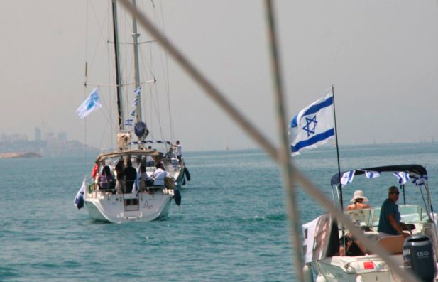
PICTURES! -Some very expensive yachts sailed from Herziliya Yacht Club in a feint of indignation that an international social justice effort was showing favoritism toward Palestinians. No Gaza yacht club could be reached for a response. Commodore Guy Bechor, an outspoken Zionist, led the ostentatious flotilla in protest of the humanitarian aid convoy attempting to break the siege of Gaza, which he belittled as “rusty tin cans.”

The banners for their private regatta? TURKEY=IRAN? and FREE GILAD, an interesting conceit. 1.5 million Gazans are being blockaded to coerce the release of one Israeli POW. That’s a ratio similar to the disproportionate casualties of the 2008 Gaza “War.”

While soldier Gilad Shalit is considered a hostage of Hamas, he was an IDF soldier captured by the resistance. Israel holds 8,000 Palestinians in detention, not counting all the residents of Gaza.

The Gaza Massacre, like the ongoing siege itself, is recognized as an illegal act of collective punishment. A fact apparently lost on the Yerziliya skippers. Likewise the disconnect they display in presuming to insult the Turkish leader by associating him with Mahmoud Ahmadinejad.

Though the yacht flotilla raised fears of creating an embarrassing confrontation with the humanitarian fleet, in reality it was a single day affair. The Israeli counter protesters were informed that the entire coast of Gaza has been cordoned by the Israeli navy. The pretext it will use to try to arrest the Freedom Flotilla blockade runners.

Bechor’s website G-planet celebrates all the press they received, I don’t see the harm in giving them more. These pictures speak a thousand words, almost as many days as Gaza has been under illegal siege.

See more pictures at Bechor’s Facebook album. The irony of the singular concern for Gilad Shalit might have caused Bechor to think twice about the message. All photos of yachts featuring the banners about Shalit have been curiously scrubbed, but they remain on some Turkish news sites.

Bechor list dozens of Turkish media outlets which covered his anti-relief regatta, demonstrating a strategy of aiming to undercut Turkish public support for what it predominantly its humanitarian effort. While several of the outlets might be Hasbara properties echoing Israel PR, most of the articles about the Israeli counter-protest make as much fun of it as we.

For the record, here is the port at Gaza, absent of yachts. The relief convoy will even have to improvise docks for unloading their supplies.

Relief convoy to bring media Armada


What this Freedom Flotilla has over previous relief efforts like the Viva Palestina caravans is a momentum building in the international press. It’s the big ship effect that works for gunship diplomacy, brought to bear this time to enforce social justice, too big to ignore.
(Update 5/24: Australia’s Sidney Morning Herald has three articles: 1. the Turkish sendoff 2. Elvis Costello honoring the BDS cultural boycott, and 3. an in-depth story featuring the trademarked media logo BUSTING THE BLOCKADE!)

Admittedly America’s is a Zionist media. That’s where I suppose the social media campaign must wag the Zionist dog, to mix pun with metaphor. It’s going to help no doubt that the Israeli press is already awash with anticipation.

Where the last Viva Palestina humanitarian convoy crossed continents before the BBC begrudged it coverage, the 2010 Freedom Flotilla, including ShiptoGaza and the Free Gaza Movement have already hit BBC radar. The IHH efforts are being joined by a cargo ship which just left Algiers.

Here are the latest photos from Turkey, a Convoy to Gaza blog being updated by UK activist Lorbital, and Tox’s notes about DAY ONE of relief convoy, day 1075 of Gaza Siege.

With Israel vowing to stop them, and the Freedom Flotilla determined to push through, the showdown will have Western media outlets unable to maintain their news blackout. This will be no USS Liberty pummeled by sneak attack with no witnesses permitted to break the story. The Gaza relief convoy numbers nine ships, with more adventurers joining the escort no doubt, a measure of supporters’ anticipation of an inevitable catharsis for the siege.

The inertia looks good to me. Press releases are flying announcing who’s joining the convoy (now a USS Liberty survivor), and European diplomats are issuing statements that they expect Israel to give the convoy safe passage. Wait until the ships are making the final crossing from Cyprus for heavyweight supporters such as George Galloway or Hugo Chavez to weigh in.

Israeli welcome flotillaThe Israeli press is already running circles. A fleet of Israeli sailboats from the Herziliya Marina is preparing to greet the relief convoy with banners that say HAMAS SUCKS to counter whatever humanitarian message they worry the “peace activists” might score. There’s some speculation that Israel would fare better PR by letting the aid through.

A fortuitous coincidence places White House Chief of Staff Rahm Emanuel in Israel when the blockade-runners are due to arrive. By Israel, I actually mean the Occupied Territories. Emanuel was trying to book the Western Wall for his son’s barmitzvah. Plans were changed due either to threats from the ultra-right because of US criticisms of continuing settlement building, or because US officials are prohibited from conducting personal business outside of Israel’s Green Line.

Algerian relif convoy shipThe cargo ship which sailed from Algeria today is the al-Jazair. More info on this ship as we find it.

ShiptoGaza Sweden has uploaded more pictures of the loading of the charming Sofia in Athens.

Turkey’s third convoy vessel has been identified as the massive cargo ship Defne Y (IMO: 7725518), loading in Istanbul and due to join the Gazze and Mavi Marmara in Cyprus.

BDS movement should target USA too, for complicity in Israeli Apartheid

Israeli travel brochure for white colonist Apartheid tourismAs the US continues to subsidize the Israeli occupation, including the recent commitment to fund an anti-missile system, plus failure to demand a halt to Jewish settlements, termed “impediments to peace” and not “illegal,” it’s time the BDS movement against Israel recognized the US for its integral part in upholding Apartheid. It may be too much for nascent BDS efforts in the US, but international organizers should certainly add American products, businesses and institutions to the list of BDS targets. As our politicians reaffirm that US-Israeli interests are indivisible, so should we expect to hang together.

As if the world didn’t have enough excuse to sanction the US, for Iraq, for Afghanistan, for Pakistan, for the IMF, World Bank and United Nations. For its warmongering and provocations, for its covert crimes meant to destabilize populist resurgence against its imperial grasp. Israel and Apartheid, should be just the start.

Israel is not a tough sell in the growing international BDS movement. Adding the US is no great stretch, the two already regarded as partners in crime, I can’t think that proponents of BDS in the United States would be averse to calling out our own nation as accomplice. The same principles of social justice drive solidarity for Palestine as those against war and imperialism.

Maybe an international shift to group the US with Isreal will find more support because it is more intellectually honest. The effort will still be attacked as anti-Semitic, but perhaps the argument can be deflected by the enlarged focus. Israeli Apartheid, American racism, drive the same globalist anti-everybody-else policy.

AIPAC student DC junkets paying off


This year’s AIPAC conference targeted university student body officers in an effort to fend off BDS campaigns at campuses nationwide. Did the controversial strategy just pay off at UC Berkeley? When the student council voted 16 to 4 to divest, student body president Will Smelko vetoed the measure. Intense pressure from Israeli lobby groups were able to prevent overturning the veto.

AIPAC said they were going to do it, and they did it. Here’s what AIPAC’s Leadership Development Director Jonathan Kessler told DC conference attendees:

How are we going to beat back the anti-Israel divestment resolution at Berkeley? We’re going to make certain that pro-Israel students take over the student government and reverse the vote. That is how AIPAC operates in our nation’s capitol. This is how AIPAC must operate on our nation’s campuses.

Though the Berkeley bill SB118 proposed divestment from General Electric and United Technologies only, two military industries which profit from Israel’s subjugation of the Palestinians, it’s true perhaps that the measure opened the door to further BDS inroads to fight Israel Apartheid.

The divestment proposal had the backing of Archbishop Desmond Tutu among many activists. Against was the Israeli lobby. Students were warned that prospective Jewish students would avoid enrolling, etc. Can we imagine the suggestion was made that the current students would be denied jobs? There probably is a corporate future for “made” students who’ve shown their fealty to AIPAC.

Worth reprinting is the statement read by UCB Professor Judth Butler trying to warn the students against AIPAC’s disreputable coercion:

Let us begin with the assumption that it is very hard to hear the debate under consideration here. One hears someone saying something, and one fears that they are saying another thing. It is hard to trust words, or indeed to know what words actually mean. So that is a sign that there is a certain fear in the room, and also, a certain suspicion about the intentions that speakers have and a fear about the implications of both words and deeds. Of course, tonight you do not need a lecture on rhetoric from me, but perhaps, if you have a moment, it might be possible to pause and to consider reflectively what is actually at stake in this vote, and what is not. Let me introduce myself first as a Jewish faculty member here at Berkeley, on the advisory board of Jewish Voice for Peace, on the US executive committee of Faculty for Israeli-Palestinian Peace, a global organization, a member of the Russell Tribunal on Human Rights in Palestine, and a board member of the Freedom Theatre in Jenin. I am at work on a book which considers Jewish criticisms of state violence, Jewish views of co-habitation, and the importance of ‘remembrance’ in both Jewish and Palestinian philosophic and poetic traditions.

The first thing I want to say is that there is hardly a Jewish dinner table left in this country–or indeed in Europe and much of Israel–in which there is not enormous disagreement about the status of the occupation, Israeli military aggression and the future of Zionism, binationalism and citizenship in the lands called Israel and Palestine. There is no one Jewish voice, and in recent years, there are increasing differences among us, as is evident by the multiplication of Jewish groups that oppose the occupation and which actively criticize and oppose Israeli military policy and aggression. In the US and Israel alone these groups include: Jewish Voice for Peace, American Jews for a Just Peace, Jews Against the Occupation, Boycott from Within, New Profile, Anarchists Against the Wall, Women in Black, Who Profits?, Btselem, Zochrot, Black Laundry, Jews for a Free Palestine (Bay Area), No Time to Celebrate and more. The emergence of J Street was an important effort to establish an alternative voice to AIPAC, and though J street has opposed the bill you have before you, the younger generation of that very organization has actively contested the politics of its leadership. So even there you have splits, division and disagreement.

So if someone says that it offends “the Jews” to oppose the occupation, then you have to consider how many Jews are already against the occupation, and whether you want to be with them or against them. If someone says that “Jews” have one voice on this matter, you might consider whether there is something wrong with imagining Jews as a single force, with one view, undivided. It is not true. The sponsors of Monday evening’s round table at Hillel made sure not to include voices with which they disagree. And even now, as demonstrations in Israel increase in number and volume against the illegal seizure of Palestinian lands, we see a burgeoning coalition of those who seek to oppose unjust military rule, the illegal confiscation of lands, and who hold to the norms of international law even when nations refuse to honor those norms.

What I learned as a Jewish kid in my synagogue–which was no bastion of radicalism–was that it was imperative to speak out against social injustice. I was told to have the courage to speak out, and to speak strongly, even when people accuse you of breaking with the common understanding, even when they threaten to censor you or punish you. The worst injustice, I learned, was to remain silent in the face of criminal injustice. And this tradition of Jewish social ethics was crucial to the fights against Nazism, fascism and every form of discrimination, and it became especially important in the fight to establish the rights of refugees after the Second World War. Of course, there are no strict analogies between the Second World War and the contemporary situation, and there are no strict analogies between South Africa and Israel, but there are general frameworks for thinking about co-habitation, the right to live free of external military aggression, the rights of refugees, and these form the basis of many international laws that Jews and non-Jews have sought to embrace in order to live in a more just world, one that is more just not just for one nation or for another, but for all populations, regardless of nationality and citizenship. If some of us hope that Israel will comply with international law, it is precisely so that one people can live among other peoples in peace and in freedom. It does not de-legitimate Israel to ask for its compliance with international law. Indeed, compliance with international law is the best way to gain legitimacy, respect and an enduring place among the peoples of the world.

Of course, we could argue on what political forms Israel and Palestine must take in order for international law to be honored. But that is not the question that is before you this evening. We have lots of time to consider that question, and I invite you to join me to do that in a clear-minded way in the future. But consider this closely: the bill you have before you does not ask that you take a view on Israel. I know that it certainly seems like it does, since the discussion has been all about that. But it actually makes two points that are crucial to consider. The first is simply this: there are two companies that not only are invested in the Israeli occupation of Palestinian lands and peoples, but who profit from that occupation, and which are sustained in part by funds invested by the University of California. They are General Electric and United Technologies. They produce aircraft designed to bomb and kill, and they have bombed and killed civilians, as has been amply demonstrated by Amnesty International and Human Rights Watch. You are being asked to divest funds from these two companies. You are NOT being asked to divest funds from every company that does business with Israel. And you are not being asked to resolve to divest funds from Israeli business or citizens on the basis of their citizenship or national belonging. You are being asked only to call for a divestment from specific companies that make military weapons that kill civilians. That is the bottom line.

If the newspapers or others seek to make inflammatory remarks and to say that this is an attack on Israel, or an attack on Jews, or an upsurge of anti-Semitism, or an act that displays insensitivity toward the feelings of some of our students, then there is really only one answer that you can provide, as I see it. Do we let ourselves be intimidated into not standing up for what is right? It is simply unethical for UC to invest in such companies when they profit from the killing of civilians under conditions of a sustained military occupation that is manifestly illegal according to international law. The killing of civilians is a war crime. By voting yes, you say that you do not want the funds of this university to be invested in war crimes, and that you hold to this principle regardless of who commits the war crime or against whom it is committed.

Of course, you should clearly ask whether you would apply the same standards to any other occupation or destructive military situation where war crimes occur. And I note that the bill before you is committed to developing a policy that would divest from all companies engaged in war crimes. In this way, it contains within it both a universal claim and a universalizing trajectory. It recommends explicitly “additional divestment policies to keep university investments out of companies aiding war crimes throughout the world, such as those taking place in Morocco, the Congo, and other places as determined by the resolutions of the United Nations and other leading human rights organizations.” Israel is not singled out. It is, if anything, the occupation that is singled out, and there are many Israelis who would tell you that Israel must be separated from its illegal occupation. This is clearly why the divestment call is selective: it does not call for divestment from any and every Israeli company; on the contrary, it calls for divestment from two corporations where the links to war crimes are well-documented.

Let this then be a precedent for a more robust policy of ethical investment that would be applied to any company in which UC invests. This is the beginning of a sequence, one that both sides to this dispute clearly want. Israel is not to be singled out as a nation to be boycotted–and let us note that Israel itself is not boycotted by this resolution. But neither is Israel’s occupation to be held exempt from international standards. If you want to say that the historical understanding of Israel’s genesis gives it an exceptional standing in the world, then you disagree with those early Zionist thinkers, Martin Buber and Judah Magnes among them, who thought that Israel must not only live in equality with other nations, but must also exemplify principles of equality and social justice in its actions and policies. There is nothing about the history of Israel or of the Jewish people that sanctions war crimes or asks us to suspend our judgment about war crimes in this instance. We can argue about the occupation at length, but I am not sure we can ever find a justification on the basis of international law for the deprivation of millions of people of their right to self-determination and their lack of protection against police and military harassment and destructiveness. But again, we can have that discussion, and we do not have to conclude it here in order to understand the specific choice that we face. You don’t have to give a final view on the occupation in order to agree that investing in companies that commit war crimes is absolutely wrong, and that in saying this, you join Jews, Muslims, Hindus, Christians and so many other peoples from diverse religious and secular traditions who believe that international governance, justice and peace demand compliance with international law and human rights and the opposition to war crimes. You say that you do not want our money going into bombs and helicopters and military materiel that destroys civilian life. You do not want it in this context, and you do not want it in any context.

Part of me wants to joke–where would international human rights be without the Jews! We helped to make those rights, at Nuremberg and again in Jerusalem, so what does it mean that there are those who tell you that it is insensitive to Jewishness to come out in favor of international law and human rights? It is a lie–and what a monstrous view of what it means to be Jewish. It disgraces the profound traditions of social justice that have emerged from the struggle against fascism and the struggles against racism; it effaces the tradition of ta-ayush, living together, the ethical relation to the non-Jew which is the substance of Jewish ethics, and it effaces the value that is given to life no matter the religion or race of those who live. You do not need to establish that the struggle against this occupation is the same as the historical struggle against apartheid to know that each struggle has its dignity and its absolute value, and that oppression in its myriad forms do not have to be absolutely identical to be equally wrong. For the record, the occupation and apartheid constitute two different versions of settler colonialism, but we do not need a full understanding of this convergence and divergence to settle the question before us today. Nothing in the bill before you depends on the seamless character of that analogy. In voting for this resolution, you stand with progressive Jews everywhere and with broad principles of social justice, which means, that you stand with those who wish to stand not just with their own kind but with all of humanity, and who do this, in part, both because of the religious and non-religious values they follow.

Lastly, let me say this. You may feel fear in voting for this resolution. I was frightened coming here this evening. You may fear that you will seem anti-Semitic, that you cannot handle the appearance of being insensitive to Israel’s needs for self-defense, insensitive to the history of Jewish suffering. Perhaps it is best to remember the words of Primo Levi who survived a brutal internment at Auschwitz when he had the courage to oppose the Israeli bombings of southern Lebanon in the early 1980s. He openly criticized Menachem Begin, who directed the bombing of civilian centers, and he received letters asking him whether he cared at all about the spilling of Jewish blood. He wrote:

I reply that the blood spilled pains me just as much as the blood spilled by all other human beings. But there are still harrowing letters. And I am tormented by them, because I know that Israel was founded by people like me, only less fortunate than me. Men with a number from Auschwitz tattooed on their arms, with no home nor homeland, escaping from the horrors of the Second World War who found in Israel a home and a homeland. I know all this. But I also know that this is Begin’s favourite defence. And I deny any validity to this defence.

As the Israeli historian Idith Zertal makes clear, do not use this most atrocious historical suffering to legitimate military destructiveness–it is a cruel and twisted use of the history of suffering to defend the affliction of suffering on others.

To struggle against fear in the name of social justice is part of a long and venerable Jewish tradition; it is non-nationalist, that is true, and it is committed not just to my freedom, but to all of our freedoms. So let us remember that there is no one Jew, not even one Israel, and that those who say that there are seek to intimidate or contain your powers of criticism. By voting for this resolution, you are entering a debate that is already underway, that is crucial for the materialization of justice, one which involves having the courage to speak out against injustice, something I learned as a young person, but something we each have to learn time and again. I understand that it is not easy to speak out in this way. But if you struggle against voicelessness to speak out for what is right, then you are in the middle of that struggle against oppression and for freedom, a struggle that knows that there is no freedom for one until there is freedom for all. There are those who will surely accuse you of hatred, but perhaps those accusations are the enactment of hatred. The point is not to enter that cycle of threat and fear and hatred–that is the hellish cycle of war itself. The point is to leave the discourse of war and to affirm what is right. You will not be alone. You will be speaking in unison with others, and you will, actually, be making a step toward the realization of peace–the principles of non-violence and co-habitation that alone can serve as the foundation of peace. You will have the support of a growing and dynamic movement, inter-generational and global, by speaking against the military destruction of innocent lives and against the corporate profit that depends on that destruction. You will stand with us, and we will most surely stand with you.

ACLU defends Freedom of Speech: that of yours, mine, Nazis or corporations

COLORADO SPRINGS- The local Springs ACLU chapter is challenging the national office’s position on the recent Citizens United victory and I’m torn. I am as anti-corporate as the next rabid class-war insurgent, but the longstanding corporate personhood abomination is a separate abuse than the oppression of civil liberties. It’s clear that one impacts the other, but until we clarify who’s a “who,” the ACLU is determined to exclude no one from First Amendment protection. Make sense?

When and if the immortality advantages of corporate trusts can reigned in, the political power of the individual will be more secure. But an opposite Citizens United verdict would have left American individuals with limits on their speech. You don’t pass respiratory restrictions in Pigville just because the Big Bad Wolf is in town. You charge him with threatening illegal acts, etc, before you abridge the rights of all citizens in the name of security.

In social justice type affinity groups, I certainly believe there are times when the grassroots have to wag their dog gone somnolent. More often however, dissension generates from a malignant insurrection against the founding principles with which the provincial members have lost sight. My experience has been that local ACLU groups, Denver included, are exaggeratedly vigilant about asking “is this a civil liberties issue?” for fear of being seen to address a problem that has become politicized.

Defenders of the last administration for example were desperate to prevent activists from getting the support and sponsorship of established advocacy groups like the ACLU.

Lamentably, believe it or not, some ACLU self-obstructionists differentiate human rights abuses from civil liberties. They see the issue as “partisan.” Because critics of the Patriot Act are often Democrats, Republicans find themselves tasked with defending it. Likewise, illegal war, war crimes, rendition, illegal detention, etc, are also too partisan to address, even as they constitute affronts to the civil liberties of all.

It’s become very clear to me that both Denver and Colorado Springs chapters are dominated by conservative voices who restrict local ACLU activities to conducting public discussion groups, as opposed to speaking out about federal and local abuses which are usual targets of the national office.

The upcoming forum on Corporate Personhood, this Thursday night at Shove Chapel at Colorado College, is clearly outside the purview of civil liberties, but may have escaped our local ACLU’s conservative corporatists explicitly because it goes against the ACLU leadership.

To my mind however, the event will serve two goods. One, we take on corporations, and two our action alerts ACLU Washington about the rotten apples in our midst. Obstructionists are perhaps ever present, but headquarters might generate some guidelines about how to further root them out. A simple essay test about “what are civil liberties” would suffice for me. The next member who points to an ACLU talking point and avers “I don’t see how this is a civil liberties issue” gets the boot.

The most pathetic recurring argument is that the ACLU should only concern itself with the Civil Liberties of “Americans.” The National ACLU has of course argued for the rights of foreign nationals, even those living overseas who have been targets of extradition, as well as peoples of foreign lands under the jurisdiction of American authority; leased properties such as oversees bases for example, and entire nations we’ve invaded. Where should borders demarc free-of-liberties-zones?

The same critics of course show no qualms about US military forces subjugating other peoples in the name of “Freedom” without thought that our liberation of capitalist forces should come with some protections. Pax Americana minus the Americana Bill of Rights.

Challenged about its public support of the Citizens United case, the ACLU offered this unapologetic explanation:

“The ACLU has consistently taken the position that section 203 is facially unconstitutional under the First Amendment because it permits the suppression of core political speech, and our amicus brief takes that position again.”

The fallout has been heated, but I’ve enjoyed the parallels drawn to the infamous occasion when the ACLU protected the right of Nazis to march in the predominantly Jewish Chicago suburb of Skokie Illinois. Yes the ACLU will fight for NAMBLA, Nazis and corporations, and no one bats an eye at the affinity of the three.

The 2009 Amicus Brief which the ACLU filed in support of Citizens United is viewable online (PDF), here are the preface sections:

AMICUS CURIAEBRIEF OF THE AMERICAN CIVIL

LIBERTIES UNION IN SUPPORT OF APPELLANT

ON SUPPLEMENTAL QUESTION

INTEREST OF AMICUS

The American Civil Liberties Union (ACLU) is a nationwide, nonprofit, nonpartisan organization with more than 500,000 members dedicated to the principles of liberty and equality embodied in the Constitution and our nation’s civil rights laws.

For the past three decades, the ACLU has been deeply engaged in the effort to reconcile campaign finance legislation and First Amendment principles, from Buckley v. Valeo, 424 U.S. 1 (1976), where we represented our New York affiliate, to McConnell v. FEC, 540 U.S. 93 (2003), where the ACLU was both co-counsel and plaintiff, to Randall v. Sorrell, 548 U.S. 230 (2006), where we were lead counsel. In addition, the ACLU has appeared as amicus curiae in many of this Court’s campaign finance cases, including FEC v. Wisconsin Right to Life, Inc. (“WRTL”), 551 U.S. 449 (2007).

As framed by the Court’s reargument order, 2009 WL 1841614 (2009), this case presents fundamental questions concerning the constitutionally permissible scope of campaign finance regulation that this Court first confronted in Buckley and subsequently revisited in McConnell and WRTL. The proper resolution of that delicate balance remains an issue of substantial importance to the ACLU and its members.

SUMMARY OF ARGUMENT

The broad prohibition on “electioneering communications” set forth in § 203 of the Bipartisan Campaign Reform Act of 2002 (BCRA), 2 U.S.C. § 441b(b)(2), violates the First Amendment, and the limiting construction adopted by this Court in WRTL is insufficient to save it. Accordingly, the Court should strike down § 203 as facially unconstitutional and overrule that portion of McConnell that holds otherwise.

This brief addresses only that question. It does not address the additional question raised by this Court’s reargument order: namely, whether Austin v. Michigan Chamber of Commerce, 494 U.S. 652 (1990), should be overruled. However, if Austin is overruled and the ban on express advocacy by corporations and unions is struck down, then the ban on “electioneering communications” in § 203 would necessarily fall as a consequence.

Even if Austin is not overruled, § 203 is unconstitutional precisely because it extends beyond the express advocacy at issue in Austin. The history of the McConnell litigation, as well as campaign finance litigation before and after McConnell, demonstrates that there is no precise or predictable way to determine whether or not political speech is the “functional equivalent” of express advocacy.

The decision in WRTL correctly recognized that the BCRA’s prophylactic ban on “electioneering communications” threatened speech that lies at the heart of the First Amendment, including genuine issue ads by nonpartisan organizations like the ACLU. But the reformulated ban crafted by this Court in WRTL continues to threaten core First Amendment speech. Its reliance on the hypothetical response of a reasonable listener still leaves speakers guessing about what speech is lawful and what speech is not. That uncertainty invites arbitrary and discriminatory enforcement. It will also lead many speakers to self-censor rather than risk sanctions or undertake the expense of suing the FEC prior to speaking, especially since most suits will not be resolved until long after the speech is timely and relevant.

In short, § 203 was a poorly conceived effort to restrict political speech and should be struck down.

We, the ppl need an INTERPOL blotter

In virtually every city and county in our America’s Most Wanted USA, you can access police blotters and mugshots of the latest arrests, replete with personal details above a small print disclaimer that persons profiled are only accused of the crimes described, and should be considered innocent until proven guilty. Why then, in this pillory-centric culture, is it often impossible to learn the names of real found-guilty criminals? And why are reporters, and often foreign governments, complicit in keeping the names secret? I’m thinking for example of the 23 US operatives convicted of kidnapping in Italy, the Blackwater goons recently discovered plotting a murder in Germany, and the USAID subcontractor apprehended in Cuba, for starters.

Just this week, a Yakuzi handful of Israeli officers decided against traveling to England after their British hosts warned them of the possibility arrests warrants could be issued against them for war crimes committed in Gaza this time last year. The identity of the four IDF officers is being kept confidential, requiring not only the cooperation of the international press, but of the activist groups pursuing justice through the system. Certainly their names would have to be known to be able to file papers in British court.

Are accusers keeping quiet based because they’re admonished for despoiling chances for a fair trial? Social justice advocates are natural patsies for wanting to respect every defendant’s dignity, even that of a war criminal.

Back in the US, some local news outlets even air holding tank arraignment video pleas before the judge. Contrast this with the still-universal ban on cameras in courtrooms. The different policy has everything to do with who can afford a lawyer, or the cooperation of the corporate press.

Here’s a brilliant example today, of a Swiss tycoon issued a world-record-setting speeding fine of $290,000 for driving his ferrari 137kph through a village. The fine was calculated based on a court’s assessment of his wealth, approximately $22.7 million. Arrested, tried, bean-counted. His name? Undisclosed.

Is it really illegal to boycott Israel?

boycott-israeli-goods-end-apartheidIt is not illegal for US consumers to boycott anyone’s products. But the business decisions of companies affiliated with Israel do enjoy some curious protective constraints…

It’s ironic that as the US enforces rigid sanctions against international companies which violate its embargo against Cuba, the US has enacted laws simultaneously which prohibit its companies from complying with trade restrictions called by others.

As a further embarrassment, the antiboycotting measure specifies just one boycott, literally: the League of Arab Nations boycott of Israel.

So while American consumers are free to make the buying decisions they wish, it is illegal for an American business to adjust its business practices to boycott Israel.

In other words, as much as social justice activists might like to ask a department store not to carry Ahava beauty products taken from Occupied Territory shores, the store would be prohibited by US law to do so as an act of compliance. ahava-stolen-beauty-occupation For another example, fashion labels such as DKNY and cK could decide to discontinue carrying undergarments manufactured by Delta Galil from settler farms in Palestine, but they couldn’t do it because of someone’s boycott.

(Delta Galil supplies clothing to the Gap, Banana Republic, Structure, J-Crew, JC Penny, Pryca, Lindex, DIM, Donna Karan, Ralph Lauren, Playtex, Calvin Klein, and Hugo Boss.)

This law makes a commercial boycott impossible to resolve between customer and business, but ultimately results in more pressure being applied to the source cause, which are the policies of Israel.

According to the US Department of Commerce, Bureau of Industry and Security, Office of Antiboycott Compliance, in the 1970s two laws were enacted “to counteract the participation of U.S. citizens in other nation’s economic boycotts or embargoes. These ‘antiboycott’ laws are the 1977 amendments to the Export Administration Act (EAA) and the Ribicoff Amendment to the 1976 Tax Reform Act (TRA). While these laws share a common purpose, there are distinctions in their administration.”

Antiboycott Compliance

The Bureau is charged with administering and enforcing the Antiboycott Laws under the Export Administration Act. Those laws discourage, and in some circumstances, prohibit U.S. companies from furthering or supporting the boycott of Israel sponsored by the Arab League, and certain Moslem countries, including complying with certain requests for information designed to verify compliance with the boycott. Compliance with such requests may be prohibited by the Export Administration Regulations (EAR) and may be reportable to the Bureau.

The law specifies boycotts called by foreign nations, leaving the possibility that US citizens can declare themselves the originators of a boycott. However other language makes clear that no boycott is to contravene the US government’s declared trade policy with Israel. To elaborate on the EAR:

Objectives:
The antiboycott laws were adopted to encourage, and in specified cases, require U.S. firms to refuse to participate in foreign boycotts that the United States does not sanction. They have the effect of preventing U.S. firms from being used to implement foreign policies of other nations which run counter to U.S. policy.

Primary Impact:
The Arab League boycott of Israel is the principal foreign economic boycott that U.S. companies must be concerned with today. The antiboycott laws, however, apply to all boycotts imposed by foreign countries that are unsanctioned by the United States.

Who Is Covered by the Laws?
The antiboycott provisions of the Export Administration Regulations (EAR) apply to the activities of U.S. persons in the interstate or foreign commerce of the United States. The term “U.S. person” includes all individuals, corporations and unincorporated associations resident in the United States, including the permanent domestic affiliates of foreign concerns. U.S. persons also include U.S. citizens abroad (except when they reside abroad and are employed by non-U.S. persons) and the controlled in fact affiliates of domestic concerns. The test for “controlled in fact” is the ability to establish the general policies or to control the day to day operations of the foreign affiliate.

The scope of the EAR, as defined by Section 8 of the EAA, is limited to actions taken with intent to comply with, further, or support an unsanctioned foreign boycott.

These amendments are examples of Israel’s stranglehold on US legislation. Anti-Israel voices like to paint the picture that as a result, American citizens have been denied the freedom to vote with their pocketbooks where it comes to opposing the policies of Israel. Likewise, pro-Israel groups are content to leave the issue ambiguous. But clearly US individuals are free to make consumer choices and encourage others as they wish.

The function of the TRA further explains its business-limited scope:

What do the Laws Prohibit?

Conduct that may be penalized under the TRA and/or prohibited under the EAR includes:

• Agreements to refuse or actual refusal to do business with or in Israel or with blacklisted companies.

• Agreements to discriminate or actual discrimination against other persons based on race, religion, sex, national origin or nationality.

• Agreements to furnish or actual furnishing of information about business relationships with or in Israel or with blacklisted companies.

• Agreements to furnish or actual furnishing of information about the race, religion, sex, or national origin of another person.

Implementing letters of credit containing prohibited boycott terms or conditions.

The TRA does not “prohibit” conduct, but denies tax benefits (“penalizes”) for certain types of boycott-related agreements.

The Caracas Commitment Si Se Puede

You might imagine the multinational corporate media would blackout the talk of a 5th Socialist International. They are most determined to censor the issues which the world’s leftist parties are resolved to address. Where Obama 2008 and Copenhagen 2009 project a vacuum of ideological momentum, check out the Caracas Commitment.

The Caracas Commitment
November 25, 2009?
By Declaration from World Meeting of Left Parties?
November 19-21 Caracas, Venezuela

Political parties and organizations from Latin America, the Caribbean, Europe, Africa, Asia, and Oceania commemorate and celebrate the unity and solidarity that brought us together in Caracas, Bolivarian Republic of Venezuela, and from this libertarian city we would like to express our revolutionary rebelliousness. We are glad of and committed to the proud presence of the forces of change in a special moment of history. Likewise, we are proud to reaffirm our conviction to definitively sow, grow and win Socialism of the 21st century.

In this regard, we want to sign the Commitment of Caracas as a revolutionary guide for the challenges ahead of us. We have gathered with the aim of unifying criteria and giving concrete answers that allow us to defend our sovereignty, our social victories, and the freedom of our peoples in the face of the generalized crisis of the world capitalist system and the new threats spreading over our region and the whole world with the establishment and strengthening of military bases in the sister republics of Colombia, Panama, Aruba, Curacao, the Dutch Antilles, as well as the aggression against Ecuadorian territory, and the invasions of Iraq and Afghanistan.

We consider that the world capitalist system is going through one of its most severe crises, which has shaken its very foundations and brought with it consequences that jeopardize the survival of humanity. Likewise, capitalism and the logic of capital, destroys the environment and biodiversity, bringing with it consequences of climate change, global warming and the destruction of life.

One of the epicentres of the capitalist crisis is in the economic domain; this highlights the limitations of unbridled free markets ruled by private monopolies. In this situation, some governments have been asked to intervene to prevent the collapse of vital economic sectors, for instance, through the implementation of bailouts to bank institutions that amount to hundreds of billions of dollars. Said governments have been asked to stimulate their economies by increasing public expenditure in order to mitigate the recession and the private sector decline, which evidences the end of the supposedly irrefutable “truth” of neo-liberalism that of non-intervention of the State in economic affairs.

In this regard, it is very timely to promote an in-depth discussion on the economic crisis, the role of the State and the construction of a new financial architecture.

In summary, the capitalist crisis cannot be reduced simply to a financial crisis; it is a structural crisis of capital which combines the economic crisis, with an ecological crisis, a food crisis, and an energy crisis, which together represents a mortal threat to humanity and mother earth. Faced with this crisis, left-wing movements and parties see the defence of nature and the construction of an ecologically sustainable society as a fundamental axis of our struggle for a better world.

In recent years, progressive and left-wing movements of the Latin American region have accumulated forces, and stimulated transformations, throwing up leaders that today hold important government spaces. This has represented an important blow to the empire because the peoples have rebelled against the domination that has been imposed on them, and have left behind their fear to express their values and principles, showing the empire that we will not allow any more interference in our internal affairs, and that we are willing to defend our sovereignty.

This meeting is held at a historic time, characterized by a new imperialistic offensive against the peoples and governments of the region and of the world, a pretension supported by the oligarchies and ultraconservative right-wing, with the objective of recovering spaces lost as a consequence of the advancement of revolutionary process of liberation developing in Latin America. These are expressed through the creation of regional organizations such as ALBA, UNASUR, PETROCARIBE, Banco del Sur, the Sao Paulo Forum, COPPPAL, among others; where the main principles inspiring these processes are those of solidarity, complementarity, social priority over economic advantage, respect for self-determination of the peoples in open opposition to the policies of imperial domination. For these reasons, the right-wing forces in partnership with the empire have launched an offensive to combat the advance and development of the peoples’ struggles, especially those against the overexploitation of human beings, racist discrimination, cultural oppression, in defence of natural resources, of the land and territory from the perspective of the left and progressive movements and of world transformation.

We reflect on the fact that these events have led the U.S administration to set strategies to undermine, torpedo and destabilize the advancement of these processes of change and recuperation of sovereignty. To this end, the US has implemented policies expressed through an ideological and media offensive that aim to discredit the revolutionary and progressive governments of the region, labelling them as totalitarian governments, violators of human rights, with links to drug-trafficking operations, and terrorism; and also questioning the legitimacy of their origin. This is the reason for the relentless fury with which all the empire’s means of propaganda and its agents inside our own countries continuously attack the experiences in Venezuela, Ecuador, Nicaragua, Bolivia, and Paraguay, as with its maintenance of the blockade against revolutionary and independent Cuba.

Part of the strategy activated by the U.S. Empire is evidenced by the coup in Honduras, as well as in other destabilizing initiatives in Central America, attempting to impose the oligarchic interests that have already left hundreds of victims, while a disgusting wave of cynicism tries to cover up the dictatorship imposed by the U.S. administration with a false veil of democracy. Along with this, it is developing a military offensive with the idea of maintaining political and military hegemony in the region, for which it is promoting new geopolitical allies, generating destabilization and disturbing peace in the region and globally through military intimidation, with the help of its allies in the internal oligarchies, who are shown to be complicit in the actions taken by the empire, giving away their sovereignty, and opening spaces for the empire’s actions.

We consider that this new offensive is specifically expressed through two important events that took place this year in the continent: The coup in Honduras, and the installation of military bases in Colombia and Panama, as well as the strengthening of the already existing ones in our region. The coup in Honduras is nothing but a display of hypocrisy by the empire, a way to intimidate the rest of the governments in the region. It is a test-laboratory that aims to set a precedent that can be applied as a new coup model and a way to encourage the right to plot against the transformational and independent processes.

We denounce the military agreement between the Colombian government and the United States administration strengthens the U.S.’s military strategy, whose contents are expressed in the so-called “White Book.” This confirms that the development of the agreement will guarantee a projection of continental and intercontinental military power, the strengthening of transportation capability and air mobility to guarantee the improvement of its action capability, in order to provide the right conditions to have access to energy sources. It also consolidates its political partnership with the regional oligarchy for the control of Colombian territory and its projection in the Andes and in the rest of South America. All this scaffolding and consolidation of military architecture entails a serious threat for peace in the region and the world.

The installation of military bases in the region and their interrelation with the different bases spread throughout the world is not only confined to the military sphere, but rather forms part of the establishment of a general policy of domination and expansion directed by the U.S. These bases constitute strategic points to dominate all the countries in Central and Latin America and the rest of the world.

The treaty for the installation of military bases in Colombia is preceded by Plan Colombia, which was already an example of U.S. interference in the affairs of Colombia and the region using the fight against drug trafficking and terrorism as an excuse. However, it has been shown that drug trafficking levels have increased in Colombia; therefore, the plan is no longer justified given that no favourable results have been obtained since its implementation, that would justify a new treaty with the U.S.

Today, the global strategy headed by the U.S. concerning drug trafficking is a complete failure. Its results are summarised by a rapid processes of accumulation of illegal capital, increased consumption of drugs and exacerbation of criminality, whose victims are the peoples of Latin America, especially the Colombian people. This strategy should be revisited and modified, and should be oriented towards a different logic that focuses on drug consumption as a public health issue. In Colombia, drug trafficking has assumed the form of paramilitarism, and turned into a political project the scope of which and persons responsible should be investigated so that the truth is known, so that justice prevails and the terror of the civilian population ceases.

We, the peoples of the world, declare that we will not give up the spaces we have managed to conquer after years of struggle and resistance; and we commit ourselves to regain those which have been taken from us. Therefore, we need to defend the processes of change and the unfolding revolutions since they are based on sovereign decisions made by the peoples.

Agreements

1. Mobilization and Condemnation of U.S. Military Bases

1.1.
To organize global protests against the U.S. military bases from December 12th to 17th, 2009. Various leftwing parties and social movements will promote forums, concerts, protest marches and any other creative activity within the context of this event.

1.2.
To establish a global mobilization front for the political denouncement of the U.S. military bases. This group will be made up by social leaders, left-wing parties, lawmakers, artists, among others, who will visit different countries with the aim of raising awareness in forums, press conferences and news and above all in gatherings with each country’s peoples.

1.3.
To organize students, young people, workers and women in order to establish a common agenda of vigilance and to denounce against the military bases throughout the world.

1.4.
To organize a global legal forum to challenge the installation of the U.S. military bases. This forum is conceived as a space for the condemnation of illegalities committed against the sovereignty and self-determination of the peoples and the imposition of a hegemonic imperialist model.

1.5.
To organise a global trial against paramilitarism in Colombia bringing testimonies and evidence to international bodies of justice.

1.6.
To promote a global trial against George Bush for crimes against humanity, as the person principally responsible for the genocide against the peoples of Iraq and Afghanistan.

1.7.
To promote a campaign for the creation of constitutional and legal provisions in all of our countries against the installation of military bases and deployment of nuclear weapons of mass destruction.

1.8.
To promote, from the different social organizations and movements of the countries present in this meeting, a political solution for the Colombian conflict.

1.9.
To organise solidarity with the Colombian people against the imperial aggression that the military bases entail in Colombian territory.

2. Installation and Development of a Platform of Joint Action by Left-Wing Parties of the World

2.1.
To establish a space of articulation of progressive and left-wing organizations and parties that allows for coordinating policies against the aggression towards the peoples, the condemnation of the aggressions against governments elected democratically, the installation of military bases, the violation of sovereignty and against xenophobia, the defence of immigrants’ rights, peace, and the environment, and peasant, labour, indigenous and afro-descendent movements.

2.2.
To set up a Temporary Executive Secretariat (TES) that allows for the coordination of a common working agenda, policy making, and follow-up on the agreements reached within the framework of this international encounter. Said Secretariat undertakes to inform about relevant events in the world, and to define specific action plans: statements, declarations, condemnations, mobilizations, observations and other issues that may be decided.

2.3.
To set up an agenda of permanent ideological debate on the fundamental aspects of the process of construction of socialism.

2.4.
To prepare common working agendas with participation from Latin America, Europe, Africa, Asia and Oceania.

2.5.
To organize solidarity of the people’s of the world with the Bolivarian revolution and President Hugo Chávez, in response to the constant imperial attacks.

2.6.
To commemorate the centenary of Clara Zetkin’s proposal to celebrate March 8th as the International Day of Women. The parties undertake to celebrate this day insofar as possible.

2.7.
To summon a meeting to be held in Caracas in April 2010 in commemoration of the bicentenary of our Latin American and Caribbean independences.

3. Organization of a World Movement of Militants for a Culture of Peace

3.1.
To promote the establishment of peace bases, by peace supporters, who will coordinate actions and denouncements against interventionism and war sponsored by imperialism through activities such as: forums, cultural events, and debates to promote the ethical behaviour of anti-violence, full participation in social life, respect for human rights and fundamental freedoms, acknowledgement of the cultural identities of our peoples and strengthening the framework of integration. This space seeks to raise awareness among all citizens in rejection of all forms of domination, internal or external intervention, and to reinforce the culture of peace. To struggle relentlessly for a world with no nuclear weapons, no weapons of mass destruction, no military bases, no foreign interference, and no economic blockades, as our peoples need peace and are absolutely entitled to attain development. Promote the American continent as a territory of peace, home to the construction of a free and sovereign world.

3.2.
To organize a Peace Parliament as a political space to exchange common endeavours among the world’s progressive and left-wing parliamentarians, and to know the historical, economic, legal, political and environmental aspects key for the defence of peace. Hereby we recommend holding the first meeting in February 2010.

4. Artillery Of International Communication to Emancipate Revolutionary Consciousness

4.1.
To discuss a public communication policy at an inter-regional level that aims to improve the media battle, and to convey the values of socialism among the peoples.

4.2.
To promote the creation and consolidation of alternative and community communication media to break the media siege, promote an International Alternative Left-wing Media Coordination Office that creates links to provide for improved information exchange among our countries, in which Telesur and Radiosur can be spearheads for this action.

4.3.
To create a website of all of the progressive and left-wing parties and movements in the world as a means to ensure permanent exchange and the development of an emancipating and alternative communication.

4.4.
To promote a movement of artists, writers and filmmakers to promote and develop festivals of small, short and full-length films that reflects the advancement and the struggle of peoples in revolution.

4.5.
To hold a meeting or international forum of alternative left-wing media.

5. Mobilize All Popular Organizations in Unrestricted Support for the People of Honduras

5.1.
To promote an international trial against the coup plotters in Honduras before the International Criminal Court for the abuses and crimes committed.

5.2.
Refuse to recognize the illegal electoral process they aim to carry out in Honduras.

5.3.
To carry out a world vigil on Election Day in Honduras in order to protest against the intention to legitimize the coup, coordinated by the permanent committee that emerges from this encounter.

5.4.
To coordinate the actions of left-wing parties worldwide to curb the imperialist pretensions of using the coup in Honduras as a strategy against the Latin American and Caribbean progressive processes and governments.

5.5.
To unite with the people of Honduras through a global solidarity movement for people’s resistance and for the pursuit of democratic and participatory paths that allow for the establishment of progressive governments committed to common welfare and social justice.

5.6.
To undertake actions geared towards denouncing before multilateral bodies, and within the framework of international law, the abduction of José Manuel Zelaya, legitimate President of Honduras, that facilitated the rupture of constitutional order in Honduras. It is necessary to determine responsibility among those who participated directly in this crime, and even among those who allowed his aircraft to go in and out Costa Rica without trying to detain the kidnappers of the Honduran president.

6. Solidarity with the Peoples of the World

6.1.
The Left-wing Parties of the International Meeting of Caracas agree to demand the immediate liberation of the five Cuban heroes unfairly imprisoned in American jails. They are authentic anti-terrorist fighters that caused no harm to U.S. national security, whose work was oriented towards preventing the terrorist attacks prepared by the terrorist counterrevolution against Cuba. The Five Heroes were subject to a biased judicial process, condemned by broad sectors of humanity, and stigmatized by a conspiracy of silence by the mainstream media. Given the impossibility of winning justice via judicial means, we call upon all political left-wing parties of the world to increase actions for their immediate liberation. We call on President Obama to utilize his executive power and set these Five Heroes of Humanity free.

6.2.
The International Meeting of Left-wing Parties resolutely demands the immediate and unconditional cessation of the criminal U.S. blockade that harmed the Cuban people so badly over the last fifty years. The blockade should come to an end right now in order to fulfil the will of the 187 countries that recently declared themselves against this act of genocide during the UN General Assembly.

6.3.
To unite with the people of Haiti in the struggle for the return of President Jean Bertrand Aristide to his country.

6.4.
We propose to study the possibility to grant a residence in Venezuela to Jean Bertrand Aristide, who was kidnapped and overthrown as Haiti’s president by U.S. imperialism.

6.5.
We express the need to declare a permanent alert aimed at preventing any type of breach of the constitutional order that may hinder the process of democratic change underway in Paraguay.

6.6.
We denounce the neoliberal privatizing advance in Mexico expressly in the case of the Electric Energy state-owned company, a heritage of the people, which aims through the massive firing of 45,000 workers to intimidate the union force, “Luz y Fuerza”, which constitutes another offensive of the Empire in Central and North America.

6.7.
To declare our solidarity with the peoples of the world that have suffered and are still suffering imperial aggressions, especially, the 50 year-long genocidal blockade against Cuba; the threat against the people of Paraguay; the slaughter of the Palestinian people; the illegal occupation of part of the territory of the Republic of Western Sahara and the invasion of Iraq and Afghanistan which today is expanding into Pakistan; the illegal sanctions imposed against Zimbabwe and the constant threat against Iran, among others.

Caracas, November 21st, 2009

Declaration of Solidarity with the People of Cuba

The Left-wing Parties of the International Meeting of Caracas agree to demand the immediate liberation of the five Cuban heroes unfairly imprisoned in U.S. prisons. They are authentic anti-terrorist fighters that caused no harm to US national security, whose work was oriented towards preventing the terrorist attacks prepared by the terrorist counterrevolution against Cuba. The Five Heroes were subject to a biased judicial process, condemned by broad sectors of humanity, and stigmatized by a conspiracy of silence by the mainstream media.

Given the impossibility of winning justice via judicial means, we call upon all political left-wing parties of the world to increase actions for their immediate liberation. We call on President Obama to utilize his executive power and set these Five Heroes of Humanity free.

The International Meeting of Left-wing Parties resolutely demands the immediate and unconditional cessation of the criminal U.S. blockade that harmed the Cuban people so badly over the last fifty years. The blockade should come to an end right now in order to fulfill the will of the 187 countries that recently declared themselves against this act of genocide during the UN General Assembly.

Caracas, November 21, 2009

Special Declaration on the Coup D’état in Honduras

We, left-wing parties of Latin America, Africa, Europe, Asia and Oceania, present in the international encounter of left-wing parties, reject the coup d’état against the constitutional government of citizen’s power of the President of Honduras Manuel Zelaya Rosales.

Cognizant of the situation of repression, persecution and murder against the Honduran people and the permanent military harassment against president Manuel Zelaya Rosales, which represents a breach of the rule of law in the sister nation of Honduras:

We support the actions of the national resistance front in its struggle to restore democracy.

We demand and support the sovereign right of the Honduran people to call for a national constituent assembly to establish direct democracy and to ensure the broadest political participation of the people in public affairs.

We denounce the United States intervention and its national and international reactionary right-wing allies and their connection with the coup, which hinders the construction of democracy in Honduras and in the world.

We condemn and repudiate the permanent violation of political and social human rights as well as the violation freedom of speech, promoted and perpetrated by the de facto powers, the Supreme Court of Justice, the National Congress of the Republic, the Ministry of Defence and Security since June 28, 2009.

We reiterate our demand to international governments and bodies, not to recognize the results of the general elections to be held on November 29, 2009 in Honduras, due to the lack of constitutional guarantees and the legal conditions necessary for a fair, transparent and reliable electoral process, the lack of reliable observers that can vouch for the results of this electoral process, which has already been rejected by most international governments, bodies and international public opinion.

To propose and promote an international trial against coup plotters and their accomplices in Honduras before the International Criminal Court, for the illegal actions, abuses and crimes they committed, while developing actions aimed at denouncing to the relevant bodies and in the framework of the international law, the violation of the rights and the kidnapping of the legitimate president of Honduras Manuel Zelaya Rosales, because it is necessary to establish the responsibility of those who participated directly and internally in the perpetration of this crime.

We urge national and international human rights organizations to support these measures, to carry on the campaign of denunciation and vigilance with permanent observers in face of the renewed human rights violations, particularly the persecution and sanction through the loss of jobs for political reasons against the members and supporters of the resistance and president Manuel Zelaya.

We repudiate and condemn the attacks against the diplomatic corps of the embassies of the Federative Republic of Brazil and the Republic of Argentina, and the embassies of the member countries of the Bolivarian Alliance for the Peoples of our America (ALBA); and express our solidarity with the heroic work of the staff of these diplomatic missions, who have been victims of harassment and hostility by the coup plotters.

We agree to establish coordination among left-wing parties of the world to exert pressure to oust the de facto government and for the restoration of the constitutional president and the right of the Honduran people to install a national constituent assembly that allows for deepening direct democracy.

We urge governments, international bodies and companies to maintain and intensify economic and commercial sanctions to business accomplices and supporters of the coup in Honduras, and to maintain an attitude of vigilance, to break all relations that recognize the coup plotters and the de facto government officers, as well as to take migration control measures that hinder the movement of people who have the purpose of voting in another country where elections are held with the aim of changing the results through the transfer of votes from one country to the other.

We agree not to recognize the international and national observers of the electoral process who are aligned and conspire to attempt to give legitimacy to an electoral process devoid of legality and legitimacy. We demand that rather than observing an illegal and illegitimate process, the return of the state of democratic law and the constitutional government of citizen power Honduras President Manuel Zelaya Rosales is guaranteed.

Caracas, November 21, 2009

Special Decision

The international encounter of Left-wing Political parties held in Caracas on November 19, 20 and 21, 2009, received the proposal made by Commander Hugo Chavez Frias to convoke the V Socialist International as a space for socialist-oriented parties, movements and currents in which we can harmonize a common strategy for the struggle against imperialism, the overthrow of capitalism by socialism and solidarity based economic integration of a new type. We assessed that proposition in terms of its historical dimension which calls for a new spirit of internationalism and agreed, for the purpose of achieving it in the short term, to create a WORKING GROUP comprised of those socialist parties, currents and social movements who endorse the initiative, to prepare an agenda which defines the objectives, contents and mechanisms of this global revolutionary body. We call for an initial constitutive event for April 2010 in the City of Caracas. Furthermore, those parties, socialist currents and social movements who have not expressed themselves on this matter can subject this proposal to the examination of their legitimate directive bodies.

Caracas, November 21, 2009

Boycott Israeli propaganda lecture at CC

Israel consul general Dayan JacobSince the damning UN Goldstone Report about Gaza, Israel has intensified its US PR speaking engagements, but social justice activists have risen to the challenge: in London, the Israeli Ambassador had to flee a citizens arrest, the ambassador to Turkey was pelted with eggs, while another minister met similar trouble at a university in Holland. No wonder last week’s appearances by Uzi Landau at CU-Denver and Nir Barkat at DU were conducted behind rows of policemen. This week Colorado Springs gets a chance to confront an Israeli lecture circuit propagandist. On Thursday November 12 at noon, Israel Consul General Jacob Dayan visits Colorado College Gaylord Hall, to speak on “Israel Today.”

I do not know enough about Jacob Dayan to accuse him of war crimes, although before his current appointment he served as Chief of Staff for Tzipi Livni, who does stand accused of crimes against humanity. By his own words, Dayan is a genocide denier and an advocate of illegal acts.

Being Consul General to Los Angeles is no small assignment; the city’s population represents the largest Jewish community outside of Tel Aviv. Jacob Dayan is responsible for shoring up vital US support for Israel’s unpopular actions. While the subject of Thursday’s presentation sounds bucolic –you might think CC schedules periodic “(Countryname) Today” updates for all its homesick students– a survey of Mr Dayan’s current campus addresses points to an agenda much less agreeable.

First of all, Jacob Dayan’s appearance is sponsored by the same organizations which hosted Landau and Barkat in Denver, both of whom are actively engaged in violations of international law. The underwriters are the Institute for the Study of Israel in the Middle East, the Josef Korbel School of International Studies, the University of Denver, and Hillel.

(Last week, DU’s Hillel members serenaded Pro-Palestinian demonstrators with an endless stream of songs in Hebrew, while holding signs which read REMEMBER 9/11 and AMERICANS AGAINST TERRORISM.)

According to Jacob Dayan’s bio, his main themes stress the significance of the Israel Christian friendship. He most recently collected American rabbis from all extremes of the Jewish community, to send them as a delegation to Israel, so

that they will stand in the front lines of their communities and will strongly tell the true story of the state of Israel and of a democracy that is defending itself … And by standing on the front lines in the fight against extremism, they are defending the entire enlightened world and showing what a strong ally the state of Israel has with the U.S.”

Dayan’s current talking points are more focused: Iran is greatest threat to Western Civilization, All terrorists believe in fundamentalist Islam, and, paraphrased at UCLA:

The recent conflict in Gaza wasn’t a war between Israelis and Palestinians, nor between Israelis and Arabs, but a clash of civilizations pitting Israel against Iran and extremist groups supported by the Islamic state.

COME THURSDAY, AT NOON OR BEFORE, to give this Jacob Dayan a war propagandist reception. Colorado Springs needn’t always be counted on for stupidly following the call for war. We’re jingoists, most of us, and Christian Zionists many, but that shouldn’t translate to occupier oppressor. We’re American racists in our own right, we can leave semitic racism to the Israeli Zionists.

Let’s echo the international calls to Boycott Israel. Follow university campuses across the world to call for Boycott, Sanctions and Divestiture of Israel, until the Palestinian people are returned their human rights. Until Israel ceases its blockaid of Gaza, ceases its illegal collective punishment, its extrajudicial executions, its torture, and disproportionate use of military force.

Zionists accuse their critics of anti-Semitism because America and Britain commit these crimes too. So of course activists must not ignore that we have blood on their own hands. But that doesn’t grant Israel carte rouge.

As long as Israel sends envoys to urge American support for an attack on Iran, antiwar activists must protest. COLORADANS FOR PEACE URGES YOU: Send Jacob Dayan packing. We can protest his arrival outside, and lambaste him with ridicule inside. If his lecture-circuit colleagues are any indication, Dayan’s message is a sitting duck for critical thought.

Social justice, peace and reparations

black is back coalition
Stop U.S. Occupation and War inside U.S. and Abroad! We demand the end of U.S. support for the colonial government of Israel and recognition of all rights of the Palestinian people. We demand the immediate, unconditional withdrawal of all U.S. troops from the Middle East. We demand the removal of U.S. troops and contractors from Colombia and an end to counterinsurgent intervention in Venezuela and South America.

Krav Maga is martial art of war crime

Commando Krav MagaI recently overheard a karate instructor mention an Israeli hand-to-hand fighting technique called Krav Maga being adopted by paramilitary forces worldwide, which of course excites the youngsters. So I looked it up. Speaking for social justice bloggers everywhere, I have to admit, Israel is just a gift that keeps on giving!

Exhibit 1: online images of Krav Maga fighters are color coded to show which is the attacker.

Perhaps because this fighting style is a reality based training method.

Exhibit 2: Krav Maga teaches discipline like the Asian martial art traditions, but does not assume a pretense of honorable conduct. Its rules are: no rules and no restraint. Doesn’t that sound familiar?

From descriptions of its ethics, I found it hard to distinguish Krav Maga from bar brawling. To judge by some online disclaimers appended to the principles of Krav Maga, of few webmasters may have become uncomfortable with the similarity they bore with the IDF’s code of conduct in Gaza.

Here, for example, are its basic principles:

        * You’re not going to care how much damage you’re going to cause.
* Cause as much damage as possible and run.
* Do not try to prolong a fight. Do what needs to be done and escape.

Expressed in more formal terms:

        * Do not get hurt
* Neutralize your attacker as fast as possible
* Go from defending to attacking as quickly as possible
* Use the body’s natural reflexes
* Strike at any vulnerable point
* Use any tool or object available to you

Of course applied to military strategy, this could mean the disproportionate application of force, and using weapons that might have been banned by international treaty.

A survey of Krav Maga training websites reveal it’s based on Israel’s history of fighting for its survival in the Middle East, and by the way, it is not a sport.

Krav Maga is an evolving art that adapts to an ever changing world, both locally and globally.

As a result, Krav Maga is the ideal self-defense system for use on the street — a place where no rules exist.

Rock Creek Free Press available in COS

The Rock Creek Free Press is available online, but if you want it in print, the DC monthly is available in Colorado Springs at the Bookman, 3163 W. Colorado. The September issue features a speech given by legendary Australian journalist John Pilger on July 4th in San Francisco.

Here’s the RCFP transcript:

Two years ago I spoke at “Socialism in Chicago” about an invisible government which is a term used by Edward Bernays, one the founders of modern propaganda. It was Bernays, who in the 1920s invented public relations as a euphemism for propaganda. And it was Bernays, deploying the ideas of his uncle Sigmund Freud, who campaigned on behalf of the tobacco industry for women to take up smoking as an act of feminist liberation calling cigarettes “tortures of freedom”. At the same time he was involved in the disinformation which was critical in overthrowing the Arbenz government in Guatemala. So you have the association of cigarettes and regime change. The invisible government that Bernays had in mind brought together all media: PR, the press, broadcasting, advertising and their power of branding and image making. In other words, disinformation.

And I suppose I would like to talk today about this invisible government’s most recent achievement, the rise of Barrack Obama and the silencing of much of the left. But all of this has a history, of course and I’d like to go back, take you back some forty years to a sultry and, for me, very memorable day in Viet Nam.

I was a young war correspondent who had just arrived in a village in the Central Highlands called Tuylon. My assignment was to write about a unit of US Marines who had been sent to the village to win hearts and minds. “My orders,” said the Marine Sergeant, “are to sell the American way of liberty, as stated in the Pacification Handbook, this is designed to win the hearts and minds of folks as stated on page 86.” Now, page 86 was headed in capital letters: WHAM (winning hearts and minds). The Marine Unit was a combined action company which explained the Sergeant, meant, “We attack these folks on Mondays and we win their hearts and minds on Tuesdays.” He was joking, of course, but not quite.

The Sergeant, who didn’t speak Vietnamese, had arrived in the village, stood up on a Jeep and said through a bullhorn: “Come on out everybody we’ve got rice and candies and toothbrushes to give you.” This was greeted by silence. “Now listen, either you gooks come on out or we’re going to come right in there and get you!” Now the people of Tuylon finally came out and they stood in line to receive packets of Uncle Ben’s Miracle Rice, Hershey Bars, party balloons, and several thousand toothbrushes. Three portable, battery operated, yellow, flush lavatories were held back for the arrival of the colonel.

And when the colonel arrived that evening, the district chief was summoned and the yellow, flush lavatories unveiled. The colonel cleared his throat and took out a handwritten speech,

“Mr. District Chief and all you nice people,” said the colonel, “what these gifts represent is more than the sum of their parts, they carry the spirit of America. Ladies and gentlemen there’s no place on Earth like America, it’s the land where miracles happen, it’s a guiding light for me and for you. In America, you see, we count ourselves as real lucky as having the greatest democracy the world has ever known and we want you nice people to share in our good fortune.”

Thomas Jefferson, George Washington, even John Winthrope sitting upon a hill got a mention. All that was missing was the Star Bangled Banner playing softly in the background. Of course the villagers had no idea what the colonel was talking about, but when the Marines clapped, they clapped. And when the colonel waved, the children waved. And when he departed the colonel shook the Sergeant’s hand and said: “We’ve got plenty of hearts and minds here, carry on Sergeant.” “Yes Sir.” In Viet Nam I witnessed many scenes like that.

I’d grown up in faraway Australia on a cinematic diet of John Wayne, Randolph Scott, Walt Disney, and Ronald Reagan. The American way of liberty they portrayed might well have been lifted from the WHAM handbook. I’d learned that the United States had won World War II on its own and now led the free world as the chosen society. It was only later when I read Walter Lippmann’s book, Public Opinion, a manual of the invisible government, that I began to understand the power of emotions attached to false ideas and bad histories on a grand scale.

Now, historians call this exceptionalism, the notion that the United States has a divine right to bring what it calls “liberty” to the rest of humanity. Of course this is a very old refrain. The French and British created and celebrated their own civilizing missions while imposing colonial regimes that denied basic civil liberties. However, the power of the American message was, and remains, different. Whereas the Europeans were proud imperialists, Americans are trained to deny their imperialism. As Mexico was conquered and the Marines sent to Nicaragua, American textbooks referred to an Age of Innocence. American motives were always well meaning, moral, exceptional, as the colonel said, “There was no ideology” and that’s still the case.

Americanism is an ideology that is unique because its main feature is its denial that it is an ideology. It’s both conservative and it’s liberal. And it’s right and it’s left. And Barack Obama is its embodiment. Since Obama was elected leading liberals have talked about America returning to its true status as, “a nation of moral ideals”. Those are the words of Paul Krugman, the liberal columnist of The New York Times. In the San Francisco Chronicle, columnist Mark Morford wrote,

“Spiritually advanced people regard the new president as a light worker who can help usher in a new way of being on the planet.”

Tell that to an Afghan child whose family has been blown away by Obama’s bombs. Or a Pakistani child whose house has been visited by one of Obama’s drones. Or a Palestinian child surveying the carnage in Gaza caused by American “smart” weapons, which, disclosed Seymour Hersh, were re-supplied to Israel for use in the slaughter, and I quote; “Only after the Obama team let if be known, it would not object.” The man who stayed silent on Gaza is the man who now condemns Iran.

In a sense, Obama is the myth that is America’s last taboo. His most consistent theme was never “change”, it was power. “The United States,” he said, “leads the world in battling immediate evils and promoting the ultimate good. We must lead by building a 21st century military to ensure the security of our people and advance the security of all people.” And there is this remarkable statement, “At moments of great peril in the past century our leaders ensured that America, by deed and by example, led and lifted the world; that we stood and fought for the freedoms sought by billions of people beyond our borders.” Words like these remind me of the colonel in the village in Viet Nam, as he spun much the same nonsense.

Since 1945, by deed and by example, to use Obama’s words, America has overthrown 50 governments, including democracies, and crushed some 30 liberation movements and bombed countless men, women, and children to death. I’m grateful to Bill Blum for his cataloging of that. And yet, here is the 45th (sic) president of the United States having stacked his government with war mongers and corporate fraudsters and polluters from the Bush and Clinton eras, promising, not only more of the same, but a whole new war in Pakistan. Justified by the murderous clichés of Hilary Clinton, clichés like, “high value targets”. Within three days of his inauguration, Obama was ordering the death of people in faraway countries: Pakistan and Afghanistan. And yet, the peace movement, it seems, is prepared to look the other way and believe that the cool Obama will restore, as Krugman wrote, “the nation of moral ideals.”

Not long ago, I visited the American Museum of History in the celebrated Smithsonian Institute in Washington. One of the most popular exhibitions was called “The Price of Freedom: Americans at War”. It was holiday time and lines of happy people, including many children, shuffled through a Santa’s grotto of war and conquest. When messages about their nation’s great mission were lit up; these included tributes to the; “…exceptional Americans who saved a million lives…” in Viet Nam; where they were, “…determined to stop Communist expansion.” In Iraq other brave Americans, “employed air-strikes of unprecedented precision.” What was shocking was not so much the revisionism of two of the epic crimes of modern times, but the shear scale of omission.

Like all US presidents, Bush and Obama have very much in common. The wars of both presidents and the wars of Clinton and Reagan, Carter and Ford, Nixon and Kennedy are justified by the enduring myth of exceptional America. A myth the late Harold Pinter described as, “a brilliant, witty, highly successful act of hypnosis.”

The clever young man who recently made it to the White House is a very fine hypnotist; partly because it is indeed extraordinary to see an African American at the pinnacle of power in the land of slavery. However, this is the 21st century and race together with gender, and even class, can be very seductive tools of propaganda. For what is so often overlooked and what matters, I believe above all, is the class one serves. George Bush’s inner circle from the State Department to the Supreme Court was perhaps the most multi-racial in presidential history. It was PC par excellence. Think Condoleezza Rice, Colin Powell. It was also the most reactionary. Obama’s very presence in the White House appears to reaffirm the moral nation. He’s a marketing dream. But like Calvin Klein or Benetton, he’s a brand that promises something special, something exciting, almost risqué. As if he might be radical. As if he might enact change. He makes people feel good; he’s a post-modern man with no political baggage. And all that’s fake.

In his book, Dreams From My Father, Obama refers to the job he took after he graduated from Columbia in 1983; he describes his employer as, “…a consulting house to multi-national corporations.” For some reason he doesn’t say who his employer was or what he did there. The employer was Business International Corporation; which has a long history of providing cover for the CIA with covert action and infiltrating unions from the left. I know this because it was especially active in my own country, Australia. Obama doesn’t say what he did at Business International and they may be absolutely nothing sinister. But it seems worthy of inquiry, and debate, as a clue to, perhaps, who the man is.

During his brief period in the senate, Obama voted to continue the wars in Iraq and Afghanistan. He voted for the Patriot Act. He refused to support a bill for single payer health care. He supported the death penalty. As a presidential candidate he received more corporate backing than John McCain. He promised to close Guantanamo as a priority, but instead he has excused torture, reinstated military commissions, kept the Bush gulag intact, and opposed habeas corpus.

Daniel Ellsberg, the great whistleblower, was right, I believe, when he said, that under Bush a military coup had taken place in the United States giving the Pentagon unprecedented powers. These powers have been reinforced by the presence of Robert Gates – a Bush family crony and George W. Bush’s powerful Secretary of Defense. And by all the Bush Pentagon officials and generals who have kept their jobs under Obama.

In the middle of a recession, with millions of Americans losing their jobs and homes, Obama has increased the military budget. In Colombia he is planning to spend 46 million dollars on a new military base that will support a regime backed by death squads and further the tragic history of Washington’s intervention in that region.

In a pseudo-event in Prague, Obama promised a world without nuclear weapons to a global audience, mostly unaware that America is building new tactical nuclear weapons designed to blur the distinction between nuclear and conventional war. Like George Bush, he used the absurdity of Europe threatened by Iran to justify building a missile system aimed at Russia and China. In another pseudo-event, at the Annapolis Naval Academy, decked with flags and uniforms, Obama lied that America had gone to Iraq to bring freedom to that country. He announced that the troops were coming home. This was another deception. The head of the army, General George Casey says, with some authority, that America will be in Iraq for up to a decade. Other generals say fifteen years.

Chris Hedges, the very fine author of Empire of Illusion, puts it very well; “President Obama,” he wrote, “does one thing and brand Obama gets you to believe another.” This is the essence of successful advertising. You buy or do what the advertiser wants because of how they make you feel. And so you are kept in a perpetual state of childishness. He calls this “junk politics”.

But I think the real tragedy is that Obama, the brand, appears to have crippled or absorbed much of the anti-war movement – the peace movement. Out of 256 Democrats in Congress; 30, just 30, are willing to stand up against Obama’s and Nancy Pelosi’s war party. On June the 16th they voted for 106 billion dollars for more war.

The “Out of Iraq” caucus is out of action. Its member can’t even come up with a form of words of why they are silent. On March the 21st, a demonstration at the Pentagon by the once mighty United for Peace and Justice drew only a few thousand. The out-going president of UFPJ, Lesley Kagen, says her people aren’t turning up because, “It’s enough for many of them that Obama has a plan to end the war and that things are moving in the right direction.” And where is the mighty Move On, these days? Where is its campaign against the wars in Iraq and Afghanistan? And what, exactly, was said when Move On’s executive director, Jason Ruben, met Barack Obama at the White House in February?

Yes, a lot of good people mobilized for Obama. But what did they demand of him? Working to elect the Democratic presidential candidate may seem like activism, but it isn’t. Activism doesn’t give up. Activism doesn’t fall silent. Activism doesn’t rely on the opiate of hope. Woody Allen once said, “I felt a lot better when I gave up hope.” Real activism has little time for identity politics which like exceptionalism, can be fake. These are distractions that confuse and sucker good people. And not only in the United States, I can assure you.

I write for the Italian socialist newspaper, Il Manifesto, or rather I used to write for it. In February I sent the editor an article which raised questions about Obama as a progressive force. The article was rejected. Why, I asked? “For the moment,” wrote the editor, “we prefer to maintain a more positive approach to the novelty presented by Obama. We will take on specific issues, but we would not like to say that he will make no difference.” In other words, an American president drafted to promote the most rapacious system in history, is ordained and depoliticized by important sections of the left. It’s a remarkable situation. Remarkable, because those on the, so called, Radical Left have never been more aware, more conscious of the inequities of power. The Green Movement, for example, has raised the consciousness of millions, so that almost every child knows something about global warming. And yet, there seems to be a resistance, within the Green Movement, to the notion of power as a military force, a military project. And perhaps similar observations can also be made about sections of the Feminist Movement and the Gay Movement and certainly the Union Movement.

One of my favorite quotations is from Milan Kundera,

“The struggle of people against power is [the] struggle of memory against forgetting.”

We should never forget that the primary goal of great power is to distract and limit our natural desire for social justice and equity and real democracy.

Long ago Edward Bernays’ invisible government of propaganda elevated big business from its unpopular status as a kind of mafia to that of a patriotic driving force. The “American way of life” began as an advertising slogan. The modern image of Santa Claus was an invention of Coca Cola.

Today we are presented with an extraordinary opportunity. Thanks to the crash of Wall Street and the revelation, for many ordinary people, that the free market has nothing to do with freedom. The opportunity, within our grasp, is to recognize that something is stirring in America that is unfamiliar, perhaps, to many of us on the left, but is related to a great popular movement that’s growing all over the world. Look down at Latin America, less than twenty years ago there was the usual despair, the usual divisions of poverty and freedom, the usual thugs in uniforms running unspeakable regimes. Today for the first time perhaps in 500 years there’s a people’s movement based on the revival of indigenous cultures and language, a genuine populism. The recent amazing achievements in Bolivia, Ecuador, Venezuela, El Salvador, Argentina, Brazil, and Paraguay represent a struggle for community and political rights that is truly historic, with implications for all of us. The successes in Latin America are expressed perversely in the recent overthrow of the government of Honduras, because the smaller the country, the greater is the threat of a good example that the disease of emancipation will spread.

Indeed, right across the world social movements and grass roots organization have emerged to fight free market dogma. They’ve educated governments in the south that food for export is a problem, rather than a solution to global poverty. They’ve politicized ordinary people to stand up for their rights, as in the Philippines and South Africa. Look at the remarkable boycott, disinvestment and sanctions campaign, BDS, for short, aimed at Israel that’s sweeping the world. Israeli ships have been turned away from South Africa and Western Australia. A French company has been forced to abandon plans to build a railway connecting Jerusalem with illegal Israeli settlements. Israeli sporting bodies find themselves isolated. Universities in the United Kingdom have begun to sever ties with Israel. This is how apartheid South Africa was defeated. And this is how the great wind of the 1960s began to blow. And this is how every gain has been won: the end of slavery, universal suffrage, workers rights, civil rights, environmental protection, the list goes on and on.

And that brings us back, here, to the United States, because I believe something is stirring in this country. Are we aware, that in the last eight months millions of angry e-mails, sent by ordinary Americans, have flooded Washington. And I mean millions. People are outright outraged that their lives are attacked; they bear no resemblance to the passive mass presented by the media. Look at the polls; more than 2/3 of Americans say the government should care for those who cannot care for themselves, sixty-four percent would pay higher taxes to guarantee health care for everyone, sixty percent are favorable towards Unions, seventy percent want nuclear disarmament, seventy-two percent want the US completely out of Iraq and so on and so on. But where is much of the left? Where is the social justice movement? Where is the peace movement? Where is the civil rights movement? Ordinary Americans, for too long, have been misrepresented by stereotypes that are contemptuous. James Madison referred to his compatriots in the public as ignorant and meddlesome outsiders. And this contempt is probably as strong today, among the elite, as it was back then. That’s why the progressive attitudes of the public are seldom reported in the media, because they’re not ignorant, they’re subversive, they’re informed and they’re even anti-American. I once asked a friend, the great American war correspondent and humanitarian, Martha Gellhorn, to explain the term “anti-American” to me. “I’ll tell you what anti-American is,” she said in her forceful way, “its what governments and their vested interests call those who honor America by objecting to war and the theft of resources and believing in all of humanity. There are millions of these anti-Americans in the United States, they are ordinary people who belong to no elite and who judge their government in moral terms though they would call it common decency. They are not vain; they are the people with a waitful conscience, the best of America’s citizens. Sure, they disappear from view now and then, but they are like seeds beneath the snow. I would say they are truly exceptional.” Truly exceptional, I like that.

My own guess is that a populism is growing, once again in America evoking a powerful force beneath the surface which has a proud history. From such authentic grass roots Americanism came women suffrage, the eight hour day, graduated income tax, public ownership of railways and communications, the breaking of the power of corporate lobbyists and much more. In other words, real democracy. The American populists were far from perfect, but they often spoke for ordinary people and they were betrayed by leaders who urged them to compromise and merge with the Democratic Party. That was long ago, but how familiar it sounds. My guess is that something is coming again. The signs are there. Noam Chomsky is right when he says that, “Mere sparks can ignite a popular movement that may seem dormant.” No one predicted 1968, no one predicted the fall of apartheid, or the Berlin Wall, or the civil rights movement, or the great Latino rising of a few years ago.

I suggest that we take Woody Allen’s advice and give up on hope and listen, instead, to voices from below. What Obama and the bankers and the generals and the IMF and the CIA and CNN and BBC fear, is ordinary people coming together and acting together. It’s a fear as old as democracy, a fear that suddenly people convert their anger to action as they’ve done so often throughout history.

“At a time of universal deceit,” wrote George Orwell, “telling the truth is a revolutionary act.”

Thank you.

National Assembly is antiwar exclusively

unite-against-the-warReports are emerging from July’s National Assembly, the vital effort to unite antiwar forces into a common movement. Delegates from the major peace organizations hammered out a strategy to address Iraq, Afghanistan, Pakistan and Palestine. Missing from the consensus? Nonviolence, and good riddance. It goes without saying that humanitarian activists are peaceful. To legislate a dogma of non-confrontation plays right into the hands of the authoritarians. Here’s the official report:

AN ASSESSMENT OF THE FIRST YEAR OF THE NATIONAL ASSEMBLY TO END THE IRAQ AND AFGHANISTAN WARS AND OCCUPATIONS

Address given by Marilyn Levin, member, National Assembly Administrative Body, and Planning Committee, Greater Boston United for Justice with Peace Coalition, to the National Antiwar Conference held July 10-12, 2009 in Pittsburgh, Pennsylvania

July 10-12, 2009, 255 people representing diverse organizations and constituencies from all over the country came together in Pittsburgh:

1) To look at where we are today,

2) To articulate our long range goals to rejuvenate the antiwar movement towards building a massive movement capable of forcing an end to their wars and occupations, to take our money back from the war machine to meet pressing social needs, and to save our planet for our children, and

3) To develop and vote for action plans as steps to realize these objectives.

All of our major objectives were accomplished and we leave today with a comprehensive action agenda to carry us through to next spring. Everyone had a chance to speak and differences were aired without rancor or splits to achieve unity in action.

Friday night’s speakers, along with many conference participants, grappled with how to unify and broaden the movement. Saturday afternoon and Sunday morning, we presented a great roster of workshops covering the major issues we face today. Saturday night’s rally was dynamic and inspiring.

There were two highlights of the conference for me. First was the international component where activist comrades joined us from Canada and courageous labor leaders of powerful mass movements in Haiti and Guadaloupe reminded us that imperialism and the struggle against it are global. There was a statement by members of the Viva Palestina aid convoy detained in Egypt. We passed motions in solidarity with the struggles of the people of Haiti, Honduras, and Palestine.

The second highlight was the discussion on Iran, where, in spite of strong passions stirred up by the rapidly evolving events there, we were able to illuminate the issues and debate our differences. Finally, we were able to agree on a unity position that all could embrace, as well as meeting the foremost call of the Iranians – US Hands off! No Sanctions! No interventions! Self-determination for the Iranian people! A wonderful example of a united front –- as inclusive as possible and taking principled positions that most will accept and act on.

So what is the National Assembly? What you saw this weekend explains who we are and how we function.

Democracy. All were invited and all perspectives welcomed. There was acceptance of the will of the conference even when it diverged from the proposals put forward by the leadership body. We were especially gratified that representatives from all the major antiwar coalitions came and addressed our conference.

Our willingness to struggle for unity and compromise when needed in order to move forward, as evidenced by a leadership that did not impose personal political views on others in service to unity.

An organization that admits to and learns from its mistakes and accepts its limitations when the unity we seek can’t yet be achieved.

An organization that has built a growing cadre of leaders that has developed trust, a structure that works, and a strong working relationship.

And finally, confidence, vision, and optimism. Confidence that we can provide leadership in rebooting our movement. A vision regarding how to accomplish that and an understanding of the necessity for these kinds of conferences leading to action. Optimism that masses of people will move in opposition to these horrendous policies that bring death and destruction and that they will have the power to change the world.

I’ve been asked to give an assessment of the first year since our initiation as an ongoing network with a mission, from our first conference in June, 2008 until today. Last year, we weren’t sure anyone would come and lo and behold 400 people came together in Cleveland to inaugurate a year of activities and set up a structure to maintain our work. A lot has transpired in that year and the National Assembly is well on its way as an established organization recognized throughout the movement as providing leadership and promoting a direction towards growth.

I need to start a little earlier and go back to why the National Assembly was called into existence in the first place.

What we saw, in the spring of 2008, was a movement at a low ebb – one that was shrinking rather than growing in spite of the war dragging on — this while the antiwar sentiment couldn’t be higher, and the disapproval rating for the Bush Administration couldn’t have been lower. From the high point of the largest action against the Iraq War in September, 2005 which drew 700,000 people, there was a pulling away from mass action by significant sections of the movement which supported electoral politics as the central strategy, in spite of a recurring pattern of disappointment when Democratic “antiwar” candidates voted again and again for war and war funding, and a split between the two major national coalitions, UFPJ and ANSWER, one that continues to this day. For the first time in five years, there was not enough unity or mass action perspective for any national demonstrations to take place marking the 5th year of the occupation of Iraq. Fundamentally, there was a vacuum of leadership.

Some far-sighted people like Jerry Gordon and Jeff Mackler, with experience gained from leadership in the last powerful antiwar movement that ended the Vietnam War, felt impelled to act. They began to organize a base of diverse but like-minded activists committed to building and expanding an effective antiwar movement in this country. The vehicle to accomplish this was the first national assembly, a national conference to pull activists together, to analyze the present state of the movement, to discuss where we needed to go and the actions that were needed to get us there.

We developed a unity statement with five basic principles that we hold today as the basis for where we stand:

1) Unity – all sections of the movement working together for common goals and actions;

2) Political Independence – no affiliations or support to any political party;

3) Democracy – decision-making at conferences with one person, one vote;

4) Mass Action – as the central strategy for organizing while embracing other forms of
outreach and protest; and

5) Out Now – the central demand to withdraw all military forces, contractors, and bases
from the countries where the U.S. was waging war on the people.

It seems simple but no one else saw it that way. Our conference was unique in the history of the present movement.

The organizers didn’t know what the mood and composition or strength of the conference would be, so we were cautious and minimal in the program we posed to the conference. We focused on Out Now from Iraq and modest action proposals, not being strong enough to initiate national actions on our own. The conference participants were ahead of us and ready to tackle the larger issues. Proposals were passed to add “Out Now from Afghanistan”, “End U.S. Support for the Occupation of Palestine”, and “Hands off Iran” to our set of demands, and given what has transpired in these areas, we were well prepared to take on a major role.

October 10th actions held in 20 cities were endorsed as well as a call for December actions building towards what we hoped would be unified, nationally coordinated bicoastal mass actions in the spring of 2009, the 6th year of the Iraq occupation. When Gaza was brutally assaulted, we joined with ANSWER and others to march in Washington and to demonstrate in the streets all over the country, and we’re still working under Palestinian leadership to bring justice and relief to a beleaguered population.

We made a concerted effort to find a common date for spring bi-coastal mobilizations. As you know, ANSWER chose March 21st as a day of united protests which we endorsed, while UFPJ called for a national march on Wall St. on April 4th. A number of National Assembly supporters who were also delegates to the UFPJ conference in December formed a mass action unity caucus and went to the conference with a resolution to allow delegates to vote for one or both actions but this was rejected. We’ll keep trying for 2010. The National Assembly endorsed and built both actions and marched behind our signs with our demands. The demonstrations were small (but spirited) and still of major importance.

For us, it’s quality, not quantity, as we position ourselves to be in the forefront as the pendulum swings in our direction once again.

Some take the position that mass demonstrations are not effective, unless we can pull 100,000 protestors into the streets. This is short-sighted and does not address how we get from small to large. Any successful movement for change doesn’t start with 100,000 people, and there has never been significant social change without mass actions. I remember my first anti-Vietnam war demonstration was in 1963 in Detroit and we had 15 people. In 1965, SDS called the first national march against the war in Washington. 25,000 people turned out and we thought it was huge!

Everyone talks about reaching out to the thousands of young people who mobilized to elect Obama. We agree, but we say the way to do this is by offering education and action. Action beyond calling, and emailing, and faxing the politicians they placed in office.

Why are mass demonstrations so important to building a powerful movement? It is because they accomplish so much in the process of building them. They provide:

Continuity. You can’t build anything by starting anew each time. Each action should lead to the next action or open national conference, with success building upon success. We need a continuity of leadership that builds trust and a reputation for integrity, and that learns lessons to improve. We need a continuity of organization and structure that can implement the tasks before us.

Visibility. Actions in the street give heart to the people the U.S. is attacking and occupying, letting them know that they are not alone. Mass actions create solidarity, offering support to anti-war soldiers, vets and their families, and a counter-force to the economic draft facing our youth, and they strengthen and deepen the antiwar sentiment of the people.

Inspiration. New people are brought into the movement, especially the youth, through activism. Have you ever talked to young people coming to a mass demonstration for the first time? They are inspired and thrilled to hear powerful speakers who are leaders of social justice movements and soldiers resisting the wars. They see they are not alone and get a taste of the power of large numbers of people marching together. They are energized to go home and join with others to continue to organize opposition to brutal U.S. wars and occupations. This is the way to reach out to the Obama supporters.

Explanation. An analysis of what is going on is offered along with tying together what seem at first to be disparate elements, i.e., war is tied to the economy, the war budget, bail-outs of the rich, the lack of basic needs being met, justice denied, and the impoverishment of the people.

Pressure on Government. People in this country are taught to be quiet. We’re told that our job is to elect officials whom we agree with periodically and then go home and wait while they fix things. This conveniently maintains the status quo but it sure doesn’t put pressure on them, or scare them, or force social change. Mass actions provide the most effective way to make significant change happen.

Let’s look at the present period. Obama’s election was based in large part on the hopes and aspirations of Americans for peace and a better life based on the promises and assumed promises that were made of peace, justice, and prosperity, which have not and will not be met.

Contrary to expectations, the previous administration’s policies are continued with a more handsome and articulate face. We all know that rather than winding down, wars and interventions are escalating and the rapacious greed of this immoral system knows no bounds.

Simultaneously, the economic crisis is causing terrible hardship for working people and for people who are no longer able to find work and their families. They are using this self-created financial disaster to further cut the standard of living and eliminate a secure future for older people and the young.

It was very moving and yet appalling to see this visually demonstrated when Robin Alexander of the United Electrical Workers Union asked people in the audience to stand who were unemployed, personally knew of soldier casualties, lived in communities where services were being cut, or who were otherwise negatively impacted by the wars and the failing economy. Nearly the entire room, a microcosm of the wider society, was standing by the end of that exercise.

It is inevitable that the present period of quiescence and hanging on to the hope that Obama and the new Congress will save us will come to a crashing end. People will not sit idly by forever while the world around them collapses. We are already seeing the beginnings of stirring. There is a greater willingness to go out in the streets to protest. There is more organizing taking place on campuses, more young people joining the movement. The many proposals for October actions are an indication that there is a widespread awareness of the need for actions this fall and the conviction that the movement must find common dates.

Brian Becker, National Coordinator of ANSWER, urged that we all work together to mount nationally coordinated actions next spring. Michael McPhearson, Co-Chair of UFPJ and Executive Director of Veterans for Peace, announced his support for October 17 and his willingness to do what he could to spur unified actions in the spring of 2010. We must have the faith and confidence that the people have the power to end the atrocities resulting from U.S. wars and occupations, and that they will recognize and utilize this power. As this happens, we must build a stronger antiwar movement that is able to provide leadership and the optimism to forge ahead no matter what the opposition throws at us.

The National Assembly to End the Iraq and Afghanistan Wars and Occupations is helping to provide that leadership and the vision that is needed. Although young and small, in one short year, we are now a force to be taken seriously and negotiated with, and by our persistent call for unity and mass action, our demonstrated ability to organize, and our coordinated strategy for revitalizing the movement, we are having an impact larger than our forces would indicate. In some ways, we too are a product of (and some say an antidote to) the 2008 election. To counter the malaise of the movement, we have quietly been building a solid core of activists and leaders around the country that understand the importance of a united front organized around principled demands and mass actions, not just calling Washington politicians when bills come up and crises happen.

At this conference, we have laid out an ambitious program of action that will take us through the spring of 2010. We are proud that we could provide the kick off for national organizing to bring a massive turnout to Pittsburgh for the G-20 protests September 25. Homeland Security is already making preparations to keep protesters hidden and stifle our right to speak out, but we won’t be silenced.

Following that, are a series of October building actions, culminating in large local and regional demonstrations on October 17 marking dates of significance related to the Iraq and Afghanistan wars and occupations and remembering the legacy of the anti-Vietnam war movement. Throughout the year, we will organize educational programs, support various forms of protest and organize around the inevitable emergencies caused by our government’s unholy interventions and threats to other nations.

We have initiated a Free Palestine Working Committee to ensure this work, which includes the growing boycott, divestment, and sanctions campaigns and the efforts to break the siege of Gaza, continues to be in the forefront and fully integrated in our work until justice and self-determination and return is in the hands of the Palestinians.

And lastly, we will continue to advocate for unity of the movement and once again bring thousands to Washington and the West Coast in the spring, to let our government and the world know that the U.S. movement against wars and occupations is alive and will not be quiet.

We will march and continue to march until all U.S. forces come home, bases are dismantled, and the sovereign people of the world have the right to control their own resources and determine their own futures, and the war budget becomes the peace budget.

Don’t sit on the sidelines and watch history being made. We urge all organizations to join the National Assembly and to play your part in building and shaping the powerful movement that is coming.

All out for the September 25 G-20 march in Pittsburgh! All out for the actions in early October! All out October 17!

No. 1 domestic terrorist Daniel McGowan

The Huffington Post published a letter by ELF/ALF political prisoner Daniel McGowan, who is allowed to send one letter per week from CMU36, the controversial “Communication Management Unit” whose cover-name is USP Marion. According to McGowan, prison guards call it the “I Unit,” which probably does not stand for illegal.

As of May 2009, I have been at USP Marion’s “Communication Management Unit,” or CMU, for roughly nine months and now is a good time to address the misconceptions (and the silence) regarding this unit. I want to offer a snapshot of my day-to-day life here as well as some analysis of what the existence of CMUs in the federal prison system implies. It is my hope that this article will partially fill the void of information that exists concerning the CMU, will help dispel rumors, and will inspire you to support those of us on the inside fighting the existence of these isolation units — in the courts and in the realm of public opinion.

It is best to start from the beginning — or at least where my story and the CMU meet. My transfer here is no different from that of many of the men here who were living at Federal Correctional Institutions (normal prisons) prior to the genesis of the CMUs. On May 12, 2008, on my way back from a decent lunch, I was told to report to “R&D” (receiving and discharge). I was given two boxes and half an hour to pack up my meager possessions. After complying I was placed in the SHU (secure housing unit or “hole”) and put on a bus the next day. There was no hearing and no information given to me or my attorneys — only after a day was I told I was on my way to Marion, Illinois’ CMU.

Hearing the term “CMU” made my knees buckle as it drummed up some memory I had of the infamous “control units” at Marion (closed in 1995 and replaced by Florence ADX: the lone Federal “Supermax” prison). Then it hit me. The lawyers, in challenging the application of the terrorist enhancement in my case, made the prescient argument that if I receive the enhancement, the Bureau of Prisons (BoP) would use that to place me in the CMU at FCI Terre Haute, Indiana (at the time just 5 months old). In fact, on the way to FCI Sandstone in August 2007, I not only saw the CMU but met one of its residents while in transit. Let me back up and offer a brief history of the Communication Management Units.

The CMU I reside in, at USP Marion, received its first prisoner in May 2008 and when I arrived, held about 17 men, the majority of whom were Muslim. Currently, the unit has 25, with a capacity of 52 cells. In April 2009, we received seven new people, all of whom were from the CMU at FCI Terre Haute. The unit is overwhelmingly Muslim with 18 men identifying as such. Most, but not all of the prison, have so-called terrorism cases. According to a BoP spokesperson, the unit “will not be limited to inmates convicted of terrorism-related cases through all of the prisoners fit that description.” Others have prison disciplinary violation or allegations related to communication and the misuse of telephones etc. Here, almost everyone has a terrorism related case — whether it is like my case (destruction of property characterized as “domestic terrorism”) or conspiracy and “providing material aid” cases.

Before the Marion CMU opened, there was the original CMU, opened in December 2006 at the former death row at FCI Terre Haute. According to early articles, the unit was intended for “second tier terrorism inmates, most of them Arab Muslims and a less restrictive version of the Supermax in Florence, Colorado.”

Additionally, BoP Director Harley Lappin, in a July 2008 hearing on the 2009 BoP budget request, said of the CMUs, “A lot of the more serious offenders, terrorists, were housed at ADX Florence. So, we are ramping up two communications management units that are less restrictive but will ensure that all mail and phone calls of the offenders are monitored on a daily basis.”

Terre Haute’s CMU has 36 men (27 of whom are Muslim) and is roughly comparable to Marion’s CMU. The rest of this place focuses on the latter, in which I have resided and of which I have seen firsthand.

You may be curious about just what a CMU actually is. From my correspondence, I can tell that many correspondents do not know much about what goes on here. I hope this can clear up any misperceptions. According to the BoP,

The CMU is [sic] established to house inmates who, due to their current offense of conviction, offense conduct or other verified information, require increased monitoring of communication between inmates and persons in the community in order to protect the safety, security, and orderly operations of Bureau facilities and protect the public…The CMU is a self-contained general population housing unit.

There are, of course, alternate views to the above definition including the belief that the CMUs are Muslim units, a political prisoner unit (similar to the HSU operated by the BoP in the 80’s, and a punishment unit.

The CMUs have an extremely high Muslim population; here at Marion, it is 65-75%. An overrepresentation of any one demographic in a prison raises constitutional issues of equal protection as well as safety issues. Nowhere in the BoP will you find any group represented in such extreme disproportion. To counter these claims, the BoP brought in a small number of non-Muslims to be used as proof that the units are not strictly Muslim (an interesting note is that some of the Muslim men here have cases unrelated to terrorism). Does the inclusion of six people that are non-Muslim really negate the claim of segregation though? What are the criteria for determining who comes to the CMU? The BoP claims there are 211 international terrorists (and 1000 domestic terrorists) in their system. Yet, the CMUs have no more than 60 men at the present time. Where are the rest of these people? How does the BOP determine who of those 1200 are sent to a CMU and who to normal prisons? These are questions that need to be asked — in court and in the media.

Many of the men here (both Muslim and non) are considered political prisoners in their respective movements and have been engaged in social justice, religious organizations, charities and humanitarian efforts. Another conception of the CMU is that it is a location designed to isolate us from our movements and to act as a deterrent for others from those movements (as in “step outside the line and you too will end up there”). The intended effect of long-term housing of this kind is a profound sense of dislocation and alienation. With your mail, email, phones, and visits monitored and no human touch allowed at the visits, it is difficult to feel a connection to “the streets.” There is historical evidence of the BoP utilizing political prisons — despite the fact that the Department of Justice refuses to acknowledge the concept of political prisoners in US prisons, choosing to call us “criminal” instead.

The Lexington High Security Unit (HSU) was one such example. Having opened its 16-bed facilities in 1988 and housing a number of female political prisoners, the HSU functioned as an isolation unit — underground, bathed in fluorescence, and limited interaction with staff. In the opinion of Dr. Richard Korn, speaking on behalf of the American Civil Liberties Union, the unit’s goal was “…to reduce prisoners to a state of submission essential for their ideological conversion. That failing, the next objective is to reduce them as efficient, self-directing antagonists. That failing, the only alternative is to destroy them by making them destroy themselves.”

After an arduous campaign by human rights advocates and supporters, the BoP capitulated, stating it would close its facility (when it did not, it was sued). The judge ruled that the plaintiffs were illegally designated based on their past political affiliations, statements and political beliefs. The unit was closed and the women were transferred to other prisons.

The correlations between the HSU and CMU are many and seem to have some of the same goals as well as methods used to designate us here. Knowing they are dealing with people committed to ideals and the movements they are a part of, we were placed here in order to weaken those connections and harm our relationships. An example is the horrendous strain that the CMU puts on our familial relations — especially our marriages. It was certainly considered by the architects of the CMU that preventing visits that allow human touch for long-term prisoners would have a disastrous impact on our relationships and would lead to weaker inmates.

Finally, the CMU can be viewed as “the stick” — a punitive unit for those who don’t play ball or who continue to express political beliefs anathema to the BoP or the US government. Although I am not aware of the BoP’s criteria for sending people here (due to their refusal to release specific CMU information), it is curious who is and who is not here. Out of roughly 18 codefendants in my criminal case, I am the only one at a CMU (the remainder of them are at low and medium security prisons). The same goes for a member of the SHAC7 campaign, Andrew Stepanian, one of 6 defendants in his case who was sent here for the last 6 months of his sentence. Other men here have codefendants at the Terre Haute CMU while others have codefendants at normal federal prisons. Despite numerous Freedom of Information Requests, the BoP refuses to grant the documents that specify the rules governing transfer to the CMU. Remember, hardly any of the men here have received any disciplinary violations and some have been in general population over 15 years! How can someone be okay in general population for that long and then one day be seen as a communication threat?

So, I have hypothesized about the goals of the CMU. Let me discuss the many problems and injustices associated with the existence of the CMUs.

Due process
More appropriately, a lack thereof. A term I never thought much about before my imprisonment, due process is:

…the conduct of legal proceedings according to established rules and principles for the protection and enforcement of private rights, including notice and the right to hearing before a tribunal [my emphasis] with the power to decide the case.

I was moved from FCI Sandstone, against my will and at a moment’s notice, with no hearing and thus no chance to contest the reason for my transfer. A FOIA request recently received states I was redesignated May 6th, my transfer was signed the next day and I was moved on May 13th with the reason given as “program participation”. Since I got here, I have not had a hearing to contest the claims made in the “Notice to Inmate of Transfer to CMU, ” some of which were woefully inaccurate. Instead, I was told I can utilize the administrative remedy process (which I have done to no avail) and request a transfer after 18 months of “clear conduct”.

The irony is that all prisoners who violate prison rules are subject to a series of disciplinary hearings in which they could offer their defense. For legal units such as Florence ADX (Supermax) or the control unit program, there exists a codified set of rules and hearings for transfer to these locations. The BoP has deliberately ignored this process and has instead transferred us to this special, brand-new CMU without due process. My notice of transfer was given to me 12 days after I arrived!

Similar to the callous disregard for due process (and the US Constitution), there is no “step down” process for the CMU. Unlike the ones that exist at Florence ADX, control units or even the gang units, the CMU has no stages, no requisite amount of time we are to spend here before being sent back to a normal prison.

Because these preceding programs are specifically for prison misbehavior, there is a logical and orderly way to finish the program and eventually transfer. For us, the BoP has set up a paradox — if we are here for our offense conduct, which we cannot ever change, how can we reasonably leave the unit? In its “Admissions and Orientation” guide for Marion’s CMU, here is what they say:

Every new commitment to the CMU will be evaluated by his unit team regarding his suitability for incarceration in this institution. If, for some reason, the inmate is deemed not acceptable for confinement in this unit, he will be processed as expeditiously as possible…

[I am still roughly 10 months from my 18-month period in which I must wait before requesting a transfer. Considering the fact that all my remedies have been denied, I am not hopeful about this.]

CMU as Secret
In addition to the due process and transfer issues, there is the secretive and illegal manner that the CMU was created (Note: for historical perspectives, it needs to be stated that the CMU was established roughly halfway through the second term of George W. Bush and his Attorney General Alberto Gonzales.)

In April 2006, the BoP proposed a “Limited Communication for Terrorist Inmates” policy, which suggested new restrictions for “terrorists” and “terrorism related inmates” such as:

1) One 6-page letter per week.

2) One 15-minute phone call a month.

3) One 1-hour visit a month.

A coalition of civil rights organizations signed a letter of protest criticizing the proposed rules and raising numerous constitutional, practical and ethical objectives. The outcry appears to have caused the BoP to reconsider it and just 6 months later, open the CMU at FCI Terre Haute quietly. Since the BoP never sought public comment on the new CMU, it certainly appears to be a violation of the Administrative Procedural Act (APA), an argument a federal judge in Miami raised in response to a prisoner’s legal challenge to transfer to the CMU.

The unit is functionally an open secret. While the BoP circumvented the standard public comment (and feedback process), it has sought to get around this by describing the CMU as a “self-contained general population unit,” implying that the unit is legally and penally no different than a normal unit at an FCI. There is no mention of the CMU on the BoP’s website (ww.bop.gov) or USP Marion’s subpage on the same site. You will not find extensive Congressional hearings on the subject — other than a July 2008 subcommittee hearing in which it appears that the BoP director was not fully forthcoming on the CMU36. Letters here are stamped “USP Marion,” not CMU, and the unit is called “I Unit” by staff. (An interesting anecdote: while on transit in Winter 2009, I met men from the FCI here and asked them what they knew about I Unit. Without hesitation, they said, “That’s where the terrorists are.” They informed me this is what BoP Staff routinely told them.)

Media queries are met with silence or vague information. Requests by the media to interview me by coming to Marion have been denied — due to it “being detrimental to the safety, security and good order of the institution.” There still is no Program Statement on the CMU — a legal requirement, outlining the specific rules of the CMU and its designation criteria.

Because of this, and the general refusal of the BoP to hand over relevant documents through FOIA, it is impossible to determine the specific reasons why one is sent here — and thus, how to contest this process. In effect, the CMU was created on the fly, with no eye toward legality; they are free to operate it in whatever manner they choose.

Communication Management (The Promotion of Isolation and Alienation)
The most painful aspect of this unit, to me, is how the CMU restricts my contact with the world beyond these walls. It is difficult for those who have not known prison to understand what a lifeline contact with our family and friends is to us. It is our link to the world — and our future (for those of us who are fortunate enough to have release dates). Prison authorities and architects are well aware that those with strong family ties and in good communication with their loved ones are well behaved and have significantly lower rates of recidivism. The BoP, in theory, recognizes this by claiming they try to situate us within 500 miles of our homes. Mostly, this is a cruel farce for many prisoners — I have not been within 1000 miles of my family in 2 years.

The most Orwellian aspects of the CMU are in how they manage our communications:

A) Telephones- at my previous prison, I was able to use the phones for 300 minutes a month — days, nights, weekends and holidays — basically at any point I was not in my housing unit (6am-10pm). Here, we receive one 15-minute phone call a week. The call can only take place between 8am and 2:30pm, never on weekends or holidays and must be scheduled one and a half weeks in advance (we can choose a back-up number to call but if neither picks up, we don’t get a call). The call is live-monitored and recorded. Not only do we receive one fifth of the minutes granted to other federal prisoners but the call is also very trying for our families — all of whom have day jobs and many of whom have children in school. The CMU requires calls be made in English only — a difficult demand considering over half of the men here speak English as a second language (this restriction is not present at other federal prisons).

B) Visits- At FCI Sandstone, I received up to eight visiting days a month (56 hours) — contact visits in which I could embrace my wife, play cards with my nieces and share vending machine food with my visitors. These visits were my lifeline. I got about twelve of them in eight months and it aided in my adjustment to prison.

The CMU restricts our visits to one four-hour non-contract visit a month. One short visit through two inches of plate glass with cameras hanging overhead and my visitors stuffed in a four-and-a-half by three-and-a-half-foot stuffy booth — a tight squeeze for two. The visits can only take place on weekdays from 8am-2pm — no more Christmas or Thanksgiving visits — and worse, no physical contact (Consider what it would be like to have no contact with your loved ones. What if you couldn’t hug or kiss your lover, partner, wife, husband? What would that do to you?) I find myself riddled with guilt when I ask friends to spend $500 to fly across the country, drive three hours (and repeat) for a four-hour non-contact visit. I’m lucky though, having people who will do this. Many of the men here can’t afford it or don’t want to subject their children to this reality.

C) Mail- We can only send out mail once a day and we cannot visit the mail room to send out packages. We are one-hundred-percent reliant on the one staff person who deals with our mail to do so and sending a box home is a laborious procedure. We must leave our envelopes unsealed so that staff can read, copy, scan and send to whatever other agency studies our correspondence. A letter to NYC takes roughly seven to nine days (which should take five). Letters sent abroad, especially those not written in English, could take a month or more — a common complaint of some of my fellow prisoners.

Staff here has an interesting reading of the rules governing legal mail leading to the charge that they open our legal mail (this is the subject of an administrative remedy I filed with the BoP Central Office in Washington DC). The rule states that the lawyer’s name must be clearly identified and that the envelope must say “Special Mail- Open only in the presence of inmates” and yet staff has opened my legal mail that said “Law Offices of Jane Doe” stating that it should have said, “Jane Doe, Attorney at Law”! The staff looks for any reason to disqualify our legal mail as protected and gather intelligence this way. In doing so, they violate the sanctity of the attorney-client confidentiality principle.

Most of my violations have been petty — a package has more than twenty pieces of paper or a friend kindly enclosed stamps. A few instances though amount to censorship and a limiting of political expression and dialogue. See Appendix B for a detailed discussion of these instances.

D) Media Contact- Although requests have been made to interview people in the CMU, none have been granted to date. This is a violation of the spirit of the BoP’s own media policy. There is an imperative on the Bureau’s part to control and ultimately suppress information on the CMU from making it to a mass audience.

Daily Life at the CMU
Neither one of the two CMUs were built for long-term habitation. The Marion CMU was the site of the Secure Housing Unit (SHU), the USP that closed here in 2005. Terre Haute’s CMU is in “D-wing” — the site of the former federal death row.

The CMU was seemingly converted to its current use with the addition of televisions, steel tables, and new wiring and yet it is not suitable for long-term use due to its “open cell” design (i.e. with bars). With 25 prisoners, our movements are restricted to two housing ranges (hallways about 100 by 12 feet); a recreation range where we also eat (consisting of seven cells with a computer, typewriter, barber shop, religious library, social library, art room and recreational equipment); and a small rec yard (all concrete, a lap equals one-eighteenth of a mile, four cages with two basketball hoops, one handball court, a weather awning with tables and some sit-up benches). We are lucky to be visited daily by a resident bird population of doves and blackbirds, and overhead, the occasional hawk or falcon (ironically, as I write this, I overhear warnings from staff that if we continue to feed the birds, we will receive violations). The appearance of the yard with its cages, concrete, and excessive barbed wire has earned it nickname “Little Guantanamo” (of course a punitive unit with seventy-five percent Muslims also contributes to the name as well).

The conditions here are not dire — in fact, the horror stories I have heard over the last two years have convinced me it is far worse at many prisons and yet, I believe it is important to be descriptive and accurate — to dispel fears (about violence, for instance) but also to demonstrate just how different life is for us at the CMU.

There are many things we lack here that other prisons in the federal system have to offer:

1- A residential drug/alcohol program- despite at least one person here having completion of it ordered by the court.

2- Enough jobs for the prisoners here- There is not nearly enough jobs for all the men here and most are extremely low paying.

3- UNICOR- This is Federal Prison Industries which has shops at many federal prisons (including this one outside the CMU). These jobs pay much more, allow men to pay their court fees, restitution and child support and, as the BoP brags, teaches people job skills.

4- Adequate educational opportunities- Until recently, we did not have GED or vocational programs. Due to inmate pressure and persistence, we now have both of those as well as a few prisoner-taught classes but no college courses at all.

5- Access to staff on a daily basis- At other federal prisons, you are able to approach staff members at lunch every day, including the Warden. Here, we get (at most) two quick walk-throughs a week, usually taking place early in the morning. You are often left waiting days to resolve a simple question.

6- Law library access- We have a very small law library here with only twenty-five percent of the books required by law. We can only request books twice weekly and those are only delivered if the other nine hundred prisoners at the adjacent Medium are not using them. We lack Federal Court and Supreme Court reports as well as books on Immigration Law (fifty percent or more of the men here face deportation). This lack of access makes for an arduous and ineffective research path.

7- Computers- We have four computers for our email system (two for reading, one for printing and one that we were told would be for legal but it still isn’t working). Unlike my previous prison, where we had forty computers with a robust computer-class program, or like other prisons that teach a vocational computer course, we have no such thing.

8- Access to general population- Being in an isolation unit makes for a situation in which we cannot have organized sports leagues and tournaments due to not having enough people at all. This may not seem crucial but sports are a very useful diversion from the stress of prison life and separation.

After reading the preceding sections, perhaps like me you are wondering what really is the purpose of the CMU. In short, the SMU is Florence ADX-LITE for those men whose security points are low and present no real problems to staff. From my interactions with the men here, I can say with certainty, that people here are remarkably well-behaved and calm — many without any disciplinary violations. If these men, like myself, don’t get in trouble, and have been in the system for some time, why are we here? Consider my case.

My short time in prison prior to coming to the CMU consisted of two months at MDC Brooklyn and eight months at FCI Sandstone. I had never gotten in trouble and spent my days as a clerk in psychology, working toward a Master’s degree, reading, writing and exercising. My goal was to get closer to home and my loved ones. In April 2008, I filed a “hardship transfer” request due to my mother’s illness and her inability to travel to Minnesota to visit me. I had my team meeting, and my security points were lowered. Weeks later, I was moved to the CMU.

The irony is that I was moved to the CMU to have my communication managed, but what changed in that one year to justify this move? If I was a danger, then why did the BoP house me in a low-security prison? The same applies to many of the men here– some have been in general population for twenty years and then suddenly a need to manage their communication is conjured up. During my pre-CMU time, I had used 3500 phone minutes and sent hundreds of letters. If there was a problem with my communication, shouldn’t the BoP have raised this with me? My notice stating their rationale for placing me here attributed it to me “being a member and leader in the ELF and ALF” and “communicating in code.” But if this is true, then shouldn’t I have been sent to the CMU as soon as I self-reported to prison in July 2007?

The CMUs were crafted and opened under the Bush administration as some misguided attempt to be tough on the “war on terror.” This unit contains many prisoners from cases prosecuted during the hyper-paranoid and over-the-top period after 9/11 and the passage of the USA Patriot Act.44 The number of prosecutions categorized as terrorism-related more than doubled to reach 1,200 in 2002. It seemed that every other week, there was some plot uncovered by overzealous FBI agents — in Lackawanna, NY, Miami, FL, Portland, OR, and Virginia and elsewhere (never mind the illegal wiretaps and unscrupulous people used in these cases). These cases may not be headlines anymore but these men did not go away — they were sent to prison and, when it was politically advantageous for Bush, transferred to the CMUs. The non-Muslim populations of these units (although definitely picked judiciously) were sent there to dispel charges that the CMUs were exclusively Muslim units.

The codified rationale for all prisoners being transferred here are “contact with persons in community require heightened control and reviews” and “your transfer to this facility for greater communication management is necessary to the safe, secure, and orderly function of Bureau institutions…” Should an increase in monitoring of communication mean a decrease in privileges? If the goal is to manage our contact with the outside world, shouldn’t the BoP hire enough staff so that we can maintain the same rights and privileges as other prisoners (since the party line is that we are not here for punishment)? The reality is the conditions, segregation, lack of due process and such are punishment regardless of whether the BoP admits it or not.

Forward!
Where to from here, then? Does the new President and his Attorney General take issue with segregation? Will Obama view the CMU, as he did with Guantanamo Bay, as a horrible legacy of his predecessor and close it? Many people are hopeful for an outcome like that. On April 7th, 2009, Mr. Obama, while in Turkey, said, “The United States will not make war on Islam,” and that he wanted to “extend the hand of friendship to the Muslim world.” While that sounds wonderful, what does that look like in concrete terms? Will he actualize that opinion by closing the CMU? Or will he marry the policy of Bush and condone a secret illegal set of political units for Muslims and activists? What of the men here? Will he transfer us back to normal prisons and review the outrageous prosecutions of many of the CMU detainees? If it can be done with (former) Senator Ted Steven’s case, it can be done here.

While lawsuits have been filed in both Illinois and Indiana federal courts, what is needed urgently is for these units to be dragged out into the open. I am asking for your help and advocacy in dealing with this injustice and the mindset that allows a CMU to exist. Please pursue the resource section at the end of this article and consider doing something. I apologize for the length of this piece — it was suggested to me (by people way smarter than myself) that it would be best to start from the beginning and offer as many details as possible. I hope I gave you a clearer idea of what’s going on here. Thank you for all your support and love — your letters are a bright candle in a sea of darkness.

Ecuador has reelected President Rafael Correa- a Christian socialist

rafael correa“Socialism will continue. The Ecuadorian people voted for that. We are going to emphasize this fight for social justice, for regional justice. We are going to continue the fight to eliminate all forms of workplace exploitation within our socialist conviction: the supremacy of human work over capital. Nobody is in any doubt that our preferential option is for the poorest people, we are here because of them. Hasta la victoria siempre!”
Rafael Correa, April 30, 2000

See Ecuador’s Election Shows Why Left Continues Winning in Hard Times for an explanation of how and why Rafael Correa just won reelection? Here is genuine populist unlike the phoney one that just won election in the US. Here is a genuine Christian in the better sense of what that means, unlike the herds of hateful, nasty ones running loose all over the US.

What happened to American populism, where did it go? Unfortunately for us here in the US it flew South as the Right Wing hijacked the meaning and fire out of it, and then destroyed US brand populism altogether as they glued it to militarism, racism, and the flag. An effort to find it once again then got further hijacked by corporate pseudo liberalism under Brand Obama. It got even further hijacked by Right Wing evangelism!

That’s OK because it will waken once again, as people here in the US take the hit economically, too. Take the hit for allowing the corporations to dismantle their health care, social security, and human rights. Populism is meanwhile asleep right now in the US, but people like Rafael Correa of Ecuador keep the dream of revival of populism alive in the Americas as a whole. WWJD? Rafael Correa has an idea…

Iraqi Occupation, Abomination! Iraqi Occupation, Obama Nation?

dennis-apuan.jpg APUAN HOSTS JOBS AND THE ECONOMY TOWN HALL sez the El Paso County Democratic Party website here in Colorado Springs! Dennis Apuan is a very nice former head honcho of the local Peacecrat grouplet called the Pikes Peak Justice and Peace Commission.

Special Guest Speaker Terrance Carroll to Join and he is a very nice man too, who has so very little power despite being Speaker of the Colorado State House of Representatives.

WHEN:
Saturday, February 7, 2009
12:00 noon to 1:30 PM

WHERE:
Ruth Holley Public Library
685 North Murray Blvd.
Colorado Springs, 80915

Both these Democrats are very nice folk, and I believe that Dennis Kucinich is, too. However…..?

Aren’t they also now shills for Obama? Aren’t they also loyal members of a War Party? Aren’t they both essentially silent on the major issues of the day? In fact, don’t they both pretend that the Democratic Party is something much better than it really is? That’s their job as Democratic Party decorations.

According to Dennis Apuan and the local chapter of the DP, As Democrats We Believe:

Defending all of the human rights guaranteed in the Bill of Rights.
A clear separation of Church and State.
Swift and appropriate punishment for criminal behavior.
Freedom from undue government interference in our private lives and personal decisions.
Fiscal responsibility in government.
Equal opportunity for all citizens.
A quality education that gives all individuals the opportunity to reach their potential.
A quality environment in which to raise our children.
The value of diversity within the community.
Rewarding honest, hard work with a living wage and fair taxation.
Community support for strong families.
Security in our homes, our communities and our nation.
A nation that will serve as a model of economic and social justice to the rest of the world

Really now? Is that anything like the national program of the Democratic Party or is it in fact the polar opposite of the positions that Barack Obama and his herd of Slick Willie retreads takes? A message for this meeting would best be…

Iraqi Occupation, Abomination! Iraqi Occupation, Obama Nation!

Neither one of the keynote speakers seems to even remember anything about Iraq? Why is that? The Democratic Party is still keeping Iraq an occupied nation and by doing that, gives the lie that the national Democrats actually believe in all those nice things the local folk say they believe in.

Afghanistan Occupation, Abomination! Afghanistan Occupation, Obama Nation?

Get the message, Dennis? Your political party stands for bad times every much so as the Republicans do.

(There is Dennis Third from the Right in the picture… Black banner behind him)

Stop Obama’s Wars!

Who has the famous al-Zaidi Bush shoes

Everyone’s clamoring for the shoe heard around the world. The several
Muntadhar al-Zaidimanufacturers who claim to have cobbled the offending black oxfords are deluged in orders. A Saudi man has offered ten million dollars for Muntadhar al-Zaidi’s original pair. But the NYT reports: “Explosives tests by investigators destroyed the offending footwear.” Whaaaaaaaaaaaaat?!

I don’t believe that shit for a minute. If airport security can verify footwear inertness in a few seconds…

Not that a pair of worn leather shoes matters a whit. But there is more than shoe fetish at foot here. And I find something about the fate of this pair of shoes that’s awfully unlike a Skull and Bones man.

Idolatry
The Saudi who offered the king’s ransom for the “Medal of Freedom” shoes, may have been enraptured by idolatry, but he knows the magical allure which those shoes will always possess. How can any of us deny the mystical energy we attribute to baseballs marked by having been hit to home runs? All Americans take, or aspire to take, a pilgrimage to the Smithsonian to see the actual, for real, objects of their common heritage.

Museums of art and natural history, glean an idolatry all their own, but historical collections like the Smithsonian and the British Imperial War Museum, peddle in pure talisman mysticism.

The crown jewels come to mind, or any ordinary person’s diamond. Stones, crystals, runes, coins, fetishes, heirlooms, antiques, personal designer accessories, safety blankets. We swim in stuff which have meaning greater than their utility. Even poor Diogenes had his lantern.

Who are we kidding that mere objects don’t have enormous power over us? I myself keep everything. I frequently feel I’m drowning in remembrances and chanced-upon objects for which I aspire sentiment. Would that I could focus on strength-building empowering articles.

I’m reminded of last year’s sale of a copy of the Magna Carta, was it, to a modern Wall Street robber baron. I was not alone to surmise that he paid 21 million for the now-transgressed compact, probably to wipe his ass with it. As the great white hunters paid their safari guides in hope of being the last to personally vanquish whatever late species was next to be rendered extinct.

The al-Zaidi Shoes
This famous pair of shoes were thrown by Muntadhar al-Zaidi at President Bush, al-Zaidi being the first man to dare show defiance to the US Nero. Although, certain intellectuals do come to mind, for having voiced their discontent with his policies. I remember too, a certain brave Indonesian witch doctor who cast a magic curse on the universally despised Bush. Ki Gendeng Pamungkas placed a jinx to shorten Bush’s stay in Indonesia, it wasn’t a fatal voodoo spell, for that would have been just as illegal as making threats is in the US. I will always believe there must have been countless more who’ve cursed Bush to his face, if prudently under their breath.

But journalist al-Zaidi did the one act above all others. He showed open, physical defiance. At the bottom line, against an imperial oligarchy which dominates the world by military force, it’s the only defiance that really matters. And George Bush knows it.

Once subdued, was it necessary to bludgeon al-Zaidi? He had disarmed himself, and was now completely out of ammo. Was the rough apprehension in any manner appropriate? Everyone in the room had already been checked by security. What was the purpose of beating al-Zaidi in the next room? Or of the torture later?

Regicide
Would-be assassins of kings, in the times of kings, were drawn and quartered, made to suffer excruciating deaths, but their body parts desecrated as well. It wasn’t to insure their mortality.

From a historical perspective, I believe al-Zaidi’s projectile footwear represent an enormously momentous act, even more by being common objects. We all have shoes. And see, shoes have provide a ready aeronautic diversion from the path most taken. A significant number of common citizens can get close enough to our leader to lambast him with their shoes.

Do we approve of him or not? Does he listen to our protestations, or does he laugh them off as our America-given freedoms to disagree?

Is it a mere disagreement we have with Bush over his regime’s genocide, high crimes and theft from the American People?

I’m convinced that al-Zaidi’s shoes had to be drawn and quartered, lest they inspire further acts of bravery from the ranks of Bush’s subjects.

Is it time to throw our shoes? In this divide and conquer feudal age, by design an anti-social world which celebrates the individual lest a community spirit trounce the narcissism imperative to thwart organizing into collectives, a next shoe-thrower would be mocked for being a copy-cat. I can hope that we recognize the humility of extremely diminutive stature. We want to be voracious proponents of social justice, but have tragically impoverished resources, . The struggle against capitalist imperialism will require many foot soldiers. We can’t all be Che and al-Zaidi. We didn’t think to throw our shoes, we won’t be improvisers of the next gesture. For the better part of us, the most effective we can be is follow their lead.

Let’s imagine, for the populist courage they might ignite, that the al-Zaidi shoes were effaced from man’s heritage. Bush has done worse, he’s razed Iraq, cradle of civilization, the untold undiscovered archeological sites, the historic library, I can’t even go on, the losses were unthinkable.

Occult Talisman
Except, this is a man who like his father, and strangely like an odd many in his cabal, came out of the secret “Skull and Bones” club at Yale. The exclusive order was originated by a forefather, who amassed the Bush fortune with help from Hitler by the way, named for the club’s alleged possession of the remains of Sitting Bull. What, was Sitting Bull a famous Yalie? A forefather of modern empire building? Was he a banking/usury supremacist?

Sitting Bull was but one of the fiercest American indian leader to have defied the white man’s global conquest. Of course, it’s not uncommon for warring cannibals to feel that they gather strength from their opponents, even as they’ve defeated them.

The Bushes and their cadre of global elites are also members of Bohemian Grove. As occultist as blue-blood better-than-thous can get. I’ll not assert they celebrate witchcraft, but it’s more pagan than average churchgoers could comfortably countenance. Traditional religions hold it as false idolatry, academia dismisses it as mysticism.

Which brings me to the Lance of Longinus, allegedly the weapon which pierced Jesus’s side to deal the Coup de Grace. Though scholars have traced its existence to only 900 AD, the “Spear of Destiny” retains a tremendous occult allure, in particular the Nazi Third Reich. Other such talisman weapons have been sought by warrior leaders throughout history, as bestowing upon whoever possessed them, divine powers over challengers to their throne.

Let’s face it, since the success of the American industrial and banking driven democracy, in rising to dominate over all its WWII adversaries and allies, our elected leader has become absolute ruler of the known world. It wasn’t our intent, but it’s human nature.

Absolute Power Corrupts
We live again in a world of kings. Of moats, of food tasters, of royal jesters, of showing not just deference but fealty. We live in a world of a leisured class, where right to wealth and privilege is considered hereditary. A birthright to nobility is reinforced even by what we understand of genetics. Men are not created equal. Man at his highest is preordained. It’s no great leap to expect these men will search the firmament for signs to affirm that their supremacy is granted by divinity.

I expect earthly objects which defy a monarch’s impregnability have irresistible personal allure to kings for whom nothing remains but to divine their life’s purpose.

It’s not uncharted territory, there have been global empires before, except the world known to earlier supreme leaders had horizons closer in. Alexander ruled his whole known world. The Roman Emperors did, with the unconquered bits being just so much backwoods. Such leaders had no rivals in trade, power, or wealth. Charlemagne, Ghengis Khan, Shaka Zulu, ruled their entire known realms. While these leaders were empire builders, the related personages less lauded, were their progeny who succumbed to proving Lord Acton’s Dictum that “absolute power corrupts–” Each it seems resolved to challenge the last part “–absolutely.”

Now John Dalberg-Acton’s Essays on Freedom and Power is a scrap of paper I’d be surprised to find enshrined in a megalomaniac’s personal collection of power-emitting talisman keepsake chatchkes.

STATEMENT BY NATIONAL ASSEMBLY TO END THE IRAQ AND AFGHANISTAN WARS AND OCCUPATIONS

STATEMENT BY NATIONAL ASSEMBLY TO END THE IRAQ AND AFGHANISTAN WARS AND OCCUPATIONS Issued 10/23/08 SUPPORT CALL FOR UNITED MASS MOBILIZATIONS IN MARCH, 2009 IN WASHINGTON , D.C. AND OTHER CITIES

The National Assembly to End the Iraq and Afghanistan Wars and Occupations welcomes the ANSWER Coalition’s call for UNITED mass mobilizations in Washington, D.C. and other cities, including Los Angeles, San Francisco, Chicago and Miami, on March 21, 2009, marking six years of war and occupation and demanding Bring All the Troops Home Now! We also welcome UFPJ’s call for a week of Washington , D.C. mobilizations during the same period to demand an end to the war in Iraq now.

These actions are necessary and need not be contradictory, as long as there is unity in supporting them. However, a divided movement is a weakened movement. At this time, more than ever, the movements for peace and social justice must work in concert to bring the full force of opposition to the government’s criminal and destructive policies into the streets. It would be a tragic setback if all organizations and constituencies do not come together to act in a unified show of strength and determination in March.

The National Assembly to End the Iraq and Afghanistan Wars and Occupations was formed to promote a united, democratic, independent and mass action antiwar movement to bring the troops home now. Our objective was to do all in our power to achieve this by the Spring of 2009. It now appears that this critical objective is within reach.

We strongly urge and will participate in the formation of an ad hoc national coalition to make the March 21 actions a true expression of the opposition of this country’s majority to U.S. wars and occupations. The National Assembly will make every effort to bring such a coalition into fruition and to urge all Assembly supporters to actively participate in the proce

See National Assembly to End the Iraq and Afghanistan Wars and Occupations for more info.

Ship of Fools and other Liberals

theodore kaczynskiSUNY Binghamton student Tim LaPietra coaxed Ted Kaczynski to write a parable for the Autumn 1999 issue of the campus publication OFF! Predictably, the peer review of SHIP OF FOOLS was snarky, e.g. Watership Dim and Rime of the Ancient Unibomber, but no match for Kaczynski’s send up.

Ship of Fools

Once upon a time, the captain and the mates of a ship grew so vain of their seamanship, so full of hubris and so impressed with themselves, that they went mad. They turned the ship north and sailed until they met with icebergs and dangerous floes, and they kept sailing north into more and more perilous waters, solely in order to give themselves opportunities to perform ever-more-brilliant feats of seamanship.

As the ship reached higher and higher latitudes, the passengers and crew became increasingly uncomfortable. They began quarreling among themselves and complaining of the conditions under which they lived.

“Shiver me timbers,” said an able seaman, “if this ain’t the worst voyage I’ve ever been on. The deck is slick with ice; when I’m on lookout the wind cuts through me jacket like a knife; every time I reef the foresail I blamed-near freeze me fingers; and all I get for it is a miserable five shillings a month!”

“You think you have it bad!” said a lady passenger. “I can’t sleep at night for the cold. Ladies on this ship don’t get as many blankets as the men. It isn’t fair!”

A Mexican sailor chimed in: “¡Chingado! I’m only getting half the wages of the Anglo seamen. We need plenty of food to keep us warm in this climate, and I’m not getting my share; the Anglos get more. And the worst of it is that the mates always give me orders in English instead of Spanish.”

“I have more reason to complain than anybody,” said an American Indian sailor. “If the palefaces hadn’t robbed me of my ancestral lands, I wouldn’t even be on this ship, here among the icebergs and arctic winds. I would just be paddling a canoe on a nice, placid lake. I deserve compensation. At the very least, the captain should let me run a crap game so that I can make some money.”

The bosun spoke up: “Yesterday the first mate called me a ‘fruit’ just because I suck cocks. I have a right to suck cocks without being called names for it!”

It’s not only humans who are mistreated on this ship,” interjected an animal-lover among the passengers, her voice quivering with indignation. “Why, last week I saw the second mate kick the ship’s dog twice!”

One of the passengers was a college professor. Wringing his hands he exclaimed, “All this is just awful! It’s immoral! It’s racism, sexism, speciesism, homophobia, and exploitation of the working class! It’s discrimination! We must have social justice: Equal wages for the Mexican sailor, higher wages for all sailors, compensation for the Indian, equal blankets for the ladies, a guaranteed right to suck cocks, and no more kicking the dog!”

“Yes, yes!” shouted the passengers. “Aye-aye!” shouted the crew. “It’s discrimination! We have to demand our rights!” The cabin boy cleared his throat.

“Ahem. You all have good reasons to complain. But it seems to me that what we really have to do is get this ship turned around and headed back south, because if we keep going north we’re sure to be wrecked sooner or later, and then your wages, your blankets, and your right to suck cocks won’t do you any good, because we’ll all drown.”

But no one paid any attention to him, because he was only the cabin boy.

The captain and the mates, from their station on the poop deck, had been watching and listening.

Now they smiled and winked at one another, and at a gesture from the captain the third mate came down from the poop deck, sauntered over to where the passengers and crew were gathered, and shouldered his way in amongst them. He put a very serious expression on his face and spoke thusly:

“We officers have to admit that some really inexcusable things have been happening on this ship. We hadn’t realized how bad the situation was until we heard your complaints. We are men of good will and want to do right by you. But – well – the captain is rather conservative and set in his ways, and may have to be prodded a bit before he’ll make any substantial changes. My personal opinion is that if you protest vigorously – but always peacefully and without violating any of the ship’s rules – you would shake the captain out of his inertia and force him to address the problems of which you so justly complain.”

Having said this, the third mate headed back toward the poop deck. As he went, the passengers and crew called after him, “Moderate! Reformer! Goody-liberal! Captain’s stooge!” But they nevertheless did as he said. They gathered in a body before the poop deck, shouted insults at the officers, and demanded their rights: “I want higher wages and better working conditions,” cried the able seaman.

“Equal blankets for women,” cried the lady passenger. “I want to receive my orders in Spanish,” cried the Mexican sailor. “I want the right to run a crap game,” cried the Indian sailor. “I don’t want to be called a fruit,” cried the bosun. “No more kicking the dog,” cried the animal lover. “Revolution now,” cried the professor.

The captain and the mates huddled together and conferred for several minutes, winking, nodding and smiling at one another all the while. Then the captain stepped to the front of the poop deck and, with a great show of benevolence, announced that the able seaman’s wages would be raised to six shillings a month; the Mexican sailor’s wages would be raised to two-thirds the wages of an Anglo seaman, and the order to reef the foresail would be given in Spanish; lady passengers would receive one more blanket; the Indian sailor would be allowed to run a crap game on Saturday nights; the bosun wouldn’t be called a fruit as long as he kept his cocksucking strictly private; and the dog wouldn’t be kicked unless he did something really naughty, such as stealing food from the galley.

The passengers and crew celebrated these concessions as a great victory, but the next morning, they were again feeling dissatisfied.

“Six shillings a month is a pittance, and I still freeze me fingers when I reef the foresail,” grumbled the able seaman. “I’m still not getting the same wages as the Anglos, or enough food for this climate,” said the Mexican sailor. “We women still don’t have enough blankets to keep us warm,” said the lady passenger. The other crewmen and passengers voiced similar complaints, and the professor egged them on.

When they were done, the cabin boy spoke up – louder this time so that the others could not easily ignore him: “It’s really terrible that the dog gets kicked for stealing a bit of bread from the galley, and that women don’t have equal blankets, and that the able seaman gets his fingers frozen; and I don’t see why the bosun shouldn’t suck cocks if he wants to. But look how thick the icebergs are now, and how the wind blows harder and harder! We’ve got to turn this ship back toward the south, because if we keep going north we’ll be wrecked and drowned.”

“Oh yes,” said the bosun, “It’s just so awful that we keep heading north. But why should I have to keep cocksucking in the closet? Why should I be called a fruit? Ain’t I as good as everyone else?”

“Sailing north is terrible,” said the lady passenger. “But don’t you see? That’s exactly why women need more blankets to keep them warm. I demand equal blankets for women now!”

“It’s quite true,” said the professor, “that sailing to the north imposes great hardships on all of us. But changing course toward the south would be unrealistic. You can’t turn back the clock. We must find a mature way of dealing with the situation.”

“Look,” said the cabin boy, “If we let those four madmen up on the poop deck have their way, we’ll all be drowned. If we ever get the ship out of danger, then we can worry about working conditions, blankets for women, and the right to suck cocks. But first we’ve got to get this vessel turned around. If a few of us get together, make a plan, and show some courage, we can save ourselves. It wouldn’t take many of us – six or eight would do. We could charge the poop, chuck those lunatics overboard, and turn the ship to the south.”

The professor elevated his nose and said sternly, “I don’t believe in violence. It’s immoral.”

“It’s unethical ever to use violence,” said the bosun.

“I’m terrified of violence,” said the lady passenger.

The captain and the mates had been watching and listening all the while. At a signal from the captain, the third mate stepped down to the main deck. He went about among the passengers and crew, telling them that there were still many problems on the ship.

“We have made much progress,” he said, “But much remains to be done. Working conditions for the able seaman are still hard, the Mexican still isn’t getting the same wages as the Anglos, the women still don’t have quite as many blankets as the men, the Indian’s Saturday-night crap game is a paltry compensation for his lost lands, it’s unfair to the bosun that he has to keep his cocksucking in the closet, and the dog still gets kicked at times.

“I think the captain needs to be prodded again. It would help if you all would put on another protest – as long as it remains nonviolent.”

As the third mate walked back toward the stern, the passengers and the crew shouted insults after him, but they nevertheless did what he said and gathered in front of the poop deck for another protest. They ranted and raved and brandished their fists, and they even threw a rotten egg at the captain (which he skillfully dodged).

After hearing their complaints, the captain and the mates huddled for a conference, during which they winked and grinned broadly at one another. Then the captain stepped to the front of the poop deck and announced that the able seaman would be given gloves to keep his fingers warm, the Mexican sailor would receive wages equal to three-fourths the wages of an Anglo seaman, the women would receive yet another blanket, the Indian sailor could run a crap game on Saturday and Sunday nights, the bosun would be allowed to suck cocks publicly after dark, and no one could kick the dog without special permission from the captain.

The passengers and crew were ecstatic over this great revolutionary victory, but by the next morning they were again feeling dissatisfied and began grumbling about the same old hardships.

The cabin boy this time was getting angry.

“You damn fools!” he shouted. “Don’t you see what the captain and the mates are doing? They’re keeping you occupied with your trivial grievances about blankets and wages and the dog being kicked so that you won’t think about what is really wrong with this ship —- that it’s getting farther and farther to the north and we’re all going to be drowned. If just a few of you would come to your senses, get together, and charge the poop deck, we could turn this ship around and save ourselves.

But all you do is whine about petty little issues like working conditions and crap games and the right to suck cocks.”

The passengers and the crew were incensed.

“Petty!!” cried the Mexican, “Do you think it’s reasonable that I get only three-fourths the wages of an Anglo sailor? Is that petty?

“How can you call my grievance trivial? shouted the bosun. “Don’t you know how humiliating it is to be called a fruit?”

“Kicking the dog is not a ‘petty little issue!’” screamed the animal-lover.

“It’s heartless, cruel, and brutal!”

“Alright then,” answered the cabin boy. “These issues are not petty and trivial. Kicking the dog is cruel and brutal and it is humiliating to be called a fruit. But in comparison to our real problem – in comparison to the fact that the ship is still heading north – your grievances are petty and trivial, because if we don’t get this ship turned around soon, we’re all going to drown.”

“Fascist!” said the professor.

“Counterrevolutionary!” said the lady passenger. And all of the passengers and crew chimed in one after another, calling the cabin boy a fascist and a counterrevolutionary.

They pushed him away and went back to grumbling about wages, and about blankets for women, and about the right to suck cocks, and about how the dog was treated. The ship kept sailing north, and after a while it was crushed between two icebergs and everyone drowned.

Pushing computers on school children

playColorado Springs D-11 is one of the worst examples of pushing computers onto children in a mindless and destructive manner. I have seen children that are forced onto the computers as supposedly a form of tutoring there, and the children often respond by just shutting the material out altogether from their minds.

Nobody likes to be programed by computers it seems, but the D-11 Adminstrators haven’t figured that out. Or is it that teachers work and get paid for it, but computers don’t? Never mind the actual results here. Never mind the damage to children done. Computers are in, and teaching is not.

There is big money in pushing these computers onto the kids, and the Alliance for Childhood does a good job of exposing that at their website. Also their film, Where do the choildren play? will be shown next week Thursday 11-13-2008 at 7pm locally at the Mountain Park Environmental Center in Beulah. Worth a watch if you have the time and can get out there?

And here is another question? Where do the children play in Iraq?

PPJPC exits stage left, lily-livered left

COLORADO SPRINGS- Oh How Sad! After a long and storied legacy, the Pikes Peak Justice & Peace Commission is closing its doors. Why now –a time of rising injustice and vanishing peace on every continent?! Technically they’ve only announced divestment of their goods in order to move into a tiny office, but the PPJPC is also postponing all activity until after the election. The next event planned is a victory celebration of “regime change” even though the presumptive new regime has promised escalations of war in Asia, Africa and South America, and continued economic class war at home. And it gets worse.

The bastards, literally bastards not by coincidence I’m sure, have gutted the famed peace organization of its activities, of its participants, of its reputation, legacy and potential and now they’re selling off its possessions.

These include the group’s “memorabilia,” as if PPJPC’s aims weren’t still outgoing. Wouldn’t you think the causes still cry out for those materials? All the tools and equipment gathered over the years are now being demobilized. The posters, banners, puppets, flags, props, costumes, made by activists, for the good fight. Are you kidding me?!

And the PPJPC library, an extensive collection of books about social justice and nonviolence are being scattered to the wind of the same garage sale. These books, painstakingly assembled for the cause and donated by so many members so that the PPJPC office would have a permanent reference library are now being sold to defray the costs of moving. And keeping the staff.

For what? Administrating the liquidation? Have PPJPC members been asked to contribute more and more, chiefly so that the organization can be dismantled and slipped into a coma? To keep the staff paid? When the PPJPC membership at large figure out that they’ve been subsidizing their own deliberately paralyzing iv-drip, they are going to invent their own choice words for these soft-spoken traitors.

I’D SUGGEST someone attending the going-out-of-the-peace-making-business-sale if only to rescue the materials we’ll need to keep up the fight. If it didn’t mean giving more money to the usurpers! That’s extortion, taking our money to reclaim what we donated already! What unmitigated passive aggressive violence.

These paid staff manipulated the tendency of all small groups to take the road most traveled. Specifically, to hush up in the perceived interest of self-preservation. This manifests itself among a minority in the PPJPC who follow a cultish spiritual belief that the only way to stop a wayward wagon is to throw yourself under the wheel. Eventually it’s hoped the driver will stop out of pangs of conscience. Other concerned passengers, who might want to gesticulate or address the driver, are scolded for not giving the sacrificial sheep the opportunity to incubate their guilt bomb in peace.

These self-appointed arbiters of “pacifism” take the “peace” in J&P to mean a quiet, undisturbed, reverential, leave-me-in-peace, peace. It’s the “nonviolent” dogma that has been used to defuse slave uprisings for millennia. It’s the traditional disservice which religion deals in its role to make the oppressed accept their mistreatment at the hands of their oppressors. While we might concentrate on religion’s role in starting wars, we overlook their constant undermining of justice.

Do I have something personal at stake in this unraveling development? I most certainly do! Over the past years, I joined a number of energetic activists in raising the visibility of the local peace movement. We gave it a public signature and a heretofore elusive acclaim, which was bringing in much more public participation. What became of the green peace campaign? Jettisoned. Abandoned. Cast off by the staff and select members who didn’t want an expanded interest in their activities. What are we left to conclude about people who espouse a concern to invite community, but shun populist appeal? Hypocrites is the most polite I can muster.

I’m so sorry to have left the organization to such vultures. I owe my fellow members quite an apology.

Who is losing in the debates? We are.

FOX NEWS claims McCain is winning. MSNBC seems to be making an un-characteristic Obama gambit. Who’s losing the presidential debates? We are. And I’m not even talking about the exclusion of third party voices like Nader or McKinney. The Dems are winning, this last by “that one” but so is an escalation in Afghanistan, an attack on Pakistan, backing Israel in war-making against Iran, military intervention in Sudan, and the corporate profit replenishment bailout.

Lost in the concern about the Palin versus Biden match-up was Biden’s straight-up militancy. Afghanistan, Pakistan, Iran and Sudan. The Dems plan some kind of deceleration in Iraq, but more troops everywhere else. American voters haven’t become energized because they favor Dems over Repugs. They are against war! The American people prevailed eventually against the Vietnam War and they find themselves three decades later having to rise again to stop their government from waging war against the world in the name of the so-called GWOT.

Meanwhile the Democratic Party has co-opted that energy by posing as antiwar, and as the only social justice voice in Washington. Work within the system they say. But then you come against a hawkish leader like Joe Biden. What now. Are energized Dems cheering Biden’s war cries?

An audience member in last night’s debate advocated killing Bin Laden no matter where he’s hiding. Forget arguing whose borders must be respected. And the candidates seem to jostle for who is more eager to get Osama. I’d like to ask that woman if we should call in an air strike if it turns out Osama’s hiding in HER house? Should the US DoD violate American public’s territorial integrity?

Is this what American justice has become? Air strikes in lieu of day in court, rule of law, innocent until proven guilty? Do Dems and Republicans form just a blood-thirsty mob out to buttress their standard of living at any cost?

I caught some of the call-ins on C-SPAN after the debate. A number of the callers were for neither candidate and wanted to discuss the issues and candidates being cut out of the presidential debates. C-SPAN hung up on those.