Holmes Sweet Holmes

For NMania1: Thanks for the Voice
And for Bob Holmes: I love you Bob, I swear. But you deserve this.
Don’t feel too sad–I deserve much worse.

Way back in May of this year, I promised this to a guy who “sold” me a free newspaper in Denver for a $1 suggested donation. He said he was a writer for the same paper, which addresses issues surrounding homelessness in the same city. He was interested in the state of those affairs in Colorado Springs, where I live, and, given that I’ve been in the free food biz for 26 years, and that I have, in fact been homeless myself, I had to think I was in a unique position to afford some perspective. I also posted an, (untitled ), bit on the same topic clear back on 12 April of 2010, wherein I promised a follow-up. Things have worked around to a moment where changes have taken place in both the homeless community of our town and in my schedule that render ripe the moment. A year and a half ago, I described a little of the circus-like scene in our town surrounding the homeless campers. Here’ a bit more flesh, spiced with perhaps a bit more vinegar. Don’t get all touchy, now.

Colorado Springs has always been pretty friendly to street-runners, at least since 1984 when I got here. I got to know my way around when I hit town as a 20 year old apprentice electician and found work for the–ahem–generous wage of $6.00 an hour. Within a year, I had fallen in with some folks at Calvary Chapel downtown in the same building occupied by our town’s token “liberal” free paper now. We gave away sandwiches and such, among some other, more ideologically driven activities. I’ve been in on this little pastime of mine in one capacity or another ever since, from various angles, and with variable motivation. (Spiritual vagaries aside, nothing is ever about just one thing). What I mean to point out is that I have been around long enough to have a little feel for the pulse of the thing, nothing more.

When I’d written about all this earlier in the orphaned posting noted above I mentioned some stuff I’ll not mention again, since you can go to that one to see, easily enough: http://hipgnosis21.blogspot.com/2010/04/so-colorado-springs-is-unusual-place-it.html . This follow up addresses the biggie. That’s right IT HASN’T WORKED.

I’m no prophet. God has yet to send me any memos. All I did earlier was interpret the writing on the wall that was there for anyone to see, in big scrawling, blocky letters. I think anyone looking could read them clearly enough, including Bob Holmes, if he hadn’t been in his customary, red-faced, squinty-eyed, self-imposed insensate condition. That doesn’t count for an honest mistake, Bob!

Now, here’s a little secret–sshhh! The camps are back. I can’t speak for the general level of brain power amongst drunken, whacked out homeless guys, but even the blankest screen among my favorite crowd has developed an ingrained self-preservatory wiliness. So you won’t see them sprawled along the highway like a middle class Somali neighborhood, like before. And I’m not gonna tell you where they are. The cops simply must know already, and my friends don’t need another three-ring fiasco. But, truckloads of enabling aside–I freakin’ told you, Bob!

I have an absolutely gigantic boatload of my own, patented bool-shyte to sling about all this, (imagine that), but here’s a little teaser before I have to go actually do something this morning. At this moment of extreme sensitivity to initial conditions, (watch Wall street, now, y’all), we really ought to notice the shit we’ve been up to all these, say 10,000 years, isn’t working. Let’s switch to a genuinely loving thing.

Buon compleanno ad una nuova Rivoluzione. Viva l’Esercito dell’Amore!

Destitute Detra Farries tried to prevent her vehicle and all her belongings being impounded, to tragic outcome

COLORADO SPRINGS– Uh oh, news at six. I chanced upon District 17, room S380 today where Detra Farries is accused of dragging a tow-truck driver to his death earlier this year. The mother of eight was trying to prevent her vehicle, filled with all the family’s belongings, from being towed from an apartment parking lot. The result was horrific scene and Ms. Farries immediately cooperated with the police. But the local press has been very unkind to Ms. Farries and they’ve described the event as Farries jumping into her car to speed off. Hopefully they will temper their condemnation today as the evidence revealed the tow chains were not attached until after Farries got into her vehicle. Which means what, the tow-truck driver was defying Ms. Farries? I’m wondering, if Farries had been a white male, would a local TV audience more easily empathize with a driver refusing to surrender his vehicle, determined to move it himself instead of surrendering it to a tow-truck? Possession being 9/10ths, personal property rights, etc… At issue today was Ms. Farries’ $50,000 bond, five times higher than what it should be. The prosecution asserts that the mother of eight is a flight risk, pointing to her car-full of belongings as evidence of her airworthiness. Can you devise any more insulting a charge against someone who’s homeless?
 
Article in progress.

Rep. Doug Lamborn wants to squeeze more lives and limbs from Colo. Springs

More helicopters, more soldiers, more domestic violence, more social ills, more crime, more rape, more injuries, death, PTSD, birth defects, cancer, medical ailment “syndromes,” suicide, homelessness, all conclusively linked to war. You don’t even have to have the IQ to admit Global Warming to make the connections about the cost of war. Colorado Springs is already bankrupt from war business “prosperity” but Representative Lamborn thinks we should pay a higher price.

Emma Goldman on Direct Action

Yes it was Emma Goldman who said “If voting changed anything, they’d make it illegal.”
It was no mere quip. The turn of the last century activist was a fierce advocate of every social reform and was ultimately exiled to Europe for challenging forced conscription. Do you wonder what else Goldman had to say, about political violence, prisons, patriotism, puritanism, the traffic of women, suffrage, poverty, birth control, and the struggle of minorities? Far from being a cynic, Goldman offered an alternative to the false hope of the ballot box.

What does the history of parliamentarism show? Nothing but failure and defeat, not even a single reform to ameliorate the economic and social stress of the people. Laws have been passed and enactments made for the improvement and protection of labor. Thus it was proven only last year that Illinois, with the most rigid laws for mine protection, had the greatest mine disasters. In States where child labor laws prevail, child exploitation is at its highest, and though with us the workers enjoy full political opportunities, capitalism has reached the most brazen zenith.

…

It may be claimed that men of integrity would not become corrupt in the political grinding mill. Perhaps not; but such men would be absolutely helpless to exert the slightest influence in behalf of labor, as indeed has been shown in numerous instances. The State is the economic master of its servants. Good men, if such there be, would either remain true to their political faith and lose their economic support, or they would cling to their economic master and be utterly unable to do the slightest good. The political arena leaves one no alternative, one must either be a dunce or a rogue.

The political superstition is still holding sway over the hearts and minds of the masses, but the true lovers of liberty will have no more to do with it. Instead, they believe with Stirner that man has as much liberty as he is willing to take.

…

Universal suffrage itself owes its existence to direct action. If not for the spirit of rebellion, of the defiance on the part of the American revolutionary fathers, their posterity would still wear the King’s coat. If not for the direct action of a John Brown and his comrades, America would still trade in the flesh of the black man. True, the trade in white flesh is still going on; but that, too, will have to be abolished by direct action. Trade-unionism, the economic arena of the modern gladiator, owes its existence to direct action. It is but recently that law and government have attempted to crush the trade-union movement, and condemned the exponents of man’s right to organize to prison as conspirators. Had they sought to assert their cause through begging, pleading, and compromise, trade-unionism would today be a negligible quantity. In France, in Spain, in Italy, in Russia, nay even in England (witness the growing rebellion of English labor unions), direct, revolutionary, economic action has become so strong a force in the battle for industrial liberty as to make the world realize the tremendous importance of labor’s power. The General Strike, the supreme expression of the economic consciousness of the workers, was ridiculed in America but a short time ago. Today every great strike, in order to win, must realize the importance of the solidaric general protest.

Direct action, having proven effective along economic lines, is equally potent in the environment of the individual. There a hundred forces encroach upon his being, and only persistent resistance to them will finally set him free. Direct action against the authority in the shop, direct action against the authority of the law, direct action against the invasive, meddlesome authority of our moral code, is the logical, consistent method of Anarchism.

Will it not lead to a revolution? Indeed, it will. No real social change has ever come about without a revolution. People are either not familiar with their history, or they have not yet learned that revolution is but thought carried into action.

Here’s the full essay from which the above was excerpted, where Goldman cites Emerson, Wilde, Burroughs, Thoreau and GBS to laud the promise of anarchism and direct action.

ANARCHISM: WHAT IT REALLY STANDS FOR

ANARCHY.??

Ever reviled, accursed, ne’er understood,?
Thou art the grisly terror of our age.?
“Wreck of all order,” cry the multitude,?
“Art thou, and war and murder’s endless rage.
“?O, let them cry. To them that ne’er have striven?
The truth that lies behind a word to find,?
To them the word’s right meaning was not given.?
They shall continue blind among the blind.?
But thou, O word, so clear, so strong, so pure,
?Thou sayest all which I for goal have taken.?
I give thee to the future! Thine secure
?When each at least unto himself shall waken.?
Comes it in sunshine? In the tempest’s thrill??
I cannot tell–but it the earth shall see!
?I am an Anarchist! Wherefore I will
?Not rule, and also ruled I will not be!?
?
JOHN HENRY MACKAY.

THE history of human growth and development is at the same time the history of the terrible struggle of every new idea heralding the approach of a brighter dawn. In its tenacious hold on tradition, the Old has never hesitated to make use of the foulest and cruelest means to stay the advent of the New, in whatever form or period the latter may have asserted itself. Nor need we retrace our steps into the distant past to realize the enormity of opposition, difficulties, and hardships placed in the path of every progressive idea. The rack, the thumbscrew, and the knout are still with us; so are the convict’s garb and the social wrath, all conspiring against the spirit that is serenely marching on.

Anarchism could not hope to escape the fate of all other ideas of innovation. Indeed, as the most revolutionary and uncompromising innovator, Anarchism must needs meet with the combined ignorance and venom of the world it aims to reconstruct.

To deal even remotely with all that is being said and done against Anarchism would necessitate the writing of a whole volume. I shall therefore meet only two of the principal objections. In so doing, I shall attempt to elucidate what Anarchism really stands for.

The strange phenomenon of the opposition to Anarchism is that it brings to light the relation between so-called intelligence and ignorance. And yet this is not so very strange when we consider the relativity of all things. The ignorant mass has in its favor that it makes no pretense of knowledge or tolerance. Acting, as it always does, by mere impulse, its reasons are like those of a child. “Why?” “Because.” Yet the opposition of the uneducated to Anarchism deserves the same consideration as that of the intelligent man.

What, then, are the objections? First, Anarchism is impractical, though a beautiful ideal. Second, Anarchism stands for violence and destruction, hence it must be repudiated as vile and dangerous. Both the intelligent man and the ignorant mass judge not from a thorough knowledge of the subject, but either from hearsay or false interpretation.

A practical scheme, says Oscar Wilde, is either one already in existence, or a scheme that could be carried out under the existing conditions; but it is exactly the existing conditions that one objects to, and any scheme that could accept these conditions is wrong and foolish. The true criterion of the practical, therefore, is not whether the latter can keep intact the wrong or foolish; rather is it whether the scheme has vitality enough to leave the stagnant waters of the old, and build, as well as sustain, new life. In the light of this conception, Anarchism is indeed practical. More than any other idea, it is helping to do away with the wrong and foolish; more than any other idea, it is building and sustaining new life.

The emotions of the ignorant man are continuously kept at a pitch by the most blood-curdling stories about Anarchism. Not a thing too outrageous to be employed against this philosophy and its exponents. Therefore Anarchism represents to the unthinking what the proverbial bad man does to the child,–a black monster bent on swallowing everything; in short, destruction and violence.

Destruction and violence! How is the ordinary man to know that the most violent element in society is ignorance; that its power of destruction is the very thing Anarchism is combating? Nor is he aware that Anarchism, whose roots, as it were, are part of nature’s forces, destroys, not healthful tissue, but parasitic growths that feed on the life’s essence of society. It is merely clearing the soil from weeds and sagebrush, that it may eventually bear healthy fruit.

Someone has said that it requires less mental effort to condemn than to think. The widespread mental indolence, so prevalent in society, proves this to be only too true. Rather than to go to the bottom of any given idea, to examine into its origin and meaning, most people will either condemn it altogether, or rely on some superficial or prejudicial definition of non-essentials.

Anarchism urges man to think, to investigate, to analyze every proposition; but that the brain capacity of the average reader be not taxed too much, I also shall begin with a definition, and then elaborate on the latter.

ANARCHISM: –The philosophy of a new social order based on liberty unrestricted by man-made law; the theory that all forms of government rest on violence, and are therefore wrong and harmful, as well as unnecessary.

The new social order rests, of course, on the materialistic basis of life; but while all Anarchists agree that the main evil today is an economic one, they maintain that the solution of that evil can be brought about only through the consideration of every phase of life,–individual, as well as the collective; the internal, as well as the external phases.

A thorough perusal of the history of human development will disclose two elements in bitter conflict with each other; elements that are only now beginning to be understood, not as foreign to each other, but as closely related and truly harmonious, if only placed in proper environment: the individual and social instincts. The individual and society have waged a relentless and bloody battle for ages, each striving for supremacy, because each was blind to the value and importance of the other. The individual and social instincts,–the one a most potent factor for individual endeavor, for growth, aspiration, self-realization; the other an equally potent factor for mutual helpfulness and social well-being.

The explanation of the storm raging within the individual, and between him and his surroundings, is not far to seek. The primitive man, unable to understand his being, much less the unity of all life, felt himself absolutely dependent on blind, hidden forces ever ready to mock and taunt him. Out of that attitude grew the religious concepts of man as a mere speck of dust dependent on superior powers on high, who can only be appeased by complete surrender. All the early sagas rest on that idea, which continues to be the Leitmotiv of the biblical tales dealing with the relation of man to God, to the State, to society. Again and again the same motif, man is nothing, the powers are everything. Thus Jehovah would only endure man on condition of complete surrender. Man can have all the glories of the earth, but he must not become conscious of himself. The State, society, and moral laws all sing the same refrain: Man can have all the glories of the earth, but he must not become conscious of himself.

Anarchism is the only philosophy which brings to man the consciousness of himself; which maintains that God, the State, and society are non-existent, that their promises are null and void, since they can be fulfilled only through man’s subordination. Anarchism is therefore the teacher of the unity of life; not merely in nature, but in man. There is no conflict between the individual and the social instincts, any more than there is between the heart and the lungs: the one the receptacle of a precious life essence, the other the repository of the element that keeps the essence pure and strong. The individual is the heart of society, conserving the essence of social life; society is the lungs which are distributing the element to keep the life essence–that is, the individual–pure and strong.

“The one thing of value in the world,” says Emerson, “is the active soul; this every man contains within him. The soul active sees absolute truth and utters truth and creates.” In other words, the individual instinct is the thing of value in the world. It is the true soul that sees and creates the truth alive, out of which is to come a still greater truth, the re-born social soul.

Anarchism is the great liberator of man from the phantoms that have held him captive; it is the arbiter and pacifier of the two forces for individual and social harmony. To accomplish that unity, Anarchism has declared war on the pernicious influences which have so far prevented the harmonious blending of individual and social instincts, the individual and society.

Religion, the dominion of the human mind; Property, the dominion of human needs; and Government, the dominion of human conduct, represent the stronghold of man’s enslavement and all the horrors it entails. Religion! How it dominates man’s mind, how it humiliates and degrades his soul. God is everything, man is nothing, says religion. But out of that nothing God has created a kingdom so despotic, so tyrannical, so cruel, so terribly exacting that naught but gloom and tears and blood have ruled the world since gods began. Anarchism rouses man to rebellion against this black monster. Break your mental fetters, says Anarchism to man, for not until you think and judge for yourself will you get rid of the dominion of darkness, the greatest obstacle to all progress.

Property, the dominion of man’s needs, the denial of the right to satisfy his needs. Time was when property claimed a divine right, when it came to man with the same refrain, even as religion, “Sacrifice! Abnegate! Submit!” The spirit of Anarchism has lifted man from his prostrate position. He now stands erect, with his face toward the light. He has learned to see the insatiable, devouring, devastating nature of property, and he is preparing to strike the monster dead.

“Property is robbery,” said the great French Anarchist Proudhon. Yes, but without risk and danger to the robber. Monopolizing the accumulated efforts of man, property has robbed him of his birthright, and has turned him loose a pauper and an outcast. Property has not even the time-worn excuse that man does not create enough to satisfy all needs. The A B C student of economics knows that the productivity of labor within the last few decades far exceeds normal demand. But what are normal demands to an abnormal institution? The only demand that property recognizes is its own gluttonous appetite for greater wealth, because wealth means power; the power to subdue, to crush, to exploit, the power to enslave, to outrage, to degrade. America is particularly boastful of her great power, her enormous national wealth. Poor America, of what avail is all her wealth, if the individuals comprising the nation are wretchedly poor? If they live in squalor, in filth, in crime, with hope and joy gone, a homeless, soilless army of human prey.

It is generally conceded that unless the returns of any business venture exceed the cost, bankruptcy is inevitable. But those engaged in the business of producing wealth have not yet learned even this simple lesson. Every year the cost of production in human life is growing larger (50,000 killed, 100,000 wounded in America last year); the returns to the masses, who help to create wealth, are ever getting smaller. Yet America continues to be blind to the inevitable bankruptcy of our business of production. Nor is this the only crime of the latter. Still more fatal is the crime of turning the producer into a mere particle of a machine, with less will and decision than his master of steel and iron. Man is being robbed not merely of the products of his labor, but of the power of free initiative, of originality, and the interest in, or desire for, the things he is making.

Real wealth consists in things of utility and beauty, in things that help to create strong, beautiful bodies and surroundings inspiring to live in. But if man is doomed to wind cotton around a spool, or dig coal, or build roads for thirty years of his life, there can be no talk of wealth. What he gives to the world is only gray and hideous things, reflecting a dull and hideous existence,–too weak to live, too cowardly to die. Strange to say, there are people who extol this deadening method of centralized production as the proudest achievement of our age. They fail utterly to realize that if we are to continue in machine subserviency, our slavery is more complete than was our bondage to the King. They do not want to know that centralization is not only the death-knell of liberty, but also of health and beauty, of art and science, all these being impossible in a clock-like, mechanical atmosphere.

Anarchism cannot but repudiate such a method of production: its goal is the freest possible expression of all the latent powers of the individual. Oscar Wilde defines a perfect personality as “one who develops under perfect conditions, who is not wounded, maimed, or in danger.” A perfect personality, then, is only possible in a state of society where man is free to choose the mode of work, the conditions of work, and the freedom to work. One to whom the making of a table, the building of a house, or the tilling of the soil, is what the painting is to the artist and the discovery to the scientist,–the result of inspiration, of intense longing, and deep interest in work as a creative force. That being the ideal of Anarchism, its economic arrangements must consist of voluntary productive and distributive associations, gradually developing into free communism, as the best means of producing with the least waste of human energy. Anarchism, however, also recognizes the right of the individual, or numbers of individuals, to arrange at all times for other forms of work, in harmony with their tastes and desires.

Such free display of human energy being possible only under complete individual and social freedom, Anarchism directs its forces against the third and greatest foe of all social equality; namely, the State, organized authority, or statutory law,–the dominion of human conduct.

Just as religion has fettered the human mind, and as property, or the monopoly of things, has subdued and stifled man’s needs, so has the State enslaved his spirit, dictating every phase of conduct. “All government in essence,” says Emerson, “is tyranny.” It matters not whether it is government by divine right or majority rule. In every instance its aim is the absolute subordination of the individual.

Referring to the American government, the greatest American Anarchist, David Thoreau, said:

“Government, what is it but a tradition, though a recent one, endeavoring to transmit itself unimpaired to posterity, but each instance losing its integrity; it has not the vitality and force of a single living man. Law never made man a whit more just; and by means of their respect for it, even the well disposed are daily made agents of injustice.”

Indeed, the keynote of government is injustice. With the arrogance and self-sufficiency of the King who could do no wrong, governments ordain, judge, condemn, and punish the most insignificant offenses, while maintaining themselves by the greatest of all offenses, the annihilation of individual liberty. Thus Ouida is right when she maintains that

“the State only aims at instilling those qualities in its public by which its demands are obeyed, and its exchequer is filled. Its highest attainment is the reduction of mankind to clockwork. In its atmosphere all those finer and more delicate liberties, which require treatment and spacious expansion, inevitably dry up and perish. The State requires a taxpaying machine in which there is no hitch, an exchequer in which there is never a deficit, and a public, monotonous, obedient, colorless, spiritless, moving humbly like a flock of sheep along a straight high road between two walls.”

Yet even a flock of sheep would resist the chicanery of the State, if it were not for the corruptive, tyrannical, and oppressive methods it employs to serve its purposes. Therefore Bakunin repudiates the State as synonymous with the surrender of the liberty of the individual or small minorities,–the destruction of social relationship, the curtailment, or complete denial even, of life itself, for its own aggrandizement. The State is the altar of political freedom and, like the religious altar, it is maintained for the purpose of human sacrifice.

In fact, there is hardly a modern thinker who does not agree that government, organized authority, or the State, is necessary only to maintain or protect property and monopoly. It has proven efficient in that function only.

Even George Bernard Shaw, who hopes for the miraculous from the State under Fabianism, nevertheless admits that “it is at present a huge machine for robbing and slave-driving of the poor by brute force.” This being the case, it is hard to see why the clever prefacer wishes to uphold the State after poverty shall have ceased to exist.

Unfortunately, there are still a number of people who continue in the fatal belief that government rests on natural laws, that it maintains social order and harmony, that it diminishes crime, and that it prevents the lazy man from fleecing his fellows. I shall therefore examine these contentions.

A natural law is that factor in man which asserts itself freely and spontaneously without any external force, in harmony with the requirements of nature. For instance, the demand for nutrition, for sex gratification, for light, air, and exercise, is a natural law. But its expression needs not the machinery of government, needs not the club, the gun, the handcuff, or the prison. To obey such laws, if we may call it obedience, requires only spontaneity and free opportunity. That governments do not maintain themselves through such harmonious factors is proven by the terrible array of violence, force, and coercion all governments use in order to live. Thus Blackstone is right when he says, “Human laws are invalid, because they are contrary to the laws of nature.”

Unless it be the order of Warsaw after the slaughter of thousands of people, it is difficult to ascribe to governments any capacity for order or social harmony. Order derived through submission and maintained by terror is not much of a safe guaranty; yet that is the only “order” that governments have ever maintained. True social harmony grows naturally out of solidarity of interests. In a society where those who always work never have anything, while those who never work enjoy everything, solidarity of interests is non-existent; hence social harmony is but a myth. The only way organized authority meets this grave situation is by extending still greater privileges to those who have already monopolized the earth, and by still further enslaving the disinherited masses. Thus the entire arsenal of government–laws, police, soldiers, the courts, legislatures, prisons,–is strenuously engaged in “harmonizing” the most antagonistic elements in society.

The most absurd apology for authority and law is that they serve to diminish crime. Aside from the fact that the State is itself the greatest criminal, breaking every written and natural law, stealing in the form of taxes, killing in the form of war and capital punishment, it has come to an absolute standstill in coping with crime. It has failed utterly to destroy or even minimize the horrible scourge of its own creation.

Crime is naught but misdirected energy. So long as every institution of today, economic, political, social, and moral, conspires to misdirect human energy into wrong channels; so long as most people are out of place doing the things they hate to do, living a life they loathe to live, crime will be inevitable, and all the laws on the statutes can only increase, but never do away with, crime. What does society, as it exists today, know of the process of despair, the poverty, the horrors, the fearful struggle the human soul must pass on its way to crime and degradation. Who that knows this terrible process can fail to see the truth in these words of Peter Kropotkin:

“Those who will hold the balance between the benefits thus attributed to law and punishment and the degrading effect of the latter on humanity; those who will estimate the torrent of depravity poured abroad in human society by the informer, favored by the Judge even, and paid for in clinking cash by governments, under the pretext of aiding to unmask crime; those who will go within prison walls and there see what human beings become when deprived of liberty, when subjected to the care of brutal keepers, to coarse, cruel words, to a thousand stinging, piercing humiliations, will agree with us that the entire apparatus of prison and punishment is an abomination which ought to be brought to an end.”

The deterrent influence of law on the lazy man is too absurd to merit consideration. If society were only relieved of the waste and expense of keeping a lazy class, and the equally great expense of the paraphernalia of protection this lazy class requires, the social tables would contain an abundance for all, including even the occasional lazy individual. Besides, it is well to consider that laziness results either from special privileges, or physical and mental abnormalities. Our present insane system of production fosters both, and the most astounding phenomenon is that people should want to work at all now. Anarchism aims to strip labor of its deadening, dulling aspect, of its gloom and compulsion. It aims to make work an instrument of joy, of strength, of color, of real harmony, so that the poorest sort of a man should find in work both recreation and hope.

To achieve such an arrangement of life, government, with its unjust, arbitrary, repressive measures, must be done away with. At best it has but imposed one single mode of life upon all, without regard to individual and social variations and needs. In destroying government and statutory laws, Anarchism proposes to rescue the self-respect and independence of the individual from all restraint and invasion by authority. Only in freedom can man grow to his full stature. Only in freedom will he learn to think and move, and give the very best in him. Only in freedom will he realize the true force of the social bonds which knit men together, and which are the true foundation of a normal social life.

But what about human nature? Can it be changed? And if not, will it endure under Anarchism?

Poor human nature, what horrible crimes have been committed in thy name! Every fool, from king to policeman, from the flatheaded parson to the visionless dabbler in science, presumes to speak authoritatively of human nature. The greater the mental charlatan, the more definite his insistence on the wickedness and weaknesses of human nature. Yet, how can any one speak of it today, with every soul in a prison, with every heart fettered, wounded, and maimed?

John Burroughs has stated that experimental study of animals in captivity is absolutely useless. Their character, their habits, their appetites undergo a complete transformation when torn from their soil in field and forest. With human nature caged in a narrow space, whipped daily into submission, how can we speak of its potentialities?

Freedom, expansion, opportunity, and, above all, peace and repose, alone can teach us the real dominant factors of human nature and all its wonderful possibilities.

Anarchism, then, really stands for the liberation of the human mind from the dominion of religion; the liberation of the human body from the dominion of property; liberation from the shackles and restraint of government. Anarchism stands for a social order based on the free grouping of individuals for the purpose of producing real social wealth; an order that will guarantee to every human being free access to the earth and full enjoyment of the necessities of life, according to individual desires, tastes, and inclinations.

This is not a wild fancy or an aberration of the mind. It is the conclusion arrived at by hosts of intellectual men and women the world over; a conclusion resulting from the close and studious observation of the tendencies of modern society: individual liberty and economic equality, the twin forces for the birth of what is fine and true in man.

As to methods. Anarchism is not, as some may suppose, a theory of the future to be realized through divine inspiration. It is a living force in the affairs of our life, constantly creating new conditions. The methods of Anarchism therefore do not comprise an iron-clad program to be carried out under all circumstances. Methods must grow out of the economic needs of each place and clime, and of the intellectual and temperamental requirements of the individual. The serene, calm character of a Tolstoy will wish different methods for social reconstruction than the intense, overflowing personality of a Michael Bakunin or a Peter Kropotkin. Equally so it must be apparent that the economic and political needs of Russia will dictate more drastic measures than would England or America. Anarchism does not stand for military drill and uniformity; it does, however, stand for the spirit of revolt, in whatever form, against everything that hinders human growth. All Anarchists agree in that, as they also agree in their opposition to the political machinery as a means of bringing about the great social change.

“All voting,” says Thoreau, “is a sort of gaming, like checkers, or backgammon, a playing with right and wrong; its obligation never exceeds that of expediency. Even voting for the right thing is doing nothing for it. A wise man will not leave the right to the mercy of chance, nor wish it to prevail through the power of the majority.” A close examination of the machinery of politics and its achievements will bear out the logic of Thoreau.

What does the history of parliamentarism show? Nothing but failure and defeat, not even a single reform to ameliorate the economic and social stress of the people. Laws have been passed and enactments made for the improvement and protection of labor. Thus it was proven only last year that Illinois, with the most rigid laws for mine protection, had the greatest mine disasters. In States where child labor laws prevail, child exploitation is at its highest, and though with us the workers enjoy full political opportunities, capitalism has reached the most brazen zenith.

Even were the workers able to have their own representatives, for which our good Socialist politicians are clamoring, what chances are there for their honesty and good faith? One has but to bear in mind the process of politics to realize that its path of good intentions is full of pitfalls: wire-pulling, intriguing, flattering, lying, cheating; in fact, chicanery of every description, whereby the political aspirant can achieve success. Added to that is a complete demoralization of character and conviction, until nothing is left that would make one hope for anything from such a human derelict. Time and time again the people were foolish enough to trust, believe, and support with their last farthing aspiring politicians, only to find themselves betrayed and cheated.

It may be claimed that men of integrity would not become corrupt in the political grinding mill. Perhaps not; but such men would be absolutely helpless to exert the slightest influence in behalf of labor, as indeed has been shown in numerous instances. The State is the economic master of its servants. Good men, if such there be, would either remain true to their political faith and lose their economic support, or they would cling to their economic master and be utterly unable to do the slightest good. The political arena leaves one no alternative, one must either be a dunce or a rogue.

The political superstition is still holding sway over the hearts and minds of the masses, but the true lovers of liberty will have no more to do with it. Instead, they believe with Stirner that man has as much liberty as he is willing to take. Anarchism therefore stands for direct action, the open defiance of, and resistance to, all laws and restrictions, economic, social, and moral. But defiance and resistance are illegal. Therein lies the salvation of man. Everything illegal necessitates integrity, self-reliance, and courage. In short, it calls for free, independent spirits, for “men who are men, and who have a bone in their backs which you cannot pass your hand through.”

Universal suffrage itself owes its existence to direct action. If not for the spirit of rebellion, of the defiance on the part of the American revolutionary fathers, their posterity would still wear the King’s coat. If not for the direct action of a John Brown and his comrades, America would still trade in the flesh of the black man. True, the trade in white flesh is still going on; but that, too, will have to be abolished by direct action. Trade-unionism, the economic arena of the modern gladiator, owes its existence to direct action. It is but recently that law and government have attempted to crush the trade-union movement, and condemned the exponents of man’s right to organize to prison as conspirators. Had they sought to assert their cause through begging, pleading, and compromise, trade-unionism would today be a negligible quantity. In France, in Spain, in Italy, in Russia, nay even in England (witness the growing rebellion of English labor unions), direct, revolutionary, economic action has become so strong a force in the battle for industrial liberty as to make the world realize the tremendous importance of labor’s power. The General Strike, the supreme expression of the economic consciousness of the workers, was ridiculed in America but a short time ago. Today every great strike, in order to win, must realize the importance of the solidaric general protest.

Direct action, having proven effective along economic lines, is equally potent in the environment of the individual. There a hundred forces encroach upon his being, and only persistent resistance to them will finally set him free. Direct action against the authority in the shop, direct action against the authority of the law, direct action against the invasive, meddlesome authority of our moral code, is the logical, consistent method of Anarchism.

Will it not lead to a revolution? Indeed, it will. No real social change has ever come about without a revolution. People are either not familiar with their history, or they have not yet learned that revolution is but thought carried into action.

Anarchism, the great leaven of thought, is today permeating every phase of human endeavor. Science, art, literature, the drama, the effort for economic betterment, in fact every individual and social opposition to the existing disorder of things, is illumined by the spiritual light of Anarchism. It is the philosophy of the sovereignty of the individual. It is the theory of social harmony. It is the great, surging, living truth that is reconstructing the world, and that will usher in the Dawn.

Colo. Springs finds jobs for homeless

COLORADO SPRINGS- Any development on the local homeless front as funds dry up to hide them in roach motels? Sure: we’ve harnessed the destitute with bigger burdens to pull across public sidewalks. Not only do they have nowhere to put their bags, thanks to the no-camping ordinance, they have to haul their tents and bedding wherever they go, like prisoners made to wear stripes, for law enforcement to hound.

Mayor looks PETA gift horse in the tits

COLORADO SPRINGS- When our cash-wrung city decided to cut trash removal for municipal parks –if also to make it harder on the homeless camps– People for the Ethical Treatment of Animals (PETA) famously stepped in with an offer to subsidize the service if we agreed to use their trash cans.

Bruised by national news accounts of our shuttered services and having to extinguish 1/3 of our traffic lights, Mayor Rivera accepted PETA’s offer.
Until he saw their message. Which element was it that was too risqué for conservative Hooter Springs: the lettuce-clad bikini girl? The call to go vegan? Or the trashing of the Tea Partier’s staple for what’s for dinner?

CSPD intimidates student activists with threat of arrest and inferred brutality

COLORADO SPRINGS- When word got round to CSPD that local college students might be planning a camp out to protest the inhumanity of the city’s recent anti-homeless ordinance, a police commander put another message up the grapevine: all would be summarily arrested. The courtesy call to a local organizer was simply to ensure, he said, that participants be prepared for arrest, and wouldn’t result in chaos with the potential for unintended brutality. The warning worked its charm, never mind the police offering no basis for how and why such a protest would be illegal.

Homeless stalkers in white motorcades


COLORADO SPRINGS- Cleanup operations continued this morning under the Highway 24 interstate overpass. The “Green Team” crews are distinguished by their white pickups and vans which transport Community Service parolees to bag homeless possessions under the supervision of the CSPD H.O.T. officers in unmarked white cruisers.

Not to begrudge the poor their fancy motorcade, but you might think a cash-strapped city needn’t expend so much automotive bling in its poverty flushing efforts. Colorado Springs takes great pride obviously in its street cleaning.

The procession of pickups and vans are marked by magnetic signs denoting them as the Colorado Springs “Green Team.” What are we to make of the police cars being unmarked? They are not undercover vehicles, merely police cruisers without the decals, standing out like detectives in trenchcoats, as I imagine the intimidating police apparatus of authoritarian states. These officers are projecting all the authority without the flashing lights, projecting unfortunately all the menace which law enforcement inherently presents to the poor, without the trappings of official function of “to protect and serve.”

As friendly as their campside manner might be, these officers are enforcing regulations which have criminalized joblessness and dispossession into defacto “vagrancy.” What are the poor to do, invent jobs? Conjure houses and property? Move along folks, we don’t want to see your personal problems in public places. Nothing personal.

El Paso County to thump on poor too

El Paso County commissioner Sally Clark is pushing to enact county regulations to prevent Colorado Springs homeless from shifting their camps outside municipal lines in response to the new anti-camping ordinance. Recent business complaints prompted the city to evict the tent communities. No public poverty has yet been reported to be despoiling county lands, but apparently Pikes Peak region administrators share a uniform standard for pettiness.

Ed Billings scripted this video:

Forget first write-ups, when homeless go for soup, dispose of their belongings


This is how it starts. Orange notices went up this weekend at the convergence of Monument and Fountain Creeks, declaring area a cleanup site. Items found unattended will be hauled away. Tonight is another meeting of COME OUT OF THE COLD, the local feel-good effort facilitating Colorado Springs cleansing itself of homeless tents. Instead of enabling the cleanup crews, volunteers could watch over the tents tomorrow while their disadvantaged occupants go for daily meals and social services.

Our prejudice against tent-dwellers

Great Depression Okies living in tents
What do home-enabled Coloradans have against disadvantaged people forced to live in tents? The Great Depression saw migrant workers having to subsist under canvas, striking miners have been forced from their homes and into camps in Ludlow and before that Cripple Creek. And of course the first Colorado tent-dwellers to get everyone’s panties in a knot were the Native Americans who held original claim to the territory.

The above photograph is from Dorothea Lange’s historic series which documented the lives of migrant workers as they fled the Dust Bowl for the fertile agricultural plantations of California. The woman at right is the iconic “Migrant Mother” known for a more famous closeup. I chose this shot because it makes clear that she and her seven children were living in a tent.

Colorado was one of the states which the Okies had to cross in search of work in California. As depicted in Grapes of Wrath, Colorado and Arizona only begrudgingly tolerated the vagabonds, making sure they didn’t linger and kept on their way.

Do we fear the poor because they threaten our own sense of prosperity? There but for the grace of God, go ourselves? We shoo them along lest their itinerant ways tax our charity, or they take the righting of economic inequity into their own hands. The Europeans have always shunned the ever-homeless gypsies. Landless people can’t be trusted, they’re in the opposite position of what we look for in businesses, reliable to the extreme of being “bonded.” People unattached to assets don’t have capital to bond them with responsibility.

Depression era photograph by Dorothea LangeBefore Coloradans were chasing off out-of-state migrant workers, yesterday’s illegal immigrants, they were offended by earlier indigent encampments. When miners struck in Colorado’s southern coal fields, the mine owners evicted them from the company-owned houses. The unions were left to build a tent city in Ludlow to put pressure on the industry to accept some labor demands. The standoff was spun as a standoff between the ungrateful miners, most of them recent immigrants, and a nation’s critical source of heating fuel. The Colorado population was roused to man a militia and beat the miners into submission. As much as consumers feared an interrupted coal supply in the record cold of the winter of 1914, imagine the miners enduring in their tents. In the end, we all know the result: the Ludlow Massacre and the unions were defeated.

The gold miners fared slightly better in their 1894 strike to preserve the eight hour day. When they closed down the mines and camped on site to keep them shut, the folks of Colorado Springs were rallied to form a near 2000-strong army to go attack the ingrates. Fortunately the miners escaped a battle, but the common population’s prejudice against the laborers in their tents was the same.

Could these have been related to the sentiments which inflamed Colorado Territory settlers in 1864, enough to go after the few remnants of Native Americans encamped along Sand Creek?

The Pikes Peak region plays an ignoble role in all of these examples. Men from Colorado Springs and Colorado City formed the population from which participants were drawn for Chivington’s raid against the Cheyenne, the private army which marched against the Cripple Creek gold strike, and the militia which Rockefeller mobilized to torment the tent city of Ludlow. Colorado Springs was a hotbed of Klu Klux Klan activity in the 1930s, epitomizing local xenophobia.

When Colorado Springs city councilman speak of fielding calls from constituents angry about the growing homeless encampments, I cannot help but think of our legacy of intolerance of people deemed lesser than us. Colorado Springs has always been ripe for bigotry and hatred.

Not so long ago our city was the crucible for Amendment Two which sought to deprive homosexuals of protection from discrimination. More recently fear-mongering about immigration from Mexico made Colorado Springs fertile for recruiting gunmen for the Minutemen, to make pilgrimages to the Mexican border with the promise of getting to shoot Mexicans pell-mell. Since the election of President Obama, we’ve seen a phenomenal growth of Tea Party enthusiasts, white bigots determined not to have their taxes spent by a nigger.

What a sorry racist lot we’ve been, anti-labor, anti-progressive and anti-poor. Somewhere in the past there must have been city leaders who defied the simple-minded xenophobia of our historic population, otherwise all our statues of municipal heroes would be wearing clan gowns. Hopefully with the current bloodlust to run off the victims of our current depression, city politicians will lead my setting a higher moral example.

Would you believe Fortune 500 corps & “Bat Gangs?” Yeah, that’s the ticket.

Poverty threatens sense of prosperityFrom the same mouth that told reporters the ludicrous tale that scouts from two Fortune 500 companies told a local realtor (let’s leave her unnamed, shall we) they rejected locating in Colorado Springs on account of the city’s homeless camps along I-25 –yeah right– comes a really despicable meme she’s now trying to spread of teenage “bat gangs” purportedly terrorizing our homeless.

The fabrication serves two purposes: to lend urgency to efforts to get the homeless out of their tents, and to scare the vulnerable would-be victims themselves. A tent isn’t shelter enough if there are gangs of youth ready to bludgeon every homeless they encounter.

I was almost taken in myself when I received this email titled “HOMELESS ATTACKS”, the text of which has also been copy and pasted unto other online forums:

Sitting here with a homeless friend who got beat up by the Bat Gang on Saturday. He said it was 8 kids with baseball bats who attacked him under the Bijou Bridge. He was taken to Memorial Hospital and spent the night. He got stitches around his right eye and his right elbow.

We’re lucky he is alive! Again we need your support to transition the homeless out of the tent camps to shelters.

It turns out a user “Beepbeep” has been peddling this hard on local websites, luckily without much traction. Any ideas about how to intervene if she lands another TV interview? Fear-mongering like this slanders the CSPD and further erodes the image of Colorado Springs.

A search of the Gazette brings up the murder last year of a vagrant on the I-25 pedestrian overpass, killed with a baseball bat. A teen bragged to his a friend about the crime, and now the friend may be implicated as well. This is a development from the recent trial. From this our enterprising Iago has extrapolated a “bat gang” of malevolent teens, to put fear into stories told around homeless campfires.

Her most recent example cannot be corroborated. Even given the benefit of the doubt, our misinformant may have fallen dupe to a homeless cliche, the public drunk’s version of “a dog ate my homework.” I remember from friends cleaning up their act at the Salvation Army, when someone fell off the wagon and returned literally bruised, from a fall or fight they were too inebriated to remember, the blame was cast away from themselves. What happened was often a recurring theme, the bang-up attributed to “teenage tormentors” armed with bats.

Can you think of a more despicable strategy, to haunt the neighborhood with a fictional specter, all for the sake of trying to shoo the homeless out of town. It’s the KKK’s burning cross strategy isn’t it?

Give the homeless a hand, not the boot

HomelessIs the Colo. Springs homeless camping ban a done deal? Nonsense. The City Council has yet to ratify the ordinance, so there’s still time for city officials to reconsider a higher road. The decision last week weighed only two options: doing something or doing nothing. The police chief carefully avoided detailing the real alternative to criminalizing the poor. Help them.

Jesus Springs rejects Christian values!

homelessCOLORADO SPRINGS- It’s official! Colorado Springs City Council last night renounced our city’s long-reputed (and disputed) Christian Values. In yesterday’s session, an ordinance was approved to prohibit the homeless from seeking refuge on public land. Some might see this is a step forward for the pious headquarters of America’s military religious empire, a self-suicide bomb to its pseudo-spiritual center.

The council on Tuesday listened to hours of public input, predominantly against adopting the ordinance for a panoply of reasons. The speakers thanked the councilors for their patience. More than a couple reminded them of Jesus’ words, what you do for the least of my brethren, etc. The nefarious Doug Bruce weighed in against the ordinance, not out of sympathy for the “bums” but because he thought the legalese too vague. Many speakers for the homeless agencies asked the city for more time, to delay a decision for further study. They sensed perhaps that passage of the ordinance was eminent, but ultimately gave the council its cue.

Between doing nothing and doing something, eight out of the nine councilors expressed that they had to do something, which meant the ban. Police Chief Meyers had presented no other options for consideration. In his presentation the day before, the alternatives listed were “none.”

And whether they intended it or not, a number of local advocacy groups put their name to the chief’s report. He made clear that not all of the organizations favored the camping prohibition, but more cleverly, he summarized their input as having concluded their were no other options. Included as hapless “signatories” were the PPJPC and the local ACLU. I’m not sure how several meetings about the homeless issue, led by the PPJPC, could have yielded no other options but a ban, but that was how the police chief summarized it.

The only refutations offered were testimonials to the potential efficacy of third party faith-based agencies to help the homeless, and pleas for more time. There was little discussion about what else the city might do.

Of course there is an important alternative the city can consider. More services. If the homeless present a health, sanitation, security and humanitarian problem, resolve it with better services.

I was making the point earlier about private and public property. Public land is the public’s private property. The city has just as much responsibility to provide services to the public lands and it does to the private. More so, actually. What the city has done in this case is withhold sufficient services and blamed the problem on the homeless. Is there a mess? Clean it. Is there lawlessness, police it? A fire risk? Monitor it. People living in need? Give.

The city council members assumed to help the poor with this ban, intent to lift them from their squalor. How patronizing.

Imagine if the city was to withhold services from private property. Imagine if private homes lo longer received sewer and water, garbage pickup and police oversight. Our residential areas would quickly be swallowed by tremendous squalor. Imagine telling private property owners to pick themselves up from their mess.

Will our city presume to prohibit life for whoever can’t afford to pay their way?

In case you thought City Council’s reprieve earlier this winter reflected a soft spot in their heart for the homeless forced to live in tents, in reality the city attorneys advised any purge of the unsightly camps be delayed until an iron-clad ordinance could be devised. The suggested legal verbiage was reviewed at Monday’s meeting, to be formally adopted today. It reads “9.6.109. Camping on Public Property Prohibited.” The definition of “camping” to include: “Sleeping or making preparation to sleep, including the lying down of bedding for the purpose of sleeping.”

No sleeping. On public property.

By the way, I care not the least about a slippery slope that might infringe on your prerogative to take a nap in the park. This is not about the average man losing his middle class privileges to the creep of authoritarian rule-making. At some point I have to presume we agree that human beings have some inalienable rights. They used to be lofty ideals, protected by fundamental principles. On the issue of sleep, we are discussing the right to an involuntary life function.

The right to defecate is what’s got these homeless camps in trouble, but it stands to reason that to shit is more than a right too, it’s a necessity. All of this is dreadful platitude unless it’s escaped our city administrators. Are they suggesting that because the city cannot provide for the services for its people, that the people must forgo their basic creature needs?

What inhuman folly. And on public ground. Where are they to go? Must man pay rent to exist?

That you can dictate the rights of another on private land is open to debate. By whose authority do you claim dominion to use land for yourself? How dare you refuse a fellow human being, wherever he might need to rest his head? Granting the argument for private property, who are you to force your will upon others on shared common property? Others can’t do what? Where?

Do public lands belong only to property owners? You can legislate the right to take property for yourself, but you can’t hoard all of it. You have the right to private land precisely because the remainder is reserved for the public. The authority to give the deed to you comes from a governing entity empowered by everyone. A government is bound to providing for the land-less in exchange for the privilege to sell premium land to the better-off.

And a city has obligations to service that public land just as much as it serves the private lots. Can local administrators say, sorry, no more money for water, sewer, utilities, or security? Neither can it fail its responsibilities to the poor.

You aren’t obligated to provide eat, drink and shelter to all, but you can’t deny men access to the basic resource of land. Would you have men born into cells until they agree to work for their sustenance? Colorado Springs would deny them heat and sleep too. If we could, would we regulate breath?

On public land you have limited authority to regulate. Where private property owners crow about property rights, so do the public have property rights. Every bit, and perhaps more sacrosanct. The public can consent to regulation, for the safety and health of all etc, but that doesn’t encompass prohibition. You want health and safety, you provide the services. You have no authority to deny the service and then deny man’s basic needs. What an absolute crock.

Below is the text of the city’s proposed ordinance. It describes the creation of a new section, under 9.6.109.

9. Public Offenses, fair enough;

6. Offenses Affecting Property, a functional necessity of course;

109. Camping on Public Property Prohibited. Huh?

NOW, THEREFORE, BE IT ORDAINED BY THE CITY COUNCIL OF THE CITY OF COLORADO SPRINGS:

9.6.109: CAMPING ON PUBLIC PROPERTY PROHIBITED:

A. It is unlawful for any person to camp on any public property, except as may be specifically authorized by the appropriate governmental authority.

B. For the purposes of this section “camp” or “camping” means to use the public area for living accommodation including, but not limited to, the activities and circumstances listed below. These activities and circumstances may be considered in determining whether reasonable grounds for belief have arisen that a person has “camped” or is “camping” in violation of this ordinance.

1. Sleeping or making preparation to sleep, including the lying down of bedding for the purpose of sleeping.

2. Occupying a shelter out-of-doors. “Shelter” shall mean any cover or protection from the elements other than clothing, such as a tent, shack, sleeping bag, or other structure or material.

3. The presence or use of a camp fire, camp stove or other heating source or cooking device.

5. Keeping or storing personal property.

Sleep, a basic animal function. Shelter, a fundamental human need. Fire, the first of mankind’s tools. Before agriculture was fire.

Property. How unbecoming that an ordinance seeking to prohibit the public’s right to public property should also deprive the public of the ability to keep personal property.

Also presented on Monday were recommendations from the city management, detailing the consequences of violating the camping prohibition. They included this paragraph:

FINANCIAL IMPLICATIONS: A violation of these updated ordinances may result in a fine and sentencing to the Criminal Justice Center (CJC). In the past, homeless individuals have been known to ignore summonses to appear in Municipal Court until it is advantageous for them to be placed in CJC (cold weather, need for food and/or shelter, etc.). The preferred method of dealing with these types of violations would be to gain the cooperation of the individuals involved without relying upon the criminal justice system, thus removing them from the circumstance by linking them with the appropriate service agency.

Making the specious argument basically that since homeless persons sometimes get themselves arrested on purpose, authorities are justified in accommodating them full time. How considerate of us.

Springs homeless not a bunch of bums

Rally for Colorado Springs homeless
Photos, videos and links from the Friday rally.

More pictures here.


The weirdo was Janis Heuberger who’s made it a personal crusade to cleanse Colorado Springs of its homeless. Though she interrupted the rally pretending she was an active advocate for the homeless, in reality she’s led the attack against them, online (writing at GT as “funinsnow” )and in city council. Janis, aka disbarred realtor Janice Heuberger-Hilt, filed a complaint with the EPA in her personal effort to clear out the camps.

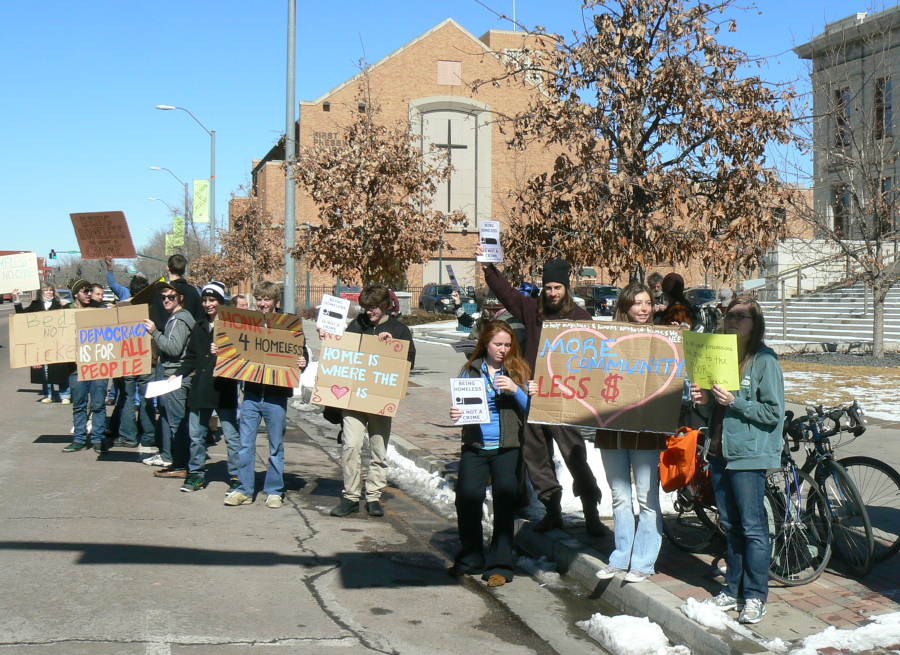
Being without a home is not a crime

Stop criminalizing homelessnessThe CSPD and Keep Colorado Springs Beautiful are proposing an ordinance to make camping illegal. On February 5th, Coloradans For Peace will be joining Ed Billings’ call: DON’T CRIMINALIZE THE HOMELESS. “Bring a sign, and a friend” Friday at noon, in front of Colorado Springs City Hall, 107 N. Nevada Ave.
 
Ed’s made an ad to promote the protest:

Beyond MLK worship: Beyond Vietnam

MLK“A time comes when silence is betrayal. That time has come for us in relation to Vietnam.” —
Martin Luther King Beyond Vietnam: Time to Break the Silence
Full text of 1967 speech below.

Riverside Church, New York City, 4 April 1967

I come to this magnificent house of worship tonight because my conscience leaves me no other choice. I join with you in this meeting because I am in deepest agreement with the aims and work of the organization which has brought us together: Clergy and Laymen Concerned about Vietnam. The recent statement of your executive committee are the sentiments of my own heart and I found myself in full accord when I read its opening lines:

“A time comes when silence is betrayal.”

That time has come for us in relation to Vietnam.

The truth of these words is beyond doubt but the mission to which they call us is a most difficult one. Even when pressed by the demands of inner truth, men do not easily assume the task of opposing their government’s policy, especially in time of war. Nor does the human spirit move without great difficulty against all the apathy of conformist thought within one’s own bosom and in the surrounding world. Moreover when the issues at hand seem as perplexed as they often do in the case of this dreadful conflict we are always on the verge of being mesmerized by uncertainty; but we must move on.

Some of us who have already begun to break the silence of the night have found that the calling to speak is often a vocation of agony, but we must speak. We must speak with all the humility that is appropriate to our limited vision, but we must speak. And we must rejoice as well, for surely this is the first time in our nation’s history that a significant number of its religious leaders have chosen to move beyond the prophesying of smooth patriotism to the high grounds of a firm dissent based upon the mandates of conscience and the reading of history. Perhaps a new spirit is rising among us. If it is, let us trace its movement well and pray that our own inner being may be sensitive to its guidance, for we are deeply in need of a new way beyond the darkness that seems so close around us.

Over the past two years, as I have moved to break the betrayal of my own silences and to speak from the burnings of my own heart, as I have called for radical departures from the destruction of Vietnam, many persons have questioned me about the wisdom of my path. At the heart of their concerns this query has often loomed large and loud: Why are you speaking about war, Dr. King? Why are you joining the voices of dissent? Peace and civil rights don’t mix, they say. Aren’t you hurting the cause of your people, they ask? And when I hear them, though I often understand the source of their concern, I am nevertheless greatly saddened, for such questions mean that the inquirers have not really known me, my commitment or my calling. Indeed, their questions suggest that they do not know the world in which they live.

“I wish not to speak with Hanoi and the National Liberation Front, but rather to my fellow Americans who, with me, bear the greatest responsibility in ending a conflict that has exacted a heavy price on both continents.”

In the light of such tragic misunderstandings, I deem it of signal importance to try to state clearly, and I trust concisely, why I believe that the path from Dexter Avenue Baptist Church — the church in Montgomery, Alabama, where I began my pastorate — leads clearly to this sanctuary tonight.

I come to this platform tonight to make a passionate plea to my beloved nation. This speech is not addressed to Hanoi or to the National Liberation Front. It is not addressed to China or to Russia.

Nor is it an attempt to overlook the ambiguity of the total situation and the need for a collective solution to the tragedy of Vietnam. Neither is it an attempt to make North Vietnam or the National Liberation Front paragons of virtue, nor to overlook the role they can play in a successful resolution of the problem. While they both may have justifiable reason to be suspicious of the good faith of the United States, life and history give eloquent testimony to the fact that conflicts are never resolved without trustful give and take on both sides.

Tonight, however, I wish not to speak with Hanoi and the NLF, but rather to my fellow Americans, who, with me, bear the greatest responsibility in ending a conflict that has exacted a heavy price on both continents.

The Importance of Vietnam

Since I am a preacher by trade, I suppose it is not surprising that I have seven major reasons for bringing Vietnam into the field of my moral vision. There is at the outset a very obvious and almost facile connection between the war in Vietnam and the struggle I, and others, have been waging in America. A few years ago there was a shining moment in that struggle. It seemed as if there was a real promise of hope for the poor — both black and white — through the poverty program. There were experiments, hopes, new beginnings. Then came the buildup in Vietnam and I watched the program broken and eviscerated as if it were some idle political plaything of a society gone mad on war, and I knew that America would never invest the necessary funds or energies in rehabilitation of its poor so long as adventures like Vietnam continued to draw men and skills and money like some demonic destructive suction tube. So I was increasingly compelled to see the war as an enemy of the poor and to attack it as such.

“For the sake of those boys,
for the sake of this governent,
for the sake of hundreds of thousands
trembling under our violence,
I cannot be silent.”

Perhaps the more tragic recognition of reality took place when it became clear to me that the war was doing far more than devastating the hopes of the poor at home. It was sending their sons and their brothers and their husbands to fight and to die in extraordinarily high proportions relative to the rest of the population. We were taking the black young men who had been crippled by our society and sending them eight thousand miles away to guarantee liberties in Southeast Asia which they had not found in southwest Georgia and East Harlem. So we have been repeatedly faced with the cruel irony of watching Negro and white boys on TV screens as they kill and die together for a nation that has been unable to seat them together in the same schools. So we watch them in brutal solidarity burning the huts of a poor village, but we realize that they would never live on the same block in Detroit. I could not be silent in the face of such cruel manipulation of the poor.

My third reason moves to an even deeper level of awareness, for it grows out of my experience in the ghettoes of the North over the last three years — especially the last three summers. As I have walked among the desperate, rejected and angry young men I have told them that Molotov cocktails and rifles would not solve their problems. I have tried to offer them my deepest compassion while maintaining my conviction that social change comes most meaningfully through nonviolent action. But they asked — and rightly so — what about Vietnam? They asked if our own nation wasn’t using massive doses of violence to solve its problems, to bring about the changes it wanted. Their questions hit home, and I knew that I could never again raise my voice against the violence of the oppressed in the ghettos without having first spoken clearly to the greatest purveyor of violence in the world today — my own government. For the sake of those boys, for the sake of this government, for the sake of hundreds of thousands trembling under our violence, I cannot be silent.

For those who ask the question, “Aren’t you a civil rights leader?” and thereby mean to exclude me from the movement for peace, I have this further answer. In 1957 when a group of us formed the Southern Christian Leadership Conference, we chose as our motto: “To save the soul of America.” We were convinced that we could not limit our vision to certain rights for black people, but instead affirmed the conviction that America would never be free or saved from itself unless the descendants of its slaves were loosed completely from the shackles they still wear. In a way we were agreeing with Langston Hughes, that black bard of Harlem, who had written earlier:

O, yes,
I say it plain,
America never was America to me,
And yet I swear this oath —
America will be!

Now, it should be incandescently clear that no one who has any concern for the integrity and life of America today can ignore the present war. If America’s soul becomes totally poisoned, part of the autopsy must read Vietnam. It can never be saved so long as it destroys the deepest hopes of men the world over. So it is that those of us who are yet determined that America will be are led down the path of protest and dissent, working for the health of our land.

“Surely we must see
that the men we supported
pressed them to their violence.”

As if the weight of such a commitment to the life and health of America were not enough, another burden of responsibility was placed upon me in 1964; and I cannot forget that the Nobel Prize for Peace was also a commission — a commission to work harder than I had ever worked before for “the brotherhood of man.” This is a calling that takes me beyond national allegiances, but even if it were not present I would yet have to live with the meaning of my commitment to the ministry of Jesus Christ. To me the relationship of this ministry to the making of peace is so obvious that I sometimes marvel at those who ask me why I am speaking against the war. Could it be that they do not know that the good news was meant for all men — for Communist and capitalist, for their children and ours, for black and for white, for revolutionary and conservative? Have they forgotten that my ministry is in obedience to the one who loved his enemies so fully that he died for them? What then can I say to the “Vietcong” or to Castro or to Mao as a faithful minister of this one? Can I threaten them with death or must I not share with them my life?

Finally, as I try to delineate for you and for myself the road that leads from Montgomery to this place I would have offered all that was most valid if I simply said that I must be true to my conviction that I share with all men the calling to be a son of the living God. Beyond the calling of race or nation or creed is this vocation of sonship and brotherhood, and because I believe that the Father is deeply concerned especially for his suffering and helpless and outcast children, I come tonight to speak for them.

This I believe to be the privilege and the burden of all of us who deem ourselves bound by allegiances and loyalties which are broader and deeper than nationalism and which go beyond our nation’s self-defined goals and positions. We are called to speak for the weak, for the voiceless, for victims of our nation and for those it calls enemy, for no document from human hands can make these humans any less our brothers.

Strange Liberators

And as I ponder the madness of Vietnam and search within myself for ways to understand and respond to compassion my mind goes constantly to the people of that peninsula. I speak now not of the soldiers of each side, not of the junta in Saigon, but simply of the people who have been living under the curse of war for almost three continuous decades now. I think of them too because it is clear to me that there will be no meaningful solution there until some attempt is made to know them and hear their broken cries.

“Before long they must know
that their government has sent them
into a struggle among Vietnamese,
and the more sophisticated surely realize
that we are on the side of the wealthy
and the secure
while we create hell for the poor.”

They must see Americans as strange liberators. The Vietnamese people proclaimed their own independence in 1945 after a combined French and Japanese occupation, and before the Communist revolution in China. They were led by Ho Chi Minh. Even though they quoted the American Declaration of Independence in their own document of freedom, we refused to recognize them. Instead, we decided to support France in its re-conquest of her former colony.

Our government felt then that the Vietnamese people were not “ready” for independence, and we again fell victim to the deadly Western arrogance that has poisoned the international atmosphere for so long. With that tragic decision we rejected a revolutionary government seeking self-determination, and a government that had been established not by China (for whom the Vietnamese have no great love) but by clearly indigenous forces that included some Communists. For the peasants this new government meant real land reform, one of the most important needs in their lives.

For nine years following 1945 we denied the people of Vietnam the right of independence. For nine years we vigorously supported the French in their abortive effort to re-colonize Vietnam.

Before the end of the war we were meeting eighty percent of the French war costs. Even before the French were defeated at Dien Bien Phu, they began to despair of the reckless action, but we did not. We encouraged them with our huge financial and military supplies to continue the war even after they had lost the will. Soon we would be paying almost the full costs of this tragic attempt at re-colonization.

After the French were defeated it looked as if independence and land reform would come again through the Geneva agreements. But instead there came the United States, determined that Ho should not unify the temporarily divided nation, and the peasants watched again as we supported one of the most vicious modern dictators — our chosen man, Premier Diem. The peasants watched and cringed as Diem ruthlessly routed out all opposition, supported their extortionist landlords and refused even to discuss reunification with the north. The peasants watched as all this was presided over by U.S. influence and then by increasing numbers of U.S. troops who came to help quell the insurgency that Diem’s methods had aroused. When Diem was overthrown they may have been happy, but the long line of military dictatorships seemed to offer no real change — especially in terms of their need for land and peace.

The only change came from America as we increased our troop commitments in support of governments which were singularly corrupt, inept and without popular support. All the while the people read our leaflets and received regular promises of peace and democracy — and land reform. Now they languish under our bombs and consider us – not their fellow Vietnamese — the real enemy. They move sadly and apathetically as we herd them off the land of their fathers into concentration camps where minimal social needs are rarely met. They know they must move or be destroyed by our bombs. So they go — primarily women and children and the aged.

“Somehow this madness must cease.”

They watch as we poison their water, as we kill a million acres of their crops. They must weep as the bulldozers roar through their areas preparing to destroy the precious trees. They wander into the hospitals, with at least twenty casualties from American firepower for one “Vietcong-inflicted” injury. So far we may have killed a million of them — mostly children. They wander into the towns and see thousands of the children, homeless, without clothes, running in packs on the streets like animals. They see the children, degraded by our soldiers as they beg for food. They see the children selling their sisters to our soldiers, soliciting for their mothers.

What do the peasants think as we ally ourselves with the landlords and as we refuse to put any action into our many words concerning land reform? What do they think as we test our latest weapons on them, just as the Germans tested out new medicine and new tortures in the concentration camps of Europe? Where are the roots of the independent Vietnam we claim to be building? Is it among these voiceless ones?

We have destroyed their two most cherished institutions: the family and the village. We have destroyed their land and their crops. We have cooperated in the crushing of the nation’s only non-Communist revolutionary political force — the Unified Buddhist church. We have supported the enemies of the peasants of Saigon. We have corrupted their women and children and killed their men. What liberators?

Now there is little left to build on — save bitterness. Soon the only solid physical foundations remaining will be found at our military bases and in the concrete of the concentration camps we call fortified hamlets. The peasants may well wonder if we plan to build our new Vietnam on such grounds as these? Could we blame them for such thoughts? We must speak for them and raise the questions they cannot raise. These too are our brothers.

Perhaps the more difficult but no less necessary task is to speak for those who have been designated as our enemies. What of the National Liberation Front — that strangely anonymous group we call VC or Communists? What must they think of us in America when they realize that we permitted the repression and cruelty of Diem which helped to bring them into being as a resistance group in the south? What do they think of our condoning the violence which led to their own taking up of arms? How can they believe in our integrity when now we speak of “aggression from the north” as if there were nothing more essential to the war? How can they trust us when now we charge them with violence after the murderous reign of Diem and charge them with violence while we pour every new weapon of death into their land? Surely we must understand their feelings even if we do not condone their actions. Surely we must see that the men we supported pressed them to their violence. Surely we must see that our own computerized plans of destruction simply dwarf their greatest acts.

“We must continue to raise our voices if our nation persists in its perverse ways in Vietnam.”

How do they judge us when our officials know that their membership is less than twenty-five percent Communist and yet insist on giving them the blanket name? What must they be thinking when they know that we are aware of their control of major sections of Vietnam and yet we appear ready to allow national elections in which this highly organized political parallel government will have no part? They ask how we can speak of free elections when the Saigon press is censored and controlled by the military junta. And they are surely right to wonder what kind of new government we plan to help form without them — the only party in real touch with the peasants. They question our political goals and they deny the reality of a peace settlement from which they will be excluded. Their questions are frighteningly relevant. Is our nation planning to build on political myth again and then shore it up with the power of new violence?

Here is the true meaning and value of compassion and nonviolence when it helps us to see the enemy’s point of view, to hear his questions, to know his assessment of ourselves. For from his view we may indeed see the basic weaknesses of our own condition, and if we are mature, we may learn and grow and profit from the wisdom of the brothers who are called the opposition.

So, too, with Hanoi. In the north, where our bombs now pummel the land, and our mines endanger the waterways, we are met by a deep but understandable mistrust. To speak for them is to explain this lack of confidence in Western words, and especially their distrust of American intentions now. In Hanoi are the men who led the nation to independence against the Japanese and the French, the men who sought membership in the French commonwealth and were betrayed by the weakness of Paris and the willfulness of the colonial armies. It was they who led a second struggle against French domination at tremendous costs, and then were persuaded to give up the land they controlled between the thirteenth and seventeenth parallel as a temporary measure at Geneva. After 1954 they watched us conspire with Diem to prevent elections which would have surely brought Ho Chi Minh to power over a united Vietnam, and they realized they had been betrayed again.

When we ask why they do not leap to negotiate, these things must be remembered. Also it must be clear that the leaders of Hanoi considered the presence of American troops in support of the Diem regime to have been the initial military breach of the Geneva agreements concerning foreign troops, and they remind us that they did not begin to send in any large number of supplies or men until American forces had moved into the tens of thousands.

“When machines and computers,
profit motives and property rights
are considered more important than people,
the giant triplets of
racism,
materialism
and militarism
are incapable of being conquered.”

Hanoi remembers how our leaders refused to tell us the truth about the earlier North Vietnamese overtures for peace, how the president claimed that none existed when they had clearly been made. Ho Chi Minh has watched as America has spoken of peace and built up its forces, and now he has surely heard of the increasing international rumors of American plans for an invasion of the north. He knows the bombing and shelling and mining we are doing are part of traditional pre-invasion strategy. Perhaps only his sense of humor and of irony can save him when he hears the most powerful nation of the world speaking of aggression as it drops thousands of bombs on a poor weak nation more than eight thousand miles away from its shores.

At this point I should make it clear that while I have tried in these last few minutes to give a voice to the voiceless on Vietnam and to understand the arguments of those who are called enemy, I am as deeply concerned about our troops there as anything else. For it occurs to me that what we are submitting them to in Vietnam is not simply the brutalizing process that goes on in any war where armies face each other and seek to destroy. We are adding cynicism to the process of death, for they must know after a short period there that none of the things we claim to be fighting for are really involved. Before long they must know that their government has sent them into a struggle among Vietnamese, and the more sophisticated surely realize that we are on the side of the wealthy and the secure while we create hell for the poor.

This Madness Must Cease

Somehow this madness must cease. We must stop now. I speak as a child of God and brother to the suffering poor of Vietnam. I speak for those whose land is being laid waste, whose homes are being destroyed, whose culture is being subverted. I speak for the poor of America who are paying the double price of smashed hopes at home and death and corruption in Vietnam. I speak as a citizen of the world, for the world as it stands aghast at the path we have taken. I speak as an American to the leaders of my own nation. The great initiative in this war is ours. The initiative to stop it must be ours.

This is the message of the great Buddhist leaders of Vietnam. Recently one of them wrote these words:

“Each day the war goes on the hatred increases in the heart of the Vietnamese and in the hearts of those of humanitarian instinct. The Americans are forcing even their friends into becoming their enemies. It is curious that the Americans, who calculate so carefully on the possibilities of military victory, do not realize that in the process they are incurring deep psychological and political defeat. The image of America will never again be the image of revolution, freedom and democracy, but the image of violence and militarism.”

“A nation that continues
year after year
to spend more money on military defense
than on programs of social uplift
is approaching spiritual death.”

If we continue, there will be no doubt in my mind and in the mind of the world that we have no honorable intentions in Vietnam. It will become clear that our minimal expectation is to occupy it as an American colony and men will not refrain from thinking that our maximum hope is to goad China into a war so that we may bomb her nuclear installations. If we do not stop our war against the people of Vietnam immediately the world will be left with no other alternative than to see this as some horribly clumsy and deadly game we have decided to play.

The world now demands a maturity of America that we may not be able to achieve. It demands that we admit that we have been wrong from the beginning of our adventure in Vietnam, that we have been detrimental to the life of the Vietnamese people. The situation is one in which we must be ready to turn sharply from our present ways.

In order to atone for our sins and errors in Vietnam, we should take the initiative in bringing a halt to this tragic war. I would like to suggest five concrete things that our government should do immediately to begin the long and difficult process of extricating ourselves from this nightmarish conflict:

• End all bombing in North and South Vietnam

• Declare a unilateral cease-fire in the hope that such action will create the atmosphere for negotiation.

• Take immediate steps to prevent other battlegrounds in Southeast Asia by curtailing our military buildup in Thailand and our interference in Laos.

• Realistically accept the fact that the National Liberation Front has substantial support in South Vietnam and must thereby play a role in any meaningful negotiations and in any future Vietnam government.

• Set a date that we will remove all foreign troops from Vietnam in accordance with the 1954 Geneva agreement.

Part of our ongoing commitment might well express itself in an offer to grant asylum to any Vietnamese who fears for his life under a new regime which included the Liberation Front. Then we must make what reparations we can for the damage we have done. We most provide the medical aid that is badly needed, making it available in this country if necessary.

Protesting The War

Meanwhile we in the churches and synagogues have a continuing task while we urge our government to disengage itself from a disgraceful commitment. We must continue to raise our voices if our nation persists in its perverse ways in Vietnam. We must be prepared to match actions with words by seeking out every creative means of protest possible.

As we counsel young men concerning military service we must clarify for them our nation’s role in Vietnam and challenge them with the alternative of conscientious objection. I am pleased to say that this is the path now being chosen by more than seventy students at my own alma mater, Morehouse College, and I recommend it to all who find the American course in Vietnam a dishonorable and unjust one. Moreover I would encourage all ministers of draft age to give up their ministerial exemptions and seek status as conscientious objectors. These are the times for real choices and not false ones. We are at the moment when our lives must be placed on the line if our nation is to survive its own folly. Every man of humane convictions must decide on the protest that best suits his convictions, but we must all protest.

“If we do not act
we shall surely be dragged down
the long and shameful corridors of time
reserved for those who possess
power without compassion,
might without morality,
and strength without sight.”

There is something seductively tempting about stopping there and sending us all off on what in some circles has become a popular crusade against the war in Vietnam. I say we must enter the struggle, but I wish to go on now to say something even more disturbing. The war in Vietnam is but a symptom of a far deeper malady within the American spirit, and if we ignore this sobering reality we will find ourselves organizing clergy-and laymen-concerned committees for the next generation. They will be concerned about Guatemala and Peru. They will be concerned about Thailand and Cambodia. They will be concerned about Mozambique and South Africa. We will be marching for these and a dozen other names and attending rallies without end unless there is a significant and profound change in American life and policy. Such thoughts take us beyond Vietnam, but not beyond our calling as sons of the living God.

In 1957 a sensitive American official overseas said that it seemed to him that our nation was on the wrong side of a world revolution. During the past ten years we have seen emerge a pattern of suppression which now has justified the presence of U.S. military “advisors” in Venezuela. This need to maintain social stability for our investments accounts for the counter-revolutionary action of American forces in Guatemala. It tells why American helicopters are being used against guerrillas in Colombia and why American napalm and green beret forces have already been active against rebels in Peru. It is with such activity in mind that the words of the late John F. Kennedy come back to haunt us. Five years ago he said,

“Those who make peaceful revolution impossible will make violent revolution inevitable.”

Increasingly, by choice or by accident, this is the role our nation has taken — the role of those who make peaceful revolution impossible by refusing to give up the privileges and the pleasures that come from the immense profits of overseas investment.

I am convinced that if we are to get on the right side of the world revolution, we as a nation must undergo a radical revolution of values. We must rapidly begin the shift from a “thing-oriented” society to a “person-oriented” society. When machines and computers, profit motives and property rights are considered more important than people, the giant triplets of racism, materialism, and militarism are incapable of being conquered.

A true revolution of values will soon cause us to question the fairness and justice of many of our past and present policies. On the one hand we are called to play the good Samaritan on life’s roadside; but that will be only an initial act. One day we must come to see that the whole Jericho road must be transformed so that men and women will not be constantly beaten and robbed as they make their journey on life’s highway.

True compassion is more than flinging a coin to a beggar; it is not haphazard and superficial. It comes to see that an edifice which produces beggars needs restructuring. A true revolution of values will soon look uneasily on the glaring contrast of poverty and wealth. With righteous indignation, it will look across the seas and see individual capitalists of the West investing huge sums of money in Asia, Africa and South America, only to take the profits out with no concern for the social betterment of the countries, and say: “This is not just.”

It will look at our alliance with the landed gentry of Latin America and say: “This is not just.”

The Western arrogance of feeling that it has everything to teach others and nothing to learn from them is not just.

A true revolution of values will lay hands on the world order and say of war: “This way of settling differences is not just.”

This business of burning human beings with napalm, of filling our nation’s homes with orphans and widows, of injecting poisonous drugs of hate into veins of people normally humane, of sending men home from dark and bloody battlefields physically handicapped and psychologically deranged, cannot be reconciled with wisdom, justice and love. A nation that continues year after year to spend more money on military defense than on programs of social uplift is approaching spiritual death.

America, the richest and most powerful nation in the world, can well lead the way in this revolution of values. There is nothing, except a tragic death wish, to prevent us from reordering our priorities, so that the pursuit of peace will take precedence over the pursuit of war. There is nothing to keep us from molding a recalcitrant status quo with bruised hands until we have fashioned it into a brotherhood.

This kind of positive revolution of values is our best defense against communism. War is not the answer. Communism will never be defeated by the use of atomic bombs or nuclear weapons. Let us not join those who shout war and through their misguided passions urge the United States to relinquish its participation in the United Nations. These are days which demand wise restraint and calm reasonableness. We must not call everyone a Communist or an appeaser who advocates the seating of Red China in the United Nations and who recognizes that hate and hysteria are not the final answers to the problem of these turbulent days. We must not engage in a negative anti-communism, but rather in a positive thrust for democracy, realizing that our greatest defense against communism is to take offensive action in behalf of justice. We must with positive action seek to remove those conditions of poverty, insecurity and injustice which are the fertile soil in which the seed of communism grows and develops.

The People Are Important

These are revolutionary times. All over the globe men are revolting against old systems of exploitation and oppression and out of the wombs of a frail world new systems of justice and equality are being born. The shirtless and barefoot people of the land are rising up as never before. “The people who sat in darkness have seen a great light.” We in the West must support these revolutions. It is a sad fact that, because of comfort, complacency, a morbid fear of communism, and our proneness to adjust to injustice, the Western nations that initiated so much of the revolutionary spirit of the modern world have now become the arch anti-revolutionaries. This has driven many to feel that only Marxism has the revolutionary spirit. Therefore, communism is a judgment against our failure to make democracy real and follow through on the revolutions we initiated. Our only hope today lies in our ability to recapture the revolutionary spirit and go out into a sometimes hostile world declaring eternal hostility to poverty, racism, and militarism. With this powerful commitment we shall boldly challenge the status quo and unjust mores and thereby speed the day when “every valley shall be exalted, and every mountain and hill shall be made low, and the crooked shall be made straight and the rough places plain.”

A genuine revolution of values means in the final analysis that our loyalties must become ecumenical rather than sectional. Every nation must now develop an overriding loyalty to mankind as a whole in order to preserve the best in their individual societies.

This call for a world-wide fellowship that lifts neighborly concern beyond one’s tribe, race, class and nation is in reality a call for an all-embracing and unconditional love for all men. This oft misunderstood and misinterpreted concept – so readily dismissed by the Nietzsches of the world as a weak and cowardly force – has now become an absolute necessity for the survival of man. When I speak of love I am not speaking of some sentimental and weak response. I am speaking of that force which all of the great religions have seen as the supreme unifying principle of life. Love is somehow the key that unlocks the door which leads to ultimate reality. This Hindu-Moslem-Christian-Jewish-Buddhist belief about ultimate reality is beautifully summed up in the first epistle of Saint John:

Let us love one another; for love is God and everyone that loveth is born of God and knoweth God. He that loveth not knoweth not God; for God is love. If we love one another God dwelleth in us, and his love is perfected in us.

Let us hope that this spirit will become the order of the day. We can no longer afford to worship the god of hate or bow before the altar of retaliation. The oceans of history are made turbulent by the ever-rising tides of hate. History is cluttered with the wreckage of nations and individuals that pursued this self-defeating path of hate. As Arnold Toynbee says :

“Love is the ultimate force that makes for the saving choice of life and good against the damning choice of death and evil. Therefore the first hope in our inventory must be the hope that love is going to have the last word.”

We are now faced with the fact that tomorrow is today. We are confronted with the fierce urgency of now. In this unfolding conundrum of life and history there is such a thing as being too late. Procrastination is still the thief of time. Life often leaves us standing bare, naked and dejected with a lost opportunity. The “tide in the affairs of men” does not remain at the flood; it ebbs. We may cry out desperately for time to pause in her passage, but time is deaf to every plea and rushes on. Over the bleached bones and jumbled residue of numerous civilizations are written the pathetic words: “Too late.”

There is an invisible book of life that faithfully records our vigilance or our neglect. “The moving finger writes, and having writ moves on…” We still have a choice today; nonviolent coexistence or violent co-annihilation.

We must move past indecision to action. We must find new ways to speak for peace in Vietnam and justice throughout the developing world – a world that borders on our doors. If we do not act we shall surely be dragged down the long dark and shameful corridors of time reserved for those who possess power without compassion, might without morality, and strength without sight.

Now let us begin. Now let us rededicate ourselves to the long and bitter – but beautiful – struggle for a new world. This is the calling of the sons of God, and our brothers wait eagerly for our response. Shall we say the odds are too great? Shall we tell them the struggle is too hard? Will our message be that the forces of American life militate against their arrival as full men, and we send our deepest regrets? Or will there be another message, of longing, of hope, of solidarity with their yearnings, of commitment to their cause, whatever the cost? The choice is ours, and though we might prefer it otherwise we must choose in this crucial moment of human history.

As that noble bard of yesterday, James Russell Lowell, eloquently stated:

Once to every man and nation
Comes the moment to decide,
In the strife of truth and falsehood,
For the good or evil side;
Some great cause, God’s new Messiah,
Off’ring each the bloom or blight,
And the choice goes by forever
Twixt that darkness and that light.
Though the cause of evil prosper,
Yet ’tis truth alone is strong;
Though her portion be the scaffold,
And upon the throne be wrong:
Yet that scaffold sways the future,
And behind the dim unknown,
Standeth God within the shadow
Keeping watch above his own.

Can art rehabilitate a parking meter?

Colorado Springs Parking MeterIt’s become another art medium in itself. Like oil, watercolor, and macaroni sprayed gold, we now have painted industrial objects. I’ve seen fiberglass cows, pigs, and elk cast to provide uniform canvases for ensemble-scale kitsch. Colorado Springs is probably not the first municipality to recycle obsolete parking meters as art pieces. The scheme is actually fairly clever: scatter beautified meters around retail areas to collect spare change “for the homeless,” to scoop the tug of panhandlers who may have less responsible designs on charitable donations.

My favorite is a meter painted like a Muslim imam, with the time-expired flag made to be a cry for help showing through his clear forehead.

Of course, I interpret this “help” to be a desperate cry from embattled Islam, a message in a bottle aimed at the English-speaking westerners whose soldiers have the Islamic world besieged. But the artist might just as well have meant to portray this Muslim’s spiritual lobe as less pellucid than vacuous. Imprisoned behind the soundproof uniformity of Sharia grooming and dress might echo a lonely S.O.S. seeking a secular salvation.

After the city’s counter-sidewalk-insurgency fund-raising is through, the painted meters will be auctioned for charity. But would you want one?

As upcycled sculptures go, I’m not big on commemorating parking meters. Of all industrial contraptions, it’s hard to imagine a function less popular. Meter maids must vie with dentists for trying a therapist’s sympathies. For most people, paying for parking is an investment in nothing. Isn’t it inherently objectionable when civil authorities charge tolls on already tax-funded thoroughfares? One of the liberating feelings you experience from taking mass-transportation is not worrying about a ticking parking meter. We most often approach parking meters with great anxiety and at a run, they take our coins like terrible vending machines, returning sometimes not even the incremental reprieve for which we paied, with no one to call for a refund. When we return to find a parking ticket, it’s the meter who ratted us out. What are we supposed to do with one of these at home, but beat it?

The analog charm of these retired meters cannot help but remind us what mercenaries their replacements have become. Newer models have all sorts of digital enhancements. They can tell when the previous vehicle leaves the parking space so as to reset the timer to zero. They can monitor whether you’ve overstayed the posted time limit, preventing you from feeding the meter, although without refunding the excess of your solicitous enticements. And when your permission to park has expired, they can send off a wireless signal to alert a parking enforcement officer posthaste. Can you imagine one day we will be playfully decorating these humorless machines?

A coworker of mine was retiring from the payroll department at around the same time the factory was updating its time clocks. He’d spent virtually his entire career tabulating punch cards collected multiple times a day from the various department clock-in areas. Actually it was our employer’s policy to take a sledgehammer to all obsolete equipment, sooner than risk the liability posed by an uncertain post-operational utility. I suggested we decorate one of the antiquated models like a big hunting trophy to present as a retirement gift. In none too many words my friend was able to articulate his lack of even curiosity for my proposal.

There might be a call for imbuing nostalgic utilitarian items with a creative after-life: toasters and typewriters for example, even drill presses and lathes. But granting immortal persistence to machines whose function it was to measure our labor, or tax our time? I don’t think so.

Israel sends deputy consul general to CC

End the occupationThe Israel Today event changed the speakers on us, instead of the Israeli Consul General to Los Angeles, it’s the Deputy Consul Gil Artzyeli. But the act’s still on. Get to Gaylord hall sometime before noon, it’s the conference room at the Southeast corner of the Worner Center building. We’ll stand outside with our repudiation of Mr. Artzyeli’s message, then go inside to assure the discussion steers toward being honest. I found this quote by Artzyeli, addressing the Denver Jewish community earlier this year about the Gaza incursion:

“This is not a war for territory … The first war is to protect the citizens of Israel, the second war is against Iran and the third war is against lies and disinformation.”

Any takers? My first question, if I’m given the chance: Mr. Artzyeli, are you here only to speak, or will you listen?

Cyndy Kulp put together a handout for the occasion:

Human Rights Issues in “Israel Today”

Israel is a pariah nation condemned by the UN and much of the international community for its multiple violations of international human rights law, including:

• Continuing the occupation of the Palestinian people

• Building housing settlements on confiscated land

• Seizing additional land and property from Palestinians to build “The Wall”, highways for the exclusive use of Israelis, and military areas, etc.

• Using extremely disproportionate and indiscriminate force in the invasion of the Gaza Strip during “Operation Cast Lead” in Dec. 2008

• Inflicting heavy casualties on Palestinians, many civilians and children with no way to escape the bombing

• Refusing to compensate the 5.8 million Palestinian refugees and their descendants who were displaced from their homes and properties during 1948

Israeli Diplomats, like our speaker today, should not be given a public platform from which to promote their views as long as they refuse to recognize and cooperate with international laws.

HERE ARE FURTHER DETAILS:

? In June 1967, the Israeli military invaded the West Bank, Gaza and East Jerusalem. These areas of historic Palestine under military control are the “Occupied Territories,” comprising some 3.5 million Palestinians, and they are systematically being incorporated into the state of Israel in violation of international law.

? Life under occupation is very harsh. The Palestinians have virtually no human or civil rights. Unemployment is rampant. In order to go about their daily lives, the people in the Occupied Territories must line up and go through multiple checkpoints manned by the Israeli army. Proper paperwork, including Palestinian ID’s, and permits are required to pass through, and many people are denied entry, even into East Jerusalem which is Palestinian territory and home to many hospitals, schools, and employers.

? Israel has built 200+ settlements in the West Bank, and over 400,000 Israelis have moved onto Palestinian land. Many of the settlers are armed and aggressive extremists, and their actions are regularly protected by Israeli Defense Forces.

? Israel has seized a majority of the West Bank land as military bases, settlements, security areas, “land reserves,” by-pass roads linking settlements with Israel, and other areas forbidden to Palestinians. Palestinians are confined to small fragmented areas resembling Bantustans in an Israeli version of Apartheid.

?? Israel’s sovereignty in Jerusalem is questioned by the international community, and contrary to what the Israelis would like you to believe, Jerusalem does not belong to Israel. This is why other nations have their embassies in Tel Aviv instead.

? East Jerusalem was declared as an occupied territory in UN Security Council Resolution 242 which specifically emphasized the “inadmissibility of the acquisition of territory by war.” Yet Israel continues to seize homes and land and allow Israeli settlers to move into East Jerusalem.

? Over 10,000 Palestinian homes have been destroyed, leaving 30,000 people homeless. Housing demolitions and displacement are common for Palestinian families, and they are powerless to protect their properties or get legal permission to build homes.

? The Gaza strip remains under siege today. Despite the withdrawal of Israeli settlers in 2005, Israel still controls entry into Gaza. People cannot leave and cannot get the goods and services they need. They are literally locked into a ghetto.

? In Dec. 2008, Israel invaded the Gaza strip, causing massive destruction and Palestinian causalities. The vast majority of the Palestinians killed in Israel’s operation were innocent civilians rather than combatants, according to a new report by B’Tselem, an Israeli human rights organization. Of the 1,387 deaths, 773 were non combatants. 320 of these were under the age of 18, and 109 were women.

? Nine Israelis were killed during the Gaza war — four by rocket fire on southern Israel, including three civilians and one soldier, while the other five were soldiers killed in combat, primarily from “friendly fire” incidents.

? The Goldstone Report which investigated the Gaza Invasion for the UN concluded that both Israel and the Palestinians had committed violations of International Law, but that Israel because of it’s huge army and sophisticated weaponry was more culpable and guilty of Crimes Against Humanity in it’s 2008/09 Gaza onslaught.

? U.S. aid has made Israel’s army one of the most powerful military forces in the world. Israel is using U.S. F-16 fighters and Apache helicopters in attacks against Palestinian civilians. This violates the U.S. Foreign Arms Export Act. Over $3 billion in US foreign aid is given to Israel, and most of it is used for military operations.

There Will Be No Security For ISRAEL Until There Is Justice For PALESTINE.

Resources For more information:
• Israeli Committee Against House Demolitions
• B’tselem: The Israeli Information Center for Human Rights in the Occupied Territories
• Bethlehem University
• Mazin Qumsiyeh
• Machsom Watch
• Breaking the Silence
• Women in Black
• Sabeel

• Stop the Wall Campaign

• US Campaign to End the Occupation

–END THE OCCUPATION
–COMPLY WITH INTERNATIONAL LAWS
–FREEZE SETTLEMENTS
–NEGOTIATE AN EQUITABLE SOLUTION ON LAND AND WATER

The US claims to be an “honest broker” –fair to both sides– in the so-called peace process. At the same time, the U.S. proclaimed itself the unswerving ally of Israel. These roles are contradictory. Massive U.S. aid funds the occupation. Since 1949, the U.S. has given Israel well over $100 billion in grants, loans and other assistance. This amounts to over $15,000 per Israeli citizen. ?
A genuine peace with a minimum of justice requires an independent and viable Palestinian state on the territories occupied by Israel in 1967 (West Bank, Gaza, East Jerusalem). Jerusalem should be shared as the capital of both Israel and Palestine. Palestine should be an equal neighbor alongside Israel with peace and security for both peoples. ?