WUO terrorized government property

weather undergroundTo clarify, the terrorist acts for which Bill Ayers and the Weather Underground are being demonized targeted only property damage and resulted in no casualties. Here is a list of 25 bombings attributed to the WUO, with notes from the FBI files, and the original communiques.

BOMBINGS BY WEATHERMEN / WEATHER UNDERGROUND

October 7, 1969
Haymarket Police Statue in Chicago. The Weathermen later claim credit for the bombing in their book, Prairie Fire.

December 6, 1969
Chicago Police cars parked in a precinct parking lot at 3600 North Halsted Street, Chicago. The WUO claims responsibility in Prairie Fire, stating it is a protest of the fatal police shooting of Illinois Black Panther Party leaders Fred Hampton and Mark Clark on December 4, 1969.

May 10, 1970
National Guard Association building in Washington, D.C. is bombed.

June 6, 1970
San Francisco Hall of Justice. (WUO claims credit for bombing although no explosion occurred. Months later, workmen locate an unexploded bomb).

June 9, 1970
New York City Police headquarters. The Weathermen state this is in response to “police repression.”

July 27, 1970
United States Army base at The Presidio in San Francisco, on the 11th anniversary of the Cuban Revolution.

September 12, 1970
California Men’s Colony prison break for Timothy Leary.

October 8, 1970
Marin County courthouse. WUO states this is in retaliation for the killings of Jonathan Jackson, William Christmas, and James McClain.

October 10, 1970
Queens traffic-court building. WUO claims this is to express support for the New York prison riots.

October 14, 1970
Harvard Center for International Affairs. WUO claims this is to protest the war in Vietnam.

March 1, 1971
United States Capitol. WUO states this is to protest the invasion of Laos.

August 29, 1971
Office of California Prisons, allegedly in retaliation for the killing of George Jackson.

September 17, 1971
New York Department of Corrections in Albany, New York. In protest of the killing of 29 inmates at Attica State Penitentiary.

October 15, 1971
MIT research center, William Bundy’s office.

May 19, 1972
Pentagon. “in retaliation for the U.S. bombing raid in Hanoi.”

May 18, 1973
103rd Police Precinct in New York. WUO states this is in response to the killing of 10-year-old black youth Clifford Glover by police.

September 28, 1973
ITT headquarters in New York and Rome, Italy. WUO states this is in response to ITT’s alleged role in the Chilean coup earlier that month.

March 6, 1974
Dept. of Health, Education and Welfare offices in San Francisco. WUO states this is to protest alleged sterilization of poor women. In the accompanying communiqué, the Women’s Brigade argues for “the need for women to take control of daycare, healthcare, birth control and other aspects of women’s daily lives.”

May 31, 1974
California Attorney General office. WUO states this is in response to the killing of six members of the Symbionese Liberation Army.

June 17, 1974
Gulf Oil Pittsburgh headquarters. WUO states this is to protest the company’s actions in Angola, Vietnam, and elsewhere.

September 11, 1974
Anaconda Corporation. WUO states this is in retribution for Anaconda/Rockefeller’s alleged involvement in the Chilean coup the previous year.

January 29, 1975
State Department. WUO states this is in response to escalation in Vietnam.

June 16, 1975
Banco de Ponce, NYC. WUO states this is in solidarity with striking Puerto Rican cement workers.

September, 1975
Kennecott Corporation. WUO states this is in retribution for Kennecott’s alleged involvement in the Chilean coup two years prior.

WUO COMMUNIQUES:

Communiqué #1, May 21, 1970

Hello. This is Bernardine Dohrn.

I’m going to read A DECLARATION OF A STATE OF WAR.

This is the first communication from the Weatherman underground.

All over the world, people fighting Amerikan imperialism look to Amerika’s youth to use our strategic position behind enemy lines to join forces in the destruction of the empire.

Black people have been fighting almost alone for years. We’ve known that our job is to lead white kids into armed revolution. We never intended to spend the next five or twenty-five years of our lives in jail. Ever since SDS became revolutionary, we’ve been trying to show how it is possible to overcome the frustration and impotence that comes from trying to reform this system. Kids know the lines are drawn revolution is touching all of our lives. Tens of thousands have learned that protest and marches don’t do it. Revolutionary violence is the only way.

Now we are adapting the classic guerrilla strategy of the Viet Cong and the urban guerrilla strategy of the Tupamaros to our own situation here in the most technically advanced country in the world.

Ché taught us that “revolutionaries move like fish in the sea.” The alienation and contempt that young people have for this country has created the ocean for this revolution.

The hundreds and thousands of young people who demonstrated in the Sixties against the war and for civil rights grew to hundreds of thousands in the past few weeks actively fighting Nixon’s invasion of Cambodia and the attempted genocide against black people. The insanity of Amerikan “justice” has added to its list of atrocities six blacks killed in Augusta, two in Jackson and four white Kent State students, making thousands more into revolutionaries.

The parents of “privileged” kids have been saying for years that the revolution was a game for us. But the war and the racism of this society show that it is too fucked-up. We will never live peaceably under this system.

This was totally true of those who died in the New York townhouse explosion. The third person who was killed there was Terry Robbins, who led the first rebellion at Kent State less than two years ago.

The twelve Weathermen who were indicted for leading last October’s riots in Chicago have never left the country. Terry is dead, Linda was captured by a pig informer, but the rest of us move freely in and out of every city and youth scene in this country. We’re not hiding out but we’re invisible.

There are several hundred members of the Weatherman underground and some of us face more years in jail than the fifty thousand deserters and draft dodgers now in Canada. Already many of them are coming back to join us in the underground or to return to the Man’s army and tear it up from inside along with those who never left.

We fight in many ways. Dope is one of our weapons. The laws against marijuana mean that millions of us are outlaws long before we actually split. Guns and grass are united in the youth underground.

Freaks are revolutionaries and revolutionaries are freaks. If you want to find us, this is where we are. In every tribe, commune, dormitory, farmhouse, barracks and townhouse where kids are making love, smoking dope and loading guns—fugitives from Amerikan justice are free to go.

For Diana Oughton, Ted Gold and Terry Robbins, and for all the revolutionaries who are still on the move here, there has been no question for a long time now—we will never go back.

Within the next fourteen days we will attack a symbol or institution of Amerikan injustice. This is the way we celebrate the example of Eldridge Cleaver and H. Rap Brown and all black revolutionaries who first inspired us by their fight behind enemy lines for the liberation of their people.

Never again will they fight alone.

/May 21, 1970/

Communique #2, June 9, 1970

SLIP NR 12 / 1909 / JUNE9-70 / POLICE HDQTRS / 77 BOMB EXPLOSION-240 CENTRE ST-POLICE HDQTRS-UNK

DAMAGE AND INJURIES AT THIS TIME — DETAILS LATER

Tonight, at 7 P.M., we blew up the N.Y.C. police headquarters. We called in a warning before the explosion.

The pigs in this country are our enemies. They have murdered Fred Hampton and tortured Joan Bird. They are responsible for 6 black deaths in Augusta, 4 murders in Kent State, the imprisonment of Los Siete de la Raza in San Francisco and the continual brutality against Latin and white youth on the Lower East Side.

Some are named Mitchell and Agnew. Others call themselves Leary and Hogan. The names are different but the crimes are the same.

The pigs try to look invulnerable, but we keep finding their weaknesses. Thousands of kids, from Berkeley to the UN Plaza, keep tearing up ROTC buildings.

Nixon invades Cambodia and hundreds of schools are shut down by strikes. Every time the pigs think they’ve stopped us, we come back a little stronger and a lot smarter. They guard their buildings and we walk right past their guards. They look for us—we get to them first.

They build the Bank of America, kids burn it down. They outlaw grass, we build a culture of life and music.

The time is now. Political power grows out of a gun, a Molotov, a riot, a commune … and from the soul of the people.

WEATHERMAN

Communiqué #3, July 31, 1970

From the /Berkeley Tribe/, July 31, 1970. The Red Mountain Tribe.

July 26, 1970
The Motor City

This is the third communication from the Weatherman underground.

With other revolutionaries all over the planet, Weatherman is celebrating the 11th anniversary of the Cuban revolution. Today we attack with rocks, riots and bombs the greatest killer-pig ever known to man—Amerikan imperialism.

Everywhere we see the growth of revolutionary culture and the ways in which every move of the monster-state tightens the noose around its own neck.

A year ago people thought it can’t happen here. Look at where we’ve come.

Nixon invades Cambodia; the Cong and all of Indochina spread the already rebelling US troops thin. Ahmed is a prisoner; Rap is free and fighting. Fred Hampton is murdered;

the brothers at Soledad avenge—”2 down and one to go.” Pun and several Weatherman are ripped; we run free. Mitchell indicts 8 or 10 or 13; hundreds of thousands of freaks plot to build a new world on the ruins of honky Amerika.

And to General Mitchell we say: Don’t look for us, Dog; We’ll find you first.

For the Central Committee, Weatherman Underground

Communiqué #4, September 18, 1970

From /San Francisco Good Times/, September 18, 1970. /San Francisco Good Times/.

September 15, 1970. This is the fourth communication from the Weatherman Underground.

The Weatherman Underground has had the honor and pleasure of helping Dr. Timothy Leary escape from the POW camp at San Luis Obispo, California.

Dr. Leary was being held against his will and against the will of millions of kids in this country. He was a political prisoner, captured for the work he did in helping all of us begin the task of creating a new culture on the barren wasteland that has been imposed on this country by Democrats, Republicans, Capitalists and creeps.

LSD and grass, like the herbs and cactus and mushrooms of the American Indians and countless civilizations that have existed on this planet, will help us make a future world where it will be possible to live in peace.

Now we are at war.

With the NLF and the North Vietnamese, with the Democratic Front for the Liberation of Palestine and Al Fatah, with Rap Brown and Angela Davis, with all black and brown revolutionaries, the Soledad brothers and all prisoners of war in Amerikan concentration camps we know that peace is only possible with the destruction of U.S. imperialism.

Our organization commits itself to the task of freeing these prisoners of war.

We are outlaws, we are free!

(signed) Bernardine Dohrn

Why don’t we just round up all the aliens and go torture them at Guantanamo?

guantanamo-speedo Even the same week ‘The Debates’ between the puppet figures went on, them illegal aliens were spoiling our domestic tranquility here in The Homeland. That’s right, 300-plus workers detained in illegal-immigration raid So why don’t we just round up all the aliens and go torture them at Guantanamo? They’re messing up our nice American lives, aren’t they?

You might say to me,

‘Tony, you’re being a tad bit too extreme here, are you not?’

However, some of you just don’t see the benefit of having a Lilly American Homeland at all though, so I’m not going to try to reason with you at all here. But to the other real Americans, think about it some, why not throw those aliens into the slammer we already have built for them in Cuba? Guantanamo already has been torturing aliens now for close to 7 years, it’s just that they were aliens from alien lands. That’s right and that’s wrong!

All those people captured by our ever so alert and incredibly illiterate and monolingual Armed Forces were actually handed over to us because they were foreigners! And now judges (with the quick speed of our lawfully illegal American Legal Injustice System are letting them trickle forth once again. The Cheney Regime just got ordered to free (Oh life is so unfair to them!), a whole shitload of alien Uighurs, and here are two more of them aliens in an alien land getting released, too. They were 2 aliens (Algerian and Sudanese) caught in Pakistan. Yes, definitely aliens there caught by Pakistani folk who think just like Full Blooded American Patriots think. Two 50-Year-Olds Released From Guantánamo

‘Let’s Get Them Foreigners and let’s torture them!’

So there are already aliens in Guantanamo (other people’s illegal aliens… Aw who cares?) and the liberal courts are now freeing them inexplicably so? I guess they think that there are some legal limits on torturing these people who broke the law? Liberals can be such pussies.

Those last 2 aliens, Hassan and Mammar got off early. I would have held them until they were in their 80s, not letting them go so soon, and it would have been all for their own good! What type of people go on vacation in Pakistan anyway? These are just people prone to getting themselves in trouble, and torture they deserve! Pedophiles!

Still, gone they are at last, so why are Our Troops wasting money by allowing the spacer to go unused, when we have so many chicken butcher aliens in South Carolina just captured? The troops in Guanatanamo know how to torture people good, unlike the ICE folk in Aurora, Colorado. All those idiots know how to do is take away the blankets and turn up the air conditioner on their Detainees. Some torture that is. I bet they don’t even know how to piss on a Koran?

These are felons with their little tykes out there in South Carolina, and why is President Bush going so easy on them while federal dollars are being spent to torture other aliens and not our own? Please write a letter to your Senators and House Representative today and tell them that you are fed up with their coddling of alien criminals! And tell them that you want them ALL to be tortured at Guantanamo as the American law allows and mandates.

Americans need these high paying good jobs that aliens robbed from them at once. And their fine and luxurious housing, also. Shame on the corruption there in DC that allows aliens to not be tortured adequately to keep America safe from foreign terrorism against our American Gway!

Bad DNC protesters? get them to behave

That was embarrassing. The Indy asked me how to keep a protest peaceful, in light of participants who may be tempted to mix it up. The Indy said my advice was get them to behave. It’s what I meant of course, but I said: set a good example for others to follow.

I was talking to the Independent reporter about how one could participate in the DNC demonstrations without getting caught up in trouble. It is a perplexing balancing act. Despite every organizer’s best intentions, there are going to be soccer hooligans and plain-clothed provocateurs.

The best use you can put to all the digital video devices is to catch undercover cops trying to instigate crime. Young would-be rabble-rousers will have to offend for themselves because cameras might catch them too. Against police video surveillance, the bystander videotape will be the least of their problems. Principally, demonstrators will need to catch the various law enforcement agents trying to entrap participants and incite riots, for which they can blame their unwitting accomplices.

Don’t hold anything for a stranger, don’t follow the directions of someone you don’t already know to be an organizer.

And above all, remember why you’re here. To represent your message. To give voice to others. Taking to the street is as fundamental as fighting for your rights. They weren’t given us without somebody taking to the streets to demand them. Let the politicians and media and authorities know why you’re there. That’s real patriotism.

Police Liaison is double-edged handcuff

Large demonstrations such as planned at the DNC invite a basic need for crowd management. From any standpoint there is an inherent requirement to involve officer friendly. Pardon my sophomoric wonder about how this can be done with sufficient prudence.

The term Police Liaison is self-explanatory. In the context of an organized public demonstration, police liaisons channel communication between organizers and law enforcement commanders. If crowd behavior diverts from what was permitted, liaisons are the last chance for diplomacy before an escalation of violence.

This can serve both sides. A crowd could be steered away from trouble, in particular if someone has been tasked with the responsibility for their actions. As well, police over-reaction can be countermanded if police leaders are alerted to their subordinates’ misbehavior.

In a perfect scenario, liaisons facilitate a smooth, legal public action. But what if events develop imperfectly? i wonder what vulnerabilities are created by having named liaisons.

At minimum, liaisons have been personally introduced to police and vice versa. They are given the police commander’s telephone number, and likewise the police are able to contact the liaisons. But in what further ways does having the liaison telephone numbers benefit the police?

It’s not hard to imagine that a police department could justify getting permission to conduct surveillance on those contact numbers. The liaisons are self-avowed protest organizers, aiming only to conduct fully legal activities, activities which they’ll fully admit however are often out of their control. They should have no objections to serving as extra eyes for law enforcement, whose expressed interest is providing a safe secure environment for all. A FISA court would be hard pressed to oppose such preventive oversight. The liaisons have as much as volunteered. Surveillance could consist of monitoring phone calls, passive bugging of all activities within earshot of the discretely activated phone units, or of course, GPS tracking of liaison movements. Why not? It’s for the security of all concerned.

Alternately, and let’s presume the police department would only do this if crowd actions were heading south, the police could elect to round up the liaisons in a preemptory arrest, to severe what they perceive to be the leadership from the crowd of followers. Such a preemptive move could also be decided merely from early plan-making overheard from the eavesdropping.

It could be presumed that law enforcement is already monitoring the phones of activists whom they consider to be persons of interest. But those activists who volunteer to be police liaisons in effect offer up their responsibility for their compatriots’ actions. They represent themselves as authority sufficient to try to steer protests from trouble. Liaisons as much as formalize their participation in the outcomes that eventually develop.

Should some terrible illegal act be committed, be it real or a frame-up, have the liaisons bound themselves to subsequent conspiracy charges that an investigation would trace in order to declare guilty parties? Imagine if such acts were terrible enough to warrant calling the organizing body a terrorist entity. Would the formalized police liaisons be considered its de facto signatories? Whoever would imagine that peaceful protesters exercising their right to assemble to petition their government for redress of their grievances should fall under the scrutiny of the Department of Homeland Security?

The DNC’s Denver meatpacking facility

PatriotsCalling it the Gitmo on The Platte might be a bit of hyperbole here, but look what the Democratic Party has prepared for US dissidents that will arrive protesting their lousy corporate politics? Tasers and cattle pens. I can hardly stomach being around you DP voting fools at all these days. You are the worst!

Liberals want to vote for a political party like this? Don’t you nitwit voting addicts of the Democratic Party assign any responsibility for this sort of ‘homeland security’ mentality to the Democratic Party itself, or will you just let these Barack-Hillary thugs hide themselves behind the Denver police without calling them out on it? You know that they really do control how their convention is actually policed, don’t you? Shame on you for voting for this come November!

BTW, the picture heading this commentary is taken from a Democratic Party web site, where this is what they have to say about the US occupation of Iraq…

‘The Democratic Party supports our men and women serving in the military. Our country, our state and our county are indebted to them for their valor and sacrifice. We stand behind our troops and wish them a safe and speedy return.’

Translated from the language of political bullshit, the Democratic Party is saying that it doesn’t give a damn about the Pentagon looting our American national wealth on behalf of the military welfare sucking corporations and that it doesn’t give a shit if the US government turns Iraq and its people into a total scrap heap. What a scummy political party you ‘liberal’ folk vote for again and again and again! You are hardly voting for the lesser of 2 evils but are voting for the evil itself. Right, Dennis? (That question is directed to Dennis Apuan, former brake on antiwar protest here in Colorado Springs when he was PPJPC director, and now a local Democratic Party candidate hoping to become a bigger cheese.)

It’s time to stop being polite about people like Dennis or Poor Richard, local court jester for Ken Salazar, DP Senator of Colorado. These people are part of the apparatus that wants to cage up protest in Denver against the war, and cattle prod US patriots locked up in the pens. Yes they are and we shouldn’t let these cruds pretend otherwise. There is no way I would vote for Dennis Apuan, who did a most shitty job when he headed up the local peace group, too. He’s no better than having a Republican in there, and your party can shock me for saying so, Dennis!

Tiananmen Square before Olympic spirit

Beijing 2008 boycott
Human rights activists are crying foul about China’s role in Tibet and Burma. Here’s a illustrated time-line of the events which led to the totalitarian repression of the Tiananmen protests of 1989. Reprinted from Christus Rex.

Beijing Spring -A look back at the 1989 Spring that impacted a nation. Visit original website to see archival video footage from the CBS Evening News with Dan Rather.

April 15
Hu YaobangFormer Communist Party chief Hu Yaobang, a leading reformist, dies of a heart attack at the age of 73. Students at Beijing University put up posters praising Hu that indirectly criticize the opponents who forced his resignation following student demonstrations in 1986-87.
 

Students marchApril 17
Thousands of students march in Beijing and Shanghai shouting “long live Hu Yaobang, long live democracy, long live freedom, long live the rule of law.”


April 18
2,000 students from Beijing bicycle into Tiananmen Square and protest before the Great Hall of the People. Student leaders, including Wang DanIncluded in their demands for democratic reforms is the repudiation of official campaigns against freedom of the press.

April 21
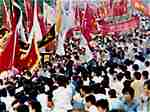
Crowds of up to 100,000 demonstators gather in Tiananmen Square to mourn Hu.
Policeman supporting students

April 22
Students defy police orders to leave the square, while riots break out in the provincial capitals of Xian and Changsha. Official memorial ceremonies are held for Hu at the Great Hall of the People.

Student strike at Beijing University


April 23
Beijing students announce a boycott of university classes.
 

April 24
Tens of thousands of students at Beijing universities go on strike, demanding a dialog with the government.

Student rally in the squareApril 27
Bolstered by broad-based support, more than 150,000 students surge past police lines and fill Tiananmen Square, chanting slogans for democracy and freedom.

April 29
Government officials meet with student leaders, but independent student groups say they will continue a class boycott at 41 university campuses in Beijing.

May 2
6,000 students march in Shanghai.

May 4
100,000 students and supporters march on Tiananmen square to celebrate the 70th anniversary of Student hunger strike China’s first student movement, while similar demonstrations are held in Shanghai, Nanjing and other cities. 300 journalists protest outside the official Xinhua News Agency.

May 9
Journalists petition the government for freedom of the press.

May 13
2,000 students begin a hunger strike in Tiananmen Square.

Rally on the eve of GorbachevMay 15
Government deadline for students to leave the square comes and goes. A welcoming ceremony for Soviet leader Mikhail Gorbachev’s state visit is moved to the airport.

tienanmen-12-rally.jpgMay 16
Hundreds of thousands of demonstrators occupy the square.

May 18
One million people march in support of the hunger strikers. Li PengLi Peng, Premier of the State Council, issues a stern warning to student leaders and refuses to discuss their demands.

May 19
Zhoa ZiyangA tearful Zhao Ziyang, China’s General Secretary, makes a pre-dawn visit to weakened hunger strikers. Li also visits the students briefly. In the evening the students decide to end the hunger strike, but quickly change their mind when Li and President Yang Shangkun announce martial law. Zhao reportedly resigns or is ousted from power after failing to convince Li and others to compromise.

Yang ShangkunMay 20, 1989
Chinese authorities ‘pull the plug’ on Dan Rather who is reporting live from Beijing.

May 28
About 80,000 people (mostly students from outside the capital) demonstrate but, unlike past rallies, few workers participate.
Goddess of Democracy
May 30
Students unveil their “Goddess of Democracy,” a replica of the Statue of Liberty, on the square. The government calls it an insult to the nation.

May 31
Farmers and workers stage the first of several pro-government rallies in Beijing’s suburbs.

June 1
The Beijing Municipal Government bans all foreign press coverage of the demonstrations.

June 3
Tens of thousands of troops advance on the city shortly after midnight, but are repulsed by residents who put up barricades. PLA troops stopped by civilians By the afternoon 5,000 troops appear outside the Great Hall of the People, but are again surrounded and stopped. In the final assault that evening, troops shoot and beat their way to the square.

Taping the beginnings of the massacre, correspondent Richard Roth is arrested.

June 4
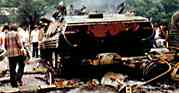
Troops occupy the square and smash the “Goddess of Democracy” with tanks. The shooting continues with soldiers periodically firing on crowds gathered on the outskirts of the square. Residents set fire to more than 100 military trucks and armored personnel carriers. The government claims the “counterrevolutionary riots” have been suppressed. Meanwhile, riots break out in southwestern Chengdu.

Richard Roth is released and reports further on the night’s violence.
PLA troops confront civilians
June 5
There are reports of clashes between rival military groups around Beijing. President Bush condemns the “bloody and violent” crackdown and orders a suspension of U.S. military sales and contacts with the Chinese government.

June 5, 1989
Richard Roth reports: one anonymous man stops a column of 18 tanks.
Wounded civilian
June 6
Foreign embassies advise their nationals to leave China. The government says 300 people were killed and 7,000 injured in the crackdown, but claims most of the dead were soldiers. There are more reports of clashes between military units. Six people are killed in Shanghai when a train runs through a barricade. The U.S. State Department announces that dissident Fang Lizhi and his wife have sought refuge in the U.S. Embassy.
An advancing tank
June 7
Troops, responding to what they say is sniper fire, shoot into a foreign diplomatic compound. The United States and other governments order the mandatory evacuation of dependents of diplomatic personnel.

June 8
Premier Li Peng appears in public for the first time since the crackdown to congratulate troops.
Deng Xiaoping
June 9
China’s leader Deng Xiaoping appears for the first time since May 16. In a speech to military officers he blames the turmoil on counterrevolutionaries attempting to overthrow communism.

Motorcycle crushed by a tankJune 10
Beijing authorities announce the arrest of more than 400 people, including student and labor leaders.

June 11
The government issues a warrant for the arrest of Fang Lizhi and his wife, saying they committed crimes of “counterrevolutionary propaganda and instigation.” Fang Lizhi

June 12
The government bans all independent student and labor organizations and says police and soldiers should shoot all “rioters and counterrevolutionaries.”PLA tank on patrol

June 13
The government issues a wanted list for 21 student activists who led the democracy movement.
Student leader Wang Dan

June 14
China orders the expulsion of Associated Press reporter John Pomfret and Voice of America Bureau Chief Alan Pessin.

June 15
Three Shanghai men are sentenced to death for burning a train that ran over protesters. The nationwide arrest total reaches above 1,000.
Soldiers seen through window of burned vehicle
June 17
A Beijing court sentences eight people to death for attacking soldiers and burning vehicles during the June 3-4 assault.

June 18
Politburo member Qiao Shi appears prominently in the official media, adding to speculation the party security man will replace Zhao.

A burned tank
June 20
The government nullifies all exit permits in an apparent attempt to stop fugitives from leaving the country.

Compulsory cannibalism could end killing

“I believe in compulsory cannibalism. If people were forced to eat what they killed, there would be no more wars.

Murder in a uniform is heroic, in a costume it is a crime. False advertisements win awards, forgers end up in jail. Inflated prices guarantee large profits while shoplifters are punished. Politicians conspire to create police riots and the victims are convicted in the courts. Students are gunned down and then indicted by suburban grand juries as the trouble-makers. A modern, highly mechanized army travels 9,000 miles to commit genocide against a small nation of great vision and then accuses its people of aggression. Slumlords allow rats to maim children and then complain of violence in the streets. Everything is topsy-turvy”
-Abbie Hoffman

Where will Tent State be without tents?

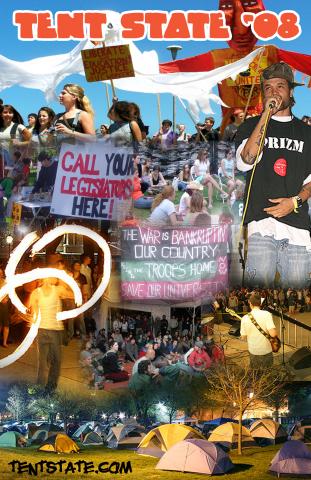
Tent State UniversityA couple weeks ago, the students behind Tent State University were hoping to lobby Denver’s mayor for permission to camp overnight in a city park for the DNC. They had been given until August to show they could meet seven conditional requirements, but now the mayor has decided to tell them no. So where will Tent State be without tents? TSU was one of the ARD groups which splintered from Recreate-68, hoping to curry favorable treatment from the city. TSU leader Adam Jung even suggested the Denver City Park encampment would enable authorities to “retain control over the entire event.”

The Democratic convention protesters of 1968, who wound up on the truncheon end of the Chicago police riots, had been camped overnight by the simple result of their continuous protestation of having no representation at the DNC. Tent State University 2008No one asked permission. In 2008, by breaking off from the R-68 organizers and asking to be sanctioned by the city, TSU has allowed the Denver Police to preempt spontaneous demonstrations. Certainly in the eyes of the public and the residents of Denver. Now anyone who sticks around after curfew has been forewarned of the consequence.

MC FogHorn Leghorn and the F’N MA

Fat Fannie and Fudgebutt FredWith record high foreclosures due to predatory lenders and sham mortgages, who’s in favor of a taxpayer bailout to the Federal National Mortgage Assoc.?
Or how about public monies to save the Federal Home Loan Mortgage Corporation? No takers? The homeowners are still screwed, but the lenders need our help. They’re shareholder owned, government sanctioned monopolies, and they need 25 billion. No sympathetic alms? Good thing both the FNMA and the FHLMC, appointed themselves the intentionally endearing nicknames Fannie Mae and Freddie Mac to confuse our affections.

It reminds me of a classmate who reinvented himself on the first day of college. When professors asked our names or applicable nicknames, this skinny pocket-protector wearer told the class he went by “Bear.” And his unlikely reincarnation stuck. Thereafter “Bear” became that much less an engineering geek than his no more nerdier compatriots.

Fannie and Freddie may sound like personable natural derivatives of their acronyms, but the Appalachian appellations are official. When I was confronted about having apparently misspelled the cutesy MAE, being the purported colloquial surname of the usurious giant, I found there was indeed a formal spelling. Really? For a phonetic abbreviation? Couldn’t it just as easily be spelled with a Y? And why not Fanny with a Y, like Brice, Hackabout-Jones or the derriere? Too much impropriety for hillbillies?

Do the letters FN resolve to “Fanny” more than to the more modern and infinitely appropriate Fucking?

Where did MA become May? Why not Ma, like Ma Dalton?

And wherever do you get Freddie from FHL? I see Foghorn Leghorn for the first initials. Leaving MC for Mack as of The Knife.

The FNMA / FHLMC bonanza provides a textbook simple model of the capitalist stakeout of regulated/unregulated public finance: build a business, merge to create a monopoly, then loot funds to require a taxpayer bailout.

The DNC Alliance for Real Democracy is a counter-protest Fifth Column

Denver DNC 2008DENVER, COLO.- The Alliance for Real Democracy (ARD), formed to counter the scrappily-named Recreate 68 at the DNC, is in reality an unwitting fifth column, set up by Democratic Party allies to temper protest in Denver. The UFPJ and other sundry “non-violent” progressives are funneling their members into the less populist ARD actions to divert participation from the major DNC demonstrations. But the aforementioned underwriters aren’t providing any funding, surprise! Leaving the ARD to protest exactly what it’s supposed to: nothing.

Alliance for Real DemocracyI think it’s heartbreaking to watch earnest young activists, representing the organizations comprising the ARD coalition, trying to organize activities without any commitment from their national affiliations. And some of the more outspoken national leaders, keen to make appearances at the DNC rallies, are beginning to smell a rat. They’re making backup arrangements to coordinate with the boots on the ground, R-68.

A Fifth Column refers to a group of partisans, usually spontaneously organized, which forms behind enemy lines as a conquering army approaches. It is the additional “column” of civilian fighters which an attacker might count on to stab the defenders in the back. Franco boasted of his fifth column in the Spanish Civil War. The French Resistance represented a fifth column for the Normandy liberators.

America’s antiwar movement has had its steady divisions, between UFPJ and A.N.S.W.E.R. most notably, but the rift has become more critical with the advent of another hopeful Democratic election win. Four years ago it was Kerry, with groups like Moveon.org trying to tone down the antiwar rhetoric. This year it’s Obama, and the appeasers are out in battalions. As usual, it’s done in the name of “nonviolence,” where too vigorous protest is seen as insufficiently nonviolent for the Democrat’s fragile delusions.

When R-68 began the groundwork for DNC protests, they were vilified for evoking the Chicago 1968 police riots. R-68 repudiated the violence, but not surprisingly those statements have yet to be reported in print. Meanwhile the bad press gave UFPJ and other nonviolence apostles the opportunity to break away and form their holy alliance to give their members sanctuary from the ruffians, re unpredictable young people.

But will it really? The R-68 group includes Unconventional Denver and Disrupt 08, but neither have violent plans. Black Block script-kiddies will turn up no matter whose event. Police agent provocateurs will instigate violence no matter how pious your crowd.

Code Pink, IVAW, Veterans For Peace, and UFPJ are among the national endorsers of ARD. Tent State, SFPJ, and Students for a Democratic Society are examples of young activists getting caught in their elders’ tar baby.

Because it’s not enough to vote for Obama, you have to quash dissent for Obama. It’s the Alliance For Real Democracy For Obama.

Naturally Denver protest organizers, whether ARD or R68, have found themselves having to confer about time slots and permits, out of respect for the success of each other’s activities. As a result, the national head of UFPJ, Leslie Cagan, issued an email decreeing that no ARD organization member would participate in the major Aug 24 kickoff antiwar demonstration. This drew question marks from prominent activist leaders who want to be at the biggest rally.

Bi-monthly CONSULTA meetings were scheduled by ARD and R68 to coordinate efforts. But the morning before the second Consulta, Leslie Cagan flew in from NYC for an emergency meeting with ARD leadership to brief them on what not to negotiate. She followed this with a hastily scheduled press conference the next day on the subject of Iran, it appeared to preempt her rivals’ DON’T BOMB IRAN action planned for August 2nd.

Colorado Springs own PPJPC is an endorser of ARD. Their letter of support was read into the minutes of a recent meeting, and it read like the typical support they’re getting from everyone. I’ll paraphrase the PPJPC letter:

“We at the Pikes Peak Justice and Peace Commission are honored to endorse your efforts at the DNC … due to critical funding shortages, we cannot offer you any monetary support at this time … Likewise, I’m sorry that I will not be able to participate in any events that week , but will try to interest our members in attending…” We’ll be with you in spirit, etc.

Why form a fifth column if you’re not going to support it? Because the ARD‘s job is to do nothing. Doing nothing is exactly how you stab activism in the back.

Global economic rapists are at it again

G8 protest
Why protest the G8 Summit July 7-9? Those hoodlums always look so determined. Here’s the rationale by the Emergency Exit Collective:

The 2008 G8 on Hokkaido, a Strategic Assessment
Emergency Exit Collective
Bristol, Mayday, 2008

The authors of this document are a collection of activists, scholars, and writers currently based in the United States and Western Europe who have gotten to know and work with each other in the movement against capitalist globalization. We’re writing this at the request of some members of No! G8 Action Japan, who asked us for a broad strategic analysis of the state of struggle as we see it, and particularly, of the role of the G8, what it represents, the dangers and opportunities that may lie hidden in the moment. It is in no sense programmatic. Mainly, it is an attempt to develop tools that we hope will be helpful for organizers, or for anyone engaged in the struggle against global capital.

I
It is our condition as human beings that we produce our lives in common.

II
Let us then try to see the world from the perspective of the planet’s commoners, taking the word in that sense: those whose most essential tradition is cooperation in the making and maintenance of human social life, yet who have had to do so under conditions of suffering and separation; deprived, ignored, devalued, divided into hierarchies, pitted against each other for our very physical survival. In one sense we are all commoners. But it’s equally true that just about everyone, at least in some ways, at some points, plays the role of the rulers—of those who expropriate, devalue and divide—or at the very least benefits from such divisions.

Obviously some do more than others. It is at the peak of this pyramid that we encounter groups like the G8.

III
The G8’s perspective is that of the aristocrats, the rulers: those who command and maintain that global machinery of violence that defends existing borders and lines of separation: whether national borders with their detention camps for migrants, or property regimes, with their prisons for the poor. They live by constantly claiming title to the products of others collective creativity and labour, and in thus doing they create the poor; they create scarcity in the midst of plenty, and divide us on a daily basis; they create financial districts that loot resources from across the world, and in thus doing they turn the spirit of human creativity into a spiritual desert; close or privatize parks, public water taps and libraries, hospitals, youth centers, universities, schools, public swimming pools, and instead endlessly build shopping malls that channels convivial life into a means of commodity circulation; work toward turning global ecological catastrophe into business opportunities.

These are the people who presume to speak in the name of the “international community” even as they hide in their gated communities or meet protected by phalanxes of riot cops. It is critical to bear in mind that the ultimate aim of their policies is never to create community but to introduce and maintain divisions that set common people at each other’s throats. The neoliberal project, which has been their main instrument for doing so for the last three decades, is premised on a constant effort either to uproot or destroy any communal or democratic system whereby ordinary people govern their own affairs or maintain common resources for the common good, or, to reorganize each tiny remaining commons as an isolated node in a market system in which livelihood is never guaranteed, where the gain of one community must necessarily be at the expense of others. Insofar as they are willing to appeal to high-minded principles of common humanity, and encourage global cooperation, only and exactly to the extent that is required to maintain this system of universal competition.

IV
At the present time, the G8—the annual summit of the leaders of “industrial democracies”—is the key coordinative institution charged with the task of maintaining this neoliberal project, or of reforming it, revising it, adapting it to the changing condition of planetary class relations. The role of the G8 has always been to define the broad strategic horizons through which the next wave of planetary capital accumulation can occur. This means that its main task is to answer the question of how 3?4 in the present conditions of multiple crises and struggles 3?4 to subordinate social relations among the producing commoners of the planet to capital’s supreme value: profit.

V
Originally founded as the G7 in 1975 as a means of coordinating financial strategies for dealing with the ‘70s energy crisis, then expanded after the end of the Cold War to include Russia, its currently face a moment of profound impasse in the governance of planetary class relations: the greatest since the ‘70s energy crisis itself.

VI
The ‘70s energy crisis represented the final death-pangs of what might be termed the Cold War settlement, shattered by a quarter century of popular struggle. It’s worth returning briefly to this history.

The geopolitical arrangements put in place after World War II were above all designed to forestall the threat of revolution. In the immediate wake of the war, not only did much of the world lie in ruins, most of world’s population had abandoned any assumption about the inevitability of existing social arrangements. The advent of the Cold War had the effect of boxing movements for social change into a bipolar straightjacket. On the one hand, the former Allied and Axis powers that were later to unite in the G7 (the US, Canada, UK, France, Italy, Germany, Japan)—the “industrialized democracies”, as they like to call themselves—engaged in a massive project of co-optation. Their governments continued the process, begun in the ‘30s, of taking over social welfare institutions that had originally been created by popular movements (from insurance schemes to public libraries), even to expand them, on condition that they now be managed by state-appointed bureaucracies rather than by those who used them, buying off unions and the working classes more generally with policies meant to guarantee high wages, job security and the promise of educational advance—all in exchange for political loyalty, productivity increases and wage divisions within national and planetary working class itself. The Sino-Soviet bloc—which effectively became a kind of junior partner within the overall power structure, and its allies remained to trap revolutionary energies into the task of reproducing similar bureaucracies elsewhere. Both the US and USSR secured their dominance after the war by refusing to demobilize, instead locking the planet in a permanent threat of nuclear annihilation, a terrible vision of absolute cosmic power.

VII
Almost immediately, though, this arrangement was challenged by a series of revolts from those whose work was required to maintain the system, but who were, effectively, left outside the deal: first, peasants and the urban poor in the colonies and former colonies of the Global South, next, disenfranchised minorities in the home countries (in the US, the Civil Rights movement, then Black Power), and finally and most significantly, by the explosion of the women’s movement of the late ‘60s and early ‘70s—the revolt of that majority of humanity whose largely unremunerated labor made the very existence “the economy” possible. This appears to have been the tipping point.

VIII
The problem was that the Cold War settlement was never meant to include everyone. It by definition couldn’t. Once matters reached tipping point, then, the rulers scotched the settlement. All deals were off. The oil shock was first edge of the counter-offensive, breaking the back of existing working class organizations, driving home the message that there was nothing guaranteed about prosperity. Under the aegis of the newly hatched G7, this counter-offensive involved a series of interwoven strategies that were later to give rise to what is known as neoliberalism.

IX
These strategies resulted in what came to be known as “Structural Adjustment” both in the North and in the South, accompanied by trade and financial liberalization. This, in turn, made possible crucial structural changes in our planetary production in common extending the role of the market to discipline our lives and divide us into more and more polarized wage hierarchy. This involved:

· In the immediate wake of ‘70s oil shock, petrodollars were recycled from OPEC into Northern banks that then lent them, at extortionate rates of interest, to developing countries of the Global South. This was the origin of the famous “Third World Debt Crisis.” The existence of this debt allowed institutions like the IMF to impose its monetarist orthodoxy on most of the planet for roughly twenty years, in the process, stripping away most of even those modest social protections that had been won by the world’s poor—large numbers of whom were plunged into a situation of absolute desperation.

· It also opened a period of new enclosures through the capitalist imposition of structural adjustment policies, manipulation of environmental and social catastrophes like war, or for that matter through the authoritarian dictates of “socialist” regimes. Through such means, large sections of the world’s population have over the past thirty years been dispossessed from resources previously held in common, either by dint of long traditions, or as the fruits of past struggles and past settlements.

· Through financial deregulation and trade liberalization, neoliberal capital, which emerged from the G7 strategies to deal with the 1970s crisis aimed thus at turning the “class war” in communities, factories, offices, streets and fields against the engine of competition, into a planetary “civil war”, pitting each community of commoners against every other community of commoners.

· Neoliberal capital has done this by imposing an ethos of “efficiency” and rhetoric of “lowering the costs of production” applied so broadly that mechanisms of competition have come to pervade every sphere of life. In fact these terms are euphemisms, for a more fundamental demand: that capital be exempt from taking any reduction in profit to finance the costs of reproduction of human bodies and their social and natural environments (which it does not count as costs) and which are, effectively, “exernalized” onto communities and nature.

· The enclosure of resources and entitlements won in previous generations of struggles both in the North and the South, in turn, created the conditions for increasing the wage hierarchies (both global and local), by which commoners work for capital—wage hierarchies reproduced economically through pervasive competition, but culturally, through male dominance, xenophobia and racism. These wage gaps, in turn, made it possible to reduce the value of Northern workers’ labour power, by introducing commodities that enter in their wage basket at a fraction of what their cost might otherwise have been. The planetary expansion of sweatshops means that American workers (for example) can buy cargo pants or lawn-mowers made in Cambodia at Walmart, or buy tomatoes grown by undocumented Mexican workers in California, or even, in many cases, hire Jamaican or Filipina nurses to take care of children and aged grandparents at such low prices, that their employers have been able to lower real wages without pushing most of them into penury. In the South, meanwhile, this situation has made it possible to discipline new masses of workers into factories and assembly lines, fields and offices, thus extending enormously capital’s reach in defining the terms—the what, the how, the how much—of social production.

· These different forms of enclosures, both North and South, mean that commoners have become increasingly dependent on the market to reproduce their livelihoods, with less power to resist the violence and arrogance of those whose priorities is only to seek profit, less power to set a limit to the market discipline running their lives, more prone to turn against one another in wars with other commoners who share the same pressures of having to run the same competitive race, but not the same rights and the same access to the wage. All this has meant a generalized state of precarity, where nothing can be taken for granted.

X
In turn, this manipulation of currency and commodity flows constituting neoliberal globalization became the basis for the creation of the planet’s first genuine global bureaucracy.

· This was multi-tiered, with finance capital at the peak, then the ever-expanding trade bureaucracies (IMF, WTO, EU, World Bank, etc), then transnational corporations, and finally, the endless varieties of NGOs that proliferated throughout the period—almost all of which shared the same neoliberal orthodoxy, even as they substituted themselves for social welfare functions once reserved for states.

· The existence of this overarching apparatus, in turn, allowed poorer countries previously under the control of authoritarian regimes beholden to one or another side in the Cold War to adopt “democratic” forms of government. This did allow a restoration of formal civil liberties, but very little that could really merit the name of democracy (the rule of the “demos”, i.e., of the commoners). They were in fact constitutional republics, and the overwhelming trend during the period was to strip legislatures, that branch of government most open to popular pressure, of most of their powers, which were increasingly shifted to the executive and judicial branches, even as these latter, in turn, largely ended up enacting policies developed overseas, by global bureaucrats.

· This entire bureaucratic arrangement was justified, paradoxically enough, by an ideology of extreme individualism. On the level of ideas, neoliberalism relied on a systematic cooptation of the themes of popular struggle of the ‘60s: autonomy, pleasure, personal liberation, the rejection of all forms of bureaucratic control and authority. All these were repackaged as the very essence of capitalism, and the market reframed as a revolutionary force of liberation.

· The entire arrangement, in turn, was made possible by a preemptive attitude towards popular struggle. The breaking of unions and retreat of mass social movements from the late ‘70s onwards was only made possible by a massive shift of state resources into the machinery of violence: armies, prisons and police (secret and otherwise) and an endless variety of private “security services”, all with their attendant propaganda machines, which tended to increase even as other forms of social spending were cut back, among other things absorbing increasing portions of the former proletariat, making the security apparatus an increasingly large proportion of total social spending. This approach has been very successful in holding back mass opposition to capital in much of the world (especially West Europe and North America), and above all, in making it possible to argue there are no viable alternatives. But in doing so, has created strains on the system so profound it threatens to undermine it entirely.

XI
The latter point deserves elaboration. The element of force is, on any number of levels, the weak point of the system. This is not only on the constitutional level, where the question of how to integrate the emerging global bureaucratic apparatus, and existing military arrangements, has never been resolved. It is above all an economic problem. It is quite clear that the maintenance of elaborate security machinery is an absolute imperative of neoliberalism. One need only observe what happened with the collapse of the Soviet bloc in Eastern Europe: where one might have expected the Cold War victors to demand the dismantling of the army, secret police and secret prisons, and to maintain and develop the existing industrial base, in fact, what they did was absolutely the opposite: in fact, the only part of the industrial base that has managed fully to maintain itself has been the parts required to maintained the security apparatus itself! Critical too is the element of preemption: the governing classes in North America, for example, are willing to go to almost unimaginable lengths to ensure social movements never feel they are accomplishing anything. The current Gulf War is an excellent example: US military operations appear to be organized first and foremost to be protest-proof, to ensure that what happened in Vietnam (mass mobilization at home, widespread revolt within the army overseas) could never be repeated. This means above all that US casualties must always be kept to a minimum. The result are rules of engagement, and practices like the use of air power within cities ostensibly already controlled by occupation forces, so obviously guaranteed to maximize the killing of innocents and galvanizing hatred against the occupiers that they ensure the war itself cannot be won. Yet this approach can be taken as the very paradigm for neoliberal security regimes. Consider security arrangements around trade summits, where police are so determined prevent protestors from achieving tactical victories that they are often willing to effectively shut down the summits themselves. So too in overall strategy. In North America, such enormous resources are poured into the apparatus of repression, militarization, and propaganda that class struggle, labor action, mass movements seem to disappear entirely. It is thus possible to claim we have entered a new age where old conflicts are irrelevant. This is tremendously demoralizing of course for opponents of the system; but those running the system seem to find that demoralization so essential they don’t seem to care that the resultant apparatus (police, prisons, military, etc) is, effectively, sinking the entire US economy under its dead weight.

XII
The current crisis is not primarily geopolitical in nature. It is a crisis of neoliberalism itself. But it takes place against the backdrop of profound geopolitical realignments. The decline of North American power, both economic and geopolitical has been accompanied by the rise of Northeast Asia (and to a increasing extent, South Asia as well). While the Northeast Asian region is still divided by painful Cold War cleavages—the fortified lines across the Taiwan straits and at the 38th parallel in Korea…—the sheer realities of economic entanglement can be expected to lead to a gradual easing of tensions and a rise to global hegemony, as the region becomes the new center of gravity of the global economy, of the creation of new science and technology, ultimately, of political and military power. This may, quite likely, be a gradual and lengthy process. But in the meantime, very old patterns are rapidly reemerging: China reestablishing relations with ancient tributary states from Korea to Vietnam, radical Islamists attempting to reestablish their ancient role as the guardians of finance and piety at the in the Central Asian caravan routes and across Indian Ocean, every sort of Medieval trade diaspora reemerging… In the process, old political models remerge as well: the Chinese principle of the state transcending law, the Islamic principle of a legal order transcending any state. Everywhere, we see the revival too of ancient forms of exploitation—feudalism, slavery, debt peonage—often entangled in the newest forms of technology, but still echoing all the worst abuses of the Middle Ages. A scramble for resources has begun, with US occupation of Iraq and saber-rattling throughout the surrounding region clearly meant (at least in part) to place a potential stranglehold the energy supply of China; Chinese attempts to outflank with its own scramble for Africa, with increasing forays into South America and even Eastern Europe. The Chinese invasion into Africa (not as of yet at least a military invasion, but already involving the movement of hundreds of thousands of people), is changing the world in ways that will probably be felt for centuries. Meanwhile, the nations of South America, the first victims of the “Washington consensus” have managed to largely wriggle free from the US colonial orbit, while the US, its forces tied down in the Middle East, has for the moment at least abandoned it, is desperately struggling to keep its grip Mexico, Central America and the Caribbean—its own “near abroad”.

XIII
In another age all this might have led to war—that is, not just colonial occupations, police actions, or proxy wars (which are obviously already taking place), but direct military confrontations between the armies of major powers. It still could; accidents happen; but there is reason to believe that, when it comes to moments of critical decision, the loyalties of the global elites are increasingly to each other, and not to the national entities for whom they claim to speak. There is some compelling evidence for this.

Take for example when the US elites panicked at the prospect of the massive budget surpluses of the late 1990s. As Alan Greenspan, head of the Federal Reserve at the time warned, if these were allowed to stand they would have flooded government coffers with so many trillions of dollars that it could only have lead to some form of creeping socialism, even, he predicted, to the government acquiring “equity stakes” in key US corporations. The more excitable of capitalism’s managers actually began contemplating scenarios where the capitalist system itself would be imperiled. The only possible solution was massive tax cuts; these were duly enacted, and did indeed manage to turn surpluses into enormous deficits, financed by the sale of treasury bonds to Japan and China. Conditions have thus now reached a point where it is beginning to look as if the most likely long term outcome for the US (its technological and industrial base decaying, sinking under the burden of its enormous security spending) will be to end up serve as junior partner and military enforcer for East Asia capital. Its rulers, or at least a significant proportion of them, would prefer to hand global hegemony to the rulers of China (provided the latter abandon Communism) than to return to any sort of New Deal compromise with their “own” working classes.

A second example lies in the origins of what has been called the current “Bretton Woods II” system of currency arrangements, which underline a close working together of some “surplus” and “deficit” countries within global circuits. The macroeconomic manifestation of the planetary restructuring outlined in XIX underlines both the huge US trade deficit that so much seem to worry many commentators, and the possibility to continually generate new debt instruments like the one that has recently resulted in the sub-prime crisis. The ongoing recycling of accumulated surplus of countries exporting to the USA such as China and oil producing countries is what has allowed financiers to create new credit instruments in the USA. Hence, the “deal” offered by the masters in the United States to its commoners has been this: ‘you, give us a relative social peace and accept capitalist markets as the main means through which you reproduce your own livelihoods, and we will give you access to cheaper consumption goods, access to credit for buying cars and homes, and access to education, health, pensions and social security through the speculative means of stock markets and housing prices.’ Similar compromises were reached in all the G8 countries.

Meanwhile, there is the problem of maintaining any sort of social peace with the hundreds of millions of unemployed, underemployed, dispossessed commoners currently swelling the shanty-towns of Asia, Africa, and Latin America as a result of ongoing enclosures (which have speeded up within China and India in particular, even as “structural adjustment policies” in Africa and Latin America have been derailed). Any prospect of maintaining peace in these circumstances would ordinarily require either extremely high rates of economic growth—which globally have not been forthcoming, since outside of China, growth rates in the developing world have been much lower than they were in the ‘50s, ‘60s, or even ‘70s—or extremely high levels of repression, lest matters descend into rebellion or generalized civil war. The latter has of course occurred in many parts of the world currently neglected by capital, but in favored regions, such as the coastal provinces of China, or “free trade” zones of India, Egypt, or Mexico, commoners are being offered a different sort of deal: industrial employment at wages that, while very low by international standards, are still substantially higher than anything currently obtainable in the impoverished countryside; and above all the promise, through the intervention of Western markets and (privatized) knowledge, of gradually improving conditions of living. While over the least few years wages in many such areas seem to be growing, thanks to the intensification of popular struggles, such gains are inherently vulnerable: the effect of recent food inflation has been to cut real wages back dramatically—and threaten millions with starvation.

What we really want to stress here, though, is that the long-term promise being offered to the South is just as untenable as the idea that US or European consumers can indefinitely expand their conditions of life through the use of mortgages and credit cards.

What’s being offered the new dispossessed is a transposition of the American dream. The idea is that the lifestyle and consumption patterns of existing Chinese, Indian, or Brazilian or Zambian urban middle classes (already modeled on Northern ones) will eventually become available to the children of today’s miners, maquila or plantation laborers, until, ultimately, everyone on earth is brought up to roughly the same level of consumption. Put in these terms, the argument is absurd. The idea that all six billion of us can become “middle class” is obviously impossible. First of all there is a simple problem of resources. It doesn’t matter how many bottles we recycle or how energy efficient are the light bulbs we use, there’s just no way the earth’s ecosystem can accommodate six billion people driving in private cars to work in air-conditioned cubicles before periodically flying off to vacation in Acapulco or Tahiti. To maintain the style of living and producing in common we now identify with “middle classness” on a planetary scale would require several additional planets.

This much has been pointed out repeatedly. But the second point is no less important. What this vision of betterment ultimately proposes is that it would be possible to build universal prosperity and human dignity on a system of wage labor. This is fantasy. Historically, wages are always the contractual face for system of command and degradation, and a means of disguising exploitation: expressing value for work only on condition of stealing value without work— and there is no reason to believe they could ever be anything else. This is why, as history has also shown, human beings will always avoid working for wages if they have any other viable option. For a system based on wage labor to come into being, such options must therefore be made unavailable. This in turn means that such systems are always premised on structures of exclusion: on the prior existence of borders and property regimes maintained by violence. Finally, historically, it has always proved impossible to maintain any sizeable class of wage-earners in relative prosperity without basing that prosperity, directly or indirectly, on the unwaged labor of others—on slave-labor, women’s domestic labor, the forced labor of colonial subjects, the work of women and men in peasant communities halfway around the world—by people who are even more systematically exploited, degraded, and immiserated. For that reason, such systems have always depended not only on setting wage-earners against each other by inciting bigotry, prejudice, hostility, resentment, violence, but also by inciting the same between men and women, between the people of different continents (“race”), between the generations.

From the perspective of the whole, then, the dream of universal middle class “betterment” must necessarily be an illusion constructed in between the Scylla of ecological disaster, and the Charybdis of poverty, detritus, and hatred: precisely, the two pillars of today’s strategic impasse faced by the G8.

XIV
How then do we describe the current impasse of capitalist governance?

To a large degree, it is the effect of a sudden and extremely effective upswing of popular resistance—one all the more extraordinary considering the huge resources that had been invested in preventing such movements from breaking out.

On the one hand, the turn of the millennium saw a vast and sudden flowering of new anti-capitalist movements, a veritable planetary uprising against neoliberalism by commoners in Latin America, India, Africa, Asia, across the North Atlantic world’s former colonies and ultimately, within the cities of the former colonial powers themselves. As a result, the neoliberal project lies shattered. What came to be called the “anti-globalization” movement took aim at the trade bureaucracies—the obvious weak link in the emerging institutions of global administration—but it was merely the most visible aspect of this uprising. It was however an extraordinarily successful one. Not only was the WTO halted in its tracks, but all major trade initiatives (MAI, FTAA…) scuttled. The World Bank was hobbled and the power of the IMF over most of the world’s population, effectively, destroyed. The latter, once the terror of the Global South, is now a shattered remnant of its former self, reduced to selling off its gold reserves and desperately searching for a new global mission.

In many ways though spectacular street actions were merely the most visible aspects of much broader changes: the resurgence of labor unions, in certain parts of the world, the flowering of economic and social alternatives on the grassroots levels in every part of the world, from new forms of direct democracy of indigenous communities like El Alto in Bolivia or self-managed factories in Paraguay, to township movements in South Africa, farming cooperatives in India, squatters’ movements in Korea, experiments in permaculture in Europe or “Islamic economics” among the urban poor in the Middle East. We have seen the development of thousands of forms of mutual aid association, most of which have not even made it onto the radar of the global media, often have almost no ideological unity and which may not even be aware of each other’s existence, but nonetheless share a common desire to mark a practical break with capitalism, and which, most importantly, hold out the prospect of creating new forms of planetary commons that can—and in some cases are—beginning to knit together to provide the outlines of genuine alternative vision of what a non-capitalist future might look like.

The reaction of the world’s rulers was predictable. The planetary uprising had occurred during a time when the global security apparatus was beginning to look like it lacked a purpose, when the world threatened to return to a state of peace. The response—aided of course, by the intervention of some of the US’ former Cold War allies, reorganized now under the name of Al Qaeda—was a return to global warfare. But this too failed. The “war on terror”—as an attempt to impose US military power as the ultimate enforcer of the neoliberal model—has collapsed as well in the face of almost universal popular resistance. This is the nature of their “impasse”.

At the same time, the top-heavy, inefficient US model of military capitalism—a model created in large part to prevent the dangers of social movements, but which the US has also sought to export to some degree simply because of its profligacy and inefficiency, to prevent the rest of the world from too rapidly overtaking them—has proved so wasteful of resources that it threatens to plunge the entire planet into ecological and social crisis. Drought, disaster, famines, combine with endless campaigns of enclosure, foreclosure, to cast the very means of survival—food, water, shelter—into question for the bulk of the world’s population.

XV
In the rulers’ language the crisis understood, first and foremost, as a problem of regulating cash flows, of reestablishing, as they like to put it, a new “financial architecture”. Obviously they are aware of the broader problems. Their promotional literature has always been full of it. From the earliest days of the G7, through to the days after the Cold War, when Russia was added as a reward for embracing capitalism, they have always claimed that their chief concerns include

· the reduction of global poverty

· sustainable environmental policies

· sustainable global energy policies

· stable financial institutions governing global trade and currency transactions

If one were to take such claims seriously, it’s hard to see their overall performance as anything but a catastrophic failure. At the present moment, all of these are in crisis mode: there are food riots, global warming, peak oil, and the threat of financial meltdown, bursting of credit bubbles, currency crises, a global credit crunch. [**Failure on this scale however, opens opportunities for the G8 themselves, as summit of the global bureaucracy, to reconfigure the strategic horizon. Therefore, it’s always with the last of these that they are especially concerned. ]The real problem, from the perspective of the G8, is one of reinvestment: particularly, of the profits of the energy sector, but also, now, of emerging industrial powers outside the circle of the G8 itself. The neoliberal solution in the ‘70s had been to recycle OPEC’s petrodollars into banks that would use it much of the world into debt bondage, imposing regimes of fiscal austerity that, for the most part, stopped development (and hence, the emergence potential rivals) in its tracks. By the ‘90s, however, much East Asia in particular had broken free of this regime. Attempts to reimpose IMF-style discipline during the Asian financial crisis of 1997 largely backfired. So a new compromise was found, the so-called Bretton Woods II: to recycle the profits from the rapidly expanding industrial economies of East Asia into US treasury debt, artificially supporting the value of the dollar and allowing a continual stream of cheap exports that, aided by the US housing bubble, kept North Atlantic economies afloat and buy off workers there with cheap oil and even cheaper consumer goods even as real wages shrank. This solution however soon proved a temporary expedient. Bush regime’s attempt to lock it in by the invasion of Iraq, which was meant to lead to the forced privatization of Iraqi oil fields, and, ultimately, of the global oil industry as a whole, collapsed in the face of massive popular resistance (just as Saddam Hussein’s attempt to introduce neoliberal reforms in Iraq had failed when he was still acting as American deputy in the ‘90s). Instead, the simultaneous demand for petroleum for both Chinese manufacturers and American consumers caused a dramatic spike in the price of oil. What’s more, rents from oil and gas production are now being used to pay off the old debts from the ‘80s (especially in Asia and Latin America, which have by now paid back their IMF debts entirely), and—increasingly—to create state-managed Sovereign Wealth Funds that have largely replaced institutions like the IMF as the institutions capable of making long-term strategic investments. The IMF, purposeless, tottering on the brink of insolvency, has been reduced to trying to come up with “best practices” guidelines for fund managers working for governments in Singapore, Seoul, and Abu Dhabi.

There can be no question this time around of freezing out countries like China, India, or even Brazil. The question for capital’s planners, rather, is how to channel these new concentrations of capital in such a way that they reinforce the logic of the system instead of undermining it.

XVI
How can this be done? This is where appeals to universal human values, to common membership in an “international community” come in to play. “We all must pull together for the good of the planet,” we will be told. The money must be reinvested “to save the earth.”

To some degree this was always the G8 line: this is a group has been making an issue of climate change since 1983. Doing so was in one sense a response to the environmental movements of the ‘70s and ‘80s. The resultant emphasis on biofuels and “green energy” was from their point of view, the perfect strategy, seizing on an issue that seemed to transcend class, appropriating ideas and issues that emerged from social movements (and hence coopting and undermining especially their radical wings), and finally, ensuring such initiatives are pursued not through any form of democratic self-organization but “market mechanisms”—to effective make the sense of public interest productive for capitalism.

What we can expect now is a two-pronged attack. On the one hand, they will use the crisis to attempt to reverse the gains of past social movements: to put nuclear energy back on the table to deal with the energy crisis and global warming, or genetically modified foods to deal with the food crisis. Prime Minister Fukuda, the host of the current summit, for example, is already proposing the nuclear power is the “solution” to the global warming crisis, even as the German delegation resists. On the other, and even more insidiously, they will try once again to co-opt the ideas and solutions that have emerged from our struggles as a way of ultimately undermining them. Appropriating such ideas is simply what rulers do: the bosses brain is always under the workers’ hat. But the ultimate aim is to answer the intensification of class struggle, of the danger of new forms of democracy, with another wave of enclosures, to restore a situation where commoners’ attempts to create broader regimes of cooperation are stymied, and people are plunged back into mutual competition.

We can already see the outlines of how this might be done. There are already suggestions that Sovereign Wealth Funds put aside a certain (miniscule) proportion of their money for food aid, but only as tied to a larger project of global financial restructuring. The World Bank, largely bereft of its earlier role organizing dams and pipe-lines across the world, has been funding development in China’s poorer provinces, freeing the Chinese government to carry out similar projects in Southeast Asia, Africa, and even Latin America (where, of course, they cannot effectively be held to any sort of labor or environmental standards). There is the possibility of a new class deal in China itself, whose workers can be allowed higher standards of living if new low wage zones are created elsewhere—for instance, Africa (the continent where struggles over maintaining the commons have been most intense in current decades)—with the help of Chinese infrastructural projects. Above of all, money will be channeled into addressing climate change, into the development of alternative energy, which will require enormous investments, in such a way as to ensure that whatever energy resources do become important in this millennium, they can never be democratized—that the emerging notion of a petroleum commons, that energy resources are to some degree a common patrimony meant primarily to serve the community as a whole, that is beginning to develop in parts of the Middle East and South America—not be reproduced in whatever comes next.

Since this will ultimately have to be backed up by the threat of violence, the G8 will inevitably have to struggle with how to (yet again) rethink enforcement mechanisms. The latest move , now that the US “war on terror” paradigm has obviously failed, would appear to be a return to NATO, part of a reinvention of the “European security architecture” being proposed at the upcoming G8 meetings in Italy in 2009 on the 60th anniversary of NATO’s foundation—but part of a much broader movement of the militarization of social conflict, projecting potential resource wars, demographic upheavals resulting from climate change, and radical social movements as potential military problems to be resolved by military means. Opposition to this new project is already shaping up as the major new European mobilization for the year following the current G-8.

XVII
While the G-8 sit at the pinnacle of a system of violence, their preferred idiom is monetary. Their impulse whenever possible is to translate all problems into money, financial structures, currency flows—a substance whose movements they carefully monitor and control.

Money, on might say, is their poetry—a poetry whose letters are written in our blood. It is their highest and most abstract form of expression, their way of making statements about the ultimate truth of the world, even if it operates in large part by making things disappear. How else could it be possible to argue—no, to assume as a matter of common sense—that the love, care, and concern of a person who tends to the needs of children, teaching, minding, helping them to become decent , thoughtful, human beings, or who grows and prepares food, is worth ten thousand times less than someone who spends the same time designing a brand logo, moving abstract blips across a globe, or denying others health care.

The role of money however has changed profoundly since 1971 when the dollar was delinked from gold. This has created a profound realignment of temporal horizons. Once money could be said to be primarily congealed results of past profit and exploitation. As capital, it was dead labor. Millions of indigenous Americans and Africans had their lives pillaged and destroyed in the gold mines in order to be rendered into value. The logic of finance capital, of credit structures, certainly always existed as well (it is at least as old as industrial capital; possibly older), but in recent decades these logic of financial capital has come to echo and re-echo on every level of our lives. In the UK 97% of money in circulation is debt, in the US, 98%. Governments run on deficit financing, wealthy economies on consumer debt, the poor are enticed with microcredit schemes, debts are packaged and repackaged in complex financial derivatives and traded back and forth. Debt however is simply a promise, the expectation of future profit; capital thus increasingly brings the future into the present—a future that, it insists, must always be the same in nature, even if must also be greater in magnitude, since of course the entire system is premised on continual growth. Where once financiers calculated and traded in the precise measure of our degradation, having taken everything from us and turned it into money, now money has flipped, to become the measure of our future degradation—at the same time as it binds us to endlessly working in the present.

The result is a strange moral paradox. Love, loyalty, honor, commitment—to our families, for example, which means to our shared homes, which means to the payment of monthly mortgage debts—becomes a matter of maintaining loyalty to a system which ultimately tells us that such commitments are not a value in themselves. This organization of imaginative horizons, which ultimately come down to a colonization of the very principle of hope, has come to supplement the traditional evocation of fear (of penury, homelessness, joblessness, disease and death). This colonization paralyzes any thought of opposition to a system that almost everyone ultimately knows is not only an insult to everything they really cherish, but a travesty of genuine hope, since, because no system can really expand forever on a finite planet, everyone is aware on some level that in the final analysis they are dealing with a kind of global pyramid scheme, what we are ultimately buying and selling is the real promise of global social and environmental apocalypse.

XVIII
Finally then we come to the really difficult, strategic questions. Where are the vulnerabilities? Where is hope? Obviously we have no certain answers here. No one could. But perhaps the proceeding analysis opens up some possibilities that anti-capitalist organizers might find useful to explore.

One thing that might be helpful is to rethink our initial terms. Consider communism. We are used to thinking of it as a total system that perhaps existed long ago, and to the desire to bring about an analogous system at some point in the future—usually, at whatever cost. It seems to us that dreams of communist futures were never purely fantasies; they were simply projections of existing forms of cooperation, of commoning, by which we already make the world in the present. Communism in this sense is already the basis of almost everything, what brings people and societies into being, what maintains them, the elemental ground of all human thought and action. There is absolutely nothing utopian here. What is utopian, really, is the notion that any form of social organization, especially capitalism, could ever exist that was not entirely premised on the prior existence of communism. If this is true, the most pressing question is simply how to make that power visible, to burst forth, to become the basis for strategic visions, in the face of a tremendous and antagonistic power committed to destroying it—but at the same time, ensuring that despite the challenge they face, they never again become entangled with forms of violence of their own that make them the basis for yet another tawdry elite. After all, the solidarity we extend to one another, is it not itself a form of communism? And is it not so above because it is not coerced?

Another thing that might be helpful is to rethink our notion of crisis. There was a time when simply describing the fact that capitalism was in a state of crisis, driven by irreconcilable contradictions, was taken to suggest that it was heading for a cliff. By now, it seems abundantly clear that this is not the case. Capitalism is always in a crisis. The crisis never goes away. Financial markets are always producing bubbles of one sort or another; those bubbles always burst, sometimes catastrophically; often entire national economies collapse, sometimes the global markets system itself begins to come apart. But every time the structure is reassembled. Slowly, painfully, dutifully, the pieces always end up being put back together once again.

Perhaps we should be asking: why?

In searching for an answer, it seems to us, we might also do well to put aside another familiar habit of radical thought: the tendency to sort the world into separate levels—material realities, the domain of ideas or “consciousness”, the level of technologies and organizations of violence—treating these as if these were separate domains that each work according to separate logics, and then arguing which “determines” which. In fact they cannot be disentangled. A factory may be a physical thing, but the ownership of a factory is a social relation, a legal fantasy that is based partly on the belief that law exists, and partly on the existence of armies and police. Armies and police on the other hand exist partly because of factories providing them with guns, vehicles, and equipment, but also, because those carrying the guns and riding in the vehicles believe they are working for an abstract entity they call “the government”, which they love, fear, and ultimately, whose existence they take for granted by a kind of faith, since historically, those armed organizations tend to melt away immediately the moment they lose faith that the government actually exists. Obviously exactly the same can be said of money. It’s value is constantly being produced by eminently material practices involving time clocks, bank machines, mints, and transatlantic computer cables, not to mention love, greed, and fear, but at the same time, all this too rests on a kind of faith that all these things will continue to interact in more or less the same way. It is all very material, but it also reflects a certain assumption of eternity: the reason that the machine can always be placed back together is, simply, because everyone assumes it must. This is because they cannot realistically imagine plausible alternatives; they cannot imagine plausible alternatives because of the extraordinarily sophisticated machinery of preemptive violence that ensure any such alternatives are uprooted or contained (even if that violence is itself organized around a fear that itself rests on a similar form of faith.) One cannot even say it’s circular. It’s more a kind of endless, unstable spiral. To subvert the system is then, to intervene in such a way that the whole apparatus begins to spin apart.

XIX
It appears to us that one key element here—one often neglected in revolutionary strategy—is the role of the global middle classes. This is a class that, much though it varies from country (in places like the US and Japan, overwhelming majorities consider themselves middle class; in, say, Cambodia or Zambia, only very small percentages), almost everywhere provides the key constituency of the G8 outside of the ruling elite themselves. It has become a truism, an article of faith in itself in global policy circles, that national middle class is everywhere the necessary basis for democracy. In fact, middle classes are rarely much interested in democracy in any meaningful sense of that word (that is, of the self-organization or self-governance of communities). They tend to be quite suspicious of it. Historically, middle classes have tended to encourage the establishment of constitutional republics with only limited democratic elements (sometimes, none at all). This is because their real passion is for a “betterment”, for the prosperity and advance of conditions of life for their children—and this betterment, since it is as noted above entirely premised on structures of exclusion, requires “security”. Actually the middle classes depend on security on every level: personal security, social security (various forms of government support, which even when it is withdrawn from the poor tends to be maintained for the middle classes), security against any sudden or dramatic changes in the nature of existing institutions. Thus, politically, the middle classes are attached not to democracy (which, especially in its radical forms, might disrupt all this), but to the rule of law. In the political sense, then, being “middle class” means existing outside the notorious “state of exception” to which the majority of the world’s people are relegated. It means being able to see a policeman and feel safer, not even more insecure. This would help explain why within the richest countries, the overwhelming majority of the population will claim to be “middle class” when speaking in the abstract, even if most will also instantly switch back to calling themselves “working class” when talking about their relation to their boss.

That rule of law, in turn, allows them to live in that temporal horizon where the market and other existing institutions (schools, governments, law firms, real estate brokerages…) can be imagined as lasting forever in more or less the same form. The middle classes can thus be defined as those who live in the eternity of capitalism. (The elites don’t; they live in history, they don’t assume things will always be the same. The disenfranchized don’t; they don’t have the luxury; they live in a state of precarity where little or nothing can safely be assumed.) Their entire lives are based on assuming that the institutional forms they are accustomed to will always be the same, for themselves and their grandchildren, and their “betterment” will be proportional to the increase in the level of monetary wealth and consumption. This is why every time global capital enters one of its periodic crises, every time banks collapse, factories close, and markets prove unworkable, or even, when the world collapses in war, the managers and dentists will tend to support any program that guarantees the fragments will be dutifully pieced back together in roughly the same form—even if all are, at the same time, burdened by at least a vague sense that the whole system is unfair and probably heading for catastrophe.

XIX
The strategic question then is, how to shatter this sense of inevitability? History provides one obvious suggestion. The last time the system really neared self-destruction was in the 1930s, when what might have otherwise been an ordinary turn of the boom-bust cycle turned into a depression so profound that it took a world war to pull out of it. What was different? The existence of an alternative: a Soviet economy that, whatever its obvious brutalities, was expanding at breakneck pace at the very moment market systems were undergoing collapse. Alternatives shatter the sense of inevitability, that the system must, necessarily, be patched together in the same form; this is why it becomes an absolute imperative of global governance that even small viable experiments in other ways of organizing communities be wiped out, or, if that is not possible, that no one knows about them.

If nothing else, this explains the extraordinary importance attached to the security services and preemption of popular struggle. Commoning, where it already exists, must be made invisible. Alternatives— Zapatistas in Chiapas, APPO in Oaxaca, worker-managed factories in Argentina or Paraguay, community-run water systems in South Africa or Bolivia, living alternatives of farming or fishing communities in India or Indonesia, or a thousand other examples—must be made to disappear, if not squelched or destroyed, then marginalized to the point they seem irrelevant, ridiculous. If the managers of the global system are so determined to do this they are willing to invest such enormous resources into security apparatus that it threatens to sink the system entirely, it is because they are aware that they are working with a house of cards. That the principle of hope and expectation on which capitalism rests would evaporate instantly if almost any other principle of hope or expectation seemed viable.

The knowledge of alternatives, then, is itself a material force.

Without them, of course, the shattering of any sense of certainty has exactly the opposite effect. It becomes pure precarity, an insecurity so profound that it becomes impossible to project oneself in history in any form, so that the one-time certainties of middle class life itself becomes a kind of utopian horizon, a desperate dream, the only possible principle of hope beyond which one cannot really imagine anything. At the moment, this seems the favorite weapon of neoliberalism: whether promulgated through economic violence, or the more direct, traditional kind.

One form of resistance that might prove quite useful here – and is already being discussed in some quarters – are campaigns against debt itself. Not demands for debt forgiveness, but campaigns of debt resistance.

XX
In this sense the great slogan of the global justice movement, “another world is possible”, represents the ultimate threat to existing power structures. But in another sense we can even say we have already begun to move beyond that. Another world is not merely possible. It is inevitable. On the one hand, as we have pointed out, such a world is already in existence in the innumerable circuits of social cooperation and production in common based on different values than those of profit and accumulation through which we already create our lives, and without which capitalism itself would be impossible. On the other, a different world is inevitable because capitalism—a system based on infinite material expansion—simply cannot continue forever on a finite world. At some point, if humanity is to survive at all, we will be living in a system that is not based on infinite material expansion. That is, something other than capitalism.

The problem is there is no absolute guarantee that ‘something’ will be any better. It’s pretty easy to imagine “other worlds” that would be even worse. We really don’t have any idea what might happen. To what extent will the new world still organized around commoditization of life, profit, and pervasive competition? Or a reemergence of even older forms of hierarchy and degradation? How, if we do overcome capitalism directly, by the building and interweaving of new forms of global commons, do we protect ourselves against the reemergence of new forms of hierarchy and division that we might not now even be able to imagine?

It seems to us that the decisive battles that will decide the contours of this new world will necessarily be battles around values. First and foremost are values of solidarity among commoners. Since after all, every rape of a woman by a man or the racist murder of an African immigrant by a European worker is worth a division in capital’s army.

Similarly, imagining our struggles as value struggles might allow us to see current struggles over global energy policies and over the role of money and finance today as just an opening salvo of an even larger social conflict to come. For instance, there’s no need to demonize petroleum, for example, as a thing in itself. Energy products have always tended to play the role of a “basic good”, in the sense that their production and distribution becomes the physical basis for all other forms of human cooperation, at the same time as its control tends to organize social and even international relations. Forests and wood played such a role from the time of the Magna Carta to the American Revolution, sugar did so during the rise of European colonial empires in the 17th and 18th centuries, fossil fuels do so today. There is nothing intrinsically good or bad about fossil fuel. Oil is simply solar radiation, once processed by living beings, now stored in fossil form. The question is of control and distribution. This is the real flaw in the rhetoric over “peak oil”: the entire argument is premised on the assumption that, for the next century at least, global markets will be the only means of distribution. Otherwise the use of oil would depend on needs, which would be impossible to predict precisely because they depend on the form of production in common we adopt. The question thus should be: how does the anti-capitalist movement peak the oil? How does it become the crisis for a system of unlimited expansion?

It is the view of the authors of this text that the most radical planetary movements that have emerged to challenge the G8 are those that direct us towards exactly these kind of questions. Those which go beyond merely asking how to explode the role money plays in framing our horizons, or even challenging the assumption of the endless expansion of “the economy”, to ask why we assume something called “the economy” even exists, and what other ways we can begin imagining our material relations with one another. The planetary women’s movement, in its many manifestations, has and continues to play perhaps the most important role of all here, in calling for us to reimagine our most basic assumptions about work, to remember that the basic business of human life is not actually the production of communities but the production, the mutual shaping of human beings. The most inspiring of these movements are those that call for us to move beyond a mere challenge to the role of money to reimagine value: to ask ourselves how can we best create a situation where everyone is secure enough in their basic needs to be able to pursue those forms of value they decide are ultimately important to them. To move beyond a mere challenge to the tyranny of debt to ask ourselves what we ultimately owe to one another and to our environment. That recognize that none this needs to invented from whole cloth. It’s all already there, immanent in the way everyone, as commoners, create the world together on a daily basis. And that asking these questions is never, and can never be, an abstract exercise, but is necessarily part of a process by which we are already beginning to knit these forms of commons together into new forms of global commons that will allow entirely new conceptions of our place in history.

It is to those already engaged in such a project that we offer these initial thoughts on our current strategic situation.

Helen Keller: Oh blind vanity of slaves!

helen-keller-blind-soldier-socialist-isolationist-pacifist-sedition“It is in your power to refuse to carry the artillery … You do not need to make a great noise about it. With the silence and dignity of creators you can end wars and the system of selfishness and exploitation that causes wars. All you need to do to bring about this stupendous revolution is to straighten up and fold your arms.”

Strike Against War

To begin with, I have a word to say to my good friends, the editors, and others who are moved to pity me. Some people are grieved because they imagine I am in the hands of unscrupulous persons who lead me astray and persuade me to espouse unpopular causes and make me the mouthpiece of their propaganda. Now, let it be understood once and for all that I do not want their pity; I would not change places with one of them. I know what I am talking about. My sources of information are as good and reliable as anybody else’s. I have papers and magazines from England, France, Germany and Austria that I can read myself. Not all the editors I have met can do that. Quite a number of them have to take their French and German second hand. No, I will not disparage the editors. They are an overworked, misunderstood class. Let them remember, though, that if I cannot see the fire at the end of their cigarettes, neither can they thread a needle in the dark. All I ask, gentlemen, is a fair field and no favor. I have entered the fight against preparedness and against the economic system under which we live. It is to be a fight to the finish, and I ask no quarter.

The future of the world rests in the hands of America. The future of America rests on the backs of 80,000,000 working men and women and their children. We are facing a grave crisis in our national life. The few who profit from the labor of the masses want to organize the workers into an army which will protect the interests of the capitalists. You are urged to add to the heavy burdens you already bear, the burden of a larger army and many additional warships. It is in your power to refuse to carry the artillery and the dread-noughts and to shake off some of the burdens, too, such as limousines, steam yachts and country estates. You do not need to make a great noise about it. With the silence and dignity of creators you can end wars and the system of selfishness and exploitation that causes wars. All you need to do to bring about this stupendous revolution is to straighten up and fold your arms.

We are not preparing to defend our country. Even if we were as helpless as Congressman Gardner says we are, we have no enemies foolhardy enough to attempt to invade the United States. The talk about attack from Germany and Japan is absurd. Germany has its hands full and will be busy with its own affairs for some generations after the European war is over.

With full control of the Atlantic Ocean and the Mediterranean Sea, the allies failed to land enough men to defeat the Turks at Gallipoli; and then they failed again to land an army at Salonica in time to check the Bulgarian invasion of Serbia. The conquest of America by water is a nightmare confined exclusively to ignorant persons and members of the Navy League.

Yet, everywhere, we hear fear advanced as argument for armament. It reminds me of a fable I read. A certain man found a horseshoe. His neighbor began to weep and wail because, as he justly pointed out, the man who found the horseshoe might someday find a horse. Having found the shoe, he might shoe him. The neighbor’s child might some day go so near the horse’s heels as to be kicked, and die. Undoubtedly the two families would quarrel and fight, and several valuable lives would be lost through the finding of the horseshoe. You know the last war we had we quite accidentally picked up some islands in the Pacific Ocean which may some day be the cause of a quarrel between ourselves and Japan. I’d rather drop those islands right now and forget about them than go to war to keep them. Wouldn’t you?

Congress is not preparing to defend the people of the United States. It is planning to protect the capital of American speculators and investors in Mexico, South America, China, and the Philippine Islands. Incidentally this preparation will benefit the manufacturers of munitions and war machines.

Until recently there were uses in the United States for the money taken from the workers. But American labor is exploited almost to the limit now, and our national resources have all been appropriated. Still the profits keep piling up new capital. Our flourishing industry in implements of murder is filling the vaults of New York’s banks with gold. And a dollar that is not being used to make a slave of some human being is not fulfilling its purpose in the capitalistic scheme. That dollar must be invested in South America, Mexico, China, or the Philippines.

It was no accident that the Navy League came into prominence at the same time that the National City Bank of New York established a branch in Buenos Aires. It is not a mere coincidence that six business associates of J.P. Morgan are officials of defense leagues. And chance did not dictate that Mayor Mitchel should appoint to his Committee of Safety a thousand men that represent a fifth of the wealth of the United States. These men want their foreign investments protected.

Every modern war has had its root in exploitation. The Civil War was fought to decide whether the slaveholders of the South or the capitalists of the North should exploit the West. The Spanish-American War decided that the United States should exploit Cuba and the Philippines. The South African War decided that the British should exploit the diamond mines. The Russo-Japanese War decided that Japan should exploit Korea. The present war is to decide who shall exploit the Balkans, Turkey, Persia, Egypt, India, China, Africa. And we are whetting our sword to scare the victors into sharing the spoils with us. Now, the workers are not interested in the spoils; they will not get any of them anyway.

The preparedness propagandists have still another object, and a very important one. They want to give the people something to think about besides their own unhappy condition. They know the cost of living is high, wages are low, employment is uncertain and will be much more so when the European call for munitions stops. No matter how hard and incessantly the people work, they often cannot afford the comforts of life; many cannot obtain the necessities.

Every few days we are given a new war scare to lend realism to their propaganda. They have had us on the verge of war over the Lusitania, the Gulflight, the Ancona, and now they want the workingmen to become excited over the sinking of the Persia. The workingman has no interest in any of these ships. The Germans might sink every vessel on the Atlantic Ocean and the Mediterranean Sea, and kill Americans with every one–the American workingman would still have no reason to go to war.

All the machinery of the system has been set in motion. Above the complaint and din of the protest from the workers is heard the voice of authority.

“Friends,” it says, “fellow workmen, patriots; your country is in danger! There are foes on all sides of us. There is nothing between us and our enemies except the Pacific Ocean and the Atlantic Ocean. Look at what has happened to Belgium. Consider the fate of Serbia. Will you murmur about low wages when your country, your very liberties, are in jeopardy? What are the miseries you endure compared to the humiliation of having a victorious German army sail up the East River? Quit your whining, get busy and prepare to defend your firesides and your flag. Get an army, get a navy; be ready to meet the invaders like the loyal-hearted freemen you are.”

Will the workers walk into this trap? Will they be fooled again? I am afraid so. The people have always been amenable to oratory of this sort. The workers know they have no enemies except their masters. They know that their citizenship papers are no warrant for the safety of themselves or their wives and children. They know that honest sweat, persistent toil and years of struggle bring them nothing worth holding on to, worth fighting for. Yet, deep down in their foolish hearts they believe they have a country. Oh blind vanity of slaves!

The clever ones, up in the high places know how childish and silly the workers are. They know that if the government dresses them up in khaki and gives them a rifle and starts them off with a brass band and waving banners, they will go forth to fight valiantly for their own enemies. They are taught that brave men die for their country’s honor. What a price to pay for an abstraction–the lives of millions of young men; other millions crippled and blinded for life; existence made hideous for still more millions of human being; the achievement and inheritance of generations swept away in a moment–and nobody better off for all the misery! This terrible sacrifice would be comprehensible if the thing you die for and call country fed, clothed, housed and warmed you, educated and cherished your children. I thinkthe workers are the most unselfish of the children of men; they toil and live and die for other people’s country, other people’s sentiments, other people’s liberties and other people’s happiness! The workers have no liberties of their own; they are not free when they are compelled to work twelve or ten or eight hours a day. they are not free when they are ill paid for their exhausting toil. They are not free when their children must labor in mines, mills and factories or starve, and when their women may be driven by poverty to lives of shame. They are not free when they are clubbed and imprisoned because they go on strike for a raise of wages and for the elemental justice that is their right as human beings.

We are not free unless the men who frame and execute the laws represent the interests of the lives of the people and no other interest. The ballot does not make a free man out of a wage slave. there has never existed a truly free and democratic nation in the world. From time immemorial men have followed with blind loyalty the strong men who had the power of money and of armies. Even while battlefields were piled high with their own dead they have tilled the lands of the rulers and have been robbed of the fruits of their labor. They have built palaces and pyramids, temples and cathedrals that held no real shrine of liberty.

As civilization has grown more complex the workers have become more and more enslaved, until today they are little more than parts of the machines they operate. Daily they face the dangers of railroad, bridge, skyscraper, freight train, stokehold, stockyard, lumber raft and min. Panting and training at the docks, on the railroads and underground and on the seas, they move the traffic and pass from land to land the precious commodities that make it possible for us to live. And what is their reward? A scanty wage, often poverty, rents, taxes, tributes and war indemnities.

The kind of preparedness the workers want is reorganization and reconstruction of their whole life, such as has never been attempted by statesmen or governments. The Germans found out years ago that they could not raise good soldiers in the slums so they abolished the slums. They saw to it that all the people had at least a few of the essentials of civilization–decent lodging, clean streets, wholesome if scanty food, proper medical care and proper safeguards for the workers in their occupations. That is only a small part of what should be done, but what wonders that one step toward the right sort of preparedness has wrought for Germany! For eighteen months it has kept itself free from invasion while carrying on an extended war of conquest, and its armies are still pressing on with unabated vigor. It is your business to force these reforms on the Administration. Let there be no more talk about what a government can or cannot do. All these things have been done by all the belligerent nations in the hurly-burly of war. Every fundamental industry has been managed better by the governments than by private corporations.

It is your duty to insist upon still more radical measure. It is your business to see that no child is employed in an industrial establishment or mine or store, and that no worker in needlessly exposed to accident or disease. It is your business to make them give you clean cities, free from smoke, dirt and congestion. It is your business to make them pay you a living wage. It is your business to see that this kind of preparedness is carried into every department on the nation, until everyone has a chance to be well born, well nourished, rightly educated, intelligent and serviceable to the country at all times.

Strike against all ordinances and laws and institutions that continue the slaughter of peace and the butcheries of war. Srike against war, for without you no battles can be fought. Strike against manufacturing shrapnel and gas bombs and all other tools of murder. Strike against preparedness that means death and misery to millions of human being. Be not dumb, obedient slaves in an army of destruction. Be heroes in an army of construction.

-Helen Keller at Carnegie Hall, Strike Against War, New York City, January 5, 1916

NMT to live-blog the Belmont Stakes!

Belmont
The Patriots lost the Superbowl, presaging the break of America’s patriotic streak, relegating it to mud wrestling I thought. But the multimillionaire owners of Big Brown, one race away from the Triple Crown, decided their jockey should wear the Stars and Stripes. I want to be there while the otherwise favorite bites red white & blue hubris.

The 140th Belmont will be NotMyTribe’s first live-blogging exercise. Not too long. Ten minutes to post. I’m off to Google an image.

Image above. Now Big Brown’s trainer has guaranteed a win. More American Bring It On.

There they go! They’re off. Big Brown not far behind. Ichabod trails. On the outside Big Brown. Waits on the outside. Millions riding on this race. For all those unemployed hoping to to live off a bet on the horses.

A half mile to go. Marie’s up on her feet. Swinging her arms at the TV. She points out that Big Brown is last. Into the final 16th. A shocking something. 38 to 1 Da’Tara.

Stars and Stripes last. Hubris Baby.

Not in My Name

Hello, I participated in the most incredibly diverse rally in front of the United Nations at Dag Hammarskjold Plaza. Here are my remarks:

Cynthia McKinney Remarks Al Nakba Rally,
“Not in My Name”
United Nations, New York
May 16, 2008

On my birthday last year, I declared my independence from a national
leadership that, through its votes in support of the war machine, is
now complicit in war crimes, torture, crimes against humanity, and
crimes against the peace.

I declared my independence from every bomb dropped, every veteran
maimed, and every child killed.

I noted that the Democratic leadership in Congress had failed to
restore this country to Constitutional rule by repealing the Patriot
Acts, the Secret Evidence Act, and the Military Commissions Act.

That it had aided and abetted illegal spying against the American
people. And that it took impeachment off the table.

In addition, the Democratic Congressional leadership failed to
promote the economic integrity of this country by not repealing the
Bush tax cuts. They failed to institute a livable wage,
Medicare-for-all health care, and gave even more money to the
Pentagon as it misuses our hard-earned dollars.

We can add to that list, too, an abject failure to stand up for human
rights and dignity.

If the Democratic and Republican leadership won’t respect the right
of return for Hurricanes Katrina and Rita survivors, how can we
expect them to champion the right of return for Palestinians?

If this country’s leadership tolerates the wanton murder of unarmed
black and Latino men by law enforcement officials—extra-judicial
killings—how can we expect them to stop or even speak out against
targeted assassinations in the Middle East?

If the Democratic and Republican leadership accept ethnic cleansing
in this country by way of gentrification and predatory lending, why
should we expect them to put an end to it in Palestine?

If the leadership of this country impedes self-determination for
native peoples in this country, why should we expect them to support
indigenous rights for anyone abroad?

And sadly, the sensationalist corporate media would rather trick us
into thinking that reporting on a pastor, a former Vice Presidential
nominee, and a former cable TV magnate constitutes this country’s
much-needed discussion of its own apartheid past and present, so why
should we expect an honest discussion of apartheid and Zionism?

I hope by now it is clear. Our values will never be reflected in
public policy as long as our political parties and our country remain
hijacked.

Hijacked by false patriots who usurp the applause of the people and
all the while betray our values.

I’ve decided that neither the Democrats nor the Republicans will
operate any longer as business as usual—not in my name.

That Democrats and Republicans will use my tax dollars and betray my
values, not one day longer—not in my name.

That neither the Democrats nor the Republicans have earned my most
precious political asset—my vote.

And that now is the time to do some things I’ve never done before in
order to have some things I’ve never had before.

And so here today, I declare my independence from weapons transfers:
including Apache Helicopters; F’16s; sidewinder, hellfire, and
Stinger missiles.

I declare my independence from occupation, demolished homes,
political prisoners, and babies dying at checkpoints.

I declare my independence from UN vetoes, expropriated land, stolen
resources, and the installation of puppet regimes.

I declare my independence from all forms of dehumanization and am not
afraid to speak truth to power.

And I am happy to join with peace-loving people around the world who
know that there can be no peace without justice.

Let us never tire in our work for justice.

Thank you.

Democratic Party-glued liberals are running scared!

Hillary!The Democratic Party-glued liberals are running scared as their worst nightmare is about to begin. I am referring to the remaining primaries that will almost all be held over about a 2 week time frame in the middle of this month, May. What if Hillary, with her super-delegates power, takes the DP convention? It might soon be in the cards?

What will all the Norman Solomons, Michael Moores, Medea Benjamins, and the others of their ilk have to do then? They will have to do an about turn from telling us how despicable Hillary is, to then go on and tell us how necessary and essential she is, and that we all just have to vote for her now! How utterly degrading super glue is to the Party-glued liberals, since their fate is so grim.

We are about to see a political turn that is reminiscent of when the American Communist Party faithful of the 1930s had to follow The Turn, when Stalin made the peace pact with Hitler! Then, all of a sudden, the DP loving commies of the time had to begin to twist and shout, against the dangers of Franklin Delano Roosevelt as opposed to just the Nazis! A couple of years later, they were again waving the American flag, and boasting of being the biggest and greatest US patriots ever!

So wait ’till the show begins as the DP glued liberal salesmen begin to sell their used car, the Clinton! It will be the most pathetic song and dance ever, and a single kick to the tires, will clump the clunker down into the dirt.

Whatever you do, don’t buy the damn thing even if offered it on credit, as we really would have to have the rebirth/ reincarnation of another Margaret Thatcher on this side of the Atlantic? It actually might be better to let the Empire’s ship sink with a John at the helm, than a female driver? You know how they are, Macho Men. And we hearsay that it will be they who will decide our fate? Ho-hum…. Can the future really look this bad? A Hillary vs. a John? We might even want Dick back! ???? /////////////////

Rush Limbaugh Deported For Terrorism!

…And placed on the National No-Fly List!

Ok, so that was just wishful thinking. But wouldn’t it be a more clear and righteous judgment if he and the other Animated Genitalia who rejoiced over

a) the destruction of an American city (New Orleans)

and

b) made an open call for Americans to kill Americans in riots (like in Denver)

and

c) openly encouraged vote fraud on the part of Republican voters

and

d) called for suppression of Democratic voters through Poll Watchers and insistence on current ID cards (upheld by the Fascist “due process” Supremely Servile Court)

would be judged by the same standard as those by which he and the other Animated Genitalia judge people for using terms like “America’s chickens have come home to roost”?

Yusuf Ibrahim for pointing out that there are in fact Islamic laws which support condemnation for blasphemy?

What if Dobson were placed on the same level of “adjusted freedom” for HIS very similar pronouncements?

What if Gunny Bob were to have the same “freedom adjustments” for his retarded statements that the Society of Friends was a Terrorist Hate Group?

What if THEIR anti-American hate speech were judged worthy of being censured by Congress on the same level as MoveOn and the New York Times being “condemned” for pointing out that Generally BetraysUs actually is the smarmy bootlicking traitor that he truly is?

Somebody should have told them… Fealty is Dead and Gone.

This might sound bizarre, but I connected to this because Miss Johnnie was watching a Rockies’ baseball game.

The commentators were mentioning that George Bush had been loudly booed when he threw out the “first pitch” on Opening Day.

Seemed a little outraged by it.

The comments were on the order of “They booed the PRESIDENT!” and “Hello! He’s ONLY the Leader of the free world! Duh!”

Where to start? How about, he was never appointed Leader of the free world or even Leader of all Americans. He can only lead people who are weak-minded enough to follow him.

For instance, he’s not MY leader.

I have enough personal strength and dignity to refuse to follow, really anybody in general and a low-life Murdering, lying, cowardly thief in particular.

Some of the people who say we should obey him in everything he tells us, use the Name of God to justify it.

They point to a biblical passage “Honor God (and) (by the act of) Obey the King”.

Allow me to point out, once again, this was not God speaking. It was a scribe of either King David or King Solomon. Both of whose reigns began with revolutions.

David who was anointed King in a secret ceremony and fought a long rebellion against Saul, who was anointed in a PUBLIC ceremony. We know this because King David told us that Samuel had done so. He mentioned it long after Samuel, and his father Jesse and his 8 brothers who witnessed the Secret anointing were dead.

Solomon who was born of adultery. In a union that accurately reflected what Samuel had been instructed to tell the people before anointing Saul.

“do not fear to anoint this King for them, for they do not reject you, but rather they reject Me… but tell them first what manner of King will reign over them, he will take their sons to run before his chariots, and their daughters to be his bakers and his handmaids”.

The fact that neither David nor Solomon were ever accorded universal recognition of their “authority” during their lives is duly recorded.

So the question would be, wouldn’t it be to the advantage of a King who is under constant threat from rebellions to get the people to believe that God Himself had commanded them to obey him?

But neither David nor Solomon would ever take unfair advantage of such an attitude, now would they? And again, we know this because they, themselves, told us so.

Thus the Religious point of view.

For a more immediately practical point of view, America was founded as a nation by Rebels who overthrew the lawful government of the King.

And there were ministers of the Gospel preaching the Loyalist propaganda, again using the Honor God and Obey the King bullpoo-poo. Right here in America.

But the point of that is, for 232 years now we in America have not HAD a king.

Those who wish to say that we owe him obedience and that God said so, must have had one of those very conveniently Private anointments.

Much like George Bush saying that God told him to smite Iraq, and that God had told him that there are Weapons of Mass Destruction there.

If God told him that, then God must have LIED to him.

In which case, it probably, most likely, wasn’t actually God talking to him.

Surely God would have told him exactly where to look for those WMDs, yes?

King George III of England was suffering from the delusional dreams of the terminal stages of syphillis. He spent his last years talking to trees, and, apparently, they talked back to him.

No telling what manner of Dementia afflicts our current King George the Simple.

But we do know that he is demented. Here’s a really radical thought, what would happen if somebody who has his finger on the trigger to more of every type of Weapon of Mass Destruction than all the rest of the nations of the world combined…. is at a Prayer Breakfast and the potted plants start talking to him, and telling him to do something incredibly stupid like launching a nuclear attack on Iran or having the Army occupy a couple of Third World nations?

Do we really owe him our support in such insane pursuits?

Hunger, shortages and Wall Street

What can we expect of a capitalist system gorging itself on the misery of others? The energized “food speculators” have found another way now to skim money off of commodities (and off those producing them) by racing out of their burnt down, failing criminal derivatives scams – that are and will continue to cause job loss, retirement and savings loss, home equity loss – and into food.

This should be stopped immediately by Congress in the interests of the nation and the poorest countries that are now experiencing riots and unrest over high prices and shortages. But you can bet the millionaires in Congress are profiting from this hideous behavior and won’t do a god damn thing about it other than throw money, our money, at it. Worthless solutions from bankrupt minds.The liars in the mainstream media blame everything else but the real cause …the Wall Street vipers. This is our American culture …profit at all and any costs.

Ethanol is turning out to be a speculative tool as well, besides taking land away from corn grown for cattle feed and humans. Sugar cane, other forms of bio-fuel will become speculator targets as well. Even water! All of this investing in commodities is driven by the falling dollar created by the Fed who crashed the dollar!! Lowering interest rates and opening cheap credit windows to Wall Street floods the economy with more worthless paper. This is driving the commodities bubble as well. Investors are trying to hedge against losses from the subprime/derivatives scams. It’s all related… not as the mainstream news claims that weather or high oil prices are driving this. Bullpucky.

“According to Grünewald, “Raw materials are the mega-trend of the decade,” and his company intends to intensify its involvement in both water and agricultural stocks. MIC investment in wheat alone has already yielded profit levels of 93 percent for the 2,500 members of the club.” – WSWS

Read these two articles and see if Wall Street is mentioned: NY Sun: food rationing or Yahoo: food crisis.

Hey, Hey, USA, how many kids did you kill today?

I have this sign that I pull out at times when we have our little protests, and it always seems to cause consternation among some ‘Peace’ people! Their faces get all grim and often times they ask me to put it away. Who are these people that feel this way? Are they really for peace, or are they really merely just trying to love up to the Patriot Missile crowd? Personally, I think they just have a plain bad attitude.

Here is what bothers these people about the question, ‘Hey, Hey, USA, how many kids did you kill today?’ They don’t want not to be seen as national patriots. They are the types that come out to every vigil when we cross a 1,000 more US troops dead, but only manage to throw in the most meager note of concern for ‘the others’. They want to reform America, not change it.

Now you and I know that America tortures people and has done so for the longest time. But the largest liberal site, Common Dreams, has just come out with a bumpersticker message that states… My America Does Not Torture… …Just who do they think they are actually kidding?!!!!!

‘Hey, Hey, USA, how many parents of kids have you tortured today?’ And ‘How many kids have you allowed to starve to death?’

I don’t really like this milk toast attitude of these supposedly on the same side ‘Peace’ people, the ones that criticize my sign. I go to the J$P, and you can see these people dominate there. The front message on the web site there isis about something they call a ‘peace camp’, which is kind of a vacation Bible school set up by them for kids. Yeah, like for about 2 or 3 kids, maybe?

You people, why don’t you send these ‘Peace’ kids of yours instead to Haiti or Yemen, Bangladesh or Nigeria this summer? Don’ you think that they would learn a tad bit more than you preaching to them about the supposed wisdom of Gandhi here in Colorado, with your ‘scholarships’ and all?

I really don’t have much in common dreams with these folk beyond that they occasionally and rarely will come out of their closets in public, and actually say that they are against the Iraq War. Beyond that, most of them are rather hopeless. Good people and all, but watch their tempers if you cross them!

Hey, hey, J$P, how many kids will your government kill today while summer ‘peace camp’ was in progression? A few, I do believe…..

Higher food prices now being driven by higher fuel prices

We can now see the first effects of the world energy crisis, as local grocery stores are creeping their prices of basic foods upward. The dollar stores also are not exactly dollar stores these days, and never will be again. There are two reasons for these price hikes.

First off, the Pentagon is doing this to us. We are throwing them money (and hence the military suppliers and contractors money, too) like it is going out of style. This is money we simply don’t have, and therefore it is coming from loans to our government, who then passes it off to those that have literally bought the government.

We know who eventually will get stuck with paying off these bad debts, too. It will be the working class and lower middle class of our country. And meanwhile, the rich suck at this gigantic welfare program (teat) with absolutely no shame, as they wave the American flag outside all their offices pretending to be the great patriots. The lower echelons of this fraud get 10% off!

Second cause of the rising prices is simply that we have hit the crisis of declining world oil supplies head on, and nobody has any solution to it beyond trying to corner the world supply (Thank you, Dick Cheney and Dumbo Dubya). But capturing control of world petroleum supply doesn’t exactly increase it, even if such a plot were to be ever successful. All in all, we still have yet to come up with an alternative to the mobility of oil transport, and we are dependent on oil, as we have been for all the later half of the industrial revolution.

Some think that the solution is turning back to coal. Some think it is turning to the deadly nuclear option. Some dream of sun, hydrogen fuel cells, and wind. Meanwhile, in the real world, it is still oil that fuels civilization, uh ‘civilization’ as we know it.

We currently have a rapacious economic system that expands constantly at nature’s expense. Nature is now fed up with it, even if our family and neighbors are not. Nature is run down, and will be run out if we continue this way.

Meanwhile, the prices have begun to inch up and we grow uncomfortable here at home. Elsewhere, things have grown more desperate from the start. Ahead, it is $4/ gallon prices this summer, and the sky will certainly be the limit. Oil barrel prices flown up from below $10 a barrel (not adjusted for inflation) as close back as the mid- ’80s some 22 years ago, to heading towards $120 a barrel right now. It is easy to see how our dollars are now being turned to pennies and we haven’t seen anything yet.

There are some horrible times for the world ahead as the world begins to run into shorter and shorter supply of oil. Meanwhile, let’s shop if we can, shall we not? It’s going to be much harder to do that soon.

Are they leaping from buildings yet? It’s time to pay the piper…

Here in Colorado, watching the world economic meltdown is a little like watching a horrible storm coming our way. We see the terrible whether predictions on TV and in the paper, but it has yet to truly hit us and our neighbors still… Wall St. braces for thousands of pink slips But down on Wall Street, many fine paying jobs are going down as the billionaires jockey for position to profit off the misery and the inevitable fallout coming from the eating of little fish by the bigger.

Are they leaping from the top stories of the Manhattan sky scrapers yet? The world hunger riots have already begun, as have the resource wars. This time is different though. There is less and less of nature to loot, so this is not just a downturn of the normal capitalist business cycle. Planet Earth is in a big mess.

We sat around twiddling our thumbs too long while the big boys ran all over the world. There is a big price to pay for having played stupid so long. It’s coming time to pay the piper. Good bye ’50s forever.

Food riots, economic sustainability, and the historical economic rate of growth

foodAs the world moves toward recession/ depression, dragged down by the bursting US bubble economy, food riots are beginning to occur in multiple locales around the planet. The inflation rate in 2007 for food staple prices has been around 40%. See WFP food aid costs up “dramatically” in past weeks for the figure. The world population is currently growing at something less than 2% per year.

The annual world population growth rate reached its peak in the late 1960s, when it was at 2% and above. The rate of increase has therefore almost halved since its peak of 2.19 percent, which was reached in 1963, to the current 1.15%.

The annual population growth rate is currently declining and is projected to continue to decline in the coming years, but the pace of the future change is uncertain (1). Currently, it is estimated that it will become less than 1% by 2020 and less than 0.5% by 2050.

See world meter population information from where these percentage figures were copied.

So what is the historical capitalist economic rate of growth? That is the rate of growth needed for capitalism to not go into an economic down spin, and that necessary percent of growth is considered to be about 3% by most economists.

Note that this rate of growth needed in GDP is actually higher than the rate of population growth. In other words, even without a growth in world population capitalism needs to continually increase production to maintain the numbers of jobs given to the workers, or employment of them. However, it is this increasing production of goods (most of them quite unnecessary goods) that is decimating the ecology of the planet, and not mere population growth alone.

What we have is a world economy that is not feeding the world’s population adequately, is not maintaining the world’s ecological stability, not providing employment security, and yet is still expanding, which without that expansion in production of goods it would go into an economic crisis of increased world unemployment!

When rates of annual capitalist expansion of GDP go below the average annual rate of economic growth by capitalism, that is called an economic depression, and leads to world political instability, such as we had in the ’30s. That is the ebb in the capitalist business cycle, as opposed to the peak.

The increasing number of riots and upheaval around the world due to the rising world food prices, is simply the first signs that capitalist economic activity is not meeting major human needs once again.

Do you even feel secure right here in the US? Enough said then. The capitalist business has you in its clutches, and in fact, has us all in its clutches as it tears the planet’s ecology apart. It would be impossible to make this monster economically sustainable. It just isn’t. And that’s no matter how many solar panels Fort Carson might install, or ‘green’ companies you might invest in.

The Beatles were counter-revolutionary

It sounds sexy, like “counter-culture.” But counter-revolutionaries were the Tsarist forces, or Loyalists in our hemisphere, who countered the revolutionary surges of the masses. The Beatles expressed themselves as being against the war, and Lennon ultimately gave the peace movement its anthem. But in 1968, when the Beatles were preaching peace and non-violence, Mick Jaggar was marching at the front of the student riots in London. Which actions ultimately closed down the Vietnam War? Was it Haight-Ashbury or the Left Bank? Was it Woodstock or American GIs finally fragging their officers? If you wonder why today’s pop icons say only what’s approved . . .
FLIP YOUR WIG game pieces George Harrison, John Lennon, Paul McCartney and Ringo Starr

Tibetans riot in China

Tibetans inhabit the poorest province of China, and the average income is only about $400 per year. The Tibetans are an oppressed minority in a capitalist China run by a single party, the very much corrupted Chinese Communist Party, and they occupy a terrain that is a gigantic part of China yet that is very sparsely populated. That makes them a perfect target for US and European manipulation, in the West’s war to marginalize China away from their own control of world power.

Many Western intellectual types are fond of Buddhism, which they see as a peaceful and nonviolent alternative to the dominant religion of their own countries, which is Christianity. They associate Tibet with Buddhism. They love the Dalai Lama, the leader of the Tibetan aristocracy in exile, who is also considered a spiritual Buddhist leader. These Western intellectuals think that all that is Tibetan relates somehow to their beliefs that non-violence is the only method to bring about change in the world, or to achieve inner peace.
However, the rioters in Tibet do not support much anything at all to do with that philosophy. These Buddhist monks and their supporters attacked stores, and burned cars in the streets. They rioted.

see… Dozens killed in Tibetan protests

This event had more in common with the LA riots than with any peaceful, supposedly non-violent religion. This was the action of not only an outraged ethnic grouping, but also a relgious grouping that thinks it is getting a raw deal from the dominant ethnic group. They probably are, but the Western governments are no more concerned about Tibetan welfare than they are about Albanian welfare.

Still, the US and European government see Tibet as a grand opportunity to manipulate Western opinion against Chinese nationalism, in favor of their own nationalisms. That is simply a fact.

See video of riots…. Cars burn in Tibet riots Hardly just ‘non-violence’ in action.