Mother Jones: You Don’t Need a Vote

Mary Harris Jones portrait from her 1925 autobiographyAfter the 1914 Ludlow Massacre and the later capitulation of the UMWA union, Mother Jones, by now 85 years old, toured the US to spread the word about what happened. She wrote in her autobiography, about a meeting in Kansas City: “I told the great audience that packed the hall that when their coal glowed red in their fires, it was the blood of the workers, of men who went down into black holes to dig it, of women who suffered and endured, of little children who had but a brief childhood. ‘You are being warmed and made comfortable with human blood’ I said. … ‘The miners lost,’ I told them, because they had only the constitution. The other side had bayonets. In the end, bayonets always win.'”

From The Autobiography of Mother Jones, Chapter 22:
YOU DON’T NEED A VOTE TO RAISE HELL.

Five hundred women got up a dinner and asked me to speak. Most of the women were crazy about women suffrage. They thought that Kingdom-come would follow the enfranchisement of women.

“You must stand for free speech in the streets,” I told them.

“How can we,” piped a woman, “when we haven’t a vote?”

“I have never had a vote,” said I, “and I have raised hell all over this country! You don’t need a vote to raise hell! You need convictions and a voice!”

Some one meowed, “You’re an anti!”

“I am not an anti to anything which will bring freedom to my class,” said I. “But I am going to be honest with you sincere women who are working for votes for women. The women of Colorado have had the vote for two generations and the working men and women are in slavery. The state is in slavery, vassal to the Colorado Iron and Fuel Company and its subsidiary interests. A man who was present at a meeting of mine owners told me that when the trouble started in the mines, one operator proposed that women be disfranchised because here and there some woman had raised her voice in behalf of the miners. Another operator jumped to his feet and shouted, ‘For God’s sake! What are you talking about! If it had not been for the women’s vote the miners would have beaten us long ago!'”

Some of the women gasped with horror. One or two left the room. I told the women I did not believe in women’s rights nor in men’s rights but in human rights. “No matter what your fight,” I said, “don’t be ladylike! God Almighty made women and the Rockefeller gang of thieves made the ladies. I have just fought through sixteen months of bitter warfare in Colorado. I have been up against armed mercenaries but this old woman, without a vote, and with nothing but a hatpin has scared them.

“Organized labor should organize its women along industrial lines. Politics is only the servant of industry. The plutocrats have organized their women. They keep them busy with suffrage and prohibition and charity.”

Bill Ayers and Derrick Jensen to speak on Forbidden Education in Boulder

forbidden-jensen-ayers
FORBIDDEN EDUCATION: Bill Ayers and Derrick Jensen will speak in Boulder on Thursday March 5, in solidarity with Ward Churchill’s legal challenge against his dismissal by CU. MEANWHILE, THIS JUST IN…

This press release just came in from DC conservative Christian PR group GRIFFNEWS, also of USAsurvival.org…

Wednesday, March 04, 2009
Attorney General Urged to Investigate Bill Ayers and Bernardine Dohrn by Campaign for Justice for Victims of Weather Underground Terrorism

WASHINGTON, D.C.- Pressure is mounting for an expanded probe of former Weathermen Bill Ayers and his wife, Bernardine Dohrn , and their alleged roles in the 1970 bombing murder of a San Francisco policeman.

Larry Grathwohl, former FBI informant in the Weather Underground and author of Bringing Down America: An FBI Informer with the Weathermen, will repeat his sworn testimony that points to the involvement of the Weather Underground in the bombing murder of Sgt. Brian V. McDonnell at a News Conference on Thursday, March 12, at 12:30 p.m. at the National Press Club, 529 14th St., NW, 13th floor (First Amendment Lounge), Washington, D.C. Grathwohl says that he was at a meeting where Ayers said that his wife Dohrn had planted the bomb.

The News Conference is being sponsored by the Campaign for Justice for Victims of Weather Underground Terrorism, a project of investigative journalist Cliff Kincaid’s America’s Survival, Inc.

The cold case of Sgt. Brian V. McDonnell, killed in 1970 when a bomb exploded at the San Francisco Park Police Station, has been quietly reopened by law enforcement authorities in the hope of finding the person or persons responsible for the crime. But Grathwohl and other speakers say that more cooperation at the federal level in the investigation is needed. That is why they are demanding that Attorney General Eric Holder authorize more resources for the probe.

Grathwohl will be joined by four other speakers who will discuss the McDonnell case, the violent history of the Weather Underground, and the reemergence of its members in political and campus organizing activities:

– Cliff Kincaid, veteran journalist and President of America’s Survival, together with internationally-renowned blogger Trevor Loudon, will release a new report on how members of the SDS and Weather Underground have revived a radical student movement on college campuses. The report will examine the international connections that people like Ayers currently have with anti-American regimes and movements.

–Jim Pera, a retired San Francisco police sergeant who was one of the first on the scene after the February 16, 1970 bombing, will have photographs of the heavy metal staples from the bomb used to kill Sergeant McDonnell.

– Herbert Romerstein, a former Congressional investigator, will release a new report that examines the violent history of the Weather Underground and its links to other terrorist and communist groups.

The Campaign for Justice for Victims of Weather Underground is a project of America’s Survival, http://www.USAsurvival.org, an independent foreign affairs watchdog organization.

Megaphone troll “mistakes”

One of them suggested that the only mistake was another one=ten of them logged in with many usernames, thus undermining the message.
The Message undermines itself. It starts with the Racist precept that the “Palestinians are not a People”, meaning more simply “They ain’t Humans with human rights or human emotions or human dignity”.

And, gentlemen, that IS the premise on which the entire Gaza Ghetto creation, the entire War Against Civilians in Gaza, is founded.

That’s the position you’ve spent much time defending.

The simple fact is, YOU, being American ChickenHawks, not even Israelis, and I strongly suspect not even JEWISH Americans, Hate.

You hate, therefore you kill.

Even though your only participation in the Racially Motivated Hate Crime going on against the PEOPLE of Gaza right now, is to stand on the sidelines and cheer for the Other Murderers.

That’s called “Aiding and Abetting” in Legal Terms.

It makes you every bit as guilty of Murder as if you actually had the STONES to put the weapon into your own cowardly hands and strike PEOPLE dead.

You wish to repeat the Lies issued to you by Likud and IDF and the Pentagon, and get indignant when you’re called Liars? Too Bad.

I’ll Remind YOU, again and again, that the Lying sources of your “evidence” are the same sources for Mr Bush’s “Weapons of Mass Destruction” lies.

IDF murders civilians, and are “cleared” by an investigation conducted by who, exactly?

Oh, that’s right, the so called “investigation” is done by THEIR FELLOW MURDERING PIGS in the IDF and the U.S. Military

Golly gee, that makes perfect sense… Military Pig asks his fellow murderer “Did you commit any murders?”
His fellow Murderer says “Why, no, I didn’t”

Military Pig “investigating” says “Oh, OK, case closed”.

Then the Trolls act like they’re Offended and that it’s somehow “Hate Speech” that WE don’t just believe the Pigs the same way they do.

Israel blames Hamas for using civilians as human shields

human shieldIsrael blames Hamas for using civilians as human shields at BBC reports Gaza hospital comes under fire. Yes, Israel, we remember,too, how you had to spread tons of cluster bombs and land mines across Southern Lebanon when you entered into that country the last time to vandalize. It was because Palestinians and Lebanese were ‘using civilians as human shields’ then, no doubt?

And of course the US government likes using this same sorry excuse, and has from Vietnam to Iraq to Afghanistan. Those damn human shields just keep getting in the way of righteous military men! The UN in Gaza was using human shields, too.

Yes, and even food warehouses were used as shields by the UN there. You can’t help but bomb these scoundrels when they try to trick people such as your so-called Israeli Defense Forces. Who can blame these nice people for ‘mistakes’ when human shields are being used? Certainly not most American Zionists.

Core religious value of Mormons is hate

MormonsThe Mormons are a hateful group of elitists, and though ostracized throughout much of their history for it, just keep on finding an angle to spread their hate outward and onto others. Like the Catholic Church, another elitist group of Christians with a long history of spreading hate against others throughout the world, the Mormons are a hierarchical group of religious fanatics. You can see that easily enough in their youth, who often are going by in pairs, dressed in ties, riding their bicycles to who knows where? That’s the junior rank for men.

Notice they never have women in pairs in Sunday best on those bicycles. I guess they don’t think that women are capable of riding them? Kind of reminds one of the Saudi malefolk and how they are with their women driving cars.

The Mormons have always hated others than themselves, especially those who they considered low in status. That, of course would include Native Americans, Blacks, outsiders of any non-Christian heathen variety, and YES, Gays. Sheldon Rampton examines Mormon Homophobia up close and personal, where he mentions the fact that the Mormon Church spent $20 million spreading their hate against Gays in California’s last election. The best way to shut these hate mongers up is to take away their tax exempt status, would it not be? In fact, we need to do that with all the hate mongering Christian Churches. Certainly if Islamic charities can be persecuted for their religion’s charity works, the Christians need to at least get their tax exempt status rejected. Demand it next church service, in fact. It’s more than high time to get the churches out of politics!

Innocent Voices

el-mozote-1991-memorialThere have been many effective antiwar movies made through the years, but the most moving antiwar movie about the US wars in Central America that our population funded back in the late ’70s and ’80s is a movie called Innocent Voices. It came out in 2005 and got little notice inside the US although it deserved to win the Academy Award for the best foreign film of that year. However with Bush firmly in power and the US government committing atrocities in Afghanistan and Iraq as elsewhere and as before, the film got downplayed here at home.

The film takes place in El Salvador and examines the lives of the children there during the ’80s. As grim a picture as the film paints, the reality was even worse, as the massacre at El Mozote underlines. I recommend watching this film with children ages 10 and above. They need to know why it is important to protest US war making and why it is relevant to them. as children.

To get a good idea of the themes of this film, be sure to check out all 3 of the clips on the link given above. This is definitely a film worth watching and I only wish that more Americans knew about it.

Amy Goodman looks at Barack Obama

Amy GoodmanAmy Goodman gives Barack Obama a fair lookover during a discussion with investigative journalist John Pilger in Britain, Columbia University professor and Africa scholar Mahmood Mamdani, Laura Carlsen of the Center for International Policy in Mexico City, Iraqi analyst Raed Jarrar, Pakistani author Tariq Ali, and Palestinian American Ali Abunimah of Electronic Intifada.
President-Elect Obama and the Future of US Foreign Policy: A Roundtable Discussion The focus is on foreign policy and the conclusions are rather gloomy about what 4 years with Barack as the Great Helmsman in the White House will actually soon begin to look like.

What a breath of fresh air Amy Goodman gives America with this program. It is nice to see intelligent discussion of reality as opposed to adulatory and adolescent fantasies about the new president that border on worship services at a Pentecostal Church. It is clear that all of these people who participated in this round table discussion on Goodman’s program understand that Barack Obama is not alone at sail on The Seven Seas, but is clearly part of a leadership teem astride an American aircraft carrier armed to the teeth. None of them seem to be very positive about what the future will bring from this sad perspective.

Since the focus of this discussion with Amy is Obama’s future foreign policy, there is little mention of what his future domestic policies will probably be like. It would be great if she continues the dialog with yet another round table discussion that examines just that question! I rather think that the conclusions from an informed group of Leftists about the future Democratic Party’s agenda under Obama will be just as dreary if she does look at his plans on the domestic front as well. After all, we have already seen just what it will appear like with the bipartisan giveaway to the companies from the Federal Treasury that the Democrats and Republicans worked out together that is currently continuing to contribute to sinking the world economy, not to mention just ‘our’ own.

Without Amy Goodman’s Democracy Now, alternet, counterpunch, and antiwar.comm, we would only be left with a group of totally abject Democratic Party cheerleaders now. Each and everyone of these websites is worthy of any financial donation that you can make? We rely on all of them for informative reporting. Let’s hope that they keep up the good work and hope that other important sources of discussion and reporting can be developed, too.

Save the Copper Cobalt Coltan of Congo?

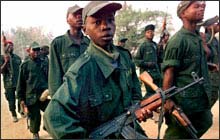
Child soldiersCOpper, CObalt and COltan are among the precious resources we are sucking from the COngo. Could their names too derive from a common origin? We’re hearing suddenly of horrendous atrocities from there, although the Congolese have been suffering for over a decade. Has excess violence begun to threaten our mineral supply?

Have you heard of Coltan? It’s the rare material used in cell phones and laptops. The Congo is the world’s chief source of Coltan and supplies other invaluable resources to industry, particlarly weapons and electronics. I would have thrown in Diamonds, Uranium and Oil if they’d started with CO. Western industry takes a wealth of mineral resource from impoverished Africa.

Post-colonial Africa is a myth. Or, it’s not what as it sounds. Colonial Africa, self-liberated in the post war era, remains occupied by white man, in the guise of corporations. It’s just the administrators on the ground who’ve changed color. And the multinational corporations dictate a wholly other civilized set of governing principles. No longer need the natives be clothed or educated, for business it’s enough that they be herded, to staff mines and factories, in gulags or slums. The multinational businesses fund ruthless local regimes to maintain instability, the better for extraction industries to rob the land.

Read more

Colorization of the Grapes of Wrath

migrant-motherI think it’s time to colorize The Grapes of Wrath. And I don’t mean the Turner Classics process exactly. It may help to dumb down the artistic contrast of the black & white for a contemporary audience palate of splashy Disneycolor, but how about trying to make Steinbeck’s theme more accessible to today’s spoon-fed viewers? Let’s colorize the skin of the poor migrant workers to reflect the inhumanly-treated populations of today’s displaced im-migrants of color.

I can’t remember where I come down on colorizing the old movies. No one’s insisted on infusing CMYK into Ansel Adams or Picasso’s sketchbook, why are masterpieces filmed in black and white supposed to be pigment deficient? We don’t presume to dub dialog over the silent movies made before the age of the talkies. As yet. Of course, Ted Turner was concerned for reviving interest in old intellectual properties, many of which were already in-artful. And perhaps his salesmanship maneuver has been proven effective. When my family sat down to watch Grapes of Wrath, the grey image tuned a number of youthful eyes away.

Like Dorothea Lange’s famous photographs, John Ford’s film depicted disadvantaged Okies with whom the American audience could identify. We may not know what it feels like to be forced off our homes, but how the families cope with the hardship, we all can recognize. I’m curious how the film was received by Californians in 1940, coming less than ten years after the original plague of destitute Oklahoma refugees. How would the characters have faired with our sympathies if they had been played as coarse hillbilly Crackers with guns and a poor person’s chip-on-the-shoulder desperation?

The poor protagonists of The Grapes of Wrath were weakened skinny po-folk, who staked their relief on the strength of a single hopeful job listing flyer, who protested their oppression without resorting to violence, and who accepted hardship as their lot. Seeing into their daily lives, viewers were shown a dignified, earnest people who treated others with respect and compassion. Antagonist characters in the film were less charitable, taking advantage of the hard-luck migrants with guile, violence and authority. People into which the Oklahoma refugees traveled, New Mexico, Arizona and California, treated the migrants like vermin. Even as onlookers might express admiration for the Okies’ determination to cross Death Valley, the better fed Californians held them in disdain for not knowing enough to be in such a predicament. The Okies were blamed for their own poverty. They threatened to burden everyone’s already depleting resources. Only the viewers understood the unfair actions which had landed the otherwise self-sufficient sharecroppers to have to leave their livelihoods.

The circumstances of the Dust Bowl cum great depression era forced removal of the small Oklahoma farmers is eerily familiar to today’s economy and its foreclosures. Homesteaders find themselves made homeless, as a consequence of business decisions between corporations, banks and regulators. The Oklahoma farmers wanted to point their shotguns to warn the financial disruptors from their land, but found the conduits of the dirty work were their own neighbors and relatives. Everyone was merely following orders from someone higher up. That the system could be at fault, left the victims with no clear recourse.

Here’s the classic eviction exchange.

THE MAN
I can’t help that. All I know is I got my orders.
They told me to tell you you got to get off,
and that’s what I’m telling you.

MULEY
You mean get off my own land?

THE MAN
Now don’t go blaming me. It ain’t *my* fault.

SON
Whose fault is it?

THE MAN
You know who owns the land–the Shawnee Land and Cattle Company.

MULEY
Who’s the Shawnee Land and Cattle Comp’ny?

THE MAN
It ain’t nobody. It’s a company.

SON
They got a pres’dent, ain’t they?
They got somebody that knows what a shotgun’s for, ain’t they?

THE MAN
But it ain’t *his* fault, because the *bank* tells him what to do.

SON
All right. Where’s the bank?

THE MAN
Tulsa. But what’s the use of picking on him?
He ain’t anything but the manager, and half crazy hisself,
trying to keep up with his orders from the east!

MULEY
Then who *do* we shoot?

THE MAN
Brother, I don’t know. If I did I’d tell you.
But I just don’t know *who’s* to blame!

There was a lot more in The Grapes of Wrath which could inform a modern world view. The dreaded “Cats” for example. These were the Caterpillar tractors which were shown ravaging the land like locusts, arriving to demolish the houses of the reluctant dispossessed. Bulldozers are still used for that function today. In fact, Caterpillar manufactures armored versions to deploy in war zones for the destruction of houses. Palestinians have shown to be less reluctant than the poor Okies about trying to shoot the bulldozer drivers who are taking aim at their homes. Israel is expanding its settlements in Palestine with the aid of Caterpillar tractors which clear the land of its recalcitrant invadees.

Likewise, the union busting strategies portrayed in Grapes of Wrath are the same used today. Police officers are called in when work supervisors encounter workers who show too much skepticism for the employer’s scam. Troublemakers are arrested lest the workforce succeed in organizing itself. Instigators are paid to infiltrate a social event and start a fight, to give law enforcement the excuse to break in and make its calculated arrests. Casual viewers may think the famous 1939 film depicts a bygone age. Not at all.

Director John Ford made sure that the Okie migrants were deathly skinny, while everyone else, from gas station attendants to deputized union-busters, was immaculately dressed and well fed. But the audience could identify with both sides, because both were white. Imagine if the displaced peoples were not the same color.

Today’s migrant workers are hispanic. They are illegal immigrants, just like Okies passing through the Arizona checkpoint in Steinbeck’s novel.

GUARD
Where you going?

TOM
California.

GUARD
How long you plan to be in Arizona?

TOM
No longer’n we can get acrost her.

GUARD
Got any plants?

TOM
No plants.

GUARD
Okay. Go ahead, but you better keep movin’.

Could a modern audience appreciate the travails of a Mexican family in an exact same predicament? Mexican farmers have been forced from their land in an even less polite manner today. They have similar claim to their homesteads, some of them even have indigenous claims. But American and Mexican corporate interests have been forcing the Mexicans to flee. The migration north is not about seeking fortune; picking lettuce it most certainly is not. The work our illegal immigrants are willing to do is out of desperation and subsistence. Corporate America reserves our agricultural work for migrants because it’s cheaper. Otherwise American citizens have devised unions to ensure that workers are paid an honorable wage. Exploitation of the illegal immigrant is simply a bypass of decent labor practices meant to protect everyone.

In selfish, protectionist terms, hiring illegal immigrants undermines the strength of unionized labor. Ultimately the exploitation of others dehumanizes us all.

I wish Americans could see The Grapes of Wrath as a projection of the ongoing injustices suffered by all exploited migrants. As well-fed American citizens leading prosperous lives, wouldn’t it be our responsibility to help the victims of our system? Instead, we are those cold-hearted leather-jacketed Californians herding them into lives of slow death by hard labor and starvation.

The Grapes of Wrath offered a strong Socialist message, disguised in a protagonist who did not yet have all the answers. Before setting out to light the way, Henry Fonda’s character says this to his mom:

TOM
…maybe I can do sump’n. Maybe I can jus’ fin’ out sump’n.
Jus’ scrounge aroun’ an’ try to fin’ out what it is that’s wrong,
an then see if they ain’t sump’n could be done about it.
But I ain’t thought it out clear, Ma. I can’t.
I don’t know enough.

MA
How’m I gonna know ’bout you?
They might kill you an’ I wouldn’t know.
They might hurt you. How’m I gonna know?

TOM
Well, maybe it’s like Casy says, a fella ain’t got a soul
of his own, but on’y a piece of a big soul–the one big soul
that belongs to ever’body–an’ then…
Then it don’t matter. Then I’ll be all aroun’ in the dark.
I’ll be ever’where–wherever you look. Wherever there’s
a fight so hungry people can eat, I’ll be there.
Wherever there’s a cop beatin’ up a guy, I’ll be there.
I’ll be in the way guys yell when they’re mad
–an’ I’ll be in the way kids laugh when they’re
hungry an’ they know supper’s ready.
An’ when our people eat the stuff they raise,
an’ live in the houses they build, why, I’ll be there too.

I had to see The Grapes of Wrath in high school. It was required. Are schools today trying to infuse students with social wisdom? How about a Grapes Redux starring people of color? Imagine this closing line, spoken by a dark skinned mother, about the hardship that is her people’s fate:

MA
…Maybe that makes us tough. Rich fellas come up an’ they die, an’ their kids ain’t no good, an’ they die out. But we keep a-comin’. We’re the people that live. Can’t nobody wipe us out. Can’t nobody lick us. We’ll go on forever, Pa. We’re the people.

The Scamble for Africa- Darfur, Intervention, and the USA

africaThose interested in Darfur might want to check this book, ‘The Scramble for Africa’, out some when it comes out? Especially with the Biden, Obama gang headed towards the White House soon. Certainly this is a timely release for this book.

*** Book of the Month for** **October 2008*

*THE SCRAMBLE FOR AFRICA*

*Darfur — Intervention and the USA*

*Steven Fake and Kevin Funk*

*As massive human suffering continues to engulf the Darfur region of
Sudan, the crisis has garnered a rhetorical circus of saber-rattling and
hand wringing from Western politicians, media, and activists. Yet such
bluster has not halted the violence.*

*In a careful yet scathing indictment of this constellation of
holier-than-thou government leaders, corporate media outlets, and spoon-fed
NGOs, Steven Fake and Kevin Funk reveal the myriad ways in which the West
has failed Darfur.*

*Praise for Scramble for Africa:*

*”A devastating critique of the ‘humanitarian’ response of the United
States to the Darfur crisis. Well-researched, easy to read, and utterly
convincing, a crucial book for anyone concerned about achieving a morally
and politically acceptable U.S. foreign policy.”
–Richard Falk, Milbank Professor of Law Emeritus, Princeton University*

*”Sudan has been a nightmare for many. It still is. The outside world is
responsible as well. This book shows why. The authors avoid easy answers,
and provide a quality analysis with compelling arguments to revise Western
policies.”
–Jan Pronk, Special Representative of the Secretary-General and Head of
Mission for the United Nations Mission in Sudan, 2004-06 *

*”Explosive, masterful, and impeccably fair. Consider it the thinking
person’s guide to Darfur.”
-John Ghazvinian, author of **Untapped: The Scramble for Africa’s Oil*

*STEVEN FAKE and KEVIN FUNK are activists and political commentators whose
writings have been published in such media as **Foreign Policy in Focus,
Common Dreams, CounterPunch, ZNet**, and **Black Commentator**.*

*344 pages, bibliography, index
Paperback ISBN: 978-1-55164-322-9 $19.99
Hardcover ISBN: 978-1-55164-323-6 $39.99*

*For more information on **The Scramble For Africa**, our October Book of
the Month selection, including additional testimonials and Table of
Contents, see **http://www.blackrosebooks.net/darfur.htm*
* *

*The Scramble For Africa will be launched in the Boston area on October
28th. For more information see http://www.blackrosebooks.net/events.htm*

*To Order This Book, Call Toll Free 1-800-565-9523*

*Independent Publishing for Independent Minds*

*What others are saying about Scramble for Africa*

“Kevin Funk and Steven Fake have written a devastating critique of the
‘humanitarian’ response of the United States to the Darfur crisis, while
offering a genuine humane alternative that would lessen the ordeal, if not
bring it to an end. Well-researched, easy to read, and utterly convincing, a
crucial book for anyone concerned about achieving a morally and politically
acceptable U.S. foreign policy.”
*–Richard Falk, Milbank Professor of Law Emeritus, Princeton University, and
since 2002, Visiting Distinguished Professor, Global Studies, UCSB*

“Sudan has been a nightmare for many. It still is. The outside world is
responsible as well. This book shows why. The authors avoid easy answers,
and provide a quality analysis with compelling arguments to revise Western
policies.”
*–Jan Pronk, Special Representative of the Secretary-General and Head of
Mission for the United Nations Mission in Sudan, 2004-06*

“At a time when everyone from George Clooney to George Bush is an instant
expert on Darfur, Kevin Funk and Steven Fake have given us what we so
urgently need: a clear, sober assessment of the conflict and how it fits
into the foreign policy of the United States. With neither fear nor favour,
they take us back stage, show us our blind spots, and come up with some
troubling conclusions. Explosive, masterful, and impeccably fair. Consider
it the thinking person’s guide to Darfur.”
*–John Ghazvinian, author of Untapped: The Scramble for Africa’s Oil*

“A commanding exposé of the duplicitous and damaging role played by US
leaders and others in a dark drama. Well-written, well focused, deeply
informed—an excellent corrective for the many who cannot tell the difference
between humanitarian assistance and imperial aggrandizement.”
*–Michael Parenti, author of ‘Contrary Notions’ and ‘Against Empire’*

“Elegantly written, erudite without being academic, and with a forceful yet
sensible political argument, Scramble for Africa is a must read for anyone
concerned with making sense of one of the most haunting crises of our time.”
*–Stephen Eric Bronner, Rutgers University*

“Scramble for Africa: Darfur Intervention and the USA is the book we’ve all
been waiting for. Clearly written, and scholarly without losing its
skeptical edge, this new work takes on the U.S. Government and the Save
Darfur coalition alike, offering a fresh analysis of Darfur in its larger
geopolitical context. Scramble for Africa belongs on every Darfur activist’s
bookshelf.”
*–David Morse, Darfur activist and journalist*

“So much of what has been written on Darfur is either expression of
humanitarian concern without awareness of the imperial context, or
denunciation of Western perfidy without appreciation of the horrible human
tragedy that has been unfolding. In this extremely well-documented study,
Steve Fake and Kevin Funk combine deep compassion with a keen critical
analysis to show how we might best support the suffering people of Darfur.
This is a book for all those interested in working for a more just world.”
*–Stephen R. Shalom, Professor of Political Science at William Paterson
University in New Jersey and author of, among other works, Imperial Alibis:
Rationalizing US Intervention After the Cold War*

“This extremely well-researched analysis reveals the real goals of US
foreign policy in one of the greatest horrors of our generation. The authors
have produced an essential book for analysts and activists everywhere,
together with a call to action which no-one should ignore.”
*–Mark Curtis, author, Web of Deceit: Britain’s Real Role in the World*

“One of the few works to tackle honestly the vexing question of what is to
be done about Darfur. Cheerleaders for intervention and humanitarians who
persist in rosy fantasies about the U.S. role in the world have had no
trouble advocating “solutions,” but for others on the left the question has
been much more difficult. Not content, like so many, to simply wash their
hands of the question, the authors have constructed a deeply informed and
carefully reasoned argument that addresses seriously the possibilities for
constructive humanitarian interventions in an imperfect world vitiated by
great power interests and political posturing. For the cruise-missile left
and the hard-core anti-interventionist left alike, Darfur is not about
Darfur but about their own self-image; Fake and Funk rightly bring the focus
back to what is best for the people on the ground.”
*–Rahul Mahajan, activist and author of Full Spectrum Dominance: U.S. Power
in Iraq and Beyond*

“At last there is a book on Darfur that places the conflict in the context
of the new ‘scramble for Africa,’ the contest between the old imperialism of
England and its successors, the US and China. Fake and Funk’s analysis
unmasks the propagandistic deploying of powerful language alleging
‘genocide’ and the ‘world’s worst humanitarian crisis’ in Sudan for its
political advantages to the US and its neglect of the suffering of Darfur’s
victims. When analyzing the politics of the ‘Save Darfur Coalition’ the
journalists-authors work with a scalpel in a refreshing and penetrating
analysis of why the Darfur conflict became the ’cause célèbre,’ when it
should have been the war in Iraq. Activists and astute observers of the
contemporary global political scene will find this scrupulously researched
volume a must read, virtually unique among available works on the subject.”
*–Carolyn Fluehr-Lobban, Professor of Anthropology, Rhode Island College,
veteran Sudan researcher*

“For those, like myself, who have long felt both revulsion and confusion by
the humanitarian crisis in Darfur and wished to know more, this is the
perfect handbook. …an objective, dispassionate, meticulously researched
account of the conflict… The authors of Scramble for Africa… startle us with
their documentation of the little known but equally sordid role our own
government has played in Sudan for the past thirty years – suggesting that
our present official “humanitarian concerns” are merely crocodile tears
masking another agenda.”
*–Timothy Kendall, Ph. D., Senior Research Scholar, Dept. of
African-American Studies, Northeastern University and Director of
Archaeological Mission, Jebel Barkal (Karima), Sudan, Sudan Dept. of
Antiquities and Museums (NCAM), Khartoum, Sudan*

“The Scramble for Africa stands against the muck of neo-liberal ideology,
taking us through the Darfur conflict, putting it into history and allowing
us to think of a non-imperialist way to bring peace to a tormented region.
Save Darfur, surely; but as much from Washington as Khartoum, as much from
fantasies of humanitarian intervention as the brutalities of
IMFundamentalism and Islamism.”
*–Vijay Prashad, author, The Darker Nations: A People’s History of the Third
World*

“The Darfur conflict has proven to be intractable, at terrible cost to the
people of that region. There is a crying need for on-going international
activism based on a thorough analysis of Sudan and the role of the US, China
and other states. The Scramble for Africa by Kevin Funk and Steven Fake is a
well-researched, important and progressive contribution in this regard. It
should be widely read, from the White House to the grassroots.”
*–Laurie Nathan, research fellow at the London School of Economics and
member of the African Union mediation team for Darfur in 2005/6*

“This excellent book presents the basic information on the political and
military aspects of the conflict, examines the options from a clear and
transparent ethical position, and presents ways forward with a concern for
broad international implications and concern for the hundreds of thousands
of victims. It is is exactly what is needed and I hope it is very widely
read. I will recommend it to everyone.”
*–Justin Podur, writer and activist*

Shlomo Sand and shattering a national mythology

Shlomo SandShattering a ‘national mythology’ Shlomo Sand’s book is titled “When and How the Jewish People Was Invented?” and you probably will not find it stacked up on tables for sale in Barnes and Noble or Borders. I don’t expect it to be readily available for Colorado Springs librarian patrons either. Ask for it though.

The Haaretz interview:

Actually, most of your book does not deal with the invention of the Jewish people by modern Jewish nationalism, but rather with the question of where the Jews come from.

Sand: “My initial intention was to take certain kinds of modern historiographic materials and examine how they invented the ‘figment’ of the Jewish people. But when I began to confront the historiographic sources, I suddenly found contradictions. And then that urged me on: I started to work, without knowing where I would end up. I took primary sources and I tried to examine authors’ references in the ancient period – what they wrote about conversion.”

Experts on the history of the Jewish people say you are dealing with subjects about which you have no understanding and are basing yourself on works that you can’t read in the original.

“It is true that I am an historian of France and Europe, and not of the ancient period. I knew that the moment I would start dealing with early periods like these, I would be exposed to scathing criticism by historians who specialize in those areas. But I said to myself that I can’t stay just with modern historiographic material without examining the facts it describes. Had I not done this myself, it would have been necessary to have waited for an entire generation. Had I continued to deal with France, perhaps I would have been given chairs at the university and provincial glory. But I decided to relinquish the glory.”

Inventing the Diaspora

“After being forcibly exiled from their land, the people remained faithful to it throughout their Dispersion and never ceased to pray and hope for their return to it and for the restoration in it of their political freedom” – thus states the preamble to the Israeli Declaration of Independence. This is also the quotation that opens the third chapter of Sand’s book, entitled “The Invention of the Diaspora.” Sand argues that the Jewish people’s exile from its land never happened.

“The supreme paradigm of exile was needed in order to construct a long-range memory in which an imagined and exiled nation-race was posited as the direct continuation of ‘the people of the Bible’ that preceded it,” Sand explains. Under the influence of other historians who have dealt with the same issue in recent years, he argues that the exile of the Jewish people is originally a Christian myth that depicted that event as divine punishment imposed on the Jews for having rejected the Christian gospel.

“I started looking in research studies about the exile from the land – a constitutive event in Jewish history, almost like the Holocaust. But to my astonishment I discovered that it has no literature. The reason is that no one exiled the people of the country. The Romans did not exile peoples and they could not have done so even if they had wanted to. They did not have trains and trucks to deport entire populations. That kind of logistics did not exist until the 20th century. From this, in effect, the whole book was born: in the realization that Judaic society was not dispersed and was not exiled.”

If the people was not exiled, are you saying that in fact the real descendants of the inhabitants of the Kingdom of Judah are the Palestinians?

“No population remains pure over a period of thousands of years. But the chances that the Palestinians are descendants of the ancient Judaic people are much greater than the chances that you or I are its descendents. The first Zionists, up until the Arab Revolt [1936-9], knew that there had been no exiling, and that the Palestinians were descended from the inhabitants of the land. They knew that farmers don’t leave until they are expelled. Even Yitzhak Ben-Zvi, the second president of the State of Israel, wrote in 1929 that, ‘the vast majority of the peasant farmers do not have their origins in the Arab conquerors, but rather, before then, in the Jewish farmers who were numerous and a majority in the building of the land.'”

And how did millions of Jews appear around the Mediterranean Sea?

“The people did not spread, but the Jewish religion spread. Judaism was a converting religion. Contrary to popular opinion, in early Judaism there was a great thirst to convert others. The Hasmoneans were the first to begin to produce large numbers of Jews through mass conversion, under the influence of Hellenism. The conversions between the Hasmonean Revolt and Bar Kochba’s rebellion are what prepared the ground for the subsequent, wide-spread dissemination of Christianity. After the victory of Christianity in the fourth century, the momentum of conversion was stopped in the Christian world, and there was a steep drop in the number of Jews. Presumably many of the Jews who appeared around the Mediterranean became Christians. But then Judaism started to permeate other regions – pagan regions, for example, such as Yemen and North Africa. Had Judaism not continued to advance at that stage and had it not continued to convert people in the pagan world, we would have remained a completely marginal religion, if we survived at all.”

How did you come to the conclusion that the Jews of North Africa were originally Berbers who converted?

“I asked myself how such large Jewish communities appeared in Spain. And then I saw that Tariq ibn Ziyad, the supreme commander of the Muslims who conquered Spain, was a Berber, and most of his soldiers were Berbers. Dahia al-Kahina’s Jewish Berber kingdom had been defeated only 15 years earlier. And the truth is there are a number of Christian sources that say many of the conquerors of Spain were Jewish converts. The deep-rooted source of the large Jewish community in Spain was those Berber soldiers who converted to Judaism.”

Sand argues that the most crucial demographic addition to the Jewish population of the world came in the wake of the conversion of the kingdom of Khazaria – a huge empire that arose in the Middle Ages on the steppes along the Volga River, which at its height ruled over an area that stretched from the Georgia of today to Kiev. In the eighth century, the kings of the Khazars adopted the Jewish religion and made Hebrew the written language of the kingdom. From the 10th century the kingdom weakened; in the 13th century is was utterly defeated by Mongol invaders, and the fate of its Jewish inhabitants remains unclear.

Sand revives the hypothesis, which was already suggested by historians in the 19th and 20th centuries, according to which the Judaized Khazars constituted the main origins of the Jewish communities in Eastern Europe.

“At the beginning of the 20th century there is a tremendous concentration of Jews in Eastern Europe – three million Jews in Poland alone,” he says. “The Zionist historiography claims that their origins are in the earlier Jewish community in Germany, but they do not succeed in explaining how a small number of Jews who came from Mainz and Worms could have founded the Yiddish people of Eastern Europe. The Jews of Eastern Europe are a mixture of Khazars and Slavs who were pushed eastward.”

If the Jews of Eastern Europe did not come from Germany, why did they speak Yiddish, which is a Germanic language?

“The Jews were a class of people dependent on the German bourgeoisie in the East, and thus they adopted German words. Here I base myself on the research of linguist Paul Wechsler of Tel Aviv University, who has demonstrated that there is no etymological connection between the German Jewish language of the Middle Ages and Yiddish. As far back as 1828, the Ribal (Rabbi Isaac Ber Levinson) said that the ancient language of the Jews was not Yiddish. Even Ben Zion Dinur, the father of Israeli historiography, was not hesitant about describing the Khazars as the origin of the Jews in Eastern Europe, and describes Khazaria as ‘the mother of the diasporas’ in Eastern Europe. But more or less since 1967, anyone who talks about the Khazars as the ancestors of the Jews of Eastern Europe is considered naive and moonstruck.”

Why do you think the idea of the Khazar origins is so threatening?

“It is clear that the fear is of an undermining of the historic right to the land. The revelation that the Jews are not from Judea would ostensibly knock the legitimacy for our being here out from under us. Since the beginning of the period of decolonization, settlers have no longer been able to say simply: ‘We came, we won and now we are here’ the way the Americans, the whites in South Africa and the Australians said. There is a very deep fear that doubt will be cast on our right to exist.”

Is there no justification for this fear?

“No. I don’t think that the historical myth of the exile and the wanderings is the source of the legitimization for me being here, and therefore I don’t mind believing that I am Khazar in my origins. I am not afraid of the undermining of our existence, because I think that the character of the State of Israel undermines it in a much more serious way. What would constitute the basis for our existence here is not mythological historical right, but rather would be for us to start to establish an open society here of all Israeli citizens.”

In effect you are saying that there is no such thing as a Jewish people.

“I don’t recognize an international people. I recognize ‘the Yiddish people’ that existed in Eastern Europe, which though it is not a nation can be seen as a Yiddishist civilization with a modern popular culture. I think that Jewish nationalism grew up in the context of this ‘Yiddish people.’ I also recognize the existence of an Israeli people, and do not deny its right to sovereignty. But Zionism and also Arab nationalism over the years are not prepared to recognize it.

“From the perspective of Zionism, this country does not belong to its citizens, but rather to the Jewish people. I recognize one definition of a nation: a group of people that wants to live in sovereignty over itself. But most of the Jews in the world have no desire to live in the State of Israel, even though nothing is preventing them from doing so. Therefore, they cannot be seen as a nation.”

What is so dangerous about Jews imagining that they belong to one people? Why is this bad?

“In the Israeli discourse about roots there is a degree of perversion. This is an ethnocentric, biological, genetic discourse. But Israel has no existence as a Jewish state: If Israel does not develop and become an open, multicultural society we will have a Kosovo in the Galilee. The consciousness concerning the right to this place must be more flexible and varied, and if I have contributed with my book to the likelihood that I and my children will be able to live with the others here in this country in a more egalitarian situation – I will have done my bit.

“We must begin to work hard to transform our place into an Israeli republic where ethnic origin, as well as faith, will not be relevant in the eyes of the law. Anyone who is acquainted with the young elites of the Israeli Arab community can see that they will not agree to live in a country that declares it is not theirs. If I were a Palestinian I would rebel against a state like that, but even as an Israeli I am rebelling against it.”

The question is whether for those conclusions you had to go as far as the Kingdom of the Khazars.

“I am not hiding the fact that it is very distressing for me to live in a society in which the nationalist principles that guide it are dangerous, and that this distress has served as a motive in my work. I am a citizen of this country, but I am also a historian and as a historian it is my duty to write history and examine texts. This is what I have done.”

If the myth of Zionism is one of the Jewish people that returned to its land from exile, what will be the myth of the country you envision?

“To my mind, a myth about the future is better than introverted mythologies of the past. For the Americans, and today for the Europeans as well, what justifies the existence of the nation is a future promise of an open, progressive and prosperous society. The Israeli materials do exist, but it is necessary to add, for example, pan-Israeli holidays. To decrease the number of memorial days a bit and to add days that are dedicated to the future. But also, for example, to add an hour in memory of the Nakba [literally, the “catastrophe” – the Palestinian term for what happened when Israel was established], between Memorial Day and Independence Day.”

These meds are dangerous to your child’s health; So why haven’t they been removed from pharmacy shelves?

TylenolIt’s a multiple billion dollar industry with dangerous ingredients in them, but they haven’t been removed from America’s pharmacies shelves at all. Actually these meds are there now everywhere, including convenience stores, grocery stores, and dollar stores. There are constant ads for them on television counselling parents to buy them for their babies and kids to ingest. Find them on coupons, in magazines, anywhere you might look.

Parents misuse these ‘medicines’ thinking that they are safe to get their small kids asleep. It is a kind of toxic baby sitter for many less aware mothers and dads. I am talking about ‘Children’s Tylenol’ and like formulations. How many parents angrily must have these products prescribed, given, and even forced on their children, all the while thinking that it is malpractice if they are not?

It is a step in the right direction to now have a ‘warning’ given about their dangers given out by at least one organization, but where is the Federal government here? They have sat quiet for decades upon decades as the evidence of how dangerous acetaminophen, pseudophed, and anti-histamines can be for kids. The worst danger of them all is acetaminophen (Tylenol) the supposedly safer ‘alternative’, or so spouts the advertising by Tylenol (McNEIL-PPC, Inc).

Drug companies: No cold meds for kids under 4
New voluntary warning labels caution against use by young children

They might finally get pulled off a few shelves thanks to some American pediatricians finally doing the right thing. Unfortunately, without a bigger campaign against their use, parents may actually use the same meds in adult form (or otherwise) on their kids? These medications need to be lobbied against and not lobbied for.

Don’t do it! Don’t do it even in smaller, more dilute doses! Don’t give these unnecessary and at times directly harmful medications to your small children. And just get rid of these meds altogether if there is any chance that somebody might try to commit suicide in your household. Tylenol can mess you over (yes! adults and teenagers alike, let alone children) quick if even a few too many are actually swallowed.

A snapshot of Earth evolved

evolve goldThe universe has so many interesting niches, and one of the most recent niches to be discovered by man is underground in Illinois, of all places. Ancient trees recorded in mines Two other famous petrified forests can be found in Arizona and the Greek island of Lesbo but they are not located underground and the trees are not as old.

The Dakotas have a lot of petrified forest areas, too, including the Petrified Wood Park of Lemmon, South Dakota. No need to lose your mind going to Kentucky to visit The Creationist Museum there to discover God’s supposed work. Unless, of course, you are a fan of Christian Fiction?

Global economic rapists are at it again

G8 protest
Why protest the G8 Summit July 7-9? Those hoodlums always look so determined. Here’s the rationale by the Emergency Exit Collective:

The 2008 G8 on Hokkaido, a Strategic Assessment
Emergency Exit Collective
Bristol, Mayday, 2008

The authors of this document are a collection of activists, scholars, and writers currently based in the United States and Western Europe who have gotten to know and work with each other in the movement against capitalist globalization. We’re writing this at the request of some members of No! G8 Action Japan, who asked us for a broad strategic analysis of the state of struggle as we see it, and particularly, of the role of the G8, what it represents, the dangers and opportunities that may lie hidden in the moment. It is in no sense programmatic. Mainly, it is an attempt to develop tools that we hope will be helpful for organizers, or for anyone engaged in the struggle against global capital.

I
It is our condition as human beings that we produce our lives in common.

II
Let us then try to see the world from the perspective of the planet’s commoners, taking the word in that sense: those whose most essential tradition is cooperation in the making and maintenance of human social life, yet who have had to do so under conditions of suffering and separation; deprived, ignored, devalued, divided into hierarchies, pitted against each other for our very physical survival. In one sense we are all commoners. But it’s equally true that just about everyone, at least in some ways, at some points, plays the role of the rulers—of those who expropriate, devalue and divide—or at the very least benefits from such divisions.

Obviously some do more than others. It is at the peak of this pyramid that we encounter groups like the G8.

III
The G8’s perspective is that of the aristocrats, the rulers: those who command and maintain that global machinery of violence that defends existing borders and lines of separation: whether national borders with their detention camps for migrants, or property regimes, with their prisons for the poor. They live by constantly claiming title to the products of others collective creativity and labour, and in thus doing they create the poor; they create scarcity in the midst of plenty, and divide us on a daily basis; they create financial districts that loot resources from across the world, and in thus doing they turn the spirit of human creativity into a spiritual desert; close or privatize parks, public water taps and libraries, hospitals, youth centers, universities, schools, public swimming pools, and instead endlessly build shopping malls that channels convivial life into a means of commodity circulation; work toward turning global ecological catastrophe into business opportunities.

These are the people who presume to speak in the name of the “international community” even as they hide in their gated communities or meet protected by phalanxes of riot cops. It is critical to bear in mind that the ultimate aim of their policies is never to create community but to introduce and maintain divisions that set common people at each other’s throats. The neoliberal project, which has been their main instrument for doing so for the last three decades, is premised on a constant effort either to uproot or destroy any communal or democratic system whereby ordinary people govern their own affairs or maintain common resources for the common good, or, to reorganize each tiny remaining commons as an isolated node in a market system in which livelihood is never guaranteed, where the gain of one community must necessarily be at the expense of others. Insofar as they are willing to appeal to high-minded principles of common humanity, and encourage global cooperation, only and exactly to the extent that is required to maintain this system of universal competition.

IV
At the present time, the G8—the annual summit of the leaders of “industrial democracies”—is the key coordinative institution charged with the task of maintaining this neoliberal project, or of reforming it, revising it, adapting it to the changing condition of planetary class relations. The role of the G8 has always been to define the broad strategic horizons through which the next wave of planetary capital accumulation can occur. This means that its main task is to answer the question of how 3?4 in the present conditions of multiple crises and struggles 3?4 to subordinate social relations among the producing commoners of the planet to capital’s supreme value: profit.

V
Originally founded as the G7 in 1975 as a means of coordinating financial strategies for dealing with the ‘70s energy crisis, then expanded after the end of the Cold War to include Russia, its currently face a moment of profound impasse in the governance of planetary class relations: the greatest since the ‘70s energy crisis itself.

VI
The ‘70s energy crisis represented the final death-pangs of what might be termed the Cold War settlement, shattered by a quarter century of popular struggle. It’s worth returning briefly to this history.

The geopolitical arrangements put in place after World War II were above all designed to forestall the threat of revolution. In the immediate wake of the war, not only did much of the world lie in ruins, most of world’s population had abandoned any assumption about the inevitability of existing social arrangements. The advent of the Cold War had the effect of boxing movements for social change into a bipolar straightjacket. On the one hand, the former Allied and Axis powers that were later to unite in the G7 (the US, Canada, UK, France, Italy, Germany, Japan)—the “industrialized democracies”, as they like to call themselves—engaged in a massive project of co-optation. Their governments continued the process, begun in the ‘30s, of taking over social welfare institutions that had originally been created by popular movements (from insurance schemes to public libraries), even to expand them, on condition that they now be managed by state-appointed bureaucracies rather than by those who used them, buying off unions and the working classes more generally with policies meant to guarantee high wages, job security and the promise of educational advance—all in exchange for political loyalty, productivity increases and wage divisions within national and planetary working class itself. The Sino-Soviet bloc—which effectively became a kind of junior partner within the overall power structure, and its allies remained to trap revolutionary energies into the task of reproducing similar bureaucracies elsewhere. Both the US and USSR secured their dominance after the war by refusing to demobilize, instead locking the planet in a permanent threat of nuclear annihilation, a terrible vision of absolute cosmic power.

VII
Almost immediately, though, this arrangement was challenged by a series of revolts from those whose work was required to maintain the system, but who were, effectively, left outside the deal: first, peasants and the urban poor in the colonies and former colonies of the Global South, next, disenfranchised minorities in the home countries (in the US, the Civil Rights movement, then Black Power), and finally and most significantly, by the explosion of the women’s movement of the late ‘60s and early ‘70s—the revolt of that majority of humanity whose largely unremunerated labor made the very existence “the economy” possible. This appears to have been the tipping point.

VIII
The problem was that the Cold War settlement was never meant to include everyone. It by definition couldn’t. Once matters reached tipping point, then, the rulers scotched the settlement. All deals were off. The oil shock was first edge of the counter-offensive, breaking the back of existing working class organizations, driving home the message that there was nothing guaranteed about prosperity. Under the aegis of the newly hatched G7, this counter-offensive involved a series of interwoven strategies that were later to give rise to what is known as neoliberalism.

IX
These strategies resulted in what came to be known as “Structural Adjustment” both in the North and in the South, accompanied by trade and financial liberalization. This, in turn, made possible crucial structural changes in our planetary production in common extending the role of the market to discipline our lives and divide us into more and more polarized wage hierarchy. This involved:

· In the immediate wake of ‘70s oil shock, petrodollars were recycled from OPEC into Northern banks that then lent them, at extortionate rates of interest, to developing countries of the Global South. This was the origin of the famous “Third World Debt Crisis.” The existence of this debt allowed institutions like the IMF to impose its monetarist orthodoxy on most of the planet for roughly twenty years, in the process, stripping away most of even those modest social protections that had been won by the world’s poor—large numbers of whom were plunged into a situation of absolute desperation.

· It also opened a period of new enclosures through the capitalist imposition of structural adjustment policies, manipulation of environmental and social catastrophes like war, or for that matter through the authoritarian dictates of “socialist” regimes. Through such means, large sections of the world’s population have over the past thirty years been dispossessed from resources previously held in common, either by dint of long traditions, or as the fruits of past struggles and past settlements.

· Through financial deregulation and trade liberalization, neoliberal capital, which emerged from the G7 strategies to deal with the 1970s crisis aimed thus at turning the “class war” in communities, factories, offices, streets and fields against the engine of competition, into a planetary “civil war”, pitting each community of commoners against every other community of commoners.

· Neoliberal capital has done this by imposing an ethos of “efficiency” and rhetoric of “lowering the costs of production” applied so broadly that mechanisms of competition have come to pervade every sphere of life. In fact these terms are euphemisms, for a more fundamental demand: that capital be exempt from taking any reduction in profit to finance the costs of reproduction of human bodies and their social and natural environments (which it does not count as costs) and which are, effectively, “exernalized” onto communities and nature.

· The enclosure of resources and entitlements won in previous generations of struggles both in the North and the South, in turn, created the conditions for increasing the wage hierarchies (both global and local), by which commoners work for capital—wage hierarchies reproduced economically through pervasive competition, but culturally, through male dominance, xenophobia and racism. These wage gaps, in turn, made it possible to reduce the value of Northern workers’ labour power, by introducing commodities that enter in their wage basket at a fraction of what their cost might otherwise have been. The planetary expansion of sweatshops means that American workers (for example) can buy cargo pants or lawn-mowers made in Cambodia at Walmart, or buy tomatoes grown by undocumented Mexican workers in California, or even, in many cases, hire Jamaican or Filipina nurses to take care of children and aged grandparents at such low prices, that their employers have been able to lower real wages without pushing most of them into penury. In the South, meanwhile, this situation has made it possible to discipline new masses of workers into factories and assembly lines, fields and offices, thus extending enormously capital’s reach in defining the terms—the what, the how, the how much—of social production.

· These different forms of enclosures, both North and South, mean that commoners have become increasingly dependent on the market to reproduce their livelihoods, with less power to resist the violence and arrogance of those whose priorities is only to seek profit, less power to set a limit to the market discipline running their lives, more prone to turn against one another in wars with other commoners who share the same pressures of having to run the same competitive race, but not the same rights and the same access to the wage. All this has meant a generalized state of precarity, where nothing can be taken for granted.

X
In turn, this manipulation of currency and commodity flows constituting neoliberal globalization became the basis for the creation of the planet’s first genuine global bureaucracy.

· This was multi-tiered, with finance capital at the peak, then the ever-expanding trade bureaucracies (IMF, WTO, EU, World Bank, etc), then transnational corporations, and finally, the endless varieties of NGOs that proliferated throughout the period—almost all of which shared the same neoliberal orthodoxy, even as they substituted themselves for social welfare functions once reserved for states.

· The existence of this overarching apparatus, in turn, allowed poorer countries previously under the control of authoritarian regimes beholden to one or another side in the Cold War to adopt “democratic” forms of government. This did allow a restoration of formal civil liberties, but very little that could really merit the name of democracy (the rule of the “demos”, i.e., of the commoners). They were in fact constitutional republics, and the overwhelming trend during the period was to strip legislatures, that branch of government most open to popular pressure, of most of their powers, which were increasingly shifted to the executive and judicial branches, even as these latter, in turn, largely ended up enacting policies developed overseas, by global bureaucrats.

· This entire bureaucratic arrangement was justified, paradoxically enough, by an ideology of extreme individualism. On the level of ideas, neoliberalism relied on a systematic cooptation of the themes of popular struggle of the ‘60s: autonomy, pleasure, personal liberation, the rejection of all forms of bureaucratic control and authority. All these were repackaged as the very essence of capitalism, and the market reframed as a revolutionary force of liberation.

· The entire arrangement, in turn, was made possible by a preemptive attitude towards popular struggle. The breaking of unions and retreat of mass social movements from the late ‘70s onwards was only made possible by a massive shift of state resources into the machinery of violence: armies, prisons and police (secret and otherwise) and an endless variety of private “security services”, all with their attendant propaganda machines, which tended to increase even as other forms of social spending were cut back, among other things absorbing increasing portions of the former proletariat, making the security apparatus an increasingly large proportion of total social spending. This approach has been very successful in holding back mass opposition to capital in much of the world (especially West Europe and North America), and above all, in making it possible to argue there are no viable alternatives. But in doing so, has created strains on the system so profound it threatens to undermine it entirely.

XI
The latter point deserves elaboration. The element of force is, on any number of levels, the weak point of the system. This is not only on the constitutional level, where the question of how to integrate the emerging global bureaucratic apparatus, and existing military arrangements, has never been resolved. It is above all an economic problem. It is quite clear that the maintenance of elaborate security machinery is an absolute imperative of neoliberalism. One need only observe what happened with the collapse of the Soviet bloc in Eastern Europe: where one might have expected the Cold War victors to demand the dismantling of the army, secret police and secret prisons, and to maintain and develop the existing industrial base, in fact, what they did was absolutely the opposite: in fact, the only part of the industrial base that has managed fully to maintain itself has been the parts required to maintained the security apparatus itself! Critical too is the element of preemption: the governing classes in North America, for example, are willing to go to almost unimaginable lengths to ensure social movements never feel they are accomplishing anything. The current Gulf War is an excellent example: US military operations appear to be organized first and foremost to be protest-proof, to ensure that what happened in Vietnam (mass mobilization at home, widespread revolt within the army overseas) could never be repeated. This means above all that US casualties must always be kept to a minimum. The result are rules of engagement, and practices like the use of air power within cities ostensibly already controlled by occupation forces, so obviously guaranteed to maximize the killing of innocents and galvanizing hatred against the occupiers that they ensure the war itself cannot be won. Yet this approach can be taken as the very paradigm for neoliberal security regimes. Consider security arrangements around trade summits, where police are so determined prevent protestors from achieving tactical victories that they are often willing to effectively shut down the summits themselves. So too in overall strategy. In North America, such enormous resources are poured into the apparatus of repression, militarization, and propaganda that class struggle, labor action, mass movements seem to disappear entirely. It is thus possible to claim we have entered a new age where old conflicts are irrelevant. This is tremendously demoralizing of course for opponents of the system; but those running the system seem to find that demoralization so essential they don’t seem to care that the resultant apparatus (police, prisons, military, etc) is, effectively, sinking the entire US economy under its dead weight.

XII
The current crisis is not primarily geopolitical in nature. It is a crisis of neoliberalism itself. But it takes place against the backdrop of profound geopolitical realignments. The decline of North American power, both economic and geopolitical has been accompanied by the rise of Northeast Asia (and to a increasing extent, South Asia as well). While the Northeast Asian region is still divided by painful Cold War cleavages—the fortified lines across the Taiwan straits and at the 38th parallel in Korea…—the sheer realities of economic entanglement can be expected to lead to a gradual easing of tensions and a rise to global hegemony, as the region becomes the new center of gravity of the global economy, of the creation of new science and technology, ultimately, of political and military power. This may, quite likely, be a gradual and lengthy process. But in the meantime, very old patterns are rapidly reemerging: China reestablishing relations with ancient tributary states from Korea to Vietnam, radical Islamists attempting to reestablish their ancient role as the guardians of finance and piety at the in the Central Asian caravan routes and across Indian Ocean, every sort of Medieval trade diaspora reemerging… In the process, old political models remerge as well: the Chinese principle of the state transcending law, the Islamic principle of a legal order transcending any state. Everywhere, we see the revival too of ancient forms of exploitation—feudalism, slavery, debt peonage—often entangled in the newest forms of technology, but still echoing all the worst abuses of the Middle Ages. A scramble for resources has begun, with US occupation of Iraq and saber-rattling throughout the surrounding region clearly meant (at least in part) to place a potential stranglehold the energy supply of China; Chinese attempts to outflank with its own scramble for Africa, with increasing forays into South America and even Eastern Europe. The Chinese invasion into Africa (not as of yet at least a military invasion, but already involving the movement of hundreds of thousands of people), is changing the world in ways that will probably be felt for centuries. Meanwhile, the nations of South America, the first victims of the “Washington consensus” have managed to largely wriggle free from the US colonial orbit, while the US, its forces tied down in the Middle East, has for the moment at least abandoned it, is desperately struggling to keep its grip Mexico, Central America and the Caribbean—its own “near abroad”.

XIII
In another age all this might have led to war—that is, not just colonial occupations, police actions, or proxy wars (which are obviously already taking place), but direct military confrontations between the armies of major powers. It still could; accidents happen; but there is reason to believe that, when it comes to moments of critical decision, the loyalties of the global elites are increasingly to each other, and not to the national entities for whom they claim to speak. There is some compelling evidence for this.

Take for example when the US elites panicked at the prospect of the massive budget surpluses of the late 1990s. As Alan Greenspan, head of the Federal Reserve at the time warned, if these were allowed to stand they would have flooded government coffers with so many trillions of dollars that it could only have lead to some form of creeping socialism, even, he predicted, to the government acquiring “equity stakes” in key US corporations. The more excitable of capitalism’s managers actually began contemplating scenarios where the capitalist system itself would be imperiled. The only possible solution was massive tax cuts; these were duly enacted, and did indeed manage to turn surpluses into enormous deficits, financed by the sale of treasury bonds to Japan and China. Conditions have thus now reached a point where it is beginning to look as if the most likely long term outcome for the US (its technological and industrial base decaying, sinking under the burden of its enormous security spending) will be to end up serve as junior partner and military enforcer for East Asia capital. Its rulers, or at least a significant proportion of them, would prefer to hand global hegemony to the rulers of China (provided the latter abandon Communism) than to return to any sort of New Deal compromise with their “own” working classes.

A second example lies in the origins of what has been called the current “Bretton Woods II” system of currency arrangements, which underline a close working together of some “surplus” and “deficit” countries within global circuits. The macroeconomic manifestation of the planetary restructuring outlined in XIX underlines both the huge US trade deficit that so much seem to worry many commentators, and the possibility to continually generate new debt instruments like the one that has recently resulted in the sub-prime crisis. The ongoing recycling of accumulated surplus of countries exporting to the USA such as China and oil producing countries is what has allowed financiers to create new credit instruments in the USA. Hence, the “deal” offered by the masters in the United States to its commoners has been this: ‘you, give us a relative social peace and accept capitalist markets as the main means through which you reproduce your own livelihoods, and we will give you access to cheaper consumption goods, access to credit for buying cars and homes, and access to education, health, pensions and social security through the speculative means of stock markets and housing prices.’ Similar compromises were reached in all the G8 countries.

Meanwhile, there is the problem of maintaining any sort of social peace with the hundreds of millions of unemployed, underemployed, dispossessed commoners currently swelling the shanty-towns of Asia, Africa, and Latin America as a result of ongoing enclosures (which have speeded up within China and India in particular, even as “structural adjustment policies” in Africa and Latin America have been derailed). Any prospect of maintaining peace in these circumstances would ordinarily require either extremely high rates of economic growth—which globally have not been forthcoming, since outside of China, growth rates in the developing world have been much lower than they were in the ‘50s, ‘60s, or even ‘70s—or extremely high levels of repression, lest matters descend into rebellion or generalized civil war. The latter has of course occurred in many parts of the world currently neglected by capital, but in favored regions, such as the coastal provinces of China, or “free trade” zones of India, Egypt, or Mexico, commoners are being offered a different sort of deal: industrial employment at wages that, while very low by international standards, are still substantially higher than anything currently obtainable in the impoverished countryside; and above all the promise, through the intervention of Western markets and (privatized) knowledge, of gradually improving conditions of living. While over the least few years wages in many such areas seem to be growing, thanks to the intensification of popular struggles, such gains are inherently vulnerable: the effect of recent food inflation has been to cut real wages back dramatically—and threaten millions with starvation.

What we really want to stress here, though, is that the long-term promise being offered to the South is just as untenable as the idea that US or European consumers can indefinitely expand their conditions of life through the use of mortgages and credit cards.

What’s being offered the new dispossessed is a transposition of the American dream. The idea is that the lifestyle and consumption patterns of existing Chinese, Indian, or Brazilian or Zambian urban middle classes (already modeled on Northern ones) will eventually become available to the children of today’s miners, maquila or plantation laborers, until, ultimately, everyone on earth is brought up to roughly the same level of consumption. Put in these terms, the argument is absurd. The idea that all six billion of us can become “middle class” is obviously impossible. First of all there is a simple problem of resources. It doesn’t matter how many bottles we recycle or how energy efficient are the light bulbs we use, there’s just no way the earth’s ecosystem can accommodate six billion people driving in private cars to work in air-conditioned cubicles before periodically flying off to vacation in Acapulco or Tahiti. To maintain the style of living and producing in common we now identify with “middle classness” on a planetary scale would require several additional planets.

This much has been pointed out repeatedly. But the second point is no less important. What this vision of betterment ultimately proposes is that it would be possible to build universal prosperity and human dignity on a system of wage labor. This is fantasy. Historically, wages are always the contractual face for system of command and degradation, and a means of disguising exploitation: expressing value for work only on condition of stealing value without work— and there is no reason to believe they could ever be anything else. This is why, as history has also shown, human beings will always avoid working for wages if they have any other viable option. For a system based on wage labor to come into being, such options must therefore be made unavailable. This in turn means that such systems are always premised on structures of exclusion: on the prior existence of borders and property regimes maintained by violence. Finally, historically, it has always proved impossible to maintain any sizeable class of wage-earners in relative prosperity without basing that prosperity, directly or indirectly, on the unwaged labor of others—on slave-labor, women’s domestic labor, the forced labor of colonial subjects, the work of women and men in peasant communities halfway around the world—by people who are even more systematically exploited, degraded, and immiserated. For that reason, such systems have always depended not only on setting wage-earners against each other by inciting bigotry, prejudice, hostility, resentment, violence, but also by inciting the same between men and women, between the people of different continents (“race”), between the generations.

From the perspective of the whole, then, the dream of universal middle class “betterment” must necessarily be an illusion constructed in between the Scylla of ecological disaster, and the Charybdis of poverty, detritus, and hatred: precisely, the two pillars of today’s strategic impasse faced by the G8.

XIV
How then do we describe the current impasse of capitalist governance?

To a large degree, it is the effect of a sudden and extremely effective upswing of popular resistance—one all the more extraordinary considering the huge resources that had been invested in preventing such movements from breaking out.

On the one hand, the turn of the millennium saw a vast and sudden flowering of new anti-capitalist movements, a veritable planetary uprising against neoliberalism by commoners in Latin America, India, Africa, Asia, across the North Atlantic world’s former colonies and ultimately, within the cities of the former colonial powers themselves. As a result, the neoliberal project lies shattered. What came to be called the “anti-globalization” movement took aim at the trade bureaucracies—the obvious weak link in the emerging institutions of global administration—but it was merely the most visible aspect of this uprising. It was however an extraordinarily successful one. Not only was the WTO halted in its tracks, but all major trade initiatives (MAI, FTAA…) scuttled. The World Bank was hobbled and the power of the IMF over most of the world’s population, effectively, destroyed. The latter, once the terror of the Global South, is now a shattered remnant of its former self, reduced to selling off its gold reserves and desperately searching for a new global mission.

In many ways though spectacular street actions were merely the most visible aspects of much broader changes: the resurgence of labor unions, in certain parts of the world, the flowering of economic and social alternatives on the grassroots levels in every part of the world, from new forms of direct democracy of indigenous communities like El Alto in Bolivia or self-managed factories in Paraguay, to township movements in South Africa, farming cooperatives in India, squatters’ movements in Korea, experiments in permaculture in Europe or “Islamic economics” among the urban poor in the Middle East. We have seen the development of thousands of forms of mutual aid association, most of which have not even made it onto the radar of the global media, often have almost no ideological unity and which may not even be aware of each other’s existence, but nonetheless share a common desire to mark a practical break with capitalism, and which, most importantly, hold out the prospect of creating new forms of planetary commons that can—and in some cases are—beginning to knit together to provide the outlines of genuine alternative vision of what a non-capitalist future might look like.

The reaction of the world’s rulers was predictable. The planetary uprising had occurred during a time when the global security apparatus was beginning to look like it lacked a purpose, when the world threatened to return to a state of peace. The response—aided of course, by the intervention of some of the US’ former Cold War allies, reorganized now under the name of Al Qaeda—was a return to global warfare. But this too failed. The “war on terror”—as an attempt to impose US military power as the ultimate enforcer of the neoliberal model—has collapsed as well in the face of almost universal popular resistance. This is the nature of their “impasse”.

At the same time, the top-heavy, inefficient US model of military capitalism—a model created in large part to prevent the dangers of social movements, but which the US has also sought to export to some degree simply because of its profligacy and inefficiency, to prevent the rest of the world from too rapidly overtaking them—has proved so wasteful of resources that it threatens to plunge the entire planet into ecological and social crisis. Drought, disaster, famines, combine with endless campaigns of enclosure, foreclosure, to cast the very means of survival—food, water, shelter—into question for the bulk of the world’s population.

XV
In the rulers’ language the crisis understood, first and foremost, as a problem of regulating cash flows, of reestablishing, as they like to put it, a new “financial architecture”. Obviously they are aware of the broader problems. Their promotional literature has always been full of it. From the earliest days of the G7, through to the days after the Cold War, when Russia was added as a reward for embracing capitalism, they have always claimed that their chief concerns include

· the reduction of global poverty

· sustainable environmental policies

· sustainable global energy policies

· stable financial institutions governing global trade and currency transactions

If one were to take such claims seriously, it’s hard to see their overall performance as anything but a catastrophic failure. At the present moment, all of these are in crisis mode: there are food riots, global warming, peak oil, and the threat of financial meltdown, bursting of credit bubbles, currency crises, a global credit crunch. [**Failure on this scale however, opens opportunities for the G8 themselves, as summit of the global bureaucracy, to reconfigure the strategic horizon. Therefore, it’s always with the last of these that they are especially concerned. ]The real problem, from the perspective of the G8, is one of reinvestment: particularly, of the profits of the energy sector, but also, now, of emerging industrial powers outside the circle of the G8 itself. The neoliberal solution in the ‘70s had been to recycle OPEC’s petrodollars into banks that would use it much of the world into debt bondage, imposing regimes of fiscal austerity that, for the most part, stopped development (and hence, the emergence potential rivals) in its tracks. By the ‘90s, however, much East Asia in particular had broken free of this regime. Attempts to reimpose IMF-style discipline during the Asian financial crisis of 1997 largely backfired. So a new compromise was found, the so-called Bretton Woods II: to recycle the profits from the rapidly expanding industrial economies of East Asia into US treasury debt, artificially supporting the value of the dollar and allowing a continual stream of cheap exports that, aided by the US housing bubble, kept North Atlantic economies afloat and buy off workers there with cheap oil and even cheaper consumer goods even as real wages shrank. This solution however soon proved a temporary expedient. Bush regime’s attempt to lock it in by the invasion of Iraq, which was meant to lead to the forced privatization of Iraqi oil fields, and, ultimately, of the global oil industry as a whole, collapsed in the face of massive popular resistance (just as Saddam Hussein’s attempt to introduce neoliberal reforms in Iraq had failed when he was still acting as American deputy in the ‘90s). Instead, the simultaneous demand for petroleum for both Chinese manufacturers and American consumers caused a dramatic spike in the price of oil. What’s more, rents from oil and gas production are now being used to pay off the old debts from the ‘80s (especially in Asia and Latin America, which have by now paid back their IMF debts entirely), and—increasingly—to create state-managed Sovereign Wealth Funds that have largely replaced institutions like the IMF as the institutions capable of making long-term strategic investments. The IMF, purposeless, tottering on the brink of insolvency, has been reduced to trying to come up with “best practices” guidelines for fund managers working for governments in Singapore, Seoul, and Abu Dhabi.

There can be no question this time around of freezing out countries like China, India, or even Brazil. The question for capital’s planners, rather, is how to channel these new concentrations of capital in such a way that they reinforce the logic of the system instead of undermining it.

XVI
How can this be done? This is where appeals to universal human values, to common membership in an “international community” come in to play. “We all must pull together for the good of the planet,” we will be told. The money must be reinvested “to save the earth.”

To some degree this was always the G8 line: this is a group has been making an issue of climate change since 1983. Doing so was in one sense a response to the environmental movements of the ‘70s and ‘80s. The resultant emphasis on biofuels and “green energy” was from their point of view, the perfect strategy, seizing on an issue that seemed to transcend class, appropriating ideas and issues that emerged from social movements (and hence coopting and undermining especially their radical wings), and finally, ensuring such initiatives are pursued not through any form of democratic self-organization but “market mechanisms”—to effective make the sense of public interest productive for capitalism.

What we can expect now is a two-pronged attack. On the one hand, they will use the crisis to attempt to reverse the gains of past social movements: to put nuclear energy back on the table to deal with the energy crisis and global warming, or genetically modified foods to deal with the food crisis. Prime Minister Fukuda, the host of the current summit, for example, is already proposing the nuclear power is the “solution” to the global warming crisis, even as the German delegation resists. On the other, and even more insidiously, they will try once again to co-opt the ideas and solutions that have emerged from our struggles as a way of ultimately undermining them. Appropriating such ideas is simply what rulers do: the bosses brain is always under the workers’ hat. But the ultimate aim is to answer the intensification of class struggle, of the danger of new forms of democracy, with another wave of enclosures, to restore a situation where commoners’ attempts to create broader regimes of cooperation are stymied, and people are plunged back into mutual competition.

We can already see the outlines of how this might be done. There are already suggestions that Sovereign Wealth Funds put aside a certain (miniscule) proportion of their money for food aid, but only as tied to a larger project of global financial restructuring. The World Bank, largely bereft of its earlier role organizing dams and pipe-lines across the world, has been funding development in China’s poorer provinces, freeing the Chinese government to carry out similar projects in Southeast Asia, Africa, and even Latin America (where, of course, they cannot effectively be held to any sort of labor or environmental standards). There is the possibility of a new class deal in China itself, whose workers can be allowed higher standards of living if new low wage zones are created elsewhere—for instance, Africa (the continent where struggles over maintaining the commons have been most intense in current decades)—with the help of Chinese infrastructural projects. Above of all, money will be channeled into addressing climate change, into the development of alternative energy, which will require enormous investments, in such a way as to ensure that whatever energy resources do become important in this millennium, they can never be democratized—that the emerging notion of a petroleum commons, that energy resources are to some degree a common patrimony meant primarily to serve the community as a whole, that is beginning to develop in parts of the Middle East and South America—not be reproduced in whatever comes next.

Since this will ultimately have to be backed up by the threat of violence, the G8 will inevitably have to struggle with how to (yet again) rethink enforcement mechanisms. The latest move , now that the US “war on terror” paradigm has obviously failed, would appear to be a return to NATO, part of a reinvention of the “European security architecture” being proposed at the upcoming G8 meetings in Italy in 2009 on the 60th anniversary of NATO’s foundation—but part of a much broader movement of the militarization of social conflict, projecting potential resource wars, demographic upheavals resulting from climate change, and radical social movements as potential military problems to be resolved by military means. Opposition to this new project is already shaping up as the major new European mobilization for the year following the current G-8.

XVII
While the G-8 sit at the pinnacle of a system of violence, their preferred idiom is monetary. Their impulse whenever possible is to translate all problems into money, financial structures, currency flows—a substance whose movements they carefully monitor and control.

Money, on might say, is their poetry—a poetry whose letters are written in our blood. It is their highest and most abstract form of expression, their way of making statements about the ultimate truth of the world, even if it operates in large part by making things disappear. How else could it be possible to argue—no, to assume as a matter of common sense—that the love, care, and concern of a person who tends to the needs of children, teaching, minding, helping them to become decent , thoughtful, human beings, or who grows and prepares food, is worth ten thousand times less than someone who spends the same time designing a brand logo, moving abstract blips across a globe, or denying others health care.

The role of money however has changed profoundly since 1971 when the dollar was delinked from gold. This has created a profound realignment of temporal horizons. Once money could be said to be primarily congealed results of past profit and exploitation. As capital, it was dead labor. Millions of indigenous Americans and Africans had their lives pillaged and destroyed in the gold mines in order to be rendered into value. The logic of finance capital, of credit structures, certainly always existed as well (it is at least as old as industrial capital; possibly older), but in recent decades these logic of financial capital has come to echo and re-echo on every level of our lives. In the UK 97% of money in circulation is debt, in the US, 98%. Governments run on deficit financing, wealthy economies on consumer debt, the poor are enticed with microcredit schemes, debts are packaged and repackaged in complex financial derivatives and traded back and forth. Debt however is simply a promise, the expectation of future profit; capital thus increasingly brings the future into the present—a future that, it insists, must always be the same in nature, even if must also be greater in magnitude, since of course the entire system is premised on continual growth. Where once financiers calculated and traded in the precise measure of our degradation, having taken everything from us and turned it into money, now money has flipped, to become the measure of our future degradation—at the same time as it binds us to endlessly working in the present.

The result is a strange moral paradox. Love, loyalty, honor, commitment—to our families, for example, which means to our shared homes, which means to the payment of monthly mortgage debts—becomes a matter of maintaining loyalty to a system which ultimately tells us that such commitments are not a value in themselves. This organization of imaginative horizons, which ultimately come down to a colonization of the very principle of hope, has come to supplement the traditional evocation of fear (of penury, homelessness, joblessness, disease and death). This colonization paralyzes any thought of opposition to a system that almost everyone ultimately knows is not only an insult to everything they really cherish, but a travesty of genuine hope, since, because no system can really expand forever on a finite planet, everyone is aware on some level that in the final analysis they are dealing with a kind of global pyramid scheme, what we are ultimately buying and selling is the real promise of global social and environmental apocalypse.

XVIII
Finally then we come to the really difficult, strategic questions. Where are the vulnerabilities? Where is hope? Obviously we have no certain answers here. No one could. But perhaps the proceeding analysis opens up some possibilities that anti-capitalist organizers might find useful to explore.

One thing that might be helpful is to rethink our initial terms. Consider communism. We are used to thinking of it as a total system that perhaps existed long ago, and to the desire to bring about an analogous system at some point in the future—usually, at whatever cost. It seems to us that dreams of communist futures were never purely fantasies; they were simply projections of existing forms of cooperation, of commoning, by which we already make the world in the present. Communism in this sense is already the basis of almost everything, what brings people and societies into being, what maintains them, the elemental ground of all human thought and action. There is absolutely nothing utopian here. What is utopian, really, is the notion that any form of social organization, especially capitalism, could ever exist that was not entirely premised on the prior existence of communism. If this is true, the most pressing question is simply how to make that power visible, to burst forth, to become the basis for strategic visions, in the face of a tremendous and antagonistic power committed to destroying it—but at the same time, ensuring that despite the challenge they face, they never again become entangled with forms of violence of their own that make them the basis for yet another tawdry elite. After all, the solidarity we extend to one another, is it not itself a form of communism? And is it not so above because it is not coerced?

Another thing that might be helpful is to rethink our notion of crisis. There was a time when simply describing the fact that capitalism was in a state of crisis, driven by irreconcilable contradictions, was taken to suggest that it was heading for a cliff. By now, it seems abundantly clear that this is not the case. Capitalism is always in a crisis. The crisis never goes away. Financial markets are always producing bubbles of one sort or another; those bubbles always burst, sometimes catastrophically; often entire national economies collapse, sometimes the global markets system itself begins to come apart. But every time the structure is reassembled. Slowly, painfully, dutifully, the pieces always end up being put back together once again.

Perhaps we should be asking: why?

In searching for an answer, it seems to us, we might also do well to put aside another familiar habit of radical thought: the tendency to sort the world into separate levels—material realities, the domain of ideas or “consciousness”, the level of technologies and organizations of violence—treating these as if these were separate domains that each work according to separate logics, and then arguing which “determines” which. In fact they cannot be disentangled. A factory may be a physical thing, but the ownership of a factory is a social relation, a legal fantasy that is based partly on the belief that law exists, and partly on the existence of armies and police. Armies and police on the other hand exist partly because of factories providing them with guns, vehicles, and equipment, but also, because those carrying the guns and riding in the vehicles believe they are working for an abstract entity they call “the government”, which they love, fear, and ultimately, whose existence they take for granted by a kind of faith, since historically, those armed organizations tend to melt away immediately the moment they lose faith that the government actually exists. Obviously exactly the same can be said of money. It’s value is constantly being produced by eminently material practices involving time clocks, bank machines, mints, and transatlantic computer cables, not to mention love, greed, and fear, but at the same time, all this too rests on a kind of faith that all these things will continue to interact in more or less the same way. It is all very material, but it also reflects a certain assumption of eternity: the reason that the machine can always be placed back together is, simply, because everyone assumes it must. This is because they cannot realistically imagine plausible alternatives; they cannot imagine plausible alternatives because of the extraordinarily sophisticated machinery of preemptive violence that ensure any such alternatives are uprooted or contained (even if that violence is itself organized around a fear that itself rests on a similar form of faith.) One cannot even say it’s circular. It’s more a kind of endless, unstable spiral. To subvert the system is then, to intervene in such a way that the whole apparatus begins to spin apart.

XIX
It appears to us that one key element here—one often neglected in revolutionary strategy—is the role of the global middle classes. This is a class that, much though it varies from country (in places like the US and Japan, overwhelming majorities consider themselves middle class; in, say, Cambodia or Zambia, only very small percentages), almost everywhere provides the key constituency of the G8 outside of the ruling elite themselves. It has become a truism, an article of faith in itself in global policy circles, that national middle class is everywhere the necessary basis for democracy. In fact, middle classes are rarely much interested in democracy in any meaningful sense of that word (that is, of the self-organization or self-governance of communities). They tend to be quite suspicious of it. Historically, middle classes have tended to encourage the establishment of constitutional republics with only limited democratic elements (sometimes, none at all). This is because their real passion is for a “betterment”, for the prosperity and advance of conditions of life for their children—and this betterment, since it is as noted above entirely premised on structures of exclusion, requires “security”. Actually the middle classes depend on security on every level: personal security, social security (various forms of government support, which even when it is withdrawn from the poor tends to be maintained for the middle classes), security against any sudden or dramatic changes in the nature of existing institutions. Thus, politically, the middle classes are attached not to democracy (which, especially in its radical forms, might disrupt all this), but to the rule of law. In the political sense, then, being “middle class” means existing outside the notorious “state of exception” to which the majority of the world’s people are relegated. It means being able to see a policeman and feel safer, not even more insecure. This would help explain why within the richest countries, the overwhelming majority of the population will claim to be “middle class” when speaking in the abstract, even if most will also instantly switch back to calling themselves “working class” when talking about their relation to their boss.

That rule of law, in turn, allows them to live in that temporal horizon where the market and other existing institutions (schools, governments, law firms, real estate brokerages…) can be imagined as lasting forever in more or less the same form. The middle classes can thus be defined as those who live in the eternity of capitalism. (The elites don’t; they live in history, they don’t assume things will always be the same. The disenfranchized don’t; they don’t have the luxury; they live in a state of precarity where little or nothing can safely be assumed.) Their entire lives are based on assuming that the institutional forms they are accustomed to will always be the same, for themselves and their grandchildren, and their “betterment” will be proportional to the increase in the level of monetary wealth and consumption. This is why every time global capital enters one of its periodic crises, every time banks collapse, factories close, and markets prove unworkable, or even, when the world collapses in war, the managers and dentists will tend to support any program that guarantees the fragments will be dutifully pieced back together in roughly the same form—even if all are, at the same time, burdened by at least a vague sense that the whole system is unfair and probably heading for catastrophe.

XIX
The strategic question then is, how to shatter this sense of inevitability? History provides one obvious suggestion. The last time the system really neared self-destruction was in the 1930s, when what might have otherwise been an ordinary turn of the boom-bust cycle turned into a depression so profound that it took a world war to pull out of it. What was different? The existence of an alternative: a Soviet economy that, whatever its obvious brutalities, was expanding at breakneck pace at the very moment market systems were undergoing collapse. Alternatives shatter the sense of inevitability, that the system must, necessarily, be patched together in the same form; this is why it becomes an absolute imperative of global governance that even small viable experiments in other ways of organizing communities be wiped out, or, if that is not possible, that no one knows about them.

If nothing else, this explains the extraordinary importance attached to the security services and preemption of popular struggle. Commoning, where it already exists, must be made invisible. Alternatives— Zapatistas in Chiapas, APPO in Oaxaca, worker-managed factories in Argentina or Paraguay, community-run water systems in South Africa or Bolivia, living alternatives of farming or fishing communities in India or Indonesia, or a thousand other examples—must be made to disappear, if not squelched or destroyed, then marginalized to the point they seem irrelevant, ridiculous. If the managers of the global system are so determined to do this they are willing to invest such enormous resources into security apparatus that it threatens to sink the system entirely, it is because they are aware that they are working with a house of cards. That the principle of hope and expectation on which capitalism rests would evaporate instantly if almost any other principle of hope or expectation seemed viable.

The knowledge of alternatives, then, is itself a material force.

Without them, of course, the shattering of any sense of certainty has exactly the opposite effect. It becomes pure precarity, an insecurity so profound that it becomes impossible to project oneself in history in any form, so that the one-time certainties of middle class life itself becomes a kind of utopian horizon, a desperate dream, the only possible principle of hope beyond which one cannot really imagine anything. At the moment, this seems the favorite weapon of neoliberalism: whether promulgated through economic violence, or the more direct, traditional kind.

One form of resistance that might prove quite useful here – and is already being discussed in some quarters – are campaigns against debt itself. Not demands for debt forgiveness, but campaigns of debt resistance.

XX
In this sense the great slogan of the global justice movement, “another world is possible”, represents the ultimate threat to existing power structures. But in another sense we can even say we have already begun to move beyond that. Another world is not merely possible. It is inevitable. On the one hand, as we have pointed out, such a world is already in existence in the innumerable circuits of social cooperation and production in common based on different values than those of profit and accumulation through which we already create our lives, and without which capitalism itself would be impossible. On the other, a different world is inevitable because capitalism—a system based on infinite material expansion—simply cannot continue forever on a finite world. At some point, if humanity is to survive at all, we will be living in a system that is not based on infinite material expansion. That is, something other than capitalism.

The problem is there is no absolute guarantee that ‘something’ will be any better. It’s pretty easy to imagine “other worlds” that would be even worse. We really don’t have any idea what might happen. To what extent will the new world still organized around commoditization of life, profit, and pervasive competition? Or a reemergence of even older forms of hierarchy and degradation? How, if we do overcome capitalism directly, by the building and interweaving of new forms of global commons, do we protect ourselves against the reemergence of new forms of hierarchy and division that we might not now even be able to imagine?

It seems to us that the decisive battles that will decide the contours of this new world will necessarily be battles around values. First and foremost are values of solidarity among commoners. Since after all, every rape of a woman by a man or the racist murder of an African immigrant by a European worker is worth a division in capital’s army.

Similarly, imagining our struggles as value struggles might allow us to see current struggles over global energy policies and over the role of money and finance today as just an opening salvo of an even larger social conflict to come. For instance, there’s no need to demonize petroleum, for example, as a thing in itself. Energy products have always tended to play the role of a “basic good”, in the sense that their production and distribution becomes the physical basis for all other forms of human cooperation, at the same time as its control tends to organize social and even international relations. Forests and wood played such a role from the time of the Magna Carta to the American Revolution, sugar did so during the rise of European colonial empires in the 17th and 18th centuries, fossil fuels do so today. There is nothing intrinsically good or bad about fossil fuel. Oil is simply solar radiation, once processed by living beings, now stored in fossil form. The question is of control and distribution. This is the real flaw in the rhetoric over “peak oil”: the entire argument is premised on the assumption that, for the next century at least, global markets will be the only means of distribution. Otherwise the use of oil would depend on needs, which would be impossible to predict precisely because they depend on the form of production in common we adopt. The question thus should be: how does the anti-capitalist movement peak the oil? How does it become the crisis for a system of unlimited expansion?

It is the view of the authors of this text that the most radical planetary movements that have emerged to challenge the G8 are those that direct us towards exactly these kind of questions. Those which go beyond merely asking how to explode the role money plays in framing our horizons, or even challenging the assumption of the endless expansion of “the economy”, to ask why we assume something called “the economy” even exists, and what other ways we can begin imagining our material relations with one another. The planetary women’s movement, in its many manifestations, has and continues to play perhaps the most important role of all here, in calling for us to reimagine our most basic assumptions about work, to remember that the basic business of human life is not actually the production of communities but the production, the mutual shaping of human beings. The most inspiring of these movements are those that call for us to move beyond a mere challenge to the role of money to reimagine value: to ask ourselves how can we best create a situation where everyone is secure enough in their basic needs to be able to pursue those forms of value they decide are ultimately important to them. To move beyond a mere challenge to the tyranny of debt to ask ourselves what we ultimately owe to one another and to our environment. That recognize that none this needs to invented from whole cloth. It’s all already there, immanent in the way everyone, as commoners, create the world together on a daily basis. And that asking these questions is never, and can never be, an abstract exercise, but is necessarily part of a process by which we are already beginning to knit these forms of commons together into new forms of global commons that will allow entirely new conceptions of our place in history.

It is to those already engaged in such a project that we offer these initial thoughts on our current strategic situation.

Helen Keller: Oh blind vanity of slaves!

helen-keller-blind-soldier-socialist-isolationist-pacifist-sedition“It is in your power to refuse to carry the artillery … You do not need to make a great noise about it. With the silence and dignity of creators you can end wars and the system of selfishness and exploitation that causes wars. All you need to do to bring about this stupendous revolution is to straighten up and fold your arms.”

Strike Against War

To begin with, I have a word to say to my good friends, the editors, and others who are moved to pity me. Some people are grieved because they imagine I am in the hands of unscrupulous persons who lead me astray and persuade me to espouse unpopular causes and make me the mouthpiece of their propaganda. Now, let it be understood once and for all that I do not want their pity; I would not change places with one of them. I know what I am talking about. My sources of information are as good and reliable as anybody else’s. I have papers and magazines from England, France, Germany and Austria that I can read myself. Not all the editors I have met can do that. Quite a number of them have to take their French and German second hand. No, I will not disparage the editors. They are an overworked, misunderstood class. Let them remember, though, that if I cannot see the fire at the end of their cigarettes, neither can they thread a needle in the dark. All I ask, gentlemen, is a fair field and no favor. I have entered the fight against preparedness and against the economic system under which we live. It is to be a fight to the finish, and I ask no quarter.

The future of the world rests in the hands of America. The future of America rests on the backs of 80,000,000 working men and women and their children. We are facing a grave crisis in our national life. The few who profit from the labor of the masses want to organize the workers into an army which will protect the interests of the capitalists. You are urged to add to the heavy burdens you already bear, the burden of a larger army and many additional warships. It is in your power to refuse to carry the artillery and the dread-noughts and to shake off some of the burdens, too, such as limousines, steam yachts and country estates. You do not need to make a great noise about it. With the silence and dignity of creators you can end wars and the system of selfishness and exploitation that causes wars. All you need to do to bring about this stupendous revolution is to straighten up and fold your arms.

We are not preparing to defend our country. Even if we were as helpless as Congressman Gardner says we are, we have no enemies foolhardy enough to attempt to invade the United States. The talk about attack from Germany and Japan is absurd. Germany has its hands full and will be busy with its own affairs for some generations after the European war is over.

With full control of the Atlantic Ocean and the Mediterranean Sea, the allies failed to land enough men to defeat the Turks at Gallipoli; and then they failed again to land an army at Salonica in time to check the Bulgarian invasion of Serbia. The conquest of America by water is a nightmare confined exclusively to ignorant persons and members of the Navy League.

Yet, everywhere, we hear fear advanced as argument for armament. It reminds me of a fable I read. A certain man found a horseshoe. His neighbor began to weep and wail because, as he justly pointed out, the man who found the horseshoe might someday find a horse. Having found the shoe, he might shoe him. The neighbor’s child might some day go so near the horse’s heels as to be kicked, and die. Undoubtedly the two families would quarrel and fight, and several valuable lives would be lost through the finding of the horseshoe. You know the last war we had we quite accidentally picked up some islands in the Pacific Ocean which may some day be the cause of a quarrel between ourselves and Japan. I’d rather drop those islands right now and forget about them than go to war to keep them. Wouldn’t you?

Congress is not preparing to defend the people of the United States. It is planning to protect the capital of American speculators and investors in Mexico, South America, China, and the Philippine Islands. Incidentally this preparation will benefit the manufacturers of munitions and war machines.

Until recently there were uses in the United States for the money taken from the workers. But American labor is exploited almost to the limit now, and our national resources have all been appropriated. Still the profits keep piling up new capital. Our flourishing industry in implements of murder is filling the vaults of New York’s banks with gold. And a dollar that is not being used to make a slave of some human being is not fulfilling its purpose in the capitalistic scheme. That dollar must be invested in South America, Mexico, China, or the Philippines.

It was no accident that the Navy League came into prominence at the same time that the National City Bank of New York established a branch in Buenos Aires. It is not a mere coincidence that six business associates of J.P. Morgan are officials of defense leagues. And chance did not dictate that Mayor Mitchel should appoint to his Committee of Safety a thousand men that represent a fifth of the wealth of the United States. These men want their foreign investments protected.

Every modern war has had its root in exploitation. The Civil War was fought to decide whether the slaveholders of the South or the capitalists of the North should exploit the West. The Spanish-American War decided that the United States should exploit Cuba and the Philippines. The South African War decided that the British should exploit the diamond mines. The Russo-Japanese War decided that Japan should exploit Korea. The present war is to decide who shall exploit the Balkans, Turkey, Persia, Egypt, India, China, Africa. And we are whetting our sword to scare the victors into sharing the spoils with us. Now, the workers are not interested in the spoils; they will not get any of them anyway.

The preparedness propagandists have still another object, and a very important one. They want to give the people something to think about besides their own unhappy condition. They know the cost of living is high, wages are low, employment is uncertain and will be much more so when the European call for munitions stops. No matter how hard and incessantly the people work, they often cannot afford the comforts of life; many cannot obtain the necessities.

Every few days we are given a new war scare to lend realism to their propaganda. They have had us on the verge of war over the Lusitania, the Gulflight, the Ancona, and now they want the workingmen to become excited over the sinking of the Persia. The workingman has no interest in any of these ships. The Germans might sink every vessel on the Atlantic Ocean and the Mediterranean Sea, and kill Americans with every one–the American workingman would still have no reason to go to war.

All the machinery of the system has been set in motion. Above the complaint and din of the protest from the workers is heard the voice of authority.

“Friends,” it says, “fellow workmen, patriots; your country is in danger! There are foes on all sides of us. There is nothing between us and our enemies except the Pacific Ocean and the Atlantic Ocean. Look at what has happened to Belgium. Consider the fate of Serbia. Will you murmur about low wages when your country, your very liberties, are in jeopardy? What are the miseries you endure compared to the humiliation of having a victorious German army sail up the East River? Quit your whining, get busy and prepare to defend your firesides and your flag. Get an army, get a navy; be ready to meet the invaders like the loyal-hearted freemen you are.”

Will the workers walk into this trap? Will they be fooled again? I am afraid so. The people have always been amenable to oratory of this sort. The workers know they have no enemies except their masters. They know that their citizenship papers are no warrant for the safety of themselves or their wives and children. They know that honest sweat, persistent toil and years of struggle bring them nothing worth holding on to, worth fighting for. Yet, deep down in their foolish hearts they believe they have a country. Oh blind vanity of slaves!

The clever ones, up in the high places know how childish and silly the workers are. They know that if the government dresses them up in khaki and gives them a rifle and starts them off with a brass band and waving banners, they will go forth to fight valiantly for their own enemies. They are taught that brave men die for their country’s honor. What a price to pay for an abstraction–the lives of millions of young men; other millions crippled and blinded for life; existence made hideous for still more millions of human being; the achievement and inheritance of generations swept away in a moment–and nobody better off for all the misery! This terrible sacrifice would be comprehensible if the thing you die for and call country fed, clothed, housed and warmed you, educated and cherished your children. I thinkthe workers are the most unselfish of the children of men; they toil and live and die for other people’s country, other people’s sentiments, other people’s liberties and other people’s happiness! The workers have no liberties of their own; they are not free when they are compelled to work twelve or ten or eight hours a day. they are not free when they are ill paid for their exhausting toil. They are not free when their children must labor in mines, mills and factories or starve, and when their women may be driven by poverty to lives of shame. They are not free when they are clubbed and imprisoned because they go on strike for a raise of wages and for the elemental justice that is their right as human beings.

We are not free unless the men who frame and execute the laws represent the interests of the lives of the people and no other interest. The ballot does not make a free man out of a wage slave. there has never existed a truly free and democratic nation in the world. From time immemorial men have followed with blind loyalty the strong men who had the power of money and of armies. Even while battlefields were piled high with their own dead they have tilled the lands of the rulers and have been robbed of the fruits of their labor. They have built palaces and pyramids, temples and cathedrals that held no real shrine of liberty.

As civilization has grown more complex the workers have become more and more enslaved, until today they are little more than parts of the machines they operate. Daily they face the dangers of railroad, bridge, skyscraper, freight train, stokehold, stockyard, lumber raft and min. Panting and training at the docks, on the railroads and underground and on the seas, they move the traffic and pass from land to land the precious commodities that make it possible for us to live. And what is their reward? A scanty wage, often poverty, rents, taxes, tributes and war indemnities.

The kind of preparedness the workers want is reorganization and reconstruction of their whole life, such as has never been attempted by statesmen or governments. The Germans found out years ago that they could not raise good soldiers in the slums so they abolished the slums. They saw to it that all the people had at least a few of the essentials of civilization–decent lodging, clean streets, wholesome if scanty food, proper medical care and proper safeguards for the workers in their occupations. That is only a small part of what should be done, but what wonders that one step toward the right sort of preparedness has wrought for Germany! For eighteen months it has kept itself free from invasion while carrying on an extended war of conquest, and its armies are still pressing on with unabated vigor. It is your business to force these reforms on the Administration. Let there be no more talk about what a government can or cannot do. All these things have been done by all the belligerent nations in the hurly-burly of war. Every fundamental industry has been managed better by the governments than by private corporations.

It is your duty to insist upon still more radical measure. It is your business to see that no child is employed in an industrial establishment or mine or store, and that no worker in needlessly exposed to accident or disease. It is your business to make them give you clean cities, free from smoke, dirt and congestion. It is your business to make them pay you a living wage. It is your business to see that this kind of preparedness is carried into every department on the nation, until everyone has a chance to be well born, well nourished, rightly educated, intelligent and serviceable to the country at all times.

Strike against all ordinances and laws and institutions that continue the slaughter of peace and the butcheries of war. Srike against war, for without you no battles can be fought. Strike against manufacturing shrapnel and gas bombs and all other tools of murder. Strike against preparedness that means death and misery to millions of human being. Be not dumb, obedient slaves in an army of destruction. Be heroes in an army of construction.

-Helen Keller at Carnegie Hall, Strike Against War, New York City, January 5, 1916

British and French imperialists are the problem, too

Together with the US, the British and French governments make up a trio of warlord imperialists that rule over the entire world in a not so benign manner at all. We in America often want to blame it all on George W. Bush and the US neo-cons, but they rule the world with the help of people like Tony Blair, Gordon Brown (current PM of Britain) and France’s Nicolas Sarkozy (the Dubya of France). Also in tow, are the Right Wing governments of Germany and Italy.

How do these gangsters operate? We can see the French fomenting war alongside the US in the Horn of Africa and in Chad-Sudan. Djibouti says France to send ships over Eritrea clash And we can see the Brits working together with Bush and Obama to threaten to extend the Middle East fighting into Syria and Iran. Bush and Brown’s warning to Iran

Why this grand alliance of gangsters? The answer is quite obvious and simple. All 5 of the these countries (US, France, Germany, Italy, Great Britain) are ruled over by the multi-national corporations HQ ed in those locales. Goodbye Democracy everywhere, as the corporate world determines for all of us the shape of the world we live in. It is not a pretty picture.

Lesson? The ‘presidential election’ is only about image changes, and not much else. There will be no real change coming about through voting to put Barack Obama into the office. Vote Obama, and you have done nothing.

In Britain, they thought getting Tony Blair into office would solve the problem of the conservative Tories. Then they thought getting Blair out and Gordon Brown in would help solve the problem of stopping British participation in all the US wars. Delusions! Nothing has changed.

If you want real change in the world, you can’t find it in simple ways. Your vote in the election will not do anything. Your message of putting Barack Obama in office will be nothing more than saying to the powers that be, that YES, they can manipulate you at will. Just like putting Carter and Clinton in office did nothing positive in the past, another corporate Democrat in office mouthing off sweet nothings ‘for the people’ will do nothing, too.

Until the populations of all the imperialist countries come alive, the world will be constantly engulfed in bloodshed, poverty, ecological destruction, and war. Passively mailing in your ‘vote’ accomplishes next to nothing at all. You must open your mouths, make your protests public and loud, and be vociferous in opposing society run by enslaved enterprise.

The Air Force Academy of Religious Intolerance

Why does the local community just sit back inattentively with big issues while the national examines the real issues and is all over a local situation? KRCC, Indy, where are you? Question is… should the Pentagon be sponsoring Right Wing Christian intolerance at the Air Force Academy using our tax dollars?

POLITICS-US: Snake Oil Sellers of the Christian Right?
By Khody Akhavi

WASHINGTON, Feb 21 (IPS) – The U.S. Air Force Academy in Colorado Springs came under heavy criticism earlier this month from Muslim and religious freedom advocacy groups after it invited to a conference three self-professed “former terrorists” with strong links to the Christian right. article continues

Regarding dismissal of St Patricks Day

Here is the language for a press release about the dismissal of criminal charges against the remaining SPD7-5. Pick and choose to taste:
 
I’m very happy that the city has decided to drop the charges. It confirms, despite their statement to suggest the opposite, that they did not have cause to arrest us, and should not have interfered with our rights as citizens to freedom of expression unmolested by the city.

It appears the city does not welcome further scrutiny of how its police officers behaved toward us. It does not want the public to question whether they too might be treated with unwarranted brutality by those entrusted to enforce our laws and respect our civil liberties.

The city’s official statement is a coarse pronouncement that they reserve the right to a drag an infirm woman across the pavement and declare it “appropriate.” They are saying a citizen exercising his right to free speech can be probable cause for arrest.

By their arrogant official statement, they are practically daring us to sue them, aren’t they? Are we going to have to take the city to the mat before they will offer up assurances to Colorado Springs residents that their policemen don’t just beat on whoever they please?

And what about the parade organizer? Can he continue to pretend that he alone determines what messages are allowed and not allowed in a city parade. His parade is subsidized by the city. Has the city apologized for denying they were giving him a subsidy, which turned out to be untrue?

Was the peace message so inappropriate? What about the Junior Marines? In light of our criticism of African and Asian nations which recruit boy soldiers, is a young boy wearing a uniform something to celebrate in our country?

On the question of whether to bring a civil suit, with the hope of forcing our city to acknowledge the errors and excesses of its actions, I’d like to challenge the Gazette to poll its readers: do they feel secure about their rights to express themselves without fear that a police officer can be given the authority to beat them up? When more people march next year than last year is when I’ll know that their intimidation has been challenged.

The Tao of Marie

Cousin It Derek
I read yesterday’s post and decided that I’d had too much turkey, too much tryptophan actually, to have sufficient mental clarity to properly opine on the divine. Today I possess mental acuity thanks, in part, to the fact I have yet to break my overnight fast. The turkey omelet must wait while I wax philosophic for a spell.

Scientists search, a bit like pigs after truffles, for cures to heal us. Doctors prescribe drugs to relieve us. Cosmetic manufacturers create creams and gels and shampoos to give us a healthy glow. Dieticians create programs to slim us down, bulk us up, bolster our energy, keep us young. Mostly they make us poor and depress us. The diet industry alone took in more than $50 billion last year but has, get this, a 95% failure rate! What the hell? Why aren’t these people in jail?

If the divine can be bothered to dwell within us, doesn’t it make sense that all we seek might possibly reside there too? Why do we allow lesser mortals to define our highest and best? If the path to enlightenment is one we walk alone, the road to self-actualization is simply the other lane. The time spent hunting for essential oils would be better spent looking for the essential self.

I cannot, for a minute, separate my physical, mental, emotional and spiritual selves and still feel a sense of well-being and balance. Perhaps I am particularly sensitive in this area. Perhaps the essential “I” is a tightly-woven braid that feels mussed at the slightest breeze. Actually, I think the popularity of Bo Derek’s terrible movie 10 was a collective recognition of our inner corn rows. Perhaps you are pig tails or a pony tail or a big tangled mane. Perhaps you can stand in the midst of a cyclone and feel unruffled and focused. Maybe you even enjoy the wind in your hair because, after all, it is still hair no matter the form. But a braid does not have this luxury.

I am not mentally healthy when I am not physically sound. My thoughts scatter, if I can be bothered to think at all. To me, a rational and precise thinker, this does not feel right, or safe. I am emotionally fragile when I don’t have the support of my other strands. When I can’t think clearly, or I don’t feel physically healthy, I am a mess. Once, only once, I had what, in retrospect, was a migraine headache. I laid face down on the couch and sobbed, aloud, until it went away.

I am a hairy wisp of a girl in every way. Only when I am integrated can I feel the power of my inner braid. As if this necessary tidiness wasn’t difficult enough to maintain, there seems to be a power struggle within my strands. The physical strand determines the hairstyle. This is not a rational choice that I have made. It seems to have little to do with my conscious self. But from experience I know that if the physical strand feels powerful and centered, I am free to play with the other strands.

Psychologists have affirmed that this is the case for many. The physical is the lowest rung on Maslow’s ladder. It is primitive. A beast that must be pacified. Woe to the other strands if the physical isn’t happy. Only when I am pregnant can I let my hair down, let the strands commingle, and still feel whole. Maybe it is because I am sharing my body with another human being in an vital way, maintaining health my highest purpose, that the physical knows its importance and loosens its grip on the other strands. Or maybe it’s hormones or other biochemicals manifesting their influence. They are, after all, the scrunchie of the essential I. Without their cooperation, there is no braid. And they know it.

Human beings are unique. We each have different power structures, styles, desires, needs. We’ve encountered different weather conditions and live in different climates. If we want to know what our particular hairstyle is, and how it’s faring these days, we don’t need to look at a magazine or a television or even at our friends and family. No, to ascertain the condition of the hairstyle, the true self, the essential I, we need only natural light and a hand-held mirror.

The Pentagon’s green baloney

The Fort Carson Fourth Annual Community Sustainability Conference is playing in town right now, and is part of The Pentagon’s green baloney program.
Sustainability is greewashing military

You might want to take in some of the last sessions over at the Crown Plaza Hotel off of Circle & I-25,and offer up your suggestions that the military use solar power to deliver their future hydrogen bombs and that they now move to require all soldiers to become vegetarians while doing military service, etc., etc. lol… This idea that the US military is part of any sustainability effort is quite laughable one would think?

Unfortunately, there are always some gullible, yet ecology oriented people who will always buy into even the most outlandish notions put forward by those who hold power in our society. But really, what’s the use of pushing for a more ecologically oriented military? Are we really interested in a more Greenly done destruction, since the job of the military is simply to destroy other peoples’ economies? Or did some of the Colorado Springs local community want to forget about that?

Sustainable? How ’bout the US military just cleaning up all the toxic messes they have already made across Planet Earth? I suggest that they start with SE Asia and then head westward.

We can give all our soldiers in uniform sticks with hooks on the end so that they can go around walking through the fields picking up land mines and depleted uranium fragments, and give them suction devices too to help clean up Agent Orange and other chemical weapons residuals that they have used in the past that might be found in leaves and dust that children with deformities now play in.

Dear Pentagon, we urge you not to litter.

Protest James CIA Woolsey visit next Thursday at Colorado College

The ex CIA director, continually fighting WW4 advocate, and prime time war profiteer, R. James Woolsey Jr. is coming to town next week. Why?

He’s advocating turning away from fossil fuel dependence as national strategy. So what? He’s no ecologist at all, but just is a war monger who is admitting the already obvious reality that world fossil fuel supplies are beginning to run dry and that the US has to move to find other sources of energy. Any advocate of fighting continuous wars is no alternative Green advocate at all, since the US military is already the world’s most prolific polluter.

The Ravings of James Woolsey examines this thug in brief detail. For yet more information about this scoundrel, try Wikipedia for info

Let’s see now? Can anybody see any good reason to do anything other than protest this event at Colorado College? It will be held at Shove Memorial Chapel, 1010 Nevada Ave. at 7:30 pm. Entrance is free.

When I think chapels, I think peace. When I think CIA, I think torture. When I think James Woolsey, I think World War 4 advocate. What on earth are Colorado College’s adminstrators doing in using a chapel for having such a monster to visit?

Help organize the protest for this event. Please participate. James Woolsey is one of America’s proponent advocates of attacking and going to war with Iran.

Brand name taste is an abstraction

A friend of mine is a restauranteur who by his own admission doesn’t know much about wine. Never the less his wine rep was bringing over a bottle of Chateau d’Yquem for some occasion. I asked my friend if he’d read up on Sauterne vintages, the better to appreciate it. He looked at me quizzically. I persisted, thinking something along the lines of Tom Wolfe’s Painted Word, that you had to know about the theory of abstract art to appreciate what you saw. I didn’t get far because my friend was attuned to the un-abstract measure of his customer’s palate. Did they taste a distinctive quality? That was enough. You don’t need a text to appreciate pre-abstract art. Epicure likewise is not abstract.

Many aspects of our lives have become experiences of abstract quality. We may not prefer a fashion, but are happy enough with it so long as we believe others like it. A designer label says what we want about us, regardless whether we have a say about it. Marketing goes a long way to produce our appreciation. When we use the product we feel ourselves in the commercial. For some beverages, I’m certain the commercial has become the product. We begin enjoying the Coke from the first cold beads of condensation on the can, through the Shtffk of cracking the pop tab, until it’s down our throat. Right then we all know Coke doesn’t satisfy our thirst, because we already want more. It satisfies our craving to inhabit the Coke world.

Sugar is not an acquired taste, but wanting to be a Pepper is. Breakfast cereal feeds a pathetic sweet tooth. Cheap beer and the new soft-liquors feed conditioned desires.

Not only is the processed food industry relying on its talent to taylor our appetite, it undermines our reliance on our own senses. If something is not advertised, can it be of value? Ice cream flavored of cookies ‘n cream isn’t good enough unless they are Oreo brand cookies. Toffee must be Heath Bars, peanut butter must be Reeses. Except for regional salsas or steak marinades, products fade from the supermarket shelves if nt cross branded with a national identity. This has become an easier feat for the big guys because they’ve conglomerated so many diverse products, from babies diapers to tobacco.

The brand name is now the critical ingredient which we all taste with our imagination, crafted by ceaseless ad campaigns. A product’s advertising is itself a stipend paid to the media companies to ensure a brand stays on the public palate. Remember Oh Henry? Somebody lapsed in their payment.

Now the powerhouse food corps are using the same manipulative method to plant doubt in the consumer’s mind about their own ability to judge taste. (I remember an subscription tag line for GQ magazine to this effect: You don’t know fashion, let GQ tell you.) How could what you think tastes good, have any bearing on what they tell you tastes good?

With health food the fearful conglomerates caution, how do you know it’s really organic? But isn’t that the same assumption I threw at my friend? It’s true with processed food, we can’t taste BGH or Mad Cow spinal matter, or protein additives necessarily. But other factors like refined sugars, fats, or chemical pesticides we can detect. In the produce department, it’s not just a matter of stickers that say “organic” or higher prices or more easily blemished fruit, it’s the taste. Organic produce tastes fuller, richer, more pleasing, more satisfying.

Our own natural sense of taste tells us whether we are enjoying it or not. No textbook, afficionado’s article, or 30 second commercial need tell us what we think of that apple. Or what we think of the non-stickered apple which tastes like the floor cleaner we thought they used in the supermarket. That isn’t the floor we were smelling, it was the apples. If it weren’t for the antiseptic packaging, the inert food content and the slick marketing directing our taste buds, we’d realize the whole supermarket smelled of Union Carbide and Monsanto.

Israel obstinate

PLOMore nations gave formal recognition to the PLO, a terrorist group, than to Israel. Thus more people thought the Palestinian Liberation Organization had a “right to exist” than did Israel, a chunk of Arab land appropriated to make a Jewish State. To date Israel has rejected 70 UN resolutions against its actions. I think it bears repeating them, lest typifying Israel’s behavior as illegal, be dismissed as a rant.

# 1. General Assembly Resolution 181 (1947): the 1947 Partition plan of Palestine and the creation of Israel.
# 2. General Assembly Resolution 194 (1947): Palestinian Refugees have the right to return to their homes in Israel.
# 3. Resolution 106 (1955): condemns Israel for Gaza raid.
# 4. Resolution 111 (1956): condemns Israel for raid on Syria that killed fifty-six people.
# 5. Resolution 127 (1958): recommends Israel suspend its no-man’s zone’ in Jerusalem.
# 6. Resolution 162 (1961): urges Israel to comply with UN decisions.
# 7. Resolution 171 (1962): determines flagrant violations by Israel in its attack on Syria.
# 8. Resolution 228 (1966): censures Israel for its attack on Samu in the West Bank, then under Jordanian control.
# 9. Resolution 237 (1967): urges Israel to allow return of new 1967 Palestinian refugees.
# 10. Resolution 242 (1967): Israel’s occupation of Palestine is Illegal.
# 11. Resolution 248 (1968): condemns Israel for its massive attack on Karameh in Jordan.
# 12. Resolution 250 (1968): calls on Israel to refrain from holding military parade in Jerusalem.
# 13. Resolution 251 (1968): deeply deplores Israeli military parade in Jerusalem in defiance of Resolution 250.
# 14. Resolution 252 (1968): declares invalid Israel’s acts to unify Jerusalem as Jewish capital.
# 15. Resolution 256 (1968): condemns Israeli raids on Jordan as flagrant violation.
# 16. Resolution 259 (1968): deplores Israel’s refusal to accept UN mission to probe occupation.
# 17. Resolution 262 (1968): condemns Israel for attack on Beirut airport.
# 18. Resolution 265 (1969): condemns Israel for air attacks for Salt in Jordan.
# 19. Resolution 267 (1969): censures Israel for administrative acts to change the status of Jerusalem.
# 20. Resolution 270 (1969): condemns Israel for air attacks on villages in southern Lebanon.
# 21. Resolution 271 (1969): condemns Israel’s failure to obey UN resolutions on Jerusalem.
# 22. Resolution 279 (1970): demands withdrawal of Israeli forces from Lebanon.
# 23. Resolution 280 (1970): condemns Israeli’s attacks against Lebanon.
# 24. Resolution 285 (1970): demands immediate Israeli withdrawal from Lebanon.
# 25. Resolution 298 (1971): deplores Israel’s changing of the status of Jerusalem.
# 26. Resolution 313 (1972): demands that Israel stop attacks against Lebanon.
# 27. Resolution 316 (1972): condemns Israel for repeated attacks on Lebanon.
# 28. Resolution 317 (1972): deplores Israel’s refusal to release.
# 29. Resolution 332 (1973): condemns Israel’s repeated attacks against Lebanon.
# 30. Resolution 337 (1973): condemns Israel for violating Lebanon’s sovereignty.
# 31. Resolution 347 (1974): condemns Israeli attacks on Lebanon.
# 32. General Assembly Resolution 3236 (1974): affirms the inalienable rights of the Palestinian people in Palestine to self-determination without external interference and to national independence and sovereignty.
# 33. Resolution 425 (1978): calls on Israel to withdraw its forces from Lebanon.
# 34. Resolution 427 (1978): calls on Israel to complete its withdrawal from Lebanon.
# 35. Resolution 444 (1979): deplores Israel’s lack of cooperation with UN peacekeeping forces.
# 36. Resolution 446 (1979): determines that Israeli settlements are a serious obstruction to peace and calls on Israel to abide by the Fourth Geneva Convention.
# 37. Resolution 450 (1979): calls on Israel to stop attacking Lebanon.
# 38. Resolution 452 (1979): calls on Israel to cease building settlements in occupied territories.
# 39. Resolution 465 (1980): deplores Israel’s settlements and asks all member states not to assist its settlements program.
# 40. Resolution 467 (1980): strongly deplores Israel’s military intervention in Lebanon.
# 41. Resolution 468 (1980): calls on Israel to rescind illegal expulsions of two Palestinian mayors and a judge and to facilitate their return.
# 42. Resolution 469 (1980): strongly deplores Israel’s failure to observe the council’s order not to deport Palestinians.
# 43. Resolution 471 (1980): expresses deep concern at Israel’s failure to abide by the Fourth Geneva Convention.
# 44. Resolution 476 (1980): reiterates that Israel’s claim to Jerusalem are null and void.
# 45. Resolution 478 (1980): censures (Israel) in the strongest terms for its claim to Jerusalem in its Basic Law.
# 46. Resolution 484 (1980): declares it imperative that Israel re-admit two deported Palestinian mayors.
# 47. Resolution 487 (1981): strongly condemns Israel for its attack on Iraq’s nuclear facility.
# 48. Resolution 497 (1981): decides that Israel’s annexation of Syria’s Golan Heights is null and void and demands that Israel rescinds its decision forthwith.
# 49. Resolution 498 (1981): calls on Israel to withdraw from Lebanon.
# 50. Resolution 501 (1982): calls on Israel to stop attacks against Lebanon and withdraw its troops.
# 51. Resolution 509 (1982): demands that Israel withdraw its forces forthwith and unconditionally from Lebanon.
# 52. Resolution 515 (1982): demands that Israel lift its siege of Beirut and allow food supplies to be brought in.
# 53. Resolution 517 (1982): censures Israel for failing to obey UN resolutions and demands that Israel withdraw its forces from Lebanon.
# 54. Resolution 518 (1982): demands that Israel cooperate fully with UN forces in Lebanon.
# 55. Resolution 520 (1982): condemns Israel’s attack into West Beirut.
# 56. Resolution 573 (1985): condemns Israel vigorously for bombing Tunisia in attack on PLO headquarters.
# 57. Resolution 587 (1986): takes note of previous calls on Israel to withdraw its forces from Lebanon and urges all parties to withdraw.
# 58. Resolution 592 (1986): strongly deplores the killing of Palestinian students at Bir Zeit University by Israeli troops.
# 59. Resolution 605 (1987): strongly deplores Israel’s policies and practices denying the human rights of Palestinians.
# 60. Resolution 607 (1988): calls on Israel not to deport Palestinians and strongly requests it to abide by the Fourth Geneva Convention.
# 61. Resolution 608 (1988): deeply regrets that Israel has defied the United Nations and deported Palestinian civilians.
# 62. Resolution 636 (1989): deeply regrets Israeli deportation of Palestinian civilians.
# 63. Resolution 641 (1989): deplores Israel’s continuing deportation of Palestinians.
# 64. Resolution 672 (1990): condemns Israel for violence against Palestinians at the Haram Al-Sharif/Temple Mount.
# 65. Resolution 673 (1990): deplores Israel’s refusal to cooperate with the United Nations.
# 66. Resolution 681 (1990): deplores Israel’s resumption of the deportation of Palestinians.
# 67. Resolution 694 (1991): deplores Israel’s deportation of Palestinians and calls on it to ensure their safe and immediate return.
# 68. Resolution 726 (1992): strongly condemns Israel’s deportation of Palestinians.
# 69. Resolution 799 (1992): strongly condemns Israel’s deportation of 413 Palestinians and calls for their immediate return.
# 70. Resolution 1397 (2002): affirms a vision of a region where two states, Israel and Palestine, live side by side within secure and recognized borders.
# 71. General Assembly Resolution ES-10/15 (2004): declares the wall built inside the occupied territories as contrary to international law and asks Israel to demolish it.

Lawyergate, who’d have thunk it…

it would seem that this issue has gotten the most screams out of the Cons. They are spinning like a Maytag on amphetamines.

The White House is hedging already, people are getting “hazy memories” like they wouldn’t seriously remember something like firing a whole bunch of their pig buddies.

Sure they don’t remember, after all, “they have the attention span of a goldfish and wouldn’t remember what their leader’s said 6 months afterward”

OOPs that’s the Left Wing that supposedly can’t remember anything, and the Cons are sharp as tacks….

Details, details…

You know, there’s a Mafia saying that comes to mind, rather forcefully, “never shit in your own front yard” meaning if you are going to do major crimes, don’t do it in your own neighborhood.

If you were a guest at a Mafia house, you wouldn’t even have to lock your car. They wouldn’t sell dope in their neighborhood, they wouldn’t allow anybody else to either.

These buffoons in the Administration just got more and more arrogant. An Email from a WHITE HOUSE computer to start outing Plame?

How stupid can they get? Why not go behind a McDonalds and use their WiFi, fer cryin’ out loud?

I bet some of the best scams ever on the web were done in the alley behind a Mickey D’s.

They just don’t know how to hire real talent, I guess.

Private insurance leads to less security, not more

If you are like most of us, you hate the insurance racket. It is like a giant cancer that is thoroughly capitalist in nature, yet is so destructive that it actually undermines and erodes the entire structure of the economic system that lets it proliferate. Everywhere, privatized insurance is eating away at any government social nets that have been established. It feeds on government social programs like a shark feeds on smaller fish.

Do you feel secure with the insurance companies ripping into your wallets on a monthly basis? I bet not. Most of what we pay for is so thoroughly hole ridden as to make our policies next to worthless. Lawyers and insurance companies go together, with insurance employed lawyers constantly creating bigger gaps in coverage that might make these companies have to pay out some small fraction of what they take in. This symbiotic relationship between these 2 groups is why we hate the corporate lawyers so much, yet find these crooks growing in number and influence by the second. Conservative, venal, vicious, arrogant, ignorant, and servile, these corporate lawyers fueled by insurance often fall later in their careers into government office, where they corrupt the government down into the sewer, too, alongside themselves and the insurance companies.

Wikipedia lists some interesting facts about the global insurance rip off. For example, that global insurance premiums have increased by more than 1/2 in just the last decade alone. Plus, that Japan and the US account for 1/2 of the insurance premiums paid in the world, though together our 2 countries only have 5% of world population! Do you feel all that secure now? Or less?

We have the worst medical system in the industrialized world and it’s the one disrupted the most by the insurance business. So if insurance is supposed to deliver security, it fails miserably to do so. Instead, the insurance business destroys overall social security, as it rips to shreds government and even religion based services to the community. That hospital might have a Catholic cross and pictures of nuns everywhere, but in truth, it is insurance agents running your medical care, not some benign (or not so benign) church.

Consider this too, that the $3.3 trillion global insurance business is quite connected to the directly financial sector, which is connected to those who would destroy government run social security everywhere, and replace it with private pension plans full of holes throughout. Private pensions, in fact, are nothing more than insurance plans for covering what will not exist anymore if the government run systems of caring for the elderly and infirm get totally closed down, as the super rich are constantly working to do.

Don’t mistake those hard working clerks everywhere in insurance selling offices for the crooks making the money, personally hidden away from your view. This is a business whose main work is simply in destroying the work of others out there actually helping deliver real services to those in need. The real owners are leeches on society, who drain off available funds to their own portfolios yachts,mansions, and golf club memberships. They are profiteers and pirates, not nuns, not government workers trying hard to deliver a service, not neighbors, family, and friends who might help you out in time of need. They are not providing you with a service, but rather ripping service you need away from you.

The insurance scams epitomize all that is going wrong with modern American society. Their leaders are running our government, and ruining it. They are the epitome of corruption, and today we are in a sea of that, largely because of their increasing influence on our daily affairs. It’s time to knock these companies way back down to size. It’s time for the public to make the laws, not insurance barons.