Identity of CIA bomb victims spill forth

khost victim of CIA bomberUS forces in Afghanistan suffered an unprecedented setback this weekend when a suicide bomber was able to blow to smithereens a gathering of CIA operatives in an outpost in Khost Province. Seven agents were killed and six injured, and a great tragedy is that these covert deaths, like that of the security contractor killed with them, are not counted as official casualties of war, to weigh against the public conscience for us to wonder, was it worth it? These were professional killers and torturers whose names are now withheld to protect their families.

But some Americans –God bless them– will not be denied the deification of their downed warriors, and so some families have gone public about the loss of their mercenary kin. Thus we have names, and Facebook memorials, to the men and women who commit the clandestine crimes for which the rest of the world holds us accountable. But first, a word about what they were doing.

Forward Operating Base Chapman caught my attention because that’s the kind of military post which protects the celebrated school building projects of Greg Mortenson, and Khost Province is one of his territories. It turns out that the US Army is also busy [re]-building schools, and boasts 53 in Khost. Also, for reasons of deteriorating security, FOB Chapman was no longer housing US military, but instead was strictly for private firms contracted to the reconstruction, except now journalists are at liberty to say that the camp was always known to be “not regular” — code for CIA.

“Although Chapman was officially a camp for civilians involved in reconstruction, it was well-known locally as a CIA base. Over the past couple of years, it focused on gathering information on so-called high-value targets for drone attacks, the unmanned missile planes that have played a growing role in taking out suspected terrorists since President Barack Obama took office. The Haqqanis were their principal target.

” ‘That far forward they were almost certainly from the CIA’s paramilitary rather than analysts,’ said one agent.”

So FOB Chapman was used for a drone command post. Not controlling drones, but gathering intelligence about where to target their missiles. I’d be curious that what had been an “underground gym” for US soldiers, where the dozen CIA officers were meeting their informant/surprise-bomber, wasn’t being put to an altogether more menacing function by the CIA. Obviously on this particular occasion it was a briefing room/wake.

It’s conjectured that the CIA at FOB Chapman was targeted because the local Taliban had suffered one too many CIA drone attacks. Other accusations emerge that the CIA had recently killed Afghan detainees while in custody, in their effort to break the Haqqani network. One reporter’s source phrased it: “Those guys have recently been on a big Haqqani binge.”

The CIA is not releasing the name of the bomber, reportedly an informant “candidate,” but strangely his name is being reported in the Arabic press. He was a Jordanian doctor named Khalil Abu Hammam Mellal Al-Balawi, of the Beer Al-Saba’a family, codenamed “Abu Dajana Al-Kharasani,” a supervisor on the Al-Hisba internet forums, where so-called official al-Qaeda communications are regularly transmitted. His identity might explain how a visit with this “informant” warranted the attendance of a dozen agents, including a high ranking officer from Kabul and the Khost station chief.

The station chief was reported to have been an agent in Afghanistan for 14 years, since the days of the so-called Alec Station which was tasked with tracking the whereabouts of Osama bin Laden. She was a loving mother of three, so it’s possible her identity is being concealed until her family can be extracted from the region.

The first agent to be identified publicly was Harold Brown Jr., 37, of Bolton, Mass., whose father thought he worked for the State Department. Before the “State Department,” Brown worked for Science Applications International Corp.

The next to be identified was Scott Michael Roberson, 39, of Akron, Ohio. He was a policeman when he wasn’t a CIA security officer. Robertson co-founded the Metro Atlanta Police Emerald Society and was a member of the Iron Pigs, a national motorcycle club for police and firefighters.

Another of the CIA agents wasn’t American at all, but a member of the Jordanian royal family. The body of Capitan As-Sharif Ali bin Zeid Al Awn has been returned to Jordan with much pomp and ceremony, without an official report of the incidence of his death, the family unable to explain what he was doing in Afghanistan, except to deny accusations that he was employed by the CIA.

The lone non-CIA victim was security contractor and former Navy SEAL, Jeremy Jason Wise, 35, of Virginia Beach. Wrote the WSJ: “Today, the CIA and President Obama acknowledged that seven of those killed were CIA agents. No one would say who employed the eighth American.”

(Except he was really the seventh American, because one of the dead was a Jordanian.)

UPDATE: It’s now revealed that Jeremy Wise was employed by Xe/Blackwater, who admit now that two of the CIA victims were Blackwater.

With suicide bombers all over the news, from the successful to the pantywaist, as blogs spill over with nuke-em-all comments which reveal Americans seem perfectly comfortable with the idea that peoples are collectively accountable for the deeds of criminals among them.

Or the deeds of insurgents aka freedom fighters, about whom you or I might disagree.

US Blackwater goons for example, have been let off the hook for the Nisour Square atrocity in Iraq. According to our neoliberal world order, Iraq should be able to track miscreants with drones, and since we refuse to bring them to justice, lay waste entire American neighborhoods and schools if informants report they are nearby.

I’ve certainly always argued that Americans are all of us responsible for the crimes our government is committing. Even with our combatant criminals killed in battle, I’m not sure that the people who cheered them on don’t still owe their victims responsibility.

Obama frowns on China expansionism

pacific usa hawaii guam taiwan chinaDoes the USA begrudge China a Pacific possession of its own? Taiwan lies just 155 miles off their coast. By contrast, Guam and Hawaii lie outside the US 200 mile nautical boundary by sundry thousand miles.

Taiwan is eight times closer to China than Puerto Rico is to the US continent, and half again as close as Alaska.

China does not recognize the sovereignty of Taiwan. It was to the Island of Formosa that the forces of Chiang Kai-Shek retreated from the Communist advance. They took with them China’s royal treasures and China’s aristocrats, who with the protection of foreign diplomatic circles, could thumb their noses at Mao’s revolution. The People’s Republic of China has always vowed to recover the renegade region.

Is the US in any position to say that China should not have its Formosa? Imagine if China were to offer to arm Catalina Island.

Leave it to pirates to run honest bourse

rocket propelled grenade RPG-22With investment bankers trying to weasel another broker’s percentage from a carbon-credit trading system, comes a living example of rudimentary venture capitalism. In Haradheere, Somalia, there’s a stock market for pirates, by comparison, something benefiting all participants.

The pirate’s market is no middleman’s monopoly. It works just like the collectives of investors who floated Britain’s privateers and the Dutch East Indies Trading Companies, just two examples of crown-sanctioned adventure-mercenary conquerors. Had you wondered why the definition of “float” includes the economies participant to navigational buoyancy?

Got a boat, a weapon, a tip on an incoming treasure galleon? Invest the pirates with your contribution and reap a stake in the rewards. Every successive stock market since the formative times, from commodities, to insurance, to futures, etc, have well surpassed the illegitimacy and immorality of the seafaring pirate variety.

Sang the Pirate King in The Pirates of Penzance: Away to the cheating world go you, Where pirates all are well-to-do.

While the corporate media decries the savagery of the lawless Somali coastal enterprises, sophisticated traders descend upon COP15 to extort a cap-and-trade protection racket from a world desperate to arrest climate change.

The pirate bourse is a reminder of what purpose the stock markets used to play. If you had a money-making idea, and needed investors, that’s where you went. But to describe a business proposal as germinating from an idea, is to peddle platitudes defining entrepreneurship as being about intellectual innovation. In practice, business opportunities chiefly present themselves from licenses obtained from the state, to operate lucrative monopolies. It usually takes the combination of disproportionate profits and manageable risk to interest wealthy investors.

I think I enjoy this Somalia juxtaposition particularly because Wall Street can’t get a piece of the pirate action. Only those with real pirate commodities need apply. And of course, only those financiers brave enough to circulate in a “pirate’s lair” like Haradheere. So the suddenly infamous Dalsan Bank of Haradheere is basically for scrappers and warlords only, and certainly no whites need apply, unless it’s to be ransomed.

Here’s a snippet from yesterday’s Reuters article:

Piracy investor Sahra Ibrahim, a 22-year-old divorcee, was lined up with others waiting for her cut of a ransom pay-out after one of the gangs freed a Spanish tuna fishing vessel.

“I am waiting for my share after I contributed a rocket-propelled grenade for the operation,” she said, adding that she got the weapon from her ex-husband in alimony.

“I am really happy and lucky. I have made $75,000 in only 38 days since I joined the ‘company’.”

If it sounds like a personal testament for a get-rich-quick scheme, it is! But unlike the television infomercials, this bourse is grounded in providing a legitimate function in Somalia.

Note that the ransom from which Ms. Ibrahim expects to profit was paid for the release of a “tuna fishing vessel.” For those who want to judge the pirates like terrorists, the inconvenient characteristic about the Somali pirates is the role they play as coast guard for a national government not up to the task. Somalia’s inability to police its waters means that international boats visit to plunder the fisheries and dump toxic waste. Illegally, obviously. The fishing villages of Somalia suffer the most, and it’s from their workforces that the pirates recruit their expeditions. The pirates arrest the wrongdoers and assess large penalties and criminal fines before the lawbreaking crews are released.

Can art rehabilitate a parking meter?

Colorado Springs Parking MeterIt’s become another art medium in itself. Like oil, watercolor, and macaroni sprayed gold, we now have painted industrial objects. I’ve seen fiberglass cows, pigs, and elk cast to provide uniform canvases for ensemble-scale kitsch. Colorado Springs is probably not the first municipality to recycle obsolete parking meters as art pieces. The scheme is actually fairly clever: scatter beautified meters around retail areas to collect spare change “for the homeless,” to scoop the tug of panhandlers who may have less responsible designs on charitable donations.

My favorite is a meter painted like a Muslim imam, with the time-expired flag made to be a cry for help showing through his clear forehead.

Of course, I interpret this “help” to be a desperate cry from embattled Islam, a message in a bottle aimed at the English-speaking westerners whose soldiers have the Islamic world besieged. But the artist might just as well have meant to portray this Muslim’s spiritual lobe as less pellucid than vacuous. Imprisoned behind the soundproof uniformity of Sharia grooming and dress might echo a lonely S.O.S. seeking a secular salvation.

After the city’s counter-sidewalk-insurgency fund-raising is through, the painted meters will be auctioned for charity. But would you want one?

As upcycled sculptures go, I’m not big on commemorating parking meters. Of all industrial contraptions, it’s hard to imagine a function less popular. Meter maids must vie with dentists for trying a therapist’s sympathies. For most people, paying for parking is an investment in nothing. Isn’t it inherently objectionable when civil authorities charge tolls on already tax-funded thoroughfares? One of the liberating feelings you experience from taking mass-transportation is not worrying about a ticking parking meter. We most often approach parking meters with great anxiety and at a run, they take our coins like terrible vending machines, returning sometimes not even the incremental reprieve for which we paied, with no one to call for a refund. When we return to find a parking ticket, it’s the meter who ratted us out. What are we supposed to do with one of these at home, but beat it?

The analog charm of these retired meters cannot help but remind us what mercenaries their replacements have become. Newer models have all sorts of digital enhancements. They can tell when the previous vehicle leaves the parking space so as to reset the timer to zero. They can monitor whether you’ve overstayed the posted time limit, preventing you from feeding the meter, although without refunding the excess of your solicitous enticements. And when your permission to park has expired, they can send off a wireless signal to alert a parking enforcement officer posthaste. Can you imagine one day we will be playfully decorating these humorless machines?

A coworker of mine was retiring from the payroll department at around the same time the factory was updating its time clocks. He’d spent virtually his entire career tabulating punch cards collected multiple times a day from the various department clock-in areas. Actually it was our employer’s policy to take a sledgehammer to all obsolete equipment, sooner than risk the liability posed by an uncertain post-operational utility. I suggested we decorate one of the antiquated models like a big hunting trophy to present as a retirement gift. In none too many words my friend was able to articulate his lack of even curiosity for my proposal.

There might be a call for imbuing nostalgic utilitarian items with a creative after-life: toasters and typewriters for example, even drill presses and lathes. But granting immortal persistence to machines whose function it was to measure our labor, or tax our time? I don’t think so.

Little East district of Colorado Springs

Bijou Street Asian district between Tejon and Cascade Avenue
I’m already months late in mentioning a new addition to downtown’s ethnic fare. It’s an Afghan restaurant called RUMI’S KABOB, in the location of the old Persian Grill. Rumi’s joins the Everest Nepal Restaurant, the Taste of Jerusalem Cafe, the Pita Pit, Everest Tibet Imports, and the Hookah King, to define Bijou Street’s LITTLE EAST.

Rumi’s lunch buffet offers your best introduction to Afghan cuisine. Here are the fundamentals: Challau, a boiled rice baked with cumin seeds; Daal, lentils; Sabzi, sauteed spinach; Banjan, pan-fried eggplant; Kadu, baked banana squash; and Sheer Birenj, rice pudding seasoned with cardamom. For a crack at deciphering an Afghan menu, two chief curries are Kourma and Lawang. Personal recommendations: for starters Aushak, the Mantu entree, and Jalabi for dessert.

These words would seem as strange to us as items on a Vietnamese menu, another land from which Americans returned without any real sense of the language.

Without probably even meaning to, the block of Bijou between Tejon and Cascade Ave is becoming the city’s vibrant center. Besides Starbucks, it boasts thoroughly functional stops like Gertrude’s House of Hair, now expanded to a spa, Bargain Comics and Bijou Tattoo, and downtown’s only convenience store, the Bijou Minimart. And what is any SW city street without Mexican food at 3 Hermanos? On floors above you can Jazzercise, or attend the region’s smokiest AA meetings. All this, and still a half dozen retail spaces are vacant, awaiting investment in Colorado Springs’ cultural mecca.

I nearly forgot to mention the alley between the Saks and Majestic buildings, off of which lie the Rubbish Gallery, the Modbo, and the eternal speakeasy, 15C.

As the exodus gateway to the Bijou Bridge and Interstate 25, the block offers weekday commuters a briefest taste of urban gridlock. What an additional metro thrill if the city erected an archway, like Chinatown’s famous gate, to distinguish the attraction. What a metropolis we would seem to become, if there was a distinct ethnic identity inside and apart from Colorado Springs that wasn’t Anglo.

Obama ate a fish who knew Lincoln

bottom feederFishermen have always called it the Slimehead fish. It’s sorta-scientific name is Darwin’s Slimehead. But when bottom-of-the-barrel scraping began for the ocean’s remaining fisheries, fishmongers created a market for the never-thought-palatable deep bottom feeder by renaming it the Orange Roughy.

That much you’ve probably heard before.

Really, what’s in a name? A fish by any other name will smell too. Is there a fish story without hyperbole, that does not smell fishy? The idiom comes from the experience-honed doubt that the fishmonger’s catch is not fresh. People know steak is dead cow, so does it matter that Orange Roughy is Slimehead, Monkfish is Goosefish, Rock Salmon is Spiny Dogfish, or Tilapia is Mouthbrooder?

Actually Israeli exporters wanted to give Tilapia a biblical makeover, asserting the Tilapia from the Sea of Galilee, should be called St. Peter’s Fish, but US regulators intervened. In the Gospel of Matthew 17:27, apostle Peter tells tax collectors where they can go. In more than that many words he tells them to go fish, and from the mouth of the “first fish they catch,” they will find the four drachmas he owes them. The FDA didn’t buy it either. By the way, if you doubt Wikipedia has Zionist preoccupations, sniff the first paragraph of their entry for Tilapia. Maybe we are about to see whether Wiki momentum can surfeit the vernacular.

The US government also intervened when fish wholesalers wanted to rename the Patagonian Toothfish as Chilean Sea Bass. It’s not a Bass. And the poor Teethfish, like the Slimehead, are now endangered.

Because man’s traditional food fishes have become depleted, we’re having now to make meals of the dregs. And the populations of these deep sea dwellers have less resiliency than the coastal stocks. In the case of the Toothfish and the Slimehead, it’s because they grow very slowly. The Slimehead can grow to be 150 years old. They don’t become sexually reproductive until they are 33, and that’s not in dogfish years. Fishing operations which harvest entire sea mounts decimate every generation at once, leaving none who can spawn.

Would it give you an unsettled feeling to consume something so ancient? If we’re talking a pre-Phylloxera wine, it could be a great thing. But a fish that old has been absorbing mercury from the height of the industrial revolution onwards. So there might be a health benefit for showing deference to your fish elders.

It recently upset me to learn that with modern agriculture we eat cattle before they’re two, when they’re barely adolescent. Now I wonder what’s too old. We revere elephants and tortoises for their longevity, such ancient beings we don’t eat.

I’m old enough to remember learning about the old carp in the fountains of Paris, who also lived quite long. French schoolchildren could marvel that some carp still lived who might have glimpsed Napoleon.

A Slimehead Orange Roughy caught today could have lived in the time of Lincoln. Certainly those fish drag-netted in the 1970s, when the Orange Roughy exotic star was contrived to rise, were contemporaries of John Wilkes Booth. Though swimming many thousand feet below sea level, Roughy might have encountered a fresh shipwreck of Lincoln’s era, carrying gold sent from the west coast to finance the Civil War.

Today finds Americans awaiting their and their fellow man’s emancipation from war, torture, illegal detention, economic enslavement, usury, exploitation, impoverishment, enfeeblement and poisoning. Since just the new millennium Americans learned quick to participate again in their political system. They elected what many thought impossible, an African American president. The voters placed all their hope in Barack Obama, and their faith in party politics foretold that Obama’s majority would deliver the mandate he was given. Obama’s first days were anticipated to rival FDRs. Obama’s legacy could already be measured for laurels because it meant simply reversing the calamity of his predecessor. By such a deliverance alone, it was visualized, Obama would stand beside Abraham Lincoln, America’s greatest president.

Abraham Obama may be an unjustly loft comparison, as wanting to believe Obama deserves the Nobel Peace Prize. But what else was an expectant public to do? They put him in office, they believed his promises. He spoke of change, they wanted change. What swiftly Bush had done, they wanted undone. And Obama assured all that he heard them.

And has it worked out that way? Obama’s speeches begin where the last one ends. They’re long, they’re reasoned, but where at first Americans reveled at a suddenly well-spoken president, now they wish he’d stop talking and start doing. Apparently “yes we can” meant “you can wait” –more likely “hi Mom” or “cheese.” Now the hand which Obama raises so famously to give assurance, is looking more like just the hand.

It may be dawning on many that this junior senator from Illinois didn’t have to debate Frederick Douglas, build a log cabin, read Aristotle by candlelight, or climb a long leadership ladder to get to Washington DC. It may be occurring to them that Obama’s speech at the 2004 Democratic National Convention, was the only accomplishment they’d seen of this unknown senator from the land of Lincoln.

An Orange Roughy served on fine porcelain may turn out to be the only thing our President Obama shares with Abraham Lincoln.

And very likely, you ate one too. So if stone-carvers are already bidding on the project to add someone’s face to Mount Rushmore, your likeness may be as appropriate as any.

Subcomandante Marcos on LA OTRA

EZLN Zapatistas Subcomandante MarcosReading more about the Tohono O’odham, I came across this speech by the EZLN’s masked leader Subcomandante Marcos, delivered at a 2006 tribal gathering of SW Native American insurgents. It’s about the other Mexico, in solidarity with the other Americas: “La Otra.”

Compared his words to President Obama today telling the tribal summit in DC: “You will not be forgotten.” Sounds like a eulogy.

Doesn’t it? Or simply another white man’s empty promise. It appears to me that Obama is playing the forked tongue white man to Americans of every color, giving them assurances that they are now in good hands, yet turning his back on them all when the speeches are through. It’s Obama the great equalizer, making sure that all Americans, Red, White, Brown and Black, get treated like they’re black.

EZLN: A Meeting with the O’odham
By Subcomandante Insurgente Marcos

O'odham meetingLa Otra – The Other Mexico
October 26, 2006

Bueno, Compañeras and Compañeros:

First we just want to thank the Monroy family, who is receiving the Sixth Commission and the Karavana’s compañeros, who are giving us lodging here, in… Rancho el Peñasco is it called? Thank you Compañeros and Compañeras. And thank you to all of you who have endured the six hours that we have been here, and I hope you have a little patience for what I am going to say.

We especially want to thank the traditional O’odham authorities. Don José, Doña Ofelia – I don’t see her anymore – Is Doña Ofelia still here? No? Brenda, Doña Brenda? They’re not here either, what a pity. Doña Alicia? Well, that’s what happened to us. The traditional authorities went away and we came to listen to them. No? But Don José is here, as I want to bring a message from the indigenous Zapatista communities to the Tohono O’odham people, and also for the Navajo and Cherokee people.

What the compañero, the Purépecha chief Salvador said, from the National Indigenous Congress, also represents our thinking. The traditional O’odham chief, Doña Ofelia, pointed out something that we already see in the papers. That thing that a few people are promoting here, the National Indigenous Convention, is a lie. It is really directed by someone who was an official under President Vicente Fox, and later was unemployed and is now involved with the National Indigenous Convention, which is really a movement to support López Obrador. The Indian peoples don’t interest them. The documents, which they are presenting, which those people are distributing, make no mention of the San Andrés Accords, which have cost blood and death not just to Zapatistas, but to more than 40 Indian peoples, tribes and nations of Mexico, who are in agreement with that struggle. We are in agreement with what was expressed by Doña Ofelia, the O’odham traditional authority.

“We are Zapatistas. We live in the last corner of this country. We are of Mayan roots. We are people of Tzeltal, Tzotzil, Tojolabal, Chol, Zoque and Mam roots.” And it is our custom at times to speak, when we speak with other Indian peoples, to use a symbolic language with tales and legends – ”sometimes we speak about our history, our goals, with tales, legends and symbolic language, and in this time that we have this message for the O’odham and Navajos and Cherokees, we take this root.” To pass on this message that the Compañeros sent me to tell you, we will use that resource. Our elders, our chiefs, say that the gods made the world, that they made the men and women of corn first. And they specifically put the heart of corn in them. But the corn ran out and some men and women didn’t get a heart. The color of the earth ran out, and they began to look for other colors. Then, the heart of corn touched people who are white, red or yellow. So there are people here who don’t have the dark color of indigenous people, but they have the heart of corn, so they are here with us. Our oldest ones say, our chiefs, that the people who didn’t get a heart, took care of it later, they occupied the empty space with money, and that it doesn’t matter what color those people have, they have a heart that is the green color of money. And our old ones also say that, every once in a while, the land seeks to protect its O’odham Representative Doña Ofeliaand Subcomandante Marcos children, the men and women of corn. And that a time comes – which is when the night is the most difficult – when the land gets tired and needs those men and women to help it live.

They were killing our people with diseases, we were going to disappear, just like the Kiliwa people are disappearing, a few hundred kilometers from here where we are, where there are only 54 families left. And of them, only four speak the Kiliwa language here in Mexico, on this side.

We want to say to the O’odham nation, to the Navajo – I don’t know if Michelle is still here? No, not her either, well, we don’t have any messenger, I hope that someone tapes it… pardon me, Michelle. What happened is that in our land, our chiefs – I am a Subcomandante, because I am not the chief – my chiefs are men and women like Doña Ofelia, like Don José, 100 percent indigenous. And it fell on me – together with other compañeros – to do other work.

We were already dead and we were called upon to become warriors, according to our legend. And as we were dead, we became what we are: shadows. And in a strict sense we are that: “shadow’s warriors or warriors of the shadows.” And January 1, 1994, on the wall of a bank in San Cristóbal de las Casas, appeared a sign that we painted which said: here we are the forever dead, dying again, but now to live. And that was the message that we were giving to the rest of the world: that in this country and on this planet, one had to fight and be willing to die to be able to survive.

In the story that we are telling – or what they ordered us to tell you – the land protected us after the Spanish invasion, and it made us survive and resist the North American invasion, and it made us live. And after the invasion of money or big capital, the land that made us survive is at the point of dying, precisely because of those above. If you think that they are going to conform themselves to seeing us as poor people, without schools, without medicine, you are wrong: they want us to disappear completely.

For entire decades we have been living with diseases, without education, scratching the earth to be able to take some produce from it. Now they also want that land. The Escalera Nautica will mean the total disappearance of the Yoreme, the Mayo, Cucapá and Yaqui peoples from the whole coast of Sinaloa, Sonora, Baja California and Baja Sur, for hotel and tourist businesses. There’s not going to be anything more than deceit from the government, for the Yoreme, the Yaqui, the O’odham, the Cucupá and the Kiliwa.

The governments and those who lead them want that land to convert it into a commodity. If we permit that, this land is going to be destroyed. And that which protected us, that made us survive, is also going to die. And if that land and that world die, there will be no reason to fight, or to live, or to study.

What we are proposing here is that we have to unite as Indian peoples. Land dies the same way in O’odham, Navajo, Cherokee, Tzeltal, Tzotzil, Purépecha and Náhuatl territory, and we must unite, but not only in Mexico, but on the whole continent.

They, those who are up above, have already shown for hundreds of years, for centuries, that the only thing that they have done has been to destroy the earth. No more – “no more that’s enough” – it’s sufficient. Now we have to take the land’s destiny and its defense into our hands. Don’t leave it one minute more in the hands of the rich. We, those who have the color of the earth and hearts of corn, without regard to our skin color – we have to do it, because if we don’t, the whole world is going to disappear.

To the one who has money, what’s happening is not important. O’odham and Navajo territory is now a territory of death. Your fields, where your culture flourishes, is where poor Mexicans are killed, families who try to cross to the other side. The O’odham and Navajo people cannot permit that. You know that they are converting our lands, besides, into their garbage can: we are their garbage dumps. Toxic wastes, nuclear wastes, are not going to the residential zones, not in New York or Washington: they are going to Indian lands. And land is like the human body; one cannot inject poison into one part without affecting the rest. They think that they will only poison O’odham and Navajo land. They are going to poison everything and they are going to destroy it.

As the National Indigenous Congress compañero said: “we came to invite you, not to ask the government, but to get rid of it.” Not to be praying that the North American and Mexican governments respect O’odham territory, which is divided by the borderline. And we know that the borderline crosses through your people’s ceremonial center. We want that border to disappear, so that once again the O’odham, Navajo and Cherokee nations exist, as well as our peoples, because they already demonstrated that they cannot conduct this world and take it to a good end. We have to do it, not just for our Indian peoples, but for all humanity. Therefore, we say that our struggle is for humanity and against neoliberalism.

We wanted to invite you to join this movement, which is called the Other Campaign, so that as Indian peoples, the history of each 100 years is not repeated again. It is going to be repeated, but one part is going to change.

In 1810, we struggled for independence against Spanish power; in 1910, against the landowner’s power. In 2010 – and even before – we will struggle against the power of money. But, differently than the 200 and 100 years before, now the Indian peoples will have to be respected. The same thing will not occur again: that another comes to power and the Indian peoples disappear again, or suffer the same poverty and scorn. Therefore, as Indian peoples, we form separately inside of the Other Campaign, and separately we talk to each other and separately we make agreements.

Those who are up there above, compañeros and compañeras of Sonora – Yaquis, Yoremes, Cucapás, O’odham – are only going to deceive you. They are going to buy off one or two of you, they are going to take them on a trip – like traveling around with those who distributed the paper just now – around the world, but their people are going to disappear. And if you are the leaders, it is certain, they are going to take you to hotels, or to the conventions those that the politicians have, but your people are going to disappear. And photos of your leaders are going to come out in the newspapers, but the garbage dump is going to poison your land.

And there will be many gatherings and declarations, but our poor Mexican men and women are going to continue dying on Navajo land, or on the land of the O’odham. Those things are not going to change if we continue believing in those above.

And that’s what the Sonoran government is going to do, after this meeting you are going to see it. It is going to declare that it will resolve the indigenous problem, it is going to seek you out and it is going to invite you to the big hotels; it’s going to give you good food, and it is going to put papers in front of you to sign. It is going to give you some aid and some credit. But nothing, absolutely nothing, is going to change in your territories.

The San Andrés Accords, which are the ones that represent the agreement of more than 40 peoples, tribes, nations and neighborhoods of the Indian peoples of Mexico, they say one thing that everyone forgets they say: that indigenous territory is indigenous. No one can do anything in indigenous territory if the community doesn’t accept it. Not putting a garbage dump, or a hotel, not even crossing through your territory without permission from the authorities – which is certainly what the compañera Ofelia was complaining about, and about which we also complain.

That is what we are saying wherever we go. And in this case, we were thinking that we were only going to talk with the O’odham people, or with Indian peoples, but how good it is that you arrived from many places. And especially, the people who are struggling on the other side in the United States, also with Indian peoples, and also with this injustice, this war of annihilation there is against the undocumented.

A little while ago when we were coming here, we crossed the border, there in Sonoyta, we crossed over on the other side and later we returned because we had to come here. But the big extension of the desert was seen and I was thinking – I imagined what all the compañeros from the Karavana – what it was going to mean crossing that desert, without food. If the heat or the cold doesn’t kill you, the Minutemen kill you, or the ranchers, or the motorcyclists, or La Migra. And no one was going to take count, not even the university studies. If we, as Indian people, do not unite… We are proposing a continental gathering of all the original peoples of these lands, in October of the coming year, when 515 years of the “discovery” are completed. Now it was good! 500 years are enough to show that they couldn’t.

And if the governments of the United States or Mexico didn’t see us when we were few, we will see if the world doesn’t see us when all the Indian peoples of this continent – from Tierra del Fuego to Alaska – unite and begin to tell of all the injustices and struggles. And that gathering is going to be in Northwest Mexico, near the border – which does not exist for us – in other words near the Oodham, Navajo, Cherokee, Cucapá, Kiliwa, Yoreme, Yaqui land, where we have been all these days. In a few days, we are making agreements with each other and taking votes, perhaps next month this call that we are proposing will come out.

That is more or less what we want to tell you. I hope you can pass the message to the traditional chiefs: Ofelia, Brenda, Alicia – Don José is here – Michelle: I ask a favor that you pass it to the Navajo people, the compañera with the Cherokee people.

We only ask you that, we are going to talk directly among ourselves and make an agreement. The next time that we come my chiefs will come, I will not come, they sent me first to see how it was. I report to them and then they will come, those that command me, because that is our way.

That is what we want to say, compañeros and compañeras. Many thanks, Good Night.

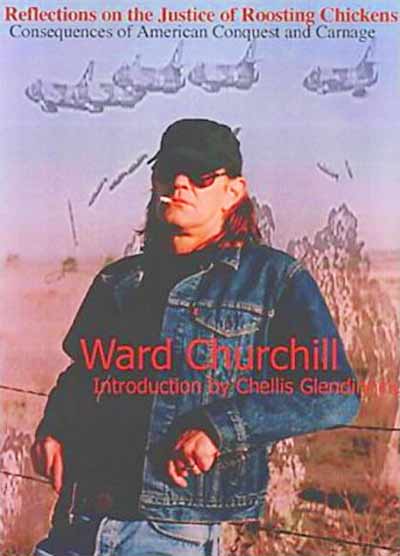
Ward Churchill to speak for O’odham

O'odham rightsAccording to Censored News, Activist and scholar Ward Churchill will speak at the Unitarian Universalist Church of Tucson, 4831 W. 22nd St., on November 13, 2009 at 7:00 p.m. to benefit O’odham VOICE Against the Wall, which since 2003 has organized and advocated for the traditional O’odham leaders and elders of the Tohono O’odham communities in the southern territory of the United States and northern territory of Mexico. Professor Churchill’s talk is part of the “Apartheid in America: Surviving Occupation in O’odham Lands”

O’odham activist Ofelia Rivas will also participate. The event is sponsored by the Dry River Radical Resource Center, the Earth First! Journal, and Voices against the Wall.

Here’s some background on the O’odham struggle:

pamphlet cover illustrationBy J. D. Hendricks, 2004
TIAMAT PUBLICATIONS #5

The People Who Emerged From the Earth

Over two thousand years ago the descendents of the O’odham moved into the southwestern region of the area now claimed by the U.S. as the state of Arizona. 1 The O’odham have had one of the longest histories of contact with the forces of European colonization compared with the rest of the native North American peoples. The O’odham’s first contact with Spanish invaders took place in the mid 16th century; nearly one hundred years before the colonization of the North Atlantic coast and Great Lakes regions were begun by the French and English colonists. As such, the history of the O’odham provides a good context for an investigation of the colonization of Native North America, and more specifically, an investigation of the interplay between, and results of, the varied responses to colonization – that of collaboration, accommodation, and resistance.

Many histories of the O’odham refer to these desert people as the Papago. The term Papago was a name given to the O’odham by the Spanish colonizers, and is likely the result of a Spanish corruption of the O’odham word “papabi” which was the O’odham name for one of their principal bean varieties. Thus, the Spanish colonizers term for the O’odham (Papago) came to mean “the bean eaters.” 2 For the purposes of this study I will refrain from the use of the term Papago and will refer to “the people” 3 by their traditional pre-colonial name. 4

As is often the case, with the name Papago being a good example, European constructs are often imposed upon indigenous peoples by the historians that seek to portray their past. This result can occur when historians seek to glorify European norms and traditions at the expense of indigenous ones, and can also be the result of the subconscious indoctrination of the historian by the dominant culture – in this case that of western style industrial civilization. In other cases it can be the result of a simple uncritical usage of language.

One of the most dominant and reoccurring “civilized” constructs imposed upon indigenous peoples history is the commonly understood notion that the O’odham, or any other indigenous North American culture for that matter, existed as a totality or uniformed mass. This study will seek to use the history of the interaction between the O’odham peoples and the United States, both its government and its peoples, to deconstruct this myth of the totality and provide a history of the O’odham’s varied responses to colonization from an anti-colonial and anti-industrial perspective. By investigating various important case studies in O’odham history, and looking not only at resistance but also accommodation and collaboration, it is hoped that this work will help to provide a more realistic historical picture of the effects of colonization, and the intentions and reactions of both the colonizer and the colonized. Within the previously stated context and theoretical framework, this study will argue that while the O’odham responded to the U.S. invasion of their lands in various ways, the choices to resist, accommodate, or collaborate with the forces of colonization did not affect the overall U.S. policy concerning the O’odham – that policy being the eventual total assimilation of the O’odham into the dominant “civilized” industrial system. 5

This investigation will include a strong focus on O’odham resistance to colonization, as any anti-colonial history should, however it will not discount or ignore the many historical occurrences of accommodation, and in some cases outright collaboration, with the colonizers. It is important to always keep in mind that none of the actions and reactions in any of the case studies looked at are attributable to the O’odham as a “totality,” but rather are attributable only to the various groupings of O’odham, be they incarnated in the form of the individual, the clan, the village, an economic or spiritual grouping, or an established political organization.

A God of Civilization and Coercion Comes to the O’odham

The O’odham’s first encounter with Spanish invaders took place in the mid sixteenth century when a group of conquistadors led by Alvaro Nunez Cabeza de Vaca entered O’odham territory in search of gold. These men did not find the riches they were looking for and left the desert region to return to the Spanish colony. However, soon after word spread of the O’odham villages on the northern periphery of the Spanish colony, missionaries began to travel north to bring God and “civilization” to the native people residing there. By 1686, Catholic missionaries had formed a few small missions in O’odham territory using what they believed to be the influence of their soft power 6 techniques to lure the O’odham into their missions where they were then subjected to a rigorous schedule of cultural indoctrination. Most O’odham historians, including Winston Erickson, 7 and to a lesser extent, Bernard Fontana 8 have, during this time period, focused on the O’odham who chose to reside nearby and within these early missions, thus painting a picture of the O’odham as accepting of Spanish influence and cultural indoctrination.

However a closer look at this time period reveals that mission O’odham were only a small percentage of the total population of O’odham residing in the Sonoran desert 9 and that the ones who were there may not have been so for the reasons that the colonizers believed. San Xavier del Bac, the largest mission in O’odham lands, as well as many other missions, took advantage of the fact that the desert O’odham migrated in the dry winter months to the Northern Piman settlements along the rivers to work the small farm plots for sustenance. 10 The Catholic missions inserted themselves into this traditional pattern. Those O’odham who worked and lived near the missions were, for the most part, seasonal residents, which shows that the missions were viewed merely as being of utilitarian value. Thus, the O’odham as a totality were not necessarily accommodating to or interested in anything the missionaries had to offer per se, and when the missionaries began to employ “hard power” techniques and abuse or overstep the grounds for their welcome it did not go without consequence. 11

Accommodating and ignoring the missionaries was not the only response to colonization practiced by the O’odham during the seventeenth and eighteenth centuries. Although historians such as Erickson feel that “the missions did serve the O’odham well….,” 12 that assertion is contradicted by the fact that there were many large scale rebellions waged against the missions from outside and from within. In 1695, 1751, 1756, and 1776, large scale rebellions occurred in which missionaries were killed and their missions burned to the ground. 13 In some cases these rebellions were the doing of joint O’odham/Apache alliances, which is significant considering that many histories of the O’odham and Apache portray them as immemorial enemies. This may be the result of the fact that by the early nineteenth century the Spanish government initiated a campaign of divide and conquer that was continued later by the Mexican and U.S. governments to turn the O’odham and Apache against one another, thus easing the project of their subjugation.

A Change in the Occupation Government: Washington Enters O’odham Lands

In 1821, Mexican Independence from Spain was achieved and interest in the O’odham dropped away nearly entirely. By 1828, the new and secular Mexican government began the process of shutting down the missions in O’odham territory and by 1842, the last of the missions were closed. Soon after, in 1846, the United Stated initiated a war for territorial expansion against Mexico. This war was not of immediate consequence to the O’odham peoples. Isolated in desert regions, the fighting between the two occupation powers affected them little in the short run. However, the signing of the Treaty of Guadalupe Hidalgo in 1848, which ended the war, would lay the foundations for a series of disastrous events which would affect the O’odham in very negative ways.

Of greatest consequence to the O’odham was the fact that the boundary between the United States and Mexico was not finalized by the treaty of Guadalupe Hidalgo. The boundary was designated by Article Five of the Treaty as being an arbitrary line roughly following the 32nd parallel, an area which runs through the southern part of modern Arizona. To the east, the border was provided by the Rio Grande. The exact boundary line along the 32nd parallel was to be decided at a later date. It is also important to note here that the Treaty also provided that all Mexican citizens absorbed by the United States were to be granted U.S. citizenship, which included all indigenous peoples in the annexed territory since under Mexican law they were considered citizens. In the treaty the United States also assumed the responsibility for preventing cross border raiding into Mexico by the southwestern tribes, specifically the Apache. 14

In the aftermath of the signing of the treaty of Guadalupe Hidalgo, it became quickly apparent that an acceptable border between Mexico and the United States along the 32nd parallel would not be achieved. An official survey expedition was assembled by the United States and Mexico in 1849 to trace out the boundary between the two countries with little success. Various borderlines were agreed to and then abandoned and re-made by the United States, sometimes in a unilateral decision that dismissed the positions of the Mexican government altogether. 15

The principal concern for the United States was to secure title to an area of land in northern Sonora, Mexico that was ideally suited for the construction of a portion of the southern continental railroad whose building was being discussed in the U.S. Congress at the time. One of the main advocates for this southern railroad route was a South Carolina man by the name of Colonel James Gadsden. Gadsden’s history of connections to powerful business, military, and political leaders is very interesting and his appointment by the United States to be Minister to Mexico in 1853 serves as a very informative source to gauge the United States’ intentions towards Native Americans and the O’odham in particular.

James Gadsden was born into an influential southern family and graduated from Yale University. After enlisting and serving in the war of 1812, Gadsden was sent to the Florida territory with Andrew Jackson to aid in the campaign of removal and extermination being waged against the Seminole Indians, which took place from 1816-1818. After this war against the Seminole, Gadsden was appointed by President Monroe as commissioner to oversee the removal of the Seminole Indians to Indian Territory. Like the more famous removal of the Cherokee, the removal of the Seminole, and the high death rate suffered as a result, unarguably constituted genocide. 16 As a reward for a job well done, Gadsden was appointed by Monroe to a seat on the legislative council of the territory of Florida, thus beginning Gadsden’s political career. In 1840, Gadsden was elected President of the Louisville, Charleston, and Cincinnati Railroad. In 1853, the Secretary of War, an ardent white supremacist and slavery defender by the name of Jefferson Davis, appointed Gadsden to be Minister to Mexico. 17 As Minister to Mexico, one of Gadsden’s primary missions was to negotiate a final demarcation of the boundary between the U.S. and Mexico. Although Gadsden was a zealous believer in Manifest Destiny, his ideas concerning racial Anglo-Saxonism 18 caused him to be an opponent of the total annexation of Mexico. Gadsden, like many racist U.S. politicians of that time, felt that the total absorption of Mexico and its non-Anglo population into the United States would pollute the Anglo bloodline too much and thus he sought only to gain enough territory for the United States to build the southern pacific route. 19 Thus, a man who had presided over a war of genocide against the Seminole Indians, was a devout racist, and who had obvious conflicts of interest due to his connections to the railroads, was put into a position to determine the territorial boundary between the United States and Mexico and in the process also determine the boundaries of the O’odham’s land. With its appointment of Gadsden, the intent of the U.S. government could not be clearer. Business interests and territorial expansion were to run roughshod, by any means necessary, over any native peoples who stood in the way.

It is no surprise that when James Gadsden finally successfully negotiated a treaty with Santa Anna to secure what is now the southern portion of Arizona, the O’odham were not consulted. In fact, the Gadsden Treaty, signed into law in 1853, did not contain any mention of the O’odham at all. Considering that the new boundary line put in place by the Gadsden Treaty literally split the traditional O’odham lands in two, it is obvious that the intentions of the United States were in no way benevolent. Here it is also important to point out that the terms of the Gadsden Treaty specifically included the same citizenship provisions which were spelled out in the earlier Treaty of Guadalupe Hidalgo. 20 Although the Gadsden treaty was of great significance for the O’odham, their isolation and the outbreak of the Civil War enabled them to live another decade in relative isolation from Anglo encroachment.

Assimilation, Cultural Destruction, Double Speak and Ordained Genocide

The causes which the Almighty originates, when in their appointed time he wills that one race of men – as in races of lower animals – shall disappear off the face of the earth and give place to another race, and so on, in the great cycle traced out by Himself, which may be seen, but has reasons too deep to be fathomed by us. The races of the mammoths and mastodons, and the great sloths, came and passed away: The red man of America is passing away!
–United States Congress Committee on Indian Affairs report, 1865. 21

No doubt with similar justifications in mind as those of the Committee on Indian Affairs, Anglo settlers began their invasion of O’odham lands less than a year after the conclusion of the Civil War. The Homestead Act had opened up the lands of Southern Arizona to Anglo squatters and in 1866, one of the first of many bills was passed by Congress granting mineral rights to any citizen who claimed them. 22 Every one of these homesteads opened and every resource extraction operation initiated without the express consent of the O’odham represented an illegal action under the Gadsden Treaty. The citizenship provisions of the Gadsden Treaty had granted citizenship to all former Mexican citizens and the O’odham were, by legal definition, included in this formulation. The United States, however, refused to consider “uncivilized” peoples as being worthy of the protections granted to citizens by the fourth amendment of the U.S. Constitution, which prohibits the expropriation of property. This refusal of the United States government to follow its own laws pertaining to Native Americans when those laws happen to stand in the way of U.S. interests has been a common occurrence in United States Indian policy. This land grab was only the first of many illegalities committed against the O’odham people by the United States and its citizens. In this respect the O’odham are in a special position when compared with many other tribes. While the theft of native lands by the United States Government was usually legally justified by treaty stipulations signed between a tribe and the U.S. government, this justification could not and cannot be used in the case of the O’odham since no treaty was ever signed with the O’odham by the United States Government. 23

For the most part, the O’odham did not resist this initial incursion of Anglo settlement, rather the O’odham practiced accommodation and moved farther out into the desert to shield themselves from the new settlers invading their lands. Traditional ways were maintained with the exception of the introduction of cattle ranching. The O’odham territory was well suited for the raising of cattle and a good number of O’odham became cattle ranchers, both for purposes of subsistence as well as for sale to Anglos residing in and around Tucson. In the 1880s, as increasing numbers of Anglo cattle ranchers began to invade and take over their pasture, some O’odham began to resist.

The O’odham resisted by stealing the Anglo cattle herds which were rounded up and driven south to be sold on the Mexican market. The expropriation of Anglo cattle herds was not isolated, and it became a major concern for the settlers and the government. In at least one case, a large cattle outfit was driven out of business. 24 The concern over this outbreak of O’odham theft of Anglo cattle was large enough that newspapers as far away as Los Angeles ran stories about the phenomenon. For the most part these stories seem to have been deliberately used to justify the enclosure of the O’odham into reservations as the government and Anglo cattle ranchers seized the opportunity to gain even more O’odham land by arguing that it was an unfair burden for the Anglo cattle ranchers to have to “support” the O’odham. 25 Here, in previous case study, we have another common attribute of U.S. Indian policy in general, and one which occurs again and again in the history of O’odham contact with the U.S. government and Anglo settlers – blaming the victim.

Another official position of United States Indian policy during this time period was that everything done to the Indians was, in the words of Indian Commissioner J. Q. Smith, in their own “best interests.” 26 Whether this obvious sham was based on a subconscious guilt and delusion or was a cynical example of “double-speak,” it is obvious that Native American’s best interest’s were the last thing on the government’s mind. Nevertheless, with this reasoning as justification, the first official reservation for the O’odham was created by executive order of President Grant on July 1, 1874. This small reservation surrounded the Old Catholic mission at San Xavier del Bac. It is estimated that only about ten percent 27 of the desert O’odham took up residence within this reservation – these were labeled as “civilized” O’odham by U.S. census takers. The vast majority of O’odham were labeled as “wild” and continued to live in the vast desert regions west of San Xavier del Bac. While it is obvious that the desert O’odham were resisting cultural assimilation by avoidance, even the mission O’odham maintained a resistance to European culture as the next example will illustrate.

While visiting the old mission at San Xavier a newspaper columnist from the Los Angeles Times wrote that upon her visit in 1882, she could see “not a single civilized human habitation within miles.” This writer goes on to state that the O’odham’s dwellings were in the form of “conical mud huts.” In the casual racism and Social Darwinist rhetoric of the period she also adds that,

“The Papagos are but little in advance of gophers and prairie dogs in their habitations.” 28

The point is that after more than 200 years of European influence, even the mission O’odham continued to build their traditional shelters. 29

Progressivism and Cultural Genocide: The Dawes Act

In 1887, the General Allotment Act, also known as the Dawes Act, was signed into law. The Dawes Act was the staging point for the forced assimilation of those remnants of Native American groupings which had not been totally decimated by the preceding period of “Indian Wars” and forced relocations. The essential function of the Dawes Act was to disrupt traditional tribal land holding patterns and thus force Native Americans into the Anglo system of private property. The O’odham, like most other Native American cultures, did not have a concept of private property – land was held in common for the benefit of the village group. Communally held land was an essential pre-requisite for their Anarchistic political system and extremely de-centralized tribal structure. 30

The first section of the Dawes Act provides for equal “sections” of land to be parceled out to each “head of family.” This head of family was always understood to be the father of each family when land was allotted. Thus, this first section of the act not only attempted to destroy the communal land system of Native Americans, it also instituted Patriarchy as the basis for social functioning in Native America. 31 In addition, Section Five of the Act also provides that any un-allotted lands be subject to purchase by the United States government. Section Six and Seven provide that all monies paid by the U.S. for un-allotted Native lands be held for each tribe by the U.S. Treasury and “subject to appropriation” by the U.S. government to repay itself for the implementation of allotment as well as to provide for the “civilization” of Native Americans. 32 In less veiled words, these sections are basically stating that Native Americans will be forced to pay for their own cultural annihilation.

This interpretation of the intent of the Dawes Act becomes clearer when one looks at the arguments and debates that took place in Congress and within self described progressive “Indian rights” groups such as the Indian Rights Association. Critics of the Dawes Act in Congress such as Rep. Russell Errett understood that

“the main purpose of this bill is not to help the Indian troubles so much as it is to provide a method for getting at the valuable Indian lands and opening them up for settlement.” 33

And Senator Dawes, the namesake of the final bill, speaking of the land and resources of Native Americans stated that

“civilization has got after these possessions with a greed never before equaled but it is idle to expect to stay it….” 34

As for the progressive Indian Rights Association, they argued that

“the organization of the Indians into tribes is, and has been, one of the most serious hindrances to the advancement of civilization, and that every effort should be made to secure disintegration of all tribal organizations….” 35

And one of their leaders, Reverend L. Abbott, provided justification with the statement:

“Barbarism has no rights which civilization is bound to respect.” 36

So here we have a self-proclaimed progressive Indian Rights organization arguing for cultural genocide and against the notion that Native Americans have any rights that civilized people are bound to respect! This conclusion provides a perfect example of the essence of “progressive” or “civilized” thought.

The Dawes Act had a much less devastating effect for the O’odham than it did for many other Native American tribes. At the time of its passage, the only official reservation for the O’odham was the San Xavier reservation which, as was stated earlier, was only a small 71,090 acre reservation around the old mission San Xavier del Bac. When the allotment agent came to San Xavier in 1890, he allotted out 41,600 acres of land to the 363 O’odham whom he counted in his census as being resident at the time. 37 The vast majority of the O’odham still continued to live west of San Xavier in the expansive desert regions and were little affected by the allotment schemes. Even those O’odham who lived in San Xavier and were allotted land paid little attention to the artificial boundaries drawn on paper which supposedly privatized their land – they continued to farm and graze the land communally. 38 This refusal to abide by the provisions of the Dawes Act is also a form of resistance to cultural assimilation and adds one more example to show that for those O’odham who resisted, the most often employed method of resistance was non-compliance and avoidance. This specific response to colonization was made possible by the isolation and expansiveness of their desert home, which many Anglo’s continued to view as a “hopeless desert.” 39

The Domestication of the “Wild Papago”

The vast majority of the O’odham continued to resist assimilation and maintained a fairly traditional lifestyle – minus the introduction of cattle herding and horse rearing. In the twenty years following the passage of the Dawes Act, a growing effort was made to enclose the “Wild Papago” 40 and forcibly strip them of their traditional culture and instill them with the “civilized” values of the industrial Anglo. As was mentioned previously in the paper, ranchers and the government used O’odham cattle theft from Anglo ranchers as one tool to justify the enclosure of the O’odham within a reservation. During this period, Anglo Cattle ranchers continued to encroach deeper and deeper into O’odham territory and scuffles began to break out.

In another classic example of the “blame the victim” tactic, a pro-enclosure story was printed in the Los Angeles Times, no doubt to build public pressure for the domestication of the “Wild Papago.” The story concerns a group of O’odham who had resisted an Anglo cattleman’s attempts to enclose one of their water sources. When these O’odham continually tore down the fence that this cattleman had built, the rancher filed a report with the local Indian Agency sheriff to have the men arrested. When the sheriff arrived to arrest the O’odham responsible for defending their water source, he was taken hostage. The sheriff was later released unharmed; however, the incident was used to make the argument that such troubles can only be expected to increase if the O’odham were not enclosed on a reservation where they could be more easily controlled and monitored. 41

The tactic of occupying and diverting natural water sources was one of the tools used by the Anglo settlers and government to destroy the self sufficiency of the O’odham and force them into reservations where they would be dependent on the government for their water and would thus be easier to control and monitor. Some of the O’odham clearly understood what was happening, which is evidenced by instances of resistance both to the enclosure of natural water sources as well as resistance to the drilling of wells. One example of the U.S. government using water as a tool of forced cultural assimilation can be found by looking at an event recorded by an O’odham calendar stick 42 keeper. In 1912, the O’odham residing in the village of Santa Rosa, an isolated and traditional village in the western desert region of O’odham territory, were paid a visit by an Anglo Indian Commissioner who wished to drill a well for them. The Chief of the village objected to the drilling of the well on the grounds that it would disturb their culture, their autonomy and their self-sufficiency. The government agent proceeded to have the well drilled anyway. Upon completion of the well, the Chief of the village, according to the calendar stick keeper, stated that

“the well must be left alone and, in order that the Papagos might continue their old life, water must still be carried from the spring in the foothills.” 43

However, the prohibition by the Chief could not be upheld due to the overwhelming convenience of the new well and after a period of abstaining from its usage, the village of Santa Rosa (including the Chief) gave in and thus was assimilated into the industrial system by being made dependent on the Government well. 44 During this same time period, encroaching Anglo farmers engaged in the diversion of O’odham water sources to irrigate their farms. This practice served as another method of forcing the self sufficient O’odham into a relationship of dependence upon the government. In many areas so much water was diverted that the O’odham could no longer grow their traditional summer crops. 45

In 1919, the first incarnation of an O’odham reservation to enclose the nearly two million acres of desert that the “Wild Papago” were residing in was established. The formation of the desert O’odham reservation in 1919 ushered in a period of exponentially increased government interference in O’odham matters, and of course, the various forms of coercive assimilation were multiplied. By 1933, thirty-two unwanted wells were drilled all over the new reservation. 46 The well drilling was often opposed by those who were trying to maintain the O’odham Him’dag – the traditional ways of the desert people.

Resistance and Collaboration: O’odham Responses to Forced Modernization

In contrast to the traditional O’odham who had maintained resistance to cultural assimilation for the past 300 years, there was also a small number of O’odham based in the new reservation that welcomed collaboration with the forces of Anglo modernization and advocated for cultural accommodation and in some instances for total cultural assimilation. These men would later form an organization called the Papago Good Government League, which would serve as the propaganda arm of the Bureau of Indian Affairs and government policy in general. The leadership of this new faction had been taken from their families as youths and placed in Protestant boarding schools to be culturally indoctrinated. The Tucson Presbyterian Training School was one of the indoctrination centers where many future members of the Good Government League had been sent. 47

Religious indoctrination, whether Catholic or Protestant, has always been one of the most powerful tools of colonization and its justification used by European invaders against the indigenous peoples of the Americas. The necessary counterpart to the forced indoctrination of Christian principals and morals has always been the repression of indigenous spiritual practices. The United States government understood the profound power that traditional spiritual practices had in maintaining group solidarity and cohesion and it is for this reason that such spiritual practices were made illegal and repressed historically. In 1883, a Court of Indian Offenses was established by congress at the request of Secretary of Interior Henry M. Teller to eliminate traditional spiritual practices. In a report to the commissioner of Indian Affairs, Teller laid out his goals and his rationale stating that,

“If it is the purpose of the Government to civilize the Indians, they must be compelled to desist from the savage and barbarous practices that are calculated to continue them in savagery….”

Teller went on to associate those who resisted the repression of their spirituality with the “non-progressive” faction of Indians and labeled traditional spiritualism as “debauchery,” “diabolism,” and “savagery.” The overarching argument of his letter is that in order to civilize the Indians and bring them into the industrial system, their traditional spiritualism must be destroyed. As an initial step towards this end, Teller advised that Medicine Men be “compelled” to desist from their practice of “deception.” 48

Although the Court of Indian Offenses advocated that coercion be used to repress and destroy indigenous spiritualism, it failed to succeed in this project even when it used force to try to stop traditional spiritual rituals. According to Historian Edward Spicer, the only thing the Court succeeded in doing was driving traditional spiritual practices underground. In the case of many resistant O’odham, traditional spiritual practices were continued without regard to regulations or prohibitions against them, and in many cases, federal authorities resorted to repression and arrest to try to stop these practices. One traditional spiritual practice of the O’odham which was particularly hated by the Protestant Missionaries and Indian Agents was the Vi-kita ceremony.

The Vi-kita ceremony of the O’odham has been written about and studied by many Anglo historians and anthropologists, the most prominent being Columbia Anthropologist Ruth Underhill. 49 Before going into a short description of the Vi-kita it is important to understand that this ceremony varied depending on who was conducting it and where it was being conducted. Peter Blaine, an influential O’odham man sympathetic to the traditional ways, wrote in his autobiography about Underhill’s methods. Blaine explained the traditional way for the O’odham to tell about their past was to do it

“in a group so that everybody had a chance to talk and tell it their way. Underhill was talking to just one man…Dr. Underhill was wrong all the way in how she got her information.” 50

As scholars from the dominant culture often do, Underhill had applied her own notions of hierarchy, authority and individualism to her work with the O’odham and totally disregarded their traditional methods of conveying information in a communal fashion.

The Vi-kita itself was a yearly rain and fertility festival preformed to initiate and give thanks for the yearly summer rains. The ceremony itself consisted of the communal singing of rain songs, dancing, intimate encounters, and the consumption of Navait (Saguaro wine), an alcoholic drink made by the fermentation of Saguaro Cactus buds. The consumption of this wine was meant to symbolize the connection between the sky and the earth. The intake of the Navait was representative of the earth’s intake of rain. Participants drank Navait until vomiting occurred as this act embodied the clouds issuing forth rain unto the earth. It was a powerful ceremony that bonded the O’odham with the elements of nature.

When Protestant missionaries, and a small number of Protestant O’odham in the Good Government League, backed by U.S. Indian Agents, began their attempts to usurp power on the newly formed western O’odham (Sells) 51 reservation in the early 20th century, one of the first things they attacked was the practice of the Vi-kita ceremony. In the early 1930s, Peter Blaine explained that the traditional O’odham from the San Xavier reservation would travel to the western reservation for the Vi-kita. He states that,

“In the late 1920s the government tried to stop this wine drinking ceremony on the Sells reservation. But no Papago or Agency police could ever stop it.”

In one instance Blaine tells the story of how he helped defend three traditional O’odham Vi-kita ceremony leaders when they were arrested by agents from the Indian Bureau and jailed in Tucson. During the trial, a group of Protestant O’odham men from the Good Government League 52 argued for the repression of the ceremony – one of these men, Richard Hendrix, would continue to plague the traditional O’odham in future encounters. To respond to the collaborationist Good Government League, the resistant traditional O’odham formed the League of Papago Chiefs to counter the attempts of the Protestant Good Government League to usurp control on the reservation. 53

The Indian Reorganization Act and O’odham land rights

On June 18th, 1934, President Roosevelt signed into law the Indian Reorganization Act which finally stopped the forced allotment process initiated by the Dawes Act in 1887. The Indian Reorganization Act was viewed by its proponents as being in the best interests of the Indians. One of the reasons for this view was the fact that the Dawes Act and its forced allotment provisions had resulted in the loss of 90,000,000 acres of tribal lands and it was hoped by some, including then Indian Commissioner John Collier, that the Indian Reorganization Act could be used to regain some of this lost land.

The public was also encouraged to view the Indian Reorganization Act as being beneficial for Native Americans. A large article in the Los Angles Times entitled “The Bill to Return Indian Rights” stated that:

“After a century of graft, plunder and injustice, this bill has the objective of handing their own souls back to the Indians.” 54

However, such optimism and notions of cultural relativism were not held by all. As a precursor to the Indian Reorganization Act, a report was prepared for the Secretary of the Interior in 1928 to lay out the need for a change in Federal Indian Policy. The report stated that the “great majority of Indians are ultimately to merge into the general population” and that it was the government’s responsibility to assimilate Native Americans into “white civilization” because “the hands of the clock cannot be turned backwards.” Sympathetic attempts to help Native Americans retain their culture were stigmatized as attempts to “preserve them as museum specimens.” 55 Indian Commissioner John Collier was one of those who believed that Native Americans should retain their culture and that “the awakening of the racial spirit must be sustained….” 56 However, although the finalized Indian Reorganization Act did contain elements that were meant to “help” Native Americans, many of its articles were still designed to impose “civilized” systems on Native Americans.

It can be argued that the intent of the finalized Indian Reorganization Act was to initiate a new chapter in the push for the total cultural assimilation of the Native American tribes. The argument that there was no qualitative change between the Dawes Act and the Reorganization Act is legitimate. The Indian Reorganization Act provides the examples for the argument. The main tool of assimilation in the Indian Reorganization Act was the provision in Section 17 which allowed for Native American tribes to form their own tribal governments, constitutions and laws which, although it is not specifically stated, were intended to be Anglo in structure and functioning. In the case that these native governments were not sufficiently acceptable to the U.S. government, section 17 also provided that all Tribal Government formations must be “approved by the Secretary of the Interior.” 57 This clearly shows that the intent of the Act was not to allow Native Americans to become fully autonomous, either culturally or politically. For a tribe such as the O’odham, which had a long history of decentralization and consensus decision making, the imposition of western style liberal democracy, with its attendant centralization and majority rule system, was an obvious method of forced cultural indoctrination. Peter Blaine, who was mentioned earlier, was an O’odham man who had sympathy for the traditional, decentralized and communal way of O’odham societal organization. When the collaborationist Papago Good Government League began to maneuver themselves into the position of representing all of the O’odham, Blaine took it upon himself to lead the charge to discredit their assertions to business interests and the Federal Government that they represented the O’odham. Blaine wrote that:

“This so-called council represented only their own church people, but they took it upon themselves to become a council for all Papagos. They had meetings. Nobody attended them but these four guys because most people didn’t recognize them as leaders.” 58

In 1934 Blaine, along with another O’odham from the Gila Bend reservation named Leon Pancho became the first O’odham to travel to Washington D.C. These two men were sent as representatives of the traditional chiefs of the O’odham villages to argue against a recent court order that closed the Sells reservation to outside, Anglo owned, mining. The court order was a result of a lawsuit brought by the members of the Good Government League, including Richard Hendrix, who had teamed up with outside lawyers. These lawyers were to receive as payment a ten percent share of all land reclaimed from the mining companies, or a monetary equivalent. As this entire procedure was done behind the backs of the majority of the O’odham, when it was revealed, there was great resentment towards the Good Government League by many of the O’odham.

While in Washington D.C., Blaine was informed of the pending Indian Reorganization Act, and he became a supporter of the Act due to its provision allowing for the self government of Native Americans, as well as a provision in section Six that allowed the Secretary of Interior to manage mineral, mining, and livestock on the reservation. 59 In the case of the O’odham this meant that the reservation would be re-opened to mining and they would regain an important means of economic sustenance. According to Blaine, the mines were an important economic resource for the O’odham as they provided jobs and a market where beef and other O’odham products could be sold. 60 This is yet another unfortunate example of how the incursion of Anglo industrial technology served to destroy the self-sufficiency of the O’odham by making them dependent on it for survival.

Whether or not the mines were truly in the best interest of the O’odham is a complex topic which cannot be dealt with here. However it should be stated that Blaine and his companions’ trip to Washington D.C. was financed by the Tucson Chamber of Commerce, an organization that functioned in support of the mining interests, not the O’odham. This Tucson Chamber of Commerce was the same organization that had aggressively petitioned President Wilson to rescind his 1916 act forming the Sells reservation because it prevented Anglo agricultural interests from exploiting the area’s “best agricultural and grazing lands.” 61

Resistance to and Collaboration with the “White Man’s War”

Not long after the passage of the Indian Reorganization Act and the formation of the first O’odham Tribal Government, the United States declared war on Japan, thus entering World War II. The participation of Native Americans in World War II has been well publicized, especially the role the Dineh (Navajo) played as code talkers in the South Pacific. The United States government and the mainstream media portrayed Native Americans as being eager to fight for their homeland, and eager to assimilate into “white civilization” once they returned from the war. Nearly 25,000 62 Native Americans served in the United States military during World War II, many of whom were no doubt under the impression that their service would be rewarded with increased “rights” after the war’s end. Instead, as a “reward” for Native Americans participation in World War II the United States government established the Indian Claims commission in 1946 to legalize the U.S. occupation of Native American Lands never granted to the U.S. by treaty, passed House Concurrent Resolution 108 to terminate tribal recognition as separate entities from the Federal Government, and then instituted a plan in 1954 to relocate Native Americans off the reservation and into “Indian Ghettos” in the nation’s large cities. 63 These were the “rewards” for participation in World War II.

Like many other Native American Tribes, some of the O’odham Nations members participated in World War II. Ruth Underhill claims that the O’odham enlisted to serve in World War II “in droves” 64 and it is documented that the O’odham tribal government bought $10,000 in war bonds. 65 However, the extent of this involvement was distorted by the media, academia, and even some of the O’odham leaders in the tribal government. Richard Hendrix, a former member of the collaborationist Good Government League, had risen to prominence in the new O’odham tribal government by this time and was interviewed by the Arizona Archaeological and Historical Society on November 16, 1942. In this interview Hendrix exposed the extent to which he had allowed his mind to be colonized and assimilated into that of the dominant white culture. Speaking of colonization in general and World War II in particular, Hendrix stated that the O’odham had:

Learned to love the American government and they learned to love the Stars and Stripes. And when the war came and the time came for our boys to be registered, there was no exception. They registered just the same as white boys did. And now they are out fighting alongside the white boys, the American boys. They are just as anxious as the white boys to kill as many Japs, to kill as many Germans, and they are very anxious to win this great war so that the Papago people in this desert land may continue to enjoy the freedom of their homes. 66

Hendrix’s internalization of white supremacist racial notions is a heart breaking and shocking example of the extent to which he had accepted the ideology of “white civilization.” In addition, his assertion that every O’odham boy registered for the war with “no exception” is glaringly false.

Aside from the fact that there are always exceptions to everything, there was also a large scale organized resistance to World War II led by an old Chief and medicine man, Pia Machita, and his band of traditional O’odham who resided in an isolated village in the north western area of the Sells Reservation known as the Hickwan district. According to Peter Blaine, the O’odham residing in some of the most isolated villages in the Hickwan district had not seen a white man until the 1930s, and continued to practice the traditional O’odham Him’dag. 67 When Pia Machita was informed of the compulsory registration of young O’odham boys for induction into World War II, he instructed the youth of his village to refuse to sign the registration forms when they were visited by the local Indian Agent. Pia Machita was a very traditional leader who refused cultural assimilation and would not accept the authority of the Bureau of Indian Affairs or the O’odham tribal government. Finally, after all efforts to persuade Pia Machita’s village to register had failed, the tribal chief of police and a gang of Federal Marshals led by U.S. Marshall Ben McKinney invaded the village at two in the morning on October 16th, 1941, with tear gas bombs and guns drawn – when the Marshals attempted to take Pia Machita into custody some of the young men from the village used force to liberate him and severely beat one of the federal marshals. In the face of this resistance, the government agents and their local collaborators retreated to Tucson. When the Attorney General’s Office heard of the resistance on the O’odham reservation, they immediately got involved in the effort to repress this draft resistance movement as quickly as possible to prevent its possible spread to other reservations. By May 17th, 1941, after a period of about six months of trying to track down Pia Machita and his small band of men, Marshall McKinney and O’odham collaborators including Jose Ignacio from the tribal government, surrounded Pia Machita in the village of Stoa Pitk and took him into custody without incident. 68

Peter Blaine was the O’odham tribal chairman during the time that Pia Machita was leading the draft resistance movement. Although he did not believe that Pia Machita and his men were threats in any way, he was annoyed by what he perceived to be their stubbornness and attributed their draft resistance to his belief that they “didn’t really understand what they were doing.” 69 In reality, it was Blaine who did not understand the reasons behind Pia Machita and his men’s resistance to enlistment. Pia Machita and his men understood very well what they were doing – they were resisting giving aid to a government that they understood was their enemy. Given this understanding, and given the dictionary definition of the word “collaboration,” it becomes necessary to label those O’odham who participated in the arrest of Pia Machita as such – collaborators. The understanding that the U.S. government was the enemy of the traditional O’odham of the Hickwan district was based upon a long history of attempts by the U.S. government to force the Traditional O’odham of that area to abandon the Him’dag and embrace elements of Anglo “progress” such as dams, railroads, wells, and the protestant religion. Despite Peter Blaine’s inability to understand why the O’odham in the Hickwan district rejected Anglo-civilization in its totality, he still maintained sympathy for the people there. When Pia Machita and two co-defendants were finally sentenced to serve 18 months in prison at Terminal Island Federal Prison for their roles in leading the resistance movement, Peter Blaine eventually came to their aid and used his connections as tribal chairman to persuade the sentencing Judge to release Pia Machita early and allow him to return to the reservation and his family. 70

Conclusion

The history of the O’odham’s contact with the United States government has been one marked by a persistent current of resistance to cultural assimilation into “white civilization.” This resistance has included a variety of tactics and actions. The favored tactic of resistance to assimilation for many of the O’odham groupings seems to have been that of avoidance and feigned accommodation to Anglo culture when expedient. However, as was evidenced by the O’odham’s early history of contact with the Spanish, they did not refrain from waging armed resistance to colonization when they were pushed into a situation where other tactics might have been ineffectual.

In addition to resistance and accommodation, it has also been shown that some of the O’odham choose to engage in direct collaboration with the Anglo colonization of their lands and minds. As this paper has shown, the levels of collaborative activity amongst the O’odham varied, and so did the effects of such collaboration. When investigating instances of collaboration it is always important to understand the context which produced them and to remember that the ultimate blame for a situation of oppression should always be placed upon the group committing the acts of repression – in this case the United States government and allied business interests. It is important to show such examples of collaboration and to understand that all human cultures who have been the victim of colonization have invariably contained individuals who chose to collaborate for a variety of reasons. The O’odham are no exception to this rule. Making apologies for collaboration or failing to mention the instances where such collaboration did occur creates a historical distortion and does nothing to aid present struggles for liberation.

The O’odham responses to colonization never represented a totality, but a strong current of resistance is evident throughout their history. In regards to the United States government, it can be said, given the primary sources looked at, and the final drafts of laws signed and policies followed, that the intent of the United States government toward all Native American tribes, when it was not outright genocidal, has been the cultural destruction and absorption of remaining Native Americans into the dominant industrial culture of “white civilization.” Regardless of the varying tactics used, and the various lip service about “best interests” and “justice,” it has been shown that there has never been a qualitative change in United States policy toward the O’odham people and Native Americans in general. The O’odham have maintained aspects of their traditional culture despite the best efforts of the government to force assimilation, not as a result of such efforts. A continuing current of struggle between the forces of colonization and resistance has persisted for centuries, in all its various forms, within the minds and bodies of many O’odham and will continue until liberation.

NOTES:

1
This date is based on archeological evidence gathered by E.W. Haury in Ventana Cave. Haury, E.W. The Stratigraphy and Archeology of Ventana Cave Arizona. Tuscon: University of Arizona Press, 1950. Cited from Williams, Thomas R. “The Structure of the Socialization Process in Papago Indian Society.” Social Forces, Vol.36, No.3. p.253.

2
Fontana, Bernard L. Of Earth and Little Rain: The Papago Indians. Tuscon: University of Arizona Press, 1989. pp.37-39.

3
The name “O’odham” is roughly translated as “the people” in the Piman dialect spoken by the various O’odham groupings.

4
In 1986 the tribal government of the Papago reservation officially changed its name to the Tohono O’odham Nation.

5
The term “civilized” is a problematic historical term, and its definition tends to be very subjective. The meaning of the term and its use as a label is heavily influenced by how the author and the reader understand its meaning. For the purposes of this paper, the term “civilized” refers to the totality of the “western” cultural, political, and economic system – and most importantly the belief that technological/industrial progress is inherently beneficial and liberatory. For most, being labeled “civilized” is viewed as a positive and the label of “un-civilized” or “savage” is viewed in the reverse. However, for the purposes of this study it is imperative to understand that this author views “civilization” itself as an inherently oppressive and destructive entity, and this must be kept in mind to correctly understand the arguments and analyses in the paper.

6
The term “soft power” refers to the concept of gaining influence and control over another group by means of the attraction of the dominating group’s cultural attributes and the use of commodification rather than using military might and coercion (“hard power”) to gain that influence. See Joseph S. Nye, Jr. Soft Power: The means to success in world politics. New York: Perseus Books, 2004.

7
Erickson, Winston T. Sharing the Desert: The Tohono O’odham in History. Tucson: University of Arizona Press, 2003.

8
Fontana, Bernard L. Of Earth and Little Rain: The Papago Indians. Tucson: University of Arizona Press, 1989.

9
According to Catholic missionary records, the numbers of mission O’odham during this time period were somewhere around 2,000. However, according to population estimates there were at least 10,000 O’odham peoples living in this area. See Fontana, Bernard L. Of Earth and Little Rain . pp.11,46.

10
Fontana, Bernard L., p.40.

11
It is well documented that many of the Missions resorted to physical abuse, forced confinement and occasional murder to coerce the O’odham into compliance. San Xavier del Bac, the largest and most famous of Catholic missions in O’odham lands was built with forced labor. See Daniel McCool; “Federal Indian Policy and the Sacred Mountains of the Papago Indians.” Journal of Ethnic Studies 9.3 (1981).p59.

12
Erickson, Winston P., p.66.

13
Fontana, Bernard L., pp.61-64.

14
Treaty of Guadalupe Hidalgo, Feb 2nd, 1848. United States Statutes At Large, pp. 922-943

15
For a detailed treatment of this series of events see; Garber, Paul N. The Gadsden Treaty. Glouchester: Peter Smith, 1959.

16
For more information on the removal of the Seminole; Stannard, David E. American Holocaust: The Conquest of the New World. New York: Oxford University Press, 1992. P.124. For additional information about the Seminole Wars see; Churchill, Ward. “A Little Matter Of Genocide: Holocaust and Denial in the Americas 1492 to the Present.” San Francisco: City Lights Books, 1997.

17
All dates for the political appointments of James Gadsden are cited from Paul Garber’s “The Gadsden Treaty.” Pages 74-81.

18
Racial Anglo-Saxonism was a belief popular in the later 19th century which held that Europeans of Anglo-Saxon descent were at the forefront of evolution and were responsible to bring civilization to the world. This ideology was used as a convenient justification for the extermination and removal of Native Americans. For a detailed study of this ideology see: Horsman, Reginald. Race And Manifest Destiny: The Origins of American Racial Anglo-Saxonism. Cambridge: Harvard University Press, 1981.

19
For a detailed investigation of the role that the railroads played in the Gadsden purchase see; Schmidt, Louis B. “Manifest Opportunity and the Gadsden Purchase.” Arizona and the West, vol.3 (autumn 1961).

20
Forbes, Jack D. The Papago-Apache Treaty of 1853: Property Rights and Religious Liberties of the O’odham, Maricopa and Other Native Peoples. Davis: Native American Studies Tecumseh Center, U.C. Davis, 1979. p.1.

21
United States Congress. Joint Special Committee. Condition of The Indian Tribes. Report of the joint special committee, appointed under joint resolution of March 3, 1865. With an appendix. Washington, D.C.: United States Government Printing Office, 1865.

22
Erickson, p.77

23
During this time period many treaties were negotiated with native tribes in the regions west of the Mississippi to gain legal justification for the United States’ theft of their lands. For a detailed list of treaties signed between the United States and Native American tribes, see the compendium edited by Charles J. Kappler. Indian Affairs: Laws and Treaties. 7 volumes. Washington, D.C.: Unites States Government Printing Office, 1903-4.

24
Spicer, Edward H. Cycles of Conquest: The Impact of Spain, Mexico, and the United States on the Indians of the Southwest, 1533-1960. Tucson: The University of Arizona Press, 1962. p.138.

25
“Arizona News; Papago Cattle-thieves Brought to Justice.” Los Angeles Times. Feb 1, 1894. Also see: “Arizona News; Report Showing the Depredations Committed by Papago Indians on Stockmen’s Herds.” Los Angeles Times. June 8, 1895, In addition see; “Arizona News: Papagoes Destroying Cattle in Large Numbers.” Los Angeles Times. Mar 23, 1894.

26
Kehoe, Lawrence. “Our New Indian Policy and Religious Liberty.” Catholic World, vol. 26 (Oct. 1887). P.96.

27
Erickson p.78.

28
“Tucson And Fort Lowell; Notes of a Visitor – The Church of San Xavier.” Los Angeles Times. Nov 18, 1882.

29
The Spanish had brought the adobe style of construction to the O’odham but, although the resources for adobe construction were readily available to the O’odham at San Xavier, they continued to build their traditional grass huts.

30
For a detailed study of traditional O’odham tribal structure and life style see; Underhill, Ruth M. Social Organization of the Papago Indians. Columbia: Columbia University Press, 1939. ________. Papago Woman. New York: Holt, Rinehart and Winston, 1979.

31
For the most part, traditional Native American societies exhibited gender parallelism and were rarely if ever patriarchal by definition. For a detailed study of gender in Native America see: Allen, Paula G. The Sacred Hoop: Recovering the Feminine in American Indian Traditions. Boston: Beacon Press, 1986.

32
All direct quotations from Dawes Act. General Allotment Act (Dawes Act). February 8, 1887. Printed in its totality in: Prucha, Francis, P. ed. Documents of United States Indian Policy. 3rd ed. Lincoln: University of Nebraska Press, 2000.

33
U.S. Congress, House Committee on Indian Affairs, Lands in Severalty to Indians: Report to Accompany H.R. 5038, 46th Cong., 2nd sess., May 28, 1880, H. Rept. 1576, pp.7-10. Reproduced in: Washburn, Wilcomb E. The Assault on Indian Tribalism: The General Allotment Law (Dawes Act) of 1887. Philadelphia: J.B. Lippincott Co., 1975.

34
Letter from Henry L. Dawes to Henry M. Teller (Commissioner of Indian Affairs), September 19, 1882. Dawes Papers, Library of Congress, Washington, D.C. Reproduced in: Washburn, Wilcomb E. The Assault on Indian Tribalism: The General Allotment Law (Dawes Act) of 1887. Philadelphia: J.B. Lippincott Co., 1975.

35
Washburn, Wilcomb E. The Assault on Indian Tribalism: The General Allotment Law (Dawes Act) of 1887. P.12.

36
Washburn, p.16.

37
Fontana, pp. 77-79.

38
Erickson, p. 92.

39
“Baboquivari Peak.” Los Angeles Times. Nov 4, 1894.

40
The term “Wild Papago” was a term used by the government and media to marginalize those O’odham who continued to resist “civilization.”

41
“The Indian War Cloud.” Los Angeles Times. May 22, 1885.

42
The Calendar Stick was a device used by the O’odham as a tool to aid in the remembering of their history. The Calendar Stick itself was a cactus stick on which notches were carved at various intervals which aided the history keeper in the remembrance of events.

43
Fontana, p.54.

44
This example is meant to show the insidious nature of industrial technology and is not intended to place any blame on this specific group of O’odham for their ultimate choice to begin using the well. This example is given to show how industrial technology always comes with strings attached. In this case, once the village becomes dependent on the well they in turn become dependent on the Anglo civilization which is needed to maintain the functioning of such a well, and thus become less able to resist other Anglo incursions. In addition it must be pointed out here that the traditional water gathering procedure talked about was preformed by O’odham women. Due to this fact, some may feel that by resisting the building of the well, the male O’odham are in fact seeking to perpetuate patriarchy. It is true that the O’odham did have a system of gendered roles, but the overall system made room for exceptions and is best characterized as one of gender parallelism, not patriarchy. It is the Anglo industrial system that brought patriarchy to the O’odham. For more information see: Underhill, Ruth. Papago Woman. New York: Holt, Rinehart and Winston, 1979. Also see: Allen, Paula G. The Sacred Hoop: Recovering the Feminine in American Indian Traditions. Boston: Beacon Press, 1986.

45
Forbes, Jack D. The Papago-Apache Treaty of 1853: Property Rights and Religious Liberties of the O’odham, Maricopa and Other Native Peoples. Davis: Native American Studies Tecumseh Center, U.C. Davis, 1979. pp..5-8.

46
Spicer, p. 140.

47
Spicer, p.141.

48
All quotes taken directly from: House Executive Document no.1, 48th Cong., 1st sess., serial 2190, pp.x-xii. Reproduced in; Prucha, Francis, P. ed. Documents of United States Indian Policy. 3rd ed. Lincoln: University of Nebraska Press, 2000.

49
For a detailed account of the Vi-kita see: Davis, Edward H. The Papago Ceremony of Vikita. New York: Museum of The American Indian, 1920. Also see: Underhill, Ruth. Papago Woman. New York: Holt, Rinehart and Winston, 1979.

50
Blaine, Peter. Papagos and Politics. Tucson: The Arizona Historical Society, 1981. p.42.

51
The expansive western O’odham reservation was officially called the Sells reservation. It was named after the first Indian agent in the region, John Sells.

52
The Good Government League was formed by a small group of Protestant O’odham who used the organization to advocate for the assimilation of the O’odham into Anglo civilization as well as to promote general U.S. Indian policy.

53
Blaine, pp.40-50.

54
“Bill To Return Indian Rights ” Los Angeles Times. June 8, 1934.

55
Lewis Meriam et al., The Problem of Indian Administration. Baltimore: Johns Hopkins Press, 1928. Selection printed in: Prucha, Francis, P. ed. Documents of United States Indian Policy. 3rd ed. Lincoln: University of Nebraska Press, 2000.

56
Annual Report of the Secretary of Interior, 1934, pp.78-83. Reprinted in; Prucha, Francis, P. ed. Documents of United States Indian Policy. 3rd ed. Lincoln: University of Nebraska Press, 2000.

57
Wheeler-Howard Act (Indian Reorganization Act) June 18, 1934. U.S. Statutes at Large, 48:984-88. Re-printed in: Prucha, Francis, P. ed. Documents of United States Indian Policy. 3rd ed. Lincoln: University of Nebraska Press, 2000.

58
Blaine, p.50.

59
Wheeler-Howard Act (Indian Reorganization Act) June 18, 1934. U.S. Statutes at Large, 48:984-88. Re-printed in: Prucha, Francis, P. ed. Documents of United States Indian Policy. 3rd ed. Lincoln: University of Nebraska Press, 2000.

60
Blaine, pp.50-53.

61
McCool, Daniel. “Federal Indian Policy and the Sacred Mountains of the Papago Indians.” Journal of Ethnic Studies 9.3 (1981). p.62.

62
Holm, Tom. “Fighting A White Mans War: The Extent and Legacy of American Indian Participation in World War II.” The Journal of Ethnic Studies. 9.2. p.70.

63
For more on this aspect of the Indian Claims Commission, and a discussion about the termination act see: Forbes, Jack D. The Papago-Apache Treaty of 1853: Property Rights and Religious Liberties of the O’odham, Maricopa and Other Native Peoples. Davis: Native American Studies Tecumseh Center, U.C. Davis, 1979.

64
Underhill, Ruth. Papago Woman. New York: Holt, Rinehart and Winston, 1979. P.94.

65
Blaine, p.115.

66
Hendrix, Richard. Talk by Richard Hendricks, Prominent Papago Indian, Given at the Arizona Archaeological and Historical Society, November 16, 1942. The Kiva, vol. 8 (Nov. 1942).

67
Blaine, p.92.

68
Flaccus, Elmer. “Arizona’s Last Great Indian War: The Saga of Pia Machita.” The Journal of Arizona History, vol. 22 (1981).

69
Blaine, p.101.

70
Blain, pp.103-4.

© 2004, REPRODUCTION FOR NON-PROFIT INFORMATIONAL PURPOSES IS ALLOWED

Organic corn soon unavailable to you

organic-corn-flakesI was shopping the other day for organic corn flakes, thinking that of all the cereals, Dr. Kellogg’s first processed food breakfast would similarly be predominant among the organic breakfast cereal offerings. I found exactly none; neither at the supermarket, nor the health food store. I found plenty of organic bran, wheat, oat and Kashi –whatever that is, but nothing made of corn. Would you say that’s something to find curious, or alarming?

I became acutely reminded of a detail from a documentary I’d just seen, The Real Dirt on Farmer John. There’s a fleeting scene where farmer John Peterson is telling his Angelic Organics CSA customers (Community Supported Agriculture) about that year’s successful crop of corn. He’s enthusiastic, he explains, because a harvest of organic corn has become a very difficult accomplishment.

Does that give you pause, when you consider the prevalence of corn in the American diet? Before genetically modified corn, before High Fructose Corn, before Yellow Dent No. 2 which is so inedible it can be stored in piles outside (farmers used to build silos to store corn), and before corn became ethonol, corn was sweetcorn was corn.

From King Corn viewers learned about Monsanto and Cargill’s present stranglehold on the corn seed market, all of it GMO. And sporadically American farmers make the news for discovering that a neighbor’s GMO crops have overtaken theirs.

cornfield cargill nebraskaI had occasion this summer to drive through several corn-producing states. On the side of so many fields were logos designating which commercial seeds had been used. I scarcely remember a single field that did not have a sign. Some bore lot numbers, representing test samples.

Is it possible that organic corn production has begun coming up short?

Have organic corn crops become too expensive to supply the breakfast cereal makers? Organic corn flakes are still available online, manufactured by Barbara’s or Nature’s Path, but they are priced far above the average box of breakfast cereal.

Eventually all cream rises to the top. The best Bordeaux are only accessible to the super-rich, not simply because of price, but because the upscale marketers corner the supply. The same can be said of many food delicacies and nature products. Some woods for example, available for centuries to ordinary luthiers, have been purchased lock, stock and by the full forest growth, monopolized to supply only specialists. What we think of as ordinary corn may soon be available only to the affluent customer, who wouldn’t be caught dead feeding their children genetically modified foods.

Coming at this development from a completely diametric angle, Kellogg’s has decided it needs to protect its brand of conventional genetically modified corn flakes by laser-etching their logo across each one. Instead of suffering the stigma of accusations that its corn product is tainted, Kellogg’s wants its dupes to feel they’re getting value added with their balanced breakfast.

In fact, the laser process will toast the already toasted product just a little bit more, robbing it of further nutrition and resistance to carcinogens.

But the patented technology could be a welcome development. When FDA regulators decide to advocate for consumer health, as perhaps a universal health care system might mandate it, if the national diabetes or allergy epidemics don’t force the issue, the FDA can decide to make the food giants mark all their GMO products with a laser brand. Wouldn’t that restore the original meaning to the concept we know as “branding?”

UPDATE:
I had the usual Organic Corn Chips on my shopping list, but that product is gone too, both white and yellow corn varieties.

A Coke a day keeps the doctor in payola

Did you hear that Coke has partnered with the American Academy of Family Practitioners to offer nutritional advice about how Coca-Cola products can be part of a child’s healthy diet? What, with a side order of stomach pump? Have they developed an anti-venom for High Fructose Corn Syrup? How about superglue for the bottle caps? This reminds me of the malarkey on sugar cereal boxes about being “part of a balanced breakfast.” How many children do you know eat a heaping bowl of cereal with eggs, toast, and fruit? What would be the point of serving the cereal? Remember the scene in Supersize Me when nutritionists were asked what percentage of a regular diet can come from fast food? The answer: zero. Coke for extra large kids Can a moral nutritionist speak favorably of processed food? These AAFP doctors probably think family dentists still give out hard candy.
US journalists! Visit scenic Kurdistan!

Sulaimania Sulaimaniya Kurdistan Iraq Irak
US media correspondents, reporters, tv anchors and news directors, get yourselves to scenic Kurdistan asap, visit the mountains of Sulaimania, the waterfalls of Ahmed Awa are apparently recommended. Embeds, lead the way! It may be the only way all you war propagandists will reap what you so justly deserve.

I can’t imagine there’s a single corporate media journalist who wouldn’t be hard pressed to defend the pro-war filter he or she puts on the news for US domestic consumption. Corporate tools? They’re military industrial pitchmen. Advocating death and dismemberment without restraint. Let them plead ignorance. Bullshit. I’d love to see Bill Clinton make a case for all of them.

Antiwar voices are split on whether to charge MSM collaborators for war crimes, for selling the Anglo world on patently illegal wars. But how else are we to be rid of them? America remains locked in a Vulcan mind meld with these impudent, immoral careerists. Perhaps apprehension by the Iranians, and a trial by revolutionary council, is the only justice they might ever meet. Dispatch them to Kurdistan: Assignment Iran! Let the Persians teach Americans the only way to deal with poisonous snakes.

The media song now, to spin the recent errant three in the best light, is that Kurdistan was not an unthinkable destination for tourists such as they, and perfectly safe too. Unless you venture toward the Iran border, where US commandos have been raiding Iranian infrastructure, while the US Navy taunts the Iranian coast in full force. Alas, Kurdistan, quite happy with its undeclared sovereignty from Iraq, has proven to be a safe haven for Anglos.

I remember a most heartbreaking scene from the first month of the war, recorded by an independent American photographer as he worked his way through Kurdistan. Perhaps you recall it.

Do I mean the friendly fire, or accidental, I’m not sure which to put in quotes, bombing which killed coalition troops, but also took out a Kurd ally who may have turned out to rival a more favored ally? No, not that one.

Our photographer was making his second entry into Iraq as I recall, and documented a personal incident thus. He was traveling with a Kurd escort, when an Iraqi combatant broke through with a grenade, determined to blow himself up next to the American.

And I should clarify, I was not rooting against the photographer, but– here’s what happened.

The Iraqi was being held off by a Kurd fighter, but he had pulled the pin on the grenade, and leaned against his opponent, dooming both of them if the Kurd dared to shoot him. The scene unfolded in the progression of stills the photographer snapped as he hastened away. The Iraqi was chest to chest with the Kurd, pleading to be let to get the American. I interpreted his entreaties to say: Brother let me pass, I must reach the American, I have no quarrel with you, let me die with the infidel. The Kurd seemed for a moment to consider the words of his Iraqi brother. American deaths counts many hundred fold, we are brothers fighting the American aggressors, I have committed to die for this act, help me, please let me just reach him.

I could be wrong, he may have been cursing the filthy Kurd for blocking his way. But his locked eyes and sweated brow reflected an earnest human being.

I cannot be sure how long this went on, but the Kurd kept the desperate man at bay, and as soon as the Kurd had wrestled control of the grenade, he shot the would-be assassin point black. The Iraqi fell unceremoniously into the tall weeds. The last image showed his body collapsed in the ditch beside the road. The photographer and his Kurd entourage moved on.

There were honest, unembedded journalists in the early stages of the war. A record number were killed by the US military until none report independently anymore. Journalists working for foreign news agencies are detained in secret US prisons, under the same pretext that we protest of Iran or North Korea.

If we do not have the resolve to string up these blood-thirsty yellow journalists, promulgating lies to justify the continued slaughter of countless innocents, let the Iranians have at them.

National Assembly is antiwar exclusively

unite-against-the-warReports are emerging from July’s National Assembly, the vital effort to unite antiwar forces into a common movement. Delegates from the major peace organizations hammered out a strategy to address Iraq, Afghanistan, Pakistan and Palestine. Missing from the consensus? Nonviolence, and good riddance. It goes without saying that humanitarian activists are peaceful. To legislate a dogma of non-confrontation plays right into the hands of the authoritarians. Here’s the official report:

AN ASSESSMENT OF THE FIRST YEAR OF THE NATIONAL ASSEMBLY TO END THE IRAQ AND AFGHANISTAN WARS AND OCCUPATIONS

Address given by Marilyn Levin, member, National Assembly Administrative Body, and Planning Committee, Greater Boston United for Justice with Peace Coalition, to the National Antiwar Conference held July 10-12, 2009 in Pittsburgh, Pennsylvania

July 10-12, 2009, 255 people representing diverse organizations and constituencies from all over the country came together in Pittsburgh:

1) To look at where we are today,

2) To articulate our long range goals to rejuvenate the antiwar movement towards building a massive movement capable of forcing an end to their wars and occupations, to take our money back from the war machine to meet pressing social needs, and to save our planet for our children, and

3) To develop and vote for action plans as steps to realize these objectives.

All of our major objectives were accomplished and we leave today with a comprehensive action agenda to carry us through to next spring. Everyone had a chance to speak and differences were aired without rancor or splits to achieve unity in action.

Friday night’s speakers, along with many conference participants, grappled with how to unify and broaden the movement. Saturday afternoon and Sunday morning, we presented a great roster of workshops covering the major issues we face today. Saturday night’s rally was dynamic and inspiring.

There were two highlights of the conference for me. First was the international component where activist comrades joined us from Canada and courageous labor leaders of powerful mass movements in Haiti and Guadaloupe reminded us that imperialism and the struggle against it are global. There was a statement by members of the Viva Palestina aid convoy detained in Egypt. We passed motions in solidarity with the struggles of the people of Haiti, Honduras, and Palestine.

The second highlight was the discussion on Iran, where, in spite of strong passions stirred up by the rapidly evolving events there, we were able to illuminate the issues and debate our differences. Finally, we were able to agree on a unity position that all could embrace, as well as meeting the foremost call of the Iranians – US Hands off! No Sanctions! No interventions! Self-determination for the Iranian people! A wonderful example of a united front –- as inclusive as possible and taking principled positions that most will accept and act on.

So what is the National Assembly? What you saw this weekend explains who we are and how we function.

Democracy. All were invited and all perspectives welcomed. There was acceptance of the will of the conference even when it diverged from the proposals put forward by the leadership body. We were especially gratified that representatives from all the major antiwar coalitions came and addressed our conference.

Our willingness to struggle for unity and compromise when needed in order to move forward, as evidenced by a leadership that did not impose personal political views on others in service to unity.

An organization that admits to and learns from its mistakes and accepts its limitations when the unity we seek can’t yet be achieved.

An organization that has built a growing cadre of leaders that has developed trust, a structure that works, and a strong working relationship.

And finally, confidence, vision, and optimism. Confidence that we can provide leadership in rebooting our movement. A vision regarding how to accomplish that and an understanding of the necessity for these kinds of conferences leading to action. Optimism that masses of people will move in opposition to these horrendous policies that bring death and destruction and that they will have the power to change the world.

I’ve been asked to give an assessment of the first year since our initiation as an ongoing network with a mission, from our first conference in June, 2008 until today. Last year, we weren’t sure anyone would come and lo and behold 400 people came together in Cleveland to inaugurate a year of activities and set up a structure to maintain our work. A lot has transpired in that year and the National Assembly is well on its way as an established organization recognized throughout the movement as providing leadership and promoting a direction towards growth.

I need to start a little earlier and go back to why the National Assembly was called into existence in the first place.

What we saw, in the spring of 2008, was a movement at a low ebb – one that was shrinking rather than growing in spite of the war dragging on — this while the antiwar sentiment couldn’t be higher, and the disapproval rating for the Bush Administration couldn’t have been lower. From the high point of the largest action against the Iraq War in September, 2005 which drew 700,000 people, there was a pulling away from mass action by significant sections of the movement which supported electoral politics as the central strategy, in spite of a recurring pattern of disappointment when Democratic “antiwar” candidates voted again and again for war and war funding, and a split between the two major national coalitions, UFPJ and ANSWER, one that continues to this day. For the first time in five years, there was not enough unity or mass action perspective for any national demonstrations to take place marking the 5th year of the occupation of Iraq. Fundamentally, there was a vacuum of leadership.

Some far-sighted people like Jerry Gordon and Jeff Mackler, with experience gained from leadership in the last powerful antiwar movement that ended the Vietnam War, felt impelled to act. They began to organize a base of diverse but like-minded activists committed to building and expanding an effective antiwar movement in this country. The vehicle to accomplish this was the first national assembly, a national conference to pull activists together, to analyze the present state of the movement, to discuss where we needed to go and the actions that were needed to get us there.

We developed a unity statement with five basic principles that we hold today as the basis for where we stand:

1) Unity – all sections of the movement working together for common goals and actions;

2) Political Independence – no affiliations or support to any political party;

3) Democracy – decision-making at conferences with one person, one vote;

4) Mass Action – as the central strategy for organizing while embracing other forms of
outreach and protest; and

5) Out Now – the central demand to withdraw all military forces, contractors, and bases
from the countries where the U.S. was waging war on the people.

It seems simple but no one else saw it that way. Our conference was unique in the history of the present movement.

The organizers didn’t know what the mood and composition or strength of the conference would be, so we were cautious and minimal in the program we posed to the conference. We focused on Out Now from Iraq and modest action proposals, not being strong enough to initiate national actions on our own. The conference participants were ahead of us and ready to tackle the larger issues. Proposals were passed to add “Out Now from Afghanistan”, “End U.S. Support for the Occupation of Palestine”, and “Hands off Iran” to our set of demands, and given what has transpired in these areas, we were well prepared to take on a major role.

October 10th actions held in 20 cities were endorsed as well as a call for December actions building towards what we hoped would be unified, nationally coordinated bicoastal mass actions in the spring of 2009, the 6th year of the Iraq occupation. When Gaza was brutally assaulted, we joined with ANSWER and others to march in Washington and to demonstrate in the streets all over the country, and we’re still working under Palestinian leadership to bring justice and relief to a beleaguered population.

We made a concerted effort to find a common date for spring bi-coastal mobilizations. As you know, ANSWER chose March 21st as a day of united protests which we endorsed, while UFPJ called for a national march on Wall St. on April 4th. A number of National Assembly supporters who were also delegates to the UFPJ conference in December formed a mass action unity caucus and went to the conference with a resolution to allow delegates to vote for one or both actions but this was rejected. We’ll keep trying for 2010. The National Assembly endorsed and built both actions and marched behind our signs with our demands. The demonstrations were small (but spirited) and still of major importance.

For us, it’s quality, not quantity, as we position ourselves to be in the forefront as the pendulum swings in our direction once again.

Some take the position that mass demonstrations are not effective, unless we can pull 100,000 protestors into the streets. This is short-sighted and does not address how we get from small to large. Any successful movement for change doesn’t start with 100,000 people, and there has never been significant social change without mass actions. I remember my first anti-Vietnam war demonstration was in 1963 in Detroit and we had 15 people. In 1965, SDS called the first national march against the war in Washington. 25,000 people turned out and we thought it was huge!

Everyone talks about reaching out to the thousands of young people who mobilized to elect Obama. We agree, but we say the way to do this is by offering education and action. Action beyond calling, and emailing, and faxing the politicians they placed in office.

Why are mass demonstrations so important to building a powerful movement? It is because they accomplish so much in the process of building them. They provide:

Continuity. You can’t build anything by starting anew each time. Each action should lead to the next action or open national conference, with success building upon success. We need a continuity of leadership that builds trust and a reputation for integrity, and that learns lessons to improve. We need a continuity of organization and structure that can implement the tasks before us.

Visibility. Actions in the street give heart to the people the U.S. is attacking and occupying, letting them know that they are not alone. Mass actions create solidarity, offering support to anti-war soldiers, vets and their families, and a counter-force to the economic draft facing our youth, and they strengthen and deepen the antiwar sentiment of the people.

Inspiration. New people are brought into the movement, especially the youth, through activism. Have you ever talked to young people coming to a mass demonstration for the first time? They are inspired and thrilled to hear powerful speakers who are leaders of social justice movements and soldiers resisting the wars. They see they are not alone and get a taste of the power of large numbers of people marching together. They are energized to go home and join with others to continue to organize opposition to brutal U.S. wars and occupations. This is the way to reach out to the Obama supporters.

Explanation. An analysis of what is going on is offered along with tying together what seem at first to be disparate elements, i.e., war is tied to the economy, the war budget, bail-outs of the rich, the lack of basic needs being met, justice denied, and the impoverishment of the people.

Pressure on Government. People in this country are taught to be quiet. We’re told that our job is to elect officials whom we agree with periodically and then go home and wait while they fix things. This conveniently maintains the status quo but it sure doesn’t put pressure on them, or scare them, or force social change. Mass actions provide the most effective way to make significant change happen.

Let’s look at the present period. Obama’s election was based in large part on the hopes and aspirations of Americans for peace and a better life based on the promises and assumed promises that were made of peace, justice, and prosperity, which have not and will not be met.

Contrary to expectations, the previous administration’s policies are continued with a more handsome and articulate face. We all know that rather than winding down, wars and interventions are escalating and the rapacious greed of this immoral system knows no bounds.

Simultaneously, the economic crisis is causing terrible hardship for working people and for people who are no longer able to find work and their families. They are using this self-created financial disaster to further cut the standard of living and eliminate a secure future for older people and the young.

It was very moving and yet appalling to see this visually demonstrated when Robin Alexander of the United Electrical Workers Union asked people in the audience to stand who were unemployed, personally knew of soldier casualties, lived in communities where services were being cut, or who were otherwise negatively impacted by the wars and the failing economy. Nearly the entire room, a microcosm of the wider society, was standing by the end of that exercise.

It is inevitable that the present period of quiescence and hanging on to the hope that Obama and the new Congress will save us will come to a crashing end. People will not sit idly by forever while the world around them collapses. We are already seeing the beginnings of stirring. There is a greater willingness to go out in the streets to protest. There is more organizing taking place on campuses, more young people joining the movement. The many proposals for October actions are an indication that there is a widespread awareness of the need for actions this fall and the conviction that the movement must find common dates.

Brian Becker, National Coordinator of ANSWER, urged that we all work together to mount nationally coordinated actions next spring. Michael McPhearson, Co-Chair of UFPJ and Executive Director of Veterans for Peace, announced his support for October 17 and his willingness to do what he could to spur unified actions in the spring of 2010. We must have the faith and confidence that the people have the power to end the atrocities resulting from U.S. wars and occupations, and that they will recognize and utilize this power. As this happens, we must build a stronger antiwar movement that is able to provide leadership and the optimism to forge ahead no matter what the opposition throws at us.

The National Assembly to End the Iraq and Afghanistan Wars and Occupations is helping to provide that leadership and the vision that is needed. Although young and small, in one short year, we are now a force to be taken seriously and negotiated with, and by our persistent call for unity and mass action, our demonstrated ability to organize, and our coordinated strategy for revitalizing the movement, we are having an impact larger than our forces would indicate. In some ways, we too are a product of (and some say an antidote to) the 2008 election. To counter the malaise of the movement, we have quietly been building a solid core of activists and leaders around the country that understand the importance of a united front organized around principled demands and mass actions, not just calling Washington politicians when bills come up and crises happen.

At this conference, we have laid out an ambitious program of action that will take us through the spring of 2010. We are proud that we could provide the kick off for national organizing to bring a massive turnout to Pittsburgh for the G-20 protests September 25. Homeland Security is already making preparations to keep protesters hidden and stifle our right to speak out, but we won’t be silenced.

Following that, are a series of October building actions, culminating in large local and regional demonstrations on October 17 marking dates of significance related to the Iraq and Afghanistan wars and occupations and remembering the legacy of the anti-Vietnam war movement. Throughout the year, we will organize educational programs, support various forms of protest and organize around the inevitable emergencies caused by our government’s unholy interventions and threats to other nations.

We have initiated a Free Palestine Working Committee to ensure this work, which includes the growing boycott, divestment, and sanctions campaigns and the efforts to break the siege of Gaza, continues to be in the forefront and fully integrated in our work until justice and self-determination and return is in the hands of the Palestinians.

And lastly, we will continue to advocate for unity of the movement and once again bring thousands to Washington and the West Coast in the spring, to let our government and the world know that the U.S. movement against wars and occupations is alive and will not be quiet.

We will march and continue to march until all U.S. forces come home, bases are dismantled, and the sovereign people of the world have the right to control their own resources and determine their own futures, and the war budget becomes the peace budget.

Don’t sit on the sidelines and watch history being made. We urge all organizations to join the National Assembly and to play your part in building and shaping the powerful movement that is coming.

All out for the September 25 G-20 march in Pittsburgh! All out for the actions in early October! All out October 17!

Why do the Right Wing Lunatic Fringe Hate Universal Health Care?

Simple. They wouldn’t be able to Steal nearly as much.
From Bill Moyers documenting the Right Wing Hate-mongers almost successful game plan to discredit the TRUTH exposed by the film “Sicko”… Just painting anybody who believed it as a “lefty loon” wouldn’t be enough… Although our Friendly Right Wing Spokespersons use that attack method.

Mainly because aside from sending out one-man Terrorist Hit Squads to shoot up churches and Museums they don’t have anything else.

But seriously, our Libertarian friends would have us believe that people with lots of money, gotten from a couple hundred years of blatant THEFT, wouldn’t spend any of that ill-gotten gain as a buffer to protect the rest of it.

The Video

And some of the blatant and boastful confession of Theft and Anti-American activity.

Yeah, doing things, either for ideology or for profit, that KILL Americans, like, for instance, promoting the massive denial of health care, that’s pretty much Anti-American.

9/11 only killed 3,000.

More Americans die from inadequate health care every week. So, Right Wing For-Profit Terrorists,
Yes, I DID just conflate you with Osama bin Laden.

Whatcha gonna do about it?

BILL MOYERS: So what did you think when you saw that film?

WENDELL POTTER: I thought that he hit the nail on the head with his movie. But the industry, from the moment that the industry learned that Michael Moore was taking on the health care industry, it was really concerned.

BILL MOYERS: What were they afraid of?

WENDELL POTTER: They were afraid that people would believe Michael Moore.

BILL MOYERS: We obtained a copy of the game plan that was adopted by the industry’s trade association, AHIP. And it spells out the industry strategies in gold letters. It says, “Highlight horror stories of government-run systems.” What was that about?

WENDELL POTTER: The industry has always tried to make Americans think that government-run systems are the worst thing that could possibly happen to them, that if you even consider that, you’re heading down on the slippery slope towards socialism. So they have used scare tactics for years and years and years, to keep that from happening. If there were a broader program like our Medicare program, it could potentially reduce the profits of these big companies. So that is their biggest concern.

BILL MOYERS: And there was a political strategy. “Position Sicko as a threat to Democrats’ larger agenda.” What does that mean?

WENDELL POTTER: That means that part of the effort to discredit this film was to use lobbyists and their own staff to go onto Capitol Hill and say, “Look, you don’t want to believe this movie. You don’t want to talk about it. You don’t want to endorse it. And if you do, we can make things tough for you.”

BILL MOYERS: How?

WENDELL POTTER: By running ads, commercials in your home district when you’re running for reelection, not contributing to your campaigns again, or contributing to your competitor.

BILL MOYERS: This is fascinating. You know, “Build awareness among centrist Democratic policy organizations–”

WENDELL POTTER: Right.

BILL MOYERS: “–including the Democratic Leadership Council.”

WENDELL POTTER: Absolutely.

BILL MOYERS: Then it says, “Message to Democratic insiders. Embracing Moore is one-way ticket back to minority party status.”

WENDELL POTTER: Yeah.

BILL MOYERS: Now, that’s exactly what they did, didn’t they? They–

WENDELL POTTER: Absolutely.

BILL MOYERS: –radicalized Moore, so that his message was discredited because the messenger was seen to be radical.

WENDELL POTTER: Absolutely. In memos that would go back within the industry — he was never, by the way, mentioned by name in any memos, because we didn’t want to inadvertently write something that would wind up in his hands. So the memos would usually– the subject line would be– the emails would be, “Hollywood.” And as we would do the media training, we would always have someone refer to him as Hollywood entertainer or Hollywood moviemaker Michael Moore.

BILL MOYERS: Why?

WENDELL POTTER: Well, just to– Hollywood, I think people think that’s entertainment, that’s movie-making. That’s not real documentary. They don’t want you to think that it was a documentary that had some truth. They would want you to see this as just some fantasy that a Hollywood filmmaker had come up with. That’s part of the strategy.

BILL MOYERS: So you would actually hear politicians mouth the talking points that had been circulated by the industry to discredit Michael Moore.

WENDELL POTTER: Absolutely.

BILL MOYERS: You’d hear ordinary people talking that. And politicians as well, right?

WENDELL POTTER: Absolutely.

BILL MOYERS: So your plan worked.

WENDELL POTTER: It worked beautifully.

BILL MOYERS: The film was blunted, right?

WENDELL POTTER: The film was blunted.

Cuba declines OAS offer of Trojan Horse

Over US objections, the Organization of American States (OAS, OEA) voted to invite Cuba back into the fold, from which it had been expelled in 1962 for hanging with Communists. Cuba’s reply? No thanks! Although Cuba’s acceptance by fellow nations was hailed a victory, Fidel Castro wrote: “It is naive to think that the good intentions of one president justifies the existence of a body that… supported… neoliberalism, drug trafficking, military bases and economic crises.”

In an essay published the day before Cuba’s official repudiation of the offer to recommit to the OAS, Fidel Castro recalled a lesson from the siege of Troy. Castro was reported widely as having called the OAS a “U.S. Trojan horse.” In reality, Castro blamed the OAS for having “opened the gates” to the Trojan horse of US post-colonial despotism.

The Trojan horse

RAFAEL Correa, president of Ecuador, currently visiting Honduras, stated the day before the OAS meeting: “I believe that the OAS has lost its raison d’être, maybe it never had a raison d’être.” The news, circulated by ANSA, adds that Correa, “prophesized ‘the demise’ of that organization given the many errors it has committed.”

He affirmed “that the countries of the American continent, given their geographic conditions, cannot all be put ‘in the same basket.’ And for that reason Ecuador proposed some months back the creation of the Organization of Latin American States.

“’It is not possible for the region’s problems to be discussed in Washington; let us construct something of our own, without countries alien to our culture, our values, and obviously including countries that were inexplicably separated from the inter-American system, and I am referring to the concrete case of Cuba… that was a tremendous shame and demonstrates the double standards that exist in international relations.’” On his arrival in Honduras, both President Zelaya and Correa stated that “The OAS must be reformed and reincorporate Cuba; if not, it will have to disappear.”

Another cable from the DPA news agency affirms:

“Cuba’s reintegration in the Organization of American States (OAS) has moved from being an issue per se of the organization’s General Assembly in Honduran San Pedro Sula, to once again being turned into an excuse for a struggle of interests that goes much further than the limits of the Caribbean island and could (once again) call hemispheric relations into question.

“The president of Venezuela, Hugo Chávez, made that very clear on describing the hemispheric meeting that begins this Tuesday in Honduras in quasi military terms.

“It will be,” he said, an ‘interesting battle’ in which if it is demonstrated that the OAS ‘continues being a ministry of the colonies’ that is not transformed in order ‘to subordinate itself to the will of the governments comprising it,’ it will be necessary to propose ‘leaving’ the organization and creating an alternative.”

“’Latin American countries are making Cuba the litmus test for the quality of the Obama administration’s approach to Latin America,” Julia E. Sweig, a Cuba scholar at the Council on Foreign Relations, told The Washington Post on the eve of the Honduran meeting.”

In resisting the aggressions of the most powerful empire ever to have existed, our people fought for the other sister peoples of this continent. The OAS was an accomplice of all the crimes committed against Cuba.

At one moment or another, the totality of the countries of Latin America were victims of interventions and political and economic aggression. There is not one single one that can deny that. It is naive to believe that the good intentions of a president of the United States can justify the existence of that institution that opened the gates to the Trojan horse that backed the Summits of the Americas, neoliberalism, drug trafficking, military bases and economic crises. Ignorance, underdevelopment, economic dependence, poverty, the forced return of those who emigrate in search of work, the brain drain, and even the sophisticated weapons of organized crime were the consequences of interventions and plundering proceeding from the North. Cuba, a little country, has demonstrated that it can resist the blockade and advance in many fields, and even cooperate with other countries.

Today’s speech by the president of Honduras, Manuel Zelaya, at the OAS General Assembly, contains principles that could go down in history. He said admirable things of his own country. I will confine myself to what he stated on Cuba.

“…In the Assembly of the Organization of American States that begins today in San Pedro Sula, Honduras, we must initiate the process of wise rectifications of old errors committed.

“We, the Latin Americans who were recently here, a couple of weeks or months ago, had a grand summit within the Rio Group in Salvador de Bahía, Brazil. There we made a commitment. The commitment, which was taken down in writing and unanimously by all of Latin America, is that in this San Pedro assembly, by majority vote or consensus, that old and worn error committed in 1962 of expelling the Cuban people from this organization would have to be amended.

“We must not go from this assembly, my dear dignitaries, without repealing the decree of that 8th meeting which sanctioned an entire people for having proclaimed socialist ideas and principles, principles now practiced in all parts of the world, including the United States and Europe (Applause). Today, principles of seeking different development alternatives are evident precisely in the change that there has been in the United States with the election of President Barack Obama…

“We cannot go from this assembly without making amends for that error and that infamy because, on the basis of this Organization of American States resolution, in existence for more than four decades, an unjust and useless blockade has been maintained against this sister people of Cuba, precisely because none of its aims have been achieved, but what it has demonstrated is that here, a few kilometers from our country, on a little island, there is a people prepared to resist and to make sacrifices for their independence and sovereignty.

“… not doing so would make us accomplices of a 1962 resolution to expel a state from the Organization of American States simple because it has other ideas, other thoughts, and proclaims principles of a different democracy. And we are not going to be accomplices of that.

“…We cannot go from this assembly without repealing what was enacted in that epoch.

“An exceptional Honduran, called in our country – and one of our national heroes – José Cecilio del Valle, the sage Valle, stated on April 17, 1826, in his famous article ‘Sovereignty and non-intervention’ – we had just proclaimed our independence from the Spanish kingdom – “’The nations of the world are independent and sovereign. Whatever its territorial extension or number of inhabitants might have been, a nation must treat others with the same treatment that it desires to receive from these. A nation does not have the right to intervene in the internal affairs of another nation.’”

With those words of Cecilio del Valle and the mention of Mahatma Gandhi, Jesus Christ, Martin Luther King, Abraham Lincoln, Morazán, Martí, Sandino and Bolívar, he concluded his speech.

A few minutes later, at the press conference after the opening of the Assembly, he responded to questions and reiterated principles. Then he gave the floor to Daniel Ortega, who was the author of one of the most profound and well-argued papers at the OAS Assembly. At Zelaya’s invitation, Fernando Lugo, president of Paraguay, and Rigoberto Menchú also spoke, expressing themselves in terms similar to Zelaya and Daniel.

The Assembly has been debating for hours. As I am concluding this Reflection, almost at nightfall, there is still no news of the decision. It is known that Zelaya’s speech was influential. Chávez is talking with [Venezuelan Foreign Minister] Maduro and urging him to firmly maintain that no resolution can be admitted that conditions the repeal of the unjust sanction against Cuba. Never has such rebellion been seen. Without any doubt, the battle is a hard one. Many countries are dependent on the index finger of one hand of the government of the United States pointing at the Monetary Fund, the World Bank, the InterAmerican Development Bank or in any other direction for punishing rebelliousness. Having waged it is already a feat in itself on the part of the most rebellious. June 2, 2009 will be recalled by future generations.

Cuba is not an enemy of peace, nor reluctant to interchange or cooperation among countries of distinct political systems, but has been and always will be intransigent in the defense of its principles.

Fidel Castro signature

Fidel Castro Ruz – June 2, 2009

Activists have so far failed to construct a real American Antiwar Movement

Despite the grass roots sentiment against all the bloodshed that Bush and now Barack Obama are engaged in, activists in the US have ever failed to construct a real Antiwar Movement. Do you consider that to be a harsh judgment on my part? Then please consider the fact that the US is moving towards the end of what will a decade long occupation of Afghanistan, and yet there has not been one antiwar demonstration, on even a local yet alone a national level, that has focused on opposing this!

As Barack Obama escalates US war making further and into one more new country, Pakistan, the misleaders of the so-called US ‘Peace’ Movement remain totally silent and inactive about it.

Further, there never was any public antiwar reaction to the occupation and demolishing of Somalia, the Israeli destruction of Lebanon in 2006, and also the US moves against Russia with its Georgian adventure at big time war starting, that boom-a-ranged back into the faces of the Republican Klan, absolutely not because the ‘Peace’ movement ever did or said anything in opposition to that war in Southern Ossetia. And even with the issue of blatant US use of torture, the opposition to government terrorism remains scant and ephemeral.

The US public is utterly demoralized and unaware of its own power, thanks to ‘Peace’ misleadership itself, which seems to believe that only tiny groups of religiously motivated New Agers can come together and only for the most milquetoast reasons. Let me illustrate with the local PPJPC (Pikes Peak Justice and Peace Commission) and their PPJPC May calendar of inactivity. Look at it and weep! They simply plan to not mobilize themselves against THEIR President. Sad to say, the national groups they affiliate with are about on the same wave length, too.

Instead of being leaders, the misleaders who call themselves ‘Peace’ activists are leaders in public apathy and not challengers of it. Instead of smashing the War State, they seem to want to be junior partners to it. They are about as alternative as National Public Radio, KRCC, and The not so Independent are here in the local area. In short, they are not opponents to war making at all.

Without an end to the permanent War State of our American ruling class, there will be no economic or political stability to build a future for us in America. In fact, without an end to this constant construction for the War machine, the Earth is headed for a Dead End. We are currently just sleep walking toward oblivion and there simply is no way to sugar coat that basic fact. Wake up, American Antiwar Movement. You have to organize yourselves, because,People… nobody else is going to do it for you. Join and work with Coloradans for Peace here in Colorado Springs.

Stand united against Christian Endtimers who cheerlead colonial war for Zionism

Christians United For Israel
SUNDAY 5/17- Colorado Springs Christians United For Israel has scheduled A Night to Honor Israel to instruct one and all “WHY it is necessary to stand united for Israel: “Biblically, Morally, Geo-politically” on Sunday May 17, from 3pm-7pm at the City Auditorium. Can you guess there will be something to say about this outside?

COLORADANS FOR PEACE will be providing counterbalance to the racist war-mongering outside the City Auditorium, from before 3pm Sunday, until this message is heard: JUSTICE FOR PALESTINE, NO WAR WITH IRAN.

night-to-honor-israelWith the consent and aid of the US, Israel most recently committed horrible atrocities in Gaza and Lebanon, and they continue to seize Palestinian land and oppress the Palestinian people. Inciting America’s Christian community to rally for Zionist racism is exactly what will not serve the cause of peace in the Middle East.

The CUFI invite reads: “Join us for Colorado Springs’ first ever Night to Honor Israel as Christian and Jewish communities gather in a show of support for Israel. The event boasts traditional Israeli song and dance, a beautiful banner presentation of the Tribes of Israel, and dynamic speakers that will convey the importance of standing with Israel and encourage us to action. There will be an Israeli Marketplace, and the event will close with a light reception.”

Which sounds reasonable enough, until of course the mention of “encourage us to action.” By action, the CUFI guest speakers mean war with Iran.

yes-will-stand-with-israelThe Colorado Springs event is one of scores scheduled across the country this weekend, intended as “a gift to Israel on the anniversary of her creation,” an expression of unconditional support “in Israel’s hour of need.” Israel has in the last hour cast Lebanon and Gaza into death throes, as it grades the remainder of Palestine for Jewish settlements. By hour of need, do they mean, the threat posed by Iran acquiring nuclear weapons? Iran has never threatened the “destruction of Israel” other than the expressed hope that her Zionist system of apartheid borders be dissolved and the inhabitants of the region be permitted a democratic regime of their choosing.
Here are some sample banner slogans:
CHRISTIAN RIGHT + ZIONISM = UNHOLY ALLIANCE
WHAT FRIEND OF ISRAEL CONDEMNS JEWS TO HELL?
ISRAEL IS NOT YOUR ESCHATOLOGICAL PAWN
CHRISTIAN ZIONISTS ARE ANTI-SEMITES

Here’s the COLORADANS FOR PEACE invite, please pass it around!

Fellow peace activists,
If you haven’t heard already, we will be protesting “A NIGHT TO HONOR ISRAEL” to be held at the Colorado Springs City Auditorium this Sunday. The event is sponsored by Christians United For Israel, which teaches unconditional support of Israel, and is currently advocating for a US attack on Iran.

This event is touted as the “First Annual” for Colorado Springs, and is among 60 happening on the same day all over the country as “a gift to Israel.” The same featured speakers have been traveling the US over the last several months urging unilateral support for Israel “in her hour of great need.”

COLORADANS FOR PEACE is determined to show that the City of Colorado Springs must not be considered an accomplice to Israel’s racist motives and criminal actions. We believe that peace in the Middle East will not be reached by escalated militarism and preemptive violence.

Please contact whomever you think would be interested. We will assemble on the sidewalk across the street from the City Auditorium at 221 E. Kiowa Street, between Nevada Ave and Weber Street. We’ll be there from 3pm to 6pm or so, serving as peaceful witness against war and racism. We will have Palestinian flags and banners which read OCCUPATION IS A CRIME and STAND WITH GAZA, among others. More information, and updates can be found at http://coloradansforpeace.org

WHAT: Witness for peace at COS Pro-Israel rally
WHERE: Across from City Auditorium at 221 E. Kiowa St.
WHEN: Sunday May 17, from 3 PM to 6 PM,
WHO: Coloradans For Peace with other organizations working toward promoting peace in the Middle East

Feel free to call me if you have any questions. I can be reached at 719.460.2836. Whatever assistance you can provide will be greatly appreciated.

Yours,

Eric Verlo
Coloradans For Peace

White Flight from football to assault rifle

Lacrosse baggataway warriorRyan dons the rest of his gear in the car. Pads, armor, helmet, even mouth guard. I adjust the rearview mirror downward until I see his small frame in the backseat. We’re only halfway to practice and he’s already biting down, breathing through his nose, focused straight ahead. It’s the same routine for football, except today he’s got a lacrosse stick across his knees. In his grip, I should say. When we pull the car to the edge of the parking lot, he jumps and literally hits the ground running. From my height he gives me the sense I’m a helicopter pilot who’s dropped soldier reinforcements to join the team on the pitch. There’s a steep hillock between Ryan and the field, but his charge never slows, he ascends like a Cavalry of One, his stick brandished like an assault rifle.

Would an M16 be held any different? The difference between football and lacrosse is that your little assault squad is armed.

In 1763 a band of Chippewa Indians seized Fort Michilimackinac by feigning a game of baggataway, the Native American origin of lacrosse. The Indians pretended that an over-spirited drive led players over the fortifications and within minutes they’d stormed the ramparts.

In a spirit of honoring American Indian tradition, like the harvest celebration of Thanksgiving, American dads are pushing a new sport unto the youth athletic season. Because the first early adopters where also the first white men to hit the New World, the sport now has a Mayflower WASP identity too.

Lacrosse has an exotic appeal in spite of its New England tradition. It’s sort of field hockey gone aerial, full court jai alai with armor, East Coast blue blood rooted with the authentic red bloods, the original old money land owners.

Is that what’s behind the lacrosse resurgence? As Ryan’s team wrapped up the other day, they passed baseball diamonds and could not hold back from chanting “lacrosse, lacrosse” toward the children playing baseball, as if to instigate a cross-sport rivalry. Lacrosse teams are still relatively scarce. On weekends they have to cross neighboring metropolitan regions to play each other.

How many sports programs do you need to round out your kids? Boys have baseball, football and basketball, among the big team sports. Neither of which are the biggest sports internationally. Soccer and handball. Curiously both those require little equipment. They are perfect for the Third World, but imperfect for consumer cultures which have wheels of commerce to drive, especially in recreational pursuits.

Which could explain why Lacrosse teams have to traverse great distances to encounter adversaries. The usual cross town rivals can’t pony up the money for this game.

Lacrosse is White Flight from football. Most schools have barely enough money to keep their athletes in football gear, let alone a completely redundant lacrosse kit. And so the only kids playing lacrosse are from families who can afford the hundreds extra for the specialized equipment. Added bonus, there are no players bringing a black athletic advantage to the game. Like the other equipment intensive sports of the northern climes, lacrosse is a venue where white boys can dominate, and give their accustomed advantage some elbow room.

I remember a fencing instructor encouraging prospective young pupils at a toney gym, about a peripheral advantage to the sport. Ivy League schools offered fencing scholarships, and prospects outside the usual New England states would be at an advantage for consideration. It was the first glimpse I had of counter-insurgency strategies in America’s race war.

Lacrosse may be the arena where prosperous families can let their white boys roughhouse with supremacy, but the joke’s definitely on them. It’s a sport for social climbers, and this ladder is definitely pointed elsewhere. Is your Playstation 3 teaching options trading or first person combat? Lacrosse is real world preschool basic training.

What does lacrosse impart that Football doesn’t? The teamwork is the same, the size differentials are still key. In both games there is only one ball, but in lacrosse, regardless who has the ball, everyone has a stick. If ever there was a sport which prepared athlete soldiers, lacrosse is it.

The sport of real blue bloods was always Rugby. In England, where commoners play rugby, you can always tell the rugby veterans by their broken noses and missing teeth. In America it’s the preference of the prep schools and private colleges, where offspring of the affluent can acquire scars without fear that it will hinder their job prospects because their futures are secure.

America’s white settlers weren’t blue bloods, they were the ground troops dispatched to seize the continent. It looks to me, the same American Dreamers are being tweaked again into service of the empire. The poor bigoted middle class is turning their boys out for real war.

Mother Jones and the children of Ludlow

Mary Harris Jones and the children of miners 1914
APRIL 20 MARKS THE 95TH ANNIVERSARY OF THE LUDLOW MASSACRE.
From her 1925 autobiography, Mother Jones wrote about the UMWA strike in Ludlow Colorado, over the harsh winter of 1914.

From Chapter 21:

No one listened. No one cared. The tickers in the offices of 26 Broadway sounded louder than the sobs of women and children. Men in the steam heated luxury of Broadway offices could not feel the stinging cold of Colorado hill-sides where families lived in tents.

Then came Ludlow and the nation heard. Little children roasted alive make a front page story. Dying by inches of starvation and exposure does not.

On the 19th of April, 1914, machine guns, used on the strikers in the Paint Creek strike, were placed in position above the tent colony of Ludlow. Major Pat Hamrock and Lieutenant K. E. Linderfelt were in charge of the militia, the majority of whom were, company gun-men sworn in as soldiers.

Early in the morning soldiers approached the colony with a demand from headquarters that Louis Tikas, leader of the Greeks, surrender two Italians. Tikas demanded a warrant for their arrest. They had none. Tikas refused to surrender them. The soldiers returned to quarters. A signal bomb was fired. Then another. Immediately the machine guns began spraying the flimsy tent colony, the only home the wretched families of the miners had, riddling it with bullets. Like iron rain, bullets’ upon men, women and children.

The women and children fled to the hills. Others tarried. The men defended their home with their guns. All day long the firing continued. Men fell dead, their faces to the ground. Women dropped. The little Snyder boy was shot through the head, trying to save his kitten. A child carrying water to his dying mother was killed.

By five o’clock in the afternoon, the miners had no more food, nor water, nor ammunition. They had to retreat with their wives and little ones into the hills. Louis Tikas was riddled with shots while he tried to lead women and children to safety. They perished with him.

Night came. A raw wind blew down the canyons where men, women and children shivered and wept. Then a blaze lighted the sky. The soldiers, drunk with blood and with the liquor they had looted from the saloon, set fire to the tents of Ludlow with oil-soaked torches. The tents, all the poor furnishings, the clothes and bedding of the miners’ families burned. Coils of barbed wire were stuffed into the well, the miners’ only water supply.

After it was over, the wretched people crept back to bury their dead. In a dugout under a burned tent, the charred bodies of eleven little children and two women were found-unrecognizable. Everything lay in ruins. The wires of bed springs writhed on the ground as if they, too, had tried to flee the horror. Oil and fire and guns had robbed men and women and children of their homes and slaughtered tiny babies and defenseless women. Done by order of Lieutenant Linderfelt, a savage, brutal executor of the will of the Colorado Fuel and Iron Company. The strikers issued a general call to arms: Every able bodied man must shoulder a gun to protect himself and his family from assassins, from arson and plunder. From jungle days to our own so-named civilization, this is a man’s inherent right. To a man they armed, through-out the whole strike district. Ludlow went on burning in their hearts.

Everybody got busy. A delegation from Ludlow went to see President Wilson. Among them was Mrs. Petrucci whose three tiny babies were crisped to death in the black hole of Ludlow. She had something to say to her President.

Immediately he sent the United States cavalry to quell the gunmen. He studied the situation, and drew up proposals for a three-year truce, binding miner and operator. The operators scornfully refused.

A mass meeting was called in Denver. Lindsay spoke. He demanded that the operators be made to respect the laws of Colorado. That something be done immediately. The Denver Real Estate Exchange appointed a committee to spit on Judge Lindsey for his espousal of the cause of the miners.

Rockefeller got busy. Writers were hired to write pamphlets which were sent broadcast to every editor in the country, bulletins. In these leaflets, it was shown how perfectly happy was the life of the miner until the agitators came; how joyous he was with the company’s saloon,. the company’s pigstys for homes, the cornpany’s teachers and preachers and coroners. How the miners hated the state law of an eight-hour working day, begging to be allowed to work ten, twelve. How they hated the state law that they should have their own check weigh-man to see that they were not cheated at the tipple.

And all the while the mothers of the children who died in Ludlow were mourning their dead.

A Colorado coal mining family

Black Pirates meted Southern Justice

US Navy Seals recover captive lifeboat from the USS Maersk Alabama
Dutch NATO forces rescued 20 hostages off the coast of Africa last week without loss of life. They thwarted a pirate attack, confiscated the booty, but must release the captured pirates owing to International Maritime Law. Contrast this with American cowboy rules of engagement.

Several US Navy warships faced a solitary lifeboat on which three teenage Somali pirated held hostage Maersk Alabama captain Richard Phillips. The covered lifeboat remained tethered to the stern of one of the Navy ships while negotiations, we’re told, progressed.

Going into day three, before the American TV audience could lose interest, US Navy Seals rescued the captive Phillips at a cost of a 100% casualty rate to the pirates. Although the DoD did not initially want to reveal its anti-pirate tactics, spokesmen have admitted that the “daring rescue” was in effect three precisely-simultaneous sniper shots to the heads of the three captors. The fourth pirate already having been entrusted to the US ship’s custody for medical care. The captain freed, the wounded pirate’s collateral was thus gone, and his grant of safe-passage was rescinded.

The official story is that US infrared imagery revealed that the American captive’s life was in danger. One of the pirates was holding a gun to his head, and this act prompted the snipers to intervene. Negotiations, apparently, were not proving fruitful. I’m guessing that this account reflects the exact opposite of what happened. The navy snipers had been holding their fire until the moment Captain Phillip was NOT in a pirate’s crosshairs.

Although the Somali pirates were just teens, I bet they knew from brutal experience, what most of us know from violent television, that holding your gun to a hostage’s head is the only way to prevent your rivals from gunning you down. Trapped in a lifeboat, the pirates knew that high powered US weaponry would be trained upon each of their heat silhouettes. The moment their captive was not in the predicted trajectory of the crossfire, nor threatened by a collateral death-spasm squeeze of a trigger, the pirates would be toast.

The rescue operation began with a greater-than-three number of US snipers aiming weapons at the little boat. The more the better, to assure that at every instant, complicated by the rocking and turning of the lifeboat in the waves, at least one sniper could claim one pirate, without the hostage laying vulnerable to leeward bullets. The images in the sniper scopes were wired to a director’s console, where the determination could be made when all three targets were spoken for, and the order could be given to fire. The last hurdle remained for the pirate who held his gun on the hostage to drop his guard for just an instant, lest he squeeze off a round into the hostage. Wanna bet that’s what happened?

Great marksmanship, no question. Plenty of training no doubt. We can take nothing away from the heroism shown in braving responsibility for jeopardizing Captain Phillip’s life. It is probably also a common law enforcement strategy. Although that doesn’t make it legal.

Unless the US Navy releases the targeting footage, we are unlikely to confirm the true sequence of events. But where the pirate’s gun was pointing makes a difference. The Navy is explaining that it acted because Phillips’ life was at stake. Otherwise, shooting people who are not shooting at you is considered underhanded.

The Dutch navy forces bay have bellyached that they had to turn loose their captured pirates, instead of leaving them imprisoned somewhere, but the Dutch had seized them in Somali waters, where the pirates operate as their nation’s only Coast Guard. The Dutch NATO commandos prevented an attack, and liberated the detainees being held by the de-facto Somali border agents, and their directive ended there.

The US on the other hand, executed three “Somali Pirates,” regardless the varying degree of culpability the individuals might have had.

Without a day in court, that’s extra-judicial murder. If you consider these were three African youths, it looks like a lynching.

Let’s take note, by whose account to we know what happened out on the high seas? Do we know even that these were pirates? Says who? I am simply playing devil’s advocate. Do we know these four youth weren’t stowaways? Perhaps they had been Shanghaied and attempted an escape via the Maersk Alabama’s lifeboat. Do we know what happened really? That’s what courts are there to decide.

Everything the American TV audience knows is from the mouths of the US military. What do we know? These youths might have been human-trafficking cargo, en route to or from war zones. They might have broken free, running straight into the Maersk’s convenient cover story that all inconvenient incidences can be labeled pirate attacks. Have we anybody’s word who has not been lying to us about war crimes everywhere, about the use of torture, about the true magnitude of renditions and secret prisons?

These black youths might just as well have been the captive sex slaves of the porky white contractor mercenaries who were planning to kill them while in the act of buggering them, but the damn Negroes slipped free. So the Navy Seals had to come play cleaner to the embarrassing mess. I exaggerate to emphasize: what the fuck do YOU know?!

“This is how the USA handles pirates” was basically our statement. Americans stateside cheered and grabbed their dicks. But overseas, and on the seas, the sentiment is much more wary. The US Navy has escalated the war on piracy. Now the rules of engagement for both sides is going to be shoot first, ask questions later.

Are the Somalis quaking in their pirate boots? When the news hit about what the Navy Seals did, the self-styled privateers of the Somali Coast redoubled their attacks on foreign ship traffic.

Summer Peace Camp versus a Colombian Caribbean Vacation?

Medellin
As usual, with summer coming up, my little girl wanted to know just how mad at her about her …uh… behaviors over the Winter I really was? She knows that if I had got really upset at her, I would be planning on sending her off to Vacation Bible School, otherwise known in our weird circles as the Pikes Peak Justice and Peace Commission Summer Peace Camp. There she could learn about the cleansing effects of ‘non-violence’ as taught to her by some PPJPC version of ‘Mother Angelica’.

Too, she was really getting worried about being bored this summer and was not looking to going off to the family farm located right next to the Zetas’ paintball playground at Presa Marte Gomez, Tamaulipas and staring at the adobe (plaster) walls. So one night, as she watched Johnny Depp pirate around, I suggested maybe we too could go to Pirate Land- Cartagena, Colombia this summer, and fight crocodiles or something? So I said to her,

‘How about a vacation in Colombia this summer? There’s lots of family things to do down there!’

Her response to me was,

‘Sure, why not?’

That’s what I love about kids these days, they simply are open to anything. I told her then that if we do go to Colombia and live with the Caribbean Pirates that she would have to live off fried ants and guinea pig (cuy), since that’s all those poor people have to eat. That and aguardiente.

It just so happens that she has a boyfriend from Colombia who is a Pastuzo (Texas Aggie of Colombia) and that he has eaten cuy and says it is muy rico! The fried ants she kind of balks at though, but still, she was sufficiently excited at the thought of leaving the USA, that she had me rush off and buy us both one way tickets to Bogota! America, love it or leave it!

And that’s how it is that at long last, I will get to go on my Caribbean Vacation, that’s if we don’t spend too much time in the beautiful city of Eternal Spring, Medellin? I’m definitely looking forward to staying on for the Flower Festival there in early August!… Plus, you can simply just get lost in sightseeing in this under-appreciated city!

That’s Medellin in the picture above. It’s a Colombia emerald, a Colombia orchid, and a Colombian museo de oro… all rolled up into one! Honestly, it really does look like a nice place to spend some time on a family vacation. I’ll let you know how it works out! And then, there is always Mompox!

“As they sailed down to the coast the river had grown more vast and solemn, like a swamp with no beginning or end, and the heat was so dense you could touch it with your hands.”

from Gabriel Garcia Marquez – The General in His Labyrinth

General Simon Bolivar was headed to Mompox… As for us, when I have told people that we are headed for a vacation in Colombia this year, they look at me as if I had just told them I’m flying for Alpha Centauri instead. Oh well… But Mompox does sound like a rather relaxing place o me, though maybe the climate’s not quite right?

Right Wing Comments, the gift that keeps on giving…

First we’ll get the indignant denials that the War is against Anybody Arabic or similarly dark-skinned and third world…
or that there’s anything Racist or White Man’s Burden about it…

That we’re really only fighting for their Rights and Freedoms…

Then we get some nudnik admitting that he actually enjoyed killing civilians.
That would be two comments in the Unexpurgated Face of War thread.

They say they “gave” us the right to dissent, but when mention is made of Pig Brutality against demonstrators or anybody else who is beaten, chained, falsely charged… for daring to talk back, and like at the St Paddies Day Massacre two years ago not ONE Uniform Clad person actually stood up for our rights…

Sure as shittin’ some RightWing Nutjob will post a comment that we deserved to get beaten down.

And so it goes.

Maybe some of the ones who whine about how we’re “wrong to criticize the Troops and “OUR” leaders and whatever…” instead of trying to force or coerce or cajole or shame US into being silent or cooperative with the Fascist Agenda, get in contact with your right wing freak buddies when they boast about killing civilians.

All the denials and protestations that “The Troops” never committed any atrocities get shot down not by our voice of reason, but by your Right Wing Heroes.

Kind of like Dr Laura Schlesinger, in order to deflect the ChickenHawk label she actually still deserves, offered her own son up as a sacrifice on the Altar to His Satanic Majesty Bush…

Then he posts youtube videos and pictures on his myspace page, and long rants about all the war crimes he was involved in.

The two Marines who killed a puppy by throwing it over a cliff, things like that.

People who don’t seek out their Big-Mouthed Comrades and order or shame THEM into silence have really no moral prerogative to try to tell us how wrong they think we are for simple stating and restating the facts…

Meanwhile, Right Wing Loose-Lip Loonie-toons, thank you.

Your comments are very much appreciated.

Service Connected Organic Brain Syndrome

This email was sent to NMT, from a Rafael Diaz, recording an experience at the Lake City VA Medical Center. It’s an unusual chain email that doesn’t appear to ask anything from its recipient. We present it to our readers, unless directed to do something otherwise.

Rafael A. Díaz Nieves
Live Oak, Fl

SWORN STATEMENT
Friday, March 13, 2009

Wrongdoer:
Dr. James Kim, Psychiatrist
North Florida/South Georgia
Veterans Health System

Facility:
Lake City VA Medical Center

Dr James Kim has violated my HIPPA LAW rights and has endangered my life. While under his care in numerous occasions I have reminded him that I was his patient not my wife Edna Irizarry, I expressly said to him that I don’t want him talking anything about my treatment with her and anyone else. My privacy is my paramount, especially regarding my Mental Health care because of the stigma society gives to this matters. On the month of August 2005 I was prescribe Quetiapine Fumarte (generic name) of Seroquel. I tried this medication and informed Dr. Kim that I will not take this medication anymore because of the reaction I got from it. As soon I took it I went short of breath and felt like I was dying I was turning blue because I start breathing and had to force myself to breath. Thank god I just tried with a little peace like 1/8 of the pill and this reaction lasted about 2 hours. I remember this because in my entire life I have never reacted so violent to a medication. This turned out to be an allergic reaction to this medication.

In several occasions I communicated Dr. Kim that for some reasons the sleeping aid medication was not coming in to my home via mail and that I was buying over the counter sleeping aids. When I came to be under his care I was taking Dilanting to prevent the headaches that causes seizures on me and Fioricet without codeine because codeine gave me more headaches and Ambiance as needed to help me go to sleep when the pain is too hard. My compensation is for Service Connected Organic Brain Syndrome as secondary to Service Connected Posttraumatic Headaches.

I have told this to him in various occasions and in one time he answered me that after talking to my wife she explained him that my compensation was for bipolar disorders among other things. Immediately I told him that I was the patient and not she, and that I don’t want to have to prove myself to him. And we never talk about the subject again.

1- Dr. James Kim Violation of the HIPPA Law has been rampant, in my case. He had no right to discuss anything of my treatment with no one specially Mrs. Irizarry

2- Regarding the medication, once I said NO, he should have stopped prescribing it and using the US Postal Service to send that medication to my home. After requesting a copy of my treatment with him I discovered that as soon I informed Dr. Kim that the medication gave such violent reaction He appointed Mrs. Irizarry in charge of my medicate me without my knowledge and he had no right to do so. (Thank God Mrs. Irizarry have not decide to kill me at that time. I have found bottles full of this medication hiding all over the home.)

3- The fact that I was medicated against my will or knowledge cannot be denied. Do to the way Mrs. Irizarry used against me so many starts and withdrawals with this medication that had harmed my body. Now I have Diabetes Type 2 with Peripheral Neuropathy, Tardive Dyskenesia that makes me look like I have Parkinson’s disease. All of them well known side effects of Seroquel. Not even the state have the right to medicate a person without His/hers will without “Do Process”. But for some reason Dr. Kim and Mrs. Irizarry did.

4- After Mrs. Irizarry abandoned the home I have discovered various bottles of Quetiapine Fumarte or Seroquel, hidden in different parts of my house. My condition is that I have Traumatic Brain Syndrome or TBI that causes Migraine headaches, seizures and a Congestive problem that causes me to loose or forget things while in stress and that is the reason of my compensation. This medication kills people with TBI. One of the side effects of this medication is Neuroleptic Malignant Syndrome and that is a fact. (Please find document with definitions and causes attached) especially people with TBI. It has come to light that Mrs. Irizarry has been trying to kill me in various occasions among other things. For this there are witnesses and one of the weapons Mrs. Irizarry has used is this medication. Because she knows the side effects and how dangerous are for me because her mother is a Pharmacist and the first time I took this medication she was one the persons I contacted and advise me and her daughter of the side effects and how dangerous it was specially for people with brain damage. Also at that time Mrs. Irizarry was going to College in order to become a nurse.

After reading my medical record I discover that Dr. Kim was adjusting the milligrams of this medication, without my knowledge. I don’t know with whom he was discussing this treatment. What I do know it was not with me because from the beginning I reject this treatment or medication. I have had episodes of MNS that are documented. This I discovered after requesting a copy of my medical records from Shands of Live Oak. One of the many occasions that I passed out since September 2007 an ambulance was called to my home and Mrs. Irizarry informed the paramedics that I was taking Quetiapine and that we were having problems and I did not know how to deal with them. (Nothing further from the truth for that you can ask Mr. William Nieves Social Worker at the Lake City VA medical Center) at the Hospital the ER DR ask me what medications I was taking and because in years I have not see any coming in via the US Mail in to my home, I said none. If I don’t know I am taking it.. How can I deny treatment?

5- On December 2008 I learn that Dr Kim was supposedly worried that I was delusional because one occasion he ask me about my family in Puerto Rico. And after I told him about them, things like my Uncle was the Comptroller of Puerto Rico that my Sister was a lawyer. He told me that my wife told him that that was the sort of thing I was inventing in my head. After I learn that I requested some family members I including my Uncle Manuel Diaz Saldaña Comptroller of the Commonwealth of Puerto Rico. (Please find copy of the letters attached as support of this complaint)

6- I have knowledge that recently Suwannee County Deputy Sheriff Robinson (386-362-2222) called Dr. Kim and that Dr Kim told him that I was schizophrenic and I was inventing all this. This was told to me by Robinson on the afternoon of March 12, 2009 at my residence. Now that Dr. Kim knows that he was deceived by Mrs. Irizarry he is trying to cover His crimes with this label. And that make him an accessory of Mrs. Irizarry crimes against me.

7- The first bottle of medication can be considered malpractice at best, but after the second bottle on and especially in conjunction with Mrs. Irizarry to give me the medication without my knowledge is irresponsible and criminal act of him and could had coasted me my life. I have found various bottles that should not have been sent to my address using the US POSTAL SERVICE specially knowing that Mrs. Irizarry will intercept them. These have been found by family and friends after Mrs. Irizarry abandon the home.

8- There is a matter of a letter that Mrs. Irizarry used in court to take custody of my children that appears to be a diagnostic and is sign by Dr. Kim. Mrs. Irizarry said that it was given to her by Dr. Kim but there is no record of such letter been requested by me that am his patient. I was granted custody of the children last year and with that letter that basically say that I am crazy they were taken from me. (Please find document attached)

9- I am alive by the Grace of God. But for the rest of my life I will have to deal with the Diabetes, Neuropathy and the Dyskinesia and that is not right. I don’t deserve this. Dr. James Kim has violated my privacy, HIPPA Law Rights, My trust and above of all put my life in grave danger of getting kill by Mrs. Irizarry using the medication that he provided her.

10- Without knowledge of the circumstances that are happening in my home. The domestic violence that I have endure, since September 2007, at the hands of Mrs. Irizarry. And the violence that my children were exposed at the hands of Mrs. Irizarry. He has stated that the children are in danger with me and talk to DCF about me. There are witness of the battery and abuse the children and me have endured trying to deal with her. First he should have not volunteer medical information without my knowledge and second he had no right to interfere in my personal life. I am the one that was taking care of the children since they were born and especially after Mrs. Irizarry start disappearing for days and weeks and not let anyone know where she were.

11- I am been force by this situation to abandon the house and lose everything I have including the home. Because he, validated the crimes of Mrs. Irizarry against me. I am been treated less than human and I have to endure the humiliation of been stigmatized by Mrs. Irizarry with the help of Dr. Kim. I am been deny entrance to public buildings and now because of the information he volunteer been humiliated by the law enforcement community in more than one occasion. (Please find sworn statement about one of those incidents)

On February 13 2009 at about 1:30 P.M. I, Rafael Angel Diaz Nieves of 9677 105 Dr Live Oak, Fl. 32060 went to the FDLE office located on 815 North Ohio Avenue Live Oak, FL 32064, as instructed by a Suwannee County Deputy Sherriff. The FDLE office has an intercom at the entrance. I proceeded to press the button and announce my name as instructed by the sign posted. The office has a glass door. The receptionist waved at me and walk to the door to grant me entrance to the building when all of the sudden she stopped about 2 feet from the door and then she turned around and rapidly disappear behind a wall behind the reception desk. Then I saw another woman (second person) that also waved at me and walked towards the door and she also turned around and hid in the same area. When I saw what happened got closer to the glass door. Then I saw an Special Agent Robert M. Shotwell whose office is in the front area of the building and with whom I have met before, trying to hide behind a diagonal wall. As he was trying to hide, I saw him making gestures to the other two women to not let me in.. It was very sunny and I stood there for more than ten minutes and pressed the button a few times more because I knew there were people inside the building and close to the reception. No one opened the door to let me in. No one came to explain why they would not open the door to me.

I stood underneath the hot Florida sun for more than 10 minutes and they would not open the door to me. I had to leave without being attended. My entrance was denied. I had no choice but to leave. As I was driving away I saw a white person enter the building trough the same entrance and to the same offices I was denied access. I am the only the only Puerto Rican who’s also a 100% disable US Veteran in Live Oak. These are facts known by the Special Agent I have talked to before and was making denigrating gestures about me. This is the first time in my life I have been denied access to a public building. That day I was humiliated, discriminated and abused by Special Agent Robert M. Shotwell and the employees of the FDLE. I have been mortified since that day; I still feel the humiliation and cannot believe what happened, but it did happened. The whole event made me feel less than human.

KVOR advertising on Bus Stops…

And billboards.

For those who don’t live in or near the Springs, that’s our Local Right Wing Talk Radio AM station.
Hosting Limbaugh, Beck, Gunny Bob, Hannity, you know the ones…

So they’re now paying out what looks like a couple of Million dollars so far to advertise on the bus stops, and billboards and taxis and the local “news” paper…

…Locally….

They consistently boast that they’re a Number 1 station in the local ratings.

Maybe so. Colorado Springs once advertised itself as the most “conservative” city in America.

You would think that the local outlet for such luminaries as Rush and Hannity wouldn’t need to advertise… except, they are.

And doing it expensively.

To quote Mr Dylan, “the times, they are a-changin’…”

I’ll go for that and order a second helping.

Ward Churchill: Some People Push Back

British edition titled Reflections on the Justice of Roosting ChickensHere is Ward Churchill’s notorious 9/11 “Little Eichmanns” essay, published online September 12, 2001, presented here for archival purposes lest critics think they can silence one of our nation’s strongest dissenting voices. Churchill later expanded this piece into a book entitled On the Justice of Roosting Chickens: reflections on the consequences of U.S. imperial arrogance and criminality published by AK Press in 2003.

Some People Push Back: On the Justice of Roosting Chickens
by Ward Churchill

When queried by reporters concerning his views on the assassination of John F. Kennedy in November 1963, Malcolm X famously – and quite charitably, all things considered – replied that it was merely a case of “chickens coming home to roost.”

On the morning of September 11, 2001, a few more chickens – along with some half-million dead Iraqi children – came home to roost in a very big way at the twin towers of New York’s World Trade Center. Well, actually, a few of them seem to have nestled in at the Pentagon as well.

The Iraqi youngsters, all of them under 12, died as a predictable – in fact, widely predicted – result of the 1991 US “surgical” bombing of their country’s water purification and sewage facilities, as well as other “infrastructural” targets upon which Iraq’s civilian population depends for its very survival.

If the nature of the bombing were not already bad enough – and it should be noted that this sort of “aerial warfare” constitutes a Class I Crime Against humanity, entailing myriad gross violations of international law, as well as every conceivable standard of “civilized” behavior – the death toll has been steadily ratcheted up by US-imposed sanctions for a full decade now. Enforced all the while by a massive military presence and periodic bombing raids, the embargo has greatly impaired the victims’ ability to import the nutrients, medicines and other materials necessary to saving the lives of even their toddlers.

All told, Iraq has a population of about 18 million. The 500,000 kids lost to date thus represent something on the order of 25 percent of their age group. Indisputably, the rest have suffered – are still suffering – a combination of physical debilitation and psychological trauma severe enough to prevent their ever fully recovering. In effect, an entire generation has been obliterated.

The reason for this holocaust was/is rather simple, and stated quite straightforwardly by President George Bush, the 41st “freedom-loving” father of the freedom-lover currently filling the Oval Office, George the 43rd: “The world must learn that what we say, goes,” intoned George the Elder to the enthusiastic applause of freedom-loving Americans everywhere. How Old George conveyed his message was certainly no mystery to the US public. One need only recall the 24-hour-per-day dissemination of bombardment videos on every available TV channel, and the exceedingly high ratings of these telecasts, to gain a sense of how much they knew.

In trying to affix a meaning to such things, we would do well to remember the wave of elation that swept America at reports of what was happening along the so-called Highway of Death: perhaps 100,000 “towel-heads” and “camel jockeys” – or was it “sand niggers” that week? – in full retreat, routed and effectively defenseless, many of them conscripted civilian laborers, slaughtered in a single day by jets firing the most hyper-lethal types of ordnance. It was a performance worthy of the nazis during the early months of their drive into Russia. And it should be borne in mind that Good Germans gleefully cheered that butchery, too. Indeed, support for Hitler suffered no serious erosion among Germany’s “innocent civilians” until the defeat at Stalingrad in 1943.

There may be a real utility to reflecting further, this time upon the fact that it was pious Americans who led the way in assigning the onus of collective guilt to the German people as a whole, not for things they as individuals had done, but for what they had allowed – nay, empowered – their leaders and their soldiers to do in their name.

If the principle was valid then, it remains so now, as applicable to Good Americans as it was the Good Germans. And the price exacted from the Germans for the faultiness of their moral fiber was truly ghastly. Returning now to the children, and to the effects of the post-Gulf War embargo – continued bull force by Bush the Elder’s successors in the Clinton administration as a gesture of its “resolve” to finalize what George himself had dubbed the “New World Order” of American military/economic domination – it should be noted that not one but two high United Nations officials attempting to coordinate delivery of humanitarian aid to Iraq resigned in succession as protests against US policy.

One of them, former U.N. Assistant Secretary General Denis Halladay, repeatedly denounced what was happening as “a systematic program . . . of deliberate genocide.” His statements appeared in the New York Times and other papers during the fall of 1998, so it can hardly be contended that the American public was “unaware” of them. Shortly thereafter, Secretary of State Madeline Albright openly confirmed Halladay’s assessment. Asked during the widely-viewed TV program Meet the Press to respond to his “allegations,” she calmly announced that she’d decided it was “worth the price” to see that U.S. objectives were achieved.

The Politics of a Perpetrator Population
As a whole, the American public greeted these revelations with yawns.. There were, after all, far more pressing things than the unrelenting misery/death of a few hundred thousand Iraqi tikes to be concerned with. Getting “Jeremy” and “Ellington” to their weekly soccer game, for instance, or seeing to it that little “Tiffany” and “Ashley” had just the right roll-neck sweaters to go with their new cords. And, to be sure, there was the yuppie holy war against ashtrays – for “our kids,” no less – as an all-absorbing point of political focus.

In fairness, it must be admitted that there was an infinitesimally small segment of the body politic who expressed opposition to what was/is being done to the children of Iraq. It must also be conceded, however, that those involved by-and-large contented themselves with signing petitions and conducting candle-lit prayer vigils, bearing “moral witness” as vast legions of brown-skinned five-year-olds sat shivering in the dark, wide-eyed in horror, whimpering as they expired in the most agonizing ways imaginable.

Be it said as well, and this is really the crux of it, that the “resistance” expended the bulk of its time and energy harnessed to the systemically-useful task of trying to ensure, as “a principle of moral virtue” that nobody went further than waving signs as a means of “challenging” the patently exterminatory pursuit of Pax Americana. So pure of principle were these “dissidents,” in fact, that they began literally to supplant the police in protecting corporations profiting by the carnage against suffering such retaliatory “violence” as having their windows broken by persons less “enlightened” – or perhaps more outraged – than the self-anointed “peacekeepers.”

Property before people, it seems – or at least the equation of property to people – is a value by no means restricted to America’s boardrooms. And the sanctimony with which such putrid sentiments are enunciated turns out to be nauseatingly similar, whether mouthed by the CEO of Standard Oil or any of the swarm of comfort zone “pacifists” queuing up to condemn the black block after it ever so slightly disturbed the functioning of business-as-usual in Seattle.

Small wonder, all-in-all, that people elsewhere in the world – the Mideast, for instance – began to wonder where, exactly, aside from the streets of the US itself, one was to find the peace America’s purportedly oppositional peacekeepers claimed they were keeping.

The answer, surely, was plain enough to anyone unblinded by the kind of delusions engendered by sheer vanity and self-absorption. So, too, were the implications in terms of anything changing, out there, in America’s free-fire zones.

Tellingly, it was at precisely this point – with the genocide in Iraq officially admitted and a public response demonstrating beyond a shadow of a doubt that there were virtually no Americans, including most of those professing otherwise, doing anything tangible to stop it – that the combat teams which eventually commandeered the aircraft used on September 11 began to infiltrate the United States.

Meet the “Terrorists”
Of the men who came, there are a few things demanding to be said in the face of the unending torrent of disinformational drivel unleashed by George Junior and the corporate “news” media immediately following their successful operation on September 11.

They did not, for starters, “initiate” a war with the US, much less commit “the first acts of war of the new millennium.”

A good case could be made that the war in which they were combatants has been waged more-or-less continuously by the “Christian West” – now proudly emblematized by the United States – against the “Islamic East” since the time of the First Crusade, about 1,000 years ago. More recently, one could argue that the war began when Lyndon Johnson first lent significant support to Israel’s dispossession/displacement of Palestinians during the 1960s, or when George the Elder ordered “Desert Shield” in 1990, or at any of several points in between. Any way you slice it, however, if what the combat teams did to the WTC and the Pentagon can be understood as acts of war – and they can – then the same is true of every US “overflight’ of Iraqi territory since day one. The first acts of war during the current millennium thus occurred on its very first day, and were carried out by U.S. aviators acting under orders from their then-commander-in-chief, Bill Clinton. The most that can honestly be said of those involved on September 11 is that they finally responded in kind to some of what this country has dispensed to their people as a matter of course.

That they waited so long to do so is, notwithstanding the 1993 action at the WTC, more than anything a testament to their patience and restraint.

They did not license themselves to “target innocent civilians.”

There is simply no argument to be made that the Pentagon personnel killed on September 11 fill that bill. The building and those inside comprised military targets, pure and simple. As to those in the World Trade Center . . .

Well, really. Let’s get a grip here, shall we? True enough, they were civilians of a sort. But innocent? Gimme a break. They formed a technocratic corps at the very heart of America’s global financial empire – the “mighty engine of profit” to which the military dimension of U.S. policy has always been enslaved – and they did so both willingly and knowingly. Recourse to “ignorance” – a derivative, after all, of the word “ignore” – counts as less than an excuse among this relatively well-educated elite. To the extent that any of them were unaware of the costs and consequences to others of what they were involved in – and in many cases excelling at – it was because of their absolute refusal to see. More likely, it was because they were too busy braying, incessantly and self-importantly, into their cell phones, arranging power lunches and stock transactions, each of which translated, conveniently out of sight, mind and smelling distance, into the starved and rotting flesh of infants. If there was a better, more effective, or in fact any other way of visiting some penalty befitting their participation upon the little Eichmanns inhabiting the sterile sanctuary of the twin towers, I’d really be interested in hearing about it.

The men who flew the missions against the WTC and Pentagon were not “cowards.” That distinction properly belongs to the “firm-jawed lads” who delighted in flying stealth aircraft through the undefended airspace of Baghdad, dropping payload after payload of bombs on anyone unfortunate enough to be below – including tens of thousands of genuinely innocent civilians – while themselves incurring all the risk one might expect during a visit to the local video arcade. Still more, the word describes all those “fighting men and women” who sat at computer consoles aboard ships in the Persian Gulf, enjoying air-conditioned comfort while launching cruise missiles into neighborhoods filled with random human beings. Whatever else can be said of them, the men who struck on September 11 manifested the courage of their convictions, willingly expending their own lives in attaining their objectives.

Nor were they “fanatics” devoted to “Islamic fundamentalism.”

One might rightly describe their actions as “desperate.” Feelings of desperation, however, are a perfectly reasonable – one is tempted to say “normal” – emotional response among persons confronted by the mass murder of their children, particularly when it appears that nobody else really gives a damn (ask a Jewish survivor about this one, or, even more poignantly, for all the attention paid them, a Gypsy).

That desperate circumstances generate desperate responses is no mysterious or irrational principle, of the sort motivating fanatics. Less is it one peculiar to Islam. Indeed, even the FBI’s investigative reports on the combat teams’ activities during the months leading up to September 11 make it clear that the members were not fundamentalist Muslims. Rather, it’s pretty obvious at this point that they were secular activists – soldiers, really – who, while undoubtedly enjoying cordial relations with the clerics of their countries, were motivated far more by the grisly realities of the U.S. war against them than by a set of religious beliefs.

And still less were they/their acts “insane.”

Insanity is a condition readily associable with the very American idea that one – or one’s country – holds what amounts to a “divine right” to commit genocide, and thus to forever do so with impunity. The term might also be reasonably applied to anyone suffering genocide without attempting in some material way to bring the process to a halt. Sanity itself, in this frame of reference, might be defined by a willingness to try and destroy the perpetrators and/or the sources of their ability to commit their crimes. (Shall we now discuss the US “strategic bombing campaign” against Germany during World War II, and the mental health of those involved in it?)

Which takes us to official characterizations of the combat teams as an embodiment of “evil.”

Evil – for those inclined to embrace the banality of such a concept – was perfectly incarnated in that malignant toad known as Madeline Albright, squatting in her studio chair like Jaba the Hutt, blandly spewing the news that she’d imposed a collective death sentence upon the unoffending youth of Iraq. Evil was to be heard in that great American hero “Stormin’ Norman” Schwartzkopf’s utterly dehumanizing dismissal of their systematic torture and annihilation as mere “collateral damage.” Evil, moreover, is a term appropriate to describing the mentality of a public that finds such perspectives and the policies attending them acceptable, or even momentarily tolerable.

Had it not been for these evils, the counterattacks of September 11 would never have occurred. And unless “the world is rid of such evil,” to lift a line from George Junior, September 11 may well end up looking like a lark.

There is no reason, after all, to believe that the teams deployed in the assaults on the WTC and the Pentagon were the only such, that the others are composed of “Arabic-looking individuals” – America’s indiscriminately lethal arrogance and psychotic sense of self-entitlement have long since given the great majority of the world’s peoples ample cause to be at war with it – or that they are in any way dependent upon the seizure of civilian airliners to complete their missions.

To the contrary, there is every reason to expect that there are many other teams in place, tasked to employ altogether different tactics in executing operational plans at least as well-crafted as those evident on September 11, and very well equipped for their jobs. This is to say that, since the assaults on the WTC and Pentagon were act of war – not “terrorist incidents” – they must be understood as components in a much broader strategy designed to achieve specific results. From this, it can only be adduced that there are plenty of other components ready to go, and that they will be used, should this become necessary in the eyes of the strategists. It also seems a safe bet that each component is calibrated to inflict damage at a level incrementally higher than the one before (during the 1960s, the Johnson administration employed a similar policy against Vietnam, referred to as “escalation”).

Since implementation of the overall plan began with the WTC/Pentagon assaults, it takes no rocket scientist to decipher what is likely to happen next, should the U.S. attempt a response of the inexcusable variety to which it has long entitled itself.

About Those Boys (and Girls) in the Bureau
There’s another matter begging for comment at this point. The idea that the FBI’s “counterterrorism task forces” can do a thing to prevent what will happen is yet another dimension of America’s delusional pathology.. The fact is that, for all its publicly-financed “image-building” exercises, the Bureau has never shown the least aptitude for anything of the sort.

Oh, yeah, FBI counterintelligence personnel have proven quite adept at framing anarchists, communists and Black Panthers, sometimes murdering them in their beds or the electric chair. The Bureau’s SWAT units have displayed their ability to combat child abuse in Waco by burning babies alive, and its vaunted Crime Lab has been shown to pad its “crime-fighting’ statistics by fabricating evidence against many an alleged car thief. But actual “heavy-duty bad guys” of the sort at issue now? This isn’t a Bruce Willis/Chuck Norris/Sly Stallone movie, after all.. And J. Edgar Hoover doesn’t get to approve either the script or the casting.

The number of spies, saboteurs and bona fide terrorists apprehended, or even detected by the FBI in the course of its long and slimy history could be counted on one’s fingers and toes. On occasion, its agents have even turned out to be the spies, and, in many instances, the terrorists as well.

To be fair once again, if the Bureau functions as at best a carnival of clowns where its “domestic security responsibilities” are concerned, this is because – regardless of official hype – it has none. It is now, as it’s always been, the national political police force, an instrument created and perfected to ensure that all Americans, not just the consenting mass, are “free” to do exactly as they’re told.

The FBI and “cooperating agencies” can be thus relied upon to set about “protecting freedom” by destroying whatever rights and liberties were left to U.S. citizens before September 11 (in fact, they’ve already received authorization to begin). Sheeplike, the great majority of Americans can also be counted upon to bleat their approval, at least in the short run, believing as they always do that the nasty implications of what they’re doing will pertain only to others.

Oh Yeah, and “The Company,” Too

A possibly even sicker joke is the notion, suddenly in vogue, that the CIA will be able to pinpoint “terrorist threats,” “rooting out their infrastructure” where it exists and/or “terminating” it before it can materialize, if only it’s allowed to beef up its “human intelligence gathering capacity” in an unrestrained manner (including full-bore operations inside the US, of course).

Yeah. Right.

Since America has a collective attention-span of about 15 minutes, a little refresher seems in order: “The Company” had something like a quarter-million people serving as “intelligence assets” by feeding it information in Vietnam in 1968, and it couldn’t even predict the Tet Offensive. God knows how many spies it was fielding against the USSR at the height of Ronald Reagan’s version of the Cold War, and it was still caught flatfooted by the collapse of the Soviet Union. As to destroying “terrorist infrastructures,” one would do well to remember Operation Phoenix, another product of its open season in Vietnam. In that one, the CIA enlisted elite US units like the Navy Seals and Army Special Forces, as well as those of friendly countries – the south Vietnamese Rangers, for example, and Australian SAS – to run around “neutralizing” folks targeted by The Company’s legion of snitches as “guerrillas” (as those now known as “terrorists” were then called).

Sound familiar?

Upwards of 40,000 people – mostly bystanders, as it turns out – were murdered by Phoenix hit teams before the guerrillas, stronger than ever, ran the US and its collaborators out of their country altogether. And these are the guys who are gonna save the day, if unleashed to do their thing in North America?

The net impact of all this “counterterrorism” activity upon the combat teams’ ability to do what they came to do, of course, will be nil.

Instead, it’s likely to make it easier for them to operate (it’s worked that way in places like Northern Ireland). And, since denying Americans the luxury of reaping the benefits of genocide in comfort was self-evidently a key objective of the WTC/Pentagon assaults, it can be stated unequivocally that a more overt display of the police state mentality already pervading this country simply confirms the magnitude of their victory.

On Matters of Proportion and Intent
As things stand, including the 1993 detonation at the WTC, “Arab terrorists” have responded to the massive and sustained American terror bombing of Iraq with a total of four assaults by explosives inside the US. That’s about 1% of the 50,000 bombs the Pentagon announced were rained on Baghdad alone during the Gulf War (add in Oklahoma City and you’ll get something nearer an actual 1%).

They’ve managed in the process to kill about 5,000 Americans, or roughly 1% of the dead Iraqi children (the percentage is far smaller if you factor in the killing of adult Iraqi civilians, not to mention troops butchered as/after they’d surrendered and/or after the “war-ending” ceasefire had been announced).

In terms undoubtedly more meaningful to the property/profit-minded American mainstream, they’ve knocked down a half-dozen buildings – albeit some very well-chosen ones – as opposed to the “strategic devastation” visited upon the whole of Iraq, and punched a $100 billion hole in the earnings outlook of major corporate shareholders, as opposed to the U.S. obliteration of Iraq’s entire economy.

With that, they’ve given Americans a tiny dose of their own medicine.. This might be seen as merely a matter of “vengeance” or “retribution,” and, unquestionably, America has earned it, even if it were to add up only to something so ultimately petty.

The problem is that vengeance is usually framed in terms of “getting even,” a concept which is plainly inapplicable in this instance. As the above data indicate, it would require another 49,996 detonations killing 495,000 more Americans, for the “terrorists” to “break even” for the bombing of Baghdad/extermination of Iraqi children alone. And that’s to achieve “real number” parity. To attain an actual proportional parity of damage – the US is about 15 times as large as Iraq in terms of population, even more in terms of territory – they would, at a minimum, have to blow up about 300,000 more buildings and kill something on the order of 7.5 million people.

Were this the intent of those who’ve entered the US to wage war against it, it would remain no less true that America and Americans were only receiving the bill for what they’d already done. Payback, as they say, can be a real motherfucker (ask the Germans). There is, however, no reason to believe that retributive parity is necessarily an item on the agenda of those who planned the WTC/Pentagon operation. If it were, given the virtual certainty that they possessed the capacity to have inflicted far more damage than they did, there would be a lot more American bodies lying about right now.

Hence, it can be concluded that ravings carried by the “news” media since September 11 have contained at least one grain of truth: The peoples of the Mideast “aren’t like” Americans, not least because they don’t “value life’ in the same way. By this, it should be understood that Middle-Easterners, unlike Americans, have no history of exterminating others purely for profit, or on the basis of racial animus. Thus, we can appreciate the fact that they value life – all lives, not just their own – far more highly than do their U.S. counterparts.

The Makings of a Humanitarian Strategy
In sum one can discern a certain optimism – it might even be call humanitarianism – imbedded in the thinking of those who presided over the very limited actions conducted on September 11.

Their logic seems to have devolved upon the notion that the American people have condoned what has been/is being done in their name – indeed, are to a significant extent actively complicit in it – mainly because they have no idea what it feels like to be on the receiving end.

Now they do.

That was the “medicinal” aspect of the attacks.

To all appearances, the idea is now to give the tonic a little time to take effect, jolting Americans into the realization that the sort of pain they’re now experiencing first-hand is no different from – or the least bit more excruciating than – that which they’ve been so cavalier in causing others, and thus to respond appropriately.

More bluntly, the hope was – and maybe still is – that Americans, stripped of their presumed immunity from incurring any real consequences for their behavior, would comprehend and act upon a formulation as uncomplicated as “stop killing our kids, if you want your own to be safe.”

Either way, it’s a kind of “reality therapy” approach, designed to afford the American people a chance to finally “do the right thing” on their own, without further coaxing.

Were the opportunity acted upon in some reasonably good faith fashion – a sufficiently large number of Americans rising up and doing whatever is necessary to force an immediate lifting of the sanctions on Iraq, for instance, or maybe hanging a few of America’s abundant supply of major war criminals (Henry Kissinger comes quickly to mind, as do Madeline Albright, Colin Powell, Bill Clinton and George the Elder) – there is every reason to expect that military operations against the US on its domestic front would be immediately suspended.

Whether they would remain so would of course be contingent upon follow-up. By that, it may be assumed that American acceptance of onsite inspections by international observers to verify destruction of its weapons of mass destruction (as well as dismantlement of all facilities in which more might be manufactured), Nuremberg-style trials in which a few thousand US military/corporate personnel could be properly adjudicated and punished for their Crimes Against humanity, and payment of reparations to the array of nations/peoples whose assets the US has plundered over the years, would suffice.

Since they’ve shown no sign of being unreasonable or vindictive, it may even be anticipated that, after a suitable period of adjustment and reeducation (mainly to allow them to acquire the skills necessary to living within their means), those restored to control over their own destinies by the gallant sacrifices of the combat teams the WTC and Pentagon will eventually (re)admit Americans to the global circle of civilized societies. Stranger things have happened.

In the Alternative
Unfortunately, noble as they may have been, such humanitarian aspirations were always doomed to remain unfulfilled. For it to have been otherwise, a far higher quality of character and intellect would have to prevail among average Americans than is actually the case. Perhaps the strategists underestimated the impact a couple of generations-worth of media indoctrination can produce in terms of demolishing the capacity of human beings to form coherent thoughts. Maybe they forgot to factor in the mind-numbing effects of the indoctrination passed off as education in the US. Then, again, it’s entirely possible they were aware that a decisive majority of American adults have been reduced by this point to a level much closer to the kind of immediate self-gratification entailed in Pavlovian stimulus/response patterns than anything accessible by appeals to higher logic, and still felt morally obliged to offer the dolts an option to quit while they were ahead.

What the hell? It was worth a try.

But it’s becoming increasingly apparent that the dosage of medicine administered was entirely insufficient to accomplish its purpose.

Although there are undoubtedly exceptions, Americans for the most part still don’t get it.

Already, they’ve desecrated the temporary tomb of those killed in the WTC, staging a veritable pep rally atop the mangled remains of those they profess to honor, treating the whole affair as if it were some bizarre breed of contact sport. And, of course, there are the inevitable pom-poms shaped like American flags, the school colors worn as little red-white-and-blue ribbons affixed to labels, sportscasters in the form of “counterterrorism experts” drooling mindless color commentary during the pregame warm-up.

Refusing the realization that the world has suddenly shifted its axis, and that they are therefore no longer “in charge,” they have by-and-large reverted instantly to type, working themselves into their usual bloodlust on the now obsolete premise that the bloodletting will “naturally” occur elsewhere and to someone else.

“Patriotism,” a wise man once observed, “is the last refuge of scoundrels.”

And the braided, he might of added.

Braided Scoundrel-in-Chief, George Junior, lacking even the sense to be careful what he wished for, has teamed up with a gaggle of fundamentalist Christian clerics like Billy Graham to proclaim a “New Crusade” called “Infinite Justice” aimed at “ridding the world of evil.”

One could easily make light of such rhetoric, remarking upon how unseemly it is for a son to threaten his father in such fashion – or a president to so publicly contemplate the murder/suicide of himself and his cabinet – but the matter is deadly serious.

They are preparing once again to sally forth for the purpose of roasting brown-skinned children by the scores of thousands. Already, the B-1 bombers and the aircraft carriers and the missile frigates are en route, the airborne divisions are gearing up to go.

To where? Afghanistan?

The Sudan?

Iraq, again (or still)?

How about Grenada (that was fun)?

Any of them or all. It doesn’t matter.

The desire to pummel the helpless runs rabid as ever.

Only, this time it’s different.

The time the helpless aren’t, or at least are not so helpless as they were.

This time, somewhere, perhaps in an Afghani mountain cave, possibly in a Brooklyn basement, maybe another local altogether – but somewhere, all the same – there’s a grim-visaged (wo)man wearing a Clint Eastwood smile.

“Go ahead, punks,” s/he’s saying, “Make my day.”

And when they do, when they launch these airstrikes abroad – or may a little later; it will be at a time conforming to the “terrorists”‘ own schedule, and at a place of their choosing – the next more intensive dose of medicine administered here “at home.”

Of what will it consist this time? Anthrax? Mustard gas? Sarin? A tactical nuclear device?

That, too, is their choice to make.

Looking back, it will seem to future generations inexplicable why Americans were unable on their own, and in time to save themselves, to accept a rule of nature so basic that it could be mouthed by an actor, Lawrence Fishburn, in a movie, The Cotton Club.

“You’ve got to learn, ” the line went, “that when you push people around, some people push back.”

As they should.

As they must.

And as they undoubtedly will.

There is justice in such symmetry.

ADDENDUM
The preceding was a “first take” reading, more a stream-of-consciousness interpretive reaction to the September 11 counterattack than a finished piece on the topic. Hence, I’ll readily admit that I’ve been far less than thorough, and quite likely wrong about a number of things.

For instance, it may not have been (only) the ghosts of Iraqi children who made their appearance that day. It could as easily have been some or all of their butchered Palestinian cousins.

Or maybe it was some or all of the at least 3.2 million Indochinese who perished as a result of America’s sustained and genocidal assault on Southeast Asia (1959-1975), not to mention the millions more who’ve died because of the sanctions imposed thereafter.

Perhaps there were a few of the Korean civilians massacred by US troops at places like No Gun Ri during the early ‘50s, or the hundreds of thousands of Japanese civilians ruthlessly incinerated in the ghastly fire raids of World War II (only at Dresden did America bomb Germany in a similar manner).

And, of course, it could have been those vaporized in the militarily pointless nuclear bombings of Hiroshima and Nagasaki.

There are others, as well, a vast and silent queue of faceless victims, stretching from the million-odd Filipinos slaughtered during America’s “Indian War” in their islands at the beginning of the twentieth century, through the real Indians, America’s own, massacred wholesale at places like Horseshoe Bend and the Bad Axe, Sand Creek and Wounded Knee, the Washita, Bear River, and the Marias.

Was it those who expired along the Cherokee Trial of Tears of the Long Walk of the Navajo?

Those murdered by smallpox at Fort Clark in 1836?

Starved to death in the concentration camp at Bosque Redondo during the 1860s?

Maybe those native people claimed for scalp bounty in all 48 of the continental US states? Or the Raritans whose severed heads were kicked for sport along the streets of what was then called New Amsterdam, at the very site where the WTC once stood?

One hears, too, the whispers of those lost on the Middle Passage, and of those whose very flesh was sold in the slave market outside the human kennel from whence Wall Street takes its name. And of coolie laborers, imported by the gross-dozen to lay the tracks of empire across scorching desert sands, none of them allotted “a Chinaman’s chance” of surviving.

The list is too long, too awful to go on.

No matter what its eventual fate, America will have gotten off very, very cheap.

The full measure of its guilt can never be fully balanced or atoned for.

In response to criticism, Churchill issued this press release January 31, 2005:

PRESS RELEASE

In the last few days there has been widespread and grossly inaccurate media coverage concerning my analysis of the September 11, 2001 attacks on the World Trade Center and the Pentagon, coverage that has resulted in defamation of my character and threats against my life. What I actually said has been lost, indeed turned into the opposite of itself, and I hope the following facts will be reported at least to the same extent that the fabrications have been.

* The piece circulating on the internet was developed into a book, On the Justice of Roosting Chickens. Most of the book is a detailed chronology of U.S. military interventions since 1776 and U.S. violations of international law since World War II. My point is that we cannot allow the U.S. government, acting in our name, to engage in massive violations of international law and fundamental human rights and not expect to reap the consequences.

* I am not a “defender”of the September 11 attacks, but simply pointing out that if U.S. foreign policy results in massive death and destruction abroad, we cannot feign innocence when some of that destruction is returned. I have never said that people “should” engage in armed attacks on the United States, but that such attacks are a natural and unavoidable consequence of unlawful U.S. policy. As Martin Luther King, quoting Robert F. Kennedy, said, “Those who make peaceful change impossible make violent change inevitable.”

* This is not to say that I advocate violence; as a U.S. soldier in Vietnam I witnessed and participated in more violence than I ever wish to see. What I am saying is that if we want an end to violence, especially that perpetrated against civilians, we must take the responsibility for halting the slaughter perpetrated by the United States around the world. My feelings are reflected in Dr. King’s April 1967 Riverside speech, where, when asked about the wave of urban rebellions in U.S. cities, he said, “I could never again raise my voice against the violence of the oppressed . . . without having first spoken clearly to the greatest purveyor of violence in the world today — my own government.”

* In 1996 Madeleine Albright, then Ambassador to the UN and soon to be U.S. Secretary of State, did not dispute that 500,000 Iraqi children had died as a result of economic sanctions, but stated on national television that “we” had decided it was “worth the cost.” I mourn the victims of the September 11 attacks, just as I mourn the deaths of those Iraqi children, the more than 3 million people killed in the war in Indochina, those who died in the U.S. invasions of Grenada, Panama and elsewhere in Central America, the victims of the transatlantic slave trade, and the indigenous peoples still subjected to genocidal policies. If we respond with callous disregard to the deaths of others, we can only expect equal callousness to American deaths.

* Finally, I have never characterized all the September 11 victims as “Nazis.” What I said was that the “technocrats of empire” working in the World Trade Center were the equivalent of “little Eichmanns.” Adolf Eichmann was not charged with direct killing but with ensuring the smooth running of the infrastructure that enabled the Nazi genocide. Similarly, German industrialists were legitimately targeted by the Allies.

* It is not disputed that the Pentagon was a military target, or that a CIA office was situated in the World Trade Center. Following the logic by which U.S. Defense Department spokespersons have consistently sought to justify target selection in places like Baghdad, this placement of an element of the American “command and control infrastructure” in an ostensibly civilian facility converted the Trade Center itself into a “legitimate” target. Again following U.S. military doctrine, as announced in briefing after briefing, those who did not work for the CIA but were nonetheless killed in the attack amounted to no more than “collateral damage.” If the U.S. public is prepared to accept these “standards” when the are routinely applied to other people, they should be not be surprised when the same standards are applied to them.

* It should be emphasized that I applied the “little Eichmanns” characterization only to those described as “technicians.” Thus, it was obviously not directed to the children, janitors, food service workers, firemen and random passers-by killed in the 9-1-1 attack. According to Pentagon logic, were simply part of the collateral damage. Ugly? Yes. Hurtful? Yes. And that’s my point. It’s no less ugly, painful or dehumanizing a description when applied to Iraqis, Palestinians, or anyone else. If we ourselves do not want to be treated in this fashion, we must refuse to allow others to be similarly devalued and dehumanized in our name.

* The bottom line of my argument is that the best and perhaps only way to prevent 9-1-1-style attacks on the U.S. is for American citizens to compel their government to comply with the rule of law. The lesson of Nuremberg is that this is not only our right, but our obligation. To the extent we shirk this responsibility, we, like the “Good Germans” of the 1930s and ’40s, are complicit in its actions and have no legitimate basis for complaint when we suffer the consequences. This, of course, includes me, personally, as well as my family, no less than anyone else.

* These points are clearly stated and documented in my book, On the Justice of Roosting Chickens, which recently won Honorary Mention for the Gustavus Myer Human Rights Award. for best writing on human rights. Some people will, of course, disagree with my analysis, but it presents questions that must be addressed in academic and public debate if we are to find a real solution to the violence that pervades today’s world. The gross distortions of what I actually said can only be viewed as an attempt to distract the public from the real issues at hand and to further stifle freedom of speech and academic debate in this country.

Ward Churchill
Boulder, Colorado
January 31, 2005

IT…

…just with ITS specific 71.187.138.56 IP address and under the names Denise Cohen, Sean Dobson, Abdul da bul-bul Bulbar, Makim Ben Dover and now “melissa”, has been continuously on line and monitoring this single weblog and replying for 6 days straight,

IT is either an automated program with occasional Human input or IT is a Speed Freak from the darkest corners of Hell.

I’ve got an older AI program I resurrect from time to time, her name is Amy.

Quite the conversationalist, really, although if you use the word “Computer” in any form she she says “I have an IBM ThinkBook, it’s Cute!”

Discussing Artificial Intelligence with her is much like discussing Reality with “melissa”

The troll who screams “Censorship!” if It doesn’t get It’s way.

The Troll who lied many times about Its name yet screams that WE must provide It with absolute proof of every statement.

The Troll whose “debate” consists of mindlessly repeating every statement made by IDF as though that source is beyond Question…

The Troll who claims to be a single individual human, yet spends, as Tony said, 16 hours a day using the text-narrative version of shouting down people whose opinion It claims to Disdain.

Does It actually have a job?

It claims to have gone to Yale University.

It claims to be an Israeli, A jew, An Arab, A Christian American, somebody who was invited to a meeting involving Middle East heads of State and the American Ambassador…

Yet IT seems to spend all of ITS time, ITS entire life, apparently, on this one weblog.

Does IT sleep, eat, go to the bathroom? IT doesn’t seem so.

IT certainly doesn’t go to school, doesn’t go to Church or Synagogue or honor any sabbath, either Friday, Shabat or Sunday.

IT seems confused when confronted with Talmud or with Christian scriptures.

Yet IT is attempting to defend Killing in the name of my God.

In the name of a nation which has roots mentioned in Biblical history.

The entire justification for this nation is Biblical.

Yet Biblical concepts, Old or New Testament, Canon or Apocrypha, seem to elude IT.

Perhaps IT would accept an assignment, Maybe?

To, you know, Prove that IT is who IT says IT is…

Read the book “Do Androids Dream of Electric Sheep” by Philip K Dick and write an essay on what the concepts are.

Of course Androids is a sci-fi novel, a work of fiction, but then, the IDF propaganda IT spouts and spews is fiction as well.

Actually, not Fiction.

Fiction implies that there’s an understanding on the part of the reader viewer or listener that the story does not directly describe a real event.

The IDF propaganda, like that of their Parent Corporation the Pentagon, whose Evil Bidding they willingly do… is more based on purest distilled Essence of Bullshit.

In other words, Lies.

IT is proud of ITS lies, or ITS ability to spread somebody else’s lies.

IT boasts that IT invited others to view ITS handiwork on the website.

Then, Strangely, or from our point of view, very aptly, the “friends” disappear after only a few moments, without, according to IT, bothering to comment.

Perhaps ITS call for backup failed, and ITS comrades refused to assist IT in embarrassing ITself.

But IT has a problem, IT must declare victory or IT suffers a blow to ITS arrogant pride.