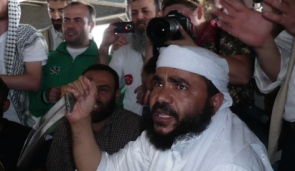
Guantanamo detainee Ahmed Khalfan Ghailani was acquitted of all significant terrorism charges. The victory/defeat is being hailed as a setback to efforts to close the illegal US detention facility. Come again? Apparently President Obama can end torture renditions to Guantanamo if he can be assured that kangaroo courts elsewhere can keep the alleged evildoers from roaming free. OR Ghailani’s acquittal could cement the precedence set by the hundreds of innocents already released from US extrajudicial detention, that not even a court of law will assert these men are guilty. America’s Islamic-blood-thirsty press, led by NYT, WP & LAT, are whining that Ghailani’s confession was determined inadmissible because it was obtained under torture, or as they put it, “torture.”
Tag Archives: Raj
Wikileaks spills “Afganistan War Logs” detail Task Force 373, US death squad
You thought death squads were only for banana republics? Meet covert US Task Force 373 which circulates in Afghanistan with a 2,058 name “Kill or Capture List” killing all witnesses, even policemen, who get in their way. The sudden transparency is due the AFGHANISTAN WAR LOGS, courtesy at last from Wikileaks. While dodging US DHS agents, Wikileak’s Julian Assange was able to coordinate a clever self-checking joint release of the documents via the Guardian UK, Der Spiegel, and the New York Times. The events reported aren’t accusations, they’re the soldiers’ own records.
This leak of over 90,000 files represents the US military’s account of the Afghanistan conflict virtually in its entirety. The news outlets have attempted the present the data in manageable articles, while also providing the raw material for download. The Guardian even offers a tutorial.
The coordinated release ensures that no one can alter the information, and Assange’s choice of outlets was also clever: all three of them are/were pro-war.
There will be lots of revelations from these leaked document, including underestimates of civilian casualties, and acknowledgment of casualties not admitted to the media, CIA hits, and another Black Ops SF squad called Scorpion 26, but let’s get back to the death squad.
We don’t have to allege that TF 373 is an extrajudicial, fully-illegal assassination team, we have their own logs. Who they killed, tried to kill, killed instead, killed trying to get there, killed covering their tracks. Men, women and children. The logs cover up to November 2009, but we have no reason to think they’re not killing still.
Task Force 373 operates out of Kabul, Kandahar and Khost, comprised of soldiers of the 7th Special Forces Group of Eglin Air Force Base, Florida. They are transported by Chinook and Cobra helicopters flown by 160th Special Operations Aviation Regiment, of Hunter Army Airfield, Georgia. Special Forces Airborne death squads.
Or is America inured by our armed drones which assassinate from up high. Whether the trigger man wears a mask in Afghanistan, or sits at a console in Nevada, the hit is a war crime. Outside of a field of battle, it’s simply murder.
And lookey here, the 7th Special Forces have a patch for their record in El Salvador in 1984…
Addressed by their commander in 2001: “From Fort Bragg to Colombia to Venezuela to Peru to Ecuador to Bolivia to Nicaragua to Argentina, you have been instrumental in forging deeper bonds with the democracies of Latin America,”
So before I let the banana republic slur go. Let’s recall that Latin American death squads were often trained at the US School of the Americas, when they or their governments weren’t being directed by Americans outright. Or the 7th, the “Devil’s Brigade.”
Flotilla not a Love Boat, it was a lynch, says Netanyahu, describing beating of IDF soldiers, not deaths of aid workers
What’s a lynch? I find it intriguing that Israel’s spin machine can drop an American pop culture reference like Love Boat, and simultaneously flub basic usage with “a lynch.” According to Israel, that describes what befell their crack-troop Mavi Marmara party-crashers. What does “a lynch” mean? Apparently someone feels at liberty to shorten Lynch Mob, or Lynching, to coin a new threat to Israel. But doesn’t it stretch credulity to imagine the IDF has never claimed to have been baited into an “ambush?”
Every modern military with a propaganda office, when it suffers a setback, attributes it to an ambush. When the US and Israel do it, it’s an attack; when our dastardly adversaries do it, it’s an ambush. Let’s set aside that the night watch on the Mavi Marmara’s deck might have been defending themselves. For the moment the IDF version of events is the only one Israel is allowing.
Ambush, trap, beating, getting jumped, wouldn’t these be appropriate descriptions for what Israel is asserting its night-vision video depicts? To lynch someone -it’s a verb- implies a hanging, extrajudicial, usually perpetrated by a crowd against a lone victim, unarmed. So where does the IDF get “lynch?”
To my mind, the Israeli-accented tender of “lynch” is feigned bad English, stuttered -I hope in shame- as perpetrator blames victim, but stuttered conveniently, to make the accusation less preposterous. Isn’t a rape victim who is too well versed in the crime perpetrated against her, less convincing than a victim who fumbles to comprehend the outrage she suffered? Poor Israel, its soldiers stepped into a, a, a lynch.
Emitted from military spokespeople however, one projects a reflexive followup “-that’s the ticket.”
I’m guessing grasping a straws like “lynch” is played for sympathy. And while I deconstruct the false unfamiliarity of otherwise precisely crafted English: PM Netanyahu’s mention of “Love Boat” had a bumbling Bush “the internets” ring to it. Anyone old enough to know the television show about the enchanted cruise ship knows there’s not “a Love Boat” but The Love Boat.
If the newly nouned “lynch” is intended to define a hate crime unique to anti-Semites, the motive fits with Israel’s insistence that first genocide, now holocaust, can only apply to Jews. Such an implication is aided by Netanyahu’s suggestion that the lynch was “plotted.” Because common understanding of mob misbehavior precludes a premeditated plot. This may reflect a naive dismissal of the responsibility of authorities who manipulated the lynch mobs and witch hunts, but dictionaries seldom chronicle the injustice of the victors who write the history. Conventional wisdom holds that lynchings were improvisational.
Perhaps the English speaking viewers are meant to associate the implicit racism of the term. Ambush after all doesn’t conjure the slightest whiff of antisemitism. But here’s where Israel’s liberal arts wordsmiths may have outsmarted themselves. While it’s true that thousands of African Americans were lynched through our nation’s history, to the average American who dwells not very often on shameful pasts, the definition of lynching encompasses simply an execution in lieu a trial. Even an unfair trial, or kangaroo court, can be called a lynching. A lynch mob is an enraged crowd meting vigilante justice, hanging high what to them is an indisputable wrongdoer. The overwhelming number of lynching victims in America’s lawless west were hunted criminals. While xenophobia may always have skewed the mob’s judgment against Indian, Chinese, Mexican, or Black, a lynching was not by definition about racial prejudice.
If the beating of the Israeli commandos illustrated a hatred, was it racist? One is meant to assume the motive was anti-Semitic, but I wonder if Arab-Israelies serving in the IDF, or foreign nationals or mercenaries, don’t garner antagonism as vociferous. The historic prejudice decried by ADL and holocaust remembrance stalwarts has been against Jews, but the world today reviles Israeli arrogance. The US has become universal despised, but American tourists are still assured the world hates America, not its people. It’s what we’re told, if even if it is untrue. I do not know of course if Israelis are proffered the same polite assurance.
Did Israel mean that the Freedom Flotilla was an attempted lynching of Israel’s international reputation? In that case, Israel’s predictable militant reaction made such a hanging a matter of assisted suicide. If the Israeli national character suffers irreparably, who’s going to be to bame?
Presuming to paint its soldiers into a lynching scene, which character does Israel assert they played? Were the IDF the horse thieves? Bandying about the connotations of lynchings makes for an interesting turning of the tables. Were the convoy defenders the ones pronouncing hasty judgment upon their dark-of-night assailants? Or were Israel’s commandos declaring themselves judge and jury on the alleged arms smugglers?
In cases of breaking and entering, the home field advantage is accorded the right to self-defense. A SWAT team might make the argument that identifying itself as law enforcement preempts a homeowner’s recourse to armed resistance, based on the principle that an arresting officer’s safety is inviolate. Israel may assert it was policing its border, but unfortunately last Monday it was operating beyond its border. What protection can a law enforcement function claim if outside its jurisdiction?
It might be well and good to say Israel reserves the right to protect itself from enemies anywhere in the world, but it can’t pretend its badge should command universal obeisance.
The Mavi Marmara had declared her intention to run Israel’s blockade, but hadn’t yet attempted the crossing. In fact the Freedom Flotilla was moving away from the contentious area at the time of Israel’s attack.
Who then was the victim of this “lynch?”
I’ll tell you why it’s lynch and not lynching. Because Israel’s soldiers weren’t killed, they were beaten. Not to diminish what might have been their adversaries’ worst intentions, but the gantlet the IDF commandoes received was not a hanging specifically, and not very effective in terms of proving fatal. On the other hand, the outcome was the killing of an as yet undisclosed multitude of civilians, unarmed to an extent that the killings can be defined as executions, the entire result already adjudged to have been a massacre.
Israel’s invention of “lynch” is an utterance which I believe betrays the sign of shame the world longs to see from Israel. Even as the public revels in watching the Israeli hubris on self-destruct, empathy has us hoping to see Israel grasp for its lost humanity. To describe the events on the Turkish passenger ship as a “lynch” is to fail to summon the chutzpah to bear false witness, to accuse the dead of capital murder. Neither does Israel dare to raise the specter that summary executions were committed that night at all.
There is a term to describe
a) Israel’s taking the law into its own hands by pirating a ship belonging to another nation while it sailed in international waters,
b) Israel’s soldiers not being a police force but an ideology-deputized posse,
c) opting in a confused fervor to punish outlaws thought to have been caught red handed,
d) issuing on the spot death sentences.
It’s called a mass lynching.
Colorado Springs is belly of space beast
What’s that up in the sky? It’s a mini-me space shuttle with no windows, a former NASA project now entirely USAF. Amateur space object trackers have located the X-37B, the US military’s super secret unmanned space shuttle. What’s so secret about an unarmed, ostensibly inoffensive piece of space hardware? Good question. It depends on what military role you consider to be noncombatant.
Although I’d hope we could all agree by now that Predator Drone pilots wagging remote joysticks at stateside air force bases are plenty lethal if even illegal warfaring combatants. So what harm then, the little mini-me shuttle quietly going about its orbit?
During WWI, observers used to float above the trenches in balloons to direct artillery fire. The (unarmed!) bastards were despised more than the gunners themselves. The early airplane pilots earned the deference they’re shown to this day by the grunts on the ground because they would send the artillery spotters scrambling.
It’s thought that the X-37B is performing such reconnaissance tasks, perhaps with more flexibility and advanced technology than our standard satellites. But that wouldn’t entirely explain why this former NASA project is being kept out of the public eye.
Here’s obfuscating verbiage from a local war-in-space contractor, the Secure World Foundation based in Superior, Colorado.
“The program supports technology risk reduction, experimentation and operational concept development.”
The Air Force Rapid Capabilities Office is more forthright about its function:
“development and fielding of select Defense Department combat support and weapons systems.”
“Mission Control” by the way is located at the Air Force Space Command’s Third Space Experimentation Squadron, based at Schriever Air Force Base, right here.
A worrisome aspect about the X-37B is the secrecy, in light of the fact that its path can be charted by amateurs, if obviously also adversaries. The trajectory of the rocket which launched the vehicle into orbit, its spent hull directed now into an orbit around the sun, is also considered top-secret.
When Peace in Space activists are protesting the Space Symposium at the Broadmoor every year, this is what we are angry about: doublespeak pretending to be about space exploration. What will putting arms in space mean but more arms in space, quickly, adversaries rushing to grab a beachhead before the US is in the position to prevent it?
The X-37B is nothing but an near-space preditor drone, armed not with guns but the means to deploy space mines equipped with guns. If serving as the eyes and ears for targeting weapons isn’t immoral enough.
2-word punchline for President Obama: Predator Drones
A protective father warns off potential First Suitors with the specter of Predator Drones. Nothing outré about gallows humor, but people might be put off when it comes from the mouth of the judge-jury-and-executioner, taking aim. Of course, what have the Jonas Brothers really to fear? –US drones strike very few of their intended targets. Collateral civilians comprise 98% of drone victims, the Pakistani people are who probably got the willies at Obama’s joke.
Much as the average journalist would hope to credential for the White House Correspondents Dinner, they could wonder how the Jonas Brothers got an invite.
If President Obama wonders if any charges of immorality are going to stick to his administration, among the Bush legacies which he has failed to cease and desist, among them specifically extrajudicial killing, disproportionate application of force and failure to protect civilians from hostilities, I have two words: War Crimes. Or his will do: Predator Drones.
AIPAC student DC junkets paying off

This year’s AIPAC conference targeted university student body officers in an effort to fend off BDS campaigns at campuses nationwide. Did the controversial strategy just pay off at UC Berkeley? When the student council voted 16 to 4 to divest, student body president Will Smelko vetoed the measure. Intense pressure from Israeli lobby groups were able to prevent overturning the veto.
AIPAC said they were going to do it, and they did it. Here’s what AIPAC’s Leadership Development Director Jonathan Kessler told DC conference attendees:
How are we going to beat back the anti-Israel divestment resolution at Berkeley? We’re going to make certain that pro-Israel students take over the student government and reverse the vote. That is how AIPAC operates in our nation’s capitol. This is how AIPAC must operate on our nation’s campuses.
Though the Berkeley bill SB118 proposed divestment from General Electric and United Technologies only, two military industries which profit from Israel’s subjugation of the Palestinians, it’s true perhaps that the measure opened the door to further BDS inroads to fight Israel Apartheid.
The divestment proposal had the backing of Archbishop Desmond Tutu among many activists. Against was the Israeli lobby. Students were warned that prospective Jewish students would avoid enrolling, etc. Can we imagine the suggestion was made that the current students would be denied jobs? There probably is a corporate future for “made” students who’ve shown their fealty to AIPAC.
Worth reprinting is the statement read by UCB Professor Judth Butler trying to warn the students against AIPAC’s disreputable coercion:
Let us begin with the assumption that it is very hard to hear the debate under consideration here. One hears someone saying something, and one fears that they are saying another thing. It is hard to trust words, or indeed to know what words actually mean. So that is a sign that there is a certain fear in the room, and also, a certain suspicion about the intentions that speakers have and a fear about the implications of both words and deeds. Of course, tonight you do not need a lecture on rhetoric from me, but perhaps, if you have a moment, it might be possible to pause and to consider reflectively what is actually at stake in this vote, and what is not. Let me introduce myself first as a Jewish faculty member here at Berkeley, on the advisory board of Jewish Voice for Peace, on the US executive committee of Faculty for Israeli-Palestinian Peace, a global organization, a member of the Russell Tribunal on Human Rights in Palestine, and a board member of the Freedom Theatre in Jenin. I am at work on a book which considers Jewish criticisms of state violence, Jewish views of co-habitation, and the importance of ‘remembrance’ in both Jewish and Palestinian philosophic and poetic traditions.
The first thing I want to say is that there is hardly a Jewish dinner table left in this country–or indeed in Europe and much of Israel–in which there is not enormous disagreement about the status of the occupation, Israeli military aggression and the future of Zionism, binationalism and citizenship in the lands called Israel and Palestine. There is no one Jewish voice, and in recent years, there are increasing differences among us, as is evident by the multiplication of Jewish groups that oppose the occupation and which actively criticize and oppose Israeli military policy and aggression. In the US and Israel alone these groups include: Jewish Voice for Peace, American Jews for a Just Peace, Jews Against the Occupation, Boycott from Within, New Profile, Anarchists Against the Wall, Women in Black, Who Profits?, Btselem, Zochrot, Black Laundry, Jews for a Free Palestine (Bay Area), No Time to Celebrate and more. The emergence of J Street was an important effort to establish an alternative voice to AIPAC, and though J street has opposed the bill you have before you, the younger generation of that very organization has actively contested the politics of its leadership. So even there you have splits, division and disagreement.
So if someone says that it offends “the Jews” to oppose the occupation, then you have to consider how many Jews are already against the occupation, and whether you want to be with them or against them. If someone says that “Jews” have one voice on this matter, you might consider whether there is something wrong with imagining Jews as a single force, with one view, undivided. It is not true. The sponsors of Monday evening’s round table at Hillel made sure not to include voices with which they disagree. And even now, as demonstrations in Israel increase in number and volume against the illegal seizure of Palestinian lands, we see a burgeoning coalition of those who seek to oppose unjust military rule, the illegal confiscation of lands, and who hold to the norms of international law even when nations refuse to honor those norms.
What I learned as a Jewish kid in my synagogue–which was no bastion of radicalism–was that it was imperative to speak out against social injustice. I was told to have the courage to speak out, and to speak strongly, even when people accuse you of breaking with the common understanding, even when they threaten to censor you or punish you. The worst injustice, I learned, was to remain silent in the face of criminal injustice. And this tradition of Jewish social ethics was crucial to the fights against Nazism, fascism and every form of discrimination, and it became especially important in the fight to establish the rights of refugees after the Second World War. Of course, there are no strict analogies between the Second World War and the contemporary situation, and there are no strict analogies between South Africa and Israel, but there are general frameworks for thinking about co-habitation, the right to live free of external military aggression, the rights of refugees, and these form the basis of many international laws that Jews and non-Jews have sought to embrace in order to live in a more just world, one that is more just not just for one nation or for another, but for all populations, regardless of nationality and citizenship. If some of us hope that Israel will comply with international law, it is precisely so that one people can live among other peoples in peace and in freedom. It does not de-legitimate Israel to ask for its compliance with international law. Indeed, compliance with international law is the best way to gain legitimacy, respect and an enduring place among the peoples of the world.
Of course, we could argue on what political forms Israel and Palestine must take in order for international law to be honored. But that is not the question that is before you this evening. We have lots of time to consider that question, and I invite you to join me to do that in a clear-minded way in the future. But consider this closely: the bill you have before you does not ask that you take a view on Israel. I know that it certainly seems like it does, since the discussion has been all about that. But it actually makes two points that are crucial to consider. The first is simply this: there are two companies that not only are invested in the Israeli occupation of Palestinian lands and peoples, but who profit from that occupation, and which are sustained in part by funds invested by the University of California. They are General Electric and United Technologies. They produce aircraft designed to bomb and kill, and they have bombed and killed civilians, as has been amply demonstrated by Amnesty International and Human Rights Watch. You are being asked to divest funds from these two companies. You are NOT being asked to divest funds from every company that does business with Israel. And you are not being asked to resolve to divest funds from Israeli business or citizens on the basis of their citizenship or national belonging. You are being asked only to call for a divestment from specific companies that make military weapons that kill civilians. That is the bottom line.
If the newspapers or others seek to make inflammatory remarks and to say that this is an attack on Israel, or an attack on Jews, or an upsurge of anti-Semitism, or an act that displays insensitivity toward the feelings of some of our students, then there is really only one answer that you can provide, as I see it. Do we let ourselves be intimidated into not standing up for what is right? It is simply unethical for UC to invest in such companies when they profit from the killing of civilians under conditions of a sustained military occupation that is manifestly illegal according to international law. The killing of civilians is a war crime. By voting yes, you say that you do not want the funds of this university to be invested in war crimes, and that you hold to this principle regardless of who commits the war crime or against whom it is committed.
Of course, you should clearly ask whether you would apply the same standards to any other occupation or destructive military situation where war crimes occur. And I note that the bill before you is committed to developing a policy that would divest from all companies engaged in war crimes. In this way, it contains within it both a universal claim and a universalizing trajectory. It recommends explicitly “additional divestment policies to keep university investments out of companies aiding war crimes throughout the world, such as those taking place in Morocco, the Congo, and other places as determined by the resolutions of the United Nations and other leading human rights organizations.” Israel is not singled out. It is, if anything, the occupation that is singled out, and there are many Israelis who would tell you that Israel must be separated from its illegal occupation. This is clearly why the divestment call is selective: it does not call for divestment from any and every Israeli company; on the contrary, it calls for divestment from two corporations where the links to war crimes are well-documented.
Let this then be a precedent for a more robust policy of ethical investment that would be applied to any company in which UC invests. This is the beginning of a sequence, one that both sides to this dispute clearly want. Israel is not to be singled out as a nation to be boycotted–and let us note that Israel itself is not boycotted by this resolution. But neither is Israel’s occupation to be held exempt from international standards. If you want to say that the historical understanding of Israel’s genesis gives it an exceptional standing in the world, then you disagree with those early Zionist thinkers, Martin Buber and Judah Magnes among them, who thought that Israel must not only live in equality with other nations, but must also exemplify principles of equality and social justice in its actions and policies. There is nothing about the history of Israel or of the Jewish people that sanctions war crimes or asks us to suspend our judgment about war crimes in this instance. We can argue about the occupation at length, but I am not sure we can ever find a justification on the basis of international law for the deprivation of millions of people of their right to self-determination and their lack of protection against police and military harassment and destructiveness. But again, we can have that discussion, and we do not have to conclude it here in order to understand the specific choice that we face. You don’t have to give a final view on the occupation in order to agree that investing in companies that commit war crimes is absolutely wrong, and that in saying this, you join Jews, Muslims, Hindus, Christians and so many other peoples from diverse religious and secular traditions who believe that international governance, justice and peace demand compliance with international law and human rights and the opposition to war crimes. You say that you do not want our money going into bombs and helicopters and military materiel that destroys civilian life. You do not want it in this context, and you do not want it in any context.
Part of me wants to joke–where would international human rights be without the Jews! We helped to make those rights, at Nuremberg and again in Jerusalem, so what does it mean that there are those who tell you that it is insensitive to Jewishness to come out in favor of international law and human rights? It is a lie–and what a monstrous view of what it means to be Jewish. It disgraces the profound traditions of social justice that have emerged from the struggle against fascism and the struggles against racism; it effaces the tradition of ta-ayush, living together, the ethical relation to the non-Jew which is the substance of Jewish ethics, and it effaces the value that is given to life no matter the religion or race of those who live. You do not need to establish that the struggle against this occupation is the same as the historical struggle against apartheid to know that each struggle has its dignity and its absolute value, and that oppression in its myriad forms do not have to be absolutely identical to be equally wrong. For the record, the occupation and apartheid constitute two different versions of settler colonialism, but we do not need a full understanding of this convergence and divergence to settle the question before us today. Nothing in the bill before you depends on the seamless character of that analogy. In voting for this resolution, you stand with progressive Jews everywhere and with broad principles of social justice, which means, that you stand with those who wish to stand not just with their own kind but with all of humanity, and who do this, in part, both because of the religious and non-religious values they follow.
Lastly, let me say this. You may feel fear in voting for this resolution. I was frightened coming here this evening. You may fear that you will seem anti-Semitic, that you cannot handle the appearance of being insensitive to Israel’s needs for self-defense, insensitive to the history of Jewish suffering. Perhaps it is best to remember the words of Primo Levi who survived a brutal internment at Auschwitz when he had the courage to oppose the Israeli bombings of southern Lebanon in the early 1980s. He openly criticized Menachem Begin, who directed the bombing of civilian centers, and he received letters asking him whether he cared at all about the spilling of Jewish blood. He wrote:
I reply that the blood spilled pains me just as much as the blood spilled by all other human beings. But there are still harrowing letters. And I am tormented by them, because I know that Israel was founded by people like me, only less fortunate than me. Men with a number from Auschwitz tattooed on their arms, with no home nor homeland, escaping from the horrors of the Second World War who found in Israel a home and a homeland. I know all this. But I also know that this is Begin’s favourite defence. And I deny any validity to this defence.
As the Israeli historian Idith Zertal makes clear, do not use this most atrocious historical suffering to legitimate military destructiveness–it is a cruel and twisted use of the history of suffering to defend the affliction of suffering on others.
To struggle against fear in the name of social justice is part of a long and venerable Jewish tradition; it is non-nationalist, that is true, and it is committed not just to my freedom, but to all of our freedoms. So let us remember that there is no one Jew, not even one Israel, and that those who say that there are seek to intimidate or contain your powers of criticism. By voting for this resolution, you are entering a debate that is already underway, that is crucial for the materialization of justice, one which involves having the courage to speak out against injustice, something I learned as a young person, but something we each have to learn time and again. I understand that it is not easy to speak out in this way. But if you struggle against voicelessness to speak out for what is right, then you are in the middle of that struggle against oppression and for freedom, a struggle that knows that there is no freedom for one until there is freedom for all. There are those who will surely accuse you of hatred, but perhaps those accusations are the enactment of hatred. The point is not to enter that cycle of threat and fear and hatred–that is the hellish cycle of war itself. The point is to leave the discourse of war and to affirm what is right. You will not be alone. You will be speaking in unison with others, and you will, actually, be making a step toward the realization of peace–the principles of non-violence and co-habitation that alone can serve as the foundation of peace. You will have the support of a growing and dynamic movement, inter-generational and global, by speaking against the military destruction of innocent lives and against the corporate profit that depends on that destruction. You will stand with us, and we will most surely stand with you.
Drones vulnerable to P2P filesharing?
The WSJ headline screams “Insurgents Hack U.S. Drones … Iranian Backing Suspected.” Hmm. Why Iran — because insurgents can’t afford $25.99 SkyGrabber software? Captured Iraqi laptops have evidence of intercepted video feeds, not code. The hacking term is no misnomer. Instead of calling the footage “hijacked” or “received,” the data is described as “stolen” and “pirated,” which would seem to betray an inviting vulnerability to SkySoftware’s reach. Are they saying there’s a UAV feed that can be harvested by a distributed file-sharing exploit? Imagine a drone-watch network for nabbing unwarranted military surveillance: DroneWire. By going after too many birds with this story, the DoD confirms its armed unmanned vehicles are patrolling not just Iraq, Afghanistan and Pakistan, but Yemen and Somalia, where our distributed representative Democracy has no legal authority to conduct extrajudicial assassinations.
Who were the 1,415 victims in Gaza?
Americans aren’t accustomed to seeing their adversaries as human. The victims of our wars remain faceless and nameless, and maybe as a consequence we accept that our military “doesn’t do body counts.” Not only do we minimize the number of civilians we kill, but their deaths are commodified as “collateral.” Our military proxy in the Middle East does the same. In last year’s attack on Gaza, Israel calculated its casualties in three digits. Those killed behind the confines of Gaza may be faceless to Americans and Israelis, but they leave behind loved ones and dependents, and of course, they had names.
The IDF dismiss the 1415 victims as Palestinian propaganda. But here are their names. Notice, it is not enough that the dead be identified, but each name is accompanied with their address, and location where the death can be verified. Not only must Palestinian civilians mourn their loved ones, they have to account for them.
This list is made available by the Palestinian Center for Human Rights and commemorates “The Dead in the course of the Israeli recent military offensive on the Gaza strip between 27 December 2008 and 18 January 2009.”
The victims are listed in order of casualty, grouped by date. Each person has a number, for those counting in the West, as well as name, sex, age, vocation, home address, date of attack if different from date of death, location of attack if different from address, and designation as militant if not purely civilian. I can’t find fault with those Gazans who took up arms against an indiscriminate incursion into their homes and neighborhoods.
——————————————-
PALESTINIAN CENTRE FOR HUMAN RIGHTS
???????? ??????? ?????????? ??????????
Mustafa Khader Saber Abu Ghanima
Male 16 Student
Tal al-Hawa / Gaza
2
Reziq Jamal Reziq al- Haddad
Male 21 Policeman
al-Sha’af / Gaza
Arafat Police City/ Gaza
3
Ali Mohammed Jamil Abu Riala
Male 24 Policeman
Al-Shati Refugee Camp / Gaza
Arafat Police City/ Gaza
4
Ahmed Mohammed Ahmed Badawi
Male 27 Policeman
Al-Shati Refugee Camp / Gaza
Al-Mashtal Intelligence Outpost/ Gaza
5
Mahmoud Khalil Hassan Abu Harbeed
Male 31 Policeman
Martyr Bassil Naim Street/ Beit Hanoun
Al-Mashtal Intelligence Outpost/ Gaza
6
Fadia Jaber Jabr Hweij
Female 22 Student
Al-Tufah / Gaza
7
Mohammed Jaber Jabr Hweij
Male 19 Student
Al-Tufah / Gaza
8
Nu’aman Fadel Salman Hejji
Male 56 Jobless
Al-Zaytoon / Gaza
Tal al-Hawa
9
Riyad Omar Murjan Radi
Male 24 Student
Yarmouk Street / Gaza
Al-Sena’a Street / Gaza
10
Mumtaz Mohammed Ramiz al-Banna
Male 37 Policeman
Al-Sabra/ Gaza
Arafat Police City/ Gaza
11
Ahmed Hamdi Youssef al-Dreimly
Male 26 Policeman
Al-Sabra/ Gaza
Saraya Security Service Compound/ Gaza
12
Fares Isma’il Helmi al-‘Ashy
Male 28 Policeman
Remal/ Gaza
Arafat Police City/ Gaza
13
Naser Mahmoud Mas’oud Hammouda
Male 35
Al-Zaytoon / Gaza
Wa’ed Society for Prisoners / Gaza
Militant
14
Munir Amin Mass’oud Hammouda
Male 32
Al-Zaytoon / Gaza
Wa’ed Society for Prisoners / Gaza
Militant
15
Ahmed Adnan Hamdi Hammouda
Male 25
Al-Zaytoon / Gaza
Wa’ed Society for Prisoners / Gaza
Militant
16
Ibrahim Mahmoud Abdul Hafiz al-Farra
Male 23 Policeman
Khan Younis
Arafat Police City/ Gaza
17
Mohammed Abdul Karim Ramadan al- ‘Aklouk
Male 24 Policeman
Jabalyia / Northern Gaza
Arafat Police City/ Gaza
18
‘Ali Marwan ‘Ali Abu Rabi’a
Male 21 Student /UNRWA
Gaza Training college
Rimal/ Gaza
Al-Sena’a Street/ Gaza
19
Ra’ed Nazmi Mohammed Dughmosh
Male 36 Policeman
Dughmosh area / Gaza
Arafat Police City/ Gaza
20
Munir Mansour Ahmed Esbeita
Male 25 Policeman
Sheja’eya / Gaza
Arafat Police City/ Gaza
21
Deya’a Talal Kamel al- Habil
Male 22 Policeman
al-Shati Refugee Camp / Gaza
Near al-Katiba Mosque/ Gaza
22
Mayssara Hamed Mohammed Bulbul
Male 21 Policeman
Tal al-Hawa / Gaza
Arafat Police City/ Gaza
23
Nazik Hassan Yasin Abu Raia
Female 28 Policewoman
Tal al-Za’atar area/ Northern Gaza
Presidential Compound / Gaza
24
Khamis Mustafa Mahmoud Abu Ramadan
Male 52 Driver
Near Abu Iskandar Roundabout / Gaza
Near al-Shifa Hospital / Gaza
25
Mahmoud Mtaw’e Mahmoud al-Khaldi
Male 39 Policeman
Al -Jala’a Street / Gaza
Arafat Police City/ Gaza
26
Mohammed Khamis
Male 27 Policeman
Gaza airport area / Al-‘Abbas Police Gaza
Hassan Habbush behind al-Quds international Hotel/ Gaza Station/ Gaza
27
Shadi Jawad Khalil Qweider
Male 24 Policeman
Al-Daraj / Gaza
Arafat Police City/ Gaza
28
Jihad Ziyad Badawi al-Gharabli
Male 24 Policeman
Sheja’eya / Gaza
Arafat Police City/ Gaza
29
Mohammed Khamis Mohammed Baker (Zughra)
Male 21 Policeman
Al-Shati Refugee Camp / Gaza
Al-‘Abbas Police Station / Gaza
30
Ahmed Mohammed Nafez Abu Hadayed
Male 21 Policeman
Khan Younis
Presidential Compound / Gaza
31
Rafiq Musa Abu ‘Ujeirim
Male 30 Policeman
Khan Younis
32
Haneen Wa’el Dhaban
Female 15 Student
Tal al-Hawa / Gaza
Near Preventive Security HQ / Gaza
33
Adham Hamdy Al-‘Udeini
Male 19 Student/UNRWA Gaza Training College
Deir al-Balah / Middle Gaza
Al-Sena’a Street/ Gaza
34
Wafa’a Marwan ‘Ali al-Dsouqi
Female 18 Student/UNRWA Gaza Training College
Khan Younis
Al-Sena’a Street/ Gaza
35
‘Allam Nehru Jawdat al-Rayyes
Male 18 Student
Al-Sabra / Gaza
Al-Sena’a Street/ Gaza
36
Hisham Mohammed Shehada Seyam
Male 27
Al-Zaytoon / Gaza
Militant
37
Ehab Abdullah Mohammed Hamdan
Male 21 Policeman
Bir al-Na’aja / Northern Gaza
Arafat Police City/ Gaza
38
Na’im Reziq Hassan Jendeya
Male 27 Jobless
Sheja’eya / Gaza
Tal al-Hawa / Gaza
Militant
39
Iyad Ziyad Fares Jaber
Male 32 Jobless
Al-Daraj / Gaza
Al-Tufah
40
Diab Rebhi Diab al-Haddad
Male 20 Policeman
Al-Tufah / Gaza
Arafat Police City/ Gaza
41
Mohammed Tawfiq Mohammed al-Nemra
Male 22 Policeman
Al-Sabra / Gaza
Arafat Police City/ Gaza
42
Ziyad ‘Adel Mustafa al-Najjar
Male 24 Policeman
Khan Younis
Presidential Compound / Gaza
43
Sa’ad Mohammed ‘Antar Esleem
Male 28 Policeman
Al-Sabra / Gaza
Al-Katiba Mosque/Gaza
44
Mohammed Ziyad Sadiq al-Nabih
Male 27 Policeman
Al-Sabra / Gaza
Arafat Police City/ Gaza
45
Hatem Khader Mohammed ‘Aiyad
Male 30 Jobless
Al-Zaytoon/ Gaza
46
Nizar Ibrahim Mohammed al-Deiry
Male 34 Policeman
Al-Sabra / Gaza
Presidential Compound / Gaza
47
Mohammed Baker Mohammed al-Nims
Male 31 Policeman
Al-Sabra / Gaza
Near al-Katiba Mosque / Gaza
48
Mohammed Nabil Mohammed Barghouth
Male 28 Policeman
Al-Zaytoon/ Gaza
presidential compound / Gaza
49
Mahmoud Mohammed Hilmy al-‘Amarin
Male 28 Policeman
Al-Zaytoon/ Gaza
Presidential Compound / Gaza
50
Muhannad Hussein Moussa Abu Draz
Male 28 Policeman
Abasan al-Kabira / Khan Younis
Al-Sabra / Gaza
Militant
51
‘Umar Baker Musa Shamaly
Male 23 Policeman
Sheja’eya / Gaza
Arafat Police City/ Gaza
52
Abdul Kader Mohammed Abdul Kader Diab
Male 33 Policeman
Tal al- Hawa / Gaza
Arafat Police City/ Gaza
53
Hamed Fou’ad Shehda Abu Yasin
Male 24 Policeman
Al-Twam area /’Amer housing project / near al-Mashtal Intelligence Outpost
Arafat Police City/ Gaza
54
Baha’a Zuheir ‘Adel al- Khaldi
Male 26 Policeman
Tal al-Za’atar area / Northern Gaza
Arafat Police City/ Gaza
55
Mahmoud Juma’a Mohammed al-Labban
Male 20 Policeman
Al-Naser / Gaza
Arafat Police City/ Gaza
56
Yahya Ibrahim Abdul Jawad Diab
Male 30 Worker
Al-Zaytoon/ Gaza
Wa’ed Society for Prisoners / Gaza
Militant
57
Yasmin Wa’el Dhaban
Female 17 Student
Tal al -Hawa / Gaza
58
Abdul Hamid Jamal Khaled al-Sawi
Male 15 Student
Al-Tufah / Gaza
59
Akram Mohammed Ahmed Abu Zriba
Male 32 Policeman
Al-Sabra / Gaza
Arafat Police City/ Gaza
60
Ramadan Ahmed Ibrahim Abu Kheir
Male 23 Policeman
Al-Shati Refugee Camp / Gaza
Arafat Police City/ Gaza
61
Adib Hassan Abdul ‘Aziz Abu Harb
Male 32 Policeman
Al-Shati Refugee Camp /Gaza
Al-’Abbas Police Station / Gaza
62
Ahmed Hani Ahmed Qannou’a
Male 24 Policeman
Sheja’eya / Gaza
Arafat Police City/ Gaza
63
Salim Khalil al-Banna
Male 24 Policeman
Al-Naser District
Presidential Compound / Gaza
64
Tha’er Mohammed Hassan Madhi
Male 22 Policeman
Al-Shati Refugee Camp / Gaza
Arafat Police City/ Gaza
65
Mohammed Sa’adi Mohammed al-Qatati
Male 30 Driver
Al-Zaytoon/ Gaza
Arafat Police City/ Gaza
66
‘Aisha Suleiman Hammad Rafi’
Female 52 Jobless
Al-Zaytoon/ Gaza
67
Hussam Sa’id Mohammed Seyam
Male 27 Policeman
Sheikh Radwan / Gaza
Arafat Police City/ Gaza
68
Mohammed Ahmed Mahmoud al-Adgham
Male 25 Policeman
Sheikh Radwan / Gaza
Arafat Police City/ Gaza
69
Fayez Mohammed Abed Eqteifan
Male 45 Policeman
Al-Sabra / Gaza
Arafat Police City/ Gaza
70
Hammam Mohammed Moussa Mohammed al-Najjar
Male 24 Policeman
Rimal / Gaza
Al-Mashtal Intelligence Outpost/ Gaza
71
Wisam Abdul Majid Ibrahim al- Quqa
Male 27 Policeman
Al-Shati Refugee Camp / Gaza
Arafat Police City/ Gaza
72
Farouq Fou’ad Mohammed Esleem
Male 21 Policeman
Al-Shati Refugee Camp / Gaza
Al-Mashtal Intelligence Outpost/ Gaza
73
‘Imad Abdul Mu’in Abdullah al-Barbari
Male 22 Employee
Yarmouk Street / Gaza
Al-Nafaq Street / Gaza
74
Salah Mohammed Saleh al-Kheiry
Male 23 Policeman
Sheikh Radwan / Gaza
Arafat Police City/ Gaza
75
Ahmed Mohammed Shreiteh al-Kurd
Male 35 Policeman
Beit Lahiya / near al-Mashtal Intelligence Outpost
Arafat Police City/ Gaza
76
Sabri Jebril Sabri al-Rafati
Male 26 Policeman
Al-Mashahra neighborhood / Gaza
Al-’Abbas Police Station / Gaza
77
Amjad Maher Ahmed Mushtaha
Male 28 Policeman
Sheja’eya / Gaza
Arafat Police City/ Gaza
78
Mohammed Amin Mass’oud Hammouda
Male 25 Jobless
Al-Zaytoon/ Gaza
Wa’ed Society for Prisoners / Gaza
Militant
79
Belal Mohammed Hussein ‘Umar
Male 20 Policeman
Al-Shati Refugee Camp / Gaza
Arafat Police City/ Gaza
80
Bassam Issa Qasem al-‘Akkawi
Male 27 Policeman
Sheja’eya / Gaza
Presidential Compound / Gaza
81
Yahya Ibrahim Farouq al-Hayek
Male 13 Student
Tal al-Hawa / Gaza
82
Mohammed Talal Kamel al-Habil
Male 20 Student
Al-Shati Refugee Camp / Gaza
Near al- Katiba Mosque / Gaza
83
Abdul Rahman Nizar Zuhdi Shahato
Male 22 Policeman
Northern Rimal/ Gaza
Presidential Compound / Gaza
84
Suhaib Fawzi Salman Abdul ‘Al
Male 28 Policeman
Yarmouk Street / near Yarmouk Mosque/ Gaza
Arafat Police City/ Gaza
85
Yousif Rafiq Mohammed al-Deiri
Male 33 Policeman
Al-Sabra / Gaza
Arafat Police City/ Gaza
86
Maher Isma’il Diab ‘Azzam
Male 37 Policeman
Al-Zaytoon/ Gaza
Al-Katiba Mosque / Gaza
87
Rami Jihad Mohammed al-Salut
Male 27 Medical lab. Specialist/
Military Medical Services
Sheikh Radwan / Gaza
Near al-Shifa Hospital / Gaza
88
Mohammed Abdul Kader Mubarak Saleh
Male 26 Policeman
Jabaliya/ Northern Gaza
Arafat Police City/ Gaza
89
Mohammed Abdul Wahhab Abdul Rahman ‘Aziz
Male 20 Policeman
Beit Lahiya / Northern Gaza
Arafat Police City/ Gaza
90
Yehia ‘Awni ‘Awad Muheisen
Male 30 Policeman
Sheja’eya / Gaza
Arafat Police City/ Gaza
91
Hisham Nehru Jawdat al-Rayyes
Male 25 UNRWA
Gaza Training College\ Gaza
Al-Sena’a Street/ Gaza
92
Jamil Nasri Mohammed Abdul- ‘Al
Male 28 Policeman
Al Yarmouk Street/ Gaza
Ansar Security Service Compound
93
‘AliYahia Mohammed Banat
Male 31 Policeman
Al-Jala’a Street / Gaza
Arafat Police City/ Gaza
94
Mansour Yaser Mohammed al-Turk
Male 29 Policeman
Rimal / Gaza
Arafat Police City/ Gaza
95
Hussam Mohammed Hammad al-Majayda
Male 26 Policeman
Khan Younis
Arafat Police City/ Gaza
96
Fayez Fayeq Ahmed Abu al-Qumsan
Male 20 Policeman
Jabalyia / Northern Gaza
Arafat Police City/ Gaza
97
Walid Jabr Mohammed Abu Hein
Male 37 Policeman
Juhr al-Dik / Gaza
Saraya Security Service Compound/ Gaza
98
Naser Abdullah Sha’aban al-Gharra
Male 46 Policeman
Al-Sabra / Gaza
Arafat Police City/ Gaza
99
Mohammed ‘Adnan Salim ‘Attallah
Male 26 Policeman
Rimal/ Gaza
Presidential Compound / Gaza
100
Tala’at Mukhlis Khalaf Basal
Male 19 Policeman
Al-Tufah / Gaza
Arafat Police City/ Gaza
101
Sha’alan, Abdul Latif Khalil Abdul Salam
Male 33 Policeman
Al-Jala’a Street / Gaza
Presidential Compound / Gaza
102
Majed Tawfiq Mohammed Mteir
Male 46 Policeman
Al-Naser / Gaza
Presidential Compound / Gaza
103
‘Ammar Khamis ‘Umar al-Lad’a
Male 25 Policeman
Tal al-Hawa / Gaza
Arafat Police City/ Gaza
104
Wa’el Mohammed Marzouq al-Sha’er
Male 24 Policeman
Khan Younis
Presidential Compound / Gaza
105
Mohammed Zuheir al-‘Aydi Abu Sha’aban
Male 20 Policeman
Al-Sabra / Gaza
Presidential Compound / Gaza
106
Ibrahim Yousif Ahmed Nofal
Male 42 Policeman
Al-Naser / Gaza
Presidential Compound / Gaza
107
Jaber Jabr Ibrahim Hweij
Male 51 Al-Tufah/ Gaza
108
Rami ‘Amer Deeb Abdul Halim
Male 18
Al-Zaytoon/ Gaza
109
Wa’el Samir ‘Ali al-Hawajri
Male 33 Policeman
Tal al-Za’atar area / Northern Gaza
Arafat Police City/ Gaza
110
Hisham Salim Abu ‘Ajwa
Male 48 Policeman
Al-Naser / Gaza
Arafat Police City/ Gaza
111
Ala’a Fadel Mohmmed ‘Afana
Male 23 Policeman
Al-Shati Refugee Camp / Gaza
Al-’Abbas Police Station / Gaza
112
Ra’afat Ahmed ‘Oda ‘Eqeilan
Male 32 Policeman
Al-Shati Refugee Camp / Gaza
Arafat Police City/ Gaza
113
Tawfiq Jabr Mohammed Yousif
Male 47 Policeman
Tal al-Hawa / Gaza
Arafat Police City/ Gaza
114
Ahmed Abdul Majid Hussein Abu ‘Oda
Male 21 Policeman
Nuseirat / Middle Gaza
Al-Zahra City/ Middle Gaza
115
Hassan Isma’il Hassan Abu Shanab
Male 26 Policeman
Sheikh Radwan / Gaza
Arafat Police City/ Gaza
116
Abdul Rahman Ahmed Khamis aL-Shweiki
Male 22 Policeman
Al-Daraj / Gaza
117
Ra’afat Nabil Sha’aban Shameya
Male 28 Policeman
Sheikh Radwan / Gaza
Arafat Police City/ Gaza
118
Amjad Kamel Abu Jazar
Male 26 Policeman
Khan Younis
Arafat Police City/ Gaza
119
Mansour Abdullah Sha’aban Al-Gharra
Male 42 Policeman
Al-Sabra / Gaza
Arafat Police City/ Gaza
120
Ra’ed Mohammed Mohammed Al-Najjar
Male 32 Policeman
Al-Shati Refugee Camp / Gaza
Arafat Police City/ Gaza
121
Nahiz Salim ‘Awwad Abu Namous
Male 20 Policeman
Tal al-Hawa / Gaza
Arafat Police City/ Gaza
122
Basil Jihad Mohammed Dababish
Male 33 Policeman
Sheikh Radwan / Gaza
Arafat Police City/ Gaza
123
‘Asim Ahmed Hassan al-Sha’er
Male 27 Policeman
Tal al-Hawa / Gaza
Presidential Compound / Gaza
124
Sami Tayseer al-Sayed al-Halabi
Male 27 Policeman
Al-Shati Refugee Camp / Gaza
Al-Mashtal Intelligence Outpost/ Gaza
125
Mohammed Jamil ‘Ateya Abu Hajjaj
Male 42 Policeman
Khan Younis
Presidential Compound / Gaza
126
Mohammed Khaled Asa’ad Shuheibar
Male 22 Policeman
Yarmouk Street / Gaza
Arafat Police City/ Gaza
127
Mohammed Jamil ‘Ateya Abu Juha
Male 43 Policeman
Al-Zaytoon/ Gaza
Arafat Police City/ Gaza
128
Abdul Salam Isma’il Mohammed Al-Reba’i
Male 49 Policeman
Al-Shati Refugee Camp / Gaza
Presidential Compound / Gaza
129
Abdullah Munther Jawdat al-Rayyes
Male 20 Seller in computers shop
Al-Sabra / Gaza
130
Mohammed Mansour Abdul Karim Nayfa
Male 21 Policeman
Beit Lahiya / Northern Gaza
Arafat Police City/ Gaza
131
Na’im ‘Ashour Ahmed Al Ghifary
Male 36 Policeman
Al-Sahaba Street/ Al-Daraj / Gaza
Arafat Police City/ Gaza
132
Mohammed Hafiz Mohammed al-Kharoubi
Male 22 Policeman
Al-Tufah/ Gaza
Arafat Police City/ Gaza
133
Mohammed Salah Hassan al-Sawaf
Male 28 Policeman
Al-Tufah/ Gaza
Al-Kattiba area / Gaza
134
Mustafa Mohammed Mustafa al-Sabbagh
Male 20 Policeman
Al-Tufah / Gaza
Arafat Police City/ Gaza
135
Sharaf Mohammed Abu Shammala
Male 22 Policeman
Khan Younis
Presidential Compound / Gaza
136
Ahmed Mohammed Jamil Ba’alousha
Male 21 Policeman
Yarmouk Street / Gaza
Al-Nafaq Street / Gaza
137
Yousif Fawzi Salman Abdul ‘Al
Male 19 Worker
Yarmouk Street / Gaza
Al-Mashtal Intelligence Outpost/ Gaza
138
Mohammed Subhi Isma’il Aal-Maqadma
Male 34 Policeman
Jabaliya/ Northern Gaza
Arafat Police City/ Gaza
139
Baha’a Nahid Fawzi Sukeik
Male 28
Al-Zaytoon/ Gaza
Militant
140
Suheil Mohammed Naser Tanbura
Male 43 Policeman
Aslan Neighborhood/ Beit Lahia/ Northern Gaza
Arafat Police City/ Gaza
141
Abdul Samia’ Mohammed Abdullah Eal-Nashar
Male 35 Policeman
Al-Sabra / Gaza
Arafat Police City/ Gaza
142
Fayez Riyad Fayez al-Madhoun
Male 33 Policeman
Al-Zaytoon/ Gaza
143
Isma’il Ibrahim al- Ja’abari
Male 36 Policeman
Khan Younis
Presidential Compound / Gaza
144
Hisham Mohammed Ali Abu Sharar
Male 40 Policeman
Aa-Tufah / Gaza
Near al-Katiba Mosque / Gaza
145
Ahmed Abdul Kader Ibrahim al-Haddad
Male 27 Policeman
Aa-Tufah / Gaza
Ansar Security Service Compound / Gaza
146
Tamer Mohammed ‘Asafa
Male 28 Policeman
Deir Al-Balah – Albrook area / Middle of the Gaza Strip
147
Rabi’ Mahmoud al-Muzayan
Male 29 Policeman
Deir al-Balah / Middle Gaza
148
Mohammed Salem Mohammed Abu ‘Abda
Male 29 Policeman
Block 7 / al-Bureij / Middle Gaza
149
Isma’il Mohammed Suleiman al-‘Awawda
Male 24 Policeman
Block 6/ al-Bureij / Middle Gaza
150
Samir ‘Ubeid ‘Ali al-‘Awawda
Male 30 Policeman
Block 6/ al-Bureij / Middle Gaza
Al-Zahra City / Middle Gaza
151
‘Uday Abdul Hakim Rajab Mansi
Male 6 Student
Deir al-Balah / Middle Gaza
152
kamilia Ra’afat al-Bardini
Female 13 Student
Deir al-Balah / Middle Gaza
Wadi al-Salqa Village / Middle Gaza
153
Ibrahim Abdul Salam Mohammed Abu al-Rous
Male 24 Policeman
Block 6 / al-Bureij / Middle Gaza
154
Wisam Ibrahim ‘Ayyash
Male 22 Policeman
Albrook / Deir al-Balah / Middle Gaza
155
‘Awwad Nafez ‘Awwad al-Qatshan
Male 24 Policeman
Maqbula area/ al-Bureij / Middle Gaza
156
Mohammed Yahya Mhanna
Male 21 Policeman
Al-Brook / Deir al-Balah / Middle Gaza
157
Suheib Mohammed ‘Asafa
Male 21 Policeman
Al-Brook / Deir al-Balah / Middle Gaza
158
Hakim Rajab Mansi
Male 32 Farmer /
Deir al-Balah / Middle Gaza
159
Hassan Sa’adi Hamdan Abu ‘Arbas
Male 20 Policeman
Al-Brook / Deir al-Balah / Middle Gaza
160
‘Umar Sa’id ‘Umar al-Lahham
Male 22 Policeman
Deir al-Balah / Middle Gaza
161
Ahmed Salah Ahmed al-Lahham
Male 23 Policeman
Deir al-Balah / Middle Gaza
162
Shadi Mohammed Fayez ‘Ateya
Male 34 Policeman
Al-Sahaba Street/ Al-Daraj / Gaza
Presidential Compound / Gaza
163
Yaser Mohammed Deeb al-Lahham
Male 32 Policeman
Deir al-Balah / Middle Gaza
164
Wasim Ibrahim Hassan ‘Azara
Male 23 Policeman
Block 7/ al-Bureij / Middle Gaza
Abu Meddein Police Station
165
Anas Sbeih Abdullah Abu Nar
Male 23 Policeman
Al-Zahra’a City / Middle Gaza
166
Hussam Abdullah Ibrahim al-Sane’
Male 27 Policeman
Nuseirat New Refugee Camp / Middle Gaza
Al-Zahra City/ Middle Gaza
167
‘Imad Abdul Hamid Mohammed Abu al-Haj
Male 38 Policeman
Al-Bahnasawi area/ Nuseirat Camp / Middle Gaza
168
Mohammed Mesbah Hussein Hamad
Male 23 Policeman
Nuseirat Refugee Camp 1 / Middle Gaza
169
Mohammed Isma’il Abed al-Ghamri
Male 23 Policeman
Block D/ al-Maghazi / Middle Gaza
170
Zaki Ibrahim Mohammed Dweik
Male 45 Policeman
Block 12 / al-Bureij / Middle Gaza
171
Ramzi Rajab Khader Tanjara
Male 26 Policeman
Block 6 / al-Bureij / Middle Gaza
172
Khaled Abdul Fattah Ali Abu Hasna
Male 42 Policeman
Block 3 / al-Bureij / Middle Gaza
173
Ibrahim Abdul Rahman Jbeil Zu’rub
Male 28 Worker in ex-settlements
Palestine Mosque /Zu’rub neighborhood / Khan Younis
ex-settlements/west of Younis Khan
174
Samer Heidar Hussein al-Qreinawi
Male 21 Policeman
Block 7 / al-Bureij / Middle Gaza
Al-Zahra City / Middle Gaza
175
Ahmed Mohammed Salama al-Qreinawi
Male 37 Policeman
Block 7 / al-Bureij / Middle Gaza
176
Tamer Heidar Hussein al-Qreinawi
Male 22 Policeman
Block 7 / al-Bureij / Middle Gaza
177
Majdi Nader Juma’a Jabr
Male 21 Policeman
Block 7 / al-Bureij / Middle Gaza
178
Ahmed Abdul Ghani, Khalil Kullab
Male 70 Jobless
Block 7 / al-Bureij / Middle Gaza
179
‘Issam Nabil Mohammed al-Gherbawi
Male 24 Policeman
Block 6 /al-Bureij / Middle Gaza
180
Usama Hassan Mohammed Abu al-Rish
Male 44 Worker
Block D /al-Maghazi / Middle Gaza
Al-Tufah
181
Ala’a Nasri Mohammed al-Ra’i
Male 30 Policeman
Nuseirat Refugee Camp 1 / Middle Gaza
182
Mohammed Ibrahim Abdul Rahman Abu ‘Amer
Male 22 Policeman
Near Nuseirat Martyrs Clinic/ Nuseirat / Middle Gaza
183
Abdullah Salim Aal-Lahham
Male 19 Policeman
Deir al-Balah / Middle Gaza
Militant
Militant
184
Abdul Rahman Nazmi Abdul Rahman Hamdan
Male 23 Policeman
Nuseirat / Middle Gaza
Abu Meddein Police Station / Middle Gaza
185
Mahmoud Hisham ‘Azmi Abu Dalal
Male 22 Policeman
Near Abu Dalal Supermarket/ Nuseirat / Middle Gaza
Al-Zahra City/ Middle Gaza
186
‘Azmi Hisham ‘Azmi Abu Dalal
Male 26 Medic / Military Medical Services
Near Abu Dalal Supermarket/ Nuseirat / Middle Gaza
Al-Zahra City/ Middle Gaza
187
Khaled Yousif Jabr Shahin
Male 40 Policeman
Nuseirat Refugee Camp 2 / Middle Gaza
Al-Zahra City/ Middle Gaza
188
Abed Mohammed Salem al-Shaf’i
Male 24 Worker
Near al-Salama Petrol Station, near Nuseirat / Middle Gaza
189
Haitham Fadel Muhareb Hamdan
Male 28 Policeman
Abu Slim area near Nuseirat Refugee Camp 2/ Middle Gaza
190
Shadi Abdul Majid Abdul Jalil al-Sabakhi
Male 29 Policeman
Near Nuseirat Martyrs Clinic/ Nuseirat / Middle Gaza
191
Usama Abdul Fattah Khamis Fadel
Male 44 Jobless
Block 12 /al-Bureij / Middle Gaza
Abu Meddein Police Station
192
Ibrahim Hassan Ibrahim al-Jamal
Male 26 Policeman
Near Abu Meddein Police Station in Nuseirat / Middle Gaza
193
Yousif Mohammed Mahmoud Diab
Male 35 Policeman
Nuseirat Refugee camp 2 / Middle Gaza
194
Abdul Hakim Ahmed Abdul Fattah Abu Sharaf
Male 28 Policeman
Nuseirat Refugee camp 2 / Middle Gaza
195
Ala’a Addin Ibrahim Abdul Rahim al-Qatarawi
Male 22 Policeman
Nuseirat Refugee Camp 2/ Middle Gaza
196
Abdul Karim Sa’id Abdul Karim Wahba
Male 25 Policeman
Nuseirat / Middle Gaza
197
Mohammed Abdul Fattah Ahmed al-Qatarawi
Male 36 Policeman
Al-Kala’aboush area, behind the al-Qassam Mosque/ Nuseirat / Middle Gaza
Al-Zahra City/ Middle Gaza
198
Tawfiq Ali Hassan al-fallit
Male 51 Employee
Deir al-Balah / Middle Gaza
199
Mustafa Yousif Mustafa al-Khatib
Male 26 Policeman
Nuseirat Refugee Camp 2 / Middle Gaza
200
‘Umar Ahmed Hassan Abu Sa’id
Male 24 Policeman
East of al-Bureij / Middle Gaza
201
Mohammed Khalil Jarid Zu’rub
Male 26 Employee
Khan Younis
ex-settlement of Gadid/ southwest of Khan Younis
202
‘Adnan Ahmed al-Bheisi
Male 27 Policeman Deir al-Balah / Middle Gaza
Al-Zahra City/ Middle Gaza
203
Ahmed Jamal Ahmed Aal-Nuri
Male 29 Policeman
Block 7/al-Bureij/ Middle Gaza
Deir Al-Balah / Middle Gaza
204
Mohammed Hisham Salem Zahra
Male 21 Policeman
Block 7/al-Bureij/ Middle Gaza
205
Abdullah Mohammed Ibrahim al-Ghaffari
Male 59 Jobless
Block 12/al-Bureij/ Middle Gaza
206
Ahmed Reyad Mohammed al-Sinwar
Male 3
Behind the civil Defense service site/ al-Zahra City / Middle Gaza
207
Thiab Abed Issa Hamid
Male 50 Policeman
Bloc C/ Nuseirat / Middle Gaza
Abu Meddein Police Station / Middle Gaza
208
Nemer Ahmed Abdullah Amum
Male 101 Farmer
Block 4 / al-Bureij/ Middle Gaza
209
Abdul Karim Isma’il ‘Ali Abu Jarbou’a
Male 46 Policeman
Al-Zawaida area / Middle Gaza
Presidential Compound / Gaza
210
Rami Suleiman Ahmed Abu al-Sheikh
Male 26 Policeman
Behind schools compound area in al-Maghazi / Middle Gaza
Al-Bureij/ Middle Gaza
211
Na’im, Aal-Sayed Abed Rabbu Mbit
Male 30 Policeman
Block 4/ al-Bureij/ Middle Gaza
212
Mohammed ‘Awad Yousif ‘Awad
Male 27 Policeman
Block 3 / al-Bureij/ Middle Gaza
213
Mohammed Ahmed Abdul Rahman Tabasha
Male 27 Policeman al-Bureij/ Middle Gaza
214
Ghassan Mahmoud Isma’il Abu ‘Awwad
Male 32 Policeman
Block D in al-Maghazi / Middle Gaza
Presidential Compound / Gaza
215
Ashraf Hamada Mustafa Abu Qwiek
Male 21 Policeman
Block 4 / al-Bureij/ Middle Gaza
Deir Al-Balah / Middle Gaza
216
Ma’moun Mohammed Ahmed Aal-Sayed Msallam
Male 22 Policeman
Block 4 / al-Bureij/ Middle Gaza
217
Mazen Mahmoud Abdul Aziz ‘Aleyan
Male 35 Policeman
Block 4 / al-Bureij/ Middle Gaza
Al-Zahra Police Station/ Middle Gaza
218
Hassan Atallah Mohammed Abdullah
Male 40 Worker
Tal al-Sultan / Rafah
Al-Mawasi area/ Rafah
219
‘Asem Mohammed Sa’id Abu Kmeil
Male 28 Policeman
AlMughraqa area/ Middle Gaza
220
Tala’at Mahmoud Salman Salman
Male 39 Worker
JabaliyaRefugee camp/ Northern Gaza
Civil Administration HQ/ Northern Gaza
221
Reziq Mahmoud Salman Salman
Male 24 Policeman
Block 5/ JabaliyaRefugee Camp / Northern Gaza
Force 17 Site/ Northern Gaza
222
Annan Saber Ayoub Ghalya
Male 25 Policeman
Beit Lahia / Northern Gaza
Force 17 Site/ Northern Gaza
223
Ali Hassan Ahmed al-Mabhouh
Male 26 Policeman
Jabaliya/ Northern Gaza
Navy Site/ Northern Gaza
224
Yousif Tayseer Harb Sha’aban
Male 19 Student
Al-Juneina neighborhood / Rafah
Al-Talatini Street/ Gaza
225
Isma’il Jihad Isma’il Ghneim
Male 24 Policeman
JabaliyaRefugee Camp/ Northern Gaza
Force 17 Site/ Northern Gaza
226
Ni’ma Ali Ahmed al-Mghari
Female 18 Student in UNRWA Gaza Training School
Al-Bahar Street / Rafah
UNRWA Gaza Training College/ Gaza
227
‘Imran Isma’il Darwish al-Run
Male 24 Policeman
Beit Lahia / Northern Gaza
Force 17 Site/ Northern Gaza
228
Baha’a Samir ‘Oda Abu Zuhri
Male 19 Student
‘Awad Building in al-Juneina neighborhood / Rafah
UNRWA Gaza Training College/ Gaza
229
Ahmed Samih Shehada al-Halabi
Male 19 Student in UNRWA Gaza Training School
Gaza Block M / Rafah
UNRWA Gaza Training College/ Gaza
230
Mohammed Mahmoud Hammad al-Najra
Male 46 Policeman
Al-Hashash area / Rafah
Nuseirat/ Middle Gaza
231
Salem Ahmed Salem Abu Shamla
Male 35 Jobless
Near the Police Station/ Al-Maghazi / Middle Gaza
Al-Bureij/ Middle Gaza
232
Hashim Faris Hashim ‘Uweida
Male 33 Engineer
Khan Younis
Ex-Settlement of Gadid/ southwest of Khan Younis
233
Wa’el Abdul Karim Shehda al-Raqab
Male 32 Policeman
Bani Suheila village/ Khan Younis
Western Khan Younis Police Station/ Khan Younis
234
Ahmed Maher Ahmed Abu Mussa
Male 22 Policeman
Al-Amal neighborhood / Khan Younis
Western Khan Younis Police Station/ Khan Younis
235
Mahmoud Majid al-‘Abed Abu Tyour
Male 18 Student in UNRWA Gaza Training School
Block N / Rafah
UNRWA Gaza Training College/ Gaza
236
Ayman Hamed Ahmed Abu Ammuna
Male 38 Jobless
JabaliyaRefugee Camp / Norther Gaza
Civil Administration/ Northern Gaza
Militant
Militant
237
Mohammed Na’im Shakshak
Male 23 Policeman
Khan Younis
Presidential Compound/ Gaza
238
‘Ammar ‘Oda Faraj Shamali
Male 23 Policeman
Sheja’eya / Gaza
Presidential Compound/ Gaza
239
Ibrahim Shafiq Shabat
Male 24 Employee in Paltel company
Beit Hanoun / Northern Gaza
Al-Amal neighborhood/ Northern Gaza
240
Ibrahim Shafiq Ali Abdul Hadi
Male 23 worker
Beit Hanoun / Northern Gaza
241
Ayman Hussein Ahmed Ahmed
Male 41 Employee in Paltel company
JabaliyaRefugee Camp / Northern Gaza
Near Civil Adminstration HQ/ Northern Gaza
242
Mahmoud Ahmed al-Najjar
Male 48 Employee in Paltel.
Jabaliya Refugee Camp / Northern Gaza
Near Civil Adminstration HQ/ Northern Gaza
243
Ahmed Naser Ahmed Tbeil
Male 24 Policeman
JabaliyaRefugee Camp/ North Gaza
Force 17 Site/ Northern Gaza
244
Ali Abdul Rahim Mohammed ‘Awad
Male 24 Policeman
Jabaliya/ Northern Gaza
Force 17 Site/ Northern Gaza
245
‘Umar Salman Salim Darawsha
Male 27 Employee
Qarara village – Khan Younis
Ex-settlement of Gadid/ southwest of Khan Younis
246
Hussein Ahmed Hussein Daoud
Male 26 Policeman
Beit Lahia / Northern Gaza
Arafat Police City/ Gaza
247
Sarah Eid Ali al-Hawwajri
Female 57
Izbat Abed Rabbu / Northern Gaza
Civil Adminstration HQ/ Northern Gaza
248
Mahmoud Jamil Fakhri al-Khaldi
Male 26 Policeman
Tal al-Za’atar area /Jabalyia / Northern Gaza
Force 17 Site/ Northern Gaza
249
Mysara Mohammed Mohammed ‘Udwan
Female 48 Housewife
Beit Hanoun / Northern Gaza
Al-Amal neighborhood/ Northern Gaza
250
Mahmoud Fou’ad Ahmed Abu Matar
Male 38 Policeman
Beit Lahia / Northern Gaza
Navy Site/ Northern Gaza
251
Mohammed Aal-Desouqi Kamel Hammad Asaleya
Male 27 Policeman
Jabaliya/ Northern Gaza
Navy Site/ Northern Gaza
252
Yousif Ibrahim Mohammed Thary
Male 33 Policeman
Haifa Street / Northern Gaza
Force 17 Site/ Northern Gaza
253
Khalil, Mahmoud Abed Aal-Kurd
Male 49 Employee in PalTel.
Beit Lahia / Northern Gaza
Near Civil Adminstration HQ/ Northern Gaza
254
Hassan Salem Hammed al-Rahhal
Male 50
Al-Maghazi / Middle Gaza
al-Bureij / Middle Gaza
255
Zeyad Daoud ‘Oda Abu ‘Eyada
Male 33 Policeman
Shaboura Refugee Camp / Rafah
Rafah Police Station/ Rafah
256
Heidar Mahmoud Mohammed Hassouna
Male 36 Policeman
Tal al-Sultan / Rafah
Rafah Police Station/ Rafah
257
Ayman Fou’ad Eid al-Nahhal
Male 22 Policeman
Khirbat al-‘Adas village / Rafah
Rafah Police Station/ Rafah
258
Hamdan Khamis Rabi’ Abu Nqeira
Male 32 Policeman
Shaboura Refugee Camp / Rafah
Rafah Police Station/ Rafah
259
Anas Fawzi Nafez Hamad
Male 23 Policeman
Nuseirat / Middle Gaza
260
Ahmed Abdullah Salem Al-Khatib
Male 26 Nurse in the Military Medical Services
Tal al-Sultan / Rafah
Rafah Police Station/ Rafah
261
Hamada Ahmed Msallam Abu Daqqa
Male 22 Policeman
Khan Younis
Internal Security HQ/ west of Khan Younis
262
Mohammed Fou’ad Abu Sabra
Male 19 Policeman
Al-Salam Street / Deir al-Balah / Middle Gaza
263
Qareeb ‘Umar ‘Abid
Male 32 Lawyer
Shaboura Refugee Camp / Rafah
Rafah Police Station/ Rafah
264
Shehada Abdul Rahman Hussein Kuffa
Male 50 Policeman
Block 2 / al-Maghazi / Middle Gaza
Al-Zahra City/ Middle Gaza
265
Hatem Adnan Abu Sha’ira
Male 27 Policeman
Al-Zawaida area / Middle Gaza
Nuseirat / Middle Gaza
266
Nizar ‘Ateya Hassan Abu Salem
Male 35 Policeman
Nuseirat New Refugee Camp/ Middle Gaza
Al-Zahra City/ Middle Gaza
267
Abdullah Talal Ibrahim Aal-Sane’
Male 27 Policeman
Nuseirat New Camp / Middle Gaza
Presidential Compound/ Gaza
268
Arafat Faraj Allah Sleiman Faraj Allah
Male 37 Policeman
Nuseirat New Refugee Camp / Middle Gaza
269
Isma’il Ahmed Mohammed Salem (Hamdan)
Male 34 Policeman
Near the Ahli Club in Nuseirat / Middle Gaza
270
Yousif Ibrahim Mohammed Thabet
Male 18 Jobless
Gaza
271
Mohammed Yunis Abu Libda
Male 23 Policeman
Deir al-Balah / Middle Gaza
272
Khaled Radwan Ali Inshasi
Male 24 Member of the al-Qassam Brigades
Al-Namsawi neighborhood/ Khan Younis
A site of the al-Qassam Brigades in Khan Youni
273
Suleiman Subhi Mohammed al-Ghariz
Male 50 Policeman
Nuseirat / Middle Gaza
274
Hamdan Qasim Abdullah Safi
Male 45 Employee
Khan Younis
Ex-settlement of Netser Hazani/ Khan Younis
275
Khaled Sami Tarraf al-Astal
Male 14 Student
Al-Satar/ Khan Younis
Ex-settlement of Netser Hazani/ Khan Younis
276
Shaker Fayez Salim al-Zeini
Male 60 Plumber
Khan Younis
Internal Security HQ/ Khan Younis
277
Nabil Ahmed Mahmoud al-Beiram
Male 43 Employee
Khan Younis
Ex-settlement of Gadid/ southwest of Khan Younis
278
Ibrahim Mohammed Ali Mahfouz
Male 46 Employee
Khan Younis
Ex-settlement of Gadid/ southwest of Khan Younis
279
(Mohammed Nour) Mohammed Reziq al- Fayoumi
Male 24 Policeman
Khan Younis
Western Khan Younis Police Sattion/ Khan Younis
280
Ahmed Rasmi Mohammed Abu Jazar
Male 16 Student
Al-Juneiena neighborhood/ Rafah
Rafah Police Station/ Rafah
281
Mohammed Abdul Shafouq Mohammed al-Abadla
Male 40 Employee
Al-Mawasi / Khan Younis
Ex-settlement of Gadid/ southwest of Khan Younis
282
Mo’in Mahmoud Abdul Rahman Aal-Qen
Male 43 Worker
Tal al-Sultan / Rafah
Rafah Police Station/ Rafah
283
Salman Fahmi Hassan al-Astal
Male 30 Policeman
Khan Younis
284
Ibrahim Mohammed Ibrahim Abu Teir
Male 54 Worker
Abasan al-Kabira / Khan Younis
285
Nazir Khalil Hussain Aal-louka
Male 52 Imam
Tal al-Sultan / Rafah
Rafah Police Station/ Rafah
286
Haitham Yaser Ahmed al-Sha’er
Male 22 Policeman
Tal al-Sultan / Rafah
Rafah Police Station/ Rafah
287
Yaser Ahmed Mohammed al-Sha’er
Male 46 Policeman
Tal al-Sultan / Rafah
Rafah Police Station/ Rafah
288
Ihab Jaser Ahmed al-Sha’er
Male 32 Physician
Tal al-Sultan / Rafah
Rafah Police Station/ Rafah
289
Ibrahim Abdul Rahman Jbeil Zu’rub
Male 28 Employee
Khan Younis
Ex-settlement of Gadid/ southwest of Khan Younis
290
Yousif Murshid Ahmed al-Najjar
Male 38 Employee
Khan Younis
Ex-settlement of Gadid/ southwest of Khan Younis
291
Mazen Ahmed Mohammed Matar
Male 15 Student
Al-Shati Refugee Camp / Gaza
292
Salem Zeyad Mohammed al-Hallaq (Malalha)
Male 24 Jobless
Al-Daraj / Gaza
Al-‘Abbas Police Station/ Gaza
293
Mohammed Hussein Abdul Ra’ouf al-Mabhouh
Male 28 Policeman
Al-Sekka Street/ Tal al-Za’atar / Northern Gaza
Presidential Compound/ Gaza
294
Ihab Abdullah Mohammed Hamdan
Male 22 Policeman
Al-Twam / Jabaliya/ Northern Gaza
Arafat Police City/ Gaza
295
Ali Abdul Ra’ouf Hassans Rihan
Male 27 Student
Jabaliya/ Northern Gaza
Al-Soudaneya area/ Northern Gaza
296
Mohammed Na’im Mohammed Muharram
Male 29 Policeman
Jabaliya/ Northern Gaza
Arafat Police City/ Gaza
297
Mohammed Subhi Abdul Rahman Dahlan
Male 34 Policeman
Jabaliya/ Northern Gaza
Presidential Compound/ Gaza
298
Ahmed Abdul Latif Hussein Sa’ad Eddin
Male 24 Policeman
Sheikh Zayed Housing Area / Beit Lahia / Northern Gaza
Presidential Compound/ Gaza
299
Ismail Ahmed Hassan Abu Hani
Male 18 Policeman
Al-Shati Refugee Camp / Gaza
Al-Mashtal Intelligence Outpost/ Gaza
300
Hamid Ahmed Mohammed al-‘A’araj
Male 29 Policeman
Jabaliya/ Northern Gaza
Arafat Police City/ Gaza
301
Abdul Hai Shafiq al-Dahshan
Male 40 Policeman
Al-Sabra / Gaza
Al-Zahra Ciy/ Middle Gaza
302
Mohammed Fahmi Abdul Fattah Fahmi Tafesh
Male 22 Student
Al-Zaytoon/ Gaza
303
Taysir Abdullah Mohammed Weshah
Male 23 Policeman
Jabaliya/ Northern Gaza
Arafat Police City/ Gaza
304
Yahia Mohammed Shehda Sheikha
Male 24 Policeman
Al-Tufah/ Gaza
Al-‘Abbas Police Station/ Gaza
305
Basem ‘Umar ‘Awad Jundeya
Male 43 Policeman
Sheja’eya/ Gaza
Civil Administration HQ/ Gaza
306
Tareq Salah Diab Rahmi
Male 31 Policeman
Al-Sabra / Gaza
Arafat Police City/ Gaza
307
Samer Ahmed Deeb Ahmed
Male 27 Policeman
Jabaliya/ Northern Gaza
Presidential Compound/ Gaza
308
Belal Ghazi al-Raqab
Male 23 Policeman
Khan Younis
Presidential Compound/ Gaza
309
Amin Fou’ad Mohammed al-Zerbatli
Male 28 Policeman
Sheja’eya/ Gaza
Arafat Police City/ Gaza
310
Izz Addin Rafiq ‘Eleyan ‘Atallah
Male 20 Policeman
Yarmouk Street / Gaza
Arafat Police City/ Gaza
311
Islam Mohammed Abdul Rahim al-Sahhar
Male 24 Policeman
Al-Karama area/ Gaza
Arafat Police City/ Gaza
312
Anwar Rafiq ‘Eleyan ‘Atallah
Male 30 Policeman
Yarmouk Street / Gaza
Al-Nafaq Street/ Gaza
313
Hisham Salama Salem Kawari’
Male 36 Policeman
Al-Naser / Gaza
Arafat Police City/ Gaza
314
Abdullah Isma’il Abdullah al-Zein
Male 49 Municipal officer
Opposite to Ministry of Interior /Al-Quds Street / Northern Gaza
Jabaliya/ Northern Gaza
315
Khalil Ramadan Salim al-Muranakh
Male 38 Policeman
Jabaliya/ Northern Gaza
Force 17 Site/ al-Twam Area/ Northern Gaza
316
Yousif Mohammed al-Jallad
Male 34 Member of civil defense services
Khan Younis
Civil Defense HQ/ al-Zahra/ Middle of Gaza City.
317
Islam Mohammed Abdul Rahim al-Sahhar
Male 23 Policeman
‘Amer Housing Project/ Northern Gaza
Presidential Compound/ Gaza
318
Haitham Samir Tabasi
Male 28 Policeman
Khan Younis
Presidential Compound/ Gaza
319
Ayman Sa’ad Allah Faraj al-‘Ejla
Male 19 Policeman
Sheja’eya/ Gaza
Arafat Police City/ Gaza
320
Tamer Hassan Ali al-Akhras
Male 5
Al-Zaytoon/ Gaza
321
Mohammed Khalil Hassan Al Mukayad
Male 27 Policeman
Jabaliya Refugee Camp / Northern Gaza
Arafat Police City/ Gaza
322
Hassan Maher Hassan ‘Orouq
Male 23 Policeman
Beit Lahiya Housing Project / Northern Gaza
Arafat Police City/ Gaza
323
Huda Hani Husni Zuhd
Female 22 Policewoman
Jabaliya Refugee Camp / Northern Gaza
Arafat Police City/ Gaza
324
Mohammed Farid Abdul Fattah Abdul Nabi
Male 22 Policeman
Bir al-Na’aja area / Northern Gaza
Al-Twam Area/ Northern Gaza
325
Mohammed Suheil Mohammed Hassan
Male 28 Policeman
Block 6/ Jabaliya Refugee Camp / Northern Gaza
Arafat Police City/ Gaza
326
Iyad Sha’aban Ibrahim al-Maqousi
Male 27 Policeman
Al-‘Amoudi neighborhood/ Jabaliya/ Northern Gaza
Jabaliya/ Northern Gaza
327
Munther Mohammed Ahmed Maniya
Male 32
Al-Tufah/ Gaza
Wa’ed Society for Prisoners/ Gaza
Gaza Militant
Militant
328
Hamdi Issa Diab Hajjaj
Male 25 Dressmaker
Al-Sahaba Street/ Al-Daraj / Gaza
Al-Nafaq Street/ al-Daraj/ Gaza
329
Ashraf Zuheir Mahmoud al-Sharbasi
Male 33 Policeman
Jabaliya Refugee Camp / Northern Gaza
Presidential Compound/ Gaza
330
Wa’el Yahya Mohammed Abu Ni’ma
Male 32 Policeman
Jaffa Street / Gaza
Presidential Compound/ Gaza
331
Hisham Ibrahim Salman al-Msaddar
Male 26 Policeman
Al-Mssaddar Village/ Middle Gaza
Arafat Police City/ Gaza
332
Yaser Mohammed Hijazi al-Zarqa
Male 20 Policeman
Al-Tufah/ Gaza
Arafat Police City/ Gaza
333
Khaled Saleem Zu’rub
Male 43 Seller
Al-Batn al-Samin / Khan Younis
Deir al-Balah / Middle Gaza
334
Abdul Azim ‘Adel al-Jadba
Male 27 Jobless
Al-Sha’af / Gaza
Al-Zahra Police Sattion/ Middle Gaza
DECEMBER 28, 2008
335
Mohammed Ali Salim Abu Khubeiza
Male 21 Driver
Block C/ Nuseirat / Middle Gaza
336
Ibrahim Akram Ibrahim Abu Daqqa
Male 15
Abasan al-Kabira / Khan Younis
337
Ramiz Talal Ahmed Hamdan
Male 28 Policeman
Near the Ahli Club in Nuseirat / Middle Gaza
27-Dec-08
338
Ebtehal Abdullah Tawfiq Keshko
Female 8 Student
Al-Zaytoon/ Gaza
339
Ahmed Jamil Mahmoud al-Talouli
Male 28
Al-‘Alami Housing Project/ Beit Lahiya / Northern Gaza
27-Dec-08
Near the Civil Administration HQ/ Northern Gaza
Militant
Militant
340
Ahmed Fou’ad Mahmoud al-‘Askari
Male 22 Policeman
Tal al-Za’atar / Northern Gaza
Near the Civil Defense HQ/ Northern Gaza
341
Mohammed Akram Ibrahim Abu Daqqa
Male 14 Student
Abasan al-Kabira / Khan Younis
342
Refa’t Salim ‘Ashur Sa’ada
Male 34 Policeman
Beit Lahia / Northern Gaza
Jabaliya/ Northern Gaza
343
Mohammed Ahmed Helmi Jarada
Male 18 Policeman
Al-Daraj / Gaza
27-Dec-08
Al-‘Abbas Police Station/ Gaza
344
Ahmed Abdul Latif Hussein Sa’ad Eddin
Male 24 Policeman
Jabaliya/ Northern Gaza
Presidential Compound/ Gaza
345
Abdullah Isma’il Jneid
Male 45
Jabaliya/ Northern Gaza
346
Maysa’a Mounir Yahia Keshko
Female 22
Al-Zaytoon/ Gaza
347
Mustafa Kamal Ibrahim al-Hattab
Male 20 Jobless
Sheja’eya/ Gaza
348
Younis Jamil Farhood Abu Khubeiza
Male 20 Student
Block 2 in Nuseirat / Middle Gaza
349
Mohammed Nafez Sha’aban Mheisen
Male 34 Policeman
Sheja’eya/ Gaza 28-Dec-08 27-Dec-08
Arafat Police City/ Gaza
350
Farid Mohammed al-Waleedi
Male 32 Jobless
Khan Younis
351
Tamer Saleh Abdullah al-Gherbawi
Male 20 Student
Block 5 / Jabaliya Refugee Camp / Northern Gaza
352
‘Usama Mahmoud Salim Dardas
Male 35 Jobless
Khan Younis
Al-‘Abbas Police Station/ Gaza
353
Nabil Mahmoud Mohammed Abu Ti’eima
Male 16 Student
Khan Younis
East of Khza’a Village/ Khan Younis
354
Ahmed Asa’ad Abdul Karim Fayyad
Male 22
Khan Younis
Al-Qarara / Khan Younis
Militant
Militant
355
Fayez Husni ‘Atta Ja’arour
Male 26 Policeman
Al-Jawhara Tower/ Gaza
Saraya Security Service Compound/ Gaza
356
Khalil Tayseer Khalil ‘Uweida
Male 34 Worker
Beit Lahiya Housing Project / Northern Gaza
Near the al-Shifa Hospital/ Gaza
357
Tahreer Anwar Khalil Ba’alousha
Female 17 Student
Jabaliya Refugee Camp / Northern Gaza
358
Samar Anwar Khalil Ba’alousha
Female 6 Student
Jabaliya Refugee Camp / Northern Gaza
359
Dina Anwar Khalil Ba’alousha
Female 7 Student
Jabaliya Refugee Camp / Northern Gaza
360
Akram Anwar Khalil Ba’alousha
Female 14
Jabaliya Refugee Camp / Northern Gaza
361
Jawaher Anwar Khalil Ba’alousha
Female 8 Student
Jabaliya Refugee Camp / Northern Gaza
362
Khaled Khaled Ahmed al-Huwari
Male 18 Student
Al-Zaytoon/ Gaza
DECEMBER 29, 2008
363
Zeyad al-‘Abed Ahmed Abu Teir
Male 32 Nurse
Abasan al-Kabira / Khan Younis
Militant
Militant
364
Ma’ather Mohammed Zneid
Female 23 UNRWA teacher
Al-Qarara / Khan Younis
365
‘Atwa ‘Awad ‘Oda Abu Mdeif
Male 70
Al-Qarara / Khan Younis
366
Ashraf Sayed Khamis al-Abdul Rahman
Male 28 Jobless
Dabbagh neighborhood / Jabaliya / Northern Gaza /
Zemmu Roundabout/ Northern Gaza
Northern Militant
Militant
367
Ahmed Yousif Ibrahim Khella
Male 18 Student
Al-Saftawi area / Northern Gaza Strip
Zemmu Roundabout/ Northern Gaza
368
Mohammed Basil Mahmoud Madi
Male 17 Student
Jabaliya Refugee Camp / Northern Gaza
Zemmu Roundabout/ Northern Gaza
369
Mohammed Mohy Addin Ahmed al-Madhoun
Male 48 Worker
Jabaliya Refugee Camp / Northern Gaza
370
Mohammed Jalal Shehda Abu Teir
Male 21 Jobless
Abasan al-Kabira / Khan Younis
Militant
Militant
371
Yaser al-‘Abed Ahmed Abu Teir
Male 32 Municipal officer
Abasan al-Kabira / Khan Younis
Militant
Militant
372
Mu’ath Yaser al-‘Abed Abu Teir
Male 6 Student
Abasan al-Kabira / Khan Younis
373
Mohammed Abdul ‘Aziz Khalil al-Farra
Male 23 Policeman
Abasan al-Kabira / Khan Younis
Militant
Militant
374
Mohammed Zeyad Mahmoud al-‘Absi
Male 14 Student
Yebna Refugee camp / Rafah
375
Rami Sa’adi Deeb Ghabayen
Male 23 Student
Jabaliya Refugee Camp / Northern Gaza
Zemmu Roundabout/ Northern Gaza
376
‘Imad Ahmed Abdullah Sammour
Male 34 Owner of metal workshop
‘Amer Housing Project / Northern Gaza
Zemmu Roundabout/ Northern Gaza
377
Faten Abdul ‘Aziz Zneid
Female 31 Housewife
Al-Qarara / Khan Younis
378
Sidqi Zeyad Mahmoud al-‘Absi
Male 4
Yebna Refugee Camp / Rafah
379
Mahmoud Nabil Deeb Ghabayen
Male 13 Student
Jabaliya Refugee Camp / Northern Gaza
Zemmu Roundabout/ Northern Gaza
380
Suheil Nawwaf al-Ta’aban
Male 35 Worker
Al-Zawaida / Middle Gaza
29-Dec-08 27-Dec-08
Deir al-Balah / Middle Gaza
381
Shadi Yousif Ramadan Ghabin
Male 14 Student
Beit Lahia / Northern Gaza
382
Wisam Akram Rabi’ Eid
Male 12 Student
Opposite to Ministry of Interior/ Al-Quds Street / Northern Gaza
Zemmu Roundabout/ Northern Gaza
383
Deya’a ‘Aref Farhood Abu Khubeiza
Male 15 Student
Block C in Nuseirat / Middle Gaza
28-Dec-08
384
‘Imad Jamal Shehda Abu Khater
Male 15 Student
Jabaliya/ Northern Gaza
Zemmu Roundabout/ Northern Gaza
385
Khalil Ibrahim Jaber Abu Nadi
Male 69 Jobless
Al-Saftawi area / Jabalia/ Northern Gaza
386
Ahmed Zeyad Mahmoud al-‘Absi
Male 12 Student
Yebna Refugee Camp / Rafah
DECEMBER 30, 2008
387
Ayman Yousif Khalil al-Majayda
Male 45 Cook
Khan Younis 30-Dec-08 27-Dec-08
A site of the al-Qassam Brigades in Khan Younis
388
Mohammed Yousif Abdullah Hassanein
Male 34 Worker
Al-Sourani mountain/ al-Sha’af / Gaza
Al-Zahra City/ Middle Gaza
389
Tawfiq Reyad ‘Uthman Qannan
Male 22
Al-Sahaba Street/ Al-Daraj / Gaza
Al-Rayes Mountain/ Gaza
Militant
Militant
390
Walid Mohammed Suleiman Jabr
Male 20 Worker
Al-Shati Refugee Camp / Gaza
28-Dec-08
Border strip/ Rafah Gaza
391
Isma’il ‘Uleiwa al- ‘Abed al-Qirem
Male 43 Jobless
Al-Sha’af / Gaza
392
Lama Talal Shehda Hamdan
Female 4
Beit Hanoun / Northern Gaza
393
Yahya Mohammed Suleiman Abu Nemer
Male 45 Guard
Khan Younis Refugee Camp / Khan Younis
394
Mohammed ‘Ateya Hassan Kharoof
Male 55 Worker
Abu Salim area in Nuseirat / Middle Gaza
27-Dec-08
395
Mohammed Majed Ibrahim Ka’abar
Male 17 Student
Jabaliya/ Northern Gaza
Zemmu Roundabout/ Northern Gaza
396
Haya Talal Shehda Hamdan
Female 12 Student
Beit Hanoun / Northern Gaza
Al-Rayes Mountain/ Gaza Northern
397
Amin Salem Darwish Al ‘Udeini
Male 24 Jobless
Deir al-Balah / Middle Gaza
Militant
Militant
398
Hussein Na’im Hussein ‘Abbas
Male 33 Policeman
Beit Lahia / Northern Gaza
DECEMBER 31, 2008
399
Mohammed Sa’id Mohammed Abu Hassira
Male 19 Medic / Military Medical Services
Al-Daraj / Gaza
Al-Rayes Mountain/ Gaza
400
Fatma Abu Jubah Faraj ‘Alloush
Female 63 Housewife
Jabaliya/ Northern Gaza
401
Ihab ‘Umar Khalil al-Madhoun
Male 33 Physician / Military Medical Services
Al-Daraj / Gaza
Al-Rayes Mountain/ Gaza
402
Isma’il Talal Shehda Hamdan
Male 9 Student
Al-Rayes Mountain/ Gaza
30-Dec-08
Al-Rayes Mountain/ Gaza
403
Amin Saleh Ahmed Shabet
Male 71 Jobless
Al-Tufah/ Gaza
404
Sha’aban ‘Adel Hamed Hanif
Male 16 Student in UNRWA Gaza Training School
Al-Juneina neighborhood / Rafah
27-Dec-08
UNRWA Gaza Training School/ Gaza
405
Tareq Yaser Mohammed ‘Afana
Male 16 Student
Jabalyia Refugee camp /Northern Gaza
406
Ali Zuheir Mahmoud al-Houbi
Male 21 Policeman
Al-Shaboura Refugee Camp / Rafah
Al-Najma Park
407
Iman Hassan Mahmoud Abu ‘Arida
Female 34 Housewife
Al-Shaboura Refugee Camp / Rafah
Al-Najma Park
408
Mohammed Isma’il ‘Abed Abu Daqqa
Male 20 Student
Bani Sheila / Khan Younis
409
Mahmoud Majed Mahmoud Abu Nahla
Male 16 Student
Rafah 31-Dec-08 27-Dec-08
Rafah Police Station/ Rafah
410
Nafez Kamal Abdul Jawad Abu Sabet
Male 24 Worker
Bani Sheila / Khan Younis
JANUARY 1, 2009
411
Mohammed Hussam Radwan ‘Eleyan
Male 17 Electrician
Al-Sawarha area / Middle Gaza
412
Nizar Abdul Kader Mohammed Rayan
Male 50 University Professor
Jabaliya Refugee Camp / Northern Gaza
413
‘Aisha Nizar Abdul Kader Rayan
Female 2
Jabaliya Refugee Camp / Northern Gaza
414
Zeinab Nizar Abdul Kader Rayan
Female 9 Student
Jabaliya Refugee Camp / Northern Gaza
415
Ghassan Nizar Abdul Kader Rayan
Male 16 Student
Jabaliya Refugee Camp / Northern Gaza
416
Jamil Ali Mohammed al-Dardasawi
Male 28 Worker
Sheja’eya / Gaza
Militant
Militant
417
Nawal Isma’il Rayan
Female 40 Housewife
Jabaliya Refugee Camp / Northern Gaza
418
‘Usama Ibn Zeid Nizar Abdul Kader Rayan
Male 3
Jabaliya Refugee Camp / Northern Gaza
419
Bashir Isma’il Sha’aban ‘Ubeid
Male 47 Worker
Sheja’eya / Gaza
420
‘Oyoun Jihad Yousif al- Nasla
Female 16 Student
Al-Nada Apartment Buildings/ Izbat Beit Hanoun / Northern Gaza
421
Rim Nizar Abdul Kader Rayan
Female 5
Jabaliya Refugee Camp / Northern Gaza
422
Shehda Hamdan Hussein Abu Tilekh
Male 50 Jobless
Nuseirat Refugee camp 2/ Middle Gaza
31-Dec-08
423
Halima Nizar Abdul Kader Rayan
Female 5
Jabaliya Refugee Camp / Northern Gaza
424
Hussein Sa’id Abdullah al-Neder
Male 20 Student
Opposite to Abu Shbak Petrol Station/ Jaffa Street / North
Jabaliya/ Northern Gaza
Militant
Militant
425
Al-mo’iz Lideen Allah Jihad al-Nasla
Male 3
Al-Nada Apartment Buildings/ Northern Gaza
426
Mahmoud Mustafa Darwish ‘Ashour
Male 22
Block 3/ al-Bureij / Middle Gaza
Militant
Militant
427
Maryam Nizar Abdul Kader Rayan
Female 10 Student
Jabaliya Refugee Camp / Northern Gaza
428
Abdul Kader Nizar Abdul Kader Rayan
Male 12 Student
Jabaliya Refugee Camp / Northern Gaza
429
Aya Nizar Abdul Kader Rayan
Female 12 Student
Jabaliya Refugee Camp / Northern Gaza
430
Sherine Sa’id Rayan
Female 25
Jabaliya Refugee Camp / Northern Gaza
431
Iman Khalil Rayan
Female 45
Jabaliya Refugee Camp / Northern Gaza
432
Fatma Salah Isma’il Salah
Female 42 Housewife
Jabaliya Refugee Camp / Northern Gaza
433
Abdul Rahman Nizar Abdul Qader Rayyan
Male 6 Student
Jabaliya Refugee Camp / Northern Gaza
434
Mohammed Maher Abu Sweireh
Male 16 Student
Al-Sawarha area / Middle Gaza
18-Jan-09
435
Asa’ad Nizar Abdul Kader Rayan
Male 2
Jabaliya Refugee Camp / Northern Gaza
436
Heyam Abdul Rahman Rayan
Female 46 Housewife
Jabaliya Refugee Camp / Northern Gaza
JANUARY 2, 2009
437
Ahmed Diab Nemer Ja’arour
Male 24 Jobless
Al-Tufah/ Gaza
438
Reda Khalil Hassan Ali
Female 53 Jobless
Khan Younis
Netzarim Roundabout/ Gaza
439
Wa’el Yousif Matar Abu Jarad
Male 21 Worker
Al-Zaytoon/ Gaza
440
Krestin Wadi’ Estandi al-Turk
Female 15 Student
Al-Sahaba area / Gaza
Al-Daraj
441
Belal Suheil Deeb Ghabayen
Male 19 University student
Jabaliya Refugee Camp / Northern Gaza
29-Dec-08
Zemmu Roundabout/ Northern Gaza
442
Na’el Hassan Matar Ramadan (Shoha)
Male 28
Beit Lahia Housing Project / Northern Gaza
East of Jabaliya/ Northern Gaza
Militant
Militant
443
Hamada Ibrahim Ali Msabeh
Male 15 Student
Sheja’eya / Gaza
444
Mohammed Iyad Abed Rabbu al-Astal
Male 12 Student
Al-Qarara / Khan Younis
445
Tahani Kamal Abu ‘Ayesh
Female 24
Wadi Gaza Village / Juhr al-Dik / Middle Gaza
446
Sami Ibrahim Ibrahim Lubbad
Male 29 Teacher
Beit Lahiya Housing Project / Northern Gaza
Sheikh Zayed Housing City/ Northern Gaza
Militant
Militant
447
Halima Mohammed Mohammed Seyam
Female 77 Jobless
Izbat Abed Rabbu / Northern Gaza
448
Nafez Mohammed Issa al-Mtawaq
Male 49 Worker
Gaza old Street / Northern Gaza
Jabaliya/ Northern Gaza
449
Abed Rabbu Iyad Abed Rabbu al-Astal
Male 8 Student
Al-Qarara / Khan Younis
450
Fadi Naser Mussa Shabat
Male 24 University student
Al-Amal neighborhood / Beit Hanoun / Northern Gaza
01-Jan-09
451
‘Oda Hammad ‘Oda Abu al-Fita
Male 34 Civil defense member
Al-Satar Village/ Khan Younis
27-Dec-08
Al-Satar al-Gharbi Village/ Khan Younis
452
Abdul Sattar Walid Abdul Rahim al-Astal
Male 10 Student
Al-Qarara / Khan Younis
453
Majed Khalil Mohammed al-Bardawil
Male 29 Driver
Nuseirat New Camp/ Middle Gaza
JANUARY 3, 2009
454
Ahmed Isma’il Mousa al-Silawi
Male 21 Worker
Jabaliya Refugee Camp / Northern Gaza
455
Rajeh Nahed Rajeh Zyada
Male 18 Jobless
Al-‘Alami Housing Project/ Jabaliya Refugee Camp / Northern Gaza
456
Hani Mohammed Moussa al-Silawi
Male 7 Student
Jabaliya Refugee Camp / Northern Gaza
457
Hamza ‘Awni Mohammed al-Shaghnoubi
Male 22
Al-Sabra / Gaza
Al-Zaytoon/ Gaza
Militant
Militant
458
‘Umar Abdul Hafez Mousa al-Silawi
Male 35 Journalist in al-Aqsa Satallite channel
Jabaliya Refugee Camp / Northern Gaza
Beit Lahia / Northern Gaza
459
Ra’ed Abdul Rahman Mohammed al-Msamha
Male 21
Jabaliya Refugee Camp / Northern Gaza
460
Ahmed Asa’ad Tbeil
Male 16
Beit Lahia Housing Project/ Northern Gaza
Jabaliya Refugee Camp / Northern Gaza
461
Akram Faris Jaber al-Ghoul
Male 47 Employee
Al-Karama Apartment Buildings/ Jabaliya/ Northern Gaza
Al-Seyafa area/ Northern Gaza
462
Sa’id Salah Sa’id Battah
Male 23 Employee in Ministry of Interior
Beit Lahia Housing Project / Northern Gaza
Jabaliya Refugee Camp / Northern Gaza
463
Sharif Abdul Mu’ti Suleiman al-Rmeilat
Male 16 Student
Al-Shuka Village / Rafah
464
Salem Mohammed Selmi Abu Qleiq
Male 25 Guard
Jabaliya Refugee Camp / Northern Gaza
American School / Beit Lahia / Northern Gaza
465
Sujood Hamdi Juma’a al-Dardasawi
Female 14 Student
Sheja’eya / Gaza
466
Sabrin Mohammed ‘Azara Abu Samaha
Female 18 Student
Beit Lahia / Northern Gaza
467
Mohammed Mousa Isma’il al-Silawi
Male 12 Student
Jabaliya Refugee Camp / Northern Gaza
468
Mahmoud ‘Adnan Mahmoud Abu Ma’arouf
Male 24 Policeman
Al-Sekka area/ al-Satar al-Gharbi Village/ Khan Younis
469
Shadi ‘Ayesh Hussein al-Shorbaji
Male 27
Al-Sekka area/ al-Satar al-Gharbi Village/ Khan Younis
Militant
Militant
470
‘Awatef Salman Salama Abu Khusa
Female 43 Housewife
Al-Zaytoon/ Gaza
471
Belal Abdul Karim Ali al-Haj Ali
Male 21
Jabaliya Refugee Camp / Northern Gaza
Al-‘Atatra /Beit Lahia / Northern Gaza
Militant
Militant
472
Mo’men Mousa Mohammed al-khuzundar
Male 22 Worker
Al-Daraj / Gaza
Al-Rayes Mountain/ Gaza
Militant
Militant
473
‘Ata Samir ‘Ata Bhar
Male 23 Employee
Al-Sha’af/Gaza
Militant
Militant
474
Salah Na’im Ahmed Shaldan
Male 22 Jobless
Al-Zaytoon/ Gaza
Militant
Militant
475
Hisham Hamdan al-‘Abed al-Fayoumi
Male 35 Jobless
Al-Sha’af / Gaza
476
Yousif ‘Uthman Mustafa Abu Hassanein
Male 36 Worker
Opposite to Care Int. / Rafah
Yebna Refugee Camp/ Rafah
477
Mohammed Nahed Ali Abed Rabbu
Male 22 Student
Izbat Abed Rabbu / Northern Gaza
Militant
Militant
478
Muhannad Ibrahim ‘Ata al-Tannani
Male 21 University student
Beit Lahiya Housing Project/ Northern Gaza
Jabaliya Refugee Camp / Northern Gaza
479
Mamdouh ‘Umar Mousa al-Jammal
Male 36 Jobless
Sheja’eya / Gaza
Tal al-Hawa/ Gaza
Militant
Militant
480
Mahmoud Salah Ahmed al-Ghoul
Male 18 Student
Sheikh Radwan / Gaza
Al-Seyafa area/ Beit Lahia / Northern Gaza
481
Eyad Ahmed Mohammed Abu Khousa
Male 36
Al-Zaytoon/ Gaza
482
Baha’a Bassam Hassan al-Ashkar
Male 19 University student
Jabaliya Refugee Camp /
Beit Lahia / Northern Gaza
483
Abdul Rahman Mohammed Qteifan al-Msamha
Male 47
Jabaliya Refugee Camp / Northern Gaza
484
Ibrahim Mousa Issa al-Silawi
Male 45 Employee
Jabaliya Refugee Camp / Northern Gaza
485
Hassan Nasim ‘Amer Hijo
Male 16
Jabaliya Refugee Camp / Northern Gaza
JANUARY 4, 2009
486
‘Ateya Helmi Mahmoud al-Samouni
Male 46 Farmer
Al-Zaytoon/ Gaza
487
Shatha al-‘Abed Abed Rabbu al-Habbash
Female 10 Student
Al-Tufah/ Gaza
488
Suheir Zeyad Ramadan al-Nemer
Female 11 Student
Al-Zaytoon/ Gaza
489
Mohammed Suleiman Khalil al-Jammasi
Male 23 Jobless
Al-Sha’af / Gaza
Militant
Militant
490
‘Awni Sa’adi Salman al-Deeb
Male 54 Jobless
Al-Zaytoon/ Gaza
491
Ruba Mohammed Fadel Abu Ras
Female 14 Student
Al-Zaytoon/ Gaza
492
Khalil Mohammed Ibrahim Meqdad
Male 21 Worker
Al-Shati Refugee Camp / Gaza
493
Ahmed Khalil Saleh Abu Daf
Male 38 Jobless
Al-Zaytoon/ Gaza
East of al-Zaytoon/ Gaza
494
Ibrahim Zeyad Ramadan al-Nemar
Male 21 Jobless
Al-Zaytoon/ Gaza
495
Mustafa Zuhdi Mustafa Erhayem
Male 22
Al-Zaytoon/ Gaza
Militant
Militant
496
Jihad Samir Fayez Erhayem
Male 9 Student
Al-Zaytoon/ Gaza
497
Abdul Hamid Juma’a Juma’a
Male 80 Jobless
Al-Zaytoon/ Gaza
498
Mohammed Fou’ad Mahmoud al-Helu
Male 26
Al-Zaytoon/ Gaza
Militant
Militant
499
Bassam Mohammed Farouq Suleiman Abu ‘Ajwah
Male 32 Worker
Sheja’eya / Gaza
500
Mohammed Khamis Suleiman ‘Awad
Male 24
Jabaliya/ Northern Gsxs
Militant
Militant
501
‘Umar Sa’ad Allah bdul Jawad al-Jaro
Male 63 Worker
Al-Tufah/ Gaza
Jafa Street
502
Farah ‘Ammar Fou’ad al-Helu
Female 1
Al-Zaytoon/ Gaza
503
Abdul Sayed Yousif Khamis ‘Umar
Male 19 Worker
Abu Iskandar area near Halima al-Sa’adeya School/ Gaza
Al-‘Atatra/ Northern Gaza
504
505
Qusai Reyad Mohammed al-Batrikhy
Male 18 Student
Sheja’eya / Gaza
Al-Sha’af
506
Ahmed Yousif Ibrahim al-Batsh
Male 19 Student
Al-Tufah/ Gaza
Al-Zaytoon
507
Hamdi Mahmoud Mohammed al-Samouni
Male 85 Farmer
Al-Zaytoon/ Gaza
508
Asma’a Ibrahim Hussein ‘Afana
Female 12 Student
Al-Zaytoon/ Gaza
509
Fou’ad Mahmoud Hassan al-Helu
Male 62 Jobless
Al-Zaytoon/ Gaza
510
Isra’a Qusai Mohammed al-Habbash
Female 13 Student
Al-Tufah/ Gaza
511
Yaser Kamal Shbeir
Male 25 Medic / Military Medical Services
Al-Shati Refugee Camp / Gaza
Tal al-Hawa
512
Abdul Aziz Mohammed Mustafa al-Najjar
Male 23
Al-Sabra / Gaza
Militant
Militant
513
Mahmoud Khaled ‘Eleyan al-Mashharawi
Male 13 Student
Al-Daraj / Gaza
514
Abdul Karim Zeyad Ramadan Aal-Nemer
Male 14
Al-Zaytoon/ Gaza
515
Mohammed Bassam Mohammed ‘Anan
Male 25
Rimal / Gaza
Al-Zaytoon/ Gaza
Militant
Militant
516
Jihan Sami Sa’adi al- Helu
Female 17 Student
Al-Mina’a area / Gaza
517
Mohammed Faraj Isma’il Hassouna
Male 16 Student
Yarmouk Street / Gaza
Jafa Street
518
Ahmmed Khader Diab Subeih
Male 17 Student
Yarmouk Street / Gaza
Al-Daraj
519
Anas Fadel Na’im
Male 23 Medic / Military Medical Services
Al-Zaytoon/ Gaza
Tal al-Hawa
520
Ra’afat Sami Ibrahim (Muharram)
Male 20 Medic / Military Medical Services
Al-Sabra / Gaza
Tal al-Hawa
521
Maryam Mutaw’i Nasrallah Mtawe’in
Female 75
Sheikh Ejlin / Gaza
522
‘Umar Mahmoud al-Barade’i
Male 12 Student
Tal al-Hawa / Gaza
523
Mohammed Hekmat Abu Halima
Male 18 Student
Al-‘Atatra area / Northern Gaza
524
Mohammed Khader Yousif Hammouda
Male 19 Student
Beit Lahia / Northern Gaza
525
Abdullah Heidar Khalil Abu ‘Oda
Male 19 Fisherman
Al-Shati Refugee Camp / Gaza
526
Ala’a Addin Yahya Mohammed Zaqout
Male 31 Employee
Beit Lahia / Northern Gaza
527
Mohammed Hassan al-Baba
Male 35 Jobless
Beit Lahia / Northern Gaza
528
Yousif ‘Abed Hassan Barbakh
Male 14 Student
Al-Shuka Village / Rafah
529
Belal Abed Rabbu Mohammed Shehab
Male 26 Employee
Jabaliya/ Northern Gaza
530
Hassan ‘Isam Hassan al-Jammasi
Male 20
Al-Sabra / Gaza
Al-Zaytoon/ Gaza
Militant
Militant
531
Mohammed Ahmed Mohammed al-Da’our
Male 32 Jobless
Beit Lahia / Northern Gaza
532
Mohammed Khamis Hussein al-Kilani
Male 36
Al-Daraj / Gaza
Gaza Police Station
533
Abdul Rahim Helmi al-‘Abed al-Ashqar
Male 53 Teacher
Beit Lahia / Northern Gaza
534
Belal Mohammed Ghaben
Male 27 Employee
Beit Lahia / Northern Gaza
Militant
Militant
535
‘Ayed ‘Imad Jamal Khira
Male 14 Student
Al-Daraj / Gaza
Sheja’eya
536
Na’im Hussein Mustafa ‘Abbas
Male 59 Jobless
Beit Lahia / Northern Gaza
537
Yahya Salman Abu Halima
Male 17
Beit Lahia / Northern Gaza
538
Eyad Nabil Abdul Rahman Saleh
Male 16 Student
Al-‘Awda Apartment Buildings / Northern Gaza
539
Samir ‘Iyada Yousif al-Shrafi
Male 48 Trader
Jabaliya/ Northern Gaza
540
Rayya Salama Salman Abu Hajjaj
Female 56
Wadi Gaza Village / Middle Gaza
541
Mohammed ‘Isam Mohammed Naser
Male 25 Employee
Jabaliya/ Northern Gaza
East of Jabaliya / Northern Gaza
Militant
Militant
542
Mo’in ‘Ata Mohammed Hussein
Male 39
Al-‘Atatra area/ Northern Gaza
543
Ibrahim Kamal Subhi
Male 9 Student
Al-Zahra Cityy/ Beit
Beit Lahia / Northern ‘Awaja Lahia/ Northern Gaza
544
Louay Yahya Salman Abu Halima
Male 18 Student
Al-Seyafa area/ Beit Lahia / Northern Gaza
545
Majda Abdul Karim Abu Hajjaj
Female 35
Wadi Gaza Village / Middle Gaza
546
Salman Fayyad Abu Meddein
Male 72
Sheikh Ejlin / Gaza
547
Ghassan Ali Ali Abu al-‘Amarin
Male 23 Student
Beit Lahia / Northern Gaza
548
Jamila Abdul Aziz Salem al-Da’our
Female 61 Housewife
Beit Lahia / Northern Gaza
549
Jihad Kamal Hassan Ahmed
Female 18 Student
Beit Lahia / Northern Gaza
Sheikh Ejlin
550
‘Ayed Abdul Hadi Abdul Khaleq Abu Nada
Male 40 Worker
Beit Lahia Housing Project / Northern Gaza
Al-Zahra Roundabout/ Middle Gaza
551
Mohammed Abdul Razzaq Ali al-Hila
Male 23 University student
Al-Amal neighborhood/ Khan Younis
552
‘Arafa Hani ‘Arafat Abdul Dayem
Male 35 Medic / Military Medical Services + (teacher)
Izbat Beit Hanoun / Northern Gaza
Western Roundabout of Beit Lahia / Northern Gaza
553
Adham Na’im Mohammed Abdul Malik
Male 17 Student
Beit Lahia / Northern Gaza
Al-Isra’a neighborhood/ Northern Gaza
554
Ahmed Mohammed Mahmoud al-Adham
Male 53 Farmer
Beit Lahia Main Street / Northern Gaza
555
Tha’er Shaker Sha’aban Qarmout
Male 17 Student
Jabaliya Refugee Camp / Northern Gaza
29-Dec-08
556
Wadi’ Amin ‘Umar
Male 3
Al-Nuzha Street / Beit Lahia / Northern Gaza
557
Mohammed Muti’a Mohammed al-Shrafi
Male 23 Policeman
Jabaliya/ Northern Gaza
Militant
Militant
558
Zeyad Mohammed Selmi Abu Sneima
Male 10 Student
Miraj area / Rafah
Al-Naser Village / Rafah
559
Mousa Yousif Hassan Barbakh
Male 16 Student
Al-Shuka Village / Rafah
560
Al-Sayed Hammouda Shehada Abu Sultan
Male 27 Jobless
Beit Lahia / Northern Gaza
561
Hammouda Shehada Khader Abu Sultan
Male 53 Jobless
Beit Lahia / Northern Gaza
562
Salman Hammad Mraziq Abu Khammash
Male 39 Farmer
Al-Naser Village / Rafah
563
‘Usama Mesleh Suleiman
Male 20 Jobless
Jabaliya/ Northern Gaza
Beit Lahia / Northern Gaza
564
Isma’il Mousa Isma’il al-Soussi
Male 50 Jobless
Beit Lahia / Northern Gaza
565
Adnan Mohammed Abdul Latif al-Shalfouh
Male 22
Jabaliya/ Northern Gaza
Militant
Militant
566
Hamza Zuheir Reziq Tantish
Male 12 Student
Beit Lahia / Northern Gaza
567
Mahmoud Zaher Reziq Tantish
Male 18 Student
Beit Lahia / Northern Gaza
568
Mohammed Akram Mohammed Abu Harbid
Male 19 Student
Beit Hanoun / Northern Gaza
04-Jan-09 03-Jan-09
Beit Hanoun / Northern Gaza
569
Ahmed Hussein Abed Rabbu al-Mabhouh
Male 29
Izbat Abed Rabbu / Northern Gaza
570
Mahmoud Sami Yahya ‘Asaleya
Male 3
Jabaliya/ Northern Gaza
571
Mohammed Mu’in ‘Ateya Abu al-Jedian
Male 20 Jobless
Beit Lahia / Northern Gaza
572
Mahdi Abed Hassan Barbakh
Male 20 Worker
Al-Shuka Village / Rafah
573
Mohammed Bashir Mohammed Khader
Male 25 Worker
Al-Tufah/ Gaza
574
Tamer Daoud Mohammed Baker
Male 24 Policeman
Tal al-Hawa / Gaza 04-Jan-09 27-Dec-08
Arafat Police City/ Gaza
575
Abed Hassan Mohammed Barbakh
Male 44 Worker
Al-Shuka Village / Rafah
576
Ayman Mohammed Mohammed ‘Afana
Male 27 Policeman
Tal al-Sultan / Rafah
Al-Zaytoon
577
Nouh Hammouda Shehada Abu Sultan
Male 20 Student
Beit Lahia / Northern Gaza
578
Ahmed Sami Ahmed Abu Meddein
Male 54
Al-Zahra / Middle Gaza
579
Mohammed Ahmed Sa’id al-Hashim
Male 19
Jabaliya/ Northern Gaza
Militant
Militant
580
‘Ateya Rushdi Khalil Aal-Khuli
Male 16 Student
Al-Zaytoon/ Gaza
Militant
Militant
581
Baha’a Mou’ayad Kamal Abu Wadi
Male 8 Student
Al-Zaytoon/ Gaza
582
Ahmed Mohammed Ahmed al-Bal’awi
Male 63 Jobless
Opposite to the Specialist Children Hospital/ al-Naser/ Gaza
Al-Shati Refugee Camp / Gaza
583
Mohammed Abed Hassan Barbakh
Male 19 Jobless
Al-Shuka Village / Rafah
584
Isma’il Abdullah Suleiman Abu Sneima
Male 15 Student
Al-Shuka Village / Rafah
585
Shawqi Abdul Jawad al-‘Attar
Male 46
Beit Lahia / Northern Gaza
586
Mohammed Ibrahim Abu Sha’ar
Male 21 Policeman/ member of the al-Qassam Brigades
Kherbat al-‘Adas/ Rafah
Militant
Militant
JANUARY 5, 2009
587
Ahmed Mohammed Msallam Salama Abu Hatab
Male 24 Assistant Pharmacist
Khan Younis Refugee camp/ Khan Younis
30-Dec-08
Vicinity of al-Qarara Police Station/ Khan Younis
588
Muti’ Abdul Rahman Ibrahim al-Samouni
Female 63 Housewife
Al-Zaytoon/ Gaza
589
Walid Rashad Helmi al-Samouni
Male 17 Student
Al-Zaytoon/ Gaza
590
Nidal Ahmed Mahmoud al-Samouni
Male 32 Farmer
Al-Zaytoon/ Gaza
591
Abdul Naser Jamal Asa’ad Shuheibar
Male 45 Worker
Al-Sabra / Gaza
Eastern Road
592
Ashraf Abdul Hakim Salem al-Issi
Male 25 Quran Memorizer
Al-Tufah/ Gaza
Militant
Militant
593
Rawhi Jamal Ramadan al-Sultan
Male 28 Worker
Al-Salatin area/ Beit Lahia / Northern Gaza
Al-Shati Refugee Camp / Gaza
594
Nahil Khaled Abu ‘Eisha
Female 32 Housewife
Al-Shati Refugee Camp / Gaza
595
Usama Jihad Ali Abu Jbara
Male 22 Jobless
Block 4 / al-Bureij / Middle Gaza
596
Rabab Izzat Ali al-Samouni
Female 32 Housewife
Al-Zaytoon/ Gaza
597
Ghaida’a ‘Amer Abu ‘Eisha
Female 8 Student
Al-Shati Refugee Camp / Gaza
598
Nassar Ibrahim Helmi al-Samouni
Male 5
Al-Zaytoon/ Gaza
599
Hussein Mahmoud Abdul Malek al-Sultan
Male 23 Worker
Beit Lahiya / Northern Gaza
Al-Shati Refugee Camp / Gaza
600
Rahma Mohammed Mahmoud al-Samouni
Female 50 Housewife
Al-Zaytoon/ Gaza
601
Samir ‘Umar Saleh Sa’adeya
Male 50 Jobless
Sheja’eya/ Gaza
Rimal
602
‘Azza Salah Talal al- Samouni
Female 5 mnths
Al-Zaytoon / Gaza
603
Ibrahim Rawhi Mohammed ‘Aqel
Male 16 Student
Block 4 / al-Bureij / Middle Gaza
Al-Bureij Refugee camp / Middle Gaza
604
Ahmed Fathi Mustafa al-Nazli
Male 20 Student
‘Asqoula area/ Gaza
Al-Zaytoon
605
Isma’il Ibrahim Helmi al-Samouni
Male 14 Student
Al-Zaytoon / Gaza
606
Naji Nedal Abdul Salam al-Hamalawi
Male 15 Student
Block 12 / al-Bureij / Middle Gaza
Al-Bureij Refugee camp / Middle Gaza
607
Jihad Ali Ahmed Abu Jbara
Male 53 Teacher
Block 4 / al-Bureij / Middle Gaza
Al-Bureij Refugee camp / Middle Gaza
608
Mohammed Abdul Hamid ASa’ad Abu Kmeil
Male 21
Al-Mughraqa area/ Middle Gaza
Militant
609
Abed Samir Ali al-Sultan
Male 19.5 Student
Al-Salatin area/ Northern Gaza
Al-Shati Refugee Camp / Gaza
610
Basel Jihad Ali Abu Jbara
Male 30 Employee
Block 4 / al-Bureij / Middle Gaza
Al-Bureij Refugee Camp / Middle Gaza
611
Mohammed Shehada Ali Ahmed “’Abed”
Male 19
Al-Sha’af / Gaza
612
Mohammed Samir Hijji
Male 16 Student
Al-Zaytoon / Gaza
613
Hamdi Maher Hamdi al-Samouni
Male 22 Farmer
Al-Zaytoon / Gaza
614
Huda Na’el Fares al-Samouni
Female 7 Student
Al-Zaytoon / Gaza
615
Mo’men Mahmoud Talal ‘Ilaw
Male 12 Student
Al-Tufah/ Gaza
616
Issa Ahmed al-‘At’out
Male 21 Student
Jabalia Town/ Northern Gaza
617
Lubna Fou’ad Tawfiq Aal-Maleh
Female 27 Housewife
Sheja’eya/ Gaza
618
Zakaria Abdul Naser Ibrahim al-kayali
Male 20 Jobless
Al-Tufah/ Gaza
Jafa Street
619
Mahrous Amin Mohammed Shuheibar
Male 37 Driver
Gaza
620
Fayez Yousif Rezeq Hassan
Male 45 Driver
Tal al-Hawa/ Gaza
621
Mohammed Helmi Talal al-Samouni
Male 6 mnths
Al-Zaytoon / Gaza
622
Khadra al-‘Abed Khalil al-Maleh
Female 80 Housewife
Sheja’eya/ Gaza
623
Hanadi Basem Kamel Khalifa
Female 13 Student
Al-Zaytoon / Gaza
624
‘ Amer Rezeq Saber Abu ‘Eisha
Male 40 Worker
Al-Shati Refugee Camp / Gaza
625
Ramadan Ali Mohammed Filfil
Male 15 Student
Al-Zaytoon / Gaza
626
Salah Hassan Salama Rafi’a
Male 37
Al-Zaytoon / Gaza
627
Tawfiq Rashad Helmi al-Samouni
Male 21 Student
Al-Zaytoon / Gaza
628
Asa’ad Sa’adi Ahmed Hammouda
Male 75 Retired
Al-Zaytoon / Gaza
03-Jan-09
629
Mohammed ‘Amer Abu ‘Eisha
Male 10 Student
Al-Shati Refugee Camp / Gaza
630
Mohammed Amin Mustfa Hijji
Male 36
Al-Zaytoon / Gaza
631
Shahd Mohammed Amin Hijji
Female 3
Al-Zaytoon / Gaza
632
Ayat Yousif Mohammed al-Dufda’a
Female 13 Student
Al-Tufah/ Gaza
633
Nadia Misbah Salem Sa’ad
Female 14 Student
Sheja’eya/ Gaza
634
Leila Nabih Mahmoud al-Samouni
Female 45 Housewife
Al-Zaytoon / Gaza
635
Fatheia Ayman Salim al-Dabbari
Female 4 mnths
Al-Shuka village/ Rafah
636
Mohammed Rashad Khalil al-Khouli
Male 18
Al-Zaytoon / Gaza
637
Lutfi ‘Awni Abdul Fattah Jaddou’a
Male 19 Student
Near the Community College of Applied Science and Technology/ Gaza
Al-Sabra
638
Hashim ‘Awni Abdul Fattah Jaddou’a
Male 18 Black Smith
Al-Sabra / Gaza
639
Mohammed Mohammed Nabih al-Ghazali
Male 27 Jobless
Al-Zaytoon / Gaza
Militant
640
Rezqa Mohammed Mahmoud al-Samouni
Female 59 Housewife
Al-Zaytoon / Gaza
641
Rashad Helmi Mahmoud al-Samouni
Male 36 Farmer
Al-Zaytoon / Gaza
Militant
642
Mohammed Ibrahim Helmi al-Samouni
Male 24 Employee
Al-Zaytoon / Gaza
643
Maha Mohammed Ibrahim al-Samouni
Female 22 Housewife
Al-Zaytoon / Gaza
644
Ahmed Sedqi Hamdan Kuheil
Male 25 Worker
Al-Zaytoon / Gaza
645
Isma’il Heidar ‘Eleiwa
Male 7 Student
Sheja’eya/ Gaza
646
Ghazi ‘Awni Abdul Fattah Jaddoua’
Male 24 Blacksmith
Al-Sabra / Gaza
647
Rezqa Wa’el Faris al-Samouni
Female 13 Student
Al-Zaytoon / Gaza
648
Faris Wa’el Faris al-Samouni
Male 14 Student
Al-Zaytoon / Gaza
649
Hanan Khamis Sa’adi al-Samouni
Female 20 Housewife
Al-Zaytoon / Gaza
650
Ishaq Ibrahim Helmi al-Samouni
Male 13 Student
Al-Zaytoon / Gaza
651
Amal Zaki ‘Eleiwa
Female 40 Housewife
Sheja’eya/ Gaza
652
Lana Heidar ‘Eliwa
Female 10 Student
Sheja’eya/ Gaza
653
Mo’’men Heidar ‘Eleiwa
Male 12 Student
Sheja’eya/ Gaza
654
Aya Usama Nayef al-Sersawy
Female 6 Student
Sheja’eya/ Gaza
655
Leila Salman Suleiman Hamada
Female 61 Housewife
Al-Tufah/ Gaza
656
Ala’a Ibrahim Matar (al-Harazin)
Male 19 Student
Sheja’eya/ Gaza
657
Safa’a Subhi Mahmoud al-Samouni
Female 23 Housewife
Al-Zaytoon / Gaza
658
Ahmed Mahmoud Hussein al-Shafe’i
Male 21 Student
Beit Lahia / Northern Gaza
Militant
659
Kamla Ali Mustafa al-‘Attar
Female 82 Housewife
Beit Lahia / Northern Gaza
‘Alatatra area / Northern Gaza
660
Ghanima Mas’oud Mohammed Abu Halima
Female 63 Housewife
Beit Lahia / Northern Gaza
661
Samir Rashid Mohammed Mohammed
Male 44 UNRWA employee
Izbat Abed Rabbu / Northern Gaza
662
Seif al-Islam Ahmed Mohammed ‘Odwan
Male 20 Employee
Beit Hanoun / Northern Gaza
Militant
663
Akram Mohammed Isma’il Jarad
Male 21 Employee
Beit Hanoun / Northern Gaza
Militant
664
Basem Mustafa Abdullah al-Habil
Male 26 Volunteer in the Civil Defense Service
‘Amer Housning Project/ Northern Gaza
665
Al-Syed Jawad Mohammed al-Siksik
Male 16 Student
Al-Twam area/ Northern Gaza
04-Jan-09
666
Ali Salama Deeb al-Khatib
Male 42 Worker
‘Asaleya Housing Project/ al-Seqqa Street/ Northern Gaza
Jabaliya Refugee Camp / Northern Gaza
667
Hussein Khalil Ibrahim Abu Jarad
Male 21 Employee
Jabaliya Refugee Camp / Northern Gaza
Militant
668
Mohmmed Salam ‘Awwad al-Tarfawi
Male 4
Opposite to al-Je’el Petrol Station/ al-Karama Street/ al-Qerem Area / Northern Gaza
669
Mohammed Naser ‘Ateya Hamdona
Male 19 Student
Beit Lahiya Housing Project / Northern Gaza
670
Nada Radwan Na’im Mardi
Female 6 Student
Al-Seyafa area/ Beit Lahia/ Northern Gaza
671
Ahmed Jihad Mohammed Abu Skheila
Male 20 University student
Beit Lahiya Housing Project / Northern Gaza
Militant
672
We’am Jamal Mahmoud al-Kafarneh
Female 2
Beit Hanoun / Northern Gaza
04-Jan-09
673
Amjad Isma’il Mohammed Radwan
Male 36 Worker
Jabalia Refugee Camp/ Northern Gaza
Militant
674
Younis Mohammed Abdul Wahab al-Ghandour
Male 24 Policeman
Sheikh Zayed Housing City/ Beit Lahia/ Northern Gaza
Jabalia Refugee Camp/ Northern Gaza
675
Maher Younis Ramadan Abdul Dayem
Male 32 Worker
Izbat Beit Hanoun / Northern Gaza
676
Nafez Jamal Sa’id Abdul Dayem
Male 22 Worker
Izbat Beit Hanoun / Northern Gaza
677
‘Arafat Mohammed ‘Arafat Abdul Dayem
Male 12 Student
Izbat Beit Hanoun / Northern Gaza
678
Rami Yousif Mohammed al-Ghandour
Male 29
Jabalia Refugee Camp/ Northern Gaza
679
Suheil Ahmed Rashad al-‘Asali
Male 24 Worker
Opposite to al-Kuzundar Petrol Station/ ‘Amer Housning Project/ al-Twam area/ Northern Gaza
680
Ahmed Samih Ahmed al-Kafarna
Male 18 Student
Beit Hanoun / Northern Gaza
03-Jan-09
681
Ahmed Hassan Abdul Karim Abu Zour
Male 20 Student
Al-Zaytoon / Gaza
682
Ahmed Fathi Mohammed Matar
Male 19 Student
Al-Zaytoon / Gaza
683
Mohammed Samir Abdul Latif Salim
Male 28 Policeman
Al-Zaytoon / Gaza
684
Bassam Mahmoud Mohammed Hammouda
Male 35 Jobless
Jabalia Town/ Northern Gaza
685
Talal Helmi Mahmoud al-Samouni
Male 50 Worker
Al-Zaytoon / Gaza
686
Ibtisam Ahmed Mohammed al-Qanu’a
Female 40 Housewife
Opposite to Mu’aweya Ibn Abi Sufian School/ Beit Lahia/ Northern Gaza
04-Jan-09
687
Eyad ‘Izzat Ali al-Samouni
Male 20 Farmer
Al-Zaytoon / Gaza
688
Mahmoud Mo’in Ishaq al-Rifi
Male 18 Student
Al-Tufah/ Gaza
Militant
689
Mousa Mohammed Suleiman al-Jatali
Male 36 Worker
The Bedouin Village/ north of Beit Lahia/ Northern Gaza
690
Mahmoud Mohammed Khamis Abu Qamar
Male 15 Student
Block 4 / Jabalia Refugee Camp / Northern Gaza
691
Sayed ‘Amer Abu ‘Eisha
Male 12 Student
Al-Shati Refugee Camp / Gaza
692
Ahmed Helmi ‘Ateya al-Samouni
Male 4
Al-Zaytoon / Gaza
693
Al-Mu’tasim Bellah Mohammed Ibrahim al-Samouni
Male 1 mnth
Al-Zaytoon / Gaza
694
Mansour Mahmoud Madi
Male 21
Rafah
Al-Sha’af/ Gaza
Militant
695
Khalil Mohammed Khalil Helles
Male 16 Student
Sheja’eya/ Gaza
03-Jan-09
696
Mu’tasim Heider ‘Eleiwa
Male 13 Student
Sheja’eya/ Gaza
JANUARY 6, 2009
697
Mohammed Eyad Fayez al-Daia
Male 7 mnths
Al-Zaytoon / Gaza
698
Fayez Misbah Hashim al-Daia
Male 60 Jobless
Al-Zaytoon / Gaza
699
Ala’a Eyad Fayez al-Daia
Female 7 Student
Al-Zaytoon / Gaza
700
Ali Eyad Fayez al-Daia
Male 10 Student
Al-Zaytoon / Gaza
701
Sabrin Fayez Mesbah al-Daia
Female 24 Jobless
Al-Zaytoon / Gaza
702
Bara’a Ramez Fayez al-Daia
Female 1.5
Al-Zaytoon / Gaza
703
Rawya Rajab ‘Awad
Female 32 Pharmacist / Military Medical Services
Al-Zaytoon / Gaza
28-Dec-08
Sheja’eya
704
Hussein Khalil Hassan ‘Arafat
Male 63 Jobless
Al-Zaytoon / Gaza
705
Fadwa Khalil Mohammed Kuheil
Female 50 Housewife
Al-Zaytoon / Gaza
706
Hussam Fathi Abu al-Sabah
Male 21
Deir al-Balah Refugee Camp
Militant
707
Mohammed Ahmed Diab Shweideh
Male 20
Al-Tufah/ Gaza
Sheja’eya/ Gaza
Militant
Militant
708
Islam Isma’il Suleiman Abdul Jawwad
Female 26 Housewife
Al-Maghazi/ Middle Gaza
709
Mesbah Ayoub Ibrahim Ayoub
Male 66 Jobless
Izbat ‘Abed Rabbu/ Northern Gaza
710
‘Ahed Eyad Mohammed Qadas
Male 14 Student
Near al-Fakhoura School/ Jabalia Refugee Camp/ Northern Gaza
711
Rehab Abdul Mon’im Ramadan ‘Awad
Female 47
Near al-Fakhoura School/ Jabalia Refugee Camp/ Northern Gaza
712
Ahmed Mousa Ahmed ‘Arafat
Male 29 University student
Abasan Village/ Khan Younis
Abasan al-Jadida/ Khan Younis
713
Khadra Abdul ‘Aziz Abdul ‘Aziz ‘Awad
Female 40 Housewife
Near al-Fakhoura School/ Jabalia Refugee Camp/ Northern Gaza
Jabalia Refugee Camp/ Northern Gaza
714
Tha’er Jihad Ahmed al-Najjar
Male 21 Jobless
Khza’a/ Khan Younis
715
Ibrahim Suleiman Mohammed Baraka
Male 12 Student
Bani Sheila/ Khan Younis
716
Mohammed Bassam Mohammed Eid
Male 18
Al-Bassa area/ Deir al-Balah/ Middle Gaza
Militant
717
Raghda Fayez Mesbah al-Daia
Female 34 Housewife
Al-Zaytoon / Gaza
718
Mohammed Kamal Mohammed Mekdad
Male 26 Jobless
Sheja’eya/ Gaza
Al-Tufah
719
Islam ‘Oda Khalil Abu ‘Amsha
Female 12 Student
Sheja’eya/ Gaza
Al-Tufah
720
Mohammed Mo’in Shafiq Deeb
Male 16 Student
Opposite to al-Fakhoura School/ Jabalia Refugee Camp/ Northern Gaza
721
Amal Matar Saleh Deeb
Female 38 Housewife
Opposite to al-Fakhoura School/ Jabalia Refugee Camp/ Northern Gaza
722
Radwan Fayez Mesbah Al- Daia
Male 22 Student
Al-Zaytoon / Gaza
723
Abdul Wahab Ahmed Hussein Hassanein
Male 63 Jobless
Al-Zaytoon / Gaza
724
Ahmed Jaber Jabr Hweij
Male 6 Student
Al-Tufah/ Gaza 06-Jan-09 27-Dec-08 Al-Tufah
725
Safa’a Saleh Mohammed al-Daia
Female 20 Student
Al-Zaytoon / Gaza
726
Yousif Mohammed Fayez al-Daia
Male 2
Al-Zaytoon / Gaza
727
Eyad Hassan Mohammed ‘Ubeid
Male 21 Employee
Al-Nuzha Street/ Jabalia Town/ Northern Gaza
Militant
728
Amani Mohammed Fayez al-Daia
Female 6 Student
Al-Zaytoon / Gaza
729
Kawkab Sa’id Hussein al-Daia
Female 57 Housewife
Al-Zaytoon / Gaza
730
Mahmoud Sedkqi Hamdan Kuheil
Male 20 Worker
Al-Zaytoon / Gaza
731
Qamar Mohammed Fayez al-Daia
Female 5
Al-Zaytoon / Gaza
732
Arij Mohammed Fayez al-Daia
Female 3
Al-Zaytoon / Gaza
733
Sharaf Addin Eyad Fayez al-Daia
Male 5
Al-Zaytoon / Gaza
734
Ramez Fayez Mesbah al-Daia
Male 27 Jobless
Al-Zaytoon / Gaza
735
Mohammed Marwan Mahmoud ‘Abed
Male 25 Carpenter
Jafa Street/ Gaza
736
Raba’a Eyad Fayez al-Daia
Female 6 Student
Al-Zaytoon / Gaza
737
Mohammed Abdullah Mohammed ‘Ubeid
Male 31 Employee
Jabalia/ Northern Gaza
Militant
738
Heijar Isma’il Yousif Ansyo
Female 60 Housewife
Jabalia Refugee Camp/ Northern Gaza
739
Sa’id Jamal Sa’id Abdul Dayem
Male 28 University student
Izbat Beit Hanoun/ Northern Gaza
05-Jan-09
740
Ranin Abdullah Ahmed Saleh
Female 12 Student
Jabalia Refugee Camp/ Northern Gaza
741
Mahtheya Shehada Hassan Saleh
Female 51 Housewife
Jabalia Refugee Camp/ Northern Gaza
742
Fatma Samir Shafiq Deeb
Female 23 Housewife
Opposite to al-Fakhoura School/ Jabalia Refugee Camp/ Northern Gaza
743
Ra’afat Fou’ad Sa’id Abu Askar
Male 30 Employee
Jabalia Refugee Camp/ Northern Gaza
744
Ibrahim Ahmed Hassan Ma’arouf
Male 15 Student
Beit Lahia/ Northern Gaza
Jabalia Refugee Camp/ Northern Gaza
745
Abdul Rahim Yousif Mousa al-Debis
Male 24
Beit Lahia/ Northern Gaza
Near al-Fakhoura School/ Jabalia Refugee Camp/ Northern Gaza
746
Abdullah Ahmed Qaddura Saleh
Male 55 Jobless
Jabalia Refugee Camp/ Northern Gaza
747
Mohammed ‘Ayesh Mansour Abu Naser
Male 25 Worker
Al-‘Atatara area/ Beit Lahia/ Northern Gaza
Jabalia/ Northern Gaza
748
Khader Ahmed Ibrahim Zidan
Male 40 Jobless
Jabalia Refugee Camp / Northern Gaza
749
Mohammed Samir Shafiq Deeb
Male 24 Student
Jabalia Refugee Camp/ Northern Gaza
750
Adam Ma’amoun Saqer Ramadan al-Kurdi
Male 3
Jabalia Refugee Camp/ Northern Gaza
751
Amin Eid Mohammed Khdeir
Male 24 Worker
Jabalia Refugee Camp/ Northern Gaza
Al-Fakhoura School/ Northern Gaza
752
Ishteiwi Moussa’d Msharraf al-Sheikh Manna’a
Male 61 Jobless
The Bedouin Village/ Northern Gaza
753
‘Afaf Mohammed al-‘Abed Dmeida
Female 28 Housewife
Martyr Saleh Dardona/ Jabalia/ Northern Gaza
754
‘Imad Mohammed Abdul
Rahman Sha’alaq Male 52 Policeman
Jabalia Refugee Camp/ Northern Gaza
755
Isma’il Mohammed Mahmoud Abu Naser
Male 55 Dressmaker
Beit Lahiya Housing Project / Northern Gaza
Jabalia/ Northern Gaza
756
Hamdi Yousif Ibrahim Hammad
Male 34 Jobless
Jabalia Refugee Camp/ Northern Gaza
757
Abdul Rahman Saleh Abdul Hamid Yasin
Male 22 Jobless
Jabalia Refugee Camp/ Northern Gaza
758
Ayman Ahmed ‘Amer al-Kurd
Male 28 Employee
Al-Falouja area/ Jabalia/ Northern Gaza
Beit Lahia/ Northern Gaza
Militant
759
Basel Abdul Hamid Mahmoud Abu Ghabin
Male 40 Jobless
Jabalia Refugee Camp/ Northern Gaza
760
Huthayfa Jihad Khaled al-Kahlut
Male 18 Student
Tal al-Za’atar/ Northern Gaza
761
Tareq Mahmoud Yousif (Hussein)
Male 22 Employee
Jabalia Refugee Camp/ Northern Gaza
762
Samia Fathi Abdul Fattah Saleh
Female 19 Housewife
Jabalia Refugee Camp/ Northern Gaza
763
‘Isam Samir Shafiq Deeb
Male 13 Student
Opposite to al-Fakhoura School/ Jabalia Refugee Camp/ Northern Gaza
764
Marwan Hassan Abdul Mo’min Qdeih
Male 5
Abasan Village/ Khan Younis
765
Anwar Hassan Mohammed Lubbad
Male 53 Employee
Beit Lahiya Housing Project / Northern Gaza
Jabalia Refugee Camp/ Northern Gaza
766
Ala’a Mo’in Shafiq Deeb
Female 20 Student
Opposite to al-Fakhoura School/ Jabalia Refugee Camp/ Northern Gaza
767
Shamma Salim Hussein Deeb
Female 65 Housewife
Opposite to al-Fakhoura School/ Jabalia Refugee Camp/ Northern Gaza
768
Bashar Samir Mousa Naji
Male 14 Student
Jabalia Refugee Camp/ Northern Gaza
769
Isma’il ‘Adnan Hassan Hweila
Male 16 Student
Near al-Fakhoura School/ Jabalia Refugee Camp/ Northern Gaza
770
Mohammed Ramadan Hamad al-Debis
Male 29 Jobless
Beit Lahia/ Northern Gaza
Jabalia Refugee Camp/ Northern Gaza
771
‘Ateya Hassan Mustafa al-Madhoun
Male 59 Jobless
Near al-Fakhoura School/ Jabalia Refugee Camp/ Northern Gaza
772
Zaher Mohammed Mahmoud ‘Abed
Male 20 Student
Al-Tufah/ Gaza
Jaffa Street
773
Zeyad ‘Ateya Hassan al-Madhoun
Male 34 Employee
Near al-Fakhoura School/ Jabalia Refugee Camp/ Northern Gaza
774
Shahd Hussein Nazmi Sultan
Female 8 Student
Jabalia Refugee Camp/ Northern Gaza
775
Mofid Fathi Abdullah Abu Sa’ada
Male 38 Dressmaker
Jabalia Refugee Camp/ Northern Gaza
776
Ahmed Shaher Fayeq
Khdeir
Male 10 Student
Al-Seyafa area/ Beit Lahia/ Northern Gaza
03-Jan-09
777
Samir Shafiq Abud Hamid Deeb
Male 42 Worker
Jabalia Refugee Camp/ Northern Gaza
778
Eyad Fayezz Mesbah al-Daia
Male 36 Jobless
Al-Zaytoon / Gaza
779
Nour Mo’in Shafiq Deeb
Male 3
Opposite to al-Fakhoura School/ Jabalia Refugee Camp/ Northern Gaza
780
Mustafa Mo’in Shafiq Deeb
Male 13 Student
Opposite to al-Fakhoura School/ Jabalia Refugee Camp/ Northern Gaza
781
Asil Mo’in Shafiq Deeb
Female 10 Student
Near al-Fakhoura School/ Jabalia Refugee Camp/ Northern Gaza
782
Khaled Mohammed Fou’ad Abu ‘Askar
Male 20 Employee
Jabalia Refugee Camp/ Northern Gaza
783
Belal Hamza Ali ‘Ubeid
Male 17 Student
Near al-Fakhoura School/ Jabalia Refugee Camp/ Northern Gaza
784
Mohammed Basem Ahmed Shaqqoura
Male 9 Student
Near al-Fakhoura School/ Jabalia Refugee Camp/ Northern Gaza
785
Yousif Sa’ad Ramadan al-Kahlut
Male 18 Student
Jabalia Refugee Camp/ Northern Gaza
786
Lina Abdul Mon’im Nafez Hassan
Female 10 Student
Near al-Fakhoura School/ Jabalia Refugee Camp/ Northern Gaza
787
Eyad Jaber Ibrahim Amen
Male 20 Jobless
Jabalia Refugee Camp/ Northern Gaza
788
‘Imad Mohammed Fou’ad Abu ‘Askar
Male 14 Student
Jabalia Refugee Camp/ Northern Gaza
789
Amjad Majdi Ahmed al-Bayed
Male 16 Student
Rimal/ Gaza
790
Mohammed Rezeq al-Banna
Male 25 Member of National Security Service
Deir al-Balah Refugee Camp/ Middle Gaza
Militant
791
Khetam Eyad Fayez al-Daia
Female 9 Student
Al-Zaytoon / Gaza
792
Heba Ali Jamil Abu ‘Amsha ( Ma’arouf)
Female 28 Housewife
Sheja’eya/ Gaza
Al-Tufah
793
Zeyad Sa’id Hassan Nassar
Male 25 Jobless
Deir al-Balah/ Middle Gaza
Militant
794
Khalil Madi Mohmmed al-Hasanat
Male 21 Jobless
Deir al-Balah Refugee Camp/ Middle Gaza
02-Jan-09
Militant
795
Ala’a Isma’il Jaber Isma’il
Male 19 Student
Al-Bassa area/ Deir al-Balah
02-Jan-09
Militant
796
Ala’a Addin Tawfiq Ghattas al-Fayoumi
Male 35 Jobless
Al-Tufah/ Gaza
797
Fida’a Farid Salama Abu Sha’ar
Female 20
Wadi al-Salqa/ Middle Gaza
798
Rawda Helal Hussein al-Daia
Female 32 Housewife
Al-Zaytoon / Gaza
799
Mohammed Hashem Isma’il ‘Afana
Male 22 Jobless
Deir al-Balah/ Middle Gaza
Vicinity of Middle Gaza Police Station
Militant
800
Mohammed Mohammed Abou She’ira
Male 24
Deir al-Balah Refugee Camp/ Middle Gaza
Militant
801
Rafiq Abdul Baset Saleh al-Khudary
Male 16 Student
Rimal/ Gaza
802
Tazal Isma’il Mohammed al-Daia
Female 28 Housewife
Al-Zaytoon / Gaza
803
Salsabil Ramez Fayez al-Daia
Female 5 mnths
Al-Zaytoon / Gaza
804
Ahmed ‘Abed Hamad al-Hasanat
Male 32 Policeman
Deir al-Balah Refugee Camp/ Middle Gaza
02-Jan-09
805
Hassan Ahmed Masmah
Male 21 Policeman
Deir al-Balah Refugee Camp/ Middle Gaza
02-Jan-09
806
Mohammed ‘Ata Hassan ‘Azzam
Male 13 Student
Al-Mughraqa/ Middle Gaza
807
Abdul Jalil Hassan Abdul Jalil al-Halis
Male 8 Student
Al-Shati Refugee Camp/ Gaza
808
Nesrin Suleiman Abu Sweireh
Female 24 Housewife
Al-Sawarha area/ Middle Gaza
04-Jan-09
809
Sahar Hatem Hesham Daoud
Female 17 Student
Al-Tufah/ Gaza
810
Hassan ‘Ata Hassan ‘Azzam
Male 20 mnths
Al-Mughraqa/ Middle Gaza
811
‘Ata Hassan ‘Azzam
Male 44
Al-Mughraqa/ Middle Gaza
812
Zakaria Yahya Ibrahim al-Tawil
Male 5
Behind the al-Qassam Mosque/ Nuseirat/ Middle Gaza
Block 2
813
Mahmoud Abdullah ‘Eteiwa Abou Sha’ar
Male 26
Wadi al-Salqa/ Deir al-Balah/ Middle Gaza
JANUARY 7, 2009
814
Abdul Rahman Jamil Badawi (Qasem)
Male 25
Al-Zaytoon / Gaza
Sheikh Radwan/ Gaza
815
Hammam Mohammed Khamis Issa
Male 26
Block 3/ al-Bureij/ Middle Gaza
Militant
816
Hassan Salem Naji al-Hawwari
Male 80
Al-Zaytoon / Gaza
817
Tawfiq Khaled Isma’il al-Kahlut
Male 12 Student
Jabalia Refugee Camp/ Northern Gaza
Beit Lahiya Housing Project / Northern Gaza
818
Mo’in Akram Ahmed Selmi
Male 34
Al-Zaytoon / Gaza
Militant
819
Hassan Khalil Ahmed al-Kahlut
Male 20
Beit Lahiya Housing Project / Northern Gaza
820
‘Ula Maso’ud Khalil ‘Arafat
Male 27 Jobless
Al-Zaytoon / Gaza
04-Jan-09
821
Rabi’a Mesbah Mahmoud al-‘Arini
Male 49 Worker
Tal al-Za’atar/ Northern Gaza
Jabalia/ Northern Gaza
822
Basel Sami Rezeq Sbeih
Male 28 Farmer
Al-Seyafa area/ Beit Lahiya / Northern Gaza
Militant
823
Rezeq Sami Rezeq Sbeih
Male 42 Farmer
Al-Seyafa area/ Beit Lahiya / Northern Gaza
824
Mahmoud Asa’ad Mohammed Fattouh
Male 24 Worker
Al-Zaytoon / Gaza
Al-Sha’af/ Gaza
Militant
825
Abdullah Jihad Hussein Juda
Male 15 Student
Sheikh Radwan/ Gaza
826
Mahmoud Zaki Issa Hmeid
Male 18 Student
Sheikh Radwan/ Gaza
827
Jebril ‘Ateya Ibrahim Mansour
Male 19 Student
Al-Zawya Street/ Northern Gaza
Jabalia/ Northern Gaza
Militant
828
Wafa’a Nabil ‘Ali Abu Jarad
Female 21 Housewife
Beit Hanoun/ Northern Gaza
05-Jan-09
829
Nasim Salama Ispero Saba
Male 25 Electrician
Sheikh Radwan / Gaza
830
Ahmed Fawzi Hassan Lubbad
Male 17
Al-Zaytoon / Gaza
Militant
831
Nader Bassam Ibrahim Qaddoura
Male 17 Student
Jabalia Refugee Camp/
Northern Gaza
832
Mohammed Maher Nemer Badawi (Qasem)
Male 18 Worker
Al-Zaytoon / Gaza
833
Ihab ‘Isam Rajab al-Harazin
Male 22 Policeman
Al-Tufah/ Gaza
27-Dec-08
‘Arafat Police City/ Gaza
834
Basel Nabil Ibrahim Faraj
Male 21 Journalist
Sheja’eya/ Gaza
27-Dec-08
Tal al-Hawa
835
Radwan Mohammed Radwan ‘Ashour
Male 12 Student
Al-Zaytoon / Gaza
836
Mohammed Khaled Isma’il al-Kahlut
Male 43 Student
Beit Lahiya Housing Project / Northern Gaza
837
Hatem Walid Salem Ghazal
Male 42 Jobless
Al-Tufah/ Gaza
838
Nasha’at Sami Rezeq Sbeih
Male 24 Farmer/ student
Al-Seyafa area/ Beit Lahiya / Northern Gaza
Militant
839
Majed Subhi Ramadan Mushtaha
Male 22
Sheja’eya/ Gaza
Militant
840
‘Azmi Mohammed Ibrahim Diab
Male 22 Jobless
Al-Tufah/ Gaza
Al-Zaytoon / Gaza
Militant
841
Ahmed Yousif Mohammed Hassanein
Male 21 Employee
Block 4/ al-Bureij/ Middle Gaza
842
Ahmed Salah Ali Hawwas
Male 19 Jobless
Al-Zaytoon / Gaza
Militant
843
Abdul Rahman Mohammed Radwan ‘Ashour
Male 11 Student
Al-Zaytoon / Gaza
844
Husam Ra’ed Rezeq Subuh
Male 12 Student
Beit Lahiya/ Northern Gaza
845
Mustafa Rashad Fadel al-Khaldi
Male 18 Student
Sheikh Radwan/ Gaza
846
Sherif Zaki Rezeq Subuh
Male 22 Farmer
Al-Seyafa area/ Beit
Lahiya / Northern Gaza
Al-Seyafa area / Beit Lahiya / Northern Gaza
Militant
847
Abdul Karim Shafiq Hussein Hassan
Male 18 Student
Al-Saftawi area/ Northern Gaza
Al-‘Atatra area/ Northern Gaza
848
Habib Khaled Isma’il al-Kahlut
Male 14 Student
Beit Lahiya Housing Project / Northern Gaza
849
Ihsan ‘Eleyan Abdul Rahman al-Ashqar
Male 24 Employee
Jabalia/ Northern Gaza
850
Sabri Mohammed Hassan Salman
Male 55 Worker
Tal al-Za’atar/ Jabalia/ Northern Gaza
851
Mohammed Ali Ahmed Mohammed al-Sultan
Male 56 Jobless
Al-Salatin Area/ Northern Gaza
Beit Lahiya / Northern Gaza
Militant
852
Mohammed ‘Eleyan Abdul Rahman al-Ashkar
Male 30 Employee
Jabalia / Northern Gaza
Al-‘Amoudi Neighborhood/ Northern Gaza
853
Tayseer Mohammed Abdul ‘Aziz Zumlot
Male 50 Security forces officer
Jabalia Refugee Camp/ Northern Gaza
854
Anas ‘Aref Baraka
Male 8 Student
Al-Mahatta Area/ Wadi al-Salqa/ Deir al-Balah/ Middle Gaza
04-Jan-09
855
Salem Hamid Salem Abu Muosa
Male 23 Teacher
Khan Younis Refugee Camp/ Khan Younis
Militant
856
Hassan Rateb Mohammed Sama’an
Male 18 Student
Khan Younis Refugee Camp/ Khan Younis
Militant
857
Hamza ‘Oda Mohammed al-Khaldi
Male 25 Policeman
Block 12/ al-Bureij/ Middle Gaza
27-Dec-08
858
Salem Harb Hammad al-Bensh
Male 57 Nurse
Al-Salam Neighborhood/ Rafah
859
Mohammed Farid Ahmed al-Ma’asawabi
Male 16
Sheikh Radwan/ Gaaza
860
Abdullah Mohammed Shafiq Abdullah
Male 11 Student
Beit Lahiya / Northern Gaza
06-Jan-09
Near al-Fakhoura School/ Jabalia Refugee Camp/ Northern Gaza
861
Mohammed Farid Abdullah
Male 32 Employee
Jabalia Town / Northern Gaza
Militant
862
Mohammed Mohammed Hassan Ma’arouf
Male 60 Jobless
Izbat Abed Rabbu / Northern Gaza
Beit Lahiya / Northern Gaza
863
Safeya Salem Hussein Abu Heidar
Female 40 Housewife
Al-‘Atatra Area/ Northern Gaza
864
Tareq Mohammed Nemer Abu ‘Amsha
Male 22 Employee
Al-Amal Neighborhood/
Beit Hanoun / Northern Gaza
865
Hazem ‘Eleyan Abdel Rahman al-Ashkar
Male 31 Employee
Jabalia / Northern Gaza
866
Jihad Rashad Mohammed al-‘Asali
Male 20 Student
‘Amer Housing Project/ Norhern Gaza
Jabalia / Northern Gaza
867
Khadija Abdul Razeq Abdul Fattah Zumlot
Female 70
Jabalia Refugee Camp / Northern Gaza
868
Khaled Isma’il Mohammed al-Kahlut
Male 44 Worker
Beit Lahiya Housing Project / Northern Gaza
869
Bader Mohammed Mousa Abu Rashed
Female 70 Jobless
Izbat Abed Rabbu / Northern Gaza
870
Mohammed Mohammed Ahmed Abu Rokba
Male 85 Jobless
Jabalia / Northern Gaza
871
Su’ad Khaled Mohammed Munib ‘Abed Rabbu
Female 7 Student
Izbat Beit Hanoun / Northern Gaza
872
Amal Khaled Mohammed Munib ‘Abed Rabbu
Female 2
Izbat Abed Rabbu / Jabalia/ Northern Gaza
873
Ibrahim Abdul Rahim Rajab Suleiman
Male 18 Student
Jabalia / Northern Gaza
Militant
874
Ahmed Adib Faraj Jneid
Male 25 Student
Al-Nader Steet/ Northern Gaza
Al-Zawya Street/ Jabalia/ Northern Gaza
Militant
875
Shadi ‘Isam Yousif Hamad
Male 32 Employee
Beit Hanoun / Northern Gaza
05-Jan-09
Zemmu Roundabout/ Jabalia/ Northern Gaza
JANUARY 8, 2009
876
Yousif Zeyad Ahmed Zaqout
Male 24 Policeman
Al-‘Alami Housing Project/ Jabalia Refugee Camp / Northern Gaza
03-Jan-09
877
Jihad ‘Awwad ‘Oda Abu Mdeif
Male 56
Al-Qarara / Khan Younis
878
Bassam Sha’aban Ibrahim Abu Quta
Male 26 Worker
Al-Tufah/ Gaza
Hammouda Roundabout/ Beit Lahia/ Northern Gaza
879
Hamed Mohi Addin al-Smeiri
Male 58 Worker
Al-Qarara / Khan Younis
880
Ahmed Mubarak Ahmed al-Sharihi
Male 65
Al-Qarara / Khan Younis
881
Basem Mohammed Shehda Dheir
Male 22
Sheja’eya / Gaza
882
‘Umar Ali Hammad Abu Magheisib
Male 20 Jobless
Wadi al-Salqa Village/ Middle Gaza
883
Ahmed Mohammed Mahmoud al-Astal
Male 27
Khan Younis
Militant
884
Ibrahim Mo’in al-‘Abed Juha
Male 14 Student
Al-Zaytoon/ Gaza
05-Jan-09
885
Amr Mohammed Abdallah Nassar
Male 21 University student
Nuseirat New Refugee Camp/ Middle Gaza
Militant
886
Ala’a Mohammed Shehda Dheir
Male 23 Jobless
Sheja’eya / Gaza
887
Matar Sa’ad Abu Halima
Male 17
Izbat Beit Hanoun / Northern Gaza
Al-‘Atatra Area/ Northern Gaza
888
Basma Yaser ‘Abed Rabbu al-Jallawi
Female 5
Izbat Beit Hanoun / Northern Gaza
Jabalia Refugee Camp / Northern Gaza
889
‘Amer Ibrahim Khalil Ba’alousha
Male 10 Student
Apartment Building 12/ Al-Zahra’a City/ Middle Gaza
890
Halima Mohammed Hassan Badwan
Female 61 Jobless
Izbat Abed Rabbu / Northern Gaza
891
Asa’ad Mohammed Asa’ad al-Jamala
Male 24
Al-Zaytoon/ Gaza
Militant
892
Albina Vladimir yousif al-Jaru
Female 25 Physician / military medical services
Al-Tufah/ Gaza
Sheja’eya
893
Bara’a Eyad Samih Shalha
Male 7 Student
Beit Lahiya Housing Project / Northern Gaza
894
Mohammed Khader ‘Abed Rajab
Male 17
Al-Zaytoon/ Gaza
895
Yousif ‘Awni Abdul Rahim al-Jaru
Male 2
Al-Tufah/ Gaza
896
Islam Jaber ‘Arafat Abdul Dayem
Male 16 Student
Beit Hanoun / Northern Gaza
05-Jan-09
Izbat Beit Hanoun / Northern Gaza
897
Ra’ed Nafez Ahmed al-Malfouh
Male 27 Employee
Beit Lahiya Housing Project / Northern Gaza
Militant
898
Mohammed Ali Hassan al- Sultan
Male 55 Jobless
Beit Lahiya Housing
Project / Northern Gaza
Al-Salatin Area/ Northern Gaza
899
Anwar Jabr Abdul Hafiz Abu Salem
Male 24
Beit Lahiya Housing Project / Northern Gaza
Militant
900
Mohammed Nafez Deeb al-Hendi
Male 25 Jobless
Beit Lahiya Housing Project / Northern Gaza
Militant
901
Usama Sa’id Mohammed Lubbad
Male 18 Student
Beit Lahiya Housing Project / Northern Gaza
902
Ahmed Talal Dader
Male 20
Al-Zaytoon/ Gaza
Militant
903
Ruqaya Mohammed Mohammed Abou al-Naja
Female 55 Housewife
Tal al-Hawa/ Gaza
Al-Zaytoon
904
Ashraf Hassan Salman Kali
Male 18 Worker
Al-Sabra/ Gaza
Al-Zaytoon/ Gaza
Militant
905
Fawzi Mahmoud Abu al-‘Araj
Male 21
Deir al-Balah Refugee Camp/ Middle Gaza
Militant
906
Njud Rajab Ghabin
Female 30 Housewife
Al-‘Atatra Area/ Northern Gaza
Beit Lahiya/ Northern Gaza
907
Ihab Jamal Hassan al-Wheidi
Male 32 Journalist
Tal al-Hawa/ Gaza
908
Jamal Ahmed Hussein Nashwan
Male 42 Employee
Al-Amal Neighborhood/ Beit Hanoun/ Northern Gaza
909
Abdul Nasser Khalil Hassan ‘Oda
Male 21 Student
Beit Lahiya Housing Project / Northern Gaza
Militant
JANUARY 9, 2009
910
Jawad Mahmoud Mohammed al-Hessi
Male 37 Journalist
Al-Shati Refugee Camp/ Gaza
911
Ala’a Hammad Mahmoud Murtaja
Male 26 Journalist
Al-Zaytoon/ Gaza
912
Fatma Fayez Mohammed al-Haw
Female 22 Housewife
Jabalia/ Northern Gaza
Beit Lahiya Housing Project / Northern Gaza
913
Sa’id Mohammed Yousif Abu Matar
Male 51 Jobless
Sheikh Radwan/ Gaza
914
Suheib Mohammed al-Qara’an
Male 16 Student
Northern Qara’a/ al-Zawayda Village/ Middle Gaza
915
Nariman Ahmed Abdul Karim Abu ‘Oda
Female 16 Student
Al-Amal Neighborhood/ Beit Hanoun/ Northern Gaza
916
Fatma Ra’ed Zaki Jad Allah
Female 11 Student
Tal al-Za’atar/ Jabalia Refugee Camp/ Northern Gaza
917
Reyad Yahya Mohammed al-Qara’an
Male 21
Northern Qara’a/ al-Zawayda Village/ Middle Gaza
Militant
918
Shams ‘Umar Khamis ‘Umar
Male 22
Sheikh Radwan/ Gaza
Militant
919
Fatma Sa’id Mustafa Sa’ad
Female 43 Jobless
Jabalia/ Northern Gaza
920
Ahmed Mohammed ‘Uda al-Kurd
Male 31 Jobless
Al-Qerem Street/ Northern Gaza
Jabalia Refugee Camp/ Northern Gaza
921
‘Ammar Salim Mohammed al-Kayal
Male 35 Jobless
Al-Shati Refugee Camp/ Gaza
922
Baha’a Addin Zaki ‘Antar Eslim
Male 24 Jobless
Al-Sabra/ Gaza
Al-Zaytoon/ Gaza
Militant
923
Rana Fayez Nour Salha
Female 12
Beit Lahiya Housing Project / Northern Gaza
924
Sha’aban Mohammed Sha’aban Mushtaha
Male 22 Policeman
Sheja’eya / Gaza
‘Arafat Police City/ Gaza
925
Randa Fayez Mohammed Salha
Female 35 Housewife
Beit Lahiya Housing Project / Northern Gaza
926
Baha’a Addin Fayez Nour Salha
Male 5
Beit Lahiya Housing Project / Northern Gaza
927
Ramez Mahmoud Kamel Abu al-Kheir
Male 29
Sheja’eya / Gaza
Militant
928
Mohammed Hussein al-Qara’an
Male 40
Northern Qara’a/ al-Zawayda Village/ Middle Gaza
Militant
929
Hussam Ibrahim Mteir Nassar (al-Qara’an)
Male 23
Northern Qara’a/ al-Zawayda Village/ Middle Gaza
930
Basem Ibrahim Hussein al-Qra’an
Male 24
Northern Qara’a/ al-Zawayda Village/ Middle Gaza
931
Shahd Sa’ad Allah Matar Abu Halima
Female 2
Beit Lahiya Housing Project / Northern Gaza
932
Isma’il Ayman Jamil Yasin
Male 17 Student
Al-Zaytoon/ Gaza
933
Deya’a Addin Fayez Nour Salha
Male 14 Student
Beit Lahiya Housing Project / Northern Gaza
934
Rula Fayez Nour Salha
Female 2
Beit Lahiya Housing Project / Northern Gaza
935
‘Is’id Suleiman Sa’id al-Rweidi
Male 54 Worker
Al-Zaytoon/ Gaza
936
Ibrahim Mahmoud Ahmed Weshah
Male 25 Policeman
Main Roundabout/ Nuseirat/ Middle Gaza
Nuseirat Refugee camp 1/ Middle Gaza
937
Mohammed Ibrahim al-Qara’an
Male 56 Fisherman
Northern Qara’a/ al-Zawayda Village/ Middle Gaza
938
Eyad Saber Nassar
Male 28
Northern Qara’a/ al-Zawayda Village/ Middle Gaza
939
Mohammed Mubarak al-‘Abed Saleh
Male 65 Jobless
Beit Lahiya Housing Project / Northern Gaza
940
Ibrahim Rashid Abdul Ghani Qweider
Male 25 Electrician
Near al-Quds Open University/ Nuseirat/ Middle Gaza
Militant
941
Ahmed Ibrahim Selmi Abu Qleiq
Male 18
Bedouin Village/ Northern Gaza
942
Ibrahim Mustafa Sa’id
Male 17
Al-Zaytoon/ Gaza
Militant
943
Wedad Mohammed al-Qara’an
Female 17 Student
Northern Qara’a/ al-Zawayda Village/ Middle Gaza
944
Halima Ismail Ibrahim Saleh
Female 57 Housewife
Beit Lahiya Housing Project / Northern Gaza
945
Mohammed Othman Khalil Ishteiwi
Male 29 Jobless
Al-Tufah/ Gaza
946
Mazen Sa’id Mohammed Abu Matar
Male 29 Policeman
Sheikh Radwan/ Gaza
947
‘Umar Khader Mohammed Juma’a
Male 18
Jabalia/ Northern Gaza
Al-Isra’a Neighborhood/ Northern Gaza
Militant
948
Ala’a Ahmed Fathi Jaber
Female 13 Student
Gaza Old Street/ Northern Gaza
Jabalia/ Northern Gaza
949
Sumaia Juma’a Sa’id Sa’ad
Female 20 Jobless
Jabalia/ Northern Gaza
950
Ghanima Sultan Fawzi Halawa
Female 11 Student
Jafa Street/ Jabalia Town/ Northern Gaza
Jabalia/ Northern Gaza
951
Ahmed Ibrahim Ahmed Juma’a
Male 24 University student
Al-Twam area/ Jabalia/ Northern Gaza
Militant
952
Tamer Jamal Mahmoud Abu Hlayel
Male 24 Worker
Near al-Shuhada Roundabout/ Jabalia Refugee Camp/ Northern Gaza
953
Jamal Hussein Msallam al-Smeiri
Male 23
Al-Qarara / Khan Younis
Militant
954
Usama Mohammed Ahmed Juma’a
Male 29 Driver
Al-Twam area/ Jabalia/ Northern Gaza
Al-Isra’a Neighborhood/ Northern Gaza
Militant
955
Hesham Mahmoud Deeb Senan (Mansour)
Male 23 Worker
Jabalia Town/ Northern Gaza
JANUARY 10, 2009
956
Sufyan Abdul Hay Juda Abed Rabbu
Male 25 Worker
Jabalia/ Northern Gaza
957
Ahmed Subhi Khalaf Ahel
Male 21 Policeman
Al-Yarmouk Street/ Gaza
Sheikh Radwan/ Gaza
Militant
958
Younis Mohammed Ahmed Hamad
Male 19 Hairdresser
Al-Shati Refugee Camp/ Gaza
Sheikh Radwan/ Gaza
Militant
959
Amir Yousif Mahmoud al-Mansi
Male 25 Engineer/ member of the Civil Defense
Al-Tufah/ Gaza
Rimal
960
Sami Mohammed Saleh Abed Rabbu
Male 25
‘Amer Housing Project/ Northern Gaza
Jabalia/ Northern Gaza
961
Samed Mahfouz Mahmoud Abed Rabbu
Male 16 Student
Jabalia/ Northern Gaza
962
Ana’am Abed Darwish Baba
Female 32 Housewife
Near al-Ansar Mosque/ al-Barrawi area/ Beit Lahia/ Northern Gaza
963
Ramez Jamal Faraj Abed Rabbu
Male 38 Worker
The Court Street/ Jabalia / Northern Gaza
964
Yusri Mahmoud Juda Abed Rabbo
Male 19 Worker
The Court Street/ Jabalia / Northern Gaza
965
Hanan Fathi Qdeih ak-Najjar
Female 41 Housewife
Khza’a/ Khan Younis
966
Mohammed Nafeth Mohammed al-Helu
Male 21 Student
Beit Lahia/ Northern Gaza
967
Mohammed Majed Ali Hussein
Male 17 Student
Al-Naser/ Gaza
Al-Mukhabarat Apartment Buildings/ Gaza
968
Tareq Ibrahim Mohammed Abu Tabikh
Male 26
Sheja’eya/ Gaza
Militant
969
‘Ahed Kamel Shehada
Banar
Male 23 Employee Sheja’eya/ Gaza
970
Shadi Fathi Ahmed Jneid
Male 28 Worker
Jafa Street/ Jabalia/ Northern Gaza
971
Abdul Rahman Ahmed Habboush
Male 4
Al-Tufah/ Gaza
972
‘Amer Kamal Ali al-Nether
Male 15 Student
Al-Nader Steet/ Northern Gaza
Jabalia / Northern Gaza
973
Sami Bashir Abed Sa’ad
Male 32 Policeman
Sheja’eya/ Gaza
27-Dec-08
‘Arafat Police City/ Gaza
974
Ahmed Juma’a Suleiman al-Sha’er
Male 21 Student
Kherbat al-‘Adas Village/ Rafah
975
Rashid Hamdan Shehda Dheir
Male 24 Jobless
Sheja’eya/ Gaza
976
Medhat Fares Mahmoud Hajjaj
Male 76 Jobless
Sheja’eya/ Gaza
977
Wesam Ibrahim Mesbah Nabhan
Male 17 Student
Al-Nuzha Street/ Northern Gaza
Jabalia / Northern Gaza
978
‘Ata Kamal Abdul Rahman al-Dahdouh
Male 23 Policeman
Al-Zaytoon/ Gaza
979
Mohammed Mustafa Rebhi Abdul Khaleq Hussein Abed Rabbu
Male 18 Jobless
The Court Street/ Jabalia / Northern Gaza
980
Abdul Mu’ti Rateb Abdul Mu’ti Salman
Male 22 Worker
Al-Khazan Neibourhood/ Beit Lahiya / Northern Gaza
981
Abdul Hakim Khader Mohammed Al- Sultan
Male 15 Student
Jabalia Town/ Northern Gaza
982
Ibrahim Mohammed Ghali ‘Asaleya
Male 42
‘Asaleya Housing Project/ Northern Gaza
Jabalia Refugee Camp/ Northern Gaza
983
Ali Kamal Ali al-Nether
Male 11 Student
Al-Naser Street/ Northern Gaza
Jabalia / Northern Gaza
984
Izz Addin Ali ‘Awad al-Burs
Male 17 Student
Al-Nouri Tower/ Nuseirat/ Middle Gaza
985
Hassan Mohammed Mahmoud Harb
Male 22
Block 3/ al-Bureij/ Middle Gaza
Militant
986
Amina Nafeth Mohammed al-Helu
Female 14 Student
Beit Lahiya / Northern Gaza
987
Ahmed Hamed Hassan Abu ‘Eita
Male 24 Policeman
Jabalia/ Northern Gaza
03-Jan-09
Jabalia Refugee Camp/ Northern Gaza
988
Bayan Khaled Ibrahim Khalif
Male 13 Student
Beit Lahiya Housing Project / Northern Gaza
989
Ibrahim Mohammed Mustafa Abu Hmeidan
Male 74
‘Asaleya Housing Project/ Northern Gaza
Jabalia Refugee Camp/ Northern Gaza
990
Randa Jamal Faraj Abed Rabbu
Female 43 Housewife
Jabalia/ Northern Gaza
991
Sami Mohammed Ahmed Saleh
Male 32 Worker
Jabalia/ Northern Gaza
992
Mohammed Jaber Mohammed ‘Eleyan
Male 16 Student
Aslan Street/ Beit Lahiya / Northern Gaza
993
Rami Jamal Ramadan Salman
Male 24 University student
Al-Khazan Neibourhood/ Beit Lahiya / Northern Gaza
994
Daoud Mohammed Ghali ‘Asaleya
Male 35
Jabalia/ Northern Gaza
Jabalia Refugee Camp/ Northern Gaza
995
Fatma Mohammed Ahmed Tbeil
Female 82 Housewife
Nuseirat New Camp/ Middle Gaza
996
Sami ‘Umar Sa’id Salman
Male 37
Beit Lahia / Northern Gaza
JANUARY 11, 2009
997
Ala’a Addin Fathi Saleh Bashir
Male 42 Jobless
‘Amer Housing Project/ Jabalia/ Northern Gaza
998
Abdul Rahman Tawfik Mustafa al-Kashif
Male 20 Student
Sheikh ‘Ejleen/ Gaza
Militant
999
TasnimYaser Jaber al-Rafati
Female 2.5
Mas’oud Street/ Northern Gaza
Jabalia/ Northern Gaza
1000
Muhannad Mazen Jamil al-Naji
Male 19
Tal al-Hawa/ Gaza
Sheikh ‘Ejleen/ Gaza
Militant
1001
Jamila Hassan Zyada Zyada
Female 77 Housewife
‘Amer Housing Project/ Jabalia/ Northern Gaza
1002
Zakareia Hamed Khamis al-Samouni
Male 8 Student
Al-Zaytoon/ Gaza
04-Jan-09
1003
Abdullah Arafat ‘Eid Shamalakh
Male 37
Sheikh ‘Ejlin/ Gaza
Militant
1004
Mahmoud Ahmed Abdul Fattah Shamalakh
Male 28
Tal al-Hawa/ Gaza
Sheikh ‘Ejlin/ Gaza
Militant
1005
Khawla Ahmed Ramadan Ghaben
Female 15 Student
Beit Lahia/ Northern Gaza
1006
Sahar Ahmed Ramadan Ghaben
Female 17 Student
Beit Lahia/ Northern Gaza
Izbat Dawwas
1007
Belal Yahya Mohammed Khalaf
Male 19 Jobless
Near al-Twam Roundabout/ ‘Amer Housing Project/ Northern Gaza
Jabalia/ Northern Gaza
1008
Ibrahim Yousif Mohammed Hamdan
Male 18
Sheikh ‘Ejlin/ Gaza
Militant
1009
Fatma Mohammed Rushdi Ma’arouf
Female 16 Student
Beit Lahia/ Northern Gaza
1010
Ibrahim ‘Ayesh Taha Suleiman
Male 21 Student
‘Amer Housing Project/ Jabalia/ Northern Gaza
1011
Musa’ab Abdul Mohsen Ali Khader
Male 14 Student
Jafa Street/ Jabalia/ Northern Gaza
1012
Mohammed Mansour Shokri Sa’ada
Male 20
Sheikh ‘Ejlin/ Gaza
Militant
1013
Suhaib Ala’a Addin Fathi Bashir
Male 20 Student
‘Amer Housing Project/ Northern Gaza
1014
Ibrahim Mohammed Hussein Khalaf
Male 40 Worker
Near al-Twam Roundabout/ ‘Amer Housing Project/ Northern Gaza
Jabalia/ Northern Gaza
1015
Rami Mohammed Sa’id Abu al-‘Ata
Male 29
Sheja’eya/ Gaza
Militant
1016
Jihad Rashad Sha’aban Dallul
Male 16 Jobless
Al-Zaytoon/ Gaza
03-Jan-09
1017
Lamia’a Hassan Rashid Bashir
Female 42 Housewife
‘Amer Housing Project/ Jabalia/ Northern Gaza
1018
Fares Tala’at Asa’ad Hammouda
Male 2
Tal al-Hawa/ Gaza
1019
Wajih Ahmed Wasfi Mushtaha
Male 24
Al-Sha’af/ Gaza
Militant
1020
Mohammed Abdullah Mustafa al-Sha’er
Male 25 Worker
Msabbeh Village/ Rafah
Kherbat al-‘Adas Village/ Rafah
1021
Dalal ‘Ashour Asa’ad Aal-Qatati “Hannouna”
Female 50
Al-Zaytoon/ Gaza
1022
Mahmoud Jamal Hassan Mohammadin
Male 16 Student
Sheja’eya/ Gaza
1023
Ali Ishaq Ali Shamalakh
Male 22
Sheikh ‘Ejlin/ Gaza
Militant
1024
‘Isam Ishaq Ali Shamalakh
Male 22
Sheikh ‘Ejlin/ Gaza
Militant
1025
Ramzi Rafe’ Matar Abu Ghanima
Male 21
Tal al-Hawa/ Gaza
Sheikh ‘Ejlin/ Gaza
Militant
1026
Fathi Shaiboub Ahmed al-Shenbari
Male 21 Jobless
Al-Amal Neighborhood/ Beit Hanoun/ Northern Gaza
Sheikh ‘Ejlin/ Gaza
Militant
1027
Nour Mohammed Nour Addin ‘Emeish
Male 24 Student
Khza’a Village/ Khan Younis
Militant
1028
Ibrahim Mahmoud Ahmed al-Jundi
Male 20 Jobless
Al-Sha’af/ Gaza
1029
Mohammed Nasir Abu Jame’ Younis
Male 17 Student
Bani Sheila/ Khan Younis
1030
Mohammed Tala’at Asa’ad Hammouda
Male 17 Student
Sheikh ‘Ejlin/ Gaza
1031
Munther Mahmoud Mohammed al-Jundi
Male 34 Jobless
Al-Sha’af/ Gaza
1032
Amal Najib Mohammed Alloush
Female 12 Student
Near Abu Shbak Clinic/ Mas’oud Street/ Northern Gaza
Jabalia/ Northern Gaza
1033
Ala’a Hamed Mohammed Abu Jame’
Male 20 University student
Bani Sheila/ Khan Younis
1034
Mohammed Abed Taher al-Jalb
Male 67 Jobless
Sheikh ‘Ejlin/ Gaza
1035
Baha’a Khaled Abdul Mune’m ‘Abed
Male 26
Al-Jurun area/ Jabalia / Northern Gaza
1036
Haitham Yasser Yousif Ma’arouf
Male 11 Student
Beit Lahia/ Northern Gaza
1037
Amal Ahmed Yasin al-Madhoun
Female 22 University student
Beit Lahia/ Northern Gaza
09-Jan-09
1038
Usama Khaled Hussein Abu Rjeila
Male 17 Student
Khza’a Village/ Khan Younis
JANUARY 12, 2009
1039
Ferial Kamal Mahmoud al-Banna
Female 24 Jobless
Jabalia/ Northern Gaza
1040
Mustafa Juma’a Ibrahim al-Basha
Male 20 Student
Haifa Street/ Northern Gaza
Jabalia/ Northern Gaza
1041
Jabr Hussein Helmi Habib
Male 50 Jobless
Sheja’eya/ Gaza
1042
Khalil Ahmed Ghali Abu al-Kheir
Male 22
Sheja’eya/ Gaza
Palestine Sequare/ Gaza
Militant
1043
Usama Ayoub Yousif al-Seifi
Male 24
Al-Zaytoon/ Gaza
Militant
1044
Ayat Kamal Mahmoud al-Banna
Female 12 Student
Al-Nazla/ Jabalia/ Northern Gaza
1045
Ayman Faraj Habib Shaldan
Male 35 Jobless
Al-Zaytoon/ Gaza
Militant
1046
Issa Abdul Rahim Saleh
Male 29 Physician / member of military medical services
Jabalia / Northern Gaza
1047
Ahmed Ibrahim Mohammed Abu Jazar
Male 18 Student
Abu Bakr al-Seddiq/ Rafah
1048
Abdul Rahman Mohammed ‘Ateya Ghaben
Male 15 Student
Beit Lahia/ Northern Gaza
1049
Mohammed Jamal Mshamekh Nassar
Male 25
Sheja’eya/ Gaza
Militant
1050
Mohammed Lutfi Mahmoud al-Hor
Male 19 Student
Block O/ Rafah
Abu Bakr al-Seddiq/ Rafah
Militant
1051
Sha’aban Abdul Moawla Sha’aban al-Ghurra
Male 29
Al-Sabra/ Gaza
Al-Zaytoon/ Gaza
Militant
1052
‘Anan Nemer Sha’aban Mansour
Male 44 Driver
Jabalia / Northern Gaza
Jabalia Refugee Camp/ Northern Gaza
1053
Fad Allah ‘Imad Hassan al-Najjar
Male 2
Block 2/ Jabalia Refugee Camp/ Northern Gaza
1054
Sa’ad Mohammed Abdullah Hassan
Male 21 Jobless
Al-Zaytoon/ Gaza
1055
Mohammed Habib Diab Abu Lubbad
Male 20
Al-Zaytoon/ Gaza
Militant
1056
Ehsan Fawzi Nazmi al-Nadim
Male 33
Al-Zaytoon/ Gaza
Militant
1057
Ala’a Addin Munther Abdul Ra’ouf al-Shafi
Male 27 Worker
Rimal/ Gaza
Al-Zaytoon/ Gaza
Militant
1058
Mohammed Mu’in ‘Ata al-Ketnani
Male 18 Policeman
Sheja’eya/ Gaza
27-Dec-08
‘Arafat Police City/ Gaza
1059
Madallah Ahmed Abu Rukba
Female 81 Housewife
Jabalia/ Northern Gaza
1060
Abdullah Sa’id Saleh al-‘Imawi
Male 22 Nurse /member of military medical services
Sheja’eya
1061
Tareq Fadel Abdullah Ja’afar
Male 24
Palestine Sequare/ Gaza
Militant
1062
Mohammed ‘Adnan Khalaf al-Haddad
Male 21 Blacksmith
Al-Zaytoon
1063
‘Afaf Rabi’ Hassan Juma’a
Female 30 Housewife
Jabalia / Northern Gaza
Al-Saftawi area/ Northern Gaza
1064
Sharif Sami Ghali Abu al-Kheir
Male 23
Sheja’eya/ Gaza
Gaza Minicipality
Militant
1065
Sa’id Mahmoud Hassan al-‘Umary
Male 34 Employee
Jabalia Refugee Camp/ Northern Gaza
06-Jan-09
1066
Nasha’at Ra’ed al-Firi
Male 12 Student
Jabalia / Northern Gaza
1067
Mamdouh Walid Asa’ad Shhiebar
Male 18 Student
Al-Sabra/ Gaza
Al-Sena’a Street/ Gaza
1068
‘Eid ‘Oda al-Shandi
Male 30 Jobless
Sheja’eya/ Gaza
1069
Raji Rushdi Mahmoud Dalloul
Male 21
Al-Zaytoon/ Gaza
Militant
1070
Mahmoud Ahmed Fares Juha
Male 16
Al-Zaytoon/ Gaza
Militant
1071
Hassan Mohammed Ali Eshteiwi
Male 64 Jobless
Al-Tufah/ Gaza
1072
Mohammed Hassan Badawi al-B|arrawi
Male 22 Trader
‘Amer Housing Project/ Jabalia/ Northern Gaza
Militant
1073
Mahmoud Salamah Mohammed
Male 24
Al-Tufah/ Gaza
Al-Rayes Hamada Mountain/ Gaza
Militant
1074
Khaled Hassan Ahmed al-‘Abed
Male 20 Student
Sheikh Radwan/ Gaza
Al-‘Atatra area/ Northern Gaza
Militant
1075
Younis Mohammed Younis al-Sherbasi
Male 24 Employee
Al-Soudaneya area/ Jabalia/ Northern Gaza
Militant
1076
Eyad Taher Ahmed Shehada
Male 17 Student
Al-Nazla area/ Jabalia/ Northern Gaza
1077
Naji Ramzi Yousif Mustafa Meet
Male 21 Jobless
Block 4/ al-Bureij/ Middle Gaza
06-Jan-09
JANUARY 13, 2009
1078
Asa’ad Sa’adi Abdul Fattah Ahmed
Male 24 University student
Al-Saftawi area/ Northern Gaza
Jabalia/ Northern Gaza
Militant
1079
Mohammed Abdul Mu’ti Hamad Abu Sneima
Male 31
Al-Shuka Village/ Rafah
Militant
1080
Munir Abdul Aziz Mohammed Abu Sneima
Male 25 Farmer
Al-Shuka Village/ Rafah
Al-Naser Neighborhood/ Rafah
Militant
1081
Abdul Rahman Ibrahim Tawfiq Jaballah
Male 14 Student
Al-Sekka Street/ Jabalia Refugee Camp/ Northern Gaza
1082
Mamdouh Msa’ed Mohammed Qdeih
Male 17 Student
Khza’a Village/ Khan Younis
1083
Abdul Majid Shehada Abdul Khaleq Khader
Male 78 Guard
Beit Hanoun/ Northern Gaza
Eastern Road
1084
Hassan Na’im Hassan Abu Hasira
Male 37 Worker
Al-Mansheya Street/ Gaza
11-Jan-09
Al-Zaytoon/ Gaza
Militant
1085
Ala’a Hamed Mohammed Abu Rida
Male 20 University student
Khza’a Village/ Khan Younis
1086
Ala’a Khaled Khalil al-Najjar
Female 15 Student
Khza’a Village/ Khan Younis
1087
Ashraf Hamdi Mohammed ‘Ayyad
Male 22 Farmer
Al-Zaytoon/ Gaza
1088
Hani Mohammed Abdullah Abu Rayyan
Male 25 Jobless
?Aslan Neighborhood/ Beit Lahia/ Northern Gaza
1089
Mahmoud Mohammed Mahmoud Jaballah
Male 14 Student
Jabalia Refugee Camp/ Northern Gaza
1090
Mazen Fayez Mohammed al-Sherbasi
Male 25
‘Amer Housing Project/ Northern Gaza
Militant
1091
Mohammed Maher Ahmed al-Zenati
Male 17 Student
Sheikh Radwan/ Gaza
Al-Andalus Hotel/ Gaza
1092
Belal Mohammed Kamel Diba
Male 21 Student
Al-Sabra/ Gaza
Militant
1093
Ghassan Ibrahim Mahmoud Abu Zer
Male 25 Jobless
Khza’a Village/ Khan Younis
1094
Mohammed Nader Khalil Abu Sha’aban
Male 17 Student
Rimal/ Gaza
Tal al-Hawa/ Gaza
Militant
1095
Suleiman Juma’a Ibrahim ‘Emeish
Male 19 Student
Khza’a Village/ Khan Younis
1096
Fathi Yousif Fathi al-Mzeini
Male 19 Student
Al-Sabra/ Gaza
Tal al-Hawa/ Gaza
Militant
1097
Yousif Mohammed Ahmed al-Farahta
Male 17 Student
Sheja’eya/ Gaza
1098
Rawheya Ahmed Suleiman al-Najjar
Female 45 Housewife
Khza’a Village/ Khan Younis
1099
Ali ‘Umar Ali al-Tannani
Male 24
Al-Twam Area/ Northern Gaza
Jabalia/ Northern Gaza
Militant
1100
Mohammed Jamil Abdullah Qdeih
Male 15 Student
Khza’a Village/ Khan Younis
1101
Yahya Jamil Mesbah ‘Ayyad
Male 30 Worker
Al-Zaytoon/ Gaza
1102
Basem TAla’at Abdul
Male 12 Student
Jabalia Refugee Camp/ Northern Gaza
Nabi Northern Gaza Camp
1103
Khalil Hamdan Ahmed al-Najjar
Male 75 Farmer
Khza’a Village/ Khan Younis
1104
Ibrahim Isma’il Mohammed Dababsheh
Male 22 Employee
Al-Twam area/ ‘Amer Housing Project/ Jabalia/ Northern Gaza
Militant
1105
Mahmoud Suleiman Mahmoud al- Najjar
Male 55 Jobless
Khza’a Village/ Khan Younis
1106
Murad Rezeq Jamil Tanbura
Male 27 Jobless
Beit Lahia/ Northern Gaza
1107
Na’el Rajab Mohammed Ali
Male 34 Employee
‘Amer Housing Project/ Jabalia/ Northern Gaza
Militant
1108
Ibrahim Rafiq Saber Abu al-Kheir
Male 27
Sheja’eya/ Gaza
Al-Zaytoon/ Gaza
Militant
1109
Usama Ahmed al-‘Absi
Male 20 Student
‘Amer Housing Project/ Northern Gaza
Jabalia/ Northern Gaza
Militant
1110
Majdi Nahed Harb Eselim al-Bassous
Male 15 Student
Sheja’eya/ Gaza
1111
Mohammed Khalil Ibrahim Abu Leila
Male 20 University student
Al-Maqqousi area/ Jabalia/ /Northern Gaza
‘Amer Housing Project/ Jabalia/ Northern Gaza
Militant
1112
Hazem Khaled Mahmoud ‘Ayyad
Male 28 Student
Al-Zaytoon/ Gaza
Salah Addin Street/ Gaza
Militant
1113
Amjad Fadel Abdullah Abu Rayyan
Male 24 Jobless
Aslan Neighborhood/ Beit Lahia/ Northern Gaza
1114
Mohammed Khalil Diab al-Tatar
Male 28 Jobless
Tal al-Hawa/ Gaza
Sheikh ‘Ejlin/ Gaza
Militant
1115
Ra’ed Ahmed Mohammed al-Safadi
Male 21 Jobless
Al-Sabra/ Gaza
Tal al-Hawa/ Gaza
Militant
1116
Nabil Kamal Mohammed Abu Samra (Mekhraq)
Male 19 Government employee
Al-Zaytoon/ Gaza
1117
Hassan Mohammed Mohammed Abu Zamar
Male 22
Al-Karam Apartment Buildings/ Northern Gaza
Militant
1118
Kamel Jamil Kamel al-Sarhi
Male 22 Student
Al-Maqqousi Apartment Buildings/ Gaza
Al-Soudaneya area/ Northern Gaza
Militant
1119
Mohammed Na’im ‘Ata
Male 25 Policeman
Sheja’eya/ Gaza
‘Arafat Police City/ Gaza
1120
Yasser Abdullah Mousa Qdeih
Male 36 Worker
Khza’a Village/ Khan Younis
1121
Mo’men Ahmed Juma’a al-Smeiri
Male 22 Student
Al-Qarara/ Khan Younis
Al-Zanna area/ Khan Younis
1122
Saddam Jamil Salim Abdul Nabi
Male 19
Al-Falouja area/ Jabalia Refugee Camp/ Northern Gaza
1123
Mahmoud Sa’id Mohammed al-Sha’er
Male 47 Money changer
Khan Younis
1124
Feras Fayez Kamel Abu Samra
Male 17 Student
Al-Zaytoon/ Gaza
1125
Mohammed Zaki Ahmed (Abu ‘Oda) Abu Teir
Male 20 Student
Abasan al-Kabira/ Khan Younis
1126
Mustafa Mohammed Nasser Tawfiq al-‘Ashi
Male 17 Student
‘Amer Housing Project/ Jabalia/ Northern Gaza
1127
Mohammed Medhat Harb Eslim al-Bassous
Male 10 Student
Sheja’eya/ Gaza
1128
Nedal Mohammed Hussein Abu Rida
Male 18 Student
Khza’a Village/ Khan Younis
1129
‘Ammar Fadel al-Abed Sa’ad
Male 25 Jobless
Sheja’eya/ Gaza
1130
Ahmed Kamal Hammouda al-Borlu
Male 23 Policeman
Al-Naser/ Gaza
Near al-Khuzundar Petrol Station/ Al-Soudaneya area/ Northern Gaza
Militant
1131
Hatem Mousa Deeb Abu Daf
Male 24
Al-Zaytoon/ Gaza
Militant
1132
Yasser Shehab Addin ‘Ukasha
Male 27 Egyptian
Jabalia/ Northern Gaza
Militant
1133
Yousif ‘Umar Mohammed Lubbad
Male 23 University student
‘Amer Housing Project/ Jabalia/ Northern Gaza
Militant
1134
Na’im Abdullah Ali Abu Rayyan
Male 54 jobless
Beit Lahia/ Northern Gaza
1135
Mohammed ‘Adel Khalil al-Ashkar
Male 29 Worker
Beit Lahia/ Northern Gaza
1136
Mohammed Ala’a Addin Falah al-Sawafiri
Male 14
Al-Zaytoon/ Gaza
1137
Rasha Ahmed Khalil al-Skeiri Abu Jame’
Female 21 Housewife
Al-Qarara/ Khan Younis
Al-Zanna area/ Khan Younis
1138
Qasem Tala’at Jamil Abdul Nabi
Male 7 Student
Al-Falouja area/ Jabalia Refugee Camp/ Northern Gaza
1139
Mohammed Maher Mohammed Herzalla
Male 23 Journalist in Al-Quds channel
Rimal/ Gaza
Al-Zaytoon/ Gaza
Militant
1140
Ahmed Juma’a Ahmed Abu Jamous
Male 28 Jobless
Khza’a Village/ Khan Younis
1141
Rami Mahmoud Rajab al-Qedra
Male 30
Beit Lahia/ Northern Gaza
JANUARY 14, 2009
1142
Mahmoud Khader Mohammed Abu Kamil
Male 14 Student
Al-Mughraqa village/ Middle Gaza
1143
Ahmed Mohammed Abdul Rahman al-Bursh
Male 47 Jobless
Jabalia/ Northern Gaza
1144
Izz Addin ‘Adel Khaled al-Farra
Male 14 Student
Al-Qarara/ Khan Younis
1145
Ramzi Rawhi Khalil ‘Awad
Male 25 Jobless
Block 1/ al-Bureij/ Nuseirat/ Middle Gaza
Militant
1146
Mohammed Izz Addin Wahid Mousa
Male 24 Worker
Al-Sabra/ Gaza
1147
Raja’a Mohammed Ghaben
Female 22
Izbat Dawwas/ Beit Lahia/ Northern Gaza
1148
Mohammed al-Sayed Mohammed ‘Akkila
Male 7 Student
Al-Naser/ Gaza
1149
Shadia Ahmed Jaber (Hassan)
Female 53 Housewife
Al-Maqqousi Apartment Buildings/ Gaza
1150
Izz Addin Wahid Mohammed Mousa
Male 51
Al-Sabra/ Gaza
1151
Tawfiq Hassan Saleh al-Deiri
Male 20
Al-Sabra/ Gaza
Tal al-Hawa/ Gaza
Militatnt
1152
Reyad Mohammed Ali Mahmoud al-Ra’i
Male 27 Teacher
Al-Zaytoon/ Gaza
Militant
1153
Walid Hamouda Mohammed al-za’about
Male 32 Jobless
Al-Zaytoon/ Gaza
1154
Mohammed al-‘Abed Mohammed Naser
Male 24
Near al-Tawba Mosque/ Jabalia Refugee Camp/ Northern Gaza
Militant
1155
Hussein Mohammed Ahmed al-Sha’er
Male 21
Rafah
Al-Sha’af/ Gaza
Militant
1156
Hammam Mohammed Hassan al-Khudary
Male 16
Al-Sha’af/ Gaza
1157
Sa’ad Allah Matar Mas’oud Abu Halimah
Male 46 Worker
Beit Lahia/ Northern Gaza
1158
Tawfiq Fares Shehada Shehada
Male 58
Al-Fayrouz Apartment Buildings/ Gaza
1159
Mazen Asa’ad Salem al-Dhash
Male 31
Al-Zaytoon/ Gaza
Militant
1160
Hadil Jabr Diab al-Rafati
Female 9 Student
Beit Lahia/ Northern Gaza
Jabalia/ Northern Gaza
1161
Abdul Rahim Sa’ad Allah Abu Halima
Male 14 Student
Beit Lahia/ Northern Gaza
1162
Belal Jamal Isma’il Abu ‘Awwad
Male 17 Student
Block 1/ Jabalia Refugee Camp/ Northern Gaza
1163
Hassan Hesham al-Sakka
Male 21
Izbat ‘Abed Rabbu/ Northern Gaza
Militant
1164
Khalil Mohammed Mousa Bhar
Male 12 Student
Al-Zaytoon/ Gaza
Al-Sha’af
1165
Samir Mohammed Kamel Mkat
Male 18 Student
Al-Tufah/ Gaza
1166
Hamza Sa’ad Allah Matar Abu Halima
Male 8 Student
Beit Lahia/ Northern Gaza
1167
Mohammed Sa’adi Sa’id ‘Eleiwa
Male 23 Worker
Al-Zaytoon/ Gaza
12-Jan-09
1168
Zeyad Sa’ad Allah Matar Abu Halima
Male 10 Student
Beit Lahia/ Northern Gaza
1169
Mahmoud Bakr Mahmoud al-Za’about
Male 20 Jobless
Al-Sabra/ Gaza
Al-Zaytoon/ Gaza
Militant
1170
Yousif Mustafa Hassan al-Kurdi
Male 21
Al-Shabura Refugee Camp/ Rafah
Al-Naser village/ Rafah
Militant
1171
Ahmed Izz Addin Wahid Mousa
Male 28 Dressmaker
Al-Sabra/ Gaza
1172
Usama Kayed Mohammed Abu Jayyab
Male 45 Dressmaker
Sheikh Radwan/ Gaza
1173
Nour Izz Addin Wahid Mousa
Male 15 Student
Al-Sabra/ Gaza
1174
Wahid Izz Addin Wahid Mousa
Male 29 Dressmaker
Al-Sabra/ Gaza
1175
Seif Addin Mohammed Ibrahim al-Firani
Male 20 Employee
Al-Nazla area/ Jabalia/ Northern Gaza
1176
Ahmed Mustafa Ahmed Mekdad “Abu Tawaha”
Male 81
Sheikh Radwan/ Gaza
1177
Akram Matar Mohammed al-Seiqali
Male 54 Taxi driver
Al-Naser Neighborhood/ Rafah
‘Abasan al-Kabira/ Khan Younis
1178
Fares Mohammed Khalil ‘Abdeen
Male 31 Jobless
Al-Naser Village/ Rafah
1179
Uthman Ibrahim ‘Ateya Abu Sneima
Male 21 Farmer
Al-Naser Village/ Rafah
Militant
1180
Ahmed Mohammed Abd Rabbu al-Belbisi
Male 42 Worker
Al-Naser Village/ Rafah
1181
Jihad Ala’a Addin Abdul Rahman al-‘Amassi
Male 19 Student
Al-Tufah/ Gaza
1182
Mohammed Ibrahim Abdul Ghaffar Jahjouj
Male 25
‘Amer Housing Project/ Northern Gaza
Militant
1183
Haitham ‘Adnan Mohammed Abu al-Qumsan
Male 18 Student
Opposite to ‘Uthman Ibn ‘Affan School/ al-Twam area/ Northern Gaza
Jabalia/ Northern Gaza
Militant
1184
‘Ahed Fayeq ‘Ayesh Abu ‘Asi
Male 27
Al-Sabra/ Gaza
Militant
1185
Hamdi Saleh Mohammed Hamada
Male 25 Civil defense member
Jabalia/ Northern Gaza
1186
Hanan Shaba’an ‘Urabi al- Najjar
Female 40 Jobless
Jabalia/ Northern Gaza
1187
‘Aisha Ibrahim al-Sayed al-Najjar
Female 4
Al-Nader Street/ Northern Gaza
Jabalia/ Northern Gaza
1188
Kafa Mohammed Abdul Rahman al-Nader
Female 38 Housewife
Jabalia/ Northern Gaza
1189
Mohammed Wajih Mohammed al-Refa’i
Male 24 Worker
Al-Sha’af/ Gaza
1190
Fadi Mohammed ‘Umar Znad
Male 25 Worker
Al-Tufah/ Gaza
1191
Izz Addin Ali Mohammed al-Ashqar
Male 33 Jobless
Beit Lahia/ Northern Gaza
1192
Khalil al-‘Abed Jaber (Hassan)
Male 63 Employee
Al-Maqqousi Apartment Buildings/ Gaza
1193
Ahmed Mohammed Ayoub Khella
Male 23 University student
Beit Lahia/ Northern Gaza
JANUARY 15, 2009
1194
Mustafa Kamel Ahmed Baraka
Male 44 Jobless
Al-Berka Street/ Deir al-Balah/ Middle Gaza
Rafah
1195
Karim Mesbah Mohammed Abu Sidu
Male 16 Student
Al-Tufah/ Gaza
13-Jan-09
Jafa Street
1196
Rajab Mahmoud Ahmed ‘Elwan
Male 27 Jobless
Jabalia Town/ Northern Gaza
1197
Issa Mohammed Jabr Abu ‘Ubeida
Male 17 Student
Jabalia/ Northern Gaza
Jabalia Refugee Camp/ Northern Gaza
1198
Hala ‘Isam Ahmed al-Mnei’i
Female 1 mnth
Beit Lahia/ Northern Gaza
13-Jan-09
1199
Fathi Daoud ‘Abed al-Kerem
Male 50 Jobless
Tal al-Hawa/ Gaza
1200
Ala’a Fathi Daoud al-Kerem
Male 14 Student
Tal al-Hawa/ Gaza
1201
Amir ‘Aziz Mahmoud Abu Reyala
Male 23
Al-Karama Apartment Buildings/ Northern Gaza
Militant
1202
Hamdi Ibrahim Mohammed al-Banna
Male 22
Al-Sabra/ Gaza
Tal al-Hawa/ Gaza
Militant
1203
‘Uday Salama Yousif al-Haddad
Male 54 Jobless
Tal al-Hawa/ Gaza
1204
Khader Abdul Ghaffar al-Jadba
Male 41 Teacher
Al-Tufah/ Gaza
1205
Ayman Mohammed Darwish ‘Emara
Male 25 Policeman
Al-Sha’af/ Gaza
10-Jan-09
1206
Shaima’a ‘Adel Ibrahim al-Jdba
Female 9 Student
Al-Sourani Street/ Al-Tufah/ Gaza
1207
Samira ‘Afif Hassan Mousa
Female 48
Al-Sabra/ Gaza
14-Jan-09
1208
Rasmi Mohammed Ali Abu Jarir
Male 36
Al-Heker area/ Deir al-Balah/ Middle Gaza
Rafah
1209
Abdullah al-Souri
Male 24
Al-Karama area/ Northern Gaza
Militant
1210
Yasmin ‘Adel Ibrahim al-Jadba
Female 15 Student
Al-Tufah/ Gaza
1211
Diab Abdul Kader Rajab Mkat
Male 48 Jobless
Al-Tufah/ Gaza
1212
Mohammed Mzein Mousa Sha’aban
Male 23 Worker
Al-Sabra/ Gaza
1213
Medhat ‘Abed Ali Banar
Male 23 Jobless
Sheja’eya/ Gaza
Tal al-Hawa
1214
Iman Abdul Kader Eslim
Female 20 Housewife
Rimal/ Gaza
1215
Ahmed Fayez Sha’aban al-Bahtiti
Male 19 Jobless
Al-Tufah/ Gaza
Al-Bashir Mosque/ al-Tufah/ Gaza
1216
Mohammed Nawwaf Ahmed Na’im
Male 24
Tal al-Hawa/ Gaza
Al-Zaytoon
1217
Sa’eb Nafez Sha’aban al-Bahtiti
Male 18 Jobless
Al-Tufah/ Gaza
1218
Munther Ghaleb Hamdan Dughmush
Male 41 Jobless
Tal al-Hawa/ Gaza
1219
‘Ahed Mazen Abdullah al-Ghura
Male 29 Policeman
Al-Sabra/ Gaza
Al-Zaytoon
1220
‘Imad Sa’id Mohammed aa-Najjar
Male 34 Policeman
Al-Karama Apartment Buildings/ Northern Gaza
Jabalia/ Northern Gaza
1221
Samih Mohammed Mohammed al-Na’oouq
Male 39 Employee
Jabalia/ Northern Gaza
1222
Zayed Mohammed Mohammed Jneid
Male 30 Member of military medical services
Al-Qerem Roundabout/ Northern Gaza
Jabalia/ Northern Gaza
1223
Leila Rashid Wahdan Abu Aqlein
Female 66 Housewife
Tal al-Hawa/ Gaza
1224
Bara’a ‘Ata Hassan Ermeilat
Female 1
Beit Lahia/ Northern Gaza
1225
Ramadan Sha’aban al-Barrawi al-Faluji
Male 23 Jobless
Al-Sha’af/ Gaza
Militant
1226
Louay Jabr ‘Ata Hussein
Male 20 University student
Jabalia Refugee Camp/ Northern Gaza
14-Jan-09
Al-Salatin area/ Northern Gaza
Militant
1227
Ahmed ‘Ata Mousa al-Ketnani
Male 19.5 Worker
Al-Tufah/ Gaza
1228
Ahmed Fou’ad Mohammed Thabet
Male 26 Jobless
Berket al-Waz al-Maghazi/ Middle Gaza
Sofa Road/ Rafah
1229
‘Imad Maher Saleh Ferwana
Male 17
Tal al-Hawa/ Gaza
1230
Ahmed Mzein Mousa Sha’aban
Male 21 Jobless
Al-Sabra/ Gaza
1231
‘Adel Sabri Abu al-‘Own
Male 27
Al-Karama area/ Northern Gaza
Militant
1232
Mohammed Ahmed Abdullah Saleh
Male 62 Jobless
Jabalia Town/ Northern Gaza
1233
Amal ‘Ayad ‘Oda (Ermeilat)
Female 30 Housewife
Beit Lahia/ Northern Gaza
1234
Mohammed Zeyad Ibrahim Abu ‘Abdu
Male 24
Al-Karama Apartment Buildings/ Northern Gaza
Militant
1235
Abdul Latif Mohammed Mohammed al-Na’ouq
Male 52 Teacher
Jabalia Town/ Northern Gaza
1236
Mohammed Ahmed Mahmoud Abdullah
Male 63 Jobless
Al-Twam area/ Northern Gaza
Jabalia/ Northern Gaza
1237
Mohammed Issa Ahmed al-Shrafi
Male 27
Al-Shati Refugee Camp/ Gaza
Al-Karama area/ Northern Gaza
Militant
1238
Sabrin ‘Ata Hassan Ermeilat
Female 14 Student
Beit Lahia/ Northern Gaza
1239
Yahya Mahmoud al-‘Abed al-Quqa
Male 24 Jobless
Al-Shati Refugee Camp/ Gaza
Al-Soudaneya area/ Northern Gaza
Militant
1240
Suheil Younis Ibrahim al-Safadi
Male 18 Student
Al-Zaytoon/ Gaza
Al-Tufah
1241
‘Aisha ‘Eid ‘Ayyad al-Bahri
Female 70 Housewife
Beit Lahia/ Northern Gaza
1242
Arij ‘Ata Hassan Ermeilat
Female 2 mnths
Beit Lahia/ Northern Gaza
1243
Mohammed Salem al-Na’ouq
Male 75 Retired
Jabalia/ Northern Gaza
1244
Ala’a ‘Uday Salama al-Haddad
Female 15 Student
Tal al-Hawa/ Gaza
1245
Ahmed Zuheir Abdul Hamid al-‘Aloul
Male 21 Student
Al-Sabra/ Gaza
Militant
1246
Eyad Mohammed Seyam
Male 35 Jobless
Al-Yarmouq Street/ Gaza
1247
Sa’id Mohammed Sha’aban Seyam
Male 48 Legislative Council Memebr
Sheikh Radwan/ Gaza
1248
Jamal Taha Mohammed Mghames
Male 49 Employee
Al-Maqqousi Apartment Buildings/ Gaza
14-Jan-09
1249
Mahmoud Zuheir Abdul Hamid al-‘Aloul
Male 18 Worker
Al-Sabra/ Gaza
Militant
1250
Zuheir Abdul Hamid Ramadan al-‘Aloul
Male 47
Al-Sabra/ Gaza
1251
Hussam Mohammed Sha’aban Eslim
Male 7 Student
Northern Rimal/ Gaza
Al-Zaytoon
1252
Ahmed Mohammed Sha’aban Eslim
Male 13 Student
Northern Rimal/ Gaza
1253
Hamdan Jalal Jamil Dughmush
Male 19 Student
Southern Rimal/ Gaza
Militant
1254
Zaki Rafiq Jayab Shheibar
Male 24 Policeman
Al-Sabra/ Gaza
Militant
1255
Sahar Ali Sha’aban Eslim
Female 17 Student
Al-Yarmouq Street/ Northern Rimal/ Gaza
1256
Tamer Reyad Ibrahim Faza’a
Male 17 Student
Sheikh ‘Ejlin/ Gaza
Al-Sabra/ Gaza
Militant
1257
Na’im Khader Salman Hamada
Male 20 Blacksmith
Al-Sahaba Neighborhood/ Gaza
Tal al-Hawa/ Gaza
Militant
1258
Bilal Mzeinn Mousa Sha’aban
Male 19 Worker
Al-Sabra/ Gaza
1259
Mohammed Faraj Sa’id Dughmush
Male 35
Southern Rimal/ Gaza
Militant
1260
Ehsan Mohammed Zaki al-Haddad
Female 45 Housewife
Tal al-Hawa/ Gaza
1261
Hanin Fadel Mohammed al-Batran
Female 10 Student
Al-Tufah/ Gaza
Tal al-Hawa
1262
‘Ismat Fathi Daoud al-Qerem
Female 15 Student
Tal al-Hawa/ Gaza
1263
Ahmed Usama Mohammed Kurtom
Male 7 Student
Northern Rimal/ Gaza
1264
Maher Khaled Ja’afar al-Beik
Male 49 Policeman
Tal al-Hawa/ Gaza
Al-Sabra
1265
Haitham Abdul Hafez Yousif Abdul ‘Al
Male 23
Al-Sabra/ Gaza
Militant
1266
Mamdouh Lutfi al-‘Abed Abu al-Ruk
Male 23 University student
Khza’a Village/ Khan Younis
1267
Maher Hashem Hamdan Dughmush
Male 50 Jobless
Tal al-Hawa/ Gaza
1268
Mohammed Zuheir Abdul Hamid al-‘Aloul
Male 23 Student
Al-Sabra/ Gaza
Militant
1269
Abdullah Abdul Hamid Hussam Abu Mu’ammar
Male 22 Student
Rafah
14-Jan-09
1270
Shehda Fathi Shihda al-Kurd
Male 28
Yebna Refugee camp/ Rafah
Militant
1271
Hatem ‘Uday Salama al-Haddad
Male 19
Tal al-Hawa/ Gaza
1272
Ramadan Abdul Hamid Ramadan al-‘Aloul
Male 27
Al-Sabra/ Gaza
Militant
1273
Ali Kamal Badawi al-Barrawi
Male 14 Student
Al-Tufah/ Gaza
Al-Nafaq Street/ Gaza
1274
Mekbel ‘Eid Salem Jarabi’a
Male 92
Al-Karama Apartment Buildings/ Nortern Gaza
Izbat ‘Abed Rabbu/ Northern Gaza
1275
Samer Mohammed al-‘Abed Abu ‘Aser
Male 17 Student
Sheja’eya/ Gaza
1276
Tha’er Suheil Ali Hussein
Male 19
Al-Mukhabarat Apartmetn Buildings/ Gaza
1277
Tamer Ibrahim ‘Ateya Abu ‘Aser
Male 24
Al-Zaytoon/ Gaza
Al-Rayes Mountain/ Gaza
Militant
1278
Eyad ‘Adli Ramadan Al-Najjar
Male 25
Mas’oud Street/ Northern Gaza
Jabalia/ Northern Gaza
Militant
1279
Mohammed Sa’id Mohammed Seyam
Male 22 Policeman
Sheikh Radwan/ Gaza
1280
Fayez Sha’aban ‘Umar al-Bahtiti
Male 42 Jobless
Al-Tufah/ Gaza
1281
Mohammed Isma’il Seyam
Male 27 Policeman
Sheikh Radwan/ Gaza
1282
Samah ‘Ateya Mohammed Seyam
Female 33 Housewife
Al-Yarmouq Street/ Gaza
1283
Ahmed Mansour Husni Hassuna
Male 27 Jobless
Al-Tufah/ Gaza
Tal al-Hawa
1284
Mohammed Nabil Sha’aban Eslim
Male 20 Student
Al-Yarmouq Street/ Northern Rimal/ Gaza
1285
Farid Hejazi Mohammed al-Helu
Male 23 Security officer
Near al-Rahma Mosque/ al-Sena’a Street/ Gaza
Tal al-Hawa/ Gaza
Militant
1286
Ahmed Ayoub ‘Isam al-Bitar
Male 31 Worker
Al-Sabra/ Gaza
Tal al-Hawa/ Gaza
Militant
JANUARY 16, 2009
1287
Fayez Ali al-‘Abed Banar
Male 25 Policeman
Sheja’eya/ Gaza
1288
Iman Issa Abdul Hadi al-Batran
Female 11 Student
Block 4/ al-Bureij/ Middle Gaza
1289
Hussam Mohammed Ali Abu Daqqa
Male 24 Farmer
Al-Fukhari village/ Khan Younis
1290
Ra’afat Khalil Hamdan Abu al-‘Ela
Male 47 Plumber
Bani Sheila/ Khan Younis
1291
Ibrahim Mohammed Kassab Shurrab
Male 18 University student
Al-Fukhari village/ Khan Younis
1292
Ahmed al-‘Abed Ali Banar
Male 17 Student
Sheja’eya/ Gaza
1293
Kassab Mohammed Kassab Shurab
Male 28 Engineer
Al-Fukhari village/ Khan Younis
1294
Naser Yusif Abdul Hadi al-Siefi
Male 41 Jobless
Al-Zaytoon/ Gaza
1295
Hashem Rabah Muhi Addin al-Hetu
Male 47 Trader
Al-Zaytoon/ Gaza
Palestine Sequare/ Gaza
1296
Abdul Rahman Haitham Juda Zumlut
Male 19 Policeman
Al-Karama Apartment Building/ Northern Gaza
Militant
1297
Rawan Isma’il Mohammed Al-Najjar
Female 7 Student
Gaza Old Street/ Northern Gaza
Jabalia/ Northern Gaza
1298
Belal Issa Abdul Hadi al-Batran
Male 6 Student
Block 4/ al-Bureij/ Middle Gaza
1299
Ala’a Sa’id Khamis Modad
Male 40
Sheja’eya/ Gaza
1300
‘Umar Mahmoud Ramadanal- Mranakh
Male 18 Student
Beit Lahia/ Northern Gaza
1301
Malak Salama Abdul Hay Abu ‘Eita
Female 3
Beit Lahia/ Northern Gaza
1302
Hamouda Zayed Ahmed Thabet
Male 21 Farmer
Al-Naser village/ Rafah
Militant
1303
Mohammed Usama Abdul Fattah ‘Eqeilan
Male 21 Jobless
Al-Naser/ Gaza
Jabalia/ Northern Gaza
Militant
1304
Anwar Salman Rushdi Abdul Hai Abu ‘Eita
Male 7 Student
Beit Lahia/ Northern Gaza
1305
Zakia Abdul Hai Ali Abu ‘Eita
Female 50 Housewife
Beit Lahia/ Northern Gaza
1306
Maiar Izzi Addin Mohammed Abu al-‘Eish
Female 15 Student
Izbat ‘Abed Rabbu/ East of Jabalia/ Northern Gaza
1307
Noura Shhab Addin Mohammed Abu al-‘Eish
Female 17 Student
Izbat ‘Abed Rabbu/ East of Jabalia/ Northern Gaza
1308
Bisan Izzi Addin Mohammed Abu al-‘Eish
Female 21 University student
Izbat ‘Abed Rabbu/ East of Jabalia/ Northern Gaza
1309
Aya Izzi Addin Abu al-‘Eish
Female 14 Student
Izbat ‘Abed Rabbu/ East of Jabalia/ Northern Gaza
1310
Belal Tysir Taha Mousa
Male 29 Policeman
Opposite to al-Yazji Mosque/ al-Nafaq Street/ Gaza
Militant
1311
Usama Jamal Mohammed ‘Ubeid
Male 21 Student
Jabalia Refugee Camp/ Northern Gaza
04-Jan-09
Beer al-Na’aja area/ Northern Gaza
1312
Mohammed ‘Atef Mohammed Abu al-Husni
Male 12 Student
Gaza Old street/ Jabalia/ Northern Gaza
1313
Izz Addin Issa Abdul Hadi al-Batran
Male 3
Block 4/ al-Bureij/ Middle gaza
1314
Ashraf Rebhi al-‘Abed Banar
Male 35 Jobless
Sheja’eya/ Gaza
1315
Ahmed Abdul Hay Hassan al-Safadi
Male 24
Al-Daraj/ Gaza
15-Jan-09
Al-Nafaq Street/ Gaza
Militant
1316
Fadi Hassan Khader Hassanein
Male 24
Sheikh Radwan/ Gaza
Al-Shati Refugee camp/ Gaza
Militant
1317
Abdullah Nawwaf Ahmed Na’im
Male 19
Al-Zaytoon/ Gaza
1318
Ehsan Issa Abdul Hadi al-Batran
Male 14 Student
Block 4/ al-Bureij/ Middle Gaza
1319
Al-Mu’taz Bellah Abdul Muttaleb Zidan Dahman
Male 23 Student
Tal al-Hawa/ Gaza
15-Jan-09
Militant
1320
Subhi Mohammed Khamis Modad
Male 50 Jobless
Sheja’eya/ Gaza
1321
Hussam Hassan Rajab al-Jmasi
Male 35 Worker
Al-Tufah/ Gaza
Militant
1322
Musa’ab Subhi Mohammed Modad
Male 17
Sheja’eya/ Gaza
Tal al-Hawa
1323
‘Abed Ali ‘Abed Banar
Male 48 Jobless
Sheja’eya/ Gaza
1324
Mahmoud Khader Fadel Abu Salem
Male 19 Jobless
Al-Sabra/ Gaza
14-Jan-09
Tal al-Hawa/ Gaza
Militant
1325
Ammar Mohammed Ahmed Hassouna
Male 19 Student
Al-Shati Refugee camp/ Gaza
Al-Soudaneya area/ Northern Gaza
Militant
1326
Ahmed Salamah Abdul Hay Abu ‘Eita
Male 10 Student
Beit Lahia/ Northern Gaza
1327
Mohammed Yasser Mansour al-Qerem
Male 22
Sheja’eya/ Gaza
Militant
1328
Abdullah Mohammed Abdul Rahman al-Juju
Male 17 Student
Tal al-Hawa/ Gaza
1329
Fayez Sa’id Faraj Shamali
Male 52 Worker
Sheja’eya/ Gaza
1330
Islam Issa Abdul Hadi al-Batran
Female 14 Student
Block 4/ al-Bureij/ Middle gaza
1331
Manal Hassan Ali al-Batran (al-Sha’arawi)
Female 32 Housewife
Block 4/ al-Bureij/ Middle gaza
1332
Nassar Abdul Mahdi Mtawe’
Male 85
Al-Mughraqa Village/ Middle Gaza
1333
Shadi al-‘Abed Ali Banar
Male 28
Sheja’eya/ Gaza
1334
Muhannad ‘Amer Khalil al-Jdeili
Male 8 Student
Block 7/ al-Bureij/ Middle gaza
JANUARY 17, 2009
1335
Mohammed Saleh Sa’id Abu Daiya
Male 52 Farmer
Al-Zaytoon/ Gaza
1336
‘Ateya Talab Abed Rabbu Abu al-Hsein
Male 45 Employee
Al-Naser Village/ Rafah
1337
Mohammed Abdullah Salama Abu ‘Eteiwi
Male 16 Student
Nuseirat New Refugee Camp/ Middle Gaza
1338
Fatma Mahmoud Abdallah ‘Ubeid
Female 55 Jobless
East of Izbat ‘Abed Rabbu/ Northern Gaza
1339
Musa’ab Mohammed Ali Abu al-‘Amarin
Male 22
Sheikh Radwan/ Gaza
Al-Karama Apartment Buildings/ Gaza
Militant
1340
Jabr Mohammed Mohammed al-Dawawsa
Male 22
Beit Lahia/ Northern Gaza
06-Jan-09
1341
Munir Sami Amin Ahmed Sheibar
Male 15 Student
Al-Sabra/ Gaza
07-Jan-09
1342
Na’im Mohammed Shehada
Male 52 Jobless
Jabalia/ Northern Gaza
1343
Usama Mohammed Abdullah Khella
Male 30 Worker
Beit Lahia/ Northern Gaza
13-Jan-09
1344
Abdullah Malek Addin al-Hajj Ali
Male 22 Student
Jabalia/ Northern Gaza
Izbat ‘Abed Rabbu/ Northern Gaza
Militant
1345
Maryam Abdul Rahman Shaker Abu Daher
Female 87 Jobless
Al-Isra’a Neighborhood/ Beit Lahia/ Northern Gaza
1346
Eyad Abdul Hay al-Najjar
Male 25 Jobless
Izbat ‘Abed Rabbu/ Northern Gaza
1347
Mohammed Mohammed Shehda al-Ashkar
Male 4
Beit Lahia/ Northern Gaza
1348
Nour Addin Mohammed Jamil Hamada
Male 22 Employee
‘Amer Husing Project/ Jabalia/ Northern Gaza
Militant
1349
Rami Nahed Mohammed Abu ‘Ubeid
Male 25
Abu Eskandar area/ Gaza
Al-Mukhabarat Apartment Buildings/ al-Soudaneya area/ Northern Gaza
Militant
1350
Anwar Marwan Fayeq Shehada
Female 14 Student
Al-Ghabbari Neighborhood/ Jabalia Town/ Northern Gaza
1351
Fawzeya Fawwaz Ahmed Saleh
Female 4
Jabalia Town/ Northern Gaza
1352
Ahmed Fawwaz Ahmed Saleh
Male 5
Jabalia/ Northern Gaza
Jabalia Refugee Camp/ Northern Gaza
1353
Fathi Mohammed Abdallah ‘Ubeid
Male 63 Trader
Al-Karama Street/ Izbat ‘Abed Rabbu/ Northern Gaza
1354
Belal Mohammed Sehda al-Ashkar
Male 6 Student
Beit Lahia/ Northern Gaza
1355
Asil Munir Matar al-Kafarna
Female 1
Al-Amal Neighborhood/ Beit Hanoun/ Northern Gaza
1356
Khaled Hafez Khaled al-Turk
Male 25 Cypercafé owner
Al-Karama Apartment Buildings/ Northern Gaza
‘Amer Housing Project/ Northern Gaza
Militant
JANUARY 18, 2009
1357
‘Abed Juma’a Mahmoud ‘Ayyad
Male 80 Jobless
Al-Zaytoon/ Gaza
1358
Wa’el Khalil Mesbah Aal-‘Attar
Male 33 Worker
Al-‘Atatra area/ Beit Lahia/ Northern Gaza
1359
Akram Khader Abdul Kader Ma’arouf
Male 46 Worker
Beit Lahia/ Northern Gaza
1360
Ibrahim Mohammed Mousa al-‘Ir
Male 12 Student
Izbat ‘Abed Rabbu/ Northern Gaza
1361
Rakan Mohammed Mousa al-‘Ir
Male 5
Izbat ‘Abed Rabbu/ Jabalia/ Northern Gaza
1362
Feda’a Mohammed Mousa al-‘Ir
Female 18 Student
Izbat ‘Abed Rabbu/ Northern Gaza
1363
Mohammed Mousa Hassan al-‘Ir
Male 43 Worker
Izbat ‘Abed Rabbu/ East of Jabalia/ Northern Gaza
Jabalia/ Northern Gaza
1364
Entesar Farid Suleiman al-Masri
Female 35 Housewife
Al-Masreyen Street/ Beit Hanoun/ Northern Gaza
1365
Nazira Mohammed Khaled Abu al-Kas
Female 61 Housewife
Jabalia/ Northern Gaza
1366
Khamis Nemer Abdul Latif Zughra
Male 22
Al-‘Atatra area/ Northern Gaza
Al-Karama area/ Northern Gaza
1367
Mohammed Abdul Hadi Mohammed Daher
Male 22 Policeman
Izbat ‘Abed Rabbu/ Northern Gaza
Civil Administration Headquarters/ Northern Gaza
1368
Amjad Majed Subhi al-‘Attar
Male 23
Al-‘Atatra area/ Beit Lahia/ Northern Gaza
1369
Iman Nemer Salman al-‘Ir
Female 27 Housewife
Izbat ‘Abed Rabbu/ East of Jabalia/ Northern
Jabalia/ Northern Gaza
1370
Bassam ‘Azmi Mohammed al-Hattab
Male 25 Worker
Al-Tufah/ Gaza
Al-Zaytoon
1371
Hakma Abdul Rahman Mustafa al-‘Attar
Female 78 Housewife
Al-‘Atatra area/ Beit Lahia/ Northern Gaza
1372
Angham Ra’afat Atalla al-Masri
Female 10 Student
Al-Masreyen Street/ Beit Hanoun/ Northern Gaza
1373
Mahdeya Suleiman Mohammed ‘Ayyad
Female 70 Housewife
Al-Zaytoon/ Gaza
1374
Salima Mesleh Subhi Sallam
Female 70 Jobless
Al-Karama Street/ Jabalia/ Northern Gaza
Opposite to al-Ja’el Petrol Station/ al-Karama Street/ Northern Gaza
1375
Maher Abdul Azim Abu Rejeila
Male 24 Worker
Khza’a Village/ Khan Younis
1376
Issa Mohammed ‘Eyada Ermeilat
Male 12 Student
Al-Shaboura Refugee Camp/ Rafah
1377
Abdul Rahman Ahmed Abed Rabbu al-‘Atawna
Male 16 Student
Jabalia Refugee Camp/ Northern Gaza
1378
Anwar Salah Ibrahim Abu Tleikh
Male 21 Student
Al-Shuka Village/ Rafah
17-Jan-09
Al-Naser village/ Rafah
1379
Mohammed Naser Hashem al-Tatar
Male 22 Jobless
Al-‘Atatra area/ Beit Lahia/ Northern Gaza
Al-Karama area/ Northern Gaza
1380
Na’im ‘Aref Eshteiwi
Male 49 Jobless
Al-Tufah/ Gaza
Al-Zaytoon
1381
Fayez Ahmed Mohammed Abu Warda
Male 30
Jabalia/ Northern Gaza
Izbat ‘Abed Rabbu/ Northern Gaza
Militant
1382
Eyad Khamis Abed al-Banna
Male 21 Jobless
Al-Nazla area/ Jabalia/ Northern Gaza
Izbat ‘Abed Rabbu/ Northern Gaza
Militant
1383
Mahmoud Khader Abed Bahar
Male 21
‘Amer Housing Project/ Northern Gaza
16-Jan-09
Al-Karama Roundabout/ Northern Gaza
Militant
1384
Ibrahim Ahmed Abdullah ‘Elwan
Male 32 Jobless
Jabalia Town/ Northern Gaza
Izbat ‘Abed Rabbu/ Northern Gaza
Militant
1385
Ibrahim Saber Rabi’ Jneid
Male 21 Student
Saleh Dardona Street/ Jabalia/ Northern Gaza
Izbat ‘Abed Rabbu/ Northern Gaza
Militant
1386
Isma’il Abdul Rahim Rajab Suleiman
Male 20 Student
Al-Qasasib Street/ Northern Gaza
Jabalia/ Northern Gaza
Militant
1387
Yousif Anwar Sha’aban Dakka
Male 21 Student
Near Abu ‘Ubeida Ibn al-Jarrah School/ Beit Lahia/ Northern Gaza
Militant
1388
Rezeq Salim Hussein Abu al-Kas
Male 63 Jobless
Jabalia/ Northern Gaza
Izbat ‘Abed Rabbu/ Northern Gaza
1389
Fatma ‘Awad Khalil Ghaben
Female 62 Housewife
Beit Lahia/ Northern Gaza
JANUARY 19 – MARCH 3, 2009
1390
Abdullah Naser Abdullah al-Sdoudi
Male 7 Student
Near the Ahli Club/ Nuseirat/ Middle Gaza
19-Jan-09 18-Jan-09
1391
Ala’a Addin Ashraf Khaled Abu al-Kumbuz
Male 24
Sheja’eya/ Gaza
19-Jan-09 27-Dec-08
Near Ansar roundabout/ Gaza
Militant
1392
Jamal ‘Ata Mohammed al-Habashi
Male 43
Employee Sheja’eya/ Gaza
19-Jan-09 15-Jan-09
Al-Sha’af
1393
Mahmoud Hussein Mohammed Matar
Male 27 Jobless
Al-Naser/ Gaza
20-Jan-09 18-Jan-09
Al-‘Amoudi area/ Northern Gaza
1394
‘Imad Abdullah Ahmed Mekdad
Male 20 Student
Nuseirat New Refugee Camp/ Middle Gaza
20-Jan-09 15-Jan-09
Nuseirat / Middle Gaza
Militant
1395
Khamis Nemer Abdul Latif Zughra
Male 22 Worker
Sheikh Radwan/ Gaza
20-Jan-09 17-Jan-09
Al-Twam area/ Northern Gaza
Militant
1396
Belal Subhi Mohammed Nabhan
Male 26
University student
Jabalia/ Northern Gaza
21-Jan-09 17-Jan-09
Militant
1397
Tamer ‘Umar Isma’il al-Louh
Male 17 Al-Zaytoon/ Gaza
21-Jan-09 12-Jan-09
Militant
1398
‘Eid ‘Eyada Salem Abu Rabi’
Male 59 Teacher
Al-Mughraqa village/
Middle Gaza
22-Jan-09 04-Jan-09
1399
Abdullah Mohammed Hamdan Abu al-Ruq
Male 17 Student
Khza’a Village/ Khan Younis
23-Jan-09 11-Jan-09
1400
Mohammed Mahmoud Mohammed Jarbou’a
Male 21 Worker
Al-Shati Refugee Camp/ Gaza
25-Jan-09 17-Jan-09
1401
Nansy Sa’id Mohammed Waked
Female 6 mnths
Al-Zaytoon/ Gaza
25-Jan-09 18-Jan-09
1402
Mohammed Mahmoud Mohammed al-Bori’
Male 40 Policeman
Tal al-Za’atar/ Northern Gaza
26-Jan-09 27-Dec-08
Arafat Police City/ Gaza
1403
Mohammed Yahya Sa’id Baba
Male 11 Student
Near al-Ansar Mosque/ al-Barrawi area/ Beit Lahia/ Northern Gaza
26-Jan-09 10-Jan-09
1404
Sedqi Isma’il Mohammed Hammad
Male 26
Al-Sabra/ Gaza
27-Jan-09 04-Jan-09
Al-Katiba Mosque/ Gaza
Militant
1405
Fadi Tysir Mustafa Abdullah
Male 23 Student
Al-Nuzha Street/ Jabalia Town/ Northern Gaza
28-Jan-09 14-Jan-09
1406
Sundus Sa’id Hassan Abu Sultan
Female 4
Jabalia Refugee Camp/ Northern Gaza
28-Jan-09 17-Jan-09
Refugee Camp/ Northern Gaza
1407
Adham Khamis Mohammed Nasir
Male 35 Worker
Beit Hanoun/ Northern Gaza
29-Jan-09 04-Jan-09
Jabalia / Northern Gaza
1408
Mohammed Rajab Abdu al-‘Awadi
Male 17 Jobless
Al-Daraj/ Gaza
29-Jan-09 27-Dec-08
Al-‘Abbas Police Station/ Gaza
1409
Mohammed Fayez Sa’id al-Sawafiri
Male 35 Jobless
Al-Zaytoon/ Gaza
01-Feb-09 14-Jan-09
1410
Methqal Jamal ‘Ata al-Radi’
Male 22 Employee
Al-Hatabeya Street/ Beit Lahia/ Northern Gaza
04-Feb-09 17-Jan-09
Militant
1411
Nay Fayez Yousif Hassan
Female 28 Student
Al-Sa’ada apartment building/ Tal al-Hawa/ Gaza
12-Feb-09 05-Jan-09
1412
Mahmoud Mohammed Abdul Rahman ‘Abed
Male 60
Deir al-Balah/ Middle Gaza
15-Feb-09 27-Dec-08
1413
Abdullah Tabil Sha’aban Eslim
Male 17 Student
Northern Rimal/ Gaza
24-Feb-09 15-Jan-09
Rimal
1414
Nihad Mohammed Fayyad Abu Kmeil
Male 29
Al-Mughraqa Village/ Middle Gaza
27-Feb-09 13-Jan-09
1415
Dima Sa’id Ahmed al-Zahal
Female 5
Beit Lahia/ Northern Gaza
03-Mar-09 07-Jan-09

Boycott Israeli propaganda lecture at CC
Since the damning UN Goldstone Report about Gaza, Israel has intensified its US PR speaking engagements, but social justice activists have risen to the challenge: in London, the Israeli Ambassador had to flee a citizens arrest, the ambassador to Turkey was pelted with eggs, while another minister met similar trouble at a university in Holland. No wonder last week’s appearances by Uzi Landau at CU-Denver and Nir Barkat at DU were conducted behind rows of policemen. This week Colorado Springs gets a chance to confront an Israeli lecture circuit propagandist. On Thursday November 12 at noon, Israel Consul General Jacob Dayan visits Colorado College Gaylord Hall, to speak on “Israel Today.”
I do not know enough about Jacob Dayan to accuse him of war crimes, although before his current appointment he served as Chief of Staff for Tzipi Livni, who does stand accused of crimes against humanity. By his own words, Dayan is a genocide denier and an advocate of illegal acts.
Being Consul General to Los Angeles is no small assignment; the city’s population represents the largest Jewish community outside of Tel Aviv. Jacob Dayan is responsible for shoring up vital US support for Israel’s unpopular actions. While the subject of Thursday’s presentation sounds bucolic –you might think CC schedules periodic “(Countryname) Today” updates for all its homesick students– a survey of Mr Dayan’s current campus addresses points to an agenda much less agreeable.
First of all, Jacob Dayan’s appearance is sponsored by the same organizations which hosted Landau and Barkat in Denver, both of whom are actively engaged in violations of international law. The underwriters are the Institute for the Study of Israel in the Middle East, the Josef Korbel School of International Studies, the University of Denver, and Hillel.
(Last week, DU’s Hillel members serenaded Pro-Palestinian demonstrators with an endless stream of songs in Hebrew, while holding signs which read REMEMBER 9/11 and AMERICANS AGAINST TERRORISM.)
According to Jacob Dayan’s bio, his main themes stress the significance of the Israel Christian friendship. He most recently collected American rabbis from all extremes of the Jewish community, to send them as a delegation to Israel, so
that they will stand in the front lines of their communities and will strongly tell the true story of the state of Israel and of a democracy that is defending itself … And by standing on the front lines in the fight against extremism, they are defending the entire enlightened world and showing what a strong ally the state of Israel has with the U.S.”
Dayan’s current talking points are more focused: Iran is greatest threat to Western Civilization, All terrorists believe in fundamentalist Islam, and, paraphrased at UCLA:
The recent conflict in Gaza wasn’t a war between Israelis and Palestinians, nor between Israelis and Arabs, but a clash of civilizations pitting Israel against Iran and extremist groups supported by the Islamic state.
COME THURSDAY, AT NOON OR BEFORE, to give this Jacob Dayan a war propagandist reception. Colorado Springs needn’t always be counted on for stupidly following the call for war. We’re jingoists, most of us, and Christian Zionists many, but that shouldn’t translate to occupier oppressor. We’re American racists in our own right, we can leave semitic racism to the Israeli Zionists.
Let’s echo the international calls to Boycott Israel. Follow university campuses across the world to call for Boycott, Sanctions and Divestiture of Israel, until the Palestinian people are returned their human rights. Until Israel ceases its blockaid of Gaza, ceases its illegal collective punishment, its extrajudicial executions, its torture, and disproportionate use of military force.
Zionists accuse their critics of anti-Semitism because America and Britain commit these crimes too. So of course activists must not ignore that we have blood on their own hands. But that doesn’t grant Israel carte rouge.
As long as Israel sends envoys to urge American support for an attack on Iran, antiwar activists must protest. COLORADANS FOR PEACE URGES YOU: Send Jacob Dayan packing. We can protest his arrival outside, and lambaste him with ridicule inside. If his lecture-circuit colleagues are any indication, Dayan’s message is a sitting duck for critical thought.
US extrajudicial reach extends to assassination of spouses and progeny
In a demonstration that they are closing in on Pakistani Taliban chief Baitullah Mehsud, the US military is claiming success with a drone attack on his father-in-law’s Waziristan home, where a missile killed Mehsud’s second wife, three unidentified civilians, and wounded four children.

The US has posted a $5 million bounty on the head of Mehsud, based on charges he bore responsibility in Benazir Bhutto’s 2007 assassination, and for other suicide bombings. All charges he denies, but the Taliban leader won’t face his accusers long enough for unmanned drones to launch a missile his way.
Zanghra village had been targeted by US drones before, but no bounty had yet been announced for Mehsud’s extended family members. That proved to be no indication that US drone pilots in Nevada would not be carving notches for them.
While American warriors, by doing their missile targeting from the continental US, have made legitimate military targets of Air Force bases in Nevada, California and Colorado. Now they expand the battlefield to include combatant wives, relatives and progeny. As it should be.
(Imagine the relatives and cronies of our economic-war combatants, of our war criminal leaders, and our war industry profiteers; their folks at home contemplating their own culpability and vulnerability to suffer for the crimes by which their benefactors were able to enrich them. You don’t have to be remote piloting the Predators or Reapers, nor raining the Hellfire missiles upon America’s civilian adversaries to merit responsibility — it’s enough to be hollering along to “Courtesy of the Red White and Blue.”)
And, as in the case of Baitullah Mehsud, the extra-judicial assassinations are acceptable for even non-combatants, suspected-of-crimes-only, and their family and extended family.
Is the Museum of Nature and Science gathering health data for insurers?

DENVER- At the Denver Museum of Nature and Science the most popular exhibit this summer is called “Expedition Health” and features high-tech diagnostic kiosks where visitors can gauge the general state of their health. Judging by the long lines, you’d think these people haven’t visited a doctor lately. I suspect that unless the medical insurance underwriters of the exhibit can be trusted, many of the DMNS-goers won’t get to see a doctor again.
My hypothesis– that “Expedition Health” is surreptitiously collecting personal medical data on every visitor who comes through their doors, to add actionable factors to insurance customer files. If this is happening or not, it easily could. And the DMNS is not offering any assurance that it is not.
Basically, everybody who goes through the Expedition Health exhibit is surrendering personal health data, which in the hands of insurers could be critical in their decision about whether or not to offer them medical coverage. Museum staff insist that the personal information is purged every night, although with a simple internet link this explanation is disproved. Staff explain that attendee magnetic cards are erased, perhaps innocently ignorant of where the information actually accrues as the public circulate from one kiosk to the next.
At pharmacies you can measure your blood pressure without a personalized magnetic card. But at the DMNS health exhibit, sponsored by Met Life, Kaiser Permanente, et al, you have to tell the machines who you are before you can learn your heart rate, your vital statistics, results of a stress test, a measure of your “stride,” digital imagery of your body at rest and in motion, scans of your fingers and palm, and a 3-D imaging of your face.
A telling detail, to my mind, is that the DMNS offers no printed assurance that the health information of its attendees is not being harvested by data merchants. Is it? Do I have any proof? I will offer you the clues, and you can be the judge. I think there are enough signs of subterfuge to suspect that “Expedition Health” is not serving your health.
Here’s how it looks to the average exhibit visitor: the attendee is given a magnetic card to use at the electronic kiosks, at the culmination of which a “Peak Pass” card will be generated to reflect the user’s health results. In the process the attendee learns about positive and negative factors which govern human health. Attendee are free to initiate the card with whatever fictitious ID data they wish, depending on how helpfully relevant they want their results to be.
The impression of anonymity is bolstered by several insincerities. I will illuminate a few.
A. The ruse of an aliased identity
Part one, the ID. Before museum-goers can attend “Expedition Health,” they must obtain an admission ticket marked with the time they can be scheduled to enter. This is done ostensibly to ease congestion through the exhibit hall.
In purchasing their museum passes, or submitting their DMNS membership cards, the visitors are of course revealing their verifiable identities. If they are not already members in the museum’s database, their admission purchase via credit card or personal check and driver’s license confirms who they are. Under the pretense of museum security, driver’s IDs can be inspected all of their own. Who would begrudge the museum knowing who is visiting? And if you had the foresight to worry about your anonymity, what would it matter if the museum recorded too, when you would be presenting yourself at the start of the health exhibit?
Part two: the unclean slate. At the exhibit door attendees submit their tickets and are admitted entrance and given a blank magnetic card. The staffer who collects the tickets is not the same person who immediately hands out the magnetic cards, thus reinforcing the sensation of a severed paper trail. But in actuality, there is no discontinuity because the card-holder immediately queues for a kiosk to personalize the card.
Although the user can chose to conjure personal information entirel fictitious, the impression is given that the card’s data goes no further than the exhibit’s exit door. When I asked, a staff member earnestly assured me that all the cards are erased every night. Which could be true, but irrelevant. The cards serve like a patient wristband at the hospital. The wristband confirms the identity of the patient at the various checkup points, as the medial records accumulate in remote files.
Part three, a false sense of anonymity. The museum patients are free to initiate their magnetic cards with whatever manner of fictitious name and birthday. Especially if it does not matter to them that the final printout will bear false facts. My companion felt he had to turn around to explain to me that he always lies about his birthday, by one day, to shake off the data spooks,. He volunteered this in case I thought he didn’t remember his own birth date. My sense is that most people give their true identity, if only so the kiosks will address them by their given names, the exchanges being in full view of friends and relatives waiting in line.
If the attendee hopes to glean some helpful health advice from the “Expedition Health” experience, they are inclined not to falsify the three remaining details: sex, age, and which “buddy,” among a statistical sampling of lifestyle types, they might identify themselves with.
Tell me that the last three profile items are not enough to provide a match to the hard data from the museum entrance receipts or membership database. Remember, the samples to compare are linked by the window of time the museum alloted to your ticket.
The choice of your “buddy” is the clincher. It might appear to be the most innocuous of indiscretions, but your surrogate patient type relays reliable biographical data about you, and doesn’t add anything to the health exhibit narrative except to use as a third person example, when the patient-specific explanation would reveal the alarming degree to which the diagnostics had taken your measure.
Which, to be fair, would create a liability risk for the museum, to complicate matters with pseudo diagnoses, easily misinterpreted by laymen.
The DMNS “Expedition Health” curators thus know quite definitively who you are, as you pass through their kiosks, putting yourself through a fairly extensive check up, the results of which are explained only generally to you, but to a medical administrator say enough to narrow many odds about your health prospects.
B. Diversionary misapplication of magnetic cards
Several of the Kiosks at “Expedition Health” are not interactive, and do not require the magnetic card. Of course, to assure that your “Peak Pass Personal Profile” data card will be filled print out with your EKG, Resting Heart Rate, Target Heart Rate, whether you reached your heart rate; your Arm Span, Height, Energy Score, Stride Length and Speed, a silhouette of your walking profile and another of your outreached Leonardo DaVinci pose; you’d have to have scanned your magnetic card at those machines.
By the way, the data summarized on the personal profile card was far more rudimentary in comparison to the information shown on the screens, and doubtless neither reflect the sophistication of the diagnostic electronics employed. The optics, for example, are capable of far better than inch-high cameos of your body. The lengths of time for which you have to pose for the scans betray the resolution the graphics engines are really processing.
Here’s the information being gathered at the various stops:
Taking your measure
The station which measures your arm span and height requires you to stand, arms outstretched, shoes off, for a full body digital picture, which records an uncommonly revealing photographic record of the subject’s body fat ratio.
Another station measures your stride length and speed, from which an “energy” score is awarded. To do this, a full motion video records you as you take over a half dozen steps, perhaps pushing yourself purposefully to boost your “energy score.” This video must be invaluable in what it reveals about a person’s vitality or physical challenges.
While the cardio-vascular stress tests might appear to offer mere stationary bicycling experiences, a subject’s entire session can be recorded, offering telltale clues to heart condition and lung stamina. Probably we’d all be more comfortable studying these results with the peace of mind that we have health insurance, as opposed to considering that our results might be grounds used to deny us health insurance coverage.
Diet
Several kiosks would seem to have no need for a card. For example, one featured an interactive script about nutrition. Mostly children sit at this station, to pick among menus of food, the mission being to fortify a climber for an ascent of a peak. Their choice of nutrients determines how far the animated climber will get, before tumbling after from hunger. You plug in your card to begin, and as a result the climbing figure features a Tanqueray-head-type of your chosen buddy. If this kiosk is gleaning a sense of your diet preferences, it’s not revealed on the exhibition debriefing printout.
Identification Marks
Another kiosk teaches you about wind chill. You stick your hand into a plexiglass chamber where lasers measure the change in your skin temperature over the course of several minutes. Curiously, you have to insert the magnetic card at this stop. Why? And you cannot proffer your elbow, your fist, or the back of your hand. Is it possible that the lasers reading your hand are actually scanning the prints of your palm and fingers? I know too little about medicine to conjecture what use the medical industry might have for such information, but the data is certainly marketable to security firms.
Confessions
While on this tangent, there’s another kiosk, the most popular in fact, which DOES NOT REQUIRE A CARD. At this station you get to see your face as it’s projected to age over the course of your life. The line is the longest at this station, while subjects pose, their face held immobile, framed in a stainless steel ring, for an interminable several seconds. I witnessed one person complain that the light into which he had to stare hurt his eyes. Eventually the scan yields only an oddly primitive, cellphone-quality facsimile of the subject’s face, projected on an adjacent flat screen. Next, the subject is asked which among three factors might influence how he’s expected to age. Please check which apply: UV damage, Obesity, and/or Smoker.
By law, none of these behaviors would have to be confessed to a doctor, or an insurance agent, in particular if such was a vice already put well behind. But the aging machine draws out the truth. Because the interrogator machina does not ask for your ID, it creates the semblance that you are being asked anonymously. Who doesn’t fully comprehend by now that sun exposure, obesity and smoking are very tragic predictors of our future health problems?
The pseudo age-disfigured face is disappointing. The transformation is just a transparency of age spots, wrinkles and discoloration overlaid on an initial low-rez photograph. If you are not recording the age-progression with your own camera, the ephemeral image passes, with no trace of what the long facial scan had actually recorded. You’d think since the lines of visitors here are always so long, that the aging image is what visitors might like to take with them as a memento. Alas, there’s no slot on this kiosk into which to insert your magnetic card to “record” it. But the sovereignty of this station is illusory.
Biometrics
If a webcam, a PC, and a common internet connection can transmit video in real-time video, why would this DMNS workstation be laboring for so long over your face? Can I hazard a guess? A 3-dimensional study of your face, and something just short perhaps of a retinal scan? If medical administrators are not looking at symptoms deep in your eyes, or in the translucence of your skin, perhaps this kiosk is for the security interests tabulating your biometrics.
If nothing else, the biometric configuration of your face can be matched to a digital image of your whole body from a previous kiosk, thus confirming your identity, BECAUSE AT THIS KIOSK YOU ENJOYED ANONYMITY. But now your smoker/obesity concession can be deftly noted alongside the other red flags being added to your health profile.
C. The Parting Shot
The last kiosk, in my opinion, gives the game away. If you insert your magnetic card, you can record a video message, a propo anything at all. I saw many takers offering calm Youtube soliloquies, as if composing a greeting to send into space. And AHA –instead of pretending that your video would be encoded on your card, instructions beside the screen offered the internet URL at which you can go see it.
First, this directive gives truth to the lie, the DMNS staffers’ incurious conclusion, that individual records are purged everyday. Your profile lives on on the internet, see it for yourself. Give your six-digit pass-code to a friend and they can see it too. And of course, you’re not the only one with the pass-code.
Second, you might well ask yourself, what does a videogram have to do with apprising me about my health? Unless it’s a time-capsule snapshot of you before you lost your insurance coverage. Because the video has everything to do with breached personal privacy. There you are, in your unguarded candor, sitting not upright like you would for a job interview, nor slouched like you might for Social Security, and you’re providing a recording for voice pattern recognition, for further data triangulation.
Third, you’ll have noticed, if you tried the Peak Pass link to the DMNS website, you get no further with your personal code than an invitation to “extend your experience” by installing Microsoft Silverlight. I hadn’t mentioned that the Gates Foundation was another big sponsor of “Expedition Health.” Beside the security vulnerabilities of client-side code, managing what is supposed to be confidential information, what usual back doors is Microsoft leaving in its pseudo-Flash, offering untold windows into our personal medical records?
The DMNS
I do not believe the museum staff have any idea what becomes of the data, nor the extent of the data, logged as museum visitors recreate through “Expedition Health.” The multiple employees, including a manager to whom I spoke, believed all data was erased daily. I’m not sure why they were untroubled by the internet database that obviously refutes their understanding of the process.
However the IT programmers who wired up the displays, and information managers handling the data, would most certainly know the full extent of this nefarious harvest.
Judging from the recent performance of the CEOs of the top medical insurers before Congress, expressing no remorse about their disreputable practice of rescinding coverage for customers upon their being diagnosed with expensive health problems, I do not think it is alarmist in the least to suspect that projects like “Expedition Health” and other similar museum “exhibits” around the country, are being used to further screen the prospectively less-than healthy.
DNA
Readers who’ve already visited “Expedition Health” will note that I ‘ve omitted mention of a significant corner of the experience, the hands-on, let’s play pathologist portion where visitors don lab-coats and, with the assistance of similarly lab-coated docent/lab-technicians, draw and observe their own DNA samples.
Where I inquired, I saw no magnetic-stripped cards changing hands, so I cannot say, on the hot topic of DNA, that the sky is falling. This holds with my inclination to believe that the museum volunteers are not party to the privacy improprieties of the sponsors running the machines. But what hands-on scientific observations are being conducted on digital equipment, as distinguished from analog microscopes, might be kept in the records, and it would only require just one lab-coated coordinator to monitor which sample came from whom. And wouldn’t that be the whole ball of wax?
CRYING WOLF?
If all this seems implausible, consider what is happening at Buckley AFB, by coincidence only a few miles away in Denver. Although US security agencies refuse to comment, respected intelligence experts have determined that at Buckley reside the data storage units upon which are the recordings of every single cellphone conversation that’s been transmitted via satellite. Every last one, for the past several years. Current technology does not afford agents the capability to monitor all those calls, but the processors are quickly catching up. The spooks can project that the eventual capacity to parse the information is inevitable. So why not begin logging the information now? The public has learned about Buckley from former employees, this is not mere idle speculation. Meanwhile the telecom companies who’ve been complicit in the data collection, have been very adamant about receiving immunity from prosecution for what constitute gross violations of American law.
AND NOW?
The information tracking mechanisms are there, the DMNS staff do not presume to vouch for machines, only for the harmless cards. Meanwhile the DMNS has no written pledge that their visitors’ confidentiality is being respected. Harvesting test data is not illegal after all, and with the pretense of anonymity, it’s even laudable, in the name of Science and Nature. I am awaiting a written response from the “Expedition Health” curator, and I intend to solicit an informed and verifiable refutation of these charges. I’ll keep you posted.
The “Expedition Health” installation went up in April, but it’s not coming down. It’s the most recent PERMANENT EXHIBIT to be added to the DMNS offerings. Add the trajectory of time to the information the diagnostics will be able to assemble about you.
And so, what do you think of a museum of Nature and Science, adding a whole wing about FREE HEALTH TESTING? Is that the dominion of museums, usually public repositories of the archives of knowledge? Or can you imagine a more appropriate setting for equipment and staff to perform medical checkups?
Black Pirates meted Southern Justice

Dutch NATO forces rescued 20 hostages off the coast of Africa last week without loss of life. They thwarted a pirate attack, confiscated the booty, but must release the captured pirates owing to International Maritime Law. Contrast this with American cowboy rules of engagement.
Several US Navy warships faced a solitary lifeboat on which three teenage Somali pirated held hostage Maersk Alabama captain Richard Phillips. The covered lifeboat remained tethered to the stern of one of the Navy ships while negotiations, we’re told, progressed.
Going into day three, before the American TV audience could lose interest, US Navy Seals rescued the captive Phillips at a cost of a 100% casualty rate to the pirates. Although the DoD did not initially want to reveal its anti-pirate tactics, spokesmen have admitted that the “daring rescue” was in effect three precisely-simultaneous sniper shots to the heads of the three captors. The fourth pirate already having been entrusted to the US ship’s custody for medical care. The captain freed, the wounded pirate’s collateral was thus gone, and his grant of safe-passage was rescinded.
The official story is that US infrared imagery revealed that the American captive’s life was in danger. One of the pirates was holding a gun to his head, and this act prompted the snipers to intervene. Negotiations, apparently, were not proving fruitful. I’m guessing that this account reflects the exact opposite of what happened. The navy snipers had been holding their fire until the moment Captain Phillip was NOT in a pirate’s crosshairs.
Although the Somali pirates were just teens, I bet they knew from brutal experience, what most of us know from violent television, that holding your gun to a hostage’s head is the only way to prevent your rivals from gunning you down. Trapped in a lifeboat, the pirates knew that high powered US weaponry would be trained upon each of their heat silhouettes. The moment their captive was not in the predicted trajectory of the crossfire, nor threatened by a collateral death-spasm squeeze of a trigger, the pirates would be toast.
The rescue operation began with a greater-than-three number of US snipers aiming weapons at the little boat. The more the better, to assure that at every instant, complicated by the rocking and turning of the lifeboat in the waves, at least one sniper could claim one pirate, without the hostage laying vulnerable to leeward bullets. The images in the sniper scopes were wired to a director’s console, where the determination could be made when all three targets were spoken for, and the order could be given to fire. The last hurdle remained for the pirate who held his gun on the hostage to drop his guard for just an instant, lest he squeeze off a round into the hostage. Wanna bet that’s what happened?
Great marksmanship, no question. Plenty of training no doubt. We can take nothing away from the heroism shown in braving responsibility for jeopardizing Captain Phillip’s life. It is probably also a common law enforcement strategy. Although that doesn’t make it legal.
Unless the US Navy releases the targeting footage, we are unlikely to confirm the true sequence of events. But where the pirate’s gun was pointing makes a difference. The Navy is explaining that it acted because Phillips’ life was at stake. Otherwise, shooting people who are not shooting at you is considered underhanded.
The Dutch navy forces bay have bellyached that they had to turn loose their captured pirates, instead of leaving them imprisoned somewhere, but the Dutch had seized them in Somali waters, where the pirates operate as their nation’s only Coast Guard. The Dutch NATO commandos prevented an attack, and liberated the detainees being held by the de-facto Somali border agents, and their directive ended there.
The US on the other hand, executed three “Somali Pirates,” regardless the varying degree of culpability the individuals might have had.
Without a day in court, that’s extra-judicial murder. If you consider these were three African youths, it looks like a lynching.
Let’s take note, by whose account to we know what happened out on the high seas? Do we know even that these were pirates? Says who? I am simply playing devil’s advocate. Do we know these four youth weren’t stowaways? Perhaps they had been Shanghaied and attempted an escape via the Maersk Alabama’s lifeboat. Do we know what happened really? That’s what courts are there to decide.
Everything the American TV audience knows is from the mouths of the US military. What do we know? These youths might have been human-trafficking cargo, en route to or from war zones. They might have broken free, running straight into the Maersk’s convenient cover story that all inconvenient incidences can be labeled pirate attacks. Have we anybody’s word who has not been lying to us about war crimes everywhere, about the use of torture, about the true magnitude of renditions and secret prisons?
These black youths might just as well have been the captive sex slaves of the porky white contractor mercenaries who were planning to kill them while in the act of buggering them, but the damn Negroes slipped free. So the Navy Seals had to come play cleaner to the embarrassing mess. I exaggerate to emphasize: what the fuck do YOU know?!
“This is how the USA handles pirates” was basically our statement. Americans stateside cheered and grabbed their dicks. But overseas, and on the seas, the sentiment is much more wary. The US Navy has escalated the war on piracy. Now the rules of engagement for both sides is going to be shoot first, ask questions later.
Are the Somalis quaking in their pirate boots? When the news hit about what the Navy Seals did, the self-styled privateers of the Somali Coast redoubled their attacks on foreign ship traffic.
Things to do in April
APRIL 2009
3- Antonio Skarmeta: Swing and Literature, Gaylord Hall, CC, 7pm
5- Andrew Skurka: Walking the Great Western Loop, CC, 4pm
7- Rajeev Taranath, Concert sarod/tabla, Packard Hall, CC, 7:30pm
14- Anniversary of BURNING OF BAGHDAD LIBRARY
15- LUDLOW SYMPOSIUM, Max Kade Theater, CC, 7pm
17- International Day of Farmers Struggle
20- 20th Annual Holocaust Commemoration, Gates Common Room, CC, 7pm
Mark 6TH YEAR of Iraq Occupation with profiteers Boeing, Lockheed, GD and KBR

A.N.S.W.E.R.’s March 21 MARCH ON THE PENTAGON to mark the sixth year of the War in Iraq will be directed not only at the US Department of Defense, but at the war profiteers for whom 2007 was a record year, among them Boeing, Lockheed Martin, General Dynamics and KBR. In Colorado Springs the merchants of death can be visited on one corner.

On March 21, 2009,
March on the Pentagon and the Corporate War Profiteers
The March on the Pentagon on Saturday, March 21 is shaping up to be a dramatic and highly significant demonstration. Many thousands of people are coming to Washington, D.C. to make their voices heard.
March 21 will culminate in a dramatic direct action where hundreds of coffins—representing the multinational victims of militarism, Empire and corporate greed—will be carried and delivered to the headquarters of the Corporate War Profiteers and Merchants of Death.
From the Pentagon, we will march to the nearby giant corporate offices of Boeing Company, Lockheed Martin Corporation, General Dynamics and KBR (the former subsidiary of Halliburton).
The march will start close to the State Department in Washington, D.C. (assemble at 12 noon at 23rd St. and Constitution Ave. NW).
Please make an urgently needed donation today by clicking this link to donate online through our secure server, where you can also find information on how to donate by check.
These are the Corporate War Profiteers and Merchants of Death. They are the vultures who profit off the death and suffering of the people of Iraq, Afghanistan and Palestine, and off of the thousands of U.S. soldiers and marines who have died or been wounded in these wars of aggression. They are anti-worker and anti-union.
The march will be led by a large contingent of veterans and family members of veterans from the Iraq and Afghanistan wars, and from earlier conflicts.
Militarism and Corporate Capitalism
We will march on their slick-and-shiny corporate offices that are located less than a mile from the Pentagon. Their location in the very shadow of the Pentagon speaks volumes about the intimate connection between militarism and corporate capitalism.When the Pentagon brass retire, they rotate out of their Pentagon offices and directly into the Corporate boardrooms and office suites of the Death Merchants. It is a very cozy and very profitable relationship for the elites—in and out of uniform. They make the profits, others do the bleeding.
Last year was a great year for the Corporate War Profiteers and Merchants of Death. Profits soared even as the rest of the economy neared collapse. The CEOs of the four corporations that we will be visiting on March 21 received more than $319 million in compensation in 2007 alone (and remember, that’s just for four individuals). “We the People” paid the bill for the high tech weapons that were used against occupied people in Iraq, Afghanistan and Palestine. The Corporate Executives laughed all the way to the bank while grieving parents and children buried their loved ones from Baghdad to Kabul to Gaza to Detroit.
A quick examination shows that the CEOs of the Military-Industrial Complex contributed to both the Democratic and Republican Party candidates in almost equal amounts. They favor a system that ensures that politicians will come and go every four years but the military machine—that fusion of industry, banks and the Pentagon brass—will remain as is.
We Need Jobs & Schools – Not War!
The same banks that are being bailed out to the tune of trillions of dollars even while they foreclose families who can’t pay their mortgage debts are double-dipping from the national treasury by making huge profits in their investments in Boeing, Lockheed Martin, General Dynamics and KBR.War is just good business for these corporate executives. Every F-16 bomber, attack helicopter, cruise missile and Drone bomber is a source of profit. If the wars stopped they would be out of business.
The people of this country are fed up with the status quo. They want decent-paying jobs, and affordable health care and housing for all. Students want to study rather than be driven out by soaring tuition rates. People want a complete—not partial—withdrawal of ALL troops from Iraq. They want the war in Afghanistan to end rather than escalate. They are increasingly opposed to sending $2.6 billion each year to Israel.
People are coming to Washington, D.C. on March 21 from college campuses, high schools, and cities and towns throughout the United States.
It is time for real change. Unless the movement for change stays in the streets, the powerful corporate and banking interests will certainly dominate the politics of this country. That is unacceptable. That is a path toward endless war and occupation abroad, and a massive transfer of wealth to the already rich at home.
All out for March 21! Jobs Not War! Schools Not War! Occupation is a Crime!
From pentagonmarch.org:
Meet the Corporate War Profiteers and Merchants of Death
W. James McNerney Jr.
CEO of Boeing.2007 Total Compensation: $19 million. Value of Boeing Stock Owned: $25.7 million
Facts about Boeing:
Boeing currently produces numerous jets and bombers, including the B-2 Spirit Stealth Bomber and the F/A-22 Raptor, as well as multiple surface-to-air missiles and various bombs. Boeing also produces the bolt-on JDAM (Joint Direct Attack Munition) that turns gravity bombs into “smart” munitions.Boeing supplies Israel with various weapon systems, including the F-15 Eagle fighter jet and A-64 Apache attack helicopter, as well as numerous types of bombs and missiles. It was these weapons that helped to kill 1,017 Palestinians killed in the Israeli invasion of Gaza in December 2008 and January 2009.
In 2008, Boeing made $2,225,947 in campaign contributions. 58 percent of these contributions were to Democrats, and 42 percent were to Republicans. In 2008, they spent $16,610,000 on lobbying.
Despite massive profits, Boeing opposed raises for plant employees, and attempted to outsource union jobs so that the company could be “more flexible.”
Robert J. Stevens
CEO of Lockheed Martin2007 Total Compensation: $37 million. Value of Lockheed Martin Stock Owned: $33.8 million
Facts about Lockheed Martin:
Lockheed Martin currently produces the F-117 Stealth Fighter that was used in the brutal “Shock and Awe” bombings of Iraq, as well as the F/A-22 Raptor fighter jet. They also produces various missile systems, including the Hellfire and Javelin, and various nuclear weapon designs. Lockheed supplies fighter jets and other weapon systems to Israel.Lockheed’s 2008 first-quarter revenue was $9.98 billion–an increase of $700 million from the year prior. By 2015, the F-35 program alone could represent more than $16 billion in annual revenue for the company.
Lockheed’s former vice-president, Bruce Jackson, headed the Committee for the Liberation of Iraq.
In 2005, Lockheed received $65 million every single day of the year from the U.S. government. That year, Lockheed garnered $228 in federal tax money from every household in the United States.
In 2008, Lockheed made $2.6 million in political contributions—49 percent to the Democrats and 51 percent to the Republicans.
In 2004, Lockheed spent nearly $10 million on more than 100 lobbyists. From 2001-2005, only Philip Morris and GE spent more money lobbying Congress. By 2008, that number was $15.8 million.
Nicholas D. Chabraja
CEO of General Dynamics2007 Total Compensation: $60 million. Value of GD Stock Owned: $154.2 million
Facts about General Dynamics:
General Dynamics currently produces dozens of weapon systems, which include the Stryker Armored Combat Vehicle and the M-1 Abrams Main Battle Tank series, as well as other highly devastating artillery systems and the Trident Nuclear Submarine.General Dynamics has supplied Israel with various weapon systems, including the F-16 Falcon fighter jet.
In 2008, General Dynamics made $1,682,595 in campaign contributions—58 percent to the Democrats and 42 percent to the Republicans.
Also in 2008, General Dynamics spent $8,562,439 lobbying for government contracts.
Fueled by sales of business jets and military-combat equipment, General Dynamics reported a 32 percent jump in first-quarter profits for 2008, to $573 million. The backlog of work not completed far outpaced revenues, growing by 14 percent to nearly $50 billion.
Analysts think General Dynamics and Mr. Chabraja will do even better next year, noting the “upside potential” of the combat-systems group, which is benefiting from the U.S. Army’s restocking of equipment lost, damaged or worn by operations in Iraq and Afghanistan, in addition to a $12 billion backlog of orders for corporate jets.
William P. Utt
CEO of Kellogg Brown & Root.2007 Total Compensation: $3.29 million. Value of KBR Stock Owned: $6.5 million
Facts about KBR:
There are roughly 14,000 KBR employees inside of Iraq that provide logistical support to the U.S. military. KBR has made billions off of “reconstruction” contracts within Iraq.KBR is the largest non-union construction company in the United States. It has won many contracts with the U.S. government, including $100 million to build a U.S. embassy in Afghanistan, as well as $216 million for the construction of several base camps and training foreign troops from the Republic of Georgia.
Despite at least a dozen former employees alleging they had been raped by co-workers in Iraq and other employees saying co-workers regularly stole gold, artwork, and weapons, KBR remains in the Pentagon’s good graces. In mid-April, it received a 10-year, $150 billion contract to support the military overseas.
CEO William Utt called 2008 an “outstanding year,” saying KBR posted record profitability.
Despite many scandals and controversies, KBR reported that its first quarter net profits for 2008 more than tripled, from $28 million the previous year to $98 million.

ANSWER Coalition Responds to President Obama’s Iraq Speech of Friday, February 27
With his speech today, President Obama has essentially agreed to continue the criminal occupation of Iraq indefinitely. He announced that there will be an occupation force of 50,000 U.S. troops in Iraq for at least three more years. President Obama used carefully chosen words to avoid a firm commitment to remove the 50,000 occupation troops, even after 2011.
The war in Iraq was illegal. It was aggression. It was based on lies and false rationales. President Obama’s speech today made Bush’s invasion sound like a liberating act and congratulated the troops for “getting the job done.” More than a million Iraqis died and a cruel civil war was set into motion because of the foreign invasion. President Obama did not once criticize the invasion itself.
He has also requested an increase in war spending for Iraq and Afghanistan, and plans to double the number of U.S. troops sent to fight in Afghanistan.
President Obama has asked Congress to provide more than $200 billion for the Iraq and Afghanistan wars over the next two years, in addition to increasing the Pentagon budget by four percent.
Based on President Obama’s new budget, the Pentagon would rank as the world’s 17th largest economy—if it were a country. This new budget increases war spending. Total spending in 2010 would roughly equate to an average of $21,000 a second.
This is not the end of the occupation of Iraq, but rather the continuation of the occupation.
There is only one reason that tens of thousands of troops will remain in Iraq: It is because this is a colonial-type occupation of a strategically important and oil-rich country located in the Middle East where two-thirds of the world’s oil reserve can be found.
Obama’s speech was a major disappointment for anyone who was hoping that Obama would renounce the illegal occupation of Iraq. Today, the U.S. government spends $480 million per day to fund the occupation of Iraq. Even if 100,000 troops are drawn out by August 2010, that means the indefinite occupation of Iraq will cost more than $100 million each day. The continued occupation of Iraq for two years or three years or more makes a complete mockery out of the idea that the Iraqi people control their own destiny. It is a violation of Iraq’s sovereignty and independence.
It is no wonder that John McCain came out to support President Obama’s announced plan on Iraq. McCain was an supporter of former President Bush’s and Vice President Cheney’s war and occupation in Iraq.
Bush, Cheney and Rumsfeld—the architects of regime change in Iraq—never had the goal of indefinitely keeping 150,000 U.S. troops in Iraq. They wanted to subdue the Iraqi people and exercise control with a smaller force. The Iraqi armed resistance prolonged the stationing of 150,000 U.S. troops.
Bush’s goal was domination over Iraq and its oil supplies, and domination over the region. This continues to be the goal of the U.S. political and economic establishment, including that of the new administration.
President Obama decided not to challenge the fundamental strategic orientation. That explains why he kept the Bush team—Secretary of Defense Robert Gates, and Generals Petraeus and Odierno—on the job to oversee and manage the Iraq occupation. They will also manage the widening U.S. war in Afghanistan and the aerial assaults on Pakistan. There have been over 30 U.S. bombing attacks in Pakistan in the last two months.
We are marching on Saturday, March 21 because the people of this country are fed up with the status quo. They want decent-paying jobs, and affordable health care and housing for all. Students want to study rather than be driven out by soaring tuition rates. The majority of people want a complete—not partial—withdrawal of ALL troops from Iraq. They want the war in Afghanistan to end rather than escalate. They are increasingly opposed to sending $2.6 billion each year to Israel and want an end to the colonial occupation of Palestine.
Nonviolent vigils will be death of Gazans
GAZA PROTESTS PROLIFERATE! Demonstrators are occupying Israeli consulates, storming embassies, harassing pro-Israeli rallies, and spilling blood on Zionist memorials. Not that anything is working so far. Meanwhile, in non-stories for the press, the usual non-confrontational passivists are lighting candles in memory of the slain. Are they anticipating, in their non-violent wisdom, the eminent extinction of the Palestinians of Gaza? Pacifists seem more comfortable to commemorate the ideological sacrifice of martyrs sooner than advocate for the survival of the endangered.
Others are not content to mourn Zionism’s ultimate triumph. Here’s the best analysis yet I’ve encountered for antiwar strategists.

In Caracas, the protests have the support of the state. Venezuelan president Chavez expelled the Israeli Ambassador and called his nation’s Jews to repudiate Israel’s inhumanity in Gaza:
“Now I hope that the Venezuelan Jewish community speaks out against this barbarism. Do it. Don’t you strongly reject all acts of persecution?”
Here is the Free Palestine Alliance statement released January 9, 2008:
The Massacre Intensifies:
As we prepare this thirteenth FPA statement, the Zionist army was continuing what it does best the wholesale slaughter of children and unarmed civilians. As would be expected of the current state of affairs of the US-controlled international scene, the massacre of the Palestinian people in the Gaza Strip is continuing despite yesterday’s feeble UN Security Council resolution that calls for Israel to immediately stop its attack. Actually, the US-Zionist leadership went the other way — more and more attacks. The Israeli Zionist army was given additional orders to escalate the conquest as it enters into a third phase of obliteration. Simultaneously as the Israeli cabinet was giving orders for a higher kill and destruction ratio, the US Senate was not going to be outdone by Zionists. It had to add to its long and shameful record. So it secretly issued a fast-tracked resolution fully supporting the ongoing massacre and giving Israel the needed cover. We ask, is this Senate resolution in the best interest of the people of the US?
But is it not the legacy and norm of the US-Israeli alliance to discard the will of the people of the US and the world. Is it not their norm to discard any and all UN resolutions that may remotely disagree with their strategic plans? The examples are far too many to list, including both UN General Assembly and Security Council resolutions dating as far back as 1947.
Yesterday’s UN resolution was approved by 14 of the 15 nations that currently sit on the Security Council, with the US abstaining. As would be expected, the resolution did not address the deadly siege that has been imposed on the Palestinian people in the Gaza Strip, nor did it condemn outright the fascistic actions of the Zionist polity.
Sadly, Palestinian victims have now reached at least 800 murdered and more than 3,300 injured. And these numbers are certain to climb substantially. Yesterday alone, fifty Palestinians were found murdered under their destroyed homes, some with their bodies already beginning to decompose. The Red Cross reported finding 4 near-death children slumped near and over their decomposing dead mothers. These children, like many others, were reported by the Red Cross to have been left without rescue in starvation and thirst for four full days around their killed mothers due to attacks on rescue workers.
On the very same day the UN Security Council resolution was issued, the United Nations Relief and Works Agency (UNRWA) that serves approximately 800,000 Palestinian refugees in the Gaza Strip decided that it was forced to fully halt its services. This decision came following the killing of one of UNRWA’s truck drivers, and due to the extreme conditions imposed by the Zionist army on relief workers. The UNRWA also strongly condemned the Israeli cover-up used to justify the bombardment of the Al-Fakhoura school that murdered and injured over 100 children and their parents.
Come Out in Force Tomorrow:
The people of the US have a moral obligation to turn out in massive numbers tomorrow, Saturday, from Washington, DC to San Francisco, Los Angeles and in between, to send a clear message that this campaign of murder must stop at once. In DC, we will be right there to send a message to the Bush administration, the incoming Barak administration, and to the entire US Congress. In San Francisco, where the United Nations took its first founding steps, we can highlight the charade of UN resolutions and international diplomacy, pointing to the double standards and outright racist behavior of the US and its allies. In Los Angeles and all other cities and towns, we can and must mobilize to join in protest in the largest possible numbers. This is the time to stand for what is moral and just. We cannot continue funding Israel while the people of the US are in dire need for funds right here to rescue homes and towns from collapse.
Rather than pay for the destruction of the Gaza Strip, let us pay for the construction of roadways, parks, and schools.
Rather than destroy thousands of Palestinian homes, let us fix the collapsing housing market and keep people in their own homes.
Rather than send more people homeless, let us protect folks from evictions and foreclosures.
Rather than kill doctors, nurses, and relief workers, let us build hospitals and provide health care to the millions without it.
This is our time to let Obama know that he could very easily stimulate both the economy and the morality of the US by stopping all funds used to kill babies and their mothers. Instead, we can invest these same funds in the education and upbringing of millions of impoverished children, right here in the US.
This is indeed our time, folks, and we must come out to lead the US Congress and administrations to the moral high ground. The interest of the US and its people is best served by supporting the construction of US infrastructure, housing, schools, hospitals, and by creating jobs at a living wage. Rather than kill Arab unionists, let us support strengthening unions and their demand for a respectable life and wages.
This is our time to show that Palestine is but a symbol for ALL just struggles. Struggles we all wage every day in various forms. The massacre against the Palestinian people should focus a very bright spotlight on what is wrong with US policies: US tax dollars are being sent to the Israeli army under US diplomatic cover, and are being used to boost corporations that manufacture military hardware, to conquer and destroy countries like Iraq and Afghanistan, rather than rescuing a failing nation from its impending economic depression.
Signs of Defeat:
We regard the UN Security Council Resolution as a fig leaf void of legitimacy. For one thing, it came 13 days following the massacre, and after more than 4,100 Palestinian casualties between killed and injured. It appears that key power-brokers at the UN had hoped that by waiting long enough (13 days) without action, the Zionists could in fact secure a political and military victory.
While the resolution attempts to provide a diplomatic cover for the Israelis and the US as a way out of their unattainable goals, it is nonetheless a clear indication that the ongoing conquest is unable to achieve any Zionist political gain. In fact, politically speaking, the US-Zionist-Arab regime tripartite axis is only achieving the very opposite of what they had intended through this massacre: (1) the Palestinians have achieved massive international, Arab, and Palestinian support; (2) the possibility for appointing a client regime in the Gaza Strip is non-existent; (3) the sustenance of the Abbas PA in its current formation has become very uncertain; and (4) the little legitimacy some Arab regimes have is that much more diminished.
To the extreme dismay of the US and Zionist leaders, the UN resolution demands an immediate stop to the attacks and the opening of all crossings; and it opens the gates for humanitarian aid. Hence, rejected by the Zionist leadership at once. Due to the weight of the pressure on US Arab allies, who could not under any circumstance return home empty-handed, the US had no choice but to abstain rather than give its usual veto — a way to give the US-supported despots a piece of paper to wave in the face of a sea of millions and millions in protest everywhere. Ironically, the gravity of the massacre made a full circle, compromising the stability of the alliance that is responsible for its implementation. The more violent the attack, the more stubborn the resistance, the more widespread the support, and the weaker the grip of despotic regimes.
Let us join the millions who have taken to the streets thus far, including today, in thousands of towns and cities in the world. There are those who are volunteering as doctors, nurses, and rescue workers, with many already killed and injured; there are those who are giving blood to hospitals and to the Red Cross and Red Crescent; those who are protesting; many are writing, painting, dancing and singing for freedom and liberation; and there are those who are holding sit-ins, and those who are giving flowers of appreciation to the Venezuelan government for their principled stance. All are out, and all are outraged.
Come and join!
Take your stand and come out tomorrow. Make it known that this massacre cannot continue!
All Out in Solidarity with the Palestinian People!
The Free Palestine Alliance
January 9, 2009
And this report from A.N.S.W.E.R. about Sunday’s march on DC:
From Washington, DC to San Francisco, Los Angeles, and Worldwide–Hundreds of Thousands March to Let Gaza Live!
On Sat., Jan. 10, hundreds of cities, and hundreds of thousands of people, responded to the call for an International Day of Emergency Action to support the people of Gaza. Outside the United States, marches took place in London, Edinburgh, Cairo, Athens, Kuala Lumpur, Beirut, Seoul, Mexico City, Jakarta, Montreal, Paris, Barcelona, Marseilles, Lyon, Oslo, Berlin, Bern, Karachi, Nablus, New Delhi, Amman, Sarajevo, Ramallah, Stockholm, and Tokyo. The protests continue to grow — today, another 250,000 took to the streets in Spain and more than 100,000 in Algeria.
In the U.S., the Day of Action was initiated on just one week’s notice by a call from the ANSWER Coalition, Muslim American Society Freedom, Free Palestine Alliance, National Council of Arab Americans, and Al-Awda – International Palestine Right to Return Coalition. In Washington DC, over 20,000 took to the streets in the freezing rain to demand, “Let Gaza Live!” The streets were so backed up that thousands of people in buses and cars were still arriving after the march had left Lafayette Park.
The demonstration began with a rally at the White House. Featured speakers included former Congresswoman Cynthia McKinney, who was just on a humanitarian relief mission attempting to bring supplies to Gaza when the boat she was on was intentionally struck by an Israeli military vessel; Mahdi Bray, Executive Director, Muslim American Society Freedom; Rev. Graylan Hagler, National President of Ministers for Racial, Social and Economic Justice; Mounzer Sleiman, Vice Chairman, National Council of Arab Americans; Ralph Nader; Paul Zulkowitz, Jews Against the Occupation; Brian Becker, National Coordinator, ANSWER Coalition; Mara Verheyden-Hilliard, attorney and co-founder, Partnership for Civil Justice; and others.
The spirited march then led to the Washington Post, where demonstrators denounced the paper for its biased pro-Israeli coverage of the massacre and its complete blackout of protest activities in the United States.
In San Francisco, 10,000 took part in the march and rally. The rally included a huge outpouring from the local Arab community, and energetic participation from Bay Area youth.
A crowd of 2000 demonstrators confronted a heavy police presence in downtown Orlando for the “Let Gaza Live: Florida Statewide March for Palestine” called by Act Now to Stop War and End Racism Coalition/Florida—just six days prior. The demonstration is the largest anti-war demonstration in Florida in more than a decade and certainly the largest ever protest in Florida calling for a free Palestine. Police tried to intimidate marchers by initially searching all bags, forcing protesters to remove sticks from signs, and denying the use of amplified sound. Organizers and protesters challenged and pushed back their unwarranted scare tactics, and the protest turned out to be a powerful success.
In Los Angeles, 10,000 people participated in a regional mass march and rally to “Let Gaza Live” at the Westwood Federal Building. Hundreds of Palestinian flags and signs reading “Stop bombing Gaza!” and “The real terrorists: U.S./Israel war machine!” lined all sides of the street and the lawn in front of the federal government headquarters. It was the largest protest and the first major march in Southern California since the Israeli bombing campaign and invasion began.
A funeral procession led the march with makeshift coffins draped with Palestinian flags, representing the hundreds of people killed by Israel’s genocidal attack on Gaza. Hundreds of children followed, along with a huge, hand-made Palestinian flag, in a contingent organized by the Palestinian American Women’s Association.
The worldwide movement is continuing to grow with more protests today, Jan. 11. There will be countless other actions in the days to come. Today in New York City, the police carried out a violent assault against those marching in mid-town Manhattan in support of the people of Palestine. A number of people were injured and arrested.
With the support of the United States, the Israeli military machine has expanded its invasion into urban areas of Gaza. The death toll among Palestinians is now nearly 900, with many thousands wounded. The injured and hungry of Gaza have no relief. We must do everything in our power to deepen and broaden this movement in the coming days.
Extrajudicial murders [air-] strike terror
PATHRI- It’s Pakistani for a new computer chip/beacon which agents can throw in a window or over a wall to direct precision US missile fire to the domicile. Such that now: “People are sleeping outside the houses, in case somebody has thrown this pathri inside. It’s created fear in the area.” Umm, would that define terrorism? Imagine the fun to be had tossing jump-drives over your shoulder at anyone who’s displeased you, as you tour areas where US drones are known to be marauding!
In Pakistan, the US military reports having taken out an al-Qaeda leader and henchman, causing limited collateral damage, with a drone missile strike deep in Pakistan, so deep, this time it was outside the al-Qaeda controlled area. There is the usual outrage from Pakistanis, but initial Western media reports tell of Pakistani neighbors appreciative of the tidiness of the single-dwelling air-strike. Would those be the same neighbors who threw in the chip?
Who’s to say, post-missile-delivery, exactly what people were in the targeted house? Were they the al-Qaeda fighters the agents say they were? Were they guilty as charged? Oh, sorry, no time to make a case for charges.
If al-Qaeda or Taliban leadership wanted to direct a missile strike to where US military decisions were being made, in the US (as we are alleging is happening in Pakistan), such a retaliation would be denounced by us as a terrorist act. And they wouldn’t even be involving a third party sovereign nation, the US being their declared adversary.
Off the coast of Somalia, an Indian warship reports having blown to smithereens a pirate ship, a pirate mother ship in fact. In the wake of the weekend’s oil tanker capture by pirates, public support would seem to be behind India’s military strike. But what evidence is there that the ship struck was offending anyone? Might it be reasonable to expect rule of law from warships purporting to enforce maritime law?
Whether the Indian warship targeted an authentic pirate ship or not, the strike served its purpose to put everyone on notice that the military means business. That’s state terrorism.
No blank-check bailout for Wall Street
COLORADO SPRINGS, CO – Organizations in Southern Colorado will participate in a National Day of Action in opposition to the no-strings attached, $700 billion corporate bailout plan advanced by President Bush and Treasury Secretary Paulson. A press conference will take place 2PM on Thursday, Sept. 25 in front of the Department of Human Services Sand Creek Office at 1635 South Murray Blvd., Colorado Springs.
From the LOCAL PRESS RELEASE:
“We believe the bailout is wrong headed – it’s low-wage working families struggling to make ends meet, who will most suffer the consequences of this kind of bad economic policy,” said Dennis Apuan, community leader and Democratic candidate for Statehouse, District 17. “We must press on our elected officials to ensure that families do not have to make impossible choices between feeding their children, heating their homes and filling their prescriptions. We need leaders who know how to respond to the growing need in our communities – lost jobs, threatened homes, and surging food and energy prices,” Apuan added.
The National Day of Action will feature more than 75 press conferences, demonstrations and other public events throughout the United States. Some of the events are being held by local and national organizations; others will be citizen-organized, involving taxpayers angered by the proposed corporate bailout, as introduced in Congress. The local event will include a voter registration drive and sign-up opportunities to volunteer in community civic engagement.
“With so many of the citizens and residents of House District 17 suffering from the downturn in the economy, it is important that they have a voice in these ill-advised corporate bailouts,” said Rosemary Harris, President of the Colorado Springs Branch NAACP. “This is a diverse community, with people from all racial, social and economic backgrounds. Our lives matter. Our voices matter. And our vote is our true voice. Registering voters who will determine the future policies and future leaders of this House District, this state, and this country is perhaps the best way to respond to the actions of those in Washington,” Harris added.
Among the leaders of the national organizing effort are TrueMajority.org, US Action Education Fund, ACORN, Campaign For America’s Future, Coalition on Human Needs, Military Spouses For Change, National Priorities Project and many others.
From the INDYPENDENT’s Arun Gupta, the ORIGINAL EMAIL CALL-OUT:
NO BAILOUT FOR WALL STREET
Protest on Wall Street this Thursday at 4pm!
Call to Self-OrganizeThis week the White House is going to try to push through the biggest robbery in world history with nary a stitch of debate to bail out the Wall Street bastards who created this economic apocalypse in the first place.
This is the financial equivalent of September 11. They think, just like with the Patriot Act, they can use the shock to force through the “therapy,” and we’ll just roll over!
Think about it: They said providing healthcare for 9 million children, perhaps costing $6 billion a year, was too expensive, but there’s evidently no sum of money large enough that will sate the Wall Street pigs. If this passes, forget about any money for environmental protection, to counter global warming, for education, for national healthcare, to rebuild our decaying infrastructure, for alternative energy.
This is a historic moment. We need to act now while we can influence the debate. Let’s demonstrate this Thursday at 4pm in Wall Street (see below).
We know the congressional Democrats will peep meekly before caving in like they have on everything else, from FISA to the Iraq War.
With Bear Stearns, Fannie and Freddie, AIG, the money markets and now this omnibus bailout, well in excess of $1 trillion will be distributed from the poor, workers and middle class to the scum floating on top.
This whole mess gives lie to the free market. The Feds are propping up stock prices, directing buyouts, subsidizing crooks and swindlers who already made a killing off the mortgage bubble.
Worst of all, even before any details have been hashed out, The New York Times admits that “Wall Street began looking for ways to profit from it,” and its chief financial correspondent writes that the Bush administration wants “Congress to give them a blank check to do whatever they want, whatever the cost, with no one able to watch them closely.”
It’s socialism for the rich and dog-eat-dog capitalism for the rest of us.
Let’s take it to the heart of the financial district! Gather at 4pm, this Thursday, Sept. 25 in the plaza at the southern end of Bowling Green Park, which is the small triangular park that has the Wall Street bull at the northern tip.
By having it later in the day we can show these thieves, as they leave work, we’re not their suckers. Plus, anyone who can’t get off work can still join us downtown as soon as they are able.
There is no agenda, no leaders, no organizing group, nothing to endorse other than we’re not going to pay! Let the bondholders pay, let the banks pay, let those who brought the “toxic” mortgage-backed securities pay!
On this list are many key organizers and activists. We have a huge amount of connections – we all know many other organizations, activists and community groups. We know P.R. folk who can quickly write up and distribute press releases, those who can contact legal observers, media activists who can spread the word, the videographers who can film the event, etc.
Do whatever you can – make and distribute your own flyers, contact all your groups and friends. This crime is without precedence and we can’t be silent! What’s the point of waiting for someone else to organize a protest two months from now, long after the crime has been perpetrated?
We have everything we need to create a large, peaceful, loud demonstration. Millions of others must feel the same way; they just don’t know what to do. Let’s take the lead and make this the start!
AGAIN:
When: 4pm – ? Thursday, September 25.
Where: Southern end of Bowling Green Park, in the plaza area
What to bring: Banners, noisemakers, signs, leaflets, etc.
Why: To say we won’t pay for the Wall Street bailout
Who: Everyone!
PETITION LETTER from 200 ECONOMISTS:
To the Speaker of the House of Representatives and the President pro tempore of the Senate:
As economists, we want to express to Congress our great concern for the plan proposed by Treasury Secretary Paulson to deal with the financial crisis. We are well aware of the difficulty of the current financial situation and we agree with the need for bold action to ensure that the financial system continues to function. We see three fatal pitfalls in the currently proposed plan:
1) Its fairness. The plan is a subsidy to investors at taxpayers’ expense. Investors who took risks to earn profits must also bear the losses. Not every business failure carries systemic risk. The government can ensure a well-functioning financial industry, able to make new loans to creditworthy borrowers, without bailing out particular investors and institutions whose choices proved unwise.
2) Its ambiguity. Neither the mission of the new agency nor its oversight are clear. If taxpayers are to buy illiquid and opaque assets from troubled sellers, the terms, occasions, and methods of such purchases must be crystal clear ahead of time and carefully monitored afterwards.
3) Its long-term effects. If the plan is enacted, its effects will be with us for a generation. For all their recent troubles, America’s dynamic and innovative private capital markets have brought the nation unparalleled prosperity. Fundamentally weakening those markets in order to calm short-run disruptions is desperately short-sighted.
For these reasons we ask Congress not to rush, to hold appropriate hearings, and to carefully consider the right course of action, and to wisely determine the future of the financial industry and the U.S. economy for years to come.
Signed (updated at 9/25/2008 8:30AM CT)
Acemoglu Daron (Massachussets Institute of Technology)
Adler Michael (Columbia University)
Admati Anat R. (Stanford University)
Alexis Marcus (Northwestern University)
Alvarez Fernando (University of Chicago)
Andersen Torben (Northwestern University)
Baliga Sandeep (Northwestern University)
Banerjee Abhijit V. (Massachussets Institute of Technology)
Barankay Iwan (University of Pennsylvania)
Barry Brian (University of Chicago)
Bartkus James R. (Xavier University of Louisiana)
Becker Charles M. (Duke University)
Becker Robert A. (Indiana University)
Beim David (Columbia University)
Berk Jonathan (Stanford University)
Bisin Alberto (New York University)
Bittlingmayer George (University of Kansas)
Boldrin Michele (Washington University)
Brooks Taggert J. (University of Wisconsin)
Brynjolfsson Erik (Massachusetts Institute of Technology)
Buera Francisco J. (UCLA)
Camp Mary Elizabeth (Indiana University)
Carmel Jonathan (University of Michigan)
Carroll Christopher (Johns Hopkins University)
Cassar Gavin (University of Pennsylvania)
Chaney Thomas (University of Chicago)
Chari Varadarajan V. (University of Minnesota)
Chauvin Keith W. (University of Kansas)
Chintagunta Pradeep K. (University of Chicago)
Christiano Lawrence J. (Northwestern University)
Cochrane John (University of Chicago)
Coleman John (Duke University)
Constantinides George M. (University of Chicago)
Crain Robert (UC Berkeley)
Culp Christopher (University of Chicago)
Da Zhi (University of Notre Dame)
Davis Morris (University of Wisconsin)
De Marzo Peter (Stanford University)
Dubé Jean-Pierre H. (University of Chicago)
Edlin Aaron (UC Berkeley)
Eichenbaum Martin (Northwestern University)
Ely Jeffrey (Northwestern University)
Eraslan Hülya K. K.(Johns Hopkins University)
Faulhaber Gerald (University of Pennsylvania)
Feldmann Sven (University of Melbourne)
Fernandez-Villaverde Jesus (University of Pennsylvania)
Fohlin Caroline (Johns Hopkins University)
Fox Jeremy T. (University of Chicago)
Frank Murray Z.(University of Minnesota)
Frenzen Jonathan (University of Chicago)
Fuchs William (University of Chicago)
Fudenberg Drew (Harvard University)
Gabaix Xavier (New York University)
Gao Paul (Notre Dame University)
Garicano Luis (University of Chicago)
Gerakos Joseph J. (University of Chicago)
Gibbs Michael (University of Chicago)
Glomm Gerhard (Indiana University)
Goettler Ron (University of Chicago)
Goldin Claudia (Harvard University)
Gordon Robert J. (Northwestern University)
Greenstone Michael (Massachusetts Institute of Technology)
Guadalupe Maria (Columbia University)
Guerrieri Veronica (University of Chicago)
Hagerty Kathleen (Northwestern University)
Hamada Robert S. (University of Chicago)
Hansen Lars (University of Chicago)
Harris Milton (University of Chicago)
Hart Oliver (Harvard University)
Hazlett Thomas W. (George Mason University)
Heaton John (University of Chicago)
Heckman James (University of Chicago – Nobel Laureate)
Henderson David R. (Hoover Institution)
Henisz, Witold (University of Pennsylvania)
Hertzberg Andrew (Columbia University)
Hite Gailen (Columbia University)
Hitsch Günter J. (University of Chicago)
Hodrick Robert J. (Columbia University)
Hopenhayn Hugo (UCLA)
Hurst Erik (University of Chicago)
Imrohoroglu Ayse (University of Southern California)
Isakson Hans (University of Northern Iowa)
Israel Ronen (London Business School)
Jaffee Dwight M. (UC Berkeley)
Jagannathan Ravi (Northwestern University)
Jenter Dirk (Stanford University)
Jones Charles M. (Columbia Business School)
Kaboski Joseph P. (Ohio State University)
Kahn Matthew (UCLA)
Kaplan Ethan (Stockholm University)
Karolyi, Andrew (Ohio State University)
Kashyap Anil (University of Chicago)
Keim Donald B (University of Pennsylvania)
Ketkar Suhas L (Vanderbilt University)
Kiesling Lynne (Northwestern University)
Klenow Pete (Stanford University)
Koch Paul (University of Kansas)
Kocherlakota Narayana (University of Minnesota)
Koijen Ralph S.J. (University of Chicago)
Kondo Jiro (Northwestern University)
Korteweg Arthur (Stanford University)
Kortum Samuel (University of Chicago)
Krueger Dirk (University of Pennsylvania)
Ledesma Patricia (Northwestern University)
Lee Lung-fei (Ohio State University)
Leeper Eric M. (Indiana University)
Leuz Christian (University of Chicago)
Levine David I.(UC Berkeley)
Levine David K.(Washington University)
Levy David M. (George Mason University)
Linnainmaa Juhani (University of Chicago)
Lott John R. Jr. (University of Maryland)
Lucas Robert (University of Chicago – Nobel Laureate)
Luttmer Erzo G.J. (University of Minnesota)
Manski Charles F. (Northwestern University)
Martin Ian (Stanford University)
Mayer Christopher (Columbia University)
Mazzeo Michael (Northwestern University)
McDonald Robert (Northwestern University)
Meadow Scott F. (University of Chicago)
Mehra Rajnish (UC Santa Barbara)
Mian Atif (University of Chicago)
Middlebrook Art (University of Chicago)
Miguel Edward (UC Berkeley)
Miravete Eugenio J. (University of Texas at Austin)
Miron Jeffrey (Harvard University)
Moretti Enrico (UC Berkeley)
Moriguchi Chiaki (Northwestern University)
Moro Andrea (Vanderbilt University)
Morse Adair (University of Chicago)
Mortensen Dale T. (Northwestern University)
Mortimer Julie Holland (Harvard University)
Muralidharan Karthik (UC San Diego)
Nanda Dhananjay (University of Miami)
Nevo Aviv (Northwestern University)
Ohanian Lee (UCLA)
Pagliari Joseph (University of Chicago)
Papanikolaou Dimitris (Northwestern University)
Parker Jonathan (Northwestern University)
Paul Evans (Ohio State University)
Pejovich Svetozar (Steve) (Texas A&M University)
Peltzman Sam (University of Chicago)
Perri Fabrizio (University of Minnesota)
Phelan Christopher (University of Minnesota)
Piazzesi Monika (Stanford University)
Piskorski Tomasz (Columbia University)
Rampini Adriano (Duke University)
Reagan Patricia (Ohio State University)
Reich Michael (UC Berkeley)
Reuben Ernesto (Northwestern University)
Roberts Michael (University of Pennsylvania)
Robinson David (Duke University)
Rogers Michele (Northwestern University)
Rotella Elyce (Indiana University)
Ruud Paul (Vassar College)
Safford Sean (University of Chicago)
Sandbu Martin E. (University of Pennsylvania)
Sapienza Paola (Northwestern University)
Savor Pavel (University of Pennsylvania)
Scharfstein David (Harvard University)
Seim Katja (University of Pennsylvania)
Seru Amit (University of Chicago)
Shang-Jin Wei (Columbia University)
Shimer Robert (University of Chicago)
Shore Stephen H. (Johns Hopkins University)
Siegel Ron (Northwestern University)
Smith David C. (University of Virginia)
Smith Vernon L.(Chapman University- Nobel Laureate)
Sorensen Morten (Columbia University)
Spiegel Matthew (Yale University)
Stevenson Betsey (University of Pennsylvania)
Stokey Nancy (University of Chicago)
Strahan Philip (Boston College)
Strebulaev Ilya (Stanford University)
Sufi Amir (University of Chicago)
Tabarrok Alex (George Mason University)
Taylor Alan M. (UC Davis)
Thompson Tim (Northwestern University)
Tschoegl Adrian E. (University of Pennsylvania)
Uhlig Harald (University of Chicago)
Ulrich, Maxim (Columbia University)
Van Buskirk Andrew (University of Chicago)
Veronesi Pietro (University of Chicago)
Vissing-Jorgensen Annette (Northwestern University)
Wacziarg Romain (UCLA)
Weill Pierre-Olivier (UCLA)
Williamson Samuel H. (Miami University)
Witte Mark (Northwestern University)
Wolfers Justin (University of Pennsylvania)
Woutersen Tiemen (Johns Hopkins University)
Zingales Luigi (University of Chicago)
Zitzewitz Eric (Dartmouth College)
Propagandist George Will to speak at CC
COLORADO SPRINGS- War propagandist George Will is scheduled to speak next week at Colorado College. He visits the unabashedly neo- liberal arts campus on Monday, Sept 8, and takes to the Cornerstone pulpit at 7:30PM. Will’s syndicated cynical malignance offers consistent proof that “conservative intellectual” is an oxymoron like idiot savant.
Will’s CC lecture is entitled REFLECTIONS ON THE 2008 ELECTIONS. While “reflections” sounds airy-udite, it reflects to me someone who’s opining on an image already cast. NPR’s Mara Liasson came to CC in 2004 with an identical pretext.
I’ve learned not to suppose soulless assholes stumble dumbly by their malevolence. George Will may project a perfectly brilliant charm, as would have, Tokyo Rose. With the downward trajectory America has been taking toward Fascism, we may not see the highly decorated Will brought to justice in his lifetime. I’d like to attend to assure him that some of us have his number.
Monday, September 8, 2008
REFLECTIONS ON THE 2008 ELECTIONS
Pulitzer Prize winner George F. Will discusses the 2008 presidential election as part of the Sondermann Series: Elections 2008. Will is a prolific author on subjects ranging from politics to baseball, a widely read columnist and ever-popular lecturer. His fans span the political spectrum. Additional events include a panel discussion with CC graduate and political journalist Chuck Buxton, CC graduate and political analyst Eric Sondermann, and CC political science professors Tim Fuller and Bob Loevy on Oct. 10; and a lecture by New York Times columnist Frank Rich on Oct. 26. Sponsored by Marianne Lannon Lopat Lecture Endowment, W. Lewis and Helen R. Abbott Memorial Fund and the Colorado College political science department.
7:30 p.m., South Theatre, Edith Kinney Gaylord Cornerstone Arts Center, 825 N. Cascade Ave.
Artemev head shoulders and legs above
Did you miss this spectacular moment in men’s gymnastics? It was the last round on the pommel horse. Team USA was going for silver, the Japanese were already looking dejected about being left the bronze.
The three Americans sent to cleanup were –ironically said the announcers– each of them alternate team members. And then the unthinkable happened.
Well it wasn’t unthinkable, I was thinking it. I was rooting against team USA with my blackest might, for being the ass-backward patriotic pawns the US athletes are. I was amused to see Raj trip up, and thrilled when the same thing happened to the Taiwanese-American. Yeeeee!
But next up was Sasha Artemev, whose erratic record, we were told, was what disqualified him from the original team. He failed 3/4 of the time. But the 1/4 performance ranked him as world champion on the pommel horse. So as the diminutive boy contemplated his mount, under all the pressure I’d wished upon team USA, it became impossible not to have a change of heart.
I’d barely ever watched gymnastics before, but Artemev’s performance went from dazzling to miraculous. As a teammate of his told reporters later, for a moment it looked like Artemev might have launched himself skyward from the horse, but he defied antigravity and hung on. Who has ever fought being earthbound except race cars? I doubt even Michael Jordan has to temper his air flight.
Never the less, Sasha Artemev whirled like a helicopter tugging against a leash and landed as solid as you hope every time that every gymnast could, beaming, and it was Seabiscuit, Rocky and the Little Engine That Could!
But the tension now mounted because Team USA’s score had slipped so badly that now the German team was in contention to reach the bronze. Would the Americans medal at all? Everything was up to the German pommel horse numbers.
As each German performed his routine, Artemev’s act looked all the more luminous. The German routines were executed well, but were completely earthbound by comparison. What could the poor Germans do to compete in such a fix, short of improvise Artemev’s leap to the heavens and court probably an infinitely greater than 3/4 chance of failure?
Here’s a video of an Artemev performance at an earlier gymnastic meet. In this minute and a half, you get to see what the coaches feared would happen in Beijing, then you’ll see a preview of what ultimately did.
Knowing we are in over our heads
One reason we have governments, for you inquiring civil libertarians, is for guidance. I can certainly think of two matters which might always evade common man’s grasp: nutrition and economics.
In spite of all best efforts to educate a public, we may have to agree that nutrition and economics are too big for the layman to grapple. We elect representatives to Washington to advise our lives about complexities like these.
Take for example the fudgsicle, it’s “low fat” but probably not on the whole going to make you skinnier. By the taste, the fudgsicle is made of sugar. So where does that put it, as obesity causal factors go?
Regulating calorie intake vis-a-vis carbs, electrolytes, supplements, additives, toxins and who knows what, is not a static math problem. It’s about maintaining a buoyant equilibrium as we move our bodies forward in our mortal trajectory. It’s like keeping the steam pressure up on an old locomotive, there was a reason the train drivers were called engineers. A steam engine didn’t start and go like its Lionel Train facsimile, it had to be tended, coaxed and fed lest it a) falter or b) explode.
Not everyone can be an engineer. We can read how-tos, and feel good about taking the levers, but ultimately the pop-guides are written to take us in circles to the next self-help over-simplification.
Likewise, not everyone can understand economic theory. We like to apply our bookkeeping common sense, our coupon-clipping savvy, and Nike GTD ethic to the federal budget: just balance it, but spreading greater prosperity is much more complicated than that. Try conducting even domestic trading with “neither a borrower nor a lender be.”
That’s why we elect administrators, that’s why we make them give big speeches to demonstrate their competence. We know we want smart people to be in charge. You’d think that concern would be intuitive, but we have learned it to be otherwise.
Evidently we need at the very least to be taught in our schools that our leaders must have more than the common sense of our drinking buddies. Our educational system must keep citizens up to speed to appreciate that governance is a demanding task. We don’t need to know the complexities, but we need to know enough to tell buffoons like Rush Limbaugh, Bill O’Reilly, and Sean Hannity that their homespun drivel is for uneducated morons.
Industrial Society and Its Future
Unabomber Ted Kaczynski on how to get published (paragraph 96):
“If we had never done anything violent and had submitted the present writings to a publisher, they probably would not have been accepted. … In order to get our message before the public with some chance of making a lasting impression, we’ve had to kill people.”
On technology delivering mankind from menial labor:
“It has been suggested, for example, that a great development of the service industries might provide work for human beings. Thus people will spend their time shining each others shoes, driving each other around in taxicabs, making handicrafts for one another, waiting on each other’s tables, etc. “ (para. 176)
On genetic engineering:
“If you think that big government interferes in your life too much now, just wait till the government starts regulating the genetic constitution of your children. Such regulation will inevitably follow the introduction of genetic engineering of human beings, because the consequences of unregulated genetic engineering would be disastrous. … Just think—an irresponsible genetic engineer might create a lot of terrorists.” (para. 123, note 19)
For archival purposes, here is the 1995 “UNABOMBER MANIFESTO.”
Industrial Society and Its Future
Introduction
1.
The Industrial Revolution and its consequences have been a disaster for the human race. They have greatly increased the life-expectancy of those of us who live in “advanced” countries, but they have destabilized society, have made life unfulfilling, have subjected human beings to indignities, have led to widespread psychological suffering (in the Third World to physical suffering as well) and have inflicted severe damage on the natural world. The continued development of technology will worsen the situation. It will certainly subject human beings to greater indignities and inflict greater damage on the natural world, it will probably lead to greater social disruption and psychological suffering, and it may lead to increased physical suffering—even in “advanced” countries.2.
The industrial-technological system may survive or it may break down. If it survives, it may eventually achieve a low level of physical and psychological suffering, but only after passing through a long and very painful period of adjustment and only at the cost of permanently reducing human beings and many other living organisms to engineered products and mere cogs in the social machine. Furthermore, if the system survives, the consequences will be inevitable: there is no way of reforming or modifying the system so as to prevent it from depriving people of dignity and autonomy.3.
If the system breaks down the consequences will still be very painful. But the bigger the system grows the more disastrous the results of its breakdown will be, so if it is to break down it had best break down sooner rather than later.4.
We therefore advocate a revolution against the industrial system. This revolution may or may not make use of violence: it may be sudden or it may be a relatively gradual process spanning a few decades. We can’t predict any of that. But we do outline in a very general way the measures that those who hate the industrial system should take in order to prepare the way for a revolution against that form of society. This is not to be a political revolution. Its object will be to overthrow not governments but the economic and technological basis of the present society.5.
In this article we give attention to only some of the negative developments that have grown out of the industrial-technological system. Other such developments we mention only briefly or ignore altogether. This does not mean that we regard these other developments as unimportant. For practical reasons we have to confine our discussion to areas that have received insufficient public attention or in which we have something new to say. For example, since there are well-developed environmental and wilderness movements, we have written very little about environmental degradation or the destruction of wild nature, even though we consider these to be highly important.The psychology of modern leftism
6.
Almost everyone will agree that we live in a deeply troubled society. One of the most widespread manifestations of the craziness of our world is leftism, so a discussion of the psychology of leftism can serve as an introduction to the discussion of the problems of modern society in general.7.
But what is leftism? During the first half of the 20th century leftism could have been practically identified with socialism. Today the movement is fragmented and it is not clear who can properly be called a leftist. When we speak of leftists in this article we have in mind mainly socialists, collectivists, “politically correct” types, feminists, gay and disability activists, animal rights activists and the like. But not everyone who is associated with one of these movements is a leftist. What we are trying to get at in discussing leftism is not so much a movement or an ideology as a psychological type, or rather a collection of related types. Thus, what we mean by “leftism” will emerge more clearly in the course of our discussion of leftist psychology. (Also, see paragraphs 227-230.)8.
Even so, our conception of leftism will remain a good deal less clear than we would wish, but there doesn’t seem to be any remedy for this. All we are trying to do is indicate in a rough and approximate way the two psychological tendencies that we believe are the main driving force of modern leftism. We by no means claim to be telling the whole truth about leftist psychology. Also, our discussion is meant to apply to modern leftism only. We leave open the question of the extent to which our discussion could be applied to the leftists of the 19th and early 20th century.9.
The two psychological tendencies that underlie modern leftism we call “feelings of inferiority” and “oversocialization.” Feelings of inferiority are characteristic of modern leftism as a whole, while oversocialization is characteristic only of a certain segment of modern leftism; but this segment is highly influential.Feelings of inferiority
10.
By “feelings of inferiority” we mean not only inferiority feelings in the strict sense but a whole spectrum of related traits; low self-esteem, feelings of powerlessness, depressive tendencies, defeatism, guilt, self-hatred, etc. We argue that modern leftists tend to have some such feelings (possibly more or less repressed) and that these feelings are decisive in determining the direction of modern leftism.11.
When someone interprets as derogatory almost anything that is said about him (or about groups with whom he identifies) we conclude that he has inferiority feelings or low self-esteem. This tendency is pronounced among minority rights activists, whether or not they belong to the minority groups whose rights they defend. They are hypersensitive about the words used to designate minorities and about anything that is said concerning minorities. The terms “negro,” “oriental,” “handicapped” or “chick” for an African, an Asian, a disabled person or a woman originally had no derogatory connotation. “Broad” and “chick” were merely the feminine equivalents of “guy,” “dude” or “fellow.” The negative connotations have been attached to these terms by the activists themselves. Some animal rights activists have gone so far as to reject the word “pet” and insist on its replacement by “animal companion.” Leftish anthropologists go to great lengths to avoid saying anything about primitive peoples that could conceivably be interpreted as negative. They want to replace the world “primitive” by “nonliterate.” They seem almost paranoid about anything that might suggest that any primitive culture is inferior to our own. (We do not mean to imply that primitive cultures are inferior to ours. We merely point out the hypersensitivity of leftish anthropologists.)12.
Those who are most sensitive about “politically incorrect” terminology are not the average black ghetto-dweller, Asian immigrant, abused woman or disabled person, but a minority of activists, many of whom do not even belong to any “oppressed” group but come from privileged strata of society. Political correctness has its stronghold among university professors, who have secure employment with comfortable salaries, and the majority of whom are heterosexual white males from middle- to upper-middle-class families.13.
Many leftists have an intense identification with the problems of groups that have an image of being weak (women), defeated (American Indians), repellent (homosexuals) or otherwise inferior. The leftists themselves feel that these groups are inferior. They would never admit to themselves that they have such feelings, but it is precisely because they do see these groups as inferior that they identify with their problems. (We do not mean to suggest that women, Indians, etc. are inferior; we are only making a point about leftist psychology.)14.
Feminists are desperately anxious to prove that women are as strong and as capable as men. Clearly they are nagged by a fear that women may not be as strong and as capable as men.15.
Leftists tend to hate anything that has an image of being strong, good and successful. They hate America, they hate Western civilization, they hate white males, they hate rationality. The reasons that leftists give for hating the West, etc. clearly do not correspond with their real motives. They say they hate the West because it is warlike, imperialistic, sexist, ethnocentric and so forth, but where these same faults appear in socialist countries or in primitive cultures, the leftist finds excuses for them, or at best he grudgingly admits that they exist; whereas he enthusiastically points out (and often greatly exaggerates) these faults where they appear in Western civilization. Thus it is clear that these faults are not the leftist’s real motive for hating America and the West. He hates America and the West because they are strong and successful.16.
Words like “self-confidence,” “self-reliance,” “initiative,” “enterprise,” “optimism,” etc., play little role in the liberal and leftist vocabulary. The leftist is anti-individualistic, pro-collectivist. He wants society to solve everyone’s problems for them, satisfy everyone’s needs for them, take care of them. He is not the sort of person who has an inner sense of confidence in his ability to solve his own problems and satisfy his own needs. The leftist is antagonistic to the concept of competition because, deep inside, he feels like a loser.17.
Art forms that appeal to modern leftish intellectuals tend to focus on sordidness, defeat and despair, or else they take an orgiastic tone, throwing off rational control as if there were no hope of accomplishing anything through rational calculation and all that was left was to immerse oneself in the sensations of the moment.18.
Modern leftish philosophers tend to dismiss reason, science, objective reality and to insist that everything is culturally relative. It is true that one can ask serious questions about the foundations of scientific knowledge and about how, if at all, the concept of objective reality can be defined. But it is obvious that modern leftish philosophers are not simply cool-headed logicians systematically analyzing the foundations of knowledge. They are deeply involved emotionally in their attack on truth and reality. They attack these concepts because of their own psychological needs. For one thing, their attack is an outlet for hostility, and, to the extent that it is successful, it satisfies the drive for power. More importantly, the leftist hates science and rationality because they classify certain beliefs as true (i.e., successful, superior) and other beliefs as false (i.e., failed, inferior). The leftist’s feelings of inferiority run so deep that he cannot tolerate any classification of some things as successful or superior and other things as failed or inferior. This also underlies the rejection by many leftists of the concept of mental illness and of the utility of IQ tests. Leftists are antagonistic to genetic explanations of human abilities or behavior because such explanations tend to make some persons appear superior or inferior to others. Leftists prefer to give society the credit or blame for an individual’s ability or lack of it. Thus if a person is “inferior” it is not his fault, but society’s, because he has not been brought up properly.19.
The leftist is not typically the kind of person whose feelings of inferiority make him a braggart, an egotist, a bully, a self-promoter, a ruthless competitor. This kind of person has not wholly lost faith in himself. He has a deficit in his sense of power and self-worth, but he can still conceive of himself as having the capacity to be strong, and his efforts to make himself strong produce his unpleasant behavior.[1] But the leftist is too far gone for that. His feelings of inferiority are so ingrained that he cannot conceive of himself as individually strong and valuable. Hence the collectivism of the leftist. He can feel strong only as a member of a large organization or a mass movement with which he identifies himself.20.
Notice the masochistic tendency of leftist tactics. Leftists protest by lying down in front of vehicles, they intentionally provoke police or racists to abuse them, etc. These tactics may often be effective, but many leftists use them not as a means to an end but because they prefer masochistic tactics. Self-hatred is a leftist trait.21.
Leftists may claim that their activism is motivated by compassion or by moral principles, and moral principle does play a role for the leftist of the oversocialized type. But compassion and moral principle cannot be the main motives for leftist activism. Hostility is too prominent a component of leftist behavior; so is the drive for power. Moreover, much leftist behavior is not rationally calculated to be of benefit to the people whom the leftists claim to be trying to help. For example, if one believes that affirmative action is good for black people, does it make sense to demand affirmative action in hostile or dogmatic terms? Obviously it would be more productive to take a diplomatic and conciliatory approach that would make at least verbal and symbolic concessions to white people who think that affirmative action discriminates against them. But leftist activists do not take such an approach because it would not satisfy their emotional needs. Helping black people is not their real goal. Instead, race problems serve as an excuse for them to express their own hostility and frustrated need for power. In doing so they actually harm black people, because the activists’ hostile attitude toward the white majority tends to intensify race hatred.22.
If our society had no social problems at all, the leftists would have to invent problems in order to provide themselves with an excuse for making a fuss.23.
We emphasize that the foregoing does not pretend to be an accurate description of everyone who might be considered a leftist. It is only a rough indication of a general tendency of leftism.Oversocialization
24.
Psychologists use the term “socialization” to designate the process by which children are trained to think and act as society demands. A person is said to be well socialized if he believes in and obeys the moral code of his society and fits in well as a functioning part of that society. It may seem senseless to say that many leftists are over-socialized, since the leftist is perceived as a rebel. Nevertheless, the position can be defended. Many leftists are not such rebels as they seem.25.
The moral code of our society is so demanding that no one can think, feel and act in a completely moral way. For example, we are not supposed to hate anyone, yet almost everyone hates somebody at some time or other, whether he admits it to himself or not. Some people are so highly socialized that the attempt to think, feel and act morally imposes a severe burden on them. In order to avoid feelings of guilt, they continually have to deceive themselves about their own motives and find moral explanations for feelings and actions that in reality have a non-moral origin. We use the term “oversocialized” to describe such people.[2]26.
Oversocialization can lead to low self-esteem, a sense of powerlessness, defeatism, guilt, etc. One of the most important means by which our society socializes children is by making them feel ashamed of behavior or speech that is contrary to society’s expectations. If this is overdone, or if a particular child is especially susceptible to such feelings, he ends by feeling ashamed of himself. Moreover the thought and the behavior of the oversocialized person are more restricted by society’s expectations than are those of the lightly socialized person. The majority of people engage in a significant amount of naughty behavior. They lie, they commit petty thefts, they break traffic laws, they goof off at work, they hate someone, they say spiteful things or they use some underhanded trick to get ahead of the other guy. The oversocialized person cannot do these things, or if he does do them he generates in himself a sense of shame and self-hatred. The oversocialized person cannot even experience, without guilt, thoughts or feelings that are contrary to the accepted morality; he cannot think “unclean” thoughts. And socialization is not just a matter of morality; we are socialized to conform to many norms of behavior that do not fall under the heading of morality. Thus the oversocialized person is kept on a psychological leash and spends his life running on rails that society has laid down for him. In many oversocialized people this results in a sense of constraint and powerlessness that can be a severe hardship. We suggest that oversocialization is among the more serious cruelties that human beings inflict on one another.27.
We argue that a very important and influential segment of the modern left is oversocialized and that their oversocialization is of great importance in determining the direction of modern leftism. Leftists of the oversocialized type tend to be intellectuals or members of the upper-middle class. Notice that university intellectuals[3] constitute the most highly socialized segment of our society and also the most left-wing segment.28.
The leftist of the oversocialized type tries to get off his psychological leash and assert his autonomy by rebelling. But usually he is not strong enough to rebel against the most basic values of society. Generally speaking, the goals of today’s leftists are not in conflict with the accepted morality. On the contrary, the left takes an accepted moral principle, adopts it as its own, and then accuses mainstream society of violating that principle. Examples: racial equality, equality of the sexes, helping poor people, peace as opposed to war, nonviolence generally, freedom of expression, kindness to animals. More fundamentally, the duty of the individual to serve society and the duty of society to take care of the individual. All these have been deeply rooted values of our society (or at least of its middle and upper classes[4]) for a long time. These values are explicitly or implicitly expressed or presupposed in most of the material presented to us by the mainstream communications media and the educational system. Leftists, especially those of the oversocialized type, usually do not rebel against these principles but justify their hostility to society by claiming (with some degree of truth) that society is not living up to these principles.29.
Here is an illustration of the way in which the oversocialized leftist shows his real attachment to the conventional attitudes of our society while pretending to be in rebellion against it. Many leftists push for affirmative action, for moving black people into high-prestige jobs, for improved education in black schools and more money for such schools; the way of life of the black “underclass” they regard as a social disgrace. They want to integrate the black man into the system, make him a business executive, a lawyer, a scientist just like upper-middle-class white people. The leftists will reply that the last thing they want is to make the black man into a copy of the white man; instead, they want to preserve African American culture. But in what does this preservation of African American culture consist? It can hardly consist in anything more than eating black-style food, listening to black-style music, wearing black-style clothing and going to a black-style church or mosque. In other words, it can express itself only in superficial matters. In all essential respects leftists of the oversocialized type want to make the black man conform to white, middle-class ideals. They want to make him study technical subjects, become an executive or a scientist, spend his life climbing the status ladder to prove that black people are as good as white. They want to make black fathers “responsible.” They want black gangs to become nonviolent, etc. But these are exactly the values of the industrial-technological system. The system couldn’t care less what kind of music a man listens to, what kind of clothes he wears or what religion he believes in as long as he studies in school, holds a respectable job, climbs the status ladder, is a “responsible” parent, is nonviolent and so forth. In effect, however much he may deny it, the oversocialized leftist wants to integrate the black man into the system and make him adopt its values.30.
We certainly do not claim that leftists, even of the oversocialized type, never rebel against the fundamental values of our society. Clearly they sometimes do. Some oversocialized leftists have gone so far as to rebel against one of modern society’s most important principles by engaging in physical violence. By their own account, violence is for them a form of “liberation.” In other words, by committing violence they break through the psychological restraints that have been trained into them. Because they are oversocialized these restraints have been more confining for them than for others; hence their need to break free of them. But they usually justify their rebellion in terms of mainstream values. If they engage in violence they claim to be fighting against racism or the like.31.
We realize that many objections could be raised to the foregoing thumb-nail sketch of leftist psychology. The real situation is complex, and anything like a complete description of it would take several volumes even if the necessary data were available. We claim only to have indicated very roughly the two most important tendencies in the psychology of modern leftism.32.
The problems of the leftist are indicative of the problems of our society as a whole. Low self-esteem, depressive tendencies and defeatism are not restricted to the left. Though they are especially noticeable in the left, they are widespread in our society. And today’s society tries to socialize us to a greater extent than any previous society. We are even told by experts how to eat, how to exercise, how to make love, how to raise our kids and so forth.The power process
33.
Human beings have a need (probably based in biology) for something that we will call the “power process.” This is closely related to the need for power (which is widely recognized) but is not quite the same thing. The power process has four elements. The three most clear-cut of these we call goal, effort and attainment of goal. (Everyone needs to have goals whose attainment requires effort, and needs to succeed in attaining at least some of his goals.) The fourth element is more difficult to define and may not be necessary for everyone. We call it autonomy and will discuss it later (paragraphs 42-44).34.
Consider the hypothetical case of a man who can have anything he wants just by wishing for it. Such a man has power, but he will develop serious psychological problems. At first he will have a lot of fun, but by and by he will become acutely bored and demoralized. Eventually he may become clinically depressed. History shows that leisured aristocracies tend to become decadent. This is not true of fighting aristocracies that have to struggle to maintain their power. But leisured, secure aristocracies that have no need to exert themselves usually become bored, hedonistic and demoralized, even though they have power. This shows that power is not enough. One must have goals toward which to exercise one’s power.35.
Everyone has goals; if nothing else, to obtain the physical necessities of life: food, water and whatever clothing and shelter are made necessary by the climate. But the leisured aristocrat obtains these things without effort. Hence his boredom and demoralization.36.
Nonattainment of important goals results in death if the goals are physical necessities, and in frustration if nonattainment of the goals is compatible with survival. Consistent failure to attain goals throughout life results in defeatism, low self-esteem or depression.37.
Thus, in order to avoid serious psychological problems, a human being needs goals whose attainment requires effort, and he must have a reasonable rate of success in attaining his goals.Surrogate activities
38.
But not every leisured aristocrat becomes bored and demoralized. For example, the emperor Hirohito, instead of sinking into decadent hedonism, devoted himself to marine biology, a field in which he became distinguished. When people do not have to exert themselves to satisfy their physical needs they often set up artificial goals for themselves. In many cases they then pursue these goals with the same energy and emotional involvement that they otherwise would have put into the search for physical necessities. Thus the aristocrats of the Roman Empire had their literary pretensions; many European aristocrats a few centuries ago invested tremendous time and energy in hunting, though they certainly didn’t need the meat; other aristocracies have competed for status through elaborate displays of wealth; and a few aristocrats, like Hirohito, have turned to science.39.
We use the term “surrogate activity” to designate an activity that is directed toward an artificial goal that people set up for themselves merely in order to have some goal to work toward, or let us say, merely for the sake of the “fulfillment” that they get from pursuing the goal. Here is a rule of thumb for the identification of surrogate activities. Given a person who devotes much time and energy to the pursuit of goal X, ask yourself this: If he had to devote most of his time and energy to satisfying his biological needs, and if that effort required him to use his physical and mental facilities in a varied and interesting way, would he feel seriously deprived because he did not attain goal X? If the answer is no, then the person’s pursuit of a goal X is a surrogate activity. Hirohito’s studies in marine biology clearly constituted a surrogate activity, since it is pretty certain that if Hirohito had had to spend his time working at interesting non-scientific tasks in order to obtain the necessities of life, he would not have felt deprived because he didn’t know all about the anatomy and life-cycles of marine animals. On the other hand the pursuit of sex and love (for example) is not a surrogate activity, because most people, even if their existence were otherwise satisfactory, would feel deprived if they passed their lives without ever having a relationship with a member of the opposite sex. (But pursuit of an excessive amount of sex, more than one really needs, can be a surrogate activity.)40.
In modern industrial society only minimal effort is necessary to satisfy one’s physical needs. It is enough to go through a training program to acquire some petty technical skill, then come to work on time and exert very modest effort needed to hold a job. The only requirements are a moderate amount of intelligence, and most of all, simple obedience. If one has those, society takes care of one from cradle to grave. (Yes, there is an underclass that cannot take physical necessities for granted, but we are speaking here of mainstream society.) Thus it is not surprising that modern society is full of surrogate activities. These include scientific work, athletic achievement, humanitarian work, artistic and literary creation, climbing the corporate ladder, acquisition of money and material goods far beyond the point at which they cease to give any additional physical satisfaction, and social activism when it addresses issues that are not important for the activist personally, as in the case of white activists who work for the rights of nonwhite minorities. These are not always pure surrogate activities, since for many people they may be motivated in part by needs other than the need to have some goal to pursue. Scientific work may be motivated in part by a drive for prestige, artistic creation by a need to express feelings, militant social activism by hostility. But for most people who pursue them, these activities are in large part surrogate activities. For example, the majority of scientists will probably agree that the “fulfillment” they get from their work is more important than the money and prestige they earn.41.
For many if not most people, surrogate activities are less satisfying than the pursuit of real goals (that is, goals that people would want to attain even if their need for the power process were already fulfilled). One indication of this is the fact that, in many or most cases, people who are deeply involved in surrogate activities are never satisfied, never at rest. Thus the money-maker constantly strives for more and more wealth. The scientist no sooner solves one problem than he moves on to the next. The long-distance runner drives himself to run always farther and faster. Many people who pursue surrogate activities will say that they get far more fulfillment from these activities than they do from the “mundane” business of satisfying their biological needs, but that it is because in our society the effort needed to satisfy the biological needs has been reduced to triviality. More importantly, in our society people do not satisfy their biological needs autonomously but by functioning as parts of an immense social machine. In contrast, people generally have a great deal of autonomy in pursuing their surrogate activities.Autonomy
42.
Autonomy as a part of the power process may not be necessary for every individual. But most people need a greater or lesser degree of autonomy in working toward their goals. Their efforts must be undertaken on their own initiative and must be under their own direction and control. Yet most people do not have to exert this initiative, direction and control as single individuals. It is usually enough to act as a member of a small group. Thus if half a dozen people discuss a goal among themselves and make a successful joint effort to attain that goal, their need for the power process will be served. But if they work under rigid orders handed down from above that leave them no room for autonomous decision and initiative, then their need for the power process will not be served. The same is true when decisions are made on a collective basis if the group making the collective decision is so large that the role of each individual is insignificant.[5]43.
It is true that some individuals seem to have little need for autonomy. Either their drive for power is weak or they satisfy it by identifying themselves with some powerful organization to which they belong. And then there are unthinking, animal types who seem to be satisfied with a purely physical sense of power (the good combat soldier, who gets his sense of power by developing fighting skills that he is quite content to use in blind obedience to his superiors).44.
But for most people it is through the power process—having a goal, making an autonomous effort and attaining the goal—that self-esteem, self-confidence and a sense of power are acquired. When one does not have adequate opportunity to go throughout the power process the consequences are (depending on the individual and on the way the power process is disrupted) boredom, demoralization, low self-esteem, inferiority feelings, defeatism, depression, anxiety, guilt, frustration, hostility, spouse or child abuse, insatiable hedonism, abnormal sexual behavior, sleep disorders, eating disorders, etc.[6]Sources of social problems
45.
Any of the foregoing symptoms can occur in any society, but in modern industrial society they are present on a massive scale. We aren’t the first to mention that the world today seems to be going crazy. This sort of thing is not normal for human societies. There is good reason to believe that primitive man suffered from less stress and frustration and was better satisfied with his way of life than modern man is. It is true that not all was sweetness and light in primitive societies. Abuse of women was common among the Australian aborigines, transexuality was fairly common among some of the American Indian tribes. But it does appear that generally speaking the kinds of problems that we have listed in the preceding paragraph were far less common among primitive peoples than they are in modern society.46.
We attribute the social and psychological problems of modern society to the fact that that society requires people to live under conditions radically different from those under which the human race evolved and to behave in ways that conflict with the patterns of behavior that the human race developed while living under the earlier conditions. It is clear from what we have already written that we consider lack of opportunity to properly experience the power process as the most important of the abnormal conditions to which modern society subjects people. But it is not the only one. Before dealing with disruption of the power process as a source of social problems we will discuss some of the other sources.47.
Among the abnormal conditions present in modern industrial society are excessive density of population, isolation of man from nature, excessive rapidity of social change and the break-down of natural small-scale communities such as the extended family, the village or the tribe.48.
It is well known that crowding increases stress and aggression. The degree of crowding that exists today and the isolation of man from nature are consequences of technological progress. All pre-industrial societies were predominantly rural. The industrial Revolution vastly increased the size of cities and the proportion of the population that lives in them, and modern agricultural technology has made it possible for the Earth to support a far denser population than it ever did before. (Also, technology exacerbates the effects of crowding because it puts increased disruptive powers in people’s hands. For example, a variety of noise-making devices: power mowers, radios, motorcycles, etc. If the use of these devices is unrestricted, people who want peace and quiet are frustrated by the noise. If their use is restricted, people who use the devices are frustrated by the regulations… But if these machines had never been invented there would have been no conflict and no frustration generated by them.)49.
For primitive societies the natural world (which usually changes only slowly) provided a stable framework and therefore a sense of security. In the modern world it is human society that dominates nature rather than the other way around, and modern society changes very rapidly owing to technological change. Thus there is no stable framework.50.
The conservatives are fools: They whine about the decay of traditional values, yet they enthusiastically support technological progress and economic growth. Apparently it never occurs to them that you can’t make rapid, drastic changes in the technology and the economy of a society without causing rapid changes in all other aspects of the society as well, and that such rapid changes inevitably break down traditional values.51.
The breakdown of traditional values to some extent implies the breakdown of the bonds that hold together traditional small-scale social groups. The disintegration of small-scale social groups is also promoted by the fact that modern conditions often require or tempt individuals to move to new locations, separating themselves from their communities. Beyond that, a technological society has to weaken family ties and local communities if it is to function efficiently. In modern society an individual’s loyalty must be first to the system and only secondarily to a small-scale community, because if the internal loyalties of small-scale communities were stronger than loyalty to the system, such communities would pursue their own advantage at the expense of the system.52.
Suppose that a public official or a corporation executive appoints his cousin, his friend or his co-religionist to a position rather than appointing the person best qualified for the job. He has permitted personal loyalty to supersede his loyalty to the system, and that is “nepotism” or “discrimination,” both of which are terrible sins in modern society. Would-be industrial societies that have done a poor job of subordinating personal or local loyalties to loyalty to the system are usually very inefficient. (Look at Latin America.) Thus an advanced industrial society can tolerate only those small-scale communities that are emasculated, tamed and made into tools of the system.[7]53.
Crowding, rapid change and the breakdown of communities have been widely recognized as sources of social problems. but we do not believe they are enough to account for the extent of the problems that are seen today.54.
A few pre-industrial cities were very large and crowded, yet their inhabitants do not seem to have suffered from psychological problems to the same extent as modern man. In America today there still are uncrowded rural areas, and we find there the same problems as in urban areas, though the problems tend to be less acute in the rural areas. Thus crowding does not seem to be the decisive factor.55.
On the growing edge of the American frontier during the 19th century, the mobility of the population probably broke down extended families and small-scale social groups to at least the same extent as these are broken down today. In fact, many nuclear families lived by choice in such isolation, having no neighbors within several miles, that they belonged to no community at all, yet they do not seem to have developed problems as a result.56.
Furthermore, change in American frontier society was very rapid and deep. A man might be born and raised in a log cabin, outside the reach of law and order and fed largely on wild meat; and by the time he arrived at old age he might be working at a regular job and living in an ordered community with effective law enforcement. This was a deeper change than that which typically occurs in the life of a modern individual, yet it does not seem to have led to psychological problems. In fact, 19th century American society had an optimistic and self-confident tone, quite unlike that of today’s society.[8]57.
The difference, we argue, is that modern man has the sense (largely justified) that change is imposed on him, whereas the 19th century frontiersman had the sense (also largely justified) that he created change himself, by his own choice. Thus a pioneer settled on a piece of land of his own choosing and made it into a farm through his own effort. In those days an entire county might have only a couple of hundred inhabitants and was a far more isolated and autonomous entity than a modern county is. Hence the pioneer farmer participated as a member of a relatively small group in the creation of a new, ordered community. One may well question whether the creation of this community was an improvement, but at any rate it satisfied the pioneer’s need for the power process.58.
It would be possible to give other examples of societies in which there has been rapid change and/or lack of close community ties without the kind of massive behavioral aberration that is seen in today’s industrial society. We contend that the most important cause of social and psychological problems in modern society is the fact that people have insufficient opportunity to go through the power process in a normal way. We don’t mean to say that modern society is the only one in which the power process has been disrupted. Probably most if not all civilized societies have interfered with the power process to a greater or lesser extent. But in modern industrial society the problem has become particularly acute. Leftism, at least in its recent (mid-to-late -20th century) form, is in part a symptom of deprivation with respect to the power process.Disruption of the power process in modern society
59.
We divide human drives into three groups: (1) those drives that can be satisfied with minimal effort; (2) those that can be satisfied but only at the cost of serious effort; (3) those that cannot be adequately satisfied no matter how much effort one makes. The power process is the process of satisfying the drives of the second group. The more drives there are in the third group, the more there is frustration, anger, eventually defeatism, depression, etc.60.
In modern industrial society natural human drives tend to be pushed into the first and third groups, and the second group tends to consist increasingly of artificially created drives.61.
In primitive societies, physical necessities generally fall into group 2: They can be obtained, but only at the cost of serious effort. But modern society tends to guaranty the physical necessities to everyone[9] in exchange for only minimal effort, hence physical needs are pushed into group 1. (There may be disagreement about whether the effort needed to hold a job is “minimal”; but usually, in lower- to middle-level jobs, whatever effort is required is merely that of obedience. You sit or stand where you are told to sit or stand and do what you are told to do in the way you are told to do it. Seldom do you have to exert yourself seriously, and in any case you have hardly any autonomy in work, so that the need for the power process is not well served.)62.
Social needs, such as sex, love and status, often remain in group 2 in modern society, depending on the situation of the individual.[10] But, except for people who have a particularly strong drive for status, the effort required to fulfill the social drives is insufficient to satisfy adequately the need for the power process.63.
So certain artificial needs have been created that fall into group 2, hence serve the need for the power process. Advertising and marketing techniques have been developed that make many people feel they need things that their grandparents never desired or even dreamed of. It requires serious effort to earn enough money to satisfy these artificial needs, hence they fall into group 2. (But see paragraphs 80-82.) Modern man must satisfy his need for the power process largely through pursuit of the artificial needs created by the advertising and marketing industry,[11] and through surrogate activities.64.
It seems that for many people, maybe the majority, these artificial forms of the power process are insufficient. A theme that appears repeatedly in the writings of the social critics of the second half of the 20th century is the sense of purposelessness that afflicts many people in modern society. (This purposelessness is often called by other names such as “anomie” or “middle-class vacuity.”) We suggest that the so-called “identity crisis” is actually a search for a sense of purpose, often for commitment to a suitable surrogate activity. It may be that existentialism is in large part a response to the purposelessness of modern life.[12] Very widespread in modern society is the search for “fulfillment.” But we think that for the majority of people an activity whose main goal is fulfillment (that is, a surrogate activity) does not bring completely satisfactory fulfillment. In other words, it does not fully satisfy the need for the power process. (See paragraph 41.) That need can be fully satisfied only through activities that have some external goal, such as physical necessities, sex, love, status, revenge, etc.65.
Moreover, where goals are pursued through earning money, climbing the status ladder or functioning as part of the system in some other way, most people are not in a position to pursue their goals autonomously. Most workers are someone else’s employee and, as we pointed out in paragraph 61, must spend their days doing what they are told to do in the way they are told to do it. Even most people who are in business for themselves have only limited autonomy. It is a chronic complaint of small-business persons and entrepreneurs that their hands are tied by excessive government regulation. Some of these regulations are doubtless unnecessary, but for the most part government regulations are essential and inevitable parts of our extremely complex society. A large portion of small business today operates on the franchise system. It was reported in the Wall Street Journal a few years ago that many of the franchise-granting companies require applicants for franchises to take a personality test that is designed to exclude those who have creativity and initiative, because such persons are not sufficiently docile to go along obediently with the franchise system. This excludes from small business many of the people who most need autonomy.66.
Today people live more by virtue of what the system does for them or to them than by virtue of what they do for themselves. And what they do for themselves is done more and more along channels laid down by the system. Opportunities tend to be those that the system provides, the opportunities must be exploited in accord with the rules and regulations,[13] and techniques prescribed by experts must be followed if there is to be a chance of success.67.
Thus the power process is disrupted in our society through a deficiency of real goals and a deficiency of autonomy in pursuit of goals. But it is also disrupted because of those human drives that fall into group 3: the drives that one cannot adequately satisfy no matter how much effort one makes. One of these drives is the need for security. Our lives depend on decisions made by other people; we have no control over these decisions and usually we do not even know the people who make them. (“We live in a world in which relatively few people—maybe 500 or 1,000—make the important decisions”—Philip B. Heymann of Harvard Law School, quoted by Anthony Lewis, New York Times, April 21, 1995.) Our lives depend on whether safety standards at a nuclear power plant are properly maintained; on how much pesticide is allowed to get into our food or how much pollution into our air; on how skillful (or incompetent) our doctor is; whether we lose or get a job may depend on decisions made by government economists or corporation executives; and so forth. Most individuals are not in a position to secure themselves against these threats to more than a very limited extent. The individual’s search for security is therefore frustrated, which leads to a sense of powerlessness.68.
It may be objected that primitive man is physically less secure than modern man, as is shown by his shorter life expectancy; hence modern man suffers from less, not more than the amount of insecurity that is normal for human beings. but psychological security does not closely correspond with physical security. What makes us feel secure is not so much objective security as a sense of confidence in our ability to take care of ourselves. Primitive man, threatened by a fierce animal or by hunger, can fight in self-defense or travel in search of food. He has no certainty of success in these efforts, but he is by no means helpless against the things that threaten him. The modern individual on the other hand is threatened by many things against which he is helpless; nuclear accidents, carcinogens in food, environmental pollution, war, increasing taxes, invasion of his privacy by large organizations, nation-wide social or economic phenomena that may disrupt his way of life.69.
It is true that primitive man is powerless against some of the things that threaten him; disease for example. But he can accept the risk of disease stoically. It is part of the nature of things, it is no one’s fault, unless it is the fault of some imaginary, impersonal demon. But threats to the modern individual tend to be man-made. They are not the results of chance but are imposed on him by other persons whose decisions he, as an individual, is unable to influence. Consequently he feels frustrated, humiliated and angry.70.
Thus primitive man for the most part has his security in his own hands (either as an individual or as a member of a small group) whereas the security of modern man is in the hands of persons or organizations that are too remote or too large for him to be able personally to influence them. So modern man’s drive for security tends to fall into groups 1 and 3; in some areas (food, shelter, etc.) his security is assured at the cost of only trivial effort, whereas in other areas he cannot attain security. (The foregoing greatly simplifies the real situation, but it does indicate in a rough, general way how the condition of modern man differs from that of primitive man.)71.
People have many transitory drives or impulses that are necessarily frustrated in modern life, hence fall into group 3. One may become angry, but modern society cannot permit fighting. In many situations it does not even permit verbal aggression. When going somewhere one may be in a hurry, or one may be in a mood to travel slowly, but one generally has no choice but to move with the flow of traffic and obey the traffic signals. One may want to do one’s work in a different way, but usually one can work only according to the rules laid down by one’s employer. In many other ways as well, modern man is strapped down by a network of rules and regulations (explicit or implicit) that frustrate many of his impulses and thus interfere with the power process. Most of these regulations cannot be disposed with, because they are necessary for the functioning of industrial society.72.
Modern society is in certain respects extremely permissive. In matters that are irrelevant to the functioning of the system we can generally do what we please. We can believe in any religion we like (as long as it does not encourage behavior that is dangerous to the system). We can go to bed with anyone we like (as long as we practice “safe sex”). We can do anything we like as long as it is unimportant. But in all important matters the system tends increasingly to regulate our behavior.73.
Behavior is regulated not only through explicit rules and not only by the government. Control is often exercised through indirect coercion or through psychological pressure or manipulation, and by organizations other than the government, or by the system as a whole. Most large organizations use some form of propaganda[14] to manipulate public attitudes or behavior. Propaganda is not limited to “commercials” and advertisements, and sometimes it is not even consciously intended as propaganda by the people who make it. For instance, the content of entertainment programming is a powerful form of propaganda. An example of indirect coercion: There is no law that says we have to go to work every day and follow our employer’s orders. Legally there is nothing to prevent us from going to live in the wild like primitive people or from going into business for ourselves. But in practice there is very little wild country left, and there is room in the economy for only a limited number of small business owners. Hence most of us can survive only as someone else’s employee.74.
We suggest that modern man’s obsession with longevity, and with maintaining physical vigor and sexual attractiveness to an advanced age, is a symptom of unfulfillment resulting from deprivation with respect to the power process. The “mid-life crisis” also is such a symptom. So is the lack of interest in having children that is fairly common in modern society but almost unheard-of in primitive societies.75.
In primitive societies life is a succession of stages. The needs and purposes of one stage having been fulfilled, there is no particular reluctance about passing on to the next stage. A young man goes through the power process by becoming a hunter, hunting not for sport or for fulfillment but to get meat that is necessary for food. (In young women the process is more complex, with greater emphasis on social power; we won’t discuss that here.) This phase having been successfully passed through, the young man has no reluctance about settling down to the responsibilities of raising a family. (In contrast, some modern people indefinitely postpone having children because they are too busy seeking some kind of “fulfillment.” We suggest that the fulfillment they need is adequate experience of the power process—with real goals instead of the artificial goals of surrogate activities.) Again, having successfully raised his children, going through the power process by providing them with the physical necessities, the primitive man feels that his work is done and he is prepared to accept old age (if he survives that long) and death. Many modern people, on the other hand, are disturbed by the prospect of death, as is shown by the amount of effort they expend trying to maintain their physical condition, appearance and health. We argue that this is due to unfulfillment resulting from the fact that they have never put their physical powers to any use, have never gone through the power process using their bodies in a serious way. It is not the primitive man, who has used his body daily for practical purposes, who fears the deterioration of age, but the modern man, who has never had a practical use for his body beyond walking from his car to his house. It is the man whose need for the power process has been satisfied during his life who is best prepared to accept the end of that life.76.
In response to the arguments of this section someone will say, “Society must find a way to give people the opportunity to go through the power process.” For such people the value of the opportunity is destroyed by the very fact that society gives it to them. What they need is to find or make their own opportunities. As long as the system gives them their opportunities it still has them on a leash. To attain autonomy they must get off that leash.How some people adjust
77.
Not everyone in industrial-technological society suffers from psychological problems. Some people even profess to be quite satisfied with society as it is. We now discuss some of the reasons why people differ so greatly in their response to modern society.78.
First, there doubtless are differences in the strength of the drive for power. Individuals with a weak drive for power may have relatively little need to go through the power process, or at least relatively little need for autonomy in the power process. These are docile types who would have been happy as plantation darkies in the Old South. (We don’t mean to sneer at “plantation darkies” of the Old South. To their credit, most of the slaves were not content with their servitude. We do sneer at people who are content with servitude.)79.
Some people may have some exceptional drive, in pursuing which they satisfy their need for the power process. For example, those who have an unusually strong drive for social status may spend their whole lives climbing the status ladder without ever getting bored with that game.80.
People vary in their susceptibility to advertising and marketing techniques. Some people are so susceptible that, even if they make a great deal of money, they cannot satisfy their constant craving for the shiny new toys that the marketing industry dangles before their eyes. So they always feel hard-pressed financially even if their income is large, and their cravings are frustrated.81.
Some people have low susceptibility to advertising and marketing techniques. These are the people who aren’t interested in money. Material acquisition does not serve their need for the power process.82.
People who have medium susceptibility to advertising and marketing techniques are able to earn enough money to satisfy their craving for goods and services, but only at the cost of serious effort (putting in overtime, taking a second job, earning promotions, etc.) Thus material acquisition serves their need for the power process. But it does not necessarily follow that their need is fully satisfied. They may have insufficient autonomy in the power process (their work may consist of following orders) and some of their drives may be frustrated (e.g., security, aggression) (We are guilty of oversimplification in paragraphs 80-82 because we have assumed that the desire for material acquisition is entirely a creation of the advertising and marketing industry. Of course it’s not that simple).83.
Some people partly satisfy their need for power by identifying themselves with a powerful organization or mass movement. An individual lacking goals or power joins a movement or an organization, adopts its goals as his own, then works toward these goals. When some of the goals are attained, the individual, even though his personal efforts have played only an insignificant part in the attainment of the goals, feels (through his identification with the movement or organization) as if he had gone through the power process. This phenomenon was exploited by the fascists, Nazis and communists. Our society uses it, too, though less crudely. Example: Manuel Noriega was an irritant to the U.S. (goal: punish Noriega). The U.S. invaded Panama (effort) and punished Noriega (attainment of goal). The U.S. went through the power process and many Americans, because of their identification with the U.S., experienced the power process vicariously. Hence the widespread public approval of the Panama invasion; it gave people a sense of power.[15] We see the same phenomenon in armies, corporations, political parties, humanitarian organizations, religious or ideological movements. In particular, leftist movements tend to attract people who are seeking to satisfy their need for power. But for most people identification with a large organization or a mass movement does not fully satisfy the need for power.84.
Another way in which people satisfy their need for the power process is through surrogate activities. As we explained in paragraphs 38-40, a surrogate activity that is directed toward an artificial goal that the individual pursues for the sake of the “fulfillment” that he gets from pursuing the goal, not because he needs to attain the goal itself. For instance, there is no practical motive for building enormous muscles, hitting a little ball into a hole or acquiring a complete series of postage stamps. Yet many people in our society devote themselves with passion to bodybuilding, golf or stamp collecting. Some people are more “other-directed” than others, and therefore will more readily attach importance to a surrogate activity simply because the people around them treat it as important or because society tells them it is important. That is why some people get very serious about essentially trivial activities such as sports, or bridge, or chess, or arcane scholarly pursuits, whereas others who are more clear-sighted never see these things as anything but the surrogate activities that they are, and consequently never attach enough importance to them to satisfy their need for the power process in that way. It only remains to point out that in many cases a person’s way of earning a living is also a surrogate activity. Not a pure surrogate activity, since part of the motive for the activity is to gain the physical necessities and (for some people) social status and the luxuries that advertising makes them want. But many people put into their work far more effort than is necessary to earn whatever money and status they require, and this extra effort constitutes a surrogate activity. This extra effort, together with the emotional investment that accompanies it, is one of the most potent forces acting toward the continual development and perfecting of the system, with negative consequences for individual freedom (see paragraph 131). Especially, for the most creative scientists and engineers, work tends to be largely a surrogate activity. This point is so important that is deserves a separate discussion, which we shall give in a moment (paragraphs 87-92).85.
In this section we have explained how many people in modern society do satisfy their need for the power process to a greater or lesser extent. But we think that for the majority of people the need for the power process is not fully satisfied. In the first place, those who have an insatiable drive for status, or who get firmly “hooked” on a surrogate activity, or who identify strongly enough with a movement or organization to satisfy their need for power in that way, are exceptional personalities. Others are not fully satisfied with surrogate activities or by identification with an organization (see paragraphs 41, 64). In the second place, too much control is imposed by the system through explicit regulation or through socialization, which results in a deficiency of autonomy, and in frustration due to the impossibility of attaining certain goals and the necessity of restraining too many impulses.86.
But even if most people in industrial-technological society were well satisfied, we (FC) would still be opposed to that form of society, because (among other reasons) we consider it demeaning to fulfill one’s need for the power process through surrogate activities or through identification with an organization, rather than through pursuit of real goals.The motives of scientists
87.
Science and technology provide the most important examples of surrogate activities. Some scientists claim that they are motivated by “curiosity;” that notion is simply absurd. Most scientists work on highly specialized problems that are not the object of any normal curiosity. For example, is an astronomer, a mathematician or an entomologist curious about the properties of isopropyltrimethylmethane? Of course not. Only a chemist is curious about such a thing, and he is curious about it only because chemistry is his surrogate activity. Is the chemist curious about the appropriate classification of a new species of beetle? No. That question is of interest only to the entomologist, and he is interested in it only because entomology is his surrogate activity. If the chemist and the entomologist had to exert themselves seriously to obtain the physical necessities, and if that effort exercised their abilities in an interesting way but in some nonscientific pursuit, then they couldn’t give a damn about isopropyltrimethylmethane or the classification of beetles. Suppose that lack of funds for postgraduate education had led the chemist to become an insurance broker instead of a chemist. In that case he would have been very interested in insurance matters but would have cared nothing about isopropyltrimethylmethane. In any case it is not normal to put into the satisfaction of mere curiosity the amount of time and effort that scientists put into their work. The “curiosity” explanation for the scientists’ motive just doesn’t stand up.88.
The “benefit of humanity” explanation doesn’t work any better. Some scientific work has no conceivable relation to the welfare of the human race—most of archeology or comparative linguistics for example. Some other areas of science present obviously dangerous possibilities. Yet scientists in these areas are just as enthusiastic about their work as those who develop vaccines or study air pollution. Consider the case of Dr. Edward Teller, who had an obvious emotional involvement in promoting nuclear power plants. Did this involvement stem from a desire to benefit humanity? If so, then why didn’t Dr. Teller get emotional about other “humanitarian” causes? If he was such a humanitarian then why did he help to develop the H-bomb? As with many other scientific achievements, it is very much open to question whether nuclear power plants actually do benefit humanity. Does the cheap electricity outweigh the accumulating waste and risk of accidents? Dr. Teller saw only one side of the question. Clearly his emotional involvement with nuclear power arose not from a desire to “benefit humanity” but from a personal fulfillment he got from his work and from seeing it put to practical use.89.
The same is true of scientists generally. With possible rare exceptions, their motive is neither curiosity nor a desire to benefit humanity but the need to go through the power process: to have a goal (a scientific problem to solve), to make an effort (research) and to attain the goal (solution of the problem.) Science is a surrogate activity because scientists work mainly for the fulfillment they get out of the work itself.90.
Of course, it’s not that simple. Other motives do play a role for many scientists. Money and status for example. Some scientists may be persons of the type who have an insatiable drive for status (see paragraph 79) and this may provide much of the motivation for their work. No doubt the majority of scientists, like the majority of the general population, are more or less susceptible to advertising and marketing techniques and need money to satisfy their craving for goods and services. Thus science is not a pure surrogate activity. But it is in large part a surrogate activity.91.
Also, science and technology constitute a mass power movement, and many scientists gratify their need for power through identification with this mass movement (see paragraph 83).92.
Thus science marches on blindly, without regard to the real welfare of the human race or to any other standard, obedient only to the psychological needs of the scientists and of the government officials and corporation executives who provide the funds for research.The nature of freedom
93.
We are going to argue that industrial-technological society cannot be reformed in such a way as to prevent it from progressively narrowing the sphere of human freedom. But because “freedom” is a word that can be interpreted in many ways, we must first make clear what kind of freedom we are concerned with.94.
By “freedom” we mean the opportunity to go through the power process, with real goals not the artificial goals of surrogate activities, and without interference, manipulation or supervision from anyone, especially from any large organization. Freedom means being in control (either as an individual or as a member of a small group) of the life-and-death issues of one’s existence; food, clothing, shelter and defense against whatever threats there may be in one’s environment. Freedom means having power; not the power to control other people but the power to control the circumstances of one’s own life. One does not have freedom if anyone else (especially a large organization) has power over one, no matter how benevolently, tolerantly and permissively that power may be exercised. It is important not to confuse freedom with mere permissiveness (see paragraph 72).95.
It is said that we live in a free society because we have a certain number of constitutionally guaranteed rights. But these are not as important as they seem. The degree of personal freedom that exists in a society is determined more by the economic and technological structure of the society than by its laws or its form of government.[16] Most of the Indian nations of New England were monarchies, and many of the cities of the Italian Renaissance were controlled by dictators. But in reading about these societies one gets the impression that they allowed far more personal freedom than our society does. In part this was because they lacked efficient mechanisms for enforcing the ruler’s will: There were no modern, well-organized police forces, no rapid long-distance communications, no surveillance cameras, no dossiers of information about the lives of average citizens. Hence it was relatively easy to evade control.96.
As for our constitutional rights, consider for example that of freedom of the press. We certainly don’t mean to knock that right: it is very important tool for limiting concentration of political power and for keeping those who do have political power in line by publicly exposing any misbehavior on their part. But freedom of the press is of very little use to the average citizen as an individual. The mass media are mostly under the control of large organizations that are integrated into the system. Anyone who has a little money can have something printed, or can distribute it on the Internet or in some such way, but what he has to say will be swamped by the vast volume of material put out by the media, hence it will have no practical effect. To make an impression on society with words is therefore almost impossible for most individuals and small groups. Take us (FC) for example. If we had never done anything violent and had submitted the present writings to a publisher, they probably would not have been accepted. If they had been accepted and published, they probably would not have attracted many readers, because it’s more fun to watch the entertainment put out by the media than to read a sober essay. Even if these writings had had many readers, most of these readers would soon have forgotten what they had read as their minds were flooded by the mass of material to which the media expose them. In order to get our message before the public with some chance of making a lasting impression, we’ve had to kill people.97.
Constitutional rights are useful up to a point, but they do not serve to guarantee much more than what could be called the bourgeois conception of freedom. According to the bourgeois conception, a “free” man is essentially an element of a social machine and has only a certain set of prescribed and delimited freedoms; freedoms that are designed to serve the needs of the social machine more than those of the individual. Thus the bourgeois’s “free” man has economic freedom because that promotes growth and progress; he has freedom of the press because public criticism restrains misbehavior by political leaders; he has a rights to a fair trial because imprisonment at the whim of the powerful would be bad for the system. This was clearly the attitude of Simon Bolivar. To him, people deserved liberty only if they used it to promote progress (progress as conceived by the bourgeois). Other bourgeois thinkers have taken a similar view of freedom as a mere means to collective ends. Chester C. Tan, “Chinese Political Thought in the Twentieth Century,” page 202, explains the philosophy of the Kuomintang leader Hu Han-min: “An individual is granted rights because he is a member of society and his community life requires such rights. By community Hu meant the whole society of the nation.” And on page 259 Tan states that according to Carsum Chang (Chang Chun-mai, head of the State Socialist Party in China) freedom had to be used in the interest of the state and of the people as a whole. But what kind of freedom does one have if one can use it only as someone else prescribes? FC’s conception of freedom is not that of Bolivar, Hu, Chang or other bourgeois theorists. The trouble with such theorists is that they have made the development and application of social theories their surrogate activity. Consequently the theories are designed to serve the needs of the theorists more than the needs of any people who may be unlucky enough to live in a society on which the theories are imposed.98.
One more point to be made in this section: It should not be assumed that a person has enough freedom just because he says he has enough. Freedom is restricted in part by psychological control of which people are unconscious, and moreover many people’s ideas of what constitutes freedom are governed more by social convention than by their real needs. For example, it’s likely that many leftists of the oversocialized type would say that most people, including themselves are socialized too little rather than too much, yet the oversocialized leftist pays a heavy psychological price for his high level of socialization.Some principles of history
99.
Think of history as being the sum of two components: an erratic component that consists of unpredictable events that follow no discernible pattern, and a regular component that consists of long-term historical trends. Here we are concerned with the long-term trends.First principle
100.
If a small change is made that affects a long-term historical trend, then the effect of that change will almost always be transitory – the trend will soon revert to its original state. (Example: A reform movement designed to clean up political corruption in a society rarely has more than a short-term effect; sooner or later the reformers relax and corruption creeps back in. The level of political corruption in a given society tends to remain constant, or to change only slowly with the evolution of the society. Normally, a political cleanup will be permanent only if accompanied by widespread social changes; a small change in the society won’t be enough.) If a small change in a long-term historical trend appears to be permanent, it is only because the change acts in the direction in which the trend is already moving, so that the trend is not altered but only pushed a step ahead.101.
The first principle is almost a tautology. If a trend were not stable with respect to small changes, it would wander at random rather than following a definite direction; in other words it would not be a long-term trend at all.Second principle
102.
If a change is made that is sufficiently large to alter permanently a long-term historical trend, then it will alter the society as a whole. In other words, a society is a system in which all parts are interrelated, and you can’t permanently change any important part without changing all the other parts as well.Third principle
103.
If a change is made that is large enough to alter permanently a long-term trend, then the consequences for the society as a whole cannot be predicted in advance. (Unless various other societies have passed through the same change and have all experienced the same consequences, in which case one can predict on empirical grounds that another society that passes through the same change will be likely to experience similar consequences.)Fourth principle
104.
A new kind of society cannot be designed on paper. That is, you cannot plan out a new form of society in advance, then set it up and expect it to function as it was designed to.105.
The third and fourth principles result from the complexity of human societies. A change in human behavior will affect the economy of a society and its physical environment; the economy will affect the environment and vice versa, and the changes in the economy and the environment will affect human behavior in complex, unpredictable ways; and so forth. The network of causes and effects is far too complex to be untangled and understood.Fifth principle
106.
People do not consciously and rationally choose the form of their society. Societies develop through processes of social evolution that are not under rational human control.107.
The fifth principle is a consequence of the other four.108.
To illustrate: By the first principle, generally speaking an attempt at social reform either acts in the direction in which the society is developing anyway (so that it merely accelerates a change that would have occurred in any case) or else it only has a transitory effect, so that the society soon slips back into its old groove. To make a lasting change in the direction of development of any important aspect of a society, reform is insufficient and revolution is required. (A revolution does not necessarily involve an armed uprising or the overthrow of a government.) By the second principle, a revolution never changes only one aspect of a society; and by the third principle changes occur that were never expected or desired by the revolutionaries. By the fourth principle, when revolutionaries or utopians set up a new kind of society, it never works out as planned.109.
The American Revolution does not provide a counterexample. The American “Revolution” was not a revolution in our sense of the word, but a war of independence followed by a rather far-reaching political reform. The Founding Fathers did not change the direction of development of American society, nor did they aspire to do so. They only freed the development of American society from the retarding effect of British rule. Their political reform did not change any basic trend, but only pushed American political culture along its natural direction of development. British society, of which American society was an off-shoot, had been moving for a long time in the direction of representative democracy. And prior to the War of Independence the Americans were already practicing a significant degree of representative democracy in the colonial assemblies. The political system established by the Constitution was modeled on the British system and on the colonial assemblies. With major alteration, to be sure—there is no doubt that the Founding Fathers took a very important step. But it was a step along the road the English-speaking world was already traveling. The proof is that Britain and all of its colonies that were populated predominantly by people of British descent ended up with systems of representative democracy essentially similar to that of the United States. If the Founding Fathers had lost their nerve and declined to sign the Declaration of Independence, our way of life today would not have been significantly different. Maybe we would have had somewhat closer ties to Britain, and would have had a Parliament and Prime Minister instead of a Congress and President. No big deal. Thus the American Revolution provides not a counterexample to our principles but a good illustration of them.110.
Still, one has to use common sense in applying the principles. They are expressed in imprecise language that allows latitude for interpretation, and exceptions to them can be found. So we present these principles not as inviolable laws but as rules of thumb, or guides to thinking, that may provide a partial antidote to naive ideas about the future of society. The principles should be borne constantly in mind, and whenever one reaches a conclusion that conflicts with them one should carefully reexamine one’s thinking and retain the conclusion only if one has good, solid reasons for doing so.Industrial-technological society cannot be reformed
111.
The foregoing principles help to show how hopelessly difficult it would be to reform the industrial system in such a way as to prevent it from progressively narrowing our sphere of freedom. There has been a consistent tendency, going back at least to the Industrial Revolution for technology to strengthen the system at a high cost in individual freedom and local autonomy. Hence any change designed to protect freedom from technology would be contrary to a fundamental trend in the development of our society. Consequently, such a change either would be a transitory one—soon swamped by the tide of history—or, if large enough to be permanent would alter the nature of our whole society. This by the first and second principles. Moreover, since society would be altered in a way that could not be predicted in advance (third principle) there would be great risk. Changes large enough to make a lasting difference in favor of freedom would not be initiated because it would be realized that they would gravely disrupt the system. So any attempts at reform would be too timid to be effective. Even if changes large enough to make a lasting difference were initiated, they would be retracted when their disruptive effects became apparent. Thus, permanent changes in favor of freedom could be brought about only by persons prepared to accept radical, dangerous and unpredictable alteration of the entire system. In other words, by revolutionaries, not reformers.112.
People anxious to rescue freedom without sacrificing the supposed benefits of technology will suggest naive schemes for some new form of society that would reconcile freedom with technology. Apart from the fact that people who make suggestions seldom propose any practical means by which the new form of society could be set up in the first place, it follows from the fourth principle that even if the new form of society could be once established, it either would collapse or would give results very different from those expected.113.
So even on very general grounds it seems highly improbable that any way of changing society could be found that would reconcile freedom with modern technology. In the next few sections we will give more specific reasons for concluding that freedom and technological progress are incompatible.Restriction of freedom is unavoidable in industrial society
114.
As explained in paragraph 65-67, 70-73, modern man is strapped down by a network of rules and regulations, and his fate depends on the actions of persons remote from him whose decisions he cannot influence. This is not accidental or a result of the arbitrariness of arrogant bureaucrats. It is necessary and inevitable in any technologically advanced society. The system has to regulate human behavior closely in order to function. At work, people have to do what they are told to do, otherwise production would be thrown into chaos. Bureaucracies have to be run according to rigid rules. To allow any substantial personal discretion to lower-level bureaucrats would disrupt the system and lead to charges of unfairness due to differences in the way individual bureaucrats exercised their discretion. It is true that some restrictions on our freedom could be eliminated, but generally speaking the regulation of our lives by large organizations is necessary for the functioning of industrial-technological society. The result is a sense of powerlessness on the part of the average person. It may be, however, that formal regulations will tend increasingly to be replaced by psychological tools that make us want to do what the system requires of us. (Propaganda 14, educational techniques, “mental health” programs, etc.)115.
The system has to force people to behave in ways that are increasingly remote from the natural pattern of human behavior. For example, the system needs scientists, mathematicians and engineers. It can’t function without them. So heavy pressure is put on children to excel in these fields. It isn’t natural for an adolescent human being to spend the bulk of his time sitting at a desk absorbed in study. A normal adolescent wants to spend his time in active contact with the real world. Among primitive peoples the things that children are trained to do are in natural harmony with natural human impulses. Among the American Indians, for example, boys were trained in active outdoor pursuits—just the sort of things that boys like. But in our society children are pushed into studying technical subjects, which most do grudgingly.116.
Because of the constant pressure that the system exerts to modify human behavior, there is a gradual increase in the number of people who cannot or will not adjust to society’s requirements: welfare leeches, youth-gang members, cultists, anti-government rebels, radical environmentalist saboteurs, dropouts and resisters of various kinds.117.
In any technologically advanced society the individual’s fate must depend on decisions that he personally cannot influence to any great extent. A technological society cannot be broken down into small, autonomous communities, because production depends on the cooperation of very large numbers of people and machines. Such a society must be highly organized and decisions have to be made that affect very large numbers of people. When a decision affects, say, a million people, then each of the affected individuals has, on the average, only a one-millionth share in making the decision. What usually happens in practice is that decisions are made by public officials or corporation executives, or by technical specialists, but even when the public votes on a decision the number of voters ordinarily is too large for the vote of any one individual to be significant.[17] Thus most individuals are unable to influence measurably the major decisions that affect their lives. There is no conceivable way to remedy this in a technologically advanced society. The system tries to “solve” this problem by using propaganda to make people want the decisions that have been made for them, but even if this “solution” were completely successful in making people feel better, it would be demeaning.118.
Conservatives and some others advocate more “local autonomy.” Local communities once did have autonomy, but such autonomy becomes less and less possible as local communities become more enmeshed with and dependent on large-scale systems like public utilities, computer networks, highway systems, the mass communications media, the modern health care system. Also operating against autonomy is the fact that technology applied in one location often affects people at other locations far away. Thus pesticide or chemical use near a creek may contaminate the water supply hundreds of miles downstream, and the greenhouse effect affects the whole world.119.
The system does not and cannot exist to satisfy human needs. Instead, it is human behavior that has to be modified to fit the needs of the system. This has nothing to do with the political or social ideology that may pretend to guide the technological system. It is the fault of technology, because the system is guided not by ideology but by technical necessity.[18] Of course the system does satisfy many human needs, but generally speaking it does this only to the extent that it is to the advantage of the system to do it. It is the needs of the system that are paramount, not those of the human being. For example, the system provides people with food because the system couldn’t function if everyone starved; it attends to people’s psychological needs whenever it can conveniently do so, because it couldn’t function if too many people became depressed or rebellious. But the system, for good, solid, practical reasons, must exert constant pressure on people to mold their behavior to the needs of the system. Too much waste accumulating? The government, the media, the educational system, environmentalists, everyone inundates us with a mass of propaganda about recycling. Need more technical personnel? A chorus of voices exhorts kids to study science. No one stops to ask whether it is inhumane to force adolescents to spend the bulk of their time studying subjects most of them hate. When skilled workers are put out of a job by technical advances and have to undergo “retraining,” no one asks whether it is humiliating for them to be pushed around in this way. It is simply taken for granted that everyone must bow to technical necessity and for good reason: If human needs were put before technical necessity there would be economic problems, unemployment, shortages or worse. The concept of “mental health” in our society is defined largely by the extent to which an individual behaves in accord with the needs of the system and does so without showing signs of stress.120.
Efforts to make room for a sense of purpose and for autonomy within the system are no better than a joke. For example, one company, instead of having each of its employees assemble only one section of a catalogue, had each assemble a whole catalogue, and this was supposed to give them a sense of purpose and achievement. Some companies have tried to give their employees more autonomy in their work, but for practical reasons this usually can be done only to a very limited extent, and in any case employees are never given autonomy as to ultimate goals—their “autonomous” efforts can never be directed toward goals that they select personally, but only toward their employer’s goals, such as the survival and growth of the company. Any company would soon go out of business if it permitted its employees to act otherwise. Similarly, in any enterprise within a socialist system, workers must direct their efforts toward the goals of the enterprise, otherwise the enterprise will not serve its purpose as part of the system. Once again, for purely technical reasons it is not possible for most individuals or small groups to have much autonomy in industrial society. Even the small-business owner commonly has only limited autonomy. Apart from the necessity of government regulation, he is restricted by the fact that he must fit into the economic system and conform to its requirements. For instance, when someone develops a new technology, the small-business person often has to use that technology whether he wants to or not, in order to remain competitive.The ‘bad’ parts of technology cannot be separated from the ‘good’ parts
121.
A further reason why industrial society cannot be reformed in favor of freedom is that modern technology is a unified system in which all parts are dependent on one another. You can’t get rid of the “bad” parts of technology and retain only the “good” parts. Take modern medicine, for example. Progress in medical science depends on progress in chemistry, physics, biology, computer science and other fields. Advanced medical treatments require expensive, high-tech equipment that can be made available only by a technologically progressive, economically rich society. Clearly you can’t have much progress in medicine without the whole technological system and everything that goes with it.122.
Even if medical progress could be maintained without the rest of the technological system, it would by itself bring certain evils. Suppose for example that a cure for diabetes is discovered. People with a genetic tendency to diabetes will then be able to survive and reproduce as well as anyone else. Natural selection against genes for diabetes will cease and such genes will spread throughout the population. (This may be occurring to some extent already, since diabetes, while not curable, can be controlled through the use of insulin.) The same thing will happen with many other diseases susceptibility to which is affected by genetic degradation of the population. The only solution will be some sort of eugenics program or extensive genetic engineering of human beings, so that man in the future will no longer be a creation of nature, or of chance, or of God (depending on your religious or philosophical opinions), but a manufactured product.123.
If you think that big government interferes in your life too much now, just wait till the government starts regulating the genetic constitution of your children. Such regulation will inevitably follow the introduction of genetic engineering of human beings, because the consequences of unregulated genetic engineering would be disastrous.[19]124.
The usual response to such concerns is to talk about “medical ethics.” But a code of ethics would not serve to protect freedom in the face of medical progress; it would only make matters worse. A code of ethics applicable to genetic engineering would be in effect a means of regulating the genetic constitution of human beings. Somebody (probably the upper-middle class, mostly) would decide that such and such applications of genetic engineering were “ethical” and others were not, so that in effect they would be imposing their own values on the genetic constitution of the population at large.[20] Even if a code of ethics were chosen on a completely democratic basis, the majority would be imposing their own values on any minorities who might have a different idea of what constituted an “ethical” use of genetic engineering. The only code of ethics that would truly protect freedom would be one that prohibited any genetic engineering of human beings, and you can be sure that no such code will ever be applied in a technological society. No code that reduced genetic engineering to a minor role could stand up for long, because the temptation presented by the immense power of biotechnology would be irresistible, especially since to the majority of people many of its applications will seem obviously and unequivocally good (eliminating physical and mental diseases, giving people the abilities they need to get along in today’s world). Inevitably, genetic engineering will be used extensively, but only in ways consistent with the needs of the industrial-technological system.Technology is a more powerful social force than the aspiration for freedom
125.
It is not possible to make a lasting compromise between technology and freedom, because technology is by far the more powerful social force and continually encroaches on freedom through repeated compromises. Imagine the case of two neighbors, each of whom at the outset owns the same amount of land, but one of whom is more powerful than the other. The powerful one demands a piece of the other’s land. The weak one refuses. The powerful one says, “OK, let’s compromise. Give me half of what I asked.” The weak one has little choice but to give in. Some time later the powerful neighbor demands another piece of land, again there is a compromise, and so forth. By forcing a long series of compromises on the weaker man, the powerful one eventually gets all of his land. So it goes in the conflict between technology and freedom.126.
Let us explain why technology is a more powerful social force than the aspiration for freedom.127.
A technological advance that appears not to threaten freedom often turns out to threaten it very seriously later on. For example, consider motorized transport. A walking man formerly could go where he pleased, go at his own pace without observing any traffic regulations, and was independent of technological support-systems. When motor vehicles were introduced they appeared to increase man’s freedom. They took no freedom away from the walking man, no one had to have an automobile if he didn’t want one, and anyone who did choose to buy an automobile could travel much faster than the walking man. But the introduction of motorized transport soon changed society in such a way as to restrict greatly man’s freedom of locomotion. When automobiles became numerous, it became necessary to regulate their use extensively. In a car, especially in densely populated areas, one cannot just go where one likes at one’s own pace—one’s movement is governed by the flow of traffic and by various traffic laws. One is tied down by various obligations: license requirements, driver test, renewing registration, insurance, maintenance required for safety, monthly payments on purchase price. Moreover, the use of motorized transport is no longer optional. Since the introduction of motorized transport the arrangement of our cities has changed in such a way that the majority of people no longer live within walking distance of their place of employment, shopping areas and recreational opportunities, so that they have to depend on the automobile for transportation. Or else they must use public transportation, in which case they have even less control over their own movement than when driving a car. Even the walker’s freedom is now greatly restricted. In the city he continually has to stop and wait for traffic lights that are designed mainly to serve auto traffic. In the country, motor traffic makes it dangerous and unpleasant to walk along the highway. (Note the important point we have illustrated with the case of motorized transport: When a new item of technology is introduced as an option that an individual can accept or not as he chooses, it does not necessarily remain optional. In many cases the new technology changes society in such a way that people eventually find themselves forced to use it.)128.
While technological progress as a whole continually narrows our sphere of freedom, each new technical advance considered by itself appears to be desirable. Electricity, indoor plumbing, rapid long-distance communications . . . how could one argue against any of these things, or against any other of the innumerable technical advances that have made modern society? It would have been absurd to resist the introduction of the telephone, for example. It offered many advantages and no disadvantages. Yet as we explained in paragraphs 59-76, all these technical advances taken together have created a world in which the average man’s fate is no longer in his own hands or in the hands of his neighbors and friends, but in those of politicians, corporation executives and remote, anonymous technicians and bureaucrats whom he as an individual has no power to influence.[21] The same process will continue in the future. Take genetic engineering, for example. Few people will resist the introduction of a genetic technique that eliminates a hereditary disease. It does no apparent harm and prevents much suffering. Yet a large number of genetic improvements taken together will make the human being into an engineered product rather than a free creation of chance (or of God, or whatever, depending on your religious beliefs).129.
Another reason why technology is such a powerful social force is that, within the context of a given society, technological progress marches in only one direction; it can never be reversed. Once a technical innovation has been introduced, people usually become dependent on it, unless it is replaced by some still more advanced innovation. Not only do people become dependent as individuals on a new item of technology, but, even more, the system as a whole becomes dependent on it. (Imagine what would happen to the system today if computers, for example, were eliminated.) Thus the system can move in only one direction, toward greater technologization. Technology repeatedly forces freedom to take a step back—short of the overthrow of the whole technological system.130.
Technology advances with great rapidity and threatens freedom at many different points at the same time (crowding, rules and regulations, increasing dependence of individuals on large organizations, propaganda and other psychological techniques, genetic engineering, invasion of privacy through surveillance devices and computers, etc.) To hold back any one of the threats to freedom would require a long and difficult social struggle. Those who want to protect freedom are overwhelmed by the sheer number of new attacks and the rapidity with which they develop, hence they become pathetic and no longer resist. To fight each of the threats separately would be futile. Success can be hoped for only by fighting the technological system as a whole; but that is revolution not reform.131.
Technicians (we use this term in its broad sense to describe all those who perform a specialized task that requires training) tend to be so involved in their work (their surrogate activity) that when a conflict arises between their technical work and freedom, they almost always decide in favor of their technical work. This is obvious in the case of scientists, but it also appears elsewhere: Educators, humanitarian groups, conservation organizations do not hesitate to use propaganda or other psychological techniques to help them achieve their laudable ends. Corporations and government agencies, when they find it useful, do not hesitate to collect information about individuals without regard to their privacy. Law enforcement agencies are frequently inconvenienced by the constitutional rights of suspects and often of completely innocent persons, and they do whatever they can do legally (or sometimes illegally) to restrict or circumvent those rights. Most of these educators, government officials and law officers believe in freedom, privacy and constitutional rights, but when these conflict with their work, they usually feel that their work is more important.132.
It is well known that people generally work better and more persistently when striving for a reward than when attempting to avoid a punishment or negative outcome. Scientists and other technicians are motivated mainly by the rewards they get through their work. But those who oppose technological invasions of freedom are working to avoid a negative outcome, consequently there are a few who work persistently and well at this discouraging task. If reformers ever achieved a signal victory that seemed to set up a solid barrier against further erosion of freedom through technological progress, most would tend to relax and turn their attention to more agreeable pursuits. But the scientists would remain busy in their laboratories, and technology as it progresses would find ways, in spite of any barriers, to exert more and more control over individuals and make them always more dependent on the system.133.
No social arrangements, whether laws, institutions, customs or ethical codes, can provide permanent protection against technology. History shows that all social arrangements are transitory; they all change or break down eventually. But technological advances are permanent within the context of a given civilization. Suppose for example that it were possible to arrive at some social arrangements that would prevent genetic engineering from being applied to human beings, or prevent it from being applied in such a ways as to threaten freedom and dignity. Still, the technology would remain waiting. Sooner or later the social arrangement would break down. Probably sooner, given that pace of change in our society. Then genetic engineering would begin to invade our sphere of freedom, and this invasion would be irreversible (short of a breakdown of technological civilization itself). Any illusions about achieving anything permanent through social arrangements should be dispelled by what is currently happening with environmental legislation. A few years ago it seemed that there were secure legal barriers preventing at least some of the worst forms of environmental degradation. A change in the political wind, and those barriers begin to crumble.134.
For all of the foregoing reasons, technology is a more powerful social force than the aspiration for freedom. But this statement requires an important qualification. It appears that during the next several decades the industrial-technological system will be undergoing severe stresses due to economic and environmental problems, and especially due to problems of human behavior (alienation, rebellion, hostility, a variety of social and psychological difficulties). We hope that the stresses through which the system is likely to pass will cause it to break down, or at least weaken it sufficiently so that a revolution occurs and is successful, then at that particular moment the aspiration for freedom will have proved more powerful than technology.135.
In paragraph 125 we used an analogy of a weak neighbor who is left destitute by a strong neighbor who takes all his land by forcing on him a series of compromises. But suppose now that the strong neighbor gets sick, so that he is unable to defend himself. The weak neighbor can force the strong one to give him his land back, or he can kill him. If he lets the strong man survive and only forces him to give his land back, he is a fool, because when the strong man gets well he will again take all the land for himself. The only sensible alternative for the weaker man is to kill the strong one while he has the chance. In the same way, while the industrial system is sick we must destroy it. If we compromise with it and let it recover from its sickness, it will eventually wipe out all of our freedom.Simpler social problems have proved intractable
136.
If anyone still imagines that it would be possible to reform the system in such a way as to protect freedom from technology, let him consider how clumsily and for the most part unsuccessfully our society has dealt with other social problems that are far more simple and straightforward. Among other things, the system has failed to stop environmental degradation, political corruption, drug trafficking or domestic abuse.137.
Take our environmental problems, for example. Here the conflict of values is straightforward: economic expedience now versus saving some of our natural resources for our grandchildren. [22] But on this subject we get only a lot of blather and obfuscation from the people who have power, and nothing like a clear, consistent line of action, and we keep on piling up environmental problems that our grandchildren will have to live with. Attempts to resolve the environmental issue consist of struggles and compromises between different factions, some of which are ascendant at one moment, others at another moment. The line of struggle changes with the shifting currents of public opinion. This is not a rational process, nor is it one that is likely to lead to a timely and successful solution to the problem. Major social problems, if they get “solved” at all, are rarely or never solved through any rational, comprehensive plan. They just work themselves out through a process in which various competing groups pursuing their own (usually short-term) self-interest [23] arrive (mainly by luck) at some more or less stable modus vivendi. In fact, the principles we formulated in paragraphs 100-106 make it seem doubtful that rational, long-term social planning can ever be successful.138.
Thus it is clear that the human race has at best a very limited capacity for solving even relatively straightforward social problems. How then is it going to solve the far more difficult and subtle problem of reconciling freedom with technology? Technology presents clear-cut material advantages, whereas freedom is an abstraction that means different things to different people, and its loss is easily obscured by propaganda and fancy talk.139.
And note this important difference: It is conceivable that our environmental problems (for example) may some day be settled through a rational, comprehensive plan, but if this happens it will be only because it is in the long-term interest of the system to solve these problems. But it is not in the interest of the system to preserve freedom or small-group autonomy. On the contrary, it is in the interest of the system to bring human behavior under control to the greatest possible extent. [24] Thus, while practical considerations may eventually force the system to take a rational, prudent approach to environmental problems, equally practical considerations will force the system to regulate human behavior ever more closely (preferably by indirect means that will disguise the encroachment on freedom.) This isn’t just our opinion. Eminent social scientists (e.g. James Q. Wilson) have stressed the importance of “socializing” people more effectively.Revolution is easier than reform
140.
We hope we have convinced the reader that the system cannot be reformed in such a way as to reconcile freedom with technology. The only way out is to dispense with the industrial-technological system altogether. This implies revolution, not necessarily an armed uprising, but certainly a radical and fundamental change in the nature of society.141.
People tend to assume that because a revolution involves a much greater change than reform does, it is more difficult to bring about than reform is. Actually, under certain circumstances revolution is much easier than reform. The reason is that a revolutionary movement can inspire an intensity of commitment that a reform movement cannot inspire. A reform movement merely offers to solve a particular social problem. A revolutionary movement offers to solve all problems at one stroke and create a whole new world; it provides the kind of ideal for which people will take great risks and make great sacrifices. For this reason it would be much easier to overthrow the whole technological system than to put effective, permanent restraints on the development or application of any one segment of technology, such as genetic engineering, for example. Not many people will devote themselves with single-minded passion to imposing and maintaining restraints on genetic engineering, but under suitable conditions large numbers of people may devote themselves passionately to a revolution against the industrial-technological system. As we noted in paragraph 132, reformers seeking to limit certain aspects of technology would be working to avoid a negative outcome. But revolutionaries work to gain a powerful reward—fulfillment of their revolutionary vision—and therefore work harder and more persistently than reformers do.142.
Reform is always restrained by the fear of painful consequences if changes go too far. But once a revolutionary fever has taken hold of a society, people are willing to undergo unlimited hardships for the sake of their revolution. This was clearly shown in the French and Russian Revolutions. It may be that in such cases only a minority of the population is really committed to the revolution, but this minority is sufficiently large and active so that it becomes the dominant force in society. We will have more to say about revolution in paragraphs 180-205.Control of human behavior
143.
Since the beginning of civilization, organized societies have had to put pressures on human beings for the sake of the functioning of the social organism. The kinds of pressures vary greatly from one society to another. Some of the pressures are physical (poor diet, excessive labor, environmental pollution), some are psychological (noise, crowding, forcing humans behavior into the mold that society requires). In the past, human nature has been approximately constant, or at any rate has varied only within certain bounds. Consequently, societies have been able to push people only up to certain limits. When the limit of human endurance has been passed, things start going wrong: rebellion, or crime, or corruption, or evasion of work, or depression and other mental problems, or an elevated death rate, or a declining birth rate or something else, so that either the society breaks down, or its functioning becomes too inefficient and it is (quickly or gradually, through conquest, attrition or evolution) replaced by some more efficient form of society.[25]144.
Thus human nature has in the past put certain limits on the development of societies. People could be pushed only so far and no farther. But today this may be changing, because modern technology is developing ways of modifying human beings.145.
Imagine a society that subjects people to conditions that make them terribly unhappy, then gives them the drugs to take away their unhappiness. Science fiction? It is already happening to some extent in our own society. It is well known that the rate of clinical depression had been greatly increasing in recent decades. We believe that this is due to disruption of the power process, as explained in paragraphs 59-76. But even if we are wrong, the increasing rate of depression is certainly the result of some conditions that exist in today’s society. Instead of removing the conditions that make people depressed, modern society gives them antidepressant drugs. In effect, antidepressants are a means of modifying an individual’s internal state in such a way as to enable him to tolerate social conditions that he would otherwise find intolerable. (Yes, we know that depression is often of purely genetic origin. We are referring here to those cases in which environment plays the predominant role.)146.
Drugs that affect the mind are only one example of the methods of controlling human behavior that modern society is developing. Let us look at some of the other methods.147.
To start with, there are the techniques of surveillance. Hidden video cameras are now used in most stores and in many other places, and computers are used to collect and process vast amounts of information about individuals. Information so obtained greatly increases the effectiveness of physical coercion (i.e., law enforcement).[26] Then there are the methods of propaganda, for which the mass communication media provide effective vehicles. Efficient techniques have been developed for winning elections, selling products, influencing public opinion. The entertainment industry serves as an important psychological tool of the system, possibly even when it is dishing out large amounts of sex and violence. Entertainment provides modern man with an essential means of escape. While absorbed in television, videos, etc., he can forget stress, anxiety, frustration, dissatisfaction. Many primitive peoples, when they don’t have work to do, are quite content to sit for hours at a time doing nothing at all, because they are at peace with themselves and their world. But most modern people must be constantly occupied or entertained, otherwise they get “bored,” i.e., they get fidgety, uneasy, irritable.148.
Other techniques strike deeper than the foregoing. Education is no longer a simple affair of paddling a kid’s behind when he doesn’t know his lessons and patting him on the head when he does know them. It is becoming a scientific technique for controlling the child’s development. Sylvan Learning Centers, for example, have had great success in motivating children to study, and psychological techniques are also used with more or less success in many conventional schools. “Parenting” techniques that are taught to parents are designed to make children accept fundamental values of the system and behave in ways that the system finds desirable. “Mental health” programs, “intervention” techniques, psychotherapy and so forth are ostensibly designed to benefit individuals, but in practice they usually serve as methods for inducing individuals to think and behave as the system requires. (There is no contradiction here; an individual whose attitudes or behavior bring him into conflict with the system is up against a force that is too powerful for him to conquer or escape from, hence he is likely to suffer from stress, frustration, defeat. His path will be much easier if he thinks and behaves as the system requires. In that sense the system is acting for the benefit of the individual when it brainwashes him into conformity.) Child abuse in its gross and obvious forms is disapproved in most if not all cultures. Tormenting a child for a trivial reason or no reason at all is something that appalls almost everyone. But many psychologists interpret the concept of abuse much more broadly. Is spanking, when used as part of a rational and consistent system of discipline, a form of abuse? The question will ultimately be decided by whether or not spanking tends to produce behavior that makes a person fit in well with the existing system of society. In practice, the word “abuse” tends to be interpreted to include any method of child-rearing that produces behavior inconvenient for the system. Thus, when they go beyond the prevention of obvious, senseless cruelty, programs for preventing “child abuse” are directed toward the control of human behavior of the system.149.
Presumably, research will continue to increase the effectiveness of psychological techniques for controlling human behavior. But we think it is unlikely that psychological techniques alone will be sufficient to adjust human beings to the kind of society that technology is creating. Biological methods probably will have to be used. We have already mentioned the use of drugs in this connection. Neurology may provide other avenues of modifying the human mind. Genetic engineering of human beings is already beginning to occur in the form of “gene therapy,” and there is no reason to assume the such methods will not eventually be used to modify those aspects of the body that affect mental functioning.150.
As we mentioned in paragraph 134, industrial society seems likely to be entering a period of severe stress, due in part to problems of human behavior and in part to economic and environmental problems. And a considerable proportion of the system’s economic and environmental problems result from the way human beings behave. Alienation, low self-esteem, depression, hostility, rebellion; children who won’t study, youth gangs, illegal drug use, rape, child abuse, other crimes, unsafe sex, teen pregnancy, population growth, political corruption, race hatred, ethnic rivalry, bitter ideological conflict (e.g., pro-choice vs. pro-life), political extremism, terrorism, sabotage, anti-government groups, hate groups. All these threaten the very survival of the system. The system will be forced to use every practical means of controlling human behavior.151.
The social disruption that we see today is certainly not the result of mere chance. It can only be a result of the conditions of life that the system imposes on people. (We have argued that the most important of these conditions is disruption of the power process.) If the system succeeds in imposing sufficient control over human behavior to assure its own survival, a new watershed in human history will have passed. Whereas formerly the limits of human endurance have imposed limits on the development of societies (as we explained in paragraphs 143, 144), industrial-technological society will be able to pass those limits by modifying human beings, whether by psychological methods or biological methods or both. In the future, social systems will not be adjusted to suit the needs of human beings. Instead, human beings will be adjusted to suit the needs of the system.[27]152.
Generally speaking, technological control over human behavior will probably not be introduced with a totalitarian intention or even through a conscious desire to restrict human freedom.[28] Each new step in the assertion of control over the human mind will be taken as a rational response to a problem that faces society, such as curing alcoholism, reducing the crime rate or inducing young people to study science and engineering. In many cases, there will be humanitarian justification. For example, when a psychiatrist prescribes an anti-depressant for a depressed patient, he is clearly doing that individual a favor. It would be inhumane to withhold the drug from someone who needs it. When parents send their children to Sylvan Learning Centers to have them manipulated into becoming enthusiastic about their studies, they do so from concern for their children’s welfare. It may be that some of these parents wish that one didn’t have to have specialized training to get a job and that their kid didn’t have to be brainwashed into becoming a computer nerd. But what can they do? They can’t change society, and their child may be unemployable if he doesn’t have certain skills. So they send him to Sylvan.153.
Thus control over human behavior will be introduced not by a calculated decision of the authorities but through a process of social evolution (rapid evolution, however). The process will be impossible to resist, because each advance, considered by itself, will appear to be beneficial, or at least the evil involved in making the advance will seem to be less than that which would result from not making it (see paragraph 127). Propaganda for example is used for many good purposes, such as discouraging child abuse or race hatred. Sex education is obviously useful, yet the effect of sex education (to the extent that it is successful) is to take the shaping of sexual attitudes away from the family and put it into the hands of the state as represented by the public school system.154.
Suppose a biological trait is discovered that increases the likelihood that a child will grow up to be a criminal and suppose some sort of gene therapy can remove this trait.[29] Of course most parents whose children possess the trait will have them undergo the therapy. It would be inhumane to do otherwise, since the child would probably have a miserable life if he grew up to be a criminal. But many or most primitive societies have a low crime rate in comparison with that of our society, even though they have neither high-tech methods of child-rearing nor harsh systems of punishment. Since there is no reason to suppose that more modern men than primitive men have innate predatory tendencies, the high crime rate of our society must be due to the pressures that modern conditions put on people, to which many cannot or will not adjust. Thus a treatment designed to remove potential criminal tendencies is at least in part a way of re-engineering people so that they suit the requirements of the system.155.
Our society tends to regard as a “sickness” any mode of thought or behavior that is inconvenient for the system, and this is plausible because when an individual doesn’t fit into the system it causes pain to the individual as well as problems for the system. Thus the manipulation of an individual to adjust him to the system is seen as a “cure” for a “sickness” and therefore as good.156.
In paragraph 127 we pointed out that if the use of a new item of technology is initially optional, it does not necessarily remain optional, because the new technology tends to change society in such a way that it becomes difficult or impossible for an individual to function without using that technology. This applies also to the technology of human behavior. In a world in which most children are put through a program to make them enthusiastic about studying, a parent will almost be forced to put his kid through such a program, because if he does not, then the kid will grow up to be, comparatively speaking, an ignoramus and therefore unemployable. Or suppose a biological treatment is discovered that, without undesirable side-effects, will greatly reduce the psychological stress from which so many people suffer in our society. If large numbers of people choose to undergo the treatment, then the general level of stress in society will be reduced, so that it will be possible for the system to increase the stress-producing pressures. In fact, something like this seems to have happened already with one of our society’s most important psychological tools for enabling people to reduce (or at least temporarily escape from) stress, namely, mass entertainment (see paragraph 147). Our use of mass entertainment is “optional”: No law requires us to watch television, listen to the radio, read magazines. Yet mass entertainment is a means of escape and stress-reduction on which most of us have become dependent. Everyone complains about the trashiness of television, but almost everyone watches it. A few have kicked the TV habit, but it would be a rare person who could get along today without using any form of mass entertainment. (Yet until quite recently in human history most people got along very nicely with no other entertainment than that which each local community created for itself.) Without the entertainment industry the system probably would not have been able to get away with putting as much stress-producing pressure on us as it does.157.
Assuming that industrial society survives, it is likely that technology will eventually acquire something approaching complete control over human behavior. It has been established beyond any rational doubt that human thought and behavior have a largely biological basis. As experimenters have demonstrated, feelings such as hunger, pleasure, anger and fear can be turned on and off by electrical stimulation of appropriate parts of the brain. Memories can be destroyed by damaging parts of the brain or they can be brought to the surface by electrical stimulation. Hallucinations can be induced or moods changed by drugs. There may or may not be an immaterial human soul, but if there is one it clearly is less powerful than the biological mechanisms of human behavior. For if that were not the case then researchers would not be able so easily to manipulate human feelings and behavior with drugs and electrical currents.158.
It presumably would be impractical for all people to have electrodes inserted in their heads so that they could be controlled by the authorities. But the fact that human thoughts and feelings are so open to biological intervention shows that the problem of controlling human behavior is mainly a technical problem; a problem of neurons, hormones and complex molecules; the kind of problem that is accessible to scientific attack. Given the outstanding record of our society in solving technical problems, it is overwhelmingly probable that great advances will be made in the control of human behavior.159.
Will public resistance prevent the introduction of technological control of human behavior? It certainly would if an attempt were made to introduce such control all at once. But since technological control will be introduced through a long sequence of small advances, there will be no rational and effective public resistance. (See paragraphs 127,132, 153.)160.
To those who think that all this sounds like science fiction, we point out that yesterday’s science fiction is today’s fact. The Industrial Revolution has radically altered man’s environment and way of life, and it is only to be expected that as technology is increasingly applied to the human body and mind, man himself will be altered as radically as his environment and way of life have been.Human race at a crossroads
161.
But we have gotten ahead of our story. It is one thing to develop in the laboratory a series of psychological or biological techniques for manipulating human behavior and quite another to integrate these techniques into a functioning social system. The latter problem is the more difficult of the two. For example, while the techniques of educational psychology doubtless work quite well in the “lab schools” where they are developed, it is not necessarily easy to apply them effectively throughout our educational system. We all know what many of our schools are like. The teachers are too busy taking knives and guns away from the kids to subject them to the latest techniques for making them into computer nerds. Thus, in spite of all its technical advances relating to human behavior the system to date has not been impressively successful in controlling human beings. The people whose behavior is fairly well under the control of the system are those of the type that might be called “bourgeois.” But there are growing numbers of people who in one way or another are rebels against the system: welfare leaches, youth gangs, cultists, nazis, satanists, radical environmentalists, militiaman, etc..162.
The system is currently engaged in a desperate struggle to overcome certain problems that threaten its survival, among which the problems of human behavior are the most important. If the system succeeds in acquiring sufficient control over human behavior quickly enough, it will probably survive. Otherwise it will break down. We think the issue will most likely be resolved within the next several decades, say 40 to 100 years.163.
Suppose the system survives the crisis of the next several decades. By that time it will have to have solved, or at least brought under control, the principal problems that confront it, in particular that of “socializing” human beings; that is, making people sufficiently docile so that their behavior no longer threatens the system. That being accomplished, it does not appear that there would be any further obstacle to the development of technology, and it would presumably advance toward its logical conclusion, which is complete control over everything on Earth, including human beings and all other important organisms. The system may become a unitary, monolithic organization, or it may be more or less fragmented and consist of a number of organizations coexisting in a relationship that includes elements of both cooperation and competition, just as today the government, the corporations and other large organizations both cooperate and compete with one another. Human freedom mostly will have vanished, because individuals and small groups will be impotent vis-a-vis large organizations armed with super technology and an arsenal of advanced psychological and biological tools for manipulating human beings, besides instruments of surveillance and physical coercion. Only a small number of people will have any real power, and even these probably will have only very limited freedom, because their behavior too will be regulated; just as today our politicians and corporation executives can retain their positions of power only as long as their behavior remains within certain fairly narrow limits.164.
Don’t imagine that the systems will stop developing further techniques for controlling human beings and nature once the crisis of the next few decades is over and increasing control is no longer necessary for the system’s survival. On the contrary, once the hard times are over the system will increase its control over people and nature more rapidly, because it will no longer be hampered by difficulties of the kind that it is currently experiencing. Survival is not the principal motive for extending control. As we explained in paragraphs 87-90, technicians and scientists carry on their work largely as a surrogate activity; that is, they satisfy their need for power by solving technical problems. They will continue to do this with unabated enthusiasm, and among the most interesting and challenging problems for them to solve will be those of understanding the human body and mind and intervening in their development. For the “good of humanity,” of course.165.
But suppose on the other hand that the stresses of the coming decades prove to be too much for the system. If the system breaks down there may be a period of chaos, a “time of troubles” such as those that history has recorded at various epochs in the past. It is impossible to predict what would emerge from such a time of troubles, but at any rate the human race would be given a new chance. The greatest danger is that industrial society may begin to reconstitute itself within the first few years after the breakdown. Certainly there will be many people (power-hungry types especially) who will be anxious to get the factories running again.166.
Therefore two tasks confront those who hate the servitude to which the industrial system is reducing the human race. First, we must work to heighten the social stresses within the system so as to increase the likelihood that it will break down or be weakened sufficiently so that a revolution against it becomes possible. Second, it is necessary to develop and propagate an ideology that opposes technology and the industrial society if and when the system becomes sufficiently weakened. And such an ideology will help to assure that, if and when industrial society breaks down, its remnants will be smashed beyond repair, so that the system cannot be reconstituted. The factories should be destroyed, technical books burned, etc.Human suffering
167.
The industrial system will not break down purely as a result of revolutionary action. It will not be vulnerable to revolutionary attack unless its own internal problems of development lead it into very serious difficulties. So if the system breaks down it will do so either spontaneously, or through a process that is in part spontaneous but helped along by revolutionaries. If the breakdown is sudden, many people will die, since the world’s population has become so overblown that it cannot even feed itself any longer without advanced technology. Even if the breakdown is gradual enough so that reduction of the population can occur more through lowering of the birth rate than through elevation of the death rate, the process of de-industrialization probably will be very chaotic and involve much suffering. It is naive to think it likely that technology can be phased out in a smoothly managed orderly way, especially since the technophiles will fight stubbornly at every step. Is it therefore cruel to work for the breakdown of the system? Maybe, but maybe not. In the first place, revolutionaries will not be able to break the system down unless it is already in deep trouble so that there would be a good chance of its eventually breaking down by itself anyway; and the bigger the system grows, the more disastrous the consequences of its breakdown will be; so it may be that revolutionaries, by hastening the onset of the breakdown will be reducing the extent of the disaster.168.
In the second place, one has to balance the struggle and death against the loss of freedom and dignity. To many of us, freedom and dignity are more important than a long life or avoidance of physical pain. Besides, we all have to die some time, and it may be better to die fighting for survival, or for a cause, than to live a long but empty and purposeless life.169.
In the third place, it is not all certain that the survival of the system will lead to less suffering than the breakdown of the system would. The system has already caused, and is continuing to cause, immense suffering all over the world. Ancient cultures, that for hundreds of years gave people a satisfactory relationship with each other and their environment, have been shattered by contact with industrial society, and the result has been a whole catalogue of economic, environmental, social and psychological problems. One of the effects of the intrusion of industrial society has been that over much of the world traditional controls on population have been thrown out of balance. Hence the population explosion, with all that it implies. Then there is the psychological suffering that is widespread throughout the supposedly fortunate countries of the West (see paragraphs 44, 45). No one knows what will happen as a result of ozone depletion, the greenhouse effect and other environmental problems that cannot yet be foreseen. And, as nuclear proliferation has shown, new technology cannot be kept out of the hands of dictators and irresponsible Third World nations. Would you like to speculate about what Iraq or North Korea will do with genetic engineering?170.
“Oh!” say the technophiles, “Science is going to fix all that! We will conquer famine, eliminate psychological suffering, make everybody healthy and happy!” Yeah, sure. That’s what they said 200 years ago. The Industrial Revolution was supposed to eliminate poverty, make everybody happy, etc. The actual result has been quite different. The technophiles are hopelessly naive (or self-deceiving) in their understanding of social problems. They are unaware of (or choose to ignore) the fact that when large changes, even seemingly beneficial ones, are introduced into a society, they lead to a long sequence of other changes, most of which are impossible to predict (paragraph 103). The result is disruption of the society. So it is very probable that in their attempt to end poverty and disease, engineer docile, happy personalities and so forth, the technophiles will create social systems that are terribly troubled, even more so than the present one. For example, the scientists boast that they will end famine by creating new, genetically engineered food plants. But this will allow the human population to keep expanding indefinitely, and it is well known that crowding leads to increased stress and aggression. This is merely one example of the predictable problems that will arise. We emphasize that, as past experience has shown, technical progress will lead to other new problems for society far more rapidly that it has been solving old ones. Thus it will take a long difficult period of trial and error for the technophiles to work the bugs out of their Brave New World (if they ever do). In the meantime there will be great suffering. So it is not all clear that the survival of industrial society would involve less suffering than the breakdown of that society would. Technology has gotten the human race into a fix from which there is not likely to be any easy escape.The future
171.
But suppose now that industrial society does survive the next several decades and that the bugs do eventually get worked out of the system, so that it functions smoothly. What kind of system will it be? We will consider several possibilities.172.
First let us postulate that the computer scientists succeed in developing intelligent machines that can do all things better than human beings can do them. In that case presumably all work will be done by vast, highly organized systems of machines and no human effort will be necessary. Either of two cases might occur. The machines might be permitted to make all of their own decisions without human oversight, or else human control over the machines might be retained.173.
If the machines are permitted to make all their own decisions, we can’t make any conjectures as to the results, because it is impossible to guess how such machines might behave. We only point out that the fate of the human race would be at the mercy of the machines. It might be argued that the human race would never be foolish enough to hand over all the power to the machines. But we are suggesting neither that the human race would voluntarily turn power over to the machines nor that the machines would willfully seize power. What we do suggest is that the human race might easily permit itself to drift into a position of such dependence on the machines that it would have no practical choice but to accept all of the machines’ decisions. As society and the problems that face it become more and more complex and machines become more and more intelligent, people will let machines make more of their decisions for them, simply because machine-made decisions will bring better result than man-made ones. Eventually a stage may be reached at which the decisions necessary to keep the system running will be so complex that human beings will be incapable of making them intelligently. At that stage the machines will be in effective control. People won’t be able to just turn the machines off, because they will be so dependent on them that turning them off would amount to suicide.174.
On the other hand it is possible that human control over the machines may be retained. In that case the average man may have control over certain private machines of his own, such as his car or his personal computer, but control over large systems of machines will be in the hands of a tiny elite—just as it is today, but with two differences. Due to improved techniques the elite will have greater control over the masses; and because human work will no longer be necessary the masses will be superfluous, a useless burden on the system. If the elite is ruthless they may simply decide to exterminate the mass of humanity. If they are humane they may use propaganda or other psychological or biological techniques to reduce the birth rate until the mass of humanity becomes extinct, leaving the world to the elite. Or, if the elite consist of soft-hearted liberals, they may decide to play the role of good shepherds to the rest of the human race. They will see to it that everyone’s physical needs are satisfied, that all children are raised under psychologically hygienic conditions, that everyone has a wholesome hobby to keep him busy, and that anyone who may become dissatisfied undergoes “treatment” to cure his “problem.” Of course, life will be so purposeless that people will have to be biologically or psychologically engineered either to remove their need for the power process or to make them “sublimate” their drive for power into some harmless hobby. These engineered human beings may be happy in such a society, but they most certainly will not be free. They will have been reduced to the status of domestic animals.175.
But suppose now that the computer scientists do not succeed in developing artificial intelligence, so that human work remains necessary. Even so, machines will take care of more and more of the simpler tasks so that there will be an increasing surplus of human workers at the lower levels of ability. (We see this happening already. There are many people who find it difficult or impossible to get work, because for intellectual or psychological reasons they cannot acquire the level of training necessary to make themselves useful in the present system.) On those who are employed, ever-increasing demands will be placed; They will need more and more training, more and more ability, and will have to be ever more reliable, conforming and docile, because they will be more and more like cells of a giant organism. Their tasks will be increasingly specialized so that their work will be, in a sense, out of touch with the real world, being concentrated on one tiny slice of reality. The system will have to use any means that it can, whether psychological or biological, to engineer people to be docile, to have the abilities that the system requires and to “sublimate” their drive for power into some specialized task. But the statement that the people of such a society will have to be docile may require qualification. The society may find competitiveness useful, provided that ways are found of directing competitiveness into channels that serve that needs of the system. We can imagine a future society in which there is endless competition for positions of prestige and power. But no more than a very few people will ever reach the top, where the only real power is (see end of paragraph 163). Very repellent is a society in which a person can satisfy his needs for power only by pushing large numbers of other people out of the way and depriving them of their opportunity for power.176.
One can envision scenarios that incorporate aspects of more than one of the possibilities that we have just discussed. For instance, it may be that machines will take over most of the work that is of real, practical importance, but that human beings will be kept busy by being given relatively unimportant work. It has been suggested, for example, that a great development of the service industries might provide work for human beings. Thus people will spend their time shining each others shoes, driving each other around in taxicabs, making handicrafts for one another, waiting on each other’s tables, etc. This seems to us a thoroughly contemptible way for the human race to end up, and we doubt that many people would find fulfilling lives in such pointless busy-work. They would seek other, dangerous outlets (drugs, crime, “cults,” hate groups) unless they were biologically or psychologically engineered to adapt to such a way of life.177.
Needless to say, the scenarios outlined above do not exhaust all the possibilities. They only indicate the kinds of outcomes that seem to us most likely. But we can envision no plausible scenarios that are any more palatable than the ones we’ve just described. It is overwhelmingly probable that if the industrial-technological system survives the next 40 to 100 years, it will by that time have developed certain general characteristics: Individuals (at least those of the “bourgeois” type, who are integrated into the system and make it run, and who therefore have all the power) will be more dependent than ever on large organizations; they will be more “socialized” than ever and their physical and mental qualities to a significant extent (possibly to a very great extent) will be those that are engineered into them rather than being the results of chance (or of God’s will, or whatever); and whatever may be left of wild nature will be reduced to remnants preserved for scientific study and kept under the supervision and management of scientists (hence it will no longer be truly wild). In the long run (say a few centuries from now) it is likely that neither the human race nor any other important organisms will exist as we know them today, because once you start modifying organisms through genetic engineering there is no reason to stop at any particular point, so that the modifications will probably continue until man and other organisms have been utterly transformed.178.
Whatever else may be the case, it is certain that technology is creating for human beings a new physical and social environment radically different from the spectrum of environments to which natural selection has adapted the human race physically and psychologically. If man is not adjusted to this new environment by being artificially re-engineered, then he will be adapted to it through a long and painful process of natural selection. The former is far more likely than the latter.179.
It would be better to dump the whole stinking system and take the consequences.Strategy
180.
The technophiles are taking us all on an utterly reckless ride into the unknown. Many people understand something of what technological progress is doing to us yet take a passive attitude toward it because they think it is inevitable. But we (FC) don’t think it is inevitable. We think it can be stopped, and we will give here some indications of how to go about stopping it.181.
As we stated in paragraph 166, the two main tasks for the present are to promote social stress and instability in industrial society and to develop and propagate an ideology that opposes technology and the industrial system. When the system becomes sufficiently stressed and unstable, a revolution against technology may be possible. The pattern would be similar to that of the French and Russian Revolutions. French society and Russian society, for several decades prior to their respective revolutions, showed increasing signs of stress and weakness. Meanwhile, ideologies were being developed that offered a new world view that was quite different from the old one. In the Russian case, revolutionaries were actively working to undermine the old order. Then, when the old system was put under sufficient additional stress (by financial crisis in France, by military defeat in Russia) it was swept away by revolution. What we propose is something along the same lines.182.
It will be objected that the French and Russian Revolutions were failures. But most revolutions have two goals. One is to destroy an old form of society and the other is to set up the new form of society envisioned by the revolutionaries. The French and Russian revolutionaries failed (fortunately!) to create the new kind of society of which they dreamed, but they were quite successful in destroying the existing form of society.183.
But an ideology, in order to gain enthusiastic support, must have a positive ideal as well as a negative one; it must be for something as well as against something. The positive ideal that we propose is Nature. That is, wild nature; those aspects of the functioning of the Earth and its living things that are independent of human management and free of human interference and control. And with wild nature we include human nature, by which we mean those aspects of the functioning of the human individual that are not subject to regulation by organized society but are products of chance, or free will, or God (depending on your religious or philosophical opinions).184.
Nature makes a perfect counter-ideal to technology for several reasons. Nature (that which is outside the power of the system) is the opposite of technology (which seeks to expand indefinitely the power of the system). Most people will agree that nature is beautiful; certainly it has tremendous popular appeal. The radical environmentalists already hold an ideology that exalts nature and opposes technology.[30] It is not necessary for the sake of nature to set up some chimerical utopia or any new kind of social order. Nature takes care of itself: It was a spontaneous creation that existed long before any human society, and for countless centuries many different kinds of human societies coexisted with nature without doing it an excessive amount of damage. Only with the Industrial Revolution did the effect of human society on nature become really devastating. To relieve the pressure on nature it is not necessary to create a special kind of social system, it is only necessary to get rid of industrial society. Granted, this will not solve all problems. Industrial society has already done tremendous damage to nature and it will take a very long time for the scars to heal. Besides, even pre-industrial societies can do significant damage to nature. Nevertheless, getting rid of industrial society will accomplish a great deal. It will relieve the worst of the pressure on nature so that the scars can begin to heal. It will remove the capacity of organized society to keep increasing its control over nature (including human nature). Whatever kind of society may exist after the demise of the industrial system, it is certain that most people will live close to nature, because in the absence of advanced technology there is no other way that people can live. To feed themselves they must be peasants or herdsmen or fishermen or hunters, etc.. And, generally speaking, local autonomy should tend to increase, because lack of advanced technology and rapid communications will limit the capacity of governments or other large organizations to control local communities.185.
As for the negative consequences of eliminating industrial society—well, you can’t eat your cake and have it too. To gain one thing you have to sacrifice another.186.
Most people hate psychological conflict. For this reason they avoid doing any serious thinking about difficult social issues, and they like to have such issues presented to them in simple, black-and-white terms: this is all good and that is all bad. The revolutionary ideology should therefore be developed on two levels.187.
On the more sophisticated level the ideology should address itself to people who are intelligent, thoughtful and rational. The object should be to create a core of people who will be opposed to the industrial system on a rational, thought-out basis, with full appreciation of the problems and ambiguities involved, and of the price that has to be paid for getting rid of the system. It is particularly important to attract people of this type, as they are capable people and will be instrumental in influencing others. These people should be addressed on as rational a level as possible. Facts should never intentionally be distorted and intemperate language should be avoided. This does not mean that no appeal can be made to the emotions, but in making such appeal care should be taken to avoid misrepresenting the truth or doing anything else that would destroy the intellectual respectability of the ideology.188.
On a second level, the ideology should be propagated in a simplified form that will enable the unthinking majority to see the conflict of technology vs. nature in unambiguous terms. But even on this second level the ideology should not be expressed in language that is so cheap, intemperate or irrational that it alienates people of the thoughtful and rational type. Cheap, intemperate propaganda sometimes achieves impressive short-term gains, but it will be more advantageous in the long run to keep the loyalty of a small number of intelligently committed people than to arouse the passions of an unthinking, fickle mob who will change their attitude as soon as someone comes along with a better propaganda gimmick. However, propaganda of the rabble-rousing type may be necessary when the system is nearing the point of collapse and there is a final struggle between rival ideologies to determine which will become dominant when the old world-view goes under.189.
Prior to that final struggle, the revolutionaries should not expect to have a majority of people on their side. History is made by active, determined minorities, not by the majority, which seldom has a clear and consistent idea of what it really wants. Until the time comes for the final push toward revolution[31], the task of revolutionaries will be less to win the shallow support of the majority than to build a small core of deeply committed people. As for the majority, it will be enough to make them aware of the existence of the new ideology and remind them of it frequently; though of course it will be desirable to get majority support to the extent that this can be done without weakening the core of seriously committed people.190.
Any kind of social conflict helps to destabilize the system, but one should be careful about what kind of conflict one encourages. The line of conflict should be drawn between the mass of the people and the power-holding elite of industrial society (politicians, scientists, upper-level business executives, government officials, etc..). It should not be drawn between the revolutionaries and the mass of the people. For example, it would be bad strategy for the revolutionaries to condemn Americans for their habits of consumption. Instead, the average American should be portrayed as a victim of the advertising and marketing industry, which has suckered him into buying a lot of junk that he doesn’t need and that is very poor compensation for his lost freedom. Either approach is consistent with the facts. It is merely a matter of attitude whether you blame the advertising industry for manipulating the public or blame the public for allowing itself to be manipulated. As a matter of strategy one should generally avoid blaming the public.191.
One should think twice before encouraging any other social conflict than that between the power-holding elite (which wields technology) and the general public (over which technology exerts its power). For one thing, other conflicts tend to distract attention from the important conflicts (between power-elite and ordinary people, between technology and nature); for another thing, other conflicts may actually tend to encourage technologization, because each side in such a conflict wants to use technological power to gain advantages over its adversary. This is clearly seen in rivalries between nations. It also appears in ethnic conflicts within nations. For example, in America many black leaders are anxious to gain power for African Americans by placing black individuals in the technological power-elite. They want there to be many black government officials, scientists, corporation executives and so forth. In this way they are helping to absorb the African American subculture into the technological system. Generally speaking, one should encourage only those social conflicts that can be fitted into the framework of the conflicts of power-elite vs. ordinary people, technology vs nature.192.
But the way to discourage ethnic conflict is not through militant advocacy of minority rights (see paragraphs 21, 29). Instead, the revolutionaries should emphasize that although minorities do suffer more or less disadvantage, this disadvantage is of peripheral significance. Our real enemy is the industrial-technological system, and in the struggle against the system, ethnic distinctions are of no importance.193.
The kind of revolution we have in mind will not necessarily involve an armed uprising against any government. It may or may not involve physical violence, but it will not be a political revolution. Its focus will be on technology and economics, not politics.[32]194.
Probably the revolutionaries should even avoid assuming political power, whether by legal or illegal means, until the industrial system is stressed to the danger point and has proved itself to be a failure in the eyes of most people. Suppose for example that some “green” party should win control of the United States Congress in an election. In order to avoid betraying or watering down their own ideology they would have to take vigorous measures to turn economic growth into economic shrinkage. To the average man the results would appear disastrous: There would be massive unemployment, shortages of commodities, etc. Even if the grosser ill effects could be avoided through superhumanly skillful management, still people would have to begin giving up the luxuries to which they have become addicted. Dissatisfaction would grow, the “green” party would be voted out of office and the revolutionaries would have suffered a severe setback. For this reason the revolutionaries should not try to acquire political power until the system has gotten itself into such a mess that any hardships will be seen as resulting from the failures of the industrial system itself and not from the policies of the revolutionaries. The revolution against technology will probably have to be a revolution by outsiders, a revolution from below and not from above.195.
The revolution must be international and worldwide. It cannot be carried out on a nation-by-nation basis. Whenever it is suggested that the United States, for example, should cut back on technological progress or economic growth, people get hysterical and start screaming that if we fall behind in technology the Japanese will get ahead of us. Holy robots! The world will fly off its orbit if the Japanese ever sell more cars than we do! (Nationalism is a great promoter of technology.) More reasonably, it is argued that if the relatively democratic nations of the world fall behind in technology while nasty, dictatorial nations like China, Vietnam and North Korea continue to progress, eventually the dictators may come to dominate the world. That is why the industrial system should be attacked in all nations simultaneously, to the extent that this may be possible. True, there is no assurance that the industrial system can be destroyed at approximately the same time all over the world, and it is even conceivable that the attempt to overthrow the system could lead instead to the domination of the system by dictators. That is a risk that has to be taken. And it is worth taking, since the difference between a “democratic” industrial system and one controlled by dictators is small compared with the difference between an industrial system and a non-industrial one.[33] It might even be argued that an industrial system controlled by dictators would be preferable, because dictator-controlled systems usually have proved inefficient, hence they are presumably more likely to break down. Look at Cuba.196.
Revolutionaries might consider favoring measures that tend to bind the world economy into a unified whole. Free trade agreements like NAFTA and GATT are probably harmful to the environment in the short run, but in the long run they may perhaps be advantageous because they foster economic interdependence between nations. It will be easier to destroy the industrial system on a worldwide basis if the world economy is so unified that its breakdown in any one major nation will lead to its breakdown in all industrialized nations.197.
Some people take the line that modern man has too much power, too much control over nature; they argue for a more passive attitude on the part of the human race. At best these people are expressing themselves unclearly, because they fail to distinguish between power for large organizations and power for individuals and small groups. It is a mistake to argue for powerlessness and passivity, because people need power. Modern man as a collective entity—that is, the industrial system—has immense power over nature, and we (FC) regard this as evil. But modern individuals and small groups of individuals have far less power than primitive man ever did. Generally speaking, the vast power of “modern man” over nature is exercised not by individuals or small groups but by large organizations. To the extent that the average modern individual can wield the power of technology, he is permitted to do so only within narrow limits and only under the supervision and control of the system. (You need a license for everything and with the license come rules and regulations). The individual has only those technological powers with which the system chooses to provide him. His personal power over nature is slight.198.
Primitive individuals and small groups actually had considerable power over nature; or maybe it would be better to say power within nature. When primitive man needed food he knew how to find and prepare edible roots, how to track game and take it with homemade weapons. He knew how to protect himself from heat, cold, rain, dangerous animals, etc. But primitive man did relatively little damage to nature because the collective power of primitive society was negligible compared to the collective power of industrial society.199.
Instead of arguing for powerlessness and passivity, one should argue that the power of the industrial system should be broken, and that this will greatly increase the power and freedom of individuals and small groups.200.
Until the industrial system has been thoroughly wrecked, the destruction of that system must be the revolutionaries’ only goal. Other goals would distract attention and energy from the main goal. More importantly, if the revolutionaries permit themselves to have any other goal than the destruction of technology, they will be tempted to use technology as a tool for reaching that other goal. If they give in to that temptation, they will fall right back into the technological trap, because modern technology is a unified, tightly organized system, so that, in order to retain some technology, one finds oneself obliged to retain most technology, hence one ends up sacrificing only token amounts of technology.201.
Suppose for example that the revolutionaries took “social justice” as a goal. Human nature being what it is, social justice would not come about spontaneously; it would have to be enforced. In order to enforce it the revolutionaries would have to retain central organization and control. For that they would need rapid long-distance transportation and communication, and therefore all the technology needed to support the transportation and communication systems. To feed and clothe poor people they would have to use agricultural and manufacturing technology. And so forth. So that the attempt to insure social justice would force them to retain most parts of the technological system. Not that we have anything against social justice, but it must not be allowed to interfere with the effort to get rid of the technological system.202.
It would be hopeless for revolutionaries to try to attack the system without using some modern technology. If nothing else they must use the communications media to spread their message. But they should use modern technology for only one purpose: to attack the technological system.203.
Imagine an alcoholic sitting with a barrel of wine in front of him. Suppose he starts saying to himself, “Wine isn’t bad for you if used in moderation. Why, they say small amounts of wine are even good for you! It won’t do me any harm if I take just one little drink…” Well you know what is going to happen. Never forget that the human race with technology is just like an alcoholic with a barrel of wine.204.
Revolutionaries should have as many children as they can. There is strong scientific evidence that social attitudes are to a significant extent inherited. No one suggests that a social attitude is a direct outcome of a person’s genetic constitution, but it appears that personality traits tend, within the context of our society, to make a person more likely to hold this or that social attitude. Objections to these findings have been raised, but objections are feeble and seem to be ideologically motivated. In any event, no one denies that children tend on the average to hold social attitudes similar to those of their parents. From our point of view it doesn’t matter all that much whether the attitudes are passed on genetically or through childhood training. In either case they are passed on.205.
The trouble is that many of the people who are inclined to rebel against the industrial system are also concerned about the population problems, hence they are apt to have few or no children. In this way they may be handing the world over to the sort of people who support or at least accept the industrial system. To insure the strength of the next generation of revolutionaries the present generation must reproduce itself abundantly. In doing so they will be worsening the population problem only slightly. And the most important problem is to get rid of the industrial system, because once the industrial system is gone the world’s population necessarily will decrease (see paragraph 167); whereas, if the industrial system survives, it will continue developing new techniques of food production that may enable the world’s population to keep increasing almost indefinitely.206.
With regard to revolutionary strategy, the only points on which we absolutely insist are that the single overriding goal must be the elimination of modern technology, and that no other goal can be allowed to compete with this one. For the rest, revolutionaries should take an empirical approach. If experience indicates that some of the recommendations made in the foregoing paragraphs are not going to give good results, then those recommendations should be discarded.Two kinds of technology
207.
An argument likely to be raised against our proposed revolution is that it is bound to fail, because (it is claimed) throughout history technology has always progressed, never regressed, hence technological regression is impossible. But this claim is false.208.
We distinguish between two kinds of technology, which we will call small-scale technology and organization-dependent technology. Small-scale technology is technology that can be used by small-scale communities without outside assistance. Organization-dependent technology is technology that depends on large-scale social organization. We are aware of no significant cases of regression in small-scale technology. But organization-dependent technology does regress when the social organization on which it depends breaks down. Example: When the Roman Empire fell apart the Romans’ small-scale technology survived because any clever village craftsman could build, for instance, a water wheel, any skilled smith could make steel by Roman methods, and so forth. But the Romans’ organization-dependent technology did regress. Their aqueducts fell into disrepair and were never rebuilt. Their techniques of road construction were lost. The Roman system of urban sanitation was forgotten, so that only until rather recent times did the sanitation of European cities equal that of Ancient Rome.209.
The reason why technology has seemed always to progress is that, until perhaps a century or two before the Industrial Revolution, most technology was small-scale technology. But most of the technology developed since the Industrial Revolution is organization-dependent technology. Take the refrigerator for example. Without factory-made parts or the facilities of a post-industrial machine shop it would be virtually impossible for a handful of local craftsmen to build a refrigerator. If by some miracle they did succeed in building one it would be useless to them without a reliable source of electric power. So they would have to dam a stream and build a generator. Generators require large amounts of copper wire. Imagine trying to make that wire without modern machinery. And where would they get a gas suitable for refrigeration? It would be much easier to build an ice house or preserve food by drying or pickling, as was done before the invention of the refrigerator.210.
So it is clear that if the industrial system were once thoroughly broken down, refrigeration technology would quickly be lost. The same is true of other organization-dependent technology. And once this technology had been lost for a generation or so it would take centuries to rebuild it, just as it took centuries to build it the first time around. Surviving technical books would be few and scattered. An industrial society, if built from scratch without outside help, can only be built in a series of stages: You need tools to make tools to make tools to make tools … . A long process of economic development and progress in social organization is required. And, even in the absence of an ideology opposed to technology, there is no reason to believe that anyone would be interested in rebuilding industrial society. The enthusiasm for “progress” is a phenomenon particular to the modern form of society, and it seems not to have existed prior to the 17th century or thereabouts.211.
In the late Middle Ages there were four main civilizations that were about equally “advanced”: Europe, the Islamic world, India, and the Far East (China, Japan, Korea). Three of those civilizations remained more or less stable, and only Europe became dynamic. No one knows why Europe became dynamic at that time; historians have their theories but these are only speculation. At any rate, it is clear that rapid development toward a technological form of society occurs only under special conditions. So there is no reason to assume that long-lasting technological regression cannot be brought about.212.
Would society eventually develop again toward an industrial-technological form? Maybe, but there is no use in worrying about it, since we can’t predict or control events 500 or 1,000 years in the future. Those problems must be dealt with by the people who will live at that time.The danger of leftism
213.
Because of their need for rebellion and for membership in a movement, leftists or persons of similar psychological type are often attracted to a rebellious or activist movement whose goals and membership are not initially leftist. The resulting influx of leftish types can easily turn a non-leftist movement into a leftist one, so that leftist goals replace or distort the original goals of the movement.214.
To avoid this, a movement that exalts nature and opposes technology must take a resolutely anti-leftist stance and must avoid all collaboration with leftists. Leftism is in the long run inconsistent with wild nature, with human freedom and with the elimination of modern technology. Leftism is collectivist; it seeks to bind together the entire world (both nature and the human race) into a unified whole. But this implies management of nature and of human life by organized society, and it requires advanced technology. You can’t have a united world without rapid transportation and communication, you can’t make all people love one another without sophisticated psychological techniques, you can’t have a “planned society” without the necessary technological base. Above all, leftism is driven by the need for power, and the leftist seeks power on a collective basis, through identification with a mass movement or an organization. Leftism is unlikely ever to give up technology, because technology is too valuable a source of collective power.215.
The anarchist[34] too seeks power, but he seeks it on an individual or small-group basis; he wants individuals and small groups to be able to control the circumstances of their own lives. He opposes technology because it makes small groups dependent on large organizations.216.
Some leftists may seem to oppose technology, but they will oppose it only so long as they are outsiders and the technological system is controlled by non-leftists. If leftism ever becomes dominant in society, so that the technological system becomes a tool in the hands of leftists, they will enthusiastically use it and promote its growth. In doing this they will be repeating a pattern that leftism has shown again and again in the past. When the Bolsheviks in Russia were outsiders, they vigorously opposed censorship and the secret police, they advocated self-determination for ethnic minorities, and so forth; but as soon as they came into power themselves, they imposed a tighter censorship and created a more ruthless secret police than any that had existed under the Tsars, and they oppressed ethnic minorities at least as much as the Tsars had done. In the United States, a couple of decades ago when leftists were a minority in our universities, leftist professors were vigorous proponents of academic freedom, but today, in those universities where leftists have become dominant, they have shown themselves ready to take away from everyone else’s academic freedom. (This is “political correctness.”) The same will happen with leftists and technology: They will use it to oppress everyone else if they ever get it under their own control.217.
In earlier revolutions, leftists of the most power-hungry type, repeatedly, have first cooperated with non-leftist revolutionaries, as well as with leftists of a more libertarian inclination, and later have double-crossed them to seize power for themselves. Robespierre did this in the French Revolution, the Bolsheviks did it in the Russian Revolution, the communists did it in Spain in 1938 and Castro and his followers did it in Cuba. Given the past history of leftism, it would be utterly foolish for non-leftist revolutionaries today to collaborate with leftists.218.
Various thinkers have pointed out that leftism is a kind of religion. Leftism is not a religion in the strict sense because leftist doctrine does not postulate the existence of any supernatural being. But for the leftist, leftism plays a psychological role much like that which religion plays for some people. The leftist needs to believe in leftism; it plays a vital role in his psychological economy. His beliefs are not easily modified by logic or facts. He has a deep conviction that leftism is morally Right with a capital R, and that he has not only a right but a duty to impose leftist morality on everyone. (However, many of the people we are referring to as “leftists” do not think of themselves as leftists and would not describe their system of beliefs as leftism. We use the term “leftism” because we don’t know of any better words to designate the spectrum of related creeds that includes the feminist, gay rights, political correctness, etc., movements, and because these movements have a strong affinity with the old left. See paragraphs 227-230.)219.
Leftism is totalitarian force. Wherever leftism is in a position of power it tends to invade every private corner and force every thought into a leftist mold. In part this is because of the quasi-religious character of leftism; everything contrary to leftists beliefs represents Sin. More importantly, leftism is a totalitarian force because of the leftists’ drive for power. The leftist seeks to satisfy his need for power through identification with a social movement and he tries to go through the power process by helping to pursue and attain the goals of the movement (see paragraph 83). But no matter how far the movement has gone in attaining its goals the leftist is never satisfied, because his activism is a surrogate activity (see paragraph 41). That is, the leftist’s real motive is not to attain the ostensible goals of leftism; in reality he is motivated by the sense of power he gets from struggling for and then reaching a social goal.[35] Consequently the leftist is never satisfied with the goals he has already attained; his need for the power process leads him always to pursue some new goal. The leftist wants equal opportunities for minorities. When that is attained he insists on statistical equality of achievement by minorities. And as long as anyone harbors in some corner of his mind a negative attitude toward some minority, the leftist has to re-educate him. And ethnic minorities are not enough; no one can be allowed to have a negative attitude toward homosexuals, disabled people, fat people, old people, ugly people, and on and on and on. It’s not enough that the public should be informed about the hazards of smoking; a warning has to be stamped on every package of cigarettes. Then cigarette advertising has to be restricted if not banned. The activists will never be satisfied until tobacco is outlawed, and after that it will be alcohol then junk food, etc. Activists have fought gross child abuse, which is reasonable. But now they want to stop all spanking. When they have done that they will want to ban something else they consider unwholesome, then another thing and then another. They will never be satisfied until they have complete control over all child rearing practices. And then they will move on to another cause.220.
Suppose you asked leftists to make a list of all the things that were wrong with society, and then suppose you instituted every social change that they demanded. It is safe to say that within a couple of years the majority of leftists would find something new to complain about, some new social “evil” to correct because, once again, the leftist is motivated less by distress at society’s ills than by the need to satisfy his drive for power by imposing his solutions on society.221.
Because of the restrictions placed on their thoughts and behavior by their high level of socialization, many leftists of the over-socialized type cannot pursue power in the ways that other people do. For them the drive for power has only one morally acceptable outlet, and that is in the struggle to impose their morality on everyone.222.
Leftists, especially those of the oversocialized type, are True Believers in the sense of Eric Hoffer’s book, “The True Believer.” But not all True Believers are of the same psychological type as leftists. Presumably a true believing Nazi, for instance, is very different psychologically from a true believing leftist. Because of their capacity for single-minded devotion to a cause, True Believers are a useful, perhaps a necessary, ingredient of any revolutionary movement. This presents a problem with which we must admit we don’t know how to deal. We aren’t sure how to harness the energies of the True Believer to a revolution against technology. At present all we can say is that no True Believer will make a safe recruit to the revolution unless his commitment is exclusively to the destruction of technology. If he is committed also to another ideal, he may want to use technology as a tool for pursuing that other ideal (see paragraphs 220, 221).223.
Some readers may say, “This stuff about leftism is a lot of crap. I know John and Jane who are leftish types and they don’t have all these totalitarian tendencies.” It’s quite true that many leftists, possibly even a numerical majority, are decent people who sincerely believe in tolerating others’ values (up to a point) and wouldn’t want to use high-handed methods to reach their social goals. Our remarks about leftism are not meant to apply to every individual leftist but to describe the general character of leftism as a movement. And the general character of a movement is not necessarily determined by the numerical proportions of the various kinds of people involved in the movement.224.
The people who rise to positions of power in leftist movements tend to be leftists of the most power-hungry type because power-hungry people are those who strive hardest to get into positions of power. Once the power-hungry types have captured control of the movement, there are many leftists of a gentler breed who inwardly disapprove of many of the actions of the leaders, but cannot bring themselves to oppose them. They need their faith in the movement, and because they cannot give up this faith they go along with the leaders. True, some leftists do have the guts to oppose the totalitarian tendencies that emerge, but they generally lose, because the power-hungry types are better organized, are more ruthless and Machiavellian and have taken care to build themselves a strong power base.225.
These phenomena appeared clearly in Russia and other countries that were taken over by leftists. Similarly, before the breakdown of communism in the USSR, leftish types in the West would seldom criticize that country. If prodded they would admit that the USSR did many wrong things, but then they would try to find excuses for the communists and begin talking about the faults of the West. They always opposed Western military resistance to communist aggression. Leftish types all over the world vigorously protested the U.S. military action in Vietnam, but when the USSR invaded Afghanistan they did nothing. Not that they approved of the Soviet actions; but because of their leftist faith, they just couldn’t bear to put themselves in opposition to communism. Today, in those of our universities where “political correctness” has become dominant, there are probably many leftish types who privately disapprove of the suppression of academic freedom, but they go along with it anyway.226.
Thus the fact that many individual leftists are personally mild and fairly tolerant people by no means prevents leftism as a whole form having a totalitarian tendency.227.
Our discussion of leftism has a serious weakness. It is still far from clear what we mean by the word “leftist.” There doesn’t seem to be much we can do about this. Today leftism is fragmented into a whole spectrum of activist movements. Yet not all activist movements are leftist, and some activist movements (e.g., radical environmentalism) seem to include both personalities of the leftist type and personalities of thoroughly un-leftist types who ought to know better than to collaborate with leftists. Varieties of leftists fade out gradually into varieties of non-leftists and we ourselves would often be hard-pressed to decide whether a given individual is or is not a leftist. To the extent that it is defined at all, our conception of leftism is defined by the discussion of it that we have given in this article, and we can only advise the reader to use his own judgment in deciding who is a leftist.228.
But it will be helpful to list some criteria for diagnosing leftism. These criteria cannot be applied in a cut and dried manner. Some individuals may meet some of the criteria without being leftists, some leftists may not meet any of the criteria. Again, you just have to use your judgment.229.
The leftist is oriented toward large scale collectivism. He emphasizes the duty of the individual to serve society and the duty of society to take care of the individual. He has a negative attitude toward individualism. He often takes a moralistic tone. He tends to be for gun control, for sex education and other psychologically “enlightened” educational methods, for planning, for affirmative action, for multiculturalism. He tends to identify with victims. He tends to be against competition and against violence, but he often finds excuses for those leftists who do commit violence. He is fond of using the common catch-phrases of the left like “racism,” “sexism,” “homophobia,” “capitalism,” “imperialism,” “neocolonialism,” “genocide,” “social change,” “social justice,” “social responsibility.” Maybe the best diagnostic trait of the leftist is his tendency to sympathize with the following movements: feminism, gay rights, ethnic rights, disability rights, animal rights, political correctness. Anyone who strongly sympathizes with all of these movements is almost certainly a leftist.[36]230.
The more dangerous leftists, that is, those who are most power-hungry, are often characterized by arrogance or by a dogmatic approach to ideology. However, the most dangerous leftists of all may be certain oversocialized types who avoid irritating displays of aggressiveness and refrain from advertising their leftism, but work quietly and unobtrusively to promote collectivist values, “enlightened” psychological techniques for socializing children, dependence of the individual on the system, and so forth. These crypto-leftists (as we may call them) approximate certain bourgeois types as far as practical action is concerned, but differ from them in psychology, ideology and motivation. The ordinary bourgeois tries to bring people under control of the system in order to protect his way of life, or he does so simply because his attitudes are conventional. The crypto-leftist tries to bring people under control of the system because he is a True Believer in a collectivist ideology. The crypto-leftist is differentiated from the average leftist of the oversocialized type by the fact that his rebellious impulse is weaker and he is more securely socialized. He is differentiated from the ordinary well-socialized bourgeois by the fact that there is some deep lack within him that makes it necessary for him to devote himself to a cause and immerse himself in a collectivity. And maybe his (well-sublimated) drive for power is stronger than that of the average bourgeois.Final note
231.
Throughout this article we’ve made imprecise statements and statements that ought to have had all sorts of qualifications and reservations attached to them; and some of our statements may be flatly false. Lack of sufficient information and the need for brevity made it impossible for us to formulate our assertions more precisely or add all the necessary qualifications. And of course in a discussion of this kind one must rely heavily on intuitive judgment, and that can sometimes be wrong. So we don’t claim that this article expresses more than a crude approximation to the truth.232.
All the same we are reasonably confident that the general outlines of the picture we have painted here are roughly correct. We have portrayed leftism in its modern form as a phenomenon peculiar to our time and as a symptom of the disruption of the power process. But we might possibly be wrong about this. Oversocialized types who try to satisfy their drive for power by imposing their morality on everyone have certainly been around for a long time. But we think that the decisive role played by feelings of inferiority, low self-esteem, powerlessness, identification with victims by people who are not themselves victims, is a peculiarity of modern leftism. Identification with victims by people not themselves victims can be seen to some extent in 19th century leftism and early Christianity but as far as we can make out, symptoms of low self-esteem, etc., were not nearly so evident in these movements, or in any other movements, as they are in modern leftism. But we are not in a position to assert confidently that no such movements have existed prior to modern leftism. This is a significant question to which historians ought to give their attention.Notes
1. We are not asserting that all, or even most, bullies and ruthless competitors suffer from feelings of inferiority.
2. During the Victorian period many oversocialized people suffered from serious psychological problems as a result of repressing or trying to repress their sexual feelings. Freud apparently based his theories on people of this type. Today the focus of socialization has shifted from sex to aggression.
3. Not necessarily including specialists in engineering “hard” sciences.
4. There are many individuals of the middle and upper classes who resist some of these values, but usually their resistance is more or less covert. Such resistance appears in the mass media only to a very limited extent. The main thrust of propaganda in our society is in favor of the stated values.
The main reasons why these values have become, so to speak, the official values of our society is that they are useful to the industrial system. Violence is discouraged because it disrupts the functioning of the system. Racism is discouraged because ethnic conflicts also disrupt the system, and discrimination wastes the talent of minority-group members who could be useful to the system. Poverty must be “cured” because the underclass causes problems for the system and contact with the underclass lowers the morale of the other classes. Women are encouraged to have careers because their talents are useful to the system and, more importantly, because by having regular jobs women become better integrated into the system and tied directly to it rather than to their families. This helps to weaken family solidarity. (The leaders of the system say they want to strengthen the family, but they really mean is that they want the family to serve as an effective tool for socializing children in accord with the needs of the system. We argue in paragraphs 51,52 that the system cannot afford to let the family or other small-scale social groups be strong or autonomous.)
5. It may be argued that the majority of people don’t want to make their own decisions but want leaders to do their thinking for them. There is an element of truth in this. People like to make their own decisions in small matters, but making decisions on difficult, fundamental questions requires facing up to psychological conflict, and most people hate psychological conflict. Hence they tend to lean on others in making difficult decisions. The majority of people are natural followers, not leaders, but they like to have direct personal access to their leaders and participate to some extent in making difficult decisions. At least to that degree they need autonomy.
6. Some of the symptoms listed are similar to those shown by caged animals. To explain how these symptoms arise from deprivation with respect to the power process: Common-sense understanding of human nature tells one that lack of goals whose attainment requires effort leads to boredom and that boredom, long continued, often leads eventually to depression. Failure to obtain goals leads to frustration and lowering of self-esteem. Frustration leads to anger, anger to aggression, often in the form of spouse or child abuse. It has been shown that long-continued frustration commonly leads to depression and that depression tends to cause guilt, sleep disorders, eating disorders and bad feelings about oneself. Those who are tending toward depression seek pleasure as an antidote; hence insatiable hedonism and excessive sex, with perversions as a means of getting new kicks. Boredom too tends to cause excessive pleasure-seeking since, lacking other goals, people often use pleasure as a goal. See accompanying diagram. The foregoing is a simplification. Reality is more complex, and of course deprivation with respect to the power process is not the only cause of the symptoms described. By the way, when we mention depression we do not necessarily mean depression that is severe enough to be treated by a psychiatrist. Often only mild forms of depression are involved. And when we speak of goals we do not necessarily mean long-term, thought out goals. For many or most people through much of human history, the goals of a hand-to-mouth existence (merely providing oneself and one’s family with food from day to day) have been quite sufficient.
7. A partial exception may be made for a few passive, inward looking groups, such as the Amish, which have little effect on the wider society. Apart from these, some genuine small-scale communities do exist in America today. For instance, youth gangs and “cults.” Everyone regards them as dangerous, and so they are, because the members of these groups are loyal primarily to one another rather than to the system, hence the system cannot control them. Or take the gypsies. The gypsies commonly get away with theft and fraud because their loyalties are such that they can always get other gypsies to give testimony that “proves” their innocence. Obviously the system would be in serious trouble if too many people belonged to such groups. Some of the early-20th century Chinese thinkers who were concerned with modernizing China recognized the necessity of breaking down small-scale social groups such as the family: “(According to Sun Yat-sen) The Chinese people needed a new surge of patriotism, which would lead to a transfer of loyalty from the family to the state. . .(According to Li Huang) traditional attachments, particularly to the family had to be abandoned if nationalism were to develop to China.” (Chester C. Tan, Chinese Political Thought in the Twentieth Century,” page 125, page 297.)
8. Yes, we know that 19th century America had its problems, and serious ones, but for the sake of brevity we have to express ourselves in simplified terms.
9. We leave aside the underclass. We are speaking of the mainstream.
10. Some social scientists, educators, “mental health” professionals and the like are doing their best to push the social drives into group 1 by trying to see to it that everyone has a satisfactory social life.
11. Is the drive for endless material acquisition really an artificial creation of the advertising and marketing industry? Certainly there is no innate human drive for material acquisition. There have been many cultures in which people have desired little material wealth beyond what was necessary to satisfy their basic physical needs (Australian aborigines, traditional Mexican peasant culture, some African cultures). On the other hand there have also been many pre-industrial cultures in which material acquisition has played an important role. So we can’t claim that today’s acquisition-oriented culture is exclusively a creation of the advertising and marketing industry. But it is clear that the advertising and marketing industry has had an important part in creating that culture. The big corporations that spend millions on advertising wouldn’t be spending that kind of money without solid proof that they were getting it back in increased sales. One member of FC met a sales manager a couple of years ago who was frank enough to tell him, “Our job is to make people buy things they don’t want and don’t need.” He then described how an untrained novice could present people with the facts about a product, and make no sales at all, while a trained and experienced professional salesman would make lots of sales to the same people. This shows that people are manipulated into buying things they don’t really want.
12. The problem of purposelessness seems to have become less serious during the last 15 years or so, because people now feel less secure physically and economically than they did earlier, and the need for security provides them with a goal. But purposelessness has been replaced by frustration over the difficulty of attaining security. We emphasize the problem of purposelessness because the liberals and leftists would wish to solve our social problems by having society guarantee everyone’s security; but if that could be done it would only bring back the problem of purposelessness. The real issue is not whether society provides well or poorly for people’s security; the trouble is that people are dependent on the system for their security rather than having it in their own hands. This, by the way, is part of the reason why some people get worked up about the right to bear arms; possession of a gun puts that aspect of their security in their own hands.
13. Conservatives’ efforts to decrease the amount of government regulation are of little benefit to the average man. For one thing, only a fraction of the regulations can be eliminated because most regulations are necessary. For another thing, most of the deregulation affects business rather than the average individual, so that its main effect is to take power from the government and give it to private corporations. What this means for the average man is that government interference in his life is replaced by interference from big corporations, which may be permitted, for example, to dump more chemicals that get into his water supply and give him cancer. The conservatives are just taking the average man for a sucker, exploiting his resentment of Big Government to promote the power of Big Business.
14. When someone approves of the purpose for which propaganda is being used in a given case, he generally calls it “education” or applies to it some similar euphemism. But propaganda is propaganda regardless of the purpose for which it is used.
15. We are not expressing approval or disapproval of the Panama invasion. We only use it to illustrate a point.
16. When the American colonies were under British rule there were fewer and less effective legal guarantees of freedom than there were after the American Constitution went into effect, yet there was more personal freedom in pre-industrial America, both before and after the War of Independence, than there was after the Industrial Revolution took hold in this country. We quote from Violence in America: Historical and Comparative Perspectives, edited by Hugh Davis Graham and Ted Robert Gurr, Chapter 12 by Roger Lane, pages 476-478:
“The progressive heightening of standards of property, and with it the increasing reliance on official law enforcement (in 19th century America). . .were common to the whole society. . .[T]he change in social behavior is so long term and so widespread as to suggest a connection with the most fundamental of contemporary social processes; that of industrial urbanization itself. . .
“Massachusetts in 1835 had a population of some 660,940, 81 percent rural, overwhelmingly preindustrial and native born. Its citizens were used to considerable personal freedom. Whether teamsters, farmers or artisans, they were all accustomed to setting their own schedules, and the nature of their work made them physically dependent on each other. . .Individual problems, sins or even crimes, were not generally cause for wider social concern. . .
“But the impact of the twin movements to the city and to the factory, both just gathering force in 1835, had a progressive effect on personal behavior throughout the 19th century and into the 20th. The factory demanded regularity of behavior, a life governed by obedience to the rhythms of clock and calendar, the demands of foreman and supervisor. In the city or town, the needs of living in closely packed neighborhoods inhibited many actions previously unobjectionable. Both blue- and white-collar employees in larger establishments were mutually dependent on their fellows. As one man’s work fit into another’s, so one man’s business was no longer his own.
“The results of the new organization of life and work were apparent by 1900, when some 76 percent of the 2,805,346 inhabitants of Massachusetts were classified as urbanites. Much violent or irregular behavior which had been tolerable in a casual, independent society was no longer acceptable in the more formalized, cooperative atmosphere of the later period. . .The move to the cities had, in short, produced a more tractable, more socialized, more ‘civilized’ generation than its predecessors.”
—Roger Lane, Violence in America
[If copyright problems make it impossible for this long quotation to be printed, then please change Note 16 to read as follows:
16. When the American colonies were under British rule there were fewer and less effective legal guarantees of freedom than there were after the American Constitution went into effect, yet there was more personal freedom in pre-industrial America, both before and after the War of Independence, than there was after the Industrial Revolution took hold in this country. In “Violence in America: Historical and Comparative Perspectives,” edited by Hugh Davis Graham and Ted Robert Gurr, Chapter 12 by Roger Lane, it is explained how in pre-industrial America the average person had greater independence and autonomy than he does today, and how the process of industrialization necessarily led to the restriction of personal freedom.]
17. Apologists for the system are fond of citing cases in which elections have been decided by one or two votes, but such cases are rare.
18.
“Today, in technologically advanced lands, men live very similar lives in spite of geographical, religious and political differences. The daily lives of a Christian bank clerk in Chicago, a Buddhist bank clerk in Tokyo, a Communist bank clerk in Moscow are far more alike than the life any one of them is like that of any single man who lived a thousand years ago. These similarities are the result of a common technology. . .”
—L. Sprague de Camp, The Ancient Engineers, Ballentine edition, page 17.
The lives of the three bank clerks are not identical. Ideology does have some effect. But all technological societies, in order to survive, must evolve along approximately the same trajectory.
19. Just think—an irresponsible genetic engineer might create a lot of terrorists.
20. For a further example of undesirable consequences of medical progress, suppose a reliable cure for cancer is discovered. Even if the treatment is too expensive to be available to any but the elite, it will greatly reduce their incentive to stop the escape of carcinogens into the environment.
21. Since many people may find paradoxical the notion that a large number of good things can add up to a bad thing, we will illustrate with an analogy. Suppose Mr. A is playing chess with Mr. B. Mr. C, a Grand Master, is looking over Mr. A’s shoulder. Mr. A of course wants to win his game, so if Mr. C points out a good move for him to make, he is doing Mr. A a favor. But suppose now that Mr. C tells Mr. A how to make all of his moves. In each particular instance he does Mr. A a favor by showing him his best move, but by making all of his moves for him he spoils the game, since there is no point in Mr. A’s playing the game at all if someone else makes all his moves.
The situation of modern man is analogous to that of Mr. A. The system makes an individual’s life easier for him in innumerable ways, but in doing so it deprives him of control over his own fate.
22. Here we are considering only the conflict of values within the mainstream. For the sake of simplicity we leave out of the picture “outsider” values like the idea that wild nature is more important than human economic welfare.
23. Self-interest is not necessarily material self-interest. It can consist in fulfillment of some psychological need, for example, by promoting one’s own ideology or religion.
24. A qualification: It is in the interest of the system to permit a certain prescribed degree of freedom in some areas. For example, economic freedom (with suitable limitations and restraints) has proved effective in promoting economic growth. But only planned, circumscribed, limited freedom is in the interest of the system. The individual must always be kept on a leash, even if the leash is sometimes long (see paragraphs 94, 97).
25. We don’t mean to suggest that the efficiency or the potential for survival of a society has always been inversely proportional to the amount of pressure or discomfort to which the society subjects people. That is certainly not the case. There is good reason to believe that many primitive societies subjected people to less pressure than the European society did, but European society proved far more efficient than any primitive society and always won out in conflicts with such societies because of the advantages conferred by technology.
26. If you think that more effective law enforcement is unequivocally good because it suppresses crime, then remember that crime as defined by the system is not necessarily what you would call crime. Today, smoking marijuana is a “crime,” and in some places in the U.S., possession of any firearm, registered or not, may be made a crime; the same thing may happen with disapproved methods of child-rearing, such as spanking. In some countries, expression of dissident political opinions is a crime, and there is no certainty that this will never happen in the U.S., since no constitution or political system lasts forever. If a society needs a large, powerful law enforcement establishment, then there is something gravely wrong with that society; it must be subjecting people to severe pressures if so many refuse to follow the rules, or follow them only because forced. Many societies in the past have gotten by with little or no formal law-enforcement.
27. To be sure, past societies have had means of influencing behavior, but these have been primitive and of low effectiveness compared with the technological means that are now being developed.
28. However, some psychologists have publicly expressed opinions indicating their contempt for human freedom. And the mathematician Claude Shannon was quoted in Omni (August 1987) as saying, “I visualize a time when we will be to robots what dogs are to humans, and I’m rooting for the machines.”
29. This is no science fiction! After writing paragraph 154 we came across an article in Scientific American according to which scientists are actively developing techniques for identifying possible future criminals and for treating them by a combination of biological and psychological means. Some scientists advocate compulsory application of the treatment, which may be available in the near future. (See “Seeking the Criminal Element”, by W. Wayt Gibbs, Scientific American, March 1995.) Maybe you think this is OK because the treatment would be applied to those who might become drunk drivers (they endanger human life too), then perhaps to people who spank their children, then to environmentalists who sabotage logging equipment, eventually to anyone whose behavior is inconvenient for the system.
30. A further advantage of nature as a counter-ideal to technology is that, in many people, nature inspires the kind of reverence that is associated with religion, so that nature could perhaps be idealized on a religious basis. It is true that in many societies religion has served as a support and justification for the established order, but it is also true that religion has often provided a basis for rebellion. Thus it may be useful to introduce a religious element into the rebellion against technology, the more so because Western society today has no strong religious foundation.
Religion nowadays either is used as cheap and transparent support for narrow, short-sighted selfishness (some conservatives use it this way), or even is cynically exploited to make easy money (by many evangelists), or has degenerated into crude irrationalism (fundamentalist Protestant sects, “cults”), or is simply stagnant (Catholicism, main-line Protestantism). The nearest thing to a strong, widespread, dynamic religion that the West has seen in recent times has been the quasi-religion of leftism, but leftism today is fragmented and has no clear, unified inspiring goal.
Thus there is a religious vacuum in our society that could perhaps be filled by a religion focused on nature in opposition to technology. But it would be a mistake to try to concoct artificially a religion to fill this role. Such an invented religion would probably be a failure. Take the “Gaia” religion for example. Do its adherents really believe in it or are they just play-acting? If they are just play-acting their religion will be a flop in the end.
It is probably best not to try to introduce religion into the conflict of nature vs. technology unless you really believe in that religion yourself and find that it arouses a deep, strong, genuine response in many other people.
31. Assuming that such a final push occurs. Conceivably the industrial system might be eliminated in a somewhat gradual or piecemeal fashion (see paragraphs 4, 167 and Note 4).
32. It is even conceivable (remotely) that the revolution might consist only of a massive change of attitudes toward technology resulting in a relatively gradual and painless disintegration of the industrial system. But if this happens we’ll be very lucky. It’s far more probably that the transition to a nontechnological society will be very difficult and full of conflicts and disasters.
33. The economic and technological structure of a society are far more important than its political structure in determining the way the average man lives (see paragraphs 95, 119 and Notes 16, 18).
34. This statement refers to our particular brand of anarchism. A wide variety of social attitudes have been called “anarchist,” and it may be that many who consider themselves anarchists would not accept our statement of paragraph 215. It should be noted, by the way, that there is a nonviolent anarchist movement whose members probably would not accept FC as anarchist and certainly would not approve of FC’s violent methods.
35. Many leftists are motivated also by hostility, but the hostility probably results in part from a frustrated need for power.
36. It is important to understand that we mean someone who sympathizes with these movements as they exist today in our society. One who believes that women, homosexuals, etc., should have equal rights is not necessarily a leftist. The feminist, gay rights, etc., movements that exist in our society have the particular ideological tone that characterizes leftism, and if one believes, for example, that women should have equal rights it does not necessarily follow that one must sympathize with the feminist movement as it exists today.
Bush admits existence of own gulag archipelago
Bush lied. Is that news?
Bush admits to existence of clandestine extrajudicial prisons. Bush admits to condoning torture. Bush admits to authorizing domestic surveillance program. Bush admits Iraq had no WMDs. Bush admits Iraq had nothing to do with 9/11.
We knew all this already. That’s not the story. Bush lied. And we knew that all along too. That’s not the story.
Is there anything more to ask Mr. Bush? We’re only ever going to get a lie and we know that already. Was Bush complicit in 9/11? Is Bush running up the deficit on purpose? Are we in Iraq for oil, for Halliburton? We know it already.
The question needs to be posed to the media: why do we keep looking to the president to tell us what he’s doing?
The president is lying., not about having an affair in the White House, about everything. About everything to do with our civil rights, our treasury, the lives of our sons and daughters. Bush has his hands around the neck of our democracy and our media can only ask, are your intentions, sir, honorable?
Bush has got to laugh at our deferential timidity. Who do we think he is, Urkel? Bush has never portrayed himself as anything but the brush-clearing, fun loving frat boy. Asphyxiation, date rape, mumble, mumble, what an absurd accusation.
Only when the bruise marks are irrefutable will Bush admit he got a little rough. He might argue that calling attention to what he’s done will only impede his efforts to continue. He might argue that the assault was consensual. With regard to the media, he’d be right. I don’t believe Bush will admit what he and the Neocons are doing until the marks are permanent and the Grand American Experiment is a corpse, with its coin purse gone.
War criminals at large
Serbian General Ratko Mladic, seen here with NATO commander General Wesley Clark, wearing each other’s caps, is accused of the infamous massacre of 7,500 Muslims at Srebrenica. Separated from the women, all the men and boys from Srebrenica were gathered into a soccer stadium and killed.
Mladic is also sought as a war criminal for the bombardment of Sarajevo. Wesley Clark may still face war crimes charges based on the bombardment of the civilian population of Kosovo.
How are their crimes any different from what the U.S. did in Fallujah? We besieged the city, bombed and sniped at its civilian population, then we told the residents of Fallujah to evacuate or meet their maker. From the lines of refugees leaving Fallujah, we turned back all fighting-age men and boys, on the pretext that we didn’t want “insurgents” to escape our dragnet. We forced them back into the city where we then treated everyone as a combatant and we exterminated them.
Giving Catholicism its due
I might never have imagined myself saying this, being somewhat agnostic in my practices, certainly atheist in my personal dialogs.
I had a Catholic upbringing, even some years at Catholic schools. I’ve railed against the dogma of organized religion, the counter-intuitive belief system that seemed always to oppose scientific philosophy.
I’ve felt victimized by the guilty self-restraint which tempers a Catholic’s view of pleasure. Sex for example seemed all the more exciting for what it shouldn’t be, as opposed to what it is. The vague admonition that a person should choose a mate within their faith took on real meaning for me when I discovered myself drawn to similarly prudish partners, Catholic.
Dirty laundry aside, in the civic and philanthropic realm, I am encountering a great number of Catholics, disproportionate to the other more predominant American religions. Why is this?
It’s true that many of these Catholics are no longer practicing, in fact many are rebelling still against their upbringing. In the do-gooder crowd this seems especially true.
From a humanist perspective it is hard not to condemn the Vatican’s stand against prophylactics and its resultant impact upon AIDs ravaged Africa. It’s hard also to regard the church’s patriarchal edicts as anything other than stubborn sexist recalcitrance. In fact when independent-minded people gather to rail against what are felt to be oppressive religious forces, they are most usually recovering Catholics.
Maybe we should give Catholicism its due. The Catholic Church may have launched countless lives into trajectories of self-doubt, but it implanted those lives with a spiritual center. Those brains formed themselves around spiritual ideas which, even if it rejected them, knew that some spiritual idea or other should reside there.
That’s my radical, none to complicated developmental theory.
I hit upon this topic when I read today about Cindy Sheehan having been a Catholic youth minister. Are there quite a few Catholics in the anti-war movement? There certainly are. Would the number seem disproportionate? Frankly, yes. In Colorado Springs, bastion of fundamentalist protestantism, the anti-war community is driven by a majority of Catholic or former Catholic activists.
Why is that? Catholicism can’t lay claim to being more spiritual or more ethical than any other religion. Where are the Protestant voices among the protesters? We need to wake the dormant consciences of that majority of American churchgoers.
Whatever the spiritual practices to which we now cling, ex-Catholics should be thankful for the awakened sense of humanity with which we were imparted.
The March on the Pentagon on Saturday, March 21 is shaping up to be a dramatic and highly significant demonstration. Many thousands of people are coming to Washington, D.C. to make their voices heard.
W. James McNerney Jr.
Robert J. Stevens
Nicholas D. Chabraja
William P. Utt