The encirclement of US rivals is apace

“Washington policy now encompasses a series of ‘democratic’ or soft coup projects which would strategically cut China off from access to the vital oil and gas reserves of the Caspian including Kazakhstan. The earlier Asian Great Silk Road trade routes went through Tashkent in Uzbekistan and Almaty in Kazakhstan for geographically obvious reasons, in a region surrounded by major mountain ranges. Geopolitical control of Uzbekistan, Kyrgyzstan, Kazakhstan would enable control of any potential pipeline routes between China and Central Asia just as the encirclement of Russia controls pipeline and other ties between it and western Europe, China, India and the Mideast.” –William Engdahl

In this light does it become more clear why American intelligence interests support FREE TIBET efforts, and Greg Mortenson’s Central Asian Institute “western education” encirclement of China’s southern border!

Bruce Gagnon of Organizing Notes has assembled some notes on the growing conflict in South Ossetia, Georgia, and the implications it poses for a broader military engagement.

I’ll reprint Bruce’s article here:

WHAT DO WE KNOW ABOUT GEORGIA-RUSSIA CONFLICT?

I must admit that I am not an expert on the Georgia-Russia conflict that is now underway. But I have been following issues there for some time and have learned to see some linkages between what is going on in places like Poland, Czech Republic, Iran, Iraq, Afghanistan, China, and the Georgia-Russia conflict.

So here are some random, and not so random, observations and quotes that I think might give us all something to ponder.

* It’s all about oil and natural gas. Russia has the world’s largest supply of natural gas and Iran has the world’s second largest supply. There is much oil and natural gas up in the Caspian Sea region. Which ever country controls this part of the world will have a jump start in controlling the keys to the world’s economic engine for the foreseeable future.

* The expanding economy of China has tremendous need for energy. China now imports much of its oil via sea (thru the Taiwan Straits) and the U.S. has in recent years doubled its naval presence in this region pursuing the ability to “choke off” China’s ability to import oil. China is looking for alternative, land routes, to transmit oil thus pipelines through Central Asia become crucial. U.S. permanent bases in Afghanistan and attempts to put military bases in other Central Asian countries is in large part an attempt to create the ability to control these pipeline routes. F. William Engdahl, author of A Century of War: Anglo-American Oil Politics and the New World Order, maintains that, “Washington is out to deny China east land access to either Russia, the Middle East or to the oil and gas fields of the Caspian Sea.”

Engdahl goes on to say,

“A close look at the map of Eurasia begins to suggest what is so vital for China and therefore for Washington’s future domination of Eurasia. The goal is not only strategic encirclement of Russia through a series of NATO bases ranging from Camp Bond Steel in Kosovo to Poland, to Georgia, possibly Ukraine and White Russia, which would enable NATO to control energy ties between Russia and the European Union.”

“Washington policy now encompasses a series of ‘democratic’ or soft coup projects which would strategically cut China off from access to the vital oil and gas reserves of the Caspian including Kazakhstan. The earlier Asian Great Silk Road trade routes went through Tashkent in Uzbekistan and Almaty in Kazakhstan for geographically obvious reasons, in a region surrounded by major mountain ranges. Geopolitical control of Uzbekistan, Kyrgyzstan, Kazakhstan would enable control of any potential pipeline routes between China and Central Asia just as the encirclement of Russia controls pipeline and other ties between it and western Europe, China, India and the Mideast.”

* Some years ago I read the book called The Grand Chessboard by Zbigniew Brzezinski which I recently wrote about in relation to his being a chief foreign policy advisor to Barack Obama. Brzezinski has been critical of the Bush administration for invading Iraq essentially saying that it was the wrong war. Brzezinski has long maintained that Russia and China were the targets that had to be militarily contained if the U.S. hoped to continue its role as chief superpower of the world. He says, “Eurasia is the world’s axial super continent. A power that dominated Eurasia would exercise decisive influence over two of the world’s three most economically productive regions, Western Europe and East Asia. A glance at the map also suggests that a country dominant in Eurasia would almost automatically control the Middle East and Africa. With Eurasia now serving as the decisive geopolitical chessboard, it no longer suffices to fashion one policy for Europe and another for Asia…..Eurasia accounts for 75% of the world’s population, 60% of its GNP, and 75% of its energy resources. Collectively, Eurasia’s potential power overshadows even America’s.”

* In 2005 the Baku-Tbilisi-Ceyhan (BTC) oil pipeline opened. It cost $3.6 billion and was funded by British Petroleum (BP) in a consortium including Unocal of the U.S. and Turkish Petroleum, and others. With the fall of the Soviet Union a scramble ensued for political and economic control of this part of the world. Georgia is on the pipeline route. Russia was opposed to this pipeline route. Brzezinski was a consultant to BP during the Bill Clinton era and urged Washington to back the project whose route would circumvent Russia.

Brzezinski also serves on the board of the US-Azerbaijan Chamber of Commerce that includes people like Tim Cejka (President of ExxonMobil Exploration); Henry Kissinger; James Baker III (who in 2003 went to Georgia to tell them President Shevardnadze that Washington wanted him to step down so U.S.-trained Mikhail Shaakashvili could replace him as president); Brent Scowcroft (former Bush I national security adviser); and Dick Cheney (who served on the board before becoming Bush II’s V-P).

The U.S. has long been involved in supporting “freedom movements” throughout this region that have been attempting to replace Russian influence with U.S. corporate control. The CIA, National Endowment for Democracy (board members include former neo-conservative congressman Vin Weber and General Wesley Clark), and Freedom House (includes Zbigniew Brzezinski, former CIA director James Woolsey, and Obama foreign policy adviser Anthony Lake) have been key funders and supporters of placing politicians in power throughout Central Asia that would play ball with “our side”.

* Now all of this hardball politics is to be expected. The U.S., Russia, and China all want control of this part of the world. OK, nothing new there. But the current Georgia-Russia conflict indicates that things are moving to a new dangerous stage of development. Very recently the U.S. and Georgia held military maneuvers in the now disputed territories. Russia countered with military maneuvers of its own. Russia is feeling threatened by expanding U.S. bases in Romania, Bulgaria, Poland and the Czech Republic. Added to that are NATO attempts to put bases in Latvia, Lithuania, and Estonia and possibly even Georgia – all along or very near Russia’s border.

* None of this is about the good guys verses the bad guys. It is power bloc politics and when the shooting starts it is civilians who die and their communities get destroyed. Big money is at stake and big money does not mind killing innocent people who stand in the way of “progress”. For the peace movement we must first understand some of the history, and also understand the “chess” game now underway. We must not have illusions that this is about “democracy” and must denounce the military and corporate agenda of the players involved. For us in the U.S. we must also remove our blinders and see that both parties (Republican and Democrat) share a bi-partisan history and agenda of advancing corporate interests in this part of the world. Obama’s advisers, just like McCain’s (one of his top advisers was recently a lobbyist for the current government in Georgia) are thick in this stew.

* In the end the peace movement must recognize that this current fighting could trigger protracted war and the only question becomes which weapons get used? Does the U.S. decide it must “come to the aid of it’s ally Georgia”? Is an attack on Iran somehow connected to this widening war for oil? Are nuclear weapons on the table? None of us has all the answers but it is imperative that we begin asking these hard questions and learn as quickly as possible as much as we can about the region.

* Lastly, need I remind anyone, that any protracted warfare in this region will be directed by space satellite technology. Space control and domination gives the U.S. the leg-up in any superpower struggle for control of oil and natural gas.

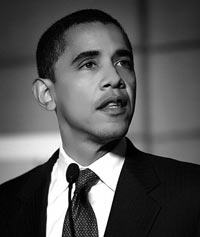
Product Obama

Young Barack“At the time when the American military industrial complex is despised around the world, [Barack Obama] is a front man out of central casting which will buy it more goodwill and new room to maneuver in the first 15 minutes after being sworn in that John McCain could in the next 100 years.”
 
Counterpoint columnist Joe Bageant was given the following essay by an unnamed political consultant:
Life in the Post-political Age.

Much has been written by political pundits in their attempt to explain the unexpected victory of Senator Barack Obama over Senator Hillary Clinton in this year’s Democratic Presidential Primary. When looking at the results of this race, none of the conventional political math that would help one handicap the outcome would make one conclude that Senator Obama would win this contest.

Inside a Democratic Party primary there is no demographic or political reason that a male first term African American senator from Illinois with an unorthodox name should come any where close to beating a white female senator, who happens to be the wife of the last Democratic President whose approval ratings are still above 70% with Democratic voters and who also happened to earn the endorsements of the substantial parts of the Democratic Party establishment.

The conventional analysis focused on the poor quality of the campaign run by Senator Clinton, her vote in support of the Iraq war and her advocacy of the cynical center-right triangulation policies of her husband, which soured her campaign to many primary voters and especially to Democratic Party activists. Senator Obama’s on the other hand was credited with running an innovative and inspiring campaign that excited primary voters and brought many new and especially younger voters into the electoral process.

There is some truth to this analysis, but as a whole it misses the underlying social change in society that had already laid the groundwork for a possible Obama victory. To get a clearer understanding of the results, we must better understand what this social change is and how its impact is far more significant than the dynamics of the two respective campaigns.

The underlying social change that led to the Obama victory is the unprecedented extent to which the narrative of popular consumer culture, and the media that drives it, has become the dominant influence on how Americans think, formulate their ideas and understand the world around them.

The most important result of this process has been the steady and consistent depoliticization of American society, to an extent that we can make the case that we are living at the dawn of the post political age.

The two primary features of the post political age are a politics completely drained of all its contents and ability or willingness to be used as an agent of change in social or economic policy, and its full integrations into the world of American popular, consumer and entertainment culture. To such an extent that there exists today a seamless web between our political, economic, media and consumer cultures wherein the modes and values of one are completely integrated and compatible with the others.

It should not come as a surprise that the dominant ideas and mores of popular culture have become the dominant ideas of our society. Popular culture is the breaker of customs, prejudice, tradition and relevant historical knowledge.

It is a result of this dynamic that the two consistent winners in American politics over the last 30 years have been the cultural left and the economic right. Despite the massive organizing drive of the religious right over the past three decades, they are further away from reversing the cultural liberalization of American society than when they started. On others side of the ledger, organized labor outside of a few urban pockets and industries is no longer a relevant force in American life. The ever greater electoral activism of both of these groups is generally misunderstood as a show of strength; in fact, it is the exact opposite. It is the desperate fight of the losing side of the American economic, cultural and political scene.

In essence the same forces that make it possible for the rapid acceptance of ideas such as gay marriage are the same force which can create a society that will accept massive social inequalities.

In the post political world and the candidates who can best thrive in it have tremendous appeal to the economic elites, a system that does not dwell on issues and will never ask the question, “who has power and why”, but simultaneously creates a social and media environment of stupefying distractions while destroying traditional social mores (under-credited as a source of much social solidarity). This can only benefit their continued rule of that society.

In such a setting our political choices like our consumer choices, regardless of the product, are primarily about what makes us more fulfilled and feel better about ourselves.

Senator Obama’s campaign understood much better the impact of these changes on our electoral system than any of his opponents’ campaigns. In the post political world, the campaign that is less political and less issue-based but is savvier in using new modes of communication technology will be the campaign to win the greatest market share of the electorate. The candidate in this case, Obama, was not a political entity but, in essence a product, an ornament that made his supporters feel better about themselves.

One of the most telling facts about the Obama’s constituency outside of African Americans (whose support needs no explanation) is that it is a coalition of people who need or demand the least amount of social benefit from our government. They are the under politicized younger voters and upper middle class whites. The two groups, coincidently, are the ones most influenced by trends in consumer popular culture and have the greatest of ease using the latest technologies.

In commercial advertising it is the poor commercial that lists the seventeen functions of the product being marketed. The best commercials are based on image associations entirely unrelated to the functions of the actual product. In the post political world, when the same principle is applied to the political realm, it makes complete sense how Barack Obama no longer is a black man with a strange name but the iPod to Hillary Clinton’s cell phone. In the world of toys it is the one that stands out the most is the most marketable.

The reality of the post political period is best highlighted in the failed themes and ideas of Barack Obama’s two primary opponents. The Clinton campaign was based on pushing two concurrent ideas: the inevitability factor of her candidacy and the other was her supposed experience. The only thing inevitable in the post political period is ceaseless change, which she could hardly offer while running against the candidate of “Change”. How valuable of an asset can experience be in a culture where knowledge, wisdom and history are frowned upon?

John Edwards campaign on the other hand was dead on arrival. His theme and emphasis was America’s ever widening class differences, a platform as truthful as it was irrelevant. The use of the word “class” will end any political career in America. That truth violates the primary narrative that our elite use to justify their legitimacy, which is the supposed meritocratic nature of America society. While the post political constituencies have absolutely no interest in class, whose very acknowledgment are the bases of all real politics and whose acknowledgement would only lead to an existential crisis in its ranks. In the post political period the only differences allowed can be in style and modes of consumption.

Given all this as the background, what are we to make of the campaign of the candidate of hope, audacity and change? The answer lies in understanding Senator Obama’s appeal to the brighter sections of the economic and political elite, and more importantly in the lack of any organized opposition against him, of the kind that within a matter of days destroyed Howard Dean’s campaign in 2004.

At the precise moment that the intellectual underpinnings of conservative free market ideas that have dominated politics for the past 30 years are crumbling across the globe. Obama calls for a post ideological and partisan world.

At the time when the American military industrial complex is despised around the world, he is a front man out of central casting which will buy it more goodwill and new room to maneuver in the first 15 minutes after being sworn in that John McCain could in the next 100 years.

His very presence, the color of his skin, the very strangeness of his name is the best guarantee of his betrayal of the expectations of the constituencies that will vote to elect him. Barack Obama is in short order a far more reassuring prospect for the continued dominance of the financial elite than another four years of neo-conservative rule which in an almost historically unique combination of greed, ill will, incompetence and stupidity have brought the country to the edge of disaster.

Audacity yes, change hardly.

Global economic rapists are at it again

G8 protest
Why protest the G8 Summit July 7-9? Those hoodlums always look so determined. Here’s the rationale by the Emergency Exit Collective:

The 2008 G8 on Hokkaido, a Strategic Assessment
Emergency Exit Collective
Bristol, Mayday, 2008

The authors of this document are a collection of activists, scholars, and writers currently based in the United States and Western Europe who have gotten to know and work with each other in the movement against capitalist globalization. We’re writing this at the request of some members of No! G8 Action Japan, who asked us for a broad strategic analysis of the state of struggle as we see it, and particularly, of the role of the G8, what it represents, the dangers and opportunities that may lie hidden in the moment. It is in no sense programmatic. Mainly, it is an attempt to develop tools that we hope will be helpful for organizers, or for anyone engaged in the struggle against global capital.

I
It is our condition as human beings that we produce our lives in common.

II
Let us then try to see the world from the perspective of the planet’s commoners, taking the word in that sense: those whose most essential tradition is cooperation in the making and maintenance of human social life, yet who have had to do so under conditions of suffering and separation; deprived, ignored, devalued, divided into hierarchies, pitted against each other for our very physical survival. In one sense we are all commoners. But it’s equally true that just about everyone, at least in some ways, at some points, plays the role of the rulers—of those who expropriate, devalue and divide—or at the very least benefits from such divisions.

Obviously some do more than others. It is at the peak of this pyramid that we encounter groups like the G8.

III
The G8’s perspective is that of the aristocrats, the rulers: those who command and maintain that global machinery of violence that defends existing borders and lines of separation: whether national borders with their detention camps for migrants, or property regimes, with their prisons for the poor. They live by constantly claiming title to the products of others collective creativity and labour, and in thus doing they create the poor; they create scarcity in the midst of plenty, and divide us on a daily basis; they create financial districts that loot resources from across the world, and in thus doing they turn the spirit of human creativity into a spiritual desert; close or privatize parks, public water taps and libraries, hospitals, youth centers, universities, schools, public swimming pools, and instead endlessly build shopping malls that channels convivial life into a means of commodity circulation; work toward turning global ecological catastrophe into business opportunities.

These are the people who presume to speak in the name of the “international community” even as they hide in their gated communities or meet protected by phalanxes of riot cops. It is critical to bear in mind that the ultimate aim of their policies is never to create community but to introduce and maintain divisions that set common people at each other’s throats. The neoliberal project, which has been their main instrument for doing so for the last three decades, is premised on a constant effort either to uproot or destroy any communal or democratic system whereby ordinary people govern their own affairs or maintain common resources for the common good, or, to reorganize each tiny remaining commons as an isolated node in a market system in which livelihood is never guaranteed, where the gain of one community must necessarily be at the expense of others. Insofar as they are willing to appeal to high-minded principles of common humanity, and encourage global cooperation, only and exactly to the extent that is required to maintain this system of universal competition.

IV
At the present time, the G8—the annual summit of the leaders of “industrial democracies”—is the key coordinative institution charged with the task of maintaining this neoliberal project, or of reforming it, revising it, adapting it to the changing condition of planetary class relations. The role of the G8 has always been to define the broad strategic horizons through which the next wave of planetary capital accumulation can occur. This means that its main task is to answer the question of how 3?4 in the present conditions of multiple crises and struggles 3?4 to subordinate social relations among the producing commoners of the planet to capital’s supreme value: profit.

V
Originally founded as the G7 in 1975 as a means of coordinating financial strategies for dealing with the ‘70s energy crisis, then expanded after the end of the Cold War to include Russia, its currently face a moment of profound impasse in the governance of planetary class relations: the greatest since the ‘70s energy crisis itself.

VI
The ‘70s energy crisis represented the final death-pangs of what might be termed the Cold War settlement, shattered by a quarter century of popular struggle. It’s worth returning briefly to this history.

The geopolitical arrangements put in place after World War II were above all designed to forestall the threat of revolution. In the immediate wake of the war, not only did much of the world lie in ruins, most of world’s population had abandoned any assumption about the inevitability of existing social arrangements. The advent of the Cold War had the effect of boxing movements for social change into a bipolar straightjacket. On the one hand, the former Allied and Axis powers that were later to unite in the G7 (the US, Canada, UK, France, Italy, Germany, Japan)—the “industrialized democracies”, as they like to call themselves—engaged in a massive project of co-optation. Their governments continued the process, begun in the ‘30s, of taking over social welfare institutions that had originally been created by popular movements (from insurance schemes to public libraries), even to expand them, on condition that they now be managed by state-appointed bureaucracies rather than by those who used them, buying off unions and the working classes more generally with policies meant to guarantee high wages, job security and the promise of educational advance—all in exchange for political loyalty, productivity increases and wage divisions within national and planetary working class itself. The Sino-Soviet bloc—which effectively became a kind of junior partner within the overall power structure, and its allies remained to trap revolutionary energies into the task of reproducing similar bureaucracies elsewhere. Both the US and USSR secured their dominance after the war by refusing to demobilize, instead locking the planet in a permanent threat of nuclear annihilation, a terrible vision of absolute cosmic power.

VII
Almost immediately, though, this arrangement was challenged by a series of revolts from those whose work was required to maintain the system, but who were, effectively, left outside the deal: first, peasants and the urban poor in the colonies and former colonies of the Global South, next, disenfranchised minorities in the home countries (in the US, the Civil Rights movement, then Black Power), and finally and most significantly, by the explosion of the women’s movement of the late ‘60s and early ‘70s—the revolt of that majority of humanity whose largely unremunerated labor made the very existence “the economy” possible. This appears to have been the tipping point.

VIII
The problem was that the Cold War settlement was never meant to include everyone. It by definition couldn’t. Once matters reached tipping point, then, the rulers scotched the settlement. All deals were off. The oil shock was first edge of the counter-offensive, breaking the back of existing working class organizations, driving home the message that there was nothing guaranteed about prosperity. Under the aegis of the newly hatched G7, this counter-offensive involved a series of interwoven strategies that were later to give rise to what is known as neoliberalism.

IX
These strategies resulted in what came to be known as “Structural Adjustment” both in the North and in the South, accompanied by trade and financial liberalization. This, in turn, made possible crucial structural changes in our planetary production in common extending the role of the market to discipline our lives and divide us into more and more polarized wage hierarchy. This involved:

· In the immediate wake of ‘70s oil shock, petrodollars were recycled from OPEC into Northern banks that then lent them, at extortionate rates of interest, to developing countries of the Global South. This was the origin of the famous “Third World Debt Crisis.” The existence of this debt allowed institutions like the IMF to impose its monetarist orthodoxy on most of the planet for roughly twenty years, in the process, stripping away most of even those modest social protections that had been won by the world’s poor—large numbers of whom were plunged into a situation of absolute desperation.

· It also opened a period of new enclosures through the capitalist imposition of structural adjustment policies, manipulation of environmental and social catastrophes like war, or for that matter through the authoritarian dictates of “socialist” regimes. Through such means, large sections of the world’s population have over the past thirty years been dispossessed from resources previously held in common, either by dint of long traditions, or as the fruits of past struggles and past settlements.

· Through financial deregulation and trade liberalization, neoliberal capital, which emerged from the G7 strategies to deal with the 1970s crisis aimed thus at turning the “class war” in communities, factories, offices, streets and fields against the engine of competition, into a planetary “civil war”, pitting each community of commoners against every other community of commoners.

· Neoliberal capital has done this by imposing an ethos of “efficiency” and rhetoric of “lowering the costs of production” applied so broadly that mechanisms of competition have come to pervade every sphere of life. In fact these terms are euphemisms, for a more fundamental demand: that capital be exempt from taking any reduction in profit to finance the costs of reproduction of human bodies and their social and natural environments (which it does not count as costs) and which are, effectively, “exernalized” onto communities and nature.

· The enclosure of resources and entitlements won in previous generations of struggles both in the North and the South, in turn, created the conditions for increasing the wage hierarchies (both global and local), by which commoners work for capital—wage hierarchies reproduced economically through pervasive competition, but culturally, through male dominance, xenophobia and racism. These wage gaps, in turn, made it possible to reduce the value of Northern workers’ labour power, by introducing commodities that enter in their wage basket at a fraction of what their cost might otherwise have been. The planetary expansion of sweatshops means that American workers (for example) can buy cargo pants or lawn-mowers made in Cambodia at Walmart, or buy tomatoes grown by undocumented Mexican workers in California, or even, in many cases, hire Jamaican or Filipina nurses to take care of children and aged grandparents at such low prices, that their employers have been able to lower real wages without pushing most of them into penury. In the South, meanwhile, this situation has made it possible to discipline new masses of workers into factories and assembly lines, fields and offices, thus extending enormously capital’s reach in defining the terms—the what, the how, the how much—of social production.

· These different forms of enclosures, both North and South, mean that commoners have become increasingly dependent on the market to reproduce their livelihoods, with less power to resist the violence and arrogance of those whose priorities is only to seek profit, less power to set a limit to the market discipline running their lives, more prone to turn against one another in wars with other commoners who share the same pressures of having to run the same competitive race, but not the same rights and the same access to the wage. All this has meant a generalized state of precarity, where nothing can be taken for granted.

X
In turn, this manipulation of currency and commodity flows constituting neoliberal globalization became the basis for the creation of the planet’s first genuine global bureaucracy.

· This was multi-tiered, with finance capital at the peak, then the ever-expanding trade bureaucracies (IMF, WTO, EU, World Bank, etc), then transnational corporations, and finally, the endless varieties of NGOs that proliferated throughout the period—almost all of which shared the same neoliberal orthodoxy, even as they substituted themselves for social welfare functions once reserved for states.

· The existence of this overarching apparatus, in turn, allowed poorer countries previously under the control of authoritarian regimes beholden to one or another side in the Cold War to adopt “democratic” forms of government. This did allow a restoration of formal civil liberties, but very little that could really merit the name of democracy (the rule of the “demos”, i.e., of the commoners). They were in fact constitutional republics, and the overwhelming trend during the period was to strip legislatures, that branch of government most open to popular pressure, of most of their powers, which were increasingly shifted to the executive and judicial branches, even as these latter, in turn, largely ended up enacting policies developed overseas, by global bureaucrats.

· This entire bureaucratic arrangement was justified, paradoxically enough, by an ideology of extreme individualism. On the level of ideas, neoliberalism relied on a systematic cooptation of the themes of popular struggle of the ‘60s: autonomy, pleasure, personal liberation, the rejection of all forms of bureaucratic control and authority. All these were repackaged as the very essence of capitalism, and the market reframed as a revolutionary force of liberation.

· The entire arrangement, in turn, was made possible by a preemptive attitude towards popular struggle. The breaking of unions and retreat of mass social movements from the late ‘70s onwards was only made possible by a massive shift of state resources into the machinery of violence: armies, prisons and police (secret and otherwise) and an endless variety of private “security services”, all with their attendant propaganda machines, which tended to increase even as other forms of social spending were cut back, among other things absorbing increasing portions of the former proletariat, making the security apparatus an increasingly large proportion of total social spending. This approach has been very successful in holding back mass opposition to capital in much of the world (especially West Europe and North America), and above all, in making it possible to argue there are no viable alternatives. But in doing so, has created strains on the system so profound it threatens to undermine it entirely.

XI
The latter point deserves elaboration. The element of force is, on any number of levels, the weak point of the system. This is not only on the constitutional level, where the question of how to integrate the emerging global bureaucratic apparatus, and existing military arrangements, has never been resolved. It is above all an economic problem. It is quite clear that the maintenance of elaborate security machinery is an absolute imperative of neoliberalism. One need only observe what happened with the collapse of the Soviet bloc in Eastern Europe: where one might have expected the Cold War victors to demand the dismantling of the army, secret police and secret prisons, and to maintain and develop the existing industrial base, in fact, what they did was absolutely the opposite: in fact, the only part of the industrial base that has managed fully to maintain itself has been the parts required to maintained the security apparatus itself! Critical too is the element of preemption: the governing classes in North America, for example, are willing to go to almost unimaginable lengths to ensure social movements never feel they are accomplishing anything. The current Gulf War is an excellent example: US military operations appear to be organized first and foremost to be protest-proof, to ensure that what happened in Vietnam (mass mobilization at home, widespread revolt within the army overseas) could never be repeated. This means above all that US casualties must always be kept to a minimum. The result are rules of engagement, and practices like the use of air power within cities ostensibly already controlled by occupation forces, so obviously guaranteed to maximize the killing of innocents and galvanizing hatred against the occupiers that they ensure the war itself cannot be won. Yet this approach can be taken as the very paradigm for neoliberal security regimes. Consider security arrangements around trade summits, where police are so determined prevent protestors from achieving tactical victories that they are often willing to effectively shut down the summits themselves. So too in overall strategy. In North America, such enormous resources are poured into the apparatus of repression, militarization, and propaganda that class struggle, labor action, mass movements seem to disappear entirely. It is thus possible to claim we have entered a new age where old conflicts are irrelevant. This is tremendously demoralizing of course for opponents of the system; but those running the system seem to find that demoralization so essential they don’t seem to care that the resultant apparatus (police, prisons, military, etc) is, effectively, sinking the entire US economy under its dead weight.

XII
The current crisis is not primarily geopolitical in nature. It is a crisis of neoliberalism itself. But it takes place against the backdrop of profound geopolitical realignments. The decline of North American power, both economic and geopolitical has been accompanied by the rise of Northeast Asia (and to a increasing extent, South Asia as well). While the Northeast Asian region is still divided by painful Cold War cleavages—the fortified lines across the Taiwan straits and at the 38th parallel in Korea…—the sheer realities of economic entanglement can be expected to lead to a gradual easing of tensions and a rise to global hegemony, as the region becomes the new center of gravity of the global economy, of the creation of new science and technology, ultimately, of political and military power. This may, quite likely, be a gradual and lengthy process. But in the meantime, very old patterns are rapidly reemerging: China reestablishing relations with ancient tributary states from Korea to Vietnam, radical Islamists attempting to reestablish their ancient role as the guardians of finance and piety at the in the Central Asian caravan routes and across Indian Ocean, every sort of Medieval trade diaspora reemerging… In the process, old political models remerge as well: the Chinese principle of the state transcending law, the Islamic principle of a legal order transcending any state. Everywhere, we see the revival too of ancient forms of exploitation—feudalism, slavery, debt peonage—often entangled in the newest forms of technology, but still echoing all the worst abuses of the Middle Ages. A scramble for resources has begun, with US occupation of Iraq and saber-rattling throughout the surrounding region clearly meant (at least in part) to place a potential stranglehold the energy supply of China; Chinese attempts to outflank with its own scramble for Africa, with increasing forays into South America and even Eastern Europe. The Chinese invasion into Africa (not as of yet at least a military invasion, but already involving the movement of hundreds of thousands of people), is changing the world in ways that will probably be felt for centuries. Meanwhile, the nations of South America, the first victims of the “Washington consensus” have managed to largely wriggle free from the US colonial orbit, while the US, its forces tied down in the Middle East, has for the moment at least abandoned it, is desperately struggling to keep its grip Mexico, Central America and the Caribbean—its own “near abroad”.

XIII
In another age all this might have led to war—that is, not just colonial occupations, police actions, or proxy wars (which are obviously already taking place), but direct military confrontations between the armies of major powers. It still could; accidents happen; but there is reason to believe that, when it comes to moments of critical decision, the loyalties of the global elites are increasingly to each other, and not to the national entities for whom they claim to speak. There is some compelling evidence for this.

Take for example when the US elites panicked at the prospect of the massive budget surpluses of the late 1990s. As Alan Greenspan, head of the Federal Reserve at the time warned, if these were allowed to stand they would have flooded government coffers with so many trillions of dollars that it could only have lead to some form of creeping socialism, even, he predicted, to the government acquiring “equity stakes” in key US corporations. The more excitable of capitalism’s managers actually began contemplating scenarios where the capitalist system itself would be imperiled. The only possible solution was massive tax cuts; these were duly enacted, and did indeed manage to turn surpluses into enormous deficits, financed by the sale of treasury bonds to Japan and China. Conditions have thus now reached a point where it is beginning to look as if the most likely long term outcome for the US (its technological and industrial base decaying, sinking under the burden of its enormous security spending) will be to end up serve as junior partner and military enforcer for East Asia capital. Its rulers, or at least a significant proportion of them, would prefer to hand global hegemony to the rulers of China (provided the latter abandon Communism) than to return to any sort of New Deal compromise with their “own” working classes.

A second example lies in the origins of what has been called the current “Bretton Woods II” system of currency arrangements, which underline a close working together of some “surplus” and “deficit” countries within global circuits. The macroeconomic manifestation of the planetary restructuring outlined in XIX underlines both the huge US trade deficit that so much seem to worry many commentators, and the possibility to continually generate new debt instruments like the one that has recently resulted in the sub-prime crisis. The ongoing recycling of accumulated surplus of countries exporting to the USA such as China and oil producing countries is what has allowed financiers to create new credit instruments in the USA. Hence, the “deal” offered by the masters in the United States to its commoners has been this: ‘you, give us a relative social peace and accept capitalist markets as the main means through which you reproduce your own livelihoods, and we will give you access to cheaper consumption goods, access to credit for buying cars and homes, and access to education, health, pensions and social security through the speculative means of stock markets and housing prices.’ Similar compromises were reached in all the G8 countries.

Meanwhile, there is the problem of maintaining any sort of social peace with the hundreds of millions of unemployed, underemployed, dispossessed commoners currently swelling the shanty-towns of Asia, Africa, and Latin America as a result of ongoing enclosures (which have speeded up within China and India in particular, even as “structural adjustment policies” in Africa and Latin America have been derailed). Any prospect of maintaining peace in these circumstances would ordinarily require either extremely high rates of economic growth—which globally have not been forthcoming, since outside of China, growth rates in the developing world have been much lower than they were in the ‘50s, ‘60s, or even ‘70s—or extremely high levels of repression, lest matters descend into rebellion or generalized civil war. The latter has of course occurred in many parts of the world currently neglected by capital, but in favored regions, such as the coastal provinces of China, or “free trade” zones of India, Egypt, or Mexico, commoners are being offered a different sort of deal: industrial employment at wages that, while very low by international standards, are still substantially higher than anything currently obtainable in the impoverished countryside; and above all the promise, through the intervention of Western markets and (privatized) knowledge, of gradually improving conditions of living. While over the least few years wages in many such areas seem to be growing, thanks to the intensification of popular struggles, such gains are inherently vulnerable: the effect of recent food inflation has been to cut real wages back dramatically—and threaten millions with starvation.

What we really want to stress here, though, is that the long-term promise being offered to the South is just as untenable as the idea that US or European consumers can indefinitely expand their conditions of life through the use of mortgages and credit cards.

What’s being offered the new dispossessed is a transposition of the American dream. The idea is that the lifestyle and consumption patterns of existing Chinese, Indian, or Brazilian or Zambian urban middle classes (already modeled on Northern ones) will eventually become available to the children of today’s miners, maquila or plantation laborers, until, ultimately, everyone on earth is brought up to roughly the same level of consumption. Put in these terms, the argument is absurd. The idea that all six billion of us can become “middle class” is obviously impossible. First of all there is a simple problem of resources. It doesn’t matter how many bottles we recycle or how energy efficient are the light bulbs we use, there’s just no way the earth’s ecosystem can accommodate six billion people driving in private cars to work in air-conditioned cubicles before periodically flying off to vacation in Acapulco or Tahiti. To maintain the style of living and producing in common we now identify with “middle classness” on a planetary scale would require several additional planets.

This much has been pointed out repeatedly. But the second point is no less important. What this vision of betterment ultimately proposes is that it would be possible to build universal prosperity and human dignity on a system of wage labor. This is fantasy. Historically, wages are always the contractual face for system of command and degradation, and a means of disguising exploitation: expressing value for work only on condition of stealing value without work— and there is no reason to believe they could ever be anything else. This is why, as history has also shown, human beings will always avoid working for wages if they have any other viable option. For a system based on wage labor to come into being, such options must therefore be made unavailable. This in turn means that such systems are always premised on structures of exclusion: on the prior existence of borders and property regimes maintained by violence. Finally, historically, it has always proved impossible to maintain any sizeable class of wage-earners in relative prosperity without basing that prosperity, directly or indirectly, on the unwaged labor of others—on slave-labor, women’s domestic labor, the forced labor of colonial subjects, the work of women and men in peasant communities halfway around the world—by people who are even more systematically exploited, degraded, and immiserated. For that reason, such systems have always depended not only on setting wage-earners against each other by inciting bigotry, prejudice, hostility, resentment, violence, but also by inciting the same between men and women, between the people of different continents (“race”), between the generations.

From the perspective of the whole, then, the dream of universal middle class “betterment” must necessarily be an illusion constructed in between the Scylla of ecological disaster, and the Charybdis of poverty, detritus, and hatred: precisely, the two pillars of today’s strategic impasse faced by the G8.

XIV
How then do we describe the current impasse of capitalist governance?

To a large degree, it is the effect of a sudden and extremely effective upswing of popular resistance—one all the more extraordinary considering the huge resources that had been invested in preventing such movements from breaking out.

On the one hand, the turn of the millennium saw a vast and sudden flowering of new anti-capitalist movements, a veritable planetary uprising against neoliberalism by commoners in Latin America, India, Africa, Asia, across the North Atlantic world’s former colonies and ultimately, within the cities of the former colonial powers themselves. As a result, the neoliberal project lies shattered. What came to be called the “anti-globalization” movement took aim at the trade bureaucracies—the obvious weak link in the emerging institutions of global administration—but it was merely the most visible aspect of this uprising. It was however an extraordinarily successful one. Not only was the WTO halted in its tracks, but all major trade initiatives (MAI, FTAA…) scuttled. The World Bank was hobbled and the power of the IMF over most of the world’s population, effectively, destroyed. The latter, once the terror of the Global South, is now a shattered remnant of its former self, reduced to selling off its gold reserves and desperately searching for a new global mission.

In many ways though spectacular street actions were merely the most visible aspects of much broader changes: the resurgence of labor unions, in certain parts of the world, the flowering of economic and social alternatives on the grassroots levels in every part of the world, from new forms of direct democracy of indigenous communities like El Alto in Bolivia or self-managed factories in Paraguay, to township movements in South Africa, farming cooperatives in India, squatters’ movements in Korea, experiments in permaculture in Europe or “Islamic economics” among the urban poor in the Middle East. We have seen the development of thousands of forms of mutual aid association, most of which have not even made it onto the radar of the global media, often have almost no ideological unity and which may not even be aware of each other’s existence, but nonetheless share a common desire to mark a practical break with capitalism, and which, most importantly, hold out the prospect of creating new forms of planetary commons that can—and in some cases are—beginning to knit together to provide the outlines of genuine alternative vision of what a non-capitalist future might look like.

The reaction of the world’s rulers was predictable. The planetary uprising had occurred during a time when the global security apparatus was beginning to look like it lacked a purpose, when the world threatened to return to a state of peace. The response—aided of course, by the intervention of some of the US’ former Cold War allies, reorganized now under the name of Al Qaeda—was a return to global warfare. But this too failed. The “war on terror”—as an attempt to impose US military power as the ultimate enforcer of the neoliberal model—has collapsed as well in the face of almost universal popular resistance. This is the nature of their “impasse”.

At the same time, the top-heavy, inefficient US model of military capitalism—a model created in large part to prevent the dangers of social movements, but which the US has also sought to export to some degree simply because of its profligacy and inefficiency, to prevent the rest of the world from too rapidly overtaking them—has proved so wasteful of resources that it threatens to plunge the entire planet into ecological and social crisis. Drought, disaster, famines, combine with endless campaigns of enclosure, foreclosure, to cast the very means of survival—food, water, shelter—into question for the bulk of the world’s population.

XV
In the rulers’ language the crisis understood, first and foremost, as a problem of regulating cash flows, of reestablishing, as they like to put it, a new “financial architecture”. Obviously they are aware of the broader problems. Their promotional literature has always been full of it. From the earliest days of the G7, through to the days after the Cold War, when Russia was added as a reward for embracing capitalism, they have always claimed that their chief concerns include

· the reduction of global poverty

· sustainable environmental policies

· sustainable global energy policies

· stable financial institutions governing global trade and currency transactions

If one were to take such claims seriously, it’s hard to see their overall performance as anything but a catastrophic failure. At the present moment, all of these are in crisis mode: there are food riots, global warming, peak oil, and the threat of financial meltdown, bursting of credit bubbles, currency crises, a global credit crunch. [**Failure on this scale however, opens opportunities for the G8 themselves, as summit of the global bureaucracy, to reconfigure the strategic horizon. Therefore, it’s always with the last of these that they are especially concerned. ]The real problem, from the perspective of the G8, is one of reinvestment: particularly, of the profits of the energy sector, but also, now, of emerging industrial powers outside the circle of the G8 itself. The neoliberal solution in the ‘70s had been to recycle OPEC’s petrodollars into banks that would use it much of the world into debt bondage, imposing regimes of fiscal austerity that, for the most part, stopped development (and hence, the emergence potential rivals) in its tracks. By the ‘90s, however, much East Asia in particular had broken free of this regime. Attempts to reimpose IMF-style discipline during the Asian financial crisis of 1997 largely backfired. So a new compromise was found, the so-called Bretton Woods II: to recycle the profits from the rapidly expanding industrial economies of East Asia into US treasury debt, artificially supporting the value of the dollar and allowing a continual stream of cheap exports that, aided by the US housing bubble, kept North Atlantic economies afloat and buy off workers there with cheap oil and even cheaper consumer goods even as real wages shrank. This solution however soon proved a temporary expedient. Bush regime’s attempt to lock it in by the invasion of Iraq, which was meant to lead to the forced privatization of Iraqi oil fields, and, ultimately, of the global oil industry as a whole, collapsed in the face of massive popular resistance (just as Saddam Hussein’s attempt to introduce neoliberal reforms in Iraq had failed when he was still acting as American deputy in the ‘90s). Instead, the simultaneous demand for petroleum for both Chinese manufacturers and American consumers caused a dramatic spike in the price of oil. What’s more, rents from oil and gas production are now being used to pay off the old debts from the ‘80s (especially in Asia and Latin America, which have by now paid back their IMF debts entirely), and—increasingly—to create state-managed Sovereign Wealth Funds that have largely replaced institutions like the IMF as the institutions capable of making long-term strategic investments. The IMF, purposeless, tottering on the brink of insolvency, has been reduced to trying to come up with “best practices” guidelines for fund managers working for governments in Singapore, Seoul, and Abu Dhabi.

There can be no question this time around of freezing out countries like China, India, or even Brazil. The question for capital’s planners, rather, is how to channel these new concentrations of capital in such a way that they reinforce the logic of the system instead of undermining it.

XVI
How can this be done? This is where appeals to universal human values, to common membership in an “international community” come in to play. “We all must pull together for the good of the planet,” we will be told. The money must be reinvested “to save the earth.”

To some degree this was always the G8 line: this is a group has been making an issue of climate change since 1983. Doing so was in one sense a response to the environmental movements of the ‘70s and ‘80s. The resultant emphasis on biofuels and “green energy” was from their point of view, the perfect strategy, seizing on an issue that seemed to transcend class, appropriating ideas and issues that emerged from social movements (and hence coopting and undermining especially their radical wings), and finally, ensuring such initiatives are pursued not through any form of democratic self-organization but “market mechanisms”—to effective make the sense of public interest productive for capitalism.

What we can expect now is a two-pronged attack. On the one hand, they will use the crisis to attempt to reverse the gains of past social movements: to put nuclear energy back on the table to deal with the energy crisis and global warming, or genetically modified foods to deal with the food crisis. Prime Minister Fukuda, the host of the current summit, for example, is already proposing the nuclear power is the “solution” to the global warming crisis, even as the German delegation resists. On the other, and even more insidiously, they will try once again to co-opt the ideas and solutions that have emerged from our struggles as a way of ultimately undermining them. Appropriating such ideas is simply what rulers do: the bosses brain is always under the workers’ hat. But the ultimate aim is to answer the intensification of class struggle, of the danger of new forms of democracy, with another wave of enclosures, to restore a situation where commoners’ attempts to create broader regimes of cooperation are stymied, and people are plunged back into mutual competition.

We can already see the outlines of how this might be done. There are already suggestions that Sovereign Wealth Funds put aside a certain (miniscule) proportion of their money for food aid, but only as tied to a larger project of global financial restructuring. The World Bank, largely bereft of its earlier role organizing dams and pipe-lines across the world, has been funding development in China’s poorer provinces, freeing the Chinese government to carry out similar projects in Southeast Asia, Africa, and even Latin America (where, of course, they cannot effectively be held to any sort of labor or environmental standards). There is the possibility of a new class deal in China itself, whose workers can be allowed higher standards of living if new low wage zones are created elsewhere—for instance, Africa (the continent where struggles over maintaining the commons have been most intense in current decades)—with the help of Chinese infrastructural projects. Above of all, money will be channeled into addressing climate change, into the development of alternative energy, which will require enormous investments, in such a way as to ensure that whatever energy resources do become important in this millennium, they can never be democratized—that the emerging notion of a petroleum commons, that energy resources are to some degree a common patrimony meant primarily to serve the community as a whole, that is beginning to develop in parts of the Middle East and South America—not be reproduced in whatever comes next.

Since this will ultimately have to be backed up by the threat of violence, the G8 will inevitably have to struggle with how to (yet again) rethink enforcement mechanisms. The latest move , now that the US “war on terror” paradigm has obviously failed, would appear to be a return to NATO, part of a reinvention of the “European security architecture” being proposed at the upcoming G8 meetings in Italy in 2009 on the 60th anniversary of NATO’s foundation—but part of a much broader movement of the militarization of social conflict, projecting potential resource wars, demographic upheavals resulting from climate change, and radical social movements as potential military problems to be resolved by military means. Opposition to this new project is already shaping up as the major new European mobilization for the year following the current G-8.

XVII
While the G-8 sit at the pinnacle of a system of violence, their preferred idiom is monetary. Their impulse whenever possible is to translate all problems into money, financial structures, currency flows—a substance whose movements they carefully monitor and control.

Money, on might say, is their poetry—a poetry whose letters are written in our blood. It is their highest and most abstract form of expression, their way of making statements about the ultimate truth of the world, even if it operates in large part by making things disappear. How else could it be possible to argue—no, to assume as a matter of common sense—that the love, care, and concern of a person who tends to the needs of children, teaching, minding, helping them to become decent , thoughtful, human beings, or who grows and prepares food, is worth ten thousand times less than someone who spends the same time designing a brand logo, moving abstract blips across a globe, or denying others health care.

The role of money however has changed profoundly since 1971 when the dollar was delinked from gold. This has created a profound realignment of temporal horizons. Once money could be said to be primarily congealed results of past profit and exploitation. As capital, it was dead labor. Millions of indigenous Americans and Africans had their lives pillaged and destroyed in the gold mines in order to be rendered into value. The logic of finance capital, of credit structures, certainly always existed as well (it is at least as old as industrial capital; possibly older), but in recent decades these logic of financial capital has come to echo and re-echo on every level of our lives. In the UK 97% of money in circulation is debt, in the US, 98%. Governments run on deficit financing, wealthy economies on consumer debt, the poor are enticed with microcredit schemes, debts are packaged and repackaged in complex financial derivatives and traded back and forth. Debt however is simply a promise, the expectation of future profit; capital thus increasingly brings the future into the present—a future that, it insists, must always be the same in nature, even if must also be greater in magnitude, since of course the entire system is premised on continual growth. Where once financiers calculated and traded in the precise measure of our degradation, having taken everything from us and turned it into money, now money has flipped, to become the measure of our future degradation—at the same time as it binds us to endlessly working in the present.

The result is a strange moral paradox. Love, loyalty, honor, commitment—to our families, for example, which means to our shared homes, which means to the payment of monthly mortgage debts—becomes a matter of maintaining loyalty to a system which ultimately tells us that such commitments are not a value in themselves. This organization of imaginative horizons, which ultimately come down to a colonization of the very principle of hope, has come to supplement the traditional evocation of fear (of penury, homelessness, joblessness, disease and death). This colonization paralyzes any thought of opposition to a system that almost everyone ultimately knows is not only an insult to everything they really cherish, but a travesty of genuine hope, since, because no system can really expand forever on a finite planet, everyone is aware on some level that in the final analysis they are dealing with a kind of global pyramid scheme, what we are ultimately buying and selling is the real promise of global social and environmental apocalypse.

XVIII
Finally then we come to the really difficult, strategic questions. Where are the vulnerabilities? Where is hope? Obviously we have no certain answers here. No one could. But perhaps the proceeding analysis opens up some possibilities that anti-capitalist organizers might find useful to explore.

One thing that might be helpful is to rethink our initial terms. Consider communism. We are used to thinking of it as a total system that perhaps existed long ago, and to the desire to bring about an analogous system at some point in the future—usually, at whatever cost. It seems to us that dreams of communist futures were never purely fantasies; they were simply projections of existing forms of cooperation, of commoning, by which we already make the world in the present. Communism in this sense is already the basis of almost everything, what brings people and societies into being, what maintains them, the elemental ground of all human thought and action. There is absolutely nothing utopian here. What is utopian, really, is the notion that any form of social organization, especially capitalism, could ever exist that was not entirely premised on the prior existence of communism. If this is true, the most pressing question is simply how to make that power visible, to burst forth, to become the basis for strategic visions, in the face of a tremendous and antagonistic power committed to destroying it—but at the same time, ensuring that despite the challenge they face, they never again become entangled with forms of violence of their own that make them the basis for yet another tawdry elite. After all, the solidarity we extend to one another, is it not itself a form of communism? And is it not so above because it is not coerced?

Another thing that might be helpful is to rethink our notion of crisis. There was a time when simply describing the fact that capitalism was in a state of crisis, driven by irreconcilable contradictions, was taken to suggest that it was heading for a cliff. By now, it seems abundantly clear that this is not the case. Capitalism is always in a crisis. The crisis never goes away. Financial markets are always producing bubbles of one sort or another; those bubbles always burst, sometimes catastrophically; often entire national economies collapse, sometimes the global markets system itself begins to come apart. But every time the structure is reassembled. Slowly, painfully, dutifully, the pieces always end up being put back together once again.

Perhaps we should be asking: why?

In searching for an answer, it seems to us, we might also do well to put aside another familiar habit of radical thought: the tendency to sort the world into separate levels—material realities, the domain of ideas or “consciousness”, the level of technologies and organizations of violence—treating these as if these were separate domains that each work according to separate logics, and then arguing which “determines” which. In fact they cannot be disentangled. A factory may be a physical thing, but the ownership of a factory is a social relation, a legal fantasy that is based partly on the belief that law exists, and partly on the existence of armies and police. Armies and police on the other hand exist partly because of factories providing them with guns, vehicles, and equipment, but also, because those carrying the guns and riding in the vehicles believe they are working for an abstract entity they call “the government”, which they love, fear, and ultimately, whose existence they take for granted by a kind of faith, since historically, those armed organizations tend to melt away immediately the moment they lose faith that the government actually exists. Obviously exactly the same can be said of money. It’s value is constantly being produced by eminently material practices involving time clocks, bank machines, mints, and transatlantic computer cables, not to mention love, greed, and fear, but at the same time, all this too rests on a kind of faith that all these things will continue to interact in more or less the same way. It is all very material, but it also reflects a certain assumption of eternity: the reason that the machine can always be placed back together is, simply, because everyone assumes it must. This is because they cannot realistically imagine plausible alternatives; they cannot imagine plausible alternatives because of the extraordinarily sophisticated machinery of preemptive violence that ensure any such alternatives are uprooted or contained (even if that violence is itself organized around a fear that itself rests on a similar form of faith.) One cannot even say it’s circular. It’s more a kind of endless, unstable spiral. To subvert the system is then, to intervene in such a way that the whole apparatus begins to spin apart.

XIX
It appears to us that one key element here—one often neglected in revolutionary strategy—is the role of the global middle classes. This is a class that, much though it varies from country (in places like the US and Japan, overwhelming majorities consider themselves middle class; in, say, Cambodia or Zambia, only very small percentages), almost everywhere provides the key constituency of the G8 outside of the ruling elite themselves. It has become a truism, an article of faith in itself in global policy circles, that national middle class is everywhere the necessary basis for democracy. In fact, middle classes are rarely much interested in democracy in any meaningful sense of that word (that is, of the self-organization or self-governance of communities). They tend to be quite suspicious of it. Historically, middle classes have tended to encourage the establishment of constitutional republics with only limited democratic elements (sometimes, none at all). This is because their real passion is for a “betterment”, for the prosperity and advance of conditions of life for their children—and this betterment, since it is as noted above entirely premised on structures of exclusion, requires “security”. Actually the middle classes depend on security on every level: personal security, social security (various forms of government support, which even when it is withdrawn from the poor tends to be maintained for the middle classes), security against any sudden or dramatic changes in the nature of existing institutions. Thus, politically, the middle classes are attached not to democracy (which, especially in its radical forms, might disrupt all this), but to the rule of law. In the political sense, then, being “middle class” means existing outside the notorious “state of exception” to which the majority of the world’s people are relegated. It means being able to see a policeman and feel safer, not even more insecure. This would help explain why within the richest countries, the overwhelming majority of the population will claim to be “middle class” when speaking in the abstract, even if most will also instantly switch back to calling themselves “working class” when talking about their relation to their boss.

That rule of law, in turn, allows them to live in that temporal horizon where the market and other existing institutions (schools, governments, law firms, real estate brokerages…) can be imagined as lasting forever in more or less the same form. The middle classes can thus be defined as those who live in the eternity of capitalism. (The elites don’t; they live in history, they don’t assume things will always be the same. The disenfranchized don’t; they don’t have the luxury; they live in a state of precarity where little or nothing can safely be assumed.) Their entire lives are based on assuming that the institutional forms they are accustomed to will always be the same, for themselves and their grandchildren, and their “betterment” will be proportional to the increase in the level of monetary wealth and consumption. This is why every time global capital enters one of its periodic crises, every time banks collapse, factories close, and markets prove unworkable, or even, when the world collapses in war, the managers and dentists will tend to support any program that guarantees the fragments will be dutifully pieced back together in roughly the same form—even if all are, at the same time, burdened by at least a vague sense that the whole system is unfair and probably heading for catastrophe.

XIX
The strategic question then is, how to shatter this sense of inevitability? History provides one obvious suggestion. The last time the system really neared self-destruction was in the 1930s, when what might have otherwise been an ordinary turn of the boom-bust cycle turned into a depression so profound that it took a world war to pull out of it. What was different? The existence of an alternative: a Soviet economy that, whatever its obvious brutalities, was expanding at breakneck pace at the very moment market systems were undergoing collapse. Alternatives shatter the sense of inevitability, that the system must, necessarily, be patched together in the same form; this is why it becomes an absolute imperative of global governance that even small viable experiments in other ways of organizing communities be wiped out, or, if that is not possible, that no one knows about them.

If nothing else, this explains the extraordinary importance attached to the security services and preemption of popular struggle. Commoning, where it already exists, must be made invisible. Alternatives— Zapatistas in Chiapas, APPO in Oaxaca, worker-managed factories in Argentina or Paraguay, community-run water systems in South Africa or Bolivia, living alternatives of farming or fishing communities in India or Indonesia, or a thousand other examples—must be made to disappear, if not squelched or destroyed, then marginalized to the point they seem irrelevant, ridiculous. If the managers of the global system are so determined to do this they are willing to invest such enormous resources into security apparatus that it threatens to sink the system entirely, it is because they are aware that they are working with a house of cards. That the principle of hope and expectation on which capitalism rests would evaporate instantly if almost any other principle of hope or expectation seemed viable.

The knowledge of alternatives, then, is itself a material force.

Without them, of course, the shattering of any sense of certainty has exactly the opposite effect. It becomes pure precarity, an insecurity so profound that it becomes impossible to project oneself in history in any form, so that the one-time certainties of middle class life itself becomes a kind of utopian horizon, a desperate dream, the only possible principle of hope beyond which one cannot really imagine anything. At the moment, this seems the favorite weapon of neoliberalism: whether promulgated through economic violence, or the more direct, traditional kind.

One form of resistance that might prove quite useful here – and is already being discussed in some quarters – are campaigns against debt itself. Not demands for debt forgiveness, but campaigns of debt resistance.

XX
In this sense the great slogan of the global justice movement, “another world is possible”, represents the ultimate threat to existing power structures. But in another sense we can even say we have already begun to move beyond that. Another world is not merely possible. It is inevitable. On the one hand, as we have pointed out, such a world is already in existence in the innumerable circuits of social cooperation and production in common based on different values than those of profit and accumulation through which we already create our lives, and without which capitalism itself would be impossible. On the other, a different world is inevitable because capitalism—a system based on infinite material expansion—simply cannot continue forever on a finite world. At some point, if humanity is to survive at all, we will be living in a system that is not based on infinite material expansion. That is, something other than capitalism.

The problem is there is no absolute guarantee that ‘something’ will be any better. It’s pretty easy to imagine “other worlds” that would be even worse. We really don’t have any idea what might happen. To what extent will the new world still organized around commoditization of life, profit, and pervasive competition? Or a reemergence of even older forms of hierarchy and degradation? How, if we do overcome capitalism directly, by the building and interweaving of new forms of global commons, do we protect ourselves against the reemergence of new forms of hierarchy and division that we might not now even be able to imagine?

It seems to us that the decisive battles that will decide the contours of this new world will necessarily be battles around values. First and foremost are values of solidarity among commoners. Since after all, every rape of a woman by a man or the racist murder of an African immigrant by a European worker is worth a division in capital’s army.

Similarly, imagining our struggles as value struggles might allow us to see current struggles over global energy policies and over the role of money and finance today as just an opening salvo of an even larger social conflict to come. For instance, there’s no need to demonize petroleum, for example, as a thing in itself. Energy products have always tended to play the role of a “basic good”, in the sense that their production and distribution becomes the physical basis for all other forms of human cooperation, at the same time as its control tends to organize social and even international relations. Forests and wood played such a role from the time of the Magna Carta to the American Revolution, sugar did so during the rise of European colonial empires in the 17th and 18th centuries, fossil fuels do so today. There is nothing intrinsically good or bad about fossil fuel. Oil is simply solar radiation, once processed by living beings, now stored in fossil form. The question is of control and distribution. This is the real flaw in the rhetoric over “peak oil”: the entire argument is premised on the assumption that, for the next century at least, global markets will be the only means of distribution. Otherwise the use of oil would depend on needs, which would be impossible to predict precisely because they depend on the form of production in common we adopt. The question thus should be: how does the anti-capitalist movement peak the oil? How does it become the crisis for a system of unlimited expansion?

It is the view of the authors of this text that the most radical planetary movements that have emerged to challenge the G8 are those that direct us towards exactly these kind of questions. Those which go beyond merely asking how to explode the role money plays in framing our horizons, or even challenging the assumption of the endless expansion of “the economy”, to ask why we assume something called “the economy” even exists, and what other ways we can begin imagining our material relations with one another. The planetary women’s movement, in its many manifestations, has and continues to play perhaps the most important role of all here, in calling for us to reimagine our most basic assumptions about work, to remember that the basic business of human life is not actually the production of communities but the production, the mutual shaping of human beings. The most inspiring of these movements are those that call for us to move beyond a mere challenge to the role of money to reimagine value: to ask ourselves how can we best create a situation where everyone is secure enough in their basic needs to be able to pursue those forms of value they decide are ultimately important to them. To move beyond a mere challenge to the tyranny of debt to ask ourselves what we ultimately owe to one another and to our environment. That recognize that none this needs to invented from whole cloth. It’s all already there, immanent in the way everyone, as commoners, create the world together on a daily basis. And that asking these questions is never, and can never be, an abstract exercise, but is necessarily part of a process by which we are already beginning to knit these forms of commons together into new forms of global commons that will allow entirely new conceptions of our place in history.

It is to those already engaged in such a project that we offer these initial thoughts on our current strategic situation.

List of top privately held US companies

The shift of businesses into private ownership represents the eroding stake which common Americans have in the Capitalist system. Stock holdings in most public corporations are predominantly in wealthy hands, but private corporations drop even the pretense of serving the middle class economy. Biggest ($90B) is Koch Industries which provides “beef, fuels, fertilizer and plastics.”

Forbes has a list of America’s largest privately held companies, 424 of which have yearly earnings over one billion dollars. We’ve grouped them by category for easier perusal, ranked by their earnings. Colorado is headquarters to twelve: TransMontaigne, First Data, Pro-Build Holdings, CH2N Hill Cos, Vistar, Sports Authority, Leprino Foods, Hensel Phelps Construction, TIC Holdings, MediaNews Group and NWH.

CONSUMER PRODUCTS:
Mars VA -Combos, Dove, M&Ms, Pedigree, Snickers, Uncle Ben’s Rice
Levi Strauss & Co CA Textile – Apparel Clothing
SC Johnson & Son WI Personal Products
Ashley Furniture Industries WI Home Furnishings & Fixtures
Rich Products NY Confectioners
MGA Entertainment CA Toys & Games
Mary Kay TX Cleaning Products
Alticor MI Personal Products
Conair CT Personal Products
JohnsonDiversey WI Cleaning Products
ViewSonic CA Computer Peripherals
New Balance Athletic Shoe MA Textile – Apparel Footwear
Dawn Food Products MI Confectioners to Starbucks, Krispy Kreme
Roll International CA -Teleflora, Fiji Water, POM, Suterra
Genmar Holdings MN Recreational Boats
Williamson-Dickie Manufacturing TX Textile – Apparel Clothing
McKee Foods TN Confectioners: Little Debbie, Sunbelt
Samsonite MA Personal Products
NewPage OH Paper & Paper Products
Bose MA Electronic Equipment
WL Gore & Associates DE Textile – Apparel Clothing
Milliken & Co SC Textile – Apparel Clothing
MTD Products OH Recreational Goods, Other

RETAILERS:
Toys “R” Us NJ Toy & Hobby Stores
Dollar General TN Discount, Variety Stores
Menard WI Home Improvement Stores
Neiman Marcus Group TX Department Stores
84 Lumber PA Home Improvement Stores
Hallmark Cards MO Entertainment – Diversified
Michaels Stores TX Specialty Retail, Other
Belk NC Department Stores
Burlington Coat Factory NJ Apparel Stores
Linens ‘n Things NJ Home Furnishing Stores
Sports Authority CO Sporting Goods Stores
Bass Pro Shops MO Sporting Goods Stores
Fry’s Electronics CA Specialty Retail, Other
Mervyns CA Department Stores
Follett IL Specialty Retail, Other
General Parts NC Auto Parts Stores
ShopKo Stores Operating WI Discount, Variety Stores
Petco Animal Supplies CA Specialty Retail, Other
Discount Tire AZ Auto Parts Stores
Guitar Center CA Music & Video Stores
Academy Sports & Outdoors TX Sporting Goods Stores
Rooms To Go FL Home Furnishing Stores
Hobby Lobby Stores OK Toy & Hobby Stores
Barnes & Noble College Booksellers NJ Specialty Retail, Other
Duane Reade NY Drug Stores
LL Bean ME Catalog & Mail Order Houses
Newegg.com CA Specialty Retail, Other
GNC PA Drug Stores
Goody’s Family Clothing TN Department Stores
Les Schwab Tire Centers OR Auto Parts Stores
Beall’s FL Department Stores
PC Richard & Son NY Specialty Retail, Other
Micro Electronics OH Specialty Retail, Other
Sutherland Lumber MO Home Improvement Stores
Boscov’s PA Department Stores
24 Hour Fitness Worldwide CA Consumer Services
Ritz Camera Centers MD Specialty Retail, Other
Schottenstein Stores OH Home Furnishing Stores
Cinemark USA TX General Entertainment
Marc Glassman OH Drug Stores
Bally Total Fitness IL Specialized Health Services
ClubCorp TX Consumer Services
Forever 21 CA Apparel Stores
BrandsMart USA FL Specialty Retail, Other
Steve and Barry’s NY Apparel Stores

HOSPITALITY:
Hilton Hotels CA Lodging
Love’s Travel Stops OK Lodging
Carlson Cos MN Lodging
Global Hyatt IL Lodging
Delaware North Cos NY Specialty Eateries
Ilitch Holdings MI Restaurants
Buffets MN Restaurants

GROCERS:
Meijer MI Grocery Stores
HE Butt Grocery TX Grocery Stores
Giant Eagle PA Grocery Stores
Cumberland Farms MA Grocery Stores
QuikTrip OK Grocery Stores
Hy-Vee IA Grocery Stores
Save Mart Supermarkets CA Grocery Stores
RaceTrac Petroleum GA Grocery Stores
Wawa PA Grocery Stores
Wegmans Food Markets NY Grocery Stores
Bi-Lo Holdings SC Grocery Stores
Stater Bros CA Grocery Stores
Sheetz PA Grocery Stores
Raley’s CA Grocery Stores
Golub NY Grocery Stores
WinCo Foods ID Grocery Stores
Schnuck Markets MO Grocery Stores
Demoulas Super Markets MA Grocery Stores
Brookshire Grocery TX Grocery Stores
Bashas’ AZ Grocery Stores
Houchens Industries KY Grocery Stores
Holiday Cos MN Grocery Stores
Marsh Supermarkets IN Grocery Stores
K-VA-T Food Stores VA Grocery Stores
Kum & Go IA Grocery Stores
Big Y Foods MA Grocery Stores
Gate Petroleum FL Grocery Stores
Foodarama Supermarkets NJ Grocery Stores
Thorntons KY Grocery Stores
Brookshire Brothers TX Grocery Stores
Minyard Food Stores TX Grocery Stores
Inserra Supermarkets NJ Grocery Stores
Stewart’s Shops NY Grocery Stores

FOOD SUPPLY:
C&S Wholesale Grocers NH Food Wholesale
US Foodservice MD Food – Major Diversified
Reyes Holdings IL Food Wholesale
Gordon Food Service MI Food Wholesale
MBM NC Food Wholesale
OSI Group IL Meat Products
Roundy’s Supermarkets WI Food Wholesale
HT Hackney TN Food Wholesale
Keystone Foods PA Meat Products
Perdue Farms MD Meat Products
Schwan Food MN Dairy Products
Eby-Brown IL Food Wholesale
Schreiber Foods WI Dairy Products
Vistar CO Food Wholesale: ROMA
Alex Lee NC Food Wholesale
Grocers Supply TX Food Wholesale
HP Hood MA Dairy Products
Services Group of America AZ Food Wholesale
Dot Foods IL Food Wholesale
Leprino Foods CO Dairy Products: mozzarella cheese
Rosen’s Diversified MN Meat Products
Ben E Keith TX Food Wholesale
Smart & Final CA Food Wholesale
Maines Paper & Food Service NY Food Wholesale
Foster Farms CA Meat Products
Koch Foods IL Meat Products
Red Chamber Group CA Food Wholesale
Shamrock Foods AZ Food Wholesale
ContiGroup Cos NY Meat Products
Pinnacle Foods NJ Food – Major Diversified
Great Lakes Cheese OH Dairy Products
GSC Enterprises TX Food Wholesale
Michael Foods MN Dairy Products
Bozzuto’s CT Food Wholesale
Goya Foods NJ Food – Major Diversified
Wells’ Dairy IA Dairy Products

FARMING:
Cargill MN Farm Products
Transammonia NY Agricultural Chemicals
Murdock Holding Company CA Farm Products
DeBruce Grain MO Farm Products
Scoular NE Farm Products
JR Simplot ID Farm Products
Golden State Foods CA Farm Products
Dunavant Enterprises TN Farm Products
Bartlett & Co MO Farm Products

DRINK:
Southern Wine & Spirits FL Beverages – Wineries & Distillers
Charmer Sunbelt Group NY Beverages – Wineries & Distillers
Republic National Distributing Company TX Wineries & Distillers
Glazer’s Wholesale Drug TX Beverages – Wineries & Distillers
E&J Gallo Winery CA Beverages – Wineries & Distillers
Young’s Market CA Beverages – Wineries & Distillers
Honickman Affiliates NJ Beverages – Soft Drinks
Wirtz IL Beverages – Wineries & Distillers
Topa Equities CA Beverages – Wineries & Distillers

HEALTH:
US Oncology TX Hospitals
Vanguard Health Systems TN Hospitals
Quintiles Transnational NC Medical Laboratories & Research
Golden Living AR Home Health Care
Medline Industries IL Medical Instruments & Supplies
Bausch & Lomb NY Medical Appliances & Equipment
Biomet IN Medical Instruments & Supplies
Iasis Healthcare TN Hospitals
Life Care Centers of America TN Long-Term Care Facilities
Select Medical PA Long-Term Care Facilities
Catalent Pharma Solutions NJ Medical Instruments & Supplies
Ardent Health Services TN Hospitals
FHC Health Systems VA Specialized Health Services
Concentra Operating TX Specialized Health Services
Gateway Health Plan PA Health Care Plans
SavaSeniorCare GA Long-Term Care Facilities
TeamHealth TN Medical Practitioners
Cook Group IN Medical Instruments & Supplies

MEDIA:
Cox Enterprises GA Entertainment – Diversified
Advance Publications NY Publishing – Newspapers
Bloomberg NY Information & Delivery Services
Hearst NY Publishing – Newspapers
International Data Group MA Publishing – Periodicals
Reader’s Digest Association NY Publishing – Periodicals
AMC Entertainment MO General Entertainment
Univision Communications NY Entertainment – Diversified
Quad/Graphics WI Publishing – Periodicals
Ebsco Industries AL Publishing – Periodicals
Landmark Communications VA Publishing – Newspapers
Taylor MN Publishing – Periodicals
Metro-Goldwyn-Mayer CA General Entertainment
MediaNews Group CO Newspapers: Denver Post, Detroit News

INVESTMENT:
GMAC Financial Services MI Mortgage Investment
Fidelity Investments MA Asset Management
Capital Group Cos CA Asset Management
Edward Jones MO Investment Brokerage – National
LPL Financial Services CA Investment Brokerage – National

AUTOMOTIVE:
Chrysler MI Auto Manufacturers
Gulf States Toyota TX Auto Manufacturers – Major
JM Family Enterprises FL Auto Manufacturers
Tower Automotive MI Auto Parts
Cooper-Standard Automotive MI Auto Parts
Affinia Group MI Auto Parts
Guardian Industries MI Auto Parts
CC Industries IL Auto Parts
American Tire Distributors Holdings NC Auto Parts
Remy International IN Auto Parts
Plastech Engineered Products MI Auto Parts
Key Safety Systems MI Auto Parts
Interstate Battery Systems of America TX Auto Parts
KAR Holdings IN Auto Dealerships

BUSINESS:
PricewaterhouseCoopers NY Business Services
Ernst & Young NY Business Services
First Data CO Business Services
Allegis Group MD Information Technology Services
SunGard Data Systems PA Business Software & Services
Booz Allen Hamilton VA Technical Services
Grant Thornton International IL Business Services
Asplundh Tree Expert PA Business Services
SAS Institute NC Business Software & Services
Skadden, Arps NY Business Services
Reynolds and Reynolds OH Business Software & Services
Bain & Co MA Business Services
Jones Day OH Business Services
Freeman TX Business Services
Sidley Austin IL Business Services
White & Case NY Business Services
NCO Group PA Business Services
Alsco UT Business Services
Kirkland & Ellis IL Business Services
Affinion Group CT Business Services
RGIS Holdings MI Business Services
Mayer Brown IL Business Services
Lifetouch MN Business Services
Weil, Gotshal & Manges NY Business Services
Keane CA Business Services
Latham & Watkins CA Business Services
Guthy-Renker CA Business Services
Haworth MI Business Equipment
Vertis MD Marketing Services
Towers Perrin CT Management Services
Visant NY Marketing Services

CONSTRUCTION:
Bechtel CA Heavy Construction
Peter Kiewit Sons’ NE Heavy Construction
CH2M Hill Cos CO Heavy Construction
Whiting-Turner Contracting MD Heavy Construction
Gilbane RI Heavy Construction
Parsons CA Heavy Construction
JE Dunn Construction Group MO Heavy Construction
Black & Veatch KS Heavy Construction
Hensel Phelps Construction CO Heavy Construction
McCarthy Building Cos MO Heavy Construction
Yates Cos MS Heavy Construction
Hunt Construction Group AZ Heavy Construction
TIC Holdings CO Heavy Construction
Parsons Brinckerhoff NY Heavy Construction
Swinerton CA Heavy Construction
Zachry Construction TX Heavy Construction
AG Spanos Cos CA Heavy Construction
Turner Industries Group LA Heavy Construction
Barton Malow MI Heavy Construction
M A Mortenson MN Heavy Construction
Day & Zimmermann PA Heavy Construction
Warren Equipment TX Heavy Construction
Austin Industries TX Heavy Construction

BUILDING:
Pro-Build Holdings CO Building Materials Wholesale
Kohler WI General Building Materials
Clark Enterprises MD General Contractors
JF Shea CA Residential Construction
Structure Tone NY General Contractors
Jeld-Wen OR General Building Materials
Andersen MN General Building Materials
ABC Supply WI Building Materials Wholesale
Walsh Group IL General Contractors
Tishman Construction NY General Contractors
NTK Holdings RI General Building Materials
WinWholesale OH Building Materials Wholesale
Brasfield & Gorrie AL General Contractors
G-I Holdings NJ General Building Materials
Bradco Supply NJ Building Materials Wholesale
National Gypsum NC General Building Materials
Hoffman OR General Contractors
DPR Construction CA General Contractors
David Weekley Homes TX Residential Construction
Pella IA General Building Materials
BE&K AL General Contractors
William Lyon Homes CA Residential Construction
Weitz IA General Contractors
Mercedes Homes FL Residential Construction
Rooney Holdings FL General Contractors
Associated Materials OH General Building Materials
Beaulieu of America Group GA Home Furnishings & Fixtures
Suffolk Construction MA General Contractors
Kimball Hill IL Residential Construction
Drees Co KY Residential Construction
Shapell Industries CA Residential Construction
MWH CO General Contractors
Pacific Coast Building Products CA General Building Materials

WOOD:
Boise Cascade ID Lumber, Wood Production
Sierra Pacific Industries CA Lumber, Wood Production
North Pacific Group OR Lumber, Wood Production
Roseburg Forest Products OR Lumber, Wood Production
Columbia Forest Prods OR Lumber, Wood Production
Hampton Affiliates OR Lumber, Wood Production

EXTRACTION:
SemGroup OK Oil & Gas Refining & Marketing
Flying J UT Oil & Gas Refining & Marketing
TransMontaigne CO Oil & Gas Pipelines
Drummond AL Nonmetallic Mineral Mining
Sinclair Oil UT Oil & Gas Refining & Marketing
Colonial Group GA Oil & Gas Refining & Marketing
Oxbow FL Nonmetallic Mineral Mining
Ergon MS Oil & Gas Refining & Marketing
Red Apple Group NY Oil & Gas Refining & Marketing
Mansfield Oil GA Oil & Gas Refining & Marketing
Truman Arnold Cos TX Oil & Gas Refining & Marketing
Hunt Consolidated/Hunt Oil TX Oil & Gas Drilling & Exploration
Red Man Pipe & Supply OK Oil & Gas Equipment & Services
Dresser TX Oil & Gas Equipment & Services
Warren Equities RI Oil & Gas Refining & Marketing
Merit Energy TX Oil & Gas Refining & Marketing
Arctic Slope Regional AK Oil & Gas Refining & Marketing
US Oil WI Oil & Gas Refining & Marketing
Camac International TX Oil & Gas Drilling & Exploration

UTILITIES:
Energy Future Holdings TX Electric Utilities
Tenaska Energy NE Diversified Utilities

CONGLOMERATES:
Platinum Equity CA -USRobotics
Sammons Enterprises TX -Midland National Life Insurance, Briggs
Ingram Industries TN
Berwind PA -Elmers Glue
Petters Group Worldwide MN
Washington Cos MT -mining, rail, marine, equip

ELECTRONIC:
CDW IL Computer Based Systems
Freescale Semiconductor TX Semiconductor – Specialized
Avaya NJ Communication Equipment
Graybar Electric MO Electronics Wholesale
Kingston Technology CA Semiconductor- Memory Chips
Brightstar FL Communication Equipment
World Wide Technology MO Computers Wholesale
Infor GA Computer Based Systems

INDUSTRIAL:
Marmon Group IL Industrial Equipment & Components
Southwire GA Industrial Equipment & Components
Aleris International OH Metal Fabrication
Amsted Industries IL Diversified Machinery
O’Neal Steel AL Steel & Iron
Heico Cos IL Industrial Equipment & Components
Renco Group NY Steel & Iron
Metals USA TX Metal Fabrication
McWane AL Industrial Equipment & Components
McJunkin WV Industrial Equipment & Components
Electro-Motive Diesel IL Industrial Equipment & Components
Crown Equipment OH Industrial Equipment & Components
Rexnord WI Industrial Equipment & Components
Tang Industries NV Metal Fabrication
Soave Enterprises MI Steel & Iron
Indalex IL Aluminum
Euramax International GA Metal Fabrication
Advanced Drainage Systems OH Industrial Equipment & Components
Goss International IL Industrial Equipment & Components
Swagelok OH Industrial Equipment & Components
Utility Trailer Manufacturing CA Industrial Equipment & Components

CHEMICAL:
Koch Industries KS Chemicals – Major Diversified
Hexion Specialty Chemicals OH Specialty Chemicals
InterTech Group SC Synthetics
Berry Plastics IN Rubber & Plastics
JM Huber NJ Specialty Chemicals
Carpenter VA Synthetics
Wilbur-Ellis CA Agricultural Chemicals
International Specialty Products NJ Specialty Chemicals
Sigma Plastics Group NJ Synthetics
ICC Industries NY Specialty Chemicals
Nypro MA Rubber & Plastics

PAPER:
Central National-Gottesman NY Paper & Paper Products
Verso Paper TN Paper & Paper Products
The Kraft Group MA Paper & Paper Products
Gould Paper NY Paper & Paper Products
Appleton Papers WI Paper & Paper Products

TRANSPORTATION:
Unisource Worldwide GA Packaging & Containers
Schneider National WI Trucking
Swift Transportation AZ Trucks & Other Vehicles
Graham Packaging Holdings PA Packaging & Containers
Solo Cup IL Packaging & Containers
UniGroup MO Trucking
Altivity Packaging IL Packaging & Containers
SSA Marine WA Shipping
Dart Container MI Packaging & Containers
Plastipak Holdings MI Packaging & Containers
Crowley Maritime FL Shipping
Estes Express Lines VA Trucking
Global Aero Logistics IN Air Services, Other
Printpack GA Packaging & Containers
Pliant IL Packaging & Containers
Crete Carrier NE Trucking

WHOLESALE:
Kinray NY Drugs Wholesale
Consolidated Elec Distributors CA Wholesale, Other
VWR International PA Wholesale, Other
Anderson Cos AL Wholesale, Other
Quality King Distributors NY Drugs Wholesale
Software House Intl NJ Electronics Wholesale
Baker & Taylor NC Wholesale, Other
JM Smith SC Drugs Wholesale
D&H Distributing PA Computers Wholesale
Ma Labs CA Electronics Wholesale
Apex Oil MO Wholesale, Other
ASI CA Computers Wholesale
Orgill TN Wholesale, Other

MISC. SERVICES:
Enterprise Rent-A-Car MO Rental & Leasing Services
Frank Consolidated Enterprises IL Rental & Leasing Services
McKinsey & Co NY Research Services
Travelport NJ Consumer Services
HealthMarkets TX Insurance Brokers
West Corp NE Diversified Communication Services
Boston Consulting Group MA Research Services
Knowledge Learning OR Education & Training Services
Maritz MO Research Services
Education Management PA Education & Training Services
Laureate Education MD Education & Training Services

MISC:
JD Heiskell & Co CA NA
Vought Aircraft Industries TX Aerospace/Defense – Major Diversified
Ash Grove Cement KS NA
Deseret Management UT NA
Safety-Kleen Systems TX Waste Management

Another bit of Hysterical Revisionism…

This one from a purported former head of NORAD, allegedly had his finger on the Nuclear Trigger for 3 years therefore he knows all there is to know about radical Islam.

He spouted that Islam had been attacking the West since the 7th century, that it was and is and always will be about envy of Western achievements.

This doesn’t jibe well with the fact that in the 7th century, Europe was in the darkest part of the Dark Ages, Rome had just fallen forever, and none of the Kings of Europe including Charlemagne and his Daddy, Charles Martel, could even so much as write their own names. Some enlightened Western thought there, yes?

While and at the time what we now think of as the Muslim World were far far ahead of the West in every matter of art, literature and science. They invented Chess, Algebra, and chemistry. Amongst others.

But the Good Major General Some-name-or-other doesn’t let facts get in his way, no sir…

Next up is the assertion that the European powers decimated Islam to the point that they took centuries to crawl up to the level of whatever…

Again, REAL History rears its ugly head…

The European Powers managed to kill more Europeans than they did Arabs, and far more Europeans than the Arabs did. These would be European Jews and CHRISTIANS.

People who cite the Crusades as a shining example of Christian virtue, well, damn, what if they’re right and that actually IS the best Christianity has ever accomplished? I as a Christian am constantly defending my faith against the best efforts of these Bozoes to defile and destroy it. But never mind.

After getting kicked out of Jerusalem a scant 70 years after they had finally won it, they brought back to Europe the beginnings of the Renaissance, mainly in the form of Persian and Turkish and Arabic technology. They also opened up a corridor of Plague which not just figuratively Decimated Europe, it was like 3 and a half TIMES decimated…

Decimation means dropping your population by 10%.

So, according to the NutSack General, (God, PLEASE let the punk read this, PLEASE?) what happened was the diametric opposite of what actually did happen.

Another thing the Crusades brought to Europe, (and the Crusades aren’t officially over, mind you, nor is the Inquisition, just ask Pope Ratzinger) were more Christian-on-Christian and Christian-on-Jew crimes like the 30 years War, the Hundred Years War, war after war after war and all in the name of Religious Purity, and…

using the Crusades as their guideline.

World War One and the Spanish “Civil” War and of course WW2 were the almost culmination of it, but, wait, THERE’S MORE! Every stinkin’ single war of the 20th century can be traced to the massive defeat Europe took during the Crusades.

But hey, they put a Hate-Freak like THAT in charge of America’s Nukes?

…and he has the ear of the Bush Crime Family and their newly adopted son, John McCain.

so long, Mom…
I’m off
to drop
the Bomb…

Eavesdropping on a tree in the forest

Moon over clock tower Neufreistadt SLNEUFREISTADT, SL- Wandering a little in Neufreistad last night I came upon a chain hanging from a clock tower. Pulling it would ring a bell far above. It was night in Second Life, the moon and I were alone in the NFS sim, mine the only avatar even in the surrounding sims. The obvious question arose, if I were to ring this bell with no one around, would anyone hear it?

Do I know enough to say? A sim owner or manager, that is to say the person who owns that virtual estate or the person given authority to run it, can monitor SL activity without being online. They have a bird’s eye view, or so I understand, an extrasensory perception relating to the realm for which they are responsible. Ordinary users can see and hear what’s in our vicinity, and can sharpen our sight depending on how lifelike we want our faculties. (actually we can eavesdrop too, with virtual bugs to spy on virtual happenings.) Sim admins have meta power.

Above them, Linden Labs, the real world laboratory which houses Second Life, oversees the mechanics of their virtual creation. Their view is that of lab technician over the maze, watching the mouse try to find the cheese, omnipresent and unobserved if only because of their irrelevance to the reality below.

I cannot say whether any are listening, but I do know that they could. Such is the unexplored, but not indefinite world of virtual reality. You may not have been there before, but someone has, and certainly someone tends to it and has an interest in checking in. And that’s not even to consider the NSA.

Is there a real world anymore where you can act on a thought unobserved? With Google Earth, as an example of surreptitious satellites, could a tree fall, anymore, unheard? Can you travel in your car, sit in your room, whisper out of earshot of your cellphone, and feel you have privacy?

In cyberspace, surveillance is inescapable. But in the virtual dimension, whose landscape is it that’s being watched? Does the virtual world exist on your computer screen as much as it lies your head? From which are the spooks reporting?

National Day of Prayer versus May Day

Join us this May DayA billion years to raise the tree frog
 
A hundred million years of lovers curling against each other in sleep
 
Half a million years of campfire sparks ascending to the stars
 
Twenty-one centuries since Spartacus and his fellow slaves brought Rome to its knees
 
Two centuries since the Luddites demonstrated the proper treatment of workplace technology
 
One hundred and twenty years since the Chicago government used the Haymarket disturbance to justify the execution of seven innocent men: “Hang these men and you kill Anarchy in this country!”

A century since anarchist Leon Czolgosz proved them wrong by assassinating President William McKinley

Eighty years since Henry Ford tried to buy off workers with the weekend

Sixteen years since the rioters of Los Angeles showed what it takes to get justice in this country

Eight and a half years since the WTO protests shattered plate glass in Seattle and complacency across the world

One day to gather in our communities, to celebrate the coming of spring and the potential of resistance

Counting the days to our next chance to make history

Eleven weeks to the international day of action against climate change called to coincide with the G8 meetings in Russia*

Eight months to plan unpermitted marches and rowdy street parties for New Year’s Eve

Nine months to prepare a surprise for the next Presidential Inauguration

A decade to establish radical social centers and free schools in every community

Twenty years to explore everything that can be accomplished while wearing a mask

A generation to replace grocery stores with gardens and cough syrup with licorice root

A century for dairy cows and toy poodles to go feral

Five hundred years to melt down cannons into wine goblets, water pipes and sleigh bells

A millennium for the dandelions growing out of the sidewalk to become redwoods

…and the rest of eternity to enjoy

(*Adapted from Crimethinc, MAYDAY 2006)

A vaccine for PTSD.

There is a natural (perhaps “unnatural”) Immunity Factor to counter Post Traumatic Stress Disorder…

It’s called “sociopathy” and its evil twin “narcissism”.

I know, some people will only accept the opinion of Army scientists on what causes or prevents the disease, so I’ll use a paraphrase of their definitions.

It started to be a really really noticeable problem at the time of our Civil War and the Crimean War(s)…

A time when large standing armies of conscripts were suddenly the norm rather than an aberration.

A time of weapons technologies wherein somebody you could not see or hear, somebody perhaps miles away, could kill you, or your comrades, large numbers of you at a time.

But the truly extraordinary stress, wasn’t from the sudden spurts of violence, not directly, at least.

It was the vastly longer times Between barrages, between battles…

The disruption of you natural Circadian rhythms, sleep patterns and waking patterns, the “attack at dawn” because Dawn is the point at which all living creatures, from the lowest proto-bacterium to the Great Apes, and Humans, are at their lowest level of energy.

So you had to be awake, and aware, by dawn. Guards have to be maintained at all hours… thus intermittent episodes of sleep deprivation. And that not on a regular basis.

The randomness of that is also a factor.

Then there’s the acts of pure murder. You can train yourself to ignore your conscience, or be trained en masse to ignore your collective conscience… to supress the certain knowledge that you are doing something totally against your basic humanity…

But the Basic Training itself, aka Indoctrination, aka Pavlovian Conditioning, aka Brainwashing, is designed not to strenghten your resolve, or your ability to think logically… but to break those barriers, those mental and spiritual bits of armor provided by God, that keep most people from committing outrageous crimes.

You can, if your indoctrination is constantly reinforced, maintain that level of denial… but only for as long as your indoctrination is reinforced.

Once you are separated from your army, or from your cult, or whatever group is brainwashing you, the denial becomes harder and harder to maintain.

False “patriotism”, or devotion to whatever OTHER similar lower-case “g” god you’ve been trained to worship, and a simple fear of admitting, mostly to yourself or your comrades, that you have done wrong, is a very powerful reason to keep it sublimated, to bottle it and suppress it.

Alcohol and other drugs are one really commonly used method.

Perhaps it’s the reason members of the military are actually Encouraged to drink. Somebody who’s a total drunkard might be punished or looked down upon, but so are tee-totallers.

People who abstain from social drinking are actually looked upon as having antisocial tendencies, or at least, not being as suggestible, “not a team player”.

So, what would be a good, non-destructive vaccine, a good prevention for PTSD?

not maintaining a Standing Army for one.

It might sound kind of idealistic, like what would then prevent some foreign power from invading and enslaving America…

Well, for one thing, we haven’t been invaded since 1814. And then it was one of the Superpowers of its time, Great Britain. And they couldn’t maintain their other, bigger wars and still attempt to occupy even those small patches of American ground that they DID gain.

Too much drain on their manpower, materiel and other resources, especially money.

Much like our Federal Government spending DEFICIT after 7 years of Bush is now 5 times (approximately) the Government Budget for the entire 4 years of the “tax and spend liberal” Carter Administration. Add in, (or subtract) an equal amount which was the Projected SURPLUS for 2007, made in 2001 when Bush took office.

That might sound like phantom accounting, unless you realize that the “Liberation” was projected to actually make a profit.

Just not for, you know, the average American or the average “Liberated” Iraqi.

And this is from the economy that the Capitalist Masters say is “The Strongest on earth”.

Israel, one of our proxy states, could not maintain an occupation in Lebanon even with massive American money aid. They can’t maintain an occupation of the West Bank, populated with the poorest Arab nation there is, where their most advanced military technology is a reworked Russian rocket-propelled grenade… without massive American financing.

If we had simply left “goddam insane” alone in 1991, the other Arab nations, and the simple economics, would have ended the invasion.

We’re a rich nation, how would the poorest nations maintain it? Historically, they’ve done it the way Hussein maintained his battle with Iran… with massive amounts of money.

Donated money.

So it’s do-able. People who point out that it’s never worked before fail to recall the other side of that equation, it’s never been tried before.

The same people who say we need to pour (literally) countless trillions of dollars into occupying the Arabian Peninsula for the rest of our national existence, were the same ones who cut the funding for every actual Peace initiative whenever a snag was hit in the progress thereof.

That’s the REAL “surrender mentality”.

The notion that peace would be very difficult to achieve, therefore we shouldn’t even try, and just surrender to Endless War and the Dictatorship necessary to maintain it.

And the economic degradation. And the inescapable fact that our children or grandchildren or hell, maybe even our very own generation, would be occupied by a foreign power when the Empire falls.

And then there’s the medical costs, not least the cost of PTSD.

Even if somebody doesn’t have full-blown psychoses as a result of PTSD, it degrades the physical health, medical problems like Diabetes, Heart, lung, kidney diseases, even arthritis, become more common. The human immune system is suppressed by PTSD.

That’s the most common symptom of it, actually, according to the Army. The most expensive.

We have one candidate for president, has said that he WILL cut “social spending”, like public health, VETERANS health care, etc etc etc.. to fund his Masters (Satans) Endless War.

We need to innocculate the entire American public against PTSD, with the knowledge that war is NOT a “necessary evil”. With the knowledge of WHY it can be ended and HOW it can be ended.

It beats living Hell out of the alternative possibilities probabilities.

Can u say Ushuaia?

Seals-Beagle-ChannelUSHUAIA, ARGENTINA- Today I am in Ushuaia, on the island of Tierra del Fuego, the southernmost city in the world. Woot, woot! I took a leisurely boat ride through the Beagle Channel — so named for the ship in Charles Darwin’s famous journey — and learned about the Yamanas, the indigenous Fuegons as they like to be called. Right. More on the Yamanas later, but I think they will prove my theory about the body’s natural thermostat.

Nearby are the Straits of Magellan (Ma-fricking-gellan…think of it!) and the Drake Passage, one of the world’s most dangerous waterways (Go Shackleton!). It’s the place where the Atlantic and Pacific Oceans commingle, where nature definitely has the upper hand, where time is measured by migration and weather, not by the clock. I can understand why this part of the world led Darwin to ponder the origin of species. It’s quite an amazing place.

Another cool thing about being far far away from Estados Unidos is that you meet people from other countries. It’s not so much the people that I care about, for they will be gone from me in mere days. But the information they impart about the U.S. is very interesting.

Today I had dinner with a guy from Madrid. He had some interesting things to say. He said — I swear I’m not making this up — that the country’s current financial meltdown has been orchestrated by what he called old money. The old money players — the names we all know and many that we don’t — have always held the cards and been able to take the chips at will. With the rise of the dot-com era, and the explosion of high-technology in general, the old fuddies have been losing their grip on the American power grid and have been forced to share the pie, loosely defined as the system, with young upstarts who play an entirely different game. Backgammon versus Wii.

The meltdown will lead to the collapse the financial system as we know it (Bear Stearns, Lehman Brothers, JP Morgan Chase — who, oh who, will be next?!), the dollar will tank (but who really cares when you’ve moved all of your assets into offshore investments and South American real estate?) and the government-corporate consortium will join hands, chant tick tock the game is locked, nobody else can play, and the lawn bowling can continue uninterrupted.

And for those of you who rail against conspiracy theorists, everyone who lives outside the U.S. is a conspiracy nut. However, they prefer to be called intelligent!

Gotta run. My thirty minutes are up!

The contractors losing people in Iraq

We’ve all heard of Halliburton, KBR, Blackwater, Custer Battles et al. Who are the other contractor / profiteer / mercenaries in Iraq? Here’s a partial list, sorted by most recent fatality.

Prolog Middle East, Wackenhut Services, Tetra Tech EC, DynCorp International, Armor-Group, L-3 Communications, Erinys International, Aegis Defence Services, CSS Global, BLP International, Odebrecht, Unity Resources Group, National Democratic Institute, The Sandi Group, Blue Hackle, Securiforce International, ECCI, Special Operations Consulting-Security Management Group Inc, The Olive Group, Falcon Security, Lear Siegler Inc, EOD Technology, Inc., Cochise Consultancy, Inc., AIM Group, MPRI, Tetra Tech, Genric, SOC-SMG, Hart Security Company, Torres International, Danubia Global Incorporated, Kroll Incorporated, MVM Inc., Triple Canopy, Inc., Lucent Technologies Inc, Titan Corp, GRS Security, Control Risks Group, USA Environmental Inc., Lloyd-Owen International, CTU Consulting, Kuwaiti company, Edinburgh Risk Inc, Qatar International Trading Company, Janusian Security Risk Management., Steele Foundation, Bearing Point, Inc., CLI USA, Global Risk Strategies Limited, Taehwa Electric Co, Gorkha Manpower Company, Eurodelta d.o.o, Omega Risk Solutions, Gulf Services Co., MayDay Supply, Morning Star Co., Soufan Engineering, Siemens, Ulasli Oil Company, Bilintur, Al Tamimi group, InterEnergoServis, United Defense Industries, Readiness Mgmt. Svcs., Johnson Controls, Gana General Trading Co., Al-Atheer, Granite Services, Inc., General Electric, Titan National Security Solutions, Environmental Chemical Corp. International, Control Risks Group, Yuksel Construction, Prime Projects International, Meteoric Tactical Solutions, Bidepa, SOMAT, Chemoprojekt, Ensto Utility Networks, Air-Ix, SAS International, Ultra Services.Irex Corp., Omu Electric Co., Washington Group, Proactive Communications Inc, ToiFor Kft, IAP Worldwide Services, Sub-Surface Engineering, Bechtel, National Response Corp. of Long Island, Tetra Tech EC.

Want a public psychological profile?

Scantron Psych EvaluationI’m not one to shy from self-expression online, but I draw the line at providing survey-question data, particularly psychological tests. They may plow up interesting stuff, but online, associating my IP and cookies, for harvesting by profile aggregators, I don’t think so. I’ve done the 6-question Which Book Are You, but I won’t do the List Your Favorite Books and I certainly won’t do a Myers-Briggs type analysis. For whom?

Scantron multiple choice formWhat could an online profiler deduce from such results? I’ve no idea. But that’s my lack of imagination. I’m not in the business of trading social profiles and profiting by it.

I do know that psychoanalysis is still a crap shoot, likewise so is literary interp. But carbon pencil marks on a multiple choice form can be tabulated by number crunchers which size up everyone with tables and graphs. Heavy machinery can then make informed decisions about you based simply on how the numbers come together. It’s punch card technology. You prefer Tiramisu over Creme Brule, Boggle over Scrabble? The survey says: we need two times the security deposit from you, sorry dude.

Multiple choices with no.2 pencilHandling internet sales at the Bookman, we use a rudimentary fashion of account profiling. Its efficacy is something we’ve wised up to over the years. Here’s how it works: if someone makes an inquiry about shipping details before they place an order, we reject their order. Period. They may be earnest, even upstanding, but our experience shows they’ll be trouble. Our actuarial table says basically, this customer is so likely to be a bother, let them go. So we pass.

It seems a shame, but it’s the only bureaucratic edge Bookman has, and why not take it? Shipping books is a business after all, for profit. Who needs the aggravation of someone figuring they can get their money back AND keep the book. The odds they won’t? Not good enough.

That’s the way profiling works in business applications. If you’re a client falsely cast, you’ve no recourse. The semi-literate customer service rep on the phone has no discretion to treat you differently. And why should they? The designers of the business model know where to fish for profit and when to cut bait. The statistical overlay supersedes any argument you can make. What are you going to say? I’ll be an exception, I promise!? Insurance companies didn’t grow such tall impressive buildings with unreliable actuarial tables.

Spook Steve Recca wants us to feel safe

Commander Steve Recca, of the new DoD endowed UCCS Center for Homeland Security, told his Shove Chapel audience last night that Homeland Security is about being safe. That means everything to him from keeping his daughter safe at school to keeping the streets safe from excessive snow fall. Does the DHS want a crack at Climate Change?

Recca also explained that Homeland Security is about community. Yes, community: the local community and the global community. Whatever does he think “homeland” refers to? Manitou? Planet Earth? Before Bush and Ashcroft I’m pretty sure “Homeland” had only ever meant Nazi Germany, needing to be kept safe from Fascist-haters like socialists, anarchists, discontents and others who objected to Nazi land grabs. In the Soviet Bloc security would have been about community: the community of neighbors ready to rat on you.

Steve Recca kept Homeland Security affairs out of Greg Mortenson’s presentation until the end. Then, to cap off the questions from the audience, from the darkened anonymity of the public microphone, Recca asked for everyone’s patience while he read an “email from a Marine at an FOB (Forward Operating Base) in Afghanistan.”

In this “email” a soldier explained how protecting one of Mortenson’s schools was the most important goal of his mission, etc, etc.

The inattentive audience may have become too accustomed to visualizing boiler room letter writing sessions assigned to soldiers in the field, or soldiers laid up in VA hospitals with nothing else to do but hand-write form letters dictated to them by military PR specialists. Those Letters to the Editor sent to newspapers across the country, or emails to Dr Greg in this case, may be outsourced to India for all we know. In any case, the Colorado College audience was bored of it.

I’d like to see Recca explain what role propaganda or jingoism plays in Homeland Security.

Commander Steve Recca is a career spook, now pioneering the post-graduate studying of keeping white America safe. I can understand that DHS might require information sharing with the Intelligence Community. Does it have to be part of that community? Is that the “community” Recca was talking about?

Will Homeland Security be training its airport shoe-sniffers to conduct surveillance and torture too? Steve Recca doesn’t bring transportation or border guard experience to his job. His background is entirely about spying.

1983- graduate (with honors) of U.S. Naval Academy
1990- Master of Arts (with distinction) from Naval Postgraduate School
1990 to 1993- tours on USS YORKTOWN, USS TEXAS, USS AMERICA
1993- Staff, Commander Naval Forces Europe (CNE), in London
    Intelligence Watch Officer, Head of the Current Intelligence Branch.
1994- Certificate in International Political Affairs
    from University of Zurich
1995 to 1997- Special Assistant and Speechwriter
    for the Secretary of the Navy
1997 to 1998- Office of the Director of Central Intelligence,
    speech writer, member on Director’s Long-Term Planning Board
1998 to 2001-American Embassy in Oslo, Norway,
    as Assistant Naval Attaché,
    Joint Staff and Office of the Secretary of Defense
2001- Inman Intelligence Chair, Naval Postgraduate School,
    Senior Intelligence Officer and Intelligence Programs Coordinator
2003- Department of Defense Chief Liaison
    to the German Federal Intelligence Service.
2005- United States Northern Command’s Interagency Coordination
    Directorate, policy planning and technology consultant
2007- UCCS Center for Homeland Security

Here is Steve Recca quoted in the August 24, 2007 Colorado Springs Business Journal about a newly formed COLORADO HOMELAND DEFENSE ALLIANCE:

“The whole point behind the alliance is creating partnerships, networking — collaboration with government, military, university and corporations in the aerospace, defense and security industries.”

Stealing Muslim women from terrorists

What is Greg Mortenson teaching the children of Pakistan?I’m afraid my Neo Liberal roots are showing. Greg Mortenson is delivering a lecture at CC on January 15th and I hardly know how to object. I too believe that the fate of mankind depends on education.

However, where have I the right to hold such a belief system, mine, above others? You can call Islam a religion for uneducated poor people, and be mostly right, as indeed the same applies to all fundamentalist absolutists. But that is only to regard education in the liberal sense, with its belief that a secular utopia awaits man’s bettering himself through progress. Technology, medical advances, and the celebration of the individual lead mankind where exactly? To a healthier, more antiseptic life certainly, civil discourse often, but to chaos and nihilism so far, quickly.

Fundamentalist Luddite religious systems may not take man to the moon, but they do ensure spiritually grounded lives, full families, and the same for all foreseeable descendants. Which model is likely the more sustainable? If we posit that the greater percentage of mankind need such intellectual tethers, to whom do you entrust their guidance? Allah or Coca Cola?

The West may think it offers salvation to the women of Islam, but is it true? Are the middle class advocates of women’s rights prepared to take in their rescuees? A Muslim wife’s life is at the mercy of Muslim males, and we’ve been treated to horrific accounts. How do they compare to what capitalism has to offer? Those liberated from the Koran can look forward to the certainty of exploitation by globalization bosses be they man or woman, regulated by amoral corporations and corrupt officials, now without the comfort of leading lives of spiritual purpose.

Isn’t the jury still out on the West’s liberated women? They’re having fewer children, that’s for certain.

White knights like Mr. Mortenson offer a gift horse that indeed cannot deliver. Meanwhile of course our soldiers and free trade carpetbaggers quietly pile on inside. Mortenson’s book Three Cups of Tea has been requisitioned by the Defense Department and issued to our counter-insurgency forces, probably to teach the Hearts and Minds lingo, hopefully not worse.

Mortenson’s visit to Colorado Springs is being sponsored by a new department of UCCS, the Center for Homeland Security, I kid you not! It’s a major now offered by UCCS, established with funding from the Pentagon, staffed with retired military instructors, and chaired by career CIA officer Steve Recca. Look him up, his name is tied completely to CIA activities. As they say in the intelligence biz, he’s totally “mobbed up.”

The tag line to Mortenson’s book tour is to use education outreach as an alternative means to combat terrorism. While it is a refreshing change-up to our direct war making against terrorism, I can’t imagine behaving cavalierly toward Islam is going to endear us greatly. Osama didn’t want US feet on the ground in Saudi Arabia. Do Muslims in general want westerners building schools for their girls in Afghanistan and Pakistan? Could stealing their young women be seen as anything but a provocation for a terrorist response?

Post-dead canoeist found on Google Pics

How did they trip up the Hartlepool canoeist who paddled out to sea five years ago, leaving his widow with life insurance money, only to surface this week in a London police station claiming amnesia? A snapshot of John Darwin and his wife in their new Panamanian condo, confronted with which his wife confessed “well it explains a lot, doesn’t it?”
 
How the photo came to light is an inspiration to all amateur internet sleuths. An ordinary UK housewife googled John and Anne in Panama. Google Images came p with the picture on the real estate website of their Panamanian broker. Try this at home!

Synergy to the Nth, where N is negative

Lego Star Wars for the WiiA miracle of corporate cross pollination. What have we here? Lego Group cum Lucas Arts cum Nintendo? We might have celebrated this as synergy if the product didn’t look like hillbilly inbreeding. Computer animation can do no better than smiley faces? If there will be a look that defines this decade, it will be featureless Playmobil and thumb people.
 
The data processing adage says: garbage in, garbage out. Multiplicative “synergy” has been the sales pitch for corporate mergers and collusions, but the less heralded consequence of sum greater than its parts still holds: crap times crap equals big crap.

The US, determined to lie big once again

WASHINGTON (AFP) – The United States on Monday brushed aside the UN nuclear watchdog agency chief’s warning that there was no proof Iran seeks atomic weapons, and invited him to stay out of diplomacy with Tehran. Report continues

How is it that a country whose government is itself determined to turn to nuclear power to meet its own energy needs in these times of declining oil availability, impugns the motives of other countries taking the same action? That is what the US is doing with its Big Lie technique of claiming that Iran is developing nuclear weapons instead of just turning toward using nuclear plants to generate electricity.

Both countries need to work together to peacefully develop other forms of energy generation instead of using nuclear power.

What do you say to a war profiteer?

James Woolsey is not Mr. Green Jeans
“Are you opposed to letting him speak?”
 
No. (But it’s dangerous to let war-mongers speak unopposed.) Let Woolsey address the CC community about America opting for green energy sources. (Hopefully his motive isn’t for the oil companies to pick up the patents on alternative energy production and sit on them, as they’ve done for solar technology.)

No one’s even calling for Woolsey to be heckled. Let’s just let him know that CC students recognize him for what he is. He was one of the chief advocates for the war in Iraq, the so-called war on terror (WW4 he calls it, “I rather imagine it’s going to be measured, I’m afraid, in decades.”) and now he’s calling for us to attack Iran.

What a treat to see a leading PNAC Neocon face to face! So many things to ask: How long can America expect to hold itself exempt from the World Criminal Court? Why is war profiteering no longer considered illegal? If authorities decided YOU were a threat to national security, would it be alright to torture you?

The Woolseys- a Mom and Pop War Profiteering Team

Suzanne Woolsey is vice chair of the Colorado College Board of Directors. Her husband will be speaking this Thursday at the school, and all three of their kids graduated from there. The following opinion piece by Evelyn Pringle is reprinted in whole below.

January 17, 2005
Mom & Pop War Profiteering Team – Woolseys
By Evelyn Pringle
Miamisburg, Ohio

The Defense Policy Board (DPB) is a hand-picked group of 30 people that advises Bush administration officials on matters such as whether and when to go to war, or not. The current group was selected by Under Secretary of Defense for Policy, Douglas Feith, and approved by Secretary of Defense Donald Rumsfeld. Everyone who is anyone in the arms and defense industry knows that palling up to DPB members is the ticket to getting a Pentagon contract.

Shortly after the war in Iraq began, the April 10, 2003 New York Times pointed out that several board members stood to benefit financially from the war. It reported that the Center for Public Integrity (CPI) documented that 9 of the members were “linked to companies that have won more than $76 billion in defense contracts in 2001 and 2002.”

Promote War & Garner Positions For Profits

One of the members mentioned who stood to profit was R. James Woolsey. In addition to being a member of the DPB, Woolsey also sits on Navy and CIA advisory boards; and he is also a founding member of the Committee for the Liberation of Iraq (CLI), a private group that was specifically set up by Bush in 2002, to find ways to increase public support for a war against Iraq.

Let me say right here and now that I think bold lines are crossed when people like Woolsey, who promote a specific war, financially benefit from their successful promotion. There should be a law that requires a standard recusal from all war profits by any policy advisor who advocates sending our young men and women off to die in that same war.

And I don’t know about anybody else, but I’ve never heard of our government forming a group of promoters to rally support for a war before. I dare anyone to try and convince me that this war profiteering scheme wasn’t well planned and managed from the get-go.

Mom & Pop Team Of War Profiteers

I would rate the husband and wife team of James and Suzanne Woolsey up there as one of the most blatant examples of war profiting that I‘ve ever seen. They both remain policy advisors on Iraq, even though they both work for private firms that do business there. James has long wanted to use US military might to transform the Middle East. “And he has pushed for war with Iraq as hard as anyone, even before the terrorist attacks of Sep 11, 2001,” according to the April 8, 2003 Global Policy Forum.

That’s right – long before 9/11. In January 1998, James signed the now infamous letter to Clinton from the Project for the New American Century (PNAC) calling for regime change in Iraq (which Clinton trashed). In 1998, he also successfully lobbied to pass the Iraq Liberation Act (ILA), which allocated nearly $100 million for the Iraqi opposition, mainly the Iraq National Congress (INC), headed by none other than Ahmed Chalabi.

9/11 – Gift To Profiteering Team

The lobby for the war in Iraq immediately moved into high gear after 9/11. Within days, the DPB convened to discuss how they could use 9/11 to justify a war in Iraq. James was sent overseas to try to find a link between Saddam and bin Laden. He returned with the tale that an unnamed source had told the Czech intelligence that in April, 2001, he had observed a meeting between the lead 9/11 skyjacker and an Iraqi agent in Prague.

Even though the tale was deemed not credible by US, British, Israeli, and French, intelligence agencies, it became the basis of a major neo-con disinformation campaign against Saddam on cable news shows and editorial pages in major US newspapers.

James himself wrote an op-ed in the Wall Street Journal that said a foreign state had aided Al Qaeda in preparing the 9/11 attacks and pointed to Iraq as the prime suspect. In fact, James even went so far to allege that Saddam was behind the 1993 WTC bombing and the anthrax letters sent out after 9/11. In large part, the propaganda campaign was successful. A poll conducted in late 2002, showed that over half of those polled believed that Saddam was somehow linked to 9/11.

Woolsey & Chalabi – Secret Long-Time Buddies

Just when I think I have seen every dirty filthy angle by which money can be made in the war profiteering trade, something else turns up. I recently discovered a little tid-bit that I was unaware of. In addition to getting $100 million tax dollars allocated for the INC and Ahmed Chalabi in 1998, James also became lawyer and adviser to Iraq’s “President in Waiting” in the same year.

With the help of the media, James must have forgot to mention this obvious conflict of interest while he was alleging collusion in 9/11 between Chalabi’s enemy Saddam and bin Laden. This relationship definitely should have been made public before the war began because of its relevance to the truth or falsity of the justification given for waging war in Iraq to begin with.

Back in 1998, Chalabi sought legal help from Woolsey to secure the release of 6 of his INC associates from the detention center in Guam, even though the CIA said they were threats to US interests. James successfully freed Chalabi’s minions and mowed a path for the so-called Iraqi defectors to feed bogus information to US intelligence teams.

The false information about WMDs and collusion between Saddam and bin Laden, that originated from the relationship of Chalabi and Woolsey, along with the resulting diversion of financial and military resources to Iraq, and away from the real terrorist bin Laden, has left the US with a limited ability to project military power anywhere else in the world. Any unexpected conflict would be a disaster with the military so overstretched in Iraq, and it looks like in large part, we can thank Woolsey and Chalabi for this predicament.

And as it turns out the CIA was right. One of men Woolsey freed, Aras Habib Karim, went on to become Chalabi’s Chief of Intelligence, and has since leaked classified information to Iran, and is currently under investigation by the FBI. I wonder if James is representing the guy now?

James & Booz Allen Hamilton

At the same time that they were advocating for war in Iraq, its more than obvious that James and Suzanne Woolsey were positioning themselves for a future in defense-related firms, with an eye on the anticipated war profits.

James is a shining example of how the revolving door policy works in Washington. Although he left his position as director of the CIA in 1995, he remained a senior advisor on intelligence and national security policies.

And he also now works for several private firms that do business in Iraq. According to Citizens for Public Integrity, in July, 2002, James joined Booz Allen Hamilton, a consulting firm that “had contracts worth more than $680 million” that year.

In May, 2003, in his capacity as a vice president of Booz Allen Hamilton, James was a featured speaker at a seminar entitled “Companies on the Ground: The Challenge for Business in Rebuilding Iraq.” He spoke of the potential business opportunities in the reconstruction of Iraq and how Bush planned to steer the contracts to US companies. Approximately 80 corporate executives paid $1100 to listen to what he had to say.

May, 2003 was only 2 months after the war began. If not for his advisory positions in the Bush administration, how would James possibly be able to put together a investor seminar with information on how to make money in Iraq?

In addition, “Booz Allen is a subcontractor for a $75-million telecommunications project in Iraq. The company does extensive work for the Defense Department as well. Recently, the Navy awarded it $14 million in contracts,” according to the Aug 15, 2004 LA Times. In true Dick Cheney style, James said in an interview that “he had not been involved in Booz Allen’s Iraq contracts,” the Times reports. But then it really doesn’t matter whether he was involved in a particular contract or not, because as a Vice President of the firm, he benefits from profits resulting from all contracts.

Besides his recent statement to the Times belies the title of his own May, 2003 seminar which was: “Companies on the Ground: The Challenge for Business in Rebuilding Iraq.” What is he trying to say? That he never got paid for speaking at that seminar? That none of the 80 executives that attended ever contacted Booz work in Iraq? Yea right. James & Paladin Capital Group

James positioned himself all over the map. He is now a principal in the Paladin Capital Group, another defense-related firm. In part, here is how the firm describes itself on its web site, Paladin Homeland Security Fund, L.P. Investment Strategy

As widely reported in public media, billions of dollars are being appropriated by the United States and foreign governments for replenishment of military stockpiles, deployment of new means to create more secure societies and creation of new standards, equipment, technologies and policies for coping with and recovering from the myriad forms of terrorism and attack. … the General Partner believes that the Federal and State governments … and indeed governments throughout the world, will look to … private enterprise to address these issues. The General Partner believes that the private sector thus will look to expend billions of dollars to execute defense and security plans for security in the public sector and to deploy growth equity to produce the products and services that non-governmental organizations will require.

Fund Management

Operation of the Fund starts with an experienced management team. … additional individuals who have prominent and distinguished records in relevant fields, including security, defense and information and technology sciences, have associated with Paladin Capital in connection with the Fund. These additional principals of the Fund include R. James Woolsey, …

The Fund’s Principals have extensive domestic and international experience in fund investments and in originating, underwriting, closing, monitoring and exiting investments similar to those that are proposed for the Fund. The additional Principals, including Mr. Woolsey, … have extensive and distinguished track records in service within the security, defense and related fields.

Investment Guidelines Characteristics

Small to medium-sized, worker-friendly companies with the following characteristics: Must relate to defense, prevention, coping or recovery from disaster. Dual use: commercial and government applicability for products and services.

Surely no one could ever allege a possible conflict of interest between James serving on 3 defense-related boards (Navy, DPB, & CIA) with the US government and his involvement with this firm.

Global Options – James & DPB Member Livingstone

James is also plugged into Global Options, which is headed by his fellow DPB member Neil Livingstone. In addition to sitting on the DPB, Livingstone has served as a Pentagon and State Department advisor and has long called for overthrowing Saddam.

Livingstone was already promoting war against Iraq back in 1993, when he wrote an editorial for Newsday that said the US “should launch a massive covert program designed to remove Hussein.” Well 11 years later, it looks like he finally got his wish, and just like his pal James, Livingstone is a regular speaker at investment seminars on Iraq.

Global Options provides contacts and consulting services to firms doing business in Iraq and “offers a wide range of security and risk management services,” according to its website. Although James admits that he is a paid advisor at Global Options, he again says the work he does at the firm does not involve Iraq. And of course I believe him (not).

Suzanne – Better Half Of Profiteering Team

From 1993 – 2003, Suzanne was an executive with the National Academies, an institution that advises the government on science, engineering, and medicine. There’s probably no big money to be made in that position and that’s probably what motivated Suzanne seek a more potentially profitable government position.

And she sure found one. According to the Aug 15, 2004 LA Times, Suzanne is a trustee of a little-known arms consulting group that had access to senior Pentagon leaders directing the Iraq war.

Although she had zero experience with military or national security matters, in 2000 she became a trustee at the Institute for Defense Analyses (IDA), a nonprofit corporation paid to do research for the Pentagon. During the attack against Iraq, the IDA provided senior Pentagon officials with assessments of the operation.

Through this position, Suzanne had unlimited insider access to valuable information. For instance, the Times reported that in a June 3, 2003, briefing, Brigadier General Robert Cone of the Army, described the group‘s operation. ”This team did business” within the Army Central Command ”on a daily basis, by observing meeting and planning sessions, attending command updates, watching key decisions being made, watching problems being solved, and generally being provided unrestricted access to the business of the conduct of this war,” Cone said, according to a transcript of the session.

The question is did Suzanne use the info to benefit the family business? I’ll let the reader be the judge. She was appointed to “Fluor’s board in January 2004, while Fluor and a partner, AMEC, were competing for two federal contracts to do reconstruction work in Iraq. A little more than a month after she was named, Fluor and AMEC got both contracts, with a combined value of $1.6 billion,” according to the LA Times.

Although a Fluor official refused to discuss why Suzanne was chosen for the job, the official confirmed SEC filings that show, “Fluor pays outside directors (like Suzanne) $40,000 a year, plus stock options and additional fees for attending meetings,” the Times reports.

As for the financial worth of her stock in the company, its looking good. Fluor’s stock has risen steadily since the war in Iraq began. The Times reports that in August, 2004, it was $45 a share, up from a little more than $30 a share in March 2003. Reports filed with the SEC show Suzanne owns 1,500 shares of Fluor stock.

With Fluor making a bundle, it only stands to reason that all the more money can be funneled back into the Woolsey piggy bank. SEC filings show that Fluor reported that its revenue for the first quarter of the current fiscal year from work in Iraq totaled ”approximately $190 million. There was no work in Iraq in the comparable period in 2003,” reports the Times.

I would be willing to bet that any defense related firm would have given an arm and a leg to find out what was being said during those IDA meetings and war planning sessions. Oh of course I’m not suggesting that Suzanne was feeding Fluor information before she came on board and that‘s why she was hired. But at the same time, its sure difficult to think of any other reason why she would be hired.

Here’s another profiteering trick that I would never have thought of. Suzanne even managed to get paid while she gathered the insider information. Tax records show that in 2003, she was paid $11,500 for serving on the IDA. Who wouldn’t want this gal on their team?

The overlapping public and private associations of the Woolsey’s are merely 2 examples of the all too familiar pattern in the Bush administration, in which people who play key roles in advising officials on policies, are involving themselves financially with firms in related fields. And it should be noted that the profiteering is certainly not limited to war policies. Its rampant in every area of policy within the Bush administration.

Long-Term War – Thriving Family Business

Hands down, James should be awarded a plaque for being the #1 Iraq War Monger, and it should say: “What could be more sickening than a war-hungry non-combatant? A war-hungry non-combatant reaping profit from the blood of slaughtered women, children and men of Iraq,” (Bill Berkowitz).

War-hungry James is still hard at it; promoting war for as far as the eye can see. On August 15, 2004, the LA Times reported that, “Last month, Woolsey appeared at a … news conference to announce the creation of a group called the Committee of the Present Danger, which he said would attempt to focus public attention on the threat ”to the US and the civilized world from Islamic terrorism.”

On September 29, 2004 he participated in a forum entitled: “World War IV: Why We Fight, Whom We Fight, How We Fight,” sponsored by the Committee on Present Danger and the Foundation for the Defense of Democracies. I wonder how many people who went to the polls on Nov 2, 2004, realized that a vote for Bush meant rubber-stamping more of World War IV?

Plan To Destroy and Conquer Iraq

The Iraqi citizens had no say-so in the Bush administration’s decision to bomb the hell out of their country and the Iraqi people, now suffering the most as a result of the war, are not allowed to be involved in making decisions about the reconstruction of Iraq.

In comments that could have been made yesterday, Naomi Klein described what would happen to the Iraqis under Bush’s war plan in the April 14, 2003 issue of the Guardian, “A people, starved and sickened by sanctions, then pulverized by war, is going to emerge from this trauma to find that their country had been sold out from under them. They will also discover that their new-found “freedom” – for which so many of their loved ones perished – comes pre-shackled by irreversible economic decisions that were made in boardrooms while the bombs were still falling. They will then be told to vote for their new leaders, and welcomed to the wonderful world of democracy. ”

Every one of her predictions has come true and Iraqis may be worse off than we realize. Klein reports that on October 13, 2004, Iraq’s “health ministry issued a harrowing report on its post-invasion health crisis, including outbreaks of typhoid and tuberculosis and soaring child and mother mortality rates,” while at the same time the “State Department announced that $3.5 billion for water, sanitation and electricity projects was being shifted to security.”

How can anybody in their right mind expect the Iraqi people to be grateful to America for all this good fortune?

Stop The War Profiteering

It seems to me that we’ve taken our eye off the ball here. Granted, the web of corruption is bad enough in itself, but too little consideration is being given to the Iraqi lives at stake. Every profiteering dollar bilked or wasted is a dollar that could be spent on improving Iraq’s basic living conditions like getting water, sanitation and electricity up and running again, or training Iraqi police and military forces, or developing jobs for Iraqis.

Instead our tax dollars are being funneled back to profiteers like the Woolseys, over the backs of not only our dead soldiers; but over 100,000 dead Iraqis as well. The administration had the chance to rebuild Iraq, and at the same time earn the trust of the Iraqi people, but instead it chose to rape and torture innocent Iraqi prisoners, raid the reconstruction fund, and deprive the Iraqis of everything essential to normal human life. The blatant acts of corruption by the occupational authority and US contractors have given the Iraqis every reason under the sun to mistrust the motives of Americans who say they want to help rebuild their country. And how can we expect their opinions to change as long as the obvious corruption continues?

If we ever expect to regain the trust of Iraqis, we have to stop the Woolseys, and others like them, who engage in this filthy, disgusting trade. For starters, I say all Bush war profiteers should be given 2 options: they can either recuse themselves from advising government officials on any matter of national security period, or they can donate all profits made through affiliations with defense-related companies to soldiers wounded in the war and families of soldiers killed in the war.

While this would definitely be a good first step, I won’t hold my breath while waiting to see which option the greedy war-mongers choose.

http://www.scoop.co.nz/stories/HL0501/S00107.htm

The think tank pretend thinkers

Tim Robbins made a recent quip on Bill Maher, suggesting maybe “-if you fuck things up so badly, you can no longer be considered an expert.” I thought I’d call out the right-wing so-called experts, the traitorous anti-democratic unpatriotic lying think tank “scholars” for what they are: immoral and indefensible, opportunistic criminals, who by their damning credentials should be banned from public discourse until after long stints in prison.
 
THE INTELLECTUALLY-DISHONEST:
Heritage Foundation, (latest misdeed Africa)
Hudson Institute
Hoover Institute, (welcomes Rumsfeld)
Manhattan Institute, (welcomes Judith Miller)
Heartland Institute
Cato Institute
Rand Corporation
Brookings Institution
Progressive Policy Institute
Carnegie Endowment for International Peace

THE ANTI-INTELLECTUALS:
American Enterprise Institute (AEI)
Project for a New American Century (PNAC)
Center for Security Policy (CSP)
Jewish Institute for National Security Affairs (JINSA)
Institute for Advanced Strategic and Political Studies
American Jewish Committee (AJC)
Ethics and Public Policy Center
Foundation for the Defense of Democracies
Council on Foreign Relations
Conservative Federalist Society
National Bureau of Economic Research
Center for the Study of American Business
Institute for International Economics
Competitive Enterprise Institute
International Institute for Strategic Studies
Progress and Freedom Foundation
National Center for Policy Analysis
Claremont Institute for the Study of Statesmanship and Political Philosophy
Free Congress Research and Education Foundation
Citizens for a Sound Economy
Capital Research Center
Pacific Institute for Public Policy Research
American Legislative Exchange Council (ALEC)
State Policy Network
Center for Strategic and International Studies
American Council of Trustees and Alumni
(more)

IN DISGUISE:
Ethics and Public Policy Center
Reason Foundation
Freedom Forum
Coalition for a Democratic Majority
Committee on the Present Danger
Committee for the Free World
Center for the Study of Popular Culture (CSPC)
Foundation for Cultural Review
American Studies Center
Accuracy in Media
Center for Media and Public Affairs
Center for Science, Technology and Media
Media Research Center
Media Institute
Media Integrity Project
Institute for Justice (IJ)
Center for Individual Rights
Washington Legal Foundation
Federalist Society for Law and Public Policy Studies
Institute on Religion and Democracy (IRD)
Institute on Religion and Public Life
Acton Institute for the Study of Religion and Liberty
(more)

IN PRINT:
The New Republic
Commentary (AJC)
National Review
The Public Interest
The National Interest
Weekly Standard
The New Criterion
The American Spectator
Public Opinion [not Public Opinion Quarterly] (AEI)
National Affairs
Washington Quarterly
Defense News
World Net Daily
“Radio America”
“Alan Keyes Show”
“Dateline Washington”
“Firing Line”
“Think Tank”
“Peggy Noonan on Values”
Washington Post
Wall Street Journal
New York Post

FUNDED BY:
Lynde and Harry Bradley Foundation
Carthage Foundation
Earhart Foundation
Charles G. Koch Foundation
David H. Koch Foundation
Claude R. Lambe Charitable Foundation
Phillip M. McKenna Foundation
JM Foundation
John M. Olin Foundation
Henry Salvatori Foundation
Sarah Scaife Foundation
Smith Richardson Foundation
Adolph Coors Foundation

I might as well mention the good guys, lest they get caught up with the similarly named miscreants. But why not stick to the experts in the Universities? Certainly higher education has become corrupted, but it should be easier to police, through peer review, than corporate funded experts who just hang up any old shingle and make appearances as scholars on the corporate funded media. For what it’s worth, the
ACTUAL PROGRESSIVES:
Economic Policy Institute
Center on Budget and Policy Priorities
Institute for Policy Studies
Worldwatch Institute
Center for Defense Information
Joint Center for Political and Economic Studies

Academy Boulevard sounds off

Demonstration against 911 profiteers
Unqualified success! Turnout was light -BUT- we sustained banners at all four corners of the intersection for the full duration of the event, so we received honks of encouraging from traffic flowing in every direction. Participants were able to come and go as their schedule allowed. We tied up five security vehicles, two private foot patrolmen, someone watching through binoculars, two photographers, and one D.o.D. auditor who came out to say “THANK YOU!” We demonstrated neither a security threat, nor a safety risk, but simply that fellow citizens who every day drive past this military-industrial-complex turned out to be squarely, and loudly, in the peace camp. We knew it, now the defense contractors know it. They heard it in the steady cacophony of car and truck horns!

911 profiteer protest -SW corner

People doing military service apologize to us because they’re stuck following orders. Can those who market death for a profit make the same excuse?

More pictures at csaction.org.
Looking East toward Raytheon, Boeing, Northrop Grumman and 21st Century Tech

UPDATE: WEAPONS MERCHANTS ON ACADEMY LOOP

1050
DESE Research
Intecon
Lockheed Martin Corp
SYColeman, Suite 120

1150
Allied Signal Technical Corp, Suite 100
Aerospace Corporation, Suite 136
Alliant Techsystems, ATK Thiokol Propulsion
BAE Systems, Suite 111
L-3 Communications Corporation, Suite 240
Lockheed Martin Corp
Overlook Systems Technology, Suite 114
RS Information Systems
SDS International, Suite 119

1155
MITRE Corporation, Suite 212

1250
ANSER, Suite 223
Applied Research Associates, Suite 235
Boeing Company Integrated Defense Systems (IDS), Suite 134
CACI, Suite 202
Harris Corp, Suite 242
Lockheed Martin Corp
Scitor Corporation, Suite 208
System Technology Associates (STA), Suite 116

1330
21st Century Technology
ANSER, Inc., Suite 100
Applied Research Associates
Boeing-Autometric, Suite 330
DigitalNet , Suite 335
Dynetics, Suite 412
General Dynamics C4 Systems, Suite 160
Northrop Grumman Corporation
Raytheon, Suite 140
Schafer Corporation, Suite 450
Sigmatech, Inc. , Suite 120
Spectrum Astro Inc., Suite160
SYColeman, Suite 440
Teledyne Bown Engineering, Suite 350

1450
General Dynamics Electronics Systems & Advanced Information Systems

War on terror comes full circle

President Bush & Co make much ado about staying the course in Iraq because he’d rather fight them there than fight them at here at home. What remains unclarified is that we are fighting them here already.

Since the advent of the Predator drone, and now the much deadlier Reaper, the US has military personnel, at home, looking into video monitors, controlling the remote robotic killing machines, and pulling the trigger. They are fighting the war from here.

How is that different from NORAD monitoring our missile defenses, or Buckley eavesdropping on everyone? Not much perhaps, except that those are support services and not the front line. It means to me that if Joe Mohammed is under attack by our forces and the soldier looking down the barrel at him is sitting in Indian Springs, Nevada, the only way Mohammed can prevent from being fired upon is to address the machine gun nest in Nevada.

We’ve all seen the movie scene, a squadron is pinned down by a thorny and concealed enemy machine-gunner. A volunteer is sought to sneak up the ridge and lob a grenade into the enemy fortification. The mission is heralded as being sheer suicide, but somebody’s got to do it for our guys to move forward. In reality many posthumous Medals of Honor have been awarded for just that job.

Under international rules of engagement wouldn’t Mohammed’s recourse to target Nevada be justified? Our government certainly justifies doing it all the time from warships. We even justify large civilian casualties as collateral damage to our military imperatives. When they do it, it’ll be in self defense.

The drones fly too high for RPGs, the satellites are of course unreachable, the only link accessible is the control room pillbox, 30 miles outside Las Vegas. How surprising that security reports find that the American homeland is becoming a more likely target for “terrorists.”

George Bush and the US military have placed the American people in the direct line of fire. They have brought the battlefield home, at the same time claiming it’s what they want to prevent.