Stop the Senate of would-be thieves!

wallstreet-bailoutCall your Band of Thieving Senators now to tell them you don’t want to give $700 Billion –more honestly likely to be $5 Trillion– to the robber bankers of Wall Street! Telephone Colorado Senators Ken Salazar at 202.224.5852 and Wayne Allard at 202.224.5941 NOW. Why not call OBAMA too! (phone: 202-224-2854) Tell them you want them to consult with at least ONE economist of repute! At least one analyst not on the corporate payroll. As he promised yesterday, Michael Moore suggests a 10 PART PLAN, only IF pressure can be brought to bear right now to stop the Senate bill.

Friends,

The richest 400 Americans — that’s right, just four hundred people — own MORE than the bottom 150 million Americans combined. 400 rich Americans have got more stashed away than half the entire country! Their combined net worth is $1.6 trillion. During the eight years of the Bush Administration, their wealth has increased by nearly $700 billion — the same amount that they are now demanding we give to them for the “bailout.” Why don’t they just spend the money they made under Bush to bail themselves out? They’d still have nearly a trillion dollars left over to spread amongst themselves!

Of course, they are not going to do that — at least not voluntarily. George W. Bush was handed a $127 billion surplus when Bill Clinton left office. Because that money was OUR money and not his, he did what the rich prefer to do — spend it and never look back. Now we have a $9.5 trillion debt. Why on earth would we even think of giving these robber barons any more of our money?

I would like to propose my own bailout plan. My suggestions, listed below, are predicated on the singular and simple belief that the rich must pull themselves up by their own platinum bootstraps. Sorry, fellows, but you drilled it into our heads one too many times: There… is… no… free… lunch. And thank you for encouraging us to hate people on welfare! So, there will be no handouts from us to you. The Senate, tonight, is going to try to rush their version of a “bailout” bill to a vote. They must be stopped. We did it on Monday with the House, and we can do it again today with the Senate.

It is clear, though, that we cannot simply keep protesting without proposing exactly what it is we think Congress should do. So, after consulting with a number of people smarter than Phil Gramm, here is my proposal, now known as “Mike’s Rescue Plan.” It has 10 simple, straightforward points. They are:

1. APPOINT A SPECIAL PROSECUTOR TO CRIMINALLY INDICT ANYONE ON WALL STREET WHO KNOWINGLY CONTRIBUTED TO THIS COLLAPSE. Before any new money is expended, Congress must commit, by resolution, to criminally prosecute anyone who had anything to do with the attempted sacking of our economy. This means that anyone who committed insider trading, securities fraud or any action that helped bring about this collapse must go to jail. This Congress must call for a Special Prosecutor who will vigorously go after everyone who created the mess, and anyone else who attempts to scam the public in the future.

2. THE RICH MUST PAY FOR THEIR OWN BAILOUT. They may have to live in 5 houses instead of 7. They may have to drive 9 cars instead of 13. The chef for their mini-terriers may have to be reassigned. But there is no way in hell, after forcing family incomes to go down more than $2,000 dollars during the Bush years, that working people and the middle class are going to fork over one dime to underwrite the next yacht purchase.

If they truly need the $700 billion they say they need, well, here is an easy way they can raise it:

a) Every couple who makes over a million dollars a year and every single taxpayer who makes over $500,000 a year will pay a 10% surcharge tax for five years. (It’s the Senator Sanders plan. He’s like Colonel Sanders, only he’s out to fry the right chickens.) That means the rich will still be paying less income tax than when Carter was president. This will raise a total of $300 billion.

b) Like nearly every other democracy, charge a 0.25% tax on every stock transaction. This will raise more than $200 billion in a year.

c) Because every stockholder is a patriotic American, stockholders will forgo receiving a dividend check for one quarter and instead this money will go the treasury to help pay for the bailout.

d) 25% of major U.S. corporations currently pay NO federal income tax. Federal corporate tax revenues currently amount to 1.7% of the GDP compared to 5% in the 1950s. If we raise the corporate income tax back to the level of the 1950s, that gives us an extra $500 billion.

All of this combined should be enough to end the calamity. The rich will get to keep their mansions and their servants, and our United States government (“COUNTRY FIRST!”) will have a little leftover to repair some roads, bridges and schools.

3. BAIL OUT THE PEOPLE LOSING THEIR HOMES, NOT THE PEOPLE WHO WILL BUILD AN EIGHTH HOME. There are 1.3 million homes in foreclosure right now. That is what is at the heart of this problem. So instead of giving the money to the banks as a gift, pay down each of these mortgages by $100,000. Force the banks to renegotiate the mortgage so the homeowner can pay on its current value. To insure that this help does no go to speculators and those who have tried to make money by flipping houses, this bailout is only for people’s primary residence. And in return for the $100K paydown on the existing mortgage, the government gets to share in the holding of the mortgage so that it can get some of its money back. Thus, the total initial cost of fixing the mortgage crisis at its roots (instead of with the greedy lenders) is $150 billion, not $700 billion.

And let’s set the record straight. People who have defaulted on their mortgages are not “bad risks.” They are our fellow Americans, and all they wanted was what we all want and most of us still get: a home to call their own. But during the Bush years, millions of them lost the decent paying jobs they had. Six million fell into poverty. Seven million lost their health insurance. And every one of them saw their real wages go down by $2,000. Those who dare to look down on these Americans who got hit with one bad break after another should be ashamed. We are a better, stronger, safer and happier society when all of our citizens can afford to live in a home that they own.

4. IF YOUR BANK OR COMPANY GETS ANY OF OUR MONEY IN A “BAILOUT,” THEN WE OWN YOU. Sorry, that’s how it’s done. If the bank gives me money so I can buy a house, the bank “owns” that house until I pay it all back — with interest. Same deal for Wall Street. Whatever money you need to stay afloat, if our government considers you a safe risk — and necessary for the good of the country — then you can get a loan, but we will own you. If you default, we will sell you. This is how the Swedish government did it and it worked.

5. ALL REGULATIONS MUST BE RESTORED. THE REAGAN REVOLUTION IS DEAD. This catastrophe happened because we let the fox have the keys to the henhouse. In 1999, Phil Gramm authored a bill to remove all the regulations that governed Wall Street and our banking system. The bill passed and Clinton signed it. Here’s what Sen. Phil Gramm, McCain’s chief economic advisor, said at the bill signing:

“In the 1930s … it was believed that government was the answer. It was believed that stability and growth came from government overriding the functioning of free markets.

“We are here today to repeal [that] because we have learned that government is not the answer. We have learned that freedom and competition are the answers. We have learned that we promote economic growth and we promote stability by having competition and freedom.

“I am proud to be here because this is an important bill; it is a deregulatory bill. I believe that that is the wave of the future, and I am awfully proud to have been a part of making it a reality.”

This bill must be repealed. Bill Clinton can help by leading the effort for the repeal of the Gramm bill and the reinstating of even tougher regulations regarding our financial institutions. And when they’re done with that, they can restore the regulations for the airlines, the inspection of our food, the oil industry, OSHA, and every other entity that affects our daily lives. All oversight provisions for any “bailout” must have enforcement monies attached to them and criminal penalties for all offenders.

6. IF IT’S TOO BIG TO FAIL, THEN THAT MEANS IT’S TOO BIG TO EXIST. Allowing the creation of these mega-mergers and not enforcing the monopoly and anti-trust laws has allowed a number of financial institutions and corporations to become so large, the very thought of their collapse means an even bigger collapse across the entire economy. No one or two companies should have this kind of power. The so-called “economic Pearl Harbor” can’t happen when you have hundreds — thousands — of institutions where people have their money. When you have a dozen auto companies, if one goes belly-up, we don’t face a national disaster. If you have three separately-owned daily newspapers in your town, then one media company can’t call all the shots (I know… What am I thinking?! Who reads a paper anymore? Sure glad all those mergers and buyouts left us with a strong and free press!). Laws must be enacted to prevent companies from being so large and dominant that with one slingshot to the eye, the giant falls and dies. And no institution should be allowed to set up money schemes that no one can understand. If you can’t explain it in two sentences, you shouldn’t be taking anyone’s money.

7. NO EXECUTIVE SHOULD BE PAID MORE THAN 40 TIMES THEIR AVERAGE EMPLOYEE, AND NO EXECUTIVE SHOULD RECEIVE ANY KIND OF “PARACHUTE” OTHER THAN THE VERY GENEROUS SALARY HE OR SHE MADE WHILE WORKING FOR THE COMPANY. In 1980, the average American CEO made 45 times what their employees made. By 2003, they were making 254 times what their workers made. After 8 years of Bush, they now make over 400 times what their average employee makes. How this can happen at publicly held companies is beyond reason. In Britain, the average CEO makes 28 times what their average employee makes. In Japan, it’s only 17 times! The last I heard, the CEO of Toyota was living the high life in Tokyo. How does he do it on so little money? Seriously, this is an outrage. We have created the mess we’re in by letting the people at the top become bloated beyond belief with millions of dollars. This has to stop. Not only should no executive who receives help out of this mess profit from it, but any executive who was in charge of running his company into the ground should be fired before the company receives any help.

8. STRENGTHEN THE FDIC AND MAKE IT A MODEL FOR PROTECTING NOT ONLY PEOPLE’S SAVINGS, BUT ALSO THEIR PENSIONS AND THEIR HOMES. Obama was correct yesterday to propose expanding FDIC protection of people’s savings in their banks to $250,000. But this same sort of government insurance must be given to our nation’s pension funds. People should never have to worry about whether or not the money they’ve put away for their old age will be there. This will mean strict government oversight of companies who manage their employees’ funds — or perhaps it means that the companies will have to turn over those funds and their management to the government. People’s private retirement funds must also be protected, but perhaps it’s time to consider not having one’s retirement invested in the casino known as the stock market. Our government should have a solemn duty to guarantee that no one who grows old in this country has to worry about ending up destitute.

9. EVERYBODY NEEDS TO TAKE A DEEP BREATH, CALM DOWN, AND NOT LET FEAR RULE THE DAY. Turn off the TV! We are not in the Second Great Depression. The sky is not falling. Pundits and politicians are lying to us so fast and furious it’s hard not to be affected by all the fear mongering. Even I, yesterday, wrote to you and repeated what I heard on the news, that the Dow had the biggest one day drop in its history. Well, that’s true in terms of points, but its 7% drop came nowhere close to Black Monday in 1987 when the stock market in one day lost 23% of its value. In the ’80s, 3,000 banks closed, but America didn’t go out of business. These institutions have always had their ups and downs and eventually it works out. It has to, because the rich do not like their wealth being disrupted! They have a vested interest in calming things down and getting back into the Jacuzzi.

As crazy as things are right now, tens of thousands of people got a car loan this week. Thousands went to the bank and got a mortgage to buy a home. Students just back to college found banks more than happy to put them into hock for the next 15 years with a student loan. Life has gone on. Not a single person has lost any of their money if it’s in a bank or a treasury note or a CD. And the most amazing thing is that the American public hasn’t bought the scare campaign. The citizens didn’t blink, and instead told Congress to take that bailout and shove it. THAT was impressive. Why didn’t the population succumb to the fright-filled warnings from their president and his cronies? Well, you can only say ‘Saddam has da bomb’ so many times before the people realize you’re a lying sack of shite. After eight long years, the nation is worn out and simply can’t take it any longer.

10. CREATE A NATIONAL BANK, A “PEOPLE’S BANK.” If we really are itching to print up a trillion dollars, instead of giving it to a few rich people, why don’t we give it to ourselves? Now that we own Freddie and Fannie, why not set up a people’s bank? One that can provide low-interest loans for all sorts of people who want to own a home, start a small business, go to school, come up with the cure for cancer or create the next great invention. And now that we own AIG, the country’s largest insurance company, let’s take the next step and provide health insurance for everyone. Medicare for all. It will save us so much money in the long run. And we won’t be 12th on the life expectancy list. We’ll be able to have a longer life, enjoying our government-protected pension, and living to see the day when the corporate criminals who caused so much misery are let out of prison so that we can help reaclimate them to civilian life — a life with one nice home and a gas-free car that was invented with help from the People’s Bank.

Yours,
Michael Moore

P.S. Call your Senators now. Here’s a backup link in case we crash that site again. They are going to attempt their own version of the Looting of America tonight. And let your reps know if you agree with my 10-point plan.

‘Commie’ Gorbachev still trying to build social democracy by way of Reaganism!

gorbachev-lebedevOne of the most pathetic figures of our times is certainly that of Mikhail Gorbachev, the Russian ‘commie’ boss who fell in love with Margaret Thatcher and Ronnie Reagan and had his love dashed on the rocks of reality. What a world class dummy (ventriloquist dummy even)! So what’s he doing almost 2 decades later?

He’s still doing the same! Gorbachev to form new Russian party Note that it is not really Gorbachev who is forming this new political party though. It is one of the Russian billionaires Gorbachev helped create from shared Soviet national wealth, Alexander Lebedev. Lebedev is kind of a combo figure; part Bill Gates, part exKGB, part pseudo communist of the past, part crooked Russian businessman (tycoon is what they pleasantly presently call these mafiosos).

Gorbachev doesn’t get it at all, and for somebody supposedly who studied marxism-leninism he sure is a lame brain. He simply doesn’t understand that capitalist social democracy is something built on imperialism and the shared exploitation of wealth ripped off through exploitation of the poorer capitalist Third World countries, and not through pretty flowery words about democracy, etc. There never would have been a spread of Scandinavian social democracy without the Scandinavian countries being blocked with imperial powers like the US, Britain, France, and Germany in a common capitalist economy based on exploitation of the poorer ones.

Gorbachev’s new political formation is likely to get her about zilch Russian support, but it will allow him and Lebedev to parade themselves as great Russian ‘democrats’ at functions where folk like Bill Gates, Al Gore, and Jimmy Carter might show up at. These guys are kind of like Hollywood even… All shine and no substance.

PS- And if you read closely, Mikhail is now a business man himself having invested with Lebedev in major Russian newspaper. Watch out, Rupert Murdoch! You have liberal competition!

JUST SAY NO to the WS Bailout Bandits

Plaza of the Rockies brokersMEET -AFTER WORK- TUESDAY at the corner of SMITH BARNEY and MORGAN STANLEY, where DAIN RAUSCHER meets BOOZ ALLEN HAMILTON at the Plaza of the Rockies Building. That’s where Colorado Springs needs to voice its objections to a bailout for the Wall Street extortionists. Don’t hand over America’s wealth to the money traders! Scribble your sentiments on the back of whatever poster-board is lying around your office and meet at TEJON & COLORADO from 4:30-5:30PM. Bring determination to tell them NO! (You can RSVP with TrueMajority.)

Some poster suggestions from ML:

Eat the Rich
Eat the Oligarchs
Eat the Plutocracy
No Corporate Welfare
Socialism for the Rich
Bailout is a Sellout
Fight them on Wall Street so we don’t have to fight them on Main Street
Scrape the GOP off the Treasury
No welfare surge for the rich
Are you better off than you were 4 years ago?
Let the Banks Burn
Jail (arrest) Paulson
FEDup USA
Give bankers bail-not Bailout
Rescue Main Street not Wall Street
Back-STABilization
Private Debt=Private Liability
$1 Trillion Bailout = 20% Inflation
No cash for crooks!
Don’t blame me- I voted for Kucinich
Leverage This
Bailout: The Audacity of DOPES
No Cash for Trash
You Broke it- You Bought It

Seven hundred times N,OOO,OOO,OOO!

Is the strategy to pay this ransom, then have the robbers intercepted as they make their escape? What other excuse will Democrats Pelosi and Reid offer for coming home with a bag full of 140,000,000,000 wooden nickels? That money’s gone if we don’t STOP THEM! STOP THEM NOW!

We hear pundits say the bailout sum is beyond comprehension. Nonsense. It’s our prosperity, our health, the pursuit of happiness we offer our children and take for granted. Gone. Unless there is still time to shout down the miscreants in Washington. As we see the politicians of every stripe complicit in this heist, and insufficient outcry in the streets, isn’t it hard not to conclude Americans are getting what they deserve? If you have any gut feeling that you DO NOT WANT TO STAND IDLY BY, listen to Michael Moore: (although the DC email/phone connection appears to have been pulled.)

Friends,

Let me cut to the chase. The biggest robbery in the history of this country is taking place as you read this. Though no guns are being used, 300 million hostages are being taken. Make no mistake about it: After stealing a half trillion dollars to line the pockets of their war-profiteering backers for the past five years, after lining the pockets of their fellow oilmen to the tune of over a hundred billion dollars in just the last two years, Bush and his cronies — who must soon vacate the White House — are looting the U.S. Treasury of every dollar they can grab. They are swiping as much of the silverware as they can on their way out the door.

No matter what they say, no matter how many scare words they use, they are up to their old tricks of creating fear and confusion in order to make and keep themselves and the upper one percent filthy rich. Just read the first four paragraphs of the lead story in last Monday’s New York Times and you can see what the real deal is:

“Even as policy makers worked on details of a $700 billion bailout of the financial industry, Wall Street began looking for ways to profit from it.

“Financial firms were lobbying to have all manner of troubled investments covered, not just those related to mortgages.

“At the same time, investment firms were jockeying to oversee all the assets that Treasury plans to take off the books of financial institutions, a role that could earn them hundreds of millions of dollars a year in fees.

“Nobody wants to be left out of Treasury’s proposal to buy up bad assets of financial institutions.”

Unbelievable. Wall Street and its backers created this mess and now they are going to clean up like bandits. Even Rudy Giuliani is lobbying for his firm to be hired (and paid) to “consult” in the bailout.

The problem is, nobody truly knows what this “collapse” is all about. Even Treasury Secretary Paulson admitted he doesn’t know the exact amount that is needed (he just picked the $700 billion number out of his head!). The head of the congressional budget office said he can’t figure it out nor can he explain it to anyone.

And yet, they are screeching about how the end is near! Panic! Recession! The Great Depression! Y2K! Bird flu! Killer bees! We must pass the bailout bill today!! The sky is falling! The sky is falling!

Falling for whom? NOTHING in this “bailout” package will lower the price of the gas you have to put in your car to get to work. NOTHING in this bill will protect you from losing your home. NOTHING in this bill will give you health insurance.

Health insurance? Mike, why are you bringing this up? What’s this got to do with the Wall Street collapse?

It has everything to do with it. This so-called “collapse” was triggered by the massive defaulting and foreclosures going on with people’s home mortgages. Do you know why so many Americans are losing their homes? To hear the Republicans describe it, it’s because too many working class idiots were given mortgages that they really couldn’t afford. Here’s the truth: The number one cause of people declaring bankruptcy is because of medical bills. Let me state this simply: If we had had universal health coverage, this mortgage “crisis” may never have happened.

This bailout’s mission is to protect the obscene amount of wealth that has been accumulated in the last eight years. It’s to protect the top shareholders who own and control corporate America. It’s to make sure their yachts and mansions and “way of life” go uninterrupted while the rest of America suffers and struggles to pay the bills. Let the rich suffer for once. Let them pay for the bailout. We are spending 400 million dollars a day on the war in Iraq. Let them end the war immediately and save us all another half-trillion dollars!

I have to stop writing this and you have to stop reading it. They are staging a financial coup this morning in our country. They are hoping Congress will act fast before they stop to think, before we have a chance to stop them ourselves. So stop reading this and do something — NOW! Here’s what you can do immediately:

1. Call or e-mail Senator Obama. Tell him he does not need to be sitting there trying to help prop up Bush and Cheney and the mess they’ve made. Tell him we know he has the smarts to slow this thing down and figure out what’s the best route to take. Tell him the rich have to pay for whatever help is offered. Use the leverage we have now to insist on a moratorium on home foreclosures, to insist on a move to universal health coverage, and tell him that we the people need to be in charge of the economic decisions that affect our lives, not the barons of Wall Street.

2. Take to the streets. Participate in one of the hundreds of quickly-called demonstrations that are taking place all over the country (especially those near Wall Street and DC).

3. Call your Representative in Congress and your Senators. (click here to find their phone numbers). Tell them what you told Senator Obama.

When you screw up in life, there is hell to pay. Each and every one of you reading this knows that basic lesson and has paid the consequences of your actions at some point. In this great democracy, we cannot let there be one set of rules for the vast majority of hard-working citizens, and another set of rules for the elite, who, when they screw up, are handed one more gift on a silver platter. No more! Not again!

Yours,
Michael Moore
MMFlint@aol.com
MichaelMoore.com

P.S. Having read further the details of this bailout bill, you need to know you are being lied to. They talk about how they will prevent golden parachutes. It says NOTHING about what these executives and fat cats will make in SALARY. According to Rep. Brad Sherman of California, these top managers will continue to receive million-dollar-a-month paychecks under this new bill. There is no direct ownership given to the American people for the money being handed over. Foreign banks and investors will be allowed to receive billion-dollar handouts. A large chunk of this $700 billion is going to be given directly to Chinese and Middle Eastern banks. There is NO guarantee of ever seeing that money again.

P.P.S. From talking to people I know in DC, they say the reason so many Dems are behind this is because Wall Street this weekend put a gun to their heads and said either turn over the $700 billion or the first thing we’ll start blowing up are the pension funds and 401(k)s of your middle class constituents. The Dems are scared they may make good on their threat. But this is not the time to back down or act like the typical Democrat we have witnessed for the last eight years. The Dems handed a stolen election over to Bush. The Dems gave Bush the votes he needed to invade a sovereign country. Once they took over Congress in 2007, they refused to pull the plug on the war. And now they have been cowered into being accomplices in the crime of the century. You have to call them now and say “NO!” If we let them do this, just imagine how hard it will be to get anything good done when President Obama is in the White House. THESE DEMOCRATS ARE ONLY AS STRONG AS THE BACKBONE WE GIVE THEM. CALL CONGRESS NOW.

The Wall Street crisis was an inside job

911 was an outside jobWHO’S LIKENING THE WALL STREET CRISIS TO 9/11?! One was perpetrated by insiders, with the collusion of the US government, to exploit citizen’s fears, and restructure our representational Democracy into an authoritarian oligarchy. Which act of state terror against the American people does this describe?

And OH MY GOODNESS, would it be anti-Zionist to notice the same cast of characters? Religion has nothing to do with it, at least I’m not about to suggest greed and avarice are inherent to one spiritual belief. We’re expected to ignore that high finance shares a common, unfairly maligned thus protected preemptively against defamation, tribal membership.

There’s an alternative solution to the emergency on Wall Street which I’ve heard floating around. Considering we’re being advised to put out the fire by enlisting the employment of a high priced bucket brigade consisting entirely of the arsonists themselves.

I favor rounding up the guilty parties, those whose pockets are bulging with the profits made from the missing leverage, and have them bail out their precious system. Their collected wealth should amount to a pretty penny.

(Not even close? Who has any idea what a billion or a trillion dollars looks like? Except maybe those who absconded with the $13B missing in Iraq. In any case, late night talk show hosts should quit joking that Barack Obama could raise the needed trillions in a month’s worth of fundraisers.)

Where was I, line them up, empty their pockets and shoot them? Naw. ASK the bankers to ante up. If they don’t want to keep their game afloat, why should we?

No really. Was this an attack on our economic system, on par with the 9/11 strike against US secular trade exploitation of the Third World? Then by their own definition it’s terrorism. These ruthless bankers are terrorists. Lock them away with their lawyers and accountants and lobbyists. Anyone who gives material support to terrorists is guilty, by their own rules.

Fodor’s guide to Denver and the DNC

Marie
To answer the obvious questions. If you’re worried about tear gas, saturate a bandana in Apple Cider Vinegar, and bring swimming goggles. For a tip of where you’ll find the action in the next several days, below is a list of where legal observers are planning to be. Meaning, where there might run afoul. Otherwise check with Recreate-68, Codepink, UFPJ and Unconventional Action.

The purpose of legal observing is to protect the civil liberties of political activists. Legal Observers do not intentionally become involved in the actions or intervene in any confrontations with police or others. Legal Observers strive to refrain from actions that could be construed as participating in the demonstration.

Legal Observers can make the following contributions:

– Legal Observers may deter police misconduct,

– Legal Observers may testify about their observations,

– Legal Observers may assist activists who are detained, arrested, or who need medical attention, by alerting the appropriate support teams associated with the demonstration.

CALENDAR

Sunday August 24, 2008

1. END THE OCCUPATIONS RALLY & MARCH
This is a permitted rally and march organized by the Re-Create 68 coalition and other groups. Due to expected large number of participants, many Legal Observers are needed. Please check in at the office at approximately 9:00 a.m. to obtain materials and hats. Please return materials to the PLP immediately after the March. For details about speakers and plans, go to: www.recreate68.org.

Rally at 9:00 AM
March steps off from the Capitol steps at 10:30 AM. End at approximately 3pm. Location: West Steps of the Capitol Building

2. CODE PINK FREEZE TO STOP THE WAR
CHECK IN AT NOON AT PLP OFFICE. 16th Street Mall

3. FUNK THE WAR DANCE FOR PEACE
This action is comprised of four feeder marches which will converge on the 16th Street Mall. It is sponsored by Tent State University. For details, see: http://tentstate.org/funkthewar.htm The Funk marches shall depart the following locations around 1:00 PM. CHECK IN AT NOON AT PLP OFFICE

The marches will converge at Union Station at 2:00 PM.
– Union Station (17th & Wynkoop) Women’s Convergence led by Code Pink
– Skate Park (2205 19th Street, near Coors Field) Youth Convergence w/ Ralph Nader
– MEPS Center (19th & Stout) Iraq Vets Against the War and Allies
– Curtis Park (30th & Curtis in Five Points) Power to the People led by C. McKinney

3. UNCONVENTIONAL ACTION – RECLAIM THE STREETS
From 3:00 to 5:00 PM. FLOATER LEGAL OBSERVERS CHECK IN AT 2 PM AT PLP. Legal observers may be dispatched to locations downtown, particularly near delegates’ hotels, where coordinated direct action and protests may take place after the End the Occupations march, per Unconventional Action (U/A) (see: http://www.unconventionalaction.org/downloads/Disrupt_the_DNC.pdf)

4. TENT STATE UNIVERSITY MOVE TO FREEDOM CAGE
CHECK IN AT 10:30 PM

Monday August 25, 2008

1. PROTEST THE FREEDOM CAGE
March sponsored by Re-Create 68 to call attention to the undemocratic clamp down on free speech, in particular the abysmal cage erected near the Pepsi Center where non-delegates have been relegated to a fenced-in pen obstructed by the massive Media tent. This march will leave Skyline Park South (15th & Arapahoe) at 9:00 a.m and go to the Pepsi Center. CHECK IN AT 8 AM AT PLP OFFICE

2. FREEDOM MARCH TO SUPPORT POLITICAL PRISONERS
Rally and speakers begin at 10:00 AM. Location: Civic Center Park amphitheater. March will proceed from Civic Center Park to the Federal Courthouse (19th & Champa). CHECK IN AT 9 AM AT PLP OFFICE

3. SHAKE YOUR MONEY MAKER
Demonstrators will surround the Denver Mint at approximately 5:00 PM in an effort to draw attention to issues of wealth and poverty. CHECK IN AT 4:30 PM AT PLP OFFICE. The Denver Mint is located at 320 W. Colfax and Cherokee Street.

4. NO BUSINESS AS USUAL
Theatrics and street actions at various locales, such as fundraisers, in downtown Denver sponsored by Unconventional Action. Begins at 6:00 PM at Civic Center. FLOATER LO’S CHECK IN AT 5:00 PM

5. FESTIVAL OF DEMOCRACY MUSIC SHOWCASE
3pm to 9pm at Civic Center Park. We will be dispatching a few Legal Observers to this location during the concerts. Please notify Heather about your availability.

6. TENT STATE UNIVERSITY AT THE FREEDOM CAGE
CHECK IN AT 10:30 PM AT OFFICE

Tuesday August 26, 2008

1. PROCESSION FOR THE FUTURE Puppet March
Starts at Civic Center Park at 9:00 AM.
CHECK IN AT OFFICE AT 8:30 AM

2. CODE PINK
CHECK IN AT OFFICE AT 10:30 AM

3. CONFRONT THE SPECTACLE
Marches beginning at approximately 3 PM near or at the Pepsi Center. Sponsored by Unconventional Action. Technical blockades, street theater, and other diverse actions may attempt to block the flow of delegates fro their afternoon platform meetings to the convention hall.

Legal Observers CHECK IN AT 2 PM AT PLP

3. TENT STATE
CHECK IN AT 10:30 PM for move from Cuernavaca Park to Pepsi Ctr Freedom Cage

Wednesday August 27, 2008

1. ECO ACTIONS – ALL DAY
Direct action for the environment all day downtown. Polluters and greenwashers’ corporate headquarters downtown Denver. Check in at 10 AM and throughout the day at PLP offices

2. WOMEN IN BLACK
12-2 PM at Skyline Park. Check in at 11:30 AM at PLP Office.

3. IRAQ VETS AGAINST WAR MARCH 3-6 PM
** LEGAL OBSERVER CHECK IN AT FOURNEY’S TRANSPORTATION MUSEUM ON BRIGHTON BLVD AT 3 PM.

4. CRITICAL MASS BIKE RIDE – NO WAR, NO WARMING

6 PM. Check in at PLP at 5:00 PM for details on locations.

Thursday August 28, 2008

1. DNC MOBILIZATION FOR JUST AND HUMANE IMMIGRATION REFORM
Potentially massive, epic march for immigrant rights. For details, see: www.weareamericadnc.org
Legal Observers meet at PLP office at 8:00 a.m. March Step-off at 9:00 a.m. from Rude Park (2855 W. Howard Place). Rally to follow at La Alma / Lincoln Park (W. 12th Ave. and Mariposa St)

2. LOCKSTEP BEHIND THE PARTY
Action at the Pepsi Center at 11:00 AM. Further details on this action needed.

3. END WHITE SUPREMACY – Media Savvy Actions sponsored by Unconventional Action.
Times and locations to be determined.

5. MARCH TO INVESCO FIELD
March starts at Lincoln Park (Mariposa Street) at 2:00 PM and goes to Obama’s acceptance speech at Invesco Field.

The DNC’s Denver meatpacking facility

PatriotsCalling it the Gitmo on The Platte might be a bit of hyperbole here, but look what the Democratic Party has prepared for US dissidents that will arrive protesting their lousy corporate politics? Tasers and cattle pens. I can hardly stomach being around you DP voting fools at all these days. You are the worst!

Liberals want to vote for a political party like this? Don’t you nitwit voting addicts of the Democratic Party assign any responsibility for this sort of ‘homeland security’ mentality to the Democratic Party itself, or will you just let these Barack-Hillary thugs hide themselves behind the Denver police without calling them out on it? You know that they really do control how their convention is actually policed, don’t you? Shame on you for voting for this come November!

BTW, the picture heading this commentary is taken from a Democratic Party web site, where this is what they have to say about the US occupation of Iraq…

‘The Democratic Party supports our men and women serving in the military. Our country, our state and our county are indebted to them for their valor and sacrifice. We stand behind our troops and wish them a safe and speedy return.’

Translated from the language of political bullshit, the Democratic Party is saying that it doesn’t give a damn about the Pentagon looting our American national wealth on behalf of the military welfare sucking corporations and that it doesn’t give a shit if the US government turns Iraq and its people into a total scrap heap. What a scummy political party you ‘liberal’ folk vote for again and again and again! You are hardly voting for the lesser of 2 evils but are voting for the evil itself. Right, Dennis? (That question is directed to Dennis Apuan, former brake on antiwar protest here in Colorado Springs when he was PPJPC director, and now a local Democratic Party candidate hoping to become a bigger cheese.)

It’s time to stop being polite about people like Dennis or Poor Richard, local court jester for Ken Salazar, DP Senator of Colorado. These people are part of the apparatus that wants to cage up protest in Denver against the war, and cattle prod US patriots locked up in the pens. Yes they are and we shouldn’t let these cruds pretend otherwise. There is no way I would vote for Dennis Apuan, who did a most shitty job when he headed up the local peace group, too. He’s no better than having a Republican in there, and your party can shock me for saying so, Dennis!

No getting away from the repulsive in the Democratic Party

BillySlick Willie to Address Democrats, YES there is no getting away from the repulsive in the Democratic Party. I wouldn’t be surprised if Joe Lieberman speaks at the DNC either?

What do liberal nitwits think the Democratic Party is? It is the political party that worked together with the Republican Party since 1990 to demolish and terrorize the country of Iraq. No wait a second! They were working together back when they both had Saddam Hussein on board as an ally and agent which they used to batter the country of Iran, kill Iraqi Kurds with chemical weapons, and who now together again, the RP-DP once again want to terrorize the Iranians and demolish their country’s sovereignty to shreds ala like what they once did with their Holy Shah of Iran, may he rest in Hell where he currently resides!

And the Democrats are the party of national wealth give away to the military industrial complex in the country of Gulag prisons everywhere. What on earth do nitwit flag-draped liberals think this party is? Oh, I know! They think it marginally better than the party of the other nitwit Americans, the Republicans. Well they are flat out wrong since the Democrats might even be worse since they talk a little more confusingly to the general public. See… They certainly confused the nitwit Democratic Party voting liberal into thinking that they somehow represent democracy, when all they represent are the big corporations and their profit making off everybody else.

Personally I wouldn’t trust Barack Obama as next door neighbor let alone as president of the US. Of course we can only get the one or the other, but quite frankly they both suck and only nitwits could think otherwise. They both suck because both The Democratic and Republican Parties suck.

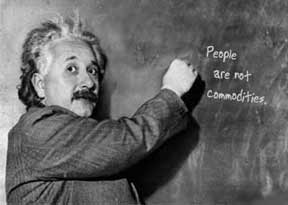
You don’t have to be an Einstein to figure that out yet somehow the liberal can’t? They will all be glued to the tube watching Slick Willie once again, just like in the Golden Times (to these nitwits) of the past. Choose your Klan to run the country for other folk than yourselves, Nitwits. That’s both Republican and Democratic voter version of the American nitwit species. You are a team!

RECREATE 68 -No more politics as usual

Recreate-68 logoFrom RECREATE 68:
End the Occupations March and Rally — West Steps of the Colorado State Capitol, August 24, 9am
END THE OCCUPATIONS
No more free pass for the Democrats. Join R68 and others as we march to end all illegal imperialist occupations in Iraq, Palestine, Afghanistan, Puerto Rico, Haiti, Hawaii, North America, and others. The Dems have the power to put an end to the United States’ illegal colonizations and wars, but they will not without pressure from the people. Join us as we create that pressure.
NO MORE! NOT IN OUR NAME! BRING THE TROOPS HOME NOW!
The March will begin at the WEST STEPS OF THE CAPITOL and end on Speer Blvd in front of the Pepsi Center.

MORE OF R68’s SCHEDULE:
Freedom March — Civic Center Park, August 25, 10am

Join supporters of Leonard Peltier, Mumia Abu Jamal, The Cuban Five, and other political prisoners for the Freedom March and Rally! Leonard Peltier’s parole hearing will take place in 2008. Let us not forget that the Clintons left him in jail and did not pardon him. Free Mumia, the Cuban Five, the Guantanamo detainees, and others. The march will begin at Civic Center Park and end with a rally at the Federal Court House.

Shake Your Money Maker — Denver Mint, August 25, 5pm

It’s time to redistribute the wealth. Between security and corporate pay-offs, the DNC will cost over 100 million dollars for a party. We think the people deserve that money. Join us as we encircle the Denver MInt (where U.S. currency is produced) and use our collective power to raise the mint building in the air and shake the money out of it for the people. Don’t forget a sack to put all of your loot in.

Bring noise makers, energy, spells, magic, costumes, anything that gives you power. We’ll need it!

Days of Resistance — August 24-28

During the convention, there will be five major protests, one each day. Each protest will focus on a symptom of the disease of an imperialist, capitalist, racist system as seen in our communities. Some of the proposed themes are as follows:

Sunday – End All Occupations at Home and Abroad
Monday – Human Rights/Free All Political Prisoners
Tuesday – No Borders
Wednesday – No Warming
Thursday – No Racism/Imperialism

Festival of Democracy — Civic Center Park and Skyline Park, August 24-28

The Festival of Democracy will be a five day event running in conjunction with the DNC Convention. The Festival of Democracy will include free music and performing arts, free food, and free institution building and political training. The purpose will be to share some fun and to work towards the development of programs and networks that will address our community problems ourselves, without relying on the two party capitalist system. We will also be offering a 24 hour free medical clinic for all community members to receive free health care.

MONDAY, AUGUST 25 — Civic Center Park
TUESDAY, AUGUST 26 — Civic Center Park
WEDNESDAY, AUGUST 27 — Skyline Park
THURSDAY, AUGUST 28 — Skyline Park

Provocative provocation at the DNC

Everything for Everybody
This lingo is undeniably inviting… “a small demand.” I’m guessing something of non-violence training involves not only refraining from violence against persons, but also against material disparity. Threatening redistribution of wealth will certainly provoke a violent defense of corporation-as-person personal property. Why can’t the non-violent crowd preach the non-violent forfeiture of capital loot?

That’s never been the purview of religion has it? They can’t ask the miscreants at the top to get religion, they are just after the low man on the totem pole to accept his fate.

Unconventional Action DNC flier

Carla Bruni’s Chrysanthemum: Sarkozy

Carla Bruni or Jane Birkin?What’s left for Carla Bruni-Sarkozy? Heiress, supermodel, pop diva, Queen of France. Now everyone’s mind is on her chrysanthemum.
 
Follow Jane Birkin to Serge Gainsbourg to Citizen Kane to find it’s French for Rosebud.

In reprising her recording career, Mrs. France now wants Jane Birkin’s repute. Her album As If Nothing Happened is a Je T’aime Moi Non Plus remake for our Gattaca millennium, antiseptic, callous, Birkin’s expressive orgasm gone the way of pubic hair.

In her song Ta Tienne, Bruni pledges to her president husband “I give you my body, my soul and my chrysanthemum” encrypted for state security reasons perhaps. France-soir says: “I think we know exactly what she means by this. It is hardly appropriate imagery for a First Lady of France.” I think I do too, although I’m determined to imagine the allusion is literary and not botanical.

Coincidentally, the similarly named Euro-trash film Je T’aime Moi Non Plus which Birkin made for her husband, eminent enfant-terrible composer Serge Gainsbourg, also the song’s composer, centered around costar Joe Dallesandro’s incapacity to be aroused by anything but her delicate rosebud.

How does Bruni’s inability to sing compare to Birkin’s? Definitely comparable. But her artlessness soars. Birkin’s long career included showing herself to be a critically acclaimed film director. The French First Lady’s artifice is calculated like Faust.

I remember when Carla Bruni hit the public scene. The old Italian money heiress merited a topless photo blurb in Vanity Fair, no doubt arranged by PR reps because the caption credited the bohemian scion with no distinction besides reading Kant in her skivvies. From there it was fashion model, then groupie, then pop singer apparently, until she landed the ultra-right European Union enforcer hit-man Sarkozy for a husband. The press pretends her leftist circles don’t understand the attraction.

Wealthy Italians have been fascists since the Medici. Where did Carla get a leftist rep? That’s like expecting a physicist to emerge from shop class. In marrying Sarkozy I think the dilettante has shown her social-climber colors, and this lamentable recording puts a finer, and I’m sure it’s lovely, point on it.

We might argue the anatomical nomenclature, in any event the distinction’s a pun. Carla shows her man-eating reputation is undaunted by the French dictator. If she’s meant to be upstaged by an asshole, it’s going to hers, fragranced.

Global economic rapists are at it again

G8 protest
Why protest the G8 Summit July 7-9? Those hoodlums always look so determined. Here’s the rationale by the Emergency Exit Collective:

The 2008 G8 on Hokkaido, a Strategic Assessment
Emergency Exit Collective
Bristol, Mayday, 2008

The authors of this document are a collection of activists, scholars, and writers currently based in the United States and Western Europe who have gotten to know and work with each other in the movement against capitalist globalization. We’re writing this at the request of some members of No! G8 Action Japan, who asked us for a broad strategic analysis of the state of struggle as we see it, and particularly, of the role of the G8, what it represents, the dangers and opportunities that may lie hidden in the moment. It is in no sense programmatic. Mainly, it is an attempt to develop tools that we hope will be helpful for organizers, or for anyone engaged in the struggle against global capital.

I
It is our condition as human beings that we produce our lives in common.

II
Let us then try to see the world from the perspective of the planet’s commoners, taking the word in that sense: those whose most essential tradition is cooperation in the making and maintenance of human social life, yet who have had to do so under conditions of suffering and separation; deprived, ignored, devalued, divided into hierarchies, pitted against each other for our very physical survival. In one sense we are all commoners. But it’s equally true that just about everyone, at least in some ways, at some points, plays the role of the rulers—of those who expropriate, devalue and divide—or at the very least benefits from such divisions.

Obviously some do more than others. It is at the peak of this pyramid that we encounter groups like the G8.

III
The G8’s perspective is that of the aristocrats, the rulers: those who command and maintain that global machinery of violence that defends existing borders and lines of separation: whether national borders with their detention camps for migrants, or property regimes, with their prisons for the poor. They live by constantly claiming title to the products of others collective creativity and labour, and in thus doing they create the poor; they create scarcity in the midst of plenty, and divide us on a daily basis; they create financial districts that loot resources from across the world, and in thus doing they turn the spirit of human creativity into a spiritual desert; close or privatize parks, public water taps and libraries, hospitals, youth centers, universities, schools, public swimming pools, and instead endlessly build shopping malls that channels convivial life into a means of commodity circulation; work toward turning global ecological catastrophe into business opportunities.

These are the people who presume to speak in the name of the “international community” even as they hide in their gated communities or meet protected by phalanxes of riot cops. It is critical to bear in mind that the ultimate aim of their policies is never to create community but to introduce and maintain divisions that set common people at each other’s throats. The neoliberal project, which has been their main instrument for doing so for the last three decades, is premised on a constant effort either to uproot or destroy any communal or democratic system whereby ordinary people govern their own affairs or maintain common resources for the common good, or, to reorganize each tiny remaining commons as an isolated node in a market system in which livelihood is never guaranteed, where the gain of one community must necessarily be at the expense of others. Insofar as they are willing to appeal to high-minded principles of common humanity, and encourage global cooperation, only and exactly to the extent that is required to maintain this system of universal competition.

IV
At the present time, the G8—the annual summit of the leaders of “industrial democracies”—is the key coordinative institution charged with the task of maintaining this neoliberal project, or of reforming it, revising it, adapting it to the changing condition of planetary class relations. The role of the G8 has always been to define the broad strategic horizons through which the next wave of planetary capital accumulation can occur. This means that its main task is to answer the question of how 3?4 in the present conditions of multiple crises and struggles 3?4 to subordinate social relations among the producing commoners of the planet to capital’s supreme value: profit.

V
Originally founded as the G7 in 1975 as a means of coordinating financial strategies for dealing with the ‘70s energy crisis, then expanded after the end of the Cold War to include Russia, its currently face a moment of profound impasse in the governance of planetary class relations: the greatest since the ‘70s energy crisis itself.

VI
The ‘70s energy crisis represented the final death-pangs of what might be termed the Cold War settlement, shattered by a quarter century of popular struggle. It’s worth returning briefly to this history.

The geopolitical arrangements put in place after World War II were above all designed to forestall the threat of revolution. In the immediate wake of the war, not only did much of the world lie in ruins, most of world’s population had abandoned any assumption about the inevitability of existing social arrangements. The advent of the Cold War had the effect of boxing movements for social change into a bipolar straightjacket. On the one hand, the former Allied and Axis powers that were later to unite in the G7 (the US, Canada, UK, France, Italy, Germany, Japan)—the “industrialized democracies”, as they like to call themselves—engaged in a massive project of co-optation. Their governments continued the process, begun in the ‘30s, of taking over social welfare institutions that had originally been created by popular movements (from insurance schemes to public libraries), even to expand them, on condition that they now be managed by state-appointed bureaucracies rather than by those who used them, buying off unions and the working classes more generally with policies meant to guarantee high wages, job security and the promise of educational advance—all in exchange for political loyalty, productivity increases and wage divisions within national and planetary working class itself. The Sino-Soviet bloc—which effectively became a kind of junior partner within the overall power structure, and its allies remained to trap revolutionary energies into the task of reproducing similar bureaucracies elsewhere. Both the US and USSR secured their dominance after the war by refusing to demobilize, instead locking the planet in a permanent threat of nuclear annihilation, a terrible vision of absolute cosmic power.

VII
Almost immediately, though, this arrangement was challenged by a series of revolts from those whose work was required to maintain the system, but who were, effectively, left outside the deal: first, peasants and the urban poor in the colonies and former colonies of the Global South, next, disenfranchised minorities in the home countries (in the US, the Civil Rights movement, then Black Power), and finally and most significantly, by the explosion of the women’s movement of the late ‘60s and early ‘70s—the revolt of that majority of humanity whose largely unremunerated labor made the very existence “the economy” possible. This appears to have been the tipping point.

VIII
The problem was that the Cold War settlement was never meant to include everyone. It by definition couldn’t. Once matters reached tipping point, then, the rulers scotched the settlement. All deals were off. The oil shock was first edge of the counter-offensive, breaking the back of existing working class organizations, driving home the message that there was nothing guaranteed about prosperity. Under the aegis of the newly hatched G7, this counter-offensive involved a series of interwoven strategies that were later to give rise to what is known as neoliberalism.

IX
These strategies resulted in what came to be known as “Structural Adjustment” both in the North and in the South, accompanied by trade and financial liberalization. This, in turn, made possible crucial structural changes in our planetary production in common extending the role of the market to discipline our lives and divide us into more and more polarized wage hierarchy. This involved:

· In the immediate wake of ‘70s oil shock, petrodollars were recycled from OPEC into Northern banks that then lent them, at extortionate rates of interest, to developing countries of the Global South. This was the origin of the famous “Third World Debt Crisis.” The existence of this debt allowed institutions like the IMF to impose its monetarist orthodoxy on most of the planet for roughly twenty years, in the process, stripping away most of even those modest social protections that had been won by the world’s poor—large numbers of whom were plunged into a situation of absolute desperation.

· It also opened a period of new enclosures through the capitalist imposition of structural adjustment policies, manipulation of environmental and social catastrophes like war, or for that matter through the authoritarian dictates of “socialist” regimes. Through such means, large sections of the world’s population have over the past thirty years been dispossessed from resources previously held in common, either by dint of long traditions, or as the fruits of past struggles and past settlements.

· Through financial deregulation and trade liberalization, neoliberal capital, which emerged from the G7 strategies to deal with the 1970s crisis aimed thus at turning the “class war” in communities, factories, offices, streets and fields against the engine of competition, into a planetary “civil war”, pitting each community of commoners against every other community of commoners.

· Neoliberal capital has done this by imposing an ethos of “efficiency” and rhetoric of “lowering the costs of production” applied so broadly that mechanisms of competition have come to pervade every sphere of life. In fact these terms are euphemisms, for a more fundamental demand: that capital be exempt from taking any reduction in profit to finance the costs of reproduction of human bodies and their social and natural environments (which it does not count as costs) and which are, effectively, “exernalized” onto communities and nature.

· The enclosure of resources and entitlements won in previous generations of struggles both in the North and the South, in turn, created the conditions for increasing the wage hierarchies (both global and local), by which commoners work for capital—wage hierarchies reproduced economically through pervasive competition, but culturally, through male dominance, xenophobia and racism. These wage gaps, in turn, made it possible to reduce the value of Northern workers’ labour power, by introducing commodities that enter in their wage basket at a fraction of what their cost might otherwise have been. The planetary expansion of sweatshops means that American workers (for example) can buy cargo pants or lawn-mowers made in Cambodia at Walmart, or buy tomatoes grown by undocumented Mexican workers in California, or even, in many cases, hire Jamaican or Filipina nurses to take care of children and aged grandparents at such low prices, that their employers have been able to lower real wages without pushing most of them into penury. In the South, meanwhile, this situation has made it possible to discipline new masses of workers into factories and assembly lines, fields and offices, thus extending enormously capital’s reach in defining the terms—the what, the how, the how much—of social production.

· These different forms of enclosures, both North and South, mean that commoners have become increasingly dependent on the market to reproduce their livelihoods, with less power to resist the violence and arrogance of those whose priorities is only to seek profit, less power to set a limit to the market discipline running their lives, more prone to turn against one another in wars with other commoners who share the same pressures of having to run the same competitive race, but not the same rights and the same access to the wage. All this has meant a generalized state of precarity, where nothing can be taken for granted.

X
In turn, this manipulation of currency and commodity flows constituting neoliberal globalization became the basis for the creation of the planet’s first genuine global bureaucracy.

· This was multi-tiered, with finance capital at the peak, then the ever-expanding trade bureaucracies (IMF, WTO, EU, World Bank, etc), then transnational corporations, and finally, the endless varieties of NGOs that proliferated throughout the period—almost all of which shared the same neoliberal orthodoxy, even as they substituted themselves for social welfare functions once reserved for states.

· The existence of this overarching apparatus, in turn, allowed poorer countries previously under the control of authoritarian regimes beholden to one or another side in the Cold War to adopt “democratic” forms of government. This did allow a restoration of formal civil liberties, but very little that could really merit the name of democracy (the rule of the “demos”, i.e., of the commoners). They were in fact constitutional republics, and the overwhelming trend during the period was to strip legislatures, that branch of government most open to popular pressure, of most of their powers, which were increasingly shifted to the executive and judicial branches, even as these latter, in turn, largely ended up enacting policies developed overseas, by global bureaucrats.

· This entire bureaucratic arrangement was justified, paradoxically enough, by an ideology of extreme individualism. On the level of ideas, neoliberalism relied on a systematic cooptation of the themes of popular struggle of the ‘60s: autonomy, pleasure, personal liberation, the rejection of all forms of bureaucratic control and authority. All these were repackaged as the very essence of capitalism, and the market reframed as a revolutionary force of liberation.

· The entire arrangement, in turn, was made possible by a preemptive attitude towards popular struggle. The breaking of unions and retreat of mass social movements from the late ‘70s onwards was only made possible by a massive shift of state resources into the machinery of violence: armies, prisons and police (secret and otherwise) and an endless variety of private “security services”, all with their attendant propaganda machines, which tended to increase even as other forms of social spending were cut back, among other things absorbing increasing portions of the former proletariat, making the security apparatus an increasingly large proportion of total social spending. This approach has been very successful in holding back mass opposition to capital in much of the world (especially West Europe and North America), and above all, in making it possible to argue there are no viable alternatives. But in doing so, has created strains on the system so profound it threatens to undermine it entirely.

XI
The latter point deserves elaboration. The element of force is, on any number of levels, the weak point of the system. This is not only on the constitutional level, where the question of how to integrate the emerging global bureaucratic apparatus, and existing military arrangements, has never been resolved. It is above all an economic problem. It is quite clear that the maintenance of elaborate security machinery is an absolute imperative of neoliberalism. One need only observe what happened with the collapse of the Soviet bloc in Eastern Europe: where one might have expected the Cold War victors to demand the dismantling of the army, secret police and secret prisons, and to maintain and develop the existing industrial base, in fact, what they did was absolutely the opposite: in fact, the only part of the industrial base that has managed fully to maintain itself has been the parts required to maintained the security apparatus itself! Critical too is the element of preemption: the governing classes in North America, for example, are willing to go to almost unimaginable lengths to ensure social movements never feel they are accomplishing anything. The current Gulf War is an excellent example: US military operations appear to be organized first and foremost to be protest-proof, to ensure that what happened in Vietnam (mass mobilization at home, widespread revolt within the army overseas) could never be repeated. This means above all that US casualties must always be kept to a minimum. The result are rules of engagement, and practices like the use of air power within cities ostensibly already controlled by occupation forces, so obviously guaranteed to maximize the killing of innocents and galvanizing hatred against the occupiers that they ensure the war itself cannot be won. Yet this approach can be taken as the very paradigm for neoliberal security regimes. Consider security arrangements around trade summits, where police are so determined prevent protestors from achieving tactical victories that they are often willing to effectively shut down the summits themselves. So too in overall strategy. In North America, such enormous resources are poured into the apparatus of repression, militarization, and propaganda that class struggle, labor action, mass movements seem to disappear entirely. It is thus possible to claim we have entered a new age where old conflicts are irrelevant. This is tremendously demoralizing of course for opponents of the system; but those running the system seem to find that demoralization so essential they don’t seem to care that the resultant apparatus (police, prisons, military, etc) is, effectively, sinking the entire US economy under its dead weight.

XII
The current crisis is not primarily geopolitical in nature. It is a crisis of neoliberalism itself. But it takes place against the backdrop of profound geopolitical realignments. The decline of North American power, both economic and geopolitical has been accompanied by the rise of Northeast Asia (and to a increasing extent, South Asia as well). While the Northeast Asian region is still divided by painful Cold War cleavages—the fortified lines across the Taiwan straits and at the 38th parallel in Korea…—the sheer realities of economic entanglement can be expected to lead to a gradual easing of tensions and a rise to global hegemony, as the region becomes the new center of gravity of the global economy, of the creation of new science and technology, ultimately, of political and military power. This may, quite likely, be a gradual and lengthy process. But in the meantime, very old patterns are rapidly reemerging: China reestablishing relations with ancient tributary states from Korea to Vietnam, radical Islamists attempting to reestablish their ancient role as the guardians of finance and piety at the in the Central Asian caravan routes and across Indian Ocean, every sort of Medieval trade diaspora reemerging… In the process, old political models remerge as well: the Chinese principle of the state transcending law, the Islamic principle of a legal order transcending any state. Everywhere, we see the revival too of ancient forms of exploitation—feudalism, slavery, debt peonage—often entangled in the newest forms of technology, but still echoing all the worst abuses of the Middle Ages. A scramble for resources has begun, with US occupation of Iraq and saber-rattling throughout the surrounding region clearly meant (at least in part) to place a potential stranglehold the energy supply of China; Chinese attempts to outflank with its own scramble for Africa, with increasing forays into South America and even Eastern Europe. The Chinese invasion into Africa (not as of yet at least a military invasion, but already involving the movement of hundreds of thousands of people), is changing the world in ways that will probably be felt for centuries. Meanwhile, the nations of South America, the first victims of the “Washington consensus” have managed to largely wriggle free from the US colonial orbit, while the US, its forces tied down in the Middle East, has for the moment at least abandoned it, is desperately struggling to keep its grip Mexico, Central America and the Caribbean—its own “near abroad”.

XIII
In another age all this might have led to war—that is, not just colonial occupations, police actions, or proxy wars (which are obviously already taking place), but direct military confrontations between the armies of major powers. It still could; accidents happen; but there is reason to believe that, when it comes to moments of critical decision, the loyalties of the global elites are increasingly to each other, and not to the national entities for whom they claim to speak. There is some compelling evidence for this.

Take for example when the US elites panicked at the prospect of the massive budget surpluses of the late 1990s. As Alan Greenspan, head of the Federal Reserve at the time warned, if these were allowed to stand they would have flooded government coffers with so many trillions of dollars that it could only have lead to some form of creeping socialism, even, he predicted, to the government acquiring “equity stakes” in key US corporations. The more excitable of capitalism’s managers actually began contemplating scenarios where the capitalist system itself would be imperiled. The only possible solution was massive tax cuts; these were duly enacted, and did indeed manage to turn surpluses into enormous deficits, financed by the sale of treasury bonds to Japan and China. Conditions have thus now reached a point where it is beginning to look as if the most likely long term outcome for the US (its technological and industrial base decaying, sinking under the burden of its enormous security spending) will be to end up serve as junior partner and military enforcer for East Asia capital. Its rulers, or at least a significant proportion of them, would prefer to hand global hegemony to the rulers of China (provided the latter abandon Communism) than to return to any sort of New Deal compromise with their “own” working classes.

A second example lies in the origins of what has been called the current “Bretton Woods II” system of currency arrangements, which underline a close working together of some “surplus” and “deficit” countries within global circuits. The macroeconomic manifestation of the planetary restructuring outlined in XIX underlines both the huge US trade deficit that so much seem to worry many commentators, and the possibility to continually generate new debt instruments like the one that has recently resulted in the sub-prime crisis. The ongoing recycling of accumulated surplus of countries exporting to the USA such as China and oil producing countries is what has allowed financiers to create new credit instruments in the USA. Hence, the “deal” offered by the masters in the United States to its commoners has been this: ‘you, give us a relative social peace and accept capitalist markets as the main means through which you reproduce your own livelihoods, and we will give you access to cheaper consumption goods, access to credit for buying cars and homes, and access to education, health, pensions and social security through the speculative means of stock markets and housing prices.’ Similar compromises were reached in all the G8 countries.

Meanwhile, there is the problem of maintaining any sort of social peace with the hundreds of millions of unemployed, underemployed, dispossessed commoners currently swelling the shanty-towns of Asia, Africa, and Latin America as a result of ongoing enclosures (which have speeded up within China and India in particular, even as “structural adjustment policies” in Africa and Latin America have been derailed). Any prospect of maintaining peace in these circumstances would ordinarily require either extremely high rates of economic growth—which globally have not been forthcoming, since outside of China, growth rates in the developing world have been much lower than they were in the ‘50s, ‘60s, or even ‘70s—or extremely high levels of repression, lest matters descend into rebellion or generalized civil war. The latter has of course occurred in many parts of the world currently neglected by capital, but in favored regions, such as the coastal provinces of China, or “free trade” zones of India, Egypt, or Mexico, commoners are being offered a different sort of deal: industrial employment at wages that, while very low by international standards, are still substantially higher than anything currently obtainable in the impoverished countryside; and above all the promise, through the intervention of Western markets and (privatized) knowledge, of gradually improving conditions of living. While over the least few years wages in many such areas seem to be growing, thanks to the intensification of popular struggles, such gains are inherently vulnerable: the effect of recent food inflation has been to cut real wages back dramatically—and threaten millions with starvation.

What we really want to stress here, though, is that the long-term promise being offered to the South is just as untenable as the idea that US or European consumers can indefinitely expand their conditions of life through the use of mortgages and credit cards.

What’s being offered the new dispossessed is a transposition of the American dream. The idea is that the lifestyle and consumption patterns of existing Chinese, Indian, or Brazilian or Zambian urban middle classes (already modeled on Northern ones) will eventually become available to the children of today’s miners, maquila or plantation laborers, until, ultimately, everyone on earth is brought up to roughly the same level of consumption. Put in these terms, the argument is absurd. The idea that all six billion of us can become “middle class” is obviously impossible. First of all there is a simple problem of resources. It doesn’t matter how many bottles we recycle or how energy efficient are the light bulbs we use, there’s just no way the earth’s ecosystem can accommodate six billion people driving in private cars to work in air-conditioned cubicles before periodically flying off to vacation in Acapulco or Tahiti. To maintain the style of living and producing in common we now identify with “middle classness” on a planetary scale would require several additional planets.

This much has been pointed out repeatedly. But the second point is no less important. What this vision of betterment ultimately proposes is that it would be possible to build universal prosperity and human dignity on a system of wage labor. This is fantasy. Historically, wages are always the contractual face for system of command and degradation, and a means of disguising exploitation: expressing value for work only on condition of stealing value without work— and there is no reason to believe they could ever be anything else. This is why, as history has also shown, human beings will always avoid working for wages if they have any other viable option. For a system based on wage labor to come into being, such options must therefore be made unavailable. This in turn means that such systems are always premised on structures of exclusion: on the prior existence of borders and property regimes maintained by violence. Finally, historically, it has always proved impossible to maintain any sizeable class of wage-earners in relative prosperity without basing that prosperity, directly or indirectly, on the unwaged labor of others—on slave-labor, women’s domestic labor, the forced labor of colonial subjects, the work of women and men in peasant communities halfway around the world—by people who are even more systematically exploited, degraded, and immiserated. For that reason, such systems have always depended not only on setting wage-earners against each other by inciting bigotry, prejudice, hostility, resentment, violence, but also by inciting the same between men and women, between the people of different continents (“race”), between the generations.

From the perspective of the whole, then, the dream of universal middle class “betterment” must necessarily be an illusion constructed in between the Scylla of ecological disaster, and the Charybdis of poverty, detritus, and hatred: precisely, the two pillars of today’s strategic impasse faced by the G8.

XIV
How then do we describe the current impasse of capitalist governance?

To a large degree, it is the effect of a sudden and extremely effective upswing of popular resistance—one all the more extraordinary considering the huge resources that had been invested in preventing such movements from breaking out.

On the one hand, the turn of the millennium saw a vast and sudden flowering of new anti-capitalist movements, a veritable planetary uprising against neoliberalism by commoners in Latin America, India, Africa, Asia, across the North Atlantic world’s former colonies and ultimately, within the cities of the former colonial powers themselves. As a result, the neoliberal project lies shattered. What came to be called the “anti-globalization” movement took aim at the trade bureaucracies—the obvious weak link in the emerging institutions of global administration—but it was merely the most visible aspect of this uprising. It was however an extraordinarily successful one. Not only was the WTO halted in its tracks, but all major trade initiatives (MAI, FTAA…) scuttled. The World Bank was hobbled and the power of the IMF over most of the world’s population, effectively, destroyed. The latter, once the terror of the Global South, is now a shattered remnant of its former self, reduced to selling off its gold reserves and desperately searching for a new global mission.

In many ways though spectacular street actions were merely the most visible aspects of much broader changes: the resurgence of labor unions, in certain parts of the world, the flowering of economic and social alternatives on the grassroots levels in every part of the world, from new forms of direct democracy of indigenous communities like El Alto in Bolivia or self-managed factories in Paraguay, to township movements in South Africa, farming cooperatives in India, squatters’ movements in Korea, experiments in permaculture in Europe or “Islamic economics” among the urban poor in the Middle East. We have seen the development of thousands of forms of mutual aid association, most of which have not even made it onto the radar of the global media, often have almost no ideological unity and which may not even be aware of each other’s existence, but nonetheless share a common desire to mark a practical break with capitalism, and which, most importantly, hold out the prospect of creating new forms of planetary commons that can—and in some cases are—beginning to knit together to provide the outlines of genuine alternative vision of what a non-capitalist future might look like.

The reaction of the world’s rulers was predictable. The planetary uprising had occurred during a time when the global security apparatus was beginning to look like it lacked a purpose, when the world threatened to return to a state of peace. The response—aided of course, by the intervention of some of the US’ former Cold War allies, reorganized now under the name of Al Qaeda—was a return to global warfare. But this too failed. The “war on terror”—as an attempt to impose US military power as the ultimate enforcer of the neoliberal model—has collapsed as well in the face of almost universal popular resistance. This is the nature of their “impasse”.

At the same time, the top-heavy, inefficient US model of military capitalism—a model created in large part to prevent the dangers of social movements, but which the US has also sought to export to some degree simply because of its profligacy and inefficiency, to prevent the rest of the world from too rapidly overtaking them—has proved so wasteful of resources that it threatens to plunge the entire planet into ecological and social crisis. Drought, disaster, famines, combine with endless campaigns of enclosure, foreclosure, to cast the very means of survival—food, water, shelter—into question for the bulk of the world’s population.

XV
In the rulers’ language the crisis understood, first and foremost, as a problem of regulating cash flows, of reestablishing, as they like to put it, a new “financial architecture”. Obviously they are aware of the broader problems. Their promotional literature has always been full of it. From the earliest days of the G7, through to the days after the Cold War, when Russia was added as a reward for embracing capitalism, they have always claimed that their chief concerns include

· the reduction of global poverty

· sustainable environmental policies

· sustainable global energy policies

· stable financial institutions governing global trade and currency transactions

If one were to take such claims seriously, it’s hard to see their overall performance as anything but a catastrophic failure. At the present moment, all of these are in crisis mode: there are food riots, global warming, peak oil, and the threat of financial meltdown, bursting of credit bubbles, currency crises, a global credit crunch. [**Failure on this scale however, opens opportunities for the G8 themselves, as summit of the global bureaucracy, to reconfigure the strategic horizon. Therefore, it’s always with the last of these that they are especially concerned. ]The real problem, from the perspective of the G8, is one of reinvestment: particularly, of the profits of the energy sector, but also, now, of emerging industrial powers outside the circle of the G8 itself. The neoliberal solution in the ‘70s had been to recycle OPEC’s petrodollars into banks that would use it much of the world into debt bondage, imposing regimes of fiscal austerity that, for the most part, stopped development (and hence, the emergence potential rivals) in its tracks. By the ‘90s, however, much East Asia in particular had broken free of this regime. Attempts to reimpose IMF-style discipline during the Asian financial crisis of 1997 largely backfired. So a new compromise was found, the so-called Bretton Woods II: to recycle the profits from the rapidly expanding industrial economies of East Asia into US treasury debt, artificially supporting the value of the dollar and allowing a continual stream of cheap exports that, aided by the US housing bubble, kept North Atlantic economies afloat and buy off workers there with cheap oil and even cheaper consumer goods even as real wages shrank. This solution however soon proved a temporary expedient. Bush regime’s attempt to lock it in by the invasion of Iraq, which was meant to lead to the forced privatization of Iraqi oil fields, and, ultimately, of the global oil industry as a whole, collapsed in the face of massive popular resistance (just as Saddam Hussein’s attempt to introduce neoliberal reforms in Iraq had failed when he was still acting as American deputy in the ‘90s). Instead, the simultaneous demand for petroleum for both Chinese manufacturers and American consumers caused a dramatic spike in the price of oil. What’s more, rents from oil and gas production are now being used to pay off the old debts from the ‘80s (especially in Asia and Latin America, which have by now paid back their IMF debts entirely), and—increasingly—to create state-managed Sovereign Wealth Funds that have largely replaced institutions like the IMF as the institutions capable of making long-term strategic investments. The IMF, purposeless, tottering on the brink of insolvency, has been reduced to trying to come up with “best practices” guidelines for fund managers working for governments in Singapore, Seoul, and Abu Dhabi.

There can be no question this time around of freezing out countries like China, India, or even Brazil. The question for capital’s planners, rather, is how to channel these new concentrations of capital in such a way that they reinforce the logic of the system instead of undermining it.

XVI
How can this be done? This is where appeals to universal human values, to common membership in an “international community” come in to play. “We all must pull together for the good of the planet,” we will be told. The money must be reinvested “to save the earth.”

To some degree this was always the G8 line: this is a group has been making an issue of climate change since 1983. Doing so was in one sense a response to the environmental movements of the ‘70s and ‘80s. The resultant emphasis on biofuels and “green energy” was from their point of view, the perfect strategy, seizing on an issue that seemed to transcend class, appropriating ideas and issues that emerged from social movements (and hence coopting and undermining especially their radical wings), and finally, ensuring such initiatives are pursued not through any form of democratic self-organization but “market mechanisms”—to effective make the sense of public interest productive for capitalism.

What we can expect now is a two-pronged attack. On the one hand, they will use the crisis to attempt to reverse the gains of past social movements: to put nuclear energy back on the table to deal with the energy crisis and global warming, or genetically modified foods to deal with the food crisis. Prime Minister Fukuda, the host of the current summit, for example, is already proposing the nuclear power is the “solution” to the global warming crisis, even as the German delegation resists. On the other, and even more insidiously, they will try once again to co-opt the ideas and solutions that have emerged from our struggles as a way of ultimately undermining them. Appropriating such ideas is simply what rulers do: the bosses brain is always under the workers’ hat. But the ultimate aim is to answer the intensification of class struggle, of the danger of new forms of democracy, with another wave of enclosures, to restore a situation where commoners’ attempts to create broader regimes of cooperation are stymied, and people are plunged back into mutual competition.

We can already see the outlines of how this might be done. There are already suggestions that Sovereign Wealth Funds put aside a certain (miniscule) proportion of their money for food aid, but only as tied to a larger project of global financial restructuring. The World Bank, largely bereft of its earlier role organizing dams and pipe-lines across the world, has been funding development in China’s poorer provinces, freeing the Chinese government to carry out similar projects in Southeast Asia, Africa, and even Latin America (where, of course, they cannot effectively be held to any sort of labor or environmental standards). There is the possibility of a new class deal in China itself, whose workers can be allowed higher standards of living if new low wage zones are created elsewhere—for instance, Africa (the continent where struggles over maintaining the commons have been most intense in current decades)—with the help of Chinese infrastructural projects. Above of all, money will be channeled into addressing climate change, into the development of alternative energy, which will require enormous investments, in such a way as to ensure that whatever energy resources do become important in this millennium, they can never be democratized—that the emerging notion of a petroleum commons, that energy resources are to some degree a common patrimony meant primarily to serve the community as a whole, that is beginning to develop in parts of the Middle East and South America—not be reproduced in whatever comes next.

Since this will ultimately have to be backed up by the threat of violence, the G8 will inevitably have to struggle with how to (yet again) rethink enforcement mechanisms. The latest move , now that the US “war on terror” paradigm has obviously failed, would appear to be a return to NATO, part of a reinvention of the “European security architecture” being proposed at the upcoming G8 meetings in Italy in 2009 on the 60th anniversary of NATO’s foundation—but part of a much broader movement of the militarization of social conflict, projecting potential resource wars, demographic upheavals resulting from climate change, and radical social movements as potential military problems to be resolved by military means. Opposition to this new project is already shaping up as the major new European mobilization for the year following the current G-8.

XVII
While the G-8 sit at the pinnacle of a system of violence, their preferred idiom is monetary. Their impulse whenever possible is to translate all problems into money, financial structures, currency flows—a substance whose movements they carefully monitor and control.

Money, on might say, is their poetry—a poetry whose letters are written in our blood. It is their highest and most abstract form of expression, their way of making statements about the ultimate truth of the world, even if it operates in large part by making things disappear. How else could it be possible to argue—no, to assume as a matter of common sense—that the love, care, and concern of a person who tends to the needs of children, teaching, minding, helping them to become decent , thoughtful, human beings, or who grows and prepares food, is worth ten thousand times less than someone who spends the same time designing a brand logo, moving abstract blips across a globe, or denying others health care.

The role of money however has changed profoundly since 1971 when the dollar was delinked from gold. This has created a profound realignment of temporal horizons. Once money could be said to be primarily congealed results of past profit and exploitation. As capital, it was dead labor. Millions of indigenous Americans and Africans had their lives pillaged and destroyed in the gold mines in order to be rendered into value. The logic of finance capital, of credit structures, certainly always existed as well (it is at least as old as industrial capital; possibly older), but in recent decades these logic of financial capital has come to echo and re-echo on every level of our lives. In the UK 97% of money in circulation is debt, in the US, 98%. Governments run on deficit financing, wealthy economies on consumer debt, the poor are enticed with microcredit schemes, debts are packaged and repackaged in complex financial derivatives and traded back and forth. Debt however is simply a promise, the expectation of future profit; capital thus increasingly brings the future into the present—a future that, it insists, must always be the same in nature, even if must also be greater in magnitude, since of course the entire system is premised on continual growth. Where once financiers calculated and traded in the precise measure of our degradation, having taken everything from us and turned it into money, now money has flipped, to become the measure of our future degradation—at the same time as it binds us to endlessly working in the present.

The result is a strange moral paradox. Love, loyalty, honor, commitment—to our families, for example, which means to our shared homes, which means to the payment of monthly mortgage debts—becomes a matter of maintaining loyalty to a system which ultimately tells us that such commitments are not a value in themselves. This organization of imaginative horizons, which ultimately come down to a colonization of the very principle of hope, has come to supplement the traditional evocation of fear (of penury, homelessness, joblessness, disease and death). This colonization paralyzes any thought of opposition to a system that almost everyone ultimately knows is not only an insult to everything they really cherish, but a travesty of genuine hope, since, because no system can really expand forever on a finite planet, everyone is aware on some level that in the final analysis they are dealing with a kind of global pyramid scheme, what we are ultimately buying and selling is the real promise of global social and environmental apocalypse.

XVIII
Finally then we come to the really difficult, strategic questions. Where are the vulnerabilities? Where is hope? Obviously we have no certain answers here. No one could. But perhaps the proceeding analysis opens up some possibilities that anti-capitalist organizers might find useful to explore.

One thing that might be helpful is to rethink our initial terms. Consider communism. We are used to thinking of it as a total system that perhaps existed long ago, and to the desire to bring about an analogous system at some point in the future—usually, at whatever cost. It seems to us that dreams of communist futures were never purely fantasies; they were simply projections of existing forms of cooperation, of commoning, by which we already make the world in the present. Communism in this sense is already the basis of almost everything, what brings people and societies into being, what maintains them, the elemental ground of all human thought and action. There is absolutely nothing utopian here. What is utopian, really, is the notion that any form of social organization, especially capitalism, could ever exist that was not entirely premised on the prior existence of communism. If this is true, the most pressing question is simply how to make that power visible, to burst forth, to become the basis for strategic visions, in the face of a tremendous and antagonistic power committed to destroying it—but at the same time, ensuring that despite the challenge they face, they never again become entangled with forms of violence of their own that make them the basis for yet another tawdry elite. After all, the solidarity we extend to one another, is it not itself a form of communism? And is it not so above because it is not coerced?

Another thing that might be helpful is to rethink our notion of crisis. There was a time when simply describing the fact that capitalism was in a state of crisis, driven by irreconcilable contradictions, was taken to suggest that it was heading for a cliff. By now, it seems abundantly clear that this is not the case. Capitalism is always in a crisis. The crisis never goes away. Financial markets are always producing bubbles of one sort or another; those bubbles always burst, sometimes catastrophically; often entire national economies collapse, sometimes the global markets system itself begins to come apart. But every time the structure is reassembled. Slowly, painfully, dutifully, the pieces always end up being put back together once again.

Perhaps we should be asking: why?

In searching for an answer, it seems to us, we might also do well to put aside another familiar habit of radical thought: the tendency to sort the world into separate levels—material realities, the domain of ideas or “consciousness”, the level of technologies and organizations of violence—treating these as if these were separate domains that each work according to separate logics, and then arguing which “determines” which. In fact they cannot be disentangled. A factory may be a physical thing, but the ownership of a factory is a social relation, a legal fantasy that is based partly on the belief that law exists, and partly on the existence of armies and police. Armies and police on the other hand exist partly because of factories providing them with guns, vehicles, and equipment, but also, because those carrying the guns and riding in the vehicles believe they are working for an abstract entity they call “the government”, which they love, fear, and ultimately, whose existence they take for granted by a kind of faith, since historically, those armed organizations tend to melt away immediately the moment they lose faith that the government actually exists. Obviously exactly the same can be said of money. It’s value is constantly being produced by eminently material practices involving time clocks, bank machines, mints, and transatlantic computer cables, not to mention love, greed, and fear, but at the same time, all this too rests on a kind of faith that all these things will continue to interact in more or less the same way. It is all very material, but it also reflects a certain assumption of eternity: the reason that the machine can always be placed back together is, simply, because everyone assumes it must. This is because they cannot realistically imagine plausible alternatives; they cannot imagine plausible alternatives because of the extraordinarily sophisticated machinery of preemptive violence that ensure any such alternatives are uprooted or contained (even if that violence is itself organized around a fear that itself rests on a similar form of faith.) One cannot even say it’s circular. It’s more a kind of endless, unstable spiral. To subvert the system is then, to intervene in such a way that the whole apparatus begins to spin apart.

XIX
It appears to us that one key element here—one often neglected in revolutionary strategy—is the role of the global middle classes. This is a class that, much though it varies from country (in places like the US and Japan, overwhelming majorities consider themselves middle class; in, say, Cambodia or Zambia, only very small percentages), almost everywhere provides the key constituency of the G8 outside of the ruling elite themselves. It has become a truism, an article of faith in itself in global policy circles, that national middle class is everywhere the necessary basis for democracy. In fact, middle classes are rarely much interested in democracy in any meaningful sense of that word (that is, of the self-organization or self-governance of communities). They tend to be quite suspicious of it. Historically, middle classes have tended to encourage the establishment of constitutional republics with only limited democratic elements (sometimes, none at all). This is because their real passion is for a “betterment”, for the prosperity and advance of conditions of life for their children—and this betterment, since it is as noted above entirely premised on structures of exclusion, requires “security”. Actually the middle classes depend on security on every level: personal security, social security (various forms of government support, which even when it is withdrawn from the poor tends to be maintained for the middle classes), security against any sudden or dramatic changes in the nature of existing institutions. Thus, politically, the middle classes are attached not to democracy (which, especially in its radical forms, might disrupt all this), but to the rule of law. In the political sense, then, being “middle class” means existing outside the notorious “state of exception” to which the majority of the world’s people are relegated. It means being able to see a policeman and feel safer, not even more insecure. This would help explain why within the richest countries, the overwhelming majority of the population will claim to be “middle class” when speaking in the abstract, even if most will also instantly switch back to calling themselves “working class” when talking about their relation to their boss.

That rule of law, in turn, allows them to live in that temporal horizon where the market and other existing institutions (schools, governments, law firms, real estate brokerages…) can be imagined as lasting forever in more or less the same form. The middle classes can thus be defined as those who live in the eternity of capitalism. (The elites don’t; they live in history, they don’t assume things will always be the same. The disenfranchized don’t; they don’t have the luxury; they live in a state of precarity where little or nothing can safely be assumed.) Their entire lives are based on assuming that the institutional forms they are accustomed to will always be the same, for themselves and their grandchildren, and their “betterment” will be proportional to the increase in the level of monetary wealth and consumption. This is why every time global capital enters one of its periodic crises, every time banks collapse, factories close, and markets prove unworkable, or even, when the world collapses in war, the managers and dentists will tend to support any program that guarantees the fragments will be dutifully pieced back together in roughly the same form—even if all are, at the same time, burdened by at least a vague sense that the whole system is unfair and probably heading for catastrophe.

XIX
The strategic question then is, how to shatter this sense of inevitability? History provides one obvious suggestion. The last time the system really neared self-destruction was in the 1930s, when what might have otherwise been an ordinary turn of the boom-bust cycle turned into a depression so profound that it took a world war to pull out of it. What was different? The existence of an alternative: a Soviet economy that, whatever its obvious brutalities, was expanding at breakneck pace at the very moment market systems were undergoing collapse. Alternatives shatter the sense of inevitability, that the system must, necessarily, be patched together in the same form; this is why it becomes an absolute imperative of global governance that even small viable experiments in other ways of organizing communities be wiped out, or, if that is not possible, that no one knows about them.

If nothing else, this explains the extraordinary importance attached to the security services and preemption of popular struggle. Commoning, where it already exists, must be made invisible. Alternatives— Zapatistas in Chiapas, APPO in Oaxaca, worker-managed factories in Argentina or Paraguay, community-run water systems in South Africa or Bolivia, living alternatives of farming or fishing communities in India or Indonesia, or a thousand other examples—must be made to disappear, if not squelched or destroyed, then marginalized to the point they seem irrelevant, ridiculous. If the managers of the global system are so determined to do this they are willing to invest such enormous resources into security apparatus that it threatens to sink the system entirely, it is because they are aware that they are working with a house of cards. That the principle of hope and expectation on which capitalism rests would evaporate instantly if almost any other principle of hope or expectation seemed viable.

The knowledge of alternatives, then, is itself a material force.

Without them, of course, the shattering of any sense of certainty has exactly the opposite effect. It becomes pure precarity, an insecurity so profound that it becomes impossible to project oneself in history in any form, so that the one-time certainties of middle class life itself becomes a kind of utopian horizon, a desperate dream, the only possible principle of hope beyond which one cannot really imagine anything. At the moment, this seems the favorite weapon of neoliberalism: whether promulgated through economic violence, or the more direct, traditional kind.

One form of resistance that might prove quite useful here – and is already being discussed in some quarters – are campaigns against debt itself. Not demands for debt forgiveness, but campaigns of debt resistance.

XX
In this sense the great slogan of the global justice movement, “another world is possible”, represents the ultimate threat to existing power structures. But in another sense we can even say we have already begun to move beyond that. Another world is not merely possible. It is inevitable. On the one hand, as we have pointed out, such a world is already in existence in the innumerable circuits of social cooperation and production in common based on different values than those of profit and accumulation through which we already create our lives, and without which capitalism itself would be impossible. On the other, a different world is inevitable because capitalism—a system based on infinite material expansion—simply cannot continue forever on a finite world. At some point, if humanity is to survive at all, we will be living in a system that is not based on infinite material expansion. That is, something other than capitalism.

The problem is there is no absolute guarantee that ‘something’ will be any better. It’s pretty easy to imagine “other worlds” that would be even worse. We really don’t have any idea what might happen. To what extent will the new world still organized around commoditization of life, profit, and pervasive competition? Or a reemergence of even older forms of hierarchy and degradation? How, if we do overcome capitalism directly, by the building and interweaving of new forms of global commons, do we protect ourselves against the reemergence of new forms of hierarchy and division that we might not now even be able to imagine?

It seems to us that the decisive battles that will decide the contours of this new world will necessarily be battles around values. First and foremost are values of solidarity among commoners. Since after all, every rape of a woman by a man or the racist murder of an African immigrant by a European worker is worth a division in capital’s army.

Similarly, imagining our struggles as value struggles might allow us to see current struggles over global energy policies and over the role of money and finance today as just an opening salvo of an even larger social conflict to come. For instance, there’s no need to demonize petroleum, for example, as a thing in itself. Energy products have always tended to play the role of a “basic good”, in the sense that their production and distribution becomes the physical basis for all other forms of human cooperation, at the same time as its control tends to organize social and even international relations. Forests and wood played such a role from the time of the Magna Carta to the American Revolution, sugar did so during the rise of European colonial empires in the 17th and 18th centuries, fossil fuels do so today. There is nothing intrinsically good or bad about fossil fuel. Oil is simply solar radiation, once processed by living beings, now stored in fossil form. The question is of control and distribution. This is the real flaw in the rhetoric over “peak oil”: the entire argument is premised on the assumption that, for the next century at least, global markets will be the only means of distribution. Otherwise the use of oil would depend on needs, which would be impossible to predict precisely because they depend on the form of production in common we adopt. The question thus should be: how does the anti-capitalist movement peak the oil? How does it become the crisis for a system of unlimited expansion?

It is the view of the authors of this text that the most radical planetary movements that have emerged to challenge the G8 are those that direct us towards exactly these kind of questions. Those which go beyond merely asking how to explode the role money plays in framing our horizons, or even challenging the assumption of the endless expansion of “the economy”, to ask why we assume something called “the economy” even exists, and what other ways we can begin imagining our material relations with one another. The planetary women’s movement, in its many manifestations, has and continues to play perhaps the most important role of all here, in calling for us to reimagine our most basic assumptions about work, to remember that the basic business of human life is not actually the production of communities but the production, the mutual shaping of human beings. The most inspiring of these movements are those that call for us to move beyond a mere challenge to the role of money to reimagine value: to ask ourselves how can we best create a situation where everyone is secure enough in their basic needs to be able to pursue those forms of value they decide are ultimately important to them. To move beyond a mere challenge to the tyranny of debt to ask ourselves what we ultimately owe to one another and to our environment. That recognize that none this needs to invented from whole cloth. It’s all already there, immanent in the way everyone, as commoners, create the world together on a daily basis. And that asking these questions is never, and can never be, an abstract exercise, but is necessarily part of a process by which we are already beginning to knit these forms of commons together into new forms of global commons that will allow entirely new conceptions of our place in history.

It is to those already engaged in such a project that we offer these initial thoughts on our current strategic situation.

Was Albert Einstein all that bright?

Albert Einstein at the chalkboard“The economic anarchy of capitalist society as it exists today is, in my opinion, the real source of the evil… I am convinced there is only one way to eliminate these grave evils, namely through the establishment of a socialist economy, accompanied by an educational system which would be oriented toward social goals.”

Socialism is not inherently totalitarian. To advocate for an equitable distribution of wealth, to look after the poor and feeble, to provide health, education, and opportunity for all, is to be a socialist. Not by coincidence, these are the very reasons socialism is feared by capitalists and slandered by their educational system. The Red Scare was not about Commie infiltrators but a creeping social consciousness. “Democrats” are the lip service which corporate power has to pay to keep human beings from wising up and demanding their due.

Is there a single humanitarian whom you admire for his/her brilliance and grace, who advocates capitalism? Albert Einstein was a socialist.

Helen Keller: Oh blind vanity of slaves!

helen-keller-blind-soldier-socialist-isolationist-pacifist-sedition“It is in your power to refuse to carry the artillery … You do not need to make a great noise about it. With the silence and dignity of creators you can end wars and the system of selfishness and exploitation that causes wars. All you need to do to bring about this stupendous revolution is to straighten up and fold your arms.”

Strike Against War

To begin with, I have a word to say to my good friends, the editors, and others who are moved to pity me. Some people are grieved because they imagine I am in the hands of unscrupulous persons who lead me astray and persuade me to espouse unpopular causes and make me the mouthpiece of their propaganda. Now, let it be understood once and for all that I do not want their pity; I would not change places with one of them. I know what I am talking about. My sources of information are as good and reliable as anybody else’s. I have papers and magazines from England, France, Germany and Austria that I can read myself. Not all the editors I have met can do that. Quite a number of them have to take their French and German second hand. No, I will not disparage the editors. They are an overworked, misunderstood class. Let them remember, though, that if I cannot see the fire at the end of their cigarettes, neither can they thread a needle in the dark. All I ask, gentlemen, is a fair field and no favor. I have entered the fight against preparedness and against the economic system under which we live. It is to be a fight to the finish, and I ask no quarter.

The future of the world rests in the hands of America. The future of America rests on the backs of 80,000,000 working men and women and their children. We are facing a grave crisis in our national life. The few who profit from the labor of the masses want to organize the workers into an army which will protect the interests of the capitalists. You are urged to add to the heavy burdens you already bear, the burden of a larger army and many additional warships. It is in your power to refuse to carry the artillery and the dread-noughts and to shake off some of the burdens, too, such as limousines, steam yachts and country estates. You do not need to make a great noise about it. With the silence and dignity of creators you can end wars and the system of selfishness and exploitation that causes wars. All you need to do to bring about this stupendous revolution is to straighten up and fold your arms.

We are not preparing to defend our country. Even if we were as helpless as Congressman Gardner says we are, we have no enemies foolhardy enough to attempt to invade the United States. The talk about attack from Germany and Japan is absurd. Germany has its hands full and will be busy with its own affairs for some generations after the European war is over.

With full control of the Atlantic Ocean and the Mediterranean Sea, the allies failed to land enough men to defeat the Turks at Gallipoli; and then they failed again to land an army at Salonica in time to check the Bulgarian invasion of Serbia. The conquest of America by water is a nightmare confined exclusively to ignorant persons and members of the Navy League.

Yet, everywhere, we hear fear advanced as argument for armament. It reminds me of a fable I read. A certain man found a horseshoe. His neighbor began to weep and wail because, as he justly pointed out, the man who found the horseshoe might someday find a horse. Having found the shoe, he might shoe him. The neighbor’s child might some day go so near the horse’s heels as to be kicked, and die. Undoubtedly the two families would quarrel and fight, and several valuable lives would be lost through the finding of the horseshoe. You know the last war we had we quite accidentally picked up some islands in the Pacific Ocean which may some day be the cause of a quarrel between ourselves and Japan. I’d rather drop those islands right now and forget about them than go to war to keep them. Wouldn’t you?

Congress is not preparing to defend the people of the United States. It is planning to protect the capital of American speculators and investors in Mexico, South America, China, and the Philippine Islands. Incidentally this preparation will benefit the manufacturers of munitions and war machines.

Until recently there were uses in the United States for the money taken from the workers. But American labor is exploited almost to the limit now, and our national resources have all been appropriated. Still the profits keep piling up new capital. Our flourishing industry in implements of murder is filling the vaults of New York’s banks with gold. And a dollar that is not being used to make a slave of some human being is not fulfilling its purpose in the capitalistic scheme. That dollar must be invested in South America, Mexico, China, or the Philippines.

It was no accident that the Navy League came into prominence at the same time that the National City Bank of New York established a branch in Buenos Aires. It is not a mere coincidence that six business associates of J.P. Morgan are officials of defense leagues. And chance did not dictate that Mayor Mitchel should appoint to his Committee of Safety a thousand men that represent a fifth of the wealth of the United States. These men want their foreign investments protected.

Every modern war has had its root in exploitation. The Civil War was fought to decide whether the slaveholders of the South or the capitalists of the North should exploit the West. The Spanish-American War decided that the United States should exploit Cuba and the Philippines. The South African War decided that the British should exploit the diamond mines. The Russo-Japanese War decided that Japan should exploit Korea. The present war is to decide who shall exploit the Balkans, Turkey, Persia, Egypt, India, China, Africa. And we are whetting our sword to scare the victors into sharing the spoils with us. Now, the workers are not interested in the spoils; they will not get any of them anyway.

The preparedness propagandists have still another object, and a very important one. They want to give the people something to think about besides their own unhappy condition. They know the cost of living is high, wages are low, employment is uncertain and will be much more so when the European call for munitions stops. No matter how hard and incessantly the people work, they often cannot afford the comforts of life; many cannot obtain the necessities.

Every few days we are given a new war scare to lend realism to their propaganda. They have had us on the verge of war over the Lusitania, the Gulflight, the Ancona, and now they want the workingmen to become excited over the sinking of the Persia. The workingman has no interest in any of these ships. The Germans might sink every vessel on the Atlantic Ocean and the Mediterranean Sea, and kill Americans with every one–the American workingman would still have no reason to go to war.

All the machinery of the system has been set in motion. Above the complaint and din of the protest from the workers is heard the voice of authority.

“Friends,” it says, “fellow workmen, patriots; your country is in danger! There are foes on all sides of us. There is nothing between us and our enemies except the Pacific Ocean and the Atlantic Ocean. Look at what has happened to Belgium. Consider the fate of Serbia. Will you murmur about low wages when your country, your very liberties, are in jeopardy? What are the miseries you endure compared to the humiliation of having a victorious German army sail up the East River? Quit your whining, get busy and prepare to defend your firesides and your flag. Get an army, get a navy; be ready to meet the invaders like the loyal-hearted freemen you are.”

Will the workers walk into this trap? Will they be fooled again? I am afraid so. The people have always been amenable to oratory of this sort. The workers know they have no enemies except their masters. They know that their citizenship papers are no warrant for the safety of themselves or their wives and children. They know that honest sweat, persistent toil and years of struggle bring them nothing worth holding on to, worth fighting for. Yet, deep down in their foolish hearts they believe they have a country. Oh blind vanity of slaves!

The clever ones, up in the high places know how childish and silly the workers are. They know that if the government dresses them up in khaki and gives them a rifle and starts them off with a brass band and waving banners, they will go forth to fight valiantly for their own enemies. They are taught that brave men die for their country’s honor. What a price to pay for an abstraction–the lives of millions of young men; other millions crippled and blinded for life; existence made hideous for still more millions of human being; the achievement and inheritance of generations swept away in a moment–and nobody better off for all the misery! This terrible sacrifice would be comprehensible if the thing you die for and call country fed, clothed, housed and warmed you, educated and cherished your children. I thinkthe workers are the most unselfish of the children of men; they toil and live and die for other people’s country, other people’s sentiments, other people’s liberties and other people’s happiness! The workers have no liberties of their own; they are not free when they are compelled to work twelve or ten or eight hours a day. they are not free when they are ill paid for their exhausting toil. They are not free when their children must labor in mines, mills and factories or starve, and when their women may be driven by poverty to lives of shame. They are not free when they are clubbed and imprisoned because they go on strike for a raise of wages and for the elemental justice that is their right as human beings.

We are not free unless the men who frame and execute the laws represent the interests of the lives of the people and no other interest. The ballot does not make a free man out of a wage slave. there has never existed a truly free and democratic nation in the world. From time immemorial men have followed with blind loyalty the strong men who had the power of money and of armies. Even while battlefields were piled high with their own dead they have tilled the lands of the rulers and have been robbed of the fruits of their labor. They have built palaces and pyramids, temples and cathedrals that held no real shrine of liberty.

As civilization has grown more complex the workers have become more and more enslaved, until today they are little more than parts of the machines they operate. Daily they face the dangers of railroad, bridge, skyscraper, freight train, stokehold, stockyard, lumber raft and min. Panting and training at the docks, on the railroads and underground and on the seas, they move the traffic and pass from land to land the precious commodities that make it possible for us to live. And what is their reward? A scanty wage, often poverty, rents, taxes, tributes and war indemnities.

The kind of preparedness the workers want is reorganization and reconstruction of their whole life, such as has never been attempted by statesmen or governments. The Germans found out years ago that they could not raise good soldiers in the slums so they abolished the slums. They saw to it that all the people had at least a few of the essentials of civilization–decent lodging, clean streets, wholesome if scanty food, proper medical care and proper safeguards for the workers in their occupations. That is only a small part of what should be done, but what wonders that one step toward the right sort of preparedness has wrought for Germany! For eighteen months it has kept itself free from invasion while carrying on an extended war of conquest, and its armies are still pressing on with unabated vigor. It is your business to force these reforms on the Administration. Let there be no more talk about what a government can or cannot do. All these things have been done by all the belligerent nations in the hurly-burly of war. Every fundamental industry has been managed better by the governments than by private corporations.

It is your duty to insist upon still more radical measure. It is your business to see that no child is employed in an industrial establishment or mine or store, and that no worker in needlessly exposed to accident or disease. It is your business to make them give you clean cities, free from smoke, dirt and congestion. It is your business to make them pay you a living wage. It is your business to see that this kind of preparedness is carried into every department on the nation, until everyone has a chance to be well born, well nourished, rightly educated, intelligent and serviceable to the country at all times.

Strike against all ordinances and laws and institutions that continue the slaughter of peace and the butcheries of war. Srike against war, for without you no battles can be fought. Strike against manufacturing shrapnel and gas bombs and all other tools of murder. Strike against preparedness that means death and misery to millions of human being. Be not dumb, obedient slaves in an army of destruction. Be heroes in an army of construction.

-Helen Keller at Carnegie Hall, Strike Against War, New York City, January 5, 1916

Chomsky: the US public is irrelevant

Al Jazeera’s INSIDE USA has a recent interview with Noam Chomsky. Chomsky: US public irrelevant. The partial transcript is mirrored below, as is the 2-part video: part 1 and part 2.

Part 2 of the interview:

Partial transcript:

AVI LEWSI: I’d like to start by talking about the US presidential campaign. In writing about the last election in 2004, you called America’s system a “fake democracy” in which the public is hardly more than an irrelevant onlooker, and you’ve been arguing in your work in the last year or so that the candidates this time around are considerably to the right of public opinion on all major issues.

So, the question is, do Americans have any legitimate hope of change this time around? And what is the difference in dynamic between America’s presidential “cup” in 2008 compared to 2004 and 2000?

NOAM CHOMSKY: There’s some differences, and the differences are quite enlightening. I should say, however, that I’m expressing a very conventional thought – 80 per cent of the population thinks, if you read the words of the polls, that the government is run by a few big interests looking out for themselves not for the population [and] 95 per cent of the public thinks that the government ought to pay attention to public opinion but it doesn’t.

As far as the elections are concerned, I forget the exact figure but by about three to one people wish that the elections were about issues, not about marginal character qualities and so on. So I’m right in the mainstream.

There’s some interesting differences between 2004 and 2008 and they’re very revealing, it’s kind of striking that the commentators don’t pick that up because it’s so transparent.

The main domestic issue for years … is the health system – which is understandable as it’s a total disaster.

The last election debate in 2004 was on domestic issues … and the New York Times the next day had an accurate description of it. It said that [former Democratic presidential candidate John] Kerry did not bring up any hint of government involvement in healthcare because it has so little political support, just [the support of] the large majority of the population.

But what he meant was it was not supported by the pharmaceutical industry and wasn’t supported by the financial institutions and so on.

In this election the Democratic candidates all have [health] programmes that are not what the public are asking for but are approaching it and could even turn into it, so what happened between 2004 and 2008?

It’s not a shift in public opinion – that’s the same as before, what happened is a big segment of US corporate power is being so harmed by the healthcare system that they want it changed, namely the manufacturing industry.

So, for example, [car manufacturer] General Motors says that it costs them maybe $1,500 more to produce a car in Detroit then across the border in Windsor, Canada, just because they have a more sensible healthcare system there.

Well, when a big segment of corporate America shifts its position, then it becomes politically possible and has political support. So, therefore, you can begin to talk about it.

AL: But those aren’t changes coming from pressure from below?

CHOMSKY: No, the public is the same, it’s been saying the same for decades, but the public is irrelevant, is understood to be irrelevant. What matters is a few big interests looking after themselves and that’s exactly what the public sees.

AL: And yet, you can see people agitating against the official story, even within the electoral process. There is definitely a new mood in the US, a restlessness among populations who are going to political rallies in unprecedented numbers.

What do you make of this well branded phenomenon of hope – which is obviously part marketing – but is it not also part something else?

CHOMSKY: Well that’s Barack Obama. He has his way, he presents himself – or the way his handlers present him – as basically a kind of blank slate on which you can write whatever you like and there are a few slogans: Hope, unity …

AL: Change?

CHOMSKY: Understandable that Obama is generating “enthusiasm” [Reuters]
For most people in the US the past 30 years have been pretty grim. Now, it’s a rich country, so it’s not like living in southern Africa, but for the majority of the population real wages have stagnated or declined for the past 30 years, there’s been growth but it’s going to the wealthy and into very few pockets, benefits which were never really great have declined, work hours have greatly increased and there isn’t really much to show for it other than staying afloat.

And there is tremendous dissatisfaction with institutions, there’s a lot of talk about Bush’s very low poll ratings, which is correct, but people sometimes overlook the fact that congress’s poll ratings are even lower.

In fact all institutions are just not trusted but disliked, there’s a sense that everything is going wrong.

So when somebody says “hope, change and unity” and kind of talks eloquently and is a nice looking guy and so on then, fine.

AL: If the elite strategy for managing the electorate is to ignore the will of the people as you interpret it through polling data essentially, what is an actual progressive vision of changing the US electoral system? Is it election finance, is it third party activism?

CHOMSKY: We have models right in front of us. Like pick, say, Bolivia, the poorest county in South America. They had a democratic election a couple of years ago that you can’t even dream about in the US. It’s kind of interesting it’s not discussed; it’s a real democratic election.

A large majority of the population became organised and active for the first time in history and elected someone from their own ranks on crucial issues that everyone knew about – control of resource, cultural rights, issues of justice, you know, really serious issues.

And, furthermore, they didn’t just do it on election day by pushing a button, they’ve been struggling about these things for years.

A couple of years before this they managed to drive Bechtel and the World Bank out of the country when they were trying to privatise the war. It was a pretty harsh struggle and a lot of people were killed.

Well, they reached a point where they finally could manifest this through the electoral system – they didn’t have to change the electoral laws, they had to change the way the public acts. And that’s the poorest country in South America.

Actually if we look at the poorest country in the hemisphere – Haiti – the same thing happened in 1990. You know, if peasants in Bolivia and Haiti can do this, it’s ridiculous to say we can’t.

AL: The Democrats in this election campaign have been talking a lot, maybe less so more recently, about withdrawing from Iraq.

What are the chances that a new president will significantly change course on the occupation and might there be any change for the people of Iraq as a result of the electoral moment in the US?

CHOMSKY: Well, one of the few journalists who really covers Iraq intimately from inside is Nir Rosen, who speaks Arabic and passes for Arab, gets through society, has been there for five or six years and has done wonderful reporting. His conclusion, recently published, as he puts it, is there are no solutions.

This has been worse than the Mongol invasions of the 13th century – you can only look for the least bad solution but the country is destroyed.

The war on Iraq has been a catastrophe, Chomsky says [AFP]
And it has in fact been catastrophic. The Democrats are now silenced because of the supposed success of the surge which itself is interesting, it reflects the fact that there’s no principled criticism of the war – so if it turns out that your gaining your goals, well, then it was OK.

We didn’t act that way when the Russians invaded Chechnya and, as it happens, they’re doing much better than the US in Iraq.

In fact what’s actually happening in Iraq is kind of ironic. The Iraqi government, the al-Maliki government, is the sector of Iraqi society most supported by Iran, the so-called army – just another militia – is largely based on the Badr brigade which is trained in Iran, fought on the Iranian side during the Iran-Iraq war, was part of the hated Revolutionary Guard, it didn’t intervene when Saddam was massacring Shiites with US approval after the first Gulf war, that’s the core of the army.

The figure who is most disliked by the Iranians is of course Muqtada al-Sadr, for the same reason he’s disliked by the Americans – he’s independent.

If you read the American press, you’d think his first name was renegade or something, it’s always the “renegade cleric” or the “radical cleric” or something – that’s the phrase that means he’s independent, he has popular support and he doesn’t favour occupation.

Well, the Iranian government doesn’t like him for the same reason. So, they [Iran] are perfectly happy to see the US institute a government that’s receptive to their influence and for the Iraqi people it’s a disaster.

And it’ll become a worse disaster once the effects of the warlordism and tribalism and sectarianism sink in more deeply.

List of top privately held US companies

The shift of businesses into private ownership represents the eroding stake which common Americans have in the Capitalist system. Stock holdings in most public corporations are predominantly in wealthy hands, but private corporations drop even the pretense of serving the middle class economy. Biggest ($90B) is Koch Industries which provides “beef, fuels, fertilizer and plastics.”

Forbes has a list of America’s largest privately held companies, 424 of which have yearly earnings over one billion dollars. We’ve grouped them by category for easier perusal, ranked by their earnings. Colorado is headquarters to twelve: TransMontaigne, First Data, Pro-Build Holdings, CH2N Hill Cos, Vistar, Sports Authority, Leprino Foods, Hensel Phelps Construction, TIC Holdings, MediaNews Group and NWH.

CONSUMER PRODUCTS:
Mars VA -Combos, Dove, M&Ms, Pedigree, Snickers, Uncle Ben’s Rice
Levi Strauss & Co CA Textile – Apparel Clothing
SC Johnson & Son WI Personal Products
Ashley Furniture Industries WI Home Furnishings & Fixtures
Rich Products NY Confectioners
MGA Entertainment CA Toys & Games
Mary Kay TX Cleaning Products
Alticor MI Personal Products
Conair CT Personal Products
JohnsonDiversey WI Cleaning Products
ViewSonic CA Computer Peripherals
New Balance Athletic Shoe MA Textile – Apparel Footwear
Dawn Food Products MI Confectioners to Starbucks, Krispy Kreme
Roll International CA -Teleflora, Fiji Water, POM, Suterra
Genmar Holdings MN Recreational Boats
Williamson-Dickie Manufacturing TX Textile – Apparel Clothing
McKee Foods TN Confectioners: Little Debbie, Sunbelt
Samsonite MA Personal Products
NewPage OH Paper & Paper Products
Bose MA Electronic Equipment
WL Gore & Associates DE Textile – Apparel Clothing
Milliken & Co SC Textile – Apparel Clothing
MTD Products OH Recreational Goods, Other

RETAILERS:
Toys “R” Us NJ Toy & Hobby Stores
Dollar General TN Discount, Variety Stores
Menard WI Home Improvement Stores
Neiman Marcus Group TX Department Stores
84 Lumber PA Home Improvement Stores
Hallmark Cards MO Entertainment – Diversified
Michaels Stores TX Specialty Retail, Other
Belk NC Department Stores
Burlington Coat Factory NJ Apparel Stores
Linens ‘n Things NJ Home Furnishing Stores
Sports Authority CO Sporting Goods Stores
Bass Pro Shops MO Sporting Goods Stores
Fry’s Electronics CA Specialty Retail, Other
Mervyns CA Department Stores
Follett IL Specialty Retail, Other
General Parts NC Auto Parts Stores
ShopKo Stores Operating WI Discount, Variety Stores
Petco Animal Supplies CA Specialty Retail, Other
Discount Tire AZ Auto Parts Stores
Guitar Center CA Music & Video Stores
Academy Sports & Outdoors TX Sporting Goods Stores
Rooms To Go FL Home Furnishing Stores
Hobby Lobby Stores OK Toy & Hobby Stores
Barnes & Noble College Booksellers NJ Specialty Retail, Other
Duane Reade NY Drug Stores
LL Bean ME Catalog & Mail Order Houses
Newegg.com CA Specialty Retail, Other
GNC PA Drug Stores
Goody’s Family Clothing TN Department Stores
Les Schwab Tire Centers OR Auto Parts Stores
Beall’s FL Department Stores
PC Richard & Son NY Specialty Retail, Other
Micro Electronics OH Specialty Retail, Other
Sutherland Lumber MO Home Improvement Stores
Boscov’s PA Department Stores
24 Hour Fitness Worldwide CA Consumer Services
Ritz Camera Centers MD Specialty Retail, Other
Schottenstein Stores OH Home Furnishing Stores
Cinemark USA TX General Entertainment
Marc Glassman OH Drug Stores
Bally Total Fitness IL Specialized Health Services
ClubCorp TX Consumer Services
Forever 21 CA Apparel Stores
BrandsMart USA FL Specialty Retail, Other
Steve and Barry’s NY Apparel Stores

HOSPITALITY:
Hilton Hotels CA Lodging
Love’s Travel Stops OK Lodging
Carlson Cos MN Lodging
Global Hyatt IL Lodging
Delaware North Cos NY Specialty Eateries
Ilitch Holdings MI Restaurants
Buffets MN Restaurants

GROCERS:
Meijer MI Grocery Stores
HE Butt Grocery TX Grocery Stores
Giant Eagle PA Grocery Stores
Cumberland Farms MA Grocery Stores
QuikTrip OK Grocery Stores
Hy-Vee IA Grocery Stores
Save Mart Supermarkets CA Grocery Stores
RaceTrac Petroleum GA Grocery Stores
Wawa PA Grocery Stores
Wegmans Food Markets NY Grocery Stores
Bi-Lo Holdings SC Grocery Stores
Stater Bros CA Grocery Stores
Sheetz PA Grocery Stores
Raley’s CA Grocery Stores
Golub NY Grocery Stores
WinCo Foods ID Grocery Stores
Schnuck Markets MO Grocery Stores
Demoulas Super Markets MA Grocery Stores
Brookshire Grocery TX Grocery Stores
Bashas’ AZ Grocery Stores
Houchens Industries KY Grocery Stores
Holiday Cos MN Grocery Stores
Marsh Supermarkets IN Grocery Stores
K-VA-T Food Stores VA Grocery Stores
Kum & Go IA Grocery Stores
Big Y Foods MA Grocery Stores
Gate Petroleum FL Grocery Stores
Foodarama Supermarkets NJ Grocery Stores
Thorntons KY Grocery Stores
Brookshire Brothers TX Grocery Stores
Minyard Food Stores TX Grocery Stores
Inserra Supermarkets NJ Grocery Stores
Stewart’s Shops NY Grocery Stores

FOOD SUPPLY:
C&S Wholesale Grocers NH Food Wholesale
US Foodservice MD Food – Major Diversified
Reyes Holdings IL Food Wholesale
Gordon Food Service MI Food Wholesale
MBM NC Food Wholesale
OSI Group IL Meat Products
Roundy’s Supermarkets WI Food Wholesale
HT Hackney TN Food Wholesale
Keystone Foods PA Meat Products
Perdue Farms MD Meat Products
Schwan Food MN Dairy Products
Eby-Brown IL Food Wholesale
Schreiber Foods WI Dairy Products
Vistar CO Food Wholesale: ROMA
Alex Lee NC Food Wholesale
Grocers Supply TX Food Wholesale
HP Hood MA Dairy Products
Services Group of America AZ Food Wholesale
Dot Foods IL Food Wholesale
Leprino Foods CO Dairy Products: mozzarella cheese
Rosen’s Diversified MN Meat Products
Ben E Keith TX Food Wholesale
Smart & Final CA Food Wholesale
Maines Paper & Food Service NY Food Wholesale
Foster Farms CA Meat Products
Koch Foods IL Meat Products
Red Chamber Group CA Food Wholesale
Shamrock Foods AZ Food Wholesale
ContiGroup Cos NY Meat Products
Pinnacle Foods NJ Food – Major Diversified
Great Lakes Cheese OH Dairy Products
GSC Enterprises TX Food Wholesale
Michael Foods MN Dairy Products
Bozzuto’s CT Food Wholesale
Goya Foods NJ Food – Major Diversified
Wells’ Dairy IA Dairy Products

FARMING:
Cargill MN Farm Products
Transammonia NY Agricultural Chemicals
Murdock Holding Company CA Farm Products
DeBruce Grain MO Farm Products
Scoular NE Farm Products
JR Simplot ID Farm Products
Golden State Foods CA Farm Products
Dunavant Enterprises TN Farm Products
Bartlett & Co MO Farm Products

DRINK:
Southern Wine & Spirits FL Beverages – Wineries & Distillers
Charmer Sunbelt Group NY Beverages – Wineries & Distillers
Republic National Distributing Company TX Wineries & Distillers
Glazer’s Wholesale Drug TX Beverages – Wineries & Distillers
E&J Gallo Winery CA Beverages – Wineries & Distillers
Young’s Market CA Beverages – Wineries & Distillers
Honickman Affiliates NJ Beverages – Soft Drinks
Wirtz IL Beverages – Wineries & Distillers
Topa Equities CA Beverages – Wineries & Distillers

HEALTH:
US Oncology TX Hospitals
Vanguard Health Systems TN Hospitals
Quintiles Transnational NC Medical Laboratories & Research
Golden Living AR Home Health Care
Medline Industries IL Medical Instruments & Supplies
Bausch & Lomb NY Medical Appliances & Equipment
Biomet IN Medical Instruments & Supplies
Iasis Healthcare TN Hospitals
Life Care Centers of America TN Long-Term Care Facilities
Select Medical PA Long-Term Care Facilities
Catalent Pharma Solutions NJ Medical Instruments & Supplies
Ardent Health Services TN Hospitals
FHC Health Systems VA Specialized Health Services
Concentra Operating TX Specialized Health Services
Gateway Health Plan PA Health Care Plans
SavaSeniorCare GA Long-Term Care Facilities
TeamHealth TN Medical Practitioners
Cook Group IN Medical Instruments & Supplies

MEDIA:
Cox Enterprises GA Entertainment – Diversified
Advance Publications NY Publishing – Newspapers
Bloomberg NY Information & Delivery Services
Hearst NY Publishing – Newspapers
International Data Group MA Publishing – Periodicals
Reader’s Digest Association NY Publishing – Periodicals
AMC Entertainment MO General Entertainment
Univision Communications NY Entertainment – Diversified
Quad/Graphics WI Publishing – Periodicals
Ebsco Industries AL Publishing – Periodicals
Landmark Communications VA Publishing – Newspapers
Taylor MN Publishing – Periodicals
Metro-Goldwyn-Mayer CA General Entertainment
MediaNews Group CO Newspapers: Denver Post, Detroit News

INVESTMENT:
GMAC Financial Services MI Mortgage Investment
Fidelity Investments MA Asset Management
Capital Group Cos CA Asset Management
Edward Jones MO Investment Brokerage – National
LPL Financial Services CA Investment Brokerage – National

AUTOMOTIVE:
Chrysler MI Auto Manufacturers
Gulf States Toyota TX Auto Manufacturers – Major
JM Family Enterprises FL Auto Manufacturers
Tower Automotive MI Auto Parts
Cooper-Standard Automotive MI Auto Parts
Affinia Group MI Auto Parts
Guardian Industries MI Auto Parts
CC Industries IL Auto Parts
American Tire Distributors Holdings NC Auto Parts
Remy International IN Auto Parts
Plastech Engineered Products MI Auto Parts
Key Safety Systems MI Auto Parts
Interstate Battery Systems of America TX Auto Parts
KAR Holdings IN Auto Dealerships

BUSINESS:
PricewaterhouseCoopers NY Business Services
Ernst & Young NY Business Services
First Data CO Business Services
Allegis Group MD Information Technology Services
SunGard Data Systems PA Business Software & Services
Booz Allen Hamilton VA Technical Services
Grant Thornton International IL Business Services
Asplundh Tree Expert PA Business Services
SAS Institute NC Business Software & Services
Skadden, Arps NY Business Services
Reynolds and Reynolds OH Business Software & Services
Bain & Co MA Business Services
Jones Day OH Business Services
Freeman TX Business Services
Sidley Austin IL Business Services
White & Case NY Business Services
NCO Group PA Business Services
Alsco UT Business Services
Kirkland & Ellis IL Business Services
Affinion Group CT Business Services
RGIS Holdings MI Business Services
Mayer Brown IL Business Services
Lifetouch MN Business Services
Weil, Gotshal & Manges NY Business Services
Keane CA Business Services
Latham & Watkins CA Business Services
Guthy-Renker CA Business Services
Haworth MI Business Equipment
Vertis MD Marketing Services
Towers Perrin CT Management Services
Visant NY Marketing Services

CONSTRUCTION:
Bechtel CA Heavy Construction
Peter Kiewit Sons’ NE Heavy Construction
CH2M Hill Cos CO Heavy Construction
Whiting-Turner Contracting MD Heavy Construction
Gilbane RI Heavy Construction
Parsons CA Heavy Construction
JE Dunn Construction Group MO Heavy Construction
Black & Veatch KS Heavy Construction
Hensel Phelps Construction CO Heavy Construction
McCarthy Building Cos MO Heavy Construction
Yates Cos MS Heavy Construction
Hunt Construction Group AZ Heavy Construction
TIC Holdings CO Heavy Construction
Parsons Brinckerhoff NY Heavy Construction
Swinerton CA Heavy Construction
Zachry Construction TX Heavy Construction
AG Spanos Cos CA Heavy Construction
Turner Industries Group LA Heavy Construction
Barton Malow MI Heavy Construction
M A Mortenson MN Heavy Construction
Day & Zimmermann PA Heavy Construction
Warren Equipment TX Heavy Construction
Austin Industries TX Heavy Construction

BUILDING:
Pro-Build Holdings CO Building Materials Wholesale
Kohler WI General Building Materials
Clark Enterprises MD General Contractors
JF Shea CA Residential Construction
Structure Tone NY General Contractors
Jeld-Wen OR General Building Materials
Andersen MN General Building Materials
ABC Supply WI Building Materials Wholesale
Walsh Group IL General Contractors
Tishman Construction NY General Contractors
NTK Holdings RI General Building Materials
WinWholesale OH Building Materials Wholesale
Brasfield & Gorrie AL General Contractors
G-I Holdings NJ General Building Materials
Bradco Supply NJ Building Materials Wholesale
National Gypsum NC General Building Materials
Hoffman OR General Contractors
DPR Construction CA General Contractors
David Weekley Homes TX Residential Construction
Pella IA General Building Materials
BE&K AL General Contractors
William Lyon Homes CA Residential Construction
Weitz IA General Contractors
Mercedes Homes FL Residential Construction
Rooney Holdings FL General Contractors
Associated Materials OH General Building Materials
Beaulieu of America Group GA Home Furnishings & Fixtures
Suffolk Construction MA General Contractors
Kimball Hill IL Residential Construction
Drees Co KY Residential Construction
Shapell Industries CA Residential Construction
MWH CO General Contractors
Pacific Coast Building Products CA General Building Materials

WOOD:
Boise Cascade ID Lumber, Wood Production
Sierra Pacific Industries CA Lumber, Wood Production
North Pacific Group OR Lumber, Wood Production
Roseburg Forest Products OR Lumber, Wood Production
Columbia Forest Prods OR Lumber, Wood Production
Hampton Affiliates OR Lumber, Wood Production

EXTRACTION:
SemGroup OK Oil & Gas Refining & Marketing
Flying J UT Oil & Gas Refining & Marketing
TransMontaigne CO Oil & Gas Pipelines
Drummond AL Nonmetallic Mineral Mining
Sinclair Oil UT Oil & Gas Refining & Marketing
Colonial Group GA Oil & Gas Refining & Marketing
Oxbow FL Nonmetallic Mineral Mining
Ergon MS Oil & Gas Refining & Marketing
Red Apple Group NY Oil & Gas Refining & Marketing
Mansfield Oil GA Oil & Gas Refining & Marketing
Truman Arnold Cos TX Oil & Gas Refining & Marketing
Hunt Consolidated/Hunt Oil TX Oil & Gas Drilling & Exploration
Red Man Pipe & Supply OK Oil & Gas Equipment & Services
Dresser TX Oil & Gas Equipment & Services
Warren Equities RI Oil & Gas Refining & Marketing
Merit Energy TX Oil & Gas Refining & Marketing
Arctic Slope Regional AK Oil & Gas Refining & Marketing
US Oil WI Oil & Gas Refining & Marketing
Camac International TX Oil & Gas Drilling & Exploration

UTILITIES:
Energy Future Holdings TX Electric Utilities
Tenaska Energy NE Diversified Utilities

CONGLOMERATES:
Platinum Equity CA -USRobotics
Sammons Enterprises TX -Midland National Life Insurance, Briggs
Ingram Industries TN
Berwind PA -Elmers Glue
Petters Group Worldwide MN
Washington Cos MT -mining, rail, marine, equip

ELECTRONIC:
CDW IL Computer Based Systems
Freescale Semiconductor TX Semiconductor – Specialized
Avaya NJ Communication Equipment
Graybar Electric MO Electronics Wholesale
Kingston Technology CA Semiconductor- Memory Chips
Brightstar FL Communication Equipment
World Wide Technology MO Computers Wholesale
Infor GA Computer Based Systems

INDUSTRIAL:
Marmon Group IL Industrial Equipment & Components
Southwire GA Industrial Equipment & Components
Aleris International OH Metal Fabrication
Amsted Industries IL Diversified Machinery
O’Neal Steel AL Steel & Iron
Heico Cos IL Industrial Equipment & Components
Renco Group NY Steel & Iron
Metals USA TX Metal Fabrication
McWane AL Industrial Equipment & Components
McJunkin WV Industrial Equipment & Components
Electro-Motive Diesel IL Industrial Equipment & Components
Crown Equipment OH Industrial Equipment & Components
Rexnord WI Industrial Equipment & Components
Tang Industries NV Metal Fabrication
Soave Enterprises MI Steel & Iron
Indalex IL Aluminum
Euramax International GA Metal Fabrication
Advanced Drainage Systems OH Industrial Equipment & Components
Goss International IL Industrial Equipment & Components
Swagelok OH Industrial Equipment & Components
Utility Trailer Manufacturing CA Industrial Equipment & Components

CHEMICAL:
Koch Industries KS Chemicals – Major Diversified
Hexion Specialty Chemicals OH Specialty Chemicals
InterTech Group SC Synthetics
Berry Plastics IN Rubber & Plastics
JM Huber NJ Specialty Chemicals
Carpenter VA Synthetics
Wilbur-Ellis CA Agricultural Chemicals
International Specialty Products NJ Specialty Chemicals
Sigma Plastics Group NJ Synthetics
ICC Industries NY Specialty Chemicals
Nypro MA Rubber & Plastics

PAPER:
Central National-Gottesman NY Paper & Paper Products
Verso Paper TN Paper & Paper Products
The Kraft Group MA Paper & Paper Products
Gould Paper NY Paper & Paper Products
Appleton Papers WI Paper & Paper Products

TRANSPORTATION:
Unisource Worldwide GA Packaging & Containers
Schneider National WI Trucking
Swift Transportation AZ Trucks & Other Vehicles
Graham Packaging Holdings PA Packaging & Containers
Solo Cup IL Packaging & Containers
UniGroup MO Trucking
Altivity Packaging IL Packaging & Containers
SSA Marine WA Shipping
Dart Container MI Packaging & Containers
Plastipak Holdings MI Packaging & Containers
Crowley Maritime FL Shipping
Estes Express Lines VA Trucking
Global Aero Logistics IN Air Services, Other
Printpack GA Packaging & Containers
Pliant IL Packaging & Containers
Crete Carrier NE Trucking

WHOLESALE:
Kinray NY Drugs Wholesale
Consolidated Elec Distributors CA Wholesale, Other
VWR International PA Wholesale, Other
Anderson Cos AL Wholesale, Other
Quality King Distributors NY Drugs Wholesale
Software House Intl NJ Electronics Wholesale
Baker & Taylor NC Wholesale, Other
JM Smith SC Drugs Wholesale
D&H Distributing PA Computers Wholesale
Ma Labs CA Electronics Wholesale
Apex Oil MO Wholesale, Other
ASI CA Computers Wholesale
Orgill TN Wholesale, Other

MISC. SERVICES:
Enterprise Rent-A-Car MO Rental & Leasing Services
Frank Consolidated Enterprises IL Rental & Leasing Services
McKinsey & Co NY Research Services
Travelport NJ Consumer Services
HealthMarkets TX Insurance Brokers
West Corp NE Diversified Communication Services
Boston Consulting Group MA Research Services
Knowledge Learning OR Education & Training Services
Maritz MO Research Services
Education Management PA Education & Training Services
Laureate Education MD Education & Training Services

MISC:
JD Heiskell & Co CA NA
Vought Aircraft Industries TX Aerospace/Defense – Major Diversified
Ash Grove Cement KS NA
Deseret Management UT NA
Safety-Kleen Systems TX Waste Management

We have fed you all for a thousand years

One two three four, I declare a class war
 
Here’s an old labor anthem, addressed to the idle rich who claim the fruit of other men’s labor. To whom belongs the wealth generated by work?

We have fed you all for a thousand years

We have fed you all for a thousand years
And you hail us still unfed,
Though there’s never a dollar of all your wealth
But marks the workers’ dead.
We have yielded our best to give you rest
And you lie on crimson wool.
Then if blood be the price of all your wealth,
Good God! We have paid it in full!

There is never a mine blown skyward now
But we’re buried alive for you.
There’s never a wreck drifts shoreward now
But we are its ghastly crew.
Go reckon our dead by the forges red
And the factories where we spin.
If blood be the price of your cursed wealth,
Good God! We have paid it in!

We have fed you all a thousand years-
For that was our doom, you know,
From the days when you chained us in your fields
To the strike a week ago.
You have taken our lives, and our babies and wives,
And we’re told it’s your legal share,
But if blood be the price of your lawful wealth,
Good God! We bought it fair!

And for good measure, from Finian’s Rainbow:
When the Idle Poor Become the Idle Rich

When the idle poor become the idle rich.
You’ll never know just who is who, or who is which.
Won’t it be rich?
When everyone’s poor relative becomes a ‘Rockefellative’,
And palms no longer itch. What a switch!

When we all wear ermine and plastic teeth
How will we determine who’s who underneath?
And when all your neighbors are upper class,
You won’t know your ‘Joneses’ from your ‘Ass-tors’

Let’s toast the day
The day we drink that drinky up, but with a little pinkie up.
The day on which the idle poor become the idle rich

When a rich man doesn’t want to work
He’s a bon vivant. Yes, he’s a bon vivant.
But when a poor man doesn’t want to work,
He’s a loafer, he’s a lounger,
He’s a lazy good for nothing, he’s a jerk!

When a rich man loses on a horse
Isn’t he a sport, oh isn’t he a sport?
When a poor man looses on a horse
He’s a gambler, he’s a spender,
He’s a low life, he’s a reason for divorce!

When a rich man chases after dames
He’s a man about town, a man about town.
But when a poor man chases after dames
He’s a bounder, he’s a rounder,
He’s a rotter, and a lot of dirty names!

When the idle poor become the idle rich
You’ll never know just who is who or who is which.
No one will see the Irish or the Slav in you
‘Cause when you’re on Park Avenue,
Cornelius and Mike, look alike

When poor Tweedle Dum is rich Tweedle Dee
This discrimination will no longer be.
When we’re in the dough and off of the nut
You won’t know your banker from your but…ler.

Let’s make the switch.
With just a few annuities, we’ll hide these incongruities
With clothes from Abercrombie-Fitch
When the idle poor become the idle rich!

Lucy Parsons and the call for class war

CLASS WAR we have found new homes for the richThe death of Utah Phillips reminded me of a favorite story he would tell about the Haymarket widow Lucy Parsons. Shoot or Stab Them was advice that got the anarchist agitator arrested whenever she tried to speak in public. Lucy’s husband was among those anarchists framed and executed for the infamous 1886 Haymarket bombing. Lucy continued to advocate for labor rights and social change. Here’s how Utah told the rest of the story:

Lucy lived well up into this century,
well into this century, died in 1940.
One time, she was speaking at a big May Day rally
back in the Haymarket in the middle 1930s, she was incredibly old.
She was led carefully up to the rostrum, a multitude of people there.
She had her hair tied back in a tight white bun, her face
a mass of deeply incised lines, deep-set beady black eyes.
She was the image of everybody’s great-grandmother.
She hunched over that podium, hawk-like,
and fixed that multitude with those beady black eyes,
and said: “What I want
is for every greasy grimy tramp
to arm himself with a knife or a gun
and stationing himself at the doorways of the rich
shoot or stab them as they come out.”

Lest her zeal need a little explaining, Lucy Parsons made this declaration at the founding convention of the IWW in 1905:

“Never be deceived that the rich will permit you to vote away their wealth.”

Very little remains of the pamphlets which Parsons published over the course of her life. The authorities considered her “more dangerous than a thousand rioters.” They blocked her entrance to public halls and arrested her whenever she addressed a crowd. When Parsons died, the police confiscated and destroyed her library and papers.

A number of websites have emerged to celebrate Lucy Parson’s legacy. Would it be racist of me to suggest that a book entitled FIFTY BLACK WOMEN WHO CHANGED AMERICA should have mentioned Lucy Parsons at least in the index? The list complied by author Amy Alexander included Charlayne Hunter-Gault and Florence Griffith Joyner.

A short biography of Lucy Parsons is reprinted at Red Robin’s Red Channels, Left Links, and Proletarian Places. There’s also the Lucy Parsons Project. Her essay on “The Principles of Anarchism” is archived at LucyParsons.org. An oratory class at the University of Washington includes Parsons’ infamous call to arms:

Lucy E. Parsons, “To Tramps,” Alarm, October 4, 1884.
(Also printed and distributed as a leaflet by the International Working People’s Association.)

TO TRAMPS,
The Unemployed, the Disinherited, and Miserable.

A word to the 35,000 now tramping the streets of this great city, with hands in pockets, gazing listlessly about you at the evidence of wealth and pleasure of which you own no part, not sufficient even to purchase yourself a bit of food with which to appease the pangs of hunger now knawing at your vitals. It is with you and the hundreds of thousands of others similarly situated in this great land of plenty, that I wish to have a word.

Have you not worked hard all your life, since you were old enough for your labor to be of use in the production of wealth? Have you not toiled long, hard and laboriously in producing wealth? And in all those years of drudgery do you not know you have produced thousand upon thousands of dollars’ worth of wealth, which you did not then, do not now, and unless you ACT, never will, own any part in?

Do you not know that when you were harnessed to a machine and that machine harnessed to steam, and thus you toiled your 10, 12 and 16 hours in the 24, that during this time in all these years you received only enough of your labor product to furnish yourself the bare, coarse necessaries of life, and that when you wished to purchase anything for yourself and family it always had to be of the cheapest quality?

If you wanted to go anywhere you had to wait until Sunday, so little did you receive for your unremitting toil that you dare not stop for a moment, as it were?

And do you not know that with all your squeezing, pinching and economizing you never were enabled to keep but a few days ahead of the wolves of want? And that at last when the caprice of your employer saw fit to create an artificial famine by limiting production, that the fires in the furnace were extinguished, the iron horse to which you had been harnessed was stilled; the factory door locked up, you turned upon the highway a tramp, with hunger in your stomach and rags upon your back? Yet your employer told you that it was overproduction which made him close up.

Who cared for the bitter tears and heart-pangs of your loving wife and helpless children, when you bid them a loving “God bless you” and turned upon the tramper’s road to seek employment elsewhere? I say, who cared for those heartaches and pains? You were only a tramp now, to be execrated and denounced as a “worthless tramp and a vagrant” by that very class who had been engaged all those years in robbing you and yours.

Then can you not see that the “good boss” or the “bad boss” cuts no figure whatever? that you are the common prey of both, and that their mission is simply robbery? Can you not see that it is the INDUSTRIAL SYSTEM and not the “boss” which must be changed?

Now, when all these bright summer and autumn days are going by and you have no employment, and consequently can save up nothing, and when the winter’s blast sweeps down from the north and all the earth is wrapped in a shroud of ice, hearken not to the voice of the hyprocrite who will tell you that it was ordained of God that “the poor ye have always”; or to the arrogant robber who will say to you that you “drank up all your wages last summer when you had work, and that is the reason why you have nothing now, and the workhouse or the workyard is too good for you; that you ought to be shot.” And shoot you they will if you present your petitions in too emphatic a manner. So hearken not to them, but list!

Next winter when the cold blasts are creeping through the rents in your seedy garments, when the frost is biting your feet through the holes in your worn-out shoes, and when all wretchedness seems to have centered in and upon you, when misery has marked you for her own and life has become a burden and existence a mockery, when you have walked the streets by day and slept upon hard boards by night, and at last determine by your own hand to take your life, – for you would rather go out into utter nothingness than to longer endure an existence which has become such a burden – so, perchance, you determine to dash yourself into the cold embrace of the lake rather than longer suffer thus. But halt, before you commit this last tragic act in the drama of your simple existence.

Stop! Is there nothing you can do to insure those whom you are about to orphan, against a like fate? The waves will only dash over you in mockery of your rash act; but stroll you down the avenues of the rich and look through the magnificent plate windows into their voluptuous homes, and here you will discover the very identical robbers who have despoiled you and yours. Then let your tragedy be enacted here!

Awaken them from their wanton sport at your expense! Send forth your petition and let them read it by the red glare of destruction. Thus when you cast “one long lingering look behind” you can be assured that you have spoken to these robbers in the only language which they have ever been able to understand, for they have never yet deigned to notice any petition from their slaves that they were not compelled to read by the red glare bursting from the cannon’s mouths, or that was not handed to them upon the point of the sword.

You need no organization when you make up your mind to present this kind of petition. In fact, an organization would be a detriment to you; but each of you hungry tramps who read these lines, avail yourselves of those little methods of warfare which Science has placed in the hands of the poor man, and you will become a power in this or any other land.

Learn the use of explosives!

Some “Inflammatory” rhetoric…

About the Labor Day Fire on Pike’s Peak last year… And the Fascist editor at Westside Pioneer.

You can tell whose pockets the El Paso County Fire Control District are in.

The wealthiest of course.

Y’all remember the fire, right?

Wasn’t a red-hot week later the self-serving rag Westside Pioneer was reporting that it was a homeless person who started the fire.

Somebody was seen leaving the scene, nobody knows who, (I personally have been in a couple of wildfires, and let the Voice of Experience speak, I got the hell as far away from those fires as fast as I possibly could…)

The Fire Marshall or whatever the sell-out bastard’s title is pronounced that the fire MIGHT have been started by a carelessly tossed Cigarette, or MIGHT have been started in a campfire. It was mid morning, 80 degrees Fahrenheit, nobody had no damn campfire going.

And, the clincher of their messed up argument, it was in a “disheveled” homeless campsite.

The editor of the Pioneer, sounds kind of to the Right of Mussolini, arrogantly assumes that it WAS a homeless “Bum” (to use his phrase) who started the fire.

And proceeded to blame the homeless for every ill befalling society today.

    Now, here’s MY theory, and it’s a doozy.

That the camp was all torn up and littered up, that sounds like what happens when Socially Retarded Animated Sphincter Rich-Bitches teach their kids that “bums” are less than human, and that it’s ok to break into their camps (Not while they’re in camp, of course, no no, COWARDS don’t like to risk being confronted by the PEOPLE they’re assaulting)

They steal anything that might be worth money and then break or tear apart everything else. …

    … and in many cases, They Light The Place On Fire…

Occasionally, if there’s a chance that somebody in the camp would defend himself, and they might get more than their Piggy Pride hurt… they’ll call the cops, who are so bootlicking subservient that they’ll take care of the problem, “of course you’re right sir, the poor are causing all the problems of the world and no, sir, you should be insulated from seeing the suffering of your fellow humans, and we’ll take care of the “Bum”, sir”.

Now, I don’t have proof that some out-of-control Rich Bitch Punk Cowards, such as those who infest the multi-million dollar houses on Stolen Land along Gold Camp and Bear Creek roads, are the ones who actually started the fire.

Then again, my evidence is more substantial than theirs, AND, the aforementioned PIGS refuse to even consider such a possibility.

In their PIGGY minds, it has to be the fault of “Bums”, no questions need be asked.

Now, here’s a neat little Teach The Punks A Lesson thought:

Get a cheap tent, right, a cheap sleeping bag, some clothes books and such…
Set it up in an area Known To Be Infested with the “camp raider heroes”

Boil up a mess of poison ivy. Cook it just like collard greens (only without the hamhocks) and pour the “tea” all over the tent and clothes, let it dry, (or not, it wouldn’t make any difference, they would just assume it was soaked in a rainstorm, happens often enough.)

And then let their ChickenShit nature take its course…

Eco-conscious, yes. Sustainable? Hardly.

COLORADO SPRINGS- Johann of First Affirmative Financial Network, asked me to relate my experience at the now notorious PPJPC meet-up to discuss Economic Sustainability. Though Tony wasn’t able to attend, he’s initiated a debate here: is there such a thing as “economic sustainability?” Since I was there, perhaps I could elucidate, because I believe I heard the answer.

I was quite impressed by the questions brought to the event by the audience, who proved to be no shrinking violets. The interests ranged from some who wanted to indict the Fed, to those who questioned economic growth as being sustainable. The housing market for example is predicated on real estate increasing in value. Must it? Should it? Can it? Successful investing is inherently about your investment growing, otherwise you are losing money. Can investment be done without growth? When posed this question, our intrepid investment-biz guest braved an answer: “I don’t know.”

I supposed as much, hence my initial skepticism about the subject of the talk. But I expected to hear about options, not to hear my foregone conclusion foreclosed. What then does FAFN, our fellow sustainability boosters, have to offer? It turns out it is the usual green investing. Working Assets was so 90s, “sustainability” is the eco catch-phrase of the new millennium. It’s still about the 3Es, as Johann told us they say in the greening biz, or the 3Ps: people, planet and profit.

Johann’s employer’s concrete claim to “sustainability” was a novel certification of a green office remodel. No small task, although the pitch from Johann is that it requires a surprisingly small expenditure. So, small task. And FAFN is all about giving recognition for setting a good example. Here’s how this works in their business model: Chiefly their portfolio is comprised of only green stocks, plus stocks you might want to encourage to be green. General Motors is decidedly not green, but you could recommend them as an incentive for GM to show some eco-thinking. That’s an actual example from our discussion. I’m hoping if Monsanto issued a press release that they would be recycling their break-room Dixie cups, our sustainability cheerleaders wouldn’t jump tp award the bold step with a buy recommendation.

I came to the PPJC meeting with an even more hardcore question. How can someone who makes a living from the interest earned on money, consider themselves sustainable? Our guest’s response was “there certainly are plenty of us around.” But is that an answer? Economically sustainable, yes. Environmentally? Hardly. I believe that is the crux of what Tony raises as a paradox.

Charging interest for the loan of money has presented an age-old moral dilemma. The function of money was to facilitate barter, as one good or service was exchanged for another. Religious thinkers have most often concluded that a person should not profiteer from the exchange of money itself, adding as they have, no value to the equation. Jesus was certainly against it. Although Johann interpreted “go forth and multiply” to mean you should multiply your money.

Whether it’s moral or not, how can money lending be environmentally sustainable? If you are producing no good or rendering no labor, what should you be taking out of the system for your consumption? Can a negative-contribution be sustainable?

When I first moved to UCLA, and saw the mass of wealth built around the west side of Los Angeles, the opulence seemed to me built on an intangible cloud of finance. I wondered what kind of bank vacuum lay behind the scene, sucking from the natural and human resources of the world to sustain the decadence beyond imagination of LA’s suburbs, foothills and ridge-tops. I concluded something then. The arbitrary financial arrangements, probably no more legitimate than royal lineage, or less usurious than a loan shark, were the only grip the owners had on the victims of their exploitation. Short of militarized enforcement, it would become tenuous at best, and certainly will not be sustainable, economic or otherwise.

An American Socialism?

In the current housing bankruptcy “crisis” which was in fact created by the privately owned Fed through interest rates that reached 1% in 2003 combined with lax oversight of the banks, the bail out now being talked about in Congress will help… no surprise… the banks by and large. It is meant to deceive the public again by using words such as “helping” the homeowners, or “saving” peoples homes. NOTE: When you save a mortgage you save the bank’s payments by insuring they keep coming in. Besides the fact that people don’t own their homes, the banks do!

Regardless, in a socialist system this kind of gross manipulation would never have happened in the first place. And the half honest sensible solution by these charlatans in Congress should be to refi these homes to these homebuyers at the new lesser value. Because the value is lost anyway. And these homes were wildly overvalued by an out of control speculatory financial cabal. Besides, the bundled debt obligations and structured investment vehicles are worthless. Adding misery, the value of these homes will keep crashing. The rub? The banks and Investors made millions off these paper schemes and walked away… and probably paid little or no taxes. And now, the home buyers who were preyed upon by these lenders, owe money on a devalued home that was used only as a commodity by the “gentlemen” on Wall St. to manipulate, through the creation of CDO’s and SIVs? Sure! That’s capitalism. Systemic political and corporate corruption. And it’s going to get worse.

Congress desperately needs this property tax, interest payment, revenue stream to keep flowing to the banks and the states. But the reason this is a problem for Congress of “what is the best poison” to cure this, is that to bail out the home buyer who got screwed, is using tax money to keep receiving tax money. It’s double taxation!! And a zero sum game… besides rewarding the crooks. More deficit spending. But the Fed doesn’t care about homeowners and thusly told Congress as much by introducing Paulson’s new scheme to have the Fed take over the duties of the SEC and oversight of the big investment banks and their financial debauchery and chicanery. To keep the graft and secret deals going. The “dark trades” as they’re called. And spineless Congress cannot protest. They are owned by the Fed. In fact they are linked in responsibility by their repealing of the Glass-Steagall act with Greenspan’s urging (which Clinton didn’t veto) and attaching the Commodities Reauthorization Act attached to an appropriations bill in 2000. Ahhh the rewards for the capitalist elite are sweet indeed. No accountability, no worries, no chance of getting the blame. The yellow press at their beckon call.

Socialism would put all properties under the ownership of the people with all rents going to the citizens public fund and distributed to each social association for necessary services, loans, needs. There is no reason for housing or land to have any kind of increased value over the years. NONE. Ask yourself why your car then, doesn’t appreciate in value? Or your furniture? Real estate has been another way to oppress and exploit people by putting them into massive debt and making them pay banks twice the value of the home over the term of the loan. Besides the fleecing by the middlemen realtors and speculators using homes as commodities,(thus the current death spiral in housing). Have you ever looked at your amortization schedule? On a fixed rate 30 year loan? You pay twice or more of purchase price, if you paid off your loan! And you’re paying the bank first. We are insane for agreeing to this but that’s why the banks are the most powerful sector of capitalism. Which include the privately owned Federal Reserve. Oh you say, I made thousands when the market was good! No, you made the banks richer and more powerful by putting the next person into new debt for 30 years at 1 1/2 to 2 times the mortgage payment. Now your house increasing in value, puts upward pricing pressure on all homes and finally drives them out of reach of buyers. Thus the 1% housing bubble. For every person who “wins” in the capitalist system, 8 people lose (and those who depend on them). Otherwise you wouldn’t have a system where 10% of the population own 85% of the household wealth and property. The trick is to keep you thinking you’re winning when you’re really just up to your neck in debt in this American Casino Land.

Capitalism is a constant barrage of fairy tales and propaganda aimed at deluding the masses into believing there is no other way a social/economic system can be run. And that to be rich (or at least have the opportunity-possibility to be) is the ultimate goal because that is the genuine expression of self freedom and self worth! Or the lie that mercantilism and worker owned production could not work alone… without the corporate structure or Wall St. But the facts on the ground show us the truth, that capitalism is a fascist system designed to concentrate wealth at the top, steal our productive gains, and by doing so, makes those at the top the most powerful, privileged members of a society. It’s Monarchical. A plutocracy. Oligarchs rule. Fascism! Congress, the court system and state/city regulatory systems are subservient in every way to maintaining the fascist construct. Question: Ever taken part in an organization by volunteering to help change one of the many injustices in this country? You know what I’m talking about then. Wall after wall after obstacle after pot hole after bought off politician …all lined up to trip you, slip you and flip you upside down. New rules to increase petition signatures required for public ballots. Electronic vote stealing and manipulation. Redistricting. Third parties crushed. City council and board meetings held during weekdays. Hundreds of fees and licenses required to run business. Lobbyists at every turn. Zoning codes that dis-allow creative housing solutions and energy use. State insurance commissions. Mineral rights sold for pennies on the dollar… On and on and on… Unless of course your organization/church is involved in taking up the slack for capitalisms failures… then you’re a Mother Theresa! What’s that saying? “I work to feed the poor, they call me a saint. I ask why the poor have no food, they call me a communist.”

Many people I talk to, on all fronts, are frustrated. And many realize that it is the corporate structure, their power to manipulate policy, to move jobs overseas, encourage wars, and the massive deregulated profit taking and currency manipulation that is at the center core of this American milieu. Besides the fact that no one I talk to has make a thin dime or dollar on Wall St. But the thing I keep running into are differences on how to solve the problem without changing the system drastically. A hypothesis that can be presented is that there is much delusion and neurosis in this land. The idea that we can somehow keep the system we have and make it work for the masses of productive working people, is the delusion as repeatedly, the corrupt one party system consistently proves otherwise. The neurosis is contained within this same idea that is the crux of the delusion. Knowing that something needs to change drastically and on the other hand knowing (by experience or observation) that it is irrational and impossible within the corrupt fascist matrix that will not allow drastic change that is needed. This creates neurosis. The constant tension of this negative psychic entrapment, is energy that has to be released and is finally. Usually negatively in some way. But it could be positive and productive IF there were a real alternative to work toward. Democratic socialism.

Socialists are realists. They are objective creative intelligent humanitarians who know that this delusion and neurosis is not healthy and requires a clean break from the causation. Often I am scoffed at by others for this view. Where? Where would – could this happen? I think that if it’s possible anywhere it would be in a state that seceded from the nation. Vermont’s trying and testing the water. Though even then, there would be no consensus for a socialist form of citizen led, decentralized government. No, until the public is re-educated as to the true intent and purpose of democratic socialism and its platform, and can be persuaded that exploitation of man by man is unacceptable, they will forever bicker and fight among themselves, as children who fight for a place in the lunch line or over possessions. Seemingly without the skills to reassess, re-strategise, and break away from the malignancy present all around us. Socialism takes a deep commitment and concentration to assess the situation on the ground (objectivism) and rationalize, then actualize the alternatives that will then benefit the real producers of capital (us) and replace the owners of the means of production and pushers of propaganda. It’s time to consider socialism as the correct answer to our dilemma.

Cynthia McKinney and Cindy Sheehan together in Mexico City!

Below, we reprint 2 speeches made in Mexico City Friday, just yesterday, April 4, 2008. The speech Greed … by Cindy Sheehan, and another speech by Cynthia McKinney that is without title.

Cynthia McKinney
Segundo Encuentro Continental de los Trabajadores
Mexico City, Mexico, April 4, 2008

Brothers and Sisters in the Movement

I am happy to be here in Mexico City where the people all over Latin
America are on the move:

On the move for justice, self-determination, and peace.

I love that you have created a Power to the People movement with your
votes that is stronger than the mightiest military force on the
planet!

With the power of your vote you have taken your countries back.

Now, all we have to do is to count all the votes in the United States
and Mexico!

In the 2000 U.S. Presidential election, an estimated six million
people went to the polls and voted, but their votes weren’t counted.

In 2000, and again in 2004, Democrats helped to install Republicans
into power rather than fight for the victory that the voters had
given them.

As a result of this kind of collusion, the Democratic majority in our
Congress has failed to impeach Bush. They have failed to institute a
livable wage, stop the multiple wars the U.S. is fighting right now,
and they have failed to protect human rights anywhere in the world,
including even at home.

That’s why I left the Democratic Party.

I refused to become complicit in war crimes, crimes against humanity,
crimes against the peace, spying on the American people, and ripping
our Bill of Rights to shreds.

And so I declared my independence from the U.S. leadership that gave
us tax cuts for the wealthy and a country 53 trillion dollars in debt
and Hurricane Katrina.

To my brothers and sisters at this Conference and in the United
States, I say:

Hands off Haiti!

Hands off Bolivia, Nicaragua, and Argentina now making a claim for
the Falklands!

Hands off Venezuela and Ecuador!

No to Plan Mexico; No to Plan Colombia! Hands off Pemex!

And finally, it was on this date, 40 years ago, that Dr. Martin
Luther King, Jr. was murdered.

We now know that Dr. King was murdered as part of a conspiracy that
included his own government. Hatched in the bowels of the Pentagon,
where so many other regime change operations have been hatched, the
government of the United States launched regime change at home on
Black America. We blacks in the United States have long known the
pain and the consequences of having authentic leadership snatched
from us; of having someone else pick our leaders before we pick them
ourselves.

I am proud to join this international movement for
self-determination; for justice and for peace. Despite today’s
difficulties, we must never let our dream be deferred. We in the U.S.
gain inspiration from your successes here so we can carry the
struggle to every nook and cranny of the United States.

Que vivan los pueblos de america!

Cindy Sheehan -Key Note Speech “GREED”
Segundo Encuentro Continental de los Trabajadores
Mexico City, Mexico, April 4, 2008

First of all I would like to thank the International Labor Council and the Electrician’s Union for such a warm welcome and I would like to assure you all, my brothers and sisters that I represent millions of North Americans who are in solidarity with you, because we are also plagued with an illegitimate President!

Once, a couple of years ago, I was getting a pedicure in the deep south in the USA, of all places, and my pedicurist was a Latina from Mexico. She lived two hours from where she and her husband owned the shop and she left her young son home with her mother-in-law for six days a week, while she and her husband toiled at the shop. She was very sweet and sympathetic to my situation as a mother whose son was killed in Iraq, but she looked up from my feet at one point and asked me: “Why do you Americans have to have everything. If you all weren’t so greedy, I could still live in my country with my family.” Greedy? Hmm? Her earnest and passionate comment gave me much to think about.

Dictionary.com defines greed as the rapacious desire, especially for wealth or possessions

Greed is also one of the seven deadly sins and I know more than most Americans that the same twisted drive for, not just a fair share of prosperity, but ALL the prosperity is what caused my son’s death and, similarly, my nail persons’ need to have to leave the beloved country of her birth.

Greed is not what drives Latin Americans to try and cross the border to go north, existential necessity is; but corporate-capitalist greed is what makes the dangerous journey necessary. Building walls on the border is not the way to solve the immigration “problem” just as invading two countries and killing innocent civilians was not the way to solve the terrorism problem. Healing the systems of oppression that cause immigration is the way to solve the “problem.” People in Latin America want the right to not have to emigrate. Like my pedicurist, they want to be able to make a good living in their own countries.

In a study done by the Economic Policy Institute in 2004, it was found that 5% of the US population owns 58% of the wealth and only 1.2% of the wealth is owned by 40% of our citizenry. I am sure if a similar study were done, this disparity would be much wider in these days of irresponsible corporate bailouts while Americans are losing their homes at the rate of 250,000 a month and the war economy has made the fat cats astronomical profits while robbing our communities of essential services and needed infrastructure improvements. The Milton Friedman model of disaster capitalism, which Naomi Klein exposes so well in her book, Shock Doctrine, is responsible for economic disaster from New Orleans to Baghdad and the basic underlying root sickness of this is greed.

Statistics can be easily manipulated as we know the statistics reporting the “success” of free trade agreements such as NAFTA are. Facts, numbers and experiential data cannot be so easily manipulated, though. In the years since the Clinton administration (with the support of my Congressional opponent, Nancy Pelosi) foisted NAFTA on our continent, both Mexico and the US have lost farmland and good paying jobs. Many of our manufacturing jobs have gone overseas to Indonesia or China and the Wal Martization of our cultures creeps up on us unchecked and corporations such as Wal Mart have been the main beneficiaries of NAFTA to the detriment of working class people in both countries.

What can we do to improve the situation and reclaim our prosperity from the control of the 21st Century Robber Barons and slave-traders?

First of all, “free” trade treaties should be replaced with fair trade agreements. Small business owners and workers should be protected from being crushed under the heels of multi-national corporations. Any agreement should have protection for workers. A worker who makes shoes, computers, cars, or grows crops should make the same livable wage in Mexico or China, as they would in America. There would be no incentive for off-shoring jobs or relocating manufacturing plants if workers in China made the same wages as workers in America.

All workers should be guaranteed the basic human right of being able to belong to a union. Unions elevate the conditions of workers and families and should remain a strong political force for good and not allow them selves to be beaten into submission or weakness by governmental or corporate pressure. (But aren’t the corporations and governments so intimately linked these days in their fascistic oppression of us average citizens?)

The fragile ecology of our planet must be protected in these agreements and the same standard of sustainability and environmental protections should be uniformly recognized and practiced globally.

Small farmers should be protected from the encroachment of “agri-giants” and their lands protected from the eminent domain of greed.

I know there are many more solutions and a comprehensive platform of “No human left behind” would guarantee the rights of all humans to safe and plentiful food and drinking water; shelter; good and free education; sustainable employment; security and safety from US corporate-militarism; and the basic rights that were guaranteed of: life, liberty and the pursuit of happiness.

For far too long, the United States of America has greedily gobbled up too much of global wealth and resources and our chickens of greed and violence are coming home to roost. As alarming as these trends are, we North Americans are only slightly beginning to feel the ravages of what we have been manufacturing and exporting for years: death and destruction. A new paradigm of global sharing and caring must be implemented and today is the beginning.

Today, as we commemorate and mourn the death of Dr. Martin Luther King, Jr who was assassinated 40 years ago in Memphis, Tn; and as I mourn the murder by the war machine of my son Casey, who was killed in Sadr City, Baghdad 4 years ago today—we must renew our commitment to peace and justice to honor their sacrifices and the sacrifices of others who have also gone before us. We just celebrated the birthday of Cesar Chavez who dedicated his life to the most marginalized and exploited of workers and I am constantly inspired by the devotion of people like Dr. King, Casey and Cesar Chavez andI hope that we all take inspiration to rededicate our lives to peace and justice.

We must build upon the coalition that we have gathered here in this beautiful and historic place to include every group that we are a part of. We can no longer say that we have to focus on “one” issue, because all the issues are the same. My country is waging deadly and lost-cause occupations of Iraq and Afghanistan and so many groups in my country say that we have to focus on bringing our troops home and not become “distracted” by other issues. Profound economic inequality and unchecked greed is the root cause of these occupations as it is the root cause of the occupation of Palestine by Israel and all the violence in the world’s hot-spots today.

In our coalition, we must educate our brothers and sisters that equalizing prosperity and neutralizing greed are the solutions to these acute problems.

I also stand here in solidarity with my brothers and sisters who are working in the Legitimate Government of Mexico to prevent the illegitimate government from privatizing PEMEX. The oil of Mexico belongs to the people of Mexico, and if I can’t be here with you all to block the crimes with my body then I will definitely be with you in spirit.

Thank you for allowing me to speak. It has been an honor to be here.

MARCH 27-30 Sixth Cairo Conference

Sixth Cairo ConferenceThis year for the first time the Hands Off Venezuela campaign will be taking part in the Cairo Conference (International Campaign against US and Zionist Occupation, 6th Cairo Conference, 4th Cairo Forum, Press Syndicate, March 27-30, 2008). HOV will be holding a seminar on The Bolivarian revolution in Venezuela and the struggle for socialism.
 
On March 25, YOUNG LEFT in Sweden passed a motion in support for the HANDS OFF VENEZUELA campaign.

Hands off Venezuela

A revolution against the horrors of neo-liberalism is spreading through Latin-America. The centre for this development is Venezuela. What is happening there is totally different compared to the politics of cuts in the welfare state that politicians, economist and “experts” have said for decades is necessary. In this poor country a redistribution of wealth and power is taking place. Good housing is provided for ordinary people, poor people are getting access to free healthcare and land is handed out to farmers cooperatives.

A discussion about how to construct a socialist society is taking place. The people have begun to build new structures that they control, that can replace the old state. The power of capital is threatened through nationalisation and workers control.

A privileged layer – the owners of the big companies and the highly paid civil servants in the state – are violently against the changes. In 2002, with the support of the USA, there was an attempted military coup which was followed by a lockout. This is a part of a campaign against the revolution that includes slander in the media, violence and economic sabotage.

The development in Venezuela is connected to the future of the international labour movement. The revolution in Venezuela spreads hope – it shows that another world is possible. It is necessary for the defence of the revolution to get solidarity from the international labour movement. With this appeal we want:

* To show our solidarity with the revolution in Venezuela
* Say no to USA and other international forces attacking the people of Venezuela
* Give our support to the Venezuelan trade union federation UNT
* Support the call for a solidarity conference to discuss how to develop the solidarity movement with Venezuela

In praise of Pope Benedict and his boys

Get out of jail free monopolyThe Vatican has updated the list of the seven deadly sins! We are no longer to be concerned only with gluttony, lust, greed, sloth, wrath, envy, and pride. As if these weren’t more than enough! Oh, woe is I.

The new cardinal sins (those that require absolution from a priest to be forgiven — otherwise you’re lookin’ at a stint in Purgatory) are pollution, mind-damaging drug use, and genetic experimentation. Monsignor Gianfranco Girotti, the head of the Apostolic Penitentiary, also made mention of the ever-widening gap between the haves and have-nots. “The poor are always becoming poorer and the rich ever more rich, feeding unsustainable social injustice….If yesterday sin had a rather individualistic dimension, today it has a weight, a resonance, that’s especially social, rather than individual.”

The church seems to be walking the walk here, at least where the Earth’s fate is concerned. During Pope Benedict’s papacy, Vatican engineers have developed plans for some Holy See buildings to use solar energy, including photovoltaic cells on the roof of the auditorium for pilgrims’ audiences with the pontiff.

As for fighting social injustice, one needs only visit the Vatican to sense that perhaps the church has a way to go on this one. I’ve heard suggestions in the past that the church sell some of its astounding collection of artwork to help the poor. The reply is that the art should be considered public wealth, equally available for all to see. A reasonable argument, especially if one has the resources to make it to the Vatican.

As for the billions in real estate owned by the church, reference is usually made to Jesus’ obvious love for the temple in Jerusalem as justification. The big beautiful churches, after all, were not built at great monetary cost, but through the dedication of thousands of laborers and through the prayers of the faithful. Again, a reasonable position. The Vatican, the artwork, and the great churches of Europe are part of human history and probably shouldn’t be sold off to collectors and developers for fast cash.

It’s not often that I find myself in agreement with the Catholic church. But I have to say, I think they are on the right track here.

April 15 tax protest

Many people will be protesting April 15th. Will you? Non-compliance is key.
 
Why are we paying income taxes to a thoroughly corrupt and malfeasant federal government? Why are we timid and compliant in the face of, and with the daily evidence of, a well funded predatory fascist military state, protecting the profits and property of the wealthy corporate class, closing in all around us and robbing us of our children’s futures?

Should you stop paying income tax? You decide.

The income tax “law” was based on a fraud of a kind of taxation called un-apportioned direct tax that supposedly became legal through the 16th Amendment to the Constitution. But………the Supreme court ruled since 1914, 3 times no less, that the 16th Amendment conferred no new tax of personal income on the individual and changed no existing taxing power or category, nor added a new category (called un-apportioned direct tax) that didn’t exist before the 16th Amendment. That’s the truth of it. Though tax lawyers and CPAs wail and moan that the 16th amendment is what makes us pay taxes. They are ignorant. They are complicit. They do not know the Supreme court rulings. The extent of the governments taxing powers do not include the un-incorporated individual earner. Your earnings are fruits of your labor, not taxable profits or capital gains.

Don’t believe me?

Here I’ve attached, a brief from a man who has put 9 years of his life into researching the lie and is calling the DOJ, certain Congress members and the IRS out on the rug for this deception. You can use the exact same information of the Supreme Court cases to fight this. And when enough of us do, the IRS and the income tax will go away. On personal income anyway………not corporate earnings.

But don’t fall for a “Fair Tax” (30% sales tax) proposal to replace the lost IRS revenue that some in the tax protest movement are pushing. Very regressive tax as the wealthy will avoid it and buy goods offshore or through tax trusts, shelters etc… and the working and middle classes will foot the bill. (The poor would be exempt from it.) But……. point is, we wouldn’t need to replace the revenue if the Feds collected the money transferred away to shelters and off shore accounts by the wealthy elites/corporations, and cut the Pentagons budget by 75%. Including closing most of the bases around the world. Or nationalized our coal, gas, oil and mineral reserves to become the property of all Americans. Citizens in Alaska receive a monthly dividend from their oil! All gold mined in this country becomes the property of 2 giant corporations when it should be all of ours.

Think the rich corporations are paying more in income tax? Of the income tax money collected, the corporations pay approx. 270 bil. Individuals pay approx. 700 bil. Sure there are a lot more individuals than corporations. But the mass of the individuals are working and middle class paying an illegal tax on their labor. And with inflation (crashing dollar value due to lower Fed interest rate and mass infusion of more worthless money into the economy) you’re losing the battle to hold on to any gains.

Are you a W4 refund taxpayer? That is, do you get a refund at the end of the year by claiming withholding? Wouldn’t it make more sense to get your entire paycheck without withholding, thereby your full worth? Lets make the Federal govt. figure out another way. Read the W4 withholding fraud below.

Still feel like paying your personal income taxes? If so, is it because you’re afraid of the IRS? Sure it is. They don’t want you to discover the Supreme court rulings that make the 16th amendment irrelevant. But they know the deception is soon coming to an end.

Check these videos. Tom Cryer, a lawyer in Shreveport, found not guilty of tax evasion recently. Hasn’t filed for 10 years.
http://www.truthattack.org/page4.php

Information from lawmens listserve:
http://groups.yahoo.com/group/national_lawman/join

“The Michigan legislature is now in the process of repealing the state income tax, as they have been informed that the state income tax relies on the federal income tax being properly applied.”

A recent email:

Dear Lawmen and Others: The government has a headache and still it is trying to fool all the people all the time. Read the following:

The Justice Department, on the heels of a split verdict in its tax evasion prosecution of actor Wesley Snipes, is planning a crackdown on the so-called tax protester movement.

The protesters, or tax deniers, assert a constitutional right to avoid federal taxes, relying in part on century-old Supreme Court decisions. Their ranks are growing to include white-collar professionals, and they are costing the government millions in revenue, officials say.

“Too many people succumb to the fallacy, the illusion, that you don’t have to pay any tax under any set of conditions,” said Assistant Attorney General Nathan Hochman, the new head of the Justice Department’s tax division. “That is a growing problem.”

Notice how Mr. Hochman words his statement in an attempt to deceive the public. No one claims that we don’t have to pay any tax under any set of conditions! That is simply deception, lies and deceit. What Mr. Hochman is avoiding saying is that the income tax laws and the constitutional federal taxing powers are entwined into a massive scheme to deceive the American people. Mr. Hochman, we don’t pay you to lie to the American people and subvert our Constitution! The Constitutional taxing power of the federal government is limited to 1) Direct Apportioned taxes, 2) Excises, 3) Duties, and 4) Imposts. There are no other authorized taxing powers of the federal government, as has been stated in numerous Supreme Court rulings.

Mr. Hochman, are you trying to say that precedence law no longer applies if it is good case law and has never been overturned? Are you crazy? Mr. Hochman, where did you get your law degree? From Disney World? Are you trying to say that the Supreme Court of the U.S. did not have the authority to rule on these matters? Are you crazy?

Mr. Hochman, do you know that the Constitution is over 200 years old? Does that mean it is out of date in your eyes? Are you crazy? Are you saying that subject matter jurisdiction does not apply to the cases on income tax?

Mr. Hochman, do you know that the corporate income tax is a tax on the privilege of incorporation, and not a direct tax on the income of the corporation? Do you know that the corporate income tax is an excise tax? Do you know that a direct tax is a tax on the person, property or rights of an individual? Do you know that all direct taxes must be apportioned? Do you know that there has been no direct apportioned tax imposed on the general population since 1861? Do you know that Title 26 does not impose any direct apportioned tax on the general population?

Can you rebut any of these propositions, Mr. Hochman?

And if you find all this hard to believe, then why does 26 USC 7608 limit all enforcement authority of all domestic agents to ATF taxes? Why did the IRS have to stoop to out and out lies and claim that all persons, even private employees of private employers, must have deductions taken from their paychecks under the authority of 26 USC 3401-05? You are a lawyer, Mr. Hochman, and you can perfectly well read the regulations that explain who is an employee and who is not an employee, for the purposes of withholding.

Who are YOU, Mr. Hochman, to presume that your government position entitles you to deceive and defraud the American people? Are you crazy?

Have you ever heard of precedence decisions? Have you read the Anastasoff case of 2000, in which the 8th Circuit stated that the American Courts get their power from precedence? Do you know that? Do you believe that? If you don’t, then you should talk to a psychiatric counselor, not a legal counselor!

Let’s put our slogan out in front of the public so the government cannot suppress the information on direct un-apportioned taxes anymore. The government’s fraudulent claim that the prohibition was overturned by the 16th Amendment, is rebutted by the STEWARD case, 24 years after the 16th Amendment was passed. Nothing has changed that since 1937.The last direct apportioned tax was in 1861.

Everyone should put the slogan on direct taxes on their signature lines. That is the issue.
No direct un-apportioned tax confirmed by the US Supreme Court rulings in CHAS. C. STEWARD MACH. CO. v. DAVIS, 301 U.S. 548, 581-582(1937)

A recent email:
To make a provable case, just look at the STEWARD case (1937), 24 years after the passage of the 16th Amendment.
“Steward” ruled that the sovereign has the authority to impose 1) Direct Taxes with “apportionment”, 2) Excises, 3) Duties, and 4) Imposts. Then Stewart goes further to state that there are NO other taxing powers, even though there have been many attempts to claim there was another taxing power given to the sovereign. The Court stated that not in a hundred years has there been such a taxing power discovered. All federal taxes must fall into one of the four classes.

The Appeals Judge in my case made a false statement in his ruling. He said that Conces claims that the government cannot levy a tax on individuals and non-incorporated businesses. He is DEAD wrong! I didn’t say that. The Supreme Court said first, that individuals could always be taxed from the very beginning, but if it was a direct tax, it must be apportioned. The last apportioned tax was in 1861.