The Full Text of Iranian President Ahmadinejad’s speech

AhmadinejadAt last we have a copy of the full text of the Iranian President’s speech at the Durban Review Conference on racism and now we can examine just how it has been misrepresented as vile, ugly, and racist by vile ugly racists. The fact is that the main point of the speech actually has next to nothing to do directly with Israel or Jewish people at all, but rather is an attack on the war-like and imperialist United Nation Security Council and the undemocratic nature of this US controlled organization.

He essentially calls for its abolishment in the summary of his remarks and it is this Call that actually is the cause of the Made-In-US boycott and subsequent walkout from the anti-racism conference, and not anything else Ahmadinejad said.

President Ahmadinejad….

‘Secondly, mindful of the inefficiency of the current international political, economic and security systems, it is necessary to focus on divine and humanitarian values by referring to the true definition of human beings based upon justice and respect for the rights of all people in all parts of the world and by acknowledging the past wrong doings in the past dominant management of the world, and to undertake collective measures to reform the existing structures.

In this respect, it is crucially important to rapidly reform the structure of the Security Council, including the elimination of the discriminatory veto right and to change the current world financial and monetary systems.

It is evident that lack of understanding of the urgency for change is equivalent to the much heavier costs of delay.’

There is absolutely nothing anti-Jewish in any of his remarks, and the world has had enough of the United Nation Security Council and its constant war making. Many will also champion Ahmadinejad’s call for its abolishment.

FULL TEXT:

(Iranian President Mahmoud Ahmadinejad’s speech at the Durban Review Conference on racism in Geneva on April 20, 2009.)

Mr. Chairman, honorable secretary general of the United Nations, honorable United Nations high commissioner for human rights, Ladies and gentleman:

We have gathered in the follow-up to the Durban conference against racism and racial discrimination to work out practical mechanisms for our holy and humanitarian campaigns.

Over the last centuries, humanity has gone through great sufferings and pains. In the Medieval Ages, thinkers and scientists were sentenced to death. It was then followed by a period of slavery and slave trade. Innocent people were taken captive in their millions and separated from their families and loved ones to be taken to Europe and America under the worst conditions. A dark period that also experienced occupation, lootings and massacres of innocent people.

Many years passed by before nations rose up and fought for their liberty and freedom and they paid a high price for it. They lost millions of lives to expel the occupiers and establish independent and national governments. However, it did not take long before power grabbers imposed two wars in Europe which also plagued a part of Asia and Africa. Those horrific wars claimed about a hundred million lives and left behind massive devastation. Had lessons been learnt from the occupations, horrors and crimes of those wars, there would have been a ray of hope for the future.

The victorious powers called themselves the conquerors of the world while ignoring or down treading upon rights of other nations by the imposition of oppressive laws and international arrangements.

Ladies and gentlemen, let us take a look at the UN Security Council which is one of the legacies of World War I and World War II. What was the logic behind their granting themselves the veto right? How can such logic comply with humanitarian or spiritual values? Would it not be inconformity with the recognized principles of justice, equality before the law, love and human dignity? Would it not be discrimination, injustice, violations of human rights or humiliation of the majority of nations and countries?

The council is the highest decision-making world body for safeguarding international peace and security. How can we expect the realization of justice and peace when discrimination is legalized and the origin of the law is dominated by coercion and force rather than by justice and the rights?

Coercion and arrogance is the origin of oppression and wars. Although today many proponents of racism condemn racial discrimination in their words and their slogans, a number of powerful countries have been authorized to decide for other nations based on their own interests and at their own discretion and they can easily violate all laws and humanitarian values as they have done so.

Following World War II, they resorted to military aggression to make an entire nation homeless under the pretext of Jewish suffering and they sent migrants from Europe, the United States and other parts of the world in order to establish a totally racist government in occupied Palestine. And, in fact, in compensation for the dire consequences of racism in Europe, they helped bring to power the most cruel and repressive racist regime in Palestine.

The Security Council helped stabilize the occupying regime and supported it in the past 60 years giving them a free hand to commit all sorts of atrocities. It is all the more regrettable that a number of Western governments and the United States have committed themselves to defending those racist perpetrators of genocide while the awakened-conscience and free-minded people of the world condemn aggression, brutalities and the bombardment of civilians in Gaza. The supporters of Israel have always been either supportive or silent against the crimes.

Dear friends, distinguished delegates, ladies and gentlemen. What are the root causes of the US attacks against Iraq or the invasion of Afghanistan?

Was the motive behind the invasion of Iraq anything other than the arrogance of the then US administration and the mounting pressures on the part of the possessors of wealth and power to expand their sphere of influence seeking the interests of giant arms manufacturing companies affecting a noble culture with thousands of years of historical background, eliminating the potential and practical threats of Muslim countries against the Zionist regime or to control and plunder the energy resources of the Iraqi people?

Why, indeed, almost a million people were killed and injured and a few more millions were displaced? Why, indeed, the Iraqi people have suffered enormous losses amounting to hundreds of billions of dollars? And why was billions of dollars imposed on the American people as the result of these military actions? Was not the military action against Iraq planned by the Zionists and their allies in the then US administration in complicity with the arms manufacturing countries and the possessors of wealth? Did the invasion of Afghanistan restore peace, security and economic wellbeing in the country?

The United States and its allies not only have failed to contain the production of drugs in Afghanistan, but the cultivation of narcotics has multiplied in the course of their presence. The basic question is that what was the responsibility and the job of the then US administration and its allies?

Did they represent the countries of the world? Have they been mandated by them? Have they been authorized by the people of the world to interfere in all parts of the globe, of course mostly in our region? Are not these measures a clear example of egocentrism, racism, discrimination or infringement upon the dignity and independence of nations?

Ladies and gentlemen, who is responsible for the current global economic crisis? Where did the crisis start from? From Africa, Asia or from the United States in the first place then spreading across Europe and their allies?

For a long time, they imposed inequitable economic regulations by their political power on the international economy. They imposed a financial and monetary system without a proper international oversight mechanism on nations and governments that played no role in repressive trends or policies. They have not even allowed their people to oversea or monitor their financial policies. They introduced all laws and regulations in defiance of all moral values only to protect the interests of the possessors of wealth and power.

They further presented a definition for market economy and competition that denied many of the economic opportunities that could be available to other countries of the world. They even transferred their problems to others while the waves of crisis lashed back plaguing their economies with thousands of billions of dollars in budget deficit. And today, they are injecting hundreds of billions of dollars of cash from the pockets of their own people and other nations into the failing banks, companies and financial institutions making the situation more and more complicated for their economy and their people. They are simply thinking about maintaining power and wealth. They could not care any less about the people of the world and even their own people.

Mr. President, Ladies and gentlemen, Racism is rooted in the lack of knowledge concerning the root of human existence as the selected creature of God. It is also the product of his deviation from the true path of human life and the obligations of mankind in the world of creation, failing to consciously worship God, not being able to think about the philosophy of life or the path to perfection that are the main ingredients of divine and humanitarian values which have restricted the horizon of human outlook making transient and limited interests, the yardstick for his action. That is why evil’s power took shape and expanded its realm of power while depriving others from enjoying equitable and just opportunities of development.

The result has been the making of an unbridled racism that is posing the most serious threats against international peace and has hindered the way for building peaceful coexistence in the entire world. Undoubtedly, racism is the symbol of ignorance which has deep roots in history and it is, indeed, the sign of frustration in the development of human society.

It is, therefore, crucially important to trace the manifestations of racism in situations or in societies where ignorance or lack of knowledge prevails. This increasing general awareness and understanding towards the philosophy of human existence is the principle struggle against such manifestations, and reveals the truth that human kind centers on the creation of the universe and the key to solving the problem of racism is a return to spiritual and moral values and finally the inclination to worship God Almighty.

The international community must initiate collective moves to raise awareness in afflicted societies where ignorance of racism still prevails so as to bring to a halt the spread of these malicious manifestations.

Dear Friends, today, the human community is facing a kind of racism which has tarnished the image of humanity in the beginning of the third millennium.

World Zionism personifies racism that falsely resorts to religions and abuses religious sentiments to hide its hatred and ugly face. However, it is of great importance to bring into focus the political goals of some of the world powers and those who control huge economic resources and interests in the world. They mobilize all the resources including their economic and political influence and world media to render support in vain to the Zionist regime and to maliciously diminish the indignity and disgrace of this regime.

This is not simply a question of ignorance and one cannot conclude these ugly phenomena through consular campaigns. Efforts must be made to put an end to the abuse by Zionists and their political and international supporters and in respect with the will and aspirations of nations. Governments must be encouraged and supported in their fights aimed at eradicating this barbaric racism and to move towards reform in current international mechanisms.

There is no doubt that you are all aware of the conspiracies of some powers and Zionist circles against the goals and objectives of this conference. Unfortunately, there have been literatures and statements in support of Zionists and their crimes. And it is the responsibility of honorable representatives of nations to disclose these campaigns which run counter to humanitarian values and principles.

It should be recognized that boycotting such a session as an outstanding international capacity is a true indication of supporting the blatant example of racism. In defending human rights, it is primarily important to defend the rights of all nations to participate equally in all important international decision making processes without the influence of certain world powers.

And secondly, it is necessary to restructure the existing international organizations and their respective arrangements. Therefore this conference is a testing ground and the world public opinion today and tomorrow will judge our decisions and our actions.

Mr. President, Ladies and Gentlemen, the world is going through rapid fundamental changes. Power relations have become weak and fragile. The sound of cracks in the pillars of world systems can now be heard. Major political and economic structures are on the brink of collapse. Political and security crises are on the rise. The worsening crisis in the world economy for which there can be seen no bright prospect, demonstrates the rising tide of far-reaching global changes. I have repeatedly emphasized the need to change the wrong direction through which the world is being managed today and I have also warned of the dire consequences of any delay in this crucial responsibility.

Now in this valuable event, I would like to announce to all leaders, thinkers and to all nations of the world present in this meeting and those who have a hunger for peace and economic well-being that the unjust economic management of the world is now at the end of the road. This deadlock was inevitable since the logic of this imposed management was oppressive.

The logic of collective management of world affairs is based on noble aspirations which centers on human beings and the supremacy of the almighty God. Therefore it defies any policy or plan which goes against the influence of nations. The victory of right over wrong and the establishment of a just world system has been promised by the Almighty God and his messengers and it has been a shared goal of all human beings from different societies and generations in the course of history. Realization of such a future depends on the knowledge of creation and the belief of the faithful.

The making of a global society is in fact the accomplishment of a noble goal held in the establishment of a common global system that will be run with the participation of all nations of the world in all major decision making processes and the definite root to this sublime goal.

Scientific and technical capacities as well as communication technology have created a common and widespread understanding of the world society and has provided the necessary ground for a common system. Now it is upon all intellectuals, thinkers and policy makers in the world to carry out their historical responsibility with a firm belief in this definite root.

I also want to lay emphasis on the fact that Western liberalism and capitalism has reached its end since it has failed to perceive the truth of the world and humans as they are.

It has imposed its own goals and directions on human beings. There is no regard for human and divine values, justice, freedom, love and brotherhood and it has based living on intense competition, securing individual and cooperative material interest.

Now we must learn from the past by initiating collective efforts in dealing with present challenges and in this connection, and as a closing remark, I wish to draw your kind attention to two important issues:

Firstly, it is absolutely possible to improve the existing situation in the world. However it must be noted that this could be only achieved through the cooperation of all countries in order to get the best out of the existing capacities and resources in the world. My participation in this conference is because of my conviction to these important issues as well as to our common responsibility of defending the rights of nations vis-à-vis the sinister phenomena of racism and being with you, the thinkers of the world.

Secondly, mindful of the inefficiency of the current international political, economic and security systems, it is necessary to focus on divine and humanitarian values by referring to the true definition of human beings based upon justice and respect for the rights of all people in all parts of the world and by acknowledging the past wrong doings in the past dominant management of the world, and to undertake collective measures to reform the existing structures.

In this respect, it is crucially important to rapidly reform the structure of the Security Council, including the elimination of the discriminatory veto right and to change the current world financial and monetary systems.

It is evident that lack of understanding of the urgency for change is equivalent to the much heavier costs of delay.

Dear Friends, beware that to move in the direction of justice and human dignity is like a rapid flow in the current of a river. Let us not forget the essence of love and affection. The promised future of human beings is a great asset that may serve our purposes in keeping together to build a new world.

In order to make the world a better place full of love and blessings, a world devoid of poverty and hatred, merging the increasing blessings of God Almighty and the righteous managing of the perfect human being, let us all join hands in friendship in the fulfillment of such a new world.

I thank you Mr. President, Secretary General and all distinguished participants for having the patience to listen to me. Thank you very much.

Judging a book by an unflattering cover

Illustrator George Booth cartoon character with catsBritain’s Got Talent, Simon Cowell’s UK precursor to American Idol, is pulling another Paul Potts out of its hat, flying in the face of its own conventional wisdom that only attractive people could possibly have talent. This time, straight out of a George Booth cartoon, she’s “never been kissed” (never had a boyfriend, job, etc), climbed out from under a rock we’re supposed to believe, Susan Boyle.

You might well ask, how otherwise would un-pop-culturish faces get a hearing? I share in Mr. Potts and Ms. Boyle’s triumph, but the feigned incredulity of the celebrity judges mocks us all.

Do you remember Paul Potts, the jagged-toothed mobile phone salesman who wound up singing like Mario Lanza? You can see it replayed on Youtube still, the smiling junior Fudd, patiently bearing the judges’ smirky condescension until he had the chance to give them pause.

Susan Boyle on 2009 Britains Got TalentThis year it was Susan Boyle’s turn, already 20 million views online. To her credit, or her handlers, Ms. Boyle doesn’t wait on the stage with the air of a sanitarium orderly for her turn to turn the tables. She antes up a feisty personality, impossibly self-confident by the audience’s pre-judgment. Until…

Are we supposed to believe that neither Simon Cowell nor the other judges anticipated how a face that could have scuttled a thousand ships, would have made it past the preliminary call-backs without something up its sleeve? Or that Ms. Boyle’s notoriety might not have preceded her. A voice like that is not untrained. She was already a star in her local church. It’s hard to imagine that her village neighbors hadn’t arrived by the lorry load for their 47-year-old protege’s television debut.

Tenor Paul Potts on Britains Got TalentLikewise, Paul Potts was already a traveled tenor before his performance on Britain’s Got Talent. Noted control freak Simon Cowell is probably the Idol/Talent antagonist delivering the real virtuoso acting on those shows. Pretend or not, his reality TV magic does leave viewers with a sense of enrichment.

So are we chastened by coming face to face with our predisposition to low expectations for our common looking peers? The Potts and Boyle moments purport to provide transformational climaxes, but I’m unconvinced. I believe rather we are still laughing at the fool, and reinforcing our media’s quite artificial prejudice against ordinary people. Social classes used to be distinguishable in a person’s face. America’s melting pot, and to a degree, democracy’s march across the world, may have blended the clues we are accustomed to finding in bone structure, eye color and posture. It looks to me like Western media is determined to bring eugenics back, the dividing line being the red carpet.

American Idol
I remember reading not long ago a culture magazine blogger expressing surprise that an unknown contestant had advanced past the Idol favorites. I wondered: there are such things as known Idol participants? There’s already a distinction between reality TV and celebrity reality TV, now there are pre-Idol idols?

Ludlow Massacre or unhappy incident?

Ludlow Tent Colony 1914
COLORADO COLLEGE- CC is holding a symposium on the 1914 Ludlow Massacre. Actually, it’s only called the Ludlow Symposium. True to Colorado Springs form, several among the audience want to call it an “incidence,” instead of a “massacre.” One of the participants, author Scott Martelle, is willing to oblige, explaining that if the militia hadn’t known that women and children were taking shelter beneath the tents which they were putting to the torch, then the soldiers were guilty only of criminally negligent homicide.

(*Note 4/12/09: this article has been revised in light of helpful comments offered by symposium participants. Also: Differences of opinion aside, I am remiss if I do not praise the scholars who were very generous with their time and encyclopedic memories to enrich this symposium.
1. CC’s own Professor David Mason authored an evocative narrative of lives caught up in the 1914 events, written in verse, entitled Ludlow.
2. Journalist Scott Thomas researched the most recent definitive account to date, the 2007 Blood Passion: the Ludlow Massacre and Class War in the American West.
3. Thomas Andrews, Associate Professor at CU Denver, enlarged the context in 2008 with his award winning Killing For Coal: America’s Deadliest Labor War.
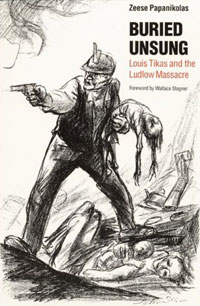
4. Zeese Papanikolas represented his authorative Buried Unsung: Louis Tikas and the Ludlow Massacre, written in 1984.)

Does it matter what it’s called, or with what certainty? The symposium is filled with public school system educators looking for an angle with which to approach Ludlow with their kids. One of them expresses her doubt about teaching about Mother Jones, having just heard from the panelists a probably too-nuanced assessment of the labor hero’s tactics. The political climate of our age can’t find any purchase with moral nuance.

I’m stuck thinking that in recording social history, scholars cannot avoid writing the victor’s narrative. In particular as regards the history of labor, because neither academics nor even middle class hobbyists in the symposium’s audience can look at the events from the perspective of the working class.

Even the scholar’s objectivity is middle class. The opinion was expressed by the panel that the Ludlow aftermath was one of the few occasions when the story was spun to the benefit of labor interests. But this does not account for why authors and educators find themselves having to resurrect the tale of Ludlow these many years later. When it occurred, Americans may have swallowed the hyperbole, but since that time they’ve internalized its internment, effaced by a corporate culture so as to have disappeared from even our school textbooks.

I think this may have been something of the question posed by symposium organizer Jaime Stevensen to the panel, when she asked how the authors insulated themselves from the fictions woven into their own perspectives of history. She didn’t get any takers.

The very concept that history adds up to only so much trivial pursuit, is inherently a view from the ivory tower. BLOOD PASSION by Scott Martelle Do the Ludlow scholars not recognize that common people today face the same foes as did the miners of Ludlow? With the added impediment of a corporate PR system erasing its malevolent deeds. Have not American unions been maligned to the point of extinction? Yet at the same time, capitalists have thoroughly reprised their Machiavellian ways. History can be a tool, not only for statecraft, but for the common American to protect his hard-fought democratic gains.

The United Mine Workers of America having successfully spun the deaths of the striking miner families as a “massacre” may have made an unmerited impact on the public’s sympathies, but likewise, deciding to call Ludlow “not a massacre” will be falsely charged as well. Is there a valuable lesson in unlearning that unbridled corporate greed can be unthinkably inhumane?

OUT OF THE DEPTHS by Barron BeshoarHistorians can fancy themselves objective to ambivalence, but is that a luxury their readers and in particular the schoolchildren can afford? As we witness today the gloves coming off of the globalisation taskmasters?

How I prefer the emotional truth of earlier chroniclers like Barron Beshoar, author of OUT OF THE DEPTHS, a 1942 account of Ludlow, whose preface included this gem:

“If the mine guards and detectives, the mercenaries who served as the Gestapo and the coal districts appear to be scoundrels who sold themselves and their fellowmen for a few corporation dollars, the author will consider them adequately presented.”

KILLING FOR COAL by Thomas AndrewsAt Colorado College the consensus of contemporary historical synthesis, embodied by CU Denver’s Thomas Andrews‘ excellent book KILLING FOR COAL, seems to conclude about Ludlow, “we may never know exactly what happened.” This may reflect the Factual Truth, but it does so at the expense of unrecorded oral accounts, by depreciating their traditional path to us through of folklore.

Buried UnsungAnother author made pains to debunk the lyrics “Sixteen tons, and what do you get, another day older and deeper in debt,” a cultural indictment of the “company store,” which was one of the grievances of the Ludlow strikers. He postulated that modern readers could be prone to let folklore color a predisposition against the company store. Perhaps a company store was in fact a convenience, derided because it was an arbitrary restriction against which human nature bucked. Trying to be helpful, another panelist suggested: “Imagine if the company store was 7-11, and you were told you could only shop there.” I believe both of these gentlemen are overlooking the much grosser complaint which the miners were protesting, that of insurmountable debt, systematically forced on them by their employers. That’s a phenomena on the rise today, if maybe not among college professors. Around the world, indentured servitude has never abated.

In our ivory tower we can debate which side, the union or the militia, fired the first shots on April 20. Who was at fault, seemed to be what that question would decide. At least panelist Anne Hyde had the presence of mind to lay some of the responsibility on the mine owners, who weren’t there of course, but whose stubborn greed played a not unsubstantial part in what the other panelists were attributing to “macho intransigence.”

That expression was in vogue to describe Cowboy presidencies. What an effete put down of militant activism. Are we to blame the striking miners for holding firm to their demands?

Thank goodness someone in the audience brought up recent efforts to deny the Sand Creek Massacre, which two panelists quickly weighed in to say “that was a real massacre,” discrediting Ludlow, obviously, and failing to grasp her point that indeed some Colorado Springs locals are rewriting Sand Creek as a battle, and not a massacre.

Another isolationist luxury has become to judge every action as it compares to a nonviolent ideal. It was noted that UMWA union leader John Lawson always recused himself from violent tactics. During the symposium’s opening reception, someone performed a song dedicated to the Ludlow martyr Louis Tikas, which lauded him for choosing to fight with words not guns, as if guns would discredit him.

I’ll play devil’s advocate and suggest that the miners fired the first shots. They saw Louis Tikas bludgeoned in the back of the head and then executed as he lay on the ground unconscious, they saw the National Guard move a machine gun into position above their tent city, and they probably began to fire at the soldiers lest a rain of bullets descend on miners’ wives and children before they had a chance to flee the camp.

The miners were asking that their union be recognized, that the Colorado eight hour work day be enforced, that the scales which determined their pay be verified, that their full hours be compensated, etc. The mine owners clung to their profits, and ordered the miners’ tent city, their only shelter and all their worldly possessions burned to the ground. Women and children were hiding in underground pits dug to escape the sniper fire which the mine guards sporadically aimed at the tents. The guards drove an armored car around the perimeter of the union camp, at all hours, for that purpose.

Ultimately this climate erupted into the violent clash on April 20, 1914, in which the miners battled with the far better equipped soldiers. The casualties were 25 to 1. I call that a massacre.

ADDENDUM: Photographs from visit to the Ludlow Memorial.
Site of Ludlow Massacre, photographed 2009
LUDLOW MEMORIAL, COLORADO- Day three of the Colorado College Ludlow Symposium featured a bus ride to the site of the 1914 Ludlow Massacre, then on to Trinidad to the grave of Union leader Louis Tikas. A reporter for Colorado Public Radio interviewed the symposium panelists at the U.M.W.A. memorial grounds.

April 2009 Visit to Ludlow site
David Mason is interviewed by a freelance reporter for Colorado Public Radio.

April 2009 Visit to Ludlow site
Scott Martelle and Thomas Andrews are interviewed above the fatal cellar.

April 2009 Visit to Ludlow site

April 2009 Visit to Ludlow site

TRINIDAD, COLORADO- Masonic Cemetary.
April 2009 Visit to Louis Tikas grave site

April 2009 Visit to Louis Tikas grave site
Zeese Papanikolas spoke about his protagonist’s gravestone and its reference to Tikas as a “Patriot.”

April 2009 Visit to Louis Tikas grave site

April 2009 Visit to Louis Tikas grave site

Driving Miss McIntosh

Marjorie K. McintoshDENVER- At first the testimony from a CU committee member who voted to dismiss Ward Churchill seemed utterly damning. Dr. Marjorie McIntosh, retired Distinguished Professor of history, gave her testimony by video because she would be lecturing in England at the time of the Churchill v CU trial. She came across like a wise elder, her scolding kind and maternal. She had me convinced that Ward should be sent to his room, but for an indelible pallor that began to infect her testimony as the retired professor grew tired under scrutiny. And like the history of 14th Century England which was her specialization, it became inescapably evident that Marjorie McIntosh was very, very white.

At face value, Dr. McIntosh’s quiet authoritative demeanor seemed beyond reproach, expressing as she did her support for Ward Churchill’s right to speak. McIntosh described how her father was a dean at U of M who reputedly stood up to Senator McCarthy. She explained her initial reluctance to be party to a Right Wing attempt to “get” Professor Churchill. At first Ms. McIntosh seemed as earnest as your own grandmother, if your grandmother was also a well spoken distinguished academic.

But the cracks in Ms. McIntosh’s maternal concern showed themselves even before the plaintiff’s cross-examination. When Professor McIntosh described herself as “fair and impartial,” it was in contrast, she offered, to Professor Churchill for example, who she understands may not be impartial or neutral.

Partiality
Under cross-examination McIntosh went further. To paraphrase: “Professor Curchill is not a trained historian, he has an MA, he is a scholar who writes on historical subjects. He presents himself as a specialist, but he does not have that training.”

By contrast we are meant to infer, McIntosh is a Distinguished Professor, rewarded for having had a “national impact” on scholarship, and having produced work which has “directed” consequential research.

Questioned about the significance of tenure, McIntosh described the rigorous qualifications which she met. But with a smile she would not vouch for a uniformity of high standards at CU, since, obviously… She held her tongue as if too polite to say it: Ward Churchill was a glaring example of the opposite.

A second indication of Dr. McIntosh’s personal bias might be suggested by how she characterized committee chairwoman Mimi Wesson’s perceived personal agenda: Did she detect any bias on the committee, in particular with Wesson? McIntosh saw no evidence of bias, and she thought Wesson treated Professor Churchill with great respect, both in his presence and after. McIntosh was impressed by Wesson’s professionalism.

Another of McIntosh’s responses hints at a further insincerity. She and her SCRUM colleagues were tasked with investigating one allegation each made against Churchill. McIntosh was “foot soldier” for the Madan Indian Ft Clark episode. Discrepancies in Churchill’s account had been brought to the university’s attention by Arizona professor Lavall, a rival of Churchill’s in the American Indian Movement. McIntosh was asked whether she knew that Lavall’s allegations had been raised six years before being addressed by her committee. Perhaps to dodge the accusation that the timing of their inquest was more related to Churchill’s 9/11 essay, McIntosh replied that she did not know. After of course, delivering the findings of what she presented as an exhaustive review of all available evidence.

Allegation A
Allegation A held that Churchill falsified an account of the 1837 small pox outbreak in North Dakota. McIntosh was charged with verifying Churchill’s claims (1) that small pox was deliberately spread by the US Army using blankets, (2) that said blankets were dispensed from a St Louis small pox infirmary, (3) that the infected Indians were ordered to scatter, (4) that a vaccination was deliberately kept from the indians, and (5) that the dead numbered upwards 400,000.

According to Lavall and the CU committee, Churchill was held to have been negligent in citing sources. While Churchill countered that his accounts came from oral tradition, much of it commonly known, McIntosh encountered none.

While McIntosh concedes that she does shares no heritage with Native Americans, to perhaps have grown up with oral accounts, but she argues that Churchill is similarly neither from the tribal lines from which he would have heard Mandan stories.

Did you give Professor Churchill the benefit of the doubt? Dr. McIntosh was asked?

“I would say we gave him a great big benefit of the doubt” McIntosh replied. Her research found no oral tradition of small pox evidence. “We could have stopped there and found him guilty of fabrication and falsification.” Instead the committee magnanimously contacted Churchill to ask for further evidence. They were surprised when he produced conflicting sources. Most surprising, McIntosh condescended, was not getting a straight-forward answer from Professor Churchill.

McIntosh summarized the generally accepted narrative of the 1837 epidemic: Every summer a fur trading company working along the Missouri River, sent a steamship north from St Louis, to the fortified trading posts lying along the river, at their furthest, 2000 miles north. Only once a year, the “Saint Peter” steamed upriver with trading goods to exchange for furs and hides, and with “annuities” which were gifts for Indian tribes who had signed a treaty with the government. A week into the 1837 voyage, one passenger was showing signs of an illness but the captain decided against forcing a disembarkation. By two weeks, everyone on the boat had contracted what was by then undeniably a small pox outbreak. As each of these travelers got off at the trading posts, small pox spread from every stop. The Mandan Indians lived 300 miles north of Ft Union, the furthest point of the steamboat. At least 90% of their number were killed. That much is undisputed.

About involvement of US soldiers, blankets, an infirmary, a vaccination withheld, and an order to scatter, Ms. McIntosh found absolutely no proof. She conceded that some accounts hint that the outbreak was intentional, a couple of accounts mention blankets. On this point the committee agreed the thesis could have been justified. But St Louis newspaper archives reveal no trace of an infirmary nor of a small pox outbreak. There were no medical records kept at the trading posts, nor even any medical staff. Etc.

And as to Churchill’s numbers… “Churchill cites 100,000, then 125,000, then 250,00 and now as many as 400,000.” Churchill attributes the figures to “as Professor Thornton suggests.” But according to McIntosh, Thornton never gave any numbers.

Disputing the numbers, the means, the details, reminds me of another pattern of denial.

Holocaust Denial
Is this not the very basis of Holocaust Denial? A perpetrator culture, commits a genocide, then quibbles with accusers by pointing to the paucity of evidence. It’s a mobster’s strategem. Leave no witnesses and there’s no one to tie you to a crime. A massacre thoroughly executed leaves no trace. History is written by the victors. The master narrative, in Western Heritage, has always had a white master.

Do I liken McIntosh to Jessica Tandy’s role in Driving Miss Daisy? If Tandy had quietly not transformed, but instead held tenaciously to her condescending racism. I would be loath to offend those courageous souls who labor to get to the truth about recorded history, but Holocaust Denial is about repudiating mankind’s evil deeds. Where evidence is sparse, because the perpetrators covered their tracks, others come along to cast doubt on the original crime. The details matter less than the crime. Here we have white man’s genocide against the Native Americans. All the details are in dispute. Held together, they deny the whole of what we can plainly see as the truth.

Asked if she was acquainted with Critical Race Theory, McIntosh replied she wasn’t. She professed uncertainty about even the tenure process for Ethnics Studies. She feels those kind of studies are emotional and partisan. Enlish history has debate too, but less resonance in people’s current lives.

Academic disciplines
Dr. McIntosh became combative when challenged about her proficiency with history from taken from oral tradition. In her later scholarship, Ms. McIntosh worked in contemporary Ugandan women’s studies. Oral sources build African history, but not in English history, where archival history preempts oral sources. We are left to question if McIntosh can reconcile how to incorporate oral accounts not from the present.

Was she coming at this subject with a bias? No, she’d never heard of the Mandan small pox epidemic.

Did anyone put pressure on her, to arrive at her findings? “In the first place, it didn’t occur to me that anyone would put pressure on me.” In discussing her apprehension about joining committee, Mcintosh “did not think the University would be critical of me.”

Dave Schultheis of Colorado State Senate District 9- Lost in a Black Hole of Stupidity

Joe McCarthyIn this day and age, science has finally located the Black Hole of Human Stupidity and it is centered on Colorado State Senator Dave Schultheis, elected representative of Colorado State Senate District 9. That’s quite a dishonor, but Dave fully deserves the distinction. I mean today, how many public officials have Joseph McCarthy listed as a great American patriotic hero on their website? That’s major league Black Hole of Stupidity if there ever was one and the people of State District 9 elected this twit! Let his love of American fascist Joe McCarthy be expressed in his own words.

Here he answers a man who wrote him opposed to his legislative support for mandatory recitations of the Pledge of Allegiance…

6. Your passing references to McCarthy are noted. I would encourage you to do some reading on Mr. McCarthy. The modern myth about him serves the political agenda of the anti-American crowd, but it does not serve history or the nation very well. McCarthy was a golden boy from Wisconsin, the youngest sitting judge ever appointed in that state, and the youngest man to be elected from that state to the U.S. Senate. He married a Washington beauty queen after moving to the capital. Because of his natural talent and intellectual and moral strength, he was on the fast track to high places. He sacrificed his personal ambitions in order to confront no-kidding Communists who had infiltrated the U.S. at high levels, and his efforts helped lead to the conviction of Alger Hiss and other documented Communist spies. Secret Soviet cables known as the Venona Project which were declassified in 1995 have removed any doubt about this. It may sound far-fetched, given all the modern nonsense you have heard about McCarthy, but his true legacy was not one of forcing patriotism on innocent little children, an association you seem to draw. It was one of courageous, though imperfect, defense of the world’s freest and best political institutions. Again, I commend him to your prudent investigation.

I hope this helps you understand my point of view, and that of others advocating both formal, public patriotism, and inner, personal patriotism. This country is great. This country is good. Loving it deeply enough to advocate public ceremonies which reflect that love is not dangerous, but healthy. Naturally, I would be happy to answer your open letter, should you care to send one, with one of my own.

Best regards to you, and thank you again for taking the time both to write and follow up.

Dave Schultheis

See Rep. Schultheis Responds to Constituent on Pledge of Allegiance
—————————————————————————–
Want more words of wisdom from this homophobic and immigrant-phobic dingbat, Dave Schultheis? How about his website’s headliner quote against being tolerant? Here it is then…

“Tolerance is a virtue of a man without convictions.” — G. K. Chesterton, who strongly influenced C.S. Lewis

So who is this G.K. Chesterton whose quote Schultheis puts on his website? He became a major Catholic apologist right at the time that the Catholic Church was solidly fascist in its sentiments in countries like Spain and Italy. Here below is part of wikipedia’s description of Chesterton…

Accusations of anti-Semitism
Both Chesterton and Belloc have faced accusations of anti-Semitism during their lifetimes and subsequently.[17] Their criticisms of the “international Jewish banking families” are some of the most important reasons for these accusations. For example, Chesterton, Belloc, and Chesterton’s brother Cecil, were vehement critics of the Isaacs, who were involved in the Marconi scandal in the years before World War I.[18] George Orwell accused Chesterton of being guilty of “endless tirades against Jews, which he thrust into stories and essays upon the flimsiest pretexts.”[19]

In The New Jerusalem, Chesterton made it clear that he believed that there was a “Jewish Problem” in Europe, in the sense that he believed that Jewish culture (not Jewish ethnicity) separated itself from the nationalities of Europe.[20] He suggested the formation of a Jewish homeland as a solution, and was later invited to Palestine by Jewish Zionists who saw him as an ally in their cause. In 1934, after the Nazi Party took power in Germany he wrote that:

In our early days Hilaire Belloc and myself were accused of being uncompromising Anti-Semites. Today, although I still think there is a Jewish problem, I am appalled by the Hitlerite atrocities. They have absolutely no reason or logic behind them. It is quite obviously the expedient of a man who has been driven to seeking a scapegoat, and has found with relief the most famous scapegoat in European history, the Jewish people.[21]

The Wiener Library (London’s archive on anti-semitism and Holocaust history) has defended Chesterton against the charge of anti-Semitism: “he was not an enemy, and when the real testing time came along he showed what side he was on.”[22]

Chesterton condemned the Nuremberg Laws, and he died in 1936, as the Hitlerite antisemitic measures were temporarily decreased due to the Berlin Olympics, long before lethal persecution by the Nazis would start.

G. K. Chesterton From Wikipedia, the free encyclopedia
————————————————————————————-
More? Here is State Senator Schultheis touting sales of a book that decries homosexuals as being just what? …’The Homosexual Agenda: Exposing the Principal Threat to Religious Freedom Today’! See Intolerant Dave on Homosexuality

Hey, did you know that? They are the principal threat to religious freedom protected by none other than Dave Schultheis! (and CS daily, The Gazette! They share this nutty view that Christians are under major attack, too). Poor Christians…. Who can save them from the fags?

Yes, Dave Schultheis of Colorado State District 9 is lost in a Black Hole of Stupidity, but that’s North Colorado Springs for you! And Dave Schultheis is one of the few remaining living, openly McCarthyite fossils left in America! Incredible! And how he manages to fuse together MLK with Joseph McCarthy is an amazing feat! Only in Colorado do we have such genius! It’s an amazing place!

History Begins at Sumer

Sumerian statuesI’m reading about the Sumarians (5,300 – 2,000 B.C.) FROM THE TABLETS OF SUMER: 39 Firsts in Man’s Recorded History. The Sumarians originated civilization as we know it, and their demise may look a lot like ours too. In case you missed the memo, Sumer was earliest Mesopotamia in southern Iraq.

Until the mid 19th Century, we didn’t know Sumerians from Adam. Their history is traced by now deciphered cuneiform writings on clay vessels. Now thanks to Bush’s Folly, we may learn very little more.

Until I have more to relate, I’ll treat you to the table of contents, where Princeton Assyriologist Samuel Noah Kramer lays out his thesis. You might be surprised at which cultural themes are apparently elemental.

From the Tablets of Sumer was published in 1956. The latest edition, History Begins at Sumer can be read online. Kramer also compiled an 18-volume Sumerian dictionary.

Thirty-Nine Firsts in Man’s Recorded History

1.     EDUCATION: The First School
2.     SCHOOLDAYS: The First Case of “Apple-Polishing”
3.     FATHER AND SON: The First Case of Juvenile Delinquency
4.     INTERNATIONAL AFFAIRS: The First “War of Nerves”
5.     GOVERNMENT: The First Bicameral Congress
6.     CIVIL WAR IN SUMER: The First Historian
7.     SOCIAL REFORM: The First Case of Tax Reduction
8.     LAW CODES: The First “Moses”
9.     JUSTICE: The First Legal Precedent
10.   MEDICINE: The First Pharmacopoeia
11.   AGRICULTURE: The First “Farmer’s Almanac”
12.   HORTICULTURE: The First Experiment in Shade-Tree Gardening
13.   PHILOSOPHY: Man’s First Cosmogony and Cosmology
14.   ETHICS: The First Moral Ideals
15.   SUFFERING AND SUBMISSION: The First “Job”
16.   WISDOM: The First Proverbs and Sayings
17.   “AESOPICA”: The First Animal Fables
18.   LOGOMACHY: The First Literary Debates
19.   PARADISE: The First Biblical Parallels
20.   A FLOOD: The First “Noah”
21.   HADES: The First Tale of Resurrection
22.   SLAYING OF THE DRAGON: The First “St. George”
23.   TALES OF GILGAMESH: The First Case of Literary Borrowing
24.   EPIC LITERATURE: Man’s First Heroic Age
25.   TO THE ROYAL BRIDEGROOM: The First Love Song
26.   BOOK LISTS: The First Library Catalogue
27.   WORLD PEACE AND HARMONY: Man’s First Golden Age
28.   ANCIENT COUNTERPARTS OF MODERN WOES:
The First “Sick” Society
29.   DESTRUCTION AND DELIVERANCE: The First Liturgic Laments
30.   THE IDEAL KING: The First Messiahs
31.   SHULGI OF UR: The First Long-Distance Champion
32.   POETRY: The First Literary Imagery
33.   THE SACRED MARRIAGE RITE: The First Sex Symbolism
34.   WEEPING GODDESSES: The First Mater Dolorosa
35.   AU-A A-U-A: The First Lullaby
36.   THE IDEAL MOTHER: Her First Literary Portrait
37.   THREE FUNERAL CHANTS: The First Elegies
38.   THE PICKAXE AND THE PLOW: Labor’s First Victory
39.   HOME OF THE FISH: The First Aquarium

Third class citizens in the Jewish Apartheid State

israeli againstIndigenous Palestinians are not really even second class citizens within the ‘Jewish Apartheid State since certain elements of the Jewish community are given second class status themselves. Even calling Israel’s Palestinians Third Class citizens is kind of a stretch since they correctly believe and feel that the Jewish community will try to expel them at the first opportune moment. Discrimination against their culture, heritage, religion, and language is everywhere. Israel’s forgotten Palestinians Israel is a classic colonialist Apartheid State. Even the rather conservative ex-Prez Jimmy Carter can see and admit that.

Bishop Williamson and Auschwitz 1.0

Arbeit Macht Frei
I am curious as to why a Roman Catholic bishop would risk a second excommunication over the historic particulars of the Holocaust. Bishop Richard Williamson is being labeled a “Holocaust Denier” because he questions the extent, and mechanism, of the official version of the Holocaust. Because Williamson is also criticized for his skepticism about the official 9/11 narrative, and for his praise for the Unabomber’s manifesto, I want to take a closer look, and wonder what is he reading?

Bishop Richard WilliamsonHere’s what the outspoken Williamson told Swedish SVT in a November 2008 interview, as transcribed by the BBC:

“I believe that the historical evidence is strongly against, is hugely against, six million Jews having been deliberately gassed in gas chambers as a deliberate policy of Adolf Hitler… I believe there were no gas chambers [during World War II]”

First, I’m compelled to pose a naive question: If we can all agree that Jews died in huge numbers by incomparable horrors at the hands of the Nazis, would it matter what the exact death toll was, or which killing method predominated? Why? What is the need for laws to restrict historians who are trying to reconstruct the record from emerging facts? Must preemptive “anti-defamation” laws mandate that historians stick to the official “untold” number and “indescribable” evil?

Even if we postulate, albeit cynically, that Holocaust reverence is critical to upholding American public support for Israel‘s “right to exist” in the Middle East, how could a revision of the casualties, in any case a horrific magnitude, make an difference?

Millions of Jews fell victim to the Third Reich. No one is denying it, and historical revision is not trying to bring the Holocaust victims back to life. Holocaust Remembrance of the Jewish victims has remained a political priority around the world, advocating commemoration in education, literature, civic life, and pop culture. Why then, an aversion to scrutiny?

Last week a fellow Society of St. Pius X member, Rev. Floriano Abrahamowicz was ejected from SSPX for coming to Williamson’s and the Pope’s defense.

While the usual politicians and Jewish community leaders are voicing their indignation, can we ask, are the Bishop’s beliefs really at odds with accepted orthodoxy? The media will reiterate that the Six Million figure has always been beyond dispute. All the while, official scholarship has been recording otherwise. In Germany, revisionist historians are jailed for Holocaust Denial. Yet bit by bit, mainstream historians have been able to publish divergent theses which withstand legal refutation.

For the sake of argument, let’s dismiss all the “deniers” as kooks, and look only at the traditionally vetted voices.

On the subject of Auschwitz, where four million of the total six million Jews were believed to have perished, Der Spiegel managing editor Fritjof Meyer a continued critic of revisionism, summarized in Osteuropa 52, 5/2002, p. 631:

“In 1945, the Soviet Investigatory Commission numbered four million victims in the National Socialist work and extermination camp of Auschwitz-Birkenau, a product of war propaganda. Under coercion, camp Commandant Höß named three million and recanted. Up until now, how many people actually fell victim to this singular mass murder could only be estimated. The first Holocaust historian, Gerald Reitlinger, assumed one million, while the latest state of research estimated it to be several hundred thousand fewer.”

Naturally even Meyer touched off a firestorm by integrating the sum of official scholarship into the big picture. The difficulties which historians face in reaching variant findings are explained by another mainstream scholar, noted Hitler historian Dr. Werner Maser, Professor for History and International Law, Munich University, Falsification, Legend, and Truth about Hitler and Stalin, Olzog, Munich 2004, on p.332

“To be sure, […] the extermination of the Jews is considered to be one of the best researched aspects of contemporary history […], but that is not the case. […] Indeed, whole regions remain as much terra incognita as ever, […] German historians exhibit timidity about taking on the horrible issue and possibly bringing to light details that do not agree with the accounts which have multiplied for a very long time.”

And about the deterrence of the Holocaust Denial laws:

“The sword of Damocles hovers over historians (not only in Germany) who portray the controversial phases of history as they ‘actually were’ – and identify the frequently even officially codified ideological specifications as falsifications of history.”

The question of the gas chambers is raised by the absence of evidence. According to major Holocaust authority Dr. Arno J. Mayer, Professor of Modern Jewish History at Princeton University, in Why Did the Heavens Not Darken? The “Final Solution” in History, Pantheon, New York 1990, p. 362:

“Sources for the study of the gas chambers are at once rare and unreliable. Even though Hitler and the Nazis made no secret of their war on the Jews, the SS operatives dutifully eliminated all traces of their murderous activities and instruments. No written orders for gassing have turned up thus far. The SS not only destroyed most camp records, which were in any case incomplete, but also razed nearly all killing and crematory installations well before the arrival of Soviet troops. Likewise, care was taken to dispose of the bones and ashes of the victims.”

Justifiably, scholars are skeptical that the complete absence of evidence should be taken as proof of its existence and total suppression. Some camps were overrun before the Germans could destroy any part of them. Mayer continues, p. 163:

“In the meantime, there is no denying the many contradictions, ambiguities, and errors in the existing sources. […] Much the same is true of for the conflicting estimates and extrapolations of the number of victims, since there are no reliable statistics to work with. […] Both radical skepticism and rigid dogmatism about the exact processes of extermination and the exact number of victims are the bane of sound historical interpretation”

In light of the before-sited Wannsee Conference documents now being considered post-war forgeries, Mayer explains, p 163:

“To date there is no certainty about who gave the order, and when, to install the gas chambers used for the murder of Jews at Auschwitz. As no written command has been located, there is a strong presumption that the order was issued and received orally”

With no written record of a “Final Solution,” and the implausibility of a completely vaporized paper trail, mainstream scholars have had to improvise an explanation for how an extermination directive was disseminated. University of Vermont Professor Raul Hilberg, member of US Holocaust Memorial Council, author of The Destruction of the European Jews, (Holmes & Meyer, New York 1985), was quoted in Newsday, Feb. 23, 1983:

“But what began in 1941 was a process of destruction [of the Jews] not planned in advance, not organized centrally by any agency. There was no blueprint and there was no budget for destructive measures. They [these measures] were taken step by step, one step at a time. Thus came about not so much a plan being carried out, but an incredible meeting of minds, a consensus mind reading by a far-flung [German] bureaucracy.”

Hilberg himself ran into trouble with the authorized version, because he refused to corroborate tales of Jewish rebellion against their Nazi jailers. His group-think theory extended to the Jews themselves, putting emphasis on their acceptance of being exploited as war industry slave labor.

“I had to examine the Jewish tradition of trusting God, princes, laws and contracts […] Ultimately I had to ponder the Jewish calculation that the persecutor would not destroy what he could economically exploit. It was precisely this Jewish strategy that dictated accommodation and precluded resistance.”

That’s where the extermination camp thesis becomes less probable than the work camp. Perhaps the Jews didn’t resist because they were being worked, not gassed. Worked to death, of course, but dying as more a consequence of wartime Germany’s depleting resources, than from a deliberate eradication effort. Evidence is plentiful of the work camps and dead bodies.

And isn’t that the answer to my innocent question? To doubt whether the murder weapon was a pistol or a knife, means calling into question the crime entirely. That’s why revisionists are decried for being “deniers.” While we presume the distinction makes little difference, because clearly a murder was committed regardless, the prosecutor constructing the accusations wants to prove his motive and not another.

There are many details about which historians have begun to disagree. Many of the witness accounts have been proven to be unreliable. Even Elie Wiesel was compelled to reclassified his memoir as a novel. The Holocaust as later generations have come to know it was not as the WWII generation saw it. Even those soldiers who encountered the atrocities themselves.

Professor Hilberg recounts studying at Brooklyn College under Hans Rosenberg, a fellow Jew. Even in the wake of the haunting newsreels of the concentration camps, Hilberg records that Rosenberg remarked in a 1948 lecture:

“The most wicked atrocities perpetrated on a civilian population in modern times occurred during the Napoleonic occupation of Spain.”

I don’t really subscribe to the idea that the Holocaust is diminished by learning that the WWII concentration camp victims died from systemic and despotic abuse, starvation and exhaustion. But those holding the secrets believe that the concept of the Holocaust being the greatest evil perpetrated upon mankind falls apart if cracks are allowed to form in the accepted narrative.

Perhaps the German population, and for that matter, the Catholic Church, did not intercede more vigorously because there was no premeditated extermination program. We can say now that German reinforcements being sent to the Russian Front knew they were being sent to their deaths, but this is only with hindsight.

Is this Bishop Williamson’s interest in revisiting the Holocaust, to rehabilitate the church’s role? I doubt it. The Catholic church cannot escape culpability for its instrumental role in support of the Nazis, guilty of ware crimes and crimes against humanity, initiating a war of aggression being the chief charge at the Nuremberg Trials for example, before even taking into account the concentration camps.

Perhaps the American industrialists and bankers who knew about the camps did not interfere because they understood the camps were for the supply of slave labor. Isn’t this a key enigma of the Holocaust, as we grapple with it? How could we have not known? How could this have been allowed to happen?

Perhaps the signs above the camp gates which read ARBEIT MACHT FREI, work earns freedom, meant what they said. They might have been inescapable ironies, but not the cruel mockery of which we accuse the Germans.

Why would factories like IG Farben and Krupp want to liquidate their valuable cheap workforce? Why would camps meant to exterminate have infirmaries? Why would the wardens treat inmates for illness while simultaneously sending incoming transports to directly to ovens?

Today the popular conscience has been saturated with the ghostly images of the concentration camp victims. How to explain the emaciated inmates discovered by the liberating troops, many of whom could not be saved from dying, even under the administration of the liberators? Dr. Arno J. Mayer concedes this explanation, p. 365

“[…] the whole of Auschwitz was intermittently in the grip of a devastating typhus epidemic. The result was an unspeakable death rate. […] There is a distinction between dying from ‘natural’ or ‘normal’ causes and being killed by shooting, hanging, phenol injection, or gassing. […] from 1942 to 1945, certainly at Auschwitz, but probably overall, more Jews were killed by so-called ‘natural’ causes than by ‘unnatural’ ones.”

This is not to diminish the crime of the Holocaust one iota. The German people, the industrialists, the church, the anti-Semites, are far more guilty because the crime against the Jews was banal and common. It was not devised by agents of unspeakable evil.

Other aspiring genocidal nations and peoples cannot excuse their acts because their methods fall demonstrably below the mythic proportions of the Holocaust.

ig-farben-auschwitz

Does Dope Fiend Michael Phelps stand alone?

Do you think Michael Phelps should be suspended, and lose commercial endorsements, because a photograph surfaces of America’s winningest Olympic athlete with America’s most unfairly maligned recreational drug?

How antiseptic can corporate media expect to paint its role models? TV land can use cosmetics, hairspray and vivid primary colors to shut out the real world, but indignation about the image of a marijuana bong repudiates plenty of very ordinary sensibilities. It demonizes a broad cultural element that has been leading the charge, actually, against this nation’s disastrous “War on Drugs.”

Do we allow these intolerant, no doubt hypocritical, prudes to marginalize pot smokers? I’m just dumb enough to think it’s time to flood the web with our own bong snapshots!

Next the klieg-lit culture makers are going to insist their washed out features are natural and that it’s an aberration to have freckles.

Israel, Judah, Moab, Edom, Samaria, Palestine…

And why it all counts.

Since the whole Israel Right-Of-Return is a huge part of any Any ANY issue involving the modern state of Israel.

It’s not just Religious Talk, so if you’re offended by Biblical references then toughie-poo.
The Bible just happens to be one of the premier sources for Israeli history.

AND.. Arab History

AND Palestinian history.

This is really oversimplifying things, but to most Americans Judah and Israel are equivalent and Palestinian and Arab are interchangeable terms.

To those no-doubt Highly Paid Lobbyists For the Israeli “DEFENSE” Force who insist on calling us liars or ignorant or hate-mongers or whatever, this will be Kindergarten stuff, …

ASSUMING OF COURSE THAT THEY ACTUALLY ARE JEWISH and/or BIBLICAL SCHOLARS or SERIOUSLY AS EXPERT ON THE POLITICAL AND SOCIAL ASPECTS OF THE REGION THEY CLAIM THEMSELVES TO BE (and of course, as they claim we cannot possibly be…)

After the reign of Solomon, just to start, in the middle where a beginning properly belongs, Just Ask Steven Spielberg…

After the Reign of Solomon Israel and Judah were two separate Kingdoms.

Israel, and Judah.

Remember that because it is important and there will be a quiz later, which will count for 57.3% of your total grade.

After the kingdom of Israel got their collective head knuckled by Assyria (Remember Jonah?) but not Judah, and then a short while (historically speaking) later Nebuchadnezzar conquered BOTH and carried away into captivity… NOT EVEN MOST of Israel or Judah, Because They Left The Poor People Behind… (Remember Jeremiah? Of course you do…)

At this point the remnants of the Philistines aka Phoenicia aka Lebanon… a Greek culture…
And the remnants of Moab, descendants of one of the sons/slash/Grandsons of Lot (by his two daughters,)

( you know, Moses wasn’t very Kind or Gentle when he described the doings of his relatives, but he cut Lot a “lot” of slack, claiming he was too drunk to recognize his own daughters)

And the remnants of Edom, descended from Esau, the brother of Jacob aka Israel…

and various tribes of actual Arabs, descendants of Abraham’s first son Ishmael

And even the descendants of the recently (relatively) Dismantled Hittite and Assyrian Empires…

And throw in Ethiopians, Egyptians and Nubians who were stranded in the back and forth conquests over several centuries.

THESE were the people who lived in Israel and Judah at the time.

When people babble much about the Lost Tribes of Israel they’re refering to the Kingdom of Israel which consisted of the vast majority of the tribes of Israel save for Judah and Levi.

And They’re Not “lost” in the sense that they up and disappeared either, it’s “lost” like in the RELIGIOUS context.

More on that…

Remember how I said that Moses was NOT overly kind to the memory of his ancestors and relatives?

Of course you do.

Some of the highest ranking members of the Knesset and Mossad were quoted/slash/interviewed by a Religious Scholar from Colorado Springs and it gets routinely broadcast on TBS.

Who popped off with the Really Racist viewpoint, seconded and aided by the Israelis, that since many (but not all) of the Palestinians are descended from Esau, aka Edom, and their country called Idumea by the Romans, and they considered Esau to be a vagabond and lazy, shiftless and ignorant….

They consider ALL Palestinians to be Lazy Shiftless and Ignorant Vagabonds.

The term “morally dissolute” was thrown in as well, and the notion that ALL the descendants were morally dissolute Because Of Their Ancestry.

Not Racist? I can easily see that it IS… Extremely Racist.

Moses said that Jacob, ISRAEL, cheated Esau out of his birthright, his possessions and even the blessings of their father Isaac.

Stole, and Lied to do it.

That’s two of G_d’s Top Ten on His personal Hit Parade.

When Joseph, 11th son of Israel and first son of his favorite wife Rachel, was sold into slavery by his 10 elder brothers, according to Moses and generally recognized by both Muslim and Jew (the religious groupings) as being accurate, JUDAH wanted to have Joseph killed.

Here Moses plea bargains for his own ancestor Levi, (he wasn’t Ethnically a Jew, although he was Israelite, and Hebrew, but… the Edomites are ALSO Hebrew…

According to Moses, Levi prevented his brothers and especially JUDAH from Killing Their Brother, and was allegedly somehow not aware that a Passing Band of Arabs (Ishmaelites) was so close to their camp, as in “right in the middle of their encampment” that they managed to buy Joseph without Levi knowing about it until much later.

Moses was a Prophet but he was first a Man, and people don’t go out of their way to disrespect Grampa.

Judah also married his own daughter-in-law, OK so she was actually the widow of two of her sons, but here Moses tries not to be nasty about his kinfolk… Judah thought she was a prostitute, “went in unto her” and knocked her up, before marrying her… and without of course consulting his wife.

But, hey, it’s the EDOMITES who are “morally dissolute” right?

Racist? Hell yeah that’s racist.

Let’s flash forward again, this time to Right After The Babylonian Captivity.

The King of Persia (Iran) allowed the priesthood and as many of the Judean (Jews) Captives to return to Israel and Judah.

There they found that the poor who were left to tend the lands in Israel and Judah and Edom and Moab and Lebanon had intermarried.

Oh, NO!

Say it ain’t so, Jonah!

Jewish people intermingling with the Goyim? Gasp! Oh the Horrors!

Ezra and Nehemiah, the two Levite Priests who led the Return to the Land… Thanked the Israelite and Moabite and JEWISH peasants for keeping the land as well as could be expected, then condemned them for Not Maintaining Racial Purity.

And kicked them off the Rich Folks’ lands which they had been tending for more than 70 years.

“Thank you for all your time and labor, now Get Off My Property You Smelly Racially Impure Peasants YOU!”

These then are the “Lost Tribes” of Israel.

Where did they go? They didn’t. They’re still there.

In the New Testament they’re called “Samaritans”.

The parable of the “Good Samaritan” must have raised quite a few Elitist Pharisaic Eyebrows because the Pharisees and Sadducees considered anybody not Wealthy and Elite like themselves to be Ignorant Peasant Scum…

Plus they weren’t Racially Pure.

The Romans didn’t carry off ALL of the people in the region as slaves, not even all of the Jews.

Same way the Assyrians, Babylonians, Hittites and Alexander the Great didn’t.

Evidence, you say?

I mean, evidence aside from that already accepted by “Israel” and their FAMILY who are also Children of Israel the Palestinians?

Boy, you sure drive a hard bargain, but OK, here’s Evidence.

Olive Groves and Vineyards.

Sure Olive trees and grape vines grow wild in the region, but we’re talking Massive Cultivation of them.

Olive Groves and Vineyards that are older than the Roman Empire.

On land where if they were to survive at all they had to be Irrigated.

Anybody who has ever done Farming (And here I’ll excuse the Intellectual Elites like Don and Grace and Mary and David Haddad, who might all be the Same Person with different names)

I’ll excuse you because I don’t believe you’ve ever put hand to shovel or hoe or axe.

BUT I HAVE.

Maintaining an agricultural enterprise of any sort requires Hard Work.

In modern times there are machines which take up most of the Hard Work but they’ve only existed about a century and a half.

For 20 times as long these Groves and Vineyards have been tended by hand.

Irrigation ditches mean Water… and Dirt… Combined.

You have to clear the weeds out of the irrigation ditches at least 5 times a year just to keep the water running.

And if you’re using shovel, axe and hoe to do it it’s one hell of a lot of hard work.

If you’re doing it in Palestine Israel it’s one Hell of a lot of Hard Work under a Relentless Merciless Blazing Sun.

Olive Trees that were planted 60 years ago wouldn’t be producing yet.

They DO take that long.

You plant an Olive Grove not in the hopes that YOU, yourself, will ever eat the fruit thereof, because you most likely WON’T, but instead for your grandchildren.

A Vineyard will start producing within a decade, but it takes centuries to get one going full blast.

“Israeli” Wine and Olives? And in only 60 years?

Sir No Sir!

Those vineyards and groves were tended, by hand, for centuries and even millenia by those “Lazy Shiftless Morally Dissolute” Arabs, Edomites, Moabites and ISRAELITES who make up the Palestinian Nation.

Right to Return? What about the Right To Remain?

Those ARE Israel and have been for thousands of years.

Acknowledged as such by the scriptures that you as Jews and I as a Christian and the Muslims to be the Truth.

If you want to pop off with the “Right Of Return” and quote Scripture to justify your actions you have to Be Judged By Scripture as well.

That’s the Essence of the Law of Moses.

“Behold, I set a stumbling block in Zion”.

Oh, and speaking of Moses, that bit about “Thou Shalt Not Kill”?

#6 on G-d’s Top Ten List… yeah, THAT one…

You know, G_D meant what He said.

That’s why they’re called the Ten Commandments and not “a bunch of Meaningless Suggestions”.

In order to judge someone to Death you have to be Pure yourself.

That means, (and of course, as David Haddad said in his many personalities, I’m “ignorant” and don’t know a Damned thing)

That means You Must Have NEVER committed any of the sins punished by Death according to the Law of Moses.

Even if you were redeemed of the penalty of your sins, “Redeemed” simply means that the debt was paid, not that it never existed.

Germany the victim, Japan the victim, America the victim, Israel the victim?

victimWhat happens when imperialist states put on airs of victim-hood? First an imperialist state defined is simply a country that holds property of other nations, cultures, or religions, or a country that desires to do so. Or both covets new property and holds old properties of others, as the case of the United State so amply demonstrates.

Imperialist states are rarely to never satisfied with their actual criminal take in profits. But what happens when countries that are imperialist, develop in their populations the notion that they are somehow also the victims and not the aggressors, as has happened to Germany, Japan, the US, and Israel, as just a few most prominent examples to mention?

As one might remember from History lessons at school, Germany and Japan had populations of elites that began to feel that they were victimized by the other imperialist nations, whom all already had colonies to exploit. Japan wanted China to make up for that, and Germany wanted to compete with Britain, France, Holland, and Belgium in the imperialism arena, too. The German people chafed at having been given bad conditions by these other Powers post World War One, and they began to think that they were victims of a conspiracy, a conspiracy that denied them their just status, a conspiracy that exploited them financially and had thrown the majority of Germans into poverty.

Shoot to the US, which after the Pearl Harbor attack by Japan was where the US began to rally its population around the idea that America was the Grand Victim of conspiracy. Later the Americans dropped the only atomic bombs ever used on people, and they dropped them onto civilian Japanese. Everything went over smoothly morality wise for the Americans because they had convinced themselves they were victims. In fact, the American government then became the preachiest government ever seen around anywhere, as it began to define war crimes as being always the actions of others, and never themselves.

Now with 9/11, it is as if another dose of victim-hood has become injected into the modern US population.

‘We’re victims!’, shouts the American crowd once again. We must be allowed to do anything without the slightest recriminations against us, because? ‘We’re victims! We are targets from a criminal conspiracy!’ They are talking about Muslims now. The word the more direct Victim-hood fanatic uses is ‘Islamofascsits’ as code for Muslims. Yes, well that was what the Germans were convinced by Hitler to believe, too. Except the criminal conspiracy supposedly was from the Jews.

In WW2 the Jewish European population actually were victims. Most did not escape alive either. Certainly the Jewish population were victims much more than the Americans, the Germans, or the Japanese ever have been. Further, they were not people of an imperialist nation at the time when that happened. Many Jews found that status of having no imperialist nation (Homeland) impossible to maintain and tolerate without changing the situation to try to obtain an imperialist state of their own. They succeeded.

‘We, the Jews, are victims!’

Well, the Jewish survivors of the European Holocaust obtained their imperialist state, obtained their weaponry, and eventually obtained their nuclear arms. How prideful they became, and started to imitate the Americans themselves. They began to think of themselves as the country of the Mighty Mouse. They began to think of themselves as the Mighty Mouse that not only had been victimized before, but would always be victimized by those angry at their thefts of other people’s property and land. This Jewish sense of always feeling that they were about to be victimized again began to grow side by side with the Americans’ sense of the very exact same. So here we are today… Another imperialist nation feeling themselves the eternal Victim.

There is much destruction on the horizon and the people who will cause it consider themselves to be the victims of others. That’s the way it always is with imperialist nations, too. It is the mass psychology of the self-righteous Mob at work. Aggressors that see themselves as Victims will lash out at those that see through the ruse. They will lynch, they will bomb, they will burn alive The Other. The victim imperialist country always see themselves as The Pure surrounded by vicious animals. But it is always themselves that become The Rabid.

seeking refuge in Abbey’s country

Phallic-arches-national-park
Edward Abbey presaged America’s current path to tyranny forty years ago and predicted that the end of American democracy would be coincident with the destruction of the wilderness.

What’s the connection between democracy and wilderness? Personal liberty is a fleeting commodity, according to Abbey, and history has shown that governments invariably move toward totalitarianism. When faced with authoritarian governance, wilderness is crucial because it serves as both a refuge from political oppression and a base for guerrilla warfare. Uprisings in urban settings are too quickly quelled by those with better weaponry, but hidden in mountain, desert or jungle settings, revolutionaries can gain an edge on establishment forces and engage in protracted — sometimes successful — battle. Consider Che in the mountains, the Vietcong in the jungle, Osama bin Laden in a desert cave.

From Desert Solitaire:

Suppose we were planning to impose a dictatorial regime upon the American people — the following preparations would be essential:

1. Concentrate the populace in megalopolitan masses so they can be kept under close surveillance and where, in the case of trouble, they can be bombed, burned, gassed or machine-gunned with a minimum of expense and waste.

2. Mechanize agriculture to the highest degree of refinement, thus forcing most of the scattered farm and ranching population into the cities. Such a policy is desirable because farmers, woodsmen, cowboys, Indians, fishermen and other relatively self-sufficient types are difficult to manage unless displaced from their natural environment.

3. Restrict the possession of firearms to the police and the regular military organizations.

4. Encourage or at least fail to discourage population growth. Large masses of people are more easily manipulated and dominated than scattered individuals.

5. Continue military conscription. Nothing excels military training for creating in young men an attitude of prompt, cheeful obedience to officially constituted authority.

6. Divert attention from deep conflicts within the society by engaging in foreign wars; make support of these wars a test of loyalty, thereby exposing and isolating potential opposition to the new order.

7. Overlay the nation with a finely reticulated network of communications, airlines and interstate autobahns.

8. Raze the wilderness. Dam the rivers, flood the canyons, drain the swamps, log the forests, strip-mine the hills, bulldoze the mountains, irrigate the deserts and improve the national parks into national parking lots.

In a final round of environmental fuck-yous, the Bush administration has offered up significant portions of pristine Utah wilderness to oil exploration. Aside from one notable monkeywrenching incident, the trashing of the American wilderness continues unabated.

Shots from my recent cave-hunting trip to Abbey’s country!

Toyota-Sequoia-offroad-Arches
Back-road-Arches
Arches-original-entrance
landscape-arch-arches
klondike-bluffs-arches
juniper-arches
ice-desert-arches
Marie-tree-hugger-arches
balanced-rock-near-abbey-arches
toyota-sequoia-arches
fiery-furnace-arches
delicate-arch-utah-license
cairns-delicate-arch-trail

Psychic wins lottery and The Bush Propaganda Connection.

The first is the most famous headline you’ve never read… the rest of it is about the so-called “Bible Code”. The “History Channel” is running the shitmongering 4 times this evening, saying the Bible Code is accurate, predicted assassinations, 9/11 yadda yadda yadda….

Remember this show was taped in 2003.
It also allegedly predicted that Saddam was tied to 9/11 and the often discredited Bush LIE about WMDs, and the retarded notion that they were somehow smuggled to Syria.

Instead of, you know, Saddam knowing he’s going to be killed no matter what, actually USING them. And somehow smuggling a Million Pounds of Nerve Gas out of the country while the U.S. Army, Navy Air Force Marines were watching them under the proverbial microscope.

People watching this show, if they believe any of the Israeli and CheneyBush Corporation CRAP mentioned therein, will believe that God, in person, has given them the Celestial Green Light not only to Invade, conquer and occupy errr “Liberate” Iraq, but also to “Liberate” Syria.

This is alternating with a show about the Seven Seals of the Apocalypse, wherein the Political Propaganda-inspired narrative, when mentioning Biological Weapons, always bring in the notion of a small government or non-governmental organization unleashing them.

Not even mentioning, because this is BushCo Propaganda, the intent of the Bush Administration to unleash Smallpox on Iraq.

Bush and Co. ordered the Koalition of the Killing Imperial StormTroopers to be vaccinated against a disease which is extinct in the wild and the only known cultures of it left in the world are in the United States and the Former Soviet Union.

It wouldn’t be the first time the U.S. Military has used smallpox as a Bio-Terror weapon either.

The LIE put out by the Koalition of the Killing was that Saddam Hussein intended to use the Smallpox virus, which he didn’t even HAVE,

BUT… the first persons you would vaccinate against a horrendous Bio-Terror weapon (Which the U.S. has, and Iraq did NOT have) would be the soldiers in your own army.

This ties to something repeated in the PNAC statements of Intent to Commit Mass Murder, Robbery and World Conquest errr “Liberation” (under the Benevolent Domination of U.S. Corporations)…

That

We have biological agents tailored to “a certain genotype” and should always consider their use

Of course the people who suggested that were Jewish and were talking about using a bio-terror weapon that’s tailored to Their Own Genotype.

Meaning Arabian.

What’s that said at Seder? “Our father was a wandering Arabian” sound familiar?

And the Arab and Israeli claims, seemingly contradictory, stem from the history that they are, indeed, two branches of the Same Family.

Add in 3700 more or less years of family infighting complicating those claims… but with all the complications the dispute arises within the family.

An interesting story illustrating this is in the end of the Book of The Judges of Israel, in the Old Testament. Segues into the books of Samuel. Involving the Tribe of Benjamin.

If the Rulers of the Knesset want to distance themselves from these bastards they really should start doing it really soon…

Instead of, you know, being the Puppets ruled by these same bastards who would willingly kill off every Jew in Israel and the rest of the Arabian Peninsula and Asia as well.

make no mistake, these dudes are Master Propagandists. Propaganda by the way means “planting seeds”.

There’s such a thing as planting seeds of Evil too… and, sure enough…

Marianne Moore’s Utopian Turtletop

Ford EdselIn the mid-fifties the newly-public Ford Motor Company sought a name for its soon-to-be-released experimental car, known in its design stage as the E-car. After in-house marketers came up with 300-odd names which were felt to be embarrassing in their pedestrianism, the company approached Pulitzer Prize-winning poet Marianne Moore, an icon of the popular culture, known as much for her wild passion for baseball and boxing as for her poetry…

What Ford wanted was a car name that “flashes a dramatically desirable picture in people’s minds,” from a woman who seemed to know mainstream America. What they got was “Anticipator,” “Thunder Crester,” “Pastelogram,” “Intelligent Whale,” “The Resilient Bullet,” “Mongoose Civique,” “Andante con Moto,” “Varsity Stroke” and then, as her very last try for the name magic, “Utopian Turtletop.”

Understandably disappointed by Moore’s ideas, the company hired a marketing firm. When the agency forwarded a list of 18,000 possible names, it fell upon corporate executives to choose the best among them for final consideration. Every day an appointed panel of executives would assemble in an appointed projection room to watch as thousands of names were flashed across a screen in six-inch high letters, to oblivion unless someone shouted, “Stop!” and gave reasons for his enthusiasm.

None of the final contenders, neither “Corsair” nor “Citation” nor “Ranger” nor “Pacer,” made the grade in the end, and Ford returned to its earlier idea — one that had been rejected for years by the Ford family — and named the car after company scion, Edsel Ford.

Of course, the Edsel was a spectacular failure on many levels, marketing most notably. Later consumer surveys revealed that the public strongly disliked the name, associating it with Edson tractors, dead cells (batteries) and weasels.

Weathermen for a Democratic Society

Bernadine Dohrn addresses S.D.S. in ChicagoIn 1969, the Radical Youth Movement (RYM) within Students for a Democratic Society (SDS) expelled the passive participants to reconfigure the SDS to Bring the War Home. At left, Bernardine Dohrn uninvites the Progressive Labor Party (PL) and the Worker Student Alliance (WSA) from the Chicago conference. Below is the founding document after which the RYM was renamed.

You Don’t Need A Weatherman
To Know Which Way The Wind Blows

June 18, 1969

Submitted by Karin Asbley, Bill Ayers, Bernardine Dohrn, John Jacobs, Jeff Jones, Gerry Long, Home Machtinger, Jim Mellen, Terry Robbins, Mark Rudd and Steve Tappis.

I. International Revolution

The contradiction between the revolutionary peoples of Asia, Africa and Latin America and the imperialists headed by the United States is the principal contradiction in the contemporary world. The development of this contradiction is promoting the struggle of the people of the whole world against US imperialism and its lackeys.

Lin Piao, Long Live the Victory of People’s War!

People ask, what is the nature of the revolution that we talk about- Who will it be made by, and for, and what are its goals and strategy-

The overriding consideration in answering these questions is that the main struggle going on in the world today is between US imperialism and the national liberation struggles against it. This is essential in defining political matters in the whole world: because it is by far the most powerful, every other empire and petty dictator is in the long run dependent on US imperialism, which has unified, allied with, and defended all of the reactionary forces of the whole world. Thus, in considering every other force or phenomenon, from Soviet imperialism or Israeli imperialism to “workers struggle” in France or Czechoslovakia, we determine who are our friends and who are our enemies according to whether they help US imperialism or fight to defeat it.

So the very first question people in this country must ask in considering the question of revolution is where they stand in relation to the United States as an oppressor nation, and where they stand in relation to the masses of people throughout the world whom US imperialism is oppressing.

The primary task of revolutionary struggle is to solve this principal contradiction on the side of the people of the world. It is the oppressed peoples of the world who have created the wealth of this empire and it is to them that it belongs; the goal of the revolutionary struggle must be the control and use of this wealth in the interests of the oppressed peoples of the world.

It is in this context that we must examine the revolutionary struggles in the United States. We are within the heartland of a worldwide monster, a country so rich from its worldwide plunder that even the crumbs doled out to the enslaved masses within its borders provide for material existence very much above the conditions of the masses of people of the world. The US empire, as a worldwide system, channels wealth, based upon the labor and resources of the rest of the world, into the United States. The relative affluence existing in the United States is directly dependent upon the labor and natural resources of the Vietnamese, the Angolans, the Bolivians and the rest of the peoples of the Third World. All of the United Airlines Astrojets, all of the Holiday Inns, all of Hertz’s automobiles, your television set, car and wardrobe already belong, to a large degree to the people of the rest of the world.

Therefore, any conception of “socialist revolution” simply in terms of the working people of the United States, failing to recognize the full scope of interests of the most oppressed peoples of the world, is a conception of a fight for a particular privileged interest, and is a very dangerous ideology. While the control and use of the wealth of the Empire for the people of the whole world is also in the interests of the vast majority of the people in this country, if the goal is not clear from the start we will further the preservation of class society, oppression, war, genocide, and the complete emiseration of everyone, including the people of the US.

The goal is the destruction of US imperialism and the achievement of a classless world: world communism. Winning state power in the US will occur as a result of the military forces of the US overextending themselves around the world and being defeated piecemeal; struggle within the US will be a vital part of this process, but when the revolution triumphs in the US it will have been made by the people of the whole world. For socialism to be defined in national terms within so extreme and historical an oppressor nation as this is only imperialist national chauvinism on the part of the “movement.”

II. What Is The Black Colony-

Not every colony of people oppressed by imperialism lies outside the boundaries of the US. Black people within North America, brought here 400 years ago as slaves and whose labor, as slaves, built this country, are an internal colony within the confines of the oppressor nation. What this means is that black people are oppressed as a whole people, in the institutions and social relations of the country, apart from simply the consideration of their class position, income, skill, etc., as individuals- What does this colony look like- What is the basis for its common oppression and why is it important-

One historically important position has been that the black colony only consists of the black belt nation in the South, whose fight for national liberation is based on a common land, culture, history and economic life. The corollary of this position is that black people in the rest of the country are a national minority but not actually part of the colony themselves; so the struggle for national liberation is for the black belt, and not all blacks; black people in the north, not actually part of the colony, are part of the working class of the white oppressor nation. In this formulation northern black workers have a “dual role”—one an interest in supporting the struggle in the South, and opposing racism, as members of the national minority; and as northern “white nation” workers whose class interest is in integrated socialism in the north. The consistent version of this line actually calls for integrated organizing of black and white workers in the north along what it calls “class” lines.

This position is wrong; in reality, the black colony does not exist simply as the “black belt nation,” but exists in the country as a whole. The common oppression of black people and the common culture growing out of that history are not based historically or currently on their relation to the territory of the black belt, even though that has been a place of population concentration and has some very different characteristics than the north, particularly around the land question.

Rather, the common features of oppression, history and culture which unify black people as a colony (although originating historically in a common territory apart from the colonizers, i.e., Africa, not the South) have been based historically on their common position as slaves, which since the nominal abolition of slavery has taken the form of caste oppression, and oppression of black people as a people everywhere that they exist. A new black nation, different from the nations of Africa from which it came, has been forged by the common historical experience of importation and slavery and caste oppression; to claim that to be a nation it must of necessity now be based on a common national territory apart from the colonizing nation is a mechanical application of criteria which were and are applicable to different situations.

What is specifically meant by the term caste is that all black people, on the basis of their common slave history, common culture and skin color are systematically denied access to particular job categories (or positions within job categories), social position, etc., regardless of individual skills, talents, money or education. Within the working class, they are the most oppressed section; in the petit bourgeoisie, they are even more strictly confined to the lowest levels. Token exceptions aside, the specific content of this caste oppression is to maintain black people in the most exploitative and oppressive jobs and conditions. Therefore, since the lowest class is the working class, the black caste is almost entirely a caste of the working class, or [holds] positions as oppressed as the lower working-class positions (poor black petit bourgeoisie and farmers); it is a colonial labor caste,, a colony whose common national character itself is defined by their common class position.

Thus, northern blacks do not have a “dual interest”—as blacks on the one hand and “US-nation workers” on the other. They have a single class interest, along with all other black people in the US, as members of the Black Proletarian Colony.

III. The Struggle For Socialist Self-Determination

The struggle of black people—as a colony—is for self-determination, freedom, and liberation from US imperialism. Because blacks have been oppressed and held in an inferior social position as a people, they have a right to decide, organize and act on their common destiny as a people apart from white interference. Black self-determination does not simply apply to determination of their collective political destiny at some future time. It is directly tied to the fact that because all blacks experience oppression in a form that no whites do, no whites are in a position to fully understand and test from their own practice the real situation black people face and the necessary response to it. This is why it is necessary for black people to organize separately and determine their actions separately at each stage of the struggle.

It is important to understand the implications of this. It is not legitimate for whites to organizationally intervene in differences among revolutionary black nationalists. It would be arrogant for us to attack any black organization that defends black people and opposes imperialism in practice. But it is necessary to develop a correct understanding of the Black Liberation struggle within our own organization, where an incorrect one will further racist practice in our relations with the black movement.

In the history of some external colonies, such as China and Vietnam, the struggle for self-determination has had two stages: (1) a united front against imperialism and for New Democracy (which is a joint dictatorship of anti-colonial classes led by the proletariat, the content of which is a compromise between the interests of the proletariat and nationalist peasants, petit bourgeoisie and national bourgeoisie); and (2) developing out of the new democratic stage, socialism.

However, the black liberation struggle in this country will have only one “stage”; the struggle for self-determination will embody within it the struggle for socialism.

As Huey P. Newton has said, “In order to be a revolutionary nationalist, you would of necessity have to be a socialist.” This is because—given the caste quality of oppression-as-a-people-through-a-common-degree-of-exploitation—self-determination requires being free from white capitalist exploitation in the form of inferior (lower caste) jobs, housing, schools, hospitals, prices. In addition, only what was or became in practice a socialist program for self-determination—one which addressed itself to reversing this exploitation—could win the necessary active mass support in the “proletarian colony.”

The program of a united front for new democracy, on the other hand, would not be as thorough, and so would not win as active and determined support from the black masses. The only reason for having such a front would be where the independent petit bourgeois forces which it would bring in would add enough strength to balance the weakening of proletarian backing. This is not the case: first, because much of the black petit bourgeoisie is actually a “comprador” petit bourgeoisie (like so-called black capitalists who are promoted by the power structure to seem independent but are really agents of white monopoly capital), who would never fight as a class for any real self-determination; and secondly, because many black petit bourgeoisie, perhaps most, while not having a class interest in socialist self-determination, are close enough to the black masses in the oppression and limitations on their conditions that they will support many kinds of self-determination issues, and, especially when the movement is winning, can be won to support full (socialist) self-determination. For the black movement to work to maximize this support from the petit bourgeoisie is correct; but it is in no way a united front where it is clear that the Black Liberation Movement should not and does not modify the revolutionary socialist content of its stand to win that support.

From /New Left Notes/, June 18, 1969

IV. Black Liberation Means Revolution

What is the relationship of the struggle for black self-determination to the whole worldwide revolution to defeat US imperialism and internationalize its resources toward the goal of creating a classless world-

No black self-determination could be won which would not result in a victory for the international revolution as a whole. The black proletarian colony, being dispersed as such a large and exploited section of the work force, is essential to the survival of imperialism. Thus, even if the black liberation movement chose to try to attain self-determination in the form of a separate country (a legitimate part of the right to self-determination), existing side by side with the US, imperialism could not survive if they won it—and so would never give up without being defeated. Thus, a revolutionary nationalist movement could not win without destroying the state power of the imperialists; and it is for this reason that the black liberation movement, as a revolutionary nationalist movement for self-determination, is automatically in and of itself an inseparable part of the whole revolutionary struggle against US imperialism and for international socialism.

However, the fact that black liberation depends on winning the whole revolution does not mean that it depends on waiting for and joining with a mass white movement to do it. The genocidal oppression of black people must be ended, and does not allow any leisure time to wait; if necessary, black people could win self-determination, abolishing the whole imperialist system and seizing state power to do it, without this white movement, although the cost among whites and blacks both would be high.

Blacks could do it alone if necessary because of their centralness to the system, economically and geo-militarily, and because of the level of unity, commitment, and initiative which will be developed in waging a people’s war for survival and national liberation. However, we do not expect that they will have to do it alone, not only because of the international situation, but also because the real interests of masses of oppressed whites in this country lie with the Black Liberation struggle, and the conditions for understanding and fighting for these interests grow with the deepening of the crises. Already, the black liberation movement has carried with it an upsurge of revolutionary consciousness among white youth; and while there are no guarantees, we can expect that this will extend and deepen among all oppressed whites.

To put aside the possibility of blacks winning alone leads to the racist position that blacks should wait for whites and are dependent on whites acting for them to win. Yet the possibility of blacks winning alone cannot in the least be a justification for whites failing to shoulder the burden of developing a revolutionary movement among whites. If the first error is racism by holding back black liberation, this would be equally racist by leaving blacks isolated to take on the whole fight—and the whole cost—for everyone.

It is necessary to defeat both racist tendencies: (1) that blacks shouldn’t go ahead with making the revolution, and (2) that blacks should go ahead alone with making it. The only third path is to build a white movement which will support the blacks in moving as fast as they have to and are able to, and still itself keep up with that black movement enough so that white revolutionaries share the cost and the blacks don’t have to do the whole thing alone. Any white who does not follow this third path is objectively following one of the other two (or both) and is objectively racist.

V. Anti-Imperialist Revolution And The United Front

Since the strategy for defeating imperialism in semi-feudal colonies has two stages, the new democratic stage of a united front to throw out imperialism and then the socialist stage, some people suggest two stages for the US too—one to stop imperialism, the anti-imperialist stage, and another to achieve the dictatorship of the proletariat, the socialist stage. It is no accident that even the proponents of this idea can’t tell you what it means. In reality, imperialism is a predatory international stage of capitalism. Defeating imperialism within the US couldn’t possibly have the content, which it could in a semi-feudal country, of replacing imperialism with capitalism or new democracy; when imperialism is defeated in the US, it will be replaced by socialism—nothing else. One revolution, one replacement process, one seizure of state power—the anti-imperialist revolution and the socialist revolution, one and the same stage. To talk of this as two separate stages, the struggle to overthrow imperialism and the struggle for socialist revolution, is as crazy as if Marx had talked about the proletarian socialist revolution as a revolution of two stages, one the overthrow of capitalist state power, and second the establishment of socialist state power.

Along with no two stages, there is no united front with the petit bourgeoisie, because its interests as a class aren’t for replacing imperialism with socialism. As far as people within this country are concerned, the international war against imperialism is the same task as the socialist revolution, for one overthrow of power here. There is no “united front” for socialism here.

One reason people have considered the “united front” idea is the fear that if we were talking about a one-stage socialist revolution we would fail to organize maximum possible support among people, like some petit bourgeoisie, who would fight imperialism on a particular issue, but weren’t for revolution. When the petit bourgeoisie’s interest is for fighting imperialism on a particular issue, but not for overthrowing it and replacing it with socialism, it is still contributing to revolution to that extent—not to some intermediate thing which is not imperialism and not socialism. Someone not for revolution is not for actually defeating imperialism either, but we still can and should unite with them on particular issues. But this is not a united front (and we should not put forth some joint “united front” line with them to the exclusion of our own politics), because their class position isn’t against imperialism as a system. In China, or Vietnam, the petit bourgeoisie’s class interests could be for actually winning against imperialism; this was because their task was driving it out, not overthrowing its whole existence. For us here, “throwing it out” means not from one colony, but all of them, throwing it out of the world, the same thing as overthrowing it.

VI. International Strategy

What is the strategy of this international revolutionary movement- What are the strategic weaknesses of the imperialists which make it possible for us to win- Revolutionaries around the world are in general agreement on the answer, which Lin Piao describes in the following way:

US imperialism is stronger, but also more vulnerable, than any imperialism of the past. It sets itself against the people of the whole world, including the people of the United States. Its human, military, material and financial resources are far from sufficient for the realization of its ambition of domination over the whole world. US imperialism has further weakened itself by occupying so many places in the world, overreaching itself, stretching its fingers out wide and dispersing its strength, with its rear so far away and its supply lines so long.

—/Long Live the Victory of People’s War/

The strategy which flows from this is what Ché called “creating two, three, many Vietnams”—to mobilize the struggle so sharply in so many places that the imperialists cannot possibly deal with it all. Since it is essential to their interests, they will try to deal with it all, and will be defeated and destroyed in the process.

In defining and implementing this strategy, it is clear that the vanguard (that is, the section of the people who are in the forefront of the struggle and whose class interests and needs define the terms and tasks of the revolution) of the “American Revolution” is the workers and oppressed peoples of the colonies of Asia, Africa and Latin America. Because of the level of special oppression of black people as a colony, they reflect the interests of the oppressed people of the world from within the borders of the United States; they are part of the Third World and part of the international revolutionary vanguard.

The vanguard role of the Vietnamese and other Third World countries in defeating US imperialism has been clear to our movement for some time. What has not been so clear is the vanguard role black people have played, and continue to play, in the development of revolutionary consciousness and struggle within the United States. Criticisms of the black liberation struggle as being “reactionary” or of black organizations on campus as being conservative or “racist” very often express this lack of understanding. These ideas are incorrect and must be defeated if a revolutionary movement is going to be built among whites.

The black colony, due to its particular nature as a slave colony, never adopted a chauvinist identification with America as an imperialist power, either politically or culturally. Moreover, the history of black people in America has consistently been one of the greatest overall repudiations of and struggle against the state. From the slave ships from Africa to the slave revolts, the Civil War, etc., black people have been waging a struggle for survival and liberation. In the history of our own movement this has also been the case: the civil rights struggles, initiated and led by blacks in the South; the rebellions beginning with Harlem in 1964 and Watts in 1965 through Detroit and Newark in 1967; the campus struggles at all-black schools in the South and struggles led by blacks on campuses all across the country. As it is the blacks—along with the Vietnamese and other Third World people—who are most oppressed by US imperialism, their class interests are most solidly and resolutely committed to waging revolutionary struggle through to its completion. Therefore it is no surprise that time and again, in both political content and level of consciousness and militancy, it has been the black liberation movement which has upped the ante and defined the terms of the struggle.

What is the relationship of this “black vanguard” to the “many Vietnams” around the world- Obviously this is an example of our strategy that different fronts reinforce each other. The fact that the Vietnamese are winning weakens the enemy, advancing the possibilities for the black struggle, etc. But it is important for us to understand that the interrelationship is more than this. Black people do not simply “choose” to intensify their struggle because they want to help the Vietnamese, or because they see that Vietnam heightens the possibilities for struggle here. The existence of any one Vietnam, especially a winning one, spurs on others not only through consciousness and choice, but through need, because it is a political and economic, as well as military, weakening of capitalism, and this means that to compensate, the imperialists are forced to intensify their oppression of other people.

Thus the loss of China and Cuba and the loss now of Vietnam not only encourages other oppressed peoples (such as the blacks) by showing what the alternative is and that it can be won, but also costs the imperialists billions of dollars which they then have to take out of the oppression of these other peoples. Within this country increased oppression falls heavier on the most oppressed sections of the population, so that the condition of all workers is worsened through rising taxes, inflation and the fall of real wages, and speedup. But this increased oppression falls heaviest on the most oppressed, such as poor white workers and, especially, the blacks, for example through the collapse of state services like schools, hospitals and welfare, which naturally hits the hardest at those most dependent on them.

This deterioration pushes people to fight harder to even try to maintain their present level. The more the ruling class is hurt in Vietnam, the harder people will be pushed to rebel and to fight for reforms. Because there exist successful models of revolution in Cuba, Vietnam, etc., these reform struggles will provide a continually larger and stronger base for revolutionary ideas. Because it needs to maximize profits by denying the reforms, and is aware that these conditions and reform struggles will therefore lead to revolutionary consciousness, the ruling class will see it more and more necessary to come down on any motion at all, even where it is not yet highly organized or conscious. It will come down faster on black people, because their oppression is increasing fastest, and this makes their rebellion most thorough and most dangerous, and fastest growing. It is because of this that the vanguard character and role of the black liberation struggle will be increased and intensified, rather than being increasingly equal to and merged into the situation and rebellion of oppressed white working people and youth. The crises of imperialism (the existence of Vietnam and especially that it’s winning) will therefore create a “Black Vietnam” within the US.

Given that black self-determination would mean fully crushing the power of the imperialists, this “Vietnam” has certain different characteristics than the external colonial wars. The imperialists will never “get out of the US” until their total strength and every resource they can bring to bear has been smashed; so the Black Vietnam cannot win without bringing the whole thing down and winning for everyone. This means that this war of liberation will be the most protracted and hardest fought of all.

It is in this context that the question of the South must be dealt with again, not as a question of whether or not the black nation, black colony, exists there, as opposed to in the North as well, but rather as a practical question of strategy and tactics: Can the black liberation struggle—the struggle of all blacks in the country—gain advantage in the actual war of liberation by concentrating on building base areas in the South in territory with a concentration of black population-

This is very clearly a different question than that of “where the colony is,” and to this question the “yes” answer is an important possibility. If the best potential for struggle in the South were realized, it is fully conceivable and legitimate that the struggle there could take on the character of a fight for separation; and any victories won in that direction would be important gains for the national liberation of the colony as a whole. However, because the colony is dispersed over the whole country, and not just located in the black belt, winning still means the power and liberation of blacks in the whole country.

Thus, even the winning of separate independence in the South would still be one step toward self-determination, and not equivalent to winning it; which, because of the economic position of the colony as a whole, would still require overthrowing the state power of the imperialists, taking over production and the whole economy and power, etc.

VII. The Revolutionary Youth Movement: Class Analysis

The revolutionary youth movement program was hailed as a transition strategy, which explained a lot of our past work and pointed to new directions for our movement. But as a transition to what- What was our overall strategy- Was the youth movement strategy just an organizational strategy because SDS is an organization of youth and we can move best with other young people-

We have pointed to the vanguard nature of the black struggle in this country as part of the international struggle against American imperialism, and the impossibility of anything but an international strategy for winning. Any attempt to put forth a strategy which, despite internationalist rhetoric, assumes a purely internal development to the class struggle in this country, is incorrect. The Vietnamese (and the Uruguayans and the Rhodesians) and the blacks and Third World peoples in this country will continue to set the terms for class struggle in America.

In this context, why an emphasis on youth- Why should young people be willing to fight on the side of Third World peoples- Before dealing with this question about youth, however, there follows a brief sketch of the main class categories in the white mother country which we think are important, and [which] indicate our present estimation of their respective class interests (bearing in mind that the potential for various sections to understand and fight for the revolution will vary according to more than just their real class interests).

Most of the population is of the working class, by which we mean not simply industrial or production workers, nor those who are actually working, but the whole section of the population which doesn’t own productive property and so lives off of the sale of its labor power. This is not a metaphysical category either in terms of its interests, the role it plays, or even who is in it, which very often is difficult to determine.

As a whole, the long-range interests of the non-colonial sections of the working class lie with overthrowing imperialism, with supporting self-determination for the oppressed nations (including the black colony), with supporting and fighting for international socialism. However, virtually all of the white working class also has short-range privileges from imperialism, which are not false privileges but very real ones which give them an edge of vested interest and tie them to a certain extent to the imperialists, especially when the latter are in a relatively prosperous phase. When the imperialists are losing their empire, on the other hand, these short-range privileged interests are seen to be temporary (even though the privileges may be relatively greater over the faster-increasing emiseration of the oppressed peoples). The long-range interests of workers in siding with the oppressed peoples are seen more clearly in the light of imperialism’s impending defeat. Within the whole working class, the balance of anti-imperialist class interests with white mother country short-term privilege varies greatly.

First, the most oppressed sections of the mother country working class have interests most clearly and strongly anti-imperialist. Who are the most oppressed sections of the working class- Millions of whites who have as oppressive material conditions as the blacks, or almost so: especially poor southern white workers; the unemployed or semi-employed, or those employed at very low wages for long hours and bad conditions, who are non-unionized or have weak unions; and extending up to include much of unionized labor which has it a little better off but still is heavily oppressed and exploited. This category covers a wide range and includes the most oppressed sections not only of production and service workers but also some secretaries, clerks, etc. Much of this category gets some relative privileges (i.e. benefits) from imperialism, which constitute some material basis for being racist or pro-imperialist; but overall it is itself directly and heavily oppressed, so that in addition to its long-range class interest on the side of the people of the world, its immediate situation also constitutes a strong basis for sharpening the struggle against the state and fighting through to revolution.

Secondly, there is the upper strata of the working class. This is also an extremely broad category, including the upper strata of unionized skilled workers and also most of the “new working class” of proletarianized or semi-proletarianized “intellect workers.” There is no clearly marked dividing line between the previous section and this one; our conclusions in dealing with “questionable” strata will in any event have to come from more thorough analysis of particular situations. The long-range class interests of this strata, like the previous section of more oppressed workers, are for the revolution and against imperialism. However, it is characterized by a higher level of privilege relative to the oppressed colonies, including the blacks, and relative to more oppressed workers in the mother country; so that there is a strong material basis for racism and loyalty to the system. In a revolutionary situation, where the people’s forces were on the offensive and the ruling class was clearly losing, most of this upper strata of the working class will be winnable to the revolution, while at least some sections of it will probably identify their interests with imperialism till the end and oppose the revolution (which parts do which will have to do with more variables than just the particular level of privilege). The further development of the situation will clarify where this section will go, although it is clear that either way we do not put any emphasis on reaching older employed workers from this strata at this time. The exception is where they are important to the black liberation struggle, the Third World, or the youth movement in particular situations, such as with teachers, hospital technicians, etc., in which cases we must fight particularly hard to organize them around a revolutionary line of full support for black liberation and the international revolution against US imperialism. This is crucial because the privilege of this section of the working class has provided and will provide a strong material basis for national chauvinist and social democratic ideology within the movement, such as anti-internationalist concepts of “student power” and “workers control.” Another consideration in understanding the interests of this segment is that, because of the way it developed and how its skills and its privileges were “earned over time,” the differential between the position of youth and older workers is in many ways greater for this section than any other in the population. We should continue to see it as important to build the revolutionary youth movement among the youth of this strata.

Thirdly, there are “middle strata” who are not petit bourgeoisie, who may even technically be upper working class, but who are so privileged and tightly tied to imperialism through their job roles that they are agents of imperialism. This section includes management personnel, corporate lawyers, higher civil servants, and other government agents, army officers, etc. Because their job categories require and promote a close identification with the interests of the ruling class, these strata are enemies of the revolution.

Fourthly, and last among the categories we’re going to deal with, is the petit bourgeoisie. This class is different from the middle level described above in that it has the independent class interest which is opposed to both monopoly power and to socialism. The petit bourgeoisie consists of small capital—both business and farms—and self-employed tradesmen and professionals (many professionals work for monopoly capital, and are either the upper level of the working class or in the dent class interests-anti-monopoly capital, but for capitalism rather than socialism—gives it a political character of some opposition to “big government,” like its increased spending and taxes and its totalitarian extension of its control into every aspect of life, and to “big labor,” which is at this time itself part of the monopoly capitalist power structure. The direction which this opposition takes can be reactionary or reformist. At this time the reformist side of it is very much mitigated by the extent to which the independence of the petit bourgeoisie is being undermined. Increasingly, small businesses are becoming extensions of big ones, while professionals and self-employed tradesmen less and less sell their skills on their own terms and become regular employees of big firms. This tendency does not mean that the reformist aspect is not still present; it is, and there are various issues, like withdrawing from a losing imperialist war, where we could get support from them. On the question of imperialism as a system, however, their class interests are generally more for it than for overthrowing it, and it will be the deserters from their class who stay with us.

VIII. Why A Revolutionary Youth Movement-

In terms of the above analysis, most young people in the US are part of the working class. Although not yet employed, young people whose parents sell their labor power for wages, and more important who themselves expect to do the same in the future—or go into the army or be unemployed—are undeniably members of the working class. Most kids are well aware of what class they are in, even though they may not be very scientific about it. So our analysis assumes from the beginning that youth struggles are, by and large, working-class struggles. But why the focus now on the struggles of working-class youth rather than on the working class as a whole-

The potential for revolutionary consciousness does not always correspond to ultimate class interest, particularly when imperialism is relatively prosperous and the movement is in an early stage. At this stage, we see working-class youth as those most open to a revolutionary movement which sides with the struggles of Third World people; the following is an attempt to explain a strategic focus on youth for SDS.

In general, young people have less stake in a society (no family, fewer debts, etc.), are more open to new ideas (they have not been brainwashed for so long or so well), and are therefore more able and willing to move in a revolutionary direction. Specifically in America, young people have grown up experiencing the crises in imperialism. They have grown up along with a developing black liberation movement, with the liberation of Cuba, the fights for independence in Africa and the war in Vietnam. Older people grew up during the fight against fascism, during the Cold War, the smashing of the trade unions, McCarthy, and a period during which real wages consistently rose—since 1965 disposable real income has decreased slightly, particularly in urban areas where inflation and increased taxation have bitten heavily into wages. This crisis in imperialism affects all parts of the society. America has had to militarize to protect and expand its empire; hence the high draft calls and the creation of a standing army of three and a half million, an army which still has been unable to win in Vietnam. Further, the huge defense expenditures—required for the defense of the empire and at the same time a way of making increasing profits for the defense industries—have gone hand in hand with the urban crisis around welfare, the hospitals, the schools, housing, air and water pollution. The State cannot provide the services it has been forced to assume responsibility for, and needs to increase taxes and to pay its growing debts while it cuts services and uses the pigs to repress protest. The private sector of the economy can’t provide jobs, particularly unskilled jobs. The expansion of the defense and education industries by the State since World War II is in part an attempt to pick up the slack, though the inability to provide decent wages and working conditions for “public” jobs is more and more a problem.

As imperialism struggles to hold together this decaying social fabric, it inevitably resorts to brute force and authoritarian ideology. People, especially young people, more and more find themselves in the iron grip of authoritarian institutions. Reaction against the pigs or teachers in the schools, welfare pigs or the army, is generalizable and extends beyond the particular repressive institution to the society and the State as a whole. The legitimacy of the State is called into question for the first time in at least 30 years, and the anti-authoritarianism which characterizes the youth rebellion turns into rejection of the State, a refusal to be socialized into American society. Kids used to try to beat the system from inside the army or from inside the schools; now they desert from the army and burn down the schools.

The crisis in imperialism has brought about a breakdown in bourgeois social forms, culture and ideology. The family falls apart, kids leave home, women begin to break out of traditional “female” and “mother” roles. There develops a “generation gap” and a “youth problem.” Our heroes are no longer struggling businessmen, and we also begin to reject the ideal career of the professional and look to Mao, Chef, the Panthers, the Third World, for our models, for motion. We reject the elitist, technocratic bullshit that tells us only experts can rule, and look instead to leadership from the people’s war of the Vietnamese. Chuck Berry, Elvis, the Temptations brought us closer to the “people’s culture” of Black America. The racist response to the civil rights movement revealed the depth of racism in America, as well as the impossibility of real change through American institutions. And the war against Vietnam is not “the heroic war against the Nazis”; it’s the big lie, with napalm burning through everything we had heard this country stood for. Kids begin to ask questions: Where is the Free World- And who do the pigs protect at home-

The breakdown in bourgeois culture and concomitant anti-authoritarianism is fed by the crisis in imperialism, but also in turn feeds that crisis, exacerbates it so that people no longer merely want the plastic ’50s restored, but glimpse an alternative (like inside the Columbia buildings) and begin to fight for it. We don’t want teachers to be more kindly cops; we want to smash cops, and build a new life.

The contradictions of decaying imperialism fall hardest on youth in four distinct areas—the schools, jobs, the draft and the army, and the pigs and the courts. (A) In jail-like schools, kids are fed a mish-mash of racist, male chauvinist, anti-working class, anti-communist lies while being channeled into job and career paths set up according to the priorities of monopoly capital. At the same time, the State is becoming increasingly incapable of providing enough money to keep the schools going at all. (B) Youth unemployment is three times average unemployment. As more jobs are threatened by automation or the collapse of specific industries, unions act to secure jobs for those already employed. New people in the labor market can’t find jobs, job stability is undermined (also because of increasing speed-up and more intolerable safety conditions) and people are less and less going to work in the same shop for 40 years. And, of course, when they do find jobs, young people get the worst ones and have the least seniority. (C) There are now two and a half million soldiers under thirty who are forced to police the world, kill and be killed in wars of imperialist domination. And (D) as a “youth problem” develops out of all this, the pigs and courts enforce curfews, set up pot busts, keep people off the streets, and repress any youth motion whatsoever.

In all of this, it is not that life in America is toughest for youth or that they are the most oppressed. Rather, it is that young people are hurt directly—and severely—by imperialism. And, in being less tightly tied to the system, they are more “pushed” to join the black liberation struggle against US imperialism. Among young people there is less of a material base for racism—they have no seniority, have not spent 20 years securing a skilled job (the white monopoly of which is increasingly challenged by the black liberation movement), and aren’t just about to pay off a 25-year mortgage on a house which is valuable because it’s located in a white neighborhood.

While these contradictions of imperialism fall hard on all youth, they fall hardest on the youth of the most oppressed (least privileged) sections of the working class. Clearly these youth have the greatest material base for struggle. They are the ones who most often get drafted, who get the worst jobs if they get any, who are most abused by the various institutions of social control, from the army to decaying schools, to the pigs and the courts. And their day-to-day existence indicates a potential for militancy and toughness. They are the people whom we can reach who at this stage are most ready to engage in militant revolutionary struggle.

The point of the revolutionary youth movement strategy is to move from a predominant student elite base to more oppressed (less privileged) working-class youth as a way of deepening and expanding the revolutionary youth movement—not of giving up what we have gained, not giving up our old car for a new Dodge. This is part of a strategy to reach the entire working class to engage in struggle against imperialism; moving from more privileged sections of white working-class youth to more oppressed sections to the entire working class as a whole, including importantly what has classically been called the industrial proletariat. But this should not be taken to mean that there is a magic moment, after we reach a certain percentage of the working class, when all of a sudden we become a working-class movement. We are already that if we put forward internationalist proletarian politics. We also don’t have to wait to become a revolutionary force. We must be a self-conscious revolutionary force from the beginning, not be a movement which takes issues to some mystical group—”THE PEOPLE”—who will make the revolution. We must be a revolutionary movement of people understanding the necessity to reach more people, all working people, as we make the revolution.

The above arguments make it clear that it is both important and possible to reach young people wherever they are—not only in the shops, but also in the schools, in the army and in the streets—so as to recruit them to fight on the side of the oppressed peoples of the world. Young people will be part of the International Liberation Army. The necessity to build this International Liberation Army in America leads to certain priorities in practice for the revolutionary youth movement which we should begin to apply this summer. …

IX. Imperialism Is The Issue

The Communists are distinguished from the other working-class parties by this only: 1. In the national struggles of the proletariat of different countries, they point out and bring to the front the common interests of the entire proletariat, independently of all nationality. 2. In the various stages of development which the struggle of the working-class against the bourgeoisie has to pass through, they always and everywhere represent the interests of the movement as a whole.”

—Communist Manifesto

How do we reach youth; what kinds of struggles do we build; how do we make a revolution- What we have tried to lay out so far is the political content of the consciousness which we want to extend and develop as a mass consciousness: the necessity to build our power as part of the whole international revolution to smash the state power of the imperialists and build socialism. Besides consciousness of this task, we must involve masses of people in accomplishing it. Yet we are faced with a situation in which almost all of the people whose interests are served by these goals, and who should be, or even are, sympathetic to revolution, neither understand the specific tasks involved in making a revolution nor participate in accomplishing them. On the whole, people don’t join revolutions just because revolutionaries tell them to. The oppression of the system affects people in particular ways, and the development of political consciousness and participation begins with particular problems, which turn into issues and struggles. We must transform people’s everyday problems, and the issues and struggles growing out of them, into revolutionary consciousness, active and conscious opposition to racism and imperialism.

This is directly counterposed to assuming that struggles around immediate issues will lead naturally over time to struggle against imperialism. It has been argued that since people’s oppression is due to imperialism and racism, then any struggle against immediate oppression is “objectively anti-imperialist,” and the development of the fight against imperialism is a succession of fights for reforms. This error is classical economism.

A variant of this argument admits that this position is often wrong, but suggests that since imperialism is collapsing at this time, fights for reforms become “objectively anti-imperialist.” At this stage of imperialism there obviously will be more and more struggles for the improvement of material conditions, but that is no guarantee of increasing internationalist proletarian consciousness.

On the one hand, if we, as revolutionaries, are capable of understanding the necessity to smash imperialism and build socialism, then the masses of people who we want to fight along with us are capable of that understanding. On the other hand, people are brainwashed and at present don’t understand it; if revolution is not raised at every opportunity, then how can we expect people to see it in their interests, or to undertake the burdens of revolution- We need to make it clear from the very beginning that we are about revolution. But if we are so careful to avoid the dangers of reformism, how do we relate to particular reform struggles- We have to develop some sense of how to relate each particular issue to the revolution.

In every case, our aim is to raise anti-imperialist and anti-racist consciousness and tie the struggles of working-class youth (and all working people) to the struggles of Third World people, rather than merely joining fights to improve material conditions, even though these fights are certainly justified. This is not to say that we don’t take immediate fights seriously, or fight hard in them, but that we are always up front with our politics, knowing that people in the course of struggle are open to a class line, ready to move beyond narrow self-interest.

It is in this sense that we point out that the particular issue is not the issue, is important insofar as it points to imperialism as an enemy that has to be destroyed. Imperialism is always the issue. Obviously, the issue cannot be a good illustration, or a powerful symbol, if it is not real to people, if it doesn’t relate to the concrete oppression that imperialism causes. People have to be (and are being) hurt in some material way to understand the evils of imperialism, but what we must stress is the systematic nature of oppression and the way in which a single manifestation of imperialism makes clear its fundamental nature. At Columbia it was not the gym, in particular, which was important in the struggle, but the way in which the gym represented, to the people of Harlem and Columbia, Columbia’s imperialist invasion of the black colony. Or at Berkeley, though people no doubt needed a park (as much, however, as many other things-), what made the struggle so important was that people, at all levels of militancy, consciously saw themselves attacking private property and the power of the State. And the Richmond Oil Strike was exciting because the militant fight for improvement of material conditions was part and parcel of an attack on international monopoly capital. The numbers and militancy of people mobilized for these struggles has consistently surprised the left, and pointed to the potential power of a class-conscious mass movement.

The masses will fight for socialism when they understand that reform fights, fights for improvement of material conditions, cannot be won under imperialism. With this understanding, revolutionaries should never put forth a line which fosters the illusion that imperialism will grant significant reforms. We must engage in struggles forthrightly as revolutionaries, so that it will be clear to anyone we help to win gains that the revolution rather than imperialism is responsible for them. This is one of the strengths of the Black Panther Party Breakfast for Children Program. It is “socialism in practice” by revolutionaries with the “practice” of armed self-defense and a “line” which stresses the necessity of overthrowing imperialism and seizing state power. Probably the American Friends Service Committee serves more children breakfast, but it is the symbolic value of the program in demonstrating what socialism will do for people which makes the Black Panther Program worthwhile.

What does it mean to organize around racism and imperialism in specific struggles- In the high schools (and colleges) at this time, it means putting forth a mass line to close down the schools, rather than to reform them, so that they can serve the people. The reason for this line is not that under capitalism the schools cannot serve the people, and therefore it is silly or illusory to demand that. Rather, it is that kids are ready for the full scope of militant struggle, and already demonstrate a consciousness of imperialism, such that struggles for a people-serving school would not raise the level of their struggle to its highest possible point. Thus, to tell a kid in New York that imperialism tracks him and thereby oppresses him is often small potatoes compared to his consciousness that imperialism oppresses him by jailing him, pigs and all, and the only thing to do is break out and tear up the jail. And even where high school kids are not yet engaged in such sharp struggle, it is crucial not to build consciousness only around specific issues such as tracking or ROTC or racist teachers, but to use these issues to build toward the general consciousness that the schools should be shut down. It may be important to present a conception of what schools should or could be like (this would include the abolition of the distinction between mental and physical work), but not offer this total conception as really possible to fight for in any way but through revolution.

A mass line to close down the schools or colleges does not contradict demands for open admissions to college or any other good reform demand. Agitational demands for impossible, but reasonable, reforms are a good way to make a revolutionary point. The demand for open admissions by asserting the alternative to the present (school) system exposes its fundamental nature—that it is racist, class-based, and closed—pointing to the only possible solution to the present situation: “Shut it down!” The impossibility of real open admissions—all black and brown people admitted, no flunk-out, full scholarship, under present conditions—is the best reason (that the schools show no possibility for real reform) to shut the schools down. We should not throw away the pieces of victories we gain from these struggles, for any kind of more open admissions means that the school is closer to closing down (it costs the schools more, there are more militant blacks and browns making more and more fundamental demands on the schools, and so on). Thus our line in the schools, in terms of pushing any good reforms, should be, Open them up and shut them down!”

The spread of black caucuses in the shops and other workplaces throughout the country is an extension of the black liberation struggle. These groups have raised and will continue to raise anti-racist issues to white workers in a sharper fashion than any whites ever have or could raise them. Blacks leading struggles against racism made the issue unavoidable, as the black student movement leadership did for white students. At the same time these black groups have led fights which traditional trade-union leaders have consistently refused to lead—fights against speed-up and for safety (issues which have become considerably more serious in the last few years), forcing white workers, particularly the more oppressed, to choose in another way between allegiance to the white mother country and black leadership. As white mother country radicals we should try to be in shops, hospitals, and companies where there are black caucuses, perhaps organizing solidarity groups, but at any rate pushing the importance of the black liberation struggle to whites, handing out Free Huey literature, bringing guys out to Panther rallies, and so on. Just one white guy could play a crucial role in countering UAW counter-insurgency.

We also need to relate to workplaces where there is no black motion but where there are still many young white workers. In the shops the crisis in imperialism has come down around speed-up, safety, and wage squeeze—due to higher taxes and increased inflation, with the possibility of wage-price controls being instituted.

We must relate this exploitation back to imperialism. The best way to do this is probably not caucuses in the shops, but to take guys to citywide demonstrations, Newsreels, even the latest administration building, to make the Movement concrete to them and involve them in it. Further, we can effect consciousness and pick up people through agitational work at plants, train stops, etc., selling Movements, handing out leaflets about the war, the Panthers, the companies’ holdings overseas or relations to defense industry, etc.

After the Richmond strike, people leafleted about demonstrations in support of the Curaçao Oil workers, Free Huey May Day, and People’s Park.

SDS has not dealt in any adequate way with the women question; the resolution passed at Ann Arbor did not lead to much practice, nor has the need to fight male supremacy been given any programmatic direction within the RYM. As a result, we have a very limited understanding of the tie-up between imperialism and the women question, although we know that since World War II the differential between men’s and women’s wages has increased, and guess that the breakdown of the family is crucial to the woman question. How do we organize women against racism and imperialism without submerging the principled revolutionary question of women’s liberation- We have no real answer, but we recognize the real reactionary danger of women’s groups that are not self-consciously revolutionary and anti-imperialist.

To become more relevant to the growing women’s movement, SDS women should begin to see as a primary responsibility the self-conscious organizing of women. We will not be able to organize women unless we speak directly to their own oppression. This will become more and more critical as we work with more oppressed women. Women who are working and women who have families face male supremacy continuously in their day-to-day lives; that will have to be the starting point in their politicization. Women will never be able to undertake a full revolutionary role unless they break out of their woman’s role. So a crucial task for revolutionaries is the creation of forms of organization in which women will be able to take on new and independent roles. Women’s self-defense groups will be a step toward these organizational forms, as an effort to overcome women’s isolation and build revolutionary self-reliance.

The cultural revolt of women against their “role” in imperialism (which is just beginning to happen in a mass way) should have the same sort of revolutionary potential that the RYM claimed for “youth culture.” The role of the “wife-mother” is reactionary in most modern societies, and the disintegration of that role under imperialism should make women more sympathetic to revolution.

In all of our work we should try to formulate demands that not only reach out to more oppressed women, but ones which tie us to other ongoing struggles, in the way that a daycare center at U of C [University of Chicago] enabled us to tie the women’s liberation struggle to the Black Liberation struggle.

There must be a strong revolutionary women’s movement, for without one it will be impossible for women’s liberation to be an important part of the revolution. Revolutionaries must be made to understand the full scope of women’s oppression, and the necessity to smash male supremacy.

X. Neighborhood-Based Citywide Youth Movement

One way to make clear the nature of the system and our tasks working off of separate struggles is to tie them together with each other: to show that we’re one “multi-issue” movement, not an alliance of high school and college students, or students and GIs, or youth and workers, or students and the black community. The way to do this is to build organic regional or sub-regional and citywide movements, by regularly bringing people in one institution or area to fights going on on other fronts.

This works on two levels. Within a neighborhood, by bringing kids to different fights and relating these fights to each other—high school stuff, colleges, housing, welfare, shops—we begin to build one neighborhood-based multi-issue movement off of them. Besides actions and demonstrations, we also pull different people together in day-to-day film showings, rallies, for speakers and study groups, etc. On a second level, we combine neighborhood “bases” into a citywide or region-wide movement by doing the same kind of thing; concentrating our forces at whatever important struggles are going on and building more ongoing interrelationships off of that.

The importance of specifically neighborhood-based organizing is illustrated by our greatest failing in RYM practice so far—high school organizing. In most cities we don’t know the kids who have been tearing up and burning down the schools. Our approach has been elitist, relating to often baseless citywide groups by bringing them our line, or picking up kids with a false understanding of “politics” rather than those whose practice demonstrates their concrete anti-imperialist consciousness that schools are prisons. We’ve been unwilling to work continuously with high school kids as we did in building up college chapters. We will only reach the high school kids who are in motion by being in the schoolyards, hangouts and on the streets on an everyday basis. From a neighborhood base, high school kids could be effectively tied in to struggles around other institutions and issues, and to the anti-imperialist movement as a whole.

We will try to involve neighborhood kids who aren’t in high schools too; take them to anti-war or anti-racism fights, stuff in the schools, etc.; and at the same time reach out more broadly through newspapers, films, storefronts. Activists and cadres who are recruited in this work will help expand and deepen the Movement in new neighborhoods and high schools. Mostly we will still be tied in to the college-based movement in the same area, be influencing its direction away from campus-oriented provincialism, be recruiting high school kids into it where it is real enough and be recruiting organizers out of it. In its most developed form, this neighborhood-based movement would be a kind of sub-region. In places where the Movement wasn’t so strong, this would be an important form for being close to kids in a day-to-day way and yet be relating heavily to a lot of issues and political fronts which the same kids are involved with.

The second level is combining these neighborhoods into citywide and regional movements. This would mean doing the same thing—bringing people to other fights going on—only on a larger scale, relating to various blow-ups and regional mobilizations. An example is how a lot of people from different places went to San Francisco State, the Richmond Oil Strike, and now Berkeley. The existence of this kind of cross-motion makes ongoing organizing in other places go faster and stronger, first by creating a pervasive politicization, and second by relating everything to the most militant and advanced struggles going on so that they influence and set the pace for a lot more people. Further, cities are a basic unit of organization of the whole society in a way that neighborhoods aren’t. For example, one front where we should be doing stuff is the courts; they are mostly organized citywide, not by smaller areas. The same for the city government itself. Schools where kids go are in different neighborhoods from where they live, especially colleges; the same for hospitals people go to, and where they work. As a practical question of staying with people we pick up, the need for a citywide or area-wide kind of orientation is already felt in our movement.

Another failure of this year was making clear what the RYM meant for chapter members and students who weren’t organizers about to leave their campus for a community college, high school, GI organizing, shops or neighborhoods. One thing it means for them is relating heavily to off-campus activities and struggles, as part of the citywide motion. Not leaving the campus movement like people did for ERAP [Education Research Action Project] stuff; rather, people still organized on the campus in off-campus struggles, the way they have in the past for national actions. Like the national actions, the citywide ones will build the on-campus movement, not compete with it.

Because the Movement will be defining itself in relation to many issues and groups, not just schools (and the war and racism as they hit at the schools), it will create a political context that non-students can relate to better, and be more useful to organizing among high school students, neighborhood kids, the mass of people. In the process, it will change the consciousness of the students too; if the issues are right and the Movement fights them, people will develop a commitment to the struggle as a whole, and an understanding of the need to be revolutionaries rather than a “student movement.” Building a revolutionary youth movement will depend on organizing in a lot of places where we haven’t been, and just tying the student movement to other issues and struggles isn’t a substitute for that. But given our limited resources we must also lead the on-campus motion into a RYM direction, and we can make great gains toward citywide youth movements by doing it.

Three principles underlie this multi-issue, “cross-institutional” movement, on the neighborhood and citywide levels, as to why it creates greater revolutionary consciousness and active participation in the revolution:

(1) Mixing different issues, struggles and groups demonstrates our analysis to people in a material way. We claim there is one system and so all these different problems have the same solution, revolution. If they are the same struggle in the end, we should make that clear from the beginning. On this basis we must aggressively smash the notion that there can be outside agitators on a question pertaining to the imperialists.

(2) “Relating to Motion”: the struggle activity, the action, of the Movement demonstrates our existence and strength to people in a material way. Seeing it happen, people give it more weight in their thinking. For the participants, involvement in struggle is the best education about the Movement, the enemy and the class struggle. In a neighborhood or whole city the existence of some struggle is a catalyst for other struggles—it pushes people to see the Movement as more important and urgent, and as an example and precedent makes it easier for them to follow. If the participants in a struggle are based in different institutions or parts of the city, these effects are multiplied. Varied participation helps the Movement be seen as political (wholly subversive) rather than as separate grievance fights. As people in one section of the Movement fight beside and identify closer with other sections, the mutual catalytic effect of their struggles will be greater.

(3) We must build a Movement oriented toward power. Revolution is a power struggle, and we must develop that understanding among people from the beginning. Pooling our resources area-wide and citywide really does increase our power in particular fights, as-well as push a mutual-aid-in-struggle consciousness.

XI. The RYM And The Pigs

A major focus in our neighborhood and citywide work is the pigs, because they tie together the various struggles around the State as the enemy, and thus point to the need for a Movement oriented toward power to defeat it.

The pigs are the capitalist state, and as such define the limits of all political struggles; to the extent that a revolutionary struggle shows signs of success, they come in and mark the point it can’t go beyond. In the early stages of struggle, the ruling class lets parents come down on high school kids, or jocks attack college chapters. When the struggle escalates the pigs come in; at Columbia, the left was afraid its struggle would be co-opted to anti-police brutality, cops off campus, and said pigs weren’t the issue. But pigs really are the issue and people will understand this, one way or another. They can have a liberal understanding that pigs are sweaty working-class barbarians who over-react and commit “police brutality” and so shouldn’t be on campus. Or they can understand pigs as the repressive imperialist State doing its job. Our job is not to avoid the issue of the pigs as “diverting” from anti-imperialist struggle, but to emphasize that they are our real enemy if we fight that struggle to win.

Even when there is no organized political struggle, the pigs come down on people in everyday life in enforcing capitalist property relations, bourgeois laws and bourgeois morality; they guard stores and factories and the rich and enforce credit and rent against the poor. The overwhelming majority of arrests in America are for crimes against property. The pigs will be coming down on the kids we’re working with in the schools, on the streets, around dope; we should focus on them, point them out all the time, like the Panthers do. We should relate the daily oppression by the pig to their role in political repression, and develop a class understanding of political power and armed force among the kids we’re with.

As we develop a base these two aspects of the pig role increasingly come together. In the schools, pig is part of daily oppression—keeping order in halls and lunch rooms, controlling smoking—while at the same time pigs prevent kids from handing out leaflets, and bust “outside agitators.” The presence of youth, or youth with long hair, becomes defined as organized political struggle and the pigs react to it as such. More and more everyday activity is politically threatening, so pigs are suddenly more in evidence; this in turn generates political organization and opposition, and so on. Our task will be to catalyze this development, pushing out the conflict with the pig so as to define every struggle—schools (pigs out, pig institutes out), welfare (invading pig-protected office), the streets (curfew and turf fights)—as a struggle against the needs of capitalism and the force of the State.

Pigs don’t represent State power as an abstract principle; they are a power that we will have to overcome in the course of struggle or become irrelevant, revisionist, or dead. We must prepare concretely to meet their power because our job is to defeat the pigs and the army, and organize on that basis. Our beginnings should stress self-defense—building defense groups around karate classes, learning how to move on the street and around the neighborhood, medical training, popularizing and moving toward (according to necessity) armed self-defense, all the time honoring and putting forth the principle that “political power comes out of the barrel of a gun.” These self-defense groups would initiate pig surveillance patrols, visits to the pig station and courts when someone is busted, etc.

Obviously the issues around the pig will not come down by neighborhood alone; it will take at least citywide groups able to coordinate activities against a unified enemy—in the early stages, for legal and bail resources and turning people out for demonstrations, adding the power of the citywide movement to what may be initially only a tenuous base in a neighborhood. Struggles in one part of the city will not only provide lessons for but [will] materially aid similar motion in the rest of it.

Thus the pigs are ultimately the glue—the necessity—that holds the neighborhood-based and citywide movement together; all of our concrete needs lead to pushing the pigs to the fore as a political focus:

(1) making institutionally oriented reform struggles deal with State power, by pushing our struggle till either winning or getting pigged;

(2) using the citywide inter-relation of fights to raise the level of struggle and further large-scale anti-pig movement-power consciousness;

(3) developing spontaneous anti-pig consciousness in our neighborhoods to an understanding of imperialism, class struggle and the State;

(4) and using the citywide movement as a platform for reinforcing and extending this politicization work, like by talking about getting together a citywide neighborhood-based mutual aid anti-pig self-defense network.

All of this can be done through citywide agitation and propaganda and picking certain issues—to have as the central regional focus for the whole Movement.

XII. Repression And Revolution

As institutional fights and anti-pig self-defense off of them intensify, so will the ruling class’s repression. Their escalation of repression will inevitably continue according to how threatening the Movement is to their power. Our task is not to avoid or end repression; that can always be done by pulling back, so we’re not dangerous enough to require crushing. Sometimes it is correct to do that as a tactical retreat, to survive to fight again.

To defeat repression, however, is not to stop it but to go on building the Movement to be more dangerous to them; in which case, defeated at one level, repression will escalate even more. To succeed in defending the Movement, and not just ourselves at its expense, we will have to successively meet and overcome these greater and greater levels of repression.

To be winning will thus necessarily, as imperialism’s lesser efforts fail, bring about a phase of all-out military repression. To survive and grow in the face of that will require more than a larger base of supporters; it will require the invincible strength of a mass base at a high level of active participation and consciousness, and can only come from mobilizing the self-conscious creativity, will and determination of the people.

Each new escalation of the struggle in response to new levels of repression, each protracted struggle around self-defense which becomes a material fighting force, is part of the international strategy of solidarity with Vietnam and the blacks, through opening up other fronts. They are anti-war, anti-imperialist and pro-black liberation. If they involve fighting the enemy, then these struggles are part of the revolution.

Therefore, clearly the organization and active, conscious, participating mass base needed to survive repression are also the same needed for winning the revolution. The Revolutionary Youth Movement speaks to the need for this kind of active mass-based Movement by tying citywide motion back to community youth bases, because this brings us close enough to kids in their day-to-day lives to organize their “maximum active participation” around enough different kinds of fights to push the “highest level of consciousness” about imperialism, the black vanguard, the State and the need for armed struggle.

III. The Need For A Revolutionary Party

The RYM must also lead to the effective organization needed to survive and to create another battlefield of the revolution. A revolution is a war; when the Movement in this country can defend itself militarily against total repression it will be part of the revolutionary war.

This will require a cadre organization, effective secrecy, self-reliance among the cadres, and an integrated relationship with the active mass-based Movement. To win a war with an enemy as highly organized and centralized as the imperialists will require a (clandestine) organization of revolutionaries, having also a unified “general staff”; that is, combined at some point with discipline under one centralized leadership. Because war is political, political tasks—the international communist revolution—must guide it. Therefore the centralized organization of revolutionaries must be a political organization as well as military, what is generally called a “Marxist-Leninist” party.

How will we accomplish the building of this kind of organization- It is clear that we couldn’t somehow form such a party at this time, because the conditions for it do not exist in this country outside the Black nation. What are these conditions-

One is that to have a unified centralized organization it is necessary to have a common revolutionary theory which explains, at least generally, the nature of our revolutionary tasks and how to accomplish them. It must be a set of ideas which have been tested and developed in the practice of resolving the important contradictions in our work.

A second condition is the existence of revolutionary leadership tested in practice. To have a centralized party under illegal and repressive conditions requires a centralized leadership, specific individuals with the understanding and the ability to unify and guide the Movement in the face of new problems and be right most of the time.

Thirdly, and most important, there must be the same revolutionary mass base mentioned earlier, or (better) revolutionary mass movement. It is clear that without this there can’t be the practical experience to know whether or not a theory, or a leader, is any good at all. Without practical revolutionary activity on a mass scale the party could not test and develop new ideas and draw conclusions with enough surety behind them to consistently base its survival on them. Especially, no revolutionary party could possibly survive Without relying on the active support and participation of masses of people.

These conditions for the development of a revolutionary party in this country are the main “conditions” for winning. There are two kinds of tasks for us.

One is the organization of revolutionary collectives within the Movement. Our theory must come from practice, but it can’t be developed in isolation. Only a collective pooling of our experiences can develop a thorough understanding of the complex conditions in this country. In the same way, only our collective efforts toward a common plan can adequately test the ideas we develop. The development of revolutionary Marxist-Leninist-Maoist collective formations which undertake this concrete evaluation and application of the lessons of our work is not just the task of specialists or leaders, but the responsibility of every revolutionary. Just as a collective is necessary to sum up experiences and apply them locally, equally the collective interrelationship of groups all over the country is necessary to get an accurate view of the whole movement and to apply that in the whole country. Over time, those collectives which prove themselves in practice to have the correct understanding (by the results they get) will contribute toward the creation of a unified revolutionary party.

The most important task for us toward making the revolution, and the work our collectives should engage in, is the creation of a mass revolutionary movement, without which a clandestine revolutionary party will be impossible. A revolutionary mass movement is different from the traditional revisionist mass base of “sympathizers.” Rather it is akin to the Red Guard in China, based on the full participation and involvement of masses of people in the practice of making revolution; a movement with a full willingness to participate in the violent and illegal struggle. It is a movement diametrically opposed to the elitist idea that only leaders are smart enough or interested enough to accept full revolutionary conclusions. It is a movement built on the basis of faith in the masses of people.

The task of collectives is to create this kind of movement. (The party is not a substitute for it. and in fact is totally dependent on it.) This will be done at this stage principally among youth, through implementing the Revolutionary Youth Movement strategy discussed in this paper. It is practice at this, and not political “teachings” in the abstract, which will determine the relevance of the political collectives which are formed.

The strategy of the RYM for developing an active mass base, tying the citywide fights to community and citywide anti-pig movement, and for building a party eventually out of this motion, fits with the world strategy for winning the revolution, builds a movement oriented toward power, and will become one division of the International Liberation Army, while its battlefields are added to the many Vietnams which will dismember and dispose of US imperialism. Long Live the Victory of People’s War!

WUO terrorized government property

weather undergroundTo clarify, the terrorist acts for which Bill Ayers and the Weather Underground are being demonized targeted only property damage and resulted in no casualties. Here is a list of 25 bombings attributed to the WUO, with notes from the FBI files, and the original communiques.

BOMBINGS BY WEATHERMEN / WEATHER UNDERGROUND

October 7, 1969
Haymarket Police Statue in Chicago. The Weathermen later claim credit for the bombing in their book, Prairie Fire.

December 6, 1969
Chicago Police cars parked in a precinct parking lot at 3600 North Halsted Street, Chicago. The WUO claims responsibility in Prairie Fire, stating it is a protest of the fatal police shooting of Illinois Black Panther Party leaders Fred Hampton and Mark Clark on December 4, 1969.

May 10, 1970
National Guard Association building in Washington, D.C. is bombed.

June 6, 1970
San Francisco Hall of Justice. (WUO claims credit for bombing although no explosion occurred. Months later, workmen locate an unexploded bomb).

June 9, 1970
New York City Police headquarters. The Weathermen state this is in response to “police repression.”

July 27, 1970
United States Army base at The Presidio in San Francisco, on the 11th anniversary of the Cuban Revolution.

September 12, 1970
California Men’s Colony prison break for Timothy Leary.

October 8, 1970
Marin County courthouse. WUO states this is in retaliation for the killings of Jonathan Jackson, William Christmas, and James McClain.

October 10, 1970
Queens traffic-court building. WUO claims this is to express support for the New York prison riots.

October 14, 1970
Harvard Center for International Affairs. WUO claims this is to protest the war in Vietnam.

March 1, 1971
United States Capitol. WUO states this is to protest the invasion of Laos.

August 29, 1971
Office of California Prisons, allegedly in retaliation for the killing of George Jackson.

September 17, 1971
New York Department of Corrections in Albany, New York. In protest of the killing of 29 inmates at Attica State Penitentiary.

October 15, 1971
MIT research center, William Bundy’s office.

May 19, 1972
Pentagon. “in retaliation for the U.S. bombing raid in Hanoi.”

May 18, 1973
103rd Police Precinct in New York. WUO states this is in response to the killing of 10-year-old black youth Clifford Glover by police.

September 28, 1973
ITT headquarters in New York and Rome, Italy. WUO states this is in response to ITT’s alleged role in the Chilean coup earlier that month.

March 6, 1974
Dept. of Health, Education and Welfare offices in San Francisco. WUO states this is to protest alleged sterilization of poor women. In the accompanying communiqué, the Women’s Brigade argues for “the need for women to take control of daycare, healthcare, birth control and other aspects of women’s daily lives.”

May 31, 1974
California Attorney General office. WUO states this is in response to the killing of six members of the Symbionese Liberation Army.

June 17, 1974
Gulf Oil Pittsburgh headquarters. WUO states this is to protest the company’s actions in Angola, Vietnam, and elsewhere.

September 11, 1974
Anaconda Corporation. WUO states this is in retribution for Anaconda/Rockefeller’s alleged involvement in the Chilean coup the previous year.

January 29, 1975
State Department. WUO states this is in response to escalation in Vietnam.

June 16, 1975
Banco de Ponce, NYC. WUO states this is in solidarity with striking Puerto Rican cement workers.

September, 1975
Kennecott Corporation. WUO states this is in retribution for Kennecott’s alleged involvement in the Chilean coup two years prior.

WUO COMMUNIQUES:

Communiqué #1, May 21, 1970

Hello. This is Bernardine Dohrn.

I’m going to read A DECLARATION OF A STATE OF WAR.

This is the first communication from the Weatherman underground.

All over the world, people fighting Amerikan imperialism look to Amerika’s youth to use our strategic position behind enemy lines to join forces in the destruction of the empire.

Black people have been fighting almost alone for years. We’ve known that our job is to lead white kids into armed revolution. We never intended to spend the next five or twenty-five years of our lives in jail. Ever since SDS became revolutionary, we’ve been trying to show how it is possible to overcome the frustration and impotence that comes from trying to reform this system. Kids know the lines are drawn revolution is touching all of our lives. Tens of thousands have learned that protest and marches don’t do it. Revolutionary violence is the only way.

Now we are adapting the classic guerrilla strategy of the Viet Cong and the urban guerrilla strategy of the Tupamaros to our own situation here in the most technically advanced country in the world.

Ché taught us that “revolutionaries move like fish in the sea.” The alienation and contempt that young people have for this country has created the ocean for this revolution.

The hundreds and thousands of young people who demonstrated in the Sixties against the war and for civil rights grew to hundreds of thousands in the past few weeks actively fighting Nixon’s invasion of Cambodia and the attempted genocide against black people. The insanity of Amerikan “justice” has added to its list of atrocities six blacks killed in Augusta, two in Jackson and four white Kent State students, making thousands more into revolutionaries.

The parents of “privileged” kids have been saying for years that the revolution was a game for us. But the war and the racism of this society show that it is too fucked-up. We will never live peaceably under this system.

This was totally true of those who died in the New York townhouse explosion. The third person who was killed there was Terry Robbins, who led the first rebellion at Kent State less than two years ago.

The twelve Weathermen who were indicted for leading last October’s riots in Chicago have never left the country. Terry is dead, Linda was captured by a pig informer, but the rest of us move freely in and out of every city and youth scene in this country. We’re not hiding out but we’re invisible.

There are several hundred members of the Weatherman underground and some of us face more years in jail than the fifty thousand deserters and draft dodgers now in Canada. Already many of them are coming back to join us in the underground or to return to the Man’s army and tear it up from inside along with those who never left.

We fight in many ways. Dope is one of our weapons. The laws against marijuana mean that millions of us are outlaws long before we actually split. Guns and grass are united in the youth underground.

Freaks are revolutionaries and revolutionaries are freaks. If you want to find us, this is where we are. In every tribe, commune, dormitory, farmhouse, barracks and townhouse where kids are making love, smoking dope and loading guns—fugitives from Amerikan justice are free to go.

For Diana Oughton, Ted Gold and Terry Robbins, and for all the revolutionaries who are still on the move here, there has been no question for a long time now—we will never go back.

Within the next fourteen days we will attack a symbol or institution of Amerikan injustice. This is the way we celebrate the example of Eldridge Cleaver and H. Rap Brown and all black revolutionaries who first inspired us by their fight behind enemy lines for the liberation of their people.

Never again will they fight alone.

/May 21, 1970/

Communique #2, June 9, 1970

SLIP NR 12 / 1909 / JUNE9-70 / POLICE HDQTRS / 77 BOMB EXPLOSION-240 CENTRE ST-POLICE HDQTRS-UNK

DAMAGE AND INJURIES AT THIS TIME — DETAILS LATER

Tonight, at 7 P.M., we blew up the N.Y.C. police headquarters. We called in a warning before the explosion.

The pigs in this country are our enemies. They have murdered Fred Hampton and tortured Joan Bird. They are responsible for 6 black deaths in Augusta, 4 murders in Kent State, the imprisonment of Los Siete de la Raza in San Francisco and the continual brutality against Latin and white youth on the Lower East Side.

Some are named Mitchell and Agnew. Others call themselves Leary and Hogan. The names are different but the crimes are the same.

The pigs try to look invulnerable, but we keep finding their weaknesses. Thousands of kids, from Berkeley to the UN Plaza, keep tearing up ROTC buildings.

Nixon invades Cambodia and hundreds of schools are shut down by strikes. Every time the pigs think they’ve stopped us, we come back a little stronger and a lot smarter. They guard their buildings and we walk right past their guards. They look for us—we get to them first.

They build the Bank of America, kids burn it down. They outlaw grass, we build a culture of life and music.

The time is now. Political power grows out of a gun, a Molotov, a riot, a commune … and from the soul of the people.

WEATHERMAN

Communiqué #3, July 31, 1970

From the /Berkeley Tribe/, July 31, 1970. The Red Mountain Tribe.

July 26, 1970
The Motor City

This is the third communication from the Weatherman underground.

With other revolutionaries all over the planet, Weatherman is celebrating the 11th anniversary of the Cuban revolution. Today we attack with rocks, riots and bombs the greatest killer-pig ever known to man—Amerikan imperialism.

Everywhere we see the growth of revolutionary culture and the ways in which every move of the monster-state tightens the noose around its own neck.

A year ago people thought it can’t happen here. Look at where we’ve come.

Nixon invades Cambodia; the Cong and all of Indochina spread the already rebelling US troops thin. Ahmed is a prisoner; Rap is free and fighting. Fred Hampton is murdered;

the brothers at Soledad avenge—”2 down and one to go.” Pun and several Weatherman are ripped; we run free. Mitchell indicts 8 or 10 or 13; hundreds of thousands of freaks plot to build a new world on the ruins of honky Amerika.

And to General Mitchell we say: Don’t look for us, Dog; We’ll find you first.

For the Central Committee, Weatherman Underground

Communiqué #4, September 18, 1970

From /San Francisco Good Times/, September 18, 1970. /San Francisco Good Times/.

September 15, 1970. This is the fourth communication from the Weatherman Underground.

The Weatherman Underground has had the honor and pleasure of helping Dr. Timothy Leary escape from the POW camp at San Luis Obispo, California.

Dr. Leary was being held against his will and against the will of millions of kids in this country. He was a political prisoner, captured for the work he did in helping all of us begin the task of creating a new culture on the barren wasteland that has been imposed on this country by Democrats, Republicans, Capitalists and creeps.

LSD and grass, like the herbs and cactus and mushrooms of the American Indians and countless civilizations that have existed on this planet, will help us make a future world where it will be possible to live in peace.

Now we are at war.

With the NLF and the North Vietnamese, with the Democratic Front for the Liberation of Palestine and Al Fatah, with Rap Brown and Angela Davis, with all black and brown revolutionaries, the Soledad brothers and all prisoners of war in Amerikan concentration camps we know that peace is only possible with the destruction of U.S. imperialism.

Our organization commits itself to the task of freeing these prisoners of war.

We are outlaws, we are free!

(signed) Bernardine Dohrn

Who did not play Faust for George Bush

I’d like to compile a collection of letters from famous personages in which they decline to dance with the Bush Administration. Were there many?

Shouldn’t any artist/musician/author or intellectual/humanitarian of note have publicly refused to collaborate with the immoral tyrant and his saccharine-smile patronizing librarian wife?

I have some favorites:
Mr. Feiffer Regrets -by Jules Feiffer, 2002
Poets Against War -Sam Hamill, 2003
Statement of Conscience -by Jennifer Warn, 2003
Open Letter to Laura Bush -by Sharon Olds, 2005

Archived copies are below:

Mr. Feiffer Regrets

October 12, 2002

Mrs. George W. Bush
The White House
Washington, DC

Dear Mrs. Bush,

I wish that I could come to your National Book Festival breakfast at the White House on Saturday, but after giving it much thought, I can’t attend.

I was thrilled to be invited, along with other writers and illustrators, to help celebrate your campaign to inspire young people in the pleasures of reading.

But I find it unbearably ironic that, while the uses of language are celebrated by you and your renowned guests, elsewhere in the White House language is being traduced and transformed to nudge us into war.

There are honest arguments on both sides of the Iraq debate (such as it is), but it seems necessary on the occasion of a celebration of reading to press the point that words, at their finest, don’t set out to confuse or obscure. Their aim is to clarify.

But clarity is not what we’re getting from your husband’s White House. It seems that clarity would deny him a war.

I am a father and a grandfather. As every parent knows, most children can intuit whether the stories their parents tell them are true or if they’re making them up.

The American people are able to tell too.

I am delighted to participate in National Book Festival events scheduled for the Library of Congress and the Capitol grounds. But as for your breakfast, may I convey my regrets and best wishes to you and your guests.

Sincerely,
/s/Jules Feiffer

Sam Hamill

Dear Friends and Fellow Poets:

“When I picked up my mail and saw the letter marked “The White House,” I felt no joy. Rather I was overcome by a kind of nausea as I read the card enclosed:

Laura Bush requests the pleasure of your company at a reception and White House Symposium on “Poetry and the American Voice” on Wednesday, February 12, 2003 at one o’clock

Only the day before I had read a lengthy report on George Bush’s proposed “Shock and Awe” attack on Iraq, calling for saturation bombing that would be like the firebombing of Dresden or Tokyo, killing countless innocent civilians.

I believe the only legitimate response to such a morally bankrupt and unconscionable idea is to reconstitute a Poets Against the War movement like the one organized to speak out against the war in Vietnam.

I am asking every poet to speak up for the conscience of our country and lend his or her name to our petition against this war, and to make February 12 a day of Poetry Against the War. We will compile an anthology of protest to be presented to the White House on that afternoon…

Statement of Conscience -Jennifer Warn

February 12, 2003

Mrs. Laura Bush
1600 Pennsylvania Avenue
Washington, D.C.

Dear Laura Bush,

Thank you for inviting me to the White House symposium on Poetry and the American Voice. Your call to better understand and celebrate the poetry of Walt Whitman, Emily Dickinson and Langston Hughes led me and many thousands of American poets to find their voices of dissent.

Since January 30th poets in many countries have joined in an upsurge of conscience and compassion, submitting over [15,000] poems to the Poets Against the War web site (www.poetsagainstthewar.org), organizing hundreds of anti-war poetry readings around the world, and joining with millions of others in vigils, processions, prayers and intercessions, lobbying and rallying for peace.

You have inadvertently presented a gift to the American people and to the world by providing poets an opportunity to express their most passionately held beliefs about their vision for the world’s future. Your gesture has revealed the very relationship it was meant to deny: the connection between poetry and politics, between literature and reality. Another great American poet, Wallace Stevens, presented this relationship succinctly:

“In life what is most important is the truth as it is, while in arts and letters what is most important is the truth as we see it.”

This wisdom is excerpted from “Imagination as Value,” an essay in the long tradition of poets puzzling over the power of poetry and asserting its place in a world primarily shaped by the machinations of politics and money.

What is poetry’s power? Why should you, vested with the power of the White House as First Lady, pay attention to such a rush of words at this late hour?

Poetry’s power lies in its perceptive ability to describe both inner and outer realities. In reading a poem we experience the paradoxical delight and anguish of human life. Poetry holds a mirror to the reality that our political systems and values create and in doing so reveals both the limitations of our current state and life’s endless possibilities. In its refracted light we see our intangible connections, the irrefutable unity of all people and beings on the planet.

We invite you to read this selection of poems which represents some of the most powerful in the Poetry Against the War Anthology. These poems were written by Pulitzer Prize winners, former U.S. poets laureate, and poets who work as professors, business people, homemakers and veterans. Those who have submitted poems or personal statements to register their opposition to ill-considered military action, including a pre-emptive strike on Iraq, honor a long and rich tradition of thoughtful and moral opposition by poets and other artists to senseless and murderous policies, including those of our own government.

We believe that the world is poised on the knife-edge of a decision between war and peace. It is our hope and conviction that peaceful American voices, conveyed in part and without historical precedent by the poets of this country, may help to avert a disaster of tragic proportions.

We call upon the Bush administration to halt the headlong rush toward war, to heed the voices of the people of the world, and to seek peaceful means of resolving conflicts in company with the world community.

Never before in history have so many poets gathered to speak in a single voice.

Sincerely,

Emily Warn
Poets Against the War

Open letter to Laura Bush -Sharon Olds

September 19, 2005

Laura Bush
First Lady
The White House

Dear Mrs. Bush,

I am writing to let you know why I am not able to accept your kind invitation to give a presentation at the National Book Festival on September 24, or to attend your dinner at the Library of Congress or the breakfast at the White House.

In one way, it’s a very appealing invitation. The idea of speaking at a festival attended by 85,000 people is inspiring! The possibility of finding new readers is exciting for a poet in personal terms, and in terms of the desire that poetry serve its constituents–all of us who need the pleasure, and the inner and outer news, it delivers.

And the concept of a community of readers and writers has long been dear to my heart. As a professor of creative writing in the graduate school of a major university, I have had the chance to be a part of some magnificent outreach writing workshops in which our students have become teachers. Over the years, they have taught in a variety of settings: a women’s prison, several New York City public high schools, an oncology ward for children. Our initial program, at a 900-bed state hospital for the severely physically challenged, has been running now for twenty years, creating along the way lasting friendships between young MFA candidates and their students–long-term residents at the hospital who, in their humor, courage and wisdom, become our teachers.

When you have witnessed someone nonspeaking and almost nonmoving spell out, with a toe, on a big plastic alphabet chart, letter by letter, his new poem, you have experienced, close up, the passion and essentialness of writing. When you have held up a small cardboard alphabet card for a writer who is completely nonspeaking and nonmoving (except for the eyes), and pointed first to the A, then the B, then C, then D, until you get to the first letter of the first word of the first line of the poem she has been composing in her head all week, and she lifts her eyes when that letter is touched to say yes, you feel with a fresh immediacy the human drive for creation, self-expression, accuracy, honesty and wit–and the importance of writing, which celebrates the value of each person’s unique story and song.

So the prospect of a festival of books seemed wonderful to me. I thought of the opportunity to talk about how to start up an outreach program. I thought of the chance to sell some books, sign some books and meet some of the citizens of Washington, DC. I thought that I could try to find a way, even as your guest, with respect, to speak about my deep feeling that we should not have invaded Iraq, and to declare my belief that the wish to invade another culture and another country–with the resultant loss of life and limb for our brave soldiers, and for the noncombatants in their home terrain–did not come out of our democracy but was instead a decision made “at the top” and forced on the people by distorted language, and by untruths. I hoped to express the fear that we have begun to live in the shadows of tyranny and religious chauvinism–the opposites of the liberty, tolerance and diversity our nation aspires to.

I tried to see my way clear to attend the festival in order to bear witness–as an American who loves her country and its principles and its writing–against this undeclared and devastating war.

But I could not face the idea of breaking bread with you. I knew that if I sat down to eat with you, it would feel to me as if I were condoning what I see to be the wild, highhanded actions of the Bush Administration.

What kept coming to the fore of my mind was that I would be taking food from the hand of the First Lady who represents the Administration that unleashed this war and that wills its continuation, even to the extent of permitting “extraordinary rendition”: flying people to other countries where they will be tortured for us.

So many Americans who had felt pride in our country now feel anguish and shame, for the current regime of blood, wounds and fire. I thought of the clean linens at your table, the shining knives and the flames of the candles, and I could not stomach it.

Sincerely,
SHARON OLDS

The YouTube Justice League of America

Dont taser me broIt may be in the spirit of JACKASS, but I’m excited by the confrontational activism I think has evolved from Michael Moore and Nick Broomfield. And of course other pranksters like culture jammers Jacques Servin and Igor Vamos of the YES MEN, and Bill Talen of REVEREND BILLY AND THE CHURCH OF STOP SHOPPING. The new YouTube stars are personified by magnetic heros like University of Florida’s Andrew Meyer, ideal for revisiting the pie-throwing movement. There’s CheckpointUSA giving the finger to unconstitutional DHS road blocks, and for those who would expose 9/11: Luke Rudkowski, Anthony Verias and Matt Lepacek of WEARECHANGE:

Nathan Moulton demonstrates a tactic you might have the temerity to do:

Cutting edge technology of wind power

You gotta love how wind power is the poster child for alternative energy. wind-power-turbines News segments about energy self-reliance begin with a depiction of wind turbines. Election ads about the imperative to invest in other energies, more wind turbines. Is energy from the wind a new technology? I’m not sure it isn’t actually the oldest, next to kindling wood. Wind might tie with the water wheel, another energy they’re lauding as alternative.

We’ve had windmills since man needed energy to push water against the tendencies of gravity. Man reversed the scheme when he needed to moving water to put muscle into his mechanical devices. Both came many millennium before steam and oil.

So what is the technology we need to invest in wind power, beside optimization of process, storage and transmission? Hahaha. The hurdle to overcome with wind power is the will to surround ourselves with windmills. Even if it means the quaint windmills of the Dutch lowlands, I’m not sure the public is prepared to despoil its open space, its peripheral view-shed, with lumbering omniscient propeller blades, squeaking when they need oiling.

What kind of landscape maintains its serenity with the constant grinding of wingless, flightless single-prop stick-planes going forever nowhere?

The call for alternative sources of energy is less about inaccessible technology. It’s about making compromises which we’ve already declined. Off-shore platform oil spills, no thank you. Nuclear reactors courting unthinkable cataclysm? No. Ungainly wind machines generating unceasing turbulence? Nimby. Coal. Choke. Clean Coal. Gag me with oxymoronic insolence.

The least palatable of all the unfortunate last resorts is the energy alternative never mentioned because it means less investment and fewer jobs. It’s the only remedy that doesn’t resemble a hammer to our environmental coffin nail, and it counters our consumer culture. Energy conservation. It may cast a cold shadow like a windmill, but isn’t it the only sustainable solution of the bunch?

If you don’t want a nuclear meltdown, nor large bird-slashing knives spinning your thinking space, nor toxin spewing coal, nor combustibles cooking the earth, why not invest your efforts in being personally energy independent. The logo for alternative energy should be a smart smiling face.

Ted Stevens guilt at most embarrassing

sarah-palin-ted-stevensAlaska Senator Ted Stevens was found guilty on all seven counts of felony corruption charges. Says Reuters, it’s “a verdict that could endanger the Republican’s political future.” That’s all, for betraying the public trust? Though each charge carries a max five year sentence, reporters predict that Stevens will face only probation. And while Governor Sarah Palin issued a statement denouncing the culture of corruption in the Alaskan oil business, she stopped short of asking for the senator’s resignation. It’s thought neither will the US Senate. What is the point then of catching politicians red handed?

Obama endorsed by infamous UN liar

Anthrax vial“Less than a teaspoon of dry anthrax, a little bit about this amount — this is just about the amount of a teaspoon –“

Colin Powell perjured himself at the UN, playing the leading role in encouraging the invasion of Iraq which resulted in the deaths of over a million Iraqis. Now he’s lauded for endorsing Barack Obama? What hope is there that Obama will seek a just resolution to the war in Iraq?

Let’s continue this excerpt from Colin Powell’s presentation before the United Nations on February 6, 2003:

” …less than a teaspoon full of dry anthrax in an envelope shutdown the United States Senate in the fall of 2001. This forced several hundred people to undergo emergency medical treatment and killed two postal workers just from an amount just about this quantity that was inside of an envelope.

“Iraq declared 8,500 liters of anthrax, but UNSCOM estimates that Saddam Hussein could have produced 25,000 liters. If concentrated into this dry form, this amount would be enough to fill tens upon tens upon tens of thousands of teaspoons. And Saddam Hussein has not verifiably accounted for even one teaspoon-full of this deadly material.

“And that is my third point. And it is key. The Iraqis have never accounted for all of the biological weapons they admitted they had and we know they had. They have never accounted for all the organic material used to make them. And they have not accounted for many of the weapons filled with these agents such as there are 400 bombs. This is evidence, not conjecture. This is true. This is all well-documented.”

Transcript to Feb. 6, 2003 U. N. presentation by Colin Powell

Part 1: Introduction

Thank you, Mr. President.

Mr. President, Mr. Secretary General, distinguished colleagues, I would like to begin by expressing my thanks for the special effort that each of you made to be here today.

This is important day for us all as we review the situation with respect to Iraq and its disarmament obligations under U.N. Security Council Resolution 1441.

Last November 8, this council passed Resolution 1441 by a unanimous vote. The purpose of that resolution was to disarm Iraq of its weapons of mass destruction. Iraq had already been found guilty of material breach of its obligations, stretching back over 16 previous resolutions and 12 years.

Resolution 1441 was not dealing with an innocent party, but a regime this council has repeatedly convicted over the years. Resolution 1441 gave Iraq one last chance, one last chance to come into compliance or to face serious consequences. No council member present in voting on that day had any illusions about the nature and intent of the resolution or what serious consequences meant if Iraq did not comply.

And to assist in its disarmament, we called on Iraq to cooperate with returning inspectors from UNMOVIC and IAEA.

We laid down tough standards for Iraq to meet to allow the inspectors to do their job.

This council placed the burden on Iraq to comply and disarm and not on the inspectors to find that which Iraq has gone out of its way to conceal for so long. Inspectors are inspectors; they are not detectives.

I asked for this session today for two purposes: First, to support the core assessments made by Dr. Blix and Dr. ElBaradei. As Dr. Blix reported to this council on January 27th, “Iraq appears not to have come to a genuine acceptance, not even today, of the disarmament which was demanded of it.”

And as Dr. ElBaradei reported, Iraq’s declaration of December 7, “did not provide any new information relevant to certain questions that have been outstanding since 1998.”

My second purpose today is to provide you with additional information, to share with you what the United States knows about Iraq’s weapons of mass destruction as well as Iraq’s involvement in terrorism, which is also the subject of Resolution 1441 and other earlier resolutions.

I might add at this point that we are providing all relevant information we can to the inspection teams for them to do their work.

The material I will present to you comes from a variety of sources. Some are U.S. sources. And some are those of other countries. Some of the sources are technical, such as intercepted telephone conversations and photos taken by satellites. Other sources are people who have risked their lives to let the world know what Saddam Hussein is really up to.

I cannot tell you everything that we know. But what I can share with you, when combined with what all of us have learned over the years, is deeply troubling.

What you will see is an accumulation of facts and disturbing patterns of behavior. The facts on Iraq’s behavior demonstrate that Saddam Hussein and his regime have made no effort — no effort — to disarm as required by the international community.

Indeed, the facts and Iraq’s behavior show that Saddam Hussein and his regime are concealing their efforts to produce more weapons of mass destruction.

Part 2: Hiding prohibited equipment

Let me begin by playing a tape for you. What you’re about to hear is a conversation that my government monitored. It takes place on November 26 of last year, on the day before United Nations teams resumed inspections in Iraq.

The conversation involves two senior officers, a colonel and a brigadier general, from Iraq’s elite military unit, the Republican Guard.

[Following is a U.S. translation of that taped conversation.]

GEN: Yeah.

COL: About this committee that is coming…

GEN: Yeah, yeah.

COL: …with Mohamed ElBaradei [Director, International Atomic Energy Agency]

GEN: Yeah, yeah.

COL: Yeah.

GEN: Yeah?

COL: We have this modified vehicle.

GEN: Yeah.

COL: What do we say if one of them sees it?

GEN: You didn’t get a modified… You don’t have a modified…

COL: By God, I have one.

GEN: Which? From the workshop…?

COL: From the al-Kindi Company

GEN: What?

COL: From al-Kindi.

GEN: Yeah, yeah. I’ll come to you in the morning. I have some comments. I’m worried you all have something left.

COL: We evacuated everything. We don’t have anything left.

GEN: I will come to you tomorrow.

COL: Okay.

GEN: I have a conference at Headquarters, before I attend the conference I will come to you.

Let me pause and review some of the key elements of this conversation that you just heard between these two officers.

First, they acknowledge that our colleague, Mohamed ElBaradei, is coming, and they know what he’s coming for, and they know he’s coming the next day. He’s coming to look for things that are prohibited. He is expecting these gentlemen to cooperate with him and not hide things.

But they’re worried. “We have this modified vehicle. What do we say if one of them sees it?”

What is their concern? Their concern is that it’s something they should not have, something that should not be seen.

The general is incredulous: “You didn’t get a modified. You don’t have one of those, do you?”

“I have one.”

“Which, from where?”

“From the workshop, from the al-Kindi Company?”

“What?”

“From al-Kindi.”

“I’ll come to see you in the morning. I’m worried. You all have something left.”

“We evacuated everything. We don’t have anything left.”

Note what he says: “We evacuated everything.”

We didn’t destroy it. We didn’t line it up for inspection. We didn’t turn it into the inspectors. We evacuated it to make sure it was not around when the inspectors showed up.

“I will come to you tomorrow.”

The al-Kindi Company: This is a company that is well known to have been involved in prohibited weapons systems activity.

Let me play another tape for you. As you will recall, the inspectors found 12 empty chemical warheads on January 16. On January 20, four days later, Iraq promised the inspectors it would search for more. You will now hear an officer from Republican Guard headquarters issuing an instruction to an officer in the field. Their conversation took place just last week on January 30.

Let me pause again and review the elements of this message.

“They’re inspecting the ammunition you have, yes.”

“Yes.”

“For the possibility there are forbidden ammo.”

“For the possibility there is by chance forbidden ammo?”

“Yes.”

“And we sent you a message yesterday to clean out all of the areas, the scrap areas, the abandoned areas. Make sure there is nothing there.”

Remember the first message, evacuated.

This is all part of a system of hiding things and moving things out of the way and making sure they have left nothing behind.

If you go a little further into this message, and you see the specific instructions from headquarters: “After you have carried out what is contained in this message, destroy the message because I don’t want anyone to see this message.”

“OK, OK.”

Why? Why?

This message would have verified to the inspectors that they have been trying to turn over things. They were looking for things. But they don’t want that message seen, because they were trying to clean up the area to leave no evidence behind of the presence of weapons of mass destruction. And they can claim that nothing was there. And the inspectors can look all they want, and they will find nothing.

This effort to hide things from the inspectors is not one or two isolated events, quite the contrary. This is part and parcel of a policy of evasion and deception that goes back 12 years, a policy set at the highest levels of the Iraqi regime.

Part 3: Attempt to thwart inspection

We know that Saddam Hussein has what is called “a higher committee for monitoring the inspections teams.” Think about that. Iraq has a high-level committee to monitor the inspectors who were sent in to monitor Iraq’s disarmament.

Not to cooperate with them, not to assist them, but to spy on them and keep them from doing their jobs.

The committee reports directly to Saddam Hussein. It is headed by Iraq’s vice president, Taha Yassin Ramadan. Its members include Saddam Hussein’s son Qusay.

This committee also includes Lt. Gen. Amir al-Saadi, an adviser to Saddam. In case that name isn’t immediately familiar to you, Gen. Saadi has been the Iraqi regime’s primary point of contact for Dr. Blix and Dr. ElBaradei. It was Gen. Saadi who last fall publicly pledged that Iraq was prepared to cooperate unconditionally with inspectors. Quite the contrary, Saadi’s job is not to cooperate, it is to deceive; not to disarm, but to undermine the inspectors; not to support them, but to frustrate them and to make sure they learn nothing.

We have learned a lot about the work of this special committee. We learned that just prior to the return of inspectors last November the regime had decided to resume what we heard called, “the old game of cat and mouse.”

For example, let me focus on the now famous declaration that Iraq submitted to this council on December 7. Iraq never had any intention of complying with this council’s mandate.

Instead, Iraq planned to use the declaration, overwhelm us and to overwhelm the inspectors with useless information about Iraq’s permitted weapons so that we would not have time to pursue Iraq’s prohibited weapons. Iraq’s goal was to give us, in this room, to give those of us on this council the false impression that the inspection process was working.

You saw the result. Dr. Blix pronounced the 12,200-page declaration, rich in volume, but poor in information and practically devoid of new evidence.

Could any member of this council honestly rise in defense of this false declaration?

Everything we have seen and heard indicates that, instead of cooperating actively with the inspectors to ensure the success of their mission, Saddam Hussein and his regime are busy doing all they possibly can to ensure that inspectors succeed in finding absolutely nothing.

My colleagues, every statement I make today is backed up by sources, solid sources. These are not assertions. What we’re giving you are facts and conclusions based on solid intelligence. I will cite some examples, and these are from human sources.

Orders were issued to Iraq’s security organizations, as well as to Saddam Hussein’s own office, to hide all correspondence with the Organization of Military Industrialization.

This is the organization that oversees Iraq’s weapons of mass destruction activities. Make sure there are no documents left which could connect you to the OMI.

We know that Saddam’s son, Qusay, ordered the removal of all prohibited weapons from Saddam’s numerous palace complexes. We know that Iraqi government officials, members of the ruling Baath Party and scientists have hidden prohibited items in their homes. Other key files from military and scientific establishments have been placed in cars that are being driven around the countryside by Iraqi intelligence agents to avoid detection.

Thanks to intelligence they were provided, the inspectors recently found dramatic confirmation of these reports. When they searched the home of an Iraqi nuclear scientist, they uncovered roughly 2,000 pages of documents. You see them here being brought out of the home and placed in U.N. hands. Some of the material is

classified and related to Iraq’s nuclear program.

Tell me, answer me, are the inspectors to search the house of every government official, every Baath Party member and every scientist in the country to find the truth, to get the information they need, to satisfy the demands of our council?

Our sources tell us that, in some cases, the hard drives of computers at Iraqi weapons facilities were replaced. Who took the hard drives. Where did they go? What’s being hidden? Why? There’s only one answer to the why: to deceive, to hide, to keep from the inspectors.

Numerous human sources tell us that the Iraqis are moving, not just documents and hard drives, but weapons of mass destruction to keep them from being found by inspectors.

While we were here in this council chamber debating Resolution 1441 last fall, we know, we know from sources that a missile brigade outside Baghdad was disbursing rocket launchers and warheads containing biological warfare agents to various locations, distributing them to various locations in western Iraq. Most of the launchers and warheads have been hidden in large groves of palm trees and were to be moved every one to four weeks to escape detection.

We also have satellite photos that indicate that banned materials have recently been moved from a number of Iraqi weapons of mass destruction facilities.

Let me say a word about satellite images before I show a couple. The photos that I am about to show you are sometimes hard for the average person to interpret, hard for me. The painstaking work of photo analysis takes experts with years and years of experience, pouring for hours and hours over light tables. But as I show you these images, I will try to capture and explain what they mean, what they indicate to our imagery specialists.

Let’s look at one. This one is about a weapons munition facility, a facility that holds ammunition at a place called Taji (ph). This is one of about 65 such facilities in Iraq. We know that this one has housed chemical munitions. In fact, this is where the Iraqis recently came up with the additional four chemical weapon shells.

Here, you see 15 munitions bunkers in yellow and red outlines. The four that are in red squares represent active chemical munitions bunkers.

How do I know that? How can I say that? Let me give you a closer look. Look at the image on the left. On the left is a close-up of one of the four chemical bunkers. The two arrows indicate the presence of sure signs that the bunkers are storing chemical munitions. The arrow at the top that says security points to a facility that is the signature item for this kind of bunker. Inside that facility are special guards and special equipment to monitor any leakage that might come out of the bunker.

The truck you also see is a signature item. It’s a decontamination vehicle in case something goes wrong.

This is characteristic of those four bunkers. The special security facility and the decontamination vehicle will be in the area, if not at any one of them or one of the other, it is moving around those four, and it moves as it needed to move, as people are working in the different bunkers.

Now look at the picture on the right. You are now looking at two of those sanitized bunkers. The signature vehicles are gone, the tents are gone, it’s been cleaned up, and it was done on the 22nd of December, as the U.N. inspection team is arriving, and you can see the inspection vehicles arriving in the lower portion of the picture on the right.

The bunkers are clean when the inspectors get there. They found nothing.

This sequence of events raises the worrisome suspicion that Iraq had been tipped off to the forthcoming inspections at Taji (ph). As it did throughout the 1990s, we know that Iraq today is actively using its considerable intelligence capabilities to hide its illicit activities. From our sources, we know that inspectors are under constant surveillance by an army of Iraqi intelligence operatives.

Iraq is relentlessly attempting to tap all of their communications, both voice and electronics.

I would call my colleagues attention to the fine paper that United Kingdom distributed yesterday, which describes in exquisite detail Iraqi deception activities.

In this next example, you will see the type of concealment activity Iraq has undertaken in response to the resumption of inspections. Indeed, in November 2002, just when the inspections were about to resume this type of activity spiked. Here are three examples.

At this ballistic missile site, on November 10, we saw a cargo truck preparing to move ballistic missile components. At this biological weapons related facility, on November 25, just two days before inspections resumed, this truck caravan appeared, something we almost never see at this facility, and we monitor it carefully and regularly.

At this ballistic missile facility, again, two days before inspections began, five large cargo trucks appeared along with the truck-mounted crane to move missiles. We saw this kind of house cleaning at close to 30 sites.

Days after this activity, the vehicles and the equipment that I’ve just highlighted disappear and the site returns to patterns of normalcy. We don’t know precisely what Iraq was moving, but the inspectors already knew about these sites, so Iraq knew that they would be coming.

We must ask ourselves: Why would Iraq suddenly move equipment of this nature before inspections if they were anxious to demonstrate what they had or did not have?

Remember the first intercept in which two Iraqis talked about the need to hide a modified vehicle from the inspectors. Where did Iraq take all of this equipment? Why wasn’t it presented to the inspectors?

Iraq also has refused to permit any U-2 reconnaissance flights that would give the inspectors a better sense of what’s being moved before, during and after inspectors.

This refusal to allow this kind of reconnaissance is in direct, specific violation of operative paragraph seven of our Resolution 1441.

Saddam Hussein and his regime are not just trying to conceal weapons, they’re also trying to hide people. You know the basic facts. Iraq has not complied with its obligation to allow immediate, unimpeded, unrestricted and private access to all officials and other persons as required by Resolution 1441.

Part 4: Access to scientists

The regime only allows interviews with inspectors in the presence of an Iraqi official, a minder. The official Iraqi organization charged with facilitating inspections announced, announced publicly and announced ominously that, quote, “Nobody is ready to leave Iraq to be interviewed.”

Iraqi Vice President Ramadan accused the inspectors of conducting espionage, a veiled threat that anyone cooperating with U.N. inspectors was committing treason.

Iraq did not meet its obligations under 1441 to provide a comprehensive list of scientists associated with its weapons of mass destruction programs. Iraq’s list was out of date and contained only about 500 names, despite the fact that UNSCOM had earlier put together a list of about 3,500 names.

Let me just tell you what a number of human sources have told us.

Saddam Hussein has directly participated in the effort to prevent interviews. In early December, Saddam Hussein had all Iraqi scientists warned of the serious consequences that they and their families would face if they revealed any sensitive information to the inspectors. They were forced to sign documents acknowledging that divulging information is punishable by death.

Saddam Hussein also said that scientists should be told not to agree to leave Iraq; anyone who agreed to be interviewed outside Iraq would be treated as a spy. This violates 1441.

In mid-November, just before the inspectors returned, Iraqi experts were ordered to report to the headquarters of the special security organization to receive counterintelligence training. The training focused on evasion methods, interrogation resistance techniques, and how to mislead inspectors.

Ladies and gentlemen, these are not assertions. These are facts, corroborated by many sources, some of them sources of the intelligence services of other countries.

For example, in mid-December weapons experts at one facility were replaced by Iraqi intelligence agents who were to deceive inspectors about the work that was being done there.

On orders from Saddam Hussein, Iraqi officials issued a false death certificate for one scientist, and he was sent into hiding.

In the middle of January, experts at one facility that was related to weapons of mass destruction, those experts had been ordered to stay home from work to avoid the inspectors. Workers from other Iraqi military facilities not engaged in illicit weapons projects were to replace the workers who’d been sent home. A dozen experts have been placed under house arrest, not in their own houses, but as a group at one of Saddam Hussein’s guest houses. It goes on and on and on.

As the examples I have just presented show, the information and intelligence we have gathered point to an active and systematic effort on the part of the Iraqi regime to keep key materials and people from the inspectors in direct violation of Resolution 1441. The pattern is not just one of reluctant cooperation, nor is it merely a lack of cooperation. What we see is a deliberate campaign to prevent any meaningful inspection work.

My colleagues, operative paragraph four of U.N. Resolution 1441, which we lingered over so long last fall, clearly states that false statements and omissions in the declaration and a failure by Iraq at any time to comply with and cooperate fully in the implementation of this resolution shall constitute — the facts speak for themselves –shall constitute a further material breach of its obligation.

We wrote it this way to give Iraq an early test — to give Iraq an early test. Would they give an honest declaration and would they early on indicate a willingness to cooperate with the inspectors? It was designed to be an early test.

They failed that test. By this standard, the standard of this operative paragraph, I believe that Iraq is now in further material breach of its obligations. I believe this conclusion is irrefutable and undeniable.

Iraq has now placed itself in danger of the serious consequences called for in U.N. Resolution 1441. And this body places itself in danger of irrelevance if it allows Iraq to continue to defy its will without responding effectively and immediately.

The issue before us is not how much time we are willing to give the inspectors to be frustrated by Iraqi obstruction. But how much longer are we willing to put up with Iraq’s noncompliance before we, as a council, we, as the United Nations, say: “Enough. Enough.”

The gravity of this moment is matched by the gravity of the threat that Iraq’s weapons of mass destruction pose to the world. Let me now turn to those deadly weapons programs and describe why they are real and present dangers to the region and to the world.

Part 5: Biological weapons program

First, biological weapons. We have talked frequently here about biological weapons. By way of introduction and history, I think there are just three quick points I need to make.

First, you will recall that it took UNSCOM four long and frustrating years to pry — to pry — an admission out of Iraq that it had biological weapons.

Second, when Iraq finally admitted having these weapons in 1995, the quantities were vast. Less than a teaspoon of dry anthrax, a little bit about this amount — this is just about the amount of a teaspoon — less than a teaspoon full of dry anthrax in an envelope shutdown the United States Senate in the fall of 2001. This forced several hundred people to undergo emergency medical treatment and killed two postal workers just from an amount just about this quantity that was inside of an envelope.

Iraq declared 8,500 liters of anthrax, but UNSCOM estimates that Saddam Hussein could have produced 25,000 liters. If concentrated into this dry form, this amount would be enough to fill tens upon tens upon tens of thousands of teaspoons. And Saddam Hussein has not verifiably accounted for even one teaspoon-full of this deadly material.

And that is my third point. And it is key. The Iraqis have never accounted for all of the biological weapons they admitted they had and we know they had. They have never accounted for all the organic material used to make them. And they have not accounted for many of the weapons filled with these agents such as there are 400 bombs. This is evidence, not conjecture. This is true. This is all well-documented.

Dr. Blix told this council that Iraq has provided little evidence to verify anthrax production and no convincing evidence of its destruction. It should come as no shock then, that since Saddam Hussein forced out the last inspectors in 1998, we have amassed much intelligence indicating that Iraq is continuing to make these weapons.

One of the most worrisome things that emerges from the thick intelligence file we have on Iraq’s biological weapons is the existence of mobile production facilities used to make biological agents.

Let me take you inside that intelligence file and share with you what we know from eye witness accounts. We have firsthand descriptions of biological weapons factories on wheels and on rails.

The trucks and train cars are easily moved and are designed to evade detection by inspectors. In a matter of months, they can produce a quantity of biological poison equal to the entire amount that Iraq claimed to have produced in the years prior to the Gulf War.

Although Iraq’s mobile production program began in the mid-1990s, U.N. inspectors at the time only had vague hints of such programs. Confirmation came later, in the year 2000.

The source was an eye witness, an Iraqi chemical engineer who supervised one of these facilities. He actually was present during biological agent production runs. He was also at the site when an accident occurred in 1998. Twelve technicians died from exposure to biological agents.

He reported that when UNSCOM was in country and inspecting, the biological weapons agent production always began on Thursdays at midnight because Iraq thought UNSCOM would not inspect on the Muslim Holy Day, Thursday night through Friday. He added that this was important because the units could not be broken down in the middle of a production run, which had to be completed by Friday evening before the inspectors might arrive again.

This defector is currently hiding in another country with the certain knowledge that Saddam Hussein will kill him if he finds him. His eye-witness account of these mobile production facilities has been corroborated by other sources.

A second source, an Iraqi civil engineer in a position to know the details of the program, confirmed the existence of transportable facilities moving on trailers.

A third source, also in a position to know, reported in summer 2002 that Iraq had manufactured mobile production systems mounted on road trailer units and on rail cars.

Finally, a fourth source, an Iraqi major, who defected, confirmed that Iraq has mobile biological research laboratories, in addition to the production facilities I mentioned earlier.

We have diagrammed what our sources reported about these mobile facilities. Here you see both truck and rail car-mounted mobile factories. The description our sources gave us of the technical features required by such facilities are highly detailed and extremely accurate. As these drawings based on their description show, we know what the fermenters look like, we know what the tanks, pumps, compressors and other parts look like. We know how they fit together. We know how they work. And we know a great deal about the platforms on which they are mounted.

As shown in this diagram, these factories can be concealed easily, either by moving ordinary-looking trucks and rail cars along Iraq’s thousands of miles of highway or track, or by parking them in a garage or warehouse or somewhere in Iraq’s extensive system of underground tunnels and bunkers.

We know that Iraq has at lest seven of these mobile biological agent factories. The truck-mounted ones have at least two or three trucks each. That means that the mobile production facilities are very few, perhaps 18 trucks that we know of — there may be more — but perhaps 18 that we know of. Just imagine trying to find 18 trucks among the thousands and thousands of trucks that travel the roads of Iraq every single day.

It took the inspectors four years to find out that Iraq was making biological agents. How long do you think it will take the inspectors to find even one of these 18 trucks without Iraq coming forward, as they are supposed to, with the information about these kinds of capabilities?

Ladies and gentlemen, these are sophisticated facilities. For example, they can produce anthrax and botulism toxin. In fact, they can produce enough dry biological agent in a single month to kill thousands upon thousands of people. And dry agent of this type is the most lethal form for human beings.

By 1998, U.N. experts agreed that the Iraqis had perfected drying techniques for their biological weapons programs. Now, Iraq has incorporated this drying expertise into these mobile production facilities.

We know from Iraq’s past admissions that it has successfully weaponized not only anthrax, but also other biological agents, including botulism toxin, aflatoxin and ricin.

But Iraq’s research efforts did not stop there. Saddam Hussein has investigated dozens of biological agents causing diseases such as gas gangrene, plague, typhus, tetanus, cholera, camelpox and hemorrhagic fever, and he also has the wherewithal to develop smallpox.

The Iraqi regime has also developed ways to disburse lethal biological agents, widely and discriminately into the water supply, into the air. For example, Iraq had a program to modify aerial fuel tanks for Mirage jets. This video of an Iraqi test flight obtained by UNSCOM some years ago shows an Iraqi F-1 Mirage jet aircraft. Note the spray coming from beneath the Mirage; that is 2,000 liters of simulated anthrax that a jet is spraying.

In 1995, an Iraqi military officer, Mujahid Sali Abdul Latif (ph), told inspectors that Iraq intended the spray tanks to be mounted onto a MiG-21 that had been converted into an unmanned aerial vehicle, or a UAV. UAVs outfitted with spray tanks constitute an ideal method for launching a terrorist attack using biological weapons.

Iraq admitted to producing four spray tanks. But to this day, it has provided no credible evidence that they were destroyed, evidence that was required by the international community.

There can be no doubt that Saddam Hussein has biological weapons and the capability to rapidly produce more, many more. And he has the ability to dispense these lethal poisons and diseases in ways that can cause massive death and destruction. If biological weapons seem too terrible to contemplate, chemical weapons are equally chilling.

UNMOVIC already laid out much of this, and it is documented for all of us to read in UNSCOM’s 1999 report on the subject.

Let me set the stage with three key points that all of us need to keep in mind: First, Saddam Hussein has used these horrific weapons on another country and on his own people. In fact, in the history of chemical warfare, no country has had more battlefield experience with chemical weapons since World War I than Saddam Hussein’s Iraq.

Part 6: Chemical weapons

Second, as with biological weapons, Saddam Hussein has never accounted for vast amounts of chemical weaponry: 550 artillery shells with mustard, 30,000 empty munitions and enough precursors to increase his stockpile to as much as 500 tons of chemical agents. If we consider just one category of missing weaponry — 6,500 bombs from the Iran-Iraq war — UNMOVIC says the amount of chemical agent in them would be in the order of 1,000 tons. These quantities of chemical weapons are now unaccounted for.

Dr. Blix has quipped that, quote, “Mustard gas is not (inaudible) You are supposed to know what you did with it.”

We believe Saddam Hussein knows what he did with it, and he has not come clean with the international community. We have evidence these weapons existed. What we don’t have is evidence from Iraq that they have been destroyed or where they are. That is what we are still waiting for.

Third point, Iraq’s record on chemical weapons is replete with lies. It took years for Iraq to finally admit that it had produced four tons of the deadly nerve agent, VX. A single drop of VX on the skin will kill in minutes. Four tons.

The admission only came out after inspectors collected documentation as a result of the defection of Hussein Kamal, Saddam Hussein’s late son-in-law. UNSCOM also gained forensic evidence that Iraq had produced VX and put it into weapons for delivery. Yet, to this day, Iraq denies it had ever weaponized VX.

And on January 27, UNMOVIC told this council that it has information that conflicts with the Iraqi account of its VX program.

We know that Iraq has embedded key portions of its illicit chemical weapons infrastructure within its legitimate civilian industry. To all outward appearances, even to experts, the infrastructure looks like an ordinary civilian operation. Illicit and legitimate production can go on simultaneously; or, on a dime, this dual-use infrastructure can turn from clandestine to commercial and then back again.

These inspections would be unlikely, any inspections of such facilities would be unlikely to turn up anything prohibited, especially if there is any warning that the inspections are coming. Call it ingenuous or evil genius, but the Iraqis deliberately designed their chemical weapons programs to be inspected. It is infrastructure with a built-in ally.

Under the guise of dual-use infrastructure, Iraq has undertaken an effort to reconstitute facilities that were closely associated with its past program to develop and produce chemical weapons.

For example, Iraq has rebuilt key portions of the Tariq state establishment. Tariq includes facilities designed specifically for Iraq’s chemical weapons program and employs key figures from past programs.

That’s the production end of Saddam’s chemical weapons business.

What about the delivery end?

I’m going to show you a small part of a chemical complex called al-Moussaid (ph), a site that Iraq has used for at least three years to transship chemical weapons from production facilities out to the field.

In May 2002, our satellites photographed the unusual activity in this picture. Here we see cargo vehicles are again at this transshipment point, and we can see that they are accompanied by a decontamination vehicle associated with biological or chemical weapons activity.

What makes this picture significant is that we have a human source who has corroborated that movement of chemical weapons occurred at this site at that time. So it’s not just the photo, and it’s not an individual seeing the photo. It’s the photo and then the knowledge of an individual being brought together to make the case.

This photograph of the site taken two months later in July shows not only the previous site, which is the figure in the middle at the top with the bulldozer sign near it, it shows that this previous site, as well as all of the other sites around the site, have been fully bulldozed and graded. The topsoil has been removed. The Iraqis literally removed the crust of the earth from large portions of this site in order to conceal chemical weapons evidence that would be there from years of chemical weapons activity.

To support its deadly biological and chemical weapons programs, Iraq procures needed items from around the world using an extensive clandestine network. What we know comes largely from intercepted communications and human sources who are in a position to know the facts.

Iraq’s procurement efforts include equipment that can filter and separate micro-organisms and toxins involved in biological weapons, equipment that can be used to concentrate the agent, growth media that can be used to continue producing anthrax and botulism toxin, sterilization equipment for laboratories, glass-lined reactors and specialty pumps that can handle corrosive chemical weapons agents and recursors, large amounts of vinyl chloride, a precursor for nerve and blister agents, and other chemicals such as sodium sulfide, an important mustard agent precursor.

Now, of course, Iraq will argue that these items can also be used for legitimate purposes. But if that is true, why do we have to learn about them by intercepting communications and risking the lives of human agents? With Iraq’s well documented history on biological and chemical weapons, why should any of us give Iraq the benefit of the doubt? I don’t, and I don’t think you will either after you hear this next intercept.

Just a few weeks ago, we intercepted communications between two commanders in Iraq’s Second Republican Guard Corps. One commander is going to be giving an instruction to the other. You will hear as this unfolds that what he wants to communicate to the other guy, he wants to make sure the other guy hears clearly, to the point of repeating it so that it gets written down and completely understood. Listen.

(BEGIN AUDIO TAPE)

(Speaking in Foreign Language.)

(END AUDIO TAPE)

Let’s review a few selected items of this conversation.

Two officers talking to each other on the radio want to make sure that nothing is misunderstood:

“Remove. Remove.”

The expression, the expression, “I got it.”

“Nerve agents. Nerve agents. Wherever it comes up.”

“Got it.”

“Wherever it comes up.”

“In the wireless instructions, in the instructions.”

“Correction. No. In the wireless instructions.”

“Wireless. I got it.”

Why does he repeat it that way? Why is he so forceful in making sure this is understood? And why did he focus on wireless instructions? Because the senior officer is concerned that somebody might be listening.

Well, somebody was.

“Nerve agents. Stop talking about it. They are listening to us. Don’t give any evidence that we have these horrible agents.”

Well, we know that they do. And this kind of conversation confirms it.

Our conservative estimate is that Iraq today has a stockpile of between 100 and 500 tons of chemical weapons agent. That is enough agent to fill 16,000 battlefield rockets.

Even the low end of 100 tons of agent would enable Saddam Hussein to cause mass casualties across more than 100 square miles of territory, an area nearly five times the size of Manhattan.

Let me remind you that, of the 122 millimeter chemical warheads, that the U.N. inspectors found recently, this discovery could very well be, as has been noted, the tip of the submerged iceberg. The question before us, all my friends, is when will we see the rest of the submerged iceberg?

Saddam Hussein has chemical weapons. Saddam Hussein has used such weapons. And Saddam Hussein has no compunction about using them again, against his neighbors and against his own people.

And we have sources who tell us that he recently has authorized his field commanders to use them. He wouldn’t be passing out the orders if he didn’t have the weapons or the intent to use them.

We also have sources who tell us that, since the 1980s, Saddam’s regime has been experimenting on human beings to perfect its biological or chemical weapons.

A source said that 1,600 death row prisoners were transferred in 1995 to a special unit for such experiments. An eye witness saw prisoners tied down to beds, experiments conducted on them, blood oozing around the victim’s mouths and autopsies performed to confirm the effects on the prisoners. Saddam Hussein’s humanity — inhumanity has no limits.

Part 7: Nuclear weapons

Let me turn now to nuclear weapons. We have no indication that Saddam Hussein has ever abandoned his nuclear weapons program.

On the contrary, we have more than a decade of proof that he remains determined to acquire nuclear weapons.

To fully appreciate the challenge that we face today, remember that, in 1991, the inspectors searched Iraq’s primary nuclear weapons facilities for the first time. And they found nothing to conclude that Iraq had a nuclear weapons program.

But based on defector information in May of 1991, Saddam Hussein’s lie was exposed. In truth, Saddam Hussein had a massive clandestine nuclear weapons program that covered several different techniques to enrich uranium, including electromagnetic isotope separation, gas centrifuge, and gas diffusion. We estimate that this illicit program cost the Iraqis several billion dollars.

Nonetheless, Iraq continued to tell the IAEA that it had no nuclear weapons program. If Saddam had not been stopped, Iraq could have produced a nuclear bomb by 1993, years earlier than most worse-case assessments that had been made before the war.

In 1995, as a result of another defector, we find out that, after his invasion of Kuwait, Saddam Hussein had initiated a crash program to build a crude nuclear weapon in violation of Iraq’s U.N. obligations.

Saddam Hussein already possesses two out of the three key components needed to build a nuclear bomb. He has a cadre of nuclear scientists with the expertise, and he has a bomb design.

Since 1998, his efforts to reconstitute his nuclear program have been focused on acquiring the third and last component, sufficient fissile material to produce a nuclear explosion. To make the fissile material, he needs to develop an ability to enrich uranium.

Saddam Hussein is determined to get his hands on a nuclear bomb.

He is so determined that he has made repeated covert attempts to acquire high-specification aluminum tubes from 11 different countries, even after inspections resumed.

These tubes are controlled by the Nuclear Suppliers Group precisely because they can be used as centrifuges for enriching uranium. By now, just about everyone has heard of these tubes, and we all know that there are differences of opinion. There is controversy about what these tubes are for.

Most U.S. experts think they are intended to serve as rotors in centrifuges used to enrich uranium. Other experts, and the Iraqis themselves, argue that they are really to produce the rocket bodies for a conventional weapon, a multiple rocket launcher.

Let me tell you what is not controversial about these tubes.

First, all the experts who have analyzed the tubes in our possession agree that they can be adapted for centrifuge use. Second, Iraq had no business buying them for any purpose. They are banned for Iraq.

I am no expert on centrifuge tubes, but just as an old Army trooper, I can tell you a couple of things: First, it strikes me as quite odd that these tubes are manufactured to a tolerance that far exceeds U.S. requirements for comparable rockets.

Maybe Iraqis just manufacture their conventional weapons to a higher standard than we do, but I don’t think so.

Second, we actually have examined tubes from several different batches that were seized clandestinely before they reached Baghdad. What we notice in these different batches is a progression to higher and higher levels of specification, including, in the latest batch, an anodized coating on extremely smooth inner and outer surfaces. Why would they continue refining the specifications, go to all that trouble for something that, if it was a rocket, would soon be blown into shrapnel when it went off?

The high tolerance aluminum tubes are only part of the story. We also have intelligence from multiple sources that Iraq is attempting to acquire magnets and high-speed balancing machines; both items can be used in a gas centrifuge program to enrich uranium.

In 1999 and 2000, Iraqi officials negotiated with firms in Romania, India, Russia and Slovenia for the purchase of a magnet production plant. Iraq wanted the plant to produce magnets weighing 20 to 30 grams. That’s the same weight as the magnets used in Iraq’s gas centrifuge program before the Gulf War. This incident linked with the tubes is another indicator of Iraq’s attempt to reconstitute its nuclear weapons program.

Intercepted communications from mid-2000 through last summer show that Iraq front companies sought to buy machines that can be used to balance gas centrifuge rotors. One of these companies also had been involved in a failed effort in 2001 to smuggle aluminum tubes into Iraq.

People will continue to debate this issue, but there is no doubt in my mind, these illicit procurement efforts show that Saddam Hussein is very much focused on putting in place the key missing piece from his nuclear weapons program, the ability to produce fissile material.

He also has been busy trying to maintain the other key parts of his nuclear program, particularly his cadre of key nuclear scientists.

It is noteworthy that, over the last 18 months, Saddam Hussein has paid increasing personal attention to Iraqi’s top nuclear scientists, a group that the governmental-controlled press calls openly, his nuclear mujahedeen. He regularly exhorts them and praises their progress. Progress toward what end?

Long ago, the Security Council, this council, required Iraq to halt all nuclear activities of any kind.

Part 8: Prohibited arms systems

Let me talk now about the systems Iraq is developing to deliver weapons of mass destruction, in particular Iraq’s ballistic missiles and unmanned aerial vehicles, UAVs.

First, missiles. We all remember that before the Gulf War Saddam Hussein’s goal was missiles that flew not just hundreds, but thousands of kilometers. He wanted to strike not only his neighbors, but also nations far beyond his borders.

While inspectors destroyed most of the prohibited ballistic missiles, numerous intelligence reports over the past decade, from sources inside Iraq, indicate that Saddam Hussein retains a covert force of up to a few dozen Scud variant ballistic missiles. These are missiles with a range of 650 to 900 kilometers.

We know from intelligence and Iraq’s own admissions that Iraq’s alleged permitted ballistic missiles, the al-Samud II and the al-Fatah , violate the 150-kilometer limit established by this council in Resolution 687. These are prohibited systems.

UNMOVIC has also reported that Iraq has illegally important 380 SA-2 rocket engines. These are likely for use in the al-Samud II. Their import was illegal on three counts. Resolution 687 prohibited all military shipments into Iraq. UNSCOM specifically prohibited use of these engines in surface-to-surface missiles. And finally, as we have just noted, they are for a system that exceeds the150-kilometer range limit.

Worst of all, some of these engines were acquired as late as December — after this council passed Resolution 1441.

What I want you to know today is that Iraq has programs that are intended to produce ballistic missiles that fly over 1,000 kilometers.

One program is pursuing a liquid fuel missile that would be able to fly more than 1,200 kilometers. And you can see from this map, as well as I can, who will be in danger of these missiles.

As part of this effort, another little piece of evidence, Iraq has built an engine test stand that is larger than anything it has ever had. Notice the dramatic difference in size between the test stand on the left, the old one, and the new one on the right. Note the large exhaust vent. This is where the flame from the engine comes out. The exhaust on the right test stand is five times longer than the one on the left. The one on the left was used for short-range missile. The one on the right is clearly intended for long-range missiles that can fly 1,200 kilometers.

This photograph was taken in April of 2002. Since then, the test stand has been finished and a roof has been put over it so it will be harder for satellites to see what’s going on underneath the test stand.

Saddam Hussein’s intentions have never changed. He is not developing the missiles for self-defense. These are missiles that Iraq wants in order to project power, to threaten, and to deliver chemical, biological and, if we let him, nuclear warheads.

Now, unmanned aerial vehicles, UAVs.

Iraq has been working on a variety of UAVs for more than a decade. This is just illustrative of what a UAV would look like.

This effort has included attempts to modify for unmanned flight the MiG-21 and with greater success an aircraft called the L-29.

However, Iraq is now concentrating not on these airplanes, but on developing and testing smaller UAVs, such as this.

UAVs are well suited for dispensing chemical and biological weapons.

There is ample evidence that Iraq has dedicated much effort to developing and testing spray devices that could be adapted for UAVs. And of the little that Saddam Hussein told us about UAVs, he has not told the truth. One of these lies is graphically and indisputably demonstrated by intelligence we collected on June 27, last year.

According to Iraq’s December 7 declaration, its UAVs have a range of only 80 kilometers. But we detected one of Iraq’s newest UAVs in a test flight that went 500 kilometers nonstop on autopilot in the race track pattern depicted here.

Not only is this test well in excess of the 150 kilometers that the United Nations permits, the test was left out of Iraq’s December 7th declaration. The UAV was flown around and around and around in a circle. And so, that its 80 kilometer limit really was 500 kilometers unrefueled and on autopilot, violative of all of its obligations under 1441.

The linkages over the past 10 years between Iraq’s UAV program and biological and chemical warfare agents are of deep concern to us.

Iraq could use these small UAVs which have a wingspan of only a few meters to deliver biological agents to its neighbors or if transported, to other countries, including the United States.

My friends, the information I have presented to you about these terrible weapons and about Iraq’s continued flaunting of its obligations under Security Council Resolution 1441 links to a subject I now want to spend a little bit of time on. And that has to do with terrorism.

Part 9: Ties to al Qaeda

Our concern is not just about these illicit weapons. It’s the way that these illicit weapons can be connected to terrorists and terrorist organizations that have no compunction about using such devices against innocent people around the world.

Iraq and terrorism go back decades. Baghdad trains Palestine Liberation Front members in small arms and explosives. Saddam uses the Arab Liberation Front to funnel money to the families of Palestinian suicide bombers in order to prolong the intifada. And it’s no secret that Saddam’s own intelligence service was involved in dozens of attacks or attempted assassinations in the 1990s.

But what I want to bring to your attention today is the potentially much more sinister nexus between Iraq and the al Qaeda terrorist network, a nexus that combines classic terrorist organizations and modern methods of murder. Iraq today harbors a deadly terrorist network headed by Abu Musab Zarqawi, an associate and collaborator of Osama bin Laden and his al Qaeda lieutenants.

Zarqawi, a Palestinian born in Jordan, fought in the Afghan war more than a decade ago. Returning to Afghanistan in 2000, he oversaw a terrorist training camp. One of his specialities and one of the specialties of this camp is poisons. When our coalition ousted the Taliban, the Zarqawi network helped establish another poison and explosive training center camp. And this camp is located in northeastern Iraq.

You see a picture of this camp.

The network is teaching its operatives how to produce ricin and other poisons. Let me remind you how ricin works. Less than a pinch — image a pinch of salt — less than a pinch of ricin, eating just this amount in your food, would cause shock followed by circulatory failure. Death comes within 72 hours and there is no antidote, there is no cure. It is fatal.

Those helping to run this camp are Zarqawi lieutenants operating in northern Kurdish areas outside Saddam Hussein’s controlled Iraq.

But Baghdad has an agent in the most senior levels of the radical organization, Ansar al-Islam, that controls this corner of Iraq. In 2000 this agent offered al Qaeda safe haven in the region. After we swept al Qaeda from Afghanistan, some of its members accepted this safe haven. They remain their today.

Zarqawi’s activities are not confined to this small corner of northeast Iraq. He traveled to Baghdad in May 2002 for medical treatment, staying in the capital of Iraq for two months while he recuperated to fight another day.

During this stay, nearly two dozen extremists converged on Baghdad and established a base of operations there. These al Qaeda affiliates, based in Baghdad, now coordinate the movement of people, money and supplies into and throughout Iraq for his network, and they’ve now been operating freely in the capital for more than eight months.

Iraqi officials deny accusations of ties with al Qaeda. These denials are simply not credible. Last year an al Qaeda associate bragged that the situation in Iraq was, quote, “good,” that Baghdad could be transited quickly.

We know these affiliates are connected to Zarqawi because they remain even today in regular contact with his direct subordinates, including the poison cell plotters, and they are involved in moving more than money and materiel.

Last year, two suspected al Qaeda operatives were arrested crossing from Iraq into Saudi Arabia. They were linked to associates of the Baghdad cell, and one of them received training in Afghanistan on how to use cyanide. From his terrorist network in Iraq, Zarqawi can direct his network in the Middle East and beyond.

We, in the United States, all of us at the State Department, and the Agency for International Development — we all lost a dear friend with the cold-blooded murder of Mr. Lawrence Foley in Amman, Jordan, last October — a despicable act was committed that day. The assassination of an individual whose sole mission was to assist the people of Jordan. The captured assassin says his cell received money and weapons from Zarqawi for that murder.

After the attack, an associate of the assassin left Jordan to go to Iraq to obtain weapons and explosives for further operations. Iraqi officials protest that they are not aware of the whereabouts of Zarqawi or of any of his associates. Again, these protests are not credible. We know of Zarqawi’s activities in Baghdad. I described them earlier.

And now let me add one other fact. We asked a friendly security service to approach Baghdad about extraditing Zarqawi and providing information about him and his close associates. This service contacted Iraqi officials twice, and we passed details that should have made it easy to find Zarqawi. The network remains in Baghdad. Zarqawi still remains at large to come and go.

As my colleagues around this table and as the citizens they represent in Europe know, Zarqawi’s terrorism is not confined to the Middle East. Zarqawi and his network have plotted terrorist actions against countries, including France, Britain, Spain, Italy, Germany and Russia.

According to detainees, Abu Atia, who graduated from Zakawi’s terrorist camp in Afghanistan, tasked at least nine North African extremists in 2001 to travel to Europe to conduct poison and explosive attacks.

Since last year, members of this network have been apprehended in France, Britain, Spain and Italy. By our last count, 116 operatives connected to this global web have been arrested.

The chart you are seeing shows the network in Europe. We know about this European network, and we know about its links to Zarqawi, because the detainee who provided the information about the targets also provided the names of members of the network.

Three of those he identified by name were arrested in France last December. In the apartments of the terrorists, authorities found circuits for explosive devices and a list of ingredients to make toxins.

The detainee who helped piece this together says the plot also targeted Britain. Later evidence, again, proved him right. When the British unearthed a cell there just last month, one British police officer was murdered during the disruption of the cell.

We also know that Zarqawi’s colleagues have been active in the Pankisi Gorge, Georgia and in Chechnya, Russia. The plotting to which they are linked is not mere chatter. Members of Zarqawi’s network say their goal was to kill Russians with toxins.

We are not surprised that Iraq is harboring Zarqawi and his subordinates. This understanding builds on decades long experience with respect to ties between Iraq and al Qaeda.

Going back to the early and mid-1990s, when bin Laden was based in Sudan, an al Qaeda source tells us that Saddam and bin Laden reached an understanding that al Qaeda would no longer support activities against Baghdad. Early al Qaeda ties were forged by secret, high-level intelligence service contacts with al Qaeda, secret Iraqi intelligence high-level contacts with al Qaeda.

We know members of both organizations met repeatedly and have met at least eight times at very senior levels since the early 1990s. In1996, a foreign security service tells us, that bin Laden met with a senior Iraqi intelligence official in Khartoum, and later met the director of the Iraqi intelligence service.

Saddam became more interested as he saw al Qaeda’s appalling attacks. A detained al Qaeda member tells us that Saddam was more willing to assist al Qaeda after the 1998 bombings of our embassies in Kenya and Tanzania. Saddam was also impressed by al Qaeda’s attacks on the USS Cole in Yemen in October 2000.

Iraqis continued to visit bin Laden in his new home in Afghanistan. A senior defector, one of Saddam’s former intelligence chiefs in Europe, says Saddam sent his agents to Afghanistan sometime in the mid-1990s to provide training to al Qaeda members on document forgery.

From the late 1990s until 2001, the Iraqi embassy in Pakistan played the role of liaison to the al Qaeda organization.

Some believe, some claim these contacts do not amount to much.

They say Saddam Hussein’s secular tyranny and al Qaeda’s religious tyranny do not mix. I am not comforted by this thought. Ambition and hatred are enough to bring Iraq and al Qaeda together, enough so al Qaeda could learn how to build more sophisticated bombs and learn how to forge documents, and enough so that al Qaeda could turn to Iraq for help in acquiring expertise on weapons of mass destruction.

And the record of Saddam Hussein’s cooperation with other Islamist terrorist organizations is clear. Hamas, for example, opened an office in Baghdad in 1999, and Iraq has hosted conferences attended by Palestine Islamic Jihad. These groups are at the forefront of sponsoring suicide attacks against Israel.

Al Qaeda continues to have a deep interest in acquiring weapons of mass destruction. As with the story of Zarqawi and his network, I can trace the story of a senior terrorist operative telling how Iraq provided training in these weapons to al Qaeda.

Fortunately, this operative is now detained, and he has told his story. I will relate it to you now as he, himself, described it.

This senior al Qaeda terrorist was responsible for one of al Qaeda’s training camps in Afghanistan.

His information comes firsthand from his personal involvement at senior levels of al Qaeda. He says bin Laden and his top deputy in Afghanistan, deceased al Qaeda leader Mohammed Atef, did not believe that al Qaeda labs in Afghanistan were capable enough to manufacture these chemical or biological agents. They needed to go somewhere else. They had to look outside of Afghanistan for help. Where did they go? Where did they look? They went to Iraq.

The support that (inaudible) describes included Iraq offering chemical or biological weapons training for two al Qaeda associates beginning in December 2000. He says that a militant known as Abu Abdula Al-Iraqi (ph) had been sent to Iraq several times between 1997and 2000 for help in acquiring poisons and gases. Abdula Al-Iraqi (ph) characterized the relationship he forged with Iraqi officials as successful.

Part 10: Conclusion

As I said at the outset, none of this should come as a surprise to any of us. Terrorism has been a tool used by Saddam for decades. Saddam was a supporter of terrorism long before these terrorist networks had a name. And this support continues. The nexus of poisons and terror is new. The nexus of Iraq and terror is old. The combination is lethal.

With this track record, Iraqi denials of supporting terrorism take the place alongside the other Iraqi denials of weapons of mass destruction. It is all a web of lies.

When we confront a regime that harbors ambitions for regional domination, hides weapons of mass destruction and provides haven and active support for terrorists, we are not confronting the past, we are confronting the present. And unless we act, we are confronting an even more frightening future.

My friends, this has been a long and a detailed presentation.

And I thank you for your patience. But there is one more subject that I would like to touch on briefly. And it should be a subject of deep and continuing concern to this council, Saddam Hussein’s violations of human rights.

Underlying all that I have said, underlying all the facts and the patterns of behavior that I have identified as Saddam Hussein’s contempt for the will of this council, his contempt for the truth and most damning of all, his utter contempt for human life. Saddam Hussein’s use of mustard and nerve gas against the Kurds in 1988 was one of the 20th century’s most horrible atrocities; 5,000 men, women and children died.

His campaign against the Kurds from 1987 to ’89 included mass summary executions, disappearances, arbitrary jailing, ethnic cleansing and the destruction of some 2,000 villages. He has also conducted ethnic cleansing against the Shiite Iraqis and the Marsh Arabs whose culture has flourished for more than a millennium. Saddam Hussein’s police state ruthlessly eliminates anyone who dares to dissent. Iraq has more forced disappearance cases than any other country, tens of thousands of people reported missing in the past decade.

Nothing points more clearly to Saddam Hussein’s dangerous intentions and the threat he poses to all of us than his calculated cruelty to his own citizens and to his neighbors. Clearly, Saddam Hussein and his regime will stop at nothing until something stops him.

For more than 20 years, by word and by deed Saddam Hussein has pursued his ambition to dominate Iraq and the broader Middle East using the only means he knows, intimidation, coercion and annihilation of all those who might stand in his way. For Saddam Hussein, possession of the world’s most deadly weapons is the ultimate trump card, the one he most hold to fulfill his ambition.

We know that Saddam Hussein is determined to keep his weapons of mass destruction; he’s determined to make more. Given Saddam Hussein’s history of aggression, given what we know of his grandiose plans, given what we know of his terrorist associations and given his determination to exact revenge on those who oppose him, should we take the risk that he will not some day use these weapons at a time and the place and in the manner of his choosing at a time when the world is in a much weaker position to respond?

The United States will not and cannot run that risk to the American people. Leaving Saddam Hussein in possession of weapons of mass destruction for a few more months or years is not an option, not in a post-September 11th world.

My colleagues, over three months ago this council recognized that Iraq continued to pose a threat to international peace and security, and that Iraq had been and remained in material breach of its disarmament obligations. Today Iraq still poses a threat and Iraq still remains in material breach.

Indeed, by its failure to seize on its one last opportunity to come clean and disarm, Iraq has put itself in deeper material breach and closer to the day when it will face serious consequences for its continued defiance of this council.

My colleagues, we have an obligation to our citizens, we have an obligation to this body to see that our resolutions are complied with. We wrote 1441 not in order to go to war, we wrote 1441 to try to preserve the peace. We wrote 1441 to give Iraq one last chance. Iraq is not so far taking that one last chance.

We must not shrink from whatever is ahead of us. We must not fail in our duty and our responsibility to the citizens of the countries that are represented by this body.

Thank you, Mr. President.

World news and the everyday teenager

There wasn’t any conversation to speak of on the drive to school today, so I turned on the news. From the back a teen immediately interjected “Is that completely necessary?”

I muted the sound and turned around, completely incredulous. “What?”

“Is that completely necessary?” she repeated without a hint of what I hoped to have been mischievous insolence.

“Not really.” Is all I could muster as I turned the volume back up and refocused my attention. I can’t say that listening to corporate propaganda is necessary, or even a good idea. But I am at an equal loss for how else to stay tuned to what’s happening around us. It’s a good thing my honest ambivalence tripped up the teaching moment I might have offered.

There are probably far too many ways to get entangled in current affairs, but for children with school, sports, video games, television, play, music and the odd meal, there is no break for non-academic reality. One might argue that kids could be spared the complications of the world outside. I can hardly see the merit to that school of unthought. Especially as domestic politics have certainly invaded their education, the piss-poor vocational experience few are willing to admit that American schools have become.

This drive-time comment came after an evening spent not being forced to attend a journalist’s lecture last night. It was off-putting enough to have to wait in the atrium apparently. Although, as dense as the economic principles might have been, I sorely regretted that all of the kids, especially the girls, had not witnessed Naomi Klein, about as apt a role model as any young woman could dream.

So what if much would be above their head? Won’t they grow into it? Are there realities too shocking for children? Shouldn’t our challenge be to address those horrors, sooner than shield ourselves by pretending they do not exist? What a luxury that our children have even the choice to know how they are impacted.

It’s one thing to expose kids to pictures of highway accidents, or television programs about serial killers, quite another in my opinion to complicate their understanding of societal malevolence. Can they not gleam from parental example that such obstacles do not render life hopeless? We cope. We blot out certain realities to pamper our own delusions. Is that a difficulty level beyond young people?

There’s no doubt a fine line about forcing experiences on children, the morning news for example, but isn’t that to pretend that almost all their indoctrination isn’t involuntary? Can you think of any accomplished person who wasn’t pushed?

We can be thankful our children aren’t experiencing household raids, aerial bombings, and marketplace bombers which take the lives of their friends and relatives. How sheltered do children need to be? Even if their Social Studies will eventually teach them Zinn or Chomsky, aren’t the lessons sabotaged by the context of isolation? How are children really to learn that they aren’t working in factories but for blood spilled by labor unions; that their grandparents aren’t destitute or dead owing to collective efforts which demanded more from their government? Pop culture has already lulled kids to the politics of nothing matters. Is there any wrong time to try to right that lie? Or do YOU believe that individuals have no power to participate in the global community?

Enough of red white and proud bigots

monkey-bigotWhen Oh When can we unleash on the professional elements in our culture who’ve been driving the basest common denominator into the mud? Mud wrestling, motor-cross, monster- trucks and other mugly indulgences clearly proven now to be anything but harmless.

When are we going to take the country singer drunkards, talk radio buffoons, TV talking-lowbrows, and hirsute airheads off to work the carnies where they belong? parking-lot-bigot Mindless amusements have produced a mindless public as bigoted and idiotic as it is vacuous. Cynical, narcissistic and post-ironic are really just terms of flattery for detached deluded know-nothings.

Have you ever seen Americans Uglier than these?

Here’s someone who attended a McCain rally with a simian effigy of Obama, another idiot who closed his parking lot to Obama supporters, and a so-called independent voter who’s defying the landslide trend and swaying toward McCain. independent-voter-for-mccain Let’s also give honorable mention to the five Alaskan Republican legislators who tried to halt the investigation into Palin’s misconduct as governor. Rep. Wes Keller, Rep. Mike Kelly, Rep. Bob Lynn, Sen. Fred Dyson, and Sen. Tom Wagoner.

And how about the October [13] surprise of a resurgent Wall Street, rallying on cue to McCain’s “soaring” speech, marking his “comeback” on the rising tide of nothing but his same old bullshit verbiage, and most of all, diverting news desks from the Palin Troopergate guilty verdict. I’m afraid the GOP is never going to go broke underestimating the American public.

Shlomo Sand and shattering a national mythology

Shlomo SandShattering a ‘national mythology’ Shlomo Sand’s book is titled “When and How the Jewish People Was Invented?” and you probably will not find it stacked up on tables for sale in Barnes and Noble or Borders. I don’t expect it to be readily available for Colorado Springs librarian patrons either. Ask for it though.

The Haaretz interview:

Actually, most of your book does not deal with the invention of the Jewish people by modern Jewish nationalism, but rather with the question of where the Jews come from.

Sand: “My initial intention was to take certain kinds of modern historiographic materials and examine how they invented the ‘figment’ of the Jewish people. But when I began to confront the historiographic sources, I suddenly found contradictions. And then that urged me on: I started to work, without knowing where I would end up. I took primary sources and I tried to examine authors’ references in the ancient period – what they wrote about conversion.”

Experts on the history of the Jewish people say you are dealing with subjects about which you have no understanding and are basing yourself on works that you can’t read in the original.

“It is true that I am an historian of France and Europe, and not of the ancient period. I knew that the moment I would start dealing with early periods like these, I would be exposed to scathing criticism by historians who specialize in those areas. But I said to myself that I can’t stay just with modern historiographic material without examining the facts it describes. Had I not done this myself, it would have been necessary to have waited for an entire generation. Had I continued to deal with France, perhaps I would have been given chairs at the university and provincial glory. But I decided to relinquish the glory.”

Inventing the Diaspora

“After being forcibly exiled from their land, the people remained faithful to it throughout their Dispersion and never ceased to pray and hope for their return to it and for the restoration in it of their political freedom” – thus states the preamble to the Israeli Declaration of Independence. This is also the quotation that opens the third chapter of Sand’s book, entitled “The Invention of the Diaspora.” Sand argues that the Jewish people’s exile from its land never happened.

“The supreme paradigm of exile was needed in order to construct a long-range memory in which an imagined and exiled nation-race was posited as the direct continuation of ‘the people of the Bible’ that preceded it,” Sand explains. Under the influence of other historians who have dealt with the same issue in recent years, he argues that the exile of the Jewish people is originally a Christian myth that depicted that event as divine punishment imposed on the Jews for having rejected the Christian gospel.

“I started looking in research studies about the exile from the land – a constitutive event in Jewish history, almost like the Holocaust. But to my astonishment I discovered that it has no literature. The reason is that no one exiled the people of the country. The Romans did not exile peoples and they could not have done so even if they had wanted to. They did not have trains and trucks to deport entire populations. That kind of logistics did not exist until the 20th century. From this, in effect, the whole book was born: in the realization that Judaic society was not dispersed and was not exiled.”

If the people was not exiled, are you saying that in fact the real descendants of the inhabitants of the Kingdom of Judah are the Palestinians?

“No population remains pure over a period of thousands of years. But the chances that the Palestinians are descendants of the ancient Judaic people are much greater than the chances that you or I are its descendents. The first Zionists, up until the Arab Revolt [1936-9], knew that there had been no exiling, and that the Palestinians were descended from the inhabitants of the land. They knew that farmers don’t leave until they are expelled. Even Yitzhak Ben-Zvi, the second president of the State of Israel, wrote in 1929 that, ‘the vast majority of the peasant farmers do not have their origins in the Arab conquerors, but rather, before then, in the Jewish farmers who were numerous and a majority in the building of the land.'”

And how did millions of Jews appear around the Mediterranean Sea?

“The people did not spread, but the Jewish religion spread. Judaism was a converting religion. Contrary to popular opinion, in early Judaism there was a great thirst to convert others. The Hasmoneans were the first to begin to produce large numbers of Jews through mass conversion, under the influence of Hellenism. The conversions between the Hasmonean Revolt and Bar Kochba’s rebellion are what prepared the ground for the subsequent, wide-spread dissemination of Christianity. After the victory of Christianity in the fourth century, the momentum of conversion was stopped in the Christian world, and there was a steep drop in the number of Jews. Presumably many of the Jews who appeared around the Mediterranean became Christians. But then Judaism started to permeate other regions – pagan regions, for example, such as Yemen and North Africa. Had Judaism not continued to advance at that stage and had it not continued to convert people in the pagan world, we would have remained a completely marginal religion, if we survived at all.”

How did you come to the conclusion that the Jews of North Africa were originally Berbers who converted?

“I asked myself how such large Jewish communities appeared in Spain. And then I saw that Tariq ibn Ziyad, the supreme commander of the Muslims who conquered Spain, was a Berber, and most of his soldiers were Berbers. Dahia al-Kahina’s Jewish Berber kingdom had been defeated only 15 years earlier. And the truth is there are a number of Christian sources that say many of the conquerors of Spain were Jewish converts. The deep-rooted source of the large Jewish community in Spain was those Berber soldiers who converted to Judaism.”

Sand argues that the most crucial demographic addition to the Jewish population of the world came in the wake of the conversion of the kingdom of Khazaria – a huge empire that arose in the Middle Ages on the steppes along the Volga River, which at its height ruled over an area that stretched from the Georgia of today to Kiev. In the eighth century, the kings of the Khazars adopted the Jewish religion and made Hebrew the written language of the kingdom. From the 10th century the kingdom weakened; in the 13th century is was utterly defeated by Mongol invaders, and the fate of its Jewish inhabitants remains unclear.

Sand revives the hypothesis, which was already suggested by historians in the 19th and 20th centuries, according to which the Judaized Khazars constituted the main origins of the Jewish communities in Eastern Europe.

“At the beginning of the 20th century there is a tremendous concentration of Jews in Eastern Europe – three million Jews in Poland alone,” he says. “The Zionist historiography claims that their origins are in the earlier Jewish community in Germany, but they do not succeed in explaining how a small number of Jews who came from Mainz and Worms could have founded the Yiddish people of Eastern Europe. The Jews of Eastern Europe are a mixture of Khazars and Slavs who were pushed eastward.”

If the Jews of Eastern Europe did not come from Germany, why did they speak Yiddish, which is a Germanic language?

“The Jews were a class of people dependent on the German bourgeoisie in the East, and thus they adopted German words. Here I base myself on the research of linguist Paul Wechsler of Tel Aviv University, who has demonstrated that there is no etymological connection between the German Jewish language of the Middle Ages and Yiddish. As far back as 1828, the Ribal (Rabbi Isaac Ber Levinson) said that the ancient language of the Jews was not Yiddish. Even Ben Zion Dinur, the father of Israeli historiography, was not hesitant about describing the Khazars as the origin of the Jews in Eastern Europe, and describes Khazaria as ‘the mother of the diasporas’ in Eastern Europe. But more or less since 1967, anyone who talks about the Khazars as the ancestors of the Jews of Eastern Europe is considered naive and moonstruck.”

Why do you think the idea of the Khazar origins is so threatening?

“It is clear that the fear is of an undermining of the historic right to the land. The revelation that the Jews are not from Judea would ostensibly knock the legitimacy for our being here out from under us. Since the beginning of the period of decolonization, settlers have no longer been able to say simply: ‘We came, we won and now we are here’ the way the Americans, the whites in South Africa and the Australians said. There is a very deep fear that doubt will be cast on our right to exist.”

Is there no justification for this fear?

“No. I don’t think that the historical myth of the exile and the wanderings is the source of the legitimization for me being here, and therefore I don’t mind believing that I am Khazar in my origins. I am not afraid of the undermining of our existence, because I think that the character of the State of Israel undermines it in a much more serious way. What would constitute the basis for our existence here is not mythological historical right, but rather would be for us to start to establish an open society here of all Israeli citizens.”

In effect you are saying that there is no such thing as a Jewish people.

“I don’t recognize an international people. I recognize ‘the Yiddish people’ that existed in Eastern Europe, which though it is not a nation can be seen as a Yiddishist civilization with a modern popular culture. I think that Jewish nationalism grew up in the context of this ‘Yiddish people.’ I also recognize the existence of an Israeli people, and do not deny its right to sovereignty. But Zionism and also Arab nationalism over the years are not prepared to recognize it.

“From the perspective of Zionism, this country does not belong to its citizens, but rather to the Jewish people. I recognize one definition of a nation: a group of people that wants to live in sovereignty over itself. But most of the Jews in the world have no desire to live in the State of Israel, even though nothing is preventing them from doing so. Therefore, they cannot be seen as a nation.”

What is so dangerous about Jews imagining that they belong to one people? Why is this bad?

“In the Israeli discourse about roots there is a degree of perversion. This is an ethnocentric, biological, genetic discourse. But Israel has no existence as a Jewish state: If Israel does not develop and become an open, multicultural society we will have a Kosovo in the Galilee. The consciousness concerning the right to this place must be more flexible and varied, and if I have contributed with my book to the likelihood that I and my children will be able to live with the others here in this country in a more egalitarian situation – I will have done my bit.

“We must begin to work hard to transform our place into an Israeli republic where ethnic origin, as well as faith, will not be relevant in the eyes of the law. Anyone who is acquainted with the young elites of the Israeli Arab community can see that they will not agree to live in a country that declares it is not theirs. If I were a Palestinian I would rebel against a state like that, but even as an Israeli I am rebelling against it.”

The question is whether for those conclusions you had to go as far as the Kingdom of the Khazars.

“I am not hiding the fact that it is very distressing for me to live in a society in which the nationalist principles that guide it are dangerous, and that this distress has served as a motive in my work. I am a citizen of this country, but I am also a historian and as a historian it is my duty to write history and examine texts. This is what I have done.”

If the myth of Zionism is one of the Jewish people that returned to its land from exile, what will be the myth of the country you envision?

“To my mind, a myth about the future is better than introverted mythologies of the past. For the Americans, and today for the Europeans as well, what justifies the existence of the nation is a future promise of an open, progressive and prosperous society. The Israeli materials do exist, but it is necessary to add, for example, pan-Israeli holidays. To decrease the number of memorial days a bit and to add days that are dedicated to the future. But also, for example, to add an hour in memory of the Nakba [literally, the “catastrophe” – the Palestinian term for what happened when Israel was established], between Memorial Day and Independence Day.”

DEAD

Alice and dodo
One in four mammals risks extinction for now, but it will be a much worse forecast 50 years from now. The problem is not too many people, but how those people we actually have organize their economic activity on Planet Earth.

Seas turn to acid as they soak up CO2 The problem is not too many people, it is what the people do to the oceans when organized in a destructive world economy.

Vanishing forest: a northern forest is disappearing at a rapid pace—that spells trouble for billions of animals Do you have an American or Canadian flag waving from your house? Why are you so proud and defensive about all this destruction? Don’t you know what is happening? Stop celebrating this culture, this economy, this spirit of DEAD.

Factory farming leads to ‘Destruction of biodiversity — A tendency towards using single adapted breeds (a mono-culture) in factory farming, both in arable and animal farming, gives uniform product designed for high yields, at the risk of increased susceptibility to disease. The loss of locally adapted breeds reduces the resilience of the agricultural system. The issue is not limited to factory farming and historically the problem is reflected in the rapid adoption of one or two strains of crops across a wide area as seen in the Irish potato famine of 1854 and the Bengal rice famine in 1942.[58] The loss of the gene pool of domesticated animals limits the ability to adapt to future problems. This issue exists in all types of farming practices.’ from wikipedia

The Factory Model simply is not the solution at all to anything, whether it be economic or agricultural production, whether it be the production of ‘services’ or the production of ‘education’. Factories run top down by rich owners is DEAD. Factory buffalo hunting is DEAD. Factory fishing is DEAD. Factory logging is DEAD. Factory mining is DEAD. Factory living in shopping mallandia is DEAD.