Ojore Nuru Lutalo, aka Leroy Bunting arrested with Anarchist literature

Anarchist Ojore Nuru LutaloFormer political prisoner Ojore Nuru Lutalo, ne Leroy Bunting, was pulled off an Amtrak train in La Junta, Colorado, for scaring fellow passengers with his cell phone conversation. The FBI’s Colorado Springs Joint Terrorism Task Force was alerted about the 64 year-old armed with anarchist literature from the “Afrikan Liberation Army” (sic) which he had obtained while speaking at the LA Anarchist Book Fair for the Anarchist Black Cross, a prison rights organization. Just yesterday I listened to a local law enforcement type defend the 2nd Amendment, the right to bear arms, by suggesting that if we substituted “books” for guns, no one would think to regulate them. His compatriots seem to have confused the argument by charging the former Black Liberation Army member for “endangering public transportation” with what they called terrorist recruiting propaganda.

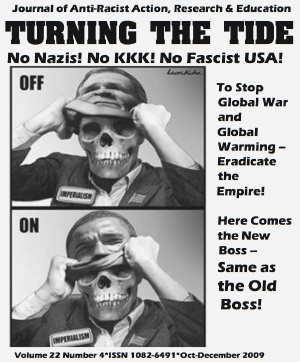
Journal Turning the TideAccording to the Pueblo Chieftain, police found “a large amount of propaganda recruiting materials from the Afrikan Liberation Army, including photos of President Barack Obama and other items that raised suspicions.”

Break the Chains reports that Ojore was released Yesterday, and will return to the Otero District Court for an appearance February 5th, the charge now “Interfering with Public Transportation.”

How absolutely disingenuous to misquote the source of the so-called Anarchist literature, seeing as reportedly there was so much of it. This is the usual media disinfo to prevent giving the causes visibility. The Pueblo Chieftain has obtained the affidavit of the arrest, which should list the items found on Ojore. Until that’s made available, we can search online for what he was likely carrying. Our bet, they don’t want to call attention to the New Afrikan Liberation Front (NALF).

Here’s a list of the exhibitors at the 2nd Anarchist Book Fair:

Anarchist type brochuresSemiotext(e)
www.semiotexte.com
Earth First Journal
www.earthfirstjournal.org
Taala Hooghan: Infoshop & Youth Media Arts Center
www.taalahooghan.org
Modesto Anarcho
www.modestoanarcho.org
South Central Farmers
www.southcentralfarmers.com
Skylight Books
www.skylightbooks.com
Institute for Anarchist Studies
www.anarchist-studies.org
Critical Resistance
www.criticalresistance.org
Las Vegas Alliance of the Libertarian Left sonv.libertarianleft.org
Catholic Worker
www.lacatholicworker.org
Anti-Racist Action/Turning the Tide
www.antiracistaction.us
Anarchist Black Cross Federation L.A. www.abcf.net/la
PM press
www.pmpress.org
Microcosom Publishing
www.microcosmpublishing.com
AK press
www.akpress.org
Little black cart
www.littleblackcart.com
Make/Shift magazine
www.makeshiftmag.com
Journal of aesthetics and protest
www.journalofaestheticsandprotest.org
R.A.C. : Revolutionary Autonomous Communities
www.revolutionaryautonomouscommunities.blogspot.com
I.W.W
www.iww.org

Then there is also the Southside ABCF zine collection, the Crossroad Newletter, and the publications of the Spear and Shield. Here’s the New Afrikan Declaration of Independence, as printed on Prairie Fire:

“New Afrikan Declaration of Independence”

WE, New Afrikan People in America, in consequence of arriving at a knowledge of ourselves as a people with dignity, long deprived of that knowledge; as a consequence of revolting with every decimal of our collective and individual beings against the oppression that for three hundred years has destroyed and broken and warped the bodies and minds and spirits of our people in America, in consequence of our raging desire to be free of this oppression, to destroy this oppression wherever it assaults humankind in the world, and in consequence of inextinguishable determination to go a different way, to build a new and better world, do hereby declare ourselves forever free and independent of the jurisdiction of the United State of America and the obligations which that country¹s unilateral decision to make our ancestors and ourselves paper-citizens placed on us.

We claim no rights from the United States of America other than those rights belonging to human beings anywhere in the world, and these include the right to damages, reparations, due us from the grievous injuries sustained by our ancestors and ourselves by reason of United States lawlessness.

Ours is a revolution against oppression–our own oppression and that of all people in the world. And it is a revolution for a better life, a better station for all, a surer harmony with the forces of life in the universe. We therefore see these aims as the aims of our revolution:

    • To free black people in America from oppression;
  • To support and wage the world revolution until all people everywhere are so free;
  • To build a new Society that is better than what We now know and as perfect as We can make it;
  • To assure all people in the New Society maximum opportunity and equal access to that maximum;
  • To promote industriousness, responsibility, scholarship, and service;
  • To create conditions in which freedom of religion abounds and the pursuit of God and/or destiny, place and purpose of humankind in the Universe will be without hindrance;
  • To build a Black independent nation where no sect or religious creed subverts or impedes the building of the New Society, the New State Government, or achievement of the Aims of the Revolution as set forth in this Declaration;
  • To end exploitation of human beings by each other or the environment;
  • To assure equality of rights for the sexes;
  • To end color and class discrimination, while not abolishing salubrious diversity, and to promote self-respect and mutual understanding among all people in the society;
  • To protect and promote the personal dignity and integrity of the individual, and his or her natural rights;
  • To place the major means of production and trade in the trust of the state to assure the benefits of this earth and our genius and labor to society and all its members, and
  • To encourage and reward the individual for hard work and initiative and insight and devotion to the Revolution.

In mutual trust and great expectation, We the undersigned, for ourselves and for those who look to us but are unable personally to affix their signatures hereto, do join in this solemn Declaration of Independence, and to support this Declaration and to assure the success of the Revolution, We pledge without reservation ourselves, our talents, and all our worldly goods.

Or the creed:

“New Afrikan Creed”

1. i believe in the spirituality, humanity and genius of Black people, and in our new pursuit of these values.

2. i believe in the family and the community, and in the community as a family, and i will work to make this concept live.

3. i believe in the community as more important than the individual.

4. i believe in constant struggle for freedom, to end oppression and build a better world. i believe in collective struggle; in fashioning victory in concert with my brothers and sisters.

5. i believe that the fundamental reason our oppression continues is that We, as a people, lack the power to control our lives.

6. i believe that fundamental way to gain that power, and end oppression, is to build a sovereign Black nation.

7. i believe that all the land in America, upon which We have lived for a long time, which We have worked and built upon, and which We have fought to stay on, is land that belongs to us as a people.

8. i believe in the Malcolm X Doctrine: that We must organize upon this land, and hold a plebiscite, to tell the world by a vote that We are free and our land independent, and that, after the vote, We must stand ready to defend ourselves, establishing the nation beyond contradiction.

9. Therefore, i pledge to struggle without cease, until We have won sovereignty. i pledge to struggle without fail until We have built a better condition than the world has yet known.

10. i will give my life, if that is necessary; i will give my time, my mind, my strength, and my wealth because this IS necessary.

11. i will follow my chosen leaders and help them.

12. i will love my brothers and sisters as myself.

13. i will steal nothing from a brother or sister, cheat no brother or sister, misuse no brother or sister, inform on no brother or sister, and spread no gossip.

14. i will keep myself clean in body, dress and speech, knowing that i am a light set on a hill, a true representative of what We are building.

15. i will be patient and uplifting with the deaf, dumb and blind, and i will seek by word and deed to heal the Black family, to bring into the Movement and into the Community mothers and fathers, brothers and sisters left by the wayside.

Now, freely and of my own will, i pledge this Creed, for the sake of freedom for my people and a better world, on pain of disgrace and banishment if i prove false. For, i am no longer deaf, dumb or blind. i am, by inspiration of the ancestors and grace of the Creator — a New Afrikan.

We, the ppl need an INTERPOL blotter

In virtually every city and county in our America’s Most Wanted USA, you can access police blotters and mugshots of the latest arrests, replete with personal details above a small print disclaimer that persons profiled are only accused of the crimes described, and should be considered innocent until proven guilty. Why then, in this pillory-centric culture, is it often impossible to learn the names of real found-guilty criminals? And why are reporters, and often foreign governments, complicit in keeping the names secret? I’m thinking for example of the 23 US operatives convicted of kidnapping in Italy, the Blackwater goons recently discovered plotting a murder in Germany, and the USAID subcontractor apprehended in Cuba, for starters.

Just this week, a Yakuzi handful of Israeli officers decided against traveling to England after their British hosts warned them of the possibility arrests warrants could be issued against them for war crimes committed in Gaza this time last year. The identity of the four IDF officers is being kept confidential, requiring not only the cooperation of the international press, but of the activist groups pursuing justice through the system. Certainly their names would have to be known to be able to file papers in British court.

Are accusers keeping quiet based because they’re admonished for despoiling chances for a fair trial? Social justice advocates are natural patsies for wanting to respect every defendant’s dignity, even that of a war criminal.

Back in the US, some local news outlets even air holding tank arraignment video pleas before the judge. Contrast this with the still-universal ban on cameras in courtrooms. The different policy has everything to do with who can afford a lawyer, or the cooperation of the corporate press.

Here’s a brilliant example today, of a Swiss tycoon issued a world-record-setting speeding fine of $290,000 for driving his ferrari 137kph through a village. The fine was calculated based on a court’s assessment of his wealth, approximately $22.7 million. Arrested, tried, bean-counted. His name? Undisclosed.

Viva Palestina shows Code Pink how solidarity works

Gaza Freedom March breakers
Egyptian authorities in El-Arish tried this evening to decapitate the Viva Palestina aid convoy on its final leg toward the Gaza border. This was the successful strategy Egypt used to divide the Gaza Freedom March a week before, but the activists held strong, and it didn’t take a referendum for the isolated group of 157 to stick up for the 400 others waylaid in Syria. ReadingPSC tells the story from El-Arish.

When the convoy was forced to leave Egypt’s Red Sea port to reenter Syria and travel by ferry from Lattakia to Egypt’s port at El-Arish, only a minimum number of convoy participants were permitted to stay with the vehicles. The rest learned they could only rejoin the convoy by air. The same plane was to fly repeated trips, carrying one fourth of the number each time. But that’s not how it worked out.

On the second flight, the plane was forced back to Syria due to engine problems, and now remains grounded. As it stands tonight, 3/4 of Viva Palestina remains in Syria. Meanwhile, the Egyptians tried to compel the first group to depart for Rafah and man the convoy without their comrades, telling them the extra 400 would be denied permission to follow.

Of the convoy participants issuing updates, Readings PCS and Derry to Gaza are safely in El-Arish, while York to Gaza et al will fly from Damascus in the morning.

If there remain further obstacles for the convoy, Viva Palestina is recommending you contact the Egyptian embassy/consulate available to you, to press Egypt to honor its commitment to let the aid convoy through and help break the siege of Gaza!

Reading PSC printed this encouragement from Noam Chomsky:

Dear Convoy: a message from Noam Chomsky!…

Despite the media blackout, which is a disgrace, this is turning out to be a really spectacular triumph, I think, and it’s hard to express properly my admiration and respect for those who are directly engaged.

It has to be a shot in the arm for the people in Gaza, and might stir up some opposition to the dictatorship in Egypt, which is exposing its brutality daily — to everyone except the US media (hope it’s better elsewhere). And I think a lot of people are going to come back home really invigorated.

Good luck in what lies ahead.

Boycott Coca-Cola for India’s water, Colombia’s unions and Israel Apartheid

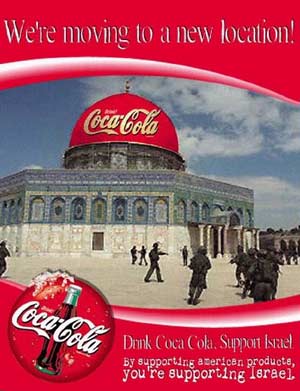
Subversive mock Coke adOK, it’s a famously discredited fake-ad to slander Coke. They have no plans to rebrand the Dome of the Rock. But Israel may — and Coca-Cola is a sponsor. That’s why Coloradans For Peace are calling to boycott Coke, to stop supporting Israeli Apartheid.

There are plenty of reasons to boycott the real thing spreading diabetes. At COP15 the Yes Men targeted Coke for their preposterous “Bottle of Hope” campaign which could only refer to Coke’s hope to green-wash their culpability for depleting water tables and poisoning India and contracting to kill labor organizers in Colombia. Coke is a bad habit.

Since overrunning East Jerusalem in 1967, Israel is trying to settle it in defiance of international sanctions. Israel promises as administrator not to alter the Muslim shrine, but radical Zionists have been making open preparations to restore it as a Jewish temple.

coca-cola kills logoCoke is a corporate underwriter of Israeli expansion into the Palestinian Territories. Their Kiryat Gat bottling plant is built on contested land, and Coke has now invested in the Tavor Winery on Palestinian land.

Boycotting Coke would send a message that the beverage multinational must redress the injustices it perpetuates. Wouldn’t it be an easy thing, really, to pass on all Coca-Cola products? What will you miss?

coca-cola steals world waterThe Yes Men Coke action at COP15 did produce a tongue-in-cheek press conference dubbed Rage Against the Coke Machine, where attendees recited this pledge:

“I, [name], with respect for crimes against people and the planet, from this day forward, for the rest of my living days will never, ever, drink Coca-Cola again until the Coca-Cola company ceases and entirely stops stealing the water from communities in India and stops union-busting in Colombia and ceases and desists entirely from relentless and absurd greenwashing like a ‘bottle of hope.’”

Absent sadly was mention of Coca-Cola’s support of Israeli Apartheid. Let’s put it back!

The Caracas Commitment Si Se Puede

You might imagine the multinational corporate media would blackout the talk of a 5th Socialist International. They are most determined to censor the issues which the world’s leftist parties are resolved to address. Where Obama 2008 and Copenhagen 2009 project a vacuum of ideological momentum, check out the Caracas Commitment.

The Caracas Commitment
November 25, 2009?
By Declaration from World Meeting of Left Parties?
November 19-21 Caracas, Venezuela

Political parties and organizations from Latin America, the Caribbean, Europe, Africa, Asia, and Oceania commemorate and celebrate the unity and solidarity that brought us together in Caracas, Bolivarian Republic of Venezuela, and from this libertarian city we would like to express our revolutionary rebelliousness. We are glad of and committed to the proud presence of the forces of change in a special moment of history. Likewise, we are proud to reaffirm our conviction to definitively sow, grow and win Socialism of the 21st century.

In this regard, we want to sign the Commitment of Caracas as a revolutionary guide for the challenges ahead of us. We have gathered with the aim of unifying criteria and giving concrete answers that allow us to defend our sovereignty, our social victories, and the freedom of our peoples in the face of the generalized crisis of the world capitalist system and the new threats spreading over our region and the whole world with the establishment and strengthening of military bases in the sister republics of Colombia, Panama, Aruba, Curacao, the Dutch Antilles, as well as the aggression against Ecuadorian territory, and the invasions of Iraq and Afghanistan.

We consider that the world capitalist system is going through one of its most severe crises, which has shaken its very foundations and brought with it consequences that jeopardize the survival of humanity. Likewise, capitalism and the logic of capital, destroys the environment and biodiversity, bringing with it consequences of climate change, global warming and the destruction of life.

One of the epicentres of the capitalist crisis is in the economic domain; this highlights the limitations of unbridled free markets ruled by private monopolies. In this situation, some governments have been asked to intervene to prevent the collapse of vital economic sectors, for instance, through the implementation of bailouts to bank institutions that amount to hundreds of billions of dollars. Said governments have been asked to stimulate their economies by increasing public expenditure in order to mitigate the recession and the private sector decline, which evidences the end of the supposedly irrefutable “truth” of neo-liberalism that of non-intervention of the State in economic affairs.

In this regard, it is very timely to promote an in-depth discussion on the economic crisis, the role of the State and the construction of a new financial architecture.

In summary, the capitalist crisis cannot be reduced simply to a financial crisis; it is a structural crisis of capital which combines the economic crisis, with an ecological crisis, a food crisis, and an energy crisis, which together represents a mortal threat to humanity and mother earth. Faced with this crisis, left-wing movements and parties see the defence of nature and the construction of an ecologically sustainable society as a fundamental axis of our struggle for a better world.

In recent years, progressive and left-wing movements of the Latin American region have accumulated forces, and stimulated transformations, throwing up leaders that today hold important government spaces. This has represented an important blow to the empire because the peoples have rebelled against the domination that has been imposed on them, and have left behind their fear to express their values and principles, showing the empire that we will not allow any more interference in our internal affairs, and that we are willing to defend our sovereignty.

This meeting is held at a historic time, characterized by a new imperialistic offensive against the peoples and governments of the region and of the world, a pretension supported by the oligarchies and ultraconservative right-wing, with the objective of recovering spaces lost as a consequence of the advancement of revolutionary process of liberation developing in Latin America. These are expressed through the creation of regional organizations such as ALBA, UNASUR, PETROCARIBE, Banco del Sur, the Sao Paulo Forum, COPPPAL, among others; where the main principles inspiring these processes are those of solidarity, complementarity, social priority over economic advantage, respect for self-determination of the peoples in open opposition to the policies of imperial domination. For these reasons, the right-wing forces in partnership with the empire have launched an offensive to combat the advance and development of the peoples’ struggles, especially those against the overexploitation of human beings, racist discrimination, cultural oppression, in defence of natural resources, of the land and territory from the perspective of the left and progressive movements and of world transformation.

We reflect on the fact that these events have led the U.S administration to set strategies to undermine, torpedo and destabilize the advancement of these processes of change and recuperation of sovereignty. To this end, the US has implemented policies expressed through an ideological and media offensive that aim to discredit the revolutionary and progressive governments of the region, labelling them as totalitarian governments, violators of human rights, with links to drug-trafficking operations, and terrorism; and also questioning the legitimacy of their origin. This is the reason for the relentless fury with which all the empire’s means of propaganda and its agents inside our own countries continuously attack the experiences in Venezuela, Ecuador, Nicaragua, Bolivia, and Paraguay, as with its maintenance of the blockade against revolutionary and independent Cuba.

Part of the strategy activated by the U.S. Empire is evidenced by the coup in Honduras, as well as in other destabilizing initiatives in Central America, attempting to impose the oligarchic interests that have already left hundreds of victims, while a disgusting wave of cynicism tries to cover up the dictatorship imposed by the U.S. administration with a false veil of democracy. Along with this, it is developing a military offensive with the idea of maintaining political and military hegemony in the region, for which it is promoting new geopolitical allies, generating destabilization and disturbing peace in the region and globally through military intimidation, with the help of its allies in the internal oligarchies, who are shown to be complicit in the actions taken by the empire, giving away their sovereignty, and opening spaces for the empire’s actions.

We consider that this new offensive is specifically expressed through two important events that took place this year in the continent: The coup in Honduras, and the installation of military bases in Colombia and Panama, as well as the strengthening of the already existing ones in our region. The coup in Honduras is nothing but a display of hypocrisy by the empire, a way to intimidate the rest of the governments in the region. It is a test-laboratory that aims to set a precedent that can be applied as a new coup model and a way to encourage the right to plot against the transformational and independent processes.

We denounce the military agreement between the Colombian government and the United States administration strengthens the U.S.’s military strategy, whose contents are expressed in the so-called “White Book.” This confirms that the development of the agreement will guarantee a projection of continental and intercontinental military power, the strengthening of transportation capability and air mobility to guarantee the improvement of its action capability, in order to provide the right conditions to have access to energy sources. It also consolidates its political partnership with the regional oligarchy for the control of Colombian territory and its projection in the Andes and in the rest of South America. All this scaffolding and consolidation of military architecture entails a serious threat for peace in the region and the world.

The installation of military bases in the region and their interrelation with the different bases spread throughout the world is not only confined to the military sphere, but rather forms part of the establishment of a general policy of domination and expansion directed by the U.S. These bases constitute strategic points to dominate all the countries in Central and Latin America and the rest of the world.

The treaty for the installation of military bases in Colombia is preceded by Plan Colombia, which was already an example of U.S. interference in the affairs of Colombia and the region using the fight against drug trafficking and terrorism as an excuse. However, it has been shown that drug trafficking levels have increased in Colombia; therefore, the plan is no longer justified given that no favourable results have been obtained since its implementation, that would justify a new treaty with the U.S.

Today, the global strategy headed by the U.S. concerning drug trafficking is a complete failure. Its results are summarised by a rapid processes of accumulation of illegal capital, increased consumption of drugs and exacerbation of criminality, whose victims are the peoples of Latin America, especially the Colombian people. This strategy should be revisited and modified, and should be oriented towards a different logic that focuses on drug consumption as a public health issue. In Colombia, drug trafficking has assumed the form of paramilitarism, and turned into a political project the scope of which and persons responsible should be investigated so that the truth is known, so that justice prevails and the terror of the civilian population ceases.

We, the peoples of the world, declare that we will not give up the spaces we have managed to conquer after years of struggle and resistance; and we commit ourselves to regain those which have been taken from us. Therefore, we need to defend the processes of change and the unfolding revolutions since they are based on sovereign decisions made by the peoples.

Agreements

1. Mobilization and Condemnation of U.S. Military Bases

1.1.
To organize global protests against the U.S. military bases from December 12th to 17th, 2009. Various leftwing parties and social movements will promote forums, concerts, protest marches and any other creative activity within the context of this event.

1.2.
To establish a global mobilization front for the political denouncement of the U.S. military bases. This group will be made up by social leaders, left-wing parties, lawmakers, artists, among others, who will visit different countries with the aim of raising awareness in forums, press conferences and news and above all in gatherings with each country’s peoples.

1.3.
To organize students, young people, workers and women in order to establish a common agenda of vigilance and to denounce against the military bases throughout the world.

1.4.
To organize a global legal forum to challenge the installation of the U.S. military bases. This forum is conceived as a space for the condemnation of illegalities committed against the sovereignty and self-determination of the peoples and the imposition of a hegemonic imperialist model.

1.5.
To organise a global trial against paramilitarism in Colombia bringing testimonies and evidence to international bodies of justice.

1.6.
To promote a global trial against George Bush for crimes against humanity, as the person principally responsible for the genocide against the peoples of Iraq and Afghanistan.

1.7.
To promote a campaign for the creation of constitutional and legal provisions in all of our countries against the installation of military bases and deployment of nuclear weapons of mass destruction.

1.8.
To promote, from the different social organizations and movements of the countries present in this meeting, a political solution for the Colombian conflict.

1.9.
To organise solidarity with the Colombian people against the imperial aggression that the military bases entail in Colombian territory.

2. Installation and Development of a Platform of Joint Action by Left-Wing Parties of the World

2.1.
To establish a space of articulation of progressive and left-wing organizations and parties that allows for coordinating policies against the aggression towards the peoples, the condemnation of the aggressions against governments elected democratically, the installation of military bases, the violation of sovereignty and against xenophobia, the defence of immigrants’ rights, peace, and the environment, and peasant, labour, indigenous and afro-descendent movements.

2.2.
To set up a Temporary Executive Secretariat (TES) that allows for the coordination of a common working agenda, policy making, and follow-up on the agreements reached within the framework of this international encounter. Said Secretariat undertakes to inform about relevant events in the world, and to define specific action plans: statements, declarations, condemnations, mobilizations, observations and other issues that may be decided.

2.3.
To set up an agenda of permanent ideological debate on the fundamental aspects of the process of construction of socialism.

2.4.
To prepare common working agendas with participation from Latin America, Europe, Africa, Asia and Oceania.

2.5.
To organize solidarity of the people’s of the world with the Bolivarian revolution and President Hugo Chávez, in response to the constant imperial attacks.

2.6.
To commemorate the centenary of Clara Zetkin’s proposal to celebrate March 8th as the International Day of Women. The parties undertake to celebrate this day insofar as possible.

2.7.
To summon a meeting to be held in Caracas in April 2010 in commemoration of the bicentenary of our Latin American and Caribbean independences.

3. Organization of a World Movement of Militants for a Culture of Peace

3.1.
To promote the establishment of peace bases, by peace supporters, who will coordinate actions and denouncements against interventionism and war sponsored by imperialism through activities such as: forums, cultural events, and debates to promote the ethical behaviour of anti-violence, full participation in social life, respect for human rights and fundamental freedoms, acknowledgement of the cultural identities of our peoples and strengthening the framework of integration. This space seeks to raise awareness among all citizens in rejection of all forms of domination, internal or external intervention, and to reinforce the culture of peace. To struggle relentlessly for a world with no nuclear weapons, no weapons of mass destruction, no military bases, no foreign interference, and no economic blockades, as our peoples need peace and are absolutely entitled to attain development. Promote the American continent as a territory of peace, home to the construction of a free and sovereign world.

3.2.
To organize a Peace Parliament as a political space to exchange common endeavours among the world’s progressive and left-wing parliamentarians, and to know the historical, economic, legal, political and environmental aspects key for the defence of peace. Hereby we recommend holding the first meeting in February 2010.

4. Artillery Of International Communication to Emancipate Revolutionary Consciousness

4.1.
To discuss a public communication policy at an inter-regional level that aims to improve the media battle, and to convey the values of socialism among the peoples.

4.2.
To promote the creation and consolidation of alternative and community communication media to break the media siege, promote an International Alternative Left-wing Media Coordination Office that creates links to provide for improved information exchange among our countries, in which Telesur and Radiosur can be spearheads for this action.

4.3.
To create a website of all of the progressive and left-wing parties and movements in the world as a means to ensure permanent exchange and the development of an emancipating and alternative communication.

4.4.
To promote a movement of artists, writers and filmmakers to promote and develop festivals of small, short and full-length films that reflects the advancement and the struggle of peoples in revolution.

4.5.
To hold a meeting or international forum of alternative left-wing media.

5. Mobilize All Popular Organizations in Unrestricted Support for the People of Honduras

5.1.
To promote an international trial against the coup plotters in Honduras before the International Criminal Court for the abuses and crimes committed.

5.2.
Refuse to recognize the illegal electoral process they aim to carry out in Honduras.

5.3.
To carry out a world vigil on Election Day in Honduras in order to protest against the intention to legitimize the coup, coordinated by the permanent committee that emerges from this encounter.

5.4.
To coordinate the actions of left-wing parties worldwide to curb the imperialist pretensions of using the coup in Honduras as a strategy against the Latin American and Caribbean progressive processes and governments.

5.5.
To unite with the people of Honduras through a global solidarity movement for people’s resistance and for the pursuit of democratic and participatory paths that allow for the establishment of progressive governments committed to common welfare and social justice.

5.6.
To undertake actions geared towards denouncing before multilateral bodies, and within the framework of international law, the abduction of José Manuel Zelaya, legitimate President of Honduras, that facilitated the rupture of constitutional order in Honduras. It is necessary to determine responsibility among those who participated directly in this crime, and even among those who allowed his aircraft to go in and out Costa Rica without trying to detain the kidnappers of the Honduran president.

6. Solidarity with the Peoples of the World

6.1.
The Left-wing Parties of the International Meeting of Caracas agree to demand the immediate liberation of the five Cuban heroes unfairly imprisoned in American jails. They are authentic anti-terrorist fighters that caused no harm to U.S. national security, whose work was oriented towards preventing the terrorist attacks prepared by the terrorist counterrevolution against Cuba. The Five Heroes were subject to a biased judicial process, condemned by broad sectors of humanity, and stigmatized by a conspiracy of silence by the mainstream media. Given the impossibility of winning justice via judicial means, we call upon all political left-wing parties of the world to increase actions for their immediate liberation. We call on President Obama to utilize his executive power and set these Five Heroes of Humanity free.

6.2.
The International Meeting of Left-wing Parties resolutely demands the immediate and unconditional cessation of the criminal U.S. blockade that harmed the Cuban people so badly over the last fifty years. The blockade should come to an end right now in order to fulfil the will of the 187 countries that recently declared themselves against this act of genocide during the UN General Assembly.

6.3.
To unite with the people of Haiti in the struggle for the return of President Jean Bertrand Aristide to his country.

6.4.
We propose to study the possibility to grant a residence in Venezuela to Jean Bertrand Aristide, who was kidnapped and overthrown as Haiti’s president by U.S. imperialism.

6.5.
We express the need to declare a permanent alert aimed at preventing any type of breach of the constitutional order that may hinder the process of democratic change underway in Paraguay.

6.6.
We denounce the neoliberal privatizing advance in Mexico expressly in the case of the Electric Energy state-owned company, a heritage of the people, which aims through the massive firing of 45,000 workers to intimidate the union force, “Luz y Fuerza”, which constitutes another offensive of the Empire in Central and North America.

6.7.
To declare our solidarity with the peoples of the world that have suffered and are still suffering imperial aggressions, especially, the 50 year-long genocidal blockade against Cuba; the threat against the people of Paraguay; the slaughter of the Palestinian people; the illegal occupation of part of the territory of the Republic of Western Sahara and the invasion of Iraq and Afghanistan which today is expanding into Pakistan; the illegal sanctions imposed against Zimbabwe and the constant threat against Iran, among others.

Caracas, November 21st, 2009

Declaration of Solidarity with the People of Cuba

The Left-wing Parties of the International Meeting of Caracas agree to demand the immediate liberation of the five Cuban heroes unfairly imprisoned in U.S. prisons. They are authentic anti-terrorist fighters that caused no harm to US national security, whose work was oriented towards preventing the terrorist attacks prepared by the terrorist counterrevolution against Cuba. The Five Heroes were subject to a biased judicial process, condemned by broad sectors of humanity, and stigmatized by a conspiracy of silence by the mainstream media.

Given the impossibility of winning justice via judicial means, we call upon all political left-wing parties of the world to increase actions for their immediate liberation. We call on President Obama to utilize his executive power and set these Five Heroes of Humanity free.

The International Meeting of Left-wing Parties resolutely demands the immediate and unconditional cessation of the criminal U.S. blockade that harmed the Cuban people so badly over the last fifty years. The blockade should come to an end right now in order to fulfill the will of the 187 countries that recently declared themselves against this act of genocide during the UN General Assembly.

Caracas, November 21, 2009

Special Declaration on the Coup D’état in Honduras

We, left-wing parties of Latin America, Africa, Europe, Asia and Oceania, present in the international encounter of left-wing parties, reject the coup d’état against the constitutional government of citizen’s power of the President of Honduras Manuel Zelaya Rosales.

Cognizant of the situation of repression, persecution and murder against the Honduran people and the permanent military harassment against president Manuel Zelaya Rosales, which represents a breach of the rule of law in the sister nation of Honduras:

We support the actions of the national resistance front in its struggle to restore democracy.

We demand and support the sovereign right of the Honduran people to call for a national constituent assembly to establish direct democracy and to ensure the broadest political participation of the people in public affairs.

We denounce the United States intervention and its national and international reactionary right-wing allies and their connection with the coup, which hinders the construction of democracy in Honduras and in the world.

We condemn and repudiate the permanent violation of political and social human rights as well as the violation freedom of speech, promoted and perpetrated by the de facto powers, the Supreme Court of Justice, the National Congress of the Republic, the Ministry of Defence and Security since June 28, 2009.

We reiterate our demand to international governments and bodies, not to recognize the results of the general elections to be held on November 29, 2009 in Honduras, due to the lack of constitutional guarantees and the legal conditions necessary for a fair, transparent and reliable electoral process, the lack of reliable observers that can vouch for the results of this electoral process, which has already been rejected by most international governments, bodies and international public opinion.

To propose and promote an international trial against coup plotters and their accomplices in Honduras before the International Criminal Court, for the illegal actions, abuses and crimes they committed, while developing actions aimed at denouncing to the relevant bodies and in the framework of the international law, the violation of the rights and the kidnapping of the legitimate president of Honduras Manuel Zelaya Rosales, because it is necessary to establish the responsibility of those who participated directly and internally in the perpetration of this crime.

We urge national and international human rights organizations to support these measures, to carry on the campaign of denunciation and vigilance with permanent observers in face of the renewed human rights violations, particularly the persecution and sanction through the loss of jobs for political reasons against the members and supporters of the resistance and president Manuel Zelaya.

We repudiate and condemn the attacks against the diplomatic corps of the embassies of the Federative Republic of Brazil and the Republic of Argentina, and the embassies of the member countries of the Bolivarian Alliance for the Peoples of our America (ALBA); and express our solidarity with the heroic work of the staff of these diplomatic missions, who have been victims of harassment and hostility by the coup plotters.

We agree to establish coordination among left-wing parties of the world to exert pressure to oust the de facto government and for the restoration of the constitutional president and the right of the Honduran people to install a national constituent assembly that allows for deepening direct democracy.

We urge governments, international bodies and companies to maintain and intensify economic and commercial sanctions to business accomplices and supporters of the coup in Honduras, and to maintain an attitude of vigilance, to break all relations that recognize the coup plotters and the de facto government officers, as well as to take migration control measures that hinder the movement of people who have the purpose of voting in another country where elections are held with the aim of changing the results through the transfer of votes from one country to the other.

We agree not to recognize the international and national observers of the electoral process who are aligned and conspire to attempt to give legitimacy to an electoral process devoid of legality and legitimacy. We demand that rather than observing an illegal and illegitimate process, the return of the state of democratic law and the constitutional government of citizen power Honduras President Manuel Zelaya Rosales is guaranteed.

Caracas, November 21, 2009

Special Decision

The international encounter of Left-wing Political parties held in Caracas on November 19, 20 and 21, 2009, received the proposal made by Commander Hugo Chavez Frias to convoke the V Socialist International as a space for socialist-oriented parties, movements and currents in which we can harmonize a common strategy for the struggle against imperialism, the overthrow of capitalism by socialism and solidarity based economic integration of a new type. We assessed that proposition in terms of its historical dimension which calls for a new spirit of internationalism and agreed, for the purpose of achieving it in the short term, to create a WORKING GROUP comprised of those socialist parties, currents and social movements who endorse the initiative, to prepare an agenda which defines the objectives, contents and mechanisms of this global revolutionary body. We call for an initial constitutive event for April 2010 in the City of Caracas. Furthermore, those parties, socialist currents and social movements who have not expressed themselves on this matter can subject this proposal to the examination of their legitimate directive bodies.

Caracas, November 21, 2009

Chavez convokes a 5th International

On November 22, meeting with international left wing parties in Caracas, Venezuelan president Hugo Chavez proposed the formation of a 5th Socialist International. (The 1st-4th being: Marx, Engels, Lenin, and Trotsky) Below are excerpts of his address:

(Translation from the Spanish for Direct Action by Roberto Jorquera.)

At last night’s meeting, after hearing a few interventions, it was my turn to say a few words. For a while we have been reflecting on an idea that last night I decided was important to propose because we analysed it and we felt that there was no better time to launch this idea. And I am very happy today that the international meeting of left organisations has taken up this call as part of its final statement even though it was not part of its agenda.

Here I want to read from the final statement:

“The International Meeting of Left-wing Political Parties held in Caracas on November 19, 20 and 21, 2009, received the proposal made by Commander Hugo Chavez Frias to convoke the Fifth Socialist International as a space for socialist-oriented parties, movements and currents in which we can harmonise a common strategy for the struggle against imperialism, the overthrow of capitalism by socialism and solidarity-based economic integration of a new type. We assessed that proposition in terms of its historical dimension which calls for a new spirit of internationalism and agreed, for the purpose of achieving it in the short term, to create a Working Group comprised of those socialist parties, currents and social movements who endorse the initiative, to prepare an agenda which defines the objectives, contents and mechanisms of this global revolutionary body. We call for an initial constitutive event for April 2010 in the city of Caracas. Furthermore, those parties, socialist currents and social movements who have not expressed themselves on this matter can subject this proposal to the examination of their legitimate directive bodies.”

I want to take a few minutes to reflect on these issues, particularly to point to the importance that this call has […] In relation to the Fifth International I ask this special congress to include this issue in its debates so that we can analyse it and put it into context and study this proposal and its context. This proposal to call on political parties, revolutionary parties and social movements, to create a new organisation that is able to adapt to the time that we are living under and the situation that we live under; to put itself at the forefront of the people of the world and their calls; to become an instrument of articulation and unification of the struggles of the world’s peoples so that we can save this planet. It is important that the congress discuss this issue. That is why I made the call.

The Fifth International — let’s remember that the First International was established in 1864. Karl Marx with a number of other comrades called for the First International. Many years later Frederick Engels called for the establishment of the Second International at the end of the 19th century. And then at the beginning of the 20th century Vladimir Lenin with many other great revolutionaries established the Third International, and Leon Trotsky in 1936-37 established the Fourth International. All of them had a context but remember that all four Internationals, experiments to unite parties and currents and social movements from around the world, have lost their way along the road for different reasons — some degenerated, lost their force, disappeared soon after their formation. But none of them was able to advance the original aims that they had set themselves.

From the heat of great workers’ struggles and popular struggles against the so-called industrial revolutions and the dominance of the bourgeois class, many experiments where tried. Arising from the heat of the Russian Revolution, Europe was the epicentre of struggles. For many years many social movements and revolutionaries looked to Europe […]

Now I think due to the product of the times we can say that the centre of gravity of revolutionary struggles on this planet is no longer in Europe … With much due respect to all the movements in Europe, Asia and Africa and the Middle East and Oceania and North America where revolutionary forces also exist, the epicentre of the revolutionary struggles and socialist struggle today in the world at the beginning of the 21st century is in our America. And Venezuela has the task of being the epicentre of that struggle. It is our turn to be in the vanguard and we need to take up that challenge. We have a great responsibility. All of you comrades, all of us in the PSUV and allied parties and us in government have that responsibility.

I honestly believe that the time has come to convoke the Fifth Socialist International and we call on all the revolutionary parties, socialist parties and currents and social movements that struggle for socialism and against capitalism and imperialism to save the world. Let us reclaim Rosa Luxemburg’s slogan “Socialism or barbarism”. Let us save the world. Let’s make socialism. Let us save the world and destroy capitalism. Let us save the world and destroy imperialism. That is what it is about. That is the essence of this congress.

Boycott Israel Apartheid this Christmas

Boycott Divestment and Sanctions of Israel to end Palestinian OccupationIn solidarity with the ONE MILE MARCH to free Gaza, on the one year anniversary of Israel’s genocidal incursion into Gaza, let’s kick start a Colorado Springs effort to support the Global Boycott, Divestment and Sanctions (BDS) Movement against Israel, to end apartheid and free Palestine. There are many US/Israeli companies who promote or profit from the illegal occupation of Palestine. On December 28, let’s target those in the Chapel Hills Mall!
L’Oreal, Revlon, Estee Lauder, Ahava, Hanes, Timberland, Teva, Victoria’s Secret, and Bath & Body Works.

American citizens can feel a vague sense of disconnectedness with respect to US business ties with Israel, or we can trace the responsibility for the injustices suffered in Palestine directly to retailers in our neighborhoods. Let’s let these local outlets know we will not tolerate their companies’ agenda in Palestine.

These are just among the consumer products and retailers which actively support Israel’s illegal actions in Palestine. Others you can boycott in town include Home Depot, Starbucks, McDonalds, Coca-Cola, Sara Lee, Danon, Nestle, Johnson & Johnson, Kimberly Clarke, AOL Time Warner, [Fox] News Corp, IBM, Intel, Nokia, Motorola and Caterpillar.

The BDS movement against Israel is attempting to recreate the same pressures which ultimately brought down apartheid in South Africa. Academic, cultural and business boycotts are targeted against US and Israeli companies which participate in the settlement industry, the economic exploitation of Palestine and Palestinians, and control of the population.

Vaneigem on energy as commodity

NMT’s in-house Situationist has been conceptualizing a way forward well expressed in this May 2009 interview of Raoul Vaneigem:
Situationist“We are being “offered” biofuels on the condition we agree to transgenic rapeseed farming. Eco-tourism will accelerate the plundering of our biosphere. Windmill farms are being built without any advantage to the consumers. Those are the areas where intervention is possible. Natural resources belong to us, they are free, they must be made to serve the freedom of life. It will be up to the communities to secure their own energy and food independence so as to free themselves from the control of the multinationals and their state vassals everywhere. Claiming natural power for our use means reclaiming our own existence first. Only creativity will rid us of work. …

Freeness is the only absolute weapon capable of shattering the mighty self-destruction machine set in motion by consumer society, whose implosion is still releasing, like a deadly gas, bottom-line mentality, cupidity, financial gain, profit, and predation. Museums and culture should be free, for sure, but so should public services, currently prey to the scamming multinationals and states. Free trains, buses, subways, free healthcare, free schools, free water, air, electricity, free power, all through alternative networks to be set up. As freeness spreads, new solidarity networks will eradicate the stranglehold of the commodity. This is because life is a free gift, a continuous creation that the market’s vile profiteering alone deprives us of.”
–Raoul Vaneigem, 2009

Interviewed by Hans Ulrich Obrist, for e-flux, Journal #6. See original article or the copy mirrored below:

In Conversation with Raoul Vaneigem

Hans Ulrich Obrist: I just visited Edouard Glissant and Patrick Chamoiseau, who have written an appeal to Barack Obama. What would your appeal and/or advice be to Obama?

Raoul Vaneigem: I refuse to cultivate any relationship whatsoever with people of power. I agree with the Zapatistas from Chiapas who want nothing to do with either the state or its masters, the multinational mafias. I call for civil disobedience so that local communities can form, coordinate, and begin self-producing natural power, a more natural form of farming, and public services that are finally liberated from the scams of government by the Left or the Right. On the other hand, I welcome the appeal by Chamoiseau, Glissant, and their friends for the creation of an existence in which the poetry of a life rediscovered will put an end to the deadly stranglehold of the commodity.

HUO: Could we talk about your beginnings? How did your participation in situationism begin, and what was your fundamental contribution? At the outset of your relationship with the SI, there was the figure of Henri Lefebvre. What did he mean to you at the time? Why did you decide to send him poetic essays?

RV: I would first like to clarify that situationism is an ideology that the situationists were unanimous in rejecting. The term “situationist” was ever only a token of identification. Its particularity kept us from being mistaken for the throngs of ideologues. I have nothing in common with the spectacular recuperation of a project that, in my case, has remained revolutionary throughout. My participation in a group that has now disappeared was an important moment in my personal evolution, an evolution I have personally pressed on with in the spirit of the situationist project at its most revolutionary. My own radicality absolves me from any label. I grew up in an environment in which our fighting spirit was fueled by working class consciousness and a rather festive conception of existence. I found Lefebvre’s Critique of Everyday Life captivating. When La Somme et le reste [The Sum and the Remainder] was published, I sent him an essay of sorts on “poetry and revolution” that was an attempt to unify radical concepts, Lettrist language, music, and film imagery by crediting them all with the common virtue of making the people’s blood boil. Lefebvre kindly responded by putting me in touch with Guy Debord who immediately invited me to Paris. The two of us had very different temperaments, but we would agree over a period of nearly ten years on the need to bring consumer society to an end and to found a new society on the principle of self-management, where life supersedes survival and the existential angst that it generates.

HUO: Which situationist projects remain unrealized?

RV: Psychogeography, the construction of situations, the superseding of predatory behavior. The radicality, which, notwithstanding some lapses, never ceased to motivate us, remains a source of inspiration to this day. Its effects are just beginning to manifest themselves in the autonomous groups that are now coming to grips with the collapse of financial capitalism.

HUO: The Situationist International defined the situationist as someone who commits her- or himself to the construction of situations. What were those situations for you, concretely? How would you define the situationist project in 2009?

RV: By its very style of living and thinking, our group was already sketching out a situation, like a beachhead active within enemy territory. The military metaphor is questionable, but it does convey our will to liberate daily life from the control and stranglehold of an economy based on the profitable exploitation of man. We formed a “group-at-risk” that was conscious of the hostility of the dominant world, of the need for radical rupture, and of the danger of giving in to the paranoia typical of minds under siege. By showing its limits and its weaknesses, the situationist experience can also be seen as a critical meditation on the new type of society sketched out by the Paris Commune, by the Makhnovist movement and the Republic of Councils wiped out by Lenin and Trotsky, by the libertarian communities in Spain later smashed by the Communist Party. The situationist project is not about what happens once consumer society is rejected and a genuinely human society has emerged. Rather, it illuminates now how lifestyle can supersede survival, predatory behavior, power, trade and the death-reflex.

HUO: You and Guy Debord are the main protagonists of the situationist movement. How do you see Debord’s role and your role?

RV: Not as roles. That is precisely what situationism in its most ridiculous version aims at: reducing us to cardboard cut-outs that it can then set up against one another according to the spectacle’s standard operating procedure. I am simply the spokesman, among others, of a radical consciousness. I just do what I can to see that resistance to market exploitation is transformed into an offensive of life, and that an art of living sweeps away the ruins of oppression.

HUO: What were your reasons for resigning from the group?

RV: Following the occupation movements of May 1968, we knew that some recuperation was afoot. We were familiar with the mechanisms of alienation that would falsify our ideas and fit them neatly into the cultural puzzle. It became clear to us, during the last conference in Venice, that we had failed to shatter those mechanisms, that in fact they were shattering us from the inside. The group was crumbling, the Venice conference was demonstrating its increasing uselessness, and the only answers put forward were commensurate with the self-parody we had fallen into. Dissension intensified to the point of paranoid denunciation: of betrayals of radicality, of breaches of revolutionary spirit, of dereliction of conscience. Those times of catharsis and anathema are now long past, and it might be useful to examine how it is that we sowed the seeds of failure for which the group ended up paying such a heavy price. The shipwreck, however, did not indiscriminately sweep away to the shores of oblivion all of us who participated in the adventure. The group vanished in such a way as to allow the individuals to either consolidate their radicality, disown it, or lapse into the imposture of radicalism. I have attempted to analyze our experimental adventure in Entre le deuil du monde et la joie de vivre [Between Mourning the World and Exuberant Life].

HUO: You have written a lot on life, not survival. What is the difference?

RV: Survival is budgeted life. The system of exploitation of nature and man, starting in the Middle Neolithic with intensive farming, caused an involution in which creativity—a quality specific to humans—was supplanted by work, by the production of a covetous power. Creative life, as had begun to unfold during the Paleolithic, declined and gave way to a brutish struggle for subsistence. From then on, predation, which defines animal behavior, became the generator of all economic mechanisms.

HUO: Today, more than forty years after May ‘68, how do you feel life and society have evolved?

RV: We are witnessing the collapse of financial capitalism. This was easily predictable. Even among economists, where one finds even more idiots than in the political sphere, a number had been sounding the alarm for a decade or so. Our situation is paradoxical: never in Europe have the forces of repression been so weakened, yet never have the exploited masses been so passive. Still, insurrectional consciousness always sleeps with one eye open. The arrogance, incompetence, and powerlessness of the governing classes will eventually rouse it from its slumber, as will the progression in hearts and minds of what was most radical about May 1968.

HUO: Your new book takes us on a trip “between mourning the world and exuberant life.” You revisit May ‘68. What is left of May ‘68? Has it all been appropriated?

RV: Even if we are today seeing recycled ideologies and old religious infirmities being patched up in a hurry and tossed out to feed a general despair, which our ruling wheelers and dealers cash in on, they cannot conceal for long the shift in civilization revealed by May 1968. The break with patriarchal values is final. We are moving toward the end of the exploitation of nature, of work, of trade, of predation, of separation from the self, of sacrifice, of guilt, of the forsaking of happiness, of the fetishizing of money, of power, of hierarchy, of contempt for and fear of women, of the misleading of children, of intellectual dominion, of military and police despotism, of religions, of ideologies, of repression and the deadly resolutions of psychic tensions. This is not a fact I am describing, but an ongoing process that simply requires from us increased vigilance, awareness, and solidarity with life. We have to reground ourselves in order to rebuild—on human foundations—a world that has been ruined by the inhumanity of the cult of the commodity.

HUO: What do you think of the current moment, in 2009? Jean-Pierre Page has just published Penser l’après crise [Thinking the After-Crisis]. For him, everything must be reinvented. He says that a new world is emerging now in which the attempt to establish a US-led globalization has been aborted.

RV: The agrarian economy of the Ancien Régime was a fossilized form that was shattered by the emerging free-trade economy, from the 1789 revolution on. Similarly, the stock-dabbling speculative capitalism whose debacle we now witness is about to give way to a capitalism reenergized by the production of non-polluting natural power, the return to use value, organic farming, a hastily patched-up public sector, and a hypocritical moralization of trade. The future belongs to self-managed communities that produce indispensable goods and services for all (natural power, biodiversity, education, health centers, transport, metal and textile production . . .). The idea is to produce for us, for our own use—that is to say, no longer in order to sell them—goods that we are currently forced to buy at market prices even though they were conceived and manufactured by workers. It is time to break with the laws of a political racketeering that is designing, together with its own bankruptcy, that of our existence.

HUO: Is this a war of a new kind, as Page claims? An economic Third World War?

RV: We are at war, yes, but this is not an economic war. It is a world war against the economy. Against the economy that for thousands of years has been based on the exploitation of nature and man. And against a patched-up capitalism that will try to save its skin by investing in natural power and making us pay the high price for that which—once the new means of production are created—will be free as the wind, the sun, and the energy of plants and soil. If we do not exit economic reality and create a human reality in its place, we will once again allow market barbarism to live on.

HUO: In his book Making Globalization Work, Joseph Stiglitz argues for a reorganization of globalization along the lines of greater justice, in order to shrink global imbalances. What do you think of globalization? How does one get rid of profit as motive and pursue well-being instead? How does one escape from the growth imperative?

RV: The moralization of profit is an illusion and a fraud. There must be a decisive break with an economic system that has consistently spread ruin and destruction while pretending, amidst constant destitution, to deliver a most hypothetical well-being. Human relations must supersede and cancel out commercial relations. Civil disobedience means disregarding the decisions of a government that embezzles from its citizens to support the embezzlements of financial capitalism. Why pay taxes to the bankster-state, taxes vainly used to try to plug the sinkhole of corruption, when we could allocate them instead to the self-management of free power networks in every local community? The direct democracy of self-managed councils has every right to ignore the decrees of corrupt parliamentary democracy. Civil disobedience towards a state that is plundering us is a right. It is up to us to capitalize on this epochal shift to create communities where desire for life overwhelms the tyranny of money and power. We need concern ourselves neither with government debt, which covers up a massive defrauding of the public interest, nor with that contrivance of profit they call “growth.” From now on, the aim of local communities should be to produce for themselves and by themselves all goods of social value, meeting the needs of all—authentic needs, that is, not needs prefabricated by consumerist propaganda.

HUO: Edouard Glissant distinguishes between globality and globalization. Globalization eradicates differences and homogenizes, while globality is a global dialogue that produces differences. What do you think of his notion of globality?

RV: For me, it should mean acting locally and globally through a federation of communities in which our pork-barreling, corrupt parliamentary democracy is made obsolete by direct democracy. Local councils will be set up to take measures in favor of the environment and the daily lives of everyone. The situationists have called this “creating situations that rule out any backtracking.”

HUO: Might the current miscarriages of globalization have the same dangerous effects as the miscarriages of the previous globalization from the ‘30s? You have written that what was already intolerable in ‘68 when the economy was booming is even more intolerable today. Do you think the current economic despair might push the new generations to rebel?

RV: The crisis of the ‘30s was an economic crisis. What we are facing today is an implosion of the economy as a management system. It is the collapse of market civilization and the emergence of human civilization. The current turmoil signals a deep shift: the reference points of the old patriarchal world are vanishing. Percolating instead, still just barely and confusedly, are the early markers of a lifestyle that is genuinely human, an alliance with nature that puts an end to its exploitation, rape, and plundering. The worst would be the unawareness of life, the absence of sentient intelligence, violence without conscience. Nothing is more profitable to the racketeering mafias than chaos, despair, suicidal rebellion, and the nihilism that is spread by mercenary greed, in which money, even devalued in a panic, remains the only value.

HUO: In his book Utopistics, Immanuel Wallerstein claims that our world system is undergoing a structural crisis. He predicts it will take another twenty to fifty years for a more democratic and egalitarian system to replace it. He believes that the future belongs to “demarketized,” free-of-charge institutions (on the model, say, of public libraries). So we must oppose the marketization of water and air.1 What is your view?

RV: I do not know how long the current transformation will take (hopefully not too long, as I would like to witness it). But I have no doubt that this new alliance with the forces of life and nature will disseminate equality and freeness. We must go beyond our natural indignation at profit’s appropriation of our water, air, soil, environment, plants, animals. We must establish collectives that are capable of managing natural resources for the benefit of human interests, not market interests. This process of reappropriation that I foresee has a name: self-management, an experience attempted many times in hostile historical contexts. At this point, given the implosion of consumer society, it appears to be the only solution from both an individual and social point of view.

HUO: In your writing you have described the work imperative as an inhuman, almost animal condition. Do you consider market society to be a regression?

RV: As I mentioned above, evolution in the Paleolithic age meant the development of creativity—the distinctive trait of the human species as it breaks free from its original animality. But during the Neolithic, the osmotic relationship to nature loosened progressively, as intensive agriculture became based on looting and the exploitation of natural resources. It was also then that religion surfaced as an institution, society stratified, the reign of patriarchy began, of contempt for women, and of priests and kings with their stream of wars, destitution, and violence. Creation gave way to work, life to survival, jouissance to the animal predation that the appropriation economy confiscates, transcends, and spiritualizes. In this sense market civilization is indeed a regression in which technical progress supersedes human progress.

HUO: For you, what is a life in progress?

RV: Advancing from survival, the struggle for subsistence and predation to a new art of living, by recreating the world for the benefit of all.

HUO: My interviews often focus on the connections between art and architecture/urbanism, or literature and architecture/urbanism. Could you tell me about the Bureau of Unitary Urbanism?

RV: That was an idea more than a project. It was about the urgency of rebuilding our social fabric, so damaged by the stranglehold of the market. Such a rebuilding effort goes hand in hand with the rebuilding by individuals of their own daily existence. That is what psychogeography is really about: a passionate and critical deciphering of what in our environment needs to be destroyed, subjected to détournement, rebuilt.

HUO: In your view there is no such thing as urbanism?

RV: Urbanism is the ideological gridding and control of individuals and society by an economic system that exploits man and Earth and transforms life into a commodity. The danger in the self-built housing movement that is growing today would be to pay more attention to saving money than to the poetry of a new style of life.

HUO: How do you see cities in the year 2009? What kind of unitary urbanism for the third millennium? How do you envision the future of cities? What is your favorite city? You call Oarystis the city of desire. Oarystis takes its inspiration from the world of childhood and femininity. Nothing is static in Oarystis. John Cage once said that, like nature, “one never reaches a point of shapedness or finishedness. The situation is in constant unpredictable change.”2 Do you agree with Cage?

RV: I love wandering through Venice and Prague. I appreciate Mantua, Rome, Bologna, Barcelona, and certain districts of Paris. I care less about architecture than about how much human warmth its beauty has been capable of sustaining. Even Brussels, so devastated by real estate developers and disgraceful architects (remember that in the dialect of Brussels, “architect” is an insult), has held on to some wonderful bistros. Strolling from one to the next gives Brussels a charm that urbanism has deprived it of altogether. The Oarystis I describe is not an ideal city or a model space (all models are totalitarian). It is a clumsy and naïve rough draft for an experiment I still hope might one day be undertaken—so I agree with John Cage. This is not a diagram, but an experimental proposition that the creation of an environment is one and the same as the creation by individuals of their own future.

HUO: Is Oarystis based on natural power, like the Metabolist cities? Rem Koolhaas and I are working on a book on the Japanese Metabolists. When I read your wonderful text on Oarystis, I was reminded of that movement from the 1960s, especially the floating cities, Kikutake’s water cities. Is Oarystis a Metabolist city?

RV: When Oarystis was published, the architect Philippe Rothier and Diane Hennebert, who ran Brussels’ Architecture Museum at the time, rightly criticized me for ignoring the imaginative projects of a new generation of builders. Now that the old world is collapsing, the fusion of free natural power, self-built housing techniques, and the reinvention of sensual form is going to be decisive. So it is useful to remember that technical inventiveness must stem from the reinvention of individual and collective life. That is to say, what allows for genuine rupture and ecstatic inventiveness is self-management: the management by individuals and councils of their own lives and environment through direct democracy. Let us entrust the boundless freedoms of the imaginary to childhood and the child within us.

HUO: Several years ago I interviewed Constant on New Babylon. What were your dialogues with Constant and how do you see New Babylon today?

RV: I never met Constant, who if I am not mistaken had been expelled before my own association with the SI. New Babylon’s flaw is that it privileges technology over the formation of an individual and collective way of life—the necessary basis of any architectural concept. An architectural project only interests me if it is about the construction of daily life.

HUO: How can the city of the future contribute to biodiversity?

RV: By drawing inspiration from Alphonse Allais, by encouraging the countryside to infiltrate the city. By creating zones of organic farming, gardens, vegetable plots, and farms inside urban space. After all, there are so many bureaucratic and parasitical buildings that can’t wait to give way to fertile, pleasant land that is useful to all. Architects and squatters, build us some hanging gardens where we can go for walks, eat, and live!

HUO: Oarystis is in the form of a maze, but it is also influenced by Venice and its public piazzas. Could you tell us about the form of Oarystis?

RV: Our internal space-time is maze-like. In it, each of us is at once Theseus, Ariadne, and Minotaur. Our dérives would gain in awareness, alertness, harmony, and happiness if only external space-time could offer meanders that could conjure up the possible courses of our futures, as an analogy or echo of sorts—one that favors games of life, and prevents their inversion into games of death.

HUO: Will museums be abolished? Could you discuss the amphitheater of memory? A protestation against oblivion?

RV: The museum suffers from being a closed space in which works waste away. Painting, sculpture, music belong to the street, like the façades that contemplate us and come back to life when we greet them. Like life and love, learning is a continuous flow that enjoys the privilege of irrigating and fertilizing our sentient intelligence. Nothing is more contagious than creation. But the past also carries with it all the dross of our inhumanity. What should we do with it? A museum of horrors, of the barbarism of the past? I attempted to answer the question of the “duty of memory” in Ni pardon, ni talion [Neither Forgiveness Nor Retribution]:

Most of the great men we were brought up to worship were nothing more than cynical or sly murderers. History as taught in schools and peddled by an overflowing and hagiographic literature is a model of falsehood; to borrow a fashionable term, it is negationist. It might not deny the reality of gas chambers, it might no longer erect monuments to the glory of Stalin, Mao or Hitler, but it persists in celebrating the brutish conqueror: Alexander, called the Great—whose mentor was Aristotle, it is proudly intoned—Julius Caesar, Genghis Khan, Tamerlane, Napoleon, the throngs of generals, slaughterers of peoples, petty tyrants of the city or the state, torturer–judges, Javerts of every ilk, conniving diplomats, rapists and killers contracted by religions and ideologies; so much high renown carved from baseness, wickedness, and abjection. I am not suggesting we should unpave the avenues of official history and pave the side alleys instead. We are not in need of a purged history, but of a knowledge that scoops out into broad daylight facts that have been obscured, generation after generation, by the unceasing stratification of prejudice. I am not calling for a tribunal of the mind to begin condemning a bunch of undesirables who have been bizarrely put up on pedestals and celebrated in the motley pantheons of official memory. I just want to see the list of their crimes, the mention of their victims, the recollection of those who confronted them added to the inventory of their unsavory eulogies. I am not suggesting that the name of Francisco Ferrer wipe out that of his murderer, Alfonso XIII, but that at the very least everything be known of both. How dare textbooks still cultivate any respect for Bonaparte, responsible for the death of millions, for Louis XIV, slaughterer of peasants and persecutor of Protestants and freethinkers? For Calvin, murderer of Jacques Gruet and Michel Servet and dictator of Geneva, whose citizens, in tribute to Sébastien Castellion, would one day resolve to destroy the emblems and signs of such an unworthy worship? While Spain has now toppled the effigies of Francoism and rescinded the street names imposed by fascism, we somehow tolerate, towering in the sky of Paris, that Sacré-Coeur whose execrable architecture glorifies the crushing of the Commune. In Belgium there are still avenues and monuments honoring King Leopold II, one of the most cynical criminals of the nineteenth century, whose “red rubber” policy—denounced by Mark Twain, by Roger Casement (who paid for this with his life), by Edward Dene Morel, and more recently by Adam Hochschild—has so far bothered nary a conscience. This is a not a call to blow up his statues or to chisel away the inscriptions that celebrate him. This is a call to Belgian and Congolese citizens to cleanse and disinfect public places of this stain, the stain of one of the worst sponsors of colonial savagery. Paradoxically, I do tend to believe that forgetting can be productive, when it comes to the perpetrators of inhumanity. A forgetting that does not eradicate remembering, that does not blue-pencil memory, that is not an enforceable judgment, but that proceeds rather from a spontaneous feeling of revulsion, like a last-minute pivot to avoid dog droppings on the sidewalk. Once they have been exposed for their inhumanity, I wish for the instigators of past brutalities to be buried in the shroud of their wrongs. Let the memory of the crime obliterate the memory of the criminal.
3

HUO: Learning is deserting schools and going to the streets. Are streets becoming Thinkbelts? Cedric Price’s Potteries Thinkbelt used abandoned railroads for pop-up schools. What and where is learning today?

RV: Learning is permanent for all of us regardless of age. Curiosity feeds the desire to know. The call to teach stems from the pleasure of transmitting life: neither an imposition nor a power relation, it is pure gift, like life, from which it flows. Economic totalitarianism has ripped learning away from life, whose creative conscience it ought to be. We want to disseminate everywhere this poetry of knowledge that gives itself. Against school as a closed-off space (a barrack in the past, a slave market nowadays), we must invent nomadic learning.

HUO: How do you foresee the twenty-first-century university?

RV: The demise of the university: it will be liquidated by the quest for and daily practice of a universal learning of which it has always been but a pale travesty.

HUO: Could you tell me about the freeness principle (I am extremely interested in this; as a curator I have always believed museums should be free—Art for All, as Gilbert and George put it).

RV: Freeness is the only absolute weapon capable of shattering the mighty self-destruction machine set in motion by consumer society, whose implosion is still releasing, like a deadly gas, bottom-line mentality, cupidity, financial gain, profit, and predation. Museums and culture should be free, for sure, but so should public services, currently prey to the scamming multinationals and states. Free trains, buses, subways, free healthcare, free schools, free water, air, electricity, free power, all through alternative networks to be set up. As freeness spreads, new solidarity networks will eradicate the stranglehold of the commodity. This is because life is a free gift, a continuous creation that the market’s vile profiteering alone deprives us of.

HUO: Where is love in Oarystis?

RV: Everywhere. The love affair, as complex as it is simple, will serve as the building block for the new solidarity relations that sooner or later will supersede selfish calculation, competition, competitiveness, and predation, causes of our societies’ dehumanization.

HUO: Where is the city of the dead? In a forest rather than a cemetery?

RV: Yes, a forest, an auditorium in which the voices of the dead will speak amidst the lushness of nature, where life continuously creates itself anew.

HUO: Have you dreamt up other utopian cities apart from Oarystis? Or a concrete utopia in relation to the city?

RV: No, but I have not given up hope that such projects might mushroom and be realized one day, as we begin reconstructing a world devastated by the racketeering mafias.

HUO: In 1991 I founded a Robert Walser museum, a strollological museum, in Switzerland. I have always been fascinated by your notion of the stroll. Could you say something about your urban strolls with and without Debord? What about Walser’s? Have other strollologists inspired you?

RV: I hold Robert Walser in high regard, as many do. His lucidity and sense of dérive enchanted Kafka. I have always been fascinated by the long journey Hölderlin undertook following his break-up with Diotima. I admire Chatwin’s Songlines, in which he somehow manages to turn the most innocuous of walks into an intonation of the paths of fate, as though we were in the heart of the Australian bush. And I appreciate the strolls of Léon-Paul Fargue and the learning of Héron de Villefosse. My psychogeographic dérives with Guy Debord in Paris, Barcelona, Brussels, Beersel, and Antwerp were exceptional moments, combining theoretical speculation, sentient intelligence, the critical analysis of beings and places, and the pleasure of cheerful drinking. Our homeports were pleasant bistros with a warm atmosphere, havens where one was oneself because one felt in the air something of the authentic life, however fragile and short-lived. It was an identical mood that guided our wanderings through the streets, the lanes and the alleys, through the meanderings of a pleasure that our every step helped us gauge in terms of what it might take to expand and refine it just a little further. I have a feeling that the neighborhoods destroyed by the likes of Haussmann, Pompidou, and the real estate barbarians will one day be rebuilt by their inhabitants in the spirit of the joy and the life they once harbored.

HUO: What possibilities do you see for disalienation and détournement in 2009?

RV: This is a time of unprecedented chaos in material and moral conditions. Human values are going to have to compensate for the effects of the only value that has prevailed so far: money. But the implosion of financial totalitarianism means that this currency, which has so tripped us up, is now doomed to devaluation and a loss of all meaning. The absurdity of money is becoming concrete. It will gradually give way to new forms of exchange that will hasten its disappearance and lead to a gift economy.

HUO: What are the conditions for dialogue in 2009? Is there a way out of this system of isolation?

RV: Dialogue with power is neither possible nor desirable. Power has always acted unilaterally, by organizing chaos, by spreading fear, by forcing individuals and communities into selfish and blind withdrawal. As a matter of course, we will invent new solidarity networks and new intervention councils for the well-being of all of us and each of us, overriding the fiats of the state and its mafioso-political hierarchies. The voice of lived poetry will sweep away the last remaining echoes of a discourse in which words are in profit’s pay.

HUO: In your recent books you discuss your existence and temporality. The homogenizing forces of globalization homogenize time, and vice versa. How does one break with this? Could you discuss the temporality of happiness, as a notion?

RV: The productivity- and profit-based economy has implanted into lived human reality a separate reality structured by its ruling mechanisms: predation, competition and competitiveness, acquisitiveness and the struggle for power and subsistence. For thousands of years such denatured human behaviors have been deemed natural. The temporality of draining, erosion, tiredness, and decay is determined by labor, an activity that dominates and corrupts all others. The temporality of desire, love, and creation has a density that fractures the temporality of survival cadenced by work. Replacing the temporality of money will be a temporality of desire, a beyond-the-mirror, an opening to uncharted territories.

HUO: Is life ageless?

RV: I don’t claim that life is ageless. But since survival is nothing but permanent agony relieved by premature death, a renatured life that cultivates its full potential for passion and creation would surely achieve enough vitality to delay its endpoint considerably.

HUO: The Revolution of Everyday Life was a trigger for May ’68, and you have stated in other interviews that it is your key book that you are continually rewriting. Was the book an epiphany? How did it change the course of your work? What had you been doing previously?

RV: The book was prompted by an urgent need I was feeling at the time for a new perspective on the world and on myself, to pull me out of my state of survival, by means other than through suicide. This critical take on a consumer society that was corrupting and destroying life so relentlessly made me aware and conscious of my own life drive. And it became clear to me very quickly that this wasn’t a purely solipsistic project, that many readers were finding their own major concerns echoed there.

HUO: The Revolution of Everyday Life ends on an optimistic note: “We have a world of pleasures to win, and nothing to lose but boredom.”4 Are you still an optimist today?

RV: “Pessimists, what is it you were hoping for?,” Scutenaire wrote. I am neither a pessimist nor an optimist. I try to remain faithful to a principle: desire everything, expect nothing.

HUO: What is the most recent version of the book?

RV: Entre le deuil du monde et la joie de vivre [Between Mourning the World and Exuberant Life].

HUO: What book are you working on at the moment?

RV: I would love to have the resources to complete a Dictionary of Heresies, so as to clarify and correct the historical elements included in The Movement of the Free Spirit and Resistance to Christianity.

HUO: The question of temporality also brings us to Proust and his questionnaire (see inset). What might your definition of happiness be in 2009?

RV: Living ever more intensely and passionately in an ever more intense world. To those who sneer at my ecstatic candor, I reply with a phrase that brings me great comfort: “The desire for an other life is that life already.”5

HUO: Do you have unrealized projects? Unrealized books, unrealized projects in fields other than writing, unrealized architectural projects?

RV: My priority is to live better and better in a world that is more and more human. I would love to build the “urban countryside” of Oarystis, but I’m not just waiting patiently, like Fourier at the Palais Royal, for some billionaire to decide to finance the project only to lose everything to the financial crash a minute later.

HUO: What about your collaborations with other artists, painters, sculptors, designers, filmmakers?

RV: I don’t collaborate with anyone. At times I have offered a few texts to artist friends, not as a commentary on their work but as a counterpoint to it. Art moves me when, in it, I can sense its own overcoming, something that goes beyond it; when it nurtures a trace of life that blossoms as a true aspiration, the intuition of a new art of living.

HUO: Could you tell me about Brussels? What does Brussels mean to you? Where do you write?

RV: I live in the country, facing a garden and woods where the rhythm of the seasons has retained its beauty. Brussels as a city has been destroyed by urbanists and architects who are paid by real estate developers. There are still a few districts suitable for nice walks. I am fond of a good dozen wonderful cafés where one can enjoy excellent artisanal beers.

HUO: Do you agree with Geremek’s view that Europe is the big concern of the twenty-first century?

RV: I am not interested in this Europe ruled by racketeering bureaucracies and corrupt democracies. And regions only interest me once they are stripped of their regionalist ideology and are experiencing self-management and direct democracy. I feel neither Belgian nor European. The only homeland is a humanity that is at long last sovereign.

HUO: You have used a lot of pseudonyms. Je est un autre [I is an other]? How do you find or choose pseudonyms? How many pseudonyms have you used? Is there a complete list?

RV: I don’t keep any kind of score. I leave it up to the inspiration of the moment. There is nothing secret about using a pseudonym. Rather, it is about creating a distance, most often in commissioned work. This allows me to have some fun while alleviating my enduring financial difficulties, which I have always refused to resolve by compromising with the world of the spectacle.

HUO: A book that has been used by many artists and architects has been your Dictionnaire de citations pour servir au divertissement et a l’intelligence du temps [Dictionary of Quotations for the Entertainment and Intelligence of Our Time]. Where did that idea come from?

RV: It was a suggestion from my friend Pierre Drachline, who works for the Cherche Midi publishing house.

HUO: You have often criticized environmental movements who try to replace existing capitalism with capitalism of a different type. What do you think of Joseph Beuys? What non-capitalist project or movement do you support?

RV: We are being “offered” biofuels on the condition we agree to transgenic rapeseed farming. Eco-tourism will accelerate the plundering of our biosphere. Windmill farms are being built without any advantage to the consumers. Those are the areas where intervention is possible. Natural resources belong to us, they are free, they must be made to serve the freedom of life. It will be up to the communities to secure their own energy and food independence so as to free themselves from the control of the multinationals and their state vassals everywhere. Claiming natural power for our use means reclaiming our own existence first. Only creativity will rid us of work.

HUO: Last but not least, Rilke wrote that wonderful little book of advice to a young poet. What would your advice be to a young philosopher-writer in 2009?

RV: To apply to his own life the creativity he displays in his work. To follow the path of the heart, of what is most alive in him.

Translated from the French by Eric Anglès

We Are United For a Peaceful Obama

Come to Acacia Park, TUESDAY, 5PM
ACACIA PARK, 5PM- COLORADANS FOR PEACE are not alone urging President Obama to escalate his attention to the antiwar mandate given him by the American voters. Michael Moore & Keith Olbermann have made eleventh hour pleas, and the nation’s prominent antiwar activists signed a collective letter to President Obama (see below). Here are the national organizations taking to the streets tomorrow:

United Against Afghan Escalation, Women Say No To War (Code Pink), No Escalation in Afghanistan (UFPJ), Veterans Oppose Troop Build-up (IVAW), US Labor Against War, A.N.S.W.E.R., Stop the Escalation (World Can’t Wait), American Friends Service Committee (AFSC), Just Foreign Policy, Pax Christi USA, Peace Action, Progressive Democrats of America, The Peace and Justice Resource Center and Voters for Peace.

The letter composed by the National Assembly:

President Barack Obama?
The White House?Washington, D.C.
November 30, 2009

Dear President Obama,
With millions of U.S. people feeling the fear and desperation of no longer having a home; with millions feeling the terror and loss of dignity that comes with unemployment; with millions of our children slipping further into poverty and hunger, your decision to deploy thousands more troops and throw hundreds of billions more dollars into prolonging the profoundly tragic war in Afghanistan strikes us as utter folly. We believe this decision represents a war against ordinary people, both here in the United States and in Afghanistan.  The war in Afghanistan, if continued, will result in the deaths of hundreds if not thousands of U.S. troops, and untold thousands of Afghans.

Polls indicate that a majority of those who labored with so much hope to elect you as president now fear that you will make a wrong decision — a tragic decision that will destroy their dreams for America. More tragic is the price of your decision. It will be paid with the blood, suffering and broken hearts of our young troops, their loved ones and an even greater number of Afghan men, women and children.

The U.S. military claims that this war must be fought to protect U.S. national security, but we believe it is being waged to expand U.S. empire in the interests of oil and pipeline companies.

Your decision to escalate U.S. troops and continue the occupation will cause other people in other lands to despise the U.S. as a menacing military power that violates international law. Keep in mind that to most of the peoples of the world, widening the war in Afghanistan will look exactly like what it is: the world’s richest nation making war on one of the world’s very poorest.

The war must be ended now. Humanitarian aid programs should address the deep poverty that has always been a part of the life of Afghan people.

We will keep opposing this war in every nonviolent way possible. We will urge elected representatives to cut all funding for war. Some of us will be led to withhold our taxes, practice civil resistance, and promote slowdowns and strikes at schools and workplaces.

In short, President Obama, we will do everything in our power, as nonviolent peace activists, to build the kind of massive movement –which today represents the sentiments of a majority of the American people–that will play a key role in ending U.S. war in Afghanistan.

Such would be the folly of a decision to escalate troop deployment and such is the depth of our opposition to the death and suffering it would cause.

Sincerely, (Signers names listed in alphabetical order)

Jack Amoureux, Executive Committee
Military Families Speak Out

Michael Baxter
Catholic Peace Fellowship

Medea Benjamin, Co-founder
Global Exchange

Frida Berrigan
Witness Against Torture

Elaine Brower
World Can’t Wait

Leslie Cagan, Co-Founder
United for Peace and Justice

Tom Cornell
Catholic Peace Fellowship

Matt Daloisio
War Resisters League

Marie Dennis, Director
Maryknoll Office for Global Concerns

Robby Diesu
Our Spring Break

Pat Elder, Co-coordinator
National Network Opposing Militarization of Youth

Mike Ferner, President
Veterans For Peace

Joy First, Convener
National Campaign for Nonviolent Resistance

Sara Flounders, Co-Director
International Action Center

Sunil Freeman
ANSWER Coalition, Washington, D.C.

Diana Gibson, Coordinator
Multifaith Voices for Peace and Justice

Jerry Gordon, Co-Coordinator
National Assembly To End Iraq and Afghanistan Wars and Occupation

Rabbi Lynn Gottlieb
Shomer Shalom Network for Jewish Nonviolence

David Hartsough
Peaceworkers San Francisco

Mike Hearington, Steering Committee
Georgia Peace and Justice Coalition, Atlanta

Larry Holmes, Coordinator
Troops Out Now Coalition

Mark C. Johnson, Ph.D., Executive Director
Fellowship of Reconciliation

Hany Khalil
War Times

Kathy Kelly, Co-Coordinator
Voices for Creative Nonviolence

Leslie Kielson , Co-Chair
United for Peace and Justice

Malachy Kilbride
National Campaign for Nonviolent Resistance

Adele Kubein, Executive Committee
Military Families Speak Out

Jeff Mackler, Co-Coordinator
National Assembly to End Iraq and Afghanistan Wars and Occupations

Imam Abdul Malik Mujahid, Chair-Elect
World Parliament of Religion

Michael T. McPhearson, Executive Director
Veterans For Peace

Gael Murphy, Co-founder
Code Pink

Michael Nagler, Founder
Metta Center for Nonviolence

Max Obuszewski, Director
Baltimore Nonviolence Center

Pete Perry
Peace of the Action

Dave Robinson, Executive
Director Pax Christi USA

Terry Rockefeller
September 11th Families For Peaceful Tomorrows

Samina Sundas, Founding Executive Director
American Muslim Voice

David Swanson
AfterDowningStreet.org

Carmen Trotta
Catholic Worker

Nancy Tsou, Coordinator
Rockland Coalition for Peace and Justice

Kevin Zeese
Voters for Peace

And Michael Moore’s letter:

An Open Letter to President Obama from Michael Moore

Monday, November 30th, 2009

Dear President Obama,

Do you really want to be the new “war president”? If you go to West Point tomorrow night (Tuesday, 8pm) and announce that you are increasing, rather than withdrawing, the troops in Afghanistan, you are the new war president. Pure and simple. And with that you will do the worst possible thing you could do — destroy the hopes and dreams so many millions have placed in you. With just one speech tomorrow night you will turn a multitude of young people who were the backbone of your campaign into disillusioned cynics. You will teach them what they’ve always heard is true — that all politicians are alike. I simply can’t believe you’re about to do what they say you are going to do. Please say it isn’t so.

It is not your job to do what the generals tell you to do. We are a civilian-run government. WE tell the Joint Chiefs what to do, not the other way around. That’s the way General Washington insisted it must be. That’s what President Truman told General MacArthur when MacArthur wanted to invade China. “You’re fired!,” said Truman, and that was that. And you should have fired Gen. McChrystal when he went to the press to preempt you, telling the press what YOU had to do. Let me be blunt: We love our kids in the armed services, but we f*#&in’ hate these generals, from Westmoreland in Vietnam to, yes, even Colin Powell for lying to the UN with his made-up drawings of WMD (he has since sought redemption).

So now you feel backed into a corner. 30 years ago this past Thursday (Thanksgiving) the Soviet generals had a cool idea — “Let’s invade Afghanistan!” Well, that turned out to be the final nail in the USSR coffin.

There’s a reason they don’t call Afghanistan the “Garden State” (though they probably should, seeing how the corrupt President Karzai, whom we back, has his brother in the heroin trade raising poppies). Afghanistan’s nickname is the “Graveyard of Empires.” If you don’t believe it, give the British a call. I’d have you call Genghis Khan but I lost his number. I do have Gorbachev’s number though. It’s + 41 22 789 1662. I’m sure he could give you an earful about the historic blunder you’re about to commit.

With our economic collapse still in full swing and our precious young men and women being sacrificed on the altar of arrogance and greed, the breakdown of this great civilization we call America will head, full throttle, into oblivion if you become the “war president.” Empires never think the end is near, until the end is here. Empires think that more evil will force the heathens to toe the line — and yet it never works. The heathens usually tear them to shreds.

Choose carefully, President Obama. You of all people know that it doesn’t have to be this way. You still have a few hours to listen to your heart, and your own clear thinking. You know that nothing good can come from sending more troops halfway around the world to a place neither you nor they understand, to achieve an objective that neither you nor they understand, in a country that does not want us there. You can feel it in your bones.

I know you know that there are LESS than a hundred al-Qaeda left in Afghanistan! A hundred thousand troops trying to crush a hundred guys living in caves? Are you serious? Have you drunk Bush’s Kool-Aid? I refuse to believe it.

Your potential decision to expand the war (while saying that you’re doing it so you can “end the war”) will do more to set your legacy in stone than any of the great things you’ve said and done in your first year. One more throwing a bone from you to the Republicans and the coalition of the hopeful and the hopeless may be gone — and this nation will be back in the hands of the haters quicker than you can shout “tea bag!”

Choose carefully, Mr. President. Your corporate backers are going to abandon you as soon as it is clear you are a one-term president and that the nation will be safely back in the hands of the usual idiots who do their bidding. That could be Wednesday morning.

We the people still love you. We the people still have a sliver of hope. But we the people can’t take it anymore. We can’t take your caving in, over and over, when we elected you by a big, wide margin of millions to get in there and get the job done. What part of “landslide victory” don’t you understand?

Don’t be deceived into thinking that sending a few more troops into Afghanistan will make a difference, or earn you the respect of the haters. They will not stop until this country is torn asunder and every last dollar is extracted from the poor and soon-to-be poor. You could send a million troops over there and the crazy Right still wouldn’t be happy. You would still be the victim of their incessant venom on hate radio and television because no matter what you do, you can’t change the one thing about yourself that sends them over the edge.

The haters were not the ones who elected you, and they can’t be won over by abandoning the rest of us.

President Obama, it’s time to come home. Ask your neighbors in Chicago and the parents of the young men and women doing the fighting and dying if they want more billions and more troops sent to Afghanistan. Do you think they will say, “No, we don’t need health care, we don’t need jobs, we don’t need homes. You go on ahead, Mr. President, and send our wealth and our sons and daughters overseas, ’cause we don’t need them, either.”

What would Martin Luther King, Jr. do? What would your grandmother do? Not send more poor people to kill other poor people who pose no threat to them, that’s what they’d do. Not spend billions and trillions to wage war while American children are sleeping on the streets and standing in bread lines.

All of us that voted and prayed for you and cried the night of your victory have endured an Orwellian hell of eight years of crimes committed in our name: torture, rendition, suspension of the bill of rights, invading nations who had not attacked us, blowing up neighborhoods that Saddam “might” be in (but never was), slaughtering wedding parties in Afghanistan. We watched as hundreds of thousands of Iraqi civilians were slaughtered and tens of thousands of our brave young men and women were killed, maimed, or endured mental anguish — the full terror of which we scarcely know.

When we elected you we didn’t expect miracles. We didn’t even expect much change. But we expected some. We thought you would stop the madness. Stop the killing. Stop the insane idea that men with guns can reorganize a nation that doesn’t even function as a nation and never, ever has.

Stop, stop, stop! For the sake of the lives of young Americans and Afghan civilians, stop. For the sake of your presidency, hope, and the future of our nation, stop. For God’s sake, stop.

Tonight we still have hope.

Tomorrow, we shall see. The ball is in your court. You DON’T have to do this. You can be a profile in courage. You can be your mother’s son.

We’re counting on you.

Yours,
Michael Moore

Someone please tell Mrs. Al-Ghizzawi that her husband is cleared for release

Guantanamo legal defense lawyer…if that means anything. It’s a long story, but after waiting eight years locked in Guantanamo, Abdul Hamid Al-Ghizzawi has a tale that could bear listeners. But his lawyer H. Candace Gorman is not allowed to tell it, she’s under court orders to keep mum. Even after details came through the foreign press, a judge ordered that Gorman remove two subsequent posts from The Guantanamo Blog which offered clarification. NMT learned from the Supreme Court Of the United States Blog (SCOTUSBLOG) that Gorman’s articles are still cached. Naturally we have reprinted them here.

Read them and become a state secret yourself.

Just kidding– the information is not ruled to be a state secret, only “protected,” whatever that means. Regardless that the information is already public, Ms. Gorman herself is not permitted to propagate it. You and I can divulge what we wish.

And divulge we must, I’m sure you’ll agree. Whether or not internet mirrors can be penalized, what is this sham of “protected” information? The concept defiles President Obama’s expressed objective of transparent government. This particular information shames our judicial system. Read it and judge for yourself.

You can keep up on Guantanamo attorney Candace Gorman’s latest efforts at gtmoblog.bogspot.com, but you won’t find these two posts: THE MUZZLE IS OFF, and THE MUZZLE IS BACK ON. I’ve also included the text of Judge John Bates’ gag order, and Ms. Gorman’s latest filing. Halfway down I will offer a summary, if you’re in a hurry.

November 17, 2009
THE MUZZLE IS OFF

In June of this year I received a call from a foreign reporter who asked if I could give her a profile of my client Al-Ghizzawi as he was on a list of men whom the US was looking for a new home and her country was considering accepting him. This was the first I had learned that Al-Ghizzawi had been “cleared” by the Obama review team for release. I gave her information about my client and for all I know a story was published about the plight of al-Ghizzawi at Guantanamo, his status as “cleared” and why he needed a country in Europe to take him.

A few days later an attorney from the justice department called to tell me that Al-Ghizzawi was cleared for release and we laughed about the fact that I already knew the information. However the laughing stopped when the attorney told me that the justice department had designated the information as “protected” and I could not tell anyone except my client and those people who had signed on to the protective order (a court document that outlines the procedures for the Guantanamo cases) about his status as “cleared for release.” I told the attorney that he could not declare something “protected” that was already in the public domain. To make a long story short we were not in agreement and the attorney filed an emergency motion with the judge to muzzle me. Despite the fact that the information was in the public domain I was muzzled by the good judge who apparently doesn’t believe that the constitution applies to me. I couldn’t even tell Mr. Al-Ghizzawi’s brother what I thought was good news (I didn’t know then that this was just another stall tactic by the justice department).

Not only was I muzzled but Mr. Al-Ghizzawi’s case was put on hold. The habeas hearing that we had been fighting to obtain literally for years was stayed by the judge despite the fact that the US Supreme Court held in June of 2008 that the men were entitled to swift hearings…. So much for the Supreme Court! The president asked the judges to stop the hearings for those men who were “cleared” for release and the judges have fallen into lockstep, shamefully abandoning their duties as judges.

A few months later when I visited Al-Ghizzawi (at the end of August) he had just received word from his wife that she could no longer wait for his release and she asked him if she would sign papers for a divorce. Bad news is an every day occurrence for Al-Ghizzawi and he was holding up well despite this latest blow.

When I returned from the base I asked the justice department to allow me to contact Al-Ghizzawi’s wife and tell her that he had been cleared for release. I hoped that if she knew he was to be released she would hang in there and not go through with the divorce. I was told they would get back to me. When they didn’t I asked again but they still would not give me the ok. In Court papers I pleaded with the judge to let me tell Al-Ghizzawi’s brother and wife, telling the judge about the wife’s request for a divorce, but the Judge, the same Judge who has apparently decided to ignore the supreme court’s directive for quick habeas hearings, ignored this plea as well.

I seriously thought about disobeying the order and trying to get word to Al-Ghizzawis’ wife and then taking whatever lumps were thrown my way….however, despite the fact that the judicial system has failed Al-Ghizzawi and most of the men at Guantanamo I could not bring myself to blatantly disobey a court order. For five months I have kept this information confidential despite the injustice to both my client, Mr. Al-Ghizzawi, and to what was our rule of law…. until yesterday, when the muzzle was lifted.

This is only part of the story. I will be writing more about this in the future and our friend the talking dog has more to say on this.

Click on the title for his take.

Meanwhile, if you hear from a habeas attorney that his or her case has been stayed you will know about the injustice that their client is continuing to suffer, you will know that the client has been cleared for release, that the attorney cannot discuss that fact and that the judge in that case has abandoned his or her duty to be a judge. You will also know that being cleared for release is just as meaningless as everything else that has been happening to these unfortunate men…. because being cleared for release means nothing.

And the follow-up:

Saturday, November 21, 2009
THE MUZZLE IS BACK ON

Fortunately for all of you….the muzzle only applies to me.

On Tuesday I reported that the Government finally allowed me to discuss matters that had previously been “protected” in regards to my client Al-Ghizzawi. In fact the Government unclassified and allowed for public release a Petition for Original Habeas Corpus that I filed in the U.S. Supreme Court. I released that Petition to the Public in accordance with the Government’s designation of “unclassified.” On Friday the Department of Justice (DOJ) told me that it had made a mistake and that it had apparently violated the Protective Order (an Order that sets out the rules for the DOJ and Habeas counsel in regards to the Guantanamo cases) entered in the case when it “unclassified” and allowed for public release information in the Petition that it wanted to “protect” and that therefore I must remove my post of November 17 because of the DOJ’s mistake. I explained to the DOJ attorneys that the Petition and my Post of November 17th were widely distributed and are available at various sites on the web… they do not seem to care about that ….they only care that I not report about what they are now trying to declare “protected information”…. 5 days after they unclassified the material and made it available for public release.

This is of course outrageous conduct by the DOJ…. in trying to declare something as “protected” after being clearly designated and distributed to the public but what else is new? For those of you who either remember my November 17th post or have it available on your website…. I originally learned of the so called “Protected” information from a public source and the Judge in Al-Ghizzawi’s case still ruled that I could not discuss it. Anyway, later this weekend I will try to provide all of the links that I can find from other sources who properly reported on the petition and my saga regarding it…. for now I am leaving you with these two links…. here and here as I happen to have these easily available.

I also expect several websites and other media outlets to be reporting on this and making the petition available at their websites because they received it from me back when I was allowed to distribute it or otherwise obtained it on the internet. I also provided interviews earlier this week and I expect that those will soon be available too. If any of you have time out there to find some of the websites where this story and petition are published please feel free to provide a link…or if you see it pop up on websites in the coming weeks please provide those links as well.

This is not the end of this story. Under the Protective Order the Government must actually get the Judge’s permission to retroactively keep me (and only me) from publishing and discussion the information that the Government now seeks to “Protect.” The DOJ will have to file a document with the Court explaining why this now very public information should be “protected.” Ultimately it will be the Judge’s decision. If you do not see my post back up that will mean that the Judge agreed with the Government, that I alone cannot talk about those things that you are privy to discuss.

I will just add…. this is just another day in the life of being a habeas counsel.

Are you looking for a summary? Mr. Al-Ghizzawi is among the Guantanamo inmates who have been “cleared for release.” Foreign governments know this, as well as the foreign press. But officially the status is “protected information.” Meanwhile, probably among other tragic developments, Al-Ghizzawi’s wife is seeking a divorce based on her impression that her husband will never be released. And attorney Gorman is forbidden to tell her she knows otherwise.

Except, that being “cleared for release” now has turned out to mean a worse limbo than before. It means all legal motions are suspended, pending a government action that is not forthcoming. Thus Mrs. Al-Ghizzawi’s prediction may be more accurate than the lawyer’s, that her husband is nowhere closer to being released.

And Judge Bates may understand this too.

Below is the Judge’s gag order:

UNITED STATES DISTRICT COURT FOR THE DISTRICT OF COLUMBIA

ABDUL HAMID AL-GHIZZAWI,
Petitioner,
v.
GEORGE W. BUSH, et al.,
Respondents.

Civil Action No. 05-2378 (JDB)

ORDER

Before the Court is [277] respondents’ emergency motion to enforce the protective orders in this case, which was filed yesterday. Respondents ask the Court to order petitioner’s counsel to remove an article from her website that respondents contend reveals protected information. See Resp’ts’ Mot. to Enforce the Protective Orders [Docket Entry 273], at 1. They also request that the Court direct petitioner’s counsel “not to further disseminate ‘protected’ information.” Id. For her part, petitioner’s counsel asserts that the information she posted on her website and used in the article was disclosed by the government before the present dispute. See Pet’r’s Opp’n to Respt’ts’ Mot. [Docket Entry 274], at 5. Accordingly, she offers, “it is an extraordinarily odd situation to permit everyone else in the world to discuss this matter except counsel.” Id. She also suggests that this Court has no jurisdiction to address a filing made in the Supreme Court in petitioner’s original habeas corpus proceeding. See Pet’r’s Supplemental Resp. to Resp’ts’ Mot. [Docket Entry 276], at 2-3.

Petitioner’s counsel is bound by the various protective orders in this case, whether or not any “protected” information is now available on the internet. Here, despite its apparent inadvertent disclosure, the disputed information remains “protected” material. And accordingly, petitioner’s counsel is precluded from disclosing it. Therefore, it is hereby

ORDERED that respondents’ motion is GRANTED pending further order of the Court; it is further

ORDERED that petitioner’s counsel shall remove the article entitled “The Muzzle is Back On” from her website because it contains “protected” information and derivative material; it is further

ORDERED that petitioner’s counsel shall not disclose “protected” information and information or documents derived from “protected” information as defined by the protective orders in this case; and it is further

ORDERED that the parties may file supplemental memoranda, limited to fifteen (15) pages, addressing this matter by not later than December 7, 2009.

SO ORDERED.

/s/
JOHN D. BATES
United States District Judge

Dated: November 25, 2009

And Gorman’s filing of Nov 25:

IN THE UNITED STATES DISTRICT COURT FOR THE DISTRICT OF COLUMBIA

ABDUL HAMID AL-GHIZZAWI
Prisoner, Guantanamo Bay Naval Station, Guantánamo Bay, Cuba;
Petitioner,

v.

Barack Obama, et. al.
Respondents.
)

RESPONSE
motion to
No. 05 cv 2378 (JDB)

PETITIONERS SUPPLEMENTAL RESPONSE IN OPPOSITION TO THE GOVERNMENT’S MOTION FILED UNDER SEAL

Petitioner Abdul Hamid Al-Ghizzawi (“Petitioner” or “Al-Ghizzawi”) hereby supplements her Response to the Governments Motion under seal as follows:

On November 24th, 2009 Counsel for Petitioner filed a Response to a Motion by the Government despite the fact that she had not actually seen the Motion. Counsel did this because of her well reasoned concern that the Government would wait as long as possible to send Counsel the actual Motion (it was emailed to her 1 ½ hours after the notice went out and one hour after she emailed counsel for a copy) and that it would not fully address all of the facts (as is shown by the Motion). Counsel was preparing and did leave for a family gathering prior to receiving the actual Motion by email. After Filing that Response the Government filed a subsequent “notice of classified filing” and according to an email from the Court Security Office that Motion is entitled “Supplemental Memorandum.” Counsel for Petitioner does not have access to that document, which awaits her at the Secure Facility, has no idea of its contents and is therefore not addressing anything that might be in that supplemental memorandum related to the issues herein.

The issue that Counsel seeks to address herein is surprisingly not addressed by the Government in its Motion and that is the jurisdiction of the District Court to address issues raised in Petitioner’s Supreme Court filing. Counsel does not have the answer to this question although she spent some time on the question over the past few days and had hoped that the Government would explain in its Motion how the District Court could provide a remedy to an issue that occurred in a Supreme Court filing. In essence what the Government is asking this Court to do is to apply district court orders to a Supreme Court case. The Government should have the burden of establishing the District Court’s jurisdiction in this uniquely extraordinary circumstance of attempting to have the District Court enjoin the Supreme Court- As it – as it was the in the United States Supreme Court itself where this document was unsealed. As the Government noted in its Motion, the Petition for Original Habeas Corpus was filed in the Supreme Court on October 2, 2009. Petitioner filed the document under seal. The Government then reviewed the Petition and notified counsel and the Supreme Court that the Petition was declassified for public release. A copy of the Petition was attached to the notice by the Government that noted on each and every page that the document was “declassified for public release.” The history of that document after it was cleared is fully set out in Petitioner’s Response. When the Government later decided that it did not want certain of the information in the Petition released to the public instead of seeking relief from the Supreme Court, where the now declassified petition was filed, it instead has come back to the District Court for relief.

When Counsel for Petitioner filed her original habeas case she simultaneously filed a motion with the Supreme Court to ask that the Petition be filed under seal and it was the Supreme Court that sought a declassified version of the Petition for public filing. Counsel for Petitioner believes that the proper course of action that the Government should have taken would have been to file a Motion with the Supreme Court asking to retroactively “protect” certain information that it “declassified for public release” and which it then later determined it wanted to protect.

Wherefore, for the reasons stated in Petitioners original response and this Supplement Counsel asks this Court to deny the Government’s “emergency” Motion.

Respectfully Submitted,

November 25, 2009

/s/
H. Candace Gorman
Counsel for Petitioner

Law Office of H. Candace Gorman
H. Candace Gorman (IL Bar #6184278)

Anti-Castro blogger Yoani Sanchez hears from Obama ahead of Fidel

Havana pseudo-blogger Yoani Sánchez has the ear of President Obama, what a surprise. In the wake of not being able to travel to the US to receive an astroturf accolade from Columbia University, then a much ballyhooed —but uncorroborated— story of Cuban police making her late for a counter-revolutionary “pro-democracy” rally, the ordinary Cuban who wires her posts to her Miami-based anti-Castro blog posed “my seven questions” for President Obama, and lo, received his answers. She showed up Fidel Castro himself, who posed seven questions to candidate Obama in May 2008, because he’s still waiting.

Read Ms Sánchez’s dismissible PR tracts elsewhere. Let’s look at what Comrade Fidel was asking. Why would Obama have trouble summoning answers to these questions?

Is it right for the president of the US to order the assassination of any one person in the world, whatever the pretext?

Is it ethical for the president of the US to order the torture of other human beings?

Should state terrorism be used by a country as powerful as the US as an instrument to bring peace to the planet?

Is an Adjustment Act, applied as punishment to only one country, Cuba, in order to destabilize it, good and honorable when it costs innocent children and mothers their lives?

Are the brain drain and the continuous theft of the best scientific and intellectual minds in poor countries moral and justifiable?

Is it fair to stage preemptive attacks?

Is it honorable and sane to invest millions and millions of dollars in the military-industrial complex, to produce weapons that can destroy life on earth several times over? Is that the way in which the US expresses its respect for freedom, democracy and human rights?

Although condemned by US diplomats, the brief detention of Ms Sánchez may yet prove to have been a fabrication. Wanna wager the Maria Moors Cabot Prize from the Columbia University Graduate School of Journalism is funded by Zionists? I’m always puzzled by what horse Israel could have in the South America or Caribbean races, but they do.

Subcomandante Marcos on LA OTRA

EZLN Zapatistas Subcomandante MarcosReading more about the Tohono O’odham, I came across this speech by the EZLN’s masked leader Subcomandante Marcos, delivered at a 2006 tribal gathering of SW Native American insurgents. It’s about the other Mexico, in solidarity with the other Americas: “La Otra.”

Compared his words to President Obama today telling the tribal summit in DC: “You will not be forgotten.” Sounds like a eulogy.

Doesn’t it? Or simply another white man’s empty promise. It appears to me that Obama is playing the forked tongue white man to Americans of every color, giving them assurances that they are now in good hands, yet turning his back on them all when the speeches are through. It’s Obama the great equalizer, making sure that all Americans, Red, White, Brown and Black, get treated like they’re black.

EZLN: A Meeting with the O’odham
By Subcomandante Insurgente Marcos

O'odham meetingLa Otra – The Other Mexico
October 26, 2006

Bueno, Compañeras and Compañeros:

First we just want to thank the Monroy family, who is receiving the Sixth Commission and the Karavana’s compañeros, who are giving us lodging here, in… Rancho el Peñasco is it called? Thank you Compañeros and Compañeras. And thank you to all of you who have endured the six hours that we have been here, and I hope you have a little patience for what I am going to say.

We especially want to thank the traditional O’odham authorities. Don José, Doña Ofelia – I don’t see her anymore – Is Doña Ofelia still here? No? Brenda, Doña Brenda? They’re not here either, what a pity. Doña Alicia? Well, that’s what happened to us. The traditional authorities went away and we came to listen to them. No? But Don José is here, as I want to bring a message from the indigenous Zapatista communities to the Tohono O’odham people, and also for the Navajo and Cherokee people.

What the compañero, the Purépecha chief Salvador said, from the National Indigenous Congress, also represents our thinking. The traditional O’odham chief, Doña Ofelia, pointed out something that we already see in the papers. That thing that a few people are promoting here, the National Indigenous Convention, is a lie. It is really directed by someone who was an official under President Vicente Fox, and later was unemployed and is now involved with the National Indigenous Convention, which is really a movement to support López Obrador. The Indian peoples don’t interest them. The documents, which they are presenting, which those people are distributing, make no mention of the San Andrés Accords, which have cost blood and death not just to Zapatistas, but to more than 40 Indian peoples, tribes and nations of Mexico, who are in agreement with that struggle. We are in agreement with what was expressed by Doña Ofelia, the O’odham traditional authority.

“We are Zapatistas. We live in the last corner of this country. We are of Mayan roots. We are people of Tzeltal, Tzotzil, Tojolabal, Chol, Zoque and Mam roots.” And it is our custom at times to speak, when we speak with other Indian peoples, to use a symbolic language with tales and legends – ”sometimes we speak about our history, our goals, with tales, legends and symbolic language, and in this time that we have this message for the O’odham and Navajos and Cherokees, we take this root.” To pass on this message that the Compañeros sent me to tell you, we will use that resource. Our elders, our chiefs, say that the gods made the world, that they made the men and women of corn first. And they specifically put the heart of corn in them. But the corn ran out and some men and women didn’t get a heart. The color of the earth ran out, and they began to look for other colors. Then, the heart of corn touched people who are white, red or yellow. So there are people here who don’t have the dark color of indigenous people, but they have the heart of corn, so they are here with us. Our oldest ones say, our chiefs, that the people who didn’t get a heart, took care of it later, they occupied the empty space with money, and that it doesn’t matter what color those people have, they have a heart that is the green color of money. And our old ones also say that, every once in a while, the land seeks to protect its O’odham Representative Doña Ofeliaand Subcomandante Marcos children, the men and women of corn. And that a time comes – which is when the night is the most difficult – when the land gets tired and needs those men and women to help it live.

They were killing our people with diseases, we were going to disappear, just like the Kiliwa people are disappearing, a few hundred kilometers from here where we are, where there are only 54 families left. And of them, only four speak the Kiliwa language here in Mexico, on this side.

We want to say to the O’odham nation, to the Navajo – I don’t know if Michelle is still here? No, not her either, well, we don’t have any messenger, I hope that someone tapes it… pardon me, Michelle. What happened is that in our land, our chiefs – I am a Subcomandante, because I am not the chief – my chiefs are men and women like Doña Ofelia, like Don José, 100 percent indigenous. And it fell on me – together with other compañeros – to do other work.

We were already dead and we were called upon to become warriors, according to our legend. And as we were dead, we became what we are: shadows. And in a strict sense we are that: “shadow’s warriors or warriors of the shadows.” And January 1, 1994, on the wall of a bank in San Cristóbal de las Casas, appeared a sign that we painted which said: here we are the forever dead, dying again, but now to live. And that was the message that we were giving to the rest of the world: that in this country and on this planet, one had to fight and be willing to die to be able to survive.

In the story that we are telling – or what they ordered us to tell you – the land protected us after the Spanish invasion, and it made us survive and resist the North American invasion, and it made us live. And after the invasion of money or big capital, the land that made us survive is at the point of dying, precisely because of those above. If you think that they are going to conform themselves to seeing us as poor people, without schools, without medicine, you are wrong: they want us to disappear completely.

For entire decades we have been living with diseases, without education, scratching the earth to be able to take some produce from it. Now they also want that land. The Escalera Nautica will mean the total disappearance of the Yoreme, the Mayo, Cucapá and Yaqui peoples from the whole coast of Sinaloa, Sonora, Baja California and Baja Sur, for hotel and tourist businesses. There’s not going to be anything more than deceit from the government, for the Yoreme, the Yaqui, the O’odham, the Cucupá and the Kiliwa.

The governments and those who lead them want that land to convert it into a commodity. If we permit that, this land is going to be destroyed. And that which protected us, that made us survive, is also going to die. And if that land and that world die, there will be no reason to fight, or to live, or to study.

What we are proposing here is that we have to unite as Indian peoples. Land dies the same way in O’odham, Navajo, Cherokee, Tzeltal, Tzotzil, Purépecha and Náhuatl territory, and we must unite, but not only in Mexico, but on the whole continent.

They, those who are up above, have already shown for hundreds of years, for centuries, that the only thing that they have done has been to destroy the earth. No more – “no more that’s enough” – it’s sufficient. Now we have to take the land’s destiny and its defense into our hands. Don’t leave it one minute more in the hands of the rich. We, those who have the color of the earth and hearts of corn, without regard to our skin color – we have to do it, because if we don’t, the whole world is going to disappear.

To the one who has money, what’s happening is not important. O’odham and Navajo territory is now a territory of death. Your fields, where your culture flourishes, is where poor Mexicans are killed, families who try to cross to the other side. The O’odham and Navajo people cannot permit that. You know that they are converting our lands, besides, into their garbage can: we are their garbage dumps. Toxic wastes, nuclear wastes, are not going to the residential zones, not in New York or Washington: they are going to Indian lands. And land is like the human body; one cannot inject poison into one part without affecting the rest. They think that they will only poison O’odham and Navajo land. They are going to poison everything and they are going to destroy it.

As the National Indigenous Congress compañero said: “we came to invite you, not to ask the government, but to get rid of it.” Not to be praying that the North American and Mexican governments respect O’odham territory, which is divided by the borderline. And we know that the borderline crosses through your people’s ceremonial center. We want that border to disappear, so that once again the O’odham, Navajo and Cherokee nations exist, as well as our peoples, because they already demonstrated that they cannot conduct this world and take it to a good end. We have to do it, not just for our Indian peoples, but for all humanity. Therefore, we say that our struggle is for humanity and against neoliberalism.

We wanted to invite you to join this movement, which is called the Other Campaign, so that as Indian peoples, the history of each 100 years is not repeated again. It is going to be repeated, but one part is going to change.

In 1810, we struggled for independence against Spanish power; in 1910, against the landowner’s power. In 2010 – and even before – we will struggle against the power of money. But, differently than the 200 and 100 years before, now the Indian peoples will have to be respected. The same thing will not occur again: that another comes to power and the Indian peoples disappear again, or suffer the same poverty and scorn. Therefore, as Indian peoples, we form separately inside of the Other Campaign, and separately we talk to each other and separately we make agreements.

Those who are up there above, compañeros and compañeras of Sonora – Yaquis, Yoremes, Cucapás, O’odham – are only going to deceive you. They are going to buy off one or two of you, they are going to take them on a trip – like traveling around with those who distributed the paper just now – around the world, but their people are going to disappear. And if you are the leaders, it is certain, they are going to take you to hotels, or to the conventions those that the politicians have, but your people are going to disappear. And photos of your leaders are going to come out in the newspapers, but the garbage dump is going to poison your land.

And there will be many gatherings and declarations, but our poor Mexican men and women are going to continue dying on Navajo land, or on the land of the O’odham. Those things are not going to change if we continue believing in those above.

And that’s what the Sonoran government is going to do, after this meeting you are going to see it. It is going to declare that it will resolve the indigenous problem, it is going to seek you out and it is going to invite you to the big hotels; it’s going to give you good food, and it is going to put papers in front of you to sign. It is going to give you some aid and some credit. But nothing, absolutely nothing, is going to change in your territories.

The San Andrés Accords, which are the ones that represent the agreement of more than 40 peoples, tribes, nations and neighborhoods of the Indian peoples of Mexico, they say one thing that everyone forgets they say: that indigenous territory is indigenous. No one can do anything in indigenous territory if the community doesn’t accept it. Not putting a garbage dump, or a hotel, not even crossing through your territory without permission from the authorities – which is certainly what the compañera Ofelia was complaining about, and about which we also complain.

That is what we are saying wherever we go. And in this case, we were thinking that we were only going to talk with the O’odham people, or with Indian peoples, but how good it is that you arrived from many places. And especially, the people who are struggling on the other side in the United States, also with Indian peoples, and also with this injustice, this war of annihilation there is against the undocumented.

A little while ago when we were coming here, we crossed the border, there in Sonoyta, we crossed over on the other side and later we returned because we had to come here. But the big extension of the desert was seen and I was thinking – I imagined what all the compañeros from the Karavana – what it was going to mean crossing that desert, without food. If the heat or the cold doesn’t kill you, the Minutemen kill you, or the ranchers, or the motorcyclists, or La Migra. And no one was going to take count, not even the university studies. If we, as Indian people, do not unite… We are proposing a continental gathering of all the original peoples of these lands, in October of the coming year, when 515 years of the “discovery” are completed. Now it was good! 500 years are enough to show that they couldn’t.

And if the governments of the United States or Mexico didn’t see us when we were few, we will see if the world doesn’t see us when all the Indian peoples of this continent – from Tierra del Fuego to Alaska – unite and begin to tell of all the injustices and struggles. And that gathering is going to be in Northwest Mexico, near the border – which does not exist for us – in other words near the Oodham, Navajo, Cherokee, Cucapá, Kiliwa, Yoreme, Yaqui land, where we have been all these days. In a few days, we are making agreements with each other and taking votes, perhaps next month this call that we are proposing will come out.

That is more or less what we want to tell you. I hope you can pass the message to the traditional chiefs: Ofelia, Brenda, Alicia – Don José is here – Michelle: I ask a favor that you pass it to the Navajo people, the compañera with the Cherokee people.

We only ask you that, we are going to talk directly among ourselves and make an agreement. The next time that we come my chiefs will come, I will not come, they sent me first to see how it was. I report to them and then they will come, those that command me, because that is our way.

That is what we want to say, compañeros and compañeras. Many thanks, Good Night.

Ward Churchill to speak for O’odham

O'odham rightsAccording to Censored News, Activist and scholar Ward Churchill will speak at the Unitarian Universalist Church of Tucson, 4831 W. 22nd St., on November 13, 2009 at 7:00 p.m. to benefit O’odham VOICE Against the Wall, which since 2003 has organized and advocated for the traditional O’odham leaders and elders of the Tohono O’odham communities in the southern territory of the United States and northern territory of Mexico. Professor Churchill’s talk is part of the “Apartheid in America: Surviving Occupation in O’odham Lands”

O’odham activist Ofelia Rivas will also participate. The event is sponsored by the Dry River Radical Resource Center, the Earth First! Journal, and Voices against the Wall.

Here’s some background on the O’odham struggle:

pamphlet cover illustrationBy J. D. Hendricks, 2004
TIAMAT PUBLICATIONS #5

The People Who Emerged From the Earth

Over two thousand years ago the descendents of the O’odham moved into the southwestern region of the area now claimed by the U.S. as the state of Arizona. 1 The O’odham have had one of the longest histories of contact with the forces of European colonization compared with the rest of the native North American peoples. The O’odham’s first contact with Spanish invaders took place in the mid 16th century; nearly one hundred years before the colonization of the North Atlantic coast and Great Lakes regions were begun by the French and English colonists. As such, the history of the O’odham provides a good context for an investigation of the colonization of Native North America, and more specifically, an investigation of the interplay between, and results of, the varied responses to colonization – that of collaboration, accommodation, and resistance.

Many histories of the O’odham refer to these desert people as the Papago. The term Papago was a name given to the O’odham by the Spanish colonizers, and is likely the result of a Spanish corruption of the O’odham word “papabi” which was the O’odham name for one of their principal bean varieties. Thus, the Spanish colonizers term for the O’odham (Papago) came to mean “the bean eaters.” 2 For the purposes of this study I will refrain from the use of the term Papago and will refer to “the people” 3 by their traditional pre-colonial name. 4

As is often the case, with the name Papago being a good example, European constructs are often imposed upon indigenous peoples by the historians that seek to portray their past. This result can occur when historians seek to glorify European norms and traditions at the expense of indigenous ones, and can also be the result of the subconscious indoctrination of the historian by the dominant culture – in this case that of western style industrial civilization. In other cases it can be the result of a simple uncritical usage of language.

One of the most dominant and reoccurring “civilized” constructs imposed upon indigenous peoples history is the commonly understood notion that the O’odham, or any other indigenous North American culture for that matter, existed as a totality or uniformed mass. This study will seek to use the history of the interaction between the O’odham peoples and the United States, both its government and its peoples, to deconstruct this myth of the totality and provide a history of the O’odham’s varied responses to colonization from an anti-colonial and anti-industrial perspective. By investigating various important case studies in O’odham history, and looking not only at resistance but also accommodation and collaboration, it is hoped that this work will help to provide a more realistic historical picture of the effects of colonization, and the intentions and reactions of both the colonizer and the colonized. Within the previously stated context and theoretical framework, this study will argue that while the O’odham responded to the U.S. invasion of their lands in various ways, the choices to resist, accommodate, or collaborate with the forces of colonization did not affect the overall U.S. policy concerning the O’odham – that policy being the eventual total assimilation of the O’odham into the dominant “civilized” industrial system. 5

This investigation will include a strong focus on O’odham resistance to colonization, as any anti-colonial history should, however it will not discount or ignore the many historical occurrences of accommodation, and in some cases outright collaboration, with the colonizers. It is important to always keep in mind that none of the actions and reactions in any of the case studies looked at are attributable to the O’odham as a “totality,” but rather are attributable only to the various groupings of O’odham, be they incarnated in the form of the individual, the clan, the village, an economic or spiritual grouping, or an established political organization.

A God of Civilization and Coercion Comes to the O’odham

The O’odham’s first encounter with Spanish invaders took place in the mid sixteenth century when a group of conquistadors led by Alvaro Nunez Cabeza de Vaca entered O’odham territory in search of gold. These men did not find the riches they were looking for and left the desert region to return to the Spanish colony. However, soon after word spread of the O’odham villages on the northern periphery of the Spanish colony, missionaries began to travel north to bring God and “civilization” to the native people residing there. By 1686, Catholic missionaries had formed a few small missions in O’odham territory using what they believed to be the influence of their soft power 6 techniques to lure the O’odham into their missions where they were then subjected to a rigorous schedule of cultural indoctrination. Most O’odham historians, including Winston Erickson, 7 and to a lesser extent, Bernard Fontana 8 have, during this time period, focused on the O’odham who chose to reside nearby and within these early missions, thus painting a picture of the O’odham as accepting of Spanish influence and cultural indoctrination.

However a closer look at this time period reveals that mission O’odham were only a small percentage of the total population of O’odham residing in the Sonoran desert 9 and that the ones who were there may not have been so for the reasons that the colonizers believed. San Xavier del Bac, the largest mission in O’odham lands, as well as many other missions, took advantage of the fact that the desert O’odham migrated in the dry winter months to the Northern Piman settlements along the rivers to work the small farm plots for sustenance. 10 The Catholic missions inserted themselves into this traditional pattern. Those O’odham who worked and lived near the missions were, for the most part, seasonal residents, which shows that the missions were viewed merely as being of utilitarian value. Thus, the O’odham as a totality were not necessarily accommodating to or interested in anything the missionaries had to offer per se, and when the missionaries began to employ “hard power” techniques and abuse or overstep the grounds for their welcome it did not go without consequence. 11

Accommodating and ignoring the missionaries was not the only response to colonization practiced by the O’odham during the seventeenth and eighteenth centuries. Although historians such as Erickson feel that “the missions did serve the O’odham well….,” 12 that assertion is contradicted by the fact that there were many large scale rebellions waged against the missions from outside and from within. In 1695, 1751, 1756, and 1776, large scale rebellions occurred in which missionaries were killed and their missions burned to the ground. 13 In some cases these rebellions were the doing of joint O’odham/Apache alliances, which is significant considering that many histories of the O’odham and Apache portray them as immemorial enemies. This may be the result of the fact that by the early nineteenth century the Spanish government initiated a campaign of divide and conquer that was continued later by the Mexican and U.S. governments to turn the O’odham and Apache against one another, thus easing the project of their subjugation.

A Change in the Occupation Government: Washington Enters O’odham Lands

In 1821, Mexican Independence from Spain was achieved and interest in the O’odham dropped away nearly entirely. By 1828, the new and secular Mexican government began the process of shutting down the missions in O’odham territory and by 1842, the last of the missions were closed. Soon after, in 1846, the United Stated initiated a war for territorial expansion against Mexico. This war was not of immediate consequence to the O’odham peoples. Isolated in desert regions, the fighting between the two occupation powers affected them little in the short run. However, the signing of the Treaty of Guadalupe Hidalgo in 1848, which ended the war, would lay the foundations for a series of disastrous events which would affect the O’odham in very negative ways.

Of greatest consequence to the O’odham was the fact that the boundary between the United States and Mexico was not finalized by the treaty of Guadalupe Hidalgo. The boundary was designated by Article Five of the Treaty as being an arbitrary line roughly following the 32nd parallel, an area which runs through the southern part of modern Arizona. To the east, the border was provided by the Rio Grande. The exact boundary line along the 32nd parallel was to be decided at a later date. It is also important to note here that the Treaty also provided that all Mexican citizens absorbed by the United States were to be granted U.S. citizenship, which included all indigenous peoples in the annexed territory since under Mexican law they were considered citizens. In the treaty the United States also assumed the responsibility for preventing cross border raiding into Mexico by the southwestern tribes, specifically the Apache. 14

In the aftermath of the signing of the treaty of Guadalupe Hidalgo, it became quickly apparent that an acceptable border between Mexico and the United States along the 32nd parallel would not be achieved. An official survey expedition was assembled by the United States and Mexico in 1849 to trace out the boundary between the two countries with little success. Various borderlines were agreed to and then abandoned and re-made by the United States, sometimes in a unilateral decision that dismissed the positions of the Mexican government altogether. 15

The principal concern for the United States was to secure title to an area of land in northern Sonora, Mexico that was ideally suited for the construction of a portion of the southern continental railroad whose building was being discussed in the U.S. Congress at the time. One of the main advocates for this southern railroad route was a South Carolina man by the name of Colonel James Gadsden. Gadsden’s history of connections to powerful business, military, and political leaders is very interesting and his appointment by the United States to be Minister to Mexico in 1853 serves as a very informative source to gauge the United States’ intentions towards Native Americans and the O’odham in particular.

James Gadsden was born into an influential southern family and graduated from Yale University. After enlisting and serving in the war of 1812, Gadsden was sent to the Florida territory with Andrew Jackson to aid in the campaign of removal and extermination being waged against the Seminole Indians, which took place from 1816-1818. After this war against the Seminole, Gadsden was appointed by President Monroe as commissioner to oversee the removal of the Seminole Indians to Indian Territory. Like the more famous removal of the Cherokee, the removal of the Seminole, and the high death rate suffered as a result, unarguably constituted genocide. 16 As a reward for a job well done, Gadsden was appointed by Monroe to a seat on the legislative council of the territory of Florida, thus beginning Gadsden’s political career. In 1840, Gadsden was elected President of the Louisville, Charleston, and Cincinnati Railroad. In 1853, the Secretary of War, an ardent white supremacist and slavery defender by the name of Jefferson Davis, appointed Gadsden to be Minister to Mexico. 17 As Minister to Mexico, one of Gadsden’s primary missions was to negotiate a final demarcation of the boundary between the U.S. and Mexico. Although Gadsden was a zealous believer in Manifest Destiny, his ideas concerning racial Anglo-Saxonism 18 caused him to be an opponent of the total annexation of Mexico. Gadsden, like many racist U.S. politicians of that time, felt that the total absorption of Mexico and its non-Anglo population into the United States would pollute the Anglo bloodline too much and thus he sought only to gain enough territory for the United States to build the southern pacific route. 19 Thus, a man who had presided over a war of genocide against the Seminole Indians, was a devout racist, and who had obvious conflicts of interest due to his connections to the railroads, was put into a position to determine the territorial boundary between the United States and Mexico and in the process also determine the boundaries of the O’odham’s land. With its appointment of Gadsden, the intent of the U.S. government could not be clearer. Business interests and territorial expansion were to run roughshod, by any means necessary, over any native peoples who stood in the way.

It is no surprise that when James Gadsden finally successfully negotiated a treaty with Santa Anna to secure what is now the southern portion of Arizona, the O’odham were not consulted. In fact, the Gadsden Treaty, signed into law in 1853, did not contain any mention of the O’odham at all. Considering that the new boundary line put in place by the Gadsden Treaty literally split the traditional O’odham lands in two, it is obvious that the intentions of the United States were in no way benevolent. Here it is also important to point out that the terms of the Gadsden Treaty specifically included the same citizenship provisions which were spelled out in the earlier Treaty of Guadalupe Hidalgo. 20 Although the Gadsden treaty was of great significance for the O’odham, their isolation and the outbreak of the Civil War enabled them to live another decade in relative isolation from Anglo encroachment.

Assimilation, Cultural Destruction, Double Speak and Ordained Genocide

The causes which the Almighty originates, when in their appointed time he wills that one race of men – as in races of lower animals – shall disappear off the face of the earth and give place to another race, and so on, in the great cycle traced out by Himself, which may be seen, but has reasons too deep to be fathomed by us. The races of the mammoths and mastodons, and the great sloths, came and passed away: The red man of America is passing away!
–United States Congress Committee on Indian Affairs report, 1865. 21

No doubt with similar justifications in mind as those of the Committee on Indian Affairs, Anglo settlers began their invasion of O’odham lands less than a year after the conclusion of the Civil War. The Homestead Act had opened up the lands of Southern Arizona to Anglo squatters and in 1866, one of the first of many bills was passed by Congress granting mineral rights to any citizen who claimed them. 22 Every one of these homesteads opened and every resource extraction operation initiated without the express consent of the O’odham represented an illegal action under the Gadsden Treaty. The citizenship provisions of the Gadsden Treaty had granted citizenship to all former Mexican citizens and the O’odham were, by legal definition, included in this formulation. The United States, however, refused to consider “uncivilized” peoples as being worthy of the protections granted to citizens by the fourth amendment of the U.S. Constitution, which prohibits the expropriation of property. This refusal of the United States government to follow its own laws pertaining to Native Americans when those laws happen to stand in the way of U.S. interests has been a common occurrence in United States Indian policy. This land grab was only the first of many illegalities committed against the O’odham people by the United States and its citizens. In this respect the O’odham are in a special position when compared with many other tribes. While the theft of native lands by the United States Government was usually legally justified by treaty stipulations signed between a tribe and the U.S. government, this justification could not and cannot be used in the case of the O’odham since no treaty was ever signed with the O’odham by the United States Government. 23

For the most part, the O’odham did not resist this initial incursion of Anglo settlement, rather the O’odham practiced accommodation and moved farther out into the desert to shield themselves from the new settlers invading their lands. Traditional ways were maintained with the exception of the introduction of cattle ranching. The O’odham territory was well suited for the raising of cattle and a good number of O’odham became cattle ranchers, both for purposes of subsistence as well as for sale to Anglos residing in and around Tucson. In the 1880s, as increasing numbers of Anglo cattle ranchers began to invade and take over their pasture, some O’odham began to resist.

The O’odham resisted by stealing the Anglo cattle herds which were rounded up and driven south to be sold on the Mexican market. The expropriation of Anglo cattle herds was not isolated, and it became a major concern for the settlers and the government. In at least one case, a large cattle outfit was driven out of business. 24 The concern over this outbreak of O’odham theft of Anglo cattle was large enough that newspapers as far away as Los Angeles ran stories about the phenomenon. For the most part these stories seem to have been deliberately used to justify the enclosure of the O’odham into reservations as the government and Anglo cattle ranchers seized the opportunity to gain even more O’odham land by arguing that it was an unfair burden for the Anglo cattle ranchers to have to “support” the O’odham. 25 Here, in previous case study, we have another common attribute of U.S. Indian policy in general, and one which occurs again and again in the history of O’odham contact with the U.S. government and Anglo settlers – blaming the victim.

Another official position of United States Indian policy during this time period was that everything done to the Indians was, in the words of Indian Commissioner J. Q. Smith, in their own “best interests.” 26 Whether this obvious sham was based on a subconscious guilt and delusion or was a cynical example of “double-speak,” it is obvious that Native American’s best interest’s were the last thing on the government’s mind. Nevertheless, with this reasoning as justification, the first official reservation for the O’odham was created by executive order of President Grant on July 1, 1874. This small reservation surrounded the Old Catholic mission at San Xavier del Bac. It is estimated that only about ten percent 27 of the desert O’odham took up residence within this reservation – these were labeled as “civilized” O’odham by U.S. census takers. The vast majority of O’odham were labeled as “wild” and continued to live in the vast desert regions west of San Xavier del Bac. While it is obvious that the desert O’odham were resisting cultural assimilation by avoidance, even the mission O’odham maintained a resistance to European culture as the next example will illustrate.

While visiting the old mission at San Xavier a newspaper columnist from the Los Angeles Times wrote that upon her visit in 1882, she could see “not a single civilized human habitation within miles.” This writer goes on to state that the O’odham’s dwellings were in the form of “conical mud huts.” In the casual racism and Social Darwinist rhetoric of the period she also adds that,

“The Papagos are but little in advance of gophers and prairie dogs in their habitations.” 28

The point is that after more than 200 years of European influence, even the mission O’odham continued to build their traditional shelters. 29

Progressivism and Cultural Genocide: The Dawes Act

In 1887, the General Allotment Act, also known as the Dawes Act, was signed into law. The Dawes Act was the staging point for the forced assimilation of those remnants of Native American groupings which had not been totally decimated by the preceding period of “Indian Wars” and forced relocations. The essential function of the Dawes Act was to disrupt traditional tribal land holding patterns and thus force Native Americans into the Anglo system of private property. The O’odham, like most other Native American cultures, did not have a concept of private property – land was held in common for the benefit of the village group. Communally held land was an essential pre-requisite for their Anarchistic political system and extremely de-centralized tribal structure. 30

The first section of the Dawes Act provides for equal “sections” of land to be parceled out to each “head of family.” This head of family was always understood to be the father of each family when land was allotted. Thus, this first section of the act not only attempted to destroy the communal land system of Native Americans, it also instituted Patriarchy as the basis for social functioning in Native America. 31 In addition, Section Five of the Act also provides that any un-allotted lands be subject to purchase by the United States government. Section Six and Seven provide that all monies paid by the U.S. for un-allotted Native lands be held for each tribe by the U.S. Treasury and “subject to appropriation” by the U.S. government to repay itself for the implementation of allotment as well as to provide for the “civilization” of Native Americans. 32 In less veiled words, these sections are basically stating that Native Americans will be forced to pay for their own cultural annihilation.

This interpretation of the intent of the Dawes Act becomes clearer when one looks at the arguments and debates that took place in Congress and within self described progressive “Indian rights” groups such as the Indian Rights Association. Critics of the Dawes Act in Congress such as Rep. Russell Errett understood that

“the main purpose of this bill is not to help the Indian troubles so much as it is to provide a method for getting at the valuable Indian lands and opening them up for settlement.” 33

And Senator Dawes, the namesake of the final bill, speaking of the land and resources of Native Americans stated that

“civilization has got after these possessions with a greed never before equaled but it is idle to expect to stay it….” 34

As for the progressive Indian Rights Association, they argued that

“the organization of the Indians into tribes is, and has been, one of the most serious hindrances to the advancement of civilization, and that every effort should be made to secure disintegration of all tribal organizations….” 35

And one of their leaders, Reverend L. Abbott, provided justification with the statement:

“Barbarism has no rights which civilization is bound to respect.” 36

So here we have a self-proclaimed progressive Indian Rights organization arguing for cultural genocide and against the notion that Native Americans have any rights that civilized people are bound to respect! This conclusion provides a perfect example of the essence of “progressive” or “civilized” thought.

The Dawes Act had a much less devastating effect for the O’odham than it did for many other Native American tribes. At the time of its passage, the only official reservation for the O’odham was the San Xavier reservation which, as was stated earlier, was only a small 71,090 acre reservation around the old mission San Xavier del Bac. When the allotment agent came to San Xavier in 1890, he allotted out 41,600 acres of land to the 363 O’odham whom he counted in his census as being resident at the time. 37 The vast majority of the O’odham still continued to live west of San Xavier in the expansive desert regions and were little affected by the allotment schemes. Even those O’odham who lived in San Xavier and were allotted land paid little attention to the artificial boundaries drawn on paper which supposedly privatized their land – they continued to farm and graze the land communally. 38 This refusal to abide by the provisions of the Dawes Act is also a form of resistance to cultural assimilation and adds one more example to show that for those O’odham who resisted, the most often employed method of resistance was non-compliance and avoidance. This specific response to colonization was made possible by the isolation and expansiveness of their desert home, which many Anglo’s continued to view as a “hopeless desert.” 39

The Domestication of the “Wild Papago”

The vast majority of the O’odham continued to resist assimilation and maintained a fairly traditional lifestyle – minus the introduction of cattle herding and horse rearing. In the twenty years following the passage of the Dawes Act, a growing effort was made to enclose the “Wild Papago” 40 and forcibly strip them of their traditional culture and instill them with the “civilized” values of the industrial Anglo. As was mentioned previously in the paper, ranchers and the government used O’odham cattle theft from Anglo ranchers as one tool to justify the enclosure of the O’odham within a reservation. During this period, Anglo Cattle ranchers continued to encroach deeper and deeper into O’odham territory and scuffles began to break out.

In another classic example of the “blame the victim” tactic, a pro-enclosure story was printed in the Los Angeles Times, no doubt to build public pressure for the domestication of the “Wild Papago.” The story concerns a group of O’odham who had resisted an Anglo cattleman’s attempts to enclose one of their water sources. When these O’odham continually tore down the fence that this cattleman had built, the rancher filed a report with the local Indian Agency sheriff to have the men arrested. When the sheriff arrived to arrest the O’odham responsible for defending their water source, he was taken hostage. The sheriff was later released unharmed; however, the incident was used to make the argument that such troubles can only be expected to increase if the O’odham were not enclosed on a reservation where they could be more easily controlled and monitored. 41

The tactic of occupying and diverting natural water sources was one of the tools used by the Anglo settlers and government to destroy the self sufficiency of the O’odham and force them into reservations where they would be dependent on the government for their water and would thus be easier to control and monitor. Some of the O’odham clearly understood what was happening, which is evidenced by instances of resistance both to the enclosure of natural water sources as well as resistance to the drilling of wells. One example of the U.S. government using water as a tool of forced cultural assimilation can be found by looking at an event recorded by an O’odham calendar stick 42 keeper. In 1912, the O’odham residing in the village of Santa Rosa, an isolated and traditional village in the western desert region of O’odham territory, were paid a visit by an Anglo Indian Commissioner who wished to drill a well for them. The Chief of the village objected to the drilling of the well on the grounds that it would disturb their culture, their autonomy and their self-sufficiency. The government agent proceeded to have the well drilled anyway. Upon completion of the well, the Chief of the village, according to the calendar stick keeper, stated that

“the well must be left alone and, in order that the Papagos might continue their old life, water must still be carried from the spring in the foothills.” 43

However, the prohibition by the Chief could not be upheld due to the overwhelming convenience of the new well and after a period of abstaining from its usage, the village of Santa Rosa (including the Chief) gave in and thus was assimilated into the industrial system by being made dependent on the Government well. 44 During this same time period, encroaching Anglo farmers engaged in the diversion of O’odham water sources to irrigate their farms. This practice served as another method of forcing the self sufficient O’odham into a relationship of dependence upon the government. In many areas so much water was diverted that the O’odham could no longer grow their traditional summer crops. 45

In 1919, the first incarnation of an O’odham reservation to enclose the nearly two million acres of desert that the “Wild Papago” were residing in was established. The formation of the desert O’odham reservation in 1919 ushered in a period of exponentially increased government interference in O’odham matters, and of course, the various forms of coercive assimilation were multiplied. By 1933, thirty-two unwanted wells were drilled all over the new reservation. 46 The well drilling was often opposed by those who were trying to maintain the O’odham Him’dag – the traditional ways of the desert people.

Resistance and Collaboration: O’odham Responses to Forced Modernization

In contrast to the traditional O’odham who had maintained resistance to cultural assimilation for the past 300 years, there was also a small number of O’odham based in the new reservation that welcomed collaboration with the forces of Anglo modernization and advocated for cultural accommodation and in some instances for total cultural assimilation. These men would later form an organization called the Papago Good Government League, which would serve as the propaganda arm of the Bureau of Indian Affairs and government policy in general. The leadership of this new faction had been taken from their families as youths and placed in Protestant boarding schools to be culturally indoctrinated. The Tucson Presbyterian Training School was one of the indoctrination centers where many future members of the Good Government League had been sent. 47

Religious indoctrination, whether Catholic or Protestant, has always been one of the most powerful tools of colonization and its justification used by European invaders against the indigenous peoples of the Americas. The necessary counterpart to the forced indoctrination of Christian principals and morals has always been the repression of indigenous spiritual practices. The United States government understood the profound power that traditional spiritual practices had in maintaining group solidarity and cohesion and it is for this reason that such spiritual practices were made illegal and repressed historically. In 1883, a Court of Indian Offenses was established by congress at the request of Secretary of Interior Henry M. Teller to eliminate traditional spiritual practices. In a report to the commissioner of Indian Affairs, Teller laid out his goals and his rationale stating that,

“If it is the purpose of the Government to civilize the Indians, they must be compelled to desist from the savage and barbarous practices that are calculated to continue them in savagery….”

Teller went on to associate those who resisted the repression of their spirituality with the “non-progressive” faction of Indians and labeled traditional spiritualism as “debauchery,” “diabolism,” and “savagery.” The overarching argument of his letter is that in order to civilize the Indians and bring them into the industrial system, their traditional spiritualism must be destroyed. As an initial step towards this end, Teller advised that Medicine Men be “compelled” to desist from their practice of “deception.” 48

Although the Court of Indian Offenses advocated that coercion be used to repress and destroy indigenous spiritualism, it failed to succeed in this project even when it used force to try to stop traditional spiritual rituals. According to Historian Edward Spicer, the only thing the Court succeeded in doing was driving traditional spiritual practices underground. In the case of many resistant O’odham, traditional spiritual practices were continued without regard to regulations or prohibitions against them, and in many cases, federal authorities resorted to repression and arrest to try to stop these practices. One traditional spiritual practice of the O’odham which was particularly hated by the Protestant Missionaries and Indian Agents was the Vi-kita ceremony.

The Vi-kita ceremony of the O’odham has been written about and studied by many Anglo historians and anthropologists, the most prominent being Columbia Anthropologist Ruth Underhill. 49 Before going into a short description of the Vi-kita it is important to understand that this ceremony varied depending on who was conducting it and where it was being conducted. Peter Blaine, an influential O’odham man sympathetic to the traditional ways, wrote in his autobiography about Underhill’s methods. Blaine explained the traditional way for the O’odham to tell about their past was to do it

“in a group so that everybody had a chance to talk and tell it their way. Underhill was talking to just one man…Dr. Underhill was wrong all the way in how she got her information.” 50

As scholars from the dominant culture often do, Underhill had applied her own notions of hierarchy, authority and individualism to her work with the O’odham and totally disregarded their traditional methods of conveying information in a communal fashion.

The Vi-kita itself was a yearly rain and fertility festival preformed to initiate and give thanks for the yearly summer rains. The ceremony itself consisted of the communal singing of rain songs, dancing, intimate encounters, and the consumption of Navait (Saguaro wine), an alcoholic drink made by the fermentation of Saguaro Cactus buds. The consumption of this wine was meant to symbolize the connection between the sky and the earth. The intake of the Navait was representative of the earth’s intake of rain. Participants drank Navait until vomiting occurred as this act embodied the clouds issuing forth rain unto the earth. It was a powerful ceremony that bonded the O’odham with the elements of nature.

When Protestant missionaries, and a small number of Protestant O’odham in the Good Government League, backed by U.S. Indian Agents, began their attempts to usurp power on the newly formed western O’odham (Sells) 51 reservation in the early 20th century, one of the first things they attacked was the practice of the Vi-kita ceremony. In the early 1930s, Peter Blaine explained that the traditional O’odham from the San Xavier reservation would travel to the western reservation for the Vi-kita. He states that,

“In the late 1920s the government tried to stop this wine drinking ceremony on the Sells reservation. But no Papago or Agency police could ever stop it.”

In one instance Blaine tells the story of how he helped defend three traditional O’odham Vi-kita ceremony leaders when they were arrested by agents from the Indian Bureau and jailed in Tucson. During the trial, a group of Protestant O’odham men from the Good Government League 52 argued for the repression of the ceremony – one of these men, Richard Hendrix, would continue to plague the traditional O’odham in future encounters. To respond to the collaborationist Good Government League, the resistant traditional O’odham formed the League of Papago Chiefs to counter the attempts of the Protestant Good Government League to usurp control on the reservation. 53

The Indian Reorganization Act and O’odham land rights

On June 18th, 1934, President Roosevelt signed into law the Indian Reorganization Act which finally stopped the forced allotment process initiated by the Dawes Act in 1887. The Indian Reorganization Act was viewed by its proponents as being in the best interests of the Indians. One of the reasons for this view was the fact that the Dawes Act and its forced allotment provisions had resulted in the loss of 90,000,000 acres of tribal lands and it was hoped by some, including then Indian Commissioner John Collier, that the Indian Reorganization Act could be used to regain some of this lost land.

The public was also encouraged to view the Indian Reorganization Act as being beneficial for Native Americans. A large article in the Los Angles Times entitled “The Bill to Return Indian Rights” stated that:

“After a century of graft, plunder and injustice, this bill has the objective of handing their own souls back to the Indians.” 54

However, such optimism and notions of cultural relativism were not held by all. As a precursor to the Indian Reorganization Act, a report was prepared for the Secretary of the Interior in 1928 to lay out the need for a change in Federal Indian Policy. The report stated that the “great majority of Indians are ultimately to merge into the general population” and that it was the government’s responsibility to assimilate Native Americans into “white civilization” because “the hands of the clock cannot be turned backwards.” Sympathetic attempts to help Native Americans retain their culture were stigmatized as attempts to “preserve them as museum specimens.” 55 Indian Commissioner John Collier was one of those who believed that Native Americans should retain their culture and that “the awakening of the racial spirit must be sustained….” 56 However, although the finalized Indian Reorganization Act did contain elements that were meant to “help” Native Americans, many of its articles were still designed to impose “civilized” systems on Native Americans.

It can be argued that the intent of the finalized Indian Reorganization Act was to initiate a new chapter in the push for the total cultural assimilation of the Native American tribes. The argument that there was no qualitative change between the Dawes Act and the Reorganization Act is legitimate. The Indian Reorganization Act provides the examples for the argument. The main tool of assimilation in the Indian Reorganization Act was the provision in Section 17 which allowed for Native American tribes to form their own tribal governments, constitutions and laws which, although it is not specifically stated, were intended to be Anglo in structure and functioning. In the case that these native governments were not sufficiently acceptable to the U.S. government, section 17 also provided that all Tribal Government formations must be “approved by the Secretary of the Interior.” 57 This clearly shows that the intent of the Act was not to allow Native Americans to become fully autonomous, either culturally or politically. For a tribe such as the O’odham, which had a long history of decentralization and consensus decision making, the imposition of western style liberal democracy, with its attendant centralization and majority rule system, was an obvious method of forced cultural indoctrination. Peter Blaine, who was mentioned earlier, was an O’odham man who had sympathy for the traditional, decentralized and communal way of O’odham societal organization. When the collaborationist Papago Good Government League began to maneuver themselves into the position of representing all of the O’odham, Blaine took it upon himself to lead the charge to discredit their assertions to business interests and the Federal Government that they represented the O’odham. Blaine wrote that:

“This so-called council represented only their own church people, but they took it upon themselves to become a council for all Papagos. They had meetings. Nobody attended them but these four guys because most people didn’t recognize them as leaders.” 58

In 1934 Blaine, along with another O’odham from the Gila Bend reservation named Leon Pancho became the first O’odham to travel to Washington D.C. These two men were sent as representatives of the traditional chiefs of the O’odham villages to argue against a recent court order that closed the Sells reservation to outside, Anglo owned, mining. The court order was a result of a lawsuit brought by the members of the Good Government League, including Richard Hendrix, who had teamed up with outside lawyers. These lawyers were to receive as payment a ten percent share of all land reclaimed from the mining companies, or a monetary equivalent. As this entire procedure was done behind the backs of the majority of the O’odham, when it was revealed, there was great resentment towards the Good Government League by many of the O’odham.

While in Washington D.C., Blaine was informed of the pending Indian Reorganization Act, and he became a supporter of the Act due to its provision allowing for the self government of Native Americans, as well as a provision in section Six that allowed the Secretary of Interior to manage mineral, mining, and livestock on the reservation. 59 In the case of the O’odham this meant that the reservation would be re-opened to mining and they would regain an important means of economic sustenance. According to Blaine, the mines were an important economic resource for the O’odham as they provided jobs and a market where beef and other O’odham products could be sold. 60 This is yet another unfortunate example of how the incursion of Anglo industrial technology served to destroy the self-sufficiency of the O’odham by making them dependent on it for survival.

Whether or not the mines were truly in the best interest of the O’odham is a complex topic which cannot be dealt with here. However it should be stated that Blaine and his companions’ trip to Washington D.C. was financed by the Tucson Chamber of Commerce, an organization that functioned in support of the mining interests, not the O’odham. This Tucson Chamber of Commerce was the same organization that had aggressively petitioned President Wilson to rescind his 1916 act forming the Sells reservation because it prevented Anglo agricultural interests from exploiting the area’s “best agricultural and grazing lands.” 61

Resistance to and Collaboration with the “White Man’s War”

Not long after the passage of the Indian Reorganization Act and the formation of the first O’odham Tribal Government, the United States declared war on Japan, thus entering World War II. The participation of Native Americans in World War II has been well publicized, especially the role the Dineh (Navajo) played as code talkers in the South Pacific. The United States government and the mainstream media portrayed Native Americans as being eager to fight for their homeland, and eager to assimilate into “white civilization” once they returned from the war. Nearly 25,000 62 Native Americans served in the United States military during World War II, many of whom were no doubt under the impression that their service would be rewarded with increased “rights” after the war’s end. Instead, as a “reward” for Native Americans participation in World War II the United States government established the Indian Claims commission in 1946 to legalize the U.S. occupation of Native American Lands never granted to the U.S. by treaty, passed House Concurrent Resolution 108 to terminate tribal recognition as separate entities from the Federal Government, and then instituted a plan in 1954 to relocate Native Americans off the reservation and into “Indian Ghettos” in the nation’s large cities. 63 These were the “rewards” for participation in World War II.

Like many other Native American Tribes, some of the O’odham Nations members participated in World War II. Ruth Underhill claims that the O’odham enlisted to serve in World War II “in droves” 64 and it is documented that the O’odham tribal government bought $10,000 in war bonds. 65 However, the extent of this involvement was distorted by the media, academia, and even some of the O’odham leaders in the tribal government. Richard Hendrix, a former member of the collaborationist Good Government League, had risen to prominence in the new O’odham tribal government by this time and was interviewed by the Arizona Archaeological and Historical Society on November 16, 1942. In this interview Hendrix exposed the extent to which he had allowed his mind to be colonized and assimilated into that of the dominant white culture. Speaking of colonization in general and World War II in particular, Hendrix stated that the O’odham had:

Learned to love the American government and they learned to love the Stars and Stripes. And when the war came and the time came for our boys to be registered, there was no exception. They registered just the same as white boys did. And now they are out fighting alongside the white boys, the American boys. They are just as anxious as the white boys to kill as many Japs, to kill as many Germans, and they are very anxious to win this great war so that the Papago people in this desert land may continue to enjoy the freedom of their homes. 66

Hendrix’s internalization of white supremacist racial notions is a heart breaking and shocking example of the extent to which he had accepted the ideology of “white civilization.” In addition, his assertion that every O’odham boy registered for the war with “no exception” is glaringly false.

Aside from the fact that there are always exceptions to everything, there was also a large scale organized resistance to World War II led by an old Chief and medicine man, Pia Machita, and his band of traditional O’odham who resided in an isolated village in the north western area of the Sells Reservation known as the Hickwan district. According to Peter Blaine, the O’odham residing in some of the most isolated villages in the Hickwan district had not seen a white man until the 1930s, and continued to practice the traditional O’odham Him’dag. 67 When Pia Machita was informed of the compulsory registration of young O’odham boys for induction into World War II, he instructed the youth of his village to refuse to sign the registration forms when they were visited by the local Indian Agent. Pia Machita was a very traditional leader who refused cultural assimilation and would not accept the authority of the Bureau of Indian Affairs or the O’odham tribal government. Finally, after all efforts to persuade Pia Machita’s village to register had failed, the tribal chief of police and a gang of Federal Marshals led by U.S. Marshall Ben McKinney invaded the village at two in the morning on October 16th, 1941, with tear gas bombs and guns drawn – when the Marshals attempted to take Pia Machita into custody some of the young men from the village used force to liberate him and severely beat one of the federal marshals. In the face of this resistance, the government agents and their local collaborators retreated to Tucson. When the Attorney General’s Office heard of the resistance on the O’odham reservation, they immediately got involved in the effort to repress this draft resistance movement as quickly as possible to prevent its possible spread to other reservations. By May 17th, 1941, after a period of about six months of trying to track down Pia Machita and his small band of men, Marshall McKinney and O’odham collaborators including Jose Ignacio from the tribal government, surrounded Pia Machita in the village of Stoa Pitk and took him into custody without incident. 68

Peter Blaine was the O’odham tribal chairman during the time that Pia Machita was leading the draft resistance movement. Although he did not believe that Pia Machita and his men were threats in any way, he was annoyed by what he perceived to be their stubbornness and attributed their draft resistance to his belief that they “didn’t really understand what they were doing.” 69 In reality, it was Blaine who did not understand the reasons behind Pia Machita and his men’s resistance to enlistment. Pia Machita and his men understood very well what they were doing – they were resisting giving aid to a government that they understood was their enemy. Given this understanding, and given the dictionary definition of the word “collaboration,” it becomes necessary to label those O’odham who participated in the arrest of Pia Machita as such – collaborators. The understanding that the U.S. government was the enemy of the traditional O’odham of the Hickwan district was based upon a long history of attempts by the U.S. government to force the Traditional O’odham of that area to abandon the Him’dag and embrace elements of Anglo “progress” such as dams, railroads, wells, and the protestant religion. Despite Peter Blaine’s inability to understand why the O’odham in the Hickwan district rejected Anglo-civilization in its totality, he still maintained sympathy for the people there. When Pia Machita and two co-defendants were finally sentenced to serve 18 months in prison at Terminal Island Federal Prison for their roles in leading the resistance movement, Peter Blaine eventually came to their aid and used his connections as tribal chairman to persuade the sentencing Judge to release Pia Machita early and allow him to return to the reservation and his family. 70

Conclusion

The history of the O’odham’s contact with the United States government has been one marked by a persistent current of resistance to cultural assimilation into “white civilization.” This resistance has included a variety of tactics and actions. The favored tactic of resistance to assimilation for many of the O’odham groupings seems to have been that of avoidance and feigned accommodation to Anglo culture when expedient. However, as was evidenced by the O’odham’s early history of contact with the Spanish, they did not refrain from waging armed resistance to colonization when they were pushed into a situation where other tactics might have been ineffectual.

In addition to resistance and accommodation, it has also been shown that some of the O’odham choose to engage in direct collaboration with the Anglo colonization of their lands and minds. As this paper has shown, the levels of collaborative activity amongst the O’odham varied, and so did the effects of such collaboration. When investigating instances of collaboration it is always important to understand the context which produced them and to remember that the ultimate blame for a situation of oppression should always be placed upon the group committing the acts of repression – in this case the United States government and allied business interests. It is important to show such examples of collaboration and to understand that all human cultures who have been the victim of colonization have invariably contained individuals who chose to collaborate for a variety of reasons. The O’odham are no exception to this rule. Making apologies for collaboration or failing to mention the instances where such collaboration did occur creates a historical distortion and does nothing to aid present struggles for liberation.

The O’odham responses to colonization never represented a totality, but a strong current of resistance is evident throughout their history. In regards to the United States government, it can be said, given the primary sources looked at, and the final drafts of laws signed and policies followed, that the intent of the United States government toward all Native American tribes, when it was not outright genocidal, has been the cultural destruction and absorption of remaining Native Americans into the dominant industrial culture of “white civilization.” Regardless of the varying tactics used, and the various lip service about “best interests” and “justice,” it has been shown that there has never been a qualitative change in United States policy toward the O’odham people and Native Americans in general. The O’odham have maintained aspects of their traditional culture despite the best efforts of the government to force assimilation, not as a result of such efforts. A continuing current of struggle between the forces of colonization and resistance has persisted for centuries, in all its various forms, within the minds and bodies of many O’odham and will continue until liberation.

NOTES:

1
This date is based on archeological evidence gathered by E.W. Haury in Ventana Cave. Haury, E.W. The Stratigraphy and Archeology of Ventana Cave Arizona. Tuscon: University of Arizona Press, 1950. Cited from Williams, Thomas R. “The Structure of the Socialization Process in Papago Indian Society.” Social Forces, Vol.36, No.3. p.253.

2
Fontana, Bernard L. Of Earth and Little Rain: The Papago Indians. Tuscon: University of Arizona Press, 1989. pp.37-39.

3
The name “O’odham” is roughly translated as “the people” in the Piman dialect spoken by the various O’odham groupings.

4
In 1986 the tribal government of the Papago reservation officially changed its name to the Tohono O’odham Nation.

5
The term “civilized” is a problematic historical term, and its definition tends to be very subjective. The meaning of the term and its use as a label is heavily influenced by how the author and the reader understand its meaning. For the purposes of this paper, the term “civilized” refers to the totality of the “western” cultural, political, and economic system – and most importantly the belief that technological/industrial progress is inherently beneficial and liberatory. For most, being labeled “civilized” is viewed as a positive and the label of “un-civilized” or “savage” is viewed in the reverse. However, for the purposes of this study it is imperative to understand that this author views “civilization” itself as an inherently oppressive and destructive entity, and this must be kept in mind to correctly understand the arguments and analyses in the paper.

6
The term “soft power” refers to the concept of gaining influence and control over another group by means of the attraction of the dominating group’s cultural attributes and the use of commodification rather than using military might and coercion (“hard power”) to gain that influence. See Joseph S. Nye, Jr. Soft Power: The means to success in world politics. New York: Perseus Books, 2004.

7
Erickson, Winston T. Sharing the Desert: The Tohono O’odham in History. Tucson: University of Arizona Press, 2003.

8
Fontana, Bernard L. Of Earth and Little Rain: The Papago Indians. Tucson: University of Arizona Press, 1989.

9
According to Catholic missionary records, the numbers of mission O’odham during this time period were somewhere around 2,000. However, according to population estimates there were at least 10,000 O’odham peoples living in this area. See Fontana, Bernard L. Of Earth and Little Rain . pp.11,46.

10
Fontana, Bernard L., p.40.

11
It is well documented that many of the Missions resorted to physical abuse, forced confinement and occasional murder to coerce the O’odham into compliance. San Xavier del Bac, the largest and most famous of Catholic missions in O’odham lands was built with forced labor. See Daniel McCool; “Federal Indian Policy and the Sacred Mountains of the Papago Indians.” Journal of Ethnic Studies 9.3 (1981).p59.

12
Erickson, Winston P., p.66.

13
Fontana, Bernard L., pp.61-64.

14
Treaty of Guadalupe Hidalgo, Feb 2nd, 1848. United States Statutes At Large, pp. 922-943

15
For a detailed treatment of this series of events see; Garber, Paul N. The Gadsden Treaty. Glouchester: Peter Smith, 1959.

16
For more information on the removal of the Seminole; Stannard, David E. American Holocaust: The Conquest of the New World. New York: Oxford University Press, 1992. P.124. For additional information about the Seminole Wars see; Churchill, Ward. “A Little Matter Of Genocide: Holocaust and Denial in the Americas 1492 to the Present.” San Francisco: City Lights Books, 1997.

17
All dates for the political appointments of James Gadsden are cited from Paul Garber’s “The Gadsden Treaty.” Pages 74-81.

18
Racial Anglo-Saxonism was a belief popular in the later 19th century which held that Europeans of Anglo-Saxon descent were at the forefront of evolution and were responsible to bring civilization to the world. This ideology was used as a convenient justification for the extermination and removal of Native Americans. For a detailed study of this ideology see: Horsman, Reginald. Race And Manifest Destiny: The Origins of American Racial Anglo-Saxonism. Cambridge: Harvard University Press, 1981.

19
For a detailed investigation of the role that the railroads played in the Gadsden purchase see; Schmidt, Louis B. “Manifest Opportunity and the Gadsden Purchase.” Arizona and the West, vol.3 (autumn 1961).

20
Forbes, Jack D. The Papago-Apache Treaty of 1853: Property Rights and Religious Liberties of the O’odham, Maricopa and Other Native Peoples. Davis: Native American Studies Tecumseh Center, U.C. Davis, 1979. p.1.

21
United States Congress. Joint Special Committee. Condition of The Indian Tribes. Report of the joint special committee, appointed under joint resolution of March 3, 1865. With an appendix. Washington, D.C.: United States Government Printing Office, 1865.

22
Erickson, p.77

23
During this time period many treaties were negotiated with native tribes in the regions west of the Mississippi to gain legal justification for the United States’ theft of their lands. For a detailed list of treaties signed between the United States and Native American tribes, see the compendium edited by Charles J. Kappler. Indian Affairs: Laws and Treaties. 7 volumes. Washington, D.C.: Unites States Government Printing Office, 1903-4.

24
Spicer, Edward H. Cycles of Conquest: The Impact of Spain, Mexico, and the United States on the Indians of the Southwest, 1533-1960. Tucson: The University of Arizona Press, 1962. p.138.

25
“Arizona News; Papago Cattle-thieves Brought to Justice.” Los Angeles Times. Feb 1, 1894. Also see: “Arizona News; Report Showing the Depredations Committed by Papago Indians on Stockmen’s Herds.” Los Angeles Times. June 8, 1895, In addition see; “Arizona News: Papagoes Destroying Cattle in Large Numbers.” Los Angeles Times. Mar 23, 1894.

26
Kehoe, Lawrence. “Our New Indian Policy and Religious Liberty.” Catholic World, vol. 26 (Oct. 1887). P.96.

27
Erickson p.78.

28
“Tucson And Fort Lowell; Notes of a Visitor – The Church of San Xavier.” Los Angeles Times. Nov 18, 1882.

29
The Spanish had brought the adobe style of construction to the O’odham but, although the resources for adobe construction were readily available to the O’odham at San Xavier, they continued to build their traditional grass huts.

30
For a detailed study of traditional O’odham tribal structure and life style see; Underhill, Ruth M. Social Organization of the Papago Indians. Columbia: Columbia University Press, 1939. ________. Papago Woman. New York: Holt, Rinehart and Winston, 1979.

31
For the most part, traditional Native American societies exhibited gender parallelism and were rarely if ever patriarchal by definition. For a detailed study of gender in Native America see: Allen, Paula G. The Sacred Hoop: Recovering the Feminine in American Indian Traditions. Boston: Beacon Press, 1986.

32
All direct quotations from Dawes Act. General Allotment Act (Dawes Act). February 8, 1887. Printed in its totality in: Prucha, Francis, P. ed. Documents of United States Indian Policy. 3rd ed. Lincoln: University of Nebraska Press, 2000.

33
U.S. Congress, House Committee on Indian Affairs, Lands in Severalty to Indians: Report to Accompany H.R. 5038, 46th Cong., 2nd sess., May 28, 1880, H. Rept. 1576, pp.7-10. Reproduced in: Washburn, Wilcomb E. The Assault on Indian Tribalism: The General Allotment Law (Dawes Act) of 1887. Philadelphia: J.B. Lippincott Co., 1975.

34
Letter from Henry L. Dawes to Henry M. Teller (Commissioner of Indian Affairs), September 19, 1882. Dawes Papers, Library of Congress, Washington, D.C. Reproduced in: Washburn, Wilcomb E. The Assault on Indian Tribalism: The General Allotment Law (Dawes Act) of 1887. Philadelphia: J.B. Lippincott Co., 1975.

35
Washburn, Wilcomb E. The Assault on Indian Tribalism: The General Allotment Law (Dawes Act) of 1887. P.12.

36
Washburn, p.16.

37
Fontana, pp. 77-79.

38
Erickson, p. 92.

39
“Baboquivari Peak.” Los Angeles Times. Nov 4, 1894.

40
The term “Wild Papago” was a term used by the government and media to marginalize those O’odham who continued to resist “civilization.”

41
“The Indian War Cloud.” Los Angeles Times. May 22, 1885.

42
The Calendar Stick was a device used by the O’odham as a tool to aid in the remembering of their history. The Calendar Stick itself was a cactus stick on which notches were carved at various intervals which aided the history keeper in the remembrance of events.

43
Fontana, p.54.

44
This example is meant to show the insidious nature of industrial technology and is not intended to place any blame on this specific group of O’odham for their ultimate choice to begin using the well. This example is given to show how industrial technology always comes with strings attached. In this case, once the village becomes dependent on the well they in turn become dependent on the Anglo civilization which is needed to maintain the functioning of such a well, and thus become less able to resist other Anglo incursions. In addition it must be pointed out here that the traditional water gathering procedure talked about was preformed by O’odham women. Due to this fact, some may feel that by resisting the building of the well, the male O’odham are in fact seeking to perpetuate patriarchy. It is true that the O’odham did have a system of gendered roles, but the overall system made room for exceptions and is best characterized as one of gender parallelism, not patriarchy. It is the Anglo industrial system that brought patriarchy to the O’odham. For more information see: Underhill, Ruth. Papago Woman. New York: Holt, Rinehart and Winston, 1979. Also see: Allen, Paula G. The Sacred Hoop: Recovering the Feminine in American Indian Traditions. Boston: Beacon Press, 1986.

45
Forbes, Jack D. The Papago-Apache Treaty of 1853: Property Rights and Religious Liberties of the O’odham, Maricopa and Other Native Peoples. Davis: Native American Studies Tecumseh Center, U.C. Davis, 1979. pp..5-8.

46
Spicer, p. 140.

47
Spicer, p.141.

48
All quotes taken directly from: House Executive Document no.1, 48th Cong., 1st sess., serial 2190, pp.x-xii. Reproduced in; Prucha, Francis, P. ed. Documents of United States Indian Policy. 3rd ed. Lincoln: University of Nebraska Press, 2000.

49
For a detailed account of the Vi-kita see: Davis, Edward H. The Papago Ceremony of Vikita. New York: Museum of The American Indian, 1920. Also see: Underhill, Ruth. Papago Woman. New York: Holt, Rinehart and Winston, 1979.

50
Blaine, Peter. Papagos and Politics. Tucson: The Arizona Historical Society, 1981. p.42.

51
The expansive western O’odham reservation was officially called the Sells reservation. It was named after the first Indian agent in the region, John Sells.

52
The Good Government League was formed by a small group of Protestant O’odham who used the organization to advocate for the assimilation of the O’odham into Anglo civilization as well as to promote general U.S. Indian policy.

53
Blaine, pp.40-50.

54
“Bill To Return Indian Rights ” Los Angeles Times. June 8, 1934.

55
Lewis Meriam et al., The Problem of Indian Administration. Baltimore: Johns Hopkins Press, 1928. Selection printed in: Prucha, Francis, P. ed. Documents of United States Indian Policy. 3rd ed. Lincoln: University of Nebraska Press, 2000.

56
Annual Report of the Secretary of Interior, 1934, pp.78-83. Reprinted in; Prucha, Francis, P. ed. Documents of United States Indian Policy. 3rd ed. Lincoln: University of Nebraska Press, 2000.

57
Wheeler-Howard Act (Indian Reorganization Act) June 18, 1934. U.S. Statutes at Large, 48:984-88. Re-printed in: Prucha, Francis, P. ed. Documents of United States Indian Policy. 3rd ed. Lincoln: University of Nebraska Press, 2000.

58
Blaine, p.50.

59
Wheeler-Howard Act (Indian Reorganization Act) June 18, 1934. U.S. Statutes at Large, 48:984-88. Re-printed in: Prucha, Francis, P. ed. Documents of United States Indian Policy. 3rd ed. Lincoln: University of Nebraska Press, 2000.

60
Blaine, pp.50-53.

61
McCool, Daniel. “Federal Indian Policy and the Sacred Mountains of the Papago Indians.” Journal of Ethnic Studies 9.3 (1981). p.62.

62
Holm, Tom. “Fighting A White Mans War: The Extent and Legacy of American Indian Participation in World War II.” The Journal of Ethnic Studies. 9.2. p.70.

63
For more on this aspect of the Indian Claims Commission, and a discussion about the termination act see: Forbes, Jack D. The Papago-Apache Treaty of 1853: Property Rights and Religious Liberties of the O’odham, Maricopa and Other Native Peoples. Davis: Native American Studies Tecumseh Center, U.C. Davis, 1979.

64
Underhill, Ruth. Papago Woman. New York: Holt, Rinehart and Winston, 1979. P.94.

65
Blaine, p.115.

66
Hendrix, Richard. Talk by Richard Hendricks, Prominent Papago Indian, Given at the Arizona Archaeological and Historical Society, November 16, 1942. The Kiva, vol. 8 (Nov. 1942).

67
Blaine, p.92.

68
Flaccus, Elmer. “Arizona’s Last Great Indian War: The Saga of Pia Machita.” The Journal of Arizona History, vol. 22 (1981).

69
Blaine, p.101.

70
Blain, pp.103-4.

© 2004, REPRODUCTION FOR NON-PROFIT INFORMATIONAL PURPOSES IS ALLOWED

The face of the health insurance lobby

Nurse Ratchet torments Jack Nicholson and Brad DourifNurse Ratched, to my imagination, was the most despised movie villainess of all time. She didn’t murder anyone, but by the sheer frigidity of her indifference, Nurse Ratched caused debilitating anxiety and heart-break. She’s my nominee for the face of the US health insurance lobby.

When Nurse Ratched –yes, it’s not spelled Ratchet– callously provoked the suicide of Brad Dourif’s vulnerable character in One Flew Over the Cuckoo’s Nest, I would defy any viewer to deny they wanted to see the evil nurse dismembered. Couldn’t we rekindle a little of that seething anger for those who are obstructing health care reform?

How is their dispassionate defense of our nation’s feudal profit-based medical system any less homocidal than Jeffrey Dahmer? The health insurance business is doing the deed, but their DC lobbyists, like Richard Umbdenstock (AHA), Karen Ignagni (AHIP), Nancy Nielsen (AMA), Billy Tauzin (PhRMA), and David Nexon (AMTA) are keeping would-be rescuers at bay. They’re riding shotgun on genocidal manhunts.

Health coverage triage isn’t some genteel game of music chairs in the waiting room. These are wheelchairs, and the losers who fall are swept out the door and in the gutter. And the for-profit health industry is removing thousands of chairs at a time.

What is this polite respect opponents are showing one another over the immoral behavior of health insurers? Signa and Humana are killers plain and simple. They deny coverage, delay approvals, withhold disbursements, and throw up bureaucratic barriers until their patients are too enfeebled to fight, or too dead to sue.

While the public is made to debate whether our nation can afford to offer health care to its citizens, and feeling like cheapskates for wanting to deprive the insurance industry of its cleverly earned, admirable profits.

Uzi Landau doesn’t steal Palestinian homes because there is no such thing

Dr. Uzi Landau speaks to University of Colorado Denver, October 28
DENVER- Israeli PR envoy Uzi Landau addressed CU Denver students today, the majority of whom were antagonistic to his message. Denver policemen lined the walls, altar and choir loft, as Landau went on about the mortal threat which “extremist” Islam poses to Judeo-Christian civilization. Landau likened Iran to Nazi Germany and Ahmadinejad to Hitler, but had no comparison for the nefarious and subversive terror plots which Iran has been foisting on the free world. I’m thinking perhaps, like the CIA or Mossad?

Landau entered the room strangely like a Mafia don, flanked by an entourage of black coats and security. A well dressed man and a woman who an hour earlier had been loitering behind me as I protested outside, and whom I took to be Russian when I heard them speak to each other, now appeared as part of Landau’s party.

CU Denver Auraria Campus in front of church

Due to the sudden snowfall, the campus closed for the afternoon. As a result, the turnout for Landau’s speech was sparse. The security detail of Denver and campus police officers which subjected attendees to metal detectors and bag searches, and kept vigil from the sidelines, would have been disproportionate even if all the seats had been filled. One got the impression that law enforcement were there to assure the audience stayed awake and respectful. Policemen could be seen conspicuously conferring about the seating area occupied by activist Glenn Spagnuolo and his colleagues. When Glenn rose and walked forward to queue for the microphone, a handful of the officers adjusted their positions accordingly.

Glenn was responsible for pulling together voices to oppose Uzi Landau’s appearance. Glenn had a personal connection to Landau, having worked in the occupied territories like Rachel Corrie, and knew the activist who was ultimately killed by a bulldozer working under orders of Uzi Landau. Subsequent to that event, Glenn was deported to Jordan.

When Glenn announced the protest against Landau’s visit, the CU organizers were faced with additional security costs, for which they had no budget. Attempts were made to negotiate calling off the protest. Ultimately the Israeli embassy fronted the funds for the added police.

You might ask, against whom were the officers protecting Uzi Landau? Considering audience members had already been search for weapons, were the police trying to prevent a citizen’s arrest?

The good news, Israeli PR envoy Uzi Landau is not a very good speaker. His heavy accent and habit of letting his voice trail off confident the audience is hanging on his words, makes Landau a fortuitous emissary for those cheering against a military attack upon Iran. The bad news is that landau is as far right as they come, and if he’s reaching sympathetic ears, there are too many racist Americans without any understanding of international law.

I was surprised to discover that this Israeli minister’s talking points were no more nuanced than the flack we receive at this website from IDF Internet Megaphone trolls. Landau reflected the same disrespect for the people from whom lands were taken, and are still being taken. He argued that soldiers must be permitted to target insurgents regardless the civilian casualties.

Landau spoke confidently without batting an eye about the plight of Palestinians. He justified increased Israeli settlements based on Israel’s better record of land stewardship, and of course, he argued that anti-Semitism nugget: why should there be any lands forbidden to Jews? Specifically, to paraphrase: “If Israel can be 20% Palestinian, why cannot the Occupied Territories be 20% Jewish?”

Because Israel then builds walls around settlements and claims more land.

To his credit, Uzi Landau was entertainingly pugilistic in his response to audience questions. Instead of ignoring comments being made out of turn, he took them on, so confident and self-righteous he was about Israel’s actions. Even in Gaza, even in the context of over 60 years of occupation. But to Landau, the Palestinian Problem is dismissed easily. Palestinians don’t exist. They didn’t exist, they didn’t accept the offers of statehood when given the chance, their opportunity past, they never were.

Landau accused his detractors of offering no facts. He, on the other hand, came equipped with facts. One fact of his, from history: Even before it was declared a Jewish nation by the UN, the land of Israel had been in continuous possession of the Jews. So called “Palestinians” only came to the area for the jobs the Israelis offered them.

One of the best questions posed had to do with borders. If G-d promised the holy land to the Jews, which land was that precisely, as defined by what borders? For example, the UN granted land to inaugurate the nation of Israel. It didn’t include Jerusalem, nor much of to what Israel is laying claim. Does the “promised land” encompass more than Israel has even now? What can be the expected boundaries of Israel’s assumed birthright?

Dr. Landau didn’t dwell long on this polemic, except to say with a smile: “that will depend on our neighbors.”

Michael Moore CAPITALISM postscript

From Michael Moore: “15 Things Every American Can Do Right Now:”
> Friends, It’s the #1 question I’m constantly asked after people see my movie: “OK — so NOW what can I DO?!” You want something to do? Well, you’ve come to the right place! ‘Cause I got 15 things you and I can do right now to fight back and try to fix this very broken system. Here they are:

FIVE THINGS WE DEMAND THE PRESIDENT AND CONGRESS DO IMMEDIATELY:

1. Declare a moratorium on all home evictions. Not one more family should be thrown out of their home. The banks must adjust their monthly mortgage payments to be in line with what people’s homes are now truly worth — and what they can afford. Also, it must be stated by law: If you lose your job, you cannot be tossed out of your home.

2. Congress must join the civilized world and expand Medicare For All Americans. A single, nonprofit source must run a universal health care system that covers everyone. Medical bills are now the #1 cause of bankruptcies and evictions in this country. Medicare For All will end this misery. The bill to make this happen is called H.R. 3200. You must call AND write your members of Congress and demand its passage, no compromises allowed.

3. Demand publicly-funded elections and a prohibition on elected officials leaving office and becoming lobbyists. Yes, those very members of Congress who solicit and receive millions of dollars from wealthy interests must vote to remove ALL money from our electoral and legislative process. Tell your members of Congress they must support campaign finance bill H.R.1826.

4. Each of the 50 states must create a state-owned public bank like they have in North Dakota. Then congress MUST reinstate all the strict pre-Reagan regulations on all commercial banks, investment firms, insurance companies — and all the other industries that have been savaged by deregulation: Airlines, the food industry, pharmaceutical companies — you name it. If a company’s primary motive to exist is to make a profit, then it needs a set of stringent rules to live by — and the first rule is “Do no harm.” The second rule: The question must always be asked — “Is this for the common good?” (Click here for some info about the state-owned Bank of North Dakota.)

5. Save this fragile planet and declare that all the energy resources above and beneath the ground are owned collectively by all of us. Just like they do it in Sarah Palin’s socialist Alaska. We only have a few decades of oil left. The public must be the owners and landlords of the natural resources and energy that exists within our borders or we will descend further into corporate anarchy. And when it comes to burning fossil fuels to transport ourselves, we must cease using the internal combustion engine and instruct our auto/transportation companies to rehire our skilled workforce and build mass transit (clean buses, light rail, subways, bullet trains, etc.) and new cars that don’t contribute to climate change. (For more on this, here’s a proposal I wrote in December.) Demand that General Motors’ de facto chairman, Barack Obama, issue a JFK man-on-the-moon-style challenge to turn our country into a nation of trains and buses and subways. For Pete’s sake, people, we were the ones who invented (or perfected) these damn things in the first place!!

FIVE THINGS WE CAN DO TO MAKE CONGRESS AND THE PRESIDENT LISTEN TO US:

1. Each of us must get into the daily habit of taking 5 minutes to make four brief calls: One to the President (202-456-1414), one to your Congressperson (202-224-3121) and one to each of your two Senators (202-224-3121). To find out who represents you, click here. Take just one minute on each of these calls to let them know how you expect them to vote on a particular issue. Let them know you will have no hesitation voting for a primary opponent — or even a candidate from another party — if they don’t do our bidding. Trust me, they will listen. If you have another five minutes, click here to send them each an email. And if you really want to drop an anvil on them, send them a snail mail letter!

2. Take over your local Democratic Party. Remember how much fun you had with all those friends and neighbors working together to get Barack Obama elected? YOU DID THE IMPOSSIBLE. It’s time to re-up! Get everyone back together and go to the monthly meeting of your town or county Democratic Party — and become the majority that runs it! There will not be many in attendance and they will either be happy or in shock that you and the Obama Revolution have entered the room looking like you mean business. President Obama’s agenda will never happen without mass grass roots action — and he won’t feel encouraged to do the right thing if no one has his back, whether it’s to stand with him, or push him in the right direction. When you all become the local Democratic Party, send me a photo of the group and I’ll post it on my website.

3. Recruit someone to run for office who can win in your local elections next year — or, better yet, consider running for office yourself! You don’t have to settle for the incumbent who always expects to win. You can be our next representative! Don’t believe it can happen? Check out these examples of regular citizens who got elected: State Senator Deb Simpson, California State Assemblyman Isadore Hall, Tempe, Arizona City Councilman Corey Woods, Wisconsin State Assemblyman Chris Danou, and Washington State Representative Larry Seaquist. The list goes on and on — and you should be on it!

4. Show up. Picket the local branch of a big bank that took the bailout money. Hold vigils and marches. Consider civil disobedience. Those town hall meetings are open to you, too (and there’s more of us than there are of them!). Make some noise, have some fun, get on the local news. Place “Capitalism Did This” signs on empty foreclosed homes, closed down businesses, crumbling schools and infrastructure. (You can download them from my website.)

5. Start your own media. You. Just you (or you and a couple friends). The mainstream media is owned by corporate America and, with few exceptions, it will never tell the whole truth — so you have to do it! Start a blog! Start a website of real local news (here’s an example: The Michigan Messenger). Tweet your friends and use Facebook to let them know what they need to do politically. The daily papers are dying. If you don’t fill that void, who will?

FIVE THINGS WE SHOULD DO TO PROTECT OURSELVES AND OUR LOVED ONES UNTIL WE GET THROUGH THIS MESS:

1. Take your money out of your bank if it took bailout money and place it in a locally-owned bank or, preferably, a credit union.

2. Get rid of all your credit cards but one — the kind where you have to pay up at the end of the month or you lose your card.

3. Do not invest in the stock market. If you have any extra cash, put it away in a savings account or, if you can, pay down on your mortgage so you can own your home as soon as possible. You can also buy very safe government savings bonds or T-bills. Or just buy your mother some flowers.

4. Unionize your workplace so that you and your coworkers have a say in how your business is run. Here’s how to do it (more info here). Nothing is more American than democracy, and democracy shouldn’t be checked at the door when you enter your workplace. Another way to Americanize your workplace is to turn your business into a worker-owned cooperative. You are not a wage slave. You are a free person, and you giving up eight hours of your life every day to someone else is to be properly compensated and respected.

5. Take care of yourself and your family. Sorry to go all Oprah on you, but she’s right: Find a place of peace in your life and make the choice to be around people who are not full of negativity and cynicism. Look for those who nurture and love. Turn off the TV and the Blackberry and go for a 30-minute walk every day. Eat fruits and vegetables and cut down on anything that has sugar, high fructose corn syrup, white flour or too much sodium (salt) in it (and, as Michael Pollan says, “Eat (real) food, not too much, mostly plants”). Get seven hours of sleep each night and take the time to read a book a month. I know this sounds like I’ve turned into your grandma, but, dammit, take a good hard look at Granny — she’s fit, she’s rested and she knows the names of both of her U.S. Senators without having to Google them. We might do well to listen to her. If we don’t put our own “oxygen mask” on first (as they say on the airplane), we will be of no use to the rest of the nation in enacting any of this action plan!

I’m sure there are many other ideas you can come up with on how we can build this movement. Get creative. Think outside the politics-as-usual box. BE SUBVERSIVE! Think of that local action no one else has tried. Behave as if your life depended on it. Be bold! Try doing something with reckless abandon. It may just liberate you and your community and your nation.

Reformation unpopular with Catholics

Local progressive agitator Rita Ague takes issue with a scolding homily delivered at Manitou’s Our Lady of Perpetual Help:

I’m sorry, Father Corbley, but I’m unable to attend your sessions.

I’m one of many cafeteria Catholics and former Catholics who find spirituality in avoiding “spiritual masturbation.” Instead, I work as best I can for justice and peace, and don’t worry about what makes me feel spiritual.

Guess this qualifies me as one of those you cited in your sermon as operating “outside the box” I actually call myself a “Cathepis” – sounds a bit vulgar, but actually stands for a Catholic who agrees with the direction the Church of England has gone in allowing priests to marry, women to be ordained, gay priests with partners to come out of the closet and actually become bishops, etc.

No, I’m not gay, but am a strong supporter of civil rights and Christian, humanistic love and respect for all. I attend both Catholic and Episcopal services, but must admit to leaning more toward the Episcopal, insofar as I’m absolutely turned off with the oh so unchristianlike behavior of so many RC’ers, such as the current pope, our local bishop, the blatantly manipulated “good Catholics” who see my “Healthcare not Warfare” button and signs, and scream at me that I’m going to hell because I support health care reform. They yell that health care reform, including the public option and/or single payer approach, is all about abortion. And I develop my own spirituality by refraining from screaming back at them.

Good luck to you, Father, and God be with you in your journey on a less traveled road.

Rita Ague

Which Republicans are not assholes?

Joe Wilson yelled YOU LIE during Obama speechThis Republican has apologized for yelling “YOU LIE” during President Obama’s speech to Congress tonight. Does sorry mean anything if he’s expecting endless slaps on the back from the Glenn Beck fans? Joe Wilson, Asshole Party house representative from South Carolina is one of the DC hosts of the Teabaggers 9/12 anti-health reform tour. Not one of these honorable gentlemen had the temerity to call George Bush on his obvious lies.

At most, President Obama was voicing a difference of opinion. What gave the plantation owner’s son from South Carolina a sense that he had an opening to accuse his president of being a liar?

Let Representative Wilson make his case. If it turns out President Obama wasn’t lying, let them call for a duel. Wilson’s confederate sword against the Chief Executive’s navy. I’m all for speaking out, but let there be respect for consequences. Maybe the best we can hope for it that Joe Wilson has earned himself a new moniker YOU LIE!

Barack Obama is your president

Does the presidential plane say NIGGER?COLORADO SPRINGS- The superintendent of District 12 schools announced Friday that Barack Obama’s address to schoolchildren on Tuesday will not be shown in his district’s schools. I’m no defender of this president, but I have to ask, what possible rationale could excuse such disrespect? It’s probably too easy to decry racism, so what’s left?

Personally, of course, I could imagine steering schoolchildren clear of George W. Bush. Old President Bush had a 13% or so approval rating. Foreign leaders dismissed him as a moron. It was whispered that he’d resumed drinking, and it was common knowledge that he’d been a cocaine user until his forties. George Bush was no example for impressionable youth. What parent could hold him up as a role model, other than the town drunk or village idiot who was not to be emulated? But I’m certain the same schools just a year ago would never have crossed that president.

Setting aside his surprising political turns, Barack Obama projects inspiring leadership qualities. He speaks intelligently with attentiveness and compassion. His message to children is to be one of encouragement in the hard times ahead, dealing with the increased imperative of higher education. Recent generations have been growing successively nihilistic. Perhaps the economy’s turn is an appropriate occasion for a president to address our nation’s kids. We like to call them our future.

Bush gave our schools the disastrous NO CHILD LEFT BEHIND ACT which completely degraded public schools and ushered the calls for privatization of education under the guise of Charter Schools. In Colorado, Bush’s measure prompted the CSAPs, which hobble teachers by requiring classes to focus on passing standardized tests, instead of teaching broader lessons. Bush’s act also guarantees that military recruiters have access to the personal records of our children at their most vulnerable, to more easily prey upon them when they are rebellious teens. Bush was no friend of schoolchildren.

Election button 2008Obama on the other hand won a decisive victory in November, and no small number of his supporters were young children. Many teachers were pushing for Obama and his promise of hope, in the midst of a culture of pessimism sowed by George W. and his destructive agendas. Bush waged war against everything schoolchildren are fostered to care about. Obama’s campaign represented salvation for our planet. How now are school administrators prepared to extricate the students from their own personal rapport with the new president?

To quote a favorite Twit, Badbanana:

Obama is going to address the nation’s schoolchildren? One good fart joke and the Democrats control Congress for 60 years.

We know of course the high pitched extremists groups whom the superintendent thinks he is placating. They are the Teabaggers and Birthers who reject Obama as president. “He’s not my president” they say. They learned the phrase from their adversaries who protested the stolen elections of 2000 and 2004, but never understood its meaning. Obviously they have nothing to teach children about the workings of democracy.

At the recent health care town hall hosted by Congressman Doug Lamborn, I had a chance to witness these Birthers, so named because they reject Barack Obama’s birth certificate. They are so certain that Obama will be discovered to be foreign born and will thus be stripped of the presidency. “Three More Months, Three More Months” they countered, while progressive citizens were chanting for health care reform.

Ed Bircham of Bircham Office ProductsLocal wing nut business owner Ed Bircham was dancing a jig singing “Ho Ho, Obama’s Got To Go, Ho Ho.” Egged on by KVOR djs and unabashed gay-bashers, Ed Bircham repeated his calls for Obama’s removal from office.

Incredible. Obama hasn’t done anything yet –which is my complaint– so what have the teabaggers against him? It’s patently absurd, if it wasn’t so obviously bigoted. “No Country For Old Bigots” I yelled.

Actually I joined local NAACP leader James Tucker in interjecting “Obama Is Your President” between Bircham’s call for his ouster. “Respect Your President” we found ourselves saying, even as I knew that I would not hold myself to such restraint. On the other hand, my opposition to President Obama has nothing to do with his skin color. On what principles do these white men disagree with Barack Obama, except that they’re not about to show deference to a nigger?

Phillip Garrido wants same deal as Pfizer

Can recidivist offender Phillip Garrido have same deal as Pfizer? In a note passed to a local media outlet, the accused abductor of Jaycee Dugard is demanding a deal similar to that announced for pharmaceutical killer Pfizer, who today agreed to pay $2.3 billion dollars to halt a civil and criminal case against it. Like Garrido, Pfizer is an unrepentant repeat offender. This is the fourth time the corporate felon escapes prosecution by paying a fee. Garrido respectfully suggests his fine should be smaller commensurate to his fewer victims. How will the serial rapist raise the funds, since donations to Pfizer or himself are unlikely to come pouring in from a sympathetic public? Garrido assures us that monies will be quickly recouped from the profits of future illegal ventures.

DMNS refutes allegations of data misuse

NOTMYTRIBE received this response from the Denver Museum of Nature and Science to our post: IS THE MUSEUM OF NATURE AND SCIENCE GATHERING PRIVATE DATA FOR HEALTH INSURERS? In the July 26 article I outlined concerns that medical data specialists could be harvesting checkup results conducted on visitors to the DMNS exhibit “Expedition Health.”

July 29, 2009

Dear Eric,

As the Curator of Human Health at the Denver Museum of Nature & Science, and a member of the team that created the Expedition Health exhibition, I can say unequivocally that visitor information recorded in the exhibition is NEVER shared with insurers, and the “signs of subterfuge” you detail in your blog have no basis in fact.

Privacy issues were a top consideration in the development of Expedition Health because the exhibition was deliberately designed to be highly personalized. Based on research and best practices in informal science education, we know that people learn human biology better when they’re learning about their own bodies, not the human body in general. The data that visitors provide when they sign-in to get their Peak Pass serves no other purpose but to customize Expedition Health for each person with the goal of creating a relevant, empowering, educational and memorable experience.

While visiting Expedition Health, visitors can choose to participate in activities that record their resting heart rate, their target heart rate, their height and arm span, their stride length, speed and energy score. These activities are designed to provide data that is accurate, but this information is not intended to be used for any clinical or diagnostic purpose. The true reason for this data collection: through these measurements, visitors see that their bodies are constantly changing in ways they can see, measure and optimize though healthy lifestyle choices.

Contrary to the claims made in your blog, we do not collect biometric data such as fingerprints,, voice patterns, retinal scan, etc., nor do we gather information about diet preferences, weight, body fat ratio, “stress test” results, vital statistics or present/past tobacco or sunscreen use. Visitors are challenged to build a healthy meal and see hypothetically what they might look like based on lifestyle choices such as wearing sub block.

Information provided by visitors in Expedition Health—information that personalizes the experience and therefore enhances the educational experience—is stored in a secure database. This database does not interface with the Museum’s ticketing systems. A very limited number of staff members in the Museum have access to the visitor information that is gathered at the exhibit components. The data is kept so that visitors can look at their information and extend their learning experience at home by logging on to their own unique and secure web site.

Visitors have two weeks to access their information online. Every two weeks, 98 percent of our visitors have their data purged from the database because they have not accessed it online after their visit to Expedition Health. The remaining two percent of visitors who elected to see their data online and extend their learning experience have their data saved in the database for six months should they wish to access their data again. The Museum never shares this data with any outside entities.

Finally, the Museum maintains as strict policy with donors when it comes to the development of exhibition content and the sharing of information gathered in the exhibition. Kaiser Permanente Colorado is the presenting sponsor of Expedition Health, and the lead donors include Boettcher Foundation, The Colorado Health Foundation, and Gates Family Foundation, a Colorado-based foundation that is not connected with the Bill and Melinda Gates Foundation. While these organizations did provide funding, they did not have any involvement in content development for Expedition Health, nor have they ever received any visitor information recorded on Peak Passes. This distinct separation between content and funding is critical to the Museum’s long-standing credibility.

As the region’s leading resource for informal science education, the Museum is committed to presenting objective scientific content, and retains control of and responsibility for all exhibits and programs. When the Museum developed Expedition Health, we worked to ensure that our new exhibit was firmly grounded in the most current biological science and was relevant to visitors. All content in Expedition Health was created or vetted by Museum staff members—scientists, educators and exhibition designers—with the help of a blue ribbon advisory board. Our overall aim with Expedition Health is to broaden visitors’ knowledge of human biology, disease, and wellness, and inspire the application of these discoveries to their lives.

I respectfully request you post this response online. If you would like to discuss this further, I invite you to contact me directly at the Museum.

Sincerely,

Bridget Coughlin, PhD

Thank you Dr. Coughlin, we are eager to take you up on your offer. Ultimately I would hope to see the museum provide its visitors a written assurance of what you’ve explained.

Ours is a surveillance society where military recruiters are granted access to high school records, where consumer profiles are traded among marketers, and health insurers are pushing to overcome national privacy safeguards by digitizing all medical records. You have explained that the “Expedition Health” exhibit is not collating its data with others. Because current technology makes clandestine data harvesting feasible, perhaps the museum could introduce firewalls to demonstrate how their visitors’ anonymity remains protected. This would offer more comfort than docents who assure patrons that the information is purged every night, or you, who explain it is purged after two weeks.

Th-Th-Th-Th-That’s all folks, in lipstick

Full text of Alaska Ex-Governor Sarah Palin‘s poetic address, porky pigwherein she explains that her contract with the voters of Alaska has a “lame duck” escape clause, stuff about a God-given right to despoil, some veiled threats to shoot gun-control revenuers, and the protections of both First Amendments.

Sarah Palin, July 26, 2009, Fairbanks AK:

“What an absolutely beautiful day it is,
and it is my honor to speak to all Alaskans,
to our Alaskan family
this last time as your governor.
And it is always great to be in Fairbanks.
The rugged rugged hardy people that live up here
and some of the most patriotic people
whom you will ever know live here,
and one thing that you are known for
is your steadfast support
of our military community up here
and I thank you for that
and thank you United States military
for protecting the greatest nation on Earth.
Together we stand.

And getting up here
I say it is the best road trip in America
soaring through nature’s finest show.
Denali, the great one, soaring
under the midnight sun.

And then the extremes.
In the winter time
it’s the frozen road that is competing
with the view of ice fogged frigid beauty,
the cold though, doesn’t it
split the Cheechakos
from the Sourdoughs?

And then in the summertime
such extreme summertime
about a hundred and fifty degrees hotter
than just some months ago,
than just some months from now,
with fireweed blooming
along the frost heaves
and merciless rivers that are rushing
and carving and reminding us
that here, Mother Nature wins.
It is as throughout all Alaska
that big wild good life
teeming along the road
that is north to the future.

That is what we get to see every day.
Now what the rest of America
gets to see along with us
is in this last frontier
there is hope and opportunity
and there is country pride.

And it is our men and women in uniform securing it,
and we are facing tough challenges in America
with some seeming to just be Hell bent
maybe on tearing down our nation,
perpetuating some pessimism, and suggesting
American apologetics, suggesting perhaps
that our best days were yesterdays.

But as other people have asked,
“How can that pessimism be,
when proof of our greatness, our pride today
is that we produce the great proud volunteers
who sacrifice everything for country?”
Now this week alone, Sean Parnell and I
were on the, um, on Ft. Rich
the base there, the army chapel,
and we heard the last roll call,
and the sounding of Taps
for three very brave, very young Alaskan soldiers
who just gave their all for all of us.
Together we do stand with gratitude
for our troops who protect all of our cherished freedoms,
including our freedom of speech
which, par for the course, I’m going to exercise.

And first, some straight talk
for some, just some in the media
because another right protected for all of us
is freedom of the press,
and you all have such important jobs
reporting facts and informing the electorate,
and exerting power to influence.
You represent what could and should be
a respected honest profession
that could and should be
the cornerstone of our democracy.

Democracy depends on you,
and that is why, that’s why
our troops are willing to die for you.
So, how ’bout in honor of the American soldier,
ya quite makin’ things up?
And don’t underestimate the wisdom of the people,
and one other thing for the media,
our new governor has a very nice family too,
so leave his kids alone.

OK, today is a beautiful day
and today as we swear in Sean Parnell,
no one will be happier than I
to witness by God’s grace
Alaskans with strength of character
advancing our beloved state.
Sean has that.
Craig Campbell has that.
I remember on that December day,
we took the oath to uphold our state constitution,
and it was written right here in Fairbanks
by very wise pioneers.

We shared the vision for government
that they ground in that document.
Our founders wrote “all political power is inherent in the people.
All government originates with the people.
It’s founded upon their will only
and it’s instituted for the good of the people as a whole.”
Their remarkably succinct words
guided us in all of our efforts
in serving you and putting you first,
and we have done our best to fulfill promises
that I made on Alaska Day, 2005,
when I first asked for the honor of serving you.

Remember then, our state so desired
and so deserved ethics reform.
We promised it, and now it is the law.
Ironically, it needs additional reform
to stop blatant abuse from partisan operatives,
and I hope the lawmakers will continue that reform.
We promised that you would finally see
a fair return on your Alaskan owned natural resources
so we build a new oil and gas appraisal system,
an is an equitable formula to usher in
a new era of competition and transparency
and protection for Alaskans and the producers.

ACES incentivizes new exploration
and it’s the exploration that is our future.
It opens up oil basins and it ensures
that the people will never be taken advantage of again.
Don’t forget Alaskans
you are the resource owners per our constitution
and that’s why for instance last year
when oil prices soared and state coffers swelled,
but you were smacked with high energy prices,
we sent you the energy rebate. See,
it’s your money and I’ve always believed
that you know how to better spend it
than government can spend it.

I promised that we would protect this beautiful environment
while safely and ethically developing resources, and we did.
We built the Petroleum Oversight Office
and a sub-cabinet to study climate conditions.
And I promised I’d govern with fiscal restraint,
so to not immorally burden futre generations.
And we did…we slowed the rate of government growth
and I vetoed hundreds of millions of dollars of excess
and wtih lawmakers we saved billions for the future.

I promsed that we’d lead the charge
to forward funding education,
and hold schools accountable,
and improve opportunities for special needs students
and elevate vo-tech training
and we paid down pension debt.

I promised that we would manage our fish and wildlife for abundance,
and that we would defend the constitution, and we have,
though outside special interest groups
they still just don’t get it on this one.
Let me tell you, Alaskans really need to stick together on this
with new leadership in this area especially,
encouraging new leadership…
got to stiffen your spine to do what’s right
for Alaska when the pressure mounts,
because you’re going to see anti-hunting,
anti-second amendment circuses from Hollywood
and here’s how they do it.

They use these delicate, tiny, very talented celebrity starlets,
they use Alaska as a fundraising tool
for their anti-second amendment causes.
Stand strong, and remind them
patriots will protect our guaranteed,
individual right to bear arms,
and by the way, Hollywood needs to know,
we eat, therefore we hunt.

I promised energy solutions and we have,
we have a plan calling for 50% of our electricity
generated by renewable resources
and we can now insist that those who hold the leases
to develop our resources
that they do so now on Alaska’s terms.
So now finally after decades of just talk,
finally we’re seeing oil and gas drilling
up there at Point Thompson.

And I promised that we would get
a natural gas pipeline underway and we did.
Since I was a little kid growing up here,
I remember the discussions,
especially the political discussions
just talking about and hoping for
and dreaming of commercializing
our clean, abundant, needed natural gas.

Our gas line inducement act, AGIA,
that was the game-changer
and this is thanks to our outstanding gas line team,
and the legislature adopting this law, 58-1.
They knew, they know AGIA is the vehicle
to drive this monumental energy project
and bring everyone to the table,
this bipartisan victory,
it came from Alaskans working together
with free market private sector principles,
and now we are on the road
to the largest private-sector energy project
in the history of America.
It is for Alaska’s future,
it is for America’s energy independence
and it will make us a more peaceful,
prosperous and secure nation.

What I promised, we accomplished.
“We” meaning state staff,
amazing commissioners,
great staff assisting them,
and conscientious Alaskans
outside the bureaucracy –
Tom Van Flein, and Meg Stapleton
and Kristan Cole, so many others,
many volunteers who just stepped up
to the challenge as good Alaskans,
but nothing, nothing could have succeeded
without my right-hand man Kris Perry.
She is the sharpest, boldest, hardest-working partner.
Kris is my right-hand man and much success is due to Kris.

So much success, and Alaska
there is much good in store further down the road,
but to reach it we must value
and live the optimistic pioneering spirit
that made this state proud and free,
and we can resist enslavement to big central government
that crushes hope and opportunity.
Be wary of accepting government largess.
It doesn’t come free and often, accepting it
takes away everything that is free,
melting into Washington’s powerful “care-taking” arms
will just suck incentive to work hard
and chart our own course
right out of us,
and that not only contributes to an unstable economy
and dizzying national debt,
but it does make us less free.

I resisted the stimulus package.
I resisted the stimulus package
and we have championed earmark reform,
slashing earmark requests by 85%
to break the cycle of dependency
on a stifling, unsustainable federal agenda,
and other states should follow this
for their and for America’s stability.
We don’t have to feel
that we must beg an allowance from Washington,
except to beg the allowance to be self-determined.
See, to be self-sufficient,
Alaska must be allowed to develop –
to drill and build and climb,
to fulfill statehood’s promise.
At statehood we knew this.

At statehood we knew this,
that we are responsible for ourselves
and our families and our future,
and fifty years later,
please let’s not start believing
that government is the answer.
It can’t make you happy
or healthy or wealthy or wise.
What can? It is the wisdom of the people
and our families and our small businesses,
and industrious individuals,
and it is God’s grace,
helping those who help themselves,
and then this allows that very generous
voluntary hand up that we’re known for,
enthusiastically providing those who need it.

Alaskans will remember that years ago,
remember we sported the old bumper sticker that said,
“Alaska. We Don’t Give a Darn How They Do It Outside?”
Do you remember that? I remember that,
and remember it was because we would be different.
We’d roll up our sleeves,
and we would diligently sow and reap,
and we can still do this
to carve wealth out of the wilderness
and make our living on the water,
with strong hands and innovative minds,
now with smarter technology.

It is what our first people and our parents did.
It worked, because they worked.
We must be prudent and persistent
and press for the people’s right
to responsibly develop God-given resources
for the maximum benefit of the people.

And we have come so far in just 50 years.
We’re no longer a frontier outpost
on the periphery of the world’s greatest nation.
Now, as a contributor and a securer of America,
we can attain our destiny
in the promise of our motto “North to the Future.”
See, the pressing issue of our time,
it’s energy independence,
because there is an inherent link
between energy and security,
and energy and prosperity.
Alaska will lead with energy,
we will prove you can be both
pro-development and pro-environment,
because no one loves their clean air
and their land and their wildlife
and their water more than an Alaskan.
We will protect it.

Yes, America must look north to the future
for security, for energy independence,
for our strategic location on the globe.
Alaska is the gate-keeper of the continent.

So, we are here today at a changing of the guard.
Now, people who know me,
and they know how much I love this state,
some still are choosing not to hear
why I made the decision
to chart a new course to advance the state.
And it should be so obvious to you. (indicating heckler)
It is because I love Alaska this much, sir (at heckler)
that I feel it is my duty to avoid
the unproductive, typical, politics as usual,
lame duck session in one’s last year in office.
How does that benefit you?
No, with this decision now,
I will be able to fight even harder for you,
for what is right, for truth.
And I have never felt
like you need a title to do that.

So, as we all move forward together,
let’s vow to keep championing Alaska,
to advocate responsible development,
and smaller government, and freedom,
and when I took the oath to serve you,
I promised… remember I promised
to steadfastly and doggedly guard
the interests of this great state
like that grizzly guards her cubs,
as a mother naturally guards her own.

And I will keep that vow
wherever the road may lead.
Todd and I, and Track, Bristol,
Tripp, Willow, Piper, Trig…I think I got ’em all.
We will forever be so grateful
for the honor of our lifetime to have served you.
Our whole big diverse full and fun family,
we all thank you and I am very very blessed
to have had their support all along,
for Todd’s support. I am thankful too.
I have been blessed
to have been raised in this last frontier.
Thank you for our home, Mom and Dad,
because in Alaska
it is not an easy living,
but it is a good living,
and here it is impossible to lose your way.
Wherever the road may lead you,
we have that steadying great north star to guide us home.

So let’s all enjoy the ride, and I thank you Alaska,
and God bless Alaska and God bless America.”

Is the Museum of Nature and Science gathering health data for insurers?

dmns expedition health
DENVER- At the Denver Museum of Nature and Science the most popular exhibit this summer is called “Expedition Health” and features high-tech diagnostic kiosks where visitors can gauge the general state of their health. Judging by the long lines, you’d think these people haven’t visited a doctor lately. I suspect that unless the medical insurance underwriters of the exhibit can be trusted, many of the DMNS-goers won’t get to see a doctor again.

My hypothesis– that “Expedition Health” is surreptitiously collecting personal medical data on every visitor who comes through their doors, to add actionable factors to insurance customer files. If this is happening or not, it easily could. And the DMNS is not offering any assurance that it is not.

Basically, everybody who goes through the Expedition Health exhibit is surrendering personal health data, which in the hands of insurers could be critical in their decision about whether or not to offer them medical coverage. Museum staff insist that the personal information is purged every night, although with a simple internet link this explanation is disproved. Staff explain that attendee magnetic cards are erased, perhaps innocently ignorant of where the information actually accrues as the public circulate from one kiosk to the next.

expedition health peak passAt pharmacies you can measure your blood pressure without a personalized magnetic card. But at the DMNS health exhibit, sponsored by Met Life, Kaiser Permanente, et al, you have to tell the machines who you are before you can learn your heart rate, your vital statistics, results of a stress test, a measure of your “stride,” digital imagery of your body at rest and in motion, scans of your fingers and palm, and a 3-D imaging of your face.

A telling detail, to my mind, is that the DMNS offers no printed assurance that the health information of its attendees is not being harvested by data merchants. Is it? Do I have any proof? I will offer you the clues, and you can be the judge. I think there are enough signs of subterfuge to suspect that “Expedition Health” is not serving your health.

Here’s how it looks to the average exhibit visitor: the attendee is given a magnetic card to use at the electronic kiosks, at the culmination of which a “Peak Pass” card will be generated to reflect the user’s health results. In the process the attendee learns about positive and negative factors which govern human health. Attendee are free to initiate the card with whatever fictitious ID data they wish, depending on how helpfully relevant they want their results to be.

The impression of anonymity is bolstered by several insincerities. I will illuminate a few.

A. The ruse of an aliased identity

Part one, the ID. Before museum-goers can attend “Expedition Health,” they must obtain an admission ticket marked with the time they can be scheduled to enter. This is done ostensibly to ease congestion through the exhibit hall.

denver museum peak passIn purchasing their museum passes, or submitting their DMNS membership cards, the visitors are of course revealing their verifiable identities. If they are not already members in the museum’s database, their admission purchase via credit card or personal check and driver’s license confirms who they are. Under the pretense of museum security, driver’s IDs can be inspected all of their own. Who would begrudge the museum knowing who is visiting? And if you had the foresight to worry about your anonymity, what would it matter if the museum recorded too, when you would be presenting yourself at the start of the health exhibit?

Part two: the unclean slate. At the exhibit door attendees submit their tickets and are admitted entrance and given a blank magnetic card. The staffer who collects the tickets is not the same person who immediately hands out the magnetic cards, thus reinforcing the sensation of a severed paper trail. But in actuality, there is no discontinuity because the card-holder immediately queues for a kiosk to personalize the card.

Although the user can chose to conjure personal information entirel fictitious, the impression is given that the card’s data goes no further than the exhibit’s exit door. When I asked, a staff member earnestly assured me that all the cards are erased every night. Which could be true, but irrelevant. The cards serve like a patient wristband at the hospital. The wristband confirms the identity of the patient at the various checkup points, as the medial records accumulate in remote files.

Part three, a false sense of anonymity. The museum patients are free to initiate their magnetic cards with whatever manner of fictitious name and birthday. Especially if it does not matter to them that the final printout will bear false facts. My companion felt he had to turn around to explain to me that he always lies about his birthday, by one day, to shake off the data spooks,. He volunteered this in case I thought he didn’t remember his own birth date. My sense is that most people give their true identity, if only so the kiosks will address them by their given names, the exchanges being in full view of friends and relatives waiting in line.

If the attendee hopes to glean some helpful health advice from the “Expedition Health” experience, they are inclined not to falsify the three remaining details: sex, age, and which “buddy,” among a statistical sampling of lifestyle types, they might identify themselves with.

Tell me that the last three profile items are not enough to provide a match to the hard data from the museum entrance receipts or membership database. Remember, the samples to compare are linked by the window of time the museum alloted to your ticket.

The choice of your “buddy” is the clincher. It might appear to be the most innocuous of indiscretions, but your surrogate patient type relays reliable biographical data about you, and doesn’t add anything to the health exhibit narrative except to use as a third person example, when the patient-specific explanation would reveal the alarming degree to which the diagnostics had taken your measure.

Which, to be fair, would create a liability risk for the museum, to complicate matters with pseudo diagnoses, easily misinterpreted by laymen.

The DMNS “Expedition Health” curators thus know quite definitively who you are, as you pass through their kiosks, putting yourself through a fairly extensive check up, the results of which are explained only generally to you, but to a medical administrator say enough to narrow many odds about your health prospects.

B. Diversionary misapplication of magnetic cards

Several of the Kiosks at “Expedition Health” are not interactive, and do not require the magnetic card. Of course, to assure that your “Peak Pass Personal Profile” data card will be filled print out with your EKG, Resting Heart Rate, Target Heart Rate, whether you reached your heart rate; your Arm Span, Height, Energy Score, Stride Length and Speed, a silhouette of your walking profile and another of your outreached Leonardo DaVinci pose; you’d have to have scanned your magnetic card at those machines.

By the way, the data summarized on the personal profile card was far more rudimentary in comparison to the information shown on the screens, and doubtless neither reflect the sophistication of the diagnostic electronics employed. The optics, for example, are capable of far better than inch-high cameos of your body. The lengths of time for which you have to pose for the scans betray the resolution the graphics engines are really processing.

Here’s the information being gathered at the various stops:

Taking your measure
The station which measures your arm span and height requires you to stand, arms outstretched, shoes off, for a full body digital picture, which records an uncommonly revealing photographic record of the subject’s body fat ratio.

Another station measures your stride length and speed, from which an “energy” score is awarded. To do this, a full motion video records you as you take over a half dozen steps, perhaps pushing yourself purposefully to boost your “energy score.” This video must be invaluable in what it reveals about a person’s vitality or physical challenges.

While the cardio-vascular stress tests might appear to offer mere stationary bicycling experiences, a subject’s entire session can be recorded, offering telltale clues to heart condition and lung stamina. Probably we’d all be more comfortable studying these results with the peace of mind that we have health insurance, as opposed to considering that our results might be grounds used to deny us health insurance coverage.

Diet
Several kiosks would seem to have no need for a card. For example, one featured an interactive script about nutrition. Mostly children sit at this station, to pick among menus of food, the mission being to fortify a climber for an ascent of a peak. Their choice of nutrients determines how far the animated climber will get, before tumbling after from hunger. You plug in your card to begin, and as a result the climbing figure features a Tanqueray-head-type of your chosen buddy. If this kiosk is gleaning a sense of your diet preferences, it’s not revealed on the exhibition debriefing printout.

Identification Marks
Another kiosk teaches you about wind chill. You stick your hand into a plexiglass chamber where lasers measure the change in your skin temperature over the course of several minutes. Curiously, you have to insert the magnetic card at this stop. Why? And you cannot proffer your elbow, your fist, or the back of your hand. Is it possible that the lasers reading your hand are actually scanning the prints of your palm and fingers? I know too little about medicine to conjecture what use the medical industry might have for such information, but the data is certainly marketable to security firms.

Confessions
While on this tangent, there’s another kiosk, the most popular in fact, which DOES NOT REQUIRE A CARD. At this station you get to see your face as it’s projected to age over the course of your life. The line is the longest at this station, while subjects pose, their face held immobile, framed in a stainless steel ring, for an interminable several seconds. I witnessed one person complain that the light into which he had to stare hurt his eyes. Eventually the scan yields only an oddly primitive, cellphone-quality facsimile of the subject’s face, projected on an adjacent flat screen. Next, the subject is asked which among three factors might influence how he’s expected to age. Please check which apply: UV damage, Obesity, and/or Smoker.

By law, none of these behaviors would have to be confessed to a doctor, or an insurance agent, in particular if such was a vice already put well behind. But the aging machine draws out the truth. Because the interrogator machina does not ask for your ID, it creates the semblance that you are being asked anonymously. Who doesn’t fully comprehend by now that sun exposure, obesity and smoking are very tragic predictors of our future health problems?

The pseudo age-disfigured face is disappointing. The transformation is just a transparency of age spots, wrinkles and discoloration overlaid on an initial low-rez photograph. If you are not recording the age-progression with your own camera, the ephemeral image passes, with no trace of what the long facial scan had actually recorded. You’d think since the lines of visitors here are always so long, that the aging image is what visitors might like to take with them as a memento. Alas, there’s no slot on this kiosk into which to insert your magnetic card to “record” it. But the sovereignty of this station is illusory.

Biometrics
If a webcam, a PC, and a common internet connection can transmit video in real-time video, why would this DMNS workstation be laboring for so long over your face? Can I hazard a guess? A 3-dimensional study of your face, and something just short perhaps of a retinal scan? If medical administrators are not looking at symptoms deep in your eyes, or in the translucence of your skin, perhaps this kiosk is for the security interests tabulating your biometrics.

If nothing else, the biometric configuration of your face can be matched to a digital image of your whole body from a previous kiosk, thus confirming your identity, BECAUSE AT THIS KIOSK YOU ENJOYED ANONYMITY. But now your smoker/obesity concession can be deftly noted alongside the other red flags being added to your health profile.

C. The Parting Shot
The last kiosk, in my opinion, gives the game away. If you insert your magnetic card, you can record a video message, a propo anything at all. I saw many takers offering calm Youtube soliloquies, as if composing a greeting to send into space. And AHA –instead of pretending that your video would be encoded on your card, instructions beside the screen offered the internet URL at which you can go see it.

First, this directive gives truth to the lie, the DMNS staffers’ incurious conclusion, that individual records are purged everyday. Your profile lives on on the internet, see it for yourself. Give your six-digit pass-code to a friend and they can see it too. And of course, you’re not the only one with the pass-code.

Second, you might well ask yourself, what does a videogram have to do with apprising me about my health? Unless it’s a time-capsule snapshot of you before you lost your insurance coverage. Because the video has everything to do with breached personal privacy. There you are, in your unguarded candor, sitting not upright like you would for a job interview, nor slouched like you might for Social Security, and you’re providing a recording for voice pattern recognition, for further data triangulation.

Third, you’ll have noticed, if you tried the Peak Pass link to the DMNS website, you get no further with your personal code than an invitation to “extend your experience” by installing Microsoft Silverlight. I hadn’t mentioned that the Gates Foundation was another big sponsor of “Expedition Health.” Beside the security vulnerabilities of client-side code, managing what is supposed to be confidential information, what usual back doors is Microsoft leaving in its pseudo-Flash, offering untold windows into our personal medical records?

The DMNS
I do not believe the museum staff have any idea what becomes of the data, nor the extent of the data, logged as museum visitors recreate through “Expedition Health.” The multiple employees, including a manager to whom I spoke, believed all data was erased daily. I’m not sure why they were untroubled by the internet database that obviously refutes their understanding of the process.

However the IT programmers who wired up the displays, and information managers handling the data, would most certainly know the full extent of this nefarious harvest.

Judging from the recent performance of the CEOs of the top medical insurers before Congress, expressing no remorse about their disreputable practice of rescinding coverage for customers upon their being diagnosed with expensive health problems, I do not think it is alarmist in the least to suspect that projects like “Expedition Health” and other similar museum “exhibits” around the country, are being used to further screen the prospectively less-than healthy.

DNA
Readers who’ve already visited “Expedition Health” will note that I ‘ve omitted mention of a significant corner of the experience, the hands-on, let’s play pathologist portion where visitors don lab-coats and, with the assistance of similarly lab-coated docent/lab-technicians, draw and observe their own DNA samples.

Where I inquired, I saw no magnetic-stripped cards changing hands, so I cannot say, on the hot topic of DNA, that the sky is falling. This holds with my inclination to believe that the museum volunteers are not party to the privacy improprieties of the sponsors running the machines. But what hands-on scientific observations are being conducted on digital equipment, as distinguished from analog microscopes, might be kept in the records, and it would only require just one lab-coated coordinator to monitor which sample came from whom. And wouldn’t that be the whole ball of wax?

CRYING WOLF?
If all this seems implausible, consider what is happening at Buckley AFB, by coincidence only a few miles away in Denver. Although US security agencies refuse to comment, respected intelligence experts have determined that at Buckley reside the data storage units upon which are the recordings of every single cellphone conversation that’s been transmitted via satellite. Every last one, for the past several years. Current technology does not afford agents the capability to monitor all those calls, but the processors are quickly catching up. The spooks can project that the eventual capacity to parse the information is inevitable. So why not begin logging the information now? The public has learned about Buckley from former employees, this is not mere idle speculation. Meanwhile the telecom companies who’ve been complicit in the data collection, have been very adamant about receiving immunity from prosecution for what constitute gross violations of American law.

AND NOW?
The information tracking mechanisms are there, the DMNS staff do not presume to vouch for machines, only for the harmless cards. Meanwhile the DMNS has no written pledge that their visitors’ confidentiality is being respected. Harvesting test data is not illegal after all, and with the pretense of anonymity, it’s even laudable, in the name of Science and Nature. I am awaiting a written response from the “Expedition Health” curator, and I intend to solicit an informed and verifiable refutation of these charges. I’ll keep you posted.

The “Expedition Health” installation went up in April, but it’s not coming down. It’s the most recent PERMANENT EXHIBIT to be added to the DMNS offerings. Add the trajectory of time to the information the diagnostics will be able to assemble about you.

And so, what do you think of a museum of Nature and Science, adding a whole wing about FREE HEALTH TESTING? Is that the dominion of museums, usually public repositories of the archives of knowledge? Or can you imagine a more appropriate setting for equipment and staff to perform medical checkups?

Why do the Right Wing Lunatic Fringe hate a Fair Election?

You know, like in Afghanistan and Iraq, having “free” elections where the people are handed a list of people who they’re forbidden to elect as their government representatives.

So we wind up with al Maliki and Hamid “I am NOT a Puppet Dictator” Hamid Karzhai of Iraq and Afghanistan respectively.

So now, the Summer Offensive in Afghanistan is just prior to the next Rigged Election… Surprise Surprise Surprise.

Let’s make that clear for the War Mongers, since they’re kind of simple and slow in their so-called “thought” processes…

If you tell the people who they AREN’T allowed to elect, it’s exactly the same as telling them who they MUST elect.

And you wind up with Terrorist Dictators (but not “puppets” oh no, just because they’re put in place by the American Corporate Military and kept in place by the American Corporate Military, that doesn’t mean they actually have to do what the American Corporate Military tells tho do, does it?) like al-Maliki and Karzhai.

Skipping the bullshit, Karzhai is every bit as much a Meat-Puppet as the Shah of Iran was from the time the CIA engineered a coup against a democratically elected “dictator” in 1953 up till his sorry bitch ass died in exile in 1980.

And for the same reason.

Afghanistan itself doesn’t have Oil.

India does. Iran does. Uzbekistan and Turkmenistan do.Afghanistan just happens to be strategically located, perfect place for a Rapid Strike air base or several, for when those “Sovereign” nations act in their own national interests instead of the Oil Corporation Overlords, the Corporate Military have to put them back in their subservient place.

Mustn’t let those Dark Skinned Types think that Freedom and Sovereignty apply to them, no sir!

Reality check, the ACTUAL mission of the Green Berets isn’t “Freedom for those oppressed” it’s “Keep them thar towel-head Sand-niggers from gittin’ too uppity”.

Nice how the Corporatocracy managed to turn what’s supposedly “OUR” military into a more highly organized version of the Ku Klux Klan.

Why does this sound familiar?

Village President John Deschane, 60, an Army veteran who served in Vietnam, said many people in town believe it’s disrespectful to fly the flag upside down.

“If he wants to protest, let him protest but find a different way to do it,” Deschane said

Translation from Right Wing Bullshit to Real English:
“You have the right to free speech unless we dislike what you say or how you say it”
“We’re Fighting For Your Freedom, How DARE you go ahead and actually use that Freedom?”

Dispute over flag protest erupts in Wisc. village
AP

By ROBERT IMRIE, Associated Press Writer Robert Imrie, Associated Press Writer – Fri Jul 10, 2:44 pm ET

WAUSAU, Wis. – An American flag flown upside down as a protest in a northern Wisconsin village was seized by police before a Fourth of July parade and the businessman who flew it — an Iraq war veteran — claims the officers trespassed and stole his property.

A day after the parade, police returned the flag and the man’s protest — over a liquor license — continued.

The American Civil Liberties Union of Wisconsin is considering legal action against the village of Crivitz for violating Vito Congine Jr.’s’ First Amendment rights, Executive Director Chris Ahmuty said.

“It is not often that you see something this blatant,” Ahmuty said.

In mid-June, Congine, 46, began flying the flag upside down — an accepted way to signal distress — outside the restaurant he wants to open in Crivitz, a village of about 1,000 people some 65 miles north of Green Bay.

He said his distress is likely bankruptcy because the village board refused to grant him a liquor license after he spent nearly $200,000 to buy and remodel a downtown building for an Italian supper club.

Congine’s upside-down-flag represents distress to him; to others in town, it represents disrespect of the flag.

Hours before a Fourth of July parade, four police officers went to Congine’s property and removed the flag under the advice of Marinette County District Attorney Allen Brey.

Neighbor Steven Klein watched in disbelief.

“I said, ‘What are you doing?’ Klein said. “They said, ‘It is none of your business.'”

The next day, police returned the flag.

Brey declined comment Friday.

Marinette County Sheriff Jim Kanikula said it was not illegal to fly the flag upside down but people were upset and it was the Fourth of July.

“It is illegal to cause a disruption,” he said.

The parade went on without any problems, Kanikula said.

Village President John Deschane, 60, an Army veteran who served in Vietnam, said many people in town believe it’s disrespectful to fly the flag upside down.

“If he wants to protest, let him protest but find a different way to do it,” Deschane said.

Congine, a Marine veteran who served in Iraq in 2004, said he intends to keep flying the flag upside down.

“It is pretty bad when I go and fight a tyrannical government somewhere else,” Congine said, “and then I come home to find it right here at my front door.”

At least they didn’t beat up any elderly and disabled people…

This time…