US inhumanity maxed at Azimuth Limit

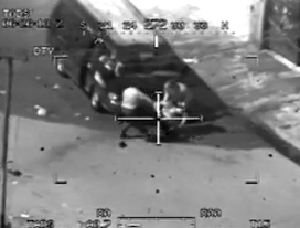
WikiLeaks video combat footage of 2007 collateral murder in Iraq“Light ’em all up. Come on, fire!” Watching the leaked combat footage of the helicopter gunships killing unarmed Iraqi civilians in 2007, I’m troubled by my own desensitized response. When I saw earlier leaked videos of an AH-64 vaporizing Iraqi farmers and a C-130 wreaking mayhem in Afghanistan, I remember my real shock at seeing a human life extinguished. This time not even flinch. “Just fuckin’, once you get on ’em just open ’em up.” Not at the brutality, nor the callousness of the play by play –even as the pilots targeted rescuers trying to help the wounded. I fault the Rules of Engagement that allowed the massacre, not the soldiers’ laughing swagger –as I hope they will not begrudge my unguarded satisfaction when eventually spectators will be treated to leaked footage of American soldiers taking some fire.

If you watched the video, perhaps you too were wishing that July 12, 2007 had recorded a massive setback for US troops in Iraq, at the height of the “surge” where a whole shitload of “dismounts” had been ambushed by IED explosions in a Baghdad square in the aftermath of a civilian massacre. Those who watched the 39-minute extended version I know were hoping to see a resolution like that, instead of an additional war crime of disproportional force and the targeting of civilians, a Hellfire missile attack on a building into which armed and unarmed men had entered, surrounded by passing innocents and rescuers scrambling to help.

There it goes! Look at that bitch go!
Patoosh!
Ah, sweet!
Need a little more room.
Nice missile.
Does it look good?
Sweet!

The Army has declared that no further inquiry will be made into the 2007 killing of the two Reuters journalists. Its FOIA requests long thwarted, even Reuters is not expressing outrage at this footage. Civilians and journalists about to be lit up The corporate media is hoping to let this story fade on the fringe. Does this mean that more pilots and gunners might become emboldened to leak other trophy reels? It doesn’t take Nelson Ratings for news outlets to see that viewers are already clamoring for more combat snuff films.

We could grant amnesty in exchange for those who turn in the most degenerate sequences.

And pretend they’ll remain anonymous. Ultimately friends and relatives will be able to place identities with the radio voices. Speaking on one of the clearest channels is the young voiced HOTEL-26, who reported taking fire from the photographers and ID’d the “RPG” with started the whole engagement. Likewise the gunner on CRAZY HORSE-18 who responded “Alright, hahaha, I hit ’em….” is addressed “God damn it, Kyle.”

And then there’s the poor 30mm gunner in CRAZY HORSE-19 who assessed his work thus:

Oh yeah, look at that. Right through the windshield! Ha ha!

While chomping at the bit to fire upon the improvised ambulance, he was momentarily thwarted by a puzzling “Azimuth Limit” which prevented his shooting.

Bloggers are now abuzz to decode the Azimuth Limit which slowed the turkey shoot when none of the gunners were showing restraint. Azimuth is the angular measurement of an object’s distance clockwise from True North. On rifles it expresses the adjustment of a gunsight to its boresight. On aircraft it apparently has something to do with the angle of relation to the axis of the fuselage. Whatever it is, maybe we can ratchet military Azimuth Limits down flat, if that’s what it will take to stop our soldiers from blowing away civilians, journalists, children and their rescuers alike. The shooters can cuss and salivate all they want so long as their trigger mechanisms respect human life or at least balk at excessive carnage.

What doesn’t come across the audio is what the US soldiers on the ground are saying to themselves as they survey “that big pile of [unarmed] bodies,” in their palaver, the “dead bastards.”

UPDATE — the testimonials begin:

From Iraq war veteran Michael Prysner, co-founder of March Forward!

The harrowing Apache footage released by WikiLeaks gives us a stomach-turning glimpse of war. Seventeen minutes of cold-blooded massacre in a war of more than seven years. A brief clip of one Apache video; a quick look at one part of one mission. Hundreds of those missions take place every day.

The video came to light thanks to military whistleblowers who provided it to WikiLeaks together with supporting documents.  Imagine if we had access to all such videos, the things we would see. Imagine all the Iraqis killed who have no one to uncover the truth about their deaths. Had the death of two Reuters news staffers not generated interest in this video, then the destruction of three families by hellfire missiles fired into an apartment building with no provocation, in a separate engagement also featured in the video, would have never been made public.

This massacre is a drop in a sea of blood. Many other such “incidents” will never be known.

Officers claimed there was “no question” that the pilots were responding to enemy fire; the video shows there is no question that they were not responding to enemy fire. They said that they had “no idea” how the journalists were killed; the video shows that they know very well how those journalists were killed. They were gunned down standing in a crowd of unarmed people.
After the slaughter of that group, the pilots beg for permission to kill the innocent passers-by who had come to the aid of one of the wounded, like any of us would have done if we saw our neighbor dying on the ground as we drove down the street. They kill everyone trying to help the dying journalist, and critically wound two children seen sitting in the front seat.

We see a group of unarmed men mowed down by a machine gun designed to destroy armored vehicles. We see a vanload of good Samaritans obliterated for trying to help a dying victim. We see all this with the soundtrack of the pilots mocking the dead, congratulating each other and laughing about the massacre.

No wonder the U.S. military goes to such great lengths to keep such videos from us. They want us to see Iraq and Afghanistan through their lens, through their embedded reporters, filtered by censorship and restrictions. They know that, once the people of this country see the extreme racism and brutality behind these occupations, they will be repulsed by what their tax dollars are paying for.

The military brass and the White House politicians have tried to justify this senseless atrocity. “Cut the pilots some slack. This was in Baghdad. This was a battle zone”—that’s been their line. The pilots had been indoctrinated with the same colonial mentality. “That’s what they get for bringing their kids into battle,” one pilot says.

The father driving that van was not “bringing his kids into battle.” He was bringing them to school, driving down the street where they live. But the U.S. occupation has made all of Iraq a battle zone. To those pilots, to their commanders over the radio and to the generals in the Pentagon, every single person in Baghdad and in Iraq is “fair game.”

The pilots joked about the people they killed, laughed about U.S. military vehicles running over dead bodies, knowing that their commanders were listening and that they were being recorded. They were not acting out of character. This is the culture of the occupation. This is how these wars are being conducted.

Having seen this, one cannot honestly believe that these atrocities are committed day in and day out for the liberation of the Iraqi people.

The Pentagon’s talking heads and media lackeys are hard at work putting their spin on this story. It’s time to tell the truth. For more than seven years, the U.S. has unleashed criminal, unprovoked aggression against the people of Iraq, and they have been doing the same thing in Afghanistan for more than eight years.

The U.S. military presence in Iraq is a colonial occupation force. The only way forward is a complete, immediate and unconditional withdrawal of all U.S. forces from Iraq and Afghanistan. This government will not do that unless all of us who are outraged by these criminal acts stand up and demand it.

Iraq war veteran Josh Stieber, US Army Specialist, 1st ID, Bravo Company 2-16 in Baghdad (Rustamiyah) 2007-2008. Although he was not present at the scene of the video, he knows those who were involved and is familiar with the environment.

A lot of my friends are in that video. After watching the video, I would definitely say that that is, nine times out of ten, the way things ended up. Killing was following military protocol. It was going along with the rules as they are.

If these videos shock and revolt you, they show the reality of what war is like. If you don’t like what you see in them, it means we should be working harder towards alternatives to war.

?

We’ll all be neo-know-sumpin’ Texans

Texas State Board of EducationThe conservative majority of the Texas Board of Education thinks school textbooks are “skewed” too much toward education. They want social studies to smile more favorably on Neoclassical Economics, America’s Christian heritage, and the legacy of today’s Neocons. Does it matter if Texas children are being taught dillwad propaganda? Well, the Texas school system is such a quantity buyer, scholastic publishers tailor national texts to conform to Texas know-nothing standards.

If your glass is half full, you might think the Tex-idiots have finally pushed illiteracy so far that American parents and teachers will simply laugh it off and adopt supplementary reading. On the other hand, this conservative surge compounds the devastation of No Child Left Behind. American schoolchildren are being made into absolute idiots, in the image of these 10 Republicans who voted along party lines to teach a history that challenges the separation of church and state.

If your kid doesn’t learn anything from the past, you have these folk to thank:

Don McLeroy– TA&M, dentist, veteran, sunday-school teacher
Gail Lowe– LSU, Lampasas County Conservative Club “Conservative of the Year”
Terri Leo– TA&M, Republican op
Barbara Cargill– Baylor, Methodist Wonders of the Woodlands Science Camp,
Ken Mercer– Texas Homeland Security Council
Geraldine “Tincy” Miller– SMU, TA&M, realtor
David Bradley– TA&M, insurance agent, Beaumont’s Citizens on Patrol
Cynthia Noland Dunbar– Spirit of Freedom Republican Women’s Club
Bob Craig– Texas Tech, SMU
Patricia Hardy– Howard Payne University

Thinking outside the bomb, in the box

THINK OUTSIDE THE BOMB is a clever antiwar appropriation of Taco Bell’s inventive twist, but since when does imitation break from a box? And does “the bomb” mean what it used to? By the look of their logo, the TOTB activists are not talking about the A-bomb, nor bunker-busters, nor smart-bombs, nor predator drones. Intentionally or not, TOTB they’re invoking the proverbial cartoon explosive, wielded by anarchists or other insurgents, the only means by which social uprisings have ever transcended the box.

“The bomb” was the feared Armageddon of the early nuclear age. More recently, “Food Not Bombs” conflates bombs with militarism because modern war-making, aka peace-keeping, is dominated by aerial bombing. Returning to “bomb” in the singular insinuates nukes, or the mutually-assured destructiveness of endlessly reciprocated violence. So let’s see the bomb depicted more as a nuclear warhead or an artillery shell.

Intrinsic to the plea for nonviolence is the determination to subdue the military instinct with transcendence. And when have proponents of nonviolence exerted jurisdiction over anyone but themselves? Lead by example they cry. We will defeat the barbarians by not becoming barbarians ourselves. Turn the other cheek, the meek shall inherit the earth. I rather suspect, quoth Camelot: “It’s not the earth the meek inherit, it’s the dirt.”

To warmongers I say: think. In of itself, thinking is outside the box enough for you. To peaceniks: exchanging the challenges of human reality for a spiritual realm, is a religious balm that dates to antiquity, about as inside the box as it gets.

Our prejudice against tent-dwellers

Great Depression Okies living in tents
What do home-enabled Coloradans have against disadvantaged people forced to live in tents? The Great Depression saw migrant workers having to subsist under canvas, striking miners have been forced from their homes and into camps in Ludlow and before that Cripple Creek. And of course the first Colorado tent-dwellers to get everyone’s panties in a knot were the Native Americans who held original claim to the territory.

The above photograph is from Dorothea Lange’s historic series which documented the lives of migrant workers as they fled the Dust Bowl for the fertile agricultural plantations of California. The woman at right is the iconic “Migrant Mother” known for a more famous closeup. I chose this shot because it makes clear that she and her seven children were living in a tent.

Colorado was one of the states which the Okies had to cross in search of work in California. As depicted in Grapes of Wrath, Colorado and Arizona only begrudgingly tolerated the vagabonds, making sure they didn’t linger and kept on their way.

Do we fear the poor because they threaten our own sense of prosperity? There but for the grace of God, go ourselves? We shoo them along lest their itinerant ways tax our charity, or they take the righting of economic inequity into their own hands. The Europeans have always shunned the ever-homeless gypsies. Landless people can’t be trusted, they’re in the opposite position of what we look for in businesses, reliable to the extreme of being “bonded.” People unattached to assets don’t have capital to bond them with responsibility.

Depression era photograph by Dorothea LangeBefore Coloradans were chasing off out-of-state migrant workers, yesterday’s illegal immigrants, they were offended by earlier indigent encampments. When miners struck in Colorado’s southern coal fields, the mine owners evicted them from the company-owned houses. The unions were left to build a tent city in Ludlow to put pressure on the industry to accept some labor demands. The standoff was spun as a standoff between the ungrateful miners, most of them recent immigrants, and a nation’s critical source of heating fuel. The Colorado population was roused to man a militia and beat the miners into submission. As much as consumers feared an interrupted coal supply in the record cold of the winter of 1914, imagine the miners enduring in their tents. In the end, we all know the result: the Ludlow Massacre and the unions were defeated.

The gold miners fared slightly better in their 1894 strike to preserve the eight hour day. When they closed down the mines and camped on site to keep them shut, the folks of Colorado Springs were rallied to form a near 2000-strong army to go attack the ingrates. Fortunately the miners escaped a battle, but the common population’s prejudice against the laborers in their tents was the same.

Could these have been related to the sentiments which inflamed Colorado Territory settlers in 1864, enough to go after the few remnants of Native Americans encamped along Sand Creek?

The Pikes Peak region plays an ignoble role in all of these examples. Men from Colorado Springs and Colorado City formed the population from which participants were drawn for Chivington’s raid against the Cheyenne, the private army which marched against the Cripple Creek gold strike, and the militia which Rockefeller mobilized to torment the tent city of Ludlow. Colorado Springs was a hotbed of Klu Klux Klan activity in the 1930s, epitomizing local xenophobia.

When Colorado Springs city councilman speak of fielding calls from constituents angry about the growing homeless encampments, I cannot help but think of our legacy of intolerance of people deemed lesser than us. Colorado Springs has always been ripe for bigotry and hatred.

Not so long ago our city was the crucible for Amendment Two which sought to deprive homosexuals of protection from discrimination. More recently fear-mongering about immigration from Mexico made Colorado Springs fertile for recruiting gunmen for the Minutemen, to make pilgrimages to the Mexican border with the promise of getting to shoot Mexicans pell-mell. Since the election of President Obama, we’ve seen a phenomenal growth of Tea Party enthusiasts, white bigots determined not to have their taxes spent by a nigger.

What a sorry racist lot we’ve been, anti-labor, anti-progressive and anti-poor. Somewhere in the past there must have been city leaders who defied the simple-minded xenophobia of our historic population, otherwise all our statues of municipal heroes would be wearing clan gowns. Hopefully with the current bloodlust to run off the victims of our current depression, city politicians will lead my setting a higher moral example.

Errant missile a setback for 12 Afghans

NATO spokesmen are preempting accusations of insensitivity concerning two US rockets which killed twelve Afghan civilians in Marjah, the latest operation against the Taliban. Six of the unintended victims were children. Military brass are expressing worry that such collateral damage will prove a setback to winning the hearts and minds over the latest US antipersonnel maneuvers.

US Marines are complaining that new rules of engagements are making the fighting more arduous and protracted. The stricter rules dictate that US soldiers cannot fire at people unless they commit a hostile act or show intent. This new policy abides by Geneva Conventions, meaning the earlier rules did not.

Before its resurged insurgence, Fallujah was not considered a setback. In other headlines, Secretary of State Clinton declared that Iran is heading toward being a military-led regime, the potential of nuclear weapons posing a terrifying threat. I don’t know about Iran, can we say that about the USA?

Ojore Nuru Lutalo, aka Leroy Bunting arrested with Anarchist literature

Anarchist Ojore Nuru LutaloFormer political prisoner Ojore Nuru Lutalo, ne Leroy Bunting, was pulled off an Amtrak train in La Junta, Colorado, for scaring fellow passengers with his cell phone conversation. The FBI’s Colorado Springs Joint Terrorism Task Force was alerted about the 64 year-old armed with anarchist literature from the “Afrikan Liberation Army” (sic) which he had obtained while speaking at the LA Anarchist Book Fair for the Anarchist Black Cross, a prison rights organization. Just yesterday I listened to a local law enforcement type defend the 2nd Amendment, the right to bear arms, by suggesting that if we substituted “books” for guns, no one would think to regulate them. His compatriots seem to have confused the argument by charging the former Black Liberation Army member for “endangering public transportation” with what they called terrorist recruiting propaganda.

Journal Turning the TideAccording to the Pueblo Chieftain, police found “a large amount of propaganda recruiting materials from the Afrikan Liberation Army, including photos of President Barack Obama and other items that raised suspicions.”

Break the Chains reports that Ojore was released Yesterday, and will return to the Otero District Court for an appearance February 5th, the charge now “Interfering with Public Transportation.”

How absolutely disingenuous to misquote the source of the so-called Anarchist literature, seeing as reportedly there was so much of it. This is the usual media disinfo to prevent giving the causes visibility. The Pueblo Chieftain has obtained the affidavit of the arrest, which should list the items found on Ojore. Until that’s made available, we can search online for what he was likely carrying. Our bet, they don’t want to call attention to the New Afrikan Liberation Front (NALF).

Here’s a list of the exhibitors at the 2nd Anarchist Book Fair:

Anarchist type brochuresSemiotext(e)
www.semiotexte.com
Earth First Journal
www.earthfirstjournal.org
Taala Hooghan: Infoshop & Youth Media Arts Center
www.taalahooghan.org
Modesto Anarcho
www.modestoanarcho.org
South Central Farmers
www.southcentralfarmers.com
Skylight Books
www.skylightbooks.com
Institute for Anarchist Studies
www.anarchist-studies.org
Critical Resistance
www.criticalresistance.org
Las Vegas Alliance of the Libertarian Left sonv.libertarianleft.org
Catholic Worker
www.lacatholicworker.org
Anti-Racist Action/Turning the Tide
www.antiracistaction.us
Anarchist Black Cross Federation L.A. www.abcf.net/la
PM press
www.pmpress.org
Microcosom Publishing
www.microcosmpublishing.com
AK press
www.akpress.org
Little black cart
www.littleblackcart.com
Make/Shift magazine
www.makeshiftmag.com
Journal of aesthetics and protest
www.journalofaestheticsandprotest.org
R.A.C. : Revolutionary Autonomous Communities
www.revolutionaryautonomouscommunities.blogspot.com
I.W.W
www.iww.org

Then there is also the Southside ABCF zine collection, the Crossroad Newletter, and the publications of the Spear and Shield. Here’s the New Afrikan Declaration of Independence, as printed on Prairie Fire:

“New Afrikan Declaration of Independence”

WE, New Afrikan People in America, in consequence of arriving at a knowledge of ourselves as a people with dignity, long deprived of that knowledge; as a consequence of revolting with every decimal of our collective and individual beings against the oppression that for three hundred years has destroyed and broken and warped the bodies and minds and spirits of our people in America, in consequence of our raging desire to be free of this oppression, to destroy this oppression wherever it assaults humankind in the world, and in consequence of inextinguishable determination to go a different way, to build a new and better world, do hereby declare ourselves forever free and independent of the jurisdiction of the United State of America and the obligations which that country¹s unilateral decision to make our ancestors and ourselves paper-citizens placed on us.

We claim no rights from the United States of America other than those rights belonging to human beings anywhere in the world, and these include the right to damages, reparations, due us from the grievous injuries sustained by our ancestors and ourselves by reason of United States lawlessness.

Ours is a revolution against oppression–our own oppression and that of all people in the world. And it is a revolution for a better life, a better station for all, a surer harmony with the forces of life in the universe. We therefore see these aims as the aims of our revolution:

    • To free black people in America from oppression;
  • To support and wage the world revolution until all people everywhere are so free;
  • To build a new Society that is better than what We now know and as perfect as We can make it;
  • To assure all people in the New Society maximum opportunity and equal access to that maximum;
  • To promote industriousness, responsibility, scholarship, and service;
  • To create conditions in which freedom of religion abounds and the pursuit of God and/or destiny, place and purpose of humankind in the Universe will be without hindrance;
  • To build a Black independent nation where no sect or religious creed subverts or impedes the building of the New Society, the New State Government, or achievement of the Aims of the Revolution as set forth in this Declaration;
  • To end exploitation of human beings by each other or the environment;
  • To assure equality of rights for the sexes;
  • To end color and class discrimination, while not abolishing salubrious diversity, and to promote self-respect and mutual understanding among all people in the society;
  • To protect and promote the personal dignity and integrity of the individual, and his or her natural rights;
  • To place the major means of production and trade in the trust of the state to assure the benefits of this earth and our genius and labor to society and all its members, and
  • To encourage and reward the individual for hard work and initiative and insight and devotion to the Revolution.

In mutual trust and great expectation, We the undersigned, for ourselves and for those who look to us but are unable personally to affix their signatures hereto, do join in this solemn Declaration of Independence, and to support this Declaration and to assure the success of the Revolution, We pledge without reservation ourselves, our talents, and all our worldly goods.

Or the creed:

“New Afrikan Creed”

1. i believe in the spirituality, humanity and genius of Black people, and in our new pursuit of these values.

2. i believe in the family and the community, and in the community as a family, and i will work to make this concept live.

3. i believe in the community as more important than the individual.

4. i believe in constant struggle for freedom, to end oppression and build a better world. i believe in collective struggle; in fashioning victory in concert with my brothers and sisters.

5. i believe that the fundamental reason our oppression continues is that We, as a people, lack the power to control our lives.

6. i believe that fundamental way to gain that power, and end oppression, is to build a sovereign Black nation.

7. i believe that all the land in America, upon which We have lived for a long time, which We have worked and built upon, and which We have fought to stay on, is land that belongs to us as a people.

8. i believe in the Malcolm X Doctrine: that We must organize upon this land, and hold a plebiscite, to tell the world by a vote that We are free and our land independent, and that, after the vote, We must stand ready to defend ourselves, establishing the nation beyond contradiction.

9. Therefore, i pledge to struggle without cease, until We have won sovereignty. i pledge to struggle without fail until We have built a better condition than the world has yet known.

10. i will give my life, if that is necessary; i will give my time, my mind, my strength, and my wealth because this IS necessary.

11. i will follow my chosen leaders and help them.

12. i will love my brothers and sisters as myself.

13. i will steal nothing from a brother or sister, cheat no brother or sister, misuse no brother or sister, inform on no brother or sister, and spread no gossip.

14. i will keep myself clean in body, dress and speech, knowing that i am a light set on a hill, a true representative of what We are building.

15. i will be patient and uplifting with the deaf, dumb and blind, and i will seek by word and deed to heal the Black family, to bring into the Movement and into the Community mothers and fathers, brothers and sisters left by the wayside.

Now, freely and of my own will, i pledge this Creed, for the sake of freedom for my people and a better world, on pain of disgrace and banishment if i prove false. For, i am no longer deaf, dumb or blind. i am, by inspiration of the ancestors and grace of the Creator — a New Afrikan.

Simple American breakfast no longer

pancake syrop corn syrup hfcs maple KaroMy ideal breakfast is served at a diner: coffee, eggs, hash browns and toast. But can you feel healthy about it –as your conscience (n) –> vegan? You could pack in sugar in the raw, sea salt, and organic peppercorns in the requisite grinders; likewise from a cooler you could pull jars of rBGH-free half and half, real butter, and organic ketchup if you’re inclined. But what about what’s served on the plate?

A disclaimer: let’s define eating to mean the consumption of nutrition and avoidance of toxin. That precludes genetically modified organisms, irradiated produce, chemical pesticides, trans-fats, corn-syrup, HFCS, etc. The expression “natural” has been co-opted by Big Agra, but no longer can detractors say that “organic” doesn’t mean anything.

I’m omitting the optional meats: ham, bacon and sausage links for the obvious reasons; free-range, grass-fed, single-animal slaughtered efforts notwithstanding. Enough said.

Empty calories like juice are out as well, unless it’s freshly squeezed for your glass.

And let’s presume too, we’ll be asking the cook to stir some onions and peppers into the hash browns, for at least a little green.

Before we leave the subject of condiments, there a three non-perishable items it might be worth bringing with you to the diner. restaurant jelly single serving corn syrup hfcs For your toast: corn-less fruit preserves, unheated honey, and if you’re planning to add pancakes, grade-B maple syrup. The diner variety syrup, and any portion-size pre-packaged confection are apt to be entirely corn syrup and HFCS.

If the price of your breakfast starts at $3.80, it’s unlikely your local diner can afford the healthy food supplies you are able to ferret from your grocer. It’s become enough of a feat to stock them at home. Let’s see: eggs from vegetarian-fed cage-less chickens, organic potatoes, whole-grain bread. All these hyphens concatenate into a value meal priced more like a dinner entree. And there’s probably no chance a typical diner can spring for fair-trade organic coffee beans.

Economists point to America’s relatively level cost of living. Progressive analysts address the subsidies which keep commodity prices artificially low. Others decry the need for society to address the real costs which cripple our unhealthy system. From the consumer’s point of view, the cost of real nutrition has suffered a hyperinflation to put it beyond our reach, eating out or in.

NOTES:
1. Here’s that recipe for organic catsup:

3 cups canned organic tomato paste
¼ cup whey (liquid from plain yogurt)
1 Tbls sea salt
½ cup maple syrup
¼ tsp cayenne pepper
3 cloves peeled & mashed garlic
½ cup fish sauce fish sauce

Mix together in a wide-mouth glass jar, leave at least an inch below the top and leave it at room temperature for 2-3 days before putting into the refrigerator. Recipe makes a whole quart.

2. An optimum juice concoction:

1. Beetroot
2. Celery
3. Carrot
4. Apple
5. Ginger

3. Three lists:

Foods to buy organic:
Meat, Milk, Coffee, Peaches, Apples, Sweet Bell Peppers, Celery, Nectarines, Strawberries, Cherries, Kale, Leafy Greens, Grapes, Carrots, Potatoes, Tomatoes

Foods that don’t need to be organic:
Onions, Avocado, Sweet Corn, Pineapple, Mango, Asparagus, Sweet Peas, Kiwi Fruit, Cabbage, Eggplant, Papaya, Watermelon, Broccoli, Sweet Potatoes

GMO crops:
Soybeans, Corn starch, Canola oil, Sugar beet, Rice. Watch list:
Wheat, Potatoes.

Tim Tebow here’s your sign

Football-Ephesians-Tim-Tebow-Bible-Eye-BlackFootball evangelist Tim Tebow is at it again, proselytizing with his sportsman mascara. This time it’s Ephesians, something about how you’re saved by your belief in Jesus, regardless your deeds. It’s the same mentality that has Americans crusading against the Islamic world, desecrating humanity with an impunity sanctioned by blind faith. It’s the same mindless arrogance that emboldens Brit Hume to call Tiger Woods to Christianity, whose American tradition has it that all your mother killing and father raping will be forgiven. In Hume’s world, Tokyo Rose was tried for inciting war crimes. Hume doesn’t recognize that he’s guilty of worse. In Hume’s Christianity, apparently only Buddhists reap what they sow.

What is the point of the messaging in the eye black? Is it merely more ad space, like the helmets with the American flag decals, or uniforms with the Nike logos or embedded Swooshes, Gatoraid patchs and corporate sponsors of whichever bowl? Dark patches beneath the eyes might be nature’s way of easing the trauma of bright light on hangover sufferers. If the black light-sinks work, then Tebow’s white on black script most certainly impedes his vision.

It was always my impression that football players marked their faces with shoe polish like it was indian war paint, to give themselves a menacing look. I think that’s more Tebow’s motif, to intimidate with self-righteousness.

In which case, the I’m-better-than-you scripture reference would seem more along the lines of the sign which restaurants post above the coat rack: not responsible for stolen items, although common law dictates that if you are seated beyond line of sight of the garments you shed, the restaurant is responsible.

Tim Tebow informs us, through Ephesians, that he has chosen to follow God’s will for him, that his lifetime consist of playing American football. Whether they understands it or not, Tebow and company vitalize the spiritual center of America’s culture of violence. We kick ass, and hold God responsible.

Identity of CIA bomb victims spill forth

khost victim of CIA bomberUS forces in Afghanistan suffered an unprecedented setback this weekend when a suicide bomber was able to blow to smithereens a gathering of CIA operatives in an outpost in Khost Province. Seven agents were killed and six injured, and a great tragedy is that these covert deaths, like that of the security contractor killed with them, are not counted as official casualties of war, to weigh against the public conscience for us to wonder, was it worth it? These were professional killers and torturers whose names are now withheld to protect their families.

But some Americans –God bless them– will not be denied the deification of their downed warriors, and so some families have gone public about the loss of their mercenary kin. Thus we have names, and Facebook memorials, to the men and women who commit the clandestine crimes for which the rest of the world holds us accountable. But first, a word about what they were doing.

Forward Operating Base Chapman caught my attention because that’s the kind of military post which protects the celebrated school building projects of Greg Mortenson, and Khost Province is one of his territories. It turns out that the US Army is also busy [re]-building schools, and boasts 53 in Khost. Also, for reasons of deteriorating security, FOB Chapman was no longer housing US military, but instead was strictly for private firms contracted to the reconstruction, except now journalists are at liberty to say that the camp was always known to be “not regular” — code for CIA.

“Although Chapman was officially a camp for civilians involved in reconstruction, it was well-known locally as a CIA base. Over the past couple of years, it focused on gathering information on so-called high-value targets for drone attacks, the unmanned missile planes that have played a growing role in taking out suspected terrorists since President Barack Obama took office. The Haqqanis were their principal target.

” ‘That far forward they were almost certainly from the CIA’s paramilitary rather than analysts,’ said one agent.”

So FOB Chapman was used for a drone command post. Not controlling drones, but gathering intelligence about where to target their missiles. I’d be curious that what had been an “underground gym” for US soldiers, where the dozen CIA officers were meeting their informant/surprise-bomber, wasn’t being put to an altogether more menacing function by the CIA. Obviously on this particular occasion it was a briefing room/wake.

It’s conjectured that the CIA at FOB Chapman was targeted because the local Taliban had suffered one too many CIA drone attacks. Other accusations emerge that the CIA had recently killed Afghan detainees while in custody, in their effort to break the Haqqani network. One reporter’s source phrased it: “Those guys have recently been on a big Haqqani binge.”

The CIA is not releasing the name of the bomber, reportedly an informant “candidate,” but strangely his name is being reported in the Arabic press. He was a Jordanian doctor named Khalil Abu Hammam Mellal Al-Balawi, of the Beer Al-Saba’a family, codenamed “Abu Dajana Al-Kharasani,” a supervisor on the Al-Hisba internet forums, where so-called official al-Qaeda communications are regularly transmitted. His identity might explain how a visit with this “informant” warranted the attendance of a dozen agents, including a high ranking officer from Kabul and the Khost station chief.

The station chief was reported to have been an agent in Afghanistan for 14 years, since the days of the so-called Alec Station which was tasked with tracking the whereabouts of Osama bin Laden. She was a loving mother of three, so it’s possible her identity is being concealed until her family can be extracted from the region.

The first agent to be identified publicly was Harold Brown Jr., 37, of Bolton, Mass., whose father thought he worked for the State Department. Before the “State Department,” Brown worked for Science Applications International Corp.

The next to be identified was Scott Michael Roberson, 39, of Akron, Ohio. He was a policeman when he wasn’t a CIA security officer. Robertson co-founded the Metro Atlanta Police Emerald Society and was a member of the Iron Pigs, a national motorcycle club for police and firefighters.

Another of the CIA agents wasn’t American at all, but a member of the Jordanian royal family. The body of Capitan As-Sharif Ali bin Zeid Al Awn has been returned to Jordan with much pomp and ceremony, without an official report of the incidence of his death, the family unable to explain what he was doing in Afghanistan, except to deny accusations that he was employed by the CIA.

The lone non-CIA victim was security contractor and former Navy SEAL, Jeremy Jason Wise, 35, of Virginia Beach. Wrote the WSJ: “Today, the CIA and President Obama acknowledged that seven of those killed were CIA agents. No one would say who employed the eighth American.”

(Except he was really the seventh American, because one of the dead was a Jordanian.)

UPDATE: It’s now revealed that Jeremy Wise was employed by Xe/Blackwater, who admit now that two of the CIA victims were Blackwater.

With suicide bombers all over the news, from the successful to the pantywaist, as blogs spill over with nuke-em-all comments which reveal Americans seem perfectly comfortable with the idea that peoples are collectively accountable for the deeds of criminals among them.

Or the deeds of insurgents aka freedom fighters, about whom you or I might disagree.

US Blackwater goons for example, have been let off the hook for the Nisour Square atrocity in Iraq. According to our neoliberal world order, Iraq should be able to track miscreants with drones, and since we refuse to bring them to justice, lay waste entire American neighborhoods and schools if informants report they are nearby.

I’ve certainly always argued that Americans are all of us responsible for the crimes our government is committing. Even with our combatant criminals killed in battle, I’m not sure that the people who cheered them on don’t still owe their victims responsibility.

Viva Palestina convoy to arrive in Rafah NPR fails to name it, or mention the Gaza Freedom March

viva palestina route el arishAfter endless impediment, not the least of which was a sudden Israeli naval exercise to block its path, the Viva Palestina aid convoy appears finally about to reach Gaza. Permission to enter has been granted, although last week Egypt reneged on the okay it had given to the 1,400 strong Gaza Freedom March. NPR had a reporter at the Rafah border crossing, but didn’t mention the aid convoy until 1/3 into the report, and then not by name, and never mentioned the New Year’s Eve march at all. As well, NPR referred to the besieged prison state as an “enclave” whose borders were forcibly closed, “understandably,” when Hamas “took over.”

Here’s the opening of this morning’s report. My favorite part? Two. First the interminable sportscast-lke intro, a beautiful day in Fenway Park, etc. Then, hesitation as the reporter explains that the border is opened to let Palestinians out, and um, sometimes back in.

Steve Inskeep: “This is a rare day in a Palestinian enclave known as the Gaza Strip. A border crossing opened today, which is rare because Gaza is surrounded by Israel and Egypt and both have kept the crossings closed for weeks at a time over the last couple years. Today people and supplies have been allowed to move and NPR’s Peter Kenyon is at the border crossing of Rafah on the Egyptian side, Hi Peter.”

Peter Kenyon: “Hi Steve, how are you?”

SI: “Okay thanks. What have you seen?”

PK: “Well it’s a beautiful sunny day here, a little bit windy but a bright blue sky, and I’m at the actual crossing point. The black iron gates are slowly swinging open and closed from time to time, letting Palestinians out into Egypt or uh, sometimes back in, people who need to get home. Now this is a very limited opening, not any kind of a max exodus.”

SI: “Is this an opportunity to move supplies in addition to people?”

PK: “It is. In fact there is an aid convoy that has endured quite a few setbacks that has now finally arrived in the port of El-Arish. That’s about twenty-five miles away and that is expected to come as early as today, possibly tonight, there’s some last minute logistical difficulties. It’s a British convoy led by the outspoken member of parliament George Galloway. And they have finally arrived and they do hope to get in.”

And that’s the extent of the coverage of the aid convoy that has been winding its way toward Gaza for the last month. No mention of “Viva Palestina” or organizations behind the effort, or even what their difficulties have been. The final “logistical difficulties” to which the reporter alludes concern Egypt’s sudden stipulation that aid consist only of medical supplies. Check with York to Gaza, the Reading Palestinian Solidarity Campaign, the Sitch, among others, for the final updates.

Meanwhile the BBC has pictures of conditions in Gaza.

While the Gaza Freedom March was kept contained in Cairo, Egypt was simultaneously stopping the Viva Palestina aid convoy from entering through Aqaba. Ultimately the convoy was forced to circle Israel and return to Syria, where it had to ferry its vehicles on the Ulusoy-6 from Lattakia to the Egyptian Port of El-Arish to reach the Rafah border crossing into Gaza.

Is it really illegal to boycott Israel?

boycott-israeli-goods-end-apartheidIt is not illegal for US consumers to boycott anyone’s products. But the business decisions of companies affiliated with Israel do enjoy some curious protective constraints…

It’s ironic that as the US enforces rigid sanctions against international companies which violate its embargo against Cuba, the US has enacted laws simultaneously which prohibit its companies from complying with trade restrictions called by others.

As a further embarrassment, the antiboycotting measure specifies just one boycott, literally: the League of Arab Nations boycott of Israel.

So while American consumers are free to make the buying decisions they wish, it is illegal for an American business to adjust its business practices to boycott Israel.

In other words, as much as social justice activists might like to ask a department store not to carry Ahava beauty products taken from Occupied Territory shores, the store would be prohibited by US law to do so as an act of compliance. ahava-stolen-beauty-occupation For another example, fashion labels such as DKNY and cK could decide to discontinue carrying undergarments manufactured by Delta Galil from settler farms in Palestine, but they couldn’t do it because of someone’s boycott.

(Delta Galil supplies clothing to the Gap, Banana Republic, Structure, J-Crew, JC Penny, Pryca, Lindex, DIM, Donna Karan, Ralph Lauren, Playtex, Calvin Klein, and Hugo Boss.)

This law makes a commercial boycott impossible to resolve between customer and business, but ultimately results in more pressure being applied to the source cause, which are the policies of Israel.

According to the US Department of Commerce, Bureau of Industry and Security, Office of Antiboycott Compliance, in the 1970s two laws were enacted “to counteract the participation of U.S. citizens in other nation’s economic boycotts or embargoes. These ‘antiboycott’ laws are the 1977 amendments to the Export Administration Act (EAA) and the Ribicoff Amendment to the 1976 Tax Reform Act (TRA). While these laws share a common purpose, there are distinctions in their administration.”

Antiboycott Compliance

The Bureau is charged with administering and enforcing the Antiboycott Laws under the Export Administration Act. Those laws discourage, and in some circumstances, prohibit U.S. companies from furthering or supporting the boycott of Israel sponsored by the Arab League, and certain Moslem countries, including complying with certain requests for information designed to verify compliance with the boycott. Compliance with such requests may be prohibited by the Export Administration Regulations (EAR) and may be reportable to the Bureau.

The law specifies boycotts called by foreign nations, leaving the possibility that US citizens can declare themselves the originators of a boycott. However other language makes clear that no boycott is to contravene the US government’s declared trade policy with Israel. To elaborate on the EAR:

Objectives:
The antiboycott laws were adopted to encourage, and in specified cases, require U.S. firms to refuse to participate in foreign boycotts that the United States does not sanction. They have the effect of preventing U.S. firms from being used to implement foreign policies of other nations which run counter to U.S. policy.

Primary Impact:
The Arab League boycott of Israel is the principal foreign economic boycott that U.S. companies must be concerned with today. The antiboycott laws, however, apply to all boycotts imposed by foreign countries that are unsanctioned by the United States.

Who Is Covered by the Laws?
The antiboycott provisions of the Export Administration Regulations (EAR) apply to the activities of U.S. persons in the interstate or foreign commerce of the United States. The term “U.S. person” includes all individuals, corporations and unincorporated associations resident in the United States, including the permanent domestic affiliates of foreign concerns. U.S. persons also include U.S. citizens abroad (except when they reside abroad and are employed by non-U.S. persons) and the controlled in fact affiliates of domestic concerns. The test for “controlled in fact” is the ability to establish the general policies or to control the day to day operations of the foreign affiliate.

The scope of the EAR, as defined by Section 8 of the EAA, is limited to actions taken with intent to comply with, further, or support an unsanctioned foreign boycott.

These amendments are examples of Israel’s stranglehold on US legislation. Anti-Israel voices like to paint the picture that as a result, American citizens have been denied the freedom to vote with their pocketbooks where it comes to opposing the policies of Israel. Likewise, pro-Israel groups are content to leave the issue ambiguous. But clearly US individuals are free to make consumer choices and encourage others as they wish.

The function of the TRA further explains its business-limited scope:

What do the Laws Prohibit?

Conduct that may be penalized under the TRA and/or prohibited under the EAR includes:

• Agreements to refuse or actual refusal to do business with or in Israel or with blacklisted companies.

• Agreements to discriminate or actual discrimination against other persons based on race, religion, sex, national origin or nationality.

• Agreements to furnish or actual furnishing of information about business relationships with or in Israel or with blacklisted companies.

• Agreements to furnish or actual furnishing of information about the race, religion, sex, or national origin of another person.

Implementing letters of credit containing prohibited boycott terms or conditions.

The TRA does not “prohibit” conduct, but denies tax benefits (“penalizes”) for certain types of boycott-related agreements.

Jokenhagen, the COP15 that wasn’t

You heard about the Yes Men successfully pulling off another stunt in Copenhagen? The delegates were fooled, even the media, and so unsurprisingly, the substance of their theatrics is being glossed over. While the reporters track the footprints to sort truth from facade, they are wiping all traces behind them. Url-shortening conduit bit.ly warns for example that clicking through might endanger your browser. The Yes Men prank Canada is as far as most news stories go. Why Canada — is the more to the story.
climate debt agents good cop15

First the substance: Canada is a wealthy-nation holdout on the climate talks. Its conservative government is offering to curb carbon emissions by a mere 3% etc. So the Yes Men thought they’d lead by example, role-playing Canada stepping up as all industrialized powers must. Their special announcement was called AGENDA 2020, wherein Canada pledged a 40% cut in emissions by 2020, to reach a 80% cut by 2050. Plus they vowed a “climate debt mechanism” comprising 1% of Canada’s GDP, climbing to 5% by 2030, to go toward emissions reduction and clean energy projects in Africa.

Drastic cuts, and huge payments of “climate debt” are what scientists project will be necessary to reach the environmental 350ppm line in the sand. A COP15 without such figures will be a failure. It’s small wonder the media is describing this “prank” without mentioning what was said.

Some Canadian outlets are providing reasonable detail of the commotion which was provoked. Check out the Globe and Mail, then the Toronto Star for good overviews.

The operation as it unfurled: preparations and execution were a collaboration between YM and the red-jacketed Climate Debt Agents (CDA).

0. YM begin tweeting as Canadian envoy PM Jim Prentice
(example: “My staff have notified me of a fake account pretending to represent me. It is @JimPrentice hope we can get it removed shortly. 5:31 AM Dec 14th from web” )

1. YM botch amusing anti-CocaCola prank

2. YM as Prentice tweets special announcement of a bold step forward.

3. YM (enviro-canada.com) offers Environment Canada press release

4. CDA fakes press conference outlining AGENDA 2020

5. Another CDA press conference features the envoy from Uganda, applauding Canada

6. Phony YM Wall Street Journal European Edition picks up story

7. YM (as ec-gc.ca) Environment Canadia press release pretending to denounce fraudulent prank

8. And the obligatory CDA press conference.

9. The real Canadian delegates provide the hijinks from there.

Championing minor pranks here and there as they toured for the release of their new movie The Yes Men Save the World, a reputation no doubt preceded them to the Climate Conference. The Yes Men anti-CocaCola prank earlier this week was stopped after just 20 seconds, but may have been a ruse to resolve expectations that they were obviously in Copenhagen to do something.

The CBC covers the moves of the Canadian and US delegates to get a handle on their PR. Interesting too were the frantic efforts to unmask the deception. While web sleuths followed the internet clues, a CBC reader comments that so far we’ve heard nothing yet of detective work in pursuit of whoever “hacked” the Climategate emails.

The press conferences are available on Youtube COP15DK, although their credibility is enhanced by the websites constructed around them.

AGENDA 2020

UGANDA RESPONDS

CANADA RETRACTS

CLIMATE DEBT AGENTS TAKE RESPONSIBILITY

Of course the Yes Men released their own article to tell the story:

Copenhagen spoof shames Canada; Climate Debt No Joke

by The Yes Men

African, Danish and Canadian youth join the Yes Men to demand climate justice and skewer Canadian climate policy.

COPENHAGEN, Denmark – “Canada is ‘red-faced’!” (Globe and Mail) “Copenhagen spoof shames Canada!” (Guardian) “Hoax slices through Canadian spin on warming!” (The Toronto Star) “A childish prank!” (Stephen Harper, Prime Minister of Canada)

What at first looked like the flip-flop of the century has been revealed as a sophisticated ruse by a coalition of African, North American, and European activists. The purpose: to highlight the most powerful nations’ obstruction of meaningful progress in Copenhagen, to push for just climate debt reparations, and to call out Canada in particular for its terrible climate policy.

The elaborate intercontinental operation was spearheaded by a group of concerned Canadian citizens, the “Climate Debt Agents” from ActionAid, and The Yes Men. It involved the creation of a best-case scenario in which Canadian government representatives unleashed a bold new initiative to curb emissions and spearhead a “Climate Debt Mechanism” for the developing world.

The ruse started at 2:00 PM Monday, when journalists around the world were surprised to receive a press release from “Environment Canada” (enviro-canada.com, a copy of ec.gc.ca) that claimed Canada was reversing its position on climate change.

In the release, Canada’s Environment Minister, Jim Prentice, waxed lyrical. “Canada is taking the long view on the world economy,” said Prentice. “Nobody benefits from a world in peril. Contributing to the development of other nations and taking full responsibilities for our emissions is simple Canadian good sense.”

Thirty minutes later, the same “Environment Canada” sent out another press release, congratulating itself on Uganda’s excited response to the earlier fake announcement. A video featuring an impassioned response by “Margaret Matembe,” supposedly a COP15 delegate from Uganda, was embedded in a fake COP15 website. “Canada, until now you have blocked climate negotiations and refused to reduce emissions,” said “Matembe.” “Of course, you do sit on the world’s second-largest oil reserve. But for us it isn’t a mere economic issue – it’s about drought, famine, and disease.”

(The video was shot in a replica of the Bella Center’s briefing room, at Frederiksholms Kanal 4, in the center of Copenhagen. Matembe was actually Kodili Chandia, a “Climate Debt Agent” from ActionAid, a collective of activists that push for rich countries to help those most affected by climate change for adaptation and mitigation projects. The “Climate Debt Agents,” with their signature bright red suits, have been a ubiquitous presence in Copenhagen during the climate summit.)

Then it was time for Canada to react. One hour later, another “Environment Canada” (this one at ec-gc.ca) released a bombastic response to the original release. This one quot ed Jim Prentice, Canada’s Minister for the Environment, decrying the original announcement: “It is the height of cruelty, hypocrisy, and immorality to infuse with false hopes the spirit of people who are already, and will additionally, bear the brunt of climate change’s terrible human effects. Canada deplores this moral misfire.”

Because almost none of the resulting news coverage even mentioned Uganda or “Matembe’s” response, a fourth release was sent from the second website (ec-gc.ca).

Meanwhile, in the real world

The real Canadian government’s reactions were almost as strange as the fake ones in the release. Dimitri Soudas, a spokesperson for the Canadian Prime Minister, emailed reporters and blamed Steven Guilbeault, cofounder of Quebec-based Equiterre. “More time should be dedicated to playing a constructive role instead of childish pranks,” said Soudas in a first email, while misspelling Guilbeault’s name.

Guilbeault demanded an apology. “A better way to use his time would probably be to advise the Canadian government to change its deeply flawed position on climate,” said Guilbeault.

Soudas and Guilbeault were seen exchanging angry words in the hallway outside of Canada’s 3:30pm press conference, which did not start until 4:30pm, and at which the Canadians refused to answer any questions about the flurry of false releases.

More raised voices were heard when Stephen Chu, the US Secretary of Energy, refused to pose for a photo with his Canadian counterpart, Jim Prentice. After Steve Kelly, Prentice’s chief of staff, begged for 10 minutes, the US guy finally asked why a photo was so important. Kelly replied that “we were carpetbagged this morning by [environmental non-governmental organizations] with a false press release. I gotta change the story.”

Why Blame Canada?

The only country in the world to have abandoned the Kyoto Protocol’s emissions and climate debt targets, Canada also has the most energy-intensive, destructive and polluting oil reserves in the world. The Alberta tar sands, according to The Economist, are in fact the world’s biggest single industrial source of carbon emissions.

“By not agreeing to emissions reductions, Canada is holding a loaded gun to our heads, and seems ready to pull the trigger on millions of us around the globe, ” said Margaret Matembe aka Kodili Chandia of the “Climate Debt Agents.” “They leave us no choice but to see them as criminal.”

At last year’s climate summit in Poznan, Poland, over 400 civil society organizations voted Canada worst of all nations in blocking progress towards a binding climate treaty. Will Canada take the dubious prize again this year in Copenhagen?

“The Canadian government is not listening to its citizens,” says Sarah Ramsey, a resident of Alberta who has seen the destruction of the tar sands firsthand. Ramsey traveled to Copenhagen to give voice to a generation of young Canadians. “We are discouraged and demoralized by our government’s position on climate change. We decided to lend our government a hand, and show them what good leadership looks like.”

In solidarity with the delegates from the G77 Bloc of nations, today’s intervention was also meant to highlight an issue at the heart of the ongoing talks-the issue of climate justice, and the climate debt that the developed world owes the developing world. Seventy-five percent of the historical emissions that created the climate crisis came from 20% of the world’s population in developed countries, according to the UN, yet up to 80% of the impacts of the climate crisis are experienced in the developing world, according to the World Bank.

“I meant every word I said,” says Kodili Chandia, a spokesperson for the Climate Debt Agents, who spoke out as a member of the Ugandan delegation. “This debate isn’t just about facts and figures and abstract concepts of fairness-the drought we are seeing right now in East Africa is directly threatening the lives of millions of people, including farmers in my own family. We have not created this problem but we are living with the consequences. That’s why I still say: It’s time for rich countries to pay their climate debt.”

– 30 –

There will be a press conference today at the “good” Bella Center used to shoot the fake announcement videos: 1pm, Frederiksholms Kanal 4, Copenhgaen.

More dream announcements coming soon! Come make your own or stay tuned at good-cop15.org.

FOR IMMEDIATE RELEASE
Tuesday, December 15, 2009

Vaneigem on energy as commodity

NMT’s in-house Situationist has been conceptualizing a way forward well expressed in this May 2009 interview of Raoul Vaneigem:
Situationist“We are being “offered” biofuels on the condition we agree to transgenic rapeseed farming. Eco-tourism will accelerate the plundering of our biosphere. Windmill farms are being built without any advantage to the consumers. Those are the areas where intervention is possible. Natural resources belong to us, they are free, they must be made to serve the freedom of life. It will be up to the communities to secure their own energy and food independence so as to free themselves from the control of the multinationals and their state vassals everywhere. Claiming natural power for our use means reclaiming our own existence first. Only creativity will rid us of work. …

Freeness is the only absolute weapon capable of shattering the mighty self-destruction machine set in motion by consumer society, whose implosion is still releasing, like a deadly gas, bottom-line mentality, cupidity, financial gain, profit, and predation. Museums and culture should be free, for sure, but so should public services, currently prey to the scamming multinationals and states. Free trains, buses, subways, free healthcare, free schools, free water, air, electricity, free power, all through alternative networks to be set up. As freeness spreads, new solidarity networks will eradicate the stranglehold of the commodity. This is because life is a free gift, a continuous creation that the market’s vile profiteering alone deprives us of.”
–Raoul Vaneigem, 2009

Interviewed by Hans Ulrich Obrist, for e-flux, Journal #6. See original article or the copy mirrored below:

In Conversation with Raoul Vaneigem

Hans Ulrich Obrist: I just visited Edouard Glissant and Patrick Chamoiseau, who have written an appeal to Barack Obama. What would your appeal and/or advice be to Obama?

Raoul Vaneigem: I refuse to cultivate any relationship whatsoever with people of power. I agree with the Zapatistas from Chiapas who want nothing to do with either the state or its masters, the multinational mafias. I call for civil disobedience so that local communities can form, coordinate, and begin self-producing natural power, a more natural form of farming, and public services that are finally liberated from the scams of government by the Left or the Right. On the other hand, I welcome the appeal by Chamoiseau, Glissant, and their friends for the creation of an existence in which the poetry of a life rediscovered will put an end to the deadly stranglehold of the commodity.

HUO: Could we talk about your beginnings? How did your participation in situationism begin, and what was your fundamental contribution? At the outset of your relationship with the SI, there was the figure of Henri Lefebvre. What did he mean to you at the time? Why did you decide to send him poetic essays?

RV: I would first like to clarify that situationism is an ideology that the situationists were unanimous in rejecting. The term “situationist” was ever only a token of identification. Its particularity kept us from being mistaken for the throngs of ideologues. I have nothing in common with the spectacular recuperation of a project that, in my case, has remained revolutionary throughout. My participation in a group that has now disappeared was an important moment in my personal evolution, an evolution I have personally pressed on with in the spirit of the situationist project at its most revolutionary. My own radicality absolves me from any label. I grew up in an environment in which our fighting spirit was fueled by working class consciousness and a rather festive conception of existence. I found Lefebvre’s Critique of Everyday Life captivating. When La Somme et le reste [The Sum and the Remainder] was published, I sent him an essay of sorts on “poetry and revolution” that was an attempt to unify radical concepts, Lettrist language, music, and film imagery by crediting them all with the common virtue of making the people’s blood boil. Lefebvre kindly responded by putting me in touch with Guy Debord who immediately invited me to Paris. The two of us had very different temperaments, but we would agree over a period of nearly ten years on the need to bring consumer society to an end and to found a new society on the principle of self-management, where life supersedes survival and the existential angst that it generates.

HUO: Which situationist projects remain unrealized?

RV: Psychogeography, the construction of situations, the superseding of predatory behavior. The radicality, which, notwithstanding some lapses, never ceased to motivate us, remains a source of inspiration to this day. Its effects are just beginning to manifest themselves in the autonomous groups that are now coming to grips with the collapse of financial capitalism.

HUO: The Situationist International defined the situationist as someone who commits her- or himself to the construction of situations. What were those situations for you, concretely? How would you define the situationist project in 2009?

RV: By its very style of living and thinking, our group was already sketching out a situation, like a beachhead active within enemy territory. The military metaphor is questionable, but it does convey our will to liberate daily life from the control and stranglehold of an economy based on the profitable exploitation of man. We formed a “group-at-risk” that was conscious of the hostility of the dominant world, of the need for radical rupture, and of the danger of giving in to the paranoia typical of minds under siege. By showing its limits and its weaknesses, the situationist experience can also be seen as a critical meditation on the new type of society sketched out by the Paris Commune, by the Makhnovist movement and the Republic of Councils wiped out by Lenin and Trotsky, by the libertarian communities in Spain later smashed by the Communist Party. The situationist project is not about what happens once consumer society is rejected and a genuinely human society has emerged. Rather, it illuminates now how lifestyle can supersede survival, predatory behavior, power, trade and the death-reflex.

HUO: You and Guy Debord are the main protagonists of the situationist movement. How do you see Debord’s role and your role?

RV: Not as roles. That is precisely what situationism in its most ridiculous version aims at: reducing us to cardboard cut-outs that it can then set up against one another according to the spectacle’s standard operating procedure. I am simply the spokesman, among others, of a radical consciousness. I just do what I can to see that resistance to market exploitation is transformed into an offensive of life, and that an art of living sweeps away the ruins of oppression.

HUO: What were your reasons for resigning from the group?

RV: Following the occupation movements of May 1968, we knew that some recuperation was afoot. We were familiar with the mechanisms of alienation that would falsify our ideas and fit them neatly into the cultural puzzle. It became clear to us, during the last conference in Venice, that we had failed to shatter those mechanisms, that in fact they were shattering us from the inside. The group was crumbling, the Venice conference was demonstrating its increasing uselessness, and the only answers put forward were commensurate with the self-parody we had fallen into. Dissension intensified to the point of paranoid denunciation: of betrayals of radicality, of breaches of revolutionary spirit, of dereliction of conscience. Those times of catharsis and anathema are now long past, and it might be useful to examine how it is that we sowed the seeds of failure for which the group ended up paying such a heavy price. The shipwreck, however, did not indiscriminately sweep away to the shores of oblivion all of us who participated in the adventure. The group vanished in such a way as to allow the individuals to either consolidate their radicality, disown it, or lapse into the imposture of radicalism. I have attempted to analyze our experimental adventure in Entre le deuil du monde et la joie de vivre [Between Mourning the World and Exuberant Life].

HUO: You have written a lot on life, not survival. What is the difference?

RV: Survival is budgeted life. The system of exploitation of nature and man, starting in the Middle Neolithic with intensive farming, caused an involution in which creativity—a quality specific to humans—was supplanted by work, by the production of a covetous power. Creative life, as had begun to unfold during the Paleolithic, declined and gave way to a brutish struggle for subsistence. From then on, predation, which defines animal behavior, became the generator of all economic mechanisms.

HUO: Today, more than forty years after May ‘68, how do you feel life and society have evolved?

RV: We are witnessing the collapse of financial capitalism. This was easily predictable. Even among economists, where one finds even more idiots than in the political sphere, a number had been sounding the alarm for a decade or so. Our situation is paradoxical: never in Europe have the forces of repression been so weakened, yet never have the exploited masses been so passive. Still, insurrectional consciousness always sleeps with one eye open. The arrogance, incompetence, and powerlessness of the governing classes will eventually rouse it from its slumber, as will the progression in hearts and minds of what was most radical about May 1968.

HUO: Your new book takes us on a trip “between mourning the world and exuberant life.” You revisit May ‘68. What is left of May ‘68? Has it all been appropriated?

RV: Even if we are today seeing recycled ideologies and old religious infirmities being patched up in a hurry and tossed out to feed a general despair, which our ruling wheelers and dealers cash in on, they cannot conceal for long the shift in civilization revealed by May 1968. The break with patriarchal values is final. We are moving toward the end of the exploitation of nature, of work, of trade, of predation, of separation from the self, of sacrifice, of guilt, of the forsaking of happiness, of the fetishizing of money, of power, of hierarchy, of contempt for and fear of women, of the misleading of children, of intellectual dominion, of military and police despotism, of religions, of ideologies, of repression and the deadly resolutions of psychic tensions. This is not a fact I am describing, but an ongoing process that simply requires from us increased vigilance, awareness, and solidarity with life. We have to reground ourselves in order to rebuild—on human foundations—a world that has been ruined by the inhumanity of the cult of the commodity.

HUO: What do you think of the current moment, in 2009? Jean-Pierre Page has just published Penser l’après crise [Thinking the After-Crisis]. For him, everything must be reinvented. He says that a new world is emerging now in which the attempt to establish a US-led globalization has been aborted.

RV: The agrarian economy of the Ancien Régime was a fossilized form that was shattered by the emerging free-trade economy, from the 1789 revolution on. Similarly, the stock-dabbling speculative capitalism whose debacle we now witness is about to give way to a capitalism reenergized by the production of non-polluting natural power, the return to use value, organic farming, a hastily patched-up public sector, and a hypocritical moralization of trade. The future belongs to self-managed communities that produce indispensable goods and services for all (natural power, biodiversity, education, health centers, transport, metal and textile production . . .). The idea is to produce for us, for our own use—that is to say, no longer in order to sell them—goods that we are currently forced to buy at market prices even though they were conceived and manufactured by workers. It is time to break with the laws of a political racketeering that is designing, together with its own bankruptcy, that of our existence.

HUO: Is this a war of a new kind, as Page claims? An economic Third World War?

RV: We are at war, yes, but this is not an economic war. It is a world war against the economy. Against the economy that for thousands of years has been based on the exploitation of nature and man. And against a patched-up capitalism that will try to save its skin by investing in natural power and making us pay the high price for that which—once the new means of production are created—will be free as the wind, the sun, and the energy of plants and soil. If we do not exit economic reality and create a human reality in its place, we will once again allow market barbarism to live on.

HUO: In his book Making Globalization Work, Joseph Stiglitz argues for a reorganization of globalization along the lines of greater justice, in order to shrink global imbalances. What do you think of globalization? How does one get rid of profit as motive and pursue well-being instead? How does one escape from the growth imperative?

RV: The moralization of profit is an illusion and a fraud. There must be a decisive break with an economic system that has consistently spread ruin and destruction while pretending, amidst constant destitution, to deliver a most hypothetical well-being. Human relations must supersede and cancel out commercial relations. Civil disobedience means disregarding the decisions of a government that embezzles from its citizens to support the embezzlements of financial capitalism. Why pay taxes to the bankster-state, taxes vainly used to try to plug the sinkhole of corruption, when we could allocate them instead to the self-management of free power networks in every local community? The direct democracy of self-managed councils has every right to ignore the decrees of corrupt parliamentary democracy. Civil disobedience towards a state that is plundering us is a right. It is up to us to capitalize on this epochal shift to create communities where desire for life overwhelms the tyranny of money and power. We need concern ourselves neither with government debt, which covers up a massive defrauding of the public interest, nor with that contrivance of profit they call “growth.” From now on, the aim of local communities should be to produce for themselves and by themselves all goods of social value, meeting the needs of all—authentic needs, that is, not needs prefabricated by consumerist propaganda.

HUO: Edouard Glissant distinguishes between globality and globalization. Globalization eradicates differences and homogenizes, while globality is a global dialogue that produces differences. What do you think of his notion of globality?

RV: For me, it should mean acting locally and globally through a federation of communities in which our pork-barreling, corrupt parliamentary democracy is made obsolete by direct democracy. Local councils will be set up to take measures in favor of the environment and the daily lives of everyone. The situationists have called this “creating situations that rule out any backtracking.”

HUO: Might the current miscarriages of globalization have the same dangerous effects as the miscarriages of the previous globalization from the ‘30s? You have written that what was already intolerable in ‘68 when the economy was booming is even more intolerable today. Do you think the current economic despair might push the new generations to rebel?

RV: The crisis of the ‘30s was an economic crisis. What we are facing today is an implosion of the economy as a management system. It is the collapse of market civilization and the emergence of human civilization. The current turmoil signals a deep shift: the reference points of the old patriarchal world are vanishing. Percolating instead, still just barely and confusedly, are the early markers of a lifestyle that is genuinely human, an alliance with nature that puts an end to its exploitation, rape, and plundering. The worst would be the unawareness of life, the absence of sentient intelligence, violence without conscience. Nothing is more profitable to the racketeering mafias than chaos, despair, suicidal rebellion, and the nihilism that is spread by mercenary greed, in which money, even devalued in a panic, remains the only value.

HUO: In his book Utopistics, Immanuel Wallerstein claims that our world system is undergoing a structural crisis. He predicts it will take another twenty to fifty years for a more democratic and egalitarian system to replace it. He believes that the future belongs to “demarketized,” free-of-charge institutions (on the model, say, of public libraries). So we must oppose the marketization of water and air.1 What is your view?

RV: I do not know how long the current transformation will take (hopefully not too long, as I would like to witness it). But I have no doubt that this new alliance with the forces of life and nature will disseminate equality and freeness. We must go beyond our natural indignation at profit’s appropriation of our water, air, soil, environment, plants, animals. We must establish collectives that are capable of managing natural resources for the benefit of human interests, not market interests. This process of reappropriation that I foresee has a name: self-management, an experience attempted many times in hostile historical contexts. At this point, given the implosion of consumer society, it appears to be the only solution from both an individual and social point of view.

HUO: In your writing you have described the work imperative as an inhuman, almost animal condition. Do you consider market society to be a regression?

RV: As I mentioned above, evolution in the Paleolithic age meant the development of creativity—the distinctive trait of the human species as it breaks free from its original animality. But during the Neolithic, the osmotic relationship to nature loosened progressively, as intensive agriculture became based on looting and the exploitation of natural resources. It was also then that religion surfaced as an institution, society stratified, the reign of patriarchy began, of contempt for women, and of priests and kings with their stream of wars, destitution, and violence. Creation gave way to work, life to survival, jouissance to the animal predation that the appropriation economy confiscates, transcends, and spiritualizes. In this sense market civilization is indeed a regression in which technical progress supersedes human progress.

HUO: For you, what is a life in progress?

RV: Advancing from survival, the struggle for subsistence and predation to a new art of living, by recreating the world for the benefit of all.

HUO: My interviews often focus on the connections between art and architecture/urbanism, or literature and architecture/urbanism. Could you tell me about the Bureau of Unitary Urbanism?

RV: That was an idea more than a project. It was about the urgency of rebuilding our social fabric, so damaged by the stranglehold of the market. Such a rebuilding effort goes hand in hand with the rebuilding by individuals of their own daily existence. That is what psychogeography is really about: a passionate and critical deciphering of what in our environment needs to be destroyed, subjected to détournement, rebuilt.

HUO: In your view there is no such thing as urbanism?

RV: Urbanism is the ideological gridding and control of individuals and society by an economic system that exploits man and Earth and transforms life into a commodity. The danger in the self-built housing movement that is growing today would be to pay more attention to saving money than to the poetry of a new style of life.

HUO: How do you see cities in the year 2009? What kind of unitary urbanism for the third millennium? How do you envision the future of cities? What is your favorite city? You call Oarystis the city of desire. Oarystis takes its inspiration from the world of childhood and femininity. Nothing is static in Oarystis. John Cage once said that, like nature, “one never reaches a point of shapedness or finishedness. The situation is in constant unpredictable change.”2 Do you agree with Cage?

RV: I love wandering through Venice and Prague. I appreciate Mantua, Rome, Bologna, Barcelona, and certain districts of Paris. I care less about architecture than about how much human warmth its beauty has been capable of sustaining. Even Brussels, so devastated by real estate developers and disgraceful architects (remember that in the dialect of Brussels, “architect” is an insult), has held on to some wonderful bistros. Strolling from one to the next gives Brussels a charm that urbanism has deprived it of altogether. The Oarystis I describe is not an ideal city or a model space (all models are totalitarian). It is a clumsy and naïve rough draft for an experiment I still hope might one day be undertaken—so I agree with John Cage. This is not a diagram, but an experimental proposition that the creation of an environment is one and the same as the creation by individuals of their own future.

HUO: Is Oarystis based on natural power, like the Metabolist cities? Rem Koolhaas and I are working on a book on the Japanese Metabolists. When I read your wonderful text on Oarystis, I was reminded of that movement from the 1960s, especially the floating cities, Kikutake’s water cities. Is Oarystis a Metabolist city?

RV: When Oarystis was published, the architect Philippe Rothier and Diane Hennebert, who ran Brussels’ Architecture Museum at the time, rightly criticized me for ignoring the imaginative projects of a new generation of builders. Now that the old world is collapsing, the fusion of free natural power, self-built housing techniques, and the reinvention of sensual form is going to be decisive. So it is useful to remember that technical inventiveness must stem from the reinvention of individual and collective life. That is to say, what allows for genuine rupture and ecstatic inventiveness is self-management: the management by individuals and councils of their own lives and environment through direct democracy. Let us entrust the boundless freedoms of the imaginary to childhood and the child within us.

HUO: Several years ago I interviewed Constant on New Babylon. What were your dialogues with Constant and how do you see New Babylon today?

RV: I never met Constant, who if I am not mistaken had been expelled before my own association with the SI. New Babylon’s flaw is that it privileges technology over the formation of an individual and collective way of life—the necessary basis of any architectural concept. An architectural project only interests me if it is about the construction of daily life.

HUO: How can the city of the future contribute to biodiversity?

RV: By drawing inspiration from Alphonse Allais, by encouraging the countryside to infiltrate the city. By creating zones of organic farming, gardens, vegetable plots, and farms inside urban space. After all, there are so many bureaucratic and parasitical buildings that can’t wait to give way to fertile, pleasant land that is useful to all. Architects and squatters, build us some hanging gardens where we can go for walks, eat, and live!

HUO: Oarystis is in the form of a maze, but it is also influenced by Venice and its public piazzas. Could you tell us about the form of Oarystis?

RV: Our internal space-time is maze-like. In it, each of us is at once Theseus, Ariadne, and Minotaur. Our dérives would gain in awareness, alertness, harmony, and happiness if only external space-time could offer meanders that could conjure up the possible courses of our futures, as an analogy or echo of sorts—one that favors games of life, and prevents their inversion into games of death.

HUO: Will museums be abolished? Could you discuss the amphitheater of memory? A protestation against oblivion?

RV: The museum suffers from being a closed space in which works waste away. Painting, sculpture, music belong to the street, like the façades that contemplate us and come back to life when we greet them. Like life and love, learning is a continuous flow that enjoys the privilege of irrigating and fertilizing our sentient intelligence. Nothing is more contagious than creation. But the past also carries with it all the dross of our inhumanity. What should we do with it? A museum of horrors, of the barbarism of the past? I attempted to answer the question of the “duty of memory” in Ni pardon, ni talion [Neither Forgiveness Nor Retribution]:

Most of the great men we were brought up to worship were nothing more than cynical or sly murderers. History as taught in schools and peddled by an overflowing and hagiographic literature is a model of falsehood; to borrow a fashionable term, it is negationist. It might not deny the reality of gas chambers, it might no longer erect monuments to the glory of Stalin, Mao or Hitler, but it persists in celebrating the brutish conqueror: Alexander, called the Great—whose mentor was Aristotle, it is proudly intoned—Julius Caesar, Genghis Khan, Tamerlane, Napoleon, the throngs of generals, slaughterers of peoples, petty tyrants of the city or the state, torturer–judges, Javerts of every ilk, conniving diplomats, rapists and killers contracted by religions and ideologies; so much high renown carved from baseness, wickedness, and abjection. I am not suggesting we should unpave the avenues of official history and pave the side alleys instead. We are not in need of a purged history, but of a knowledge that scoops out into broad daylight facts that have been obscured, generation after generation, by the unceasing stratification of prejudice. I am not calling for a tribunal of the mind to begin condemning a bunch of undesirables who have been bizarrely put up on pedestals and celebrated in the motley pantheons of official memory. I just want to see the list of their crimes, the mention of their victims, the recollection of those who confronted them added to the inventory of their unsavory eulogies. I am not suggesting that the name of Francisco Ferrer wipe out that of his murderer, Alfonso XIII, but that at the very least everything be known of both. How dare textbooks still cultivate any respect for Bonaparte, responsible for the death of millions, for Louis XIV, slaughterer of peasants and persecutor of Protestants and freethinkers? For Calvin, murderer of Jacques Gruet and Michel Servet and dictator of Geneva, whose citizens, in tribute to Sébastien Castellion, would one day resolve to destroy the emblems and signs of such an unworthy worship? While Spain has now toppled the effigies of Francoism and rescinded the street names imposed by fascism, we somehow tolerate, towering in the sky of Paris, that Sacré-Coeur whose execrable architecture glorifies the crushing of the Commune. In Belgium there are still avenues and monuments honoring King Leopold II, one of the most cynical criminals of the nineteenth century, whose “red rubber” policy—denounced by Mark Twain, by Roger Casement (who paid for this with his life), by Edward Dene Morel, and more recently by Adam Hochschild—has so far bothered nary a conscience. This is a not a call to blow up his statues or to chisel away the inscriptions that celebrate him. This is a call to Belgian and Congolese citizens to cleanse and disinfect public places of this stain, the stain of one of the worst sponsors of colonial savagery. Paradoxically, I do tend to believe that forgetting can be productive, when it comes to the perpetrators of inhumanity. A forgetting that does not eradicate remembering, that does not blue-pencil memory, that is not an enforceable judgment, but that proceeds rather from a spontaneous feeling of revulsion, like a last-minute pivot to avoid dog droppings on the sidewalk. Once they have been exposed for their inhumanity, I wish for the instigators of past brutalities to be buried in the shroud of their wrongs. Let the memory of the crime obliterate the memory of the criminal.
3

HUO: Learning is deserting schools and going to the streets. Are streets becoming Thinkbelts? Cedric Price’s Potteries Thinkbelt used abandoned railroads for pop-up schools. What and where is learning today?

RV: Learning is permanent for all of us regardless of age. Curiosity feeds the desire to know. The call to teach stems from the pleasure of transmitting life: neither an imposition nor a power relation, it is pure gift, like life, from which it flows. Economic totalitarianism has ripped learning away from life, whose creative conscience it ought to be. We want to disseminate everywhere this poetry of knowledge that gives itself. Against school as a closed-off space (a barrack in the past, a slave market nowadays), we must invent nomadic learning.

HUO: How do you foresee the twenty-first-century university?

RV: The demise of the university: it will be liquidated by the quest for and daily practice of a universal learning of which it has always been but a pale travesty.

HUO: Could you tell me about the freeness principle (I am extremely interested in this; as a curator I have always believed museums should be free—Art for All, as Gilbert and George put it).

RV: Freeness is the only absolute weapon capable of shattering the mighty self-destruction machine set in motion by consumer society, whose implosion is still releasing, like a deadly gas, bottom-line mentality, cupidity, financial gain, profit, and predation. Museums and culture should be free, for sure, but so should public services, currently prey to the scamming multinationals and states. Free trains, buses, subways, free healthcare, free schools, free water, air, electricity, free power, all through alternative networks to be set up. As freeness spreads, new solidarity networks will eradicate the stranglehold of the commodity. This is because life is a free gift, a continuous creation that the market’s vile profiteering alone deprives us of.

HUO: Where is love in Oarystis?

RV: Everywhere. The love affair, as complex as it is simple, will serve as the building block for the new solidarity relations that sooner or later will supersede selfish calculation, competition, competitiveness, and predation, causes of our societies’ dehumanization.

HUO: Where is the city of the dead? In a forest rather than a cemetery?

RV: Yes, a forest, an auditorium in which the voices of the dead will speak amidst the lushness of nature, where life continuously creates itself anew.

HUO: Have you dreamt up other utopian cities apart from Oarystis? Or a concrete utopia in relation to the city?

RV: No, but I have not given up hope that such projects might mushroom and be realized one day, as we begin reconstructing a world devastated by the racketeering mafias.

HUO: In 1991 I founded a Robert Walser museum, a strollological museum, in Switzerland. I have always been fascinated by your notion of the stroll. Could you say something about your urban strolls with and without Debord? What about Walser’s? Have other strollologists inspired you?

RV: I hold Robert Walser in high regard, as many do. His lucidity and sense of dérive enchanted Kafka. I have always been fascinated by the long journey Hölderlin undertook following his break-up with Diotima. I admire Chatwin’s Songlines, in which he somehow manages to turn the most innocuous of walks into an intonation of the paths of fate, as though we were in the heart of the Australian bush. And I appreciate the strolls of Léon-Paul Fargue and the learning of Héron de Villefosse. My psychogeographic dérives with Guy Debord in Paris, Barcelona, Brussels, Beersel, and Antwerp were exceptional moments, combining theoretical speculation, sentient intelligence, the critical analysis of beings and places, and the pleasure of cheerful drinking. Our homeports were pleasant bistros with a warm atmosphere, havens where one was oneself because one felt in the air something of the authentic life, however fragile and short-lived. It was an identical mood that guided our wanderings through the streets, the lanes and the alleys, through the meanderings of a pleasure that our every step helped us gauge in terms of what it might take to expand and refine it just a little further. I have a feeling that the neighborhoods destroyed by the likes of Haussmann, Pompidou, and the real estate barbarians will one day be rebuilt by their inhabitants in the spirit of the joy and the life they once harbored.

HUO: What possibilities do you see for disalienation and détournement in 2009?

RV: This is a time of unprecedented chaos in material and moral conditions. Human values are going to have to compensate for the effects of the only value that has prevailed so far: money. But the implosion of financial totalitarianism means that this currency, which has so tripped us up, is now doomed to devaluation and a loss of all meaning. The absurdity of money is becoming concrete. It will gradually give way to new forms of exchange that will hasten its disappearance and lead to a gift economy.

HUO: What are the conditions for dialogue in 2009? Is there a way out of this system of isolation?

RV: Dialogue with power is neither possible nor desirable. Power has always acted unilaterally, by organizing chaos, by spreading fear, by forcing individuals and communities into selfish and blind withdrawal. As a matter of course, we will invent new solidarity networks and new intervention councils for the well-being of all of us and each of us, overriding the fiats of the state and its mafioso-political hierarchies. The voice of lived poetry will sweep away the last remaining echoes of a discourse in which words are in profit’s pay.

HUO: In your recent books you discuss your existence and temporality. The homogenizing forces of globalization homogenize time, and vice versa. How does one break with this? Could you discuss the temporality of happiness, as a notion?

RV: The productivity- and profit-based economy has implanted into lived human reality a separate reality structured by its ruling mechanisms: predation, competition and competitiveness, acquisitiveness and the struggle for power and subsistence. For thousands of years such denatured human behaviors have been deemed natural. The temporality of draining, erosion, tiredness, and decay is determined by labor, an activity that dominates and corrupts all others. The temporality of desire, love, and creation has a density that fractures the temporality of survival cadenced by work. Replacing the temporality of money will be a temporality of desire, a beyond-the-mirror, an opening to uncharted territories.

HUO: Is life ageless?

RV: I don’t claim that life is ageless. But since survival is nothing but permanent agony relieved by premature death, a renatured life that cultivates its full potential for passion and creation would surely achieve enough vitality to delay its endpoint considerably.

HUO: The Revolution of Everyday Life was a trigger for May ’68, and you have stated in other interviews that it is your key book that you are continually rewriting. Was the book an epiphany? How did it change the course of your work? What had you been doing previously?

RV: The book was prompted by an urgent need I was feeling at the time for a new perspective on the world and on myself, to pull me out of my state of survival, by means other than through suicide. This critical take on a consumer society that was corrupting and destroying life so relentlessly made me aware and conscious of my own life drive. And it became clear to me very quickly that this wasn’t a purely solipsistic project, that many readers were finding their own major concerns echoed there.

HUO: The Revolution of Everyday Life ends on an optimistic note: “We have a world of pleasures to win, and nothing to lose but boredom.”4 Are you still an optimist today?

RV: “Pessimists, what is it you were hoping for?,” Scutenaire wrote. I am neither a pessimist nor an optimist. I try to remain faithful to a principle: desire everything, expect nothing.

HUO: What is the most recent version of the book?

RV: Entre le deuil du monde et la joie de vivre [Between Mourning the World and Exuberant Life].

HUO: What book are you working on at the moment?

RV: I would love to have the resources to complete a Dictionary of Heresies, so as to clarify and correct the historical elements included in The Movement of the Free Spirit and Resistance to Christianity.

HUO: The question of temporality also brings us to Proust and his questionnaire (see inset). What might your definition of happiness be in 2009?

RV: Living ever more intensely and passionately in an ever more intense world. To those who sneer at my ecstatic candor, I reply with a phrase that brings me great comfort: “The desire for an other life is that life already.”5

HUO: Do you have unrealized projects? Unrealized books, unrealized projects in fields other than writing, unrealized architectural projects?

RV: My priority is to live better and better in a world that is more and more human. I would love to build the “urban countryside” of Oarystis, but I’m not just waiting patiently, like Fourier at the Palais Royal, for some billionaire to decide to finance the project only to lose everything to the financial crash a minute later.

HUO: What about your collaborations with other artists, painters, sculptors, designers, filmmakers?

RV: I don’t collaborate with anyone. At times I have offered a few texts to artist friends, not as a commentary on their work but as a counterpoint to it. Art moves me when, in it, I can sense its own overcoming, something that goes beyond it; when it nurtures a trace of life that blossoms as a true aspiration, the intuition of a new art of living.

HUO: Could you tell me about Brussels? What does Brussels mean to you? Where do you write?

RV: I live in the country, facing a garden and woods where the rhythm of the seasons has retained its beauty. Brussels as a city has been destroyed by urbanists and architects who are paid by real estate developers. There are still a few districts suitable for nice walks. I am fond of a good dozen wonderful cafés where one can enjoy excellent artisanal beers.

HUO: Do you agree with Geremek’s view that Europe is the big concern of the twenty-first century?

RV: I am not interested in this Europe ruled by racketeering bureaucracies and corrupt democracies. And regions only interest me once they are stripped of their regionalist ideology and are experiencing self-management and direct democracy. I feel neither Belgian nor European. The only homeland is a humanity that is at long last sovereign.

HUO: You have used a lot of pseudonyms. Je est un autre [I is an other]? How do you find or choose pseudonyms? How many pseudonyms have you used? Is there a complete list?

RV: I don’t keep any kind of score. I leave it up to the inspiration of the moment. There is nothing secret about using a pseudonym. Rather, it is about creating a distance, most often in commissioned work. This allows me to have some fun while alleviating my enduring financial difficulties, which I have always refused to resolve by compromising with the world of the spectacle.

HUO: A book that has been used by many artists and architects has been your Dictionnaire de citations pour servir au divertissement et a l’intelligence du temps [Dictionary of Quotations for the Entertainment and Intelligence of Our Time]. Where did that idea come from?

RV: It was a suggestion from my friend Pierre Drachline, who works for the Cherche Midi publishing house.

HUO: You have often criticized environmental movements who try to replace existing capitalism with capitalism of a different type. What do you think of Joseph Beuys? What non-capitalist project or movement do you support?

RV: We are being “offered” biofuels on the condition we agree to transgenic rapeseed farming. Eco-tourism will accelerate the plundering of our biosphere. Windmill farms are being built without any advantage to the consumers. Those are the areas where intervention is possible. Natural resources belong to us, they are free, they must be made to serve the freedom of life. It will be up to the communities to secure their own energy and food independence so as to free themselves from the control of the multinationals and their state vassals everywhere. Claiming natural power for our use means reclaiming our own existence first. Only creativity will rid us of work.

HUO: Last but not least, Rilke wrote that wonderful little book of advice to a young poet. What would your advice be to a young philosopher-writer in 2009?

RV: To apply to his own life the creativity he displays in his work. To follow the path of the heart, of what is most alive in him.

Translated from the French by Eric Anglès

Black Tuesday, Dec 1, eclipse of hope

obama yes we canChalk up another gloomy portent. Hope is dead. After months of pretending to be a progressive mole in the White House, Barack Obama at West Point confirmed his actual dark nature. More troops not fewer, war not peace. Today those who’ve read Obama’s books can no longer pretend he is undertaking measured change. Others who think he cannot overreach without facing certain assassination must ask themselves what benefit is such a figurehead alive or dead?

President Obama’s escalation in Afghanistan doesn’t mark anything more than the death of the Democratic Party. The conservatives already have their party. Who needs a second? The two parties have always been one, but today the change voter received delivery confirmation on where their vote went.

Tuesday marked the heartbreak of millions of Americans who bought into the electoral process and voted themselves a hero. No sir, they elected a fraud –not in the incarnation of village idiot this time, but of the visiting Peace Corps community organizer who is actually a CIA/USAID operative for the World Bankers. For all his slick talk, the incongruous side of Barack Obama’s personality which can’t quit cigarettes and which rose through Chicago’s corrupt political machine has come abruptly into focus. He’s a vainglorious, cold-blooded hit man, every bit as calculated and premeditated as George Bush.

Who were the 1,415 victims in Gaza?

PCHR Palestinian center for human rightsAmericans aren’t accustomed to seeing their adversaries as human. The victims of our wars remain faceless and nameless, and maybe as a consequence we accept that our military “doesn’t do body counts.” Not only do we minimize the number of civilians we kill, but their deaths are commodified as “collateral.” Our military proxy in the Middle East does the same. In last year’s attack on Gaza, Israel calculated its casualties in three digits. Those killed behind the confines of Gaza may be faceless to Americans and Israelis, but they leave behind loved ones and dependents, and of course, they had names.

The IDF dismiss the 1415 victims as Palestinian propaganda. But here are their names. Notice, it is not enough that the dead be identified, but each name is accompanied with their address, and location where the death can be verified. Not only must Palestinian civilians mourn their loved ones, they have to account for them.

This list is made available by the Palestinian Center for Human Rights and commemorates “The Dead in the course of the Israeli recent military offensive on the Gaza strip between 27 December 2008 and 18 January 2009.”

The victims are listed in order of casualty, grouped by date. Each person has a number, for those counting in the West, as well as name, sex, age, vocation, home address, date of attack if different from date of death, location of attack if different from address, and designation as militant if not purely civilian. I can’t find fault with those Gazans who took up arms against an indiscriminate incursion into their homes and neighborhoods.

——————————————-
PALESTINIAN CENTRE FOR HUMAN RIGHTS
???????? ??????? ?????????? ??????????

DECEMBER 27, 20081
Mustafa Khader Saber Abu Ghanima
Male 16 Student
Tal al-Hawa / Gaza

2
Reziq Jamal Reziq al- Haddad
Male 21 Policeman
al-Sha’af / Gaza
Arafat Police City/ Gaza

3
Ali Mohammed Jamil Abu Riala
Male 24 Policeman
Al-Shati Refugee Camp / Gaza
Arafat Police City/ Gaza

4
Ahmed Mohammed Ahmed Badawi
Male 27 Policeman
Al-Shati Refugee Camp / Gaza
Al-Mashtal Intelligence Outpost/ Gaza

5
Mahmoud Khalil Hassan Abu Harbeed
Male 31 Policeman
Martyr Bassil Naim Street/ Beit Hanoun
Al-Mashtal Intelligence Outpost/ Gaza

6
Fadia Jaber Jabr Hweij
Female 22 Student
Al-Tufah / Gaza

7
Mohammed Jaber Jabr Hweij
Male 19 Student
Al-Tufah / Gaza

8
Nu’aman Fadel Salman Hejji
Male 56 Jobless
Al-Zaytoon / Gaza
Tal al-Hawa

9
Riyad Omar Murjan Radi
Male 24 Student
Yarmouk Street / Gaza
Al-Sena’a Street / Gaza

10
Mumtaz Mohammed Ramiz al-Banna
Male 37 Policeman
Al-Sabra/ Gaza
Arafat Police City/ Gaza

11
Ahmed Hamdi Youssef al-Dreimly
Male 26 Policeman
Al-Sabra/ Gaza
Saraya Security Service Compound/ Gaza

12
Fares Isma’il Helmi al-‘Ashy
Male 28 Policeman
Remal/ Gaza
Arafat Police City/ Gaza

13
Naser Mahmoud Mas’oud Hammouda
Male 35
Al-Zaytoon / Gaza
Wa’ed Society for Prisoners / Gaza
Militant

14
Munir Amin Mass’oud Hammouda
Male 32
Al-Zaytoon / Gaza
Wa’ed Society for Prisoners / Gaza
Militant

15
Ahmed Adnan Hamdi Hammouda
Male 25
Al-Zaytoon / Gaza
Wa’ed Society for Prisoners / Gaza
Militant

16
Ibrahim Mahmoud Abdul Hafiz al-Farra
Male 23 Policeman
Khan Younis
Arafat Police City/ Gaza

17
Mohammed Abdul Karim Ramadan al- ‘Aklouk
Male 24 Policeman
Jabalyia / Northern Gaza
Arafat Police City/ Gaza

18
‘Ali Marwan ‘Ali Abu Rabi’a
Male 21 Student /UNRWA
Gaza Training college
Rimal/ Gaza
Al-Sena’a Street/ Gaza

19
Ra’ed Nazmi Mohammed Dughmosh
Male 36 Policeman
Dughmosh area / Gaza
Arafat Police City/ Gaza

20
Munir Mansour Ahmed Esbeita
Male 25 Policeman
Sheja’eya / Gaza
Arafat Police City/ Gaza

21
Deya’a Talal Kamel al- Habil
Male 22 Policeman
al-Shati Refugee Camp / Gaza
Near al-Katiba Mosque/ Gaza

22
Mayssara Hamed Mohammed Bulbul
Male 21 Policeman
Tal al-Hawa / Gaza
Arafat Police City/ Gaza

23
Nazik Hassan Yasin Abu Raia
Female 28 Policewoman
Tal al-Za’atar area/ Northern Gaza
Presidential Compound / Gaza

24
Khamis Mustafa Mahmoud Abu Ramadan
Male 52 Driver
Near Abu Iskandar Roundabout / Gaza
Near al-Shifa Hospital / Gaza

25
Mahmoud Mtaw’e Mahmoud al-Khaldi
Male 39 Policeman
Al -Jala’a Street / Gaza
Arafat Police City/ Gaza

26
Mohammed Khamis
Male 27 Policeman
Gaza airport area / Al-‘Abbas Police Gaza
Hassan Habbush behind al-Quds international Hotel/ Gaza Station/ Gaza

27
Shadi Jawad Khalil Qweider
Male 24 Policeman
Al-Daraj / Gaza
Arafat Police City/ Gaza

28
Jihad Ziyad Badawi al-Gharabli
Male 24 Policeman
Sheja’eya / Gaza
Arafat Police City/ Gaza

29
Mohammed Khamis Mohammed Baker (Zughra)
Male 21 Policeman
Al-Shati Refugee Camp / Gaza
Al-‘Abbas Police Station / Gaza

30
Ahmed Mohammed Nafez Abu Hadayed
Male 21 Policeman
Khan Younis
Presidential Compound / Gaza

31
Rafiq Musa Abu ‘Ujeirim
Male 30 Policeman
Khan Younis

32
Haneen Wa’el Dhaban
Female 15 Student
Tal al-Hawa / Gaza
Near Preventive Security HQ / Gaza

33
Adham Hamdy Al-‘Udeini
Male 19 Student/UNRWA Gaza Training College
Deir al-Balah / Middle Gaza
Al-Sena’a Street/ Gaza

34
Wafa’a Marwan ‘Ali al-Dsouqi
Female 18 Student/UNRWA Gaza Training College
Khan Younis
Al-Sena’a Street/ Gaza

35
‘Allam Nehru Jawdat al-Rayyes
Male 18 Student
Al-Sabra / Gaza
Al-Sena’a Street/ Gaza

36
Hisham Mohammed Shehada Seyam
Male 27
Al-Zaytoon / Gaza
Militant

37
Ehab Abdullah Mohammed Hamdan
Male 21 Policeman
Bir al-Na’aja / Northern Gaza
Arafat Police City/ Gaza

38
Na’im Reziq Hassan Jendeya
Male 27 Jobless
Sheja’eya / Gaza
Tal al-Hawa / Gaza
Militant

39
Iyad Ziyad Fares Jaber
Male 32 Jobless
Al-Daraj / Gaza
Al-Tufah

40
Diab Rebhi Diab al-Haddad
Male 20 Policeman
Al-Tufah / Gaza
Arafat Police City/ Gaza

41
Mohammed Tawfiq Mohammed al-Nemra
Male 22 Policeman
Al-Sabra / Gaza
Arafat Police City/ Gaza

42
Ziyad ‘Adel Mustafa al-Najjar
Male 24 Policeman
Khan Younis
Presidential Compound / Gaza

43
Sa’ad Mohammed ‘Antar Esleem
Male 28 Policeman
Al-Sabra / Gaza
Al-Katiba Mosque/Gaza

44
Mohammed Ziyad Sadiq al-Nabih
Male 27 Policeman
Al-Sabra / Gaza
Arafat Police City/ Gaza

45
Hatem Khader Mohammed ‘Aiyad
Male 30 Jobless
Al-Zaytoon/ Gaza

46
Nizar Ibrahim Mohammed al-Deiry
Male 34 Policeman
Al-Sabra / Gaza
Presidential Compound / Gaza

47
Mohammed Baker Mohammed al-Nims
Male 31 Policeman
Al-Sabra / Gaza
Near al-Katiba Mosque / Gaza

48
Mohammed Nabil Mohammed Barghouth
Male 28 Policeman
Al-Zaytoon/ Gaza
presidential compound / Gaza

49
Mahmoud Mohammed Hilmy al-‘Amarin
Male 28 Policeman
Al-Zaytoon/ Gaza
Presidential Compound / Gaza

50
Muhannad Hussein Moussa Abu Draz
Male 28 Policeman
Abasan al-Kabira / Khan Younis
Al-Sabra / Gaza
Militant

51
‘Umar Baker Musa Shamaly
Male 23 Policeman
Sheja’eya / Gaza
Arafat Police City/ Gaza

52
Abdul Kader Mohammed Abdul Kader Diab
Male 33 Policeman
Tal al- Hawa / Gaza
Arafat Police City/ Gaza

53
Hamed Fou’ad Shehda Abu Yasin
Male 24 Policeman
Al-Twam area /’Amer housing project / near al-Mashtal Intelligence Outpost
Arafat Police City/ Gaza

54
Baha’a Zuheir ‘Adel al- Khaldi
Male 26 Policeman
Tal al-Za’atar area / Northern Gaza
Arafat Police City/ Gaza

55
Mahmoud Juma’a Mohammed al-Labban
Male 20 Policeman
Al-Naser / Gaza
Arafat Police City/ Gaza

56
Yahya Ibrahim Abdul Jawad Diab
Male 30 Worker
Al-Zaytoon/ Gaza
Wa’ed Society for Prisoners / Gaza
Militant

57
Yasmin Wa’el Dhaban
Female 17 Student
Tal al -Hawa / Gaza

58
Abdul Hamid Jamal Khaled al-Sawi
Male 15 Student
Al-Tufah / Gaza

59
Akram Mohammed Ahmed Abu Zriba
Male 32 Policeman
Al-Sabra / Gaza
Arafat Police City/ Gaza

60
Ramadan Ahmed Ibrahim Abu Kheir
Male 23 Policeman
Al-Shati Refugee Camp / Gaza
Arafat Police City/ Gaza

61
Adib Hassan Abdul ‘Aziz Abu Harb
Male 32 Policeman
Al-Shati Refugee Camp /Gaza
Al-’Abbas Police Station / Gaza

62
Ahmed Hani Ahmed Qannou’a
Male 24 Policeman
Sheja’eya / Gaza
Arafat Police City/ Gaza

63
Salim Khalil al-Banna
Male 24 Policeman
Al-Naser District
Presidential Compound / Gaza

64
Tha’er Mohammed Hassan Madhi
Male 22 Policeman
Al-Shati Refugee Camp / Gaza
Arafat Police City/ Gaza

65
Mohammed Sa’adi Mohammed al-Qatati
Male 30 Driver
Al-Zaytoon/ Gaza
Arafat Police City/ Gaza

66
‘Aisha Suleiman Hammad Rafi’
Female 52 Jobless
Al-Zaytoon/ Gaza

67
Hussam Sa’id Mohammed Seyam
Male 27 Policeman
Sheikh Radwan / Gaza
Arafat Police City/ Gaza

68
Mohammed Ahmed Mahmoud al-Adgham
Male 25 Policeman
Sheikh Radwan / Gaza
Arafat Police City/ Gaza

69
Fayez Mohammed Abed Eqteifan
Male 45 Policeman
Al-Sabra / Gaza
Arafat Police City/ Gaza

70
Hammam Mohammed Moussa Mohammed al-Najjar
Male 24 Policeman
Rimal / Gaza
Al-Mashtal Intelligence Outpost/ Gaza

71
Wisam Abdul Majid Ibrahim al- Quqa
Male 27 Policeman
Al-Shati Refugee Camp / Gaza
Arafat Police City/ Gaza

72
Farouq Fou’ad Mohammed Esleem
Male 21 Policeman
Al-Shati Refugee Camp / Gaza
Al-Mashtal Intelligence Outpost/ Gaza

73
‘Imad Abdul Mu’in Abdullah al-Barbari
Male 22 Employee
Yarmouk Street / Gaza
Al-Nafaq Street / Gaza

74
Salah Mohammed Saleh al-Kheiry
Male 23 Policeman
Sheikh Radwan / Gaza
Arafat Police City/ Gaza

75
Ahmed Mohammed Shreiteh al-Kurd
Male 35 Policeman
Beit Lahiya / near al-Mashtal Intelligence Outpost
Arafat Police City/ Gaza

76
Sabri Jebril Sabri al-Rafati
Male 26 Policeman
Al-Mashahra neighborhood / Gaza
Al-’Abbas Police Station / Gaza

77
Amjad Maher Ahmed Mushtaha
Male 28 Policeman
Sheja’eya / Gaza
Arafat Police City/ Gaza

78
Mohammed Amin Mass’oud Hammouda
Male 25 Jobless
Al-Zaytoon/ Gaza
Wa’ed Society for Prisoners / Gaza
Militant

79
Belal Mohammed Hussein ‘Umar
Male 20 Policeman
Al-Shati Refugee Camp / Gaza
Arafat Police City/ Gaza

80
Bassam Issa Qasem al-‘Akkawi
Male 27 Policeman
Sheja’eya / Gaza
Presidential Compound / Gaza

81
Yahya Ibrahim Farouq al-Hayek
Male 13 Student
Tal al-Hawa / Gaza

82
Mohammed Talal Kamel al-Habil
Male 20 Student
Al-Shati Refugee Camp / Gaza
Near al- Katiba Mosque / Gaza

83
Abdul Rahman Nizar Zuhdi Shahato
Male 22 Policeman
Northern Rimal/ Gaza
Presidential Compound / Gaza

84
Suhaib Fawzi Salman Abdul ‘Al
Male 28 Policeman
Yarmouk Street / near Yarmouk Mosque/ Gaza
Arafat Police City/ Gaza

85
Yousif Rafiq Mohammed al-Deiri
Male 33 Policeman
Al-Sabra / Gaza
Arafat Police City/ Gaza

86
Maher Isma’il Diab ‘Azzam
Male 37 Policeman
Al-Zaytoon/ Gaza
Al-Katiba Mosque / Gaza

87
Rami Jihad Mohammed al-Salut
Male 27 Medical lab. Specialist/
Military Medical Services
Sheikh Radwan / Gaza
Near al-Shifa Hospital / Gaza

88
Mohammed Abdul Kader Mubarak Saleh
Male 26 Policeman
Jabaliya/ Northern Gaza
Arafat Police City/ Gaza

89
Mohammed Abdul Wahhab Abdul Rahman ‘Aziz
Male 20 Policeman
Beit Lahiya / Northern Gaza
Arafat Police City/ Gaza

90
Yehia ‘Awni ‘Awad Muheisen
Male 30 Policeman
Sheja’eya / Gaza
Arafat Police City/ Gaza

91
Hisham Nehru Jawdat al-Rayyes
Male 25 UNRWA
Gaza Training College\ Gaza
Al-Sena’a Street/ Gaza

92
Jamil Nasri Mohammed Abdul- ‘Al
Male 28 Policeman
Al Yarmouk Street/ Gaza
Ansar Security Service Compound

93
‘AliYahia Mohammed Banat
Male 31 Policeman
Al-Jala’a Street / Gaza
Arafat Police City/ Gaza

94
Mansour Yaser Mohammed al-Turk
Male 29 Policeman
Rimal / Gaza
Arafat Police City/ Gaza

95
Hussam Mohammed Hammad al-Majayda
Male 26 Policeman
Khan Younis
Arafat Police City/ Gaza

96
Fayez Fayeq Ahmed Abu al-Qumsan
Male 20 Policeman
Jabalyia / Northern Gaza
Arafat Police City/ Gaza

97
Walid Jabr Mohammed Abu Hein
Male 37 Policeman
Juhr al-Dik / Gaza
Saraya Security Service Compound/ Gaza

98
Naser Abdullah Sha’aban al-Gharra
Male 46 Policeman
Al-Sabra / Gaza
Arafat Police City/ Gaza

99
Mohammed ‘Adnan Salim ‘Attallah
Male 26 Policeman
Rimal/ Gaza
Presidential Compound / Gaza

100
Tala’at Mukhlis Khalaf Basal
Male 19 Policeman
Al-Tufah / Gaza
Arafat Police City/ Gaza

101
Sha’alan, Abdul Latif Khalil Abdul Salam
Male 33 Policeman
Al-Jala’a Street / Gaza
Presidential Compound / Gaza

102
Majed Tawfiq Mohammed Mteir
Male 46 Policeman
Al-Naser / Gaza
Presidential Compound / Gaza

103
‘Ammar Khamis ‘Umar al-Lad’a
Male 25 Policeman
Tal al-Hawa / Gaza
Arafat Police City/ Gaza

104
Wa’el Mohammed Marzouq al-Sha’er
Male 24 Policeman
Khan Younis
Presidential Compound / Gaza

105
Mohammed Zuheir al-‘Aydi Abu Sha’aban
Male 20 Policeman
Al-Sabra / Gaza
Presidential Compound / Gaza

106
Ibrahim Yousif Ahmed Nofal
Male 42 Policeman
Al-Naser / Gaza
Presidential Compound / Gaza

107
Jaber Jabr Ibrahim Hweij
Male 51 Al-Tufah/ Gaza

108
Rami ‘Amer Deeb Abdul Halim
Male 18
Al-Zaytoon/ Gaza

109
Wa’el Samir ‘Ali al-Hawajri
Male 33 Policeman
Tal al-Za’atar area / Northern Gaza
Arafat Police City/ Gaza

110
Hisham Salim Abu ‘Ajwa
Male 48 Policeman
Al-Naser / Gaza
Arafat Police City/ Gaza

111
Ala’a Fadel Mohmmed ‘Afana
Male 23 Policeman
Al-Shati Refugee Camp / Gaza
Al-’Abbas Police Station / Gaza

112
Ra’afat Ahmed ‘Oda ‘Eqeilan
Male 32 Policeman
Al-Shati Refugee Camp / Gaza
Arafat Police City/ Gaza

113
Tawfiq Jabr Mohammed Yousif
Male 47 Policeman
Tal al-Hawa / Gaza
Arafat Police City/ Gaza

114
Ahmed Abdul Majid Hussein Abu ‘Oda
Male 21 Policeman
Nuseirat / Middle Gaza
Al-Zahra City/ Middle Gaza

115
Hassan Isma’il Hassan Abu Shanab
Male 26 Policeman
Sheikh Radwan / Gaza
Arafat Police City/ Gaza

116
Abdul Rahman Ahmed Khamis aL-Shweiki
Male 22 Policeman
Al-Daraj / Gaza

117
Ra’afat Nabil Sha’aban Shameya
Male 28 Policeman
Sheikh Radwan / Gaza
Arafat Police City/ Gaza

118
Amjad Kamel Abu Jazar
Male 26 Policeman
Khan Younis
Arafat Police City/ Gaza

119
Mansour Abdullah Sha’aban Al-Gharra
Male 42 Policeman
Al-Sabra / Gaza
Arafat Police City/ Gaza

120
Ra’ed Mohammed Mohammed Al-Najjar
Male 32 Policeman
Al-Shati Refugee Camp / Gaza
Arafat Police City/ Gaza

121
Nahiz Salim ‘Awwad Abu Namous
Male 20 Policeman
Tal al-Hawa / Gaza
Arafat Police City/ Gaza

122
Basil Jihad Mohammed Dababish
Male 33 Policeman
Sheikh Radwan / Gaza
Arafat Police City/ Gaza

123
‘Asim Ahmed Hassan al-Sha’er
Male 27 Policeman
Tal al-Hawa / Gaza
Presidential Compound / Gaza

124
Sami Tayseer al-Sayed al-Halabi
Male 27 Policeman
Al-Shati Refugee Camp / Gaza
Al-Mashtal Intelligence Outpost/ Gaza

125
Mohammed Jamil ‘Ateya Abu Hajjaj
Male 42 Policeman
Khan Younis
Presidential Compound / Gaza

126
Mohammed Khaled Asa’ad Shuheibar
Male 22 Policeman
Yarmouk Street / Gaza
Arafat Police City/ Gaza

127
Mohammed Jamil ‘Ateya Abu Juha
Male 43 Policeman
Al-Zaytoon/ Gaza
Arafat Police City/ Gaza

128
Abdul Salam Isma’il Mohammed Al-Reba’i
Male 49 Policeman
Al-Shati Refugee Camp / Gaza
Presidential Compound / Gaza

129
Abdullah Munther Jawdat al-Rayyes
Male 20 Seller in computers shop
Al-Sabra / Gaza

130
Mohammed Mansour Abdul Karim Nayfa
Male 21 Policeman
Beit Lahiya / Northern Gaza
Arafat Police City/ Gaza

131
Na’im ‘Ashour Ahmed Al Ghifary
Male 36 Policeman
Al-Sahaba Street/ Al-Daraj / Gaza
Arafat Police City/ Gaza

132
Mohammed Hafiz Mohammed al-Kharoubi
Male 22 Policeman
Al-Tufah/ Gaza
Arafat Police City/ Gaza

133
Mohammed Salah Hassan al-Sawaf
Male 28 Policeman
Al-Tufah/ Gaza
Al-Kattiba area / Gaza

134
Mustafa Mohammed Mustafa al-Sabbagh
Male 20 Policeman
Al-Tufah / Gaza
Arafat Police City/ Gaza

135
Sharaf Mohammed Abu Shammala
Male 22 Policeman
Khan Younis
Presidential Compound / Gaza

136
Ahmed Mohammed Jamil Ba’alousha
Male 21 Policeman
Yarmouk Street / Gaza
Al-Nafaq Street / Gaza

137
Yousif Fawzi Salman Abdul ‘Al
Male 19 Worker
Yarmouk Street / Gaza
Al-Mashtal Intelligence Outpost/ Gaza

138
Mohammed Subhi Isma’il Aal-Maqadma
Male 34 Policeman
Jabaliya/ Northern Gaza
Arafat Police City/ Gaza

139
Baha’a Nahid Fawzi Sukeik
Male 28
Al-Zaytoon/ Gaza
Militant

140
Suheil Mohammed Naser Tanbura
Male 43 Policeman
Aslan Neighborhood/ Beit Lahia/ Northern Gaza
Arafat Police City/ Gaza

141
Abdul Samia’ Mohammed Abdullah Eal-Nashar
Male 35 Policeman
Al-Sabra / Gaza
Arafat Police City/ Gaza

142
Fayez Riyad Fayez al-Madhoun
Male 33 Policeman
Al-Zaytoon/ Gaza

143
Isma’il Ibrahim al- Ja’abari
Male 36 Policeman
Khan Younis
Presidential Compound / Gaza

144
Hisham Mohammed Ali Abu Sharar
Male 40 Policeman
Aa-Tufah / Gaza
Near al-Katiba Mosque / Gaza

145
Ahmed Abdul Kader Ibrahim al-Haddad
Male 27 Policeman
Aa-Tufah / Gaza
Ansar Security Service Compound / Gaza

146
Tamer Mohammed ‘Asafa
Male 28 Policeman
Deir Al-Balah – Albrook area / Middle of the Gaza Strip

147
Rabi’ Mahmoud al-Muzayan
Male 29 Policeman
Deir al-Balah / Middle Gaza

148
Mohammed Salem Mohammed Abu ‘Abda
Male 29 Policeman
Block 7 / al-Bureij / Middle Gaza

149
Isma’il Mohammed Suleiman al-‘Awawda
Male 24 Policeman
Block 6/ al-Bureij / Middle Gaza

150
Samir ‘Ubeid ‘Ali al-‘Awawda
Male 30 Policeman
Block 6/ al-Bureij / Middle Gaza
Al-Zahra City / Middle Gaza

151
‘Uday Abdul Hakim Rajab Mansi
Male 6 Student
Deir al-Balah / Middle Gaza

152
kamilia Ra’afat al-Bardini
Female 13 Student
Deir al-Balah / Middle Gaza
Wadi al-Salqa Village / Middle Gaza

153
Ibrahim Abdul Salam Mohammed Abu al-Rous
Male 24 Policeman
Block 6 / al-Bureij / Middle Gaza

154
Wisam Ibrahim ‘Ayyash
Male 22 Policeman
Albrook / Deir al-Balah / Middle Gaza

155
‘Awwad Nafez ‘Awwad al-Qatshan
Male 24 Policeman
Maqbula area/ al-Bureij / Middle Gaza

156
Mohammed Yahya Mhanna
Male 21 Policeman
Al-Brook / Deir al-Balah / Middle Gaza

157
Suheib Mohammed ‘Asafa
Male 21 Policeman
Al-Brook / Deir al-Balah / Middle Gaza

158
Hakim Rajab Mansi
Male 32 Farmer /
Deir al-Balah / Middle Gaza

159
Hassan Sa’adi Hamdan Abu ‘Arbas
Male 20 Policeman
Al-Brook / Deir al-Balah / Middle Gaza

160
‘Umar Sa’id ‘Umar al-Lahham
Male 22 Policeman
Deir al-Balah / Middle Gaza

161
Ahmed Salah Ahmed al-Lahham
Male 23 Policeman
Deir al-Balah / Middle Gaza

162
Shadi Mohammed Fayez ‘Ateya
Male 34 Policeman
Al-Sahaba Street/ Al-Daraj / Gaza
Presidential Compound / Gaza

163
Yaser Mohammed Deeb al-Lahham
Male 32 Policeman
Deir al-Balah / Middle Gaza

164
Wasim Ibrahim Hassan ‘Azara
Male 23 Policeman
Block 7/ al-Bureij / Middle Gaza
Abu Meddein Police Station

165
Anas Sbeih Abdullah Abu Nar
Male 23 Policeman
Al-Zahra’a City / Middle Gaza

166
Hussam Abdullah Ibrahim al-Sane’
Male 27 Policeman
Nuseirat New Refugee Camp / Middle Gaza
Al-Zahra City/ Middle Gaza

167
‘Imad Abdul Hamid Mohammed Abu al-Haj
Male 38 Policeman
Al-Bahnasawi area/ Nuseirat Camp / Middle Gaza

168
Mohammed Mesbah Hussein Hamad
Male 23 Policeman
Nuseirat Refugee Camp 1 / Middle Gaza

169
Mohammed Isma’il Abed al-Ghamri
Male 23 Policeman
Block D/ al-Maghazi / Middle Gaza

170
Zaki Ibrahim Mohammed Dweik
Male 45 Policeman
Block 12 / al-Bureij / Middle Gaza

171
Ramzi Rajab Khader Tanjara
Male 26 Policeman
Block 6 / al-Bureij / Middle Gaza

172
Khaled Abdul Fattah Ali Abu Hasna
Male 42 Policeman
Block 3 / al-Bureij / Middle Gaza

173
Ibrahim Abdul Rahman Jbeil Zu’rub
Male 28 Worker in ex-settlements
Palestine Mosque /Zu’rub neighborhood / Khan Younis
ex-settlements/west of Younis Khan

174
Samer Heidar Hussein al-Qreinawi
Male 21 Policeman
Block 7 / al-Bureij / Middle Gaza
Al-Zahra City / Middle Gaza

175
Ahmed Mohammed Salama al-Qreinawi
Male 37 Policeman
Block 7 / al-Bureij / Middle Gaza

176
Tamer Heidar Hussein al-Qreinawi
Male 22 Policeman
Block 7 / al-Bureij / Middle Gaza

177
Majdi Nader Juma’a Jabr
Male 21 Policeman
Block 7 / al-Bureij / Middle Gaza

178
Ahmed Abdul Ghani, Khalil Kullab
Male 70 Jobless
Block 7 / al-Bureij / Middle Gaza

179
‘Issam Nabil Mohammed al-Gherbawi
Male 24 Policeman
Block 6 /al-Bureij / Middle Gaza

180
Usama Hassan Mohammed Abu al-Rish
Male 44 Worker
Block D /al-Maghazi / Middle Gaza
Al-Tufah

181
Ala’a Nasri Mohammed al-Ra’i
Male 30 Policeman
Nuseirat Refugee Camp 1 / Middle Gaza

182
Mohammed Ibrahim Abdul Rahman Abu ‘Amer
Male 22 Policeman
Near Nuseirat Martyrs Clinic/ Nuseirat / Middle Gaza

183
Abdullah Salim Aal-Lahham
Male 19 Policeman
Deir al-Balah / Middle Gaza
Militant
Militant

184
Abdul Rahman Nazmi Abdul Rahman Hamdan
Male 23 Policeman
Nuseirat / Middle Gaza
Abu Meddein Police Station / Middle Gaza

185
Mahmoud Hisham ‘Azmi Abu Dalal
Male 22 Policeman
Near Abu Dalal Supermarket/ Nuseirat / Middle Gaza
Al-Zahra City/ Middle Gaza

186
‘Azmi Hisham ‘Azmi Abu Dalal
Male 26 Medic / Military Medical Services
Near Abu Dalal Supermarket/ Nuseirat / Middle Gaza
Al-Zahra City/ Middle Gaza

187
Khaled Yousif Jabr Shahin
Male 40 Policeman
Nuseirat Refugee Camp 2 / Middle Gaza
Al-Zahra City/ Middle Gaza

188
Abed Mohammed Salem al-Shaf’i
Male 24 Worker
Near al-Salama Petrol Station, near Nuseirat / Middle Gaza

189
Haitham Fadel Muhareb Hamdan
Male 28 Policeman
Abu Slim area near Nuseirat Refugee Camp 2/ Middle Gaza

190
Shadi Abdul Majid Abdul Jalil al-Sabakhi
Male 29 Policeman
Near Nuseirat Martyrs Clinic/ Nuseirat / Middle Gaza

191
Usama Abdul Fattah Khamis Fadel
Male 44 Jobless
Block 12 /al-Bureij / Middle Gaza
Abu Meddein Police Station

192
Ibrahim Hassan Ibrahim al-Jamal
Male 26 Policeman
Near Abu Meddein Police Station in Nuseirat / Middle Gaza

193
Yousif Mohammed Mahmoud Diab
Male 35 Policeman
Nuseirat Refugee camp 2 / Middle Gaza

194
Abdul Hakim Ahmed Abdul Fattah Abu Sharaf
Male 28 Policeman
Nuseirat Refugee camp 2 / Middle Gaza

195
Ala’a Addin Ibrahim Abdul Rahim al-Qatarawi
Male 22 Policeman
Nuseirat Refugee Camp 2/ Middle Gaza

196
Abdul Karim Sa’id Abdul Karim Wahba
Male 25 Policeman
Nuseirat / Middle Gaza

197
Mohammed Abdul Fattah Ahmed al-Qatarawi
Male 36 Policeman
Al-Kala’aboush area, behind the al-Qassam Mosque/ Nuseirat / Middle Gaza
Al-Zahra City/ Middle Gaza

198
Tawfiq Ali Hassan al-fallit
Male 51 Employee
Deir al-Balah / Middle Gaza

199
Mustafa Yousif Mustafa al-Khatib
Male 26 Policeman
Nuseirat Refugee Camp 2 / Middle Gaza

200
‘Umar Ahmed Hassan Abu Sa’id
Male 24 Policeman
East of al-Bureij / Middle Gaza

201
Mohammed Khalil Jarid Zu’rub
Male 26 Employee
Khan Younis
ex-settlement of Gadid/ southwest of Khan Younis

202
‘Adnan Ahmed al-Bheisi
Male 27 Policeman Deir al-Balah / Middle Gaza
Al-Zahra City/ Middle Gaza

203
Ahmed Jamal Ahmed Aal-Nuri
Male 29 Policeman
Block 7/al-Bureij/ Middle Gaza
Deir Al-Balah / Middle Gaza

204
Mohammed Hisham Salem Zahra
Male 21 Policeman
Block 7/al-Bureij/ Middle Gaza

205
Abdullah Mohammed Ibrahim al-Ghaffari
Male 59 Jobless
Block 12/al-Bureij/ Middle Gaza

206
Ahmed Reyad Mohammed al-Sinwar
Male 3
Behind the civil Defense service site/ al-Zahra City / Middle Gaza

207
Thiab Abed Issa Hamid
Male 50 Policeman
Bloc C/ Nuseirat / Middle Gaza
Abu Meddein Police Station / Middle Gaza

208
Nemer Ahmed Abdullah Amum
Male 101 Farmer
Block 4 / al-Bureij/ Middle Gaza

209
Abdul Karim Isma’il ‘Ali Abu Jarbou’a
Male 46 Policeman
Al-Zawaida area / Middle Gaza
Presidential Compound / Gaza

210
Rami Suleiman Ahmed Abu al-Sheikh
Male 26 Policeman
Behind schools compound area in al-Maghazi / Middle Gaza
Al-Bureij/ Middle Gaza

211
Na’im, Aal-Sayed Abed Rabbu Mbit
Male 30 Policeman
Block 4/ al-Bureij/ Middle Gaza

212
Mohammed ‘Awad Yousif ‘Awad
Male 27 Policeman
Block 3 / al-Bureij/ Middle Gaza

213
Mohammed Ahmed Abdul Rahman Tabasha
Male 27 Policeman al-Bureij/ Middle Gaza

214
Ghassan Mahmoud Isma’il Abu ‘Awwad
Male 32 Policeman
Block D in al-Maghazi / Middle Gaza
Presidential Compound / Gaza

215
Ashraf Hamada Mustafa Abu Qwiek
Male 21 Policeman
Block 4 / al-Bureij/ Middle Gaza
Deir Al-Balah / Middle Gaza

216
Ma’moun Mohammed Ahmed Aal-Sayed Msallam
Male 22 Policeman
Block 4 / al-Bureij/ Middle Gaza

217
Mazen Mahmoud Abdul Aziz ‘Aleyan
Male 35 Policeman
Block 4 / al-Bureij/ Middle Gaza
Al-Zahra Police Station/ Middle Gaza

218
Hassan Atallah Mohammed Abdullah
Male 40 Worker
Tal al-Sultan / Rafah
Al-Mawasi area/ Rafah

219
‘Asem Mohammed Sa’id Abu Kmeil
Male 28 Policeman
AlMughraqa area/ Middle Gaza

220
Tala’at Mahmoud Salman Salman
Male 39 Worker
JabaliyaRefugee camp/ Northern Gaza
Civil Administration HQ/ Northern Gaza

221
Reziq Mahmoud Salman Salman
Male 24 Policeman
Block 5/ JabaliyaRefugee Camp / Northern Gaza
Force 17 Site/ Northern Gaza

222
Annan Saber Ayoub Ghalya
Male 25 Policeman
Beit Lahia / Northern Gaza
Force 17 Site/ Northern Gaza

223
Ali Hassan Ahmed al-Mabhouh
Male 26 Policeman
Jabaliya/ Northern Gaza
Navy Site/ Northern Gaza

224
Yousif Tayseer Harb Sha’aban
Male 19 Student
Al-Juneina neighborhood / Rafah
Al-Talatini Street/ Gaza

225
Isma’il Jihad Isma’il Ghneim
Male 24 Policeman
JabaliyaRefugee Camp/ Northern Gaza
Force 17 Site/ Northern Gaza

226
Ni’ma Ali Ahmed al-Mghari
Female 18 Student in UNRWA Gaza Training School
Al-Bahar Street / Rafah
UNRWA Gaza Training College/ Gaza

227
‘Imran Isma’il Darwish al-Run
Male 24 Policeman
Beit Lahia / Northern Gaza
Force 17 Site/ Northern Gaza

228
Baha’a Samir ‘Oda Abu Zuhri
Male 19 Student
‘Awad Building in al-Juneina neighborhood / Rafah
UNRWA Gaza Training College/ Gaza

229
Ahmed Samih Shehada al-Halabi
Male 19 Student in UNRWA Gaza Training School
Gaza Block M / Rafah
UNRWA Gaza Training College/ Gaza

230
Mohammed Mahmoud Hammad al-Najra
Male 46 Policeman
Al-Hashash area / Rafah
Nuseirat/ Middle Gaza

231
Salem Ahmed Salem Abu Shamla
Male 35 Jobless
Near the Police Station/ Al-Maghazi / Middle Gaza
Al-Bureij/ Middle Gaza

232
Hashim Faris Hashim ‘Uweida
Male 33 Engineer
Khan Younis
Ex-Settlement of Gadid/ southwest of Khan Younis

233
Wa’el Abdul Karim Shehda al-Raqab
Male 32 Policeman
Bani Suheila village/ Khan Younis
Western Khan Younis Police Station/ Khan Younis

234
Ahmed Maher Ahmed Abu Mussa
Male 22 Policeman
Al-Amal neighborhood / Khan Younis
Western Khan Younis Police Station/ Khan Younis

235
Mahmoud Majid al-‘Abed Abu Tyour
Male 18 Student in UNRWA Gaza Training School
Block N / Rafah
UNRWA Gaza Training College/ Gaza

236
Ayman Hamed Ahmed Abu Ammuna
Male 38 Jobless
JabaliyaRefugee Camp / Norther Gaza
Civil Administration/ Northern Gaza
Militant
Militant

237
Mohammed Na’im Shakshak
Male 23 Policeman
Khan Younis
Presidential Compound/ Gaza

238
‘Ammar ‘Oda Faraj Shamali
Male 23 Policeman
Sheja’eya / Gaza
Presidential Compound/ Gaza

239
Ibrahim Shafiq Shabat
Male 24 Employee in Paltel company
Beit Hanoun / Northern Gaza
Al-Amal neighborhood/ Northern Gaza

240
Ibrahim Shafiq Ali Abdul Hadi
Male 23 worker
Beit Hanoun / Northern Gaza

241
Ayman Hussein Ahmed Ahmed
Male 41 Employee in Paltel company
JabaliyaRefugee Camp / Northern Gaza
Near Civil Adminstration HQ/ Northern Gaza

242
Mahmoud Ahmed al-Najjar
Male 48 Employee in Paltel.
Jabaliya Refugee Camp / Northern Gaza
Near Civil Adminstration HQ/ Northern Gaza

243
Ahmed Naser Ahmed Tbeil
Male 24 Policeman
JabaliyaRefugee Camp/ North Gaza
Force 17 Site/ Northern Gaza

244
Ali Abdul Rahim Mohammed ‘Awad
Male 24 Policeman
Jabaliya/ Northern Gaza
Force 17 Site/ Northern Gaza

245
‘Umar Salman Salim Darawsha
Male 27 Employee
Qarara village – Khan Younis
Ex-settlement of Gadid/ southwest of Khan Younis

246
Hussein Ahmed Hussein Daoud
Male 26 Policeman
Beit Lahia / Northern Gaza
Arafat Police City/ Gaza

247
Sarah Eid Ali al-Hawwajri
Female 57
Izbat Abed Rabbu / Northern Gaza
Civil Adminstration HQ/ Northern Gaza

248
Mahmoud Jamil Fakhri al-Khaldi
Male 26 Policeman
Tal al-Za’atar area /Jabalyia / Northern Gaza
Force 17 Site/ Northern Gaza

249
Mysara Mohammed Mohammed ‘Udwan
Female 48 Housewife
Beit Hanoun / Northern Gaza
Al-Amal neighborhood/ Northern Gaza

250
Mahmoud Fou’ad Ahmed Abu Matar
Male 38 Policeman
Beit Lahia / Northern Gaza
Navy Site/ Northern Gaza

251
Mohammed Aal-Desouqi Kamel Hammad Asaleya
Male 27 Policeman
Jabaliya/ Northern Gaza
Navy Site/ Northern Gaza

252
Yousif Ibrahim Mohammed Thary
Male 33 Policeman
Haifa Street / Northern Gaza
Force 17 Site/ Northern Gaza

253
Khalil, Mahmoud Abed Aal-Kurd
Male 49 Employee in PalTel.
Beit Lahia / Northern Gaza
Near Civil Adminstration HQ/ Northern Gaza

254
Hassan Salem Hammed al-Rahhal
Male 50
Al-Maghazi / Middle Gaza
al-Bureij / Middle Gaza

255
Zeyad Daoud ‘Oda Abu ‘Eyada
Male 33 Policeman
Shaboura Refugee Camp / Rafah
Rafah Police Station/ Rafah

256
Heidar Mahmoud Mohammed Hassouna
Male 36 Policeman
Tal al-Sultan / Rafah
Rafah Police Station/ Rafah

257
Ayman Fou’ad Eid al-Nahhal
Male 22 Policeman
Khirbat al-‘Adas village / Rafah
Rafah Police Station/ Rafah

258
Hamdan Khamis Rabi’ Abu Nqeira
Male 32 Policeman
Shaboura Refugee Camp / Rafah
Rafah Police Station/ Rafah

259
Anas Fawzi Nafez Hamad
Male 23 Policeman
Nuseirat / Middle Gaza

260
Ahmed Abdullah Salem Al-Khatib
Male 26 Nurse in the Military Medical Services
Tal al-Sultan / Rafah
Rafah Police Station/ Rafah

261
Hamada Ahmed Msallam Abu Daqqa
Male 22 Policeman
Khan Younis
Internal Security HQ/ west of Khan Younis

262
Mohammed Fou’ad Abu Sabra
Male 19 Policeman
Al-Salam Street / Deir al-Balah / Middle Gaza

263
Qareeb ‘Umar ‘Abid
Male 32 Lawyer
Shaboura Refugee Camp / Rafah
Rafah Police Station/ Rafah

264
Shehada Abdul Rahman Hussein Kuffa
Male 50 Policeman
Block 2 / al-Maghazi / Middle Gaza
Al-Zahra City/ Middle Gaza

265
Hatem Adnan Abu Sha’ira
Male 27 Policeman
Al-Zawaida area / Middle Gaza
Nuseirat / Middle Gaza

266
Nizar ‘Ateya Hassan Abu Salem
Male 35 Policeman
Nuseirat New Refugee Camp/ Middle Gaza
Al-Zahra City/ Middle Gaza

267
Abdullah Talal Ibrahim Aal-Sane’
Male 27 Policeman
Nuseirat New Camp / Middle Gaza
Presidential Compound/ Gaza

268
Arafat Faraj Allah Sleiman Faraj Allah
Male 37 Policeman
Nuseirat New Refugee Camp / Middle Gaza

269
Isma’il Ahmed Mohammed Salem (Hamdan)
Male 34 Policeman
Near the Ahli Club in Nuseirat / Middle Gaza

270
Yousif Ibrahim Mohammed Thabet
Male 18 Jobless
Gaza

271
Mohammed Yunis Abu Libda
Male 23 Policeman
Deir al-Balah / Middle Gaza

272
Khaled Radwan Ali Inshasi
Male 24 Member of the al-Qassam Brigades
Al-Namsawi neighborhood/ Khan Younis
A site of the al-Qassam Brigades in Khan Youni

273
Suleiman Subhi Mohammed al-Ghariz
Male 50 Policeman
Nuseirat / Middle Gaza

274
Hamdan Qasim Abdullah Safi
Male 45 Employee
Khan Younis
Ex-settlement of Netser Hazani/ Khan Younis

275
Khaled Sami Tarraf al-Astal
Male 14 Student
Al-Satar/ Khan Younis
Ex-settlement of Netser Hazani/ Khan Younis

276
Shaker Fayez Salim al-Zeini
Male 60 Plumber
Khan Younis
Internal Security HQ/ Khan Younis

277
Nabil Ahmed Mahmoud al-Beiram
Male 43 Employee
Khan Younis
Ex-settlement of Gadid/ southwest of Khan Younis

278
Ibrahim Mohammed Ali Mahfouz
Male 46 Employee
Khan Younis
Ex-settlement of Gadid/ southwest of Khan Younis

279
(Mohammed Nour) Mohammed Reziq al- Fayoumi
Male 24 Policeman
Khan Younis
Western Khan Younis Police Sattion/ Khan Younis

280
Ahmed Rasmi Mohammed Abu Jazar
Male 16 Student
Al-Juneiena neighborhood/ Rafah
Rafah Police Station/ Rafah

281
Mohammed Abdul Shafouq Mohammed al-Abadla
Male 40 Employee
Al-Mawasi / Khan Younis
Ex-settlement of Gadid/ southwest of Khan Younis

282
Mo’in Mahmoud Abdul Rahman Aal-Qen
Male 43 Worker
Tal al-Sultan / Rafah
Rafah Police Station/ Rafah

283
Salman Fahmi Hassan al-Astal
Male 30 Policeman
Khan Younis

284
Ibrahim Mohammed Ibrahim Abu Teir
Male 54 Worker
Abasan al-Kabira / Khan Younis

285
Nazir Khalil Hussain Aal-louka
Male 52 Imam
Tal al-Sultan / Rafah
Rafah Police Station/ Rafah

286
Haitham Yaser Ahmed al-Sha’er
Male 22 Policeman
Tal al-Sultan / Rafah
Rafah Police Station/ Rafah

287
Yaser Ahmed Mohammed al-Sha’er
Male 46 Policeman
Tal al-Sultan / Rafah
Rafah Police Station/ Rafah

288
Ihab Jaser Ahmed al-Sha’er
Male 32 Physician
Tal al-Sultan / Rafah
Rafah Police Station/ Rafah

289
Ibrahim Abdul Rahman Jbeil Zu’rub
Male 28 Employee
Khan Younis
Ex-settlement of Gadid/ southwest of Khan Younis

290
Yousif Murshid Ahmed al-Najjar
Male 38 Employee
Khan Younis
Ex-settlement of Gadid/ southwest of Khan Younis

291
Mazen Ahmed Mohammed Matar
Male 15 Student
Al-Shati Refugee Camp / Gaza

292
Salem Zeyad Mohammed al-Hallaq (Malalha)
Male 24 Jobless
Al-Daraj / Gaza
Al-‘Abbas Police Station/ Gaza

293
Mohammed Hussein Abdul Ra’ouf al-Mabhouh
Male 28 Policeman
Al-Sekka Street/ Tal al-Za’atar / Northern Gaza
Presidential Compound/ Gaza

294
Ihab Abdullah Mohammed Hamdan
Male 22 Policeman
Al-Twam / Jabaliya/ Northern Gaza
Arafat Police City/ Gaza

295
Ali Abdul Ra’ouf Hassans Rihan
Male 27 Student
Jabaliya/ Northern Gaza
Al-Soudaneya area/ Northern Gaza

296
Mohammed Na’im Mohammed Muharram
Male 29 Policeman
Jabaliya/ Northern Gaza
Arafat Police City/ Gaza

297
Mohammed Subhi Abdul Rahman Dahlan
Male 34 Policeman
Jabaliya/ Northern Gaza
Presidential Compound/ Gaza

298
Ahmed Abdul Latif Hussein Sa’ad Eddin
Male 24 Policeman
Sheikh Zayed Housing Area / Beit Lahia / Northern Gaza
Presidential Compound/ Gaza

299
Ismail Ahmed Hassan Abu Hani
Male 18 Policeman
Al-Shati Refugee Camp / Gaza
Al-Mashtal Intelligence Outpost/ Gaza

300
Hamid Ahmed Mohammed al-‘A’araj
Male 29 Policeman
Jabaliya/ Northern Gaza
Arafat Police City/ Gaza

301
Abdul Hai Shafiq al-Dahshan
Male 40 Policeman
Al-Sabra / Gaza
Al-Zahra Ciy/ Middle Gaza

302
Mohammed Fahmi Abdul Fattah Fahmi Tafesh
Male 22 Student
Al-Zaytoon/ Gaza

303
Taysir Abdullah Mohammed Weshah
Male 23 Policeman
Jabaliya/ Northern Gaza
Arafat Police City/ Gaza

304
Yahia Mohammed Shehda Sheikha
Male 24 Policeman
Al-Tufah/ Gaza
Al-‘Abbas Police Station/ Gaza

305
Basem ‘Umar ‘Awad Jundeya
Male 43 Policeman
Sheja’eya/ Gaza
Civil Administration HQ/ Gaza

306
Tareq Salah Diab Rahmi
Male 31 Policeman
Al-Sabra / Gaza
Arafat Police City/ Gaza

307
Samer Ahmed Deeb Ahmed
Male 27 Policeman
Jabaliya/ Northern Gaza
Presidential Compound/ Gaza

308
Belal Ghazi al-Raqab
Male 23 Policeman
Khan Younis
Presidential Compound/ Gaza

309
Amin Fou’ad Mohammed al-Zerbatli
Male 28 Policeman
Sheja’eya/ Gaza
Arafat Police City/ Gaza

310
Izz Addin Rafiq ‘Eleyan ‘Atallah
Male 20 Policeman
Yarmouk Street / Gaza
Arafat Police City/ Gaza

311
Islam Mohammed Abdul Rahim al-Sahhar
Male 24 Policeman
Al-Karama area/ Gaza
Arafat Police City/ Gaza

312
Anwar Rafiq ‘Eleyan ‘Atallah
Male 30 Policeman
Yarmouk Street / Gaza
Al-Nafaq Street/ Gaza

313
Hisham Salama Salem Kawari’
Male 36 Policeman
Al-Naser / Gaza
Arafat Police City/ Gaza

314
Abdullah Isma’il Abdullah al-Zein
Male 49 Municipal officer
Opposite to Ministry of Interior /Al-Quds Street / Northern Gaza
Jabaliya/ Northern Gaza

315
Khalil Ramadan Salim al-Muranakh
Male 38 Policeman
Jabaliya/ Northern Gaza
Force 17 Site/ al-Twam Area/ Northern Gaza

316
Yousif Mohammed al-Jallad
Male 34 Member of civil defense services
Khan Younis
Civil Defense HQ/ al-Zahra/ Middle of Gaza City.

317
Islam Mohammed Abdul Rahim al-Sahhar
Male 23 Policeman
‘Amer Housing Project/ Northern Gaza
Presidential Compound/ Gaza

318
Haitham Samir Tabasi
Male 28 Policeman
Khan Younis
Presidential Compound/ Gaza

319
Ayman Sa’ad Allah Faraj al-‘Ejla
Male 19 Policeman
Sheja’eya/ Gaza
Arafat Police City/ Gaza

320
Tamer Hassan Ali al-Akhras
Male 5
Al-Zaytoon/ Gaza

321
Mohammed Khalil Hassan Al Mukayad
Male 27 Policeman
Jabaliya Refugee Camp / Northern Gaza
Arafat Police City/ Gaza

322
Hassan Maher Hassan ‘Orouq
Male 23 Policeman
Beit Lahiya Housing Project / Northern Gaza
Arafat Police City/ Gaza

323
Huda Hani Husni Zuhd
Female 22 Policewoman
Jabaliya Refugee Camp / Northern Gaza
Arafat Police City/ Gaza

324
Mohammed Farid Abdul Fattah Abdul Nabi
Male 22 Policeman
Bir al-Na’aja area / Northern Gaza
Al-Twam Area/ Northern Gaza

325
Mohammed Suheil Mohammed Hassan
Male 28 Policeman
Block 6/ Jabaliya Refugee Camp / Northern Gaza
Arafat Police City/ Gaza

326
Iyad Sha’aban Ibrahim al-Maqousi
Male 27 Policeman
Al-‘Amoudi neighborhood/ Jabaliya/ Northern Gaza
Jabaliya/ Northern Gaza

327
Munther Mohammed Ahmed Maniya
Male 32
Al-Tufah/ Gaza
Wa’ed Society for Prisoners/ Gaza
Gaza Militant
Militant

328
Hamdi Issa Diab Hajjaj
Male 25 Dressmaker
Al-Sahaba Street/ Al-Daraj / Gaza
Al-Nafaq Street/ al-Daraj/ Gaza

329
Ashraf Zuheir Mahmoud al-Sharbasi
Male 33 Policeman
Jabaliya Refugee Camp / Northern Gaza
Presidential Compound/ Gaza

330
Wa’el Yahya Mohammed Abu Ni’ma
Male 32 Policeman
Jaffa Street / Gaza
Presidential Compound/ Gaza

331
Hisham Ibrahim Salman al-Msaddar
Male 26 Policeman
Al-Mssaddar Village/ Middle Gaza
Arafat Police City/ Gaza

332
Yaser Mohammed Hijazi al-Zarqa
Male 20 Policeman
Al-Tufah/ Gaza
Arafat Police City/ Gaza

333
Khaled Saleem Zu’rub
Male 43 Seller
Al-Batn al-Samin / Khan Younis
Deir al-Balah / Middle Gaza

334
Abdul Azim ‘Adel al-Jadba
Male 27 Jobless
Al-Sha’af / Gaza
Al-Zahra Police Sattion/ Middle Gaza

DECEMBER 28, 2008

335
Mohammed Ali Salim Abu Khubeiza
Male 21 Driver
Block C/ Nuseirat / Middle Gaza

336
Ibrahim Akram Ibrahim Abu Daqqa
Male 15
Abasan al-Kabira / Khan Younis

337
Ramiz Talal Ahmed Hamdan
Male 28 Policeman
Near the Ahli Club in Nuseirat / Middle Gaza
27-Dec-08

338
Ebtehal Abdullah Tawfiq Keshko
Female 8 Student
Al-Zaytoon/ Gaza

339
Ahmed Jamil Mahmoud al-Talouli
Male 28
Al-‘Alami Housing Project/ Beit Lahiya / Northern Gaza
27-Dec-08
Near the Civil Administration HQ/ Northern Gaza
Militant
Militant

340
Ahmed Fou’ad Mahmoud al-‘Askari
Male 22 Policeman
Tal al-Za’atar / Northern Gaza
Near the Civil Defense HQ/ Northern Gaza

341
Mohammed Akram Ibrahim Abu Daqqa
Male 14 Student
Abasan al-Kabira / Khan Younis

342
Refa’t Salim ‘Ashur Sa’ada
Male 34 Policeman
Beit Lahia / Northern Gaza
Jabaliya/ Northern Gaza

343
Mohammed Ahmed Helmi Jarada
Male 18 Policeman
Al-Daraj / Gaza
27-Dec-08
Al-‘Abbas Police Station/ Gaza

344
Ahmed Abdul Latif Hussein Sa’ad Eddin
Male 24 Policeman
Jabaliya/ Northern Gaza
Presidential Compound/ Gaza

345
Abdullah Isma’il Jneid
Male 45
Jabaliya/ Northern Gaza

346
Maysa’a Mounir Yahia Keshko
Female 22
Al-Zaytoon/ Gaza

347
Mustafa Kamal Ibrahim al-Hattab
Male 20 Jobless
Sheja’eya/ Gaza

348
Younis Jamil Farhood Abu Khubeiza
Male 20 Student
Block 2 in Nuseirat / Middle Gaza

349
Mohammed Nafez Sha’aban Mheisen
Male 34 Policeman
Sheja’eya/ Gaza 28-Dec-08 27-Dec-08
Arafat Police City/ Gaza

350
Farid Mohammed al-Waleedi
Male 32 Jobless
Khan Younis

351
Tamer Saleh Abdullah al-Gherbawi
Male 20 Student
Block 5 / Jabaliya Refugee Camp / Northern Gaza

352
‘Usama Mahmoud Salim Dardas
Male 35 Jobless
Khan Younis
Al-‘Abbas Police Station/ Gaza

353
Nabil Mahmoud Mohammed Abu Ti’eima
Male 16 Student
Khan Younis
East of Khza’a Village/ Khan Younis

354
Ahmed Asa’ad Abdul Karim Fayyad
Male 22
Khan Younis
Al-Qarara / Khan Younis
Militant
Militant

355
Fayez Husni ‘Atta Ja’arour
Male 26 Policeman
Al-Jawhara Tower/ Gaza
Saraya Security Service Compound/ Gaza

356
Khalil Tayseer Khalil ‘Uweida
Male 34 Worker
Beit Lahiya Housing Project / Northern Gaza
Near the al-Shifa Hospital/ Gaza

357
Tahreer Anwar Khalil Ba’alousha
Female 17 Student
Jabaliya Refugee Camp / Northern Gaza

358
Samar Anwar Khalil Ba’alousha
Female 6 Student
Jabaliya Refugee Camp / Northern Gaza

359
Dina Anwar Khalil Ba’alousha
Female 7 Student
Jabaliya Refugee Camp / Northern Gaza

360
Akram Anwar Khalil Ba’alousha
Female 14
Jabaliya Refugee Camp / Northern Gaza

361
Jawaher Anwar Khalil Ba’alousha
Female 8 Student
Jabaliya Refugee Camp / Northern Gaza

362
Khaled Khaled Ahmed al-Huwari
Male 18 Student
Al-Zaytoon/ Gaza

DECEMBER 29, 2008

363
Zeyad al-‘Abed Ahmed Abu Teir
Male 32 Nurse
Abasan al-Kabira / Khan Younis
Militant
Militant

364
Ma’ather Mohammed Zneid
Female 23 UNRWA teacher
Al-Qarara / Khan Younis

365
‘Atwa ‘Awad ‘Oda Abu Mdeif
Male 70
Al-Qarara / Khan Younis

366
Ashraf Sayed Khamis al-Abdul Rahman
Male 28 Jobless
Dabbagh neighborhood / Jabaliya / Northern Gaza /
Zemmu Roundabout/ Northern Gaza
Northern Militant
Militant

367
Ahmed Yousif Ibrahim Khella
Male 18 Student
Al-Saftawi area / Northern Gaza Strip
Zemmu Roundabout/ Northern Gaza

368
Mohammed Basil Mahmoud Madi
Male 17 Student
Jabaliya Refugee Camp / Northern Gaza
Zemmu Roundabout/ Northern Gaza

369
Mohammed Mohy Addin Ahmed al-Madhoun
Male 48 Worker
Jabaliya Refugee Camp / Northern Gaza

370
Mohammed Jalal Shehda Abu Teir
Male 21 Jobless
Abasan al-Kabira / Khan Younis
Militant
Militant

371
Yaser al-‘Abed Ahmed Abu Teir
Male 32 Municipal officer
Abasan al-Kabira / Khan Younis
Militant
Militant

372
Mu’ath Yaser al-‘Abed Abu Teir
Male 6 Student
Abasan al-Kabira / Khan Younis

373
Mohammed Abdul ‘Aziz Khalil al-Farra
Male 23 Policeman
Abasan al-Kabira / Khan Younis
Militant
Militant

374
Mohammed Zeyad Mahmoud al-‘Absi
Male 14 Student
Yebna Refugee camp / Rafah

375
Rami Sa’adi Deeb Ghabayen
Male 23 Student
Jabaliya Refugee Camp / Northern Gaza
Zemmu Roundabout/ Northern Gaza

376
‘Imad Ahmed Abdullah Sammour
Male 34 Owner of metal workshop
‘Amer Housing Project / Northern Gaza
Zemmu Roundabout/ Northern Gaza

377
Faten Abdul ‘Aziz Zneid
Female 31 Housewife
Al-Qarara / Khan Younis

378
Sidqi Zeyad Mahmoud al-‘Absi
Male 4
Yebna Refugee Camp / Rafah

379
Mahmoud Nabil Deeb Ghabayen
Male 13 Student
Jabaliya Refugee Camp / Northern Gaza
Zemmu Roundabout/ Northern Gaza

380
Suheil Nawwaf al-Ta’aban
Male 35 Worker
Al-Zawaida / Middle Gaza
29-Dec-08 27-Dec-08
Deir al-Balah / Middle Gaza

381
Shadi Yousif Ramadan Ghabin
Male 14 Student
Beit Lahia / Northern Gaza

382
Wisam Akram Rabi’ Eid
Male 12 Student
Opposite to Ministry of Interior/ Al-Quds Street / Northern Gaza
Zemmu Roundabout/ Northern Gaza

383
Deya’a ‘Aref Farhood Abu Khubeiza
Male 15 Student
Block C in Nuseirat / Middle Gaza
28-Dec-08

384
‘Imad Jamal Shehda Abu Khater
Male 15 Student
Jabaliya/ Northern Gaza
Zemmu Roundabout/ Northern Gaza

385
Khalil Ibrahim Jaber Abu Nadi
Male 69 Jobless
Al-Saftawi area / Jabalia/ Northern Gaza

386
Ahmed Zeyad Mahmoud al-‘Absi
Male 12 Student
Yebna Refugee Camp / Rafah

DECEMBER 30, 2008

387
Ayman Yousif Khalil al-Majayda
Male 45 Cook
Khan Younis 30-Dec-08 27-Dec-08
A site of the al-Qassam Brigades in Khan Younis

388
Mohammed Yousif Abdullah Hassanein
Male 34 Worker
Al-Sourani mountain/ al-Sha’af / Gaza
Al-Zahra City/ Middle Gaza

389
Tawfiq Reyad ‘Uthman Qannan
Male 22
Al-Sahaba Street/ Al-Daraj / Gaza
Al-Rayes Mountain/ Gaza
Militant
Militant

390
Walid Mohammed Suleiman Jabr
Male 20 Worker
Al-Shati Refugee Camp / Gaza
28-Dec-08
Border strip/ Rafah Gaza

391
Isma’il ‘Uleiwa al- ‘Abed al-Qirem
Male 43 Jobless
Al-Sha’af / Gaza

392
Lama Talal Shehda Hamdan
Female 4
Beit Hanoun / Northern Gaza

393
Yahya Mohammed Suleiman Abu Nemer
Male 45 Guard
Khan Younis Refugee Camp / Khan Younis

394
Mohammed ‘Ateya Hassan Kharoof
Male 55 Worker
Abu Salim area in Nuseirat / Middle Gaza
27-Dec-08

395
Mohammed Majed Ibrahim Ka’abar
Male 17 Student
Jabaliya/ Northern Gaza
Zemmu Roundabout/ Northern Gaza

396
Haya Talal Shehda Hamdan
Female 12 Student
Beit Hanoun / Northern Gaza
Al-Rayes Mountain/ Gaza Northern

397
Amin Salem Darwish Al ‘Udeini
Male 24 Jobless
Deir al-Balah / Middle Gaza
Militant
Militant

398
Hussein Na’im Hussein ‘Abbas
Male 33 Policeman
Beit Lahia / Northern Gaza

DECEMBER 31, 2008

399
Mohammed Sa’id Mohammed Abu Hassira
Male 19 Medic / Military Medical Services
Al-Daraj / Gaza
Al-Rayes Mountain/ Gaza

400
Fatma Abu Jubah Faraj ‘Alloush
Female 63 Housewife
Jabaliya/ Northern Gaza

401
Ihab ‘Umar Khalil al-Madhoun
Male 33 Physician / Military Medical Services
Al-Daraj / Gaza
Al-Rayes Mountain/ Gaza

402
Isma’il Talal Shehda Hamdan
Male 9 Student
Al-Rayes Mountain/ Gaza
30-Dec-08
Al-Rayes Mountain/ Gaza

403
Amin Saleh Ahmed Shabet
Male 71 Jobless
Al-Tufah/ Gaza

404
Sha’aban ‘Adel Hamed Hanif
Male 16 Student in UNRWA Gaza Training School
Al-Juneina neighborhood / Rafah
27-Dec-08
UNRWA Gaza Training School/ Gaza

405
Tareq Yaser Mohammed ‘Afana
Male 16 Student
Jabalyia Refugee camp /Northern Gaza

406
Ali Zuheir Mahmoud al-Houbi
Male 21 Policeman
Al-Shaboura Refugee Camp / Rafah
Al-Najma Park

407
Iman Hassan Mahmoud Abu ‘Arida
Female 34 Housewife
Al-Shaboura Refugee Camp / Rafah
Al-Najma Park

408
Mohammed Isma’il ‘Abed Abu Daqqa
Male 20 Student
Bani Sheila / Khan Younis

409
Mahmoud Majed Mahmoud Abu Nahla
Male 16 Student
Rafah 31-Dec-08 27-Dec-08
Rafah Police Station/ Rafah

410
Nafez Kamal Abdul Jawad Abu Sabet
Male 24 Worker
Bani Sheila / Khan Younis

JANUARY 1, 2009

411
Mohammed Hussam Radwan ‘Eleyan
Male 17 Electrician
Al-Sawarha area / Middle Gaza

412
Nizar Abdul Kader Mohammed Rayan
Male 50 University Professor
Jabaliya Refugee Camp / Northern Gaza

413
‘Aisha Nizar Abdul Kader Rayan
Female 2
Jabaliya Refugee Camp / Northern Gaza

414
Zeinab Nizar Abdul Kader Rayan
Female 9 Student
Jabaliya Refugee Camp / Northern Gaza

415
Ghassan Nizar Abdul Kader Rayan
Male 16 Student
Jabaliya Refugee Camp / Northern Gaza

416
Jamil Ali Mohammed al-Dardasawi
Male 28 Worker
Sheja’eya / Gaza
Militant
Militant

417
Nawal Isma’il Rayan
Female 40 Housewife
Jabaliya Refugee Camp / Northern Gaza

418
‘Usama Ibn Zeid Nizar Abdul Kader Rayan
Male 3
Jabaliya Refugee Camp / Northern Gaza

419
Bashir Isma’il Sha’aban ‘Ubeid
Male 47 Worker
Sheja’eya / Gaza

420
‘Oyoun Jihad Yousif al- Nasla
Female 16 Student
Al-Nada Apartment Buildings/ Izbat Beit Hanoun / Northern Gaza

421
Rim Nizar Abdul Kader Rayan
Female 5
Jabaliya Refugee Camp / Northern Gaza

422
Shehda Hamdan Hussein Abu Tilekh
Male 50 Jobless
Nuseirat Refugee camp 2/ Middle Gaza
31-Dec-08

423
Halima Nizar Abdul Kader Rayan
Female 5
Jabaliya Refugee Camp / Northern Gaza

424
Hussein Sa’id Abdullah al-Neder
Male 20 Student
Opposite to Abu Shbak Petrol Station/ Jaffa Street / North
Jabaliya/ Northern Gaza
Militant
Militant

425
Al-mo’iz Lideen Allah Jihad al-Nasla
Male 3
Al-Nada Apartment Buildings/ Northern Gaza

426
Mahmoud Mustafa Darwish ‘Ashour
Male 22
Block 3/ al-Bureij / Middle Gaza
Militant
Militant

427
Maryam Nizar Abdul Kader Rayan
Female 10 Student
Jabaliya Refugee Camp / Northern Gaza

428
Abdul Kader Nizar Abdul Kader Rayan
Male 12 Student
Jabaliya Refugee Camp / Northern Gaza

429
Aya Nizar Abdul Kader Rayan
Female 12 Student
Jabaliya Refugee Camp / Northern Gaza

430
Sherine Sa’id Rayan
Female 25
Jabaliya Refugee Camp / Northern Gaza

431
Iman Khalil Rayan
Female 45
Jabaliya Refugee Camp / Northern Gaza

432
Fatma Salah Isma’il Salah
Female 42 Housewife
Jabaliya Refugee Camp / Northern Gaza

433
Abdul Rahman Nizar Abdul Qader Rayyan
Male 6 Student
Jabaliya Refugee Camp / Northern Gaza

434
Mohammed Maher Abu Sweireh
Male 16 Student
Al-Sawarha area / Middle Gaza
18-Jan-09

435
Asa’ad Nizar Abdul Kader Rayan
Male 2
Jabaliya Refugee Camp / Northern Gaza

436
Heyam Abdul Rahman Rayan
Female 46 Housewife
Jabaliya Refugee Camp / Northern Gaza

JANUARY 2, 2009

437
Ahmed Diab Nemer Ja’arour
Male 24 Jobless
Al-Tufah/ Gaza

438
Reda Khalil Hassan Ali
Female 53 Jobless
Khan Younis
Netzarim Roundabout/ Gaza

439
Wa’el Yousif Matar Abu Jarad
Male 21 Worker
Al-Zaytoon/ Gaza

440
Krestin Wadi’ Estandi al-Turk
Female 15 Student
Al-Sahaba area / Gaza
Al-Daraj

441
Belal Suheil Deeb Ghabayen
Male 19 University student
Jabaliya Refugee Camp / Northern Gaza
29-Dec-08
Zemmu Roundabout/ Northern Gaza

442
Na’el Hassan Matar Ramadan (Shoha)
Male 28
Beit Lahia Housing Project / Northern Gaza
East of Jabaliya/ Northern Gaza
Militant
Militant

443
Hamada Ibrahim Ali Msabeh
Male 15 Student
Sheja’eya / Gaza

444
Mohammed Iyad Abed Rabbu al-Astal
Male 12 Student
Al-Qarara / Khan Younis

445
Tahani Kamal Abu ‘Ayesh
Female 24
Wadi Gaza Village / Juhr al-Dik / Middle Gaza

446
Sami Ibrahim Ibrahim Lubbad
Male 29 Teacher
Beit Lahiya Housing Project / Northern Gaza
Sheikh Zayed Housing City/ Northern Gaza
Militant
Militant

447
Halima Mohammed Mohammed Seyam
Female 77 Jobless
Izbat Abed Rabbu / Northern Gaza

448
Nafez Mohammed Issa al-Mtawaq
Male 49 Worker
Gaza old Street / Northern Gaza
Jabaliya/ Northern Gaza

449
Abed Rabbu Iyad Abed Rabbu al-Astal
Male 8 Student
Al-Qarara / Khan Younis

450
Fadi Naser Mussa Shabat
Male 24 University student
Al-Amal neighborhood / Beit Hanoun / Northern Gaza
01-Jan-09

451
‘Oda Hammad ‘Oda Abu al-Fita
Male 34 Civil defense member
Al-Satar Village/ Khan Younis
27-Dec-08
Al-Satar al-Gharbi Village/ Khan Younis

452
Abdul Sattar Walid Abdul Rahim al-Astal
Male 10 Student
Al-Qarara / Khan Younis

453
Majed Khalil Mohammed al-Bardawil
Male 29 Driver
Nuseirat New Camp/ Middle Gaza

JANUARY 3, 2009

454
Ahmed Isma’il Mousa al-Silawi
Male 21 Worker
Jabaliya Refugee Camp / Northern Gaza

455
Rajeh Nahed Rajeh Zyada
Male 18 Jobless
Al-‘Alami Housing Project/ Jabaliya Refugee Camp / Northern Gaza

456
Hani Mohammed Moussa al-Silawi
Male 7 Student
Jabaliya Refugee Camp / Northern Gaza

457
Hamza ‘Awni Mohammed al-Shaghnoubi
Male 22
Al-Sabra / Gaza
Al-Zaytoon/ Gaza
Militant
Militant

458
‘Umar Abdul Hafez Mousa al-Silawi
Male 35 Journalist in al-Aqsa Satallite channel
Jabaliya Refugee Camp / Northern Gaza
Beit Lahia / Northern Gaza

459
Ra’ed Abdul Rahman Mohammed al-Msamha
Male 21
Jabaliya Refugee Camp / Northern Gaza

460
Ahmed Asa’ad Tbeil
Male 16
Beit Lahia Housing Project/ Northern Gaza
Jabaliya Refugee Camp / Northern Gaza

461
Akram Faris Jaber al-Ghoul
Male 47 Employee
Al-Karama Apartment Buildings/ Jabaliya/ Northern Gaza
Al-Seyafa area/ Northern Gaza

462
Sa’id Salah Sa’id Battah
Male 23 Employee in Ministry of Interior
Beit Lahia Housing Project / Northern Gaza
Jabaliya Refugee Camp / Northern Gaza

463
Sharif Abdul Mu’ti Suleiman al-Rmeilat
Male 16 Student
Al-Shuka Village / Rafah

464
Salem Mohammed Selmi Abu Qleiq
Male 25 Guard
Jabaliya Refugee Camp / Northern Gaza
American School / Beit Lahia / Northern Gaza

465
Sujood Hamdi Juma’a al-Dardasawi
Female 14 Student
Sheja’eya / Gaza

466
Sabrin Mohammed ‘Azara Abu Samaha
Female 18 Student
Beit Lahia / Northern Gaza

467
Mohammed Mousa Isma’il al-Silawi
Male 12 Student
Jabaliya Refugee Camp / Northern Gaza

468
Mahmoud ‘Adnan Mahmoud Abu Ma’arouf
Male 24 Policeman
Al-Sekka area/ al-Satar al-Gharbi Village/ Khan Younis

469
Shadi ‘Ayesh Hussein al-Shorbaji
Male 27
Al-Sekka area/ al-Satar al-Gharbi Village/ Khan Younis
Militant
Militant

470
‘Awatef Salman Salama Abu Khusa
Female 43 Housewife
Al-Zaytoon/ Gaza

471
Belal Abdul Karim Ali al-Haj Ali
Male 21
Jabaliya Refugee Camp / Northern Gaza
Al-‘Atatra /Beit Lahia / Northern Gaza
Militant
Militant

472
Mo’men Mousa Mohammed al-khuzundar
Male 22 Worker
Al-Daraj / Gaza
Al-Rayes Mountain/ Gaza
Militant
Militant

473
‘Ata Samir ‘Ata Bhar
Male 23 Employee
Al-Sha’af/Gaza
Militant
Militant

474
Salah Na’im Ahmed Shaldan
Male 22 Jobless
Al-Zaytoon/ Gaza
Militant
Militant

475
Hisham Hamdan al-‘Abed al-Fayoumi
Male 35 Jobless
Al-Sha’af / Gaza

476
Yousif ‘Uthman Mustafa Abu Hassanein
Male 36 Worker
Opposite to Care Int. / Rafah
Yebna Refugee Camp/ Rafah

477
Mohammed Nahed Ali Abed Rabbu
Male 22 Student
Izbat Abed Rabbu / Northern Gaza
Militant
Militant

478
Muhannad Ibrahim ‘Ata al-Tannani
Male 21 University student
Beit Lahiya Housing Project/ Northern Gaza
Jabaliya Refugee Camp / Northern Gaza

479
Mamdouh ‘Umar Mousa al-Jammal
Male 36 Jobless
Sheja’eya / Gaza
Tal al-Hawa/ Gaza
Militant
Militant

480
Mahmoud Salah Ahmed al-Ghoul
Male 18 Student
Sheikh Radwan / Gaza
Al-Seyafa area/ Beit Lahia / Northern Gaza

481
Eyad Ahmed Mohammed Abu Khousa
Male 36
Al-Zaytoon/ Gaza

482
Baha’a Bassam Hassan al-Ashkar
Male 19 University student
Jabaliya Refugee Camp /
Beit Lahia / Northern Gaza

483
Abdul Rahman Mohammed Qteifan al-Msamha
Male 47
Jabaliya Refugee Camp / Northern Gaza

484
Ibrahim Mousa Issa al-Silawi
Male 45 Employee
Jabaliya Refugee Camp / Northern Gaza

485
Hassan Nasim ‘Amer Hijo
Male 16
Jabaliya Refugee Camp / Northern Gaza

JANUARY 4, 2009

486
‘Ateya Helmi Mahmoud al-Samouni
Male 46 Farmer
Al-Zaytoon/ Gaza

487
Shatha al-‘Abed Abed Rabbu al-Habbash
Female 10 Student
Al-Tufah/ Gaza

488
Suheir Zeyad Ramadan al-Nemer
Female 11 Student
Al-Zaytoon/ Gaza

489
Mohammed Suleiman Khalil al-Jammasi
Male 23 Jobless
Al-Sha’af / Gaza
Militant
Militant

490
‘Awni Sa’adi Salman al-Deeb
Male 54 Jobless
Al-Zaytoon/ Gaza

491
Ruba Mohammed Fadel Abu Ras
Female 14 Student
Al-Zaytoon/ Gaza

492
Khalil Mohammed Ibrahim Meqdad
Male 21 Worker
Al-Shati Refugee Camp / Gaza

493
Ahmed Khalil Saleh Abu Daf
Male 38 Jobless
Al-Zaytoon/ Gaza
East of al-Zaytoon/ Gaza

494
Ibrahim Zeyad Ramadan al-Nemar
Male 21 Jobless
Al-Zaytoon/ Gaza

495
Mustafa Zuhdi Mustafa Erhayem
Male 22
Al-Zaytoon/ Gaza
Militant
Militant

496
Jihad Samir Fayez Erhayem
Male 9 Student
Al-Zaytoon/ Gaza

497
Abdul Hamid Juma’a Juma’a
Male 80 Jobless
Al-Zaytoon/ Gaza

498
Mohammed Fou’ad Mahmoud al-Helu
Male 26
Al-Zaytoon/ Gaza
Militant
Militant

499
Bassam Mohammed Farouq Suleiman Abu ‘Ajwah
Male 32 Worker
Sheja’eya / Gaza

500
Mohammed Khamis Suleiman ‘Awad
Male 24
Jabaliya/ Northern Gsxs
Militant
Militant

501
‘Umar Sa’ad Allah bdul Jawad al-Jaro
Male 63 Worker
Al-Tufah/ Gaza
Jafa Street

502
Farah ‘Ammar Fou’ad al-Helu
Female 1
Al-Zaytoon/ Gaza

503
Abdul Sayed Yousif Khamis ‘Umar
Male 19 Worker
Abu Iskandar area near Halima al-Sa’adeya School/ Gaza
Al-‘Atatra/ Northern Gaza

504

505
Qusai Reyad Mohammed al-Batrikhy
Male 18 Student
Sheja’eya / Gaza
Al-Sha’af

506
Ahmed Yousif Ibrahim al-Batsh
Male 19 Student
Al-Tufah/ Gaza
Al-Zaytoon

507
Hamdi Mahmoud Mohammed al-Samouni
Male 85 Farmer
Al-Zaytoon/ Gaza

508
Asma’a Ibrahim Hussein ‘Afana
Female 12 Student
Al-Zaytoon/ Gaza

509
Fou’ad Mahmoud Hassan al-Helu
Male 62 Jobless
Al-Zaytoon/ Gaza

510
Isra’a Qusai Mohammed al-Habbash
Female 13 Student
Al-Tufah/ Gaza

511
Yaser Kamal Shbeir
Male 25 Medic / Military Medical Services
Al-Shati Refugee Camp / Gaza
Tal al-Hawa

512
Abdul Aziz Mohammed Mustafa al-Najjar
Male 23
Al-Sabra / Gaza
Militant
Militant

513
Mahmoud Khaled ‘Eleyan al-Mashharawi
Male 13 Student
Al-Daraj / Gaza

514
Abdul Karim Zeyad Ramadan Aal-Nemer
Male 14
Al-Zaytoon/ Gaza

515
Mohammed Bassam Mohammed ‘Anan
Male 25
Rimal / Gaza
Al-Zaytoon/ Gaza
Militant
Militant

516
Jihan Sami Sa’adi al- Helu
Female 17 Student
Al-Mina’a area / Gaza

517
Mohammed Faraj Isma’il Hassouna
Male 16 Student
Yarmouk Street / Gaza
Jafa Street

518
Ahmmed Khader Diab Subeih
Male 17 Student
Yarmouk Street / Gaza
Al-Daraj

519
Anas Fadel Na’im
Male 23 Medic / Military Medical Services
Al-Zaytoon/ Gaza
Tal al-Hawa

520
Ra’afat Sami Ibrahim (Muharram)
Male 20 Medic / Military Medical Services
Al-Sabra / Gaza
Tal al-Hawa

521
Maryam Mutaw’i Nasrallah Mtawe’in
Female 75
Sheikh Ejlin / Gaza

522
‘Umar Mahmoud al-Barade’i
Male 12 Student
Tal al-Hawa / Gaza

523
Mohammed Hekmat Abu Halima
Male 18 Student
Al-‘Atatra area / Northern Gaza

524
Mohammed Khader Yousif Hammouda
Male 19 Student
Beit Lahia / Northern Gaza

525
Abdullah Heidar Khalil Abu ‘Oda
Male 19 Fisherman
Al-Shati Refugee Camp / Gaza

526
Ala’a Addin Yahya Mohammed Zaqout
Male 31 Employee
Beit Lahia / Northern Gaza

527
Mohammed Hassan al-Baba
Male 35 Jobless
Beit Lahia / Northern Gaza

528
Yousif ‘Abed Hassan Barbakh
Male 14 Student
Al-Shuka Village / Rafah

529
Belal Abed Rabbu Mohammed Shehab
Male 26 Employee
Jabaliya/ Northern Gaza

530
Hassan ‘Isam Hassan al-Jammasi
Male 20
Al-Sabra / Gaza
Al-Zaytoon/ Gaza
Militant
Militant

531
Mohammed Ahmed Mohammed al-Da’our
Male 32 Jobless
Beit Lahia / Northern Gaza

532
Mohammed Khamis Hussein al-Kilani
Male 36
Al-Daraj / Gaza
Gaza Police Station

533
Abdul Rahim Helmi al-‘Abed al-Ashqar
Male 53 Teacher
Beit Lahia / Northern Gaza

534
Belal Mohammed Ghaben
Male 27 Employee
Beit Lahia / Northern Gaza
Militant
Militant

535
‘Ayed ‘Imad Jamal Khira
Male 14 Student
Al-Daraj / Gaza
Sheja’eya

536
Na’im Hussein Mustafa ‘Abbas
Male 59 Jobless
Beit Lahia / Northern Gaza

537
Yahya Salman Abu Halima
Male 17
Beit Lahia / Northern Gaza

538
Eyad Nabil Abdul Rahman Saleh
Male 16 Student
Al-‘Awda Apartment Buildings / Northern Gaza

539
Samir ‘Iyada Yousif al-Shrafi
Male 48 Trader
Jabaliya/ Northern Gaza

540
Rayya Salama Salman Abu Hajjaj
Female 56
Wadi Gaza Village / Middle Gaza

541
Mohammed ‘Isam Mohammed Naser
Male 25 Employee
Jabaliya/ Northern Gaza
East of Jabaliya / Northern Gaza
Militant
Militant

542
Mo’in ‘Ata Mohammed Hussein
Male 39
Al-‘Atatra area/ Northern Gaza

543
Ibrahim Kamal Subhi
Male 9 Student
Al-Zahra Cityy/ Beit
Beit Lahia / Northern ‘Awaja Lahia/ Northern Gaza

544
Louay Yahya Salman Abu Halima
Male 18 Student
Al-Seyafa area/ Beit Lahia / Northern Gaza

545
Majda Abdul Karim Abu Hajjaj
Female 35
Wadi Gaza Village / Middle Gaza

546
Salman Fayyad Abu Meddein
Male 72
Sheikh Ejlin / Gaza

547
Ghassan Ali Ali Abu al-‘Amarin
Male 23 Student
Beit Lahia / Northern Gaza

548
Jamila Abdul Aziz Salem al-Da’our
Female 61 Housewife
Beit Lahia / Northern Gaza

549
Jihad Kamal Hassan Ahmed
Female 18 Student
Beit Lahia / Northern Gaza
Sheikh Ejlin

550
‘Ayed Abdul Hadi Abdul Khaleq Abu Nada
Male 40 Worker
Beit Lahia Housing Project / Northern Gaza
Al-Zahra Roundabout/ Middle Gaza

551
Mohammed Abdul Razzaq Ali al-Hila
Male 23 University student
Al-Amal neighborhood/ Khan Younis

552
‘Arafa Hani ‘Arafat Abdul Dayem
Male 35 Medic / Military Medical Services + (teacher)
Izbat Beit Hanoun / Northern Gaza
Western Roundabout of Beit Lahia / Northern Gaza

553
Adham Na’im Mohammed Abdul Malik
Male 17 Student
Beit Lahia / Northern Gaza
Al-Isra’a neighborhood/ Northern Gaza

554
Ahmed Mohammed Mahmoud al-Adham
Male 53 Farmer
Beit Lahia Main Street / Northern Gaza

555
Tha’er Shaker Sha’aban Qarmout
Male 17 Student
Jabaliya Refugee Camp / Northern Gaza
29-Dec-08

556
Wadi’ Amin ‘Umar
Male 3
Al-Nuzha Street / Beit Lahia / Northern Gaza

557
Mohammed Muti’a Mohammed al-Shrafi
Male 23 Policeman
Jabaliya/ Northern Gaza
Militant
Militant

558
Zeyad Mohammed Selmi Abu Sneima
Male 10 Student
Miraj area / Rafah
Al-Naser Village / Rafah

559
Mousa Yousif Hassan Barbakh
Male 16 Student
Al-Shuka Village / Rafah

560
Al-Sayed Hammouda Shehada Abu Sultan
Male 27 Jobless
Beit Lahia / Northern Gaza

561
Hammouda Shehada Khader Abu Sultan
Male 53 Jobless
Beit Lahia / Northern Gaza

562
Salman Hammad Mraziq Abu Khammash
Male 39 Farmer
Al-Naser Village / Rafah

563
‘Usama Mesleh Suleiman
Male 20 Jobless
Jabaliya/ Northern Gaza
Beit Lahia / Northern Gaza

564
Isma’il Mousa Isma’il al-Soussi
Male 50 Jobless
Beit Lahia / Northern Gaza

565
Adnan Mohammed Abdul Latif al-Shalfouh
Male 22
Jabaliya/ Northern Gaza
Militant
Militant

566
Hamza Zuheir Reziq Tantish
Male 12 Student
Beit Lahia / Northern Gaza

567
Mahmoud Zaher Reziq Tantish
Male 18 Student
Beit Lahia / Northern Gaza

568
Mohammed Akram Mohammed Abu Harbid
Male 19 Student
Beit Hanoun / Northern Gaza
04-Jan-09 03-Jan-09
Beit Hanoun / Northern Gaza

569
Ahmed Hussein Abed Rabbu al-Mabhouh
Male 29
Izbat Abed Rabbu / Northern Gaza

570
Mahmoud Sami Yahya ‘Asaleya
Male 3
Jabaliya/ Northern Gaza

571
Mohammed Mu’in ‘Ateya Abu al-Jedian
Male 20 Jobless
Beit Lahia / Northern Gaza

572
Mahdi Abed Hassan Barbakh
Male 20 Worker
Al-Shuka Village / Rafah

573
Mohammed Bashir Mohammed Khader
Male 25 Worker
Al-Tufah/ Gaza

574
Tamer Daoud Mohammed Baker
Male 24 Policeman
Tal al-Hawa / Gaza 04-Jan-09 27-Dec-08
Arafat Police City/ Gaza

575
Abed Hassan Mohammed Barbakh
Male 44 Worker
Al-Shuka Village / Rafah

576
Ayman Mohammed Mohammed ‘Afana
Male 27 Policeman
Tal al-Sultan / Rafah
Al-Zaytoon

577
Nouh Hammouda Shehada Abu Sultan
Male 20 Student
Beit Lahia / Northern Gaza

578
Ahmed Sami Ahmed Abu Meddein
Male 54
Al-Zahra / Middle Gaza

Al-Zahra / Middle Gaza

579
Mohammed Ahmed Sa’id al-Hashim
Male 19
Jabaliya/ Northern Gaza
Militant
Militant

580
‘Ateya Rushdi Khalil Aal-Khuli
Male 16 Student
Al-Zaytoon/ Gaza
Militant
Militant

581
Baha’a Mou’ayad Kamal Abu Wadi
Male 8 Student
Al-Zaytoon/ Gaza

582
Ahmed Mohammed Ahmed al-Bal’awi
Male 63 Jobless
Opposite to the Specialist Children Hospital/ al-Naser/ Gaza
Al-Shati Refugee Camp / Gaza

583
Mohammed Abed Hassan Barbakh
Male 19 Jobless
Al-Shuka Village / Rafah

584
Isma’il Abdullah Suleiman Abu Sneima
Male 15 Student
Al-Shuka Village / Rafah

585
Shawqi Abdul Jawad al-‘Attar
Male 46
Beit Lahia / Northern Gaza

586
Mohammed Ibrahim Abu Sha’ar
Male 21 Policeman/ member of the al-Qassam Brigades
Kherbat al-‘Adas/ Rafah
Militant
Militant

JANUARY 5, 2009

587
Ahmed Mohammed Msallam Salama Abu Hatab
Male 24 Assistant Pharmacist
Khan Younis Refugee camp/ Khan Younis
30-Dec-08
Vicinity of al-Qarara Police Station/ Khan Younis

588
Muti’ Abdul Rahman Ibrahim al-Samouni
Female 63 Housewife
Al-Zaytoon/ Gaza

589
Walid Rashad Helmi al-Samouni
Male 17 Student
Al-Zaytoon/ Gaza

590
Nidal Ahmed Mahmoud al-Samouni
Male 32 Farmer
Al-Zaytoon/ Gaza

591
Abdul Naser Jamal Asa’ad Shuheibar
Male 45 Worker
Al-Sabra / Gaza
Eastern Road

592
Ashraf Abdul Hakim Salem al-Issi
Male 25 Quran Memorizer
Al-Tufah/ Gaza
Militant
Militant

593
Rawhi Jamal Ramadan al-Sultan
Male 28 Worker
Al-Salatin area/ Beit Lahia / Northern Gaza
Al-Shati Refugee Camp / Gaza

594
Nahil Khaled Abu ‘Eisha
Female 32 Housewife
Al-Shati Refugee Camp / Gaza

595
Usama Jihad Ali Abu Jbara
Male 22 Jobless
Block 4 / al-Bureij / Middle Gaza

596
Rabab Izzat Ali al-Samouni
Female 32 Housewife
Al-Zaytoon/ Gaza

597
Ghaida’a ‘Amer Abu ‘Eisha
Female 8 Student
Al-Shati Refugee Camp / Gaza

598
Nassar Ibrahim Helmi al-Samouni
Male 5
Al-Zaytoon/ Gaza

599
Hussein Mahmoud Abdul Malek al-Sultan
Male 23 Worker
Beit Lahiya / Northern Gaza
Al-Shati Refugee Camp / Gaza

600
Rahma Mohammed Mahmoud al-Samouni
Female 50 Housewife
Al-Zaytoon/ Gaza

601
Samir ‘Umar Saleh Sa’adeya
Male 50 Jobless
Sheja’eya/ Gaza
Rimal

602
‘Azza Salah Talal al- Samouni
Female 5 mnths
Al-Zaytoon / Gaza

603
Ibrahim Rawhi Mohammed ‘Aqel
Male 16 Student
Block 4 / al-Bureij / Middle Gaza
Al-Bureij Refugee camp / Middle Gaza

604
Ahmed Fathi Mustafa al-Nazli
Male 20 Student
‘Asqoula area/ Gaza
Al-Zaytoon

605
Isma’il Ibrahim Helmi al-Samouni
Male 14 Student
Al-Zaytoon / Gaza

606
Naji Nedal Abdul Salam al-Hamalawi
Male 15 Student
Block 12 / al-Bureij / Middle Gaza
Al-Bureij Refugee camp / Middle Gaza

607
Jihad Ali Ahmed Abu Jbara
Male 53 Teacher
Block 4 / al-Bureij / Middle Gaza
Al-Bureij Refugee camp / Middle Gaza

608
Mohammed Abdul Hamid ASa’ad Abu Kmeil
Male 21
Al-Mughraqa area/ Middle Gaza
Militant

609
Abed Samir Ali al-Sultan
Male 19.5 Student
Al-Salatin area/ Northern Gaza
Al-Shati Refugee Camp / Gaza

610
Basel Jihad Ali Abu Jbara
Male 30 Employee
Block 4 / al-Bureij / Middle Gaza
Al-Bureij Refugee Camp / Middle Gaza

611
Mohammed Shehada Ali Ahmed “’Abed”
Male 19
Al-Sha’af / Gaza

612
Mohammed Samir Hijji
Male 16 Student
Al-Zaytoon / Gaza

613
Hamdi Maher Hamdi al-Samouni
Male 22 Farmer
Al-Zaytoon / Gaza

614
Huda Na’el Fares al-Samouni
Female 7 Student
Al-Zaytoon / Gaza

615
Mo’men Mahmoud Talal ‘Ilaw
Male 12 Student
Al-Tufah/ Gaza

616
Issa Ahmed al-‘At’out
Male 21 Student
Jabalia Town/ Northern Gaza

617
Lubna Fou’ad Tawfiq Aal-Maleh
Female 27 Housewife
Sheja’eya/ Gaza

618
Zakaria Abdul Naser Ibrahim al-kayali
Male 20 Jobless
Al-Tufah/ Gaza
Jafa Street

619
Mahrous Amin Mohammed Shuheibar
Male 37 Driver
Gaza

620
Fayez Yousif Rezeq Hassan
Male 45 Driver
Tal al-Hawa/ Gaza

621
Mohammed Helmi Talal al-Samouni
Male 6 mnths
Al-Zaytoon / Gaza

622
Khadra al-‘Abed Khalil al-Maleh
Female 80 Housewife
Sheja’eya/ Gaza

623
Hanadi Basem Kamel Khalifa
Female 13 Student
Al-Zaytoon / Gaza

624
‘ Amer Rezeq Saber Abu ‘Eisha
Male 40 Worker
Al-Shati Refugee Camp / Gaza

625
Ramadan Ali Mohammed Filfil
Male 15 Student
Al-Zaytoon / Gaza

626
Salah Hassan Salama Rafi’a
Male 37
Al-Zaytoon / Gaza

627
Tawfiq Rashad Helmi al-Samouni
Male 21 Student
Al-Zaytoon / Gaza

628
Asa’ad Sa’adi Ahmed Hammouda
Male 75 Retired
Al-Zaytoon / Gaza
03-Jan-09

629
Mohammed ‘Amer Abu ‘Eisha
Male 10 Student
Al-Shati Refugee Camp / Gaza

630
Mohammed Amin Mustfa Hijji
Male 36
Al-Zaytoon / Gaza

631
Shahd Mohammed Amin Hijji
Female 3
Al-Zaytoon / Gaza

632
Ayat Yousif Mohammed al-Dufda’a
Female 13 Student
Al-Tufah/ Gaza

633
Nadia Misbah Salem Sa’ad
Female 14 Student
Sheja’eya/ Gaza

634
Leila Nabih Mahmoud al-Samouni
Female 45 Housewife
Al-Zaytoon / Gaza

635
Fatheia Ayman Salim al-Dabbari
Female 4 mnths
Al-Shuka village/ Rafah

636
Mohammed Rashad Khalil al-Khouli
Male 18
Al-Zaytoon / Gaza

637
Lutfi ‘Awni Abdul Fattah Jaddou’a
Male 19 Student
Near the Community College of Applied Science and Technology/ Gaza
Al-Sabra

638
Hashim ‘Awni Abdul Fattah Jaddou’a
Male 18 Black Smith
Al-Sabra / Gaza

639
Mohammed Mohammed Nabih al-Ghazali
Male 27 Jobless
Al-Zaytoon / Gaza
Militant

640
Rezqa Mohammed Mahmoud al-Samouni
Female 59 Housewife
Al-Zaytoon / Gaza

641
Rashad Helmi Mahmoud al-Samouni
Male 36 Farmer
Al-Zaytoon / Gaza
Militant

642
Mohammed Ibrahim Helmi al-Samouni
Male 24 Employee
Al-Zaytoon / Gaza

643
Maha Mohammed Ibrahim al-Samouni
Female 22 Housewife
Al-Zaytoon / Gaza

644
Ahmed Sedqi Hamdan Kuheil
Male 25 Worker
Al-Zaytoon / Gaza

645
Isma’il Heidar ‘Eleiwa
Male 7 Student
Sheja’eya/ Gaza

646
Ghazi ‘Awni Abdul Fattah Jaddoua’
Male 24 Blacksmith
Al-Sabra / Gaza

647
Rezqa Wa’el Faris al-Samouni
Female 13 Student
Al-Zaytoon / Gaza

648
Faris Wa’el Faris al-Samouni
Male 14 Student
Al-Zaytoon / Gaza

649
Hanan Khamis Sa’adi al-Samouni
Female 20 Housewife
Al-Zaytoon / Gaza

650
Ishaq Ibrahim Helmi al-Samouni
Male 13 Student
Al-Zaytoon / Gaza

651
Amal Zaki ‘Eleiwa
Female 40 Housewife
Sheja’eya/ Gaza

652
Lana Heidar ‘Eliwa
Female 10 Student
Sheja’eya/ Gaza

653
Mo’’men Heidar ‘Eleiwa
Male 12 Student
Sheja’eya/ Gaza

654
Aya Usama Nayef al-Sersawy
Female 6 Student
Sheja’eya/ Gaza

655
Leila Salman Suleiman Hamada
Female 61 Housewife
Al-Tufah/ Gaza

656
Ala’a Ibrahim Matar (al-Harazin)
Male 19 Student
Sheja’eya/ Gaza

657
Safa’a Subhi Mahmoud al-Samouni
Female 23 Housewife
Al-Zaytoon / Gaza

658
Ahmed Mahmoud Hussein al-Shafe’i
Male 21 Student
Beit Lahia / Northern Gaza
Militant

659
Kamla Ali Mustafa al-‘Attar
Female 82 Housewife
Beit Lahia / Northern Gaza
‘Alatatra area / Northern Gaza

660
Ghanima Mas’oud Mohammed Abu Halima
Female 63 Housewife
Beit Lahia / Northern Gaza

661
Samir Rashid Mohammed Mohammed
Male 44 UNRWA employee
Izbat Abed Rabbu / Northern Gaza

662
Seif al-Islam Ahmed Mohammed ‘Odwan
Male 20 Employee
Beit Hanoun / Northern Gaza
Militant

663
Akram Mohammed Isma’il Jarad
Male 21 Employee
Beit Hanoun / Northern Gaza
Militant

664
Basem Mustafa Abdullah al-Habil
Male 26 Volunteer in the Civil Defense Service
‘Amer Housning Project/ Northern Gaza

665
Al-Syed Jawad Mohammed al-Siksik
Male 16 Student
Al-Twam area/ Northern Gaza
04-Jan-09

666
Ali Salama Deeb al-Khatib
Male 42 Worker
‘Asaleya Housing Project/ al-Seqqa Street/ Northern Gaza
Jabaliya Refugee Camp / Northern Gaza

667
Hussein Khalil Ibrahim Abu Jarad
Male 21 Employee
Jabaliya Refugee Camp / Northern Gaza
Militant

668
Mohmmed Salam ‘Awwad al-Tarfawi
Male 4
Opposite to al-Je’el Petrol Station/ al-Karama Street/ al-Qerem Area / Northern Gaza

669
Mohammed Naser ‘Ateya Hamdona
Male 19 Student
Beit Lahiya Housing Project / Northern Gaza

670
Nada Radwan Na’im Mardi
Female 6 Student
Al-Seyafa area/ Beit Lahia/ Northern Gaza

671
Ahmed Jihad Mohammed Abu Skheila
Male 20 University student
Beit Lahiya Housing Project / Northern Gaza
Militant

672
We’am Jamal Mahmoud al-Kafarneh
Female 2
Beit Hanoun / Northern Gaza
04-Jan-09

673
Amjad Isma’il Mohammed Radwan
Male 36 Worker
Jabalia Refugee Camp/ Northern Gaza
Militant

674
Younis Mohammed Abdul Wahab al-Ghandour
Male 24 Policeman
Sheikh Zayed Housing City/ Beit Lahia/ Northern Gaza
Jabalia Refugee Camp/ Northern Gaza

675
Maher Younis Ramadan Abdul Dayem
Male 32 Worker
Izbat Beit Hanoun / Northern Gaza

676
Nafez Jamal Sa’id Abdul Dayem
Male 22 Worker
Izbat Beit Hanoun / Northern Gaza

677
‘Arafat Mohammed ‘Arafat Abdul Dayem
Male 12 Student
Izbat Beit Hanoun / Northern Gaza

678
Rami Yousif Mohammed al-Ghandour
Male 29
Jabalia Refugee Camp/ Northern Gaza

679
Suheil Ahmed Rashad al-‘Asali
Male 24 Worker
Opposite to al-Kuzundar Petrol Station/ ‘Amer Housning Project/ al-Twam area/ Northern Gaza

680
Ahmed Samih Ahmed al-Kafarna
Male 18 Student
Beit Hanoun / Northern Gaza
03-Jan-09

681
Ahmed Hassan Abdul Karim Abu Zour
Male 20 Student
Al-Zaytoon / Gaza

682
Ahmed Fathi Mohammed Matar
Male 19 Student
Al-Zaytoon / Gaza

683
Mohammed Samir Abdul Latif Salim
Male 28 Policeman
Al-Zaytoon / Gaza

684
Bassam Mahmoud Mohammed Hammouda
Male 35 Jobless
Jabalia Town/ Northern Gaza

685
Talal Helmi Mahmoud al-Samouni
Male 50 Worker
Al-Zaytoon / Gaza

686
Ibtisam Ahmed Mohammed al-Qanu’a
Female 40 Housewife
Opposite to Mu’aweya Ibn Abi Sufian School/ Beit Lahia/ Northern Gaza
04-Jan-09

687
Eyad ‘Izzat Ali al-Samouni
Male 20 Farmer
Al-Zaytoon / Gaza

688
Mahmoud Mo’in Ishaq al-Rifi
Male 18 Student
Al-Tufah/ Gaza
Militant

689
Mousa Mohammed Suleiman al-Jatali
Male 36 Worker
The Bedouin Village/ north of Beit Lahia/ Northern Gaza

690
Mahmoud Mohammed Khamis Abu Qamar
Male 15 Student
Block 4 / Jabalia Refugee Camp / Northern Gaza

691
Sayed ‘Amer Abu ‘Eisha
Male 12 Student
Al-Shati Refugee Camp / Gaza

692
Ahmed Helmi ‘Ateya al-Samouni
Male 4
Al-Zaytoon / Gaza

693
Al-Mu’tasim Bellah Mohammed Ibrahim al-Samouni
Male 1 mnth
Al-Zaytoon / Gaza

694
Mansour Mahmoud Madi
Male 21
Rafah
Al-Sha’af/ Gaza
Militant

695
Khalil Mohammed Khalil Helles
Male 16 Student
Sheja’eya/ Gaza
03-Jan-09

696
Mu’tasim Heider ‘Eleiwa
Male 13 Student
Sheja’eya/ Gaza

JANUARY 6, 2009

697
Mohammed Eyad Fayez al-Daia
Male 7 mnths
Al-Zaytoon / Gaza

698
Fayez Misbah Hashim al-Daia
Male 60 Jobless
Al-Zaytoon / Gaza

699
Ala’a Eyad Fayez al-Daia
Female 7 Student
Al-Zaytoon / Gaza

700
Ali Eyad Fayez al-Daia
Male 10 Student
Al-Zaytoon / Gaza

701
Sabrin Fayez Mesbah al-Daia
Female 24 Jobless
Al-Zaytoon / Gaza

702
Bara’a Ramez Fayez al-Daia
Female 1.5
Al-Zaytoon / Gaza

703
Rawya Rajab ‘Awad
Female 32 Pharmacist / Military Medical Services
Al-Zaytoon / Gaza
28-Dec-08
Sheja’eya

704
Hussein Khalil Hassan ‘Arafat
Male 63 Jobless
Al-Zaytoon / Gaza

705
Fadwa Khalil Mohammed Kuheil
Female 50 Housewife
Al-Zaytoon / Gaza

706
Hussam Fathi Abu al-Sabah
Male 21
Deir al-Balah Refugee Camp
Militant

707
Mohammed Ahmed Diab Shweideh
Male 20
Al-Tufah/ Gaza
Sheja’eya/ Gaza
Militant
Militant

708
Islam Isma’il Suleiman Abdul Jawwad
Female 26 Housewife
Al-Maghazi/ Middle Gaza

709
Mesbah Ayoub Ibrahim Ayoub
Male 66 Jobless
Izbat ‘Abed Rabbu/ Northern Gaza

710
‘Ahed Eyad Mohammed Qadas
Male 14 Student
Near al-Fakhoura School/ Jabalia Refugee Camp/ Northern Gaza

711
Rehab Abdul Mon’im Ramadan ‘Awad
Female 47
Near al-Fakhoura School/ Jabalia Refugee Camp/ Northern Gaza

712
Ahmed Mousa Ahmed ‘Arafat
Male 29 University student
Abasan Village/ Khan Younis
Abasan al-Jadida/ Khan Younis

713
Khadra Abdul ‘Aziz Abdul ‘Aziz ‘Awad
Female 40 Housewife
Near al-Fakhoura School/ Jabalia Refugee Camp/ Northern Gaza
Jabalia Refugee Camp/ Northern Gaza

714
Tha’er Jihad Ahmed al-Najjar
Male 21 Jobless
Khza’a/ Khan Younis

715
Ibrahim Suleiman Mohammed Baraka
Male 12 Student
Bani Sheila/ Khan Younis

716
Mohammed Bassam Mohammed Eid
Male 18
Al-Bassa area/ Deir al-Balah/ Middle Gaza
Militant

717
Raghda Fayez Mesbah al-Daia
Female 34 Housewife
Al-Zaytoon / Gaza

718
Mohammed Kamal Mohammed Mekdad
Male 26 Jobless
Sheja’eya/ Gaza
Al-Tufah

719
Islam ‘Oda Khalil Abu ‘Amsha
Female 12 Student
Sheja’eya/ Gaza
Al-Tufah

720
Mohammed Mo’in Shafiq Deeb
Male 16 Student
Opposite to al-Fakhoura School/ Jabalia Refugee Camp/ Northern Gaza

721
Amal Matar Saleh Deeb
Female 38 Housewife
Opposite to al-Fakhoura School/ Jabalia Refugee Camp/ Northern Gaza

722
Radwan Fayez Mesbah Al- Daia
Male 22 Student
Al-Zaytoon / Gaza

723
Abdul Wahab Ahmed Hussein Hassanein
Male 63 Jobless
Al-Zaytoon / Gaza

724
Ahmed Jaber Jabr Hweij
Male 6 Student
Al-Tufah/ Gaza 06-Jan-09 27-Dec-08 Al-Tufah

725
Safa’a Saleh Mohammed al-Daia
Female 20 Student
Al-Zaytoon / Gaza

726
Yousif Mohammed Fayez al-Daia
Male 2
Al-Zaytoon / Gaza

727
Eyad Hassan Mohammed ‘Ubeid
Male 21 Employee
Al-Nuzha Street/ Jabalia Town/ Northern Gaza
Militant

728
Amani Mohammed Fayez al-Daia
Female 6 Student
Al-Zaytoon / Gaza

729
Kawkab Sa’id Hussein al-Daia
Female 57 Housewife
Al-Zaytoon / Gaza

730
Mahmoud Sedkqi Hamdan Kuheil
Male 20 Worker
Al-Zaytoon / Gaza

731
Qamar Mohammed Fayez al-Daia
Female 5
Al-Zaytoon / Gaza

732
Arij Mohammed Fayez al-Daia
Female 3
Al-Zaytoon / Gaza

733
Sharaf Addin Eyad Fayez al-Daia
Male 5
Al-Zaytoon / Gaza

734
Ramez Fayez Mesbah al-Daia
Male 27 Jobless
Al-Zaytoon / Gaza

735
Mohammed Marwan Mahmoud ‘Abed
Male 25 Carpenter
Jafa Street/ Gaza

736
Raba’a Eyad Fayez al-Daia
Female 6 Student
Al-Zaytoon / Gaza

737
Mohammed Abdullah Mohammed ‘Ubeid
Male 31 Employee
Jabalia/ Northern Gaza
Militant

738
Heijar Isma’il Yousif Ansyo
Female 60 Housewife
Jabalia Refugee Camp/ Northern Gaza

739
Sa’id Jamal Sa’id Abdul Dayem
Male 28 University student
Izbat Beit Hanoun/ Northern Gaza
05-Jan-09

740
Ranin Abdullah Ahmed Saleh
Female 12 Student
Jabalia Refugee Camp/ Northern Gaza

741
Mahtheya Shehada Hassan Saleh
Female 51 Housewife
Jabalia Refugee Camp/ Northern Gaza

742
Fatma Samir Shafiq Deeb
Female 23 Housewife
Opposite to al-Fakhoura School/ Jabalia Refugee Camp/ Northern Gaza

743
Ra’afat Fou’ad Sa’id Abu Askar
Male 30 Employee
Jabalia Refugee Camp/ Northern Gaza

744
Ibrahim Ahmed Hassan Ma’arouf
Male 15 Student
Beit Lahia/ Northern Gaza
Jabalia Refugee Camp/ Northern Gaza

745
Abdul Rahim Yousif Mousa al-Debis
Male 24
Beit Lahia/ Northern Gaza
Near al-Fakhoura School/ Jabalia Refugee Camp/ Northern Gaza

746
Abdullah Ahmed Qaddura Saleh
Male 55 Jobless
Jabalia Refugee Camp/ Northern Gaza

747
Mohammed ‘Ayesh Mansour Abu Naser
Male 25 Worker
Al-‘Atatara area/ Beit Lahia/ Northern Gaza
Jabalia/ Northern Gaza

748
Khader Ahmed Ibrahim Zidan
Male 40 Jobless
Jabalia Refugee Camp / Northern Gaza

749
Mohammed Samir Shafiq Deeb
Male 24 Student
Jabalia Refugee Camp/ Northern Gaza

750
Adam Ma’amoun Saqer Ramadan al-Kurdi
Male 3
Jabalia Refugee Camp/ Northern Gaza

751
Amin Eid Mohammed Khdeir
Male 24 Worker
Jabalia Refugee Camp/ Northern Gaza
Al-Fakhoura School/ Northern Gaza

752
Ishteiwi Moussa’d Msharraf al-Sheikh Manna’a
Male 61 Jobless
The Bedouin Village/ Northern Gaza

753
‘Afaf Mohammed al-‘Abed Dmeida
Female 28 Housewife
Martyr Saleh Dardona/ Jabalia/ Northern Gaza

754
‘Imad Mohammed Abdul
Rahman Sha’alaq Male 52 Policeman
Jabalia Refugee Camp/ Northern Gaza

755
Isma’il Mohammed Mahmoud Abu Naser
Male 55 Dressmaker
Beit Lahiya Housing Project / Northern Gaza
Jabalia/ Northern Gaza

756
Hamdi Yousif Ibrahim Hammad
Male 34 Jobless
Jabalia Refugee Camp/ Northern Gaza

757
Abdul Rahman Saleh Abdul Hamid Yasin
Male 22 Jobless
Jabalia Refugee Camp/ Northern Gaza

758
Ayman Ahmed ‘Amer al-Kurd
Male 28 Employee
Al-Falouja area/ Jabalia/ Northern Gaza
Beit Lahia/ Northern Gaza
Militant

759
Basel Abdul Hamid Mahmoud Abu Ghabin
Male 40 Jobless
Jabalia Refugee Camp/ Northern Gaza

760
Huthayfa Jihad Khaled al-Kahlut
Male 18 Student
Tal al-Za’atar/ Northern Gaza

761
Tareq Mahmoud Yousif (Hussein)
Male 22 Employee
Jabalia Refugee Camp/ Northern Gaza

762
Samia Fathi Abdul Fattah Saleh
Female 19 Housewife
Jabalia Refugee Camp/ Northern Gaza

763
‘Isam Samir Shafiq Deeb
Male 13 Student
Opposite to al-Fakhoura School/ Jabalia Refugee Camp/ Northern Gaza

764
Marwan Hassan Abdul Mo’min Qdeih
Male 5
Abasan Village/ Khan Younis

765
Anwar Hassan Mohammed Lubbad
Male 53 Employee
Beit Lahiya Housing Project / Northern Gaza
Jabalia Refugee Camp/ Northern Gaza

766
Ala’a Mo’in Shafiq Deeb
Female 20 Student
Opposite to al-Fakhoura School/ Jabalia Refugee Camp/ Northern Gaza

767
Shamma Salim Hussein Deeb
Female 65 Housewife
Opposite to al-Fakhoura School/ Jabalia Refugee Camp/ Northern Gaza

768
Bashar Samir Mousa Naji
Male 14 Student
Jabalia Refugee Camp/ Northern Gaza

769
Isma’il ‘Adnan Hassan Hweila
Male 16 Student
Near al-Fakhoura School/ Jabalia Refugee Camp/ Northern Gaza

770
Mohammed Ramadan Hamad al-Debis
Male 29 Jobless
Beit Lahia/ Northern Gaza
Jabalia Refugee Camp/ Northern Gaza

771
‘Ateya Hassan Mustafa al-Madhoun
Male 59 Jobless
Near al-Fakhoura School/ Jabalia Refugee Camp/ Northern Gaza

772
Zaher Mohammed Mahmoud ‘Abed
Male 20 Student
Al-Tufah/ Gaza
Jaffa Street

773
Zeyad ‘Ateya Hassan al-Madhoun
Male 34 Employee
Near al-Fakhoura School/ Jabalia Refugee Camp/ Northern Gaza

774
Shahd Hussein Nazmi Sultan
Female 8 Student
Jabalia Refugee Camp/ Northern Gaza

775
Mofid Fathi Abdullah Abu Sa’ada
Male 38 Dressmaker
Jabalia Refugee Camp/ Northern Gaza

776
Ahmed Shaher Fayeq
Khdeir
Male 10 Student
Al-Seyafa area/ Beit Lahia/ Northern Gaza
03-Jan-09

777
Samir Shafiq Abud Hamid Deeb
Male 42 Worker
Jabalia Refugee Camp/ Northern Gaza

778
Eyad Fayezz Mesbah al-Daia
Male 36 Jobless
Al-Zaytoon / Gaza

779
Nour Mo’in Shafiq Deeb
Male 3
Opposite to al-Fakhoura School/ Jabalia Refugee Camp/ Northern Gaza

780
Mustafa Mo’in Shafiq Deeb
Male 13 Student
Opposite to al-Fakhoura School/ Jabalia Refugee Camp/ Northern Gaza

781
Asil Mo’in Shafiq Deeb
Female 10 Student
Near al-Fakhoura School/ Jabalia Refugee Camp/ Northern Gaza

782
Khaled Mohammed Fou’ad Abu ‘Askar
Male 20 Employee
Jabalia Refugee Camp/ Northern Gaza

783
Belal Hamza Ali ‘Ubeid
Male 17 Student
Near al-Fakhoura School/ Jabalia Refugee Camp/ Northern Gaza

784
Mohammed Basem Ahmed Shaqqoura
Male 9 Student
Near al-Fakhoura School/ Jabalia Refugee Camp/ Northern Gaza

785
Yousif Sa’ad Ramadan al-Kahlut
Male 18 Student
Jabalia Refugee Camp/ Northern Gaza

786
Lina Abdul Mon’im Nafez Hassan
Female 10 Student
Near al-Fakhoura School/ Jabalia Refugee Camp/ Northern Gaza

787
Eyad Jaber Ibrahim Amen
Male 20 Jobless
Jabalia Refugee Camp/ Northern Gaza

788
‘Imad Mohammed Fou’ad Abu ‘Askar
Male 14 Student
Jabalia Refugee Camp/ Northern Gaza

789
Amjad Majdi Ahmed al-Bayed
Male 16 Student
Rimal/ Gaza

790
Mohammed Rezeq al-Banna
Male 25 Member of National Security Service
Deir al-Balah Refugee Camp/ Middle Gaza
Militant

791
Khetam Eyad Fayez al-Daia
Female 9 Student
Al-Zaytoon / Gaza

792
Heba Ali Jamil Abu ‘Amsha ( Ma’arouf)
Female 28 Housewife
Sheja’eya/ Gaza
Al-Tufah

793
Zeyad Sa’id Hassan Nassar
Male 25 Jobless
Deir al-Balah/ Middle Gaza
Militant

794
Khalil Madi Mohmmed al-Hasanat
Male 21 Jobless
Deir al-Balah Refugee Camp/ Middle Gaza
02-Jan-09
Militant

795
Ala’a Isma’il Jaber Isma’il
Male 19 Student
Al-Bassa area/ Deir al-Balah
02-Jan-09
Militant

796
Ala’a Addin Tawfiq Ghattas al-Fayoumi
Male 35 Jobless
Al-Tufah/ Gaza

797
Fida’a Farid Salama Abu Sha’ar
Female 20
Wadi al-Salqa/ Middle Gaza

798
Rawda Helal Hussein al-Daia
Female 32 Housewife
Al-Zaytoon / Gaza

799
Mohammed Hashem Isma’il ‘Afana
Male 22 Jobless
Deir al-Balah/ Middle Gaza
Vicinity of Middle Gaza Police Station
Militant

800
Mohammed Mohammed Abou She’ira
Male 24
Deir al-Balah Refugee Camp/ Middle Gaza
Militant

801
Rafiq Abdul Baset Saleh al-Khudary
Male 16 Student
Rimal/ Gaza

802
Tazal Isma’il Mohammed al-Daia
Female 28 Housewife
Al-Zaytoon / Gaza

803
Salsabil Ramez Fayez al-Daia
Female 5 mnths
Al-Zaytoon / Gaza

804
Ahmed ‘Abed Hamad al-Hasanat
Male 32 Policeman
Deir al-Balah Refugee Camp/ Middle Gaza
02-Jan-09

805
Hassan Ahmed Masmah
Male 21 Policeman
Deir al-Balah Refugee Camp/ Middle Gaza
02-Jan-09

806
Mohammed ‘Ata Hassan ‘Azzam
Male 13 Student
Al-Mughraqa/ Middle Gaza

807
Abdul Jalil Hassan Abdul Jalil al-Halis
Male 8 Student
Al-Shati Refugee Camp/ Gaza

808
Nesrin Suleiman Abu Sweireh
Female 24 Housewife
Al-Sawarha area/ Middle Gaza
04-Jan-09

809
Sahar Hatem Hesham Daoud
Female 17 Student
Al-Tufah/ Gaza

810
Hassan ‘Ata Hassan ‘Azzam
Male 20 mnths
Al-Mughraqa/ Middle Gaza

811
‘Ata Hassan ‘Azzam
Male 44
Al-Mughraqa/ Middle Gaza

812
Zakaria Yahya Ibrahim al-Tawil
Male 5
Behind the al-Qassam Mosque/ Nuseirat/ Middle Gaza
Block 2

813
Mahmoud Abdullah ‘Eteiwa Abou Sha’ar
Male 26
Wadi al-Salqa/ Deir al-Balah/ Middle Gaza

JANUARY 7, 2009

814
Abdul Rahman Jamil Badawi (Qasem)
Male 25
Al-Zaytoon / Gaza
Sheikh Radwan/ Gaza

815
Hammam Mohammed Khamis Issa
Male 26
Block 3/ al-Bureij/ Middle Gaza
Militant

816
Hassan Salem Naji al-Hawwari
Male 80
Al-Zaytoon / Gaza

817
Tawfiq Khaled Isma’il al-Kahlut
Male 12 Student
Jabalia Refugee Camp/ Northern Gaza
Beit Lahiya Housing Project / Northern Gaza

818
Mo’in Akram Ahmed Selmi
Male 34
Al-Zaytoon / Gaza
Militant

819
Hassan Khalil Ahmed al-Kahlut
Male 20
Beit Lahiya Housing Project / Northern Gaza

820
‘Ula Maso’ud Khalil ‘Arafat
Male 27 Jobless
Al-Zaytoon / Gaza
04-Jan-09

821
Rabi’a Mesbah Mahmoud al-‘Arini
Male 49 Worker
Tal al-Za’atar/ Northern Gaza
Jabalia/ Northern Gaza

822
Basel Sami Rezeq Sbeih
Male 28 Farmer
Al-Seyafa area/ Beit Lahiya / Northern Gaza
Militant

823
Rezeq Sami Rezeq Sbeih
Male 42 Farmer
Al-Seyafa area/ Beit Lahiya / Northern Gaza

824
Mahmoud Asa’ad Mohammed Fattouh
Male 24 Worker
Al-Zaytoon / Gaza
Al-Sha’af/ Gaza
Militant

825
Abdullah Jihad Hussein Juda
Male 15 Student
Sheikh Radwan/ Gaza

826
Mahmoud Zaki Issa Hmeid
Male 18 Student
Sheikh Radwan/ Gaza

827
Jebril ‘Ateya Ibrahim Mansour
Male 19 Student
Al-Zawya Street/ Northern Gaza
Jabalia/ Northern Gaza
Militant

828
Wafa’a Nabil ‘Ali Abu Jarad
Female 21 Housewife
Beit Hanoun/ Northern Gaza
05-Jan-09

829
Nasim Salama Ispero Saba
Male 25 Electrician
Sheikh Radwan / Gaza

830
Ahmed Fawzi Hassan Lubbad
Male 17
Al-Zaytoon / Gaza
Militant

831
Nader Bassam Ibrahim Qaddoura
Male 17 Student
Jabalia Refugee Camp/
Northern Gaza

832
Mohammed Maher Nemer Badawi (Qasem)
Male 18 Worker
Al-Zaytoon / Gaza

833
Ihab ‘Isam Rajab al-Harazin
Male 22 Policeman
Al-Tufah/ Gaza
27-Dec-08
‘Arafat Police City/ Gaza

834
Basel Nabil Ibrahim Faraj
Male 21 Journalist
Sheja’eya/ Gaza
27-Dec-08
Tal al-Hawa

835
Radwan Mohammed Radwan ‘Ashour
Male 12 Student
Al-Zaytoon / Gaza

836
Mohammed Khaled Isma’il al-Kahlut
Male 43 Student
Beit Lahiya Housing Project / Northern Gaza

837
Hatem Walid Salem Ghazal
Male 42 Jobless
Al-Tufah/ Gaza

838
Nasha’at Sami Rezeq Sbeih
Male 24 Farmer/ student
Al-Seyafa area/ Beit Lahiya / Northern Gaza
Militant

839
Majed Subhi Ramadan Mushtaha
Male 22
Sheja’eya/ Gaza
Militant

840
‘Azmi Mohammed Ibrahim Diab
Male 22 Jobless
Al-Tufah/ Gaza
Al-Zaytoon / Gaza
Militant

841
Ahmed Yousif Mohammed Hassanein
Male 21 Employee
Block 4/ al-Bureij/ Middle Gaza

842
Ahmed Salah Ali Hawwas
Male 19 Jobless
Al-Zaytoon / Gaza
Militant

843
Abdul Rahman Mohammed Radwan ‘Ashour
Male 11 Student
Al-Zaytoon / Gaza

844
Husam Ra’ed Rezeq Subuh
Male 12 Student
Beit Lahiya/ Northern Gaza

845
Mustafa Rashad Fadel al-Khaldi
Male 18 Student
Sheikh Radwan/ Gaza

846
Sherif Zaki Rezeq Subuh
Male 22 Farmer
Al-Seyafa area/ Beit
Lahiya / Northern Gaza
Al-Seyafa area / Beit Lahiya / Northern Gaza
Militant

847
Abdul Karim Shafiq Hussein Hassan
Male 18 Student
Al-Saftawi area/ Northern Gaza
Al-‘Atatra area/ Northern Gaza

848
Habib Khaled Isma’il al-Kahlut
Male 14 Student
Beit Lahiya Housing Project / Northern Gaza

849
Ihsan ‘Eleyan Abdul Rahman al-Ashqar
Male 24 Employee
Jabalia/ Northern Gaza

850
Sabri Mohammed Hassan Salman
Male 55 Worker
Tal al-Za’atar/ Jabalia/ Northern Gaza

851
Mohammed Ali Ahmed Mohammed al-Sultan
Male 56 Jobless
Al-Salatin Area/ Northern Gaza
Beit Lahiya / Northern Gaza
Militant

852
Mohammed ‘Eleyan Abdul Rahman al-Ashkar
Male 30 Employee
Jabalia / Northern Gaza
Al-‘Amoudi Neighborhood/ Northern Gaza

853
Tayseer Mohammed Abdul ‘Aziz Zumlot
Male 50 Security forces officer
Jabalia Refugee Camp/ Northern Gaza

854
Anas ‘Aref Baraka
Male 8 Student
Al-Mahatta Area/ Wadi al-Salqa/ Deir al-Balah/ Middle Gaza
04-Jan-09

855
Salem Hamid Salem Abu Muosa
Male 23 Teacher
Khan Younis Refugee Camp/ Khan Younis
Militant

856
Hassan Rateb Mohammed Sama’an
Male 18 Student
Khan Younis Refugee Camp/ Khan Younis
Militant

857
Hamza ‘Oda Mohammed al-Khaldi
Male 25 Policeman
Block 12/ al-Bureij/ Middle Gaza
27-Dec-08

858
Salem Harb Hammad al-Bensh
Male 57 Nurse
Al-Salam Neighborhood/ Rafah

859
Mohammed Farid Ahmed al-Ma’asawabi
Male 16
Sheikh Radwan/ Gaaza

860
Abdullah Mohammed Shafiq Abdullah
Male 11 Student
Beit Lahiya / Northern Gaza
06-Jan-09
Near al-Fakhoura School/ Jabalia Refugee Camp/ Northern Gaza

861
Mohammed Farid Abdullah
Male 32 Employee
Jabalia Town / Northern Gaza
Militant

862
Mohammed Mohammed Hassan Ma’arouf
Male 60 Jobless
Izbat Abed Rabbu / Northern Gaza
Beit Lahiya / Northern Gaza

863
Safeya Salem Hussein Abu Heidar
Female 40 Housewife
Al-‘Atatra Area/ Northern Gaza

864
Tareq Mohammed Nemer Abu ‘Amsha
Male 22 Employee
Al-Amal Neighborhood/
Beit Hanoun / Northern Gaza

865
Hazem ‘Eleyan Abdel Rahman al-Ashkar
Male 31 Employee
Jabalia / Northern Gaza

866
Jihad Rashad Mohammed al-‘Asali
Male 20 Student
‘Amer Housing Project/ Norhern Gaza
Jabalia / Northern Gaza

867
Khadija Abdul Razeq Abdul Fattah Zumlot
Female 70
Jabalia Refugee Camp / Northern Gaza

868
Khaled Isma’il Mohammed al-Kahlut
Male 44 Worker
Beit Lahiya Housing Project / Northern Gaza

869
Bader Mohammed Mousa Abu Rashed
Female 70 Jobless
Izbat Abed Rabbu / Northern Gaza

870
Mohammed Mohammed Ahmed Abu Rokba
Male 85 Jobless
Jabalia / Northern Gaza

871
Su’ad Khaled Mohammed Munib ‘Abed Rabbu
Female 7 Student
Izbat Beit Hanoun / Northern Gaza

872
Amal Khaled Mohammed Munib ‘Abed Rabbu
Female 2
Izbat Abed Rabbu / Jabalia/ Northern Gaza

873
Ibrahim Abdul Rahim Rajab Suleiman
Male 18 Student
Jabalia / Northern Gaza
Militant

874
Ahmed Adib Faraj Jneid
Male 25 Student
Al-Nader Steet/ Northern Gaza
Al-Zawya Street/ Jabalia/ Northern Gaza
Militant

875
Shadi ‘Isam Yousif Hamad
Male 32 Employee
Beit Hanoun / Northern Gaza
05-Jan-09
Zemmu Roundabout/ Jabalia/ Northern Gaza

JANUARY 8, 2009

876
Yousif Zeyad Ahmed Zaqout
Male 24 Policeman
Al-‘Alami Housing Project/ Jabalia Refugee Camp / Northern Gaza
03-Jan-09

877
Jihad ‘Awwad ‘Oda Abu Mdeif
Male 56
Al-Qarara / Khan Younis

878
Bassam Sha’aban Ibrahim Abu Quta
Male 26 Worker
Al-Tufah/ Gaza
Hammouda Roundabout/ Beit Lahia/ Northern Gaza

879
Hamed Mohi Addin al-Smeiri
Male 58 Worker
Al-Qarara / Khan Younis

880
Ahmed Mubarak Ahmed al-Sharihi
Male 65
Al-Qarara / Khan Younis

881
Basem Mohammed Shehda Dheir
Male 22
Sheja’eya / Gaza

882
‘Umar Ali Hammad Abu Magheisib
Male 20 Jobless
Wadi al-Salqa Village/ Middle Gaza

883
Ahmed Mohammed Mahmoud al-Astal
Male 27
Khan Younis
Militant

884
Ibrahim Mo’in al-‘Abed Juha
Male 14 Student
Al-Zaytoon/ Gaza
05-Jan-09

885
Amr Mohammed Abdallah Nassar
Male 21 University student
Nuseirat New Refugee Camp/ Middle Gaza
Militant

886
Ala’a Mohammed Shehda Dheir
Male 23 Jobless
Sheja’eya / Gaza

887
Matar Sa’ad Abu Halima
Male 17
Izbat Beit Hanoun / Northern Gaza
Al-‘Atatra Area/ Northern Gaza

888
Basma Yaser ‘Abed Rabbu al-Jallawi
Female 5
Izbat Beit Hanoun / Northern Gaza
Jabalia Refugee Camp / Northern Gaza

889
‘Amer Ibrahim Khalil Ba’alousha
Male 10 Student
Apartment Building 12/ Al-Zahra’a City/ Middle Gaza

890
Halima Mohammed Hassan Badwan
Female 61 Jobless
Izbat Abed Rabbu / Northern Gaza

891
Asa’ad Mohammed Asa’ad al-Jamala
Male 24
Al-Zaytoon/ Gaza
Militant

892
Albina Vladimir yousif al-Jaru
Female 25 Physician / military medical services
Al-Tufah/ Gaza
Sheja’eya

893
Bara’a Eyad Samih Shalha
Male 7 Student
Beit Lahiya Housing Project / Northern Gaza

894
Mohammed Khader ‘Abed Rajab
Male 17
Al-Zaytoon/ Gaza

895
Yousif ‘Awni Abdul Rahim al-Jaru
Male 2
Al-Tufah/ Gaza

896
Islam Jaber ‘Arafat Abdul Dayem
Male 16 Student
Beit Hanoun / Northern Gaza
05-Jan-09
Izbat Beit Hanoun / Northern Gaza

897
Ra’ed Nafez Ahmed al-Malfouh
Male 27 Employee
Beit Lahiya Housing Project / Northern Gaza
Militant

898
Mohammed Ali Hassan al- Sultan
Male 55 Jobless
Beit Lahiya Housing
Project / Northern Gaza
Al-Salatin Area/ Northern Gaza

899
Anwar Jabr Abdul Hafiz Abu Salem
Male 24
Beit Lahiya Housing Project / Northern Gaza
Militant

900
Mohammed Nafez Deeb al-Hendi
Male 25 Jobless
Beit Lahiya Housing Project / Northern Gaza
Militant

901
Usama Sa’id Mohammed Lubbad
Male 18 Student
Beit Lahiya Housing Project / Northern Gaza

902
Ahmed Talal Dader
Male 20
Al-Zaytoon/ Gaza
Militant

903
Ruqaya Mohammed Mohammed Abou al-Naja
Female 55 Housewife
Tal al-Hawa/ Gaza
Al-Zaytoon

904
Ashraf Hassan Salman Kali
Male 18 Worker
Al-Sabra/ Gaza
Al-Zaytoon/ Gaza
Militant

905
Fawzi Mahmoud Abu al-‘Araj
Male 21
Deir al-Balah Refugee Camp/ Middle Gaza
Militant

906
Njud Rajab Ghabin
Female 30 Housewife
Al-‘Atatra Area/ Northern Gaza
Beit Lahiya/ Northern Gaza

907
Ihab Jamal Hassan al-Wheidi
Male 32 Journalist
Tal al-Hawa/ Gaza

908
Jamal Ahmed Hussein Nashwan
Male 42 Employee
Al-Amal Neighborhood/ Beit Hanoun/ Northern Gaza

909
Abdul Nasser Khalil Hassan ‘Oda
Male 21 Student
Beit Lahiya Housing Project / Northern Gaza
Militant

JANUARY 9, 2009

910
Jawad Mahmoud Mohammed al-Hessi
Male 37 Journalist
Al-Shati Refugee Camp/ Gaza

911
Ala’a Hammad Mahmoud Murtaja
Male 26 Journalist
Al-Zaytoon/ Gaza

912
Fatma Fayez Mohammed al-Haw
Female 22 Housewife
Jabalia/ Northern Gaza
Beit Lahiya Housing Project / Northern Gaza

913
Sa’id Mohammed Yousif Abu Matar
Male 51 Jobless
Sheikh Radwan/ Gaza

914
Suheib Mohammed al-Qara’an
Male 16 Student
Northern Qara’a/ al-Zawayda Village/ Middle Gaza

915
Nariman Ahmed Abdul Karim Abu ‘Oda
Female 16 Student
Al-Amal Neighborhood/ Beit Hanoun/ Northern Gaza

916
Fatma Ra’ed Zaki Jad Allah
Female 11 Student
Tal al-Za’atar/ Jabalia Refugee Camp/ Northern Gaza

917
Reyad Yahya Mohammed al-Qara’an
Male 21
Northern Qara’a/ al-Zawayda Village/ Middle Gaza
Militant

918
Shams ‘Umar Khamis ‘Umar
Male 22
Sheikh Radwan/ Gaza
Militant

919
Fatma Sa’id Mustafa Sa’ad
Female 43 Jobless
Jabalia/ Northern Gaza

920
Ahmed Mohammed ‘Uda al-Kurd
Male 31 Jobless
Al-Qerem Street/ Northern Gaza
Jabalia Refugee Camp/ Northern Gaza

921
‘Ammar Salim Mohammed al-Kayal
Male 35 Jobless
Al-Shati Refugee Camp/ Gaza

922
Baha’a Addin Zaki ‘Antar Eslim
Male 24 Jobless
Al-Sabra/ Gaza
Al-Zaytoon/ Gaza
Militant

923
Rana Fayez Nour Salha
Female 12
Beit Lahiya Housing Project / Northern Gaza

924
Sha’aban Mohammed Sha’aban Mushtaha
Male 22 Policeman
Sheja’eya / Gaza
‘Arafat Police City/ Gaza

925
Randa Fayez Mohammed Salha
Female 35 Housewife
Beit Lahiya Housing Project / Northern Gaza

926
Baha’a Addin Fayez Nour Salha
Male 5
Beit Lahiya Housing Project / Northern Gaza

927
Ramez Mahmoud Kamel Abu al-Kheir
Male 29
Sheja’eya / Gaza
Militant

928
Mohammed Hussein al-Qara’an
Male 40
Northern Qara’a/ al-Zawayda Village/ Middle Gaza
Militant

929
Hussam Ibrahim Mteir Nassar (al-Qara’an)
Male 23
Northern Qara’a/ al-Zawayda Village/ Middle Gaza

930
Basem Ibrahim Hussein al-Qra’an
Male 24
Northern Qara’a/ al-Zawayda Village/ Middle Gaza

931
Shahd Sa’ad Allah Matar Abu Halima
Female 2
Beit Lahiya Housing Project / Northern Gaza

932
Isma’il Ayman Jamil Yasin
Male 17 Student
Al-Zaytoon/ Gaza

933
Deya’a Addin Fayez Nour Salha
Male 14 Student
Beit Lahiya Housing Project / Northern Gaza

934
Rula Fayez Nour Salha
Female 2
Beit Lahiya Housing Project / Northern Gaza

935
‘Is’id Suleiman Sa’id al-Rweidi
Male 54 Worker
Al-Zaytoon/ Gaza

936
Ibrahim Mahmoud Ahmed Weshah
Male 25 Policeman
Main Roundabout/ Nuseirat/ Middle Gaza
Nuseirat Refugee camp 1/ Middle Gaza

937
Mohammed Ibrahim al-Qara’an
Male 56 Fisherman
Northern Qara’a/ al-Zawayda Village/ Middle Gaza

938
Eyad Saber Nassar
Male 28
Northern Qara’a/ al-Zawayda Village/ Middle Gaza

939
Mohammed Mubarak al-‘Abed Saleh
Male 65 Jobless
Beit Lahiya Housing Project / Northern Gaza

940
Ibrahim Rashid Abdul Ghani Qweider
Male 25 Electrician
Near al-Quds Open University/ Nuseirat/ Middle Gaza
Militant

941
Ahmed Ibrahim Selmi Abu Qleiq
Male 18
Bedouin Village/ Northern Gaza

942
Ibrahim Mustafa Sa’id
Male 17
Al-Zaytoon/ Gaza
Militant

943
Wedad Mohammed al-Qara’an
Female 17 Student
Northern Qara’a/ al-Zawayda Village/ Middle Gaza

944
Halima Ismail Ibrahim Saleh
Female 57 Housewife
Beit Lahiya Housing Project / Northern Gaza

945
Mohammed Othman Khalil Ishteiwi
Male 29 Jobless
Al-Tufah/ Gaza

946
Mazen Sa’id Mohammed Abu Matar
Male 29 Policeman
Sheikh Radwan/ Gaza

947
‘Umar Khader Mohammed Juma’a
Male 18
Jabalia/ Northern Gaza
Al-Isra’a Neighborhood/ Northern Gaza
Militant

948
Ala’a Ahmed Fathi Jaber
Female 13 Student
Gaza Old Street/ Northern Gaza
Jabalia/ Northern Gaza

949
Sumaia Juma’a Sa’id Sa’ad
Female 20 Jobless
Jabalia/ Northern Gaza

950
Ghanima Sultan Fawzi Halawa
Female 11 Student
Jafa Street/ Jabalia Town/ Northern Gaza
Jabalia/ Northern Gaza

951
Ahmed Ibrahim Ahmed Juma’a
Male 24 University student
Al-Twam area/ Jabalia/ Northern Gaza
Militant

952
Tamer Jamal Mahmoud Abu Hlayel
Male 24 Worker
Near al-Shuhada Roundabout/ Jabalia Refugee Camp/ Northern Gaza

953
Jamal Hussein Msallam al-Smeiri
Male 23
Al-Qarara / Khan Younis
Militant

954
Usama Mohammed Ahmed Juma’a
Male 29 Driver
Al-Twam area/ Jabalia/ Northern Gaza
Al-Isra’a Neighborhood/ Northern Gaza
Militant

955
Hesham Mahmoud Deeb Senan (Mansour)
Male 23 Worker
Jabalia Town/ Northern Gaza

JANUARY 10, 2009

956
Sufyan Abdul Hay Juda Abed Rabbu
Male 25 Worker
Jabalia/ Northern Gaza

957
Ahmed Subhi Khalaf Ahel
Male 21 Policeman
Al-Yarmouk Street/ Gaza
Sheikh Radwan/ Gaza
Militant

958
Younis Mohammed Ahmed Hamad
Male 19 Hairdresser
Al-Shati Refugee Camp/ Gaza
Sheikh Radwan/ Gaza
Militant

959
Amir Yousif Mahmoud al-Mansi
Male 25 Engineer/ member of the Civil Defense
Al-Tufah/ Gaza
Rimal

960
Sami Mohammed Saleh Abed Rabbu
Male 25
‘Amer Housing Project/ Northern Gaza
Jabalia/ Northern Gaza

961
Samed Mahfouz Mahmoud Abed Rabbu
Male 16 Student
Jabalia/ Northern Gaza

962
Ana’am Abed Darwish Baba
Female 32 Housewife
Near al-Ansar Mosque/ al-Barrawi area/ Beit Lahia/ Northern Gaza

963
Ramez Jamal Faraj Abed Rabbu
Male 38 Worker
The Court Street/ Jabalia / Northern Gaza

964
Yusri Mahmoud Juda Abed Rabbo
Male 19 Worker
The Court Street/ Jabalia / Northern Gaza

965
Hanan Fathi Qdeih ak-Najjar
Female 41 Housewife
Khza’a/ Khan Younis

966
Mohammed Nafeth Mohammed al-Helu
Male 21 Student
Beit Lahia/ Northern Gaza

967
Mohammed Majed Ali Hussein
Male 17 Student
Al-Naser/ Gaza
Al-Mukhabarat Apartment Buildings/ Gaza

968
Tareq Ibrahim Mohammed Abu Tabikh
Male 26
Sheja’eya/ Gaza
Militant

969
‘Ahed Kamel Shehada
Banar
Male 23 Employee Sheja’eya/ Gaza

970
Shadi Fathi Ahmed Jneid
Male 28 Worker
Jafa Street/ Jabalia/ Northern Gaza

971
Abdul Rahman Ahmed Habboush
Male 4
Al-Tufah/ Gaza

972
‘Amer Kamal Ali al-Nether
Male 15 Student
Al-Nader Steet/ Northern Gaza
Jabalia / Northern Gaza

973
Sami Bashir Abed Sa’ad
Male 32 Policeman
Sheja’eya/ Gaza
27-Dec-08
‘Arafat Police City/ Gaza

974
Ahmed Juma’a Suleiman al-Sha’er
Male 21 Student
Kherbat al-‘Adas Village/ Rafah

975
Rashid Hamdan Shehda Dheir
Male 24 Jobless
Sheja’eya/ Gaza

976
Medhat Fares Mahmoud Hajjaj
Male 76 Jobless
Sheja’eya/ Gaza

977
Wesam Ibrahim Mesbah Nabhan
Male 17 Student
Al-Nuzha Street/ Northern Gaza
Jabalia / Northern Gaza

978
‘Ata Kamal Abdul Rahman al-Dahdouh
Male 23 Policeman
Al-Zaytoon/ Gaza

979
Mohammed Mustafa Rebhi Abdul Khaleq Hussein Abed Rabbu
Male 18 Jobless
The Court Street/ Jabalia / Northern Gaza

980
Abdul Mu’ti Rateb Abdul Mu’ti Salman
Male 22 Worker
Al-Khazan Neibourhood/ Beit Lahiya / Northern Gaza

981
Abdul Hakim Khader Mohammed Al- Sultan
Male 15 Student
Jabalia Town/ Northern Gaza

982
Ibrahim Mohammed Ghali ‘Asaleya
Male 42
‘Asaleya Housing Project/ Northern Gaza
Jabalia Refugee Camp/ Northern Gaza

983
Ali Kamal Ali al-Nether
Male 11 Student
Al-Naser Street/ Northern Gaza
Jabalia / Northern Gaza

984
Izz Addin Ali ‘Awad al-Burs
Male 17 Student
Al-Nouri Tower/ Nuseirat/ Middle Gaza

985
Hassan Mohammed Mahmoud Harb
Male 22
Block 3/ al-Bureij/ Middle Gaza
Militant

986
Amina Nafeth Mohammed al-Helu
Female 14 Student
Beit Lahiya / Northern Gaza

987
Ahmed Hamed Hassan Abu ‘Eita
Male 24 Policeman
Jabalia/ Northern Gaza
03-Jan-09
Jabalia Refugee Camp/ Northern Gaza

988
Bayan Khaled Ibrahim Khalif
Male 13 Student
Beit Lahiya Housing Project / Northern Gaza

989
Ibrahim Mohammed Mustafa Abu Hmeidan
Male 74
‘Asaleya Housing Project/ Northern Gaza
Jabalia Refugee Camp/ Northern Gaza

990
Randa Jamal Faraj Abed Rabbu
Female 43 Housewife
Jabalia/ Northern Gaza

991
Sami Mohammed Ahmed Saleh
Male 32 Worker
Jabalia/ Northern Gaza

992
Mohammed Jaber Mohammed ‘Eleyan
Male 16 Student
Aslan Street/ Beit Lahiya / Northern Gaza

993
Rami Jamal Ramadan Salman
Male 24 University student
Al-Khazan Neibourhood/ Beit Lahiya / Northern Gaza

994
Daoud Mohammed Ghali ‘Asaleya
Male 35
Jabalia/ Northern Gaza
Jabalia Refugee Camp/ Northern Gaza

995
Fatma Mohammed Ahmed Tbeil
Female 82 Housewife
Nuseirat New Camp/ Middle Gaza

996
Sami ‘Umar Sa’id Salman
Male 37
Beit Lahia / Northern Gaza

JANUARY 11, 2009

997
Ala’a Addin Fathi Saleh Bashir
Male 42 Jobless
‘Amer Housing Project/ Jabalia/ Northern Gaza

998
Abdul Rahman Tawfik Mustafa al-Kashif
Male 20 Student
Sheikh ‘Ejleen/ Gaza
Militant

999
TasnimYaser Jaber al-Rafati
Female 2.5
Mas’oud Street/ Northern Gaza
Jabalia/ Northern Gaza

1000
Muhannad Mazen Jamil al-Naji
Male 19
Tal al-Hawa/ Gaza
Sheikh ‘Ejleen/ Gaza
Militant

1001
Jamila Hassan Zyada Zyada
Female 77 Housewife
‘Amer Housing Project/ Jabalia/ Northern Gaza

1002
Zakareia Hamed Khamis al-Samouni
Male 8 Student
Al-Zaytoon/ Gaza
04-Jan-09

1003
Abdullah Arafat ‘Eid Shamalakh
Male 37
Sheikh ‘Ejlin/ Gaza
Militant

1004
Mahmoud Ahmed Abdul Fattah Shamalakh
Male 28
Tal al-Hawa/ Gaza
Sheikh ‘Ejlin/ Gaza
Militant

1005
Khawla Ahmed Ramadan Ghaben
Female 15 Student
Beit Lahia/ Northern Gaza

1006
Sahar Ahmed Ramadan Ghaben
Female 17 Student
Beit Lahia/ Northern Gaza
Izbat Dawwas

1007
Belal Yahya Mohammed Khalaf
Male 19 Jobless
Near al-Twam Roundabout/ ‘Amer Housing Project/ Northern Gaza
Jabalia/ Northern Gaza

1008
Ibrahim Yousif Mohammed Hamdan
Male 18
Sheikh ‘Ejlin/ Gaza
Militant

1009
Fatma Mohammed Rushdi Ma’arouf
Female 16 Student
Beit Lahia/ Northern Gaza

1010
Ibrahim ‘Ayesh Taha Suleiman
Male 21 Student
‘Amer Housing Project/ Jabalia/ Northern Gaza

1011
Musa’ab Abdul Mohsen Ali Khader
Male 14 Student
Jafa Street/ Jabalia/ Northern Gaza

1012
Mohammed Mansour Shokri Sa’ada
Male 20
Sheikh ‘Ejlin/ Gaza
Militant

1013
Suhaib Ala’a Addin Fathi Bashir
Male 20 Student
‘Amer Housing Project/ Northern Gaza

1014
Ibrahim Mohammed Hussein Khalaf
Male 40 Worker
Near al-Twam Roundabout/ ‘Amer Housing Project/ Northern Gaza
Jabalia/ Northern Gaza

1015
Rami Mohammed Sa’id Abu al-‘Ata
Male 29
Sheja’eya/ Gaza
Militant

1016
Jihad Rashad Sha’aban Dallul
Male 16 Jobless
Al-Zaytoon/ Gaza
03-Jan-09

1017
Lamia’a Hassan Rashid Bashir
Female 42 Housewife
‘Amer Housing Project/ Jabalia/ Northern Gaza

1018
Fares Tala’at Asa’ad Hammouda
Male 2
Tal al-Hawa/ Gaza

1019
Wajih Ahmed Wasfi Mushtaha
Male 24
Al-Sha’af/ Gaza
Militant

1020
Mohammed Abdullah Mustafa al-Sha’er
Male 25 Worker
Msabbeh Village/ Rafah
Kherbat al-‘Adas Village/ Rafah

1021
Dalal ‘Ashour Asa’ad Aal-Qatati “Hannouna”
Female 50
Al-Zaytoon/ Gaza

1022
Mahmoud Jamal Hassan Mohammadin
Male 16 Student
Sheja’eya/ Gaza

1023
Ali Ishaq Ali Shamalakh
Male 22
Sheikh ‘Ejlin/ Gaza
Militant

1024
‘Isam Ishaq Ali Shamalakh
Male 22
Sheikh ‘Ejlin/ Gaza
Militant

1025
Ramzi Rafe’ Matar Abu Ghanima
Male 21
Tal al-Hawa/ Gaza
Sheikh ‘Ejlin/ Gaza
Militant

1026
Fathi Shaiboub Ahmed al-Shenbari
Male 21 Jobless
Al-Amal Neighborhood/ Beit Hanoun/ Northern Gaza
Sheikh ‘Ejlin/ Gaza
Militant

1027
Nour Mohammed Nour Addin ‘Emeish
Male 24 Student
Khza’a Village/ Khan Younis
Militant

1028
Ibrahim Mahmoud Ahmed al-Jundi
Male 20 Jobless
Al-Sha’af/ Gaza

1029
Mohammed Nasir Abu Jame’ Younis
Male 17 Student
Bani Sheila/ Khan Younis

1030
Mohammed Tala’at Asa’ad Hammouda
Male 17 Student
Sheikh ‘Ejlin/ Gaza

1031
Munther Mahmoud Mohammed al-Jundi
Male 34 Jobless
Al-Sha’af/ Gaza

1032
Amal Najib Mohammed Alloush
Female 12 Student
Near Abu Shbak Clinic/ Mas’oud Street/ Northern Gaza
Jabalia/ Northern Gaza

1033
Ala’a Hamed Mohammed Abu Jame’
Male 20 University student
Bani Sheila/ Khan Younis

1034
Mohammed Abed Taher al-Jalb
Male 67 Jobless
Sheikh ‘Ejlin/ Gaza

1035
Baha’a Khaled Abdul Mune’m ‘Abed
Male 26
Al-Jurun area/ Jabalia / Northern Gaza

1036
Haitham Yasser Yousif Ma’arouf
Male 11 Student
Beit Lahia/ Northern Gaza

1037
Amal Ahmed Yasin al-Madhoun
Female 22 University student
Beit Lahia/ Northern Gaza
09-Jan-09

1038
Usama Khaled Hussein Abu Rjeila
Male 17 Student
Khza’a Village/ Khan Younis

JANUARY 12, 2009

1039
Ferial Kamal Mahmoud al-Banna
Female 24 Jobless
Jabalia/ Northern Gaza

1040
Mustafa Juma’a Ibrahim al-Basha
Male 20 Student
Haifa Street/ Northern Gaza
Jabalia/ Northern Gaza

1041
Jabr Hussein Helmi Habib
Male 50 Jobless
Sheja’eya/ Gaza

1042
Khalil Ahmed Ghali Abu al-Kheir
Male 22
Sheja’eya/ Gaza
Palestine Sequare/ Gaza
Militant

1043
Usama Ayoub Yousif al-Seifi
Male 24
Al-Zaytoon/ Gaza
Militant

1044
Ayat Kamal Mahmoud al-Banna
Female 12 Student
Al-Nazla/ Jabalia/ Northern Gaza

1045
Ayman Faraj Habib Shaldan
Male 35 Jobless
Al-Zaytoon/ Gaza
Militant

1046
Issa Abdul Rahim Saleh
Male 29 Physician / member of military medical services
Jabalia / Northern Gaza

1047
Ahmed Ibrahim Mohammed Abu Jazar
Male 18 Student
Abu Bakr al-Seddiq/ Rafah

1048
Abdul Rahman Mohammed ‘Ateya Ghaben
Male 15 Student
Beit Lahia/ Northern Gaza

1049
Mohammed Jamal Mshamekh Nassar
Male 25
Sheja’eya/ Gaza
Militant

1050
Mohammed Lutfi Mahmoud al-Hor
Male 19 Student
Block O/ Rafah
Abu Bakr al-Seddiq/ Rafah
Militant

1051
Sha’aban Abdul Moawla Sha’aban al-Ghurra
Male 29
Al-Sabra/ Gaza
Al-Zaytoon/ Gaza
Militant

1052
‘Anan Nemer Sha’aban Mansour
Male 44 Driver
Jabalia / Northern Gaza
Jabalia Refugee Camp/ Northern Gaza

1053
Fad Allah ‘Imad Hassan al-Najjar
Male 2
Block 2/ Jabalia Refugee Camp/ Northern Gaza

1054
Sa’ad Mohammed Abdullah Hassan
Male 21 Jobless
Al-Zaytoon/ Gaza

1055
Mohammed Habib Diab Abu Lubbad
Male 20
Al-Zaytoon/ Gaza
Militant

1056
Ehsan Fawzi Nazmi al-Nadim
Male 33
Al-Zaytoon/ Gaza
Militant

1057
Ala’a Addin Munther Abdul Ra’ouf al-Shafi
Male 27 Worker
Rimal/ Gaza
Al-Zaytoon/ Gaza
Militant

1058
Mohammed Mu’in ‘Ata al-Ketnani
Male 18 Policeman
Sheja’eya/ Gaza
27-Dec-08
‘Arafat Police City/ Gaza

1059
Madallah Ahmed Abu Rukba
Female 81 Housewife
Jabalia/ Northern Gaza

1060
Abdullah Sa’id Saleh al-‘Imawi
Male 22 Nurse /member of military medical services
Sheja’eya

1061
Tareq Fadel Abdullah Ja’afar
Male 24
Palestine Sequare/ Gaza
Militant

1062
Mohammed ‘Adnan Khalaf al-Haddad
Male 21 Blacksmith
Al-Zaytoon

1063
‘Afaf Rabi’ Hassan Juma’a
Female 30 Housewife
Jabalia / Northern Gaza
Al-Saftawi area/ Northern Gaza

1064
Sharif Sami Ghali Abu al-Kheir
Male 23
Sheja’eya/ Gaza
Gaza Minicipality
Militant

1065
Sa’id Mahmoud Hassan al-‘Umary
Male 34 Employee
Jabalia Refugee Camp/ Northern Gaza
06-Jan-09

1066
Nasha’at Ra’ed al-Firi
Male 12 Student
Jabalia / Northern Gaza

1067
Mamdouh Walid Asa’ad Shhiebar
Male 18 Student
Al-Sabra/ Gaza
Al-Sena’a Street/ Gaza

1068
‘Eid ‘Oda al-Shandi
Male 30 Jobless
Sheja’eya/ Gaza

1069
Raji Rushdi Mahmoud Dalloul
Male 21
Al-Zaytoon/ Gaza
Militant

1070
Mahmoud Ahmed Fares Juha
Male 16
Al-Zaytoon/ Gaza
Militant

1071
Hassan Mohammed Ali Eshteiwi
Male 64 Jobless
Al-Tufah/ Gaza

1072
Mohammed Hassan Badawi al-B|arrawi
Male 22 Trader
‘Amer Housing Project/ Jabalia/ Northern Gaza
Militant

1073
Mahmoud Salamah Mohammed
Male 24
Al-Tufah/ Gaza
Al-Rayes Hamada Mountain/ Gaza
Militant

1074
Khaled Hassan Ahmed al-‘Abed
Male 20 Student
Sheikh Radwan/ Gaza
Al-‘Atatra area/ Northern Gaza
Militant

1075
Younis Mohammed Younis al-Sherbasi
Male 24 Employee
Al-Soudaneya area/ Jabalia/ Northern Gaza
Militant

1076
Eyad Taher Ahmed Shehada
Male 17 Student
Al-Nazla area/ Jabalia/ Northern Gaza

1077
Naji Ramzi Yousif Mustafa Meet
Male 21 Jobless
Block 4/ al-Bureij/ Middle Gaza
06-Jan-09

JANUARY 13, 2009

1078
Asa’ad Sa’adi Abdul Fattah Ahmed
Male 24 University student
Al-Saftawi area/ Northern Gaza
Jabalia/ Northern Gaza
Militant

1079
Mohammed Abdul Mu’ti Hamad Abu Sneima
Male 31
Al-Shuka Village/ Rafah
Militant

1080
Munir Abdul Aziz Mohammed Abu Sneima
Male 25 Farmer
Al-Shuka Village/ Rafah
Al-Naser Neighborhood/ Rafah
Militant

1081
Abdul Rahman Ibrahim Tawfiq Jaballah
Male 14 Student
Al-Sekka Street/ Jabalia Refugee Camp/ Northern Gaza

1082
Mamdouh Msa’ed Mohammed Qdeih
Male 17 Student
Khza’a Village/ Khan Younis

1083
Abdul Majid Shehada Abdul Khaleq Khader
Male 78 Guard
Beit Hanoun/ Northern Gaza
Eastern Road

1084
Hassan Na’im Hassan Abu Hasira
Male 37 Worker
Al-Mansheya Street/ Gaza
11-Jan-09
Al-Zaytoon/ Gaza
Militant

1085
Ala’a Hamed Mohammed Abu Rida
Male 20 University student
Khza’a Village/ Khan Younis

1086
Ala’a Khaled Khalil al-Najjar
Female 15 Student
Khza’a Village/ Khan Younis

1087
Ashraf Hamdi Mohammed ‘Ayyad
Male 22 Farmer
Al-Zaytoon/ Gaza

1088
Hani Mohammed Abdullah Abu Rayyan
Male 25 Jobless
?Aslan Neighborhood/ Beit Lahia/ Northern Gaza

1089
Mahmoud Mohammed Mahmoud Jaballah
Male 14 Student
Jabalia Refugee Camp/ Northern Gaza

1090
Mazen Fayez Mohammed al-Sherbasi
Male 25
‘Amer Housing Project/ Northern Gaza
Militant

1091
Mohammed Maher Ahmed al-Zenati
Male 17 Student
Sheikh Radwan/ Gaza
Al-Andalus Hotel/ Gaza

1092
Belal Mohammed Kamel Diba
Male 21 Student
Al-Sabra/ Gaza
Militant

1093
Ghassan Ibrahim Mahmoud Abu Zer
Male 25 Jobless
Khza’a Village/ Khan Younis

1094
Mohammed Nader Khalil Abu Sha’aban
Male 17 Student
Rimal/ Gaza
Tal al-Hawa/ Gaza
Militant

1095
Suleiman Juma’a Ibrahim ‘Emeish
Male 19 Student
Khza’a Village/ Khan Younis

1096
Fathi Yousif Fathi al-Mzeini
Male 19 Student
Al-Sabra/ Gaza
Tal al-Hawa/ Gaza
Militant

1097
Yousif Mohammed Ahmed al-Farahta
Male 17 Student
Sheja’eya/ Gaza

1098
Rawheya Ahmed Suleiman al-Najjar
Female 45 Housewife
Khza’a Village/ Khan Younis

1099
Ali ‘Umar Ali al-Tannani
Male 24
Al-Twam Area/ Northern Gaza
Jabalia/ Northern Gaza
Militant

1100
Mohammed Jamil Abdullah Qdeih
Male 15 Student
Khza’a Village/ Khan Younis

1101
Yahya Jamil Mesbah ‘Ayyad
Male 30 Worker
Al-Zaytoon/ Gaza

1102
Basem TAla’at Abdul
Male 12 Student
Jabalia Refugee Camp/ Northern Gaza
Nabi Northern Gaza Camp

1103
Khalil Hamdan Ahmed al-Najjar
Male 75 Farmer
Khza’a Village/ Khan Younis

1104
Ibrahim Isma’il Mohammed Dababsheh
Male 22 Employee
Al-Twam area/ ‘Amer Housing Project/ Jabalia/ Northern Gaza
Militant

1105
Mahmoud Suleiman Mahmoud al- Najjar
Male 55 Jobless
Khza’a Village/ Khan Younis

1106
Murad Rezeq Jamil Tanbura
Male 27 Jobless
Beit Lahia/ Northern Gaza

1107
Na’el Rajab Mohammed Ali
Male 34 Employee
‘Amer Housing Project/ Jabalia/ Northern Gaza
Militant

1108
Ibrahim Rafiq Saber Abu al-Kheir
Male 27
Sheja’eya/ Gaza
Al-Zaytoon/ Gaza
Militant

1109
Usama Ahmed al-‘Absi
Male 20 Student
‘Amer Housing Project/ Northern Gaza
Jabalia/ Northern Gaza
Militant

1110
Majdi Nahed Harb Eselim al-Bassous
Male 15 Student
Sheja’eya/ Gaza

1111
Mohammed Khalil Ibrahim Abu Leila
Male 20 University student
Al-Maqqousi area/ Jabalia/ /Northern Gaza
‘Amer Housing Project/ Jabalia/ Northern Gaza
Militant

1112
Hazem Khaled Mahmoud ‘Ayyad
Male 28 Student
Al-Zaytoon/ Gaza
Salah Addin Street/ Gaza
Militant

1113
Amjad Fadel Abdullah Abu Rayyan
Male 24 Jobless
Aslan Neighborhood/ Beit Lahia/ Northern Gaza

1114
Mohammed Khalil Diab al-Tatar
Male 28 Jobless
Tal al-Hawa/ Gaza
Sheikh ‘Ejlin/ Gaza
Militant

1115
Ra’ed Ahmed Mohammed al-Safadi
Male 21 Jobless
Al-Sabra/ Gaza
Tal al-Hawa/ Gaza
Militant

1116
Nabil Kamal Mohammed Abu Samra (Mekhraq)
Male 19 Government employee
Al-Zaytoon/ Gaza

1117
Hassan Mohammed Mohammed Abu Zamar
Male 22
Al-Karam Apartment Buildings/ Northern Gaza
Militant

1118
Kamel Jamil Kamel al-Sarhi
Male 22 Student
Al-Maqqousi Apartment Buildings/ Gaza
Al-Soudaneya area/ Northern Gaza
Militant

1119
Mohammed Na’im ‘Ata
Male 25 Policeman
Sheja’eya/ Gaza
‘Arafat Police City/ Gaza

1120
Yasser Abdullah Mousa Qdeih
Male 36 Worker
Khza’a Village/ Khan Younis

1121
Mo’men Ahmed Juma’a al-Smeiri
Male 22 Student
Al-Qarara/ Khan Younis
Al-Zanna area/ Khan Younis

1122
Saddam Jamil Salim Abdul Nabi
Male 19
Al-Falouja area/ Jabalia Refugee Camp/ Northern Gaza

1123
Mahmoud Sa’id Mohammed al-Sha’er
Male 47 Money changer
Khan Younis

1124
Feras Fayez Kamel Abu Samra
Male 17 Student
Al-Zaytoon/ Gaza

1125
Mohammed Zaki Ahmed (Abu ‘Oda) Abu Teir
Male 20 Student
Abasan al-Kabira/ Khan Younis

1126
Mustafa Mohammed Nasser Tawfiq al-‘Ashi
Male 17 Student
‘Amer Housing Project/ Jabalia/ Northern Gaza

1127
Mohammed Medhat Harb Eslim al-Bassous
Male 10 Student
Sheja’eya/ Gaza

1128
Nedal Mohammed Hussein Abu Rida
Male 18 Student
Khza’a Village/ Khan Younis

1129
‘Ammar Fadel al-Abed Sa’ad
Male 25 Jobless
Sheja’eya/ Gaza

1130
Ahmed Kamal Hammouda al-Borlu
Male 23 Policeman
Al-Naser/ Gaza
Near al-Khuzundar Petrol Station/ Al-Soudaneya area/ Northern Gaza
Militant

1131
Hatem Mousa Deeb Abu Daf
Male 24
Al-Zaytoon/ Gaza
Militant

1132
Yasser Shehab Addin ‘Ukasha
Male 27 Egyptian
Jabalia/ Northern Gaza
Militant

1133
Yousif ‘Umar Mohammed Lubbad
Male 23 University student
‘Amer Housing Project/ Jabalia/ Northern Gaza
Militant

1134
Na’im Abdullah Ali Abu Rayyan
Male 54 jobless
Beit Lahia/ Northern Gaza

1135
Mohammed ‘Adel Khalil al-Ashkar
Male 29 Worker
Beit Lahia/ Northern Gaza

1136
Mohammed Ala’a Addin Falah al-Sawafiri
Male 14
Al-Zaytoon/ Gaza

1137
Rasha Ahmed Khalil al-Skeiri Abu Jame’
Female 21 Housewife
Al-Qarara/ Khan Younis
Al-Zanna area/ Khan Younis

1138
Qasem Tala’at Jamil Abdul Nabi
Male 7 Student
Al-Falouja area/ Jabalia Refugee Camp/ Northern Gaza

1139
Mohammed Maher Mohammed Herzalla
Male 23 Journalist in Al-Quds channel
Rimal/ Gaza
Al-Zaytoon/ Gaza
Militant

1140
Ahmed Juma’a Ahmed Abu Jamous
Male 28 Jobless
Khza’a Village/ Khan Younis

1141
Rami Mahmoud Rajab al-Qedra
Male 30
Beit Lahia/ Northern Gaza

JANUARY 14, 2009

1142
Mahmoud Khader Mohammed Abu Kamil
Male 14 Student
Al-Mughraqa village/ Middle Gaza

1143
Ahmed Mohammed Abdul Rahman al-Bursh
Male 47 Jobless
Jabalia/ Northern Gaza

1144
Izz Addin ‘Adel Khaled al-Farra
Male 14 Student
Al-Qarara/ Khan Younis

1145
Ramzi Rawhi Khalil ‘Awad
Male 25 Jobless
Block 1/ al-Bureij/ Nuseirat/ Middle Gaza
Militant

1146
Mohammed Izz Addin Wahid Mousa
Male 24 Worker
Al-Sabra/ Gaza

1147
Raja’a Mohammed Ghaben
Female 22
Izbat Dawwas/ Beit Lahia/ Northern Gaza

1148
Mohammed al-Sayed Mohammed ‘Akkila
Male 7 Student
Al-Naser/ Gaza

1149
Shadia Ahmed Jaber (Hassan)
Female 53 Housewife
Al-Maqqousi Apartment Buildings/ Gaza

1150
Izz Addin Wahid Mohammed Mousa
Male 51
Al-Sabra/ Gaza

1151
Tawfiq Hassan Saleh al-Deiri
Male 20
Al-Sabra/ Gaza
Tal al-Hawa/ Gaza
Militatnt

1152
Reyad Mohammed Ali Mahmoud al-Ra’i
Male 27 Teacher
Al-Zaytoon/ Gaza
Militant

1153
Walid Hamouda Mohammed al-za’about
Male 32 Jobless
Al-Zaytoon/ Gaza

1154
Mohammed al-‘Abed Mohammed Naser
Male 24
Near al-Tawba Mosque/ Jabalia Refugee Camp/ Northern Gaza
Militant

1155
Hussein Mohammed Ahmed al-Sha’er
Male 21
Rafah
Al-Sha’af/ Gaza
Militant

1156
Hammam Mohammed Hassan al-Khudary
Male 16
Al-Sha’af/ Gaza

1157
Sa’ad Allah Matar Mas’oud Abu Halimah
Male 46 Worker
Beit Lahia/ Northern Gaza

1158
Tawfiq Fares Shehada Shehada
Male 58
Al-Fayrouz Apartment Buildings/ Gaza

1159
Mazen Asa’ad Salem al-Dhash
Male 31
Al-Zaytoon/ Gaza
Militant

1160
Hadil Jabr Diab al-Rafati
Female 9 Student
Beit Lahia/ Northern Gaza
Jabalia/ Northern Gaza

1161
Abdul Rahim Sa’ad Allah Abu Halima
Male 14 Student
Beit Lahia/ Northern Gaza

1162
Belal Jamal Isma’il Abu ‘Awwad
Male 17 Student
Block 1/ Jabalia Refugee Camp/ Northern Gaza

1163
Hassan Hesham al-Sakka
Male 21
Izbat ‘Abed Rabbu/ Northern Gaza
Militant

1164
Khalil Mohammed Mousa Bhar
Male 12 Student
Al-Zaytoon/ Gaza
Al-Sha’af

1165
Samir Mohammed Kamel Mkat
Male 18 Student
Al-Tufah/ Gaza

1166
Hamza Sa’ad Allah Matar Abu Halima
Male 8 Student
Beit Lahia/ Northern Gaza

1167
Mohammed Sa’adi Sa’id ‘Eleiwa
Male 23 Worker
Al-Zaytoon/ Gaza
12-Jan-09

1168
Zeyad Sa’ad Allah Matar Abu Halima
Male 10 Student
Beit Lahia/ Northern Gaza

1169
Mahmoud Bakr Mahmoud al-Za’about
Male 20 Jobless
Al-Sabra/ Gaza
Al-Zaytoon/ Gaza
Militant

1170
Yousif Mustafa Hassan al-Kurdi
Male 21
Al-Shabura Refugee Camp/ Rafah
Al-Naser village/ Rafah
Militant

1171
Ahmed Izz Addin Wahid Mousa
Male 28 Dressmaker
Al-Sabra/ Gaza

1172
Usama Kayed Mohammed Abu Jayyab
Male 45 Dressmaker
Sheikh Radwan/ Gaza

1173
Nour Izz Addin Wahid Mousa
Male 15 Student
Al-Sabra/ Gaza

1174
Wahid Izz Addin Wahid Mousa
Male 29 Dressmaker
Al-Sabra/ Gaza

1175
Seif Addin Mohammed Ibrahim al-Firani
Male 20 Employee
Al-Nazla area/ Jabalia/ Northern Gaza

1176
Ahmed Mustafa Ahmed Mekdad “Abu Tawaha”
Male 81
Sheikh Radwan/ Gaza

1177
Akram Matar Mohammed al-Seiqali
Male 54 Taxi driver
Al-Naser Neighborhood/ Rafah
‘Abasan al-Kabira/ Khan Younis

1178
Fares Mohammed Khalil ‘Abdeen
Male 31 Jobless
Al-Naser Village/ Rafah

1179
Uthman Ibrahim ‘Ateya Abu Sneima
Male 21 Farmer
Al-Naser Village/ Rafah
Militant

1180
Ahmed Mohammed Abd Rabbu al-Belbisi
Male 42 Worker
Al-Naser Village/ Rafah

1181
Jihad Ala’a Addin Abdul Rahman al-‘Amassi
Male 19 Student
Al-Tufah/ Gaza

1182
Mohammed Ibrahim Abdul Ghaffar Jahjouj
Male 25
‘Amer Housing Project/ Northern Gaza
Militant

1183
Haitham ‘Adnan Mohammed Abu al-Qumsan
Male 18 Student
Opposite to ‘Uthman Ibn ‘Affan School/ al-Twam area/ Northern Gaza
Jabalia/ Northern Gaza
Militant

1184
‘Ahed Fayeq ‘Ayesh Abu ‘Asi
Male 27
Al-Sabra/ Gaza
Militant

1185
Hamdi Saleh Mohammed Hamada
Male 25 Civil defense member
Jabalia/ Northern Gaza

1186
Hanan Shaba’an ‘Urabi al- Najjar
Female 40 Jobless
Jabalia/ Northern Gaza

1187
‘Aisha Ibrahim al-Sayed al-Najjar
Female 4
Al-Nader Street/ Northern Gaza
Jabalia/ Northern Gaza

1188
Kafa Mohammed Abdul Rahman al-Nader
Female 38 Housewife
Jabalia/ Northern Gaza

1189
Mohammed Wajih Mohammed al-Refa’i
Male 24 Worker
Al-Sha’af/ Gaza

1190
Fadi Mohammed ‘Umar Znad
Male 25 Worker
Al-Tufah/ Gaza

1191
Izz Addin Ali Mohammed al-Ashqar
Male 33 Jobless
Beit Lahia/ Northern Gaza

1192
Khalil al-‘Abed Jaber (Hassan)
Male 63 Employee
Al-Maqqousi Apartment Buildings/ Gaza

1193
Ahmed Mohammed Ayoub Khella
Male 23 University student
Beit Lahia/ Northern Gaza

JANUARY 15, 2009

1194
Mustafa Kamel Ahmed Baraka
Male 44 Jobless
Al-Berka Street/ Deir al-Balah/ Middle Gaza
Rafah

1195
Karim Mesbah Mohammed Abu Sidu
Male 16 Student
Al-Tufah/ Gaza
13-Jan-09
Jafa Street

1196
Rajab Mahmoud Ahmed ‘Elwan
Male 27 Jobless
Jabalia Town/ Northern Gaza

1197
Issa Mohammed Jabr Abu ‘Ubeida
Male 17 Student
Jabalia/ Northern Gaza
Jabalia Refugee Camp/ Northern Gaza

1198
Hala ‘Isam Ahmed al-Mnei’i
Female 1 mnth
Beit Lahia/ Northern Gaza
13-Jan-09

1199
Fathi Daoud ‘Abed al-Kerem
Male 50 Jobless
Tal al-Hawa/ Gaza

1200
Ala’a Fathi Daoud al-Kerem
Male 14 Student
Tal al-Hawa/ Gaza

1201
Amir ‘Aziz Mahmoud Abu Reyala
Male 23
Al-Karama Apartment Buildings/ Northern Gaza
Militant

1202
Hamdi Ibrahim Mohammed al-Banna
Male 22
Al-Sabra/ Gaza
Tal al-Hawa/ Gaza
Militant

1203
‘Uday Salama Yousif al-Haddad
Male 54 Jobless
Tal al-Hawa/ Gaza

1204
Khader Abdul Ghaffar al-Jadba
Male 41 Teacher
Al-Tufah/ Gaza

1205
Ayman Mohammed Darwish ‘Emara
Male 25 Policeman
Al-Sha’af/ Gaza
10-Jan-09

1206
Shaima’a ‘Adel Ibrahim al-Jdba
Female 9 Student
Al-Sourani Street/ Al-Tufah/ Gaza

1207
Samira ‘Afif Hassan Mousa
Female 48
Al-Sabra/ Gaza
14-Jan-09

1208
Rasmi Mohammed Ali Abu Jarir
Male 36
Al-Heker area/ Deir al-Balah/ Middle Gaza
Rafah

1209
Abdullah al-Souri
Male 24
Al-Karama area/ Northern Gaza
Militant

1210
Yasmin ‘Adel Ibrahim al-Jadba
Female 15 Student
Al-Tufah/ Gaza

1211
Diab Abdul Kader Rajab Mkat
Male 48 Jobless
Al-Tufah/ Gaza

1212
Mohammed Mzein Mousa Sha’aban
Male 23 Worker
Al-Sabra/ Gaza

1213
Medhat ‘Abed Ali Banar
Male 23 Jobless
Sheja’eya/ Gaza
Tal al-Hawa

1214
Iman Abdul Kader Eslim
Female 20 Housewife
Rimal/ Gaza

1215
Ahmed Fayez Sha’aban al-Bahtiti
Male 19 Jobless
Al-Tufah/ Gaza
Al-Bashir Mosque/ al-Tufah/ Gaza

1216
Mohammed Nawwaf Ahmed Na’im
Male 24
Tal al-Hawa/ Gaza
Al-Zaytoon

1217
Sa’eb Nafez Sha’aban al-Bahtiti
Male 18 Jobless
Al-Tufah/ Gaza

1218
Munther Ghaleb Hamdan Dughmush
Male 41 Jobless
Tal al-Hawa/ Gaza

1219
‘Ahed Mazen Abdullah al-Ghura
Male 29 Policeman
Al-Sabra/ Gaza
Al-Zaytoon

1220
‘Imad Sa’id Mohammed aa-Najjar
Male 34 Policeman
Al-Karama Apartment Buildings/ Northern Gaza
Jabalia/ Northern Gaza

1221
Samih Mohammed Mohammed al-Na’oouq
Male 39 Employee
Jabalia/ Northern Gaza

1222
Zayed Mohammed Mohammed Jneid
Male 30 Member of military medical services
Al-Qerem Roundabout/ Northern Gaza
Jabalia/ Northern Gaza

1223
Leila Rashid Wahdan Abu Aqlein
Female 66 Housewife
Tal al-Hawa/ Gaza

1224
Bara’a ‘Ata Hassan Ermeilat
Female 1
Beit Lahia/ Northern Gaza

1225
Ramadan Sha’aban al-Barrawi al-Faluji
Male 23 Jobless
Al-Sha’af/ Gaza
Militant

1226
Louay Jabr ‘Ata Hussein
Male 20 University student
Jabalia Refugee Camp/ Northern Gaza
14-Jan-09
Al-Salatin area/ Northern Gaza
Militant

1227
Ahmed ‘Ata Mousa al-Ketnani
Male 19.5 Worker
Al-Tufah/ Gaza

1228
Ahmed Fou’ad Mohammed Thabet
Male 26 Jobless
Berket al-Waz al-Maghazi/ Middle Gaza
Sofa Road/ Rafah

1229
‘Imad Maher Saleh Ferwana
Male 17
Tal al-Hawa/ Gaza

1230
Ahmed Mzein Mousa Sha’aban
Male 21 Jobless
Al-Sabra/ Gaza

1231
‘Adel Sabri Abu al-‘Own
Male 27
Al-Karama area/ Northern Gaza
Militant

1232
Mohammed Ahmed Abdullah Saleh
Male 62 Jobless
Jabalia Town/ Northern Gaza

1233
Amal ‘Ayad ‘Oda (Ermeilat)
Female 30 Housewife
Beit Lahia/ Northern Gaza

1234
Mohammed Zeyad Ibrahim Abu ‘Abdu
Male 24
Al-Karama Apartment Buildings/ Northern Gaza
Militant

1235
Abdul Latif Mohammed Mohammed al-Na’ouq
Male 52 Teacher
Jabalia Town/ Northern Gaza

1236
Mohammed Ahmed Mahmoud Abdullah
Male 63 Jobless
Al-Twam area/ Northern Gaza
Jabalia/ Northern Gaza

1237
Mohammed Issa Ahmed al-Shrafi
Male 27
Al-Shati Refugee Camp/ Gaza
Al-Karama area/ Northern Gaza
Militant

1238
Sabrin ‘Ata Hassan Ermeilat
Female 14 Student
Beit Lahia/ Northern Gaza

1239
Yahya Mahmoud al-‘Abed al-Quqa
Male 24 Jobless
Al-Shati Refugee Camp/ Gaza
Al-Soudaneya area/ Northern Gaza
Militant

1240
Suheil Younis Ibrahim al-Safadi
Male 18 Student
Al-Zaytoon/ Gaza
Al-Tufah

1241
‘Aisha ‘Eid ‘Ayyad al-Bahri
Female 70 Housewife
Beit Lahia/ Northern Gaza

1242
Arij ‘Ata Hassan Ermeilat
Female 2 mnths
Beit Lahia/ Northern Gaza

1243
Mohammed Salem al-Na’ouq
Male 75 Retired
Jabalia/ Northern Gaza

1244
Ala’a ‘Uday Salama al-Haddad
Female 15 Student
Tal al-Hawa/ Gaza

1245
Ahmed Zuheir Abdul Hamid al-‘Aloul
Male 21 Student
Al-Sabra/ Gaza
Militant

1246
Eyad Mohammed Seyam
Male 35 Jobless
Al-Yarmouq Street/ Gaza

1247
Sa’id Mohammed Sha’aban Seyam
Male 48 Legislative Council Memebr
Sheikh Radwan/ Gaza

1248
Jamal Taha Mohammed Mghames
Male 49 Employee
Al-Maqqousi Apartment Buildings/ Gaza
14-Jan-09

1249
Mahmoud Zuheir Abdul Hamid al-‘Aloul
Male 18 Worker
Al-Sabra/ Gaza
Militant

1250
Zuheir Abdul Hamid Ramadan al-‘Aloul
Male 47
Al-Sabra/ Gaza

1251
Hussam Mohammed Sha’aban Eslim
Male 7 Student
Northern Rimal/ Gaza
Al-Zaytoon

1252
Ahmed Mohammed Sha’aban Eslim
Male 13 Student
Northern Rimal/ Gaza

1253
Hamdan Jalal Jamil Dughmush
Male 19 Student
Southern Rimal/ Gaza
Militant

1254
Zaki Rafiq Jayab Shheibar
Male 24 Policeman
Al-Sabra/ Gaza
Militant

1255
Sahar Ali Sha’aban Eslim
Female 17 Student
Al-Yarmouq Street/ Northern Rimal/ Gaza

1256
Tamer Reyad Ibrahim Faza’a
Male 17 Student
Sheikh ‘Ejlin/ Gaza
Al-Sabra/ Gaza
Militant

1257
Na’im Khader Salman Hamada
Male 20 Blacksmith
Al-Sahaba Neighborhood/ Gaza
Tal al-Hawa/ Gaza
Militant

1258
Bilal Mzeinn Mousa Sha’aban
Male 19 Worker
Al-Sabra/ Gaza

1259
Mohammed Faraj Sa’id Dughmush
Male 35
Southern Rimal/ Gaza
Militant

1260
Ehsan Mohammed Zaki al-Haddad
Female 45 Housewife
Tal al-Hawa/ Gaza

1261
Hanin Fadel Mohammed al-Batran
Female 10 Student
Al-Tufah/ Gaza
Tal al-Hawa

1262
‘Ismat Fathi Daoud al-Qerem
Female 15 Student
Tal al-Hawa/ Gaza

1263
Ahmed Usama Mohammed Kurtom
Male 7 Student
Northern Rimal/ Gaza

1264
Maher Khaled Ja’afar al-Beik
Male 49 Policeman
Tal al-Hawa/ Gaza
Al-Sabra

1265
Haitham Abdul Hafez Yousif Abdul ‘Al
Male 23
Al-Sabra/ Gaza
Militant

1266
Mamdouh Lutfi al-‘Abed Abu al-Ruk
Male 23 University student
Khza’a Village/ Khan Younis

1267
Maher Hashem Hamdan Dughmush
Male 50 Jobless
Tal al-Hawa/ Gaza

1268
Mohammed Zuheir Abdul Hamid al-‘Aloul
Male 23 Student
Al-Sabra/ Gaza
Militant

1269
Abdullah Abdul Hamid Hussam Abu Mu’ammar
Male 22 Student
Rafah
14-Jan-09

1270
Shehda Fathi Shihda al-Kurd
Male 28
Yebna Refugee camp/ Rafah
Militant

1271
Hatem ‘Uday Salama al-Haddad
Male 19
Tal al-Hawa/ Gaza

1272
Ramadan Abdul Hamid Ramadan al-‘Aloul
Male 27
Al-Sabra/ Gaza
Militant

1273
Ali Kamal Badawi al-Barrawi
Male 14 Student
Al-Tufah/ Gaza
Al-Nafaq Street/ Gaza

1274
Mekbel ‘Eid Salem Jarabi’a
Male 92
Al-Karama Apartment Buildings/ Nortern Gaza
Izbat ‘Abed Rabbu/ Northern Gaza

1275
Samer Mohammed al-‘Abed Abu ‘Aser
Male 17 Student
Sheja’eya/ Gaza

1276
Tha’er Suheil Ali Hussein
Male 19
Al-Mukhabarat Apartmetn Buildings/ Gaza

1277
Tamer Ibrahim ‘Ateya Abu ‘Aser
Male 24
Al-Zaytoon/ Gaza
Al-Rayes Mountain/ Gaza
Militant

1278
Eyad ‘Adli Ramadan Al-Najjar
Male 25
Mas’oud Street/ Northern Gaza
Jabalia/ Northern Gaza
Militant

1279
Mohammed Sa’id Mohammed Seyam
Male 22 Policeman
Sheikh Radwan/ Gaza

1280
Fayez Sha’aban ‘Umar al-Bahtiti
Male 42 Jobless
Al-Tufah/ Gaza

1281
Mohammed Isma’il Seyam
Male 27 Policeman
Sheikh Radwan/ Gaza

1282
Samah ‘Ateya Mohammed Seyam
Female 33 Housewife
Al-Yarmouq Street/ Gaza

1283
Ahmed Mansour Husni Hassuna
Male 27 Jobless
Al-Tufah/ Gaza
Tal al-Hawa

1284
Mohammed Nabil Sha’aban Eslim
Male 20 Student
Al-Yarmouq Street/ Northern Rimal/ Gaza

1285
Farid Hejazi Mohammed al-Helu
Male 23 Security officer
Near al-Rahma Mosque/ al-Sena’a Street/ Gaza
Tal al-Hawa/ Gaza
Militant

1286
Ahmed Ayoub ‘Isam al-Bitar
Male 31 Worker
Al-Sabra/ Gaza
Tal al-Hawa/ Gaza
Militant

JANUARY 16, 2009

1287
Fayez Ali al-‘Abed Banar
Male 25 Policeman
Sheja’eya/ Gaza

1288
Iman Issa Abdul Hadi al-Batran
Female 11 Student
Block 4/ al-Bureij/ Middle Gaza

1289
Hussam Mohammed Ali Abu Daqqa
Male 24 Farmer
Al-Fukhari village/ Khan Younis

1290
Ra’afat Khalil Hamdan Abu al-‘Ela
Male 47 Plumber
Bani Sheila/ Khan Younis

1291
Ibrahim Mohammed Kassab Shurrab
Male 18 University student
Al-Fukhari village/ Khan Younis

1292
Ahmed al-‘Abed Ali Banar
Male 17 Student
Sheja’eya/ Gaza

1293
Kassab Mohammed Kassab Shurab
Male 28 Engineer
Al-Fukhari village/ Khan Younis

1294
Naser Yusif Abdul Hadi al-Siefi
Male 41 Jobless
Al-Zaytoon/ Gaza

1295
Hashem Rabah Muhi Addin al-Hetu
Male 47 Trader
Al-Zaytoon/ Gaza
Palestine Sequare/ Gaza

1296
Abdul Rahman Haitham Juda Zumlut
Male 19 Policeman
Al-Karama Apartment Building/ Northern Gaza
Militant

1297
Rawan Isma’il Mohammed Al-Najjar
Female 7 Student
Gaza Old Street/ Northern Gaza
Jabalia/ Northern Gaza

1298
Belal Issa Abdul Hadi al-Batran
Male 6 Student
Block 4/ al-Bureij/ Middle Gaza

1299
Ala’a Sa’id Khamis Modad
Male 40
Sheja’eya/ Gaza

1300
‘Umar Mahmoud Ramadanal- Mranakh
Male 18 Student
Beit Lahia/ Northern Gaza

1301
Malak Salama Abdul Hay Abu ‘Eita
Female 3
Beit Lahia/ Northern Gaza

1302
Hamouda Zayed Ahmed Thabet
Male 21 Farmer
Al-Naser village/ Rafah
Militant

1303
Mohammed Usama Abdul Fattah ‘Eqeilan
Male 21 Jobless
Al-Naser/ Gaza
Jabalia/ Northern Gaza
Militant

1304
Anwar Salman Rushdi Abdul Hai Abu ‘Eita
Male 7 Student
Beit Lahia/ Northern Gaza

1305
Zakia Abdul Hai Ali Abu ‘Eita
Female 50 Housewife
Beit Lahia/ Northern Gaza

1306
Maiar Izzi Addin Mohammed Abu al-‘Eish
Female 15 Student
Izbat ‘Abed Rabbu/ East of Jabalia/ Northern Gaza

1307
Noura Shhab Addin Mohammed Abu al-‘Eish
Female 17 Student
Izbat ‘Abed Rabbu/ East of Jabalia/ Northern Gaza

1308
Bisan Izzi Addin Mohammed Abu al-‘Eish
Female 21 University student
Izbat ‘Abed Rabbu/ East of Jabalia/ Northern Gaza

1309
Aya Izzi Addin Abu al-‘Eish
Female 14 Student
Izbat ‘Abed Rabbu/ East of Jabalia/ Northern Gaza

1310
Belal Tysir Taha Mousa
Male 29 Policeman
Opposite to al-Yazji Mosque/ al-Nafaq Street/ Gaza
Militant

1311
Usama Jamal Mohammed ‘Ubeid
Male 21 Student
Jabalia Refugee Camp/ Northern Gaza
04-Jan-09
Beer al-Na’aja area/ Northern Gaza

1312
Mohammed ‘Atef Mohammed Abu al-Husni
Male 12 Student
Gaza Old street/ Jabalia/ Northern Gaza

1313
Izz Addin Issa Abdul Hadi al-Batran
Male 3
Block 4/ al-Bureij/ Middle gaza

1314
Ashraf Rebhi al-‘Abed Banar
Male 35 Jobless
Sheja’eya/ Gaza

1315
Ahmed Abdul Hay Hassan al-Safadi
Male 24
Al-Daraj/ Gaza
15-Jan-09
Al-Nafaq Street/ Gaza
Militant

1316
Fadi Hassan Khader Hassanein
Male 24
Sheikh Radwan/ Gaza
Al-Shati Refugee camp/ Gaza
Militant

1317
Abdullah Nawwaf Ahmed Na’im
Male 19
Al-Zaytoon/ Gaza

1318
Ehsan Issa Abdul Hadi al-Batran
Male 14 Student
Block 4/ al-Bureij/ Middle Gaza

1319
Al-Mu’taz Bellah Abdul Muttaleb Zidan Dahman
Male 23 Student
Tal al-Hawa/ Gaza
15-Jan-09
Militant

1320
Subhi Mohammed Khamis Modad
Male 50 Jobless
Sheja’eya/ Gaza

1321
Hussam Hassan Rajab al-Jmasi
Male 35 Worker
Al-Tufah/ Gaza
Militant

1322
Musa’ab Subhi Mohammed Modad
Male 17
Sheja’eya/ Gaza
Tal al-Hawa

1323
‘Abed Ali ‘Abed Banar
Male 48 Jobless
Sheja’eya/ Gaza

1324
Mahmoud Khader Fadel Abu Salem
Male 19 Jobless
Al-Sabra/ Gaza
14-Jan-09
Tal al-Hawa/ Gaza
Militant

1325
Ammar Mohammed Ahmed Hassouna
Male 19 Student
Al-Shati Refugee camp/ Gaza
Al-Soudaneya area/ Northern Gaza
Militant

1326
Ahmed Salamah Abdul Hay Abu ‘Eita
Male 10 Student
Beit Lahia/ Northern Gaza

1327
Mohammed Yasser Mansour al-Qerem
Male 22
Sheja’eya/ Gaza
Militant

1328
Abdullah Mohammed Abdul Rahman al-Juju
Male 17 Student
Tal al-Hawa/ Gaza

1329
Fayez Sa’id Faraj Shamali
Male 52 Worker
Sheja’eya/ Gaza

1330
Islam Issa Abdul Hadi al-Batran
Female 14 Student
Block 4/ al-Bureij/ Middle gaza

1331
Manal Hassan Ali al-Batran (al-Sha’arawi)
Female 32 Housewife
Block 4/ al-Bureij/ Middle gaza

1332
Nassar Abdul Mahdi Mtawe’
Male 85
Al-Mughraqa Village/ Middle Gaza

1333
Shadi al-‘Abed Ali Banar
Male 28
Sheja’eya/ Gaza

1334
Muhannad ‘Amer Khalil al-Jdeili
Male 8 Student
Block 7/ al-Bureij/ Middle gaza

JANUARY 17, 2009

1335
Mohammed Saleh Sa’id Abu Daiya
Male 52 Farmer
Al-Zaytoon/ Gaza

1336
‘Ateya Talab Abed Rabbu Abu al-Hsein
Male 45 Employee
Al-Naser Village/ Rafah

1337
Mohammed Abdullah Salama Abu ‘Eteiwi
Male 16 Student
Nuseirat New Refugee Camp/ Middle Gaza

1338
Fatma Mahmoud Abdallah ‘Ubeid
Female 55 Jobless
East of Izbat ‘Abed Rabbu/ Northern Gaza

1339
Musa’ab Mohammed Ali Abu al-‘Amarin
Male 22
Sheikh Radwan/ Gaza
Al-Karama Apartment Buildings/ Gaza
Militant

1340
Jabr Mohammed Mohammed al-Dawawsa
Male 22
Beit Lahia/ Northern Gaza
06-Jan-09

1341
Munir Sami Amin Ahmed Sheibar
Male 15 Student
Al-Sabra/ Gaza
07-Jan-09

1342
Na’im Mohammed Shehada
Male 52 Jobless
Jabalia/ Northern Gaza

1343
Usama Mohammed Abdullah Khella
Male 30 Worker
Beit Lahia/ Northern Gaza
13-Jan-09

1344
Abdullah Malek Addin al-Hajj Ali
Male 22 Student
Jabalia/ Northern Gaza
Izbat ‘Abed Rabbu/ Northern Gaza
Militant

1345
Maryam Abdul Rahman Shaker Abu Daher
Female 87 Jobless
Al-Isra’a Neighborhood/ Beit Lahia/ Northern Gaza

1346
Eyad Abdul Hay al-Najjar
Male 25 Jobless
Izbat ‘Abed Rabbu/ Northern Gaza

1347
Mohammed Mohammed Shehda al-Ashkar
Male 4
Beit Lahia/ Northern Gaza

1348
Nour Addin Mohammed Jamil Hamada
Male 22 Employee
‘Amer Husing Project/ Jabalia/ Northern Gaza
Militant

1349
Rami Nahed Mohammed Abu ‘Ubeid
Male 25
Abu Eskandar area/ Gaza
Al-Mukhabarat Apartment Buildings/ al-Soudaneya area/ Northern Gaza
Militant

1350
Anwar Marwan Fayeq Shehada
Female 14 Student
Al-Ghabbari Neighborhood/ Jabalia Town/ Northern Gaza

1351
Fawzeya Fawwaz Ahmed Saleh
Female 4
Jabalia Town/ Northern Gaza

1352
Ahmed Fawwaz Ahmed Saleh
Male 5
Jabalia/ Northern Gaza
Jabalia Refugee Camp/ Northern Gaza

1353
Fathi Mohammed Abdallah ‘Ubeid
Male 63 Trader
Al-Karama Street/ Izbat ‘Abed Rabbu/ Northern Gaza

1354
Belal Mohammed Sehda al-Ashkar
Male 6 Student
Beit Lahia/ Northern Gaza

1355
Asil Munir Matar al-Kafarna
Female 1
Al-Amal Neighborhood/ Beit Hanoun/ Northern Gaza

1356
Khaled Hafez Khaled al-Turk
Male 25 Cypercafé owner
Al-Karama Apartment Buildings/ Northern Gaza
‘Amer Housing Project/ Northern Gaza
Militant

JANUARY 18, 2009

1357
‘Abed Juma’a Mahmoud ‘Ayyad
Male 80 Jobless
Al-Zaytoon/ Gaza

1358
Wa’el Khalil Mesbah Aal-‘Attar
Male 33 Worker
Al-‘Atatra area/ Beit Lahia/ Northern Gaza

1359
Akram Khader Abdul Kader Ma’arouf
Male 46 Worker
Beit Lahia/ Northern Gaza

1360
Ibrahim Mohammed Mousa al-‘Ir
Male 12 Student
Izbat ‘Abed Rabbu/ Northern Gaza

1361
Rakan Mohammed Mousa al-‘Ir
Male 5
Izbat ‘Abed Rabbu/ Jabalia/ Northern Gaza

1362
Feda’a Mohammed Mousa al-‘Ir
Female 18 Student
Izbat ‘Abed Rabbu/ Northern Gaza

1363
Mohammed Mousa Hassan al-‘Ir
Male 43 Worker
Izbat ‘Abed Rabbu/ East of Jabalia/ Northern Gaza
Jabalia/ Northern Gaza

1364
Entesar Farid Suleiman al-Masri
Female 35 Housewife
Al-Masreyen Street/ Beit Hanoun/ Northern Gaza

1365
Nazira Mohammed Khaled Abu al-Kas
Female 61 Housewife
Jabalia/ Northern Gaza

1366
Khamis Nemer Abdul Latif Zughra
Male 22
Al-‘Atatra area/ Northern Gaza
Al-Karama area/ Northern Gaza

1367
Mohammed Abdul Hadi Mohammed Daher
Male 22 Policeman
Izbat ‘Abed Rabbu/ Northern Gaza
Civil Administration Headquarters/ Northern Gaza

1368
Amjad Majed Subhi al-‘Attar
Male 23
Al-‘Atatra area/ Beit Lahia/ Northern Gaza

1369
Iman Nemer Salman al-‘Ir
Female 27 Housewife
Izbat ‘Abed Rabbu/ East of Jabalia/ Northern
Jabalia/ Northern Gaza

1370
Bassam ‘Azmi Mohammed al-Hattab
Male 25 Worker
Al-Tufah/ Gaza
Al-Zaytoon

1371
Hakma Abdul Rahman Mustafa al-‘Attar
Female 78 Housewife
Al-‘Atatra area/ Beit Lahia/ Northern Gaza

1372
Angham Ra’afat Atalla al-Masri
Female 10 Student
Al-Masreyen Street/ Beit Hanoun/ Northern Gaza

1373
Mahdeya Suleiman Mohammed ‘Ayyad
Female 70 Housewife
Al-Zaytoon/ Gaza

1374
Salima Mesleh Subhi Sallam
Female 70 Jobless
Al-Karama Street/ Jabalia/ Northern Gaza
Opposite to al-Ja’el Petrol Station/ al-Karama Street/ Northern Gaza

1375
Maher Abdul Azim Abu Rejeila
Male 24 Worker
Khza’a Village/ Khan Younis

1376
Issa Mohammed ‘Eyada Ermeilat
Male 12 Student
Al-Shaboura Refugee Camp/ Rafah

1377
Abdul Rahman Ahmed Abed Rabbu al-‘Atawna
Male 16 Student
Jabalia Refugee Camp/ Northern Gaza

1378
Anwar Salah Ibrahim Abu Tleikh
Male 21 Student
Al-Shuka Village/ Rafah
17-Jan-09
Al-Naser village/ Rafah

1379
Mohammed Naser Hashem al-Tatar
Male 22 Jobless
Al-‘Atatra area/ Beit Lahia/ Northern Gaza
Al-Karama area/ Northern Gaza

1380
Na’im ‘Aref Eshteiwi
Male 49 Jobless
Al-Tufah/ Gaza
Al-Zaytoon

1381
Fayez Ahmed Mohammed Abu Warda
Male 30
Jabalia/ Northern Gaza
Izbat ‘Abed Rabbu/ Northern Gaza
Militant

1382
Eyad Khamis Abed al-Banna
Male 21 Jobless
Al-Nazla area/ Jabalia/ Northern Gaza
Izbat ‘Abed Rabbu/ Northern Gaza
Militant

1383
Mahmoud Khader Abed Bahar
Male 21
‘Amer Housing Project/ Northern Gaza
16-Jan-09
Al-Karama Roundabout/ Northern Gaza
Militant

1384
Ibrahim Ahmed Abdullah ‘Elwan
Male 32 Jobless
Jabalia Town/ Northern Gaza
Izbat ‘Abed Rabbu/ Northern Gaza
Militant

1385
Ibrahim Saber Rabi’ Jneid
Male 21 Student
Saleh Dardona Street/ Jabalia/ Northern Gaza
Izbat ‘Abed Rabbu/ Northern Gaza
Militant

1386
Isma’il Abdul Rahim Rajab Suleiman
Male 20 Student
Al-Qasasib Street/ Northern Gaza
Jabalia/ Northern Gaza
Militant

1387
Yousif Anwar Sha’aban Dakka
Male 21 Student
Near Abu ‘Ubeida Ibn al-Jarrah School/ Beit Lahia/ Northern Gaza
Militant

1388
Rezeq Salim Hussein Abu al-Kas
Male 63 Jobless
Jabalia/ Northern Gaza
Izbat ‘Abed Rabbu/ Northern Gaza

1389
Fatma ‘Awad Khalil Ghaben
Female 62 Housewife
Beit Lahia/ Northern Gaza

JANUARY 19 – MARCH 3, 2009

1390
Abdullah Naser Abdullah al-Sdoudi
Male 7 Student
Near the Ahli Club/ Nuseirat/ Middle Gaza
19-Jan-09 18-Jan-09

1391
Ala’a Addin Ashraf Khaled Abu al-Kumbuz
Male 24
Sheja’eya/ Gaza
19-Jan-09 27-Dec-08
Near Ansar roundabout/ Gaza
Militant

1392
Jamal ‘Ata Mohammed al-Habashi
Male 43
Employee Sheja’eya/ Gaza
19-Jan-09 15-Jan-09
Al-Sha’af

1393
Mahmoud Hussein Mohammed Matar
Male 27 Jobless
Al-Naser/ Gaza
20-Jan-09 18-Jan-09
Al-‘Amoudi area/ Northern Gaza

1394
‘Imad Abdullah Ahmed Mekdad
Male 20 Student
Nuseirat New Refugee Camp/ Middle Gaza
20-Jan-09 15-Jan-09
Nuseirat / Middle Gaza
Militant

1395
Khamis Nemer Abdul Latif Zughra
Male 22 Worker
Sheikh Radwan/ Gaza
20-Jan-09 17-Jan-09
Al-Twam area/ Northern Gaza
Militant

1396
Belal Subhi Mohammed Nabhan
Male 26
University student
Jabalia/ Northern Gaza
21-Jan-09 17-Jan-09
Militant

1397
Tamer ‘Umar Isma’il al-Louh
Male 17 Al-Zaytoon/ Gaza
21-Jan-09 12-Jan-09
Militant

1398
‘Eid ‘Eyada Salem Abu Rabi’
Male 59 Teacher
Al-Mughraqa village/
Middle Gaza
22-Jan-09 04-Jan-09

1399
Abdullah Mohammed Hamdan Abu al-Ruq
Male 17 Student
Khza’a Village/ Khan Younis
23-Jan-09 11-Jan-09

1400
Mohammed Mahmoud Mohammed Jarbou’a
Male 21 Worker
Al-Shati Refugee Camp/ Gaza
25-Jan-09 17-Jan-09

1401
Nansy Sa’id Mohammed Waked
Female 6 mnths
Al-Zaytoon/ Gaza
25-Jan-09 18-Jan-09

1402
Mohammed Mahmoud Mohammed al-Bori’
Male 40 Policeman
Tal al-Za’atar/ Northern Gaza
26-Jan-09 27-Dec-08
Arafat Police City/ Gaza

1403
Mohammed Yahya Sa’id Baba
Male 11 Student
Near al-Ansar Mosque/ al-Barrawi area/ Beit Lahia/ Northern Gaza
26-Jan-09 10-Jan-09

1404
Sedqi Isma’il Mohammed Hammad
Male 26
Al-Sabra/ Gaza
27-Jan-09 04-Jan-09
Al-Katiba Mosque/ Gaza
Militant

1405
Fadi Tysir Mustafa Abdullah
Male 23 Student
Al-Nuzha Street/ Jabalia Town/ Northern Gaza
28-Jan-09 14-Jan-09

1406
Sundus Sa’id Hassan Abu Sultan
Female 4
Jabalia Refugee Camp/ Northern Gaza
28-Jan-09 17-Jan-09
Refugee Camp/ Northern Gaza

1407
Adham Khamis Mohammed Nasir
Male 35 Worker
Beit Hanoun/ Northern Gaza
29-Jan-09 04-Jan-09
Jabalia / Northern Gaza

1408
Mohammed Rajab Abdu al-‘Awadi
Male 17 Jobless
Al-Daraj/ Gaza
29-Jan-09 27-Dec-08
Al-‘Abbas Police Station/ Gaza

1409
Mohammed Fayez Sa’id al-Sawafiri
Male 35 Jobless
Al-Zaytoon/ Gaza
01-Feb-09 14-Jan-09

1410
Methqal Jamal ‘Ata al-Radi’
Male 22 Employee
Al-Hatabeya Street/ Beit Lahia/ Northern Gaza
04-Feb-09 17-Jan-09
Militant

1411
Nay Fayez Yousif Hassan
Female 28 Student
Al-Sa’ada apartment building/ Tal al-Hawa/ Gaza
12-Feb-09 05-Jan-09

1412
Mahmoud Mohammed Abdul Rahman ‘Abed
Male 60
Deir al-Balah/ Middle Gaza
15-Feb-09 27-Dec-08

1413
Abdullah Tabil Sha’aban Eslim
Male 17 Student
Northern Rimal/ Gaza
24-Feb-09 15-Jan-09
Rimal

1414
Nihad Mohammed Fayyad Abu Kmeil
Male 29
Al-Mughraqa Village/ Middle Gaza
27-Feb-09 13-Jan-09

1415
Dima Sa’id Ahmed al-Zahal
Female 5
Beit Lahia/ Northern Gaza
03-Mar-09 07-Jan-09

I knew Black Friday, and You Sir, are no Black Friday

Robinson Crusoe illustration by OffterdingerIf this year’s “Black Friday” fails to pull retailers out of their red ink, should the dubious protologism retire its presumption to speak for consumer confidence? I think it should. Wasn’t it really just an economist’s “for the Gipper” meme –putting the solvency of the market on the shoulders of Christmas shoppers, rallying them to pull the economy into the black, regardless if it meant spending themselves into the red? I hate it when emotion-charged phrases are usurped by pretenders. Hiroshima was “Ground Zero” before the WTC, the “Homeland” was Nazi Germany, and “Black Friday” was Robinson Crusoe’s, well, Man Friday.

“Black Friday” in general has represented whichever awful event befell that day of the week of recent memory. It may be a wonderful anti-racism step to appoint a rare positive attribution to the word “black,” but I object to its use here to exacerbate affluenza, targeted against the best efforts of sustainability educators to reframe the day-after-Thanksgiving as Buy Nothing Day. If you are a booster for consumerism, black is an accounting concept meaning profitability. But how disingenuous to expect that those outside the balance sheet should share the enthusiasm. For example, it’s not everyone’s Good Friday just because Notre Dame wins that day. Good Friday, by the way, is also called Black Friday, as is any Friday that falls on the 13th.

Below I will list history’s Black Fridays, lest nocturnal Wikipedia cobbler elves continue their PR visits to bolster the retailer claim to the term. According to “Wikipedia” the earliest citation for a shopper’s “Black Friday” is 1966. But in actuality, the expression came from Philadelphia bus drivers and policemen referring to the traffic congestion created at their city center on the busiest shopping day of the year. But Philadelphia retailers objected to the negative connotation. Perhaps as a result, the “black ink” angle surfaces, attributed to a store clerk, offering a more upbeat, chamber-of-commerce-friendly spin. Hmm.

Many people think Black Friday recalls the Stock Market Crash of 1929. It does, and they’re right to be confused about which day of the week it was in particular, because the first day of the crash became known as Black Thursday, followed by Black Friday, then the next trading days, Black Monday and Black Tuesday.

What other occasions in man’s history have warranted the dark coloration? Let’s begin with Black Sabbath:

Black Saturdays
Sept 10, 1547, disaster for Scottish defenders at Battle of Pinkie Cleugh, Scotland
Aug 6, 1621, Mass hysteria caused by dark stormy night confirming Armageddon arrived with Episcopacy, Scotland
Dec 28, 1929, Massacre of Mau demonstrators by NZ police, Samoa
June 13, 1942, Disastrous UK Battle of Gazala against German Afrika Korps
June 29, 1946, UK Operation Agatha against Zionist terrorists in Palestine
Oct 8, 1962, height of A-bomb scare, Cuban Missile Crisis
Dec 6, 1975, Beirut massacres which started Lebanese Civil War, Lebanon
July 31, 1982, worst road accident in French history, (on annual “Black Saturday” when entire of population takes to the road for vacation)
July 14, 1984, Honk Kong exchange rates fall to all time low
Aug 20, 1988, worst day of Yellowstone Fires
Jan 20, 1990, January Massacre of Azeri demonstrators by Soviet Army, Azerbaijan
Feb 7, 2009, brush fires, Victoria, Australia

Black Sundays
Feb 14, 1926, bush fires, Victoria, Australia
April 14, 1935, “Black Blizzard” over Dust Bowl, the Great Plains of US and Canada
Feb 6, 1938, fatal waves on Bondi Beach, Australia
Nov 8, 1942, Nazi extermination of Jews in Staszow, Poland
June 11, 1944, disastrous Canadian battle against German Panzers, Normandy, France
Sept 24, 1950, sunlight blocked by forest fires, Pennsylvania
Jan 2, 1955, brush fires in Southern Australia
May 2, 1982, Exxon canceled shale oil project in Parachute, Colorado
Nov 24, 1991, extreme right party ascension in Belgium
May 1, 1994, San Marino Grand Prix death of Ayrton Senna
April 26, 1998, DIA inter-terminal subway fails, Denver
Jan 21, 2001, Direct TV purged viewers who were pirating signals
Feb 18, 2001, Datona 500 death of Dale Earnhart
Dec 28, 2008, Detroit Lions finished 0-16

Black Mondays
Easter, 1209, English settlers massacred in Dublin, Ireland
April 14, 1360, Easter misfortune during Hundred Years War
Feb 8, 1886, Pall Mall Riot, London, UK
Dec 10, 1894, Newfoundland bank failure, Canada
Oct 28, 1929, Stock Market Crash, 3rd day of trading
May 27, 1935, US Supreme Court overturns National Recovery Act
Sept 19, 1977, Shutdown of Youngstown, Ohio steel mill
Nov 27, 1978, Assassination of Harvey Milk
Oct 19, 1987, global stock market crash
Oct 8, 1990, Temple Mount Massacre by Israeli IDF, Palestine

Black Tuesdays
Oct 29, 1929, Stock Market Crash
1967, brush fires in Tasmania, Australia
Oct 20, 1987, global stock market crash, because Monday is Tuesday in Australia

Black Wednesdays
Sept 16, 1992, when UK withdrew currency from European Exchange Rate Mechanism, suffering a devaluation of 3.4 billion pounds.
Nov 3, 2004, John Kerry concedes 2004 election immediately after promising to challenge polling irregularities.

Had not the US Stock Exchange been shut down on Tuesday, there would have been a Black Wednesday 1929 as well.

Black Thursdays
Feb 6, 1851, brush fires, Victoria, Australia
Oct 24, 1929, start of US Stock Market Crash
Oct 14, 1943, disastrous US-UK bombing raid over Schweinfurt, Germany
Dec 16, 1943, disastrous UK bombing raid over Berlin, Germany
Aug 24, 1995, Moscow Interbank credit market collapse, Russia
Feb 8, 1998, Black World Wide Web Protest
July 24, 2003, Guatemala City riots, Guatemala

Black Fridays
Sept 24, 1869, collapse of price of gold.
Oct 14, 1881, Eyemouth Disaster, Scotland
Nov 11, 1887, Haymarket hangings of innocent anarchists, Chicago
Nov 18, 1910, Police assault of suffragettes, London, UK
Jan 31, 1919, George Square Riot, during strike for 40hr work week, Glasgow, Scotland
Oct 25, 1929, second day of Stock Market Crash
Jan 13, 1939, bush fires in Victoria, Australia
1940 movie starring Boris Karloff
Sept 18, 1942, Bombing of Dartmouth, Devon, UK
Oct 13, 1944, Disastrous Canadian raid, Battle of the Scheldt, Belgium
Feb 9, 1945, Disastrous UK air raid, Battle of Sunnfjord, Norway
Oct 5, 1945, Hollywood Warner Brothers union riot, led to Taft-Hartley Act
May 5, 1950, Red River Flood, Winnipeg, Manitoba, Canada
Oct 7, 1977, Phillies lost to Dodgers, game 3 of National League series
Sept 8, 1978, Massacre of protesters in Tehran, led to Iranian Revolution
May 31, 1985, US-Canadian Tornado outbreak
July 31, 1987, Edmonton Tornado, Alberta Canada
March 12, 1993 Bombay Bombings
Aug 12, 2004, suppression of protests, Male, Maldives
Sept 30, 2005, Students protesters killed in Meghalaya, India
Oct 3, 2008, EESA Wall Street Bailout
–AND–
Nov 28, 2009, the first day of the Christmas shopping season, when America’s retailers balance sheets are brought out of the red.

It fits right?

Who is making a list, checking it twice

Sony PS3 Playstation network TV spotI know, right? Why won’t her boyfriend take his new Playstation online, where obviously all the fun is? “What’s wrong with him?!” The Sony PS3 spokesman commiserates, but he’s an interested party. So what’s up? Well, we have a clue this week with the Xbox.

By the way, I find Sony’s choice of spokesperson discordantly subversive. I’m guessing marketers of the PS3 have found their target audience watches the Mac vs. PC commercials and identifies with PC.

In a sudden move that has exasperated Xbox users, Microsoft decided that all its game consoles which have been modified to play software obtained through alternative delivery systems (piracy) will now automatically be blocked from their online system.

It make sense, but is it appropriate? If you’ve modded your car, for example to run on another fuel in addition to gasoline, would gas stations have the grounds to shut you out? And it’s not like you put a sticker on it advertising the modification. How would they know?

I think Microsoft’s violation lies more in a Terms of Use contract which permits them to query your machine for your personalizations. What right have they to tell you what you can or cannot do with your equipment, regardless whether you bought it from them? You didn’t rent it. Next are they going to dictate with which peripherals you are allowed to connect it, or atop which pedestal you must behold it?

You may not feel the video gamer’s pain, but look who’s doing the smack-down. What would happen if Microsoft decided to apply the same policy to copies of its operating systems, or office software?

Could it be coming? Google is criticized for knowing too much about internet users as they search the web. The companies who make browsers, including Microsoft, of course know where you go online. Imagine what Microsoft knows about what you do offline. And they are now asserting jurisdiction over your hardware. What if you wanted to turn off your computer, instead of putting it to sleep where it might still be answering queries about you? Maybe Microsoft will decide its Terms of Use won’t let you.

Microsoft hasn’t been above integrating spyware into its applications, creating stealth logs whose existence its programmers deny, even as users wonder why the files regenerate themselves after they’re deleted. Microsoft Windows’ unceasing security vulnerabilities are due entirely to the software exploits it leaves so that its programs are inter-compatible.

If that’s not enough, Microsoft counterinsurgent teams load malware into community open source projects, to give Windows company looking crummy.

Apple too is guilty of overreaching its intellectual rights authority. It recently stopped Psystar from adapting the OS X to work on PCs. And it disabled an element of its Snow Leopard 10.6 release to thwart a Hackintosh adaptation of Mac’s OS for netbook users.

Ed Billings puts city council on Weebly

Springs’ own Guy Fawkes, aka union activist Ed Billings, has a website finally, named not unpredictably, Colorado Springs Sucks. His first salvo is aimed at Mayor Rivera and our city’s cutback of transportation services. Excerpt:

Mayor Jackass …er… I mean Mayor Lionel Rivera … wants Colorado Springs to be the best city in America to live and work. Doesn’t he know how many people will lose their jobs after January 1, 2010 because he and his third reich have just taken away our extended bus service? … Our bus service will only run Monday through Friday from 6:00 am to 6:45 pm … Colorado Springs will have the highest unemployment in the United Stated thanks to Mayor Jackass and the third reich!

Stop Jewish A-bomb. Say what? Whose?

barkat-stop-jewish-abomb-438DENVER- Barkat Protest. Tony’s sign proved effective right out of the bag. Tony had no sooner pulled it out when a pro-Israel organizer saw “STOP JEWISH A-BOMB” and immediately scolded Tony for his sloppy choice of words. “Your sloppiness reveals the anti-Semite you are.” We chased after him, demanding why it’s alright to say “Muslims” mustn’t have nukes.

Indeed, the Israeli lobby has become more careful to say in public that “Iran” must not have nuclear weapons. But not far behind that argument, is the rationale that radical Islam must not, and Muslims themselves cannot be trusted. According to Uzi Landau last week, Islam is the nemesis of our (yours and my) Judeo-Christian civilization.

Tony’s sign was designed to point at this hypocrisy. As well, of course, to remind all parties that Israel is a nuclear power. As much as it’s an alarmist about a nuclear Middle East, Israel possesses an estimated 200 nuclear warheads. But I didn’t expect the slogan to provoke the confession that a choice of words, Jewish versus Israel, Muslim versus Iran, was a mere matter of sloppiness. It is not.

For the most part, the crowd protesting Nir Barkat’s speech were on message. Barkat’s mission was to promote tourism to Jerusalem, and to rally the Jewish community to reverse the trend of Jews leaving his city. Those outside protested the demolition of Palestinian homes, and the building of new settlements. Some of the protesters were Palestinian, and all were pro-Palestinian. We were admonished for straying from the focus, in particular with our signs urging US OUT OF AFGHANISTAN.

Strangely, the counter-protesters supporting Barkat had a singular message, besides I HEART ISRAEL. It was about terrorism. Not just against Israel, but all terrorism. You’d not believe the signs borne by the pro-Israeli demonstrators: God bless US troops, Remember 9-11, Americans against Terrorism. They show up to support the Mayor of Jerusalem, but their message is about the Global War on Terrorism. I think it’s rather interesting to see Israel’s relationship to that meme authenticated by members of the Jewish community.

Inside, someone was able to unfold a sign which read “Barkat: Destroyer of Palestinian Homes” until quickly asked to conceal it. The questions for Nir Barkat posed by the moderator were mostly softballs. Barkat’s presentation was mostly to urge Jewish migration to Jerusalem, or at least, come for a visit.

(Work in progress: more by morning)

Jerusalem Mayor Nir Barkat addresses University of Denver audience

Ward Churchill to speak for O’odham

O'odham rightsAccording to Censored News, Activist and scholar Ward Churchill will speak at the Unitarian Universalist Church of Tucson, 4831 W. 22nd St., on November 13, 2009 at 7:00 p.m. to benefit O’odham VOICE Against the Wall, which since 2003 has organized and advocated for the traditional O’odham leaders and elders of the Tohono O’odham communities in the southern territory of the United States and northern territory of Mexico. Professor Churchill’s talk is part of the “Apartheid in America: Surviving Occupation in O’odham Lands”

O’odham activist Ofelia Rivas will also participate. The event is sponsored by the Dry River Radical Resource Center, the Earth First! Journal, and Voices against the Wall.

Here’s some background on the O’odham struggle:

pamphlet cover illustrationBy J. D. Hendricks, 2004
TIAMAT PUBLICATIONS #5

The People Who Emerged From the Earth

Over two thousand years ago the descendents of the O’odham moved into the southwestern region of the area now claimed by the U.S. as the state of Arizona. 1 The O’odham have had one of the longest histories of contact with the forces of European colonization compared with the rest of the native North American peoples. The O’odham’s first contact with Spanish invaders took place in the mid 16th century; nearly one hundred years before the colonization of the North Atlantic coast and Great Lakes regions were begun by the French and English colonists. As such, the history of the O’odham provides a good context for an investigation of the colonization of Native North America, and more specifically, an investigation of the interplay between, and results of, the varied responses to colonization – that of collaboration, accommodation, and resistance.

Many histories of the O’odham refer to these desert people as the Papago. The term Papago was a name given to the O’odham by the Spanish colonizers, and is likely the result of a Spanish corruption of the O’odham word “papabi” which was the O’odham name for one of their principal bean varieties. Thus, the Spanish colonizers term for the O’odham (Papago) came to mean “the bean eaters.” 2 For the purposes of this study I will refrain from the use of the term Papago and will refer to “the people” 3 by their traditional pre-colonial name. 4

As is often the case, with the name Papago being a good example, European constructs are often imposed upon indigenous peoples by the historians that seek to portray their past. This result can occur when historians seek to glorify European norms and traditions at the expense of indigenous ones, and can also be the result of the subconscious indoctrination of the historian by the dominant culture – in this case that of western style industrial civilization. In other cases it can be the result of a simple uncritical usage of language.

One of the most dominant and reoccurring “civilized” constructs imposed upon indigenous peoples history is the commonly understood notion that the O’odham, or any other indigenous North American culture for that matter, existed as a totality or uniformed mass. This study will seek to use the history of the interaction between the O’odham peoples and the United States, both its government and its peoples, to deconstruct this myth of the totality and provide a history of the O’odham’s varied responses to colonization from an anti-colonial and anti-industrial perspective. By investigating various important case studies in O’odham history, and looking not only at resistance but also accommodation and collaboration, it is hoped that this work will help to provide a more realistic historical picture of the effects of colonization, and the intentions and reactions of both the colonizer and the colonized. Within the previously stated context and theoretical framework, this study will argue that while the O’odham responded to the U.S. invasion of their lands in various ways, the choices to resist, accommodate, or collaborate with the forces of colonization did not affect the overall U.S. policy concerning the O’odham – that policy being the eventual total assimilation of the O’odham into the dominant “civilized” industrial system. 5

This investigation will include a strong focus on O’odham resistance to colonization, as any anti-colonial history should, however it will not discount or ignore the many historical occurrences of accommodation, and in some cases outright collaboration, with the colonizers. It is important to always keep in mind that none of the actions and reactions in any of the case studies looked at are attributable to the O’odham as a “totality,” but rather are attributable only to the various groupings of O’odham, be they incarnated in the form of the individual, the clan, the village, an economic or spiritual grouping, or an established political organization.

A God of Civilization and Coercion Comes to the O’odham

The O’odham’s first encounter with Spanish invaders took place in the mid sixteenth century when a group of conquistadors led by Alvaro Nunez Cabeza de Vaca entered O’odham territory in search of gold. These men did not find the riches they were looking for and left the desert region to return to the Spanish colony. However, soon after word spread of the O’odham villages on the northern periphery of the Spanish colony, missionaries began to travel north to bring God and “civilization” to the native people residing there. By 1686, Catholic missionaries had formed a few small missions in O’odham territory using what they believed to be the influence of their soft power 6 techniques to lure the O’odham into their missions where they were then subjected to a rigorous schedule of cultural indoctrination. Most O’odham historians, including Winston Erickson, 7 and to a lesser extent, Bernard Fontana 8 have, during this time period, focused on the O’odham who chose to reside nearby and within these early missions, thus painting a picture of the O’odham as accepting of Spanish influence and cultural indoctrination.

However a closer look at this time period reveals that mission O’odham were only a small percentage of the total population of O’odham residing in the Sonoran desert 9 and that the ones who were there may not have been so for the reasons that the colonizers believed. San Xavier del Bac, the largest mission in O’odham lands, as well as many other missions, took advantage of the fact that the desert O’odham migrated in the dry winter months to the Northern Piman settlements along the rivers to work the small farm plots for sustenance. 10 The Catholic missions inserted themselves into this traditional pattern. Those O’odham who worked and lived near the missions were, for the most part, seasonal residents, which shows that the missions were viewed merely as being of utilitarian value. Thus, the O’odham as a totality were not necessarily accommodating to or interested in anything the missionaries had to offer per se, and when the missionaries began to employ “hard power” techniques and abuse or overstep the grounds for their welcome it did not go without consequence. 11

Accommodating and ignoring the missionaries was not the only response to colonization practiced by the O’odham during the seventeenth and eighteenth centuries. Although historians such as Erickson feel that “the missions did serve the O’odham well….,” 12 that assertion is contradicted by the fact that there were many large scale rebellions waged against the missions from outside and from within. In 1695, 1751, 1756, and 1776, large scale rebellions occurred in which missionaries were killed and their missions burned to the ground. 13 In some cases these rebellions were the doing of joint O’odham/Apache alliances, which is significant considering that many histories of the O’odham and Apache portray them as immemorial enemies. This may be the result of the fact that by the early nineteenth century the Spanish government initiated a campaign of divide and conquer that was continued later by the Mexican and U.S. governments to turn the O’odham and Apache against one another, thus easing the project of their subjugation.

A Change in the Occupation Government: Washington Enters O’odham Lands

In 1821, Mexican Independence from Spain was achieved and interest in the O’odham dropped away nearly entirely. By 1828, the new and secular Mexican government began the process of shutting down the missions in O’odham territory and by 1842, the last of the missions were closed. Soon after, in 1846, the United Stated initiated a war for territorial expansion against Mexico. This war was not of immediate consequence to the O’odham peoples. Isolated in desert regions, the fighting between the two occupation powers affected them little in the short run. However, the signing of the Treaty of Guadalupe Hidalgo in 1848, which ended the war, would lay the foundations for a series of disastrous events which would affect the O’odham in very negative ways.

Of greatest consequence to the O’odham was the fact that the boundary between the United States and Mexico was not finalized by the treaty of Guadalupe Hidalgo. The boundary was designated by Article Five of the Treaty as being an arbitrary line roughly following the 32nd parallel, an area which runs through the southern part of modern Arizona. To the east, the border was provided by the Rio Grande. The exact boundary line along the 32nd parallel was to be decided at a later date. It is also important to note here that the Treaty also provided that all Mexican citizens absorbed by the United States were to be granted U.S. citizenship, which included all indigenous peoples in the annexed territory since under Mexican law they were considered citizens. In the treaty the United States also assumed the responsibility for preventing cross border raiding into Mexico by the southwestern tribes, specifically the Apache. 14

In the aftermath of the signing of the treaty of Guadalupe Hidalgo, it became quickly apparent that an acceptable border between Mexico and the United States along the 32nd parallel would not be achieved. An official survey expedition was assembled by the United States and Mexico in 1849 to trace out the boundary between the two countries with little success. Various borderlines were agreed to and then abandoned and re-made by the United States, sometimes in a unilateral decision that dismissed the positions of the Mexican government altogether. 15

The principal concern for the United States was to secure title to an area of land in northern Sonora, Mexico that was ideally suited for the construction of a portion of the southern continental railroad whose building was being discussed in the U.S. Congress at the time. One of the main advocates for this southern railroad route was a South Carolina man by the name of Colonel James Gadsden. Gadsden’s history of connections to powerful business, military, and political leaders is very interesting and his appointment by the United States to be Minister to Mexico in 1853 serves as a very informative source to gauge the United States’ intentions towards Native Americans and the O’odham in particular.

James Gadsden was born into an influential southern family and graduated from Yale University. After enlisting and serving in the war of 1812, Gadsden was sent to the Florida territory with Andrew Jackson to aid in the campaign of removal and extermination being waged against the Seminole Indians, which took place from 1816-1818. After this war against the Seminole, Gadsden was appointed by President Monroe as commissioner to oversee the removal of the Seminole Indians to Indian Territory. Like the more famous removal of the Cherokee, the removal of the Seminole, and the high death rate suffered as a result, unarguably constituted genocide. 16 As a reward for a job well done, Gadsden was appointed by Monroe to a seat on the legislative council of the territory of Florida, thus beginning Gadsden’s political career. In 1840, Gadsden was elected President of the Louisville, Charleston, and Cincinnati Railroad. In 1853, the Secretary of War, an ardent white supremacist and slavery defender by the name of Jefferson Davis, appointed Gadsden to be Minister to Mexico. 17 As Minister to Mexico, one of Gadsden’s primary missions was to negotiate a final demarcation of the boundary between the U.S. and Mexico. Although Gadsden was a zealous believer in Manifest Destiny, his ideas concerning racial Anglo-Saxonism 18 caused him to be an opponent of the total annexation of Mexico. Gadsden, like many racist U.S. politicians of that time, felt that the total absorption of Mexico and its non-Anglo population into the United States would pollute the Anglo bloodline too much and thus he sought only to gain enough territory for the United States to build the southern pacific route. 19 Thus, a man who had presided over a war of genocide against the Seminole Indians, was a devout racist, and who had obvious conflicts of interest due to his connections to the railroads, was put into a position to determine the territorial boundary between the United States and Mexico and in the process also determine the boundaries of the O’odham’s land. With its appointment of Gadsden, the intent of the U.S. government could not be clearer. Business interests and territorial expansion were to run roughshod, by any means necessary, over any native peoples who stood in the way.

It is no surprise that when James Gadsden finally successfully negotiated a treaty with Santa Anna to secure what is now the southern portion of Arizona, the O’odham were not consulted. In fact, the Gadsden Treaty, signed into law in 1853, did not contain any mention of the O’odham at all. Considering that the new boundary line put in place by the Gadsden Treaty literally split the traditional O’odham lands in two, it is obvious that the intentions of the United States were in no way benevolent. Here it is also important to point out that the terms of the Gadsden Treaty specifically included the same citizenship provisions which were spelled out in the earlier Treaty of Guadalupe Hidalgo. 20 Although the Gadsden treaty was of great significance for the O’odham, their isolation and the outbreak of the Civil War enabled them to live another decade in relative isolation from Anglo encroachment.

Assimilation, Cultural Destruction, Double Speak and Ordained Genocide

The causes which the Almighty originates, when in their appointed time he wills that one race of men – as in races of lower animals – shall disappear off the face of the earth and give place to another race, and so on, in the great cycle traced out by Himself, which may be seen, but has reasons too deep to be fathomed by us. The races of the mammoths and mastodons, and the great sloths, came and passed away: The red man of America is passing away!
–United States Congress Committee on Indian Affairs report, 1865. 21

No doubt with similar justifications in mind as those of the Committee on Indian Affairs, Anglo settlers began their invasion of O’odham lands less than a year after the conclusion of the Civil War. The Homestead Act had opened up the lands of Southern Arizona to Anglo squatters and in 1866, one of the first of many bills was passed by Congress granting mineral rights to any citizen who claimed them. 22 Every one of these homesteads opened and every resource extraction operation initiated without the express consent of the O’odham represented an illegal action under the Gadsden Treaty. The citizenship provisions of the Gadsden Treaty had granted citizenship to all former Mexican citizens and the O’odham were, by legal definition, included in this formulation. The United States, however, refused to consider “uncivilized” peoples as being worthy of the protections granted to citizens by the fourth amendment of the U.S. Constitution, which prohibits the expropriation of property. This refusal of the United States government to follow its own laws pertaining to Native Americans when those laws happen to stand in the way of U.S. interests has been a common occurrence in United States Indian policy. This land grab was only the first of many illegalities committed against the O’odham people by the United States and its citizens. In this respect the O’odham are in a special position when compared with many other tribes. While the theft of native lands by the United States Government was usually legally justified by treaty stipulations signed between a tribe and the U.S. government, this justification could not and cannot be used in the case of the O’odham since no treaty was ever signed with the O’odham by the United States Government. 23

For the most part, the O’odham did not resist this initial incursion of Anglo settlement, rather the O’odham practiced accommodation and moved farther out into the desert to shield themselves from the new settlers invading their lands. Traditional ways were maintained with the exception of the introduction of cattle ranching. The O’odham territory was well suited for the raising of cattle and a good number of O’odham became cattle ranchers, both for purposes of subsistence as well as for sale to Anglos residing in and around Tucson. In the 1880s, as increasing numbers of Anglo cattle ranchers began to invade and take over their pasture, some O’odham began to resist.

The O’odham resisted by stealing the Anglo cattle herds which were rounded up and driven south to be sold on the Mexican market. The expropriation of Anglo cattle herds was not isolated, and it became a major concern for the settlers and the government. In at least one case, a large cattle outfit was driven out of business. 24 The concern over this outbreak of O’odham theft of Anglo cattle was large enough that newspapers as far away as Los Angeles ran stories about the phenomenon. For the most part these stories seem to have been deliberately used to justify the enclosure of the O’odham into reservations as the government and Anglo cattle ranchers seized the opportunity to gain even more O’odham land by arguing that it was an unfair burden for the Anglo cattle ranchers to have to “support” the O’odham. 25 Here, in previous case study, we have another common attribute of U.S. Indian policy in general, and one which occurs again and again in the history of O’odham contact with the U.S. government and Anglo settlers – blaming the victim.

Another official position of United States Indian policy during this time period was that everything done to the Indians was, in the words of Indian Commissioner J. Q. Smith, in their own “best interests.” 26 Whether this obvious sham was based on a subconscious guilt and delusion or was a cynical example of “double-speak,” it is obvious that Native American’s best interest’s were the last thing on the government’s mind. Nevertheless, with this reasoning as justification, the first official reservation for the O’odham was created by executive order of President Grant on July 1, 1874. This small reservation surrounded the Old Catholic mission at San Xavier del Bac. It is estimated that only about ten percent 27 of the desert O’odham took up residence within this reservation – these were labeled as “civilized” O’odham by U.S. census takers. The vast majority of O’odham were labeled as “wild” and continued to live in the vast desert regions west of San Xavier del Bac. While it is obvious that the desert O’odham were resisting cultural assimilation by avoidance, even the mission O’odham maintained a resistance to European culture as the next example will illustrate.

While visiting the old mission at San Xavier a newspaper columnist from the Los Angeles Times wrote that upon her visit in 1882, she could see “not a single civilized human habitation within miles.” This writer goes on to state that the O’odham’s dwellings were in the form of “conical mud huts.” In the casual racism and Social Darwinist rhetoric of the period she also adds that,

“The Papagos are but little in advance of gophers and prairie dogs in their habitations.” 28

The point is that after more than 200 years of European influence, even the mission O’odham continued to build their traditional shelters. 29

Progressivism and Cultural Genocide: The Dawes Act

In 1887, the General Allotment Act, also known as the Dawes Act, was signed into law. The Dawes Act was the staging point for the forced assimilation of those remnants of Native American groupings which had not been totally decimated by the preceding period of “Indian Wars” and forced relocations. The essential function of the Dawes Act was to disrupt traditional tribal land holding patterns and thus force Native Americans into the Anglo system of private property. The O’odham, like most other Native American cultures, did not have a concept of private property – land was held in common for the benefit of the village group. Communally held land was an essential pre-requisite for their Anarchistic political system and extremely de-centralized tribal structure. 30

The first section of the Dawes Act provides for equal “sections” of land to be parceled out to each “head of family.” This head of family was always understood to be the father of each family when land was allotted. Thus, this first section of the act not only attempted to destroy the communal land system of Native Americans, it also instituted Patriarchy as the basis for social functioning in Native America. 31 In addition, Section Five of the Act also provides that any un-allotted lands be subject to purchase by the United States government. Section Six and Seven provide that all monies paid by the U.S. for un-allotted Native lands be held for each tribe by the U.S. Treasury and “subject to appropriation” by the U.S. government to repay itself for the implementation of allotment as well as to provide for the “civilization” of Native Americans. 32 In less veiled words, these sections are basically stating that Native Americans will be forced to pay for their own cultural annihilation.

This interpretation of the intent of the Dawes Act becomes clearer when one looks at the arguments and debates that took place in Congress and within self described progressive “Indian rights” groups such as the Indian Rights Association. Critics of the Dawes Act in Congress such as Rep. Russell Errett understood that

“the main purpose of this bill is not to help the Indian troubles so much as it is to provide a method for getting at the valuable Indian lands and opening them up for settlement.” 33

And Senator Dawes, the namesake of the final bill, speaking of the land and resources of Native Americans stated that

“civilization has got after these possessions with a greed never before equaled but it is idle to expect to stay it….” 34

As for the progressive Indian Rights Association, they argued that

“the organization of the Indians into tribes is, and has been, one of the most serious hindrances to the advancement of civilization, and that every effort should be made to secure disintegration of all tribal organizations….” 35

And one of their leaders, Reverend L. Abbott, provided justification with the statement:

“Barbarism has no rights which civilization is bound to respect.” 36

So here we have a self-proclaimed progressive Indian Rights organization arguing for cultural genocide and against the notion that Native Americans have any rights that civilized people are bound to respect! This conclusion provides a perfect example of the essence of “progressive” or “civilized” thought.

The Dawes Act had a much less devastating effect for the O’odham than it did for many other Native American tribes. At the time of its passage, the only official reservation for the O’odham was the San Xavier reservation which, as was stated earlier, was only a small 71,090 acre reservation around the old mission San Xavier del Bac. When the allotment agent came to San Xavier in 1890, he allotted out 41,600 acres of land to the 363 O’odham whom he counted in his census as being resident at the time. 37 The vast majority of the O’odham still continued to live west of San Xavier in the expansive desert regions and were little affected by the allotment schemes. Even those O’odham who lived in San Xavier and were allotted land paid little attention to the artificial boundaries drawn on paper which supposedly privatized their land – they continued to farm and graze the land communally. 38 This refusal to abide by the provisions of the Dawes Act is also a form of resistance to cultural assimilation and adds one more example to show that for those O’odham who resisted, the most often employed method of resistance was non-compliance and avoidance. This specific response to colonization was made possible by the isolation and expansiveness of their desert home, which many Anglo’s continued to view as a “hopeless desert.” 39

The Domestication of the “Wild Papago”

The vast majority of the O’odham continued to resist assimilation and maintained a fairly traditional lifestyle – minus the introduction of cattle herding and horse rearing. In the twenty years following the passage of the Dawes Act, a growing effort was made to enclose the “Wild Papago” 40 and forcibly strip them of their traditional culture and instill them with the “civilized” values of the industrial Anglo. As was mentioned previously in the paper, ranchers and the government used O’odham cattle theft from Anglo ranchers as one tool to justify the enclosure of the O’odham within a reservation. During this period, Anglo Cattle ranchers continued to encroach deeper and deeper into O’odham territory and scuffles began to break out.

In another classic example of the “blame the victim” tactic, a pro-enclosure story was printed in the Los Angeles Times, no doubt to build public pressure for the domestication of the “Wild Papago.” The story concerns a group of O’odham who had resisted an Anglo cattleman’s attempts to enclose one of their water sources. When these O’odham continually tore down the fence that this cattleman had built, the rancher filed a report with the local Indian Agency sheriff to have the men arrested. When the sheriff arrived to arrest the O’odham responsible for defending their water source, he was taken hostage. The sheriff was later released unharmed; however, the incident was used to make the argument that such troubles can only be expected to increase if the O’odham were not enclosed on a reservation where they could be more easily controlled and monitored. 41

The tactic of occupying and diverting natural water sources was one of the tools used by the Anglo settlers and government to destroy the self sufficiency of the O’odham and force them into reservations where they would be dependent on the government for their water and would thus be easier to control and monitor. Some of the O’odham clearly understood what was happening, which is evidenced by instances of resistance both to the enclosure of natural water sources as well as resistance to the drilling of wells. One example of the U.S. government using water as a tool of forced cultural assimilation can be found by looking at an event recorded by an O’odham calendar stick 42 keeper. In 1912, the O’odham residing in the village of Santa Rosa, an isolated and traditional village in the western desert region of O’odham territory, were paid a visit by an Anglo Indian Commissioner who wished to drill a well for them. The Chief of the village objected to the drilling of the well on the grounds that it would disturb their culture, their autonomy and their self-sufficiency. The government agent proceeded to have the well drilled anyway. Upon completion of the well, the Chief of the village, according to the calendar stick keeper, stated that

“the well must be left alone and, in order that the Papagos might continue their old life, water must still be carried from the spring in the foothills.” 43

However, the prohibition by the Chief could not be upheld due to the overwhelming convenience of the new well and after a period of abstaining from its usage, the village of Santa Rosa (including the Chief) gave in and thus was assimilated into the industrial system by being made dependent on the Government well. 44 During this same time period, encroaching Anglo farmers engaged in the diversion of O’odham water sources to irrigate their farms. This practice served as another method of forcing the self sufficient O’odham into a relationship of dependence upon the government. In many areas so much water was diverted that the O’odham could no longer grow their traditional summer crops. 45

In 1919, the first incarnation of an O’odham reservation to enclose the nearly two million acres of desert that the “Wild Papago” were residing in was established. The formation of the desert O’odham reservation in 1919 ushered in a period of exponentially increased government interference in O’odham matters, and of course, the various forms of coercive assimilation were multiplied. By 1933, thirty-two unwanted wells were drilled all over the new reservation. 46 The well drilling was often opposed by those who were trying to maintain the O’odham Him’dag – the traditional ways of the desert people.

Resistance and Collaboration: O’odham Responses to Forced Modernization

In contrast to the traditional O’odham who had maintained resistance to cultural assimilation for the past 300 years, there was also a small number of O’odham based in the new reservation that welcomed collaboration with the forces of Anglo modernization and advocated for cultural accommodation and in some instances for total cultural assimilation. These men would later form an organization called the Papago Good Government League, which would serve as the propaganda arm of the Bureau of Indian Affairs and government policy in general. The leadership of this new faction had been taken from their families as youths and placed in Protestant boarding schools to be culturally indoctrinated. The Tucson Presbyterian Training School was one of the indoctrination centers where many future members of the Good Government League had been sent. 47

Religious indoctrination, whether Catholic or Protestant, has always been one of the most powerful tools of colonization and its justification used by European invaders against the indigenous peoples of the Americas. The necessary counterpart to the forced indoctrination of Christian principals and morals has always been the repression of indigenous spiritual practices. The United States government understood the profound power that traditional spiritual practices had in maintaining group solidarity and cohesion and it is for this reason that such spiritual practices were made illegal and repressed historically. In 1883, a Court of Indian Offenses was established by congress at the request of Secretary of Interior Henry M. Teller to eliminate traditional spiritual practices. In a report to the commissioner of Indian Affairs, Teller laid out his goals and his rationale stating that,

“If it is the purpose of the Government to civilize the Indians, they must be compelled to desist from the savage and barbarous practices that are calculated to continue them in savagery….”

Teller went on to associate those who resisted the repression of their spirituality with the “non-progressive” faction of Indians and labeled traditional spiritualism as “debauchery,” “diabolism,” and “savagery.” The overarching argument of his letter is that in order to civilize the Indians and bring them into the industrial system, their traditional spiritualism must be destroyed. As an initial step towards this end, Teller advised that Medicine Men be “compelled” to desist from their practice of “deception.” 48

Although the Court of Indian Offenses advocated that coercion be used to repress and destroy indigenous spiritualism, it failed to succeed in this project even when it used force to try to stop traditional spiritual rituals. According to Historian Edward Spicer, the only thing the Court succeeded in doing was driving traditional spiritual practices underground. In the case of many resistant O’odham, traditional spiritual practices were continued without regard to regulations or prohibitions against them, and in many cases, federal authorities resorted to repression and arrest to try to stop these practices. One traditional spiritual practice of the O’odham which was particularly hated by the Protestant Missionaries and Indian Agents was the Vi-kita ceremony.

The Vi-kita ceremony of the O’odham has been written about and studied by many Anglo historians and anthropologists, the most prominent being Columbia Anthropologist Ruth Underhill. 49 Before going into a short description of the Vi-kita it is important to understand that this ceremony varied depending on who was conducting it and where it was being conducted. Peter Blaine, an influential O’odham man sympathetic to the traditional ways, wrote in his autobiography about Underhill’s methods. Blaine explained the traditional way for the O’odham to tell about their past was to do it

“in a group so that everybody had a chance to talk and tell it their way. Underhill was talking to just one man…Dr. Underhill was wrong all the way in how she got her information.” 50

As scholars from the dominant culture often do, Underhill had applied her own notions of hierarchy, authority and individualism to her work with the O’odham and totally disregarded their traditional methods of conveying information in a communal fashion.

The Vi-kita itself was a yearly rain and fertility festival preformed to initiate and give thanks for the yearly summer rains. The ceremony itself consisted of the communal singing of rain songs, dancing, intimate encounters, and the consumption of Navait (Saguaro wine), an alcoholic drink made by the fermentation of Saguaro Cactus buds. The consumption of this wine was meant to symbolize the connection between the sky and the earth. The intake of the Navait was representative of the earth’s intake of rain. Participants drank Navait until vomiting occurred as this act embodied the clouds issuing forth rain unto the earth. It was a powerful ceremony that bonded the O’odham with the elements of nature.

When Protestant missionaries, and a small number of Protestant O’odham in the Good Government League, backed by U.S. Indian Agents, began their attempts to usurp power on the newly formed western O’odham (Sells) 51 reservation in the early 20th century, one of the first things they attacked was the practice of the Vi-kita ceremony. In the early 1930s, Peter Blaine explained that the traditional O’odham from the San Xavier reservation would travel to the western reservation for the Vi-kita. He states that,

“In the late 1920s the government tried to stop this wine drinking ceremony on the Sells reservation. But no Papago or Agency police could ever stop it.”

In one instance Blaine tells the story of how he helped defend three traditional O’odham Vi-kita ceremony leaders when they were arrested by agents from the Indian Bureau and jailed in Tucson. During the trial, a group of Protestant O’odham men from the Good Government League 52 argued for the repression of the ceremony – one of these men, Richard Hendrix, would continue to plague the traditional O’odham in future encounters. To respond to the collaborationist Good Government League, the resistant traditional O’odham formed the League of Papago Chiefs to counter the attempts of the Protestant Good Government League to usurp control on the reservation. 53

The Indian Reorganization Act and O’odham land rights

On June 18th, 1934, President Roosevelt signed into law the Indian Reorganization Act which finally stopped the forced allotment process initiated by the Dawes Act in 1887. The Indian Reorganization Act was viewed by its proponents as being in the best interests of the Indians. One of the reasons for this view was the fact that the Dawes Act and its forced allotment provisions had resulted in the loss of 90,000,000 acres of tribal lands and it was hoped by some, including then Indian Commissioner John Collier, that the Indian Reorganization Act could be used to regain some of this lost land.

The public was also encouraged to view the Indian Reorganization Act as being beneficial for Native Americans. A large article in the Los Angles Times entitled “The Bill to Return Indian Rights” stated that:

“After a century of graft, plunder and injustice, this bill has the objective of handing their own souls back to the Indians.” 54

However, such optimism and notions of cultural relativism were not held by all. As a precursor to the Indian Reorganization Act, a report was prepared for the Secretary of the Interior in 1928 to lay out the need for a change in Federal Indian Policy. The report stated that the “great majority of Indians are ultimately to merge into the general population” and that it was the government’s responsibility to assimilate Native Americans into “white civilization” because “the hands of the clock cannot be turned backwards.” Sympathetic attempts to help Native Americans retain their culture were stigmatized as attempts to “preserve them as museum specimens.” 55 Indian Commissioner John Collier was one of those who believed that Native Americans should retain their culture and that “the awakening of the racial spirit must be sustained….” 56 However, although the finalized Indian Reorganization Act did contain elements that were meant to “help” Native Americans, many of its articles were still designed to impose “civilized” systems on Native Americans.

It can be argued that the intent of the finalized Indian Reorganization Act was to initiate a new chapter in the push for the total cultural assimilation of the Native American tribes. The argument that there was no qualitative change between the Dawes Act and the Reorganization Act is legitimate. The Indian Reorganization Act provides the examples for the argument. The main tool of assimilation in the Indian Reorganization Act was the provision in Section 17 which allowed for Native American tribes to form their own tribal governments, constitutions and laws which, although it is not specifically stated, were intended to be Anglo in structure and functioning. In the case that these native governments were not sufficiently acceptable to the U.S. government, section 17 also provided that all Tribal Government formations must be “approved by the Secretary of the Interior.” 57 This clearly shows that the intent of the Act was not to allow Native Americans to become fully autonomous, either culturally or politically. For a tribe such as the O’odham, which had a long history of decentralization and consensus decision making, the imposition of western style liberal democracy, with its attendant centralization and majority rule system, was an obvious method of forced cultural indoctrination. Peter Blaine, who was mentioned earlier, was an O’odham man who had sympathy for the traditional, decentralized and communal way of O’odham societal organization. When the collaborationist Papago Good Government League began to maneuver themselves into the position of representing all of the O’odham, Blaine took it upon himself to lead the charge to discredit their assertions to business interests and the Federal Government that they represented the O’odham. Blaine wrote that:

“This so-called council represented only their own church people, but they took it upon themselves to become a council for all Papagos. They had meetings. Nobody attended them but these four guys because most people didn’t recognize them as leaders.” 58

In 1934 Blaine, along with another O’odham from the Gila Bend reservation named Leon Pancho became the first O’odham to travel to Washington D.C. These two men were sent as representatives of the traditional chiefs of the O’odham villages to argue against a recent court order that closed the Sells reservation to outside, Anglo owned, mining. The court order was a result of a lawsuit brought by the members of the Good Government League, including Richard Hendrix, who had teamed up with outside lawyers. These lawyers were to receive as payment a ten percent share of all land reclaimed from the mining companies, or a monetary equivalent. As this entire procedure was done behind the backs of the majority of the O’odham, when it was revealed, there was great resentment towards the Good Government League by many of the O’odham.

While in Washington D.C., Blaine was informed of the pending Indian Reorganization Act, and he became a supporter of the Act due to its provision allowing for the self government of Native Americans, as well as a provision in section Six that allowed the Secretary of Interior to manage mineral, mining, and livestock on the reservation. 59 In the case of the O’odham this meant that the reservation would be re-opened to mining and they would regain an important means of economic sustenance. According to Blaine, the mines were an important economic resource for the O’odham as they provided jobs and a market where beef and other O’odham products could be sold. 60 This is yet another unfortunate example of how the incursion of Anglo industrial technology served to destroy the self-sufficiency of the O’odham by making them dependent on it for survival.

Whether or not the mines were truly in the best interest of the O’odham is a complex topic which cannot be dealt with here. However it should be stated that Blaine and his companions’ trip to Washington D.C. was financed by the Tucson Chamber of Commerce, an organization that functioned in support of the mining interests, not the O’odham. This Tucson Chamber of Commerce was the same organization that had aggressively petitioned President Wilson to rescind his 1916 act forming the Sells reservation because it prevented Anglo agricultural interests from exploiting the area’s “best agricultural and grazing lands.” 61

Resistance to and Collaboration with the “White Man’s War”

Not long after the passage of the Indian Reorganization Act and the formation of the first O’odham Tribal Government, the United States declared war on Japan, thus entering World War II. The participation of Native Americans in World War II has been well publicized, especially the role the Dineh (Navajo) played as code talkers in the South Pacific. The United States government and the mainstream media portrayed Native Americans as being eager to fight for their homeland, and eager to assimilate into “white civilization” once they returned from the war. Nearly 25,000 62 Native Americans served in the United States military during World War II, many of whom were no doubt under the impression that their service would be rewarded with increased “rights” after the war’s end. Instead, as a “reward” for Native Americans participation in World War II the United States government established the Indian Claims commission in 1946 to legalize the U.S. occupation of Native American Lands never granted to the U.S. by treaty, passed House Concurrent Resolution 108 to terminate tribal recognition as separate entities from the Federal Government, and then instituted a plan in 1954 to relocate Native Americans off the reservation and into “Indian Ghettos” in the nation’s large cities. 63 These were the “rewards” for participation in World War II.

Like many other Native American Tribes, some of the O’odham Nations members participated in World War II. Ruth Underhill claims that the O’odham enlisted to serve in World War II “in droves” 64 and it is documented that the O’odham tribal government bought $10,000 in war bonds. 65 However, the extent of this involvement was distorted by the media, academia, and even some of the O’odham leaders in the tribal government. Richard Hendrix, a former member of the collaborationist Good Government League, had risen to prominence in the new O’odham tribal government by this time and was interviewed by the Arizona Archaeological and Historical Society on November 16, 1942. In this interview Hendrix exposed the extent to which he had allowed his mind to be colonized and assimilated into that of the dominant white culture. Speaking of colonization in general and World War II in particular, Hendrix stated that the O’odham had:

Learned to love the American government and they learned to love the Stars and Stripes. And when the war came and the time came for our boys to be registered, there was no exception. They registered just the same as white boys did. And now they are out fighting alongside the white boys, the American boys. They are just as anxious as the white boys to kill as many Japs, to kill as many Germans, and they are very anxious to win this great war so that the Papago people in this desert land may continue to enjoy the freedom of their homes. 66

Hendrix’s internalization of white supremacist racial notions is a heart breaking and shocking example of the extent to which he had accepted the ideology of “white civilization.” In addition, his assertion that every O’odham boy registered for the war with “no exception” is glaringly false.

Aside from the fact that there are always exceptions to everything, there was also a large scale organized resistance to World War II led by an old Chief and medicine man, Pia Machita, and his band of traditional O’odham who resided in an isolated village in the north western area of the Sells Reservation known as the Hickwan district. According to Peter Blaine, the O’odham residing in some of the most isolated villages in the Hickwan district had not seen a white man until the 1930s, and continued to practice the traditional O’odham Him’dag. 67 When Pia Machita was informed of the compulsory registration of young O’odham boys for induction into World War II, he instructed the youth of his village to refuse to sign the registration forms when they were visited by the local Indian Agent. Pia Machita was a very traditional leader who refused cultural assimilation and would not accept the authority of the Bureau of Indian Affairs or the O’odham tribal government. Finally, after all efforts to persuade Pia Machita’s village to register had failed, the tribal chief of police and a gang of Federal Marshals led by U.S. Marshall Ben McKinney invaded the village at two in the morning on October 16th, 1941, with tear gas bombs and guns drawn – when the Marshals attempted to take Pia Machita into custody some of the young men from the village used force to liberate him and severely beat one of the federal marshals. In the face of this resistance, the government agents and their local collaborators retreated to Tucson. When the Attorney General’s Office heard of the resistance on the O’odham reservation, they immediately got involved in the effort to repress this draft resistance movement as quickly as possible to prevent its possible spread to other reservations. By May 17th, 1941, after a period of about six months of trying to track down Pia Machita and his small band of men, Marshall McKinney and O’odham collaborators including Jose Ignacio from the tribal government, surrounded Pia Machita in the village of Stoa Pitk and took him into custody without incident. 68

Peter Blaine was the O’odham tribal chairman during the time that Pia Machita was leading the draft resistance movement. Although he did not believe that Pia Machita and his men were threats in any way, he was annoyed by what he perceived to be their stubbornness and attributed their draft resistance to his belief that they “didn’t really understand what they were doing.” 69 In reality, it was Blaine who did not understand the reasons behind Pia Machita and his men’s resistance to enlistment. Pia Machita and his men understood very well what they were doing – they were resisting giving aid to a government that they understood was their enemy. Given this understanding, and given the dictionary definition of the word “collaboration,” it becomes necessary to label those O’odham who participated in the arrest of Pia Machita as such – collaborators. The understanding that the U.S. government was the enemy of the traditional O’odham of the Hickwan district was based upon a long history of attempts by the U.S. government to force the Traditional O’odham of that area to abandon the Him’dag and embrace elements of Anglo “progress” such as dams, railroads, wells, and the protestant religion. Despite Peter Blaine’s inability to understand why the O’odham in the Hickwan district rejected Anglo-civilization in its totality, he still maintained sympathy for the people there. When Pia Machita and two co-defendants were finally sentenced to serve 18 months in prison at Terminal Island Federal Prison for their roles in leading the resistance movement, Peter Blaine eventually came to their aid and used his connections as tribal chairman to persuade the sentencing Judge to release Pia Machita early and allow him to return to the reservation and his family. 70

Conclusion

The history of the O’odham’s contact with the United States government has been one marked by a persistent current of resistance to cultural assimilation into “white civilization.” This resistance has included a variety of tactics and actions. The favored tactic of resistance to assimilation for many of the O’odham groupings seems to have been that of avoidance and feigned accommodation to Anglo culture when expedient. However, as was evidenced by the O’odham’s early history of contact with the Spanish, they did not refrain from waging armed resistance to colonization when they were pushed into a situation where other tactics might have been ineffectual.

In addition to resistance and accommodation, it has also been shown that some of the O’odham choose to engage in direct collaboration with the Anglo colonization of their lands and minds. As this paper has shown, the levels of collaborative activity amongst the O’odham varied, and so did the effects of such collaboration. When investigating instances of collaboration it is always important to understand the context which produced them and to remember that the ultimate blame for a situation of oppression should always be placed upon the group committing the acts of repression – in this case the United States government and allied business interests. It is important to show such examples of collaboration and to understand that all human cultures who have been the victim of colonization have invariably contained individuals who chose to collaborate for a variety of reasons. The O’odham are no exception to this rule. Making apologies for collaboration or failing to mention the instances where such collaboration did occur creates a historical distortion and does nothing to aid present struggles for liberation.

The O’odham responses to colonization never represented a totality, but a strong current of resistance is evident throughout their history. In regards to the United States government, it can be said, given the primary sources looked at, and the final drafts of laws signed and policies followed, that the intent of the United States government toward all Native American tribes, when it was not outright genocidal, has been the cultural destruction and absorption of remaining Native Americans into the dominant industrial culture of “white civilization.” Regardless of the varying tactics used, and the various lip service about “best interests” and “justice,” it has been shown that there has never been a qualitative change in United States policy toward the O’odham people and Native Americans in general. The O’odham have maintained aspects of their traditional culture despite the best efforts of the government to force assimilation, not as a result of such efforts. A continuing current of struggle between the forces of colonization and resistance has persisted for centuries, in all its various forms, within the minds and bodies of many O’odham and will continue until liberation.

NOTES:

1
This date is based on archeological evidence gathered by E.W. Haury in Ventana Cave. Haury, E.W. The Stratigraphy and Archeology of Ventana Cave Arizona. Tuscon: University of Arizona Press, 1950. Cited from Williams, Thomas R. “The Structure of the Socialization Process in Papago Indian Society.” Social Forces, Vol.36, No.3. p.253.

2
Fontana, Bernard L. Of Earth and Little Rain: The Papago Indians. Tuscon: University of Arizona Press, 1989. pp.37-39.

3
The name “O’odham” is roughly translated as “the people” in the Piman dialect spoken by the various O’odham groupings.

4
In 1986 the tribal government of the Papago reservation officially changed its name to the Tohono O’odham Nation.

5
The term “civilized” is a problematic historical term, and its definition tends to be very subjective. The meaning of the term and its use as a label is heavily influenced by how the author and the reader understand its meaning. For the purposes of this paper, the term “civilized” refers to the totality of the “western” cultural, political, and economic system – and most importantly the belief that technological/industrial progress is inherently beneficial and liberatory. For most, being labeled “civilized” is viewed as a positive and the label of “un-civilized” or “savage” is viewed in the reverse. However, for the purposes of this study it is imperative to understand that this author views “civilization” itself as an inherently oppressive and destructive entity, and this must be kept in mind to correctly understand the arguments and analyses in the paper.

6
The term “soft power” refers to the concept of gaining influence and control over another group by means of the attraction of the dominating group’s cultural attributes and the use of commodification rather than using military might and coercion (“hard power”) to gain that influence. See Joseph S. Nye, Jr. Soft Power: The means to success in world politics. New York: Perseus Books, 2004.

7
Erickson, Winston T. Sharing the Desert: The Tohono O’odham in History. Tucson: University of Arizona Press, 2003.

8
Fontana, Bernard L. Of Earth and Little Rain: The Papago Indians. Tucson: University of Arizona Press, 1989.

9
According to Catholic missionary records, the numbers of mission O’odham during this time period were somewhere around 2,000. However, according to population estimates there were at least 10,000 O’odham peoples living in this area. See Fontana, Bernard L. Of Earth and Little Rain . pp.11,46.

10
Fontana, Bernard L., p.40.

11
It is well documented that many of the Missions resorted to physical abuse, forced confinement and occasional murder to coerce the O’odham into compliance. San Xavier del Bac, the largest and most famous of Catholic missions in O’odham lands was built with forced labor. See Daniel McCool; “Federal Indian Policy and the Sacred Mountains of the Papago Indians.” Journal of Ethnic Studies 9.3 (1981).p59.

12
Erickson, Winston P., p.66.

13
Fontana, Bernard L., pp.61-64.

14
Treaty of Guadalupe Hidalgo, Feb 2nd, 1848. United States Statutes At Large, pp. 922-943

15
For a detailed treatment of this series of events see; Garber, Paul N. The Gadsden Treaty. Glouchester: Peter Smith, 1959.

16
For more information on the removal of the Seminole; Stannard, David E. American Holocaust: The Conquest of the New World. New York: Oxford University Press, 1992. P.124. For additional information about the Seminole Wars see; Churchill, Ward. “A Little Matter Of Genocide: Holocaust and Denial in the Americas 1492 to the Present.” San Francisco: City Lights Books, 1997.

17
All dates for the political appointments of James Gadsden are cited from Paul Garber’s “The Gadsden Treaty.” Pages 74-81.

18
Racial Anglo-Saxonism was a belief popular in the later 19th century which held that Europeans of Anglo-Saxon descent were at the forefront of evolution and were responsible to bring civilization to the world. This ideology was used as a convenient justification for the extermination and removal of Native Americans. For a detailed study of this ideology see: Horsman, Reginald. Race And Manifest Destiny: The Origins of American Racial Anglo-Saxonism. Cambridge: Harvard University Press, 1981.

19
For a detailed investigation of the role that the railroads played in the Gadsden purchase see; Schmidt, Louis B. “Manifest Opportunity and the Gadsden Purchase.” Arizona and the West, vol.3 (autumn 1961).

20
Forbes, Jack D. The Papago-Apache Treaty of 1853: Property Rights and Religious Liberties of the O’odham, Maricopa and Other Native Peoples. Davis: Native American Studies Tecumseh Center, U.C. Davis, 1979. p.1.

21
United States Congress. Joint Special Committee. Condition of The Indian Tribes. Report of the joint special committee, appointed under joint resolution of March 3, 1865. With an appendix. Washington, D.C.: United States Government Printing Office, 1865.

22
Erickson, p.77

23
During this time period many treaties were negotiated with native tribes in the regions west of the Mississippi to gain legal justification for the United States’ theft of their lands. For a detailed list of treaties signed between the United States and Native American tribes, see the compendium edited by Charles J. Kappler. Indian Affairs: Laws and Treaties. 7 volumes. Washington, D.C.: Unites States Government Printing Office, 1903-4.

24
Spicer, Edward H. Cycles of Conquest: The Impact of Spain, Mexico, and the United States on the Indians of the Southwest, 1533-1960. Tucson: The University of Arizona Press, 1962. p.138.

25
“Arizona News; Papago Cattle-thieves Brought to Justice.” Los Angeles Times. Feb 1, 1894. Also see: “Arizona News; Report Showing the Depredations Committed by Papago Indians on Stockmen’s Herds.” Los Angeles Times. June 8, 1895, In addition see; “Arizona News: Papagoes Destroying Cattle in Large Numbers.” Los Angeles Times. Mar 23, 1894.

26
Kehoe, Lawrence. “Our New Indian Policy and Religious Liberty.” Catholic World, vol. 26 (Oct. 1887). P.96.

27
Erickson p.78.

28
“Tucson And Fort Lowell; Notes of a Visitor – The Church of San Xavier.” Los Angeles Times. Nov 18, 1882.

29
The Spanish had brought the adobe style of construction to the O’odham but, although the resources for adobe construction were readily available to the O’odham at San Xavier, they continued to build their traditional grass huts.

30
For a detailed study of traditional O’odham tribal structure and life style see; Underhill, Ruth M. Social Organization of the Papago Indians. Columbia: Columbia University Press, 1939. ________. Papago Woman. New York: Holt, Rinehart and Winston, 1979.

31
For the most part, traditional Native American societies exhibited gender parallelism and were rarely if ever patriarchal by definition. For a detailed study of gender in Native America see: Allen, Paula G. The Sacred Hoop: Recovering the Feminine in American Indian Traditions. Boston: Beacon Press, 1986.

32
All direct quotations from Dawes Act. General Allotment Act (Dawes Act). February 8, 1887. Printed in its totality in: Prucha, Francis, P. ed. Documents of United States Indian Policy. 3rd ed. Lincoln: University of Nebraska Press, 2000.

33
U.S. Congress, House Committee on Indian Affairs, Lands in Severalty to Indians: Report to Accompany H.R. 5038, 46th Cong., 2nd sess., May 28, 1880, H. Rept. 1576, pp.7-10. Reproduced in: Washburn, Wilcomb E. The Assault on Indian Tribalism: The General Allotment Law (Dawes Act) of 1887. Philadelphia: J.B. Lippincott Co., 1975.

34
Letter from Henry L. Dawes to Henry M. Teller (Commissioner of Indian Affairs), September 19, 1882. Dawes Papers, Library of Congress, Washington, D.C. Reproduced in: Washburn, Wilcomb E. The Assault on Indian Tribalism: The General Allotment Law (Dawes Act) of 1887. Philadelphia: J.B. Lippincott Co., 1975.

35
Washburn, Wilcomb E. The Assault on Indian Tribalism: The General Allotment Law (Dawes Act) of 1887. P.12.

36
Washburn, p.16.

37
Fontana, pp. 77-79.

38
Erickson, p. 92.

39
“Baboquivari Peak.” Los Angeles Times. Nov 4, 1894.

40
The term “Wild Papago” was a term used by the government and media to marginalize those O’odham who continued to resist “civilization.”

41
“The Indian War Cloud.” Los Angeles Times. May 22, 1885.

42
The Calendar Stick was a device used by the O’odham as a tool to aid in the remembering of their history. The Calendar Stick itself was a cactus stick on which notches were carved at various intervals which aided the history keeper in the remembrance of events.

43
Fontana, p.54.

44
This example is meant to show the insidious nature of industrial technology and is not intended to place any blame on this specific group of O’odham for their ultimate choice to begin using the well. This example is given to show how industrial technology always comes with strings attached. In this case, once the village becomes dependent on the well they in turn become dependent on the Anglo civilization which is needed to maintain the functioning of such a well, and thus become less able to resist other Anglo incursions. In addition it must be pointed out here that the traditional water gathering procedure talked about was preformed by O’odham women. Due to this fact, some may feel that by resisting the building of the well, the male O’odham are in fact seeking to perpetuate patriarchy. It is true that the O’odham did have a system of gendered roles, but the overall system made room for exceptions and is best characterized as one of gender parallelism, not patriarchy. It is the Anglo industrial system that brought patriarchy to the O’odham. For more information see: Underhill, Ruth. Papago Woman. New York: Holt, Rinehart and Winston, 1979. Also see: Allen, Paula G. The Sacred Hoop: Recovering the Feminine in American Indian Traditions. Boston: Beacon Press, 1986.

45
Forbes, Jack D. The Papago-Apache Treaty of 1853: Property Rights and Religious Liberties of the O’odham, Maricopa and Other Native Peoples. Davis: Native American Studies Tecumseh Center, U.C. Davis, 1979. pp..5-8.

46
Spicer, p. 140.

47
Spicer, p.141.

48
All quotes taken directly from: House Executive Document no.1, 48th Cong., 1st sess., serial 2190, pp.x-xii. Reproduced in; Prucha, Francis, P. ed. Documents of United States Indian Policy. 3rd ed. Lincoln: University of Nebraska Press, 2000.

49
For a detailed account of the Vi-kita see: Davis, Edward H. The Papago Ceremony of Vikita. New York: Museum of The American Indian, 1920. Also see: Underhill, Ruth. Papago Woman. New York: Holt, Rinehart and Winston, 1979.

50
Blaine, Peter. Papagos and Politics. Tucson: The Arizona Historical Society, 1981. p.42.

51
The expansive western O’odham reservation was officially called the Sells reservation. It was named after the first Indian agent in the region, John Sells.

52
The Good Government League was formed by a small group of Protestant O’odham who used the organization to advocate for the assimilation of the O’odham into Anglo civilization as well as to promote general U.S. Indian policy.

53
Blaine, pp.40-50.

54
“Bill To Return Indian Rights ” Los Angeles Times. June 8, 1934.

55
Lewis Meriam et al., The Problem of Indian Administration. Baltimore: Johns Hopkins Press, 1928. Selection printed in: Prucha, Francis, P. ed. Documents of United States Indian Policy. 3rd ed. Lincoln: University of Nebraska Press, 2000.

56
Annual Report of the Secretary of Interior, 1934, pp.78-83. Reprinted in; Prucha, Francis, P. ed. Documents of United States Indian Policy. 3rd ed. Lincoln: University of Nebraska Press, 2000.

57
Wheeler-Howard Act (Indian Reorganization Act) June 18, 1934. U.S. Statutes at Large, 48:984-88. Re-printed in: Prucha, Francis, P. ed. Documents of United States Indian Policy. 3rd ed. Lincoln: University of Nebraska Press, 2000.

58
Blaine, p.50.

59
Wheeler-Howard Act (Indian Reorganization Act) June 18, 1934. U.S. Statutes at Large, 48:984-88. Re-printed in: Prucha, Francis, P. ed. Documents of United States Indian Policy. 3rd ed. Lincoln: University of Nebraska Press, 2000.

60
Blaine, pp.50-53.

61
McCool, Daniel. “Federal Indian Policy and the Sacred Mountains of the Papago Indians.” Journal of Ethnic Studies 9.3 (1981). p.62.

62
Holm, Tom. “Fighting A White Mans War: The Extent and Legacy of American Indian Participation in World War II.” The Journal of Ethnic Studies. 9.2. p.70.

63
For more on this aspect of the Indian Claims Commission, and a discussion about the termination act see: Forbes, Jack D. The Papago-Apache Treaty of 1853: Property Rights and Religious Liberties of the O’odham, Maricopa and Other Native Peoples. Davis: Native American Studies Tecumseh Center, U.C. Davis, 1979.

64
Underhill, Ruth. Papago Woman. New York: Holt, Rinehart and Winston, 1979. P.94.

65
Blaine, p.115.

66
Hendrix, Richard. Talk by Richard Hendricks, Prominent Papago Indian, Given at the Arizona Archaeological and Historical Society, November 16, 1942. The Kiva, vol. 8 (Nov. 1942).

67
Blaine, p.92.

68
Flaccus, Elmer. “Arizona’s Last Great Indian War: The Saga of Pia Machita.” The Journal of Arizona History, vol. 22 (1981).

69
Blaine, p.101.

70
Blain, pp.103-4.

© 2004, REPRODUCTION FOR NON-PROFIT INFORMATIONAL PURPOSES IS ALLOWED

Armed UAS drones need no defending

Predator Unmanned Attack VehicleI was curious about the etymology of the term “drone” applied to military (& DHS) Unmanned Aerial Surveillance aircraft, these days, mostly Armed. Obviously Armed UAS are not named after the stingless unproductive bees whose task it is to impregnate the queen, nor lazy idlers, nor clueless computer sales techies, nor thankless menial worker drones. Anyone who’s been around Radio Controlled model planes knows drones are named for the sound they make, a steady drone as they labor across the sky. While military aerial surveillance predates the Wright Brothers, and RC model airplanes have been around for half that time, it took the advent of asymmetric warfare to open the window to military drones. Their constant buzz offering the most intractable reason.

By “asymmetric” I do not mean the US intelligence code for off-textbook warfare, for counter-insurgency methods outside von Clausewitz etiquette. I mean the inherency they obscure, war between foes lopsided.

Look at a drone’s design. It’s more Gossamer Condor than military aircraft. Obviously an unmanned vehicle comprises fewer mechanical systems because it doesn’t need to propel, nor sustain, a crew of human beings. It might need less armature for the same reason, except of course, today’s drones are of high value in their own right. So why no armament?

Why too, no powerful jet engines or swept wings for aeronautic superiority? This drone looks about as robust as a paper glider. Laymen can distinguish bombers from jet fighters, as they can trucks from a race cars. I’d say the military drone resembles more a stick insect than its accidental namesake the bee. Do Armed UASs have no need for evasive maneuver capability?

I’ll ask another obvious question, why do drones carry no customary insignia designating to whose side it belongs? In particular this element would be of primary importance when encountered by other aircraft.

But a drone doesn’t encounter enemy aircraft, nor allied aircraft who might confuse it for belonging to an adversary, because drones operate where aerial supremacy is already absolute. The key to a drone’s military usefulness is that there is no opponent to shoot it down.

An Armed UAS can drone all it wants, taking its sweet time laying siege to defenseless objectives and other targets of opportunity. The US Predator or Reaper models can glide when they want to surveil in silence, although otherwise their motors project their presence with the deliberate imposition of a school hall monitor. It is more efficient to deter the placing of IEDs than to try to catch insurgents in the act.

Meanwhile all civilians are terrorized by the sound, associating it with sudden, unpredictable and often unjustified destruction and death.

The WWII German Stuka dive bomber had inverted gull wings which were thought to produce a horrifying wail as the notorious aircraft attacked city populations, Guernica among them. In fact the sound was produced by a siren the Nazis called Jericho’s Trumpet, mounted purposefully to spread fear on the ground. Like modern drones, the Stuka were not designed to fend off attackers from the sky.

Before the fighter planes of WWI, artillery spotters would rise in balloons to survey the enemy trenches. From these tethered balloons, artillery strikes could be directed with increasing accuracy. These remote eyes in the sky were the rudiments of aerial surveillance, the precursors to today’s Armed UAS. The balloons were manned obviously, and they weren’t armed, but the spotters they held aloft were despised much as drones are today. When WWI biplanes eventually came along to pick off the balloonists like sitting ducks, the soldiers in the trenches were jubilant.

When the Soviets invaded Afghanistan, the Taliban had been fortified by the US military. We’d helped the Taliban destabilize the region, to force Russia’s hand in rushing to restore order to its southern neighbor. We wanted to draw the Russian troops in before we assisted the Afghan insurgency with the real weapons it needed to combat their invaders’ superior fire power. When Bin Laden’s Mujihadeen and the Taliban got US Stinger Missiles, the Russians could no longer deploy their helicopter gunships with impunity and the end drew near.

Eventually whoever drew the US into its war on Islam, is going to start distributing the means to take the US out. It might be Stinger Missiles or a modern equivalent. Eventually someone will develop sympathy for the victimized Muslims of Pakistan, Afghanistan, Iraq and Gaza (add Somalia, Sudan, Yemen, etc) and help them flick the killer drones from the sky.

Would attacking the drones provide retribution enough, knowing that the real operators are safe in virtual cockpit command centers located safely within US homeland borders. Would it be sufficient to keep clearing the skies of drones, or will our victims have to weed US drones from the roots?

Will the drones prove as easily replaceable as GIs? The American Public keeps count of its lost soldiers, but in no way has this stanched the flow of fresh reinforcements. We do not count expended ordnance, or expensive equipment fallen casualty. Would such tallies discourage the war mongers or encourage weapons industry stockholders?

The American public has shown itself mostly contemptuous of the economic-draft soldiers who man today’s volunteer army, the deaths accumulate, but working poor are expendable. What about those who joined the military to clean up their act? We don’t want those back. After years of war, the public is already seeing too much PTSD, without contemplating bringing all of it home.

Perhaps instead Americans will react to a casualty list of aeronautic losses, maybe for reasons of pure economics. How many helicopters and jets we are losing adds to the federal deficit. But the losses of big equipment might offer the same decision making information we glean from the higher value chess pieces. Rooks and knights represent offensive capability. Hopes for victory or a draw hinge on which of those you have left. No one capitulates based on a count of their pawns. The cumulative tallies will reflect which way the tide is going. Military drones may be worth zero lives, but their destruction will signal an insurgence indomitable.

Rock Creek Free Press available in COS

The Rock Creek Free Press is available online, but if you want it in print, the DC monthly is available in Colorado Springs at the Bookman, 3163 W. Colorado. The September issue features a speech given by legendary Australian journalist John Pilger on July 4th in San Francisco.

Here’s the RCFP transcript:

Two years ago I spoke at “Socialism in Chicago” about an invisible government which is a term used by Edward Bernays, one the founders of modern propaganda. It was Bernays, who in the 1920s invented public relations as a euphemism for propaganda. And it was Bernays, deploying the ideas of his uncle Sigmund Freud, who campaigned on behalf of the tobacco industry for women to take up smoking as an act of feminist liberation calling cigarettes “tortures of freedom”. At the same time he was involved in the disinformation which was critical in overthrowing the Arbenz government in Guatemala. So you have the association of cigarettes and regime change. The invisible government that Bernays had in mind brought together all media: PR, the press, broadcasting, advertising and their power of branding and image making. In other words, disinformation.

And I suppose I would like to talk today about this invisible government’s most recent achievement, the rise of Barrack Obama and the silencing of much of the left. But all of this has a history, of course and I’d like to go back, take you back some forty years to a sultry and, for me, very memorable day in Viet Nam.

I was a young war correspondent who had just arrived in a village in the Central Highlands called Tuylon. My assignment was to write about a unit of US Marines who had been sent to the village to win hearts and minds. “My orders,” said the Marine Sergeant, “are to sell the American way of liberty, as stated in the Pacification Handbook, this is designed to win the hearts and minds of folks as stated on page 86.” Now, page 86 was headed in capital letters: WHAM (winning hearts and minds). The Marine Unit was a combined action company which explained the Sergeant, meant, “We attack these folks on Mondays and we win their hearts and minds on Tuesdays.” He was joking, of course, but not quite.

The Sergeant, who didn’t speak Vietnamese, had arrived in the village, stood up on a Jeep and said through a bullhorn: “Come on out everybody we’ve got rice and candies and toothbrushes to give you.” This was greeted by silence. “Now listen, either you gooks come on out or we’re going to come right in there and get you!” Now the people of Tuylon finally came out and they stood in line to receive packets of Uncle Ben’s Miracle Rice, Hershey Bars, party balloons, and several thousand toothbrushes. Three portable, battery operated, yellow, flush lavatories were held back for the arrival of the colonel.

And when the colonel arrived that evening, the district chief was summoned and the yellow, flush lavatories unveiled. The colonel cleared his throat and took out a handwritten speech,

“Mr. District Chief and all you nice people,” said the colonel, “what these gifts represent is more than the sum of their parts, they carry the spirit of America. Ladies and gentlemen there’s no place on Earth like America, it’s the land where miracles happen, it’s a guiding light for me and for you. In America, you see, we count ourselves as real lucky as having the greatest democracy the world has ever known and we want you nice people to share in our good fortune.”

Thomas Jefferson, George Washington, even John Winthrope sitting upon a hill got a mention. All that was missing was the Star Bangled Banner playing softly in the background. Of course the villagers had no idea what the colonel was talking about, but when the Marines clapped, they clapped. And when the colonel waved, the children waved. And when he departed the colonel shook the Sergeant’s hand and said: “We’ve got plenty of hearts and minds here, carry on Sergeant.” “Yes Sir.” In Viet Nam I witnessed many scenes like that.

I’d grown up in faraway Australia on a cinematic diet of John Wayne, Randolph Scott, Walt Disney, and Ronald Reagan. The American way of liberty they portrayed might well have been lifted from the WHAM handbook. I’d learned that the United States had won World War II on its own and now led the free world as the chosen society. It was only later when I read Walter Lippmann’s book, Public Opinion, a manual of the invisible government, that I began to understand the power of emotions attached to false ideas and bad histories on a grand scale.

Now, historians call this exceptionalism, the notion that the United States has a divine right to bring what it calls “liberty” to the rest of humanity. Of course this is a very old refrain. The French and British created and celebrated their own civilizing missions while imposing colonial regimes that denied basic civil liberties. However, the power of the American message was, and remains, different. Whereas the Europeans were proud imperialists, Americans are trained to deny their imperialism. As Mexico was conquered and the Marines sent to Nicaragua, American textbooks referred to an Age of Innocence. American motives were always well meaning, moral, exceptional, as the colonel said, “There was no ideology” and that’s still the case.

Americanism is an ideology that is unique because its main feature is its denial that it is an ideology. It’s both conservative and it’s liberal. And it’s right and it’s left. And Barack Obama is its embodiment. Since Obama was elected leading liberals have talked about America returning to its true status as, “a nation of moral ideals”. Those are the words of Paul Krugman, the liberal columnist of The New York Times. In the San Francisco Chronicle, columnist Mark Morford wrote,

“Spiritually advanced people regard the new president as a light worker who can help usher in a new way of being on the planet.”

Tell that to an Afghan child whose family has been blown away by Obama’s bombs. Or a Pakistani child whose house has been visited by one of Obama’s drones. Or a Palestinian child surveying the carnage in Gaza caused by American “smart” weapons, which, disclosed Seymour Hersh, were re-supplied to Israel for use in the slaughter, and I quote; “Only after the Obama team let if be known, it would not object.” The man who stayed silent on Gaza is the man who now condemns Iran.

In a sense, Obama is the myth that is America’s last taboo. His most consistent theme was never “change”, it was power. “The United States,” he said, “leads the world in battling immediate evils and promoting the ultimate good. We must lead by building a 21st century military to ensure the security of our people and advance the security of all people.” And there is this remarkable statement, “At moments of great peril in the past century our leaders ensured that America, by deed and by example, led and lifted the world; that we stood and fought for the freedoms sought by billions of people beyond our borders.” Words like these remind me of the colonel in the village in Viet Nam, as he spun much the same nonsense.

Since 1945, by deed and by example, to use Obama’s words, America has overthrown 50 governments, including democracies, and crushed some 30 liberation movements and bombed countless men, women, and children to death. I’m grateful to Bill Blum for his cataloging of that. And yet, here is the 45th (sic) president of the United States having stacked his government with war mongers and corporate fraudsters and polluters from the Bush and Clinton eras, promising, not only more of the same, but a whole new war in Pakistan. Justified by the murderous clichés of Hilary Clinton, clichés like, “high value targets”. Within three days of his inauguration, Obama was ordering the death of people in faraway countries: Pakistan and Afghanistan. And yet, the peace movement, it seems, is prepared to look the other way and believe that the cool Obama will restore, as Krugman wrote, “the nation of moral ideals.”

Not long ago, I visited the American Museum of History in the celebrated Smithsonian Institute in Washington. One of the most popular exhibitions was called “The Price of Freedom: Americans at War”. It was holiday time and lines of happy people, including many children, shuffled through a Santa’s grotto of war and conquest. When messages about their nation’s great mission were lit up; these included tributes to the; “…exceptional Americans who saved a million lives…” in Viet Nam; where they were, “…determined to stop Communist expansion.” In Iraq other brave Americans, “employed air-strikes of unprecedented precision.” What was shocking was not so much the revisionism of two of the epic crimes of modern times, but the shear scale of omission.

Like all US presidents, Bush and Obama have very much in common. The wars of both presidents and the wars of Clinton and Reagan, Carter and Ford, Nixon and Kennedy are justified by the enduring myth of exceptional America. A myth the late Harold Pinter described as, “a brilliant, witty, highly successful act of hypnosis.”

The clever young man who recently made it to the White House is a very fine hypnotist; partly because it is indeed extraordinary to see an African American at the pinnacle of power in the land of slavery. However, this is the 21st century and race together with gender, and even class, can be very seductive tools of propaganda. For what is so often overlooked and what matters, I believe above all, is the class one serves. George Bush’s inner circle from the State Department to the Supreme Court was perhaps the most multi-racial in presidential history. It was PC par excellence. Think Condoleezza Rice, Colin Powell. It was also the most reactionary. Obama’s very presence in the White House appears to reaffirm the moral nation. He’s a marketing dream. But like Calvin Klein or Benetton, he’s a brand that promises something special, something exciting, almost risqué. As if he might be radical. As if he might enact change. He makes people feel good; he’s a post-modern man with no political baggage. And all that’s fake.

In his book, Dreams From My Father, Obama refers to the job he took after he graduated from Columbia in 1983; he describes his employer as, “…a consulting house to multi-national corporations.” For some reason he doesn’t say who his employer was or what he did there. The employer was Business International Corporation; which has a long history of providing cover for the CIA with covert action and infiltrating unions from the left. I know this because it was especially active in my own country, Australia. Obama doesn’t say what he did at Business International and they may be absolutely nothing sinister. But it seems worthy of inquiry, and debate, as a clue to, perhaps, who the man is.

During his brief period in the senate, Obama voted to continue the wars in Iraq and Afghanistan. He voted for the Patriot Act. He refused to support a bill for single payer health care. He supported the death penalty. As a presidential candidate he received more corporate backing than John McCain. He promised to close Guantanamo as a priority, but instead he has excused torture, reinstated military commissions, kept the Bush gulag intact, and opposed habeas corpus.

Daniel Ellsberg, the great whistleblower, was right, I believe, when he said, that under Bush a military coup had taken place in the United States giving the Pentagon unprecedented powers. These powers have been reinforced by the presence of Robert Gates – a Bush family crony and George W. Bush’s powerful Secretary of Defense. And by all the Bush Pentagon officials and generals who have kept their jobs under Obama.

In the middle of a recession, with millions of Americans losing their jobs and homes, Obama has increased the military budget. In Colombia he is planning to spend 46 million dollars on a new military base that will support a regime backed by death squads and further the tragic history of Washington’s intervention in that region.

In a pseudo-event in Prague, Obama promised a world without nuclear weapons to a global audience, mostly unaware that America is building new tactical nuclear weapons designed to blur the distinction between nuclear and conventional war. Like George Bush, he used the absurdity of Europe threatened by Iran to justify building a missile system aimed at Russia and China. In another pseudo-event, at the Annapolis Naval Academy, decked with flags and uniforms, Obama lied that America had gone to Iraq to bring freedom to that country. He announced that the troops were coming home. This was another deception. The head of the army, General George Casey says, with some authority, that America will be in Iraq for up to a decade. Other generals say fifteen years.

Chris Hedges, the very fine author of Empire of Illusion, puts it very well; “President Obama,” he wrote, “does one thing and brand Obama gets you to believe another.” This is the essence of successful advertising. You buy or do what the advertiser wants because of how they make you feel. And so you are kept in a perpetual state of childishness. He calls this “junk politics”.

But I think the real tragedy is that Obama, the brand, appears to have crippled or absorbed much of the anti-war movement – the peace movement. Out of 256 Democrats in Congress; 30, just 30, are willing to stand up against Obama’s and Nancy Pelosi’s war party. On June the 16th they voted for 106 billion dollars for more war.

The “Out of Iraq” caucus is out of action. Its member can’t even come up with a form of words of why they are silent. On March the 21st, a demonstration at the Pentagon by the once mighty United for Peace and Justice drew only a few thousand. The out-going president of UFPJ, Lesley Kagen, says her people aren’t turning up because, “It’s enough for many of them that Obama has a plan to end the war and that things are moving in the right direction.” And where is the mighty Move On, these days? Where is its campaign against the wars in Iraq and Afghanistan? And what, exactly, was said when Move On’s executive director, Jason Ruben, met Barack Obama at the White House in February?

Yes, a lot of good people mobilized for Obama. But what did they demand of him? Working to elect the Democratic presidential candidate may seem like activism, but it isn’t. Activism doesn’t give up. Activism doesn’t fall silent. Activism doesn’t rely on the opiate of hope. Woody Allen once said, “I felt a lot better when I gave up hope.” Real activism has little time for identity politics which like exceptionalism, can be fake. These are distractions that confuse and sucker good people. And not only in the United States, I can assure you.

I write for the Italian socialist newspaper, Il Manifesto, or rather I used to write for it. In February I sent the editor an article which raised questions about Obama as a progressive force. The article was rejected. Why, I asked? “For the moment,” wrote the editor, “we prefer to maintain a more positive approach to the novelty presented by Obama. We will take on specific issues, but we would not like to say that he will make no difference.” In other words, an American president drafted to promote the most rapacious system in history, is ordained and depoliticized by important sections of the left. It’s a remarkable situation. Remarkable, because those on the, so called, Radical Left have never been more aware, more conscious of the inequities of power. The Green Movement, for example, has raised the consciousness of millions, so that almost every child knows something about global warming. And yet, there seems to be a resistance, within the Green Movement, to the notion of power as a military force, a military project. And perhaps similar observations can also be made about sections of the Feminist Movement and the Gay Movement and certainly the Union Movement.

One of my favorite quotations is from Milan Kundera,

“The struggle of people against power is [the] struggle of memory against forgetting.”

We should never forget that the primary goal of great power is to distract and limit our natural desire for social justice and equity and real democracy.

Long ago Edward Bernays’ invisible government of propaganda elevated big business from its unpopular status as a kind of mafia to that of a patriotic driving force. The “American way of life” began as an advertising slogan. The modern image of Santa Claus was an invention of Coca Cola.

Today we are presented with an extraordinary opportunity. Thanks to the crash of Wall Street and the revelation, for many ordinary people, that the free market has nothing to do with freedom. The opportunity, within our grasp, is to recognize that something is stirring in America that is unfamiliar, perhaps, to many of us on the left, but is related to a great popular movement that’s growing all over the world. Look down at Latin America, less than twenty years ago there was the usual despair, the usual divisions of poverty and freedom, the usual thugs in uniforms running unspeakable regimes. Today for the first time perhaps in 500 years there’s a people’s movement based on the revival of indigenous cultures and language, a genuine populism. The recent amazing achievements in Bolivia, Ecuador, Venezuela, El Salvador, Argentina, Brazil, and Paraguay represent a struggle for community and political rights that is truly historic, with implications for all of us. The successes in Latin America are expressed perversely in the recent overthrow of the government of Honduras, because the smaller the country, the greater is the threat of a good example that the disease of emancipation will spread.

Indeed, right across the world social movements and grass roots organization have emerged to fight free market dogma. They’ve educated governments in the south that food for export is a problem, rather than a solution to global poverty. They’ve politicized ordinary people to stand up for their rights, as in the Philippines and South Africa. Look at the remarkable boycott, disinvestment and sanctions campaign, BDS, for short, aimed at Israel that’s sweeping the world. Israeli ships have been turned away from South Africa and Western Australia. A French company has been forced to abandon plans to build a railway connecting Jerusalem with illegal Israeli settlements. Israeli sporting bodies find themselves isolated. Universities in the United Kingdom have begun to sever ties with Israel. This is how apartheid South Africa was defeated. And this is how the great wind of the 1960s began to blow. And this is how every gain has been won: the end of slavery, universal suffrage, workers rights, civil rights, environmental protection, the list goes on and on.

And that brings us back, here, to the United States, because I believe something is stirring in this country. Are we aware, that in the last eight months millions of angry e-mails, sent by ordinary Americans, have flooded Washington. And I mean millions. People are outright outraged that their lives are attacked; they bear no resemblance to the passive mass presented by the media. Look at the polls; more than 2/3 of Americans say the government should care for those who cannot care for themselves, sixty-four percent would pay higher taxes to guarantee health care for everyone, sixty percent are favorable towards Unions, seventy percent want nuclear disarmament, seventy-two percent want the US completely out of Iraq and so on and so on. But where is much of the left? Where is the social justice movement? Where is the peace movement? Where is the civil rights movement? Ordinary Americans, for too long, have been misrepresented by stereotypes that are contemptuous. James Madison referred to his compatriots in the public as ignorant and meddlesome outsiders. And this contempt is probably as strong today, among the elite, as it was back then. That’s why the progressive attitudes of the public are seldom reported in the media, because they’re not ignorant, they’re subversive, they’re informed and they’re even anti-American. I once asked a friend, the great American war correspondent and humanitarian, Martha Gellhorn, to explain the term “anti-American” to me. “I’ll tell you what anti-American is,” she said in her forceful way, “its what governments and their vested interests call those who honor America by objecting to war and the theft of resources and believing in all of humanity. There are millions of these anti-Americans in the United States, they are ordinary people who belong to no elite and who judge their government in moral terms though they would call it common decency. They are not vain; they are the people with a waitful conscience, the best of America’s citizens. Sure, they disappear from view now and then, but they are like seeds beneath the snow. I would say they are truly exceptional.” Truly exceptional, I like that.

My own guess is that a populism is growing, once again in America evoking a powerful force beneath the surface which has a proud history. From such authentic grass roots Americanism came women suffrage, the eight hour day, graduated income tax, public ownership of railways and communications, the breaking of the power of corporate lobbyists and much more. In other words, real democracy. The American populists were far from perfect, but they often spoke for ordinary people and they were betrayed by leaders who urged them to compromise and merge with the Democratic Party. That was long ago, but how familiar it sounds. My guess is that something is coming again. The signs are there. Noam Chomsky is right when he says that, “Mere sparks can ignite a popular movement that may seem dormant.” No one predicted 1968, no one predicted the fall of apartheid, or the Berlin Wall, or the civil rights movement, or the great Latino rising of a few years ago.

I suggest that we take Woody Allen’s advice and give up on hope and listen, instead, to voices from below. What Obama and the bankers and the generals and the IMF and the CIA and CNN and BBC fear, is ordinary people coming together and acting together. It’s a fear as old as democracy, a fear that suddenly people convert their anger to action as they’ve done so often throughout history.

“At a time of universal deceit,” wrote George Orwell, “telling the truth is a revolutionary act.”

Thank you.

I’m a good old rebel

Excepting that the South fought for slavery and rural feudalism, their nostalgia is libertarian. Is that the enduring emotional charge behind flying the Confederate flag? Hoyt Axton recorded I’m a Good Old Rebel as being a “song of the Civil War,” but the spirit is decidedly Post.

I’m a Good Old Rebel
 
Oh, I’m a good old rebel, now that’s just what I am.
For this here land of freedom I do not give a damn.
I’m glad I fought against it, I only wish we’d won.
I ain’t asked any pardon for anything I’ve done.
 
I hates the Yankee nation and eveythin’ they do.
I hates the Declaration of Independence too.
I hates the glorious union, ’tis dripping with our blood.
I hates the striped banner, I fought it all I could.
 
I rode with Robert E. Lee for three years there about.
Got wounded in four places and I starved at Point Lookout.
I caught the rheumatism a campin’ in the snow,
But I killed a chance of Yankees, and I’d like to kill some more.
 
Three hundred thousand Yankees is stiff in Southern dust.
We got three hundred thousand before they conquered us.
They died of Southern fever and Southern steel and shot.
I wished it was three million, instead of what we got.
 
I can’t take up my musket and fight ’em down no more,
But I ain’t a-goin’ to love them now, that is certain sure.
I won’t be reconstructed, I’m better now than them.
And for that carpetbagger, I don’t give a damn.
 
Oh, I’m a good old rebel, now that’s just what I am
And for this Yankee nation I do no give a damn.
I’m glad I fought against her, I only wish we’d won.
I ain’t asked any pardon for anything I’ve done.

Pam “Heil Hitler” Pilger gets it all wrong

Christian Zionist anti-health care conservative Pam PigglerMuch is being made of the irony that the anti-health teabagger who shouted “HEIL HITLER” at a Jewish man who spoke in favor of universal health care, was herself wearing an ISRAELI DEFENSE FORCES t-shirt.

Irony? I think the association originates from more than “irony.”

Thanks to having been interviewed earlier in the evening by a local TV reporter, the nutjob has been identified as Pamela Pilger of Las Vegas, Nevada. Online sleuths record that she and her husband are Sarah Palin supporters, etc, oink oink. Her telephone and address are available online, and I’m not terribly conflicted about disseminating that info. *

From Mrs. Pilger’s interview we learn she is a conservative, who believes in Christian values, excepting charity obviously.

Pilger is likely a Christian Zionist, explained by her cross earings and IDF t-shirt. How could a politically charged t-shirt worn to a political event, be but chosen on purpose? And a Christian Zionist who mocks Jews, really no surprise there.

What interests me about Mrs. Pilger and the t-shirt which seems at odds with her dimly-improvised retorts, is how she represents the American idiot: completely wrong. Pilger doesn’t know enough to keep from making contradictory outbursts, but she does know: health care NO, Israel PRO.

How is it that opponents of health care reform, for example, are wrong-headed about every issue on the table? Environment, war, labor, human rights, civil liberties, immigration, etc; and in Pilger’s case, anti-health care and pro-Israel. These are not uniformly “conservative” values. They do not comprise an idiot’s manifesto.

Yet in practice, these disparate dictum flock inseparably.

How can idiots be so consistent? If their antics reflected real grass roots idiocy, they’d be all over the board. What does an American idiot know of the Middle East, pro-Palestinian or con?

Wouldn’t an idiot xenophobe bigot most likely be anti-Semitic? Aka Pam Pilger? Whose idea, the IDF allegiance? Whose very consistent guidance are the idiots following? There’s nothing idiotic about the neoliberal, exploitive agenda behind the ideological idiots. Are they such idiots that they cannot see that?

Wingbat Pilger’s t-shirt and her opposition to health care reform –in spite of confessing that her husband lacks insurance– betrays that her idiotic fervor is not even her own.

* (Even as idiot pawns, shouldn’t they take responsibility for the Astroturf populist propaganda they are helping to lay? I hope an archive is being kept of their profoundly insensitive rantings. In the future, when these crackers Google themselves, the first thing they should see is their 15-minutes of infamy, yelling about how they don’t want illegal immigrants stealing their tax-dollars, etc. Hold the bastards accountable for reflecting so poorly the average American.

The idiots may never come around, but maybe their neighbors or associates will better be able to size them up. One day, perhaps their grandchild, improved by a marriage outside the family, will see the footage and marvel- Oh my goodness, my Grandma was not a very kind lady.

More practically, imagine trying to eulogize Pamela Pilger one day, with her video performance for all to see!)

US journalists! Visit scenic Kurdistan!

Sulaimania Sulaimaniya Kurdistan Iraq Irak
US media correspondents, reporters, tv anchors and news directors, get yourselves to scenic Kurdistan asap, visit the mountains of Sulaimania, the waterfalls of Ahmed Awa are apparently recommended. Embeds, lead the way! It may be the only way all you war propagandists will reap what you so justly deserve.

I can’t imagine there’s a single corporate media journalist who wouldn’t be hard pressed to defend the pro-war filter he or she puts on the news for US domestic consumption. Corporate tools? They’re military industrial pitchmen. Advocating death and dismemberment without restraint. Let them plead ignorance. Bullshit. I’d love to see Bill Clinton make a case for all of them.

Antiwar voices are split on whether to charge MSM collaborators for war crimes, for selling the Anglo world on patently illegal wars. But how else are we to be rid of them? America remains locked in a Vulcan mind meld with these impudent, immoral careerists. Perhaps apprehension by the Iranians, and a trial by revolutionary council, is the only justice they might ever meet. Dispatch them to Kurdistan: Assignment Iran! Let the Persians teach Americans the only way to deal with poisonous snakes.

The media song now, to spin the recent errant three in the best light, is that Kurdistan was not an unthinkable destination for tourists such as they, and perfectly safe too. Unless you venture toward the Iran border, where US commandos have been raiding Iranian infrastructure, while the US Navy taunts the Iranian coast in full force. Alas, Kurdistan, quite happy with its undeclared sovereignty from Iraq, has proven to be a safe haven for Anglos.

I remember a most heartbreaking scene from the first month of the war, recorded by an independent American photographer as he worked his way through Kurdistan. Perhaps you recall it.

Do I mean the friendly fire, or accidental, I’m not sure which to put in quotes, bombing which killed coalition troops, but also took out a Kurd ally who may have turned out to rival a more favored ally? No, not that one.

Our photographer was making his second entry into Iraq as I recall, and documented a personal incident thus. He was traveling with a Kurd escort, when an Iraqi combatant broke through with a grenade, determined to blow himself up next to the American.

And I should clarify, I was not rooting against the photographer, but– here’s what happened.

The Iraqi was being held off by a Kurd fighter, but he had pulled the pin on the grenade, and leaned against his opponent, dooming both of them if the Kurd dared to shoot him. The scene unfolded in the progression of stills the photographer snapped as he hastened away. The Iraqi was chest to chest with the Kurd, pleading to be let to get the American. I interpreted his entreaties to say: Brother let me pass, I must reach the American, I have no quarrel with you, let me die with the infidel. The Kurd seemed for a moment to consider the words of his Iraqi brother. American deaths counts many hundred fold, we are brothers fighting the American aggressors, I have committed to die for this act, help me, please let me just reach him.

I could be wrong, he may have been cursing the filthy Kurd for blocking his way. But his locked eyes and sweated brow reflected an earnest human being.

I cannot be sure how long this went on, but the Kurd kept the desperate man at bay, and as soon as the Kurd had wrestled control of the grenade, he shot the would-be assassin point black. The Iraqi fell unceremoniously into the tall weeds. The last image showed his body collapsed in the ditch beside the road. The photographer and his Kurd entourage moved on.

There were honest, unembedded journalists in the early stages of the war. A record number were killed by the US military until none report independently anymore. Journalists working for foreign news agencies are detained in secret US prisons, under the same pretext that we protest of Iran or North Korea.

If we do not have the resolve to string up these blood-thirsty yellow journalists, promulgating lies to justify the continued slaughter of countless innocents, let the Iranians have at them.