US inhumanity maxed at Azimuth Limit

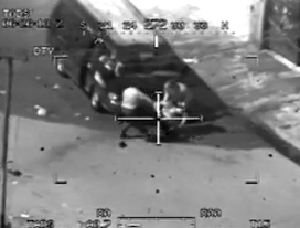
WikiLeaks video combat footage of 2007 collateral murder in Iraq“Light ’em all up. Come on, fire!” Watching the leaked combat footage of the helicopter gunships killing unarmed Iraqi civilians in 2007, I’m troubled by my own desensitized response. When I saw earlier leaked videos of an AH-64 vaporizing Iraqi farmers and a C-130 wreaking mayhem in Afghanistan, I remember my real shock at seeing a human life extinguished. This time not even flinch. “Just fuckin’, once you get on ’em just open ’em up.” Not at the brutality, nor the callousness of the play by play –even as the pilots targeted rescuers trying to help the wounded. I fault the Rules of Engagement that allowed the massacre, not the soldiers’ laughing swagger –as I hope they will not begrudge my unguarded satisfaction when eventually spectators will be treated to leaked footage of American soldiers taking some fire.

If you watched the video, perhaps you too were wishing that July 12, 2007 had recorded a massive setback for US troops in Iraq, at the height of the “surge” where a whole shitload of “dismounts” had been ambushed by IED explosions in a Baghdad square in the aftermath of a civilian massacre. Those who watched the 39-minute extended version I know were hoping to see a resolution like that, instead of an additional war crime of disproportional force and the targeting of civilians, a Hellfire missile attack on a building into which armed and unarmed men had entered, surrounded by passing innocents and rescuers scrambling to help.

There it goes! Look at that bitch go!
Patoosh!
Ah, sweet!
Need a little more room.
Nice missile.
Does it look good?
Sweet!

The Army has declared that no further inquiry will be made into the 2007 killing of the two Reuters journalists. Its FOIA requests long thwarted, even Reuters is not expressing outrage at this footage. Civilians and journalists about to be lit up The corporate media is hoping to let this story fade on the fringe. Does this mean that more pilots and gunners might become emboldened to leak other trophy reels? It doesn’t take Nelson Ratings for news outlets to see that viewers are already clamoring for more combat snuff films.

We could grant amnesty in exchange for those who turn in the most degenerate sequences.

And pretend they’ll remain anonymous. Ultimately friends and relatives will be able to place identities with the radio voices. Speaking on one of the clearest channels is the young voiced HOTEL-26, who reported taking fire from the photographers and ID’d the “RPG” with started the whole engagement. Likewise the gunner on CRAZY HORSE-18 who responded “Alright, hahaha, I hit ’em….” is addressed “God damn it, Kyle.”

And then there’s the poor 30mm gunner in CRAZY HORSE-19 who assessed his work thus:

Oh yeah, look at that. Right through the windshield! Ha ha!

While chomping at the bit to fire upon the improvised ambulance, he was momentarily thwarted by a puzzling “Azimuth Limit” which prevented his shooting.

Bloggers are now abuzz to decode the Azimuth Limit which slowed the turkey shoot when none of the gunners were showing restraint. Azimuth is the angular measurement of an object’s distance clockwise from True North. On rifles it expresses the adjustment of a gunsight to its boresight. On aircraft it apparently has something to do with the angle of relation to the axis of the fuselage. Whatever it is, maybe we can ratchet military Azimuth Limits down flat, if that’s what it will take to stop our soldiers from blowing away civilians, journalists, children and their rescuers alike. The shooters can cuss and salivate all they want so long as their trigger mechanisms respect human life or at least balk at excessive carnage.

What doesn’t come across the audio is what the US soldiers on the ground are saying to themselves as they survey “that big pile of [unarmed] bodies,” in their palaver, the “dead bastards.”

UPDATE — the testimonials begin:

From Iraq war veteran Michael Prysner, co-founder of March Forward!

The harrowing Apache footage released by WikiLeaks gives us a stomach-turning glimpse of war. Seventeen minutes of cold-blooded massacre in a war of more than seven years. A brief clip of one Apache video; a quick look at one part of one mission. Hundreds of those missions take place every day.

The video came to light thanks to military whistleblowers who provided it to WikiLeaks together with supporting documents.  Imagine if we had access to all such videos, the things we would see. Imagine all the Iraqis killed who have no one to uncover the truth about their deaths. Had the death of two Reuters news staffers not generated interest in this video, then the destruction of three families by hellfire missiles fired into an apartment building with no provocation, in a separate engagement also featured in the video, would have never been made public.

This massacre is a drop in a sea of blood. Many other such “incidents” will never be known.

Officers claimed there was “no question” that the pilots were responding to enemy fire; the video shows there is no question that they were not responding to enemy fire. They said that they had “no idea” how the journalists were killed; the video shows that they know very well how those journalists were killed. They were gunned down standing in a crowd of unarmed people.
After the slaughter of that group, the pilots beg for permission to kill the innocent passers-by who had come to the aid of one of the wounded, like any of us would have done if we saw our neighbor dying on the ground as we drove down the street. They kill everyone trying to help the dying journalist, and critically wound two children seen sitting in the front seat.

We see a group of unarmed men mowed down by a machine gun designed to destroy armored vehicles. We see a vanload of good Samaritans obliterated for trying to help a dying victim. We see all this with the soundtrack of the pilots mocking the dead, congratulating each other and laughing about the massacre.

No wonder the U.S. military goes to such great lengths to keep such videos from us. They want us to see Iraq and Afghanistan through their lens, through their embedded reporters, filtered by censorship and restrictions. They know that, once the people of this country see the extreme racism and brutality behind these occupations, they will be repulsed by what their tax dollars are paying for.

The military brass and the White House politicians have tried to justify this senseless atrocity. “Cut the pilots some slack. This was in Baghdad. This was a battle zone”—that’s been their line. The pilots had been indoctrinated with the same colonial mentality. “That’s what they get for bringing their kids into battle,” one pilot says.

The father driving that van was not “bringing his kids into battle.” He was bringing them to school, driving down the street where they live. But the U.S. occupation has made all of Iraq a battle zone. To those pilots, to their commanders over the radio and to the generals in the Pentagon, every single person in Baghdad and in Iraq is “fair game.”

The pilots joked about the people they killed, laughed about U.S. military vehicles running over dead bodies, knowing that their commanders were listening and that they were being recorded. They were not acting out of character. This is the culture of the occupation. This is how these wars are being conducted.

Having seen this, one cannot honestly believe that these atrocities are committed day in and day out for the liberation of the Iraqi people.

The Pentagon’s talking heads and media lackeys are hard at work putting their spin on this story. It’s time to tell the truth. For more than seven years, the U.S. has unleashed criminal, unprovoked aggression against the people of Iraq, and they have been doing the same thing in Afghanistan for more than eight years.

The U.S. military presence in Iraq is a colonial occupation force. The only way forward is a complete, immediate and unconditional withdrawal of all U.S. forces from Iraq and Afghanistan. This government will not do that unless all of us who are outraged by these criminal acts stand up and demand it.

Iraq war veteran Josh Stieber, US Army Specialist, 1st ID, Bravo Company 2-16 in Baghdad (Rustamiyah) 2007-2008. Although he was not present at the scene of the video, he knows those who were involved and is familiar with the environment.

A lot of my friends are in that video. After watching the video, I would definitely say that that is, nine times out of ten, the way things ended up. Killing was following military protocol. It was going along with the rules as they are.

If these videos shock and revolt you, they show the reality of what war is like. If you don’t like what you see in them, it means we should be working harder towards alternatives to war.

?

Thinking outside the bomb, in the box

THINK OUTSIDE THE BOMB is a clever antiwar appropriation of Taco Bell’s inventive twist, but since when does imitation break from a box? And does “the bomb” mean what it used to? By the look of their logo, the TOTB activists are not talking about the A-bomb, nor bunker-busters, nor smart-bombs, nor predator drones. Intentionally or not, TOTB they’re invoking the proverbial cartoon explosive, wielded by anarchists or other insurgents, the only means by which social uprisings have ever transcended the box.

“The bomb” was the feared Armageddon of the early nuclear age. More recently, “Food Not Bombs” conflates bombs with militarism because modern war-making, aka peace-keeping, is dominated by aerial bombing. Returning to “bomb” in the singular insinuates nukes, or the mutually-assured destructiveness of endlessly reciprocated violence. So let’s see the bomb depicted more as a nuclear warhead or an artillery shell.

Intrinsic to the plea for nonviolence is the determination to subdue the military instinct with transcendence. And when have proponents of nonviolence exerted jurisdiction over anyone but themselves? Lead by example they cry. We will defeat the barbarians by not becoming barbarians ourselves. Turn the other cheek, the meek shall inherit the earth. I rather suspect, quoth Camelot: “It’s not the earth the meek inherit, it’s the dirt.”

To warmongers I say: think. In of itself, thinking is outside the box enough for you. To peaceniks: exchanging the challenges of human reality for a spiritual realm, is a religious balm that dates to antiquity, about as inside the box as it gets.

Attack of the Killer Killer Whales

AK Press releaseIs it right to confine wild animals within concrete walls and train them to serve man’s amusement? Making the argument that some beasts cannot be domesticated, to defend Sea World’s killer orca showing his untamed nature, is to sell mammal brains short. In the wild, Orcas seize and subdue their prey to eat it. They’re called killer whales, not dunk-the-irritating-human-until-she’s-dead-then-play-keepaway-with-the-body whales. In the wild, Orcas don’t have jailers who force them to labor.

Wild animals don’t work for a living and Tilikum is apparently leading an insurgency against animal slave drivers.

Which is not how Sea World tells it. Their experts suggest that Tilikum mistook the trainer’s ponytail for a toy and then likewise her resultant submerged body.

SeaWorld is being incredibly disingenuous when it claims to know only about their killer whale’s criminal record while in their custody. In reality they bought the infamous Tilikum in a fire sale, when a Canadian marine theme park had to close due to pressure from animal rights groups. Public concern began because a trio of orcas were acting up, the result of which was two dead humans. The full story is detailed in an upcoming AK Press publication, Fear of the Animal Planet: The Hidden Story of Animal Resistance by Jason Hribal, the relevant excerpts can be read at Counterspin The Struggle of Nootka and Tilikum and How Orky and Kasatka Almost Sank Sea World. Alexander Cockburn concludes Feed Pete Peterson to the Whales.

Will our city presume to prohibit life for whoever can’t afford to pay their way?

In case you thought City Council’s reprieve earlier this winter reflected a soft spot in their heart for the homeless forced to live in tents, in reality the city attorneys advised any purge of the unsightly camps be delayed until an iron-clad ordinance could be devised. The suggested legal verbiage was reviewed at Monday’s meeting, to be formally adopted today. It reads “9.6.109. Camping on Public Property Prohibited.” The definition of “camping” to include: “Sleeping or making preparation to sleep, including the lying down of bedding for the purpose of sleeping.”

No sleeping. On public property.

By the way, I care not the least about a slippery slope that might infringe on your prerogative to take a nap in the park. This is not about the average man losing his middle class privileges to the creep of authoritarian rule-making. At some point I have to presume we agree that human beings have some inalienable rights. They used to be lofty ideals, protected by fundamental principles. On the issue of sleep, we are discussing the right to an involuntary life function.

The right to defecate is what’s got these homeless camps in trouble, but it stands to reason that to shit is more than a right too, it’s a necessity. All of this is dreadful platitude unless it’s escaped our city administrators. Are they suggesting that because the city cannot provide for the services for its people, that the people must forgo their basic creature needs?

What inhuman folly. And on public ground. Where are they to go? Must man pay rent to exist?

That you can dictate the rights of another on private land is open to debate. By whose authority do you claim dominion to use land for yourself? How dare you refuse a fellow human being, wherever he might need to rest his head? Granting the argument for private property, who are you to force your will upon others on shared common property? Others can’t do what? Where?

Do public lands belong only to property owners? You can legislate the right to take property for yourself, but you can’t hoard all of it. You have the right to private land precisely because the remainder is reserved for the public. The authority to give the deed to you comes from a governing entity empowered by everyone. A government is bound to providing for the land-less in exchange for the privilege to sell premium land to the better-off.

And a city has obligations to service that public land just as much as it serves the private lots. Can local administrators say, sorry, no more money for water, sewer, utilities, or security? Neither can it fail its responsibilities to the poor.

You aren’t obligated to provide eat, drink and shelter to all, but you can’t deny men access to the basic resource of land. Would you have men born into cells until they agree to work for their sustenance? Colorado Springs would deny them heat and sleep too. If we could, would we regulate breath?

On public land you have limited authority to regulate. Where private property owners crow about property rights, so do the public have property rights. Every bit, and perhaps more sacrosanct. The public can consent to regulation, for the safety and health of all etc, but that doesn’t encompass prohibition. You want health and safety, you provide the services. You have no authority to deny the service and then deny man’s basic needs. What an absolute crock.

Below is the text of the city’s proposed ordinance. It describes the creation of a new section, under 9.6.109.

9. Public Offenses, fair enough;

6. Offenses Affecting Property, a functional necessity of course;

109. Camping on Public Property Prohibited. Huh?

NOW, THEREFORE, BE IT ORDAINED BY THE CITY COUNCIL OF THE CITY OF COLORADO SPRINGS:

9.6.109: CAMPING ON PUBLIC PROPERTY PROHIBITED:

A. It is unlawful for any person to camp on any public property, except as may be specifically authorized by the appropriate governmental authority.

B. For the purposes of this section “camp” or “camping” means to use the public area for living accommodation including, but not limited to, the activities and circumstances listed below. These activities and circumstances may be considered in determining whether reasonable grounds for belief have arisen that a person has “camped” or is “camping” in violation of this ordinance.

1. Sleeping or making preparation to sleep, including the lying down of bedding for the purpose of sleeping.

2. Occupying a shelter out-of-doors. “Shelter” shall mean any cover or protection from the elements other than clothing, such as a tent, shack, sleeping bag, or other structure or material.

3. The presence or use of a camp fire, camp stove or other heating source or cooking device.

5. Keeping or storing personal property.

Sleep, a basic animal function. Shelter, a fundamental human need. Fire, the first of mankind’s tools. Before agriculture was fire.

Property. How unbecoming that an ordinance seeking to prohibit the public’s right to public property should also deprive the public of the ability to keep personal property.

Also presented on Monday were recommendations from the city management, detailing the consequences of violating the camping prohibition. They included this paragraph:

FINANCIAL IMPLICATIONS: A violation of these updated ordinances may result in a fine and sentencing to the Criminal Justice Center (CJC). In the past, homeless individuals have been known to ignore summonses to appear in Municipal Court until it is advantageous for them to be placed in CJC (cold weather, need for food and/or shelter, etc.). The preferred method of dealing with these types of violations would be to gain the cooperation of the individuals involved without relying upon the criminal justice system, thus removing them from the circumstance by linking them with the appropriate service agency.

Making the specious argument basically that since homeless persons sometimes get themselves arrested on purpose, authorities are justified in accommodating them full time. How considerate of us.

Springs homeless not a bunch of bums

Rally for Colorado Springs homeless
Photos, videos and links from the Friday rally.

More pictures here.


The weirdo was Janis Heuberger who’s made it a personal crusade to cleanse Colorado Springs of its homeless. Though she interrupted the rally pretending she was an active advocate for the homeless, in reality she’s led the attack against them, online (writing at GT as “funinsnow” )and in city council. Janis, aka disbarred realtor Janice Heuberger-Hilt, filed a complaint with the EPA in her personal effort to clear out the camps.

Beyond MLK worship: Beyond Vietnam

MLK“A time comes when silence is betrayal. That time has come for us in relation to Vietnam.”
Martin Luther King Beyond Vietnam: Time to Break the Silence
Full text of 1967 speech below.

Riverside Church, New York City, 4 April 1967

I come to this magnificent house of worship tonight because my conscience leaves me no other choice. I join with you in this meeting because I am in deepest agreement with the aims and work of the organization which has brought us together: Clergy and Laymen Concerned about Vietnam. The recent statement of your executive committee are the sentiments of my own heart and I found myself in full accord when I read its opening lines:

“A time comes when silence is betrayal.”

That time has come for us in relation to Vietnam.

The truth of these words is beyond doubt but the mission to which they call us is a most difficult one. Even when pressed by the demands of inner truth, men do not easily assume the task of opposing their government’s policy, especially in time of war. Nor does the human spirit move without great difficulty against all the apathy of conformist thought within one’s own bosom and in the surrounding world. Moreover when the issues at hand seem as perplexed as they often do in the case of this dreadful conflict we are always on the verge of being mesmerized by uncertainty; but we must move on.

Some of us who have already begun to break the silence of the night have found that the calling to speak is often a vocation of agony, but we must speak. We must speak with all the humility that is appropriate to our limited vision, but we must speak. And we must rejoice as well, for surely this is the first time in our nation’s history that a significant number of its religious leaders have chosen to move beyond the prophesying of smooth patriotism to the high grounds of a firm dissent based upon the mandates of conscience and the reading of history. Perhaps a new spirit is rising among us. If it is, let us trace its movement well and pray that our own inner being may be sensitive to its guidance, for we are deeply in need of a new way beyond the darkness that seems so close around us.

Over the past two years, as I have moved to break the betrayal of my own silences and to speak from the burnings of my own heart, as I have called for radical departures from the destruction of Vietnam, many persons have questioned me about the wisdom of my path. At the heart of their concerns this query has often loomed large and loud: Why are you speaking about war, Dr. King? Why are you joining the voices of dissent? Peace and civil rights don’t mix, they say. Aren’t you hurting the cause of your people, they ask? And when I hear them, though I often understand the source of their concern, I am nevertheless greatly saddened, for such questions mean that the inquirers have not really known me, my commitment or my calling. Indeed, their questions suggest that they do not know the world in which they live.

“I wish not to speak with Hanoi and the National Liberation Front, but rather to my fellow Americans who, with me, bear the greatest responsibility in ending a conflict that has exacted a heavy price on both continents.”

In the light of such tragic misunderstandings, I deem it of signal importance to try to state clearly, and I trust concisely, why I believe that the path from Dexter Avenue Baptist Church — the church in Montgomery, Alabama, where I began my pastorate — leads clearly to this sanctuary tonight.

I come to this platform tonight to make a passionate plea to my beloved nation. This speech is not addressed to Hanoi or to the National Liberation Front. It is not addressed to China or to Russia.

Nor is it an attempt to overlook the ambiguity of the total situation and the need for a collective solution to the tragedy of Vietnam. Neither is it an attempt to make North Vietnam or the National Liberation Front paragons of virtue, nor to overlook the role they can play in a successful resolution of the problem. While they both may have justifiable reason to be suspicious of the good faith of the United States, life and history give eloquent testimony to the fact that conflicts are never resolved without trustful give and take on both sides.

Tonight, however, I wish not to speak with Hanoi and the NLF, but rather to my fellow Americans, who, with me, bear the greatest responsibility in ending a conflict that has exacted a heavy price on both continents.

The Importance of Vietnam

Since I am a preacher by trade, I suppose it is not surprising that I have seven major reasons for bringing Vietnam into the field of my moral vision. There is at the outset a very obvious and almost facile connection between the war in Vietnam and the struggle I, and others, have been waging in America. A few years ago there was a shining moment in that struggle. It seemed as if there was a real promise of hope for the poor — both black and white — through the poverty program. There were experiments, hopes, new beginnings. Then came the buildup in Vietnam and I watched the program broken and eviscerated as if it were some idle political plaything of a society gone mad on war, and I knew that America would never invest the necessary funds or energies in rehabilitation of its poor so long as adventures like Vietnam continued to draw men and skills and money like some demonic destructive suction tube. So I was increasingly compelled to see the war as an enemy of the poor and to attack it as such.

“For the sake of those boys,
for the sake of this governent,
for the sake of hundreds of thousands
trembling under our violence,
I cannot be silent.”

Perhaps the more tragic recognition of reality took place when it became clear to me that the war was doing far more than devastating the hopes of the poor at home. It was sending their sons and their brothers and their husbands to fight and to die in extraordinarily high proportions relative to the rest of the population. We were taking the black young men who had been crippled by our society and sending them eight thousand miles away to guarantee liberties in Southeast Asia which they had not found in southwest Georgia and East Harlem. So we have been repeatedly faced with the cruel irony of watching Negro and white boys on TV screens as they kill and die together for a nation that has been unable to seat them together in the same schools. So we watch them in brutal solidarity burning the huts of a poor village, but we realize that they would never live on the same block in Detroit. I could not be silent in the face of such cruel manipulation of the poor.

My third reason moves to an even deeper level of awareness, for it grows out of my experience in the ghettoes of the North over the last three years — especially the last three summers. As I have walked among the desperate, rejected and angry young men I have told them that Molotov cocktails and rifles would not solve their problems. I have tried to offer them my deepest compassion while maintaining my conviction that social change comes most meaningfully through nonviolent action. But they asked — and rightly so — what about Vietnam? They asked if our own nation wasn’t using massive doses of violence to solve its problems, to bring about the changes it wanted. Their questions hit home, and I knew that I could never again raise my voice against the violence of the oppressed in the ghettos without having first spoken clearly to the greatest purveyor of violence in the world today — my own government. For the sake of those boys, for the sake of this government, for the sake of hundreds of thousands trembling under our violence, I cannot be silent.

For those who ask the question, “Aren’t you a civil rights leader?” and thereby mean to exclude me from the movement for peace, I have this further answer. In 1957 when a group of us formed the Southern Christian Leadership Conference, we chose as our motto: “To save the soul of America.” We were convinced that we could not limit our vision to certain rights for black people, but instead affirmed the conviction that America would never be free or saved from itself unless the descendants of its slaves were loosed completely from the shackles they still wear. In a way we were agreeing with Langston Hughes, that black bard of Harlem, who had written earlier:

O, yes,
I say it plain,
America never was America to me,
And yet I swear this oath —
America will be!

Now, it should be incandescently clear that no one who has any concern for the integrity and life of America today can ignore the present war. If America’s soul becomes totally poisoned, part of the autopsy must read Vietnam. It can never be saved so long as it destroys the deepest hopes of men the world over. So it is that those of us who are yet determined that America will be are led down the path of protest and dissent, working for the health of our land.

“Surely we must see
that the men we supported
pressed them to their violence.”

As if the weight of such a commitment to the life and health of America were not enough, another burden of responsibility was placed upon me in 1964; and I cannot forget that the Nobel Prize for Peace was also a commission — a commission to work harder than I had ever worked before for “the brotherhood of man.” This is a calling that takes me beyond national allegiances, but even if it were not present I would yet have to live with the meaning of my commitment to the ministry of Jesus Christ. To me the relationship of this ministry to the making of peace is so obvious that I sometimes marvel at those who ask me why I am speaking against the war. Could it be that they do not know that the good news was meant for all men — for Communist and capitalist, for their children and ours, for black and for white, for revolutionary and conservative? Have they forgotten that my ministry is in obedience to the one who loved his enemies so fully that he died for them? What then can I say to the “Vietcong” or to Castro or to Mao as a faithful minister of this one? Can I threaten them with death or must I not share with them my life?

Finally, as I try to delineate for you and for myself the road that leads from Montgomery to this place I would have offered all that was most valid if I simply said that I must be true to my conviction that I share with all men the calling to be a son of the living God. Beyond the calling of race or nation or creed is this vocation of sonship and brotherhood, and because I believe that the Father is deeply concerned especially for his suffering and helpless and outcast children, I come tonight to speak for them.

This I believe to be the privilege and the burden of all of us who deem ourselves bound by allegiances and loyalties which are broader and deeper than nationalism and which go beyond our nation’s self-defined goals and positions. We are called to speak for the weak, for the voiceless, for victims of our nation and for those it calls enemy, for no document from human hands can make these humans any less our brothers.

Strange Liberators

And as I ponder the madness of Vietnam and search within myself for ways to understand and respond to compassion my mind goes constantly to the people of that peninsula. I speak now not of the soldiers of each side, not of the junta in Saigon, but simply of the people who have been living under the curse of war for almost three continuous decades now. I think of them too because it is clear to me that there will be no meaningful solution there until some attempt is made to know them and hear their broken cries.

“Before long they must know
that their government has sent them
into a struggle among Vietnamese,
and the more sophisticated surely realize
that we are on the side of the wealthy
and the secure
while we create hell for the poor.”

They must see Americans as strange liberators. The Vietnamese people proclaimed their own independence in 1945 after a combined French and Japanese occupation, and before the Communist revolution in China. They were led by Ho Chi Minh. Even though they quoted the American Declaration of Independence in their own document of freedom, we refused to recognize them. Instead, we decided to support France in its re-conquest of her former colony.

Our government felt then that the Vietnamese people were not “ready” for independence, and we again fell victim to the deadly Western arrogance that has poisoned the international atmosphere for so long. With that tragic decision we rejected a revolutionary government seeking self-determination, and a government that had been established not by China (for whom the Vietnamese have no great love) but by clearly indigenous forces that included some Communists. For the peasants this new government meant real land reform, one of the most important needs in their lives.

For nine years following 1945 we denied the people of Vietnam the right of independence. For nine years we vigorously supported the French in their abortive effort to re-colonize Vietnam.

Before the end of the war we were meeting eighty percent of the French war costs. Even before the French were defeated at Dien Bien Phu, they began to despair of the reckless action, but we did not. We encouraged them with our huge financial and military supplies to continue the war even after they had lost the will. Soon we would be paying almost the full costs of this tragic attempt at re-colonization.

After the French were defeated it looked as if independence and land reform would come again through the Geneva agreements. But instead there came the United States, determined that Ho should not unify the temporarily divided nation, and the peasants watched again as we supported one of the most vicious modern dictators — our chosen man, Premier Diem. The peasants watched and cringed as Diem ruthlessly routed out all opposition, supported their extortionist landlords and refused even to discuss reunification with the north. The peasants watched as all this was presided over by U.S. influence and then by increasing numbers of U.S. troops who came to help quell the insurgency that Diem’s methods had aroused. When Diem was overthrown they may have been happy, but the long line of military dictatorships seemed to offer no real change — especially in terms of their need for land and peace.

The only change came from America as we increased our troop commitments in support of governments which were singularly corrupt, inept and without popular support. All the while the people read our leaflets and received regular promises of peace and democracy — and land reform. Now they languish under our bombs and consider us – not their fellow Vietnamese — the real enemy. They move sadly and apathetically as we herd them off the land of their fathers into concentration camps where minimal social needs are rarely met. They know they must move or be destroyed by our bombs. So they go — primarily women and children and the aged.

“Somehow this madness must cease.”

They watch as we poison their water, as we kill a million acres of their crops. They must weep as the bulldozers roar through their areas preparing to destroy the precious trees. They wander into the hospitals, with at least twenty casualties from American firepower for one “Vietcong-inflicted” injury. So far we may have killed a million of them — mostly children. They wander into the towns and see thousands of the children, homeless, without clothes, running in packs on the streets like animals. They see the children, degraded by our soldiers as they beg for food. They see the children selling their sisters to our soldiers, soliciting for their mothers.

What do the peasants think as we ally ourselves with the landlords and as we refuse to put any action into our many words concerning land reform? What do they think as we test our latest weapons on them, just as the Germans tested out new medicine and new tortures in the concentration camps of Europe? Where are the roots of the independent Vietnam we claim to be building? Is it among these voiceless ones?

We have destroyed their two most cherished institutions: the family and the village. We have destroyed their land and their crops. We have cooperated in the crushing of the nation’s only non-Communist revolutionary political force — the Unified Buddhist church. We have supported the enemies of the peasants of Saigon. We have corrupted their women and children and killed their men. What liberators?

Now there is little left to build on — save bitterness. Soon the only solid physical foundations remaining will be found at our military bases and in the concrete of the concentration camps we call fortified hamlets. The peasants may well wonder if we plan to build our new Vietnam on such grounds as these? Could we blame them for such thoughts? We must speak for them and raise the questions they cannot raise. These too are our brothers.

Perhaps the more difficult but no less necessary task is to speak for those who have been designated as our enemies. What of the National Liberation Front — that strangely anonymous group we call VC or Communists? What must they think of us in America when they realize that we permitted the repression and cruelty of Diem which helped to bring them into being as a resistance group in the south? What do they think of our condoning the violence which led to their own taking up of arms? How can they believe in our integrity when now we speak of “aggression from the north” as if there were nothing more essential to the war? How can they trust us when now we charge them with violence after the murderous reign of Diem and charge them with violence while we pour every new weapon of death into their land? Surely we must understand their feelings even if we do not condone their actions. Surely we must see that the men we supported pressed them to their violence. Surely we must see that our own computerized plans of destruction simply dwarf their greatest acts.

“We must continue to raise our voices if our nation persists in its perverse ways in Vietnam.”

How do they judge us when our officials know that their membership is less than twenty-five percent Communist and yet insist on giving them the blanket name? What must they be thinking when they know that we are aware of their control of major sections of Vietnam and yet we appear ready to allow national elections in which this highly organized political parallel government will have no part? They ask how we can speak of free elections when the Saigon press is censored and controlled by the military junta. And they are surely right to wonder what kind of new government we plan to help form without them — the only party in real touch with the peasants. They question our political goals and they deny the reality of a peace settlement from which they will be excluded. Their questions are frighteningly relevant. Is our nation planning to build on political myth again and then shore it up with the power of new violence?

Here is the true meaning and value of compassion and nonviolence when it helps us to see the enemy’s point of view, to hear his questions, to know his assessment of ourselves. For from his view we may indeed see the basic weaknesses of our own condition, and if we are mature, we may learn and grow and profit from the wisdom of the brothers who are called the opposition.

So, too, with Hanoi. In the north, where our bombs now pummel the land, and our mines endanger the waterways, we are met by a deep but understandable mistrust. To speak for them is to explain this lack of confidence in Western words, and especially their distrust of American intentions now. In Hanoi are the men who led the nation to independence against the Japanese and the French, the men who sought membership in the French commonwealth and were betrayed by the weakness of Paris and the willfulness of the colonial armies. It was they who led a second struggle against French domination at tremendous costs, and then were persuaded to give up the land they controlled between the thirteenth and seventeenth parallel as a temporary measure at Geneva. After 1954 they watched us conspire with Diem to prevent elections which would have surely brought Ho Chi Minh to power over a united Vietnam, and they realized they had been betrayed again.

When we ask why they do not leap to negotiate, these things must be remembered. Also it must be clear that the leaders of Hanoi considered the presence of American troops in support of the Diem regime to have been the initial military breach of the Geneva agreements concerning foreign troops, and they remind us that they did not begin to send in any large number of supplies or men until American forces had moved into the tens of thousands.

“When machines and computers,
profit motives and property rights
are considered more important than people,
the giant triplets of
racism,
materialism
and militarism
are incapable of being conquered.”

Hanoi remembers how our leaders refused to tell us the truth about the earlier North Vietnamese overtures for peace, how the president claimed that none existed when they had clearly been made. Ho Chi Minh has watched as America has spoken of peace and built up its forces, and now he has surely heard of the increasing international rumors of American plans for an invasion of the north. He knows the bombing and shelling and mining we are doing are part of traditional pre-invasion strategy. Perhaps only his sense of humor and of irony can save him when he hears the most powerful nation of the world speaking of aggression as it drops thousands of bombs on a poor weak nation more than eight thousand miles away from its shores.

At this point I should make it clear that while I have tried in these last few minutes to give a voice to the voiceless on Vietnam and to understand the arguments of those who are called enemy, I am as deeply concerned about our troops there as anything else. For it occurs to me that what we are submitting them to in Vietnam is not simply the brutalizing process that goes on in any war where armies face each other and seek to destroy. We are adding cynicism to the process of death, for they must know after a short period there that none of the things we claim to be fighting for are really involved. Before long they must know that their government has sent them into a struggle among Vietnamese, and the more sophisticated surely realize that we are on the side of the wealthy and the secure while we create hell for the poor.

This Madness Must Cease

Somehow this madness must cease. We must stop now. I speak as a child of God and brother to the suffering poor of Vietnam. I speak for those whose land is being laid waste, whose homes are being destroyed, whose culture is being subverted. I speak for the poor of America who are paying the double price of smashed hopes at home and death and corruption in Vietnam. I speak as a citizen of the world, for the world as it stands aghast at the path we have taken. I speak as an American to the leaders of my own nation. The great initiative in this war is ours. The initiative to stop it must be ours.

This is the message of the great Buddhist leaders of Vietnam. Recently one of them wrote these words:

“Each day the war goes on the hatred increases in the heart of the Vietnamese and in the hearts of those of humanitarian instinct. The Americans are forcing even their friends into becoming their enemies. It is curious that the Americans, who calculate so carefully on the possibilities of military victory, do not realize that in the process they are incurring deep psychological and political defeat. The image of America will never again be the image of revolution, freedom and democracy, but the image of violence and militarism.”

“A nation that continues
year after year
to spend more money on military defense
than on programs of social uplift
is approaching spiritual death.”

If we continue, there will be no doubt in my mind and in the mind of the world that we have no honorable intentions in Vietnam. It will become clear that our minimal expectation is to occupy it as an American colony and men will not refrain from thinking that our maximum hope is to goad China into a war so that we may bomb her nuclear installations. If we do not stop our war against the people of Vietnam immediately the world will be left with no other alternative than to see this as some horribly clumsy and deadly game we have decided to play.

The world now demands a maturity of America that we may not be able to achieve. It demands that we admit that we have been wrong from the beginning of our adventure in Vietnam, that we have been detrimental to the life of the Vietnamese people. The situation is one in which we must be ready to turn sharply from our present ways.

In order to atone for our sins and errors in Vietnam, we should take the initiative in bringing a halt to this tragic war. I would like to suggest five concrete things that our government should do immediately to begin the long and difficult process of extricating ourselves from this nightmarish conflict:

• End all bombing in North and South Vietnam

• Declare a unilateral cease-fire in the hope that such action will create the atmosphere for negotiation.

• Take immediate steps to prevent other battlegrounds in Southeast Asia by curtailing our military buildup in Thailand and our interference in Laos.

• Realistically accept the fact that the National Liberation Front has substantial support in South Vietnam and must thereby play a role in any meaningful negotiations and in any future Vietnam government.

• Set a date that we will remove all foreign troops from Vietnam in accordance with the 1954 Geneva agreement.

Part of our ongoing commitment might well express itself in an offer to grant asylum to any Vietnamese who fears for his life under a new regime which included the Liberation Front. Then we must make what reparations we can for the damage we have done. We most provide the medical aid that is badly needed, making it available in this country if necessary.

Protesting The War

Meanwhile we in the churches and synagogues have a continuing task while we urge our government to disengage itself from a disgraceful commitment. We must continue to raise our voices if our nation persists in its perverse ways in Vietnam. We must be prepared to match actions with words by seeking out every creative means of protest possible.

As we counsel young men concerning military service we must clarify for them our nation’s role in Vietnam and challenge them with the alternative of conscientious objection. I am pleased to say that this is the path now being chosen by more than seventy students at my own alma mater, Morehouse College, and I recommend it to all who find the American course in Vietnam a dishonorable and unjust one. Moreover I would encourage all ministers of draft age to give up their ministerial exemptions and seek status as conscientious objectors. These are the times for real choices and not false ones. We are at the moment when our lives must be placed on the line if our nation is to survive its own folly. Every man of humane convictions must decide on the protest that best suits his convictions, but we must all protest.

“If we do not act
we shall surely be dragged down
the long and shameful corridors of time
reserved for those who possess
power without compassion,
might without morality,
and strength without sight.”

There is something seductively tempting about stopping there and sending us all off on what in some circles has become a popular crusade against the war in Vietnam. I say we must enter the struggle, but I wish to go on now to say something even more disturbing. The war in Vietnam is but a symptom of a far deeper malady within the American spirit, and if we ignore this sobering reality we will find ourselves organizing clergy-and laymen-concerned committees for the next generation. They will be concerned about Guatemala and Peru. They will be concerned about Thailand and Cambodia. They will be concerned about Mozambique and South Africa. We will be marching for these and a dozen other names and attending rallies without end unless there is a significant and profound change in American life and policy. Such thoughts take us beyond Vietnam, but not beyond our calling as sons of the living God.

In 1957 a sensitive American official overseas said that it seemed to him that our nation was on the wrong side of a world revolution. During the past ten years we have seen emerge a pattern of suppression which now has justified the presence of U.S. military “advisors” in Venezuela. This need to maintain social stability for our investments accounts for the counter-revolutionary action of American forces in Guatemala. It tells why American helicopters are being used against guerrillas in Colombia and why American napalm and green beret forces have already been active against rebels in Peru. It is with such activity in mind that the words of the late John F. Kennedy come back to haunt us. Five years ago he said,

“Those who make peaceful revolution impossible will make violent revolution inevitable.”

Increasingly, by choice or by accident, this is the role our nation has taken — the role of those who make peaceful revolution impossible by refusing to give up the privileges and the pleasures that come from the immense profits of overseas investment.

I am convinced that if we are to get on the right side of the world revolution, we as a nation must undergo a radical revolution of values. We must rapidly begin the shift from a “thing-oriented” society to a “person-oriented” society. When machines and computers, profit motives and property rights are considered more important than people, the giant triplets of racism, materialism, and militarism are incapable of being conquered.

A true revolution of values will soon cause us to question the fairness and justice of many of our past and present policies. On the one hand we are called to play the good Samaritan on life’s roadside; but that will be only an initial act. One day we must come to see that the whole Jericho road must be transformed so that men and women will not be constantly beaten and robbed as they make their journey on life’s highway.

True compassion is more than flinging a coin to a beggar; it is not haphazard and superficial. It comes to see that an edifice which produces beggars needs restructuring. A true revolution of values will soon look uneasily on the glaring contrast of poverty and wealth. With righteous indignation, it will look across the seas and see individual capitalists of the West investing huge sums of money in Asia, Africa and South America, only to take the profits out with no concern for the social betterment of the countries, and say: “This is not just.”

It will look at our alliance with the landed gentry of Latin America and say: “This is not just.”

The Western arrogance of feeling that it has everything to teach others and nothing to learn from them is not just.

A true revolution of values will lay hands on the world order and say of war: “This way of settling differences is not just.”

This business of burning human beings with napalm, of filling our nation’s homes with orphans and widows, of injecting poisonous drugs of hate into veins of people normally humane, of sending men home from dark and bloody battlefields physically handicapped and psychologically deranged, cannot be reconciled with wisdom, justice and love. A nation that continues year after year to spend more money on military defense than on programs of social uplift is approaching spiritual death.

America, the richest and most powerful nation in the world, can well lead the way in this revolution of values. There is nothing, except a tragic death wish, to prevent us from reordering our priorities, so that the pursuit of peace will take precedence over the pursuit of war. There is nothing to keep us from molding a recalcitrant status quo with bruised hands until we have fashioned it into a brotherhood.

This kind of positive revolution of values is our best defense against communism. War is not the answer. Communism will never be defeated by the use of atomic bombs or nuclear weapons. Let us not join those who shout war and through their misguided passions urge the United States to relinquish its participation in the United Nations. These are days which demand wise restraint and calm reasonableness. We must not call everyone a Communist or an appeaser who advocates the seating of Red China in the United Nations and who recognizes that hate and hysteria are not the final answers to the problem of these turbulent days. We must not engage in a negative anti-communism, but rather in a positive thrust for democracy, realizing that our greatest defense against communism is to take offensive action in behalf of justice. We must with positive action seek to remove those conditions of poverty, insecurity and injustice which are the fertile soil in which the seed of communism grows and develops.

The People Are Important

These are revolutionary times. All over the globe men are revolting against old systems of exploitation and oppression and out of the wombs of a frail world new systems of justice and equality are being born. The shirtless and barefoot people of the land are rising up as never before. “The people who sat in darkness have seen a great light.” We in the West must support these revolutions. It is a sad fact that, because of comfort, complacency, a morbid fear of communism, and our proneness to adjust to injustice, the Western nations that initiated so much of the revolutionary spirit of the modern world have now become the arch anti-revolutionaries. This has driven many to feel that only Marxism has the revolutionary spirit. Therefore, communism is a judgment against our failure to make democracy real and follow through on the revolutions we initiated. Our only hope today lies in our ability to recapture the revolutionary spirit and go out into a sometimes hostile world declaring eternal hostility to poverty, racism, and militarism. With this powerful commitment we shall boldly challenge the status quo and unjust mores and thereby speed the day when “every valley shall be exalted, and every mountain and hill shall be made low, and the crooked shall be made straight and the rough places plain.”

A genuine revolution of values means in the final analysis that our loyalties must become ecumenical rather than sectional. Every nation must now develop an overriding loyalty to mankind as a whole in order to preserve the best in their individual societies.

This call for a world-wide fellowship that lifts neighborly concern beyond one’s tribe, race, class and nation is in reality a call for an all-embracing and unconditional love for all men. This oft misunderstood and misinterpreted concept – so readily dismissed by the Nietzsches of the world as a weak and cowardly force – has now become an absolute necessity for the survival of man. When I speak of love I am not speaking of some sentimental and weak response. I am speaking of that force which all of the great religions have seen as the supreme unifying principle of life. Love is somehow the key that unlocks the door which leads to ultimate reality. This Hindu-Moslem-Christian-Jewish-Buddhist belief about ultimate reality is beautifully summed up in the first epistle of Saint John:

Let us love one another; for love is God and everyone that loveth is born of God and knoweth God. He that loveth not knoweth not God; for God is love. If we love one another God dwelleth in us, and his love is perfected in us.

Let us hope that this spirit will become the order of the day. We can no longer afford to worship the god of hate or bow before the altar of retaliation. The oceans of history are made turbulent by the ever-rising tides of hate. History is cluttered with the wreckage of nations and individuals that pursued this self-defeating path of hate. As Arnold Toynbee says :

“Love is the ultimate force that makes for the saving choice of life and good against the damning choice of death and evil. Therefore the first hope in our inventory must be the hope that love is going to have the last word.”

We are now faced with the fact that tomorrow is today. We are confronted with the fierce urgency of now. In this unfolding conundrum of life and history there is such a thing as being too late. Procrastination is still the thief of time. Life often leaves us standing bare, naked and dejected with a lost opportunity. The “tide in the affairs of men” does not remain at the flood; it ebbs. We may cry out desperately for time to pause in her passage, but time is deaf to every plea and rushes on. Over the bleached bones and jumbled residue of numerous civilizations are written the pathetic words: “Too late.”

There is an invisible book of life that faithfully records our vigilance or our neglect. “The moving finger writes, and having writ moves on…” We still have a choice today; nonviolent coexistence or violent co-annihilation.

We must move past indecision to action. We must find new ways to speak for peace in Vietnam and justice throughout the developing world – a world that borders on our doors. If we do not act we shall surely be dragged down the long dark and shameful corridors of time reserved for those who possess power without compassion, might without morality, and strength without sight.

Now let us begin. Now let us rededicate ourselves to the long and bitter – but beautiful – struggle for a new world. This is the calling of the sons of God, and our brothers wait eagerly for our response. Shall we say the odds are too great? Shall we tell them the struggle is too hard? Will our message be that the forces of American life militate against their arrival as full men, and we send our deepest regrets? Or will there be another message, of longing, of hope, of solidarity with their yearnings, of commitment to their cause, whatever the cost? The choice is ours, and though we might prefer it otherwise we must choose in this crucial moment of human history.

As that noble bard of yesterday, James Russell Lowell, eloquently stated:

Once to every man and nation
Comes the moment to decide,
In the strife of truth and falsehood,
For the good or evil side;
Some great cause, God’s new Messiah,
Off’ring each the bloom or blight,
And the choice goes by forever
Twixt that darkness and that light.
Though the cause of evil prosper,
Yet ’tis truth alone is strong;
Though her portion be the scaffold,
And upon the throne be wrong:
Yet that scaffold sways the future,
And behind the dim unknown,
Standeth God within the shadow
Keeping watch above his own.

Did you know John Yoo is not in jail?

john-woo-daily-showThis is the kind of civility that I just can’t stomach. Berkeley Law Professor John Yoo, author of the Torture Memos which Bushco’s blimpnecks took for their greenlight to water-board, was a guest yesterday on the Daily Show. Short of Jon Stewart orchestrating a citizen’s arrest, or reality television setting Gitmo alumni upon Woo like bears on honey, I don’t want to see the John Yoo walking free.

I could see that Stewart had planned some zingers which Yoo was able to dodge, and afterward Stewart behaved like Hannibal Lecter had just passed through, but on the whole I think hosting criminals like Yoo is ill advised. For one, you have to shake his hand. Then of course the nature of television entertainment –unless you are Mike Wallace who’s just strode into the mark’s office– has you trying to make light of the interview, the whole of which has been choreographed for laughs. Worst of all I believe, are the too-many times a host finds himself asking the audience to give it up for the guest.

When Stewart first announced the night’s guest was to be John Yoo, the audience appropriately enough did not cheer. Of course when it came time for the cretin’s entrance, the applause was obligatory. And so it followed, each subsequent punctuation. How else are the audience members supposed to show their enthusiasm? It’s true, their energy is critical to the stage energy.

Stephen Colbert solves the applaud-the-bad-guy paradox by taking a victory lap himself when the audience applauds the introduction of the guest. But usually Colbert’s show specializes in leftist guests with whom the audience is sympathetic, so the maneuver is more for bringing the studio audience unto Colbert’s role-playing for the Right. Integral to his act is an audience that mimics O’Reilly-Limbaugh ditto-heads. A veritable right wing audience could never be brought to even show civility to a guest they’re told is hostile.

And I guess I long for a little more of that genuine sentiment. It began for me when I saw Sarah Palin treated with effusive cordiality on Saturday Night Live. Again the audience was expected to applaud Palin, if in fact they were really just excited to see her roasted.

John Yoo and ilk, the whole Bush troops, must be prosecuted and jailed. That they walk about at large, free to second guess President Obama’s terrorism strategies are nothing to laugh at. I’ll cop to being humorless on this point.

NOTES:
Excerpt, March 13, 2002 Memorandum

“… neither the GPW (Third Geneva Convention) nor the Torture Convention restrict the President’s legal authority to transfer prisoners captured in the Afghanistan conflict to third countries. Although the GPW places conditions on the transfer of POWs, neither al-Qaeda nor Taliban prisoners are legally entitled to POW status, and hence there are no GPW conditions placed on their transfer. While the Torture Convention arguably might govern transfer of these prisoners, it does not apply extraterritorially.”

Excerpt, August 1, 2002 Memo

“Under international law, therefore, the United States thus is bound only by the text of the Torture Conventions as modified by the first Bush administration’s understanding.”

US health industry tells Vic to snuff it

vic chestnutVic Chesnutt took his own life on Christmas Day. By coincidence, he’d just given an upbeat interview to NPR’s Fresh Air in spite of an ongoing battle with his health care providers. The segment seemed to pierce the celebrity veil we imagine insulates our talent castes from the worries of everyman. When he died, I reflected on the interview. I was reluctant to mar a eulogy with the villainy of the US medical system — but then NPR re-aired the piece, en memoriam, minus the damning testimony. They added in its place a remembrance by three colleagues who concluded: “To say poor health care killed Vic Chesnutt would be very reductive.”

Reductive? These corporate musicians, at the behest of NPR, have to throw an artisan spin on Vic Chesnutt’s legacy because his art should transcend his mortality?! Vic’s art, real art, is about mortality. Vic’s death was real and the anxiety he expressed in his interview was real. He hadn’t chosen to keep his troubles to himself for the sake of the listeners’ seamless pleasurable enjoyment. Who are these commercial artists to mute Vic’s story? It made me sick.

Others wonder aloud why Vic’s rich musician friends couldn’t have offered to pay for the medical procedures he needed. Perhaps they did, who knows. And perhaps their concern not to be “reductive” was extracted from a much longer session where Vic Chesnutt’s struggles were discussed at length.

Vic’s talent may not have been lost on these would-be eulogists, but we can’t fault them for not being artist spirits enough themselves to know how to shepherd an honest narrative about Vic.

I point my finger at NPR for the rewrite, and I’ll take issue with one of the musicians. At a wake, there’s always someone who uses the opportunity for self-promotion, and at this one it was REM’s Michael Stipe. He discovered Vic Chesnutt, let’s get that out of the way. Michael’s remembrance of Vic was an anecdote about a lyric he thought he’d stolen from Vic. It was so good, he must have stolen it. Stipe was so honest, he called Vic to confess. Vic’s response was gracious, no it’s yours. Stipe insisted, and so did Vic. Such was Vic’s grace, and so elevated was Stipe’s regard for Vic, and evidently so great is Stipe’s humility and –in the end it turns out by Vic’s own lips– his genius. He transcended his master. Much of the draw of coattail opportunism at funerals is that dead men tell no tales.

NPR’s problem, and shall we imagine, the problem of its underwriters, the major health insurers, was that Vic Chesnutt killed himself right after telling an NPR audience he could succumb any day for lack of proper medical care. Chesnutt died from an overdose of pain killers, which raised the disquieting suggestion to listeners that he lived in a lot of pain. Sure Chesnutt had attempted suicide before. He’d written a love song to suicide. The trouble was, he declared in his interview that “Flirted with You All My Life” was a break-up song with death. “I don’t want to die” Chesnutt exclaimed most earnestly.

While our nation’s health insurers have been content to let the common sick extinguish themselves by attrition, their PR crews come to the rescue of high profile victims, usually the focus of mass protests, even if they come late. Vic Chesnutt had given them no time, between the airing of his interview, and his Christmas day demise.

To listeners who heard the first airing, especially ones who might never have heard of Vic, the tragedy of this internationally renown artists being unable to get health care was a climax. It was a moment when entertainment rang dissonant.

For the rewrite, Terry Gross removed the critical segment, leaving the focus on Chesnutt’s earlier suicide attempts. Gross sounded like an insurance interrogator the way she made Chesnutt clarify that his first attempted suicide was actually before his debilitating accident, before health issues would have been a motivation. I would like to see Gross dissect her guests’ responses with such scrutiny, I wonder why she began with Vic.

Thus the rewritten interview became an indictment of Vic Chesnutt’s propensity to self-destruct. Forget narrowing Vic to health care failure, Terry reduced him to habitual suicide. The character assassination continued by next highlighting his song “I’m a Coward.”

In place of the dramatic, redemptive climax, Gross interviewed Michael Stipe, Guy Picciotto and Jem Cohen. Just before wrapping up, Gross raised the issue of Vic’s health care. All agreed the system failed him, but their pre-discussion consensus was not to be “reductive.”

As if the songwriter’s legacy wasn’t going to speak for his whole. Here his colleagues were concerned that their characterization of his death would define him. If Vic had died mid-song, would there have been a need to say his life wasn’t just about that song?

Little did they suspect that NPR would “reduce” Chesnutt however they wanted. Once again where Vic Chesnutt’s sentiment connected with his audience, the industry hovered to intercept.

If you didn’t catch Chesnutt’s original interview on NPR’s Fresh Air, here’s how it ended:

GROSS: I read that you’re in debt like $50,000 because of health insurance issues.

Mr. CHESNUTT: That’s right.

GROSS: So – and this is because you had a series of surgeries and although you pay a lot for your health insurance, it didn’t cover all of it. Is that – do I have that right?

Mr. CHESNUTT: That’s exactly true, yeah.

GROSS: Uh-huh. So, what are your thoughts now as you watch the health care legislation controversy play out?

Mr. CHESNUTT: Well, I have been amazed and confused by the health care debate. We need health care reform. There is no doubt about it, we really need health care reform in this country. Because it’s absurd that somebody like me has to pay so much, it’s just too expensive in this country. It’s just ridiculously expensive. That they can take my house away for kidney stone operation is -that’s absurd.

GROSS: Is that what you’re facing the possibility of now?

Mr. CHESNUTT: Yeah. I mean, it could – I’m not sure exactly. I mean, I don’t have cash money to pay these people. I tried to pay them. I tried to make payments and then they finally ended up saying, no, you have to pay us in full now. And so, you know, I’m not sure what exactly my options are. I just – I really – you know, my feeling is that I think they’ve been paid, they’ve already been paid $100,000 from my insurance company. That seems like plenty. I mean, this would pay for like five or six of these operations in any other country in the world. You know, it affects – I mean, right now I need another surgery and I’ve putting it off for a year because I can’t afford it. And that’s absurd, I think.

I mean, I could actually lose a kidney. And, I mean, I could die only because I cannot afford to go in there again. I don’t want to die, especially just because of I don’t have enough money to go in the hospital. But that’s the reality of it. You know, I have a preexisting condition, my quadriplegia, and I can’t get health insurance.

GROSS: Is it true you can’t get good health insurance?

Mr. CHESNUTT: I can’t get – I’m uninsurable. The only reason I have any insurance now is because I was on Capitol Records for a while. And I had excellent health insurance there. And then when I got dropped from Capitol, I Cobra’d my insurance for as long as it was legally possible. And then – and which was insanely expensive to cobra this very nice insurance. And then, when that ran out, the insurance company said they could offer me one last thing and that is hospitalization. It only covers hospital bills. That’s all it covers. And it’s still $500 a month. So, it doesn’t pay for my drugs, my doctors or anything like that. All it pays for is hospitalization. And yet, I still owe all this money on top of that.

GROSS: Wow. Well, I wish you the best with your health and your music. And I really want to thank you–

Mr. CHESNUTT: Thank you.

GROSS: –a lot for talking with us.

Mr. CHESNUTT: Oh, I’m honored, honored beyond belief.

The Cairo Declaration

gaza-freedom-march-cairo-egypt
Ambitions for a greater Gaza Freedom March have been set aside for another decade, but the hopeful delegates thwarted in Cairo issued the following declaration:

End Israeli Apartheid?
Cairo Declaration
?January 1, 2010

We, international delegates meeting in Cairo during the Gaza Freedom March 2009 in collective response to an initiative from the South African delegation, state:

In view of:

* Israel’s ongoing collective punishment of Palestinians through the illegal occupation and siege of Gaza;?

* the illegal occupation of the West Bank, including East Jerusalem, and the continued construction of the illegal Apartheid Wall and settlements;?

* the new Wall under construction by Egypt and the US which will tighten even further the siege of Gaza;?

* the contempt for Palestinian democracy shown by Israel, the US, Canada, the EU and others after the Palestinian elections of 2006;?

* the war crimes committed by Israel during the invasion of Gaza one year ago;?

* the continuing discrimination and repression faced by Palestinians within Israel;?

* and the continuing exile of millions of Palestinian refugees;?

* all of which oppressive acts are based ultimately on the Zionist ideology which underpins Israel;?

* in the knowledge that our own governments have given Israel direct economic, financial, military and diplomatic support and allowed it to behave with impunity;?

* and mindful of the United Nations Declaration on the Rights of Indigenous People (2007)

We reaffirm our commitment to:

Palestinian Self-Determination?Ending the Occupation?Equal Rights for All within historic Palestine?The full Right of Return for Palestinian refugees.

We therefore reaffirm our commitment to the United Palestinian call of July 2005 for Boycott, Divestment and Sanctions (BDS) to compel Israel to comply with international law.

To that end, we call for and wish to help initiate a global mass, democratic anti-apartheid movement to work in full consultation with Palestinian civil society to implement the Palestinian call for BDS.

Mindful of the many strong similarities between apartheid Israel and the former apartheid regime in South Africa, we propose:

1) An international speaking tour in the first 6 months of 2010 by Palestinian and South African trade unionists and civil society activists, to be joined by trade unionists and activists committed to this programme within the countries toured, to take mass education on BDS directly to the trade union membership and wider public internationally;

2) Participation in the Israeli Apartheid Week in March 2010;

3) A systematic unified approach to the boycott of Israeli products, involving consumers, workers and their unions in the retail, warehousing, and transportation sectors;

4) Developing the Academic, Cultural and Sports boycott;

5) Campaigns to encourage divestment of trade union and other pension funds from companies directly implicated in the Occupation and/or the Israeli military industries;

6) Legal actions targeting the external recruitment of soldiers to serve in the Israeli military, and the prosecution of Israeli government war criminals; coordination of Citizen’s Arrest Bureaux to identify, campaign and seek to prosecute Israeli war criminals; support for the Goldstone Report and the implementation of its recommendations;

7) Campaigns against charitable status of the Jewish National Fund (JNF).

We appeal to organisations and individuals committed to this declaration to sign it and work with us to make it a reality.

Signed by:

(* Affiliation for identification purposes only.)

1. Hedy Epstein, Holocaust Survivor/ Women in Black*, USA?
2. Nomthandazo Sikiti, Nehawu, Congress of South African Trade Unions (COSATU), Affiliate International Officer*, South Africa?
3. Zico Tamela, Satawu, Congress of South African Trade Unions (COSATU) Affiliate International Officer*, South Africa?
4. Hlokoza Motau, Numsa, Congress of South African Trade Unions (COSATU) Affiliate International Officer*, South Africa?
5. George Mahlangu, Congress of South African Trade Unions (COSATU) Campaigns Coordinator*, South Africa?
6. Crystal Dicks, Congress of South African Trade Unions (COSATU) Education Secretary*, South Africa?
7. Savera Kalideen, SA Palestinian Solidarity Committee*, South Africa?
8. Suzanne Hotz, SA Palestinian Solidarity Group*, South Africa?
9. Shehnaaz Wadee, SA Palestinian Solidarity Alliance*, South Africa?
10. Haroon Wadee, SA Palestinian Solidarity Alliance*, South Africa?
11. Sayeed Dhansey, South Africa?
12. Faiza Desai, SA Palestinian Solidarity Alliance*, South Africa?
13. Ali Abunimah, Electronic Intifada*, USA?
14. Hilary Minch, Ireland Palestine Solidarity Committee*, Ireland?
15. Anthony Loewenstein, Australia?
16. Sam Perlo-Freeman, United Kingdom?
17. Julie Moentk, Pax Christi*, USA?
18. Ulf Fogelström, Sweden?
19. Ann Polivka, Chico Peace and Justice Center*, USA?
20. Mark Johnson, Fellowship of Reconciliation*, USA?
21. Elfi Padovan, Munich Peace Committee*/Die Linke*, Germany?
22. Elizabeth Barger, Peace Roots Alliance*/Plenty I*, USA?
23. Sarah Roche-Mahdi, CodePink*, USA?
24. Svetlana Gesheva-Anar, Bulgaria?
25. Cristina Ruiz Cortina, Al Quds-Malaga*, Spain?
26. Rachel Wyon, Boston Gaza Freedom March*, USA?
27. Mary Hughes-Thompson, Women in Black*, USA?
28. David Letwin, International Jewish Anti-Zionist Network (IJAN)*, USA?
29. Jean Athey, Peace Action Montgomery*, USA?
30. Gael Murphy, Gaza Freedom March*/CodePink*, USA?
31. Thomas McAfee, Journalist/PC*, USA?
32. Jean Louis Faure, International Jewish Anti-Zionist Network (IJAN)*, France?
33. Timothy A King, Christians for Peace and Justice in the Middle East*, USA?
34. Gail Chalbi, Palestine/Israel Justice Project of the Minnesota United Methodist Church*, USA?
35. Ouahib Chalbi, Palestine/Israel Justice Project of the Minnesota United Methodist Church*, USA?
36. Greg Dropkin, Liverpool Friends of Palestine*, England?
37. Felice Gelman, Wespac Peace and Justice New York*/Gaza Freedom March*, USA?
38. Ron Witton, Australian Academic Union*, Australia?
39. Hayley Wallace, Palestine Solidarity Committee*, USA?
40. Norma Turner, Manchester Palestine Solidarity Campaign*, England?
41. Paula Abrams-Hourani, Women in Black (Vienna)*/ Jewish Voice for Just Peace in the Middle East*, Austria?
42. Mateo Bernal, Industrial Workers of the World*, USA?
43. Mary Mattieu, Collectif Urgence Palestine*, Switzerland?
44. Agneta Zuppinger, Collectif Urgence Palestine*, Switzerland?
45. Ashley Annis, People for Peace*, Canada?
46. Peige Desgarlois, People for Peace*, Canada?
47. Hannah Carter, Canadian Friends of Sabeel*, Canada?
48. Laura Ashfield, Canadian Friends of Sabeel*, Canada?
49. Iman Ghazal, People for Peace*, Canada?
50. Filsam Farah, People for Peace*, Canada?
51. Awa Allin, People for Peace*, Canada?
52. Cleopatra McGovern, USA?
53. Miranda Collet, Spain?
54. Alison Phillips, Scotland?
55. Nicholas Abramson, Middle East Crisis Response Network*/Jews Say No*, USA?
56. Tarak Kauff, Middle East Crisis Response Network*/Veterans for Peace*, USA?
57. Jesse Meisler-Abramson, USA?
58. Hope Mariposa, USA?
59. Ivesa Lübben. Bremer Netzwerk fur Gerechten Frieden in Nahost*, Germany?
60. Sheila Finan, Mid-Hudson Council MERC*, USA?
61. Joanne Lingle, Christians for Peace and Justice in the Middle East (CPJME)*, USA?
62. Barbara Lubin, Middle East Children’s Alliance*, USA?
63. Josie Shields-Stromsness, Middle East Children’s Alliance*, USA?
64. Anna Keuchen, Germany?
65. Judith Mahoney Pasternak, WRL* and Indypendent*, USA?
66. Ellen Davidson, New York City Indymedia*, WRL*, Indypendent*, USA?
67. Ina Kelleher, USA?
68. Lee Gargagliano, International Jewish Anti-Zionist Network (Chicago)*, USA?
69. Brad Taylor, OUT-FM*, USA?
70. Helga Mankovitz, SPHR (Queen’s University)*, Canada?
71. Mick Napier, Scottish Palestine Solidarity Campaign*, Scotland?
72. Agnes Kueng, Paso Basel*, Switzerland?
73. Anne Paxton, Voices of Palestine*, USA?
74. Leila El Abtah, The Netherlands?
75. Richard, Van der Wouden, The Netherlands?
76. Rafiq A. Firis, P.K.R.*/Isra*, The Netherlands?
77. Sandra Tamari, USA?
78. Alice Azzouzi, Way to Jerusalem*, USA?
79. J’Ann Schoonmaker Allen, USA?
80. Ruth F. Hooke, Episcopalian Peace Fellowship*, USA?
81. Jean E. Lee, Holy Land Awareness Action Task Group of United Church of Canada*, Canada?
82. Delphine de Boutray, Association Thèâtre Cine*, France?
83. Sylvia Schwarz, USA?
84. Alexandra Safi, Germany?
85. Abdullah Anar, Green Party – Turkey*, Turkey?
86. Ted Auerbach, USA?
87. Martha Hennessy, Catholic Worker*, USA?
88. Father Louis Vitale, Interfaile Pace e Bene*, USA?
89. Leila Zand, Fellowship of Reconciliation*, USA?
90. Emma Grigore, CodePink*, USA?
91. Sammer Abdelela, New York Community of Muslim Progressives*, USA?
92. Sharat G. Lin, San Jose Peace and Justice Center*, USA?
93. Katherine E. Sheetz, Free Gaza*, USA?
94. Steve Greaves, Free Gaza*, USA?
95. Trevor Baumgartner, Free Gaza*, USA?
96. Hanan Tabbara, USA?
97. Marina Barakatt, CodePink*, USA?
98. Keren Bariyov, USA?
99. Ursula Sagmeister, Women in Black – Vienna*, Austria?
100. Ann Cunningham, Australia?
101. Bill Perry, Delaware Valley Veterans for Peace*, USA?
102. Terry Perry, Delaware Valley Veterans for Peace*, USA?
103. Athena Viscusi, USA?
104. Marco Viscusi, USA?
105. Paki Wieland, Northampton Committee*, USA?
106. Manijeh Saba, New York / New Jersey, USA?
107. Ellen Graves, USA?
108. Zoë Lawlor, Ireland – Palestine Solidarity Campaign*, Ireland?
109. Miguel García Grassot, Al Quds – Málaga*, Spain?
110. Ana Mamora Romero, ASPA-Asociacion Andaluza Solidaridad y Paz*, Spain?
111. Ehab Lotayef, CJPP Canada*, Canada?
112. David Heap, London Anti-War*, Canada?
113. Adie Mormech, Free Gaza* / Action Palestine*, England?
114. Aimee Shalan, UK?
115. Liliane Cordova, International Jewish Anti-Zionist Network (IJAN)*, Spain?
116. Priscilla Lynch, USA?
117. Jenna Bitar, USA?
118. Deborah Mardon, USA?
119. Becky Thompson, USA?
120. Diane Hereford, USA?
121. David Heap, People for Peace London*, Canada?
122. Donah Abdulla, Solidarity for Palestinian Human Rights*, Canada?
123. Wendy Goldsmith, People for Peace London*, Canada?
124. Abdu Mihirig, Solidarity for Palestinian Human Rights-UBC*, Canada?
125. Saldibastami, Solidarity for Palestinian Human Rights-UBC*, Canada?
126. Abdenahmane Bouaffad, CMF*, France?
127. Feroze Mithiborwala, Awami Bharat*, India?
128. John Dear, Pax Christi*, USA?
129. Ziyaad Lunat, Portugal?
130. Michael Letwin, New York City Labor Against the War (NYCLAW)?
131. Labor For Palestine

Sticks and stones can hurt Berlusconi

Silvio BerlusconiWounded premier kept for four days in the hospital. At a young age we’re taught to pretend that words cannot hurt us like sticks and stones. Later we accord to words more power even than paper, scissors, rock –those of us for whom violence is only a surreality.

Both delusions it seems to me come of a world inured by a void of physical hardship. I can’t help but believe that Silvio Berlusconi’s assailant got a message across to the Italian despot that none before had been able to connect, no matter their shouts, pleas or accusations.

Will Berlusconi rebound like Hitler or Stalin after the attempts on their lives? This wasn’t an assassination attempt, whether or not Massimo Tartaglia’s act was premeditated. And it wasn’t a conspiracy either. Massimo by his own hand cut the pompous autocrat down to a mortal stature.

I’m guessing Berlusconi is no stranger to fist fights, he probably pulls his errant subjects’ fingers off using the piers himself. But it’s probably been awhile since he’s been sucker punched. A sudden, uninvited violence like that is the closest example Berlusconi can experience of the institutional violence his regime and ours visit upon innocent people. From out of nowhere.

If Berlusconi and his fellow autocratic leaders beef up their security after this episode, so what? If it now becomes virtually impossible for a common man to get within arms length, or even shoe-throwing distance of a world leader, so what? What expectations do we have that there has ever been communication at that level? Massimo’s gesture, like al-Zaidi’s puts closure on the facade of our leadership. We must communicate among ourselves. Nothing comes of begging crumbs from people in power.

It fills me with inspiration, it really does, to look the wounded visage of Silvio Berlusconi’s, his untouchable countenance wiped clean away.

That said, my favorite scene from Jim Carrey’s How the Grinch Stole Christmas comes at the end, after he’s gotten the best of the despicable Whoville mayor. “No hard feeling?” the Grinch asks, leaning in close and extending his hand. But instead of shaking his hand, he points his finger into the mayor’s face and laughs: Hahahahahaha Hahahahahahaha Hahahahahahahaha Hahahahahahahah!

Vaneigem on energy as commodity

NMT’s in-house Situationist has been conceptualizing a way forward well expressed in this May 2009 interview of Raoul Vaneigem:
Situationist“We are being “offered” biofuels on the condition we agree to transgenic rapeseed farming. Eco-tourism will accelerate the plundering of our biosphere. Windmill farms are being built without any advantage to the consumers. Those are the areas where intervention is possible. Natural resources belong to us, they are free, they must be made to serve the freedom of life. It will be up to the communities to secure their own energy and food independence so as to free themselves from the control of the multinationals and their state vassals everywhere. Claiming natural power for our use means reclaiming our own existence first. Only creativity will rid us of work. …

Freeness is the only absolute weapon capable of shattering the mighty self-destruction machine set in motion by consumer society, whose implosion is still releasing, like a deadly gas, bottom-line mentality, cupidity, financial gain, profit, and predation. Museums and culture should be free, for sure, but so should public services, currently prey to the scamming multinationals and states. Free trains, buses, subways, free healthcare, free schools, free water, air, electricity, free power, all through alternative networks to be set up. As freeness spreads, new solidarity networks will eradicate the stranglehold of the commodity. This is because life is a free gift, a continuous creation that the market’s vile profiteering alone deprives us of.”
–Raoul Vaneigem, 2009

Interviewed by Hans Ulrich Obrist, for e-flux, Journal #6. See original article or the copy mirrored below:

In Conversation with Raoul Vaneigem

Hans Ulrich Obrist: I just visited Edouard Glissant and Patrick Chamoiseau, who have written an appeal to Barack Obama. What would your appeal and/or advice be to Obama?

Raoul Vaneigem: I refuse to cultivate any relationship whatsoever with people of power. I agree with the Zapatistas from Chiapas who want nothing to do with either the state or its masters, the multinational mafias. I call for civil disobedience so that local communities can form, coordinate, and begin self-producing natural power, a more natural form of farming, and public services that are finally liberated from the scams of government by the Left or the Right. On the other hand, I welcome the appeal by Chamoiseau, Glissant, and their friends for the creation of an existence in which the poetry of a life rediscovered will put an end to the deadly stranglehold of the commodity.

HUO: Could we talk about your beginnings? How did your participation in situationism begin, and what was your fundamental contribution? At the outset of your relationship with the SI, there was the figure of Henri Lefebvre. What did he mean to you at the time? Why did you decide to send him poetic essays?

RV: I would first like to clarify that situationism is an ideology that the situationists were unanimous in rejecting. The term “situationist” was ever only a token of identification. Its particularity kept us from being mistaken for the throngs of ideologues. I have nothing in common with the spectacular recuperation of a project that, in my case, has remained revolutionary throughout. My participation in a group that has now disappeared was an important moment in my personal evolution, an evolution I have personally pressed on with in the spirit of the situationist project at its most revolutionary. My own radicality absolves me from any label. I grew up in an environment in which our fighting spirit was fueled by working class consciousness and a rather festive conception of existence. I found Lefebvre’s Critique of Everyday Life captivating. When La Somme et le reste [The Sum and the Remainder] was published, I sent him an essay of sorts on “poetry and revolution” that was an attempt to unify radical concepts, Lettrist language, music, and film imagery by crediting them all with the common virtue of making the people’s blood boil. Lefebvre kindly responded by putting me in touch with Guy Debord who immediately invited me to Paris. The two of us had very different temperaments, but we would agree over a period of nearly ten years on the need to bring consumer society to an end and to found a new society on the principle of self-management, where life supersedes survival and the existential angst that it generates.

HUO: Which situationist projects remain unrealized?

RV: Psychogeography, the construction of situations, the superseding of predatory behavior. The radicality, which, notwithstanding some lapses, never ceased to motivate us, remains a source of inspiration to this day. Its effects are just beginning to manifest themselves in the autonomous groups that are now coming to grips with the collapse of financial capitalism.

HUO: The Situationist International defined the situationist as someone who commits her- or himself to the construction of situations. What were those situations for you, concretely? How would you define the situationist project in 2009?

RV: By its very style of living and thinking, our group was already sketching out a situation, like a beachhead active within enemy territory. The military metaphor is questionable, but it does convey our will to liberate daily life from the control and stranglehold of an economy based on the profitable exploitation of man. We formed a “group-at-risk” that was conscious of the hostility of the dominant world, of the need for radical rupture, and of the danger of giving in to the paranoia typical of minds under siege. By showing its limits and its weaknesses, the situationist experience can also be seen as a critical meditation on the new type of society sketched out by the Paris Commune, by the Makhnovist movement and the Republic of Councils wiped out by Lenin and Trotsky, by the libertarian communities in Spain later smashed by the Communist Party. The situationist project is not about what happens once consumer society is rejected and a genuinely human society has emerged. Rather, it illuminates now how lifestyle can supersede survival, predatory behavior, power, trade and the death-reflex.

HUO: You and Guy Debord are the main protagonists of the situationist movement. How do you see Debord’s role and your role?

RV: Not as roles. That is precisely what situationism in its most ridiculous version aims at: reducing us to cardboard cut-outs that it can then set up against one another according to the spectacle’s standard operating procedure. I am simply the spokesman, among others, of a radical consciousness. I just do what I can to see that resistance to market exploitation is transformed into an offensive of life, and that an art of living sweeps away the ruins of oppression.

HUO: What were your reasons for resigning from the group?

RV: Following the occupation movements of May 1968, we knew that some recuperation was afoot. We were familiar with the mechanisms of alienation that would falsify our ideas and fit them neatly into the cultural puzzle. It became clear to us, during the last conference in Venice, that we had failed to shatter those mechanisms, that in fact they were shattering us from the inside. The group was crumbling, the Venice conference was demonstrating its increasing uselessness, and the only answers put forward were commensurate with the self-parody we had fallen into. Dissension intensified to the point of paranoid denunciation: of betrayals of radicality, of breaches of revolutionary spirit, of dereliction of conscience. Those times of catharsis and anathema are now long past, and it might be useful to examine how it is that we sowed the seeds of failure for which the group ended up paying such a heavy price. The shipwreck, however, did not indiscriminately sweep away to the shores of oblivion all of us who participated in the adventure. The group vanished in such a way as to allow the individuals to either consolidate their radicality, disown it, or lapse into the imposture of radicalism. I have attempted to analyze our experimental adventure in Entre le deuil du monde et la joie de vivre [Between Mourning the World and Exuberant Life].

HUO: You have written a lot on life, not survival. What is the difference?

RV: Survival is budgeted life. The system of exploitation of nature and man, starting in the Middle Neolithic with intensive farming, caused an involution in which creativity—a quality specific to humans—was supplanted by work, by the production of a covetous power. Creative life, as had begun to unfold during the Paleolithic, declined and gave way to a brutish struggle for subsistence. From then on, predation, which defines animal behavior, became the generator of all economic mechanisms.

HUO: Today, more than forty years after May ‘68, how do you feel life and society have evolved?

RV: We are witnessing the collapse of financial capitalism. This was easily predictable. Even among economists, where one finds even more idiots than in the political sphere, a number had been sounding the alarm for a decade or so. Our situation is paradoxical: never in Europe have the forces of repression been so weakened, yet never have the exploited masses been so passive. Still, insurrectional consciousness always sleeps with one eye open. The arrogance, incompetence, and powerlessness of the governing classes will eventually rouse it from its slumber, as will the progression in hearts and minds of what was most radical about May 1968.

HUO: Your new book takes us on a trip “between mourning the world and exuberant life.” You revisit May ‘68. What is left of May ‘68? Has it all been appropriated?

RV: Even if we are today seeing recycled ideologies and old religious infirmities being patched up in a hurry and tossed out to feed a general despair, which our ruling wheelers and dealers cash in on, they cannot conceal for long the shift in civilization revealed by May 1968. The break with patriarchal values is final. We are moving toward the end of the exploitation of nature, of work, of trade, of predation, of separation from the self, of sacrifice, of guilt, of the forsaking of happiness, of the fetishizing of money, of power, of hierarchy, of contempt for and fear of women, of the misleading of children, of intellectual dominion, of military and police despotism, of religions, of ideologies, of repression and the deadly resolutions of psychic tensions. This is not a fact I am describing, but an ongoing process that simply requires from us increased vigilance, awareness, and solidarity with life. We have to reground ourselves in order to rebuild—on human foundations—a world that has been ruined by the inhumanity of the cult of the commodity.

HUO: What do you think of the current moment, in 2009? Jean-Pierre Page has just published Penser l’après crise [Thinking the After-Crisis]. For him, everything must be reinvented. He says that a new world is emerging now in which the attempt to establish a US-led globalization has been aborted.

RV: The agrarian economy of the Ancien Régime was a fossilized form that was shattered by the emerging free-trade economy, from the 1789 revolution on. Similarly, the stock-dabbling speculative capitalism whose debacle we now witness is about to give way to a capitalism reenergized by the production of non-polluting natural power, the return to use value, organic farming, a hastily patched-up public sector, and a hypocritical moralization of trade. The future belongs to self-managed communities that produce indispensable goods and services for all (natural power, biodiversity, education, health centers, transport, metal and textile production . . .). The idea is to produce for us, for our own use—that is to say, no longer in order to sell them—goods that we are currently forced to buy at market prices even though they were conceived and manufactured by workers. It is time to break with the laws of a political racketeering that is designing, together with its own bankruptcy, that of our existence.

HUO: Is this a war of a new kind, as Page claims? An economic Third World War?

RV: We are at war, yes, but this is not an economic war. It is a world war against the economy. Against the economy that for thousands of years has been based on the exploitation of nature and man. And against a patched-up capitalism that will try to save its skin by investing in natural power and making us pay the high price for that which—once the new means of production are created—will be free as the wind, the sun, and the energy of plants and soil. If we do not exit economic reality and create a human reality in its place, we will once again allow market barbarism to live on.

HUO: In his book Making Globalization Work, Joseph Stiglitz argues for a reorganization of globalization along the lines of greater justice, in order to shrink global imbalances. What do you think of globalization? How does one get rid of profit as motive and pursue well-being instead? How does one escape from the growth imperative?

RV: The moralization of profit is an illusion and a fraud. There must be a decisive break with an economic system that has consistently spread ruin and destruction while pretending, amidst constant destitution, to deliver a most hypothetical well-being. Human relations must supersede and cancel out commercial relations. Civil disobedience means disregarding the decisions of a government that embezzles from its citizens to support the embezzlements of financial capitalism. Why pay taxes to the bankster-state, taxes vainly used to try to plug the sinkhole of corruption, when we could allocate them instead to the self-management of free power networks in every local community? The direct democracy of self-managed councils has every right to ignore the decrees of corrupt parliamentary democracy. Civil disobedience towards a state that is plundering us is a right. It is up to us to capitalize on this epochal shift to create communities where desire for life overwhelms the tyranny of money and power. We need concern ourselves neither with government debt, which covers up a massive defrauding of the public interest, nor with that contrivance of profit they call “growth.” From now on, the aim of local communities should be to produce for themselves and by themselves all goods of social value, meeting the needs of all—authentic needs, that is, not needs prefabricated by consumerist propaganda.

HUO: Edouard Glissant distinguishes between globality and globalization. Globalization eradicates differences and homogenizes, while globality is a global dialogue that produces differences. What do you think of his notion of globality?

RV: For me, it should mean acting locally and globally through a federation of communities in which our pork-barreling, corrupt parliamentary democracy is made obsolete by direct democracy. Local councils will be set up to take measures in favor of the environment and the daily lives of everyone. The situationists have called this “creating situations that rule out any backtracking.”

HUO: Might the current miscarriages of globalization have the same dangerous effects as the miscarriages of the previous globalization from the ‘30s? You have written that what was already intolerable in ‘68 when the economy was booming is even more intolerable today. Do you think the current economic despair might push the new generations to rebel?

RV: The crisis of the ‘30s was an economic crisis. What we are facing today is an implosion of the economy as a management system. It is the collapse of market civilization and the emergence of human civilization. The current turmoil signals a deep shift: the reference points of the old patriarchal world are vanishing. Percolating instead, still just barely and confusedly, are the early markers of a lifestyle that is genuinely human, an alliance with nature that puts an end to its exploitation, rape, and plundering. The worst would be the unawareness of life, the absence of sentient intelligence, violence without conscience. Nothing is more profitable to the racketeering mafias than chaos, despair, suicidal rebellion, and the nihilism that is spread by mercenary greed, in which money, even devalued in a panic, remains the only value.

HUO: In his book Utopistics, Immanuel Wallerstein claims that our world system is undergoing a structural crisis. He predicts it will take another twenty to fifty years for a more democratic and egalitarian system to replace it. He believes that the future belongs to “demarketized,” free-of-charge institutions (on the model, say, of public libraries). So we must oppose the marketization of water and air.1 What is your view?

RV: I do not know how long the current transformation will take (hopefully not too long, as I would like to witness it). But I have no doubt that this new alliance with the forces of life and nature will disseminate equality and freeness. We must go beyond our natural indignation at profit’s appropriation of our water, air, soil, environment, plants, animals. We must establish collectives that are capable of managing natural resources for the benefit of human interests, not market interests. This process of reappropriation that I foresee has a name: self-management, an experience attempted many times in hostile historical contexts. At this point, given the implosion of consumer society, it appears to be the only solution from both an individual and social point of view.

HUO: In your writing you have described the work imperative as an inhuman, almost animal condition. Do you consider market society to be a regression?

RV: As I mentioned above, evolution in the Paleolithic age meant the development of creativity—the distinctive trait of the human species as it breaks free from its original animality. But during the Neolithic, the osmotic relationship to nature loosened progressively, as intensive agriculture became based on looting and the exploitation of natural resources. It was also then that religion surfaced as an institution, society stratified, the reign of patriarchy began, of contempt for women, and of priests and kings with their stream of wars, destitution, and violence. Creation gave way to work, life to survival, jouissance to the animal predation that the appropriation economy confiscates, transcends, and spiritualizes. In this sense market civilization is indeed a regression in which technical progress supersedes human progress.

HUO: For you, what is a life in progress?

RV: Advancing from survival, the struggle for subsistence and predation to a new art of living, by recreating the world for the benefit of all.

HUO: My interviews often focus on the connections between art and architecture/urbanism, or literature and architecture/urbanism. Could you tell me about the Bureau of Unitary Urbanism?

RV: That was an idea more than a project. It was about the urgency of rebuilding our social fabric, so damaged by the stranglehold of the market. Such a rebuilding effort goes hand in hand with the rebuilding by individuals of their own daily existence. That is what psychogeography is really about: a passionate and critical deciphering of what in our environment needs to be destroyed, subjected to détournement, rebuilt.

HUO: In your view there is no such thing as urbanism?

RV: Urbanism is the ideological gridding and control of individuals and society by an economic system that exploits man and Earth and transforms life into a commodity. The danger in the self-built housing movement that is growing today would be to pay more attention to saving money than to the poetry of a new style of life.

HUO: How do you see cities in the year 2009? What kind of unitary urbanism for the third millennium? How do you envision the future of cities? What is your favorite city? You call Oarystis the city of desire. Oarystis takes its inspiration from the world of childhood and femininity. Nothing is static in Oarystis. John Cage once said that, like nature, “one never reaches a point of shapedness or finishedness. The situation is in constant unpredictable change.”2 Do you agree with Cage?

RV: I love wandering through Venice and Prague. I appreciate Mantua, Rome, Bologna, Barcelona, and certain districts of Paris. I care less about architecture than about how much human warmth its beauty has been capable of sustaining. Even Brussels, so devastated by real estate developers and disgraceful architects (remember that in the dialect of Brussels, “architect” is an insult), has held on to some wonderful bistros. Strolling from one to the next gives Brussels a charm that urbanism has deprived it of altogether. The Oarystis I describe is not an ideal city or a model space (all models are totalitarian). It is a clumsy and naïve rough draft for an experiment I still hope might one day be undertaken—so I agree with John Cage. This is not a diagram, but an experimental proposition that the creation of an environment is one and the same as the creation by individuals of their own future.

HUO: Is Oarystis based on natural power, like the Metabolist cities? Rem Koolhaas and I are working on a book on the Japanese Metabolists. When I read your wonderful text on Oarystis, I was reminded of that movement from the 1960s, especially the floating cities, Kikutake’s water cities. Is Oarystis a Metabolist city?

RV: When Oarystis was published, the architect Philippe Rothier and Diane Hennebert, who ran Brussels’ Architecture Museum at the time, rightly criticized me for ignoring the imaginative projects of a new generation of builders. Now that the old world is collapsing, the fusion of free natural power, self-built housing techniques, and the reinvention of sensual form is going to be decisive. So it is useful to remember that technical inventiveness must stem from the reinvention of individual and collective life. That is to say, what allows for genuine rupture and ecstatic inventiveness is self-management: the management by individuals and councils of their own lives and environment through direct democracy. Let us entrust the boundless freedoms of the imaginary to childhood and the child within us.

HUO: Several years ago I interviewed Constant on New Babylon. What were your dialogues with Constant and how do you see New Babylon today?

RV: I never met Constant, who if I am not mistaken had been expelled before my own association with the SI. New Babylon’s flaw is that it privileges technology over the formation of an individual and collective way of life—the necessary basis of any architectural concept. An architectural project only interests me if it is about the construction of daily life.

HUO: How can the city of the future contribute to biodiversity?

RV: By drawing inspiration from Alphonse Allais, by encouraging the countryside to infiltrate the city. By creating zones of organic farming, gardens, vegetable plots, and farms inside urban space. After all, there are so many bureaucratic and parasitical buildings that can’t wait to give way to fertile, pleasant land that is useful to all. Architects and squatters, build us some hanging gardens where we can go for walks, eat, and live!

HUO: Oarystis is in the form of a maze, but it is also influenced by Venice and its public piazzas. Could you tell us about the form of Oarystis?

RV: Our internal space-time is maze-like. In it, each of us is at once Theseus, Ariadne, and Minotaur. Our dérives would gain in awareness, alertness, harmony, and happiness if only external space-time could offer meanders that could conjure up the possible courses of our futures, as an analogy or echo of sorts—one that favors games of life, and prevents their inversion into games of death.

HUO: Will museums be abolished? Could you discuss the amphitheater of memory? A protestation against oblivion?

RV: The museum suffers from being a closed space in which works waste away. Painting, sculpture, music belong to the street, like the façades that contemplate us and come back to life when we greet them. Like life and love, learning is a continuous flow that enjoys the privilege of irrigating and fertilizing our sentient intelligence. Nothing is more contagious than creation. But the past also carries with it all the dross of our inhumanity. What should we do with it? A museum of horrors, of the barbarism of the past? I attempted to answer the question of the “duty of memory” in Ni pardon, ni talion [Neither Forgiveness Nor Retribution]:

Most of the great men we were brought up to worship were nothing more than cynical or sly murderers. History as taught in schools and peddled by an overflowing and hagiographic literature is a model of falsehood; to borrow a fashionable term, it is negationist. It might not deny the reality of gas chambers, it might no longer erect monuments to the glory of Stalin, Mao or Hitler, but it persists in celebrating the brutish conqueror: Alexander, called the Great—whose mentor was Aristotle, it is proudly intoned—Julius Caesar, Genghis Khan, Tamerlane, Napoleon, the throngs of generals, slaughterers of peoples, petty tyrants of the city or the state, torturer–judges, Javerts of every ilk, conniving diplomats, rapists and killers contracted by religions and ideologies; so much high renown carved from baseness, wickedness, and abjection. I am not suggesting we should unpave the avenues of official history and pave the side alleys instead. We are not in need of a purged history, but of a knowledge that scoops out into broad daylight facts that have been obscured, generation after generation, by the unceasing stratification of prejudice. I am not calling for a tribunal of the mind to begin condemning a bunch of undesirables who have been bizarrely put up on pedestals and celebrated in the motley pantheons of official memory. I just want to see the list of their crimes, the mention of their victims, the recollection of those who confronted them added to the inventory of their unsavory eulogies. I am not suggesting that the name of Francisco Ferrer wipe out that of his murderer, Alfonso XIII, but that at the very least everything be known of both. How dare textbooks still cultivate any respect for Bonaparte, responsible for the death of millions, for Louis XIV, slaughterer of peasants and persecutor of Protestants and freethinkers? For Calvin, murderer of Jacques Gruet and Michel Servet and dictator of Geneva, whose citizens, in tribute to Sébastien Castellion, would one day resolve to destroy the emblems and signs of such an unworthy worship? While Spain has now toppled the effigies of Francoism and rescinded the street names imposed by fascism, we somehow tolerate, towering in the sky of Paris, that Sacré-Coeur whose execrable architecture glorifies the crushing of the Commune. In Belgium there are still avenues and monuments honoring King Leopold II, one of the most cynical criminals of the nineteenth century, whose “red rubber” policy—denounced by Mark Twain, by Roger Casement (who paid for this with his life), by Edward Dene Morel, and more recently by Adam Hochschild—has so far bothered nary a conscience. This is a not a call to blow up his statues or to chisel away the inscriptions that celebrate him. This is a call to Belgian and Congolese citizens to cleanse and disinfect public places of this stain, the stain of one of the worst sponsors of colonial savagery. Paradoxically, I do tend to believe that forgetting can be productive, when it comes to the perpetrators of inhumanity. A forgetting that does not eradicate remembering, that does not blue-pencil memory, that is not an enforceable judgment, but that proceeds rather from a spontaneous feeling of revulsion, like a last-minute pivot to avoid dog droppings on the sidewalk. Once they have been exposed for their inhumanity, I wish for the instigators of past brutalities to be buried in the shroud of their wrongs. Let the memory of the crime obliterate the memory of the criminal.
3

HUO: Learning is deserting schools and going to the streets. Are streets becoming Thinkbelts? Cedric Price’s Potteries Thinkbelt used abandoned railroads for pop-up schools. What and where is learning today?

RV: Learning is permanent for all of us regardless of age. Curiosity feeds the desire to know. The call to teach stems from the pleasure of transmitting life: neither an imposition nor a power relation, it is pure gift, like life, from which it flows. Economic totalitarianism has ripped learning away from life, whose creative conscience it ought to be. We want to disseminate everywhere this poetry of knowledge that gives itself. Against school as a closed-off space (a barrack in the past, a slave market nowadays), we must invent nomadic learning.

HUO: How do you foresee the twenty-first-century university?

RV: The demise of the university: it will be liquidated by the quest for and daily practice of a universal learning of which it has always been but a pale travesty.

HUO: Could you tell me about the freeness principle (I am extremely interested in this; as a curator I have always believed museums should be free—Art for All, as Gilbert and George put it).

RV: Freeness is the only absolute weapon capable of shattering the mighty self-destruction machine set in motion by consumer society, whose implosion is still releasing, like a deadly gas, bottom-line mentality, cupidity, financial gain, profit, and predation. Museums and culture should be free, for sure, but so should public services, currently prey to the scamming multinationals and states. Free trains, buses, subways, free healthcare, free schools, free water, air, electricity, free power, all through alternative networks to be set up. As freeness spreads, new solidarity networks will eradicate the stranglehold of the commodity. This is because life is a free gift, a continuous creation that the market’s vile profiteering alone deprives us of.

HUO: Where is love in Oarystis?

RV: Everywhere. The love affair, as complex as it is simple, will serve as the building block for the new solidarity relations that sooner or later will supersede selfish calculation, competition, competitiveness, and predation, causes of our societies’ dehumanization.

HUO: Where is the city of the dead? In a forest rather than a cemetery?

RV: Yes, a forest, an auditorium in which the voices of the dead will speak amidst the lushness of nature, where life continuously creates itself anew.

HUO: Have you dreamt up other utopian cities apart from Oarystis? Or a concrete utopia in relation to the city?

RV: No, but I have not given up hope that such projects might mushroom and be realized one day, as we begin reconstructing a world devastated by the racketeering mafias.

HUO: In 1991 I founded a Robert Walser museum, a strollological museum, in Switzerland. I have always been fascinated by your notion of the stroll. Could you say something about your urban strolls with and without Debord? What about Walser’s? Have other strollologists inspired you?

RV: I hold Robert Walser in high regard, as many do. His lucidity and sense of dérive enchanted Kafka. I have always been fascinated by the long journey Hölderlin undertook following his break-up with Diotima. I admire Chatwin’s Songlines, in which he somehow manages to turn the most innocuous of walks into an intonation of the paths of fate, as though we were in the heart of the Australian bush. And I appreciate the strolls of Léon-Paul Fargue and the learning of Héron de Villefosse. My psychogeographic dérives with Guy Debord in Paris, Barcelona, Brussels, Beersel, and Antwerp were exceptional moments, combining theoretical speculation, sentient intelligence, the critical analysis of beings and places, and the pleasure of cheerful drinking. Our homeports were pleasant bistros with a warm atmosphere, havens where one was oneself because one felt in the air something of the authentic life, however fragile and short-lived. It was an identical mood that guided our wanderings through the streets, the lanes and the alleys, through the meanderings of a pleasure that our every step helped us gauge in terms of what it might take to expand and refine it just a little further. I have a feeling that the neighborhoods destroyed by the likes of Haussmann, Pompidou, and the real estate barbarians will one day be rebuilt by their inhabitants in the spirit of the joy and the life they once harbored.

HUO: What possibilities do you see for disalienation and détournement in 2009?

RV: This is a time of unprecedented chaos in material and moral conditions. Human values are going to have to compensate for the effects of the only value that has prevailed so far: money. But the implosion of financial totalitarianism means that this currency, which has so tripped us up, is now doomed to devaluation and a loss of all meaning. The absurdity of money is becoming concrete. It will gradually give way to new forms of exchange that will hasten its disappearance and lead to a gift economy.

HUO: What are the conditions for dialogue in 2009? Is there a way out of this system of isolation?

RV: Dialogue with power is neither possible nor desirable. Power has always acted unilaterally, by organizing chaos, by spreading fear, by forcing individuals and communities into selfish and blind withdrawal. As a matter of course, we will invent new solidarity networks and new intervention councils for the well-being of all of us and each of us, overriding the fiats of the state and its mafioso-political hierarchies. The voice of lived poetry will sweep away the last remaining echoes of a discourse in which words are in profit’s pay.

HUO: In your recent books you discuss your existence and temporality. The homogenizing forces of globalization homogenize time, and vice versa. How does one break with this? Could you discuss the temporality of happiness, as a notion?

RV: The productivity- and profit-based economy has implanted into lived human reality a separate reality structured by its ruling mechanisms: predation, competition and competitiveness, acquisitiveness and the struggle for power and subsistence. For thousands of years such denatured human behaviors have been deemed natural. The temporality of draining, erosion, tiredness, and decay is determined by labor, an activity that dominates and corrupts all others. The temporality of desire, love, and creation has a density that fractures the temporality of survival cadenced by work. Replacing the temporality of money will be a temporality of desire, a beyond-the-mirror, an opening to uncharted territories.

HUO: Is life ageless?

RV: I don’t claim that life is ageless. But since survival is nothing but permanent agony relieved by premature death, a renatured life that cultivates its full potential for passion and creation would surely achieve enough vitality to delay its endpoint considerably.

HUO: The Revolution of Everyday Life was a trigger for May ’68, and you have stated in other interviews that it is your key book that you are continually rewriting. Was the book an epiphany? How did it change the course of your work? What had you been doing previously?

RV: The book was prompted by an urgent need I was feeling at the time for a new perspective on the world and on myself, to pull me out of my state of survival, by means other than through suicide. This critical take on a consumer society that was corrupting and destroying life so relentlessly made me aware and conscious of my own life drive. And it became clear to me very quickly that this wasn’t a purely solipsistic project, that many readers were finding their own major concerns echoed there.

HUO: The Revolution of Everyday Life ends on an optimistic note: “We have a world of pleasures to win, and nothing to lose but boredom.”4 Are you still an optimist today?

RV: “Pessimists, what is it you were hoping for?,” Scutenaire wrote. I am neither a pessimist nor an optimist. I try to remain faithful to a principle: desire everything, expect nothing.

HUO: What is the most recent version of the book?

RV: Entre le deuil du monde et la joie de vivre [Between Mourning the World and Exuberant Life].

HUO: What book are you working on at the moment?

RV: I would love to have the resources to complete a Dictionary of Heresies, so as to clarify and correct the historical elements included in The Movement of the Free Spirit and Resistance to Christianity.

HUO: The question of temporality also brings us to Proust and his questionnaire (see inset). What might your definition of happiness be in 2009?

RV: Living ever more intensely and passionately in an ever more intense world. To those who sneer at my ecstatic candor, I reply with a phrase that brings me great comfort: “The desire for an other life is that life already.”5

HUO: Do you have unrealized projects? Unrealized books, unrealized projects in fields other than writing, unrealized architectural projects?

RV: My priority is to live better and better in a world that is more and more human. I would love to build the “urban countryside” of Oarystis, but I’m not just waiting patiently, like Fourier at the Palais Royal, for some billionaire to decide to finance the project only to lose everything to the financial crash a minute later.

HUO: What about your collaborations with other artists, painters, sculptors, designers, filmmakers?

RV: I don’t collaborate with anyone. At times I have offered a few texts to artist friends, not as a commentary on their work but as a counterpoint to it. Art moves me when, in it, I can sense its own overcoming, something that goes beyond it; when it nurtures a trace of life that blossoms as a true aspiration, the intuition of a new art of living.

HUO: Could you tell me about Brussels? What does Brussels mean to you? Where do you write?

RV: I live in the country, facing a garden and woods where the rhythm of the seasons has retained its beauty. Brussels as a city has been destroyed by urbanists and architects who are paid by real estate developers. There are still a few districts suitable for nice walks. I am fond of a good dozen wonderful cafés where one can enjoy excellent artisanal beers.

HUO: Do you agree with Geremek’s view that Europe is the big concern of the twenty-first century?

RV: I am not interested in this Europe ruled by racketeering bureaucracies and corrupt democracies. And regions only interest me once they are stripped of their regionalist ideology and are experiencing self-management and direct democracy. I feel neither Belgian nor European. The only homeland is a humanity that is at long last sovereign.

HUO: You have used a lot of pseudonyms. Je est un autre [I is an other]? How do you find or choose pseudonyms? How many pseudonyms have you used? Is there a complete list?

RV: I don’t keep any kind of score. I leave it up to the inspiration of the moment. There is nothing secret about using a pseudonym. Rather, it is about creating a distance, most often in commissioned work. This allows me to have some fun while alleviating my enduring financial difficulties, which I have always refused to resolve by compromising with the world of the spectacle.

HUO: A book that has been used by many artists and architects has been your Dictionnaire de citations pour servir au divertissement et a l’intelligence du temps [Dictionary of Quotations for the Entertainment and Intelligence of Our Time]. Where did that idea come from?

RV: It was a suggestion from my friend Pierre Drachline, who works for the Cherche Midi publishing house.

HUO: You have often criticized environmental movements who try to replace existing capitalism with capitalism of a different type. What do you think of Joseph Beuys? What non-capitalist project or movement do you support?

RV: We are being “offered” biofuels on the condition we agree to transgenic rapeseed farming. Eco-tourism will accelerate the plundering of our biosphere. Windmill farms are being built without any advantage to the consumers. Those are the areas where intervention is possible. Natural resources belong to us, they are free, they must be made to serve the freedom of life. It will be up to the communities to secure their own energy and food independence so as to free themselves from the control of the multinationals and their state vassals everywhere. Claiming natural power for our use means reclaiming our own existence first. Only creativity will rid us of work.

HUO: Last but not least, Rilke wrote that wonderful little book of advice to a young poet. What would your advice be to a young philosopher-writer in 2009?

RV: To apply to his own life the creativity he displays in his work. To follow the path of the heart, of what is most alive in him.

Translated from the French by Eric Anglès

Olbermann offers Obama an out

obama barack hype bondKeith Olbermann’s Special Comment on Afghanistan is being summarized as telling President Obama to Get Out Now. Olbermann’s words stir our enthusiasm, but he leaves damning loopholes as far as I am concerned. The MSNBC newsman conditions his advice to the president with “unless you are right,” then at the end, showing a tact far too reckless, he tells Obama to “listen to yourself.”

No. That’s not why we elected Barack Obama.

The inexperienced senator had no record. Our hope didn’t spring from a demonstration of ability. Obama was elected for the hope he offered because he appeared to be listening to the American people. It would probably have been inconceivable to imagine then that Obama could not but respond to the unprecedented surge of electoral participation prompted by George W. Bush’s wars.

Listen to the people Mr. Obama, and no one else. To ask Obama to listen to himself is to offer him entirely too much slack. Give an authoritarian leader too much rope, that’s more rope he has to hang you.

And then there is no “unless you are right.”

What is that but a straight man’s setup? That line is for the President to show America how sure he is of his decision. The people want a leader who’s offering supreme confidence, so Olbermann is holding the door. He goes on to frame the challenges posed by Afghanistan, as surmountable by a qualified prez. Olbermann invites the President to be “precisely right.” Isn’t that exactly what will sooth the viewers, after Obama has famously taken so much time to arrive at a decision?

But there is no “unless you are right.” Unless Olbermann meant it with an implied irony. But he didn’t. He didn’t say unless black is white, or up is down. Olbermann allowed for the possibility that an escalation could be right.

“If not, Mr. President, this way lies Vietnam.”

IF NOT Olbermann says. Doesn’t he mean no if and or buts?

When Walter Cronkite finally spoke out about Vietnam, and declared the war un-winnable, it was not because it had become un-winnable. It had not transformed into a quagmire, the chance for victory had not escaped us. The illegal and immoral subjugation of the Vietnamese people was never a winnable strategy. Like Iraq and Afghanistan, it was a predictable calamity, a crime. Moral observers knew it from the beginning.

America did not LOSE Vietnam, and we will not LOSE Iraq and Afghanistan. We DESTROYED those landscapes and millions of lives, and we continue to “finish the job.” It’s an immeasurable, apocalyptic tragedy.

If Barack Obama escalates in the footsteps of Lyndon Johnson, it will similarly be no mistake. The travesty is that the American people have once again been waylaid in their determination to find a leader to represent their desire for peace.

Here is the text of Keith Olbermann’s Special Comment:

SPECIAL COMMENT
By Keith Olbermann
Anchor, ‘Countdown’
Mon., Nov . 30, 2009

Mr. President, it now falls to you to be both former Republican Senator George Aiken and the man to whom he spoke, Lyndon Johnson. You must declare victory, and get out.??

You should survey the dismal array of options in front of you — even the orders given out last night — sort them into the unacceptable, the unsuccessful, and the merely un-palatable, and then put your arm down on the table and wipe the entire assortment of them off your desk — off this nation’s desk — and into the scrap heap of history. ??

Unless you are utterly convinced — willing to bet American lives on it — that the military understands the clock is running, and that the check is not blank, and that the Pentagon will go to sleep when you tell it to, even though the Pentagon is a bunch of perpetually 12-year old boys desperate to stay up as late as possible by any means necessary — get out now. ??

We are, at present, fighting, in no particular order, the Taliban; a series of sleazy political-slash-military adventurers, not the least of whom is this mountebank election-fixer Karzai, and what National Security Advisor Jones estimated in October was around eight dozen al-Qaida in the neighborhood.??

But poll after poll, and anecdote after anecdote, of the reality of public opinion inside Afghanistan is that its residents believe we are fighting Afghanistan. That we, Sir, have become an occupying force. Yes: if we leave, Afghanistan certainly will have an occupying force, whether it’s from Pakistan, or consisting of foreign fighters who will try to ally themselves with the Taliban.??

Can you prevent that? Can you convince the Afghans that you can prevent that? Can you convince Americans that it is the only way to un-do Bush and Cheney policy catastrophes dating back to Cheney’s days as Secretary of Defense in the ’90s? If not, Mr. President, this way lies Vietnam. If you liked Iraq, you’ll love Afghanistan with 35,000 more troops, complete with the new wrinkle, straight from the minder-binder lingo of Joseph Heller’s “Catch-22.”??

President Obama will be presenting an exit strategy for Afghanistan. The exit strategy that begins by entering still further. Lose to win, sink to swim, escalate to disengage. And even this disconnect of fundamental logic is predicated on the assumption that once the extra troops go in, when the President says “okay, time for adult swim, Generals, time to get out of the pool and bring the troops with you,” that the Pentagon is just going to say “Yeppers.”??

The Pentagon, often to our eternal relief, but just as often to our eternal regret is in the War business. You were right, Mr. President, to slow the process down, once a series of exit strategies was offered to you by men whose power and in some case livelihoods are predicated on making sure all exit strategies, everywhere, forever, don’t really result in any service-man or woman actually exiting.??

These men are still in the belly of what President Eisenhower so rightly, so prophetically, christened the military-industrial complex. Now and later as the civilian gray eminences with “retired” next to their names, formally lobbying the House and Senate and informally lobbying the nation through television and the printed word, to “engage” here, or “serve” there, or “invest” everywhere, they are, in many cases, just glorified hardware salesmen. ??

It was political and operational brilliance, Sir, to retain Mr. Bush’s last Secretary of Defense Mr. Gates. It was transitional and bipartisan insight, Sir, to maintain General Stanley McChrystal as a key leader in the field. ??

And it was a subtle but powerful reminder to the authoritarian minded War-hawks like John McCain, and the blithering idiots like former Governor Palin, of the Civilian authority of the Constitution it was a picture drawn in crayon for ease of digestion by the Right, to tell our employees at the Pentagon, to take their loaded options and go away and come back with some real ones.??

You reminded them, Mr. President, that Mr. Gates works for the people of the United States of America, not the other way around. You reminded them, Mr. President, that General McChrystal is our employee, not our dictator. You’ve reminded them Mr. President. Now, tonight, remind yourself. Stanley McChrystal.??

General McChrystal has doubtless served his country bravely and honorably and at great risk, but to date his lasting legacy will be as the great facilitator of the obscenity that was transmuting the greatest symbol of this nation’s true patriotism, of its actual willingness to sacrifice, into a distorted circus fun-house mirror version of such selflessness.??

Friendly fire killed Pat Tillman. Mr. McChrystal killed the truth about Pat Tillman. And that willingness to stand truth on its head on behalf of “selling” a war or the generic idea of America being at war to turn a dead hero into a meaningless recruiting poster, should ring essentially relevant right now.??

From the very center of a part of our nation that could lie to the public, could lie to his mother, about what really happened to Pat Tillman, from the very man who was at the operational center of that plan, comes the entire series of plans to help us supposedly find the way out of Afghanistan? We are supposed to believe General McChrystal isn’t lying about Afghanistan???

Didn’t he blow his credibility by lying, so obviously and so painfully, about Pat Tillman? Why are we believing the McChrystals? Their reasons might sound better than the ones they helped George Bush and Dick Cheney fabricate for Iraq, but surely they are just as transparently oblivious of the forest. ??

Half of them insist we must stay in Afghanistan out of fear of not repeating Iraq, while the other half, believing Bush failed in Iraq by having too few troops, insist we must stay in Afghanistan out of fear of repeating Iraq. And they are suddenly sounding frighteningly similar to what the Soviet Generals were telling the Soviet Politicos in the 1980s about Afghanistan.??

Sure it’s not going well, sure we need to get out, we all see that. But first let’s make sure it’s stabilized and then we get out. The Afghans will be impressed by our commitment and will then take over the cost of policing themselves, even though the cost would be several times their gross national product. Just send in those extra troops, just for awhile. Just 350,000.

I’m sorry, did I say 350,000? I meant 35,000. Must be a coffee stain on the paper. Mr. President, last fall, you were elected. Not General McChrystal, not Secretary Gates, not another Bushian Drone of a politician. You. On the Change Ticket. On the pitch that all politicians are not created equal.??

And upon arrival you were greeted by a Three Mile Island of an economy, so bad that in the most paranoid recesses of the mind one could wonder if the Republicans didn’t plan it that way, to leave you in the position of having to prove the ultimate negative, that you staved off worldwide financial collapse, that if you had not done what you so swiftly did, that this “economic cloudy day” would have otherwise been the “biblical flood of finance.”??

So, much of the change for which you were elected, Sir, has thus far been understandably, if begrudgingly, tabled, delayed, made more open-ended. But patience ebbs, Mr. President. And while the first one thousand key decisions of your presidency were already made about the economy, the first public, easy-to-discern, mouse-or-elephant kind of decision comes tomorrow night at West Point at eight o’clock.

You know this, Mr. President: we cannot afford this war. Nothing makes less sense to our economy than the cost of supply for 35,000 new troops. Nothing will do more to slow economic recovery. You might as well shoot the revivified auto industry or embrace John Boehner Health Care Reform and Spray-Tan Reimbursement.

You know this, Mr. President: we cannot afford this war. Nothing makes less sense to our status in the world than for us to re-up as occupiers of Afghanistan and for you to look like you were unable to extricate yourself from a Military Chinese Finger Puzzle left for you by Bush and Cheney and the rest of Halliburton’s hench-men.

And most of all, and those of us who have watched these first nine months trust both your judgment and the fact you know this, Mr. President: unless you are exactly right, we cannot afford this war. For if all else is even, and everything from the opinion of the generals to the opinion of the public is even, we cannot afford to send these troops back into that quagmire for second tours, or thirds, or fourths, or fifths.

We cannot afford this ethically, Sir. The country has, for eight shameful years, forgotten its moral compass and its world purpose. And here is your chance to reassert that there is, in fact, American Exceptionalism. We are better. We know when to stop making our troops suffer, in order to make our generals happy.

You, Sir, called for change, for the better way, for the safety of our citizens including the citizens being wasted in war-for-the-sake-of-war, for a reasserting of our moral force. And we listened. And now you must listen. You must listen to yourself.

Ward Churchill speaks on which settler invasion wrote the book on Apartheid

Tucson Tohono O'odham
Ward Churchill spoke in Tucson on Friday and Brenda Norrell has posted the footage. Watching the ex-CU professor speak, I can’t help but think about the university students’ loss. They’re missing the lamentably rarefied perspectives he offers of course, but more important, the inspiration gained from such an engaging luminary.

Throughout his lectures, Churchill likes to put questions back at his audience. He understands, if I can presume to project his rationale, that a mentor’s role is to bounce ideas around, and be sure his students have minds open enough to let them resonate. It’s also a sign of someone fully confident with what they are teaching. Churchill gives you the impression he’s interested in the best argument you’ve got, and I believe him, but in reality he’s going to have few peers up to the task.

When it’s time for Q and A, Prof. Churchill calls it mud-wrestling, and welcomes all shots, “even spit wads.” He draws the line at brick bats, because he says, one might bounce off his head and hit somebody else. He warns, as if he’s had practice, “because someone might get hurt. I can assure you it won’t be me.”

I wished at that moment that Tucson was not so far from Churchill’s curiously vile detractors, who attended his trial in Denver, and who hold bitch fests online about every Churchinalia for reasons unspecified. I predict they’re remunerated; the love-to-hate pretext is wearing thin, these yahoos are pro-Israeli tea-baggers. So there’s no Drunkablog or Pirate Ballerina there tonight to take the “perfessor’s” challenge. Although wouldn’t such an exchange have been simply tedious? I recall this dismal attempt mounted against “Wart” by a couple CU college Republicans, it was just embarrassing. Have Churchill’s online critics ever confronted him in person I wonder? They can spout off in the safety of anonymity, and that’s about it.

Churchill’s speech to the predominantly Anglo and O’odham border activists was about the bigger issues behind the border wall. The theme of the gathering was Apartheid in America, and Churchill demonstrated how South African Apartheid came of the successful colonial methods practiced in the United States. These were the strategies employed by the Germans in taking and settling the Eastern Front during WWII, and of course the goals of Israel in Palestine.

Churchill described how settler invasions vary from colonial administration. In the latter case, the colonizers can go home, in the former, they stay. Another distinction is critical, the settlers aren’t moving to a land and becoming part of the social system, they remain citizens of the occupying force. They bring their identity and the foreign system with them, to apply against the people indigenous to the land. The process involves two steps: displace enough of the natives to make room for yourselves, but leave just enough to serve as a labor pool, for all the building that is required of empire building. You’ve need of only a portion of the original population, to do the manual labor required of developing the land, but eventually you need them to die off. The Nazi strategy in Poland was to eleminate a great deal via war, then another mass through starvation, ill health and exposure. Methods mirrored today in Gaza. As a USA example, Churchill sited the average life expectancy of a Native American on a reservation in 1975. The age was 44.6 years old. That’s 1/3 less that the G-Pop average, equivalent to thinning the population by a third.

To cut to the quick, Churchill asked his audience how they felt about social challenges like sexism, racism, ageism, classism. All were basically in accord as being against. What’s the problem, Churchill asked. If so many are against these things, why do they persist? Then he threw imperialism into the mix, which had not been mentioned. Churchill said we cannot adequately address the others until we have a clean conscience about the land taken from America’s First Peoples. This must be the priority. First Peoples, First Nations, First Priority.

Below is the video of Friday’s Tohono O’odham event in Tucson. Take note also of the excellent speeches which followed the keynote, by Ofelia Rivas and her brother in particular.

Click ON DEMAND, then select the “Live Show Fri Nov 13 2009 06:20:55 PM” or watch it at Livestream/earthcycles.

NY trial no threat for Guantanamo 5

BUSH REGIME ENGINEERED 9-11Whatsa matter Mayor Giuliani? Are you afraid if the 9/11 suspects come to trial in NYC, that these 9/11 TRUTH fellows might turn up? It was your Ground Zero hero’s launchpad, this time it may be theirs.

You and the media paint the Guantanamo 5 as guilty, without a trial. Sarah Palin would like to see them executed before a trial, allegedly. We can grant her the benefit of the doubt to not have said something so callous, but there’s no charity left for ragheads. Maybe a drone outfit could target Guantanamo, and we’d be spared having to incarcerate its inmates elsewhere. The detainees have already served eight years of inhumane detention and torture. I’m very enthused to see them get a day in court. They’re what, innocent until proven guilty, so that makes them suspects, at best alleged terrorists. You call them terrorists, but at worst they are terror conspirators. Neither are, after all, the nineteen hijackers.

Speaking of which, if you could get your hands on the hijackers who were mistakenly identified to have been on the plane, who are taunting you from their homes in the Middle East, if you could extradite them, what charges would you bring? Conspiracy to impersonate phantom bogeymen?

Normally high profile defendants plead to be tried away from the population center of their victims. For NINE ELEVEN there may be a case to make either way. The “9/11 terrorists” may face a tough crowd sourced from NY’s bitterly racist civil servants. On the other hand, the aftermath of Ground Zero has ruined a whole lot more people than were killed in the twin towers and were bought off handsomely to ask no questions.

Speaking of the 9/11 victim families, when are we going to quit asking the families about this, that, and how to proceed in Afghanistan?! We’re ALL OF US VICTIMS OF 9/11 NOW! None more than the Iraqis and Afghans, and poor people everywhere the US is prosecuting its War On Terror. They’re offered a pittance for their loses, Americans are losing sons and daughters, husbands and wives, and sometimes the survivors get a favorable insurance payout, but the rest of us get zilch, that much credit, and a broken economy. The 9/11 family survivors were compensated for the lost expected income of their darling WTC financiers, plus a little extra to stay away from the 9/11 Widows, the true patriots. Of course the war industry and its corporate media look to the 9/11 families when the public needs a booster shot of embittered venom, but why are the rest of us not laughing in derision? Come on, you fathers and mothers of bitches. You took your silver, now beat it to Cancun. No more innocents need to die because you can’t come to terms with the fact that your Little Eichmanns got their due.

The GOP culpables are wondering aloud if NYC trials for the terror suspects would in reality put America on trial. You betcha!

Usually when the posses returns with the wanted men, the deputes have to protect them from the angry mob trying to break into the jail to have a lynching. Rudy Giuliani and his GOP can see the mob already converging for the trials, and they know it’s not the Guantanamo Five they’re after.

Sarah Palin dons lipstick for Dog Dinner

Sarah Palin with lipstick
She’s got a book tour, so what? But Oprah is willing to suffer her for two couch sessions, now Hillary Clinton wants to grant her a beer summit. Foreign leaders can’t get an audience without preconditions. Why is Sarah Palin accorded such stature?

David Letterman protested his contractual obligation to feature reality TV “Survivor” contestants on Late Night. He made them stand at the edge of the stage, at audience level, instead of joining him on the furniture reserved for celebrities and real people lifted from the news. But Letterman’s rejection of the contrived importance of the Survivor casts worked against him. The television audience grown fond of the individual contestants tuned in to see their moment in the spotlight with the king of late night, and felt intimately slighted themselves by Letterman’s haughtiness.

Maybe it’s a lesson the Dem powerbrokers don’t want to relive with John McCain’s last mate from tribe GOP. With the media able to make it all Sarah, all the time, who is the Obama administration to pretend Sarah Palin is just a hockey mom in lipstick –or was it a dog– I’m surprised to have forgotten the distinction.

Actually the distinction is the difference between Sarah Palin being champion idiot at a Dinner Game, or the winner’s date at a Dog Dinner.

I know what they’re doing, and it’s every bit as gruesome as parading the circus freaks. And worse. Those Palin supporters who are also railing at the loss of whatever it was the Constitution meant to them, are going to be proved right.

Of course it depends whether you think Sarah Palin ever had a chance in 2008, or whether she has any viability in 2012. I’m inclined to think not. And I’m pretty sure that’s the consensus of those eagerly pandering to Palin’s political aspirations.

Palin makes an ideal straw candidate. She is who the people want, by “the people” I mean of course, the sans culottes. What’s the new equivalent — the American ill-dressed? Palin appeals to all variety of voters who think politics need a shot of authenticity, whatever. And she hasn’t got a chance, she couldn’t even squeeze a middle school education between now and the start of a 2012 campaign. For the coup de grace, Palin’s character assassins could parade freak two, Levi Johnston, to drop a second shoe.

There’s everything to gain by floating Palin’s balloon, because you prevent opponents from materializing a real one. By all means, inflate Palin’s ego, and let her people’s hopes take flight. Blow, blow, the sky’s the limit.

This is the American two party system at its most efficient. It’s Billie Jean Kings versus Bobby Riggs, all show. Unlike King who only reluctantly agreed to the Battle of the Sexes with the aging baffoon, the Democrats are courting their challenger. The closer she can bring her big mug into camera frame, the bigger the money the Dems can draw from those staking odds.

It’s good for Las Vegas, it’s good for the Dems, it’s good for those who think the Democrats are better then the Repugs, but it’s curtains for democracy.

This Israel public relations jig is up

Colorado College lecture in Gaylord HallCOLORADO COLLEGE- The news from the ISRAEL TODAY lecture is all good. If you’d been there, you might wonder how my takeaway from such a bilious gathering could be upbeat. I’ll tell you. The Palestinian voice was well represented, Israel’s presentation was Old Testament, and the writing on the wall grows ever more clear. And I got a few nice pics.

The Audience
To begin, I would certainly have preferred everyone had acted with more decorum. That is, if there had been impressionable attendees there. As it was, the seats were only half occupied. Except for the young men with “JEW CREW” on their backs, or girls with Hebrew script across their pullovers, there were almost no CC students. The audience was one third voices for Palestine, and two thirds vitriolic Jew, amazingly indignant to disruption of their world view. No one was there to listen, except to cheer for what they already believed. But I’m certain it was an eye opener for all.

My friends and I were sure to supplement the speaker’s pauses with color to augment his heavily loaded statements. For example, when Gil Artzyeli described the objective and feat of Israel’s 2006 incursion into Lebanon “to silence them,” and did that not prove effective? Who could refrain from adding “you killed them.” The 2/3 supporters grew more and more angry. But the speaker had an inopportune manner of posing rhetorical questions, which we couldn’t resist answering.

It almost got us kicked out. I spent the duration with security guards poised right behind me, ready to escort me out of the room. I learned it would be more prudent to avoid the back row at opportunities like this, because you can be pulled out of your chair, or distracted into involuntary conversation with security personnel more readily than if you were well ensconced among the other attendees.

Those voicing support for Palestinians were made to wait until question and answer portion to voice their objections. Even then, the pro-Israel audience would cut them off. It became impossible to ask a complex question without interruptions of “What is your question? State your question!” They hounded everyone who wasn’t setting the speaker up for a softy. It was a ruthless crowd with the civility of Tea Partiers. When the pro-Israel attendees took their turn posing questions, no one interrupted. When it was a detractor, their time suddenly became too valuable to entrust to us. Even a CC student from Gaza, who hasn’t been permitted to visit his family in two years, was not given a hearing.

I’m positive that as these rude people think on how the event transpired, they will not be able to help feeling ashamed. Our interactions were spirited and engaging, addressed to a speaker with the hubris to take us on. We interrupted the speaker, but never tried to drown him out. Our adversaries on the other hand tried to flat out shut their fellow audience members up.

That crowd is immovable. I’ve no optimism for influencing their resolve. On the other hand, their rigidity was laughable. Their logic will not sway anyone new. They were positively shrill about their speaker being permitted to deliver his message as abridged. “Let him speak!” they shouted, as if their attention was rapt by information they’d never heard before, a preposterous notion. I’m neither Palestinian nor American Jew, but this was Israel Foundation Myth for Dummies. I can only think that this crowd sat tightly clenched, thrilled that the others among the audience were forced to listen to their dogma.

The Presentation
Old school. Palestinians offered their own statehood, but rejected it. Israel is pretext for Arab countries to oppress their peoples. No such thing as a Palestinian, Jewish presence in Judea has been continuous, Palestinians teach their children to hate, Israelis teach love, etc, etc. The old greenhouses of Gaza story was the example given to show that Palestinians don’t want to help themselves. Arab neighbor states are blamed for not resettling the Palestinians. Gaza is free, it is not occupied.

Would you believe Israel justifies the force it used in Lebanon and Gaza based on what NATO was permitted to do in Bosnia? Those were war crimes too! Israel accuses its critics of anti-Semitism because they don’t take other militaries to task for their crimes. But really Israel gives itself the latitude to commit crimes commensurate with the worst.

And here’s a wild gem! Israel owes its enormously successful economy (no mention of US foreign aid or direct sponsorship by Jewish American interests) to, among progressive business practices, the fact that all Israelis, both men and women, have to serve compulsory military service. It gives them the skills and discipline to excel in business and strengthen Israel. Mr. Artzyeli showed a video clip taken from CNBC, recommending that such a policy in American would certainly greatly improve its prospects for an economic recovery!

A word about the delivery of the presentation. Though impeccably dressed Gil Artzyeli affected the presence of someone wearing a Tony Soprano tracksuit. He sat back on his heels, his eyes directed to the ceiling as he dismissed his questioners. When a Palestinian girl raised a specific instance of an IDF strategy deployed in Lebanon, wondering how it was not a war crime. Artzyeli ignored it completely, making an aside to someone up front that the he wasn’t about to dignify that accusation with a response.

It’s kinda the problem Israel is having, isn’t it?

The Jig is Up
Over the last weeks I’ve had a chance to participate in three presentation by Israeli officials. The sum experience has fortified me with hope. With world opinion against them, and now the Goldstone Report, Israel is on the run.

The first lecture by Uzi Landau was on the offensive, directed toward Iran. It went over poorly. The Q&A revealed that Landau hadn’t connected the dots at all. The audience he had hoped to rally became only more concerned about Israeli nukes than Iran’s.

The second presentation delivered by Nir Barkat was an encouragement to the Denver Jewish community to support Jerusalem, with donations, travel, and by encouraging emigration. There the audience was equally smug and oblivious to the notion that increased settlements constituted violations of international law. But Israel’s continuous push for Jewish immigrants provides the clue to what Barkat inadvertently confirmed. Jews are leaving Jerusalem. The balance of the population is shifting toward the non-Jew.

This third event with the Deputy Consul General took the rhetoric down to basics, a demonstration of how far Israel is slipping. The dogma behind Zionism’s right to its own state, and their right to defend themselves, used to go without saying. Today Gil Artzyeli was forced to defend the most basic assumptions. The Jewish diaspora, their right to return, the expanding borders, the wall, the military retaliation. I was thrilled to see arguments slip back past the basics.

The Jewish American communities may still be a resolute, but their numbers are not large. It appears to me that the compatriots they’ve recruited, from the Christian right and the neoliberal conservatives are receding quickly.

The image of the much-oppressed Jew is becoming eclipsed by the militant arrogant Zionist, earning no one’s sympathy.

A few pictures from the event:
Deputy Consul General Gil Artzyeli lecture November 12, 2009
Castigated for raising his voice, Ed Nace insisted on standing for the duration of the lecture, to lend omniscience to his objection.

Deputy Consul General Gil Artzyeli lecture November 12, 2009
Colorado College Poli-Sci professor, and Middle East specialist Bob Lee rose several times to forbid the impromptu participation by the audience. Here he calls for security to remove Ed.

Deputy Consul General Gil Artzyeli lecture November 12, 2009
Security reconsidered asking Ed Nace to leave as he informed them in his booming voice that he was a Colorado College alum.

Deputy Consul General Gil Artzyeli lecture November 12, 2009
Would you believe Mr. Artzyeli trotted out the old Farfur the Mouse clip, depicting Muslim children being taught to admire suicide bombers. It’s a favorite example whose relevant context was long ago dismissed.

Footnote
One lamentable observation I had regarded a member of the chaplain’s office at CC, who is also a peace community activist. She was not at liberty to take sides on the Palestinian – Israel discussions for fear of alienating the Jewish students. I do not personally doubt her motives, nor her sympathies for the victims of injustice in Palestine.

However, when our 85 year-old Ed Nace raised his voice, or stood angrily, the chaplain’s assistant moved to calm him down. She may have thought he needed assistance, but in reality his stubborn act was working. His offense at the slanders against Palestinians, his incredulity that such a one-sided presentation was being allowed, and his indignation at the ferocity with which he was being silenced, expressed itself as a hard-of-hearing old man who was not about to be bullied. His performance, even inadvertent, worked to disrupt the lecture and temper the smug untruths being passed as academic fact. But Ed’s act was not made any easier by a colleague trying to calm him down. To his credit, Ed persevered and was able to put a human emotional context to Mr. Artzyeli’s slick propaganda.

The chaplain is no doubt schooled in nonviolent communication. She needs to bone up on effective nonviolent theater. Non-confrontational communication isn’t going to bring racist bullies like Artzyeli to heel. Zionist Apartheid is going to fall when it is condemned and pilloried.

Ward Churchill to speak for O’odham

O'odham rightsAccording to Censored News, Activist and scholar Ward Churchill will speak at the Unitarian Universalist Church of Tucson, 4831 W. 22nd St., on November 13, 2009 at 7:00 p.m. to benefit O’odham VOICE Against the Wall, which since 2003 has organized and advocated for the traditional O’odham leaders and elders of the Tohono O’odham communities in the southern territory of the United States and northern territory of Mexico. Professor Churchill’s talk is part of the “Apartheid in America: Surviving Occupation in O’odham Lands”

O’odham activist Ofelia Rivas will also participate. The event is sponsored by the Dry River Radical Resource Center, the Earth First! Journal, and Voices against the Wall.

Here’s some background on the O’odham struggle:

pamphlet cover illustrationBy J. D. Hendricks, 2004
TIAMAT PUBLICATIONS #5

The People Who Emerged From the Earth

Over two thousand years ago the descendents of the O’odham moved into the southwestern region of the area now claimed by the U.S. as the state of Arizona. 1 The O’odham have had one of the longest histories of contact with the forces of European colonization compared with the rest of the native North American peoples. The O’odham’s first contact with Spanish invaders took place in the mid 16th century; nearly one hundred years before the colonization of the North Atlantic coast and Great Lakes regions were begun by the French and English colonists. As such, the history of the O’odham provides a good context for an investigation of the colonization of Native North America, and more specifically, an investigation of the interplay between, and results of, the varied responses to colonization – that of collaboration, accommodation, and resistance.

Many histories of the O’odham refer to these desert people as the Papago. The term Papago was a name given to the O’odham by the Spanish colonizers, and is likely the result of a Spanish corruption of the O’odham word “papabi” which was the O’odham name for one of their principal bean varieties. Thus, the Spanish colonizers term for the O’odham (Papago) came to mean “the bean eaters.” 2 For the purposes of this study I will refrain from the use of the term Papago and will refer to “the people” 3 by their traditional pre-colonial name. 4

As is often the case, with the name Papago being a good example, European constructs are often imposed upon indigenous peoples by the historians that seek to portray their past. This result can occur when historians seek to glorify European norms and traditions at the expense of indigenous ones, and can also be the result of the subconscious indoctrination of the historian by the dominant culture – in this case that of western style industrial civilization. In other cases it can be the result of a simple uncritical usage of language.

One of the most dominant and reoccurring “civilized” constructs imposed upon indigenous peoples history is the commonly understood notion that the O’odham, or any other indigenous North American culture for that matter, existed as a totality or uniformed mass. This study will seek to use the history of the interaction between the O’odham peoples and the United States, both its government and its peoples, to deconstruct this myth of the totality and provide a history of the O’odham’s varied responses to colonization from an anti-colonial and anti-industrial perspective. By investigating various important case studies in O’odham history, and looking not only at resistance but also accommodation and collaboration, it is hoped that this work will help to provide a more realistic historical picture of the effects of colonization, and the intentions and reactions of both the colonizer and the colonized. Within the previously stated context and theoretical framework, this study will argue that while the O’odham responded to the U.S. invasion of their lands in various ways, the choices to resist, accommodate, or collaborate with the forces of colonization did not affect the overall U.S. policy concerning the O’odham – that policy being the eventual total assimilation of the O’odham into the dominant “civilized” industrial system. 5

This investigation will include a strong focus on O’odham resistance to colonization, as any anti-colonial history should, however it will not discount or ignore the many historical occurrences of accommodation, and in some cases outright collaboration, with the colonizers. It is important to always keep in mind that none of the actions and reactions in any of the case studies looked at are attributable to the O’odham as a “totality,” but rather are attributable only to the various groupings of O’odham, be they incarnated in the form of the individual, the clan, the village, an economic or spiritual grouping, or an established political organization.

A God of Civilization and Coercion Comes to the O’odham

The O’odham’s first encounter with Spanish invaders took place in the mid sixteenth century when a group of conquistadors led by Alvaro Nunez Cabeza de Vaca entered O’odham territory in search of gold. These men did not find the riches they were looking for and left the desert region to return to the Spanish colony. However, soon after word spread of the O’odham villages on the northern periphery of the Spanish colony, missionaries began to travel north to bring God and “civilization” to the native people residing there. By 1686, Catholic missionaries had formed a few small missions in O’odham territory using what they believed to be the influence of their soft power 6 techniques to lure the O’odham into their missions where they were then subjected to a rigorous schedule of cultural indoctrination. Most O’odham historians, including Winston Erickson, 7 and to a lesser extent, Bernard Fontana 8 have, during this time period, focused on the O’odham who chose to reside nearby and within these early missions, thus painting a picture of the O’odham as accepting of Spanish influence and cultural indoctrination.

However a closer look at this time period reveals that mission O’odham were only a small percentage of the total population of O’odham residing in the Sonoran desert 9 and that the ones who were there may not have been so for the reasons that the colonizers believed. San Xavier del Bac, the largest mission in O’odham lands, as well as many other missions, took advantage of the fact that the desert O’odham migrated in the dry winter months to the Northern Piman settlements along the rivers to work the small farm plots for sustenance. 10 The Catholic missions inserted themselves into this traditional pattern. Those O’odham who worked and lived near the missions were, for the most part, seasonal residents, which shows that the missions were viewed merely as being of utilitarian value. Thus, the O’odham as a totality were not necessarily accommodating to or interested in anything the missionaries had to offer per se, and when the missionaries began to employ “hard power” techniques and abuse or overstep the grounds for their welcome it did not go without consequence. 11

Accommodating and ignoring the missionaries was not the only response to colonization practiced by the O’odham during the seventeenth and eighteenth centuries. Although historians such as Erickson feel that “the missions did serve the O’odham well….,” 12 that assertion is contradicted by the fact that there were many large scale rebellions waged against the missions from outside and from within. In 1695, 1751, 1756, and 1776, large scale rebellions occurred in which missionaries were killed and their missions burned to the ground. 13 In some cases these rebellions were the doing of joint O’odham/Apache alliances, which is significant considering that many histories of the O’odham and Apache portray them as immemorial enemies. This may be the result of the fact that by the early nineteenth century the Spanish government initiated a campaign of divide and conquer that was continued later by the Mexican and U.S. governments to turn the O’odham and Apache against one another, thus easing the project of their subjugation.

A Change in the Occupation Government: Washington Enters O’odham Lands

In 1821, Mexican Independence from Spain was achieved and interest in the O’odham dropped away nearly entirely. By 1828, the new and secular Mexican government began the process of shutting down the missions in O’odham territory and by 1842, the last of the missions were closed. Soon after, in 1846, the United Stated initiated a war for territorial expansion against Mexico. This war was not of immediate consequence to the O’odham peoples. Isolated in desert regions, the fighting between the two occupation powers affected them little in the short run. However, the signing of the Treaty of Guadalupe Hidalgo in 1848, which ended the war, would lay the foundations for a series of disastrous events which would affect the O’odham in very negative ways.

Of greatest consequence to the O’odham was the fact that the boundary between the United States and Mexico was not finalized by the treaty of Guadalupe Hidalgo. The boundary was designated by Article Five of the Treaty as being an arbitrary line roughly following the 32nd parallel, an area which runs through the southern part of modern Arizona. To the east, the border was provided by the Rio Grande. The exact boundary line along the 32nd parallel was to be decided at a later date. It is also important to note here that the Treaty also provided that all Mexican citizens absorbed by the United States were to be granted U.S. citizenship, which included all indigenous peoples in the annexed territory since under Mexican law they were considered citizens. In the treaty the United States also assumed the responsibility for preventing cross border raiding into Mexico by the southwestern tribes, specifically the Apache. 14

In the aftermath of the signing of the treaty of Guadalupe Hidalgo, it became quickly apparent that an acceptable border between Mexico and the United States along the 32nd parallel would not be achieved. An official survey expedition was assembled by the United States and Mexico in 1849 to trace out the boundary between the two countries with little success. Various borderlines were agreed to and then abandoned and re-made by the United States, sometimes in a unilateral decision that dismissed the positions of the Mexican government altogether. 15

The principal concern for the United States was to secure title to an area of land in northern Sonora, Mexico that was ideally suited for the construction of a portion of the southern continental railroad whose building was being discussed in the U.S. Congress at the time. One of the main advocates for this southern railroad route was a South Carolina man by the name of Colonel James Gadsden. Gadsden’s history of connections to powerful business, military, and political leaders is very interesting and his appointment by the United States to be Minister to Mexico in 1853 serves as a very informative source to gauge the United States’ intentions towards Native Americans and the O’odham in particular.

James Gadsden was born into an influential southern family and graduated from Yale University. After enlisting and serving in the war of 1812, Gadsden was sent to the Florida territory with Andrew Jackson to aid in the campaign of removal and extermination being waged against the Seminole Indians, which took place from 1816-1818. After this war against the Seminole, Gadsden was appointed by President Monroe as commissioner to oversee the removal of the Seminole Indians to Indian Territory. Like the more famous removal of the Cherokee, the removal of the Seminole, and the high death rate suffered as a result, unarguably constituted genocide. 16 As a reward for a job well done, Gadsden was appointed by Monroe to a seat on the legislative council of the territory of Florida, thus beginning Gadsden’s political career. In 1840, Gadsden was elected President of the Louisville, Charleston, and Cincinnati Railroad. In 1853, the Secretary of War, an ardent white supremacist and slavery defender by the name of Jefferson Davis, appointed Gadsden to be Minister to Mexico. 17 As Minister to Mexico, one of Gadsden’s primary missions was to negotiate a final demarcation of the boundary between the U.S. and Mexico. Although Gadsden was a zealous believer in Manifest Destiny, his ideas concerning racial Anglo-Saxonism 18 caused him to be an opponent of the total annexation of Mexico. Gadsden, like many racist U.S. politicians of that time, felt that the total absorption of Mexico and its non-Anglo population into the United States would pollute the Anglo bloodline too much and thus he sought only to gain enough territory for the United States to build the southern pacific route. 19 Thus, a man who had presided over a war of genocide against the Seminole Indians, was a devout racist, and who had obvious conflicts of interest due to his connections to the railroads, was put into a position to determine the territorial boundary between the United States and Mexico and in the process also determine the boundaries of the O’odham’s land. With its appointment of Gadsden, the intent of the U.S. government could not be clearer. Business interests and territorial expansion were to run roughshod, by any means necessary, over any native peoples who stood in the way.

It is no surprise that when James Gadsden finally successfully negotiated a treaty with Santa Anna to secure what is now the southern portion of Arizona, the O’odham were not consulted. In fact, the Gadsden Treaty, signed into law in 1853, did not contain any mention of the O’odham at all. Considering that the new boundary line put in place by the Gadsden Treaty literally split the traditional O’odham lands in two, it is obvious that the intentions of the United States were in no way benevolent. Here it is also important to point out that the terms of the Gadsden Treaty specifically included the same citizenship provisions which were spelled out in the earlier Treaty of Guadalupe Hidalgo. 20 Although the Gadsden treaty was of great significance for the O’odham, their isolation and the outbreak of the Civil War enabled them to live another decade in relative isolation from Anglo encroachment.

Assimilation, Cultural Destruction, Double Speak and Ordained Genocide

The causes which the Almighty originates, when in their appointed time he wills that one race of men – as in races of lower animals – shall disappear off the face of the earth and give place to another race, and so on, in the great cycle traced out by Himself, which may be seen, but has reasons too deep to be fathomed by us. The races of the mammoths and mastodons, and the great sloths, came and passed away: The red man of America is passing away!
–United States Congress Committee on Indian Affairs report, 1865. 21

No doubt with similar justifications in mind as those of the Committee on Indian Affairs, Anglo settlers began their invasion of O’odham lands less than a year after the conclusion of the Civil War. The Homestead Act had opened up the lands of Southern Arizona to Anglo squatters and in 1866, one of the first of many bills was passed by Congress granting mineral rights to any citizen who claimed them. 22 Every one of these homesteads opened and every resource extraction operation initiated without the express consent of the O’odham represented an illegal action under the Gadsden Treaty. The citizenship provisions of the Gadsden Treaty had granted citizenship to all former Mexican citizens and the O’odham were, by legal definition, included in this formulation. The United States, however, refused to consider “uncivilized” peoples as being worthy of the protections granted to citizens by the fourth amendment of the U.S. Constitution, which prohibits the expropriation of property. This refusal of the United States government to follow its own laws pertaining to Native Americans when those laws happen to stand in the way of U.S. interests has been a common occurrence in United States Indian policy. This land grab was only the first of many illegalities committed against the O’odham people by the United States and its citizens. In this respect the O’odham are in a special position when compared with many other tribes. While the theft of native lands by the United States Government was usually legally justified by treaty stipulations signed between a tribe and the U.S. government, this justification could not and cannot be used in the case of the O’odham since no treaty was ever signed with the O’odham by the United States Government. 23

For the most part, the O’odham did not resist this initial incursion of Anglo settlement, rather the O’odham practiced accommodation and moved farther out into the desert to shield themselves from the new settlers invading their lands. Traditional ways were maintained with the exception of the introduction of cattle ranching. The O’odham territory was well suited for the raising of cattle and a good number of O’odham became cattle ranchers, both for purposes of subsistence as well as for sale to Anglos residing in and around Tucson. In the 1880s, as increasing numbers of Anglo cattle ranchers began to invade and take over their pasture, some O’odham began to resist.

The O’odham resisted by stealing the Anglo cattle herds which were rounded up and driven south to be sold on the Mexican market. The expropriation of Anglo cattle herds was not isolated, and it became a major concern for the settlers and the government. In at least one case, a large cattle outfit was driven out of business. 24 The concern over this outbreak of O’odham theft of Anglo cattle was large enough that newspapers as far away as Los Angeles ran stories about the phenomenon. For the most part these stories seem to have been deliberately used to justify the enclosure of the O’odham into reservations as the government and Anglo cattle ranchers seized the opportunity to gain even more O’odham land by arguing that it was an unfair burden for the Anglo cattle ranchers to have to “support” the O’odham. 25 Here, in previous case study, we have another common attribute of U.S. Indian policy in general, and one which occurs again and again in the history of O’odham contact with the U.S. government and Anglo settlers – blaming the victim.

Another official position of United States Indian policy during this time period was that everything done to the Indians was, in the words of Indian Commissioner J. Q. Smith, in their own “best interests.” 26 Whether this obvious sham was based on a subconscious guilt and delusion or was a cynical example of “double-speak,” it is obvious that Native American’s best interest’s were the last thing on the government’s mind. Nevertheless, with this reasoning as justification, the first official reservation for the O’odham was created by executive order of President Grant on July 1, 1874. This small reservation surrounded the Old Catholic mission at San Xavier del Bac. It is estimated that only about ten percent 27 of the desert O’odham took up residence within this reservation – these were labeled as “civilized” O’odham by U.S. census takers. The vast majority of O’odham were labeled as “wild” and continued to live in the vast desert regions west of San Xavier del Bac. While it is obvious that the desert O’odham were resisting cultural assimilation by avoidance, even the mission O’odham maintained a resistance to European culture as the next example will illustrate.

While visiting the old mission at San Xavier a newspaper columnist from the Los Angeles Times wrote that upon her visit in 1882, she could see “not a single civilized human habitation within miles.” This writer goes on to state that the O’odham’s dwellings were in the form of “conical mud huts.” In the casual racism and Social Darwinist rhetoric of the period she also adds that,

“The Papagos are but little in advance of gophers and prairie dogs in their habitations.” 28

The point is that after more than 200 years of European influence, even the mission O’odham continued to build their traditional shelters. 29

Progressivism and Cultural Genocide: The Dawes Act

In 1887, the General Allotment Act, also known as the Dawes Act, was signed into law. The Dawes Act was the staging point for the forced assimilation of those remnants of Native American groupings which had not been totally decimated by the preceding period of “Indian Wars” and forced relocations. The essential function of the Dawes Act was to disrupt traditional tribal land holding patterns and thus force Native Americans into the Anglo system of private property. The O’odham, like most other Native American cultures, did not have a concept of private property – land was held in common for the benefit of the village group. Communally held land was an essential pre-requisite for their Anarchistic political system and extremely de-centralized tribal structure. 30

The first section of the Dawes Act provides for equal “sections” of land to be parceled out to each “head of family.” This head of family was always understood to be the father of each family when land was allotted. Thus, this first section of the act not only attempted to destroy the communal land system of Native Americans, it also instituted Patriarchy as the basis for social functioning in Native America. 31 In addition, Section Five of the Act also provides that any un-allotted lands be subject to purchase by the United States government. Section Six and Seven provide that all monies paid by the U.S. for un-allotted Native lands be held for each tribe by the U.S. Treasury and “subject to appropriation” by the U.S. government to repay itself for the implementation of allotment as well as to provide for the “civilization” of Native Americans. 32 In less veiled words, these sections are basically stating that Native Americans will be forced to pay for their own cultural annihilation.

This interpretation of the intent of the Dawes Act becomes clearer when one looks at the arguments and debates that took place in Congress and within self described progressive “Indian rights” groups such as the Indian Rights Association. Critics of the Dawes Act in Congress such as Rep. Russell Errett understood that

“the main purpose of this bill is not to help the Indian troubles so much as it is to provide a method for getting at the valuable Indian lands and opening them up for settlement.” 33

And Senator Dawes, the namesake of the final bill, speaking of the land and resources of Native Americans stated that

“civilization has got after these possessions with a greed never before equaled but it is idle to expect to stay it….” 34

As for the progressive Indian Rights Association, they argued that

“the organization of the Indians into tribes is, and has been, one of the most serious hindrances to the advancement of civilization, and that every effort should be made to secure disintegration of all tribal organizations….” 35

And one of their leaders, Reverend L. Abbott, provided justification with the statement:

“Barbarism has no rights which civilization is bound to respect.” 36

So here we have a self-proclaimed progressive Indian Rights organization arguing for cultural genocide and against the notion that Native Americans have any rights that civilized people are bound to respect! This conclusion provides a perfect example of the essence of “progressive” or “civilized” thought.

The Dawes Act had a much less devastating effect for the O’odham than it did for many other Native American tribes. At the time of its passage, the only official reservation for the O’odham was the San Xavier reservation which, as was stated earlier, was only a small 71,090 acre reservation around the old mission San Xavier del Bac. When the allotment agent came to San Xavier in 1890, he allotted out 41,600 acres of land to the 363 O’odham whom he counted in his census as being resident at the time. 37 The vast majority of the O’odham still continued to live west of San Xavier in the expansive desert regions and were little affected by the allotment schemes. Even those O’odham who lived in San Xavier and were allotted land paid little attention to the artificial boundaries drawn on paper which supposedly privatized their land – they continued to farm and graze the land communally. 38 This refusal to abide by the provisions of the Dawes Act is also a form of resistance to cultural assimilation and adds one more example to show that for those O’odham who resisted, the most often employed method of resistance was non-compliance and avoidance. This specific response to colonization was made possible by the isolation and expansiveness of their desert home, which many Anglo’s continued to view as a “hopeless desert.” 39

The Domestication of the “Wild Papago”

The vast majority of the O’odham continued to resist assimilation and maintained a fairly traditional lifestyle – minus the introduction of cattle herding and horse rearing. In the twenty years following the passage of the Dawes Act, a growing effort was made to enclose the “Wild Papago” 40 and forcibly strip them of their traditional culture and instill them with the “civilized” values of the industrial Anglo. As was mentioned previously in the paper, ranchers and the government used O’odham cattle theft from Anglo ranchers as one tool to justify the enclosure of the O’odham within a reservation. During this period, Anglo Cattle ranchers continued to encroach deeper and deeper into O’odham territory and scuffles began to break out.

In another classic example of the “blame the victim” tactic, a pro-enclosure story was printed in the Los Angeles Times, no doubt to build public pressure for the domestication of the “Wild Papago.” The story concerns a group of O’odham who had resisted an Anglo cattleman’s attempts to enclose one of their water sources. When these O’odham continually tore down the fence that this cattleman had built, the rancher filed a report with the local Indian Agency sheriff to have the men arrested. When the sheriff arrived to arrest the O’odham responsible for defending their water source, he was taken hostage. The sheriff was later released unharmed; however, the incident was used to make the argument that such troubles can only be expected to increase if the O’odham were not enclosed on a reservation where they could be more easily controlled and monitored. 41

The tactic of occupying and diverting natural water sources was one of the tools used by the Anglo settlers and government to destroy the self sufficiency of the O’odham and force them into reservations where they would be dependent on the government for their water and would thus be easier to control and monitor. Some of the O’odham clearly understood what was happening, which is evidenced by instances of resistance both to the enclosure of natural water sources as well as resistance to the drilling of wells. One example of the U.S. government using water as a tool of forced cultural assimilation can be found by looking at an event recorded by an O’odham calendar stick 42 keeper. In 1912, the O’odham residing in the village of Santa Rosa, an isolated and traditional village in the western desert region of O’odham territory, were paid a visit by an Anglo Indian Commissioner who wished to drill a well for them. The Chief of the village objected to the drilling of the well on the grounds that it would disturb their culture, their autonomy and their self-sufficiency. The government agent proceeded to have the well drilled anyway. Upon completion of the well, the Chief of the village, according to the calendar stick keeper, stated that

“the well must be left alone and, in order that the Papagos might continue their old life, water must still be carried from the spring in the foothills.” 43

However, the prohibition by the Chief could not be upheld due to the overwhelming convenience of the new well and after a period of abstaining from its usage, the village of Santa Rosa (including the Chief) gave in and thus was assimilated into the industrial system by being made dependent on the Government well. 44 During this same time period, encroaching Anglo farmers engaged in the diversion of O’odham water sources to irrigate their farms. This practice served as another method of forcing the self sufficient O’odham into a relationship of dependence upon the government. In many areas so much water was diverted that the O’odham could no longer grow their traditional summer crops. 45

In 1919, the first incarnation of an O’odham reservation to enclose the nearly two million acres of desert that the “Wild Papago” were residing in was established. The formation of the desert O’odham reservation in 1919 ushered in a period of exponentially increased government interference in O’odham matters, and of course, the various forms of coercive assimilation were multiplied. By 1933, thirty-two unwanted wells were drilled all over the new reservation. 46 The well drilling was often opposed by those who were trying to maintain the O’odham Him’dag – the traditional ways of the desert people.

Resistance and Collaboration: O’odham Responses to Forced Modernization

In contrast to the traditional O’odham who had maintained resistance to cultural assimilation for the past 300 years, there was also a small number of O’odham based in the new reservation that welcomed collaboration with the forces of Anglo modernization and advocated for cultural accommodation and in some instances for total cultural assimilation. These men would later form an organization called the Papago Good Government League, which would serve as the propaganda arm of the Bureau of Indian Affairs and government policy in general. The leadership of this new faction had been taken from their families as youths and placed in Protestant boarding schools to be culturally indoctrinated. The Tucson Presbyterian Training School was one of the indoctrination centers where many future members of the Good Government League had been sent. 47

Religious indoctrination, whether Catholic or Protestant, has always been one of the most powerful tools of colonization and its justification used by European invaders against the indigenous peoples of the Americas. The necessary counterpart to the forced indoctrination of Christian principals and morals has always been the repression of indigenous spiritual practices. The United States government understood the profound power that traditional spiritual practices had in maintaining group solidarity and cohesion and it is for this reason that such spiritual practices were made illegal and repressed historically. In 1883, a Court of Indian Offenses was established by congress at the request of Secretary of Interior Henry M. Teller to eliminate traditional spiritual practices. In a report to the commissioner of Indian Affairs, Teller laid out his goals and his rationale stating that,

“If it is the purpose of the Government to civilize the Indians, they must be compelled to desist from the savage and barbarous practices that are calculated to continue them in savagery….”

Teller went on to associate those who resisted the repression of their spirituality with the “non-progressive” faction of Indians and labeled traditional spiritualism as “debauchery,” “diabolism,” and “savagery.” The overarching argument of his letter is that in order to civilize the Indians and bring them into the industrial system, their traditional spiritualism must be destroyed. As an initial step towards this end, Teller advised that Medicine Men be “compelled” to desist from their practice of “deception.” 48

Although the Court of Indian Offenses advocated that coercion be used to repress and destroy indigenous spiritualism, it failed to succeed in this project even when it used force to try to stop traditional spiritual rituals. According to Historian Edward Spicer, the only thing the Court succeeded in doing was driving traditional spiritual practices underground. In the case of many resistant O’odham, traditional spiritual practices were continued without regard to regulations or prohibitions against them, and in many cases, federal authorities resorted to repression and arrest to try to stop these practices. One traditional spiritual practice of the O’odham which was particularly hated by the Protestant Missionaries and Indian Agents was the Vi-kita ceremony.

The Vi-kita ceremony of the O’odham has been written about and studied by many Anglo historians and anthropologists, the most prominent being Columbia Anthropologist Ruth Underhill. 49 Before going into a short description of the Vi-kita it is important to understand that this ceremony varied depending on who was conducting it and where it was being conducted. Peter Blaine, an influential O’odham man sympathetic to the traditional ways, wrote in his autobiography about Underhill’s methods. Blaine explained the traditional way for the O’odham to tell about their past was to do it

“in a group so that everybody had a chance to talk and tell it their way. Underhill was talking to just one man…Dr. Underhill was wrong all the way in how she got her information.” 50

As scholars from the dominant culture often do, Underhill had applied her own notions of hierarchy, authority and individualism to her work with the O’odham and totally disregarded their traditional methods of conveying information in a communal fashion.

The Vi-kita itself was a yearly rain and fertility festival preformed to initiate and give thanks for the yearly summer rains. The ceremony itself consisted of the communal singing of rain songs, dancing, intimate encounters, and the consumption of Navait (Saguaro wine), an alcoholic drink made by the fermentation of Saguaro Cactus buds. The consumption of this wine was meant to symbolize the connection between the sky and the earth. The intake of the Navait was representative of the earth’s intake of rain. Participants drank Navait until vomiting occurred as this act embodied the clouds issuing forth rain unto the earth. It was a powerful ceremony that bonded the O’odham with the elements of nature.

When Protestant missionaries, and a small number of Protestant O’odham in the Good Government League, backed by U.S. Indian Agents, began their attempts to usurp power on the newly formed western O’odham (Sells) 51 reservation in the early 20th century, one of the first things they attacked was the practice of the Vi-kita ceremony. In the early 1930s, Peter Blaine explained that the traditional O’odham from the San Xavier reservation would travel to the western reservation for the Vi-kita. He states that,

“In the late 1920s the government tried to stop this wine drinking ceremony on the Sells reservation. But no Papago or Agency police could ever stop it.”

In one instance Blaine tells the story of how he helped defend three traditional O’odham Vi-kita ceremony leaders when they were arrested by agents from the Indian Bureau and jailed in Tucson. During the trial, a group of Protestant O’odham men from the Good Government League 52 argued for the repression of the ceremony – one of these men, Richard Hendrix, would continue to plague the traditional O’odham in future encounters. To respond to the collaborationist Good Government League, the resistant traditional O’odham formed the League of Papago Chiefs to counter the attempts of the Protestant Good Government League to usurp control on the reservation. 53

The Indian Reorganization Act and O’odham land rights

On June 18th, 1934, President Roosevelt signed into law the Indian Reorganization Act which finally stopped the forced allotment process initiated by the Dawes Act in 1887. The Indian Reorganization Act was viewed by its proponents as being in the best interests of the Indians. One of the reasons for this view was the fact that the Dawes Act and its forced allotment provisions had resulted in the loss of 90,000,000 acres of tribal lands and it was hoped by some, including then Indian Commissioner John Collier, that the Indian Reorganization Act could be used to regain some of this lost land.

The public was also encouraged to view the Indian Reorganization Act as being beneficial for Native Americans. A large article in the Los Angles Times entitled “The Bill to Return Indian Rights” stated that:

“After a century of graft, plunder and injustice, this bill has the objective of handing their own souls back to the Indians.” 54

However, such optimism and notions of cultural relativism were not held by all. As a precursor to the Indian Reorganization Act, a report was prepared for the Secretary of the Interior in 1928 to lay out the need for a change in Federal Indian Policy. The report stated that the “great majority of Indians are ultimately to merge into the general population” and that it was the government’s responsibility to assimilate Native Americans into “white civilization” because “the hands of the clock cannot be turned backwards.” Sympathetic attempts to help Native Americans retain their culture were stigmatized as attempts to “preserve them as museum specimens.” 55 Indian Commissioner John Collier was one of those who believed that Native Americans should retain their culture and that “the awakening of the racial spirit must be sustained….” 56 However, although the finalized Indian Reorganization Act did contain elements that were meant to “help” Native Americans, many of its articles were still designed to impose “civilized” systems on Native Americans.

It can be argued that the intent of the finalized Indian Reorganization Act was to initiate a new chapter in the push for the total cultural assimilation of the Native American tribes. The argument that there was no qualitative change between the Dawes Act and the Reorganization Act is legitimate. The Indian Reorganization Act provides the examples for the argument. The main tool of assimilation in the Indian Reorganization Act was the provision in Section 17 which allowed for Native American tribes to form their own tribal governments, constitutions and laws which, although it is not specifically stated, were intended to be Anglo in structure and functioning. In the case that these native governments were not sufficiently acceptable to the U.S. government, section 17 also provided that all Tribal Government formations must be “approved by the Secretary of the Interior.” 57 This clearly shows that the intent of the Act was not to allow Native Americans to become fully autonomous, either culturally or politically. For a tribe such as the O’odham, which had a long history of decentralization and consensus decision making, the imposition of western style liberal democracy, with its attendant centralization and majority rule system, was an obvious method of forced cultural indoctrination. Peter Blaine, who was mentioned earlier, was an O’odham man who had sympathy for the traditional, decentralized and communal way of O’odham societal organization. When the collaborationist Papago Good Government League began to maneuver themselves into the position of representing all of the O’odham, Blaine took it upon himself to lead the charge to discredit their assertions to business interests and the Federal Government that they represented the O’odham. Blaine wrote that:

“This so-called council represented only their own church people, but they took it upon themselves to become a council for all Papagos. They had meetings. Nobody attended them but these four guys because most people didn’t recognize them as leaders.” 58

In 1934 Blaine, along with another O’odham from the Gila Bend reservation named Leon Pancho became the first O’odham to travel to Washington D.C. These two men were sent as representatives of the traditional chiefs of the O’odham villages to argue against a recent court order that closed the Sells reservation to outside, Anglo owned, mining. The court order was a result of a lawsuit brought by the members of the Good Government League, including Richard Hendrix, who had teamed up with outside lawyers. These lawyers were to receive as payment a ten percent share of all land reclaimed from the mining companies, or a monetary equivalent. As this entire procedure was done behind the backs of the majority of the O’odham, when it was revealed, there was great resentment towards the Good Government League by many of the O’odham.

While in Washington D.C., Blaine was informed of the pending Indian Reorganization Act, and he became a supporter of the Act due to its provision allowing for the self government of Native Americans, as well as a provision in section Six that allowed the Secretary of Interior to manage mineral, mining, and livestock on the reservation. 59 In the case of the O’odham this meant that the reservation would be re-opened to mining and they would regain an important means of economic sustenance. According to Blaine, the mines were an important economic resource for the O’odham as they provided jobs and a market where beef and other O’odham products could be sold. 60 This is yet another unfortunate example of how the incursion of Anglo industrial technology served to destroy the self-sufficiency of the O’odham by making them dependent on it for survival.

Whether or not the mines were truly in the best interest of the O’odham is a complex topic which cannot be dealt with here. However it should be stated that Blaine and his companions’ trip to Washington D.C. was financed by the Tucson Chamber of Commerce, an organization that functioned in support of the mining interests, not the O’odham. This Tucson Chamber of Commerce was the same organization that had aggressively petitioned President Wilson to rescind his 1916 act forming the Sells reservation because it prevented Anglo agricultural interests from exploiting the area’s “best agricultural and grazing lands.” 61

Resistance to and Collaboration with the “White Man’s War”

Not long after the passage of the Indian Reorganization Act and the formation of the first O’odham Tribal Government, the United States declared war on Japan, thus entering World War II. The participation of Native Americans in World War II has been well publicized, especially the role the Dineh (Navajo) played as code talkers in the South Pacific. The United States government and the mainstream media portrayed Native Americans as being eager to fight for their homeland, and eager to assimilate into “white civilization” once they returned from the war. Nearly 25,000 62 Native Americans served in the United States military during World War II, many of whom were no doubt under the impression that their service would be rewarded with increased “rights” after the war’s end. Instead, as a “reward” for Native Americans participation in World War II the United States government established the Indian Claims commission in 1946 to legalize the U.S. occupation of Native American Lands never granted to the U.S. by treaty, passed House Concurrent Resolution 108 to terminate tribal recognition as separate entities from the Federal Government, and then instituted a plan in 1954 to relocate Native Americans off the reservation and into “Indian Ghettos” in the nation’s large cities. 63 These were the “rewards” for participation in World War II.

Like many other Native American Tribes, some of the O’odham Nations members participated in World War II. Ruth Underhill claims that the O’odham enlisted to serve in World War II “in droves” 64 and it is documented that the O’odham tribal government bought $10,000 in war bonds. 65 However, the extent of this involvement was distorted by the media, academia, and even some of the O’odham leaders in the tribal government. Richard Hendrix, a former member of the collaborationist Good Government League, had risen to prominence in the new O’odham tribal government by this time and was interviewed by the Arizona Archaeological and Historical Society on November 16, 1942. In this interview Hendrix exposed the extent to which he had allowed his mind to be colonized and assimilated into that of the dominant white culture. Speaking of colonization in general and World War II in particular, Hendrix stated that the O’odham had:

Learned to love the American government and they learned to love the Stars and Stripes. And when the war came and the time came for our boys to be registered, there was no exception. They registered just the same as white boys did. And now they are out fighting alongside the white boys, the American boys. They are just as anxious as the white boys to kill as many Japs, to kill as many Germans, and they are very anxious to win this great war so that the Papago people in this desert land may continue to enjoy the freedom of their homes. 66

Hendrix’s internalization of white supremacist racial notions is a heart breaking and shocking example of the extent to which he had accepted the ideology of “white civilization.” In addition, his assertion that every O’odham boy registered for the war with “no exception” is glaringly false.

Aside from the fact that there are always exceptions to everything, there was also a large scale organized resistance to World War II led by an old Chief and medicine man, Pia Machita, and his band of traditional O’odham who resided in an isolated village in the north western area of the Sells Reservation known as the Hickwan district. According to Peter Blaine, the O’odham residing in some of the most isolated villages in the Hickwan district had not seen a white man until the 1930s, and continued to practice the traditional O’odham Him’dag. 67 When Pia Machita was informed of the compulsory registration of young O’odham boys for induction into World War II, he instructed the youth of his village to refuse to sign the registration forms when they were visited by the local Indian Agent. Pia Machita was a very traditional leader who refused cultural assimilation and would not accept the authority of the Bureau of Indian Affairs or the O’odham tribal government. Finally, after all efforts to persuade Pia Machita’s village to register had failed, the tribal chief of police and a gang of Federal Marshals led by U.S. Marshall Ben McKinney invaded the village at two in the morning on October 16th, 1941, with tear gas bombs and guns drawn – when the Marshals attempted to take Pia Machita into custody some of the young men from the village used force to liberate him and severely beat one of the federal marshals. In the face of this resistance, the government agents and their local collaborators retreated to Tucson. When the Attorney General’s Office heard of the resistance on the O’odham reservation, they immediately got involved in the effort to repress this draft resistance movement as quickly as possible to prevent its possible spread to other reservations. By May 17th, 1941, after a period of about six months of trying to track down Pia Machita and his small band of men, Marshall McKinney and O’odham collaborators including Jose Ignacio from the tribal government, surrounded Pia Machita in the village of Stoa Pitk and took him into custody without incident. 68

Peter Blaine was the O’odham tribal chairman during the time that Pia Machita was leading the draft resistance movement. Although he did not believe that Pia Machita and his men were threats in any way, he was annoyed by what he perceived to be their stubbornness and attributed their draft resistance to his belief that they “didn’t really understand what they were doing.” 69 In reality, it was Blaine who did not understand the reasons behind Pia Machita and his men’s resistance to enlistment. Pia Machita and his men understood very well what they were doing – they were resisting giving aid to a government that they understood was their enemy. Given this understanding, and given the dictionary definition of the word “collaboration,” it becomes necessary to label those O’odham who participated in the arrest of Pia Machita as such – collaborators. The understanding that the U.S. government was the enemy of the traditional O’odham of the Hickwan district was based upon a long history of attempts by the U.S. government to force the Traditional O’odham of that area to abandon the Him’dag and embrace elements of Anglo “progress” such as dams, railroads, wells, and the protestant religion. Despite Peter Blaine’s inability to understand why the O’odham in the Hickwan district rejected Anglo-civilization in its totality, he still maintained sympathy for the people there. When Pia Machita and two co-defendants were finally sentenced to serve 18 months in prison at Terminal Island Federal Prison for their roles in leading the resistance movement, Peter Blaine eventually came to their aid and used his connections as tribal chairman to persuade the sentencing Judge to release Pia Machita early and allow him to return to the reservation and his family. 70

Conclusion

The history of the O’odham’s contact with the United States government has been one marked by a persistent current of resistance to cultural assimilation into “white civilization.” This resistance has included a variety of tactics and actions. The favored tactic of resistance to assimilation for many of the O’odham groupings seems to have been that of avoidance and feigned accommodation to Anglo culture when expedient. However, as was evidenced by the O’odham’s early history of contact with the Spanish, they did not refrain from waging armed resistance to colonization when they were pushed into a situation where other tactics might have been ineffectual.

In addition to resistance and accommodation, it has also been shown that some of the O’odham choose to engage in direct collaboration with the Anglo colonization of their lands and minds. As this paper has shown, the levels of collaborative activity amongst the O’odham varied, and so did the effects of such collaboration. When investigating instances of collaboration it is always important to understand the context which produced them and to remember that the ultimate blame for a situation of oppression should always be placed upon the group committing the acts of repression – in this case the United States government and allied business interests. It is important to show such examples of collaboration and to understand that all human cultures who have been the victim of colonization have invariably contained individuals who chose to collaborate for a variety of reasons. The O’odham are no exception to this rule. Making apologies for collaboration or failing to mention the instances where such collaboration did occur creates a historical distortion and does nothing to aid present struggles for liberation.

The O’odham responses to colonization never represented a totality, but a strong current of resistance is evident throughout their history. In regards to the United States government, it can be said, given the primary sources looked at, and the final drafts of laws signed and policies followed, that the intent of the United States government toward all Native American tribes, when it was not outright genocidal, has been the cultural destruction and absorption of remaining Native Americans into the dominant industrial culture of “white civilization.” Regardless of the varying tactics used, and the various lip service about “best interests” and “justice,” it has been shown that there has never been a qualitative change in United States policy toward the O’odham people and Native Americans in general. The O’odham have maintained aspects of their traditional culture despite the best efforts of the government to force assimilation, not as a result of such efforts. A continuing current of struggle between the forces of colonization and resistance has persisted for centuries, in all its various forms, within the minds and bodies of many O’odham and will continue until liberation.

NOTES:

1
This date is based on archeological evidence gathered by E.W. Haury in Ventana Cave. Haury, E.W. The Stratigraphy and Archeology of Ventana Cave Arizona. Tuscon: University of Arizona Press, 1950. Cited from Williams, Thomas R. “The Structure of the Socialization Process in Papago Indian Society.” Social Forces, Vol.36, No.3. p.253.

2
Fontana, Bernard L. Of Earth and Little Rain: The Papago Indians. Tuscon: University of Arizona Press, 1989. pp.37-39.

3
The name “O’odham” is roughly translated as “the people” in the Piman dialect spoken by the various O’odham groupings.

4
In 1986 the tribal government of the Papago reservation officially changed its name to the Tohono O’odham Nation.

5
The term “civilized” is a problematic historical term, and its definition tends to be very subjective. The meaning of the term and its use as a label is heavily influenced by how the author and the reader understand its meaning. For the purposes of this paper, the term “civilized” refers to the totality of the “western” cultural, political, and economic system – and most importantly the belief that technological/industrial progress is inherently beneficial and liberatory. For most, being labeled “civilized” is viewed as a positive and the label of “un-civilized” or “savage” is viewed in the reverse. However, for the purposes of this study it is imperative to understand that this author views “civilization” itself as an inherently oppressive and destructive entity, and this must be kept in mind to correctly understand the arguments and analyses in the paper.

6
The term “soft power” refers to the concept of gaining influence and control over another group by means of the attraction of the dominating group’s cultural attributes and the use of commodification rather than using military might and coercion (“hard power”) to gain that influence. See Joseph S. Nye, Jr. Soft Power: The means to success in world politics. New York: Perseus Books, 2004.

7
Erickson, Winston T. Sharing the Desert: The Tohono O’odham in History. Tucson: University of Arizona Press, 2003.

8
Fontana, Bernard L. Of Earth and Little Rain: The Papago Indians. Tucson: University of Arizona Press, 1989.

9
According to Catholic missionary records, the numbers of mission O’odham during this time period were somewhere around 2,000. However, according to population estimates there were at least 10,000 O’odham peoples living in this area. See Fontana, Bernard L. Of Earth and Little Rain . pp.11,46.

10
Fontana, Bernard L., p.40.

11
It is well documented that many of the Missions resorted to physical abuse, forced confinement and occasional murder to coerce the O’odham into compliance. San Xavier del Bac, the largest and most famous of Catholic missions in O’odham lands was built with forced labor. See Daniel McCool; “Federal Indian Policy and the Sacred Mountains of the Papago Indians.” Journal of Ethnic Studies 9.3 (1981).p59.

12
Erickson, Winston P., p.66.

13
Fontana, Bernard L., pp.61-64.

14
Treaty of Guadalupe Hidalgo, Feb 2nd, 1848. United States Statutes At Large, pp. 922-943

15
For a detailed treatment of this series of events see; Garber, Paul N. The Gadsden Treaty. Glouchester: Peter Smith, 1959.

16
For more information on the removal of the Seminole; Stannard, David E. American Holocaust: The Conquest of the New World. New York: Oxford University Press, 1992. P.124. For additional information about the Seminole Wars see; Churchill, Ward. “A Little Matter Of Genocide: Holocaust and Denial in the Americas 1492 to the Present.” San Francisco: City Lights Books, 1997.

17
All dates for the political appointments of James Gadsden are cited from Paul Garber’s “The Gadsden Treaty.” Pages 74-81.

18
Racial Anglo-Saxonism was a belief popular in the later 19th century which held that Europeans of Anglo-Saxon descent were at the forefront of evolution and were responsible to bring civilization to the world. This ideology was used as a convenient justification for the extermination and removal of Native Americans. For a detailed study of this ideology see: Horsman, Reginald. Race And Manifest Destiny: The Origins of American Racial Anglo-Saxonism. Cambridge: Harvard University Press, 1981.

19
For a detailed investigation of the role that the railroads played in the Gadsden purchase see; Schmidt, Louis B. “Manifest Opportunity and the Gadsden Purchase.” Arizona and the West, vol.3 (autumn 1961).

20
Forbes, Jack D. The Papago-Apache Treaty of 1853: Property Rights and Religious Liberties of the O’odham, Maricopa and Other Native Peoples. Davis: Native American Studies Tecumseh Center, U.C. Davis, 1979. p.1.

21
United States Congress. Joint Special Committee. Condition of The Indian Tribes. Report of the joint special committee, appointed under joint resolution of March 3, 1865. With an appendix. Washington, D.C.: United States Government Printing Office, 1865.

22
Erickson, p.77

23
During this time period many treaties were negotiated with native tribes in the regions west of the Mississippi to gain legal justification for the United States’ theft of their lands. For a detailed list of treaties signed between the United States and Native American tribes, see the compendium edited by Charles J. Kappler. Indian Affairs: Laws and Treaties. 7 volumes. Washington, D.C.: Unites States Government Printing Office, 1903-4.

24
Spicer, Edward H. Cycles of Conquest: The Impact of Spain, Mexico, and the United States on the Indians of the Southwest, 1533-1960. Tucson: The University of Arizona Press, 1962. p.138.

25
“Arizona News; Papago Cattle-thieves Brought to Justice.” Los Angeles Times. Feb 1, 1894. Also see: “Arizona News; Report Showing the Depredations Committed by Papago Indians on Stockmen’s Herds.” Los Angeles Times. June 8, 1895, In addition see; “Arizona News: Papagoes Destroying Cattle in Large Numbers.” Los Angeles Times. Mar 23, 1894.

26
Kehoe, Lawrence. “Our New Indian Policy and Religious Liberty.” Catholic World, vol. 26 (Oct. 1887). P.96.

27
Erickson p.78.

28
“Tucson And Fort Lowell; Notes of a Visitor – The Church of San Xavier.” Los Angeles Times. Nov 18, 1882.

29
The Spanish had brought the adobe style of construction to the O’odham but, although the resources for adobe construction were readily available to the O’odham at San Xavier, they continued to build their traditional grass huts.

30
For a detailed study of traditional O’odham tribal structure and life style see; Underhill, Ruth M. Social Organization of the Papago Indians. Columbia: Columbia University Press, 1939. ________. Papago Woman. New York: Holt, Rinehart and Winston, 1979.

31
For the most part, traditional Native American societies exhibited gender parallelism and were rarely if ever patriarchal by definition. For a detailed study of gender in Native America see: Allen, Paula G. The Sacred Hoop: Recovering the Feminine in American Indian Traditions. Boston: Beacon Press, 1986.

32
All direct quotations from Dawes Act. General Allotment Act (Dawes Act). February 8, 1887. Printed in its totality in: Prucha, Francis, P. ed. Documents of United States Indian Policy. 3rd ed. Lincoln: University of Nebraska Press, 2000.

33
U.S. Congress, House Committee on Indian Affairs, Lands in Severalty to Indians: Report to Accompany H.R. 5038, 46th Cong., 2nd sess., May 28, 1880, H. Rept. 1576, pp.7-10. Reproduced in: Washburn, Wilcomb E. The Assault on Indian Tribalism: The General Allotment Law (Dawes Act) of 1887. Philadelphia: J.B. Lippincott Co., 1975.

34
Letter from Henry L. Dawes to Henry M. Teller (Commissioner of Indian Affairs), September 19, 1882. Dawes Papers, Library of Congress, Washington, D.C. Reproduced in: Washburn, Wilcomb E. The Assault on Indian Tribalism: The General Allotment Law (Dawes Act) of 1887. Philadelphia: J.B. Lippincott Co., 1975.

35
Washburn, Wilcomb E. The Assault on Indian Tribalism: The General Allotment Law (Dawes Act) of 1887. P.12.

36
Washburn, p.16.

37
Fontana, pp. 77-79.

38
Erickson, p. 92.

39
“Baboquivari Peak.” Los Angeles Times. Nov 4, 1894.

40
The term “Wild Papago” was a term used by the government and media to marginalize those O’odham who continued to resist “civilization.”

41
“The Indian War Cloud.” Los Angeles Times. May 22, 1885.

42
The Calendar Stick was a device used by the O’odham as a tool to aid in the remembering of their history. The Calendar Stick itself was a cactus stick on which notches were carved at various intervals which aided the history keeper in the remembrance of events.

43
Fontana, p.54.

44
This example is meant to show the insidious nature of industrial technology and is not intended to place any blame on this specific group of O’odham for their ultimate choice to begin using the well. This example is given to show how industrial technology always comes with strings attached. In this case, once the village becomes dependent on the well they in turn become dependent on the Anglo civilization which is needed to maintain the functioning of such a well, and thus become less able to resist other Anglo incursions. In addition it must be pointed out here that the traditional water gathering procedure talked about was preformed by O’odham women. Due to this fact, some may feel that by resisting the building of the well, the male O’odham are in fact seeking to perpetuate patriarchy. It is true that the O’odham did have a system of gendered roles, but the overall system made room for exceptions and is best characterized as one of gender parallelism, not patriarchy. It is the Anglo industrial system that brought patriarchy to the O’odham. For more information see: Underhill, Ruth. Papago Woman. New York: Holt, Rinehart and Winston, 1979. Also see: Allen, Paula G. The Sacred Hoop: Recovering the Feminine in American Indian Traditions. Boston: Beacon Press, 1986.

45
Forbes, Jack D. The Papago-Apache Treaty of 1853: Property Rights and Religious Liberties of the O’odham, Maricopa and Other Native Peoples. Davis: Native American Studies Tecumseh Center, U.C. Davis, 1979. pp..5-8.

46
Spicer, p. 140.

47
Spicer, p.141.

48
All quotes taken directly from: House Executive Document no.1, 48th Cong., 1st sess., serial 2190, pp.x-xii. Reproduced in; Prucha, Francis, P. ed. Documents of United States Indian Policy. 3rd ed. Lincoln: University of Nebraska Press, 2000.

49
For a detailed account of the Vi-kita see: Davis, Edward H. The Papago Ceremony of Vikita. New York: Museum of The American Indian, 1920. Also see: Underhill, Ruth. Papago Woman. New York: Holt, Rinehart and Winston, 1979.

50
Blaine, Peter. Papagos and Politics. Tucson: The Arizona Historical Society, 1981. p.42.

51
The expansive western O’odham reservation was officially called the Sells reservation. It was named after the first Indian agent in the region, John Sells.

52
The Good Government League was formed by a small group of Protestant O’odham who used the organization to advocate for the assimilation of the O’odham into Anglo civilization as well as to promote general U.S. Indian policy.

53
Blaine, pp.40-50.

54
“Bill To Return Indian Rights ” Los Angeles Times. June 8, 1934.

55
Lewis Meriam et al., The Problem of Indian Administration. Baltimore: Johns Hopkins Press, 1928. Selection printed in: Prucha, Francis, P. ed. Documents of United States Indian Policy. 3rd ed. Lincoln: University of Nebraska Press, 2000.

56
Annual Report of the Secretary of Interior, 1934, pp.78-83. Reprinted in; Prucha, Francis, P. ed. Documents of United States Indian Policy. 3rd ed. Lincoln: University of Nebraska Press, 2000.

57
Wheeler-Howard Act (Indian Reorganization Act) June 18, 1934. U.S. Statutes at Large, 48:984-88. Re-printed in: Prucha, Francis, P. ed. Documents of United States Indian Policy. 3rd ed. Lincoln: University of Nebraska Press, 2000.

58
Blaine, p.50.

59
Wheeler-Howard Act (Indian Reorganization Act) June 18, 1934. U.S. Statutes at Large, 48:984-88. Re-printed in: Prucha, Francis, P. ed. Documents of United States Indian Policy. 3rd ed. Lincoln: University of Nebraska Press, 2000.

60
Blaine, pp.50-53.

61
McCool, Daniel. “Federal Indian Policy and the Sacred Mountains of the Papago Indians.” Journal of Ethnic Studies 9.3 (1981). p.62.

62
Holm, Tom. “Fighting A White Mans War: The Extent and Legacy of American Indian Participation in World War II.” The Journal of Ethnic Studies. 9.2. p.70.

63
For more on this aspect of the Indian Claims Commission, and a discussion about the termination act see: Forbes, Jack D. The Papago-Apache Treaty of 1853: Property Rights and Religious Liberties of the O’odham, Maricopa and Other Native Peoples. Davis: Native American Studies Tecumseh Center, U.C. Davis, 1979.

64
Underhill, Ruth. Papago Woman. New York: Holt, Rinehart and Winston, 1979. P.94.

65
Blaine, p.115.

66
Hendrix, Richard. Talk by Richard Hendricks, Prominent Papago Indian, Given at the Arizona Archaeological and Historical Society, November 16, 1942. The Kiva, vol. 8 (Nov. 1942).

67
Blaine, p.92.

68
Flaccus, Elmer. “Arizona’s Last Great Indian War: The Saga of Pia Machita.” The Journal of Arizona History, vol. 22 (1981).

69
Blaine, p.101.

70
Blain, pp.103-4.

© 2004, REPRODUCTION FOR NON-PROFIT INFORMATIONAL PURPOSES IS ALLOWED

Krav Maga is martial art of war crime

Commando Krav MagaI recently overheard a karate instructor mention an Israeli hand-to-hand fighting technique called Krav Maga being adopted by paramilitary forces worldwide, which of course excites the youngsters. So I looked it up. Speaking for social justice bloggers everywhere, I have to admit, Israel is just a gift that keeps on giving!

Exhibit 1: online images of Krav Maga fighters are color coded to show which is the attacker.

Perhaps because this fighting style is a reality based training method.

Exhibit 2: Krav Maga teaches discipline like the Asian martial art traditions, but does not assume a pretense of honorable conduct. Its rules are: no rules and no restraint. Doesn’t that sound familiar?

From descriptions of its ethics, I found it hard to distinguish Krav Maga from bar brawling. To judge by some online disclaimers appended to the principles of Krav Maga, of few webmasters may have become uncomfortable with the similarity they bore with the IDF’s code of conduct in Gaza.

Here, for example, are its basic principles:

        * You’re not going to care how much damage you’re going to cause.
* Cause as much damage as possible and run.
* Do not try to prolong a fight. Do what needs to be done and escape.

Expressed in more formal terms:

        * Do not get hurt
* Neutralize your attacker as fast as possible
* Go from defending to attacking as quickly as possible
* Use the body’s natural reflexes
* Strike at any vulnerable point
* Use any tool or object available to you

Of course applied to military strategy, this could mean the disproportionate application of force, and using weapons that might have been banned by international treaty.

A survey of Krav Maga training websites reveal it’s based on Israel’s history of fighting for its survival in the Middle East, and by the way, it is not a sport.

Krav Maga is an evolving art that adapts to an ever changing world, both locally and globally.

As a result, Krav Maga is the ideal self-defense system for use on the street — a place where no rules exist.

The Famous Oprah Video punks who?

Oprah famous video black eyed peas good day
You find it by searching for FAMOUS + OPRAH + VIDEO. Because hyperbole arcs the hyperlink. Allegedly, the viral clip is being removed as fast as websites are putting it up. I’ll bet the reason would have more to do with James Frey and Augusten Burroughs baldfaced disingenuity than copyright infringement or Oprah being embarrassed by pedestrian plagiarism. The performance by the Black Eyed Peas, taped live in downtown Chicago for the 24th season of Oprah’s talk show, purports to ignite a spontaneous dance, to Oprah’s joyful astonishment. While the video may be a crowd-pleaser, it certifies corporate music’s lack of originality, and the American TV tube’s despicable boobness.

The jubilant TODAY’S GONNA BE A GOOD DAY scenario borrows of course from the T-mobile commercial featuring a dance production taped at a Liverpool train station, set to a medley of powerhouse dance numbers. At first fellow commuters are surprised. By the end we realize the entirety has been choreographed. Youtube viewers would recognize the contrivance from the Belgian train station scene, where ordinary commuters begin dancing to a favorite song from The Sound of Music, until the whole crowd is participating.

Is dance so highly infectious? There’s something people really love about seeing that theme play out. It gives viewers warm fuzzy feelings having to do with belonging to community. There’s nothing wrong with the Black Eyed Peas wanting to reap that same enthusiasm for their pretend live video. Who holds it against pop to imitate from anything?

Their job of commercial entertainment is to popularize, and an Antwerp central station is hardly a setting familiar to Americans. Better a live concert audience, youthful, outside, wearing the usual panoply of Disney colors, living in the moment, attached to no context of exterior lives, a high school musical on a sunny day, reality TV on vivid.

Both predecessors feature onlookers who stare transfixed, some calling friends on their cellphones, others recording what they see. In both sequences, often those standing on the periphery turn out also to be participants, eventually joining in the dance.

In Oprah’s version, she is the lone spectator, watching incredulous from onstage. Like the train station commuters, she holds a cellphone aloft, eager to record the dance epidemic as it spreads throughout her “audience.” Apparently, it’s not enough today to drop your jaw to show surprise, you have to pull out your camera to show how you know when seeing defies believing. What, is Oprah going to Youtube it? Would her television audience worry that the impromptu dance was going to pass without someone recording it for posterity?

Oprah’s spontaneous wonder may have passed for genuine before a television audience who didn’t see the dance coming, but on the instant replay, how will Oprah’s act play? Are we to believe she didn’t know about the Christo scale choreographed event? If the stunt had been planned as a surprise, do you suppose Oprah wouldn’t have noticed her audience was suddenly uniformly younger and more fit, wearing uniformly bright colors evenly distributed across the monitor screens. Failing that, do you imagine someone as skilled as Oprah at communicating with peoples en masse, wouldn’t detect that this audience had something up its sleeve? It’s probably no false flattery to brag that Chicago is not big enough for Oprah and a surprise party of thousands, without invitations coming across her desk.

The Black Eyed Peas dance bomb may have made wonderful television, and it might have been even better if Oprah had winked instead of gasped. Because now the scene is simply contrived. To watch it in hindsight, as has become the norm for television in the Youtube age, there’s Oprah punking us all.

CNN did it with Balloon Boy, FOX does it for politics, and the rest do it for the war: false concern, contrived conclusions. American media nourishes with falsity. Musicians lip-sinc, Yo-Yo Ma faked his performance at the inauguration, as we learned all instrumentalists do in cold weather.

Balloon Boy parents know Must See TV

balloonboy falcon ft collins colorado
In defense of Balloon Boy’s parents not looking too hard for him in the garage, can you imagine their eyes weren’t riveted like everyone’s on the television images of the soaring balloon? The spectacle was not a mere stray weather balloon, but a 6-year-old aeronaut aloft. Theirs.
If viewers have cause to suspect a hoax, it’s the corporate news and whatever their owners/sponsors would rather us not be pointing at.

Of course little Falcon Heene’s prime-time onscreen debriefing revealed he’d concealed himself, or wasn’t answering his parent’s calls, or thought his parents might have been play-acting, “for the show.” No doubt taping two episodes of reality TV for “Swapping Wives” had taught the Heene household about stage-managed reality. I can imagine there were lots of scenes where the kids had to learn to stay out of the shot until the cameras were ready for their closeup.

America, this is reality TV, the play at home game.

Perhaps we’ll learn later if network producers were in the house today making sure their footage, the entirety of it, from action to personal interest, would make good television. Little Falcon grinning from under a box in the garage would render the aerial footage about nothing but a runaway Chipotle float. A child’s escaped balloon is something you see everyday at the state fair, hardly TV Worth Watching. Not to mention the anti-climax for the rescue posse chasing on the ground for the big payoff reveal, the Mystery of Al Capone’s Vault on a barren Eastern Colorado field.

I find it hard to believe, actually, that Falcon’s father, couldn’t tell at a glance whether his helium borne backyard project was carrying the significant extra weight of a child. That was no UFO to the balloon’s engineer, who’d have to have noticed if ballast had been dropped at the takeoff point to compensate for a supposed passenger.

Similarly, police helicopters are equipped with infrared sensors which would have revealed immediately if a human body was aboard. The entire media distraction was a fabrication.

Attack Drones: Freedom is so fucked

Armchair freedom fighters like me count on there remaining some parity between the forces of oppression and man’s inexorable drive to be free. Masses can repel the few, nonviolence can shame the hesitant, terrorism can haunt the genteel, IEDs can pick off the occupiers, training can dispatch the sentries, but how to overcome automatons? We’ve confronted impregnable drones in scifi movies, and now such drones have become reality. They’re bits of nothing in the air really, but a literal boatload of firepower has got their back.

The Economist reports that drones can monitor the activity of shoeboxes from an altitude of near-space, beyond the range of an RPG fired from a hot air balloon. A drone’s vulnerability remains its communications channels, but even intercepting those is outside the realm of non-military technology.

While drones reduce the exposure of real soldiers to harm’s way, they increase a military force’s effectiveness. Drones are lauded as cheaper to operate as conventional jet fighters, but in reality their functionality draws on greater resources. The Economist writes of a drone the size of a corporate jet called a Global Hawk, which requires a staff of 20 to 30 to operate. Many more than would be necessary inside a C130 gunship, but of course, almost all of them manning new killing devices.

So long as the empire has an unlimited budget to spend, Freedom Fighters are fucked, and terrorists will be the only recourse. The only target available to the adversary of a drone, is the command center which controls it. Be it in America, or a distant military base, that’s where the enemy will have to strike.

Or the American public will have to renounce the budget which affords this technology.

You may not be bothered by the notion that remote-operated drones can monitor human activities and rain destruction upon them when appropriate. The old, “what have I to fear if I’m doing nothing wrong?” Wait until you are the wrong side of the oppressors. Coca Cola kills union organizers in Colombia. Walmart would probably like to kill you in their parking lot if you are leaving with a shopping cart filled insufficiently relative to you debit card balance. They already know it, but a drone in their hands will give them the ability to find you.

Osama on Obama

The usual channels have yielded another video from Osama bin Laden, wherein a still photo of the al-Qaeda godfather accompanies an audio “statement to the American people,” purportedly recorded June 4. Here is the full English translation of the 10 minute tape. First, two questions.

ONE: I find it interesting that the message echoes what most anti-imperialists already believe. From a Chavez, or Ahmadinejad, this text would be timid. Throw in the unverified nature of this transmission, the mystery of whether Osama lives, or whose interest he really served, and this new tape subverts somebody’s message, but whose?

For example, in the new tape, Osama bin Laden recommends three books. The NYT is quick to tell us that any recommendation from bin Laden is certainly unwelcome by any author. The books? The Israel Lobby and US Foreign Policy, Jimmy Carter’s Palestine: Peace not Apartheid, and Confessions of an Economic Hit Man. The NYT just as quickly dismissed the titles as well.

TWO: Why does no one release the full translation of Osama’s message? Newspapers comment on his statements based on interpretations made by US intelligence contractors, who themselves do not release their translations to the public.

Are there no Arabic speakers who wish to translate bin Laden’s words for the international audience? Why is everyone content to hear what the US government says is Osama’s message?

Extracts the US media is reprinting of Osama’s message:

“Reasonable people know that Obama is a powerless man who will not be able to end the war as he promised, but rather, will continue it to the highest point possible.”

“The bitter truth is that the neoconservatives continue to cast their heavy shadows upon you.”

“Ask yourselves to determine your position: is your security, your blood, your children, your money, your jobs, your homes, your economy, and your reputation dearer to you than the security of the Israelis, their children and their economy?

“If you choose your security and cessation of war … this requires you to work to punish those on your side who play with our security.”

“The time has come for you to liberate yourselves from fear and the ideological terrorism of neo-conservatives and the Israeli lobby.”

“The reason for our dispute with you is your support for your ally Israel, occupying our land in Palestine.”

“If you think about your situation well, you will know that the White House is occupied by pressure groups.”

“Rather than fighting to liberate Iraq — as Bush claimed — it should have been liberated.”

“If you stop the war, then fine. Otherwise we will have no choice but to continue our war of attrition on every front… If you choose safety and stopping wars, as opinion polls show you do, then we are ready to respond to this.”

“You have only changed the faces in the White House.”

The full English translation, courtesy of the NEFA Foundation:

“All praise is due to Allah who created [the] creation for His servants and commanded them to justice, and who permitted those who have been unjustly treated to carry out similar vengeance against their oppressors…”

“O’ people of America, my speech to you is a reminder of the reasons behind [September] 11 and what took place in its aftermath in the form of wars, and claims, and the path to escape from its causes. Specifically, I draw attention to the families of those who were killed during these events, and those who have recently called for open investigations to determine the causes that led to them— this is your first step in the right direction amongst many steps that deliberately missed the path throughout eight years of little prosper that have passed you by. And it is correct that the American people should have sympathy for them, because the longer it takes you to recognize the real causes, the higher a price you will pay, needlessly. Thus, since the administration in the White House—one of the sides in this struggle— has appealed to you for years that war is necessary to ensure your security, then, to understand the truth, a wise man would want to heed and listen to both sides of the struggle, so lend me your ears.”

“First, I say: we have shown and declared many times over more than two and a half decades that our dispute with you [is based on] your support of your allies; the Israeli occupiers of our land in Palestine. It was this stance—along with other injustices—that moved us to carry out the events of September 11. If you realized the extent of our suffering caused by the injustices of the Jews backed by your administration, then you would understand that both of our nations are victims of the policies laid down by the White House, which in reality is nothing but a puppet in the hands of powerful interest groups, specifically big corporations and the Israel lobby.”

“And, the best voice who has tried to explain to you the reasons behind [September] 11 is one of your own citizens, the veteran former CIA agent whose conscience awoke in his eighth decade [of age] and he decided to tell the truth despite the pressure against him, and explained for you the message behind September 11. Thus, he carried out some actions for this purpose

specifically, from within that is his book titled, ‘Apology of a Mercenary.’ Similarly, with regards to the suffering of our people in Palestine, Obama recently confessed in his speech in Cairo to the suffering of our people there [in Palestine], under occupation and sanctions. And the matter becomes even clearer if you read what your former president Jimmy Carter has written about the Israeli discrimination against our people in Palestine, or had you listened to his statement some weeks ago, while visiting besieged and ravaged Gaza, when he said, ‘the people of Gaza are treated more like animals than human beings’…”

“And here we should pause for a moment, for anyone with an atom’s weight of mercy is compelled to sympathize with the suffering of the elderly, women, and children under the fatal siege, while above them the Zionists pour down burning American-made white-phosphorus bombs. Life there is miserable beyond any conception, such as the number of children who are dying in the hands of their fathers and doctors because of a lack of food, medicine, and basic electricity. It is truthfully a stain of shame on the forehands of all world politicians who facilitate this, and the people who ally with them with prior knowledge of their intentions—along with the influence from the Israeli lobby in America. The details regarding this have been clarified by two of your citizens, they are John Mearsheimer and Steven Walt in the book ‘The Israel Lobby in the United States.’ Upon reading these various suggested works, you will discover the truth and you will be terribly shocked by the scale of the deception that has been used against you. You will also discover that, even today, those who issue statements from inside the White House and claim that your wars against us are necessary for your security are the same ones who worked under the regime of Cheney and Bush, and marketed their former policies of fear to safeguard the interests of large corporations at the expense of your blood and economy. Truthfully, those are the ones responsible for forcing war upon you, not the mujahideen—as we are [merely] defending the right to liberate our land.”

“And should you consider your situation at some depth, then you will discover that the White House is actually occupied by interest groups, and that it [the White House] should have been liberated, instead of fighting to liberate Iraq as Bush claimed. The role of a White House leader in today’s atmosphere, regardless of his name, is like a train conductor who has no choice but to move forward on the rails laid down by interest groups—or else its path will be obstructed—and who lives in fear that his fate will be that of the former president [John F.] Kennedy and his brother.”

“The conclusion of my speech: it is time to liberate yourselves from the fear and mental terrorism that the neo-conservatives and the Israeli Lobby have used to manipulate you. Put the issue of your alliance with the Israelis up for debate and ask yourselves what your stance is: is your own security, blood, children, money, jobs, homes, economy, and reputation more important to you, or do you prefer the safety of the Israelis, their children, and economy? If you choose your own security and bring the war to a halt—and this is what the opinion polls have shown is most popular—then you must work and replace the hands of those from amongst you who have endangered our safety, and we are ready to respond to this decision in accordance with sound and just principles that have been previously mentioned. And here, there is an important point that requires attention regarding the war and stopping it: when Bush took power and appointed a secretary of defense who had assisted in killing two million suffering villagers in Vietnam, intelligent people predicted on that day that Bush was preparing for new massacres during his term in office, and this is what occurred in Iraq and Afghanistan. Then, Obama took charge and kept Cheney and Bush’s men—those from the senior leadership in the Pentagon—like Gates, Mullen, and Petraeus. Intelligent people understand that Obama is a weak man who cannot stop the war like he promised, but instead, he will postpone it to the greatest possible degree. If he was really in control, then he would have handed over leadership to the generals who have opposed this foolish war—like the former forces commander General Sanchez and the head of Central Command who was forced by Bush to resign shortly before leaving the White House because of his opposition to the war. Instead, he [Bush] appointed someone else who would press on after him.”

“Furthermore, Obama—under the pretext of his willingness to cooperate with the Republicans— has tricked you with a big fraud, as he kept the most important and most dangerous secretary— Cheney’s man—to continue the war. It will become clear to you over the coming days that you have changed nothing in the White House except faces—the bitter truth is that the neo-conservatives are still heavily shadowing you.”

“Returning back to the original point, if you stop the war, then so be it. But otherwise, it is inevitable that we will continue our war of extermination against you on all possible fronts, just as we annihilated the Soviet Union for a decade until it was dismantled, by the grace of Allah. So, go ahead and prolong this war as long as you want, but you are engaged in a miserable losing war for the interests of others that seems to have no end in sight. The Russian Generals—who were shaken by the battles in Afghanistan—warned you what the outcome of the war would be before it began, but you refuse to listen to those who advise you. This war is being financed through ghoulish interests, the morale of your soldiers is collapsing, and they are committing suicide on a daily basis to escape it. It is a failed war, Allah willing.”

“This is has all been prescribed for you by the doctors Cheney and Bush as medicine for the events of September 11, yet, the bitterness and loss this has caused is worse than that of the events themselves. The accumulated debt alone has almost led to the collapse of the entire American economy. It has been said, some illnesses are tolerated more than their medicine. And we, by the grace of Allah, continue to carry our weapons slung over our shoulders, fighting the evil powers in the east and west for thirty years, and in all that time, we have not recorded a single incident of suicide despite the global pursuit targeting us, praise be to Allah. This should tell you something about the righteousness of our doctrine and the justice of our cause. Allah-willing, we are moving forward on our path to liberate our land; patience is our weapon and we seek victory from Allah, and we will not abandon Al-Aqsa Mosque, as our grasp on Palestine is greater than our grasp onto our souls… Thus, you can lengthen the war as you desire, [but] by Allah, we will not compromise in the least over it.”

The original Arabic transcript:

????? ??? ???? ?????? ???????? ??????? ?????? ?????? ? ???? ??????? ?? ????? ?? ????? ??????.?????? ????? . .?????? ????? ???????? ? ????? ??? ????? ??????? ?????? ?????? ??? ??? ????? ?? ????? ???????? ??????? ?????? ?? ????? ? ?????? ?????? ??? ???????? ?? ??? ??????? ?????? ?????? ?????? ????? ????? ?????? ??????? ??? ?????? ?????? ?????? ?? ??????? ?????? ?? ??? ????? ????? ????? ?????? ?? ??? ???? ????? ???? ???? ??? ????? .????? ?????? ???????? ??? ?? ???? ????? ??? ??? ?????? ??????? ???? ??????? ????? ?????? ???? ???? ????? ? ??? ???? ????? ????? ?????? ??? ??? ???? ?????? ?? ????? ??? ???? ??? ?? ???? ??? ????? ?????? ????? ????? ? ??? ??? ???? ???? ??????? ?? ??????? ??? ???? ?????? ??????? ??????? ? ???????? ??????? .
????????? ???? : ???? ?? ?????? ?????? ?????? ????? ??? ???? ?? ????? ????? ?? ??? ?????? ???? ?? ????? ???????? ???????????? ???????? ?????? ?????? ? ??????? ??? ?? ??? ??????? ?????? ?? ???? ????? ?????? ?????? ?????? ??? ? ??? ????? ??? ???????? ?? ???? ?????? ??? ????? ?? ???????? ??? ?????? ?? ??? ?????????? ????? ?????? ????? ?????? ? ????? ?? ?? ??????? ????? ?? ???? ?????? ????? ??????? ??????? ?????? ??????? ?????????? .???? ?? ???? ?? ???? ??? ????? ?????? ??? ?? ??? ???????? ?????? ??????? ?????? ?? ???? ?? ??? ????? ?????? ????? ?? ???? ?????? ???? ?? ???? ??????? ??? ????????? ? ????? ??? ????? ?????? ??? ???? ???? ??????? ???? ????? ???? ???? ????? ??????? : ( ?????? ????? ??????? ) .????? ???? ??? ????? ?? ?????? ????? ?? ?????? ? ??? ???? ?????? ?????? ?? ????? ?? ??????? ??????? ????? ???? ???????? ??? ???????? ??????? ? ?????? ????? ?????? ??? ????? ?? ???? ?????? ?????? ????? ?? ?????? ???????????? ??? ????? ?? ?????? ????? ?? ??????? ??? ?????? ??? ?????? ?????? ?????? ???? ??????? ???????? ????? ??? ??? : ” ?? ???? ??? ???????? ???? ???????? ???? ?? ????? ????? ” ? ?????? ???? ???? ??????.????? ????? ?????? ?????? ? ??? ??? ???? ?? ??? ????? ????? ???? ?? ???? ? ?? ???? ??? ?? ?????? ?? ????? ?????????? ?? ?????? ??????? ???????? ???????? ??? ?????? ?????? ? ???? ??? ??? ????? ???????? ????? ??????? ?????? ??????? ????????? ????? , ??????? ???? ??????? ????? ?????? , ??? ???? ??? ??????? ?????? ??? ???? ?????? ???????? ???? ?????? ??????? ??????? ???????? ? ???? ??? ???? ??? ?? ???? ???? ?????? ??????? ???? ??? ?????? ?? ????? ? ??? ???? ????? ????? ? ??????? ?? ?????? ?????????? ?? ?????? , ????? ?????? ??? ????? ?? ???????? ??? ??? ???????? ?????? ???? ?? ???? ( ?????? ?????????? ?? ???????? ??????? ) ? ???? ??????? ????? ???????? ??????? ??? ??????? ???????? ?????? ????? ???? ??????? ???? ???? ????? ???????? ????? ?? ????? ?????? ????? ?? ???? ????? ?????? ??????? ?? ?????? ???? ?????? ?????? ???? ?? ?????? ??? ????? ????? ???? ??????? ??????? ??????? ??????? ??????? ?????? ??????? ?????? ??? ????? ??? ???? ?????? ????????? , ?????? ?? ?? ??????? ????? ?????? ????? ?????? ???? ????????? , ???? ???? ????? ?? ???? ?????? ????? .???? ?????? ?? ????? ????? ?????? ?? ????? ?????? ???? ?? ?????? ????? ???? ????? ????? ??? ?????? ????? ?? ?????? ?????? ?????? ??? ??? ??? ? ??????? ???? ????? ?????? ?? ??? ??????? ??? ????? ?? ???? ????? ???? ?? ???? ??? ?? ???? ??? ??????? ???? ?????? ?????? ????? ??? ???? ????? ????? ???? ?? ???? ????? ????? ?????? ?????? ???? ?????.??????? ????? : ?? ?????? ?? ??????? ?? ????? ???????? ?????? ???? ?????? ????? ????????? ????? ??????? ?????????? ? ?????? ??? ????? ?? ???????????? ??? ????? ?????? ???????? ?????? ??????? ?????? ?? ????? ??????? ???????? ???????? ???????? ??????? ????????? ??????? ??? ????? , ?? ??? ???????????? ???????? ????????? ? ??? ?????? ????? ?????? ?????? – ???? ?? ?????? ????????? ????? – ???? ????? ???? ????? ????? ??? ???? ???????? ?????? ?? ????? , ???? ??????? ??????? ?? ??? ?????? ??? ??? ????? ?????? ??? ????? .????? ???? ???? ????? ???????? ????? ????? ????? ???????? ??? ??? ????? ????? ??? ?????? ????? ?????? ?????? ???? ?? ???? ?? ??? ??????? ?? ???????? ?????????? ?? ?????? ? ????? ???? ??????? ?? ??? ???? ?????? ?????? ?? ???? ???? ?? ??? ?? ?????? ?????????? ? ?? ??? ????? ?????? ????? ??? ???? ????? ???? ?? ???????? ?????? ?? ????? ?????? ????? ????? ???????? ??? ??????? ?? ?????? ???? ?????? ?? ?????? ?? ???? ????? ??? ??? ?? ?????? ??? ???? ????? ????? ? ??? ??? ?? ?? ????? ??? ?????? ??????? ????????? ????????? ???? ????? ??????? ????? ?????? ?? ?????? ?????? ??????? ?????? ?????? ??????? ?????? ???? ????? ??? ??? ????????? ??? ??????? ????? ?????? ????? ????? ???? ??????? ????? ?????? ????? ??? ?? ?????? ?? ???? .????? ?? ?????? ??? ???? ???????? ??????? ?? ?????????? ? ??? ????? ????? ???? ??? ???? ??? ??? ????? ????? ?? ???? ????? ??????? ????? ? ??????? ??? ?? ?????? ???? ?? ?????? ?? ????? ?????? ??? ?????? ??? ?? ???????? ?????? ?? ?? ????????? ????? ?? ????? ????? ??????? ??????? ?????.
?? ?????? ??? ?? ??? ??? ?????? ????? ???? , ???? ?? ???? ?????? ???? ?????? ??? ?? ?????? ??? ????????? ??? ??? ???? ??????? ??????? ??? ???????? ??????? ????????? ???? ???? ??? ?? ???? ???? ???? ????? ????? ????? ??? ??? ? ??????? ?? ????? ?? ???? ????? ?????? ????? ?????? ?????? ????? ????? ?? ???? ??? ?????? ?? ????? .????? ????? ??????? ????? ????? ?????? ??????? ?? ????????? ?????? ????? ??? ?? ??????? ? ?????? ?? ????? ???????? , ????? ??????? ??? ???????? ?????? ??????? ????? ????? ? ??????? ??????? ??????? ??????? ?????? ?????? ???? ? ??? ???? ?????? ???? ???? ????? . ????? ????? ????? ??? ???????? ????? ???? ????? ?????? ?????? ??? ? ????? ??????? ???????? ???? ?? ????? ??????? ????? ? ??? ?? ?????? ??????? ????? ???? ??????? ?????? ??? ? ??? ??? : ????? ?? ??? ?????? ????? .????? ???? ???? ????? ???? ?????? ??? ??????? ? ????? ?????? ???? ?? ????? ?????? ??? ?????? ??? ? ??? ??????? ????? ???? ?????? ????? ??? ???????? ??????? ??? ???? ????? ??????? ? ???? ?????? ?? ????? ??????? ?????? ?????? ? ???? ???? ???? ????? ?? ?????? ?????? ????? , ?????? ????? ??? ???? ????? ????? ? ??? ?????? ?? ??????? ??????? ??????? ???? ?? ?????? ???????? .???????????? ??? ?????? ?? ??????? ? ?????? ??? ?????? ???????? ?????? ..???? ???? ????? ?????? ???????? ?????? ????? ?????????? ???? ?????????? ?????
???????? ??? ?? ???? ????? .

Sept 11 – America Reaps What It Sows!

A post-911 perspective by Black Liberation Army prisoner of war Jalil Muntaqim.

U.S. International Warfare Initiates World War III Human Rights During Wartime
By Jalil A. Muntaqim

In the aftermath of the September 11, 2001, attack on the World Trade Center and Pentagon, Americans have displayed their true colors of jingoism, a militaristic spirit of nationalism. Similarly, it was witnessed how the people of Iraq rallied in support of their President, Saddam Hussein, after the U.S. bombed to death 250,000 Iraqis, and continued devastation of that country with collateral damage of 1 million dead women and children. Hence, people rallying in support of their government and representatives is a common phenomenon when a country is attacked by an outsider. The U.S. has been foremost in the world extending foreign policy of free-market economy, to the extent of undermining other countries cultures and ideologies expressed as their way of life. Such conflicts inevitably positions the U.S. as the centerpiece, the bulls-eye for international political dissent, as indicated by demonstrations against the U.S. controlled IMF, WTO and World Bank conferences. The attack on the World Trade Center and Pentagon did not occur in a vacuum. The people that carried out the attacks were not blind followers or robots with an irrational hatred of the U.S. peoples. Rather, this attack was part of an overall blowback to U.S. imperialist policy in support of zionist Israel and opposition to fundamentalist Islam.

There are essentially three primary world ideologies or world views: the capitalist free-market economy/democracy; the socialist production economy; and Islamic theocratic government, of which has been in competition for many decades. However, in the last 20 years the socialist economies has been severely subverted and co-opted by free-market economies, the ideals of American style democracy. This isolated, for the most part, Islamic theocratic ideology and system of government as the principle target of the U.S. in its quest for world hegemony. This reality of competing world views and economies is further complicated due to religious underpinning of beliefs that motivates actions, especially as they are expressed by U.S. and Western European christianity and Israel zionist judaism in opposition to Islam. From the struggles of the Crusades to the present confrontation, the struggle for ideological supremacy reigns, as the faithful continue to proselytize in the name of the Supreme Being.

When geopolitics are combined with religious fervor in the character of nationalist identity and patriotism, rational and logical thinking is shoved aside as matters of the moment takes historical precedents. It has often been said that “Truth Crush to the Earth Will Rise Again”. Since truth is relative to ones belief, can it be safely said that America has reaped what it has sowed? The American truth of capitalist christian democracy and its imperialist hegemonic aspirations has crushed both socialist and Islamic world views. It has extended its avaricious tentacles as the world police and economic harbinger of all that is beneficent, in stark denial of its history as a purveyor of genocides, slavery and colonial violence.

The U.S. was the first to use biological-germ warfare on people when it distributed blankets infected with smallpox to Native Americans; it has refused to apologize for Afrikan slavery acknowledging it engaged in a crime against humanity requiring reparations; it is the first and only country to use the atomic bomb on the people of Hiroshima and Nagasaki and intern thousands of Japanese and Italians in this country; it used carpet bombing and defoliates against the peoples of Vietnam; it has initiated embargoes, coup d’etats and assassinations against those it opposes, while propping-up right-wing military dictators; as well as continued military bombing of Vieques. In essence, the U.S. governments hegemonic goals has created the ire of millions of people throughout the world. While domestically, racial profiling, police killing and mass incarceration of Black and Brown people has eroded patriotic sentiments in opposition to white supremacy.

As America weeps and laments its loss, the public find itself joining the torn ranks of those whose heartaches beat opposing U.S. greed and international profiteering. The American public acquiesce to U.S. international folly has cause them to feel the economic pains of those who live daily in poverty. Indeed, Americans should brace for years of economic uncertainty, where the American ideal of freedom and liberty will resemble plight of those who live under the right-wing dictatorships the U.S. has supported. The tyranny suffered by others in the world as a result of U.S. imperialism, has come full circle to visit this country with the wrath of the U.S. own mechanization. Since the U.S. taught and trained right-wing military dictators in the School of the Americas, including the CIA training of Osama bin Laden in the Afghanistan proxy war against the Russians, it will be this same kind of terrorist activist that will be unleashed on American soil, as El-Hajj Malik Shabazz stated after the assassination of John Kennedy, a matter of the chicken coming home to roost. Therefore, American civil liberties and human rights are being garrotted by the yoke of the right-wing in the name of national security. The legalization of U.S. fascism was initiated with the war against political dissent (Cointelpro); the war against organized crime (RICO laws); the war against illegal drugs (plethora of drug laws) and now culminating in the war against terrorism with the American Joint Anti-Terrorist Taskforce and Office of Home Security, further extending police, FBI and CIA powers to undermine domestic civil liberties and human rights.

The U.S. Secretary of Defense, Donald Rumsfeld, recently stated that the U.S. need to create a new language in defining how to combat terrorism. This Orwellian propaganda in the media espouses the U.S. is venturing in a new type of warfare to defend the American way of life. However, what this double-speak propagates as a long-term and sustained initiative against terrorism is essentially a way of embellishing and enlarging U.S. counter-insurgency activity it has been engaged in since the advent of the Green Berets, Rangers, Delta Force and Navy Seals. The U.S. has been involved in counter-insurgency activity in Afrika, Latin America and Asia for decades. But due to the September 11, 2001, attack on U.S. soil, the government has seized the opportunity to offensively pursue left-wing revolutionaries and Muslim insurgents throughout the world. This U.S. military action extends and substantiates its position as the international police.

Since the establishment of the Trilateral Commission that initiated the process for the development of one world government, the U.S. has broaden its capacity to impose and enforce its will on oppressed peoples globally. The FBI and CIA has been operating in Europe, Afrika, Asia and Latin America establishing the long arm of U.S. law and order. Its bases of operations have conducted surveillance, investigations to arrest, prosecute or neutralize left-wing revolutionaries or Muslim insurgents. As the U.S. consolidates its political and economic influence throughout the world, it will seek to protect its overall hegemonic imperialist goals. After the Gulf War, and the air (bombing) campaign in Yugoslavia, the U.S. has employed its military might to ensure its foreign policy are achieved.

Because NATO has evolved into a European military entity that Russia is seeking to join, today, the U.S. has positioned itself beyond the mission of NATO. The U.S. now concentrates its military might in opposing Islamic countries (Iran, Iraq, Libya, Sudan, Afghanistan, Philippines, etc.) and those the U.S. deem as rogue nations (North Korea, Vietnam, Cuba, etc.). The new military initiatives will be directed to towards Southeast Asia as the secondary target, as it continues to direct the Middle East conflict to preserve its oil investments and zionist interest. As the U.S. expand its imperialist military mission, as seen with committing military troops in Uzbekistan to also protect oil interest in the Caspian Sea, it has sought to redefine itself by targeting what it identify as the terrorist thereat wherever in the world it might exist. Hence, with the employment of conventional warfare combined with counter-insurgency tactical activities, the U.S. has pronounced itself as the military guardian of the world.

Although, the U.S. states its actions are in its self-interest, in terms of what is euphemistically defined as defending the free world, the truth of the matter is this action is a prelude to evolving one world government with the U.S. as its governing authority. Once the Peoples Republic of China becomes a full member of the WTO, and North Korea and Vietnam has been compromised, with Russia becoming an ally of NATO, the U.S. political-military influence in the world will be consolidated. The U.S. geopolitical strategy is not confined to the present crisis in the aftermath of the September 11, 2001, attack and targeting Osama bin Laden as the world’s nemesis. Rather, the U.S. strategy is to preserve its capacity to establish one world government as originally envisioned by the Trilateral Commission.

Nonetheless, there are some serious obstacles to this hegemonic goal, of which the world of fundamentalist Islam has become the principle target. Here, it should be noted that Islam condemns suicide or the mass killings of women, children and non-combatant males. Yet, the U.S., Israel, western Europe, Russia, India and China all view Islam as the enemy. Although, there are over 1.2 billion Muslims in the world, the current alliance of economic interest headed by the U.S., are united to vanquish what they consider the growing menace of fundamentalist Islam. It is with this understanding of U.S. geopolitics one is able to comprehend why the U.S. has redefine its military mission, as opposition to globalization and U.S. imperialism metamorph into a political struggle without borders or territorial imperatives.

The ideological struggle between capitalist free-market economy and Islamic theocratic determinates has exploded into an international conflagration of insurgency with the potential of initiating World War III. The Islamic fundamentalist movements throughout the world has the potential to test the U.S. military, political and economic resolve as the world’s leader and authority of an one world government. With over 1.2 billion adherents, Islam has become a formidable foe to contend with for ideological supremacy in the world’s geopolitics. Even without discussing the religious (moral and ethics) aspects that motivates the geopolitics of Islam in opposition to U.S. imperialist hegemony, the call for Jihad/Holy War against the U.S. presents a serious threat that could precipitate WW-III. Therefore, the U.S. find it necessary to redefine its military mission, develop new language to codify warfare and legitimize its international political and economic purpose. Yet, many of the world’s oppressed peoples’ have already experienced U.S. military counter-insurgency tactics (Ethiopia, Somalia, Nicaragua, Guatemala, Chile, Congo, etc.), including parts of the Islamic world. No matter how or why the U.S. attempts to persuade Americans that it is entering a new type of warfare, in reality it is more of the same, only extending the military arena to further protect its authority to establish one world government.

However, the U.S. is not the homogeneous country that people are deluded into believing exist. Rather, the U.S. has been held together due its ability to exploit the world’s resources and distribute (unequally) the profits amongst its citizens with its culture of conspicuous consumption. But, the recent attack on the U.S., and its aftermath may very well lead to the untangling and unraveling of the U.S. fabric as has been witnessed with the USSR and Yugoslavia. In understanding this true history of U.S. imperialism, outside and within its borders, essentially tells a story of why U.S. imperialism has been and will continue to be attacked.

Ultimately, the U.S. will eventually find itself at war with itself, as the ideology of a free democratic society will be found to be a big lie. This is especially disconcerting as greater restrictions on civil and human rights are made into law eroding the First and Fourth Amendment of the U.S. Constitution. As during the Vietnam conflict, internal contradictions of racism, poverty and inequality will be exacerbated as a result of the U.S. military campaign and domestic undermining of civil and human rights. It is expected that strife in America will eventually become violent dissolving any semblance of the illusion of America the Beautiful. In anticipation of U.S. progressive activist opposing this claimed war against terrorism, the federal government will pass new laws to severely restrict protest, demonstrations and dissent. In the ’60s, U.S. progressive activists evolved the slogan “Bring the War Home!” – the question is what will be the slogan this time, now that the war has been brought home?

Free the Land!!

Atomic’s one handed coders rebrand Fallujah game as Six Hours in My Lai

virtual rapeNMT has obtained screenshots from Atomic Games ‘Six Days in Fallujah,’ traded p2p and remarketed as Six Hours in My Lai. There was no budget to modify the OIF coalition uniforms to resemble the Vietnam GIs, but who’s looking at the clothing? Nostalgic vets will find the rape reenactments unremarkably familar. In reality the mayhem of My Lai and My Khe lasted 28 hours, not six, but industry research indicates that cyber ejaculators rarely have more than a six hour window before a landlady looks in on them.

Gaming studies remain inconclusive about whether virtual sex stimulation augments with cumulative scorekeeping. It will require a scientific leap before computer health levels can fortify a real-world refractory period. Otherwise virtual serial binges cannot build on themselves like the longer pyramid games of Civilization or World Of Warcraft.

okinawa schoolgirl rapeJapanese game publisher Konami, forced by civilian outcry to drop a distribution deal for Atomic’s Fallujah first person shooter, is pleased that the salient gangbang modules will find their way to end-user Marine Corps wannabes. Konami already has a bestselling Raper II title, an Okinawa schoolgirl adventure for American servicemen. Konami’s own one-handed programmers are set to adapt the Atomic code for the Japanese market. The human trafficking of Iraqi orphans into US contractor Army brothels becomes Korean Comfort Women; US combat depravity becomes The Rape of Nanking.

Deprived of being able to cash in on the Fallujah atrocity allure, Atomic Games is looking for sympathy from the Support the Troops crowd. Atomic laid off the soldiers on its staff, issuing this statement:

“We wish to assure the dozens of Marine veterans who have collectively invested hundreds of hours in this project that, while we have been badly wounded, we will fight on. The stories of your brothers’ courage and sacrifice in Fallujah must be shared with the world.”

By historical accounts, are they referring to the virtual sequences between the levels of action which act like silent movie inter-titles to link the running and jumping to a bigger story? Where the plot points are inviolate can be the only teaching moments in an otherwise chose-your-adventure killing spree. Where will there be opportunity for gamers to show courage and sacrifice with only a menu of rape and murder?

Let’s be clear. The Fallujah video game was not about soldiering. It did not mean to replicate the experience of 99.9% of the American soldiers who served in the battle for Fallujah. A first person shooter is not about following orders, falling in, or self-sacrifice. An FPS is about four wheeling a personal path of personal destruction. Atomic’s Six Days in Fallujah was a spring break for Grand Theft Auto sex tourists.

NMT is equally concerned about the lost Fallujah stories which may have been the narrative of the gameplay. The world should hear of the turning back all male refugees, of the White Phosphorous and sniper Free Fire Zones. The lost Fallujah action sequences no doubt exploited the armored vehicles crushing the Iraqi wounded, and the role of the helicopter gunships over the river, Red Bridge and the Fallujah hospital.

Noblesse Oblige gone with Ted Kennedy

Ted, Robert and JackTed Kennedy, last high-born American public servant, exits stage left. The Kennedy brothers set a fine example of how to account for yourself once you have enough money. Today it’s thought sufficient to follow in Rockerfeller’s footsteps: donate the requisite sums to be called a philanthropist, or occupy high offices to entrench the family riches.

We refer to the Kennedy Family as American Royalty, in reality John, Robert and Theodore were not even well-born. They were ordinary kids when Joseph Kennedy built his empire on bootlegging and racketeering. Even ascended, the Kennedys had nothing on the Vanderbilts and the Astors, nor the Carnegies or Morgans.

The Kennedys were dubbed a pop-honorary monarchy with the reign of JFK of Camelot. It was the shortest of dynasties. Youngest brother Ted’s extended preeminence in the Senate stands perhaps as America’s singular example in modern times of a wealthy scion, in more than just appearances, looking after the interests of the common man.

Now Americans like their nobles in their own image. Self-interested hedonists, who shoot for the moon, save Africa one baby at a time, and screw the lesser-fittest with a wink and a grin.