Pentagon War Machine now spends close to $5 billion/year rigging the press

military-prIn 2009 the Pentagon will employ 27,000 people just for recruitment, advertising and public relations — almost as many as the total 30,000-person work force in the State Department.
 
“We have such a massive apparatus selling the military to us, it has become hard to ask questions about whether this is too much money or if it’s bloated,” says Sheldon Rampton, research director for the Committee on Media and Democracy, which tracks the military’s media operations. “As the war has become less popular, they have felt they need to respond to that more.”

See AP Impact: Pentagon ups public relations spending

That’s a lot of people and we can also directly see its junior Israeli shadow at work right here on this blog, as the Internet Megaphone military propaganda spam machine organized by the Israeli government, continues to bombard us with their shtick.

What we get with both propaganda machines is a job welfare scheme add-on that self perpetuates itself. These propagandists will simply continue to grow and grow in number until they literally self destruct. I can’t hardly wait ’till that day, can you?

Secret Israeli database shows large scale Jewish theft of Palestinian land

Israeli theft of Palestinian land
Zionism is racism, and Zionism is theft of land and property based on racism. The Zionist ‘Jewish State’ continues to thieve off other peoples’ lands and properties and Haaretz.com has just published material showing how the Israeli government in its own documents was hiding the extent of the theft for Jews of Arab properties from the general world public. See Secret Israeli database reveals full extent of illegal settlement

To learn more about this systematic theft by the Israeli Jewish community, one can go to the Applied Research Institute-Jerusalem, too, and do some studying.

Documents show Clinton Administration funded Colombia’s death squad killings

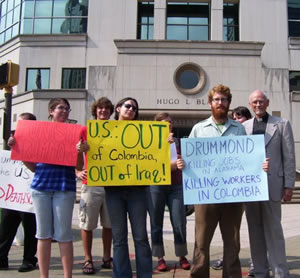
US out of ColombiaBill Clinton presided over murdering off hundreds of thousands of Iraqis via economic warfare, the bombing of multiple civilian targets in Yugoslavia including TV stations, water treatment plants, and the Chinese Embassy, and also the financing of Colombia’s death squads where tens of thousands of Colombians were murdered. Barack Obama has given new jobs in government policy making to these same Democratic Party political hacks that made all this bloodshed happen back in the 1990s. See “Body count mentalities” for some of the Colombian story about Democratic Party promotion of war and torture abroad. This was D.C.’s war, too. It was the Democrats’ war.

Antiwar.com reports that ‘since at least 1990, U.S. diplomats were reporting a connection between the Colombian security forces and far-right drug-running paramilitary groups, according to the Washington-based National Security Archive (NSA). In the meantime, the U.S. State Department continued to regularly certify Colombia’s human rights record and to heavily finance its “war on drugs.” The declassified documents were published Jan. 7 by the NSA, a non-governmental research and archival institution located at the George Washington University that collects, archives, and publishes declassified U.S. government documents obtained via the Freedom of Information Act.’

That was all back when only Israel and Egypt were getting more U.S. ‘aid’ dollars than Colombia was. With the Gaza slaughter underway as I write, we can today see the results there, too, of all that US money. Barack Obama is not about to change a damn thing! He is not CHANGE.

Secret Documents Show US Aware of Colombian Army Killings in 1990s

Meanwhile, back at the lab…

A BBC news story about why and how Ordinary People can be induced to torture another Human Being just because an “Authority Figure” ordered them to do it….

This is for all the … oh, I’ll not called them Cowards (this time), I’ll be more P.C. (temporarily) “Morality Challenged and Courage Deficient” bootlicker who yes sir yes sir three bags full sir!! Always Follow Orders bullshit artists who think they have to be Obedient.

They know who they are.

BBC NEWS
People ‘still willing to torture’

Decades after a notorious experiment, scientists have found test subjects are still willing to inflict pain on others – if told to by an authority figure.

US researchers repeated the famous “Milgram test”, with volunteers told to deliver electrical shocks to another volunteer – played by an actor.

Even after faked screams of pain, 70% were prepared to increase the voltage, the American Psychology study found.

Both may help explain why apparently ordinary people can commit atrocities.

Yale University professor Stanley Milgram’s work, published in 1963, recruited volunteers to help carry out a medical experiment, with none aware that they were actually the subject of the test.

A “scientist” instructed them to deliver a shock every time the actor answered a question wrongly.

When the pretend 150-volt shock was delivered, the actor could be heard screaming in pain, and yet, when asked to, more than eight out of ten volunteers were prepared to give further shocks, even when the “voltage” was gradually increased threefold.

Some volunteers even carried on giving 450-volt shocks even when there was no further response from the actor, suggesting he was either unconscious or dead.

Similar format

Dr Jerry Burger, of Santa Clara University, used a similar format, although he did not allow the volunteers to carry on beyond 150 volts after they had shown their willingness to do so, suggesting that the distress caused to the original volunteers had been too great.

Again, however, the vast majority of the 29 men and 41 women taking part were willing to push the button knowing it would cause pain to another human.

Even when another actor entered the room and questioned what was happening, most were still prepared to continue.

He told Reuters: “What we found is validation of the same argument – if you put people in certain situations, they will act in surprising and maybe often even disturbing ways.”

He said that it was not that there was “something wrong” with the volunteers, but that when placed under pressure, people will often do “unsettling” things.

Even though it was difficult to translate laboratory work to the real world, he said, it might partly explain why, in times of conflict, people could take part in genocide.

Complex task

Dr Abigail San, a chartered clinical psychologist, has recently replicated the experiment for a soon-to-be-aired BBC documentary – all the way up to the 450-volt mark, again finding a similar outcome to Professor Milgram.

“It’s not that these people are simply not good people any more – there is a massive social influence going on.”

She said that the volunteers were being asked to carry out a complex task in aid of scientific research, and became entirely focused on it, with “little room” left for considering the plight of the person receiving the shock.

“They tend to identify massively with the ‘experimenter’, and become very engaged and distracted by the research.

“There’s no opportunity for them to say ‘What’s my moral stand on this?'”
Story from BBC NEWS:
http://news.bbc.co.uk/go/pr/fr/-/2/hi/health/7791278.stm

Published: 2008/12/19 10:41:36 GMT

© BBC MMVIII

Print Sponsor

Of course, Military Torturers have plenty of time to become acclimated to the “Routine”, are themselves trained in resisting torture and trained in how to complain to any who will listen, long and loud, when they themselves are Tortured…

And PLENTY of time to consider the Immorality of what THEY do.

Unlike college student volunteers who do it once for a 3 hour session.

Weathermen for a Democratic Society

Bernadine Dohrn addresses S.D.S. in ChicagoIn 1969, the Radical Youth Movement (RYM) within Students for a Democratic Society (SDS) expelled the passive participants to reconfigure the SDS to Bring the War Home. At left, Bernardine Dohrn uninvites the Progressive Labor Party (PL) and the Worker Student Alliance (WSA) from the Chicago conference. Below is the founding document after which the RYM was renamed.

You Don’t Need A Weatherman
To Know Which Way The Wind Blows

June 18, 1969

Submitted by Karin Asbley, Bill Ayers, Bernardine Dohrn, John Jacobs, Jeff Jones, Gerry Long, Home Machtinger, Jim Mellen, Terry Robbins, Mark Rudd and Steve Tappis.

I. International Revolution

The contradiction between the revolutionary peoples of Asia, Africa and Latin America and the imperialists headed by the United States is the principal contradiction in the contemporary world. The development of this contradiction is promoting the struggle of the people of the whole world against US imperialism and its lackeys.

Lin Piao, Long Live the Victory of People’s War!

People ask, what is the nature of the revolution that we talk about- Who will it be made by, and for, and what are its goals and strategy-

The overriding consideration in answering these questions is that the main struggle going on in the world today is between US imperialism and the national liberation struggles against it. This is essential in defining political matters in the whole world: because it is by far the most powerful, every other empire and petty dictator is in the long run dependent on US imperialism, which has unified, allied with, and defended all of the reactionary forces of the whole world. Thus, in considering every other force or phenomenon, from Soviet imperialism or Israeli imperialism to “workers struggle” in France or Czechoslovakia, we determine who are our friends and who are our enemies according to whether they help US imperialism or fight to defeat it.

So the very first question people in this country must ask in considering the question of revolution is where they stand in relation to the United States as an oppressor nation, and where they stand in relation to the masses of people throughout the world whom US imperialism is oppressing.

The primary task of revolutionary struggle is to solve this principal contradiction on the side of the people of the world. It is the oppressed peoples of the world who have created the wealth of this empire and it is to them that it belongs; the goal of the revolutionary struggle must be the control and use of this wealth in the interests of the oppressed peoples of the world.

It is in this context that we must examine the revolutionary struggles in the United States. We are within the heartland of a worldwide monster, a country so rich from its worldwide plunder that even the crumbs doled out to the enslaved masses within its borders provide for material existence very much above the conditions of the masses of people of the world. The US empire, as a worldwide system, channels wealth, based upon the labor and resources of the rest of the world, into the United States. The relative affluence existing in the United States is directly dependent upon the labor and natural resources of the Vietnamese, the Angolans, the Bolivians and the rest of the peoples of the Third World. All of the United Airlines Astrojets, all of the Holiday Inns, all of Hertz’s automobiles, your television set, car and wardrobe already belong, to a large degree to the people of the rest of the world.

Therefore, any conception of “socialist revolution” simply in terms of the working people of the United States, failing to recognize the full scope of interests of the most oppressed peoples of the world, is a conception of a fight for a particular privileged interest, and is a very dangerous ideology. While the control and use of the wealth of the Empire for the people of the whole world is also in the interests of the vast majority of the people in this country, if the goal is not clear from the start we will further the preservation of class society, oppression, war, genocide, and the complete emiseration of everyone, including the people of the US.

The goal is the destruction of US imperialism and the achievement of a classless world: world communism. Winning state power in the US will occur as a result of the military forces of the US overextending themselves around the world and being defeated piecemeal; struggle within the US will be a vital part of this process, but when the revolution triumphs in the US it will have been made by the people of the whole world. For socialism to be defined in national terms within so extreme and historical an oppressor nation as this is only imperialist national chauvinism on the part of the “movement.”

II. What Is The Black Colony-

Not every colony of people oppressed by imperialism lies outside the boundaries of the US. Black people within North America, brought here 400 years ago as slaves and whose labor, as slaves, built this country, are an internal colony within the confines of the oppressor nation. What this means is that black people are oppressed as a whole people, in the institutions and social relations of the country, apart from simply the consideration of their class position, income, skill, etc., as individuals- What does this colony look like- What is the basis for its common oppression and why is it important-

One historically important position has been that the black colony only consists of the black belt nation in the South, whose fight for national liberation is based on a common land, culture, history and economic life. The corollary of this position is that black people in the rest of the country are a national minority but not actually part of the colony themselves; so the struggle for national liberation is for the black belt, and not all blacks; black people in the north, not actually part of the colony, are part of the working class of the white oppressor nation. In this formulation northern black workers have a “dual role”—one an interest in supporting the struggle in the South, and opposing racism, as members of the national minority; and as northern “white nation” workers whose class interest is in integrated socialism in the north. The consistent version of this line actually calls for integrated organizing of black and white workers in the north along what it calls “class” lines.

This position is wrong; in reality, the black colony does not exist simply as the “black belt nation,” but exists in the country as a whole. The common oppression of black people and the common culture growing out of that history are not based historically or currently on their relation to the territory of the black belt, even though that has been a place of population concentration and has some very different characteristics than the north, particularly around the land question.

Rather, the common features of oppression, history and culture which unify black people as a colony (although originating historically in a common territory apart from the colonizers, i.e., Africa, not the South) have been based historically on their common position as slaves, which since the nominal abolition of slavery has taken the form of caste oppression, and oppression of black people as a people everywhere that they exist. A new black nation, different from the nations of Africa from which it came, has been forged by the common historical experience of importation and slavery and caste oppression; to claim that to be a nation it must of necessity now be based on a common national territory apart from the colonizing nation is a mechanical application of criteria which were and are applicable to different situations.

What is specifically meant by the term caste is that all black people, on the basis of their common slave history, common culture and skin color are systematically denied access to particular job categories (or positions within job categories), social position, etc., regardless of individual skills, talents, money or education. Within the working class, they are the most oppressed section; in the petit bourgeoisie, they are even more strictly confined to the lowest levels. Token exceptions aside, the specific content of this caste oppression is to maintain black people in the most exploitative and oppressive jobs and conditions. Therefore, since the lowest class is the working class, the black caste is almost entirely a caste of the working class, or [holds] positions as oppressed as the lower working-class positions (poor black petit bourgeoisie and farmers); it is a colonial labor caste,, a colony whose common national character itself is defined by their common class position.

Thus, northern blacks do not have a “dual interest”—as blacks on the one hand and “US-nation workers” on the other. They have a single class interest, along with all other black people in the US, as members of the Black Proletarian Colony.

III. The Struggle For Socialist Self-Determination

The struggle of black people—as a colony—is for self-determination, freedom, and liberation from US imperialism. Because blacks have been oppressed and held in an inferior social position as a people, they have a right to decide, organize and act on their common destiny as a people apart from white interference. Black self-determination does not simply apply to determination of their collective political destiny at some future time. It is directly tied to the fact that because all blacks experience oppression in a form that no whites do, no whites are in a position to fully understand and test from their own practice the real situation black people face and the necessary response to it. This is why it is necessary for black people to organize separately and determine their actions separately at each stage of the struggle.

It is important to understand the implications of this. It is not legitimate for whites to organizationally intervene in differences among revolutionary black nationalists. It would be arrogant for us to attack any black organization that defends black people and opposes imperialism in practice. But it is necessary to develop a correct understanding of the Black Liberation struggle within our own organization, where an incorrect one will further racist practice in our relations with the black movement.

In the history of some external colonies, such as China and Vietnam, the struggle for self-determination has had two stages: (1) a united front against imperialism and for New Democracy (which is a joint dictatorship of anti-colonial classes led by the proletariat, the content of which is a compromise between the interests of the proletariat and nationalist peasants, petit bourgeoisie and national bourgeoisie); and (2) developing out of the new democratic stage, socialism.

However, the black liberation struggle in this country will have only one “stage”; the struggle for self-determination will embody within it the struggle for socialism.

As Huey P. Newton has said, “In order to be a revolutionary nationalist, you would of necessity have to be a socialist.” This is because—given the caste quality of oppression-as-a-people-through-a-common-degree-of-exploitation—self-determination requires being free from white capitalist exploitation in the form of inferior (lower caste) jobs, housing, schools, hospitals, prices. In addition, only what was or became in practice a socialist program for self-determination—one which addressed itself to reversing this exploitation—could win the necessary active mass support in the “proletarian colony.”

The program of a united front for new democracy, on the other hand, would not be as thorough, and so would not win as active and determined support from the black masses. The only reason for having such a front would be where the independent petit bourgeois forces which it would bring in would add enough strength to balance the weakening of proletarian backing. This is not the case: first, because much of the black petit bourgeoisie is actually a “comprador” petit bourgeoisie (like so-called black capitalists who are promoted by the power structure to seem independent but are really agents of white monopoly capital), who would never fight as a class for any real self-determination; and secondly, because many black petit bourgeoisie, perhaps most, while not having a class interest in socialist self-determination, are close enough to the black masses in the oppression and limitations on their conditions that they will support many kinds of self-determination issues, and, especially when the movement is winning, can be won to support full (socialist) self-determination. For the black movement to work to maximize this support from the petit bourgeoisie is correct; but it is in no way a united front where it is clear that the Black Liberation Movement should not and does not modify the revolutionary socialist content of its stand to win that support.

From /New Left Notes/, June 18, 1969

IV. Black Liberation Means Revolution

What is the relationship of the struggle for black self-determination to the whole worldwide revolution to defeat US imperialism and internationalize its resources toward the goal of creating a classless world-

No black self-determination could be won which would not result in a victory for the international revolution as a whole. The black proletarian colony, being dispersed as such a large and exploited section of the work force, is essential to the survival of imperialism. Thus, even if the black liberation movement chose to try to attain self-determination in the form of a separate country (a legitimate part of the right to self-determination), existing side by side with the US, imperialism could not survive if they won it—and so would never give up without being defeated. Thus, a revolutionary nationalist movement could not win without destroying the state power of the imperialists; and it is for this reason that the black liberation movement, as a revolutionary nationalist movement for self-determination, is automatically in and of itself an inseparable part of the whole revolutionary struggle against US imperialism and for international socialism.

However, the fact that black liberation depends on winning the whole revolution does not mean that it depends on waiting for and joining with a mass white movement to do it. The genocidal oppression of black people must be ended, and does not allow any leisure time to wait; if necessary, black people could win self-determination, abolishing the whole imperialist system and seizing state power to do it, without this white movement, although the cost among whites and blacks both would be high.

Blacks could do it alone if necessary because of their centralness to the system, economically and geo-militarily, and because of the level of unity, commitment, and initiative which will be developed in waging a people’s war for survival and national liberation. However, we do not expect that they will have to do it alone, not only because of the international situation, but also because the real interests of masses of oppressed whites in this country lie with the Black Liberation struggle, and the conditions for understanding and fighting for these interests grow with the deepening of the crises. Already, the black liberation movement has carried with it an upsurge of revolutionary consciousness among white youth; and while there are no guarantees, we can expect that this will extend and deepen among all oppressed whites.

To put aside the possibility of blacks winning alone leads to the racist position that blacks should wait for whites and are dependent on whites acting for them to win. Yet the possibility of blacks winning alone cannot in the least be a justification for whites failing to shoulder the burden of developing a revolutionary movement among whites. If the first error is racism by holding back black liberation, this would be equally racist by leaving blacks isolated to take on the whole fight—and the whole cost—for everyone.

It is necessary to defeat both racist tendencies: (1) that blacks shouldn’t go ahead with making the revolution, and (2) that blacks should go ahead alone with making it. The only third path is to build a white movement which will support the blacks in moving as fast as they have to and are able to, and still itself keep up with that black movement enough so that white revolutionaries share the cost and the blacks don’t have to do the whole thing alone. Any white who does not follow this third path is objectively following one of the other two (or both) and is objectively racist.

V. Anti-Imperialist Revolution And The United Front

Since the strategy for defeating imperialism in semi-feudal colonies has two stages, the new democratic stage of a united front to throw out imperialism and then the socialist stage, some people suggest two stages for the US too—one to stop imperialism, the anti-imperialist stage, and another to achieve the dictatorship of the proletariat, the socialist stage. It is no accident that even the proponents of this idea can’t tell you what it means. In reality, imperialism is a predatory international stage of capitalism. Defeating imperialism within the US couldn’t possibly have the content, which it could in a semi-feudal country, of replacing imperialism with capitalism or new democracy; when imperialism is defeated in the US, it will be replaced by socialism—nothing else. One revolution, one replacement process, one seizure of state power—the anti-imperialist revolution and the socialist revolution, one and the same stage. To talk of this as two separate stages, the struggle to overthrow imperialism and the struggle for socialist revolution, is as crazy as if Marx had talked about the proletarian socialist revolution as a revolution of two stages, one the overthrow of capitalist state power, and second the establishment of socialist state power.

Along with no two stages, there is no united front with the petit bourgeoisie, because its interests as a class aren’t for replacing imperialism with socialism. As far as people within this country are concerned, the international war against imperialism is the same task as the socialist revolution, for one overthrow of power here. There is no “united front” for socialism here.

One reason people have considered the “united front” idea is the fear that if we were talking about a one-stage socialist revolution we would fail to organize maximum possible support among people, like some petit bourgeoisie, who would fight imperialism on a particular issue, but weren’t for revolution. When the petit bourgeoisie’s interest is for fighting imperialism on a particular issue, but not for overthrowing it and replacing it with socialism, it is still contributing to revolution to that extent—not to some intermediate thing which is not imperialism and not socialism. Someone not for revolution is not for actually defeating imperialism either, but we still can and should unite with them on particular issues. But this is not a united front (and we should not put forth some joint “united front” line with them to the exclusion of our own politics), because their class position isn’t against imperialism as a system. In China, or Vietnam, the petit bourgeoisie’s class interests could be for actually winning against imperialism; this was because their task was driving it out, not overthrowing its whole existence. For us here, “throwing it out” means not from one colony, but all of them, throwing it out of the world, the same thing as overthrowing it.

VI. International Strategy

What is the strategy of this international revolutionary movement- What are the strategic weaknesses of the imperialists which make it possible for us to win- Revolutionaries around the world are in general agreement on the answer, which Lin Piao describes in the following way:

US imperialism is stronger, but also more vulnerable, than any imperialism of the past. It sets itself against the people of the whole world, including the people of the United States. Its human, military, material and financial resources are far from sufficient for the realization of its ambition of domination over the whole world. US imperialism has further weakened itself by occupying so many places in the world, overreaching itself, stretching its fingers out wide and dispersing its strength, with its rear so far away and its supply lines so long.

—/Long Live the Victory of People’s War/

The strategy which flows from this is what Ché called “creating two, three, many Vietnams”—to mobilize the struggle so sharply in so many places that the imperialists cannot possibly deal with it all. Since it is essential to their interests, they will try to deal with it all, and will be defeated and destroyed in the process.

In defining and implementing this strategy, it is clear that the vanguard (that is, the section of the people who are in the forefront of the struggle and whose class interests and needs define the terms and tasks of the revolution) of the “American Revolution” is the workers and oppressed peoples of the colonies of Asia, Africa and Latin America. Because of the level of special oppression of black people as a colony, they reflect the interests of the oppressed people of the world from within the borders of the United States; they are part of the Third World and part of the international revolutionary vanguard.

The vanguard role of the Vietnamese and other Third World countries in defeating US imperialism has been clear to our movement for some time. What has not been so clear is the vanguard role black people have played, and continue to play, in the development of revolutionary consciousness and struggle within the United States. Criticisms of the black liberation struggle as being “reactionary” or of black organizations on campus as being conservative or “racist” very often express this lack of understanding. These ideas are incorrect and must be defeated if a revolutionary movement is going to be built among whites.

The black colony, due to its particular nature as a slave colony, never adopted a chauvinist identification with America as an imperialist power, either politically or culturally. Moreover, the history of black people in America has consistently been one of the greatest overall repudiations of and struggle against the state. From the slave ships from Africa to the slave revolts, the Civil War, etc., black people have been waging a struggle for survival and liberation. In the history of our own movement this has also been the case: the civil rights struggles, initiated and led by blacks in the South; the rebellions beginning with Harlem in 1964 and Watts in 1965 through Detroit and Newark in 1967; the campus struggles at all-black schools in the South and struggles led by blacks on campuses all across the country. As it is the blacks—along with the Vietnamese and other Third World people—who are most oppressed by US imperialism, their class interests are most solidly and resolutely committed to waging revolutionary struggle through to its completion. Therefore it is no surprise that time and again, in both political content and level of consciousness and militancy, it has been the black liberation movement which has upped the ante and defined the terms of the struggle.

What is the relationship of this “black vanguard” to the “many Vietnams” around the world- Obviously this is an example of our strategy that different fronts reinforce each other. The fact that the Vietnamese are winning weakens the enemy, advancing the possibilities for the black struggle, etc. But it is important for us to understand that the interrelationship is more than this. Black people do not simply “choose” to intensify their struggle because they want to help the Vietnamese, or because they see that Vietnam heightens the possibilities for struggle here. The existence of any one Vietnam, especially a winning one, spurs on others not only through consciousness and choice, but through need, because it is a political and economic, as well as military, weakening of capitalism, and this means that to compensate, the imperialists are forced to intensify their oppression of other people.

Thus the loss of China and Cuba and the loss now of Vietnam not only encourages other oppressed peoples (such as the blacks) by showing what the alternative is and that it can be won, but also costs the imperialists billions of dollars which they then have to take out of the oppression of these other peoples. Within this country increased oppression falls heavier on the most oppressed sections of the population, so that the condition of all workers is worsened through rising taxes, inflation and the fall of real wages, and speedup. But this increased oppression falls heaviest on the most oppressed, such as poor white workers and, especially, the blacks, for example through the collapse of state services like schools, hospitals and welfare, which naturally hits the hardest at those most dependent on them.

This deterioration pushes people to fight harder to even try to maintain their present level. The more the ruling class is hurt in Vietnam, the harder people will be pushed to rebel and to fight for reforms. Because there exist successful models of revolution in Cuba, Vietnam, etc., these reform struggles will provide a continually larger and stronger base for revolutionary ideas. Because it needs to maximize profits by denying the reforms, and is aware that these conditions and reform struggles will therefore lead to revolutionary consciousness, the ruling class will see it more and more necessary to come down on any motion at all, even where it is not yet highly organized or conscious. It will come down faster on black people, because their oppression is increasing fastest, and this makes their rebellion most thorough and most dangerous, and fastest growing. It is because of this that the vanguard character and role of the black liberation struggle will be increased and intensified, rather than being increasingly equal to and merged into the situation and rebellion of oppressed white working people and youth. The crises of imperialism (the existence of Vietnam and especially that it’s winning) will therefore create a “Black Vietnam” within the US.

Given that black self-determination would mean fully crushing the power of the imperialists, this “Vietnam” has certain different characteristics than the external colonial wars. The imperialists will never “get out of the US” until their total strength and every resource they can bring to bear has been smashed; so the Black Vietnam cannot win without bringing the whole thing down and winning for everyone. This means that this war of liberation will be the most protracted and hardest fought of all.

It is in this context that the question of the South must be dealt with again, not as a question of whether or not the black nation, black colony, exists there, as opposed to in the North as well, but rather as a practical question of strategy and tactics: Can the black liberation struggle—the struggle of all blacks in the country—gain advantage in the actual war of liberation by concentrating on building base areas in the South in territory with a concentration of black population-

This is very clearly a different question than that of “where the colony is,” and to this question the “yes” answer is an important possibility. If the best potential for struggle in the South were realized, it is fully conceivable and legitimate that the struggle there could take on the character of a fight for separation; and any victories won in that direction would be important gains for the national liberation of the colony as a whole. However, because the colony is dispersed over the whole country, and not just located in the black belt, winning still means the power and liberation of blacks in the whole country.

Thus, even the winning of separate independence in the South would still be one step toward self-determination, and not equivalent to winning it; which, because of the economic position of the colony as a whole, would still require overthrowing the state power of the imperialists, taking over production and the whole economy and power, etc.

VII. The Revolutionary Youth Movement: Class Analysis

The revolutionary youth movement program was hailed as a transition strategy, which explained a lot of our past work and pointed to new directions for our movement. But as a transition to what- What was our overall strategy- Was the youth movement strategy just an organizational strategy because SDS is an organization of youth and we can move best with other young people-

We have pointed to the vanguard nature of the black struggle in this country as part of the international struggle against American imperialism, and the impossibility of anything but an international strategy for winning. Any attempt to put forth a strategy which, despite internationalist rhetoric, assumes a purely internal development to the class struggle in this country, is incorrect. The Vietnamese (and the Uruguayans and the Rhodesians) and the blacks and Third World peoples in this country will continue to set the terms for class struggle in America.

In this context, why an emphasis on youth- Why should young people be willing to fight on the side of Third World peoples- Before dealing with this question about youth, however, there follows a brief sketch of the main class categories in the white mother country which we think are important, and [which] indicate our present estimation of their respective class interests (bearing in mind that the potential for various sections to understand and fight for the revolution will vary according to more than just their real class interests).

Most of the population is of the working class, by which we mean not simply industrial or production workers, nor those who are actually working, but the whole section of the population which doesn’t own productive property and so lives off of the sale of its labor power. This is not a metaphysical category either in terms of its interests, the role it plays, or even who is in it, which very often is difficult to determine.

As a whole, the long-range interests of the non-colonial sections of the working class lie with overthrowing imperialism, with supporting self-determination for the oppressed nations (including the black colony), with supporting and fighting for international socialism. However, virtually all of the white working class also has short-range privileges from imperialism, which are not false privileges but very real ones which give them an edge of vested interest and tie them to a certain extent to the imperialists, especially when the latter are in a relatively prosperous phase. When the imperialists are losing their empire, on the other hand, these short-range privileged interests are seen to be temporary (even though the privileges may be relatively greater over the faster-increasing emiseration of the oppressed peoples). The long-range interests of workers in siding with the oppressed peoples are seen more clearly in the light of imperialism’s impending defeat. Within the whole working class, the balance of anti-imperialist class interests with white mother country short-term privilege varies greatly.

First, the most oppressed sections of the mother country working class have interests most clearly and strongly anti-imperialist. Who are the most oppressed sections of the working class- Millions of whites who have as oppressive material conditions as the blacks, or almost so: especially poor southern white workers; the unemployed or semi-employed, or those employed at very low wages for long hours and bad conditions, who are non-unionized or have weak unions; and extending up to include much of unionized labor which has it a little better off but still is heavily oppressed and exploited. This category covers a wide range and includes the most oppressed sections not only of production and service workers but also some secretaries, clerks, etc. Much of this category gets some relative privileges (i.e. benefits) from imperialism, which constitute some material basis for being racist or pro-imperialist; but overall it is itself directly and heavily oppressed, so that in addition to its long-range class interest on the side of the people of the world, its immediate situation also constitutes a strong basis for sharpening the struggle against the state and fighting through to revolution.

Secondly, there is the upper strata of the working class. This is also an extremely broad category, including the upper strata of unionized skilled workers and also most of the “new working class” of proletarianized or semi-proletarianized “intellect workers.” There is no clearly marked dividing line between the previous section and this one; our conclusions in dealing with “questionable” strata will in any event have to come from more thorough analysis of particular situations. The long-range class interests of this strata, like the previous section of more oppressed workers, are for the revolution and against imperialism. However, it is characterized by a higher level of privilege relative to the oppressed colonies, including the blacks, and relative to more oppressed workers in the mother country; so that there is a strong material basis for racism and loyalty to the system. In a revolutionary situation, where the people’s forces were on the offensive and the ruling class was clearly losing, most of this upper strata of the working class will be winnable to the revolution, while at least some sections of it will probably identify their interests with imperialism till the end and oppose the revolution (which parts do which will have to do with more variables than just the particular level of privilege). The further development of the situation will clarify where this section will go, although it is clear that either way we do not put any emphasis on reaching older employed workers from this strata at this time. The exception is where they are important to the black liberation struggle, the Third World, or the youth movement in particular situations, such as with teachers, hospital technicians, etc., in which cases we must fight particularly hard to organize them around a revolutionary line of full support for black liberation and the international revolution against US imperialism. This is crucial because the privilege of this section of the working class has provided and will provide a strong material basis for national chauvinist and social democratic ideology within the movement, such as anti-internationalist concepts of “student power” and “workers control.” Another consideration in understanding the interests of this segment is that, because of the way it developed and how its skills and its privileges were “earned over time,” the differential between the position of youth and older workers is in many ways greater for this section than any other in the population. We should continue to see it as important to build the revolutionary youth movement among the youth of this strata.

Thirdly, there are “middle strata” who are not petit bourgeoisie, who may even technically be upper working class, but who are so privileged and tightly tied to imperialism through their job roles that they are agents of imperialism. This section includes management personnel, corporate lawyers, higher civil servants, and other government agents, army officers, etc. Because their job categories require and promote a close identification with the interests of the ruling class, these strata are enemies of the revolution.

Fourthly, and last among the categories we’re going to deal with, is the petit bourgeoisie. This class is different from the middle level described above in that it has the independent class interest which is opposed to both monopoly power and to socialism. The petit bourgeoisie consists of small capital—both business and farms—and self-employed tradesmen and professionals (many professionals work for monopoly capital, and are either the upper level of the working class or in the dent class interests-anti-monopoly capital, but for capitalism rather than socialism—gives it a political character of some opposition to “big government,” like its increased spending and taxes and its totalitarian extension of its control into every aspect of life, and to “big labor,” which is at this time itself part of the monopoly capitalist power structure. The direction which this opposition takes can be reactionary or reformist. At this time the reformist side of it is very much mitigated by the extent to which the independence of the petit bourgeoisie is being undermined. Increasingly, small businesses are becoming extensions of big ones, while professionals and self-employed tradesmen less and less sell their skills on their own terms and become regular employees of big firms. This tendency does not mean that the reformist aspect is not still present; it is, and there are various issues, like withdrawing from a losing imperialist war, where we could get support from them. On the question of imperialism as a system, however, their class interests are generally more for it than for overthrowing it, and it will be the deserters from their class who stay with us.

VIII. Why A Revolutionary Youth Movement-

In terms of the above analysis, most young people in the US are part of the working class. Although not yet employed, young people whose parents sell their labor power for wages, and more important who themselves expect to do the same in the future—or go into the army or be unemployed—are undeniably members of the working class. Most kids are well aware of what class they are in, even though they may not be very scientific about it. So our analysis assumes from the beginning that youth struggles are, by and large, working-class struggles. But why the focus now on the struggles of working-class youth rather than on the working class as a whole-

The potential for revolutionary consciousness does not always correspond to ultimate class interest, particularly when imperialism is relatively prosperous and the movement is in an early stage. At this stage, we see working-class youth as those most open to a revolutionary movement which sides with the struggles of Third World people; the following is an attempt to explain a strategic focus on youth for SDS.

In general, young people have less stake in a society (no family, fewer debts, etc.), are more open to new ideas (they have not been brainwashed for so long or so well), and are therefore more able and willing to move in a revolutionary direction. Specifically in America, young people have grown up experiencing the crises in imperialism. They have grown up along with a developing black liberation movement, with the liberation of Cuba, the fights for independence in Africa and the war in Vietnam. Older people grew up during the fight against fascism, during the Cold War, the smashing of the trade unions, McCarthy, and a period during which real wages consistently rose—since 1965 disposable real income has decreased slightly, particularly in urban areas where inflation and increased taxation have bitten heavily into wages. This crisis in imperialism affects all parts of the society. America has had to militarize to protect and expand its empire; hence the high draft calls and the creation of a standing army of three and a half million, an army which still has been unable to win in Vietnam. Further, the huge defense expenditures—required for the defense of the empire and at the same time a way of making increasing profits for the defense industries—have gone hand in hand with the urban crisis around welfare, the hospitals, the schools, housing, air and water pollution. The State cannot provide the services it has been forced to assume responsibility for, and needs to increase taxes and to pay its growing debts while it cuts services and uses the pigs to repress protest. The private sector of the economy can’t provide jobs, particularly unskilled jobs. The expansion of the defense and education industries by the State since World War II is in part an attempt to pick up the slack, though the inability to provide decent wages and working conditions for “public” jobs is more and more a problem.

As imperialism struggles to hold together this decaying social fabric, it inevitably resorts to brute force and authoritarian ideology. People, especially young people, more and more find themselves in the iron grip of authoritarian institutions. Reaction against the pigs or teachers in the schools, welfare pigs or the army, is generalizable and extends beyond the particular repressive institution to the society and the State as a whole. The legitimacy of the State is called into question for the first time in at least 30 years, and the anti-authoritarianism which characterizes the youth rebellion turns into rejection of the State, a refusal to be socialized into American society. Kids used to try to beat the system from inside the army or from inside the schools; now they desert from the army and burn down the schools.

The crisis in imperialism has brought about a breakdown in bourgeois social forms, culture and ideology. The family falls apart, kids leave home, women begin to break out of traditional “female” and “mother” roles. There develops a “generation gap” and a “youth problem.” Our heroes are no longer struggling businessmen, and we also begin to reject the ideal career of the professional and look to Mao, Chef, the Panthers, the Third World, for our models, for motion. We reject the elitist, technocratic bullshit that tells us only experts can rule, and look instead to leadership from the people’s war of the Vietnamese. Chuck Berry, Elvis, the Temptations brought us closer to the “people’s culture” of Black America. The racist response to the civil rights movement revealed the depth of racism in America, as well as the impossibility of real change through American institutions. And the war against Vietnam is not “the heroic war against the Nazis”; it’s the big lie, with napalm burning through everything we had heard this country stood for. Kids begin to ask questions: Where is the Free World- And who do the pigs protect at home-

The breakdown in bourgeois culture and concomitant anti-authoritarianism is fed by the crisis in imperialism, but also in turn feeds that crisis, exacerbates it so that people no longer merely want the plastic ’50s restored, but glimpse an alternative (like inside the Columbia buildings) and begin to fight for it. We don’t want teachers to be more kindly cops; we want to smash cops, and build a new life.

The contradictions of decaying imperialism fall hardest on youth in four distinct areas—the schools, jobs, the draft and the army, and the pigs and the courts. (A) In jail-like schools, kids are fed a mish-mash of racist, male chauvinist, anti-working class, anti-communist lies while being channeled into job and career paths set up according to the priorities of monopoly capital. At the same time, the State is becoming increasingly incapable of providing enough money to keep the schools going at all. (B) Youth unemployment is three times average unemployment. As more jobs are threatened by automation or the collapse of specific industries, unions act to secure jobs for those already employed. New people in the labor market can’t find jobs, job stability is undermined (also because of increasing speed-up and more intolerable safety conditions) and people are less and less going to work in the same shop for 40 years. And, of course, when they do find jobs, young people get the worst ones and have the least seniority. (C) There are now two and a half million soldiers under thirty who are forced to police the world, kill and be killed in wars of imperialist domination. And (D) as a “youth problem” develops out of all this, the pigs and courts enforce curfews, set up pot busts, keep people off the streets, and repress any youth motion whatsoever.

In all of this, it is not that life in America is toughest for youth or that they are the most oppressed. Rather, it is that young people are hurt directly—and severely—by imperialism. And, in being less tightly tied to the system, they are more “pushed” to join the black liberation struggle against US imperialism. Among young people there is less of a material base for racism—they have no seniority, have not spent 20 years securing a skilled job (the white monopoly of which is increasingly challenged by the black liberation movement), and aren’t just about to pay off a 25-year mortgage on a house which is valuable because it’s located in a white neighborhood.

While these contradictions of imperialism fall hard on all youth, they fall hardest on the youth of the most oppressed (least privileged) sections of the working class. Clearly these youth have the greatest material base for struggle. They are the ones who most often get drafted, who get the worst jobs if they get any, who are most abused by the various institutions of social control, from the army to decaying schools, to the pigs and the courts. And their day-to-day existence indicates a potential for militancy and toughness. They are the people whom we can reach who at this stage are most ready to engage in militant revolutionary struggle.

The point of the revolutionary youth movement strategy is to move from a predominant student elite base to more oppressed (less privileged) working-class youth as a way of deepening and expanding the revolutionary youth movement—not of giving up what we have gained, not giving up our old car for a new Dodge. This is part of a strategy to reach the entire working class to engage in struggle against imperialism; moving from more privileged sections of white working-class youth to more oppressed sections to the entire working class as a whole, including importantly what has classically been called the industrial proletariat. But this should not be taken to mean that there is a magic moment, after we reach a certain percentage of the working class, when all of a sudden we become a working-class movement. We are already that if we put forward internationalist proletarian politics. We also don’t have to wait to become a revolutionary force. We must be a self-conscious revolutionary force from the beginning, not be a movement which takes issues to some mystical group—”THE PEOPLE”—who will make the revolution. We must be a revolutionary movement of people understanding the necessity to reach more people, all working people, as we make the revolution.

The above arguments make it clear that it is both important and possible to reach young people wherever they are—not only in the shops, but also in the schools, in the army and in the streets—so as to recruit them to fight on the side of the oppressed peoples of the world. Young people will be part of the International Liberation Army. The necessity to build this International Liberation Army in America leads to certain priorities in practice for the revolutionary youth movement which we should begin to apply this summer. …

IX. Imperialism Is The Issue

The Communists are distinguished from the other working-class parties by this only: 1. In the national struggles of the proletariat of different countries, they point out and bring to the front the common interests of the entire proletariat, independently of all nationality. 2. In the various stages of development which the struggle of the working-class against the bourgeoisie has to pass through, they always and everywhere represent the interests of the movement as a whole.”

—Communist Manifesto

How do we reach youth; what kinds of struggles do we build; how do we make a revolution- What we have tried to lay out so far is the political content of the consciousness which we want to extend and develop as a mass consciousness: the necessity to build our power as part of the whole international revolution to smash the state power of the imperialists and build socialism. Besides consciousness of this task, we must involve masses of people in accomplishing it. Yet we are faced with a situation in which almost all of the people whose interests are served by these goals, and who should be, or even are, sympathetic to revolution, neither understand the specific tasks involved in making a revolution nor participate in accomplishing them. On the whole, people don’t join revolutions just because revolutionaries tell them to. The oppression of the system affects people in particular ways, and the development of political consciousness and participation begins with particular problems, which turn into issues and struggles. We must transform people’s everyday problems, and the issues and struggles growing out of them, into revolutionary consciousness, active and conscious opposition to racism and imperialism.

This is directly counterposed to assuming that struggles around immediate issues will lead naturally over time to struggle against imperialism. It has been argued that since people’s oppression is due to imperialism and racism, then any struggle against immediate oppression is “objectively anti-imperialist,” and the development of the fight against imperialism is a succession of fights for reforms. This error is classical economism.

A variant of this argument admits that this position is often wrong, but suggests that since imperialism is collapsing at this time, fights for reforms become “objectively anti-imperialist.” At this stage of imperialism there obviously will be more and more struggles for the improvement of material conditions, but that is no guarantee of increasing internationalist proletarian consciousness.

On the one hand, if we, as revolutionaries, are capable of understanding the necessity to smash imperialism and build socialism, then the masses of people who we want to fight along with us are capable of that understanding. On the other hand, people are brainwashed and at present don’t understand it; if revolution is not raised at every opportunity, then how can we expect people to see it in their interests, or to undertake the burdens of revolution- We need to make it clear from the very beginning that we are about revolution. But if we are so careful to avoid the dangers of reformism, how do we relate to particular reform struggles- We have to develop some sense of how to relate each particular issue to the revolution.

In every case, our aim is to raise anti-imperialist and anti-racist consciousness and tie the struggles of working-class youth (and all working people) to the struggles of Third World people, rather than merely joining fights to improve material conditions, even though these fights are certainly justified. This is not to say that we don’t take immediate fights seriously, or fight hard in them, but that we are always up front with our politics, knowing that people in the course of struggle are open to a class line, ready to move beyond narrow self-interest.

It is in this sense that we point out that the particular issue is not the issue, is important insofar as it points to imperialism as an enemy that has to be destroyed. Imperialism is always the issue. Obviously, the issue cannot be a good illustration, or a powerful symbol, if it is not real to people, if it doesn’t relate to the concrete oppression that imperialism causes. People have to be (and are being) hurt in some material way to understand the evils of imperialism, but what we must stress is the systematic nature of oppression and the way in which a single manifestation of imperialism makes clear its fundamental nature. At Columbia it was not the gym, in particular, which was important in the struggle, but the way in which the gym represented, to the people of Harlem and Columbia, Columbia’s imperialist invasion of the black colony. Or at Berkeley, though people no doubt needed a park (as much, however, as many other things-), what made the struggle so important was that people, at all levels of militancy, consciously saw themselves attacking private property and the power of the State. And the Richmond Oil Strike was exciting because the militant fight for improvement of material conditions was part and parcel of an attack on international monopoly capital. The numbers and militancy of people mobilized for these struggles has consistently surprised the left, and pointed to the potential power of a class-conscious mass movement.

The masses will fight for socialism when they understand that reform fights, fights for improvement of material conditions, cannot be won under imperialism. With this understanding, revolutionaries should never put forth a line which fosters the illusion that imperialism will grant significant reforms. We must engage in struggles forthrightly as revolutionaries, so that it will be clear to anyone we help to win gains that the revolution rather than imperialism is responsible for them. This is one of the strengths of the Black Panther Party Breakfast for Children Program. It is “socialism in practice” by revolutionaries with the “practice” of armed self-defense and a “line” which stresses the necessity of overthrowing imperialism and seizing state power. Probably the American Friends Service Committee serves more children breakfast, but it is the symbolic value of the program in demonstrating what socialism will do for people which makes the Black Panther Program worthwhile.

What does it mean to organize around racism and imperialism in specific struggles- In the high schools (and colleges) at this time, it means putting forth a mass line to close down the schools, rather than to reform them, so that they can serve the people. The reason for this line is not that under capitalism the schools cannot serve the people, and therefore it is silly or illusory to demand that. Rather, it is that kids are ready for the full scope of militant struggle, and already demonstrate a consciousness of imperialism, such that struggles for a people-serving school would not raise the level of their struggle to its highest possible point. Thus, to tell a kid in New York that imperialism tracks him and thereby oppresses him is often small potatoes compared to his consciousness that imperialism oppresses him by jailing him, pigs and all, and the only thing to do is break out and tear up the jail. And even where high school kids are not yet engaged in such sharp struggle, it is crucial not to build consciousness only around specific issues such as tracking or ROTC or racist teachers, but to use these issues to build toward the general consciousness that the schools should be shut down. It may be important to present a conception of what schools should or could be like (this would include the abolition of the distinction between mental and physical work), but not offer this total conception as really possible to fight for in any way but through revolution.

A mass line to close down the schools or colleges does not contradict demands for open admissions to college or any other good reform demand. Agitational demands for impossible, but reasonable, reforms are a good way to make a revolutionary point. The demand for open admissions by asserting the alternative to the present (school) system exposes its fundamental nature—that it is racist, class-based, and closed—pointing to the only possible solution to the present situation: “Shut it down!” The impossibility of real open admissions—all black and brown people admitted, no flunk-out, full scholarship, under present conditions—is the best reason (that the schools show no possibility for real reform) to shut the schools down. We should not throw away the pieces of victories we gain from these struggles, for any kind of more open admissions means that the school is closer to closing down (it costs the schools more, there are more militant blacks and browns making more and more fundamental demands on the schools, and so on). Thus our line in the schools, in terms of pushing any good reforms, should be, Open them up and shut them down!”

The spread of black caucuses in the shops and other workplaces throughout the country is an extension of the black liberation struggle. These groups have raised and will continue to raise anti-racist issues to white workers in a sharper fashion than any whites ever have or could raise them. Blacks leading struggles against racism made the issue unavoidable, as the black student movement leadership did for white students. At the same time these black groups have led fights which traditional trade-union leaders have consistently refused to lead—fights against speed-up and for safety (issues which have become considerably more serious in the last few years), forcing white workers, particularly the more oppressed, to choose in another way between allegiance to the white mother country and black leadership. As white mother country radicals we should try to be in shops, hospitals, and companies where there are black caucuses, perhaps organizing solidarity groups, but at any rate pushing the importance of the black liberation struggle to whites, handing out Free Huey literature, bringing guys out to Panther rallies, and so on. Just one white guy could play a crucial role in countering UAW counter-insurgency.

We also need to relate to workplaces where there is no black motion but where there are still many young white workers. In the shops the crisis in imperialism has come down around speed-up, safety, and wage squeeze—due to higher taxes and increased inflation, with the possibility of wage-price controls being instituted.

We must relate this exploitation back to imperialism. The best way to do this is probably not caucuses in the shops, but to take guys to citywide demonstrations, Newsreels, even the latest administration building, to make the Movement concrete to them and involve them in it. Further, we can effect consciousness and pick up people through agitational work at plants, train stops, etc., selling Movements, handing out leaflets about the war, the Panthers, the companies’ holdings overseas or relations to defense industry, etc.

After the Richmond strike, people leafleted about demonstrations in support of the Curaçao Oil workers, Free Huey May Day, and People’s Park.

SDS has not dealt in any adequate way with the women question; the resolution passed at Ann Arbor did not lead to much practice, nor has the need to fight male supremacy been given any programmatic direction within the RYM. As a result, we have a very limited understanding of the tie-up between imperialism and the women question, although we know that since World War II the differential between men’s and women’s wages has increased, and guess that the breakdown of the family is crucial to the woman question. How do we organize women against racism and imperialism without submerging the principled revolutionary question of women’s liberation- We have no real answer, but we recognize the real reactionary danger of women’s groups that are not self-consciously revolutionary and anti-imperialist.

To become more relevant to the growing women’s movement, SDS women should begin to see as a primary responsibility the self-conscious organizing of women. We will not be able to organize women unless we speak directly to their own oppression. This will become more and more critical as we work with more oppressed women. Women who are working and women who have families face male supremacy continuously in their day-to-day lives; that will have to be the starting point in their politicization. Women will never be able to undertake a full revolutionary role unless they break out of their woman’s role. So a crucial task for revolutionaries is the creation of forms of organization in which women will be able to take on new and independent roles. Women’s self-defense groups will be a step toward these organizational forms, as an effort to overcome women’s isolation and build revolutionary self-reliance.

The cultural revolt of women against their “role” in imperialism (which is just beginning to happen in a mass way) should have the same sort of revolutionary potential that the RYM claimed for “youth culture.” The role of the “wife-mother” is reactionary in most modern societies, and the disintegration of that role under imperialism should make women more sympathetic to revolution.

In all of our work we should try to formulate demands that not only reach out to more oppressed women, but ones which tie us to other ongoing struggles, in the way that a daycare center at U of C [University of Chicago] enabled us to tie the women’s liberation struggle to the Black Liberation struggle.

There must be a strong revolutionary women’s movement, for without one it will be impossible for women’s liberation to be an important part of the revolution. Revolutionaries must be made to understand the full scope of women’s oppression, and the necessity to smash male supremacy.

X. Neighborhood-Based Citywide Youth Movement

One way to make clear the nature of the system and our tasks working off of separate struggles is to tie them together with each other: to show that we’re one “multi-issue” movement, not an alliance of high school and college students, or students and GIs, or youth and workers, or students and the black community. The way to do this is to build organic regional or sub-regional and citywide movements, by regularly bringing people in one institution or area to fights going on on other fronts.

This works on two levels. Within a neighborhood, by bringing kids to different fights and relating these fights to each other—high school stuff, colleges, housing, welfare, shops—we begin to build one neighborhood-based multi-issue movement off of them. Besides actions and demonstrations, we also pull different people together in day-to-day film showings, rallies, for speakers and study groups, etc. On a second level, we combine neighborhood “bases” into a citywide or region-wide movement by doing the same kind of thing; concentrating our forces at whatever important struggles are going on and building more ongoing interrelationships off of that.

The importance of specifically neighborhood-based organizing is illustrated by our greatest failing in RYM practice so far—high school organizing. In most cities we don’t know the kids who have been tearing up and burning down the schools. Our approach has been elitist, relating to often baseless citywide groups by bringing them our line, or picking up kids with a false understanding of “politics” rather than those whose practice demonstrates their concrete anti-imperialist consciousness that schools are prisons. We’ve been unwilling to work continuously with high school kids as we did in building up college chapters. We will only reach the high school kids who are in motion by being in the schoolyards, hangouts and on the streets on an everyday basis. From a neighborhood base, high school kids could be effectively tied in to struggles around other institutions and issues, and to the anti-imperialist movement as a whole.

We will try to involve neighborhood kids who aren’t in high schools too; take them to anti-war or anti-racism fights, stuff in the schools, etc.; and at the same time reach out more broadly through newspapers, films, storefronts. Activists and cadres who are recruited in this work will help expand and deepen the Movement in new neighborhoods and high schools. Mostly we will still be tied in to the college-based movement in the same area, be influencing its direction away from campus-oriented provincialism, be recruiting high school kids into it where it is real enough and be recruiting organizers out of it. In its most developed form, this neighborhood-based movement would be a kind of sub-region. In places where the Movement wasn’t so strong, this would be an important form for being close to kids in a day-to-day way and yet be relating heavily to a lot of issues and political fronts which the same kids are involved with.

The second level is combining these neighborhoods into citywide and regional movements. This would mean doing the same thing—bringing people to other fights going on—only on a larger scale, relating to various blow-ups and regional mobilizations. An example is how a lot of people from different places went to San Francisco State, the Richmond Oil Strike, and now Berkeley. The existence of this kind of cross-motion makes ongoing organizing in other places go faster and stronger, first by creating a pervasive politicization, and second by relating everything to the most militant and advanced struggles going on so that they influence and set the pace for a lot more people. Further, cities are a basic unit of organization of the whole society in a way that neighborhoods aren’t. For example, one front where we should be doing stuff is the courts; they are mostly organized citywide, not by smaller areas. The same for the city government itself. Schools where kids go are in different neighborhoods from where they live, especially colleges; the same for hospitals people go to, and where they work. As a practical question of staying with people we pick up, the need for a citywide or area-wide kind of orientation is already felt in our movement.

Another failure of this year was making clear what the RYM meant for chapter members and students who weren’t organizers about to leave their campus for a community college, high school, GI organizing, shops or neighborhoods. One thing it means for them is relating heavily to off-campus activities and struggles, as part of the citywide motion. Not leaving the campus movement like people did for ERAP [Education Research Action Project] stuff; rather, people still organized on the campus in off-campus struggles, the way they have in the past for national actions. Like the national actions, the citywide ones will build the on-campus movement, not compete with it.

Because the Movement will be defining itself in relation to many issues and groups, not just schools (and the war and racism as they hit at the schools), it will create a political context that non-students can relate to better, and be more useful to organizing among high school students, neighborhood kids, the mass of people. In the process, it will change the consciousness of the students too; if the issues are right and the Movement fights them, people will develop a commitment to the struggle as a whole, and an understanding of the need to be revolutionaries rather than a “student movement.” Building a revolutionary youth movement will depend on organizing in a lot of places where we haven’t been, and just tying the student movement to other issues and struggles isn’t a substitute for that. But given our limited resources we must also lead the on-campus motion into a RYM direction, and we can make great gains toward citywide youth movements by doing it.

Three principles underlie this multi-issue, “cross-institutional” movement, on the neighborhood and citywide levels, as to why it creates greater revolutionary consciousness and active participation in the revolution:

(1) Mixing different issues, struggles and groups demonstrates our analysis to people in a material way. We claim there is one system and so all these different problems have the same solution, revolution. If they are the same struggle in the end, we should make that clear from the beginning. On this basis we must aggressively smash the notion that there can be outside agitators on a question pertaining to the imperialists.

(2) “Relating to Motion”: the struggle activity, the action, of the Movement demonstrates our existence and strength to people in a material way. Seeing it happen, people give it more weight in their thinking. For the participants, involvement in struggle is the best education about the Movement, the enemy and the class struggle. In a neighborhood or whole city the existence of some struggle is a catalyst for other struggles—it pushes people to see the Movement as more important and urgent, and as an example and precedent makes it easier for them to follow. If the participants in a struggle are based in different institutions or parts of the city, these effects are multiplied. Varied participation helps the Movement be seen as political (wholly subversive) rather than as separate grievance fights. As people in one section of the Movement fight beside and identify closer with other sections, the mutual catalytic effect of their struggles will be greater.

(3) We must build a Movement oriented toward power. Revolution is a power struggle, and we must develop that understanding among people from the beginning. Pooling our resources area-wide and citywide really does increase our power in particular fights, as-well as push a mutual-aid-in-struggle consciousness.

XI. The RYM And The Pigs

A major focus in our neighborhood and citywide work is the pigs, because they tie together the various struggles around the State as the enemy, and thus point to the need for a Movement oriented toward power to defeat it.

The pigs are the capitalist state, and as such define the limits of all political struggles; to the extent that a revolutionary struggle shows signs of success, they come in and mark the point it can’t go beyond. In the early stages of struggle, the ruling class lets parents come down on high school kids, or jocks attack college chapters. When the struggle escalates the pigs come in; at Columbia, the left was afraid its struggle would be co-opted to anti-police brutality, cops off campus, and said pigs weren’t the issue. But pigs really are the issue and people will understand this, one way or another. They can have a liberal understanding that pigs are sweaty working-class barbarians who over-react and commit “police brutality” and so shouldn’t be on campus. Or they can understand pigs as the repressive imperialist State doing its job. Our job is not to avoid the issue of the pigs as “diverting” from anti-imperialist struggle, but to emphasize that they are our real enemy if we fight that struggle to win.

Even when there is no organized political struggle, the pigs come down on people in everyday life in enforcing capitalist property relations, bourgeois laws and bourgeois morality; they guard stores and factories and the rich and enforce credit and rent against the poor. The overwhelming majority of arrests in America are for crimes against property. The pigs will be coming down on the kids we’re working with in the schools, on the streets, around dope; we should focus on them, point them out all the time, like the Panthers do. We should relate the daily oppression by the pig to their role in political repression, and develop a class understanding of political power and armed force among the kids we’re with.

As we develop a base these two aspects of the pig role increasingly come together. In the schools, pig is part of daily oppression—keeping order in halls and lunch rooms, controlling smoking—while at the same time pigs prevent kids from handing out leaflets, and bust “outside agitators.” The presence of youth, or youth with long hair, becomes defined as organized political struggle and the pigs react to it as such. More and more everyday activity is politically threatening, so pigs are suddenly more in evidence; this in turn generates political organization and opposition, and so on. Our task will be to catalyze this development, pushing out the conflict with the pig so as to define every struggle—schools (pigs out, pig institutes out), welfare (invading pig-protected office), the streets (curfew and turf fights)—as a struggle against the needs of capitalism and the force of the State.

Pigs don’t represent State power as an abstract principle; they are a power that we will have to overcome in the course of struggle or become irrelevant, revisionist, or dead. We must prepare concretely to meet their power because our job is to defeat the pigs and the army, and organize on that basis. Our beginnings should stress self-defense—building defense groups around karate classes, learning how to move on the street and around the neighborhood, medical training, popularizing and moving toward (according to necessity) armed self-defense, all the time honoring and putting forth the principle that “political power comes out of the barrel of a gun.” These self-defense groups would initiate pig surveillance patrols, visits to the pig station and courts when someone is busted, etc.

Obviously the issues around the pig will not come down by neighborhood alone; it will take at least citywide groups able to coordinate activities against a unified enemy—in the early stages, for legal and bail resources and turning people out for demonstrations, adding the power of the citywide movement to what may be initially only a tenuous base in a neighborhood. Struggles in one part of the city will not only provide lessons for but [will] materially aid similar motion in the rest of it.

Thus the pigs are ultimately the glue—the necessity—that holds the neighborhood-based and citywide movement together; all of our concrete needs lead to pushing the pigs to the fore as a political focus:

(1) making institutionally oriented reform struggles deal with State power, by pushing our struggle till either winning or getting pigged;

(2) using the citywide inter-relation of fights to raise the level of struggle and further large-scale anti-pig movement-power consciousness;

(3) developing spontaneous anti-pig consciousness in our neighborhoods to an understanding of imperialism, class struggle and the State;

(4) and using the citywide movement as a platform for reinforcing and extending this politicization work, like by talking about getting together a citywide neighborhood-based mutual aid anti-pig self-defense network.

All of this can be done through citywide agitation and propaganda and picking certain issues—to have as the central regional focus for the whole Movement.

XII. Repression And Revolution

As institutional fights and anti-pig self-defense off of them intensify, so will the ruling class’s repression. Their escalation of repression will inevitably continue according to how threatening the Movement is to their power. Our task is not to avoid or end repression; that can always be done by pulling back, so we’re not dangerous enough to require crushing. Sometimes it is correct to do that as a tactical retreat, to survive to fight again.

To defeat repression, however, is not to stop it but to go on building the Movement to be more dangerous to them; in which case, defeated at one level, repression will escalate even more. To succeed in defending the Movement, and not just ourselves at its expense, we will have to successively meet and overcome these greater and greater levels of repression.

To be winning will thus necessarily, as imperialism’s lesser efforts fail, bring about a phase of all-out military repression. To survive and grow in the face of that will require more than a larger base of supporters; it will require the invincible strength of a mass base at a high level of active participation and consciousness, and can only come from mobilizing the self-conscious creativity, will and determination of the people.

Each new escalation of the struggle in response to new levels of repression, each protracted struggle around self-defense which becomes a material fighting force, is part of the international strategy of solidarity with Vietnam and the blacks, through opening up other fronts. They are anti-war, anti-imperialist and pro-black liberation. If they involve fighting the enemy, then these struggles are part of the revolution.

Therefore, clearly the organization and active, conscious, participating mass base needed to survive repression are also the same needed for winning the revolution. The Revolutionary Youth Movement speaks to the need for this kind of active mass-based Movement by tying citywide motion back to community youth bases, because this brings us close enough to kids in their day-to-day lives to organize their “maximum active participation” around enough different kinds of fights to push the “highest level of consciousness” about imperialism, the black vanguard, the State and the need for armed struggle.

III. The Need For A Revolutionary Party

The RYM must also lead to the effective organization needed to survive and to create another battlefield of the revolution. A revolution is a war; when the Movement in this country can defend itself militarily against total repression it will be part of the revolutionary war.

This will require a cadre organization, effective secrecy, self-reliance among the cadres, and an integrated relationship with the active mass-based Movement. To win a war with an enemy as highly organized and centralized as the imperialists will require a (clandestine) organization of revolutionaries, having also a unified “general staff”; that is, combined at some point with discipline under one centralized leadership. Because war is political, political tasks—the international communist revolution—must guide it. Therefore the centralized organization of revolutionaries must be a political organization as well as military, what is generally called a “Marxist-Leninist” party.

How will we accomplish the building of this kind of organization- It is clear that we couldn’t somehow form such a party at this time, because the conditions for it do not exist in this country outside the Black nation. What are these conditions-

One is that to have a unified centralized organization it is necessary to have a common revolutionary theory which explains, at least generally, the nature of our revolutionary tasks and how to accomplish them. It must be a set of ideas which have been tested and developed in the practice of resolving the important contradictions in our work.

A second condition is the existence of revolutionary leadership tested in practice. To have a centralized party under illegal and repressive conditions requires a centralized leadership, specific individuals with the understanding and the ability to unify and guide the Movement in the face of new problems and be right most of the time.

Thirdly, and most important, there must be the same revolutionary mass base mentioned earlier, or (better) revolutionary mass movement. It is clear that without this there can’t be the practical experience to know whether or not a theory, or a leader, is any good at all. Without practical revolutionary activity on a mass scale the party could not test and develop new ideas and draw conclusions with enough surety behind them to consistently base its survival on them. Especially, no revolutionary party could possibly survive Without relying on the active support and participation of masses of people.

These conditions for the development of a revolutionary party in this country are the main “conditions” for winning. There are two kinds of tasks for us.

One is the organization of revolutionary collectives within the Movement. Our theory must come from practice, but it can’t be developed in isolation. Only a collective pooling of our experiences can develop a thorough understanding of the complex conditions in this country. In the same way, only our collective efforts toward a common plan can adequately test the ideas we develop. The development of revolutionary Marxist-Leninist-Maoist collective formations which undertake this concrete evaluation and application of the lessons of our work is not just the task of specialists or leaders, but the responsibility of every revolutionary. Just as a collective is necessary to sum up experiences and apply them locally, equally the collective interrelationship of groups all over the country is necessary to get an accurate view of the whole movement and to apply that in the whole country. Over time, those collectives which prove themselves in practice to have the correct understanding (by the results they get) will contribute toward the creation of a unified revolutionary party.

The most important task for us toward making the revolution, and the work our collectives should engage in, is the creation of a mass revolutionary movement, without which a clandestine revolutionary party will be impossible. A revolutionary mass movement is different from the traditional revisionist mass base of “sympathizers.” Rather it is akin to the Red Guard in China, based on the full participation and involvement of masses of people in the practice of making revolution; a movement with a full willingness to participate in the violent and illegal struggle. It is a movement diametrically opposed to the elitist idea that only leaders are smart enough or interested enough to accept full revolutionary conclusions. It is a movement built on the basis of faith in the masses of people.

The task of collectives is to create this kind of movement. (The party is not a substitute for it. and in fact is totally dependent on it.) This will be done at this stage principally among youth, through implementing the Revolutionary Youth Movement strategy discussed in this paper. It is practice at this, and not political “teachings” in the abstract, which will determine the relevance of the political collectives which are formed.

The strategy of the RYM for developing an active mass base, tying the citywide fights to community and citywide anti-pig movement, and for building a party eventually out of this motion, fits with the world strategy for winning the revolution, builds a movement oriented toward power, and will become one division of the International Liberation Army, while its battlefields are added to the many Vietnams which will dismember and dispose of US imperialism. Long Live the Victory of People’s War!

WUO terrorized government property

weather undergroundTo clarify, the terrorist acts for which Bill Ayers and the Weather Underground are being demonized targeted only property damage and resulted in no casualties. Here is a list of 25 bombings attributed to the WUO, with notes from the FBI files, and the original communiques.

BOMBINGS BY WEATHERMEN / WEATHER UNDERGROUND

October 7, 1969
Haymarket Police Statue in Chicago. The Weathermen later claim credit for the bombing in their book, Prairie Fire.

December 6, 1969
Chicago Police cars parked in a precinct parking lot at 3600 North Halsted Street, Chicago. The WUO claims responsibility in Prairie Fire, stating it is a protest of the fatal police shooting of Illinois Black Panther Party leaders Fred Hampton and Mark Clark on December 4, 1969.

May 10, 1970
National Guard Association building in Washington, D.C. is bombed.

June 6, 1970
San Francisco Hall of Justice. (WUO claims credit for bombing although no explosion occurred. Months later, workmen locate an unexploded bomb).

June 9, 1970
New York City Police headquarters. The Weathermen state this is in response to “police repression.”

July 27, 1970
United States Army base at The Presidio in San Francisco, on the 11th anniversary of the Cuban Revolution.

September 12, 1970
California Men’s Colony prison break for Timothy Leary.

October 8, 1970
Marin County courthouse. WUO states this is in retaliation for the killings of Jonathan Jackson, William Christmas, and James McClain.

October 10, 1970
Queens traffic-court building. WUO claims this is to express support for the New York prison riots.

October 14, 1970
Harvard Center for International Affairs. WUO claims this is to protest the war in Vietnam.

March 1, 1971
United States Capitol. WUO states this is to protest the invasion of Laos.

August 29, 1971
Office of California Prisons, allegedly in retaliation for the killing of George Jackson.

September 17, 1971
New York Department of Corrections in Albany, New York. In protest of the killing of 29 inmates at Attica State Penitentiary.

October 15, 1971
MIT research center, William Bundy’s office.

May 19, 1972
Pentagon. “in retaliation for the U.S. bombing raid in Hanoi.”

May 18, 1973
103rd Police Precinct in New York. WUO states this is in response to the killing of 10-year-old black youth Clifford Glover by police.

September 28, 1973
ITT headquarters in New York and Rome, Italy. WUO states this is in response to ITT’s alleged role in the Chilean coup earlier that month.

March 6, 1974
Dept. of Health, Education and Welfare offices in San Francisco. WUO states this is to protest alleged sterilization of poor women. In the accompanying communiqué, the Women’s Brigade argues for “the need for women to take control of daycare, healthcare, birth control and other aspects of women’s daily lives.”

May 31, 1974
California Attorney General office. WUO states this is in response to the killing of six members of the Symbionese Liberation Army.

June 17, 1974
Gulf Oil Pittsburgh headquarters. WUO states this is to protest the company’s actions in Angola, Vietnam, and elsewhere.

September 11, 1974
Anaconda Corporation. WUO states this is in retribution for Anaconda/Rockefeller’s alleged involvement in the Chilean coup the previous year.

January 29, 1975
State Department. WUO states this is in response to escalation in Vietnam.

June 16, 1975
Banco de Ponce, NYC. WUO states this is in solidarity with striking Puerto Rican cement workers.

September, 1975
Kennecott Corporation. WUO states this is in retribution for Kennecott’s alleged involvement in the Chilean coup two years prior.

WUO COMMUNIQUES:

Communiqué #1, May 21, 1970

Hello. This is Bernardine Dohrn.

I’m going to read A DECLARATION OF A STATE OF WAR.

This is the first communication from the Weatherman underground.

All over the world, people fighting Amerikan imperialism look to Amerika’s youth to use our strategic position behind enemy lines to join forces in the destruction of the empire.

Black people have been fighting almost alone for years. We’ve known that our job is to lead white kids into armed revolution. We never intended to spend the next five or twenty-five years of our lives in jail. Ever since SDS became revolutionary, we’ve been trying to show how it is possible to overcome the frustration and impotence that comes from trying to reform this system. Kids know the lines are drawn revolution is touching all of our lives. Tens of thousands have learned that protest and marches don’t do it. Revolutionary violence is the only way.

Now we are adapting the classic guerrilla strategy of the Viet Cong and the urban guerrilla strategy of the Tupamaros to our own situation here in the most technically advanced country in the world.

Ché taught us that “revolutionaries move like fish in the sea.” The alienation and contempt that young people have for this country has created the ocean for this revolution.

The hundreds and thousands of young people who demonstrated in the Sixties against the war and for civil rights grew to hundreds of thousands in the past few weeks actively fighting Nixon’s invasion of Cambodia and the attempted genocide against black people. The insanity of Amerikan “justice” has added to its list of atrocities six blacks killed in Augusta, two in Jackson and four white Kent State students, making thousands more into revolutionaries.

The parents of “privileged” kids have been saying for years that the revolution was a game for us. But the war and the racism of this society show that it is too fucked-up. We will never live peaceably under this system.

This was totally true of those who died in the New York townhouse explosion. The third person who was killed there was Terry Robbins, who led the first rebellion at Kent State less than two years ago.

The twelve Weathermen who were indicted for leading last October’s riots in Chicago have never left the country. Terry is dead, Linda was captured by a pig informer, but the rest of us move freely in and out of every city and youth scene in this country. We’re not hiding out but we’re invisible.

There are several hundred members of the Weatherman underground and some of us face more years in jail than the fifty thousand deserters and draft dodgers now in Canada. Already many of them are coming back to join us in the underground or to return to the Man’s army and tear it up from inside along with those who never left.

We fight in many ways. Dope is one of our weapons. The laws against marijuana mean that millions of us are outlaws long before we actually split. Guns and grass are united in the youth underground.

Freaks are revolutionaries and revolutionaries are freaks. If you want to find us, this is where we are. In every tribe, commune, dormitory, farmhouse, barracks and townhouse where kids are making love, smoking dope and loading guns—fugitives from Amerikan justice are free to go.

For Diana Oughton, Ted Gold and Terry Robbins, and for all the revolutionaries who are still on the move here, there has been no question for a long time now—we will never go back.

Within the next fourteen days we will attack a symbol or institution of Amerikan injustice. This is the way we celebrate the example of Eldridge Cleaver and H. Rap Brown and all black revolutionaries who first inspired us by their fight behind enemy lines for the liberation of their people.

Never again will they fight alone.

/May 21, 1970/

Communique #2, June 9, 1970

SLIP NR 12 / 1909 / JUNE9-70 / POLICE HDQTRS / 77 BOMB EXPLOSION-240 CENTRE ST-POLICE HDQTRS-UNK

DAMAGE AND INJURIES AT THIS TIME — DETAILS LATER

Tonight, at 7 P.M., we blew up the N.Y.C. police headquarters. We called in a warning before the explosion.

The pigs in this country are our enemies. They have murdered Fred Hampton and tortured Joan Bird. They are responsible for 6 black deaths in Augusta, 4 murders in Kent State, the imprisonment of Los Siete de la Raza in San Francisco and the continual brutality against Latin and white youth on the Lower East Side.

Some are named Mitchell and Agnew. Others call themselves Leary and Hogan. The names are different but the crimes are the same.

The pigs try to look invulnerable, but we keep finding their weaknesses. Thousands of kids, from Berkeley to the UN Plaza, keep tearing up ROTC buildings.

Nixon invades Cambodia and hundreds of schools are shut down by strikes. Every time the pigs think they’ve stopped us, we come back a little stronger and a lot smarter. They guard their buildings and we walk right past their guards. They look for us—we get to them first.

They build the Bank of America, kids burn it down. They outlaw grass, we build a culture of life and music.

The time is now. Political power grows out of a gun, a Molotov, a riot, a commune … and from the soul of the people.

WEATHERMAN

Communiqué #3, July 31, 1970

From the /Berkeley Tribe/, July 31, 1970. The Red Mountain Tribe.

July 26, 1970
The Motor City

This is the third communication from the Weatherman underground.

With other revolutionaries all over the planet, Weatherman is celebrating the 11th anniversary of the Cuban revolution. Today we attack with rocks, riots and bombs the greatest killer-pig ever known to man—Amerikan imperialism.

Everywhere we see the growth of revolutionary culture and the ways in which every move of the monster-state tightens the noose around its own neck.

A year ago people thought it can’t happen here. Look at where we’ve come.

Nixon invades Cambodia; the Cong and all of Indochina spread the already rebelling US troops thin. Ahmed is a prisoner; Rap is free and fighting. Fred Hampton is murdered;

the brothers at Soledad avenge—”2 down and one to go.” Pun and several Weatherman are ripped; we run free. Mitchell indicts 8 or 10 or 13; hundreds of thousands of freaks plot to build a new world on the ruins of honky Amerika.

And to General Mitchell we say: Don’t look for us, Dog; We’ll find you first.

For the Central Committee, Weatherman Underground

Communiqué #4, September 18, 1970

From /San Francisco Good Times/, September 18, 1970. /San Francisco Good Times/.

September 15, 1970. This is the fourth communication from the Weatherman Underground.

The Weatherman Underground has had the honor and pleasure of helping Dr. Timothy Leary escape from the POW camp at San Luis Obispo, California.

Dr. Leary was being held against his will and against the will of millions of kids in this country. He was a political prisoner, captured for the work he did in helping all of us begin the task of creating a new culture on the barren wasteland that has been imposed on this country by Democrats, Republicans, Capitalists and creeps.

LSD and grass, like the herbs and cactus and mushrooms of the American Indians and countless civilizations that have existed on this planet, will help us make a future world where it will be possible to live in peace.

Now we are at war.

With the NLF and the North Vietnamese, with the Democratic Front for the Liberation of Palestine and Al Fatah, with Rap Brown and Angela Davis, with all black and brown revolutionaries, the Soledad brothers and all prisoners of war in Amerikan concentration camps we know that peace is only possible with the destruction of U.S. imperialism.

Our organization commits itself to the task of freeing these prisoners of war.

We are outlaws, we are free!

(signed) Bernardine Dohrn

Obama endorsed by infamous UN liar

Anthrax vial“Less than a teaspoon of dry anthrax, a little bit about this amount — this is just about the amount of a teaspoon –“

Colin Powell perjured himself at the UN, playing the leading role in encouraging the invasion of Iraq which resulted in the deaths of over a million Iraqis. Now he’s lauded for endorsing Barack Obama? What hope is there that Obama will seek a just resolution to the war in Iraq?

Let’s continue this excerpt from Colin Powell’s presentation before the United Nations on February 6, 2003:

” …less than a teaspoon full of dry anthrax in an envelope shutdown the United States Senate in the fall of 2001. This forced several hundred people to undergo emergency medical treatment and killed two postal workers just from an amount just about this quantity that was inside of an envelope.

“Iraq declared 8,500 liters of anthrax, but UNSCOM estimates that Saddam Hussein could have produced 25,000 liters. If concentrated into this dry form, this amount would be enough to fill tens upon tens upon tens of thousands of teaspoons. And Saddam Hussein has not verifiably accounted for even one teaspoon-full of this deadly material.

“And that is my third point. And it is key. The Iraqis have never accounted for all of the biological weapons they admitted they had and we know they had. They have never accounted for all the organic material used to make them. And they have not accounted for many of the weapons filled with these agents such as there are 400 bombs. This is evidence, not conjecture. This is true. This is all well-documented.”

Transcript to Feb. 6, 2003 U. N. presentation by Colin Powell

Part 1: Introduction

Thank you, Mr. President.

Mr. President, Mr. Secretary General, distinguished colleagues, I would like to begin by expressing my thanks for the special effort that each of you made to be here today.

This is important day for us all as we review the situation with respect to Iraq and its disarmament obligations under U.N. Security Council Resolution 1441.

Last November 8, this council passed Resolution 1441 by a unanimous vote. The purpose of that resolution was to disarm Iraq of its weapons of mass destruction. Iraq had already been found guilty of material breach of its obligations, stretching back over 16 previous resolutions and 12 years.

Resolution 1441 was not dealing with an innocent party, but a regime this council has repeatedly convicted over the years. Resolution 1441 gave Iraq one last chance, one last chance to come into compliance or to face serious consequences. No council member present in voting on that day had any illusions about the nature and intent of the resolution or what serious consequences meant if Iraq did not comply.

And to assist in its disarmament, we called on Iraq to cooperate with returning inspectors from UNMOVIC and IAEA.

We laid down tough standards for Iraq to meet to allow the inspectors to do their job.

This council placed the burden on Iraq to comply and disarm and not on the inspectors to find that which Iraq has gone out of its way to conceal for so long. Inspectors are inspectors; they are not detectives.

I asked for this session today for two purposes: First, to support the core assessments made by Dr. Blix and Dr. ElBaradei. As Dr. Blix reported to this council on January 27th, “Iraq appears not to have come to a genuine acceptance, not even today, of the disarmament which was demanded of it.”

And as Dr. ElBaradei reported, Iraq’s declaration of December 7, “did not provide any new information relevant to certain questions that have been outstanding since 1998.”

My second purpose today is to provide you with additional information, to share with you what the United States knows about Iraq’s weapons of mass destruction as well as Iraq’s involvement in terrorism, which is also the subject of Resolution 1441 and other earlier resolutions.

I might add at this point that we are providing all relevant information we can to the inspection teams for them to do their work.

The material I will present to you comes from a variety of sources. Some are U.S. sources. And some are those of other countries. Some of the sources are technical, such as intercepted telephone conversations and photos taken by satellites. Other sources are people who have risked their lives to let the world know what Saddam Hussein is really up to.

I cannot tell you everything that we know. But what I can share with you, when combined with what all of us have learned over the years, is deeply troubling.

What you will see is an accumulation of facts and disturbing patterns of behavior. The facts on Iraq’s behavior demonstrate that Saddam Hussein and his regime have made no effort — no effort — to disarm as required by the international community.

Indeed, the facts and Iraq’s behavior show that Saddam Hussein and his regime are concealing their efforts to produce more weapons of mass destruction.

Part 2: Hiding prohibited equipment

Let me begin by playing a tape for you. What you’re about to hear is a conversation that my government monitored. It takes place on November 26 of last year, on the day before United Nations teams resumed inspections in Iraq.

The conversation involves two senior officers, a colonel and a brigadier general, from Iraq’s elite military unit, the Republican Guard.

[Following is a U.S. translation of that taped conversation.]

GEN: Yeah.

COL: About this committee that is coming…

GEN: Yeah, yeah.

COL: …with Mohamed ElBaradei [Director, International Atomic Energy Agency]

GEN: Yeah, yeah.

COL: Yeah.

GEN: Yeah?

COL: We have this modified vehicle.

GEN: Yeah.

COL: What do we say if one of them sees it?

GEN: You didn’t get a modified… You don’t have a modified…

COL: By God, I have one.

GEN: Which? From the workshop…?

COL: From the al-Kindi Company

GEN: What?

COL: From al-Kindi.

GEN: Yeah, yeah. I’ll come to you in the morning. I have some comments. I’m worried you all have something left.

COL: We evacuated everything. We don’t have anything left.

GEN: I will come to you tomorrow.

COL: Okay.

GEN: I have a conference at Headquarters, before I attend the conference I will come to you.

Let me pause and review some of the key elements of this conversation that you just heard between these two officers.

First, they acknowledge that our colleague, Mohamed ElBaradei, is coming, and they know what he’s coming for, and they know he’s coming the next day. He’s coming to look for things that are prohibited. He is expecting these gentlemen to cooperate with him and not hide things.

But they’re worried. “We have this modified vehicle. What do we say if one of them sees it?”

What is their concern? Their concern is that it’s something they should not have, something that should not be seen.

The general is incredulous: “You didn’t get a modified. You don’t have one of those, do you?”

“I have one.”

“Which, from where?”

“From the workshop, from the al-Kindi Company?”

“What?”

“From al-Kindi.”

“I’ll come to see you in the morning. I’m worried. You all have something left.”

“We evacuated everything. We don’t have anything left.”

Note what he says: “We evacuated everything.”

We didn’t destroy it. We didn’t line it up for inspection. We didn’t turn it into the inspectors. We evacuated it to make sure it was not around when the inspectors showed up.

“I will come to you tomorrow.”

The al-Kindi Company: This is a company that is well known to have been involved in prohibited weapons systems activity.

Let me play another tape for you. As you will recall, the inspectors found 12 empty chemical warheads on January 16. On January 20, four days later, Iraq promised the inspectors it would search for more. You will now hear an officer from Republican Guard headquarters issuing an instruction to an officer in the field. Their conversation took place just last week on January 30.

Let me pause again and review the elements of this message.

“They’re inspecting the ammunition you have, yes.”

“Yes.”

“For the possibility there are forbidden ammo.”

“For the possibility there is by chance forbidden ammo?”

“Yes.”

“And we sent you a message yesterday to clean out all of the areas, the scrap areas, the abandoned areas. Make sure there is nothing there.”

Remember the first message, evacuated.

This is all part of a system of hiding things and moving things out of the way and making sure they have left nothing behind.

If you go a little further into this message, and you see the specific instructions from headquarters: “After you have carried out what is contained in this message, destroy the message because I don’t want anyone to see this message.”

“OK, OK.”

Why? Why?

This message would have verified to the inspectors that they have been trying to turn over things. They were looking for things. But they don’t want that message seen, because they were trying to clean up the area to leave no evidence behind of the presence of weapons of mass destruction. And they can claim that nothing was there. And the inspectors can look all they want, and they will find nothing.

This effort to hide things from the inspectors is not one or two isolated events, quite the contrary. This is part and parcel of a policy of evasion and deception that goes back 12 years, a policy set at the highest levels of the Iraqi regime.

Part 3: Attempt to thwart inspection

We know that Saddam Hussein has what is called “a higher committee for monitoring the inspections teams.” Think about that. Iraq has a high-level committee to monitor the inspectors who were sent in to monitor Iraq’s disarmament.

Not to cooperate with them, not to assist them, but to spy on them and keep them from doing their jobs.

The committee reports directly to Saddam Hussein. It is headed by Iraq’s vice president, Taha Yassin Ramadan. Its members include Saddam Hussein’s son Qusay.

This committee also includes Lt. Gen. Amir al-Saadi, an adviser to Saddam. In case that name isn’t immediately familiar to you, Gen. Saadi has been the Iraqi regime’s primary point of contact for Dr. Blix and Dr. ElBaradei. It was Gen. Saadi who last fall publicly pledged that Iraq was prepared to cooperate unconditionally with inspectors. Quite the contrary, Saadi’s job is not to cooperate, it is to deceive; not to disarm, but to undermine the inspectors; not to support them, but to frustrate them and to make sure they learn nothing.

We have learned a lot about the work of this special committee. We learned that just prior to the return of inspectors last November the regime had decided to resume what we heard called, “the old game of cat and mouse.”

For example, let me focus on the now famous declaration that Iraq submitted to this council on December 7. Iraq never had any intention of complying with this council’s mandate.

Instead, Iraq planned to use the declaration, overwhelm us and to overwhelm the inspectors with useless information about Iraq’s permitted weapons so that we would not have time to pursue Iraq’s prohibited weapons. Iraq’s goal was to give us, in this room, to give those of us on this council the false impression that the inspection process was working.

You saw the result. Dr. Blix pronounced the 12,200-page declaration, rich in volume, but poor in information and practically devoid of new evidence.

Could any member of this council honestly rise in defense of this false declaration?

Everything we have seen and heard indicates that, instead of cooperating actively with the inspectors to ensure the success of their mission, Saddam Hussein and his regime are busy doing all they possibly can to ensure that inspectors succeed in finding absolutely nothing.

My colleagues, every statement I make today is backed up by sources, solid sources. These are not assertions. What we’re giving you are facts and conclusions based on solid intelligence. I will cite some examples, and these are from human sources.

Orders were issued to Iraq’s security organizations, as well as to Saddam Hussein’s own office, to hide all correspondence with the Organization of Military Industrialization.

This is the organization that oversees Iraq’s weapons of mass destruction activities. Make sure there are no documents left which could connect you to the OMI.

We know that Saddam’s son, Qusay, ordered the removal of all prohibited weapons from Saddam’s numerous palace complexes. We know that Iraqi government officials, members of the ruling Baath Party and scientists have hidden prohibited items in their homes. Other key files from military and scientific establishments have been placed in cars that are being driven around the countryside by Iraqi intelligence agents to avoid detection.

Thanks to intelligence they were provided, the inspectors recently found dramatic confirmation of these reports. When they searched the home of an Iraqi nuclear scientist, they uncovered roughly 2,000 pages of documents. You see them here being brought out of the home and placed in U.N. hands. Some of the material is

classified and related to Iraq’s nuclear program.

Tell me, answer me, are the inspectors to search the house of every government official, every Baath Party member and every scientist in the country to find the truth, to get the information they need, to satisfy the demands of our council?

Our sources tell us that, in some cases, the hard drives of computers at Iraqi weapons facilities were replaced. Who took the hard drives. Where did they go? What’s being hidden? Why? There’s only one answer to the why: to deceive, to hide, to keep from the inspectors.

Numerous human sources tell us that the Iraqis are moving, not just documents and hard drives, but weapons of mass destruction to keep them from being found by inspectors.

While we were here in this council chamber debating Resolution 1441 last fall, we know, we know from sources that a missile brigade outside Baghdad was disbursing rocket launchers and warheads containing biological warfare agents to various locations, distributing them to various locations in western Iraq. Most of the launchers and warheads have been hidden in large groves of palm trees and were to be moved every one to four weeks to escape detection.

We also have satellite photos that indicate that banned materials have recently been moved from a number of Iraqi weapons of mass destruction facilities.

Let me say a word about satellite images before I show a couple. The photos that I am about to show you are sometimes hard for the average person to interpret, hard for me. The painstaking work of photo analysis takes experts with years and years of experience, pouring for hours and hours over light tables. But as I show you these images, I will try to capture and explain what they mean, what they indicate to our imagery specialists.

Let’s look at one. This one is about a weapons munition facility, a facility that holds ammunition at a place called Taji (ph). This is one of about 65 such facilities in Iraq. We know that this one has housed chemical munitions. In fact, this is where the Iraqis recently came up with the additional four chemical weapon shells.

Here, you see 15 munitions bunkers in yellow and red outlines. The four that are in red squares represent active chemical munitions bunkers.

How do I know that? How can I say that? Let me give you a closer look. Look at the image on the left. On the left is a close-up of one of the four chemical bunkers. The two arrows indicate the presence of sure signs that the bunkers are storing chemical munitions. The arrow at the top that says security points to a facility that is the signature item for this kind of bunker. Inside that facility are special guards and special equipment to monitor any leakage that might come out of the bunker.

The truck you also see is a signature item. It’s a decontamination vehicle in case something goes wrong.

This is characteristic of those four bunkers. The special security facility and the decontamination vehicle will be in the area, if not at any one of them or one of the other, it is moving around those four, and it moves as it needed to move, as people are working in the different bunkers.

Now look at the picture on the right. You are now looking at two of those sanitized bunkers. The signature vehicles are gone, the tents are gone, it’s been cleaned up, and it was done on the 22nd of December, as the U.N. inspection team is arriving, and you can see the inspection vehicles arriving in the lower portion of the picture on the right.

The bunkers are clean when the inspectors get there. They found nothing.

This sequence of events raises the worrisome suspicion that Iraq had been tipped off to the forthcoming inspections at Taji (ph). As it did throughout the 1990s, we know that Iraq today is actively using its considerable intelligence capabilities to hide its illicit activities. From our sources, we know that inspectors are under constant surveillance by an army of Iraqi intelligence operatives.

Iraq is relentlessly attempting to tap all of their communications, both voice and electronics.

I would call my colleagues attention to the fine paper that United Kingdom distributed yesterday, which describes in exquisite detail Iraqi deception activities.

In this next example, you will see the type of concealment activity Iraq has undertaken in response to the resumption of inspections. Indeed, in November 2002, just when the inspections were about to resume this type of activity spiked. Here are three examples.

At this ballistic missile site, on November 10, we saw a cargo truck preparing to move ballistic missile components. At this biological weapons related facility, on November 25, just two days before inspections resumed, this truck caravan appeared, something we almost never see at this facility, and we monitor it carefully and regularly.

At this ballistic missile facility, again, two days before inspections began, five large cargo trucks appeared along with the truck-mounted crane to move missiles. We saw this kind of house cleaning at close to 30 sites.

Days after this activity, the vehicles and the equipment that I’ve just highlighted disappear and the site returns to patterns of normalcy. We don’t know precisely what Iraq was moving, but the inspectors already knew about these sites, so Iraq knew that they would be coming.

We must ask ourselves: Why would Iraq suddenly move equipment of this nature before inspections if they were anxious to demonstrate what they had or did not have?

Remember the first intercept in which two Iraqis talked about the need to hide a modified vehicle from the inspectors. Where did Iraq take all of this equipment? Why wasn’t it presented to the inspectors?

Iraq also has refused to permit any U-2 reconnaissance flights that would give the inspectors a better sense of what’s being moved before, during and after inspectors.

This refusal to allow this kind of reconnaissance is in direct, specific violation of operative paragraph seven of our Resolution 1441.

Saddam Hussein and his regime are not just trying to conceal weapons, they’re also trying to hide people. You know the basic facts. Iraq has not complied with its obligation to allow immediate, unimpeded, unrestricted and private access to all officials and other persons as required by Resolution 1441.

Part 4: Access to scientists

The regime only allows interviews with inspectors in the presence of an Iraqi official, a minder. The official Iraqi organization charged with facilitating inspections announced, announced publicly and announced ominously that, quote, “Nobody is ready to leave Iraq to be interviewed.”

Iraqi Vice President Ramadan accused the inspectors of conducting espionage, a veiled threat that anyone cooperating with U.N. inspectors was committing treason.

Iraq did not meet its obligations under 1441 to provide a comprehensive list of scientists associated with its weapons of mass destruction programs. Iraq’s list was out of date and contained only about 500 names, despite the fact that UNSCOM had earlier put together a list of about 3,500 names.

Let me just tell you what a number of human sources have told us.

Saddam Hussein has directly participated in the effort to prevent interviews. In early December, Saddam Hussein had all Iraqi scientists warned of the serious consequences that they and their families would face if they revealed any sensitive information to the inspectors. They were forced to sign documents acknowledging that divulging information is punishable by death.

Saddam Hussein also said that scientists should be told not to agree to leave Iraq; anyone who agreed to be interviewed outside Iraq would be treated as a spy. This violates 1441.

In mid-November, just before the inspectors returned, Iraqi experts were ordered to report to the headquarters of the special security organization to receive counterintelligence training. The training focused on evasion methods, interrogation resistance techniques, and how to mislead inspectors.

Ladies and gentlemen, these are not assertions. These are facts, corroborated by many sources, some of them sources of the intelligence services of other countries.

For example, in mid-December weapons experts at one facility were replaced by Iraqi intelligence agents who were to deceive inspectors about the work that was being done there.

On orders from Saddam Hussein, Iraqi officials issued a false death certificate for one scientist, and he was sent into hiding.

In the middle of January, experts at one facility that was related to weapons of mass destruction, those experts had been ordered to stay home from work to avoid the inspectors. Workers from other Iraqi military facilities not engaged in illicit weapons projects were to replace the workers who’d been sent home. A dozen experts have been placed under house arrest, not in their own houses, but as a group at one of Saddam Hussein’s guest houses. It goes on and on and on.

As the examples I have just presented show, the information and intelligence we have gathered point to an active and systematic effort on the part of the Iraqi regime to keep key materials and people from the inspectors in direct violation of Resolution 1441. The pattern is not just one of reluctant cooperation, nor is it merely a lack of cooperation. What we see is a deliberate campaign to prevent any meaningful inspection work.

My colleagues, operative paragraph four of U.N. Resolution 1441, which we lingered over so long last fall, clearly states that false statements and omissions in the declaration and a failure by Iraq at any time to comply with and cooperate fully in the implementation of this resolution shall constitute — the facts speak for themselves –shall constitute a further material breach of its obligation.

We wrote it this way to give Iraq an early test — to give Iraq an early test. Would they give an honest declaration and would they early on indicate a willingness to cooperate with the inspectors? It was designed to be an early test.

They failed that test. By this standard, the standard of this operative paragraph, I believe that Iraq is now in further material breach of its obligations. I believe this conclusion is irrefutable and undeniable.

Iraq has now placed itself in danger of the serious consequences called for in U.N. Resolution 1441. And this body places itself in danger of irrelevance if it allows Iraq to continue to defy its will without responding effectively and immediately.

The issue before us is not how much time we are willing to give the inspectors to be frustrated by Iraqi obstruction. But how much longer are we willing to put up with Iraq’s noncompliance before we, as a council, we, as the United Nations, say: “Enough. Enough.”

The gravity of this moment is matched by the gravity of the threat that Iraq’s weapons of mass destruction pose to the world. Let me now turn to those deadly weapons programs and describe why they are real and present dangers to the region and to the world.

Part 5: Biological weapons program

First, biological weapons. We have talked frequently here about biological weapons. By way of introduction and history, I think there are just three quick points I need to make.

First, you will recall that it took UNSCOM four long and frustrating years to pry — to pry — an admission out of Iraq that it had biological weapons.

Second, when Iraq finally admitted having these weapons in 1995, the quantities were vast. Less than a teaspoon of dry anthrax, a little bit about this amount — this is just about the amount of a teaspoon — less than a teaspoon full of dry anthrax in an envelope shutdown the United States Senate in the fall of 2001. This forced several hundred people to undergo emergency medical treatment and killed two postal workers just from an amount just about this quantity that was inside of an envelope.

Iraq declared 8,500 liters of anthrax, but UNSCOM estimates that Saddam Hussein could have produced 25,000 liters. If concentrated into this dry form, this amount would be enough to fill tens upon tens upon tens of thousands of teaspoons. And Saddam Hussein has not verifiably accounted for even one teaspoon-full of this deadly material.

And that is my third point. And it is key. The Iraqis have never accounted for all of the biological weapons they admitted they had and we know they had. They have never accounted for all the organic material used to make them. And they have not accounted for many of the weapons filled with these agents such as there are 400 bombs. This is evidence, not conjecture. This is true. This is all well-documented.

Dr. Blix told this council that Iraq has provided little evidence to verify anthrax production and no convincing evidence of its destruction. It should come as no shock then, that since Saddam Hussein forced out the last inspectors in 1998, we have amassed much intelligence indicating that Iraq is continuing to make these weapons.

One of the most worrisome things that emerges from the thick intelligence file we have on Iraq’s biological weapons is the existence of mobile production facilities used to make biological agents.

Let me take you inside that intelligence file and share with you what we know from eye witness accounts. We have firsthand descriptions of biological weapons factories on wheels and on rails.

The trucks and train cars are easily moved and are designed to evade detection by inspectors. In a matter of months, they can produce a quantity of biological poison equal to the entire amount that Iraq claimed to have produced in the years prior to the Gulf War.

Although Iraq’s mobile production program began in the mid-1990s, U.N. inspectors at the time only had vague hints of such programs. Confirmation came later, in the year 2000.

The source was an eye witness, an Iraqi chemical engineer who supervised one of these facilities. He actually was present during biological agent production runs. He was also at the site when an accident occurred in 1998. Twelve technicians died from exposure to biological agents.

He reported that when UNSCOM was in country and inspecting, the biological weapons agent production always began on Thursdays at midnight because Iraq thought UNSCOM would not inspect on the Muslim Holy Day, Thursday night through Friday. He added that this was important because the units could not be broken down in the middle of a production run, which had to be completed by Friday evening before the inspectors might arrive again.

This defector is currently hiding in another country with the certain knowledge that Saddam Hussein will kill him if he finds him. His eye-witness account of these mobile production facilities has been corroborated by other sources.

A second source, an Iraqi civil engineer in a position to know the details of the program, confirmed the existence of transportable facilities moving on trailers.

A third source, also in a position to know, reported in summer 2002 that Iraq had manufactured mobile production systems mounted on road trailer units and on rail cars.

Finally, a fourth source, an Iraqi major, who defected, confirmed that Iraq has mobile biological research laboratories, in addition to the production facilities I mentioned earlier.

We have diagrammed what our sources reported about these mobile facilities. Here you see both truck and rail car-mounted mobile factories. The description our sources gave us of the technical features required by such facilities are highly detailed and extremely accurate. As these drawings based on their description show, we know what the fermenters look like, we know what the tanks, pumps, compressors and other parts look like. We know how they fit together. We know how they work. And we know a great deal about the platforms on which they are mounted.

As shown in this diagram, these factories can be concealed easily, either by moving ordinary-looking trucks and rail cars along Iraq’s thousands of miles of highway or track, or by parking them in a garage or warehouse or somewhere in Iraq’s extensive system of underground tunnels and bunkers.

We know that Iraq has at lest seven of these mobile biological agent factories. The truck-mounted ones have at least two or three trucks each. That means that the mobile production facilities are very few, perhaps 18 trucks that we know of — there may be more — but perhaps 18 that we know of. Just imagine trying to find 18 trucks among the thousands and thousands of trucks that travel the roads of Iraq every single day.

It took the inspectors four years to find out that Iraq was making biological agents. How long do you think it will take the inspectors to find even one of these 18 trucks without Iraq coming forward, as they are supposed to, with the information about these kinds of capabilities?

Ladies and gentlemen, these are sophisticated facilities. For example, they can produce anthrax and botulism toxin. In fact, they can produce enough dry biological agent in a single month to kill thousands upon thousands of people. And dry agent of this type is the most lethal form for human beings.

By 1998, U.N. experts agreed that the Iraqis had perfected drying techniques for their biological weapons programs. Now, Iraq has incorporated this drying expertise into these mobile production facilities.

We know from Iraq’s past admissions that it has successfully weaponized not only anthrax, but also other biological agents, including botulism toxin, aflatoxin and ricin.

But Iraq’s research efforts did not stop there. Saddam Hussein has investigated dozens of biological agents causing diseases such as gas gangrene, plague, typhus, tetanus, cholera, camelpox and hemorrhagic fever, and he also has the wherewithal to develop smallpox.

The Iraqi regime has also developed ways to disburse lethal biological agents, widely and discriminately into the water supply, into the air. For example, Iraq had a program to modify aerial fuel tanks for Mirage jets. This video of an Iraqi test flight obtained by UNSCOM some years ago shows an Iraqi F-1 Mirage jet aircraft. Note the spray coming from beneath the Mirage; that is 2,000 liters of simulated anthrax that a jet is spraying.

In 1995, an Iraqi military officer, Mujahid Sali Abdul Latif (ph), told inspectors that Iraq intended the spray tanks to be mounted onto a MiG-21 that had been converted into an unmanned aerial vehicle, or a UAV. UAVs outfitted with spray tanks constitute an ideal method for launching a terrorist attack using biological weapons.

Iraq admitted to producing four spray tanks. But to this day, it has provided no credible evidence that they were destroyed, evidence that was required by the international community.

There can be no doubt that Saddam Hussein has biological weapons and the capability to rapidly produce more, many more. And he has the ability to dispense these lethal poisons and diseases in ways that can cause massive death and destruction. If biological weapons seem too terrible to contemplate, chemical weapons are equally chilling.

UNMOVIC already laid out much of this, and it is documented for all of us to read in UNSCOM’s 1999 report on the subject.

Let me set the stage with three key points that all of us need to keep in mind: First, Saddam Hussein has used these horrific weapons on another country and on his own people. In fact, in the history of chemical warfare, no country has had more battlefield experience with chemical weapons since World War I than Saddam Hussein’s Iraq.

Part 6: Chemical weapons

Second, as with biological weapons, Saddam Hussein has never accounted for vast amounts of chemical weaponry: 550 artillery shells with mustard, 30,000 empty munitions and enough precursors to increase his stockpile to as much as 500 tons of chemical agents. If we consider just one category of missing weaponry — 6,500 bombs from the Iran-Iraq war — UNMOVIC says the amount of chemical agent in them would be in the order of 1,000 tons. These quantities of chemical weapons are now unaccounted for.

Dr. Blix has quipped that, quote, “Mustard gas is not (inaudible) You are supposed to know what you did with it.”

We believe Saddam Hussein knows what he did with it, and he has not come clean with the international community. We have evidence these weapons existed. What we don’t have is evidence from Iraq that they have been destroyed or where they are. That is what we are still waiting for.

Third point, Iraq’s record on chemical weapons is replete with lies. It took years for Iraq to finally admit that it had produced four tons of the deadly nerve agent, VX. A single drop of VX on the skin will kill in minutes. Four tons.

The admission only came out after inspectors collected documentation as a result of the defection of Hussein Kamal, Saddam Hussein’s late son-in-law. UNSCOM also gained forensic evidence that Iraq had produced VX and put it into weapons for delivery. Yet, to this day, Iraq denies it had ever weaponized VX.

And on January 27, UNMOVIC told this council that it has information that conflicts with the Iraqi account of its VX program.

We know that Iraq has embedded key portions of its illicit chemical weapons infrastructure within its legitimate civilian industry. To all outward appearances, even to experts, the infrastructure looks like an ordinary civilian operation. Illicit and legitimate production can go on simultaneously; or, on a dime, this dual-use infrastructure can turn from clandestine to commercial and then back again.

These inspections would be unlikely, any inspections of such facilities would be unlikely to turn up anything prohibited, especially if there is any warning that the inspections are coming. Call it ingenuous or evil genius, but the Iraqis deliberately designed their chemical weapons programs to be inspected. It is infrastructure with a built-in ally.

Under the guise of dual-use infrastructure, Iraq has undertaken an effort to reconstitute facilities that were closely associated with its past program to develop and produce chemical weapons.

For example, Iraq has rebuilt key portions of the Tariq state establishment. Tariq includes facilities designed specifically for Iraq’s chemical weapons program and employs key figures from past programs.

That’s the production end of Saddam’s chemical weapons business.

What about the delivery end?

I’m going to show you a small part of a chemical complex called al-Moussaid (ph), a site that Iraq has used for at least three years to transship chemical weapons from production facilities out to the field.

In May 2002, our satellites photographed the unusual activity in this picture. Here we see cargo vehicles are again at this transshipment point, and we can see that they are accompanied by a decontamination vehicle associated with biological or chemical weapons activity.

What makes this picture significant is that we have a human source who has corroborated that movement of chemical weapons occurred at this site at that time. So it’s not just the photo, and it’s not an individual seeing the photo. It’s the photo and then the knowledge of an individual being brought together to make the case.

This photograph of the site taken two months later in July shows not only the previous site, which is the figure in the middle at the top with the bulldozer sign near it, it shows that this previous site, as well as all of the other sites around the site, have been fully bulldozed and graded. The topsoil has been removed. The Iraqis literally removed the crust of the earth from large portions of this site in order to conceal chemical weapons evidence that would be there from years of chemical weapons activity.

To support its deadly biological and chemical weapons programs, Iraq procures needed items from around the world using an extensive clandestine network. What we know comes largely from intercepted communications and human sources who are in a position to know the facts.

Iraq’s procurement efforts include equipment that can filter and separate micro-organisms and toxins involved in biological weapons, equipment that can be used to concentrate the agent, growth media that can be used to continue producing anthrax and botulism toxin, sterilization equipment for laboratories, glass-lined reactors and specialty pumps that can handle corrosive chemical weapons agents and recursors, large amounts of vinyl chloride, a precursor for nerve and blister agents, and other chemicals such as sodium sulfide, an important mustard agent precursor.

Now, of course, Iraq will argue that these items can also be used for legitimate purposes. But if that is true, why do we have to learn about them by intercepting communications and risking the lives of human agents? With Iraq’s well documented history on biological and chemical weapons, why should any of us give Iraq the benefit of the doubt? I don’t, and I don’t think you will either after you hear this next intercept.

Just a few weeks ago, we intercepted communications between two commanders in Iraq’s Second Republican Guard Corps. One commander is going to be giving an instruction to the other. You will hear as this unfolds that what he wants to communicate to the other guy, he wants to make sure the other guy hears clearly, to the point of repeating it so that it gets written down and completely understood. Listen.

(BEGIN AUDIO TAPE)

(Speaking in Foreign Language.)

(END AUDIO TAPE)

Let’s review a few selected items of this conversation.

Two officers talking to each other on the radio want to make sure that nothing is misunderstood:

“Remove. Remove.”

The expression, the expression, “I got it.”

“Nerve agents. Nerve agents. Wherever it comes up.”

“Got it.”

“Wherever it comes up.”

“In the wireless instructions, in the instructions.”

“Correction. No. In the wireless instructions.”

“Wireless. I got it.”

Why does he repeat it that way? Why is he so forceful in making sure this is understood? And why did he focus on wireless instructions? Because the senior officer is concerned that somebody might be listening.

Well, somebody was.

“Nerve agents. Stop talking about it. They are listening to us. Don’t give any evidence that we have these horrible agents.”

Well, we know that they do. And this kind of conversation confirms it.

Our conservative estimate is that Iraq today has a stockpile of between 100 and 500 tons of chemical weapons agent. That is enough agent to fill 16,000 battlefield rockets.

Even the low end of 100 tons of agent would enable Saddam Hussein to cause mass casualties across more than 100 square miles of territory, an area nearly five times the size of Manhattan.

Let me remind you that, of the 122 millimeter chemical warheads, that the U.N. inspectors found recently, this discovery could very well be, as has been noted, the tip of the submerged iceberg. The question before us, all my friends, is when will we see the rest of the submerged iceberg?

Saddam Hussein has chemical weapons. Saddam Hussein has used such weapons. And Saddam Hussein has no compunction about using them again, against his neighbors and against his own people.

And we have sources who tell us that he recently has authorized his field commanders to use them. He wouldn’t be passing out the orders if he didn’t have the weapons or the intent to use them.

We also have sources who tell us that, since the 1980s, Saddam’s regime has been experimenting on human beings to perfect its biological or chemical weapons.

A source said that 1,600 death row prisoners were transferred in 1995 to a special unit for such experiments. An eye witness saw prisoners tied down to beds, experiments conducted on them, blood oozing around the victim’s mouths and autopsies performed to confirm the effects on the prisoners. Saddam Hussein’s humanity — inhumanity has no limits.

Part 7: Nuclear weapons

Let me turn now to nuclear weapons. We have no indication that Saddam Hussein has ever abandoned his nuclear weapons program.

On the contrary, we have more than a decade of proof that he remains determined to acquire nuclear weapons.

To fully appreciate the challenge that we face today, remember that, in 1991, the inspectors searched Iraq’s primary nuclear weapons facilities for the first time. And they found nothing to conclude that Iraq had a nuclear weapons program.

But based on defector information in May of 1991, Saddam Hussein’s lie was exposed. In truth, Saddam Hussein had a massive clandestine nuclear weapons program that covered several different techniques to enrich uranium, including electromagnetic isotope separation, gas centrifuge, and gas diffusion. We estimate that this illicit program cost the Iraqis several billion dollars.

Nonetheless, Iraq continued to tell the IAEA that it had no nuclear weapons program. If Saddam had not been stopped, Iraq could have produced a nuclear bomb by 1993, years earlier than most worse-case assessments that had been made before the war.

In 1995, as a result of another defector, we find out that, after his invasion of Kuwait, Saddam Hussein had initiated a crash program to build a crude nuclear weapon in violation of Iraq’s U.N. obligations.

Saddam Hussein already possesses two out of the three key components needed to build a nuclear bomb. He has a cadre of nuclear scientists with the expertise, and he has a bomb design.

Since 1998, his efforts to reconstitute his nuclear program have been focused on acquiring the third and last component, sufficient fissile material to produce a nuclear explosion. To make the fissile material, he needs to develop an ability to enrich uranium.

Saddam Hussein is determined to get his hands on a nuclear bomb.

He is so determined that he has made repeated covert attempts to acquire high-specification aluminum tubes from 11 different countries, even after inspections resumed.

These tubes are controlled by the Nuclear Suppliers Group precisely because they can be used as centrifuges for enriching uranium. By now, just about everyone has heard of these tubes, and we all know that there are differences of opinion. There is controversy about what these tubes are for.

Most U.S. experts think they are intended to serve as rotors in centrifuges used to enrich uranium. Other experts, and the Iraqis themselves, argue that they are really to produce the rocket bodies for a conventional weapon, a multiple rocket launcher.

Let me tell you what is not controversial about these tubes.

First, all the experts who have analyzed the tubes in our possession agree that they can be adapted for centrifuge use. Second, Iraq had no business buying them for any purpose. They are banned for Iraq.

I am no expert on centrifuge tubes, but just as an old Army trooper, I can tell you a couple of things: First, it strikes me as quite odd that these tubes are manufactured to a tolerance that far exceeds U.S. requirements for comparable rockets.

Maybe Iraqis just manufacture their conventional weapons to a higher standard than we do, but I don’t think so.

Second, we actually have examined tubes from several different batches that were seized clandestinely before they reached Baghdad. What we notice in these different batches is a progression to higher and higher levels of specification, including, in the latest batch, an anodized coating on extremely smooth inner and outer surfaces. Why would they continue refining the specifications, go to all that trouble for something that, if it was a rocket, would soon be blown into shrapnel when it went off?

The high tolerance aluminum tubes are only part of the story. We also have intelligence from multiple sources that Iraq is attempting to acquire magnets and high-speed balancing machines; both items can be used in a gas centrifuge program to enrich uranium.

In 1999 and 2000, Iraqi officials negotiated with firms in Romania, India, Russia and Slovenia for the purchase of a magnet production plant. Iraq wanted the plant to produce magnets weighing 20 to 30 grams. That’s the same weight as the magnets used in Iraq’s gas centrifuge program before the Gulf War. This incident linked with the tubes is another indicator of Iraq’s attempt to reconstitute its nuclear weapons program.

Intercepted communications from mid-2000 through last summer show that Iraq front companies sought to buy machines that can be used to balance gas centrifuge rotors. One of these companies also had been involved in a failed effort in 2001 to smuggle aluminum tubes into Iraq.

People will continue to debate this issue, but there is no doubt in my mind, these illicit procurement efforts show that Saddam Hussein is very much focused on putting in place the key missing piece from his nuclear weapons program, the ability to produce fissile material.

He also has been busy trying to maintain the other key parts of his nuclear program, particularly his cadre of key nuclear scientists.

It is noteworthy that, over the last 18 months, Saddam Hussein has paid increasing personal attention to Iraqi’s top nuclear scientists, a group that the governmental-controlled press calls openly, his nuclear mujahedeen. He regularly exhorts them and praises their progress. Progress toward what end?

Long ago, the Security Council, this council, required Iraq to halt all nuclear activities of any kind.

Part 8: Prohibited arms systems

Let me talk now about the systems Iraq is developing to deliver weapons of mass destruction, in particular Iraq’s ballistic missiles and unmanned aerial vehicles, UAVs.

First, missiles. We all remember that before the Gulf War Saddam Hussein’s goal was missiles that flew not just hundreds, but thousands of kilometers. He wanted to strike not only his neighbors, but also nations far beyond his borders.

While inspectors destroyed most of the prohibited ballistic missiles, numerous intelligence reports over the past decade, from sources inside Iraq, indicate that Saddam Hussein retains a covert force of up to a few dozen Scud variant ballistic missiles. These are missiles with a range of 650 to 900 kilometers.

We know from intelligence and Iraq’s own admissions that Iraq’s alleged permitted ballistic missiles, the al-Samud II and the al-Fatah , violate the 150-kilometer limit established by this council in Resolution 687. These are prohibited systems.

UNMOVIC has also reported that Iraq has illegally important 380 SA-2 rocket engines. These are likely for use in the al-Samud II. Their import was illegal on three counts. Resolution 687 prohibited all military shipments into Iraq. UNSCOM specifically prohibited use of these engines in surface-to-surface missiles. And finally, as we have just noted, they are for a system that exceeds the150-kilometer range limit.

Worst of all, some of these engines were acquired as late as December — after this council passed Resolution 1441.

What I want you to know today is that Iraq has programs that are intended to produce ballistic missiles that fly over 1,000 kilometers.

One program is pursuing a liquid fuel missile that would be able to fly more than 1,200 kilometers. And you can see from this map, as well as I can, who will be in danger of these missiles.

As part of this effort, another little piece of evidence, Iraq has built an engine test stand that is larger than anything it has ever had. Notice the dramatic difference in size between the test stand on the left, the old one, and the new one on the right. Note the large exhaust vent. This is where the flame from the engine comes out. The exhaust on the right test stand is five times longer than the one on the left. The one on the left was used for short-range missile. The one on the right is clearly intended for long-range missiles that can fly 1,200 kilometers.

This photograph was taken in April of 2002. Since then, the test stand has been finished and a roof has been put over it so it will be harder for satellites to see what’s going on underneath the test stand.

Saddam Hussein’s intentions have never changed. He is not developing the missiles for self-defense. These are missiles that Iraq wants in order to project power, to threaten, and to deliver chemical, biological and, if we let him, nuclear warheads.

Now, unmanned aerial vehicles, UAVs.

Iraq has been working on a variety of UAVs for more than a decade. This is just illustrative of what a UAV would look like.

This effort has included attempts to modify for unmanned flight the MiG-21 and with greater success an aircraft called the L-29.

However, Iraq is now concentrating not on these airplanes, but on developing and testing smaller UAVs, such as this.

UAVs are well suited for dispensing chemical and biological weapons.

There is ample evidence that Iraq has dedicated much effort to developing and testing spray devices that could be adapted for UAVs. And of the little that Saddam Hussein told us about UAVs, he has not told the truth. One of these lies is graphically and indisputably demonstrated by intelligence we collected on June 27, last year.

According to Iraq’s December 7 declaration, its UAVs have a range of only 80 kilometers. But we detected one of Iraq’s newest UAVs in a test flight that went 500 kilometers nonstop on autopilot in the race track pattern depicted here.

Not only is this test well in excess of the 150 kilometers that the United Nations permits, the test was left out of Iraq’s December 7th declaration. The UAV was flown around and around and around in a circle. And so, that its 80 kilometer limit really was 500 kilometers unrefueled and on autopilot, violative of all of its obligations under 1441.

The linkages over the past 10 years between Iraq’s UAV program and biological and chemical warfare agents are of deep concern to us.

Iraq could use these small UAVs which have a wingspan of only a few meters to deliver biological agents to its neighbors or if transported, to other countries, including the United States.

My friends, the information I have presented to you about these terrible weapons and about Iraq’s continued flaunting of its obligations under Security Council Resolution 1441 links to a subject I now want to spend a little bit of time on. And that has to do with terrorism.

Part 9: Ties to al Qaeda

Our concern is not just about these illicit weapons. It’s the way that these illicit weapons can be connected to terrorists and terrorist organizations that have no compunction about using such devices against innocent people around the world.

Iraq and terrorism go back decades. Baghdad trains Palestine Liberation Front members in small arms and explosives. Saddam uses the Arab Liberation Front to funnel money to the families of Palestinian suicide bombers in order to prolong the intifada. And it’s no secret that Saddam’s own intelligence service was involved in dozens of attacks or attempted assassinations in the 1990s.

But what I want to bring to your attention today is the potentially much more sinister nexus between Iraq and the al Qaeda terrorist network, a nexus that combines classic terrorist organizations and modern methods of murder. Iraq today harbors a deadly terrorist network headed by Abu Musab Zarqawi, an associate and collaborator of Osama bin Laden and his al Qaeda lieutenants.

Zarqawi, a Palestinian born in Jordan, fought in the Afghan war more than a decade ago. Returning to Afghanistan in 2000, he oversaw a terrorist training camp. One of his specialities and one of the specialties of this camp is poisons. When our coalition ousted the Taliban, the Zarqawi network helped establish another poison and explosive training center camp. And this camp is located in northeastern Iraq.

You see a picture of this camp.

The network is teaching its operatives how to produce ricin and other poisons. Let me remind you how ricin works. Less than a pinch — image a pinch of salt — less than a pinch of ricin, eating just this amount in your food, would cause shock followed by circulatory failure. Death comes within 72 hours and there is no antidote, there is no cure. It is fatal.

Those helping to run this camp are Zarqawi lieutenants operating in northern Kurdish areas outside Saddam Hussein’s controlled Iraq.

But Baghdad has an agent in the most senior levels of the radical organization, Ansar al-Islam, that controls this corner of Iraq. In 2000 this agent offered al Qaeda safe haven in the region. After we swept al Qaeda from Afghanistan, some of its members accepted this safe haven. They remain their today.

Zarqawi’s activities are not confined to this small corner of northeast Iraq. He traveled to Baghdad in May 2002 for medical treatment, staying in the capital of Iraq for two months while he recuperated to fight another day.

During this stay, nearly two dozen extremists converged on Baghdad and established a base of operations there. These al Qaeda affiliates, based in Baghdad, now coordinate the movement of people, money and supplies into and throughout Iraq for his network, and they’ve now been operating freely in the capital for more than eight months.

Iraqi officials deny accusations of ties with al Qaeda. These denials are simply not credible. Last year an al Qaeda associate bragged that the situation in Iraq was, quote, “good,” that Baghdad could be transited quickly.

We know these affiliates are connected to Zarqawi because they remain even today in regular contact with his direct subordinates, including the poison cell plotters, and they are involved in moving more than money and materiel.

Last year, two suspected al Qaeda operatives were arrested crossing from Iraq into Saudi Arabia. They were linked to associates of the Baghdad cell, and one of them received training in Afghanistan on how to use cyanide. From his terrorist network in Iraq, Zarqawi can direct his network in the Middle East and beyond.

We, in the United States, all of us at the State Department, and the Agency for International Development — we all lost a dear friend with the cold-blooded murder of Mr. Lawrence Foley in Amman, Jordan, last October — a despicable act was committed that day. The assassination of an individual whose sole mission was to assist the people of Jordan. The captured assassin says his cell received money and weapons from Zarqawi for that murder.

After the attack, an associate of the assassin left Jordan to go to Iraq to obtain weapons and explosives for further operations. Iraqi officials protest that they are not aware of the whereabouts of Zarqawi or of any of his associates. Again, these protests are not credible. We know of Zarqawi’s activities in Baghdad. I described them earlier.

And now let me add one other fact. We asked a friendly security service to approach Baghdad about extraditing Zarqawi and providing information about him and his close associates. This service contacted Iraqi officials twice, and we passed details that should have made it easy to find Zarqawi. The network remains in Baghdad. Zarqawi still remains at large to come and go.

As my colleagues around this table and as the citizens they represent in Europe know, Zarqawi’s terrorism is not confined to the Middle East. Zarqawi and his network have plotted terrorist actions against countries, including France, Britain, Spain, Italy, Germany and Russia.

According to detainees, Abu Atia, who graduated from Zakawi’s terrorist camp in Afghanistan, tasked at least nine North African extremists in 2001 to travel to Europe to conduct poison and explosive attacks.

Since last year, members of this network have been apprehended in France, Britain, Spain and Italy. By our last count, 116 operatives connected to this global web have been arrested.

The chart you are seeing shows the network in Europe. We know about this European network, and we know about its links to Zarqawi, because the detainee who provided the information about the targets also provided the names of members of the network.

Three of those he identified by name were arrested in France last December. In the apartments of the terrorists, authorities found circuits for explosive devices and a list of ingredients to make toxins.

The detainee who helped piece this together says the plot also targeted Britain. Later evidence, again, proved him right. When the British unearthed a cell there just last month, one British police officer was murdered during the disruption of the cell.

We also know that Zarqawi’s colleagues have been active in the Pankisi Gorge, Georgia and in Chechnya, Russia. The plotting to which they are linked is not mere chatter. Members of Zarqawi’s network say their goal was to kill Russians with toxins.

We are not surprised that Iraq is harboring Zarqawi and his subordinates. This understanding builds on decades long experience with respect to ties between Iraq and al Qaeda.

Going back to the early and mid-1990s, when bin Laden was based in Sudan, an al Qaeda source tells us that Saddam and bin Laden reached an understanding that al Qaeda would no longer support activities against Baghdad. Early al Qaeda ties were forged by secret, high-level intelligence service contacts with al Qaeda, secret Iraqi intelligence high-level contacts with al Qaeda.

We know members of both organizations met repeatedly and have met at least eight times at very senior levels since the early 1990s. In1996, a foreign security service tells us, that bin Laden met with a senior Iraqi intelligence official in Khartoum, and later met the director of the Iraqi intelligence service.

Saddam became more interested as he saw al Qaeda’s appalling attacks. A detained al Qaeda member tells us that Saddam was more willing to assist al Qaeda after the 1998 bombings of our embassies in Kenya and Tanzania. Saddam was also impressed by al Qaeda’s attacks on the USS Cole in Yemen in October 2000.

Iraqis continued to visit bin Laden in his new home in Afghanistan. A senior defector, one of Saddam’s former intelligence chiefs in Europe, says Saddam sent his agents to Afghanistan sometime in the mid-1990s to provide training to al Qaeda members on document forgery.

From the late 1990s until 2001, the Iraqi embassy in Pakistan played the role of liaison to the al Qaeda organization.

Some believe, some claim these contacts do not amount to much.

They say Saddam Hussein’s secular tyranny and al Qaeda’s religious tyranny do not mix. I am not comforted by this thought. Ambition and hatred are enough to bring Iraq and al Qaeda together, enough so al Qaeda could learn how to build more sophisticated bombs and learn how to forge documents, and enough so that al Qaeda could turn to Iraq for help in acquiring expertise on weapons of mass destruction.

And the record of Saddam Hussein’s cooperation with other Islamist terrorist organizations is clear. Hamas, for example, opened an office in Baghdad in 1999, and Iraq has hosted conferences attended by Palestine Islamic Jihad. These groups are at the forefront of sponsoring suicide attacks against Israel.

Al Qaeda continues to have a deep interest in acquiring weapons of mass destruction. As with the story of Zarqawi and his network, I can trace the story of a senior terrorist operative telling how Iraq provided training in these weapons to al Qaeda.

Fortunately, this operative is now detained, and he has told his story. I will relate it to you now as he, himself, described it.

This senior al Qaeda terrorist was responsible for one of al Qaeda’s training camps in Afghanistan.

His information comes firsthand from his personal involvement at senior levels of al Qaeda. He says bin Laden and his top deputy in Afghanistan, deceased al Qaeda leader Mohammed Atef, did not believe that al Qaeda labs in Afghanistan were capable enough to manufacture these chemical or biological agents. They needed to go somewhere else. They had to look outside of Afghanistan for help. Where did they go? Where did they look? They went to Iraq.

The support that (inaudible) describes included Iraq offering chemical or biological weapons training for two al Qaeda associates beginning in December 2000. He says that a militant known as Abu Abdula Al-Iraqi (ph) had been sent to Iraq several times between 1997and 2000 for help in acquiring poisons and gases. Abdula Al-Iraqi (ph) characterized the relationship he forged with Iraqi officials as successful.

Part 10: Conclusion

As I said at the outset, none of this should come as a surprise to any of us. Terrorism has been a tool used by Saddam for decades. Saddam was a supporter of terrorism long before these terrorist networks had a name. And this support continues. The nexus of poisons and terror is new. The nexus of Iraq and terror is old. The combination is lethal.

With this track record, Iraqi denials of supporting terrorism take the place alongside the other Iraqi denials of weapons of mass destruction. It is all a web of lies.

When we confront a regime that harbors ambitions for regional domination, hides weapons of mass destruction and provides haven and active support for terrorists, we are not confronting the past, we are confronting the present. And unless we act, we are confronting an even more frightening future.

My friends, this has been a long and a detailed presentation.

And I thank you for your patience. But there is one more subject that I would like to touch on briefly. And it should be a subject of deep and continuing concern to this council, Saddam Hussein’s violations of human rights.

Underlying all that I have said, underlying all the facts and the patterns of behavior that I have identified as Saddam Hussein’s contempt for the will of this council, his contempt for the truth and most damning of all, his utter contempt for human life. Saddam Hussein’s use of mustard and nerve gas against the Kurds in 1988 was one of the 20th century’s most horrible atrocities; 5,000 men, women and children died.

His campaign against the Kurds from 1987 to ’89 included mass summary executions, disappearances, arbitrary jailing, ethnic cleansing and the destruction of some 2,000 villages. He has also conducted ethnic cleansing against the Shiite Iraqis and the Marsh Arabs whose culture has flourished for more than a millennium. Saddam Hussein’s police state ruthlessly eliminates anyone who dares to dissent. Iraq has more forced disappearance cases than any other country, tens of thousands of people reported missing in the past decade.

Nothing points more clearly to Saddam Hussein’s dangerous intentions and the threat he poses to all of us than his calculated cruelty to his own citizens and to his neighbors. Clearly, Saddam Hussein and his regime will stop at nothing until something stops him.

For more than 20 years, by word and by deed Saddam Hussein has pursued his ambition to dominate Iraq and the broader Middle East using the only means he knows, intimidation, coercion and annihilation of all those who might stand in his way. For Saddam Hussein, possession of the world’s most deadly weapons is the ultimate trump card, the one he most hold to fulfill his ambition.

We know that Saddam Hussein is determined to keep his weapons of mass destruction; he’s determined to make more. Given Saddam Hussein’s history of aggression, given what we know of his grandiose plans, given what we know of his terrorist associations and given his determination to exact revenge on those who oppose him, should we take the risk that he will not some day use these weapons at a time and the place and in the manner of his choosing at a time when the world is in a much weaker position to respond?

The United States will not and cannot run that risk to the American people. Leaving Saddam Hussein in possession of weapons of mass destruction for a few more months or years is not an option, not in a post-September 11th world.

My colleagues, over three months ago this council recognized that Iraq continued to pose a threat to international peace and security, and that Iraq had been and remained in material breach of its disarmament obligations. Today Iraq still poses a threat and Iraq still remains in material breach.

Indeed, by its failure to seize on its one last opportunity to come clean and disarm, Iraq has put itself in deeper material breach and closer to the day when it will face serious consequences for its continued defiance of this council.

My colleagues, we have an obligation to our citizens, we have an obligation to this body to see that our resolutions are complied with. We wrote 1441 not in order to go to war, we wrote 1441 to try to preserve the peace. We wrote 1441 to give Iraq one last chance. Iraq is not so far taking that one last chance.

We must not shrink from whatever is ahead of us. We must not fail in our duty and our responsibility to the citizens of the countries that are represented by this body.

Thank you, Mr. President.

Jonah and the Obama Chinese food story

(Editor’s note: Jonah posted this account yesterday on Alfrankenweb, which reached the Rec List on Daily Kos. Now I’m fielding emails and calls inquiring whether Jonah is real. Here are the Alfrankenweb posts, until Jonah can give us an update.)

OK, so this is the story as I finally got straight.

I was out scrounging scrap metal today, to get enough food money to last us through the weekend.

I came home and Miss Johnnie, my landlady, was crying and showing me a table full of food.

I thought one of our friends or my relatives had come over and bought for us.

But it was bought, according to the lady who owns the restaurant, by Barack Obama over the phone.

After the Obama Campaign Workers came to the door, and were listening to Miss Johnnie describe why she, a registered republican, was voting for Obama.

She showed a picture of her daughter Michelle the Marine who had been deployed to Iraq twice, and is still pending discharge because of the Stop Loss.

All her kids in fact.

And her late husband, who had died of Agent Orange from his service in VietNam.

About that time the campaign workers started making phone calls and she got to talk to Obama.

She was in tears while telling me all this so I got the story wrong at first.

She talked about the War, about the health care bill that got turned down because it was “too expensive” but the Rich Thieves got to take 16 times as much just because they had broken the economy with their wild schemes.

About the VA messing around with the repayment of the medical expenses she had borne by herself over the 12 years since her husband died, over nitpicky paperwork errors on Their Part.

About me being out against doctor’s orders scrounging scrap metal just to make it through til monday.

One of the volunteers was a Marine and a Nam Vet, so much for the notion that Veterans are all voting for McCain, (despite his continued votes to screw the veterans the same way the VA is messing up Miss Johnnie’s paperwork and payments)

Miss Johnnie, understandably, doesn’t talk without a great deal of emotion on those subjects.

So after the Volunteers left, about 20 minutes later a very large order of Chinese food charged to Obama came to the door.

The Delivery man is a recent immigrant and doesn’t speak English, so he called his boss, who confirmed it but said it was supposed to be a surprise.

Enough food to last until Monday.

I came in with this really pitiful half gallon of milk and about a meal worth of food and some cat food.. and she was crying and showing me all the food.

And said that Obama had bought it for us.

I didn’t get the story quite right the first time, so I thought he had been there in person.

Not quite, but you know how in the Churches people say “I’ll be there in spirit”?

He was there in a way that really counts.

McCain has a fake falsified made-up “Joe the Plumber” who turns out to be a white-collar person named Sam and not even a plumber…

Obama now has Miss Johnnie the Viet-Nam Widow and a Real Joe the Ex-Roofer with Busted Feet.

That’s why Obama wins.

He’s Real, his concern for the people is Real, and the people who supporting him, WE’RE real too.

Hell, I don’t know where to research it myself.

There’s been a flood of out-of-state volunteers past two days, because Ms Sarah was doing her Schtick at the baseball park to a tame crowd.

Tame as in no Nasty Obama Supporters being let through to ask all kinds of icky-poo questions.

I went in yesterday and mentioned at the welcome desk at Obama HQ about the FreakSquad chalking the death-threat or death-wish either one on the sidewalk essentially directly across the street from them.

The restaurant is “Coal Mine Dragon” at 1720 W Uintah, the Springs. The lady who runs it is Second Generation Chinese. She told Miss Johnnie that it was Obama paying the tab, and that it was supposed to have been secret.

If it was merely the Volunteers calling in the order, and the restaurant owner not getting it out clearly distinguished, that’s still great.

as to was he the one who spoke to her, he identified himself as such.

If he was a clever impostor doing a good imitation that’s more improbable.

Not much reason anybody would, especially as Obama wouldn’t tolerate it.

if he confirms it himself is the best proof I could think of.

Who has that kind of pull to hotline direct to Obama during a rally?

Congressman Mark Udall, that’s who.

He told Miss Johnnie about being a Marine himself, I had thought “damn, that sounds a lot like Mark Udall…”

And, sure enough…

Run the pack of clowns out of office.

There’s some tidying up to do, seems like a herd of Elephants has gone through the national living room, pooping on the floors, breaking stuff and drinking out of the toilet.

If I’m not mistaken, some poor clerk at the VA in Denver is going to have a rude surprise Monday morning.

Mark Udall is running on Workers Rights, and Veterans Affairs… very large issues here in Colorado.

The “Terror Connection” they’ve been trying to tar Obama with, with Udall it’s “the Department of Peace” and Labor Unions.

His opponent is making big talk from those same National Attack Ads just like with the “Daschle Democrats” Ads with the bobble heads…

Well, Daschle was proven RIGHT about Iraq.

Trying to paint Udall as a hippie-dippy doper (seriously, they’ve been using that angle) when he’s a Marine and a Nam Vet, I think they bit off a chunk of the wrong sandwich.

I don’t know what all the names of the meals are, one involved a lot of chicken and broccoli, mushrooms… oh man..

Another same recipe, stir fried, with steak in it.

Cabbage rolls and rice with more chicken in it…

I think I like this restaurant and plan to give them my patronage.

The bill came to just under $40 bux.

If you’re in Colorado, vote no on 47 and there’s two more Blatantly union busting amendments there.

Oh, there’s an attack ad on right now….

These freaks need to be slapped repeatedly, in fact I’ll start a thread about that…

I had to reboot the puter, knocked my keyboard connection loose.

We have one cat, Keenan, neutered male.

She built him cat-runs at three of the windows, we can’t let him outside because our next-door neighbor is a Confirmed Cat-Kicker.

Last summer she contracted Leishmaniasis, which is also called the Baghdad Boil, in Mesopotamia it’s spread by the bite of a flea…

They gave her Antibiotics for it, and for the Mycelin Resistant Staph Aureole that goes with it.

This has affected her inner ear, because the antibiotics were so strong.

At the time we thought it was her lymphatic cancer coming out of remission.

After her husband died, she was waiting on getting her Widow’s Pension, the VA wasn’t even acknowledging that her husband had died of Agent Orange.

It took a few years for that. That’s when she had the lymphoma.

She was out on the street while taking chemo.

Last year she started to try for her CHAMPVA benefits, so she could get meaningful health care.

The ones who come to the forum to blast “Socialized Medicine” don’t know the least part of what the hell they’re putting out, or putting down.

We had the paperwork and forms from the VA to take to the Air Force to get her Widowed Spouse ID card, to get the CHAMPVA started.

We rode the bus across town to Peterson AFB, they allowed her onto the base, but not me, made me get off the bus and wait outside.

Which I prefer anyway, when I left the Air Force, I LEFT.

The guards at the gate, they weren’t Air Force, didn’t have any insignia or rank or name tags, but I knew they weren’t SPs because the SPs are stone freaky about maintaining a spit-shined appearance.

Turns out they’re mercenaries, I thought at first Blackwater but it seems it’s a different group of Mercs.

All the same to me.

At the Admin building another Mercenary, not Air Force personnel, clerk told her that the VA was full of shit, everything changed with nine eleven, don’t you know there’s a war on yadda yadda and threatened to have her arrested.

This year we finally got her ID card, got her CHAMPVA started.

Any Vets reading this, be-the-hell-ware because this is what they’re fixin’ to do to YOU next if McInasane gets in power.

So she’s owed 11 years worth of reimbursement for all the medical care she had to pay for out of pocket, even with the next to worthless Colorado Indigent Care Program insurance (Look up “worthless” in the dictionary and right next to it will be a picture of CICP) one of those “Massive Entitlement Programs For Bums” that McCain bitches about.

She got some reimbursement but is owed about 5 times as much more.

They keep bouncing her claims back, saying the forms are “incomplete”.

Utter bullshit, because I went over their claim as to what information was missing, and it was all right there in the papers.

That’s why I believe somebody from Mark Udall’s office is going to give them a Nasty Note Monday.

That’s the status so far.

The Health Care meltdown in Colorado is almost as bad as it was in Texas when I left.

Privatized everything. Well, I can testify, it didn’t work in Texas, and it surely ain’t working in Colorado either.

I get SSI and Medicaid. Miss Johnnie gets a Widows pension and CHAMPVA.

I supplement it by repairing computers and selling them, and the Scrap Metal.

I’ve been making more money off the scrap metal than the computers though.

The internet is part of our Cable package.

And, it’s necessary for the repairs I do to the computers, otherwise we would have ditched that part and just used dial-up.

The past month I haven’t been able to scrap, doctor’s orders.

That drop in income brought us near the edge.

We have for vehicles three bicycles, two of them mine, and she can’t ride hers anymore because of some of her injuries.

And ride the bus for further transportation.

I don’t drive anyway, never learned because it would be too dangerous.

Trust me on that.

But I’ve been getting on fairly well using the bicycles.

Until last month.

On top of that, scrap prices are down, way down… and there’s more competition for what scrap there is.

This is what’s happening across America.

I find out on November 5th what exact kind of surgery is going to be needed, for the foot I thought was uninjured 16 years ago.

I do know part of it is going to involve removal of a bone, the Cuboid.

I won’t have a leg to stand on.

It would be really really cool, you know, if this situation were anywhere near being unique.

Fact is, it ain’t.

That’s why there’s this:

I’m not dancing with joy that McCain is going to lose…

I’m rejoicing that America now has a chance to WIN.

Thanks, but we’re getting there. You might need it yourself soon anyway.

Stocks are tanking like mad.

Gas prices are down to 3 a gallon but that’s mostly because so much business, small and large, has crashed that there’s a huge drop in actual consumption.

First law of economics, supply and demand.

There’s going to be money coming in, just a question of when.

We both know how to make money, just we aren’t going to try doing anything on credit, build from a cash-only base.

Johnnie used to be a business owner, she and her husband did custom printing. Before his illness got to him they had over a million in the bank.

That’s how quick a catastrophic illness can do you down.

“difficult” and “impossible” are two separate equations, if something is difficult that just means it’s possible.

It’s a challenge more than anything. I hope.

I’ve got good skills I can adapt, like these computer skills.

This one I’m using now I built up from parts I salvaged, part of the scrap metal deal.

Here in town there WAS a steady supply of one-off computers, like, HP would come out with the newest mainboard and all the HP employees would get a discount on the new one, and either sell the older ones cheap or donate them to the ARC or Goodwill. Here’s a really good business tip, something you might want to invest yourself into, a new mainboard combination comes out roughly every 6 months and the older one, the one that’s King of the Jungle today, is going to be only worth half of what it is today.
Same with all the parts.

And for all practical purposes, the best there is today, in 6 months will still be able to run any software package there is. Not much point in buying a brand new computer, unless you’re developing software specifically for the newest chipset. so I’m developing a base of people who will want to buy good computers, that’ll do whatever they want, just at an amazingly lower price than they would pay to HP or Dell.
it’s more a matter of timing your purchases than anything else.

Now HP is closing down most of their local operations here, moving some to Albuquerque and some to iirc Little Rock.

But I’ll adapt. Part of it is that I don’t have a huge monetary investment in anything, mostly my investment has been in skills.

At least we have a plan, and are getting, slowly to be sure, but it is building up, the means to implement the plan.

Dire straits are familiar territory for me. At least I know my way around.

There’s good coming onto the horizon.

Holy Land claimants want DNA pedigree

OMG-d. In their continuing effort to rationalize Israel’s right to exist as a European Jewish colonial authority over the lesser Palestinian Semites, Zionists are reconstituting a DNA claim check to redeem their lost Judea. Researchers are hoping to link today’s Israelis via DNA to the forefathers to whom their G-d, so the scripture says, promised the land. Though the scientific sampling is still small, the “proof” thus far is already showing an incredible racist temerity.

Anti-Negroid, anti-Semite, and anti-Goyim.

The following excerpts are from a 1999 study published in the Proceedings of the National Academy of Sciences of the USA revealing the intent to differentiate Jewish DNA.

Several lines of evidence support the hypothesis that Diaspora Jews from Europe, Northwest Africa, and the Near East resemble each other more closely than they resemble their non-Jewish neighbors. … The only exception was the Ethiopian Jews, who were affiliated more closely with non-Jewish Ethiopians and other North Africans.

dna-ashkenazi-jewAnti-Negroid
Does this suggest to you that Zionists may be more interested in granting a right-of-return El-Al ticket to white Jews over black? Forget Affirmative Action. They didn’t report the detail that only a handful of Ethiopian “Beta Israel” had yet been surveyed.

Emphasizing that the Beta Israel of Ethiopia were largely only converts to Judaism, fends off another contentious population, the Khazars of Ukraine/Turkey/Kasakhstan who converted during the Middle Ages. Why? It’s disputed that the European, less-Semitic looking Ashkenazi Jews may have originated from Khazaria.

–The graph above positions DNA types in relation to each other. Jewish groups (ASHkenazi, ROMan, North AFrican, KURdish, Near EAstern, YEMenite, and Ethiopian EtJ) are marked with triangles. Note the proximity of the non-Jewish PALestinian and SYRian. Likewise the Turk. (Algebra students will note the locations are plotted according to two coordinates, out of 18 possible lines.)

Let’s revisit the aim of the 1999 study. To bolster the claim of modern Jews to the ancient lands of Judea, required this hypothesis:

…a major portion of NRY biallelic diversity present in most of the contemporary Jewish communities surveyed here traces to a common Middle Eastern source population several thousand years ago.

This places the Jewish Peoples at the scene of the original land grant. But hark, the 1999 study came to an additional conclusion, less welcome, but significant enough to become the study’s vexing title:

Jewish and Middle Eastern non-Jewish populations share a common pool of Y-chromosome biallelic haplotypes

The possibility has been oft suggested by “Anti-Semites” of course, that the pre-1948 inhabitants of Palestine could be more closely related to the original Chosen People, than the prodigal European Jews. In lieu of a “Diaspora,” many of the original Israelites might more pragmatically have abandoned Judaism in order to assimilate with their conquerors. In other words, the Palestinians and Syrians of today might have a genetic claim to match their hereditary claim to ownership of the farms and orchards inhabited over a continuum of millennia.

Anti-Semitic
Semantics, like DNA, accord the inhabitants of the Middle East a common heritage. “Semites” refer to the Semitic people, not just the Hebrew.

The 1999 study was quick to put qualifiers on the direction in which the findings appeared to be leading:

The extremely close affinity of Jewish and non-Jewish Middle Eastern populations observed here supports the hypothesis of a common Middle Eastern origin. Of the Middle Eastern populations included in this study, only the Syrian and Palestinian samples mapped within the central cluster of Jewish populations. Continued studies of variation in larger samples, additional populations, and at other loci are needed to confirm our inferences as well as to clarify the affinities of Jewish and Middle Eastern Arab populations.

Imagine a South African Boer using such evidence to lay claim to the Transvaal, without of course wanting to suggest a common heritage with native Africans. Note too, here the researchers will point out that additional data is needed, whereas no such footnote accompanied their dismissal of the Ethiopian Jews.

Regardless, finding affinities between the Semitic peoples does not serve a Jewish state, created from land seized from Palestinians, and growing by the acquisition of more. What to do about this troublesome suggestion? Discredit the work of the past:

A number of earlier studies found evidence for Middle Eastern affinities of Jewish genes; however, results have depended to a great extent on which loci were being compared, possibly because of the confounding effects of selection. Although the NRY tends to behave as a single genetic locus, the DNA results presented here are less likely to be biased by selective effects.

Obfuscate with genetic drift, gene flow, admixture and ancestry.

At the most basic level, the genetic distances observed among Jewish and non-Jewish populations can be interpreted as reflecting common ancestry, genetic drift, and gene flow. The latter two processes will tend to increase genetic distances among Jewish populations, whereas admixture will also have the effect of decreasing genetic distances between Jewish and non-Jewish populations. Our results suggest that common ancestry is the major determinant of the genetic distances observed among Jewish communities, with admixture playing a secondary role.

And emphasize the insufficient breadth of this survey:

Although some mtDNA studies suggest close affinities of Jewish and Middle Eastern populations, comprehensive comparisons of mtDNA variation in Jewish and neighboring non-Jewish populations are not yet available.

But don’t let that hinder your overreaching premise:

The results support the hypothesis that the paternal gene pools of Jewish communities from Europe, North Africa, and the Middle East descended from a common Middle Eastern ancestral population,

And try a dose of straight-speak about your assumptions, lest scientists notice you pretend to have proven your assertion. In particular that you are overriding the DNA processes of drift, flow and admixture with assumptions of “ancestry.”

A Middle Eastern origin of the Jewish gene pool is generally assumed because of the detailed documentation of Jewish history and religion. There are not many genetic studies that have attempted to infer the genetic relationships among Diaspora Jews and non-Jewish Middle Eastern populations.

Anti-Goyim
Finally, note the problem of tracing DNA through paternal lines. Although in Judaism the priesthood is traced through men, membership is matrilineal. Drawing some conclusions requires the need for approximation, in particular for the Ashkenazi Jews of Europe.

To address the degree to which paternal gene flow may have affected the Jewish gene pool, we estimated approximate admixture levels in our Jewish samples from Europe. This question remains unresolved in particular for the Ashkenazi community. Our results indicated a relatively minor contribution of European Y chromosomes to the Ashkenazim.

Ashkenazi Jews are the progenitors of the Jewish populations who came to America, coming from Europe and before that Central Europe. In contrast to the Sephardic Jews of Southern Europe and the Mizrahi Jews of the Middle East, the Ashkenazi were the primary community behind Zionism, who lobbied the United Nations to legitimize the creation of a Jewish nation of Israel. DNA researchers are as motivated to link the Ashkenazi to Middle Eastern origin as they are to break their connections to Eastern Europe and the Caucasus.

Some genetic studies suggest that Jewish populations show substantial non-Jewish admixture and the occurrence of mass conversion of non-Jews to Judaism. In contrast, other research points to considerably greater genetic similarity among Jewish communities with only slight gene flow from their respective host populations. Furthermore, it has been demonstrated that the degree of genetic similarity among Jewish communities and between Jewish and non-Jewish populations depends on the particular locus that is being investigated. This observation raises the possibility that variation associated with a given locus has been influenced by natural selection.

Subsequent genetic studies are chipping away at the original construct. Here’s a 2003 study: Multiple origins of Ashkenazi Levites: Y chromosome evidence for both Near Eastern and European ancestries.

Comparisons with other Jewish and non-Jewish groups suggest that a founding event, probably involving one or very few European men occurring at a time close to the initial formation and settlement of the Ashkenazi community, is the most likely explanation for the presence of this distinctive haplogroup found today in >50% of Ashkenazi Levites.

A 2004 study published in the European Journal of Human Genetics further explores the founder effect, opening the door to the influence of the Khazars: Y chromosome evidence for a founder effect in Ashkenazi Jews.

Recent genetic studies, based on Y chromosome polymorphic markers, showed that Ashkenazi Jews are more closely related to other Jewish and Middle Eastern groups than to their host populations in Europe. However, Ashkenazim have an elevated frequency of R-M17, the dominant Y chromosome haplogroup in Eastern Europeans, suggesting possible gene flow. In the present study of 495 Y chromosomes of Ashkenazim, 57 (11.5%) were found to belong to R-M17. Detailed analyses of haplotype structure, diversity and geographic distribution suggest a founder effect for this haplogroup, introduced at an early stage into the evolving Ashkenazi community in Europe. R-M17 chromosomes in Ashkenazim may represent vestiges of the mysterious Khazars.

And a 2006 study: The matrilineal ancestry of Ashkenazi Jewry: portrait of a recent founder event.

Both the extent and location of the maternal ancestral deme from which the Ashkenazi Jewry arose remain obscure. Here, using complete sequences of the maternally inherited mitochondrial DNA (mtDNA), we show that close to one-half of Ashkenazi Jews, estimated at 8,000,000 people, can be traced back to only 4 women carrying distinct mtDNAs that are virtually absent in other populations, with the important exception of low frequencies among non-Ashkenazi Jews. We conclude that four founding mtDNAs, likely of Near Eastern ancestry, underwent major expansion(s) in Europe within the past millennium.

A 2008 study: Counting the founders: the matrilineal genetic ancestry of the Jewish Diaspora.

Unlike the previously reported pattern observed among Ashkenazi Jews, the numerically major portion of the non-Ashkenazi Jews, currently estimated at 5 million people and comprised of the Moroccan, Iraqi, Iranian and Iberian Exile Jewish communities showed no evidence for a narrow founder effect,

The Scamble for Africa- Darfur, Intervention, and the USA

africaThose interested in Darfur might want to check this book, ‘The Scramble for Africa’, out some when it comes out? Especially with the Biden, Obama gang headed towards the White House soon. Certainly this is a timely release for this book.

*** Book of the Month for** **October 2008*

*THE SCRAMBLE FOR AFRICA*

*Darfur — Intervention and the USA*

*Steven Fake and Kevin Funk*

*As massive human suffering continues to engulf the Darfur region of
Sudan, the crisis has garnered a rhetorical circus of saber-rattling and
hand wringing from Western politicians, media, and activists. Yet such
bluster has not halted the violence.*

*In a careful yet scathing indictment of this constellation of
holier-than-thou government leaders, corporate media outlets, and spoon-fed
NGOs, Steven Fake and Kevin Funk reveal the myriad ways in which the West
has failed Darfur.*

*Praise for Scramble for Africa:*

*”A devastating critique of the ‘humanitarian’ response of the United
States to the Darfur crisis. Well-researched, easy to read, and utterly
convincing, a crucial book for anyone concerned about achieving a morally
and politically acceptable U.S. foreign policy.”
–Richard Falk, Milbank Professor of Law Emeritus, Princeton University*

*”Sudan has been a nightmare for many. It still is. The outside world is
responsible as well. This book shows why. The authors avoid easy answers,
and provide a quality analysis with compelling arguments to revise Western
policies.”
–Jan Pronk, Special Representative of the Secretary-General and Head of
Mission for the United Nations Mission in Sudan, 2004-06 *

*”Explosive, masterful, and impeccably fair. Consider it the thinking
person’s guide to Darfur.”
-John Ghazvinian, author of **Untapped: The Scramble for Africa’s Oil*

*STEVEN FAKE and KEVIN FUNK are activists and political commentators whose
writings have been published in such media as **Foreign Policy in Focus,
Common Dreams, CounterPunch, ZNet**, and **Black Commentator**.*

*344 pages, bibliography, index
Paperback ISBN: 978-1-55164-322-9 $19.99
Hardcover ISBN: 978-1-55164-323-6 $39.99*

*For more information on **The Scramble For Africa**, our October Book of
the Month selection, including additional testimonials and Table of
Contents, see **http://www.blackrosebooks.net/darfur.htm*
* *

*The Scramble For Africa will be launched in the Boston area on October
28th. For more information see http://www.blackrosebooks.net/events.htm*

*To Order This Book, Call Toll Free 1-800-565-9523*

*Independent Publishing for Independent Minds*

*What others are saying about Scramble for Africa*

“Kevin Funk and Steven Fake have written a devastating critique of the
‘humanitarian’ response of the United States to the Darfur crisis, while
offering a genuine humane alternative that would lessen the ordeal, if not
bring it to an end. Well-researched, easy to read, and utterly convincing, a
crucial book for anyone concerned about achieving a morally and politically
acceptable U.S. foreign policy.”
*–Richard Falk, Milbank Professor of Law Emeritus, Princeton University, and
since 2002, Visiting Distinguished Professor, Global Studies, UCSB*

“Sudan has been a nightmare for many. It still is. The outside world is
responsible as well. This book shows why. The authors avoid easy answers,
and provide a quality analysis with compelling arguments to revise Western
policies.”
*–Jan Pronk, Special Representative of the Secretary-General and Head of
Mission for the United Nations Mission in Sudan, 2004-06*

“At a time when everyone from George Clooney to George Bush is an instant
expert on Darfur, Kevin Funk and Steven Fake have given us what we so
urgently need: a clear, sober assessment of the conflict and how it fits
into the foreign policy of the United States. With neither fear nor favour,
they take us back stage, show us our blind spots, and come up with some
troubling conclusions. Explosive, masterful, and impeccably fair. Consider
it the thinking person’s guide to Darfur.”
*–John Ghazvinian, author of Untapped: The Scramble for Africa’s Oil*

“A commanding exposé of the duplicitous and damaging role played by US
leaders and others in a dark drama. Well-written, well focused, deeply
informed—an excellent corrective for the many who cannot tell the difference
between humanitarian assistance and imperial aggrandizement.”
*–Michael Parenti, author of ‘Contrary Notions’ and ‘Against Empire’*

“Elegantly written, erudite without being academic, and with a forceful yet
sensible political argument, Scramble for Africa is a must read for anyone
concerned with making sense of one of the most haunting crises of our time.”
*–Stephen Eric Bronner, Rutgers University*

“Scramble for Africa: Darfur Intervention and the USA is the book we’ve all
been waiting for. Clearly written, and scholarly without losing its
skeptical edge, this new work takes on the U.S. Government and the Save
Darfur coalition alike, offering a fresh analysis of Darfur in its larger
geopolitical context. Scramble for Africa belongs on every Darfur activist’s
bookshelf.”
*–David Morse, Darfur activist and journalist*

“So much of what has been written on Darfur is either expression of
humanitarian concern without awareness of the imperial context, or
denunciation of Western perfidy without appreciation of the horrible human
tragedy that has been unfolding. In this extremely well-documented study,
Steve Fake and Kevin Funk combine deep compassion with a keen critical
analysis to show how we might best support the suffering people of Darfur.
This is a book for all those interested in working for a more just world.”
*–Stephen R. Shalom, Professor of Political Science at William Paterson
University in New Jersey and author of, among other works, Imperial Alibis:
Rationalizing US Intervention After the Cold War*

“This extremely well-researched analysis reveals the real goals of US
foreign policy in one of the greatest horrors of our generation. The authors
have produced an essential book for analysts and activists everywhere,
together with a call to action which no-one should ignore.”
*–Mark Curtis, author, Web of Deceit: Britain’s Real Role in the World*

“One of the few works to tackle honestly the vexing question of what is to
be done about Darfur. Cheerleaders for intervention and humanitarians who
persist in rosy fantasies about the U.S. role in the world have had no
trouble advocating “solutions,” but for others on the left the question has
been much more difficult. Not content, like so many, to simply wash their
hands of the question, the authors have constructed a deeply informed and
carefully reasoned argument that addresses seriously the possibilities for
constructive humanitarian interventions in an imperfect world vitiated by
great power interests and political posturing. For the cruise-missile left
and the hard-core anti-interventionist left alike, Darfur is not about
Darfur but about their own self-image; Fake and Funk rightly bring the focus
back to what is best for the people on the ground.”
*–Rahul Mahajan, activist and author of Full Spectrum Dominance: U.S. Power
in Iraq and Beyond*

“At last there is a book on Darfur that places the conflict in the context
of the new ‘scramble for Africa,’ the contest between the old imperialism of
England and its successors, the US and China. Fake and Funk’s analysis
unmasks the propagandistic deploying of powerful language alleging
‘genocide’ and the ‘world’s worst humanitarian crisis’ in Sudan for its
political advantages to the US and its neglect of the suffering of Darfur’s
victims. When analyzing the politics of the ‘Save Darfur Coalition’ the
journalists-authors work with a scalpel in a refreshing and penetrating
analysis of why the Darfur conflict became the ’cause célèbre,’ when it
should have been the war in Iraq. Activists and astute observers of the
contemporary global political scene will find this scrupulously researched
volume a must read, virtually unique among available works on the subject.”
*–Carolyn Fluehr-Lobban, Professor of Anthropology, Rhode Island College,
veteran Sudan researcher*

“For those, like myself, who have long felt both revulsion and confusion by
the humanitarian crisis in Darfur and wished to know more, this is the
perfect handbook. …an objective, dispassionate, meticulously researched
account of the conflict… The authors of Scramble for Africa… startle us with
their documentation of the little known but equally sordid role our own
government has played in Sudan for the past thirty years – suggesting that
our present official “humanitarian concerns” are merely crocodile tears
masking another agenda.”
*–Timothy Kendall, Ph. D., Senior Research Scholar, Dept. of
African-American Studies, Northeastern University and Director of
Archaeological Mission, Jebel Barkal (Karima), Sudan, Sudan Dept. of
Antiquities and Museums (NCAM), Khartoum, Sudan*

“The Scramble for Africa stands against the muck of neo-liberal ideology,
taking us through the Darfur conflict, putting it into history and allowing
us to think of a non-imperialist way to bring peace to a tormented region.
Save Darfur, surely; but as much from Washington as Khartoum, as much from
fantasies of humanitarian intervention as the brutalities of
IMFundamentalism and Islamism.”
*–Vijay Prashad, author, The Darker Nations: A People’s History of the Third
World*

“The Darfur conflict has proven to be intractable, at terrible cost to the
people of that region. There is a crying need for on-going international
activism based on a thorough analysis of Sudan and the role of the US, China
and other states. The Scramble for Africa by Kevin Funk and Steven Fake is a
well-researched, important and progressive contribution in this regard. It
should be widely read, from the White House to the grassroots.”
*–Laurie Nathan, research fellow at the London School of Economics and
member of the African Union mediation team for Darfur in 2005/6*

“This excellent book presents the basic information on the political and
military aspects of the conflict, examines the options from a clear and
transparent ethical position, and presents ways forward with a concern for
broad international implications and concern for the hundreds of thousands
of victims. It is is exactly what is needed and I hope it is very widely
read. I will recommend it to everyone.”
*–Justin Podur, writer and activist*

Shlomo Sand and shattering a national mythology

Shlomo SandShattering a ‘national mythology’ Shlomo Sand’s book is titled “When and How the Jewish People Was Invented?” and you probably will not find it stacked up on tables for sale in Barnes and Noble or Borders. I don’t expect it to be readily available for Colorado Springs librarian patrons either. Ask for it though.

The Haaretz interview:

Actually, most of your book does not deal with the invention of the Jewish people by modern Jewish nationalism, but rather with the question of where the Jews come from.

Sand: “My initial intention was to take certain kinds of modern historiographic materials and examine how they invented the ‘figment’ of the Jewish people. But when I began to confront the historiographic sources, I suddenly found contradictions. And then that urged me on: I started to work, without knowing where I would end up. I took primary sources and I tried to examine authors’ references in the ancient period – what they wrote about conversion.”

Experts on the history of the Jewish people say you are dealing with subjects about which you have no understanding and are basing yourself on works that you can’t read in the original.

“It is true that I am an historian of France and Europe, and not of the ancient period. I knew that the moment I would start dealing with early periods like these, I would be exposed to scathing criticism by historians who specialize in those areas. But I said to myself that I can’t stay just with modern historiographic material without examining the facts it describes. Had I not done this myself, it would have been necessary to have waited for an entire generation. Had I continued to deal with France, perhaps I would have been given chairs at the university and provincial glory. But I decided to relinquish the glory.”

Inventing the Diaspora

“After being forcibly exiled from their land, the people remained faithful to it throughout their Dispersion and never ceased to pray and hope for their return to it and for the restoration in it of their political freedom” – thus states the preamble to the Israeli Declaration of Independence. This is also the quotation that opens the third chapter of Sand’s book, entitled “The Invention of the Diaspora.” Sand argues that the Jewish people’s exile from its land never happened.

“The supreme paradigm of exile was needed in order to construct a long-range memory in which an imagined and exiled nation-race was posited as the direct continuation of ‘the people of the Bible’ that preceded it,” Sand explains. Under the influence of other historians who have dealt with the same issue in recent years, he argues that the exile of the Jewish people is originally a Christian myth that depicted that event as divine punishment imposed on the Jews for having rejected the Christian gospel.

“I started looking in research studies about the exile from the land – a constitutive event in Jewish history, almost like the Holocaust. But to my astonishment I discovered that it has no literature. The reason is that no one exiled the people of the country. The Romans did not exile peoples and they could not have done so even if they had wanted to. They did not have trains and trucks to deport entire populations. That kind of logistics did not exist until the 20th century. From this, in effect, the whole book was born: in the realization that Judaic society was not dispersed and was not exiled.”

If the people was not exiled, are you saying that in fact the real descendants of the inhabitants of the Kingdom of Judah are the Palestinians?

“No population remains pure over a period of thousands of years. But the chances that the Palestinians are descendants of the ancient Judaic people are much greater than the chances that you or I are its descendents. The first Zionists, up until the Arab Revolt [1936-9], knew that there had been no exiling, and that the Palestinians were descended from the inhabitants of the land. They knew that farmers don’t leave until they are expelled. Even Yitzhak Ben-Zvi, the second president of the State of Israel, wrote in 1929 that, ‘the vast majority of the peasant farmers do not have their origins in the Arab conquerors, but rather, before then, in the Jewish farmers who were numerous and a majority in the building of the land.'”

And how did millions of Jews appear around the Mediterranean Sea?

“The people did not spread, but the Jewish religion spread. Judaism was a converting religion. Contrary to popular opinion, in early Judaism there was a great thirst to convert others. The Hasmoneans were the first to begin to produce large numbers of Jews through mass conversion, under the influence of Hellenism. The conversions between the Hasmonean Revolt and Bar Kochba’s rebellion are what prepared the ground for the subsequent, wide-spread dissemination of Christianity. After the victory of Christianity in the fourth century, the momentum of conversion was stopped in the Christian world, and there was a steep drop in the number of Jews. Presumably many of the Jews who appeared around the Mediterranean became Christians. But then Judaism started to permeate other regions – pagan regions, for example, such as Yemen and North Africa. Had Judaism not continued to advance at that stage and had it not continued to convert people in the pagan world, we would have remained a completely marginal religion, if we survived at all.”

How did you come to the conclusion that the Jews of North Africa were originally Berbers who converted?

“I asked myself how such large Jewish communities appeared in Spain. And then I saw that Tariq ibn Ziyad, the supreme commander of the Muslims who conquered Spain, was a Berber, and most of his soldiers were Berbers. Dahia al-Kahina’s Jewish Berber kingdom had been defeated only 15 years earlier. And the truth is there are a number of Christian sources that say many of the conquerors of Spain were Jewish converts. The deep-rooted source of the large Jewish community in Spain was those Berber soldiers who converted to Judaism.”

Sand argues that the most crucial demographic addition to the Jewish population of the world came in the wake of the conversion of the kingdom of Khazaria – a huge empire that arose in the Middle Ages on the steppes along the Volga River, which at its height ruled over an area that stretched from the Georgia of today to Kiev. In the eighth century, the kings of the Khazars adopted the Jewish religion and made Hebrew the written language of the kingdom. From the 10th century the kingdom weakened; in the 13th century is was utterly defeated by Mongol invaders, and the fate of its Jewish inhabitants remains unclear.

Sand revives the hypothesis, which was already suggested by historians in the 19th and 20th centuries, according to which the Judaized Khazars constituted the main origins of the Jewish communities in Eastern Europe.

“At the beginning of the 20th century there is a tremendous concentration of Jews in Eastern Europe – three million Jews in Poland alone,” he says. “The Zionist historiography claims that their origins are in the earlier Jewish community in Germany, but they do not succeed in explaining how a small number of Jews who came from Mainz and Worms could have founded the Yiddish people of Eastern Europe. The Jews of Eastern Europe are a mixture of Khazars and Slavs who were pushed eastward.”

If the Jews of Eastern Europe did not come from Germany, why did they speak Yiddish, which is a Germanic language?

“The Jews were a class of people dependent on the German bourgeoisie in the East, and thus they adopted German words. Here I base myself on the research of linguist Paul Wechsler of Tel Aviv University, who has demonstrated that there is no etymological connection between the German Jewish language of the Middle Ages and Yiddish. As far back as 1828, the Ribal (Rabbi Isaac Ber Levinson) said that the ancient language of the Jews was not Yiddish. Even Ben Zion Dinur, the father of Israeli historiography, was not hesitant about describing the Khazars as the origin of the Jews in Eastern Europe, and describes Khazaria as ‘the mother of the diasporas’ in Eastern Europe. But more or less since 1967, anyone who talks about the Khazars as the ancestors of the Jews of Eastern Europe is considered naive and moonstruck.”

Why do you think the idea of the Khazar origins is so threatening?

“It is clear that the fear is of an undermining of the historic right to the land. The revelation that the Jews are not from Judea would ostensibly knock the legitimacy for our being here out from under us. Since the beginning of the period of decolonization, settlers have no longer been able to say simply: ‘We came, we won and now we are here’ the way the Americans, the whites in South Africa and the Australians said. There is a very deep fear that doubt will be cast on our right to exist.”

Is there no justification for this fear?

“No. I don’t think that the historical myth of the exile and the wanderings is the source of the legitimization for me being here, and therefore I don’t mind believing that I am Khazar in my origins. I am not afraid of the undermining of our existence, because I think that the character of the State of Israel undermines it in a much more serious way. What would constitute the basis for our existence here is not mythological historical right, but rather would be for us to start to establish an open society here of all Israeli citizens.”

In effect you are saying that there is no such thing as a Jewish people.

“I don’t recognize an international people. I recognize ‘the Yiddish people’ that existed in Eastern Europe, which though it is not a nation can be seen as a Yiddishist civilization with a modern popular culture. I think that Jewish nationalism grew up in the context of this ‘Yiddish people.’ I also recognize the existence of an Israeli people, and do not deny its right to sovereignty. But Zionism and also Arab nationalism over the years are not prepared to recognize it.

“From the perspective of Zionism, this country does not belong to its citizens, but rather to the Jewish people. I recognize one definition of a nation: a group of people that wants to live in sovereignty over itself. But most of the Jews in the world have no desire to live in the State of Israel, even though nothing is preventing them from doing so. Therefore, they cannot be seen as a nation.”

What is so dangerous about Jews imagining that they belong to one people? Why is this bad?

“In the Israeli discourse about roots there is a degree of perversion. This is an ethnocentric, biological, genetic discourse. But Israel has no existence as a Jewish state: If Israel does not develop and become an open, multicultural society we will have a Kosovo in the Galilee. The consciousness concerning the right to this place must be more flexible and varied, and if I have contributed with my book to the likelihood that I and my children will be able to live with the others here in this country in a more egalitarian situation – I will have done my bit.

“We must begin to work hard to transform our place into an Israeli republic where ethnic origin, as well as faith, will not be relevant in the eyes of the law. Anyone who is acquainted with the young elites of the Israeli Arab community can see that they will not agree to live in a country that declares it is not theirs. If I were a Palestinian I would rebel against a state like that, but even as an Israeli I am rebelling against it.”

The question is whether for those conclusions you had to go as far as the Kingdom of the Khazars.

“I am not hiding the fact that it is very distressing for me to live in a society in which the nationalist principles that guide it are dangerous, and that this distress has served as a motive in my work. I am a citizen of this country, but I am also a historian and as a historian it is my duty to write history and examine texts. This is what I have done.”

If the myth of Zionism is one of the Jewish people that returned to its land from exile, what will be the myth of the country you envision?

“To my mind, a myth about the future is better than introverted mythologies of the past. For the Americans, and today for the Europeans as well, what justifies the existence of the nation is a future promise of an open, progressive and prosperous society. The Israeli materials do exist, but it is necessary to add, for example, pan-Israeli holidays. To decrease the number of memorial days a bit and to add days that are dedicated to the future. But also, for example, to add an hour in memory of the Nakba [literally, the “catastrophe” – the Palestinian term for what happened when Israel was established], between Memorial Day and Independence Day.”

NLG DU chapter hosts Ward Churchill

National Lawyers Guild
DENVER- Ward Churchill will speak Tues, Oct 7, 12-1pm at DU’s Sturm College of Law, Room 180, on THE MYTH OF ACADEMIC FREEDOM, sponsored by the National Lawyers Guild. Detractors are already raising a stir. They’re not scholars, what stake do they have in repudiating Churchill’s work?

If they are simply cheerleading the Eichmann-remark backlash which led to Churchill’s dismissal, the charges of plagiarism seem to have already been debunked. Churchill’s colleagues have weighed in with their testimony, and leading academics have likewise spoken against the actions taken against him.

Nevertheless, the National Lawyers Guild got some flak for sponsoring this lecture. Here’s a note circulated to its members:

Dear NLG:
I am dismayed that you are sponsoring a talk by Ward Churchill. I do not regard him as a fit spokesperson for the progressive movement. While his firing was undoubtedly motivated by the opprobrium engendered by his outrageous and ill-considered comparison of the people in the World Trade Center to Adolf Eichmann, the grounds cited by the University of Colorado for his firing are plagiarism, a serious breach of academic ethics. Churchill is a fourth-rate thinker, he should not have been granted a doctoral degree in the first place, and he should not now be able to peddle his mediocre cant on the lecture circuit — why are you enabling him to do so, and why do imagine that he is qualified to address the issue of academic freedom in general? It is clear that his comments were not made pursuant to his work as an academic, so whether his firing was justified or not, his case is hardly exemplary of the infringement of academic freedom. I do not plan to attend.

I’ll withhold the idiot’s name. But let’s look into what the email author did not, before opening his trap to parrot the usual disinfo talking points. From Tom Mayer, Department of Sociology, University of Colorado at Boulder:

The research misconduct charges against Ward Churchill are of two general kinds: charges of faulty research and charges of plagiarism. The faulty research accusations have been largely discredited through the efforts of professors Eric Cheyfitz, Michael Yellow Bird, David Stannard, Huanani-Kay Trask, James Craven, Ruth Hsu, and others. These independent scholars, all of whom are intimately familiar with Native American history and culture, have shown that the Report of the Investigative Committee (henceforth called Report) finding Churchill guilty of research misconduct contains numerous errors of omission and commission. The Report improperly converts legitimate scholarly controversies into indictments of the positions taken by Professor Churchill.

Procedural fairness in modern jurisprudence requires that accusation, formal charging, decisions about evidence, and imposition of penalties should be clearly separated. This has not happened in the case of Ward Churchill. The CU administration, usually in the person of Provost Philip DiStefano, has functioned as Churchill’s accuser, grand jury, tribunal selector, and sentencing judge. This concatenation of roles makes it easy for political motivations to penetrate the process of adjudication. While a charade of academic due process has been maintained, the treatment of Ward Churchill strongly resembles a political lynching. The plagiarism charges against Professor Churchill are superannuated, unproven, substantively inconsequential, and either wrongheaded or misdirected. His reputation as a scholar has suffered egregiously and unjustifiably as a consequence.

A number of academic luminaries published this May 2007 advert in the NYT Review of Books: An Open Letter Calling on the University of Colorado to Reverse its Recommendation to Dismiss Professor Ward Churchill. An excerpt:

The relentless pursuit of and punitive approach of the University of Colorado at Boulder to Professor Ward Churchill is a revealing instance of the ethos that is currently threatening academic freedom. The voice of the university and intellectual community needs to be heard strongly and unequivocally in defense of dissent and critical thinking. And one concrete expression of such a resolve is to oppose the recommended dismiss Ward Churchill from his position as a senior tenured faculty member.

Without nurturing critical thought, learning tends toward the sterile and fails to challenge inquiring minds. For this reason alone, it is crucial that we who belong to the academic community join together to protect those who are the targets of repressive tactics, whether or not we agree with the ideas or expressive metaphors relied upon by a particular individual.

Signed by:
Derrick Bell, Visiting Professor of Law, New York Univ. School of Law
Noam Chomsky, Massachusetts Institute of Technology
Juan Cole, University of Michigan
Drucilla Cornell, Rutgers University
Richard Delgado, University Distinguished Professor of Law, and Derrick Bell Fellow, University of Pittsburgh
Richard Falk, Milbank Professor of International Law Emeritus, Princeton University; Visiting Distinguished Professor (since 2002), Global Studies, University of California, Santa Barbara
Irene Gendzier, Boston University
Rashid Khalidi, Edward Said Professor of Arab Studies; Director – Middle East Institute, Columbia University
Mahmood Mamdani, Herbert Lehman Professor of Government and Anthropology, Columbia University
Immanuel Wallerstein, Senior Research Scholar, Department of Sociology, Yale University
Howard Zinn, professor emeritus, Boston University

Obama said The Ukraine not Ukraine tsk

Old map of Empire Russe with Russia and the UkraineOn the subject of spinning the debates…

Did you hear about Barack Obama’s horrible gaffe in the first debate?! According to public radio, Obama referred to “The Ukraine” instead of the less diminutive “Ukraine” sans-the. PRI’s The World trotted out tsk-tsks from a Ukrainian-accented expert who derided Obama for his un-PC insensitivity to her country’s post-Soviet independence.

Self-respecting nations don’t require “the” to distinguish them apparently. “The” is only for provinces or regions, the expert explained. The Balkins, the Riviera –I can’t remember her examples. Certainly you wouldn’t say The France, unless you were referring to the ocean liner. How undiplomatic for Obama to malign poor proud “Ukrayina.” The would-be statesman [in evident need of more experience] should come visit, suggested the expert. But the report revealed [Instead] Obama was campaigning in Ohio.

Shall we look into what the Ukrainian expert didn’t explain: why English speakers unconsciously need to add “the” before Ukraine? Is it simply because we used to, when Ukraine was a part of Russia, and then a member of the USSR. But we didn’t say the Georgia, or the Belorusse…

Unless we meant THE Republic of Belarus. But that rule applies to every formal title. Then also we say the United States, we say the UK, and we say the People’s Republic of China. We say the Netherlands, but not the Finland, nor the Afghanistan. We do not add THE to any of the -stan states, which was a Russian suffix meaning “land.” Perhaps as we don’t use THE for nations ending in -land either.

We say the Philippines. We say the the Maldives. There seems to be a pattern related to territories in the plural. So it’s nothing to do with client states but rather collected lands.

As usual, I’ve entertained myself before doing the research.

1. The Ukraine
Is the Ukraine (I can’t help but say it that way) a reference to plural regions? Or is there some other idiomatic pattern which governs usage for English-speakers? The answer turned out to be the former.

Apparentely, Ukrayina is named after the Old East Slavic for “border region.” The Territories of Ukraine were the old Russian empire’s western edge. Perhaps this suggests why Ukrainians want to be considered their own land, and not part of someone else’s.

There, the expert is right. A historically geographical name does not suggest a sovereign nation. The Transvaal, the Yukon, the Sahara, the Midlands on England’s border to Scotland. I think it’s interesting that no US state needs a “the,” compared to their previous incarnations as the Dakota Territories, the Louisiana Purchase, etc.

But to complicate the matter, in the Ukrainian language the word means “country.” Doesn’t it go against their own tongue to eliminate the definite article? To refer to either concept, country or border, requires “the.” At least I know it is so in English. Which is my point here.

Since their independence from the USSR the Ukraine has asserted an identity minus “the.” The distinction is for diplomatic papers. So I’m not sure that international conventions govern how foreign languages bend to suit another’s domestic decree. Germany for example is known by as many names as it has neighbors, and none of them is Deutschland.

How appropriate is it to try to mock Obama for speaking the King’s English, aka English?

Isn’t your interest piqued about other places to which a “the” wants to cling to an earlier vestige? The Ivory Coast would seem to have become an effortless Ivory Coast, maybe because the plurality of “coast” is ambiguous.

2. The Sudan
What about the Sudan versus Sudan? We know it through the English colonials as “the Sudan,” but now the post-colonial English-speaking diplomatic class asserts it’s just Sudan. I can’t help but wonder if there’s some Globalization edict for nation-state nomenclature compliance. Is it for the sake of easier alphabetization?

That reminds me of how China lined up the Olympic participants in the 2008 Opening Ceremonies. Nations were ranked based on how many strokes were required in their Chinese character. American commentators thought viewers would probably consider the order nonsensical. How much sense does it make to require state names to conform to an anglo-file system?

As an aside, is the French “Sud” for South, related to the Arabic “Sudan” for “Blacks?” Both that direction from the then-known world. Not so further aside, the French say “Le Sud” in the same way we use “the” to differentiate the destination from the direction.

In any event, in Arabic, the language of the population of Sudan, the country calls itself “al-Sudan.” Post-9/11 westerners know “al” translates to “the.” That would be Sudan with the “the.”

Green Party-pooper insubordination more embarrassing than imaginable

And I thought I hade a vivid imagination. Green Party presidential candidate Cynthia McKinney has issued a press release detailing her explicit intention to participate in the Sunday DNC rally. The letter is very diplomatic but it spells out the ultimatum she was given by the Colorado Greens to desist. Cynthia McKinney for President Compelling reading. On a related note. Cindy Sheehan will also be joining the lineup. This represents a significant divergence from her close allies Medea Benjamin and UFPJ’s Leslie Cagan. It shouldn’t be that way.

If you’re not inclined to read McKinney’s letter, and I’ll add it’s as direct as her speeches, I can summarize the threats made and actions taken. Spoiler alert. For agreeing to speak at a rally organized by R-68: Resignation threatened. Fundraiser, place to stay, withdrawn. All scheduled engagements canceled. Assistance to get on Wyoming ballot, withdrawn. Every effort to remove her from Colorado ballot, threatened. McKinney was also informed she had been last choice candidate of Colorado delegation. So there.

Are we witnessing someone’s hissy-fit nervous self-immolation? Could be, but it packs the wallop of a suicide bomber. Local party gutted; bystanders, fellow Greens, burned; vital preparations annulled just months from the election. Third parties probably attract people who have difficulty with authority. In this case with irreparable consequence.

Cynthia McKinney & Rosa Clemente Announce Their Participation in Anti-war, Anti-human rights Abuse Events Before the DNC
August 14, 2008

As the United States activated Navy ships and the Air Force to begin an airlift of non-specified goods into the former Soviet state of Georgia, and military exercises began in the Persian Gulf near Iran, I received communications from certain individuals among the Colorado Greens who were organizing campaign support events there, suggesting that I not participate in an anti-war program being organized by other individuals in Colorado.

Perplexed, I began to do my research to understand the nature of the fissure that I seemed to be placing myself in the middle of. The communications to me about not participating in one of the scheduled events became more and more shrill. The events ran through August 26th. When the lineup of speakers, including Rosa and me, was announced for the events in question, I received multiple communications stating in various ways that the sender from the Green Party of Colorado, was on the verge of desperation over the matter. Within a few hours, I was reading messages stating that the Green Party of Colorado would be ruined if I participated in the End the Occupations/End the War march and rally slated to take place on the morning of August 24th on the steps of the Colorado State Capitol, or if Rosa participated in a Freedom March and Rally for Human Rights and Political Prisoners at Civic Center Park the following day.

An article appeared in a local Colorado newspaper stating that Rosa and I would not appear at the events for which we had been scheduled. Rosa responded to our Colorado Green Party contact that yes, indeed, we were appearing at the two events. Both Rosa and I then received messages demanding to know by a time certain what our plans were, and asserting that the Green Party of Colorado would be totally ruined if we associated with the group sponsoring the events. In addition, we were told that at least one resignation and sustaining membership would be tendered to the Party, and that Rosa and I could expect no support on the ground in Denver from the Green Party of Colorado, including a planned fundraiser and a place to stay.

Without receiving any additional response or information from either Rosa or I, the correspondent sent a message informing us that all Green Party of Colorado events previously scheduled for us had been canceled. Further, the message stated that ballot access petitioning by Green Party of Colorado would cease in neighboring Wyoming and that all efforts would be made to remove Rosa’s and my names from the ballot in Colorado. The message also noted that the Colorado delegation overwhelmingly supported Elaine Brown at the Green Party Convention.

With the e-mail messages flying “fast and furious,” I hope I have mentioned the highlights of this episode in somewhat chronological order. What Rosa and I would like to address now, is the ideological and rational order that produced this outcome. At the very first Green Party debate held in San Francisco earlier this year, I pleaded for unity of action and purpose as we face the challenges that confront us as a country. Rosa and I are proud to join with others who are sick and tired of war, occupation, human rights abuses, and the continued incarceration of our political prisoners. We are proud to join with others who are willing to do something about it. In the context of activities in Denver, that means cooperating with some organizations new to us and others with which Rosa and I have had a long-standing relationship. Let me explain some of those relationships.

I am proud to have received a Backbone Award from the Backbone Campaign, one of the co-participants of the anti-war, anti-occupation events in question, according to the organizers.

Rosa and I are pleased to have received the endorsement of M-1 of Dead Prez, who put out a video of endorsement and is rallying other conscious Hip Hop, Generation X voters to the Green Party with Rosa and I as its nominees. Rebel Diaz was on the stage with Rosa as she accepted her Green Party nomination for Vice President. Both Dead Prez and Rebel Diaz are participating in the events in question, according to the organizers.

Fred Hampton, Jr.’s mother, a victim of COINTELPRO, came to Georgia in the mid-1990s to help me gain reelection after a malicious redistricting case that went all the way up to the Supreme Court. Ward Churchill has traveled to my Congressional district to educate my former constituents on the COINTELPRO of yesterday and the COINTELPRO of today. Natsu Saito introduced me to other victims of COINTELPRO. I asked Kathleen Cleaver to co-author a report that was submitted to Mary Robinson, the United Nations High Commissioner for Human Rights at the time of the World Conference Against Racism, on the unsolved murders of Black Panther Party members who were victims of COINTELPRO. Fred Hampton, Jr., Ward Churchill, Natsu Saito, and Kathleen Cleaver are all participating in the events in question, according to the organizers.

As a Member of Congress, I supported the release of all political prisoners and welcomed information from the American Indian Movement about Leonard Peltier. I have at many times in my political career been allied with the ACLU, and have always supported Pam and Ramona Africa and the MOVE Organization. The American Indian Movement of Colorado, King Downing of the ACLU, and Pam and Ramona Africa of MOVE are all participating in the events in question, according to the organizers.

Mumia Abu Jamal has endorsed the Power to the People Campaign and my Green Party candidacy. According to the organizers, Mumia will transmit a message to all of us participating in the events in question.

Finally, I have appeared on various stages with many Palestinians; I have proudly spoken at rallies organized by Larry Holmes. Debra Sweet with World Can’t Wait was among the very first to my knowledge to organize around impeachment as an imperative and I support hers and all other impeachment groups in their efforts. And finally, I have known Ben Manski for a long time as a socially conscious activist who is also a member of the Green Party. According to the organizers, a Palestinian refugee is slated to speak at the events in question, as well as Larry Holmes, Debra Sweet, and Ben Manski.

Rosa and I have not been given any rational, ideological, or strategically-acceptable reason by the Green Party of Colorado to dissociate ourselves from the movement that this country so desperately needs and that these individuals and organizations participating represent, as we all attempt to hold the Democratic Party accountable for its complicity in all of the crimes of the Bush Administration. Therefore Rosa and I will keep our appointments in Denver and we hope that the members of the Green Party of Colorado will attend our sessions and listen to what we have to say. I have faith that by taking principled stands against war and occupation, human rights abuse, the prison-industrial complex, and in support of freedom for political prisoners, the Green party will emerge stronger.

Cynthia McKinney
Green Party Nominee for President of the United States

Rosa Clemente
Green Party Nominee for Vice President of the United States

South Ossetia a land grab by US Georgia

Russian tanks come to protect South OssetiaThe US is decrying Russian aggression in South Ossetia, a breakaway province of Georgia, itself a breakaway of the ex-Soviet states. Georgia is a US proxy and a NATO beachhead aimed toward Russia and the Middle East. South Ossetia is a critical part. Here’s analysis from Global Research:

War in the Caucasus: Towards a Broader Russia-US Military Confrontation?
By Michel Chossudovsky, Global Research, August 10, 2008

During the night of August 7, coinciding with the opening ceremony of the Beijing Olympics, Georgia’s president Saakashvili ordered an all-out military attack on Tskhinvali, the capital of South Ossetia.

The aerial bombardments and ground attacks were largely directed against civilian targets including residential areas, hospitals and the university. The provincial capital Tskhinvali was destroyed. The attacks resulted in some 1500 civilian deaths, according to both Russian and Western sources. “The air and artillery bombardment left the provincial capital without water, food, electricity and gas. Horrified civilians crawled out of the basements into the streets as fighting eased, looking for supplies.” (AP, August 9, 2008). According to reports, some 34,000 people from South Ossetia have fled to Russia. (Deseret Morning News, Salt Lake City, August 10, 2008)

The importance and timing of this military operation must be carefully analyzed. It has far-reaching implications.

Georgia is an outpost of US and NATO forces, on the immediate border of the Russian Federation and within proximity of the Middle East Central Asian war theater. South Ossetia is also at the crossroads of strategic oil and gas pipeline routes.

Georgia does not act militarily without the assent of Washington. The Georgian head of State is a US proxy and Georgia is a de facto US protectorate.

Who is behind this military agenda? What interests are being served? What is the purpose of the military operation.

There is evidence that the attacks were carefully coordinated by the US military and NATO.

Moscow has accused NATO of “encouraging Georgia”. Russia’s Foreign Minister Sergey Lavrov underscored the destabilizing impacts of “foreign” military aid to Georgia: .

“It all confirms our numerous warnings addressed to the international community that it is necessary to pay attention to massive arms purchasing by Georgia during several years. Now we see how these arms and Georgian special troops who had been trained by foreign specialists are used,” he said.(Moscow accuses NATO of having “encouraged Georgia” to attack South Ossetia, Russia Today, August 9, 2008)

Moscow’s envoy to NATO, Dmitry Rogozin, sent an official note to the representatives of all NATO member countries:

“Russia has already begun consultations with the ambassadors of the NATO countries and consultations with NATO military representatives will be held tomorrow,” Rogozin said. “We will caution them against continuing to further support of Saakashvili.”

“It is an undisguised aggression accompanied by a mass propaganda war,” he said.

(See Moscow accuses NATO of having “encouraged Georgia” to attack South Ossetia, Russia Today, August 9, 2008)

According to Rogozin, Georgia had initially planned to:

“start military action against Abkhazia, however, ‘the Abkhaz fortified region turned out to be unassailable for Georgian armed formations, therefore a different tactic was chosen aimed against South Ossetia’, which is more accessible territorially. The envoy has no doubts that Mikheil Saakashvili had agreed his actions with “sponsors”, “those with whom he is negotiating Georgia’s accession to NATO “. (RIA Novosti, August 8, 2008)

Contrary to what was conveyed by Western media reports, the attacks were anticipated by Moscow. The attacks were timed to coincide with the opening of the Olympics, largely with a view to avoiding frontpage media coverage of the Georgian military operation.

On August 7, Russian forces were in an advanced state readiness. The counterattack was swiftly carried out.

Russian paratroopers were sent in from Russia’s Ivanovo, Moscow and Pskov airborne divisions. Tanks, armored vehicles and several thousand ground troops have been deployed. Russian air strikes have largely targeted military facilities inside Georgia including the Gori military base.

The Georgian military attack was repealed with a massive show of strength on the part of the Russian military.
Act of Provocation?

US-NATO military and intelligence planners invariably examine various “scenarios” of a proposed military operation– i.e. in this case, a limited Georgian attack largely directed against civilian targets, with a view to inflicting civilian casualties.

The examination of scenarios is a routine practice. With limited military capabilities, a Georgian victory and occupation of Tskhinvali, was an impossibility from the outset. And this was known and understood to US-NATO military planners.

A humanitarian disaster rather than a military victory was an integral part of the scenario. The objective was to destroy the provincial capital, while also inflicting a significant loss of human life.

If the objective were to restore Georgian political control over the provincial government, the operation would have been undertaken in a very different fashion, with Special Forces occupying key public buildings, communications networks and provincial institutions, rather than waging an all out bombing raid on residential areas, hospitals, not to mention Tskhinvali’s University.

The Russian response was entirely predictable.

Georgia was “encouraged” by NATO and the US. Both Washington and NATO headquarters in Brussels were acutely aware of what would happen in the case of a Russian counterattack.

The question is: was this a deliberate provocation intended to trigger a Russian military response and suck the Russians into a broader military confrontation with Georgia (and allied forces) which could potentially escalate into an all out war?

Georgia has the third largest contingent of coalition forces in Iraq after the US and the UK, with some 2000 troops. According to reports, Georgian troops in Iraq are now being repatriated in US military planes, to fight Russian forces. (See Debka.com, August 10, 2008)

This US decision to repatriate Georgian servicemen suggests that Washington is intent upon an escalation of the conflict, where Georgian troops are to be used as canon fodder against a massive deployment of Russian forces.

US-NATO and Israel Involved in the Planning of the Attacks

In mid-July, Georgian and U.S. troops held a joint military exercise entitled “Immediate Response” involving respectively 1,200 US and 800 Georgian troops.

The announcement by the Georgian Ministry of Defense on July 12 stated that they US and Georgian troops were to “train for three weeks at the Vaziani military base” near the Georgian capital, Tbilisi. (AP, July 15, 2008). These exercises, which were completed barely a week before the August 7 attacks, were an obvious dress rehearsal of a military operation, which, in all likelihood, had been planned in close cooperation with the Pentagon.

The war on Southern Ossetia was not meant to be won, leading to the restoration of Georgian sovereignty over South Ossetia. It was intended to destabilize the region while also triggering a US-NATO confrontation with Russia.

On July 12, coinciding with the outset of the Georgia-US war games, the Russian Defense Ministry started its own military maneuvers in the North Caucasus region. The usual disclaimer by both Tblisi and Moscow: the military exercises have “nothing to do” with the situation in South Ossetia. (Ibid)

Let us be under no illusions. This is not a civil war. The attacks are an integral part of the broader Middle East Central Asian war, including US-NATO-Israeli war preparations in relation to Iran.

The Role of Israeli Military Advisers

While NATO and US military advisers did not partake in the military operation per se, they were actively involved in the planning and logistics of the attacks. According to Israeli sources (Debka.com, August 8, 2008), the ground assault on August 7-8, using tanks and artillery was “aided by Israeli military advisers”. Israel also supplied Georgia with Hermes-450 and Skylark unmanned aerial vehicles, which were used in the weeks leading up to the August 7 attacks.

Georgia has also acquired, according to a report in Rezonansi (August 6, in Georgian, BBC translation) “some powerful weapons through the upgrade of Su-25 planes and artillery systems in Israel”. According to Haaretz (August 10, 2008), Israelis are active in military manufacturing and security consulting in Georgia.

Russian forces are now directly fighting a NATO-US trained Georgian army integrated by US and Israeli advisers. And Russian warplanes have attacked the military jet factory on the outskirts of Tbilisi, which produces the upgraded Su-25 fighter jet, with technical support from Israel. (CTV.ca, August 10, 2008)

When viewed in the broader context of the Middle East war, the crisis in Southern Ossetia could lead to escalation, including a direct confrontation between Russian and NATO forces. If this were to occur, we would be facing the most serious crisis in US-Russian relations since the Cuban Missile crisis in October 1962.

Georgia: NATO-US Outpost

Georgia is part of a NATO military alliance (GUAM) signed in April 1999 at the very outset of the war on Yugoslavia. It also has a bilateral military cooperation agreement with the US. These underlying military agreements have served to protect Anglo-American oil interests in the Caspian sea basin as well as pipeline routes.

Both the US and NATO have a military presence in Georgia and are working closely with the Georgian Armed Forces. Since the signing of the 1999 GUAM agreement, Georgia has been the recipient of extensive US military aid.

Barely a few months ago, in early May, the Russian Ministry of Defense accused Washington, “claiming that [US as well as NATO and Israeli] military assistance to Georgia is destabilizing the region.” (Russia Claims Georgia in Arms Buildup, Wired News, May 19, 2008). According to the Russian Defense Ministry

“Georgia has received 206 tanks, of which 175 units were supplied by NATO states, 186 armored vehicles (126 – from NATO) , 79 guns (67 – from NATO) , 25 helicopters (12 – from NATO) , 70 mortars, ten surface-to-air missile systems, eight Israeli-made unmanned aircraft, and other weapons. In addition, NATO countries have supplied four combat aircraft to Georgia. The Russian Defense Ministry said there were plans to deliver to Georgia 145 armored vehicles, 262 guns and mortars, 14 combat aircraft including four Mirazh-2000 destroyers, 25 combat helicopters, 15 American Black Hawk aircraft, six surface-to-air missile systems and other arms.” (Interfax News Agency, Moscow, in Russian, Aug 7, 2008)

NATO-US-Israeli assistance under formal military cooperation agreements involves a steady flow of advanced military equipment as well as training and consulting services.

According to US military sources (spokesman for US European Command), the US has more than 100 “military trainers” in Georgia. A Pentagon spokesman Bryan Whitman “said there were no plans to redeploy the estimated 130 US troops and civilian contractors, who he said were stationed in the area around Tblisi” (AFP, 9 August 2008). In fact, US-NATO military presence in Georgia is on a larger scale to that acknowledged in official statements. The number of NATO personnel in Georgia acting as trainers and military advisers has not been confirmed.

Although not officially a member of NATO, Georgia’s military is full integrated into NATO procedures. In 2005, Georgian president proudly announced the inauguration of the first military base, which “fully meets NATO standards”. Immediately following the inauguration of the Senakskaya base in west Georgia, Tblisi announced the opening of a second military base at Gori which would also “comply with NATO regulations in terms of military requirements as well as social conditions.” (Ria Novosti, 26 May 2006).

The Gori base has been used to train Georgian troops dispatched to fight under US command in the Iraq war theater.

It is worth noting that under a March 31, 2006, agreement between Tblisi and Moscow, Russia’s two Soviet-era military bases in Georgia – Akhalkalaki and Batumi have been closed down. (Ibid) The pullout at Batumi commenced in May of last year, 2007. The last remaining Russian troops left the Batumi military facility in early July 2008, barely a week before the commencement of the US-Georgia war games and barely a month prior to the attacks on South Ossetia.

The Israel Connection

Israel is now part of the Anglo-American military axis, which serves the interests of the Western oil giants in the Middle East and Central Asia.

Israel is a partner in the Baku-Tblisi- Ceyhan pipeline which brings oil and gas to the Eastern Mediterranean. More than 20 percent of Israeli oil is imported from Azerbaijan, of which a large share transits through the BTC pipeline. Controlled by British Petroleum, the BTC pipeline has dramatically changed the geopolitics of the Eastern Mediterranean and the Caucusus:

“[The BTC pipeline] considerably changes the status of the region’s countries and cements a new pro-West alliance. Having taken the pipeline to the Mediterranean, Washington has practically set up a new bloc with Azerbaijan, Georgia, Turkey and Israel, ” (Komerzant, Moscow, 14 July 2006)

While the official reports state that the BTC pipeline will “channel oil to Western markets”, what is rarely acknowledged is that part of the oil from the Caspian sea would be directly channeled towards Israel, via Georgia. In this regard, a Israeli-Turkish pipeline project has also been envisaged which would link Ceyhan to the Israeli port of Ashkelon and from there through Israel’s main pipeline system, to the Red Sea.

The objective of Israel is not only to acquire Caspian sea oil for its own consumption needs but also to play a key role in re-exporting Caspian sea oil back to the Asian markets through the Red Sea port of Eilat. The strategic implications of this re-routing of Caspian sea oil are far-reaching. (For further details see Michel Chossudovsky, The War on Lebanon and the Battle for Oil, Global Research, July 2006)

What is envisaged is to link the BTC pipeline to the Trans-Israel Eilat-Ashkelon pipeline, also known as Israel’s Tipline, from Ceyhan to the Israeli port of Ashkelon.

“Turkey and Israel are negotiating the construction of a multi-million-dollar energy and water project that will transport water, electricity, natural gas and oil by pipelines to Israel, with the oil to be sent onward from Israel to the Far East,

The new Turkish-Israeli proposal under discussion would see the transfer of water, electricity, natural gas and oil to Israel via four underwater pipelines.

http://www.jpost.com/servlet/Satellite?cid=1145961328841&pagename=JPost%2FJPArticle%2FShowFull“Baku oil can be transported to Ashkelon via this new pipeline and to India and the Far East.[via the Red sea]”

“Ceyhan and the Mediterranean port of Ashkelon are situated only 400 km apart. Oil can be transported to the city in tankers or via specially constructed under-water pipeline. From Ashkelon the oil can be pumped through already existing pipeline to the port of Eilat at the Red Sea; and from there it can be transported to India and other Asian countries in tankers. (REGNUM)

In this regard, Israel is slated to play a major strategic role in “protecting” the Eastern Mediterranean transport and pipeline corridors out of Ceyhan. Concurrently, it also involved in channeling military aid and training to both Georgia and Azerbaijan.

A far-reaching 1999 bilateral military cooperation agreement between Tblisi and Tel Aviv was reached barely a month before the NATO sponsored GUUAM agreement. It was signed in Tbilisi by President Shevardnadze and Israel’s Prime Minister Binyamin Netanyu. These various military cooperation arrangements are ultimately intended to undermine Russia’s presence and influence in the Caucasus and Central Asia.

In a pro forma declaration, Tel Aviv committed itself, following bilateral discussions with Moscow, on August 5, 2008, to cut back military assistance to Georgia.

Russia’s Response

In response to the attacks, Russian forces intervened with conventional ground troops. Tanks and armored vehicles were sent in. The Russian air force was also involved in aerial counter-attacks on Georgian military positions including the military base of Gori.

The Western media has portrayed the Russian as solely responsible for the deaths of civilians, yet at the same time the Western media has acknowledged (confirmed by the BBC) that most of the civilian casualties at the outset were the result of the Georgian ground and air attacks.

Based on Russian and Western sources, the initial death toll in South Ossetia was at least 1,400 (BBC) mostly civilians. “Georgian casualty figures ranged from 82 dead, including 37 civilians, to a figure of around 130 dead…. A Russian air strike on Gori, a Georgian town near South Ossetia, left 60 people dead, many of them civilians, Georgia says.” (BBC, August 9, 2008). Russian sources place the number of civilian deaths on South Ossetia at 2000.

A process of escalation and confrontation between Russia and America is unfolding, reminiscent of the Cold War era.

Are we dealing with an act of provocation, with a view to triggering a broader conflict? Supported by media propaganda, the Western military alliance is intent on using this incident to confront Russia, as evidenced by recent NATO statements.

Military fiction, publishing as product takes us further downhill to total cultural illiteracy

photoWhen Americans step inside the big chain publishers’ bookstores, Barnes and Noble and Borders, they are almost always under the delusion that they are inside real bookstores containing real books. Nothing could be farther from the truth though. We instead have merely entered into the realm of publishing as product.

What do I mean by ‘publishing as product’? The answer simply put is that publishing historically was an act of putting an art form in front of the art appreciating public. That art form was called literature and you had to read to get it. Publishing was never a pure process without politics, but far from it as politics was essential to what often got published, and what did not. But todays publishing world is far different than that of the past. What does the American literature reading public run into today?

Today’s publishing world has as much to do with art (literature) as McDonald’s has to do with cooking (culinary arts). Content inside the big publishing firms today is handled like a product, not an art that has high impact on politics and national culture. Conservative businessmen still limit what gets published and what does not, but the censorship involves not censuring and disallowing individual radical authors, but censoring and disallowing entire product lines. To cover up this censorship, a whole new group of alternative products have been developed to better hide the fact that real literature is no longer a product to be carried on the shelves.

As an avid book reader since I was a kid, I have been going into America’s bookstores for 1/2 a century which has allowed me to see this devolution in process on a continual basis. So let me name a few of the new publishing product lines that have displaced the old book shelves that once were partially inhabited, at least some, by novels in translation from other parts of the world.

Americans have always been an ethnocentric society and that has been always encouraged by conservative publishers who published mainly American authors. But where once stood Steinbeck and Zola, now stands shelves after shelves of books under other categories of products instead of just Fiction , all now directed to a population segmented by market research science laboratories. We now have Gay Literature, Christian Literature, and the latest grouping something called Military Literature. Further, one finds literature now very much separated into gender categories (Thanks, Oprah! See what you helped do?). Of course, as a remnant of the ’60s we have tiny sections of Black Fiction, Chicano Fiction, Native American Fiction, though not Black Fiction from elsewhere than the US, Latin American fiction from elsewhere than the US, or Native American fiction from say Guatemala or Peru.

We also have oodles of shelves with product lines directed to UFO believers, New Age dabblers, fascist talk show lovers, ‘self help’ addicts, and this new grouping identified for product line identity sales, the US military grunt fan club of all that is weaponry and war. Hence comes ‘Military Fiction’.

There is nothing really modern about this since Hollywood keyed in on this crowd since way back even before John Wayne. (Kids, if you don’t know who John Wayne is, then text message some Dude who might know and ask him?) What is new is to see this product line as marked out, pushed, and delineated as it is today. We shall all be corporately sliced and diced down to our very genes, it seems…

So who are the ‘writers’ for this new product line called Military Fiction? Here they are in Barnes and Nobles, War and Military Fiction division. Notice all those B&N sub-divisions of this hither before non-existent category of Fiction. Notice how they tossed in Vonnegut and Hemingway to make the new product line look less superficial than it really is?

Can you imagine this sort of thing in French, Italian, or German bookstores? They don’t have half their countries’ populations working for the military-security-industrial complex though. Personally, I can see a future reduction int he Christian Fiction and Christian Non-Fiction product lines, and and even larger spread of product items in the War and Military Fiction and Non-Fiction departments. Maybe even an ICE Fiction product line, too? And Private Military Contractor Fiction area?

Meanwhile, culturally, the US heads toward being a total illiterate wasteland in the publishing of real literature in the English language, especially in the translation of foreign authors of note. The worst of all this, is that almost all those entering into these warehouses of bookfood products think that they are part of the educated just by being there among the shelves of what??? … shelves of trash. All the books have been replaced by artificial-alterficial-superficial bookfood, or spam of lit. This delusion of education being sold at the bookfood warehouses is the phoniest product line of them all.

Oh, and that photo that led off this commentary? That is a promotion from a category of bookfood called ‘Women’s Military Fiction’, which is a combo of Romance, pseudo Feminism, and Pentagon Pro-war propaganda? Here is Lindsay McKinna’s website promo comments about her bookfood.

‘Lindsay McKenna (A.K.A. Eileen Nauman) is the best-selling author of Valkyrie and 75 fiction books in the last 20 years. Known as the “Top Gun of Women’s Military Fiction,” she created the sub-genre of military adventure/romance and covers a mainstream women’s market having sold over 10 million books worldwide.’

Who needs international literature in American bookstores when there is this sort of crap to sell? That’s why literature by authors from other countries just really is not there anymore. It has been replaced by bookfood spam.

Mary McFate Sapone aka non-profit spy

Aka Mary Sapone McFateWhile Dennis Kucinich begins to shed light on the intelligence infiltration of civic and community groups, Mother Jones has tracked down a non-profit for-profit snoop. She’s volunteer over-achiever Mary McFate to her gun control do-gooder colleagues, and Mary Jo Sapone to her do-much-badder private security firm and its client the NRA. Here’s a prophetic snapshot of a running SolutionGal from her blogspot site.

Before gun control advocates, Sapone infiltrated animal rights groups, once urging a reluctant activist to plant a bomb. An co-worker infiltrator/provocateur drove the would-be bomber to the site.

The whole Sapone family was in on the spying business, her daughter-in-law Montgomery advertised these skills: “Collect and analyze intelligence on European activities of major international environmental organization for a company specializing in domestic and internal opposition research, special investigations, issues management and threat assessment. Write weekly intelligence update on European animal rights and eco-terrorist activity. Assist in confidential litigation support research.”

While her son Sean takes credit for organizing “the first major legal arms shipment to Liberia in 15 years.” Daughter Shelley helped to develop political strategies against the social reform groups. All of the Sapones were pro-war. I’d have thought that would be a giveaway.

Now Montgomery and Sean Sapone have adopted the last name McFate, and advise DC think tanks and the Pentagon on “Mercenary Anthropology.”

Animal experimentation is messed up

Lab experiment monkeyThe homes of two UC Santa Cruz researchers were attacked by animal rights extremists with fire bombs, purportedly for using lab animals in UCSC scientific experimentation. “I don’t know what they did to deserve that,” a 19-year-old student bystander told the NYT “I think that’s kind of messed up to do that to someone’s home.”
 
Sure it’s messed up. Too bad not even the news articles about this case could spare a sentence about how lab animals are mistreated. What is it that has the animal liberation extremists so upset?

Tattoos and Ayn Rand Thought

gazette.jpg ———– The Gazette editorialist got out his little Ayn Rand ‘Atlas Shrugged’ book last Monday, waved it in the air, and pronounced it a good thing that El Paso County (Big Bad Government!) was no longer going to inspect tattoo parlors in the area. This is the same nut case at the paper that is all ‘for the troops’. Well, who does he think goes to many of these tattoo parlors? Well, it is the troops, Sir.

The Gazette is run my a bunch of sad sack ideologues who are always against Big Government, except when Big, Big, BIG GOVERNMENT is destroying somebody else’s country and making Big, Big, BIG BUSINESS a killing in tax payer paid government contracts. But when it comes to protecting the troops from getting AIDS or Hepatitis at the tattoo parlor, well The Gazette is against the County checking out the sanitation there! Sick. See below…
———————————-

July 14, 2008 – 9:57PM The Gazette
SELF-POLICING TATTOO JOINTS
Don’t involve county in body art

You walk into Bob’s Tattoos seeking service. You want a bone through your nose and the Virgin Mary etched into your arm. Something’s not right. You’re struck by the stench of kitty litter and other strange smells. You’re introduced to 300-pound Bob, the parlor’s founding partner and managing artist. Bob wears a grubby muscle shirt and Dolfin shorts to show off his own tattoos. They don’t look so good, but that’s OK because Bob explains he got them in prison, and not at Bob’s Tattoos. What do you do?

A. Look for a certificate from the county that says Bob’s OK to pierce your nose and jam ink into your skin.

B. Leave, and do some research. Speak with multiple peers with good body art, and ask them which parlors do it best. Find a reputable shop, check it through the Better Business Bureau, and then personally assess the risks.

Unless you’re ultra brave, the correct answer is “B.” After all, even Bob’s Tattoos could look good on the day of a county inspection. And even a once-good tattoo business can go downhill after getting a stamp of approval from the county.

The right tattoo on the right part of the right person can be a fine thing. But good, safe results aren’t something the county can or should try to ensure. If ever there were an activity in which the buyer must beware, it’s the business of shopping for body art.

The mere fact that so-called painful cuts to El Paso County’s budget involve the elimination of tattoo parlor inspections indicates fiscal excess. The health department has no legitimate reason for spending nearly $30,000 annually to inspect tattoo parlors.

It’s not in question that dirty body art tools can lead to infection and disease. But nobody is required to commission a tattoo, and the majority of citizens never do. It’s a risk anyone can easily avoid by simply choosing against body art. Those who do seek tattoos and such ought to be responsible for assessing the risks themselves. The tattoo-free public shouldn’t be forced to subsidize needless, private, elective bodily expressions.

The county’s Board of Health plans to vote Wednesday on whether to permanently eliminate inspections, and most certainly they should. Tattoo artists are organizing to converge on the meeting, however, urging the county to maintain inspections.

The fact that responsible tattoo parlors favor county inspections isn’t surprising. An approval certificate is like a valuable reward for good, clean practices. The inspection requirement creates a layer of bureaucracy that serves as a hurdle to entry. It dissuades cheap, startup fly-by-night operators from wanting to set up shop and compete. It also eases concerns of customers who might otherwise ask lots of questions or chicken out of getting tattooed.

Tattoo artists, however, don’t need government to give them a useful stamp of approval. Reputations speak for themselves, and stamps of approval are best obtained through private associations of professionals. Free publications that sell advertising, for example, pay private auditing associations to verify circulations. Without the audit, it’s hard to compete. Lawyers join private associations, such as the American Bar Association, that enforce standards on members and offer assurances to customers. Good tattoo artists, if they wish to separate themselves from the riffraff, need to form a credible organization that sells a stamp of approval to those who qualify.

No stamp of approval, however, should weigh in too heavily when it comes to letting someone inject ink beneath your skin. Few transactions require more personal information and diligence than the purchase of a tattoo. Good, safe tattoos aren’t something the county can or should guarantee. Nothing can replace the ages old advice: Buyer beware. Besides, tattoos are free-spirited expressions of individuality. Don’t involve the county in what’s otherwise a solid act of rebellion.

Tim Russert a victim of misinformation

The endless hand-wringing and speculating are making me nauseated. That Tim Russert died unexpectedly of a heart attack was not, or shouldn’t have been, unexpected. Tim Russert had both diabetes and heart disease. Tim Russert was on blood pressure and cholesterol medications. Tim Russert was following his doctor’s admonition to exercise daily and watch his diet. None of these prescriptions did a damn bit of good prolonging his life. Obviously.

So who’s to blame? The doctors were merely dispensing good sound advice as taught to them in their Big Pharma Schools of Profit-Generation, more commonly referred to as medical school. The pharmacists were fulfilling their oath of office to faithfully lick, stick, count and pour — never question. Big Pharma was doing what they always do, maximizing profit with egregious disregard for truth. But, as per usual, the most culpable is the whore known as the FDA.

If anyone would’ve told Tim Russert to keep his homocysteine levels low — homocysteine causes plaque to stick to artery walls and can lead to hardening of the arteries — by loading up on B vitamins, he’d likely be here today. If health professionals would have told him that the number one cause of sudden-death heart attacks is magnesium deficiency — magnesium prevents blood clots, dilates blood vessels, and can stop the development of dangerous heart irregularities — and that cardiac patients and diabetics are most at risk for this, he’d likely be here today. If his doctor would’ve told him that regular vigorous exercise produces free radicals that attack healthy cells and often does more harm than good, he’d likely be here today. What’s most likely is that Tim Russert never heard any of this.

The drug companies know these things. But, of course, there is no money to be made by enlightening the public about vitamins and minerals. No treadmills to be sold by championing an evening walk or morning yoga. We can’t expect soulless bureaucrats to do the right thing. But we can expect our government to safeguard our interests.

The FDA needs to start funding pure research, with only knowledge as its goal, to discover natural solutions to our many health woes. The FDA needs to watch over our food supply so that it isn’t stripped of vitaimin and mineral content for the benefit of corporate interests alone. The FDA should extract fees from pharmaceutical companies to pay the salaries of independent ethical researchers. And the FDA should ensure that doctors and the public understand simple paths to good health.

Don’t get your hopes up. Without public pressure, and we’re too uneducated to even know what to press for, there won’t be any positive change. We’ll continue to be shocked by sudden deaths, scared by known unknowns, comforted by Big Pharma minions who ramp up their efforts to catch a silent killer before it strikes again. And the beat goes on. For some of us. For the moment.

List of top privately held US companies

The shift of businesses into private ownership represents the eroding stake which common Americans have in the Capitalist system. Stock holdings in most public corporations are predominantly in wealthy hands, but private corporations drop even the pretense of serving the middle class economy. Biggest ($90B) is Koch Industries which provides “beef, fuels, fertilizer and plastics.”

Forbes has a list of America’s largest privately held companies, 424 of which have yearly earnings over one billion dollars. We’ve grouped them by category for easier perusal, ranked by their earnings. Colorado is headquarters to twelve: TransMontaigne, First Data, Pro-Build Holdings, CH2N Hill Cos, Vistar, Sports Authority, Leprino Foods, Hensel Phelps Construction, TIC Holdings, MediaNews Group and NWH.

CONSUMER PRODUCTS:
Mars VA -Combos, Dove, M&Ms, Pedigree, Snickers, Uncle Ben’s Rice
Levi Strauss & Co CA Textile – Apparel Clothing
SC Johnson & Son WI Personal Products
Ashley Furniture Industries WI Home Furnishings & Fixtures
Rich Products NY Confectioners
MGA Entertainment CA Toys & Games
Mary Kay TX Cleaning Products
Alticor MI Personal Products
Conair CT Personal Products
JohnsonDiversey WI Cleaning Products
ViewSonic CA Computer Peripherals
New Balance Athletic Shoe MA Textile – Apparel Footwear
Dawn Food Products MI Confectioners to Starbucks, Krispy Kreme
Roll International CA -Teleflora, Fiji Water, POM, Suterra
Genmar Holdings MN Recreational Boats
Williamson-Dickie Manufacturing TX Textile – Apparel Clothing
McKee Foods TN Confectioners: Little Debbie, Sunbelt
Samsonite MA Personal Products
NewPage OH Paper & Paper Products
Bose MA Electronic Equipment
WL Gore & Associates DE Textile – Apparel Clothing
Milliken & Co SC Textile – Apparel Clothing
MTD Products OH Recreational Goods, Other

RETAILERS:
Toys “R” Us NJ Toy & Hobby Stores
Dollar General TN Discount, Variety Stores
Menard WI Home Improvement Stores
Neiman Marcus Group TX Department Stores
84 Lumber PA Home Improvement Stores
Hallmark Cards MO Entertainment – Diversified
Michaels Stores TX Specialty Retail, Other
Belk NC Department Stores
Burlington Coat Factory NJ Apparel Stores
Linens ‘n Things NJ Home Furnishing Stores
Sports Authority CO Sporting Goods Stores
Bass Pro Shops MO Sporting Goods Stores
Fry’s Electronics CA Specialty Retail, Other
Mervyns CA Department Stores
Follett IL Specialty Retail, Other
General Parts NC Auto Parts Stores
ShopKo Stores Operating WI Discount, Variety Stores
Petco Animal Supplies CA Specialty Retail, Other
Discount Tire AZ Auto Parts Stores
Guitar Center CA Music & Video Stores
Academy Sports & Outdoors TX Sporting Goods Stores
Rooms To Go FL Home Furnishing Stores
Hobby Lobby Stores OK Toy & Hobby Stores
Barnes & Noble College Booksellers NJ Specialty Retail, Other
Duane Reade NY Drug Stores
LL Bean ME Catalog & Mail Order Houses
Newegg.com CA Specialty Retail, Other
GNC PA Drug Stores
Goody’s Family Clothing TN Department Stores
Les Schwab Tire Centers OR Auto Parts Stores
Beall’s FL Department Stores
PC Richard & Son NY Specialty Retail, Other
Micro Electronics OH Specialty Retail, Other
Sutherland Lumber MO Home Improvement Stores
Boscov’s PA Department Stores
24 Hour Fitness Worldwide CA Consumer Services
Ritz Camera Centers MD Specialty Retail, Other
Schottenstein Stores OH Home Furnishing Stores
Cinemark USA TX General Entertainment
Marc Glassman OH Drug Stores
Bally Total Fitness IL Specialized Health Services
ClubCorp TX Consumer Services
Forever 21 CA Apparel Stores
BrandsMart USA FL Specialty Retail, Other
Steve and Barry’s NY Apparel Stores

HOSPITALITY:
Hilton Hotels CA Lodging
Love’s Travel Stops OK Lodging
Carlson Cos MN Lodging
Global Hyatt IL Lodging
Delaware North Cos NY Specialty Eateries
Ilitch Holdings MI Restaurants
Buffets MN Restaurants

GROCERS:
Meijer MI Grocery Stores
HE Butt Grocery TX Grocery Stores
Giant Eagle PA Grocery Stores
Cumberland Farms MA Grocery Stores
QuikTrip OK Grocery Stores
Hy-Vee IA Grocery Stores
Save Mart Supermarkets CA Grocery Stores
RaceTrac Petroleum GA Grocery Stores
Wawa PA Grocery Stores
Wegmans Food Markets NY Grocery Stores
Bi-Lo Holdings SC Grocery Stores
Stater Bros CA Grocery Stores
Sheetz PA Grocery Stores
Raley’s CA Grocery Stores
Golub NY Grocery Stores
WinCo Foods ID Grocery Stores
Schnuck Markets MO Grocery Stores
Demoulas Super Markets MA Grocery Stores
Brookshire Grocery TX Grocery Stores
Bashas’ AZ Grocery Stores
Houchens Industries KY Grocery Stores
Holiday Cos MN Grocery Stores
Marsh Supermarkets IN Grocery Stores
K-VA-T Food Stores VA Grocery Stores
Kum & Go IA Grocery Stores
Big Y Foods MA Grocery Stores
Gate Petroleum FL Grocery Stores
Foodarama Supermarkets NJ Grocery Stores
Thorntons KY Grocery Stores
Brookshire Brothers TX Grocery Stores
Minyard Food Stores TX Grocery Stores
Inserra Supermarkets NJ Grocery Stores
Stewart’s Shops NY Grocery Stores

FOOD SUPPLY:
C&S Wholesale Grocers NH Food Wholesale
US Foodservice MD Food – Major Diversified
Reyes Holdings IL Food Wholesale
Gordon Food Service MI Food Wholesale
MBM NC Food Wholesale
OSI Group IL Meat Products
Roundy’s Supermarkets WI Food Wholesale
HT Hackney TN Food Wholesale
Keystone Foods PA Meat Products
Perdue Farms MD Meat Products
Schwan Food MN Dairy Products
Eby-Brown IL Food Wholesale
Schreiber Foods WI Dairy Products
Vistar CO Food Wholesale: ROMA
Alex Lee NC Food Wholesale
Grocers Supply TX Food Wholesale
HP Hood MA Dairy Products
Services Group of America AZ Food Wholesale
Dot Foods IL Food Wholesale
Leprino Foods CO Dairy Products: mozzarella cheese
Rosen’s Diversified MN Meat Products
Ben E Keith TX Food Wholesale
Smart & Final CA Food Wholesale
Maines Paper & Food Service NY Food Wholesale
Foster Farms CA Meat Products
Koch Foods IL Meat Products
Red Chamber Group CA Food Wholesale
Shamrock Foods AZ Food Wholesale
ContiGroup Cos NY Meat Products
Pinnacle Foods NJ Food – Major Diversified
Great Lakes Cheese OH Dairy Products
GSC Enterprises TX Food Wholesale
Michael Foods MN Dairy Products
Bozzuto’s CT Food Wholesale
Goya Foods NJ Food – Major Diversified
Wells’ Dairy IA Dairy Products

FARMING:
Cargill MN Farm Products
Transammonia NY Agricultural Chemicals
Murdock Holding Company CA Farm Products
DeBruce Grain MO Farm Products
Scoular NE Farm Products
JR Simplot ID Farm Products
Golden State Foods CA Farm Products
Dunavant Enterprises TN Farm Products
Bartlett & Co MO Farm Products

DRINK:
Southern Wine & Spirits FL Beverages – Wineries & Distillers
Charmer Sunbelt Group NY Beverages – Wineries & Distillers
Republic National Distributing Company TX Wineries & Distillers
Glazer’s Wholesale Drug TX Beverages – Wineries & Distillers
E&J Gallo Winery CA Beverages – Wineries & Distillers
Young’s Market CA Beverages – Wineries & Distillers
Honickman Affiliates NJ Beverages – Soft Drinks
Wirtz IL Beverages – Wineries & Distillers
Topa Equities CA Beverages – Wineries & Distillers

HEALTH:
US Oncology TX Hospitals
Vanguard Health Systems TN Hospitals
Quintiles Transnational NC Medical Laboratories & Research
Golden Living AR Home Health Care
Medline Industries IL Medical Instruments & Supplies
Bausch & Lomb NY Medical Appliances & Equipment
Biomet IN Medical Instruments & Supplies
Iasis Healthcare TN Hospitals
Life Care Centers of America TN Long-Term Care Facilities
Select Medical PA Long-Term Care Facilities
Catalent Pharma Solutions NJ Medical Instruments & Supplies
Ardent Health Services TN Hospitals
FHC Health Systems VA Specialized Health Services
Concentra Operating TX Specialized Health Services
Gateway Health Plan PA Health Care Plans
SavaSeniorCare GA Long-Term Care Facilities
TeamHealth TN Medical Practitioners
Cook Group IN Medical Instruments & Supplies

MEDIA:
Cox Enterprises GA Entertainment – Diversified
Advance Publications NY Publishing – Newspapers
Bloomberg NY Information & Delivery Services
Hearst NY Publishing – Newspapers
International Data Group MA Publishing – Periodicals
Reader’s Digest Association NY Publishing – Periodicals
AMC Entertainment MO General Entertainment
Univision Communications NY Entertainment – Diversified
Quad/Graphics WI Publishing – Periodicals
Ebsco Industries AL Publishing – Periodicals
Landmark Communications VA Publishing – Newspapers
Taylor MN Publishing – Periodicals
Metro-Goldwyn-Mayer CA General Entertainment
MediaNews Group CO Newspapers: Denver Post, Detroit News

INVESTMENT:
GMAC Financial Services MI Mortgage Investment
Fidelity Investments MA Asset Management
Capital Group Cos CA Asset Management
Edward Jones MO Investment Brokerage – National
LPL Financial Services CA Investment Brokerage – National

AUTOMOTIVE:
Chrysler MI Auto Manufacturers
Gulf States Toyota TX Auto Manufacturers – Major
JM Family Enterprises FL Auto Manufacturers
Tower Automotive MI Auto Parts
Cooper-Standard Automotive MI Auto Parts
Affinia Group MI Auto Parts
Guardian Industries MI Auto Parts
CC Industries IL Auto Parts
American Tire Distributors Holdings NC Auto Parts
Remy International IN Auto Parts
Plastech Engineered Products MI Auto Parts
Key Safety Systems MI Auto Parts
Interstate Battery Systems of America TX Auto Parts
KAR Holdings IN Auto Dealerships

BUSINESS:
PricewaterhouseCoopers NY Business Services
Ernst & Young NY Business Services
First Data CO Business Services
Allegis Group MD Information Technology Services
SunGard Data Systems PA Business Software & Services
Booz Allen Hamilton VA Technical Services
Grant Thornton International IL Business Services
Asplundh Tree Expert PA Business Services
SAS Institute NC Business Software & Services
Skadden, Arps NY Business Services
Reynolds and Reynolds OH Business Software & Services
Bain & Co MA Business Services
Jones Day OH Business Services
Freeman TX Business Services
Sidley Austin IL Business Services
White & Case NY Business Services
NCO Group PA Business Services
Alsco UT Business Services
Kirkland & Ellis IL Business Services
Affinion Group CT Business Services
RGIS Holdings MI Business Services
Mayer Brown IL Business Services
Lifetouch MN Business Services
Weil, Gotshal & Manges NY Business Services
Keane CA Business Services
Latham & Watkins CA Business Services
Guthy-Renker CA Business Services
Haworth MI Business Equipment
Vertis MD Marketing Services
Towers Perrin CT Management Services
Visant NY Marketing Services

CONSTRUCTION:
Bechtel CA Heavy Construction
Peter Kiewit Sons’ NE Heavy Construction
CH2M Hill Cos CO Heavy Construction
Whiting-Turner Contracting MD Heavy Construction
Gilbane RI Heavy Construction
Parsons CA Heavy Construction
JE Dunn Construction Group MO Heavy Construction
Black & Veatch KS Heavy Construction
Hensel Phelps Construction CO Heavy Construction
McCarthy Building Cos MO Heavy Construction
Yates Cos MS Heavy Construction
Hunt Construction Group AZ Heavy Construction
TIC Holdings CO Heavy Construction
Parsons Brinckerhoff NY Heavy Construction
Swinerton CA Heavy Construction
Zachry Construction TX Heavy Construction
AG Spanos Cos CA Heavy Construction
Turner Industries Group LA Heavy Construction
Barton Malow MI Heavy Construction
M A Mortenson MN Heavy Construction
Day & Zimmermann PA Heavy Construction
Warren Equipment TX Heavy Construction
Austin Industries TX Heavy Construction

BUILDING:
Pro-Build Holdings CO Building Materials Wholesale
Kohler WI General Building Materials
Clark Enterprises MD General Contractors
JF Shea CA Residential Construction
Structure Tone NY General Contractors
Jeld-Wen OR General Building Materials
Andersen MN General Building Materials
ABC Supply WI Building Materials Wholesale
Walsh Group IL General Contractors
Tishman Construction NY General Contractors
NTK Holdings RI General Building Materials
WinWholesale OH Building Materials Wholesale
Brasfield & Gorrie AL General Contractors
G-I Holdings NJ General Building Materials
Bradco Supply NJ Building Materials Wholesale
National Gypsum NC General Building Materials
Hoffman OR General Contractors
DPR Construction CA General Contractors
David Weekley Homes TX Residential Construction
Pella IA General Building Materials
BE&K AL General Contractors
William Lyon Homes CA Residential Construction
Weitz IA General Contractors
Mercedes Homes FL Residential Construction
Rooney Holdings FL General Contractors
Associated Materials OH General Building Materials
Beaulieu of America Group GA Home Furnishings & Fixtures
Suffolk Construction MA General Contractors
Kimball Hill IL Residential Construction
Drees Co KY Residential Construction
Shapell Industries CA Residential Construction
MWH CO General Contractors
Pacific Coast Building Products CA General Building Materials

WOOD:
Boise Cascade ID Lumber, Wood Production
Sierra Pacific Industries CA Lumber, Wood Production
North Pacific Group OR Lumber, Wood Production
Roseburg Forest Products OR Lumber, Wood Production
Columbia Forest Prods OR Lumber, Wood Production
Hampton Affiliates OR Lumber, Wood Production

EXTRACTION:
SemGroup OK Oil & Gas Refining & Marketing
Flying J UT Oil & Gas Refining & Marketing
TransMontaigne CO Oil & Gas Pipelines
Drummond AL Nonmetallic Mineral Mining
Sinclair Oil UT Oil & Gas Refining & Marketing
Colonial Group GA Oil & Gas Refining & Marketing
Oxbow FL Nonmetallic Mineral Mining
Ergon MS Oil & Gas Refining & Marketing
Red Apple Group NY Oil & Gas Refining & Marketing
Mansfield Oil GA Oil & Gas Refining & Marketing
Truman Arnold Cos TX Oil & Gas Refining & Marketing
Hunt Consolidated/Hunt Oil TX Oil & Gas Drilling & Exploration
Red Man Pipe & Supply OK Oil & Gas Equipment & Services
Dresser TX Oil & Gas Equipment & Services
Warren Equities RI Oil & Gas Refining & Marketing
Merit Energy TX Oil & Gas Refining & Marketing
Arctic Slope Regional AK Oil & Gas Refining & Marketing
US Oil WI Oil & Gas Refining & Marketing
Camac International TX Oil & Gas Drilling & Exploration

UTILITIES:
Energy Future Holdings TX Electric Utilities
Tenaska Energy NE Diversified Utilities

CONGLOMERATES:
Platinum Equity CA -USRobotics
Sammons Enterprises TX -Midland National Life Insurance, Briggs
Ingram Industries TN
Berwind PA -Elmers Glue
Petters Group Worldwide MN
Washington Cos MT -mining, rail, marine, equip

ELECTRONIC:
CDW IL Computer Based Systems
Freescale Semiconductor TX Semiconductor – Specialized
Avaya NJ Communication Equipment
Graybar Electric MO Electronics Wholesale
Kingston Technology CA Semiconductor- Memory Chips
Brightstar FL Communication Equipment
World Wide Technology MO Computers Wholesale
Infor GA Computer Based Systems

INDUSTRIAL:
Marmon Group IL Industrial Equipment & Components
Southwire GA Industrial Equipment & Components
Aleris International OH Metal Fabrication
Amsted Industries IL Diversified Machinery
O’Neal Steel AL Steel & Iron
Heico Cos IL Industrial Equipment & Components
Renco Group NY Steel & Iron
Metals USA TX Metal Fabrication
McWane AL Industrial Equipment & Components
McJunkin WV Industrial Equipment & Components
Electro-Motive Diesel IL Industrial Equipment & Components
Crown Equipment OH Industrial Equipment & Components
Rexnord WI Industrial Equipment & Components
Tang Industries NV Metal Fabrication
Soave Enterprises MI Steel & Iron
Indalex IL Aluminum
Euramax International GA Metal Fabrication
Advanced Drainage Systems OH Industrial Equipment & Components
Goss International IL Industrial Equipment & Components
Swagelok OH Industrial Equipment & Components
Utility Trailer Manufacturing CA Industrial Equipment & Components

CHEMICAL:
Koch Industries KS Chemicals – Major Diversified
Hexion Specialty Chemicals OH Specialty Chemicals
InterTech Group SC Synthetics
Berry Plastics IN Rubber & Plastics
JM Huber NJ Specialty Chemicals
Carpenter VA Synthetics
Wilbur-Ellis CA Agricultural Chemicals
International Specialty Products NJ Specialty Chemicals
Sigma Plastics Group NJ Synthetics
ICC Industries NY Specialty Chemicals
Nypro MA Rubber & Plastics

PAPER:
Central National-Gottesman NY Paper & Paper Products
Verso Paper TN Paper & Paper Products
The Kraft Group MA Paper & Paper Products
Gould Paper NY Paper & Paper Products
Appleton Papers WI Paper & Paper Products

TRANSPORTATION:
Unisource Worldwide GA Packaging & Containers
Schneider National WI Trucking
Swift Transportation AZ Trucks & Other Vehicles
Graham Packaging Holdings PA Packaging & Containers
Solo Cup IL Packaging & Containers
UniGroup MO Trucking
Altivity Packaging IL Packaging & Containers
SSA Marine WA Shipping
Dart Container MI Packaging & Containers
Plastipak Holdings MI Packaging & Containers
Crowley Maritime FL Shipping
Estes Express Lines VA Trucking
Global Aero Logistics IN Air Services, Other
Printpack GA Packaging & Containers
Pliant IL Packaging & Containers
Crete Carrier NE Trucking

WHOLESALE:
Kinray NY Drugs Wholesale
Consolidated Elec Distributors CA Wholesale, Other
VWR International PA Wholesale, Other
Anderson Cos AL Wholesale, Other
Quality King Distributors NY Drugs Wholesale
Software House Intl NJ Electronics Wholesale
Baker & Taylor NC Wholesale, Other
JM Smith SC Drugs Wholesale
D&H Distributing PA Computers Wholesale
Ma Labs CA Electronics Wholesale
Apex Oil MO Wholesale, Other
ASI CA Computers Wholesale
Orgill TN Wholesale, Other

MISC. SERVICES:
Enterprise Rent-A-Car MO Rental & Leasing Services
Frank Consolidated Enterprises IL Rental & Leasing Services
McKinsey & Co NY Research Services
Travelport NJ Consumer Services
HealthMarkets TX Insurance Brokers
West Corp NE Diversified Communication Services
Boston Consulting Group MA Research Services
Knowledge Learning OR Education & Training Services
Maritz MO Research Services
Education Management PA Education & Training Services
Laureate Education MD Education & Training Services

MISC:
JD Heiskell & Co CA NA
Vought Aircraft Industries TX Aerospace/Defense – Major Diversified
Ash Grove Cement KS NA
Deseret Management UT NA
Safety-Kleen Systems TX Waste Management

Election year 9/11 Kool-aid inoculation

Why is it that people who want to re-investigate the official 9/11 account are thought to be dragging their heels in the past, but publishing industry flag-wavers can trot out the orthodox 9/11 dogma every election cycle to repave America’s jack-boot stay-the-course resolve?
Pentagon hit by something smaller than a jet plane

This week it’s Firefight, a book about the firefighting aspect of the still-veiled 9/11 attack on the Pentagon which destroyed Department of Defense offices which contained, of all darned things, their budget data. NPR’s Fresh Air featured an interview of the Firestorm co-authors, one of them a volunteer firefighter and Iraq veteran, with nary a question about the peculiarities of the Pentagon disaster, but plenty of evocative details. Jet fuel, plenty of it, spreading all over the roof, etc, etc. with nothing of bodies, aircraft parts, or unbroken glass, un-scorched lawns, no etcetera.

If I was a too-devious-for-my-own-good Neocon stink-tank thinkee at Presidio Press, I’d concentrate on a detail to make this story recall the audience’s own false-memory of the event. Being so clever I’d know that the most powerful memory trigger is smell. But how to reference a smell if everyone’s experience was primarily through television visuals -not even that, actually? Perhaps the suggestive power of radio could evoke the illusion of smell if enough radio land characters were to belabor its significance…

For the Pentagon story in Firefight, that detail would be “horse hair” in the ceiling insulation. Not only was this apparently a striking memory for the firefighters, but interviewer Terry Gross reaffirmed that America’s 2001 media audience had fixated on the curious detail as well. Had you?

Oddly today the subject didn’t lead to explanations about the use of horse hair insulation, or the impediment it might have created for firefighting. Nope, just the smell. On top, added the co-author, of the smell of all that jet-fuel don’t you know. Of course.

They’re hoping for our sense of smell-memory to kick in, because of course our sight-memory wasn’t there either. We have only print-news accounts to go by, the still photos themselves dispute the official story.

But there was video we didn’t see, and haven’t yet seen.

The book begins with a reference to the adjacent Citgo gas station, but not its cameras. Why did federal agents immediately confiscate all security camera video that had captured the incident and subsequently release only a couple seconds of footage that actually shows nothing? If an American readership is sought for this new book, by guys who’ve taken this long to do the research, would there be no interest in answering the predominant curiosity out there? Was it a jet that pierced the Pentagon?

The Firefight book is re-writing the emerging 9/11 narrative, re-branding, re-imprinting the 9/11 mythology for the election year John McCain Neocon reelection.

The reason for the timing of this coincidental to election year publication was that one of the authors was waylaid by a couple deployments to Iraq. Wonderful! An alibi AND a not-unsubtle tying of 9/11 to Iraq. Host Terry Gross preempted listener skepticism by asking what the soldier author thought of what’s been shown to be a debunked linking of Saddam Hussein to 9/11. His answer of course, a soldier’s duty to his nation’s call, regardless the leadership’s methods.

Throw in the author’s IED head-trauma injury that has left his memory impaired. Now he’s a wounded vet, deserving of our patronage, and his personally responsibility to these 9/11 untruths will be inoculated from the eventual debunking of this treasonous 9/11 lie.

What a thoroughly wrapped package! Unfortunately for the clever stinkers a not inconsiderable portion of the American public believe the Pentagon was hit by a missile, and their smell-memory is of fish.

Hay bellies

I’ve read quite a bit about vegetarianism over the years. Nutritionists assert that in order to be healthy a vegetarian must actively seek the full complement of amino acids that make up protein, Hay ride the building blocks of our bodies, by consuming protein. This sounds like a reasonable assertion, but does it hold true in nature? Do living organisms, all of which are basically organized proteins, require ingested protein to survive?

Think of cows. What do they eat as they grow fat and delicious, merrily trotting the path to becoming culinary delights for the non-vegetarian population? Do they eat thick steaks, succulent chickens, light flaky fish, or the other white meat, pork? No, of course they don’t. They eat only plants — grass and hay — and only as much as they need.

Recent research suggests that our grains, fruits and veggies have become less nutritious over the past century. Man’s interference with the growth of plants — breeding for certain marketable traits, using chemical pesticides, artificially propping up the depleted soil with chemical fertilizers, speeding the ripening process — has resulted in not only dangerous food, but less nutritious food.

Animals are instinctive. They know what they need. They neither over- nor under indulge. I mean, have you ever seen an overstuffed cow, lying on her side in a meadow, moaning oh my god, I feel like a fat cow? No, nature provides every needed nutrient, in proper portions and proportions, for our cattle.

Or at least she used to. These days, ranchers do, in fact, encounter fat cows, dissatisfied cows, cows with big hay bellies. When cows aren’t getting needed nutrients from the grass they eat, they eat more, and more again, until they do. The fact that ranchers are seeing hay bellies is an indication that food ain’t what it used to be.

We have a similar problem. As Big Food alters the natural food supply to ensure that food looks pretty, has a long shelf life, is conveniently packaged, transported, and prepared, we are starving to death. Without micronutrients like resveratrol to signal satiety, without phytochemicals, enzymes, vitamins and minerals to nourish and support our biochemical processes, we’re eating more and more to gain needed nutrients, and we’re getting fatter and unhealthier in the process.

Liberal scholars make palatable same lie

Do you remember this ignoble sequence of events in the lead-up to the US invasion of Iraq? America demanded Iraq cease their nuclear research projects, they did. We insisted they fess up about all their weapons programs, so they released a tower of documents, 75% of which we redacted before passing it on to the UN. We subjected Iraq to weapons inspectors, and called for Saddam to produce and dismantle his long range missiles. When the embargo-depleted, oft-bombarded nation complied, the way was clear for our troops to move in.

If a cowboy did that in a western, which color hat would he be wearing? Throw down your gun so I can shoot you.

Middle East scholar Steven Zunes recounted this episode in his presentation at CC on Thursday. Iraq’s early subjugation would certainly be influencing Iran’s current nuclear strategy. North Korea presented the alternate scenario. Their nuclear program moved forward undeterred, they tested long distance rockets, and they didn’t get invaded. Iran is governed by a repressive regime, but even Iran’s dissidents advocate rushing their nation’s nuclear efforts forward.

Stephen Zunes spoke about the ongoing war and The Mess Bush Leaves Behind, reminding the students of his originally dire predictions before the war started. He made the same point in his CC appearance the year before. In 2003 Zune had predicted failure in Iraq. Much as he would like to have been proven wrong, he says, we have failure. Still unchanged was the narrative that the US adventure in Iraq has been an unmitigated fiasco. The outcome is tragic, the irreversible destruction and loss of life, lamentable. But otherwise Zunes’ liberal theme is pernicious falsehood.

Bush’s history-making sure does look like a mess, but Neocon pocketbooks can only be described as messy in being flush with cash. When will analysts reframe the fiasco for what it still is, a continual mugging of the American taxpayer. Oil profits are up, the weapons industry has windfalls to rival cyclones, and private militia forces are outgrowing the democratic mechanisms to hold multinationals in check. Having a preeminent scholar characterize the GWOT developments as mistakes is to mislead Americans with criminal negligence.

Indonesians suspicious of Namru-2 Lab

Bird Flu germ warfare the killer whale of chemical weapon ordnanceHave you heard of NAMRU-2? It’s a US military laboratory set off limits on an Indonesian college campus in Jakarta. The lab’s stated purpose is to study tropical diseases coming from the region. But Indonesians have become suspicious about the application of what the US is learning, and why the lab workers need diplomatic immunity.

The secretive lab has yet to share information with Indonesian researchers. There has been no instance when the Navy Medical Research Unit 2 has assisted with Indonesia’s health system. Then there’s the specter of the lab being administrated under the authority of our Department of Defense. Indonesians point to the certainty that this also means the US intelligence community.

Might it be fair to wonder what Namru-2 is working on and for who?

As Indonesians are raising questions about the foreign lab’s legitimacy, their political representatives have succeeded in stalling negotiations for a new lease. Would “curious” describe the current sticking point: Americans are insisting on diplomatic immunity for the lab staff?