How the US and Georgia violated the South Ossetia peace plan

map_nato_021120.gifThe Russians have issued a peace plan for Georgia and the US to accept, and SURPRISE!
It’s the same peace plan that was in place before, which the US and Georgia violated by entering and attacking South Ossetia. The peace plan calls for non- aggression in South Ossetia to be monitored by peacekeeping troops. FACTBOX-Peace plan for Georgia: what is it? This peace plan is essentially the same one that the European Union has already proposed and that was already once in place.

However, it is obvious to all that the US and Georgian governments do not feel in the least obligated to abide by this plan since they have already violated it once by unilatrally sending troops into South Ossetia. Further the official US government propaganda mills in the US (the New York Times, Washington Post, George Dubya Bush, Rice, etc.) have made it clear with their continued belligerency that this attack on South Ossetia was only the beginning of the continued US government plan to now constantly attack Russia. They have no desire at all to retreat despite the human suffering their war plans are causing. They want to control the natural resources of Asia for US corporate interests and that is all that counts for them.

It seems clear that this is the new Republican plan to try to advance John McCain’s chances for entering into the White House, too, and since the Democrats share the same foreign policy goals of the Republicans they will not be able to counter the Republican offensive but will instead echo everything the Bush Administration does. The Republican plan is to simply reignite Cold War rhetoric against the nationalist capitalist regime of the country today named Russia, and to attack the Democratic Party for being supposedly weak in this campaign.

Liberal pacifists and academic Left Libertarians in the Peace Movement are also not prepared to do anything against this new neocon propaganda offensive against Russia. They also tag along with the Republicans spewing out constant anti- Chinese and anti- Russia vitriol all on their own. Their mantra has always been merely a call to equally and incessantly blame victims of US aggression alongside the blame they toss out against the US government for causing the chaos and conflict in the world today.

But how can a US Antiwar Movement be built on such a foundation like that? In fact, you hardly see these people active even going through the motions of organizing a US Antiwar Movement. It is all talk and writing for the liberal community that they are engaged in and propagandizing for, and nothing of real organizing an Antiwar Movement. By equalizing responsibility as they do, in fact they expose themselves as being US nationalists themselves despite their criticisms of the US corporate government, simply because who is to blame is not equal at all in the least.

Russia and China are now engaged by the US government in a very real war of worldwide proportions, and yet the public in the US is not even vaguely aware in the least of what their own corporate dictatorship government has planned for us all. Where will the next new fighting be started by the militarists in the White House? How can they be stopped without total disaster occurring? The future indeed does look grim.

One aspect of interest is how the US government used Georgia to muscle out the interests of all the Western European countries besides the United Kingdom This fighting has been a US power government play to mold NATO as it wants it to be molded, the Europeans be damned. See the Wall Street Journal commentary… Splits Emerge Within EU

Russia should not take any US talk of peace seriously, since the US government’s actions since the fall of the exSoviet Union have made it already clear that the US corporations merely want to beat down Russia with a big stick.

South Ossetia a land grab by US Georgia

Russian tanks come to protect South OssetiaThe US is decrying Russian aggression in South Ossetia, a breakaway province of Georgia, itself a breakaway of the ex-Soviet states. Georgia is a US proxy and a NATO beachhead aimed toward Russia and the Middle East. South Ossetia is a critical part. Here’s analysis from Global Research:

War in the Caucasus: Towards a Broader Russia-US Military Confrontation?
By Michel Chossudovsky, Global Research, August 10, 2008

During the night of August 7, coinciding with the opening ceremony of the Beijing Olympics, Georgia’s president Saakashvili ordered an all-out military attack on Tskhinvali, the capital of South Ossetia.

The aerial bombardments and ground attacks were largely directed against civilian targets including residential areas, hospitals and the university. The provincial capital Tskhinvali was destroyed. The attacks resulted in some 1500 civilian deaths, according to both Russian and Western sources. “The air and artillery bombardment left the provincial capital without water, food, electricity and gas. Horrified civilians crawled out of the basements into the streets as fighting eased, looking for supplies.” (AP, August 9, 2008). According to reports, some 34,000 people from South Ossetia have fled to Russia. (Deseret Morning News, Salt Lake City, August 10, 2008)

The importance and timing of this military operation must be carefully analyzed. It has far-reaching implications.

Georgia is an outpost of US and NATO forces, on the immediate border of the Russian Federation and within proximity of the Middle East Central Asian war theater. South Ossetia is also at the crossroads of strategic oil and gas pipeline routes.

Georgia does not act militarily without the assent of Washington. The Georgian head of State is a US proxy and Georgia is a de facto US protectorate.

Who is behind this military agenda? What interests are being served? What is the purpose of the military operation.

There is evidence that the attacks were carefully coordinated by the US military and NATO.

Moscow has accused NATO of “encouraging Georgia”. Russia’s Foreign Minister Sergey Lavrov underscored the destabilizing impacts of “foreign” military aid to Georgia: .

“It all confirms our numerous warnings addressed to the international community that it is necessary to pay attention to massive arms purchasing by Georgia during several years. Now we see how these arms and Georgian special troops who had been trained by foreign specialists are used,” he said.(Moscow accuses NATO of having “encouraged Georgia” to attack South Ossetia, Russia Today, August 9, 2008)

Moscow’s envoy to NATO, Dmitry Rogozin, sent an official note to the representatives of all NATO member countries:

“Russia has already begun consultations with the ambassadors of the NATO countries and consultations with NATO military representatives will be held tomorrow,” Rogozin said. “We will caution them against continuing to further support of Saakashvili.”

“It is an undisguised aggression accompanied by a mass propaganda war,” he said.

(See Moscow accuses NATO of having “encouraged Georgia” to attack South Ossetia, Russia Today, August 9, 2008)

According to Rogozin, Georgia had initially planned to:

“start military action against Abkhazia, however, ‘the Abkhaz fortified region turned out to be unassailable for Georgian armed formations, therefore a different tactic was chosen aimed against South Ossetia’, which is more accessible territorially. The envoy has no doubts that Mikheil Saakashvili had agreed his actions with “sponsors”, “those with whom he is negotiating Georgia’s accession to NATO “. (RIA Novosti, August 8, 2008)

Contrary to what was conveyed by Western media reports, the attacks were anticipated by Moscow. The attacks were timed to coincide with the opening of the Olympics, largely with a view to avoiding frontpage media coverage of the Georgian military operation.

On August 7, Russian forces were in an advanced state readiness. The counterattack was swiftly carried out.

Russian paratroopers were sent in from Russia’s Ivanovo, Moscow and Pskov airborne divisions. Tanks, armored vehicles and several thousand ground troops have been deployed. Russian air strikes have largely targeted military facilities inside Georgia including the Gori military base.

The Georgian military attack was repealed with a massive show of strength on the part of the Russian military.
Act of Provocation?

US-NATO military and intelligence planners invariably examine various “scenarios” of a proposed military operation– i.e. in this case, a limited Georgian attack largely directed against civilian targets, with a view to inflicting civilian casualties.

The examination of scenarios is a routine practice. With limited military capabilities, a Georgian victory and occupation of Tskhinvali, was an impossibility from the outset. And this was known and understood to US-NATO military planners.

A humanitarian disaster rather than a military victory was an integral part of the scenario. The objective was to destroy the provincial capital, while also inflicting a significant loss of human life.

If the objective were to restore Georgian political control over the provincial government, the operation would have been undertaken in a very different fashion, with Special Forces occupying key public buildings, communications networks and provincial institutions, rather than waging an all out bombing raid on residential areas, hospitals, not to mention Tskhinvali’s University.

The Russian response was entirely predictable.

Georgia was “encouraged” by NATO and the US. Both Washington and NATO headquarters in Brussels were acutely aware of what would happen in the case of a Russian counterattack.

The question is: was this a deliberate provocation intended to trigger a Russian military response and suck the Russians into a broader military confrontation with Georgia (and allied forces) which could potentially escalate into an all out war?

Georgia has the third largest contingent of coalition forces in Iraq after the US and the UK, with some 2000 troops. According to reports, Georgian troops in Iraq are now being repatriated in US military planes, to fight Russian forces. (See Debka.com, August 10, 2008)

This US decision to repatriate Georgian servicemen suggests that Washington is intent upon an escalation of the conflict, where Georgian troops are to be used as canon fodder against a massive deployment of Russian forces.

US-NATO and Israel Involved in the Planning of the Attacks

In mid-July, Georgian and U.S. troops held a joint military exercise entitled “Immediate Response” involving respectively 1,200 US and 800 Georgian troops.

The announcement by the Georgian Ministry of Defense on July 12 stated that they US and Georgian troops were to “train for three weeks at the Vaziani military base” near the Georgian capital, Tbilisi. (AP, July 15, 2008). These exercises, which were completed barely a week before the August 7 attacks, were an obvious dress rehearsal of a military operation, which, in all likelihood, had been planned in close cooperation with the Pentagon.

The war on Southern Ossetia was not meant to be won, leading to the restoration of Georgian sovereignty over South Ossetia. It was intended to destabilize the region while also triggering a US-NATO confrontation with Russia.

On July 12, coinciding with the outset of the Georgia-US war games, the Russian Defense Ministry started its own military maneuvers in the North Caucasus region. The usual disclaimer by both Tblisi and Moscow: the military exercises have “nothing to do” with the situation in South Ossetia. (Ibid)

Let us be under no illusions. This is not a civil war. The attacks are an integral part of the broader Middle East Central Asian war, including US-NATO-Israeli war preparations in relation to Iran.

The Role of Israeli Military Advisers

While NATO and US military advisers did not partake in the military operation per se, they were actively involved in the planning and logistics of the attacks. According to Israeli sources (Debka.com, August 8, 2008), the ground assault on August 7-8, using tanks and artillery was “aided by Israeli military advisers”. Israel also supplied Georgia with Hermes-450 and Skylark unmanned aerial vehicles, which were used in the weeks leading up to the August 7 attacks.

Georgia has also acquired, according to a report in Rezonansi (August 6, in Georgian, BBC translation) “some powerful weapons through the upgrade of Su-25 planes and artillery systems in Israel”. According to Haaretz (August 10, 2008), Israelis are active in military manufacturing and security consulting in Georgia.

Russian forces are now directly fighting a NATO-US trained Georgian army integrated by US and Israeli advisers. And Russian warplanes have attacked the military jet factory on the outskirts of Tbilisi, which produces the upgraded Su-25 fighter jet, with technical support from Israel. (CTV.ca, August 10, 2008)

When viewed in the broader context of the Middle East war, the crisis in Southern Ossetia could lead to escalation, including a direct confrontation between Russian and NATO forces. If this were to occur, we would be facing the most serious crisis in US-Russian relations since the Cuban Missile crisis in October 1962.

Georgia: NATO-US Outpost

Georgia is part of a NATO military alliance (GUAM) signed in April 1999 at the very outset of the war on Yugoslavia. It also has a bilateral military cooperation agreement with the US. These underlying military agreements have served to protect Anglo-American oil interests in the Caspian sea basin as well as pipeline routes.

Both the US and NATO have a military presence in Georgia and are working closely with the Georgian Armed Forces. Since the signing of the 1999 GUAM agreement, Georgia has been the recipient of extensive US military aid.

Barely a few months ago, in early May, the Russian Ministry of Defense accused Washington, “claiming that [US as well as NATO and Israeli] military assistance to Georgia is destabilizing the region.” (Russia Claims Georgia in Arms Buildup, Wired News, May 19, 2008). According to the Russian Defense Ministry

“Georgia has received 206 tanks, of which 175 units were supplied by NATO states, 186 armored vehicles (126 – from NATO) , 79 guns (67 – from NATO) , 25 helicopters (12 – from NATO) , 70 mortars, ten surface-to-air missile systems, eight Israeli-made unmanned aircraft, and other weapons. In addition, NATO countries have supplied four combat aircraft to Georgia. The Russian Defense Ministry said there were plans to deliver to Georgia 145 armored vehicles, 262 guns and mortars, 14 combat aircraft including four Mirazh-2000 destroyers, 25 combat helicopters, 15 American Black Hawk aircraft, six surface-to-air missile systems and other arms.” (Interfax News Agency, Moscow, in Russian, Aug 7, 2008)

NATO-US-Israeli assistance under formal military cooperation agreements involves a steady flow of advanced military equipment as well as training and consulting services.

According to US military sources (spokesman for US European Command), the US has more than 100 “military trainers” in Georgia. A Pentagon spokesman Bryan Whitman “said there were no plans to redeploy the estimated 130 US troops and civilian contractors, who he said were stationed in the area around Tblisi” (AFP, 9 August 2008). In fact, US-NATO military presence in Georgia is on a larger scale to that acknowledged in official statements. The number of NATO personnel in Georgia acting as trainers and military advisers has not been confirmed.

Although not officially a member of NATO, Georgia’s military is full integrated into NATO procedures. In 2005, Georgian president proudly announced the inauguration of the first military base, which “fully meets NATO standards”. Immediately following the inauguration of the Senakskaya base in west Georgia, Tblisi announced the opening of a second military base at Gori which would also “comply with NATO regulations in terms of military requirements as well as social conditions.” (Ria Novosti, 26 May 2006).

The Gori base has been used to train Georgian troops dispatched to fight under US command in the Iraq war theater.

It is worth noting that under a March 31, 2006, agreement between Tblisi and Moscow, Russia’s two Soviet-era military bases in Georgia – Akhalkalaki and Batumi have been closed down. (Ibid) The pullout at Batumi commenced in May of last year, 2007. The last remaining Russian troops left the Batumi military facility in early July 2008, barely a week before the commencement of the US-Georgia war games and barely a month prior to the attacks on South Ossetia.

The Israel Connection

Israel is now part of the Anglo-American military axis, which serves the interests of the Western oil giants in the Middle East and Central Asia.

Israel is a partner in the Baku-Tblisi- Ceyhan pipeline which brings oil and gas to the Eastern Mediterranean. More than 20 percent of Israeli oil is imported from Azerbaijan, of which a large share transits through the BTC pipeline. Controlled by British Petroleum, the BTC pipeline has dramatically changed the geopolitics of the Eastern Mediterranean and the Caucusus:

“[The BTC pipeline] considerably changes the status of the region’s countries and cements a new pro-West alliance. Having taken the pipeline to the Mediterranean, Washington has practically set up a new bloc with Azerbaijan, Georgia, Turkey and Israel, ” (Komerzant, Moscow, 14 July 2006)

While the official reports state that the BTC pipeline will “channel oil to Western markets”, what is rarely acknowledged is that part of the oil from the Caspian sea would be directly channeled towards Israel, via Georgia. In this regard, a Israeli-Turkish pipeline project has also been envisaged which would link Ceyhan to the Israeli port of Ashkelon and from there through Israel’s main pipeline system, to the Red Sea.

The objective of Israel is not only to acquire Caspian sea oil for its own consumption needs but also to play a key role in re-exporting Caspian sea oil back to the Asian markets through the Red Sea port of Eilat. The strategic implications of this re-routing of Caspian sea oil are far-reaching. (For further details see Michel Chossudovsky, The War on Lebanon and the Battle for Oil, Global Research, July 2006)

What is envisaged is to link the BTC pipeline to the Trans-Israel Eilat-Ashkelon pipeline, also known as Israel’s Tipline, from Ceyhan to the Israeli port of Ashkelon.

“Turkey and Israel are negotiating the construction of a multi-million-dollar energy and water project that will transport water, electricity, natural gas and oil by pipelines to Israel, with the oil to be sent onward from Israel to the Far East,

The new Turkish-Israeli proposal under discussion would see the transfer of water, electricity, natural gas and oil to Israel via four underwater pipelines.

http://www.jpost.com/servlet/Satellite?cid=1145961328841&pagename=JPost%2FJPArticle%2FShowFull“Baku oil can be transported to Ashkelon via this new pipeline and to India and the Far East.[via the Red sea]”

“Ceyhan and the Mediterranean port of Ashkelon are situated only 400 km apart. Oil can be transported to the city in tankers or via specially constructed under-water pipeline. From Ashkelon the oil can be pumped through already existing pipeline to the port of Eilat at the Red Sea; and from there it can be transported to India and other Asian countries in tankers. (REGNUM)

In this regard, Israel is slated to play a major strategic role in “protecting” the Eastern Mediterranean transport and pipeline corridors out of Ceyhan. Concurrently, it also involved in channeling military aid and training to both Georgia and Azerbaijan.

A far-reaching 1999 bilateral military cooperation agreement between Tblisi and Tel Aviv was reached barely a month before the NATO sponsored GUUAM agreement. It was signed in Tbilisi by President Shevardnadze and Israel’s Prime Minister Binyamin Netanyu. These various military cooperation arrangements are ultimately intended to undermine Russia’s presence and influence in the Caucasus and Central Asia.

In a pro forma declaration, Tel Aviv committed itself, following bilateral discussions with Moscow, on August 5, 2008, to cut back military assistance to Georgia.

Russia’s Response

In response to the attacks, Russian forces intervened with conventional ground troops. Tanks and armored vehicles were sent in. The Russian air force was also involved in aerial counter-attacks on Georgian military positions including the military base of Gori.

The Western media has portrayed the Russian as solely responsible for the deaths of civilians, yet at the same time the Western media has acknowledged (confirmed by the BBC) that most of the civilian casualties at the outset were the result of the Georgian ground and air attacks.

Based on Russian and Western sources, the initial death toll in South Ossetia was at least 1,400 (BBC) mostly civilians. “Georgian casualty figures ranged from 82 dead, including 37 civilians, to a figure of around 130 dead…. A Russian air strike on Gori, a Georgian town near South Ossetia, left 60 people dead, many of them civilians, Georgia says.” (BBC, August 9, 2008). Russian sources place the number of civilian deaths on South Ossetia at 2000.

A process of escalation and confrontation between Russia and America is unfolding, reminiscent of the Cold War era.

Are we dealing with an act of provocation, with a view to triggering a broader conflict? Supported by media propaganda, the Western military alliance is intent on using this incident to confront Russia, as evidenced by recent NATO statements.

The US spreads its aggression from the Balkans to the Caucasus region

South OssetiaTskhinvali, capital of South Ossetia.
 
The attack of the Georgian military, allied with the US and NATO, against Russian supported South Ossetia has widened the US military encirclement of Russia to another level and another region. The US Antiwar Movement has slept in the years since the ex-Soviet Union fell from the blows of the Cold War and ignored the continued US belligerence towards a now capitalist Russia.

Much of this ‘Peace’ Movement consists of liberals immersed in a reactionary campaign against China, another nation that the Pentagon and US government are waging a world war against, though the fighting between these 2 countries now is mainly at the level of propaganda wars. In regards to China, the liberal ‘Peacenics’ find themselves allied more with the Pentagon than they do with their beloved abstract ‘nonviolence’ religion. And they definitely are allied with voting for the Democratic Party, a pro-war party of the corporations.

Most of the liberal US and European Left actively supported the US-NATO bombardment of Yugoslavia, so they are even more poorly placed to understand the inter relationship between the previous fighting in the Balkans, and the now hot eruption of war in South Ossetia and Georgia. In short, they are in a total fog of complete ignorance about how the bipartisan US government has promoted policies of aggression towards Russia that has led up to this new fighting.

The liberals that make up the ‘Peace Community’ don’t like to come to grips with the realities of US society at all. They want to think that if they just tinker a little that the whole nation will begin to see how righteous they are. They are on Cloud Nine when it comes to understanding basic US geopolitics around the Globe, and their idea of a ‘Peace’ Rapture is totally void of reality. This is a hard fight and they are only into offering a choreographed film of ‘resistance’, not roughing it out to build an Antiwar Movement any larger than their small liberal church followings.

We can expect a surge of international propaganda pushed by the US government and its allies where they promote themselves though the media as being goodhearted and completely disinterested observers of this fighting from afar. Far from that, the US and its allies are flat smack dab in the middle of the responsibility for this Georgian attack on South Ossetia, and Russia is unlikely to back off and allow the US con game much room for maneuver.

Russia tried to warn the US and its allies that making Kosovo an independent country would provoke this sort of new fighting where their country would be directly involved and utterly resistant to being forced to surrender their own national interests before the onslaught of US aggression. But the hawks in the US government, both DP and RP hawks, would have none of it and today we are where we are now with this new war breaking out. The timing of this war’s beginning comes just several months after the US-NATO broke Kosovo off of Yugoslavia, and that is no coincidence.

This is a dangerous game the US ruling corporate class is playing with all our lives. We must build a Movement that will stop them, and that means we must expand the Antiwar Movement from being just a tiny group of religious pacifist fools, like what is currently the case. These are nice enough people alright and they have the best of intentions, it is simply that their theology is not the building block necessary to build a larger response amongst the US population to US militarism in today’s world.

The US military buildup is colossal and it must be braked and dismantled for the world to ever live in any peace.

Military fiction, publishing as product takes us further downhill to total cultural illiteracy

photoWhen Americans step inside the big chain publishers’ bookstores, Barnes and Noble and Borders, they are almost always under the delusion that they are inside real bookstores containing real books. Nothing could be farther from the truth though. We instead have merely entered into the realm of publishing as product.

What do I mean by ‘publishing as product’? The answer simply put is that publishing historically was an act of putting an art form in front of the art appreciating public. That art form was called literature and you had to read to get it. Publishing was never a pure process without politics, but far from it as politics was essential to what often got published, and what did not. But todays publishing world is far different than that of the past. What does the American literature reading public run into today?

Today’s publishing world has as much to do with art (literature) as McDonald’s has to do with cooking (culinary arts). Content inside the big publishing firms today is handled like a product, not an art that has high impact on politics and national culture. Conservative businessmen still limit what gets published and what does not, but the censorship involves not censuring and disallowing individual radical authors, but censoring and disallowing entire product lines. To cover up this censorship, a whole new group of alternative products have been developed to better hide the fact that real literature is no longer a product to be carried on the shelves.

As an avid book reader since I was a kid, I have been going into America’s bookstores for 1/2 a century which has allowed me to see this devolution in process on a continual basis. So let me name a few of the new publishing product lines that have displaced the old book shelves that once were partially inhabited, at least some, by novels in translation from other parts of the world.

Americans have always been an ethnocentric society and that has been always encouraged by conservative publishers who published mainly American authors. But where once stood Steinbeck and Zola, now stands shelves after shelves of books under other categories of products instead of just Fiction , all now directed to a population segmented by market research science laboratories. We now have Gay Literature, Christian Literature, and the latest grouping something called Military Literature. Further, one finds literature now very much separated into gender categories (Thanks, Oprah! See what you helped do?). Of course, as a remnant of the ’60s we have tiny sections of Black Fiction, Chicano Fiction, Native American Fiction, though not Black Fiction from elsewhere than the US, Latin American fiction from elsewhere than the US, or Native American fiction from say Guatemala or Peru.

We also have oodles of shelves with product lines directed to UFO believers, New Age dabblers, fascist talk show lovers, ‘self help’ addicts, and this new grouping identified for product line identity sales, the US military grunt fan club of all that is weaponry and war. Hence comes ‘Military Fiction’.

There is nothing really modern about this since Hollywood keyed in on this crowd since way back even before John Wayne. (Kids, if you don’t know who John Wayne is, then text message some Dude who might know and ask him?) What is new is to see this product line as marked out, pushed, and delineated as it is today. We shall all be corporately sliced and diced down to our very genes, it seems…

So who are the ‘writers’ for this new product line called Military Fiction? Here they are in Barnes and Nobles, War and Military Fiction division. Notice all those B&N sub-divisions of this hither before non-existent category of Fiction. Notice how they tossed in Vonnegut and Hemingway to make the new product line look less superficial than it really is?

Can you imagine this sort of thing in French, Italian, or German bookstores? They don’t have half their countries’ populations working for the military-security-industrial complex though. Personally, I can see a future reduction int he Christian Fiction and Christian Non-Fiction product lines, and and even larger spread of product items in the War and Military Fiction and Non-Fiction departments. Maybe even an ICE Fiction product line, too? And Private Military Contractor Fiction area?

Meanwhile, culturally, the US heads toward being a total illiterate wasteland in the publishing of real literature in the English language, especially in the translation of foreign authors of note. The worst of all this, is that almost all those entering into these warehouses of bookfood products think that they are part of the educated just by being there among the shelves of what??? … shelves of trash. All the books have been replaced by artificial-alterficial-superficial bookfood, or spam of lit. This delusion of education being sold at the bookfood warehouses is the phoniest product line of them all.

Oh, and that photo that led off this commentary? That is a promotion from a category of bookfood called ‘Women’s Military Fiction’, which is a combo of Romance, pseudo Feminism, and Pentagon Pro-war propaganda? Here is Lindsay McKinna’s website promo comments about her bookfood.

‘Lindsay McKenna (A.K.A. Eileen Nauman) is the best-selling author of Valkyrie and 75 fiction books in the last 20 years. Known as the “Top Gun of Women’s Military Fiction,” she created the sub-genre of military adventure/romance and covers a mainstream women’s market having sold over 10 million books worldwide.’

Who needs international literature in American bookstores when there is this sort of crap to sell? That’s why literature by authors from other countries just really is not there anymore. It has been replaced by bookfood spam.

Tiananmen Square before Olympic spirit

Beijing 2008 boycott
Human rights activists are crying foul about China’s role in Tibet and Burma. Here’s a illustrated time-line of the events which led to the totalitarian repression of the Tiananmen protests of 1989. Reprinted from Christus Rex.

Beijing Spring -A look back at the 1989 Spring that impacted a nation. Visit original website to see archival video footage from the CBS Evening News with Dan Rather.

April 15
Hu YaobangFormer Communist Party chief Hu Yaobang, a leading reformist, dies of a heart attack at the age of 73. Students at Beijing University put up posters praising Hu that indirectly criticize the opponents who forced his resignation following student demonstrations in 1986-87.
 

Students marchApril 17
Thousands of students march in Beijing and Shanghai shouting “long live Hu Yaobang, long live democracy, long live freedom, long live the rule of law.”


April 18
2,000 students from Beijing bicycle into Tiananmen Square and protest before the Great Hall of the People. Student leaders, including Wang DanIncluded in their demands for democratic reforms is the repudiation of official campaigns against freedom of the press.

April 21
Crowds of up to 100,000 demonstators gather in Tiananmen Square to mourn Hu.
Policeman supporting students

April 22
Students defy police orders to leave the square, while riots break out in the provincial capitals of Xian and Changsha. Official memorial ceremonies are held for Hu at the Great Hall of the People.

Student strike at Beijing University


April 23
Beijing students announce a boycott of university classes.
 

April 24
Tens of thousands of students at Beijing universities go on strike, demanding a dialog with the government.

Student rally in the squareApril 27
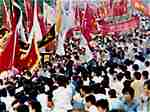
Bolstered by broad-based support, more than 150,000 students surge past police lines and fill Tiananmen Square, chanting slogans for democracy and freedom.

April 29
Government officials meet with student leaders, but independent student groups say they will continue a class boycott at 41 university campuses in Beijing.

May 2
6,000 students march in Shanghai.

May 4
100,000 students and supporters march on Tiananmen square to celebrate the 70th anniversary of Student hunger strike China’s first student movement, while similar demonstrations are held in Shanghai, Nanjing and other cities. 300 journalists protest outside the official Xinhua News Agency.

May 9
Journalists petition the government for freedom of the press.

May 13
2,000 students begin a hunger strike in Tiananmen Square.

Rally on the eve of GorbachevMay 15
Government deadline for students to leave the square comes and goes. A welcoming ceremony for Soviet leader Mikhail Gorbachev’s state visit is moved to the airport.

tienanmen-12-rally.jpgMay 16
Hundreds of thousands of demonstrators occupy the square.

May 18
One million people march in support of the hunger strikers. Li PengLi Peng, Premier of the State Council, issues a stern warning to student leaders and refuses to discuss their demands.

May 19
Zhoa ZiyangA tearful Zhao Ziyang, China’s General Secretary, makes a pre-dawn visit to weakened hunger strikers. Li also visits the students briefly. In the evening the students decide to end the hunger strike, but quickly change their mind when Li and President Yang Shangkun announce martial law. Zhao reportedly resigns or is ousted from power after failing to convince Li and others to compromise.

Yang ShangkunMay 20, 1989
Chinese authorities ‘pull the plug’ on Dan Rather who is reporting live from Beijing.

May 28
About 80,000 people (mostly students from outside the capital) demonstrate but, unlike past rallies, few workers participate.
Goddess of Democracy
May 30
Students unveil their “Goddess of Democracy,” a replica of the Statue of Liberty, on the square. The government calls it an insult to the nation.

May 31
Farmers and workers stage the first of several pro-government rallies in Beijing’s suburbs.

June 1
The Beijing Municipal Government bans all foreign press coverage of the demonstrations.

June 3
Tens of thousands of troops advance on the city shortly after midnight, but are repulsed by residents who put up barricades. PLA troops stopped by civilians By the afternoon 5,000 troops appear outside the Great Hall of the People, but are again surrounded and stopped. In the final assault that evening, troops shoot and beat their way to the square.

Taping the beginnings of the massacre, correspondent Richard Roth is arrested.

June 4
Troops occupy the square and smash the “Goddess of Democracy” with tanks. The shooting continues with soldiers periodically firing on crowds gathered on the outskirts of the square. Residents set fire to more than 100 military trucks and armored personnel carriers. The government claims the “counterrevolutionary riots” have been suppressed. Meanwhile, riots break out in southwestern Chengdu.

Richard Roth is released and reports further on the night’s violence.
PLA troops confront civilians
June 5
There are reports of clashes between rival military groups around Beijing. President Bush condemns the “bloody and violent” crackdown and orders a suspension of U.S. military sales and contacts with the Chinese government.

June 5, 1989
Richard Roth reports: one anonymous man stops a column of 18 tanks.
Wounded civilian
June 6
Foreign embassies advise their nationals to leave China. The government says 300 people were killed and 7,000 injured in the crackdown, but claims most of the dead were soldiers. There are more reports of clashes between military units. Six people are killed in Shanghai when a train runs through a barricade. The U.S. State Department announces that dissident Fang Lizhi and his wife have sought refuge in the U.S. Embassy.
An advancing tank
June 7
Troops, responding to what they say is sniper fire, shoot into a foreign diplomatic compound. The United States and other governments order the mandatory evacuation of dependents of diplomatic personnel.

June 8
Premier Li Peng appears in public for the first time since the crackdown to congratulate troops.
Deng Xiaoping
June 9
China’s leader Deng Xiaoping appears for the first time since May 16. In a speech to military officers he blames the turmoil on counterrevolutionaries attempting to overthrow communism.

Motorcycle crushed by a tankJune 10
Beijing authorities announce the arrest of more than 400 people, including student and labor leaders.

June 11
The government issues a warrant for the arrest of Fang Lizhi and his wife, saying they committed crimes of “counterrevolutionary propaganda and instigation.” Fang Lizhi

June 12
The government bans all independent student and labor organizations and says police and soldiers should shoot all “rioters and counterrevolutionaries.”PLA tank on patrol

June 13
The government issues a wanted list for 21 student activists who led the democracy movement.
Student leader Wang Dan

June 14
China orders the expulsion of Associated Press reporter John Pomfret and Voice of America Bureau Chief Alan Pessin.

June 15
Three Shanghai men are sentenced to death for burning a train that ran over protesters. The nationwide arrest total reaches above 1,000.
Soldiers seen through window of burned vehicle
June 17
A Beijing court sentences eight people to death for attacking soldiers and burning vehicles during the June 3-4 assault.

June 18
Politburo member Qiao Shi appears prominently in the official media, adding to speculation the party security man will replace Zhao.

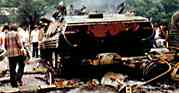
A burned tank
June 20
The government nullifies all exit permits in an apparent attempt to stop fugitives from leaving the country.

Al-Qaeda in Iraq back in Afghanistan!

Do you chose to believe this yarn? It’s not long, it’s circular. US casualties in Afghanistan have surpassed casualties in Iraq, and to explain it maybe, US military spokesman have revealed they believe the leadership of al-Qaeda in Iraq is now back in Afghanistan!

Let’s see. We attacked Afghanistan because the Taliban refused to rein in its terrorist arm, purportedly named al-Qaeda. Which may or may not be a figment of US military intelligence imagination. We know about al-Qaeda only through our military interrogator, plus the 19-known hijackers who were dead before there was public mention of al-Qaeda, and no al-Qaeda charges have stuck to any Guantanamo inmate so far.

We can’t find it, do we know “it” exists?

So we attack Iraq which had no known al-Qaeda, until, our same dubious military intelligence people inform us there is an “al-Qaeda in Iraq,” actually, in Mesopotamia, actually, in the Land of the Two Rivers. Depending on the translation.

Was the original logo IN ENGLISH? Actually Osama’s gang was a CIA creation, so the origial al-Qaeda tattoo may have been designed in Langly, then put back and forth through Babblefish to obscure the non-Arabic speaking origins. Or not.

Fair enough, but we still only have our propaganda team to vouch for it, and have we ever known them to tell us anything truthful? Every time insurgents are engaged we hear our forces have killed an al-Qaeda leader. It’s usually the first we’ve heard of the person, and the last. Except the guy they’ve now killed twice.

So every act of violence in Iraq is blamed on AQII until we want to talk about the “surge” working. If we want to declare the “surge” a success, AQII has to goway. And where better than to where it came from (maybe?) Afghanistan!

If we surge into Afghanistan, which Barack Obama has declared we should do, and if THAT’S a hit, soon enough we’ll have it cornered to be al-Qaida in a Cave, and then al-Qaeda in Osama’s Teevee Room!

If we applied the same logic to the Weapons of Mass Destruction supposed to be in Iraq, we could look for them where they came from. The WMD in American chemical weapons companies!

Howabout an unexpurgated face of war

Forbidden image of a dead US soldierThe US media was not permitted to depict fallen soldiers, in or out of the coffin. Next military censors forbade photos of US wounded. Most recently US soldiers have been under orders to prohibit the press from photographing them at all, to promote the illusion that our Iraqi surrogates alone are handling security. How infuriated our officials must have been to see this photograph in the international press.

Do Americans not want to see their fallen boys? In my recent experience with death, I most certainly wanted to see what happened straight up. Do the families of soldiers really not want to see how their loved one met his/her fate? What utter bullshit! If they don’t I do. Someone should care enough for the poor lost life!

Hopefully the total control our military has been asserting over media images will result in more outright mutiny on the part of international photo journalists.

Not long ago, a sequence of photos which documented the aftermath of an IED led the DoD to forbid all depictions of even wounded soldiers. The picture below shows a victim trying vainly to join his comrades who made it to cover. He didn’t die. But this image most certainly is dispiriting to Americans watching safely from their homes, who are losing their stamina for an ugly war.

Last permitted photo of a wounded US soldier

Before coverage of operations in Iraq were safely controlled by only embedded reporters, freelance photographers were able to record images reminiscent of WWII, Korea and Vietnam. These GIs fell in the assault on Fallujah. Fortunately for the Pentagon, Iraq is now too dangerous for journalist who don’t have American minders.
US casualties in Fallujah

A recent so-called breach of an embed contract yielded images of the aftermath of a suicide-bomb attack. The American photographer incurred heavy criticism for publishing the pictures which his Marine unit had ordered him to erase. But they were published in B&W, which invokes the famous WWII Pacific Theater dead, but it does lessen the realism, doesn’t it? These casualties seem more distant than our losses in Vietnam. And how do you reconcile that the simultaneous photos of the Iraqi casualties were printed adjacent in color? We can handle seeing the red of their blood, but not ours?

Dead US Marines

MC FogHorn Leghorn and the F’N MA

Fat Fannie and Fudgebutt FredWith record high foreclosures due to predatory lenders and sham mortgages, who’s in favor of a taxpayer bailout to the Federal National Mortgage Assoc.?
Or how about public monies to save the Federal Home Loan Mortgage Corporation? No takers? The homeowners are still screwed, but the lenders need our help. They’re shareholder owned, government sanctioned monopolies, and they need 25 billion. No sympathetic alms? Good thing both the FNMA and the FHLMC, appointed themselves the intentionally endearing nicknames Fannie Mae and Freddie Mac to confuse our affections.

It reminds me of a classmate who reinvented himself on the first day of college. When professors asked our names or applicable nicknames, this skinny pocket-protector wearer told the class he went by “Bear.” And his unlikely reincarnation stuck. Thereafter “Bear” became that much less an engineering geek than his no more nerdier compatriots.

Fannie and Freddie may sound like personable natural derivatives of their acronyms, but the Appalachian appellations are official. When I was confronted about having apparently misspelled the cutesy MAE, being the purported colloquial surname of the usurious giant, I found there was indeed a formal spelling. Really? For a phonetic abbreviation? Couldn’t it just as easily be spelled with a Y? And why not Fanny with a Y, like Brice, Hackabout-Jones or the derriere? Too much impropriety for hillbillies?

Do the letters FN resolve to “Fanny” more than to the more modern and infinitely appropriate Fucking?

Where did MA become May? Why not Ma, like Ma Dalton?

And wherever do you get Freddie from FHL? I see Foghorn Leghorn for the first initials. Leaving MC for Mack as of The Knife.

The FNMA / FHLMC bonanza provides a textbook simple model of the capitalist stakeout of regulated/unregulated public finance: build a business, merge to create a monopoly, then loot funds to require a taxpayer bailout.

Blue Angels or Bloody Devils?

Young Iraqi victim of US air attacksYear after year, the Pentagon organizes displays of its expensive toys for the supposed benefit of the more moronic of us Americans out there. The so-called Blue Angels are the better known of these militaristic propaganda displays. Here locally we have the Pentagon organizing the ‘In Their Honor’ air show, which is the military patting itself on the back with your tax dollars paying for the charade.

What is it with the neighbors that go to these shows? What do they get out of watching these expensive toys for the uniforms? Noise is one thing, but do they really feel pride in the stupid spectacle of watching aircraft made for killing people flying overhead? What an utterly wasted and stupid mindset!

These ‘Blue Angels’ are made to kill people with and should better be labeled ‘Bloody Devils’. Stop cheering them on when the government pulls these toys out. Watching this stuff is watching worse nonsense than the stupidest show the ex Soviet Union ever pulled off.

United States of Greed, Torture & Death

Obama commits to escalating war in Afghanistan. I guess there weren’t enough wedding parties being bombed.

2009 forecast: nuclear winter. Israeli Mossad propaganda outlet predicts Bush will attack Iran between November election, and end of term in January.

If Freddie and Fannie want a bail-out, they should go directly to the Chinese and ask for a loan. The US gov’t should not go further in debt to the Chinese on their behalf.

Zimbabwe begins printing $100 Billion bank notes, worth about $1 US.

Pope appologizes for sexually molesting children.

Senator Lindsey Graham (R-SC) says McCain is so boring, it’s torture. “If you took all the people at Gitmo, put them in the cabin for a weekend and made them listen to John talk about the birds, they would all spill their guts.”

Excerpts from Thomas McCullock’s notes July 21, thomasmc.com.

American government and business refuse to take any measures to conserve energy

All American businesses are trying to pose themselves as being respecters of the environment, energy efficient, and Green, and so is the Federal Government and Pentagon, too. However, even a cursory examination of policies by these organizations show that American government and businesses, at all levels, simply refuse to take any major measures to reduce energy consumption by our country.

Big Business controls government in our country, which can scarcely be considered a democracy due to this business control. We are a corporate plutocracy instead. So, at this time, it is really in corporate hands to control major government policy regarding energy use. What are the needed measures in this country to reduce energy use? These measures are never mentioned or talked about, simply because Big Business and corporate Big government do not want to implement them.

To reduce energy use in the future, government would have to take major steps to change previous and current urban planning and transportation policies. A federal zoning policy would have to be instituted that would make it impossible to stretch out construction of our cities over huge expanses of land as they are stretched out now. Also, measures would have to be taken to push back our overly extended cities into more manageable arenas of human activity. As we can see, corporate government has no plans to do any of this, even though doing it is necessary to reduce energy use.

Too much energy is used in getting people to work, and allowing them to try to escape our ugly cities. Many of our cities are quite frankly pure hell to live in. There is little escape from noise pollution, few clean public spaces of any real beauty, and a boring monotony in our public space. Our cities are making people ill, and most try to escape the cities as much as they can afford. That uses up a lot of fuel.

Simply investing in a really functioning public transit around our country would take a tremendous federal commitment to change the energy inefficient system of public transport we are presently saddled with. There currently are ZERO signs that any of big business and government agencies at almost all levels see any need to change their behaviors, and hence ours. There is nothing on the books other than continuing to fund huge amounts of pavement stretching into infinity.

This is not the time (nor do I have the time now) to discuss the many ways that energy policy must be redirected. Simply enough to just say that American government and Big Business, contrary to how they project themselves in their propaganda, are not interested in taking any measures to conserve energy use in a real manner. They are lying to us when thy talk about being Green. They are ignoring our needs, and are destroying the word for future generations all because they simply want to keep making money in the same old manners they have grown accustomed to. To reduce energy use, our cities must be made into livable places, which most are not.

Reviewing Saddam Hussein’s and the US government’s past terrorism against Iran

Rumsfeld reads own mind So the US government wants to go to war against Iran with its pit bull, Israel, at its side? This would be the second US war against Iran when one recalls that the previous US war against that country had the US government using its Iraqi pit bull, Saddam Hussein, instead of the current Zionist one now at its side, named Olmert. Yes, Olmert is no Baathist, he is of the Zionist breed instead. But still, yet another US bred dog of war at that.

Sasan Fayazmanesh writes of US historical amnesia in his commentary about The Shoot Down of Iran Air Flight 655. There is no historical amnesia here though, almost the entire US public went through the ’80s in a political fog of pure damp ignorance about what was happening in the Middle East. To have amnesia one would have had to known about what was happening in the first place, Sasan. And one cannot expect these propaganda spouting clowns of the US government to know much more about their own direct US historical past than the general US public at large either.

Still, Sasan does help some of us with our much needed history brush ups. Many of us were getting degrees in Business Management back in the ’80s, and the history courses didn’t quite fit in with your ‘education’ at the old Alma Maters, Dudes. Heck, many of you Reaganite Era Beavises and Buttheads were getting credentialed, and didn’t have much time to get an actual education, did yuh? It wasn’t pragmatic enough… Of course, many of you dumb Buttheads will be wanting to get tuf, tuf, tuf against a country whose country your government has terrorized all along. Doh!

Hey, get EXTRA points on your history exam if you can guess why Donald Rumsfeld’s photo graces this commentary with its presence?

DC lies about its massacres of Afghan civilians

Those that have paid the slightest attention to recent events in Afghanistan will have noted the lies of the US government where they claimed that their bombings had not this past week hit and killed any civilians at all. The reality is quite different though. We might note however that the BBC covers its report of these lies by putting the word civilians in parentheses! How indecent the press is in covering up for the liars of DC and London. US ‘killed 47 Afghan civilians’ They are part of the lying and pretense, too.

But let’s think for a second about who is making these accusations about killing civilians? It is the British and US puppet government in Afghanistan itself! So why put the word civilians in parentheses? This is shameful behavior by the servile press of the US and Britain, is it not? They just have to continue to lie on behalf of their own governments? It makes themselves look utterly stupid in doing so.

What does it say about our societies, where we have governments that torture poor countries like Afghanistan with occupation, war, and bloody mayhem? Look in the mirror, Public. Why have you not protested against these atrocities?

I especially find the role of the local ‘peace’ group the PPJPC repugnant in this regard. I am about the only member of this group that has ever even mentioned the word ‘Afghanistan’ in any of their banners and signs, activities and events. Instead they are out there hugging cops, ‘talking’ it over with Fort Carson Pentagon propaganda whores, etc. Meanwhile, the bloody assault on the people of Afghanistan goes on without any ‘peace’ group attention! Just pathetic!

We need to stop believing in the DC Pentagon lies about what they are doing in Afghanistan. This was is every bit as badly intentioned as the war against Iraq is. Just because the Democratic Party is so onboard in their Afghan adventure is no reason for supposed antiwar groups like the Pikes Peak Justice and Peace Commission to sit on their butts about the issue of US atrocities there.

Global economic rapists are at it again

G8 protest
Why protest the G8 Summit July 7-9? Those hoodlums always look so determined. Here’s the rationale by the Emergency Exit Collective:

The 2008 G8 on Hokkaido, a Strategic Assessment
Emergency Exit Collective
Bristol, Mayday, 2008

The authors of this document are a collection of activists, scholars, and writers currently based in the United States and Western Europe who have gotten to know and work with each other in the movement against capitalist globalization. We’re writing this at the request of some members of No! G8 Action Japan, who asked us for a broad strategic analysis of the state of struggle as we see it, and particularly, of the role of the G8, what it represents, the dangers and opportunities that may lie hidden in the moment. It is in no sense programmatic. Mainly, it is an attempt to develop tools that we hope will be helpful for organizers, or for anyone engaged in the struggle against global capital.

I
It is our condition as human beings that we produce our lives in common.

II
Let us then try to see the world from the perspective of the planet’s commoners, taking the word in that sense: those whose most essential tradition is cooperation in the making and maintenance of human social life, yet who have had to do so under conditions of suffering and separation; deprived, ignored, devalued, divided into hierarchies, pitted against each other for our very physical survival. In one sense we are all commoners. But it’s equally true that just about everyone, at least in some ways, at some points, plays the role of the rulers—of those who expropriate, devalue and divide—or at the very least benefits from such divisions.

Obviously some do more than others. It is at the peak of this pyramid that we encounter groups like the G8.

III
The G8’s perspective is that of the aristocrats, the rulers: those who command and maintain that global machinery of violence that defends existing borders and lines of separation: whether national borders with their detention camps for migrants, or property regimes, with their prisons for the poor. They live by constantly claiming title to the products of others collective creativity and labour, and in thus doing they create the poor; they create scarcity in the midst of plenty, and divide us on a daily basis; they create financial districts that loot resources from across the world, and in thus doing they turn the spirit of human creativity into a spiritual desert; close or privatize parks, public water taps and libraries, hospitals, youth centers, universities, schools, public swimming pools, and instead endlessly build shopping malls that channels convivial life into a means of commodity circulation; work toward turning global ecological catastrophe into business opportunities.

These are the people who presume to speak in the name of the “international community” even as they hide in their gated communities or meet protected by phalanxes of riot cops. It is critical to bear in mind that the ultimate aim of their policies is never to create community but to introduce and maintain divisions that set common people at each other’s throats. The neoliberal project, which has been their main instrument for doing so for the last three decades, is premised on a constant effort either to uproot or destroy any communal or democratic system whereby ordinary people govern their own affairs or maintain common resources for the common good, or, to reorganize each tiny remaining commons as an isolated node in a market system in which livelihood is never guaranteed, where the gain of one community must necessarily be at the expense of others. Insofar as they are willing to appeal to high-minded principles of common humanity, and encourage global cooperation, only and exactly to the extent that is required to maintain this system of universal competition.

IV
At the present time, the G8—the annual summit of the leaders of “industrial democracies”—is the key coordinative institution charged with the task of maintaining this neoliberal project, or of reforming it, revising it, adapting it to the changing condition of planetary class relations. The role of the G8 has always been to define the broad strategic horizons through which the next wave of planetary capital accumulation can occur. This means that its main task is to answer the question of how 3?4 in the present conditions of multiple crises and struggles 3?4 to subordinate social relations among the producing commoners of the planet to capital’s supreme value: profit.

V
Originally founded as the G7 in 1975 as a means of coordinating financial strategies for dealing with the ‘70s energy crisis, then expanded after the end of the Cold War to include Russia, its currently face a moment of profound impasse in the governance of planetary class relations: the greatest since the ‘70s energy crisis itself.

VI
The ‘70s energy crisis represented the final death-pangs of what might be termed the Cold War settlement, shattered by a quarter century of popular struggle. It’s worth returning briefly to this history.

The geopolitical arrangements put in place after World War II were above all designed to forestall the threat of revolution. In the immediate wake of the war, not only did much of the world lie in ruins, most of world’s population had abandoned any assumption about the inevitability of existing social arrangements. The advent of the Cold War had the effect of boxing movements for social change into a bipolar straightjacket. On the one hand, the former Allied and Axis powers that were later to unite in the G7 (the US, Canada, UK, France, Italy, Germany, Japan)—the “industrialized democracies”, as they like to call themselves—engaged in a massive project of co-optation. Their governments continued the process, begun in the ‘30s, of taking over social welfare institutions that had originally been created by popular movements (from insurance schemes to public libraries), even to expand them, on condition that they now be managed by state-appointed bureaucracies rather than by those who used them, buying off unions and the working classes more generally with policies meant to guarantee high wages, job security and the promise of educational advance—all in exchange for political loyalty, productivity increases and wage divisions within national and planetary working class itself. The Sino-Soviet bloc—which effectively became a kind of junior partner within the overall power structure, and its allies remained to trap revolutionary energies into the task of reproducing similar bureaucracies elsewhere. Both the US and USSR secured their dominance after the war by refusing to demobilize, instead locking the planet in a permanent threat of nuclear annihilation, a terrible vision of absolute cosmic power.

VII
Almost immediately, though, this arrangement was challenged by a series of revolts from those whose work was required to maintain the system, but who were, effectively, left outside the deal: first, peasants and the urban poor in the colonies and former colonies of the Global South, next, disenfranchised minorities in the home countries (in the US, the Civil Rights movement, then Black Power), and finally and most significantly, by the explosion of the women’s movement of the late ‘60s and early ‘70s—the revolt of that majority of humanity whose largely unremunerated labor made the very existence “the economy” possible. This appears to have been the tipping point.

VIII
The problem was that the Cold War settlement was never meant to include everyone. It by definition couldn’t. Once matters reached tipping point, then, the rulers scotched the settlement. All deals were off. The oil shock was first edge of the counter-offensive, breaking the back of existing working class organizations, driving home the message that there was nothing guaranteed about prosperity. Under the aegis of the newly hatched G7, this counter-offensive involved a series of interwoven strategies that were later to give rise to what is known as neoliberalism.

IX
These strategies resulted in what came to be known as “Structural Adjustment” both in the North and in the South, accompanied by trade and financial liberalization. This, in turn, made possible crucial structural changes in our planetary production in common extending the role of the market to discipline our lives and divide us into more and more polarized wage hierarchy. This involved:

· In the immediate wake of ‘70s oil shock, petrodollars were recycled from OPEC into Northern banks that then lent them, at extortionate rates of interest, to developing countries of the Global South. This was the origin of the famous “Third World Debt Crisis.” The existence of this debt allowed institutions like the IMF to impose its monetarist orthodoxy on most of the planet for roughly twenty years, in the process, stripping away most of even those modest social protections that had been won by the world’s poor—large numbers of whom were plunged into a situation of absolute desperation.

· It also opened a period of new enclosures through the capitalist imposition of structural adjustment policies, manipulation of environmental and social catastrophes like war, or for that matter through the authoritarian dictates of “socialist” regimes. Through such means, large sections of the world’s population have over the past thirty years been dispossessed from resources previously held in common, either by dint of long traditions, or as the fruits of past struggles and past settlements.

· Through financial deregulation and trade liberalization, neoliberal capital, which emerged from the G7 strategies to deal with the 1970s crisis aimed thus at turning the “class war” in communities, factories, offices, streets and fields against the engine of competition, into a planetary “civil war”, pitting each community of commoners against every other community of commoners.

· Neoliberal capital has done this by imposing an ethos of “efficiency” and rhetoric of “lowering the costs of production” applied so broadly that mechanisms of competition have come to pervade every sphere of life. In fact these terms are euphemisms, for a more fundamental demand: that capital be exempt from taking any reduction in profit to finance the costs of reproduction of human bodies and their social and natural environments (which it does not count as costs) and which are, effectively, “exernalized” onto communities and nature.

· The enclosure of resources and entitlements won in previous generations of struggles both in the North and the South, in turn, created the conditions for increasing the wage hierarchies (both global and local), by which commoners work for capital—wage hierarchies reproduced economically through pervasive competition, but culturally, through male dominance, xenophobia and racism. These wage gaps, in turn, made it possible to reduce the value of Northern workers’ labour power, by introducing commodities that enter in their wage basket at a fraction of what their cost might otherwise have been. The planetary expansion of sweatshops means that American workers (for example) can buy cargo pants or lawn-mowers made in Cambodia at Walmart, or buy tomatoes grown by undocumented Mexican workers in California, or even, in many cases, hire Jamaican or Filipina nurses to take care of children and aged grandparents at such low prices, that their employers have been able to lower real wages without pushing most of them into penury. In the South, meanwhile, this situation has made it possible to discipline new masses of workers into factories and assembly lines, fields and offices, thus extending enormously capital’s reach in defining the terms—the what, the how, the how much—of social production.

· These different forms of enclosures, both North and South, mean that commoners have become increasingly dependent on the market to reproduce their livelihoods, with less power to resist the violence and arrogance of those whose priorities is only to seek profit, less power to set a limit to the market discipline running their lives, more prone to turn against one another in wars with other commoners who share the same pressures of having to run the same competitive race, but not the same rights and the same access to the wage. All this has meant a generalized state of precarity, where nothing can be taken for granted.

X
In turn, this manipulation of currency and commodity flows constituting neoliberal globalization became the basis for the creation of the planet’s first genuine global bureaucracy.

· This was multi-tiered, with finance capital at the peak, then the ever-expanding trade bureaucracies (IMF, WTO, EU, World Bank, etc), then transnational corporations, and finally, the endless varieties of NGOs that proliferated throughout the period—almost all of which shared the same neoliberal orthodoxy, even as they substituted themselves for social welfare functions once reserved for states.

· The existence of this overarching apparatus, in turn, allowed poorer countries previously under the control of authoritarian regimes beholden to one or another side in the Cold War to adopt “democratic” forms of government. This did allow a restoration of formal civil liberties, but very little that could really merit the name of democracy (the rule of the “demos”, i.e., of the commoners). They were in fact constitutional republics, and the overwhelming trend during the period was to strip legislatures, that branch of government most open to popular pressure, of most of their powers, which were increasingly shifted to the executive and judicial branches, even as these latter, in turn, largely ended up enacting policies developed overseas, by global bureaucrats.

· This entire bureaucratic arrangement was justified, paradoxically enough, by an ideology of extreme individualism. On the level of ideas, neoliberalism relied on a systematic cooptation of the themes of popular struggle of the ‘60s: autonomy, pleasure, personal liberation, the rejection of all forms of bureaucratic control and authority. All these were repackaged as the very essence of capitalism, and the market reframed as a revolutionary force of liberation.

· The entire arrangement, in turn, was made possible by a preemptive attitude towards popular struggle. The breaking of unions and retreat of mass social movements from the late ‘70s onwards was only made possible by a massive shift of state resources into the machinery of violence: armies, prisons and police (secret and otherwise) and an endless variety of private “security services”, all with their attendant propaganda machines, which tended to increase even as other forms of social spending were cut back, among other things absorbing increasing portions of the former proletariat, making the security apparatus an increasingly large proportion of total social spending. This approach has been very successful in holding back mass opposition to capital in much of the world (especially West Europe and North America), and above all, in making it possible to argue there are no viable alternatives. But in doing so, has created strains on the system so profound it threatens to undermine it entirely.

XI
The latter point deserves elaboration. The element of force is, on any number of levels, the weak point of the system. This is not only on the constitutional level, where the question of how to integrate the emerging global bureaucratic apparatus, and existing military arrangements, has never been resolved. It is above all an economic problem. It is quite clear that the maintenance of elaborate security machinery is an absolute imperative of neoliberalism. One need only observe what happened with the collapse of the Soviet bloc in Eastern Europe: where one might have expected the Cold War victors to demand the dismantling of the army, secret police and secret prisons, and to maintain and develop the existing industrial base, in fact, what they did was absolutely the opposite: in fact, the only part of the industrial base that has managed fully to maintain itself has been the parts required to maintained the security apparatus itself! Critical too is the element of preemption: the governing classes in North America, for example, are willing to go to almost unimaginable lengths to ensure social movements never feel they are accomplishing anything. The current Gulf War is an excellent example: US military operations appear to be organized first and foremost to be protest-proof, to ensure that what happened in Vietnam (mass mobilization at home, widespread revolt within the army overseas) could never be repeated. This means above all that US casualties must always be kept to a minimum. The result are rules of engagement, and practices like the use of air power within cities ostensibly already controlled by occupation forces, so obviously guaranteed to maximize the killing of innocents and galvanizing hatred against the occupiers that they ensure the war itself cannot be won. Yet this approach can be taken as the very paradigm for neoliberal security regimes. Consider security arrangements around trade summits, where police are so determined prevent protestors from achieving tactical victories that they are often willing to effectively shut down the summits themselves. So too in overall strategy. In North America, such enormous resources are poured into the apparatus of repression, militarization, and propaganda that class struggle, labor action, mass movements seem to disappear entirely. It is thus possible to claim we have entered a new age where old conflicts are irrelevant. This is tremendously demoralizing of course for opponents of the system; but those running the system seem to find that demoralization so essential they don’t seem to care that the resultant apparatus (police, prisons, military, etc) is, effectively, sinking the entire US economy under its dead weight.

XII
The current crisis is not primarily geopolitical in nature. It is a crisis of neoliberalism itself. But it takes place against the backdrop of profound geopolitical realignments. The decline of North American power, both economic and geopolitical has been accompanied by the rise of Northeast Asia (and to a increasing extent, South Asia as well). While the Northeast Asian region is still divided by painful Cold War cleavages—the fortified lines across the Taiwan straits and at the 38th parallel in Korea…—the sheer realities of economic entanglement can be expected to lead to a gradual easing of tensions and a rise to global hegemony, as the region becomes the new center of gravity of the global economy, of the creation of new science and technology, ultimately, of political and military power. This may, quite likely, be a gradual and lengthy process. But in the meantime, very old patterns are rapidly reemerging: China reestablishing relations with ancient tributary states from Korea to Vietnam, radical Islamists attempting to reestablish their ancient role as the guardians of finance and piety at the in the Central Asian caravan routes and across Indian Ocean, every sort of Medieval trade diaspora reemerging… In the process, old political models remerge as well: the Chinese principle of the state transcending law, the Islamic principle of a legal order transcending any state. Everywhere, we see the revival too of ancient forms of exploitation—feudalism, slavery, debt peonage—often entangled in the newest forms of technology, but still echoing all the worst abuses of the Middle Ages. A scramble for resources has begun, with US occupation of Iraq and saber-rattling throughout the surrounding region clearly meant (at least in part) to place a potential stranglehold the energy supply of China; Chinese attempts to outflank with its own scramble for Africa, with increasing forays into South America and even Eastern Europe. The Chinese invasion into Africa (not as of yet at least a military invasion, but already involving the movement of hundreds of thousands of people), is changing the world in ways that will probably be felt for centuries. Meanwhile, the nations of South America, the first victims of the “Washington consensus” have managed to largely wriggle free from the US colonial orbit, while the US, its forces tied down in the Middle East, has for the moment at least abandoned it, is desperately struggling to keep its grip Mexico, Central America and the Caribbean—its own “near abroad”.

XIII
In another age all this might have led to war—that is, not just colonial occupations, police actions, or proxy wars (which are obviously already taking place), but direct military confrontations between the armies of major powers. It still could; accidents happen; but there is reason to believe that, when it comes to moments of critical decision, the loyalties of the global elites are increasingly to each other, and not to the national entities for whom they claim to speak. There is some compelling evidence for this.

Take for example when the US elites panicked at the prospect of the massive budget surpluses of the late 1990s. As Alan Greenspan, head of the Federal Reserve at the time warned, if these were allowed to stand they would have flooded government coffers with so many trillions of dollars that it could only have lead to some form of creeping socialism, even, he predicted, to the government acquiring “equity stakes” in key US corporations. The more excitable of capitalism’s managers actually began contemplating scenarios where the capitalist system itself would be imperiled. The only possible solution was massive tax cuts; these were duly enacted, and did indeed manage to turn surpluses into enormous deficits, financed by the sale of treasury bonds to Japan and China. Conditions have thus now reached a point where it is beginning to look as if the most likely long term outcome for the US (its technological and industrial base decaying, sinking under the burden of its enormous security spending) will be to end up serve as junior partner and military enforcer for East Asia capital. Its rulers, or at least a significant proportion of them, would prefer to hand global hegemony to the rulers of China (provided the latter abandon Communism) than to return to any sort of New Deal compromise with their “own” working classes.

A second example lies in the origins of what has been called the current “Bretton Woods II” system of currency arrangements, which underline a close working together of some “surplus” and “deficit” countries within global circuits. The macroeconomic manifestation of the planetary restructuring outlined in XIX underlines both the huge US trade deficit that so much seem to worry many commentators, and the possibility to continually generate new debt instruments like the one that has recently resulted in the sub-prime crisis. The ongoing recycling of accumulated surplus of countries exporting to the USA such as China and oil producing countries is what has allowed financiers to create new credit instruments in the USA. Hence, the “deal” offered by the masters in the United States to its commoners has been this: ‘you, give us a relative social peace and accept capitalist markets as the main means through which you reproduce your own livelihoods, and we will give you access to cheaper consumption goods, access to credit for buying cars and homes, and access to education, health, pensions and social security through the speculative means of stock markets and housing prices.’ Similar compromises were reached in all the G8 countries.

Meanwhile, there is the problem of maintaining any sort of social peace with the hundreds of millions of unemployed, underemployed, dispossessed commoners currently swelling the shanty-towns of Asia, Africa, and Latin America as a result of ongoing enclosures (which have speeded up within China and India in particular, even as “structural adjustment policies” in Africa and Latin America have been derailed). Any prospect of maintaining peace in these circumstances would ordinarily require either extremely high rates of economic growth—which globally have not been forthcoming, since outside of China, growth rates in the developing world have been much lower than they were in the ‘50s, ‘60s, or even ‘70s—or extremely high levels of repression, lest matters descend into rebellion or generalized civil war. The latter has of course occurred in many parts of the world currently neglected by capital, but in favored regions, such as the coastal provinces of China, or “free trade” zones of India, Egypt, or Mexico, commoners are being offered a different sort of deal: industrial employment at wages that, while very low by international standards, are still substantially higher than anything currently obtainable in the impoverished countryside; and above all the promise, through the intervention of Western markets and (privatized) knowledge, of gradually improving conditions of living. While over the least few years wages in many such areas seem to be growing, thanks to the intensification of popular struggles, such gains are inherently vulnerable: the effect of recent food inflation has been to cut real wages back dramatically—and threaten millions with starvation.

What we really want to stress here, though, is that the long-term promise being offered to the South is just as untenable as the idea that US or European consumers can indefinitely expand their conditions of life through the use of mortgages and credit cards.

What’s being offered the new dispossessed is a transposition of the American dream. The idea is that the lifestyle and consumption patterns of existing Chinese, Indian, or Brazilian or Zambian urban middle classes (already modeled on Northern ones) will eventually become available to the children of today’s miners, maquila or plantation laborers, until, ultimately, everyone on earth is brought up to roughly the same level of consumption. Put in these terms, the argument is absurd. The idea that all six billion of us can become “middle class” is obviously impossible. First of all there is a simple problem of resources. It doesn’t matter how many bottles we recycle or how energy efficient are the light bulbs we use, there’s just no way the earth’s ecosystem can accommodate six billion people driving in private cars to work in air-conditioned cubicles before periodically flying off to vacation in Acapulco or Tahiti. To maintain the style of living and producing in common we now identify with “middle classness” on a planetary scale would require several additional planets.

This much has been pointed out repeatedly. But the second point is no less important. What this vision of betterment ultimately proposes is that it would be possible to build universal prosperity and human dignity on a system of wage labor. This is fantasy. Historically, wages are always the contractual face for system of command and degradation, and a means of disguising exploitation: expressing value for work only on condition of stealing value without work— and there is no reason to believe they could ever be anything else. This is why, as history has also shown, human beings will always avoid working for wages if they have any other viable option. For a system based on wage labor to come into being, such options must therefore be made unavailable. This in turn means that such systems are always premised on structures of exclusion: on the prior existence of borders and property regimes maintained by violence. Finally, historically, it has always proved impossible to maintain any sizeable class of wage-earners in relative prosperity without basing that prosperity, directly or indirectly, on the unwaged labor of others—on slave-labor, women’s domestic labor, the forced labor of colonial subjects, the work of women and men in peasant communities halfway around the world—by people who are even more systematically exploited, degraded, and immiserated. For that reason, such systems have always depended not only on setting wage-earners against each other by inciting bigotry, prejudice, hostility, resentment, violence, but also by inciting the same between men and women, between the people of different continents (“race”), between the generations.

From the perspective of the whole, then, the dream of universal middle class “betterment” must necessarily be an illusion constructed in between the Scylla of ecological disaster, and the Charybdis of poverty, detritus, and hatred: precisely, the two pillars of today’s strategic impasse faced by the G8.

XIV
How then do we describe the current impasse of capitalist governance?

To a large degree, it is the effect of a sudden and extremely effective upswing of popular resistance—one all the more extraordinary considering the huge resources that had been invested in preventing such movements from breaking out.

On the one hand, the turn of the millennium saw a vast and sudden flowering of new anti-capitalist movements, a veritable planetary uprising against neoliberalism by commoners in Latin America, India, Africa, Asia, across the North Atlantic world’s former colonies and ultimately, within the cities of the former colonial powers themselves. As a result, the neoliberal project lies shattered. What came to be called the “anti-globalization” movement took aim at the trade bureaucracies—the obvious weak link in the emerging institutions of global administration—but it was merely the most visible aspect of this uprising. It was however an extraordinarily successful one. Not only was the WTO halted in its tracks, but all major trade initiatives (MAI, FTAA…) scuttled. The World Bank was hobbled and the power of the IMF over most of the world’s population, effectively, destroyed. The latter, once the terror of the Global South, is now a shattered remnant of its former self, reduced to selling off its gold reserves and desperately searching for a new global mission.

In many ways though spectacular street actions were merely the most visible aspects of much broader changes: the resurgence of labor unions, in certain parts of the world, the flowering of economic and social alternatives on the grassroots levels in every part of the world, from new forms of direct democracy of indigenous communities like El Alto in Bolivia or self-managed factories in Paraguay, to township movements in South Africa, farming cooperatives in India, squatters’ movements in Korea, experiments in permaculture in Europe or “Islamic economics” among the urban poor in the Middle East. We have seen the development of thousands of forms of mutual aid association, most of which have not even made it onto the radar of the global media, often have almost no ideological unity and which may not even be aware of each other’s existence, but nonetheless share a common desire to mark a practical break with capitalism, and which, most importantly, hold out the prospect of creating new forms of planetary commons that can—and in some cases are—beginning to knit together to provide the outlines of genuine alternative vision of what a non-capitalist future might look like.

The reaction of the world’s rulers was predictable. The planetary uprising had occurred during a time when the global security apparatus was beginning to look like it lacked a purpose, when the world threatened to return to a state of peace. The response—aided of course, by the intervention of some of the US’ former Cold War allies, reorganized now under the name of Al Qaeda—was a return to global warfare. But this too failed. The “war on terror”—as an attempt to impose US military power as the ultimate enforcer of the neoliberal model—has collapsed as well in the face of almost universal popular resistance. This is the nature of their “impasse”.

At the same time, the top-heavy, inefficient US model of military capitalism—a model created in large part to prevent the dangers of social movements, but which the US has also sought to export to some degree simply because of its profligacy and inefficiency, to prevent the rest of the world from too rapidly overtaking them—has proved so wasteful of resources that it threatens to plunge the entire planet into ecological and social crisis. Drought, disaster, famines, combine with endless campaigns of enclosure, foreclosure, to cast the very means of survival—food, water, shelter—into question for the bulk of the world’s population.

XV
In the rulers’ language the crisis understood, first and foremost, as a problem of regulating cash flows, of reestablishing, as they like to put it, a new “financial architecture”. Obviously they are aware of the broader problems. Their promotional literature has always been full of it. From the earliest days of the G7, through to the days after the Cold War, when Russia was added as a reward for embracing capitalism, they have always claimed that their chief concerns include

· the reduction of global poverty

· sustainable environmental policies

· sustainable global energy policies

· stable financial institutions governing global trade and currency transactions

If one were to take such claims seriously, it’s hard to see their overall performance as anything but a catastrophic failure. At the present moment, all of these are in crisis mode: there are food riots, global warming, peak oil, and the threat of financial meltdown, bursting of credit bubbles, currency crises, a global credit crunch. [**Failure on this scale however, opens opportunities for the G8 themselves, as summit of the global bureaucracy, to reconfigure the strategic horizon. Therefore, it’s always with the last of these that they are especially concerned. ]The real problem, from the perspective of the G8, is one of reinvestment: particularly, of the profits of the energy sector, but also, now, of emerging industrial powers outside the circle of the G8 itself. The neoliberal solution in the ‘70s had been to recycle OPEC’s petrodollars into banks that would use it much of the world into debt bondage, imposing regimes of fiscal austerity that, for the most part, stopped development (and hence, the emergence potential rivals) in its tracks. By the ‘90s, however, much East Asia in particular had broken free of this regime. Attempts to reimpose IMF-style discipline during the Asian financial crisis of 1997 largely backfired. So a new compromise was found, the so-called Bretton Woods II: to recycle the profits from the rapidly expanding industrial economies of East Asia into US treasury debt, artificially supporting the value of the dollar and allowing a continual stream of cheap exports that, aided by the US housing bubble, kept North Atlantic economies afloat and buy off workers there with cheap oil and even cheaper consumer goods even as real wages shrank. This solution however soon proved a temporary expedient. Bush regime’s attempt to lock it in by the invasion of Iraq, which was meant to lead to the forced privatization of Iraqi oil fields, and, ultimately, of the global oil industry as a whole, collapsed in the face of massive popular resistance (just as Saddam Hussein’s attempt to introduce neoliberal reforms in Iraq had failed when he was still acting as American deputy in the ‘90s). Instead, the simultaneous demand for petroleum for both Chinese manufacturers and American consumers caused a dramatic spike in the price of oil. What’s more, rents from oil and gas production are now being used to pay off the old debts from the ‘80s (especially in Asia and Latin America, which have by now paid back their IMF debts entirely), and—increasingly—to create state-managed Sovereign Wealth Funds that have largely replaced institutions like the IMF as the institutions capable of making long-term strategic investments. The IMF, purposeless, tottering on the brink of insolvency, has been reduced to trying to come up with “best practices” guidelines for fund managers working for governments in Singapore, Seoul, and Abu Dhabi.

There can be no question this time around of freezing out countries like China, India, or even Brazil. The question for capital’s planners, rather, is how to channel these new concentrations of capital in such a way that they reinforce the logic of the system instead of undermining it.

XVI
How can this be done? This is where appeals to universal human values, to common membership in an “international community” come in to play. “We all must pull together for the good of the planet,” we will be told. The money must be reinvested “to save the earth.”

To some degree this was always the G8 line: this is a group has been making an issue of climate change since 1983. Doing so was in one sense a response to the environmental movements of the ‘70s and ‘80s. The resultant emphasis on biofuels and “green energy” was from their point of view, the perfect strategy, seizing on an issue that seemed to transcend class, appropriating ideas and issues that emerged from social movements (and hence coopting and undermining especially their radical wings), and finally, ensuring such initiatives are pursued not through any form of democratic self-organization but “market mechanisms”—to effective make the sense of public interest productive for capitalism.

What we can expect now is a two-pronged attack. On the one hand, they will use the crisis to attempt to reverse the gains of past social movements: to put nuclear energy back on the table to deal with the energy crisis and global warming, or genetically modified foods to deal with the food crisis. Prime Minister Fukuda, the host of the current summit, for example, is already proposing the nuclear power is the “solution” to the global warming crisis, even as the German delegation resists. On the other, and even more insidiously, they will try once again to co-opt the ideas and solutions that have emerged from our struggles as a way of ultimately undermining them. Appropriating such ideas is simply what rulers do: the bosses brain is always under the workers’ hat. But the ultimate aim is to answer the intensification of class struggle, of the danger of new forms of democracy, with another wave of enclosures, to restore a situation where commoners’ attempts to create broader regimes of cooperation are stymied, and people are plunged back into mutual competition.

We can already see the outlines of how this might be done. There are already suggestions that Sovereign Wealth Funds put aside a certain (miniscule) proportion of their money for food aid, but only as tied to a larger project of global financial restructuring. The World Bank, largely bereft of its earlier role organizing dams and pipe-lines across the world, has been funding development in China’s poorer provinces, freeing the Chinese government to carry out similar projects in Southeast Asia, Africa, and even Latin America (where, of course, they cannot effectively be held to any sort of labor or environmental standards). There is the possibility of a new class deal in China itself, whose workers can be allowed higher standards of living if new low wage zones are created elsewhere—for instance, Africa (the continent where struggles over maintaining the commons have been most intense in current decades)—with the help of Chinese infrastructural projects. Above of all, money will be channeled into addressing climate change, into the development of alternative energy, which will require enormous investments, in such a way as to ensure that whatever energy resources do become important in this millennium, they can never be democratized—that the emerging notion of a petroleum commons, that energy resources are to some degree a common patrimony meant primarily to serve the community as a whole, that is beginning to develop in parts of the Middle East and South America—not be reproduced in whatever comes next.

Since this will ultimately have to be backed up by the threat of violence, the G8 will inevitably have to struggle with how to (yet again) rethink enforcement mechanisms. The latest move , now that the US “war on terror” paradigm has obviously failed, would appear to be a return to NATO, part of a reinvention of the “European security architecture” being proposed at the upcoming G8 meetings in Italy in 2009 on the 60th anniversary of NATO’s foundation—but part of a much broader movement of the militarization of social conflict, projecting potential resource wars, demographic upheavals resulting from climate change, and radical social movements as potential military problems to be resolved by military means. Opposition to this new project is already shaping up as the major new European mobilization for the year following the current G-8.

XVII
While the G-8 sit at the pinnacle of a system of violence, their preferred idiom is monetary. Their impulse whenever possible is to translate all problems into money, financial structures, currency flows—a substance whose movements they carefully monitor and control.

Money, on might say, is their poetry—a poetry whose letters are written in our blood. It is their highest and most abstract form of expression, their way of making statements about the ultimate truth of the world, even if it operates in large part by making things disappear. How else could it be possible to argue—no, to assume as a matter of common sense—that the love, care, and concern of a person who tends to the needs of children, teaching, minding, helping them to become decent , thoughtful, human beings, or who grows and prepares food, is worth ten thousand times less than someone who spends the same time designing a brand logo, moving abstract blips across a globe, or denying others health care.

The role of money however has changed profoundly since 1971 when the dollar was delinked from gold. This has created a profound realignment of temporal horizons. Once money could be said to be primarily congealed results of past profit and exploitation. As capital, it was dead labor. Millions of indigenous Americans and Africans had their lives pillaged and destroyed in the gold mines in order to be rendered into value. The logic of finance capital, of credit structures, certainly always existed as well (it is at least as old as industrial capital; possibly older), but in recent decades these logic of financial capital has come to echo and re-echo on every level of our lives. In the UK 97% of money in circulation is debt, in the US, 98%. Governments run on deficit financing, wealthy economies on consumer debt, the poor are enticed with microcredit schemes, debts are packaged and repackaged in complex financial derivatives and traded back and forth. Debt however is simply a promise, the expectation of future profit; capital thus increasingly brings the future into the present—a future that, it insists, must always be the same in nature, even if must also be greater in magnitude, since of course the entire system is premised on continual growth. Where once financiers calculated and traded in the precise measure of our degradation, having taken everything from us and turned it into money, now money has flipped, to become the measure of our future degradation—at the same time as it binds us to endlessly working in the present.

The result is a strange moral paradox. Love, loyalty, honor, commitment—to our families, for example, which means to our shared homes, which means to the payment of monthly mortgage debts—becomes a matter of maintaining loyalty to a system which ultimately tells us that such commitments are not a value in themselves. This organization of imaginative horizons, which ultimately come down to a colonization of the very principle of hope, has come to supplement the traditional evocation of fear (of penury, homelessness, joblessness, disease and death). This colonization paralyzes any thought of opposition to a system that almost everyone ultimately knows is not only an insult to everything they really cherish, but a travesty of genuine hope, since, because no system can really expand forever on a finite planet, everyone is aware on some level that in the final analysis they are dealing with a kind of global pyramid scheme, what we are ultimately buying and selling is the real promise of global social and environmental apocalypse.

XVIII
Finally then we come to the really difficult, strategic questions. Where are the vulnerabilities? Where is hope? Obviously we have no certain answers here. No one could. But perhaps the proceeding analysis opens up some possibilities that anti-capitalist organizers might find useful to explore.

One thing that might be helpful is to rethink our initial terms. Consider communism. We are used to thinking of it as a total system that perhaps existed long ago, and to the desire to bring about an analogous system at some point in the future—usually, at whatever cost. It seems to us that dreams of communist futures were never purely fantasies; they were simply projections of existing forms of cooperation, of commoning, by which we already make the world in the present. Communism in this sense is already the basis of almost everything, what brings people and societies into being, what maintains them, the elemental ground of all human thought and action. There is absolutely nothing utopian here. What is utopian, really, is the notion that any form of social organization, especially capitalism, could ever exist that was not entirely premised on the prior existence of communism. If this is true, the most pressing question is simply how to make that power visible, to burst forth, to become the basis for strategic visions, in the face of a tremendous and antagonistic power committed to destroying it—but at the same time, ensuring that despite the challenge they face, they never again become entangled with forms of violence of their own that make them the basis for yet another tawdry elite. After all, the solidarity we extend to one another, is it not itself a form of communism? And is it not so above because it is not coerced?

Another thing that might be helpful is to rethink our notion of crisis. There was a time when simply describing the fact that capitalism was in a state of crisis, driven by irreconcilable contradictions, was taken to suggest that it was heading for a cliff. By now, it seems abundantly clear that this is not the case. Capitalism is always in a crisis. The crisis never goes away. Financial markets are always producing bubbles of one sort or another; those bubbles always burst, sometimes catastrophically; often entire national economies collapse, sometimes the global markets system itself begins to come apart. But every time the structure is reassembled. Slowly, painfully, dutifully, the pieces always end up being put back together once again.

Perhaps we should be asking: why?

In searching for an answer, it seems to us, we might also do well to put aside another familiar habit of radical thought: the tendency to sort the world into separate levels—material realities, the domain of ideas or “consciousness”, the level of technologies and organizations of violence—treating these as if these were separate domains that each work according to separate logics, and then arguing which “determines” which. In fact they cannot be disentangled. A factory may be a physical thing, but the ownership of a factory is a social relation, a legal fantasy that is based partly on the belief that law exists, and partly on the existence of armies and police. Armies and police on the other hand exist partly because of factories providing them with guns, vehicles, and equipment, but also, because those carrying the guns and riding in the vehicles believe they are working for an abstract entity they call “the government”, which they love, fear, and ultimately, whose existence they take for granted by a kind of faith, since historically, those armed organizations tend to melt away immediately the moment they lose faith that the government actually exists. Obviously exactly the same can be said of money. It’s value is constantly being produced by eminently material practices involving time clocks, bank machines, mints, and transatlantic computer cables, not to mention love, greed, and fear, but at the same time, all this too rests on a kind of faith that all these things will continue to interact in more or less the same way. It is all very material, but it also reflects a certain assumption of eternity: the reason that the machine can always be placed back together is, simply, because everyone assumes it must. This is because they cannot realistically imagine plausible alternatives; they cannot imagine plausible alternatives because of the extraordinarily sophisticated machinery of preemptive violence that ensure any such alternatives are uprooted or contained (even if that violence is itself organized around a fear that itself rests on a similar form of faith.) One cannot even say it’s circular. It’s more a kind of endless, unstable spiral. To subvert the system is then, to intervene in such a way that the whole apparatus begins to spin apart.

XIX
It appears to us that one key element here—one often neglected in revolutionary strategy—is the role of the global middle classes. This is a class that, much though it varies from country (in places like the US and Japan, overwhelming majorities consider themselves middle class; in, say, Cambodia or Zambia, only very small percentages), almost everywhere provides the key constituency of the G8 outside of the ruling elite themselves. It has become a truism, an article of faith in itself in global policy circles, that national middle class is everywhere the necessary basis for democracy. In fact, middle classes are rarely much interested in democracy in any meaningful sense of that word (that is, of the self-organization or self-governance of communities). They tend to be quite suspicious of it. Historically, middle classes have tended to encourage the establishment of constitutional republics with only limited democratic elements (sometimes, none at all). This is because their real passion is for a “betterment”, for the prosperity and advance of conditions of life for their children—and this betterment, since it is as noted above entirely premised on structures of exclusion, requires “security”. Actually the middle classes depend on security on every level: personal security, social security (various forms of government support, which even when it is withdrawn from the poor tends to be maintained for the middle classes), security against any sudden or dramatic changes in the nature of existing institutions. Thus, politically, the middle classes are attached not to democracy (which, especially in its radical forms, might disrupt all this), but to the rule of law. In the political sense, then, being “middle class” means existing outside the notorious “state of exception” to which the majority of the world’s people are relegated. It means being able to see a policeman and feel safer, not even more insecure. This would help explain why within the richest countries, the overwhelming majority of the population will claim to be “middle class” when speaking in the abstract, even if most will also instantly switch back to calling themselves “working class” when talking about their relation to their boss.

That rule of law, in turn, allows them to live in that temporal horizon where the market and other existing institutions (schools, governments, law firms, real estate brokerages…) can be imagined as lasting forever in more or less the same form. The middle classes can thus be defined as those who live in the eternity of capitalism. (The elites don’t; they live in history, they don’t assume things will always be the same. The disenfranchized don’t; they don’t have the luxury; they live in a state of precarity where little or nothing can safely be assumed.) Their entire lives are based on assuming that the institutional forms they are accustomed to will always be the same, for themselves and their grandchildren, and their “betterment” will be proportional to the increase in the level of monetary wealth and consumption. This is why every time global capital enters one of its periodic crises, every time banks collapse, factories close, and markets prove unworkable, or even, when the world collapses in war, the managers and dentists will tend to support any program that guarantees the fragments will be dutifully pieced back together in roughly the same form—even if all are, at the same time, burdened by at least a vague sense that the whole system is unfair and probably heading for catastrophe.

XIX
The strategic question then is, how to shatter this sense of inevitability? History provides one obvious suggestion. The last time the system really neared self-destruction was in the 1930s, when what might have otherwise been an ordinary turn of the boom-bust cycle turned into a depression so profound that it took a world war to pull out of it. What was different? The existence of an alternative: a Soviet economy that, whatever its obvious brutalities, was expanding at breakneck pace at the very moment market systems were undergoing collapse. Alternatives shatter the sense of inevitability, that the system must, necessarily, be patched together in the same form; this is why it becomes an absolute imperative of global governance that even small viable experiments in other ways of organizing communities be wiped out, or, if that is not possible, that no one knows about them.

If nothing else, this explains the extraordinary importance attached to the security services and preemption of popular struggle. Commoning, where it already exists, must be made invisible. Alternatives— Zapatistas in Chiapas, APPO in Oaxaca, worker-managed factories in Argentina or Paraguay, community-run water systems in South Africa or Bolivia, living alternatives of farming or fishing communities in India or Indonesia, or a thousand other examples—must be made to disappear, if not squelched or destroyed, then marginalized to the point they seem irrelevant, ridiculous. If the managers of the global system are so determined to do this they are willing to invest such enormous resources into security apparatus that it threatens to sink the system entirely, it is because they are aware that they are working with a house of cards. That the principle of hope and expectation on which capitalism rests would evaporate instantly if almost any other principle of hope or expectation seemed viable.

The knowledge of alternatives, then, is itself a material force.

Without them, of course, the shattering of any sense of certainty has exactly the opposite effect. It becomes pure precarity, an insecurity so profound that it becomes impossible to project oneself in history in any form, so that the one-time certainties of middle class life itself becomes a kind of utopian horizon, a desperate dream, the only possible principle of hope beyond which one cannot really imagine anything. At the moment, this seems the favorite weapon of neoliberalism: whether promulgated through economic violence, or the more direct, traditional kind.

One form of resistance that might prove quite useful here – and is already being discussed in some quarters – are campaigns against debt itself. Not demands for debt forgiveness, but campaigns of debt resistance.

XX
In this sense the great slogan of the global justice movement, “another world is possible”, represents the ultimate threat to existing power structures. But in another sense we can even say we have already begun to move beyond that. Another world is not merely possible. It is inevitable. On the one hand, as we have pointed out, such a world is already in existence in the innumerable circuits of social cooperation and production in common based on different values than those of profit and accumulation through which we already create our lives, and without which capitalism itself would be impossible. On the other, a different world is inevitable because capitalism—a system based on infinite material expansion—simply cannot continue forever on a finite world. At some point, if humanity is to survive at all, we will be living in a system that is not based on infinite material expansion. That is, something other than capitalism.

The problem is there is no absolute guarantee that ‘something’ will be any better. It’s pretty easy to imagine “other worlds” that would be even worse. We really don’t have any idea what might happen. To what extent will the new world still organized around commoditization of life, profit, and pervasive competition? Or a reemergence of even older forms of hierarchy and degradation? How, if we do overcome capitalism directly, by the building and interweaving of new forms of global commons, do we protect ourselves against the reemergence of new forms of hierarchy and division that we might not now even be able to imagine?

It seems to us that the decisive battles that will decide the contours of this new world will necessarily be battles around values. First and foremost are values of solidarity among commoners. Since after all, every rape of a woman by a man or the racist murder of an African immigrant by a European worker is worth a division in capital’s army.

Similarly, imagining our struggles as value struggles might allow us to see current struggles over global energy policies and over the role of money and finance today as just an opening salvo of an even larger social conflict to come. For instance, there’s no need to demonize petroleum, for example, as a thing in itself. Energy products have always tended to play the role of a “basic good”, in the sense that their production and distribution becomes the physical basis for all other forms of human cooperation, at the same time as its control tends to organize social and even international relations. Forests and wood played such a role from the time of the Magna Carta to the American Revolution, sugar did so during the rise of European colonial empires in the 17th and 18th centuries, fossil fuels do so today. There is nothing intrinsically good or bad about fossil fuel. Oil is simply solar radiation, once processed by living beings, now stored in fossil form. The question is of control and distribution. This is the real flaw in the rhetoric over “peak oil”: the entire argument is premised on the assumption that, for the next century at least, global markets will be the only means of distribution. Otherwise the use of oil would depend on needs, which would be impossible to predict precisely because they depend on the form of production in common we adopt. The question thus should be: how does the anti-capitalist movement peak the oil? How does it become the crisis for a system of unlimited expansion?

It is the view of the authors of this text that the most radical planetary movements that have emerged to challenge the G8 are those that direct us towards exactly these kind of questions. Those which go beyond merely asking how to explode the role money plays in framing our horizons, or even challenging the assumption of the endless expansion of “the economy”, to ask why we assume something called “the economy” even exists, and what other ways we can begin imagining our material relations with one another. The planetary women’s movement, in its many manifestations, has and continues to play perhaps the most important role of all here, in calling for us to reimagine our most basic assumptions about work, to remember that the basic business of human life is not actually the production of communities but the production, the mutual shaping of human beings. The most inspiring of these movements are those that call for us to move beyond a mere challenge to the role of money to reimagine value: to ask ourselves how can we best create a situation where everyone is secure enough in their basic needs to be able to pursue those forms of value they decide are ultimately important to them. To move beyond a mere challenge to the tyranny of debt to ask ourselves what we ultimately owe to one another and to our environment. That recognize that none this needs to invented from whole cloth. It’s all already there, immanent in the way everyone, as commoners, create the world together on a daily basis. And that asking these questions is never, and can never be, an abstract exercise, but is necessarily part of a process by which we are already beginning to knit these forms of commons together into new forms of global commons that will allow entirely new conceptions of our place in history.

It is to those already engaged in such a project that we offer these initial thoughts on our current strategic situation.

Helen Keller: Oh blind vanity of slaves!

helen-keller-blind-soldier-socialist-isolationist-pacifist-sedition“It is in your power to refuse to carry the artillery … You do not need to make a great noise about it. With the silence and dignity of creators you can end wars and the system of selfishness and exploitation that causes wars. All you need to do to bring about this stupendous revolution is to straighten up and fold your arms.”

Strike Against War

To begin with, I have a word to say to my good friends, the editors, and others who are moved to pity me. Some people are grieved because they imagine I am in the hands of unscrupulous persons who lead me astray and persuade me to espouse unpopular causes and make me the mouthpiece of their propaganda. Now, let it be understood once and for all that I do not want their pity; I would not change places with one of them. I know what I am talking about. My sources of information are as good and reliable as anybody else’s. I have papers and magazines from England, France, Germany and Austria that I can read myself. Not all the editors I have met can do that. Quite a number of them have to take their French and German second hand. No, I will not disparage the editors. They are an overworked, misunderstood class. Let them remember, though, that if I cannot see the fire at the end of their cigarettes, neither can they thread a needle in the dark. All I ask, gentlemen, is a fair field and no favor. I have entered the fight against preparedness and against the economic system under which we live. It is to be a fight to the finish, and I ask no quarter.

The future of the world rests in the hands of America. The future of America rests on the backs of 80,000,000 working men and women and their children. We are facing a grave crisis in our national life. The few who profit from the labor of the masses want to organize the workers into an army which will protect the interests of the capitalists. You are urged to add to the heavy burdens you already bear, the burden of a larger army and many additional warships. It is in your power to refuse to carry the artillery and the dread-noughts and to shake off some of the burdens, too, such as limousines, steam yachts and country estates. You do not need to make a great noise about it. With the silence and dignity of creators you can end wars and the system of selfishness and exploitation that causes wars. All you need to do to bring about this stupendous revolution is to straighten up and fold your arms.

We are not preparing to defend our country. Even if we were as helpless as Congressman Gardner says we are, we have no enemies foolhardy enough to attempt to invade the United States. The talk about attack from Germany and Japan is absurd. Germany has its hands full and will be busy with its own affairs for some generations after the European war is over.

With full control of the Atlantic Ocean and the Mediterranean Sea, the allies failed to land enough men to defeat the Turks at Gallipoli; and then they failed again to land an army at Salonica in time to check the Bulgarian invasion of Serbia. The conquest of America by water is a nightmare confined exclusively to ignorant persons and members of the Navy League.

Yet, everywhere, we hear fear advanced as argument for armament. It reminds me of a fable I read. A certain man found a horseshoe. His neighbor began to weep and wail because, as he justly pointed out, the man who found the horseshoe might someday find a horse. Having found the shoe, he might shoe him. The neighbor’s child might some day go so near the horse’s heels as to be kicked, and die. Undoubtedly the two families would quarrel and fight, and several valuable lives would be lost through the finding of the horseshoe. You know the last war we had we quite accidentally picked up some islands in the Pacific Ocean which may some day be the cause of a quarrel between ourselves and Japan. I’d rather drop those islands right now and forget about them than go to war to keep them. Wouldn’t you?

Congress is not preparing to defend the people of the United States. It is planning to protect the capital of American speculators and investors in Mexico, South America, China, and the Philippine Islands. Incidentally this preparation will benefit the manufacturers of munitions and war machines.

Until recently there were uses in the United States for the money taken from the workers. But American labor is exploited almost to the limit now, and our national resources have all been appropriated. Still the profits keep piling up new capital. Our flourishing industry in implements of murder is filling the vaults of New York’s banks with gold. And a dollar that is not being used to make a slave of some human being is not fulfilling its purpose in the capitalistic scheme. That dollar must be invested in South America, Mexico, China, or the Philippines.

It was no accident that the Navy League came into prominence at the same time that the National City Bank of New York established a branch in Buenos Aires. It is not a mere coincidence that six business associates of J.P. Morgan are officials of defense leagues. And chance did not dictate that Mayor Mitchel should appoint to his Committee of Safety a thousand men that represent a fifth of the wealth of the United States. These men want their foreign investments protected.

Every modern war has had its root in exploitation. The Civil War was fought to decide whether the slaveholders of the South or the capitalists of the North should exploit the West. The Spanish-American War decided that the United States should exploit Cuba and the Philippines. The South African War decided that the British should exploit the diamond mines. The Russo-Japanese War decided that Japan should exploit Korea. The present war is to decide who shall exploit the Balkans, Turkey, Persia, Egypt, India, China, Africa. And we are whetting our sword to scare the victors into sharing the spoils with us. Now, the workers are not interested in the spoils; they will not get any of them anyway.

The preparedness propagandists have still another object, and a very important one. They want to give the people something to think about besides their own unhappy condition. They know the cost of living is high, wages are low, employment is uncertain and will be much more so when the European call for munitions stops. No matter how hard and incessantly the people work, they often cannot afford the comforts of life; many cannot obtain the necessities.

Every few days we are given a new war scare to lend realism to their propaganda. They have had us on the verge of war over the Lusitania, the Gulflight, the Ancona, and now they want the workingmen to become excited over the sinking of the Persia. The workingman has no interest in any of these ships. The Germans might sink every vessel on the Atlantic Ocean and the Mediterranean Sea, and kill Americans with every one–the American workingman would still have no reason to go to war.

All the machinery of the system has been set in motion. Above the complaint and din of the protest from the workers is heard the voice of authority.

“Friends,” it says, “fellow workmen, patriots; your country is in danger! There are foes on all sides of us. There is nothing between us and our enemies except the Pacific Ocean and the Atlantic Ocean. Look at what has happened to Belgium. Consider the fate of Serbia. Will you murmur about low wages when your country, your very liberties, are in jeopardy? What are the miseries you endure compared to the humiliation of having a victorious German army sail up the East River? Quit your whining, get busy and prepare to defend your firesides and your flag. Get an army, get a navy; be ready to meet the invaders like the loyal-hearted freemen you are.”

Will the workers walk into this trap? Will they be fooled again? I am afraid so. The people have always been amenable to oratory of this sort. The workers know they have no enemies except their masters. They know that their citizenship papers are no warrant for the safety of themselves or their wives and children. They know that honest sweat, persistent toil and years of struggle bring them nothing worth holding on to, worth fighting for. Yet, deep down in their foolish hearts they believe they have a country. Oh blind vanity of slaves!

The clever ones, up in the high places know how childish and silly the workers are. They know that if the government dresses them up in khaki and gives them a rifle and starts them off with a brass band and waving banners, they will go forth to fight valiantly for their own enemies. They are taught that brave men die for their country’s honor. What a price to pay for an abstraction–the lives of millions of young men; other millions crippled and blinded for life; existence made hideous for still more millions of human being; the achievement and inheritance of generations swept away in a moment–and nobody better off for all the misery! This terrible sacrifice would be comprehensible if the thing you die for and call country fed, clothed, housed and warmed you, educated and cherished your children. I thinkthe workers are the most unselfish of the children of men; they toil and live and die for other people’s country, other people’s sentiments, other people’s liberties and other people’s happiness! The workers have no liberties of their own; they are not free when they are compelled to work twelve or ten or eight hours a day. they are not free when they are ill paid for their exhausting toil. They are not free when their children must labor in mines, mills and factories or starve, and when their women may be driven by poverty to lives of shame. They are not free when they are clubbed and imprisoned because they go on strike for a raise of wages and for the elemental justice that is their right as human beings.

We are not free unless the men who frame and execute the laws represent the interests of the lives of the people and no other interest. The ballot does not make a free man out of a wage slave. there has never existed a truly free and democratic nation in the world. From time immemorial men have followed with blind loyalty the strong men who had the power of money and of armies. Even while battlefields were piled high with their own dead they have tilled the lands of the rulers and have been robbed of the fruits of their labor. They have built palaces and pyramids, temples and cathedrals that held no real shrine of liberty.

As civilization has grown more complex the workers have become more and more enslaved, until today they are little more than parts of the machines they operate. Daily they face the dangers of railroad, bridge, skyscraper, freight train, stokehold, stockyard, lumber raft and min. Panting and training at the docks, on the railroads and underground and on the seas, they move the traffic and pass from land to land the precious commodities that make it possible for us to live. And what is their reward? A scanty wage, often poverty, rents, taxes, tributes and war indemnities.

The kind of preparedness the workers want is reorganization and reconstruction of their whole life, such as has never been attempted by statesmen or governments. The Germans found out years ago that they could not raise good soldiers in the slums so they abolished the slums. They saw to it that all the people had at least a few of the essentials of civilization–decent lodging, clean streets, wholesome if scanty food, proper medical care and proper safeguards for the workers in their occupations. That is only a small part of what should be done, but what wonders that one step toward the right sort of preparedness has wrought for Germany! For eighteen months it has kept itself free from invasion while carrying on an extended war of conquest, and its armies are still pressing on with unabated vigor. It is your business to force these reforms on the Administration. Let there be no more talk about what a government can or cannot do. All these things have been done by all the belligerent nations in the hurly-burly of war. Every fundamental industry has been managed better by the governments than by private corporations.

It is your duty to insist upon still more radical measure. It is your business to see that no child is employed in an industrial establishment or mine or store, and that no worker in needlessly exposed to accident or disease. It is your business to make them give you clean cities, free from smoke, dirt and congestion. It is your business to make them pay you a living wage. It is your business to see that this kind of preparedness is carried into every department on the nation, until everyone has a chance to be well born, well nourished, rightly educated, intelligent and serviceable to the country at all times.

Strike against all ordinances and laws and institutions that continue the slaughter of peace and the butcheries of war. Srike against war, for without you no battles can be fought. Strike against manufacturing shrapnel and gas bombs and all other tools of murder. Strike against preparedness that means death and misery to millions of human being. Be not dumb, obedient slaves in an army of destruction. Be heroes in an army of construction.

-Helen Keller at Carnegie Hall, Strike Against War, New York City, January 5, 1916

Pro-militarism Gazette puff pieces have helped endanger GI lives

The Colorado Springs Gazette is always promoting military contractors and pushing for more warfare to keep that weapons industry moving, and has done this hiding behind the great pretense that they supposedly only care about American troops. That’s their big lie and many readers fall for it.

But let us look for a moment at KBR, one of those war profiteers that The Gazette has done puff pieces in their paper for previously in the not so distant past. KBR is in the press now once again for their company policy of having deliberately exposed American soldiers to toxic chemicals that are deadly fatal. See The Boston Globes recent article titled Witnesses link chemical to ill US soldiers

So cut back to The Gazette’s puff piece for KBR titled WORKING FAR FROM HOME By the way, KBR is actually the name of Halliburton these days, the company Dick Cheney came from. Notice how The Gazette puffed for these guys in 2001 like they were God’s gift to America. We in Colorado Springs need to expose the lying propaganda of The Gazette, and point out how it helped expose American soldiers to deadly poisons. What a sorry ass newspaper!

Tim Russert escaped hangman’s noose

james Carville and Mary Matalin mourn death of colleague Tim RussertThe endless tributes are making me nauseated. Tim Russert, NBC’s smiling big galoot, died of a sudden heart attack as if struck down by God. Who would have his reasons, though I think he was too lenient. The longer you tell me that Russert hosted Meet the Press, the more Americans should hold him responsible for the opaque window we have into the politics of Washington. On Russert’s watch, they’ve drawn the shades, while the press pretends its public tea parties represent access. The Matalin/Carville pundit operatives have reason to cry, they’ve lost an uncritical host under whose nose they got to run their con/shill shell game. On the Afghanistan and Iraq Wars, Russert was a media war drum drill sergeant, and unless you’re prepared to eulogize him as a complete pea-brain, his affable demeanor was among the propaganda machine’s greatest snow jobs. In other news, they’re still sandbagging in Iowa.
 
UPDATE: More critics weigh in…

A Discordant Note on Tim Russert
-Matthiew Rothchild, THE PROGRESSIVE 6/14

Russert gave established power more voice
-Pierre Tristan, DAYTONA BEACH NEWS JOURNAL 6/17

Enough Already! The eulogies for Tim Russert ignore his role as the War Party’s sounding board
-Justin Raimondo, ANTIWAR.COM 6/18

Complete 35 Articles of Impeachment Kucinich blacked out by media and net

Rock Star
US Representative Dennis Kucinich:
 
“President George W. Bush, by such conduct, is guilty of an impeachable offense warranting removal from office”
 
x 35

Dennis Kucinich put impeachment on the table last night in defiance of House Speaker Pelosi’s assurance to Bushco. He snuck it in under a Question of Privilege and then spoke for almost five hours. C-Span carried his electrifying performance live, but the mainstream media is so far ignoring the story. As a result, it does not rank on Google News and bloggers themselves have been slow to disseminate the details, hindered by the kucinich.us website being hacked. Here are the 35 ARTICLES OF IMPEACHMENT via democrats.com via Afterdowningstreet.

Here are the 35 Articles. Visit impeachbush.tv for the arguments Kucinich made for each.

Article 1
Creating a Secret Propaganda Campaign to Manufacture a False Case for War Against Iraq

Article 2
Falsely, Systematically, and with Criminal Intent Conflating the Attacks of September 11, 2001, With Misrepresentation of Iraq as a Security Threat as Part of Fraudulent Justification for a War of
Aggression

Article 3
Misleading the American People and Members of Congress to Believe Iraq Possessed Weapons of Mass Destruction, to Manufacture a False Case for War

Article 4
Misleading the American People and Members of Congress to Believe Iraq Posed an Imminent Threat to the United States

Article 5
Illegally Misspending Funds to Secretly Begin a War of Aggression

Article 6
Invading Iraq in Violation of the Requirements of HJRes114

Article 7
Invading Iraq Absent a Declaration of War.

Article 8
Invading Iraq, A Sovereign Nation, in Violation of the UN Charter

Article 9
Failing to Provide Troops With Body Armor and Vehicle Armor

Article 10
Falsifying Accounts of US Troop Deaths and Injuries for Political Purposes

Article 11
Establishment of Permanent U.S. Military Bases in Iraq

Article 12
Initiating a War Against Iraq for Control of That Nation’s Natural Resources

Article 13
Creating a Secret Task Force to Develop Energy and Military Policies With Respect to Iraq and Other Countries

Article 14
Misprision of a Felony, Misuse and Exposure of Classified Information And Obstruction of Justice in the Matter of Valerie Plame Wilson, Clandestine Agent of the Central Intelligence Agency

Article 15
Providing Immunity from Prosecution for Criminal Contractors in Iraq

Article 16
Reckless Misspending and Waste of U.S. Tax Dollars in Connection With Iraq and US Contractors

Article 17
Illegal Detention: Detaining Indefinitely And Without Charge Persons Both U.S. Citizens and Foreign Captives

Article 18
Torture: Secretly Authorizing, and Encouraging the Use of Torture Against Captives in Afghanistan, Iraq, and Other Places, as a Matter of Official Policy

Article 19
Rendition: Kidnapping People and Taking Them Against Their Will to “Black Sites” Located in Other Nations, Including Nations Known to Practice Torture

Article 20
Imprisoning Children

Article 21
Misleading Congress and the American People About Threats from Iran, and Supporting Terrorist Organizations Within Iran, With the Goal of Overthrowing the Iranian Government

Article 22
Creating Secret Laws

Article 23
Violation of the Posse Comitatus Act

Article 24
Spying on American Citizens, Without a Court-Ordered Warrant, in Violation of the Law and the Fourth Amendment

Article 25
Directing Telecommunications Companies to Create an Illegal and Unconstitutional Database of the Private Telephone Numbers and Emails of American Citizens

Article 26
Announcing the Intent to Violate Laws with Signing Statements

Article 27
Failing to Comply with Congressional Subpoenas and Instructing Former Employees Not to Comply

Article 28
Tampering with Free and Fair Elections, Corruption of the Administration of Justice

Article 29
Conspiracy to Violate the Voting Rights Act of 1965

Article 30
Misleading Congress and the American People in an Attempt to Destroy Medicare

Article 31
Katrina: Failure to Plan for the Predicted Disaster of Hurricane Katrina, Failure to Respond to a Civil Emergency

Article 32
Misleading Congress and the American People, Systematically Undermining Efforts to Address Global Climate Change

Article 33
Repeatedly Ignored and Failed to Respond to High Level Intelligence Warnings of Planned Terrorist Attacks in the US, Prior to 911.

Article 34
Obstruction of the Investigation into the Attacks of September 11, 2001

Article 35
Endangering the Health of 911 First Responders

David Rovics on death of Utah Phillips

utah-phillips-fellow-workers-moose-turd-pie.jpgUtah Phillips died Friday. Friends have circulated a May 14th letter he’d sent. The Salt Lake Tribune reprinted a great interview from 2005. And fellow performer David Rovics forwarded this remembrance:

I was watching my baby daughter sleep in her carseat outside of the Sacramento airport about ten hours ago when I noticed a missed call from Brendan Phillips. He’s in a band called Fast Rattler with several friends of mine, two of whom live in my new hometown of Portland, Oregon, one of whom needed a ride home from the Greyhound station. I called back, and soon thereafter heard the news from Brendan that his father had died the night before in his sleep, when his heart stopped beating.

I wouldn’t want to elevate anybody to inappropriately high heights, but for me, Utah Phillips was a legend.

I first became familiar with the Utah Phillips phenomenon in the late 80’s, when I was in my early twenties, working part-time as a prep cook at Morningtown in Seattle. I had recently read Howard Zinn’s A People’s History of the United States, and had been particularly enthralled by the early 20th Century section, the stories of the Industrial Workers of the World. So it was with great interest that I first discovered a greasy cassette there in the kitchen by the stereo, Utah Phillips Sings the Songs and Tells the Stories of the Industrial Workers of the World.

As a young radical, I had heard lots about the 1960’s. There were (and are) plenty of veterans of the struggles of the 60’s alive and well today. But the wildly tumultuous era of the first two decades of the 20th century is now (and pretty well was then) a thing entirely of history, with no one living anymore to tell the stories. And while long after the 60’s there will be millions of hours of audio and video recorded for posterity, of the massive turn-of-the-century movement of the industrial working class there will be virtually none of that.

To hear Utah tell the stories of the strikes and the free speech fights, recounting hilariously the day-to-day tribulations of life in the hobo jungles and logging camps, singing about the humanity of historical figures such as Big Bill Haywood, Joe Hill or Elizabeth Gurley Flynn, was to bring alive an era that at that point only seemed to exist on paper, not in the reality of the senses. But Utah didn’t feel like someone who was just telling stories from a bygone era — it was more like he was a bridge to that era.

Hearing these songs and stories brought to life by him, I became infected by the idea that if people just knew this history in all its beauty and grandeur, they would find the same hope for humanity and for the possibility for radical social change that I had just found through Utah.

Thus, I became a Wobbly singer, too. I began to stand on a street corner on University Way with a sign beside me that read, “Songs of the Seattle General Strike of 1919.” I mostly sang songs I learned from listening to Utah’s cassette, plus some other IWW songs I found in various obscure collections of folk music that I came across.

It was a couple years later that I first really discovered Utah Phillips, the songwriter. I had by this time immersed myself with great enthusiasm in the work of many contemporary performers in what gets called the folk music scene, and had developed a keen appreciation for the varied and brilliant songwriting of Jim Page and others. Then, in 1991, I came across Utah’s new cassette, I’ve Got To Know, and soon thereafter heard a copy of a much earlier recording, Good Though.

Whether he’s recounting stories from his own experiences or those of others doesn’t matter. There is no need to know, for in the many hours Utah spent in his troubled youth talking with old, long-dead veterans of the rails and the IWW campaigns, a bridge from now to then was formed in this person, in his pen and in his deep, resonant voice. In Good Though I heard the distant past breathing and full of life in Utah’s own compositions, just as they breathed in his renditions of older songs.

In I’ve Got To Know I heard an eloquent and current voice of opposition to the American Empire and the bombing of Iraq, rolled together seamlessly with the voices of deserters, draft dodgers and tax resisters of the previous century.

In reference to the power of lying propaganda, a friend of mine used to say it takes ten minutes of truth to counteract 24 hours of lies. But upon first hearing Utah’s song, “Yellow Ribbon,” it seemed to me that perhaps that ratio didn’t give the power of truth enough credit. It seemed to me that if the modern soldiers of the empire would have a chance to hear Utah’s monologues there about his anguish after his time in the Army in Korea, or the breathtakingly simple depiction of life under the junta in El Salvador in his song “Rice and Beans,” they would just have to quit the military.

Utah made it clear in word and in deed that steeping yourself in the tradition was required of any good practitioner of the craft, and I did my best to follow in his footsteps and do just that. I learned lots of Utah’s songs as well as the old songs he was playing. Making a living busking in the Boston subways for years, I ran into other folks who were doing just that, as well as writing great songs, such as Nathan Phillips (no relation). Nathan was from West Virginia, and did haunting versions of “The Green Rolling Hills of West Virginia,” “Larimer Street,” “All Used Up,” and other songs. In different T stops at the same time, Nathan and I could often be found both singing the songs of Utah Phillips for the passersby. Traveling around the US in the 1990’s and since then, it seemed that Utah’s music had, on a musical level, had the same kind of impact that Zinn’s People’s History or somewhat earlier works such as Jeremy Brecher’s book, Strike!, had had in written form — bringing alive vital history that had been all but forgotten. With Ani DiFranco’s collaboration with Utah, this became doubly true, seemingly overnight, and this man who had had a loyal cult following before suddenly had, if not what might be called popularity, at least a loyal cult following that was now twice as big as it had been in the pre-Ani era.

I had had the pleasure of hearing Utah live in concert only once in the early 90’s, doing a show with another great songwriter, Charlie King, in the Boston area. I was looking forward to hearing him play again around there in 1995, but what was to be a Utah Phillips concert turned into a benefit for Utah’s medical expenses, when he had to suddenly drastically cut down on his touring, due to heart problems. I think there were about twenty different performers doing renditions of Utah Phillips’ songs at Club Passim that night. I did “Yellow Ribbon.”

Traveling in the same circles and putting out CDs on the same record label, it was fairly inevitable that we’d meet eventually. The first time was several years ago, if memory serves me, behind the stage at the annual protest against the School of the Americas in Columbus, Georgia. I think I successfully avoided seeming too painfully star-struck. Utah was complaining to me earnestly about how he didn’t know what to do at these protests, didn’t feel like he had good protest material. I think he did just fine, though I can’t recall what he did.

Utah lived in Nevada City, and the last time I was there he came to the community radio station while I was appearing on a show. This was soon after Katrina, and I remember singing my song, “New Orleans,” and Utah saying embarrassingly nice things. I was on a little tour with Norman Solomon speaking and me singing, and we had done an event the night before in town, which Utah was too tired to attend, if I recall.

Me, Utah, Norman, and my companion, Reiko, went over to a nice breakfast place after the radio show, talked and ate breakfast. Utah did most of the talking, and I was pleasantly surprised to find that his use of mysterious hobo colloquialisms and frequent references to obscure historical characters in twentieth-century American anarchist history was something he did off stage as well as on.

I’ve passed near enough to that part of California many times since then. Called once when I was nearby and he was out of town, doing a show in Boston. Otherwise I just thought about calling and dropping by, but didn’t take the time. Life was happening, and taking a day or two off in Nevada City was always something that I never quite seemed to find the time for. Always figured next time I’ll have more time, I’ll call him then. It had been thirteen years since he found out about his heart problems, and he hadn’t kicked the bucket yet… Of course, now I wish I had taken the time when I had the chance, and I’m sure there are many other people who feel the same way.

In any case, for those of us who knew his music, whether from recordings or concerts, for those of us who knew Utah from his stories on or off the stage, whether we knew him as that human bridge to the radical labor movement of yesterday, or as the voice of the modern-day hobos, or as that funky old guy that Ani did a couple of CDs with, Utah Phillips will be remembered and treasured by many. He was undeniably a sort of musical-political-historical institution in his own day. He said he was a rumor in his own time. No question, one man’s rumor is another man’s legend, but who cares, it’s just words anyway.

Obama carrying the torch for Israel

Barack Obama at Israeli anniversary ceremonyThree score years ago the US created in the Holy Land a permanent refuge for the Jews of Europe, making at the same time refugees of the Palestinians who were living there. The anniversary of Israel thus coincides with the commemoration of the Palestinian Nakba, the “day of the catastrophe” when Palestinians lost their land. On Israel’s 60th birthday the US president spoke before the Knesset and pledged America’s eternal allegiance to Zionism. Meanwhile Israel’s deputy ambassador to the United Nations told Israeli Radio, “Nakba is a tool of Arab propaganda used to undermine the legitimacy of the establishment of the State of Israel, and it must not be part of the lexicon of the UN.”

Blackwater Thugs: Fallujah “heroes”?

There’s a War-drum-beating propaganda special coming on this evening on one of the cable history channels… The teaser says “When four Blackwater private security contractors were brutally murdered and their bodies hung up for everybody to see” BULLSHIT…

They went into Fallujah to pick a fight, knowing that neither the Iraqi government nor the United States Government would prosecute them for their CRIMES, …but the Sunni Militia DID, under THEIR laws.

Our newly moderated Troll said the Private Contractors were “doing security work (at Pete Field) so American Troops could be freed up to fight for your rights in Iraq”…

Except Air Force SP’s aren’t exactly a combat unit. Of course, sending cops over there to enforce Imperial Martial Law is really really fighting FOR freedom.

And of course, sending mercenaries over there to back up those cops, who only truly want to imprison, torture or kill ONLY those naughty Iraqi people who object to the Invasion Liberation of their country… and fail to greet their liberators with flowers… and fail to bow before the Natural Superior Culture of the Empire Liberation Forces… and fail to lick their goddamned jackboots…

US terrorist attack in Somalia attracts little media attention

It is a sign of our times, that not only direct US government advocacy and use of torture on prisoners held by its military attracts little media attention or condemnation, but US government use of direct terrorism doesn’t either. The reason why is quite simple, and is that simply the international media is an integral part of the corporate world and corporate government propaganda system in support for continual militarism and war. Only the BBC seems to even notice this latest act of US terrorism that killed up to 30 people in Somalia. US confirms Somali missile strike

Sure this is terrorism, too. Sending a bomb hundreds of miles across the sky to crash into a civilian neighborhood is just as much a terrorist act as would be walking into a market or transportation hub and setting off a bomb is. What a sad day for Americans, who are largely just sitting by watching as their government engages in these crimes and doing absolutely nothing about it. We are disgraced by such citizen inaction. We are a disgrace as a nation of dimwits.

Will.i.am boycotts Olympic boycott

“If you boycott China, when do they boycott America for what we’re doing in Iraq?” Good question, Will.i.am. Another good question by Will.i.am of the Black Eyed Peas is, Where Is The Love?

Yes, the Black Eyed Peas will perform at The Olympic games this year in China, as they have performed in multiple world venues through the years, including in China before. Good for them! Peas star rejects China boycott

It is about time that ‘Hollywood Stars’ and others begin to reject this racist, American founded anti-China campaign, instead of joining in with it. Certainly there are some real problems with the Chinese government but look in the mirror first, and see the real problems with the US, British, German, and French governments, too. They in no way are the banner holders for Civilization.

Quite the contrary, so don’t parallel government propaganda for war in the West with pretenses at being the greater liberal Saviour’s of humanity. US Tibet activists, you are mainly deluding yourselves that your campaign is ‘humanitarian’. You are nothing more than a section of a multiple front operation by your own government that is pushing a gigantic global war.

Somebody should have told them… Fealty is Dead and Gone.

This might sound bizarre, but I connected to this because Miss Johnnie was watching a Rockies’ baseball game.

The commentators were mentioning that George Bush had been loudly booed when he threw out the “first pitch” on Opening Day.

Seemed a little outraged by it.

The comments were on the order of “They booed the PRESIDENT!” and “Hello! He’s ONLY the Leader of the free world! Duh!”

Where to start? How about, he was never appointed Leader of the free world or even Leader of all Americans. He can only lead people who are weak-minded enough to follow him.

For instance, he’s not MY leader.

I have enough personal strength and dignity to refuse to follow, really anybody in general and a low-life Murdering, lying, cowardly thief in particular.

Some of the people who say we should obey him in everything he tells us, use the Name of God to justify it.

They point to a biblical passage “Honor God (and) (by the act of) Obey the King”.

Allow me to point out, once again, this was not God speaking. It was a scribe of either King David or King Solomon. Both of whose reigns began with revolutions.

David who was anointed King in a secret ceremony and fought a long rebellion against Saul, who was anointed in a PUBLIC ceremony. We know this because King David told us that Samuel had done so. He mentioned it long after Samuel, and his father Jesse and his 8 brothers who witnessed the Secret anointing were dead.

Solomon who was born of adultery. In a union that accurately reflected what Samuel had been instructed to tell the people before anointing Saul.

“do not fear to anoint this King for them, for they do not reject you, but rather they reject Me… but tell them first what manner of King will reign over them, he will take their sons to run before his chariots, and their daughters to be his bakers and his handmaids”.

The fact that neither David nor Solomon were ever accorded universal recognition of their “authority” during their lives is duly recorded.

So the question would be, wouldn’t it be to the advantage of a King who is under constant threat from rebellions to get the people to believe that God Himself had commanded them to obey him?

But neither David nor Solomon would ever take unfair advantage of such an attitude, now would they? And again, we know this because they, themselves, told us so.

Thus the Religious point of view.

For a more immediately practical point of view, America was founded as a nation by Rebels who overthrew the lawful government of the King.

And there were ministers of the Gospel preaching the Loyalist propaganda, again using the Honor God and Obey the King bullpoo-poo. Right here in America.

But the point of that is, for 232 years now we in America have not HAD a king.

Those who wish to say that we owe him obedience and that God said so, must have had one of those very conveniently Private anointments.

Much like George Bush saying that God told him to smite Iraq, and that God had told him that there are Weapons of Mass Destruction there.

If God told him that, then God must have LIED to him.

In which case, it probably, most likely, wasn’t actually God talking to him.

Surely God would have told him exactly where to look for those WMDs, yes?

King George III of England was suffering from the delusional dreams of the terminal stages of syphillis. He spent his last years talking to trees, and, apparently, they talked back to him.

No telling what manner of Dementia afflicts our current King George the Simple.

But we do know that he is demented. Here’s a really radical thought, what would happen if somebody who has his finger on the trigger to more of every type of Weapon of Mass Destruction than all the rest of the nations of the world combined…. is at a Prayer Breakfast and the potted plants start talking to him, and telling him to do something incredibly stupid like launching a nuclear attack on Iran or having the Army occupy a couple of Third World nations?

Do we really owe him our support in such insane pursuits?

Kosovo was the Democrats’ prep for Bush’s attack on Iraq

Nobody in America hardly talks about Kosovo these days. Remember that place? It was the hysteria of the moment for liberal Democrats who cheered on Madelyn Albright and Slick Willie Clinton (husband of Hillary) as they took us to war to supposedly stop a genocide.

It was the prep for the Republicans who then briefly later invaded Iraq and Afghanistan, using what hey had learned from the Democratic Party about how to herd a flock of stupid bahhing sheep. WOMD, democracy, and Aw who remembers all the propaganda they use that persuade the IQ challenged amongst us?

Kosovo is still there, and is still a bad example. Here, a British politician who opposed this intervention (war) writes about The Kosovo effect He could just as easily be writing about the Darfur Effect, too. If all the crazed bleeding hearts in America, Britain, and elsewhere in the pampered world had their way, the troops would be rushing to ‘humanitarianly’ intervene all ’round the globe. Yes, there would be a flood of ‘peacekeepers’ planted from Darfur to Tibet, Haiti to the Border Wall.

You see, the liberal Democrats don’t mainly oppose the military, they just want to put flowers on the end of the troops guns. That way, the military industrial complex and them can make common cause, and vote for people like Jay Fawcett (Colorado DP poli) and Wesley Clark (Clinton’s general for the bombing of Yugoslavia) all together now.

Never forget voters. Kosovo was the Democrats prep for Bush’s attack on Iraq. And don;t forget, too, that Clinton and the Democrats starved Iraq for 8 long years before they turned the guns back over to the elephants.