Emma Goldman on Direct Action

Yes it was Emma Goldman who said “If voting changed anything, they’d make it illegal.”
It was no mere quip. The turn of the last century activist was a fierce advocate of every social reform and was ultimately exiled to Europe for challenging forced conscription. Do you wonder what else Goldman had to say, about political violence, prisons, patriotism, puritanism, the traffic of women, suffrage, poverty, birth control, and the struggle of minorities? Far from being a cynic, Goldman offered an alternative to the false hope of the ballot box.

What does the history of parliamentarism show? Nothing but failure and defeat, not even a single reform to ameliorate the economic and social stress of the people. Laws have been passed and enactments made for the improvement and protection of labor. Thus it was proven only last year that Illinois, with the most rigid laws for mine protection, had the greatest mine disasters. In States where child labor laws prevail, child exploitation is at its highest, and though with us the workers enjoy full political opportunities, capitalism has reached the most brazen zenith.

It may be claimed that men of integrity would not become corrupt in the political grinding mill. Perhaps not; but such men would be absolutely helpless to exert the slightest influence in behalf of labor, as indeed has been shown in numerous instances. The State is the economic master of its servants. Good men, if such there be, would either remain true to their political faith and lose their economic support, or they would cling to their economic master and be utterly unable to do the slightest good. The political arena leaves one no alternative, one must either be a dunce or a rogue.

The political superstition is still holding sway over the hearts and minds of the masses, but the true lovers of liberty will have no more to do with it. Instead, they believe with Stirner that man has as much liberty as he is willing to take.

Universal suffrage itself owes its existence to direct action. If not for the spirit of rebellion, of the defiance on the part of the American revolutionary fathers, their posterity would still wear the King’s coat. If not for the direct action of a John Brown and his comrades, America would still trade in the flesh of the black man. True, the trade in white flesh is still going on; but that, too, will have to be abolished by direct action. Trade-unionism, the economic arena of the modern gladiator, owes its existence to direct action. It is but recently that law and government have attempted to crush the trade-union movement, and condemned the exponents of man’s right to organize to prison as conspirators. Had they sought to assert their cause through begging, pleading, and compromise, trade-unionism would today be a negligible quantity. In France, in Spain, in Italy, in Russia, nay even in England (witness the growing rebellion of English labor unions), direct, revolutionary, economic action has become so strong a force in the battle for industrial liberty as to make the world realize the tremendous importance of labor’s power. The General Strike, the supreme expression of the economic consciousness of the workers, was ridiculed in America but a short time ago. Today every great strike, in order to win, must realize the importance of the solidaric general protest.

Direct action, having proven effective along economic lines, is equally potent in the environment of the individual. There a hundred forces encroach upon his being, and only persistent resistance to them will finally set him free. Direct action against the authority in the shop, direct action against the authority of the law, direct action against the invasive, meddlesome authority of our moral code, is the logical, consistent method of Anarchism.

Will it not lead to a revolution? Indeed, it will. No real social change has ever come about without a revolution. People are either not familiar with their history, or they have not yet learned that revolution is but thought carried into action.

Here’s the full essay from which the above was excerpted, where Goldman cites Emerson, Wilde, Burroughs, Thoreau and GBS to laud the promise of anarchism and direct action.

ANARCHISM: WHAT IT REALLY STANDS FOR

ANARCHY.??

Ever reviled, accursed, ne’er understood,?
Thou art the grisly terror of our age.?
“Wreck of all order,” cry the multitude,?
“Art thou, and war and murder’s endless rage.
“?O, let them cry. To them that ne’er have striven?
The truth that lies behind a word to find,?
To them the word’s right meaning was not given.?
They shall continue blind among the blind.?
But thou, O word, so clear, so strong, so pure,
?Thou sayest all which I for goal have taken.?
I give thee to the future! Thine secure
?When each at least unto himself shall waken.?
Comes it in sunshine? In the tempest’s thrill??
I cannot tell–but it the earth shall see!
?I am an Anarchist! Wherefore I will
?Not rule, and also ruled I will not be!?
?
JOHN HENRY MACKAY.

THE history of human growth and development is at the same time the history of the terrible struggle of every new idea heralding the approach of a brighter dawn. In its tenacious hold on tradition, the Old has never hesitated to make use of the foulest and cruelest means to stay the advent of the New, in whatever form or period the latter may have asserted itself. Nor need we retrace our steps into the distant past to realize the enormity of opposition, difficulties, and hardships placed in the path of every progressive idea. The rack, the thumbscrew, and the knout are still with us; so are the convict’s garb and the social wrath, all conspiring against the spirit that is serenely marching on.

Anarchism could not hope to escape the fate of all other ideas of innovation. Indeed, as the most revolutionary and uncompromising innovator, Anarchism must needs meet with the combined ignorance and venom of the world it aims to reconstruct.

To deal even remotely with all that is being said and done against Anarchism would necessitate the writing of a whole volume. I shall therefore meet only two of the principal objections. In so doing, I shall attempt to elucidate what Anarchism really stands for.

The strange phenomenon of the opposition to Anarchism is that it brings to light the relation between so-called intelligence and ignorance. And yet this is not so very strange when we consider the relativity of all things. The ignorant mass has in its favor that it makes no pretense of knowledge or tolerance. Acting, as it always does, by mere impulse, its reasons are like those of a child. “Why?” “Because.” Yet the opposition of the uneducated to Anarchism deserves the same consideration as that of the intelligent man.

What, then, are the objections? First, Anarchism is impractical, though a beautiful ideal. Second, Anarchism stands for violence and destruction, hence it must be repudiated as vile and dangerous. Both the intelligent man and the ignorant mass judge not from a thorough knowledge of the subject, but either from hearsay or false interpretation.

A practical scheme, says Oscar Wilde, is either one already in existence, or a scheme that could be carried out under the existing conditions; but it is exactly the existing conditions that one objects to, and any scheme that could accept these conditions is wrong and foolish. The true criterion of the practical, therefore, is not whether the latter can keep intact the wrong or foolish; rather is it whether the scheme has vitality enough to leave the stagnant waters of the old, and build, as well as sustain, new life. In the light of this conception, Anarchism is indeed practical. More than any other idea, it is helping to do away with the wrong and foolish; more than any other idea, it is building and sustaining new life.

The emotions of the ignorant man are continuously kept at a pitch by the most blood-curdling stories about Anarchism. Not a thing too outrageous to be employed against this philosophy and its exponents. Therefore Anarchism represents to the unthinking what the proverbial bad man does to the child,–a black monster bent on swallowing everything; in short, destruction and violence.

Destruction and violence! How is the ordinary man to know that the most violent element in society is ignorance; that its power of destruction is the very thing Anarchism is combating? Nor is he aware that Anarchism, whose roots, as it were, are part of nature’s forces, destroys, not healthful tissue, but parasitic growths that feed on the life’s essence of society. It is merely clearing the soil from weeds and sagebrush, that it may eventually bear healthy fruit.

Someone has said that it requires less mental effort to condemn than to think. The widespread mental indolence, so prevalent in society, proves this to be only too true. Rather than to go to the bottom of any given idea, to examine into its origin and meaning, most people will either condemn it altogether, or rely on some superficial or prejudicial definition of non-essentials.

Anarchism urges man to think, to investigate, to analyze every proposition; but that the brain capacity of the average reader be not taxed too much, I also shall begin with a definition, and then elaborate on the latter.

ANARCHISM: –The philosophy of a new social order based on liberty unrestricted by man-made law; the theory that all forms of government rest on violence, and are therefore wrong and harmful, as well as unnecessary.

The new social order rests, of course, on the materialistic basis of life; but while all Anarchists agree that the main evil today is an economic one, they maintain that the solution of that evil can be brought about only through the consideration of every phase of life,–individual, as well as the collective; the internal, as well as the external phases.

A thorough perusal of the history of human development will disclose two elements in bitter conflict with each other; elements that are only now beginning to be understood, not as foreign to each other, but as closely related and truly harmonious, if only placed in proper environment: the individual and social instincts. The individual and society have waged a relentless and bloody battle for ages, each striving for supremacy, because each was blind to the value and importance of the other. The individual and social instincts,–the one a most potent factor for individual endeavor, for growth, aspiration, self-realization; the other an equally potent factor for mutual helpfulness and social well-being.

The explanation of the storm raging within the individual, and between him and his surroundings, is not far to seek. The primitive man, unable to understand his being, much less the unity of all life, felt himself absolutely dependent on blind, hidden forces ever ready to mock and taunt him. Out of that attitude grew the religious concepts of man as a mere speck of dust dependent on superior powers on high, who can only be appeased by complete surrender. All the early sagas rest on that idea, which continues to be the Leitmotiv of the biblical tales dealing with the relation of man to God, to the State, to society. Again and again the same motif, man is nothing, the powers are everything. Thus Jehovah would only endure man on condition of complete surrender. Man can have all the glories of the earth, but he must not become conscious of himself. The State, society, and moral laws all sing the same refrain: Man can have all the glories of the earth, but he must not become conscious of himself.

Anarchism is the only philosophy which brings to man the consciousness of himself; which maintains that God, the State, and society are non-existent, that their promises are null and void, since they can be fulfilled only through man’s subordination. Anarchism is therefore the teacher of the unity of life; not merely in nature, but in man. There is no conflict between the individual and the social instincts, any more than there is between the heart and the lungs: the one the receptacle of a precious life essence, the other the repository of the element that keeps the essence pure and strong. The individual is the heart of society, conserving the essence of social life; society is the lungs which are distributing the element to keep the life essence–that is, the individual–pure and strong.

“The one thing of value in the world,” says Emerson, “is the active soul; this every man contains within him. The soul active sees absolute truth and utters truth and creates.” In other words, the individual instinct is the thing of value in the world. It is the true soul that sees and creates the truth alive, out of which is to come a still greater truth, the re-born social soul.

Anarchism is the great liberator of man from the phantoms that have held him captive; it is the arbiter and pacifier of the two forces for individual and social harmony. To accomplish that unity, Anarchism has declared war on the pernicious influences which have so far prevented the harmonious blending of individual and social instincts, the individual and society.

Religion, the dominion of the human mind; Property, the dominion of human needs; and Government, the dominion of human conduct, represent the stronghold of man’s enslavement and all the horrors it entails. Religion! How it dominates man’s mind, how it humiliates and degrades his soul. God is everything, man is nothing, says religion. But out of that nothing God has created a kingdom so despotic, so tyrannical, so cruel, so terribly exacting that naught but gloom and tears and blood have ruled the world since gods began. Anarchism rouses man to rebellion against this black monster. Break your mental fetters, says Anarchism to man, for not until you think and judge for yourself will you get rid of the dominion of darkness, the greatest obstacle to all progress.

Property, the dominion of man’s needs, the denial of the right to satisfy his needs. Time was when property claimed a divine right, when it came to man with the same refrain, even as religion, “Sacrifice! Abnegate! Submit!” The spirit of Anarchism has lifted man from his prostrate position. He now stands erect, with his face toward the light. He has learned to see the insatiable, devouring, devastating nature of property, and he is preparing to strike the monster dead.

“Property is robbery,” said the great French Anarchist Proudhon. Yes, but without risk and danger to the robber. Monopolizing the accumulated efforts of man, property has robbed him of his birthright, and has turned him loose a pauper and an outcast. Property has not even the time-worn excuse that man does not create enough to satisfy all needs. The A B C student of economics knows that the productivity of labor within the last few decades far exceeds normal demand. But what are normal demands to an abnormal institution? The only demand that property recognizes is its own gluttonous appetite for greater wealth, because wealth means power; the power to subdue, to crush, to exploit, the power to enslave, to outrage, to degrade. America is particularly boastful of her great power, her enormous national wealth. Poor America, of what avail is all her wealth, if the individuals comprising the nation are wretchedly poor? If they live in squalor, in filth, in crime, with hope and joy gone, a homeless, soilless army of human prey.

It is generally conceded that unless the returns of any business venture exceed the cost, bankruptcy is inevitable. But those engaged in the business of producing wealth have not yet learned even this simple lesson. Every year the cost of production in human life is growing larger (50,000 killed, 100,000 wounded in America last year); the returns to the masses, who help to create wealth, are ever getting smaller. Yet America continues to be blind to the inevitable bankruptcy of our business of production. Nor is this the only crime of the latter. Still more fatal is the crime of turning the producer into a mere particle of a machine, with less will and decision than his master of steel and iron. Man is being robbed not merely of the products of his labor, but of the power of free initiative, of originality, and the interest in, or desire for, the things he is making.

Real wealth consists in things of utility and beauty, in things that help to create strong, beautiful bodies and surroundings inspiring to live in. But if man is doomed to wind cotton around a spool, or dig coal, or build roads for thirty years of his life, there can be no talk of wealth. What he gives to the world is only gray and hideous things, reflecting a dull and hideous existence,–too weak to live, too cowardly to die. Strange to say, there are people who extol this deadening method of centralized production as the proudest achievement of our age. They fail utterly to realize that if we are to continue in machine subserviency, our slavery is more complete than was our bondage to the King. They do not want to know that centralization is not only the death-knell of liberty, but also of health and beauty, of art and science, all these being impossible in a clock-like, mechanical atmosphere.

Anarchism cannot but repudiate such a method of production: its goal is the freest possible expression of all the latent powers of the individual. Oscar Wilde defines a perfect personality as “one who develops under perfect conditions, who is not wounded, maimed, or in danger.” A perfect personality, then, is only possible in a state of society where man is free to choose the mode of work, the conditions of work, and the freedom to work. One to whom the making of a table, the building of a house, or the tilling of the soil, is what the painting is to the artist and the discovery to the scientist,–the result of inspiration, of intense longing, and deep interest in work as a creative force. That being the ideal of Anarchism, its economic arrangements must consist of voluntary productive and distributive associations, gradually developing into free communism, as the best means of producing with the least waste of human energy. Anarchism, however, also recognizes the right of the individual, or numbers of individuals, to arrange at all times for other forms of work, in harmony with their tastes and desires.

Such free display of human energy being possible only under complete individual and social freedom, Anarchism directs its forces against the third and greatest foe of all social equality; namely, the State, organized authority, or statutory law,–the dominion of human conduct.

Just as religion has fettered the human mind, and as property, or the monopoly of things, has subdued and stifled man’s needs, so has the State enslaved his spirit, dictating every phase of conduct. “All government in essence,” says Emerson, “is tyranny.” It matters not whether it is government by divine right or majority rule. In every instance its aim is the absolute subordination of the individual.

Referring to the American government, the greatest American Anarchist, David Thoreau, said:

“Government, what is it but a tradition, though a recent one, endeavoring to transmit itself unimpaired to posterity, but each instance losing its integrity; it has not the vitality and force of a single living man. Law never made man a whit more just; and by means of their respect for it, even the well disposed are daily made agents of injustice.”

Indeed, the keynote of government is injustice. With the arrogance and self-sufficiency of the King who could do no wrong, governments ordain, judge, condemn, and punish the most insignificant offenses, while maintaining themselves by the greatest of all offenses, the annihilation of individual liberty. Thus Ouida is right when she maintains that

“the State only aims at instilling those qualities in its public by which its demands are obeyed, and its exchequer is filled. Its highest attainment is the reduction of mankind to clockwork. In its atmosphere all those finer and more delicate liberties, which require treatment and spacious expansion, inevitably dry up and perish. The State requires a taxpaying machine in which there is no hitch, an exchequer in which there is never a deficit, and a public, monotonous, obedient, colorless, spiritless, moving humbly like a flock of sheep along a straight high road between two walls.”

Yet even a flock of sheep would resist the chicanery of the State, if it were not for the corruptive, tyrannical, and oppressive methods it employs to serve its purposes. Therefore Bakunin repudiates the State as synonymous with the surrender of the liberty of the individual or small minorities,–the destruction of social relationship, the curtailment, or complete denial even, of life itself, for its own aggrandizement. The State is the altar of political freedom and, like the religious altar, it is maintained for the purpose of human sacrifice.

In fact, there is hardly a modern thinker who does not agree that government, organized authority, or the State, is necessary only to maintain or protect property and monopoly. It has proven efficient in that function only.

Even George Bernard Shaw, who hopes for the miraculous from the State under Fabianism, nevertheless admits that “it is at present a huge machine for robbing and slave-driving of the poor by brute force.” This being the case, it is hard to see why the clever prefacer wishes to uphold the State after poverty shall have ceased to exist.

Unfortunately, there are still a number of people who continue in the fatal belief that government rests on natural laws, that it maintains social order and harmony, that it diminishes crime, and that it prevents the lazy man from fleecing his fellows. I shall therefore examine these contentions.

A natural law is that factor in man which asserts itself freely and spontaneously without any external force, in harmony with the requirements of nature. For instance, the demand for nutrition, for sex gratification, for light, air, and exercise, is a natural law. But its expression needs not the machinery of government, needs not the club, the gun, the handcuff, or the prison. To obey such laws, if we may call it obedience, requires only spontaneity and free opportunity. That governments do not maintain themselves through such harmonious factors is proven by the terrible array of violence, force, and coercion all governments use in order to live. Thus Blackstone is right when he says, “Human laws are invalid, because they are contrary to the laws of nature.”

Unless it be the order of Warsaw after the slaughter of thousands of people, it is difficult to ascribe to governments any capacity for order or social harmony. Order derived through submission and maintained by terror is not much of a safe guaranty; yet that is the only “order” that governments have ever maintained. True social harmony grows naturally out of solidarity of interests. In a society where those who always work never have anything, while those who never work enjoy everything, solidarity of interests is non-existent; hence social harmony is but a myth. The only way organized authority meets this grave situation is by extending still greater privileges to those who have already monopolized the earth, and by still further enslaving the disinherited masses. Thus the entire arsenal of government–laws, police, soldiers, the courts, legislatures, prisons,–is strenuously engaged in “harmonizing” the most antagonistic elements in society.

The most absurd apology for authority and law is that they serve to diminish crime. Aside from the fact that the State is itself the greatest criminal, breaking every written and natural law, stealing in the form of taxes, killing in the form of war and capital punishment, it has come to an absolute standstill in coping with crime. It has failed utterly to destroy or even minimize the horrible scourge of its own creation.

Crime is naught but misdirected energy. So long as every institution of today, economic, political, social, and moral, conspires to misdirect human energy into wrong channels; so long as most people are out of place doing the things they hate to do, living a life they loathe to live, crime will be inevitable, and all the laws on the statutes can only increase, but never do away with, crime. What does society, as it exists today, know of the process of despair, the poverty, the horrors, the fearful struggle the human soul must pass on its way to crime and degradation. Who that knows this terrible process can fail to see the truth in these words of Peter Kropotkin:

“Those who will hold the balance between the benefits thus attributed to law and punishment and the degrading effect of the latter on humanity; those who will estimate the torrent of depravity poured abroad in human society by the informer, favored by the Judge even, and paid for in clinking cash by governments, under the pretext of aiding to unmask crime; those who will go within prison walls and there see what human beings become when deprived of liberty, when subjected to the care of brutal keepers, to coarse, cruel words, to a thousand stinging, piercing humiliations, will agree with us that the entire apparatus of prison and punishment is an abomination which ought to be brought to an end.”

The deterrent influence of law on the lazy man is too absurd to merit consideration. If society were only relieved of the waste and expense of keeping a lazy class, and the equally great expense of the paraphernalia of protection this lazy class requires, the social tables would contain an abundance for all, including even the occasional lazy individual. Besides, it is well to consider that laziness results either from special privileges, or physical and mental abnormalities. Our present insane system of production fosters both, and the most astounding phenomenon is that people should want to work at all now. Anarchism aims to strip labor of its deadening, dulling aspect, of its gloom and compulsion. It aims to make work an instrument of joy, of strength, of color, of real harmony, so that the poorest sort of a man should find in work both recreation and hope.

To achieve such an arrangement of life, government, with its unjust, arbitrary, repressive measures, must be done away with. At best it has but imposed one single mode of life upon all, without regard to individual and social variations and needs. In destroying government and statutory laws, Anarchism proposes to rescue the self-respect and independence of the individual from all restraint and invasion by authority. Only in freedom can man grow to his full stature. Only in freedom will he learn to think and move, and give the very best in him. Only in freedom will he realize the true force of the social bonds which knit men together, and which are the true foundation of a normal social life.

But what about human nature? Can it be changed? And if not, will it endure under Anarchism?

Poor human nature, what horrible crimes have been committed in thy name! Every fool, from king to policeman, from the flatheaded parson to the visionless dabbler in science, presumes to speak authoritatively of human nature. The greater the mental charlatan, the more definite his insistence on the wickedness and weaknesses of human nature. Yet, how can any one speak of it today, with every soul in a prison, with every heart fettered, wounded, and maimed?

John Burroughs has stated that experimental study of animals in captivity is absolutely useless. Their character, their habits, their appetites undergo a complete transformation when torn from their soil in field and forest. With human nature caged in a narrow space, whipped daily into submission, how can we speak of its potentialities?

Freedom, expansion, opportunity, and, above all, peace and repose, alone can teach us the real dominant factors of human nature and all its wonderful possibilities.

Anarchism, then, really stands for the liberation of the human mind from the dominion of religion; the liberation of the human body from the dominion of property; liberation from the shackles and restraint of government. Anarchism stands for a social order based on the free grouping of individuals for the purpose of producing real social wealth; an order that will guarantee to every human being free access to the earth and full enjoyment of the necessities of life, according to individual desires, tastes, and inclinations.

This is not a wild fancy or an aberration of the mind. It is the conclusion arrived at by hosts of intellectual men and women the world over; a conclusion resulting from the close and studious observation of the tendencies of modern society: individual liberty and economic equality, the twin forces for the birth of what is fine and true in man.

As to methods. Anarchism is not, as some may suppose, a theory of the future to be realized through divine inspiration. It is a living force in the affairs of our life, constantly creating new conditions. The methods of Anarchism therefore do not comprise an iron-clad program to be carried out under all circumstances. Methods must grow out of the economic needs of each place and clime, and of the intellectual and temperamental requirements of the individual. The serene, calm character of a Tolstoy will wish different methods for social reconstruction than the intense, overflowing personality of a Michael Bakunin or a Peter Kropotkin. Equally so it must be apparent that the economic and political needs of Russia will dictate more drastic measures than would England or America. Anarchism does not stand for military drill and uniformity; it does, however, stand for the spirit of revolt, in whatever form, against everything that hinders human growth. All Anarchists agree in that, as they also agree in their opposition to the political machinery as a means of bringing about the great social change.

“All voting,” says Thoreau, “is a sort of gaming, like checkers, or backgammon, a playing with right and wrong; its obligation never exceeds that of expediency. Even voting for the right thing is doing nothing for it. A wise man will not leave the right to the mercy of chance, nor wish it to prevail through the power of the majority.” A close examination of the machinery of politics and its achievements will bear out the logic of Thoreau.

What does the history of parliamentarism show? Nothing but failure and defeat, not even a single reform to ameliorate the economic and social stress of the people. Laws have been passed and enactments made for the improvement and protection of labor. Thus it was proven only last year that Illinois, with the most rigid laws for mine protection, had the greatest mine disasters. In States where child labor laws prevail, child exploitation is at its highest, and though with us the workers enjoy full political opportunities, capitalism has reached the most brazen zenith.

Even were the workers able to have their own representatives, for which our good Socialist politicians are clamoring, what chances are there for their honesty and good faith? One has but to bear in mind the process of politics to realize that its path of good intentions is full of pitfalls: wire-pulling, intriguing, flattering, lying, cheating; in fact, chicanery of every description, whereby the political aspirant can achieve success. Added to that is a complete demoralization of character and conviction, until nothing is left that would make one hope for anything from such a human derelict. Time and time again the people were foolish enough to trust, believe, and support with their last farthing aspiring politicians, only to find themselves betrayed and cheated.

It may be claimed that men of integrity would not become corrupt in the political grinding mill. Perhaps not; but such men would be absolutely helpless to exert the slightest influence in behalf of labor, as indeed has been shown in numerous instances. The State is the economic master of its servants. Good men, if such there be, would either remain true to their political faith and lose their economic support, or they would cling to their economic master and be utterly unable to do the slightest good. The political arena leaves one no alternative, one must either be a dunce or a rogue.

The political superstition is still holding sway over the hearts and minds of the masses, but the true lovers of liberty will have no more to do with it. Instead, they believe with Stirner that man has as much liberty as he is willing to take. Anarchism therefore stands for direct action, the open defiance of, and resistance to, all laws and restrictions, economic, social, and moral. But defiance and resistance are illegal. Therein lies the salvation of man. Everything illegal necessitates integrity, self-reliance, and courage. In short, it calls for free, independent spirits, for “men who are men, and who have a bone in their backs which you cannot pass your hand through.”

Universal suffrage itself owes its existence to direct action. If not for the spirit of rebellion, of the defiance on the part of the American revolutionary fathers, their posterity would still wear the King’s coat. If not for the direct action of a John Brown and his comrades, America would still trade in the flesh of the black man. True, the trade in white flesh is still going on; but that, too, will have to be abolished by direct action. Trade-unionism, the economic arena of the modern gladiator, owes its existence to direct action. It is but recently that law and government have attempted to crush the trade-union movement, and condemned the exponents of man’s right to organize to prison as conspirators. Had they sought to assert their cause through begging, pleading, and compromise, trade-unionism would today be a negligible quantity. In France, in Spain, in Italy, in Russia, nay even in England (witness the growing rebellion of English labor unions), direct, revolutionary, economic action has become so strong a force in the battle for industrial liberty as to make the world realize the tremendous importance of labor’s power. The General Strike, the supreme expression of the economic consciousness of the workers, was ridiculed in America but a short time ago. Today every great strike, in order to win, must realize the importance of the solidaric general protest.

Direct action, having proven effective along economic lines, is equally potent in the environment of the individual. There a hundred forces encroach upon his being, and only persistent resistance to them will finally set him free. Direct action against the authority in the shop, direct action against the authority of the law, direct action against the invasive, meddlesome authority of our moral code, is the logical, consistent method of Anarchism.

Will it not lead to a revolution? Indeed, it will. No real social change has ever come about without a revolution. People are either not familiar with their history, or they have not yet learned that revolution is but thought carried into action.

Anarchism, the great leaven of thought, is today permeating every phase of human endeavor. Science, art, literature, the drama, the effort for economic betterment, in fact every individual and social opposition to the existing disorder of things, is illumined by the spiritual light of Anarchism. It is the philosophy of the sovereignty of the individual. It is the theory of social harmony. It is the great, surging, living truth that is reconstructing the world, and that will usher in the Dawn.

We live among gods and demigods

I know a someone who’s studying Greek mythology. He isn’t very impressed and told me so, probably baiting me. He fixed me in the eye and said “Put it this way, I’m not going to care about it in college.” It was all I could muster to reply “Maybe.” I feigned not being sure myself, which was puzzling, telling him that he would find that Greek Gods had an odd habit of popping up in almost every academic discipline, especially Western literature, as if that would have mattered to him. Then I made a bet that the names of gods had come up in his favorite reads, Calvin and Hobbes and the Far Side. Nope he said. He wouldn’t have noticed, his mother chimed in, if he didn’t know them.

If he wasn’t going to do it, I thought I’d write his paper.

I thought about how content I felt having coaxed he and his siblings through attending a staged Odyssey, aided by a large and embarrassingly aromatic bag of m&ms. Surely Odysseus in the flesh was a head start I didn’t have. And I thought about how to have explained the gods further. They were more than themed superheroes, they were Gods. Do you capitalize gods in the plural? We spell it He, but not Them. Do we have their like in the Virgin of Guadalupe or St. Francis of Assisi? The Saints I guess, were not long ago role models: St. Bernadette, St. Joan, St. Barts (just kidding), St. Nick.

Of what import gods? As goes God, so too The Gods?

How do you explain the meaning of the classic gods, their relevance to Greek and Roman lives, in this age of monotheism? We’re not even that, we believe in a plurality of single gods. The best of us tolerate all, but believe that in their multitude of identities we’re only talking about one. A singular omniscient deity would have been strange to the Greeks, just as a committee of squabbling immortals would seem horribly inutilitarian to us.

My quandary extended some because in actuality monotheism was a framework I was imposing. In a single boomer generation, most of us now inhabit a secular universe, where religion is mostly lipservice to tradition. We may or may not talk to our consciences, God resides in us yada yada, but for the practical purpose of talking about God or gods, it’s academic.

So what’s the difference, one god or three, I’m thinking of the holy trinity, or a last supper full, or a whole class of 300 BC, many of whom are no longer on speaking terms? Then it occurred to me that today’s secular ungodly society probably resembles that of the Romans or Greeks more than I thought. We’re an empire, as they, decaying into unholy fetishes. We’re post-sacrilegious decadence. And we’ve gone this way before: I’m thinking of the gladiators and slavery, indifference to inhumanity and carnality, form over function and spectacle.

Our consumer culture is the golden calf and very likely Apollo’s temple is a brick and mortar edifice –alright marble and stone– and it’s consulted for oracles. And specialist gods live side by side with us, they on the red carpet. Who are our role models, the vocational enthusiasts to whom we whisper private prayers, but our celebrities? Not gods of archery maybe, but gods of tennis and cycling, go without saying. Their mortality is inconsequential, because their trademarks are immortal. How tangible the Roman gods and demi-gods, their dalliances and bastard progeny, do seem now.

We may have jettisoned Nietzsche’s dead God, but lost none of our weak nature. We do still worship godly personages, except they rise from among us, from our perceived meritocracy. I’ve no doubt genetics is about to confirm that only a few humans are ordained to greatness, affirming our tribal yearning to celebrate blood ties and royal lineage. Soon enough we’ll designate our betters as a superior genus, ourselves only lowly servants content to bask in their spirit-enriching glow.

We do it already, we attend concerts, keep up on the tabloids, wait eagerly for their anointed tweets. We fashion our own ambitions after the super stars of our particular interests. Could that have been the extent of the Roman adulation for their mythic ancestors?

Might Roman society have grown to such decay that the living celebrities walked in the shadow of their unblemished cousins immortal? I’m thinking of the difference between Elvis and Tom Cruise, or between Marilyn and Madonna. The big gods died young. The larger-than-life who were unexpired were the living gods who saw the flame of their lifetime extinguished with entropy.

Of course, how to explain the protracted legacy of gods like that? Did there follow such a dearth of unexceptional humanity, judging through the filter of the Dark Ages and prism of the Enlightenment, that every cultural reference can only point back before the Greeks?

How would you explain today why James Dean or Salvador Dali should be remembered into perpetuity? Won’t future generations have their own Formerly-know-as-Princes and Marx Brothers Stooges for masses to hold in reverence?

The truth is no. Anomalies like Einstein and Mozart aside in the mortal hierarchies, the archetypal heroes of Western mankind’s understanding of his social self, established themselves during civilization’s formative years. Just as Jesus and Co emerged from proximate centuries, so did introspective man have a stone age during which the character range of his character was cast in stone. In theory.

Therefore, yes, the classical gods are for us to study, as we would metallurgy or farming. Lest we inhabit only the now, with Parises of Ashton Kutcher and Dianas of Sarah Jessica Parker.

Teabonics parlee-voo

Tea Party anti-Immigrant rally
While we’ve been fussing about whether to dub them TEABAGGERS or just TEABAGS, someone’s honed in on the pejorative that binds them, TEABONICS –with apologies to African Americans whose variant dialect reflects cultural influence not lack of education or intelligence. Irony of course flies IQ levels above Tea Partygoers, as central to their anti-immigrant anglo-centrism is the insistence that real Americans know English. Here’s a Flickr collection of proclamations in Teabonic.

Tea Party Anti-Immigrant RallyMy favorite is at right. Today’s US exploitation of undocumented workers is a disingenuous equivalent of slavery. Our American economy depends on low wage laborers who can be deported as “illegal” when we want to change them out with cheaper ones. Those tea party faces are the same who opposed abolition and blocked the Civil Rights marchers in Selma.

Labadee: Royal Caribbean’s Neo Haiti

Labadee oasis seas boi caimanFormer President Bill Clinton is heading to Haiti, again. As UN special envoy to Haiti, he paid a visit last year as a guest of the Royal Caribbean cruise ship line to promote their tourist facility at La’Badie. Said CEO Adam Goldstein: “Labadee is just a great example of the way that things can work in a very positive way in this country.” Are those new ways or old? The secured compound, laying under the protection of the old French colonial capitol, greets 7,000 cruise passengers a week, even this week, many of whom don’t know they’re in “Haiti,” on an old slave plantation, or what may have been the crucible of real Islamic rebel voodoo!

I didn’t know about the private resort of Labadee, but my attention was drawn in December to the announcement of the launch of The Oasis of the Seas, the largest cruise ship ever devised. It was leaving the shipyards of Finland, having to pass under a Danish suspension bridge at low tide, so titanic was she. I took note because the headline announced her maiden destination to be Haiti, an odd place I thought, to be ostentatious.

The spotlight which the recent earthquake has brought on the poverty in Haiti had me wondering if all seventeen decks of the Oasis of the Seas were gawking at the suffering masses awaiting aid in Port-au-Prince. Not a chance. The Oasis, and Royal Caribbean’s fleet of floating carbon boots harbor at a secluded oasis which the cruise line rents from Haiti. Its income represents the largest portion of Haiti’s tourism revenue. If you thought President Obama’s offer of $100 Million was stingy, you can calculate Royal Caribbean’s avarice on one hand.

The tragic earthquake hasn’t interrupted the cruises. It this tragedy has an upside, it’s that some vacationers are expressing less facility stuffing down a burger knowing most Haitians await relief.

Haiti receives $6 for each tourist who disembarks to zip-line, buy trinkets from licensed vendors, and sun on Christoper Columbus Beach. They’re told it was his old stomping ground –which actually can be said of Hispaniola’s entire northern coastline. Likewise the same is true about the slave plantations which, from the port of Cap Francois, provided 40% of Europe’s sugar and 60% of its coffee. Today Haiti is renowned as the poorest land in the Western Hemisphere. The verdant lands of La Partie Du Nord –of Les Grand Blancs— are separated from the Haitian population by a mountainous Massif, and in the case of Labadee, with barbed wire.

habitation-slave-plantationsRoyal Caribbean boasts that its operations are critical to the Haitian economy. It employs hundreds, but contrast that with what the coast could provide if it wasn’t privatized. The resort draws from a cheap labor pool of an unlimited mass of Haitians who are kept with no other options but to hope they can replace the couple hundred employees confined to the cruise line compound.

And yes, the cruise itineraries avoid mention of Haiti, attributing Labadee as a “private island” of Hispaniola. The private island concept is not new, cruise ship operators began several decades back to seek to give their customers refuge from the growing throngs of third world poor who paddle out to the ship hoping for first world largess. Another motive was that cruise lines could also monopolize where their passengers could spend their money while ashore. What began as exclusive contracts with port destinations, very notoriously the Alaskan inland passage, became ventures where cruise line operators bought entire tracks of properties retired from oil or military use, whether half islands, or merely beaches, recast as private beaches, populated by private workforces.

Disney Cruise Line: Castaway Cay, Bahamas
Princess Cruises: Princess Cays, Eleuthera, Bahamas
Norwegian Cruise Line: Great Stirrup Cay, Bahamas
Holland/Carnival: Half Moon Bay, Little San Salvador Island, Bahamas
Royal Caribbean/Celebrity: Coco Cay, Bahamas; Labadee, Hispaniola

According to the Royal Caribbean promotional material, the spelling Labadee is anglicized for English-speakers. It’s named after the Marquis de La’Badie, a “Frenchman who first settled the area in the 1600s.”

At one time the French plantation owners were comforted by their remote location, buffered they thought from the potential of slave rebellions from the south. In fact, Haiti’s famed uprising began in the north, not far at all from La’Badie. Off the Royal Caribbean itinerary, but only a stone’s throw away, that is to say, within distance of incoming stones, are landmarks important to the celebrated revolution: Haiti’s first copper mine, site of a lone concentration of Islamic slaves, and the Bois Caiman of lore.

The area of Cape Haitien, as it’s called today, holds two of Haiti’s geography secrets. One, the conclusive location of La Villa de Navidad, where Christopher Columbus built his first European settlement in the New World, a fort made of the timbers of the wrecked flagship Santa Maria; Columbus returned the next year to find his men murdered and the houses burned to the ground. Archeologists are still looking to find definitive traces in Caracol or Bord de Mer de Limonade.

Second, the site of the Bwa Kayiman, the ceremony which launched Haiti’s famed slave rebellion led by Toussaint Louverture. Some scholars have begun to question whether it happened at all. They base their skepticism on the absence of written testaments. Although it’s popularly understood that the gathering of conspirators was confessed under torture by rebels captured by the French authorities. The cynics suggest the story was a fabrication to demonize the black slaves and that:

the manuscript minutes of these interrogations have survived in the French National Archives and make no mention of this or any other vodun ceremony.

That’s something to wrap your mind around, that transcripts remain of torture sessions conducted so many years ago.

Naturally the secret gathering had to escape the suspicions of the French slaveholders, but the infamy of the declaration of the Bois Caiman has inspired every Bolivarian insurrection since, from Bolivar, to Marti, Sandino, Castro, Moralles and Chavez. Revisionists seeking to tamp the populist spirit question why its location remains a mystery. Oral tradition holds that the rebels gathered in an open space in the forests of Morne Rouge.

Morne Rouge, the place where BC ceremony hypotheses converge, is also the only place in Haiti to retain an important Islamic cult. This is because the first wave of slaves were from the Senegambian region and had already undergone heavy Islamic influence. Up to date, Mori Barthelemy and followers of the region maintain this tradition, with honor to the sun, specific funeral rites and so on. If one returns to sources of the 16th century, one finds that there is where the first copper mines were established by the Spaniards, when they started giving up on the gold.

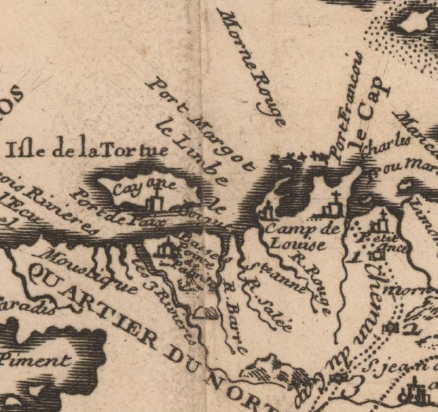
You can find Labadee, 19° 47? 11? N, 72° 14? 44? W on any modern map. Pondering The Cape it occupies, and the deep water harbor it is able to afford a behemoth like the Oasis of the Seas, I was led to research the mysteries of Haiti’s NORD, and survey the progression of place names on European maps which span the years.

haiti
This is Cristóbal Colón‘s own recollection of the northern coast of what he called La Isla Española, marking his first landing at San Nicolas Môle, the island of Tortuga, Fort Navidad, and the landmark Monte Cristi whose height guided Columbus and led him to name Hispaniola after Spain.

haiti charlevoix
A later map made by the French attempts to show the divisions of the indigenous tribes. The site marked “Premier Etablissment” marks Navidad, built near the Taíno cultural center of Hayti-Bohío-Quisqueya.

haiti Vinckeboons
A 1639 Dutch map shows Cap François. On the south shore of Isla Tortuga lies the beach Playa Cyan, across the water from the river Rio dos Caymanis. Also note the hills to the east called Mançanilla, these divided the peaceful Taíno from the warring Caciq. The location name derives from the Manchineel Trees whose poison berries they used to poison the tips of their arrows.

haiti monte christo
French map circa 1723 marks Cayne opposite the Iron Coast of L’Ile de la Tortue. There’s also a typical sailor’s landmark: Pointe des Palmiers (trans. Point of the Palms). The promontory of Cap François has here become Le Cap (The Cape). It shelters Port St. François, east of the heights of Morne Rouge and Mines de Cuivre (trans. copper mines).

haiti labat
French map of Cape Francois dated 1722 adds Le Limbe, the first area which the rebel slaves put to the torch; and Le Chemin du Cap, the main road to the valleys of the south.

haiti Ponce
This 1796 French map features another sailor’s aid, Pointe Tête de Chein (trans. Dog’s Head Point). The fortification battery on the Cape was built upon Roche à Picolet. This map was drawn after the rebellion of 1791. The Morne Rouge (trans. Red Heights) is now designated as Ravine du Morne au Diable and the Acul à Sabal. The Devil’s Ravine is the present location of Royal Caribbean’s Labadee.

The poor of Haiti are still taking heat for the Bwa Kayiman having been a pact with the devil.

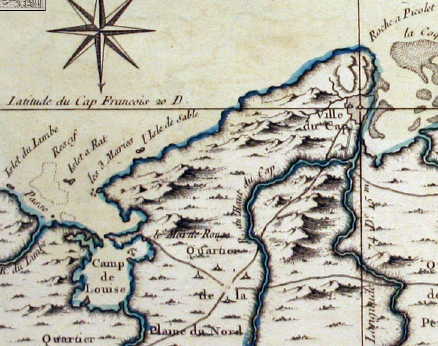
haiti bellin
I add this 1764 map for personal interest. Few maps even today mark L’Islet à Rat (trans. Rat Island), which Columbus called La Amiga, was an aid to navigation out of his anchorage at Bay of Acul which he called Cabo de Caribata.

This map also details how colonial French St Domingue was divided into districts, here the Ville du Cap, the Quartier de Plaine du Nord and Camp de Louise.

haiti moreau
This 1770 map of Cap François and Environs distinguishes the larger slavery plantations.

haiti labadi

On the subject of Columbus, isn’t it surprising to reconcile the current verdict on his genocidal behavior, with the histories which have glorified his stature? After all, the primary accounts have never changed. How did earlier biographers overlook the damning and salacious details? One very polite telling of Columbus’ adventures, written by Filson Young published in 1906 provides a prim example. Here Young addresses the kidnap and rape of the indians whom Columbus encountered:

…his taking of the women raises a question which must be in the mind of any one who studies this extraordinary voyage—the question of the treatment of native women by the Spaniards. Columbus is entirely silent on the subject; but taking into account the nature of the Spanish rabble that formed his company, and his own views as to the right which he had to possess the persons and goods of the native inhabitants, I am afraid that there can be very little doubt that in this matter there is a good reason, for his silence. So far as Columbus himself was concerned, it is probable that he was innocent enough; he was not a sensualist by nature, and he was far too much interested and absorbed in the principal objects of his expedition, and had too great a sense of his own personal dignity, to have indulged in excesses that would, thus sanctioned by him, have produced a very disastrous effect on the somewhat rickety discipline of his crew. He was too wise a master, however, to forbid anything that it was not in his power to prevent; and it is probable that he shut his eyes to much that, if he did not tolerate it, he at any rate regarded as a matter of no very great importance. His crew had by this time learned to know their commander well enough not to commit under his eyes offences for which he would have been sure to punish them.

[Giving a list of instructions to the men Columbus planned to leave behind at La Navidad, among them: ]

…and especially to be on their guard to avoid injury or violence to the women, “by which they would cause scandal and set a bad example to the Indians and show the infamy of the Christians.”

no kolumbus day christopher columbusAnd here’s the rub. In this passage the author shows if we do not absolve Columbus, we indict ourselves.
The ruffianly crew had in their minds only the immediate possession of what they could get from the Indians; the Admiral had in his mind the whole possession of the islands and the bodies and souls of its inhabitants. If you take a piece of gold without giving a glass bead in exchange for it, it is called stealing; if you take a country and its inhabitants, and steal their peace from them, and give them blood and servitude in exchange for it, it is called colonisation and Empire-building. Every one understands the distinction; but so few people see the difference that Columbus of all men may be excused for his unconsciousness of it.

Haiti public menace is old stereotype

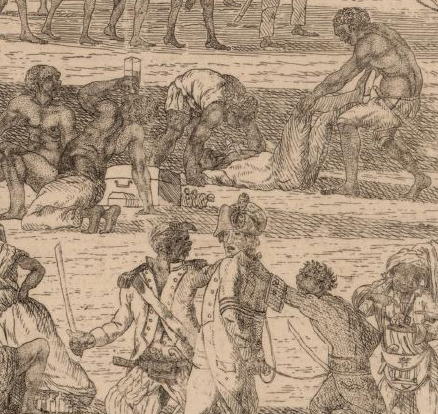
Once again NMT scoops the corporate media desperate for images of menacing Haitians on the verge of violence. These 1793 engravings aimed to anger the French public against the savagery of the Haitians rising against their masters in then Colonial French St. Domingue.
haiti-pillage-de-cap-francais-2

A detail from The Pillage of Cap François, 1793, from Brown University Archives.

haiti-pillage-de-cap-francois-1793
Another detail of the murder of French colonists. These are extracts from a tableau which depicts the eleven days of mayhem before the arrival of military reinforcements. These inflammatory scenes show whites being victimized by grotesque pig-nosed blacks, looking absurd in stolen clothing, gorging themselves with the food and drink of their masters.

haiti-incendie-cap-francois
The same event, this is titled the Burning of Cap Français.

Ward Churchill to speak for O’odham

O'odham rightsAccording to Censored News, Activist and scholar Ward Churchill will speak at the Unitarian Universalist Church of Tucson, 4831 W. 22nd St., on November 13, 2009 at 7:00 p.m. to benefit O’odham VOICE Against the Wall, which since 2003 has organized and advocated for the traditional O’odham leaders and elders of the Tohono O’odham communities in the southern territory of the United States and northern territory of Mexico. Professor Churchill’s talk is part of the “Apartheid in America: Surviving Occupation in O’odham Lands”

O’odham activist Ofelia Rivas will also participate. The event is sponsored by the Dry River Radical Resource Center, the Earth First! Journal, and Voices against the Wall.

Here’s some background on the O’odham struggle:

pamphlet cover illustrationBy J. D. Hendricks, 2004
TIAMAT PUBLICATIONS #5

The People Who Emerged From the Earth

Over two thousand years ago the descendents of the O’odham moved into the southwestern region of the area now claimed by the U.S. as the state of Arizona. 1 The O’odham have had one of the longest histories of contact with the forces of European colonization compared with the rest of the native North American peoples. The O’odham’s first contact with Spanish invaders took place in the mid 16th century; nearly one hundred years before the colonization of the North Atlantic coast and Great Lakes regions were begun by the French and English colonists. As such, the history of the O’odham provides a good context for an investigation of the colonization of Native North America, and more specifically, an investigation of the interplay between, and results of, the varied responses to colonization – that of collaboration, accommodation, and resistance.

Many histories of the O’odham refer to these desert people as the Papago. The term Papago was a name given to the O’odham by the Spanish colonizers, and is likely the result of a Spanish corruption of the O’odham word “papabi” which was the O’odham name for one of their principal bean varieties. Thus, the Spanish colonizers term for the O’odham (Papago) came to mean “the bean eaters.” 2 For the purposes of this study I will refrain from the use of the term Papago and will refer to “the people” 3 by their traditional pre-colonial name. 4

As is often the case, with the name Papago being a good example, European constructs are often imposed upon indigenous peoples by the historians that seek to portray their past. This result can occur when historians seek to glorify European norms and traditions at the expense of indigenous ones, and can also be the result of the subconscious indoctrination of the historian by the dominant culture – in this case that of western style industrial civilization. In other cases it can be the result of a simple uncritical usage of language.

One of the most dominant and reoccurring “civilized” constructs imposed upon indigenous peoples history is the commonly understood notion that the O’odham, or any other indigenous North American culture for that matter, existed as a totality or uniformed mass. This study will seek to use the history of the interaction between the O’odham peoples and the United States, both its government and its peoples, to deconstruct this myth of the totality and provide a history of the O’odham’s varied responses to colonization from an anti-colonial and anti-industrial perspective. By investigating various important case studies in O’odham history, and looking not only at resistance but also accommodation and collaboration, it is hoped that this work will help to provide a more realistic historical picture of the effects of colonization, and the intentions and reactions of both the colonizer and the colonized. Within the previously stated context and theoretical framework, this study will argue that while the O’odham responded to the U.S. invasion of their lands in various ways, the choices to resist, accommodate, or collaborate with the forces of colonization did not affect the overall U.S. policy concerning the O’odham – that policy being the eventual total assimilation of the O’odham into the dominant “civilized” industrial system. 5

This investigation will include a strong focus on O’odham resistance to colonization, as any anti-colonial history should, however it will not discount or ignore the many historical occurrences of accommodation, and in some cases outright collaboration, with the colonizers. It is important to always keep in mind that none of the actions and reactions in any of the case studies looked at are attributable to the O’odham as a “totality,” but rather are attributable only to the various groupings of O’odham, be they incarnated in the form of the individual, the clan, the village, an economic or spiritual grouping, or an established political organization.

A God of Civilization and Coercion Comes to the O’odham

The O’odham’s first encounter with Spanish invaders took place in the mid sixteenth century when a group of conquistadors led by Alvaro Nunez Cabeza de Vaca entered O’odham territory in search of gold. These men did not find the riches they were looking for and left the desert region to return to the Spanish colony. However, soon after word spread of the O’odham villages on the northern periphery of the Spanish colony, missionaries began to travel north to bring God and “civilization” to the native people residing there. By 1686, Catholic missionaries had formed a few small missions in O’odham territory using what they believed to be the influence of their soft power 6 techniques to lure the O’odham into their missions where they were then subjected to a rigorous schedule of cultural indoctrination. Most O’odham historians, including Winston Erickson, 7 and to a lesser extent, Bernard Fontana 8 have, during this time period, focused on the O’odham who chose to reside nearby and within these early missions, thus painting a picture of the O’odham as accepting of Spanish influence and cultural indoctrination.

However a closer look at this time period reveals that mission O’odham were only a small percentage of the total population of O’odham residing in the Sonoran desert 9 and that the ones who were there may not have been so for the reasons that the colonizers believed. San Xavier del Bac, the largest mission in O’odham lands, as well as many other missions, took advantage of the fact that the desert O’odham migrated in the dry winter months to the Northern Piman settlements along the rivers to work the small farm plots for sustenance. 10 The Catholic missions inserted themselves into this traditional pattern. Those O’odham who worked and lived near the missions were, for the most part, seasonal residents, which shows that the missions were viewed merely as being of utilitarian value. Thus, the O’odham as a totality were not necessarily accommodating to or interested in anything the missionaries had to offer per se, and when the missionaries began to employ “hard power” techniques and abuse or overstep the grounds for their welcome it did not go without consequence. 11

Accommodating and ignoring the missionaries was not the only response to colonization practiced by the O’odham during the seventeenth and eighteenth centuries. Although historians such as Erickson feel that “the missions did serve the O’odham well….,” 12 that assertion is contradicted by the fact that there were many large scale rebellions waged against the missions from outside and from within. In 1695, 1751, 1756, and 1776, large scale rebellions occurred in which missionaries were killed and their missions burned to the ground. 13 In some cases these rebellions were the doing of joint O’odham/Apache alliances, which is significant considering that many histories of the O’odham and Apache portray them as immemorial enemies. This may be the result of the fact that by the early nineteenth century the Spanish government initiated a campaign of divide and conquer that was continued later by the Mexican and U.S. governments to turn the O’odham and Apache against one another, thus easing the project of their subjugation.

A Change in the Occupation Government: Washington Enters O’odham Lands

In 1821, Mexican Independence from Spain was achieved and interest in the O’odham dropped away nearly entirely. By 1828, the new and secular Mexican government began the process of shutting down the missions in O’odham territory and by 1842, the last of the missions were closed. Soon after, in 1846, the United Stated initiated a war for territorial expansion against Mexico. This war was not of immediate consequence to the O’odham peoples. Isolated in desert regions, the fighting between the two occupation powers affected them little in the short run. However, the signing of the Treaty of Guadalupe Hidalgo in 1848, which ended the war, would lay the foundations for a series of disastrous events which would affect the O’odham in very negative ways.

Of greatest consequence to the O’odham was the fact that the boundary between the United States and Mexico was not finalized by the treaty of Guadalupe Hidalgo. The boundary was designated by Article Five of the Treaty as being an arbitrary line roughly following the 32nd parallel, an area which runs through the southern part of modern Arizona. To the east, the border was provided by the Rio Grande. The exact boundary line along the 32nd parallel was to be decided at a later date. It is also important to note here that the Treaty also provided that all Mexican citizens absorbed by the United States were to be granted U.S. citizenship, which included all indigenous peoples in the annexed territory since under Mexican law they were considered citizens. In the treaty the United States also assumed the responsibility for preventing cross border raiding into Mexico by the southwestern tribes, specifically the Apache. 14

In the aftermath of the signing of the treaty of Guadalupe Hidalgo, it became quickly apparent that an acceptable border between Mexico and the United States along the 32nd parallel would not be achieved. An official survey expedition was assembled by the United States and Mexico in 1849 to trace out the boundary between the two countries with little success. Various borderlines were agreed to and then abandoned and re-made by the United States, sometimes in a unilateral decision that dismissed the positions of the Mexican government altogether. 15

The principal concern for the United States was to secure title to an area of land in northern Sonora, Mexico that was ideally suited for the construction of a portion of the southern continental railroad whose building was being discussed in the U.S. Congress at the time. One of the main advocates for this southern railroad route was a South Carolina man by the name of Colonel James Gadsden. Gadsden’s history of connections to powerful business, military, and political leaders is very interesting and his appointment by the United States to be Minister to Mexico in 1853 serves as a very informative source to gauge the United States’ intentions towards Native Americans and the O’odham in particular.

James Gadsden was born into an influential southern family and graduated from Yale University. After enlisting and serving in the war of 1812, Gadsden was sent to the Florida territory with Andrew Jackson to aid in the campaign of removal and extermination being waged against the Seminole Indians, which took place from 1816-1818. After this war against the Seminole, Gadsden was appointed by President Monroe as commissioner to oversee the removal of the Seminole Indians to Indian Territory. Like the more famous removal of the Cherokee, the removal of the Seminole, and the high death rate suffered as a result, unarguably constituted genocide. 16 As a reward for a job well done, Gadsden was appointed by Monroe to a seat on the legislative council of the territory of Florida, thus beginning Gadsden’s political career. In 1840, Gadsden was elected President of the Louisville, Charleston, and Cincinnati Railroad. In 1853, the Secretary of War, an ardent white supremacist and slavery defender by the name of Jefferson Davis, appointed Gadsden to be Minister to Mexico. 17 As Minister to Mexico, one of Gadsden’s primary missions was to negotiate a final demarcation of the boundary between the U.S. and Mexico. Although Gadsden was a zealous believer in Manifest Destiny, his ideas concerning racial Anglo-Saxonism 18 caused him to be an opponent of the total annexation of Mexico. Gadsden, like many racist U.S. politicians of that time, felt that the total absorption of Mexico and its non-Anglo population into the United States would pollute the Anglo bloodline too much and thus he sought only to gain enough territory for the United States to build the southern pacific route. 19 Thus, a man who had presided over a war of genocide against the Seminole Indians, was a devout racist, and who had obvious conflicts of interest due to his connections to the railroads, was put into a position to determine the territorial boundary between the United States and Mexico and in the process also determine the boundaries of the O’odham’s land. With its appointment of Gadsden, the intent of the U.S. government could not be clearer. Business interests and territorial expansion were to run roughshod, by any means necessary, over any native peoples who stood in the way.

It is no surprise that when James Gadsden finally successfully negotiated a treaty with Santa Anna to secure what is now the southern portion of Arizona, the O’odham were not consulted. In fact, the Gadsden Treaty, signed into law in 1853, did not contain any mention of the O’odham at all. Considering that the new boundary line put in place by the Gadsden Treaty literally split the traditional O’odham lands in two, it is obvious that the intentions of the United States were in no way benevolent. Here it is also important to point out that the terms of the Gadsden Treaty specifically included the same citizenship provisions which were spelled out in the earlier Treaty of Guadalupe Hidalgo. 20 Although the Gadsden treaty was of great significance for the O’odham, their isolation and the outbreak of the Civil War enabled them to live another decade in relative isolation from Anglo encroachment.

Assimilation, Cultural Destruction, Double Speak and Ordained Genocide

The causes which the Almighty originates, when in their appointed time he wills that one race of men – as in races of lower animals – shall disappear off the face of the earth and give place to another race, and so on, in the great cycle traced out by Himself, which may be seen, but has reasons too deep to be fathomed by us. The races of the mammoths and mastodons, and the great sloths, came and passed away: The red man of America is passing away!
–United States Congress Committee on Indian Affairs report, 1865. 21

No doubt with similar justifications in mind as those of the Committee on Indian Affairs, Anglo settlers began their invasion of O’odham lands less than a year after the conclusion of the Civil War. The Homestead Act had opened up the lands of Southern Arizona to Anglo squatters and in 1866, one of the first of many bills was passed by Congress granting mineral rights to any citizen who claimed them. 22 Every one of these homesteads opened and every resource extraction operation initiated without the express consent of the O’odham represented an illegal action under the Gadsden Treaty. The citizenship provisions of the Gadsden Treaty had granted citizenship to all former Mexican citizens and the O’odham were, by legal definition, included in this formulation. The United States, however, refused to consider “uncivilized” peoples as being worthy of the protections granted to citizens by the fourth amendment of the U.S. Constitution, which prohibits the expropriation of property. This refusal of the United States government to follow its own laws pertaining to Native Americans when those laws happen to stand in the way of U.S. interests has been a common occurrence in United States Indian policy. This land grab was only the first of many illegalities committed against the O’odham people by the United States and its citizens. In this respect the O’odham are in a special position when compared with many other tribes. While the theft of native lands by the United States Government was usually legally justified by treaty stipulations signed between a tribe and the U.S. government, this justification could not and cannot be used in the case of the O’odham since no treaty was ever signed with the O’odham by the United States Government. 23

For the most part, the O’odham did not resist this initial incursion of Anglo settlement, rather the O’odham practiced accommodation and moved farther out into the desert to shield themselves from the new settlers invading their lands. Traditional ways were maintained with the exception of the introduction of cattle ranching. The O’odham territory was well suited for the raising of cattle and a good number of O’odham became cattle ranchers, both for purposes of subsistence as well as for sale to Anglos residing in and around Tucson. In the 1880s, as increasing numbers of Anglo cattle ranchers began to invade and take over their pasture, some O’odham began to resist.

The O’odham resisted by stealing the Anglo cattle herds which were rounded up and driven south to be sold on the Mexican market. The expropriation of Anglo cattle herds was not isolated, and it became a major concern for the settlers and the government. In at least one case, a large cattle outfit was driven out of business. 24 The concern over this outbreak of O’odham theft of Anglo cattle was large enough that newspapers as far away as Los Angeles ran stories about the phenomenon. For the most part these stories seem to have been deliberately used to justify the enclosure of the O’odham into reservations as the government and Anglo cattle ranchers seized the opportunity to gain even more O’odham land by arguing that it was an unfair burden for the Anglo cattle ranchers to have to “support” the O’odham. 25 Here, in previous case study, we have another common attribute of U.S. Indian policy in general, and one which occurs again and again in the history of O’odham contact with the U.S. government and Anglo settlers – blaming the victim.

Another official position of United States Indian policy during this time period was that everything done to the Indians was, in the words of Indian Commissioner J. Q. Smith, in their own “best interests.” 26 Whether this obvious sham was based on a subconscious guilt and delusion or was a cynical example of “double-speak,” it is obvious that Native American’s best interest’s were the last thing on the government’s mind. Nevertheless, with this reasoning as justification, the first official reservation for the O’odham was created by executive order of President Grant on July 1, 1874. This small reservation surrounded the Old Catholic mission at San Xavier del Bac. It is estimated that only about ten percent 27 of the desert O’odham took up residence within this reservation – these were labeled as “civilized” O’odham by U.S. census takers. The vast majority of O’odham were labeled as “wild” and continued to live in the vast desert regions west of San Xavier del Bac. While it is obvious that the desert O’odham were resisting cultural assimilation by avoidance, even the mission O’odham maintained a resistance to European culture as the next example will illustrate.

While visiting the old mission at San Xavier a newspaper columnist from the Los Angeles Times wrote that upon her visit in 1882, she could see “not a single civilized human habitation within miles.” This writer goes on to state that the O’odham’s dwellings were in the form of “conical mud huts.” In the casual racism and Social Darwinist rhetoric of the period she also adds that,

“The Papagos are but little in advance of gophers and prairie dogs in their habitations.” 28

The point is that after more than 200 years of European influence, even the mission O’odham continued to build their traditional shelters. 29

Progressivism and Cultural Genocide: The Dawes Act

In 1887, the General Allotment Act, also known as the Dawes Act, was signed into law. The Dawes Act was the staging point for the forced assimilation of those remnants of Native American groupings which had not been totally decimated by the preceding period of “Indian Wars” and forced relocations. The essential function of the Dawes Act was to disrupt traditional tribal land holding patterns and thus force Native Americans into the Anglo system of private property. The O’odham, like most other Native American cultures, did not have a concept of private property – land was held in common for the benefit of the village group. Communally held land was an essential pre-requisite for their Anarchistic political system and extremely de-centralized tribal structure. 30

The first section of the Dawes Act provides for equal “sections” of land to be parceled out to each “head of family.” This head of family was always understood to be the father of each family when land was allotted. Thus, this first section of the act not only attempted to destroy the communal land system of Native Americans, it also instituted Patriarchy as the basis for social functioning in Native America. 31 In addition, Section Five of the Act also provides that any un-allotted lands be subject to purchase by the United States government. Section Six and Seven provide that all monies paid by the U.S. for un-allotted Native lands be held for each tribe by the U.S. Treasury and “subject to appropriation” by the U.S. government to repay itself for the implementation of allotment as well as to provide for the “civilization” of Native Americans. 32 In less veiled words, these sections are basically stating that Native Americans will be forced to pay for their own cultural annihilation.

This interpretation of the intent of the Dawes Act becomes clearer when one looks at the arguments and debates that took place in Congress and within self described progressive “Indian rights” groups such as the Indian Rights Association. Critics of the Dawes Act in Congress such as Rep. Russell Errett understood that

“the main purpose of this bill is not to help the Indian troubles so much as it is to provide a method for getting at the valuable Indian lands and opening them up for settlement.” 33

And Senator Dawes, the namesake of the final bill, speaking of the land and resources of Native Americans stated that

“civilization has got after these possessions with a greed never before equaled but it is idle to expect to stay it….” 34

As for the progressive Indian Rights Association, they argued that

“the organization of the Indians into tribes is, and has been, one of the most serious hindrances to the advancement of civilization, and that every effort should be made to secure disintegration of all tribal organizations….” 35

And one of their leaders, Reverend L. Abbott, provided justification with the statement:

“Barbarism has no rights which civilization is bound to respect.” 36

So here we have a self-proclaimed progressive Indian Rights organization arguing for cultural genocide and against the notion that Native Americans have any rights that civilized people are bound to respect! This conclusion provides a perfect example of the essence of “progressive” or “civilized” thought.

The Dawes Act had a much less devastating effect for the O’odham than it did for many other Native American tribes. At the time of its passage, the only official reservation for the O’odham was the San Xavier reservation which, as was stated earlier, was only a small 71,090 acre reservation around the old mission San Xavier del Bac. When the allotment agent came to San Xavier in 1890, he allotted out 41,600 acres of land to the 363 O’odham whom he counted in his census as being resident at the time. 37 The vast majority of the O’odham still continued to live west of San Xavier in the expansive desert regions and were little affected by the allotment schemes. Even those O’odham who lived in San Xavier and were allotted land paid little attention to the artificial boundaries drawn on paper which supposedly privatized their land – they continued to farm and graze the land communally. 38 This refusal to abide by the provisions of the Dawes Act is also a form of resistance to cultural assimilation and adds one more example to show that for those O’odham who resisted, the most often employed method of resistance was non-compliance and avoidance. This specific response to colonization was made possible by the isolation and expansiveness of their desert home, which many Anglo’s continued to view as a “hopeless desert.” 39

The Domestication of the “Wild Papago”

The vast majority of the O’odham continued to resist assimilation and maintained a fairly traditional lifestyle – minus the introduction of cattle herding and horse rearing. In the twenty years following the passage of the Dawes Act, a growing effort was made to enclose the “Wild Papago” 40 and forcibly strip them of their traditional culture and instill them with the “civilized” values of the industrial Anglo. As was mentioned previously in the paper, ranchers and the government used O’odham cattle theft from Anglo ranchers as one tool to justify the enclosure of the O’odham within a reservation. During this period, Anglo Cattle ranchers continued to encroach deeper and deeper into O’odham territory and scuffles began to break out.

In another classic example of the “blame the victim” tactic, a pro-enclosure story was printed in the Los Angeles Times, no doubt to build public pressure for the domestication of the “Wild Papago.” The story concerns a group of O’odham who had resisted an Anglo cattleman’s attempts to enclose one of their water sources. When these O’odham continually tore down the fence that this cattleman had built, the rancher filed a report with the local Indian Agency sheriff to have the men arrested. When the sheriff arrived to arrest the O’odham responsible for defending their water source, he was taken hostage. The sheriff was later released unharmed; however, the incident was used to make the argument that such troubles can only be expected to increase if the O’odham were not enclosed on a reservation where they could be more easily controlled and monitored. 41

The tactic of occupying and diverting natural water sources was one of the tools used by the Anglo settlers and government to destroy the self sufficiency of the O’odham and force them into reservations where they would be dependent on the government for their water and would thus be easier to control and monitor. Some of the O’odham clearly understood what was happening, which is evidenced by instances of resistance both to the enclosure of natural water sources as well as resistance to the drilling of wells. One example of the U.S. government using water as a tool of forced cultural assimilation can be found by looking at an event recorded by an O’odham calendar stick 42 keeper. In 1912, the O’odham residing in the village of Santa Rosa, an isolated and traditional village in the western desert region of O’odham territory, were paid a visit by an Anglo Indian Commissioner who wished to drill a well for them. The Chief of the village objected to the drilling of the well on the grounds that it would disturb their culture, their autonomy and their self-sufficiency. The government agent proceeded to have the well drilled anyway. Upon completion of the well, the Chief of the village, according to the calendar stick keeper, stated that

“the well must be left alone and, in order that the Papagos might continue their old life, water must still be carried from the spring in the foothills.” 43

However, the prohibition by the Chief could not be upheld due to the overwhelming convenience of the new well and after a period of abstaining from its usage, the village of Santa Rosa (including the Chief) gave in and thus was assimilated into the industrial system by being made dependent on the Government well. 44 During this same time period, encroaching Anglo farmers engaged in the diversion of O’odham water sources to irrigate their farms. This practice served as another method of forcing the self sufficient O’odham into a relationship of dependence upon the government. In many areas so much water was diverted that the O’odham could no longer grow their traditional summer crops. 45

In 1919, the first incarnation of an O’odham reservation to enclose the nearly two million acres of desert that the “Wild Papago” were residing in was established. The formation of the desert O’odham reservation in 1919 ushered in a period of exponentially increased government interference in O’odham matters, and of course, the various forms of coercive assimilation were multiplied. By 1933, thirty-two unwanted wells were drilled all over the new reservation. 46 The well drilling was often opposed by those who were trying to maintain the O’odham Him’dag – the traditional ways of the desert people.

Resistance and Collaboration: O’odham Responses to Forced Modernization

In contrast to the traditional O’odham who had maintained resistance to cultural assimilation for the past 300 years, there was also a small number of O’odham based in the new reservation that welcomed collaboration with the forces of Anglo modernization and advocated for cultural accommodation and in some instances for total cultural assimilation. These men would later form an organization called the Papago Good Government League, which would serve as the propaganda arm of the Bureau of Indian Affairs and government policy in general. The leadership of this new faction had been taken from their families as youths and placed in Protestant boarding schools to be culturally indoctrinated. The Tucson Presbyterian Training School was one of the indoctrination centers where many future members of the Good Government League had been sent. 47

Religious indoctrination, whether Catholic or Protestant, has always been one of the most powerful tools of colonization and its justification used by European invaders against the indigenous peoples of the Americas. The necessary counterpart to the forced indoctrination of Christian principals and morals has always been the repression of indigenous spiritual practices. The United States government understood the profound power that traditional spiritual practices had in maintaining group solidarity and cohesion and it is for this reason that such spiritual practices were made illegal and repressed historically. In 1883, a Court of Indian Offenses was established by congress at the request of Secretary of Interior Henry M. Teller to eliminate traditional spiritual practices. In a report to the commissioner of Indian Affairs, Teller laid out his goals and his rationale stating that,

“If it is the purpose of the Government to civilize the Indians, they must be compelled to desist from the savage and barbarous practices that are calculated to continue them in savagery….”

Teller went on to associate those who resisted the repression of their spirituality with the “non-progressive” faction of Indians and labeled traditional spiritualism as “debauchery,” “diabolism,” and “savagery.” The overarching argument of his letter is that in order to civilize the Indians and bring them into the industrial system, their traditional spiritualism must be destroyed. As an initial step towards this end, Teller advised that Medicine Men be “compelled” to desist from their practice of “deception.” 48

Although the Court of Indian Offenses advocated that coercion be used to repress and destroy indigenous spiritualism, it failed to succeed in this project even when it used force to try to stop traditional spiritual rituals. According to Historian Edward Spicer, the only thing the Court succeeded in doing was driving traditional spiritual practices underground. In the case of many resistant O’odham, traditional spiritual practices were continued without regard to regulations or prohibitions against them, and in many cases, federal authorities resorted to repression and arrest to try to stop these practices. One traditional spiritual practice of the O’odham which was particularly hated by the Protestant Missionaries and Indian Agents was the Vi-kita ceremony.

The Vi-kita ceremony of the O’odham has been written about and studied by many Anglo historians and anthropologists, the most prominent being Columbia Anthropologist Ruth Underhill. 49 Before going into a short description of the Vi-kita it is important to understand that this ceremony varied depending on who was conducting it and where it was being conducted. Peter Blaine, an influential O’odham man sympathetic to the traditional ways, wrote in his autobiography about Underhill’s methods. Blaine explained the traditional way for the O’odham to tell about their past was to do it

“in a group so that everybody had a chance to talk and tell it their way. Underhill was talking to just one man…Dr. Underhill was wrong all the way in how she got her information.” 50

As scholars from the dominant culture often do, Underhill had applied her own notions of hierarchy, authority and individualism to her work with the O’odham and totally disregarded their traditional methods of conveying information in a communal fashion.

The Vi-kita itself was a yearly rain and fertility festival preformed to initiate and give thanks for the yearly summer rains. The ceremony itself consisted of the communal singing of rain songs, dancing, intimate encounters, and the consumption of Navait (Saguaro wine), an alcoholic drink made by the fermentation of Saguaro Cactus buds. The consumption of this wine was meant to symbolize the connection between the sky and the earth. The intake of the Navait was representative of the earth’s intake of rain. Participants drank Navait until vomiting occurred as this act embodied the clouds issuing forth rain unto the earth. It was a powerful ceremony that bonded the O’odham with the elements of nature.

When Protestant missionaries, and a small number of Protestant O’odham in the Good Government League, backed by U.S. Indian Agents, began their attempts to usurp power on the newly formed western O’odham (Sells) 51 reservation in the early 20th century, one of the first things they attacked was the practice of the Vi-kita ceremony. In the early 1930s, Peter Blaine explained that the traditional O’odham from the San Xavier reservation would travel to the western reservation for the Vi-kita. He states that,

“In the late 1920s the government tried to stop this wine drinking ceremony on the Sells reservation. But no Papago or Agency police could ever stop it.”

In one instance Blaine tells the story of how he helped defend three traditional O’odham Vi-kita ceremony leaders when they were arrested by agents from the Indian Bureau and jailed in Tucson. During the trial, a group of Protestant O’odham men from the Good Government League 52 argued for the repression of the ceremony – one of these men, Richard Hendrix, would continue to plague the traditional O’odham in future encounters. To respond to the collaborationist Good Government League, the resistant traditional O’odham formed the League of Papago Chiefs to counter the attempts of the Protestant Good Government League to usurp control on the reservation. 53

The Indian Reorganization Act and O’odham land rights

On June 18th, 1934, President Roosevelt signed into law the Indian Reorganization Act which finally stopped the forced allotment process initiated by the Dawes Act in 1887. The Indian Reorganization Act was viewed by its proponents as being in the best interests of the Indians. One of the reasons for this view was the fact that the Dawes Act and its forced allotment provisions had resulted in the loss of 90,000,000 acres of tribal lands and it was hoped by some, including then Indian Commissioner John Collier, that the Indian Reorganization Act could be used to regain some of this lost land.

The public was also encouraged to view the Indian Reorganization Act as being beneficial for Native Americans. A large article in the Los Angles Times entitled “The Bill to Return Indian Rights” stated that:

“After a century of graft, plunder and injustice, this bill has the objective of handing their own souls back to the Indians.” 54

However, such optimism and notions of cultural relativism were not held by all. As a precursor to the Indian Reorganization Act, a report was prepared for the Secretary of the Interior in 1928 to lay out the need for a change in Federal Indian Policy. The report stated that the “great majority of Indians are ultimately to merge into the general population” and that it was the government’s responsibility to assimilate Native Americans into “white civilization” because “the hands of the clock cannot be turned backwards.” Sympathetic attempts to help Native Americans retain their culture were stigmatized as attempts to “preserve them as museum specimens.” 55 Indian Commissioner John Collier was one of those who believed that Native Americans should retain their culture and that “the awakening of the racial spirit must be sustained….” 56 However, although the finalized Indian Reorganization Act did contain elements that were meant to “help” Native Americans, many of its articles were still designed to impose “civilized” systems on Native Americans.

It can be argued that the intent of the finalized Indian Reorganization Act was to initiate a new chapter in the push for the total cultural assimilation of the Native American tribes. The argument that there was no qualitative change between the Dawes Act and the Reorganization Act is legitimate. The Indian Reorganization Act provides the examples for the argument. The main tool of assimilation in the Indian Reorganization Act was the provision in Section 17 which allowed for Native American tribes to form their own tribal governments, constitutions and laws which, although it is not specifically stated, were intended to be Anglo in structure and functioning. In the case that these native governments were not sufficiently acceptable to the U.S. government, section 17 also provided that all Tribal Government formations must be “approved by the Secretary of the Interior.” 57 This clearly shows that the intent of the Act was not to allow Native Americans to become fully autonomous, either culturally or politically. For a tribe such as the O’odham, which had a long history of decentralization and consensus decision making, the imposition of western style liberal democracy, with its attendant centralization and majority rule system, was an obvious method of forced cultural indoctrination. Peter Blaine, who was mentioned earlier, was an O’odham man who had sympathy for the traditional, decentralized and communal way of O’odham societal organization. When the collaborationist Papago Good Government League began to maneuver themselves into the position of representing all of the O’odham, Blaine took it upon himself to lead the charge to discredit their assertions to business interests and the Federal Government that they represented the O’odham. Blaine wrote that:

“This so-called council represented only their own church people, but they took it upon themselves to become a council for all Papagos. They had meetings. Nobody attended them but these four guys because most people didn’t recognize them as leaders.” 58

In 1934 Blaine, along with another O’odham from the Gila Bend reservation named Leon Pancho became the first O’odham to travel to Washington D.C. These two men were sent as representatives of the traditional chiefs of the O’odham villages to argue against a recent court order that closed the Sells reservation to outside, Anglo owned, mining. The court order was a result of a lawsuit brought by the members of the Good Government League, including Richard Hendrix, who had teamed up with outside lawyers. These lawyers were to receive as payment a ten percent share of all land reclaimed from the mining companies, or a monetary equivalent. As this entire procedure was done behind the backs of the majority of the O’odham, when it was revealed, there was great resentment towards the Good Government League by many of the O’odham.

While in Washington D.C., Blaine was informed of the pending Indian Reorganization Act, and he became a supporter of the Act due to its provision allowing for the self government of Native Americans, as well as a provision in section Six that allowed the Secretary of Interior to manage mineral, mining, and livestock on the reservation. 59 In the case of the O’odham this meant that the reservation would be re-opened to mining and they would regain an important means of economic sustenance. According to Blaine, the mines were an important economic resource for the O’odham as they provided jobs and a market where beef and other O’odham products could be sold. 60 This is yet another unfortunate example of how the incursion of Anglo industrial technology served to destroy the self-sufficiency of the O’odham by making them dependent on it for survival.

Whether or not the mines were truly in the best interest of the O’odham is a complex topic which cannot be dealt with here. However it should be stated that Blaine and his companions’ trip to Washington D.C. was financed by the Tucson Chamber of Commerce, an organization that functioned in support of the mining interests, not the O’odham. This Tucson Chamber of Commerce was the same organization that had aggressively petitioned President Wilson to rescind his 1916 act forming the Sells reservation because it prevented Anglo agricultural interests from exploiting the area’s “best agricultural and grazing lands.” 61

Resistance to and Collaboration with the “White Man’s War”

Not long after the passage of the Indian Reorganization Act and the formation of the first O’odham Tribal Government, the United States declared war on Japan, thus entering World War II. The participation of Native Americans in World War II has been well publicized, especially the role the Dineh (Navajo) played as code talkers in the South Pacific. The United States government and the mainstream media portrayed Native Americans as being eager to fight for their homeland, and eager to assimilate into “white civilization” once they returned from the war. Nearly 25,000 62 Native Americans served in the United States military during World War II, many of whom were no doubt under the impression that their service would be rewarded with increased “rights” after the war’s end. Instead, as a “reward” for Native Americans participation in World War II the United States government established the Indian Claims commission in 1946 to legalize the U.S. occupation of Native American Lands never granted to the U.S. by treaty, passed House Concurrent Resolution 108 to terminate tribal recognition as separate entities from the Federal Government, and then instituted a plan in 1954 to relocate Native Americans off the reservation and into “Indian Ghettos” in the nation’s large cities. 63 These were the “rewards” for participation in World War II.

Like many other Native American Tribes, some of the O’odham Nations members participated in World War II. Ruth Underhill claims that the O’odham enlisted to serve in World War II “in droves” 64 and it is documented that the O’odham tribal government bought $10,000 in war bonds. 65 However, the extent of this involvement was distorted by the media, academia, and even some of the O’odham leaders in the tribal government. Richard Hendrix, a former member of the collaborationist Good Government League, had risen to prominence in the new O’odham tribal government by this time and was interviewed by the Arizona Archaeological and Historical Society on November 16, 1942. In this interview Hendrix exposed the extent to which he had allowed his mind to be colonized and assimilated into that of the dominant white culture. Speaking of colonization in general and World War II in particular, Hendrix stated that the O’odham had:

Learned to love the American government and they learned to love the Stars and Stripes. And when the war came and the time came for our boys to be registered, there was no exception. They registered just the same as white boys did. And now they are out fighting alongside the white boys, the American boys. They are just as anxious as the white boys to kill as many Japs, to kill as many Germans, and they are very anxious to win this great war so that the Papago people in this desert land may continue to enjoy the freedom of their homes. 66

Hendrix’s internalization of white supremacist racial notions is a heart breaking and shocking example of the extent to which he had accepted the ideology of “white civilization.” In addition, his assertion that every O’odham boy registered for the war with “no exception” is glaringly false.

Aside from the fact that there are always exceptions to everything, there was also a large scale organized resistance to World War II led by an old Chief and medicine man, Pia Machita, and his band of traditional O’odham who resided in an isolated village in the north western area of the Sells Reservation known as the Hickwan district. According to Peter Blaine, the O’odham residing in some of the most isolated villages in the Hickwan district had not seen a white man until the 1930s, and continued to practice the traditional O’odham Him’dag. 67 When Pia Machita was informed of the compulsory registration of young O’odham boys for induction into World War II, he instructed the youth of his village to refuse to sign the registration forms when they were visited by the local Indian Agent. Pia Machita was a very traditional leader who refused cultural assimilation and would not accept the authority of the Bureau of Indian Affairs or the O’odham tribal government. Finally, after all efforts to persuade Pia Machita’s village to register had failed, the tribal chief of police and a gang of Federal Marshals led by U.S. Marshall Ben McKinney invaded the village at two in the morning on October 16th, 1941, with tear gas bombs and guns drawn – when the Marshals attempted to take Pia Machita into custody some of the young men from the village used force to liberate him and severely beat one of the federal marshals. In the face of this resistance, the government agents and their local collaborators retreated to Tucson. When the Attorney General’s Office heard of the resistance on the O’odham reservation, they immediately got involved in the effort to repress this draft resistance movement as quickly as possible to prevent its possible spread to other reservations. By May 17th, 1941, after a period of about six months of trying to track down Pia Machita and his small band of men, Marshall McKinney and O’odham collaborators including Jose Ignacio from the tribal government, surrounded Pia Machita in the village of Stoa Pitk and took him into custody without incident. 68

Peter Blaine was the O’odham tribal chairman during the time that Pia Machita was leading the draft resistance movement. Although he did not believe that Pia Machita and his men were threats in any way, he was annoyed by what he perceived to be their stubbornness and attributed their draft resistance to his belief that they “didn’t really understand what they were doing.” 69 In reality, it was Blaine who did not understand the reasons behind Pia Machita and his men’s resistance to enlistment. Pia Machita and his men understood very well what they were doing – they were resisting giving aid to a government that they understood was their enemy. Given this understanding, and given the dictionary definition of the word “collaboration,” it becomes necessary to label those O’odham who participated in the arrest of Pia Machita as such – collaborators. The understanding that the U.S. government was the enemy of the traditional O’odham of the Hickwan district was based upon a long history of attempts by the U.S. government to force the Traditional O’odham of that area to abandon the Him’dag and embrace elements of Anglo “progress” such as dams, railroads, wells, and the protestant religion. Despite Peter Blaine’s inability to understand why the O’odham in the Hickwan district rejected Anglo-civilization in its totality, he still maintained sympathy for the people there. When Pia Machita and two co-defendants were finally sentenced to serve 18 months in prison at Terminal Island Federal Prison for their roles in leading the resistance movement, Peter Blaine eventually came to their aid and used his connections as tribal chairman to persuade the sentencing Judge to release Pia Machita early and allow him to return to the reservation and his family. 70

Conclusion

The history of the O’odham’s contact with the United States government has been one marked by a persistent current of resistance to cultural assimilation into “white civilization.” This resistance has included a variety of tactics and actions. The favored tactic of resistance to assimilation for many of the O’odham groupings seems to have been that of avoidance and feigned accommodation to Anglo culture when expedient. However, as was evidenced by the O’odham’s early history of contact with the Spanish, they did not refrain from waging armed resistance to colonization when they were pushed into a situation where other tactics might have been ineffectual.

In addition to resistance and accommodation, it has also been shown that some of the O’odham choose to engage in direct collaboration with the Anglo colonization of their lands and minds. As this paper has shown, the levels of collaborative activity amongst the O’odham varied, and so did the effects of such collaboration. When investigating instances of collaboration it is always important to understand the context which produced them and to remember that the ultimate blame for a situation of oppression should always be placed upon the group committing the acts of repression – in this case the United States government and allied business interests. It is important to show such examples of collaboration and to understand that all human cultures who have been the victim of colonization have invariably contained individuals who chose to collaborate for a variety of reasons. The O’odham are no exception to this rule. Making apologies for collaboration or failing to mention the instances where such collaboration did occur creates a historical distortion and does nothing to aid present struggles for liberation.

The O’odham responses to colonization never represented a totality, but a strong current of resistance is evident throughout their history. In regards to the United States government, it can be said, given the primary sources looked at, and the final drafts of laws signed and policies followed, that the intent of the United States government toward all Native American tribes, when it was not outright genocidal, has been the cultural destruction and absorption of remaining Native Americans into the dominant industrial culture of “white civilization.” Regardless of the varying tactics used, and the various lip service about “best interests” and “justice,” it has been shown that there has never been a qualitative change in United States policy toward the O’odham people and Native Americans in general. The O’odham have maintained aspects of their traditional culture despite the best efforts of the government to force assimilation, not as a result of such efforts. A continuing current of struggle between the forces of colonization and resistance has persisted for centuries, in all its various forms, within the minds and bodies of many O’odham and will continue until liberation.

NOTES:

1
This date is based on archeological evidence gathered by E.W. Haury in Ventana Cave. Haury, E.W. The Stratigraphy and Archeology of Ventana Cave Arizona. Tuscon: University of Arizona Press, 1950. Cited from Williams, Thomas R. “The Structure of the Socialization Process in Papago Indian Society.” Social Forces, Vol.36, No.3. p.253.

2
Fontana, Bernard L. Of Earth and Little Rain: The Papago Indians. Tuscon: University of Arizona Press, 1989. pp.37-39.

3
The name “O’odham” is roughly translated as “the people” in the Piman dialect spoken by the various O’odham groupings.

4
In 1986 the tribal government of the Papago reservation officially changed its name to the Tohono O’odham Nation.

5
The term “civilized” is a problematic historical term, and its definition tends to be very subjective. The meaning of the term and its use as a label is heavily influenced by how the author and the reader understand its meaning. For the purposes of this paper, the term “civilized” refers to the totality of the “western” cultural, political, and economic system – and most importantly the belief that technological/industrial progress is inherently beneficial and liberatory. For most, being labeled “civilized” is viewed as a positive and the label of “un-civilized” or “savage” is viewed in the reverse. However, for the purposes of this study it is imperative to understand that this author views “civilization” itself as an inherently oppressive and destructive entity, and this must be kept in mind to correctly understand the arguments and analyses in the paper.

6
The term “soft power” refers to the concept of gaining influence and control over another group by means of the attraction of the dominating group’s cultural attributes and the use of commodification rather than using military might and coercion (“hard power”) to gain that influence. See Joseph S. Nye, Jr. Soft Power: The means to success in world politics. New York: Perseus Books, 2004.

7
Erickson, Winston T. Sharing the Desert: The Tohono O’odham in History. Tucson: University of Arizona Press, 2003.

8
Fontana, Bernard L. Of Earth and Little Rain: The Papago Indians. Tucson: University of Arizona Press, 1989.

9
According to Catholic missionary records, the numbers of mission O’odham during this time period were somewhere around 2,000. However, according to population estimates there were at least 10,000 O’odham peoples living in this area. See Fontana, Bernard L. Of Earth and Little Rain . pp.11,46.

10
Fontana, Bernard L., p.40.

11
It is well documented that many of the Missions resorted to physical abuse, forced confinement and occasional murder to coerce the O’odham into compliance. San Xavier del Bac, the largest and most famous of Catholic missions in O’odham lands was built with forced labor. See Daniel McCool; “Federal Indian Policy and the Sacred Mountains of the Papago Indians.” Journal of Ethnic Studies 9.3 (1981).p59.

12
Erickson, Winston P., p.66.

13
Fontana, Bernard L., pp.61-64.

14
Treaty of Guadalupe Hidalgo, Feb 2nd, 1848. United States Statutes At Large, pp. 922-943

15
For a detailed treatment of this series of events see; Garber, Paul N. The Gadsden Treaty. Glouchester: Peter Smith, 1959.

16
For more information on the removal of the Seminole; Stannard, David E. American Holocaust: The Conquest of the New World. New York: Oxford University Press, 1992. P.124. For additional information about the Seminole Wars see; Churchill, Ward. “A Little Matter Of Genocide: Holocaust and Denial in the Americas 1492 to the Present.” San Francisco: City Lights Books, 1997.

17
All dates for the political appointments of James Gadsden are cited from Paul Garber’s “The Gadsden Treaty.” Pages 74-81.

18
Racial Anglo-Saxonism was a belief popular in the later 19th century which held that Europeans of Anglo-Saxon descent were at the forefront of evolution and were responsible to bring civilization to the world. This ideology was used as a convenient justification for the extermination and removal of Native Americans. For a detailed study of this ideology see: Horsman, Reginald. Race And Manifest Destiny: The Origins of American Racial Anglo-Saxonism. Cambridge: Harvard University Press, 1981.

19
For a detailed investigation of the role that the railroads played in the Gadsden purchase see; Schmidt, Louis B. “Manifest Opportunity and the Gadsden Purchase.” Arizona and the West, vol.3 (autumn 1961).

20
Forbes, Jack D. The Papago-Apache Treaty of 1853: Property Rights and Religious Liberties of the O’odham, Maricopa and Other Native Peoples. Davis: Native American Studies Tecumseh Center, U.C. Davis, 1979. p.1.

21
United States Congress. Joint Special Committee. Condition of The Indian Tribes. Report of the joint special committee, appointed under joint resolution of March 3, 1865. With an appendix. Washington, D.C.: United States Government Printing Office, 1865.

22
Erickson, p.77

23
During this time period many treaties were negotiated with native tribes in the regions west of the Mississippi to gain legal justification for the United States’ theft of their lands. For a detailed list of treaties signed between the United States and Native American tribes, see the compendium edited by Charles J. Kappler. Indian Affairs: Laws and Treaties. 7 volumes. Washington, D.C.: Unites States Government Printing Office, 1903-4.

24
Spicer, Edward H. Cycles of Conquest: The Impact of Spain, Mexico, and the United States on the Indians of the Southwest, 1533-1960. Tucson: The University of Arizona Press, 1962. p.138.

25
“Arizona News; Papago Cattle-thieves Brought to Justice.” Los Angeles Times. Feb 1, 1894. Also see: “Arizona News; Report Showing the Depredations Committed by Papago Indians on Stockmen’s Herds.” Los Angeles Times. June 8, 1895, In addition see; “Arizona News: Papagoes Destroying Cattle in Large Numbers.” Los Angeles Times. Mar 23, 1894.

26
Kehoe, Lawrence. “Our New Indian Policy and Religious Liberty.” Catholic World, vol. 26 (Oct. 1887). P.96.

27
Erickson p.78.

28
“Tucson And Fort Lowell; Notes of a Visitor – The Church of San Xavier.” Los Angeles Times. Nov 18, 1882.

29
The Spanish had brought the adobe style of construction to the O’odham but, although the resources for adobe construction were readily available to the O’odham at San Xavier, they continued to build their traditional grass huts.

30
For a detailed study of traditional O’odham tribal structure and life style see; Underhill, Ruth M. Social Organization of the Papago Indians. Columbia: Columbia University Press, 1939. ________. Papago Woman. New York: Holt, Rinehart and Winston, 1979.

31
For the most part, traditional Native American societies exhibited gender parallelism and were rarely if ever patriarchal by definition. For a detailed study of gender in Native America see: Allen, Paula G. The Sacred Hoop: Recovering the Feminine in American Indian Traditions. Boston: Beacon Press, 1986.

32
All direct quotations from Dawes Act. General Allotment Act (Dawes Act). February 8, 1887. Printed in its totality in: Prucha, Francis, P. ed. Documents of United States Indian Policy. 3rd ed. Lincoln: University of Nebraska Press, 2000.

33
U.S. Congress, House Committee on Indian Affairs, Lands in Severalty to Indians: Report to Accompany H.R. 5038, 46th Cong., 2nd sess., May 28, 1880, H. Rept. 1576, pp.7-10. Reproduced in: Washburn, Wilcomb E. The Assault on Indian Tribalism: The General Allotment Law (Dawes Act) of 1887. Philadelphia: J.B. Lippincott Co., 1975.

34
Letter from Henry L. Dawes to Henry M. Teller (Commissioner of Indian Affairs), September 19, 1882. Dawes Papers, Library of Congress, Washington, D.C. Reproduced in: Washburn, Wilcomb E. The Assault on Indian Tribalism: The General Allotment Law (Dawes Act) of 1887. Philadelphia: J.B. Lippincott Co., 1975.

35
Washburn, Wilcomb E. The Assault on Indian Tribalism: The General Allotment Law (Dawes Act) of 1887. P.12.

36
Washburn, p.16.

37
Fontana, pp. 77-79.

38
Erickson, p. 92.

39
“Baboquivari Peak.” Los Angeles Times. Nov 4, 1894.

40
The term “Wild Papago” was a term used by the government and media to marginalize those O’odham who continued to resist “civilization.”

41
“The Indian War Cloud.” Los Angeles Times. May 22, 1885.

42
The Calendar Stick was a device used by the O’odham as a tool to aid in the remembering of their history. The Calendar Stick itself was a cactus stick on which notches were carved at various intervals which aided the history keeper in the remembrance of events.

43
Fontana, p.54.

44
This example is meant to show the insidious nature of industrial technology and is not intended to place any blame on this specific group of O’odham for their ultimate choice to begin using the well. This example is given to show how industrial technology always comes with strings attached. In this case, once the village becomes dependent on the well they in turn become dependent on the Anglo civilization which is needed to maintain the functioning of such a well, and thus become less able to resist other Anglo incursions. In addition it must be pointed out here that the traditional water gathering procedure talked about was preformed by O’odham women. Due to this fact, some may feel that by resisting the building of the well, the male O’odham are in fact seeking to perpetuate patriarchy. It is true that the O’odham did have a system of gendered roles, but the overall system made room for exceptions and is best characterized as one of gender parallelism, not patriarchy. It is the Anglo industrial system that brought patriarchy to the O’odham. For more information see: Underhill, Ruth. Papago Woman. New York: Holt, Rinehart and Winston, 1979. Also see: Allen, Paula G. The Sacred Hoop: Recovering the Feminine in American Indian Traditions. Boston: Beacon Press, 1986.

45
Forbes, Jack D. The Papago-Apache Treaty of 1853: Property Rights and Religious Liberties of the O’odham, Maricopa and Other Native Peoples. Davis: Native American Studies Tecumseh Center, U.C. Davis, 1979. pp..5-8.

46
Spicer, p. 140.

47
Spicer, p.141.

48
All quotes taken directly from: House Executive Document no.1, 48th Cong., 1st sess., serial 2190, pp.x-xii. Reproduced in; Prucha, Francis, P. ed. Documents of United States Indian Policy. 3rd ed. Lincoln: University of Nebraska Press, 2000.

49
For a detailed account of the Vi-kita see: Davis, Edward H. The Papago Ceremony of Vikita. New York: Museum of The American Indian, 1920. Also see: Underhill, Ruth. Papago Woman. New York: Holt, Rinehart and Winston, 1979.

50
Blaine, Peter. Papagos and Politics. Tucson: The Arizona Historical Society, 1981. p.42.

51
The expansive western O’odham reservation was officially called the Sells reservation. It was named after the first Indian agent in the region, John Sells.

52
The Good Government League was formed by a small group of Protestant O’odham who used the organization to advocate for the assimilation of the O’odham into Anglo civilization as well as to promote general U.S. Indian policy.

53
Blaine, pp.40-50.

54
“Bill To Return Indian Rights ” Los Angeles Times. June 8, 1934.

55
Lewis Meriam et al., The Problem of Indian Administration. Baltimore: Johns Hopkins Press, 1928. Selection printed in: Prucha, Francis, P. ed. Documents of United States Indian Policy. 3rd ed. Lincoln: University of Nebraska Press, 2000.

56
Annual Report of the Secretary of Interior, 1934, pp.78-83. Reprinted in; Prucha, Francis, P. ed. Documents of United States Indian Policy. 3rd ed. Lincoln: University of Nebraska Press, 2000.

57
Wheeler-Howard Act (Indian Reorganization Act) June 18, 1934. U.S. Statutes at Large, 48:984-88. Re-printed in: Prucha, Francis, P. ed. Documents of United States Indian Policy. 3rd ed. Lincoln: University of Nebraska Press, 2000.

58
Blaine, p.50.

59
Wheeler-Howard Act (Indian Reorganization Act) June 18, 1934. U.S. Statutes at Large, 48:984-88. Re-printed in: Prucha, Francis, P. ed. Documents of United States Indian Policy. 3rd ed. Lincoln: University of Nebraska Press, 2000.

60
Blaine, pp.50-53.

61
McCool, Daniel. “Federal Indian Policy and the Sacred Mountains of the Papago Indians.” Journal of Ethnic Studies 9.3 (1981). p.62.

62
Holm, Tom. “Fighting A White Mans War: The Extent and Legacy of American Indian Participation in World War II.” The Journal of Ethnic Studies. 9.2. p.70.

63
For more on this aspect of the Indian Claims Commission, and a discussion about the termination act see: Forbes, Jack D. The Papago-Apache Treaty of 1853: Property Rights and Religious Liberties of the O’odham, Maricopa and Other Native Peoples. Davis: Native American Studies Tecumseh Center, U.C. Davis, 1979.

64
Underhill, Ruth. Papago Woman. New York: Holt, Rinehart and Winston, 1979. P.94.

65
Blaine, p.115.

66
Hendrix, Richard. Talk by Richard Hendricks, Prominent Papago Indian, Given at the Arizona Archaeological and Historical Society, November 16, 1942. The Kiva, vol. 8 (Nov. 1942).

67
Blaine, p.92.

68
Flaccus, Elmer. “Arizona’s Last Great Indian War: The Saga of Pia Machita.” The Journal of Arizona History, vol. 22 (1981).

69
Blaine, p.101.

70
Blain, pp.103-4.

© 2004, REPRODUCTION FOR NON-PROFIT INFORMATIONAL PURPOSES IS ALLOWED

John Brown, from a grateful people

John BrownThis weekend marks the 150th anniversary of John Brown’s raid on Harpers Ferry, an attempt to appropriate from the US armory to defend a slavery free territory. The already notorious anti-slavery evangelist had lost the earlier Free State sanctuaries Palmyra and Osawatomie. On October 16-17, 1859, the band of 22 abolitionists and free men, held off the townsmen and US Marines, until ten were killed and five escaped. The seven survivors were hanged, including Brown, who said at the scaffold: “I, John Brown, am now quite certain that the crimes of this guilty land will never be purged away but with blood.”

The raid on Harpers Ferry set into motion the fight in earnest to emancipate the southern slaves, ending 305 years of American slavery. Argentina, Ecuador, Chile, Central America, Mexico, Bolivia, Uruguay, Venezuela, and all British, French, Danish, Dutch, and Portuguese colonies, had already abolished slavery between 1811 and 1863. The US was followed by Cuba then Brazil in 1888.

Osawatomie Brown‘s band were fanatical and violent, but were hailed as heroes by the Union in the Civil War. This statue was erected in 1911, inscribed “erected to the memory of John Brown by a grateful people.” It stands in Kansas City, in a neighborhood which once was the town of Quindaro, a major stop along the underground railway.

Brown’s fellow domestic terrorists were:

Killed: Jeremiah G. Anderson, Oliver Brown, Watson Brown, John H. Kagi, Lewis S. Leary, William H. Leeman, Dangerfield Newby, Stewart Taylor, Dauphin Thompson and William Thompson.

Executed: John E. Cook, John A. Copeland, Edwin Coppoc, Shields Green, Albert Hazlett, and Aaron D. Stevens.

Escaped: Osborne P. Anderson, Owen Brown, Barclay Coppoc, Francis J. Merriam, and Charles P. Tidd.

Sept 11 – America Reaps What It Sows!

A post-911 perspective by Black Liberation Army prisoner of war Jalil Muntaqim.

U.S. International Warfare Initiates World War III Human Rights During Wartime
By Jalil A. Muntaqim

In the aftermath of the September 11, 2001, attack on the World Trade Center and Pentagon, Americans have displayed their true colors of jingoism, a militaristic spirit of nationalism. Similarly, it was witnessed how the people of Iraq rallied in support of their President, Saddam Hussein, after the U.S. bombed to death 250,000 Iraqis, and continued devastation of that country with collateral damage of 1 million dead women and children. Hence, people rallying in support of their government and representatives is a common phenomenon when a country is attacked by an outsider. The U.S. has been foremost in the world extending foreign policy of free-market economy, to the extent of undermining other countries cultures and ideologies expressed as their way of life. Such conflicts inevitably positions the U.S. as the centerpiece, the bulls-eye for international political dissent, as indicated by demonstrations against the U.S. controlled IMF, WTO and World Bank conferences. The attack on the World Trade Center and Pentagon did not occur in a vacuum. The people that carried out the attacks were not blind followers or robots with an irrational hatred of the U.S. peoples. Rather, this attack was part of an overall blowback to U.S. imperialist policy in support of zionist Israel and opposition to fundamentalist Islam.

There are essentially three primary world ideologies or world views: the capitalist free-market economy/democracy; the socialist production economy; and Islamic theocratic government, of which has been in competition for many decades. However, in the last 20 years the socialist economies has been severely subverted and co-opted by free-market economies, the ideals of American style democracy. This isolated, for the most part, Islamic theocratic ideology and system of government as the principle target of the U.S. in its quest for world hegemony. This reality of competing world views and economies is further complicated due to religious underpinning of beliefs that motivates actions, especially as they are expressed by U.S. and Western European christianity and Israel zionist judaism in opposition to Islam. From the struggles of the Crusades to the present confrontation, the struggle for ideological supremacy reigns, as the faithful continue to proselytize in the name of the Supreme Being.

When geopolitics are combined with religious fervor in the character of nationalist identity and patriotism, rational and logical thinking is shoved aside as matters of the moment takes historical precedents. It has often been said that “Truth Crush to the Earth Will Rise Again”. Since truth is relative to ones belief, can it be safely said that America has reaped what it has sowed? The American truth of capitalist christian democracy and its imperialist hegemonic aspirations has crushed both socialist and Islamic world views. It has extended its avaricious tentacles as the world police and economic harbinger of all that is beneficent, in stark denial of its history as a purveyor of genocides, slavery and colonial violence.

The U.S. was the first to use biological-germ warfare on people when it distributed blankets infected with smallpox to Native Americans; it has refused to apologize for Afrikan slavery acknowledging it engaged in a crime against humanity requiring reparations; it is the first and only country to use the atomic bomb on the people of Hiroshima and Nagasaki and intern thousands of Japanese and Italians in this country; it used carpet bombing and defoliates against the peoples of Vietnam; it has initiated embargoes, coup d’etats and assassinations against those it opposes, while propping-up right-wing military dictators; as well as continued military bombing of Vieques. In essence, the U.S. governments hegemonic goals has created the ire of millions of people throughout the world. While domestically, racial profiling, police killing and mass incarceration of Black and Brown people has eroded patriotic sentiments in opposition to white supremacy.

As America weeps and laments its loss, the public find itself joining the torn ranks of those whose heartaches beat opposing U.S. greed and international profiteering. The American public acquiesce to U.S. international folly has cause them to feel the economic pains of those who live daily in poverty. Indeed, Americans should brace for years of economic uncertainty, where the American ideal of freedom and liberty will resemble plight of those who live under the right-wing dictatorships the U.S. has supported. The tyranny suffered by others in the world as a result of U.S. imperialism, has come full circle to visit this country with the wrath of the U.S. own mechanization. Since the U.S. taught and trained right-wing military dictators in the School of the Americas, including the CIA training of Osama bin Laden in the Afghanistan proxy war against the Russians, it will be this same kind of terrorist activist that will be unleashed on American soil, as El-Hajj Malik Shabazz stated after the assassination of John Kennedy, a matter of the chicken coming home to roost. Therefore, American civil liberties and human rights are being garrotted by the yoke of the right-wing in the name of national security. The legalization of U.S. fascism was initiated with the war against political dissent (Cointelpro); the war against organized crime (RICO laws); the war against illegal drugs (plethora of drug laws) and now culminating in the war against terrorism with the American Joint Anti-Terrorist Taskforce and Office of Home Security, further extending police, FBI and CIA powers to undermine domestic civil liberties and human rights.

The U.S. Secretary of Defense, Donald Rumsfeld, recently stated that the U.S. need to create a new language in defining how to combat terrorism. This Orwellian propaganda in the media espouses the U.S. is venturing in a new type of warfare to defend the American way of life. However, what this double-speak propagates as a long-term and sustained initiative against terrorism is essentially a way of embellishing and enlarging U.S. counter-insurgency activity it has been engaged in since the advent of the Green Berets, Rangers, Delta Force and Navy Seals. The U.S. has been involved in counter-insurgency activity in Afrika, Latin America and Asia for decades. But due to the September 11, 2001, attack on U.S. soil, the government has seized the opportunity to offensively pursue left-wing revolutionaries and Muslim insurgents throughout the world. This U.S. military action extends and substantiates its position as the international police.

Since the establishment of the Trilateral Commission that initiated the process for the development of one world government, the U.S. has broaden its capacity to impose and enforce its will on oppressed peoples globally. The FBI and CIA has been operating in Europe, Afrika, Asia and Latin America establishing the long arm of U.S. law and order. Its bases of operations have conducted surveillance, investigations to arrest, prosecute or neutralize left-wing revolutionaries or Muslim insurgents. As the U.S. consolidates its political and economic influence throughout the world, it will seek to protect its overall hegemonic imperialist goals. After the Gulf War, and the air (bombing) campaign in Yugoslavia, the U.S. has employed its military might to ensure its foreign policy are achieved.

Because NATO has evolved into a European military entity that Russia is seeking to join, today, the U.S. has positioned itself beyond the mission of NATO. The U.S. now concentrates its military might in opposing Islamic countries (Iran, Iraq, Libya, Sudan, Afghanistan, Philippines, etc.) and those the U.S. deem as rogue nations (North Korea, Vietnam, Cuba, etc.). The new military initiatives will be directed to towards Southeast Asia as the secondary target, as it continues to direct the Middle East conflict to preserve its oil investments and zionist interest. As the U.S. expand its imperialist military mission, as seen with committing military troops in Uzbekistan to also protect oil interest in the Caspian Sea, it has sought to redefine itself by targeting what it identify as the terrorist thereat wherever in the world it might exist. Hence, with the employment of conventional warfare combined with counter-insurgency tactical activities, the U.S. has pronounced itself as the military guardian of the world.

Although, the U.S. states its actions are in its self-interest, in terms of what is euphemistically defined as defending the free world, the truth of the matter is this action is a prelude to evolving one world government with the U.S. as its governing authority. Once the Peoples Republic of China becomes a full member of the WTO, and North Korea and Vietnam has been compromised, with Russia becoming an ally of NATO, the U.S. political-military influence in the world will be consolidated. The U.S. geopolitical strategy is not confined to the present crisis in the aftermath of the September 11, 2001, attack and targeting Osama bin Laden as the world’s nemesis. Rather, the U.S. strategy is to preserve its capacity to establish one world government as originally envisioned by the Trilateral Commission.

Nonetheless, there are some serious obstacles to this hegemonic goal, of which the world of fundamentalist Islam has become the principle target. Here, it should be noted that Islam condemns suicide or the mass killings of women, children and non-combatant males. Yet, the U.S., Israel, western Europe, Russia, India and China all view Islam as the enemy. Although, there are over 1.2 billion Muslims in the world, the current alliance of economic interest headed by the U.S., are united to vanquish what they consider the growing menace of fundamentalist Islam. It is with this understanding of U.S. geopolitics one is able to comprehend why the U.S. has redefine its military mission, as opposition to globalization and U.S. imperialism metamorph into a political struggle without borders or territorial imperatives.

The ideological struggle between capitalist free-market economy and Islamic theocratic determinates has exploded into an international conflagration of insurgency with the potential of initiating World War III. The Islamic fundamentalist movements throughout the world has the potential to test the U.S. military, political and economic resolve as the world’s leader and authority of an one world government. With over 1.2 billion adherents, Islam has become a formidable foe to contend with for ideological supremacy in the world’s geopolitics. Even without discussing the religious (moral and ethics) aspects that motivates the geopolitics of Islam in opposition to U.S. imperialist hegemony, the call for Jihad/Holy War against the U.S. presents a serious threat that could precipitate WW-III. Therefore, the U.S. find it necessary to redefine its military mission, develop new language to codify warfare and legitimize its international political and economic purpose. Yet, many of the world’s oppressed peoples’ have already experienced U.S. military counter-insurgency tactics (Ethiopia, Somalia, Nicaragua, Guatemala, Chile, Congo, etc.), including parts of the Islamic world. No matter how or why the U.S. attempts to persuade Americans that it is entering a new type of warfare, in reality it is more of the same, only extending the military arena to further protect its authority to establish one world government.

However, the U.S. is not the homogeneous country that people are deluded into believing exist. Rather, the U.S. has been held together due its ability to exploit the world’s resources and distribute (unequally) the profits amongst its citizens with its culture of conspicuous consumption. But, the recent attack on the U.S., and its aftermath may very well lead to the untangling and unraveling of the U.S. fabric as has been witnessed with the USSR and Yugoslavia. In understanding this true history of U.S. imperialism, outside and within its borders, essentially tells a story of why U.S. imperialism has been and will continue to be attacked.

Ultimately, the U.S. will eventually find itself at war with itself, as the ideology of a free democratic society will be found to be a big lie. This is especially disconcerting as greater restrictions on civil and human rights are made into law eroding the First and Fourth Amendment of the U.S. Constitution. As during the Vietnam conflict, internal contradictions of racism, poverty and inequality will be exacerbated as a result of the U.S. military campaign and domestic undermining of civil and human rights. It is expected that strife in America will eventually become violent dissolving any semblance of the illusion of America the Beautiful. In anticipation of U.S. progressive activist opposing this claimed war against terrorism, the federal government will pass new laws to severely restrict protest, demonstrations and dissent. In the ’60s, U.S. progressive activists evolved the slogan “Bring the War Home!” – the question is what will be the slogan this time, now that the war has been brought home?

Free the Land!!

Rock Creek Free Press available in COS

The Rock Creek Free Press is available online, but if you want it in print, the DC monthly is available in Colorado Springs at the Bookman, 3163 W. Colorado. The September issue features a speech given by legendary Australian journalist John Pilger on July 4th in San Francisco.

Here’s the RCFP transcript:

Two years ago I spoke at “Socialism in Chicago” about an invisible government which is a term used by Edward Bernays, one the founders of modern propaganda. It was Bernays, who in the 1920s invented public relations as a euphemism for propaganda. And it was Bernays, deploying the ideas of his uncle Sigmund Freud, who campaigned on behalf of the tobacco industry for women to take up smoking as an act of feminist liberation calling cigarettes “tortures of freedom”. At the same time he was involved in the disinformation which was critical in overthrowing the Arbenz government in Guatemala. So you have the association of cigarettes and regime change. The invisible government that Bernays had in mind brought together all media: PR, the press, broadcasting, advertising and their power of branding and image making. In other words, disinformation.

And I suppose I would like to talk today about this invisible government’s most recent achievement, the rise of Barrack Obama and the silencing of much of the left. But all of this has a history, of course and I’d like to go back, take you back some forty years to a sultry and, for me, very memorable day in Viet Nam.

I was a young war correspondent who had just arrived in a village in the Central Highlands called Tuylon. My assignment was to write about a unit of US Marines who had been sent to the village to win hearts and minds. “My orders,” said the Marine Sergeant, “are to sell the American way of liberty, as stated in the Pacification Handbook, this is designed to win the hearts and minds of folks as stated on page 86.” Now, page 86 was headed in capital letters: WHAM (winning hearts and minds). The Marine Unit was a combined action company which explained the Sergeant, meant, “We attack these folks on Mondays and we win their hearts and minds on Tuesdays.” He was joking, of course, but not quite.

The Sergeant, who didn’t speak Vietnamese, had arrived in the village, stood up on a Jeep and said through a bullhorn: “Come on out everybody we’ve got rice and candies and toothbrushes to give you.” This was greeted by silence. “Now listen, either you gooks come on out or we’re going to come right in there and get you!” Now the people of Tuylon finally came out and they stood in line to receive packets of Uncle Ben’s Miracle Rice, Hershey Bars, party balloons, and several thousand toothbrushes. Three portable, battery operated, yellow, flush lavatories were held back for the arrival of the colonel.

And when the colonel arrived that evening, the district chief was summoned and the yellow, flush lavatories unveiled. The colonel cleared his throat and took out a handwritten speech,

“Mr. District Chief and all you nice people,” said the colonel, “what these gifts represent is more than the sum of their parts, they carry the spirit of America. Ladies and gentlemen there’s no place on Earth like America, it’s the land where miracles happen, it’s a guiding light for me and for you. In America, you see, we count ourselves as real lucky as having the greatest democracy the world has ever known and we want you nice people to share in our good fortune.”

Thomas Jefferson, George Washington, even John Winthrope sitting upon a hill got a mention. All that was missing was the Star Bangled Banner playing softly in the background. Of course the villagers had no idea what the colonel was talking about, but when the Marines clapped, they clapped. And when the colonel waved, the children waved. And when he departed the colonel shook the Sergeant’s hand and said: “We’ve got plenty of hearts and minds here, carry on Sergeant.” “Yes Sir.” In Viet Nam I witnessed many scenes like that.

I’d grown up in faraway Australia on a cinematic diet of John Wayne, Randolph Scott, Walt Disney, and Ronald Reagan. The American way of liberty they portrayed might well have been lifted from the WHAM handbook. I’d learned that the United States had won World War II on its own and now led the free world as the chosen society. It was only later when I read Walter Lippmann’s book, Public Opinion, a manual of the invisible government, that I began to understand the power of emotions attached to false ideas and bad histories on a grand scale.

Now, historians call this exceptionalism, the notion that the United States has a divine right to bring what it calls “liberty” to the rest of humanity. Of course this is a very old refrain. The French and British created and celebrated their own civilizing missions while imposing colonial regimes that denied basic civil liberties. However, the power of the American message was, and remains, different. Whereas the Europeans were proud imperialists, Americans are trained to deny their imperialism. As Mexico was conquered and the Marines sent to Nicaragua, American textbooks referred to an Age of Innocence. American motives were always well meaning, moral, exceptional, as the colonel said, “There was no ideology” and that’s still the case.

Americanism is an ideology that is unique because its main feature is its denial that it is an ideology. It’s both conservative and it’s liberal. And it’s right and it’s left. And Barack Obama is its embodiment. Since Obama was elected leading liberals have talked about America returning to its true status as, “a nation of moral ideals”. Those are the words of Paul Krugman, the liberal columnist of The New York Times. In the San Francisco Chronicle, columnist Mark Morford wrote,

“Spiritually advanced people regard the new president as a light worker who can help usher in a new way of being on the planet.”

Tell that to an Afghan child whose family has been blown away by Obama’s bombs. Or a Pakistani child whose house has been visited by one of Obama’s drones. Or a Palestinian child surveying the carnage in Gaza caused by American “smart” weapons, which, disclosed Seymour Hersh, were re-supplied to Israel for use in the slaughter, and I quote; “Only after the Obama team let if be known, it would not object.” The man who stayed silent on Gaza is the man who now condemns Iran.

In a sense, Obama is the myth that is America’s last taboo. His most consistent theme was never “change”, it was power. “The United States,” he said, “leads the world in battling immediate evils and promoting the ultimate good. We must lead by building a 21st century military to ensure the security of our people and advance the security of all people.” And there is this remarkable statement, “At moments of great peril in the past century our leaders ensured that America, by deed and by example, led and lifted the world; that we stood and fought for the freedoms sought by billions of people beyond our borders.” Words like these remind me of the colonel in the village in Viet Nam, as he spun much the same nonsense.

Since 1945, by deed and by example, to use Obama’s words, America has overthrown 50 governments, including democracies, and crushed some 30 liberation movements and bombed countless men, women, and children to death. I’m grateful to Bill Blum for his cataloging of that. And yet, here is the 45th (sic) president of the United States having stacked his government with war mongers and corporate fraudsters and polluters from the Bush and Clinton eras, promising, not only more of the same, but a whole new war in Pakistan. Justified by the murderous clichés of Hilary Clinton, clichés like, “high value targets”. Within three days of his inauguration, Obama was ordering the death of people in faraway countries: Pakistan and Afghanistan. And yet, the peace movement, it seems, is prepared to look the other way and believe that the cool Obama will restore, as Krugman wrote, “the nation of moral ideals.”

Not long ago, I visited the American Museum of History in the celebrated Smithsonian Institute in Washington. One of the most popular exhibitions was called “The Price of Freedom: Americans at War”. It was holiday time and lines of happy people, including many children, shuffled through a Santa’s grotto of war and conquest. When messages about their nation’s great mission were lit up; these included tributes to the; “…exceptional Americans who saved a million lives…” in Viet Nam; where they were, “…determined to stop Communist expansion.” In Iraq other brave Americans, “employed air-strikes of unprecedented precision.” What was shocking was not so much the revisionism of two of the epic crimes of modern times, but the shear scale of omission.

Like all US presidents, Bush and Obama have very much in common. The wars of both presidents and the wars of Clinton and Reagan, Carter and Ford, Nixon and Kennedy are justified by the enduring myth of exceptional America. A myth the late Harold Pinter described as, “a brilliant, witty, highly successful act of hypnosis.”

The clever young man who recently made it to the White House is a very fine hypnotist; partly because it is indeed extraordinary to see an African American at the pinnacle of power in the land of slavery. However, this is the 21st century and race together with gender, and even class, can be very seductive tools of propaganda. For what is so often overlooked and what matters, I believe above all, is the class one serves. George Bush’s inner circle from the State Department to the Supreme Court was perhaps the most multi-racial in presidential history. It was PC par excellence. Think Condoleezza Rice, Colin Powell. It was also the most reactionary. Obama’s very presence in the White House appears to reaffirm the moral nation. He’s a marketing dream. But like Calvin Klein or Benetton, he’s a brand that promises something special, something exciting, almost risqué. As if he might be radical. As if he might enact change. He makes people feel good; he’s a post-modern man with no political baggage. And all that’s fake.

In his book, Dreams From My Father, Obama refers to the job he took after he graduated from Columbia in 1983; he describes his employer as, “…a consulting house to multi-national corporations.” For some reason he doesn’t say who his employer was or what he did there. The employer was Business International Corporation; which has a long history of providing cover for the CIA with covert action and infiltrating unions from the left. I know this because it was especially active in my own country, Australia. Obama doesn’t say what he did at Business International and they may be absolutely nothing sinister. But it seems worthy of inquiry, and debate, as a clue to, perhaps, who the man is.

During his brief period in the senate, Obama voted to continue the wars in Iraq and Afghanistan. He voted for the Patriot Act. He refused to support a bill for single payer health care. He supported the death penalty. As a presidential candidate he received more corporate backing than John McCain. He promised to close Guantanamo as a priority, but instead he has excused torture, reinstated military commissions, kept the Bush gulag intact, and opposed habeas corpus.

Daniel Ellsberg, the great whistleblower, was right, I believe, when he said, that under Bush a military coup had taken place in the United States giving the Pentagon unprecedented powers. These powers have been reinforced by the presence of Robert Gates – a Bush family crony and George W. Bush’s powerful Secretary of Defense. And by all the Bush Pentagon officials and generals who have kept their jobs under Obama.

In the middle of a recession, with millions of Americans losing their jobs and homes, Obama has increased the military budget. In Colombia he is planning to spend 46 million dollars on a new military base that will support a regime backed by death squads and further the tragic history of Washington’s intervention in that region.

In a pseudo-event in Prague, Obama promised a world without nuclear weapons to a global audience, mostly unaware that America is building new tactical nuclear weapons designed to blur the distinction between nuclear and conventional war. Like George Bush, he used the absurdity of Europe threatened by Iran to justify building a missile system aimed at Russia and China. In another pseudo-event, at the Annapolis Naval Academy, decked with flags and uniforms, Obama lied that America had gone to Iraq to bring freedom to that country. He announced that the troops were coming home. This was another deception. The head of the army, General George Casey says, with some authority, that America will be in Iraq for up to a decade. Other generals say fifteen years.

Chris Hedges, the very fine author of Empire of Illusion, puts it very well; “President Obama,” he wrote, “does one thing and brand Obama gets you to believe another.” This is the essence of successful advertising. You buy or do what the advertiser wants because of how they make you feel. And so you are kept in a perpetual state of childishness. He calls this “junk politics”.

But I think the real tragedy is that Obama, the brand, appears to have crippled or absorbed much of the anti-war movement – the peace movement. Out of 256 Democrats in Congress; 30, just 30, are willing to stand up against Obama’s and Nancy Pelosi’s war party. On June the 16th they voted for 106 billion dollars for more war.

The “Out of Iraq” caucus is out of action. Its member can’t even come up with a form of words of why they are silent. On March the 21st, a demonstration at the Pentagon by the once mighty United for Peace and Justice drew only a few thousand. The out-going president of UFPJ, Lesley Kagen, says her people aren’t turning up because, “It’s enough for many of them that Obama has a plan to end the war and that things are moving in the right direction.” And where is the mighty Move On, these days? Where is its campaign against the wars in Iraq and Afghanistan? And what, exactly, was said when Move On’s executive director, Jason Ruben, met Barack Obama at the White House in February?

Yes, a lot of good people mobilized for Obama. But what did they demand of him? Working to elect the Democratic presidential candidate may seem like activism, but it isn’t. Activism doesn’t give up. Activism doesn’t fall silent. Activism doesn’t rely on the opiate of hope. Woody Allen once said, “I felt a lot better when I gave up hope.” Real activism has little time for identity politics which like exceptionalism, can be fake. These are distractions that confuse and sucker good people. And not only in the United States, I can assure you.

I write for the Italian socialist newspaper, Il Manifesto, or rather I used to write for it. In February I sent the editor an article which raised questions about Obama as a progressive force. The article was rejected. Why, I asked? “For the moment,” wrote the editor, “we prefer to maintain a more positive approach to the novelty presented by Obama. We will take on specific issues, but we would not like to say that he will make no difference.” In other words, an American president drafted to promote the most rapacious system in history, is ordained and depoliticized by important sections of the left. It’s a remarkable situation. Remarkable, because those on the, so called, Radical Left have never been more aware, more conscious of the inequities of power. The Green Movement, for example, has raised the consciousness of millions, so that almost every child knows something about global warming. And yet, there seems to be a resistance, within the Green Movement, to the notion of power as a military force, a military project. And perhaps similar observations can also be made about sections of the Feminist Movement and the Gay Movement and certainly the Union Movement.

One of my favorite quotations is from Milan Kundera,

“The struggle of people against power is [the] struggle of memory against forgetting.”

We should never forget that the primary goal of great power is to distract and limit our natural desire for social justice and equity and real democracy.

Long ago Edward Bernays’ invisible government of propaganda elevated big business from its unpopular status as a kind of mafia to that of a patriotic driving force. The “American way of life” began as an advertising slogan. The modern image of Santa Claus was an invention of Coca Cola.

Today we are presented with an extraordinary opportunity. Thanks to the crash of Wall Street and the revelation, for many ordinary people, that the free market has nothing to do with freedom. The opportunity, within our grasp, is to recognize that something is stirring in America that is unfamiliar, perhaps, to many of us on the left, but is related to a great popular movement that’s growing all over the world. Look down at Latin America, less than twenty years ago there was the usual despair, the usual divisions of poverty and freedom, the usual thugs in uniforms running unspeakable regimes. Today for the first time perhaps in 500 years there’s a people’s movement based on the revival of indigenous cultures and language, a genuine populism. The recent amazing achievements in Bolivia, Ecuador, Venezuela, El Salvador, Argentina, Brazil, and Paraguay represent a struggle for community and political rights that is truly historic, with implications for all of us. The successes in Latin America are expressed perversely in the recent overthrow of the government of Honduras, because the smaller the country, the greater is the threat of a good example that the disease of emancipation will spread.

Indeed, right across the world social movements and grass roots organization have emerged to fight free market dogma. They’ve educated governments in the south that food for export is a problem, rather than a solution to global poverty. They’ve politicized ordinary people to stand up for their rights, as in the Philippines and South Africa. Look at the remarkable boycott, disinvestment and sanctions campaign, BDS, for short, aimed at Israel that’s sweeping the world. Israeli ships have been turned away from South Africa and Western Australia. A French company has been forced to abandon plans to build a railway connecting Jerusalem with illegal Israeli settlements. Israeli sporting bodies find themselves isolated. Universities in the United Kingdom have begun to sever ties with Israel. This is how apartheid South Africa was defeated. And this is how the great wind of the 1960s began to blow. And this is how every gain has been won: the end of slavery, universal suffrage, workers rights, civil rights, environmental protection, the list goes on and on.

And that brings us back, here, to the United States, because I believe something is stirring in this country. Are we aware, that in the last eight months millions of angry e-mails, sent by ordinary Americans, have flooded Washington. And I mean millions. People are outright outraged that their lives are attacked; they bear no resemblance to the passive mass presented by the media. Look at the polls; more than 2/3 of Americans say the government should care for those who cannot care for themselves, sixty-four percent would pay higher taxes to guarantee health care for everyone, sixty percent are favorable towards Unions, seventy percent want nuclear disarmament, seventy-two percent want the US completely out of Iraq and so on and so on. But where is much of the left? Where is the social justice movement? Where is the peace movement? Where is the civil rights movement? Ordinary Americans, for too long, have been misrepresented by stereotypes that are contemptuous. James Madison referred to his compatriots in the public as ignorant and meddlesome outsiders. And this contempt is probably as strong today, among the elite, as it was back then. That’s why the progressive attitudes of the public are seldom reported in the media, because they’re not ignorant, they’re subversive, they’re informed and they’re even anti-American. I once asked a friend, the great American war correspondent and humanitarian, Martha Gellhorn, to explain the term “anti-American” to me. “I’ll tell you what anti-American is,” she said in her forceful way, “its what governments and their vested interests call those who honor America by objecting to war and the theft of resources and believing in all of humanity. There are millions of these anti-Americans in the United States, they are ordinary people who belong to no elite and who judge their government in moral terms though they would call it common decency. They are not vain; they are the people with a waitful conscience, the best of America’s citizens. Sure, they disappear from view now and then, but they are like seeds beneath the snow. I would say they are truly exceptional.” Truly exceptional, I like that.

My own guess is that a populism is growing, once again in America evoking a powerful force beneath the surface which has a proud history. From such authentic grass roots Americanism came women suffrage, the eight hour day, graduated income tax, public ownership of railways and communications, the breaking of the power of corporate lobbyists and much more. In other words, real democracy. The American populists were far from perfect, but they often spoke for ordinary people and they were betrayed by leaders who urged them to compromise and merge with the Democratic Party. That was long ago, but how familiar it sounds. My guess is that something is coming again. The signs are there. Noam Chomsky is right when he says that, “Mere sparks can ignite a popular movement that may seem dormant.” No one predicted 1968, no one predicted the fall of apartheid, or the Berlin Wall, or the civil rights movement, or the great Latino rising of a few years ago.

I suggest that we take Woody Allen’s advice and give up on hope and listen, instead, to voices from below. What Obama and the bankers and the generals and the IMF and the CIA and CNN and BBC fear, is ordinary people coming together and acting together. It’s a fear as old as democracy, a fear that suddenly people convert their anger to action as they’ve done so often throughout history.

“At a time of universal deceit,” wrote George Orwell, “telling the truth is a revolutionary act.”

Thank you.

I’m a good old rebel

Excepting that the South fought for slavery and rural feudalism, their nostalgia is libertarian. Is that the enduring emotional charge behind flying the Confederate flag? Hoyt Axton recorded I’m a Good Old Rebel as being a “song of the Civil War,” but the spirit is decidedly Post.

I’m a Good Old Rebel
 
Oh, I’m a good old rebel, now that’s just what I am.
For this here land of freedom I do not give a damn.
I’m glad I fought against it, I only wish we’d won.
I ain’t asked any pardon for anything I’ve done.
 
I hates the Yankee nation and eveythin’ they do.
I hates the Declaration of Independence too.
I hates the glorious union, ’tis dripping with our blood.
I hates the striped banner, I fought it all I could.
 
I rode with Robert E. Lee for three years there about.
Got wounded in four places and I starved at Point Lookout.
I caught the rheumatism a campin’ in the snow,
But I killed a chance of Yankees, and I’d like to kill some more.
 
Three hundred thousand Yankees is stiff in Southern dust.
We got three hundred thousand before they conquered us.
They died of Southern fever and Southern steel and shot.
I wished it was three million, instead of what we got.
 
I can’t take up my musket and fight ’em down no more,
But I ain’t a-goin’ to love them now, that is certain sure.
I won’t be reconstructed, I’m better now than them.
And for that carpetbagger, I don’t give a damn.
 
Oh, I’m a good old rebel, now that’s just what I am
And for this Yankee nation I do no give a damn.
I’m glad I fought against her, I only wish we’d won.
I ain’t asked any pardon for anything I’ve done.

Edmund Burke and the prevalent evil

Everyone wants to quote Edmund Burke: “All that is necessary for evil to prevail is for good men to do nothing.” I just heard it evoked by NPR, raising the alarm about a rash of albino murders in Tanzania, ostensibly for body parts considered to have medicinal value. Albinism has carried a stigma for every one person among 100,000, more in some parts of Africa. I’m sure we’re agreed it must stop. And what of HIV deaths, post-colonial greed-bred strife, slavery, or the dire environmental consequences of our industrial myopia? I offer a revision: “All that is necessary for evil to prevail, is for bad men to harp on the specter of manageable evils so that you don’t face up to the prevalent one.”

Burn your uniforms…

All those who sat and watched and cheered when the Colorado Springs Gestapo beat elderly and disabled persons for the non-crime of participation in a parade, and still say after two and a half years that you’re “fighting for Freedom”. Bullshit. You had a chance to stand for freedom right here in America and in all that time chose not to do so.
Military both Active Duty and Paramilitary Youth groups like the Scouts and Devilpups and Young Marines… burn your uniforms. You’ve soiled them with the blood of Americans, repeatedly.

Your fascist attitudes and actions have earned you shame, yet you have not enough pride or dignity to even be embarrassed by your hypocrisy and Lies.

“Freedom” for only those who agree with you is slavery to everybody else. To say otherwise you shame the very name of Liberty.

And, when you do so you destroy your OWN liberty as well. You willingly put on the collar and the leash and the muzzle.

On YOURSELVES.

Saipan abuses impervious to outrage?

A 2006 article in MS Magazine exposed labor abuse in the US territories of the Northern Mariana Islands (CNMI). Have conditions changed since protectors Tom Delay and Jack Abramoff were dislodged? Consider that US Senator Daniel Kahikina delivered this condemnation of human exploitation in the Saipan in 1998.

The Commonwealth shares our American flag, but it does not share the American system of immigration.

There is something fundamentally wrong with a CNMI immigration system that issues permits to recruiters, who in turn promise well-paying American jobs to foreigners in exchange for a $6,000 recruitment fee. When the workers arrive in Saipan, they find their recruiter has vanished and there are no jobs in sight. Hundreds of these destitute workers roam the streets of Saipan with little or no chance of employment and no hope of returning to their homeland.

The State Department has confirmed that the government of China is an active participant in the CNMI immigration system. There is something fundamentally wrong with an immigration system that allows the government of China to prohibit Chinese workers from exercising political or religious freedom while employed in United States.

Something is fundamentally wrong with a CNMI immigration system that issues entry permits for 12- and 13-year-old girls from the Philippines and other Asian nations, and allows their employers to use them for live sex shows and prostitution.

Finally, something is fundamentally wrong when a Chinese construction worker asks if he can sell one of his kidneys for enough money to return to China and escape the deplorable working conditions in the Commonwealth and the immigration system that brought him there.

There are voices in the CNMI telling us that the cases of worker abuse we keep hearing about are isolated examples, that the system is improving, and that worker abuse is a thing of the past. These are the same voices that reap the economic benefits of a system of indentured labor that enslaves thousands of foreign workers — a system described in a bi-partisan study as “an unsustainable economic, social and political system that is antithetical to most American values.”

There is overwhelming evidence that abuse in the CNMI occurs on a grand scale and the problems are far from isolated.

The Full Text of Iranian President Ahmadinejad’s speech

AhmadinejadAt last we have a copy of the full text of the Iranian President’s speech at the Durban Review Conference on racism and now we can examine just how it has been misrepresented as vile, ugly, and racist by vile ugly racists. The fact is that the main point of the speech actually has next to nothing to do directly with Israel or Jewish people at all, but rather is an attack on the war-like and imperialist United Nation Security Council and the undemocratic nature of this US controlled organization.

He essentially calls for its abolishment in the summary of his remarks and it is this Call that actually is the cause of the Made-In-US boycott and subsequent walkout from the anti-racism conference, and not anything else Ahmadinejad said.

President Ahmadinejad….

‘Secondly, mindful of the inefficiency of the current international political, economic and security systems, it is necessary to focus on divine and humanitarian values by referring to the true definition of human beings based upon justice and respect for the rights of all people in all parts of the world and by acknowledging the past wrong doings in the past dominant management of the world, and to undertake collective measures to reform the existing structures.

In this respect, it is crucially important to rapidly reform the structure of the Security Council, including the elimination of the discriminatory veto right and to change the current world financial and monetary systems.

It is evident that lack of understanding of the urgency for change is equivalent to the much heavier costs of delay.’

There is absolutely nothing anti-Jewish in any of his remarks, and the world has had enough of the United Nation Security Council and its constant war making. Many will also champion Ahmadinejad’s call for its abolishment.

FULL TEXT:

(Iranian President Mahmoud Ahmadinejad’s speech at the Durban Review Conference on racism in Geneva on April 20, 2009.)

Mr. Chairman, honorable secretary general of the United Nations, honorable United Nations high commissioner for human rights, Ladies and gentleman:

We have gathered in the follow-up to the Durban conference against racism and racial discrimination to work out practical mechanisms for our holy and humanitarian campaigns.

Over the last centuries, humanity has gone through great sufferings and pains. In the Medieval Ages, thinkers and scientists were sentenced to death. It was then followed by a period of slavery and slave trade. Innocent people were taken captive in their millions and separated from their families and loved ones to be taken to Europe and America under the worst conditions. A dark period that also experienced occupation, lootings and massacres of innocent people.

Many years passed by before nations rose up and fought for their liberty and freedom and they paid a high price for it. They lost millions of lives to expel the occupiers and establish independent and national governments. However, it did not take long before power grabbers imposed two wars in Europe which also plagued a part of Asia and Africa. Those horrific wars claimed about a hundred million lives and left behind massive devastation. Had lessons been learnt from the occupations, horrors and crimes of those wars, there would have been a ray of hope for the future.

The victorious powers called themselves the conquerors of the world while ignoring or down treading upon rights of other nations by the imposition of oppressive laws and international arrangements.

Ladies and gentlemen, let us take a look at the UN Security Council which is one of the legacies of World War I and World War II. What was the logic behind their granting themselves the veto right? How can such logic comply with humanitarian or spiritual values? Would it not be inconformity with the recognized principles of justice, equality before the law, love and human dignity? Would it not be discrimination, injustice, violations of human rights or humiliation of the majority of nations and countries?

The council is the highest decision-making world body for safeguarding international peace and security. How can we expect the realization of justice and peace when discrimination is legalized and the origin of the law is dominated by coercion and force rather than by justice and the rights?

Coercion and arrogance is the origin of oppression and wars. Although today many proponents of racism condemn racial discrimination in their words and their slogans, a number of powerful countries have been authorized to decide for other nations based on their own interests and at their own discretion and they can easily violate all laws and humanitarian values as they have done so.

Following World War II, they resorted to military aggression to make an entire nation homeless under the pretext of Jewish suffering and they sent migrants from Europe, the United States and other parts of the world in order to establish a totally racist government in occupied Palestine. And, in fact, in compensation for the dire consequences of racism in Europe, they helped bring to power the most cruel and repressive racist regime in Palestine.

The Security Council helped stabilize the occupying regime and supported it in the past 60 years giving them a free hand to commit all sorts of atrocities. It is all the more regrettable that a number of Western governments and the United States have committed themselves to defending those racist perpetrators of genocide while the awakened-conscience and free-minded people of the world condemn aggression, brutalities and the bombardment of civilians in Gaza. The supporters of Israel have always been either supportive or silent against the crimes.

Dear friends, distinguished delegates, ladies and gentlemen. What are the root causes of the US attacks against Iraq or the invasion of Afghanistan?

Was the motive behind the invasion of Iraq anything other than the arrogance of the then US administration and the mounting pressures on the part of the possessors of wealth and power to expand their sphere of influence seeking the interests of giant arms manufacturing companies affecting a noble culture with thousands of years of historical background, eliminating the potential and practical threats of Muslim countries against the Zionist regime or to control and plunder the energy resources of the Iraqi people?

Why, indeed, almost a million people were killed and injured and a few more millions were displaced? Why, indeed, the Iraqi people have suffered enormous losses amounting to hundreds of billions of dollars? And why was billions of dollars imposed on the American people as the result of these military actions? Was not the military action against Iraq planned by the Zionists and their allies in the then US administration in complicity with the arms manufacturing countries and the possessors of wealth? Did the invasion of Afghanistan restore peace, security and economic wellbeing in the country?

The United States and its allies not only have failed to contain the production of drugs in Afghanistan, but the cultivation of narcotics has multiplied in the course of their presence. The basic question is that what was the responsibility and the job of the then US administration and its allies?

Did they represent the countries of the world? Have they been mandated by them? Have they been authorized by the people of the world to interfere in all parts of the globe, of course mostly in our region? Are not these measures a clear example of egocentrism, racism, discrimination or infringement upon the dignity and independence of nations?

Ladies and gentlemen, who is responsible for the current global economic crisis? Where did the crisis start from? From Africa, Asia or from the United States in the first place then spreading across Europe and their allies?

For a long time, they imposed inequitable economic regulations by their political power on the international economy. They imposed a financial and monetary system without a proper international oversight mechanism on nations and governments that played no role in repressive trends or policies. They have not even allowed their people to oversea or monitor their financial policies. They introduced all laws and regulations in defiance of all moral values only to protect the interests of the possessors of wealth and power.

They further presented a definition for market economy and competition that denied many of the economic opportunities that could be available to other countries of the world. They even transferred their problems to others while the waves of crisis lashed back plaguing their economies with thousands of billions of dollars in budget deficit. And today, they are injecting hundreds of billions of dollars of cash from the pockets of their own people and other nations into the failing banks, companies and financial institutions making the situation more and more complicated for their economy and their people. They are simply thinking about maintaining power and wealth. They could not care any less about the people of the world and even their own people.

Mr. President, Ladies and gentlemen, Racism is rooted in the lack of knowledge concerning the root of human existence as the selected creature of God. It is also the product of his deviation from the true path of human life and the obligations of mankind in the world of creation, failing to consciously worship God, not being able to think about the philosophy of life or the path to perfection that are the main ingredients of divine and humanitarian values which have restricted the horizon of human outlook making transient and limited interests, the yardstick for his action. That is why evil’s power took shape and expanded its realm of power while depriving others from enjoying equitable and just opportunities of development.

The result has been the making of an unbridled racism that is posing the most serious threats against international peace and has hindered the way for building peaceful coexistence in the entire world. Undoubtedly, racism is the symbol of ignorance which has deep roots in history and it is, indeed, the sign of frustration in the development of human society.

It is, therefore, crucially important to trace the manifestations of racism in situations or in societies where ignorance or lack of knowledge prevails. This increasing general awareness and understanding towards the philosophy of human existence is the principle struggle against such manifestations, and reveals the truth that human kind centers on the creation of the universe and the key to solving the problem of racism is a return to spiritual and moral values and finally the inclination to worship God Almighty.

The international community must initiate collective moves to raise awareness in afflicted societies where ignorance of racism still prevails so as to bring to a halt the spread of these malicious manifestations.

Dear Friends, today, the human community is facing a kind of racism which has tarnished the image of humanity in the beginning of the third millennium.

World Zionism personifies racism that falsely resorts to religions and abuses religious sentiments to hide its hatred and ugly face. However, it is of great importance to bring into focus the political goals of some of the world powers and those who control huge economic resources and interests in the world. They mobilize all the resources including their economic and political influence and world media to render support in vain to the Zionist regime and to maliciously diminish the indignity and disgrace of this regime.

This is not simply a question of ignorance and one cannot conclude these ugly phenomena through consular campaigns. Efforts must be made to put an end to the abuse by Zionists and their political and international supporters and in respect with the will and aspirations of nations. Governments must be encouraged and supported in their fights aimed at eradicating this barbaric racism and to move towards reform in current international mechanisms.

There is no doubt that you are all aware of the conspiracies of some powers and Zionist circles against the goals and objectives of this conference. Unfortunately, there have been literatures and statements in support of Zionists and their crimes. And it is the responsibility of honorable representatives of nations to disclose these campaigns which run counter to humanitarian values and principles.

It should be recognized that boycotting such a session as an outstanding international capacity is a true indication of supporting the blatant example of racism. In defending human rights, it is primarily important to defend the rights of all nations to participate equally in all important international decision making processes without the influence of certain world powers.

And secondly, it is necessary to restructure the existing international organizations and their respective arrangements. Therefore this conference is a testing ground and the world public opinion today and tomorrow will judge our decisions and our actions.

Mr. President, Ladies and Gentlemen, the world is going through rapid fundamental changes. Power relations have become weak and fragile. The sound of cracks in the pillars of world systems can now be heard. Major political and economic structures are on the brink of collapse. Political and security crises are on the rise. The worsening crisis in the world economy for which there can be seen no bright prospect, demonstrates the rising tide of far-reaching global changes. I have repeatedly emphasized the need to change the wrong direction through which the world is being managed today and I have also warned of the dire consequences of any delay in this crucial responsibility.

Now in this valuable event, I would like to announce to all leaders, thinkers and to all nations of the world present in this meeting and those who have a hunger for peace and economic well-being that the unjust economic management of the world is now at the end of the road. This deadlock was inevitable since the logic of this imposed management was oppressive.

The logic of collective management of world affairs is based on noble aspirations which centers on human beings and the supremacy of the almighty God. Therefore it defies any policy or plan which goes against the influence of nations. The victory of right over wrong and the establishment of a just world system has been promised by the Almighty God and his messengers and it has been a shared goal of all human beings from different societies and generations in the course of history. Realization of such a future depends on the knowledge of creation and the belief of the faithful.

The making of a global society is in fact the accomplishment of a noble goal held in the establishment of a common global system that will be run with the participation of all nations of the world in all major decision making processes and the definite root to this sublime goal.

Scientific and technical capacities as well as communication technology have created a common and widespread understanding of the world society and has provided the necessary ground for a common system. Now it is upon all intellectuals, thinkers and policy makers in the world to carry out their historical responsibility with a firm belief in this definite root.

I also want to lay emphasis on the fact that Western liberalism and capitalism has reached its end since it has failed to perceive the truth of the world and humans as they are.

It has imposed its own goals and directions on human beings. There is no regard for human and divine values, justice, freedom, love and brotherhood and it has based living on intense competition, securing individual and cooperative material interest.

Now we must learn from the past by initiating collective efforts in dealing with present challenges and in this connection, and as a closing remark, I wish to draw your kind attention to two important issues:

Firstly, it is absolutely possible to improve the existing situation in the world. However it must be noted that this could be only achieved through the cooperation of all countries in order to get the best out of the existing capacities and resources in the world. My participation in this conference is because of my conviction to these important issues as well as to our common responsibility of defending the rights of nations vis-à-vis the sinister phenomena of racism and being with you, the thinkers of the world.

Secondly, mindful of the inefficiency of the current international political, economic and security systems, it is necessary to focus on divine and humanitarian values by referring to the true definition of human beings based upon justice and respect for the rights of all people in all parts of the world and by acknowledging the past wrong doings in the past dominant management of the world, and to undertake collective measures to reform the existing structures.

In this respect, it is crucially important to rapidly reform the structure of the Security Council, including the elimination of the discriminatory veto right and to change the current world financial and monetary systems.

It is evident that lack of understanding of the urgency for change is equivalent to the much heavier costs of delay.

Dear Friends, beware that to move in the direction of justice and human dignity is like a rapid flow in the current of a river. Let us not forget the essence of love and affection. The promised future of human beings is a great asset that may serve our purposes in keeping together to build a new world.

In order to make the world a better place full of love and blessings, a world devoid of poverty and hatred, merging the increasing blessings of God Almighty and the righteous managing of the perfect human being, let us all join hands in friendship in the fulfillment of such a new world.

I thank you Mr. President, Secretary General and all distinguished participants for having the patience to listen to me. Thank you very much.

Mother Jones: You Don’t Need a Vote

Mary Harris Jones portrait from her 1925 autobiographyAfter the 1914 Ludlow Massacre and the later capitulation of the UMWA union, Mother Jones, by now 85 years old, toured the US to spread the word about what happened. She wrote in her autobiography, about a meeting in Kansas City: “I told the great audience that packed the hall that when their coal glowed red in their fires, it was the blood of the workers, of men who went down into black holes to dig it, of women who suffered and endured, of little children who had but a brief childhood. ‘You are being warmed and made comfortable with human blood’ I said. … ‘The miners lost,’ I told them, because they had only the constitution. The other side had bayonets. In the end, bayonets always win.'”

From The Autobiography of Mother Jones, Chapter 22:
YOU DON’T NEED A VOTE TO RAISE HELL.

Five hundred women got up a dinner and asked me to speak. Most of the women were crazy about women suffrage. They thought that Kingdom-come would follow the enfranchisement of women.

“You must stand for free speech in the streets,” I told them.

“How can we,” piped a woman, “when we haven’t a vote?”

“I have never had a vote,” said I, “and I have raised hell all over this country! You don’t need a vote to raise hell! You need convictions and a voice!”

Some one meowed, “You’re an anti!”

“I am not an anti to anything which will bring freedom to my class,” said I. “But I am going to be honest with you sincere women who are working for votes for women. The women of Colorado have had the vote for two generations and the working men and women are in slavery. The state is in slavery, vassal to the Colorado Iron and Fuel Company and its subsidiary interests. A man who was present at a meeting of mine owners told me that when the trouble started in the mines, one operator proposed that women be disfranchised because here and there some woman had raised her voice in behalf of the miners. Another operator jumped to his feet and shouted, ‘For God’s sake! What are you talking about! If it had not been for the women’s vote the miners would have beaten us long ago!'”

Some of the women gasped with horror. One or two left the room. I told the women I did not believe in women’s rights nor in men’s rights but in human rights. “No matter what your fight,” I said, “don’t be ladylike! God Almighty made women and the Rockefeller gang of thieves made the ladies. I have just fought through sixteen months of bitter warfare in Colorado. I have been up against armed mercenaries but this old woman, without a vote, and with nothing but a hatpin has scared them.

“Organized labor should organize its women along industrial lines. Politics is only the servant of industry. The plutocrats have organized their women. They keep them busy with suffrage and prohibition and charity.”

Militant Fratricide, Say Shiboleth?

So I got onto this because of a comment posted supposedly proving that All Palestinians are evil because of one Arab-on-Jew act of violence which sounds a lot like it was instigated by the Jewish kids.

And I’ve pondered for the past day or so, Why doesn’t the commentator get upset about Jew-on-Jew violence?

I would say, you know, that the closer one is in kinship to ones attacker or victim, the more upsetting it is.
And I thought about “Say Shiboleth” which is from the Book of Judges. Fairly near the end. Chapter 12.

The Israelites in the Gilead were at war with the Israelites of Ephraim. When they had slaughtered so many in Ephraim, they were picking off the stragglers at a ford of the River Jordan.

The guards would challenge anybody to say “Shiboleth” which the Ephraimite accent would render as “sibolet”
Once identified as Ephraimites, the fugitives would be taken out and slaughtered.

There was a similar Kin-slaying between the tribe of Benjamin and the Rest of Israel. again in the book of Judges and in which the Benjaminites were almost exterminated.

This sort of thing happened all the Damn Time.

As Solomon lay dying, two of his sons divided the kingdom..

The Tribes of Judah and Levi formed the Kingdom of Judah and the other tribes formed the Kingdom of Israel.

At the time of the Assyrian Conquest, the time of the prophets Jonah and Isaiah, and several of the other prophets, All Of Whom are quoted extensively in the “Right of Return” rhetoric, when they said “Israel” these are the people who were meant.

That Israel would be restored. Neither Israel nor Judah had yet been subjugated.

Also, the Assyrians and their successors on the Imperial Scene Babylon and Persia…

DID NOT take the entire people out of the land. They took the aristocracy, the priests and the artisan class.

And the military.

They didn’t need MORE peasants in Babylon, they already had plenty of Poor Folk.

Sad thing about the Economic Crimes of Conquest and Slavery is people are sorted according to how much money they can bring to their new masters.

Dehumanization on the grandest of scales.

In between the division of the Kingdom and the Assyrian Conquest, there were fratricidal wars between Israelites and Judeans.

All… The… Damn… Time…

When the Persians allowed the Priesthood to go back to Judah and Israel, two of the most violent Hate Freaks in Jewish history were the leaders of the “return”.

Their names were Ezra and Nehemiah.

They basically re-conquered the people who had been left behind. The poor who had tended the land all the time the rich were in Babylon.

It was like, “Yeah, you guys took care of OUR land for US, thanks for your service, now get your stinkin’ arses off OUR land.. and by the way, we no longer considere you to be Pure Israelites because while the priesthood was away you intermarried with Other Tribes of Israel and with Gentiles”

True Racism at its finest. Hating your Own Cousins for not being “pure”.

But back to the axe-wielding “militant”. An axe isn’t a weapon of choice. You would have to be well trained in the Martial Arts to use it effectively as a weapon. A real “militant” out to do some terrorism would have some kind of weapon that’s EFFECTIVE.

But he was Palestinian, therefore he must be a Terrorist.

If a Jewish Israeli shoots or stabs or gets into a fistfight with another Jewish Israeli, why isn’t one or both of them called “Militant” or “Terrorist”?

Because it’s fratricidal, brother against brother?

The Palestinians are the closest relatives the Jews have in the entire world, more so than any other Arab group.
And proven through DNA.

More than that, so is everybody else, sprung from one source…

Anybody rising up and smiting his neighbor, friend, enemy, foreigner from the farthest reaches of the world, is smiting his Brother.
Those who don’t believe the Bible on that can believe the DNA.

Either we speak out against fratricide, matricide, parricide, whatever the feminine-specific term is for killing your sister, infanticide…

Or we join hands in common guilt with those who actually do the killing.

We take the Mark of Cain upon ourselves.

It’s one or the other, and can’t be both, and can’t be “neither”.

We can’t sit on that fence.
That fence won’t even support ONE person, far less the whole world.

“English First” Jingoistic Racism, Corporate Imperialism and Kuala Lampur…

So the “Manifest Destiny” freakshow has been exported, once more, and once more defended as The White Man’s Burden to countries like, say… Malaysia.

Which the Corporate Big-Pigs say they don’t OFFICIALLY Own, yet they’ve forced the ruling party of Malaysia to adopt the English Only education in their public and private schools.

That’s right, PRIVATE schools have to administer all Math and Sciences examinations In The Imperial Tongue.

So much for the “Free” Market capitalist propaganda.

This so the new “Ruling” Class, corporate Puppet Dictators, can better perform their task of funneling more Malaysian workers into Corporate Slavery.

Machine men, with machine minds and machine hearts

Charlie-Chaplin-Great-DictatorThis weekend the kids and I watched Charlie Chaplin’s brilliant 1940 movie The Great Dictator. The film was released before the United States’ entry into World War II when our country was still at peace with Nazi Germany. Charlie Chaplin was an outspoken critic of Nazism and fascism while most Americans were either ignorant of or complacent about European goings-on. The Great Dictator is ingenious in its inexorable skewering of Hitler and Mussolini, done with complete levity and irreverance, a task made possible by Chaplin’s lack of foresight into the coming Holocaust. He admits he likely wouldn’t have made the film had he known about Hitler’s final solution.

Chaplin plays two characters in the film: Adenoid Hynkel (Adolf Hitler) and an obscure Jewish barber who resembles the great dictator. Chaplin undertook a meticulous study of Adolf Hitler’s manner of speaking in preparation for the film, and some of the most brilliant scenes are of Hynkel’s speeches, spoken in authentic German-sounding gibberish, delivered with all the wild-eyed passion, choking and spitting of Hitler himself. Hynkel is surrounded by cronies with amusing names: Goebbels is Herr Garbitsch (pronounced Garbage), Göring is Herr Herring, and leading the opposition is Benzino Napaloni — a portmanteau of Benito Mussolini and Napoleon Bonaparte.

In a plot twist near the end of the film, the Jewish barber is mistaken for Adenoid Hynkel and is called on to make a victory speech to thousands of Germans cheering the successful invasion of neighboring Osterlich (Austria). Bumbling to center stage completely unprepared, the imposter Herr Hynkel delivers this address to his buoyant followers:

I’m sorry but I don’t want to be an Emperor – that’s not my business – I don’t want to rule or conquer anyone. I should like to help everyone if possible, Jew, gentile, black man, white. We all want to help one another, human beings are like that.

We all want to live by each other’s happiness, not by each other’s misery. We don’t want to hate and despise one another. In this world there is room for everyone and the earth is rich and can provide for everyone.

The way of life can be free and beautiful.

But we have lost the way.

Greed has poisoned men’s souls – has barricaded the world with hate; has goose-stepped us into misery and bloodshed.

We have developed speed but we have shut ourselves in: machinery that gives abundance has left us in want. Our knowledge has made us cynical, our cleverness hard and unkind. We think too much and feel too little: More than machinery we need humanity; More than cleverness we need kindness and gentleness. Without these qualities, life will be violent and all will be lost.

The aeroplane and the radio have brought us closer together. The very nature of these inventions cries out for the goodness in men, cries out for universal brotherhood for the unity of us all. Even now my voice is reaching millions throughout the world, millions of despairing men, women and little children, victims of a system that makes men torture and imprison innocent people. To those who can hear me I say “Do not despair”.

The misery that is now upon us is but the passing of greed, the bitterness of men who fear the way of human progress: the hate of men will pass and dictators die and the power they took from the people, will return to the people and so long as men die [now] liberty will never perish…

Soldiers – don’t give yourselves to brutes, men who despise you and enslave you – who regiment your lives, tell you what to do, what to think and what to feel, who drill you, diet you, treat you as cattle, as cannon fodder.

Don’t give yourselves to these unnatural men, machine men, with machine minds and machine hearts. You are not machines. You are not cattle. You are men. You have the love of humanity in your hearts. You don’t hate – only the unloved hate. Only the unloved and the unnatural. Soldiers – don’t fight for slavery, fight for liberty.

In the seventeenth chapter of Saint Luke it is written ” the kingdom of God is within man ” – not one man, nor a group of men – but in all men – in you, the people.

You the people have the power, the power to create machines, the power to create happiness. You the people have the power to make life free and beautiful, to make this life a wonderful adventure. Then in the name of democracy let’s use that power – let us all unite. Let us fight for a new world, a decent world that will give men a chance to work, that will give you the future and old age and security. By the promise of these things, brutes have risen to power, but they lie. They do not fulfil their promise, they never will. Dictators free themselves but they enslave the people. Now let us fight to fulfil that promise. Let us fight to free the world, to do away with national barriers, do away with greed, with hate and intolerance. Let us fight for a world of reason, a world where science and progress will lead to all men’s happiness.

Soldiers – in the name of democracy, let us all unite!

Look up! Look up! The clouds are lifting – the sun is breaking through. We are coming out of the darkness into the light. We are coming into a new world. A kind new world where men will rise above their hate and brutality.

The soul of man has been given wings – and at last he is beginning to fly. He is flying into the rainbow – into the light of hope – into the future, that glorious future that belongs to you, to me and to all of us. Look up. Look up.

Obama reneging on promises to pull US troops out of Iraq

LiarObama won the presidency based on the fact that most Americans found him to be credible on his promise to get US troops out of Iraq, whereas they didn’t think John McCain had any commitment to do so. They got tricked and it appears that Obama today will merely restate the Bush promise to the Iraqi puppet government to get US troops out of Iraq by January 1, 2012. Look for numerous press reports to misstate that Obama is actually going to do nothing new in a manner similar to this one… Obama to Announce U.S. Troop Withdrawal in Iraq …Read the details and you can see that it is basically the Bush plan gift re-wrapped for more liberal Democratic Party voters acceptance of it!

What can be seen by this continued glue to the Bush program in regards to Iraq, is that the Democrats have no confidence that Iraq will not fall into a fight for power the minute US troops leave. The puppet government is that unstable, and in fact there are real and credible fears that civil war might now break out even with US troops still inside the country. Simply put, Barack Obama is fearful of changing Bush’s game plans for Iraq, so he’s sticking to the basic Republican program and sugar coating for his unmotivated Democratic Party constituency.

Yes, the Democratic Party ‘Peace’crats have kept the lid on all protest coming from their groups nationwide. The national coalition of these votes, the UFPJ (United for Peace and Justice) are refusing to unite with ANSWER in calling for Spring demonstrations. They simply really don”t want them with Abraham Obama in office…. he’s going to free the White Middle Class liberals from their slavery under Rush Limbaugh and Fox News!

Not only is Obama sticking with the Bush program directly promising to keep US troops in Iraq until 2012, he continues to carry out the Bush-Cheney game plan by expanding occupation in Afghanistan, and aggressively threatening Iran and Syria with war. Add to that the Democratic Party in no way has changed from giving Israel green light to continue their ethnic cleansing program against the Palestinians in the Occupied Territories and elsewhere (inside Israel itself). Meanwhile the ‘Peace’crats stand around with their thumbs up their asses and mumbling CHANGE… SPARE CHANGE, PLEASE. It’s very sad to see people debase themselves in this manner.

One can only feel sorry for the Iraqi population, too. They have no guarantee that the US under Barack Obama as CIC will actually stick to the promises to get out by 2012. All sorts of excuses to justify the idea that that cannot be actually done when the time comes can be made up under the usual fire of events, and Barack Obama is just the man in the US Presidency to do just exactly that. Three years from now? Well the US under this plan most likely will still be inside Iraq like glue. The US government and military simply didn’t build all their forts and Embassy Closed Gates without a desire to stick around. Barack is their guy, and when stability begins to crumble with his limited pull out, you can pretty much guess that the ‘plans’ will get changed once again. It’s simply stupid to trust the Democratic Party with much of anything other than their own going plans to collaborate with the Republican Party in running the World on behalf of American corporate power.

Also see… Orwell in Babylon- Obama’s Non-Withdrawal Withdrawal Plan ….By CHRIS FLOYD at antiwar.com

Israel, Judah, Moab, Edom, Samaria, Palestine…

And why it all counts.

Since the whole Israel Right-Of-Return is a huge part of any Any ANY issue involving the modern state of Israel.

It’s not just Religious Talk, so if you’re offended by Biblical references then toughie-poo.
The Bible just happens to be one of the premier sources for Israeli history.

AND.. Arab History

AND Palestinian history.

This is really oversimplifying things, but to most Americans Judah and Israel are equivalent and Palestinian and Arab are interchangeable terms.

To those no-doubt Highly Paid Lobbyists For the Israeli “DEFENSE” Force who insist on calling us liars or ignorant or hate-mongers or whatever, this will be Kindergarten stuff, …

ASSUMING OF COURSE THAT THEY ACTUALLY ARE JEWISH and/or BIBLICAL SCHOLARS or SERIOUSLY AS EXPERT ON THE POLITICAL AND SOCIAL ASPECTS OF THE REGION THEY CLAIM THEMSELVES TO BE (and of course, as they claim we cannot possibly be…)

After the reign of Solomon, just to start, in the middle where a beginning properly belongs, Just Ask Steven Spielberg…

After the Reign of Solomon Israel and Judah were two separate Kingdoms.

Israel, and Judah.

Remember that because it is important and there will be a quiz later, which will count for 57.3% of your total grade.

After the kingdom of Israel got their collective head knuckled by Assyria (Remember Jonah?) but not Judah, and then a short while (historically speaking) later Nebuchadnezzar conquered BOTH and carried away into captivity… NOT EVEN MOST of Israel or Judah, Because They Left The Poor People Behind… (Remember Jeremiah? Of course you do…)

At this point the remnants of the Philistines aka Phoenicia aka Lebanon… a Greek culture…
And the remnants of Moab, descendants of one of the sons/slash/Grandsons of Lot (by his two daughters,)

( you know, Moses wasn’t very Kind or Gentle when he described the doings of his relatives, but he cut Lot a “lot” of slack, claiming he was too drunk to recognize his own daughters)

And the remnants of Edom, descended from Esau, the brother of Jacob aka Israel…

and various tribes of actual Arabs, descendants of Abraham’s first son Ishmael

And even the descendants of the recently (relatively) Dismantled Hittite and Assyrian Empires…

And throw in Ethiopians, Egyptians and Nubians who were stranded in the back and forth conquests over several centuries.

THESE were the people who lived in Israel and Judah at the time.

When people babble much about the Lost Tribes of Israel they’re refering to the Kingdom of Israel which consisted of the vast majority of the tribes of Israel save for Judah and Levi.

And They’re Not “lost” in the sense that they up and disappeared either, it’s “lost” like in the RELIGIOUS context.

More on that…

Remember how I said that Moses was NOT overly kind to the memory of his ancestors and relatives?

Of course you do.

Some of the highest ranking members of the Knesset and Mossad were quoted/slash/interviewed by a Religious Scholar from Colorado Springs and it gets routinely broadcast on TBS.

Who popped off with the Really Racist viewpoint, seconded and aided by the Israelis, that since many (but not all) of the Palestinians are descended from Esau, aka Edom, and their country called Idumea by the Romans, and they considered Esau to be a vagabond and lazy, shiftless and ignorant….

They consider ALL Palestinians to be Lazy Shiftless and Ignorant Vagabonds.

The term “morally dissolute” was thrown in as well, and the notion that ALL the descendants were morally dissolute Because Of Their Ancestry.

Not Racist? I can easily see that it IS… Extremely Racist.

Moses said that Jacob, ISRAEL, cheated Esau out of his birthright, his possessions and even the blessings of their father Isaac.

Stole, and Lied to do it.

That’s two of G_d’s Top Ten on His personal Hit Parade.

When Joseph, 11th son of Israel and first son of his favorite wife Rachel, was sold into slavery by his 10 elder brothers, according to Moses and generally recognized by both Muslim and Jew (the religious groupings) as being accurate, JUDAH wanted to have Joseph killed.

Here Moses plea bargains for his own ancestor Levi, (he wasn’t Ethnically a Jew, although he was Israelite, and Hebrew, but… the Edomites are ALSO Hebrew…

According to Moses, Levi prevented his brothers and especially JUDAH from Killing Their Brother, and was allegedly somehow not aware that a Passing Band of Arabs (Ishmaelites) was so close to their camp, as in “right in the middle of their encampment” that they managed to buy Joseph without Levi knowing about it until much later.

Moses was a Prophet but he was first a Man, and people don’t go out of their way to disrespect Grampa.

Judah also married his own daughter-in-law, OK so she was actually the widow of two of her sons, but here Moses tries not to be nasty about his kinfolk… Judah thought she was a prostitute, “went in unto her” and knocked her up, before marrying her… and without of course consulting his wife.

But, hey, it’s the EDOMITES who are “morally dissolute” right?

Racist? Hell yeah that’s racist.

Let’s flash forward again, this time to Right After The Babylonian Captivity.

The King of Persia (Iran) allowed the priesthood and as many of the Judean (Jews) Captives to return to Israel and Judah.

There they found that the poor who were left to tend the lands in Israel and Judah and Edom and Moab and Lebanon had intermarried.

Oh, NO!

Say it ain’t so, Jonah!

Jewish people intermingling with the Goyim? Gasp! Oh the Horrors!

Ezra and Nehemiah, the two Levite Priests who led the Return to the Land… Thanked the Israelite and Moabite and JEWISH peasants for keeping the land as well as could be expected, then condemned them for Not Maintaining Racial Purity.

And kicked them off the Rich Folks’ lands which they had been tending for more than 70 years.

“Thank you for all your time and labor, now Get Off My Property You Smelly Racially Impure Peasants YOU!”

These then are the “Lost Tribes” of Israel.

Where did they go? They didn’t. They’re still there.

In the New Testament they’re called “Samaritans”.

The parable of the “Good Samaritan” must have raised quite a few Elitist Pharisaic Eyebrows because the Pharisees and Sadducees considered anybody not Wealthy and Elite like themselves to be Ignorant Peasant Scum…

Plus they weren’t Racially Pure.

The Romans didn’t carry off ALL of the people in the region as slaves, not even all of the Jews.

Same way the Assyrians, Babylonians, Hittites and Alexander the Great didn’t.

Evidence, you say?

I mean, evidence aside from that already accepted by “Israel” and their FAMILY who are also Children of Israel the Palestinians?

Boy, you sure drive a hard bargain, but OK, here’s Evidence.

Olive Groves and Vineyards.

Sure Olive trees and grape vines grow wild in the region, but we’re talking Massive Cultivation of them.

Olive Groves and Vineyards that are older than the Roman Empire.

On land where if they were to survive at all they had to be Irrigated.

Anybody who has ever done Farming (And here I’ll excuse the Intellectual Elites like Don and Grace and Mary and David Haddad, who might all be the Same Person with different names)

I’ll excuse you because I don’t believe you’ve ever put hand to shovel or hoe or axe.

BUT I HAVE.

Maintaining an agricultural enterprise of any sort requires Hard Work.

In modern times there are machines which take up most of the Hard Work but they’ve only existed about a century and a half.

For 20 times as long these Groves and Vineyards have been tended by hand.

Irrigation ditches mean Water… and Dirt… Combined.

You have to clear the weeds out of the irrigation ditches at least 5 times a year just to keep the water running.

And if you’re using shovel, axe and hoe to do it it’s one hell of a lot of hard work.

If you’re doing it in Palestine Israel it’s one Hell of a lot of Hard Work under a Relentless Merciless Blazing Sun.

Olive Trees that were planted 60 years ago wouldn’t be producing yet.

They DO take that long.

You plant an Olive Grove not in the hopes that YOU, yourself, will ever eat the fruit thereof, because you most likely WON’T, but instead for your grandchildren.

A Vineyard will start producing within a decade, but it takes centuries to get one going full blast.

“Israeli” Wine and Olives? And in only 60 years?

Sir No Sir!

Those vineyards and groves were tended, by hand, for centuries and even millenia by those “Lazy Shiftless Morally Dissolute” Arabs, Edomites, Moabites and ISRAELITES who make up the Palestinian Nation.

Right to Return? What about the Right To Remain?

Those ARE Israel and have been for thousands of years.

Acknowledged as such by the scriptures that you as Jews and I as a Christian and the Muslims to be the Truth.

If you want to pop off with the “Right Of Return” and quote Scripture to justify your actions you have to Be Judged By Scripture as well.

That’s the Essence of the Law of Moses.

“Behold, I set a stumbling block in Zion”.

Oh, and speaking of Moses, that bit about “Thou Shalt Not Kill”?

#6 on G-d’s Top Ten List… yeah, THAT one…

You know, G_D meant what He said.

That’s why they’re called the Ten Commandments and not “a bunch of Meaningless Suggestions”.

In order to judge someone to Death you have to be Pure yourself.

That means, (and of course, as David Haddad said in his many personalities, I’m “ignorant” and don’t know a Damned thing)

That means You Must Have NEVER committed any of the sins punished by Death according to the Law of Moses.

Even if you were redeemed of the penalty of your sins, “Redeemed” simply means that the debt was paid, not that it never existed.

John Brown Obama vs Barack Lincoln

John BrownIn their quest to muddy Barack Obama by his association with Weatherman Bill Ayers, some right wing bloggers dug up a copy of the old SDS/ Weathermen zine OSAWATOMIE which Ayers and company published and distributed while on the lam. What could the title mean, the blimp-necks wondered…

Googling “Osawatomie” revealed it was a town in Missouri associated with the abolitionist terrorist John Brown, who ultimately led the ill-fated armed insurrection against slavery at Harper’s Ferry, which sparked the Civil War and finally decided the matter. The reich-wing bloggers were certain this was the meaningful link, “there is no other Osawatomie listed on the map, anywhere,” one blogger assured readers.

If they had looked inside the first issue, on the inside cover, they’d have found the explanation for why Students for a Democratic Society, frustrated with the false promise of non-violent resistance, had chosen to honor John Brown:

Inset: In 1856, at the Battle of Osawatomie, Kansas, John Brown and 30 other abolitionists, using guerrilla tactics, beat back an armed attack by 250 slavery supporters, who were trying to make Kansas a slave state. This was a turning point in the fight against slavery. For this, John Brown was given the name “Osawatomie” by his comrades.

While some today are excited to paint Barack Obama’s face over the portrait of Abraham Lincoln, I wish it had been John Brown whose example might have inspired Obama. Abraham Lincoln bent to the eventual will of the American people to emancipate the slaves, but it was Brown who led the way.

MLK: Why I am Opposed to the War

Martin Luther King Jr“You’re too arrogant! And if you don’t change your ways, I will rise up and break the backbone of your power, and I’ll place it in the hands of a nation that doesn’t even know my name. Be still and know that I’m God.”
 
Sermon at the Ebenezer Baptist Church on April 30, 1967. Full text below.

The sermon which I am preaching this morning in a sense is not the usual kind of sermon, but it is a sermon and an important subject, nevertheless, because the issue that I will be discussing today is one of the most controversial issues confronting our nation. I’m using as a subject from which to preach,

“Why I Am Opposed to the War in Vietnam.”

Now, let me make it clear in the beginning, that I see this war as an unjust, evil, and futile war. I preach to you today on the war in Vietnam because my conscience leaves me with no other choice. The time has come for America to hear the truth about this tragic war. In international conflicts, the truth is hard to come by because most nations are deceived about themselves. Rationalizations and the incessant search for scapegoats are the psychological cataracts that blind us to our sins. But the day has passed for superficial patriotism. He who lives with untruth lives in spiritual slavery. Freedom is still the bonus we receive for knowing the truth. “Ye shall know the truth,” says Jesus, “and the truth shall set you free.” Now, I’ve chosen to preach about the war in Vietnam because I agree with Dante, that the hottest places in hell are reserved for those who in a period of moral crisis maintain their neutrality. There comes a time when silence becomes betrayal.

The truth of these words is beyond doubt, but the mission to which they call us is a most difficult one. Even when pressed by the demands of inner truth, men do not easily assume the task of opposing their government’s policy, especially in time of war. Nor does the human spirit move without great difficulty against all the apathy of conformist thought within one’s own bosom and in the surrounding world. Moreover, when the issues at hand seem as perplexing, as they often do in the case of this dreadful conflict, we’re always on the verge of being mesmerized by uncertainty. But we must move on. Some of us who have already begun to break the silence of the night have found that the calling to speak is often a vocation of agony. But we must speak. We must speak with all the humility that is appropriate to our limited vision, but we must speak. And we must rejoice as well, for in all our history there has never been such a monumental dissent during a war, by the American people.

Polls reveal that almost fifteen million Americans explicitly oppose the war in Vietnam. Additional millions cannot bring themselves around to support it. And even those millions who do support the war [are] half-hearted, confused, and doubt-ridden. This reveals that millions have chosen to move beyond the prophesying of smooth patriotism, to the high grounds of firm dissent, based upon the mandates of conscience and the reading of history. Now, of course, one of the difficulties in speaking out today grows the fact that there are those who are seeking to equate dissent with disloyalty. It’s a dark day in our nation when high-level authorities will seek to use every method to silence dissent. But something is happening, and people are not going to be silenced. The truth must be told, and I say that those who are seeking to make it appear that anyone who opposes the war in Vietnam is a fool or a traitor or an enemy of our soldiers is a person that has taken a stand against the best in our tradition.

Yes, we must stand, and we must speak. [tape skip]…have moved to break the betrayal of my own silences and to speak from the burnings of my own heart, as I have called for radical departures from the destruction of Vietnam. Many persons have questioned me about the wisdom of my path. At the heart of their concerns, this query has often loomed large and loud:

“Why are you speaking about the war, Dr. King? Why are you joining the voices of dissent?” Peace and civil rights don’t mix, they say.

And so this morning, I speak to you on this issue, because I am determined to take the Gospel seriously. And I come this morning to my pulpit to make a passionate plea to my beloved nation.

This sermon is not addressed to Hanoi, or to the National Liberation Front. It is not addressed to China or to Russia. Nor is it an attempt to overlook the ambiguity of the total situation and the need for a collective solution to the tragedy of Vietnam. Nor is it an attempt to make North Vietnam or the National Liberation Front paragons of virtue, nor to overlook the role they must play in a successful resolution of the problem. This morning, however, I wish not to speak with Hanoi and the National Liberation Front, but rather to my fellow Americans, who bear the greatest responsibility, and entered a conflict that has exacted a heavy price on both continents.

Now, since I am a preacher by calling, I suppose it is not surprising that I have seven major reasons for bringing Vietnam into the field of my moral vision. There is…a very obvious and almost facile connection between the war in Vietnam and the struggle I and others have been waging in America. A few years ago there was a shining moment in that struggle. It seemed that there was a real promise of hope for the poor, both black and white, through the Poverty Program. There were experiments, hopes, and new beginnings. Then came the build-up in Vietnam. And I watched the program broken as if it was some idle political plaything of a society gone mad on war. And I knew that America would never invest the necessary funds or energies in rehabilitation of its poor so long as adventures like Vietnam continued to draw men and skills and money, like some demonic, destructive suction tube. And you may not know it, my friends, but it is estimated that we spend $500,000 to kill each enemy soldier, while we spend only fifty-three dollars for each person classified as poor, and much of that fifty-three dollars goes for salaries to people that are not poor. So I was increasingly compelled to see the war as an enemy of the poor, and attack it as such.

Perhaps the more tragic recognition of reality took place when it became clear to me that the war was doing far more than devastating the hope of the poor at home. It was sending their sons, and their brothers, and their husbands to fight and die in extraordinarily high proportion relative to the rest of the population. We were taking the black young men who had been crippled by society and sending them eight thousand miles away to guarantee liberties in Southeast Asia which they had not found in Southwest Georgia and East Harlem. So we have been repeatedly faced with a cruel irony of watching Negro and white boys on TV screens as they kill and die together for a nation that has been unable to seat them together in the same school room. So we watch them in brutal solidarity, burning the huts of a poor village. But we realize that they would hardly live on the same block in Chicago or Atlanta. Now, I could not be silent in the face of such cruel manipulation of the poor.

My third reason moves to an even deeper level of awareness, for it grows out of my experience in the ghettos of the North over the last three years–especially the last three summers. As I have walked among the desperate, rejected, and angry young men, I have told them that Molotov cocktails and rifles would not solve their problems. I have tried to offer them my deepest compassion while maintaining my conviction that social change comes most meaningfully through non-violent action; for they ask and write me, “So what about Vietnam?” They ask if our nation wasn’t using massive doses of violence to solve its problems to bring about the changes it wanted.

Their questions hit home, and I knew that I could never again raise my voice against the violence of the oppressed in the ghettos without first having spoken clearly to the greatest purveyor of violence in the world today: my own government. For the sake of those boys, for the sake of this government, for the sake of the hundreds of thousands trembling under our violence I cannot be silent.

Been a lot of applauding over the last few years. They applauded our total movement; they’ve applauded me. America and most of its newspapers applauded me in Montgomery. And I stood before thousands of Negroes getting ready to riot when my home was bombed and said, we can’t do it this way. They applauded us in the sit-in movement–we non-violently decided to sit in at lunch counters. The applauded us on the Freedom Rides when we accepted blows without retaliation. They praised us in Albany and Birmingham and Selma, Alabama. Oh, the press was so noble in its applause, and so noble in its praise when I was saying, Be non-violent toward Bull Connor; when I was saying, Be non-violent toward [Selma, Alabama segregationist sheriff] Jim Clark.

There’s something strangely inconsistent about a nation and a press that will praise you when you say, Be non-violent toward Jim Clark, but will curse and damn you when you say, “Be non-violent toward little brown Vietnamese children. There’s something wrong with that press!

As if the weight of such a commitment to the life and health of America were not enough, another burden of responsibility was placed upon me in 1964. And I cannot forget that the Nobel Peace Prize was not just something taking place, but it was a commission–a commission to work harder than I had ever worked before for the brotherhood of Man. This is a calling that takes me beyond national allegiances.

But even if it were not present, I would yet have to live with the meaning of my commitment to the ministry of Jesus Christ. To me, the relationship of this ministry to the making of peace is so obvious that I sometimes marvel at those who ask me why I am speaking against the war. Could it be that they do not know that the Good News was meant for all men, for communists and capitalists, for their children and ours, for black and white, for revolutionary and conservative? Have they forgotten that my ministry is in obedience to the One who loved His enemies so fully that he died for them? What, then, can I say to the Vietcong, or to Castro, or to Mao, as a faithful minister to Jesus Christ? Can I threaten them with death, or must I not share with them my life?

Finally, I must be true to my conviction that I share with all men the calling to be the son of the Living God. Beyond the calling of race or nation or creed is this vocation of son-ship and brotherhood. And because I believe that the Father is deeply concerned, especially for His suffering and helpless and outcast children, I come today to speak for them.

And as I ponder the madness of Vietnam and search within myself for ways to understand and respond in compassion, my mind goes constantly to the people of that peninsula. I speak not now of the soldiers of each side, not of the military government of Saigon, but simply of the people who have been under the curse of war for almost three continuous decades now. I think of them, too, because it is clear to me that there will be no meaningful solution until some attempt is made to know these people and hear their broken cries.

Now, let me tell you the truth about it. They must see Americans as strange liberators.

Do you realize that the Vietnamese people proclaimed their own independence in 1945 after a combined French and Japanese occupation? And incidentally, this was before the Communist revolution in China. They were led by Ho Chi Minh. And this is a little-known fact, and these people declared themselves independent in 1945. They quoted our Declaration of Independence in their document of freedom, and yet our government refused to recognize them. President Truman said they were not ready for independence. So we fell victim as a nation at that time of the same deadly arrogance that has poisoned the international situation for all of these years. France then set out to reconquer its former colony. And they fought eight long, hard, brutal years trying to re-conquer Vietnam. You know who helped France? It was the United States of America. It came to the point that we were meeting more than eighty percent of the war costs. And even when France started despairing of its reckless action, we did not. And in 1954, a conference was called at Geneva, and an agreement was reached, because France had been defeated at Dien Bien Phu.

But even after that, and after the Geneva Accord, we did not stop. We must face the sad fact that our government sought, in a real sense, to sabotage the Geneva Accord. Well, after the French were defeated, it looked as if independence and land reform would come through the Geneva agreement. But instead the United States came and started supporting a man named Diem who turned out to be one of the most ruthless dictators in the history of the world. He set out to silence all opposition. People were brutally murdered because they raised their voices against the brutal policies of Diem. And the peasants watched and cringed as Diem ruthlessly rooted out all opposition. The peasants watched as all this was presided over by United States influence and by increasing numbers of United States troops who came to help quell the insurgency that Diem’s methods had aroused. When Diem was overthrown, they may have been happy, but the long line of military dictatorships seemed to offer no real change, especially in terms of their need for land and peace. And who are we supporting in Vietnam today? It’s a man by the name of general Ky [Air Vice Marshal Nguyen Cao Ky] who fought with the French against his own people, and who said on one occasion that the greatest hero of his life is Hitler. This is who we are supporting in Vietnam today. Oh, our government and the press generally won’t tell us these things, but God told me to tell you this morning. The truth must be told.

The only change came from America as we increased our troop commitments in support of governments which were singularly corrupt, inept, and without popular support and all the while the people read our leaflets and received regular promises of peace and democracy and land reform. Now they languish under our bombs and consider us, not their fellow Vietnamese, the real enemy. They move sadly and apathetically as we herd them off the land of their fathers into concentration camps, where minimal social needs are rarely met. They know they must move or be destroyed by our bombs. So they go, primarily women, and children and the aged. They watch as we poison their water, as we kill a million acres of their crops. They must weep as the bulldozers roar through their areas preparing to destroy the precious trees. They wander into the towns and see thousands of thousands of the children, homeless, without clothes, running in packs on the streets like animals. They see the children degraded by our soldiers as they beg for food. They see the children selling their sisters to our soldiers, soliciting for their mothers. We have destroyed their two most cherished institutions: the family and the village. We have destroyed their land and their crops. We have cooperated in the crushing of the nation’s only noncommunist revolutionary political force, the United Buddhist Church. This is a role our nation has taken, the role of those who make peaceful revolutions impossible but refusing to give up the privileges and the pleasures that comes from the immense profits of overseas investments. I’m convinced that if we are to get on the right side of the world revolution, we as a nation must undergo a radical revolution of values. We must rapidly begin the shift from a thing-oriented society to a person-oriented society. When machines and computers, profit motives and property rights are considered more important than people, the giant triplets of racism, militarism and economic exploitation are incapable of being conquered.

A true revolution of values will soon cause us to question the fairness and justice of many of our present policies. On the one hand, we are called to play the Good Samaritan on life’s roadside, but that will be only an initial act. One day we must come to see that the whole Jericho Road must be changed so that men and women will not be constantly beaten and robbed as they make their journey on life’s highway. True compassion is more than flinging a coin to a beggar. A true revolution of values will soon look uneasily on the glaring contrast of poverty and wealth with righteous indignation. It will look across the seas and see individual capitalists of the West investing huge sums of money in Asia, Africa, and South America, only to take the profits out with no concern for the social betterment of the countries, and say, “This is not just.” It will look at our alliance with the landed gentry of Latin America and say, “This is not just.” The Western arrogance of feeling that it has everything to teach others and nothing to learn from them is not just. A true revolution of values will lay hands on the world order and say of war, “This way of settling differences is not just.” This business of burning human beings with napalm, of filling our nation’s homes with orphans and widows, of injecting poisonous drugs of hate into the veins of peoples normally humane, of sending men home from dark and bloody battlefields physically handicapped and psychologically deranged, cannot be reconciled with wisdom, justice, and love. A nation that continues year after year to spend more money on military defense than on programs of social uplift is approaching spiritual death.

Oh, my friends, if there is any one thing that we must see today is that these are revolutionary times. All over the globe men are revolting against old systems of exploitation and oppression, and out of the wounds of a frail world, new systems of justice and equality are being born. The shirtless and barefoot people of the land are rising up as never before. The people who sat in darkness have seen a great light. They are saying, unconsciously, as we say in one of our freedom songs, “Ain’t gonna let nobody turn me around!” It is a sad fact that because of comfort, complacency, a morbid fear of communism, our proneness to adjust to injustice, the Western nations that initiated so much of the revolutionary spirit of the modern world have now become the arch anti-revolutionaries. This has driven many to feel that only Marxism has a revolutionary spirit. Therefore, communism is a judgment against our failure to make democracy real and follow through on the revolutions that we initiated. Our only hope today lies in our ability to recapture the revolutionary spirit and go out into a sometimes hostile world declaring eternal hostility to poverty, racism, and militarism. With this powerful commitment we shall boldly challenge the status quo, we shall boldly challenge unjust mores, and thereby speed up the day when

“every valley shall be exalted, and every mountain and hill shall be made low, and the rough places shall be made plain, and the crooked places straight. And the glory of the Lord shall be revealed, and all flesh shall see it together.”

A genuine revolution of values means in the final analysis that our loyalties must become ecumenical rather than sectional. Every nation must now develop an overriding loyalty to mankind as a whole in order to preserve the best in their individual societies. This call for a worldwide fellowship that lifts neighborly concern beyond one’s tribe, race, class, and nation is in reality a call for an all-embracing, unconditional love for all men. This oft misunderstood and misinterpreted concept, so readily dismissed by the Nietzsches of the world as a weak and cowardly force, has now become an absolute necessity for the survival of mankind. And when I speak of love I’m not speaking of some sentimental and weak response. I am speaking of that force which all of the great religions have seen as the supreme unifying principle of life. Love is somehow the key that unlocks the door which leads to ultimate reality. This Hindu-Muslim-Christian-Jewish-Buddhist belief about ultimate reality is beautifully summed up in the first epistle of John: “Let us love one another, for God is love. And every one that loveth is born of God and knoweth God. He that loveth not knoweth not God, for God is love. If we love one another, God dwelleth in us and his love is perfected in us.”

Let me say finally that I oppose the war in Vietnam because I love America. I speak out against this war, not in anger, but with anxiety and sorrow in my heart, and, above all, with a passionate desire to see our beloved country stand as the moral example of the world. I speak out against this war because I am disappointed with America. And there can be no great disappointment where there is not great love. I am disappointed with our failure to deal positively and forthrightly with the triple evils of racism, economic exploitation, and militarism. We are presently moving down a dead-end road that can lead to national disaster. America has strayed to the far country of racism and militarism. The home that all too many Americans left was solidly structured idealistically; its pillars were solidly grounded in the insights of our Judeo-Christian heritage. All men are made in the image of God. All men are bothers. All men are created equal. Every man is an heir to a legacy of dignity and worth. Every man has rights that are neither conferred by, nor derived from the State–they are God-given. Out of one blood, God made all men to dwell upon the face of the earth. What a marvelous foundation for any home! What a glorious and healthy place to inhabit. But America’s strayed away, and this unnatural excursion has brought only confusion and bewilderment. It has left hearts aching with guilt and minds distorted with irrationality.

It is time for all people of conscience to call upon America to come back home. Come home, America. Omar Khayyam is right: “The moving finger writes, and having writ moves on.”

I call on Washington today. I call on every man and woman of good will all over America today. I call on the young men of America who must make a choice today to take a stand on this issue.

Tomorrow may be too late. The book may close. And don’t let anybody make you think that God chose America as his divine, messianic force to be a sort of policeman of the whole world. God has a way of standing before the nations with judgment, and it seems that I can hear God saying to America,

“You’re too arrogant!

And if you don’t change your ways,

I will rise up and break the backbone of your power,

and I’ll place it in the hands of a nation that doesn’t even know my name.

Be still and know that I’m God.”

Now it isn’t easy to stand up for truth and for justice. Sometimes it means being frustrated. When you tell the truth and take a stand, sometimes it means that you will walk the streets with a burdened heart. Sometimes it means losing a job…means being abused and scorned. It may mean having a seven, eight year old child asking a daddy, “Why do you have to go to jail so much?” And I’ve long since learned that to be a follower to the Jesus Christ means taking up the cross. And my bible tells me that Good Friday comes before Easter. Before the crown we wear, there is the cross that we must bear. Let us bear it–bear it for truth, bear it for justice, and bear it for peace. Let us go out this morning with that determination. And I have not lost faith. I’m not in despair, because I know that there is a moral order. I haven’t lost faith, because the arc of the moral universe is long, but it bends toward justice. I can still sing “We Shall Overcome” because Carlyle was right: “No lie can live forever.” We shall overcome because William Cullen Bryant was right: “Truth pressed to earth will rise again.” We shall overcome because James Russell Lowell was right: “Truth forever on the scaffold, wrong forever on the throne.” Yet, that scaffold sways the future. We shall overcome because the bible is right: “You shall reap what you sow.”

With this faith we will be able to hew out of the mountain of despair a stone of hope.

With this faith we will be able to transform the jangling discords of our world into a beautiful symphony of brotherhood.

With this faith we will be able to speed up the day when justice will roll down like waters, and righteousness like a mighty stream.

With this faith we will be able to speed up the day when the lion and the lamb will lie down together, and every man will sit under his own vine and fig tree, and none shall be afraid because the words of the Lord have spoken it.

With this faith we will be able to speed up the day when all over the world we will be able to join hands and sing in the words of the old Negro spiritual, “Free at last! Free at last! Thank God Almighty, we’re free at last!”

With this faith, we’ll sing it as we’re getting ready to sing it now. Men will beat their swords into plowshares and their spears into pruning hooks. And nations will not rise up against nations, neither shall they study war anymore. And I don’t know about you, I ain’t gonna study war no more.

Between this and two people asking what “genocide” means…

I sense a massive failure in our educational values, more deeply rooted than any Public Education Bureaucracy.

Another guy, stout fellow, started cursing us and saying he was a Marine and had fought for “us” and “our freedom” (and the implication that “How Dare We Criticize”)

So, here’s a question he didn’t want to face last night… are the Likud party and our Republican party anti-Semitic because they essentially set up the State of Israel in order to bring about the prophesied Destruction of the State of Israel?

He also identified himself as Jewish…

Or those “Jews” in the Likud-backed PNAC who stated that a biological warfare agent targeted to what is THEIR own genotype should be unleashed on the Arabian Peninsula?

For those who don’t study Geography very closely in our public schools, or private schools for that matter

(“what are the three members of the NAFTA agreement?” Correct answer, U.S., Mexico and Canada… A recent candidate for U.S. Vice President’s answer “I’ll have to get back to you on that”)

Israel is right there on the western edge of the Arabian Peninsula.

But basically the assumption was made that exactly NONE of us were veterans, and thus had no real Right to criticize.

Ignoring the logical answer that Israel isn’t officially fighting to maintain American Policy or American Freedom.

So it shows a basic unwillingness of the American educational philosophy to actually Question Illogical Rhetoric.

Like the paired statements “Only people who have fought in wars are qualified to question the ‘need’ for War” and it’s Evil Twin

“People who have not fought in wars can and indeed should SUPPORT the War”

Let’s take that further shall we?

“unless you have lived in slavery you are not qualified to oppose Slavery”

and the closely related

“unless you have been a Nazi or a Fascist you have no qualifications to question Nazism or Fascism”

Unless you have murdered you’re not qualified to condemn murder.

See, these are the kinds of Orwellian Madness that are necessary to have us accept living in a dictatorship.

Incidentally, Marine, if you read this or somebody tells you about it, Bush and Cheney and Wolfowitz and Rove et al…

They never fought in wars either.

But they DO make money off every human life destroyed in their wars, including their war-by-proxy in Gaza.

Jew, Arab, American Jew, American Christian, American Muslim, doesn’t matter.

They’re selling the lives of their fellow humans for money, and it’s WRONG even if you did fight for it.

They made money off the deaths of your fellow Marines, the ones that particularly insult you and every Real Marine were the ones who USMC Lieutenant Colonel Oliver North literally paid to have blown up in Beirut, and made money for brokering the deal.

Semper Fi.

Those are the Real Enemy, not me, not those of us who opposed it then and oppose the same deal being made now.

So do the most prominent members of Likud.

I realize, too, that Likud isn’t officially in power, but the Regime du Jour is sucking much Likud ass and there’s a strong probability that this past week’s actions were designed to appease the voters who might actually Vote Likud in a month.

New York man to get up to 15 years jail for exercising free speech in the United States

free speech cartoonHave you ever listened to or seen Almanar tv? Check it out for 5-10 minutes and hear some news, some music, some soap operas. Almanar Tv

Sure it’s in Arabic, but at least it’s not NPR, PBS, Fox, or any of the other American military-industrial-government propaganda sources spewing out the same poison as always. Ooohhhh…. Pretty dangerous isn’t it?

Did you know that a man in New York State just got found guilty of broadcasting what you are now listening to and watching on Almara tv? That’s what the Pentagon torture, occupation, and murder crowd call ‘terrorism’! Free Speech! It must be stopped! We’re supposed to be believing all the US government lies and noise, and free speech might actually interrupt that? NY man pleads guilty to broadcasting Hezbollah TV.

So who defined free speech as ‘terrorism’, besides the US government, US courts, and US media corporate propagandists? It all started with an anti free speech coalition called The Coalition Against Terrorist Media. Had you ever, as an American, feared that supposedly horrible something defined by this group as ‘terrorist media’? That’s right! This group defines free speech as ‘terrorism’, which make this ‘coalition’ about as unAmerican as it gets!

But it goes deeper in doo-doo here, as the so-called ‘Coalition Against Terrorist Media’, despite its claim to be a coalition of Muslims, Jews, and Christians, is really nothing more than a front set up by the Foundation for the Defense of Democracies. Get the picture yet? The defense of democracies involves the suppression of free speech, according to these Right Wingers who are actually setting current US government and legal policies.

So who is behind the so-called ‘Foundation for the Defense of Democracies’? Let’s check out SourceWatch’s entry on this group. Below is a partial list of the names of those who helped criminalize Free Speech by campaigning to have this man thrown in jail (up to 15 years) for broadcasting a TV station that is already on air in the US, Almanar tv available on internet as you did at the beginning of this commentary.

The following information was updated August 16, 2007.[4] ]Board of Directors of ‘Foundation for the Defense of Democracies’.

Steve Forbes, Board Member; CEO Forbes Magazine (site bio)
Dr. Jeane J. Kirkpatrick, Board Member; Former Ambassador to the UN (site bio)
Jack Kemp, Chairman Emeritus; Former Secretary of Housing and Urban Development (site bio)
[edit]Distinguished Advisors
Judge Louis J. Freeh, Former Director of the FBI (site bio)
R. James Woolsey, Former Director of the CIA (site bio)
Newt Gingrich, Former. Speaker of the House (site bio)
Joe Lieberman, US Senator (D-CT) (site bio)
[edit]Board of Advisors
Gary Bauer, President, American Values (site bio)
Donna Brazile, Campaign Manager Gore 2000 (site bio)
Rep. Eric Cantor (R-VA), Task Force on Terrorism Chairman (site bio)
Rep. Eliot Engel (D-NY), U.S. House of Representatives (site bio)
Frank Gaffney, President, Center for Security Policy (site bio)
Amb. Marc Ginsberg, Former Ambassador Morroco (site bio)
Charles Jacobs, President, American Anti-Slavery Group (site bio)
Charles Krauthammer, Syndicated Columnist (site bio)
Bill Kristol, Editor, Weekly Standard (site bio)
Hon. Richard D. Lamm, Former Colorado Governor (site bio)
Rep. Jim Marshall (D-GA), U.S. House of Representatives (site bio)
Sen. Zell Miller, Former U.S. Senator (site bio)
Richard Perle, Former Chair of the Defense Policy Board and FDD Advisor (site bio)
Steven Pomerantz, Former Assistant Director FBI
Oliver “Buck” Revell, Former Associate Deputy Director FBI
Sen. Charles E. Schumer (D-NY), U.S. Senate (site bio)

These people don’t defend democracies, they destroy them. Here, watch some more Almanar Tv for free Now ponder the nature of the US society where the top leaders sponsor torture of prisoners, invasions of other countries, and state terrorism around the world, yet New York businessman, Javed Iqbal, faces 15 years in jail through our government’s labelling Free Speech an act of terrorism!

Calling Obama Calling Obama! Oops, the line went dead! Did you notice how that liberals’ American idol, Al Gore, crept into the picture. His VP candidate when he ran for the White House, DP-RP Joe Lieberman, is one of of the fat cats on this list of unAmericans against free speech rights. Are you surprised? You shouldn’t be.

And notice, too, all these former top cops from the FBI and CIA defining free speech in your country as a form of terrorism. These are the real terrorists who are undermining National Security and the American right to free speech without being jailed. They hate free speech by others, and they hate democracy… PERIOD.

Slave Corporations in Murderous Action

Florida bean patch
I gotta tell you, before inputting all this, it is NOT pretty and is potentially very embarrassing for any investors in any industry for which Texas Correctional Industries, Texas Department of Criminal Justice, and Corrections Corporation of America provide Labor.

You might not want the kiddies to know where your family money is coming from. It’s called “Slavery,” the buying and selling of human beings and human lives.

Too bad. I hope to hell if you put the ol’ Parental Censorship on them, their little friends at school will show them this, so they can know what kind of satanic Bastards their Mommies and Daddies are.

I for a while couldn’t find a picture of the Texas chain gang, I know they exist but the guards will forbid cameras anywhere near their operation, if you pass by on a road and try to take a picture they’ll swarm you.

But it looks straight out of a woodcut for Uncle Tom’s Cabin, they make sure the fellows know what their Slave Status is.

Seeing it during cotton picking time is especially disturbing.

But that’s the publicity photo they publish.

But field labor is punishment detail, they make HUGE amounts from things like the Sign Shop, printing everything from license plates to Highway signs to every street-name sign in Texas, they HAVE to buy them from TCI, state law, the inmates get paid exactly $0.00 per hour/day/week/month/year/lifetime.

Data Entry, they used to provide the training for E.D.S. AND had the Data Entry contracts for everybody from every Texas state agency, some federal agencies and private insurance agencies. That one is HUGE.

They also have a print-shop on the same unit, Beto 1 (there’s three Beto units) that prints up car titles, state bonds, get this: Birth and Death Certificates.

The State agencies pay Texas Correctional Industries, the State provides the housing, the facilities for production, and the labor force.

Which they don’t pay.

You might have heard about the Coffield Unit seven years ago, the outside temperature was 120 F.

Only, Coffield Unit is built with panes of glass for the exterior walls.

Not something that, you know, blocks the rays from Mr Sun.

In East Texas in the spring, summer and fall, Mr Sun is NOT your Friend.

The temperatures inside are typically 20 to 30 degrees hotter than outside.

Like a greenhouse.

And, there’s no Air Conditioning. No cold water either. Ice is contraband.

Where that comes in, when the outside temperature was 120, there were a LOT of guys inside their un-ventilated cells 24-7, on Punitive Segregation, for such “crimes” as refusing to be Slaves.

7 years ago the TDCJ *Reported * that 9 inmates died of heat exhaustion while in these cells.

That means, knowing the way the System LIES, the number was a lot more. The guys who never got any visitors and never sent or received mail, they didn’t have any reason whatsoever to tell their families so they simply Didn’t Tell Them.

The Life of a Slave is cheap.

To make it worse, in the Texas system, you can PURCHASE a small electric fan from Commissary, provided you have family or friends on the outside who will put money on your account.

Like I said, they get paid NOTHING for their labor. Texas Correctional Industries and their Greed-head No-Conscience Slave-holder investors, however, DO.

Those inmates who have no money, have no fan.

The ones who are being punished for the “crime” of refusing to work as slaves, had their fans taken away from them… in temperatures estimated to be as high as 150 F.

That means, for any readers who are interested in defending their own profits as shareholders of TCI, the Shareholders are guilty of MURDERING those men for refusing to be slaves.

Any readers who want to make a stink about THAT charge, ok, YOU tell your children and grandchildren where the family funds came from, YOU defend your position, but, hey, have a little bit of Honor and Dignity about yourselves, eh? Show them the Evidence I just presented. Every word of it, including this,

I bet, kids, that Mommy and Daddy and Grandpa and Grandma try to tell you that I’m a liar and must have some kind of Evil Agenda for writing this.

They’re probably telling you I must be a CRIMINAL because I don’t join in to their Celebration of Murderous Greed.

Because I pointed out that Human Bondage is evil.