Pope says, ‘Piss in the jar, Please.’

piss christNew scientific ‘advances’ are being made by God these days! The Pope has just ordered that all priest applicants must now pass psycho-illogical profiling tests! The BBC reports that wannabe Priests to face ‘sex drive tests’ What next? Peeing in the cup? Lie detector tests for archbishops of the Liberation Theology category?

If they take out all the pedophile, gay, and heterosexual masturbating men that apply (apparently there was no hair openly growing in the palms of these men’s hands making more intensive testing necessary), they will have to allow lesbian nuns into the priesthood, and that would certainly change the nature of the Catholic Church all for the better…. but still?

Plus, this move encourages the Marine Corps to start doing these tests on their ever so normal American youth recruits. Then we would only have nice young normal men torturing and shouting ‘KILL! KILL! KILL!’ This seriously shows the dangerous wave of communism that is moving like a tsunami towards our Atlantic Coast from Rome by way of Barack Obama. I am now more likely to vote for John McCain. Also to mention that I had a wet dream just last night about Sarah! She was whipping America!

By the way… That picture above is an art work that shows Jesus Christ crucified on a cross in a jar of urine, which I find very personally offending. See how bad these communist artists can get? John McCain is the type of leader than can bomb the beJezus out of these American communist art centers, and YES, even those abroad. He’s for real change! And I think that he could work quite well alongside The Pope to help make the universe a much safer place and help reunite the EpiscoPalin Church back with the Catholic.

Colorization of the Grapes of Wrath

migrant-motherI think it’s time to colorize The Grapes of Wrath. And I don’t mean the Turner Classics process exactly. It may help to dumb down the artistic contrast of the black & white for a contemporary audience palate of splashy Disneycolor, but how about trying to make Steinbeck’s theme more accessible to today’s spoon-fed viewers? Let’s colorize the skin of the poor migrant workers to reflect the inhumanly-treated populations of today’s displaced im-migrants of color.

I can’t remember where I come down on colorizing the old movies. No one’s insisted on infusing CMYK into Ansel Adams or Picasso’s sketchbook, why are masterpieces filmed in black and white supposed to be pigment deficient? We don’t presume to dub dialog over the silent movies made before the age of the talkies. As yet. Of course, Ted Turner was concerned for reviving interest in old intellectual properties, many of which were already in-artful. And perhaps his salesmanship maneuver has been proven effective. When my family sat down to watch Grapes of Wrath, the grey image tuned a number of youthful eyes away.

Like Dorothea Lange’s famous photographs, John Ford’s film depicted disadvantaged Okies with whom the American audience could identify. We may not know what it feels like to be forced off our homes, but how the families cope with the hardship, we all can recognize. I’m curious how the film was received by Californians in 1940, coming less than ten years after the original plague of destitute Oklahoma refugees. How would the characters have faired with our sympathies if they had been played as coarse hillbilly Crackers with guns and a poor person’s chip-on-the-shoulder desperation?

The poor protagonists of The Grapes of Wrath were weakened skinny po-folk, who staked their relief on the strength of a single hopeful job listing flyer, who protested their oppression without resorting to violence, and who accepted hardship as their lot. Seeing into their daily lives, viewers were shown a dignified, earnest people who treated others with respect and compassion. Antagonist characters in the film were less charitable, taking advantage of the hard-luck migrants with guile, violence and authority. People into which the Oklahoma refugees traveled, New Mexico, Arizona and California, treated the migrants like vermin. Even as onlookers might express admiration for the Okies’ determination to cross Death Valley, the better fed Californians held them in disdain for not knowing enough to be in such a predicament. The Okies were blamed for their own poverty. They threatened to burden everyone’s already depleting resources. Only the viewers understood the unfair actions which had landed the otherwise self-sufficient sharecroppers to have to leave their livelihoods.

The circumstances of the Dust Bowl cum great depression era forced removal of the small Oklahoma farmers is eerily familiar to today’s economy and its foreclosures. Homesteaders find themselves made homeless, as a consequence of business decisions between corporations, banks and regulators. The Oklahoma farmers wanted to point their shotguns to warn the financial disruptors from their land, but found the conduits of the dirty work were their own neighbors and relatives. Everyone was merely following orders from someone higher up. That the system could be at fault, left the victims with no clear recourse.

Here’s the classic eviction exchange.

THE MAN
I can’t help that. All I know is I got my orders.
They told me to tell you you got to get off,
and that’s what I’m telling you.

MULEY
You mean get off my own land?

THE MAN
Now don’t go blaming me. It ain’t *my* fault.

SON
Whose fault is it?

THE MAN
You know who owns the land–the Shawnee Land and Cattle Company.

MULEY
Who’s the Shawnee Land and Cattle Comp’ny?

THE MAN
It ain’t nobody. It’s a company.

SON
They got a pres’dent, ain’t they?
They got somebody that knows what a shotgun’s for, ain’t they?

THE MAN
But it ain’t *his* fault, because the *bank* tells him what to do.

SON
All right. Where’s the bank?

THE MAN
Tulsa. But what’s the use of picking on him?
He ain’t anything but the manager, and half crazy hisself,
trying to keep up with his orders from the east!

MULEY
Then who *do* we shoot?

THE MAN
Brother, I don’t know. If I did I’d tell you.
But I just don’t know *who’s* to blame!

There was a lot more in The Grapes of Wrath which could inform a modern world view. The dreaded “Cats” for example. These were the Caterpillar tractors which were shown ravaging the land like locusts, arriving to demolish the houses of the reluctant dispossessed. Bulldozers are still used for that function today. In fact, Caterpillar manufactures armored versions to deploy in war zones for the destruction of houses. Palestinians have shown to be less reluctant than the poor Okies about trying to shoot the bulldozer drivers who are taking aim at their homes. Israel is expanding its settlements in Palestine with the aid of Caterpillar tractors which clear the land of its recalcitrant invadees.

Likewise, the union busting strategies portrayed in Grapes of Wrath are the same used today. Police officers are called in when work supervisors encounter workers who show too much skepticism for the employer’s scam. Troublemakers are arrested lest the workforce succeed in organizing itself. Instigators are paid to infiltrate a social event and start a fight, to give law enforcement the excuse to break in and make its calculated arrests. Casual viewers may think the famous 1939 film depicts a bygone age. Not at all.

Director John Ford made sure that the Okie migrants were deathly skinny, while everyone else, from gas station attendants to deputized union-busters, was immaculately dressed and well fed. But the audience could identify with both sides, because both were white. Imagine if the displaced peoples were not the same color.

Today’s migrant workers are hispanic. They are illegal immigrants, just like Okies passing through the Arizona checkpoint in Steinbeck’s novel.

GUARD
Where you going?

TOM
California.

GUARD
How long you plan to be in Arizona?

TOM
No longer’n we can get acrost her.

GUARD
Got any plants?

TOM
No plants.

GUARD
Okay. Go ahead, but you better keep movin’.

Could a modern audience appreciate the travails of a Mexican family in an exact same predicament? Mexican farmers have been forced from their land in an even less polite manner today. They have similar claim to their homesteads, some of them even have indigenous claims. But American and Mexican corporate interests have been forcing the Mexicans to flee. The migration north is not about seeking fortune; picking lettuce it most certainly is not. The work our illegal immigrants are willing to do is out of desperation and subsistence. Corporate America reserves our agricultural work for migrants because it’s cheaper. Otherwise American citizens have devised unions to ensure that workers are paid an honorable wage. Exploitation of the illegal immigrant is simply a bypass of decent labor practices meant to protect everyone.

In selfish, protectionist terms, hiring illegal immigrants undermines the strength of unionized labor. Ultimately the exploitation of others dehumanizes us all.

I wish Americans could see The Grapes of Wrath as a projection of the ongoing injustices suffered by all exploited migrants. As well-fed American citizens leading prosperous lives, wouldn’t it be our responsibility to help the victims of our system? Instead, we are those cold-hearted leather-jacketed Californians herding them into lives of slow death by hard labor and starvation.

The Grapes of Wrath offered a strong Socialist message, disguised in a protagonist who did not yet have all the answers. Before setting out to light the way, Henry Fonda’s character says this to his mom:

TOM
…maybe I can do sump’n. Maybe I can jus’ fin’ out sump’n.
Jus’ scrounge aroun’ an’ try to fin’ out what it is that’s wrong,
an then see if they ain’t sump’n could be done about it.
But I ain’t thought it out clear, Ma. I can’t.
I don’t know enough.

MA
How’m I gonna know ’bout you?
They might kill you an’ I wouldn’t know.
They might hurt you. How’m I gonna know?

TOM
Well, maybe it’s like Casy says, a fella ain’t got a soul
of his own, but on’y a piece of a big soul–the one big soul
that belongs to ever’body–an’ then…
Then it don’t matter. Then I’ll be all aroun’ in the dark.
I’ll be ever’where–wherever you look. Wherever there’s
a fight so hungry people can eat, I’ll be there.
Wherever there’s a cop beatin’ up a guy, I’ll be there.
I’ll be in the way guys yell when they’re mad
–an’ I’ll be in the way kids laugh when they’re
hungry an’ they know supper’s ready.
An’ when our people eat the stuff they raise,
an’ live in the houses they build, why, I’ll be there too.

I had to see The Grapes of Wrath in high school. It was required. Are schools today trying to infuse students with social wisdom? How about a Grapes Redux starring people of color? Imagine this closing line, spoken by a dark skinned mother, about the hardship that is her people’s fate:

MA
…Maybe that makes us tough. Rich fellas come up an’ they die, an’ their kids ain’t no good, an’ they die out. But we keep a-comin’. We’re the people that live. Can’t nobody wipe us out. Can’t nobody lick us. We’ll go on forever, Pa. We’re the people.

Election canvassing trick or treat?

In our neighborhood, we don’t have to think twice about opening our front door. Most days we leave it open. On the rare occasion that someone comes by, it’s a neighbor or a delivery man. At the extreme it might be a Jehovah’s Witness or small urban youth on a candy drive. So we found ourselves challenged this weekend at the sight of a grown black male in threatening urban attire on our doorstep at dusk. Behind him, a middle-aged white woman stood like a parent escorting a trick-or-treater. Much as I would have liked to know what their visit was about, we didn’t open the door.

I can admit I came late to the decision process, but I wouldn’t have advised any different. We have an African-American neighbor, but otherwise everyone outside in our neighborhood is white and dressed appropriate to what they are doing. This visitor wasn’t suitably dressed to deliver a pizza. Who had time to divine whether he had along a parole officer or a hostage? Answer the door? Not by the hair of our chiny-chin chins. Doesn’t that adage look very strange after all these years? See how far we’ve come.

I came on the scene after the third or fourth time our dark visitor rapped on the door. The decision already made to decline this particular solicitation, I listened as he tried to stuff some literature under our storm door before he walked back to a car. Only when I heard a motor start did I look to see a sporty black Infiniti pulling out of our driveway. When the coast was clear, I retrieved what he’d left under our door, finding two brochures promoting Barack Obama for president. This of course left me completely intrigued, and growing more so as the opportunity escaped to catch up with that car to ask what it was they had wanted.

I would not have been eager to explain our racist timidity, nor I suppose did I want to be faced with having to decline a solicitation for a campaign contribution. I would have had no qualms asking what the gentleman hoped to project with the knit cap and jacket getup. Was he armed too?

Our address isn’t listed as being Democrat, or even possibly receptive I think, so were they attracted by our yard sign?

We have an Obama sign on our lawn, entirely out of desire to show solidarity with the too few Progressives in our neighborhood, as well to encourage the election enthusiasm of our kids. The sign may have been the only reason our would-be canvassers picked our house. In these parts, Obama signs are few and far enough between that election canvassing requires a car.

It turns out the literature our visitors left was generic information about how to use mail-in ballots, and something else equally insignificant to voters presumably already in their camp. This afternoon I’m going to check with the regional Obama headquarters to ask after what we missed.

Really, what might have been their thinking? We’re not deterred about supporting a black candidate (Cynthia McKinney!), but was that an inadvertent aim? The racial divide has certainly come to the forefront of our minds. Now I’m hearing it formalized on the news as “the Bradley Effect.” The tendency of voters to say they will vote for a non-white California governor when later they will change their mind. Those media bastards! It’s really the corporate media auto-suggestion of a so-called effect that we have to worry about. And strange twilight dissonance canvassers.

Naturally my thoughts immediately run to Rovean schemes of bogeyman Obama surrogates sent into suburban neighborhoods to spook the white folk. Is that improbably despicable?

Do Americans want a president in the White House who they would not even be comfortable to see at their front door? I’m sure we can all open our door to a half-black lawyer in a cashmere coat. Some may need to hold out until they recognize the elaborate entourage that marks a dignitary. But such a distinguished visitor would be an honor for even the whitest cracker.

These days I have a feeling that just a uniform from a bonded company is the authorization an African-American male needs to be appreciated for his expertise in your hour of need. And that’s a far cry from wearing a dark knit cap accompanied by his social service officer.

I mentioned that our African American visitor knocked several times to try to get our attention, but we had neither television nor reading light visible. I’m not sure our visitor had any telltale indication we were home. It’s possible of course that nobody in our part of town was showing receptivity on his round. This persistence, loud knocks across our quiet dark house, was the incongruous element I could not reconcile with a friendly campaign call. Hence my suspicion that somebody was playing Big Bad Wolf.

The Bray of Pigs

pig troughAmerica, from The Bahia de Cochinos of my youth to the Bray of Pigs today! What haven’t I seen in my brief time here in the USA on Planet Barf?

Today certainly should be declared the Bray of Pigs. Much rides on whether the Pig With Lipstick ‘wins’ or the Donkey With Lipstick does bray the best? BRAY My online dictionary describes it as such…

bray1 /bre?/ Pronunciation Key – Show Spelled Pronunciation[brey] Pronunciation Key – Show IPA Pronunciation
–noun 1. the loud, harsh cry of a donkey.
2. any similar loud, harsh sound.

If and when Macho Man Joe loses to Fascinating Womanhood tonight, we certainly will hear a lot of liberal donkeys braying… and even praying. Add to this event, the passage of ‘Bailout at the times the pigs actually merit a Jail In, and certainly we do have a Bray of Pigs situation. This legislation is designed to sink the world economy, not save it. Common folk be damned, pigs to the trough! The world’s in a muck… and it’s hard to stomach the smell.

Columnist Joe Bageant sums it up in this way…

We will pay because George Bush worked hard for all those Ds in school and became20the first MBA president. We will pay because our media has internalized the capitalist system so thoroughly they can only talk in Wall Speak. We will pay because the only language we have to describe our world is that of our oppressors because we have been taught to think in Wall Speak. We will pay because we hitched our wagon to last stage capitalism and even though the wagon has now two wheels over the cliff and roars forward, we don’t know where the brake handle is located. And because we don’t know any better or understand any possible resistance to the system because we have been kept like worms in a jar and fed horse shit.

And as we all know, worms do not rise up in revolt.

That takes a backbone.

Taken from his Speaking in the Tongues of Brokers The Bailout in Plain English

Regulation, testing, law, and deception

shysterIn America we are seeing a convergence of the meltdown of all capitalist for-profit driven systems breaking down all at once, whether it be the Financial System, the Health System, the Legal System, or the Educational System. At the heart of the problem is that regulations, testing, and law have been turned into their total opposites by the American Business Community, as they search out profits with an unparalleled, in the history of Humankind, greed and avarice.

In Education, we see Big Business mandated testing being used to dis-educate youth. In Finance, we see the regulatory agencies acting to allow fiscal business anarchy. In law, we see the legal code twisting and turning itself around to codify and legalize torture. In the Health System the regulations are being used by the corporate world to protect their abuse of the elderly and sick, rather than to keep that from happening. In short, American capitalism has become most adept at hijacking regulatory systems under their control, and then using them to produce chaos and dysfunction.

NCLB Testing Said to Give ‘Illusions of Progress’ Doesn’t what this article talks about in education seem quite related to the economic meltdown? Pity the youth for the inheritance America is giving them.

The All-American Hitler Youth uniform

youth football
COLO. SPRINGS- You won’t find Youth Football scheduled on Sundays. Are they concerned about conflicting with Sunday church service or with the NFL?

Televised Pro Football doesn’t defer to the Lord’s day, in fact, it’s rechristened it. That’s not to pretend that football is America’s religion, but hasn’t its violence become our nationalist ethos? I think football’s armature is obviously the uniform of our soldiers and paramilitary police.

The day seems to grow ever farther off, when US imperial Fascism will be unmasked for what it is, at least when common Americans will come to recognize it: white supremacy through Capitalism. What will ultimately be revealed as having been America’s propaganda programs aimed at its children, akin to the Hitler Youth of the Nazis? No Child Left Behind tills the soil of impressionable minds with its scorched-earth mis-education, the Boy Scouts plant seeds, and the Junior Marines harvest. But American football fertilizes with ideology.

Roman Catholics excuse Pope Benedict XVI (himself a Pius XII apologist) having belonged to the Hitlerjugend in his youth, by explaining that a wider percentage of German children belonged than really ascribed to Nazi extremism. Might not the same rationalization be made about America’s young footballers? Few of the young athletes grow up to join the SS, but a good many of them will conform from the sidelines and lead the nationalist cheers.

Can the NFL even pretend to be an innocuous spectator sport where it is obviously ritualized warfare?

Patriotic American flags adorn the back of every NFL helmet. Not the front. Though both teams of the game are marked with the national flag, only the side on the offensive is noticed carrying it. The TV camera frames the flag as the viewer follows the advance. Television convention has it that in closeup, defenders are usually shown facing us. Whichever team we may be cheering, the TV would seem to prefer to project the hopeful ambition of the ventured aggression, sooner than the held-breath of the position defended.

Boyscout uniforms, like those of the Hitler Youth, glorified the soldiers of their day by emulating the functionality of their rugged khaki clothing. Can the same thing be said of scouts today? US soldiers, like their compatriot law enforcement officers stateside, wear bullet-proof armor. Combat soldiers, like riot police, wear padded exoskeletons under increasingly intimidating garb. Who are the 10-16 year-olds playing soldier these days?

You can lead a horse to water, but can you keep him from pissing in it?

COLORADO COLLEGE, COLO- I just attended an INDY “Sustainability Movement” event at CC’s Shove Chapel featuring Reverand Richard Cizik, orchestrated to unite Evangelicals and Environmentalists along the “non-wedge” issue of eco-stewardship. The two demographics find themselves traditionally polarized, even in the face of an imminent climate cataclysm. A shared concern for health and survival would seem only rational, but isn’t rationality precisely what divides them?

First of all, kudos to the Independent for bringing the issue before a public audience. But shame on Colorado College for preventing any discourse.

To better understand the disparate perspectives, let’s narrow the comparison using a neutral control group. What’s the difference between someone concerned for the environment, and someone not, regardless of spiritual belief? Would the answer have to do with being educated about the issues? Becoming informed is certainly also limited to people who have the curiosity, and the capacity to acknowledge complexity. NASCAR minds, to pick on an example, may lack the dexterity to absorb personal responsibility in the abstract, or the fertile mind to grow in consciousness.

What’s the difference between Evangelicals and non? Adherents who require literal absolutes, as opposed to figurative nuance? There might also be a differential having to do with personal initiative, because by very definition, evangelicals are followers. The news offered tonight by one of their leaders, the Reverand Richard Cizik, is that Evangelicals are on board the sustainability bandwagon, awaiting to be led. If environmentalists would kindly please befriend them.

My take? Whoa Nelly! There was no mention tonight of accusations of nature-worship idolatry, or signs of the Revelations being welcomed by end-timers. Are Evangelicals setting aside those arguments out of self-interest for their own worldly preservation? I’ve no doubt that could be in their character, but I’d like to hear it from their ambassador. Instead, he stressed that environmental wrongs are now being sold to his flock as a moral issue.

On a side note, could this Evangelical outreach be something else altogether, characteristic of the church’s usual call to witness? Specifically, was this minister’s outreach really aimed at us Environmentalists, to recruit non-believers into a dialog about morality, the pretext of which appear to be on our terms?

These might have been my arguments if Colorado College had allowed public discussion. Instead CC Dean Celeste smarmly declared the presentations to have been a “full meal” and entreated the audience to repair to the much smaller Gates Common Room where private questions could be asked of the speakers. Of course he offered the audience the option of awkwardly juggling a microphone in Shove Chapel versus a convivial exchange of camaraderie over snacks. The net effect was to curtail a public discussion.

Which it can be noted has been the direction many Colorado College symposiums have been taking. The school provides a forum for unquestioned indoctrination. And the voices visiting the campus have become progressively regressive.

You might think there’s nothing to argue about “sustainability.” In fact, the tone of all the speeches was feel-good encouragement. Reverand Cizik praised people willing to go against the grain, though there was not a single dissenter in the crowd.

The program featured Cizik’s homey homily and personal witness about his conversion to Sustainability. His act followed a Jim Hightower pep talk about the positive signs that a grassroots revolution is happening around us in spite of our cynicism. Hightower was preceded by announcements from local charities, assembled under the Sustainability banner. Sustainability is the new Green. Address eco-sensibility and you’re a member.

The best news was that Richard Skorman is opening an Environmental Hardware Store which will sell eco-oriented hardware at cost.

Care N Share was represented, promoting a sustainability concept of redistributing bounty, from abundance to need. They boast a state of the art warehouse system at Powers and Constitution, that’s built according to Green standards, but I think that’s it. How sustainable is it to have affluent people purchase canned goods to fill paper bags to deliver to the warehouse, to be distributed to the poor?

Had critical voices been permitted, would those really have been my questions? No, actually. There are far easier concerns to raise about this wunder-ideal “sustainability.” It’s a new mind-set. It’s a quantum leap into an evolved consciousness. It embraces Capitalism in a warm-fuzzy Jesus way. Is that sustainable? No really?

A friend of mine might have brought up the example of Israel’s Kibutzes. Those were environmentally sustainable communes which taught higher ideals to Israeli youth, and international Jewish youth recruited to support Zionism, while in actuality providing cover for illegal Zionist settlements upon conquered lands. The self-important “sustainability” ideal was warped to turn desert land into oasis, at the cost of the water of others. The Kibutz fad is largely over, and in its place we now have unbridled Zionist Fascism, a religious state where non-Jews are second and third class citizens, and what remains of Palestine is kept under permanent occupation. So that was Zionist “sustainability.”

Before that, who did we see posing in the boots of sustainable agriculture? Why, that be the Nazis, promoting Aryan supremacy and glorifying the equilibrium of the German farmer. We found out where sustainable genetics got us. In America the movement was called Eugenics. Bad enough when it was simply Behavioral Sociology hacks. What happens when religion gets in on the act?

Both the Zionists and the Nazis had God on their side. Now the American Evangelicals want to bring morality into the cause. Reverand Cizik explained that the coming Climate Crisis “will separate the winners from the losers.” I kid you not. We’re at a turning point in history, he warned, where mankind can decide who survives and who will not.

What exactly will be Capitalism’s version of sustainability? The sustainable exploitation of underclasses sounds damn Fascist to me. Doubtless those making the pitch in Shove Chapel know it too. No questions allowed.

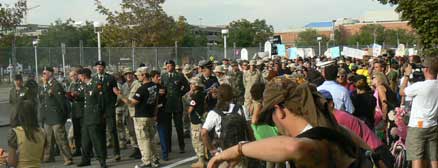
Police harrass kids at Denver DNC

DENVER- On the fourth day of watching Denver mobilize countless police squads in anticipation of problematic demonstrations, you’d think this patrol wouldn’t have caught our eye. Except, the officer leading point on this patrol advanced past our outdoor table with his weapon drawn…
dnc-police-harrass-kids

We turned to see him approach a handful of kids, while the other officers quickly encircled them.

dnc-police-harrass-kids

Next the leader, or perhaps he was the youth-liaison officer, pulled the kids aside to offer his advice. “No one wants to see you guys on the 16th Street Mall.” And: “You guys aren’t dressed for the occasion. Do you think Colorado’s visitors this week want to see kids dressed like you are on the 16th Street Mall?” He recognized a couple of them from Juvenile Detention, I’m guessing, and cautioned them that he could make things easier, or more difficult, depending on whether they helped him out today. He added: “You heard about the two hundred people we arrested the other night? They were arrested for not following our request that they leave.”

When I interrupted by asking the officer to repeat himself, so that what I considered to have been an improper act of coercion could be made more clear, he stopped talking and told me I was interfering. His fellow officers then began taking constant pictures and threatened me with arrest if I didn’t back off.

dnc-police-harrass-kids

IVAW betrays their youthful marchers and capitulates to the Democratic Party

IVAW march
DENVER- I have friends in Iraq Veterans Against the War, but their much anticipated action today was totally FUBAR. Given latitude by the other protest organizers to be the feature action on the last day of the DNC, the IVAW march aimed no higher than to ask that their rep be allowed to meet with a party representative. The IVAW had Rage Against the Machine do a free concert, asked the audience to follow them across town to lend moral support, and when the appointment with a DNC delegate was given them, the IVAW cheered, thanked their fellow marchers, and asked everyone to go home.

Denver Riot Police

This in the face of hundreds of cops in riot gear, heavy machinery, and a large audience of bystanders, delegates and press. The confrontation needed to put the spotlight of media attention on the issue of military imperialism and corporate fascism, passed like it some kind of Pirates of the Caribbean amusement ride, everyone smiling and posing for pictures under the noses of heavily armored riot police menacing the crowd with batons and riot control guns.

police state song and dance
Instead of chants like THIS IS WHAT A POLICE STATE LOOKS LIKE, or megaphone entreaties to ask why do nonviolent common citizens face such intimidation by police, the crowd watched Code Pink and other theatrical performances sing cutesy songs to recast the oppressive tone into a humorous light. They should have been signing “Just a spoonful of sugar makes the medicine go down.” Comedic relief is often laudable, but should we be laughing, instead of facing the militarization of our policeman stone cold sober?

No, instead of calling the Democratic Party and the City of Denver on their repressive ways to curb dissent, the situation was kept in check by the vets’ self-policing. The police never had to issue an order. Instead the IVAW coordinators were constantly detailing city ordinances and forewarning everyone about possible arrest. Every time, more and more people retreated from the action.

For example, the IVAW march was un-permitted, and yet they directed it into the allowed free speech area, instead of veering toward better visibility and “certain arrest.” Oh, you don’t have a “permit” for your march, but there are places that are off limits, meaning, for which you don’t have “permission?” Which is it then? The crowd of Rage fans wanted to have their voices heard. They didn’t want to be led in somber veteran respect mode until all their spirit was worn out of them. The IVAW march coordinators kept everyone in line, followed prearranged parade direction signs, and even allowed themselves to be led by the damn police golf cart whose backward facing sign flashed FOLLOW ME.

IVAW drama stop
So the crowd followed the IVAW into the Free Speech dead end, and they and a multitude of press waited for something to happen. I heard an IVAW coordinator phoning Barack Obama’s office from which they were expecting a phone call. When no Obama appearance materialized, the vets led everyone back out again and into the “forbidden area” with it’s oft-reminded possibility of arrest.

I was asked to stay back with the rest of the followers, and not crowd the IVAW formation. I told the coordinator that he had led us into the Auroria free speech maze and back, and I was not about to obey a single further idiotic command, no matter how much “respect” the veterans were needing.

Seriously. All “out of respect for the veterans.” Even reporters were barked orders as if they were subordinate to the vets. I took umbrage at being told constantly to stop every few minutes to listen to the vets give their witness of Iraq and wait as their spokesman gave further statements to the press. Staying behind, keeping a distance, or keeping the way clear was supposed to be honored “out of respect for the veterans.”

These were the same veterans who went to war when we asked them not to. I’m very thankful that each of them has changed their tune now, but where was their respect for us before more than a million Afghans and Iraqis were killed at their hands? No, the veteran worship was severely misplaced. They earn no points from me for “their sacrifices in the service.” The bastards killed innocent people, they should be begging forgiveness, not assuming to command our respect.

That said, I think the antiwar movement is misplacing its hopes thinking the IVAW can carry any sort of ball promoting an end to war. The vets are after a return of their comrades, and better veterans benefits. That’s a far cry from pacifism, or even a repudiation of US predatory militarism. And this DNC stunt proved it. Here’s how the self-aggrandized crunts blew the last opportunity to show dissent at the DNC.

They held a concert which pulled the youth element away from where they might have been participating in street actions. Of course this is no different than Tom Hayden and Ralph Nader drawing their audiences from likely people who had to choose whether to protest or go see them. Not such a big deal, but it got much worse.

This afternoon the IVAW shepherded a reported 5,000 supporters not to the Pepsi Center delegate entrance, but deep into the Free Speech Cage, away from sight of convention delegates. After a long delay they moved everyone into the promising area, but kept thinning the crowd with warnings of potential arrest. They also kept the marchers well out of proximity of the police lines. The IVAW limited what anyone could say, out of respect for the vets, led them in a last chanted instruction to Go Home, then reminded stragglers that it was the expressed wish of the veterans that everyone leave the area lest an ensuing disturbance mar the IVAW event. After everyone was gone, the veterans even gave a round of applause for a nearby contingent of cops. More in the morning when I’m feeling less enraged.

Preemptive arrests of exuberant youths

RichardDENVER- Richard Cressman, at left, was forced to disperse with the Unconventional Action marchers. He complied and was chased down the sidewalk with a bicycle cop trying to run over his heels shouting “MOVE, MOVE, MOVE” like a sweeper broom. When Richard reached the safety of the onlookers another police officer commanded “ARREST HIM!”

The Unconventional Action kids, who some might stereotype as “anarchists,” mounted another attempt to RECLAIM THE STREETS. Marching in front of the legislative building where they met an immediate police block of their march. Police in riot gear had been intimidating them all day and now countless officers poured out of vans and around corners. Within the first minute officers were donning gas masks.

The UA kids backed off into the park, leaving the officers to maintain their phalanx and shout orders to onlookers to clear the sidewalks. Meanwhile the UA group escaped over Colfax at a fast clip. More officers blocked their way within two blocks away from the park. A long standoff ensued. Reportedly 35 arrests were made, no violence except on the part of the police.

Fodor’s guide to Denver and the DNC

Marie
To answer the obvious questions. If you’re worried about tear gas, saturate a bandana in Apple Cider Vinegar, and bring swimming goggles. For a tip of where you’ll find the action in the next several days, below is a list of where legal observers are planning to be. Meaning, where there might run afoul. Otherwise check with Recreate-68, Codepink, UFPJ and Unconventional Action.

The purpose of legal observing is to protect the civil liberties of political activists. Legal Observers do not intentionally become involved in the actions or intervene in any confrontations with police or others. Legal Observers strive to refrain from actions that could be construed as participating in the demonstration.

Legal Observers can make the following contributions:

– Legal Observers may deter police misconduct,

– Legal Observers may testify about their observations,

– Legal Observers may assist activists who are detained, arrested, or who need medical attention, by alerting the appropriate support teams associated with the demonstration.

CALENDAR

Sunday August 24, 2008

1. END THE OCCUPATIONS RALLY & MARCH
This is a permitted rally and march organized by the Re-Create 68 coalition and other groups. Due to expected large number of participants, many Legal Observers are needed. Please check in at the office at approximately 9:00 a.m. to obtain materials and hats. Please return materials to the PLP immediately after the March. For details about speakers and plans, go to: www.recreate68.org.

Rally at 9:00 AM
March steps off from the Capitol steps at 10:30 AM. End at approximately 3pm. Location: West Steps of the Capitol Building

2. CODE PINK FREEZE TO STOP THE WAR
CHECK IN AT NOON AT PLP OFFICE. 16th Street Mall

3. FUNK THE WAR DANCE FOR PEACE
This action is comprised of four feeder marches which will converge on the 16th Street Mall. It is sponsored by Tent State University. For details, see: http://tentstate.org/funkthewar.htm The Funk marches shall depart the following locations around 1:00 PM. CHECK IN AT NOON AT PLP OFFICE

The marches will converge at Union Station at 2:00 PM.
– Union Station (17th & Wynkoop) Women’s Convergence led by Code Pink
– Skate Park (2205 19th Street, near Coors Field) Youth Convergence w/ Ralph Nader
– MEPS Center (19th & Stout) Iraq Vets Against the War and Allies
– Curtis Park (30th & Curtis in Five Points) Power to the People led by C. McKinney

3. UNCONVENTIONAL ACTION – RECLAIM THE STREETS
From 3:00 to 5:00 PM. FLOATER LEGAL OBSERVERS CHECK IN AT 2 PM AT PLP. Legal observers may be dispatched to locations downtown, particularly near delegates’ hotels, where coordinated direct action and protests may take place after the End the Occupations march, per Unconventional Action (U/A) (see: http://www.unconventionalaction.org/downloads/Disrupt_the_DNC.pdf)

4. TENT STATE UNIVERSITY MOVE TO FREEDOM CAGE
CHECK IN AT 10:30 PM

Monday August 25, 2008

1. PROTEST THE FREEDOM CAGE
March sponsored by Re-Create 68 to call attention to the undemocratic clamp down on free speech, in particular the abysmal cage erected near the Pepsi Center where non-delegates have been relegated to a fenced-in pen obstructed by the massive Media tent. This march will leave Skyline Park South (15th & Arapahoe) at 9:00 a.m and go to the Pepsi Center. CHECK IN AT 8 AM AT PLP OFFICE

2. FREEDOM MARCH TO SUPPORT POLITICAL PRISONERS
Rally and speakers begin at 10:00 AM. Location: Civic Center Park amphitheater. March will proceed from Civic Center Park to the Federal Courthouse (19th & Champa). CHECK IN AT 9 AM AT PLP OFFICE

3. SHAKE YOUR MONEY MAKER
Demonstrators will surround the Denver Mint at approximately 5:00 PM in an effort to draw attention to issues of wealth and poverty. CHECK IN AT 4:30 PM AT PLP OFFICE. The Denver Mint is located at 320 W. Colfax and Cherokee Street.

4. NO BUSINESS AS USUAL
Theatrics and street actions at various locales, such as fundraisers, in downtown Denver sponsored by Unconventional Action. Begins at 6:00 PM at Civic Center. FLOATER LO’S CHECK IN AT 5:00 PM

5. FESTIVAL OF DEMOCRACY MUSIC SHOWCASE
3pm to 9pm at Civic Center Park. We will be dispatching a few Legal Observers to this location during the concerts. Please notify Heather about your availability.

6. TENT STATE UNIVERSITY AT THE FREEDOM CAGE
CHECK IN AT 10:30 PM AT OFFICE

Tuesday August 26, 2008

1. PROCESSION FOR THE FUTURE Puppet March
Starts at Civic Center Park at 9:00 AM.
CHECK IN AT OFFICE AT 8:30 AM

2. CODE PINK
CHECK IN AT OFFICE AT 10:30 AM

3. CONFRONT THE SPECTACLE
Marches beginning at approximately 3 PM near or at the Pepsi Center. Sponsored by Unconventional Action. Technical blockades, street theater, and other diverse actions may attempt to block the flow of delegates fro their afternoon platform meetings to the convention hall.

Legal Observers CHECK IN AT 2 PM AT PLP

3. TENT STATE
CHECK IN AT 10:30 PM for move from Cuernavaca Park to Pepsi Ctr Freedom Cage

Wednesday August 27, 2008

1. ECO ACTIONS – ALL DAY
Direct action for the environment all day downtown. Polluters and greenwashers’ corporate headquarters downtown Denver. Check in at 10 AM and throughout the day at PLP offices

2. WOMEN IN BLACK
12-2 PM at Skyline Park. Check in at 11:30 AM at PLP Office.

3. IRAQ VETS AGAINST WAR MARCH 3-6 PM
** LEGAL OBSERVER CHECK IN AT FOURNEY’S TRANSPORTATION MUSEUM ON BRIGHTON BLVD AT 3 PM.

4. CRITICAL MASS BIKE RIDE – NO WAR, NO WARMING

6 PM. Check in at PLP at 5:00 PM for details on locations.

Thursday August 28, 2008

1. DNC MOBILIZATION FOR JUST AND HUMANE IMMIGRATION REFORM
Potentially massive, epic march for immigrant rights. For details, see: www.weareamericadnc.org
Legal Observers meet at PLP office at 8:00 a.m. March Step-off at 9:00 a.m. from Rude Park (2855 W. Howard Place). Rally to follow at La Alma / Lincoln Park (W. 12th Ave. and Mariposa St)

2. LOCKSTEP BEHIND THE PARTY
Action at the Pepsi Center at 11:00 AM. Further details on this action needed.

3. END WHITE SUPREMACY – Media Savvy Actions sponsored by Unconventional Action.
Times and locations to be determined.

5. MARCH TO INVESCO FIELD
March starts at Lincoln Park (Mariposa Street) at 2:00 PM and goes to Obama’s acceptance speech at Invesco Field.

Tent State Concentration Camping

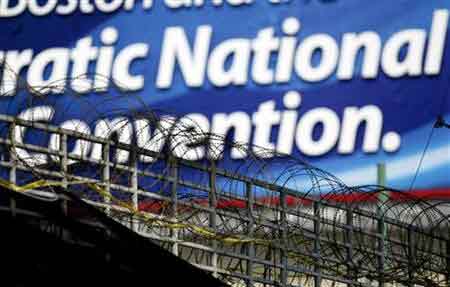
DNC Free Speech restrictionsTent State organizer Adam Jung may have outwitted the Denver PD. They won’t let his organization camp overnight in the city park. But the razor-wire enclosure known as the freedom cage is “open 24-hours,” so he’s taking his encampment there. Clever? Jung could have held out for the jail, w/ room and board.

Leaving his tents available for those who want to protest. (Tent State also announced it won’t be using its permit for Civic Center Park on Wednesday, but hasn’t released the permit for anyone else to use either.)

After stringing him along with daily meetings with the Police, the City of Denver denied Adam and his group permission to camp overnight in City Park. So he’s leading his band to the Pepsi Center, to pitch their tents on the asphalt encircled by security fence, guards and searchlights. If Denver has to accommodate disaffected youth, probably penned up and under their nose is where the police would prefer them to be.

Or it might work out. Maybe a concentration of kids behind razor and barbed wire will be the best anti-Gitmo demonstration yet. Tent State meet Police State.

I wore polka dots today

polka dots are the new black
…and felt like an idiot. Why? I think polka dots are adorable. They are playful and happy and youthful which are traits I value. And the outfit I had on was classy and cute. So why did I feel anxious that someone might pop over unexpectedly and see my polka dots? I’m not sure, but I changed rather than further contemplate the issue.

I think that maybe polka dots aren’t me. Whatever that means. Like all women, I have a closet full of clothes that I never wear. Truthfully, my closet is a schizophrenic mixed bag pining for psychiatric intervention. I must’ve worn these styles at one time, but I guess I’ve changed. Or, more likely, they were never me. I just didn’t know it, because I was adept at changing me to be a part of the crowd du jour.

I don’t think men are this way. A couple years ago, a friend and I took a getaway to Mexico for a few days. We hung out under a big beach umbrella, two pale obviously-American chubbies in a sea of gorgeous foreigners. The women were thin, tanned, and beautiful, but they couldn’t hold a candle to the men. Unbelievably fit, glistening brown skin, boy shorts. At once holding a cigarette and a partner’s perky breast, we couldn’t stop staring at the men.

When the couples eventually got up and dressed, the guys wore capri pants, silky dark shirts, and closed-toe leather sandals. But even through my drool I knew that, were I given the chance, I probably wouldn’t date any one of them. Seriously! They were not my type.

As pretty as the beach boys were, my type of guy doesn’t spend much time thinking about his hair and wardrobe. A makeover is buying his favorite shirt in another color. I’ve never succeeded in slipping Bruni Maglis over his tennis shoes, nor a man purse over his shoulder. Even the plain front/pleated front battle can rage for days, so sartorial transformation has never been in the cards. Men know what they are comfortable wearing, and are usually unwilling to indulge our female fantasies. Truly, I wouldn’t want it any other way.

If men can stay true to form, why do women’s closets suffer from bipolar disorder? Are we multifaceted and complex, or are we being unduly influenced the expectations of our mates, the opinions of our friends, and the daily media mind fuck?

Though my closet doesn’t reflect it yet, my chameleon days are over. I am newly unapologetic about my hairstyle, my yoga pants, and my Doc Martens. When I dress up I usually wear black from head to toe. I don’t show a lot of skin, and hide my few curves. I wear simple earrings, no other jewelry. I no longer worry about fashion trends, because I refuse to be trendy.

My manner of dress is merely an outward manifestation of the natural, unadorned, athletic, private girl that I am. I cover my body in such a way that I’m not constantly mindful of the fact that I’m wearing something. Something that feels foreign and awkward. Like polka dots.

Denver D’Alliance for Democracy

Alliance for Real Democracy
Here is current the schedule of ARN events:

———————————-
SATURDAY, AUGUST 23

All Day City Park
Set up at City Park

Afternoon (TBD) City Park
Resurrection City Free University
Non-Violence Training

5:00 – 10:00 PM Gates Crescent Park
Welcoming BBQ & Drinks for the Delegates

——————————-
SUNDAY, AUGUST 24

All Day Platte River & Cherry Creak Trails
AFSC Banners
AFSC is planning on displaying banners for about 100 yards in each direction from REI.

All Day City Park
Art Installations
A variety of art pieces representing progressive ideals.

(9:00 AM
Begin at the WEST STEPS OF THE CAPITOL.
End on Speer Blvd in front of the Pepsi Center.
End the Occupations March and Rally
March to end all illegal imperialist occupations in Iraq, Palestine, Afghanistan, Puerto Rico, Haiti, Hawaii, North America, and others.)

1:00 PM Various Denver Locations
Funk the War: Dance for Peace
A creative action with an emphasis on music and visuals. Smaller feeder marches lead to a central location with a concert.

Immediately Following Funk the War/Dance Party for Peace City Park
Concert featuring: Son of Nun, Jello, Brian Harvey, David Rovics

7:00 PM Cleo Parker Robinson Dance Theater
Evening of Conscience: No Attack on Iran
Feature performances on opposing any moves towards a U.S. attack on Iran.

(Evening Central Presbyterian Church, 1660 Sherman St.
Progressive Welcome to Denver)

——————————-
MONDAY, AUGUST 25

10:30 AM City Park
Town Hall Meeting
Brief ARD meeting to review the day.

12:00 – 6:00 PM City Park
Resurrection City Free University
A free university focusing on praxis and theory

5:00 PM City Park
Nomination of Partyless Youth Ticket
A chance for the youth to nominate a candidate that speaks to them.

Evening (TBD) TBD
Cynthia McKinney Speech
Speech by presidential candidate Cynthia McKinney.

6:30 PM City Park
CODEPINK Concert
A concert highlighting many powerful and talented women.

——————————–
TUESDAY, AUGUST 26

10:30 AM City Park
Town Hall Meeting
Brief ARD meeting to review the day.

11:00 AM Skyline Park
A Walk in their Shoes
Thousands of shoes will represent the hundreds of thousands of Iraqis who have died.

12:00 – 6:00 PM City Park
Resurrection City Free University
A free university focusing on praxis and theory

3:00 PM City Park
Concert featuring Blue Scholars, David Rovics, and others.

Afternoon (TBD) City Park
Partyless Youth Platform
The youth will be given an opportunity to create their platform.

Afternoon/ Evening (TBD) Downtown
Operation First Casualty
Street theater that demonstrates the reality of war.

(6:30 PM City Park
Democratic Party “Watching Party”
Local Democrats will host a big-screen TV for non-seated Democrats to watch the Convention.)

————————————-
WEDNESDAY, AUGUST 27

10:30 AM City Park
Town Hall Meeting
Brief ARD meeting to review the day.

12:00 – 6:00 PM City Park
Resurrection City Free University
A free university focusing on praxis and theory

12:00 Noon City Park
Concert featuring: Flobots, State Radio, The Coup, Wayne Kramer, Son of Nun, Jello, and others.

Afternoon (TBD) City Park
Partyless Youth Acceptance Speech
The Partyless Youth nominee will give an acceptance speech.

3:30 PM TBD
IVAW March to End the War
Iraq Veterans Against the War will march in opposition to the war in Iraq.

(Evening Buelle Theater
Cultural Events: Cornel West and the Flobots)

———————————–
THURSDAY, AUGUST 28

10:30 AM City Park
Town Hall Meeting
Brief ARD meeting to review the day.

TBD TBD
Immigrant Rights March and Rally
The march, with a national scope, will provide a venue for immigrants and their allies to demonstrate their decree for just and fair reform for our country’s broken immigration system.

12:00 – 6:00 PM City Park
Resurrection City Free University
A free university focusing on praxis and theory

(TBD INVESCO Field
Obama’s Acceptance Speech
Obama will give his acceptance speech to 75,000 people at INVESCO Field. ARD hopes to have a presence outside.)

—————————–
FRIDAY, AUGUST 29

All Day City Park
Tear Down and Clean Up
All of ARD will be needed to help clean and clear City Park

All Day TBD
Buses to St. Paul
ARD would like to help coordinate buses and carpooling to St. Paul for the Republican National Convention.

Global economic rapists are at it again

G8 protest
Why protest the G8 Summit July 7-9? Those hoodlums always look so determined. Here’s the rationale by the Emergency Exit Collective:

The 2008 G8 on Hokkaido, a Strategic Assessment
Emergency Exit Collective
Bristol, Mayday, 2008

The authors of this document are a collection of activists, scholars, and writers currently based in the United States and Western Europe who have gotten to know and work with each other in the movement against capitalist globalization. We’re writing this at the request of some members of No! G8 Action Japan, who asked us for a broad strategic analysis of the state of struggle as we see it, and particularly, of the role of the G8, what it represents, the dangers and opportunities that may lie hidden in the moment. It is in no sense programmatic. Mainly, it is an attempt to develop tools that we hope will be helpful for organizers, or for anyone engaged in the struggle against global capital.

I
It is our condition as human beings that we produce our lives in common.

II
Let us then try to see the world from the perspective of the planet’s commoners, taking the word in that sense: those whose most essential tradition is cooperation in the making and maintenance of human social life, yet who have had to do so under conditions of suffering and separation; deprived, ignored, devalued, divided into hierarchies, pitted against each other for our very physical survival. In one sense we are all commoners. But it’s equally true that just about everyone, at least in some ways, at some points, plays the role of the rulers—of those who expropriate, devalue and divide—or at the very least benefits from such divisions.

Obviously some do more than others. It is at the peak of this pyramid that we encounter groups like the G8.

III
The G8’s perspective is that of the aristocrats, the rulers: those who command and maintain that global machinery of violence that defends existing borders and lines of separation: whether national borders with their detention camps for migrants, or property regimes, with their prisons for the poor. They live by constantly claiming title to the products of others collective creativity and labour, and in thus doing they create the poor; they create scarcity in the midst of plenty, and divide us on a daily basis; they create financial districts that loot resources from across the world, and in thus doing they turn the spirit of human creativity into a spiritual desert; close or privatize parks, public water taps and libraries, hospitals, youth centers, universities, schools, public swimming pools, and instead endlessly build shopping malls that channels convivial life into a means of commodity circulation; work toward turning global ecological catastrophe into business opportunities.

These are the people who presume to speak in the name of the “international community” even as they hide in their gated communities or meet protected by phalanxes of riot cops. It is critical to bear in mind that the ultimate aim of their policies is never to create community but to introduce and maintain divisions that set common people at each other’s throats. The neoliberal project, which has been their main instrument for doing so for the last three decades, is premised on a constant effort either to uproot or destroy any communal or democratic system whereby ordinary people govern their own affairs or maintain common resources for the common good, or, to reorganize each tiny remaining commons as an isolated node in a market system in which livelihood is never guaranteed, where the gain of one community must necessarily be at the expense of others. Insofar as they are willing to appeal to high-minded principles of common humanity, and encourage global cooperation, only and exactly to the extent that is required to maintain this system of universal competition.

IV
At the present time, the G8—the annual summit of the leaders of “industrial democracies”—is the key coordinative institution charged with the task of maintaining this neoliberal project, or of reforming it, revising it, adapting it to the changing condition of planetary class relations. The role of the G8 has always been to define the broad strategic horizons through which the next wave of planetary capital accumulation can occur. This means that its main task is to answer the question of how 3?4 in the present conditions of multiple crises and struggles 3?4 to subordinate social relations among the producing commoners of the planet to capital’s supreme value: profit.

V
Originally founded as the G7 in 1975 as a means of coordinating financial strategies for dealing with the ‘70s energy crisis, then expanded after the end of the Cold War to include Russia, its currently face a moment of profound impasse in the governance of planetary class relations: the greatest since the ‘70s energy crisis itself.

VI
The ‘70s energy crisis represented the final death-pangs of what might be termed the Cold War settlement, shattered by a quarter century of popular struggle. It’s worth returning briefly to this history.

The geopolitical arrangements put in place after World War II were above all designed to forestall the threat of revolution. In the immediate wake of the war, not only did much of the world lie in ruins, most of world’s population had abandoned any assumption about the inevitability of existing social arrangements. The advent of the Cold War had the effect of boxing movements for social change into a bipolar straightjacket. On the one hand, the former Allied and Axis powers that were later to unite in the G7 (the US, Canada, UK, France, Italy, Germany, Japan)—the “industrialized democracies”, as they like to call themselves—engaged in a massive project of co-optation. Their governments continued the process, begun in the ‘30s, of taking over social welfare institutions that had originally been created by popular movements (from insurance schemes to public libraries), even to expand them, on condition that they now be managed by state-appointed bureaucracies rather than by those who used them, buying off unions and the working classes more generally with policies meant to guarantee high wages, job security and the promise of educational advance—all in exchange for political loyalty, productivity increases and wage divisions within national and planetary working class itself. The Sino-Soviet bloc—which effectively became a kind of junior partner within the overall power structure, and its allies remained to trap revolutionary energies into the task of reproducing similar bureaucracies elsewhere. Both the US and USSR secured their dominance after the war by refusing to demobilize, instead locking the planet in a permanent threat of nuclear annihilation, a terrible vision of absolute cosmic power.

VII
Almost immediately, though, this arrangement was challenged by a series of revolts from those whose work was required to maintain the system, but who were, effectively, left outside the deal: first, peasants and the urban poor in the colonies and former colonies of the Global South, next, disenfranchised minorities in the home countries (in the US, the Civil Rights movement, then Black Power), and finally and most significantly, by the explosion of the women’s movement of the late ‘60s and early ‘70s—the revolt of that majority of humanity whose largely unremunerated labor made the very existence “the economy” possible. This appears to have been the tipping point.

VIII
The problem was that the Cold War settlement was never meant to include everyone. It by definition couldn’t. Once matters reached tipping point, then, the rulers scotched the settlement. All deals were off. The oil shock was first edge of the counter-offensive, breaking the back of existing working class organizations, driving home the message that there was nothing guaranteed about prosperity. Under the aegis of the newly hatched G7, this counter-offensive involved a series of interwoven strategies that were later to give rise to what is known as neoliberalism.

IX
These strategies resulted in what came to be known as “Structural Adjustment” both in the North and in the South, accompanied by trade and financial liberalization. This, in turn, made possible crucial structural changes in our planetary production in common extending the role of the market to discipline our lives and divide us into more and more polarized wage hierarchy. This involved:

· In the immediate wake of ‘70s oil shock, petrodollars were recycled from OPEC into Northern banks that then lent them, at extortionate rates of interest, to developing countries of the Global South. This was the origin of the famous “Third World Debt Crisis.” The existence of this debt allowed institutions like the IMF to impose its monetarist orthodoxy on most of the planet for roughly twenty years, in the process, stripping away most of even those modest social protections that had been won by the world’s poor—large numbers of whom were plunged into a situation of absolute desperation.

· It also opened a period of new enclosures through the capitalist imposition of structural adjustment policies, manipulation of environmental and social catastrophes like war, or for that matter through the authoritarian dictates of “socialist” regimes. Through such means, large sections of the world’s population have over the past thirty years been dispossessed from resources previously held in common, either by dint of long traditions, or as the fruits of past struggles and past settlements.

· Through financial deregulation and trade liberalization, neoliberal capital, which emerged from the G7 strategies to deal with the 1970s crisis aimed thus at turning the “class war” in communities, factories, offices, streets and fields against the engine of competition, into a planetary “civil war”, pitting each community of commoners against every other community of commoners.

· Neoliberal capital has done this by imposing an ethos of “efficiency” and rhetoric of “lowering the costs of production” applied so broadly that mechanisms of competition have come to pervade every sphere of life. In fact these terms are euphemisms, for a more fundamental demand: that capital be exempt from taking any reduction in profit to finance the costs of reproduction of human bodies and their social and natural environments (which it does not count as costs) and which are, effectively, “exernalized” onto communities and nature.

· The enclosure of resources and entitlements won in previous generations of struggles both in the North and the South, in turn, created the conditions for increasing the wage hierarchies (both global and local), by which commoners work for capital—wage hierarchies reproduced economically through pervasive competition, but culturally, through male dominance, xenophobia and racism. These wage gaps, in turn, made it possible to reduce the value of Northern workers’ labour power, by introducing commodities that enter in their wage basket at a fraction of what their cost might otherwise have been. The planetary expansion of sweatshops means that American workers (for example) can buy cargo pants or lawn-mowers made in Cambodia at Walmart, or buy tomatoes grown by undocumented Mexican workers in California, or even, in many cases, hire Jamaican or Filipina nurses to take care of children and aged grandparents at such low prices, that their employers have been able to lower real wages without pushing most of them into penury. In the South, meanwhile, this situation has made it possible to discipline new masses of workers into factories and assembly lines, fields and offices, thus extending enormously capital’s reach in defining the terms—the what, the how, the how much—of social production.

· These different forms of enclosures, both North and South, mean that commoners have become increasingly dependent on the market to reproduce their livelihoods, with less power to resist the violence and arrogance of those whose priorities is only to seek profit, less power to set a limit to the market discipline running their lives, more prone to turn against one another in wars with other commoners who share the same pressures of having to run the same competitive race, but not the same rights and the same access to the wage. All this has meant a generalized state of precarity, where nothing can be taken for granted.

X
In turn, this manipulation of currency and commodity flows constituting neoliberal globalization became the basis for the creation of the planet’s first genuine global bureaucracy.

· This was multi-tiered, with finance capital at the peak, then the ever-expanding trade bureaucracies (IMF, WTO, EU, World Bank, etc), then transnational corporations, and finally, the endless varieties of NGOs that proliferated throughout the period—almost all of which shared the same neoliberal orthodoxy, even as they substituted themselves for social welfare functions once reserved for states.

· The existence of this overarching apparatus, in turn, allowed poorer countries previously under the control of authoritarian regimes beholden to one or another side in the Cold War to adopt “democratic” forms of government. This did allow a restoration of formal civil liberties, but very little that could really merit the name of democracy (the rule of the “demos”, i.e., of the commoners). They were in fact constitutional republics, and the overwhelming trend during the period was to strip legislatures, that branch of government most open to popular pressure, of most of their powers, which were increasingly shifted to the executive and judicial branches, even as these latter, in turn, largely ended up enacting policies developed overseas, by global bureaucrats.

· This entire bureaucratic arrangement was justified, paradoxically enough, by an ideology of extreme individualism. On the level of ideas, neoliberalism relied on a systematic cooptation of the themes of popular struggle of the ‘60s: autonomy, pleasure, personal liberation, the rejection of all forms of bureaucratic control and authority. All these were repackaged as the very essence of capitalism, and the market reframed as a revolutionary force of liberation.

· The entire arrangement, in turn, was made possible by a preemptive attitude towards popular struggle. The breaking of unions and retreat of mass social movements from the late ‘70s onwards was only made possible by a massive shift of state resources into the machinery of violence: armies, prisons and police (secret and otherwise) and an endless variety of private “security services”, all with their attendant propaganda machines, which tended to increase even as other forms of social spending were cut back, among other things absorbing increasing portions of the former proletariat, making the security apparatus an increasingly large proportion of total social spending. This approach has been very successful in holding back mass opposition to capital in much of the world (especially West Europe and North America), and above all, in making it possible to argue there are no viable alternatives. But in doing so, has created strains on the system so profound it threatens to undermine it entirely.

XI
The latter point deserves elaboration. The element of force is, on any number of levels, the weak point of the system. This is not only on the constitutional level, where the question of how to integrate the emerging global bureaucratic apparatus, and existing military arrangements, has never been resolved. It is above all an economic problem. It is quite clear that the maintenance of elaborate security machinery is an absolute imperative of neoliberalism. One need only observe what happened with the collapse of the Soviet bloc in Eastern Europe: where one might have expected the Cold War victors to demand the dismantling of the army, secret police and secret prisons, and to maintain and develop the existing industrial base, in fact, what they did was absolutely the opposite: in fact, the only part of the industrial base that has managed fully to maintain itself has been the parts required to maintained the security apparatus itself! Critical too is the element of preemption: the governing classes in North America, for example, are willing to go to almost unimaginable lengths to ensure social movements never feel they are accomplishing anything. The current Gulf War is an excellent example: US military operations appear to be organized first and foremost to be protest-proof, to ensure that what happened in Vietnam (mass mobilization at home, widespread revolt within the army overseas) could never be repeated. This means above all that US casualties must always be kept to a minimum. The result are rules of engagement, and practices like the use of air power within cities ostensibly already controlled by occupation forces, so obviously guaranteed to maximize the killing of innocents and galvanizing hatred against the occupiers that they ensure the war itself cannot be won. Yet this approach can be taken as the very paradigm for neoliberal security regimes. Consider security arrangements around trade summits, where police are so determined prevent protestors from achieving tactical victories that they are often willing to effectively shut down the summits themselves. So too in overall strategy. In North America, such enormous resources are poured into the apparatus of repression, militarization, and propaganda that class struggle, labor action, mass movements seem to disappear entirely. It is thus possible to claim we have entered a new age where old conflicts are irrelevant. This is tremendously demoralizing of course for opponents of the system; but those running the system seem to find that demoralization so essential they don’t seem to care that the resultant apparatus (police, prisons, military, etc) is, effectively, sinking the entire US economy under its dead weight.

XII
The current crisis is not primarily geopolitical in nature. It is a crisis of neoliberalism itself. But it takes place against the backdrop of profound geopolitical realignments. The decline of North American power, both economic and geopolitical has been accompanied by the rise of Northeast Asia (and to a increasing extent, South Asia as well). While the Northeast Asian region is still divided by painful Cold War cleavages—the fortified lines across the Taiwan straits and at the 38th parallel in Korea…—the sheer realities of economic entanglement can be expected to lead to a gradual easing of tensions and a rise to global hegemony, as the region becomes the new center of gravity of the global economy, of the creation of new science and technology, ultimately, of political and military power. This may, quite likely, be a gradual and lengthy process. But in the meantime, very old patterns are rapidly reemerging: China reestablishing relations with ancient tributary states from Korea to Vietnam, radical Islamists attempting to reestablish their ancient role as the guardians of finance and piety at the in the Central Asian caravan routes and across Indian Ocean, every sort of Medieval trade diaspora reemerging… In the process, old political models remerge as well: the Chinese principle of the state transcending law, the Islamic principle of a legal order transcending any state. Everywhere, we see the revival too of ancient forms of exploitation—feudalism, slavery, debt peonage—often entangled in the newest forms of technology, but still echoing all the worst abuses of the Middle Ages. A scramble for resources has begun, with US occupation of Iraq and saber-rattling throughout the surrounding region clearly meant (at least in part) to place a potential stranglehold the energy supply of China; Chinese attempts to outflank with its own scramble for Africa, with increasing forays into South America and even Eastern Europe. The Chinese invasion into Africa (not as of yet at least a military invasion, but already involving the movement of hundreds of thousands of people), is changing the world in ways that will probably be felt for centuries. Meanwhile, the nations of South America, the first victims of the “Washington consensus” have managed to largely wriggle free from the US colonial orbit, while the US, its forces tied down in the Middle East, has for the moment at least abandoned it, is desperately struggling to keep its grip Mexico, Central America and the Caribbean—its own “near abroad”.

XIII
In another age all this might have led to war—that is, not just colonial occupations, police actions, or proxy wars (which are obviously already taking place), but direct military confrontations between the armies of major powers. It still could; accidents happen; but there is reason to believe that, when it comes to moments of critical decision, the loyalties of the global elites are increasingly to each other, and not to the national entities for whom they claim to speak. There is some compelling evidence for this.

Take for example when the US elites panicked at the prospect of the massive budget surpluses of the late 1990s. As Alan Greenspan, head of the Federal Reserve at the time warned, if these were allowed to stand they would have flooded government coffers with so many trillions of dollars that it could only have lead to some form of creeping socialism, even, he predicted, to the government acquiring “equity stakes” in key US corporations. The more excitable of capitalism’s managers actually began contemplating scenarios where the capitalist system itself would be imperiled. The only possible solution was massive tax cuts; these were duly enacted, and did indeed manage to turn surpluses into enormous deficits, financed by the sale of treasury bonds to Japan and China. Conditions have thus now reached a point where it is beginning to look as if the most likely long term outcome for the US (its technological and industrial base decaying, sinking under the burden of its enormous security spending) will be to end up serve as junior partner and military enforcer for East Asia capital. Its rulers, or at least a significant proportion of them, would prefer to hand global hegemony to the rulers of China (provided the latter abandon Communism) than to return to any sort of New Deal compromise with their “own” working classes.

A second example lies in the origins of what has been called the current “Bretton Woods II” system of currency arrangements, which underline a close working together of some “surplus” and “deficit” countries within global circuits. The macroeconomic manifestation of the planetary restructuring outlined in XIX underlines both the huge US trade deficit that so much seem to worry many commentators, and the possibility to continually generate new debt instruments like the one that has recently resulted in the sub-prime crisis. The ongoing recycling of accumulated surplus of countries exporting to the USA such as China and oil producing countries is what has allowed financiers to create new credit instruments in the USA. Hence, the “deal” offered by the masters in the United States to its commoners has been this: ‘you, give us a relative social peace and accept capitalist markets as the main means through which you reproduce your own livelihoods, and we will give you access to cheaper consumption goods, access to credit for buying cars and homes, and access to education, health, pensions and social security through the speculative means of stock markets and housing prices.’ Similar compromises were reached in all the G8 countries.

Meanwhile, there is the problem of maintaining any sort of social peace with the hundreds of millions of unemployed, underemployed, dispossessed commoners currently swelling the shanty-towns of Asia, Africa, and Latin America as a result of ongoing enclosures (which have speeded up within China and India in particular, even as “structural adjustment policies” in Africa and Latin America have been derailed). Any prospect of maintaining peace in these circumstances would ordinarily require either extremely high rates of economic growth—which globally have not been forthcoming, since outside of China, growth rates in the developing world have been much lower than they were in the ‘50s, ‘60s, or even ‘70s—or extremely high levels of repression, lest matters descend into rebellion or generalized civil war. The latter has of course occurred in many parts of the world currently neglected by capital, but in favored regions, such as the coastal provinces of China, or “free trade” zones of India, Egypt, or Mexico, commoners are being offered a different sort of deal: industrial employment at wages that, while very low by international standards, are still substantially higher than anything currently obtainable in the impoverished countryside; and above all the promise, through the intervention of Western markets and (privatized) knowledge, of gradually improving conditions of living. While over the least few years wages in many such areas seem to be growing, thanks to the intensification of popular struggles, such gains are inherently vulnerable: the effect of recent food inflation has been to cut real wages back dramatically—and threaten millions with starvation.

What we really want to stress here, though, is that the long-term promise being offered to the South is just as untenable as the idea that US or European consumers can indefinitely expand their conditions of life through the use of mortgages and credit cards.

What’s being offered the new dispossessed is a transposition of the American dream. The idea is that the lifestyle and consumption patterns of existing Chinese, Indian, or Brazilian or Zambian urban middle classes (already modeled on Northern ones) will eventually become available to the children of today’s miners, maquila or plantation laborers, until, ultimately, everyone on earth is brought up to roughly the same level of consumption. Put in these terms, the argument is absurd. The idea that all six billion of us can become “middle class” is obviously impossible. First of all there is a simple problem of resources. It doesn’t matter how many bottles we recycle or how energy efficient are the light bulbs we use, there’s just no way the earth’s ecosystem can accommodate six billion people driving in private cars to work in air-conditioned cubicles before periodically flying off to vacation in Acapulco or Tahiti. To maintain the style of living and producing in common we now identify with “middle classness” on a planetary scale would require several additional planets.

This much has been pointed out repeatedly. But the second point is no less important. What this vision of betterment ultimately proposes is that it would be possible to build universal prosperity and human dignity on a system of wage labor. This is fantasy. Historically, wages are always the contractual face for system of command and degradation, and a means of disguising exploitation: expressing value for work only on condition of stealing value without work— and there is no reason to believe they could ever be anything else. This is why, as history has also shown, human beings will always avoid working for wages if they have any other viable option. For a system based on wage labor to come into being, such options must therefore be made unavailable. This in turn means that such systems are always premised on structures of exclusion: on the prior existence of borders and property regimes maintained by violence. Finally, historically, it has always proved impossible to maintain any sizeable class of wage-earners in relative prosperity without basing that prosperity, directly or indirectly, on the unwaged labor of others—on slave-labor, women’s domestic labor, the forced labor of colonial subjects, the work of women and men in peasant communities halfway around the world—by people who are even more systematically exploited, degraded, and immiserated. For that reason, such systems have always depended not only on setting wage-earners against each other by inciting bigotry, prejudice, hostility, resentment, violence, but also by inciting the same between men and women, between the people of different continents (“race”), between the generations.

From the perspective of the whole, then, the dream of universal middle class “betterment” must necessarily be an illusion constructed in between the Scylla of ecological disaster, and the Charybdis of poverty, detritus, and hatred: precisely, the two pillars of today’s strategic impasse faced by the G8.

XIV
How then do we describe the current impasse of capitalist governance?

To a large degree, it is the effect of a sudden and extremely effective upswing of popular resistance—one all the more extraordinary considering the huge resources that had been invested in preventing such movements from breaking out.

On the one hand, the turn of the millennium saw a vast and sudden flowering of new anti-capitalist movements, a veritable planetary uprising against neoliberalism by commoners in Latin America, India, Africa, Asia, across the North Atlantic world’s former colonies and ultimately, within the cities of the former colonial powers themselves. As a result, the neoliberal project lies shattered. What came to be called the “anti-globalization” movement took aim at the trade bureaucracies—the obvious weak link in the emerging institutions of global administration—but it was merely the most visible aspect of this uprising. It was however an extraordinarily successful one. Not only was the WTO halted in its tracks, but all major trade initiatives (MAI, FTAA…) scuttled. The World Bank was hobbled and the power of the IMF over most of the world’s population, effectively, destroyed. The latter, once the terror of the Global South, is now a shattered remnant of its former self, reduced to selling off its gold reserves and desperately searching for a new global mission.

In many ways though spectacular street actions were merely the most visible aspects of much broader changes: the resurgence of labor unions, in certain parts of the world, the flowering of economic and social alternatives on the grassroots levels in every part of the world, from new forms of direct democracy of indigenous communities like El Alto in Bolivia or self-managed factories in Paraguay, to township movements in South Africa, farming cooperatives in India, squatters’ movements in Korea, experiments in permaculture in Europe or “Islamic economics” among the urban poor in the Middle East. We have seen the development of thousands of forms of mutual aid association, most of which have not even made it onto the radar of the global media, often have almost no ideological unity and which may not even be aware of each other’s existence, but nonetheless share a common desire to mark a practical break with capitalism, and which, most importantly, hold out the prospect of creating new forms of planetary commons that can—and in some cases are—beginning to knit together to provide the outlines of genuine alternative vision of what a non-capitalist future might look like.

The reaction of the world’s rulers was predictable. The planetary uprising had occurred during a time when the global security apparatus was beginning to look like it lacked a purpose, when the world threatened to return to a state of peace. The response—aided of course, by the intervention of some of the US’ former Cold War allies, reorganized now under the name of Al Qaeda—was a return to global warfare. But this too failed. The “war on terror”—as an attempt to impose US military power as the ultimate enforcer of the neoliberal model—has collapsed as well in the face of almost universal popular resistance. This is the nature of their “impasse”.

At the same time, the top-heavy, inefficient US model of military capitalism—a model created in large part to prevent the dangers of social movements, but which the US has also sought to export to some degree simply because of its profligacy and inefficiency, to prevent the rest of the world from too rapidly overtaking them—has proved so wasteful of resources that it threatens to plunge the entire planet into ecological and social crisis. Drought, disaster, famines, combine with endless campaigns of enclosure, foreclosure, to cast the very means of survival—food, water, shelter—into question for the bulk of the world’s population.

XV
In the rulers’ language the crisis understood, first and foremost, as a problem of regulating cash flows, of reestablishing, as they like to put it, a new “financial architecture”. Obviously they are aware of the broader problems. Their promotional literature has always been full of it. From the earliest days of the G7, through to the days after the Cold War, when Russia was added as a reward for embracing capitalism, they have always claimed that their chief concerns include

· the reduction of global poverty

· sustainable environmental policies

· sustainable global energy policies

· stable financial institutions governing global trade and currency transactions

If one were to take such claims seriously, it’s hard to see their overall performance as anything but a catastrophic failure. At the present moment, all of these are in crisis mode: there are food riots, global warming, peak oil, and the threat of financial meltdown, bursting of credit bubbles, currency crises, a global credit crunch. [**Failure on this scale however, opens opportunities for the G8 themselves, as summit of the global bureaucracy, to reconfigure the strategic horizon. Therefore, it’s always with the last of these that they are especially concerned. ]The real problem, from the perspective of the G8, is one of reinvestment: particularly, of the profits of the energy sector, but also, now, of emerging industrial powers outside the circle of the G8 itself. The neoliberal solution in the ‘70s had been to recycle OPEC’s petrodollars into banks that would use it much of the world into debt bondage, imposing regimes of fiscal austerity that, for the most part, stopped development (and hence, the emergence potential rivals) in its tracks. By the ‘90s, however, much East Asia in particular had broken free of this regime. Attempts to reimpose IMF-style discipline during the Asian financial crisis of 1997 largely backfired. So a new compromise was found, the so-called Bretton Woods II: to recycle the profits from the rapidly expanding industrial economies of East Asia into US treasury debt, artificially supporting the value of the dollar and allowing a continual stream of cheap exports that, aided by the US housing bubble, kept North Atlantic economies afloat and buy off workers there with cheap oil and even cheaper consumer goods even as real wages shrank. This solution however soon proved a temporary expedient. Bush regime’s attempt to lock it in by the invasion of Iraq, which was meant to lead to the forced privatization of Iraqi oil fields, and, ultimately, of the global oil industry as a whole, collapsed in the face of massive popular resistance (just as Saddam Hussein’s attempt to introduce neoliberal reforms in Iraq had failed when he was still acting as American deputy in the ‘90s). Instead, the simultaneous demand for petroleum for both Chinese manufacturers and American consumers caused a dramatic spike in the price of oil. What’s more, rents from oil and gas production are now being used to pay off the old debts from the ‘80s (especially in Asia and Latin America, which have by now paid back their IMF debts entirely), and—increasingly—to create state-managed Sovereign Wealth Funds that have largely replaced institutions like the IMF as the institutions capable of making long-term strategic investments. The IMF, purposeless, tottering on the brink of insolvency, has been reduced to trying to come up with “best practices” guidelines for fund managers working for governments in Singapore, Seoul, and Abu Dhabi.

There can be no question this time around of freezing out countries like China, India, or even Brazil. The question for capital’s planners, rather, is how to channel these new concentrations of capital in such a way that they reinforce the logic of the system instead of undermining it.

XVI
How can this be done? This is where appeals to universal human values, to common membership in an “international community” come in to play. “We all must pull together for the good of the planet,” we will be told. The money must be reinvested “to save the earth.”

To some degree this was always the G8 line: this is a group has been making an issue of climate change since 1983. Doing so was in one sense a response to the environmental movements of the ‘70s and ‘80s. The resultant emphasis on biofuels and “green energy” was from their point of view, the perfect strategy, seizing on an issue that seemed to transcend class, appropriating ideas and issues that emerged from social movements (and hence coopting and undermining especially their radical wings), and finally, ensuring such initiatives are pursued not through any form of democratic self-organization but “market mechanisms”—to effective make the sense of public interest productive for capitalism.

What we can expect now is a two-pronged attack. On the one hand, they will use the crisis to attempt to reverse the gains of past social movements: to put nuclear energy back on the table to deal with the energy crisis and global warming, or genetically modified foods to deal with the food crisis. Prime Minister Fukuda, the host of the current summit, for example, is already proposing the nuclear power is the “solution” to the global warming crisis, even as the German delegation resists. On the other, and even more insidiously, they will try once again to co-opt the ideas and solutions that have emerged from our struggles as a way of ultimately undermining them. Appropriating such ideas is simply what rulers do: the bosses brain is always under the workers’ hat. But the ultimate aim is to answer the intensification of class struggle, of the danger of new forms of democracy, with another wave of enclosures, to restore a situation where commoners’ attempts to create broader regimes of cooperation are stymied, and people are plunged back into mutual competition.

We can already see the outlines of how this might be done. There are already suggestions that Sovereign Wealth Funds put aside a certain (miniscule) proportion of their money for food aid, but only as tied to a larger project of global financial restructuring. The World Bank, largely bereft of its earlier role organizing dams and pipe-lines across the world, has been funding development in China’s poorer provinces, freeing the Chinese government to carry out similar projects in Southeast Asia, Africa, and even Latin America (where, of course, they cannot effectively be held to any sort of labor or environmental standards). There is the possibility of a new class deal in China itself, whose workers can be allowed higher standards of living if new low wage zones are created elsewhere—for instance, Africa (the continent where struggles over maintaining the commons have been most intense in current decades)—with the help of Chinese infrastructural projects. Above of all, money will be channeled into addressing climate change, into the development of alternative energy, which will require enormous investments, in such a way as to ensure that whatever energy resources do become important in this millennium, they can never be democratized—that the emerging notion of a petroleum commons, that energy resources are to some degree a common patrimony meant primarily to serve the community as a whole, that is beginning to develop in parts of the Middle East and South America—not be reproduced in whatever comes next.

Since this will ultimately have to be backed up by the threat of violence, the G8 will inevitably have to struggle with how to (yet again) rethink enforcement mechanisms. The latest move , now that the US “war on terror” paradigm has obviously failed, would appear to be a return to NATO, part of a reinvention of the “European security architecture” being proposed at the upcoming G8 meetings in Italy in 2009 on the 60th anniversary of NATO’s foundation—but part of a much broader movement of the militarization of social conflict, projecting potential resource wars, demographic upheavals resulting from climate change, and radical social movements as potential military problems to be resolved by military means. Opposition to this new project is already shaping up as the major new European mobilization for the year following the current G-8.

XVII
While the G-8 sit at the pinnacle of a system of violence, their preferred idiom is monetary. Their impulse whenever possible is to translate all problems into money, financial structures, currency flows—a substance whose movements they carefully monitor and control.

Money, on might say, is their poetry—a poetry whose letters are written in our blood. It is their highest and most abstract form of expression, their way of making statements about the ultimate truth of the world, even if it operates in large part by making things disappear. How else could it be possible to argue—no, to assume as a matter of common sense—that the love, care, and concern of a person who tends to the needs of children, teaching, minding, helping them to become decent , thoughtful, human beings, or who grows and prepares food, is worth ten thousand times less than someone who spends the same time designing a brand logo, moving abstract blips across a globe, or denying others health care.

The role of money however has changed profoundly since 1971 when the dollar was delinked from gold. This has created a profound realignment of temporal horizons. Once money could be said to be primarily congealed results of past profit and exploitation. As capital, it was dead labor. Millions of indigenous Americans and Africans had their lives pillaged and destroyed in the gold mines in order to be rendered into value. The logic of finance capital, of credit structures, certainly always existed as well (it is at least as old as industrial capital; possibly older), but in recent decades these logic of financial capital has come to echo and re-echo on every level of our lives. In the UK 97% of money in circulation is debt, in the US, 98%. Governments run on deficit financing, wealthy economies on consumer debt, the poor are enticed with microcredit schemes, debts are packaged and repackaged in complex financial derivatives and traded back and forth. Debt however is simply a promise, the expectation of future profit; capital thus increasingly brings the future into the present—a future that, it insists, must always be the same in nature, even if must also be greater in magnitude, since of course the entire system is premised on continual growth. Where once financiers calculated and traded in the precise measure of our degradation, having taken everything from us and turned it into money, now money has flipped, to become the measure of our future degradation—at the same time as it binds us to endlessly working in the present.

The result is a strange moral paradox. Love, loyalty, honor, commitment—to our families, for example, which means to our shared homes, which means to the payment of monthly mortgage debts—becomes a matter of maintaining loyalty to a system which ultimately tells us that such commitments are not a value in themselves. This organization of imaginative horizons, which ultimately come down to a colonization of the very principle of hope, has come to supplement the traditional evocation of fear (of penury, homelessness, joblessness, disease and death). This colonization paralyzes any thought of opposition to a system that almost everyone ultimately knows is not only an insult to everything they really cherish, but a travesty of genuine hope, since, because no system can really expand forever on a finite planet, everyone is aware on some level that in the final analysis they are dealing with a kind of global pyramid scheme, what we are ultimately buying and selling is the real promise of global social and environmental apocalypse.

XVIII
Finally then we come to the really difficult, strategic questions. Where are the vulnerabilities? Where is hope? Obviously we have no certain answers here. No one could. But perhaps the proceeding analysis opens up some possibilities that anti-capitalist organizers might find useful to explore.

One thing that might be helpful is to rethink our initial terms. Consider communism. We are used to thinking of it as a total system that perhaps existed long ago, and to the desire to bring about an analogous system at some point in the future—usually, at whatever cost. It seems to us that dreams of communist futures were never purely fantasies; they were simply projections of existing forms of cooperation, of commoning, by which we already make the world in the present. Communism in this sense is already the basis of almost everything, what brings people and societies into being, what maintains them, the elemental ground of all human thought and action. There is absolutely nothing utopian here. What is utopian, really, is the notion that any form of social organization, especially capitalism, could ever exist that was not entirely premised on the prior existence of communism. If this is true, the most pressing question is simply how to make that power visible, to burst forth, to become the basis for strategic visions, in the face of a tremendous and antagonistic power committed to destroying it—but at the same time, ensuring that despite the challenge they face, they never again become entangled with forms of violence of their own that make them the basis for yet another tawdry elite. After all, the solidarity we extend to one another, is it not itself a form of communism? And is it not so above because it is not coerced?

Another thing that might be helpful is to rethink our notion of crisis. There was a time when simply describing the fact that capitalism was in a state of crisis, driven by irreconcilable contradictions, was taken to suggest that it was heading for a cliff. By now, it seems abundantly clear that this is not the case. Capitalism is always in a crisis. The crisis never goes away. Financial markets are always producing bubbles of one sort or another; those bubbles always burst, sometimes catastrophically; often entire national economies collapse, sometimes the global markets system itself begins to come apart. But every time the structure is reassembled. Slowly, painfully, dutifully, the pieces always end up being put back together once again.

Perhaps we should be asking: why?

In searching for an answer, it seems to us, we might also do well to put aside another familiar habit of radical thought: the tendency to sort the world into separate levels—material realities, the domain of ideas or “consciousness”, the level of technologies and organizations of violence—treating these as if these were separate domains that each work according to separate logics, and then arguing which “determines” which. In fact they cannot be disentangled. A factory may be a physical thing, but the ownership of a factory is a social relation, a legal fantasy that is based partly on the belief that law exists, and partly on the existence of armies and police. Armies and police on the other hand exist partly because of factories providing them with guns, vehicles, and equipment, but also, because those carrying the guns and riding in the vehicles believe they are working for an abstract entity they call “the government”, which they love, fear, and ultimately, whose existence they take for granted by a kind of faith, since historically, those armed organizations tend to melt away immediately the moment they lose faith that the government actually exists. Obviously exactly the same can be said of money. It’s value is constantly being produced by eminently material practices involving time clocks, bank machines, mints, and transatlantic computer cables, not to mention love, greed, and fear, but at the same time, all this too rests on a kind of faith that all these things will continue to interact in more or less the same way. It is all very material, but it also reflects a certain assumption of eternity: the reason that the machine can always be placed back together is, simply, because everyone assumes it must. This is because they cannot realistically imagine plausible alternatives; they cannot imagine plausible alternatives because of the extraordinarily sophisticated machinery of preemptive violence that ensure any such alternatives are uprooted or contained (even if that violence is itself organized around a fear that itself rests on a similar form of faith.) One cannot even say it’s circular. It’s more a kind of endless, unstable spiral. To subvert the system is then, to intervene in such a way that the whole apparatus begins to spin apart.

XIX
It appears to us that one key element here—one often neglected in revolutionary strategy—is the role of the global middle classes. This is a class that, much though it varies from country (in places like the US and Japan, overwhelming majorities consider themselves middle class; in, say, Cambodia or Zambia, only very small percentages), almost everywhere provides the key constituency of the G8 outside of the ruling elite themselves. It has become a truism, an article of faith in itself in global policy circles, that national middle class is everywhere the necessary basis for democracy. In fact, middle classes are rarely much interested in democracy in any meaningful sense of that word (that is, of the self-organization or self-governance of communities). They tend to be quite suspicious of it. Historically, middle classes have tended to encourage the establishment of constitutional republics with only limited democratic elements (sometimes, none at all). This is because their real passion is for a “betterment”, for the prosperity and advance of conditions of life for their children—and this betterment, since it is as noted above entirely premised on structures of exclusion, requires “security”. Actually the middle classes depend on security on every level: personal security, social security (various forms of government support, which even when it is withdrawn from the poor tends to be maintained for the middle classes), security against any sudden or dramatic changes in the nature of existing institutions. Thus, politically, the middle classes are attached not to democracy (which, especially in its radical forms, might disrupt all this), but to the rule of law. In the political sense, then, being “middle class” means existing outside the notorious “state of exception” to which the majority of the world’s people are relegated. It means being able to see a policeman and feel safer, not even more insecure. This would help explain why within the richest countries, the overwhelming majority of the population will claim to be “middle class” when speaking in the abstract, even if most will also instantly switch back to calling themselves “working class” when talking about their relation to their boss.

That rule of law, in turn, allows them to live in that temporal horizon where the market and other existing institutions (schools, governments, law firms, real estate brokerages…) can be imagined as lasting forever in more or less the same form. The middle classes can thus be defined as those who live in the eternity of capitalism. (The elites don’t; they live in history, they don’t assume things will always be the same. The disenfranchized don’t; they don’t have the luxury; they live in a state of precarity where little or nothing can safely be assumed.) Their entire lives are based on assuming that the institutional forms they are accustomed to will always be the same, for themselves and their grandchildren, and their “betterment” will be proportional to the increase in the level of monetary wealth and consumption. This is why every time global capital enters one of its periodic crises, every time banks collapse, factories close, and markets prove unworkable, or even, when the world collapses in war, the managers and dentists will tend to support any program that guarantees the fragments will be dutifully pieced back together in roughly the same form—even if all are, at the same time, burdened by at least a vague sense that the whole system is unfair and probably heading for catastrophe.

XIX
The strategic question then is, how to shatter this sense of inevitability? History provides one obvious suggestion. The last time the system really neared self-destruction was in the 1930s, when what might have otherwise been an ordinary turn of the boom-bust cycle turned into a depression so profound that it took a world war to pull out of it. What was different? The existence of an alternative: a Soviet economy that, whatever its obvious brutalities, was expanding at breakneck pace at the very moment market systems were undergoing collapse. Alternatives shatter the sense of inevitability, that the system must, necessarily, be patched together in the same form; this is why it becomes an absolute imperative of global governance that even small viable experiments in other ways of organizing communities be wiped out, or, if that is not possible, that no one knows about them.

If nothing else, this explains the extraordinary importance attached to the security services and preemption of popular struggle. Commoning, where it already exists, must be made invisible. Alternatives— Zapatistas in Chiapas, APPO in Oaxaca, worker-managed factories in Argentina or Paraguay, community-run water systems in South Africa or Bolivia, living alternatives of farming or fishing communities in India or Indonesia, or a thousand other examples—must be made to disappear, if not squelched or destroyed, then marginalized to the point they seem irrelevant, ridiculous. If the managers of the global system are so determined to do this they are willing to invest such enormous resources into security apparatus that it threatens to sink the system entirely, it is because they are aware that they are working with a house of cards. That the principle of hope and expectation on which capitalism rests would evaporate instantly if almost any other principle of hope or expectation seemed viable.

The knowledge of alternatives, then, is itself a material force.

Without them, of course, the shattering of any sense of certainty has exactly the opposite effect. It becomes pure precarity, an insecurity so profound that it becomes impossible to project oneself in history in any form, so that the one-time certainties of middle class life itself becomes a kind of utopian horizon, a desperate dream, the only possible principle of hope beyond which one cannot really imagine anything. At the moment, this seems the favorite weapon of neoliberalism: whether promulgated through economic violence, or the more direct, traditional kind.

One form of resistance that might prove quite useful here – and is already being discussed in some quarters – are campaigns against debt itself. Not demands for debt forgiveness, but campaigns of debt resistance.

XX
In this sense the great slogan of the global justice movement, “another world is possible”, represents the ultimate threat to existing power structures. But in another sense we can even say we have already begun to move beyond that. Another world is not merely possible. It is inevitable. On the one hand, as we have pointed out, such a world is already in existence in the innumerable circuits of social cooperation and production in common based on different values than those of profit and accumulation through which we already create our lives, and without which capitalism itself would be impossible. On the other, a different world is inevitable because capitalism—a system based on infinite material expansion—simply cannot continue forever on a finite world. At some point, if humanity is to survive at all, we will be living in a system that is not based on infinite material expansion. That is, something other than capitalism.

The problem is there is no absolute guarantee that ‘something’ will be any better. It’s pretty easy to imagine “other worlds” that would be even worse. We really don’t have any idea what might happen. To what extent will the new world still organized around commoditization of life, profit, and pervasive competition? Or a reemergence of even older forms of hierarchy and degradation? How, if we do overcome capitalism directly, by the building and interweaving of new forms of global commons, do we protect ourselves against the reemergence of new forms of hierarchy and division that we might not now even be able to imagine?

It seems to us that the decisive battles that will decide the contours of this new world will necessarily be battles around values. First and foremost are values of solidarity among commoners. Since after all, every rape of a woman by a man or the racist murder of an African immigrant by a European worker is worth a division in capital’s army.

Similarly, imagining our struggles as value struggles might allow us to see current struggles over global energy policies and over the role of money and finance today as just an opening salvo of an even larger social conflict to come. For instance, there’s no need to demonize petroleum, for example, as a thing in itself. Energy products have always tended to play the role of a “basic good”, in the sense that their production and distribution becomes the physical basis for all other forms of human cooperation, at the same time as its control tends to organize social and even international relations. Forests and wood played such a role from the time of the Magna Carta to the American Revolution, sugar did so during the rise of European colonial empires in the 17th and 18th centuries, fossil fuels do so today. There is nothing intrinsically good or bad about fossil fuel. Oil is simply solar radiation, once processed by living beings, now stored in fossil form. The question is of control and distribution. This is the real flaw in the rhetoric over “peak oil”: the entire argument is premised on the assumption that, for the next century at least, global markets will be the only means of distribution. Otherwise the use of oil would depend on needs, which would be impossible to predict precisely because they depend on the form of production in common we adopt. The question thus should be: how does the anti-capitalist movement peak the oil? How does it become the crisis for a system of unlimited expansion?

It is the view of the authors of this text that the most radical planetary movements that have emerged to challenge the G8 are those that direct us towards exactly these kind of questions. Those which go beyond merely asking how to explode the role money plays in framing our horizons, or even challenging the assumption of the endless expansion of “the economy”, to ask why we assume something called “the economy” even exists, and what other ways we can begin imagining our material relations with one another. The planetary women’s movement, in its many manifestations, has and continues to play perhaps the most important role of all here, in calling for us to reimagine our most basic assumptions about work, to remember that the basic business of human life is not actually the production of communities but the production, the mutual shaping of human beings. The most inspiring of these movements are those that call for us to move beyond a mere challenge to the role of money to reimagine value: to ask ourselves how can we best create a situation where everyone is secure enough in their basic needs to be able to pursue those forms of value they decide are ultimately important to them. To move beyond a mere challenge to the tyranny of debt to ask ourselves what we ultimately owe to one another and to our environment. That recognize that none this needs to invented from whole cloth. It’s all already there, immanent in the way everyone, as commoners, create the world together on a daily basis. And that asking these questions is never, and can never be, an abstract exercise, but is necessarily part of a process by which we are already beginning to knit these forms of commons together into new forms of global commons that will allow entirely new conceptions of our place in history.

It is to those already engaged in such a project that we offer these initial thoughts on our current strategic situation.

Stop the War in Iraq and BTTHN

Open National Conference to Stop the War in Iraq and Bring the Troops Home Now
Cleveland, Ohio, June 28-29, 2008

National Assembly Endorser List (Partial Listing)
( * = organization or position for identification only)

1. Cindy Sheehan, Gold Star Families for Peace*
2. Howard Zinn, Author, Historian, Social Critic, Political Scientist, Playwright
3. U.S. Labor Against the War (USLAW)
4. Veterans for Peace
5. Vietnam Veterans Against the War, Utah Chapter
6. National Lawyers Guild
7. North Shore AFL-CIO Federation of Labor (Formerly Cleveland AFL-CIO)
8. Donna Dewitt, President, South Carolina AFL-CIO*
9. Navy Petty Officer Jonathan W. Hutto, Author of “Anti-War Soldier” and Co-Founder of Appeal For Redress*
10. Los Angeles County Federation of Labor, AFL-CIO, Los Angeles, CA
11. Progressive Democrats of America
12. A.N.S.W.E.R. Coalition (Act Now to Stop War and End Racism)
13. The Iraq Moratorium
14. United Teachers Los Angeles
15. Northeast Ohio Anti-War Coalition (NOAC)
16. Ramsey Clark, former U.S. Attorney General
17. Green Party of Ohio
18. Progressive Action, a coalition of the Duluth Central Labor Body, Democratic Farmer-Labor Party, and the Duluth Area Green Party
19. Scott Ritter
20. Anti-War Committee of the Thomas Merton Center, Pittsburgh, PA
21. Colia Lafayette Clark, Chair, Richard Wright Centennial Committee, Philadelphia, PA
22. Ohio State Council UNITE HERE
23. Women Speak Out for Peace and Justice – the Cleveland Branch of Women’s International League for Peace and Freedom
24. Chris Silvera, Secretary-Treasurer, Teamsters Local 808*, Long Island, NY
25. Cleveland Peace Action
26. Peninsula Peace and Justice Center, Palo Alto, CA
27. Greater Boston Stop the Wars Coalition (STWC)
28. John W. Braxton, Co-President, American Federation of Teachers Local 2026*; Faculty and Staff Federation of Community College of Philadelphia*
29. Eduardo Rosario, Executive Board, NY City Chapter – Labor Council for Latin American Advancement*
30. RI Mobilization Committee to Stop War and Occupation
31. Steve Early, Member, National Writers Union/UAW*, Labor Journalist
32. Bethlehem Neighbors for Peace
33. Northeast Ohio American Friends Service Committee
34. Cynthia McKinney, Former Congresswoman from Georgia
35. Allen Cholger, United Steelworkers Union Staff Representative*, Southfield, MI
36. Malcolm Suber, Reconstruction Activist; 2007 City Council Candidate in New Orleans, LA
37. Greg Coleridge, Coordinator, Northeast Ohio Anti-War Coalition; Economic Justice & Empowerment Program Director, Northeast Ohio American Friends Service Committee
38. Marilyn Levin, Member, Coordinating Committee, Greater Boston United for Justice with Peace; Founder, Middle East Crisis Coalition
39. Jeff Mackler, Founder, Mobilization for Peace, Jobs and Justice, San Francisco, CA
40. Jerry Gordon, former National Co-Coordinator of the Vietnam-era National Peace Action Coalition (NPAC); Member, U.S. Labor Against the War Steering Committee, Cleveland, OH
41. Barbara Lubin, Director, Middle East Children’s Alliance
42. Jamilla El-Shafei, Kennebunkport, Maine, (the Kennebunkport Peace Department)
43. Mumia Abu-Jamal
44. Alan Netland, President of the Duluth Central Labor Body and AFSCME Local 66*
45. Will Rhodes, Chair, Minnesota 8th Congressional District, Green Party; Steering Committee of the Duluth Area Green Party
46. Leonard Weinglass, Attorney for the Cuban Five
47. Gail Schoenfelder, Co-Chair, Clayton-Jackson-McGee Memorial; Board Member of the Duluth League of Women Voters*
48. California Peace and Freedom Party
49. Greater Cleveland Immigrant Support Network
50. Wasatch Coalition for Peace and Justice of Northern Utah
51. Alan Benjamin, Member, Executive Board, San Francisco Labor Council; Member, National Steering Committee, U.S. Labor Against the War
52. Rev. Dr. Diana Gibson, Co-Director, Council of Churches of Santa Clara County, San Jose, CA*
53. Sacramento Chapter, Labor Council for Latin American Involvement (LCLAA), AFL-CIO, Sacramento, CA
54. Iranians for Peace and Justice, CT and Texas Chapters
55. Youth Against War & Racism, MN
56. Samina Faheem, Executive Director, American Muslim Voice
57. National Education Association Peace and Justice Caucus
58. Union de Trabajadores Inmigrantes (Union of Immigrant Workers), Madison, WI
59. The L.A. Palestine Labor Solidarity Committee, Los Angeles, CA
60. San Jose Peace and Justice Center
61. Andy Griggs, Board of Directors, United Teachers Los Angeles; Chair, National Education Association Peace and Justice Caucus; Continuations Committee, American Federation of Teachers Peace and Justice Caucus*; Steering Committee Member, U.S. Labor Against the War, Los Angeles, CA
62. Office of the Americas, Los Angeles, CA
63. Fernando Suarez del Solar, Founder and Director, Guerrero Azteca Peace Project Escondido, CA
64. Doug Bullock, 1st Vice President, Albany Federation of Labor and Member of the Albany County Legislature
65. Arlington (MA) United for Justice with Peace
66. Sarah Martin, Member, Women Against Military Madness, MN
67. Paul Krehbiel, Iraq Moratorium, Los Angeles, CA
68. Sharon Smith, Haymarket Books
69. Francesca Rosa, Member SEIU Local 1021, Delegate, San Francisco Labor Council*, Member, Bay Area Labor Committee for Peace and Justice*
70. National Benedictines for Peace
71. Elizabeth Aaronsohn, Professor of Education and Faculty in the Peace Studies Program*, Central CT State University, New Britain, CT
72. Adirondack Progressives
73. Pam Africa, International Concerned Family and Friends of Mumia Abu-Jamal and Move Organization
74. AfterDowningStreet.org
75. Kali Akuno, Member, Malcolm X Grassroots Movement, Gulf Coast Reconstruction Movement activist, New Orleans, LA*
76. Richard Brooks Alba, Co-Chair Emeritus, SF Pride at Work (AFL-CIO), Berkeley, CA
77. Mike Alewitz, Labor Art and Mural Project, New Britain, CT
78. All-African People’s Revolutionary Party (G-C), Washington, D.C.
79. Stephen Allen, Steve Allen Painting, Akron, OH
80. Alliance for Global Justice
81. Dr. Sabah Alwan, Associate Professor of Leadership & Organizational Behavior, College of St. Scholastica, Duluth, MN
82. American Federation of Musicians Local 1000, NY, NY
83. Andy Anderson, Veterans for Peace, Chapter 80
84. Jeff Anderson, Duluth City Councilor
85. Thomas Atwood, Community Organizer, Peninsula Interfaith Alliance (PICO); Unitarian Universalist Fellowship of Redwood City, CA*
86. Mark Bailey, member and seminary student, United Church of Christ*, Elyria, OH
87. Jared A. Ball, Producer, Independent/Mixtape Journalism: FreeMix Radio, Words, Beats and
Life Global Journal of Hip-Hop Culture, Washington, D.C.*
88. Russ Banner, Co-Coordinator, Pax Christi – Manasota Chapter, FL
89. Hans Barbe, Iraq Moratorium, Students for a Democratic Society, Grosse Pointe Park, MI
90. Ana Barber, UTLA Board of Directors, Long Beach, CA
91. Bay Area United Against the War
92. Karen Bernal, International Longshore Workers Union Project Organizer, San Francisco, CA
93. Dennis Bernstein, Producer Flashpoint/KPFA Radio, Berkeley, CA
94. Marcia Bernsten, North Shore Coalition for Peace & Justice, Evanston, IL
95. Prof. Hal Bertilson, Professor of Psychology and UWS Psychology Program; Coordinator; Member, Amnesty International; Unitarian Universalist Congregation of Duluth Peace and Justice Committee
96. Thomas Bias, President, Northwest New Jersey Peace Fellowship
97. Stephen Bingham, Attorney, Political Activist, San Francisco, CA
98. Bloomington Peace Action Coalition, Nashville, IN
99. Roy Blount, President, Taxi Workers Alliance of Pennsylvania
100. Iver Bogen, Progressive Action Secretary, Duluth, MN
101. Scott Bol, St. Croix Valley Peacemakers, Stillwater, MN
102. Bolivarian Circle of Los Angeles “Ezequiél Zamora”, Sherman Oaks, CA
103. Blasé Bonpane, Director, Ofice of the Americas, Los Angeles, CA
104. Theresa Bonpane, Executive Director, Office of the Americas, Los Angeles, CA
105. Boston May Day Coalition, http://www.bostonmayday.org
106. Laura Bothwell, Founder of the St. Scholastica College Democrats; Former Director, Programs at the Columbia Univ. Center for the Study of Science and Religion; NY, NY
107. Frank Boyle, Wisconsin State Representative, 73rd Assembly District
108. Patrick Boyle, Progressive Action Steering Committee, Duluth, MN
109. Heather Bradford, Co-Founder, Students Against War, College St. Scholastica
110. Lenni Brenner, Author, Zionism in the Age of the Dictators
111. Lyn Broach, Steve Allen Painting, Akron, OH
112. Brooklyn Greens, Brooklyn, NY
113. Don Bryant, President, Greater Cleveland Immigrant Support Network
114. Cafe Intifada, Los Angeles, CA
115. California Federation of Teachers
116. Joseph Callahan, member, Coalition to March on the Republican National Convention & Stop the War; Iraq Peace Action Coalition; Twin Cities, MN*
117. Campaign for Labor Rights
118. Campus Antiwar Network
119. Campus Anti-War Network, Fordham University Chapter
120. Michael Carano, Ohio Progressive Democrats of America State Co-Coordinator
121. Patrick Carano, Ohio Progressive Democrats of America State Co-Coordinator
122. Steve Carlson, Peace North, Northern Wisconsin Coordinator for the Iraq Moratorium Project
123. Mary Carmichael, Northwoods People for Peace, Ironwood, MN
124. Tim Carpenter, National Director, Progressive Democrats of America
125. Central CT State University Progressive Students Alliance, New Britain, CT
126. Central CT State University Peace Studies Program, New Britain, CT
127. Central Ohioans for Peace
128. Chapter 39 (Northeast Ohio) Veterans for Peace
129. Chatham Peace Initiative
130. Chelsea Unièndose en Contra de la Guerra, Chelsea, MA
131. Chicago Coalition Against War and Racism, Chicago, IL
132. Chicago Labor Against the War, an affiliate of U.S. Labor Against the War
133. Chicago Socialist Party
134. Chippewa County Anti-War Coalition, Dafter, MI
135. Jim Ciocia, Staff Representative, Ohio Council 8, American Federation of State, County and Municipal Employees (AFSCME)*, Cleveland, OH
136. Citizen Soldier
137. Cleveland Middle East Peace Forum
138. Coalition for World Peace (CFWP) – An affiliate of UFPJ, Los Angeles, CA
139. Code Pink, Pittsburgh Chapter
140. Columbus Campaign for Arms Control/For Mother Earth
141. Committee in Solidarity with the People of El Salvador (CISPES – Los Angeles, CA)
142. Common Ground Relief/New Orleans – Malik Raheem, Co-Founder
143. Dave Conley, Douglas County Board Supervisor, WI
144. Jan Conley, Founder and President of Environmental Assn. for Great Lakes Education
145. Polly Connelly, International Representative, United Auto Workers (retired), Tucson, AZ
146. Cliff Conner, Author, “A People’s History of Science” New York, NY
147. Victor Crews, Utah Jobs with Justice, Wasatch Coalition for Peace and Justice, United for Peace and Justice Steering Committee Member
148. Cuba Solidarity, NY, NY
149. Tony Cuneo, Duluth City Council*
150. Denise D’Anne, Senior Action Network, San Francisco, CA*
151. DailyRadical.org, Boston, MA
152. Alan Dale, member, Iraq Peace Action Coalition, MN
153. Warren Davis, Former International Executive Board Member, United Auto Workers, Cleveland, OH
154. De Kalb Interfaith Network for Peace and Justice, De Kalb, IL
155. Declaration of Peace – San Mateo County, San Mateo, CA
156. Declaration of Peace, Bloomington, IN
157. Democratic Socialists of Central Ohio
158. Jesse Diaz, Jr., University of California, Riverside; Political Action Committee – La Hermandad Mexicana Transnacional, Riverside, CA
159. Ron Dicks, International Vice President, Western Region, International Federation of Professional and Technical Employees (IFPTE), San Francisco*
160. Different Drummer
161. Frank Dorrell, Addicted to War, Los Angeles, CA
162. Doug Dowd – Political economist, author, professor, Bologna, Italy
163. Dubuque Peace & Justice, Dubuque, IA
164. Mark Dudzic, National Organizer, Labor Party*
165. Larry Duncan, Labor Beat Co-Producer, Chicago, IL
166. East Central Ohio Green Party
167. Jebb Ebben, lead vocal of The Dear Astronaut band, Milwaukee, WI
168. Charlie Ehlen, Member, Veterans for Peace, Glenmora, LA
169. El Militante Sin Fronteras
170. Erie Benedictines for Peace, PA
171. Every Church a Church of Peace (Duluth, MN area chapter)
172. Farid Farahmand, Iranians for Peace, New Britain, CT
173. Christian Fernandez, Greater Boston Stop the Wars Coalition
174. Bob Fertik, founder of Democrats.com
175. Jeanne Finley, Albany, NY
176. First Presbyterian Church of Palo Alto, CA
177. Milton Fisk, South Central Indiana Jobs with Justice; Emeritus Prof. of Philosophy, Indiana Univ.- Bloomington
178. Jon Flanders, member and past president IAM Local Lodge 1145; Trustee, Troy Area Labor Council, NY
179. Carlos Flores, Secretary-Treasurer, Graphic Communications Conference-IBT Local 4N*
180. Focus the Nation, Portland, OR
181. Folk the War, Kent, OH
182. Dennis Foster, Westlake, OH
183. Christine Frank, Climate Crisis Coalition of the Twin Cities, Minneapolis, MN
184. FreedomJournal.Tv, Akron, OH
185. Freedom Socialist Party, Seattle, WA, Henry Noble, National Secretary
186. Frente de Mexicanos en el Exterior/FME (Front of Mexicans Aboard), Sacramento, CA
187. Anna Fritz, Retiree, Cleveland Heights, OH
188. Emily Gaarder, Assistant Prof. of Sociology/Anthropology, Univ. of MN-Duluth, MN
189. GABNet, a Philippines women’s organization
190. Dennis Gallie, Member UAW Local 235, St. Louis, MO*
191. Sharla Gardner, Duluth City Councilor and Former Executive Board Member of AFSCME Local 66, Duluth, MN
192. Christine Gauvreau, Organizing Committee, CT United for Peace*
193. Gay Liberation Network, Chicago, IL
194. Paul George, Director, Peninsula Peace and Justice Center, Palo Alto, CA
195. Mirène Ghossein, member of Adalah-NY: Coalition for Justice in the Middle East*, WESPAC (Westchester County Peace and Action Network)*
196. Isaac Alejandro Giron, Chairman of the SLC Autonomous Brown Berets
197. Martin Goff, Minnesota UNITE HERE Organizer*
198. David Goldberg, UTLA Treasurer, Los Angeles, CA
199. Sam Goldberger, We Refuse to Be Enemies, West Hartford, CT*
200. Marty Goodman, Transport Workers Union Local 100*, NY, NY, former Executive Board member
201. Dayne Goodwin, Secretary, Wasatch Coalition for Peace and Justice, Salt Lake City, UT
202. Steve Gordon, Former President of UTU Local 1732 & Lead Vocalist for the bands Workerand Black Market Bombs, Conway, SC
203. Kevin Gosztola, Author for OpEdNews; member, Peace Movement
204. Grandmothers for Peace, Northland Chapter
205. Grandmothers for Peace International, Elk Grove, CA
206. Greater Glastonbury for Peace and Justice, Glastonbury, CT
207. Green Party of Brooklyn, Brooklyn, NY
208. Green Party of Rhode Island, Providence, RI
209. Suzanne Griffith, Professor of Counseling, Univ. of Wisconsin-Superior; Member of Women in Black
210. Guerrero Azteca Peace Project, Escondido, CA
211. Cheryl Gustafson, Western University (Salt Lake City) Community Relations*
212. Ioanna Gutas, Middle East Crisis Committee, New Haven, CT*
213. Guyanese American Workers United, New York, NY
214. Jim Hamilton, St. Louis; Member, State Executive Board of American Federation of Teachers, MO*
215. Carol Hannah, Peace North, Hayward, WI
216. Mo Hannah, Ph.D., Chair, Battered Mothers Custody Conference
217. John Harris, Co-Founder, Greater Boston Stop the Wars Coalition, Boston, MA; Co-Founder, Chelsea Uniéndose en Contra de la Guerra, Chelsea, MA; Regional Coordinating Committee member, New England United*
218. Alan Hart, Managing Editor, UE News, United Electrical, Radio and Machine Workers of America (UE)*
219. Hawaii Solidarity Committee, NY, NY
220. Rose Helin, Former President, Students Against War, Univ. of Wisconsin-Superior
221. Stan Heller, The Struggle Video News Network, West Haven, CT*
222. Melissa Helman, former School of the Americas Protest Prisoner of Conscience, Ashland, WI
223. Inola F Henry, UTLA Board of Directors, Los Angeles, CA
224. Laura Herrera, Co-Coordinator, The Mobilization to Free Mumia Abu-Jamal, Northern California
225. Fletcher Hinds, Vietnam Veteran, MN Veterans & Military Families for Progress*, Duluth, MN
226. Fred Hirsch, Plumbers and Fitters Local 393 Executive Board; Delegate to the South Bay AFL-CIO Labor Council, San Jose, CA*
227. Suzanne and William Hodgkins, Niskayuna, NY
228. Marvin Holland, http://www.homestationonline.org, Jersey City, NJ
229. Julie Holzer, Staff Representative, District 12, United Steelworkers Union*
230. Dr. Bill Honigman, Progressive Democrats of America, California State Coordinator, Laguna Hills, CA
231. Kathleen Hopton, Mentor, OH
232. Houston Coalition for Justice Not War, Houston, TX
233. Humanity, Asheville, NC
234. Jeff Humfeld, Board of Directors, KKFI Community Radio, Kansas City, MO*
235. ICUJP-Interfaith Communities United for Justice and Peace, Los Angeles, CA
236. Interfaith Council for Peace in the Middle East, Cleveland, OH
237. International Socialist Organization (ISO)
238. Iraq Peace Action Coalition, Twin Cities. MN
239. Khalil Iskarous, Middle East Crisis Committee, New Haven, CT*
240. lbrahim Jibrell, Trinity College Antiwar Coalition, Hartford, CT*
241. Jeni Johnson, Former News Editor for the Promethean newspaper
242. Laurie Johnson, Former Duluth City Councilor; Business Agent AFSCME Council 5, Duluth, MN
243. Peter Johnson, Progressive Action Steering Committee & Duluth Professional Firefighters Union*, Duluth, MN
244. Todd Jordan, Future of the Union, UAW Local 292*, Kokomo, IN
245. Paul Kangas, Vice President, Veterans for Peace
246. Kansas City Labor Against the War, a U.S. Labor Against the War affiliate
247. Dan Kaplan, Executive Director, AFT Local 1493; San Mateo (CA) Community College Federation of Teachers*
248. David Keil, Greater Boston Stop the Wars Coalition; New England United*
249. Kemetic Inst, Columbus, OH
250. Kent State Anti-War Committee, Kent, OH
251. Sky Keyes, CT United for Peace, Middletown, CT
252. Tim Kettler, Secretary, Green Party of Ohio
253. Joel Kilgour, Truth in Recruiting Committee, Duluth, MN
254. John Kirkland, Stop the War Committee, Carpenters Local 1462*, Bristol, PA
255. Philip Koch, Professor, Maryland Institute College of Art, Baltimore, MD
256. Dr. Gary Kohls, Every Church a Church of Peace
257. Bob Kosuth, Steering Committee of the Northland Anti-War Coalition
258. Gene Kotrba, Northeast Ohio Anti-War Coalition (NOAC), Berea, OH
259. Dennis Kucinich, U.S. Representative, Lakewood, OH
260. Rev. Kurt Kuhwald, Unitarian Universalist Church of Palo Alto, Palo Alto, CA*
261. Rick Kurki, Board Member of the Tyomies Society, Highbridge, WI
262. Zev Kvitky, President, SEIU Local 2007, Stanford, CA
263. La Hermandad Transnacional , Los Angeles, CA
264. Ray LaForest, International Haiti Support Network, New York, NY
265. Lake Superior Greens
266. Werner Lange, Professor of Sociology, Edinboro University of Pennsylvania*
267. Ben Larson, Singer for the band Crew Jones
268. Prof. Mark Lause, Department of History, University of Cincinnati
269. Peter LaVenia, Co-Chair, New York Green Party
270. Paul Le Blanc, Prof. of History, LaRoche College; Member, Anti-War Committee, Thomas Merton Center, Pittsburgh
271. James Marc Leas, National Lawyers Guild
272. Fernando B. Ledezma, UTLA Board of Directors, El Monte, CA
273. Rosemary Lee, Member, CFT Civil, Human and Women’s Rights Committee*, Los Angeles,
CA
274. Pat Levasseur, East Coast Director, Lynne Stewart Defense Committee; former political prisoner, Ohio 7
275. Libertarian Party of Northeast Ohio
276. Liberty Street Agitators, Ann Arbor, MI
277. Jack Lieberman, Jewish Arab Dialog Association*, Miami , FL
278. Jerimarie Liesagang, CT Transadvocacy Coalition, Hartford, CT
279. Peter Linebaugh, Author, Magna Carta Manifesto
280. Michael Livingston, Professor of Psychology, St. John’s University, Collegeville, MN
281. Janet Loehr, Middle East Peace Forum, Cleveland, OH
282. Joe Lombardo, Bethlehem Neighbors for Peace and Coordinator, Northeast Peace and Justice Action Coalition
283. Los Altos Voices for Peace, Los Altos, CA
284. Jennifer Lyon, Iraq Veterans Against the War (IVAW)*, Las Vegas, NV
285. David Macko, Chairman, Libertarian Party, Northeast Ohio*, Solon, OH
286. Dorotea Manuela, Co-Coordinator, Boston May Day Coalition, Boston, MA
287. Jorge Marin, Circula Bolivarimo – Martin Luther King, Jr.*, Boston MA
288. Jennifer Martin-Romme, Editor, Zenith City Weekly Newspaper
289. Logan Martinez, Green Party West Central Ohio
290. Jamshid Marvesti, M.D., Author of four books, most recently “Psycho-Political Aspects of Suicide Warriors, Terrorism and Martyrdom,” Manchester, CT
291. James Mattingly, Kaukauna, WI
292. Mayday Books, MN
293. Bob McCafferty, Andover, NJ
294. Prof. Bud McClure, Faculty Against War, Univ. of Minnesota-Duluth
295. Rick McDowell, Belmont, ME
296. Kay McKenzie, Douglas County Board Supervisor, WI
297. Michigan Emergency Committee Against War & Injustice, Detroit, MI
298. The Middle East Crisis Committee, CT
299. Mimbrez Publishers, Oklahoma City, OK
300. Judy Miner, Office Coordinator, Wisconsin Network for Peace and Justice*, Madison, WI
301. Minnesota Labor Against the War
302. Mobilization to Free Mumia Abu-Jamal
303. Suren Moodliar, Mass Global Action*
304. Hal Moore, Progressive Action Treasurer, Duluth, MN
305. More than Warmth, Nashville, TN
306. Tess Moren, Intl. Peace Studies Student Assn., Univ. of Wisconsin-Superior
307. Dorinda Moreno, Co-Moderator, indyiraqaction; Convenor, Fuerza Mundial Collaborative, Santa Maria, CA*
308. Amy Moses, Leader, Young Adult Group, of the 1st Unitarian Universalist Society of SF
309. Denis Mosgofian, Graphic Communications Conference-IBT Local 4N, past president,
current Delegate to San Francisco Labor Council*
310. Peter and Gail Mott, Co-Editors INTERCONNECT: (national newsletter)
311. David Moulton, Loaves & Fishes Catholic Worker Community, Duluth, MN
312. MoveOn/East Bay, Barrington, RI
313. Bill Moyer and The Backbone Campaign
314. Jorge Mujica, March 10 Coalition*
315. MJ Muser, World Can’t Wait-Cleveland
316. Muslim Solidarity Committee
317. Muslim Youth Brotherhood for Political Action (MYB). Chaplin, CT
318. My Homework Channel, Cambridge, MA
319. National Network on Cuba, San Francisco, CA
320. Native Earth Education Project, Shelburne, MA
321. Kamran Nayeri, Political Economist, University of California
322. Near West Citizens for Peace and Justice
323. Neighbors for Peace, IL
324. Nevada Workers Against the War, Las Vegas, NV
325. New England United
326. New York State Greens/Green Party of New York, New York, NY
327. Nicaragua Network
328. Mary Nichols-Rhodes, Ohio Progressive Democrats of America State CD Organizer
329. Victor Nieto, President of Lodge 1043 Transportation and Communications Union*, Bronx, NY
330. North Shore Coalition for Peace and Justice, IL
331. Northland Anti-War Coalition
332. Jim Northrup, Native American Playwright, Poet, Author and Syndicated Columnist of Column “Fond du Lac Follies”
333. NY Metro Raging Grannies, New York, NY
334. Ohio State Labor Party
335. Barb Olsen, President, Progressive Action, Political Commentator for KUMD-FM Radio and Political Columnist for the Reader Weekly Newspaper
336. Bill Onasch, Midwest Chapter Representative, Labor Party Interim National Council*
337. Steve O’Neil, St. Louis County Board Commissioner, Duluth, MN.
338. Organized Workers for Labor Solidarity, Seattle, WA
339. Debbie Ortman, National Field Director of the Organic Consumers Assn.; Former Hermantown, MN City Councilor; President, Duluth League of Women Voters
340. Our Spring Break, Washington D.C.
341. Pan-African Roots, Washington, D.C.
342. Jeff Panetiere, Western Connecticut State Univ. Youth for Justice, Danbury, CT*
343. Parma Democratic Committee, Hilton, NY
344. Pax Christi Northern California, San Jose, CA
345. PDX Peace Coalition, Portland, OR
346. Peace & Social Justice Committee*, La Roche College, Pittsburgh, PA
347. Peace Action of San Mateo County, San Mateo, CA
348. Peace and Freedom Party, Sacramento, CA
349. Peace and Justice Center of Eastern Maine, Bangor, ME
350. PeaceMajority Report, Lindenhurst, IL
351. Josh Pechthalt, UTLA/AFT Vice President, Los Angeles, CA
352. Paula J. Pedersen: Assistant Professor of Psychology, Univ. of MN-Duluth
353. Penn Action, Pittsburgh, PA
354. Helen Pent, President, Northland College Student Assn.
355. People of Faith CT, West Hartford, CT
356. Peoples Fightback Center, Cleveland, OH
357. John Peterson, National Secretary, U.S. Hands Off Venezuela
358. Millie Phillips, Editorial Board, The Organizer Newspaper*
359. Physicians for Social Responsibility, Hudson-Mohawk Chapter
360. Jan Pierce, Retired National Vice President – Communications Workers of America District One
361. Angela T. Pineros, Greater Boston Stop the Wars Coalition
362. Larry Pinkney, Black Activist Writers Guild & Columnist, Twin Cities, MN*
363. Andy Pollack, Adalah–NY: Coalition for Justice in the Middle East,* Brooklyn, NY
364. Joseph Pollard, Transport Workers Union Local 100*, NY,NY
365. Portage Community Peace Coalition, Brady Lake, OH
366. Michael L. Postell, Transport Workers Union Local 250A, Chairperson, Green Division, San Francisco Municipal Railway*, San Francisco, CA
367. Dolores Perez Priem, Iraq Moratorium and UUs for Peace, San Francisco, CA
368. Progressive Action Steering Committee, Duluth, MN
369. Progressive Democrats of America Los Angeles (PDALA) Los Angeles, CA
370. Progressive Democrats of America – Ohio
371. Progressive Peace Coalition, Columbus, OH
372. Radical Women, San Francisco, CA
373. Radio Free Maine, Augusta, ME
374. Dr. Chengiah Ragaven, Professor of International Relations, Central CT State Univ., New Britain, CT*
375. Rainbow Affinity Tribe/Yippies, Brooklyn, NY
376. Walter Raschik, Host, Walt Dizzo Show on KUWS-FM Radio
377. Jack Rasmus, Co-Chair, Natl. Writers Union, UAW Local 1981, Richmond, CA*
378. Sami Rasouli , Founder & Director, Muslim Peacemaker Teams*, Najaf, Iraq
379. Austin Reams, Oklahoma City, OK
380. Revolutionary Workers Group, San Francisco, CA
381. Rogelio Reyes, California Faculty Association, Calexico, CA *
382. Sergio Reyes, Co-Coordinator, Boston May Day Coalition
383. Marc Rich, Delegate, LA County Federation of Labor
384. Walter Riley, Civil Rights Attorney, Political Activist, San Francisco, CA
385. Adam Ritscher, Douglas County Board Supervisor; Northland Anti-War Coalition
386. Christopher Robinson, Cambridge, MA
387. Rockland Coalition for Peace and Justice, Chestnut Ridge, NY
388. Lorena Rodriguez, International Partnership Coordinator of the Student Trade Justice Campaign, Duluth, MN/Montevideo, Uruguay
389. Mike Rogge, Co-Founder, Students Against War, College of St. Scholastica.
390. Al Rojas, Coordinator, FME (Front of Mexicans Abroad), Sacramento, CA
391. Emma Rosenthal, Los Angeles, CA
392. Martin Rosner, NY Social Activist
393. Donald Rucknagel, M.D., Ph.D., Cincinnati, OH
394. Barb Russ, Progressive Action, Duluth, MN
395. Carl Sack, Northland Anti-War Coalition, former Northland College Student Senator
396. Sacramento for Democracy, Sacramento, CA
397. Sundiata Sadiq, Former President, Ossining, NY NAACP
398. San Diego Coalition for Peace and Justice, San Diego, CA
399. San Mateo County Central Labor Council AFL-CIO, Foster City, CA
400. Ajamu Sankofa, National Conference of Black Lawyers*, Brooklyn, NY
401. Tony Saper, ATU Local 1287 Representative to the Kansas City Regional Transit Alliance, Kansas City, MO
402. Evan Sarmiento, Outreach Coordinator, Greater Boston Stop the Wars Coalition
403. Renee Saucedo, Director, La Raza Centro Legal; Member, SEIU Local 1021, San Francisco*
404. Fred Schnook, former Mayor of Ashland, WI.
405. Ralph Schoenman and Mya Shone, Co-producers, Taking Aim-WBAI Radio-NY, Vallejo, CA
406. Paul Schrade, former International Executive Board Member, United Auto Workers, Los Angeles, CA
407. John Schraufnagle, Northland Anti-War Coalition, Superior, WI
408. Michael Schreiber, Editor, Socialist Action, San Francisco, CA
409. Rodger Scott, Delegate and Past President, American Federation of Teachers Local 2121, City College of San Francisco
410. Mary Scully, member, Iraq Peace Action Coalition, Twin Cities
411. Steve Seal, UTLA Board of Directors/Chair, Human Rights Committee*, Los Angeles, CA
412. Vann Seawell, Assistant Director, UNITE HERE, Columbus, OH
413. Leonard Segal, UTLA Board of Directors, Northridge, CA
414. Rob Segovia-Welsh, Agriculture Rural Labor Inspector for the State of North Carolina
415. Dallas Sells, Director, Ohio State Council, UNITE HERE
416. Shaker Heights High School Students for a Democratic Society (SDS), Shaker Heights, OH
417. Peter Shell, Anti-War Committee of the Thomas Merton Center, Pittsburgh, PA
418. Adam Shils, Vice-President, Aptakisc Education Association (NEA)*
419. Shura Council, Anaheim, CA
420. Joel Sipress, Duluth Area Green Party, former candidate for MN State Senate, Duluth, MN
421. Debbie Ginsberg Smith, Social Activist, New York
422. Michael Steven Smith, Co-Producer, Law and Disorder, WBAI radio
423. Social Action Committee, Unitarian Universalist Fellowship of Redwood City, CA
424. Social Action Committee, West Shore Unitarian Universalist Church, Rocky River, OH
425. Socialist Action
426. Socialist Alternative
427. Socialist Organizer
428. Socialist Party, Boston
429. Socialist Party of CT
430. Socialist Party of Massachusetts
431. Socialist Party USA (National Committee)
432. Socialist Viewpoint
433. Solidarity, Detroit, MI
434. Asiyahola Somburu, Co-Chair of the Emerging Black Leadership Symposium
435. Gary Sorenson, President of Veterans for Peace, Chapter 80
436. South Dakota A.N.S.W.E.R. Coalition, Brandon, State Council
437. Southeast Minnesota Alliance of Peacemakers, Rochester, MN
438. Mark Stahl, Event Coordinator, Rhode Island Community Coalition for Peace
439. Lynne Stewart, Lynne Stewart Organization, NY, NY
440. Judith Stoddard, First Unitarian Universalist Society of San Francisco*
441. Students for a Democratic Society, Kirtland, OH
442. Students for Change, Norwich, CT
443. Hal Sutton, Member, UAW Local 1268 Retirees Chapter, Rockton, IL*
444. David Swanson, Washington Director, Democrats.com and of Impeachpac.org; Co-Founder, AfterDowningStreet.org
445. Shakeel Syed, Executive Director, Shura Council, Culver City, CA
446. Teach Peace Foundation
447. Tennessee Code Pink, Summertown, TN
448. Texans for Peace, Austin, TX
449. Linda Thompson, Guilford Peace Alliance, AFSCME Retirees, CT United for Peace
450. Sara Thomsen, singer/songwriter, South Range, WI
451. Gale Courey Toensing, Editor, The Corner Report, NW CT and Member, Middle East Crisis Committee, CT*
452. Troops Out Now Coalition, New York, NY
453. Troy Area Labor Council, Troy, NY
454. Jerry Tucker, former International Executive Board Member, United Auto Workers, St. Louis, MO
455. Twin Cities Peace Campaign-Focus on Iraq
456. Twin Cities Year 5 Committee to End the War Now
457. U.S. Hands Off Venezuela
458. Imam Warith Deen Umar, Chaplain for 25 years in New York state prisons
459. United Educators of San Francisco
460. Unitarian Universalist Fellowship of Redwood City (entire congregation), Redwood City, CA
461. University of Toledo Anti-War, Toledo, OH
462. Upper Hudson Peace Action, Albany, NY
463. Utah Jobs with Justice, Salt Lake City
464. Utah Peace & Freedom Party, Salt Lake City, UT
465. James E. Vann, Architect; Co-Founder, Oakland Tenants Union, Oakland, CA
466. Chuck Vaughn, UTLA Board of Directors, Pico Rivera, CA
467. Venezuela Solidarity Network
468. Veterans for Peace, Chapter 80
469. Veterans for Peace, Chapter 118, Utah
470. Veterans for Peace – Chapter 153, Iraq Moratorium Project, Peace North, Hayward, WI
471. Carlos Villarreal, Executive Director, National Lawyers Guild*, San Francisco Bay Area Chapter
472. Voters Evolt!, Long Beach, CA
473. Voters for Peace, Baltimore, MD
474. Julie Washington, UTLA Elementary Vice President, Los Angeles, CA
475. Washington Peace Center, Washington D.C.
476. Harvey Wasserman, Founder of Solartopia.org, Bexley, OH
477. WE Project, Los Angeles, CA
478. Carl Webb, Iraq War Veteran; Texas National Guard
479. Tegan Wendland, Douglas County Board Student Representative, WI
480. Coly Wentzlaff, Students for Peace, Univ. of Minnesota-Duluth
481. West Shore Unitarian Universalist Church Social Action Committee, Rocky River, OH
482. Don White, Peace and Justice Activist, Los Angeles, CA
483. Craig Wiesner, President, MicahsCall.org, Palo Alto, CA*
484. David Wilson, Nicaragua Solidarity Network of Greater New York*, NY,NY
485. Marcy Winograd, President, Progressive Democrats of Los Angeles*, Los Angeles, CA
486. Dorothy Wolden, Events Coordinator for the Northland Chapter of Grandmothers for Peace and former Douglas County Board Supervisor, WI
487. Women Against War, Capital District, New York
488. Women for Democracy and Fair Elections, Chicago, IL
489. Women’s International League for Peace and Freedom, Peninsula Branch, Palo Alto, CA
490. Women’s International League for Peace and Freedom, Pittsburgh Chapter, Pittsburgh, PA
491. Women’s International League for Peace and Freedom, U.S. Section; Philadelphia, PA
492. Kent Wong, Founding President of the Asian Pacific American Labor Alliance, Los Angeles, CA
493. Worker to Worker Solidarity Committee, Tucson, AZ
494. Workers International League (Socialist Appeal)
495. World Prout Assembly, Highland Heights, KY
496. Mark Wutschke, UTLA Board of Directors, Los Angeles, CA
497. Gustav Wynn, Writer & Contributing Editor, OpEd News, NY,NY
498. Carol F. Yost, Member, ADALAH-NY Coalition for Justice in the Middle East* Steering Committee Member, Private Health Insurance Must Go Coalition*
499. Youth for International Socialism
500. Marela Zacarias, Founder of Latinos Against the War, Hartford, CT

Delinquencia vs Los Evangelicos and those caught in between

I haven’t yet written anything about my Nicaragua trip and I hesitated to do so without giving it some thought. Just what did I see when I was there and how to explain it to my fellow Americans… lol?

This was my second trip to Central America and my first since 1985, when I came across a universe devastated by US-funded armed warfare. What had ensued in the 23 years since?

What I found was a land full of delinquents (common street criminals), hordes of Bible toting Evangelicals (funded from the US), and those trapped in the ‘crossfire’ between these 2 groups of ‘warriors’. Yes, it was almost a daily occurrence to be mugged by those carrying the Holy Book, or to be picked off by panhandlers, beggars, pick pockets, muggers, etc.

In fact, we spent much time with the family of my friend, Rafa. The concerns of his sister, Coco, were about a man who pulls down his pants weekly or so, and shits in th middle of the street in front of the house! I saw on another occasion, a woman bathing herself nude in the median strip of a 4 lane highway! And on 2 separate occasions, saw live power lines fall into the middle of the street amidst children playing. The lines were left that way for a day or so, then duct taped!!! back up to fall once again the next week ahead! Amongst such chaos, come the sale people for Jesus in humble groups of head bowed youth talking it up for God.

So what about all the people in between living in barrios of total neglect? What about the young people who did not want to be forced to choose between the 2 groups of religious fanatics and criminal gangs? The hordes of youth whose parents earn between $2-$7 a day? How to explain their world to you, Fellow American?

I can’t do it, so I have turned to a Nicaraguan group called Grupo Armado This work is called ‘Deeds, Not Words’ and captures the essence of a country sick to death of all the rhetoric of the Right Wing- US allied politicos. I encourage you to explore on youtube other videos of this group titled songs like ‘Racist’ or ‘Nica (Nicaraguan) in Costa Rica’. You can get a feel for the rage the youth have about their prospects in Nicaragua through listening some to this Latin heavy metal group.

I will write more soon about the further impressions I got in my journey with my daughter to Central America, Land of the Volcanoes. But the fear of the rampant crime by ‘delinquents’ runs rampant itself throughout all the countries of Central America. This is a result of US government foreign policy in the region more than any other reason. It has produced poverty and misery which in turn produced hordes of petty criminals that now harass the rest of society in the region.

DNC bloggers mostly kapos and lapdogs

Not My Tribe had no interest in applying for press credentials at the DNC. Likewise, our ranks are rife with intentions to protest, disrupt and agitate by whatever means OUTSIDE. But that will not stop us from criticizing the lopsided selection of bloggers which the Democratic Party has credentialed to cover the convention. While the DNC blogger pool might have represented –and broadcast to– the blogosphere, instead it will represent only an internet PR wing, comprised of fans, lapdogs, kapos and gatekeepers. Where are the objective voices, already lacking in the corporate print and television media?

I’ll sort the DNC credentialed blogs by whether they are DEM FAN SITES, single note PROBAMA, or CENTRIST-LEFT LAPDOGS. I’ll also note the MINORITY PANDERERS and those blogs selected to represent specific geographical constituents.

I’ll also list any veritable OBJECTIVE AND PROGRESSIVE websites, although their objectivity may have succumbed to election fever delirium.

It is apparent a number of respected voices are already missing. Bummer. This appears to be a page out of the Republican play book. Too bad the Dems don’t want to appeal to a smarter demographic.

I would never have urged the DNC to invite bonehead conservative bloggers, but steering clear of objective critical analysis is just too telling.

(NOTE TO BLOGGERS: If you feel your site has been unfairly typecast, prove it.)

DEMOCRAT FANSITES
43rd State Blues -ID
Badlands Blue -SD
Blue Hamshire -NH
Blue Indiana -IN
Blue Jersey
Blue Mass. Group -MA
BueGrassRoots -KY
BlueNC -NC
BlueOregon -OR
Burnt Orange Report -TX
Celtic Diva’s Blue Oasis
Crack the Bell -SC
Culture Kitchen
Daily Kingfish -LA
DCist -DC
Democracy for New Mexico -NM
Democratic Party of the U.S. Virgin Islands -USVI
Democrats Abroad Argentina -XPAT
DemoOkie -OK
Everyday Citizen -KA
Fired Up! Missouri -MO
Florida Progressive Coalition -FL
Green Mountain Daily -VE
Horses Ass -WA
Hummingbird Minds Blog -WY
Ian Lind Online -HA
The Iowa Independent -IO
Jusifer -PR
Keystone Politics -PN
KnoxViews -TN
Las Vegas Gleaner -NV
Left in the West -MT
Minnesota Monitor -MN
My Left Nutmeg -CN
New Nebraska Network -NE
No Rest for the Awake -GUAM
North Decoder -ND
Ohio Daily Blog -OH
PolitikerNJ -NJ
Prairie State Blue -IL
Raising Kaine -VA
Rhode Island ‘s Future -RI
Room 8 -NY
Rum, Romanism and Rebellion -AZ
Square State -CO
Think Youth -(Hillary)
Tondee’s Tavern -GA
Turn Maine Blue -ME
Under the Dome -AK
Uppity Wisconsin -WI
West Virginia Blue -WV

PROBAMA
Bitch Ph.D.
Celtic Diva’s Blue Oasis
Cotton Mouth Blog
Dallas South
The UpTake
Utah Amicus -UT
What About Our Daughters?
Working Life – Jonathan Tasini
Zennie’s Zeitgeist

LEFT LAPDOGS
America Blog
Calitics -CA
Campus Progress
Center for Emerging Media -MD
Daily KOS
Democratic Underground
Doc’s Political Parlor -AL
Double Speak
Eschaton
Everyday Citizen
Firedoglake
Taylor Marsh

MINORITY INTEREST
African American Political Pundit
Asian American Action Fund
Beliefnet -CHRISTIAN
Blogher -WOMEN
Change to Win -LABOR
Disaboom -DISABLED
Thought Theater -Daniel DiRito -LGBT
Towelroad -LGBT
USAmerica Vota08 -HISP
Vivirlatino -HISP

OBJECTIVE PROGRESSIVES!
AFL-CIO NOW Blog
BAGnews Notes
Blogger News Network
Blogging For Michigan -MI
Buckeye State Blog
The Colorado Independent
Crooks and Liars
Democracy Arsenal
Hullabaloo -Digby
The Albany Project
The Seminal
Tommywonk -Tom Noyes -DE
Uppity Wisconsin
Washington Independent

Who will be blogging from the DNC

According to the DNCC, 125 blogs have been credentialed for the Denver convention. Several are newspaper blogs, many are Democrat forums. How many are critical of the Democratic Party?

2008 DNC Watch demconwatch.blogspot.com
43rd State Blues 43rdstateblues.com
AFL-CIO NOW Blog blog.aflcio.org
African American Political Pundit aapoliticalpundit.blogspot.com
AMERICAblog americablog.com
Asian American Action Fund aaa-fund.com
Badlands Blue badlandsblue.com
BAGnews Notes BAGnewsnotes.com
Beliefnet beliefnet.com
Bitch Ph.D. bitchphd.blogspot.com
Blogger News Network bloggernews.net
Blogging For Michigan bloggingformichigan.com
BlogHer blogher.com
Blue Hampshire bluehampshire.com
Blue Indiana blueindiana.net
Blue Jersey bluejersey.com
Blue Mass. Group bluemassgroup.com
BlueGrassRoots bluegrassroots.org
BlueNC bluenc.com
BlueOregon blueoregon.com
Buckeye State Blog buckeyestateblog.com
Burnt Orange Report BurntOrangeReport.com
Calitics Calitics.com
Campus Progress campusprogress.org
Celtic Diva’s Blue Oasis divasblueoasis.blogspot.com
Center for Emerging Media centerforemergingmedia.com
Change to Win changetowin.org
The Colorado Independent coloradoindependent.com
Cotton Mouth Blog cottonmouthblog.blogspot.com
CracktheBell crackthebell.com
Crooks and Liars crooksandliars.com
CultureKitchen culturekitchen.com
Daily Kingfish dailykingfish.com
Daily Kos dailykos.com
Dallas South Blog dallassouthblog.com
DCist dcist.com
Democracy Arsenal democracyarsenal.org
Democracy for New Mexico DemocracyForNewMexico.com
Democratic Party of the U.S. Virgin Islands groups.yahoo.com/group/democratvi
Democratic Underground democraticunderground.com
Democrats Abroad Argentina yanquimike.com.ar
DemoOkie DemoOkie.com
Digby’s Hullabaloo digbysblog.blogspot.com
Disaboom disaboom.com
Doc’s Political Parlor politicalparlor.net
DoubleSpeak doublespeakshow.com
Eschaton atrios.blogspot.com
EverydayCitizen everydaycitizen.com
Fired Up! firedupmissouri.com
Firedoglake firedoglake.com
Florida Progressive Coalition flaprogressives.org
Future Majority futuremajority.com
Georgia Politics Unfiltered georgiaunfiltered.blogspot.com
Green Mountain Daily greenmountaindaily.com
Grist Magazine grist.org
Group News Blog groupnewsblog.net
HispanicTips hispanictips.com
HorsesAss.org horsesass.org
HummingbirdMinds Blog hummingbirdminds.blogspot.com
iLind.net ilind.net
Indianz.com indianz.com
The Iowa Independent iowaindependent.com
Jack and Jill Politics jackandjillpolitics.com
Jusiper jusiper.blogspot.com
Keystone Politics keystonepolitics.com
KnoxViews knoxviews.com
Las Vegas Gleaner lasvegasgleaner.com
Left In Alabama leftinalabama.com
Left in the West leftinthewest.com
Michigan Liberal michiganliberal.com
Minnesota Monitor minnesotamonitor.com
MOMocrats momocrats.typepad.com
My Left Nutmeg myleftnutmeg.com
MyDD mydd.com
The Natchez Blog natchezms.blogspot.com
New Nebraska Network NewNebraska.net
NewsOne newsone.com
No Rest for the Awake minagahet.blogspot.com
NorthDecoder northdecoder.com
Obsidian Wings obsidianwings.blogs.com
Ohio Daily Blog ohiodailyblog.com
OliverWillis.com oliverwillis.com
Open Left openleft.com
Pam’s House Blend pamshouseblend.com
Political Base politicalbase.com
Political Wire politicalwire.com
PoliticalLunch PoliticalLunch.com
PolitickerNJ politickernj.com
PoliticsOnline politicsonline.com
Pop and Politics popandpolitics.com
Prairie State Blue PrairieStateBlue.com
RaceWire racewire.org
Raising Kaine raisingkaine.com
Raw Story rawstory.com
Rhode Island’s Future rifuture.org
Room 8 r8ny.com
Rum, Romanism & Rebellion rumromanismrebellion.net
RuralVotes ruralvotes.com/thefield
Scholars & Rogues scholarsandrogues.com
Seeing the Forest seeingtheforest.com
Sepia Mutiny sepiamutiny.com
SquareState squarestate.net
Talking Points Memo talkingpointsmemo.com
TalkLeft talkleft.com
Taylor Marsh taylormarsh.com
The Albany Project thealbanyproject.com
The Seminal theseminal.com
The UpTake theuptake.org
Think Youth thinkyouth.org
Thought Theater thoughttheater.com
TommyWonk tommywonk.blogspot.com
Tondee’s Tavern tondeestavern.com
Towleroad towleroad.com
Turn Maine Blue turnmaineblue.com
Under The Dome underthedome.com
Uppity Wisconsin uppitywis.org
USAmerica Vota ’08 usamericavota08.blogspot.com
The Utah Amicus utahamicus.com
VivirLatino vivirlatino.com
Washington Independent washingtonindependent.com
West Virginia Blue wvablue.com
What About Our Daughters? whataboutourdaughters.com
Working Life workinglife.org
Zennie’s Zeitgeist zennie2005.blogspot.com

REVIEWS:

Working Life -Jonathan Tasini
Probama

Zennie’s Zeitgeist
Sample posts:
Hillaryis44.org Should Shut Down
Democrats Against Obama Smear Site Should Be Hacked
Wii Fit Fitness Video Review Video – Will this Kill The Gym?
No comments, no Diggs, pure dreck.

David Rovics on death of Utah Phillips

utah-phillips-fellow-workers-moose-turd-pie.jpgUtah Phillips died Friday. Friends have circulated a May 14th letter he’d sent. The Salt Lake Tribune reprinted a great interview from 2005. And fellow performer David Rovics forwarded this remembrance:

I was watching my baby daughter sleep in her carseat outside of the Sacramento airport about ten hours ago when I noticed a missed call from Brendan Phillips. He’s in a band called Fast Rattler with several friends of mine, two of whom live in my new hometown of Portland, Oregon, one of whom needed a ride home from the Greyhound station. I called back, and soon thereafter heard the news from Brendan that his father had died the night before in his sleep, when his heart stopped beating.

I wouldn’t want to elevate anybody to inappropriately high heights, but for me, Utah Phillips was a legend.

I first became familiar with the Utah Phillips phenomenon in the late 80’s, when I was in my early twenties, working part-time as a prep cook at Morningtown in Seattle. I had recently read Howard Zinn’s A People’s History of the United States, and had been particularly enthralled by the early 20th Century section, the stories of the Industrial Workers of the World. So it was with great interest that I first discovered a greasy cassette there in the kitchen by the stereo, Utah Phillips Sings the Songs and Tells the Stories of the Industrial Workers of the World.

As a young radical, I had heard lots about the 1960’s. There were (and are) plenty of veterans of the struggles of the 60’s alive and well today. But the wildly tumultuous era of the first two decades of the 20th century is now (and pretty well was then) a thing entirely of history, with no one living anymore to tell the stories. And while long after the 60’s there will be millions of hours of audio and video recorded for posterity, of the massive turn-of-the-century movement of the industrial working class there will be virtually none of that.

To hear Utah tell the stories of the strikes and the free speech fights, recounting hilariously the day-to-day tribulations of life in the hobo jungles and logging camps, singing about the humanity of historical figures such as Big Bill Haywood, Joe Hill or Elizabeth Gurley Flynn, was to bring alive an era that at that point only seemed to exist on paper, not in the reality of the senses. But Utah didn’t feel like someone who was just telling stories from a bygone era — it was more like he was a bridge to that era.

Hearing these songs and stories brought to life by him, I became infected by the idea that if people just knew this history in all its beauty and grandeur, they would find the same hope for humanity and for the possibility for radical social change that I had just found through Utah.

Thus, I became a Wobbly singer, too. I began to stand on a street corner on University Way with a sign beside me that read, “Songs of the Seattle General Strike of 1919.” I mostly sang songs I learned from listening to Utah’s cassette, plus some other IWW songs I found in various obscure collections of folk music that I came across.

It was a couple years later that I first really discovered Utah Phillips, the songwriter. I had by this time immersed myself with great enthusiasm in the work of many contemporary performers in what gets called the folk music scene, and had developed a keen appreciation for the varied and brilliant songwriting of Jim Page and others. Then, in 1991, I came across Utah’s new cassette, I’ve Got To Know, and soon thereafter heard a copy of a much earlier recording, Good Though.

Whether he’s recounting stories from his own experiences or those of others doesn’t matter. There is no need to know, for in the many hours Utah spent in his troubled youth talking with old, long-dead veterans of the rails and the IWW campaigns, a bridge from now to then was formed in this person, in his pen and in his deep, resonant voice. In Good Though I heard the distant past breathing and full of life in Utah’s own compositions, just as they breathed in his renditions of older songs.

In I’ve Got To Know I heard an eloquent and current voice of opposition to the American Empire and the bombing of Iraq, rolled together seamlessly with the voices of deserters, draft dodgers and tax resisters of the previous century.

In reference to the power of lying propaganda, a friend of mine used to say it takes ten minutes of truth to counteract 24 hours of lies. But upon first hearing Utah’s song, “Yellow Ribbon,” it seemed to me that perhaps that ratio didn’t give the power of truth enough credit. It seemed to me that if the modern soldiers of the empire would have a chance to hear Utah’s monologues there about his anguish after his time in the Army in Korea, or the breathtakingly simple depiction of life under the junta in El Salvador in his song “Rice and Beans,” they would just have to quit the military.

Utah made it clear in word and in deed that steeping yourself in the tradition was required of any good practitioner of the craft, and I did my best to follow in his footsteps and do just that. I learned lots of Utah’s songs as well as the old songs he was playing. Making a living busking in the Boston subways for years, I ran into other folks who were doing just that, as well as writing great songs, such as Nathan Phillips (no relation). Nathan was from West Virginia, and did haunting versions of “The Green Rolling Hills of West Virginia,” “Larimer Street,” “All Used Up,” and other songs. In different T stops at the same time, Nathan and I could often be found both singing the songs of Utah Phillips for the passersby. Traveling around the US in the 1990’s and since then, it seemed that Utah’s music had, on a musical level, had the same kind of impact that Zinn’s People’s History or somewhat earlier works such as Jeremy Brecher’s book, Strike!, had had in written form — bringing alive vital history that had been all but forgotten. With Ani DiFranco’s collaboration with Utah, this became doubly true, seemingly overnight, and this man who had had a loyal cult following before suddenly had, if not what might be called popularity, at least a loyal cult following that was now twice as big as it had been in the pre-Ani era.

I had had the pleasure of hearing Utah live in concert only once in the early 90’s, doing a show with another great songwriter, Charlie King, in the Boston area. I was looking forward to hearing him play again around there in 1995, but what was to be a Utah Phillips concert turned into a benefit for Utah’s medical expenses, when he had to suddenly drastically cut down on his touring, due to heart problems. I think there were about twenty different performers doing renditions of Utah Phillips’ songs at Club Passim that night. I did “Yellow Ribbon.”

Traveling in the same circles and putting out CDs on the same record label, it was fairly inevitable that we’d meet eventually. The first time was several years ago, if memory serves me, behind the stage at the annual protest against the School of the Americas in Columbus, Georgia. I think I successfully avoided seeming too painfully star-struck. Utah was complaining to me earnestly about how he didn’t know what to do at these protests, didn’t feel like he had good protest material. I think he did just fine, though I can’t recall what he did.

Utah lived in Nevada City, and the last time I was there he came to the community radio station while I was appearing on a show. This was soon after Katrina, and I remember singing my song, “New Orleans,” and Utah saying embarrassingly nice things. I was on a little tour with Norman Solomon speaking and me singing, and we had done an event the night before in town, which Utah was too tired to attend, if I recall.

Me, Utah, Norman, and my companion, Reiko, went over to a nice breakfast place after the radio show, talked and ate breakfast. Utah did most of the talking, and I was pleasantly surprised to find that his use of mysterious hobo colloquialisms and frequent references to obscure historical characters in twentieth-century American anarchist history was something he did off stage as well as on.

I’ve passed near enough to that part of California many times since then. Called once when I was nearby and he was out of town, doing a show in Boston. Otherwise I just thought about calling and dropping by, but didn’t take the time. Life was happening, and taking a day or two off in Nevada City was always something that I never quite seemed to find the time for. Always figured next time I’ll have more time, I’ll call him then. It had been thirteen years since he found out about his heart problems, and he hadn’t kicked the bucket yet… Of course, now I wish I had taken the time when I had the chance, and I’m sure there are many other people who feel the same way.

In any case, for those of us who knew his music, whether from recordings or concerts, for those of us who knew Utah from his stories on or off the stage, whether we knew him as that human bridge to the radical labor movement of yesterday, or as the voice of the modern-day hobos, or as that funky old guy that Ani did a couple of CDs with, Utah Phillips will be remembered and treasured by many. He was undeniably a sort of musical-political-historical institution in his own day. He said he was a rumor in his own time. No question, one man’s rumor is another man’s legend, but who cares, it’s just words anyway.

To Recreate 68 at the Denver DNC is not a call to incite a Rumble in the Jungle

Free the Conspiracy EightContrary to the hype it is encouraging, RECREATE-68 does not want to recreate the violent clashes of the 1968 Democratic National Convention. That would have to be up to the police. While we know the Chicago Seven (+1) and their cohorts did not go quietly, it is now also well admitted that the violence in 1968 was perpetrated by the Chicago police without provocation.

I don’t think anyone wants to relive that brutality again, especially as riot police today have much more debilitating and potentially lethal weaponry. Recent demonstrations, as in Seattle against the WTO and in Miami against the FTAA, have seen militarized police force used against a well intended, if obviously outraged, outcry.

Last week at a public debate against Denver City Councilman Charlie Brown, Recreate-68 event coordinator Glen Spagnuolo made clear that they are not interested in receiving a beating or permanent injury at the hands of overzealous police. Of course the catch-phrase “recreate 68” does titillate with accompanying slogans like “Do It in Denver,” but this is done to pique people’s interest, and it has accomplished that.

Recreate-68 is determined to get people engaged with the DNC, in the streets, instead of in front of their televisions as passive spectators to the usurping of their power. The Democrats are party to continued funding of the war, raiding the US treasury for the rich, denying Americans universal health care, taking away our civil liberties with the Patriot Act, and colluding with murder, torture and profiteering. If the American people go along with these crimes, they are accomplices. Too bad they are also the victims. Official channels do not permit people to raise their voices above a silent consent. The DNC in August, in Denver, is opportunity knocking in the streets.

When party organizations admonish you to work through the system, they perpetuate their power to deny progressive reforms. The will of the people has only ever expressed itself through protest. Democracy, Human Rights, Abolition, Suffrage, Child Labor, Civil Rights, Pacifism. We have only made these gains by collective action. A redress of grievances is what it’s called in the constitution. I can just hear Democratic representatives saying, “oh we can’t go that that far, we could never get elected if we advocated for such extremist reforms.” They are undoubtedly right, because real reform is always up to you. But as much as Obama can urge you to feel hopeful, “you” doesn’t mean you voting for a representative who is promising you in actuality nothing.

Recreate 68 is about recreating the sense of connectivity Americans held in 1968, when young and old put their bodies into the line of fire desperate to bring an end to the disastrous Vietnam War. The people’s movement of the sixties had been growing, led by men soon assassinated. Students were rioting in London and Paris, and Cassius Clay was suspended from boxing for having declared himself a conscientious objector. By 1968 people understood that nothing would change unless they did it themselves.

Today we are into the sixth year of the Iraq War and there is no American antiwar momentum to speak of. There are diverse projects on the internet and in sporadic protests, but the US effort is a pitiable movement compared to the public outcry overseas.

Particularly lacking are young people. You may say it is because there is no draft, but enough are still volunteering to fight. I rather think that the youthful opposition is absent because of No Child Left Behind. Our children are being educated to be uncritical thinkers, in particular, narcissists and apolitical bubble babies with no immunity to corporate misinformation. They may be cynical, and clever by half, to the extent that they lack a social conscience. As a result, their forever adolescent thinking that nothing can touch them keeps them civically disengaged until it is too late and they are indebted to the machine.

The youthful cynicism which the slick corporate media celebrates as hip irreverence keeps kids from caring for their fellow people, and certainly holds them from believing that anything they do can make a difference. Look at the average age of the typical social activists. They’re past middle age. Is this a coincidence?

Young Americans, even up to age thirty something, are so jaded to have become tragically ineffectual. Electoral politics might be the extreme of their participation, and look where it will get them, against fraudulent pollsters and rigged voting systems.

I’m curious about what will happen in Denver if Recreate-68 is able to mobilize the youth. Perhaps kids will only be able to express themselves as Grand-Theft-Auto and Half-Life have taught them, as our soldiers are doing, cast adrift in Iraq. In that case, the disembodied violence to which we carelessly expose them will have come home to roost. If Denver becomes a riot, it is a development I think we will need to face.

For my part, I hope we can recreate 68. Let’s break through the media moratorium on the social issues important to us. Let’s remind the TV populace that we want to hold at least our Democratic Party politicians accountable to listen to our needs. If the candidates will not, and we’ve already learned that someone like Dennis Kucinich cannot get the nomination, perhaps the party system is too phony to matter.

What if the Democrats are only shills for the Republicans in charge? I believe the Democratic convention might only be setting up a candidate to lose to John McCain. For example, do you think Americans are ready to elect a woman or a black man to the presidency? I’d like to think so too, but I have a feeling the media is prepared to inform us in November, “oh, so close but no cigar!” Who is suggesting that Americans are past the gender or race card? Is it the corporate media, tool of the rich white man? Since when did the average American TV viewer wise up? George W. Bush’s approval rating was already at a dismal low when Americans reelected him in 2004. This, even after televised debates showed unequivocally that Bush was the dunce everyone remembered from the back of their classroom. Even if Bush didn’t really win in 2004, as in 2000, at least there were enough dumb white voters to make it look legitimate. Are those constituents going to vote for an unexperienced, non-veteran non-white Obama? Those errant voters are still out there, you see them, they still have W-04 stickers on their cars. And the the black box vote counting, voter registration and poll both gate-keeping are still in the hands of Republicans.

If the Democratic Party really hopes to represent the people, it has to do much better. If the Democratic Party is not prepared to offer Americans a real alternative to the corrupt misrepresentation in Washington, we can find better entertainment with the charades of the WWWF. Should the Dems hear this from you? Is your representative listening or still asking you to show patience? Take him or her to the mat, in Denver, in August.

Homophobic violence in Mexico threatens a youth culture sub-group- The Emos

There is a wave of homophobic violence currently rolling across Mexico against a youth sub-culture group called ‘Emos’, short for ‘Emotionals’. A quick look at youtube.com shows video after video in Spanish threatening these young teenagers with violence, usually for being considered effiminate and weak. You tube should be ashamed to allow this hate material to clog up its network as it is currently allowing.

Several violent attacks have occurred against EMO teenagers across Mexico and the Mexican federal government has had to step in. One gets the idea though that it is more to protect their tourism industry than for any other reason. This government is not known for its promotion of tolerance and multi-culturalism, with the ruling party, the PAN itself, having a long history of homophobic rhetoric employed in its political campaigns.

One notable feature of this wave of homophobic violence in Mexico, was the encouragement by the semi official Mexican TV network, Televisa, in the initial attacks against Emos, but now the realization that this wave of Nazi like behavior might actually hurt Mexico’s international image has braked their zeal for abusing young teenagers. What a cowardly media Mexico has! It reminds one of Fox News right here in the US.

See Mexico’s Emo-Bashing Problem for some reportage in the US of this situation.

Support your junior proto-fascists

German Girl Scout
What are the Girl Scouts exactly? Like Boy Scouts, they wear uniforms; and not Catholic school uniforms, or sports team uniforms, but military uniforms, of colors made to camouflage a wearer in nature. We know Baden-Powell was about well-behaved boys, kept off the street, appreciating conservationism. Did he have to dress them like soldiers?

Couldn’t girl scouts, for example, dress like girls? Probably the images of Hilter Youth would not be so stigmatized if they hadn’t looked like uniformed Nazis in training.

Republican Youth Scouts of today seem to be about the same unquestioning patriotism: duty, honor, ratting on their parents, and dressing like Fascists. In a not unrelated exploitation of youth, Girl Scouts are made to peddle cookies of a quality Keeblers wouldn’t feed a pet hobbit, hyped by the urban-mythical Thin Mints, surely viral marketing if ever there was a poor cookie

When in Rome, do you know what to do?

Apparently the music at Give Peace a Dance was terrible -in the opinion of those over 50 who excused themselves early because they thought the noise was deafening and/or cacophonous. Had the PPJPC targeted the dance to younger people, I’m sure critical reviews would have been favorable.

Outreach to community subgroups different from your own, might by definition, require stepping outside your comfort zone. Catering to youth might mean a buffet at odds with your palate. So what? Don’t go. But if you admit the need to embrace age diversity into your organization, perhaps you have to tolerate some of their ways.

Likewise if you’re thinking to reach out to “the internets,” there’s a chance the language and discourse of that world might be too coarse for your sensibilities. Send internet emissaries to do your courting. That’s the principle behind ambassadors. Send someone who can speak to the natives. Don’t venture where you might be fainthearted.

Courting diversity and different strokes is paramount to building a broader community consensus. It may be a compromise of your particular taste, and it may feel like one hell of a compromise, but it shouldn’t mean compromising your fundamental principles.

Covering your ears to bear the discord is a far cry from disparaging your own ideals in order to ingratiate yourself with potential recruits. I’d sooner speak in another language to reach people foreign to my cause, than speak English but repudiate my origins in order to find agreement with erstwhile opponents.

There might be something honorable in cozying up to your enemy to show them you are flesh and blood like them. If they agree with you on one thing, perhaps they will become acclimatized to consider another. It’s a fitting long term goal, but in the meantime, what? Do you grab knives and partake in the crimes you are against?

The PPJPC has a group of members interested in the cause of sustainability. Our opponent, the war machine, has a PR department that has glommed unto “sustainability.” On one side you could call that green-washing the business of death and destruction. Neither death, nor destruction being sustainable. On the other side of the argument, you could say that the mother of all budgets being splurged on promoting sustainability cannot but help. Both sides can be true.

So death might be portrayed as fertilizing the soil for new life. Feeding the cycle of life, TM Disney. Do we no longer hold sacred the sanctity of each life span individuated from the cycles?

Killing is wrong, no matter how much fertilizer you are able to make. Reaching across to the sustainability crowd, by minimizing anti-war ideals as merely differences of opinion, is to compromise not just taste, but substance.

The Rosa Parks Lone Rider Theory

Rosa Parks photographed after the Montgomery Bus Boycott, posed with newspaper reporter“Rosa Parks did so act on her own!” I’m faced with this repudiation yet again, as J’s high school class revisits the civil rights movement. Their reading list includes Howard Zinn, but still the lesson plan is determined to press home the Parks as lone rider theory.

It makes a heroic story, to tell of lone brave Parks (she’s even painted as elderly, are you kidding me?), riding home from a tiring day at work, so tired that she becomes tired of being told to go to the back of the bus. She stands her ground, an example to us all, and changes history.

Yes it is inspiring, yes it feels empowering. But IS it empowering? Does it empower you to stand up to injustice in the face of harsh, legal if also physical, consequence? Have you yet? You’re no Rosa Parks I could confidently guess, and it’s not your fault.

Do you doubt that there haven’t been countless upstarts, individuals railing against repressive authority, who’ve spoken their piece, made their gesture, only to be humbled by arrest, jail, judges, fines, and the ridicule of the community? It happens all the time. They are marginalized, broken, and ultimately worn down.

Let me describe another kind of heroism. Working for civil rights activists as a stenographer, being in on the discussions about who would make the strongest test case, and picking the right moment mindful of the preparations needed to mobilize colleagues to rally to your defense; thus committing your act of civil disobedience with ready support. Is that any less heroic? I’d suggest it takes more bravery because you know you are launching a political act that will have legs. And it will require more from you than just anger or being tired.

Cindy Sheehan didn’t just march down to Crawford Texas and pitch her lone tent. She consulted with an incredible network of organizers to conceive the plan, Code Pink maven Medea Benjamin among them

Rosa Parks and the bus she rode in on launched a key maneuver for the civil rights movement, and that’s certainly not a lesson the establishment wants to teach its children. Teach them that history is made by individuals, unique, gifted iconoclasts, with whom you’d have to have delusions of grandeur to identify. “You Sir, are no Kennedy,” or Gandhi, Mother Teresa, Rosa Parks. It’s the monarchist belief that only special people are endowed to rule. No need for commoners to concern themselves, the aptitude for nobility is hereditary.

Don’t teach children that to change anything you have to take on the establishment with its own weapons. Idealistic youth don’t want to hear that you have to fight politicians with politics.

You don’t have to become the system to defeat it, but you have to inhabit the system and understand that it operates with the mechanisms of human nature. You must play the system, and no one, absolutely no one, has ever done it alone. Not even Eve.

Was Rosa Parks an iPod-wearing  rebel-without-a-cause? Not hardly.