Zionist Right Wing launches new effort to fire another Left university professor

William RobinsonUniversity of California- Santa Barbara Sociology and Global Studies Professor, William Robinson, is under attack from the Jewish Anti-Defamation League for having spoken out against Israeli military atrocities in Gaza. Their position is quite simple and is that he should either shut up or be fired. See The Robinson Case

A quick view of his defense site shows that this professor and his supporters are quite aware of the nature of this enemy of free speech they are up against. See Academic Freedom in the News The Anti-Defamation League perversely spends much of its time trying to shut people up and defame them, so to speak. As another example of how this works, see the recent Right Wing attacks against President Obama himself for having shook hands with President Hugo Chavez of Venezuela. Below is a passage of a news report about Obama and Hugo Chavez’s meeting last week.

‘Obama returned to Washington early Sunday evening. But even before he got back, Obama was facing condemnation from some Republicans about how he dealt with Chavez. “I think it was irresponsible for the president to be seen kind of laughing and joking with Hugo Chavez,” said Sen. John Ensign, R-Nev.’

While the Anti-Defamation League itself is not trying directly to remove Obama from office (they love Obama’s selection of Rahm Emanuel as Chief of Staff way too much!), they do have a campaign going full steam to falsely label Hugo Chavez as being antisemitic. See ADL’s report below…

“What is troubling about Venezuela is that anti-Semitism is being used as a political tool,” Mr. Foxman said. “Anti-Semitism is fostered by those at the highest levels of government, trickled down the government apparatus and left unchallenged by officials in the Chavez regime, the government-controlled media, and civic and religious leaders who support the regime in Venezuela.

“We are encouraged by the many expressions of support for the Venezuelan Jewish community coming from opposition politicians and independent media outlets, who we believe more accurately reflect the views and feelings of the vast majority of the Venezuelan people.”

That is an excerpt from their website’s ADL Report: Venezuelan Jewish Community Under Threat

Coming after the US coup attempt and kidnapping of Hugo Chavez, one rather imagines that the ADL has the whole situation backwards. It is not the Chavez government that is anti-Semitic at all, but rather that it is the Right Wing Zionist Movement that is anti-Chavez. They want him removed just like they want all radical Left antiwar professors removed from their academic posts inside the US. And the ADL campaign against Venezuela’s current government moves hand in hand with the Republican campaign against Obama for shaking hands and laughing alongside Hugo Chavez. Both the Republican Right and the ADL simply want to stifle all views critical of US foreign policy and Israeli government policy.

This Israeli-made campaign to silence and trash all critics of the Jewish State hegemony in the Middle East promoted in US foreign policy even has been seen down to the level of covert attacks on American blogs like this one. That is why we now express our own solidarity with UCSB professor William Robinson. We will not, and should not, let them silence us all. They have many tools of intimidation and censorship and we need to bring to the light of day all of them.

Yes, they may succeed at silencing an individual critic of Israel here and there but our Movement to expose the reactionary nature of US foreign policy use of Israeli Zionist Jewish State propaganda grows stronger over time. People around the globe are simply getting fed up with the racism and imperialism that are political cornerstones of the Israeli and US governments. The truth will continue to rise up through the blankets of neo-con and Zionist propaganda for having yet more of their bloodshed and pillage.

Visit Professor Robinson’s website

US directed walkout of conference threatens Iran with extension of regional US planned war

The truth hurts and the US and its allies don’t like it when it is spoken. Because of that reality, Iranian President Mahmoud Ahmadinejad had his honest speech at the UN anti-racism conference being held in Switzerland interrupted by a hateful US government whose main message is more war soon against even more of the uppity Middle East ‘darkies’. Racism talks expose deep divisions

The justification for the walkout led by the US government was supposedly that the speech by Ahmadinejad was intolerable and racist itself. Almost all those who walked out though, were White Europeans and White English speaking government neo-colonialist representatives from around the globe! Poor Whitey! How they struggle against racism in the world today. NOT, and never did either.

Since the speech was the supposed cause of their supposed indignation, I looked across the web to find a full English language transcript of it published, with the certain knowledge that if it truly was offensive, that both Israel and the US would have rushed out this transcript with great haste? But I couldn’t find one! Go figure then? Why not?

At this time, one must simply wait until more of the truth trickles out for us that await it, as this full transcript will eventually be released in English. What is for sure until then, is that the simple fact of this US led boycott and walkout of this UN anti-racist conference signaled to the entire world, that the US government with its new warmonger CIC Barack Obama at the helm, is jumping for an opportunity to committing yet more bloodshed against others and yet more war against the ‘darkies’ out there. And all to supposedly keep safe and protect White America and its honorary mainly European friends, those that provide the background for supporting White America’s running of the planet these days!

See CNN video of walkout

Cornmeal

maize mealLack of money to pay for higher priced cornmeal is what is helping starve millions in Southern Sudan, Kenya, Zambia, Zimbabwe, Ethiopia, Somalia, and elsewhere in Africa. Many are just a few weeks from dying because they can’t buy the cornmeal at current prices.
 
See:
ZAMBIA: A better meal than maize-meal.
and:
Facing hunger in Kenya’s Kajiado.

Why not send the cornmeal in, instead of sending in the troops, setting up ‘no fly zones’, and spending money on ‘pirate control’? Not to mention all that money being spent on supplying those US troops spread all around the globe with their daily rations of hamburger with cheese? Where’s the humanitarian interventionism?

Because your government is so horrible you can do your own personal part in helping people out here. Go to any dollar store and buy a couple of dollar bags of corn meal, then go the post office, get the stamps and send it off to…

Starving Child Aid
c/o Barack Obama
White House USA

with a note…

Please make sure this food gets to countries in Africa where the poor can’t buy cornmeal because you are spending so damn much world $$$ on ‘missile shields’, wars on drugs, wars on a ghost called global terrorism, and the war against common sense.

Thank you,
Mr. President

Then again? …better yet, just send it straight to…

Starving Child
Postal service of
African Country with increasing hunger

It would get there then perhaps? Less corruption.

Bible Code, Redux

So, it was on again today.

And this time, thanx to all the Mossad, Knesset and IDF name dropping that’s been going on, courtesy of our Trolls…

Some of the names were eerily familiar.

People in Netanyahu’s Koalition of the Killing government with his 22% “majority mandate”.

Nut Job after Nut Job saying how wonderful the Bible Code works, citing events they ‘discovered” in the code … after they happened of course…

And even a couple of Pentagoons and yeah, Troll, I know you think you have a handle on accuracy but I call the PentaGoons that deliberately.

Our Army is at least in their leadership every bit as thuggish and murderous as IDF.

It makes it difficult to tell which is the Master and which the Disciple in their Sick Sadistic relationship.

But the theme comes out, they want to take the so-called Proven Accuracy of their decoding of the Talmudic Matrix, and use it as Legitimate Foreign Policy.

And apparently, these demented Freaks actually have backing from some shadowy types from OUR government.

Let’s boil that down, shall we?

Why thank you, of course we shall.

There’s a politically backed movement to base Life and Death decisions, active in TWO Nuclear Armed governments,

On a Glorified Seance.

An Ouija Board.

Reading Tea Leaves.

The show was taped in 2004.

The people interviewed saying how much they would love to actually influence Official Policy both in Washington and Tel Aviv, are now close to the hearts of both governments.

One of the “ACCURATE” predictions involved the Weapons of Mass Destruction in Iraq.

You know the ones, the 500 metric tonnes (that’s more than a MILLION pounds, folks) of WMDs that it turns out didn’t exist in the first place.

OOOPS….

Apparently the Code didn’t predict that disastrous misstep.

Or the bit about the Syrians and Lebanese running the IDF out one more time when they invaded Lebanon again.

Just like the IDF got run out in 85.

Well well well well well…

But one thing predicted during the show, and welcomed with Loud Hosannahs from the Silly Ass proponents of the Bible Code, was the notion of WMDs in Iran…

I know the Country Song says the writer is too stupid to be able to tell the difference between Iraq and Iran.
Probably can’t tell the difference between the U.S. and Mexico or Russian and China or Germany and France either.
Bigots are like that…
But for those terminally confused types, that’s IRAN spelled with an “N” on the end of it and with nearly 4 times the prewar population of IRAQ spelled with a “Q” or alternately IRAK spelled with a “K”.

Remember always, gentle readers, and forget never, that these are the SAME “experts” that George Bush hired to give intelligent intelligence reports about Uranium, anthrax, Smallpox, Mousepox, Nerve Gas… In Iraq 6 years ago.

In other words, Lying Warmongering Sell-outs to God and the Whole Human Race.

Since both Washington and IDF still have prisoners in Torture Chambers across the globe being tortured and Murdered based on these DumbShit’s “expert testimony”…

That would cast a rather large shadow on every other aspect of their Continuing Terroristic War against everybody who doesn’t bow and worship the Washington-London-Tel Aviv REAL Axis of Evil.

How many more prisons filled up with their victims, how many graves?

How much more of the basic humanity and wealth of the world are going to be bombed out of existence based on their Lying Interpretation of “Code” which, by a bizarre coincidence, is manipulated to support their already predisposed an predetermined Plans of Conquest, Murder and Pillage?

Norman Finkelstein dissects the current Israeli military disinformation dope

Norm Finkelstein
The Center for Strategic and International Studies (CSIS” is a quasi US government operation that promotes political disinformation around the globe. Norman Finkelstein has brilliantly dissected their most recent campaign of disinformation on behalf of the Israeli Military terrorist machine that the Pentagon uses so often in its own brand of State Terrorism.

Remember Henry Kissinger’s terrorism against Cambodia? I do. Israel’s latest rampage through Gaza was small beans in comparison. Kissinger was the architect of a true genocide of horrible dimensions in SE Asia, and he did it on behalf of Uncle Sam. CSIS shows their true colors in honoring Kissinger with a special department all his own. Are they Holocaust deniers? I definitely think so.

Wikipedia and those romantic Zionists

Wikipedia for IsraelIn researching the evolution of Zionist terrorism, from clandestine militias like Bar-Giora, to Hashomer, Haganah, Etzel, and the pro-Nazi Stern Gang, I came upon this opening paragraph in Wikipedia. Describing Bar-Giora, it began: “On September 28, 1907, a group of activists from Poalei Zion gathered in Yitzhak Ben-Zvi’s tiny Jaffa apartment. There was no furniture, the men sat on the floor in a circle and used a crate for a desk.”
Some helpful Wiki elf was obviously feeling sentimental.

Here’s the full paragraph, one third of the only more nostalgic full article:

On September 28, 1907, a group of activists from Poalei Zion gathered in Yitzhak Ben-Zvi’s tiny Jaffa apartment. There was no furniture, the men sat on the floor in a circle and used a crate for a desk. Inspired by Israel Shochat’s ideas, they agreed that the only way to fulfill the dream of becoming a Jewish nation was to rise up and assert themselves through cultivating and defending their land themselves. The state of things in the early years of the 20th Century in Palestine, was such that Jewish farmers employed Arabs to work their farms and protect them, and in turn were subject to landlords, such as Edmond de Rothschild’s agents. There was much discontent and disillusionment.

Thus I was sparked to delve into the oft-derided accusation that Wikipedia is biased toward Israel. Compare the paragraph above, to the introductions of Wiki articles about militant Muslim or Arab groups. Start with Wiki’s official terrorist list and judge for yourself.

CAMERA
Electronic Intifada documented an interesting story last year, when they interrupted the Zionist site CAMERA from organizing commando edit raids on Wikipedia to ensure Israel was always shown in a favorable light. In its report, EI leaked the email thread which, by the way, serves as a great instruction manual for aspiring Wiki editors. We’ll reprint the conversation below.

The episode is documented in several articles. Beginning with EI exclusive: a pro-Israel group’s plan to rewrite history on Wikipedia, The Electronic Intifada, 21 April 2008. (Reprinted in Global Research 4/24.)

Alex Beam, of The Boston Globe, broke the story in print on May 6, 2008, in War of the virtual Wiki-worlds.

Next came Israel Shamir, Wiki, the Chaos Controlled, who asserted that CAMERA’s interrupted zeal masked Wikipedia’s already Zionist admins. Shamir’s continuing battle with Wikipedia can be followed in wiki/Talk).

IRGUN, ET AL
Hashomer clandestine paramilitary malitiaAbout the clandestine pre-Israel paramilitary organizations, which eventually became the Israel Defense Force? Their history is very interesting. The Zionist policy of using “retaliation” to justify strikes, started right from the beginning.

When the Jewish settlers, many of whom were immigrating into Palestine illegally, felt that British authorities were not giving them preferred treatment in disputes with local Arabs, they organized private armies to quell Arab unrest over their expanding landholdings.

During WWI, these fighters, formed as Hashomer, worked behind the lines with an intelligence branch named Nili, to help the British drive out the Turks. When the Paris Treaty of 1919 did not yield a Zionist state as promised, the militants reformed as Haganah. Commando units under FOSH attacked Arabs during the revolts of the 1930s, which became HISH to fight on the side of the Allies in WWII, meanwhile the Haganah Bet, better known as the Etzel, or Irgun, unleashed terrorist attacks against the British.

In 1938 Irgun leader David Raziel, defined Israel’s prevailing policy of DEFENSIVE ATTACK:

“The actions of the Haganah alone will never be a true victory. If the goal of the war is to break the will of the enemy – and this cannot be attained without destroying his spirit – clearly we cannot be satisfied with solely defensive operations… Defensiveness by way of offensiveness, in order to deprive the enemy the option of attacking, is called active defense.”

During WWII, Irgun kept up its fight against the British, in collaboration with Nazi Germany. In exchange for FIRST) the promise of Palestine being made an independent Zionist state, and SECOND) that Jews of Occupied Europe be allowed to emigrate to Israel, instead of the Nazi suggested destination of Gibraltar.

After the war, Irgun scored its most dramatic attacks, before and during the formation of Israel. Widely denounced by international critics as a terrorist organization, Irgun became the right-wing predecessor to today’s Likud Party.

Wikipedia describes this episode in a tentative fashion: An offshoot of Irgun, better known as the STERN GANG, (but the Wiki article is named by its official Lihi title), tried to make a pact with the Nazis, but never heard back. Later Lihi was honored for its historic contribution to the establishment of Israel.

Obama delivers Bush 3rd inaugural address

Ft Carson GWOT Fallen Soldiers MemorialWhat did Barack Obama say at this morning’s inauguration that Bush hasn’t said in shorter mouthfuls?

Obama brought up the Goddamn War On Terror, without labeling it “so-called,” and aimed at the usual suspect evildoers. And he’s embraced Neoliberal Globalization like it’s cod liver oil.

Not only that, apparently America is unrepentant. Also, bring it on.

“Our nation is at war, against a far-reaching network of violence and hatred. …

“We will not apologize for our way of life, nor will we waver in its defense, and for those who seek to advance their aims by inducing terror and slaughtering innocents, we say to you now that our spirit is stronger and cannot be broken; you cannot outlast us, and we will defeat you.”

On the subject of our economy, Obama wants to sidestep the rampant corruption and lay the blame on the American people’s resistance to globalization:

“Our economy is badly weakened, a consequence of greed and irresponsibility on the part of some, but also our collective failure to make hard choices and prepare the nation for a new age.”

Then he wants to pick fights with the Third World which dares criticize the legacy of colonialism and ongoing oppression of globalism. Pitting their meager voices against the resources of world banking:

To those leaders around the globe who seek to sow conflict, or blame their society’s ills on the West – know that your people will judge you on what you can build, not what you destroy.

Elaborating on what help the West offers:

To the people of poor nations, we pledge to work alongside you to make your farms flourish and let clean waters flow;

Can that be anything other than a plug for big agra, and the international privatization of water?

But mostly Barack Obama’s theme was Kennedy’s and Bush’s, ask not what your country can do for you, yada yada.

How dare he? Millions of us contribute our efforts, our dollars, which they are still soliciting, to put Obama in office, and he has the nerve, in his inaugural address to call upon the American people for sacrifice. It’s up to them, us, to bring change.

He’s got a paycheck now, his friends and colleagues have jobs, it’s time for them to snap to. They’ve been sent to Washington, not to tell us they’re going to be stymied, that they’ve got to compromise with the corporate right, but to say Yes We Can. And they better Goddamn do it. There is no consensus to reach on health care, or the environment, or war. Compromise with immorality is like cheating a little, or stealing a little.

What I wanted to hear from Obama, is “yes I can, yes I will, thank you America, now I’m going to deliver for you.”

Barack Obama headed to becoming America’s most disappointing President

accident-aheadOK, excuse time is now over as Barack Obama takes office, so what does the future actually hold for us? The Democrats can now no longer hide behind the Bush Administration and even though most Americans believe that the Republicans and not the Democrats are responsible for the economic crash, they will now expect results from this new president. He can talk, but can he walk the walk?

But here is the sad state of affairs per Global Insight which is the world’s largest economics organization. The American economy is sinking fast. See New York to lead U.S. in job losses for Global Insight’s analysis of the situation.

Hundreds of thousands of people’s jobs will now go under according to this forecast, and yet Barack Obama’s plan for action looks like a total disaster in the making. Soon enough, even Democratic Party voters will get upset at the disaster unfolding as they watch the Democratic Party give trillions to corrupted and bankrupt businesses while all the while cutting social services needed for the common good. They may well see the US government itself declining into bankruptcy?

Add to this, the Barack Obama plan to continue fighting wars all around the globe as the economy tanks and just keeps on tanking. There is no new game plan from the Democrats and eventually more and more people will begin to catch on. Plus, the novelty of having a Black man as president will hold off criticism only just so long, and then resentment of the Democrats will build up just as it did with Bush. Add to this, people may actually begin to see the relationship between the country’s militarism and the country’s bankruptcy in the making? Yes, I think they will. A bad economy opens people’s eyes.

For that reason it is quite sensible to have real cynicism about the fanfare and media show we will see tomorrow night. The same corporate media that did all they could to make us fans of the Republican show of the last 8 years will be screaming at us to embrace ‘The Change’… ‘The Change’ that is no change. They will try to dazzle us and awe us with superfluities of all sorts of stuff, but the new show looks quite still born at this point though it may take a while for most to realize that? Hope will fizzle quite quick as the whole world sinks into economic depression, America leading the pack. Barack Obama will most likely become America’s most disappointing President, though through the fireworks display little of that future will be foreseen by most during his Inauguration Day ceremonies tomorrow

Barack just cannot deliver the goods (nor has the desire to) to actually bring about this change that is, and will be, absolutely necessary. Yes, though Bush is now truly despised by so many, it may well be that Barack becomes not just disappointing but despised as well? When there are no jobs around, people want to know why? And the answer to that WHY will be…. Barack just did not deliver.

I see sadness and despair, hate and anger ahead. I see people growing fed up with empty promises while the rats continue to get fed.

MLK: Why I am Opposed to the War

Martin Luther King Jr“You’re too arrogant! And if you don’t change your ways, I will rise up and break the backbone of your power, and I’ll place it in the hands of a nation that doesn’t even know my name. Be still and know that I’m God.”
 
Sermon at the Ebenezer Baptist Church on April 30, 1967. Full text below.

The sermon which I am preaching this morning in a sense is not the usual kind of sermon, but it is a sermon and an important subject, nevertheless, because the issue that I will be discussing today is one of the most controversial issues confronting our nation. I’m using as a subject from which to preach,

“Why I Am Opposed to the War in Vietnam.”

Now, let me make it clear in the beginning, that I see this war as an unjust, evil, and futile war. I preach to you today on the war in Vietnam because my conscience leaves me with no other choice. The time has come for America to hear the truth about this tragic war. In international conflicts, the truth is hard to come by because most nations are deceived about themselves. Rationalizations and the incessant search for scapegoats are the psychological cataracts that blind us to our sins. But the day has passed for superficial patriotism. He who lives with untruth lives in spiritual slavery. Freedom is still the bonus we receive for knowing the truth. “Ye shall know the truth,” says Jesus, “and the truth shall set you free.” Now, I’ve chosen to preach about the war in Vietnam because I agree with Dante, that the hottest places in hell are reserved for those who in a period of moral crisis maintain their neutrality. There comes a time when silence becomes betrayal.

The truth of these words is beyond doubt, but the mission to which they call us is a most difficult one. Even when pressed by the demands of inner truth, men do not easily assume the task of opposing their government’s policy, especially in time of war. Nor does the human spirit move without great difficulty against all the apathy of conformist thought within one’s own bosom and in the surrounding world. Moreover, when the issues at hand seem as perplexing, as they often do in the case of this dreadful conflict, we’re always on the verge of being mesmerized by uncertainty. But we must move on. Some of us who have already begun to break the silence of the night have found that the calling to speak is often a vocation of agony. But we must speak. We must speak with all the humility that is appropriate to our limited vision, but we must speak. And we must rejoice as well, for in all our history there has never been such a monumental dissent during a war, by the American people.

Polls reveal that almost fifteen million Americans explicitly oppose the war in Vietnam. Additional millions cannot bring themselves around to support it. And even those millions who do support the war [are] half-hearted, confused, and doubt-ridden. This reveals that millions have chosen to move beyond the prophesying of smooth patriotism, to the high grounds of firm dissent, based upon the mandates of conscience and the reading of history. Now, of course, one of the difficulties in speaking out today grows the fact that there are those who are seeking to equate dissent with disloyalty. It’s a dark day in our nation when high-level authorities will seek to use every method to silence dissent. But something is happening, and people are not going to be silenced. The truth must be told, and I say that those who are seeking to make it appear that anyone who opposes the war in Vietnam is a fool or a traitor or an enemy of our soldiers is a person that has taken a stand against the best in our tradition.

Yes, we must stand, and we must speak. [tape skip]…have moved to break the betrayal of my own silences and to speak from the burnings of my own heart, as I have called for radical departures from the destruction of Vietnam. Many persons have questioned me about the wisdom of my path. At the heart of their concerns, this query has often loomed large and loud:

“Why are you speaking about the war, Dr. King? Why are you joining the voices of dissent?” Peace and civil rights don’t mix, they say.

And so this morning, I speak to you on this issue, because I am determined to take the Gospel seriously. And I come this morning to my pulpit to make a passionate plea to my beloved nation.

This sermon is not addressed to Hanoi, or to the National Liberation Front. It is not addressed to China or to Russia. Nor is it an attempt to overlook the ambiguity of the total situation and the need for a collective solution to the tragedy of Vietnam. Nor is it an attempt to make North Vietnam or the National Liberation Front paragons of virtue, nor to overlook the role they must play in a successful resolution of the problem. This morning, however, I wish not to speak with Hanoi and the National Liberation Front, but rather to my fellow Americans, who bear the greatest responsibility, and entered a conflict that has exacted a heavy price on both continents.

Now, since I am a preacher by calling, I suppose it is not surprising that I have seven major reasons for bringing Vietnam into the field of my moral vision. There is…a very obvious and almost facile connection between the war in Vietnam and the struggle I and others have been waging in America. A few years ago there was a shining moment in that struggle. It seemed that there was a real promise of hope for the poor, both black and white, through the Poverty Program. There were experiments, hopes, and new beginnings. Then came the build-up in Vietnam. And I watched the program broken as if it was some idle political plaything of a society gone mad on war. And I knew that America would never invest the necessary funds or energies in rehabilitation of its poor so long as adventures like Vietnam continued to draw men and skills and money, like some demonic, destructive suction tube. And you may not know it, my friends, but it is estimated that we spend $500,000 to kill each enemy soldier, while we spend only fifty-three dollars for each person classified as poor, and much of that fifty-three dollars goes for salaries to people that are not poor. So I was increasingly compelled to see the war as an enemy of the poor, and attack it as such.

Perhaps the more tragic recognition of reality took place when it became clear to me that the war was doing far more than devastating the hope of the poor at home. It was sending their sons, and their brothers, and their husbands to fight and die in extraordinarily high proportion relative to the rest of the population. We were taking the black young men who had been crippled by society and sending them eight thousand miles away to guarantee liberties in Southeast Asia which they had not found in Southwest Georgia and East Harlem. So we have been repeatedly faced with a cruel irony of watching Negro and white boys on TV screens as they kill and die together for a nation that has been unable to seat them together in the same school room. So we watch them in brutal solidarity, burning the huts of a poor village. But we realize that they would hardly live on the same block in Chicago or Atlanta. Now, I could not be silent in the face of such cruel manipulation of the poor.

My third reason moves to an even deeper level of awareness, for it grows out of my experience in the ghettos of the North over the last three years–especially the last three summers. As I have walked among the desperate, rejected, and angry young men, I have told them that Molotov cocktails and rifles would not solve their problems. I have tried to offer them my deepest compassion while maintaining my conviction that social change comes most meaningfully through non-violent action; for they ask and write me, “So what about Vietnam?” They ask if our nation wasn’t using massive doses of violence to solve its problems to bring about the changes it wanted.

Their questions hit home, and I knew that I could never again raise my voice against the violence of the oppressed in the ghettos without first having spoken clearly to the greatest purveyor of violence in the world today: my own government. For the sake of those boys, for the sake of this government, for the sake of the hundreds of thousands trembling under our violence I cannot be silent.

Been a lot of applauding over the last few years. They applauded our total movement; they’ve applauded me. America and most of its newspapers applauded me in Montgomery. And I stood before thousands of Negroes getting ready to riot when my home was bombed and said, we can’t do it this way. They applauded us in the sit-in movement–we non-violently decided to sit in at lunch counters. The applauded us on the Freedom Rides when we accepted blows without retaliation. They praised us in Albany and Birmingham and Selma, Alabama. Oh, the press was so noble in its applause, and so noble in its praise when I was saying, Be non-violent toward Bull Connor; when I was saying, Be non-violent toward [Selma, Alabama segregationist sheriff] Jim Clark.

There’s something strangely inconsistent about a nation and a press that will praise you when you say, Be non-violent toward Jim Clark, but will curse and damn you when you say, “Be non-violent toward little brown Vietnamese children. There’s something wrong with that press!

As if the weight of such a commitment to the life and health of America were not enough, another burden of responsibility was placed upon me in 1964. And I cannot forget that the Nobel Peace Prize was not just something taking place, but it was a commission–a commission to work harder than I had ever worked before for the brotherhood of Man. This is a calling that takes me beyond national allegiances.

But even if it were not present, I would yet have to live with the meaning of my commitment to the ministry of Jesus Christ. To me, the relationship of this ministry to the making of peace is so obvious that I sometimes marvel at those who ask me why I am speaking against the war. Could it be that they do not know that the Good News was meant for all men, for communists and capitalists, for their children and ours, for black and white, for revolutionary and conservative? Have they forgotten that my ministry is in obedience to the One who loved His enemies so fully that he died for them? What, then, can I say to the Vietcong, or to Castro, or to Mao, as a faithful minister to Jesus Christ? Can I threaten them with death, or must I not share with them my life?

Finally, I must be true to my conviction that I share with all men the calling to be the son of the Living God. Beyond the calling of race or nation or creed is this vocation of son-ship and brotherhood. And because I believe that the Father is deeply concerned, especially for His suffering and helpless and outcast children, I come today to speak for them.

And as I ponder the madness of Vietnam and search within myself for ways to understand and respond in compassion, my mind goes constantly to the people of that peninsula. I speak not now of the soldiers of each side, not of the military government of Saigon, but simply of the people who have been under the curse of war for almost three continuous decades now. I think of them, too, because it is clear to me that there will be no meaningful solution until some attempt is made to know these people and hear their broken cries.

Now, let me tell you the truth about it. They must see Americans as strange liberators.

Do you realize that the Vietnamese people proclaimed their own independence in 1945 after a combined French and Japanese occupation? And incidentally, this was before the Communist revolution in China. They were led by Ho Chi Minh. And this is a little-known fact, and these people declared themselves independent in 1945. They quoted our Declaration of Independence in their document of freedom, and yet our government refused to recognize them. President Truman said they were not ready for independence. So we fell victim as a nation at that time of the same deadly arrogance that has poisoned the international situation for all of these years. France then set out to reconquer its former colony. And they fought eight long, hard, brutal years trying to re-conquer Vietnam. You know who helped France? It was the United States of America. It came to the point that we were meeting more than eighty percent of the war costs. And even when France started despairing of its reckless action, we did not. And in 1954, a conference was called at Geneva, and an agreement was reached, because France had been defeated at Dien Bien Phu.

But even after that, and after the Geneva Accord, we did not stop. We must face the sad fact that our government sought, in a real sense, to sabotage the Geneva Accord. Well, after the French were defeated, it looked as if independence and land reform would come through the Geneva agreement. But instead the United States came and started supporting a man named Diem who turned out to be one of the most ruthless dictators in the history of the world. He set out to silence all opposition. People were brutally murdered because they raised their voices against the brutal policies of Diem. And the peasants watched and cringed as Diem ruthlessly rooted out all opposition. The peasants watched as all this was presided over by United States influence and by increasing numbers of United States troops who came to help quell the insurgency that Diem’s methods had aroused. When Diem was overthrown, they may have been happy, but the long line of military dictatorships seemed to offer no real change, especially in terms of their need for land and peace. And who are we supporting in Vietnam today? It’s a man by the name of general Ky [Air Vice Marshal Nguyen Cao Ky] who fought with the French against his own people, and who said on one occasion that the greatest hero of his life is Hitler. This is who we are supporting in Vietnam today. Oh, our government and the press generally won’t tell us these things, but God told me to tell you this morning. The truth must be told.

The only change came from America as we increased our troop commitments in support of governments which were singularly corrupt, inept, and without popular support and all the while the people read our leaflets and received regular promises of peace and democracy and land reform. Now they languish under our bombs and consider us, not their fellow Vietnamese, the real enemy. They move sadly and apathetically as we herd them off the land of their fathers into concentration camps, where minimal social needs are rarely met. They know they must move or be destroyed by our bombs. So they go, primarily women, and children and the aged. They watch as we poison their water, as we kill a million acres of their crops. They must weep as the bulldozers roar through their areas preparing to destroy the precious trees. They wander into the towns and see thousands of thousands of the children, homeless, without clothes, running in packs on the streets like animals. They see the children degraded by our soldiers as they beg for food. They see the children selling their sisters to our soldiers, soliciting for their mothers. We have destroyed their two most cherished institutions: the family and the village. We have destroyed their land and their crops. We have cooperated in the crushing of the nation’s only noncommunist revolutionary political force, the United Buddhist Church. This is a role our nation has taken, the role of those who make peaceful revolutions impossible but refusing to give up the privileges and the pleasures that comes from the immense profits of overseas investments. I’m convinced that if we are to get on the right side of the world revolution, we as a nation must undergo a radical revolution of values. We must rapidly begin the shift from a thing-oriented society to a person-oriented society. When machines and computers, profit motives and property rights are considered more important than people, the giant triplets of racism, militarism and economic exploitation are incapable of being conquered.

A true revolution of values will soon cause us to question the fairness and justice of many of our present policies. On the one hand, we are called to play the Good Samaritan on life’s roadside, but that will be only an initial act. One day we must come to see that the whole Jericho Road must be changed so that men and women will not be constantly beaten and robbed as they make their journey on life’s highway. True compassion is more than flinging a coin to a beggar. A true revolution of values will soon look uneasily on the glaring contrast of poverty and wealth with righteous indignation. It will look across the seas and see individual capitalists of the West investing huge sums of money in Asia, Africa, and South America, only to take the profits out with no concern for the social betterment of the countries, and say, “This is not just.” It will look at our alliance with the landed gentry of Latin America and say, “This is not just.” The Western arrogance of feeling that it has everything to teach others and nothing to learn from them is not just. A true revolution of values will lay hands on the world order and say of war, “This way of settling differences is not just.” This business of burning human beings with napalm, of filling our nation’s homes with orphans and widows, of injecting poisonous drugs of hate into the veins of peoples normally humane, of sending men home from dark and bloody battlefields physically handicapped and psychologically deranged, cannot be reconciled with wisdom, justice, and love. A nation that continues year after year to spend more money on military defense than on programs of social uplift is approaching spiritual death.

Oh, my friends, if there is any one thing that we must see today is that these are revolutionary times. All over the globe men are revolting against old systems of exploitation and oppression, and out of the wounds of a frail world, new systems of justice and equality are being born. The shirtless and barefoot people of the land are rising up as never before. The people who sat in darkness have seen a great light. They are saying, unconsciously, as we say in one of our freedom songs, “Ain’t gonna let nobody turn me around!” It is a sad fact that because of comfort, complacency, a morbid fear of communism, our proneness to adjust to injustice, the Western nations that initiated so much of the revolutionary spirit of the modern world have now become the arch anti-revolutionaries. This has driven many to feel that only Marxism has a revolutionary spirit. Therefore, communism is a judgment against our failure to make democracy real and follow through on the revolutions that we initiated. Our only hope today lies in our ability to recapture the revolutionary spirit and go out into a sometimes hostile world declaring eternal hostility to poverty, racism, and militarism. With this powerful commitment we shall boldly challenge the status quo, we shall boldly challenge unjust mores, and thereby speed up the day when

“every valley shall be exalted, and every mountain and hill shall be made low, and the rough places shall be made plain, and the crooked places straight. And the glory of the Lord shall be revealed, and all flesh shall see it together.”

A genuine revolution of values means in the final analysis that our loyalties must become ecumenical rather than sectional. Every nation must now develop an overriding loyalty to mankind as a whole in order to preserve the best in their individual societies. This call for a worldwide fellowship that lifts neighborly concern beyond one’s tribe, race, class, and nation is in reality a call for an all-embracing, unconditional love for all men. This oft misunderstood and misinterpreted concept, so readily dismissed by the Nietzsches of the world as a weak and cowardly force, has now become an absolute necessity for the survival of mankind. And when I speak of love I’m not speaking of some sentimental and weak response. I am speaking of that force which all of the great religions have seen as the supreme unifying principle of life. Love is somehow the key that unlocks the door which leads to ultimate reality. This Hindu-Muslim-Christian-Jewish-Buddhist belief about ultimate reality is beautifully summed up in the first epistle of John: “Let us love one another, for God is love. And every one that loveth is born of God and knoweth God. He that loveth not knoweth not God, for God is love. If we love one another, God dwelleth in us and his love is perfected in us.”

Let me say finally that I oppose the war in Vietnam because I love America. I speak out against this war, not in anger, but with anxiety and sorrow in my heart, and, above all, with a passionate desire to see our beloved country stand as the moral example of the world. I speak out against this war because I am disappointed with America. And there can be no great disappointment where there is not great love. I am disappointed with our failure to deal positively and forthrightly with the triple evils of racism, economic exploitation, and militarism. We are presently moving down a dead-end road that can lead to national disaster. America has strayed to the far country of racism and militarism. The home that all too many Americans left was solidly structured idealistically; its pillars were solidly grounded in the insights of our Judeo-Christian heritage. All men are made in the image of God. All men are bothers. All men are created equal. Every man is an heir to a legacy of dignity and worth. Every man has rights that are neither conferred by, nor derived from the State–they are God-given. Out of one blood, God made all men to dwell upon the face of the earth. What a marvelous foundation for any home! What a glorious and healthy place to inhabit. But America’s strayed away, and this unnatural excursion has brought only confusion and bewilderment. It has left hearts aching with guilt and minds distorted with irrationality.

It is time for all people of conscience to call upon America to come back home. Come home, America. Omar Khayyam is right: “The moving finger writes, and having writ moves on.”

I call on Washington today. I call on every man and woman of good will all over America today. I call on the young men of America who must make a choice today to take a stand on this issue.

Tomorrow may be too late. The book may close. And don’t let anybody make you think that God chose America as his divine, messianic force to be a sort of policeman of the whole world. God has a way of standing before the nations with judgment, and it seems that I can hear God saying to America,

“You’re too arrogant!

And if you don’t change your ways,

I will rise up and break the backbone of your power,

and I’ll place it in the hands of a nation that doesn’t even know my name.

Be still and know that I’m God.”

Now it isn’t easy to stand up for truth and for justice. Sometimes it means being frustrated. When you tell the truth and take a stand, sometimes it means that you will walk the streets with a burdened heart. Sometimes it means losing a job…means being abused and scorned. It may mean having a seven, eight year old child asking a daddy, “Why do you have to go to jail so much?” And I’ve long since learned that to be a follower to the Jesus Christ means taking up the cross. And my bible tells me that Good Friday comes before Easter. Before the crown we wear, there is the cross that we must bear. Let us bear it–bear it for truth, bear it for justice, and bear it for peace. Let us go out this morning with that determination. And I have not lost faith. I’m not in despair, because I know that there is a moral order. I haven’t lost faith, because the arc of the moral universe is long, but it bends toward justice. I can still sing “We Shall Overcome” because Carlyle was right: “No lie can live forever.” We shall overcome because William Cullen Bryant was right: “Truth pressed to earth will rise again.” We shall overcome because James Russell Lowell was right: “Truth forever on the scaffold, wrong forever on the throne.” Yet, that scaffold sways the future. We shall overcome because the bible is right: “You shall reap what you sow.”

With this faith we will be able to hew out of the mountain of despair a stone of hope.

With this faith we will be able to transform the jangling discords of our world into a beautiful symphony of brotherhood.

With this faith we will be able to speed up the day when justice will roll down like waters, and righteousness like a mighty stream.

With this faith we will be able to speed up the day when the lion and the lamb will lie down together, and every man will sit under his own vine and fig tree, and none shall be afraid because the words of the Lord have spoken it.

With this faith we will be able to speed up the day when all over the world we will be able to join hands and sing in the words of the old Negro spiritual, “Free at last! Free at last! Thank God Almighty, we’re free at last!”

With this faith, we’ll sing it as we’re getting ready to sing it now. Men will beat their swords into plowshares and their spears into pruning hooks. And nations will not rise up against nations, neither shall they study war anymore. And I don’t know about you, I ain’t gonna study war no more.

Israel-USA use Hamas as shields to kill Palestinian children

wounded Palestinian childHere we go again with that typical Pentagon argument that the official enemy of the minute is supposedly hiding behind civilians. Israel shells near UN school, killing at least 30 This is what Israeli propagandists have to say about that…

‘The Israeli army said its soldiers came under fire from militants hiding in the school and responded. It accused Gaza’s Hamas rulers of “cynically” using civilians as human shields.’ What a threadbare argument for killing civilians with heavy fire, and the US government uses this excuse all the time for its Murder Incorporated policies around the globe.

How many times has the Pentagon dropped bombs on schools, mosques, and wedding parties, and then denied it or used the above excuse? More times than I can count. Israel-USA are a group of terrorists and most all of the citizens of both countries are apologists for their government’s continual use of terrorism on civilian populations.

That is what colonialism, ‘neo’ or not always leads to. We need to open our voices, increase our public visibility in our opposition to the latest US terrorism underway via a US government client state. We need to wake up and realize that we are not governed by a democracy, but rather by a corporate dictatorship that has become, Murder Incorporated. We live under the rule of State Terrorists. Barack Obama is merely a new gargoyle that heads this regime.

Arab dictator allies of US line up in support of Israeli terrorism against Gaza

Silence. Or worse yet even, efforts to blame Hamas instead of Israel for the new slaughter in Gaza. That’s what the US allied Arab dictatorships imposed on the Arab world offer their people. Complicity. Many of these Sunni Arab elites (Egypt, Saudi Arabia, et cetera) are eager for the US to hammer the Shiite led Iranians, and have no solidarity at all with their own poor let alone the Palestinian poor of Gaza…. or Palestinians elsewhere for that matter. This is the opening battle of the war to bring about regime change in Iran for the Washington, D.C. rat class, and the Arab dictatorships controlled by the US government are fully behind the effort.

Meanwhile the corporate media in the US and Britain keep a tight lid on the spin of the actual news, all in support of their own imperialist ruling cabals. At least, the European Union and the United Nations have had the decency to tokenly oppose this slaughter by this Jewish/ Christian Corporate Alliance centered in the US, Great Britain, and Israel. Everybody around the globe pretty much knows who holds the big guns, and it is the US government and its immediate side kicks that do. Everybody realizes that there is always the big price to pay if one gets too out of line with what these gangsters want from them.

The US antiwar community, dominated by phony ‘Peace’crat types, are immobilized. It seems that the script promised by the ‘Peace’crats with an Obama victory were as false as they come. They all voted for Obama and now don’t know what exactly to do? Really going out and protesting against their rulers is something that might make them embarrassed and scares them no end. Locally, not a word from the office clowns of the Pikes Peak Justice and Peace De-Commission, with them only wanting to turn the other cheek from reality, though reality just keeps on beating them about their public face.

So now we know why the Arab World hates us so? It has to do with their own gang of thugs kept in power by the US government. The US and Israel have even turned the Arabs into hating the PLO, now that the leader of the PLO, Abbas, is totally controlled by our sorry leaders in Washington, D.C. What a mess! And the world keeps on just getting more and more dangerous, more and more messed up, day after day. Nobody has any ‘national security’ these days, thinks to the Democratic and Republican gangsters that almost all voting Americans backed in the last election.

This Israeli bombing of mainly children Arab youngsters living in the most horrible poverty and isolation in Gaza, is their work. Aren’t you proud you voted for this, if in fact you did? Haven’t heard a word from Obama, have you? What does he care if a community of overwhelmingly young children is shut off, starved to death, and then bombed? He’s not for change at all. He’s simply for allowing the Jewish community of Israel to be allowed to steal yet more land from the Arabs that owned it.

Red Bull is dangerous

Red Bull gives you angel wingsRED BULL contains: caffeine, ginseng and guarana (all legal stimulants) sugars, artificial sweeteners, taurine (an amino acid said to lower blood pressure).
 
RED BULL promises: increased energy, better concentration, sharper cognitive performance, greater endurance, higher metabolism, faster reaction time.
 
RED BULL delivers: increased heart rate, heightened blood pressure, anxiety, jitters, hyperactivity, insomnia, hypoglycemia, dehydration.

A single can of Red Bull or any other “energy drink” increases your risk of heart attack or stroke. The caffeine-jacked soda pop causes blood to become sticky which is a pre-cursor to cardiovascular problems. One hour after drinking Red Bull, the blood system becomes abnormal, functioning as it would in a patient with heart disease. This effect is seen even in young people.

Take a look at Red Bull‘s website. The company has aligned itself — through high-dollar sponsorships, which are nothing more than manipulative ad campaigns — with the sporting crowd. It started with rodeo; the Red Bull logo is tailor-made for a swaggering cowboy. The company’s tentacles have reached into the racing circuit, BMX cycling, extreme skiing, even soapbox derby. You’ll find athlete superstars wearing the Red Bull logo in arenas and venues across the globe.

It would be one thing if Red Bull was marketing its product to coke heads and junkies, providing them with a legal daytime buzz. But to suggest that athletes will benefit from the “energy” Red Bull offers is wildly irresponsible and evil. Unlike the electrolyte-balanced rehydration found in Gatorade, Red Bull is chock full of stimulants which cause rapid DE-hydration, making energy drinks exceptionally dangerous when used in rigorous physical activity. Loss of consciousness, kidney failure, and death are a few of the more troubling outcomes of serious dehydration. Even mild dehydration makes you feel like crap — foggy, sluggish, headachy — which doesn’t enhance physical or mental performance in anyone.

Threatening the health and well-being of rednecks and jocks the world over wasn’t quite enough for these bastards. Red Bull expanded its reach into the late night crowd. Barfare like “Vodka Bulls” and “Jaeger Bombs” combine Red Bull‘s powerful stimulants with a heavy depressant which can lead to heart failure and other health crises. Norway, France, Denmark, and even Uruguay have banned sales of Red Bull completely.

Red BullHistory has shown us that we can’t expect responsible behavior from corporations. They have an apparent duty to shareholders to make money, unfettered by ethical considerations. That’s why the Food and Drug Administration has been appointed our trusty watchdog. As soon as they’ve finished banning every natural supplement found in any organic health food store, I know they’ll muster the energy to take on Red Bull.

That day can’t come soon enough. Many of us are tired of running on empty promises.

Colo. Springs celebrates underage vets

vet-parade
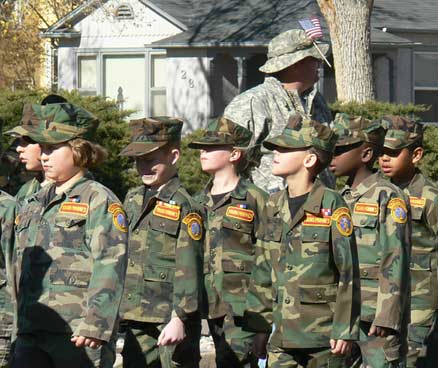
COLORADO SPRINGS- The average age of a uniformed participant in this year’s Veteran’s Day Parade was underage! The high school Junior ROTCs, the Young Marines, the Devil Pups, and the scouts, pulled the age downward against the ever diminishing number of retired combat vets. I think the Hussar-clad HS marching bands brought the mean down too.

While officially the youthful paraders were there to cheer the old vets, it’s hard to imagine the cries of “thank you” were not intended for the ears of those in attendance who were still part of the military. Actually a large number of those involved in the Veteran’s Day Parade are active duty, when not on deployment.

vet-parade
Belonging to a pro-militant fan club such as the Colorado Springs Young Marines does not make you a soldier, nor I should hope a soldier-to-be. But their recruits are already veterans of US militarism and the warrior indoctrination process.

vet-parade
The Young Marines are sponsored by the Marine Corps, a rather audacious recruiting beachhead considering Colorado Springs is an Army and Air Force town. Note: the Marines have no JROTC program here, and the fewest nationwide. What does that say about the age they target?

vet-parade
Not to be outdone by the Young Marines, the Colorado Springs Youth Marine Club goes by the name DEVIL PUPS, although it offers its conscripts the chance to “learn code of conduct from Godly Veterans.”

vet-parade
Note the better fitting uniform and helmet, sized for infants. The Devil Pups are affiliated with a Camp Pendleton Devil Pups Inc. Though They claim to be neither a mini-boot-camp, nor a para-military outfit, the Devil Pups require that children “must pass a Physical Fitness Test, cannot be on any type of medication for any reason, [and] cannot have asthma (no exceptions).”

vets-parade-scouting.jpg
Do you doubt the Boy Scouts are a para-military organization? These scoutmasters don’t. STILL SERVING THROUGH SCOUTING read one banner. Another read RETURNING TO THE VALUES SCOUTING NEVER LEFT. Were those the values of Kit Carson to which you’re alluding?

vets-parade
Here are elementary school students riding on a float sponsored by the Globe Charter School. They hold posters celebrating the four branches of the military, plus the National Guard and the Coast Guard.

rampart high school band
Rampart High School’s marching band, the “Rampart Regiment” costumed in deaths-head Hessian uniforms.

vets-parade
Our land-locked state also has a JROTC for students interested in the Navy. Three out of the four Colorado high schools enrolled in the Navy program are in Colorado Springs. They are Mesa Ridge, Wasson and Widefield. Oddly, none of Colorado’s 21 Army JROTC high school programs are in COS. The Air Force has five of seven participating high schools: Harrison, William Mitchell, Air Academy, Falcon and Sand Creek.

vet-parade
The parade of vintage cars provides a suitable reminder that all modern wars, post WWI, like these models, have been fought over the resource needed to fuel them.

vets-parade
Unafraid to make that point directly, the Military Vehicle Collectors Club solicits donations to KEEP ‘EM ROLLING.

vets-parade
This 40s staff car ferried former Waves who served the Navy in WWII. Resembling what most of us expect from a parade for honored veterans.

The specter of world wide depression raises its head

specterWe are so self centered in the US! As our government’s military deficit spending collapses the American capitalist economy we seem to forget that the crisis is a global one now. The Democratic/ Republican team have dragged down the global economy and not just our national one.

Stock markets all across the globe have been crashing due to what is termed in the Big Business press as being a ‘credit crunch’. Look everywhere, whether it be China, Russia, Japan, Iceland, Germany, France, or wherever, and the Almighty Dollar is dragging them all down. Something much more than a ‘credit crunch’ is involved in this international meltdown of the global economy.

Actually, what we are seeing and experiencing is the normal global capitalist economic cycle in motion. The downsides are just not very much fun for most of us, and, in fact, neither are the ‘upturns’ either. There is no such thing as ‘regulated capitalism’ since the regulators always ultimately turn out to be the capitalists regulating themselves, and that is no real regulation at all. There has got to be a better way!

Joseph –I am a Zionist– Biden’s love affair with pigs wearing lipstick

CopObama and running mate Joe “I am a Zionist” Biden are big fans of hiring even more cops, funding even more militarization of the US, and exporting that military policing mindset to around the pigs-in-love globe to the torturers that the US government constantly allies itself with. Yes, Joe Biden wants to hire another 50,000 PLUS extra pigs in the US as the following excerpt from his web site illustrates…

‘Funding 50,000 Cops and 1,000 FBI Agents: In the 1990s, the Biden Crime Bill added 100,000 cops to America’s streets. As a result, murder and violent crime rates went down eight years in a row. George Bush’s cuts to the program have put America at risk and crime rates are back on the rise. Joe Biden wants to put 50,000 more cops on the street and add 1,000 more FBI agents to address the rise in crime and threats of terrorism.’

For full scope of Biden’s love affair with lipsticked pigs see his Homeland Security No priority is higher than America’s safety snoutings.

And the pigs love the Democratic Party. The love affair is mutual! MSNBC reports that POLICE ORGANIZATIONS BACK OBAMA-BIDEN. Now isn’t that lovely?

The last thing our country needs is yet more funding for prisons, military, pigs, and their weaponry. Joe Biden and Obama don’t think that though, and in the National Porcine Employment Homeland Security Department, they can certainly more than hold their own with the McCain-Palin nutters. Beware!

Transferring bankruptcy from the private sector to the public sector

EagleWith all this bad private debt being hauled in by the US government hardly any notice has been given to the idea that the US Federal Government itself is putting itself at risk of default, too? In a way a governmental default (declaration of bankruptcy) would be a sort of poetic justice for the people of a country whose government has played an integral part in putting other governments around the globe into default with creditors in the past.

After all for just one given example, how much did America cry for Argentina when its government broke down? The US government had much to do with that governmental default, too, despite the fact that it occurred in a place we hardly even consider as being on the map.

Bill for US rescue package could reach $1 trillion All this bad debt taken in by the Feds can be covered easily by issuing paper dollars that Americans will be forced to use as currency, but what about others outside our national borders? They will simply devalue the US dollar in relation to their own currencies which will not be necessarily be covering bad debt of their own. When goods are imported into the US, we may well begin to see the start up of first $5 Stores, and then $10 Stores for those on tight budgets. The sky can be the limit here, can it not?

At some point foreigners may simply say ENOUGH. None of your dollars are worth even the paper they are written on and we will not accept them at all. Your country is BANKRUPT. So transferring private bad debt (‘toxic’ is the word they actually use) into the hands of the Federal government is no panacea at all. By itself, it cannot turn the situation around at all, as it merely buys time and transfers ‘responsibilities’ onto others, mainly onto the American people instead of America’s super-rich.

South America unites in rejecting US subversion on continent

evo moralesMuch of Latin America has watched on in disgust as the US government has fomented regional strife, civil war, and racist pogroms against the indigenous community in Bolivia that has claimed at least 30 lives so far. Reuters reports though that South American leaders back Bolivia’s Morales and not Washington DC in this battle.

Leaders of countries all around the globe are beginning to resist US government terrorism. Pakistan also has begun to fight back against US subversion of peace in their country, just as Russia gave a kick in the teeth to US subversion in Eastern Europe and the Caucasus. See Pakistan troop fire turns back U.S. helicopters

Latin America, too, is just fed up with the US government. Yankees Go Home! That is the cry every where these days!

Lack of democracy in the PPJPC should not hide behind religiosity

Two PPJPC board members, Genie Durland and Dorothy Schlaeger, wrote to The Colorado Springs Independent trying to explain why the group’s officers locked some of its membership out of the PPJPC building where we had tried to hold a meeting.

To compound the insult of locking us out of the building, the new Board Director, Jo Ann Neiman, then called the police when she saw us still attending our meeting on the sidewalk in front of the PPJPC building! She explained to the police that she wanted us to be told that we were all trespassing!

So what did Genie and Dorothy have to say about all of this?

In short, they implied that we, the members of the PPJPC who wanted to meet inside the PPJPC rented building, were violence-prone, and they used a bunch of excessive religiosity about Gandhi to do so! They mixed their own liberal religious beliefs together with what they see as the teachings of the Hindu religious leader, Gandhi. Here is how they justified the current board director calling the police on us,

‘Many who consider themselves “peace activists” across the globe engage in tactics, which fail to engender peace. PPJPC is deeply committed to nonviolence and will neither engage nor support activism employing tactics inconsistent with Ghandian nonviolence.’

Genie and Dorothy, I might ask you both, what is ‘Gandhian’ nonviolent about suggesting we are violence-prone when we are not that in the least? You do the rather violence-prone Colorado Springs municipal police a big favor in labeling others amongst the PPJPC and general public in such a manner. You are actually encouraging police violence against us with this sort of rhetoric against us, who are all people that have in fact never engaged in any violent acts at all. In short, you are playing a game of Holier-Than-Thou and The Independent was absolutely correct in labeling and titling that as being ‘Malice in the Movement’.

What also is Gandhi-like in calling the police on us to tell us that we were supposedly trespassing by holding a nonviolent meeting, of all things? What is nonviolent in locking us out from the meeting we wanted to do inside of the PPJPC building, not out on the sidewalk? And most of all, what is nonviolent in a PPJPC organized to have a single membership meeting per year? That is undemocratic community organization, not nonviolence.

This is the real issue of concern, not whether to be tactically violent, as you falsely imply that it is. We tried to hold our meeting because we want some internal democracy within the PPJPC where now there isn’t any.

We want a group not controlled by paid office staff eating up tens of thousands of donated dollars in their salaries each year, just to run the group autocratically as they determine activities of their own making for non paid volunteers to carry out. This is non-sustainable situation in the long run, and it would be much better to help work out something, instead of locking members out of the PPJPC offices. Currently the group is headed towards a financial shipwreck and that is the Big Issue. The PPJPC has no real membership accountability at this time to check their deficit spending.

We also want a board picked by the activist , than have board members pick their own replacements beforehand and then present it as pre-determined fate to the rest of us who have no current voice in PPJPC policies. Most of all, we want a PPJPC that is not crippled by police interference into our own internal affairs. This has led to those who now hobnob at the police station with the cops in secret meetings then arranging affairs of the PPJPC where the cops are called out on other PPJPC members less religiously inclined than yourselves.

Most of all, this is about trying to make the PPJPC into something other than a religious-run clique, but into a true body of diverse people that for many different reasons are against the US government’s global militarism. You two are opposed to doing so, and hide behind the figure of Gandhi to oppose those who are. The religious and those not religious must be united in a Peace movement, not separated as you would have done.

Disagree with us if you will, but do not falsely label those who differ with you as being less non-nonviolent than yourselves. You are doing the work of the violence-eager police force and local government bodies when you do so. We respect your religious beliefs in nonviolence, but we ask you to not try to force these relgious beliefs that you have off on all others as you have currently justified doing so with your current letter to The Colorado Springs Independent.

We look forward to working with you together in the future as in the past inside the Pikes Peak Justice and Peace Commission.

US government heads toward direct military engagement against Russia

The US government is moving toward direct military confrontation against Russia as Bush has directed the US military to begin shipping ‘aid’ to Georgia. The Pentagon has already been ferrying Georgian troops back into Georgia from out of Iraq, where they functioned as US mercenaries there in the US occupation of that country. Because of DC’s continued belligerence all over the globe and now its role in destroying South Ossetia’s capital, Russia has little choice other than to stand up to the current Bush Administration and draw the line hard and fast now, and doing that can lead to a nuclear showdown quite quickly.

The Democratic Party has an opportunity to veto this Republican begun war, but so far has remained utterly silent. Correct that. Actually some leading advisers to the DP also are pushing for further dangerous confrontation against Russia. I am talking about Zbigniew Brzezinski in special who is now a Barack Obama adviser. This infamous Cold Warrior who gave Osama bin Laden his start in Afghanistan is advocating more US government aggression against Russia, not less.

What do the latest Rice and Bush communiques signify? Bush orders aid to Georgia, Rice to visit Tbilisi One thing is for sure, and that is that George W. Bush and his neocons are a lot stupider, a lot looser with their power, and a lot more arrogant than John F. Kennedy ever was, and that spells trouble for us all. The Democratic Party’s passive acceptance of the Bush plan to continue attacking Russia is very disturbing.

The US spreads its aggression from the Balkans to the Caucasus region

South OssetiaTskhinvali, capital of South Ossetia.
 
The attack of the Georgian military, allied with the US and NATO, against Russian supported South Ossetia has widened the US military encirclement of Russia to another level and another region. The US Antiwar Movement has slept in the years since the ex-Soviet Union fell from the blows of the Cold War and ignored the continued US belligerence towards a now capitalist Russia.

Much of this ‘Peace’ Movement consists of liberals immersed in a reactionary campaign against China, another nation that the Pentagon and US government are waging a world war against, though the fighting between these 2 countries now is mainly at the level of propaganda wars. In regards to China, the liberal ‘Peacenics’ find themselves allied more with the Pentagon than they do with their beloved abstract ‘nonviolence’ religion. And they definitely are allied with voting for the Democratic Party, a pro-war party of the corporations.

Most of the liberal US and European Left actively supported the US-NATO bombardment of Yugoslavia, so they are even more poorly placed to understand the inter relationship between the previous fighting in the Balkans, and the now hot eruption of war in South Ossetia and Georgia. In short, they are in a total fog of complete ignorance about how the bipartisan US government has promoted policies of aggression towards Russia that has led up to this new fighting.

The liberals that make up the ‘Peace Community’ don’t like to come to grips with the realities of US society at all. They want to think that if they just tinker a little that the whole nation will begin to see how righteous they are. They are on Cloud Nine when it comes to understanding basic US geopolitics around the Globe, and their idea of a ‘Peace’ Rapture is totally void of reality. This is a hard fight and they are only into offering a choreographed film of ‘resistance’, not roughing it out to build an Antiwar Movement any larger than their small liberal church followings.

We can expect a surge of international propaganda pushed by the US government and its allies where they promote themselves though the media as being goodhearted and completely disinterested observers of this fighting from afar. Far from that, the US and its allies are flat smack dab in the middle of the responsibility for this Georgian attack on South Ossetia, and Russia is unlikely to back off and allow the US con game much room for maneuver.

Russia tried to warn the US and its allies that making Kosovo an independent country would provoke this sort of new fighting where their country would be directly involved and utterly resistant to being forced to surrender their own national interests before the onslaught of US aggression. But the hawks in the US government, both DP and RP hawks, would have none of it and today we are where we are now with this new war breaking out. The timing of this war’s beginning comes just several months after the US-NATO broke Kosovo off of Yugoslavia, and that is no coincidence.

This is a dangerous game the US ruling corporate class is playing with all our lives. We must build a Movement that will stop them, and that means we must expand the Antiwar Movement from being just a tiny group of religious pacifist fools, like what is currently the case. These are nice enough people alright and they have the best of intentions, it is simply that their theology is not the building block necessary to build a larger response amongst the US population to US militarism in today’s world.

The US military buildup is colossal and it must be braked and dismantled for the world to ever live in any peace.

Product Obama

Young Barack“At the time when the American military industrial complex is despised around the world, [Barack Obama] is a front man out of central casting which will buy it more goodwill and new room to maneuver in the first 15 minutes after being sworn in that John McCain could in the next 100 years.”
 
Counterpoint columnist Joe Bageant was given the following essay by an unnamed political consultant:
Life in the Post-political Age.

Much has been written by political pundits in their attempt to explain the unexpected victory of Senator Barack Obama over Senator Hillary Clinton in this year’s Democratic Presidential Primary. When looking at the results of this race, none of the conventional political math that would help one handicap the outcome would make one conclude that Senator Obama would win this contest.

Inside a Democratic Party primary there is no demographic or political reason that a male first term African American senator from Illinois with an unorthodox name should come any where close to beating a white female senator, who happens to be the wife of the last Democratic President whose approval ratings are still above 70% with Democratic voters and who also happened to earn the endorsements of the substantial parts of the Democratic Party establishment.

The conventional analysis focused on the poor quality of the campaign run by Senator Clinton, her vote in support of the Iraq war and her advocacy of the cynical center-right triangulation policies of her husband, which soured her campaign to many primary voters and especially to Democratic Party activists. Senator Obama’s on the other hand was credited with running an innovative and inspiring campaign that excited primary voters and brought many new and especially younger voters into the electoral process.

There is some truth to this analysis, but as a whole it misses the underlying social change in society that had already laid the groundwork for a possible Obama victory. To get a clearer understanding of the results, we must better understand what this social change is and how its impact is far more significant than the dynamics of the two respective campaigns.

The underlying social change that led to the Obama victory is the unprecedented extent to which the narrative of popular consumer culture, and the media that drives it, has become the dominant influence on how Americans think, formulate their ideas and understand the world around them.

The most important result of this process has been the steady and consistent depoliticization of American society, to an extent that we can make the case that we are living at the dawn of the post political age.

The two primary features of the post political age are a politics completely drained of all its contents and ability or willingness to be used as an agent of change in social or economic policy, and its full integrations into the world of American popular, consumer and entertainment culture. To such an extent that there exists today a seamless web between our political, economic, media and consumer cultures wherein the modes and values of one are completely integrated and compatible with the others.

It should not come as a surprise that the dominant ideas and mores of popular culture have become the dominant ideas of our society. Popular culture is the breaker of customs, prejudice, tradition and relevant historical knowledge.

It is a result of this dynamic that the two consistent winners in American politics over the last 30 years have been the cultural left and the economic right. Despite the massive organizing drive of the religious right over the past three decades, they are further away from reversing the cultural liberalization of American society than when they started. On others side of the ledger, organized labor outside of a few urban pockets and industries is no longer a relevant force in American life. The ever greater electoral activism of both of these groups is generally misunderstood as a show of strength; in fact, it is the exact opposite. It is the desperate fight of the losing side of the American economic, cultural and political scene.

In essence the same forces that make it possible for the rapid acceptance of ideas such as gay marriage are the same force which can create a society that will accept massive social inequalities.

In the post political world and the candidates who can best thrive in it have tremendous appeal to the economic elites, a system that does not dwell on issues and will never ask the question, “who has power and why”, but simultaneously creates a social and media environment of stupefying distractions while destroying traditional social mores (under-credited as a source of much social solidarity). This can only benefit their continued rule of that society.

In such a setting our political choices like our consumer choices, regardless of the product, are primarily about what makes us more fulfilled and feel better about ourselves.

Senator Obama’s campaign understood much better the impact of these changes on our electoral system than any of his opponents’ campaigns. In the post political world, the campaign that is less political and less issue-based but is savvier in using new modes of communication technology will be the campaign to win the greatest market share of the electorate. The candidate in this case, Obama, was not a political entity but, in essence a product, an ornament that made his supporters feel better about themselves.

One of the most telling facts about the Obama’s constituency outside of African Americans (whose support needs no explanation) is that it is a coalition of people who need or demand the least amount of social benefit from our government. They are the under politicized younger voters and upper middle class whites. The two groups, coincidently, are the ones most influenced by trends in consumer popular culture and have the greatest of ease using the latest technologies.

In commercial advertising it is the poor commercial that lists the seventeen functions of the product being marketed. The best commercials are based on image associations entirely unrelated to the functions of the actual product. In the post political world, when the same principle is applied to the political realm, it makes complete sense how Barack Obama no longer is a black man with a strange name but the iPod to Hillary Clinton’s cell phone. In the world of toys it is the one that stands out the most is the most marketable.

The reality of the post political period is best highlighted in the failed themes and ideas of Barack Obama’s two primary opponents. The Clinton campaign was based on pushing two concurrent ideas: the inevitability factor of her candidacy and the other was her supposed experience. The only thing inevitable in the post political period is ceaseless change, which she could hardly offer while running against the candidate of “Change”. How valuable of an asset can experience be in a culture where knowledge, wisdom and history are frowned upon?

John Edwards campaign on the other hand was dead on arrival. His theme and emphasis was America’s ever widening class differences, a platform as truthful as it was irrelevant. The use of the word “class” will end any political career in America. That truth violates the primary narrative that our elite use to justify their legitimacy, which is the supposed meritocratic nature of America society. While the post political constituencies have absolutely no interest in class, whose very acknowledgment are the bases of all real politics and whose acknowledgement would only lead to an existential crisis in its ranks. In the post political period the only differences allowed can be in style and modes of consumption.

Given all this as the background, what are we to make of the campaign of the candidate of hope, audacity and change? The answer lies in understanding Senator Obama’s appeal to the brighter sections of the economic and political elite, and more importantly in the lack of any organized opposition against him, of the kind that within a matter of days destroyed Howard Dean’s campaign in 2004.

At the precise moment that the intellectual underpinnings of conservative free market ideas that have dominated politics for the past 30 years are crumbling across the globe. Obama calls for a post ideological and partisan world.

At the time when the American military industrial complex is despised around the world, he is a front man out of central casting which will buy it more goodwill and new room to maneuver in the first 15 minutes after being sworn in that John McCain could in the next 100 years.

His very presence, the color of his skin, the very strangeness of his name is the best guarantee of his betrayal of the expectations of the constituencies that will vote to elect him. Barack Obama is in short order a far more reassuring prospect for the continued dominance of the financial elite than another four years of neo-conservative rule which in an almost historically unique combination of greed, ill will, incompetence and stupidity have brought the country to the edge of disaster.

Audacity yes, change hardly.

Global economic rapists are at it again

G8 protest
Why protest the G8 Summit July 7-9? Those hoodlums always look so determined. Here’s the rationale by the Emergency Exit Collective:

The 2008 G8 on Hokkaido, a Strategic Assessment
Emergency Exit Collective
Bristol, Mayday, 2008

The authors of this document are a collection of activists, scholars, and writers currently based in the United States and Western Europe who have gotten to know and work with each other in the movement against capitalist globalization. We’re writing this at the request of some members of No! G8 Action Japan, who asked us for a broad strategic analysis of the state of struggle as we see it, and particularly, of the role of the G8, what it represents, the dangers and opportunities that may lie hidden in the moment. It is in no sense programmatic. Mainly, it is an attempt to develop tools that we hope will be helpful for organizers, or for anyone engaged in the struggle against global capital.

I
It is our condition as human beings that we produce our lives in common.

II
Let us then try to see the world from the perspective of the planet’s commoners, taking the word in that sense: those whose most essential tradition is cooperation in the making and maintenance of human social life, yet who have had to do so under conditions of suffering and separation; deprived, ignored, devalued, divided into hierarchies, pitted against each other for our very physical survival. In one sense we are all commoners. But it’s equally true that just about everyone, at least in some ways, at some points, plays the role of the rulers—of those who expropriate, devalue and divide—or at the very least benefits from such divisions.

Obviously some do more than others. It is at the peak of this pyramid that we encounter groups like the G8.

III
The G8’s perspective is that of the aristocrats, the rulers: those who command and maintain that global machinery of violence that defends existing borders and lines of separation: whether national borders with their detention camps for migrants, or property regimes, with their prisons for the poor. They live by constantly claiming title to the products of others collective creativity and labour, and in thus doing they create the poor; they create scarcity in the midst of plenty, and divide us on a daily basis; they create financial districts that loot resources from across the world, and in thus doing they turn the spirit of human creativity into a spiritual desert; close or privatize parks, public water taps and libraries, hospitals, youth centers, universities, schools, public swimming pools, and instead endlessly build shopping malls that channels convivial life into a means of commodity circulation; work toward turning global ecological catastrophe into business opportunities.

These are the people who presume to speak in the name of the “international community” even as they hide in their gated communities or meet protected by phalanxes of riot cops. It is critical to bear in mind that the ultimate aim of their policies is never to create community but to introduce and maintain divisions that set common people at each other’s throats. The neoliberal project, which has been their main instrument for doing so for the last three decades, is premised on a constant effort either to uproot or destroy any communal or democratic system whereby ordinary people govern their own affairs or maintain common resources for the common good, or, to reorganize each tiny remaining commons as an isolated node in a market system in which livelihood is never guaranteed, where the gain of one community must necessarily be at the expense of others. Insofar as they are willing to appeal to high-minded principles of common humanity, and encourage global cooperation, only and exactly to the extent that is required to maintain this system of universal competition.

IV
At the present time, the G8—the annual summit of the leaders of “industrial democracies”—is the key coordinative institution charged with the task of maintaining this neoliberal project, or of reforming it, revising it, adapting it to the changing condition of planetary class relations. The role of the G8 has always been to define the broad strategic horizons through which the next wave of planetary capital accumulation can occur. This means that its main task is to answer the question of how 3?4 in the present conditions of multiple crises and struggles 3?4 to subordinate social relations among the producing commoners of the planet to capital’s supreme value: profit.

V
Originally founded as the G7 in 1975 as a means of coordinating financial strategies for dealing with the ‘70s energy crisis, then expanded after the end of the Cold War to include Russia, its currently face a moment of profound impasse in the governance of planetary class relations: the greatest since the ‘70s energy crisis itself.

VI
The ‘70s energy crisis represented the final death-pangs of what might be termed the Cold War settlement, shattered by a quarter century of popular struggle. It’s worth returning briefly to this history.

The geopolitical arrangements put in place after World War II were above all designed to forestall the threat of revolution. In the immediate wake of the war, not only did much of the world lie in ruins, most of world’s population had abandoned any assumption about the inevitability of existing social arrangements. The advent of the Cold War had the effect of boxing movements for social change into a bipolar straightjacket. On the one hand, the former Allied and Axis powers that were later to unite in the G7 (the US, Canada, UK, France, Italy, Germany, Japan)—the “industrialized democracies”, as they like to call themselves—engaged in a massive project of co-optation. Their governments continued the process, begun in the ‘30s, of taking over social welfare institutions that had originally been created by popular movements (from insurance schemes to public libraries), even to expand them, on condition that they now be managed by state-appointed bureaucracies rather than by those who used them, buying off unions and the working classes more generally with policies meant to guarantee high wages, job security and the promise of educational advance—all in exchange for political loyalty, productivity increases and wage divisions within national and planetary working class itself. The Sino-Soviet bloc—which effectively became a kind of junior partner within the overall power structure, and its allies remained to trap revolutionary energies into the task of reproducing similar bureaucracies elsewhere. Both the US and USSR secured their dominance after the war by refusing to demobilize, instead locking the planet in a permanent threat of nuclear annihilation, a terrible vision of absolute cosmic power.

VII
Almost immediately, though, this arrangement was challenged by a series of revolts from those whose work was required to maintain the system, but who were, effectively, left outside the deal: first, peasants and the urban poor in the colonies and former colonies of the Global South, next, disenfranchised minorities in the home countries (in the US, the Civil Rights movement, then Black Power), and finally and most significantly, by the explosion of the women’s movement of the late ‘60s and early ‘70s—the revolt of that majority of humanity whose largely unremunerated labor made the very existence “the economy” possible. This appears to have been the tipping point.

VIII
The problem was that the Cold War settlement was never meant to include everyone. It by definition couldn’t. Once matters reached tipping point, then, the rulers scotched the settlement. All deals were off. The oil shock was first edge of the counter-offensive, breaking the back of existing working class organizations, driving home the message that there was nothing guaranteed about prosperity. Under the aegis of the newly hatched G7, this counter-offensive involved a series of interwoven strategies that were later to give rise to what is known as neoliberalism.

IX
These strategies resulted in what came to be known as “Structural Adjustment” both in the North and in the South, accompanied by trade and financial liberalization. This, in turn, made possible crucial structural changes in our planetary production in common extending the role of the market to discipline our lives and divide us into more and more polarized wage hierarchy. This involved:

· In the immediate wake of ‘70s oil shock, petrodollars were recycled from OPEC into Northern banks that then lent them, at extortionate rates of interest, to developing countries of the Global South. This was the origin of the famous “Third World Debt Crisis.” The existence of this debt allowed institutions like the IMF to impose its monetarist orthodoxy on most of the planet for roughly twenty years, in the process, stripping away most of even those modest social protections that had been won by the world’s poor—large numbers of whom were plunged into a situation of absolute desperation.

· It also opened a period of new enclosures through the capitalist imposition of structural adjustment policies, manipulation of environmental and social catastrophes like war, or for that matter through the authoritarian dictates of “socialist” regimes. Through such means, large sections of the world’s population have over the past thirty years been dispossessed from resources previously held in common, either by dint of long traditions, or as the fruits of past struggles and past settlements.

· Through financial deregulation and trade liberalization, neoliberal capital, which emerged from the G7 strategies to deal with the 1970s crisis aimed thus at turning the “class war” in communities, factories, offices, streets and fields against the engine of competition, into a planetary “civil war”, pitting each community of commoners against every other community of commoners.

· Neoliberal capital has done this by imposing an ethos of “efficiency” and rhetoric of “lowering the costs of production” applied so broadly that mechanisms of competition have come to pervade every sphere of life. In fact these terms are euphemisms, for a more fundamental demand: that capital be exempt from taking any reduction in profit to finance the costs of reproduction of human bodies and their social and natural environments (which it does not count as costs) and which are, effectively, “exernalized” onto communities and nature.

· The enclosure of resources and entitlements won in previous generations of struggles both in the North and the South, in turn, created the conditions for increasing the wage hierarchies (both global and local), by which commoners work for capital—wage hierarchies reproduced economically through pervasive competition, but culturally, through male dominance, xenophobia and racism. These wage gaps, in turn, made it possible to reduce the value of Northern workers’ labour power, by introducing commodities that enter in their wage basket at a fraction of what their cost might otherwise have been. The planetary expansion of sweatshops means that American workers (for example) can buy cargo pants or lawn-mowers made in Cambodia at Walmart, or buy tomatoes grown by undocumented Mexican workers in California, or even, in many cases, hire Jamaican or Filipina nurses to take care of children and aged grandparents at such low prices, that their employers have been able to lower real wages without pushing most of them into penury. In the South, meanwhile, this situation has made it possible to discipline new masses of workers into factories and assembly lines, fields and offices, thus extending enormously capital’s reach in defining the terms—the what, the how, the how much—of social production.

· These different forms of enclosures, both North and South, mean that commoners have become increasingly dependent on the market to reproduce their livelihoods, with less power to resist the violence and arrogance of those whose priorities is only to seek profit, less power to set a limit to the market discipline running their lives, more prone to turn against one another in wars with other commoners who share the same pressures of having to run the same competitive race, but not the same rights and the same access to the wage. All this has meant a generalized state of precarity, where nothing can be taken for granted.

X
In turn, this manipulation of currency and commodity flows constituting neoliberal globalization became the basis for the creation of the planet’s first genuine global bureaucracy.

· This was multi-tiered, with finance capital at the peak, then the ever-expanding trade bureaucracies (IMF, WTO, EU, World Bank, etc), then transnational corporations, and finally, the endless varieties of NGOs that proliferated throughout the period—almost all of which shared the same neoliberal orthodoxy, even as they substituted themselves for social welfare functions once reserved for states.

· The existence of this overarching apparatus, in turn, allowed poorer countries previously under the control of authoritarian regimes beholden to one or another side in the Cold War to adopt “democratic” forms of government. This did allow a restoration of formal civil liberties, but very little that could really merit the name of democracy (the rule of the “demos”, i.e., of the commoners). They were in fact constitutional republics, and the overwhelming trend during the period was to strip legislatures, that branch of government most open to popular pressure, of most of their powers, which were increasingly shifted to the executive and judicial branches, even as these latter, in turn, largely ended up enacting policies developed overseas, by global bureaucrats.

· This entire bureaucratic arrangement was justified, paradoxically enough, by an ideology of extreme individualism. On the level of ideas, neoliberalism relied on a systematic cooptation of the themes of popular struggle of the ‘60s: autonomy, pleasure, personal liberation, the rejection of all forms of bureaucratic control and authority. All these were repackaged as the very essence of capitalism, and the market reframed as a revolutionary force of liberation.

· The entire arrangement, in turn, was made possible by a preemptive attitude towards popular struggle. The breaking of unions and retreat of mass social movements from the late ‘70s onwards was only made possible by a massive shift of state resources into the machinery of violence: armies, prisons and police (secret and otherwise) and an endless variety of private “security services”, all with their attendant propaganda machines, which tended to increase even as other forms of social spending were cut back, among other things absorbing increasing portions of the former proletariat, making the security apparatus an increasingly large proportion of total social spending. This approach has been very successful in holding back mass opposition to capital in much of the world (especially West Europe and North America), and above all, in making it possible to argue there are no viable alternatives. But in doing so, has created strains on the system so profound it threatens to undermine it entirely.

XI
The latter point deserves elaboration. The element of force is, on any number of levels, the weak point of the system. This is not only on the constitutional level, where the question of how to integrate the emerging global bureaucratic apparatus, and existing military arrangements, has never been resolved. It is above all an economic problem. It is quite clear that the maintenance of elaborate security machinery is an absolute imperative of neoliberalism. One need only observe what happened with the collapse of the Soviet bloc in Eastern Europe: where one might have expected the Cold War victors to demand the dismantling of the army, secret police and secret prisons, and to maintain and develop the existing industrial base, in fact, what they did was absolutely the opposite: in fact, the only part of the industrial base that has managed fully to maintain itself has been the parts required to maintained the security apparatus itself! Critical too is the element of preemption: the governing classes in North America, for example, are willing to go to almost unimaginable lengths to ensure social movements never feel they are accomplishing anything. The current Gulf War is an excellent example: US military operations appear to be organized first and foremost to be protest-proof, to ensure that what happened in Vietnam (mass mobilization at home, widespread revolt within the army overseas) could never be repeated. This means above all that US casualties must always be kept to a minimum. The result are rules of engagement, and practices like the use of air power within cities ostensibly already controlled by occupation forces, so obviously guaranteed to maximize the killing of innocents and galvanizing hatred against the occupiers that they ensure the war itself cannot be won. Yet this approach can be taken as the very paradigm for neoliberal security regimes. Consider security arrangements around trade summits, where police are so determined prevent protestors from achieving tactical victories that they are often willing to effectively shut down the summits themselves. So too in overall strategy. In North America, such enormous resources are poured into the apparatus of repression, militarization, and propaganda that class struggle, labor action, mass movements seem to disappear entirely. It is thus possible to claim we have entered a new age where old conflicts are irrelevant. This is tremendously demoralizing of course for opponents of the system; but those running the system seem to find that demoralization so essential they don’t seem to care that the resultant apparatus (police, prisons, military, etc) is, effectively, sinking the entire US economy under its dead weight.

XII
The current crisis is not primarily geopolitical in nature. It is a crisis of neoliberalism itself. But it takes place against the backdrop of profound geopolitical realignments. The decline of North American power, both economic and geopolitical has been accompanied by the rise of Northeast Asia (and to a increasing extent, South Asia as well). While the Northeast Asian region is still divided by painful Cold War cleavages—the fortified lines across the Taiwan straits and at the 38th parallel in Korea…—the sheer realities of economic entanglement can be expected to lead to a gradual easing of tensions and a rise to global hegemony, as the region becomes the new center of gravity of the global economy, of the creation of new science and technology, ultimately, of political and military power. This may, quite likely, be a gradual and lengthy process. But in the meantime, very old patterns are rapidly reemerging: China reestablishing relations with ancient tributary states from Korea to Vietnam, radical Islamists attempting to reestablish their ancient role as the guardians of finance and piety at the in the Central Asian caravan routes and across Indian Ocean, every sort of Medieval trade diaspora reemerging… In the process, old political models remerge as well: the Chinese principle of the state transcending law, the Islamic principle of a legal order transcending any state. Everywhere, we see the revival too of ancient forms of exploitation—feudalism, slavery, debt peonage—often entangled in the newest forms of technology, but still echoing all the worst abuses of the Middle Ages. A scramble for resources has begun, with US occupation of Iraq and saber-rattling throughout the surrounding region clearly meant (at least in part) to place a potential stranglehold the energy supply of China; Chinese attempts to outflank with its own scramble for Africa, with increasing forays into South America and even Eastern Europe. The Chinese invasion into Africa (not as of yet at least a military invasion, but already involving the movement of hundreds of thousands of people), is changing the world in ways that will probably be felt for centuries. Meanwhile, the nations of South America, the first victims of the “Washington consensus” have managed to largely wriggle free from the US colonial orbit, while the US, its forces tied down in the Middle East, has for the moment at least abandoned it, is desperately struggling to keep its grip Mexico, Central America and the Caribbean—its own “near abroad”.

XIII
In another age all this might have led to war—that is, not just colonial occupations, police actions, or proxy wars (which are obviously already taking place), but direct military confrontations between the armies of major powers. It still could; accidents happen; but there is reason to believe that, when it comes to moments of critical decision, the loyalties of the global elites are increasingly to each other, and not to the national entities for whom they claim to speak. There is some compelling evidence for this.

Take for example when the US elites panicked at the prospect of the massive budget surpluses of the late 1990s. As Alan Greenspan, head of the Federal Reserve at the time warned, if these were allowed to stand they would have flooded government coffers with so many trillions of dollars that it could only have lead to some form of creeping socialism, even, he predicted, to the government acquiring “equity stakes” in key US corporations. The more excitable of capitalism’s managers actually began contemplating scenarios where the capitalist system itself would be imperiled. The only possible solution was massive tax cuts; these were duly enacted, and did indeed manage to turn surpluses into enormous deficits, financed by the sale of treasury bonds to Japan and China. Conditions have thus now reached a point where it is beginning to look as if the most likely long term outcome for the US (its technological and industrial base decaying, sinking under the burden of its enormous security spending) will be to end up serve as junior partner and military enforcer for East Asia capital. Its rulers, or at least a significant proportion of them, would prefer to hand global hegemony to the rulers of China (provided the latter abandon Communism) than to return to any sort of New Deal compromise with their “own” working classes.

A second example lies in the origins of what has been called the current “Bretton Woods II” system of currency arrangements, which underline a close working together of some “surplus” and “deficit” countries within global circuits. The macroeconomic manifestation of the planetary restructuring outlined in XIX underlines both the huge US trade deficit that so much seem to worry many commentators, and the possibility to continually generate new debt instruments like the one that has recently resulted in the sub-prime crisis. The ongoing recycling of accumulated surplus of countries exporting to the USA such as China and oil producing countries is what has allowed financiers to create new credit instruments in the USA. Hence, the “deal” offered by the masters in the United States to its commoners has been this: ‘you, give us a relative social peace and accept capitalist markets as the main means through which you reproduce your own livelihoods, and we will give you access to cheaper consumption goods, access to credit for buying cars and homes, and access to education, health, pensions and social security through the speculative means of stock markets and housing prices.’ Similar compromises were reached in all the G8 countries.

Meanwhile, there is the problem of maintaining any sort of social peace with the hundreds of millions of unemployed, underemployed, dispossessed commoners currently swelling the shanty-towns of Asia, Africa, and Latin America as a result of ongoing enclosures (which have speeded up within China and India in particular, even as “structural adjustment policies” in Africa and Latin America have been derailed). Any prospect of maintaining peace in these circumstances would ordinarily require either extremely high rates of economic growth—which globally have not been forthcoming, since outside of China, growth rates in the developing world have been much lower than they were in the ‘50s, ‘60s, or even ‘70s—or extremely high levels of repression, lest matters descend into rebellion or generalized civil war. The latter has of course occurred in many parts of the world currently neglected by capital, but in favored regions, such as the coastal provinces of China, or “free trade” zones of India, Egypt, or Mexico, commoners are being offered a different sort of deal: industrial employment at wages that, while very low by international standards, are still substantially higher than anything currently obtainable in the impoverished countryside; and above all the promise, through the intervention of Western markets and (privatized) knowledge, of gradually improving conditions of living. While over the least few years wages in many such areas seem to be growing, thanks to the intensification of popular struggles, such gains are inherently vulnerable: the effect of recent food inflation has been to cut real wages back dramatically—and threaten millions with starvation.

What we really want to stress here, though, is that the long-term promise being offered to the South is just as untenable as the idea that US or European consumers can indefinitely expand their conditions of life through the use of mortgages and credit cards.

What’s being offered the new dispossessed is a transposition of the American dream. The idea is that the lifestyle and consumption patterns of existing Chinese, Indian, or Brazilian or Zambian urban middle classes (already modeled on Northern ones) will eventually become available to the children of today’s miners, maquila or plantation laborers, until, ultimately, everyone on earth is brought up to roughly the same level of consumption. Put in these terms, the argument is absurd. The idea that all six billion of us can become “middle class” is obviously impossible. First of all there is a simple problem of resources. It doesn’t matter how many bottles we recycle or how energy efficient are the light bulbs we use, there’s just no way the earth’s ecosystem can accommodate six billion people driving in private cars to work in air-conditioned cubicles before periodically flying off to vacation in Acapulco or Tahiti. To maintain the style of living and producing in common we now identify with “middle classness” on a planetary scale would require several additional planets.

This much has been pointed out repeatedly. But the second point is no less important. What this vision of betterment ultimately proposes is that it would be possible to build universal prosperity and human dignity on a system of wage labor. This is fantasy. Historically, wages are always the contractual face for system of command and degradation, and a means of disguising exploitation: expressing value for work only on condition of stealing value without work— and there is no reason to believe they could ever be anything else. This is why, as history has also shown, human beings will always avoid working for wages if they have any other viable option. For a system based on wage labor to come into being, such options must therefore be made unavailable. This in turn means that such systems are always premised on structures of exclusion: on the prior existence of borders and property regimes maintained by violence. Finally, historically, it has always proved impossible to maintain any sizeable class of wage-earners in relative prosperity without basing that prosperity, directly or indirectly, on the unwaged labor of others—on slave-labor, women’s domestic labor, the forced labor of colonial subjects, the work of women and men in peasant communities halfway around the world—by people who are even more systematically exploited, degraded, and immiserated. For that reason, such systems have always depended not only on setting wage-earners against each other by inciting bigotry, prejudice, hostility, resentment, violence, but also by inciting the same between men and women, between the people of different continents (“race”), between the generations.

From the perspective of the whole, then, the dream of universal middle class “betterment” must necessarily be an illusion constructed in between the Scylla of ecological disaster, and the Charybdis of poverty, detritus, and hatred: precisely, the two pillars of today’s strategic impasse faced by the G8.

XIV
How then do we describe the current impasse of capitalist governance?

To a large degree, it is the effect of a sudden and extremely effective upswing of popular resistance—one all the more extraordinary considering the huge resources that had been invested in preventing such movements from breaking out.

On the one hand, the turn of the millennium saw a vast and sudden flowering of new anti-capitalist movements, a veritable planetary uprising against neoliberalism by commoners in Latin America, India, Africa, Asia, across the North Atlantic world’s former colonies and ultimately, within the cities of the former colonial powers themselves. As a result, the neoliberal project lies shattered. What came to be called the “anti-globalization” movement took aim at the trade bureaucracies—the obvious weak link in the emerging institutions of global administration—but it was merely the most visible aspect of this uprising. It was however an extraordinarily successful one. Not only was the WTO halted in its tracks, but all major trade initiatives (MAI, FTAA…) scuttled. The World Bank was hobbled and the power of the IMF over most of the world’s population, effectively, destroyed. The latter, once the terror of the Global South, is now a shattered remnant of its former self, reduced to selling off its gold reserves and desperately searching for a new global mission.

In many ways though spectacular street actions were merely the most visible aspects of much broader changes: the resurgence of labor unions, in certain parts of the world, the flowering of economic and social alternatives on the grassroots levels in every part of the world, from new forms of direct democracy of indigenous communities like El Alto in Bolivia or self-managed factories in Paraguay, to township movements in South Africa, farming cooperatives in India, squatters’ movements in Korea, experiments in permaculture in Europe or “Islamic economics” among the urban poor in the Middle East. We have seen the development of thousands of forms of mutual aid association, most of which have not even made it onto the radar of the global media, often have almost no ideological unity and which may not even be aware of each other’s existence, but nonetheless share a common desire to mark a practical break with capitalism, and which, most importantly, hold out the prospect of creating new forms of planetary commons that can—and in some cases are—beginning to knit together to provide the outlines of genuine alternative vision of what a non-capitalist future might look like.

The reaction of the world’s rulers was predictable. The planetary uprising had occurred during a time when the global security apparatus was beginning to look like it lacked a purpose, when the world threatened to return to a state of peace. The response—aided of course, by the intervention of some of the US’ former Cold War allies, reorganized now under the name of Al Qaeda—was a return to global warfare. But this too failed. The “war on terror”—as an attempt to impose US military power as the ultimate enforcer of the neoliberal model—has collapsed as well in the face of almost universal popular resistance. This is the nature of their “impasse”.

At the same time, the top-heavy, inefficient US model of military capitalism—a model created in large part to prevent the dangers of social movements, but which the US has also sought to export to some degree simply because of its profligacy and inefficiency, to prevent the rest of the world from too rapidly overtaking them—has proved so wasteful of resources that it threatens to plunge the entire planet into ecological and social crisis. Drought, disaster, famines, combine with endless campaigns of enclosure, foreclosure, to cast the very means of survival—food, water, shelter—into question for the bulk of the world’s population.

XV
In the rulers’ language the crisis understood, first and foremost, as a problem of regulating cash flows, of reestablishing, as they like to put it, a new “financial architecture”. Obviously they are aware of the broader problems. Their promotional literature has always been full of it. From the earliest days of the G7, through to the days after the Cold War, when Russia was added as a reward for embracing capitalism, they have always claimed that their chief concerns include

· the reduction of global poverty

· sustainable environmental policies

· sustainable global energy policies

· stable financial institutions governing global trade and currency transactions

If one were to take such claims seriously, it’s hard to see their overall performance as anything but a catastrophic failure. At the present moment, all of these are in crisis mode: there are food riots, global warming, peak oil, and the threat of financial meltdown, bursting of credit bubbles, currency crises, a global credit crunch. [**Failure on this scale however, opens opportunities for the G8 themselves, as summit of the global bureaucracy, to reconfigure the strategic horizon. Therefore, it’s always with the last of these that they are especially concerned. ]The real problem, from the perspective of the G8, is one of reinvestment: particularly, of the profits of the energy sector, but also, now, of emerging industrial powers outside the circle of the G8 itself. The neoliberal solution in the ‘70s had been to recycle OPEC’s petrodollars into banks that would use it much of the world into debt bondage, imposing regimes of fiscal austerity that, for the most part, stopped development (and hence, the emergence potential rivals) in its tracks. By the ‘90s, however, much East Asia in particular had broken free of this regime. Attempts to reimpose IMF-style discipline during the Asian financial crisis of 1997 largely backfired. So a new compromise was found, the so-called Bretton Woods II: to recycle the profits from the rapidly expanding industrial economies of East Asia into US treasury debt, artificially supporting the value of the dollar and allowing a continual stream of cheap exports that, aided by the US housing bubble, kept North Atlantic economies afloat and buy off workers there with cheap oil and even cheaper consumer goods even as real wages shrank. This solution however soon proved a temporary expedient. Bush regime’s attempt to lock it in by the invasion of Iraq, which was meant to lead to the forced privatization of Iraqi oil fields, and, ultimately, of the global oil industry as a whole, collapsed in the face of massive popular resistance (just as Saddam Hussein’s attempt to introduce neoliberal reforms in Iraq had failed when he was still acting as American deputy in the ‘90s). Instead, the simultaneous demand for petroleum for both Chinese manufacturers and American consumers caused a dramatic spike in the price of oil. What’s more, rents from oil and gas production are now being used to pay off the old debts from the ‘80s (especially in Asia and Latin America, which have by now paid back their IMF debts entirely), and—increasingly—to create state-managed Sovereign Wealth Funds that have largely replaced institutions like the IMF as the institutions capable of making long-term strategic investments. The IMF, purposeless, tottering on the brink of insolvency, has been reduced to trying to come up with “best practices” guidelines for fund managers working for governments in Singapore, Seoul, and Abu Dhabi.

There can be no question this time around of freezing out countries like China, India, or even Brazil. The question for capital’s planners, rather, is how to channel these new concentrations of capital in such a way that they reinforce the logic of the system instead of undermining it.

XVI
How can this be done? This is where appeals to universal human values, to common membership in an “international community” come in to play. “We all must pull together for the good of the planet,” we will be told. The money must be reinvested “to save the earth.”

To some degree this was always the G8 line: this is a group has been making an issue of climate change since 1983. Doing so was in one sense a response to the environmental movements of the ‘70s and ‘80s. The resultant emphasis on biofuels and “green energy” was from their point of view, the perfect strategy, seizing on an issue that seemed to transcend class, appropriating ideas and issues that emerged from social movements (and hence coopting and undermining especially their radical wings), and finally, ensuring such initiatives are pursued not through any form of democratic self-organization but “market mechanisms”—to effective make the sense of public interest productive for capitalism.

What we can expect now is a two-pronged attack. On the one hand, they will use the crisis to attempt to reverse the gains of past social movements: to put nuclear energy back on the table to deal with the energy crisis and global warming, or genetically modified foods to deal with the food crisis. Prime Minister Fukuda, the host of the current summit, for example, is already proposing the nuclear power is the “solution” to the global warming crisis, even as the German delegation resists. On the other, and even more insidiously, they will try once again to co-opt the ideas and solutions that have emerged from our struggles as a way of ultimately undermining them. Appropriating such ideas is simply what rulers do: the bosses brain is always under the workers’ hat. But the ultimate aim is to answer the intensification of class struggle, of the danger of new forms of democracy, with another wave of enclosures, to restore a situation where commoners’ attempts to create broader regimes of cooperation are stymied, and people are plunged back into mutual competition.

We can already see the outlines of how this might be done. There are already suggestions that Sovereign Wealth Funds put aside a certain (miniscule) proportion of their money for food aid, but only as tied to a larger project of global financial restructuring. The World Bank, largely bereft of its earlier role organizing dams and pipe-lines across the world, has been funding development in China’s poorer provinces, freeing the Chinese government to carry out similar projects in Southeast Asia, Africa, and even Latin America (where, of course, they cannot effectively be held to any sort of labor or environmental standards). There is the possibility of a new class deal in China itself, whose workers can be allowed higher standards of living if new low wage zones are created elsewhere—for instance, Africa (the continent where struggles over maintaining the commons have been most intense in current decades)—with the help of Chinese infrastructural projects. Above of all, money will be channeled into addressing climate change, into the development of alternative energy, which will require enormous investments, in such a way as to ensure that whatever energy resources do become important in this millennium, they can never be democratized—that the emerging notion of a petroleum commons, that energy resources are to some degree a common patrimony meant primarily to serve the community as a whole, that is beginning to develop in parts of the Middle East and South America—not be reproduced in whatever comes next.

Since this will ultimately have to be backed up by the threat of violence, the G8 will inevitably have to struggle with how to (yet again) rethink enforcement mechanisms. The latest move , now that the US “war on terror” paradigm has obviously failed, would appear to be a return to NATO, part of a reinvention of the “European security architecture” being proposed at the upcoming G8 meetings in Italy in 2009 on the 60th anniversary of NATO’s foundation—but part of a much broader movement of the militarization of social conflict, projecting potential resource wars, demographic upheavals resulting from climate change, and radical social movements as potential military problems to be resolved by military means. Opposition to this new project is already shaping up as the major new European mobilization for the year following the current G-8.

XVII
While the G-8 sit at the pinnacle of a system of violence, their preferred idiom is monetary. Their impulse whenever possible is to translate all problems into money, financial structures, currency flows—a substance whose movements they carefully monitor and control.

Money, on might say, is their poetry—a poetry whose letters are written in our blood. It is their highest and most abstract form of expression, their way of making statements about the ultimate truth of the world, even if it operates in large part by making things disappear. How else could it be possible to argue—no, to assume as a matter of common sense—that the love, care, and concern of a person who tends to the needs of children, teaching, minding, helping them to become decent , thoughtful, human beings, or who grows and prepares food, is worth ten thousand times less than someone who spends the same time designing a brand logo, moving abstract blips across a globe, or denying others health care.

The role of money however has changed profoundly since 1971 when the dollar was delinked from gold. This has created a profound realignment of temporal horizons. Once money could be said to be primarily congealed results of past profit and exploitation. As capital, it was dead labor. Millions of indigenous Americans and Africans had their lives pillaged and destroyed in the gold mines in order to be rendered into value. The logic of finance capital, of credit structures, certainly always existed as well (it is at least as old as industrial capital; possibly older), but in recent decades these logic of financial capital has come to echo and re-echo on every level of our lives. In the UK 97% of money in circulation is debt, in the US, 98%. Governments run on deficit financing, wealthy economies on consumer debt, the poor are enticed with microcredit schemes, debts are packaged and repackaged in complex financial derivatives and traded back and forth. Debt however is simply a promise, the expectation of future profit; capital thus increasingly brings the future into the present—a future that, it insists, must always be the same in nature, even if must also be greater in magnitude, since of course the entire system is premised on continual growth. Where once financiers calculated and traded in the precise measure of our degradation, having taken everything from us and turned it into money, now money has flipped, to become the measure of our future degradation—at the same time as it binds us to endlessly working in the present.

The result is a strange moral paradox. Love, loyalty, honor, commitment—to our families, for example, which means to our shared homes, which means to the payment of monthly mortgage debts—becomes a matter of maintaining loyalty to a system which ultimately tells us that such commitments are not a value in themselves. This organization of imaginative horizons, which ultimately come down to a colonization of the very principle of hope, has come to supplement the traditional evocation of fear (of penury, homelessness, joblessness, disease and death). This colonization paralyzes any thought of opposition to a system that almost everyone ultimately knows is not only an insult to everything they really cherish, but a travesty of genuine hope, since, because no system can really expand forever on a finite planet, everyone is aware on some level that in the final analysis they are dealing with a kind of global pyramid scheme, what we are ultimately buying and selling is the real promise of global social and environmental apocalypse.

XVIII
Finally then we come to the really difficult, strategic questions. Where are the vulnerabilities? Where is hope? Obviously we have no certain answers here. No one could. But perhaps the proceeding analysis opens up some possibilities that anti-capitalist organizers might find useful to explore.

One thing that might be helpful is to rethink our initial terms. Consider communism. We are used to thinking of it as a total system that perhaps existed long ago, and to the desire to bring about an analogous system at some point in the future—usually, at whatever cost. It seems to us that dreams of communist futures were never purely fantasies; they were simply projections of existing forms of cooperation, of commoning, by which we already make the world in the present. Communism in this sense is already the basis of almost everything, what brings people and societies into being, what maintains them, the elemental ground of all human thought and action. There is absolutely nothing utopian here. What is utopian, really, is the notion that any form of social organization, especially capitalism, could ever exist that was not entirely premised on the prior existence of communism. If this is true, the most pressing question is simply how to make that power visible, to burst forth, to become the basis for strategic visions, in the face of a tremendous and antagonistic power committed to destroying it—but at the same time, ensuring that despite the challenge they face, they never again become entangled with forms of violence of their own that make them the basis for yet another tawdry elite. After all, the solidarity we extend to one another, is it not itself a form of communism? And is it not so above because it is not coerced?

Another thing that might be helpful is to rethink our notion of crisis. There was a time when simply describing the fact that capitalism was in a state of crisis, driven by irreconcilable contradictions, was taken to suggest that it was heading for a cliff. By now, it seems abundantly clear that this is not the case. Capitalism is always in a crisis. The crisis never goes away. Financial markets are always producing bubbles of one sort or another; those bubbles always burst, sometimes catastrophically; often entire national economies collapse, sometimes the global markets system itself begins to come apart. But every time the structure is reassembled. Slowly, painfully, dutifully, the pieces always end up being put back together once again.

Perhaps we should be asking: why?

In searching for an answer, it seems to us, we might also do well to put aside another familiar habit of radical thought: the tendency to sort the world into separate levels—material realities, the domain of ideas or “consciousness”, the level of technologies and organizations of violence—treating these as if these were separate domains that each work according to separate logics, and then arguing which “determines” which. In fact they cannot be disentangled. A factory may be a physical thing, but the ownership of a factory is a social relation, a legal fantasy that is based partly on the belief that law exists, and partly on the existence of armies and police. Armies and police on the other hand exist partly because of factories providing them with guns, vehicles, and equipment, but also, because those carrying the guns and riding in the vehicles believe they are working for an abstract entity they call “the government”, which they love, fear, and ultimately, whose existence they take for granted by a kind of faith, since historically, those armed organizations tend to melt away immediately the moment they lose faith that the government actually exists. Obviously exactly the same can be said of money. It’s value is constantly being produced by eminently material practices involving time clocks, bank machines, mints, and transatlantic computer cables, not to mention love, greed, and fear, but at the same time, all this too rests on a kind of faith that all these things will continue to interact in more or less the same way. It is all very material, but it also reflects a certain assumption of eternity: the reason that the machine can always be placed back together is, simply, because everyone assumes it must. This is because they cannot realistically imagine plausible alternatives; they cannot imagine plausible alternatives because of the extraordinarily sophisticated machinery of preemptive violence that ensure any such alternatives are uprooted or contained (even if that violence is itself organized around a fear that itself rests on a similar form of faith.) One cannot even say it’s circular. It’s more a kind of endless, unstable spiral. To subvert the system is then, to intervene in such a way that the whole apparatus begins to spin apart.

XIX
It appears to us that one key element here—one often neglected in revolutionary strategy—is the role of the global middle classes. This is a class that, much though it varies from country (in places like the US and Japan, overwhelming majorities consider themselves middle class; in, say, Cambodia or Zambia, only very small percentages), almost everywhere provides the key constituency of the G8 outside of the ruling elite themselves. It has become a truism, an article of faith in itself in global policy circles, that national middle class is everywhere the necessary basis for democracy. In fact, middle classes are rarely much interested in democracy in any meaningful sense of that word (that is, of the self-organization or self-governance of communities). They tend to be quite suspicious of it. Historically, middle classes have tended to encourage the establishment of constitutional republics with only limited democratic elements (sometimes, none at all). This is because their real passion is for a “betterment”, for the prosperity and advance of conditions of life for their children—and this betterment, since it is as noted above entirely premised on structures of exclusion, requires “security”. Actually the middle classes depend on security on every level: personal security, social security (various forms of government support, which even when it is withdrawn from the poor tends to be maintained for the middle classes), security against any sudden or dramatic changes in the nature of existing institutions. Thus, politically, the middle classes are attached not to democracy (which, especially in its radical forms, might disrupt all this), but to the rule of law. In the political sense, then, being “middle class” means existing outside the notorious “state of exception” to which the majority of the world’s people are relegated. It means being able to see a policeman and feel safer, not even more insecure. This would help explain why within the richest countries, the overwhelming majority of the population will claim to be “middle class” when speaking in the abstract, even if most will also instantly switch back to calling themselves “working class” when talking about their relation to their boss.

That rule of law, in turn, allows them to live in that temporal horizon where the market and other existing institutions (schools, governments, law firms, real estate brokerages…) can be imagined as lasting forever in more or less the same form. The middle classes can thus be defined as those who live in the eternity of capitalism. (The elites don’t; they live in history, they don’t assume things will always be the same. The disenfranchized don’t; they don’t have the luxury; they live in a state of precarity where little or nothing can safely be assumed.) Their entire lives are based on assuming that the institutional forms they are accustomed to will always be the same, for themselves and their grandchildren, and their “betterment” will be proportional to the increase in the level of monetary wealth and consumption. This is why every time global capital enters one of its periodic crises, every time banks collapse, factories close, and markets prove unworkable, or even, when the world collapses in war, the managers and dentists will tend to support any program that guarantees the fragments will be dutifully pieced back together in roughly the same form—even if all are, at the same time, burdened by at least a vague sense that the whole system is unfair and probably heading for catastrophe.

XIX
The strategic question then is, how to shatter this sense of inevitability? History provides one obvious suggestion. The last time the system really neared self-destruction was in the 1930s, when what might have otherwise been an ordinary turn of the boom-bust cycle turned into a depression so profound that it took a world war to pull out of it. What was different? The existence of an alternative: a Soviet economy that, whatever its obvious brutalities, was expanding at breakneck pace at the very moment market systems were undergoing collapse. Alternatives shatter the sense of inevitability, that the system must, necessarily, be patched together in the same form; this is why it becomes an absolute imperative of global governance that even small viable experiments in other ways of organizing communities be wiped out, or, if that is not possible, that no one knows about them.

If nothing else, this explains the extraordinary importance attached to the security services and preemption of popular struggle. Commoning, where it already exists, must be made invisible. Alternatives— Zapatistas in Chiapas, APPO in Oaxaca, worker-managed factories in Argentina or Paraguay, community-run water systems in South Africa or Bolivia, living alternatives of farming or fishing communities in India or Indonesia, or a thousand other examples—must be made to disappear, if not squelched or destroyed, then marginalized to the point they seem irrelevant, ridiculous. If the managers of the global system are so determined to do this they are willing to invest such enormous resources into security apparatus that it threatens to sink the system entirely, it is because they are aware that they are working with a house of cards. That the principle of hope and expectation on which capitalism rests would evaporate instantly if almost any other principle of hope or expectation seemed viable.

The knowledge of alternatives, then, is itself a material force.

Without them, of course, the shattering of any sense of certainty has exactly the opposite effect. It becomes pure precarity, an insecurity so profound that it becomes impossible to project oneself in history in any form, so that the one-time certainties of middle class life itself becomes a kind of utopian horizon, a desperate dream, the only possible principle of hope beyond which one cannot really imagine anything. At the moment, this seems the favorite weapon of neoliberalism: whether promulgated through economic violence, or the more direct, traditional kind.

One form of resistance that might prove quite useful here – and is already being discussed in some quarters – are campaigns against debt itself. Not demands for debt forgiveness, but campaigns of debt resistance.

XX
In this sense the great slogan of the global justice movement, “another world is possible”, represents the ultimate threat to existing power structures. But in another sense we can even say we have already begun to move beyond that. Another world is not merely possible. It is inevitable. On the one hand, as we have pointed out, such a world is already in existence in the innumerable circuits of social cooperation and production in common based on different values than those of profit and accumulation through which we already create our lives, and without which capitalism itself would be impossible. On the other, a different world is inevitable because capitalism—a system based on infinite material expansion—simply cannot continue forever on a finite world. At some point, if humanity is to survive at all, we will be living in a system that is not based on infinite material expansion. That is, something other than capitalism.

The problem is there is no absolute guarantee that ‘something’ will be any better. It’s pretty easy to imagine “other worlds” that would be even worse. We really don’t have any idea what might happen. To what extent will the new world still organized around commoditization of life, profit, and pervasive competition? Or a reemergence of even older forms of hierarchy and degradation? How, if we do overcome capitalism directly, by the building and interweaving of new forms of global commons, do we protect ourselves against the reemergence of new forms of hierarchy and division that we might not now even be able to imagine?

It seems to us that the decisive battles that will decide the contours of this new world will necessarily be battles around values. First and foremost are values of solidarity among commoners. Since after all, every rape of a woman by a man or the racist murder of an African immigrant by a European worker is worth a division in capital’s army.

Similarly, imagining our struggles as value struggles might allow us to see current struggles over global energy policies and over the role of money and finance today as just an opening salvo of an even larger social conflict to come. For instance, there’s no need to demonize petroleum, for example, as a thing in itself. Energy products have always tended to play the role of a “basic good”, in the sense that their production and distribution becomes the physical basis for all other forms of human cooperation, at the same time as its control tends to organize social and even international relations. Forests and wood played such a role from the time of the Magna Carta to the American Revolution, sugar did so during the rise of European colonial empires in the 17th and 18th centuries, fossil fuels do so today. There is nothing intrinsically good or bad about fossil fuel. Oil is simply solar radiation, once processed by living beings, now stored in fossil form. The question is of control and distribution. This is the real flaw in the rhetoric over “peak oil”: the entire argument is premised on the assumption that, for the next century at least, global markets will be the only means of distribution. Otherwise the use of oil would depend on needs, which would be impossible to predict precisely because they depend on the form of production in common we adopt. The question thus should be: how does the anti-capitalist movement peak the oil? How does it become the crisis for a system of unlimited expansion?

It is the view of the authors of this text that the most radical planetary movements that have emerged to challenge the G8 are those that direct us towards exactly these kind of questions. Those which go beyond merely asking how to explode the role money plays in framing our horizons, or even challenging the assumption of the endless expansion of “the economy”, to ask why we assume something called “the economy” even exists, and what other ways we can begin imagining our material relations with one another. The planetary women’s movement, in its many manifestations, has and continues to play perhaps the most important role of all here, in calling for us to reimagine our most basic assumptions about work, to remember that the basic business of human life is not actually the production of communities but the production, the mutual shaping of human beings. The most inspiring of these movements are those that call for us to move beyond a mere challenge to the role of money to reimagine value: to ask ourselves how can we best create a situation where everyone is secure enough in their basic needs to be able to pursue those forms of value they decide are ultimately important to them. To move beyond a mere challenge to the tyranny of debt to ask ourselves what we ultimately owe to one another and to our environment. That recognize that none this needs to invented from whole cloth. It’s all already there, immanent in the way everyone, as commoners, create the world together on a daily basis. And that asking these questions is never, and can never be, an abstract exercise, but is necessarily part of a process by which we are already beginning to knit these forms of commons together into new forms of global commons that will allow entirely new conceptions of our place in history.

It is to those already engaged in such a project that we offer these initial thoughts on our current strategic situation.

Pro-militarism Gazette puff pieces have helped endanger GI lives

The Colorado Springs Gazette is always promoting military contractors and pushing for more warfare to keep that weapons industry moving, and has done this hiding behind the great pretense that they supposedly only care about American troops. That’s their big lie and many readers fall for it.

But let us look for a moment at KBR, one of those war profiteers that The Gazette has done puff pieces in their paper for previously in the not so distant past. KBR is in the press now once again for their company policy of having deliberately exposed American soldiers to toxic chemicals that are deadly fatal. See The Boston Globes recent article titled Witnesses link chemical to ill US soldiers

So cut back to The Gazette’s puff piece for KBR titled WORKING FAR FROM HOME By the way, KBR is actually the name of Halliburton these days, the company Dick Cheney came from. Notice how The Gazette puffed for these guys in 2001 like they were God’s gift to America. We in Colorado Springs need to expose the lying propaganda of The Gazette, and point out how it helped expose American soldiers to deadly poisons. What a sorry ass newspaper!

Hundreds of thousands of Pakistanis demand US get out of their country now!

Multiple hundreds of thousands of Pakistanis rallied today demanding the end of US government control over their country. Major speakers called for the execution of US military dictator and puppet, Pervez Musharraf. Mammoth anti-Musharraf rally in Islamabad By what right does the US government have to be calling all the shots in this huge Muslim country?

The people of Pakistan have rejected the US and the military dictatorship that the bipartisan gang of US criminals back. The US should immediately end its military operations in the region and withdraw our ‘boys’ and ‘girls’ back home, where they can be given productive jobs instead of being used as jailers and killers. These troops are bankrupting the US itself, even as they level entire regions of the globe.

We have a duty here in Colorado to protest the Democrats and Republicans who run this international aggression against other peoples around the planet. What are you doing to help? Get the US out of Asia!

Of note, the international imperialist press claimed that only several thousand people only had rallied! (Reuters said 20,000 and the BBC said 15,000) What a bunch of liars and cons they are as they cover up the news instead of reporting it.

Kosovo was the Democrats’ prep for Bush’s attack on Iraq

Nobody in America hardly talks about Kosovo these days. Remember that place? It was the hysteria of the moment for liberal Democrats who cheered on Madelyn Albright and Slick Willie Clinton (husband of Hillary) as they took us to war to supposedly stop a genocide.

It was the prep for the Republicans who then briefly later invaded Iraq and Afghanistan, using what hey had learned from the Democratic Party about how to herd a flock of stupid bahhing sheep. WOMD, democracy, and Aw who remembers all the propaganda they use that persuade the IQ challenged amongst us?

Kosovo is still there, and is still a bad example. Here, a British politician who opposed this intervention (war) writes about The Kosovo effect He could just as easily be writing about the Darfur Effect, too. If all the crazed bleeding hearts in America, Britain, and elsewhere in the pampered world had their way, the troops would be rushing to ‘humanitarianly’ intervene all ’round the globe. Yes, there would be a flood of ‘peacekeepers’ planted from Darfur to Tibet, Haiti to the Border Wall.

You see, the liberal Democrats don’t mainly oppose the military, they just want to put flowers on the end of the troops guns. That way, the military industrial complex and them can make common cause, and vote for people like Jay Fawcett (Colorado DP poli) and Wesley Clark (Clinton’s general for the bombing of Yugoslavia) all together now.

Never forget voters. Kosovo was the Democrats prep for Bush’s attack on Iraq. And don;t forget, too, that Clinton and the Democrats starved Iraq for 8 long years before they turned the guns back over to the elephants.