Animal Liberation Lone Wolf betrayed by ATF informant, literature and tattoo

Animal Rights Activist and VeganPardon the delay, but when an activist is arrested for the literature he’s carrying, I’ve got to find that material. 34-year-old Walter Edmund Bond was arraigned today for setting the Denver Sheepskin Factory fire in May. ATF agents report that in his knapsack was a tract entitled Declaration of War: Killing People to Save the animals and the Environment The ATF alleges his copy was subtitled: Strike a Match, Light a Fuse, We Only Have the Earth to Lose. Bond was arrested after an informant taped him confessing to being the “Lone Wolf” who took credit on an Animal Liberation Front website. In the meantime, media outlets have linked Bond to a 1977 conviction for arson, failing to note he would have served the time as a toddler. (Turns out “1977” was a typo.)

This story makes me sad, because as much as direct action now requires a culture of secrecy, and as renegade as “Lone Wolf” may have been, if it was Bond, what happened reminds us that wolves are in fact a social animal like we, and every ideologically driven person needs to seek out like-minded comrades.

While it was probably a foregone conclusion that the Sheepskin Factory fire was set to make a statement about animal rights, today’s media requires that someone take the credit. Lone Wolf’s online post performed that protocol, and that should have been that. Doubtless it’s hard to recruit allies for future projects without wanting to claim a resume of past deeds. And what’s to stop everyone from pretending to have been there?

The certainty with which the ATF ties Walter Bond to the fire is built on his bragging to a friend. His choice of reading material, or tattoos, corroborates the subject of his interest, equally likely what he would brag about, and not his actual culpability.

The Smoking Gun has obtained the full affidavit submitted by ATF Special Agents Rennie Mora, which details a call received by fellow agent Christopher Forkner. Someone who hadn’t talked to Walter Bond since the suspect was 22, called the ATF to relate a phone call he/she received from Bond in late June. Asked what he’d been up to lately, Bond referred “Informant CI-01” to the website voice of the voiceless and directed her/him to scroll down to the “Denver Sheepskin fire.” There “ALF Lone Wolf” had posted an explanation for why he’d targeted the business. Concluded the informant: “that’s what he had been up to.”

The informant then called the authorities, the ATF claims, because of fears firefighters might be endangered by future fires the suspect might light.

The affidavit also mentions that the informant passed on photographs of Bond to the ATF.

At the direction of the ATF, Informant CI-01 contacted Bond in Utah. Though Bond had called initially from “a phone at a Salt Lake City public library,” the affidavit offers no details about how the informant reached Bond. The informant suggested Bond travel to Denver and meet at a Ramada Inn on East Colfax, where their conversation was then recorded.

Had the ATF been tracking Bond since his arson conviction in 1997, or at activist gatherings since? There are no ready explanations for what motivated or enabled Informant CI-01 to ensnare her friend of twelve years before. It should be interesting to learn from Bond how he recounts the past weeks’ events and whether if was indeed a friend he last spoke with during his first stint in prison. The informant could have been a prison relation worried about violating parole, or a full-fledged undercover agent.

It appears Bond was short on friends. He was apprehended in the yard of friend Billie Jo Riley who described Bond as an “unlikable drifter.” She made a point to ridicule Bond for accepting two hamburgers in spite of the tattoo on his throat which reads “vegan.” The reporter from Denver’s 9News prodded her incredulously. “Did he know they were real hamburgers?” 9NEWS asked, as if anyone doesn’t recognize meat fat by just its smell. “Yeah” Riley complied, adding again “He ate two of them, two of them.”

The evidence which the ATF asserts corroborates Bond’s taped admission is his “VEGAN” tattoo and the aforementioned “propaganda.”

Which it very well may be. The 1991 screed is attributed to one “Screaming Wolf” and its publishers claim it came by floppy-disk, by mail, its postmark undecipherable. The text is available at Animal Liberation Front, archived under Philosophy/Legal. I’ll reformat it here for legibility, and of course, for curiosity only.

A DECLARATION OF WAR

?Killing People To Save Animals And The Environment ?

This book is dedicated to the animals who have been killed by human greed, selfishness, and bloodlust. In their names, and in the names of current and future generations of innocent beings who will suffer and die as a result of human brutality, the liberators are striking back. Our fellow creatures who have been mutilated, slaughtered, burned, poisoned, strangled, gassed, shot, electrocuted, microwaved, run over, skinned, eaten, enslaved, and domesticated are now being defended. Humans, beware!

?– Screaming Wolf –

Table Of Contents

A MESSAGE FROM THE UNDERGROUND

MAJOR DISCLAIMER BY SCREAMING WOLF

CHAPTER 1: THE LIBERATORS

CHAPTER 2: THIS WORLD IS MEANT FOR ALL BEINGS

CHAPTER 3: HOMO DESTRUCTUS

CHAPTER 4: THE EVERYDAY HOLOCAUST

CHAPTER 5: THE MYTH OF NON-VIOLENCE

CHAPTER 6: A TIME FOR WAR

CHAPTER 7: FINDING PEACE IN TIMES OF WAR
?

A MESSAGE FROM THE UNDERGROUND
(Preface from the original editors)

My husband and I are animal rights activists. For the past ten years we have been in trenches fighting for the animals. But we have always fought legally. We have used the system to its fullest, coordinating various educational, legislative, and litigious campaigns.

If you would have asked us how we felt about our work, we would have told you that our struggle for animal rights and a more humane world was finally becoming mainstream and acceptable. We really believed that our message was beginning to be heard.

However, on the morning of January 18, 1991, our lives were turned upside down.

Included in our mail was a small package with no return address. Inside was a computer disk. There was no explanation of what this disk was for, or who had sent it to us. We looked at the postmark on the envelope, but it was faint and illegible. With no clues as to its contents, we decided to put it in our computer and see what was on it.

The  disk  had  one  file on  it  called, A Declaration  of  War. We opened the file, and the following message appeared.

    “This manuscript explains the philosophy of a group of individuals throughout the world who call themselves, ‘Liberators’. They believe in a revolution to liberate animals and, if necessary, to kill their oppressors. They say such extreme action is needed to stop the horrible human caused suffering of animals and the destruction of the world. They believe that nothing short of a total overthrow of this system will free our brothers and sisters. Please see that this ‘Declaration of War’ is published for the world to read and understand.

Signed – Screaming Wolf”

?

Our curiosity kept us glued to the computer for the next four hours, as we read this bold manuscript. When we finished, we were extremely disturbed. What kind of person could be responsible for this, we wondered. At first, we couldn’t understand why we were chosen as the recipients of this ‘Declaration of War’. After thinking it through, we assumed it was because of some similarities in our personal philosophies. We, too, see humans as the destructive force in the world. We feel that this planet was not put here for humans to exploit, and that nature and other animals, not humans, are at the center of our moral thinking. ?

But what was this talk of killing oppressors? We never promoted or defended violence. Why did Screaming Wolf decide to contact us? The answer to that question is still a mystery, But the reason for our selection is a moot point. We have been selected and must now deal with this terrifying manuscript. ?

Screaming Wolf explains the reason why ‘Liberators’ feel that they must declare war on society. We expect that many activists in the animal rights and environmental movements agree with much of what the ‘Liberators’ have to say, but would seldom admit these deep and frightening thoughts, even to themselves. Feelings of frustration, feelings of alienation, feelings of love and hate and anger and fear, all of these, and more, are common to all of us working within the system for change. ?

However, the ‘Liberators’ go beyond these feelings, and describe real or proposed actions: actions which the public will immediately decry as terrorism, actions which the ‘Liberators’ defend as heroism. According to Screaming Wolf, who apparently is a spokesperson for these ‘Liberators’, these terrorists are a branch of the A.L.F. (Animal Liberation Front). This group has claimed responsibility for breaking into laboratories and factory farms, rescuing animals and damaging equipment. However, the A.L.F. has maintained a commitment of nonviolence towards all living beings, including humans. Liberators, according to Screaming Wolf, have decided to end their commitment of non-violence towards human life. These people actually feel that violence against humans is the only way to make a real difference for the animals. ?

After reading this manuscript, our anxiety and fear almost prompted us to toss it in trash. We were looking for any excuse to forget what we had just read. However, we concluded that Screaming Wolf’s message is too important to simply dismiss. People must know what ‘Liberator’ believe, and can come to their own conclusions about what it means, how they feel about it, and what they want to do about it. ?

We know that publishing a book like this is risky, despite the alleged First Amendment rights of freedom of press. People in this country are allowed to purchase and bear arms, but not to announce a call to arms. We expect some people to construe our publication of this book as an endorsement of violence, despite our disclaimers to the contrary. We looked into the laws regarding publication of literature concerning terrorism and realized at once that the risk in publishing this book is real. We expect to be slapped with dozens of lawsuits, and probably death threats as well. As one lawyer put it, our publishing this book may be totally legally defensible, but we will most likely have to repeatedly prove that fact over the next decade, costing us a fortune in legal fees, and draining our energy and time as we deal with the legal system. ?

The situation, as we see it, is that we have been the recipients of a manuscript that describes a terrorist group of people declaring war on humans to save animals and the environment. If we ignore the manuscript, the public will not know of this threat to its safety. People need to know that ‘Liberators’ exist. We also feel that everyone who believes in working within the system needs to engage in open and honest dialogue about all ways of seeing a problem and its possible solutions, including the solution offered by the ‘Liberators’. This applies to activists and those invested in the status quo. The message of ‘Liberators’ affects all of these people. ?

We concluded, therefore, that we must accept the responsibility of publishing this manuscript. In the name of truth and honesty, people must hear this message of the ‘Liberators’. ?

In an attempt to protect ourselves from criminal prosecution, we, the publishers, would like to make the following direct disclaimer. We do not endorse or support any of the illegal, terrorist activities described by Screaming Wolf or the ‘Liberators’. We present this book for informational purposes only. ?

The entire manuscript of Screaming Wolf could have been printed with quotation marks from the first word to the last, since all that follows this preface are the words of that individual and his or her presentation of the ‘Liberator’ position. We have excluded such quotation marks for the purpose of clarity. ?

This is a glimpse into the world of animal liberation terrorism. We suspect that the life and message of a ‘Liberator’ will be a difficult one for most people to understand. But we feel that the public has a right to have this information. After all, if the ‘Liberators’ continue to carry out their tactics, it may be a matter of life and death.

The Publishers ?
February, 1991.   ?

Read the entire manuscript in our archives: A Declaration of War.

Obama pushes Elena Kagan as rightist

SCOTUS
Everything I need to know about Supreme Court nominee Elena Kagan I learned directly from President Obama. In his email to me yesterday, Obama explained that though Kagan hails from academia, she has an “openness to other viewpoints.” Uh, in the context of school, does “other” mean uneducated? And hasn’t sunlight shed on DC post-Bush revealed that “skill in working with others to build consensus” is code for: shows affinity for corruption? It means believe in change so long as it doesn’t upset the applecart.

By all accounts, Kagan is the kind of conservative I abhor. As Harvard dean, she’s an educator diametrically opposed to enlightened students and faculty. The Peter Principle in its absolutely most corrosive position of authority. Squelch the last tugs of intellectual idealism with moral bankruptcy.

Much as we like to hold its ivy covered walls in high regard, Harvard has served as breeding ground for an inordinate proportion of our nation’s greedy bastards. A conservative foil to such neoliberal ideologues as are Wall Street apprentices would be inhumanitarian indeed. I’ve no doubt Elena Kagan will be a Clarence Thomas of feminism, the Scalia of selflessness, the Roberts of empathy and the Alito of intellect.

Obama thought I might be impressed by an example of advocacy Kagan has shown, the anti-corporate bandwagon I suppose:

“choosing the Citizens United case as her first to argue before the Supreme Court, defending bipartisan campaign finance reform against special interests seeking to spend unlimited money to influence our elections”

Two points we can glean from this: Kagan argued against free speech, against the position of the ACLU in fact. And two, as an indication of her persuasive potential, she lost.

I’m rather disappointed that Obama.com misses the mark so widely with their emails. Considering they don’t just spam, but follow as well, I’m hurt that my profile doesn’t suggest that I’m unlikely to be receptive to reassurances of anyone’s centrism. If they’re tailoring their messaging at all, I’m simply insulted by the last argument that presumes I’m an idiot. I have enough respect for the security services, so I think they would know.

The resignation of Justice Stevens has drawn attention to there no longer being a Protestant on the Supreme Court, which might be problematic if you consider that moral issues are being decided by nine judges neither of whom share the average American’s religion. Kagan would make the court fully one third Jewish, to represent 1% of the population. Geographically the court is 100% from New York. Perhaps is is chiefly Kagan being a woman that prompts Obama to conclude:

ensuring a Court that would be more inclusive, more representative, more reflective of us as a people than ever before

ACLU defends Freedom of Speech: that of yours, mine, Nazis or corporations

COLORADO SPRINGS- The local Springs ACLU chapter is challenging the national office’s position on the recent Citizens United victory and I’m torn. I am as anti-corporate as the next rabid class-war insurgent, but the longstanding corporate personhood abomination is a separate abuse than the oppression of civil liberties. It’s clear that one impacts the other, but until we clarify who’s a “who,” the ACLU is determined to exclude no one from First Amendment protection. Make sense?

When and if the immortality advantages of corporate trusts can reigned in, the political power of the individual will be more secure. But an opposite Citizens United verdict would have left American individuals with limits on their speech. You don’t pass respiratory restrictions in Pigville just because the Big Bad Wolf is in town. You charge him with threatening illegal acts, etc, before you abridge the rights of all citizens in the name of security.

In social justice type affinity groups, I certainly believe there are times when the grassroots have to wag their dog gone somnolent. More often however, dissension generates from a malignant insurrection against the founding principles with which the provincial members have lost sight. My experience has been that local ACLU groups, Denver included, are exaggeratedly vigilant about asking “is this a civil liberties issue?” for fear of being seen to address a problem that has become politicized.

Defenders of the last administration for example were desperate to prevent activists from getting the support and sponsorship of established advocacy groups like the ACLU.

Lamentably, believe it or not, some ACLU self-obstructionists differentiate human rights abuses from civil liberties. They see the issue as “partisan.” Because critics of the Patriot Act are often Democrats, Republicans find themselves tasked with defending it. Likewise, illegal war, war crimes, rendition, illegal detention, etc, are also too partisan to address, even as they constitute affronts to the civil liberties of all.

It’s become very clear to me that both Denver and Colorado Springs chapters are dominated by conservative voices who restrict local ACLU activities to conducting public discussion groups, as opposed to speaking out about federal and local abuses which are usual targets of the national office.

The upcoming forum on Corporate Personhood, this Thursday night at Shove Chapel at Colorado College, is clearly outside the purview of civil liberties, but may have escaped our local ACLU’s conservative corporatists explicitly because it goes against the ACLU leadership.

To my mind however, the event will serve two goods. One, we take on corporations, and two our action alerts ACLU Washington about the rotten apples in our midst. Obstructionists are perhaps ever present, but headquarters might generate some guidelines about how to further root them out. A simple essay test about “what are civil liberties” would suffice for me. The next member who points to an ACLU talking point and avers “I don’t see how this is a civil liberties issue” gets the boot.

The most pathetic recurring argument is that the ACLU should only concern itself with the Civil Liberties of “Americans.” The National ACLU has of course argued for the rights of foreign nationals, even those living overseas who have been targets of extradition, as well as peoples of foreign lands under the jurisdiction of American authority; leased properties such as oversees bases for example, and entire nations we’ve invaded. Where should borders demarc free-of-liberties-zones?

The same critics of course show no qualms about US military forces subjugating other peoples in the name of “Freedom” without thought that our liberation of capitalist forces should come with some protections. Pax Americana minus the Americana Bill of Rights.

Challenged about its public support of the Citizens United case, the ACLU offered this unapologetic explanation:

“The ACLU has consistently taken the position that section 203 is facially unconstitutional under the First Amendment because it permits the suppression of core political speech, and our amicus brief takes that position again.”

The fallout has been heated, but I’ve enjoyed the parallels drawn to the infamous occasion when the ACLU protected the right of Nazis to march in the predominantly Jewish Chicago suburb of Skokie Illinois. Yes the ACLU will fight for NAMBLA, Nazis and corporations, and no one bats an eye at the affinity of the three.

The 2009 Amicus Brief which the ACLU filed in support of Citizens United is viewable online (PDF), here are the preface sections:

AMICUS CURIAEBRIEF OF THE AMERICAN CIVIL

LIBERTIES UNION IN SUPPORT OF APPELLANT

ON SUPPLEMENTAL QUESTION

INTEREST OF AMICUS

The American Civil Liberties Union (ACLU) is a nationwide, nonprofit, nonpartisan organization with more than 500,000 members dedicated to the principles of liberty and equality embodied in the Constitution and our nation’s civil rights laws.

For the past three decades, the ACLU has been deeply engaged in the effort to reconcile campaign finance legislation and First Amendment principles, from Buckley v. Valeo, 424 U.S. 1 (1976), where we represented our New York affiliate, to McConnell v. FEC, 540 U.S. 93 (2003), where the ACLU was both co-counsel and plaintiff, to Randall v. Sorrell, 548 U.S. 230 (2006), where we were lead counsel. In addition, the ACLU has appeared as amicus curiae in many of this Court’s campaign finance cases, including FEC v. Wisconsin Right to Life, Inc. (“WRTL”), 551 U.S. 449 (2007).

As framed by the Court’s reargument order, 2009 WL 1841614 (2009), this case presents fundamental questions concerning the constitutionally permissible scope of campaign finance regulation that this Court first confronted in Buckley and subsequently revisited in McConnell and WRTL. The proper resolution of that delicate balance remains an issue of substantial importance to the ACLU and its members.

SUMMARY OF ARGUMENT

The broad prohibition on “electioneering communications” set forth in § 203 of the Bipartisan Campaign Reform Act of 2002 (BCRA), 2 U.S.C. § 441b(b)(2), violates the First Amendment, and the limiting construction adopted by this Court in WRTL is insufficient to save it. Accordingly, the Court should strike down § 203 as facially unconstitutional and overrule that portion of McConnell that holds otherwise.

This brief addresses only that question. It does not address the additional question raised by this Court’s reargument order: namely, whether Austin v. Michigan Chamber of Commerce, 494 U.S. 652 (1990), should be overruled. However, if Austin is overruled and the ban on express advocacy by corporations and unions is struck down, then the ban on “electioneering communications” in § 203 would necessarily fall as a consequence.

Even if Austin is not overruled, § 203 is unconstitutional precisely because it extends beyond the express advocacy at issue in Austin. The history of the McConnell litigation, as well as campaign finance litigation before and after McConnell, demonstrates that there is no precise or predictable way to determine whether or not political speech is the “functional equivalent” of express advocacy.

The decision in WRTL correctly recognized that the BCRA’s prophylactic ban on “electioneering communications” threatened speech that lies at the heart of the First Amendment, including genuine issue ads by nonpartisan organizations like the ACLU. But the reformulated ban crafted by this Court in WRTL continues to threaten core First Amendment speech. Its reliance on the hypothetical response of a reasonable listener still leaves speakers guessing about what speech is lawful and what speech is not. That uncertainty invites arbitrary and discriminatory enforcement. It will also lead many speakers to self-censor rather than risk sanctions or undertake the expense of suing the FEC prior to speaking, especially since most suits will not be resolved until long after the speech is timely and relevant.

In short, § 203 was a poorly conceived effort to restrict political speech and should be struck down.

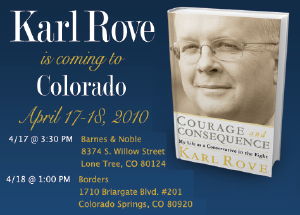
Traitor, war criminal, Karl Rove still at large, lurking this weekend in Colorado

Courage and ConsequenceMost people would be surprised to learn that Karl Rove is out of prison. You’d think the unceasing attempts to make citizen’s arrests might have prompted a new attorney general to investigate the man known as “Bush’s Brain,” behind the curtains of Dubya’s stolen elections, 9/11, Iraq, the GWOT thru the Wall Street Bailout, ad nauseam. No. Comically, Rove has a major media pulpit and is promoting a book about apparently, the “Courage” to defy US and international law, and “Consequences” he and his cabal have still avoided. Unless he means the courage too few of his critics have shown, and the consequences the world has suffered. Well this Saturday and Sunday Rove visits Colorado. Do you want to see another book signing interrupted? I’d be curious to see how many secret service agents still protect Rove, but frankly, I can’t think that I want anything to do with him. Whatever I could muster, I can just envision his smug face. He wins.

I know it feels embarrassingly pointless, but where better to remind the media that the public awaits an accounting of the past administration’s crimes. I love that Code Pink activists tie Rove to our illegal wars. In prosecuting Bushco, the Obama team would have to charge themselves next. Hence, no arrests yet. At least in this respect Obama is being consistent.

Need an arrest complaint? Code Pink suggests this boilerplate for making a citizen’s arrest, adjusted for the Colorado statute:

Arrest Complaint
In the matter concerning:

?United States of America, plaintiff
v.
Karl Christian Rove, defendant

Under the authority provided private citizens by Colorado Revised Statutes Title 16-3-201, you, Karl Christian Rove, are being placed under arrest for high crimes against the people of the United States committed during your role as Deputy Chief of Staff to President George W. Bush as well as while serving as a campaign consultant during the U.S. presidential elections of 2000 and 2004.

You are charged with willful violation of the following federal codes between the dates of January 1, 2000 until the present.

US Code: Title 42, the Voting Rights Act, for ELECTION FRAUD in the 2000 and 2004 presidential elections

US Code, Chapter 19.371, CONSPIRACY TO COMMIT OFFENSE OR TO DEFRAUD UNITED STATES, for false information leading to the War in Iraq

Several sections of US Code, Chapter 115, TREASON, SEDITION, AND SUBVERSIVE ACTIVITIES including, but not limited to submitting and fomenting false information leading to the War in Iraq, illegal detainment and torture of prisoners in Guantanamo and elsewhere, and other fraudulent acts leading to the deaths of more than 4,000 U.S. military personnel as well as approximately 300,000 Iraqi civilians.

US Code, Title 18, Chapter 51, FELONY MURDER

Further, you may also be indicted for other violations of federal code not listed in this complaint.

Any United States Marshall or any authorized U.S. Law Enforcement Officer present is obligated under the provisions of Colorado Revised Statutes Title 16-3-201 to take you into custody and bring you forthwith before the nearest magistrate to answer these charges and to advise you of your rights with include:

You have the right to remain silent. Anything you say can and will be used against you in a court of law. You have the right to an attorney, and to have an attorney present during any questioning. If you cannot afford a lawyer, one will be provided for you at government expense.

Respectfully submitted by and for citizens of the state of Colorado.

On this 17 day of April, 2010.

Abe Obama Jordan Simpson Woods

Abraham ObamaLocal art luminary friends of mine are celebrating their election 2008 “Abraham Obama” project this weekend, end-capping a week where their President Nobel Laureate paid a midnight visit to his warriors in Afghanistan, signed an executive order to repudiate reproductive health rights of women, and today is scheduled to announce offshore oil drilling in Virginia. Surely there is a more apt figure against whom to compare Obama. Almost any other president would fall short. Warren G. Obama? Barack Taft? Actually I can’t conceive of anyone better than Dick Cheney.

My friends maintain this is more a tribute to Abraham Lincoln, highlighting his emancipation of the slaves, a black president being the ultimate result. I’d say morph his face into Michael Jordan or Michael Jackson if you want to pretend African Americans have come far enough by Lincoln’s hand. Or Bill Cosby, Sidney Poitier, OJ Simpson or Tiger Woods.

Our prejudice against tent-dwellers

Great Depression Okies living in tents
What do home-enabled Coloradans have against disadvantaged people forced to live in tents? The Great Depression saw migrant workers having to subsist under canvas, striking miners have been forced from their homes and into camps in Ludlow and before that Cripple Creek. And of course the first Colorado tent-dwellers to get everyone’s panties in a knot were the Native Americans who held original claim to the territory.

The above photograph is from Dorothea Lange’s historic series which documented the lives of migrant workers as they fled the Dust Bowl for the fertile agricultural plantations of California. The woman at right is the iconic “Migrant Mother” known for a more famous closeup. I chose this shot because it makes clear that she and her seven children were living in a tent.

Colorado was one of the states which the Okies had to cross in search of work in California. As depicted in Grapes of Wrath, Colorado and Arizona only begrudgingly tolerated the vagabonds, making sure they didn’t linger and kept on their way.

Do we fear the poor because they threaten our own sense of prosperity? There but for the grace of God, go ourselves? We shoo them along lest their itinerant ways tax our charity, or they take the righting of economic inequity into their own hands. The Europeans have always shunned the ever-homeless gypsies. Landless people can’t be trusted, they’re in the opposite position of what we look for in businesses, reliable to the extreme of being “bonded.” People unattached to assets don’t have capital to bond them with responsibility.

Depression era photograph by Dorothea LangeBefore Coloradans were chasing off out-of-state migrant workers, yesterday’s illegal immigrants, they were offended by earlier indigent encampments. When miners struck in Colorado’s southern coal fields, the mine owners evicted them from the company-owned houses. The unions were left to build a tent city in Ludlow to put pressure on the industry to accept some labor demands. The standoff was spun as a standoff between the ungrateful miners, most of them recent immigrants, and a nation’s critical source of heating fuel. The Colorado population was roused to man a militia and beat the miners into submission. As much as consumers feared an interrupted coal supply in the record cold of the winter of 1914, imagine the miners enduring in their tents. In the end, we all know the result: the Ludlow Massacre and the unions were defeated.

The gold miners fared slightly better in their 1894 strike to preserve the eight hour day. When they closed down the mines and camped on site to keep them shut, the folks of Colorado Springs were rallied to form a near 2000-strong army to go attack the ingrates. Fortunately the miners escaped a battle, but the common population’s prejudice against the laborers in their tents was the same.

Could these have been related to the sentiments which inflamed Colorado Territory settlers in 1864, enough to go after the few remnants of Native Americans encamped along Sand Creek?

The Pikes Peak region plays an ignoble role in all of these examples. Men from Colorado Springs and Colorado City formed the population from which participants were drawn for Chivington’s raid against the Cheyenne, the private army which marched against the Cripple Creek gold strike, and the militia which Rockefeller mobilized to torment the tent city of Ludlow. Colorado Springs was a hotbed of Klu Klux Klan activity in the 1930s, epitomizing local xenophobia.

When Colorado Springs city councilman speak of fielding calls from constituents angry about the growing homeless encampments, I cannot help but think of our legacy of intolerance of people deemed lesser than us. Colorado Springs has always been ripe for bigotry and hatred.

Not so long ago our city was the crucible for Amendment Two which sought to deprive homosexuals of protection from discrimination. More recently fear-mongering about immigration from Mexico made Colorado Springs fertile for recruiting gunmen for the Minutemen, to make pilgrimages to the Mexican border with the promise of getting to shoot Mexicans pell-mell. Since the election of President Obama, we’ve seen a phenomenal growth of Tea Party enthusiasts, white bigots determined not to have their taxes spent by a nigger.

What a sorry racist lot we’ve been, anti-labor, anti-progressive and anti-poor. Somewhere in the past there must have been city leaders who defied the simple-minded xenophobia of our historic population, otherwise all our statues of municipal heroes would be wearing clan gowns. Hopefully with the current bloodlust to run off the victims of our current depression, city politicians will lead my setting a higher moral example.

Joe Stack’s Piper Cherokee Manifesto

Single Engine AircraftIt’s getting so you can’t fly a plane into a federal office building and hope somebody will finally find your website. Though engineer Joseph Stack left an online statement to explain his last act of desperation against the IRS, it was deleted “in compliance with a request from the FBI.” I guess his web hosts think the 1st Amendment has an FBI exemption. Even Google’s cache was expunged. This has freed Reporters to characterize Stack’s missive as a crazed rant. Nothing threatens the establishment like this conclusion: “Sadly, though I spent my entire life trying to believe it wasn’t so, … violence … is the only answer. The cruel joke is that [those] at the top have known this all along and have been laughing, at … fools like me all along.” I don’t know about you, but when I hear that a self-made engineer-businessman who has his own plane, commits suicide on principles he has articulated in a manifesto, I’m curious to hear him out.

I’m reminded of the sad story of the desperate antiwar activist who set himself on fire as a final protest of the escalating wars in Iraq and Afghanistan. He knew accomplices would only dissuade him, so he chose an isolated spot where he could proceed unmolested and set up a video camera to record the act. Naturally, policemen were the first to encounter his body and thus the footage of dramatic statement are consigned to the obscurity of their files.

single engine airplaneFortunately the internet is still too porous for redaction on the grounds of national security, or whatever reason the FBI contrived to censor Stack’s suicide note/screed/diatribe. The Smoking Gun has the usual non-text scans of what Joseph Stack wrote before he piloted his single-engine Piper PA-28 into the Austin TX IRS office. Here’s the full text of Stack’s manifesto.

If you’re reading this, you’re no doubt asking yourself, “Why did this have to happen?”  The simple truth is that it is complicated and has been coming for a long time.  The writing process, started many months ago, was intended to be therapy in the face of the looming realization that there isn’t enough therapy in the world that can fix what is really broken.  Needless to say, this rant could fill volumes with example after example if I would let it.  I find the process of writing it frustrating, tedious, and probably pointless… especially given my gross inability to gracefully articulate my thoughts in light of the storm raging in my head.  Exactly what is therapeutic about that I’m not sure, but desperate times call for desperate measures.

We are all taught as children that without laws there would be no society, only anarchy.  Sadly, starting at early ages we in this country have been brainwashed to believe that, in return for our dedication and service, our government stands for justice for all.  We are further brainwashed to believe that there is freedom in this place, and that we should be ready to lay our lives down for the noble principles represented by its founding fathers.  Remember? One of these was “no taxation without representation”.  I have spent the total years of my adulthood unlearning that crap from only a few years of my childhood.  These days anyone who really stands up for that principle is promptly labeled a “crackpot”, traitor and worse.

While very few working people would say they haven’t had their fair share of taxes (as can I), in my lifetime I can say with a great degree of certainty that there has never been a politician cast a vote on any matter with the likes of me or my interests in mind.  Nor, for that matter, are they the least bit interested in me or anything I have to say.

Why is it that a handful of thugs and plunderers can commit unthinkable atrocities (and in the case of the GM executives, for scores of years) and when it’s time for their gravy train to crash under the weight of their gluttony and overwhelming stupidity, the force of the full federal government has no difficulty coming to their aid within days if not hours?  Yet at the same time, the joke we call the American medical system, including the drug and insurance companies, are murdering tens of thousands of people a year and stealing from the corpses and victims they cripple, and this country’s leaders don’t see this as important as bailing out a few of their vile, rich cronies.  Yet, the political “representatives” (thieves, liars, and self-serving scumbags is far more accurate) have endless time to sit around for year after year and debate the state of the “terrible health care problem”.  It’s clear they see no crisis as long as the dead people don’t get in the way of their corporate profits rolling in.

And justice? You’ve got to be kidding!

How can any rational individual explain that white elephant conundrum in the middle of our tax system and, indeed, our entire legal system?  Here we have a system that is, by far, too complicated for the brightest of the master scholars to understand.  Yet, it mercilessly “holds accountable” its victims, claiming that they’re responsible for fully complying with laws not even the experts understand.  The law “requires” a signature on the bottom of a tax filing; yet no one can say truthfully that they understand what they are signing; if that’s not “duress” than what is.  If this is not the measure of a totalitarian regime, nothing is.

How did I get here?

My introduction to the real American nightmare starts back in the early ‘80s.  Unfortunately after more than 16 years of school, somewhere along the line I picked up the absurd, pompous notion that I could read and understand plain English.  Some friends introduced me to a group of people who were having ‘tax code’ readings and discussions.  In particular, zeroed in on a section relating to the wonderful “exemptions” that make institutions like the vulgar, corrupt Catholic Church so incredibly wealthy.  We carefully studied the law (with the help of some of the “best”, high-paid, experienced tax lawyers in the business), and then began to do exactly what the “big boys” were doing (except that we weren’t stealing from our congregation or lying to the government about our massive profits in the name of God).  We took a great deal of care to make it all visible, following all of the rules, exactly the way the law said it was to be done.

The intent of this exercise and our efforts was to bring about a much-needed re-evaluation of the laws that allow the monsters of organized religion to make such a mockery of people who earn an honest living.  However, this is where I learned that there are two “interpretations” for every law; one for the very rich, and one for the rest of us… Oh, and the monsters are the very ones making and enforcing the laws; the inquisition is still alive and well today in this country.

That little lesson in patriotism cost me $40,000+, 10 years of my life, and set my retirement plans back to 0.  It made me realize for the first time that I live in a country with an ideology that is based on a total and complete lie.  It also made me realize, not only how naive I had been, but also the incredible stupidity of the American public; that they buy, hook, line, and sinker, the crap about their “freedom”… and that they continue to do so with eyes closed in the face of overwhelming evidence and all that keeps happening in front of them.

Before even having to make a shaky recovery from the sting of the first lesson on what justice really means in this country (around 1984 after making my way through engineering school and still another five years of “paying my dues”), I felt I finally had to take a chance of launching my dream of becoming an independent engineer.

On the subjects of engineers and dreams of independence, I should digress somewhat to say that I’m sure that I inherited the fascination for creative problem solving from my father.  I realized this at a very young age.

The significance of independence, however, came much later during my early years of college; at the age of 18 or 19 when I was living on my own as student in an apartment in Harrisburg, Pennsylvania.  My neighbor was an elderly retired woman (80+ seemed ancient to me at that age) who was the widowed wife of a retired steel worker.  Her husband had worked all his life in the steel mills of central Pennsylvania with promises from big business and the union that, for his 30 years of service, he would have a pension and medical care to look forward to in his retirement.  Instead he was one of the thousands who got nothing because the incompetent mill management and corrupt union (not to mention the government) raided their pension funds and stole their retirement.  All she had was social security to live on.

In retrospect, the situation was laughable because here I was living on peanut butter and bread (or Ritz crackers when I could afford to splurge) for months at a time.  When I got to know this poor figure and heard her story I felt worse for her plight than for my own (I, after all, I thought I had everything to in front of me).  I was genuinely appalled at one point, as we exchanged stories and commiserated with each other over our situations, when she in her grandmotherly fashion tried to convince me that I would be “healthier” eating cat food (like her) rather than trying to get all my substance from peanut butter and bread.  I couldn’t quite go there, but the impression was made.  I decided that I didn’t trust big business to take care of me, and that I would take responsibility for my own future and myself.

Return to the early ‘80s, and here I was off to a terrifying start as a ‘wet-behind-the-ears’ contract software engineer… and two years later, thanks to the fine backroom, midnight effort by the sleazy executives of Arthur Andersen (the very same folks who later brought us Enron and other such calamities) and an equally sleazy New York Senator (Patrick Moynihan), we saw the passage of 1986 tax reform act with its section 1706.

For you who are unfamiliar, here is the core text of the IRS Section 1706, defining the treatment of workers (such as contract engineers) for tax purposes. Visit this link for a conference committee report (http://www.synergistech.com/1706.shtml#ConferenceCommitteeReport) regarding the intended interpretation of Section 1706 and the relevant parts of Section 530, as amended. For information on how these laws affect technical services workers and their clients, read our discussion here (http://www.synergistech.com/ic-taxlaw.shtml).

SEC. 1706. TREATMENT OF CERTAIN TECHNICAL PERSONNEL.

(a) IN GENERAL – Section 530 of the Revenue Act of 1978 is amended by adding at the end thereof the following new subsection:

(d) EXCEPTION. – This section shall not apply in the case of an individual who pursuant to an arrangement between the taxpayer and another person, provides services for such other person as an engineer, designer, drafter, computer programmer, systems analyst, or other similarly skilled worker engaged in a similar line of work.

(b) EFFECTIVE DATE. – The amendment made by this section shall apply to remuneration paid and services rendered after December 31, 1986.

Note:

·      “another person” is the client in the traditional job-shop relationship.

·      “taxpayer” is the recruiter, broker, agency, or job shop.

·      “individual”, “employee”, or “worker” is you.

Admittedly, you need to read the treatment to understand what it is saying but it’s not very complicated.  The bottom line is that they may as well have put my name right in the text of section (d).  Moreover, they could only have been more blunt if they would have came out and directly declared me a criminal and non-citizen slave.  Twenty years later, I still can’t believe my eyes.

During 1987, I spent close to $5000 of my ‘pocket change’, and at least 1000 hours of my time writing, printing, and mailing to any senator, congressman, governor, or slug that might listen; none did, and they universally treated me as if I was wasting their time.  I spent countless hours on the L.A. freeways driving to meetings and any and all of the disorganized professional groups who were attempting to mount a campaign against this atrocity.  This, only to discover that our efforts were being easily derailed by a few moles from the brokers who were just beginning to enjoy the windfall from the new declaration of their “freedom”.  Oh, and don’t forget, for all of the time I was spending on this, I was loosing income that I couldn’t bill clients.

After months of struggling it had clearly gotten to be a futile exercise.  The best we could get for all of our trouble is a pronouncement from an IRS mouthpiece that they weren’t going to enforce that provision (read harass engineers and scientists).  This immediately proved to be a lie, and the mere existence of the regulation began to have its impact on my bottom line; this, of course, was the intended effect.

Again, rewind my retirement plans back to 0 and shift them into idle.  If I had any sense, I clearly should have left abandoned engineering and never looked back.

Instead I got busy working 100-hour workweeks.  Then came the L.A. depression of the early 1990s.  Our leaders decided that they didn’t need the all of those extra Air Force bases they had in Southern California, so they were closed; just like that.  The result was economic devastation in the region that rivaled the widely publicized Texas S&L fiasco.  However, because the government caused it, no one gave a shit about all of the young families who lost their homes or street after street of boarded up houses abandoned to the wealthy loan companies who received government funds to “shore up” their windfall.  Again, I lost my retirement.

Years later, after weathering a divorce and the constant struggle trying to build some momentum with my business, I find myself once again beginning to finally pick up some speed.  Then came the .COM bust and the 911 nightmare.  Our leaders decided that all aircraft were grounded for what seemed like an eternity; and long after that, ‘special’ facilities like San Francisco were on security alert for months.  This made access to my customers prohibitively expensive.  Ironically, after what they had done the Government came to the aid of the airlines with billions of our tax dollars … as usual they left me to rot and die while they bailed out their rich, incompetent cronies WITH MY MONEY!  After these events, there went my business but not quite yet all of my retirement and savings.

By this time, I’m thinking that it might be good for a change.  Bye to California, I’ll try Austin for a while.  So I moved, only to find out that this is a place with a highly inflated sense of self-importance and where damn little real engineering work is done.  I’ve never experienced such a hard time finding work.  The rates are 1/3 of what I was earning before the crash, because pay rates here are fixed by the three or four large companies in the area who are in collusion to drive down prices and wages… and this happens because the justice department is all on the take and doesn’t give a fuck about serving anyone or anything but themselves and their rich buddies.

To survive, I was forced to cannibalize my savings and retirement, the last of which was a small IRA.  This came in a year with mammoth expenses and not a single dollar of income.  I filed no return that year thinking that because I didn’t have any income there was no need.  The sleazy government decided that they disagreed.  But they didn’t notify me in time for me to launch a legal objection so when I attempted to get a protest filed with the court I was told I was no longer entitled to due process because the time to file ran out.  Bend over for another $10,000 helping of justice.

So now we come to the present.  After my experience with the CPA world, following the business crash I swore that I’d never enter another accountant’s office again.  But here I am with a new marriage and a boatload of undocumented income, not to mention an expensive new business asset, a piano, which I had no idea how to handle.  After considerable thought I decided that it would be irresponsible NOT to get professional help; a very big mistake.

When we received the forms back I was very optimistic that they were in order.  I had taken all of the years information to Bill Ross, and he came back with results very similar to what I was expecting.  Except that he had neglected to include the contents of Sheryl’s unreported income; $12,700 worth of it. To make matters worse, Ross knew all along this was missing and I didn’t have a clue until he pointed it out in the middle of the audit.  By that time it had become brutally evident that he was representing himself and not me.

This left me stuck in the middle of this disaster trying to defend transactions that have no relationship to anything tax-related (at least the tax-related transactions were poorly documented).  Things I never knew anything about and things my wife had no clue would ever matter to anyone.  The end result is… well, just look around.

I remember reading about the stock market crash before the “great” depression and how there were wealthy bankers and businessmen jumping out of windows when they realized they screwed up and lost everything.  Isn’t it ironic how far we’ve come in 60 years in this country that they now know how to fix that little economic problem; they just steal from the middle class (who doesn’t have any say in it, elections are a joke) to cover their asses and it’s “business-as-usual”.  Now when the wealthy fuck up, the poor get to die for the mistakes… isn’t that a clever, tidy solution.

As government agencies go, the FAA is often justifiably referred to as a tombstone agency, though they are hardly alone.  The recent presidential puppet GW Bush and his cronies in their eight years certainly reinforced for all of us that this criticism rings equally true for all of the government.  Nothing changes unless there is a body count (unless it is in the interest of the wealthy sows at the government trough).  In a government full of hypocrites from top to bottom, life is as cheap as their lies and their self-serving laws.

I know I’m hardly the first one to decide I have had all I can stand.  It has always been a myth that people have stopped dying for their freedom in this country, and it isn’t limited to the blacks, and poor immigrants.  I know there have been countless before me and there are sure to be as many after.  But I also know that by not adding my body to the count, I ensure nothing will change.  I choose to not keep looking over my shoulder at “big brother” while he strips my carcass, I choose not to ignore what is going on all around me, I choose not to pretend that business as usual won’t continue; I have just had enough.

I can only hope that the numbers quickly get too big to be white-washed and ignored that the American zombies wake up and revolt; it will take nothing less.  I would only hope that by striking a nerve that stimulates the inevitable double standard, knee-jerk government reaction that results in more stupid draconian restrictions people wake up and begin to see the pompous political thugs and their mindless minions for what they are.  Sadly, though I spent my entire life trying to believe it wasn’t so, but violence not only is the answer, it is the only answer.  The cruel joke is that the really big chunks of shit at the top have known this all along and have been laughing, at and using this awareness against, fools like me all along.

I saw it written once that the definition of insanity is repeating the same process over and over and expecting the outcome to suddenly be different.  I am finally ready to stop this insanity.  Well, Mr. Big Brother IRS man, let’s try something different; take my pound of flesh and sleep well.

The communist creed: From each according to his ability, to each according to his need.

The capitalist creed: From each according to his gullibility, to each according to his greed.

Joe Stack (1956-2010)

02/18/2010

Polk awards Neda midst propaganda

How do you give formal recognition to journalism merit in a media landscape adulterated with propaganda? Award the dubious distinction to the pseudonym for commercial disinformation: anonymous! This year a Polk Award went to the unknown Youtube videographer who captured the death of Iran “Green Revolution” martyr Neda Soltani, a wrenching sequence which transcended exploitation to give iconic status to Iran’s election discontents. Fitting, while another snuff film is circulated to drum up interest in the Vancouver Olympics.

The Wide World of Sports used to loop the famous ski jump wipe-out, but we were assured the skier escaped without major injury. If he’d died the footage would have been buried like that of race care crashes. But that was another age. Now a fatal luge accident gets played again and again, the pretext being to compete with Youtube, but obviously it’s to amp interest in what has traditionally remained a lackluster Olympic category.

What’s the point of awarding nobody? Time Magazine did it when they named you as Person of the Year. It’s called pandering to everyman, this time as a bald excuse to give Neda another chance to incite anti-Iranian sentiment.

Think Iran is coming down too hard on inciters of protest? Remember Neda!

Angel of Freedom of Green RevolutionYou might not have expected me to invoke the name of Neda Agha Soltan(i), the Green Revolution bystander “whose name in Farsi means ‘voice'” and whose angelic face adorned every subsequent Iranian reform movement ephemera. Remember the video where pretty Neda was shot by an unseen gunman, left to die on camera, the footage used to rally indignation against Mahmoud Ahmadinejad’s evident barbarity? Curiously our media chose to break from its usual sensibilities about snuff films. Remember your own blood lust? What fate were you wishing then for poor Neda’s killers? No doubt Iran would like to see justice for Neda too. They’ve conducted inquiries about who killed the unsuspecting martyr. Have you?

The Iranian government blames US operatives for instigating the reformist uprising, prompting Tehran’s secular class to take their grievances to the streets. They point to Iranian student groups organized by nonprofits funded by the West. They hold capitalist rabble-rousers accountable for inciting impressionable consumer wannabes to push against the riot police. They know the US is spending beaucoup black budget bucks to destabilize Iranian society. “Promoting Democracy” in Farsi means subverting leadership, and where there’s been a revolutionary movement against the established order, the USA habitually sets about to breed counter-revolutionaries. But that doesn’t explain Neda.

Political movements have infinitely more potential when there’s a martyr, and it’s a strategy no US adviser leaves to nuance. Movements have succeeded without them, but no psych-ops crafted scenario has done without. You wonder who volunteers for the role? We’ve seen recent examples, I can think of an incident in Honduras, were protesters pretended one of their number had been felled. But such is the weakness of the good guys, they’re not about to kill someone as a means to an end. Can we say the same about the good guys of the CIA?

When the saintly Neda was killed onscreen, the Iranian government immediately suspected a plot. Was it one of their soldiers who killed her, standing at an isolated corner, part of no confrontation? By whose orders would he have fired?

Who said the reelection of Ahmadinejad was rigged? None but the Americans. Who egged on the crowds to overturn a democratically elected government? America. Who branded the reform movement, and levitated it via social media?

Who else but America color-codes its exported “revolutions?”

“Remember Neda” has become the rallying cry of Iranian expats and Shah loyalists in exile. They’ll change their tune when authorities in Iran finger her murderers.

When Iran executes those responsible for the covert machinations meant to provoke an uprising to satisfy the US call for regime change, it’s not for crying out “freedom” but for yelling “fire” in a crowded theater, pointing at Neda.

CS Indy turns to cruel IFES deceiver to voice cautionary best hope for Haiti

IFESWhen it came to coverage of the Haiti earthquake disaster, the CS Indy left it to their Your Turn column, and by “your” they meant YOUR MASSAH. What caught my eye was the headline “Time for a new Haiti” accompanied by the excerpt blurb “Aristide’s return would be a disaster,” written by a pasty diplomat who had a personal hand in Haiti’s ongoing misery. Here is our allegedly progressive newsweekly giving the podium to IFES criminal Richard Soudriette instead of bundling him off to Port Au Prince for a well deserved drubbing.

Mr. Soudriette presided over the International Foundation for Electoral Systems (IFES) from 1988 to 2007, the period which saw two US coups in Haiti, where twice the democratically elected Bertrand Aristide was removed from office by our hands. Who better to have blown the whistle on the US interference than someone observing, even advising and conducting, the elections? That’s ignoring of course that the IFES is actually a private agency which does the CIA’s work, created in the 80s when Congress moved to limit the CIA’s official role destabilizing democracies. Through the IFES, through the National Endowment for Democracy, the CIA continues its intelligence wars subverting foreign governments who threaten America’s corporate rule.

If you want to believe that enterprises like IFES might be serving some good, consider this: if democratic ideals were really being advanced, the US State Department would be proud to do the work. These aren’t subcontracted jobs that wouldn’t benefit from official diplomatic networks. The IFES and ilk are as disreputable cretins as ever wore stuffed shirts, designed to separate people from legitimate representation.

And don’t think all the pitchfork bearing victims of its election racketeering are overseas. The IFES has been an adversary of the American people as Americans have tried to rescue their elections from Diebold and the stolen votes of 2000, 2002, 2004 and 2006.

When will traitorous, undemocratic Neocons like Richard Soudriette meet the wrath they have so richly courted? The Haitians are suffering, there are countless stories of Americans helping in the effort, instead the Indy gives people of Haiti more of the same malignant spin. How did Soudriette explain his expertise on Aristide? He didn’t:

“Unfortunately Aristide is hinting at a comeback despite his two failed terms. Aristide’s return to Haitian politics would be a disaster for the country. His many political allies in the U.S. and abroad would best serve Haiti’s interests by encouraging Aristide to permanently step aside from politics.”

Rather, Soudriette says, we need to back efforts to amend Haiti’s constitution to allow America’s man Preval serve additional terms. Oh, and give more responsibility to USAID, another CIA arm. Why is Soudriette spinning this message to Colorado Springs I wonder?

It’s not enough that Soudriette lent his villainy to Haiti’s disastrous last decades, now two years removed from the job, on the occasion of its most recent natural calamity, Soudriette resurfaces to damn the Haitian people with the same lies, lest they ever catch a break. That’s what makes this brand of conservative bureaucrat so damnable.

And why is the Indy propagating this venomous neo-liberal drivel? It could be highlighting the truly hopeful opportunities which locals have been taking to help the earthquake victims. Tired of watching the US military bureaucracy monopolize and bungle the aid efforts, a Springs surgical team enlisted a local businessman’s private turboprop to spend a week in Port Au Prince effecting miracles. Let’s hear about that story.

To pick up where we left off with scoundrel Soudriette, he of the many Haitian crony friends in DC, the careerist democracy-thief has moved to Colorado Springs, to lecture for El Pomar, and head the Center for Diplomacy and Democracy, which may be just another shell to which the CIA funnels funding. While stationed in DC for the IFES, Soudriette was also billing from an M Street address for the Conservation International Foundation. The good news is that apart from a CFDD franchise opened in Northern Iraq, no doubt to milk from Iraq reconstruction funds, the headquarters here appears to be merely a residence with a walkout on the golf course of the Country Club of Colorado.

Non profit front on the Country Club of Colorado golf course

A supreme height of cronyism

Forget higher judicial ideals or upholding the constitution; America’s founding fathers shunned corporate trusts. This week’s ruling on Citizen United reiterates that five of our Supreme Court justices are unabashed cronies for the WSJ-feted oligarchs. Roberts, Thomas, Kennedy, Scalia, and Alito –the cabal whose ignoble Gore v. Bush decision stole the 2000 election and birthed the Decade from Hell TM.
bunch of croniesIf you needed another reason to indict George W. Bush, charge his dad H.W. for the First Gulf War, and Ronald Reagan for Nicaragua. Impeach their Supreme Court appointees, and bring racketeering charges against the corporatist bastards who are stealing democracy.

Beyond MLK worship: Beyond Vietnam

MLK“A time comes when silence is betrayal. That time has come for us in relation to Vietnam.”
Martin Luther King Beyond Vietnam: Time to Break the Silence
Full text of 1967 speech below.

Riverside Church, New York City, 4 April 1967

I come to this magnificent house of worship tonight because my conscience leaves me no other choice. I join with you in this meeting because I am in deepest agreement with the aims and work of the organization which has brought us together: Clergy and Laymen Concerned about Vietnam. The recent statement of your executive committee are the sentiments of my own heart and I found myself in full accord when I read its opening lines:

“A time comes when silence is betrayal.”

That time has come for us in relation to Vietnam.

The truth of these words is beyond doubt but the mission to which they call us is a most difficult one. Even when pressed by the demands of inner truth, men do not easily assume the task of opposing their government’s policy, especially in time of war. Nor does the human spirit move without great difficulty against all the apathy of conformist thought within one’s own bosom and in the surrounding world. Moreover when the issues at hand seem as perplexed as they often do in the case of this dreadful conflict we are always on the verge of being mesmerized by uncertainty; but we must move on.

Some of us who have already begun to break the silence of the night have found that the calling to speak is often a vocation of agony, but we must speak. We must speak with all the humility that is appropriate to our limited vision, but we must speak. And we must rejoice as well, for surely this is the first time in our nation’s history that a significant number of its religious leaders have chosen to move beyond the prophesying of smooth patriotism to the high grounds of a firm dissent based upon the mandates of conscience and the reading of history. Perhaps a new spirit is rising among us. If it is, let us trace its movement well and pray that our own inner being may be sensitive to its guidance, for we are deeply in need of a new way beyond the darkness that seems so close around us.

Over the past two years, as I have moved to break the betrayal of my own silences and to speak from the burnings of my own heart, as I have called for radical departures from the destruction of Vietnam, many persons have questioned me about the wisdom of my path. At the heart of their concerns this query has often loomed large and loud: Why are you speaking about war, Dr. King? Why are you joining the voices of dissent? Peace and civil rights don’t mix, they say. Aren’t you hurting the cause of your people, they ask? And when I hear them, though I often understand the source of their concern, I am nevertheless greatly saddened, for such questions mean that the inquirers have not really known me, my commitment or my calling. Indeed, their questions suggest that they do not know the world in which they live.

“I wish not to speak with Hanoi and the National Liberation Front, but rather to my fellow Americans who, with me, bear the greatest responsibility in ending a conflict that has exacted a heavy price on both continents.”

In the light of such tragic misunderstandings, I deem it of signal importance to try to state clearly, and I trust concisely, why I believe that the path from Dexter Avenue Baptist Church — the church in Montgomery, Alabama, where I began my pastorate — leads clearly to this sanctuary tonight.

I come to this platform tonight to make a passionate plea to my beloved nation. This speech is not addressed to Hanoi or to the National Liberation Front. It is not addressed to China or to Russia.

Nor is it an attempt to overlook the ambiguity of the total situation and the need for a collective solution to the tragedy of Vietnam. Neither is it an attempt to make North Vietnam or the National Liberation Front paragons of virtue, nor to overlook the role they can play in a successful resolution of the problem. While they both may have justifiable reason to be suspicious of the good faith of the United States, life and history give eloquent testimony to the fact that conflicts are never resolved without trustful give and take on both sides.

Tonight, however, I wish not to speak with Hanoi and the NLF, but rather to my fellow Americans, who, with me, bear the greatest responsibility in ending a conflict that has exacted a heavy price on both continents.

The Importance of Vietnam

Since I am a preacher by trade, I suppose it is not surprising that I have seven major reasons for bringing Vietnam into the field of my moral vision. There is at the outset a very obvious and almost facile connection between the war in Vietnam and the struggle I, and others, have been waging in America. A few years ago there was a shining moment in that struggle. It seemed as if there was a real promise of hope for the poor — both black and white — through the poverty program. There were experiments, hopes, new beginnings. Then came the buildup in Vietnam and I watched the program broken and eviscerated as if it were some idle political plaything of a society gone mad on war, and I knew that America would never invest the necessary funds or energies in rehabilitation of its poor so long as adventures like Vietnam continued to draw men and skills and money like some demonic destructive suction tube. So I was increasingly compelled to see the war as an enemy of the poor and to attack it as such.

“For the sake of those boys,
for the sake of this governent,
for the sake of hundreds of thousands
trembling under our violence,
I cannot be silent.”

Perhaps the more tragic recognition of reality took place when it became clear to me that the war was doing far more than devastating the hopes of the poor at home. It was sending their sons and their brothers and their husbands to fight and to die in extraordinarily high proportions relative to the rest of the population. We were taking the black young men who had been crippled by our society and sending them eight thousand miles away to guarantee liberties in Southeast Asia which they had not found in southwest Georgia and East Harlem. So we have been repeatedly faced with the cruel irony of watching Negro and white boys on TV screens as they kill and die together for a nation that has been unable to seat them together in the same schools. So we watch them in brutal solidarity burning the huts of a poor village, but we realize that they would never live on the same block in Detroit. I could not be silent in the face of such cruel manipulation of the poor.

My third reason moves to an even deeper level of awareness, for it grows out of my experience in the ghettoes of the North over the last three years — especially the last three summers. As I have walked among the desperate, rejected and angry young men I have told them that Molotov cocktails and rifles would not solve their problems. I have tried to offer them my deepest compassion while maintaining my conviction that social change comes most meaningfully through nonviolent action. But they asked — and rightly so — what about Vietnam? They asked if our own nation wasn’t using massive doses of violence to solve its problems, to bring about the changes it wanted. Their questions hit home, and I knew that I could never again raise my voice against the violence of the oppressed in the ghettos without having first spoken clearly to the greatest purveyor of violence in the world today — my own government. For the sake of those boys, for the sake of this government, for the sake of hundreds of thousands trembling under our violence, I cannot be silent.

For those who ask the question, “Aren’t you a civil rights leader?” and thereby mean to exclude me from the movement for peace, I have this further answer. In 1957 when a group of us formed the Southern Christian Leadership Conference, we chose as our motto: “To save the soul of America.” We were convinced that we could not limit our vision to certain rights for black people, but instead affirmed the conviction that America would never be free or saved from itself unless the descendants of its slaves were loosed completely from the shackles they still wear. In a way we were agreeing with Langston Hughes, that black bard of Harlem, who had written earlier:

O, yes,
I say it plain,
America never was America to me,
And yet I swear this oath —
America will be!

Now, it should be incandescently clear that no one who has any concern for the integrity and life of America today can ignore the present war. If America’s soul becomes totally poisoned, part of the autopsy must read Vietnam. It can never be saved so long as it destroys the deepest hopes of men the world over. So it is that those of us who are yet determined that America will be are led down the path of protest and dissent, working for the health of our land.

“Surely we must see
that the men we supported
pressed them to their violence.”

As if the weight of such a commitment to the life and health of America were not enough, another burden of responsibility was placed upon me in 1964; and I cannot forget that the Nobel Prize for Peace was also a commission — a commission to work harder than I had ever worked before for “the brotherhood of man.” This is a calling that takes me beyond national allegiances, but even if it were not present I would yet have to live with the meaning of my commitment to the ministry of Jesus Christ. To me the relationship of this ministry to the making of peace is so obvious that I sometimes marvel at those who ask me why I am speaking against the war. Could it be that they do not know that the good news was meant for all men — for Communist and capitalist, for their children and ours, for black and for white, for revolutionary and conservative? Have they forgotten that my ministry is in obedience to the one who loved his enemies so fully that he died for them? What then can I say to the “Vietcong” or to Castro or to Mao as a faithful minister of this one? Can I threaten them with death or must I not share with them my life?

Finally, as I try to delineate for you and for myself the road that leads from Montgomery to this place I would have offered all that was most valid if I simply said that I must be true to my conviction that I share with all men the calling to be a son of the living God. Beyond the calling of race or nation or creed is this vocation of sonship and brotherhood, and because I believe that the Father is deeply concerned especially for his suffering and helpless and outcast children, I come tonight to speak for them.

This I believe to be the privilege and the burden of all of us who deem ourselves bound by allegiances and loyalties which are broader and deeper than nationalism and which go beyond our nation’s self-defined goals and positions. We are called to speak for the weak, for the voiceless, for victims of our nation and for those it calls enemy, for no document from human hands can make these humans any less our brothers.

Strange Liberators

And as I ponder the madness of Vietnam and search within myself for ways to understand and respond to compassion my mind goes constantly to the people of that peninsula. I speak now not of the soldiers of each side, not of the junta in Saigon, but simply of the people who have been living under the curse of war for almost three continuous decades now. I think of them too because it is clear to me that there will be no meaningful solution there until some attempt is made to know them and hear their broken cries.

“Before long they must know
that their government has sent them
into a struggle among Vietnamese,
and the more sophisticated surely realize
that we are on the side of the wealthy
and the secure
while we create hell for the poor.”

They must see Americans as strange liberators. The Vietnamese people proclaimed their own independence in 1945 after a combined French and Japanese occupation, and before the Communist revolution in China. They were led by Ho Chi Minh. Even though they quoted the American Declaration of Independence in their own document of freedom, we refused to recognize them. Instead, we decided to support France in its re-conquest of her former colony.

Our government felt then that the Vietnamese people were not “ready” for independence, and we again fell victim to the deadly Western arrogance that has poisoned the international atmosphere for so long. With that tragic decision we rejected a revolutionary government seeking self-determination, and a government that had been established not by China (for whom the Vietnamese have no great love) but by clearly indigenous forces that included some Communists. For the peasants this new government meant real land reform, one of the most important needs in their lives.

For nine years following 1945 we denied the people of Vietnam the right of independence. For nine years we vigorously supported the French in their abortive effort to re-colonize Vietnam.

Before the end of the war we were meeting eighty percent of the French war costs. Even before the French were defeated at Dien Bien Phu, they began to despair of the reckless action, but we did not. We encouraged them with our huge financial and military supplies to continue the war even after they had lost the will. Soon we would be paying almost the full costs of this tragic attempt at re-colonization.

After the French were defeated it looked as if independence and land reform would come again through the Geneva agreements. But instead there came the United States, determined that Ho should not unify the temporarily divided nation, and the peasants watched again as we supported one of the most vicious modern dictators — our chosen man, Premier Diem. The peasants watched and cringed as Diem ruthlessly routed out all opposition, supported their extortionist landlords and refused even to discuss reunification with the north. The peasants watched as all this was presided over by U.S. influence and then by increasing numbers of U.S. troops who came to help quell the insurgency that Diem’s methods had aroused. When Diem was overthrown they may have been happy, but the long line of military dictatorships seemed to offer no real change — especially in terms of their need for land and peace.

The only change came from America as we increased our troop commitments in support of governments which were singularly corrupt, inept and without popular support. All the while the people read our leaflets and received regular promises of peace and democracy — and land reform. Now they languish under our bombs and consider us – not their fellow Vietnamese — the real enemy. They move sadly and apathetically as we herd them off the land of their fathers into concentration camps where minimal social needs are rarely met. They know they must move or be destroyed by our bombs. So they go — primarily women and children and the aged.

“Somehow this madness must cease.”

They watch as we poison their water, as we kill a million acres of their crops. They must weep as the bulldozers roar through their areas preparing to destroy the precious trees. They wander into the hospitals, with at least twenty casualties from American firepower for one “Vietcong-inflicted” injury. So far we may have killed a million of them — mostly children. They wander into the towns and see thousands of the children, homeless, without clothes, running in packs on the streets like animals. They see the children, degraded by our soldiers as they beg for food. They see the children selling their sisters to our soldiers, soliciting for their mothers.

What do the peasants think as we ally ourselves with the landlords and as we refuse to put any action into our many words concerning land reform? What do they think as we test our latest weapons on them, just as the Germans tested out new medicine and new tortures in the concentration camps of Europe? Where are the roots of the independent Vietnam we claim to be building? Is it among these voiceless ones?

We have destroyed their two most cherished institutions: the family and the village. We have destroyed their land and their crops. We have cooperated in the crushing of the nation’s only non-Communist revolutionary political force — the Unified Buddhist church. We have supported the enemies of the peasants of Saigon. We have corrupted their women and children and killed their men. What liberators?

Now there is little left to build on — save bitterness. Soon the only solid physical foundations remaining will be found at our military bases and in the concrete of the concentration camps we call fortified hamlets. The peasants may well wonder if we plan to build our new Vietnam on such grounds as these? Could we blame them for such thoughts? We must speak for them and raise the questions they cannot raise. These too are our brothers.

Perhaps the more difficult but no less necessary task is to speak for those who have been designated as our enemies. What of the National Liberation Front — that strangely anonymous group we call VC or Communists? What must they think of us in America when they realize that we permitted the repression and cruelty of Diem which helped to bring them into being as a resistance group in the south? What do they think of our condoning the violence which led to their own taking up of arms? How can they believe in our integrity when now we speak of “aggression from the north” as if there were nothing more essential to the war? How can they trust us when now we charge them with violence after the murderous reign of Diem and charge them with violence while we pour every new weapon of death into their land? Surely we must understand their feelings even if we do not condone their actions. Surely we must see that the men we supported pressed them to their violence. Surely we must see that our own computerized plans of destruction simply dwarf their greatest acts.

“We must continue to raise our voices if our nation persists in its perverse ways in Vietnam.”

How do they judge us when our officials know that their membership is less than twenty-five percent Communist and yet insist on giving them the blanket name? What must they be thinking when they know that we are aware of their control of major sections of Vietnam and yet we appear ready to allow national elections in which this highly organized political parallel government will have no part? They ask how we can speak of free elections when the Saigon press is censored and controlled by the military junta. And they are surely right to wonder what kind of new government we plan to help form without them — the only party in real touch with the peasants. They question our political goals and they deny the reality of a peace settlement from which they will be excluded. Their questions are frighteningly relevant. Is our nation planning to build on political myth again and then shore it up with the power of new violence?

Here is the true meaning and value of compassion and nonviolence when it helps us to see the enemy’s point of view, to hear his questions, to know his assessment of ourselves. For from his view we may indeed see the basic weaknesses of our own condition, and if we are mature, we may learn and grow and profit from the wisdom of the brothers who are called the opposition.

So, too, with Hanoi. In the north, where our bombs now pummel the land, and our mines endanger the waterways, we are met by a deep but understandable mistrust. To speak for them is to explain this lack of confidence in Western words, and especially their distrust of American intentions now. In Hanoi are the men who led the nation to independence against the Japanese and the French, the men who sought membership in the French commonwealth and were betrayed by the weakness of Paris and the willfulness of the colonial armies. It was they who led a second struggle against French domination at tremendous costs, and then were persuaded to give up the land they controlled between the thirteenth and seventeenth parallel as a temporary measure at Geneva. After 1954 they watched us conspire with Diem to prevent elections which would have surely brought Ho Chi Minh to power over a united Vietnam, and they realized they had been betrayed again.

When we ask why they do not leap to negotiate, these things must be remembered. Also it must be clear that the leaders of Hanoi considered the presence of American troops in support of the Diem regime to have been the initial military breach of the Geneva agreements concerning foreign troops, and they remind us that they did not begin to send in any large number of supplies or men until American forces had moved into the tens of thousands.

“When machines and computers,
profit motives and property rights
are considered more important than people,
the giant triplets of
racism,
materialism
and militarism
are incapable of being conquered.”

Hanoi remembers how our leaders refused to tell us the truth about the earlier North Vietnamese overtures for peace, how the president claimed that none existed when they had clearly been made. Ho Chi Minh has watched as America has spoken of peace and built up its forces, and now he has surely heard of the increasing international rumors of American plans for an invasion of the north. He knows the bombing and shelling and mining we are doing are part of traditional pre-invasion strategy. Perhaps only his sense of humor and of irony can save him when he hears the most powerful nation of the world speaking of aggression as it drops thousands of bombs on a poor weak nation more than eight thousand miles away from its shores.

At this point I should make it clear that while I have tried in these last few minutes to give a voice to the voiceless on Vietnam and to understand the arguments of those who are called enemy, I am as deeply concerned about our troops there as anything else. For it occurs to me that what we are submitting them to in Vietnam is not simply the brutalizing process that goes on in any war where armies face each other and seek to destroy. We are adding cynicism to the process of death, for they must know after a short period there that none of the things we claim to be fighting for are really involved. Before long they must know that their government has sent them into a struggle among Vietnamese, and the more sophisticated surely realize that we are on the side of the wealthy and the secure while we create hell for the poor.

This Madness Must Cease

Somehow this madness must cease. We must stop now. I speak as a child of God and brother to the suffering poor of Vietnam. I speak for those whose land is being laid waste, whose homes are being destroyed, whose culture is being subverted. I speak for the poor of America who are paying the double price of smashed hopes at home and death and corruption in Vietnam. I speak as a citizen of the world, for the world as it stands aghast at the path we have taken. I speak as an American to the leaders of my own nation. The great initiative in this war is ours. The initiative to stop it must be ours.

This is the message of the great Buddhist leaders of Vietnam. Recently one of them wrote these words:

“Each day the war goes on the hatred increases in the heart of the Vietnamese and in the hearts of those of humanitarian instinct. The Americans are forcing even their friends into becoming their enemies. It is curious that the Americans, who calculate so carefully on the possibilities of military victory, do not realize that in the process they are incurring deep psychological and political defeat. The image of America will never again be the image of revolution, freedom and democracy, but the image of violence and militarism.”

“A nation that continues
year after year
to spend more money on military defense
than on programs of social uplift
is approaching spiritual death.”

If we continue, there will be no doubt in my mind and in the mind of the world that we have no honorable intentions in Vietnam. It will become clear that our minimal expectation is to occupy it as an American colony and men will not refrain from thinking that our maximum hope is to goad China into a war so that we may bomb her nuclear installations. If we do not stop our war against the people of Vietnam immediately the world will be left with no other alternative than to see this as some horribly clumsy and deadly game we have decided to play.

The world now demands a maturity of America that we may not be able to achieve. It demands that we admit that we have been wrong from the beginning of our adventure in Vietnam, that we have been detrimental to the life of the Vietnamese people. The situation is one in which we must be ready to turn sharply from our present ways.

In order to atone for our sins and errors in Vietnam, we should take the initiative in bringing a halt to this tragic war. I would like to suggest five concrete things that our government should do immediately to begin the long and difficult process of extricating ourselves from this nightmarish conflict:

• End all bombing in North and South Vietnam

• Declare a unilateral cease-fire in the hope that such action will create the atmosphere for negotiation.

• Take immediate steps to prevent other battlegrounds in Southeast Asia by curtailing our military buildup in Thailand and our interference in Laos.

• Realistically accept the fact that the National Liberation Front has substantial support in South Vietnam and must thereby play a role in any meaningful negotiations and in any future Vietnam government.

• Set a date that we will remove all foreign troops from Vietnam in accordance with the 1954 Geneva agreement.

Part of our ongoing commitment might well express itself in an offer to grant asylum to any Vietnamese who fears for his life under a new regime which included the Liberation Front. Then we must make what reparations we can for the damage we have done. We most provide the medical aid that is badly needed, making it available in this country if necessary.

Protesting The War

Meanwhile we in the churches and synagogues have a continuing task while we urge our government to disengage itself from a disgraceful commitment. We must continue to raise our voices if our nation persists in its perverse ways in Vietnam. We must be prepared to match actions with words by seeking out every creative means of protest possible.

As we counsel young men concerning military service we must clarify for them our nation’s role in Vietnam and challenge them with the alternative of conscientious objection. I am pleased to say that this is the path now being chosen by more than seventy students at my own alma mater, Morehouse College, and I recommend it to all who find the American course in Vietnam a dishonorable and unjust one. Moreover I would encourage all ministers of draft age to give up their ministerial exemptions and seek status as conscientious objectors. These are the times for real choices and not false ones. We are at the moment when our lives must be placed on the line if our nation is to survive its own folly. Every man of humane convictions must decide on the protest that best suits his convictions, but we must all protest.

“If we do not act
we shall surely be dragged down
the long and shameful corridors of time
reserved for those who possess
power without compassion,
might without morality,
and strength without sight.”

There is something seductively tempting about stopping there and sending us all off on what in some circles has become a popular crusade against the war in Vietnam. I say we must enter the struggle, but I wish to go on now to say something even more disturbing. The war in Vietnam is but a symptom of a far deeper malady within the American spirit, and if we ignore this sobering reality we will find ourselves organizing clergy-and laymen-concerned committees for the next generation. They will be concerned about Guatemala and Peru. They will be concerned about Thailand and Cambodia. They will be concerned about Mozambique and South Africa. We will be marching for these and a dozen other names and attending rallies without end unless there is a significant and profound change in American life and policy. Such thoughts take us beyond Vietnam, but not beyond our calling as sons of the living God.

In 1957 a sensitive American official overseas said that it seemed to him that our nation was on the wrong side of a world revolution. During the past ten years we have seen emerge a pattern of suppression which now has justified the presence of U.S. military “advisors” in Venezuela. This need to maintain social stability for our investments accounts for the counter-revolutionary action of American forces in Guatemala. It tells why American helicopters are being used against guerrillas in Colombia and why American napalm and green beret forces have already been active against rebels in Peru. It is with such activity in mind that the words of the late John F. Kennedy come back to haunt us. Five years ago he said,

“Those who make peaceful revolution impossible will make violent revolution inevitable.”

Increasingly, by choice or by accident, this is the role our nation has taken — the role of those who make peaceful revolution impossible by refusing to give up the privileges and the pleasures that come from the immense profits of overseas investment.

I am convinced that if we are to get on the right side of the world revolution, we as a nation must undergo a radical revolution of values. We must rapidly begin the shift from a “thing-oriented” society to a “person-oriented” society. When machines and computers, profit motives and property rights are considered more important than people, the giant triplets of racism, materialism, and militarism are incapable of being conquered.

A true revolution of values will soon cause us to question the fairness and justice of many of our past and present policies. On the one hand we are called to play the good Samaritan on life’s roadside; but that will be only an initial act. One day we must come to see that the whole Jericho road must be transformed so that men and women will not be constantly beaten and robbed as they make their journey on life’s highway.

True compassion is more than flinging a coin to a beggar; it is not haphazard and superficial. It comes to see that an edifice which produces beggars needs restructuring. A true revolution of values will soon look uneasily on the glaring contrast of poverty and wealth. With righteous indignation, it will look across the seas and see individual capitalists of the West investing huge sums of money in Asia, Africa and South America, only to take the profits out with no concern for the social betterment of the countries, and say: “This is not just.”

It will look at our alliance with the landed gentry of Latin America and say: “This is not just.”

The Western arrogance of feeling that it has everything to teach others and nothing to learn from them is not just.

A true revolution of values will lay hands on the world order and say of war: “This way of settling differences is not just.”

This business of burning human beings with napalm, of filling our nation’s homes with orphans and widows, of injecting poisonous drugs of hate into veins of people normally humane, of sending men home from dark and bloody battlefields physically handicapped and psychologically deranged, cannot be reconciled with wisdom, justice and love. A nation that continues year after year to spend more money on military defense than on programs of social uplift is approaching spiritual death.

America, the richest and most powerful nation in the world, can well lead the way in this revolution of values. There is nothing, except a tragic death wish, to prevent us from reordering our priorities, so that the pursuit of peace will take precedence over the pursuit of war. There is nothing to keep us from molding a recalcitrant status quo with bruised hands until we have fashioned it into a brotherhood.

This kind of positive revolution of values is our best defense against communism. War is not the answer. Communism will never be defeated by the use of atomic bombs or nuclear weapons. Let us not join those who shout war and through their misguided passions urge the United States to relinquish its participation in the United Nations. These are days which demand wise restraint and calm reasonableness. We must not call everyone a Communist or an appeaser who advocates the seating of Red China in the United Nations and who recognizes that hate and hysteria are not the final answers to the problem of these turbulent days. We must not engage in a negative anti-communism, but rather in a positive thrust for democracy, realizing that our greatest defense against communism is to take offensive action in behalf of justice. We must with positive action seek to remove those conditions of poverty, insecurity and injustice which are the fertile soil in which the seed of communism grows and develops.

The People Are Important

These are revolutionary times. All over the globe men are revolting against old systems of exploitation and oppression and out of the wombs of a frail world new systems of justice and equality are being born. The shirtless and barefoot people of the land are rising up as never before. “The people who sat in darkness have seen a great light.” We in the West must support these revolutions. It is a sad fact that, because of comfort, complacency, a morbid fear of communism, and our proneness to adjust to injustice, the Western nations that initiated so much of the revolutionary spirit of the modern world have now become the arch anti-revolutionaries. This has driven many to feel that only Marxism has the revolutionary spirit. Therefore, communism is a judgment against our failure to make democracy real and follow through on the revolutions we initiated. Our only hope today lies in our ability to recapture the revolutionary spirit and go out into a sometimes hostile world declaring eternal hostility to poverty, racism, and militarism. With this powerful commitment we shall boldly challenge the status quo and unjust mores and thereby speed the day when “every valley shall be exalted, and every mountain and hill shall be made low, and the crooked shall be made straight and the rough places plain.”

A genuine revolution of values means in the final analysis that our loyalties must become ecumenical rather than sectional. Every nation must now develop an overriding loyalty to mankind as a whole in order to preserve the best in their individual societies.

This call for a world-wide fellowship that lifts neighborly concern beyond one’s tribe, race, class and nation is in reality a call for an all-embracing and unconditional love for all men. This oft misunderstood and misinterpreted concept – so readily dismissed by the Nietzsches of the world as a weak and cowardly force – has now become an absolute necessity for the survival of man. When I speak of love I am not speaking of some sentimental and weak response. I am speaking of that force which all of the great religions have seen as the supreme unifying principle of life. Love is somehow the key that unlocks the door which leads to ultimate reality. This Hindu-Moslem-Christian-Jewish-Buddhist belief about ultimate reality is beautifully summed up in the first epistle of Saint John:

Let us love one another; for love is God and everyone that loveth is born of God and knoweth God. He that loveth not knoweth not God; for God is love. If we love one another God dwelleth in us, and his love is perfected in us.

Let us hope that this spirit will become the order of the day. We can no longer afford to worship the god of hate or bow before the altar of retaliation. The oceans of history are made turbulent by the ever-rising tides of hate. History is cluttered with the wreckage of nations and individuals that pursued this self-defeating path of hate. As Arnold Toynbee says :

“Love is the ultimate force that makes for the saving choice of life and good against the damning choice of death and evil. Therefore the first hope in our inventory must be the hope that love is going to have the last word.”

We are now faced with the fact that tomorrow is today. We are confronted with the fierce urgency of now. In this unfolding conundrum of life and history there is such a thing as being too late. Procrastination is still the thief of time. Life often leaves us standing bare, naked and dejected with a lost opportunity. The “tide in the affairs of men” does not remain at the flood; it ebbs. We may cry out desperately for time to pause in her passage, but time is deaf to every plea and rushes on. Over the bleached bones and jumbled residue of numerous civilizations are written the pathetic words: “Too late.”

There is an invisible book of life that faithfully records our vigilance or our neglect. “The moving finger writes, and having writ moves on…” We still have a choice today; nonviolent coexistence or violent co-annihilation.

We must move past indecision to action. We must find new ways to speak for peace in Vietnam and justice throughout the developing world – a world that borders on our doors. If we do not act we shall surely be dragged down the long dark and shameful corridors of time reserved for those who possess power without compassion, might without morality, and strength without sight.

Now let us begin. Now let us rededicate ourselves to the long and bitter – but beautiful – struggle for a new world. This is the calling of the sons of God, and our brothers wait eagerly for our response. Shall we say the odds are too great? Shall we tell them the struggle is too hard? Will our message be that the forces of American life militate against their arrival as full men, and we send our deepest regrets? Or will there be another message, of longing, of hope, of solidarity with their yearnings, of commitment to their cause, whatever the cost? The choice is ours, and though we might prefer it otherwise we must choose in this crucial moment of human history.

As that noble bard of yesterday, James Russell Lowell, eloquently stated:

Once to every man and nation
Comes the moment to decide,
In the strife of truth and falsehood,
For the good or evil side;
Some great cause, God’s new Messiah,
Off’ring each the bloom or blight,
And the choice goes by forever
Twixt that darkness and that light.
Though the cause of evil prosper,
Yet ’tis truth alone is strong;
Though her portion be the scaffold,
And upon the throne be wrong:
Yet that scaffold sways the future,
And behind the dim unknown,
Standeth God within the shadow
Keeping watch above his own.

The Cairo Declaration

gaza-freedom-march-cairo-egypt
Ambitions for a greater Gaza Freedom March have been set aside for another decade, but the hopeful delegates thwarted in Cairo issued the following declaration:

End Israeli Apartheid?
Cairo Declaration
?January 1, 2010

We, international delegates meeting in Cairo during the Gaza Freedom March 2009 in collective response to an initiative from the South African delegation, state:

In view of:

* Israel’s ongoing collective punishment of Palestinians through the illegal occupation and siege of Gaza;?

* the illegal occupation of the West Bank, including East Jerusalem, and the continued construction of the illegal Apartheid Wall and settlements;?

* the new Wall under construction by Egypt and the US which will tighten even further the siege of Gaza;?

* the contempt for Palestinian democracy shown by Israel, the US, Canada, the EU and others after the Palestinian elections of 2006;?

* the war crimes committed by Israel during the invasion of Gaza one year ago;?

* the continuing discrimination and repression faced by Palestinians within Israel;?

* and the continuing exile of millions of Palestinian refugees;?

* all of which oppressive acts are based ultimately on the Zionist ideology which underpins Israel;?

* in the knowledge that our own governments have given Israel direct economic, financial, military and diplomatic support and allowed it to behave with impunity;?

* and mindful of the United Nations Declaration on the Rights of Indigenous People (2007)

We reaffirm our commitment to:

Palestinian Self-Determination?Ending the Occupation?Equal Rights for All within historic Palestine?The full Right of Return for Palestinian refugees.

We therefore reaffirm our commitment to the United Palestinian call of July 2005 for Boycott, Divestment and Sanctions (BDS) to compel Israel to comply with international law.

To that end, we call for and wish to help initiate a global mass, democratic anti-apartheid movement to work in full consultation with Palestinian civil society to implement the Palestinian call for BDS.

Mindful of the many strong similarities between apartheid Israel and the former apartheid regime in South Africa, we propose:

1) An international speaking tour in the first 6 months of 2010 by Palestinian and South African trade unionists and civil society activists, to be joined by trade unionists and activists committed to this programme within the countries toured, to take mass education on BDS directly to the trade union membership and wider public internationally;

2) Participation in the Israeli Apartheid Week in March 2010;

3) A systematic unified approach to the boycott of Israeli products, involving consumers, workers and their unions in the retail, warehousing, and transportation sectors;

4) Developing the Academic, Cultural and Sports boycott;

5) Campaigns to encourage divestment of trade union and other pension funds from companies directly implicated in the Occupation and/or the Israeli military industries;

6) Legal actions targeting the external recruitment of soldiers to serve in the Israeli military, and the prosecution of Israeli government war criminals; coordination of Citizen’s Arrest Bureaux to identify, campaign and seek to prosecute Israeli war criminals; support for the Goldstone Report and the implementation of its recommendations;

7) Campaigns against charitable status of the Jewish National Fund (JNF).

We appeal to organisations and individuals committed to this declaration to sign it and work with us to make it a reality.

Signed by:

(* Affiliation for identification purposes only.)

1. Hedy Epstein, Holocaust Survivor/ Women in Black*, USA?
2. Nomthandazo Sikiti, Nehawu, Congress of South African Trade Unions (COSATU), Affiliate International Officer*, South Africa?
3. Zico Tamela, Satawu, Congress of South African Trade Unions (COSATU) Affiliate International Officer*, South Africa?
4. Hlokoza Motau, Numsa, Congress of South African Trade Unions (COSATU) Affiliate International Officer*, South Africa?
5. George Mahlangu, Congress of South African Trade Unions (COSATU) Campaigns Coordinator*, South Africa?
6. Crystal Dicks, Congress of South African Trade Unions (COSATU) Education Secretary*, South Africa?
7. Savera Kalideen, SA Palestinian Solidarity Committee*, South Africa?
8. Suzanne Hotz, SA Palestinian Solidarity Group*, South Africa?
9. Shehnaaz Wadee, SA Palestinian Solidarity Alliance*, South Africa?
10. Haroon Wadee, SA Palestinian Solidarity Alliance*, South Africa?
11. Sayeed Dhansey, South Africa?
12. Faiza Desai, SA Palestinian Solidarity Alliance*, South Africa?
13. Ali Abunimah, Electronic Intifada*, USA?
14. Hilary Minch, Ireland Palestine Solidarity Committee*, Ireland?
15. Anthony Loewenstein, Australia?
16. Sam Perlo-Freeman, United Kingdom?
17. Julie Moentk, Pax Christi*, USA?
18. Ulf Fogelström, Sweden?
19. Ann Polivka, Chico Peace and Justice Center*, USA?
20. Mark Johnson, Fellowship of Reconciliation*, USA?
21. Elfi Padovan, Munich Peace Committee*/Die Linke*, Germany?
22. Elizabeth Barger, Peace Roots Alliance*/Plenty I*, USA?
23. Sarah Roche-Mahdi, CodePink*, USA?
24. Svetlana Gesheva-Anar, Bulgaria?
25. Cristina Ruiz Cortina, Al Quds-Malaga*, Spain?
26. Rachel Wyon, Boston Gaza Freedom March*, USA?
27. Mary Hughes-Thompson, Women in Black*, USA?
28. David Letwin, International Jewish Anti-Zionist Network (IJAN)*, USA?
29. Jean Athey, Peace Action Montgomery*, USA?
30. Gael Murphy, Gaza Freedom March*/CodePink*, USA?
31. Thomas McAfee, Journalist/PC*, USA?
32. Jean Louis Faure, International Jewish Anti-Zionist Network (IJAN)*, France?
33. Timothy A King, Christians for Peace and Justice in the Middle East*, USA?
34. Gail Chalbi, Palestine/Israel Justice Project of the Minnesota United Methodist Church*, USA?
35. Ouahib Chalbi, Palestine/Israel Justice Project of the Minnesota United Methodist Church*, USA?
36. Greg Dropkin, Liverpool Friends of Palestine*, England?
37. Felice Gelman, Wespac Peace and Justice New York*/Gaza Freedom March*, USA?
38. Ron Witton, Australian Academic Union*, Australia?
39. Hayley Wallace, Palestine Solidarity Committee*, USA?
40. Norma Turner, Manchester Palestine Solidarity Campaign*, England?
41. Paula Abrams-Hourani, Women in Black (Vienna)*/ Jewish Voice for Just Peace in the Middle East*, Austria?
42. Mateo Bernal, Industrial Workers of the World*, USA?
43. Mary Mattieu, Collectif Urgence Palestine*, Switzerland?
44. Agneta Zuppinger, Collectif Urgence Palestine*, Switzerland?
45. Ashley Annis, People for Peace*, Canada?
46. Peige Desgarlois, People for Peace*, Canada?
47. Hannah Carter, Canadian Friends of Sabeel*, Canada?
48. Laura Ashfield, Canadian Friends of Sabeel*, Canada?
49. Iman Ghazal, People for Peace*, Canada?
50. Filsam Farah, People for Peace*, Canada?
51. Awa Allin, People for Peace*, Canada?
52. Cleopatra McGovern, USA?
53. Miranda Collet, Spain?
54. Alison Phillips, Scotland?
55. Nicholas Abramson, Middle East Crisis Response Network*/Jews Say No*, USA?
56. Tarak Kauff, Middle East Crisis Response Network*/Veterans for Peace*, USA?
57. Jesse Meisler-Abramson, USA?
58. Hope Mariposa, USA?
59. Ivesa Lübben. Bremer Netzwerk fur Gerechten Frieden in Nahost*, Germany?
60. Sheila Finan, Mid-Hudson Council MERC*, USA?
61. Joanne Lingle, Christians for Peace and Justice in the Middle East (CPJME)*, USA?
62. Barbara Lubin, Middle East Children’s Alliance*, USA?
63. Josie Shields-Stromsness, Middle East Children’s Alliance*, USA?
64. Anna Keuchen, Germany?
65. Judith Mahoney Pasternak, WRL* and Indypendent*, USA?
66. Ellen Davidson, New York City Indymedia*, WRL*, Indypendent*, USA?
67. Ina Kelleher, USA?
68. Lee Gargagliano, International Jewish Anti-Zionist Network (Chicago)*, USA?
69. Brad Taylor, OUT-FM*, USA?
70. Helga Mankovitz, SPHR (Queen’s University)*, Canada?
71. Mick Napier, Scottish Palestine Solidarity Campaign*, Scotland?
72. Agnes Kueng, Paso Basel*, Switzerland?
73. Anne Paxton, Voices of Palestine*, USA?
74. Leila El Abtah, The Netherlands?
75. Richard, Van der Wouden, The Netherlands?
76. Rafiq A. Firis, P.K.R.*/Isra*, The Netherlands?
77. Sandra Tamari, USA?
78. Alice Azzouzi, Way to Jerusalem*, USA?
79. J’Ann Schoonmaker Allen, USA?
80. Ruth F. Hooke, Episcopalian Peace Fellowship*, USA?
81. Jean E. Lee, Holy Land Awareness Action Task Group of United Church of Canada*, Canada?
82. Delphine de Boutray, Association Thèâtre Cine*, France?
83. Sylvia Schwarz, USA?
84. Alexandra Safi, Germany?
85. Abdullah Anar, Green Party – Turkey*, Turkey?
86. Ted Auerbach, USA?
87. Martha Hennessy, Catholic Worker*, USA?
88. Father Louis Vitale, Interfaile Pace e Bene*, USA?
89. Leila Zand, Fellowship of Reconciliation*, USA?
90. Emma Grigore, CodePink*, USA?
91. Sammer Abdelela, New York Community of Muslim Progressives*, USA?
92. Sharat G. Lin, San Jose Peace and Justice Center*, USA?
93. Katherine E. Sheetz, Free Gaza*, USA?
94. Steve Greaves, Free Gaza*, USA?
95. Trevor Baumgartner, Free Gaza*, USA?
96. Hanan Tabbara, USA?
97. Marina Barakatt, CodePink*, USA?
98. Keren Bariyov, USA?
99. Ursula Sagmeister, Women in Black – Vienna*, Austria?
100. Ann Cunningham, Australia?
101. Bill Perry, Delaware Valley Veterans for Peace*, USA?
102. Terry Perry, Delaware Valley Veterans for Peace*, USA?
103. Athena Viscusi, USA?
104. Marco Viscusi, USA?
105. Paki Wieland, Northampton Committee*, USA?
106. Manijeh Saba, New York / New Jersey, USA?
107. Ellen Graves, USA?
108. Zoë Lawlor, Ireland – Palestine Solidarity Campaign*, Ireland?
109. Miguel García Grassot, Al Quds – Málaga*, Spain?
110. Ana Mamora Romero, ASPA-Asociacion Andaluza Solidaridad y Paz*, Spain?
111. Ehab Lotayef, CJPP Canada*, Canada?
112. David Heap, London Anti-War*, Canada?
113. Adie Mormech, Free Gaza* / Action Palestine*, England?
114. Aimee Shalan, UK?
115. Liliane Cordova, International Jewish Anti-Zionist Network (IJAN)*, Spain?
116. Priscilla Lynch, USA?
117. Jenna Bitar, USA?
118. Deborah Mardon, USA?
119. Becky Thompson, USA?
120. Diane Hereford, USA?
121. David Heap, People for Peace London*, Canada?
122. Donah Abdulla, Solidarity for Palestinian Human Rights*, Canada?
123. Wendy Goldsmith, People for Peace London*, Canada?
124. Abdu Mihirig, Solidarity for Palestinian Human Rights-UBC*, Canada?
125. Saldibastami, Solidarity for Palestinian Human Rights-UBC*, Canada?
126. Abdenahmane Bouaffad, CMF*, France?
127. Feroze Mithiborwala, Awami Bharat*, India?
128. John Dear, Pax Christi*, USA?
129. Ziyaad Lunat, Portugal?
130. Michael Letwin, New York City Labor Against the War (NYCLAW)?
131. Labor For Palestine

Dennis Kucinich to lead Independents

kucinich-2012-independent
Strike three. Obama’s out. Stop war? Nope. Address climate change? Sorry no. Reform health care? In the insurer’s interest only. I’m hearing Obama’s failure to deliver real health care being blamed on Americans themselves, for not building a movement to support it. WTF. In fact Dems are being asked to root for Obama’s duplicitous health care legislation, or hinder the change-meister’s momentum. Momentum for what? Not one issue remains for which Democrats can claim to deliver America from the GOP. Isn’t it time to uproot all incumbents and side with the majority of voters? Teabaggers can have their Palin, the Dems can sink their last hope in Obama, Americans need to claim the largest constituency of recent past elections, the independents.

Tailgunner Joe: health care not for you

Silly People, Health Care is for SenatorsShould a television cameraman get photo credit for a studio image? Can NBC copyright what represents a national address in a neo-public forum? I think not.

Joe Lieberman reminds me of dogged namesake un-American. What more proof do our fellow citizens need that their US House of Lords/Senators mocks a representative democracy?

Senator Lieberman wants the Dems to drop provisions to expand Medicare to Americans aged 55 and above? Would it be that easy? Then conversely, why not expand it to all Americans, all comers actually, and forgo the pages and pages to which the Republicans object? Are Americans guaranteed the pursuit of happiness, but in ill health?

Where’s the Hulk/Rock SNL Obama when a senator really needs throwing out the window?

The ENOUGH OF LIEBERMAN emails have become as ubiquitous as Viagra spam now. Finally, they beg, give us X dollars and we’ll make sure the Connecticut voters don’t reelect him. Sure.

When Lieberman faced a challenger in the 2006 Connecticut Democratic primary election, who stepped in to support him? A veritable who’s who of incumbents. Some even campaigned for Lieberman when he was forced to run as an independent.

Former President Bill Clinton, campaigned for Lieberman on July 24
CT Senator Chris Dodd
IL Senator Dick Durbin
IL Senator Barack Obama
NY Senator Hillary Clinton
NV Senator /Minority Leader Harry Reid
CA Senator Barbara Boxer, campaigned for Lieberman on July 24
CA Senator Diane Feinstein
CO Senator Ken Salazar, campaigned for Lieberman on July 31
DE Senator Joe Biden, campaigned for Lieberman on July 31
HA Senator Daniel Inouye, campaigned for Lieberman on July 31
IN Senator Evan Bayh
NJ Senator Frank Lautenberg
DE Senator Tom Carper
AR Senator Mark Pryor
OR Senator Ron Wyden
NE Senator Ben Nelson

When it’s a choice between you and Lieberman, they choose Lieberman. Between you and the health insurance industry? They let Lieberman decide.

Counterfeiting Iran’s Green Movement

Iranian banknotes
Here’s an interesting twist on currency counterfeiting: the forged defacement of Iranian banknotes. Sure it’s a real bill, with real doodles, but did it circulate beyond anyone’s kitchen table? Hmm.

At this moment, Iranian students are protesting a video aired by the government purporting to depict demonstrators defiling a poster of the Ayatollah. They assert the footage was fabricated to accuse them of being counter-revolutionaries. In such a climate, how likely is it students are defacing his image on currency and then passing it on?

It appears to me, this “Banknote Uprising” meme is a shameless and unimaginative contrivance, devised in some expat’s Parisian apartment, to pretend Tehran is being flooded with green-marked bills, hoping to prompt real Iranians to take real risks for such a scheme.

A French account quotes a “Alireza, an artist and journalist in Tehran.”

“Mirhossein Mousavi asked young people to use their imagination. And that’s what they’ve done. These banknotes, marked with images and slogans, are everywhere. I have some myself. The central bank tried to take them out of circulation, but there are so many, they had to give up on the idea. For the young people it’s a way of saying ‘We’re here. The green movement is still going on.'”

You can trace the “Banknote Uprising” story from here to here. A closer source being perhaps here. None offer a hint about from where the bills emerged, or even why we should conclude they have been penned by students.

Customizing currency is an easy thing to do in the privacy of your own home, you can even mount and frame your work, or immortalize it on the internet. But is it fair to pretend it passed through the hands of accomplices and ordinary citizens, merchants and bankers, and back again?

Even in America, imagine writing something unpopular on a bill, and trying to convince a local business owner to accept it, knowing he has to exchange it with others, make the same pitch, and ultimately someone has to cough it up to a bank teller. In America the only penalty you face is the proverbial admonishment that it’s a federal crime to deface US currency, yada yada. But what if the person on the other side of the transaction is really offended? Can you do it anonymously? Money passing hands is the very definition of paper trail.

The gist of this meme is to suggest that disenfranchisement with the government is so prevalent that dissenting slogans are circulating freely as citizens pass money from one to another. Is that true? It supports the theory that the last elections in Iran were stolen. But no evidence of fraud has emerged except as made by the US-backed reform parties. The usual international election watchdogs do not report the wrongdoings they observed in abundance in Afghanistan for example.

Writing slogans on currency is not uncommon. Before the last election, I know people who wrote pro-Obama on every bill that passed their hands. Before that there was always something cute to pass along on dollar bills. Kilroy was here, maybe? But I don’t recall any examples of those marked bills or others, coming back.

The Green Movement protesters of Tehran deserve our admiration for their heroism. Not because they represent a democratic uprising, but for being caught between a repressive system, and Western agitators bent on contriving dissent to serve their own goals of regime change.

I think the forgers give themselves away with their choice of slogans. Have a gander at: Khamenei the non-believer is servant of Putin. OR They stole oil money and give it to Chavez. Best of all are the photos of half-dozen bills marked with a rubber stamp, arrayed before the stamp and ink pad. That’s a how-to illustration, not evidence of currency floating through the market.

Shah of Iran on banknoteThe reporting references Iran’s cultural heritage of marking banknotes with dissenting messages. An example is provided of a banknote with the image of the Shah of Iran, defaced by a rubber stamp on the occasion of the Islamic Revolution. But that’s quite another case, where Iran’s currency couldn’t be pulled immediately upon the Shah’s downfall. The existing bills had to be laundered with an official stamp until new bills could be printed to replace them.

Banknote Uprising we can wish. Do it yourself, but don’t con others into acts you’re not foolhardy enough to try yourself.

The Caracas Commitment Si Se Puede

You might imagine the multinational corporate media would blackout the talk of a 5th Socialist International. They are most determined to censor the issues which the world’s leftist parties are resolved to address. Where Obama 2008 and Copenhagen 2009 project a vacuum of ideological momentum, check out the Caracas Commitment.

The Caracas Commitment
November 25, 2009?
By Declaration from World Meeting of Left Parties?
November 19-21 Caracas, Venezuela

Political parties and organizations from Latin America, the Caribbean, Europe, Africa, Asia, and Oceania commemorate and celebrate the unity and solidarity that brought us together in Caracas, Bolivarian Republic of Venezuela, and from this libertarian city we would like to express our revolutionary rebelliousness. We are glad of and committed to the proud presence of the forces of change in a special moment of history. Likewise, we are proud to reaffirm our conviction to definitively sow, grow and win Socialism of the 21st century.

In this regard, we want to sign the Commitment of Caracas as a revolutionary guide for the challenges ahead of us. We have gathered with the aim of unifying criteria and giving concrete answers that allow us to defend our sovereignty, our social victories, and the freedom of our peoples in the face of the generalized crisis of the world capitalist system and the new threats spreading over our region and the whole world with the establishment and strengthening of military bases in the sister republics of Colombia, Panama, Aruba, Curacao, the Dutch Antilles, as well as the aggression against Ecuadorian territory, and the invasions of Iraq and Afghanistan.

We consider that the world capitalist system is going through one of its most severe crises, which has shaken its very foundations and brought with it consequences that jeopardize the survival of humanity. Likewise, capitalism and the logic of capital, destroys the environment and biodiversity, bringing with it consequences of climate change, global warming and the destruction of life.

One of the epicentres of the capitalist crisis is in the economic domain; this highlights the limitations of unbridled free markets ruled by private monopolies. In this situation, some governments have been asked to intervene to prevent the collapse of vital economic sectors, for instance, through the implementation of bailouts to bank institutions that amount to hundreds of billions of dollars. Said governments have been asked to stimulate their economies by increasing public expenditure in order to mitigate the recession and the private sector decline, which evidences the end of the supposedly irrefutable “truth” of neo-liberalism that of non-intervention of the State in economic affairs.

In this regard, it is very timely to promote an in-depth discussion on the economic crisis, the role of the State and the construction of a new financial architecture.

In summary, the capitalist crisis cannot be reduced simply to a financial crisis; it is a structural crisis of capital which combines the economic crisis, with an ecological crisis, a food crisis, and an energy crisis, which together represents a mortal threat to humanity and mother earth. Faced with this crisis, left-wing movements and parties see the defence of nature and the construction of an ecologically sustainable society as a fundamental axis of our struggle for a better world.

In recent years, progressive and left-wing movements of the Latin American region have accumulated forces, and stimulated transformations, throwing up leaders that today hold important government spaces. This has represented an important blow to the empire because the peoples have rebelled against the domination that has been imposed on them, and have left behind their fear to express their values and principles, showing the empire that we will not allow any more interference in our internal affairs, and that we are willing to defend our sovereignty.

This meeting is held at a historic time, characterized by a new imperialistic offensive against the peoples and governments of the region and of the world, a pretension supported by the oligarchies and ultraconservative right-wing, with the objective of recovering spaces lost as a consequence of the advancement of revolutionary process of liberation developing in Latin America. These are expressed through the creation of regional organizations such as ALBA, UNASUR, PETROCARIBE, Banco del Sur, the Sao Paulo Forum, COPPPAL, among others; where the main principles inspiring these processes are those of solidarity, complementarity, social priority over economic advantage, respect for self-determination of the peoples in open opposition to the policies of imperial domination. For these reasons, the right-wing forces in partnership with the empire have launched an offensive to combat the advance and development of the peoples’ struggles, especially those against the overexploitation of human beings, racist discrimination, cultural oppression, in defence of natural resources, of the land and territory from the perspective of the left and progressive movements and of world transformation.

We reflect on the fact that these events have led the U.S administration to set strategies to undermine, torpedo and destabilize the advancement of these processes of change and recuperation of sovereignty. To this end, the US has implemented policies expressed through an ideological and media offensive that aim to discredit the revolutionary and progressive governments of the region, labelling them as totalitarian governments, violators of human rights, with links to drug-trafficking operations, and terrorism; and also questioning the legitimacy of their origin. This is the reason for the relentless fury with which all the empire’s means of propaganda and its agents inside our own countries continuously attack the experiences in Venezuela, Ecuador, Nicaragua, Bolivia, and Paraguay, as with its maintenance of the blockade against revolutionary and independent Cuba.

Part of the strategy activated by the U.S. Empire is evidenced by the coup in Honduras, as well as in other destabilizing initiatives in Central America, attempting to impose the oligarchic interests that have already left hundreds of victims, while a disgusting wave of cynicism tries to cover up the dictatorship imposed by the U.S. administration with a false veil of democracy. Along with this, it is developing a military offensive with the idea of maintaining political and military hegemony in the region, for which it is promoting new geopolitical allies, generating destabilization and disturbing peace in the region and globally through military intimidation, with the help of its allies in the internal oligarchies, who are shown to be complicit in the actions taken by the empire, giving away their sovereignty, and opening spaces for the empire’s actions.

We consider that this new offensive is specifically expressed through two important events that took place this year in the continent: The coup in Honduras, and the installation of military bases in Colombia and Panama, as well as the strengthening of the already existing ones in our region. The coup in Honduras is nothing but a display of hypocrisy by the empire, a way to intimidate the rest of the governments in the region. It is a test-laboratory that aims to set a precedent that can be applied as a new coup model and a way to encourage the right to plot against the transformational and independent processes.

We denounce the military agreement between the Colombian government and the United States administration strengthens the U.S.’s military strategy, whose contents are expressed in the so-called “White Book.” This confirms that the development of the agreement will guarantee a projection of continental and intercontinental military power, the strengthening of transportation capability and air mobility to guarantee the improvement of its action capability, in order to provide the right conditions to have access to energy sources. It also consolidates its political partnership with the regional oligarchy for the control of Colombian territory and its projection in the Andes and in the rest of South America. All this scaffolding and consolidation of military architecture entails a serious threat for peace in the region and the world.

The installation of military bases in the region and their interrelation with the different bases spread throughout the world is not only confined to the military sphere, but rather forms part of the establishment of a general policy of domination and expansion directed by the U.S. These bases constitute strategic points to dominate all the countries in Central and Latin America and the rest of the world.

The treaty for the installation of military bases in Colombia is preceded by Plan Colombia, which was already an example of U.S. interference in the affairs of Colombia and the region using the fight against drug trafficking and terrorism as an excuse. However, it has been shown that drug trafficking levels have increased in Colombia; therefore, the plan is no longer justified given that no favourable results have been obtained since its implementation, that would justify a new treaty with the U.S.

Today, the global strategy headed by the U.S. concerning drug trafficking is a complete failure. Its results are summarised by a rapid processes of accumulation of illegal capital, increased consumption of drugs and exacerbation of criminality, whose victims are the peoples of Latin America, especially the Colombian people. This strategy should be revisited and modified, and should be oriented towards a different logic that focuses on drug consumption as a public health issue. In Colombia, drug trafficking has assumed the form of paramilitarism, and turned into a political project the scope of which and persons responsible should be investigated so that the truth is known, so that justice prevails and the terror of the civilian population ceases.

We, the peoples of the world, declare that we will not give up the spaces we have managed to conquer after years of struggle and resistance; and we commit ourselves to regain those which have been taken from us. Therefore, we need to defend the processes of change and the unfolding revolutions since they are based on sovereign decisions made by the peoples.

Agreements

1. Mobilization and Condemnation of U.S. Military Bases

1.1.
To organize global protests against the U.S. military bases from December 12th to 17th, 2009. Various leftwing parties and social movements will promote forums, concerts, protest marches and any other creative activity within the context of this event.

1.2.
To establish a global mobilization front for the political denouncement of the U.S. military bases. This group will be made up by social leaders, left-wing parties, lawmakers, artists, among others, who will visit different countries with the aim of raising awareness in forums, press conferences and news and above all in gatherings with each country’s peoples.

1.3.
To organize students, young people, workers and women in order to establish a common agenda of vigilance and to denounce against the military bases throughout the world.

1.4.
To organize a global legal forum to challenge the installation of the U.S. military bases. This forum is conceived as a space for the condemnation of illegalities committed against the sovereignty and self-determination of the peoples and the imposition of a hegemonic imperialist model.

1.5.
To organise a global trial against paramilitarism in Colombia bringing testimonies and evidence to international bodies of justice.

1.6.
To promote a global trial against George Bush for crimes against humanity, as the person principally responsible for the genocide against the peoples of Iraq and Afghanistan.

1.7.
To promote a campaign for the creation of constitutional and legal provisions in all of our countries against the installation of military bases and deployment of nuclear weapons of mass destruction.

1.8.
To promote, from the different social organizations and movements of the countries present in this meeting, a political solution for the Colombian conflict.

1.9.
To organise solidarity with the Colombian people against the imperial aggression that the military bases entail in Colombian territory.

2. Installation and Development of a Platform of Joint Action by Left-Wing Parties of the World

2.1.
To establish a space of articulation of progressive and left-wing organizations and parties that allows for coordinating policies against the aggression towards the peoples, the condemnation of the aggressions against governments elected democratically, the installation of military bases, the violation of sovereignty and against xenophobia, the defence of immigrants’ rights, peace, and the environment, and peasant, labour, indigenous and afro-descendent movements.

2.2.
To set up a Temporary Executive Secretariat (TES) that allows for the coordination of a common working agenda, policy making, and follow-up on the agreements reached within the framework of this international encounter. Said Secretariat undertakes to inform about relevant events in the world, and to define specific action plans: statements, declarations, condemnations, mobilizations, observations and other issues that may be decided.

2.3.
To set up an agenda of permanent ideological debate on the fundamental aspects of the process of construction of socialism.

2.4.
To prepare common working agendas with participation from Latin America, Europe, Africa, Asia and Oceania.

2.5.
To organize solidarity of the people’s of the world with the Bolivarian revolution and President Hugo Chávez, in response to the constant imperial attacks.

2.6.
To commemorate the centenary of Clara Zetkin’s proposal to celebrate March 8th as the International Day of Women. The parties undertake to celebrate this day insofar as possible.

2.7.
To summon a meeting to be held in Caracas in April 2010 in commemoration of the bicentenary of our Latin American and Caribbean independences.

3. Organization of a World Movement of Militants for a Culture of Peace

3.1.
To promote the establishment of peace bases, by peace supporters, who will coordinate actions and denouncements against interventionism and war sponsored by imperialism through activities such as: forums, cultural events, and debates to promote the ethical behaviour of anti-violence, full participation in social life, respect for human rights and fundamental freedoms, acknowledgement of the cultural identities of our peoples and strengthening the framework of integration. This space seeks to raise awareness among all citizens in rejection of all forms of domination, internal or external intervention, and to reinforce the culture of peace. To struggle relentlessly for a world with no nuclear weapons, no weapons of mass destruction, no military bases, no foreign interference, and no economic blockades, as our peoples need peace and are absolutely entitled to attain development. Promote the American continent as a territory of peace, home to the construction of a free and sovereign world.

3.2.
To organize a Peace Parliament as a political space to exchange common endeavours among the world’s progressive and left-wing parliamentarians, and to know the historical, economic, legal, political and environmental aspects key for the defence of peace. Hereby we recommend holding the first meeting in February 2010.

4. Artillery Of International Communication to Emancipate Revolutionary Consciousness

4.1.
To discuss a public communication policy at an inter-regional level that aims to improve the media battle, and to convey the values of socialism among the peoples.

4.2.
To promote the creation and consolidation of alternative and community communication media to break the media siege, promote an International Alternative Left-wing Media Coordination Office that creates links to provide for improved information exchange among our countries, in which Telesur and Radiosur can be spearheads for this action.

4.3.
To create a website of all of the progressive and left-wing parties and movements in the world as a means to ensure permanent exchange and the development of an emancipating and alternative communication.

4.4.
To promote a movement of artists, writers and filmmakers to promote and develop festivals of small, short and full-length films that reflects the advancement and the struggle of peoples in revolution.

4.5.
To hold a meeting or international forum of alternative left-wing media.

5. Mobilize All Popular Organizations in Unrestricted Support for the People of Honduras

5.1.
To promote an international trial against the coup plotters in Honduras before the International Criminal Court for the abuses and crimes committed.

5.2.
Refuse to recognize the illegal electoral process they aim to carry out in Honduras.

5.3.
To carry out a world vigil on Election Day in Honduras in order to protest against the intention to legitimize the coup, coordinated by the permanent committee that emerges from this encounter.

5.4.
To coordinate the actions of left-wing parties worldwide to curb the imperialist pretensions of using the coup in Honduras as a strategy against the Latin American and Caribbean progressive processes and governments.

5.5.
To unite with the people of Honduras through a global solidarity movement for people’s resistance and for the pursuit of democratic and participatory paths that allow for the establishment of progressive governments committed to common welfare and social justice.

5.6.
To undertake actions geared towards denouncing before multilateral bodies, and within the framework of international law, the abduction of José Manuel Zelaya, legitimate President of Honduras, that facilitated the rupture of constitutional order in Honduras. It is necessary to determine responsibility among those who participated directly in this crime, and even among those who allowed his aircraft to go in and out Costa Rica without trying to detain the kidnappers of the Honduran president.

6. Solidarity with the Peoples of the World

6.1.
The Left-wing Parties of the International Meeting of Caracas agree to demand the immediate liberation of the five Cuban heroes unfairly imprisoned in American jails. They are authentic anti-terrorist fighters that caused no harm to U.S. national security, whose work was oriented towards preventing the terrorist attacks prepared by the terrorist counterrevolution against Cuba. The Five Heroes were subject to a biased judicial process, condemned by broad sectors of humanity, and stigmatized by a conspiracy of silence by the mainstream media. Given the impossibility of winning justice via judicial means, we call upon all political left-wing parties of the world to increase actions for their immediate liberation. We call on President Obama to utilize his executive power and set these Five Heroes of Humanity free.

6.2.
The International Meeting of Left-wing Parties resolutely demands the immediate and unconditional cessation of the criminal U.S. blockade that harmed the Cuban people so badly over the last fifty years. The blockade should come to an end right now in order to fulfil the will of the 187 countries that recently declared themselves against this act of genocide during the UN General Assembly.

6.3.
To unite with the people of Haiti in the struggle for the return of President Jean Bertrand Aristide to his country.

6.4.
We propose to study the possibility to grant a residence in Venezuela to Jean Bertrand Aristide, who was kidnapped and overthrown as Haiti’s president by U.S. imperialism.

6.5.
We express the need to declare a permanent alert aimed at preventing any type of breach of the constitutional order that may hinder the process of democratic change underway in Paraguay.

6.6.
We denounce the neoliberal privatizing advance in Mexico expressly in the case of the Electric Energy state-owned company, a heritage of the people, which aims through the massive firing of 45,000 workers to intimidate the union force, “Luz y Fuerza”, which constitutes another offensive of the Empire in Central and North America.

6.7.
To declare our solidarity with the peoples of the world that have suffered and are still suffering imperial aggressions, especially, the 50 year-long genocidal blockade against Cuba; the threat against the people of Paraguay; the slaughter of the Palestinian people; the illegal occupation of part of the territory of the Republic of Western Sahara and the invasion of Iraq and Afghanistan which today is expanding into Pakistan; the illegal sanctions imposed against Zimbabwe and the constant threat against Iran, among others.

Caracas, November 21st, 2009

Declaration of Solidarity with the People of Cuba

The Left-wing Parties of the International Meeting of Caracas agree to demand the immediate liberation of the five Cuban heroes unfairly imprisoned in U.S. prisons. They are authentic anti-terrorist fighters that caused no harm to US national security, whose work was oriented towards preventing the terrorist attacks prepared by the terrorist counterrevolution against Cuba. The Five Heroes were subject to a biased judicial process, condemned by broad sectors of humanity, and stigmatized by a conspiracy of silence by the mainstream media.

Given the impossibility of winning justice via judicial means, we call upon all political left-wing parties of the world to increase actions for their immediate liberation. We call on President Obama to utilize his executive power and set these Five Heroes of Humanity free.

The International Meeting of Left-wing Parties resolutely demands the immediate and unconditional cessation of the criminal U.S. blockade that harmed the Cuban people so badly over the last fifty years. The blockade should come to an end right now in order to fulfill the will of the 187 countries that recently declared themselves against this act of genocide during the UN General Assembly.

Caracas, November 21, 2009

Special Declaration on the Coup D’état in Honduras

We, left-wing parties of Latin America, Africa, Europe, Asia and Oceania, present in the international encounter of left-wing parties, reject the coup d’état against the constitutional government of citizen’s power of the President of Honduras Manuel Zelaya Rosales.

Cognizant of the situation of repression, persecution and murder against the Honduran people and the permanent military harassment against president Manuel Zelaya Rosales, which represents a breach of the rule of law in the sister nation of Honduras:

We support the actions of the national resistance front in its struggle to restore democracy.

We demand and support the sovereign right of the Honduran people to call for a national constituent assembly to establish direct democracy and to ensure the broadest political participation of the people in public affairs.

We denounce the United States intervention and its national and international reactionary right-wing allies and their connection with the coup, which hinders the construction of democracy in Honduras and in the world.

We condemn and repudiate the permanent violation of political and social human rights as well as the violation freedom of speech, promoted and perpetrated by the de facto powers, the Supreme Court of Justice, the National Congress of the Republic, the Ministry of Defence and Security since June 28, 2009.

We reiterate our demand to international governments and bodies, not to recognize the results of the general elections to be held on November 29, 2009 in Honduras, due to the lack of constitutional guarantees and the legal conditions necessary for a fair, transparent and reliable electoral process, the lack of reliable observers that can vouch for the results of this electoral process, which has already been rejected by most international governments, bodies and international public opinion.

To propose and promote an international trial against coup plotters and their accomplices in Honduras before the International Criminal Court, for the illegal actions, abuses and crimes they committed, while developing actions aimed at denouncing to the relevant bodies and in the framework of the international law, the violation of the rights and the kidnapping of the legitimate president of Honduras Manuel Zelaya Rosales, because it is necessary to establish the responsibility of those who participated directly and internally in the perpetration of this crime.

We urge national and international human rights organizations to support these measures, to carry on the campaign of denunciation and vigilance with permanent observers in face of the renewed human rights violations, particularly the persecution and sanction through the loss of jobs for political reasons against the members and supporters of the resistance and president Manuel Zelaya.

We repudiate and condemn the attacks against the diplomatic corps of the embassies of the Federative Republic of Brazil and the Republic of Argentina, and the embassies of the member countries of the Bolivarian Alliance for the Peoples of our America (ALBA); and express our solidarity with the heroic work of the staff of these diplomatic missions, who have been victims of harassment and hostility by the coup plotters.

We agree to establish coordination among left-wing parties of the world to exert pressure to oust the de facto government and for the restoration of the constitutional president and the right of the Honduran people to install a national constituent assembly that allows for deepening direct democracy.

We urge governments, international bodies and companies to maintain and intensify economic and commercial sanctions to business accomplices and supporters of the coup in Honduras, and to maintain an attitude of vigilance, to break all relations that recognize the coup plotters and the de facto government officers, as well as to take migration control measures that hinder the movement of people who have the purpose of voting in another country where elections are held with the aim of changing the results through the transfer of votes from one country to the other.

We agree not to recognize the international and national observers of the electoral process who are aligned and conspire to attempt to give legitimacy to an electoral process devoid of legality and legitimacy. We demand that rather than observing an illegal and illegitimate process, the return of the state of democratic law and the constitutional government of citizen power Honduras President Manuel Zelaya Rosales is guaranteed.

Caracas, November 21, 2009

Special Decision

The international encounter of Left-wing Political parties held in Caracas on November 19, 20 and 21, 2009, received the proposal made by Commander Hugo Chavez Frias to convoke the V Socialist International as a space for socialist-oriented parties, movements and currents in which we can harmonize a common strategy for the struggle against imperialism, the overthrow of capitalism by socialism and solidarity based economic integration of a new type. We assessed that proposition in terms of its historical dimension which calls for a new spirit of internationalism and agreed, for the purpose of achieving it in the short term, to create a WORKING GROUP comprised of those socialist parties, currents and social movements who endorse the initiative, to prepare an agenda which defines the objectives, contents and mechanisms of this global revolutionary body. We call for an initial constitutive event for April 2010 in the City of Caracas. Furthermore, those parties, socialist currents and social movements who have not expressed themselves on this matter can subject this proposal to the examination of their legitimate directive bodies.

Caracas, November 21, 2009

Is Barack Obama Sarah Palin in lipstick?

Barack Palin morphIt’s tempting to brush off the ol’ BIGOTRY IN LIPSTICK sign for Sarah Palin’s whistle stop in Colorado Springs tonight. Palin and her fans make for easy laughs, but with President Obama unmasked this week as Cheney’s new War Czar, who is Sarah “Plain and Small” but the 2012 GOP straw man to ensure Obama’s reelection? I have no interest in joining the Democrats in play-crying Wolf over Scary Palin.

A more effective approach might be to tar Sarah Palin with the Obama deception, as for example, the ugly side of the same Obama coin. SARAH PALIN IS OBAMA IN BOOGIEMAN LIPSTICK.

Come election 2012, how is anyone to mount a viable third party candidate with the specter of Sarah Palin haunting a weakened Obama? It’ll be the same old excuse for circling the wagons around the lesser of evils, the horrors being unthinkable to risk splitting the “progressive” vote. Of course, if anything is to be accomplished by way of reform and change, a non-Democrat, non-corporate candidate will have to do it, that is if you entrust electoral politics with any remaining hope at all.

You’d think it wouldn’t take an example as extreme as Sarah Palin to make President Obama look smart. The comparison may be an indication of how much ground Obama wants to give himself in his plans to disappoint us.

Did Obama hear you on election day?

Here’s a quarter-page size flier you can use to spread the word about tonight’s event. Obama’s announcement will be momentous, no matter which course of action he decides. It will be either the first sign of delivering on his promise of change, or a hopeful public betrayed.
hopeless escalation flier

And thousands more Afghan dead. Let’s not forget who suffers the most from America’s reckless decisions.

Come to Acacia Park tonight at 5pm. Let him hear your voice!

Below is the Coloradans For Peace December 1 press release:

FOR IMMEDIATE RELEASE:

Colorado Springs peace community urges President Obama to chose withdrawal from Afghanistan over escalation

COLORADO SPRINGS, COLORADO, 12/1/09 — Coloradans For Peace (CFP) will gather with area community activists on Tuesday, December 1, at 5pm, in Acacia Park downtown, to urge President Barack Obama: NO ESCALATION OF THE WAR IN AFGHANISTAN.

The nonviolent assembly in Acacia Park will be part of nationwide peace demonstrations in response to President Barack Obama’s forthcoming announcement about a new US strategy in Afghanistan. National organizers include CODE PINK, UNITED FOR PEACE & JUSTICE, WORLD CAN’T WAIT, ACT NOW TO STOP WAR AND END RACISM (ANSWER), and many others.

Speculation has been rising that our president intends to increase US troop levels in Afghanistan, but CFP remains hopeful that President Obama will make a decision in the spirit of his presidential campaign. We will assemble in Acacia Park in advance of the televised presidential address, in unison with other US cities, to remind the president of the electorate’s call for an end to our nation’s military conflicts.

The CFP believes the unprecedented turnout for the 2008 election was strongly motivated by the American public’s alarm over the ongoing foreign wars. We believe President Obama would be ignoring a profound mandate given him by his voters if he decided to expand the conflict in Afghanistan instead of bring it to a close.

In urging an end to America’s foreign occupations, citizens can show their true support for the troops. More than ever before, soldiers are contacting antiwar organizations to say that they support the peace efforts to bring them home.

# # #

Olbermann offers Obama an out

obama barack hype bondKeith Olbermann’s Special Comment on Afghanistan is being summarized as telling President Obama to Get Out Now. Olbermann’s words stir our enthusiasm, but he leaves damning loopholes as far as I am concerned. The MSNBC newsman conditions his advice to the president with “unless you are right,” then at the end, showing a tact far too reckless, he tells Obama to “listen to yourself.”

No. That’s not why we elected Barack Obama.

The inexperienced senator had no record. Our hope didn’t spring from a demonstration of ability. Obama was elected for the hope he offered because he appeared to be listening to the American people. It would probably have been inconceivable to imagine then that Obama could not but respond to the unprecedented surge of electoral participation prompted by George W. Bush’s wars.

Listen to the people Mr. Obama, and no one else. To ask Obama to listen to himself is to offer him entirely too much slack. Give an authoritarian leader too much rope, that’s more rope he has to hang you.

And then there is no “unless you are right.”

What is that but a straight man’s setup? That line is for the President to show America how sure he is of his decision. The people want a leader who’s offering supreme confidence, so Olbermann is holding the door. He goes on to frame the challenges posed by Afghanistan, as surmountable by a qualified prez. Olbermann invites the President to be “precisely right.” Isn’t that exactly what will sooth the viewers, after Obama has famously taken so much time to arrive at a decision?

But there is no “unless you are right.” Unless Olbermann meant it with an implied irony. But he didn’t. He didn’t say unless black is white, or up is down. Olbermann allowed for the possibility that an escalation could be right.

“If not, Mr. President, this way lies Vietnam.”

IF NOT Olbermann says. Doesn’t he mean no if and or buts?

When Walter Cronkite finally spoke out about Vietnam, and declared the war un-winnable, it was not because it had become un-winnable. It had not transformed into a quagmire, the chance for victory had not escaped us. The illegal and immoral subjugation of the Vietnamese people was never a winnable strategy. Like Iraq and Afghanistan, it was a predictable calamity, a crime. Moral observers knew it from the beginning.

America did not LOSE Vietnam, and we will not LOSE Iraq and Afghanistan. We DESTROYED those landscapes and millions of lives, and we continue to “finish the job.” It’s an immeasurable, apocalyptic tragedy.

If Barack Obama escalates in the footsteps of Lyndon Johnson, it will similarly be no mistake. The travesty is that the American people have once again been waylaid in their determination to find a leader to represent their desire for peace.

Here is the text of Keith Olbermann’s Special Comment:

SPECIAL COMMENT
By Keith Olbermann
Anchor, ‘Countdown’
Mon., Nov . 30, 2009

Mr. President, it now falls to you to be both former Republican Senator George Aiken and the man to whom he spoke, Lyndon Johnson. You must declare victory, and get out.??

You should survey the dismal array of options in front of you — even the orders given out last night — sort them into the unacceptable, the unsuccessful, and the merely un-palatable, and then put your arm down on the table and wipe the entire assortment of them off your desk — off this nation’s desk — and into the scrap heap of history. ??

Unless you are utterly convinced — willing to bet American lives on it — that the military understands the clock is running, and that the check is not blank, and that the Pentagon will go to sleep when you tell it to, even though the Pentagon is a bunch of perpetually 12-year old boys desperate to stay up as late as possible by any means necessary — get out now. ??

We are, at present, fighting, in no particular order, the Taliban; a series of sleazy political-slash-military adventurers, not the least of whom is this mountebank election-fixer Karzai, and what National Security Advisor Jones estimated in October was around eight dozen al-Qaida in the neighborhood.??

But poll after poll, and anecdote after anecdote, of the reality of public opinion inside Afghanistan is that its residents believe we are fighting Afghanistan. That we, Sir, have become an occupying force. Yes: if we leave, Afghanistan certainly will have an occupying force, whether it’s from Pakistan, or consisting of foreign fighters who will try to ally themselves with the Taliban.??

Can you prevent that? Can you convince the Afghans that you can prevent that? Can you convince Americans that it is the only way to un-do Bush and Cheney policy catastrophes dating back to Cheney’s days as Secretary of Defense in the ’90s? If not, Mr. President, this way lies Vietnam. If you liked Iraq, you’ll love Afghanistan with 35,000 more troops, complete with the new wrinkle, straight from the minder-binder lingo of Joseph Heller’s “Catch-22.”??

President Obama will be presenting an exit strategy for Afghanistan. The exit strategy that begins by entering still further. Lose to win, sink to swim, escalate to disengage. And even this disconnect of fundamental logic is predicated on the assumption that once the extra troops go in, when the President says “okay, time for adult swim, Generals, time to get out of the pool and bring the troops with you,” that the Pentagon is just going to say “Yeppers.”??

The Pentagon, often to our eternal relief, but just as often to our eternal regret is in the War business. You were right, Mr. President, to slow the process down, once a series of exit strategies was offered to you by men whose power and in some case livelihoods are predicated on making sure all exit strategies, everywhere, forever, don’t really result in any service-man or woman actually exiting.??

These men are still in the belly of what President Eisenhower so rightly, so prophetically, christened the military-industrial complex. Now and later as the civilian gray eminences with “retired” next to their names, formally lobbying the House and Senate and informally lobbying the nation through television and the printed word, to “engage” here, or “serve” there, or “invest” everywhere, they are, in many cases, just glorified hardware salesmen. ??

It was political and operational brilliance, Sir, to retain Mr. Bush’s last Secretary of Defense Mr. Gates. It was transitional and bipartisan insight, Sir, to maintain General Stanley McChrystal as a key leader in the field. ??

And it was a subtle but powerful reminder to the authoritarian minded War-hawks like John McCain, and the blithering idiots like former Governor Palin, of the Civilian authority of the Constitution it was a picture drawn in crayon for ease of digestion by the Right, to tell our employees at the Pentagon, to take their loaded options and go away and come back with some real ones.??

You reminded them, Mr. President, that Mr. Gates works for the people of the United States of America, not the other way around. You reminded them, Mr. President, that General McChrystal is our employee, not our dictator. You’ve reminded them Mr. President. Now, tonight, remind yourself. Stanley McChrystal.??

General McChrystal has doubtless served his country bravely and honorably and at great risk, but to date his lasting legacy will be as the great facilitator of the obscenity that was transmuting the greatest symbol of this nation’s true patriotism, of its actual willingness to sacrifice, into a distorted circus fun-house mirror version of such selflessness.??

Friendly fire killed Pat Tillman. Mr. McChrystal killed the truth about Pat Tillman. And that willingness to stand truth on its head on behalf of “selling” a war or the generic idea of America being at war to turn a dead hero into a meaningless recruiting poster, should ring essentially relevant right now.??

From the very center of a part of our nation that could lie to the public, could lie to his mother, about what really happened to Pat Tillman, from the very man who was at the operational center of that plan, comes the entire series of plans to help us supposedly find the way out of Afghanistan? We are supposed to believe General McChrystal isn’t lying about Afghanistan???

Didn’t he blow his credibility by lying, so obviously and so painfully, about Pat Tillman? Why are we believing the McChrystals? Their reasons might sound better than the ones they helped George Bush and Dick Cheney fabricate for Iraq, but surely they are just as transparently oblivious of the forest. ??

Half of them insist we must stay in Afghanistan out of fear of not repeating Iraq, while the other half, believing Bush failed in Iraq by having too few troops, insist we must stay in Afghanistan out of fear of repeating Iraq. And they are suddenly sounding frighteningly similar to what the Soviet Generals were telling the Soviet Politicos in the 1980s about Afghanistan.??

Sure it’s not going well, sure we need to get out, we all see that. But first let’s make sure it’s stabilized and then we get out. The Afghans will be impressed by our commitment and will then take over the cost of policing themselves, even though the cost would be several times their gross national product. Just send in those extra troops, just for awhile. Just 350,000.

I’m sorry, did I say 350,000? I meant 35,000. Must be a coffee stain on the paper. Mr. President, last fall, you were elected. Not General McChrystal, not Secretary Gates, not another Bushian Drone of a politician. You. On the Change Ticket. On the pitch that all politicians are not created equal.??

And upon arrival you were greeted by a Three Mile Island of an economy, so bad that in the most paranoid recesses of the mind one could wonder if the Republicans didn’t plan it that way, to leave you in the position of having to prove the ultimate negative, that you staved off worldwide financial collapse, that if you had not done what you so swiftly did, that this “economic cloudy day” would have otherwise been the “biblical flood of finance.”??

So, much of the change for which you were elected, Sir, has thus far been understandably, if begrudgingly, tabled, delayed, made more open-ended. But patience ebbs, Mr. President. And while the first one thousand key decisions of your presidency were already made about the economy, the first public, easy-to-discern, mouse-or-elephant kind of decision comes tomorrow night at West Point at eight o’clock.

You know this, Mr. President: we cannot afford this war. Nothing makes less sense to our economy than the cost of supply for 35,000 new troops. Nothing will do more to slow economic recovery. You might as well shoot the revivified auto industry or embrace John Boehner Health Care Reform and Spray-Tan Reimbursement.

You know this, Mr. President: we cannot afford this war. Nothing makes less sense to our status in the world than for us to re-up as occupiers of Afghanistan and for you to look like you were unable to extricate yourself from a Military Chinese Finger Puzzle left for you by Bush and Cheney and the rest of Halliburton’s hench-men.

And most of all, and those of us who have watched these first nine months trust both your judgment and the fact you know this, Mr. President: unless you are exactly right, we cannot afford this war. For if all else is even, and everything from the opinion of the generals to the opinion of the public is even, we cannot afford to send these troops back into that quagmire for second tours, or thirds, or fourths, or fifths.

We cannot afford this ethically, Sir. The country has, for eight shameful years, forgotten its moral compass and its world purpose. And here is your chance to reassert that there is, in fact, American Exceptionalism. We are better. We know when to stop making our troops suffer, in order to make our generals happy.

You, Sir, called for change, for the better way, for the safety of our citizens including the citizens being wasted in war-for-the-sake-of-war, for a reasserting of our moral force. And we listened. And now you must listen. You must listen to yourself.

I knew Black Friday, and You Sir, are no Black Friday

Robinson Crusoe illustration by OffterdingerIf this year’s “Black Friday” fails to pull retailers out of their red ink, should the dubious protologism retire its presumption to speak for consumer confidence? I think it should. Wasn’t it really just an economist’s “for the Gipper” meme –putting the solvency of the market on the shoulders of Christmas shoppers, rallying them to pull the economy into the black, regardless if it meant spending themselves into the red? I hate it when emotion-charged phrases are usurped by pretenders. Hiroshima was “Ground Zero” before the WTC, the “Homeland” was Nazi Germany, and “Black Friday” was Robinson Crusoe’s, well, Man Friday.

“Black Friday” in general has represented whichever awful event befell that day of the week of recent memory. It may be a wonderful anti-racism step to appoint a rare positive attribution to the word “black,” but I object to its use here to exacerbate affluenza, targeted against the best efforts of sustainability educators to reframe the day-after-Thanksgiving as Buy Nothing Day. If you are a booster for consumerism, black is an accounting concept meaning profitability. But how disingenuous to expect that those outside the balance sheet should share the enthusiasm. For example, it’s not everyone’s Good Friday just because Notre Dame wins that day. Good Friday, by the way, is also called Black Friday, as is any Friday that falls on the 13th.

Below I will list history’s Black Fridays, lest nocturnal Wikipedia cobbler elves continue their PR visits to bolster the retailer claim to the term. According to “Wikipedia” the earliest citation for a shopper’s “Black Friday” is 1966. But in actuality, the expression came from Philadelphia bus drivers and policemen referring to the traffic congestion created at their city center on the busiest shopping day of the year. But Philadelphia retailers objected to the negative connotation. Perhaps as a result, the “black ink” angle surfaces, attributed to a store clerk, offering a more upbeat, chamber-of-commerce-friendly spin. Hmm.

Many people think Black Friday recalls the Stock Market Crash of 1929. It does, and they’re right to be confused about which day of the week it was in particular, because the first day of the crash became known as Black Thursday, followed by Black Friday, then the next trading days, Black Monday and Black Tuesday.

What other occasions in man’s history have warranted the dark coloration? Let’s begin with Black Sabbath:

Black Saturdays
Sept 10, 1547, disaster for Scottish defenders at Battle of Pinkie Cleugh, Scotland
Aug 6, 1621, Mass hysteria caused by dark stormy night confirming Armageddon arrived with Episcopacy, Scotland
Dec 28, 1929, Massacre of Mau demonstrators by NZ police, Samoa
June 13, 1942, Disastrous UK Battle of Gazala against German Afrika Korps
June 29, 1946, UK Operation Agatha against Zionist terrorists in Palestine
Oct 8, 1962, height of A-bomb scare, Cuban Missile Crisis
Dec 6, 1975, Beirut massacres which started Lebanese Civil War, Lebanon
July 31, 1982, worst road accident in French history, (on annual “Black Saturday” when entire of population takes to the road for vacation)
July 14, 1984, Honk Kong exchange rates fall to all time low
Aug 20, 1988, worst day of Yellowstone Fires
Jan 20, 1990, January Massacre of Azeri demonstrators by Soviet Army, Azerbaijan
Feb 7, 2009, brush fires, Victoria, Australia

Black Sundays
Feb 14, 1926, bush fires, Victoria, Australia
April 14, 1935, “Black Blizzard” over Dust Bowl, the Great Plains of US and Canada
Feb 6, 1938, fatal waves on Bondi Beach, Australia
Nov 8, 1942, Nazi extermination of Jews in Staszow, Poland
June 11, 1944, disastrous Canadian battle against German Panzers, Normandy, France
Sept 24, 1950, sunlight blocked by forest fires, Pennsylvania
Jan 2, 1955, brush fires in Southern Australia
May 2, 1982, Exxon canceled shale oil project in Parachute, Colorado
Nov 24, 1991, extreme right party ascension in Belgium
May 1, 1994, San Marino Grand Prix death of Ayrton Senna
April 26, 1998, DIA inter-terminal subway fails, Denver
Jan 21, 2001, Direct TV purged viewers who were pirating signals
Feb 18, 2001, Datona 500 death of Dale Earnhart
Dec 28, 2008, Detroit Lions finished 0-16

Black Mondays
Easter, 1209, English settlers massacred in Dublin, Ireland
April 14, 1360, Easter misfortune during Hundred Years War
Feb 8, 1886, Pall Mall Riot, London, UK
Dec 10, 1894, Newfoundland bank failure, Canada
Oct 28, 1929, Stock Market Crash, 3rd day of trading
May 27, 1935, US Supreme Court overturns National Recovery Act
Sept 19, 1977, Shutdown of Youngstown, Ohio steel mill
Nov 27, 1978, Assassination of Harvey Milk
Oct 19, 1987, global stock market crash
Oct 8, 1990, Temple Mount Massacre by Israeli IDF, Palestine

Black Tuesdays
Oct 29, 1929, Stock Market Crash
1967, brush fires in Tasmania, Australia
Oct 20, 1987, global stock market crash, because Monday is Tuesday in Australia

Black Wednesdays
Sept 16, 1992, when UK withdrew currency from European Exchange Rate Mechanism, suffering a devaluation of 3.4 billion pounds.
Nov 3, 2004, John Kerry concedes 2004 election immediately after promising to challenge polling irregularities.

Had not the US Stock Exchange been shut down on Tuesday, there would have been a Black Wednesday 1929 as well.

Black Thursdays
Feb 6, 1851, brush fires, Victoria, Australia
Oct 24, 1929, start of US Stock Market Crash
Oct 14, 1943, disastrous US-UK bombing raid over Schweinfurt, Germany
Dec 16, 1943, disastrous UK bombing raid over Berlin, Germany
Aug 24, 1995, Moscow Interbank credit market collapse, Russia
Feb 8, 1998, Black World Wide Web Protest
July 24, 2003, Guatemala City riots, Guatemala

Black Fridays
Sept 24, 1869, collapse of price of gold.
Oct 14, 1881, Eyemouth Disaster, Scotland
Nov 11, 1887, Haymarket hangings of innocent anarchists, Chicago
Nov 18, 1910, Police assault of suffragettes, London, UK
Jan 31, 1919, George Square Riot, during strike for 40hr work week, Glasgow, Scotland
Oct 25, 1929, second day of Stock Market Crash
Jan 13, 1939, bush fires in Victoria, Australia
1940 movie starring Boris Karloff
Sept 18, 1942, Bombing of Dartmouth, Devon, UK
Oct 13, 1944, Disastrous Canadian raid, Battle of the Scheldt, Belgium
Feb 9, 1945, Disastrous UK air raid, Battle of Sunnfjord, Norway
Oct 5, 1945, Hollywood Warner Brothers union riot, led to Taft-Hartley Act
May 5, 1950, Red River Flood, Winnipeg, Manitoba, Canada
Oct 7, 1977, Phillies lost to Dodgers, game 3 of National League series
Sept 8, 1978, Massacre of protesters in Tehran, led to Iranian Revolution
May 31, 1985, US-Canadian Tornado outbreak
July 31, 1987, Edmonton Tornado, Alberta Canada
March 12, 1993 Bombay Bombings
Aug 12, 2004, suppression of protests, Male, Maldives
Sept 30, 2005, Students protesters killed in Meghalaya, India
Oct 3, 2008, EESA Wall Street Bailout
–AND–
Nov 28, 2009, the first day of the Christmas shopping season, when America’s retailers balance sheets are brought out of the red.

It fits right?

Sarah Palin dons lipstick for Dog Dinner

Sarah Palin with lipstick
She’s got a book tour, so what? But Oprah is willing to suffer her for two couch sessions, now Hillary Clinton wants to grant her a beer summit. Foreign leaders can’t get an audience without preconditions. Why is Sarah Palin accorded such stature?

David Letterman protested his contractual obligation to feature reality TV “Survivor” contestants on Late Night. He made them stand at the edge of the stage, at audience level, instead of joining him on the furniture reserved for celebrities and real people lifted from the news. But Letterman’s rejection of the contrived importance of the Survivor casts worked against him. The television audience grown fond of the individual contestants tuned in to see their moment in the spotlight with the king of late night, and felt intimately slighted themselves by Letterman’s haughtiness.

Maybe it’s a lesson the Dem powerbrokers don’t want to relive with John McCain’s last mate from tribe GOP. With the media able to make it all Sarah, all the time, who is the Obama administration to pretend Sarah Palin is just a hockey mom in lipstick –or was it a dog– I’m surprised to have forgotten the distinction.

Actually the distinction is the difference between Sarah Palin being champion idiot at a Dinner Game, or the winner’s date at a Dog Dinner.

I know what they’re doing, and it’s every bit as gruesome as parading the circus freaks. And worse. Those Palin supporters who are also railing at the loss of whatever it was the Constitution meant to them, are going to be proved right.

Of course it depends whether you think Sarah Palin ever had a chance in 2008, or whether she has any viability in 2012. I’m inclined to think not. And I’m pretty sure that’s the consensus of those eagerly pandering to Palin’s political aspirations.

Palin makes an ideal straw candidate. She is who the people want, by “the people” I mean of course, the sans culottes. What’s the new equivalent — the American ill-dressed? Palin appeals to all variety of voters who think politics need a shot of authenticity, whatever. And she hasn’t got a chance, she couldn’t even squeeze a middle school education between now and the start of a 2012 campaign. For the coup de grace, Palin’s character assassins could parade freak two, Levi Johnston, to drop a second shoe.

There’s everything to gain by floating Palin’s balloon, because you prevent opponents from materializing a real one. By all means, inflate Palin’s ego, and let her people’s hopes take flight. Blow, blow, the sky’s the limit.

This is the American two party system at its most efficient. It’s Billie Jean Kings versus Bobby Riggs, all show. Unlike King who only reluctantly agreed to the Battle of the Sexes with the aging baffoon, the Democrats are courting their challenger. The closer she can bring her big mug into camera frame, the bigger the money the Dems can draw from those staking odds.

It’s good for Las Vegas, it’s good for the Dems, it’s good for those who think the Democrats are better then the Repugs, but it’s curtains for democracy.

Abdullah puts lives of Afghans first

Afghanistan has been shown its new leader! After a disputed election and Hamid Karzai’s refusal to address the corruption, King Obama threatened to have his troops continue cleaving the country apart until another election. This weekend challenger Abdullah Abdullah rose above Kabul’s puppet government, by demonstrating his love for Afghanistan. Rather than be a pretext for America’s continuing occupation, Abdullah has forsworn his ambitions to the presidency. Let American decision makers stew on that.

It was a brilliant move. Abdullah Abdullah takes page from King Solomon playbook, puts Afghanistan first, sooner than have Obama continue to split babies in two until another election. Obama has excused his Afghanistan indecision based on pretending to need a legitimate election result to emerge from puppets and warlords. Meanwhile the innocent casualties continue to mount.

Ward Churchill to speak for O’odham

O'odham rightsAccording to Censored News, Activist and scholar Ward Churchill will speak at the Unitarian Universalist Church of Tucson, 4831 W. 22nd St., on November 13, 2009 at 7:00 p.m. to benefit O’odham VOICE Against the Wall, which since 2003 has organized and advocated for the traditional O’odham leaders and elders of the Tohono O’odham communities in the southern territory of the United States and northern territory of Mexico. Professor Churchill’s talk is part of the “Apartheid in America: Surviving Occupation in O’odham Lands”

O’odham activist Ofelia Rivas will also participate. The event is sponsored by the Dry River Radical Resource Center, the Earth First! Journal, and Voices against the Wall.

Here’s some background on the O’odham struggle:

pamphlet cover illustrationBy J. D. Hendricks, 2004
TIAMAT PUBLICATIONS #5

The People Who Emerged From the Earth

Over two thousand years ago the descendents of the O’odham moved into the southwestern region of the area now claimed by the U.S. as the state of Arizona. 1 The O’odham have had one of the longest histories of contact with the forces of European colonization compared with the rest of the native North American peoples. The O’odham’s first contact with Spanish invaders took place in the mid 16th century; nearly one hundred years before the colonization of the North Atlantic coast and Great Lakes regions were begun by the French and English colonists. As such, the history of the O’odham provides a good context for an investigation of the colonization of Native North America, and more specifically, an investigation of the interplay between, and results of, the varied responses to colonization – that of collaboration, accommodation, and resistance.

Many histories of the O’odham refer to these desert people as the Papago. The term Papago was a name given to the O’odham by the Spanish colonizers, and is likely the result of a Spanish corruption of the O’odham word “papabi” which was the O’odham name for one of their principal bean varieties. Thus, the Spanish colonizers term for the O’odham (Papago) came to mean “the bean eaters.” 2 For the purposes of this study I will refrain from the use of the term Papago and will refer to “the people” 3 by their traditional pre-colonial name. 4

As is often the case, with the name Papago being a good example, European constructs are often imposed upon indigenous peoples by the historians that seek to portray their past. This result can occur when historians seek to glorify European norms and traditions at the expense of indigenous ones, and can also be the result of the subconscious indoctrination of the historian by the dominant culture – in this case that of western style industrial civilization. In other cases it can be the result of a simple uncritical usage of language.

One of the most dominant and reoccurring “civilized” constructs imposed upon indigenous peoples history is the commonly understood notion that the O’odham, or any other indigenous North American culture for that matter, existed as a totality or uniformed mass. This study will seek to use the history of the interaction between the O’odham peoples and the United States, both its government and its peoples, to deconstruct this myth of the totality and provide a history of the O’odham’s varied responses to colonization from an anti-colonial and anti-industrial perspective. By investigating various important case studies in O’odham history, and looking not only at resistance but also accommodation and collaboration, it is hoped that this work will help to provide a more realistic historical picture of the effects of colonization, and the intentions and reactions of both the colonizer and the colonized. Within the previously stated context and theoretical framework, this study will argue that while the O’odham responded to the U.S. invasion of their lands in various ways, the choices to resist, accommodate, or collaborate with the forces of colonization did not affect the overall U.S. policy concerning the O’odham – that policy being the eventual total assimilation of the O’odham into the dominant “civilized” industrial system. 5

This investigation will include a strong focus on O’odham resistance to colonization, as any anti-colonial history should, however it will not discount or ignore the many historical occurrences of accommodation, and in some cases outright collaboration, with the colonizers. It is important to always keep in mind that none of the actions and reactions in any of the case studies looked at are attributable to the O’odham as a “totality,” but rather are attributable only to the various groupings of O’odham, be they incarnated in the form of the individual, the clan, the village, an economic or spiritual grouping, or an established political organization.

A God of Civilization and Coercion Comes to the O’odham

The O’odham’s first encounter with Spanish invaders took place in the mid sixteenth century when a group of conquistadors led by Alvaro Nunez Cabeza de Vaca entered O’odham territory in search of gold. These men did not find the riches they were looking for and left the desert region to return to the Spanish colony. However, soon after word spread of the O’odham villages on the northern periphery of the Spanish colony, missionaries began to travel north to bring God and “civilization” to the native people residing there. By 1686, Catholic missionaries had formed a few small missions in O’odham territory using what they believed to be the influence of their soft power 6 techniques to lure the O’odham into their missions where they were then subjected to a rigorous schedule of cultural indoctrination. Most O’odham historians, including Winston Erickson, 7 and to a lesser extent, Bernard Fontana 8 have, during this time period, focused on the O’odham who chose to reside nearby and within these early missions, thus painting a picture of the O’odham as accepting of Spanish influence and cultural indoctrination.

However a closer look at this time period reveals that mission O’odham were only a small percentage of the total population of O’odham residing in the Sonoran desert 9 and that the ones who were there may not have been so for the reasons that the colonizers believed. San Xavier del Bac, the largest mission in O’odham lands, as well as many other missions, took advantage of the fact that the desert O’odham migrated in the dry winter months to the Northern Piman settlements along the rivers to work the small farm plots for sustenance. 10 The Catholic missions inserted themselves into this traditional pattern. Those O’odham who worked and lived near the missions were, for the most part, seasonal residents, which shows that the missions were viewed merely as being of utilitarian value. Thus, the O’odham as a totality were not necessarily accommodating to or interested in anything the missionaries had to offer per se, and when the missionaries began to employ “hard power” techniques and abuse or overstep the grounds for their welcome it did not go without consequence. 11

Accommodating and ignoring the missionaries was not the only response to colonization practiced by the O’odham during the seventeenth and eighteenth centuries. Although historians such as Erickson feel that “the missions did serve the O’odham well….,” 12 that assertion is contradicted by the fact that there were many large scale rebellions waged against the missions from outside and from within. In 1695, 1751, 1756, and 1776, large scale rebellions occurred in which missionaries were killed and their missions burned to the ground. 13 In some cases these rebellions were the doing of joint O’odham/Apache alliances, which is significant considering that many histories of the O’odham and Apache portray them as immemorial enemies. This may be the result of the fact that by the early nineteenth century the Spanish government initiated a campaign of divide and conquer that was continued later by the Mexican and U.S. governments to turn the O’odham and Apache against one another, thus easing the project of their subjugation.

A Change in the Occupation Government: Washington Enters O’odham Lands

In 1821, Mexican Independence from Spain was achieved and interest in the O’odham dropped away nearly entirely. By 1828, the new and secular Mexican government began the process of shutting down the missions in O’odham territory and by 1842, the last of the missions were closed. Soon after, in 1846, the United Stated initiated a war for territorial expansion against Mexico. This war was not of immediate consequence to the O’odham peoples. Isolated in desert regions, the fighting between the two occupation powers affected them little in the short run. However, the signing of the Treaty of Guadalupe Hidalgo in 1848, which ended the war, would lay the foundations for a series of disastrous events which would affect the O’odham in very negative ways.

Of greatest consequence to the O’odham was the fact that the boundary between the United States and Mexico was not finalized by the treaty of Guadalupe Hidalgo. The boundary was designated by Article Five of the Treaty as being an arbitrary line roughly following the 32nd parallel, an area which runs through the southern part of modern Arizona. To the east, the border was provided by the Rio Grande. The exact boundary line along the 32nd parallel was to be decided at a later date. It is also important to note here that the Treaty also provided that all Mexican citizens absorbed by the United States were to be granted U.S. citizenship, which included all indigenous peoples in the annexed territory since under Mexican law they were considered citizens. In the treaty the United States also assumed the responsibility for preventing cross border raiding into Mexico by the southwestern tribes, specifically the Apache. 14

In the aftermath of the signing of the treaty of Guadalupe Hidalgo, it became quickly apparent that an acceptable border between Mexico and the United States along the 32nd parallel would not be achieved. An official survey expedition was assembled by the United States and Mexico in 1849 to trace out the boundary between the two countries with little success. Various borderlines were agreed to and then abandoned and re-made by the United States, sometimes in a unilateral decision that dismissed the positions of the Mexican government altogether. 15

The principal concern for the United States was to secure title to an area of land in northern Sonora, Mexico that was ideally suited for the construction of a portion of the southern continental railroad whose building was being discussed in the U.S. Congress at the time. One of the main advocates for this southern railroad route was a South Carolina man by the name of Colonel James Gadsden. Gadsden’s history of connections to powerful business, military, and political leaders is very interesting and his appointment by the United States to be Minister to Mexico in 1853 serves as a very informative source to gauge the United States’ intentions towards Native Americans and the O’odham in particular.

James Gadsden was born into an influential southern family and graduated from Yale University. After enlisting and serving in the war of 1812, Gadsden was sent to the Florida territory with Andrew Jackson to aid in the campaign of removal and extermination being waged against the Seminole Indians, which took place from 1816-1818. After this war against the Seminole, Gadsden was appointed by President Monroe as commissioner to oversee the removal of the Seminole Indians to Indian Territory. Like the more famous removal of the Cherokee, the removal of the Seminole, and the high death rate suffered as a result, unarguably constituted genocide. 16 As a reward for a job well done, Gadsden was appointed by Monroe to a seat on the legislative council of the territory of Florida, thus beginning Gadsden’s political career. In 1840, Gadsden was elected President of the Louisville, Charleston, and Cincinnati Railroad. In 1853, the Secretary of War, an ardent white supremacist and slavery defender by the name of Jefferson Davis, appointed Gadsden to be Minister to Mexico. 17 As Minister to Mexico, one of Gadsden’s primary missions was to negotiate a final demarcation of the boundary between the U.S. and Mexico. Although Gadsden was a zealous believer in Manifest Destiny, his ideas concerning racial Anglo-Saxonism 18 caused him to be an opponent of the total annexation of Mexico. Gadsden, like many racist U.S. politicians of that time, felt that the total absorption of Mexico and its non-Anglo population into the United States would pollute the Anglo bloodline too much and thus he sought only to gain enough territory for the United States to build the southern pacific route. 19 Thus, a man who had presided over a war of genocide against the Seminole Indians, was a devout racist, and who had obvious conflicts of interest due to his connections to the railroads, was put into a position to determine the territorial boundary between the United States and Mexico and in the process also determine the boundaries of the O’odham’s land. With its appointment of Gadsden, the intent of the U.S. government could not be clearer. Business interests and territorial expansion were to run roughshod, by any means necessary, over any native peoples who stood in the way.

It is no surprise that when James Gadsden finally successfully negotiated a treaty with Santa Anna to secure what is now the southern portion of Arizona, the O’odham were not consulted. In fact, the Gadsden Treaty, signed into law in 1853, did not contain any mention of the O’odham at all. Considering that the new boundary line put in place by the Gadsden Treaty literally split the traditional O’odham lands in two, it is obvious that the intentions of the United States were in no way benevolent. Here it is also important to point out that the terms of the Gadsden Treaty specifically included the same citizenship provisions which were spelled out in the earlier Treaty of Guadalupe Hidalgo. 20 Although the Gadsden treaty was of great significance for the O’odham, their isolation and the outbreak of the Civil War enabled them to live another decade in relative isolation from Anglo encroachment.

Assimilation, Cultural Destruction, Double Speak and Ordained Genocide

The causes which the Almighty originates, when in their appointed time he wills that one race of men – as in races of lower animals – shall disappear off the face of the earth and give place to another race, and so on, in the great cycle traced out by Himself, which may be seen, but has reasons too deep to be fathomed by us. The races of the mammoths and mastodons, and the great sloths, came and passed away: The red man of America is passing away!
–United States Congress Committee on Indian Affairs report, 1865. 21

No doubt with similar justifications in mind as those of the Committee on Indian Affairs, Anglo settlers began their invasion of O’odham lands less than a year after the conclusion of the Civil War. The Homestead Act had opened up the lands of Southern Arizona to Anglo squatters and in 1866, one of the first of many bills was passed by Congress granting mineral rights to any citizen who claimed them. 22 Every one of these homesteads opened and every resource extraction operation initiated without the express consent of the O’odham represented an illegal action under the Gadsden Treaty. The citizenship provisions of the Gadsden Treaty had granted citizenship to all former Mexican citizens and the O’odham were, by legal definition, included in this formulation. The United States, however, refused to consider “uncivilized” peoples as being worthy of the protections granted to citizens by the fourth amendment of the U.S. Constitution, which prohibits the expropriation of property. This refusal of the United States government to follow its own laws pertaining to Native Americans when those laws happen to stand in the way of U.S. interests has been a common occurrence in United States Indian policy. This land grab was only the first of many illegalities committed against the O’odham people by the United States and its citizens. In this respect the O’odham are in a special position when compared with many other tribes. While the theft of native lands by the United States Government was usually legally justified by treaty stipulations signed between a tribe and the U.S. government, this justification could not and cannot be used in the case of the O’odham since no treaty was ever signed with the O’odham by the United States Government. 23

For the most part, the O’odham did not resist this initial incursion of Anglo settlement, rather the O’odham practiced accommodation and moved farther out into the desert to shield themselves from the new settlers invading their lands. Traditional ways were maintained with the exception of the introduction of cattle ranching. The O’odham territory was well suited for the raising of cattle and a good number of O’odham became cattle ranchers, both for purposes of subsistence as well as for sale to Anglos residing in and around Tucson. In the 1880s, as increasing numbers of Anglo cattle ranchers began to invade and take over their pasture, some O’odham began to resist.

The O’odham resisted by stealing the Anglo cattle herds which were rounded up and driven south to be sold on the Mexican market. The expropriation of Anglo cattle herds was not isolated, and it became a major concern for the settlers and the government. In at least one case, a large cattle outfit was driven out of business. 24 The concern over this outbreak of O’odham theft of Anglo cattle was large enough that newspapers as far away as Los Angeles ran stories about the phenomenon. For the most part these stories seem to have been deliberately used to justify the enclosure of the O’odham into reservations as the government and Anglo cattle ranchers seized the opportunity to gain even more O’odham land by arguing that it was an unfair burden for the Anglo cattle ranchers to have to “support” the O’odham. 25 Here, in previous case study, we have another common attribute of U.S. Indian policy in general, and one which occurs again and again in the history of O’odham contact with the U.S. government and Anglo settlers – blaming the victim.

Another official position of United States Indian policy during this time period was that everything done to the Indians was, in the words of Indian Commissioner J. Q. Smith, in their own “best interests.” 26 Whether this obvious sham was based on a subconscious guilt and delusion or was a cynical example of “double-speak,” it is obvious that Native American’s best interest’s were the last thing on the government’s mind. Nevertheless, with this reasoning as justification, the first official reservation for the O’odham was created by executive order of President Grant on July 1, 1874. This small reservation surrounded the Old Catholic mission at San Xavier del Bac. It is estimated that only about ten percent 27 of the desert O’odham took up residence within this reservation – these were labeled as “civilized” O’odham by U.S. census takers. The vast majority of O’odham were labeled as “wild” and continued to live in the vast desert regions west of San Xavier del Bac. While it is obvious that the desert O’odham were resisting cultural assimilation by avoidance, even the mission O’odham maintained a resistance to European culture as the next example will illustrate.

While visiting the old mission at San Xavier a newspaper columnist from the Los Angeles Times wrote that upon her visit in 1882, she could see “not a single civilized human habitation within miles.” This writer goes on to state that the O’odham’s dwellings were in the form of “conical mud huts.” In the casual racism and Social Darwinist rhetoric of the period she also adds that,

“The Papagos are but little in advance of gophers and prairie dogs in their habitations.” 28

The point is that after more than 200 years of European influence, even the mission O’odham continued to build their traditional shelters. 29

Progressivism and Cultural Genocide: The Dawes Act

In 1887, the General Allotment Act, also known as the Dawes Act, was signed into law. The Dawes Act was the staging point for the forced assimilation of those remnants of Native American groupings which had not been totally decimated by the preceding period of “Indian Wars” and forced relocations. The essential function of the Dawes Act was to disrupt traditional tribal land holding patterns and thus force Native Americans into the Anglo system of private property. The O’odham, like most other Native American cultures, did not have a concept of private property – land was held in common for the benefit of the village group. Communally held land was an essential pre-requisite for their Anarchistic political system and extremely de-centralized tribal structure. 30

The first section of the Dawes Act provides for equal “sections” of land to be parceled out to each “head of family.” This head of family was always understood to be the father of each family when land was allotted. Thus, this first section of the act not only attempted to destroy the communal land system of Native Americans, it also instituted Patriarchy as the basis for social functioning in Native America. 31 In addition, Section Five of the Act also provides that any un-allotted lands be subject to purchase by the United States government. Section Six and Seven provide that all monies paid by the U.S. for un-allotted Native lands be held for each tribe by the U.S. Treasury and “subject to appropriation” by the U.S. government to repay itself for the implementation of allotment as well as to provide for the “civilization” of Native Americans. 32 In less veiled words, these sections are basically stating that Native Americans will be forced to pay for their own cultural annihilation.

This interpretation of the intent of the Dawes Act becomes clearer when one looks at the arguments and debates that took place in Congress and within self described progressive “Indian rights” groups such as the Indian Rights Association. Critics of the Dawes Act in Congress such as Rep. Russell Errett understood that

“the main purpose of this bill is not to help the Indian troubles so much as it is to provide a method for getting at the valuable Indian lands and opening them up for settlement.” 33

And Senator Dawes, the namesake of the final bill, speaking of the land and resources of Native Americans stated that

“civilization has got after these possessions with a greed never before equaled but it is idle to expect to stay it….” 34

As for the progressive Indian Rights Association, they argued that

“the organization of the Indians into tribes is, and has been, one of the most serious hindrances to the advancement of civilization, and that every effort should be made to secure disintegration of all tribal organizations….” 35

And one of their leaders, Reverend L. Abbott, provided justification with the statement:

“Barbarism has no rights which civilization is bound to respect.” 36

So here we have a self-proclaimed progressive Indian Rights organization arguing for cultural genocide and against the notion that Native Americans have any rights that civilized people are bound to respect! This conclusion provides a perfect example of the essence of “progressive” or “civilized” thought.

The Dawes Act had a much less devastating effect for the O’odham than it did for many other Native American tribes. At the time of its passage, the only official reservation for the O’odham was the San Xavier reservation which, as was stated earlier, was only a small 71,090 acre reservation around the old mission San Xavier del Bac. When the allotment agent came to San Xavier in 1890, he allotted out 41,600 acres of land to the 363 O’odham whom he counted in his census as being resident at the time. 37 The vast majority of the O’odham still continued to live west of San Xavier in the expansive desert regions and were little affected by the allotment schemes. Even those O’odham who lived in San Xavier and were allotted land paid little attention to the artificial boundaries drawn on paper which supposedly privatized their land – they continued to farm and graze the land communally. 38 This refusal to abide by the provisions of the Dawes Act is also a form of resistance to cultural assimilation and adds one more example to show that for those O’odham who resisted, the most often employed method of resistance was non-compliance and avoidance. This specific response to colonization was made possible by the isolation and expansiveness of their desert home, which many Anglo’s continued to view as a “hopeless desert.” 39

The Domestication of the “Wild Papago”

The vast majority of the O’odham continued to resist assimilation and maintained a fairly traditional lifestyle – minus the introduction of cattle herding and horse rearing. In the twenty years following the passage of the Dawes Act, a growing effort was made to enclose the “Wild Papago” 40 and forcibly strip them of their traditional culture and instill them with the “civilized” values of the industrial Anglo. As was mentioned previously in the paper, ranchers and the government used O’odham cattle theft from Anglo ranchers as one tool to justify the enclosure of the O’odham within a reservation. During this period, Anglo Cattle ranchers continued to encroach deeper and deeper into O’odham territory and scuffles began to break out.

In another classic example of the “blame the victim” tactic, a pro-enclosure story was printed in the Los Angeles Times, no doubt to build public pressure for the domestication of the “Wild Papago.” The story concerns a group of O’odham who had resisted an Anglo cattleman’s attempts to enclose one of their water sources. When these O’odham continually tore down the fence that this cattleman had built, the rancher filed a report with the local Indian Agency sheriff to have the men arrested. When the sheriff arrived to arrest the O’odham responsible for defending their water source, he was taken hostage. The sheriff was later released unharmed; however, the incident was used to make the argument that such troubles can only be expected to increase if the O’odham were not enclosed on a reservation where they could be more easily controlled and monitored. 41

The tactic of occupying and diverting natural water sources was one of the tools used by the Anglo settlers and government to destroy the self sufficiency of the O’odham and force them into reservations where they would be dependent on the government for their water and would thus be easier to control and monitor. Some of the O’odham clearly understood what was happening, which is evidenced by instances of resistance both to the enclosure of natural water sources as well as resistance to the drilling of wells. One example of the U.S. government using water as a tool of forced cultural assimilation can be found by looking at an event recorded by an O’odham calendar stick 42 keeper. In 1912, the O’odham residing in the village of Santa Rosa, an isolated and traditional village in the western desert region of O’odham territory, were paid a visit by an Anglo Indian Commissioner who wished to drill a well for them. The Chief of the village objected to the drilling of the well on the grounds that it would disturb their culture, their autonomy and their self-sufficiency. The government agent proceeded to have the well drilled anyway. Upon completion of the well, the Chief of the village, according to the calendar stick keeper, stated that

“the well must be left alone and, in order that the Papagos might continue their old life, water must still be carried from the spring in the foothills.” 43

However, the prohibition by the Chief could not be upheld due to the overwhelming convenience of the new well and after a period of abstaining from its usage, the village of Santa Rosa (including the Chief) gave in and thus was assimilated into the industrial system by being made dependent on the Government well. 44 During this same time period, encroaching Anglo farmers engaged in the diversion of O’odham water sources to irrigate their farms. This practice served as another method of forcing the self sufficient O’odham into a relationship of dependence upon the government. In many areas so much water was diverted that the O’odham could no longer grow their traditional summer crops. 45

In 1919, the first incarnation of an O’odham reservation to enclose the nearly two million acres of desert that the “Wild Papago” were residing in was established. The formation of the desert O’odham reservation in 1919 ushered in a period of exponentially increased government interference in O’odham matters, and of course, the various forms of coercive assimilation were multiplied. By 1933, thirty-two unwanted wells were drilled all over the new reservation. 46 The well drilling was often opposed by those who were trying to maintain the O’odham Him’dag – the traditional ways of the desert people.

Resistance and Collaboration: O’odham Responses to Forced Modernization

In contrast to the traditional O’odham who had maintained resistance to cultural assimilation for the past 300 years, there was also a small number of O’odham based in the new reservation that welcomed collaboration with the forces of Anglo modernization and advocated for cultural accommodation and in some instances for total cultural assimilation. These men would later form an organization called the Papago Good Government League, which would serve as the propaganda arm of the Bureau of Indian Affairs and government policy in general. The leadership of this new faction had been taken from their families as youths and placed in Protestant boarding schools to be culturally indoctrinated. The Tucson Presbyterian Training School was one of the indoctrination centers where many future members of the Good Government League had been sent. 47

Religious indoctrination, whether Catholic or Protestant, has always been one of the most powerful tools of colonization and its justification used by European invaders against the indigenous peoples of the Americas. The necessary counterpart to the forced indoctrination of Christian principals and morals has always been the repression of indigenous spiritual practices. The United States government understood the profound power that traditional spiritual practices had in maintaining group solidarity and cohesion and it is for this reason that such spiritual practices were made illegal and repressed historically. In 1883, a Court of Indian Offenses was established by congress at the request of Secretary of Interior Henry M. Teller to eliminate traditional spiritual practices. In a report to the commissioner of Indian Affairs, Teller laid out his goals and his rationale stating that,

“If it is the purpose of the Government to civilize the Indians, they must be compelled to desist from the savage and barbarous practices that are calculated to continue them in savagery….”

Teller went on to associate those who resisted the repression of their spirituality with the “non-progressive” faction of Indians and labeled traditional spiritualism as “debauchery,” “diabolism,” and “savagery.” The overarching argument of his letter is that in order to civilize the Indians and bring them into the industrial system, their traditional spiritualism must be destroyed. As an initial step towards this end, Teller advised that Medicine Men be “compelled” to desist from their practice of “deception.” 48

Although the Court of Indian Offenses advocated that coercion be used to repress and destroy indigenous spiritualism, it failed to succeed in this project even when it used force to try to stop traditional spiritual rituals. According to Historian Edward Spicer, the only thing the Court succeeded in doing was driving traditional spiritual practices underground. In the case of many resistant O’odham, traditional spiritual practices were continued without regard to regulations or prohibitions against them, and in many cases, federal authorities resorted to repression and arrest to try to stop these practices. One traditional spiritual practice of the O’odham which was particularly hated by the Protestant Missionaries and Indian Agents was the Vi-kita ceremony.

The Vi-kita ceremony of the O’odham has been written about and studied by many Anglo historians and anthropologists, the most prominent being Columbia Anthropologist Ruth Underhill. 49 Before going into a short description of the Vi-kita it is important to understand that this ceremony varied depending on who was conducting it and where it was being conducted. Peter Blaine, an influential O’odham man sympathetic to the traditional ways, wrote in his autobiography about Underhill’s methods. Blaine explained the traditional way for the O’odham to tell about their past was to do it

“in a group so that everybody had a chance to talk and tell it their way. Underhill was talking to just one man…Dr. Underhill was wrong all the way in how she got her information.” 50

As scholars from the dominant culture often do, Underhill had applied her own notions of hierarchy, authority and individualism to her work with the O’odham and totally disregarded their traditional methods of conveying information in a communal fashion.

The Vi-kita itself was a yearly rain and fertility festival preformed to initiate and give thanks for the yearly summer rains. The ceremony itself consisted of the communal singing of rain songs, dancing, intimate encounters, and the consumption of Navait (Saguaro wine), an alcoholic drink made by the fermentation of Saguaro Cactus buds. The consumption of this wine was meant to symbolize the connection between the sky and the earth. The intake of the Navait was representative of the earth’s intake of rain. Participants drank Navait until vomiting occurred as this act embodied the clouds issuing forth rain unto the earth. It was a powerful ceremony that bonded the O’odham with the elements of nature.

When Protestant missionaries, and a small number of Protestant O’odham in the Good Government League, backed by U.S. Indian Agents, began their attempts to usurp power on the newly formed western O’odham (Sells) 51 reservation in the early 20th century, one of the first things they attacked was the practice of the Vi-kita ceremony. In the early 1930s, Peter Blaine explained that the traditional O’odham from the San Xavier reservation would travel to the western reservation for the Vi-kita. He states that,

“In the late 1920s the government tried to stop this wine drinking ceremony on the Sells reservation. But no Papago or Agency police could ever stop it.”

In one instance Blaine tells the story of how he helped defend three traditional O’odham Vi-kita ceremony leaders when they were arrested by agents from the Indian Bureau and jailed in Tucson. During the trial, a group of Protestant O’odham men from the Good Government League 52 argued for the repression of the ceremony – one of these men, Richard Hendrix, would continue to plague the traditional O’odham in future encounters. To respond to the collaborationist Good Government League, the resistant traditional O’odham formed the League of Papago Chiefs to counter the attempts of the Protestant Good Government League to usurp control on the reservation. 53

The Indian Reorganization Act and O’odham land rights

On June 18th, 1934, President Roosevelt signed into law the Indian Reorganization Act which finally stopped the forced allotment process initiated by the Dawes Act in 1887. The Indian Reorganization Act was viewed by its proponents as being in the best interests of the Indians. One of the reasons for this view was the fact that the Dawes Act and its forced allotment provisions had resulted in the loss of 90,000,000 acres of tribal lands and it was hoped by some, including then Indian Commissioner John Collier, that the Indian Reorganization Act could be used to regain some of this lost land.

The public was also encouraged to view the Indian Reorganization Act as being beneficial for Native Americans. A large article in the Los Angles Times entitled “The Bill to Return Indian Rights” stated that:

“After a century of graft, plunder and injustice, this bill has the objective of handing their own souls back to the Indians.” 54

However, such optimism and notions of cultural relativism were not held by all. As a precursor to the Indian Reorganization Act, a report was prepared for the Secretary of the Interior in 1928 to lay out the need for a change in Federal Indian Policy. The report stated that the “great majority of Indians are ultimately to merge into the general population” and that it was the government’s responsibility to assimilate Native Americans into “white civilization” because “the hands of the clock cannot be turned backwards.” Sympathetic attempts to help Native Americans retain their culture were stigmatized as attempts to “preserve them as museum specimens.” 55 Indian Commissioner John Collier was one of those who believed that Native Americans should retain their culture and that “the awakening of the racial spirit must be sustained….” 56 However, although the finalized Indian Reorganization Act did contain elements that were meant to “help” Native Americans, many of its articles were still designed to impose “civilized” systems on Native Americans.

It can be argued that the intent of the finalized Indian Reorganization Act was to initiate a new chapter in the push for the total cultural assimilation of the Native American tribes. The argument that there was no qualitative change between the Dawes Act and the Reorganization Act is legitimate. The Indian Reorganization Act provides the examples for the argument. The main tool of assimilation in the Indian Reorganization Act was the provision in Section 17 which allowed for Native American tribes to form their own tribal governments, constitutions and laws which, although it is not specifically stated, were intended to be Anglo in structure and functioning. In the case that these native governments were not sufficiently acceptable to the U.S. government, section 17 also provided that all Tribal Government formations must be “approved by the Secretary of the Interior.” 57 This clearly shows that the intent of the Act was not to allow Native Americans to become fully autonomous, either culturally or politically. For a tribe such as the O’odham, which had a long history of decentralization and consensus decision making, the imposition of western style liberal democracy, with its attendant centralization and majority rule system, was an obvious method of forced cultural indoctrination. Peter Blaine, who was mentioned earlier, was an O’odham man who had sympathy for the traditional, decentralized and communal way of O’odham societal organization. When the collaborationist Papago Good Government League began to maneuver themselves into the position of representing all of the O’odham, Blaine took it upon himself to lead the charge to discredit their assertions to business interests and the Federal Government that they represented the O’odham. Blaine wrote that:

“This so-called council represented only their own church people, but they took it upon themselves to become a council for all Papagos. They had meetings. Nobody attended them but these four guys because most people didn’t recognize them as leaders.” 58

In 1934 Blaine, along with another O’odham from the Gila Bend reservation named Leon Pancho became the first O’odham to travel to Washington D.C. These two men were sent as representatives of the traditional chiefs of the O’odham villages to argue against a recent court order that closed the Sells reservation to outside, Anglo owned, mining. The court order was a result of a lawsuit brought by the members of the Good Government League, including Richard Hendrix, who had teamed up with outside lawyers. These lawyers were to receive as payment a ten percent share of all land reclaimed from the mining companies, or a monetary equivalent. As this entire procedure was done behind the backs of the majority of the O’odham, when it was revealed, there was great resentment towards the Good Government League by many of the O’odham.

While in Washington D.C., Blaine was informed of the pending Indian Reorganization Act, and he became a supporter of the Act due to its provision allowing for the self government of Native Americans, as well as a provision in section Six that allowed the Secretary of Interior to manage mineral, mining, and livestock on the reservation. 59 In the case of the O’odham this meant that the reservation would be re-opened to mining and they would regain an important means of economic sustenance. According to Blaine, the mines were an important economic resource for the O’odham as they provided jobs and a market where beef and other O’odham products could be sold. 60 This is yet another unfortunate example of how the incursion of Anglo industrial technology served to destroy the self-sufficiency of the O’odham by making them dependent on it for survival.

Whether or not the mines were truly in the best interest of the O’odham is a complex topic which cannot be dealt with here. However it should be stated that Blaine and his companions’ trip to Washington D.C. was financed by the Tucson Chamber of Commerce, an organization that functioned in support of the mining interests, not the O’odham. This Tucson Chamber of Commerce was the same organization that had aggressively petitioned President Wilson to rescind his 1916 act forming the Sells reservation because it prevented Anglo agricultural interests from exploiting the area’s “best agricultural and grazing lands.” 61

Resistance to and Collaboration with the “White Man’s War”

Not long after the passage of the Indian Reorganization Act and the formation of the first O’odham Tribal Government, the United States declared war on Japan, thus entering World War II. The participation of Native Americans in World War II has been well publicized, especially the role the Dineh (Navajo) played as code talkers in the South Pacific. The United States government and the mainstream media portrayed Native Americans as being eager to fight for their homeland, and eager to assimilate into “white civilization” once they returned from the war. Nearly 25,000 62 Native Americans served in the United States military during World War II, many of whom were no doubt under the impression that their service would be rewarded with increased “rights” after the war’s end. Instead, as a “reward” for Native Americans participation in World War II the United States government established the Indian Claims commission in 1946 to legalize the U.S. occupation of Native American Lands never granted to the U.S. by treaty, passed House Concurrent Resolution 108 to terminate tribal recognition as separate entities from the Federal Government, and then instituted a plan in 1954 to relocate Native Americans off the reservation and into “Indian Ghettos” in the nation’s large cities. 63 These were the “rewards” for participation in World War II.

Like many other Native American Tribes, some of the O’odham Nations members participated in World War II. Ruth Underhill claims that the O’odham enlisted to serve in World War II “in droves” 64 and it is documented that the O’odham tribal government bought $10,000 in war bonds. 65 However, the extent of this involvement was distorted by the media, academia, and even some of the O’odham leaders in the tribal government. Richard Hendrix, a former member of the collaborationist Good Government League, had risen to prominence in the new O’odham tribal government by this time and was interviewed by the Arizona Archaeological and Historical Society on November 16, 1942. In this interview Hendrix exposed the extent to which he had allowed his mind to be colonized and assimilated into that of the dominant white culture. Speaking of colonization in general and World War II in particular, Hendrix stated that the O’odham had:

Learned to love the American government and they learned to love the Stars and Stripes. And when the war came and the time came for our boys to be registered, there was no exception. They registered just the same as white boys did. And now they are out fighting alongside the white boys, the American boys. They are just as anxious as the white boys to kill as many Japs, to kill as many Germans, and they are very anxious to win this great war so that the Papago people in this desert land may continue to enjoy the freedom of their homes. 66

Hendrix’s internalization of white supremacist racial notions is a heart breaking and shocking example of the extent to which he had accepted the ideology of “white civilization.” In addition, his assertion that every O’odham boy registered for the war with “no exception” is glaringly false.

Aside from the fact that there are always exceptions to everything, there was also a large scale organized resistance to World War II led by an old Chief and medicine man, Pia Machita, and his band of traditional O’odham who resided in an isolated village in the north western area of the Sells Reservation known as the Hickwan district. According to Peter Blaine, the O’odham residing in some of the most isolated villages in the Hickwan district had not seen a white man until the 1930s, and continued to practice the traditional O’odham Him’dag. 67 When Pia Machita was informed of the compulsory registration of young O’odham boys for induction into World War II, he instructed the youth of his village to refuse to sign the registration forms when they were visited by the local Indian Agent. Pia Machita was a very traditional leader who refused cultural assimilation and would not accept the authority of the Bureau of Indian Affairs or the O’odham tribal government. Finally, after all efforts to persuade Pia Machita’s village to register had failed, the tribal chief of police and a gang of Federal Marshals led by U.S. Marshall Ben McKinney invaded the village at two in the morning on October 16th, 1941, with tear gas bombs and guns drawn – when the Marshals attempted to take Pia Machita into custody some of the young men from the village used force to liberate him and severely beat one of the federal marshals. In the face of this resistance, the government agents and their local collaborators retreated to Tucson. When the Attorney General’s Office heard of the resistance on the O’odham reservation, they immediately got involved in the effort to repress this draft resistance movement as quickly as possible to prevent its possible spread to other reservations. By May 17th, 1941, after a period of about six months of trying to track down Pia Machita and his small band of men, Marshall McKinney and O’odham collaborators including Jose Ignacio from the tribal government, surrounded Pia Machita in the village of Stoa Pitk and took him into custody without incident. 68

Peter Blaine was the O’odham tribal chairman during the time that Pia Machita was leading the draft resistance movement. Although he did not believe that Pia Machita and his men were threats in any way, he was annoyed by what he perceived to be their stubbornness and attributed their draft resistance to his belief that they “didn’t really understand what they were doing.” 69 In reality, it was Blaine who did not understand the reasons behind Pia Machita and his men’s resistance to enlistment. Pia Machita and his men understood very well what they were doing – they were resisting giving aid to a government that they understood was their enemy. Given this understanding, and given the dictionary definition of the word “collaboration,” it becomes necessary to label those O’odham who participated in the arrest of Pia Machita as such – collaborators. The understanding that the U.S. government was the enemy of the traditional O’odham of the Hickwan district was based upon a long history of attempts by the U.S. government to force the Traditional O’odham of that area to abandon the Him’dag and embrace elements of Anglo “progress” such as dams, railroads, wells, and the protestant religion. Despite Peter Blaine’s inability to understand why the O’odham in the Hickwan district rejected Anglo-civilization in its totality, he still maintained sympathy for the people there. When Pia Machita and two co-defendants were finally sentenced to serve 18 months in prison at Terminal Island Federal Prison for their roles in leading the resistance movement, Peter Blaine eventually came to their aid and used his connections as tribal chairman to persuade the sentencing Judge to release Pia Machita early and allow him to return to the reservation and his family. 70

Conclusion

The history of the O’odham’s contact with the United States government has been one marked by a persistent current of resistance to cultural assimilation into “white civilization.” This resistance has included a variety of tactics and actions. The favored tactic of resistance to assimilation for many of the O’odham groupings seems to have been that of avoidance and feigned accommodation to Anglo culture when expedient. However, as was evidenced by the O’odham’s early history of contact with the Spanish, they did not refrain from waging armed resistance to colonization when they were pushed into a situation where other tactics might have been ineffectual.

In addition to resistance and accommodation, it has also been shown that some of the O’odham choose to engage in direct collaboration with the Anglo colonization of their lands and minds. As this paper has shown, the levels of collaborative activity amongst the O’odham varied, and so did the effects of such collaboration. When investigating instances of collaboration it is always important to understand the context which produced them and to remember that the ultimate blame for a situation of oppression should always be placed upon the group committing the acts of repression – in this case the United States government and allied business interests. It is important to show such examples of collaboration and to understand that all human cultures who have been the victim of colonization have invariably contained individuals who chose to collaborate for a variety of reasons. The O’odham are no exception to this rule. Making apologies for collaboration or failing to mention the instances where such collaboration did occur creates a historical distortion and does nothing to aid present struggles for liberation.

The O’odham responses to colonization never represented a totality, but a strong current of resistance is evident throughout their history. In regards to the United States government, it can be said, given the primary sources looked at, and the final drafts of laws signed and policies followed, that the intent of the United States government toward all Native American tribes, when it was not outright genocidal, has been the cultural destruction and absorption of remaining Native Americans into the dominant industrial culture of “white civilization.” Regardless of the varying tactics used, and the various lip service about “best interests” and “justice,” it has been shown that there has never been a qualitative change in United States policy toward the O’odham people and Native Americans in general. The O’odham have maintained aspects of their traditional culture despite the best efforts of the government to force assimilation, not as a result of such efforts. A continuing current of struggle between the forces of colonization and resistance has persisted for centuries, in all its various forms, within the minds and bodies of many O’odham and will continue until liberation.

NOTES:

1
This date is based on archeological evidence gathered by E.W. Haury in Ventana Cave. Haury, E.W. The Stratigraphy and Archeology of Ventana Cave Arizona. Tuscon: University of Arizona Press, 1950. Cited from Williams, Thomas R. “The Structure of the Socialization Process in Papago Indian Society.” Social Forces, Vol.36, No.3. p.253.

2
Fontana, Bernard L. Of Earth and Little Rain: The Papago Indians. Tuscon: University of Arizona Press, 1989. pp.37-39.

3
The name “O’odham” is roughly translated as “the people” in the Piman dialect spoken by the various O’odham groupings.

4
In 1986 the tribal government of the Papago reservation officially changed its name to the Tohono O’odham Nation.

5
The term “civilized” is a problematic historical term, and its definition tends to be very subjective. The meaning of the term and its use as a label is heavily influenced by how the author and the reader understand its meaning. For the purposes of this paper, the term “civilized” refers to the totality of the “western” cultural, political, and economic system – and most importantly the belief that technological/industrial progress is inherently beneficial and liberatory. For most, being labeled “civilized” is viewed as a positive and the label of “un-civilized” or “savage” is viewed in the reverse. However, for the purposes of this study it is imperative to understand that this author views “civilization” itself as an inherently oppressive and destructive entity, and this must be kept in mind to correctly understand the arguments and analyses in the paper.

6
The term “soft power” refers to the concept of gaining influence and control over another group by means of the attraction of the dominating group’s cultural attributes and the use of commodification rather than using military might and coercion (“hard power”) to gain that influence. See Joseph S. Nye, Jr. Soft Power: The means to success in world politics. New York: Perseus Books, 2004.

7
Erickson, Winston T. Sharing the Desert: The Tohono O’odham in History. Tucson: University of Arizona Press, 2003.

8
Fontana, Bernard L. Of Earth and Little Rain: The Papago Indians. Tucson: University of Arizona Press, 1989.

9
According to Catholic missionary records, the numbers of mission O’odham during this time period were somewhere around 2,000. However, according to population estimates there were at least 10,000 O’odham peoples living in this area. See Fontana, Bernard L. Of Earth and Little Rain . pp.11,46.

10
Fontana, Bernard L., p.40.

11
It is well documented that many of the Missions resorted to physical abuse, forced confinement and occasional murder to coerce the O’odham into compliance. San Xavier del Bac, the largest and most famous of Catholic missions in O’odham lands was built with forced labor. See Daniel McCool; “Federal Indian Policy and the Sacred Mountains of the Papago Indians.” Journal of Ethnic Studies 9.3 (1981).p59.

12
Erickson, Winston P., p.66.

13
Fontana, Bernard L., pp.61-64.

14
Treaty of Guadalupe Hidalgo, Feb 2nd, 1848. United States Statutes At Large, pp. 922-943

15
For a detailed treatment of this series of events see; Garber, Paul N. The Gadsden Treaty. Glouchester: Peter Smith, 1959.

16
For more information on the removal of the Seminole; Stannard, David E. American Holocaust: The Conquest of the New World. New York: Oxford University Press, 1992. P.124. For additional information about the Seminole Wars see; Churchill, Ward. “A Little Matter Of Genocide: Holocaust and Denial in the Americas 1492 to the Present.” San Francisco: City Lights Books, 1997.

17
All dates for the political appointments of James Gadsden are cited from Paul Garber’s “The Gadsden Treaty.” Pages 74-81.

18
Racial Anglo-Saxonism was a belief popular in the later 19th century which held that Europeans of Anglo-Saxon descent were at the forefront of evolution and were responsible to bring civilization to the world. This ideology was used as a convenient justification for the extermination and removal of Native Americans. For a detailed study of this ideology see: Horsman, Reginald. Race And Manifest Destiny: The Origins of American Racial Anglo-Saxonism. Cambridge: Harvard University Press, 1981.

19
For a detailed investigation of the role that the railroads played in the Gadsden purchase see; Schmidt, Louis B. “Manifest Opportunity and the Gadsden Purchase.” Arizona and the West, vol.3 (autumn 1961).

20
Forbes, Jack D. The Papago-Apache Treaty of 1853: Property Rights and Religious Liberties of the O’odham, Maricopa and Other Native Peoples. Davis: Native American Studies Tecumseh Center, U.C. Davis, 1979. p.1.

21
United States Congress. Joint Special Committee. Condition of The Indian Tribes. Report of the joint special committee, appointed under joint resolution of March 3, 1865. With an appendix. Washington, D.C.: United States Government Printing Office, 1865.

22
Erickson, p.77

23
During this time period many treaties were negotiated with native tribes in the regions west of the Mississippi to gain legal justification for the United States’ theft of their lands. For a detailed list of treaties signed between the United States and Native American tribes, see the compendium edited by Charles J. Kappler. Indian Affairs: Laws and Treaties. 7 volumes. Washington, D.C.: Unites States Government Printing Office, 1903-4.

24
Spicer, Edward H. Cycles of Conquest: The Impact of Spain, Mexico, and the United States on the Indians of the Southwest, 1533-1960. Tucson: The University of Arizona Press, 1962. p.138.

25
“Arizona News; Papago Cattle-thieves Brought to Justice.” Los Angeles Times. Feb 1, 1894. Also see: “Arizona News; Report Showing the Depredations Committed by Papago Indians on Stockmen’s Herds.” Los Angeles Times. June 8, 1895, In addition see; “Arizona News: Papagoes Destroying Cattle in Large Numbers.” Los Angeles Times. Mar 23, 1894.

26
Kehoe, Lawrence. “Our New Indian Policy and Religious Liberty.” Catholic World, vol. 26 (Oct. 1887). P.96.

27
Erickson p.78.

28
“Tucson And Fort Lowell; Notes of a Visitor – The Church of San Xavier.” Los Angeles Times. Nov 18, 1882.

29
The Spanish had brought the adobe style of construction to the O’odham but, although the resources for adobe construction were readily available to the O’odham at San Xavier, they continued to build their traditional grass huts.

30
For a detailed study of traditional O’odham tribal structure and life style see; Underhill, Ruth M. Social Organization of the Papago Indians. Columbia: Columbia University Press, 1939. ________. Papago Woman. New York: Holt, Rinehart and Winston, 1979.

31
For the most part, traditional Native American societies exhibited gender parallelism and were rarely if ever patriarchal by definition. For a detailed study of gender in Native America see: Allen, Paula G. The Sacred Hoop: Recovering the Feminine in American Indian Traditions. Boston: Beacon Press, 1986.

32
All direct quotations from Dawes Act. General Allotment Act (Dawes Act). February 8, 1887. Printed in its totality in: Prucha, Francis, P. ed. Documents of United States Indian Policy. 3rd ed. Lincoln: University of Nebraska Press, 2000.

33
U.S. Congress, House Committee on Indian Affairs, Lands in Severalty to Indians: Report to Accompany H.R. 5038, 46th Cong., 2nd sess., May 28, 1880, H. Rept. 1576, pp.7-10. Reproduced in: Washburn, Wilcomb E. The Assault on Indian Tribalism: The General Allotment Law (Dawes Act) of 1887. Philadelphia: J.B. Lippincott Co., 1975.

34
Letter from Henry L. Dawes to Henry M. Teller (Commissioner of Indian Affairs), September 19, 1882. Dawes Papers, Library of Congress, Washington, D.C. Reproduced in: Washburn, Wilcomb E. The Assault on Indian Tribalism: The General Allotment Law (Dawes Act) of 1887. Philadelphia: J.B. Lippincott Co., 1975.

35
Washburn, Wilcomb E. The Assault on Indian Tribalism: The General Allotment Law (Dawes Act) of 1887. P.12.

36
Washburn, p.16.

37
Fontana, pp. 77-79.

38
Erickson, p. 92.

39
“Baboquivari Peak.” Los Angeles Times. Nov 4, 1894.

40
The term “Wild Papago” was a term used by the government and media to marginalize those O’odham who continued to resist “civilization.”

41
“The Indian War Cloud.” Los Angeles Times. May 22, 1885.

42
The Calendar Stick was a device used by the O’odham as a tool to aid in the remembering of their history. The Calendar Stick itself was a cactus stick on which notches were carved at various intervals which aided the history keeper in the remembrance of events.

43
Fontana, p.54.

44
This example is meant to show the insidious nature of industrial technology and is not intended to place any blame on this specific group of O’odham for their ultimate choice to begin using the well. This example is given to show how industrial technology always comes with strings attached. In this case, once the village becomes dependent on the well they in turn become dependent on the Anglo civilization which is needed to maintain the functioning of such a well, and thus become less able to resist other Anglo incursions. In addition it must be pointed out here that the traditional water gathering procedure talked about was preformed by O’odham women. Due to this fact, some may feel that by resisting the building of the well, the male O’odham are in fact seeking to perpetuate patriarchy. It is true that the O’odham did have a system of gendered roles, but the overall system made room for exceptions and is best characterized as one of gender parallelism, not patriarchy. It is the Anglo industrial system that brought patriarchy to the O’odham. For more information see: Underhill, Ruth. Papago Woman. New York: Holt, Rinehart and Winston, 1979. Also see: Allen, Paula G. The Sacred Hoop: Recovering the Feminine in American Indian Traditions. Boston: Beacon Press, 1986.

45
Forbes, Jack D. The Papago-Apache Treaty of 1853: Property Rights and Religious Liberties of the O’odham, Maricopa and Other Native Peoples. Davis: Native American Studies Tecumseh Center, U.C. Davis, 1979. pp..5-8.

46
Spicer, p. 140.

47
Spicer, p.141.

48
All quotes taken directly from: House Executive Document no.1, 48th Cong., 1st sess., serial 2190, pp.x-xii. Reproduced in; Prucha, Francis, P. ed. Documents of United States Indian Policy. 3rd ed. Lincoln: University of Nebraska Press, 2000.

49
For a detailed account of the Vi-kita see: Davis, Edward H. The Papago Ceremony of Vikita. New York: Museum of The American Indian, 1920. Also see: Underhill, Ruth. Papago Woman. New York: Holt, Rinehart and Winston, 1979.

50
Blaine, Peter. Papagos and Politics. Tucson: The Arizona Historical Society, 1981. p.42.

51
The expansive western O’odham reservation was officially called the Sells reservation. It was named after the first Indian agent in the region, John Sells.

52
The Good Government League was formed by a small group of Protestant O’odham who used the organization to advocate for the assimilation of the O’odham into Anglo civilization as well as to promote general U.S. Indian policy.

53
Blaine, pp.40-50.

54
“Bill To Return Indian Rights ” Los Angeles Times. June 8, 1934.

55
Lewis Meriam et al., The Problem of Indian Administration. Baltimore: Johns Hopkins Press, 1928. Selection printed in: Prucha, Francis, P. ed. Documents of United States Indian Policy. 3rd ed. Lincoln: University of Nebraska Press, 2000.

56
Annual Report of the Secretary of Interior, 1934, pp.78-83. Reprinted in; Prucha, Francis, P. ed. Documents of United States Indian Policy. 3rd ed. Lincoln: University of Nebraska Press, 2000.

57
Wheeler-Howard Act (Indian Reorganization Act) June 18, 1934. U.S. Statutes at Large, 48:984-88. Re-printed in: Prucha, Francis, P. ed. Documents of United States Indian Policy. 3rd ed. Lincoln: University of Nebraska Press, 2000.

58
Blaine, p.50.

59
Wheeler-Howard Act (Indian Reorganization Act) June 18, 1934. U.S. Statutes at Large, 48:984-88. Re-printed in: Prucha, Francis, P. ed. Documents of United States Indian Policy. 3rd ed. Lincoln: University of Nebraska Press, 2000.

60
Blaine, pp.50-53.

61
McCool, Daniel. “Federal Indian Policy and the Sacred Mountains of the Papago Indians.” Journal of Ethnic Studies 9.3 (1981). p.62.

62
Holm, Tom. “Fighting A White Mans War: The Extent and Legacy of American Indian Participation in World War II.” The Journal of Ethnic Studies. 9.2. p.70.

63
For more on this aspect of the Indian Claims Commission, and a discussion about the termination act see: Forbes, Jack D. The Papago-Apache Treaty of 1853: Property Rights and Religious Liberties of the O’odham, Maricopa and Other Native Peoples. Davis: Native American Studies Tecumseh Center, U.C. Davis, 1979.

64
Underhill, Ruth. Papago Woman. New York: Holt, Rinehart and Winston, 1979. P.94.

65
Blaine, p.115.

66
Hendrix, Richard. Talk by Richard Hendricks, Prominent Papago Indian, Given at the Arizona Archaeological and Historical Society, November 16, 1942. The Kiva, vol. 8 (Nov. 1942).

67
Blaine, p.92.

68
Flaccus, Elmer. “Arizona’s Last Great Indian War: The Saga of Pia Machita.” The Journal of Arizona History, vol. 22 (1981).

69
Blaine, p.101.

70
Blain, pp.103-4.

© 2004, REPRODUCTION FOR NON-PROFIT INFORMATIONAL PURPOSES IS ALLOWED

Michael Moore CAPITALISM postscript

From Michael Moore: “15 Things Every American Can Do Right Now:”
> Friends, It’s the #1 question I’m constantly asked after people see my movie: “OK — so NOW what can I DO?!” You want something to do? Well, you’ve come to the right place! ‘Cause I got 15 things you and I can do right now to fight back and try to fix this very broken system. Here they are:

FIVE THINGS WE DEMAND THE PRESIDENT AND CONGRESS DO IMMEDIATELY:

1. Declare a moratorium on all home evictions. Not one more family should be thrown out of their home. The banks must adjust their monthly mortgage payments to be in line with what people’s homes are now truly worth — and what they can afford. Also, it must be stated by law: If you lose your job, you cannot be tossed out of your home.

2. Congress must join the civilized world and expand Medicare For All Americans. A single, nonprofit source must run a universal health care system that covers everyone. Medical bills are now the #1 cause of bankruptcies and evictions in this country. Medicare For All will end this misery. The bill to make this happen is called H.R. 3200. You must call AND write your members of Congress and demand its passage, no compromises allowed.

3. Demand publicly-funded elections and a prohibition on elected officials leaving office and becoming lobbyists. Yes, those very members of Congress who solicit and receive millions of dollars from wealthy interests must vote to remove ALL money from our electoral and legislative process. Tell your members of Congress they must support campaign finance bill H.R.1826.

4. Each of the 50 states must create a state-owned public bank like they have in North Dakota. Then congress MUST reinstate all the strict pre-Reagan regulations on all commercial banks, investment firms, insurance companies — and all the other industries that have been savaged by deregulation: Airlines, the food industry, pharmaceutical companies — you name it. If a company’s primary motive to exist is to make a profit, then it needs a set of stringent rules to live by — and the first rule is “Do no harm.” The second rule: The question must always be asked — “Is this for the common good?” (Click here for some info about the state-owned Bank of North Dakota.)

5. Save this fragile planet and declare that all the energy resources above and beneath the ground are owned collectively by all of us. Just like they do it in Sarah Palin’s socialist Alaska. We only have a few decades of oil left. The public must be the owners and landlords of the natural resources and energy that exists within our borders or we will descend further into corporate anarchy. And when it comes to burning fossil fuels to transport ourselves, we must cease using the internal combustion engine and instruct our auto/transportation companies to rehire our skilled workforce and build mass transit (clean buses, light rail, subways, bullet trains, etc.) and new cars that don’t contribute to climate change. (For more on this, here’s a proposal I wrote in December.) Demand that General Motors’ de facto chairman, Barack Obama, issue a JFK man-on-the-moon-style challenge to turn our country into a nation of trains and buses and subways. For Pete’s sake, people, we were the ones who invented (or perfected) these damn things in the first place!!

FIVE THINGS WE CAN DO TO MAKE CONGRESS AND THE PRESIDENT LISTEN TO US:

1. Each of us must get into the daily habit of taking 5 minutes to make four brief calls: One to the President (202-456-1414), one to your Congressperson (202-224-3121) and one to each of your two Senators (202-224-3121). To find out who represents you, click here. Take just one minute on each of these calls to let them know how you expect them to vote on a particular issue. Let them know you will have no hesitation voting for a primary opponent — or even a candidate from another party — if they don’t do our bidding. Trust me, they will listen. If you have another five minutes, click here to send them each an email. And if you really want to drop an anvil on them, send them a snail mail letter!

2. Take over your local Democratic Party. Remember how much fun you had with all those friends and neighbors working together to get Barack Obama elected? YOU DID THE IMPOSSIBLE. It’s time to re-up! Get everyone back together and go to the monthly meeting of your town or county Democratic Party — and become the majority that runs it! There will not be many in attendance and they will either be happy or in shock that you and the Obama Revolution have entered the room looking like you mean business. President Obama’s agenda will never happen without mass grass roots action — and he won’t feel encouraged to do the right thing if no one has his back, whether it’s to stand with him, or push him in the right direction. When you all become the local Democratic Party, send me a photo of the group and I’ll post it on my website.

3. Recruit someone to run for office who can win in your local elections next year — or, better yet, consider running for office yourself! You don’t have to settle for the incumbent who always expects to win. You can be our next representative! Don’t believe it can happen? Check out these examples of regular citizens who got elected: State Senator Deb Simpson, California State Assemblyman Isadore Hall, Tempe, Arizona City Councilman Corey Woods, Wisconsin State Assemblyman Chris Danou, and Washington State Representative Larry Seaquist. The list goes on and on — and you should be on it!

4. Show up. Picket the local branch of a big bank that took the bailout money. Hold vigils and marches. Consider civil disobedience. Those town hall meetings are open to you, too (and there’s more of us than there are of them!). Make some noise, have some fun, get on the local news. Place “Capitalism Did This” signs on empty foreclosed homes, closed down businesses, crumbling schools and infrastructure. (You can download them from my website.)

5. Start your own media. You. Just you (or you and a couple friends). The mainstream media is owned by corporate America and, with few exceptions, it will never tell the whole truth — so you have to do it! Start a blog! Start a website of real local news (here’s an example: The Michigan Messenger). Tweet your friends and use Facebook to let them know what they need to do politically. The daily papers are dying. If you don’t fill that void, who will?

FIVE THINGS WE SHOULD DO TO PROTECT OURSELVES AND OUR LOVED ONES UNTIL WE GET THROUGH THIS MESS:

1. Take your money out of your bank if it took bailout money and place it in a locally-owned bank or, preferably, a credit union.

2. Get rid of all your credit cards but one — the kind where you have to pay up at the end of the month or you lose your card.

3. Do not invest in the stock market. If you have any extra cash, put it away in a savings account or, if you can, pay down on your mortgage so you can own your home as soon as possible. You can also buy very safe government savings bonds or T-bills. Or just buy your mother some flowers.

4. Unionize your workplace so that you and your coworkers have a say in how your business is run. Here’s how to do it (more info here). Nothing is more American than democracy, and democracy shouldn’t be checked at the door when you enter your workplace. Another way to Americanize your workplace is to turn your business into a worker-owned cooperative. You are not a wage slave. You are a free person, and you giving up eight hours of your life every day to someone else is to be properly compensated and respected.

5. Take care of yourself and your family. Sorry to go all Oprah on you, but she’s right: Find a place of peace in your life and make the choice to be around people who are not full of negativity and cynicism. Look for those who nurture and love. Turn off the TV and the Blackberry and go for a 30-minute walk every day. Eat fruits and vegetables and cut down on anything that has sugar, high fructose corn syrup, white flour or too much sodium (salt) in it (and, as Michael Pollan says, “Eat (real) food, not too much, mostly plants”). Get seven hours of sleep each night and take the time to read a book a month. I know this sounds like I’ve turned into your grandma, but, dammit, take a good hard look at Granny — she’s fit, she’s rested and she knows the names of both of her U.S. Senators without having to Google them. We might do well to listen to her. If we don’t put our own “oxygen mask” on first (as they say on the airplane), we will be of no use to the rest of the nation in enacting any of this action plan!

I’m sure there are many other ideas you can come up with on how we can build this movement. Get creative. Think outside the politics-as-usual box. BE SUBVERSIVE! Think of that local action no one else has tried. Behave as if your life depended on it. Be bold! Try doing something with reckless abandon. It may just liberate you and your community and your nation.