I’m voting early, and I vote NO

I’ll show you an absentee ballot. As the election looms, the Klieg lights intensify on the TP bogey-persons, TV talking heads harp about what a nail-biter this will be, pollsters dance with them that brought ’em, Michael Moore does his usual U-turn, to urge us to suck it up for the Dems, Medea Benjamin defends her eternal faith that activism “might” still move Obama, and ever multiple emails presume Obama’s options must be preserved at all costs, usually a donation. Again I anticipate hearing from a friend who monitors local precinct printouts and calls to whip his charges to the polls. I’ve lost count of how many Facebook prompts I’ve gotten to pledge to vote — but this time I’m going to make my ballot count. No amount of corporate-sponsored fear-based gap-closing civic-enthusiasm is going to coerce me to play this game. I will not support war, lack of health care, and class war unchallenged. The beasts unleashed by Citizens United will not buy my participation.

Neither the conservative assholes, nor the liberal bullshitters can have it.

They can have their tyranny, their obscene income disparity, their open war on nature and fellow-humankind. They can have their liberal pretense as the less bitter pill. It’s a dose of cancer either way. I would have a preference actually, if forced to choose between a quick execution and a slow death by hard labor, but I would rather resist than be compelled to voice it.

Silence is not consent, it’s none of the above.

What candidate have you got that’s going to make a difference? In Colorado we’ve got nothing but corporate energy, weapons systems cowboys. Our good-cop senate incumbent is a corporate, education-privatizing, warmongering Zionist who like Obama says he’s against all that. What you got?

Imagine if American election monitors insisted on dipping American fingers in purple dye to prevent vote fraud. The traditional media photo representing Iraqi or Afghan elections makes it obvious it’s really to provide graphic illustration of their buy-in to the election process.

We judge the democracy flag-planting in Iraq and Afghanistan based on election turnouts don’t we? Why shouldn’t that symbolic math apply here too? Would Americans vote if their purple fingers were paraded to demonstrate their faith in American Democracy? Fuck No.

Let the state media denounce it as voter apathy — they can call it what they want, I won’t be there.

October

2- “One Nation” JOBS, PEACE, JUSTICE, March on Washington, DC
2-9 KEEP SPACE FOR PEACE Week
4- Arrest Dick Cheney Now, at the Broadmoor, 7:30am
5- Arrest George W. Bush Now, at the Broadmoor, 7:30am
6- Erik Larson, “Devil in the White City,” CC Armstrong Hall, 7pm
7- National day of action to defend education, DC
7-16 YEAR NINE of the invasion and occupation of Afghanistan
8- Day of the Heroic Guerrilla
10- Indigenous Peoples Day
10- 350.ORG’s Global Work Party
11- NPR’s Scott Simon, Protest “Evening with a Pro-war Shill,” CC Armstrong Hall, 7pm
11- CLIMATE CHAOS demonstration, DC
12- Day of Solidarity with Laos
14- Reel Injun documentary, CC Cornerstone, 6pm
15- The Heretics documentary, CC Cornerstone, 2:30pm
19- Citizens Project Election Forum, Stargazers Theater, 5pm
19- International Media Democracy Day
20- Churchill v CU, Appeals court oral arguments, Denver, 2:30
26- STREET THEATER for Glenn Beck, World Arena, 7pm
26- PP-ACLU forum “Role of Faith in Elections, CC, 7pm
30- Jon Stewart’s Rally to Restore Sanity, DC

Are FBI raids on activists focused on UNAC strategies?

The UNAC is claiming that recent FBI raids on the offices of various antiwar organizations are linked to those which attended its July conference, an attempt to coordinate national antiwar activities.

Even the title of the conference was never pinned down. Here are the 28 action points decided for the upcoming year, which reads like a clearinghouse of ideas.

Action Program Adopted by the National Conference to Bring the Troops Home Now!

Albany, New York, July 25, 2010

1.
The Rainbow PUSH Coalition and the United Auto Workers (UAW) have invited peace organizations to endorse and participate in a campaign for Jobs, Justice, and Peace. We endorse this campaign and plan to be a part of it. On August 28, 2010, in Detroit, we will march on the anniversary of that day in 1963 when Walter Reuther, president of the UAW, Martin Luther King, Jr., and other civil rights leaders joined with hundreds of thousands of Americans for the March on Washington. In Detroit, prior to the March on Washington, 125,000 marchers participated in the Freedom Walk led by Dr. King. At the march, King delivered his “I Have a Dream” speech for the first time before sharing it with the world in Washington. This year, a massive march has been called for October 2 in Washington. We will begin to build momentum again in Detroit on August 28th. We also endorse the August 28, 2010 Reclaim the Dream Rally and March called by Rev. Al Sharpton and the National Action Network to begin at 11 a.m. at Dunbar High School, 1301 New Jersey Avenue Northwest, Washington D.C. .

2.
Endorse, promote and mobilize for the Saturday, October 2nd “One Nation” march on Washington, DC initiated by 1199SEIU and the NAACP, now being promoted by a growing coalition, which includes the AFL-CIO and U.S. Labor Against the War, and civil rights, peace and other social justice forces in support of the demand for jobs, redirection of national resources from militarism and war to meeting human needs, fully funding vital social programs, and addressing the fiscal crisis of state and local governments. Organize and build an antiwar contingent to participate in the march. Launch a full-scale campaign to get endorsements for the October 2 march on Washington commencing with the final plenary session of this conference.

3.
Endorse the call issued by a range of student groups for Thursday, October 7, as a national day of action to defend education from the horrendous budget cuts that are laying off teachers, closing schools, raising tuition and limiting access to education, especially for working and low income people. Demand “Money for Education, not U.S. Occupations” and otherwise link the cuts in spending for education to the astronomical costs of U.S. wars and occupations.

4.
Devote October 7-16 to organizing local and regional protests to commemorate the ninth anniversary of the invasion and occupation of Afghanistan through demonstrations, marches, rallies, vigils, teach-ins, cultural events and other actions to demand an immediate end to the wars and occupations in both Iraq and Afghanistan and complete withdrawal of all military forces and private security contractors and other mercenaries. The nature and scheduling of these events will reflect the needs of local sponsors and should be designed to attract broad co-sponsorship and diverse participation of antiwar forces with other social justice organizations and progressive constituencies.

5.
The U.S. military is the largest polluter in the world. Therefore, we endorse the “climate chaos” demonstration in Washington D.C. on October 11, coordinated by the National Campaign for Nonviolent Resistance.

6.
Support and build Remember Fallujah Week November 15-19.

7.
Join the new and existing broad-based campaigns to fund human needs and cut the military budget. Join with organizations representing the fight against cutbacks (especially labor and community groups) to build coalitions at the city/town, state and national level. Draft resolutions for city councils, town and village meetings and voter referendum ballot questions linking astronomical war spending to denial of essential public services at home. (Model resolutions and ballot questions will be circulated for consideration of local groups.) Obtain endorsements of elected officials, town and city councils, state parties and legislatures, and labor bodies. Work the legislative process to make military spending an issue. Oppose specific military funding programs and bills, and couple them with human needs funding issues. Use lobbying and other forms of protest, including civil disobedience campaigns, to focus attention on the issue.

8.
Mid-March, 2011 nationally coordinated local teach-ins and protests to mark the eighth year of the Iraq War and to prepare for bi-coastal spring demonstrations the following month.

9.
Bi-Coastal mass spring mobilizations in New York City, San Francisco and Los Angeles on April 9, 2011. These will be accompanied by distinct and separate non-violent direct actions on the same day. A prime component of these mobilizations will be major efforts to include broad new forces from youth to veterans to trade unionists to civil and human rights groups to the Arab, Muslim and other oppressed communities, to environmental organizations, social justice and faith-based groups. Veterans and military families will be key to these mobilizations with special efforts to organize this community to be the lead contingent. Launch a full-scale campaign to get endorsements for these actions commencing with the final plenary session of this conference.

10.
Select a week prior to or after the April actions for local lobbying of elected officials at a time when Congress is not in session. Lobbying to take multiple forms from meeting with local officials to protests at their offices and homes. We will attend the town hall meetings of our Congresspersons and confront them vigorously on their support for the wars and occupations of Iraq and Afghanistan and sanctions on Iran. We also will press them on the unconstitutional diminution of the civil liberties of all Americans and targeted populations.

11.
Consistent with the call to include broad popular sectors of society in our efforts and to contend with the challenges of opposing U.S. wars and occupations while also rejecting attacks at home, National Peace Conference participants will join May Day actions on May 1, 2011, so as to unite all those standing against war and for rights. U.S. military and trade wars force millions of refugees and migrants to the U.S., where they face growing repression, including mass detentions and deportations. Many immigrants, including youth, are forced into the military, through the economic draft as well as under threat of deportation and using false promises of citizenship. By standing together as one on May Day, the antiwar and immigrant rights movements make clear their united stand against U.S. wars and for the rights of all at home and abroad.

12.
National tours: Organize, over a series of months, nationally-coordinated tours of prominent speakers and local activists that link the demands for immediate withdrawal to the demands for funding social programs, as outlined above. Encourage alternatives to military/lethal intervention, relying on research and experience of local and international peace team efforts.

13.
Pressure on Iran from the U.S., Israel and other quarters continues to rise and the threat of a catastrophic military attack on Iran, as well as the ratcheting up of punitive sanctions that primarily impact the people of that country, are of grave concern. In the event of an imminent U.S. government attack on Iran, or such an attack, or a U.S.-backed Israeli attack against Iran, or any other major international crisis triggered by U.S. military action, a continuations committee approved by the conference will mount rapid, broad and nationally coordinated protests by antiwar and social justice activists.

14.
In the event of U.S.-backed military action by Israel against Palestinians, aid activists attempting to end the blockade of Gaza, or attacks on other countries such as Lebanon, Syria, or Iran, a continuations committee approved by the conference will condemn such attacks and support widespread protest actions.

15.
In solidarity with the antiwar movements of Japan and Korea, each calling for U.S. Troops to Get Out Now, and given the great increase in U.S. military preparations against the Democratic People’s Republic of Korea, National Peace Conference participants will organize immediate protests following any attack by the U.S. on Korea. U.S. war preparations include stockpiling hundreds of bunker-busters and conducting major war games near the territorial waters of China and Korea. In keeping with our stand for the right of self-determination and our demand of Out Now, the National Peace Conference calls for Bringing All U.S. Troops Home Now!

16.
Support actions to end the Israeli occupation and repression of Palestinians and the blockade of Gaza.

17.
Support actions aimed at dismantling the Cold War nuclear, biological, radiological and chemical weapons and delivery systems. Support actions aimed at stopping the nuclear renaissance of this Administration, which has proposed to spend $80 billion over the next 10 years to build three new nuclear bomb making facilities and “well over” $100 billion over the same period to modernize nuclear weapons delivery systems. We must support actions aimed at dismantling nuclear, biological, radiological and chemical weapons and delivery systems. We must oppose the re-opening of the uranium mining industry, new nuclear power plants, and extraction of other fossil fuels that the military consumes.

18.
Work in solidarity with GIs, veterans, and military families to support their campaigns and calls for action. Demand support for the troops when they return home and support efforts to counter military recruitment.

19.
Take actions against war profiteers, including oil and energy companies, weapons manufacturers, and engineering firms, whose contractors are working to insure U.S. economic control of Iraq’s and Afghanistan’s resources.

20.
Support actions, educational efforts and lobbying campaigns to promote a transition to a sustainable peace economy.

21.
Develop and implement a multi-pronged national media campaign which includes the following: the honing of a message which will capture our message: “End the Wars and Occupations, Bring the Dollars Home;” a fundraising campaign which would enable the creation and national placement and broadcast of professionally developed print ads as public service radio and television spots which communicate this imperative to the public as a whole (which would involve coordinated outreach to some major funders); outreach to sympathetic media artists to enable the creation of these pieces; an intentional, aggressive, coordinated campaign to garner interviews on as many targeted national news venues as possible which would feature movement voices speaking our nationally coordinated message to the honed; a plan to place on message op-ed pieces in papers around the country on a nationally coordinated schedule.

22.
We demand the immediate and total withdrawal of U.S. military forces, mercenaries and contractors from Afghanistan and Iraq, and an end to drone attacks on Pakistan, Afghanistan and other countries and call for self-determination for the people of all countries. In this demand is the necessity for full truth and transparency regarding all U.S./NATO actions and an expanded development of independent news sources for broad public knowledge of the state of the wars and occupations. We demand an end to censorship of news topics and full democratic access to freedom of information within the U.S. NATO Military Industrial Media Empire.

23.
We call for the equal participation of women in all aspects of the antiwar movement. We propose nonviolent direct actions either in Congressional offices or other appropriate and strategic locations, possibly defense contractors, Federal Buildings, or military bases in the U.S. These actions would be local and coordinated nationally, i.e., the same day for everyone (times may vary). The actions would probably result in arrests for sitting in after offices close. Entering certain facilities could also result in arrests. Participants would be prepared for that possible outcome before joining the action. Nonviolence training would be offered locally, with lists of trainers being made available. The message/demand would be a vote, a congressional action to end the wars: Iraq, Afghanistan, Pakistan. Close U.S. bases. Costs of war and financial issues related to social needs neglected because of war spending would need to be studied and statements regarding same be prepared before the actions. Press release would encourage coverage because of the actions being local and nationally coordinated.

24.
We will convene one or more committees or conferences for the purpose of identifying and arranging boycotts, sit-ins, and other actions that directly interfere with the immoral aspects of the violence and wars that we protest.

25.
We call for the immediate release from Israeli prisons of Mordechai Vanunu and for ending restrictions on his right to speak. We also call upon the Israeli government to let him travel freely and to leave Israel permanently if he so desires.

26.
We oppose the prosecution for Bradley Manning for being the source of the Wikileaks leaks. Manning has done what all GIs should do when they see war crimes: expose them! Bradley Manning’s prosecution sends a message that if you expose illegal activity in the military, you will be prosecuted. We call for the unconditional release of Bradley Manning and an end to all war crimes.

27.
We call for building and expanding the movement for peace by consciously and continually linking it with the urgent necessity to create jobs and fund social needs. We call for support from the antiwar movement to tie the wars and the funding for the wars to the urgent domestic issues through leaflets, signs, banners and active participation in the growing number of mass actions demanding jobs, health care, housing, education and immigrant rights such as:

July 25 – March in Albany in Support of Muslims Targeted by Preemptive Prosecution called by the Muslim Solidarity Committee and Project SALAM.

July 29 & 30 – Boycott Arizona Actions across the country as racist Arizona law SB 1070 goes into effect, including the mass march July 30 in NYC as the Arizona Diamondbacks play the Mets.

All the other mass actions listed above leading up to the bi-coastal actions on April 9, 2011.

28.
The continuations committee elected at this conference shall reach out to other peace and social justice groups holding protests in the fall of 2010 and the spring of 2011, where such groups’ demands and tactics are not inconsistent with those adopted at the UNAC conference, on behalf of exploring ways to maximize unity within the peace and social justice movements this fall and next spring.

Emma Goldman on Direct Action

Yes it was Emma Goldman who said “If voting changed anything, they’d make it illegal.”
It was no mere quip. The turn of the last century activist was a fierce advocate of every social reform and was ultimately exiled to Europe for challenging forced conscription. Do you wonder what else Goldman had to say, about political violence, prisons, patriotism, puritanism, the traffic of women, suffrage, poverty, birth control, and the struggle of minorities? Far from being a cynic, Goldman offered an alternative to the false hope of the ballot box.

What does the history of parliamentarism show? Nothing but failure and defeat, not even a single reform to ameliorate the economic and social stress of the people. Laws have been passed and enactments made for the improvement and protection of labor. Thus it was proven only last year that Illinois, with the most rigid laws for mine protection, had the greatest mine disasters. In States where child labor laws prevail, child exploitation is at its highest, and though with us the workers enjoy full political opportunities, capitalism has reached the most brazen zenith.

It may be claimed that men of integrity would not become corrupt in the political grinding mill. Perhaps not; but such men would be absolutely helpless to exert the slightest influence in behalf of labor, as indeed has been shown in numerous instances. The State is the economic master of its servants. Good men, if such there be, would either remain true to their political faith and lose their economic support, or they would cling to their economic master and be utterly unable to do the slightest good. The political arena leaves one no alternative, one must either be a dunce or a rogue.

The political superstition is still holding sway over the hearts and minds of the masses, but the true lovers of liberty will have no more to do with it. Instead, they believe with Stirner that man has as much liberty as he is willing to take.

Universal suffrage itself owes its existence to direct action. If not for the spirit of rebellion, of the defiance on the part of the American revolutionary fathers, their posterity would still wear the King’s coat. If not for the direct action of a John Brown and his comrades, America would still trade in the flesh of the black man. True, the trade in white flesh is still going on; but that, too, will have to be abolished by direct action. Trade-unionism, the economic arena of the modern gladiator, owes its existence to direct action. It is but recently that law and government have attempted to crush the trade-union movement, and condemned the exponents of man’s right to organize to prison as conspirators. Had they sought to assert their cause through begging, pleading, and compromise, trade-unionism would today be a negligible quantity. In France, in Spain, in Italy, in Russia, nay even in England (witness the growing rebellion of English labor unions), direct, revolutionary, economic action has become so strong a force in the battle for industrial liberty as to make the world realize the tremendous importance of labor’s power. The General Strike, the supreme expression of the economic consciousness of the workers, was ridiculed in America but a short time ago. Today every great strike, in order to win, must realize the importance of the solidaric general protest.

Direct action, having proven effective along economic lines, is equally potent in the environment of the individual. There a hundred forces encroach upon his being, and only persistent resistance to them will finally set him free. Direct action against the authority in the shop, direct action against the authority of the law, direct action against the invasive, meddlesome authority of our moral code, is the logical, consistent method of Anarchism.

Will it not lead to a revolution? Indeed, it will. No real social change has ever come about without a revolution. People are either not familiar with their history, or they have not yet learned that revolution is but thought carried into action.

Here’s the full essay from which the above was excerpted, where Goldman cites Emerson, Wilde, Burroughs, Thoreau and GBS to laud the promise of anarchism and direct action.

ANARCHISM: WHAT IT REALLY STANDS FOR

ANARCHY.??

Ever reviled, accursed, ne’er understood,?
Thou art the grisly terror of our age.?
“Wreck of all order,” cry the multitude,?
“Art thou, and war and murder’s endless rage.
“?O, let them cry. To them that ne’er have striven?
The truth that lies behind a word to find,?
To them the word’s right meaning was not given.?
They shall continue blind among the blind.?
But thou, O word, so clear, so strong, so pure,
?Thou sayest all which I for goal have taken.?
I give thee to the future! Thine secure
?When each at least unto himself shall waken.?
Comes it in sunshine? In the tempest’s thrill??
I cannot tell–but it the earth shall see!
?I am an Anarchist! Wherefore I will
?Not rule, and also ruled I will not be!?
?
JOHN HENRY MACKAY.

THE history of human growth and development is at the same time the history of the terrible struggle of every new idea heralding the approach of a brighter dawn. In its tenacious hold on tradition, the Old has never hesitated to make use of the foulest and cruelest means to stay the advent of the New, in whatever form or period the latter may have asserted itself. Nor need we retrace our steps into the distant past to realize the enormity of opposition, difficulties, and hardships placed in the path of every progressive idea. The rack, the thumbscrew, and the knout are still with us; so are the convict’s garb and the social wrath, all conspiring against the spirit that is serenely marching on.

Anarchism could not hope to escape the fate of all other ideas of innovation. Indeed, as the most revolutionary and uncompromising innovator, Anarchism must needs meet with the combined ignorance and venom of the world it aims to reconstruct.

To deal even remotely with all that is being said and done against Anarchism would necessitate the writing of a whole volume. I shall therefore meet only two of the principal objections. In so doing, I shall attempt to elucidate what Anarchism really stands for.

The strange phenomenon of the opposition to Anarchism is that it brings to light the relation between so-called intelligence and ignorance. And yet this is not so very strange when we consider the relativity of all things. The ignorant mass has in its favor that it makes no pretense of knowledge or tolerance. Acting, as it always does, by mere impulse, its reasons are like those of a child. “Why?” “Because.” Yet the opposition of the uneducated to Anarchism deserves the same consideration as that of the intelligent man.

What, then, are the objections? First, Anarchism is impractical, though a beautiful ideal. Second, Anarchism stands for violence and destruction, hence it must be repudiated as vile and dangerous. Both the intelligent man and the ignorant mass judge not from a thorough knowledge of the subject, but either from hearsay or false interpretation.

A practical scheme, says Oscar Wilde, is either one already in existence, or a scheme that could be carried out under the existing conditions; but it is exactly the existing conditions that one objects to, and any scheme that could accept these conditions is wrong and foolish. The true criterion of the practical, therefore, is not whether the latter can keep intact the wrong or foolish; rather is it whether the scheme has vitality enough to leave the stagnant waters of the old, and build, as well as sustain, new life. In the light of this conception, Anarchism is indeed practical. More than any other idea, it is helping to do away with the wrong and foolish; more than any other idea, it is building and sustaining new life.

The emotions of the ignorant man are continuously kept at a pitch by the most blood-curdling stories about Anarchism. Not a thing too outrageous to be employed against this philosophy and its exponents. Therefore Anarchism represents to the unthinking what the proverbial bad man does to the child,–a black monster bent on swallowing everything; in short, destruction and violence.

Destruction and violence! How is the ordinary man to know that the most violent element in society is ignorance; that its power of destruction is the very thing Anarchism is combating? Nor is he aware that Anarchism, whose roots, as it were, are part of nature’s forces, destroys, not healthful tissue, but parasitic growths that feed on the life’s essence of society. It is merely clearing the soil from weeds and sagebrush, that it may eventually bear healthy fruit.

Someone has said that it requires less mental effort to condemn than to think. The widespread mental indolence, so prevalent in society, proves this to be only too true. Rather than to go to the bottom of any given idea, to examine into its origin and meaning, most people will either condemn it altogether, or rely on some superficial or prejudicial definition of non-essentials.

Anarchism urges man to think, to investigate, to analyze every proposition; but that the brain capacity of the average reader be not taxed too much, I also shall begin with a definition, and then elaborate on the latter.

ANARCHISM: –The philosophy of a new social order based on liberty unrestricted by man-made law; the theory that all forms of government rest on violence, and are therefore wrong and harmful, as well as unnecessary.

The new social order rests, of course, on the materialistic basis of life; but while all Anarchists agree that the main evil today is an economic one, they maintain that the solution of that evil can be brought about only through the consideration of every phase of life,–individual, as well as the collective; the internal, as well as the external phases.

A thorough perusal of the history of human development will disclose two elements in bitter conflict with each other; elements that are only now beginning to be understood, not as foreign to each other, but as closely related and truly harmonious, if only placed in proper environment: the individual and social instincts. The individual and society have waged a relentless and bloody battle for ages, each striving for supremacy, because each was blind to the value and importance of the other. The individual and social instincts,–the one a most potent factor for individual endeavor, for growth, aspiration, self-realization; the other an equally potent factor for mutual helpfulness and social well-being.

The explanation of the storm raging within the individual, and between him and his surroundings, is not far to seek. The primitive man, unable to understand his being, much less the unity of all life, felt himself absolutely dependent on blind, hidden forces ever ready to mock and taunt him. Out of that attitude grew the religious concepts of man as a mere speck of dust dependent on superior powers on high, who can only be appeased by complete surrender. All the early sagas rest on that idea, which continues to be the Leitmotiv of the biblical tales dealing with the relation of man to God, to the State, to society. Again and again the same motif, man is nothing, the powers are everything. Thus Jehovah would only endure man on condition of complete surrender. Man can have all the glories of the earth, but he must not become conscious of himself. The State, society, and moral laws all sing the same refrain: Man can have all the glories of the earth, but he must not become conscious of himself.

Anarchism is the only philosophy which brings to man the consciousness of himself; which maintains that God, the State, and society are non-existent, that their promises are null and void, since they can be fulfilled only through man’s subordination. Anarchism is therefore the teacher of the unity of life; not merely in nature, but in man. There is no conflict between the individual and the social instincts, any more than there is between the heart and the lungs: the one the receptacle of a precious life essence, the other the repository of the element that keeps the essence pure and strong. The individual is the heart of society, conserving the essence of social life; society is the lungs which are distributing the element to keep the life essence–that is, the individual–pure and strong.

“The one thing of value in the world,” says Emerson, “is the active soul; this every man contains within him. The soul active sees absolute truth and utters truth and creates.” In other words, the individual instinct is the thing of value in the world. It is the true soul that sees and creates the truth alive, out of which is to come a still greater truth, the re-born social soul.

Anarchism is the great liberator of man from the phantoms that have held him captive; it is the arbiter and pacifier of the two forces for individual and social harmony. To accomplish that unity, Anarchism has declared war on the pernicious influences which have so far prevented the harmonious blending of individual and social instincts, the individual and society.

Religion, the dominion of the human mind; Property, the dominion of human needs; and Government, the dominion of human conduct, represent the stronghold of man’s enslavement and all the horrors it entails. Religion! How it dominates man’s mind, how it humiliates and degrades his soul. God is everything, man is nothing, says religion. But out of that nothing God has created a kingdom so despotic, so tyrannical, so cruel, so terribly exacting that naught but gloom and tears and blood have ruled the world since gods began. Anarchism rouses man to rebellion against this black monster. Break your mental fetters, says Anarchism to man, for not until you think and judge for yourself will you get rid of the dominion of darkness, the greatest obstacle to all progress.

Property, the dominion of man’s needs, the denial of the right to satisfy his needs. Time was when property claimed a divine right, when it came to man with the same refrain, even as religion, “Sacrifice! Abnegate! Submit!” The spirit of Anarchism has lifted man from his prostrate position. He now stands erect, with his face toward the light. He has learned to see the insatiable, devouring, devastating nature of property, and he is preparing to strike the monster dead.

“Property is robbery,” said the great French Anarchist Proudhon. Yes, but without risk and danger to the robber. Monopolizing the accumulated efforts of man, property has robbed him of his birthright, and has turned him loose a pauper and an outcast. Property has not even the time-worn excuse that man does not create enough to satisfy all needs. The A B C student of economics knows that the productivity of labor within the last few decades far exceeds normal demand. But what are normal demands to an abnormal institution? The only demand that property recognizes is its own gluttonous appetite for greater wealth, because wealth means power; the power to subdue, to crush, to exploit, the power to enslave, to outrage, to degrade. America is particularly boastful of her great power, her enormous national wealth. Poor America, of what avail is all her wealth, if the individuals comprising the nation are wretchedly poor? If they live in squalor, in filth, in crime, with hope and joy gone, a homeless, soilless army of human prey.

It is generally conceded that unless the returns of any business venture exceed the cost, bankruptcy is inevitable. But those engaged in the business of producing wealth have not yet learned even this simple lesson. Every year the cost of production in human life is growing larger (50,000 killed, 100,000 wounded in America last year); the returns to the masses, who help to create wealth, are ever getting smaller. Yet America continues to be blind to the inevitable bankruptcy of our business of production. Nor is this the only crime of the latter. Still more fatal is the crime of turning the producer into a mere particle of a machine, with less will and decision than his master of steel and iron. Man is being robbed not merely of the products of his labor, but of the power of free initiative, of originality, and the interest in, or desire for, the things he is making.

Real wealth consists in things of utility and beauty, in things that help to create strong, beautiful bodies and surroundings inspiring to live in. But if man is doomed to wind cotton around a spool, or dig coal, or build roads for thirty years of his life, there can be no talk of wealth. What he gives to the world is only gray and hideous things, reflecting a dull and hideous existence,–too weak to live, too cowardly to die. Strange to say, there are people who extol this deadening method of centralized production as the proudest achievement of our age. They fail utterly to realize that if we are to continue in machine subserviency, our slavery is more complete than was our bondage to the King. They do not want to know that centralization is not only the death-knell of liberty, but also of health and beauty, of art and science, all these being impossible in a clock-like, mechanical atmosphere.

Anarchism cannot but repudiate such a method of production: its goal is the freest possible expression of all the latent powers of the individual. Oscar Wilde defines a perfect personality as “one who develops under perfect conditions, who is not wounded, maimed, or in danger.” A perfect personality, then, is only possible in a state of society where man is free to choose the mode of work, the conditions of work, and the freedom to work. One to whom the making of a table, the building of a house, or the tilling of the soil, is what the painting is to the artist and the discovery to the scientist,–the result of inspiration, of intense longing, and deep interest in work as a creative force. That being the ideal of Anarchism, its economic arrangements must consist of voluntary productive and distributive associations, gradually developing into free communism, as the best means of producing with the least waste of human energy. Anarchism, however, also recognizes the right of the individual, or numbers of individuals, to arrange at all times for other forms of work, in harmony with their tastes and desires.

Such free display of human energy being possible only under complete individual and social freedom, Anarchism directs its forces against the third and greatest foe of all social equality; namely, the State, organized authority, or statutory law,–the dominion of human conduct.

Just as religion has fettered the human mind, and as property, or the monopoly of things, has subdued and stifled man’s needs, so has the State enslaved his spirit, dictating every phase of conduct. “All government in essence,” says Emerson, “is tyranny.” It matters not whether it is government by divine right or majority rule. In every instance its aim is the absolute subordination of the individual.

Referring to the American government, the greatest American Anarchist, David Thoreau, said:

“Government, what is it but a tradition, though a recent one, endeavoring to transmit itself unimpaired to posterity, but each instance losing its integrity; it has not the vitality and force of a single living man. Law never made man a whit more just; and by means of their respect for it, even the well disposed are daily made agents of injustice.”

Indeed, the keynote of government is injustice. With the arrogance and self-sufficiency of the King who could do no wrong, governments ordain, judge, condemn, and punish the most insignificant offenses, while maintaining themselves by the greatest of all offenses, the annihilation of individual liberty. Thus Ouida is right when she maintains that

“the State only aims at instilling those qualities in its public by which its demands are obeyed, and its exchequer is filled. Its highest attainment is the reduction of mankind to clockwork. In its atmosphere all those finer and more delicate liberties, which require treatment and spacious expansion, inevitably dry up and perish. The State requires a taxpaying machine in which there is no hitch, an exchequer in which there is never a deficit, and a public, monotonous, obedient, colorless, spiritless, moving humbly like a flock of sheep along a straight high road between two walls.”

Yet even a flock of sheep would resist the chicanery of the State, if it were not for the corruptive, tyrannical, and oppressive methods it employs to serve its purposes. Therefore Bakunin repudiates the State as synonymous with the surrender of the liberty of the individual or small minorities,–the destruction of social relationship, the curtailment, or complete denial even, of life itself, for its own aggrandizement. The State is the altar of political freedom and, like the religious altar, it is maintained for the purpose of human sacrifice.

In fact, there is hardly a modern thinker who does not agree that government, organized authority, or the State, is necessary only to maintain or protect property and monopoly. It has proven efficient in that function only.

Even George Bernard Shaw, who hopes for the miraculous from the State under Fabianism, nevertheless admits that “it is at present a huge machine for robbing and slave-driving of the poor by brute force.” This being the case, it is hard to see why the clever prefacer wishes to uphold the State after poverty shall have ceased to exist.

Unfortunately, there are still a number of people who continue in the fatal belief that government rests on natural laws, that it maintains social order and harmony, that it diminishes crime, and that it prevents the lazy man from fleecing his fellows. I shall therefore examine these contentions.

A natural law is that factor in man which asserts itself freely and spontaneously without any external force, in harmony with the requirements of nature. For instance, the demand for nutrition, for sex gratification, for light, air, and exercise, is a natural law. But its expression needs not the machinery of government, needs not the club, the gun, the handcuff, or the prison. To obey such laws, if we may call it obedience, requires only spontaneity and free opportunity. That governments do not maintain themselves through such harmonious factors is proven by the terrible array of violence, force, and coercion all governments use in order to live. Thus Blackstone is right when he says, “Human laws are invalid, because they are contrary to the laws of nature.”

Unless it be the order of Warsaw after the slaughter of thousands of people, it is difficult to ascribe to governments any capacity for order or social harmony. Order derived through submission and maintained by terror is not much of a safe guaranty; yet that is the only “order” that governments have ever maintained. True social harmony grows naturally out of solidarity of interests. In a society where those who always work never have anything, while those who never work enjoy everything, solidarity of interests is non-existent; hence social harmony is but a myth. The only way organized authority meets this grave situation is by extending still greater privileges to those who have already monopolized the earth, and by still further enslaving the disinherited masses. Thus the entire arsenal of government–laws, police, soldiers, the courts, legislatures, prisons,–is strenuously engaged in “harmonizing” the most antagonistic elements in society.

The most absurd apology for authority and law is that they serve to diminish crime. Aside from the fact that the State is itself the greatest criminal, breaking every written and natural law, stealing in the form of taxes, killing in the form of war and capital punishment, it has come to an absolute standstill in coping with crime. It has failed utterly to destroy or even minimize the horrible scourge of its own creation.

Crime is naught but misdirected energy. So long as every institution of today, economic, political, social, and moral, conspires to misdirect human energy into wrong channels; so long as most people are out of place doing the things they hate to do, living a life they loathe to live, crime will be inevitable, and all the laws on the statutes can only increase, but never do away with, crime. What does society, as it exists today, know of the process of despair, the poverty, the horrors, the fearful struggle the human soul must pass on its way to crime and degradation. Who that knows this terrible process can fail to see the truth in these words of Peter Kropotkin:

“Those who will hold the balance between the benefits thus attributed to law and punishment and the degrading effect of the latter on humanity; those who will estimate the torrent of depravity poured abroad in human society by the informer, favored by the Judge even, and paid for in clinking cash by governments, under the pretext of aiding to unmask crime; those who will go within prison walls and there see what human beings become when deprived of liberty, when subjected to the care of brutal keepers, to coarse, cruel words, to a thousand stinging, piercing humiliations, will agree with us that the entire apparatus of prison and punishment is an abomination which ought to be brought to an end.”

The deterrent influence of law on the lazy man is too absurd to merit consideration. If society were only relieved of the waste and expense of keeping a lazy class, and the equally great expense of the paraphernalia of protection this lazy class requires, the social tables would contain an abundance for all, including even the occasional lazy individual. Besides, it is well to consider that laziness results either from special privileges, or physical and mental abnormalities. Our present insane system of production fosters both, and the most astounding phenomenon is that people should want to work at all now. Anarchism aims to strip labor of its deadening, dulling aspect, of its gloom and compulsion. It aims to make work an instrument of joy, of strength, of color, of real harmony, so that the poorest sort of a man should find in work both recreation and hope.

To achieve such an arrangement of life, government, with its unjust, arbitrary, repressive measures, must be done away with. At best it has but imposed one single mode of life upon all, without regard to individual and social variations and needs. In destroying government and statutory laws, Anarchism proposes to rescue the self-respect and independence of the individual from all restraint and invasion by authority. Only in freedom can man grow to his full stature. Only in freedom will he learn to think and move, and give the very best in him. Only in freedom will he realize the true force of the social bonds which knit men together, and which are the true foundation of a normal social life.

But what about human nature? Can it be changed? And if not, will it endure under Anarchism?

Poor human nature, what horrible crimes have been committed in thy name! Every fool, from king to policeman, from the flatheaded parson to the visionless dabbler in science, presumes to speak authoritatively of human nature. The greater the mental charlatan, the more definite his insistence on the wickedness and weaknesses of human nature. Yet, how can any one speak of it today, with every soul in a prison, with every heart fettered, wounded, and maimed?

John Burroughs has stated that experimental study of animals in captivity is absolutely useless. Their character, their habits, their appetites undergo a complete transformation when torn from their soil in field and forest. With human nature caged in a narrow space, whipped daily into submission, how can we speak of its potentialities?

Freedom, expansion, opportunity, and, above all, peace and repose, alone can teach us the real dominant factors of human nature and all its wonderful possibilities.

Anarchism, then, really stands for the liberation of the human mind from the dominion of religion; the liberation of the human body from the dominion of property; liberation from the shackles and restraint of government. Anarchism stands for a social order based on the free grouping of individuals for the purpose of producing real social wealth; an order that will guarantee to every human being free access to the earth and full enjoyment of the necessities of life, according to individual desires, tastes, and inclinations.

This is not a wild fancy or an aberration of the mind. It is the conclusion arrived at by hosts of intellectual men and women the world over; a conclusion resulting from the close and studious observation of the tendencies of modern society: individual liberty and economic equality, the twin forces for the birth of what is fine and true in man.

As to methods. Anarchism is not, as some may suppose, a theory of the future to be realized through divine inspiration. It is a living force in the affairs of our life, constantly creating new conditions. The methods of Anarchism therefore do not comprise an iron-clad program to be carried out under all circumstances. Methods must grow out of the economic needs of each place and clime, and of the intellectual and temperamental requirements of the individual. The serene, calm character of a Tolstoy will wish different methods for social reconstruction than the intense, overflowing personality of a Michael Bakunin or a Peter Kropotkin. Equally so it must be apparent that the economic and political needs of Russia will dictate more drastic measures than would England or America. Anarchism does not stand for military drill and uniformity; it does, however, stand for the spirit of revolt, in whatever form, against everything that hinders human growth. All Anarchists agree in that, as they also agree in their opposition to the political machinery as a means of bringing about the great social change.

“All voting,” says Thoreau, “is a sort of gaming, like checkers, or backgammon, a playing with right and wrong; its obligation never exceeds that of expediency. Even voting for the right thing is doing nothing for it. A wise man will not leave the right to the mercy of chance, nor wish it to prevail through the power of the majority.” A close examination of the machinery of politics and its achievements will bear out the logic of Thoreau.

What does the history of parliamentarism show? Nothing but failure and defeat, not even a single reform to ameliorate the economic and social stress of the people. Laws have been passed and enactments made for the improvement and protection of labor. Thus it was proven only last year that Illinois, with the most rigid laws for mine protection, had the greatest mine disasters. In States where child labor laws prevail, child exploitation is at its highest, and though with us the workers enjoy full political opportunities, capitalism has reached the most brazen zenith.

Even were the workers able to have their own representatives, for which our good Socialist politicians are clamoring, what chances are there for their honesty and good faith? One has but to bear in mind the process of politics to realize that its path of good intentions is full of pitfalls: wire-pulling, intriguing, flattering, lying, cheating; in fact, chicanery of every description, whereby the political aspirant can achieve success. Added to that is a complete demoralization of character and conviction, until nothing is left that would make one hope for anything from such a human derelict. Time and time again the people were foolish enough to trust, believe, and support with their last farthing aspiring politicians, only to find themselves betrayed and cheated.

It may be claimed that men of integrity would not become corrupt in the political grinding mill. Perhaps not; but such men would be absolutely helpless to exert the slightest influence in behalf of labor, as indeed has been shown in numerous instances. The State is the economic master of its servants. Good men, if such there be, would either remain true to their political faith and lose their economic support, or they would cling to their economic master and be utterly unable to do the slightest good. The political arena leaves one no alternative, one must either be a dunce or a rogue.

The political superstition is still holding sway over the hearts and minds of the masses, but the true lovers of liberty will have no more to do with it. Instead, they believe with Stirner that man has as much liberty as he is willing to take. Anarchism therefore stands for direct action, the open defiance of, and resistance to, all laws and restrictions, economic, social, and moral. But defiance and resistance are illegal. Therein lies the salvation of man. Everything illegal necessitates integrity, self-reliance, and courage. In short, it calls for free, independent spirits, for “men who are men, and who have a bone in their backs which you cannot pass your hand through.”

Universal suffrage itself owes its existence to direct action. If not for the spirit of rebellion, of the defiance on the part of the American revolutionary fathers, their posterity would still wear the King’s coat. If not for the direct action of a John Brown and his comrades, America would still trade in the flesh of the black man. True, the trade in white flesh is still going on; but that, too, will have to be abolished by direct action. Trade-unionism, the economic arena of the modern gladiator, owes its existence to direct action. It is but recently that law and government have attempted to crush the trade-union movement, and condemned the exponents of man’s right to organize to prison as conspirators. Had they sought to assert their cause through begging, pleading, and compromise, trade-unionism would today be a negligible quantity. In France, in Spain, in Italy, in Russia, nay even in England (witness the growing rebellion of English labor unions), direct, revolutionary, economic action has become so strong a force in the battle for industrial liberty as to make the world realize the tremendous importance of labor’s power. The General Strike, the supreme expression of the economic consciousness of the workers, was ridiculed in America but a short time ago. Today every great strike, in order to win, must realize the importance of the solidaric general protest.

Direct action, having proven effective along economic lines, is equally potent in the environment of the individual. There a hundred forces encroach upon his being, and only persistent resistance to them will finally set him free. Direct action against the authority in the shop, direct action against the authority of the law, direct action against the invasive, meddlesome authority of our moral code, is the logical, consistent method of Anarchism.

Will it not lead to a revolution? Indeed, it will. No real social change has ever come about without a revolution. People are either not familiar with their history, or they have not yet learned that revolution is but thought carried into action.

Anarchism, the great leaven of thought, is today permeating every phase of human endeavor. Science, art, literature, the drama, the effort for economic betterment, in fact every individual and social opposition to the existing disorder of things, is illumined by the spiritual light of Anarchism. It is the philosophy of the sovereignty of the individual. It is the theory of social harmony. It is the great, surging, living truth that is reconstructing the world, and that will usher in the Dawn.

Tony, David Barsamian says hello

The local Pikes Peak Justice & Peace Commission found a little more between the lines than they may have counted on from visiting scholar/lecturer David Barsamian. Although he preached the habitual Gandhian nonviolent civil disobedience, and putting faith in reforming electoral politics, some heresy emerged from the mix. Asked how he could cite 1984 with the authority of scripture, three times, but overlook how Orwell derided nonviolence as a tool of totalitarian control, Barsamian reminded the audience that Orwell joined the Spanish Civil War against Franco, believing that Fascist threat justified armed struggle. Barsamian then clarified that neither of the sainted NV Big 3, Gandhi, Mandela or MLK, completely eschewed violent resistance.

The PPJPC audience may be too far gone to appreciate the distinction. This was demonstrated by a rambling question/interjection by a PPJPC member luminary. Not only is the PPJPC nonviolent, it sanctions only nonviolent communication, to elaborate further, non-protest, and even non-talking about negative things. While she was thankful for David Barsamian informing his audiences, she felt what he was doing served to defeat the positive outlook necessary to float a new consciousness. There’s a growing world movement, apparently. What’s required, said she, was a concentrated focus on the positive. I paraphrase, but I lack the parochial school vocabulary.

Fortunately, Barsamian politely pooh-pooed that notion, though not with the ridicule I would have liked. Barsamian’s theme was about historical illiteracy, and while he could fault education and media for the sad state of US critical aptitude, he could offer just the usual intra-capitalism strategies of consumer boycotts and hope for turning our legislators around. For Barsamian, our task as activists is to spread understanding to the oligarchs. The corporate bosses have children too, how could they fail to recognize that the destruction of our planet will be their doom as well?

Barsamian could have found the answer in a parable he recited while illustrating another point. He asked the audience if we’d heard the story of the scorpion and the camel, a parable circulating in popular culture to vilify Islam.

The tale recounts a scorpion who asked a camel to ferry him across the river. The camel declined, certain the scorpion would sting him. After much pleading from the scorpion, the camel eventually decided to offer the benefit of the doubt, hoping his good deed would overcome the scorpion’s reputation. In the middle of the river, “Oy vay” Barsamian lampooned, the scorpion struck. Asked why he betrayed the camel, the scorpion replied “Welcome to the Middle East.”

Yes, it’s a despicable slander of the Arab, and by intentional extension, the Muslim character. Especially as you consider the original version of this tale, an ancient Sanskrit parable, which the Zionist propagandists are not foolish enough to quote in the original. When you pretend a universal truth damns an entire people, the racism is too obvious.

Originally the scorpion’s victim was a turtle, and the argument which won the turtle over was: why would the scorpion sting him in the middle of the river, were both would surely drown? After the backstabbing, the explanation given to the turtle was a moral that has enlightened mankind since ancient times, I’m certain everyone in the audience knew it. Quoth the scorpion: it is my nature.

You knew I was a scorpion when you took me on your back.

Who are the turtles today, thinking that corporations and capitalism can be turned by our altruism?

A last question came from an audience member who expressed their faltering hopefulness. In reply, Barsamian pointed to other milestones in history when dramatic relief was also more than the average person could have foreseen. 1958 in Cuba, 1788 in France and 1775 in the American Colonies. YES, thank you David Barsamian!

I’m guessing I’m going to regret not having yelled out to put the exclamation mark on where Barsamian puts his faith. Each of the events which he tenders to offer hope, was a VIOLENT REVOLUTION!

As to the cryptic title of this post. On every visit to the Springs, the indefatigable Barsamian witnesses a further disintegration of our local peace community. Not long ago, Tony caused an uproar with his boisterous complaints of the PPJPC’s misplaced piety. Perhaps David witnesses such fractures everywhere in the movement these days, the bristling tension growing between activists and the elders ascended into their delusions. Into such atmospheres Barsamian does not hold himself above the fray. To even the divisive Tony, for example he wished to convey his warmest regards.

Missionaries say they don’t proselytize

No, and that’s not why the Christian International Aid Mission was banished from Afghanistan, and why the US invasion reinstated it. Ask its volunteers why they don’t exert their humanitarian impulses for non-religious operations, then you’ll be getting past these pleas of feigned victimization. Missionary-tourism brochures extol bringing your faith “through the witness of humanitarian aid.”

We’re informed the missionaries killed in Afghanistan were bringing toothbrushes to youngsters who’d never seen toothbrushes before. Having floated that sparkling meme, the media would have us ignore the preponderance of photographs of smiling Afghan children, sporting cleaner smiles than the average American child. Not having “tooth brushes” does not mean their culture has subsisted without dental care. Perhaps the missionaries should like to impress us that they are bringing Velcro shoe-fasteners to children who know only shoe laces.

Reading about American missionaries on the receiving end of Islamic wrath, I found this quote by 23-year-old Allen Nunnally, caught up in the Ugandan bombing that targeted western missionaries assembled to watch the World Cup. The explosions killed a missionary from Delaware and wounded others from Pennsylvania. Even among United Methodists there are denominational loyalties.

“There was blood everywhere. There was blood on us,” Nunnally told The Birmingham News, but none of the Alabamans were hurt. “At first we didn’t know if it was ours. But we were literally untouched. We are so blessed and so in awe of God’s protection of us.”

Mark Twain: Oh Lord our God, help us tear their soldiers to bloody shreds

“O Lord our Father, our young patriots, idols of our hearts, go forth to battle — be Thou near them!
 
“With them — in spirit — we also go forth from the sweet peace of our beloved firesides to smite the foe.

“O Lord our God, help us to tear their soldiers to bloody shreds with our shells;

“help us to cover their smiling fields with the pale forms of their patriot dead;

“help us to drown the thunder of the guns with the shrieks of their wounded, writhing in pain;

“help us to lay waste their humble homes with a hurricane of fire;

“help us to wring the hearts of their unoffending widows with unavailing grief;

“help us to turn them out roofless with little children to wander unfriended the wastes of their desolated land in rags and hunger and thirst, sports of the sun flames of summer and the icy winds of winter, broken in spirit, worn with travail, imploring Thee for the refuge of the grave and denied it

“— for our sakes who adore Thee, Lord,

“blast their hopes, blight their lives, protract their bitter pilgrimage, make heavy their steps, water their way with their tears, stain the white snow with the blood of their wounded feet!

“We ask it, in the spirit of love, of Him Who is the Source of Love, and Who is the ever-faithful refuge and friend of all that are sore beset and seek His aid with humble and contrite hearts.

“Amen.”

-from Mark Twain’s The War Prayer

US House Resolution 1553 offers go-ahead for Israel to attack Iran

House Republicans have crafted a resolution to offer US approval for Israel to use “all means necessary” to confront Iran, reviving Holocaust fears and misquoting Mahmoud Ahmadinejad, where “wipe from the map” conflating the “Zionist Regime” with the Jews. Below is the full text of the resolution, supported by Republican congress members including Colorado’s Doug Lamborn.

111TH CONGRESS
2D SESSION

H. RES. 1553

Expressing support for the State of Israel’s right to defend Israeli sovereignty, to protect the lives and safety of the Israeli people, and to use all means necessary to confront and eliminate nuclear threats posed by the Islamic Republic of Iran, including the use of military force if no other peaceful solution can be found within reasonable time to protect against such an immediate and existential threat to the State of Israel.

IN THE HOUSE OF REPRESENTATIVES

JULY 22, 2010

Mr. GOHMERT (for himself, Mr. AKIN, Mrs. BACHMANN, Mr. BARTLETT, Mr. BISHOP of Utah, Mrs. BLACKBURN, Mr. BONNER, Mr. BROUN of Georgia, Mr. BURTON of Indiana, Mr. CAMPBELL, Mr. CHAFFETZ, Mr. CONAWAY, Mr. CULBERSON, Ms. FALLIN, Mr. FLEMING, Mr. FRANKS of Arizona, Mr. GINGREY of Georgia, Ms. GRANGER, Mr. GRIFFITH, Mr. HENSARLING, Mr. HERGER, Mr. KING of Iowa, Mr. LAMBORN, Mr. LATTA, Mr. LOBIONDO, Mrs. LUMMIS, Mr. MARCHANT, Mr. NEUGEBAUER, Mr. PENCE, Mr. PITTS, Mr. POSEY, Mr. PRICE of Georgia, Mr. OLSON, Mr. ROONEY, Mrs. SCHMIDT, Mr. SHADEGG, Mr. SMITH of Texas, Mr. WESTMORELAND, Mr. ROSKAM, Mr. MCCOTTER, Mr. BROWN of South Carolina, Mr. RYAN of Wisconsin, Mr. MCCLINTOCK, Mr. JORDAN of Ohio, Mr. BARTON of Texas, Mr. KINGSTON, and Mr. CARTER) submitted the following resolution; which was referred to the Committee on Foreign Affairs

RESOLUTION

Expressing support for the State of Israel’s right to defend Israeli sovereignty, to protect the lives and safety of the Israeli people, and to use all means necessary to confront and eliminate nuclear threats posed by the Islamic Republic of Iran, including the use of military force if no other peaceful solution can be found within reasonable time to protect against such an immediate and existential threat to the State of Israel.

Whereas with the dawn of modern Zionism, the national liberation movement of the Jewish people, some 150 years ago, the Jewish people determined to return to their homeland in the Land of Israel from the lands of their dispersion;

Whereas in 1922, the League of Nations mandated that the Jewish people were the legal sovereigns over the Land of Israel and that legal mandate has never been superseded;

Whereas in the aftermath of the Nazi-led Holocaust from 1933 to 1945, in which the Germans and their collaborators murdered 6,000,000 Jewish people in a premeditated act of genocide, the international community recognized that the Jewish state, built by Jewish pioneers must gain its independence from Great Britain;

Whereas the United States was the first nation to recognize Israel’s independence in 1948, and the State of Israel has since proven herself to be a faithful ally of the United States in the Middle East;

Whereas the United States and Israel have a special friendship based on shared values, and together share the common goal of peace and security in the Middle East;

Whereas, on October 20, 2009, President Barack Obama rightly noted that the United States–Israel relationship is a ‘‘bond that is much more than a strategic alliance.’’;

Whereas the national security of the United States, Israel, and allies in the Middle East face a clear and present danger from the Government of the Islamic Republic of Iran seeking nuclear weapons and the ballistic missile capability to deliver them;

Whereas Israel would face an existential threat from a nuclear weapons-armed Iran;

Whereas President Barack Obama has been firm and clear in declaring United States opposition to a nuclear-armed Iran, stating on November 7, 2008, ‘‘Let me state—repeat what I stated during the course of the campaign. Iran’s development of a nuclear weapon I believe is unacceptable.’’;

Whereas, on October 26, 2005, at a conference in Tehran called ‘‘World Without Zionism’’, Iranian President Mahmoud Ahmadinejad stated, ‘‘God willing, with the force of God behind it, we shall soon experience a world without the United States and Zionism’’;

Whereas the New York Times reported that during his October 26, 2005, speech, President Ahmadinejad called for ‘‘this occupying regime [Israel] to be wiped off the map’’;

Whereas, on April 14, 2006, Iranian President Ahmadinejad said, ‘‘Like it or not, the Zionist regime [Israel] is heading toward annihilation’’;

Whereas, on June 2, 2008, Iranian President Ahmadinejad said, ‘‘I must announce that the Zionist regime [Israel], with a 60-year record of genocide, plunder, invasion, and betrayal is about to die and will soon be erased from the geographical scene’’;

Whereas, on June 2, 2008, Iranian President Ahmadinejad said, ‘‘Today, the time for the fall of the satanic power of the United States has come, and the countdown to the annihilation of the emperor of power and wealth has started’’;

Whereas, on May 20, 2009, Iran successfully tested a surface-to-surface long range missile with an approximate range of 1,200 miles;

Whereas Iran continues its pursuit of nuclear weapons;

Whereas Iran has been caught building three secret nuclear facilities since 2002;

Whereas Iran continues its support of international terrorism, has ordered its proxy Hizbullah to carry out catastrophic acts of international terrorism such as the bombing of the Jewish AMIA Center in Buenos Aires, Argentina, in 1994, and could give a nuclear weapon to a terrorist organization in the future;

Whereas Iran has refused to provide the International Atomic Energy Agency with full transparency and access to its nuclear program;

Whereas United Nations Security Council Resolution 1803 states that according to the International Atomic Energy Agency, ‘‘Iran has not established full and sustained suspension of all enrichment related and reprocessing activities and heavy-water-related projects as set out in resolution 1696 (2006), 1737 (2006) and 1747 (2007) nor resumed its cooperation with the IAEA under the Additional Protocol, nor taken the other steps required by the IAEA Board of Governors, nor complied with the provisions of Security Council resolution 1696 (2006), 1737 (2006) and 1747 (2007) . . .’’;

Whereas at July 2009’s G-8 Summit in Italy, Iran was given a September 2009 deadline to start negotiations over its nuclear programs and Iran offered a five-page document lamenting the ‘‘ungodly ways of thinking prevailing in global relations’’ and included various subjects, but left out any mention of Iran’s own nuclear program which was the true issue in question;

Whereas the United States has been fully committed to finding a peaceful resolution to the Iranian nuclear threat, and has made boundless efforts seeking such a resolution and to determine if such a resolution is even possible; and

Whereas the United States does not want or seek war with Iran, but it will continue to keep all options open to prevent Iran from obtaining nuclear weapons: Now, therefore, be it

Resolved, That the House of Representatives—

(1) condemns the Government of the Islamic Republic of Iran for its threats of ‘‘annihilating’’ the United States and the State of Israel, for its continued support of international terrorism, and for its incitement of genocide of the Israeli people;

(2) supports using all means of persuading the Government of Iran to stop building and acquiring nuclear weapons;

(3) reaffirms the United States bond with Israel and pledges to continue to work with the Government of Israel and the people of Israel to ensure that their sovereign nation continues to receive critical economic and military assistance, including missile defense capabilities, needed to address the threat of Iran; and

(4) expresses support for Israel’s right to use all means necessary to confront and eliminate nuclear threats posed by Iran, defend Israeli sovereignty, and protect the lives and safety of the Israeli people, including the use of military force if no other peaceful solution can be found within a reasonable time.

Which was more awesome: power of nonviolence, or right of self-defense?

IDF raid on Mavi Marmara, Freedom Flotilla
Give praise to Allah where praise is due

As the Freedom Flotilla made its slow approach last week, a popular Huffpo article pronounced the convoy a testament to the awesome power of nonviolence. That sentiment went about as viral as activist-geeks can get. But the blockade running denouement proved something of the opposite, didn’t it? I hope the sanctimonious pacifist will be brave enough to admit it. The Muslim Brotherhood bravely charging the Israeli navy was surely the definition of martyr, if anyone has ever earned it. Without pushing the IDF to bare its authoritarian fangs, there would have been no story, no outrage, the end. An entirely compliant convoy would have been led by the nose to Ashdod and diplomatic compromise. Neither Gandhi nor King nor Mandela gained without a massacre they didn’t provoke. It’s a slander to their legacy that nonviolent movements have been co-opted by religious purists who subordinate social justice to self-fulfilment, generally in the guise of your post-earthly reward. Labor organizers used to curse the industrialists’ first line of union busters, the churches which practiced appeasement and promised “pie in the sky when you die, by and by.”

We may view and review the IDF night vision tapes which recorded the hardly nonviolent reception given Israel’s would-be swashbuckling commandos. Those convoy defenders delivering the first blows may appear to be having way too much fun for our sense of propriety. But it’s hard to begrudge men who’ve suffered under the Israeli boot, perhaps even Israeli torture, who’ve never gotten closer to their oppressors than an Israeli sniper’s range would allow. Perhaps they have loved ones to avenge, or ideals higher than secular humanists can credit. Whatever hatred or anger, the bravery it took to lift metal pipes against modern firepower is undeniable. And just like the stone-throwers of their youth, this is the indomitable spirit that buoys their survival. Without this fight, their numbers would entropy to servitude and attrition, lifeless bodies suspended on their invader’s web, to feed the occupier’s young until they are gone.

From our church pews and academic perches we can supplicate they heed the road most honorably traveled. What do Westerners know of pragmatics? At best our reality is theoretical. Really, who are we, we are always wrong. We can neither elect presidents who matter, nor pass legislation that does not agree with our corporate landlords. And we presume to advise on struggles that mean life and death.

Am I saying that there is no efficacy to nonviolent action? Not at all. But I do say, give human nature and righteous anger its due. Nonviolent passivity is for sheep. It will lead us all to an unceremonious death. Wolves count on sheep that don’t bite back. If humans can be divided between wolves and sheep, be upfront with the sheep and perhaps you’ll rouse in some of them a wolf’s courage. That is what will lift your collective humanity.

At this moment a second wave of the Freedom Flotilla is poised to make a second go at Gaza. The MV Rachel Corrie waits in mid Mediterranean for reinforcements to join it, whereupon it too will push Israel’s buttons. Rumors are already circulating that a diplomatic compromise may already have been reached to divert the aid supplies through Egypt. Of course that rumor was spread about the recent flotilla. From the horses mouth however, the Rachel Corrie crew are expressing the desire to avoid a similar disaster, they vow to sit peaceably with arms raised lest IDF interlopers mistake resistance.

This may be the false pacifist bluster that led Israel to underestimate the fighting spirit of the Mavi Marmara’s above deck. Or it may be genuine. Which Israeli game theorists will be eager to plug and play. The MV Rachel Corrie wheelhouse will be handed to the IDF just as a harbor pilot boards to guide a ship into port, IDF gunboats serving as tugboats, aid supplies unloaded at Ashdod, then transferred through an approved border crossing with as much fanfare as collaboration with occupiers will garner. Humanitarian relief delivered but no blockade breached. A Pyrrhic victory that means private interests will forever subsidize the bill which Israel owes.

I have more faith than that in the Free Gaza Movement, they’ve played their cards superbly, if of course lacking the visual aids which it would seem would greatly enliven media coverage. But I’m second guessing there too. Perhaps an imagined picture is better than the reality mundane. The public knows enough about what happened on the Mavi Marmara with just a sliver of video coverage. Even with IDF fine-tuned selective snippets, the public imagination can run with the truth. And organizers are not at liberty to praise the Marmara martyrs. So I will.

I was dismayed when heard on the Marmara’s last video stream, someone pleading with the “brotherhood” to cease their resistance because the activists were facing live ammunition. The admonition was in English, meaning most of the brotherhood would not understand it anyway. If you watched the continuous broadcast, it was almost exclusively in Turkish, suited to its main audience in Turkey. When participants wanted to testify in another language, many onscreen slunk their shoulders until the Turkish was back. Bilingual announcers who asked the hosts which language they should speak were always advised against English. So when the final plea was made to the “brotherhood,” the language seemed deliberately aimed at the Western viewer, a telltale conceit that would bolster Israel’s version of events.

For the most part, what Israel says happened is what happened, to the most significant degree. A lot of damning gunfire may have been omitted from the IDF tapes volunteered to skew public perception, but what pretext more did the brotherhood need to defend the ship against the surprise nocturnal invaders? None.

Just as Israel insists on its right to defend itself, it can hardly deny the convoy the same right.

What is utterly clear is that the Muslim brotherhood didn’t raise its arms chanting Kumbaya, neither did they lock arms to be trampled afoot. As the Israeli special-ops came down from the helicopters, the brotherhood gave them their best wallops. They had no guns, nor swords nor explosives nor booby-traps. They showed amazing restraint for the anger they carried. Yet in the face of overwhelming firepower they ran straight forward, some of them armed only with a plastic chair. I had practically to sympathize with the soldiers coming one at a time down the ropes. That brave first one certainly caught the brunt of a violent ride. Only an inhumanly ardent partisan could not feel pain for that solitary first Israeli battered like a rag doll. We are certainly never treated to videos which have shown that IDF soldiers might feel the pangs in the face of what the violence they are committing.

How to get on the terrorist watch list


Impersonate an astronaut? Criticize defense contractors? I have no idea. But at the airport, welcome to the tertiary security check delay, where they dust your hands for potential explosive residue.

“Dust” in an antiquated term relating to the dust detectives used to sprinkle at crime scenes to make fingerprints more visible. These days they “wipe” objects with chemically treated cloths to register the presence of particular substances. The pH strip meets the Swiffer.

I have lost all sense of a control passenger to measure what security measures subjugate the average citizen, as most of my friends do qualify as “persons of interest” to the increasingly hostile corporate atmosphere.

I dropped Protester X off at the bus stop on Lake Circle, between the two roundabouts and went to park the car. I’d left her to don her spacesuit and walk the quarter block to the corner where we’d hold a banner at the Broadmoor’s main entrance. As I doubled back along the sidewalk, I could hear the convention center security radios squawking one after another. “We’ve spotted one by the parking structure” they rang out in alarm. From the next I heard: “She’s at the El Pomar Exit, moving south.” A security official sped by me on a three-wheeled Segway.

By the time I reached my colleague, her new wheeled escort was poised impassively behind her. Here she was, peace flag in hand, looking every bit like a moon walker coming toward me on the sidewalk, with Broadmoor’s grumpy head of security having no sense he was spoiling the imagery. He rolled quietly behind and past us as we assumed our stance on the lawn, and I explained to my fellow astronaut the walkie-talkie hullabalu which had announced her landing. The now usual, annual steps for man, hoping for peace in space, a not inconsiderate leap of faith for mankind.

I’ve had no trouble at airports, perhaps because my actions are an open book. Someone with fewer records or an indeterminate daily schedule, might perhaps rate a question mark on security agency lists.

It’s become more than an inconvenience. Whether your political opinions score the watch list, the no-fly list, or the permissible to assassinate while overseas list, your freedom of expression is abridged.

Jesus Springs rejects Christian values!

homelessCOLORADO SPRINGS- It’s official! Colorado Springs City Council last night renounced our city’s long-reputed (and disputed) Christian Values. In yesterday’s session, an ordinance was approved to prohibit the homeless from seeking refuge on public land. Some might see this is a step forward for the pious headquarters of America’s military religious empire, a self-suicide bomb to its pseudo-spiritual center.

The council on Tuesday listened to hours of public input, predominantly against adopting the ordinance for a panoply of reasons. The speakers thanked the councilors for their patience. More than a couple reminded them of Jesus’ words, what you do for the least of my brethren, etc. The nefarious Doug Bruce weighed in against the ordinance, not out of sympathy for the “bums” but because he thought the legalese too vague. Many speakers for the homeless agencies asked the city for more time, to delay a decision for further study. They sensed perhaps that passage of the ordinance was eminent, but ultimately gave the council its cue.

Between doing nothing and doing something, eight out of the nine councilors expressed that they had to do something, which meant the ban. Police Chief Meyers had presented no other options for consideration. In his presentation the day before, the alternatives listed were “none.”

And whether they intended it or not, a number of local advocacy groups put their name to the chief’s report. He made clear that not all of the organizations favored the camping prohibition, but more cleverly, he summarized their input as having concluded their were no other options. Included as hapless “signatories” were the PPJPC and the local ACLU. I’m not sure how several meetings about the homeless issue, led by the PPJPC, could have yielded no other options but a ban, but that was how the police chief summarized it.

The only refutations offered were testimonials to the potential efficacy of third party faith-based agencies to help the homeless, and pleas for more time. There was little discussion about what else the city might do.

Of course there is an important alternative the city can consider. More services. If the homeless present a health, sanitation, security and humanitarian problem, resolve it with better services.

I was making the point earlier about private and public property. Public land is the public’s private property. The city has just as much responsibility to provide services to the public lands and it does to the private. More so, actually. What the city has done in this case is withhold sufficient services and blamed the problem on the homeless. Is there a mess? Clean it. Is there lawlessness, police it? A fire risk? Monitor it. People living in need? Give.

The city council members assumed to help the poor with this ban, intent to lift them from their squalor. How patronizing.

Imagine if the city was to withhold services from private property. Imagine if private homes lo longer received sewer and water, garbage pickup and police oversight. Our residential areas would quickly be swallowed by tremendous squalor. Imagine telling private property owners to pick themselves up from their mess.

Beyond MLK worship: Beyond Vietnam

MLK“A time comes when silence is betrayal. That time has come for us in relation to Vietnam.”
Martin Luther King Beyond Vietnam: Time to Break the Silence
Full text of 1967 speech below.

Riverside Church, New York City, 4 April 1967

I come to this magnificent house of worship tonight because my conscience leaves me no other choice. I join with you in this meeting because I am in deepest agreement with the aims and work of the organization which has brought us together: Clergy and Laymen Concerned about Vietnam. The recent statement of your executive committee are the sentiments of my own heart and I found myself in full accord when I read its opening lines:

“A time comes when silence is betrayal.”

That time has come for us in relation to Vietnam.

The truth of these words is beyond doubt but the mission to which they call us is a most difficult one. Even when pressed by the demands of inner truth, men do not easily assume the task of opposing their government’s policy, especially in time of war. Nor does the human spirit move without great difficulty against all the apathy of conformist thought within one’s own bosom and in the surrounding world. Moreover when the issues at hand seem as perplexed as they often do in the case of this dreadful conflict we are always on the verge of being mesmerized by uncertainty; but we must move on.

Some of us who have already begun to break the silence of the night have found that the calling to speak is often a vocation of agony, but we must speak. We must speak with all the humility that is appropriate to our limited vision, but we must speak. And we must rejoice as well, for surely this is the first time in our nation’s history that a significant number of its religious leaders have chosen to move beyond the prophesying of smooth patriotism to the high grounds of a firm dissent based upon the mandates of conscience and the reading of history. Perhaps a new spirit is rising among us. If it is, let us trace its movement well and pray that our own inner being may be sensitive to its guidance, for we are deeply in need of a new way beyond the darkness that seems so close around us.

Over the past two years, as I have moved to break the betrayal of my own silences and to speak from the burnings of my own heart, as I have called for radical departures from the destruction of Vietnam, many persons have questioned me about the wisdom of my path. At the heart of their concerns this query has often loomed large and loud: Why are you speaking about war, Dr. King? Why are you joining the voices of dissent? Peace and civil rights don’t mix, they say. Aren’t you hurting the cause of your people, they ask? And when I hear them, though I often understand the source of their concern, I am nevertheless greatly saddened, for such questions mean that the inquirers have not really known me, my commitment or my calling. Indeed, their questions suggest that they do not know the world in which they live.

“I wish not to speak with Hanoi and the National Liberation Front, but rather to my fellow Americans who, with me, bear the greatest responsibility in ending a conflict that has exacted a heavy price on both continents.”

In the light of such tragic misunderstandings, I deem it of signal importance to try to state clearly, and I trust concisely, why I believe that the path from Dexter Avenue Baptist Church — the church in Montgomery, Alabama, where I began my pastorate — leads clearly to this sanctuary tonight.

I come to this platform tonight to make a passionate plea to my beloved nation. This speech is not addressed to Hanoi or to the National Liberation Front. It is not addressed to China or to Russia.

Nor is it an attempt to overlook the ambiguity of the total situation and the need for a collective solution to the tragedy of Vietnam. Neither is it an attempt to make North Vietnam or the National Liberation Front paragons of virtue, nor to overlook the role they can play in a successful resolution of the problem. While they both may have justifiable reason to be suspicious of the good faith of the United States, life and history give eloquent testimony to the fact that conflicts are never resolved without trustful give and take on both sides.

Tonight, however, I wish not to speak with Hanoi and the NLF, but rather to my fellow Americans, who, with me, bear the greatest responsibility in ending a conflict that has exacted a heavy price on both continents.

The Importance of Vietnam

Since I am a preacher by trade, I suppose it is not surprising that I have seven major reasons for bringing Vietnam into the field of my moral vision. There is at the outset a very obvious and almost facile connection between the war in Vietnam and the struggle I, and others, have been waging in America. A few years ago there was a shining moment in that struggle. It seemed as if there was a real promise of hope for the poor — both black and white — through the poverty program. There were experiments, hopes, new beginnings. Then came the buildup in Vietnam and I watched the program broken and eviscerated as if it were some idle political plaything of a society gone mad on war, and I knew that America would never invest the necessary funds or energies in rehabilitation of its poor so long as adventures like Vietnam continued to draw men and skills and money like some demonic destructive suction tube. So I was increasingly compelled to see the war as an enemy of the poor and to attack it as such.

“For the sake of those boys,
for the sake of this governent,
for the sake of hundreds of thousands
trembling under our violence,
I cannot be silent.”

Perhaps the more tragic recognition of reality took place when it became clear to me that the war was doing far more than devastating the hopes of the poor at home. It was sending their sons and their brothers and their husbands to fight and to die in extraordinarily high proportions relative to the rest of the population. We were taking the black young men who had been crippled by our society and sending them eight thousand miles away to guarantee liberties in Southeast Asia which they had not found in southwest Georgia and East Harlem. So we have been repeatedly faced with the cruel irony of watching Negro and white boys on TV screens as they kill and die together for a nation that has been unable to seat them together in the same schools. So we watch them in brutal solidarity burning the huts of a poor village, but we realize that they would never live on the same block in Detroit. I could not be silent in the face of such cruel manipulation of the poor.

My third reason moves to an even deeper level of awareness, for it grows out of my experience in the ghettoes of the North over the last three years — especially the last three summers. As I have walked among the desperate, rejected and angry young men I have told them that Molotov cocktails and rifles would not solve their problems. I have tried to offer them my deepest compassion while maintaining my conviction that social change comes most meaningfully through nonviolent action. But they asked — and rightly so — what about Vietnam? They asked if our own nation wasn’t using massive doses of violence to solve its problems, to bring about the changes it wanted. Their questions hit home, and I knew that I could never again raise my voice against the violence of the oppressed in the ghettos without having first spoken clearly to the greatest purveyor of violence in the world today — my own government. For the sake of those boys, for the sake of this government, for the sake of hundreds of thousands trembling under our violence, I cannot be silent.

For those who ask the question, “Aren’t you a civil rights leader?” and thereby mean to exclude me from the movement for peace, I have this further answer. In 1957 when a group of us formed the Southern Christian Leadership Conference, we chose as our motto: “To save the soul of America.” We were convinced that we could not limit our vision to certain rights for black people, but instead affirmed the conviction that America would never be free or saved from itself unless the descendants of its slaves were loosed completely from the shackles they still wear. In a way we were agreeing with Langston Hughes, that black bard of Harlem, who had written earlier:

O, yes,
I say it plain,
America never was America to me,
And yet I swear this oath —
America will be!

Now, it should be incandescently clear that no one who has any concern for the integrity and life of America today can ignore the present war. If America’s soul becomes totally poisoned, part of the autopsy must read Vietnam. It can never be saved so long as it destroys the deepest hopes of men the world over. So it is that those of us who are yet determined that America will be are led down the path of protest and dissent, working for the health of our land.

“Surely we must see
that the men we supported
pressed them to their violence.”

As if the weight of such a commitment to the life and health of America were not enough, another burden of responsibility was placed upon me in 1964; and I cannot forget that the Nobel Prize for Peace was also a commission — a commission to work harder than I had ever worked before for “the brotherhood of man.” This is a calling that takes me beyond national allegiances, but even if it were not present I would yet have to live with the meaning of my commitment to the ministry of Jesus Christ. To me the relationship of this ministry to the making of peace is so obvious that I sometimes marvel at those who ask me why I am speaking against the war. Could it be that they do not know that the good news was meant for all men — for Communist and capitalist, for their children and ours, for black and for white, for revolutionary and conservative? Have they forgotten that my ministry is in obedience to the one who loved his enemies so fully that he died for them? What then can I say to the “Vietcong” or to Castro or to Mao as a faithful minister of this one? Can I threaten them with death or must I not share with them my life?

Finally, as I try to delineate for you and for myself the road that leads from Montgomery to this place I would have offered all that was most valid if I simply said that I must be true to my conviction that I share with all men the calling to be a son of the living God. Beyond the calling of race or nation or creed is this vocation of sonship and brotherhood, and because I believe that the Father is deeply concerned especially for his suffering and helpless and outcast children, I come tonight to speak for them.

This I believe to be the privilege and the burden of all of us who deem ourselves bound by allegiances and loyalties which are broader and deeper than nationalism and which go beyond our nation’s self-defined goals and positions. We are called to speak for the weak, for the voiceless, for victims of our nation and for those it calls enemy, for no document from human hands can make these humans any less our brothers.

Strange Liberators

And as I ponder the madness of Vietnam and search within myself for ways to understand and respond to compassion my mind goes constantly to the people of that peninsula. I speak now not of the soldiers of each side, not of the junta in Saigon, but simply of the people who have been living under the curse of war for almost three continuous decades now. I think of them too because it is clear to me that there will be no meaningful solution there until some attempt is made to know them and hear their broken cries.

“Before long they must know
that their government has sent them
into a struggle among Vietnamese,
and the more sophisticated surely realize
that we are on the side of the wealthy
and the secure
while we create hell for the poor.”

They must see Americans as strange liberators. The Vietnamese people proclaimed their own independence in 1945 after a combined French and Japanese occupation, and before the Communist revolution in China. They were led by Ho Chi Minh. Even though they quoted the American Declaration of Independence in their own document of freedom, we refused to recognize them. Instead, we decided to support France in its re-conquest of her former colony.

Our government felt then that the Vietnamese people were not “ready” for independence, and we again fell victim to the deadly Western arrogance that has poisoned the international atmosphere for so long. With that tragic decision we rejected a revolutionary government seeking self-determination, and a government that had been established not by China (for whom the Vietnamese have no great love) but by clearly indigenous forces that included some Communists. For the peasants this new government meant real land reform, one of the most important needs in their lives.

For nine years following 1945 we denied the people of Vietnam the right of independence. For nine years we vigorously supported the French in their abortive effort to re-colonize Vietnam.

Before the end of the war we were meeting eighty percent of the French war costs. Even before the French were defeated at Dien Bien Phu, they began to despair of the reckless action, but we did not. We encouraged them with our huge financial and military supplies to continue the war even after they had lost the will. Soon we would be paying almost the full costs of this tragic attempt at re-colonization.

After the French were defeated it looked as if independence and land reform would come again through the Geneva agreements. But instead there came the United States, determined that Ho should not unify the temporarily divided nation, and the peasants watched again as we supported one of the most vicious modern dictators — our chosen man, Premier Diem. The peasants watched and cringed as Diem ruthlessly routed out all opposition, supported their extortionist landlords and refused even to discuss reunification with the north. The peasants watched as all this was presided over by U.S. influence and then by increasing numbers of U.S. troops who came to help quell the insurgency that Diem’s methods had aroused. When Diem was overthrown they may have been happy, but the long line of military dictatorships seemed to offer no real change — especially in terms of their need for land and peace.

The only change came from America as we increased our troop commitments in support of governments which were singularly corrupt, inept and without popular support. All the while the people read our leaflets and received regular promises of peace and democracy — and land reform. Now they languish under our bombs and consider us – not their fellow Vietnamese — the real enemy. They move sadly and apathetically as we herd them off the land of their fathers into concentration camps where minimal social needs are rarely met. They know they must move or be destroyed by our bombs. So they go — primarily women and children and the aged.

“Somehow this madness must cease.”

They watch as we poison their water, as we kill a million acres of their crops. They must weep as the bulldozers roar through their areas preparing to destroy the precious trees. They wander into the hospitals, with at least twenty casualties from American firepower for one “Vietcong-inflicted” injury. So far we may have killed a million of them — mostly children. They wander into the towns and see thousands of the children, homeless, without clothes, running in packs on the streets like animals. They see the children, degraded by our soldiers as they beg for food. They see the children selling their sisters to our soldiers, soliciting for their mothers.

What do the peasants think as we ally ourselves with the landlords and as we refuse to put any action into our many words concerning land reform? What do they think as we test our latest weapons on them, just as the Germans tested out new medicine and new tortures in the concentration camps of Europe? Where are the roots of the independent Vietnam we claim to be building? Is it among these voiceless ones?

We have destroyed their two most cherished institutions: the family and the village. We have destroyed their land and their crops. We have cooperated in the crushing of the nation’s only non-Communist revolutionary political force — the Unified Buddhist church. We have supported the enemies of the peasants of Saigon. We have corrupted their women and children and killed their men. What liberators?

Now there is little left to build on — save bitterness. Soon the only solid physical foundations remaining will be found at our military bases and in the concrete of the concentration camps we call fortified hamlets. The peasants may well wonder if we plan to build our new Vietnam on such grounds as these? Could we blame them for such thoughts? We must speak for them and raise the questions they cannot raise. These too are our brothers.

Perhaps the more difficult but no less necessary task is to speak for those who have been designated as our enemies. What of the National Liberation Front — that strangely anonymous group we call VC or Communists? What must they think of us in America when they realize that we permitted the repression and cruelty of Diem which helped to bring them into being as a resistance group in the south? What do they think of our condoning the violence which led to their own taking up of arms? How can they believe in our integrity when now we speak of “aggression from the north” as if there were nothing more essential to the war? How can they trust us when now we charge them with violence after the murderous reign of Diem and charge them with violence while we pour every new weapon of death into their land? Surely we must understand their feelings even if we do not condone their actions. Surely we must see that the men we supported pressed them to their violence. Surely we must see that our own computerized plans of destruction simply dwarf their greatest acts.

“We must continue to raise our voices if our nation persists in its perverse ways in Vietnam.”

How do they judge us when our officials know that their membership is less than twenty-five percent Communist and yet insist on giving them the blanket name? What must they be thinking when they know that we are aware of their control of major sections of Vietnam and yet we appear ready to allow national elections in which this highly organized political parallel government will have no part? They ask how we can speak of free elections when the Saigon press is censored and controlled by the military junta. And they are surely right to wonder what kind of new government we plan to help form without them — the only party in real touch with the peasants. They question our political goals and they deny the reality of a peace settlement from which they will be excluded. Their questions are frighteningly relevant. Is our nation planning to build on political myth again and then shore it up with the power of new violence?

Here is the true meaning and value of compassion and nonviolence when it helps us to see the enemy’s point of view, to hear his questions, to know his assessment of ourselves. For from his view we may indeed see the basic weaknesses of our own condition, and if we are mature, we may learn and grow and profit from the wisdom of the brothers who are called the opposition.

So, too, with Hanoi. In the north, where our bombs now pummel the land, and our mines endanger the waterways, we are met by a deep but understandable mistrust. To speak for them is to explain this lack of confidence in Western words, and especially their distrust of American intentions now. In Hanoi are the men who led the nation to independence against the Japanese and the French, the men who sought membership in the French commonwealth and were betrayed by the weakness of Paris and the willfulness of the colonial armies. It was they who led a second struggle against French domination at tremendous costs, and then were persuaded to give up the land they controlled between the thirteenth and seventeenth parallel as a temporary measure at Geneva. After 1954 they watched us conspire with Diem to prevent elections which would have surely brought Ho Chi Minh to power over a united Vietnam, and they realized they had been betrayed again.

When we ask why they do not leap to negotiate, these things must be remembered. Also it must be clear that the leaders of Hanoi considered the presence of American troops in support of the Diem regime to have been the initial military breach of the Geneva agreements concerning foreign troops, and they remind us that they did not begin to send in any large number of supplies or men until American forces had moved into the tens of thousands.

“When machines and computers,
profit motives and property rights
are considered more important than people,
the giant triplets of
racism,
materialism
and militarism
are incapable of being conquered.”

Hanoi remembers how our leaders refused to tell us the truth about the earlier North Vietnamese overtures for peace, how the president claimed that none existed when they had clearly been made. Ho Chi Minh has watched as America has spoken of peace and built up its forces, and now he has surely heard of the increasing international rumors of American plans for an invasion of the north. He knows the bombing and shelling and mining we are doing are part of traditional pre-invasion strategy. Perhaps only his sense of humor and of irony can save him when he hears the most powerful nation of the world speaking of aggression as it drops thousands of bombs on a poor weak nation more than eight thousand miles away from its shores.

At this point I should make it clear that while I have tried in these last few minutes to give a voice to the voiceless on Vietnam and to understand the arguments of those who are called enemy, I am as deeply concerned about our troops there as anything else. For it occurs to me that what we are submitting them to in Vietnam is not simply the brutalizing process that goes on in any war where armies face each other and seek to destroy. We are adding cynicism to the process of death, for they must know after a short period there that none of the things we claim to be fighting for are really involved. Before long they must know that their government has sent them into a struggle among Vietnamese, and the more sophisticated surely realize that we are on the side of the wealthy and the secure while we create hell for the poor.

This Madness Must Cease

Somehow this madness must cease. We must stop now. I speak as a child of God and brother to the suffering poor of Vietnam. I speak for those whose land is being laid waste, whose homes are being destroyed, whose culture is being subverted. I speak for the poor of America who are paying the double price of smashed hopes at home and death and corruption in Vietnam. I speak as a citizen of the world, for the world as it stands aghast at the path we have taken. I speak as an American to the leaders of my own nation. The great initiative in this war is ours. The initiative to stop it must be ours.

This is the message of the great Buddhist leaders of Vietnam. Recently one of them wrote these words:

“Each day the war goes on the hatred increases in the heart of the Vietnamese and in the hearts of those of humanitarian instinct. The Americans are forcing even their friends into becoming their enemies. It is curious that the Americans, who calculate so carefully on the possibilities of military victory, do not realize that in the process they are incurring deep psychological and political defeat. The image of America will never again be the image of revolution, freedom and democracy, but the image of violence and militarism.”

“A nation that continues
year after year
to spend more money on military defense
than on programs of social uplift
is approaching spiritual death.”

If we continue, there will be no doubt in my mind and in the mind of the world that we have no honorable intentions in Vietnam. It will become clear that our minimal expectation is to occupy it as an American colony and men will not refrain from thinking that our maximum hope is to goad China into a war so that we may bomb her nuclear installations. If we do not stop our war against the people of Vietnam immediately the world will be left with no other alternative than to see this as some horribly clumsy and deadly game we have decided to play.

The world now demands a maturity of America that we may not be able to achieve. It demands that we admit that we have been wrong from the beginning of our adventure in Vietnam, that we have been detrimental to the life of the Vietnamese people. The situation is one in which we must be ready to turn sharply from our present ways.

In order to atone for our sins and errors in Vietnam, we should take the initiative in bringing a halt to this tragic war. I would like to suggest five concrete things that our government should do immediately to begin the long and difficult process of extricating ourselves from this nightmarish conflict:

• End all bombing in North and South Vietnam

• Declare a unilateral cease-fire in the hope that such action will create the atmosphere for negotiation.

• Take immediate steps to prevent other battlegrounds in Southeast Asia by curtailing our military buildup in Thailand and our interference in Laos.

• Realistically accept the fact that the National Liberation Front has substantial support in South Vietnam and must thereby play a role in any meaningful negotiations and in any future Vietnam government.

• Set a date that we will remove all foreign troops from Vietnam in accordance with the 1954 Geneva agreement.

Part of our ongoing commitment might well express itself in an offer to grant asylum to any Vietnamese who fears for his life under a new regime which included the Liberation Front. Then we must make what reparations we can for the damage we have done. We most provide the medical aid that is badly needed, making it available in this country if necessary.

Protesting The War

Meanwhile we in the churches and synagogues have a continuing task while we urge our government to disengage itself from a disgraceful commitment. We must continue to raise our voices if our nation persists in its perverse ways in Vietnam. We must be prepared to match actions with words by seeking out every creative means of protest possible.

As we counsel young men concerning military service we must clarify for them our nation’s role in Vietnam and challenge them with the alternative of conscientious objection. I am pleased to say that this is the path now being chosen by more than seventy students at my own alma mater, Morehouse College, and I recommend it to all who find the American course in Vietnam a dishonorable and unjust one. Moreover I would encourage all ministers of draft age to give up their ministerial exemptions and seek status as conscientious objectors. These are the times for real choices and not false ones. We are at the moment when our lives must be placed on the line if our nation is to survive its own folly. Every man of humane convictions must decide on the protest that best suits his convictions, but we must all protest.

“If we do not act
we shall surely be dragged down
the long and shameful corridors of time
reserved for those who possess
power without compassion,
might without morality,
and strength without sight.”

There is something seductively tempting about stopping there and sending us all off on what in some circles has become a popular crusade against the war in Vietnam. I say we must enter the struggle, but I wish to go on now to say something even more disturbing. The war in Vietnam is but a symptom of a far deeper malady within the American spirit, and if we ignore this sobering reality we will find ourselves organizing clergy-and laymen-concerned committees for the next generation. They will be concerned about Guatemala and Peru. They will be concerned about Thailand and Cambodia. They will be concerned about Mozambique and South Africa. We will be marching for these and a dozen other names and attending rallies without end unless there is a significant and profound change in American life and policy. Such thoughts take us beyond Vietnam, but not beyond our calling as sons of the living God.

In 1957 a sensitive American official overseas said that it seemed to him that our nation was on the wrong side of a world revolution. During the past ten years we have seen emerge a pattern of suppression which now has justified the presence of U.S. military “advisors” in Venezuela. This need to maintain social stability for our investments accounts for the counter-revolutionary action of American forces in Guatemala. It tells why American helicopters are being used against guerrillas in Colombia and why American napalm and green beret forces have already been active against rebels in Peru. It is with such activity in mind that the words of the late John F. Kennedy come back to haunt us. Five years ago he said,

“Those who make peaceful revolution impossible will make violent revolution inevitable.”

Increasingly, by choice or by accident, this is the role our nation has taken — the role of those who make peaceful revolution impossible by refusing to give up the privileges and the pleasures that come from the immense profits of overseas investment.

I am convinced that if we are to get on the right side of the world revolution, we as a nation must undergo a radical revolution of values. We must rapidly begin the shift from a “thing-oriented” society to a “person-oriented” society. When machines and computers, profit motives and property rights are considered more important than people, the giant triplets of racism, materialism, and militarism are incapable of being conquered.

A true revolution of values will soon cause us to question the fairness and justice of many of our past and present policies. On the one hand we are called to play the good Samaritan on life’s roadside; but that will be only an initial act. One day we must come to see that the whole Jericho road must be transformed so that men and women will not be constantly beaten and robbed as they make their journey on life’s highway.

True compassion is more than flinging a coin to a beggar; it is not haphazard and superficial. It comes to see that an edifice which produces beggars needs restructuring. A true revolution of values will soon look uneasily on the glaring contrast of poverty and wealth. With righteous indignation, it will look across the seas and see individual capitalists of the West investing huge sums of money in Asia, Africa and South America, only to take the profits out with no concern for the social betterment of the countries, and say: “This is not just.”

It will look at our alliance with the landed gentry of Latin America and say: “This is not just.”

The Western arrogance of feeling that it has everything to teach others and nothing to learn from them is not just.

A true revolution of values will lay hands on the world order and say of war: “This way of settling differences is not just.”

This business of burning human beings with napalm, of filling our nation’s homes with orphans and widows, of injecting poisonous drugs of hate into veins of people normally humane, of sending men home from dark and bloody battlefields physically handicapped and psychologically deranged, cannot be reconciled with wisdom, justice and love. A nation that continues year after year to spend more money on military defense than on programs of social uplift is approaching spiritual death.

America, the richest and most powerful nation in the world, can well lead the way in this revolution of values. There is nothing, except a tragic death wish, to prevent us from reordering our priorities, so that the pursuit of peace will take precedence over the pursuit of war. There is nothing to keep us from molding a recalcitrant status quo with bruised hands until we have fashioned it into a brotherhood.

This kind of positive revolution of values is our best defense against communism. War is not the answer. Communism will never be defeated by the use of atomic bombs or nuclear weapons. Let us not join those who shout war and through their misguided passions urge the United States to relinquish its participation in the United Nations. These are days which demand wise restraint and calm reasonableness. We must not call everyone a Communist or an appeaser who advocates the seating of Red China in the United Nations and who recognizes that hate and hysteria are not the final answers to the problem of these turbulent days. We must not engage in a negative anti-communism, but rather in a positive thrust for democracy, realizing that our greatest defense against communism is to take offensive action in behalf of justice. We must with positive action seek to remove those conditions of poverty, insecurity and injustice which are the fertile soil in which the seed of communism grows and develops.

The People Are Important

These are revolutionary times. All over the globe men are revolting against old systems of exploitation and oppression and out of the wombs of a frail world new systems of justice and equality are being born. The shirtless and barefoot people of the land are rising up as never before. “The people who sat in darkness have seen a great light.” We in the West must support these revolutions. It is a sad fact that, because of comfort, complacency, a morbid fear of communism, and our proneness to adjust to injustice, the Western nations that initiated so much of the revolutionary spirit of the modern world have now become the arch anti-revolutionaries. This has driven many to feel that only Marxism has the revolutionary spirit. Therefore, communism is a judgment against our failure to make democracy real and follow through on the revolutions we initiated. Our only hope today lies in our ability to recapture the revolutionary spirit and go out into a sometimes hostile world declaring eternal hostility to poverty, racism, and militarism. With this powerful commitment we shall boldly challenge the status quo and unjust mores and thereby speed the day when “every valley shall be exalted, and every mountain and hill shall be made low, and the crooked shall be made straight and the rough places plain.”

A genuine revolution of values means in the final analysis that our loyalties must become ecumenical rather than sectional. Every nation must now develop an overriding loyalty to mankind as a whole in order to preserve the best in their individual societies.

This call for a world-wide fellowship that lifts neighborly concern beyond one’s tribe, race, class and nation is in reality a call for an all-embracing and unconditional love for all men. This oft misunderstood and misinterpreted concept – so readily dismissed by the Nietzsches of the world as a weak and cowardly force – has now become an absolute necessity for the survival of man. When I speak of love I am not speaking of some sentimental and weak response. I am speaking of that force which all of the great religions have seen as the supreme unifying principle of life. Love is somehow the key that unlocks the door which leads to ultimate reality. This Hindu-Moslem-Christian-Jewish-Buddhist belief about ultimate reality is beautifully summed up in the first epistle of Saint John:

Let us love one another; for love is God and everyone that loveth is born of God and knoweth God. He that loveth not knoweth not God; for God is love. If we love one another God dwelleth in us, and his love is perfected in us.

Let us hope that this spirit will become the order of the day. We can no longer afford to worship the god of hate or bow before the altar of retaliation. The oceans of history are made turbulent by the ever-rising tides of hate. History is cluttered with the wreckage of nations and individuals that pursued this self-defeating path of hate. As Arnold Toynbee says :

“Love is the ultimate force that makes for the saving choice of life and good against the damning choice of death and evil. Therefore the first hope in our inventory must be the hope that love is going to have the last word.”

We are now faced with the fact that tomorrow is today. We are confronted with the fierce urgency of now. In this unfolding conundrum of life and history there is such a thing as being too late. Procrastination is still the thief of time. Life often leaves us standing bare, naked and dejected with a lost opportunity. The “tide in the affairs of men” does not remain at the flood; it ebbs. We may cry out desperately for time to pause in her passage, but time is deaf to every plea and rushes on. Over the bleached bones and jumbled residue of numerous civilizations are written the pathetic words: “Too late.”

There is an invisible book of life that faithfully records our vigilance or our neglect. “The moving finger writes, and having writ moves on…” We still have a choice today; nonviolent coexistence or violent co-annihilation.

We must move past indecision to action. We must find new ways to speak for peace in Vietnam and justice throughout the developing world – a world that borders on our doors. If we do not act we shall surely be dragged down the long dark and shameful corridors of time reserved for those who possess power without compassion, might without morality, and strength without sight.

Now let us begin. Now let us rededicate ourselves to the long and bitter – but beautiful – struggle for a new world. This is the calling of the sons of God, and our brothers wait eagerly for our response. Shall we say the odds are too great? Shall we tell them the struggle is too hard? Will our message be that the forces of American life militate against their arrival as full men, and we send our deepest regrets? Or will there be another message, of longing, of hope, of solidarity with their yearnings, of commitment to their cause, whatever the cost? The choice is ours, and though we might prefer it otherwise we must choose in this crucial moment of human history.

As that noble bard of yesterday, James Russell Lowell, eloquently stated:

Once to every man and nation
Comes the moment to decide,
In the strife of truth and falsehood,
For the good or evil side;
Some great cause, God’s new Messiah,
Off’ring each the bloom or blight,
And the choice goes by forever
Twixt that darkness and that light.
Though the cause of evil prosper,
Yet ’tis truth alone is strong;
Though her portion be the scaffold,
And upon the throne be wrong:
Yet that scaffold sways the future,
And behind the dim unknown,
Standeth God within the shadow
Keeping watch above his own.

Tim Tebow here’s your sign

Football-Ephesians-Tim-Tebow-Bible-Eye-BlackFootball evangelist Tim Tebow is at it again, proselytizing with his sportsman mascara. This time it’s Ephesians, something about how you’re saved by your belief in Jesus, regardless your deeds. It’s the same mentality that has Americans crusading against the Islamic world, desecrating humanity with an impunity sanctioned by blind faith. It’s the same mindless arrogance that emboldens Brit Hume to call Tiger Woods to Christianity, whose American tradition has it that all your mother killing and father raping will be forgiven. In Hume’s world, Tokyo Rose was tried for inciting war crimes. Hume doesn’t recognize that he’s guilty of worse. In Hume’s Christianity, apparently only Buddhists reap what they sow.

What is the point of the messaging in the eye black? Is it merely more ad space, like the helmets with the American flag decals, or uniforms with the Nike logos or embedded Swooshes, Gatoraid patchs and corporate sponsors of whichever bowl? Dark patches beneath the eyes might be nature’s way of easing the trauma of bright light on hangover sufferers. If the black light-sinks work, then Tebow’s white on black script most certainly impedes his vision.

It was always my impression that football players marked their faces with shoe polish like it was indian war paint, to give themselves a menacing look. I think that’s more Tebow’s motif, to intimidate with self-righteousness.

In which case, the I’m-better-than-you scripture reference would seem more along the lines of the sign which restaurants post above the coat rack: not responsible for stolen items, although common law dictates that if you are seated beyond line of sight of the garments you shed, the restaurant is responsible.

Tim Tebow informs us, through Ephesians, that he has chosen to follow God’s will for him, that his lifetime consist of playing American football. Whether they understands it or not, Tebow and company vitalize the spiritual center of America’s culture of violence. We kick ass, and hold God responsible.

Vaneigem on energy as commodity

NMT’s in-house Situationist has been conceptualizing a way forward well expressed in this May 2009 interview of Raoul Vaneigem:
Situationist“We are being “offered” biofuels on the condition we agree to transgenic rapeseed farming. Eco-tourism will accelerate the plundering of our biosphere. Windmill farms are being built without any advantage to the consumers. Those are the areas where intervention is possible. Natural resources belong to us, they are free, they must be made to serve the freedom of life. It will be up to the communities to secure their own energy and food independence so as to free themselves from the control of the multinationals and their state vassals everywhere. Claiming natural power for our use means reclaiming our own existence first. Only creativity will rid us of work. …

Freeness is the only absolute weapon capable of shattering the mighty self-destruction machine set in motion by consumer society, whose implosion is still releasing, like a deadly gas, bottom-line mentality, cupidity, financial gain, profit, and predation. Museums and culture should be free, for sure, but so should public services, currently prey to the scamming multinationals and states. Free trains, buses, subways, free healthcare, free schools, free water, air, electricity, free power, all through alternative networks to be set up. As freeness spreads, new solidarity networks will eradicate the stranglehold of the commodity. This is because life is a free gift, a continuous creation that the market’s vile profiteering alone deprives us of.”
–Raoul Vaneigem, 2009

Interviewed by Hans Ulrich Obrist, for e-flux, Journal #6. See original article or the copy mirrored below:

In Conversation with Raoul Vaneigem

Hans Ulrich Obrist: I just visited Edouard Glissant and Patrick Chamoiseau, who have written an appeal to Barack Obama. What would your appeal and/or advice be to Obama?

Raoul Vaneigem: I refuse to cultivate any relationship whatsoever with people of power. I agree with the Zapatistas from Chiapas who want nothing to do with either the state or its masters, the multinational mafias. I call for civil disobedience so that local communities can form, coordinate, and begin self-producing natural power, a more natural form of farming, and public services that are finally liberated from the scams of government by the Left or the Right. On the other hand, I welcome the appeal by Chamoiseau, Glissant, and their friends for the creation of an existence in which the poetry of a life rediscovered will put an end to the deadly stranglehold of the commodity.

HUO: Could we talk about your beginnings? How did your participation in situationism begin, and what was your fundamental contribution? At the outset of your relationship with the SI, there was the figure of Henri Lefebvre. What did he mean to you at the time? Why did you decide to send him poetic essays?

RV: I would first like to clarify that situationism is an ideology that the situationists were unanimous in rejecting. The term “situationist” was ever only a token of identification. Its particularity kept us from being mistaken for the throngs of ideologues. I have nothing in common with the spectacular recuperation of a project that, in my case, has remained revolutionary throughout. My participation in a group that has now disappeared was an important moment in my personal evolution, an evolution I have personally pressed on with in the spirit of the situationist project at its most revolutionary. My own radicality absolves me from any label. I grew up in an environment in which our fighting spirit was fueled by working class consciousness and a rather festive conception of existence. I found Lefebvre’s Critique of Everyday Life captivating. When La Somme et le reste [The Sum and the Remainder] was published, I sent him an essay of sorts on “poetry and revolution” that was an attempt to unify radical concepts, Lettrist language, music, and film imagery by crediting them all with the common virtue of making the people’s blood boil. Lefebvre kindly responded by putting me in touch with Guy Debord who immediately invited me to Paris. The two of us had very different temperaments, but we would agree over a period of nearly ten years on the need to bring consumer society to an end and to found a new society on the principle of self-management, where life supersedes survival and the existential angst that it generates.

HUO: Which situationist projects remain unrealized?

RV: Psychogeography, the construction of situations, the superseding of predatory behavior. The radicality, which, notwithstanding some lapses, never ceased to motivate us, remains a source of inspiration to this day. Its effects are just beginning to manifest themselves in the autonomous groups that are now coming to grips with the collapse of financial capitalism.

HUO: The Situationist International defined the situationist as someone who commits her- or himself to the construction of situations. What were those situations for you, concretely? How would you define the situationist project in 2009?

RV: By its very style of living and thinking, our group was already sketching out a situation, like a beachhead active within enemy territory. The military metaphor is questionable, but it does convey our will to liberate daily life from the control and stranglehold of an economy based on the profitable exploitation of man. We formed a “group-at-risk” that was conscious of the hostility of the dominant world, of the need for radical rupture, and of the danger of giving in to the paranoia typical of minds under siege. By showing its limits and its weaknesses, the situationist experience can also be seen as a critical meditation on the new type of society sketched out by the Paris Commune, by the Makhnovist movement and the Republic of Councils wiped out by Lenin and Trotsky, by the libertarian communities in Spain later smashed by the Communist Party. The situationist project is not about what happens once consumer society is rejected and a genuinely human society has emerged. Rather, it illuminates now how lifestyle can supersede survival, predatory behavior, power, trade and the death-reflex.

HUO: You and Guy Debord are the main protagonists of the situationist movement. How do you see Debord’s role and your role?

RV: Not as roles. That is precisely what situationism in its most ridiculous version aims at: reducing us to cardboard cut-outs that it can then set up against one another according to the spectacle’s standard operating procedure. I am simply the spokesman, among others, of a radical consciousness. I just do what I can to see that resistance to market exploitation is transformed into an offensive of life, and that an art of living sweeps away the ruins of oppression.

HUO: What were your reasons for resigning from the group?

RV: Following the occupation movements of May 1968, we knew that some recuperation was afoot. We were familiar with the mechanisms of alienation that would falsify our ideas and fit them neatly into the cultural puzzle. It became clear to us, during the last conference in Venice, that we had failed to shatter those mechanisms, that in fact they were shattering us from the inside. The group was crumbling, the Venice conference was demonstrating its increasing uselessness, and the only answers put forward were commensurate with the self-parody we had fallen into. Dissension intensified to the point of paranoid denunciation: of betrayals of radicality, of breaches of revolutionary spirit, of dereliction of conscience. Those times of catharsis and anathema are now long past, and it might be useful to examine how it is that we sowed the seeds of failure for which the group ended up paying such a heavy price. The shipwreck, however, did not indiscriminately sweep away to the shores of oblivion all of us who participated in the adventure. The group vanished in such a way as to allow the individuals to either consolidate their radicality, disown it, or lapse into the imposture of radicalism. I have attempted to analyze our experimental adventure in Entre le deuil du monde et la joie de vivre [Between Mourning the World and Exuberant Life].

HUO: You have written a lot on life, not survival. What is the difference?

RV: Survival is budgeted life. The system of exploitation of nature and man, starting in the Middle Neolithic with intensive farming, caused an involution in which creativity—a quality specific to humans—was supplanted by work, by the production of a covetous power. Creative life, as had begun to unfold during the Paleolithic, declined and gave way to a brutish struggle for subsistence. From then on, predation, which defines animal behavior, became the generator of all economic mechanisms.

HUO: Today, more than forty years after May ‘68, how do you feel life and society have evolved?

RV: We are witnessing the collapse of financial capitalism. This was easily predictable. Even among economists, where one finds even more idiots than in the political sphere, a number had been sounding the alarm for a decade or so. Our situation is paradoxical: never in Europe have the forces of repression been so weakened, yet never have the exploited masses been so passive. Still, insurrectional consciousness always sleeps with one eye open. The arrogance, incompetence, and powerlessness of the governing classes will eventually rouse it from its slumber, as will the progression in hearts and minds of what was most radical about May 1968.

HUO: Your new book takes us on a trip “between mourning the world and exuberant life.” You revisit May ‘68. What is left of May ‘68? Has it all been appropriated?

RV: Even if we are today seeing recycled ideologies and old religious infirmities being patched up in a hurry and tossed out to feed a general despair, which our ruling wheelers and dealers cash in on, they cannot conceal for long the shift in civilization revealed by May 1968. The break with patriarchal values is final. We are moving toward the end of the exploitation of nature, of work, of trade, of predation, of separation from the self, of sacrifice, of guilt, of the forsaking of happiness, of the fetishizing of money, of power, of hierarchy, of contempt for and fear of women, of the misleading of children, of intellectual dominion, of military and police despotism, of religions, of ideologies, of repression and the deadly resolutions of psychic tensions. This is not a fact I am describing, but an ongoing process that simply requires from us increased vigilance, awareness, and solidarity with life. We have to reground ourselves in order to rebuild—on human foundations—a world that has been ruined by the inhumanity of the cult of the commodity.

HUO: What do you think of the current moment, in 2009? Jean-Pierre Page has just published Penser l’après crise [Thinking the After-Crisis]. For him, everything must be reinvented. He says that a new world is emerging now in which the attempt to establish a US-led globalization has been aborted.

RV: The agrarian economy of the Ancien Régime was a fossilized form that was shattered by the emerging free-trade economy, from the 1789 revolution on. Similarly, the stock-dabbling speculative capitalism whose debacle we now witness is about to give way to a capitalism reenergized by the production of non-polluting natural power, the return to use value, organic farming, a hastily patched-up public sector, and a hypocritical moralization of trade. The future belongs to self-managed communities that produce indispensable goods and services for all (natural power, biodiversity, education, health centers, transport, metal and textile production . . .). The idea is to produce for us, for our own use—that is to say, no longer in order to sell them—goods that we are currently forced to buy at market prices even though they were conceived and manufactured by workers. It is time to break with the laws of a political racketeering that is designing, together with its own bankruptcy, that of our existence.

HUO: Is this a war of a new kind, as Page claims? An economic Third World War?

RV: We are at war, yes, but this is not an economic war. It is a world war against the economy. Against the economy that for thousands of years has been based on the exploitation of nature and man. And against a patched-up capitalism that will try to save its skin by investing in natural power and making us pay the high price for that which—once the new means of production are created—will be free as the wind, the sun, and the energy of plants and soil. If we do not exit economic reality and create a human reality in its place, we will once again allow market barbarism to live on.

HUO: In his book Making Globalization Work, Joseph Stiglitz argues for a reorganization of globalization along the lines of greater justice, in order to shrink global imbalances. What do you think of globalization? How does one get rid of profit as motive and pursue well-being instead? How does one escape from the growth imperative?

RV: The moralization of profit is an illusion and a fraud. There must be a decisive break with an economic system that has consistently spread ruin and destruction while pretending, amidst constant destitution, to deliver a most hypothetical well-being. Human relations must supersede and cancel out commercial relations. Civil disobedience means disregarding the decisions of a government that embezzles from its citizens to support the embezzlements of financial capitalism. Why pay taxes to the bankster-state, taxes vainly used to try to plug the sinkhole of corruption, when we could allocate them instead to the self-management of free power networks in every local community? The direct democracy of self-managed councils has every right to ignore the decrees of corrupt parliamentary democracy. Civil disobedience towards a state that is plundering us is a right. It is up to us to capitalize on this epochal shift to create communities where desire for life overwhelms the tyranny of money and power. We need concern ourselves neither with government debt, which covers up a massive defrauding of the public interest, nor with that contrivance of profit they call “growth.” From now on, the aim of local communities should be to produce for themselves and by themselves all goods of social value, meeting the needs of all—authentic needs, that is, not needs prefabricated by consumerist propaganda.

HUO: Edouard Glissant distinguishes between globality and globalization. Globalization eradicates differences and homogenizes, while globality is a global dialogue that produces differences. What do you think of his notion of globality?

RV: For me, it should mean acting locally and globally through a federation of communities in which our pork-barreling, corrupt parliamentary democracy is made obsolete by direct democracy. Local councils will be set up to take measures in favor of the environment and the daily lives of everyone. The situationists have called this “creating situations that rule out any backtracking.”

HUO: Might the current miscarriages of globalization have the same dangerous effects as the miscarriages of the previous globalization from the ‘30s? You have written that what was already intolerable in ‘68 when the economy was booming is even more intolerable today. Do you think the current economic despair might push the new generations to rebel?

RV: The crisis of the ‘30s was an economic crisis. What we are facing today is an implosion of the economy as a management system. It is the collapse of market civilization and the emergence of human civilization. The current turmoil signals a deep shift: the reference points of the old patriarchal world are vanishing. Percolating instead, still just barely and confusedly, are the early markers of a lifestyle that is genuinely human, an alliance with nature that puts an end to its exploitation, rape, and plundering. The worst would be the unawareness of life, the absence of sentient intelligence, violence without conscience. Nothing is more profitable to the racketeering mafias than chaos, despair, suicidal rebellion, and the nihilism that is spread by mercenary greed, in which money, even devalued in a panic, remains the only value.

HUO: In his book Utopistics, Immanuel Wallerstein claims that our world system is undergoing a structural crisis. He predicts it will take another twenty to fifty years for a more democratic and egalitarian system to replace it. He believes that the future belongs to “demarketized,” free-of-charge institutions (on the model, say, of public libraries). So we must oppose the marketization of water and air.1 What is your view?

RV: I do not know how long the current transformation will take (hopefully not too long, as I would like to witness it). But I have no doubt that this new alliance with the forces of life and nature will disseminate equality and freeness. We must go beyond our natural indignation at profit’s appropriation of our water, air, soil, environment, plants, animals. We must establish collectives that are capable of managing natural resources for the benefit of human interests, not market interests. This process of reappropriation that I foresee has a name: self-management, an experience attempted many times in hostile historical contexts. At this point, given the implosion of consumer society, it appears to be the only solution from both an individual and social point of view.

HUO: In your writing you have described the work imperative as an inhuman, almost animal condition. Do you consider market society to be a regression?

RV: As I mentioned above, evolution in the Paleolithic age meant the development of creativity—the distinctive trait of the human species as it breaks free from its original animality. But during the Neolithic, the osmotic relationship to nature loosened progressively, as intensive agriculture became based on looting and the exploitation of natural resources. It was also then that religion surfaced as an institution, society stratified, the reign of patriarchy began, of contempt for women, and of priests and kings with their stream of wars, destitution, and violence. Creation gave way to work, life to survival, jouissance to the animal predation that the appropriation economy confiscates, transcends, and spiritualizes. In this sense market civilization is indeed a regression in which technical progress supersedes human progress.

HUO: For you, what is a life in progress?

RV: Advancing from survival, the struggle for subsistence and predation to a new art of living, by recreating the world for the benefit of all.

HUO: My interviews often focus on the connections between art and architecture/urbanism, or literature and architecture/urbanism. Could you tell me about the Bureau of Unitary Urbanism?

RV: That was an idea more than a project. It was about the urgency of rebuilding our social fabric, so damaged by the stranglehold of the market. Such a rebuilding effort goes hand in hand with the rebuilding by individuals of their own daily existence. That is what psychogeography is really about: a passionate and critical deciphering of what in our environment needs to be destroyed, subjected to détournement, rebuilt.

HUO: In your view there is no such thing as urbanism?

RV: Urbanism is the ideological gridding and control of individuals and society by an economic system that exploits man and Earth and transforms life into a commodity. The danger in the self-built housing movement that is growing today would be to pay more attention to saving money than to the poetry of a new style of life.

HUO: How do you see cities in the year 2009? What kind of unitary urbanism for the third millennium? How do you envision the future of cities? What is your favorite city? You call Oarystis the city of desire. Oarystis takes its inspiration from the world of childhood and femininity. Nothing is static in Oarystis. John Cage once said that, like nature, “one never reaches a point of shapedness or finishedness. The situation is in constant unpredictable change.”2 Do you agree with Cage?

RV: I love wandering through Venice and Prague. I appreciate Mantua, Rome, Bologna, Barcelona, and certain districts of Paris. I care less about architecture than about how much human warmth its beauty has been capable of sustaining. Even Brussels, so devastated by real estate developers and disgraceful architects (remember that in the dialect of Brussels, “architect” is an insult), has held on to some wonderful bistros. Strolling from one to the next gives Brussels a charm that urbanism has deprived it of altogether. The Oarystis I describe is not an ideal city or a model space (all models are totalitarian). It is a clumsy and naïve rough draft for an experiment I still hope might one day be undertaken—so I agree with John Cage. This is not a diagram, but an experimental proposition that the creation of an environment is one and the same as the creation by individuals of their own future.

HUO: Is Oarystis based on natural power, like the Metabolist cities? Rem Koolhaas and I are working on a book on the Japanese Metabolists. When I read your wonderful text on Oarystis, I was reminded of that movement from the 1960s, especially the floating cities, Kikutake’s water cities. Is Oarystis a Metabolist city?

RV: When Oarystis was published, the architect Philippe Rothier and Diane Hennebert, who ran Brussels’ Architecture Museum at the time, rightly criticized me for ignoring the imaginative projects of a new generation of builders. Now that the old world is collapsing, the fusion of free natural power, self-built housing techniques, and the reinvention of sensual form is going to be decisive. So it is useful to remember that technical inventiveness must stem from the reinvention of individual and collective life. That is to say, what allows for genuine rupture and ecstatic inventiveness is self-management: the management by individuals and councils of their own lives and environment through direct democracy. Let us entrust the boundless freedoms of the imaginary to childhood and the child within us.

HUO: Several years ago I interviewed Constant on New Babylon. What were your dialogues with Constant and how do you see New Babylon today?

RV: I never met Constant, who if I am not mistaken had been expelled before my own association with the SI. New Babylon’s flaw is that it privileges technology over the formation of an individual and collective way of life—the necessary basis of any architectural concept. An architectural project only interests me if it is about the construction of daily life.

HUO: How can the city of the future contribute to biodiversity?

RV: By drawing inspiration from Alphonse Allais, by encouraging the countryside to infiltrate the city. By creating zones of organic farming, gardens, vegetable plots, and farms inside urban space. After all, there are so many bureaucratic and parasitical buildings that can’t wait to give way to fertile, pleasant land that is useful to all. Architects and squatters, build us some hanging gardens where we can go for walks, eat, and live!

HUO: Oarystis is in the form of a maze, but it is also influenced by Venice and its public piazzas. Could you tell us about the form of Oarystis?

RV: Our internal space-time is maze-like. In it, each of us is at once Theseus, Ariadne, and Minotaur. Our dérives would gain in awareness, alertness, harmony, and happiness if only external space-time could offer meanders that could conjure up the possible courses of our futures, as an analogy or echo of sorts—one that favors games of life, and prevents their inversion into games of death.

HUO: Will museums be abolished? Could you discuss the amphitheater of memory? A protestation against oblivion?

RV: The museum suffers from being a closed space in which works waste away. Painting, sculpture, music belong to the street, like the façades that contemplate us and come back to life when we greet them. Like life and love, learning is a continuous flow that enjoys the privilege of irrigating and fertilizing our sentient intelligence. Nothing is more contagious than creation. But the past also carries with it all the dross of our inhumanity. What should we do with it? A museum of horrors, of the barbarism of the past? I attempted to answer the question of the “duty of memory” in Ni pardon, ni talion [Neither Forgiveness Nor Retribution]:

Most of the great men we were brought up to worship were nothing more than cynical or sly murderers. History as taught in schools and peddled by an overflowing and hagiographic literature is a model of falsehood; to borrow a fashionable term, it is negationist. It might not deny the reality of gas chambers, it might no longer erect monuments to the glory of Stalin, Mao or Hitler, but it persists in celebrating the brutish conqueror: Alexander, called the Great—whose mentor was Aristotle, it is proudly intoned—Julius Caesar, Genghis Khan, Tamerlane, Napoleon, the throngs of generals, slaughterers of peoples, petty tyrants of the city or the state, torturer–judges, Javerts of every ilk, conniving diplomats, rapists and killers contracted by religions and ideologies; so much high renown carved from baseness, wickedness, and abjection. I am not suggesting we should unpave the avenues of official history and pave the side alleys instead. We are not in need of a purged history, but of a knowledge that scoops out into broad daylight facts that have been obscured, generation after generation, by the unceasing stratification of prejudice. I am not calling for a tribunal of the mind to begin condemning a bunch of undesirables who have been bizarrely put up on pedestals and celebrated in the motley pantheons of official memory. I just want to see the list of their crimes, the mention of their victims, the recollection of those who confronted them added to the inventory of their unsavory eulogies. I am not suggesting that the name of Francisco Ferrer wipe out that of his murderer, Alfonso XIII, but that at the very least everything be known of both. How dare textbooks still cultivate any respect for Bonaparte, responsible for the death of millions, for Louis XIV, slaughterer of peasants and persecutor of Protestants and freethinkers? For Calvin, murderer of Jacques Gruet and Michel Servet and dictator of Geneva, whose citizens, in tribute to Sébastien Castellion, would one day resolve to destroy the emblems and signs of such an unworthy worship? While Spain has now toppled the effigies of Francoism and rescinded the street names imposed by fascism, we somehow tolerate, towering in the sky of Paris, that Sacré-Coeur whose execrable architecture glorifies the crushing of the Commune. In Belgium there are still avenues and monuments honoring King Leopold II, one of the most cynical criminals of the nineteenth century, whose “red rubber” policy—denounced by Mark Twain, by Roger Casement (who paid for this with his life), by Edward Dene Morel, and more recently by Adam Hochschild—has so far bothered nary a conscience. This is a not a call to blow up his statues or to chisel away the inscriptions that celebrate him. This is a call to Belgian and Congolese citizens to cleanse and disinfect public places of this stain, the stain of one of the worst sponsors of colonial savagery. Paradoxically, I do tend to believe that forgetting can be productive, when it comes to the perpetrators of inhumanity. A forgetting that does not eradicate remembering, that does not blue-pencil memory, that is not an enforceable judgment, but that proceeds rather from a spontaneous feeling of revulsion, like a last-minute pivot to avoid dog droppings on the sidewalk. Once they have been exposed for their inhumanity, I wish for the instigators of past brutalities to be buried in the shroud of their wrongs. Let the memory of the crime obliterate the memory of the criminal.
3

HUO: Learning is deserting schools and going to the streets. Are streets becoming Thinkbelts? Cedric Price’s Potteries Thinkbelt used abandoned railroads for pop-up schools. What and where is learning today?

RV: Learning is permanent for all of us regardless of age. Curiosity feeds the desire to know. The call to teach stems from the pleasure of transmitting life: neither an imposition nor a power relation, it is pure gift, like life, from which it flows. Economic totalitarianism has ripped learning away from life, whose creative conscience it ought to be. We want to disseminate everywhere this poetry of knowledge that gives itself. Against school as a closed-off space (a barrack in the past, a slave market nowadays), we must invent nomadic learning.

HUO: How do you foresee the twenty-first-century university?

RV: The demise of the university: it will be liquidated by the quest for and daily practice of a universal learning of which it has always been but a pale travesty.

HUO: Could you tell me about the freeness principle (I am extremely interested in this; as a curator I have always believed museums should be free—Art for All, as Gilbert and George put it).

RV: Freeness is the only absolute weapon capable of shattering the mighty self-destruction machine set in motion by consumer society, whose implosion is still releasing, like a deadly gas, bottom-line mentality, cupidity, financial gain, profit, and predation. Museums and culture should be free, for sure, but so should public services, currently prey to the scamming multinationals and states. Free trains, buses, subways, free healthcare, free schools, free water, air, electricity, free power, all through alternative networks to be set up. As freeness spreads, new solidarity networks will eradicate the stranglehold of the commodity. This is because life is a free gift, a continuous creation that the market’s vile profiteering alone deprives us of.

HUO: Where is love in Oarystis?

RV: Everywhere. The love affair, as complex as it is simple, will serve as the building block for the new solidarity relations that sooner or later will supersede selfish calculation, competition, competitiveness, and predation, causes of our societies’ dehumanization.

HUO: Where is the city of the dead? In a forest rather than a cemetery?

RV: Yes, a forest, an auditorium in which the voices of the dead will speak amidst the lushness of nature, where life continuously creates itself anew.

HUO: Have you dreamt up other utopian cities apart from Oarystis? Or a concrete utopia in relation to the city?

RV: No, but I have not given up hope that such projects might mushroom and be realized one day, as we begin reconstructing a world devastated by the racketeering mafias.

HUO: In 1991 I founded a Robert Walser museum, a strollological museum, in Switzerland. I have always been fascinated by your notion of the stroll. Could you say something about your urban strolls with and without Debord? What about Walser’s? Have other strollologists inspired you?

RV: I hold Robert Walser in high regard, as many do. His lucidity and sense of dérive enchanted Kafka. I have always been fascinated by the long journey Hölderlin undertook following his break-up with Diotima. I admire Chatwin’s Songlines, in which he somehow manages to turn the most innocuous of walks into an intonation of the paths of fate, as though we were in the heart of the Australian bush. And I appreciate the strolls of Léon-Paul Fargue and the learning of Héron de Villefosse. My psychogeographic dérives with Guy Debord in Paris, Barcelona, Brussels, Beersel, and Antwerp were exceptional moments, combining theoretical speculation, sentient intelligence, the critical analysis of beings and places, and the pleasure of cheerful drinking. Our homeports were pleasant bistros with a warm atmosphere, havens where one was oneself because one felt in the air something of the authentic life, however fragile and short-lived. It was an identical mood that guided our wanderings through the streets, the lanes and the alleys, through the meanderings of a pleasure that our every step helped us gauge in terms of what it might take to expand and refine it just a little further. I have a feeling that the neighborhoods destroyed by the likes of Haussmann, Pompidou, and the real estate barbarians will one day be rebuilt by their inhabitants in the spirit of the joy and the life they once harbored.

HUO: What possibilities do you see for disalienation and détournement in 2009?

RV: This is a time of unprecedented chaos in material and moral conditions. Human values are going to have to compensate for the effects of the only value that has prevailed so far: money. But the implosion of financial totalitarianism means that this currency, which has so tripped us up, is now doomed to devaluation and a loss of all meaning. The absurdity of money is becoming concrete. It will gradually give way to new forms of exchange that will hasten its disappearance and lead to a gift economy.

HUO: What are the conditions for dialogue in 2009? Is there a way out of this system of isolation?

RV: Dialogue with power is neither possible nor desirable. Power has always acted unilaterally, by organizing chaos, by spreading fear, by forcing individuals and communities into selfish and blind withdrawal. As a matter of course, we will invent new solidarity networks and new intervention councils for the well-being of all of us and each of us, overriding the fiats of the state and its mafioso-political hierarchies. The voice of lived poetry will sweep away the last remaining echoes of a discourse in which words are in profit’s pay.

HUO: In your recent books you discuss your existence and temporality. The homogenizing forces of globalization homogenize time, and vice versa. How does one break with this? Could you discuss the temporality of happiness, as a notion?

RV: The productivity- and profit-based economy has implanted into lived human reality a separate reality structured by its ruling mechanisms: predation, competition and competitiveness, acquisitiveness and the struggle for power and subsistence. For thousands of years such denatured human behaviors have been deemed natural. The temporality of draining, erosion, tiredness, and decay is determined by labor, an activity that dominates and corrupts all others. The temporality of desire, love, and creation has a density that fractures the temporality of survival cadenced by work. Replacing the temporality of money will be a temporality of desire, a beyond-the-mirror, an opening to uncharted territories.

HUO: Is life ageless?

RV: I don’t claim that life is ageless. But since survival is nothing but permanent agony relieved by premature death, a renatured life that cultivates its full potential for passion and creation would surely achieve enough vitality to delay its endpoint considerably.

HUO: The Revolution of Everyday Life was a trigger for May ’68, and you have stated in other interviews that it is your key book that you are continually rewriting. Was the book an epiphany? How did it change the course of your work? What had you been doing previously?

RV: The book was prompted by an urgent need I was feeling at the time for a new perspective on the world and on myself, to pull me out of my state of survival, by means other than through suicide. This critical take on a consumer society that was corrupting and destroying life so relentlessly made me aware and conscious of my own life drive. And it became clear to me very quickly that this wasn’t a purely solipsistic project, that many readers were finding their own major concerns echoed there.

HUO: The Revolution of Everyday Life ends on an optimistic note: “We have a world of pleasures to win, and nothing to lose but boredom.”4 Are you still an optimist today?

RV: “Pessimists, what is it you were hoping for?,” Scutenaire wrote. I am neither a pessimist nor an optimist. I try to remain faithful to a principle: desire everything, expect nothing.

HUO: What is the most recent version of the book?

RV: Entre le deuil du monde et la joie de vivre [Between Mourning the World and Exuberant Life].

HUO: What book are you working on at the moment?

RV: I would love to have the resources to complete a Dictionary of Heresies, so as to clarify and correct the historical elements included in The Movement of the Free Spirit and Resistance to Christianity.

HUO: The question of temporality also brings us to Proust and his questionnaire (see inset). What might your definition of happiness be in 2009?

RV: Living ever more intensely and passionately in an ever more intense world. To those who sneer at my ecstatic candor, I reply with a phrase that brings me great comfort: “The desire for an other life is that life already.”5

HUO: Do you have unrealized projects? Unrealized books, unrealized projects in fields other than writing, unrealized architectural projects?

RV: My priority is to live better and better in a world that is more and more human. I would love to build the “urban countryside” of Oarystis, but I’m not just waiting patiently, like Fourier at the Palais Royal, for some billionaire to decide to finance the project only to lose everything to the financial crash a minute later.

HUO: What about your collaborations with other artists, painters, sculptors, designers, filmmakers?

RV: I don’t collaborate with anyone. At times I have offered a few texts to artist friends, not as a commentary on their work but as a counterpoint to it. Art moves me when, in it, I can sense its own overcoming, something that goes beyond it; when it nurtures a trace of life that blossoms as a true aspiration, the intuition of a new art of living.

HUO: Could you tell me about Brussels? What does Brussels mean to you? Where do you write?

RV: I live in the country, facing a garden and woods where the rhythm of the seasons has retained its beauty. Brussels as a city has been destroyed by urbanists and architects who are paid by real estate developers. There are still a few districts suitable for nice walks. I am fond of a good dozen wonderful cafés where one can enjoy excellent artisanal beers.

HUO: Do you agree with Geremek’s view that Europe is the big concern of the twenty-first century?

RV: I am not interested in this Europe ruled by racketeering bureaucracies and corrupt democracies. And regions only interest me once they are stripped of their regionalist ideology and are experiencing self-management and direct democracy. I feel neither Belgian nor European. The only homeland is a humanity that is at long last sovereign.

HUO: You have used a lot of pseudonyms. Je est un autre [I is an other]? How do you find or choose pseudonyms? How many pseudonyms have you used? Is there a complete list?

RV: I don’t keep any kind of score. I leave it up to the inspiration of the moment. There is nothing secret about using a pseudonym. Rather, it is about creating a distance, most often in commissioned work. This allows me to have some fun while alleviating my enduring financial difficulties, which I have always refused to resolve by compromising with the world of the spectacle.

HUO: A book that has been used by many artists and architects has been your Dictionnaire de citations pour servir au divertissement et a l’intelligence du temps [Dictionary of Quotations for the Entertainment and Intelligence of Our Time]. Where did that idea come from?

RV: It was a suggestion from my friend Pierre Drachline, who works for the Cherche Midi publishing house.

HUO: You have often criticized environmental movements who try to replace existing capitalism with capitalism of a different type. What do you think of Joseph Beuys? What non-capitalist project or movement do you support?

RV: We are being “offered” biofuels on the condition we agree to transgenic rapeseed farming. Eco-tourism will accelerate the plundering of our biosphere. Windmill farms are being built without any advantage to the consumers. Those are the areas where intervention is possible. Natural resources belong to us, they are free, they must be made to serve the freedom of life. It will be up to the communities to secure their own energy and food independence so as to free themselves from the control of the multinationals and their state vassals everywhere. Claiming natural power for our use means reclaiming our own existence first. Only creativity will rid us of work.

HUO: Last but not least, Rilke wrote that wonderful little book of advice to a young poet. What would your advice be to a young philosopher-writer in 2009?

RV: To apply to his own life the creativity he displays in his work. To follow the path of the heart, of what is most alive in him.

Translated from the French by Eric Anglès

We Are United For a Peaceful Obama

Come to Acacia Park, TUESDAY, 5PM
ACACIA PARK, 5PM- COLORADANS FOR PEACE are not alone urging President Obama to escalate his attention to the antiwar mandate given him by the American voters. Michael Moore & Keith Olbermann have made eleventh hour pleas, and the nation’s prominent antiwar activists signed a collective letter to President Obama (see below). Here are the national organizations taking to the streets tomorrow:

United Against Afghan Escalation, Women Say No To War (Code Pink), No Escalation in Afghanistan (UFPJ), Veterans Oppose Troop Build-up (IVAW), US Labor Against War, A.N.S.W.E.R., Stop the Escalation (World Can’t Wait), American Friends Service Committee (AFSC), Just Foreign Policy, Pax Christi USA, Peace Action, Progressive Democrats of America, The Peace and Justice Resource Center and Voters for Peace.

The letter composed by the National Assembly:

President Barack Obama?
The White House?Washington, D.C.
November 30, 2009

Dear President Obama,
With millions of U.S. people feeling the fear and desperation of no longer having a home; with millions feeling the terror and loss of dignity that comes with unemployment; with millions of our children slipping further into poverty and hunger, your decision to deploy thousands more troops and throw hundreds of billions more dollars into prolonging the profoundly tragic war in Afghanistan strikes us as utter folly. We believe this decision represents a war against ordinary people, both here in the United States and in Afghanistan.  The war in Afghanistan, if continued, will result in the deaths of hundreds if not thousands of U.S. troops, and untold thousands of Afghans.

Polls indicate that a majority of those who labored with so much hope to elect you as president now fear that you will make a wrong decision — a tragic decision that will destroy their dreams for America. More tragic is the price of your decision. It will be paid with the blood, suffering and broken hearts of our young troops, their loved ones and an even greater number of Afghan men, women and children.

The U.S. military claims that this war must be fought to protect U.S. national security, but we believe it is being waged to expand U.S. empire in the interests of oil and pipeline companies.

Your decision to escalate U.S. troops and continue the occupation will cause other people in other lands to despise the U.S. as a menacing military power that violates international law. Keep in mind that to most of the peoples of the world, widening the war in Afghanistan will look exactly like what it is: the world’s richest nation making war on one of the world’s very poorest.

The war must be ended now. Humanitarian aid programs should address the deep poverty that has always been a part of the life of Afghan people.

We will keep opposing this war in every nonviolent way possible. We will urge elected representatives to cut all funding for war. Some of us will be led to withhold our taxes, practice civil resistance, and promote slowdowns and strikes at schools and workplaces.

In short, President Obama, we will do everything in our power, as nonviolent peace activists, to build the kind of massive movement –which today represents the sentiments of a majority of the American people–that will play a key role in ending U.S. war in Afghanistan.

Such would be the folly of a decision to escalate troop deployment and such is the depth of our opposition to the death and suffering it would cause.

Sincerely, (Signers names listed in alphabetical order)

Jack Amoureux, Executive Committee
Military Families Speak Out

Michael Baxter
Catholic Peace Fellowship

Medea Benjamin, Co-founder
Global Exchange

Frida Berrigan
Witness Against Torture

Elaine Brower
World Can’t Wait

Leslie Cagan, Co-Founder
United for Peace and Justice

Tom Cornell
Catholic Peace Fellowship

Matt Daloisio
War Resisters League

Marie Dennis, Director
Maryknoll Office for Global Concerns

Robby Diesu
Our Spring Break

Pat Elder, Co-coordinator
National Network Opposing Militarization of Youth

Mike Ferner, President
Veterans For Peace

Joy First, Convener
National Campaign for Nonviolent Resistance

Sara Flounders, Co-Director
International Action Center

Sunil Freeman
ANSWER Coalition, Washington, D.C.

Diana Gibson, Coordinator
Multifaith Voices for Peace and Justice

Jerry Gordon, Co-Coordinator
National Assembly To End Iraq and Afghanistan Wars and Occupation

Rabbi Lynn Gottlieb
Shomer Shalom Network for Jewish Nonviolence

David Hartsough
Peaceworkers San Francisco

Mike Hearington, Steering Committee
Georgia Peace and Justice Coalition, Atlanta

Larry Holmes, Coordinator
Troops Out Now Coalition

Mark C. Johnson, Ph.D., Executive Director
Fellowship of Reconciliation

Hany Khalil
War Times

Kathy Kelly, Co-Coordinator
Voices for Creative Nonviolence

Leslie Kielson , Co-Chair
United for Peace and Justice

Malachy Kilbride
National Campaign for Nonviolent Resistance

Adele Kubein, Executive Committee
Military Families Speak Out

Jeff Mackler, Co-Coordinator
National Assembly to End Iraq and Afghanistan Wars and Occupations

Imam Abdul Malik Mujahid, Chair-Elect
World Parliament of Religion

Michael T. McPhearson, Executive Director
Veterans For Peace

Gael Murphy, Co-founder
Code Pink

Michael Nagler, Founder
Metta Center for Nonviolence

Max Obuszewski, Director
Baltimore Nonviolence Center

Pete Perry
Peace of the Action

Dave Robinson, Executive
Director Pax Christi USA

Terry Rockefeller
September 11th Families For Peaceful Tomorrows

Samina Sundas, Founding Executive Director
American Muslim Voice

David Swanson
AfterDowningStreet.org

Carmen Trotta
Catholic Worker

Nancy Tsou, Coordinator
Rockland Coalition for Peace and Justice

Kevin Zeese
Voters for Peace

And Michael Moore’s letter:

An Open Letter to President Obama from Michael Moore

Monday, November 30th, 2009

Dear President Obama,

Do you really want to be the new “war president”? If you go to West Point tomorrow night (Tuesday, 8pm) and announce that you are increasing, rather than withdrawing, the troops in Afghanistan, you are the new war president. Pure and simple. And with that you will do the worst possible thing you could do — destroy the hopes and dreams so many millions have placed in you. With just one speech tomorrow night you will turn a multitude of young people who were the backbone of your campaign into disillusioned cynics. You will teach them what they’ve always heard is true — that all politicians are alike. I simply can’t believe you’re about to do what they say you are going to do. Please say it isn’t so.

It is not your job to do what the generals tell you to do. We are a civilian-run government. WE tell the Joint Chiefs what to do, not the other way around. That’s the way General Washington insisted it must be. That’s what President Truman told General MacArthur when MacArthur wanted to invade China. “You’re fired!,” said Truman, and that was that. And you should have fired Gen. McChrystal when he went to the press to preempt you, telling the press what YOU had to do. Let me be blunt: We love our kids in the armed services, but we f*#&in’ hate these generals, from Westmoreland in Vietnam to, yes, even Colin Powell for lying to the UN with his made-up drawings of WMD (he has since sought redemption).

So now you feel backed into a corner. 30 years ago this past Thursday (Thanksgiving) the Soviet generals had a cool idea — “Let’s invade Afghanistan!” Well, that turned out to be the final nail in the USSR coffin.

There’s a reason they don’t call Afghanistan the “Garden State” (though they probably should, seeing how the corrupt President Karzai, whom we back, has his brother in the heroin trade raising poppies). Afghanistan’s nickname is the “Graveyard of Empires.” If you don’t believe it, give the British a call. I’d have you call Genghis Khan but I lost his number. I do have Gorbachev’s number though. It’s + 41 22 789 1662. I’m sure he could give you an earful about the historic blunder you’re about to commit.

With our economic collapse still in full swing and our precious young men and women being sacrificed on the altar of arrogance and greed, the breakdown of this great civilization we call America will head, full throttle, into oblivion if you become the “war president.” Empires never think the end is near, until the end is here. Empires think that more evil will force the heathens to toe the line — and yet it never works. The heathens usually tear them to shreds.

Choose carefully, President Obama. You of all people know that it doesn’t have to be this way. You still have a few hours to listen to your heart, and your own clear thinking. You know that nothing good can come from sending more troops halfway around the world to a place neither you nor they understand, to achieve an objective that neither you nor they understand, in a country that does not want us there. You can feel it in your bones.

I know you know that there are LESS than a hundred al-Qaeda left in Afghanistan! A hundred thousand troops trying to crush a hundred guys living in caves? Are you serious? Have you drunk Bush’s Kool-Aid? I refuse to believe it.

Your potential decision to expand the war (while saying that you’re doing it so you can “end the war”) will do more to set your legacy in stone than any of the great things you’ve said and done in your first year. One more throwing a bone from you to the Republicans and the coalition of the hopeful and the hopeless may be gone — and this nation will be back in the hands of the haters quicker than you can shout “tea bag!”

Choose carefully, Mr. President. Your corporate backers are going to abandon you as soon as it is clear you are a one-term president and that the nation will be safely back in the hands of the usual idiots who do their bidding. That could be Wednesday morning.

We the people still love you. We the people still have a sliver of hope. But we the people can’t take it anymore. We can’t take your caving in, over and over, when we elected you by a big, wide margin of millions to get in there and get the job done. What part of “landslide victory” don’t you understand?

Don’t be deceived into thinking that sending a few more troops into Afghanistan will make a difference, or earn you the respect of the haters. They will not stop until this country is torn asunder and every last dollar is extracted from the poor and soon-to-be poor. You could send a million troops over there and the crazy Right still wouldn’t be happy. You would still be the victim of their incessant venom on hate radio and television because no matter what you do, you can’t change the one thing about yourself that sends them over the edge.

The haters were not the ones who elected you, and they can’t be won over by abandoning the rest of us.

President Obama, it’s time to come home. Ask your neighbors in Chicago and the parents of the young men and women doing the fighting and dying if they want more billions and more troops sent to Afghanistan. Do you think they will say, “No, we don’t need health care, we don’t need jobs, we don’t need homes. You go on ahead, Mr. President, and send our wealth and our sons and daughters overseas, ’cause we don’t need them, either.”

What would Martin Luther King, Jr. do? What would your grandmother do? Not send more poor people to kill other poor people who pose no threat to them, that’s what they’d do. Not spend billions and trillions to wage war while American children are sleeping on the streets and standing in bread lines.

All of us that voted and prayed for you and cried the night of your victory have endured an Orwellian hell of eight years of crimes committed in our name: torture, rendition, suspension of the bill of rights, invading nations who had not attacked us, blowing up neighborhoods that Saddam “might” be in (but never was), slaughtering wedding parties in Afghanistan. We watched as hundreds of thousands of Iraqi civilians were slaughtered and tens of thousands of our brave young men and women were killed, maimed, or endured mental anguish — the full terror of which we scarcely know.

When we elected you we didn’t expect miracles. We didn’t even expect much change. But we expected some. We thought you would stop the madness. Stop the killing. Stop the insane idea that men with guns can reorganize a nation that doesn’t even function as a nation and never, ever has.

Stop, stop, stop! For the sake of the lives of young Americans and Afghan civilians, stop. For the sake of your presidency, hope, and the future of our nation, stop. For God’s sake, stop.

Tonight we still have hope.

Tomorrow, we shall see. The ball is in your court. You DON’T have to do this. You can be a profile in courage. You can be your mother’s son.

We’re counting on you.

Yours,
Michael Moore

Obama ate a fish who knew Lincoln

bottom feederFishermen have always called it the Slimehead fish. It’s sorta-scientific name is Darwin’s Slimehead. But when bottom-of-the-barrel scraping began for the ocean’s remaining fisheries, fishmongers created a market for the never-thought-palatable deep bottom feeder by renaming it the Orange Roughy.
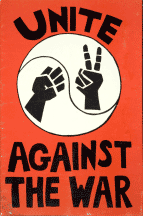
That much you’ve probably heard before.

Really, what’s in a name? A fish by any other name will smell too. Is there a fish story without hyperbole, that does not smell fishy? The idiom comes from the experience-honed doubt that the fishmonger’s catch is not fresh. People know steak is dead cow, so does it matter that Orange Roughy is Slimehead, Monkfish is Goosefish, Rock Salmon is Spiny Dogfish, or Tilapia is Mouthbrooder?

Actually Israeli exporters wanted to give Tilapia a biblical makeover, asserting the Tilapia from the Sea of Galilee, should be called St. Peter’s Fish, but US regulators intervened. In the Gospel of Matthew 17:27, apostle Peter tells tax collectors where they can go. In more than that many words he tells them to go fish, and from the mouth of the “first fish they catch,” they will find the four drachmas he owes them. The FDA didn’t buy it either. By the way, if you doubt Wikipedia has Zionist preoccupations, sniff the first paragraph of their entry for Tilapia. Maybe we are about to see whether Wiki momentum can surfeit the vernacular.

The US government also intervened when fish wholesalers wanted to rename the Patagonian Toothfish as Chilean Sea Bass. It’s not a Bass. And the poor Teethfish, like the Slimehead, are now endangered.

Because man’s traditional food fishes have become depleted, we’re having now to make meals of the dregs. And the populations of these deep sea dwellers have less resiliency than the coastal stocks. In the case of the Toothfish and the Slimehead, it’s because they grow very slowly. The Slimehead can grow to be 150 years old. They don’t become sexually reproductive until they are 33, and that’s not in dogfish years. Fishing operations which harvest entire sea mounts decimate every generation at once, leaving none who can spawn.

Would it give you an unsettled feeling to consume something so ancient? If we’re talking a pre-Phylloxera wine, it could be a great thing. But a fish that old has been absorbing mercury from the height of the industrial revolution onwards. So there might be a health benefit for showing deference to your fish elders.

It recently upset me to learn that with modern agriculture we eat cattle before they’re two, when they’re barely adolescent. Now I wonder what’s too old. We revere elephants and tortoises for their longevity, such ancient beings we don’t eat.

I’m old enough to remember learning about the old carp in the fountains of Paris, who also lived quite long. French schoolchildren could marvel that some carp still lived who might have glimpsed Napoleon.

A Slimehead Orange Roughy caught today could have lived in the time of Lincoln. Certainly those fish drag-netted in the 1970s, when the Orange Roughy exotic star was contrived to rise, were contemporaries of John Wilkes Booth. Though swimming many thousand feet below sea level, Roughy might have encountered a fresh shipwreck of Lincoln’s era, carrying gold sent from the west coast to finance the Civil War.

Today finds Americans awaiting their and their fellow man’s emancipation from war, torture, illegal detention, economic enslavement, usury, exploitation, impoverishment, enfeeblement and poisoning. Since just the new millennium Americans learned quick to participate again in their political system. They elected what many thought impossible, an African American president. The voters placed all their hope in Barack Obama, and their faith in party politics foretold that Obama’s majority would deliver the mandate he was given. Obama’s first days were anticipated to rival FDRs. Obama’s legacy could already be measured for laurels because it meant simply reversing the calamity of his predecessor. By such a deliverance alone, it was visualized, Obama would stand beside Abraham Lincoln, America’s greatest president.

Abraham Obama may be an unjustly loft comparison, as wanting to believe Obama deserves the Nobel Peace Prize. But what else was an expectant public to do? They put him in office, they believed his promises. He spoke of change, they wanted change. What swiftly Bush had done, they wanted undone. And Obama assured all that he heard them.

And has it worked out that way? Obama’s speeches begin where the last one ends. They’re long, they’re reasoned, but where at first Americans reveled at a suddenly well-spoken president, now they wish he’d stop talking and start doing. Apparently “yes we can” meant “you can wait” –more likely “hi Mom” or “cheese.” Now the hand which Obama raises so famously to give assurance, is looking more like just the hand.

It may be dawning on many that this junior senator from Illinois didn’t have to debate Frederick Douglas, build a log cabin, read Aristotle by candlelight, or climb a long leadership ladder to get to Washington DC. It may be occurring to them that Obama’s speech at the 2004 Democratic National Convention, was the only accomplishment they’d seen of this unknown senator from the land of Lincoln.

An Orange Roughy served on fine porcelain may turn out to be the only thing our President Obama shares with Abraham Lincoln.

And very likely, you ate one too. So if stone-carvers are already bidding on the project to add someone’s face to Mount Rushmore, your likeness may be as appropriate as any.

Sept 11 – America Reaps What It Sows!

A post-911 perspective by Black Liberation Army prisoner of war Jalil Muntaqim.

U.S. International Warfare Initiates World War III Human Rights During Wartime
By Jalil A. Muntaqim

In the aftermath of the September 11, 2001, attack on the World Trade Center and Pentagon, Americans have displayed their true colors of jingoism, a militaristic spirit of nationalism. Similarly, it was witnessed how the people of Iraq rallied in support of their President, Saddam Hussein, after the U.S. bombed to death 250,000 Iraqis, and continued devastation of that country with collateral damage of 1 million dead women and children. Hence, people rallying in support of their government and representatives is a common phenomenon when a country is attacked by an outsider. The U.S. has been foremost in the world extending foreign policy of free-market economy, to the extent of undermining other countries cultures and ideologies expressed as their way of life. Such conflicts inevitably positions the U.S. as the centerpiece, the bulls-eye for international political dissent, as indicated by demonstrations against the U.S. controlled IMF, WTO and World Bank conferences. The attack on the World Trade Center and Pentagon did not occur in a vacuum. The people that carried out the attacks were not blind followers or robots with an irrational hatred of the U.S. peoples. Rather, this attack was part of an overall blowback to U.S. imperialist policy in support of zionist Israel and opposition to fundamentalist Islam.

There are essentially three primary world ideologies or world views: the capitalist free-market economy/democracy; the socialist production economy; and Islamic theocratic government, of which has been in competition for many decades. However, in the last 20 years the socialist economies has been severely subverted and co-opted by free-market economies, the ideals of American style democracy. This isolated, for the most part, Islamic theocratic ideology and system of government as the principle target of the U.S. in its quest for world hegemony. This reality of competing world views and economies is further complicated due to religious underpinning of beliefs that motivates actions, especially as they are expressed by U.S. and Western European christianity and Israel zionist judaism in opposition to Islam. From the struggles of the Crusades to the present confrontation, the struggle for ideological supremacy reigns, as the faithful continue to proselytize in the name of the Supreme Being.

When geopolitics are combined with religious fervor in the character of nationalist identity and patriotism, rational and logical thinking is shoved aside as matters of the moment takes historical precedents. It has often been said that “Truth Crush to the Earth Will Rise Again”. Since truth is relative to ones belief, can it be safely said that America has reaped what it has sowed? The American truth of capitalist christian democracy and its imperialist hegemonic aspirations has crushed both socialist and Islamic world views. It has extended its avaricious tentacles as the world police and economic harbinger of all that is beneficent, in stark denial of its history as a purveyor of genocides, slavery and colonial violence.

The U.S. was the first to use biological-germ warfare on people when it distributed blankets infected with smallpox to Native Americans; it has refused to apologize for Afrikan slavery acknowledging it engaged in a crime against humanity requiring reparations; it is the first and only country to use the atomic bomb on the people of Hiroshima and Nagasaki and intern thousands of Japanese and Italians in this country; it used carpet bombing and defoliates against the peoples of Vietnam; it has initiated embargoes, coup d’etats and assassinations against those it opposes, while propping-up right-wing military dictators; as well as continued military bombing of Vieques. In essence, the U.S. governments hegemonic goals has created the ire of millions of people throughout the world. While domestically, racial profiling, police killing and mass incarceration of Black and Brown people has eroded patriotic sentiments in opposition to white supremacy.

As America weeps and laments its loss, the public find itself joining the torn ranks of those whose heartaches beat opposing U.S. greed and international profiteering. The American public acquiesce to U.S. international folly has cause them to feel the economic pains of those who live daily in poverty. Indeed, Americans should brace for years of economic uncertainty, where the American ideal of freedom and liberty will resemble plight of those who live under the right-wing dictatorships the U.S. has supported. The tyranny suffered by others in the world as a result of U.S. imperialism, has come full circle to visit this country with the wrath of the U.S. own mechanization. Since the U.S. taught and trained right-wing military dictators in the School of the Americas, including the CIA training of Osama bin Laden in the Afghanistan proxy war against the Russians, it will be this same kind of terrorist activist that will be unleashed on American soil, as El-Hajj Malik Shabazz stated after the assassination of John Kennedy, a matter of the chicken coming home to roost. Therefore, American civil liberties and human rights are being garrotted by the yoke of the right-wing in the name of national security. The legalization of U.S. fascism was initiated with the war against political dissent (Cointelpro); the war against organized crime (RICO laws); the war against illegal drugs (plethora of drug laws) and now culminating in the war against terrorism with the American Joint Anti-Terrorist Taskforce and Office of Home Security, further extending police, FBI and CIA powers to undermine domestic civil liberties and human rights.

The U.S. Secretary of Defense, Donald Rumsfeld, recently stated that the U.S. need to create a new language in defining how to combat terrorism. This Orwellian propaganda in the media espouses the U.S. is venturing in a new type of warfare to defend the American way of life. However, what this double-speak propagates as a long-term and sustained initiative against terrorism is essentially a way of embellishing and enlarging U.S. counter-insurgency activity it has been engaged in since the advent of the Green Berets, Rangers, Delta Force and Navy Seals. The U.S. has been involved in counter-insurgency activity in Afrika, Latin America and Asia for decades. But due to the September 11, 2001, attack on U.S. soil, the government has seized the opportunity to offensively pursue left-wing revolutionaries and Muslim insurgents throughout the world. This U.S. military action extends and substantiates its position as the international police.

Since the establishment of the Trilateral Commission that initiated the process for the development of one world government, the U.S. has broaden its capacity to impose and enforce its will on oppressed peoples globally. The FBI and CIA has been operating in Europe, Afrika, Asia and Latin America establishing the long arm of U.S. law and order. Its bases of operations have conducted surveillance, investigations to arrest, prosecute or neutralize left-wing revolutionaries or Muslim insurgents. As the U.S. consolidates its political and economic influence throughout the world, it will seek to protect its overall hegemonic imperialist goals. After the Gulf War, and the air (bombing) campaign in Yugoslavia, the U.S. has employed its military might to ensure its foreign policy are achieved.

Because NATO has evolved into a European military entity that Russia is seeking to join, today, the U.S. has positioned itself beyond the mission of NATO. The U.S. now concentrates its military might in opposing Islamic countries (Iran, Iraq, Libya, Sudan, Afghanistan, Philippines, etc.) and those the U.S. deem as rogue nations (North Korea, Vietnam, Cuba, etc.). The new military initiatives will be directed to towards Southeast Asia as the secondary target, as it continues to direct the Middle East conflict to preserve its oil investments and zionist interest. As the U.S. expand its imperialist military mission, as seen with committing military troops in Uzbekistan to also protect oil interest in the Caspian Sea, it has sought to redefine itself by targeting what it identify as the terrorist thereat wherever in the world it might exist. Hence, with the employment of conventional warfare combined with counter-insurgency tactical activities, the U.S. has pronounced itself as the military guardian of the world.

Although, the U.S. states its actions are in its self-interest, in terms of what is euphemistically defined as defending the free world, the truth of the matter is this action is a prelude to evolving one world government with the U.S. as its governing authority. Once the Peoples Republic of China becomes a full member of the WTO, and North Korea and Vietnam has been compromised, with Russia becoming an ally of NATO, the U.S. political-military influence in the world will be consolidated. The U.S. geopolitical strategy is not confined to the present crisis in the aftermath of the September 11, 2001, attack and targeting Osama bin Laden as the world’s nemesis. Rather, the U.S. strategy is to preserve its capacity to establish one world government as originally envisioned by the Trilateral Commission.

Nonetheless, there are some serious obstacles to this hegemonic goal, of which the world of fundamentalist Islam has become the principle target. Here, it should be noted that Islam condemns suicide or the mass killings of women, children and non-combatant males. Yet, the U.S., Israel, western Europe, Russia, India and China all view Islam as the enemy. Although, there are over 1.2 billion Muslims in the world, the current alliance of economic interest headed by the U.S., are united to vanquish what they consider the growing menace of fundamentalist Islam. It is with this understanding of U.S. geopolitics one is able to comprehend why the U.S. has redefine its military mission, as opposition to globalization and U.S. imperialism metamorph into a political struggle without borders or territorial imperatives.

The ideological struggle between capitalist free-market economy and Islamic theocratic determinates has exploded into an international conflagration of insurgency with the potential of initiating World War III. The Islamic fundamentalist movements throughout the world has the potential to test the U.S. military, political and economic resolve as the world’s leader and authority of an one world government. With over 1.2 billion adherents, Islam has become a formidable foe to contend with for ideological supremacy in the world’s geopolitics. Even without discussing the religious (moral and ethics) aspects that motivates the geopolitics of Islam in opposition to U.S. imperialist hegemony, the call for Jihad/Holy War against the U.S. presents a serious threat that could precipitate WW-III. Therefore, the U.S. find it necessary to redefine its military mission, develop new language to codify warfare and legitimize its international political and economic purpose. Yet, many of the world’s oppressed peoples’ have already experienced U.S. military counter-insurgency tactics (Ethiopia, Somalia, Nicaragua, Guatemala, Chile, Congo, etc.), including parts of the Islamic world. No matter how or why the U.S. attempts to persuade Americans that it is entering a new type of warfare, in reality it is more of the same, only extending the military arena to further protect its authority to establish one world government.

However, the U.S. is not the homogeneous country that people are deluded into believing exist. Rather, the U.S. has been held together due its ability to exploit the world’s resources and distribute (unequally) the profits amongst its citizens with its culture of conspicuous consumption. But, the recent attack on the U.S., and its aftermath may very well lead to the untangling and unraveling of the U.S. fabric as has been witnessed with the USSR and Yugoslavia. In understanding this true history of U.S. imperialism, outside and within its borders, essentially tells a story of why U.S. imperialism has been and will continue to be attacked.

Ultimately, the U.S. will eventually find itself at war with itself, as the ideology of a free democratic society will be found to be a big lie. This is especially disconcerting as greater restrictions on civil and human rights are made into law eroding the First and Fourth Amendment of the U.S. Constitution. As during the Vietnam conflict, internal contradictions of racism, poverty and inequality will be exacerbated as a result of the U.S. military campaign and domestic undermining of civil and human rights. It is expected that strife in America will eventually become violent dissolving any semblance of the illusion of America the Beautiful. In anticipation of U.S. progressive activist opposing this claimed war against terrorism, the federal government will pass new laws to severely restrict protest, demonstrations and dissent. In the ’60s, U.S. progressive activists evolved the slogan “Bring the War Home!” – the question is what will be the slogan this time, now that the war has been brought home?

Free the Land!!

Lamborn’s NO HEALTHCARE teabaggers want to hear from YOU

According to CSAction, snively congressman Doug Lamborn has sent out 70,000 mailers, billed to the taxpayer, to disseminate the insurance biz wingnut falsehoods about health care reform. He’s hoping to reconstitute a teabagger assembly at a public meeting on Thursday evening, August 27, at the Valley Hi Golf Course on Colorado Springs’ Southeast side. Get there early with YOUR message. 5PM, Chelton and Airport. The anti-tax teabaggers hate standing next to signs that don’t represent them, so think of some slogans that do. How about: DO UNTO OTHERS, or
FAITH HOPE CHARITY, or “as you did to the least of My brethren,
you did it to Me.” -Matt 25:40

CSAction has posted talking points and updates. Here are Mark’s arguments:

Representative Doug Lamborn has just sent out an estimated 70,000 mailers “prepared, published and mailed at taxpayer expense” that are full of LIES and disinformation about the healthcare reform bills. It’s only estimated to be 70,000 because, when asked about the total number mailed, LAMEborn’s Communications Director Catherine Mortensen, “I have the figures, but I don’t have the authority to give them to you.”

Actually they don’t have the authority to withhold that information because it’s public record, given that this pack of LIES was “prepared, published and mailed at taxpayer expense.”

The mailer says “114 million could lose their current health care coverage under the bill”. This is a LIE!

This absurd figure comes from “The Impact of the House Health Reform Legislation Coverage and Provider Incomes,” by the Lewin Group. The Lewin Group is a “research” and management consulting (lobbyist) firm owned entirely by the second largest health insurer in the nation, UnitedHealth Group.

Furthermore, the “research” does NOT show 114 million LOOSING healthcare but CHANGING insurers, AND an additional 9.4 million being insured that are not now. It’s a total guess as to how many would change over to the public plan, if offered. The 114 million was a figure the Lewin Group published in June, which they revised DOWN to 88.1 million in July, so it’s not even their most current LIE.

The Congressional Budget Office came to a different conclusion, saying that enrollment in the House Democrats’ proposed public plan would total 11 million to 12 million people.

The Lewin Group is part of Ingenix, a wholly-owned UnitedHealth subsidiary that was accused by the New York attorney general and the American Medical Association of helping insurers shift medical expenses to consumers by distributing skewed data. Ingenix supplied UnitedHealth and other insurers with data that allegedly understated the “reasonable and customary” doctor fees that insurers use to determine how much they will reimburse consumers for out-of-network care.

In January, United Health agreed to a $350 million settlement with the AMA, and a $50 million settlement with the New York attorney general, covering conduct going back as far as 1994, when they were distributing skewed information to fight President Clinton’s healthcare reforms.

Next LIE in this mailer: “4.7 million jobs that could be lost as a result of tax hikes on small businesses”.

This absurd figure comes from an op-ed piece written by House minority leader John Boehner, who admitted to distributing bribes from Big Tobacco on the floor of the House. He says got the figures according to the methodology developed by Christina Romer, the chair of the Council of Economic Advisers in the Obama administration. She NEVER said such a thing, and he obviously he doesn’t understand her methodology.

What did she really say?

“The current healthcare system does not work well for small businesses.”

“They pay about 18% more for comparable coverage than a big firm, and that puts them at a competitive disadvantage.”

“Healthcare reform is ABSOLUTELY aimed at easing those burdens.”

“The plan has a tax credit for small businesses.”

Watch her entire statement here.

Lewin Group Vice President John Sheils admits 114 million would NOT lose their employer-sponsored coverage AND they wouldn’t be forced into a government-run health plan. Rather, they would be able to choose between the government plan and other private options, through the exchange, and “they might very well be better off,” he said.

But not all of the firm’s corrupt reports see the light of day. For example, a study for the Blue Cross Blue Shield Association was never released, Sheils said.

“Let’s just say, sometimes studies come out that don’t show exactly what the client wants to see. And in those instances, they have [the] option to bury the study — to not release it, rather,” Sheils said.

CSaction reminds everyone present to be peaceful in word and action and not behave like the industry stooges disrupting town halls and shouting down citizens.

National Assembly is antiwar exclusively

unite-against-the-warReports are emerging from July’s National Assembly, the vital effort to unite antiwar forces into a common movement. Delegates from the major peace organizations hammered out a strategy to address Iraq, Afghanistan, Pakistan and Palestine. Missing from the consensus? Nonviolence, and good riddance. It goes without saying that humanitarian activists are peaceful. To legislate a dogma of non-confrontation plays right into the hands of the authoritarians. Here’s the official report:

AN ASSESSMENT OF THE FIRST YEAR OF THE NATIONAL ASSEMBLY TO END THE IRAQ AND AFGHANISTAN WARS AND OCCUPATIONS

Address given by Marilyn Levin, member, National Assembly Administrative Body, and Planning Committee, Greater Boston United for Justice with Peace Coalition, to the National Antiwar Conference held July 10-12, 2009 in Pittsburgh, Pennsylvania

July 10-12, 2009, 255 people representing diverse organizations and constituencies from all over the country came together in Pittsburgh:

1) To look at where we are today,

2) To articulate our long range goals to rejuvenate the antiwar movement towards building a massive movement capable of forcing an end to their wars and occupations, to take our money back from the war machine to meet pressing social needs, and to save our planet for our children, and

3) To develop and vote for action plans as steps to realize these objectives.

All of our major objectives were accomplished and we leave today with a comprehensive action agenda to carry us through to next spring. Everyone had a chance to speak and differences were aired without rancor or splits to achieve unity in action.

Friday night’s speakers, along with many conference participants, grappled with how to unify and broaden the movement. Saturday afternoon and Sunday morning, we presented a great roster of workshops covering the major issues we face today. Saturday night’s rally was dynamic and inspiring.

There were two highlights of the conference for me. First was the international component where activist comrades joined us from Canada and courageous labor leaders of powerful mass movements in Haiti and Guadaloupe reminded us that imperialism and the struggle against it are global. There was a statement by members of the Viva Palestina aid convoy detained in Egypt. We passed motions in solidarity with the struggles of the people of Haiti, Honduras, and Palestine.

The second highlight was the discussion on Iran, where, in spite of strong passions stirred up by the rapidly evolving events there, we were able to illuminate the issues and debate our differences. Finally, we were able to agree on a unity position that all could embrace, as well as meeting the foremost call of the Iranians – US Hands off! No Sanctions! No interventions! Self-determination for the Iranian people! A wonderful example of a united front –- as inclusive as possible and taking principled positions that most will accept and act on.

So what is the National Assembly? What you saw this weekend explains who we are and how we function.

Democracy. All were invited and all perspectives welcomed. There was acceptance of the will of the conference even when it diverged from the proposals put forward by the leadership body. We were especially gratified that representatives from all the major antiwar coalitions came and addressed our conference.

Our willingness to struggle for unity and compromise when needed in order to move forward, as evidenced by a leadership that did not impose personal political views on others in service to unity.

An organization that admits to and learns from its mistakes and accepts its limitations when the unity we seek can’t yet be achieved.

An organization that has built a growing cadre of leaders that has developed trust, a structure that works, and a strong working relationship.

And finally, confidence, vision, and optimism. Confidence that we can provide leadership in rebooting our movement. A vision regarding how to accomplish that and an understanding of the necessity for these kinds of conferences leading to action. Optimism that masses of people will move in opposition to these horrendous policies that bring death and destruction and that they will have the power to change the world.

I’ve been asked to give an assessment of the first year since our initiation as an ongoing network with a mission, from our first conference in June, 2008 until today. Last year, we weren’t sure anyone would come and lo and behold 400 people came together in Cleveland to inaugurate a year of activities and set up a structure to maintain our work. A lot has transpired in that year and the National Assembly is well on its way as an established organization recognized throughout the movement as providing leadership and promoting a direction towards growth.

I need to start a little earlier and go back to why the National Assembly was called into existence in the first place.

What we saw, in the spring of 2008, was a movement at a low ebb – one that was shrinking rather than growing in spite of the war dragging on — this while the antiwar sentiment couldn’t be higher, and the disapproval rating for the Bush Administration couldn’t have been lower. From the high point of the largest action against the Iraq War in September, 2005 which drew 700,000 people, there was a pulling away from mass action by significant sections of the movement which supported electoral politics as the central strategy, in spite of a recurring pattern of disappointment when Democratic “antiwar” candidates voted again and again for war and war funding, and a split between the two major national coalitions, UFPJ and ANSWER, one that continues to this day. For the first time in five years, there was not enough unity or mass action perspective for any national demonstrations to take place marking the 5th year of the occupation of Iraq. Fundamentally, there was a vacuum of leadership.

Some far-sighted people like Jerry Gordon and Jeff Mackler, with experience gained from leadership in the last powerful antiwar movement that ended the Vietnam War, felt impelled to act. They began to organize a base of diverse but like-minded activists committed to building and expanding an effective antiwar movement in this country. The vehicle to accomplish this was the first national assembly, a national conference to pull activists together, to analyze the present state of the movement, to discuss where we needed to go and the actions that were needed to get us there.

We developed a unity statement with five basic principles that we hold today as the basis for where we stand:

1) Unity – all sections of the movement working together for common goals and actions;

2) Political Independence – no affiliations or support to any political party;

3) Democracy – decision-making at conferences with one person, one vote;

4) Mass Action – as the central strategy for organizing while embracing other forms of
outreach and protest; and

5) Out Now – the central demand to withdraw all military forces, contractors, and bases
from the countries where the U.S. was waging war on the people.

It seems simple but no one else saw it that way. Our conference was unique in the history of the present movement.

The organizers didn’t know what the mood and composition or strength of the conference would be, so we were cautious and minimal in the program we posed to the conference. We focused on Out Now from Iraq and modest action proposals, not being strong enough to initiate national actions on our own. The conference participants were ahead of us and ready to tackle the larger issues. Proposals were passed to add “Out Now from Afghanistan”, “End U.S. Support for the Occupation of Palestine”, and “Hands off Iran” to our set of demands, and given what has transpired in these areas, we were well prepared to take on a major role.

October 10th actions held in 20 cities were endorsed as well as a call for December actions building towards what we hoped would be unified, nationally coordinated bicoastal mass actions in the spring of 2009, the 6th year of the Iraq occupation. When Gaza was brutally assaulted, we joined with ANSWER and others to march in Washington and to demonstrate in the streets all over the country, and we’re still working under Palestinian leadership to bring justice and relief to a beleaguered population.

We made a concerted effort to find a common date for spring bi-coastal mobilizations. As you know, ANSWER chose March 21st as a day of united protests which we endorsed, while UFPJ called for a national march on Wall St. on April 4th. A number of National Assembly supporters who were also delegates to the UFPJ conference in December formed a mass action unity caucus and went to the conference with a resolution to allow delegates to vote for one or both actions but this was rejected. We’ll keep trying for 2010. The National Assembly endorsed and built both actions and marched behind our signs with our demands. The demonstrations were small (but spirited) and still of major importance.

For us, it’s quality, not quantity, as we position ourselves to be in the forefront as the pendulum swings in our direction once again.

Some take the position that mass demonstrations are not effective, unless we can pull 100,000 protestors into the streets. This is short-sighted and does not address how we get from small to large. Any successful movement for change doesn’t start with 100,000 people, and there has never been significant social change without mass actions. I remember my first anti-Vietnam war demonstration was in 1963 in Detroit and we had 15 people. In 1965, SDS called the first national march against the war in Washington. 25,000 people turned out and we thought it was huge!

Everyone talks about reaching out to the thousands of young people who mobilized to elect Obama. We agree, but we say the way to do this is by offering education and action. Action beyond calling, and emailing, and faxing the politicians they placed in office.

Why are mass demonstrations so important to building a powerful movement? It is because they accomplish so much in the process of building them. They provide:

Continuity. You can’t build anything by starting anew each time. Each action should lead to the next action or open national conference, with success building upon success. We need a continuity of leadership that builds trust and a reputation for integrity, and that learns lessons to improve. We need a continuity of organization and structure that can implement the tasks before us.

Visibility. Actions in the street give heart to the people the U.S. is attacking and occupying, letting them know that they are not alone. Mass actions create solidarity, offering support to anti-war soldiers, vets and their families, and a counter-force to the economic draft facing our youth, and they strengthen and deepen the antiwar sentiment of the people.

Inspiration. New people are brought into the movement, especially the youth, through activism. Have you ever talked to young people coming to a mass demonstration for the first time? They are inspired and thrilled to hear powerful speakers who are leaders of social justice movements and soldiers resisting the wars. They see they are not alone and get a taste of the power of large numbers of people marching together. They are energized to go home and join with others to continue to organize opposition to brutal U.S. wars and occupations. This is the way to reach out to the Obama supporters.

Explanation. An analysis of what is going on is offered along with tying together what seem at first to be disparate elements, i.e., war is tied to the economy, the war budget, bail-outs of the rich, the lack of basic needs being met, justice denied, and the impoverishment of the people.

Pressure on Government. People in this country are taught to be quiet. We’re told that our job is to elect officials whom we agree with periodically and then go home and wait while they fix things. This conveniently maintains the status quo but it sure doesn’t put pressure on them, or scare them, or force social change. Mass actions provide the most effective way to make significant change happen.

Let’s look at the present period. Obama’s election was based in large part on the hopes and aspirations of Americans for peace and a better life based on the promises and assumed promises that were made of peace, justice, and prosperity, which have not and will not be met.

Contrary to expectations, the previous administration’s policies are continued with a more handsome and articulate face. We all know that rather than winding down, wars and interventions are escalating and the rapacious greed of this immoral system knows no bounds.

Simultaneously, the economic crisis is causing terrible hardship for working people and for people who are no longer able to find work and their families. They are using this self-created financial disaster to further cut the standard of living and eliminate a secure future for older people and the young.

It was very moving and yet appalling to see this visually demonstrated when Robin Alexander of the United Electrical Workers Union asked people in the audience to stand who were unemployed, personally knew of soldier casualties, lived in communities where services were being cut, or who were otherwise negatively impacted by the wars and the failing economy. Nearly the entire room, a microcosm of the wider society, was standing by the end of that exercise.

It is inevitable that the present period of quiescence and hanging on to the hope that Obama and the new Congress will save us will come to a crashing end. People will not sit idly by forever while the world around them collapses. We are already seeing the beginnings of stirring. There is a greater willingness to go out in the streets to protest. There is more organizing taking place on campuses, more young people joining the movement. The many proposals for October actions are an indication that there is a widespread awareness of the need for actions this fall and the conviction that the movement must find common dates.

Brian Becker, National Coordinator of ANSWER, urged that we all work together to mount nationally coordinated actions next spring. Michael McPhearson, Co-Chair of UFPJ and Executive Director of Veterans for Peace, announced his support for October 17 and his willingness to do what he could to spur unified actions in the spring of 2010. We must have the faith and confidence that the people have the power to end the atrocities resulting from U.S. wars and occupations, and that they will recognize and utilize this power. As this happens, we must build a stronger antiwar movement that is able to provide leadership and the optimism to forge ahead no matter what the opposition throws at us.

The National Assembly to End the Iraq and Afghanistan Wars and Occupations is helping to provide that leadership and the vision that is needed. Although young and small, in one short year, we are now a force to be taken seriously and negotiated with, and by our persistent call for unity and mass action, our demonstrated ability to organize, and our coordinated strategy for revitalizing the movement, we are having an impact larger than our forces would indicate. In some ways, we too are a product of (and some say an antidote to) the 2008 election. To counter the malaise of the movement, we have quietly been building a solid core of activists and leaders around the country that understand the importance of a united front organized around principled demands and mass actions, not just calling Washington politicians when bills come up and crises happen.

At this conference, we have laid out an ambitious program of action that will take us through the spring of 2010. We are proud that we could provide the kick off for national organizing to bring a massive turnout to Pittsburgh for the G-20 protests September 25. Homeland Security is already making preparations to keep protesters hidden and stifle our right to speak out, but we won’t be silenced.

Following that, are a series of October building actions, culminating in large local and regional demonstrations on October 17 marking dates of significance related to the Iraq and Afghanistan wars and occupations and remembering the legacy of the anti-Vietnam war movement. Throughout the year, we will organize educational programs, support various forms of protest and organize around the inevitable emergencies caused by our government’s unholy interventions and threats to other nations.

We have initiated a Free Palestine Working Committee to ensure this work, which includes the growing boycott, divestment, and sanctions campaigns and the efforts to break the siege of Gaza, continues to be in the forefront and fully integrated in our work until justice and self-determination and return is in the hands of the Palestinians.

And lastly, we will continue to advocate for unity of the movement and once again bring thousands to Washington and the West Coast in the spring, to let our government and the world know that the U.S. movement against wars and occupations is alive and will not be quiet.

We will march and continue to march until all U.S. forces come home, bases are dismantled, and the sovereign people of the world have the right to control their own resources and determine their own futures, and the war budget becomes the peace budget.

Don’t sit on the sidelines and watch history being made. We urge all organizations to join the National Assembly and to play your part in building and shaping the powerful movement that is coming.

All out for the September 25 G-20 march in Pittsburgh! All out for the actions in early October! All out October 17!

Jesus Killed Mohammed, every last one

Bradley Fighting VehicleWith attention now drawn on the evangelical skinheads running amok with the US military’s Big Stick, reporter Jeff Sharlet relates a story in this month’s Harpers, which showcases the fundamental irreligiosity of the capital “C” Crusaders.

The episode Jesus Killed Mohammed takes place in Samarra, Iraq, in 2004, where rascally US Christ fans succeed in goading their crosstown rivals into taking a shot at them, the sooner to be dispatched to the Islamic hereafter by the Christ Gang’s overwhelming firepower. The operation involved painting “Jesus Killed Mohammed” across the side of their Bradley Fighting Vehicle, and having their translator poke his megaphone out the top, giving Arabic voice to the insolent taunt, shouting it up and down the neighborhood until no one was left to speak up for Mohammed.

???? ??? ?????

The affair reminded me of the Monty Phython skit about the world’s deadliest joke being appropriated for military use across the WWI trenches, which was, if you remember, immediately fatal, combined with the sacrilegious 2005 GWOT strategy which drew so much flak to US special forces in Afghanistan when soldiers burned Taliban corpses to draw enemy ire. The Intelligence Service calls it “tickling:” provoking your opponent into an emotional response to reveal his position. In the Afghan case, the US team violated Geneva Conventions against mutilating the dead. In Sammara the only code protecting the sensitivities of the indignant Muslims was probably the boxing rule forbidding blows below the belt. Perhaps it was the very indecency of the concept which most elicited snickers from the American perps.

In operation JESUS KILLED MOHAMMED, the 1/26 Infantry of the 1st Infantry Division led by Lieutenant John D. DeGiulio, under instructions from the 10th Special Forces Group who called themselves “the Faith element,” drove their Bradleys along the streets drawing fire, one shot at a time, from virtually every door. After each shot rang out, the Bradley would summarily aerate each residence and its inhabitants until “Jesus Killed Mohammed” did not offend anymore.

As Sharlet noted, every Iraqi home is permitted one AK-47 for self defense, so answering the US force’s insolence did not reveal you to have been an insurgent. The infidels were biting their thumbs at the Iraqis from behind impregnable armor, to respond with small arms fire was entirely a matter of honor, and suicide.

Exposed breast

Carrie Prejean photoUS beauty queen could lose title because she exposed her breast. NOTE+++ We could only show you Carrie Prejean’s exposed leg since she exposed that breast while only 17 years old. Anybody putting online her exposed teenage breast could be handcuffed and hauled away as a pedophile! If you have downloaded a file of it you are in BIG, BIG trouble, Dude!

‘Ms Prejean says the publication of the pictures were an attempt to silence her for “defending traditional marriages”. She described the publication of the pictures as an attempt to “openly mock me for my Christian faith”.

“I am a Christian, and I am a model. Models pose for pictures, including lingerie and swimwear photos,” she said.’

Yes, Carrie, Christians everywhere are outraged about this, I can reassure you about that! Those damn Gays! They are always such trouble makers!

Christian Crusades for committing torture, prayer & murder in Afghanistan

The Evangelicals love the authoritarian structures of the US military! It’s seen as a command structure coming down almost directly from the authority of Jesus Christ himself. Never mind the torture on the ground at Bagram Air Base nor the bombing and murder of innocents from up on high. There is a soft side of Jesus, too, if you just buy it? Or, at least that seems to be the message? Now let us bow our heads in prayer and check out this video of Military Evangelism at work…
04 MAY 09- US troops urged to share faith in Afghanistan

Faith Fighter takes a hit

Faith Fighter has taken a hard punch. However it does seem that you can at least still see some of the fight between God and other would be semi-deities online at here… Faith Fighter
faithfighter

Prophet Muhammad, we will miss you. Game taken offline after Islamic group complains …If you are not careful you might soon be replaced by Moses? Hey! Where has he been anyway? And to be fair, they should have a militant atheist in there, too.

Republican-Democrat? It’s a Christian thing.

I have to delineate this in three different perspectives, that of Christians who don’t preach that God tells us to kill people, people who say they’re Christians and that God DOES say to kill and torture people, and people who don’t claim the name of Christ and say that God doesn’t tell us to kill and torture people.

Since the issue was raised, why Republican makes such a huge difference:

They not only are making Torture and Killing the major part of their platform for the mid-term elections but for the 2012.

I brought up Sarah Palin and Bobby Jindal because they’re both being considered as candidates

They also, like the entire leadership of their party and the only vocal members of their party, who are fortunately very loud in their screams for the blood of everybody who Is Not Them….

…claim to be the representatives of God on earth.

Literally.

I don’t listen to KVOR by choice, but the idiots who do like to play it REAL damn loud because that’s the only way they can convince anybody to listen to it.

and a loving God in His infinite mercy and wisdom failed to provide me with ear-lids.

Sarah Palin, for instance, is a lay-minister in the Assembly of God church.

Somehow the AOG has slipped a little in the past 40 years because they used to not allow their women to wear slacks… far less dressing like a crack whore.

Bobby Jindal, Gingrich, Vitter, the list goes on, Huckabee and Romney… aside from all of them being Chickenshit ChickenHawks who are all for killing people just as long as they don’t have to put themselves at risk to do it…

Claim to be Christians. So do the loudmouth rednecks on KVOR. Huckabee is a preacher. Romney took draft deferments because he was doing his Mormon missionary service. Gingrich converted to Catholicism so he could get an annulment from wife #2, thus wife #3 wouldn’t be judged as a whore. Kind of like Henry the Eighth.

He’s also considering a run for President in 2012.

All this in the name of God.

If the R’s hadn’t made these things their entire platform I would be entirely wrong to criticize them (almost) exclusively.

The Democratic Party doesn’t claim an exclusive right to speak for Christians…

Now, see, I AM a Christian, remember? It’s where I get the Brother part of my name.

That means I do have a horse in this race.

If I allowed the Christian version of the Taliban speak unchallenged on this or any other issue I would be betraying God.

And, like the boy scout oath, My Country as well.

A lot of Christians have about zero tolerance for outsiders telling them what’s wrong with with their version of what Christ said and did.

Let’s make that fair, eh? Those readers who are pagans, Buddhists, Jews, Muslim, Atheist, do YOU ever take it kindly when people tell you, speaking from THEIR faith, or the dogma thereof, what YOU as a pagan or Buddhist or Jew or Muslim or Atheist has to believe or how you’re supposed to act as representatives of your faith or lack thereof?

I didn’t think so.

Since I AM a Christian and not ashamed of Christ (although some of my fellow Christians make me queasy and uneasy) I am obliged to point these things out, not just “preaching to the choir” of people who agree with me but ESPECIALLY to Christians who don’t. I took His name, I have to stand against the Murderous blasphemy and to do it in His name.

Or be a collaborator and accomplice to their crimes, the ones they justify with their blasphemous use of God’s name.

The Republican Party are with a united voice claiming that any criticism of their policies is an attack against America and an attack against God.

I say that it is instead an affirmation in my faith and my patriotism to oppose placing my nation squarely in the wrong, and to oppose doing it in the Name of God.

That counts for the first perspective. Mine. And shared by millions upon millions of other American Christians who opposed the Republican agenda precisely on that ground.

The Republicans have a huge amount of available air time and their tame corporate press to spout their bullshit and they do it regularly.

That’s the second perspective and they express it … a LOT and very loudly. For them to deny it would be pointless and laughable.

The third is from non-Christians who have pointed out that God didn’t tell us to kill each other.

Here’s where the rubber meets the road (I’ve got a million unused cliches to tap into)

There’s a Fourth Perspective.

Just like a lot of Christians, and a lot of Atheists, and a lot of Other non-Muslims will say that Islam is a religion of purest hatred, and cite passages in the Koran which are based on very similar passages in the law of Moses…

A lot of non-Christians will say that God did teach murder and torture and other perversions.

And they’ll cite the same scriptures the Hate Freaks like Palin and Gingrich and Bush cited, and they’ll cite every “christian” who is Stupid Enough to follow them.

Follow them explicitly by tossing up the stiff-arm Salute and echoing their bullshit, or follow them implicitly by not opposing their murderous ways.

The Full Text of Iranian President Ahmadinejad’s speech

AhmadinejadAt last we have a copy of the full text of the Iranian President’s speech at the Durban Review Conference on racism and now we can examine just how it has been misrepresented as vile, ugly, and racist by vile ugly racists. The fact is that the main point of the speech actually has next to nothing to do directly with Israel or Jewish people at all, but rather is an attack on the war-like and imperialist United Nation Security Council and the undemocratic nature of this US controlled organization.

He essentially calls for its abolishment in the summary of his remarks and it is this Call that actually is the cause of the Made-In-US boycott and subsequent walkout from the anti-racism conference, and not anything else Ahmadinejad said.

President Ahmadinejad….

‘Secondly, mindful of the inefficiency of the current international political, economic and security systems, it is necessary to focus on divine and humanitarian values by referring to the true definition of human beings based upon justice and respect for the rights of all people in all parts of the world and by acknowledging the past wrong doings in the past dominant management of the world, and to undertake collective measures to reform the existing structures.

In this respect, it is crucially important to rapidly reform the structure of the Security Council, including the elimination of the discriminatory veto right and to change the current world financial and monetary systems.

It is evident that lack of understanding of the urgency for change is equivalent to the much heavier costs of delay.’

There is absolutely nothing anti-Jewish in any of his remarks, and the world has had enough of the United Nation Security Council and its constant war making. Many will also champion Ahmadinejad’s call for its abolishment.

FULL TEXT:

(Iranian President Mahmoud Ahmadinejad’s speech at the Durban Review Conference on racism in Geneva on April 20, 2009.)

Mr. Chairman, honorable secretary general of the United Nations, honorable United Nations high commissioner for human rights, Ladies and gentleman:

We have gathered in the follow-up to the Durban conference against racism and racial discrimination to work out practical mechanisms for our holy and humanitarian campaigns.

Over the last centuries, humanity has gone through great sufferings and pains. In the Medieval Ages, thinkers and scientists were sentenced to death. It was then followed by a period of slavery and slave trade. Innocent people were taken captive in their millions and separated from their families and loved ones to be taken to Europe and America under the worst conditions. A dark period that also experienced occupation, lootings and massacres of innocent people.

Many years passed by before nations rose up and fought for their liberty and freedom and they paid a high price for it. They lost millions of lives to expel the occupiers and establish independent and national governments. However, it did not take long before power grabbers imposed two wars in Europe which also plagued a part of Asia and Africa. Those horrific wars claimed about a hundred million lives and left behind massive devastation. Had lessons been learnt from the occupations, horrors and crimes of those wars, there would have been a ray of hope for the future.

The victorious powers called themselves the conquerors of the world while ignoring or down treading upon rights of other nations by the imposition of oppressive laws and international arrangements.

Ladies and gentlemen, let us take a look at the UN Security Council which is one of the legacies of World War I and World War II. What was the logic behind their granting themselves the veto right? How can such logic comply with humanitarian or spiritual values? Would it not be inconformity with the recognized principles of justice, equality before the law, love and human dignity? Would it not be discrimination, injustice, violations of human rights or humiliation of the majority of nations and countries?

The council is the highest decision-making world body for safeguarding international peace and security. How can we expect the realization of justice and peace when discrimination is legalized and the origin of the law is dominated by coercion and force rather than by justice and the rights?

Coercion and arrogance is the origin of oppression and wars. Although today many proponents of racism condemn racial discrimination in their words and their slogans, a number of powerful countries have been authorized to decide for other nations based on their own interests and at their own discretion and they can easily violate all laws and humanitarian values as they have done so.

Following World War II, they resorted to military aggression to make an entire nation homeless under the pretext of Jewish suffering and they sent migrants from Europe, the United States and other parts of the world in order to establish a totally racist government in occupied Palestine. And, in fact, in compensation for the dire consequences of racism in Europe, they helped bring to power the most cruel and repressive racist regime in Palestine.

The Security Council helped stabilize the occupying regime and supported it in the past 60 years giving them a free hand to commit all sorts of atrocities. It is all the more regrettable that a number of Western governments and the United States have committed themselves to defending those racist perpetrators of genocide while the awakened-conscience and free-minded people of the world condemn aggression, brutalities and the bombardment of civilians in Gaza. The supporters of Israel have always been either supportive or silent against the crimes.

Dear friends, distinguished delegates, ladies and gentlemen. What are the root causes of the US attacks against Iraq or the invasion of Afghanistan?

Was the motive behind the invasion of Iraq anything other than the arrogance of the then US administration and the mounting pressures on the part of the possessors of wealth and power to expand their sphere of influence seeking the interests of giant arms manufacturing companies affecting a noble culture with thousands of years of historical background, eliminating the potential and practical threats of Muslim countries against the Zionist regime or to control and plunder the energy resources of the Iraqi people?

Why, indeed, almost a million people were killed and injured and a few more millions were displaced? Why, indeed, the Iraqi people have suffered enormous losses amounting to hundreds of billions of dollars? And why was billions of dollars imposed on the American people as the result of these military actions? Was not the military action against Iraq planned by the Zionists and their allies in the then US administration in complicity with the arms manufacturing countries and the possessors of wealth? Did the invasion of Afghanistan restore peace, security and economic wellbeing in the country?

The United States and its allies not only have failed to contain the production of drugs in Afghanistan, but the cultivation of narcotics has multiplied in the course of their presence. The basic question is that what was the responsibility and the job of the then US administration and its allies?

Did they represent the countries of the world? Have they been mandated by them? Have they been authorized by the people of the world to interfere in all parts of the globe, of course mostly in our region? Are not these measures a clear example of egocentrism, racism, discrimination or infringement upon the dignity and independence of nations?

Ladies and gentlemen, who is responsible for the current global economic crisis? Where did the crisis start from? From Africa, Asia or from the United States in the first place then spreading across Europe and their allies?

For a long time, they imposed inequitable economic regulations by their political power on the international economy. They imposed a financial and monetary system without a proper international oversight mechanism on nations and governments that played no role in repressive trends or policies. They have not even allowed their people to oversea or monitor their financial policies. They introduced all laws and regulations in defiance of all moral values only to protect the interests of the possessors of wealth and power.

They further presented a definition for market economy and competition that denied many of the economic opportunities that could be available to other countries of the world. They even transferred their problems to others while the waves of crisis lashed back plaguing their economies with thousands of billions of dollars in budget deficit. And today, they are injecting hundreds of billions of dollars of cash from the pockets of their own people and other nations into the failing banks, companies and financial institutions making the situation more and more complicated for their economy and their people. They are simply thinking about maintaining power and wealth. They could not care any less about the people of the world and even their own people.

Mr. President, Ladies and gentlemen, Racism is rooted in the lack of knowledge concerning the root of human existence as the selected creature of God. It is also the product of his deviation from the true path of human life and the obligations of mankind in the world of creation, failing to consciously worship God, not being able to think about the philosophy of life or the path to perfection that are the main ingredients of divine and humanitarian values which have restricted the horizon of human outlook making transient and limited interests, the yardstick for his action. That is why evil’s power took shape and expanded its realm of power while depriving others from enjoying equitable and just opportunities of development.

The result has been the making of an unbridled racism that is posing the most serious threats against international peace and has hindered the way for building peaceful coexistence in the entire world. Undoubtedly, racism is the symbol of ignorance which has deep roots in history and it is, indeed, the sign of frustration in the development of human society.

It is, therefore, crucially important to trace the manifestations of racism in situations or in societies where ignorance or lack of knowledge prevails. This increasing general awareness and understanding towards the philosophy of human existence is the principle struggle against such manifestations, and reveals the truth that human kind centers on the creation of the universe and the key to solving the problem of racism is a return to spiritual and moral values and finally the inclination to worship God Almighty.

The international community must initiate collective moves to raise awareness in afflicted societies where ignorance of racism still prevails so as to bring to a halt the spread of these malicious manifestations.

Dear Friends, today, the human community is facing a kind of racism which has tarnished the image of humanity in the beginning of the third millennium.

World Zionism personifies racism that falsely resorts to religions and abuses religious sentiments to hide its hatred and ugly face. However, it is of great importance to bring into focus the political goals of some of the world powers and those who control huge economic resources and interests in the world. They mobilize all the resources including their economic and political influence and world media to render support in vain to the Zionist regime and to maliciously diminish the indignity and disgrace of this regime.

This is not simply a question of ignorance and one cannot conclude these ugly phenomena through consular campaigns. Efforts must be made to put an end to the abuse by Zionists and their political and international supporters and in respect with the will and aspirations of nations. Governments must be encouraged and supported in their fights aimed at eradicating this barbaric racism and to move towards reform in current international mechanisms.

There is no doubt that you are all aware of the conspiracies of some powers and Zionist circles against the goals and objectives of this conference. Unfortunately, there have been literatures and statements in support of Zionists and their crimes. And it is the responsibility of honorable representatives of nations to disclose these campaigns which run counter to humanitarian values and principles.

It should be recognized that boycotting such a session as an outstanding international capacity is a true indication of supporting the blatant example of racism. In defending human rights, it is primarily important to defend the rights of all nations to participate equally in all important international decision making processes without the influence of certain world powers.

And secondly, it is necessary to restructure the existing international organizations and their respective arrangements. Therefore this conference is a testing ground and the world public opinion today and tomorrow will judge our decisions and our actions.

Mr. President, Ladies and Gentlemen, the world is going through rapid fundamental changes. Power relations have become weak and fragile. The sound of cracks in the pillars of world systems can now be heard. Major political and economic structures are on the brink of collapse. Political and security crises are on the rise. The worsening crisis in the world economy for which there can be seen no bright prospect, demonstrates the rising tide of far-reaching global changes. I have repeatedly emphasized the need to change the wrong direction through which the world is being managed today and I have also warned of the dire consequences of any delay in this crucial responsibility.

Now in this valuable event, I would like to announce to all leaders, thinkers and to all nations of the world present in this meeting and those who have a hunger for peace and economic well-being that the unjust economic management of the world is now at the end of the road. This deadlock was inevitable since the logic of this imposed management was oppressive.

The logic of collective management of world affairs is based on noble aspirations which centers on human beings and the supremacy of the almighty God. Therefore it defies any policy or plan which goes against the influence of nations. The victory of right over wrong and the establishment of a just world system has been promised by the Almighty God and his messengers and it has been a shared goal of all human beings from different societies and generations in the course of history. Realization of such a future depends on the knowledge of creation and the belief of the faithful.

The making of a global society is in fact the accomplishment of a noble goal held in the establishment of a common global system that will be run with the participation of all nations of the world in all major decision making processes and the definite root to this sublime goal.

Scientific and technical capacities as well as communication technology have created a common and widespread understanding of the world society and has provided the necessary ground for a common system. Now it is upon all intellectuals, thinkers and policy makers in the world to carry out their historical responsibility with a firm belief in this definite root.

I also want to lay emphasis on the fact that Western liberalism and capitalism has reached its end since it has failed to perceive the truth of the world and humans as they are.

It has imposed its own goals and directions on human beings. There is no regard for human and divine values, justice, freedom, love and brotherhood and it has based living on intense competition, securing individual and cooperative material interest.

Now we must learn from the past by initiating collective efforts in dealing with present challenges and in this connection, and as a closing remark, I wish to draw your kind attention to two important issues:

Firstly, it is absolutely possible to improve the existing situation in the world. However it must be noted that this could be only achieved through the cooperation of all countries in order to get the best out of the existing capacities and resources in the world. My participation in this conference is because of my conviction to these important issues as well as to our common responsibility of defending the rights of nations vis-à-vis the sinister phenomena of racism and being with you, the thinkers of the world.

Secondly, mindful of the inefficiency of the current international political, economic and security systems, it is necessary to focus on divine and humanitarian values by referring to the true definition of human beings based upon justice and respect for the rights of all people in all parts of the world and by acknowledging the past wrong doings in the past dominant management of the world, and to undertake collective measures to reform the existing structures.

In this respect, it is crucially important to rapidly reform the structure of the Security Council, including the elimination of the discriminatory veto right and to change the current world financial and monetary systems.

It is evident that lack of understanding of the urgency for change is equivalent to the much heavier costs of delay.

Dear Friends, beware that to move in the direction of justice and human dignity is like a rapid flow in the current of a river. Let us not forget the essence of love and affection. The promised future of human beings is a great asset that may serve our purposes in keeping together to build a new world.

In order to make the world a better place full of love and blessings, a world devoid of poverty and hatred, merging the increasing blessings of God Almighty and the righteous managing of the perfect human being, let us all join hands in friendship in the fulfillment of such a new world.

I thank you Mr. President, Secretary General and all distinguished participants for having the patience to listen to me. Thank you very much.