Originally it was Antiwar Mother’s Day

Antiwar songFor how many war years longer will a MOTHER’S DAY tradition be to remind the vast Hallmark-washed that Mom’s postbellum holiday originated as a grassroots resistance by mothers opposed to enlisting their sons in war? Quoth abolitionist/pacifist/feminist/poet Julia Ward Howe in the Mother’s Day Proclamation: “We, the women of one country, will be too tender of those of another country to allow our sons to be trained to injure theirs.” Take heed war-loving patriots, Howe also penned the lyrics to Battle Hymn of the Republic.

Up against the wall, antiwar mother.

During WWI the plea expressed itself in a popular song: “I didn’t raise my boy to be a soldier.” Of course the song provoked many jingoist responses such as “I didn’t raise my boy to be a coward,” and “I tried to raise my boy to be a hero.” Blood lusty teabaggers were up to their same knee jerk patriotism back then, egged on no doubt by the same industrial military interests. From across the Atlantic, Punch magazine reflected the British eagerness to see the US join their war and lampooned with “I didn’t raise my girl to be a voter.”

Mother’s Day Proclamation, 1870

Arise, then, women of this day!
Arise, all women who have hearts,
Whether our baptism be of water or of tears!

Say firmly:
“We will not have great questions
decided by irrelevant agencies,
Our husbands will not come to us,
reeking with carnage, for caresses and applause.

Our sons shall not be taken from us to unlearn
All that we have been able to teach them
of charity, mercy and patience.

We, the women of one country,
will be too tender of those of another country
To allow our sons to be trained to injure theirs.”

From the bosom of the devastated Earth
a voice goes up with our own.

It says:
“Disarm! Disarm!
The sword of murder is not the balance of justice.”

Blood does not wipe out dishonor,
nor violence indicate possession.

As men have often forsaken the plough
and the anvil at the summons of war,
Let women now leave all that may be left of home
for a great and earnest day of counsel.

Let them meet first, as women,
to bewail and commemorate the dead.

Let them solemnly take counsel
with each other as to the means
Whereby the great human family can live in peace,?

Each bearing after his own time
the sacred impress, not of Caesar,?
But of God.

In the name of womanhood and humanity,
I earnestly ask?

That a general congress of women without limit of nationality?
May be appointed and held at someplace deemed most convenient?
And at the earliest period consistent with its objects,?
To promote the alliance of the different nationalities,?
The amicable settlement of international questions,?
The great and general interests of peace.

Tea Partygoers may be embarrassing morons, but they know more than you

Acacia Park, April 15, 2010TEABAG SPRINGS, CO- Acacia Park overfilled with angry white folks for their Tax Day protest, though talk of actual tax resistance was as unlikely as spilled tea. Instead our local teabags espoused Fox talking points about the illegitimacy of our current government, etc. Aside from the socialist herring, how right they are.

The teabags have that over liberals and progressives, they know both parties are irredeemable. Their bucket brigades may be ferrying accelerants, but at least they know the house is on fire.

Acacia Park, April 15, 2010
Following Rush Limbaugh’s tip for preemptive framing of racist-infiltrator provocateurs, these gentlemen prepared a sign, but set it aside when invariably it pointed to naught but the teabagger beside them.

Acacia Park, April 15, 2010
On their lunch hour, a clutch of Palmer High School students decided to march across the park with hastily drawn signs which read “We love Obama.” An angry woman (pictured) immediately blocked their way asking: “How old are you? Are you voters?” When they answered no, the woman told them, “If you’re not voters, you should leave.” But the students marched past her attempts to take their picture and proceeded bravely through the crowd. Their chant of the same refrain “We support Obama” were quickly drowned by the huskier Teabag shouts of “USA, USA.”

Acacia Park, April 15, 2010
As per the usual musical acts which have accompanied past Acacia Park Tea Rallies, the crowd assembles to what sounds like a Doobie Brothers medley, including Neil Diamond’s anthem “They’re coming to America,” chosen it would seem because “America” figures prominently, and not because it’s an homage to immigrants.

Attack of the Killer Killer Whales

AK Press releaseIs it right to confine wild animals within concrete walls and train them to serve man’s amusement? Making the argument that some beasts cannot be domesticated, to defend Sea World’s killer orca showing his untamed nature, is to sell mammal brains short. In the wild, Orcas seize and subdue their prey to eat it. They’re called killer whales, not dunk-the-irritating-human-until-she’s-dead-then-play-keepaway-with-the-body whales. In the wild, Orcas don’t have jailers who force them to labor.

Wild animals don’t work for a living and Tilikum is apparently leading an insurgency against animal slave drivers.

Which is not how Sea World tells it. Their experts suggest that Tilikum mistook the trainer’s ponytail for a toy and then likewise her resultant submerged body.

SeaWorld is being incredibly disingenuous when it claims to know only about their killer whale’s criminal record while in their custody. In reality they bought the infamous Tilikum in a fire sale, when a Canadian marine theme park had to close due to pressure from animal rights groups. Public concern began because a trio of orcas were acting up, the result of which was two dead humans. The full story is detailed in an upcoming AK Press publication, Fear of the Animal Planet: The Hidden Story of Animal Resistance by Jason Hribal, the relevant excerpts can be read at Counterspin The Struggle of Nootka and Tilikum and How Orky and Kasatka Almost Sank Sea World. Alexander Cockburn concludes Feed Pete Peterson to the Whales.

Shoot him in the chest – I want his hat

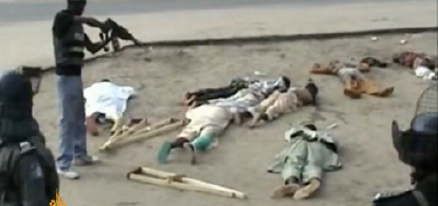
Olympic television audiences can be shown Sunday’s violent luge death, over and over, but they won’t see the video recently leaked from Nigeria, of last summer’s cleanup effort against Islamic rebels. Nigeria is a US client state, violently repressing indigenous resistance to Chevron oil environment rape. Footage shows government soldiers leading unarmed men to lay face down in the public square for summary execution. Said one officer before killing a victim: “Sit properly we want to take your picture.” Another officer shouted: “Shoot him in the chest not the head — I want his hat.”
execution

Olympic opening ceremonies dedicated to the late inhabitants of Marjah

ThunderbirdWith television viewers transfixed by the opening ceremonies of the Winter Olympics in Vancouver, US Marines in Afghanistan are undertaking an explosive Fallujah-class opening ceremony in Helmand Province against the little town of Marjah, a so-called Taliban stronghold. Thousands of Afghans who couldn’t get out in time have been cast as burning stuntmen for this remote reenactment of western expansion via genocide; a nod, if not an acknowledgment of the remnants of Vancouver’s native resistance. Will Marjah be lit up on cue with the arrival of the Olympic torch, spectacle-wise?

Ojore Nuru Lutalo, aka Leroy Bunting arrested with Anarchist literature

Anarchist Ojore Nuru LutaloFormer political prisoner Ojore Nuru Lutalo, ne Leroy Bunting, was pulled off an Amtrak train in La Junta, Colorado, for scaring fellow passengers with his cell phone conversation. The FBI’s Colorado Springs Joint Terrorism Task Force was alerted about the 64 year-old armed with anarchist literature from the “Afrikan Liberation Army” (sic) which he had obtained while speaking at the LA Anarchist Book Fair for the Anarchist Black Cross, a prison rights organization. Just yesterday I listened to a local law enforcement type defend the 2nd Amendment, the right to bear arms, by suggesting that if we substituted “books” for guns, no one would think to regulate them. His compatriots seem to have confused the argument by charging the former Black Liberation Army member for “endangering public transportation” with what they called terrorist recruiting propaganda.

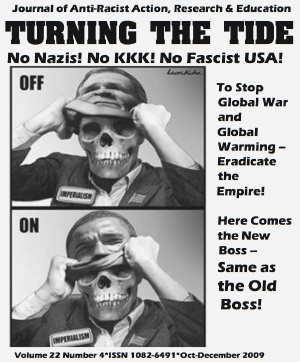
Journal Turning the TideAccording to the Pueblo Chieftain, police found “a large amount of propaganda recruiting materials from the Afrikan Liberation Army, including photos of President Barack Obama and other items that raised suspicions.”

Break the Chains reports that Ojore was released Yesterday, and will return to the Otero District Court for an appearance February 5th, the charge now “Interfering with Public Transportation.”

How absolutely disingenuous to misquote the source of the so-called Anarchist literature, seeing as reportedly there was so much of it. This is the usual media disinfo to prevent giving the causes visibility. The Pueblo Chieftain has obtained the affidavit of the arrest, which should list the items found on Ojore. Until that’s made available, we can search online for what he was likely carrying. Our bet, they don’t want to call attention to the New Afrikan Liberation Front (NALF).

Here’s a list of the exhibitors at the 2nd Anarchist Book Fair:

Anarchist type brochuresSemiotext(e)
www.semiotexte.com
Earth First Journal
www.earthfirstjournal.org
Taala Hooghan: Infoshop & Youth Media Arts Center
www.taalahooghan.org
Modesto Anarcho
www.modestoanarcho.org
South Central Farmers
www.southcentralfarmers.com
Skylight Books
www.skylightbooks.com
Institute for Anarchist Studies
www.anarchist-studies.org
Critical Resistance
www.criticalresistance.org
Las Vegas Alliance of the Libertarian Left sonv.libertarianleft.org
Catholic Worker
www.lacatholicworker.org
Anti-Racist Action/Turning the Tide
www.antiracistaction.us
Anarchist Black Cross Federation L.A. www.abcf.net/la
PM press
www.pmpress.org
Microcosom Publishing
www.microcosmpublishing.com
AK press
www.akpress.org
Little black cart
www.littleblackcart.com
Make/Shift magazine
www.makeshiftmag.com
Journal of aesthetics and protest
www.journalofaestheticsandprotest.org
R.A.C. : Revolutionary Autonomous Communities
www.revolutionaryautonomouscommunities.blogspot.com
I.W.W
www.iww.org

Then there is also the Southside ABCF zine collection, the Crossroad Newletter, and the publications of the Spear and Shield. Here’s the New Afrikan Declaration of Independence, as printed on Prairie Fire:

“New Afrikan Declaration of Independence”

WE, New Afrikan People in America, in consequence of arriving at a knowledge of ourselves as a people with dignity, long deprived of that knowledge; as a consequence of revolting with every decimal of our collective and individual beings against the oppression that for three hundred years has destroyed and broken and warped the bodies and minds and spirits of our people in America, in consequence of our raging desire to be free of this oppression, to destroy this oppression wherever it assaults humankind in the world, and in consequence of inextinguishable determination to go a different way, to build a new and better world, do hereby declare ourselves forever free and independent of the jurisdiction of the United State of America and the obligations which that country¹s unilateral decision to make our ancestors and ourselves paper-citizens placed on us.

We claim no rights from the United States of America other than those rights belonging to human beings anywhere in the world, and these include the right to damages, reparations, due us from the grievous injuries sustained by our ancestors and ourselves by reason of United States lawlessness.

Ours is a revolution against oppression–our own oppression and that of all people in the world. And it is a revolution for a better life, a better station for all, a surer harmony with the forces of life in the universe. We therefore see these aims as the aims of our revolution:

    • To free black people in America from oppression;
  • To support and wage the world revolution until all people everywhere are so free;
  • To build a new Society that is better than what We now know and as perfect as We can make it;
  • To assure all people in the New Society maximum opportunity and equal access to that maximum;
  • To promote industriousness, responsibility, scholarship, and service;
  • To create conditions in which freedom of religion abounds and the pursuit of God and/or destiny, place and purpose of humankind in the Universe will be without hindrance;
  • To build a Black independent nation where no sect or religious creed subverts or impedes the building of the New Society, the New State Government, or achievement of the Aims of the Revolution as set forth in this Declaration;
  • To end exploitation of human beings by each other or the environment;
  • To assure equality of rights for the sexes;
  • To end color and class discrimination, while not abolishing salubrious diversity, and to promote self-respect and mutual understanding among all people in the society;
  • To protect and promote the personal dignity and integrity of the individual, and his or her natural rights;
  • To place the major means of production and trade in the trust of the state to assure the benefits of this earth and our genius and labor to society and all its members, and
  • To encourage and reward the individual for hard work and initiative and insight and devotion to the Revolution.

In mutual trust and great expectation, We the undersigned, for ourselves and for those who look to us but are unable personally to affix their signatures hereto, do join in this solemn Declaration of Independence, and to support this Declaration and to assure the success of the Revolution, We pledge without reservation ourselves, our talents, and all our worldly goods.

Or the creed:

“New Afrikan Creed”

1. i believe in the spirituality, humanity and genius of Black people, and in our new pursuit of these values.

2. i believe in the family and the community, and in the community as a family, and i will work to make this concept live.

3. i believe in the community as more important than the individual.

4. i believe in constant struggle for freedom, to end oppression and build a better world. i believe in collective struggle; in fashioning victory in concert with my brothers and sisters.

5. i believe that the fundamental reason our oppression continues is that We, as a people, lack the power to control our lives.

6. i believe that fundamental way to gain that power, and end oppression, is to build a sovereign Black nation.

7. i believe that all the land in America, upon which We have lived for a long time, which We have worked and built upon, and which We have fought to stay on, is land that belongs to us as a people.

8. i believe in the Malcolm X Doctrine: that We must organize upon this land, and hold a plebiscite, to tell the world by a vote that We are free and our land independent, and that, after the vote, We must stand ready to defend ourselves, establishing the nation beyond contradiction.

9. Therefore, i pledge to struggle without cease, until We have won sovereignty. i pledge to struggle without fail until We have built a better condition than the world has yet known.

10. i will give my life, if that is necessary; i will give my time, my mind, my strength, and my wealth because this IS necessary.

11. i will follow my chosen leaders and help them.

12. i will love my brothers and sisters as myself.

13. i will steal nothing from a brother or sister, cheat no brother or sister, misuse no brother or sister, inform on no brother or sister, and spread no gossip.

14. i will keep myself clean in body, dress and speech, knowing that i am a light set on a hill, a true representative of what We are building.

15. i will be patient and uplifting with the deaf, dumb and blind, and i will seek by word and deed to heal the Black family, to bring into the Movement and into the Community mothers and fathers, brothers and sisters left by the wayside.

Now, freely and of my own will, i pledge this Creed, for the sake of freedom for my people and a better world, on pain of disgrace and banishment if i prove false. For, i am no longer deaf, dumb or blind. i am, by inspiration of the ancestors and grace of the Creator — a New Afrikan.

Beyond MLK worship: Beyond Vietnam

MLK“A time comes when silence is betrayal. That time has come for us in relation to Vietnam.”
Martin Luther King Beyond Vietnam: Time to Break the Silence
Full text of 1967 speech below.

Riverside Church, New York City, 4 April 1967

I come to this magnificent house of worship tonight because my conscience leaves me no other choice. I join with you in this meeting because I am in deepest agreement with the aims and work of the organization which has brought us together: Clergy and Laymen Concerned about Vietnam. The recent statement of your executive committee are the sentiments of my own heart and I found myself in full accord when I read its opening lines:

“A time comes when silence is betrayal.”

That time has come for us in relation to Vietnam.

The truth of these words is beyond doubt but the mission to which they call us is a most difficult one. Even when pressed by the demands of inner truth, men do not easily assume the task of opposing their government’s policy, especially in time of war. Nor does the human spirit move without great difficulty against all the apathy of conformist thought within one’s own bosom and in the surrounding world. Moreover when the issues at hand seem as perplexed as they often do in the case of this dreadful conflict we are always on the verge of being mesmerized by uncertainty; but we must move on.

Some of us who have already begun to break the silence of the night have found that the calling to speak is often a vocation of agony, but we must speak. We must speak with all the humility that is appropriate to our limited vision, but we must speak. And we must rejoice as well, for surely this is the first time in our nation’s history that a significant number of its religious leaders have chosen to move beyond the prophesying of smooth patriotism to the high grounds of a firm dissent based upon the mandates of conscience and the reading of history. Perhaps a new spirit is rising among us. If it is, let us trace its movement well and pray that our own inner being may be sensitive to its guidance, for we are deeply in need of a new way beyond the darkness that seems so close around us.

Over the past two years, as I have moved to break the betrayal of my own silences and to speak from the burnings of my own heart, as I have called for radical departures from the destruction of Vietnam, many persons have questioned me about the wisdom of my path. At the heart of their concerns this query has often loomed large and loud: Why are you speaking about war, Dr. King? Why are you joining the voices of dissent? Peace and civil rights don’t mix, they say. Aren’t you hurting the cause of your people, they ask? And when I hear them, though I often understand the source of their concern, I am nevertheless greatly saddened, for such questions mean that the inquirers have not really known me, my commitment or my calling. Indeed, their questions suggest that they do not know the world in which they live.

“I wish not to speak with Hanoi and the National Liberation Front, but rather to my fellow Americans who, with me, bear the greatest responsibility in ending a conflict that has exacted a heavy price on both continents.”

In the light of such tragic misunderstandings, I deem it of signal importance to try to state clearly, and I trust concisely, why I believe that the path from Dexter Avenue Baptist Church — the church in Montgomery, Alabama, where I began my pastorate — leads clearly to this sanctuary tonight.

I come to this platform tonight to make a passionate plea to my beloved nation. This speech is not addressed to Hanoi or to the National Liberation Front. It is not addressed to China or to Russia.

Nor is it an attempt to overlook the ambiguity of the total situation and the need for a collective solution to the tragedy of Vietnam. Neither is it an attempt to make North Vietnam or the National Liberation Front paragons of virtue, nor to overlook the role they can play in a successful resolution of the problem. While they both may have justifiable reason to be suspicious of the good faith of the United States, life and history give eloquent testimony to the fact that conflicts are never resolved without trustful give and take on both sides.

Tonight, however, I wish not to speak with Hanoi and the NLF, but rather to my fellow Americans, who, with me, bear the greatest responsibility in ending a conflict that has exacted a heavy price on both continents.

The Importance of Vietnam

Since I am a preacher by trade, I suppose it is not surprising that I have seven major reasons for bringing Vietnam into the field of my moral vision. There is at the outset a very obvious and almost facile connection between the war in Vietnam and the struggle I, and others, have been waging in America. A few years ago there was a shining moment in that struggle. It seemed as if there was a real promise of hope for the poor — both black and white — through the poverty program. There were experiments, hopes, new beginnings. Then came the buildup in Vietnam and I watched the program broken and eviscerated as if it were some idle political plaything of a society gone mad on war, and I knew that America would never invest the necessary funds or energies in rehabilitation of its poor so long as adventures like Vietnam continued to draw men and skills and money like some demonic destructive suction tube. So I was increasingly compelled to see the war as an enemy of the poor and to attack it as such.

“For the sake of those boys,
for the sake of this governent,
for the sake of hundreds of thousands
trembling under our violence,
I cannot be silent.”

Perhaps the more tragic recognition of reality took place when it became clear to me that the war was doing far more than devastating the hopes of the poor at home. It was sending their sons and their brothers and their husbands to fight and to die in extraordinarily high proportions relative to the rest of the population. We were taking the black young men who had been crippled by our society and sending them eight thousand miles away to guarantee liberties in Southeast Asia which they had not found in southwest Georgia and East Harlem. So we have been repeatedly faced with the cruel irony of watching Negro and white boys on TV screens as they kill and die together for a nation that has been unable to seat them together in the same schools. So we watch them in brutal solidarity burning the huts of a poor village, but we realize that they would never live on the same block in Detroit. I could not be silent in the face of such cruel manipulation of the poor.

My third reason moves to an even deeper level of awareness, for it grows out of my experience in the ghettoes of the North over the last three years — especially the last three summers. As I have walked among the desperate, rejected and angry young men I have told them that Molotov cocktails and rifles would not solve their problems. I have tried to offer them my deepest compassion while maintaining my conviction that social change comes most meaningfully through nonviolent action. But they asked — and rightly so — what about Vietnam? They asked if our own nation wasn’t using massive doses of violence to solve its problems, to bring about the changes it wanted. Their questions hit home, and I knew that I could never again raise my voice against the violence of the oppressed in the ghettos without having first spoken clearly to the greatest purveyor of violence in the world today — my own government. For the sake of those boys, for the sake of this government, for the sake of hundreds of thousands trembling under our violence, I cannot be silent.

For those who ask the question, “Aren’t you a civil rights leader?” and thereby mean to exclude me from the movement for peace, I have this further answer. In 1957 when a group of us formed the Southern Christian Leadership Conference, we chose as our motto: “To save the soul of America.” We were convinced that we could not limit our vision to certain rights for black people, but instead affirmed the conviction that America would never be free or saved from itself unless the descendants of its slaves were loosed completely from the shackles they still wear. In a way we were agreeing with Langston Hughes, that black bard of Harlem, who had written earlier:

O, yes,
I say it plain,
America never was America to me,
And yet I swear this oath —
America will be!

Now, it should be incandescently clear that no one who has any concern for the integrity and life of America today can ignore the present war. If America’s soul becomes totally poisoned, part of the autopsy must read Vietnam. It can never be saved so long as it destroys the deepest hopes of men the world over. So it is that those of us who are yet determined that America will be are led down the path of protest and dissent, working for the health of our land.

“Surely we must see
that the men we supported
pressed them to their violence.”

As if the weight of such a commitment to the life and health of America were not enough, another burden of responsibility was placed upon me in 1964; and I cannot forget that the Nobel Prize for Peace was also a commission — a commission to work harder than I had ever worked before for “the brotherhood of man.” This is a calling that takes me beyond national allegiances, but even if it were not present I would yet have to live with the meaning of my commitment to the ministry of Jesus Christ. To me the relationship of this ministry to the making of peace is so obvious that I sometimes marvel at those who ask me why I am speaking against the war. Could it be that they do not know that the good news was meant for all men — for Communist and capitalist, for their children and ours, for black and for white, for revolutionary and conservative? Have they forgotten that my ministry is in obedience to the one who loved his enemies so fully that he died for them? What then can I say to the “Vietcong” or to Castro or to Mao as a faithful minister of this one? Can I threaten them with death or must I not share with them my life?

Finally, as I try to delineate for you and for myself the road that leads from Montgomery to this place I would have offered all that was most valid if I simply said that I must be true to my conviction that I share with all men the calling to be a son of the living God. Beyond the calling of race or nation or creed is this vocation of sonship and brotherhood, and because I believe that the Father is deeply concerned especially for his suffering and helpless and outcast children, I come tonight to speak for them.

This I believe to be the privilege and the burden of all of us who deem ourselves bound by allegiances and loyalties which are broader and deeper than nationalism and which go beyond our nation’s self-defined goals and positions. We are called to speak for the weak, for the voiceless, for victims of our nation and for those it calls enemy, for no document from human hands can make these humans any less our brothers.

Strange Liberators

And as I ponder the madness of Vietnam and search within myself for ways to understand and respond to compassion my mind goes constantly to the people of that peninsula. I speak now not of the soldiers of each side, not of the junta in Saigon, but simply of the people who have been living under the curse of war for almost three continuous decades now. I think of them too because it is clear to me that there will be no meaningful solution there until some attempt is made to know them and hear their broken cries.

“Before long they must know
that their government has sent them
into a struggle among Vietnamese,
and the more sophisticated surely realize
that we are on the side of the wealthy
and the secure
while we create hell for the poor.”

They must see Americans as strange liberators. The Vietnamese people proclaimed their own independence in 1945 after a combined French and Japanese occupation, and before the Communist revolution in China. They were led by Ho Chi Minh. Even though they quoted the American Declaration of Independence in their own document of freedom, we refused to recognize them. Instead, we decided to support France in its re-conquest of her former colony.

Our government felt then that the Vietnamese people were not “ready” for independence, and we again fell victim to the deadly Western arrogance that has poisoned the international atmosphere for so long. With that tragic decision we rejected a revolutionary government seeking self-determination, and a government that had been established not by China (for whom the Vietnamese have no great love) but by clearly indigenous forces that included some Communists. For the peasants this new government meant real land reform, one of the most important needs in their lives.

For nine years following 1945 we denied the people of Vietnam the right of independence. For nine years we vigorously supported the French in their abortive effort to re-colonize Vietnam.

Before the end of the war we were meeting eighty percent of the French war costs. Even before the French were defeated at Dien Bien Phu, they began to despair of the reckless action, but we did not. We encouraged them with our huge financial and military supplies to continue the war even after they had lost the will. Soon we would be paying almost the full costs of this tragic attempt at re-colonization.

After the French were defeated it looked as if independence and land reform would come again through the Geneva agreements. But instead there came the United States, determined that Ho should not unify the temporarily divided nation, and the peasants watched again as we supported one of the most vicious modern dictators — our chosen man, Premier Diem. The peasants watched and cringed as Diem ruthlessly routed out all opposition, supported their extortionist landlords and refused even to discuss reunification with the north. The peasants watched as all this was presided over by U.S. influence and then by increasing numbers of U.S. troops who came to help quell the insurgency that Diem’s methods had aroused. When Diem was overthrown they may have been happy, but the long line of military dictatorships seemed to offer no real change — especially in terms of their need for land and peace.

The only change came from America as we increased our troop commitments in support of governments which were singularly corrupt, inept and without popular support. All the while the people read our leaflets and received regular promises of peace and democracy — and land reform. Now they languish under our bombs and consider us – not their fellow Vietnamese — the real enemy. They move sadly and apathetically as we herd them off the land of their fathers into concentration camps where minimal social needs are rarely met. They know they must move or be destroyed by our bombs. So they go — primarily women and children and the aged.

“Somehow this madness must cease.”

They watch as we poison their water, as we kill a million acres of their crops. They must weep as the bulldozers roar through their areas preparing to destroy the precious trees. They wander into the hospitals, with at least twenty casualties from American firepower for one “Vietcong-inflicted” injury. So far we may have killed a million of them — mostly children. They wander into the towns and see thousands of the children, homeless, without clothes, running in packs on the streets like animals. They see the children, degraded by our soldiers as they beg for food. They see the children selling their sisters to our soldiers, soliciting for their mothers.

What do the peasants think as we ally ourselves with the landlords and as we refuse to put any action into our many words concerning land reform? What do they think as we test our latest weapons on them, just as the Germans tested out new medicine and new tortures in the concentration camps of Europe? Where are the roots of the independent Vietnam we claim to be building? Is it among these voiceless ones?

We have destroyed their two most cherished institutions: the family and the village. We have destroyed their land and their crops. We have cooperated in the crushing of the nation’s only non-Communist revolutionary political force — the Unified Buddhist church. We have supported the enemies of the peasants of Saigon. We have corrupted their women and children and killed their men. What liberators?

Now there is little left to build on — save bitterness. Soon the only solid physical foundations remaining will be found at our military bases and in the concrete of the concentration camps we call fortified hamlets. The peasants may well wonder if we plan to build our new Vietnam on such grounds as these? Could we blame them for such thoughts? We must speak for them and raise the questions they cannot raise. These too are our brothers.

Perhaps the more difficult but no less necessary task is to speak for those who have been designated as our enemies. What of the National Liberation Front — that strangely anonymous group we call VC or Communists? What must they think of us in America when they realize that we permitted the repression and cruelty of Diem which helped to bring them into being as a resistance group in the south? What do they think of our condoning the violence which led to their own taking up of arms? How can they believe in our integrity when now we speak of “aggression from the north” as if there were nothing more essential to the war? How can they trust us when now we charge them with violence after the murderous reign of Diem and charge them with violence while we pour every new weapon of death into their land? Surely we must understand their feelings even if we do not condone their actions. Surely we must see that the men we supported pressed them to their violence. Surely we must see that our own computerized plans of destruction simply dwarf their greatest acts.

“We must continue to raise our voices if our nation persists in its perverse ways in Vietnam.”

How do they judge us when our officials know that their membership is less than twenty-five percent Communist and yet insist on giving them the blanket name? What must they be thinking when they know that we are aware of their control of major sections of Vietnam and yet we appear ready to allow national elections in which this highly organized political parallel government will have no part? They ask how we can speak of free elections when the Saigon press is censored and controlled by the military junta. And they are surely right to wonder what kind of new government we plan to help form without them — the only party in real touch with the peasants. They question our political goals and they deny the reality of a peace settlement from which they will be excluded. Their questions are frighteningly relevant. Is our nation planning to build on political myth again and then shore it up with the power of new violence?

Here is the true meaning and value of compassion and nonviolence when it helps us to see the enemy’s point of view, to hear his questions, to know his assessment of ourselves. For from his view we may indeed see the basic weaknesses of our own condition, and if we are mature, we may learn and grow and profit from the wisdom of the brothers who are called the opposition.

So, too, with Hanoi. In the north, where our bombs now pummel the land, and our mines endanger the waterways, we are met by a deep but understandable mistrust. To speak for them is to explain this lack of confidence in Western words, and especially their distrust of American intentions now. In Hanoi are the men who led the nation to independence against the Japanese and the French, the men who sought membership in the French commonwealth and were betrayed by the weakness of Paris and the willfulness of the colonial armies. It was they who led a second struggle against French domination at tremendous costs, and then were persuaded to give up the land they controlled between the thirteenth and seventeenth parallel as a temporary measure at Geneva. After 1954 they watched us conspire with Diem to prevent elections which would have surely brought Ho Chi Minh to power over a united Vietnam, and they realized they had been betrayed again.

When we ask why they do not leap to negotiate, these things must be remembered. Also it must be clear that the leaders of Hanoi considered the presence of American troops in support of the Diem regime to have been the initial military breach of the Geneva agreements concerning foreign troops, and they remind us that they did not begin to send in any large number of supplies or men until American forces had moved into the tens of thousands.

“When machines and computers,
profit motives and property rights
are considered more important than people,
the giant triplets of
racism,
materialism
and militarism
are incapable of being conquered.”

Hanoi remembers how our leaders refused to tell us the truth about the earlier North Vietnamese overtures for peace, how the president claimed that none existed when they had clearly been made. Ho Chi Minh has watched as America has spoken of peace and built up its forces, and now he has surely heard of the increasing international rumors of American plans for an invasion of the north. He knows the bombing and shelling and mining we are doing are part of traditional pre-invasion strategy. Perhaps only his sense of humor and of irony can save him when he hears the most powerful nation of the world speaking of aggression as it drops thousands of bombs on a poor weak nation more than eight thousand miles away from its shores.

At this point I should make it clear that while I have tried in these last few minutes to give a voice to the voiceless on Vietnam and to understand the arguments of those who are called enemy, I am as deeply concerned about our troops there as anything else. For it occurs to me that what we are submitting them to in Vietnam is not simply the brutalizing process that goes on in any war where armies face each other and seek to destroy. We are adding cynicism to the process of death, for they must know after a short period there that none of the things we claim to be fighting for are really involved. Before long they must know that their government has sent them into a struggle among Vietnamese, and the more sophisticated surely realize that we are on the side of the wealthy and the secure while we create hell for the poor.

This Madness Must Cease

Somehow this madness must cease. We must stop now. I speak as a child of God and brother to the suffering poor of Vietnam. I speak for those whose land is being laid waste, whose homes are being destroyed, whose culture is being subverted. I speak for the poor of America who are paying the double price of smashed hopes at home and death and corruption in Vietnam. I speak as a citizen of the world, for the world as it stands aghast at the path we have taken. I speak as an American to the leaders of my own nation. The great initiative in this war is ours. The initiative to stop it must be ours.

This is the message of the great Buddhist leaders of Vietnam. Recently one of them wrote these words:

“Each day the war goes on the hatred increases in the heart of the Vietnamese and in the hearts of those of humanitarian instinct. The Americans are forcing even their friends into becoming their enemies. It is curious that the Americans, who calculate so carefully on the possibilities of military victory, do not realize that in the process they are incurring deep psychological and political defeat. The image of America will never again be the image of revolution, freedom and democracy, but the image of violence and militarism.”

“A nation that continues
year after year
to spend more money on military defense
than on programs of social uplift
is approaching spiritual death.”

If we continue, there will be no doubt in my mind and in the mind of the world that we have no honorable intentions in Vietnam. It will become clear that our minimal expectation is to occupy it as an American colony and men will not refrain from thinking that our maximum hope is to goad China into a war so that we may bomb her nuclear installations. If we do not stop our war against the people of Vietnam immediately the world will be left with no other alternative than to see this as some horribly clumsy and deadly game we have decided to play.

The world now demands a maturity of America that we may not be able to achieve. It demands that we admit that we have been wrong from the beginning of our adventure in Vietnam, that we have been detrimental to the life of the Vietnamese people. The situation is one in which we must be ready to turn sharply from our present ways.

In order to atone for our sins and errors in Vietnam, we should take the initiative in bringing a halt to this tragic war. I would like to suggest five concrete things that our government should do immediately to begin the long and difficult process of extricating ourselves from this nightmarish conflict:

• End all bombing in North and South Vietnam

• Declare a unilateral cease-fire in the hope that such action will create the atmosphere for negotiation.

• Take immediate steps to prevent other battlegrounds in Southeast Asia by curtailing our military buildup in Thailand and our interference in Laos.

• Realistically accept the fact that the National Liberation Front has substantial support in South Vietnam and must thereby play a role in any meaningful negotiations and in any future Vietnam government.

• Set a date that we will remove all foreign troops from Vietnam in accordance with the 1954 Geneva agreement.

Part of our ongoing commitment might well express itself in an offer to grant asylum to any Vietnamese who fears for his life under a new regime which included the Liberation Front. Then we must make what reparations we can for the damage we have done. We most provide the medical aid that is badly needed, making it available in this country if necessary.

Protesting The War

Meanwhile we in the churches and synagogues have a continuing task while we urge our government to disengage itself from a disgraceful commitment. We must continue to raise our voices if our nation persists in its perverse ways in Vietnam. We must be prepared to match actions with words by seeking out every creative means of protest possible.

As we counsel young men concerning military service we must clarify for them our nation’s role in Vietnam and challenge them with the alternative of conscientious objection. I am pleased to say that this is the path now being chosen by more than seventy students at my own alma mater, Morehouse College, and I recommend it to all who find the American course in Vietnam a dishonorable and unjust one. Moreover I would encourage all ministers of draft age to give up their ministerial exemptions and seek status as conscientious objectors. These are the times for real choices and not false ones. We are at the moment when our lives must be placed on the line if our nation is to survive its own folly. Every man of humane convictions must decide on the protest that best suits his convictions, but we must all protest.

“If we do not act
we shall surely be dragged down
the long and shameful corridors of time
reserved for those who possess
power without compassion,
might without morality,
and strength without sight.”

There is something seductively tempting about stopping there and sending us all off on what in some circles has become a popular crusade against the war in Vietnam. I say we must enter the struggle, but I wish to go on now to say something even more disturbing. The war in Vietnam is but a symptom of a far deeper malady within the American spirit, and if we ignore this sobering reality we will find ourselves organizing clergy-and laymen-concerned committees for the next generation. They will be concerned about Guatemala and Peru. They will be concerned about Thailand and Cambodia. They will be concerned about Mozambique and South Africa. We will be marching for these and a dozen other names and attending rallies without end unless there is a significant and profound change in American life and policy. Such thoughts take us beyond Vietnam, but not beyond our calling as sons of the living God.

In 1957 a sensitive American official overseas said that it seemed to him that our nation was on the wrong side of a world revolution. During the past ten years we have seen emerge a pattern of suppression which now has justified the presence of U.S. military “advisors” in Venezuela. This need to maintain social stability for our investments accounts for the counter-revolutionary action of American forces in Guatemala. It tells why American helicopters are being used against guerrillas in Colombia and why American napalm and green beret forces have already been active against rebels in Peru. It is with such activity in mind that the words of the late John F. Kennedy come back to haunt us. Five years ago he said,

“Those who make peaceful revolution impossible will make violent revolution inevitable.”

Increasingly, by choice or by accident, this is the role our nation has taken — the role of those who make peaceful revolution impossible by refusing to give up the privileges and the pleasures that come from the immense profits of overseas investment.

I am convinced that if we are to get on the right side of the world revolution, we as a nation must undergo a radical revolution of values. We must rapidly begin the shift from a “thing-oriented” society to a “person-oriented” society. When machines and computers, profit motives and property rights are considered more important than people, the giant triplets of racism, materialism, and militarism are incapable of being conquered.

A true revolution of values will soon cause us to question the fairness and justice of many of our past and present policies. On the one hand we are called to play the good Samaritan on life’s roadside; but that will be only an initial act. One day we must come to see that the whole Jericho road must be transformed so that men and women will not be constantly beaten and robbed as they make their journey on life’s highway.

True compassion is more than flinging a coin to a beggar; it is not haphazard and superficial. It comes to see that an edifice which produces beggars needs restructuring. A true revolution of values will soon look uneasily on the glaring contrast of poverty and wealth. With righteous indignation, it will look across the seas and see individual capitalists of the West investing huge sums of money in Asia, Africa and South America, only to take the profits out with no concern for the social betterment of the countries, and say: “This is not just.”

It will look at our alliance with the landed gentry of Latin America and say: “This is not just.”

The Western arrogance of feeling that it has everything to teach others and nothing to learn from them is not just.

A true revolution of values will lay hands on the world order and say of war: “This way of settling differences is not just.”

This business of burning human beings with napalm, of filling our nation’s homes with orphans and widows, of injecting poisonous drugs of hate into veins of people normally humane, of sending men home from dark and bloody battlefields physically handicapped and psychologically deranged, cannot be reconciled with wisdom, justice and love. A nation that continues year after year to spend more money on military defense than on programs of social uplift is approaching spiritual death.

America, the richest and most powerful nation in the world, can well lead the way in this revolution of values. There is nothing, except a tragic death wish, to prevent us from reordering our priorities, so that the pursuit of peace will take precedence over the pursuit of war. There is nothing to keep us from molding a recalcitrant status quo with bruised hands until we have fashioned it into a brotherhood.

This kind of positive revolution of values is our best defense against communism. War is not the answer. Communism will never be defeated by the use of atomic bombs or nuclear weapons. Let us not join those who shout war and through their misguided passions urge the United States to relinquish its participation in the United Nations. These are days which demand wise restraint and calm reasonableness. We must not call everyone a Communist or an appeaser who advocates the seating of Red China in the United Nations and who recognizes that hate and hysteria are not the final answers to the problem of these turbulent days. We must not engage in a negative anti-communism, but rather in a positive thrust for democracy, realizing that our greatest defense against communism is to take offensive action in behalf of justice. We must with positive action seek to remove those conditions of poverty, insecurity and injustice which are the fertile soil in which the seed of communism grows and develops.

The People Are Important

These are revolutionary times. All over the globe men are revolting against old systems of exploitation and oppression and out of the wombs of a frail world new systems of justice and equality are being born. The shirtless and barefoot people of the land are rising up as never before. “The people who sat in darkness have seen a great light.” We in the West must support these revolutions. It is a sad fact that, because of comfort, complacency, a morbid fear of communism, and our proneness to adjust to injustice, the Western nations that initiated so much of the revolutionary spirit of the modern world have now become the arch anti-revolutionaries. This has driven many to feel that only Marxism has the revolutionary spirit. Therefore, communism is a judgment against our failure to make democracy real and follow through on the revolutions we initiated. Our only hope today lies in our ability to recapture the revolutionary spirit and go out into a sometimes hostile world declaring eternal hostility to poverty, racism, and militarism. With this powerful commitment we shall boldly challenge the status quo and unjust mores and thereby speed the day when “every valley shall be exalted, and every mountain and hill shall be made low, and the crooked shall be made straight and the rough places plain.”

A genuine revolution of values means in the final analysis that our loyalties must become ecumenical rather than sectional. Every nation must now develop an overriding loyalty to mankind as a whole in order to preserve the best in their individual societies.

This call for a world-wide fellowship that lifts neighborly concern beyond one’s tribe, race, class and nation is in reality a call for an all-embracing and unconditional love for all men. This oft misunderstood and misinterpreted concept – so readily dismissed by the Nietzsches of the world as a weak and cowardly force – has now become an absolute necessity for the survival of man. When I speak of love I am not speaking of some sentimental and weak response. I am speaking of that force which all of the great religions have seen as the supreme unifying principle of life. Love is somehow the key that unlocks the door which leads to ultimate reality. This Hindu-Moslem-Christian-Jewish-Buddhist belief about ultimate reality is beautifully summed up in the first epistle of Saint John:

Let us love one another; for love is God and everyone that loveth is born of God and knoweth God. He that loveth not knoweth not God; for God is love. If we love one another God dwelleth in us, and his love is perfected in us.

Let us hope that this spirit will become the order of the day. We can no longer afford to worship the god of hate or bow before the altar of retaliation. The oceans of history are made turbulent by the ever-rising tides of hate. History is cluttered with the wreckage of nations and individuals that pursued this self-defeating path of hate. As Arnold Toynbee says :

“Love is the ultimate force that makes for the saving choice of life and good against the damning choice of death and evil. Therefore the first hope in our inventory must be the hope that love is going to have the last word.”

We are now faced with the fact that tomorrow is today. We are confronted with the fierce urgency of now. In this unfolding conundrum of life and history there is such a thing as being too late. Procrastination is still the thief of time. Life often leaves us standing bare, naked and dejected with a lost opportunity. The “tide in the affairs of men” does not remain at the flood; it ebbs. We may cry out desperately for time to pause in her passage, but time is deaf to every plea and rushes on. Over the bleached bones and jumbled residue of numerous civilizations are written the pathetic words: “Too late.”

There is an invisible book of life that faithfully records our vigilance or our neglect. “The moving finger writes, and having writ moves on…” We still have a choice today; nonviolent coexistence or violent co-annihilation.

We must move past indecision to action. We must find new ways to speak for peace in Vietnam and justice throughout the developing world – a world that borders on our doors. If we do not act we shall surely be dragged down the long dark and shameful corridors of time reserved for those who possess power without compassion, might without morality, and strength without sight.

Now let us begin. Now let us rededicate ourselves to the long and bitter – but beautiful – struggle for a new world. This is the calling of the sons of God, and our brothers wait eagerly for our response. Shall we say the odds are too great? Shall we tell them the struggle is too hard? Will our message be that the forces of American life militate against their arrival as full men, and we send our deepest regrets? Or will there be another message, of longing, of hope, of solidarity with their yearnings, of commitment to their cause, whatever the cost? The choice is ours, and though we might prefer it otherwise we must choose in this crucial moment of human history.

As that noble bard of yesterday, James Russell Lowell, eloquently stated:

Once to every man and nation
Comes the moment to decide,
In the strife of truth and falsehood,
For the good or evil side;
Some great cause, God’s new Messiah,
Off’ring each the bloom or blight,
And the choice goes by forever
Twixt that darkness and that light.
Though the cause of evil prosper,
Yet ’tis truth alone is strong;
Though her portion be the scaffold,
And upon the throne be wrong:
Yet that scaffold sways the future,
And behind the dim unknown,
Standeth God within the shadow
Keeping watch above his own.

The Caracas Commitment Si Se Puede

You might imagine the multinational corporate media would blackout the talk of a 5th Socialist International. They are most determined to censor the issues which the world’s leftist parties are resolved to address. Where Obama 2008 and Copenhagen 2009 project a vacuum of ideological momentum, check out the Caracas Commitment.

The Caracas Commitment
November 25, 2009?
By Declaration from World Meeting of Left Parties?
November 19-21 Caracas, Venezuela

Political parties and organizations from Latin America, the Caribbean, Europe, Africa, Asia, and Oceania commemorate and celebrate the unity and solidarity that brought us together in Caracas, Bolivarian Republic of Venezuela, and from this libertarian city we would like to express our revolutionary rebelliousness. We are glad of and committed to the proud presence of the forces of change in a special moment of history. Likewise, we are proud to reaffirm our conviction to definitively sow, grow and win Socialism of the 21st century.

In this regard, we want to sign the Commitment of Caracas as a revolutionary guide for the challenges ahead of us. We have gathered with the aim of unifying criteria and giving concrete answers that allow us to defend our sovereignty, our social victories, and the freedom of our peoples in the face of the generalized crisis of the world capitalist system and the new threats spreading over our region and the whole world with the establishment and strengthening of military bases in the sister republics of Colombia, Panama, Aruba, Curacao, the Dutch Antilles, as well as the aggression against Ecuadorian territory, and the invasions of Iraq and Afghanistan.

We consider that the world capitalist system is going through one of its most severe crises, which has shaken its very foundations and brought with it consequences that jeopardize the survival of humanity. Likewise, capitalism and the logic of capital, destroys the environment and biodiversity, bringing with it consequences of climate change, global warming and the destruction of life.

One of the epicentres of the capitalist crisis is in the economic domain; this highlights the limitations of unbridled free markets ruled by private monopolies. In this situation, some governments have been asked to intervene to prevent the collapse of vital economic sectors, for instance, through the implementation of bailouts to bank institutions that amount to hundreds of billions of dollars. Said governments have been asked to stimulate their economies by increasing public expenditure in order to mitigate the recession and the private sector decline, which evidences the end of the supposedly irrefutable “truth” of neo-liberalism that of non-intervention of the State in economic affairs.

In this regard, it is very timely to promote an in-depth discussion on the economic crisis, the role of the State and the construction of a new financial architecture.

In summary, the capitalist crisis cannot be reduced simply to a financial crisis; it is a structural crisis of capital which combines the economic crisis, with an ecological crisis, a food crisis, and an energy crisis, which together represents a mortal threat to humanity and mother earth. Faced with this crisis, left-wing movements and parties see the defence of nature and the construction of an ecologically sustainable society as a fundamental axis of our struggle for a better world.

In recent years, progressive and left-wing movements of the Latin American region have accumulated forces, and stimulated transformations, throwing up leaders that today hold important government spaces. This has represented an important blow to the empire because the peoples have rebelled against the domination that has been imposed on them, and have left behind their fear to express their values and principles, showing the empire that we will not allow any more interference in our internal affairs, and that we are willing to defend our sovereignty.

This meeting is held at a historic time, characterized by a new imperialistic offensive against the peoples and governments of the region and of the world, a pretension supported by the oligarchies and ultraconservative right-wing, with the objective of recovering spaces lost as a consequence of the advancement of revolutionary process of liberation developing in Latin America. These are expressed through the creation of regional organizations such as ALBA, UNASUR, PETROCARIBE, Banco del Sur, the Sao Paulo Forum, COPPPAL, among others; where the main principles inspiring these processes are those of solidarity, complementarity, social priority over economic advantage, respect for self-determination of the peoples in open opposition to the policies of imperial domination. For these reasons, the right-wing forces in partnership with the empire have launched an offensive to combat the advance and development of the peoples’ struggles, especially those against the overexploitation of human beings, racist discrimination, cultural oppression, in defence of natural resources, of the land and territory from the perspective of the left and progressive movements and of world transformation.

We reflect on the fact that these events have led the U.S administration to set strategies to undermine, torpedo and destabilize the advancement of these processes of change and recuperation of sovereignty. To this end, the US has implemented policies expressed through an ideological and media offensive that aim to discredit the revolutionary and progressive governments of the region, labelling them as totalitarian governments, violators of human rights, with links to drug-trafficking operations, and terrorism; and also questioning the legitimacy of their origin. This is the reason for the relentless fury with which all the empire’s means of propaganda and its agents inside our own countries continuously attack the experiences in Venezuela, Ecuador, Nicaragua, Bolivia, and Paraguay, as with its maintenance of the blockade against revolutionary and independent Cuba.

Part of the strategy activated by the U.S. Empire is evidenced by the coup in Honduras, as well as in other destabilizing initiatives in Central America, attempting to impose the oligarchic interests that have already left hundreds of victims, while a disgusting wave of cynicism tries to cover up the dictatorship imposed by the U.S. administration with a false veil of democracy. Along with this, it is developing a military offensive with the idea of maintaining political and military hegemony in the region, for which it is promoting new geopolitical allies, generating destabilization and disturbing peace in the region and globally through military intimidation, with the help of its allies in the internal oligarchies, who are shown to be complicit in the actions taken by the empire, giving away their sovereignty, and opening spaces for the empire’s actions.

We consider that this new offensive is specifically expressed through two important events that took place this year in the continent: The coup in Honduras, and the installation of military bases in Colombia and Panama, as well as the strengthening of the already existing ones in our region. The coup in Honduras is nothing but a display of hypocrisy by the empire, a way to intimidate the rest of the governments in the region. It is a test-laboratory that aims to set a precedent that can be applied as a new coup model and a way to encourage the right to plot against the transformational and independent processes.

We denounce the military agreement between the Colombian government and the United States administration strengthens the U.S.’s military strategy, whose contents are expressed in the so-called “White Book.” This confirms that the development of the agreement will guarantee a projection of continental and intercontinental military power, the strengthening of transportation capability and air mobility to guarantee the improvement of its action capability, in order to provide the right conditions to have access to energy sources. It also consolidates its political partnership with the regional oligarchy for the control of Colombian territory and its projection in the Andes and in the rest of South America. All this scaffolding and consolidation of military architecture entails a serious threat for peace in the region and the world.

The installation of military bases in the region and their interrelation with the different bases spread throughout the world is not only confined to the military sphere, but rather forms part of the establishment of a general policy of domination and expansion directed by the U.S. These bases constitute strategic points to dominate all the countries in Central and Latin America and the rest of the world.

The treaty for the installation of military bases in Colombia is preceded by Plan Colombia, which was already an example of U.S. interference in the affairs of Colombia and the region using the fight against drug trafficking and terrorism as an excuse. However, it has been shown that drug trafficking levels have increased in Colombia; therefore, the plan is no longer justified given that no favourable results have been obtained since its implementation, that would justify a new treaty with the U.S.

Today, the global strategy headed by the U.S. concerning drug trafficking is a complete failure. Its results are summarised by a rapid processes of accumulation of illegal capital, increased consumption of drugs and exacerbation of criminality, whose victims are the peoples of Latin America, especially the Colombian people. This strategy should be revisited and modified, and should be oriented towards a different logic that focuses on drug consumption as a public health issue. In Colombia, drug trafficking has assumed the form of paramilitarism, and turned into a political project the scope of which and persons responsible should be investigated so that the truth is known, so that justice prevails and the terror of the civilian population ceases.

We, the peoples of the world, declare that we will not give up the spaces we have managed to conquer after years of struggle and resistance; and we commit ourselves to regain those which have been taken from us. Therefore, we need to defend the processes of change and the unfolding revolutions since they are based on sovereign decisions made by the peoples.

Agreements

1. Mobilization and Condemnation of U.S. Military Bases

1.1.
To organize global protests against the U.S. military bases from December 12th to 17th, 2009. Various leftwing parties and social movements will promote forums, concerts, protest marches and any other creative activity within the context of this event.

1.2.
To establish a global mobilization front for the political denouncement of the U.S. military bases. This group will be made up by social leaders, left-wing parties, lawmakers, artists, among others, who will visit different countries with the aim of raising awareness in forums, press conferences and news and above all in gatherings with each country’s peoples.

1.3.
To organize students, young people, workers and women in order to establish a common agenda of vigilance and to denounce against the military bases throughout the world.

1.4.
To organize a global legal forum to challenge the installation of the U.S. military bases. This forum is conceived as a space for the condemnation of illegalities committed against the sovereignty and self-determination of the peoples and the imposition of a hegemonic imperialist model.

1.5.
To organise a global trial against paramilitarism in Colombia bringing testimonies and evidence to international bodies of justice.

1.6.
To promote a global trial against George Bush for crimes against humanity, as the person principally responsible for the genocide against the peoples of Iraq and Afghanistan.

1.7.
To promote a campaign for the creation of constitutional and legal provisions in all of our countries against the installation of military bases and deployment of nuclear weapons of mass destruction.

1.8.
To promote, from the different social organizations and movements of the countries present in this meeting, a political solution for the Colombian conflict.

1.9.
To organise solidarity with the Colombian people against the imperial aggression that the military bases entail in Colombian territory.

2. Installation and Development of a Platform of Joint Action by Left-Wing Parties of the World

2.1.
To establish a space of articulation of progressive and left-wing organizations and parties that allows for coordinating policies against the aggression towards the peoples, the condemnation of the aggressions against governments elected democratically, the installation of military bases, the violation of sovereignty and against xenophobia, the defence of immigrants’ rights, peace, and the environment, and peasant, labour, indigenous and afro-descendent movements.

2.2.
To set up a Temporary Executive Secretariat (TES) that allows for the coordination of a common working agenda, policy making, and follow-up on the agreements reached within the framework of this international encounter. Said Secretariat undertakes to inform about relevant events in the world, and to define specific action plans: statements, declarations, condemnations, mobilizations, observations and other issues that may be decided.

2.3.
To set up an agenda of permanent ideological debate on the fundamental aspects of the process of construction of socialism.

2.4.
To prepare common working agendas with participation from Latin America, Europe, Africa, Asia and Oceania.

2.5.
To organize solidarity of the people’s of the world with the Bolivarian revolution and President Hugo Chávez, in response to the constant imperial attacks.

2.6.
To commemorate the centenary of Clara Zetkin’s proposal to celebrate March 8th as the International Day of Women. The parties undertake to celebrate this day insofar as possible.

2.7.
To summon a meeting to be held in Caracas in April 2010 in commemoration of the bicentenary of our Latin American and Caribbean independences.

3. Organization of a World Movement of Militants for a Culture of Peace

3.1.
To promote the establishment of peace bases, by peace supporters, who will coordinate actions and denouncements against interventionism and war sponsored by imperialism through activities such as: forums, cultural events, and debates to promote the ethical behaviour of anti-violence, full participation in social life, respect for human rights and fundamental freedoms, acknowledgement of the cultural identities of our peoples and strengthening the framework of integration. This space seeks to raise awareness among all citizens in rejection of all forms of domination, internal or external intervention, and to reinforce the culture of peace. To struggle relentlessly for a world with no nuclear weapons, no weapons of mass destruction, no military bases, no foreign interference, and no economic blockades, as our peoples need peace and are absolutely entitled to attain development. Promote the American continent as a territory of peace, home to the construction of a free and sovereign world.

3.2.
To organize a Peace Parliament as a political space to exchange common endeavours among the world’s progressive and left-wing parliamentarians, and to know the historical, economic, legal, political and environmental aspects key for the defence of peace. Hereby we recommend holding the first meeting in February 2010.

4. Artillery Of International Communication to Emancipate Revolutionary Consciousness

4.1.
To discuss a public communication policy at an inter-regional level that aims to improve the media battle, and to convey the values of socialism among the peoples.

4.2.
To promote the creation and consolidation of alternative and community communication media to break the media siege, promote an International Alternative Left-wing Media Coordination Office that creates links to provide for improved information exchange among our countries, in which Telesur and Radiosur can be spearheads for this action.

4.3.
To create a website of all of the progressive and left-wing parties and movements in the world as a means to ensure permanent exchange and the development of an emancipating and alternative communication.

4.4.
To promote a movement of artists, writers and filmmakers to promote and develop festivals of small, short and full-length films that reflects the advancement and the struggle of peoples in revolution.

4.5.
To hold a meeting or international forum of alternative left-wing media.

5. Mobilize All Popular Organizations in Unrestricted Support for the People of Honduras

5.1.
To promote an international trial against the coup plotters in Honduras before the International Criminal Court for the abuses and crimes committed.

5.2.
Refuse to recognize the illegal electoral process they aim to carry out in Honduras.

5.3.
To carry out a world vigil on Election Day in Honduras in order to protest against the intention to legitimize the coup, coordinated by the permanent committee that emerges from this encounter.

5.4.
To coordinate the actions of left-wing parties worldwide to curb the imperialist pretensions of using the coup in Honduras as a strategy against the Latin American and Caribbean progressive processes and governments.

5.5.
To unite with the people of Honduras through a global solidarity movement for people’s resistance and for the pursuit of democratic and participatory paths that allow for the establishment of progressive governments committed to common welfare and social justice.

5.6.
To undertake actions geared towards denouncing before multilateral bodies, and within the framework of international law, the abduction of José Manuel Zelaya, legitimate President of Honduras, that facilitated the rupture of constitutional order in Honduras. It is necessary to determine responsibility among those who participated directly in this crime, and even among those who allowed his aircraft to go in and out Costa Rica without trying to detain the kidnappers of the Honduran president.

6. Solidarity with the Peoples of the World

6.1.
The Left-wing Parties of the International Meeting of Caracas agree to demand the immediate liberation of the five Cuban heroes unfairly imprisoned in American jails. They are authentic anti-terrorist fighters that caused no harm to U.S. national security, whose work was oriented towards preventing the terrorist attacks prepared by the terrorist counterrevolution against Cuba. The Five Heroes were subject to a biased judicial process, condemned by broad sectors of humanity, and stigmatized by a conspiracy of silence by the mainstream media. Given the impossibility of winning justice via judicial means, we call upon all political left-wing parties of the world to increase actions for their immediate liberation. We call on President Obama to utilize his executive power and set these Five Heroes of Humanity free.

6.2.
The International Meeting of Left-wing Parties resolutely demands the immediate and unconditional cessation of the criminal U.S. blockade that harmed the Cuban people so badly over the last fifty years. The blockade should come to an end right now in order to fulfil the will of the 187 countries that recently declared themselves against this act of genocide during the UN General Assembly.

6.3.
To unite with the people of Haiti in the struggle for the return of President Jean Bertrand Aristide to his country.

6.4.
We propose to study the possibility to grant a residence in Venezuela to Jean Bertrand Aristide, who was kidnapped and overthrown as Haiti’s president by U.S. imperialism.

6.5.
We express the need to declare a permanent alert aimed at preventing any type of breach of the constitutional order that may hinder the process of democratic change underway in Paraguay.

6.6.
We denounce the neoliberal privatizing advance in Mexico expressly in the case of the Electric Energy state-owned company, a heritage of the people, which aims through the massive firing of 45,000 workers to intimidate the union force, “Luz y Fuerza”, which constitutes another offensive of the Empire in Central and North America.

6.7.
To declare our solidarity with the peoples of the world that have suffered and are still suffering imperial aggressions, especially, the 50 year-long genocidal blockade against Cuba; the threat against the people of Paraguay; the slaughter of the Palestinian people; the illegal occupation of part of the territory of the Republic of Western Sahara and the invasion of Iraq and Afghanistan which today is expanding into Pakistan; the illegal sanctions imposed against Zimbabwe and the constant threat against Iran, among others.

Caracas, November 21st, 2009

Declaration of Solidarity with the People of Cuba

The Left-wing Parties of the International Meeting of Caracas agree to demand the immediate liberation of the five Cuban heroes unfairly imprisoned in U.S. prisons. They are authentic anti-terrorist fighters that caused no harm to US national security, whose work was oriented towards preventing the terrorist attacks prepared by the terrorist counterrevolution against Cuba. The Five Heroes were subject to a biased judicial process, condemned by broad sectors of humanity, and stigmatized by a conspiracy of silence by the mainstream media.

Given the impossibility of winning justice via judicial means, we call upon all political left-wing parties of the world to increase actions for their immediate liberation. We call on President Obama to utilize his executive power and set these Five Heroes of Humanity free.

The International Meeting of Left-wing Parties resolutely demands the immediate and unconditional cessation of the criminal U.S. blockade that harmed the Cuban people so badly over the last fifty years. The blockade should come to an end right now in order to fulfill the will of the 187 countries that recently declared themselves against this act of genocide during the UN General Assembly.

Caracas, November 21, 2009

Special Declaration on the Coup D’état in Honduras

We, left-wing parties of Latin America, Africa, Europe, Asia and Oceania, present in the international encounter of left-wing parties, reject the coup d’état against the constitutional government of citizen’s power of the President of Honduras Manuel Zelaya Rosales.

Cognizant of the situation of repression, persecution and murder against the Honduran people and the permanent military harassment against president Manuel Zelaya Rosales, which represents a breach of the rule of law in the sister nation of Honduras:

We support the actions of the national resistance front in its struggle to restore democracy.

We demand and support the sovereign right of the Honduran people to call for a national constituent assembly to establish direct democracy and to ensure the broadest political participation of the people in public affairs.

We denounce the United States intervention and its national and international reactionary right-wing allies and their connection with the coup, which hinders the construction of democracy in Honduras and in the world.

We condemn and repudiate the permanent violation of political and social human rights as well as the violation freedom of speech, promoted and perpetrated by the de facto powers, the Supreme Court of Justice, the National Congress of the Republic, the Ministry of Defence and Security since June 28, 2009.

We reiterate our demand to international governments and bodies, not to recognize the results of the general elections to be held on November 29, 2009 in Honduras, due to the lack of constitutional guarantees and the legal conditions necessary for a fair, transparent and reliable electoral process, the lack of reliable observers that can vouch for the results of this electoral process, which has already been rejected by most international governments, bodies and international public opinion.

To propose and promote an international trial against coup plotters and their accomplices in Honduras before the International Criminal Court, for the illegal actions, abuses and crimes they committed, while developing actions aimed at denouncing to the relevant bodies and in the framework of the international law, the violation of the rights and the kidnapping of the legitimate president of Honduras Manuel Zelaya Rosales, because it is necessary to establish the responsibility of those who participated directly and internally in the perpetration of this crime.

We urge national and international human rights organizations to support these measures, to carry on the campaign of denunciation and vigilance with permanent observers in face of the renewed human rights violations, particularly the persecution and sanction through the loss of jobs for political reasons against the members and supporters of the resistance and president Manuel Zelaya.

We repudiate and condemn the attacks against the diplomatic corps of the embassies of the Federative Republic of Brazil and the Republic of Argentina, and the embassies of the member countries of the Bolivarian Alliance for the Peoples of our America (ALBA); and express our solidarity with the heroic work of the staff of these diplomatic missions, who have been victims of harassment and hostility by the coup plotters.

We agree to establish coordination among left-wing parties of the world to exert pressure to oust the de facto government and for the restoration of the constitutional president and the right of the Honduran people to install a national constituent assembly that allows for deepening direct democracy.

We urge governments, international bodies and companies to maintain and intensify economic and commercial sanctions to business accomplices and supporters of the coup in Honduras, and to maintain an attitude of vigilance, to break all relations that recognize the coup plotters and the de facto government officers, as well as to take migration control measures that hinder the movement of people who have the purpose of voting in another country where elections are held with the aim of changing the results through the transfer of votes from one country to the other.

We agree not to recognize the international and national observers of the electoral process who are aligned and conspire to attempt to give legitimacy to an electoral process devoid of legality and legitimacy. We demand that rather than observing an illegal and illegitimate process, the return of the state of democratic law and the constitutional government of citizen power Honduras President Manuel Zelaya Rosales is guaranteed.

Caracas, November 21, 2009

Special Decision

The international encounter of Left-wing Political parties held in Caracas on November 19, 20 and 21, 2009, received the proposal made by Commander Hugo Chavez Frias to convoke the V Socialist International as a space for socialist-oriented parties, movements and currents in which we can harmonize a common strategy for the struggle against imperialism, the overthrow of capitalism by socialism and solidarity based economic integration of a new type. We assessed that proposition in terms of its historical dimension which calls for a new spirit of internationalism and agreed, for the purpose of achieving it in the short term, to create a WORKING GROUP comprised of those socialist parties, currents and social movements who endorse the initiative, to prepare an agenda which defines the objectives, contents and mechanisms of this global revolutionary body. We call for an initial constitutive event for April 2010 in the City of Caracas. Furthermore, those parties, socialist currents and social movements who have not expressed themselves on this matter can subject this proposal to the examination of their legitimate directive bodies.

Caracas, November 21, 2009

Vaneigem on energy as commodity

NMT’s in-house Situationist has been conceptualizing a way forward well expressed in this May 2009 interview of Raoul Vaneigem:
Situationist“We are being “offered” biofuels on the condition we agree to transgenic rapeseed farming. Eco-tourism will accelerate the plundering of our biosphere. Windmill farms are being built without any advantage to the consumers. Those are the areas where intervention is possible. Natural resources belong to us, they are free, they must be made to serve the freedom of life. It will be up to the communities to secure their own energy and food independence so as to free themselves from the control of the multinationals and their state vassals everywhere. Claiming natural power for our use means reclaiming our own existence first. Only creativity will rid us of work. …

Freeness is the only absolute weapon capable of shattering the mighty self-destruction machine set in motion by consumer society, whose implosion is still releasing, like a deadly gas, bottom-line mentality, cupidity, financial gain, profit, and predation. Museums and culture should be free, for sure, but so should public services, currently prey to the scamming multinationals and states. Free trains, buses, subways, free healthcare, free schools, free water, air, electricity, free power, all through alternative networks to be set up. As freeness spreads, new solidarity networks will eradicate the stranglehold of the commodity. This is because life is a free gift, a continuous creation that the market’s vile profiteering alone deprives us of.”
–Raoul Vaneigem, 2009

Interviewed by Hans Ulrich Obrist, for e-flux, Journal #6. See original article or the copy mirrored below:

In Conversation with Raoul Vaneigem

Hans Ulrich Obrist: I just visited Edouard Glissant and Patrick Chamoiseau, who have written an appeal to Barack Obama. What would your appeal and/or advice be to Obama?

Raoul Vaneigem: I refuse to cultivate any relationship whatsoever with people of power. I agree with the Zapatistas from Chiapas who want nothing to do with either the state or its masters, the multinational mafias. I call for civil disobedience so that local communities can form, coordinate, and begin self-producing natural power, a more natural form of farming, and public services that are finally liberated from the scams of government by the Left or the Right. On the other hand, I welcome the appeal by Chamoiseau, Glissant, and their friends for the creation of an existence in which the poetry of a life rediscovered will put an end to the deadly stranglehold of the commodity.

HUO: Could we talk about your beginnings? How did your participation in situationism begin, and what was your fundamental contribution? At the outset of your relationship with the SI, there was the figure of Henri Lefebvre. What did he mean to you at the time? Why did you decide to send him poetic essays?

RV: I would first like to clarify that situationism is an ideology that the situationists were unanimous in rejecting. The term “situationist” was ever only a token of identification. Its particularity kept us from being mistaken for the throngs of ideologues. I have nothing in common with the spectacular recuperation of a project that, in my case, has remained revolutionary throughout. My participation in a group that has now disappeared was an important moment in my personal evolution, an evolution I have personally pressed on with in the spirit of the situationist project at its most revolutionary. My own radicality absolves me from any label. I grew up in an environment in which our fighting spirit was fueled by working class consciousness and a rather festive conception of existence. I found Lefebvre’s Critique of Everyday Life captivating. When La Somme et le reste [The Sum and the Remainder] was published, I sent him an essay of sorts on “poetry and revolution” that was an attempt to unify radical concepts, Lettrist language, music, and film imagery by crediting them all with the common virtue of making the people’s blood boil. Lefebvre kindly responded by putting me in touch with Guy Debord who immediately invited me to Paris. The two of us had very different temperaments, but we would agree over a period of nearly ten years on the need to bring consumer society to an end and to found a new society on the principle of self-management, where life supersedes survival and the existential angst that it generates.

HUO: Which situationist projects remain unrealized?

RV: Psychogeography, the construction of situations, the superseding of predatory behavior. The radicality, which, notwithstanding some lapses, never ceased to motivate us, remains a source of inspiration to this day. Its effects are just beginning to manifest themselves in the autonomous groups that are now coming to grips with the collapse of financial capitalism.

HUO: The Situationist International defined the situationist as someone who commits her- or himself to the construction of situations. What were those situations for you, concretely? How would you define the situationist project in 2009?

RV: By its very style of living and thinking, our group was already sketching out a situation, like a beachhead active within enemy territory. The military metaphor is questionable, but it does convey our will to liberate daily life from the control and stranglehold of an economy based on the profitable exploitation of man. We formed a “group-at-risk” that was conscious of the hostility of the dominant world, of the need for radical rupture, and of the danger of giving in to the paranoia typical of minds under siege. By showing its limits and its weaknesses, the situationist experience can also be seen as a critical meditation on the new type of society sketched out by the Paris Commune, by the Makhnovist movement and the Republic of Councils wiped out by Lenin and Trotsky, by the libertarian communities in Spain later smashed by the Communist Party. The situationist project is not about what happens once consumer society is rejected and a genuinely human society has emerged. Rather, it illuminates now how lifestyle can supersede survival, predatory behavior, power, trade and the death-reflex.

HUO: You and Guy Debord are the main protagonists of the situationist movement. How do you see Debord’s role and your role?

RV: Not as roles. That is precisely what situationism in its most ridiculous version aims at: reducing us to cardboard cut-outs that it can then set up against one another according to the spectacle’s standard operating procedure. I am simply the spokesman, among others, of a radical consciousness. I just do what I can to see that resistance to market exploitation is transformed into an offensive of life, and that an art of living sweeps away the ruins of oppression.

HUO: What were your reasons for resigning from the group?

RV: Following the occupation movements of May 1968, we knew that some recuperation was afoot. We were familiar with the mechanisms of alienation that would falsify our ideas and fit them neatly into the cultural puzzle. It became clear to us, during the last conference in Venice, that we had failed to shatter those mechanisms, that in fact they were shattering us from the inside. The group was crumbling, the Venice conference was demonstrating its increasing uselessness, and the only answers put forward were commensurate with the self-parody we had fallen into. Dissension intensified to the point of paranoid denunciation: of betrayals of radicality, of breaches of revolutionary spirit, of dereliction of conscience. Those times of catharsis and anathema are now long past, and it might be useful to examine how it is that we sowed the seeds of failure for which the group ended up paying such a heavy price. The shipwreck, however, did not indiscriminately sweep away to the shores of oblivion all of us who participated in the adventure. The group vanished in such a way as to allow the individuals to either consolidate their radicality, disown it, or lapse into the imposture of radicalism. I have attempted to analyze our experimental adventure in Entre le deuil du monde et la joie de vivre [Between Mourning the World and Exuberant Life].

HUO: You have written a lot on life, not survival. What is the difference?

RV: Survival is budgeted life. The system of exploitation of nature and man, starting in the Middle Neolithic with intensive farming, caused an involution in which creativity—a quality specific to humans—was supplanted by work, by the production of a covetous power. Creative life, as had begun to unfold during the Paleolithic, declined and gave way to a brutish struggle for subsistence. From then on, predation, which defines animal behavior, became the generator of all economic mechanisms.

HUO: Today, more than forty years after May ‘68, how do you feel life and society have evolved?

RV: We are witnessing the collapse of financial capitalism. This was easily predictable. Even among economists, where one finds even more idiots than in the political sphere, a number had been sounding the alarm for a decade or so. Our situation is paradoxical: never in Europe have the forces of repression been so weakened, yet never have the exploited masses been so passive. Still, insurrectional consciousness always sleeps with one eye open. The arrogance, incompetence, and powerlessness of the governing classes will eventually rouse it from its slumber, as will the progression in hearts and minds of what was most radical about May 1968.

HUO: Your new book takes us on a trip “between mourning the world and exuberant life.” You revisit May ‘68. What is left of May ‘68? Has it all been appropriated?

RV: Even if we are today seeing recycled ideologies and old religious infirmities being patched up in a hurry and tossed out to feed a general despair, which our ruling wheelers and dealers cash in on, they cannot conceal for long the shift in civilization revealed by May 1968. The break with patriarchal values is final. We are moving toward the end of the exploitation of nature, of work, of trade, of predation, of separation from the self, of sacrifice, of guilt, of the forsaking of happiness, of the fetishizing of money, of power, of hierarchy, of contempt for and fear of women, of the misleading of children, of intellectual dominion, of military and police despotism, of religions, of ideologies, of repression and the deadly resolutions of psychic tensions. This is not a fact I am describing, but an ongoing process that simply requires from us increased vigilance, awareness, and solidarity with life. We have to reground ourselves in order to rebuild—on human foundations—a world that has been ruined by the inhumanity of the cult of the commodity.

HUO: What do you think of the current moment, in 2009? Jean-Pierre Page has just published Penser l’après crise [Thinking the After-Crisis]. For him, everything must be reinvented. He says that a new world is emerging now in which the attempt to establish a US-led globalization has been aborted.

RV: The agrarian economy of the Ancien Régime was a fossilized form that was shattered by the emerging free-trade economy, from the 1789 revolution on. Similarly, the stock-dabbling speculative capitalism whose debacle we now witness is about to give way to a capitalism reenergized by the production of non-polluting natural power, the return to use value, organic farming, a hastily patched-up public sector, and a hypocritical moralization of trade. The future belongs to self-managed communities that produce indispensable goods and services for all (natural power, biodiversity, education, health centers, transport, metal and textile production . . .). The idea is to produce for us, for our own use—that is to say, no longer in order to sell them—goods that we are currently forced to buy at market prices even though they were conceived and manufactured by workers. It is time to break with the laws of a political racketeering that is designing, together with its own bankruptcy, that of our existence.

HUO: Is this a war of a new kind, as Page claims? An economic Third World War?

RV: We are at war, yes, but this is not an economic war. It is a world war against the economy. Against the economy that for thousands of years has been based on the exploitation of nature and man. And against a patched-up capitalism that will try to save its skin by investing in natural power and making us pay the high price for that which—once the new means of production are created—will be free as the wind, the sun, and the energy of plants and soil. If we do not exit economic reality and create a human reality in its place, we will once again allow market barbarism to live on.

HUO: In his book Making Globalization Work, Joseph Stiglitz argues for a reorganization of globalization along the lines of greater justice, in order to shrink global imbalances. What do you think of globalization? How does one get rid of profit as motive and pursue well-being instead? How does one escape from the growth imperative?

RV: The moralization of profit is an illusion and a fraud. There must be a decisive break with an economic system that has consistently spread ruin and destruction while pretending, amidst constant destitution, to deliver a most hypothetical well-being. Human relations must supersede and cancel out commercial relations. Civil disobedience means disregarding the decisions of a government that embezzles from its citizens to support the embezzlements of financial capitalism. Why pay taxes to the bankster-state, taxes vainly used to try to plug the sinkhole of corruption, when we could allocate them instead to the self-management of free power networks in every local community? The direct democracy of self-managed councils has every right to ignore the decrees of corrupt parliamentary democracy. Civil disobedience towards a state that is plundering us is a right. It is up to us to capitalize on this epochal shift to create communities where desire for life overwhelms the tyranny of money and power. We need concern ourselves neither with government debt, which covers up a massive defrauding of the public interest, nor with that contrivance of profit they call “growth.” From now on, the aim of local communities should be to produce for themselves and by themselves all goods of social value, meeting the needs of all—authentic needs, that is, not needs prefabricated by consumerist propaganda.

HUO: Edouard Glissant distinguishes between globality and globalization. Globalization eradicates differences and homogenizes, while globality is a global dialogue that produces differences. What do you think of his notion of globality?

RV: For me, it should mean acting locally and globally through a federation of communities in which our pork-barreling, corrupt parliamentary democracy is made obsolete by direct democracy. Local councils will be set up to take measures in favor of the environment and the daily lives of everyone. The situationists have called this “creating situations that rule out any backtracking.”

HUO: Might the current miscarriages of globalization have the same dangerous effects as the miscarriages of the previous globalization from the ‘30s? You have written that what was already intolerable in ‘68 when the economy was booming is even more intolerable today. Do you think the current economic despair might push the new generations to rebel?

RV: The crisis of the ‘30s was an economic crisis. What we are facing today is an implosion of the economy as a management system. It is the collapse of market civilization and the emergence of human civilization. The current turmoil signals a deep shift: the reference points of the old patriarchal world are vanishing. Percolating instead, still just barely and confusedly, are the early markers of a lifestyle that is genuinely human, an alliance with nature that puts an end to its exploitation, rape, and plundering. The worst would be the unawareness of life, the absence of sentient intelligence, violence without conscience. Nothing is more profitable to the racketeering mafias than chaos, despair, suicidal rebellion, and the nihilism that is spread by mercenary greed, in which money, even devalued in a panic, remains the only value.

HUO: In his book Utopistics, Immanuel Wallerstein claims that our world system is undergoing a structural crisis. He predicts it will take another twenty to fifty years for a more democratic and egalitarian system to replace it. He believes that the future belongs to “demarketized,” free-of-charge institutions (on the model, say, of public libraries). So we must oppose the marketization of water and air.1 What is your view?

RV: I do not know how long the current transformation will take (hopefully not too long, as I would like to witness it). But I have no doubt that this new alliance with the forces of life and nature will disseminate equality and freeness. We must go beyond our natural indignation at profit’s appropriation of our water, air, soil, environment, plants, animals. We must establish collectives that are capable of managing natural resources for the benefit of human interests, not market interests. This process of reappropriation that I foresee has a name: self-management, an experience attempted many times in hostile historical contexts. At this point, given the implosion of consumer society, it appears to be the only solution from both an individual and social point of view.

HUO: In your writing you have described the work imperative as an inhuman, almost animal condition. Do you consider market society to be a regression?

RV: As I mentioned above, evolution in the Paleolithic age meant the development of creativity—the distinctive trait of the human species as it breaks free from its original animality. But during the Neolithic, the osmotic relationship to nature loosened progressively, as intensive agriculture became based on looting and the exploitation of natural resources. It was also then that religion surfaced as an institution, society stratified, the reign of patriarchy began, of contempt for women, and of priests and kings with their stream of wars, destitution, and violence. Creation gave way to work, life to survival, jouissance to the animal predation that the appropriation economy confiscates, transcends, and spiritualizes. In this sense market civilization is indeed a regression in which technical progress supersedes human progress.

HUO: For you, what is a life in progress?

RV: Advancing from survival, the struggle for subsistence and predation to a new art of living, by recreating the world for the benefit of all.

HUO: My interviews often focus on the connections between art and architecture/urbanism, or literature and architecture/urbanism. Could you tell me about the Bureau of Unitary Urbanism?

RV: That was an idea more than a project. It was about the urgency of rebuilding our social fabric, so damaged by the stranglehold of the market. Such a rebuilding effort goes hand in hand with the rebuilding by individuals of their own daily existence. That is what psychogeography is really about: a passionate and critical deciphering of what in our environment needs to be destroyed, subjected to détournement, rebuilt.

HUO: In your view there is no such thing as urbanism?

RV: Urbanism is the ideological gridding and control of individuals and society by an economic system that exploits man and Earth and transforms life into a commodity. The danger in the self-built housing movement that is growing today would be to pay more attention to saving money than to the poetry of a new style of life.

HUO: How do you see cities in the year 2009? What kind of unitary urbanism for the third millennium? How do you envision the future of cities? What is your favorite city? You call Oarystis the city of desire. Oarystis takes its inspiration from the world of childhood and femininity. Nothing is static in Oarystis. John Cage once said that, like nature, “one never reaches a point of shapedness or finishedness. The situation is in constant unpredictable change.”2 Do you agree with Cage?

RV: I love wandering through Venice and Prague. I appreciate Mantua, Rome, Bologna, Barcelona, and certain districts of Paris. I care less about architecture than about how much human warmth its beauty has been capable of sustaining. Even Brussels, so devastated by real estate developers and disgraceful architects (remember that in the dialect of Brussels, “architect” is an insult), has held on to some wonderful bistros. Strolling from one to the next gives Brussels a charm that urbanism has deprived it of altogether. The Oarystis I describe is not an ideal city or a model space (all models are totalitarian). It is a clumsy and naïve rough draft for an experiment I still hope might one day be undertaken—so I agree with John Cage. This is not a diagram, but an experimental proposition that the creation of an environment is one and the same as the creation by individuals of their own future.

HUO: Is Oarystis based on natural power, like the Metabolist cities? Rem Koolhaas and I are working on a book on the Japanese Metabolists. When I read your wonderful text on Oarystis, I was reminded of that movement from the 1960s, especially the floating cities, Kikutake’s water cities. Is Oarystis a Metabolist city?

RV: When Oarystis was published, the architect Philippe Rothier and Diane Hennebert, who ran Brussels’ Architecture Museum at the time, rightly criticized me for ignoring the imaginative projects of a new generation of builders. Now that the old world is collapsing, the fusion of free natural power, self-built housing techniques, and the reinvention of sensual form is going to be decisive. So it is useful to remember that technical inventiveness must stem from the reinvention of individual and collective life. That is to say, what allows for genuine rupture and ecstatic inventiveness is self-management: the management by individuals and councils of their own lives and environment through direct democracy. Let us entrust the boundless freedoms of the imaginary to childhood and the child within us.

HUO: Several years ago I interviewed Constant on New Babylon. What were your dialogues with Constant and how do you see New Babylon today?

RV: I never met Constant, who if I am not mistaken had been expelled before my own association with the SI. New Babylon’s flaw is that it privileges technology over the formation of an individual and collective way of life—the necessary basis of any architectural concept. An architectural project only interests me if it is about the construction of daily life.

HUO: How can the city of the future contribute to biodiversity?

RV: By drawing inspiration from Alphonse Allais, by encouraging the countryside to infiltrate the city. By creating zones of organic farming, gardens, vegetable plots, and farms inside urban space. After all, there are so many bureaucratic and parasitical buildings that can’t wait to give way to fertile, pleasant land that is useful to all. Architects and squatters, build us some hanging gardens where we can go for walks, eat, and live!

HUO: Oarystis is in the form of a maze, but it is also influenced by Venice and its public piazzas. Could you tell us about the form of Oarystis?

RV: Our internal space-time is maze-like. In it, each of us is at once Theseus, Ariadne, and Minotaur. Our dérives would gain in awareness, alertness, harmony, and happiness if only external space-time could offer meanders that could conjure up the possible courses of our futures, as an analogy or echo of sorts—one that favors games of life, and prevents their inversion into games of death.

HUO: Will museums be abolished? Could you discuss the amphitheater of memory? A protestation against oblivion?

RV: The museum suffers from being a closed space in which works waste away. Painting, sculpture, music belong to the street, like the façades that contemplate us and come back to life when we greet them. Like life and love, learning is a continuous flow that enjoys the privilege of irrigating and fertilizing our sentient intelligence. Nothing is more contagious than creation. But the past also carries with it all the dross of our inhumanity. What should we do with it? A museum of horrors, of the barbarism of the past? I attempted to answer the question of the “duty of memory” in Ni pardon, ni talion [Neither Forgiveness Nor Retribution]:

Most of the great men we were brought up to worship were nothing more than cynical or sly murderers. History as taught in schools and peddled by an overflowing and hagiographic literature is a model of falsehood; to borrow a fashionable term, it is negationist. It might not deny the reality of gas chambers, it might no longer erect monuments to the glory of Stalin, Mao or Hitler, but it persists in celebrating the brutish conqueror: Alexander, called the Great—whose mentor was Aristotle, it is proudly intoned—Julius Caesar, Genghis Khan, Tamerlane, Napoleon, the throngs of generals, slaughterers of peoples, petty tyrants of the city or the state, torturer–judges, Javerts of every ilk, conniving diplomats, rapists and killers contracted by religions and ideologies; so much high renown carved from baseness, wickedness, and abjection. I am not suggesting we should unpave the avenues of official history and pave the side alleys instead. We are not in need of a purged history, but of a knowledge that scoops out into broad daylight facts that have been obscured, generation after generation, by the unceasing stratification of prejudice. I am not calling for a tribunal of the mind to begin condemning a bunch of undesirables who have been bizarrely put up on pedestals and celebrated in the motley pantheons of official memory. I just want to see the list of their crimes, the mention of their victims, the recollection of those who confronted them added to the inventory of their unsavory eulogies. I am not suggesting that the name of Francisco Ferrer wipe out that of his murderer, Alfonso XIII, but that at the very least everything be known of both. How dare textbooks still cultivate any respect for Bonaparte, responsible for the death of millions, for Louis XIV, slaughterer of peasants and persecutor of Protestants and freethinkers? For Calvin, murderer of Jacques Gruet and Michel Servet and dictator of Geneva, whose citizens, in tribute to Sébastien Castellion, would one day resolve to destroy the emblems and signs of such an unworthy worship? While Spain has now toppled the effigies of Francoism and rescinded the street names imposed by fascism, we somehow tolerate, towering in the sky of Paris, that Sacré-Coeur whose execrable architecture glorifies the crushing of the Commune. In Belgium there are still avenues and monuments honoring King Leopold II, one of the most cynical criminals of the nineteenth century, whose “red rubber” policy—denounced by Mark Twain, by Roger Casement (who paid for this with his life), by Edward Dene Morel, and more recently by Adam Hochschild—has so far bothered nary a conscience. This is a not a call to blow up his statues or to chisel away the inscriptions that celebrate him. This is a call to Belgian and Congolese citizens to cleanse and disinfect public places of this stain, the stain of one of the worst sponsors of colonial savagery. Paradoxically, I do tend to believe that forgetting can be productive, when it comes to the perpetrators of inhumanity. A forgetting that does not eradicate remembering, that does not blue-pencil memory, that is not an enforceable judgment, but that proceeds rather from a spontaneous feeling of revulsion, like a last-minute pivot to avoid dog droppings on the sidewalk. Once they have been exposed for their inhumanity, I wish for the instigators of past brutalities to be buried in the shroud of their wrongs. Let the memory of the crime obliterate the memory of the criminal.
3

HUO: Learning is deserting schools and going to the streets. Are streets becoming Thinkbelts? Cedric Price’s Potteries Thinkbelt used abandoned railroads for pop-up schools. What and where is learning today?

RV: Learning is permanent for all of us regardless of age. Curiosity feeds the desire to know. The call to teach stems from the pleasure of transmitting life: neither an imposition nor a power relation, it is pure gift, like life, from which it flows. Economic totalitarianism has ripped learning away from life, whose creative conscience it ought to be. We want to disseminate everywhere this poetry of knowledge that gives itself. Against school as a closed-off space (a barrack in the past, a slave market nowadays), we must invent nomadic learning.

HUO: How do you foresee the twenty-first-century university?

RV: The demise of the university: it will be liquidated by the quest for and daily practice of a universal learning of which it has always been but a pale travesty.

HUO: Could you tell me about the freeness principle (I am extremely interested in this; as a curator I have always believed museums should be free—Art for All, as Gilbert and George put it).

RV: Freeness is the only absolute weapon capable of shattering the mighty self-destruction machine set in motion by consumer society, whose implosion is still releasing, like a deadly gas, bottom-line mentality, cupidity, financial gain, profit, and predation. Museums and culture should be free, for sure, but so should public services, currently prey to the scamming multinationals and states. Free trains, buses, subways, free healthcare, free schools, free water, air, electricity, free power, all through alternative networks to be set up. As freeness spreads, new solidarity networks will eradicate the stranglehold of the commodity. This is because life is a free gift, a continuous creation that the market’s vile profiteering alone deprives us of.

HUO: Where is love in Oarystis?

RV: Everywhere. The love affair, as complex as it is simple, will serve as the building block for the new solidarity relations that sooner or later will supersede selfish calculation, competition, competitiveness, and predation, causes of our societies’ dehumanization.

HUO: Where is the city of the dead? In a forest rather than a cemetery?

RV: Yes, a forest, an auditorium in which the voices of the dead will speak amidst the lushness of nature, where life continuously creates itself anew.

HUO: Have you dreamt up other utopian cities apart from Oarystis? Or a concrete utopia in relation to the city?

RV: No, but I have not given up hope that such projects might mushroom and be realized one day, as we begin reconstructing a world devastated by the racketeering mafias.

HUO: In 1991 I founded a Robert Walser museum, a strollological museum, in Switzerland. I have always been fascinated by your notion of the stroll. Could you say something about your urban strolls with and without Debord? What about Walser’s? Have other strollologists inspired you?

RV: I hold Robert Walser in high regard, as many do. His lucidity and sense of dérive enchanted Kafka. I have always been fascinated by the long journey Hölderlin undertook following his break-up with Diotima. I admire Chatwin’s Songlines, in which he somehow manages to turn the most innocuous of walks into an intonation of the paths of fate, as though we were in the heart of the Australian bush. And I appreciate the strolls of Léon-Paul Fargue and the learning of Héron de Villefosse. My psychogeographic dérives with Guy Debord in Paris, Barcelona, Brussels, Beersel, and Antwerp were exceptional moments, combining theoretical speculation, sentient intelligence, the critical analysis of beings and places, and the pleasure of cheerful drinking. Our homeports were pleasant bistros with a warm atmosphere, havens where one was oneself because one felt in the air something of the authentic life, however fragile and short-lived. It was an identical mood that guided our wanderings through the streets, the lanes and the alleys, through the meanderings of a pleasure that our every step helped us gauge in terms of what it might take to expand and refine it just a little further. I have a feeling that the neighborhoods destroyed by the likes of Haussmann, Pompidou, and the real estate barbarians will one day be rebuilt by their inhabitants in the spirit of the joy and the life they once harbored.

HUO: What possibilities do you see for disalienation and détournement in 2009?

RV: This is a time of unprecedented chaos in material and moral conditions. Human values are going to have to compensate for the effects of the only value that has prevailed so far: money. But the implosion of financial totalitarianism means that this currency, which has so tripped us up, is now doomed to devaluation and a loss of all meaning. The absurdity of money is becoming concrete. It will gradually give way to new forms of exchange that will hasten its disappearance and lead to a gift economy.

HUO: What are the conditions for dialogue in 2009? Is there a way out of this system of isolation?

RV: Dialogue with power is neither possible nor desirable. Power has always acted unilaterally, by organizing chaos, by spreading fear, by forcing individuals and communities into selfish and blind withdrawal. As a matter of course, we will invent new solidarity networks and new intervention councils for the well-being of all of us and each of us, overriding the fiats of the state and its mafioso-political hierarchies. The voice of lived poetry will sweep away the last remaining echoes of a discourse in which words are in profit’s pay.

HUO: In your recent books you discuss your existence and temporality. The homogenizing forces of globalization homogenize time, and vice versa. How does one break with this? Could you discuss the temporality of happiness, as a notion?

RV: The productivity- and profit-based economy has implanted into lived human reality a separate reality structured by its ruling mechanisms: predation, competition and competitiveness, acquisitiveness and the struggle for power and subsistence. For thousands of years such denatured human behaviors have been deemed natural. The temporality of draining, erosion, tiredness, and decay is determined by labor, an activity that dominates and corrupts all others. The temporality of desire, love, and creation has a density that fractures the temporality of survival cadenced by work. Replacing the temporality of money will be a temporality of desire, a beyond-the-mirror, an opening to uncharted territories.

HUO: Is life ageless?

RV: I don’t claim that life is ageless. But since survival is nothing but permanent agony relieved by premature death, a renatured life that cultivates its full potential for passion and creation would surely achieve enough vitality to delay its endpoint considerably.

HUO: The Revolution of Everyday Life was a trigger for May ’68, and you have stated in other interviews that it is your key book that you are continually rewriting. Was the book an epiphany? How did it change the course of your work? What had you been doing previously?

RV: The book was prompted by an urgent need I was feeling at the time for a new perspective on the world and on myself, to pull me out of my state of survival, by means other than through suicide. This critical take on a consumer society that was corrupting and destroying life so relentlessly made me aware and conscious of my own life drive. And it became clear to me very quickly that this wasn’t a purely solipsistic project, that many readers were finding their own major concerns echoed there.

HUO: The Revolution of Everyday Life ends on an optimistic note: “We have a world of pleasures to win, and nothing to lose but boredom.”4 Are you still an optimist today?

RV: “Pessimists, what is it you were hoping for?,” Scutenaire wrote. I am neither a pessimist nor an optimist. I try to remain faithful to a principle: desire everything, expect nothing.

HUO: What is the most recent version of the book?

RV: Entre le deuil du monde et la joie de vivre [Between Mourning the World and Exuberant Life].

HUO: What book are you working on at the moment?

RV: I would love to have the resources to complete a Dictionary of Heresies, so as to clarify and correct the historical elements included in The Movement of the Free Spirit and Resistance to Christianity.

HUO: The question of temporality also brings us to Proust and his questionnaire (see inset). What might your definition of happiness be in 2009?

RV: Living ever more intensely and passionately in an ever more intense world. To those who sneer at my ecstatic candor, I reply with a phrase that brings me great comfort: “The desire for an other life is that life already.”5

HUO: Do you have unrealized projects? Unrealized books, unrealized projects in fields other than writing, unrealized architectural projects?

RV: My priority is to live better and better in a world that is more and more human. I would love to build the “urban countryside” of Oarystis, but I’m not just waiting patiently, like Fourier at the Palais Royal, for some billionaire to decide to finance the project only to lose everything to the financial crash a minute later.

HUO: What about your collaborations with other artists, painters, sculptors, designers, filmmakers?

RV: I don’t collaborate with anyone. At times I have offered a few texts to artist friends, not as a commentary on their work but as a counterpoint to it. Art moves me when, in it, I can sense its own overcoming, something that goes beyond it; when it nurtures a trace of life that blossoms as a true aspiration, the intuition of a new art of living.

HUO: Could you tell me about Brussels? What does Brussels mean to you? Where do you write?

RV: I live in the country, facing a garden and woods where the rhythm of the seasons has retained its beauty. Brussels as a city has been destroyed by urbanists and architects who are paid by real estate developers. There are still a few districts suitable for nice walks. I am fond of a good dozen wonderful cafés where one can enjoy excellent artisanal beers.

HUO: Do you agree with Geremek’s view that Europe is the big concern of the twenty-first century?

RV: I am not interested in this Europe ruled by racketeering bureaucracies and corrupt democracies. And regions only interest me once they are stripped of their regionalist ideology and are experiencing self-management and direct democracy. I feel neither Belgian nor European. The only homeland is a humanity that is at long last sovereign.

HUO: You have used a lot of pseudonyms. Je est un autre [I is an other]? How do you find or choose pseudonyms? How many pseudonyms have you used? Is there a complete list?

RV: I don’t keep any kind of score. I leave it up to the inspiration of the moment. There is nothing secret about using a pseudonym. Rather, it is about creating a distance, most often in commissioned work. This allows me to have some fun while alleviating my enduring financial difficulties, which I have always refused to resolve by compromising with the world of the spectacle.

HUO: A book that has been used by many artists and architects has been your Dictionnaire de citations pour servir au divertissement et a l’intelligence du temps [Dictionary of Quotations for the Entertainment and Intelligence of Our Time]. Where did that idea come from?

RV: It was a suggestion from my friend Pierre Drachline, who works for the Cherche Midi publishing house.

HUO: You have often criticized environmental movements who try to replace existing capitalism with capitalism of a different type. What do you think of Joseph Beuys? What non-capitalist project or movement do you support?

RV: We are being “offered” biofuels on the condition we agree to transgenic rapeseed farming. Eco-tourism will accelerate the plundering of our biosphere. Windmill farms are being built without any advantage to the consumers. Those are the areas where intervention is possible. Natural resources belong to us, they are free, they must be made to serve the freedom of life. It will be up to the communities to secure their own energy and food independence so as to free themselves from the control of the multinationals and their state vassals everywhere. Claiming natural power for our use means reclaiming our own existence first. Only creativity will rid us of work.

HUO: Last but not least, Rilke wrote that wonderful little book of advice to a young poet. What would your advice be to a young philosopher-writer in 2009?

RV: To apply to his own life the creativity he displays in his work. To follow the path of the heart, of what is most alive in him.

Translated from the French by Eric Anglès

We Are United For a Peaceful Obama

Come to Acacia Park, TUESDAY, 5PM
ACACIA PARK, 5PM- COLORADANS FOR PEACE are not alone urging President Obama to escalate his attention to the antiwar mandate given him by the American voters. Michael Moore & Keith Olbermann have made eleventh hour pleas, and the nation’s prominent antiwar activists signed a collective letter to President Obama (see below). Here are the national organizations taking to the streets tomorrow:

United Against Afghan Escalation, Women Say No To War (Code Pink), No Escalation in Afghanistan (UFPJ), Veterans Oppose Troop Build-up (IVAW), US Labor Against War, A.N.S.W.E.R., Stop the Escalation (World Can’t Wait), American Friends Service Committee (AFSC), Just Foreign Policy, Pax Christi USA, Peace Action, Progressive Democrats of America, The Peace and Justice Resource Center and Voters for Peace.

The letter composed by the National Assembly:

President Barack Obama?
The White House?Washington, D.C.
November 30, 2009

Dear President Obama,
With millions of U.S. people feeling the fear and desperation of no longer having a home; with millions feeling the terror and loss of dignity that comes with unemployment; with millions of our children slipping further into poverty and hunger, your decision to deploy thousands more troops and throw hundreds of billions more dollars into prolonging the profoundly tragic war in Afghanistan strikes us as utter folly. We believe this decision represents a war against ordinary people, both here in the United States and in Afghanistan.  The war in Afghanistan, if continued, will result in the deaths of hundreds if not thousands of U.S. troops, and untold thousands of Afghans.

Polls indicate that a majority of those who labored with so much hope to elect you as president now fear that you will make a wrong decision — a tragic decision that will destroy their dreams for America. More tragic is the price of your decision. It will be paid with the blood, suffering and broken hearts of our young troops, their loved ones and an even greater number of Afghan men, women and children.

The U.S. military claims that this war must be fought to protect U.S. national security, but we believe it is being waged to expand U.S. empire in the interests of oil and pipeline companies.

Your decision to escalate U.S. troops and continue the occupation will cause other people in other lands to despise the U.S. as a menacing military power that violates international law. Keep in mind that to most of the peoples of the world, widening the war in Afghanistan will look exactly like what it is: the world’s richest nation making war on one of the world’s very poorest.

The war must be ended now. Humanitarian aid programs should address the deep poverty that has always been a part of the life of Afghan people.

We will keep opposing this war in every nonviolent way possible. We will urge elected representatives to cut all funding for war. Some of us will be led to withhold our taxes, practice civil resistance, and promote slowdowns and strikes at schools and workplaces.

In short, President Obama, we will do everything in our power, as nonviolent peace activists, to build the kind of massive movement –which today represents the sentiments of a majority of the American people–that will play a key role in ending U.S. war in Afghanistan.

Such would be the folly of a decision to escalate troop deployment and such is the depth of our opposition to the death and suffering it would cause.

Sincerely, (Signers names listed in alphabetical order)

Jack Amoureux, Executive Committee
Military Families Speak Out

Michael Baxter
Catholic Peace Fellowship

Medea Benjamin, Co-founder
Global Exchange

Frida Berrigan
Witness Against Torture

Elaine Brower
World Can’t Wait

Leslie Cagan, Co-Founder
United for Peace and Justice

Tom Cornell
Catholic Peace Fellowship

Matt Daloisio
War Resisters League

Marie Dennis, Director
Maryknoll Office for Global Concerns

Robby Diesu
Our Spring Break

Pat Elder, Co-coordinator
National Network Opposing Militarization of Youth

Mike Ferner, President
Veterans For Peace

Joy First, Convener
National Campaign for Nonviolent Resistance

Sara Flounders, Co-Director
International Action Center

Sunil Freeman
ANSWER Coalition, Washington, D.C.

Diana Gibson, Coordinator
Multifaith Voices for Peace and Justice

Jerry Gordon, Co-Coordinator
National Assembly To End Iraq and Afghanistan Wars and Occupation

Rabbi Lynn Gottlieb
Shomer Shalom Network for Jewish Nonviolence

David Hartsough
Peaceworkers San Francisco

Mike Hearington, Steering Committee
Georgia Peace and Justice Coalition, Atlanta

Larry Holmes, Coordinator
Troops Out Now Coalition

Mark C. Johnson, Ph.D., Executive Director
Fellowship of Reconciliation

Hany Khalil
War Times

Kathy Kelly, Co-Coordinator
Voices for Creative Nonviolence

Leslie Kielson , Co-Chair
United for Peace and Justice

Malachy Kilbride
National Campaign for Nonviolent Resistance

Adele Kubein, Executive Committee
Military Families Speak Out

Jeff Mackler, Co-Coordinator
National Assembly to End Iraq and Afghanistan Wars and Occupations

Imam Abdul Malik Mujahid, Chair-Elect
World Parliament of Religion

Michael T. McPhearson, Executive Director
Veterans For Peace

Gael Murphy, Co-founder
Code Pink

Michael Nagler, Founder
Metta Center for Nonviolence

Max Obuszewski, Director
Baltimore Nonviolence Center

Pete Perry
Peace of the Action

Dave Robinson, Executive
Director Pax Christi USA

Terry Rockefeller
September 11th Families For Peaceful Tomorrows

Samina Sundas, Founding Executive Director
American Muslim Voice

David Swanson
AfterDowningStreet.org

Carmen Trotta
Catholic Worker

Nancy Tsou, Coordinator
Rockland Coalition for Peace and Justice

Kevin Zeese
Voters for Peace

And Michael Moore’s letter:

An Open Letter to President Obama from Michael Moore

Monday, November 30th, 2009

Dear President Obama,

Do you really want to be the new “war president”? If you go to West Point tomorrow night (Tuesday, 8pm) and announce that you are increasing, rather than withdrawing, the troops in Afghanistan, you are the new war president. Pure and simple. And with that you will do the worst possible thing you could do — destroy the hopes and dreams so many millions have placed in you. With just one speech tomorrow night you will turn a multitude of young people who were the backbone of your campaign into disillusioned cynics. You will teach them what they’ve always heard is true — that all politicians are alike. I simply can’t believe you’re about to do what they say you are going to do. Please say it isn’t so.

It is not your job to do what the generals tell you to do. We are a civilian-run government. WE tell the Joint Chiefs what to do, not the other way around. That’s the way General Washington insisted it must be. That’s what President Truman told General MacArthur when MacArthur wanted to invade China. “You’re fired!,” said Truman, and that was that. And you should have fired Gen. McChrystal when he went to the press to preempt you, telling the press what YOU had to do. Let me be blunt: We love our kids in the armed services, but we f*#&in’ hate these generals, from Westmoreland in Vietnam to, yes, even Colin Powell for lying to the UN with his made-up drawings of WMD (he has since sought redemption).

So now you feel backed into a corner. 30 years ago this past Thursday (Thanksgiving) the Soviet generals had a cool idea — “Let’s invade Afghanistan!” Well, that turned out to be the final nail in the USSR coffin.

There’s a reason they don’t call Afghanistan the “Garden State” (though they probably should, seeing how the corrupt President Karzai, whom we back, has his brother in the heroin trade raising poppies). Afghanistan’s nickname is the “Graveyard of Empires.” If you don’t believe it, give the British a call. I’d have you call Genghis Khan but I lost his number. I do have Gorbachev’s number though. It’s + 41 22 789 1662. I’m sure he could give you an earful about the historic blunder you’re about to commit.

With our economic collapse still in full swing and our precious young men and women being sacrificed on the altar of arrogance and greed, the breakdown of this great civilization we call America will head, full throttle, into oblivion if you become the “war president.” Empires never think the end is near, until the end is here. Empires think that more evil will force the heathens to toe the line — and yet it never works. The heathens usually tear them to shreds.

Choose carefully, President Obama. You of all people know that it doesn’t have to be this way. You still have a few hours to listen to your heart, and your own clear thinking. You know that nothing good can come from sending more troops halfway around the world to a place neither you nor they understand, to achieve an objective that neither you nor they understand, in a country that does not want us there. You can feel it in your bones.

I know you know that there are LESS than a hundred al-Qaeda left in Afghanistan! A hundred thousand troops trying to crush a hundred guys living in caves? Are you serious? Have you drunk Bush’s Kool-Aid? I refuse to believe it.

Your potential decision to expand the war (while saying that you’re doing it so you can “end the war”) will do more to set your legacy in stone than any of the great things you’ve said and done in your first year. One more throwing a bone from you to the Republicans and the coalition of the hopeful and the hopeless may be gone — and this nation will be back in the hands of the haters quicker than you can shout “tea bag!”

Choose carefully, Mr. President. Your corporate backers are going to abandon you as soon as it is clear you are a one-term president and that the nation will be safely back in the hands of the usual idiots who do their bidding. That could be Wednesday morning.

We the people still love you. We the people still have a sliver of hope. But we the people can’t take it anymore. We can’t take your caving in, over and over, when we elected you by a big, wide margin of millions to get in there and get the job done. What part of “landslide victory” don’t you understand?

Don’t be deceived into thinking that sending a few more troops into Afghanistan will make a difference, or earn you the respect of the haters. They will not stop until this country is torn asunder and every last dollar is extracted from the poor and soon-to-be poor. You could send a million troops over there and the crazy Right still wouldn’t be happy. You would still be the victim of their incessant venom on hate radio and television because no matter what you do, you can’t change the one thing about yourself that sends them over the edge.

The haters were not the ones who elected you, and they can’t be won over by abandoning the rest of us.

President Obama, it’s time to come home. Ask your neighbors in Chicago and the parents of the young men and women doing the fighting and dying if they want more billions and more troops sent to Afghanistan. Do you think they will say, “No, we don’t need health care, we don’t need jobs, we don’t need homes. You go on ahead, Mr. President, and send our wealth and our sons and daughters overseas, ’cause we don’t need them, either.”

What would Martin Luther King, Jr. do? What would your grandmother do? Not send more poor people to kill other poor people who pose no threat to them, that’s what they’d do. Not spend billions and trillions to wage war while American children are sleeping on the streets and standing in bread lines.

All of us that voted and prayed for you and cried the night of your victory have endured an Orwellian hell of eight years of crimes committed in our name: torture, rendition, suspension of the bill of rights, invading nations who had not attacked us, blowing up neighborhoods that Saddam “might” be in (but never was), slaughtering wedding parties in Afghanistan. We watched as hundreds of thousands of Iraqi civilians were slaughtered and tens of thousands of our brave young men and women were killed, maimed, or endured mental anguish — the full terror of which we scarcely know.

When we elected you we didn’t expect miracles. We didn’t even expect much change. But we expected some. We thought you would stop the madness. Stop the killing. Stop the insane idea that men with guns can reorganize a nation that doesn’t even function as a nation and never, ever has.

Stop, stop, stop! For the sake of the lives of young Americans and Afghan civilians, stop. For the sake of your presidency, hope, and the future of our nation, stop. For God’s sake, stop.

Tonight we still have hope.

Tomorrow, we shall see. The ball is in your court. You DON’T have to do this. You can be a profile in courage. You can be your mother’s son.

We’re counting on you.

Yours,
Michael Moore

According to media, Israel lawbreaking is criticized, instead of denounced

Robin Benosf, American Jew from Teaneck, NJ, lays cornerstone for Nof Tzion
According to the Western media, Israel’s renewed construction of settlements receives criticism from the community of nations. Does that sound like an appropriate framing of the issue? Moving settlers unto occupied land is against international law. Yet Israel’s actions are “criticized for endangering peace talks” instead of being denounced for being patently illegal.

Imagine if we criticized criminals and debated each time whether what they did was a crime. Nations long ago agreed that wars of aggression were illegal, that seizing land from another was illegal, and certainly displacing one population for another was illegal. Regardless the pretext, because there will always be a pretext.

East Jerusalem has been occupied by Israel since the 1967 war. West Jerusalem is itself territory occupied since Israel’s war of independence, when the Zionists used Arab resistance to the initial UN land grant to seize areas not given Israel by the UN. Now Israel asserts possession of the whole of Jerusalem, on the usual Zionist pretext, that it is land promised them by G-d.

Marching orders from Vets For Peace

Veterans For Peace are stepping forward to plan the unplannable: how to protest the regularly postponed announcement of an escalation in Afghanistan? I forgot how we picked March 19-21 to demonstrate against the attack on Iraq. Did we protest its beginning, or did it start afterward? Bush snuck the “surge” past public outcry, and that’s how Obama will surge Afghanistan. Vets for Peace suggest activists be ready this time with a “March of the Dead” immediately when Obama decides.
death masks

A MARCH OF THE DEAD requires dark cloths, preferably robes or hoods, and plain white masks with eyes and mouth backed with black gauze. Generic masks are available here, for example.

Already this year Obama has doubled US troops in Afghanistan without having to announce a decision.

As far as planning protests, it’s been easy to forecast the thousand-mark milestones of US soldier deaths, and the anniversaries of the wars. How are we to project when a decision is coming? The administration keeps setting back the date for Obama’s decision, owing to the complexity of the issues. Afghanistan may be so complicated, it will never be answered.

Participating in the Veterans For Peace call to action are: Military Families Speak Out, the A.N.S.W.E.R Coalition, National Assembly, National Campaign for Nonviolent Resistance, United for Peace and Justice, and World Can’t Wait.

Let’s add Coloradans For Peace march for the dead.

Our mission, should we chose to accept it:

1) Within the next few days, ideally prior to any decision from President Obama, conduct any of a wide range of local activities — from calling Members of Congress to nonviolent civil resistance and everything in between — demonstrating our opposition to and disgust with any decision to widen the war in Aghanistan. To show unity of purpose, we suggest local “March of the Dead” to Federal Buildings, local Congressional offices and government buildings of any sort.

2) On the day immediately following an announcement to escalate the war in Afghanistan, respond again in a variety of ways. To show unity of purpose, we suggest:

a) making an appointment that day with at least one group that you’re not already a member of — a church, union, civic group, etc. — to go and speak with them about the war

b) return to the streets and again conduct any of a wide range of local activities — from calling Members of Congress to nonviolent civil resistance and everything in between — and be prepared to comment to the news media about the escalation of the war.

Ward Churchill to speak for O’odham

O'odham rightsAccording to Censored News, Activist and scholar Ward Churchill will speak at the Unitarian Universalist Church of Tucson, 4831 W. 22nd St., on November 13, 2009 at 7:00 p.m. to benefit O’odham VOICE Against the Wall, which since 2003 has organized and advocated for the traditional O’odham leaders and elders of the Tohono O’odham communities in the southern territory of the United States and northern territory of Mexico. Professor Churchill’s talk is part of the “Apartheid in America: Surviving Occupation in O’odham Lands”

O’odham activist Ofelia Rivas will also participate. The event is sponsored by the Dry River Radical Resource Center, the Earth First! Journal, and Voices against the Wall.

Here’s some background on the O’odham struggle:

pamphlet cover illustrationBy J. D. Hendricks, 2004
TIAMAT PUBLICATIONS #5

The People Who Emerged From the Earth

Over two thousand years ago the descendents of the O’odham moved into the southwestern region of the area now claimed by the U.S. as the state of Arizona. 1 The O’odham have had one of the longest histories of contact with the forces of European colonization compared with the rest of the native North American peoples. The O’odham’s first contact with Spanish invaders took place in the mid 16th century; nearly one hundred years before the colonization of the North Atlantic coast and Great Lakes regions were begun by the French and English colonists. As such, the history of the O’odham provides a good context for an investigation of the colonization of Native North America, and more specifically, an investigation of the interplay between, and results of, the varied responses to colonization – that of collaboration, accommodation, and resistance.

Many histories of the O’odham refer to these desert people as the Papago. The term Papago was a name given to the O’odham by the Spanish colonizers, and is likely the result of a Spanish corruption of the O’odham word “papabi” which was the O’odham name for one of their principal bean varieties. Thus, the Spanish colonizers term for the O’odham (Papago) came to mean “the bean eaters.” 2 For the purposes of this study I will refrain from the use of the term Papago and will refer to “the people” 3 by their traditional pre-colonial name. 4

As is often the case, with the name Papago being a good example, European constructs are often imposed upon indigenous peoples by the historians that seek to portray their past. This result can occur when historians seek to glorify European norms and traditions at the expense of indigenous ones, and can also be the result of the subconscious indoctrination of the historian by the dominant culture – in this case that of western style industrial civilization. In other cases it can be the result of a simple uncritical usage of language.

One of the most dominant and reoccurring “civilized” constructs imposed upon indigenous peoples history is the commonly understood notion that the O’odham, or any other indigenous North American culture for that matter, existed as a totality or uniformed mass. This study will seek to use the history of the interaction between the O’odham peoples and the United States, both its government and its peoples, to deconstruct this myth of the totality and provide a history of the O’odham’s varied responses to colonization from an anti-colonial and anti-industrial perspective. By investigating various important case studies in O’odham history, and looking not only at resistance but also accommodation and collaboration, it is hoped that this work will help to provide a more realistic historical picture of the effects of colonization, and the intentions and reactions of both the colonizer and the colonized. Within the previously stated context and theoretical framework, this study will argue that while the O’odham responded to the U.S. invasion of their lands in various ways, the choices to resist, accommodate, or collaborate with the forces of colonization did not affect the overall U.S. policy concerning the O’odham – that policy being the eventual total assimilation of the O’odham into the dominant “civilized” industrial system. 5

This investigation will include a strong focus on O’odham resistance to colonization, as any anti-colonial history should, however it will not discount or ignore the many historical occurrences of accommodation, and in some cases outright collaboration, with the colonizers. It is important to always keep in mind that none of the actions and reactions in any of the case studies looked at are attributable to the O’odham as a “totality,” but rather are attributable only to the various groupings of O’odham, be they incarnated in the form of the individual, the clan, the village, an economic or spiritual grouping, or an established political organization.

A God of Civilization and Coercion Comes to the O’odham

The O’odham’s first encounter with Spanish invaders took place in the mid sixteenth century when a group of conquistadors led by Alvaro Nunez Cabeza de Vaca entered O’odham territory in search of gold. These men did not find the riches they were looking for and left the desert region to return to the Spanish colony. However, soon after word spread of the O’odham villages on the northern periphery of the Spanish colony, missionaries began to travel north to bring God and “civilization” to the native people residing there. By 1686, Catholic missionaries had formed a few small missions in O’odham territory using what they believed to be the influence of their soft power 6 techniques to lure the O’odham into their missions where they were then subjected to a rigorous schedule of cultural indoctrination. Most O’odham historians, including Winston Erickson, 7 and to a lesser extent, Bernard Fontana 8 have, during this time period, focused on the O’odham who chose to reside nearby and within these early missions, thus painting a picture of the O’odham as accepting of Spanish influence and cultural indoctrination.

However a closer look at this time period reveals that mission O’odham were only a small percentage of the total population of O’odham residing in the Sonoran desert 9 and that the ones who were there may not have been so for the reasons that the colonizers believed. San Xavier del Bac, the largest mission in O’odham lands, as well as many other missions, took advantage of the fact that the desert O’odham migrated in the dry winter months to the Northern Piman settlements along the rivers to work the small farm plots for sustenance. 10 The Catholic missions inserted themselves into this traditional pattern. Those O’odham who worked and lived near the missions were, for the most part, seasonal residents, which shows that the missions were viewed merely as being of utilitarian value. Thus, the O’odham as a totality were not necessarily accommodating to or interested in anything the missionaries had to offer per se, and when the missionaries began to employ “hard power” techniques and abuse or overstep the grounds for their welcome it did not go without consequence. 11

Accommodating and ignoring the missionaries was not the only response to colonization practiced by the O’odham during the seventeenth and eighteenth centuries. Although historians such as Erickson feel that “the missions did serve the O’odham well….,” 12 that assertion is contradicted by the fact that there were many large scale rebellions waged against the missions from outside and from within. In 1695, 1751, 1756, and 1776, large scale rebellions occurred in which missionaries were killed and their missions burned to the ground. 13 In some cases these rebellions were the doing of joint O’odham/Apache alliances, which is significant considering that many histories of the O’odham and Apache portray them as immemorial enemies. This may be the result of the fact that by the early nineteenth century the Spanish government initiated a campaign of divide and conquer that was continued later by the Mexican and U.S. governments to turn the O’odham and Apache against one another, thus easing the project of their subjugation.

A Change in the Occupation Government: Washington Enters O’odham Lands

In 1821, Mexican Independence from Spain was achieved and interest in the O’odham dropped away nearly entirely. By 1828, the new and secular Mexican government began the process of shutting down the missions in O’odham territory and by 1842, the last of the missions were closed. Soon after, in 1846, the United Stated initiated a war for territorial expansion against Mexico. This war was not of immediate consequence to the O’odham peoples. Isolated in desert regions, the fighting between the two occupation powers affected them little in the short run. However, the signing of the Treaty of Guadalupe Hidalgo in 1848, which ended the war, would lay the foundations for a series of disastrous events which would affect the O’odham in very negative ways.

Of greatest consequence to the O’odham was the fact that the boundary between the United States and Mexico was not finalized by the treaty of Guadalupe Hidalgo. The boundary was designated by Article Five of the Treaty as being an arbitrary line roughly following the 32nd parallel, an area which runs through the southern part of modern Arizona. To the east, the border was provided by the Rio Grande. The exact boundary line along the 32nd parallel was to be decided at a later date. It is also important to note here that the Treaty also provided that all Mexican citizens absorbed by the United States were to be granted U.S. citizenship, which included all indigenous peoples in the annexed territory since under Mexican law they were considered citizens. In the treaty the United States also assumed the responsibility for preventing cross border raiding into Mexico by the southwestern tribes, specifically the Apache. 14

In the aftermath of the signing of the treaty of Guadalupe Hidalgo, it became quickly apparent that an acceptable border between Mexico and the United States along the 32nd parallel would not be achieved. An official survey expedition was assembled by the United States and Mexico in 1849 to trace out the boundary between the two countries with little success. Various borderlines were agreed to and then abandoned and re-made by the United States, sometimes in a unilateral decision that dismissed the positions of the Mexican government altogether. 15

The principal concern for the United States was to secure title to an area of land in northern Sonora, Mexico that was ideally suited for the construction of a portion of the southern continental railroad whose building was being discussed in the U.S. Congress at the time. One of the main advocates for this southern railroad route was a South Carolina man by the name of Colonel James Gadsden. Gadsden’s history of connections to powerful business, military, and political leaders is very interesting and his appointment by the United States to be Minister to Mexico in 1853 serves as a very informative source to gauge the United States’ intentions towards Native Americans and the O’odham in particular.

James Gadsden was born into an influential southern family and graduated from Yale University. After enlisting and serving in the war of 1812, Gadsden was sent to the Florida territory with Andrew Jackson to aid in the campaign of removal and extermination being waged against the Seminole Indians, which took place from 1816-1818. After this war against the Seminole, Gadsden was appointed by President Monroe as commissioner to oversee the removal of the Seminole Indians to Indian Territory. Like the more famous removal of the Cherokee, the removal of the Seminole, and the high death rate suffered as a result, unarguably constituted genocide. 16 As a reward for a job well done, Gadsden was appointed by Monroe to a seat on the legislative council of the territory of Florida, thus beginning Gadsden’s political career. In 1840, Gadsden was elected President of the Louisville, Charleston, and Cincinnati Railroad. In 1853, the Secretary of War, an ardent white supremacist and slavery defender by the name of Jefferson Davis, appointed Gadsden to be Minister to Mexico. 17 As Minister to Mexico, one of Gadsden’s primary missions was to negotiate a final demarcation of the boundary between the U.S. and Mexico. Although Gadsden was a zealous believer in Manifest Destiny, his ideas concerning racial Anglo-Saxonism 18 caused him to be an opponent of the total annexation of Mexico. Gadsden, like many racist U.S. politicians of that time, felt that the total absorption of Mexico and its non-Anglo population into the United States would pollute the Anglo bloodline too much and thus he sought only to gain enough territory for the United States to build the southern pacific route. 19 Thus, a man who had presided over a war of genocide against the Seminole Indians, was a devout racist, and who had obvious conflicts of interest due to his connections to the railroads, was put into a position to determine the territorial boundary between the United States and Mexico and in the process also determine the boundaries of the O’odham’s land. With its appointment of Gadsden, the intent of the U.S. government could not be clearer. Business interests and territorial expansion were to run roughshod, by any means necessary, over any native peoples who stood in the way.

It is no surprise that when James Gadsden finally successfully negotiated a treaty with Santa Anna to secure what is now the southern portion of Arizona, the O’odham were not consulted. In fact, the Gadsden Treaty, signed into law in 1853, did not contain any mention of the O’odham at all. Considering that the new boundary line put in place by the Gadsden Treaty literally split the traditional O’odham lands in two, it is obvious that the intentions of the United States were in no way benevolent. Here it is also important to point out that the terms of the Gadsden Treaty specifically included the same citizenship provisions which were spelled out in the earlier Treaty of Guadalupe Hidalgo. 20 Although the Gadsden treaty was of great significance for the O’odham, their isolation and the outbreak of the Civil War enabled them to live another decade in relative isolation from Anglo encroachment.

Assimilation, Cultural Destruction, Double Speak and Ordained Genocide

The causes which the Almighty originates, when in their appointed time he wills that one race of men – as in races of lower animals – shall disappear off the face of the earth and give place to another race, and so on, in the great cycle traced out by Himself, which may be seen, but has reasons too deep to be fathomed by us. The races of the mammoths and mastodons, and the great sloths, came and passed away: The red man of America is passing away!
–United States Congress Committee on Indian Affairs report, 1865. 21

No doubt with similar justifications in mind as those of the Committee on Indian Affairs, Anglo settlers began their invasion of O’odham lands less than a year after the conclusion of the Civil War. The Homestead Act had opened up the lands of Southern Arizona to Anglo squatters and in 1866, one of the first of many bills was passed by Congress granting mineral rights to any citizen who claimed them. 22 Every one of these homesteads opened and every resource extraction operation initiated without the express consent of the O’odham represented an illegal action under the Gadsden Treaty. The citizenship provisions of the Gadsden Treaty had granted citizenship to all former Mexican citizens and the O’odham were, by legal definition, included in this formulation. The United States, however, refused to consider “uncivilized” peoples as being worthy of the protections granted to citizens by the fourth amendment of the U.S. Constitution, which prohibits the expropriation of property. This refusal of the United States government to follow its own laws pertaining to Native Americans when those laws happen to stand in the way of U.S. interests has been a common occurrence in United States Indian policy. This land grab was only the first of many illegalities committed against the O’odham people by the United States and its citizens. In this respect the O’odham are in a special position when compared with many other tribes. While the theft of native lands by the United States Government was usually legally justified by treaty stipulations signed between a tribe and the U.S. government, this justification could not and cannot be used in the case of the O’odham since no treaty was ever signed with the O’odham by the United States Government. 23

For the most part, the O’odham did not resist this initial incursion of Anglo settlement, rather the O’odham practiced accommodation and moved farther out into the desert to shield themselves from the new settlers invading their lands. Traditional ways were maintained with the exception of the introduction of cattle ranching. The O’odham territory was well suited for the raising of cattle and a good number of O’odham became cattle ranchers, both for purposes of subsistence as well as for sale to Anglos residing in and around Tucson. In the 1880s, as increasing numbers of Anglo cattle ranchers began to invade and take over their pasture, some O’odham began to resist.

The O’odham resisted by stealing the Anglo cattle herds which were rounded up and driven south to be sold on the Mexican market. The expropriation of Anglo cattle herds was not isolated, and it became a major concern for the settlers and the government. In at least one case, a large cattle outfit was driven out of business. 24 The concern over this outbreak of O’odham theft of Anglo cattle was large enough that newspapers as far away as Los Angeles ran stories about the phenomenon. For the most part these stories seem to have been deliberately used to justify the enclosure of the O’odham into reservations as the government and Anglo cattle ranchers seized the opportunity to gain even more O’odham land by arguing that it was an unfair burden for the Anglo cattle ranchers to have to “support” the O’odham. 25 Here, in previous case study, we have another common attribute of U.S. Indian policy in general, and one which occurs again and again in the history of O’odham contact with the U.S. government and Anglo settlers – blaming the victim.

Another official position of United States Indian policy during this time period was that everything done to the Indians was, in the words of Indian Commissioner J. Q. Smith, in their own “best interests.” 26 Whether this obvious sham was based on a subconscious guilt and delusion or was a cynical example of “double-speak,” it is obvious that Native American’s best interest’s were the last thing on the government’s mind. Nevertheless, with this reasoning as justification, the first official reservation for the O’odham was created by executive order of President Grant on July 1, 1874. This small reservation surrounded the Old Catholic mission at San Xavier del Bac. It is estimated that only about ten percent 27 of the desert O’odham took up residence within this reservation – these were labeled as “civilized” O’odham by U.S. census takers. The vast majority of O’odham were labeled as “wild” and continued to live in the vast desert regions west of San Xavier del Bac. While it is obvious that the desert O’odham were resisting cultural assimilation by avoidance, even the mission O’odham maintained a resistance to European culture as the next example will illustrate.

While visiting the old mission at San Xavier a newspaper columnist from the Los Angeles Times wrote that upon her visit in 1882, she could see “not a single civilized human habitation within miles.” This writer goes on to state that the O’odham’s dwellings were in the form of “conical mud huts.” In the casual racism and Social Darwinist rhetoric of the period she also adds that,

“The Papagos are but little in advance of gophers and prairie dogs in their habitations.” 28

The point is that after more than 200 years of European influence, even the mission O’odham continued to build their traditional shelters. 29

Progressivism and Cultural Genocide: The Dawes Act

In 1887, the General Allotment Act, also known as the Dawes Act, was signed into law. The Dawes Act was the staging point for the forced assimilation of those remnants of Native American groupings which had not been totally decimated by the preceding period of “Indian Wars” and forced relocations. The essential function of the Dawes Act was to disrupt traditional tribal land holding patterns and thus force Native Americans into the Anglo system of private property. The O’odham, like most other Native American cultures, did not have a concept of private property – land was held in common for the benefit of the village group. Communally held land was an essential pre-requisite for their Anarchistic political system and extremely de-centralized tribal structure. 30

The first section of the Dawes Act provides for equal “sections” of land to be parceled out to each “head of family.” This head of family was always understood to be the father of each family when land was allotted. Thus, this first section of the act not only attempted to destroy the communal land system of Native Americans, it also instituted Patriarchy as the basis for social functioning in Native America. 31 In addition, Section Five of the Act also provides that any un-allotted lands be subject to purchase by the United States government. Section Six and Seven provide that all monies paid by the U.S. for un-allotted Native lands be held for each tribe by the U.S. Treasury and “subject to appropriation” by the U.S. government to repay itself for the implementation of allotment as well as to provide for the “civilization” of Native Americans. 32 In less veiled words, these sections are basically stating that Native Americans will be forced to pay for their own cultural annihilation.

This interpretation of the intent of the Dawes Act becomes clearer when one looks at the arguments and debates that took place in Congress and within self described progressive “Indian rights” groups such as the Indian Rights Association. Critics of the Dawes Act in Congress such as Rep. Russell Errett understood that

“the main purpose of this bill is not to help the Indian troubles so much as it is to provide a method for getting at the valuable Indian lands and opening them up for settlement.” 33

And Senator Dawes, the namesake of the final bill, speaking of the land and resources of Native Americans stated that

“civilization has got after these possessions with a greed never before equaled but it is idle to expect to stay it….” 34

As for the progressive Indian Rights Association, they argued that

“the organization of the Indians into tribes is, and has been, one of the most serious hindrances to the advancement of civilization, and that every effort should be made to secure disintegration of all tribal organizations….” 35

And one of their leaders, Reverend L. Abbott, provided justification with the statement:

“Barbarism has no rights which civilization is bound to respect.” 36

So here we have a self-proclaimed progressive Indian Rights organization arguing for cultural genocide and against the notion that Native Americans have any rights that civilized people are bound to respect! This conclusion provides a perfect example of the essence of “progressive” or “civilized” thought.

The Dawes Act had a much less devastating effect for the O’odham than it did for many other Native American tribes. At the time of its passage, the only official reservation for the O’odham was the San Xavier reservation which, as was stated earlier, was only a small 71,090 acre reservation around the old mission San Xavier del Bac. When the allotment agent came to San Xavier in 1890, he allotted out 41,600 acres of land to the 363 O’odham whom he counted in his census as being resident at the time. 37 The vast majority of the O’odham still continued to live west of San Xavier in the expansive desert regions and were little affected by the allotment schemes. Even those O’odham who lived in San Xavier and were allotted land paid little attention to the artificial boundaries drawn on paper which supposedly privatized their land – they continued to farm and graze the land communally. 38 This refusal to abide by the provisions of the Dawes Act is also a form of resistance to cultural assimilation and adds one more example to show that for those O’odham who resisted, the most often employed method of resistance was non-compliance and avoidance. This specific response to colonization was made possible by the isolation and expansiveness of their desert home, which many Anglo’s continued to view as a “hopeless desert.” 39

The Domestication of the “Wild Papago”

The vast majority of the O’odham continued to resist assimilation and maintained a fairly traditional lifestyle – minus the introduction of cattle herding and horse rearing. In the twenty years following the passage of the Dawes Act, a growing effort was made to enclose the “Wild Papago” 40 and forcibly strip them of their traditional culture and instill them with the “civilized” values of the industrial Anglo. As was mentioned previously in the paper, ranchers and the government used O’odham cattle theft from Anglo ranchers as one tool to justify the enclosure of the O’odham within a reservation. During this period, Anglo Cattle ranchers continued to encroach deeper and deeper into O’odham territory and scuffles began to break out.

In another classic example of the “blame the victim” tactic, a pro-enclosure story was printed in the Los Angeles Times, no doubt to build public pressure for the domestication of the “Wild Papago.” The story concerns a group of O’odham who had resisted an Anglo cattleman’s attempts to enclose one of their water sources. When these O’odham continually tore down the fence that this cattleman had built, the rancher filed a report with the local Indian Agency sheriff to have the men arrested. When the sheriff arrived to arrest the O’odham responsible for defending their water source, he was taken hostage. The sheriff was later released unharmed; however, the incident was used to make the argument that such troubles can only be expected to increase if the O’odham were not enclosed on a reservation where they could be more easily controlled and monitored. 41

The tactic of occupying and diverting natural water sources was one of the tools used by the Anglo settlers and government to destroy the self sufficiency of the O’odham and force them into reservations where they would be dependent on the government for their water and would thus be easier to control and monitor. Some of the O’odham clearly understood what was happening, which is evidenced by instances of resistance both to the enclosure of natural water sources as well as resistance to the drilling of wells. One example of the U.S. government using water as a tool of forced cultural assimilation can be found by looking at an event recorded by an O’odham calendar stick 42 keeper. In 1912, the O’odham residing in the village of Santa Rosa, an isolated and traditional village in the western desert region of O’odham territory, were paid a visit by an Anglo Indian Commissioner who wished to drill a well for them. The Chief of the village objected to the drilling of the well on the grounds that it would disturb their culture, their autonomy and their self-sufficiency. The government agent proceeded to have the well drilled anyway. Upon completion of the well, the Chief of the village, according to the calendar stick keeper, stated that

“the well must be left alone and, in order that the Papagos might continue their old life, water must still be carried from the spring in the foothills.” 43

However, the prohibition by the Chief could not be upheld due to the overwhelming convenience of the new well and after a period of abstaining from its usage, the village of Santa Rosa (including the Chief) gave in and thus was assimilated into the industrial system by being made dependent on the Government well. 44 During this same time period, encroaching Anglo farmers engaged in the diversion of O’odham water sources to irrigate their farms. This practice served as another method of forcing the self sufficient O’odham into a relationship of dependence upon the government. In many areas so much water was diverted that the O’odham could no longer grow their traditional summer crops. 45

In 1919, the first incarnation of an O’odham reservation to enclose the nearly two million acres of desert that the “Wild Papago” were residing in was established. The formation of the desert O’odham reservation in 1919 ushered in a period of exponentially increased government interference in O’odham matters, and of course, the various forms of coercive assimilation were multiplied. By 1933, thirty-two unwanted wells were drilled all over the new reservation. 46 The well drilling was often opposed by those who were trying to maintain the O’odham Him’dag – the traditional ways of the desert people.

Resistance and Collaboration: O’odham Responses to Forced Modernization

In contrast to the traditional O’odham who had maintained resistance to cultural assimilation for the past 300 years, there was also a small number of O’odham based in the new reservation that welcomed collaboration with the forces of Anglo modernization and advocated for cultural accommodation and in some instances for total cultural assimilation. These men would later form an organization called the Papago Good Government League, which would serve as the propaganda arm of the Bureau of Indian Affairs and government policy in general. The leadership of this new faction had been taken from their families as youths and placed in Protestant boarding schools to be culturally indoctrinated. The Tucson Presbyterian Training School was one of the indoctrination centers where many future members of the Good Government League had been sent. 47

Religious indoctrination, whether Catholic or Protestant, has always been one of the most powerful tools of colonization and its justification used by European invaders against the indigenous peoples of the Americas. The necessary counterpart to the forced indoctrination of Christian principals and morals has always been the repression of indigenous spiritual practices. The United States government understood the profound power that traditional spiritual practices had in maintaining group solidarity and cohesion and it is for this reason that such spiritual practices were made illegal and repressed historically. In 1883, a Court of Indian Offenses was established by congress at the request of Secretary of Interior Henry M. Teller to eliminate traditional spiritual practices. In a report to the commissioner of Indian Affairs, Teller laid out his goals and his rationale stating that,

“If it is the purpose of the Government to civilize the Indians, they must be compelled to desist from the savage and barbarous practices that are calculated to continue them in savagery….”

Teller went on to associate those who resisted the repression of their spirituality with the “non-progressive” faction of Indians and labeled traditional spiritualism as “debauchery,” “diabolism,” and “savagery.” The overarching argument of his letter is that in order to civilize the Indians and bring them into the industrial system, their traditional spiritualism must be destroyed. As an initial step towards this end, Teller advised that Medicine Men be “compelled” to desist from their practice of “deception.” 48

Although the Court of Indian Offenses advocated that coercion be used to repress and destroy indigenous spiritualism, it failed to succeed in this project even when it used force to try to stop traditional spiritual rituals. According to Historian Edward Spicer, the only thing the Court succeeded in doing was driving traditional spiritual practices underground. In the case of many resistant O’odham, traditional spiritual practices were continued without regard to regulations or prohibitions against them, and in many cases, federal authorities resorted to repression and arrest to try to stop these practices. One traditional spiritual practice of the O’odham which was particularly hated by the Protestant Missionaries and Indian Agents was the Vi-kita ceremony.

The Vi-kita ceremony of the O’odham has been written about and studied by many Anglo historians and anthropologists, the most prominent being Columbia Anthropologist Ruth Underhill. 49 Before going into a short description of the Vi-kita it is important to understand that this ceremony varied depending on who was conducting it and where it was being conducted. Peter Blaine, an influential O’odham man sympathetic to the traditional ways, wrote in his autobiography about Underhill’s methods. Blaine explained the traditional way for the O’odham to tell about their past was to do it

“in a group so that everybody had a chance to talk and tell it their way. Underhill was talking to just one man…Dr. Underhill was wrong all the way in how she got her information.” 50

As scholars from the dominant culture often do, Underhill had applied her own notions of hierarchy, authority and individualism to her work with the O’odham and totally disregarded their traditional methods of conveying information in a communal fashion.

The Vi-kita itself was a yearly rain and fertility festival preformed to initiate and give thanks for the yearly summer rains. The ceremony itself consisted of the communal singing of rain songs, dancing, intimate encounters, and the consumption of Navait (Saguaro wine), an alcoholic drink made by the fermentation of Saguaro Cactus buds. The consumption of this wine was meant to symbolize the connection between the sky and the earth. The intake of the Navait was representative of the earth’s intake of rain. Participants drank Navait until vomiting occurred as this act embodied the clouds issuing forth rain unto the earth. It was a powerful ceremony that bonded the O’odham with the elements of nature.

When Protestant missionaries, and a small number of Protestant O’odham in the Good Government League, backed by U.S. Indian Agents, began their attempts to usurp power on the newly formed western O’odham (Sells) 51 reservation in the early 20th century, one of the first things they attacked was the practice of the Vi-kita ceremony. In the early 1930s, Peter Blaine explained that the traditional O’odham from the San Xavier reservation would travel to the western reservation for the Vi-kita. He states that,

“In the late 1920s the government tried to stop this wine drinking ceremony on the Sells reservation. But no Papago or Agency police could ever stop it.”

In one instance Blaine tells the story of how he helped defend three traditional O’odham Vi-kita ceremony leaders when they were arrested by agents from the Indian Bureau and jailed in Tucson. During the trial, a group of Protestant O’odham men from the Good Government League 52 argued for the repression of the ceremony – one of these men, Richard Hendrix, would continue to plague the traditional O’odham in future encounters. To respond to the collaborationist Good Government League, the resistant traditional O’odham formed the League of Papago Chiefs to counter the attempts of the Protestant Good Government League to usurp control on the reservation. 53

The Indian Reorganization Act and O’odham land rights

On June 18th, 1934, President Roosevelt signed into law the Indian Reorganization Act which finally stopped the forced allotment process initiated by the Dawes Act in 1887. The Indian Reorganization Act was viewed by its proponents as being in the best interests of the Indians. One of the reasons for this view was the fact that the Dawes Act and its forced allotment provisions had resulted in the loss of 90,000,000 acres of tribal lands and it was hoped by some, including then Indian Commissioner John Collier, that the Indian Reorganization Act could be used to regain some of this lost land.

The public was also encouraged to view the Indian Reorganization Act as being beneficial for Native Americans. A large article in the Los Angles Times entitled “The Bill to Return Indian Rights” stated that:

“After a century of graft, plunder and injustice, this bill has the objective of handing their own souls back to the Indians.” 54

However, such optimism and notions of cultural relativism were not held by all. As a precursor to the Indian Reorganization Act, a report was prepared for the Secretary of the Interior in 1928 to lay out the need for a change in Federal Indian Policy. The report stated that the “great majority of Indians are ultimately to merge into the general population” and that it was the government’s responsibility to assimilate Native Americans into “white civilization” because “the hands of the clock cannot be turned backwards.” Sympathetic attempts to help Native Americans retain their culture were stigmatized as attempts to “preserve them as museum specimens.” 55 Indian Commissioner John Collier was one of those who believed that Native Americans should retain their culture and that “the awakening of the racial spirit must be sustained….” 56 However, although the finalized Indian Reorganization Act did contain elements that were meant to “help” Native Americans, many of its articles were still designed to impose “civilized” systems on Native Americans.

It can be argued that the intent of the finalized Indian Reorganization Act was to initiate a new chapter in the push for the total cultural assimilation of the Native American tribes. The argument that there was no qualitative change between the Dawes Act and the Reorganization Act is legitimate. The Indian Reorganization Act provides the examples for the argument. The main tool of assimilation in the Indian Reorganization Act was the provision in Section 17 which allowed for Native American tribes to form their own tribal governments, constitutions and laws which, although it is not specifically stated, were intended to be Anglo in structure and functioning. In the case that these native governments were not sufficiently acceptable to the U.S. government, section 17 also provided that all Tribal Government formations must be “approved by the Secretary of the Interior.” 57 This clearly shows that the intent of the Act was not to allow Native Americans to become fully autonomous, either culturally or politically. For a tribe such as the O’odham, which had a long history of decentralization and consensus decision making, the imposition of western style liberal democracy, with its attendant centralization and majority rule system, was an obvious method of forced cultural indoctrination. Peter Blaine, who was mentioned earlier, was an O’odham man who had sympathy for the traditional, decentralized and communal way of O’odham societal organization. When the collaborationist Papago Good Government League began to maneuver themselves into the position of representing all of the O’odham, Blaine took it upon himself to lead the charge to discredit their assertions to business interests and the Federal Government that they represented the O’odham. Blaine wrote that:

“This so-called council represented only their own church people, but they took it upon themselves to become a council for all Papagos. They had meetings. Nobody attended them but these four guys because most people didn’t recognize them as leaders.” 58

In 1934 Blaine, along with another O’odham from the Gila Bend reservation named Leon Pancho became the first O’odham to travel to Washington D.C. These two men were sent as representatives of the traditional chiefs of the O’odham villages to argue against a recent court order that closed the Sells reservation to outside, Anglo owned, mining. The court order was a result of a lawsuit brought by the members of the Good Government League, including Richard Hendrix, who had teamed up with outside lawyers. These lawyers were to receive as payment a ten percent share of all land reclaimed from the mining companies, or a monetary equivalent. As this entire procedure was done behind the backs of the majority of the O’odham, when it was revealed, there was great resentment towards the Good Government League by many of the O’odham.

While in Washington D.C., Blaine was informed of the pending Indian Reorganization Act, and he became a supporter of the Act due to its provision allowing for the self government of Native Americans, as well as a provision in section Six that allowed the Secretary of Interior to manage mineral, mining, and livestock on the reservation. 59 In the case of the O’odham this meant that the reservation would be re-opened to mining and they would regain an important means of economic sustenance. According to Blaine, the mines were an important economic resource for the O’odham as they provided jobs and a market where beef and other O’odham products could be sold. 60 This is yet another unfortunate example of how the incursion of Anglo industrial technology served to destroy the self-sufficiency of the O’odham by making them dependent on it for survival.

Whether or not the mines were truly in the best interest of the O’odham is a complex topic which cannot be dealt with here. However it should be stated that Blaine and his companions’ trip to Washington D.C. was financed by the Tucson Chamber of Commerce, an organization that functioned in support of the mining interests, not the O’odham. This Tucson Chamber of Commerce was the same organization that had aggressively petitioned President Wilson to rescind his 1916 act forming the Sells reservation because it prevented Anglo agricultural interests from exploiting the area’s “best agricultural and grazing lands.” 61

Resistance to and Collaboration with the “White Man’s War”

Not long after the passage of the Indian Reorganization Act and the formation of the first O’odham Tribal Government, the United States declared war on Japan, thus entering World War II. The participation of Native Americans in World War II has been well publicized, especially the role the Dineh (Navajo) played as code talkers in the South Pacific. The United States government and the mainstream media portrayed Native Americans as being eager to fight for their homeland, and eager to assimilate into “white civilization” once they returned from the war. Nearly 25,000 62 Native Americans served in the United States military during World War II, many of whom were no doubt under the impression that their service would be rewarded with increased “rights” after the war’s end. Instead, as a “reward” for Native Americans participation in World War II the United States government established the Indian Claims commission in 1946 to legalize the U.S. occupation of Native American Lands never granted to the U.S. by treaty, passed House Concurrent Resolution 108 to terminate tribal recognition as separate entities from the Federal Government, and then instituted a plan in 1954 to relocate Native Americans off the reservation and into “Indian Ghettos” in the nation’s large cities. 63 These were the “rewards” for participation in World War II.

Like many other Native American Tribes, some of the O’odham Nations members participated in World War II. Ruth Underhill claims that the O’odham enlisted to serve in World War II “in droves” 64 and it is documented that the O’odham tribal government bought $10,000 in war bonds. 65 However, the extent of this involvement was distorted by the media, academia, and even some of the O’odham leaders in the tribal government. Richard Hendrix, a former member of the collaborationist Good Government League, had risen to prominence in the new O’odham tribal government by this time and was interviewed by the Arizona Archaeological and Historical Society on November 16, 1942. In this interview Hendrix exposed the extent to which he had allowed his mind to be colonized and assimilated into that of the dominant white culture. Speaking of colonization in general and World War II in particular, Hendrix stated that the O’odham had:

Learned to love the American government and they learned to love the Stars and Stripes. And when the war came and the time came for our boys to be registered, there was no exception. They registered just the same as white boys did. And now they are out fighting alongside the white boys, the American boys. They are just as anxious as the white boys to kill as many Japs, to kill as many Germans, and they are very anxious to win this great war so that the Papago people in this desert land may continue to enjoy the freedom of their homes. 66

Hendrix’s internalization of white supremacist racial notions is a heart breaking and shocking example of the extent to which he had accepted the ideology of “white civilization.” In addition, his assertion that every O’odham boy registered for the war with “no exception” is glaringly false.

Aside from the fact that there are always exceptions to everything, there was also a large scale organized resistance to World War II led by an old Chief and medicine man, Pia Machita, and his band of traditional O’odham who resided in an isolated village in the north western area of the Sells Reservation known as the Hickwan district. According to Peter Blaine, the O’odham residing in some of the most isolated villages in the Hickwan district had not seen a white man until the 1930s, and continued to practice the traditional O’odham Him’dag. 67 When Pia Machita was informed of the compulsory registration of young O’odham boys for induction into World War II, he instructed the youth of his village to refuse to sign the registration forms when they were visited by the local Indian Agent. Pia Machita was a very traditional leader who refused cultural assimilation and would not accept the authority of the Bureau of Indian Affairs or the O’odham tribal government. Finally, after all efforts to persuade Pia Machita’s village to register had failed, the tribal chief of police and a gang of Federal Marshals led by U.S. Marshall Ben McKinney invaded the village at two in the morning on October 16th, 1941, with tear gas bombs and guns drawn – when the Marshals attempted to take Pia Machita into custody some of the young men from the village used force to liberate him and severely beat one of the federal marshals. In the face of this resistance, the government agents and their local collaborators retreated to Tucson. When the Attorney General’s Office heard of the resistance on the O’odham reservation, they immediately got involved in the effort to repress this draft resistance movement as quickly as possible to prevent its possible spread to other reservations. By May 17th, 1941, after a period of about six months of trying to track down Pia Machita and his small band of men, Marshall McKinney and O’odham collaborators including Jose Ignacio from the tribal government, surrounded Pia Machita in the village of Stoa Pitk and took him into custody without incident. 68

Peter Blaine was the O’odham tribal chairman during the time that Pia Machita was leading the draft resistance movement. Although he did not believe that Pia Machita and his men were threats in any way, he was annoyed by what he perceived to be their stubbornness and attributed their draft resistance to his belief that they “didn’t really understand what they were doing.” 69 In reality, it was Blaine who did not understand the reasons behind Pia Machita and his men’s resistance to enlistment. Pia Machita and his men understood very well what they were doing – they were resisting giving aid to a government that they understood was their enemy. Given this understanding, and given the dictionary definition of the word “collaboration,” it becomes necessary to label those O’odham who participated in the arrest of Pia Machita as such – collaborators. The understanding that the U.S. government was the enemy of the traditional O’odham of the Hickwan district was based upon a long history of attempts by the U.S. government to force the Traditional O’odham of that area to abandon the Him’dag and embrace elements of Anglo “progress” such as dams, railroads, wells, and the protestant religion. Despite Peter Blaine’s inability to understand why the O’odham in the Hickwan district rejected Anglo-civilization in its totality, he still maintained sympathy for the people there. When Pia Machita and two co-defendants were finally sentenced to serve 18 months in prison at Terminal Island Federal Prison for their roles in leading the resistance movement, Peter Blaine eventually came to their aid and used his connections as tribal chairman to persuade the sentencing Judge to release Pia Machita early and allow him to return to the reservation and his family. 70

Conclusion

The history of the O’odham’s contact with the United States government has been one marked by a persistent current of resistance to cultural assimilation into “white civilization.” This resistance has included a variety of tactics and actions. The favored tactic of resistance to assimilation for many of the O’odham groupings seems to have been that of avoidance and feigned accommodation to Anglo culture when expedient. However, as was evidenced by the O’odham’s early history of contact with the Spanish, they did not refrain from waging armed resistance to colonization when they were pushed into a situation where other tactics might have been ineffectual.

In addition to resistance and accommodation, it has also been shown that some of the O’odham choose to engage in direct collaboration with the Anglo colonization of their lands and minds. As this paper has shown, the levels of collaborative activity amongst the O’odham varied, and so did the effects of such collaboration. When investigating instances of collaboration it is always important to understand the context which produced them and to remember that the ultimate blame for a situation of oppression should always be placed upon the group committing the acts of repression – in this case the United States government and allied business interests. It is important to show such examples of collaboration and to understand that all human cultures who have been the victim of colonization have invariably contained individuals who chose to collaborate for a variety of reasons. The O’odham are no exception to this rule. Making apologies for collaboration or failing to mention the instances where such collaboration did occur creates a historical distortion and does nothing to aid present struggles for liberation.

The O’odham responses to colonization never represented a totality, but a strong current of resistance is evident throughout their history. In regards to the United States government, it can be said, given the primary sources looked at, and the final drafts of laws signed and policies followed, that the intent of the United States government toward all Native American tribes, when it was not outright genocidal, has been the cultural destruction and absorption of remaining Native Americans into the dominant industrial culture of “white civilization.” Regardless of the varying tactics used, and the various lip service about “best interests” and “justice,” it has been shown that there has never been a qualitative change in United States policy toward the O’odham people and Native Americans in general. The O’odham have maintained aspects of their traditional culture despite the best efforts of the government to force assimilation, not as a result of such efforts. A continuing current of struggle between the forces of colonization and resistance has persisted for centuries, in all its various forms, within the minds and bodies of many O’odham and will continue until liberation.

NOTES:

1
This date is based on archeological evidence gathered by E.W. Haury in Ventana Cave. Haury, E.W. The Stratigraphy and Archeology of Ventana Cave Arizona. Tuscon: University of Arizona Press, 1950. Cited from Williams, Thomas R. “The Structure of the Socialization Process in Papago Indian Society.” Social Forces, Vol.36, No.3. p.253.

2
Fontana, Bernard L. Of Earth and Little Rain: The Papago Indians. Tuscon: University of Arizona Press, 1989. pp.37-39.

3
The name “O’odham” is roughly translated as “the people” in the Piman dialect spoken by the various O’odham groupings.

4
In 1986 the tribal government of the Papago reservation officially changed its name to the Tohono O’odham Nation.

5
The term “civilized” is a problematic historical term, and its definition tends to be very subjective. The meaning of the term and its use as a label is heavily influenced by how the author and the reader understand its meaning. For the purposes of this paper, the term “civilized” refers to the totality of the “western” cultural, political, and economic system – and most importantly the belief that technological/industrial progress is inherently beneficial and liberatory. For most, being labeled “civilized” is viewed as a positive and the label of “un-civilized” or “savage” is viewed in the reverse. However, for the purposes of this study it is imperative to understand that this author views “civilization” itself as an inherently oppressive and destructive entity, and this must be kept in mind to correctly understand the arguments and analyses in the paper.

6
The term “soft power” refers to the concept of gaining influence and control over another group by means of the attraction of the dominating group’s cultural attributes and the use of commodification rather than using military might and coercion (“hard power”) to gain that influence. See Joseph S. Nye, Jr. Soft Power: The means to success in world politics. New York: Perseus Books, 2004.

7
Erickson, Winston T. Sharing the Desert: The Tohono O’odham in History. Tucson: University of Arizona Press, 2003.

8
Fontana, Bernard L. Of Earth and Little Rain: The Papago Indians. Tucson: University of Arizona Press, 1989.

9
According to Catholic missionary records, the numbers of mission O’odham during this time period were somewhere around 2,000. However, according to population estimates there were at least 10,000 O’odham peoples living in this area. See Fontana, Bernard L. Of Earth and Little Rain . pp.11,46.

10
Fontana, Bernard L., p.40.

11
It is well documented that many of the Missions resorted to physical abuse, forced confinement and occasional murder to coerce the O’odham into compliance. San Xavier del Bac, the largest and most famous of Catholic missions in O’odham lands was built with forced labor. See Daniel McCool; “Federal Indian Policy and the Sacred Mountains of the Papago Indians.” Journal of Ethnic Studies 9.3 (1981).p59.

12
Erickson, Winston P., p.66.

13
Fontana, Bernard L., pp.61-64.

14
Treaty of Guadalupe Hidalgo, Feb 2nd, 1848. United States Statutes At Large, pp. 922-943

15
For a detailed treatment of this series of events see; Garber, Paul N. The Gadsden Treaty. Glouchester: Peter Smith, 1959.

16
For more information on the removal of the Seminole; Stannard, David E. American Holocaust: The Conquest of the New World. New York: Oxford University Press, 1992. P.124. For additional information about the Seminole Wars see; Churchill, Ward. “A Little Matter Of Genocide: Holocaust and Denial in the Americas 1492 to the Present.” San Francisco: City Lights Books, 1997.

17
All dates for the political appointments of James Gadsden are cited from Paul Garber’s “The Gadsden Treaty.” Pages 74-81.

18
Racial Anglo-Saxonism was a belief popular in the later 19th century which held that Europeans of Anglo-Saxon descent were at the forefront of evolution and were responsible to bring civilization to the world. This ideology was used as a convenient justification for the extermination and removal of Native Americans. For a detailed study of this ideology see: Horsman, Reginald. Race And Manifest Destiny: The Origins of American Racial Anglo-Saxonism. Cambridge: Harvard University Press, 1981.

19
For a detailed investigation of the role that the railroads played in the Gadsden purchase see; Schmidt, Louis B. “Manifest Opportunity and the Gadsden Purchase.” Arizona and the West, vol.3 (autumn 1961).

20
Forbes, Jack D. The Papago-Apache Treaty of 1853: Property Rights and Religious Liberties of the O’odham, Maricopa and Other Native Peoples. Davis: Native American Studies Tecumseh Center, U.C. Davis, 1979. p.1.

21
United States Congress. Joint Special Committee. Condition of The Indian Tribes. Report of the joint special committee, appointed under joint resolution of March 3, 1865. With an appendix. Washington, D.C.: United States Government Printing Office, 1865.

22
Erickson, p.77

23
During this time period many treaties were negotiated with native tribes in the regions west of the Mississippi to gain legal justification for the United States’ theft of their lands. For a detailed list of treaties signed between the United States and Native American tribes, see the compendium edited by Charles J. Kappler. Indian Affairs: Laws and Treaties. 7 volumes. Washington, D.C.: Unites States Government Printing Office, 1903-4.

24
Spicer, Edward H. Cycles of Conquest: The Impact of Spain, Mexico, and the United States on the Indians of the Southwest, 1533-1960. Tucson: The University of Arizona Press, 1962. p.138.

25
“Arizona News; Papago Cattle-thieves Brought to Justice.” Los Angeles Times. Feb 1, 1894. Also see: “Arizona News; Report Showing the Depredations Committed by Papago Indians on Stockmen’s Herds.” Los Angeles Times. June 8, 1895, In addition see; “Arizona News: Papagoes Destroying Cattle in Large Numbers.” Los Angeles Times. Mar 23, 1894.

26
Kehoe, Lawrence. “Our New Indian Policy and Religious Liberty.” Catholic World, vol. 26 (Oct. 1887). P.96.

27
Erickson p.78.

28
“Tucson And Fort Lowell; Notes of a Visitor – The Church of San Xavier.” Los Angeles Times. Nov 18, 1882.

29
The Spanish had brought the adobe style of construction to the O’odham but, although the resources for adobe construction were readily available to the O’odham at San Xavier, they continued to build their traditional grass huts.

30
For a detailed study of traditional O’odham tribal structure and life style see; Underhill, Ruth M. Social Organization of the Papago Indians. Columbia: Columbia University Press, 1939. ________. Papago Woman. New York: Holt, Rinehart and Winston, 1979.

31
For the most part, traditional Native American societies exhibited gender parallelism and were rarely if ever patriarchal by definition. For a detailed study of gender in Native America see: Allen, Paula G. The Sacred Hoop: Recovering the Feminine in American Indian Traditions. Boston: Beacon Press, 1986.

32
All direct quotations from Dawes Act. General Allotment Act (Dawes Act). February 8, 1887. Printed in its totality in: Prucha, Francis, P. ed. Documents of United States Indian Policy. 3rd ed. Lincoln: University of Nebraska Press, 2000.

33
U.S. Congress, House Committee on Indian Affairs, Lands in Severalty to Indians: Report to Accompany H.R. 5038, 46th Cong., 2nd sess., May 28, 1880, H. Rept. 1576, pp.7-10. Reproduced in: Washburn, Wilcomb E. The Assault on Indian Tribalism: The General Allotment Law (Dawes Act) of 1887. Philadelphia: J.B. Lippincott Co., 1975.

34
Letter from Henry L. Dawes to Henry M. Teller (Commissioner of Indian Affairs), September 19, 1882. Dawes Papers, Library of Congress, Washington, D.C. Reproduced in: Washburn, Wilcomb E. The Assault on Indian Tribalism: The General Allotment Law (Dawes Act) of 1887. Philadelphia: J.B. Lippincott Co., 1975.

35
Washburn, Wilcomb E. The Assault on Indian Tribalism: The General Allotment Law (Dawes Act) of 1887. P.12.

36
Washburn, p.16.

37
Fontana, pp. 77-79.

38
Erickson, p. 92.

39
“Baboquivari Peak.” Los Angeles Times. Nov 4, 1894.

40
The term “Wild Papago” was a term used by the government and media to marginalize those O’odham who continued to resist “civilization.”

41
“The Indian War Cloud.” Los Angeles Times. May 22, 1885.

42
The Calendar Stick was a device used by the O’odham as a tool to aid in the remembering of their history. The Calendar Stick itself was a cactus stick on which notches were carved at various intervals which aided the history keeper in the remembrance of events.

43
Fontana, p.54.

44
This example is meant to show the insidious nature of industrial technology and is not intended to place any blame on this specific group of O’odham for their ultimate choice to begin using the well. This example is given to show how industrial technology always comes with strings attached. In this case, once the village becomes dependent on the well they in turn become dependent on the Anglo civilization which is needed to maintain the functioning of such a well, and thus become less able to resist other Anglo incursions. In addition it must be pointed out here that the traditional water gathering procedure talked about was preformed by O’odham women. Due to this fact, some may feel that by resisting the building of the well, the male O’odham are in fact seeking to perpetuate patriarchy. It is true that the O’odham did have a system of gendered roles, but the overall system made room for exceptions and is best characterized as one of gender parallelism, not patriarchy. It is the Anglo industrial system that brought patriarchy to the O’odham. For more information see: Underhill, Ruth. Papago Woman. New York: Holt, Rinehart and Winston, 1979. Also see: Allen, Paula G. The Sacred Hoop: Recovering the Feminine in American Indian Traditions. Boston: Beacon Press, 1986.

45
Forbes, Jack D. The Papago-Apache Treaty of 1853: Property Rights and Religious Liberties of the O’odham, Maricopa and Other Native Peoples. Davis: Native American Studies Tecumseh Center, U.C. Davis, 1979. pp..5-8.

46
Spicer, p. 140.

47
Spicer, p.141.

48
All quotes taken directly from: House Executive Document no.1, 48th Cong., 1st sess., serial 2190, pp.x-xii. Reproduced in; Prucha, Francis, P. ed. Documents of United States Indian Policy. 3rd ed. Lincoln: University of Nebraska Press, 2000.

49
For a detailed account of the Vi-kita see: Davis, Edward H. The Papago Ceremony of Vikita. New York: Museum of The American Indian, 1920. Also see: Underhill, Ruth. Papago Woman. New York: Holt, Rinehart and Winston, 1979.

50
Blaine, Peter. Papagos and Politics. Tucson: The Arizona Historical Society, 1981. p.42.

51
The expansive western O’odham reservation was officially called the Sells reservation. It was named after the first Indian agent in the region, John Sells.

52
The Good Government League was formed by a small group of Protestant O’odham who used the organization to advocate for the assimilation of the O’odham into Anglo civilization as well as to promote general U.S. Indian policy.

53
Blaine, pp.40-50.

54
“Bill To Return Indian Rights ” Los Angeles Times. June 8, 1934.

55
Lewis Meriam et al., The Problem of Indian Administration. Baltimore: Johns Hopkins Press, 1928. Selection printed in: Prucha, Francis, P. ed. Documents of United States Indian Policy. 3rd ed. Lincoln: University of Nebraska Press, 2000.

56
Annual Report of the Secretary of Interior, 1934, pp.78-83. Reprinted in; Prucha, Francis, P. ed. Documents of United States Indian Policy. 3rd ed. Lincoln: University of Nebraska Press, 2000.

57
Wheeler-Howard Act (Indian Reorganization Act) June 18, 1934. U.S. Statutes at Large, 48:984-88. Re-printed in: Prucha, Francis, P. ed. Documents of United States Indian Policy. 3rd ed. Lincoln: University of Nebraska Press, 2000.

58
Blaine, p.50.

59
Wheeler-Howard Act (Indian Reorganization Act) June 18, 1934. U.S. Statutes at Large, 48:984-88. Re-printed in: Prucha, Francis, P. ed. Documents of United States Indian Policy. 3rd ed. Lincoln: University of Nebraska Press, 2000.

60
Blaine, pp.50-53.

61
McCool, Daniel. “Federal Indian Policy and the Sacred Mountains of the Papago Indians.” Journal of Ethnic Studies 9.3 (1981). p.62.

62
Holm, Tom. “Fighting A White Mans War: The Extent and Legacy of American Indian Participation in World War II.” The Journal of Ethnic Studies. 9.2. p.70.

63
For more on this aspect of the Indian Claims Commission, and a discussion about the termination act see: Forbes, Jack D. The Papago-Apache Treaty of 1853: Property Rights and Religious Liberties of the O’odham, Maricopa and Other Native Peoples. Davis: Native American Studies Tecumseh Center, U.C. Davis, 1979.

64
Underhill, Ruth. Papago Woman. New York: Holt, Rinehart and Winston, 1979. P.94.

65
Blaine, p.115.

66
Hendrix, Richard. Talk by Richard Hendricks, Prominent Papago Indian, Given at the Arizona Archaeological and Historical Society, November 16, 1942. The Kiva, vol. 8 (Nov. 1942).

67
Blaine, p.92.

68
Flaccus, Elmer. “Arizona’s Last Great Indian War: The Saga of Pia Machita.” The Journal of Arizona History, vol. 22 (1981).

69
Blaine, p.101.

70
Blain, pp.103-4.

© 2004, REPRODUCTION FOR NON-PROFIT INFORMATIONAL PURPOSES IS ALLOWED

Organic corn soon unavailable to you

organic-corn-flakesI was shopping the other day for organic corn flakes, thinking that of all the cereals, Dr. Kellogg’s first processed food breakfast would similarly be predominant among the organic breakfast cereal offerings. I found exactly none; neither at the supermarket, nor the health food store. I found plenty of organic bran, wheat, oat and Kashi –whatever that is, but nothing made of corn. Would you say that’s something to find curious, or alarming?

I became acutely reminded of a detail from a documentary I’d just seen, The Real Dirt on Farmer John. There’s a fleeting scene where farmer John Peterson is telling his Angelic Organics CSA customers (Community Supported Agriculture) about that year’s successful crop of corn. He’s enthusiastic, he explains, because a harvest of organic corn has become a very difficult accomplishment.

Does that give you pause, when you consider the prevalence of corn in the American diet? Before genetically modified corn, before High Fructose Corn, before Yellow Dent No. 2 which is so inedible it can be stored in piles outside (farmers used to build silos to store corn), and before corn became ethonol, corn was sweetcorn was corn.

From King Corn viewers learned about Monsanto and Cargill’s present stranglehold on the corn seed market, all of it GMO. And sporadically American farmers make the news for discovering that a neighbor’s GMO crops have overtaken theirs.

cornfield cargill nebraskaI had occasion this summer to drive through several corn-producing states. On the side of so many fields were logos designating which commercial seeds had been used. I scarcely remember a single field that did not have a sign. Some bore lot numbers, representing test samples.

Is it possible that organic corn production has begun coming up short?

Have organic corn crops become too expensive to supply the breakfast cereal makers? Organic corn flakes are still available online, manufactured by Barbara’s or Nature’s Path, but they are priced far above the average box of breakfast cereal.

Eventually all cream rises to the top. The best Bordeaux are only accessible to the super-rich, not simply because of price, but because the upscale marketers corner the supply. The same can be said of many food delicacies and nature products. Some woods for example, available for centuries to ordinary luthiers, have been purchased lock, stock and by the full forest growth, monopolized to supply only specialists. What we think of as ordinary corn may soon be available only to the affluent customer, who wouldn’t be caught dead feeding their children genetically modified foods.

Coming at this development from a completely diametric angle, Kellogg’s has decided it needs to protect its brand of conventional genetically modified corn flakes by laser-etching their logo across each one. Instead of suffering the stigma of accusations that its corn product is tainted, Kellogg’s wants its dupes to feel they’re getting value added with their balanced breakfast.

In fact, the laser process will toast the already toasted product just a little bit more, robbing it of further nutrition and resistance to carcinogens.

But the patented technology could be a welcome development. When FDA regulators decide to advocate for consumer health, as perhaps a universal health care system might mandate it, if the national diabetes or allergy epidemics don’t force the issue, the FDA can decide to make the food giants mark all their GMO products with a laser brand. Wouldn’t that restore the original meaning to the concept we know as “branding?”

UPDATE:
I had the usual Organic Corn Chips on my shopping list, but that product is gone too, both white and yellow corn varieties.

Israeli war criminal to speak in Denver on premise of Iran having WMDs

uzi-landau-israel-minister-internal-security-infrastructureThis alert just in from Denver. Zionist war criminal Uzi Landau (who denies Amnesty International report that Palestinians are withheld their own water) is scheduled to speak tomorrow at CU Denver. Landau’s visit is part of a renewed Israeli PR campaign to refute the UN Goldstone Report and to advocate for military strikes against Iran. A spirited protest scheduled for 1PM. CFP will be joining in. Below is full action alert:

Former Israeli Minister of Internal Security and Zionist hard-line supporter of genocide of the Palestinian people, Uzi
Landau, will be speaking about the supposed threat of Iranian Nuclear Weapons on his first trip to the United States. The speech will be taking place at the University of Colorado at Denver on the Auraria Campus on Wednesday Oct. 28 from 1:30pm – 3:30pm at Saint Cajetan’s Church across from the King Building (please come early around 1pm)

For those of you unfamiliar with this war criminal and human rights violator, he was opposed to the 2004 disengagement plan from the Gaza Strip. He encouraged armed resistance by settlers to the plan and was actually banned from traveling abroad by Ariel Sharon due to his extreme views (hard to believe he was too extreme for Sharon). He was also Minister of Internal Security at the time of Rachael Cory’s murder by Israeli forces. He was previously sponsored by the Zionist of America in a failed speaking tour and continues to support human rights violations of the Palestinian people.

Please come with signs and a spirit of “vigorous” protest. This should not go un-resisted!!!

What was with that thick catsup?

Heinz ketchupRemember the catsup commercials played to the tune of Carly Simon’s “Anticipation,” about the tomato- based condiment emerging from its bottle with the reluctance of molasses? Remember too the regulatory attemt to categorize catsup as a vegetable? Which was it? Why were we impressed that a brand name ketchup would bottleneck like glue instead of flow out with the juiciness of ripe tomatoes? That uniform viscosity bore another similarity to sweet and sticky: High Fructose Corn Syrup!

Remember too the test of a proper spaghetti sauce being its resistance to leaking through a filter? TV audiences were shown that inferior sauces dripped, while the thicker, richer brand clung. That was probably the sweeter brand too. Thanks to High Fructose Corn Syrup.

Now hold on a minute. What’s wrong with HFCS? After all, the corn refinery industry assures us that HFCS is like anything, perfectly fine, in moderation.

But how do you consume HFCS in moderation, when the muck is IN everything?

The old catsup commercial’s subversion of our concept of what constitutes good food, didn’t occur to me until I pondered the uniform syrupy essence of nearly all processed food products today. When you look upon today’s supermarket aisles, colored by their uniformly bright products, you can practically choke on your anticipation of corn syrup congealing at the back of your throat.

I swear the otherwise transparent corn syrup has become aesthetic too. HFCS is present in the visual design of the cardboard cases of soda. It’s in the same triple stroke typefaces of pop and candy bars.

HFCS became so popular because unlike many natural foods, it didn’t have an aftertaste. The sweetness lingered, because it sticks.

What were we thinking was taking so long up inside that bottle, for which we were salivating with such eager anticipation? I’d like to think the hesitation was the food industry’s unconscious reluctance to reveal its poisonous mendacity.

Rock Creek Free Press available in COS

The Rock Creek Free Press is available online, but if you want it in print, the DC monthly is available in Colorado Springs at the Bookman, 3163 W. Colorado. The September issue features a speech given by legendary Australian journalist John Pilger on July 4th in San Francisco.

Here’s the RCFP transcript:

Two years ago I spoke at “Socialism in Chicago” about an invisible government which is a term used by Edward Bernays, one the founders of modern propaganda. It was Bernays, who in the 1920s invented public relations as a euphemism for propaganda. And it was Bernays, deploying the ideas of his uncle Sigmund Freud, who campaigned on behalf of the tobacco industry for women to take up smoking as an act of feminist liberation calling cigarettes “tortures of freedom”. At the same time he was involved in the disinformation which was critical in overthrowing the Arbenz government in Guatemala. So you have the association of cigarettes and regime change. The invisible government that Bernays had in mind brought together all media: PR, the press, broadcasting, advertising and their power of branding and image making. In other words, disinformation.

And I suppose I would like to talk today about this invisible government’s most recent achievement, the rise of Barrack Obama and the silencing of much of the left. But all of this has a history, of course and I’d like to go back, take you back some forty years to a sultry and, for me, very memorable day in Viet Nam.

I was a young war correspondent who had just arrived in a village in the Central Highlands called Tuylon. My assignment was to write about a unit of US Marines who had been sent to the village to win hearts and minds. “My orders,” said the Marine Sergeant, “are to sell the American way of liberty, as stated in the Pacification Handbook, this is designed to win the hearts and minds of folks as stated on page 86.” Now, page 86 was headed in capital letters: WHAM (winning hearts and minds). The Marine Unit was a combined action company which explained the Sergeant, meant, “We attack these folks on Mondays and we win their hearts and minds on Tuesdays.” He was joking, of course, but not quite.

The Sergeant, who didn’t speak Vietnamese, had arrived in the village, stood up on a Jeep and said through a bullhorn: “Come on out everybody we’ve got rice and candies and toothbrushes to give you.” This was greeted by silence. “Now listen, either you gooks come on out or we’re going to come right in there and get you!” Now the people of Tuylon finally came out and they stood in line to receive packets of Uncle Ben’s Miracle Rice, Hershey Bars, party balloons, and several thousand toothbrushes. Three portable, battery operated, yellow, flush lavatories were held back for the arrival of the colonel.

And when the colonel arrived that evening, the district chief was summoned and the yellow, flush lavatories unveiled. The colonel cleared his throat and took out a handwritten speech,

“Mr. District Chief and all you nice people,” said the colonel, “what these gifts represent is more than the sum of their parts, they carry the spirit of America. Ladies and gentlemen there’s no place on Earth like America, it’s the land where miracles happen, it’s a guiding light for me and for you. In America, you see, we count ourselves as real lucky as having the greatest democracy the world has ever known and we want you nice people to share in our good fortune.”

Thomas Jefferson, George Washington, even John Winthrope sitting upon a hill got a mention. All that was missing was the Star Bangled Banner playing softly in the background. Of course the villagers had no idea what the colonel was talking about, but when the Marines clapped, they clapped. And when the colonel waved, the children waved. And when he departed the colonel shook the Sergeant’s hand and said: “We’ve got plenty of hearts and minds here, carry on Sergeant.” “Yes Sir.” In Viet Nam I witnessed many scenes like that.

I’d grown up in faraway Australia on a cinematic diet of John Wayne, Randolph Scott, Walt Disney, and Ronald Reagan. The American way of liberty they portrayed might well have been lifted from the WHAM handbook. I’d learned that the United States had won World War II on its own and now led the free world as the chosen society. It was only later when I read Walter Lippmann’s book, Public Opinion, a manual of the invisible government, that I began to understand the power of emotions attached to false ideas and bad histories on a grand scale.

Now, historians call this exceptionalism, the notion that the United States has a divine right to bring what it calls “liberty” to the rest of humanity. Of course this is a very old refrain. The French and British created and celebrated their own civilizing missions while imposing colonial regimes that denied basic civil liberties. However, the power of the American message was, and remains, different. Whereas the Europeans were proud imperialists, Americans are trained to deny their imperialism. As Mexico was conquered and the Marines sent to Nicaragua, American textbooks referred to an Age of Innocence. American motives were always well meaning, moral, exceptional, as the colonel said, “There was no ideology” and that’s still the case.

Americanism is an ideology that is unique because its main feature is its denial that it is an ideology. It’s both conservative and it’s liberal. And it’s right and it’s left. And Barack Obama is its embodiment. Since Obama was elected leading liberals have talked about America returning to its true status as, “a nation of moral ideals”. Those are the words of Paul Krugman, the liberal columnist of The New York Times. In the San Francisco Chronicle, columnist Mark Morford wrote,

“Spiritually advanced people regard the new president as a light worker who can help usher in a new way of being on the planet.”

Tell that to an Afghan child whose family has been blown away by Obama’s bombs. Or a Pakistani child whose house has been visited by one of Obama’s drones. Or a Palestinian child surveying the carnage in Gaza caused by American “smart” weapons, which, disclosed Seymour Hersh, were re-supplied to Israel for use in the slaughter, and I quote; “Only after the Obama team let if be known, it would not object.” The man who stayed silent on Gaza is the man who now condemns Iran.

In a sense, Obama is the myth that is America’s last taboo. His most consistent theme was never “change”, it was power. “The United States,” he said, “leads the world in battling immediate evils and promoting the ultimate good. We must lead by building a 21st century military to ensure the security of our people and advance the security of all people.” And there is this remarkable statement, “At moments of great peril in the past century our leaders ensured that America, by deed and by example, led and lifted the world; that we stood and fought for the freedoms sought by billions of people beyond our borders.” Words like these remind me of the colonel in the village in Viet Nam, as he spun much the same nonsense.

Since 1945, by deed and by example, to use Obama’s words, America has overthrown 50 governments, including democracies, and crushed some 30 liberation movements and bombed countless men, women, and children to death. I’m grateful to Bill Blum for his cataloging of that. And yet, here is the 45th (sic) president of the United States having stacked his government with war mongers and corporate fraudsters and polluters from the Bush and Clinton eras, promising, not only more of the same, but a whole new war in Pakistan. Justified by the murderous clichés of Hilary Clinton, clichés like, “high value targets”. Within three days of his inauguration, Obama was ordering the death of people in faraway countries: Pakistan and Afghanistan. And yet, the peace movement, it seems, is prepared to look the other way and believe that the cool Obama will restore, as Krugman wrote, “the nation of moral ideals.”

Not long ago, I visited the American Museum of History in the celebrated Smithsonian Institute in Washington. One of the most popular exhibitions was called “The Price of Freedom: Americans at War”. It was holiday time and lines of happy people, including many children, shuffled through a Santa’s grotto of war and conquest. When messages about their nation’s great mission were lit up; these included tributes to the; “…exceptional Americans who saved a million lives…” in Viet Nam; where they were, “…determined to stop Communist expansion.” In Iraq other brave Americans, “employed air-strikes of unprecedented precision.” What was shocking was not so much the revisionism of two of the epic crimes of modern times, but the shear scale of omission.

Like all US presidents, Bush and Obama have very much in common. The wars of both presidents and the wars of Clinton and Reagan, Carter and Ford, Nixon and Kennedy are justified by the enduring myth of exceptional America. A myth the late Harold Pinter described as, “a brilliant, witty, highly successful act of hypnosis.”

The clever young man who recently made it to the White House is a very fine hypnotist; partly because it is indeed extraordinary to see an African American at the pinnacle of power in the land of slavery. However, this is the 21st century and race together with gender, and even class, can be very seductive tools of propaganda. For what is so often overlooked and what matters, I believe above all, is the class one serves. George Bush’s inner circle from the State Department to the Supreme Court was perhaps the most multi-racial in presidential history. It was PC par excellence. Think Condoleezza Rice, Colin Powell. It was also the most reactionary. Obama’s very presence in the White House appears to reaffirm the moral nation. He’s a marketing dream. But like Calvin Klein or Benetton, he’s a brand that promises something special, something exciting, almost risqué. As if he might be radical. As if he might enact change. He makes people feel good; he’s a post-modern man with no political baggage. And all that’s fake.

In his book, Dreams From My Father, Obama refers to the job he took after he graduated from Columbia in 1983; he describes his employer as, “…a consulting house to multi-national corporations.” For some reason he doesn’t say who his employer was or what he did there. The employer was Business International Corporation; which has a long history of providing cover for the CIA with covert action and infiltrating unions from the left. I know this because it was especially active in my own country, Australia. Obama doesn’t say what he did at Business International and they may be absolutely nothing sinister. But it seems worthy of inquiry, and debate, as a clue to, perhaps, who the man is.

During his brief period in the senate, Obama voted to continue the wars in Iraq and Afghanistan. He voted for the Patriot Act. He refused to support a bill for single payer health care. He supported the death penalty. As a presidential candidate he received more corporate backing than John McCain. He promised to close Guantanamo as a priority, but instead he has excused torture, reinstated military commissions, kept the Bush gulag intact, and opposed habeas corpus.

Daniel Ellsberg, the great whistleblower, was right, I believe, when he said, that under Bush a military coup had taken place in the United States giving the Pentagon unprecedented powers. These powers have been reinforced by the presence of Robert Gates – a Bush family crony and George W. Bush’s powerful Secretary of Defense. And by all the Bush Pentagon officials and generals who have kept their jobs under Obama.

In the middle of a recession, with millions of Americans losing their jobs and homes, Obama has increased the military budget. In Colombia he is planning to spend 46 million dollars on a new military base that will support a regime backed by death squads and further the tragic history of Washington’s intervention in that region.

In a pseudo-event in Prague, Obama promised a world without nuclear weapons to a global audience, mostly unaware that America is building new tactical nuclear weapons designed to blur the distinction between nuclear and conventional war. Like George Bush, he used the absurdity of Europe threatened by Iran to justify building a missile system aimed at Russia and China. In another pseudo-event, at the Annapolis Naval Academy, decked with flags and uniforms, Obama lied that America had gone to Iraq to bring freedom to that country. He announced that the troops were coming home. This was another deception. The head of the army, General George Casey says, with some authority, that America will be in Iraq for up to a decade. Other generals say fifteen years.

Chris Hedges, the very fine author of Empire of Illusion, puts it very well; “President Obama,” he wrote, “does one thing and brand Obama gets you to believe another.” This is the essence of successful advertising. You buy or do what the advertiser wants because of how they make you feel. And so you are kept in a perpetual state of childishness. He calls this “junk politics”.

But I think the real tragedy is that Obama, the brand, appears to have crippled or absorbed much of the anti-war movement – the peace movement. Out of 256 Democrats in Congress; 30, just 30, are willing to stand up against Obama’s and Nancy Pelosi’s war party. On June the 16th they voted for 106 billion dollars for more war.

The “Out of Iraq” caucus is out of action. Its member can’t even come up with a form of words of why they are silent. On March the 21st, a demonstration at the Pentagon by the once mighty United for Peace and Justice drew only a few thousand. The out-going president of UFPJ, Lesley Kagen, says her people aren’t turning up because, “It’s enough for many of them that Obama has a plan to end the war and that things are moving in the right direction.” And where is the mighty Move On, these days? Where is its campaign against the wars in Iraq and Afghanistan? And what, exactly, was said when Move On’s executive director, Jason Ruben, met Barack Obama at the White House in February?

Yes, a lot of good people mobilized for Obama. But what did they demand of him? Working to elect the Democratic presidential candidate may seem like activism, but it isn’t. Activism doesn’t give up. Activism doesn’t fall silent. Activism doesn’t rely on the opiate of hope. Woody Allen once said, “I felt a lot better when I gave up hope.” Real activism has little time for identity politics which like exceptionalism, can be fake. These are distractions that confuse and sucker good people. And not only in the United States, I can assure you.

I write for the Italian socialist newspaper, Il Manifesto, or rather I used to write for it. In February I sent the editor an article which raised questions about Obama as a progressive force. The article was rejected. Why, I asked? “For the moment,” wrote the editor, “we prefer to maintain a more positive approach to the novelty presented by Obama. We will take on specific issues, but we would not like to say that he will make no difference.” In other words, an American president drafted to promote the most rapacious system in history, is ordained and depoliticized by important sections of the left. It’s a remarkable situation. Remarkable, because those on the, so called, Radical Left have never been more aware, more conscious of the inequities of power. The Green Movement, for example, has raised the consciousness of millions, so that almost every child knows something about global warming. And yet, there seems to be a resistance, within the Green Movement, to the notion of power as a military force, a military project. And perhaps similar observations can also be made about sections of the Feminist Movement and the Gay Movement and certainly the Union Movement.

One of my favorite quotations is from Milan Kundera,

“The struggle of people against power is [the] struggle of memory against forgetting.”

We should never forget that the primary goal of great power is to distract and limit our natural desire for social justice and equity and real democracy.

Long ago Edward Bernays’ invisible government of propaganda elevated big business from its unpopular status as a kind of mafia to that of a patriotic driving force. The “American way of life” began as an advertising slogan. The modern image of Santa Claus was an invention of Coca Cola.

Today we are presented with an extraordinary opportunity. Thanks to the crash of Wall Street and the revelation, for many ordinary people, that the free market has nothing to do with freedom. The opportunity, within our grasp, is to recognize that something is stirring in America that is unfamiliar, perhaps, to many of us on the left, but is related to a great popular movement that’s growing all over the world. Look down at Latin America, less than twenty years ago there was the usual despair, the usual divisions of poverty and freedom, the usual thugs in uniforms running unspeakable regimes. Today for the first time perhaps in 500 years there’s a people’s movement based on the revival of indigenous cultures and language, a genuine populism. The recent amazing achievements in Bolivia, Ecuador, Venezuela, El Salvador, Argentina, Brazil, and Paraguay represent a struggle for community and political rights that is truly historic, with implications for all of us. The successes in Latin America are expressed perversely in the recent overthrow of the government of Honduras, because the smaller the country, the greater is the threat of a good example that the disease of emancipation will spread.

Indeed, right across the world social movements and grass roots organization have emerged to fight free market dogma. They’ve educated governments in the south that food for export is a problem, rather than a solution to global poverty. They’ve politicized ordinary people to stand up for their rights, as in the Philippines and South Africa. Look at the remarkable boycott, disinvestment and sanctions campaign, BDS, for short, aimed at Israel that’s sweeping the world. Israeli ships have been turned away from South Africa and Western Australia. A French company has been forced to abandon plans to build a railway connecting Jerusalem with illegal Israeli settlements. Israeli sporting bodies find themselves isolated. Universities in the United Kingdom have begun to sever ties with Israel. This is how apartheid South Africa was defeated. And this is how the great wind of the 1960s began to blow. And this is how every gain has been won: the end of slavery, universal suffrage, workers rights, civil rights, environmental protection, the list goes on and on.

And that brings us back, here, to the United States, because I believe something is stirring in this country. Are we aware, that in the last eight months millions of angry e-mails, sent by ordinary Americans, have flooded Washington. And I mean millions. People are outright outraged that their lives are attacked; they bear no resemblance to the passive mass presented by the media. Look at the polls; more than 2/3 of Americans say the government should care for those who cannot care for themselves, sixty-four percent would pay higher taxes to guarantee health care for everyone, sixty percent are favorable towards Unions, seventy percent want nuclear disarmament, seventy-two percent want the US completely out of Iraq and so on and so on. But where is much of the left? Where is the social justice movement? Where is the peace movement? Where is the civil rights movement? Ordinary Americans, for too long, have been misrepresented by stereotypes that are contemptuous. James Madison referred to his compatriots in the public as ignorant and meddlesome outsiders. And this contempt is probably as strong today, among the elite, as it was back then. That’s why the progressive attitudes of the public are seldom reported in the media, because they’re not ignorant, they’re subversive, they’re informed and they’re even anti-American. I once asked a friend, the great American war correspondent and humanitarian, Martha Gellhorn, to explain the term “anti-American” to me. “I’ll tell you what anti-American is,” she said in her forceful way, “its what governments and their vested interests call those who honor America by objecting to war and the theft of resources and believing in all of humanity. There are millions of these anti-Americans in the United States, they are ordinary people who belong to no elite and who judge their government in moral terms though they would call it common decency. They are not vain; they are the people with a waitful conscience, the best of America’s citizens. Sure, they disappear from view now and then, but they are like seeds beneath the snow. I would say they are truly exceptional.” Truly exceptional, I like that.

My own guess is that a populism is growing, once again in America evoking a powerful force beneath the surface which has a proud history. From such authentic grass roots Americanism came women suffrage, the eight hour day, graduated income tax, public ownership of railways and communications, the breaking of the power of corporate lobbyists and much more. In other words, real democracy. The American populists were far from perfect, but they often spoke for ordinary people and they were betrayed by leaders who urged them to compromise and merge with the Democratic Party. That was long ago, but how familiar it sounds. My guess is that something is coming again. The signs are there. Noam Chomsky is right when he says that, “Mere sparks can ignite a popular movement that may seem dormant.” No one predicted 1968, no one predicted the fall of apartheid, or the Berlin Wall, or the civil rights movement, or the great Latino rising of a few years ago.

I suggest that we take Woody Allen’s advice and give up on hope and listen, instead, to voices from below. What Obama and the bankers and the generals and the IMF and the CIA and CNN and BBC fear, is ordinary people coming together and acting together. It’s a fear as old as democracy, a fear that suddenly people convert their anger to action as they’ve done so often throughout history.

“At a time of universal deceit,” wrote George Orwell, “telling the truth is a revolutionary act.”

Thank you.

The Spirit of Revolt

There are periods in the life of human society when revolution becomes an imperative necessity, when it proclaims itself as inevitable. New ideas germinate everywhere, seeking to force their way into the light, to find an application in life. These ideas are opposed by the inertia of those whose interest it is to maintain the old order; they suffocate in the stifling atmosphere of prejudice and traditions. The accepted ideas of the constitution of the state, of the laws of social equilibrium, of the political and economic interrelations of citizens, can hold out no longer against the implacable criticism which is daily undermining them?…?Political, economic and social institutions are crumbling. The social structure, having become uninhabitable, is hindering, even preventing, the development of seeds which are being propagated within its damaged walls and being brought forth around them.

The need for a new life becomes apparent. The code of established morality, that which governs the greater number of people in their daily life, no longer seems sufficient. What formerly seems just is now felt to be a crying injustice. The morality of yesterday is today recognized as revolting immorality. The conflict between new ideas and old traditions flames up in every class of society?…?the popular conscience rises up against the scandals which breed amidst the privileged and leisured, against the crimes committed in the name of “the law of the stronger,” or in order to maintain these privileges. Those who long for the triumph of justice, those who would put new ideas into practice, are soon forced to recognize that the realization of their generous, humanitarian and regenerating ideas cannot take place in a society thus constituted. They perceive the necessity of a revolutionary whirlwind which will sweep away all this rottenness, revive sluggish hearts with its breath and bring to mankind that spirit of devotion, self-denial and heroism, without which society sinks through degradation and vileness into complete disintegration.

In periods of frenzied haste toward wealth, of feverish speculation and of crisis, of the sudden downfall of great industries and the ephemeral expansion of other branches of production, of scandalous fortunes amassed in a few years and dissipated as quickly, it becomes evident that the economic institutions which control production and exchange are far from giving to society the prosperity which they are supposed to guarantee. They produce precisely the opposite result. Instead of order they bring forth chaos; instead of prosperity, poverty and insecurity; instead of reconciled interests, war – a perpetual war of the exploiter against the worker, of exploiters and of workers among themselves. Human society is seen to be splitting more and more into two hostile camps, and at the same time to be subdividing into thousands of small groups waging merciless war against each other. Weary of these wars, weary of the miseries which they cause, society rushes to seek a new organization. It clamors loudly for a complete remodeling of the system of property ownership, of production, of exchange all economic relations which spring from it.

The machinery of government, entrusted with the maintenance of the existing order, continues to function, but at every turn of its deteriorated gears, it slips and stops. Its working becomes more and more difficult, and the dissatisfaction caused by its defects grows continuously. Every day gives rise to a new demand. “Reform this,” “Reform that,” is heard from all sides. “War, finance, taxes, courts, police, everything would have to be remodeled, reorganized, established on a new basis,” say the reformers. And yet all know that it is impossible to make things over, to remodel anything at all because everything is interrelated; everything would have to be remade at once. And how can society be remodeled when it is divided into two openly hostile camps? To satisfy the discontented would be only to create new malcontents.

Incapable of undertaking reforms, since this would mean paving the way for revolution, and at the same time too impotent to be frankly reactionary, the governing bodies apply themselves to half-measures which can satisfy nobody, and only cause new dissatisfaction. The mediocrities who, in such transition periods, undertake to steer the ship of state, think of but one thing: to enrich themselves against the coming debacle. Attacked from all sides they defend themselves awkwardly, they evade, they commit blunder upon blunder and they soon succeed in cutting the last rope of salvation. They drown the prestige of the government in ridicule, caused by their own incapacity.

Such periods demand revolution. It becomes a social necessity; the situation itself is revolutionary.

When we study in the works of our greatest historians the genesis and development of vast revolutionary convulsions, we generally find under the heading “The Cause of the Revolution” a gripping picture of the situation on the eve of events. The misery of the people, the general insecurity, the vexatious measures of the government, the odious scandals laying bare the immense vices of society, the new ideas struggling to come to the surface and repulsed by the incapacity of the supporters of the former regime – nothing is omitted. Examining this picture, one arrives at the conviction that the revolution was indeed inevitable, and that there was no other way out than by the road of insurrection?…?But, between this pacific arguing and insurrection or revolt, there is a wide abyss – that abyss which, for the greatest part of humanity, lies between reasoning and action, thought and the will to act. How has this abyss been bridged??…?How was it that words, so often spoken and lost in the air like the empty chiming of bells, were changed in actions?

The answer is easy. Action. The continuous action, ceaselessly renewed, of minorities brings about this transformation. Courage, devotion, the spirit of sacrifice, are as contagious as cowardice, submission and panic.

What forms will this action take? All forms – indeed, the most varied forms, dictated by circumstances, temperament and the means at disposal. Sometimes tragic, sometimes humorous, but always daring; sometimes collective, sometimes purely individual, this policy of action will neglect none of the means at hand, no event of public life, in order to keep the spirit alive, to propagate and find expression for dissatisfaction, to excite hatred against exploiters, to ridicule the government and expose its weakness and above all and always, by actual example, to awaken courage and fan the spirit of revolt.

When a revolutionary situation arises in a country, before the spirit of revolt is sufficiently awakened in the masses to express itself in violent demonstrations in the streets or by rebellions and uprisings, it is through action that minorities succeed in awakening that feeling of independence and that spirit of audacity without which no revolution can come to a head.

Men of courage, not satisfied with words, but ever searching for the means to transform them into action – men of integrity for whom the act is one with the idea, for whom prison, exile and death are preferable to a life contrary to their principles, intrepid souls who know that it is necessary to dare in order to succeed – these are the lonely sentinels who enter the battle long before the masses are sufficiently roused to raise openly the banner of insurrection and to march, arms in hand, to the conquest of their rights?…?Whoever has a slight knowledge of history and a fairly clear head knows perfectly well from the beginning that theoretical propaganda for revolution will necessarily express itself in action long before the theoreticians have decided that the moment to act has come.

Nevertheless the cautious theoreticians are angry at these madmen, they excommunicate them, they anathematize them. But the madmen win sympathy, the mass of the people secretly applaud their courage and they find imitators?…?Acts of illegal protest, of revolt, of vengeance, multiply.

Indifference from this point on is impossible?…?By actions which compel general attention, the new idea seeps into people’s minds and wins converts?…?Above all, it awakens the spirit of the revolt: it breeds daring?…?The people observe that the monster is not so terrible as they thought; they begin dimly to perceive that a few energetic efforts will be sufficient to throw it down. Hope is born in their hearts, and let us remember that if exasperation often drives men to revolt, it is always hope – the hope of victory – which makes revolutions.

The government resists; it is savage in its repressions. But, though formerly persecution killed the energy of the oppressed, now, in periods of excitement, it produces the opposite result. It provokes new acts of revolt, individual and collective. It drives the rebels to heroism, and in rapid succession these acts spread, become general, develop. The revolutionary party is strengthened by elements, which up to this time were hostile or indifferent to it. The general disintegration penetrates into the government, the ruling classes, the privileged. Some of them advocate resistance to the limit; others are in favor of concessions; others, again, go so far as to declare themselves ready to renounce their privileges for the moment, in order to appease the spirit of revolt, hoping to dominate again later on. The unity of the government and the privileged class is broken.

The ruling class may also try to find safety in savage reaction. But it is now too late; the battle only becomes more bitter, more terrible, and the revolution which is looming will only be more bloody. On the other hand, the smallest concession of the governing classes, since it comes too late, since it has been snatched in struggle, only awakes the revolutionary spirit still more. The common people, who formerly would have been satisfied with the smallest concession, observe now that the enemy is wavering. They foresee victory, they feel their courage growing, and the same men who were formerly crushed by misery and were content to sigh in secret, now lift their heads and march proudly to the conquest of a better future.

Finally, the revolution breaks out, the more terrible as the preceding struggles were bitter.

The Spirit of Revolt, Pyotr Kropotkin, 1880.

The US – Islam War nears halfway mark

I have to do more research, but I’m pretty sure October 7, 2009 should mark the HALFWAY POINT of the US-ISLAM WAR. I realize the Pentagon brass are calling for fifty years more of insurgency suppression in Afghanistan and Iraq, but if we grant them no more time than for America’s longest military intervention, we’ve got another eight years before beating our humiliating retreat.
iraq

Those who insist we could have won the Vietnam War, would have our murderous troops there still. No foreign occupation has succeeded in modern times, with the ongoing exception of Israel, which by its swallowing of Palestine has been skewing the definition of occupation to the Old Testament model of mass extermination. The treacherous method worked against the Native Americans, it may still doom the (Palestinian) Native Israelis.

Afghanistan and Iraq remain occupations, where Vichy puppet governments prosecute genocide against the native resistance. How long before Americans lose their stomach for continuous bloody repression? I cannot account for the Russians in Chechnya, but on the US-Islam front, we are halfway there.

In Afghanistan and Iraq, we may already have surpassed half the civilian death tolls in Vietnam, Cambodia and Laos. It’s hard to say, the US “doesn’t do body counts” now, and we didn’t then either. Our own military casualties grew exponentially in Vietnam. If such statistics bear comparison, today’s numbers cannot be but comparable.

It’s being whispered that American casualties are approaching a multiple of a thousand mark. Official soldier deaths in Afghanistan and Iraq are conjectured to be reaching a round number.

I’m not told how many US mercenaries are being killed. We have as many hired-guns contracted as government soldiers. Want to lay odds on how many body bags they’ve required?

Nor are we told how many US soldiers are being wounded, many of them with injuries which would not have sustained their lives in Vietnam. Surely there is a sad gray area of injury which we could round up as it approximates death.

High Country Earth First Denver Meeting

Earth First roadshowHigh Country Earth First is hosting the EF! ROADSHOW, in DENVER, May 25-26: Monday 2pm in Cheesman Park, and Tuesday 6pm at the Gypsy House.
 
Four ongoing EF! projects in Colorado: DENVER: Stop I-70 Expansion through North Denver; SAN LUIS VALLEY: Halt gas drilling in Baca National Wildlife Refuge: and WESTERN SLOPE: Red Cliff mine campaign and Feral Futures (May 24 – June 7).

From “Rockslide,” High Country Earth First!

The need for resistance in solidarity with the wild has never been louder or clearer than it is today; the EF! roadshow is a great tool for growing that resistance. There are countless examples to draw from in the story of radical movements before us: militant labor organizing tours, anti-fascist resistance recruitment and international speaking tours to build cross-border solidarity. The origin of Earth First! itself is credited to a few roadshows that kicked it all off in the early 1980s. We are building on this tradition; akin to a fellowship crossing Middle Earth to amass insurgents to face Mordor head-on.

List-serves and websites aren’t enough
This Roadshow’s primary intention is to strengthen our radical grassroots ecological network. For almost 30 years, we have been an organized voice bridging conservation biology with grassroots community organizing, road blockading and eco-sabotage. In the past 5 years we have seen numbers and experience-level in the EF! movement decline drastically. Yet, our place has never been more urgent. New groups are popping up across the country, but they are detached from many of the groups, history, and skills that came before them. We can’t afford to stumble and make the same mistakes over again.

We are at the tail end of a decade where corporate globalization rooted itself in the US and spread across the planet like a plague. And now that the reality of climate change is finally sinking into the mainstream consciousness, the same superpowers that pushed so-called ‘free trade’ policies to exploit wild nature more efficiently are promoting carbon trading in attempt to make a profitable industry out of the disasters they’ve created. The spineless Big Green environmental NGOs are scrambling for crumbs and cutting deals with the industry for shallow public relations victories. Earth First! must rise and recognize that it’s presence is a strong component of making the broader environmental movement truly effective. We are its spine, or as an EF! co-founder, Howie Wolke, has put it, we are the lions of a movement ‘ecosystem’. Our niche is critical, and its presence (or absence) is felt deeply by our surroundings.

We need to reconnect the multi-generational aspect of Earth First! that has fallen by the wayside in recent years. We need to broaden our network’s base—from radical rural grandparents to revolutionary urban youth. We need re-establish lost relationships with scholars and scientists who resonate with us. We need to re-inspire musicians and artists to contribute their passion to our battles.

When it comes down to it, solid movements are based on strong personal relationships; and real relationships don’t go very far over the internet. We need face-to-face interaction to build trust with—and support for—each other.

From EF! Here is a glimpse of ongoing local and national campaigns and projects related to EF!. They could all use your support in a variety of ways—from fundraising to showing up in person. Please contact the organizing groups directly to find out what they need most:

Northern California Redwood Defense
Since the fall of Maxxam/Pacific Lumber, forest defenders in the Redwoods have been directing attention on another logging empire: Green Diamond Resource Company (formerly Simpson). In the last 10 years they have clear-cut 52,000 acres of Northern California forests. They are killing off endangered Spotted Owls and have aspirations to sell off thousands of acres in Humboldt County for Salmon killing suburban development. We have set up multiple treesit villages to oppose the destruction, and we need your help TODAY.
www.efhumboldt.org

Appalachian Anti-Mountain Top Removal
The presence of coal plants are threats to the lives within both the human community and the mountain ecosystem. One of the most biologically flourishing areas of the world is being environmentally and socially impoverished by companies practicing mountain top removal. Mountain top removal clogs streams, destroys forests, threatens biodiversity and forces coalfield residents into the unjust choice between income and well-being.
www.blueridgeef.com

Stop I-69 in Indiana
I-69 is a NAFTA superhighway, already constructed from Canada to Indianapolis and projected to extend down into Mexico. This highway is intended for the mass transportation of goods and resources, to further exploit workers and the land, and to lessen companies’ accountability in terms of human and environmental rights. In 2008, they began construction of this road through southwestern Indiana, which will evict hundreds of rural families, destroy hundreds of acres of land, and devastate the habitats of countless species of animals, including the endangered Indiana Bat. www.stopi69.wordpress.com

Fight Development in the North Woods of Maine
The largest piece of undeveloped land east of the Mississippi is under attack. Plum Creek, the nation’s largest corporate landowner, is in the process of rezoning 20,000 acres of the Moosehead Lake region in Maine for luxury house and resorts, while trying to balance it off with a fraudulent conservation easement plan. This plan would still allow timber harvesting, commercial water extraction and the building of new infrastructure, among many other ecologically devastating practices. www.maineearthfirst.wordpress.com

Defend the Last Free-Roaming Wild Buffalo in Montana
The Buffalo Field Campaign (BFC) is the only group working in the field, everyday, to stop the slaughter and harassment of Yellowstone’s wild buffalo. Volunteers from around the world defend buffalo on their traditional winter habitat and advocate for their protection. Our daily patrols stand with the buffalo on the ground they choose to be on, and document every move made against them. Tactics range from video documentation to nonviolent civil disobedience. www.buffalofieldcampaign.org

Fight new Copper Mines and Roads in the Deserts of Arizona
Chuk’shon Earth First! is fighting the proposed Rosemont Copper Mine in the Santa Rita Mountains, which is greenwashing itself by claiming a need for increased copper extraction for the solar panel industry. The group is also opposing the expansion of I-10, part of the Department of Transportation’s “Corridors of the Future” program to increase capacity of global industrial commerce. The proposed I-10 Bypass would bisect wild/rural lands and facilitate more sprawl between Tucson and Phoenix. www.chukshonef.wordpress.com

Blue Mountain Biodiversity Project in eastern Oregon
Blue Mountains Biodiversity Project (BMBP) formed in 1991 to increase regional and national awareness of the Blue Mountains ecosystems, to ensure the protection for and reintroduction of diverse native wildlife species, to promote ecologically sound restoration and address the root causes of ecological and community instability. They have trained countless EF!ers is forest monitoring. They are one of the country’s premier grassroots ‘paper-wrenchers’, filing legal challenges that help make our blockades successful. They can be reached at 541-385-9167

Stop Florida Power & Light from trashing the Everglades
Everglades Earth First! (EEF!) have been battling FPL’s plans to build the country’s largest fossil fuel power plant in the Loxahatchee Basin; a headwaters to the remaining Everglades ecosystem. EEF! Is also challenging over 500 miles of new gas pipelines and 2 new Liquified Natural Gas (LNG) facilities. Get more details: www.evergladesearthfirst.org

Stop Gas Drilling in Western New York
There is a proposal on the table to begin one of the largest fossil fuel exploration projects in the country. This project would result hundreds of millions of tons of CO2 emissions, along with the impacts of pipelines, power plants, and new LNG storage facilities. Get in touch with Shale Shock: www.shaleshock.org

Bank of America, Stop Funding Coal!
A national campaign is well underway to stop Bank of America (BoA), who is the largest investor to Mountain Top Removal coal mining. The company recently offered lip-service to address their support for the coal industry, but have made no real steps towards cutting ties with King Coal. With BoA locations in cities across the U.S., this campaign can easily be supported in a decentralized fashion. Give ‘em hell! For more info: www.ran.org

No 2010 Olympics
The Native Youth Movement and other First Nations groups in occupied Canada have called for full-scale resistance to the Winter Olympics proposed in British Colombia. The Olympics proposal includes a mess of development, ski-resorts and infrastructure on indigenous land. Learn more at: www.no2010.com

Root Force
This project is a research database and strategic think tank for direct action intended to target corporate/colonial infrastructure, such as: roads, dams, power plants, and mines. Their website offers background information on transnational companies, government agencies and their local affiliations across the United States. www.rootforce.org

Well, well, another “No Civilians Targeted” LIE exposed…

The Pentagon is now saying “OOPS” and while they’re not retracting yesterday’s LIE, they’re modifying the statement to say that there were “more” civilians being killed and wounded in Afghanistan (and Pakistan with “unofficial” U.S. assistance) than they expected.

Still recycling their dogma that the “insurgent” Resistance groups are “hiding behind civilians”.

Well, let’s see, the Brooklyn Naval Yard, the Chicago Great Lakes Naval Station, the Joint Reserve Base in the DFW metroplex, the 18+ Military installations in the Denver area, (including us) the El Paso/Juarez metro area with its more than 3 million people…

I guess the U.S. Military is “hiding behind civilians” too.

The doctrine the U.S. and its Puppet States are using to justify murdering civilians in Georgia, South Ossetia, Iraq, Pakistan, Afghanistan, Israel, Palestine, the list goes on and on…

Could just as easily have been used by the Redcoats to justify burning down Boston and shooting any who tried to escape, (if they had so chosen) with the bullshit that “Samuel Adams and Paul Revere and Thomas Jefferson are ‘hiding behind civilians’…”

Or Baltimore, or Richmond, or Philadelphia, or New York City…

They DID use that rationale to attempt to exterminate American Indians with biological warfare, and the United States Army did the same thing using the same rationale.

Sand Creek, the Little Ouachita, the Little Big Horn (only Custer got his murdering Bitch Ass and those of his men EXECUTED in that one… Eat it and smile, racist Bitches!!) and even several repeats of the Smallpox Blanket bio-terror attacks perpetrated by the United States Army against AMERICANS.

All of them targeting “unlawful combatants”.

And all the murderous Corporate Terrorists say “Amen”…

As usual…

One man’s Guerrier, another’s Terroriste

WELL LOOKY WHAT I FOUND! Published in France just after the war, this book is about “LES TERRORISTES.” Can you tell by the cover art, who play the title role?
Souvenais-vous, les Terroristes

USA POST-2001: America designates its war zone detainees as EPWs, or “Enemy Prisoners of War,” because to call them POWs would confuse public sympathies. To the average American, “P.O.W.” commemorates the GI captivity experience in Vietnam or Korea. When a soldier of ours is caught, that’s a POW. To grant both sides equal status would be to humanize our enemy. Of course, POW used to mean all “Prisoners Of War,” ours and theirs, in WWII days, before, and as mentioned in all international conventions.

We label the people of Iraq or Afghanistan who resist our occupation, as insurgents. Be they Bathists or Taliban, we call their cause an insurgency, not a resistance, because that would confuse American public affection for the French Resistance: La Resistance! Every nation in Occupied Europe had a resistance movement, and the WWII archetypes are still fresh. Occupiers equal Germans. Collaborators equal cowards, traitors, Qwislings, Vichy. Resistance fighters equal the heroes.

Since then, American occupations, of postwar France for example, have avoided mention of their assigned task. In Germany and Japan, US soldiers are merely “stationed” there. In countries which we’ve invaded, like Vietnam, Americans denied being the despised occupiers, we were advisors, protectors, etc. And the populations who opposed our military administration were insurgents, and if they attacked us by unconventional means, they were terrorists!

In Iraq as well as Afghanistan, the American spectator can discern that al-Qaeda has been the only named terrorist organization, yet Sunni, Shiite, and Taliban fighters are all called terrorists. Militant Islam is considered terrorist, Hezbollah and Hamas liberation movements are called terrorist, even the Somali pirate brigands are being condemned as terrorists.

So who were “Les Terroristes” of Occupied France? The book cover heeds us to “Souvenais-vous!” Never forget them. The book is full of their pictures and accounts of their brave deeds. Most of them fell to the Nazis, to firing squads and Gestapo tortures. The brave Terroristes were the scourge of the German Occupation, rooted out and almost eradicated before the last year of the war. The Nazis called them “terrorists,” they were LA RESISTANCE!

Moldova’s riots

What in the world is going on in Moldova, where the losers of the election just tore up some major government buildings? Might a small Trotskyist group, Popular Resistance offer some insight into the situation? They say that the ‘communist’ winners of the election are just another group of neo-liberals wanting to privatize the entire country on behalf of Western corporations.

And another commentary, this time from Moscow Times says that the riots in Moldova Underscores Failed Russian Policy as the US stages another Color Revolution.

This how the article begins…

Anti-government protests in Moldova this week unfolded in a similar manner to Western-backed uprisings that toppled governments in Georgia, Ukraine, Kyrgyzstan and Serbia in recent years.

But what should worry the Kremlin is not the threat of a similar uprising at home but the fact that both Moldovan President Vladimir Voronin and the opposition groups turned to the West instead of Russia to mediate the conflict, analysts said Wednesday.

Because of the shortsightedness of Russian diplomacy and its failure to project its own “soft” power, the Kremlin faces the possibility of being sidelined once again in a former Soviet state that it considers to be within its realm of influence…

America the Beautiful is NOT a Hymn.

Bite me.

What got me onto this, of course the very Anglo-American persecution of their fellow Americans, including and especially American Indians, like the Ward Churchill (metaphoric) Lynching…

But after I published the bit about Malaysian students being forced to learn English by their Corporate Masters, a show came on and just ended about a half hour ago, comparing America to the Bible.

Claiming, and rightly in some cases, although as you can well imagine they didn’t use quite the same phrases or even the same concept, that some of the worst criminals in History and especially American History, men like Captain John Smith and Cotten Mather, Kings Henry VIII, Queen Elizabeth 1st, King James etc etc… were inspired by the ENGLISH versions of the Bible, and that the Bible is the Sole Inspiration for Imperialism, American Style, that we’re (again with Cotten Mather, gotta love that jerk, he makes it EASY to hold my fellow Christian’s feet to the fire) “the Shining City on the Hill” with our Manifest Destiny to bring the Poor, Benighted Dark Skinned world to Americanism. oh, that’s right, they said “Christianity”.

America is NOT God and is not even a lower case “g” god.

It’s two continents.

Just because certain highly placed United States government officials believe that the term “America” applies exclusively to us, they also by coincidental occurrence believe that Christianity belongs Exclusively to the English as a RACE.

I’ve been in MAINSTREAM churches where this is often preached.

They preach that America is actually the “New Jerusalem” and the English RACE has taken over the position (through the silliest use of Transmogrification Magic that I personally have ever heard of) The New Chosen People of God.

Sarah Palin’s church, for instance, preaches that. Not the entire Assemblies Of God denomination but her church in particular.

Evangelic churches have one doctrine, the Priesthood of the Believer.

Like there’s no Baptist Pope.

In their mindset, criticizing American Foreign Policy or American Corporate Imperialism or American Racism, interchangeable concepts actually,

Is tantamount to Blaspheming against God Himself.

Feh.

I can turn that on it’s very illogical head and say that people who think that resistance to Imperialistic Racist Corporate Tyranny is Anti-American and Anti-Christian are defiling the Name of Christ with their dogmatic insistence on equating their Murderous Evil with His Name.

Taking God’s Name in Vain, in other words, the first instrument of any act of Blasphemy.

It figures prominently in what’s referred to as “God’s Top Ten No-No List”.

But the T.V. show, it was playing “America the Beautiful” in the background.

And preaching that the English language is the Savior of the World.

Funny thing about that is, Jesus didn’t speak any English and the English Language wouldn’t evolve into anything recognizable to anybody who doesn’t have at least a High School grasp of English for well over a thousand years.

The English people of His time had this really nasty practice of capturing Roman soldiers, putting them in wicker cages and lighting them on fire.

Legion X spent time in Anglia and Judea…

A LOT.

Tenth Legion. A Punishment Brigade.

Pontius Pilate himself was made governor of Judea because he pissed off the Emperor.

He was on Punishment Detail, too.

For those readers who’ve never been in the service, those would be the guys who you see picking up cigarette butts and raking the rocks on base.

Worse than that even, Legion X was usually your last chance as a soldier before being sold as a slave or simply crucified.

They’re THE only legitimate connection that can be claimed between Jesus and England in His time.