Tent State stole park from DNC demos

Civic Center Park Closed
DENVER- Wednesday was a day of major betrayal of DNC protesters. The Denver park from which demonstrations were being launched was today suddenly completely fenced off OVERNIGHT. Clever move on the part of city. Civic Center Park had been serving as the point of reference for activists who now did not know how to find each other after the convergence center at 38th and Brighton was raided by police. Here’s what happened to the park.

The organizers of “Tent State” had a permit to use Civic Center Park on Wednesday. Since Saturday, Recreate-68 and Unconventional Denver had used it as a rallying point. Two weeks ago Eric Jung of Tent State announced that they would not be using the Wednesday permit. At the last Consulta, R68 organizers asked Jung to relinquish the permit so that others could keep using the park. Jung said he would, but he didn’t. As a result, the city pounced on the chance to begin setting up canopies for the annual Taste of Colorado scheduled for Friday. Have you ever seen a park fair event that wasn’t assembled the same morning of the event? This was a thinly disguised move to leave DNC protesters without a communications hub. Courtesy of Tent State.

Hopefully this will be the last of the many DNC betrayals by Eric and his friend JoJo Pease. They told 5280 magazine that R68’s turnout would be in the double digits, while theirs would number thousands. But Tent State turned out to be more like a pueblo. A camp circle more accurately.

Jojo Pease pleased with delivery of Students For a Democratic Society (SDS)
After the IVAW cross city march I saw Pease bragging about how well their work had gone. The role the two played to destabilize and divide the 2008 DNC efforts should discredit Eric and JoJo from participating in a single important anything else. Damnable degenerates.

Fodor’s guide to Denver and the DNC

Marie
To answer the obvious questions. If you’re worried about tear gas, saturate a bandana in Apple Cider Vinegar, and bring swimming goggles. For a tip of where you’ll find the action in the next several days, below is a list of where legal observers are planning to be. Meaning, where there might run afoul. Otherwise check with Recreate-68, Codepink, UFPJ and Unconventional Action.

The purpose of legal observing is to protect the civil liberties of political activists. Legal Observers do not intentionally become involved in the actions or intervene in any confrontations with police or others. Legal Observers strive to refrain from actions that could be construed as participating in the demonstration.

Legal Observers can make the following contributions:

– Legal Observers may deter police misconduct,

– Legal Observers may testify about their observations,

– Legal Observers may assist activists who are detained, arrested, or who need medical attention, by alerting the appropriate support teams associated with the demonstration.

CALENDAR

Sunday August 24, 2008

1. END THE OCCUPATIONS RALLY & MARCH
This is a permitted rally and march organized by the Re-Create 68 coalition and other groups. Due to expected large number of participants, many Legal Observers are needed. Please check in at the office at approximately 9:00 a.m. to obtain materials and hats. Please return materials to the PLP immediately after the March. For details about speakers and plans, go to: www.recreate68.org.

Rally at 9:00 AM
March steps off from the Capitol steps at 10:30 AM. End at approximately 3pm. Location: West Steps of the Capitol Building

2. CODE PINK FREEZE TO STOP THE WAR
CHECK IN AT NOON AT PLP OFFICE. 16th Street Mall

3. FUNK THE WAR DANCE FOR PEACE
This action is comprised of four feeder marches which will converge on the 16th Street Mall. It is sponsored by Tent State University. For details, see: http://tentstate.org/funkthewar.htm The Funk marches shall depart the following locations around 1:00 PM. CHECK IN AT NOON AT PLP OFFICE

The marches will converge at Union Station at 2:00 PM.
– Union Station (17th & Wynkoop) Women’s Convergence led by Code Pink
– Skate Park (2205 19th Street, near Coors Field) Youth Convergence w/ Ralph Nader
– MEPS Center (19th & Stout) Iraq Vets Against the War and Allies
– Curtis Park (30th & Curtis in Five Points) Power to the People led by C. McKinney

3. UNCONVENTIONAL ACTION – RECLAIM THE STREETS
From 3:00 to 5:00 PM. FLOATER LEGAL OBSERVERS CHECK IN AT 2 PM AT PLP. Legal observers may be dispatched to locations downtown, particularly near delegates’ hotels, where coordinated direct action and protests may take place after the End the Occupations march, per Unconventional Action (U/A) (see: http://www.unconventionalaction.org/downloads/Disrupt_the_DNC.pdf)

4. TENT STATE UNIVERSITY MOVE TO FREEDOM CAGE
CHECK IN AT 10:30 PM

Monday August 25, 2008

1. PROTEST THE FREEDOM CAGE
March sponsored by Re-Create 68 to call attention to the undemocratic clamp down on free speech, in particular the abysmal cage erected near the Pepsi Center where non-delegates have been relegated to a fenced-in pen obstructed by the massive Media tent. This march will leave Skyline Park South (15th & Arapahoe) at 9:00 a.m and go to the Pepsi Center. CHECK IN AT 8 AM AT PLP OFFICE

2. FREEDOM MARCH TO SUPPORT POLITICAL PRISONERS
Rally and speakers begin at 10:00 AM. Location: Civic Center Park amphitheater. March will proceed from Civic Center Park to the Federal Courthouse (19th & Champa). CHECK IN AT 9 AM AT PLP OFFICE

3. SHAKE YOUR MONEY MAKER
Demonstrators will surround the Denver Mint at approximately 5:00 PM in an effort to draw attention to issues of wealth and poverty. CHECK IN AT 4:30 PM AT PLP OFFICE. The Denver Mint is located at 320 W. Colfax and Cherokee Street.

4. NO BUSINESS AS USUAL
Theatrics and street actions at various locales, such as fundraisers, in downtown Denver sponsored by Unconventional Action. Begins at 6:00 PM at Civic Center. FLOATER LO’S CHECK IN AT 5:00 PM

5. FESTIVAL OF DEMOCRACY MUSIC SHOWCASE
3pm to 9pm at Civic Center Park. We will be dispatching a few Legal Observers to this location during the concerts. Please notify Heather about your availability.

6. TENT STATE UNIVERSITY AT THE FREEDOM CAGE
CHECK IN AT 10:30 PM AT OFFICE

Tuesday August 26, 2008

1. PROCESSION FOR THE FUTURE Puppet March
Starts at Civic Center Park at 9:00 AM.
CHECK IN AT OFFICE AT 8:30 AM

2. CODE PINK
CHECK IN AT OFFICE AT 10:30 AM

3. CONFRONT THE SPECTACLE
Marches beginning at approximately 3 PM near or at the Pepsi Center. Sponsored by Unconventional Action. Technical blockades, street theater, and other diverse actions may attempt to block the flow of delegates fro their afternoon platform meetings to the convention hall.

Legal Observers CHECK IN AT 2 PM AT PLP

3. TENT STATE
CHECK IN AT 10:30 PM for move from Cuernavaca Park to Pepsi Ctr Freedom Cage

Wednesday August 27, 2008

1. ECO ACTIONS – ALL DAY
Direct action for the environment all day downtown. Polluters and greenwashers’ corporate headquarters downtown Denver. Check in at 10 AM and throughout the day at PLP offices

2. WOMEN IN BLACK
12-2 PM at Skyline Park. Check in at 11:30 AM at PLP Office.

3. IRAQ VETS AGAINST WAR MARCH 3-6 PM
** LEGAL OBSERVER CHECK IN AT FOURNEY’S TRANSPORTATION MUSEUM ON BRIGHTON BLVD AT 3 PM.

4. CRITICAL MASS BIKE RIDE – NO WAR, NO WARMING

6 PM. Check in at PLP at 5:00 PM for details on locations.

Thursday August 28, 2008

1. DNC MOBILIZATION FOR JUST AND HUMANE IMMIGRATION REFORM
Potentially massive, epic march for immigrant rights. For details, see: www.weareamericadnc.org
Legal Observers meet at PLP office at 8:00 a.m. March Step-off at 9:00 a.m. from Rude Park (2855 W. Howard Place). Rally to follow at La Alma / Lincoln Park (W. 12th Ave. and Mariposa St)

2. LOCKSTEP BEHIND THE PARTY
Action at the Pepsi Center at 11:00 AM. Further details on this action needed.

3. END WHITE SUPREMACY – Media Savvy Actions sponsored by Unconventional Action.
Times and locations to be determined.

5. MARCH TO INVESCO FIELD
March starts at Lincoln Park (Mariposa Street) at 2:00 PM and goes to Obama’s acceptance speech at Invesco Field.

Thank you Mr. President for all you do

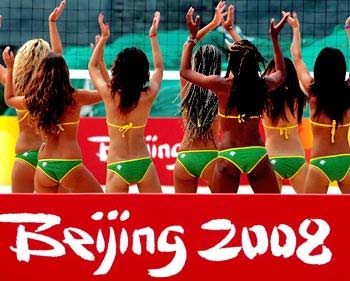
Beijing beach volleyball bikinisIsn’t it vaguely jarring when someone is asked publicly what would be their fondest wish, and they don’t say “world peace?” I feel that way about athletes and celebrities in these times of great conflict. They could say Impeach Bush, Stop Torture, the Media Is Lying, or at the very least, the Emperor Has No Clothes! Instead they feed the media narrative fretting about their quest for a medal, about which we know already.

Not to say the reporters aren’t eager to run with whatever revelation they get. When Usain Bolt revealed that he fuels his running by eating “nuggets,” the press was quick to announce the Fastest Man on Earth eats McDonalds. It’s an easy conclusion. Where else are nuggets on a menu but the Mc variety? A convenient conclusion too, as McDonalds is a chief sponsor of the Olympics. They’re running adds featuring ex-athletes, in athletic settings, pitching McPhood. Although no Olympic athlete could jeopard his/her health to a McDonalds meal depth-charge. Sports reporters know that too. Shame on them for perpetrating the McNuggets disinfo until Bolt’s father could be reached for an explanation. Usain’s “nuggets” are a concoction of yams, and no doubt something Jamaican that will soon be ruled out as doping.

Reporters did interview an Olympic competitor who’s eating plenty at the Beijing McD’s. He’s an archer, who has no need to move around. Probably his weight stabilizes his aim. Probably too he’s got no aspirations for the Pentathlon. The convenient unofficial unsolicited McEndorser weighs 215 pounds.

I’ve heard Olympic athletes are oblivious to real world concerns. Perhaps I can forgive them for not making political statements, even though they have the forum. They’re forbidden, but as attention hounds, you’d think they’d notice that the athletes now most honored for the 1968 Mexico City Games were the ones who raised their fists.

Instead the 2008 Beijing Olympics has this: heralded to be the best Beach Volleyball duo of all time (The TV announcer kept asking “Can I say it? Can I say this is the best beach volleyball team of all time?!” -even though this sport/spectacle pandering to the NASCAR fans has been part of the Olympics only THREE TIMES BEFORE), the winners had this statement to make, after clearing it with their interviewer.

Said Kerri Walsh: “Can I say something? Thank you Mr. President, for your support. And thank you for all that you do!”

Cindy Sheehan & Public Enemy at DNC

R68 Monday Press Conference
DENVER- DNC demonstration organizers Recreate 68 announced today that Cindy Sheehan will be speaking at its END THE OCCUPATION rally on Sunday. Sheehan will join Cynthia McKinney and other luminaries at the kick-off of R68’s antiwar activities surrounding the DNC. The bigger news today was that Public Enemy will be coming together for the cause with a free concert on Tuesday afternoon, August 26, at Denver’s Civic Center Park.

1. Public Enemy Free Concert
The Re-create 68 Alliance has announced that in addition to free shows by Dead Prez, Rebel Diaz and Blue Scholars, and 22 other influential bands, the historic and legendary political hip-hop band Public Enemy (The original line-up) will be playing a free concert at Civic Center Park on Tuesday, August 26, 2008 at 2pm which is expected to draw thousands (no tickets necessary).

2. Cindy Sheehan Joins Us in Denver
The Re-create 68 Alliance also announced that anti-war activist Cindy Sheehan and Green Party Presidential candidate Cynthia McKinney and Green Party Vice Presidential candidate Rosa Clemente will be joining their historic line-up of speakers who include Ida Audeh, Kathleen Cleaver, Ward Churchill, Mark Cohen, Chairman Fred Hampton Jr., Larry Hales, Larry Holmes, Ron Kovic, Glenn Spagnuolo, Pamela Africa, King Downing, Jenny Esquiveo, Mumia Abu Jamal – Current Political Prisoner (Recorded from Death Row for the DNC), Gloria Estela La Riva, Ricardo Romero, Natsu Saito, Ann Erika White Bird, and others.

3. March and Street Theater in the Freedom Cage
Monday August 25 at 9am, Re-create will be staging a street theater demo at the Freedom Cages. We need your assistants and can explain the details when you arrive. We will be starting at Skyline Park on the 16th Street Mall and head to the Freedom Cages at the Pepsi Center. If you cherish your civil liberties, than you should be apart of this event!

For more information on other speakers and bands, go to http://www.recreate68.org

Latest Election 2008 news is old news

All the bad news last week provided cover for the breaking of worse news. The Georgia standoff, the Iranian escalation, the dawning climate disaster –what could be a worst development? Lost hope. In election news, pollsters are beginning to tell us this presidential election is going to be close. Wha?! I’ve heard that one before, and so have you.

Wasn’t it just months ago that Obama could do no wrong? McCain was dismissed out of hand. Now they’re tied?! Oh I have no doubt that they’re neck and neck. In media terms, and in ballot counts. It’s plenty easy to forecast what you see coming if you’re going to deliver it. A close race. Like Bush and Gore. Like Bush and Kerry.

What’s expected as a landslide for reform becomes a close race, then a Republican victory, then a count with contestable irregularities, then an irreversible stolen election. So we’re at stage two. Obama’s voice of hope, tidal wave of public disaffection with the DC cabal, is ground to a halt against a heretofore wart on the ugly face of American idiocy. How is it possible? When you watch a magic act, do you ask, how is this possible? Because that’s not in question, is it? It’s not possible. The question is, how did the magician do it.

What have we learned from the past close elections? That we should have tried harder? That we could have given the slightest bit more? Let me ask you, how many more votes did we need to overcome a rigged count? How much larger an exit-poll count would we have needed to dispute the official tally?

News now that this election is going to be close, should be the harbinger of the shell game to come. Concentrate as hard as you like, give as much money to the shills standing around in hope that they will keep a close watch with you, you haven’t figured out the nature of this game.

The fix is in. The old coot is going to win. No mount of Obama TV ads to counter McCain TV ads are going to alter the Diebold, Republican Secretary of State office election fraud. Oh, the polls are dead on. The corporate media is dead on. The election will be close. Ask them what the count will be. They know that already too.

Recreate 68 explains diplomatic silence

Recreate 68
DENVER- From Recreate 68 e-news flash: “We would like to reiterate the fact that, contrary to reports, all of the events coordinated by R-68 are permitted and legal events and are organized with our statement of non-violence and our statement of principles of solidarity in mind.”

R-68 announced its updated schedule for the DNC, and breaks its silence about the over-publicized acrimony between DNC protest organizers.

Before we list the events, R-68 would like to take a moment and address an ever-increasing amount of attacks from the more conservative quarters on the left. Many have asked us to respond to multiple false and inaccurate claims and smear jobs put out by other organizations and individuals.

These types of mis-information campaigns have a long history here in Denver and across this country. When an organization allies with the voices of the oppressed and becomes effective, the attacks escalate. These attacks and counter-organizations started over a year ago but have come and gone. R-68 has always maintained a principled position and refused to engage in this behavior due to our belief that the left needs unity and solidarity now more than ever and this unproductive in-fighting is a distraction to the larger global issues we face.

Our actions and behavior speak louder than words and we will continue to try to set the example of principled behavior for our communities. We will not respond, in kind, to these slanderous attacks, but instead, will maintain our focus to provide a forum for oppressed communities and communities of color and to do what we can to amplify their voices on the political stage. Our events will reflect all of the hard work and commitment to the vision that was shared with us at the beginning of our organizing efforts, a vision that became the foundation and blueprint for our actions from respected voices and leaders in this struggle from the communities mentioned above.

Unfortunately, Cynthia McKinney and Rosa Clemente, two voices for true change in this country, have become targets of some of this unnecessary and unproductive rage that has been perpetuated by what we refer to as spirit snipers. Spirit snipers are people who take shots from afar at others working for change, while doing nothing positive in the community. We applaud the principled stand that Cynthia & Rosa have taken in the face of threats and intimidation to their campaign for the highest office in this land. It is not often that one will find such a morally sound base in a political ticket or individual. So yes, R-68 does support a “black” candidate and a “female” candidate – that is why we support Cynthia McKinney and Rosa Clemente!

1. Press Conference
R-68 will be hosting a press conference on Monday, August 18, 2008 at 2pm in Civic Center Park at the Greek Amphitheater. We will be announcing the name and the date of performance of a historic politically driven band that will be joining us for a free concert for the people. In addition, we will be announcing three guest speakers who are well known and respected nationally who have committed to joining us and speaking with our already historic line-up of voices for change. Please come down and support the spokes people.

2. Events
R-68 has assisted certain communities in organizing the logistics for historic events in Denver during the DNC. Below is a list of the events, speakers and music acts that will be occurring each day. Please note that this is not the entire amazing amount of activities that will be occurring during the week. You can go to our welcoming table at any of our events and obtain a copy of a comprehensive schedule that our welcome committee worked hard to produce. The schedule includes events from all other groups in addition to ours in order to maximize the voices of our communities and show solidarity in message. In addition, our welcome table will provide transportation information, logistical information and a list of friendly businesses to visit during your stay.

We would like to reiterate the fact that, contrary to reports, all of the events coordinated by R-68 are permitted and legal events and are organized with our statement of non-violence and our statement of principles of solidarity in mind.

Obama & McCain, both weak candidates

McCain and ObamaLet’s face it, the System has offered up two very unconvincing candidates for the general American public to have to ‘choose’ from in our US pseudo democracy. Nowhere was that underlined more than at the prayer fest that the two held last night at the Saddleback Church under ‘Pastor Rick’ (as Obama has called this huckster).

It seems that the Democratic Party fully intends to demoralize its supporters in 2008 by aping the Republicans even more than they have done in the past. Phony religion is the best way to accomplish that. We can remember quite well where Pastor Jimmy Carter prepped the nation and set it up for Ronald The Clown’s Reaganism.

This turn to religion by Obama comes precisely while the nation is most fed up with the role the Religious Right has played over the last 8 years in America’s political life, too. In some ways, this strategy of wrapping himself in a religious aura right now is the biggest betrayal of democracy that General Obama is now carrying out. He is pushing for troops to Afghanistan continuing the illegal occupation of that country by ours, and serving up his militarism with prayers and glib Christian religiosity.

This weak effort by a weak candidate will give McCain the opening to keep Republican control over the White House intact. As big a stumbling bum as John McCain is, he is equally matched with the bumbling foolishness that the Obama campaign will sport. For us out there forced to be awash in this stupidity by the constant bombardment of the corporate media propaganda machine, it is going to be a truly sickening spectacle that we will see America awash in. The corporate parties only offer the US public total sewage this year with its blast of ‘lesser of 2 evilism’ slop.

LA Times coverage of the prayerfest- Barack Obama, John McCain discuss faith, issues at Saddleback Church forum Is there really a lesser of 2 evils here, or is that merely a delusion?

A fan of McDonald’s

McDonalds fan
BEIJING- Could there be a more offensive marketing campaign than this one? McDonald’s has taken a revered Chinese symbol and turned it into a corporate billboard. Beijing 2008 brought to you by an American fast food chain.

In the “open-24/7!” store in the Athlete’s Village, McDonald’s touts one or two “healthy” menu options buried deep beneath the grease-laden, e-Coli-infected, allegedly-edible garbage they offer. Message to young people: you, too, can bring home Olympic gold if you shove this shit in your mouth and work real real hard. Just don’t forget that you must also pay constant homage to Nike, the goddess of victory, except when honoring Ralph Lauren, the lord of the Great Gatsby set.

Remember, too, that you mustn’t offer up your MasterCard, for that is a grave offense. These gods only accept Visa, your ticket to the world.

Green Party-pooper insubordination more embarrassing than imaginable

And I thought I hade a vivid imagination. Green Party presidential candidate Cynthia McKinney has issued a press release detailing her explicit intention to participate in the Sunday DNC rally. The letter is very diplomatic but it spells out the ultimatum she was given by the Colorado Greens to desist. Cynthia McKinney for President Compelling reading. On a related note. Cindy Sheehan will also be joining the lineup. This represents a significant divergence from her close allies Medea Benjamin and UFPJ’s Leslie Cagan. It shouldn’t be that way.

If you’re not inclined to read McKinney’s letter, and I’ll add it’s as direct as her speeches, I can summarize the threats made and actions taken. Spoiler alert. For agreeing to speak at a rally organized by R-68: Resignation threatened. Fundraiser, place to stay, withdrawn. All scheduled engagements canceled. Assistance to get on Wyoming ballot, withdrawn. Every effort to remove her from Colorado ballot, threatened. McKinney was also informed she had been last choice candidate of Colorado delegation. So there.

Are we witnessing someone’s hissy-fit nervous self-immolation? Could be, but it packs the wallop of a suicide bomber. Local party gutted; bystanders, fellow Greens, burned; vital preparations annulled just months from the election. Third parties probably attract people who have difficulty with authority. In this case with irreparable consequence.

Cynthia McKinney & Rosa Clemente Announce Their Participation in Anti-war, Anti-human rights Abuse Events Before the DNC
August 14, 2008

As the United States activated Navy ships and the Air Force to begin an airlift of non-specified goods into the former Soviet state of Georgia, and military exercises began in the Persian Gulf near Iran, I received communications from certain individuals among the Colorado Greens who were organizing campaign support events there, suggesting that I not participate in an anti-war program being organized by other individuals in Colorado.

Perplexed, I began to do my research to understand the nature of the fissure that I seemed to be placing myself in the middle of. The communications to me about not participating in one of the scheduled events became more and more shrill. The events ran through August 26th. When the lineup of speakers, including Rosa and me, was announced for the events in question, I received multiple communications stating in various ways that the sender from the Green Party of Colorado, was on the verge of desperation over the matter. Within a few hours, I was reading messages stating that the Green Party of Colorado would be ruined if I participated in the End the Occupations/End the War march and rally slated to take place on the morning of August 24th on the steps of the Colorado State Capitol, or if Rosa participated in a Freedom March and Rally for Human Rights and Political Prisoners at Civic Center Park the following day.

An article appeared in a local Colorado newspaper stating that Rosa and I would not appear at the events for which we had been scheduled. Rosa responded to our Colorado Green Party contact that yes, indeed, we were appearing at the two events. Both Rosa and I then received messages demanding to know by a time certain what our plans were, and asserting that the Green Party of Colorado would be totally ruined if we associated with the group sponsoring the events. In addition, we were told that at least one resignation and sustaining membership would be tendered to the Party, and that Rosa and I could expect no support on the ground in Denver from the Green Party of Colorado, including a planned fundraiser and a place to stay.

Without receiving any additional response or information from either Rosa or I, the correspondent sent a message informing us that all Green Party of Colorado events previously scheduled for us had been canceled. Further, the message stated that ballot access petitioning by Green Party of Colorado would cease in neighboring Wyoming and that all efforts would be made to remove Rosa’s and my names from the ballot in Colorado. The message also noted that the Colorado delegation overwhelmingly supported Elaine Brown at the Green Party Convention.

With the e-mail messages flying “fast and furious,” I hope I have mentioned the highlights of this episode in somewhat chronological order. What Rosa and I would like to address now, is the ideological and rational order that produced this outcome. At the very first Green Party debate held in San Francisco earlier this year, I pleaded for unity of action and purpose as we face the challenges that confront us as a country. Rosa and I are proud to join with others who are sick and tired of war, occupation, human rights abuses, and the continued incarceration of our political prisoners. We are proud to join with others who are willing to do something about it. In the context of activities in Denver, that means cooperating with some organizations new to us and others with which Rosa and I have had a long-standing relationship. Let me explain some of those relationships.

I am proud to have received a Backbone Award from the Backbone Campaign, one of the co-participants of the anti-war, anti-occupation events in question, according to the organizers.

Rosa and I are pleased to have received the endorsement of M-1 of Dead Prez, who put out a video of endorsement and is rallying other conscious Hip Hop, Generation X voters to the Green Party with Rosa and I as its nominees. Rebel Diaz was on the stage with Rosa as she accepted her Green Party nomination for Vice President. Both Dead Prez and Rebel Diaz are participating in the events in question, according to the organizers.

Fred Hampton, Jr.’s mother, a victim of COINTELPRO, came to Georgia in the mid-1990s to help me gain reelection after a malicious redistricting case that went all the way up to the Supreme Court. Ward Churchill has traveled to my Congressional district to educate my former constituents on the COINTELPRO of yesterday and the COINTELPRO of today. Natsu Saito introduced me to other victims of COINTELPRO. I asked Kathleen Cleaver to co-author a report that was submitted to Mary Robinson, the United Nations High Commissioner for Human Rights at the time of the World Conference Against Racism, on the unsolved murders of Black Panther Party members who were victims of COINTELPRO. Fred Hampton, Jr., Ward Churchill, Natsu Saito, and Kathleen Cleaver are all participating in the events in question, according to the organizers.

As a Member of Congress, I supported the release of all political prisoners and welcomed information from the American Indian Movement about Leonard Peltier. I have at many times in my political career been allied with the ACLU, and have always supported Pam and Ramona Africa and the MOVE Organization. The American Indian Movement of Colorado, King Downing of the ACLU, and Pam and Ramona Africa of MOVE are all participating in the events in question, according to the organizers.

Mumia Abu Jamal has endorsed the Power to the People Campaign and my Green Party candidacy. According to the organizers, Mumia will transmit a message to all of us participating in the events in question.

Finally, I have appeared on various stages with many Palestinians; I have proudly spoken at rallies organized by Larry Holmes. Debra Sweet with World Can’t Wait was among the very first to my knowledge to organize around impeachment as an imperative and I support hers and all other impeachment groups in their efforts. And finally, I have known Ben Manski for a long time as a socially conscious activist who is also a member of the Green Party. According to the organizers, a Palestinian refugee is slated to speak at the events in question, as well as Larry Holmes, Debra Sweet, and Ben Manski.

Rosa and I have not been given any rational, ideological, or strategically-acceptable reason by the Green Party of Colorado to dissociate ourselves from the movement that this country so desperately needs and that these individuals and organizations participating represent, as we all attempt to hold the Democratic Party accountable for its complicity in all of the crimes of the Bush Administration. Therefore Rosa and I will keep our appointments in Denver and we hope that the members of the Green Party of Colorado will attend our sessions and listen to what we have to say. I have faith that by taking principled stands against war and occupation, human rights abuse, the prison-industrial complex, and in support of freedom for political prisoners, the Green party will emerge stronger.

Cynthia McKinney
Green Party Nominee for President of the United States

Rosa Clemente
Green Party Nominee for Vice President of the United States

South Ossetia a land grab by US Georgia

Russian tanks come to protect South OssetiaThe US is decrying Russian aggression in South Ossetia, a breakaway province of Georgia, itself a breakaway of the ex-Soviet states. Georgia is a US proxy and a NATO beachhead aimed toward Russia and the Middle East. South Ossetia is a critical part. Here’s analysis from Global Research:

War in the Caucasus: Towards a Broader Russia-US Military Confrontation?
By Michel Chossudovsky, Global Research, August 10, 2008

During the night of August 7, coinciding with the opening ceremony of the Beijing Olympics, Georgia’s president Saakashvili ordered an all-out military attack on Tskhinvali, the capital of South Ossetia.

The aerial bombardments and ground attacks were largely directed against civilian targets including residential areas, hospitals and the university. The provincial capital Tskhinvali was destroyed. The attacks resulted in some 1500 civilian deaths, according to both Russian and Western sources. “The air and artillery bombardment left the provincial capital without water, food, electricity and gas. Horrified civilians crawled out of the basements into the streets as fighting eased, looking for supplies.” (AP, August 9, 2008). According to reports, some 34,000 people from South Ossetia have fled to Russia. (Deseret Morning News, Salt Lake City, August 10, 2008)

The importance and timing of this military operation must be carefully analyzed. It has far-reaching implications.

Georgia is an outpost of US and NATO forces, on the immediate border of the Russian Federation and within proximity of the Middle East Central Asian war theater. South Ossetia is also at the crossroads of strategic oil and gas pipeline routes.

Georgia does not act militarily without the assent of Washington. The Georgian head of State is a US proxy and Georgia is a de facto US protectorate.

Who is behind this military agenda? What interests are being served? What is the purpose of the military operation.

There is evidence that the attacks were carefully coordinated by the US military and NATO.

Moscow has accused NATO of “encouraging Georgia”. Russia’s Foreign Minister Sergey Lavrov underscored the destabilizing impacts of “foreign” military aid to Georgia: .

“It all confirms our numerous warnings addressed to the international community that it is necessary to pay attention to massive arms purchasing by Georgia during several years. Now we see how these arms and Georgian special troops who had been trained by foreign specialists are used,” he said.(Moscow accuses NATO of having “encouraged Georgia” to attack South Ossetia, Russia Today, August 9, 2008)

Moscow’s envoy to NATO, Dmitry Rogozin, sent an official note to the representatives of all NATO member countries:

“Russia has already begun consultations with the ambassadors of the NATO countries and consultations with NATO military representatives will be held tomorrow,” Rogozin said. “We will caution them against continuing to further support of Saakashvili.”

“It is an undisguised aggression accompanied by a mass propaganda war,” he said.

(See Moscow accuses NATO of having “encouraged Georgia” to attack South Ossetia, Russia Today, August 9, 2008)

According to Rogozin, Georgia had initially planned to:

“start military action against Abkhazia, however, ‘the Abkhaz fortified region turned out to be unassailable for Georgian armed formations, therefore a different tactic was chosen aimed against South Ossetia’, which is more accessible territorially. The envoy has no doubts that Mikheil Saakashvili had agreed his actions with “sponsors”, “those with whom he is negotiating Georgia’s accession to NATO “. (RIA Novosti, August 8, 2008)

Contrary to what was conveyed by Western media reports, the attacks were anticipated by Moscow. The attacks were timed to coincide with the opening of the Olympics, largely with a view to avoiding frontpage media coverage of the Georgian military operation.

On August 7, Russian forces were in an advanced state readiness. The counterattack was swiftly carried out.

Russian paratroopers were sent in from Russia’s Ivanovo, Moscow and Pskov airborne divisions. Tanks, armored vehicles and several thousand ground troops have been deployed. Russian air strikes have largely targeted military facilities inside Georgia including the Gori military base.

The Georgian military attack was repealed with a massive show of strength on the part of the Russian military.
Act of Provocation?

US-NATO military and intelligence planners invariably examine various “scenarios” of a proposed military operation– i.e. in this case, a limited Georgian attack largely directed against civilian targets, with a view to inflicting civilian casualties.

The examination of scenarios is a routine practice. With limited military capabilities, a Georgian victory and occupation of Tskhinvali, was an impossibility from the outset. And this was known and understood to US-NATO military planners.

A humanitarian disaster rather than a military victory was an integral part of the scenario. The objective was to destroy the provincial capital, while also inflicting a significant loss of human life.

If the objective were to restore Georgian political control over the provincial government, the operation would have been undertaken in a very different fashion, with Special Forces occupying key public buildings, communications networks and provincial institutions, rather than waging an all out bombing raid on residential areas, hospitals, not to mention Tskhinvali’s University.

The Russian response was entirely predictable.

Georgia was “encouraged” by NATO and the US. Both Washington and NATO headquarters in Brussels were acutely aware of what would happen in the case of a Russian counterattack.

The question is: was this a deliberate provocation intended to trigger a Russian military response and suck the Russians into a broader military confrontation with Georgia (and allied forces) which could potentially escalate into an all out war?

Georgia has the third largest contingent of coalition forces in Iraq after the US and the UK, with some 2000 troops. According to reports, Georgian troops in Iraq are now being repatriated in US military planes, to fight Russian forces. (See Debka.com, August 10, 2008)

This US decision to repatriate Georgian servicemen suggests that Washington is intent upon an escalation of the conflict, where Georgian troops are to be used as canon fodder against a massive deployment of Russian forces.

US-NATO and Israel Involved in the Planning of the Attacks

In mid-July, Georgian and U.S. troops held a joint military exercise entitled “Immediate Response” involving respectively 1,200 US and 800 Georgian troops.

The announcement by the Georgian Ministry of Defense on July 12 stated that they US and Georgian troops were to “train for three weeks at the Vaziani military base” near the Georgian capital, Tbilisi. (AP, July 15, 2008). These exercises, which were completed barely a week before the August 7 attacks, were an obvious dress rehearsal of a military operation, which, in all likelihood, had been planned in close cooperation with the Pentagon.

The war on Southern Ossetia was not meant to be won, leading to the restoration of Georgian sovereignty over South Ossetia. It was intended to destabilize the region while also triggering a US-NATO confrontation with Russia.

On July 12, coinciding with the outset of the Georgia-US war games, the Russian Defense Ministry started its own military maneuvers in the North Caucasus region. The usual disclaimer by both Tblisi and Moscow: the military exercises have “nothing to do” with the situation in South Ossetia. (Ibid)

Let us be under no illusions. This is not a civil war. The attacks are an integral part of the broader Middle East Central Asian war, including US-NATO-Israeli war preparations in relation to Iran.

The Role of Israeli Military Advisers

While NATO and US military advisers did not partake in the military operation per se, they were actively involved in the planning and logistics of the attacks. According to Israeli sources (Debka.com, August 8, 2008), the ground assault on August 7-8, using tanks and artillery was “aided by Israeli military advisers”. Israel also supplied Georgia with Hermes-450 and Skylark unmanned aerial vehicles, which were used in the weeks leading up to the August 7 attacks.

Georgia has also acquired, according to a report in Rezonansi (August 6, in Georgian, BBC translation) “some powerful weapons through the upgrade of Su-25 planes and artillery systems in Israel”. According to Haaretz (August 10, 2008), Israelis are active in military manufacturing and security consulting in Georgia.

Russian forces are now directly fighting a NATO-US trained Georgian army integrated by US and Israeli advisers. And Russian warplanes have attacked the military jet factory on the outskirts of Tbilisi, which produces the upgraded Su-25 fighter jet, with technical support from Israel. (CTV.ca, August 10, 2008)

When viewed in the broader context of the Middle East war, the crisis in Southern Ossetia could lead to escalation, including a direct confrontation between Russian and NATO forces. If this were to occur, we would be facing the most serious crisis in US-Russian relations since the Cuban Missile crisis in October 1962.

Georgia: NATO-US Outpost

Georgia is part of a NATO military alliance (GUAM) signed in April 1999 at the very outset of the war on Yugoslavia. It also has a bilateral military cooperation agreement with the US. These underlying military agreements have served to protect Anglo-American oil interests in the Caspian sea basin as well as pipeline routes.

Both the US and NATO have a military presence in Georgia and are working closely with the Georgian Armed Forces. Since the signing of the 1999 GUAM agreement, Georgia has been the recipient of extensive US military aid.

Barely a few months ago, in early May, the Russian Ministry of Defense accused Washington, “claiming that [US as well as NATO and Israeli] military assistance to Georgia is destabilizing the region.” (Russia Claims Georgia in Arms Buildup, Wired News, May 19, 2008). According to the Russian Defense Ministry

“Georgia has received 206 tanks, of which 175 units were supplied by NATO states, 186 armored vehicles (126 – from NATO) , 79 guns (67 – from NATO) , 25 helicopters (12 – from NATO) , 70 mortars, ten surface-to-air missile systems, eight Israeli-made unmanned aircraft, and other weapons. In addition, NATO countries have supplied four combat aircraft to Georgia. The Russian Defense Ministry said there were plans to deliver to Georgia 145 armored vehicles, 262 guns and mortars, 14 combat aircraft including four Mirazh-2000 destroyers, 25 combat helicopters, 15 American Black Hawk aircraft, six surface-to-air missile systems and other arms.” (Interfax News Agency, Moscow, in Russian, Aug 7, 2008)

NATO-US-Israeli assistance under formal military cooperation agreements involves a steady flow of advanced military equipment as well as training and consulting services.

According to US military sources (spokesman for US European Command), the US has more than 100 “military trainers” in Georgia. A Pentagon spokesman Bryan Whitman “said there were no plans to redeploy the estimated 130 US troops and civilian contractors, who he said were stationed in the area around Tblisi” (AFP, 9 August 2008). In fact, US-NATO military presence in Georgia is on a larger scale to that acknowledged in official statements. The number of NATO personnel in Georgia acting as trainers and military advisers has not been confirmed.

Although not officially a member of NATO, Georgia’s military is full integrated into NATO procedures. In 2005, Georgian president proudly announced the inauguration of the first military base, which “fully meets NATO standards”. Immediately following the inauguration of the Senakskaya base in west Georgia, Tblisi announced the opening of a second military base at Gori which would also “comply with NATO regulations in terms of military requirements as well as social conditions.” (Ria Novosti, 26 May 2006).

The Gori base has been used to train Georgian troops dispatched to fight under US command in the Iraq war theater.

It is worth noting that under a March 31, 2006, agreement between Tblisi and Moscow, Russia’s two Soviet-era military bases in Georgia – Akhalkalaki and Batumi have been closed down. (Ibid) The pullout at Batumi commenced in May of last year, 2007. The last remaining Russian troops left the Batumi military facility in early July 2008, barely a week before the commencement of the US-Georgia war games and barely a month prior to the attacks on South Ossetia.

The Israel Connection

Israel is now part of the Anglo-American military axis, which serves the interests of the Western oil giants in the Middle East and Central Asia.

Israel is a partner in the Baku-Tblisi- Ceyhan pipeline which brings oil and gas to the Eastern Mediterranean. More than 20 percent of Israeli oil is imported from Azerbaijan, of which a large share transits through the BTC pipeline. Controlled by British Petroleum, the BTC pipeline has dramatically changed the geopolitics of the Eastern Mediterranean and the Caucusus:

“[The BTC pipeline] considerably changes the status of the region’s countries and cements a new pro-West alliance. Having taken the pipeline to the Mediterranean, Washington has practically set up a new bloc with Azerbaijan, Georgia, Turkey and Israel, ” (Komerzant, Moscow, 14 July 2006)

While the official reports state that the BTC pipeline will “channel oil to Western markets”, what is rarely acknowledged is that part of the oil from the Caspian sea would be directly channeled towards Israel, via Georgia. In this regard, a Israeli-Turkish pipeline project has also been envisaged which would link Ceyhan to the Israeli port of Ashkelon and from there through Israel’s main pipeline system, to the Red Sea.

The objective of Israel is not only to acquire Caspian sea oil for its own consumption needs but also to play a key role in re-exporting Caspian sea oil back to the Asian markets through the Red Sea port of Eilat. The strategic implications of this re-routing of Caspian sea oil are far-reaching. (For further details see Michel Chossudovsky, The War on Lebanon and the Battle for Oil, Global Research, July 2006)

What is envisaged is to link the BTC pipeline to the Trans-Israel Eilat-Ashkelon pipeline, also known as Israel’s Tipline, from Ceyhan to the Israeli port of Ashkelon.

“Turkey and Israel are negotiating the construction of a multi-million-dollar energy and water project that will transport water, electricity, natural gas and oil by pipelines to Israel, with the oil to be sent onward from Israel to the Far East,

The new Turkish-Israeli proposal under discussion would see the transfer of water, electricity, natural gas and oil to Israel via four underwater pipelines.

http://www.jpost.com/servlet/Satellite?cid=1145961328841&pagename=JPost%2FJPArticle%2FShowFull“Baku oil can be transported to Ashkelon via this new pipeline and to India and the Far East.[via the Red sea]”

“Ceyhan and the Mediterranean port of Ashkelon are situated only 400 km apart. Oil can be transported to the city in tankers or via specially constructed under-water pipeline. From Ashkelon the oil can be pumped through already existing pipeline to the port of Eilat at the Red Sea; and from there it can be transported to India and other Asian countries in tankers. (REGNUM)

In this regard, Israel is slated to play a major strategic role in “protecting” the Eastern Mediterranean transport and pipeline corridors out of Ceyhan. Concurrently, it also involved in channeling military aid and training to both Georgia and Azerbaijan.

A far-reaching 1999 bilateral military cooperation agreement between Tblisi and Tel Aviv was reached barely a month before the NATO sponsored GUUAM agreement. It was signed in Tbilisi by President Shevardnadze and Israel’s Prime Minister Binyamin Netanyu. These various military cooperation arrangements are ultimately intended to undermine Russia’s presence and influence in the Caucasus and Central Asia.

In a pro forma declaration, Tel Aviv committed itself, following bilateral discussions with Moscow, on August 5, 2008, to cut back military assistance to Georgia.

Russia’s Response

In response to the attacks, Russian forces intervened with conventional ground troops. Tanks and armored vehicles were sent in. The Russian air force was also involved in aerial counter-attacks on Georgian military positions including the military base of Gori.

The Western media has portrayed the Russian as solely responsible for the deaths of civilians, yet at the same time the Western media has acknowledged (confirmed by the BBC) that most of the civilian casualties at the outset were the result of the Georgian ground and air attacks.

Based on Russian and Western sources, the initial death toll in South Ossetia was at least 1,400 (BBC) mostly civilians. “Georgian casualty figures ranged from 82 dead, including 37 civilians, to a figure of around 130 dead…. A Russian air strike on Gori, a Georgian town near South Ossetia, left 60 people dead, many of them civilians, Georgia says.” (BBC, August 9, 2008). Russian sources place the number of civilian deaths on South Ossetia at 2000.

A process of escalation and confrontation between Russia and America is unfolding, reminiscent of the Cold War era.

Are we dealing with an act of provocation, with a view to triggering a broader conflict? Supported by media propaganda, the Western military alliance is intent on using this incident to confront Russia, as evidenced by recent NATO statements.

R68 announces speakers to counter DNC

DENVER- The Recreate 68 Alliance has announced its lineup of speakers for the DNC rallies. Among them: Pamela Africa (MOVE), Kathleen Cleaver, Rosa Clemente, Ward Churchill, Jenny Esquiveo (spokesperson for Eric McDavid), Fred Hampton Jr., a recording from Mumia Abu Jamal, Cha Cha Jimenez, Ron Kovic, Cynthia McKinney, Ricardo Romero, Natsu Saito, and a spokesperson for the Cuban Five.

Sunday, August 24:
End the Occupations/End the War March & Rally 9am – 2pm
West Steps of the State Capitol Building to the Pepsi Center
This will be Denver’s largest anti-war, anti-illegal occupations march and rally.

Speakers (Alphabetical):
Ida Audeh – Palestinian Refugee
Kathleen Cleaver – Black Panthers
Ward Churchill – Long-time Author, Activist, and Scholar
Mark Cohen – Re-create 68 Alliance
Chairman Fred Hampton Jr. – Prisoners of Conscience Committee
Larry Hales – World Worker’s Party and Re-create 68 Alliance
Larry Holmes – Troops Out Now Coalition
Ron Kovic – anti-war activist, veteran and author of Born On The Fourth of July
Cynthia Mckinney – Green Party United States Presidential Candidate
Glenn Spagnuolo – Re-create 68 Alliance

Bands:
David Rovic – State Capitol Steps, kicking of the rally
M1 and Stic Man from Dead Prez – State Capitol Steps, prior to the march
Blue Scholars – Concert at State Capitol, after the march
Jim Page – State Capitol Steps, during the rally

Monday, August 25:
Freedom March and Rally for Human Rights and Political Prisoners,
10am – 2pm Civic Center Park to the Federal Court House

Speakers (Alphabetical):
Pamela Africa – MOVE Organization
American Indian Movement Spokes Person- Leonard Peltier Defense
Rosa Clemente – United States Vice Presidential Candidate for the Green Party
Kathleen Cleaver – The Panther Nine from San Francisco
King Downing – National Coordinator of the ACLU’s Campaign Against Racial Profiling
Jenny Esquiveo- Spokesperson for Eric McDavid (Political Prisoner)
Chairman Fred Hampton Jr. – Prisoners of Conscience Committee
Mumia Abu Jamal – Current Political Prisoner (Recorded from Death Row)
Cha Cha Jimenez- Founder of the Young Lords (Puerto Rican Resistance Prisoners)
Ricardo Romero – National Coordinator for the Mexican Liberation Organization
Natsu Saito – Author, Activist, and Human Rights Scholar (Guantanamo Inmates)
Spokesperson for the Cuban Five

Bands:
** Special Guest Band To Be Announced **

Monday, August 25:
Festival of Democracy, entertainment start time – 3pm
Civic Center Park (free concerts)

Bands:
Savage Family – From Illegally Occupied U.S.
Dinigunim – San Diego
DJ Cavem – Five Points, CO
Moetavation – Five Points, CO
DJ Asar Heru – Brooklyn
Karma – Barbados
Whiskey Blanket – Boulder
Midstate Music – Chicago
Dario Rosa – Boulder

Special Guest Speakers and Poets Between Acts

Tuesday, August 26:
Festival of Democracy, entertainment start time – 3pm
Civic Center Park (free concerts)

Bands:
Debajo Del Agua – Denver
DKO-Electric Horns – Denver
Melanie Susuras Band – Denver
Rebel Diaz – Bronx
The Night Kitchen – Boulder
From The Depths – North Carolina
Black Sheep Brigade – Boulder

Special Guest Speakers and Poets Between Acts

Poets for Monday and Tuesday:
Isis, Ladyspeech, Bianca, Lucifury, Allende, Bobby LeFebre (members from Nationally Ranked Slam Nuba Team 2008)

Additional Speakers Throughout the Week:
Deb Sweet – World Can’t Wait
Mason Tyert – SAFER
Timothy Tipton – Rocky Mountain Caregiver’s Cooperative
Ben Manski – Bring the Guard Home
CHOIR – ‘Acapella Choir with a conscience’ from Oakland/San Francisco
Ramona Africa – MOVE Organization

Tuesday, August 26:
Liberation Soirée at Dazzle, 930 Lincoln St. – 8pm Start Time
A benefit concert and party for the Festival of Democracy. A “No More Politics as Usual” Party.

Bands:
Rhythm Vision – Denver
Rebel Diaz – Bronx
DeeJay SD & K DJ Above

Tuesday, August 26:
Phoenician Kabob Restaurant on Colfax and Ivy, 7pm:

Larry Everest – Author of “Oil, Power and Empire”, speaking on “What’s Behind the US Threats on Iran, and How Can We Stop Them”

This is a list of bands and speakers. Protest activities will be going on every day, all week. For more information and scheduled activities go to www.recreate68.org.

Opening ceremonies of Beijing Olympics star humanity in his own flea circus

Metropolis science fiction horror
Can you remember an Olympic Games opening ceremony that was not spectacular? Suffice it to say Beijing was the biggest, befitting the world’s most populous nation. “Awesome” provides perfectly qualified praise. I have to say this spectacle invoked colossal horror as it drew a full-color digital smiley face over Fritz Lang’s Metropolis.

Automatons
I thought the drumming performance was the most impressive. Two thousand (and eight) drummers beating their hands on antique-style drums set in mobile tables. The bare skinned drummers beat hard, seemingly to illuminate the square table surfaces, like fireflies assigned coordinates in an array, or a spider’s web.

We’ve admired marching ceremonies before, and synchronized flags. We marvel at the precision ensembles of Rockettes, Busby Berkley choreography, and, for want of an example further afield, the Chinese circus. What made the Bird Nest Stadium extreme so horrific was the miniaturization of man’s role. If it had been a Seurat painting, one man, one dot, we might have been comforted to see ourselves woven into a tapestry which created an artistic expression. Instead, long shots showed the full effect to be an LED board, each pixel either on or off, flickering based on whether that person was activated or not. Man as electron, charged or uncharged.

I wondered what was the stadium perspective. Did the audience of 91,000 see the large electronic panel or the matrix of individuals sweating to power it? An aerial view gave the TV audience the full effect, while other cameras zoomed in as if to provide a microscopic perspective of the human termites working frenetically in the machine.

Putting people in the role of insect automatons would seem to me a phobia of a humanitarian society. But the mechanized human component of the 2008 opening ceremonies was not disharmonious with the way we already see China. Everywhere performers were tethered, playing tiny roles in gargantuan schemes. Some provided the piston power to undulating cubes. They revealed themselves only at the end, and emerged only partially, free but to give a smile and wave. These giant light-board shows were switched by computers, their human components alerted by electric signal, be it light, or tone, or sensor, to synchronize their positions. A TV commentator who remarked about the amazing lack of wires, would be overlooking how his personal computing devices communicate these days.

Human labor
The human element was required for the spectacle, otherwise we’ve seen more complex LEDs on old ballpark scoreboards. Technically the chain-link of humans was superfluous, but doesn’t it represent China, where labor costs are negligible?

And so we cheered the 2008 drummers, who worked drums mounted into tables that could pass for work desks. Indeed the drummers were bent over them like bent people, galley slaves exerting themselves to the rhythm of the whip. It was a sea of modern slaves, the sweatshop laborers. Actually, two thousand and eight impressed the crowd, but that number is probably small for a factory workforce. Probably there are scenes like this many times as big in daily Chinese work life.

Food processing

Later the performance took on a Disneyesque quality as dancers opened umbrellas illuminated with large smiling faces of children. Is that a touch-stone theme for pseudo international-harmony? The promise of children? I wondered after seeing the drummers harnessed to their sewing tables, coordinated by an electronic whip-master, if the faces of children represented the child workforce. In traditional cultures childhood idleness ends when a child can carry water or sweep the floor. The idealized child is a Western facade and here China appears eager to celebrate the ruse. Mankind’s aspiration should emulate the innocuous, non-threatening smile of a child.

Gladiators
Never before have I gotten a clearer sense of the Olympics as gladiator games. The audience are the privileged few, who do not bring politics to the games except the rivalry of nationalism, a preference for their athletes, rooting for a win to enhance their prestige. Ninety dignitaries were in attendance in Beijing. And what a celebration of harmony. Regardless the turmoil between nations outside, between world leaders, harmony. Because they’re going nowhere. Only rebels and coups threaten the ruling class. Did you know an IOC rule forbids the display of flags of entities not competing in the games?

Politics don’t enter the minds of the athlete class because they’ve got a singular focus, their performance. Some strive for financial rewards, others are focused on the physical achievement. All are vying to please the emperor, to live to compete again.

Even as the techno pageantry dazzled, by the end I was still shocked to see a human being reduced to flintlock to carry the flame to the gigantic torch, a blazing industrial altar.

The colossal fireworks show looked to be outside the view of the stadium audience, but I saw no throngs outdoors to witness it. The pyrotechnics reminded me of Shock and Awe the first night in Baghdad, cameras well recessed to take it all in. It turns out a chunk of the fireworks was CGI for the TV spectacular.

In hindsight for me the highlight of the evening was seeing President Bush sitting next to Vladimir Putin, each saluting their athletes in turn, neither turning toward each other, at least on camera, while in Georgia US backed forces battled Russian soldiers in all out war. An example of a tangible measure to which politics are kept out of the Olympic Games.

Photos:
Drummer pool

Umbrella children

China’s Olympic image makeover redux

Beijing 1989 Tiananmen Square
I replaced the dancing figure in China’s Olympic emblem with the red motorcycle crushed by tanks at the Tiananmen Square Massacre.

The heavy red outline around the figure above the official Beijing 2008 logo resembles a Chinese written character, but it could also be blood pooled around the chalk outline of a body.
beijing-olympic-tibet-shame.jpg
Here’s what some activist artists conceived for an Olympic logo to commemorate the Chinese repression of Tibet. They placed massacred Buddhist monks around the red seal. They could just as easily be referring to the monks killed in Burma by the authoritarian military junta which is supported by China.

Unconventional Denver DNC schedule

DNC Disruption 08From Disruption’08:
Denver is currently overflowing with plans from an extremely diverse array of groups for different types of demonstrations, music festivals, street parties and actions that will occur during the entire week of the convention. The many events are roughly broken down into theme days (see below). Anarchists and anticapitalists are working on many aspects of this mobilization but have a general focus of expanding acts of resistance outside permitted areas, radicalizing the debate around the Democrats, and ensuring that during the convention there will be no business as usual in Denver!

Schedule of actions:

SUNDAY the 24th
-10:30am, Civic Center Park: Massive march against militarization and occupations called for by Recreate 68. This will be a family-friendly, low-risk event.
-Midday: Funk the War! Following the march, a large, low-risk street party called for by the Alliance for Real Democracy will fill downtown with music and festivities against the war
-Late Afternoon: As the convention-goers check into hotels and attend their pre-convention party, our own raging party in resistance to the militarized occupation of Denver and the world will reclaim public space and spread the festivities onto the streets. Be ready to take the rowdy celebration to the doorsteps of delegate hotels etc.

MONDAY the 25th
-10:30am, Civic Center Park: March against the prison industrial complex and for freedom for all political prisoners.
-Evening: Meet at the Civic Center at 6pm to join the anticapitalist march (see below) or participate in organized and decentralized actions that will actively disrupt the capitalist corruption and cronyism of the two party system by targeting specific fundraisers, delegate parties and corporations backing the DNC. come ready for quick decentralized actions spanning the downtown area at a variety of risk levels.

TUESDAY the 26th
-Afternoon: Confront the Spectacle- We vote no! As delegates are arriving at the Pepsi Center, snake marches will converge on the entrances through the fence of the no-protest zone in order to create spaces for different levels of delegate movement disruption. Flying squads will assist the disruption and create distractions as we bring their party to a halt.

WEDNESDAY the 27th
-All day: Actions and alternatives- Real solutions to the climate crisis! A day of direct action against ecological destruction. We will create solutions to global warming without the politicians by shutting down sources of greenhouse gas emissions and corporations who destroy the earth (and fund the Democrats). we will also engage in creative resistance outlining solutions and alternatives; bike bloc! car free zones! guerrilla gardening!

THURSDAY the 28th
-10:30am, Rude Park: No Borders March! No one is illegal! Join this national mobilization for immigrants rights and help us draw connections between the struggles of immigrant communities and the struggle against global capitalism. This will be a low-risk event safe for all people regardless of immigration status. so play nice.
-Evening: A special Denver anarchist variety show party, put on by none other then Denver’s Louis Vitton.

ALSO:
A precarious workers council of UA has called for an anti-capitalist force to manifest at the DNC as a black bloc on the evening of Monday the 25th. This will meet at Civic Center Park at 6:00pm and will coincide with Unconventional Denver’s call for organized and decentralized no-business-as-usual actions during the same evening. More details TBA.

*this is by no means a complete list of all actions planned by the many groups involved in the Denver mobilization. Check dncdisruption08.org, recreate68.org, realdemocracy2008.org, and weareamericadnc.org for other events and actions.

RECREATE 68 -No more politics as usual

Recreate-68 logoFrom RECREATE 68:
End the Occupations March and Rally — West Steps of the Colorado State Capitol, August 24, 9am
END THE OCCUPATIONS
No more free pass for the Democrats. Join R68 and others as we march to end all illegal imperialist occupations in Iraq, Palestine, Afghanistan, Puerto Rico, Haiti, Hawaii, North America, and others. The Dems have the power to put an end to the United States’ illegal colonizations and wars, but they will not without pressure from the people. Join us as we create that pressure.
NO MORE! NOT IN OUR NAME! BRING THE TROOPS HOME NOW!
The March will begin at the WEST STEPS OF THE CAPITOL and end on Speer Blvd in front of the Pepsi Center.

MORE OF R68’s SCHEDULE:
Freedom March — Civic Center Park, August 25, 10am

Join supporters of Leonard Peltier, Mumia Abu Jamal, The Cuban Five, and other political prisoners for the Freedom March and Rally! Leonard Peltier’s parole hearing will take place in 2008. Let us not forget that the Clintons left him in jail and did not pardon him. Free Mumia, the Cuban Five, the Guantanamo detainees, and others. The march will begin at Civic Center Park and end with a rally at the Federal Court House.

Shake Your Money Maker — Denver Mint, August 25, 5pm

It’s time to redistribute the wealth. Between security and corporate pay-offs, the DNC will cost over 100 million dollars for a party. We think the people deserve that money. Join us as we encircle the Denver MInt (where U.S. currency is produced) and use our collective power to raise the mint building in the air and shake the money out of it for the people. Don’t forget a sack to put all of your loot in.

Bring noise makers, energy, spells, magic, costumes, anything that gives you power. We’ll need it!

Days of Resistance — August 24-28

During the convention, there will be five major protests, one each day. Each protest will focus on a symptom of the disease of an imperialist, capitalist, racist system as seen in our communities. Some of the proposed themes are as follows:

Sunday – End All Occupations at Home and Abroad
Monday – Human Rights/Free All Political Prisoners
Tuesday – No Borders
Wednesday – No Warming
Thursday – No Racism/Imperialism

Festival of Democracy — Civic Center Park and Skyline Park, August 24-28

The Festival of Democracy will be a five day event running in conjunction with the DNC Convention. The Festival of Democracy will include free music and performing arts, free food, and free institution building and political training. The purpose will be to share some fun and to work towards the development of programs and networks that will address our community problems ourselves, without relying on the two party capitalist system. We will also be offering a 24 hour free medical clinic for all community members to receive free health care.

MONDAY, AUGUST 25 — Civic Center Park
TUESDAY, AUGUST 26 — Civic Center Park
WEDNESDAY, AUGUST 27 — Skyline Park
THURSDAY, AUGUST 28 — Skyline Park

Where will Tent State be without tents?

Tent State UniversityA couple weeks ago, the students behind Tent State University were hoping to lobby Denver’s mayor for permission to camp overnight in a city park for the DNC. They had been given until August to show they could meet seven conditional requirements, but now the mayor has decided to tell them no. So where will Tent State be without tents? TSU was one of the ARD groups which splintered from Recreate-68, hoping to curry favorable treatment from the city. TSU leader Adam Jung even suggested the Denver City Park encampment would enable authorities to “retain control over the entire event.”
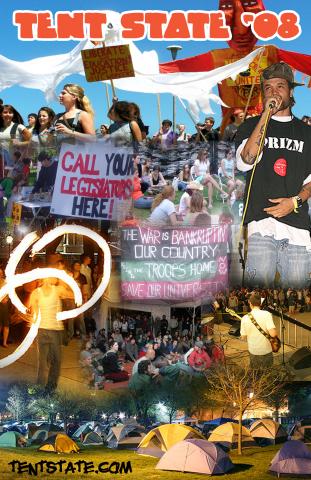
The Democratic convention protesters of 1968, who wound up on the truncheon end of the Chicago police riots, had been camped overnight by the simple result of their continuous protestation of having no representation at the DNC. Tent State University 2008No one asked permission. In 2008, by breaking off from the R-68 organizers and asking to be sanctioned by the city, TSU has allowed the Denver Police to preempt spontaneous demonstrations. Certainly in the eyes of the public and the residents of Denver. Now anyone who sticks around after curfew has been forewarned of the consequence.


Tattoos and Ayn Rand Thought

gazette.jpg ———– The Gazette editorialist got out his little Ayn Rand ‘Atlas Shrugged’ book last Monday, waved it in the air, and pronounced it a good thing that El Paso County (Big Bad Government!) was no longer going to inspect tattoo parlors in the area. This is the same nut case at the paper that is all ‘for the troops’. Well, who does he think goes to many of these tattoo parlors? Well, it is the troops, Sir.

The Gazette is run my a bunch of sad sack ideologues who are always against Big Government, except when Big, Big, BIG GOVERNMENT is destroying somebody else’s country and making Big, Big, BIG BUSINESS a killing in tax payer paid government contracts. But when it comes to protecting the troops from getting AIDS or Hepatitis at the tattoo parlor, well The Gazette is against the County checking out the sanitation there! Sick. See below…
———————————-

July 14, 2008 – 9:57PM The Gazette
SELF-POLICING TATTOO JOINTS
Don’t involve county in body art

You walk into Bob’s Tattoos seeking service. You want a bone through your nose and the Virgin Mary etched into your arm. Something’s not right. You’re struck by the stench of kitty litter and other strange smells. You’re introduced to 300-pound Bob, the parlor’s founding partner and managing artist. Bob wears a grubby muscle shirt and Dolfin shorts to show off his own tattoos. They don’t look so good, but that’s OK because Bob explains he got them in prison, and not at Bob’s Tattoos. What do you do?

A. Look for a certificate from the county that says Bob’s OK to pierce your nose and jam ink into your skin.

B. Leave, and do some research. Speak with multiple peers with good body art, and ask them which parlors do it best. Find a reputable shop, check it through the Better Business Bureau, and then personally assess the risks.

Unless you’re ultra brave, the correct answer is “B.” After all, even Bob’s Tattoos could look good on the day of a county inspection. And even a once-good tattoo business can go downhill after getting a stamp of approval from the county.

The right tattoo on the right part of the right person can be a fine thing. But good, safe results aren’t something the county can or should try to ensure. If ever there were an activity in which the buyer must beware, it’s the business of shopping for body art.

The mere fact that so-called painful cuts to El Paso County’s budget involve the elimination of tattoo parlor inspections indicates fiscal excess. The health department has no legitimate reason for spending nearly $30,000 annually to inspect tattoo parlors.

It’s not in question that dirty body art tools can lead to infection and disease. But nobody is required to commission a tattoo, and the majority of citizens never do. It’s a risk anyone can easily avoid by simply choosing against body art. Those who do seek tattoos and such ought to be responsible for assessing the risks themselves. The tattoo-free public shouldn’t be forced to subsidize needless, private, elective bodily expressions.

The county’s Board of Health plans to vote Wednesday on whether to permanently eliminate inspections, and most certainly they should. Tattoo artists are organizing to converge on the meeting, however, urging the county to maintain inspections.

The fact that responsible tattoo parlors favor county inspections isn’t surprising. An approval certificate is like a valuable reward for good, clean practices. The inspection requirement creates a layer of bureaucracy that serves as a hurdle to entry. It dissuades cheap, startup fly-by-night operators from wanting to set up shop and compete. It also eases concerns of customers who might otherwise ask lots of questions or chicken out of getting tattooed.

Tattoo artists, however, don’t need government to give them a useful stamp of approval. Reputations speak for themselves, and stamps of approval are best obtained through private associations of professionals. Free publications that sell advertising, for example, pay private auditing associations to verify circulations. Without the audit, it’s hard to compete. Lawyers join private associations, such as the American Bar Association, that enforce standards on members and offer assurances to customers. Good tattoo artists, if they wish to separate themselves from the riffraff, need to form a credible organization that sells a stamp of approval to those who qualify.

No stamp of approval, however, should weigh in too heavily when it comes to letting someone inject ink beneath your skin. Few transactions require more personal information and diligence than the purchase of a tattoo. Good, safe tattoos aren’t something the county can or should guarantee. Nothing can replace the ages old advice: Buyer beware. Besides, tattoos are free-spirited expressions of individuality. Don’t involve the county in what’s otherwise a solid act of rebellion.

Seriously, I would leave this one for the new owner…

Free live sharks!! Must come now!!! (Peterson/Constitution)
Reply to: see below
Date: 2008-07-13, 1:55PM MDT

We have 3 sharks and a 50 gal tank that have to go right now, house has been foreclosed and need to get out now. Not able to deliver and since we live in Woodland Park, can only wait until about 2:45-3pm today. NO emails!! We will not have access, please come to (address) or call (phone) for directions.

Thanks!

That was from Craigslist.

Dig the part about the “not able to deliver”, ….

50 gallons of water would weigh 400 pounds, almost a quarter ton just in Water.

But, you know, if you’re a Foreclosure Officer working for a bank in the local area, be really careful when you do the walk-through on the house…

Pride Fest a good place to avoid crackers

Pride FestCOLORADO SPRINGS-
Time for Pride Fest 2008, Sunday July 20 in Acacia Park. Its summer fair atmosphere is what Springs Spree used to be, reinforcing a fun, intimate sense of community. What’s Pride got that Springs Spree or Territory Days do not?
I have a theory. Homophobia.

It’s the same reason a gay bar has the best dance scene. Fewer idiots afraid of caching the gay bug. Bigotry, idiocy, poverty, obesity, fit a socio-economic profile that tends to be uneducated, uncultured and I’ll say it, lousy company. Homosexuality may cut across the same proportional demographic sample, but at least at the annual Pride Fest the conversationally-challenged are outnumbered by the heterosexual social-minded participants. My true colors.

Olympic audience cheers for Americans will be canned and jeers will be caned

Oh my goodness, I know why the 2008 Olympics are being hosted in China! If Beijing was decided in July 2001, the globalization overseers were certainly showing their forward thinking, knowing the imperial oil wars they were about to unleash, and acknowledging that American villainy was about to drop its humanitarian pretense in exchange for unapologetic carpet bombing of uncooperative peoples. Had the deciders previsioned Americans becoming so unpopular in the world that international audiences would boo US athletes at every chance? Of course the bid applications for hosting the Olympics would have been prepared long before I’d be comfortable to predict the Bush/CIA coup plan was hatched. Anyway, booing is easily masked for American TV viewers by interposing prerecorded cheers. It worked in Athens.

Although in Athens, the hatred of Americans wasn’t yet a rolling boil.

In 2004 the American public was still seen as a victim itself of the Florida coup. In August 2004 we had yet to RE-ELECT George the War Criminal. Later in November Americans showed the world our doofus mettle, proving to be a mass of reckless morons worse than Bush. The world could see Bush stole the 2004 election too, but to their horror the American public did not object, nor intervene to prevent US imperial aggressions from continuing unabated.

At the Athens Olympics there was also a greatly reduced turnout of international attendees. The terrorism threat had been amplified so that fewer travelers showed up. Olympic organizers had to discount the tickets and open the doors to the locals in an effort to fill the stadiums. TV cameras kept their shots closely cropped to avoid featuring the empty bleachers.

But really, how fortuitous that America’s Olympic athletes will be facing a predominantly Chinese audience. The Chinese are no friends of ours, certainly, but they will be the most gracious of hosts. How face-saving for us that the Chinese are the only thoroughly polite/subservient population one could entrust not to heckle the American team to tears. Westerners sitting among them will be those affluent enough to travel to China, putting them among the multinational profiteer class who knows on which side its bread is bloodied. If there are any regular sports fans in the crowd we’ll have a bedlam of jeers, but stateside who’ll know, because our television soundtrack will echo only the cheers.

US athletes know it already when they tour outside the homeland. The Stars and Stripes are reviled. The American team need only get possession of the ball and crowds boo. In this New American Century of US military supremacy, it’s all onlookers can do.

The next Olympic venues are safely scheduled within the empire’s anti-immigrant walls, London 2012 and Chicago 2016. By 2020 we will parade our athletes safely in Uzbekistan, where our regents there will boil hecklers in oil.

In the meantime the Chinese will play supplicant hosts, their polite culture several millennium ahead of the west in valuing saving face. Bush can keep politics out of the Olympics, where sweatshop gulags await Chinese dissenters.

Global economic rapists are at it again

G8 protest
Why protest the G8 Summit July 7-9? Those hoodlums always look so determined. Here’s the rationale by the Emergency Exit Collective:

The 2008 G8 on Hokkaido, a Strategic Assessment
Emergency Exit Collective
Bristol, Mayday, 2008

The authors of this document are a collection of activists, scholars, and writers currently based in the United States and Western Europe who have gotten to know and work with each other in the movement against capitalist globalization. We’re writing this at the request of some members of No! G8 Action Japan, who asked us for a broad strategic analysis of the state of struggle as we see it, and particularly, of the role of the G8, what it represents, the dangers and opportunities that may lie hidden in the moment. It is in no sense programmatic. Mainly, it is an attempt to develop tools that we hope will be helpful for organizers, or for anyone engaged in the struggle against global capital.

I
It is our condition as human beings that we produce our lives in common.

II
Let us then try to see the world from the perspective of the planet’s commoners, taking the word in that sense: those whose most essential tradition is cooperation in the making and maintenance of human social life, yet who have had to do so under conditions of suffering and separation; deprived, ignored, devalued, divided into hierarchies, pitted against each other for our very physical survival. In one sense we are all commoners. But it’s equally true that just about everyone, at least in some ways, at some points, plays the role of the rulers—of those who expropriate, devalue and divide—or at the very least benefits from such divisions.

Obviously some do more than others. It is at the peak of this pyramid that we encounter groups like the G8.

III
The G8’s perspective is that of the aristocrats, the rulers: those who command and maintain that global machinery of violence that defends existing borders and lines of separation: whether national borders with their detention camps for migrants, or property regimes, with their prisons for the poor. They live by constantly claiming title to the products of others collective creativity and labour, and in thus doing they create the poor; they create scarcity in the midst of plenty, and divide us on a daily basis; they create financial districts that loot resources from across the world, and in thus doing they turn the spirit of human creativity into a spiritual desert; close or privatize parks, public water taps and libraries, hospitals, youth centers, universities, schools, public swimming pools, and instead endlessly build shopping malls that channels convivial life into a means of commodity circulation; work toward turning global ecological catastrophe into business opportunities.

These are the people who presume to speak in the name of the “international community” even as they hide in their gated communities or meet protected by phalanxes of riot cops. It is critical to bear in mind that the ultimate aim of their policies is never to create community but to introduce and maintain divisions that set common people at each other’s throats. The neoliberal project, which has been their main instrument for doing so for the last three decades, is premised on a constant effort either to uproot or destroy any communal or democratic system whereby ordinary people govern their own affairs or maintain common resources for the common good, or, to reorganize each tiny remaining commons as an isolated node in a market system in which livelihood is never guaranteed, where the gain of one community must necessarily be at the expense of others. Insofar as they are willing to appeal to high-minded principles of common humanity, and encourage global cooperation, only and exactly to the extent that is required to maintain this system of universal competition.

IV
At the present time, the G8—the annual summit of the leaders of “industrial democracies”—is the key coordinative institution charged with the task of maintaining this neoliberal project, or of reforming it, revising it, adapting it to the changing condition of planetary class relations. The role of the G8 has always been to define the broad strategic horizons through which the next wave of planetary capital accumulation can occur. This means that its main task is to answer the question of how 3?4 in the present conditions of multiple crises and struggles 3?4 to subordinate social relations among the producing commoners of the planet to capital’s supreme value: profit.

V
Originally founded as the G7 in 1975 as a means of coordinating financial strategies for dealing with the ‘70s energy crisis, then expanded after the end of the Cold War to include Russia, its currently face a moment of profound impasse in the governance of planetary class relations: the greatest since the ‘70s energy crisis itself.

VI
The ‘70s energy crisis represented the final death-pangs of what might be termed the Cold War settlement, shattered by a quarter century of popular struggle. It’s worth returning briefly to this history.

The geopolitical arrangements put in place after World War II were above all designed to forestall the threat of revolution. In the immediate wake of the war, not only did much of the world lie in ruins, most of world’s population had abandoned any assumption about the inevitability of existing social arrangements. The advent of the Cold War had the effect of boxing movements for social change into a bipolar straightjacket. On the one hand, the former Allied and Axis powers that were later to unite in the G7 (the US, Canada, UK, France, Italy, Germany, Japan)—the “industrialized democracies”, as they like to call themselves—engaged in a massive project of co-optation. Their governments continued the process, begun in the ‘30s, of taking over social welfare institutions that had originally been created by popular movements (from insurance schemes to public libraries), even to expand them, on condition that they now be managed by state-appointed bureaucracies rather than by those who used them, buying off unions and the working classes more generally with policies meant to guarantee high wages, job security and the promise of educational advance—all in exchange for political loyalty, productivity increases and wage divisions within national and planetary working class itself. The Sino-Soviet bloc—which effectively became a kind of junior partner within the overall power structure, and its allies remained to trap revolutionary energies into the task of reproducing similar bureaucracies elsewhere. Both the US and USSR secured their dominance after the war by refusing to demobilize, instead locking the planet in a permanent threat of nuclear annihilation, a terrible vision of absolute cosmic power.

VII
Almost immediately, though, this arrangement was challenged by a series of revolts from those whose work was required to maintain the system, but who were, effectively, left outside the deal: first, peasants and the urban poor in the colonies and former colonies of the Global South, next, disenfranchised minorities in the home countries (in the US, the Civil Rights movement, then Black Power), and finally and most significantly, by the explosion of the women’s movement of the late ‘60s and early ‘70s—the revolt of that majority of humanity whose largely unremunerated labor made the very existence “the economy” possible. This appears to have been the tipping point.

VIII
The problem was that the Cold War settlement was never meant to include everyone. It by definition couldn’t. Once matters reached tipping point, then, the rulers scotched the settlement. All deals were off. The oil shock was first edge of the counter-offensive, breaking the back of existing working class organizations, driving home the message that there was nothing guaranteed about prosperity. Under the aegis of the newly hatched G7, this counter-offensive involved a series of interwoven strategies that were later to give rise to what is known as neoliberalism.

IX
These strategies resulted in what came to be known as “Structural Adjustment” both in the North and in the South, accompanied by trade and financial liberalization. This, in turn, made possible crucial structural changes in our planetary production in common extending the role of the market to discipline our lives and divide us into more and more polarized wage hierarchy. This involved:

· In the immediate wake of ‘70s oil shock, petrodollars were recycled from OPEC into Northern banks that then lent them, at extortionate rates of interest, to developing countries of the Global South. This was the origin of the famous “Third World Debt Crisis.” The existence of this debt allowed institutions like the IMF to impose its monetarist orthodoxy on most of the planet for roughly twenty years, in the process, stripping away most of even those modest social protections that had been won by the world’s poor—large numbers of whom were plunged into a situation of absolute desperation.

· It also opened a period of new enclosures through the capitalist imposition of structural adjustment policies, manipulation of environmental and social catastrophes like war, or for that matter through the authoritarian dictates of “socialist” regimes. Through such means, large sections of the world’s population have over the past thirty years been dispossessed from resources previously held in common, either by dint of long traditions, or as the fruits of past struggles and past settlements.

· Through financial deregulation and trade liberalization, neoliberal capital, which emerged from the G7 strategies to deal with the 1970s crisis aimed thus at turning the “class war” in communities, factories, offices, streets and fields against the engine of competition, into a planetary “civil war”, pitting each community of commoners against every other community of commoners.

· Neoliberal capital has done this by imposing an ethos of “efficiency” and rhetoric of “lowering the costs of production” applied so broadly that mechanisms of competition have come to pervade every sphere of life. In fact these terms are euphemisms, for a more fundamental demand: that capital be exempt from taking any reduction in profit to finance the costs of reproduction of human bodies and their social and natural environments (which it does not count as costs) and which are, effectively, “exernalized” onto communities and nature.

· The enclosure of resources and entitlements won in previous generations of struggles both in the North and the South, in turn, created the conditions for increasing the wage hierarchies (both global and local), by which commoners work for capital—wage hierarchies reproduced economically through pervasive competition, but culturally, through male dominance, xenophobia and racism. These wage gaps, in turn, made it possible to reduce the value of Northern workers’ labour power, by introducing commodities that enter in their wage basket at a fraction of what their cost might otherwise have been. The planetary expansion of sweatshops means that American workers (for example) can buy cargo pants or lawn-mowers made in Cambodia at Walmart, or buy tomatoes grown by undocumented Mexican workers in California, or even, in many cases, hire Jamaican or Filipina nurses to take care of children and aged grandparents at such low prices, that their employers have been able to lower real wages without pushing most of them into penury. In the South, meanwhile, this situation has made it possible to discipline new masses of workers into factories and assembly lines, fields and offices, thus extending enormously capital’s reach in defining the terms—the what, the how, the how much—of social production.

· These different forms of enclosures, both North and South, mean that commoners have become increasingly dependent on the market to reproduce their livelihoods, with less power to resist the violence and arrogance of those whose priorities is only to seek profit, less power to set a limit to the market discipline running their lives, more prone to turn against one another in wars with other commoners who share the same pressures of having to run the same competitive race, but not the same rights and the same access to the wage. All this has meant a generalized state of precarity, where nothing can be taken for granted.

X
In turn, this manipulation of currency and commodity flows constituting neoliberal globalization became the basis for the creation of the planet’s first genuine global bureaucracy.

· This was multi-tiered, with finance capital at the peak, then the ever-expanding trade bureaucracies (IMF, WTO, EU, World Bank, etc), then transnational corporations, and finally, the endless varieties of NGOs that proliferated throughout the period—almost all of which shared the same neoliberal orthodoxy, even as they substituted themselves for social welfare functions once reserved for states.

· The existence of this overarching apparatus, in turn, allowed poorer countries previously under the control of authoritarian regimes beholden to one or another side in the Cold War to adopt “democratic” forms of government. This did allow a restoration of formal civil liberties, but very little that could really merit the name of democracy (the rule of the “demos”, i.e., of the commoners). They were in fact constitutional republics, and the overwhelming trend during the period was to strip legislatures, that branch of government most open to popular pressure, of most of their powers, which were increasingly shifted to the executive and judicial branches, even as these latter, in turn, largely ended up enacting policies developed overseas, by global bureaucrats.

· This entire bureaucratic arrangement was justified, paradoxically enough, by an ideology of extreme individualism. On the level of ideas, neoliberalism relied on a systematic cooptation of the themes of popular struggle of the ‘60s: autonomy, pleasure, personal liberation, the rejection of all forms of bureaucratic control and authority. All these were repackaged as the very essence of capitalism, and the market reframed as a revolutionary force of liberation.

· The entire arrangement, in turn, was made possible by a preemptive attitude towards popular struggle. The breaking of unions and retreat of mass social movements from the late ‘70s onwards was only made possible by a massive shift of state resources into the machinery of violence: armies, prisons and police (secret and otherwise) and an endless variety of private “security services”, all with their attendant propaganda machines, which tended to increase even as other forms of social spending were cut back, among other things absorbing increasing portions of the former proletariat, making the security apparatus an increasingly large proportion of total social spending. This approach has been very successful in holding back mass opposition to capital in much of the world (especially West Europe and North America), and above all, in making it possible to argue there are no viable alternatives. But in doing so, has created strains on the system so profound it threatens to undermine it entirely.

XI
The latter point deserves elaboration. The element of force is, on any number of levels, the weak point of the system. This is not only on the constitutional level, where the question of how to integrate the emerging global bureaucratic apparatus, and existing military arrangements, has never been resolved. It is above all an economic problem. It is quite clear that the maintenance of elaborate security machinery is an absolute imperative of neoliberalism. One need only observe what happened with the collapse of the Soviet bloc in Eastern Europe: where one might have expected the Cold War victors to demand the dismantling of the army, secret police and secret prisons, and to maintain and develop the existing industrial base, in fact, what they did was absolutely the opposite: in fact, the only part of the industrial base that has managed fully to maintain itself has been the parts required to maintained the security apparatus itself! Critical too is the element of preemption: the governing classes in North America, for example, are willing to go to almost unimaginable lengths to ensure social movements never feel they are accomplishing anything. The current Gulf War is an excellent example: US military operations appear to be organized first and foremost to be protest-proof, to ensure that what happened in Vietnam (mass mobilization at home, widespread revolt within the army overseas) could never be repeated. This means above all that US casualties must always be kept to a minimum. The result are rules of engagement, and practices like the use of air power within cities ostensibly already controlled by occupation forces, so obviously guaranteed to maximize the killing of innocents and galvanizing hatred against the occupiers that they ensure the war itself cannot be won. Yet this approach can be taken as the very paradigm for neoliberal security regimes. Consider security arrangements around trade summits, where police are so determined prevent protestors from achieving tactical victories that they are often willing to effectively shut down the summits themselves. So too in overall strategy. In North America, such enormous resources are poured into the apparatus of repression, militarization, and propaganda that class struggle, labor action, mass movements seem to disappear entirely. It is thus possible to claim we have entered a new age where old conflicts are irrelevant. This is tremendously demoralizing of course for opponents of the system; but those running the system seem to find that demoralization so essential they don’t seem to care that the resultant apparatus (police, prisons, military, etc) is, effectively, sinking the entire US economy under its dead weight.

XII
The current crisis is not primarily geopolitical in nature. It is a crisis of neoliberalism itself. But it takes place against the backdrop of profound geopolitical realignments. The decline of North American power, both economic and geopolitical has been accompanied by the rise of Northeast Asia (and to a increasing extent, South Asia as well). While the Northeast Asian region is still divided by painful Cold War cleavages—the fortified lines across the Taiwan straits and at the 38th parallel in Korea…—the sheer realities of economic entanglement can be expected to lead to a gradual easing of tensions and a rise to global hegemony, as the region becomes the new center of gravity of the global economy, of the creation of new science and technology, ultimately, of political and military power. This may, quite likely, be a gradual and lengthy process. But in the meantime, very old patterns are rapidly reemerging: China reestablishing relations with ancient tributary states from Korea to Vietnam, radical Islamists attempting to reestablish their ancient role as the guardians of finance and piety at the in the Central Asian caravan routes and across Indian Ocean, every sort of Medieval trade diaspora reemerging… In the process, old political models remerge as well: the Chinese principle of the state transcending law, the Islamic principle of a legal order transcending any state. Everywhere, we see the revival too of ancient forms of exploitation—feudalism, slavery, debt peonage—often entangled in the newest forms of technology, but still echoing all the worst abuses of the Middle Ages. A scramble for resources has begun, with US occupation of Iraq and saber-rattling throughout the surrounding region clearly meant (at least in part) to place a potential stranglehold the energy supply of China; Chinese attempts to outflank with its own scramble for Africa, with increasing forays into South America and even Eastern Europe. The Chinese invasion into Africa (not as of yet at least a military invasion, but already involving the movement of hundreds of thousands of people), is changing the world in ways that will probably be felt for centuries. Meanwhile, the nations of South America, the first victims of the “Washington consensus” have managed to largely wriggle free from the US colonial orbit, while the US, its forces tied down in the Middle East, has for the moment at least abandoned it, is desperately struggling to keep its grip Mexico, Central America and the Caribbean—its own “near abroad”.

XIII
In another age all this might have led to war—that is, not just colonial occupations, police actions, or proxy wars (which are obviously already taking place), but direct military confrontations between the armies of major powers. It still could; accidents happen; but there is reason to believe that, when it comes to moments of critical decision, the loyalties of the global elites are increasingly to each other, and not to the national entities for whom they claim to speak. There is some compelling evidence for this.

Take for example when the US elites panicked at the prospect of the massive budget surpluses of the late 1990s. As Alan Greenspan, head of the Federal Reserve at the time warned, if these were allowed to stand they would have flooded government coffers with so many trillions of dollars that it could only have lead to some form of creeping socialism, even, he predicted, to the government acquiring “equity stakes” in key US corporations. The more excitable of capitalism’s managers actually began contemplating scenarios where the capitalist system itself would be imperiled. The only possible solution was massive tax cuts; these were duly enacted, and did indeed manage to turn surpluses into enormous deficits, financed by the sale of treasury bonds to Japan and China. Conditions have thus now reached a point where it is beginning to look as if the most likely long term outcome for the US (its technological and industrial base decaying, sinking under the burden of its enormous security spending) will be to end up serve as junior partner and military enforcer for East Asia capital. Its rulers, or at least a significant proportion of them, would prefer to hand global hegemony to the rulers of China (provided the latter abandon Communism) than to return to any sort of New Deal compromise with their “own” working classes.

A second example lies in the origins of what has been called the current “Bretton Woods II” system of currency arrangements, which underline a close working together of some “surplus” and “deficit” countries within global circuits. The macroeconomic manifestation of the planetary restructuring outlined in XIX underlines both the huge US trade deficit that so much seem to worry many commentators, and the possibility to continually generate new debt instruments like the one that has recently resulted in the sub-prime crisis. The ongoing recycling of accumulated surplus of countries exporting to the USA such as China and oil producing countries is what has allowed financiers to create new credit instruments in the USA. Hence, the “deal” offered by the masters in the United States to its commoners has been this: ‘you, give us a relative social peace and accept capitalist markets as the main means through which you reproduce your own livelihoods, and we will give you access to cheaper consumption goods, access to credit for buying cars and homes, and access to education, health, pensions and social security through the speculative means of stock markets and housing prices.’ Similar compromises were reached in all the G8 countries.

Meanwhile, there is the problem of maintaining any sort of social peace with the hundreds of millions of unemployed, underemployed, dispossessed commoners currently swelling the shanty-towns of Asia, Africa, and Latin America as a result of ongoing enclosures (which have speeded up within China and India in particular, even as “structural adjustment policies” in Africa and Latin America have been derailed). Any prospect of maintaining peace in these circumstances would ordinarily require either extremely high rates of economic growth—which globally have not been forthcoming, since outside of China, growth rates in the developing world have been much lower than they were in the ‘50s, ‘60s, or even ‘70s—or extremely high levels of repression, lest matters descend into rebellion or generalized civil war. The latter has of course occurred in many parts of the world currently neglected by capital, but in favored regions, such as the coastal provinces of China, or “free trade” zones of India, Egypt, or Mexico, commoners are being offered a different sort of deal: industrial employment at wages that, while very low by international standards, are still substantially higher than anything currently obtainable in the impoverished countryside; and above all the promise, through the intervention of Western markets and (privatized) knowledge, of gradually improving conditions of living. While over the least few years wages in many such areas seem to be growing, thanks to the intensification of popular struggles, such gains are inherently vulnerable: the effect of recent food inflation has been to cut real wages back dramatically—and threaten millions with starvation.

What we really want to stress here, though, is that the long-term promise being offered to the South is just as untenable as the idea that US or European consumers can indefinitely expand their conditions of life through the use of mortgages and credit cards.

What’s being offered the new dispossessed is a transposition of the American dream. The idea is that the lifestyle and consumption patterns of existing Chinese, Indian, or Brazilian or Zambian urban middle classes (already modeled on Northern ones) will eventually become available to the children of today’s miners, maquila or plantation laborers, until, ultimately, everyone on earth is brought up to roughly the same level of consumption. Put in these terms, the argument is absurd. The idea that all six billion of us can become “middle class” is obviously impossible. First of all there is a simple problem of resources. It doesn’t matter how many bottles we recycle or how energy efficient are the light bulbs we use, there’s just no way the earth’s ecosystem can accommodate six billion people driving in private cars to work in air-conditioned cubicles before periodically flying off to vacation in Acapulco or Tahiti. To maintain the style of living and producing in common we now identify with “middle classness” on a planetary scale would require several additional planets.

This much has been pointed out repeatedly. But the second point is no less important. What this vision of betterment ultimately proposes is that it would be possible to build universal prosperity and human dignity on a system of wage labor. This is fantasy. Historically, wages are always the contractual face for system of command and degradation, and a means of disguising exploitation: expressing value for work only on condition of stealing value without work— and there is no reason to believe they could ever be anything else. This is why, as history has also shown, human beings will always avoid working for wages if they have any other viable option. For a system based on wage labor to come into being, such options must therefore be made unavailable. This in turn means that such systems are always premised on structures of exclusion: on the prior existence of borders and property regimes maintained by violence. Finally, historically, it has always proved impossible to maintain any sizeable class of wage-earners in relative prosperity without basing that prosperity, directly or indirectly, on the unwaged labor of others—on slave-labor, women’s domestic labor, the forced labor of colonial subjects, the work of women and men in peasant communities halfway around the world—by people who are even more systematically exploited, degraded, and immiserated. For that reason, such systems have always depended not only on setting wage-earners against each other by inciting bigotry, prejudice, hostility, resentment, violence, but also by inciting the same between men and women, between the people of different continents (“race”), between the generations.

From the perspective of the whole, then, the dream of universal middle class “betterment” must necessarily be an illusion constructed in between the Scylla of ecological disaster, and the Charybdis of poverty, detritus, and hatred: precisely, the two pillars of today’s strategic impasse faced by the G8.

XIV
How then do we describe the current impasse of capitalist governance?

To a large degree, it is the effect of a sudden and extremely effective upswing of popular resistance—one all the more extraordinary considering the huge resources that had been invested in preventing such movements from breaking out.

On the one hand, the turn of the millennium saw a vast and sudden flowering of new anti-capitalist movements, a veritable planetary uprising against neoliberalism by commoners in Latin America, India, Africa, Asia, across the North Atlantic world’s former colonies and ultimately, within the cities of the former colonial powers themselves. As a result, the neoliberal project lies shattered. What came to be called the “anti-globalization” movement took aim at the trade bureaucracies—the obvious weak link in the emerging institutions of global administration—but it was merely the most visible aspect of this uprising. It was however an extraordinarily successful one. Not only was the WTO halted in its tracks, but all major trade initiatives (MAI, FTAA…) scuttled. The World Bank was hobbled and the power of the IMF over most of the world’s population, effectively, destroyed. The latter, once the terror of the Global South, is now a shattered remnant of its former self, reduced to selling off its gold reserves and desperately searching for a new global mission.

In many ways though spectacular street actions were merely the most visible aspects of much broader changes: the resurgence of labor unions, in certain parts of the world, the flowering of economic and social alternatives on the grassroots levels in every part of the world, from new forms of direct democracy of indigenous communities like El Alto in Bolivia or self-managed factories in Paraguay, to township movements in South Africa, farming cooperatives in India, squatters’ movements in Korea, experiments in permaculture in Europe or “Islamic economics” among the urban poor in the Middle East. We have seen the development of thousands of forms of mutual aid association, most of which have not even made it onto the radar of the global media, often have almost no ideological unity and which may not even be aware of each other’s existence, but nonetheless share a common desire to mark a practical break with capitalism, and which, most importantly, hold out the prospect of creating new forms of planetary commons that can—and in some cases are—beginning to knit together to provide the outlines of genuine alternative vision of what a non-capitalist future might look like.

The reaction of the world’s rulers was predictable. The planetary uprising had occurred during a time when the global security apparatus was beginning to look like it lacked a purpose, when the world threatened to return to a state of peace. The response—aided of course, by the intervention of some of the US’ former Cold War allies, reorganized now under the name of Al Qaeda—was a return to global warfare. But this too failed. The “war on terror”—as an attempt to impose US military power as the ultimate enforcer of the neoliberal model—has collapsed as well in the face of almost universal popular resistance. This is the nature of their “impasse”.

At the same time, the top-heavy, inefficient US model of military capitalism—a model created in large part to prevent the dangers of social movements, but which the US has also sought to export to some degree simply because of its profligacy and inefficiency, to prevent the rest of the world from too rapidly overtaking them—has proved so wasteful of resources that it threatens to plunge the entire planet into ecological and social crisis. Drought, disaster, famines, combine with endless campaigns of enclosure, foreclosure, to cast the very means of survival—food, water, shelter—into question for the bulk of the world’s population.

XV
In the rulers’ language the crisis understood, first and foremost, as a problem of regulating cash flows, of reestablishing, as they like to put it, a new “financial architecture”. Obviously they are aware of the broader problems. Their promotional literature has always been full of it. From the earliest days of the G7, through to the days after the Cold War, when Russia was added as a reward for embracing capitalism, they have always claimed that their chief concerns include

· the reduction of global poverty

· sustainable environmental policies

· sustainable global energy policies

· stable financial institutions governing global trade and currency transactions

If one were to take such claims seriously, it’s hard to see their overall performance as anything but a catastrophic failure. At the present moment, all of these are in crisis mode: there are food riots, global warming, peak oil, and the threat of financial meltdown, bursting of credit bubbles, currency crises, a global credit crunch. [**Failure on this scale however, opens opportunities for the G8 themselves, as summit of the global bureaucracy, to reconfigure the strategic horizon. Therefore, it’s always with the last of these that they are especially concerned. ]The real problem, from the perspective of the G8, is one of reinvestment: particularly, of the profits of the energy sector, but also, now, of emerging industrial powers outside the circle of the G8 itself. The neoliberal solution in the ‘70s had been to recycle OPEC’s petrodollars into banks that would use it much of the world into debt bondage, imposing regimes of fiscal austerity that, for the most part, stopped development (and hence, the emergence potential rivals) in its tracks. By the ‘90s, however, much East Asia in particular had broken free of this regime. Attempts to reimpose IMF-style discipline during the Asian financial crisis of 1997 largely backfired. So a new compromise was found, the so-called Bretton Woods II: to recycle the profits from the rapidly expanding industrial economies of East Asia into US treasury debt, artificially supporting the value of the dollar and allowing a continual stream of cheap exports that, aided by the US housing bubble, kept North Atlantic economies afloat and buy off workers there with cheap oil and even cheaper consumer goods even as real wages shrank. This solution however soon proved a temporary expedient. Bush regime’s attempt to lock it in by the invasion of Iraq, which was meant to lead to the forced privatization of Iraqi oil fields, and, ultimately, of the global oil industry as a whole, collapsed in the face of massive popular resistance (just as Saddam Hussein’s attempt to introduce neoliberal reforms in Iraq had failed when he was still acting as American deputy in the ‘90s). Instead, the simultaneous demand for petroleum for both Chinese manufacturers and American consumers caused a dramatic spike in the price of oil. What’s more, rents from oil and gas production are now being used to pay off the old debts from the ‘80s (especially in Asia and Latin America, which have by now paid back their IMF debts entirely), and—increasingly—to create state-managed Sovereign Wealth Funds that have largely replaced institutions like the IMF as the institutions capable of making long-term strategic investments. The IMF, purposeless, tottering on the brink of insolvency, has been reduced to trying to come up with “best practices” guidelines for fund managers working for governments in Singapore, Seoul, and Abu Dhabi.

There can be no question this time around of freezing out countries like China, India, or even Brazil. The question for capital’s planners, rather, is how to channel these new concentrations of capital in such a way that they reinforce the logic of the system instead of undermining it.

XVI
How can this be done? This is where appeals to universal human values, to common membership in an “international community” come in to play. “We all must pull together for the good of the planet,” we will be told. The money must be reinvested “to save the earth.”

To some degree this was always the G8 line: this is a group has been making an issue of climate change since 1983. Doing so was in one sense a response to the environmental movements of the ‘70s and ‘80s. The resultant emphasis on biofuels and “green energy” was from their point of view, the perfect strategy, seizing on an issue that seemed to transcend class, appropriating ideas and issues that emerged from social movements (and hence coopting and undermining especially their radical wings), and finally, ensuring such initiatives are pursued not through any form of democratic self-organization but “market mechanisms”—to effective make the sense of public interest productive for capitalism.

What we can expect now is a two-pronged attack. On the one hand, they will use the crisis to attempt to reverse the gains of past social movements: to put nuclear energy back on the table to deal with the energy crisis and global warming, or genetically modified foods to deal with the food crisis. Prime Minister Fukuda, the host of the current summit, for example, is already proposing the nuclear power is the “solution” to the global warming crisis, even as the German delegation resists. On the other, and even more insidiously, they will try once again to co-opt the ideas and solutions that have emerged from our struggles as a way of ultimately undermining them. Appropriating such ideas is simply what rulers do: the bosses brain is always under the workers’ hat. But the ultimate aim is to answer the intensification of class struggle, of the danger of new forms of democracy, with another wave of enclosures, to restore a situation where commoners’ attempts to create broader regimes of cooperation are stymied, and people are plunged back into mutual competition.

We can already see the outlines of how this might be done. There are already suggestions that Sovereign Wealth Funds put aside a certain (miniscule) proportion of their money for food aid, but only as tied to a larger project of global financial restructuring. The World Bank, largely bereft of its earlier role organizing dams and pipe-lines across the world, has been funding development in China’s poorer provinces, freeing the Chinese government to carry out similar projects in Southeast Asia, Africa, and even Latin America (where, of course, they cannot effectively be held to any sort of labor or environmental standards). There is the possibility of a new class deal in China itself, whose workers can be allowed higher standards of living if new low wage zones are created elsewhere—for instance, Africa (the continent where struggles over maintaining the commons have been most intense in current decades)—with the help of Chinese infrastructural projects. Above of all, money will be channeled into addressing climate change, into the development of alternative energy, which will require enormous investments, in such a way as to ensure that whatever energy resources do become important in this millennium, they can never be democratized—that the emerging notion of a petroleum commons, that energy resources are to some degree a common patrimony meant primarily to serve the community as a whole, that is beginning to develop in parts of the Middle East and South America—not be reproduced in whatever comes next.

Since this will ultimately have to be backed up by the threat of violence, the G8 will inevitably have to struggle with how to (yet again) rethink enforcement mechanisms. The latest move , now that the US “war on terror” paradigm has obviously failed, would appear to be a return to NATO, part of a reinvention of the “European security architecture” being proposed at the upcoming G8 meetings in Italy in 2009 on the 60th anniversary of NATO’s foundation—but part of a much broader movement of the militarization of social conflict, projecting potential resource wars, demographic upheavals resulting from climate change, and radical social movements as potential military problems to be resolved by military means. Opposition to this new project is already shaping up as the major new European mobilization for the year following the current G-8.

XVII
While the G-8 sit at the pinnacle of a system of violence, their preferred idiom is monetary. Their impulse whenever possible is to translate all problems into money, financial structures, currency flows—a substance whose movements they carefully monitor and control.

Money, on might say, is their poetry—a poetry whose letters are written in our blood. It is their highest and most abstract form of expression, their way of making statements about the ultimate truth of the world, even if it operates in large part by making things disappear. How else could it be possible to argue—no, to assume as a matter of common sense—that the love, care, and concern of a person who tends to the needs of children, teaching, minding, helping them to become decent , thoughtful, human beings, or who grows and prepares food, is worth ten thousand times less than someone who spends the same time designing a brand logo, moving abstract blips across a globe, or denying others health care.

The role of money however has changed profoundly since 1971 when the dollar was delinked from gold. This has created a profound realignment of temporal horizons. Once money could be said to be primarily congealed results of past profit and exploitation. As capital, it was dead labor. Millions of indigenous Americans and Africans had their lives pillaged and destroyed in the gold mines in order to be rendered into value. The logic of finance capital, of credit structures, certainly always existed as well (it is at least as old as industrial capital; possibly older), but in recent decades these logic of financial capital has come to echo and re-echo on every level of our lives. In the UK 97% of money in circulation is debt, in the US, 98%. Governments run on deficit financing, wealthy economies on consumer debt, the poor are enticed with microcredit schemes, debts are packaged and repackaged in complex financial derivatives and traded back and forth. Debt however is simply a promise, the expectation of future profit; capital thus increasingly brings the future into the present—a future that, it insists, must always be the same in nature, even if must also be greater in magnitude, since of course the entire system is premised on continual growth. Where once financiers calculated and traded in the precise measure of our degradation, having taken everything from us and turned it into money, now money has flipped, to become the measure of our future degradation—at the same time as it binds us to endlessly working in the present.

The result is a strange moral paradox. Love, loyalty, honor, commitment—to our families, for example, which means to our shared homes, which means to the payment of monthly mortgage debts—becomes a matter of maintaining loyalty to a system which ultimately tells us that such commitments are not a value in themselves. This organization of imaginative horizons, which ultimately come down to a colonization of the very principle of hope, has come to supplement the traditional evocation of fear (of penury, homelessness, joblessness, disease and death). This colonization paralyzes any thought of opposition to a system that almost everyone ultimately knows is not only an insult to everything they really cherish, but a travesty of genuine hope, since, because no system can really expand forever on a finite planet, everyone is aware on some level that in the final analysis they are dealing with a kind of global pyramid scheme, what we are ultimately buying and selling is the real promise of global social and environmental apocalypse.

XVIII
Finally then we come to the really difficult, strategic questions. Where are the vulnerabilities? Where is hope? Obviously we have no certain answers here. No one could. But perhaps the proceeding analysis opens up some possibilities that anti-capitalist organizers might find useful to explore.

One thing that might be helpful is to rethink our initial terms. Consider communism. We are used to thinking of it as a total system that perhaps existed long ago, and to the desire to bring about an analogous system at some point in the future—usually, at whatever cost. It seems to us that dreams of communist futures were never purely fantasies; they were simply projections of existing forms of cooperation, of commoning, by which we already make the world in the present. Communism in this sense is already the basis of almost everything, what brings people and societies into being, what maintains them, the elemental ground of all human thought and action. There is absolutely nothing utopian here. What is utopian, really, is the notion that any form of social organization, especially capitalism, could ever exist that was not entirely premised on the prior existence of communism. If this is true, the most pressing question is simply how to make that power visible, to burst forth, to become the basis for strategic visions, in the face of a tremendous and antagonistic power committed to destroying it—but at the same time, ensuring that despite the challenge they face, they never again become entangled with forms of violence of their own that make them the basis for yet another tawdry elite. After all, the solidarity we extend to one another, is it not itself a form of communism? And is it not so above because it is not coerced?

Another thing that might be helpful is to rethink our notion of crisis. There was a time when simply describing the fact that capitalism was in a state of crisis, driven by irreconcilable contradictions, was taken to suggest that it was heading for a cliff. By now, it seems abundantly clear that this is not the case. Capitalism is always in a crisis. The crisis never goes away. Financial markets are always producing bubbles of one sort or another; those bubbles always burst, sometimes catastrophically; often entire national economies collapse, sometimes the global markets system itself begins to come apart. But every time the structure is reassembled. Slowly, painfully, dutifully, the pieces always end up being put back together once again.

Perhaps we should be asking: why?

In searching for an answer, it seems to us, we might also do well to put aside another familiar habit of radical thought: the tendency to sort the world into separate levels—material realities, the domain of ideas or “consciousness”, the level of technologies and organizations of violence—treating these as if these were separate domains that each work according to separate logics, and then arguing which “determines” which. In fact they cannot be disentangled. A factory may be a physical thing, but the ownership of a factory is a social relation, a legal fantasy that is based partly on the belief that law exists, and partly on the existence of armies and police. Armies and police on the other hand exist partly because of factories providing them with guns, vehicles, and equipment, but also, because those carrying the guns and riding in the vehicles believe they are working for an abstract entity they call “the government”, which they love, fear, and ultimately, whose existence they take for granted by a kind of faith, since historically, those armed organizations tend to melt away immediately the moment they lose faith that the government actually exists. Obviously exactly the same can be said of money. It’s value is constantly being produced by eminently material practices involving time clocks, bank machines, mints, and transatlantic computer cables, not to mention love, greed, and fear, but at the same time, all this too rests on a kind of faith that all these things will continue to interact in more or less the same way. It is all very material, but it also reflects a certain assumption of eternity: the reason that the machine can always be placed back together is, simply, because everyone assumes it must. This is because they cannot realistically imagine plausible alternatives; they cannot imagine plausible alternatives because of the extraordinarily sophisticated machinery of preemptive violence that ensure any such alternatives are uprooted or contained (even if that violence is itself organized around a fear that itself rests on a similar form of faith.) One cannot even say it’s circular. It’s more a kind of endless, unstable spiral. To subvert the system is then, to intervene in such a way that the whole apparatus begins to spin apart.

XIX
It appears to us that one key element here—one often neglected in revolutionary strategy—is the role of the global middle classes. This is a class that, much though it varies from country (in places like the US and Japan, overwhelming majorities consider themselves middle class; in, say, Cambodia or Zambia, only very small percentages), almost everywhere provides the key constituency of the G8 outside of the ruling elite themselves. It has become a truism, an article of faith in itself in global policy circles, that national middle class is everywhere the necessary basis for democracy. In fact, middle classes are rarely much interested in democracy in any meaningful sense of that word (that is, of the self-organization or self-governance of communities). They tend to be quite suspicious of it. Historically, middle classes have tended to encourage the establishment of constitutional republics with only limited democratic elements (sometimes, none at all). This is because their real passion is for a “betterment”, for the prosperity and advance of conditions of life for their children—and this betterment, since it is as noted above entirely premised on structures of exclusion, requires “security”. Actually the middle classes depend on security on every level: personal security, social security (various forms of government support, which even when it is withdrawn from the poor tends to be maintained for the middle classes), security against any sudden or dramatic changes in the nature of existing institutions. Thus, politically, the middle classes are attached not to democracy (which, especially in its radical forms, might disrupt all this), but to the rule of law. In the political sense, then, being “middle class” means existing outside the notorious “state of exception” to which the majority of the world’s people are relegated. It means being able to see a policeman and feel safer, not even more insecure. This would help explain why within the richest countries, the overwhelming majority of the population will claim to be “middle class” when speaking in the abstract, even if most will also instantly switch back to calling themselves “working class” when talking about their relation to their boss.

That rule of law, in turn, allows them to live in that temporal horizon where the market and other existing institutions (schools, governments, law firms, real estate brokerages…) can be imagined as lasting forever in more or less the same form. The middle classes can thus be defined as those who live in the eternity of capitalism. (The elites don’t; they live in history, they don’t assume things will always be the same. The disenfranchized don’t; they don’t have the luxury; they live in a state of precarity where little or nothing can safely be assumed.) Their entire lives are based on assuming that the institutional forms they are accustomed to will always be the same, for themselves and their grandchildren, and their “betterment” will be proportional to the increase in the level of monetary wealth and consumption. This is why every time global capital enters one of its periodic crises, every time banks collapse, factories close, and markets prove unworkable, or even, when the world collapses in war, the managers and dentists will tend to support any program that guarantees the fragments will be dutifully pieced back together in roughly the same form—even if all are, at the same time, burdened by at least a vague sense that the whole system is unfair and probably heading for catastrophe.

XIX
The strategic question then is, how to shatter this sense of inevitability? History provides one obvious suggestion. The last time the system really neared self-destruction was in the 1930s, when what might have otherwise been an ordinary turn of the boom-bust cycle turned into a depression so profound that it took a world war to pull out of it. What was different? The existence of an alternative: a Soviet economy that, whatever its obvious brutalities, was expanding at breakneck pace at the very moment market systems were undergoing collapse. Alternatives shatter the sense of inevitability, that the system must, necessarily, be patched together in the same form; this is why it becomes an absolute imperative of global governance that even small viable experiments in other ways of organizing communities be wiped out, or, if that is not possible, that no one knows about them.

If nothing else, this explains the extraordinary importance attached to the security services and preemption of popular struggle. Commoning, where it already exists, must be made invisible. Alternatives— Zapatistas in Chiapas, APPO in Oaxaca, worker-managed factories in Argentina or Paraguay, community-run water systems in South Africa or Bolivia, living alternatives of farming or fishing communities in India or Indonesia, or a thousand other examples—must be made to disappear, if not squelched or destroyed, then marginalized to the point they seem irrelevant, ridiculous. If the managers of the global system are so determined to do this they are willing to invest such enormous resources into security apparatus that it threatens to sink the system entirely, it is because they are aware that they are working with a house of cards. That the principle of hope and expectation on which capitalism rests would evaporate instantly if almost any other principle of hope or expectation seemed viable.

The knowledge of alternatives, then, is itself a material force.

Without them, of course, the shattering of any sense of certainty has exactly the opposite effect. It becomes pure precarity, an insecurity so profound that it becomes impossible to project oneself in history in any form, so that the one-time certainties of middle class life itself becomes a kind of utopian horizon, a desperate dream, the only possible principle of hope beyond which one cannot really imagine anything. At the moment, this seems the favorite weapon of neoliberalism: whether promulgated through economic violence, or the more direct, traditional kind.

One form of resistance that might prove quite useful here – and is already being discussed in some quarters – are campaigns against debt itself. Not demands for debt forgiveness, but campaigns of debt resistance.

XX
In this sense the great slogan of the global justice movement, “another world is possible”, represents the ultimate threat to existing power structures. But in another sense we can even say we have already begun to move beyond that. Another world is not merely possible. It is inevitable. On the one hand, as we have pointed out, such a world is already in existence in the innumerable circuits of social cooperation and production in common based on different values than those of profit and accumulation through which we already create our lives, and without which capitalism itself would be impossible. On the other, a different world is inevitable because capitalism—a system based on infinite material expansion—simply cannot continue forever on a finite world. At some point, if humanity is to survive at all, we will be living in a system that is not based on infinite material expansion. That is, something other than capitalism.

The problem is there is no absolute guarantee that ‘something’ will be any better. It’s pretty easy to imagine “other worlds” that would be even worse. We really don’t have any idea what might happen. To what extent will the new world still organized around commoditization of life, profit, and pervasive competition? Or a reemergence of even older forms of hierarchy and degradation? How, if we do overcome capitalism directly, by the building and interweaving of new forms of global commons, do we protect ourselves against the reemergence of new forms of hierarchy and division that we might not now even be able to imagine?

It seems to us that the decisive battles that will decide the contours of this new world will necessarily be battles around values. First and foremost are values of solidarity among commoners. Since after all, every rape of a woman by a man or the racist murder of an African immigrant by a European worker is worth a division in capital’s army.

Similarly, imagining our struggles as value struggles might allow us to see current struggles over global energy policies and over the role of money and finance today as just an opening salvo of an even larger social conflict to come. For instance, there’s no need to demonize petroleum, for example, as a thing in itself. Energy products have always tended to play the role of a “basic good”, in the sense that their production and distribution becomes the physical basis for all other forms of human cooperation, at the same time as its control tends to organize social and even international relations. Forests and wood played such a role from the time of the Magna Carta to the American Revolution, sugar did so during the rise of European colonial empires in the 17th and 18th centuries, fossil fuels do so today. There is nothing intrinsically good or bad about fossil fuel. Oil is simply solar radiation, once processed by living beings, now stored in fossil form. The question is of control and distribution. This is the real flaw in the rhetoric over “peak oil”: the entire argument is premised on the assumption that, for the next century at least, global markets will be the only means of distribution. Otherwise the use of oil would depend on needs, which would be impossible to predict precisely because they depend on the form of production in common we adopt. The question thus should be: how does the anti-capitalist movement peak the oil? How does it become the crisis for a system of unlimited expansion?

It is the view of the authors of this text that the most radical planetary movements that have emerged to challenge the G8 are those that direct us towards exactly these kind of questions. Those which go beyond merely asking how to explode the role money plays in framing our horizons, or even challenging the assumption of the endless expansion of “the economy”, to ask why we assume something called “the economy” even exists, and what other ways we can begin imagining our material relations with one another. The planetary women’s movement, in its many manifestations, has and continues to play perhaps the most important role of all here, in calling for us to reimagine our most basic assumptions about work, to remember that the basic business of human life is not actually the production of communities but the production, the mutual shaping of human beings. The most inspiring of these movements are those that call for us to move beyond a mere challenge to the role of money to reimagine value: to ask ourselves how can we best create a situation where everyone is secure enough in their basic needs to be able to pursue those forms of value they decide are ultimately important to them. To move beyond a mere challenge to the tyranny of debt to ask ourselves what we ultimately owe to one another and to our environment. That recognize that none this needs to invented from whole cloth. It’s all already there, immanent in the way everyone, as commoners, create the world together on a daily basis. And that asking these questions is never, and can never be, an abstract exercise, but is necessarily part of a process by which we are already beginning to knit these forms of commons together into new forms of global commons that will allow entirely new conceptions of our place in history.

It is to those already engaged in such a project that we offer these initial thoughts on our current strategic situation.

July 5 protest Starbucks unfair labor

The IWW Starbucks Workers Union has declared a Global Day of Action to protest Starbucks’ anti-union termination. According to their press release:

Coordinated Actions Across the U.S., Europe, and Latin America Could
Be Largest Ever Against Coffee Chain.

Grand Rapids , MI ( 06-30-2008 )- Union members and social activists are gearing up for what may be the largest, global coordinated action against Starbucks ever. Protesters will decry what they see as an epidemic of anti-union terminations by the world’s largest coffee chain. Starbucks and its CEO Howard Schultz have exhibited a pattern of firing outspoken union baristas ever since the advent of the IWW Starbucks Workers Union (SWU) in 2004 and are demonstrating the same practice against the CNT union in Spain.

“On July 5th people around the world will show Starbucks that we, baristas along with our supporters, will have a voice and Starbucks discrimination and repression of our efforts will not go unchecked,” said Cole Dorsey, a fired Starbucks barista and a member of the SWU.

…Actions against Starbucks will take place in: Argentina, Chile, the British Isles, Italy, Japan, Norway, Serbia, Poland, Slovakia, 4 cities in Spain, 6 cities in Germany. In the US: Phoenix, Philadelphia, Grand Rapids, Boston, Chicago, New York City, Los Angeles.

Stop the War in Iraq and BTTHN

Open National Conference to Stop the War in Iraq and Bring the Troops Home Now
Cleveland, Ohio, June 28-29, 2008

National Assembly Endorser List (Partial Listing)
( * = organization or position for identification only)

1. Cindy Sheehan, Gold Star Families for Peace*
2. Howard Zinn, Author, Historian, Social Critic, Political Scientist, Playwright
3. U.S. Labor Against the War (USLAW)
4. Veterans for Peace
5. Vietnam Veterans Against the War, Utah Chapter
6. National Lawyers Guild
7. North Shore AFL-CIO Federation of Labor (Formerly Cleveland AFL-CIO)
8. Donna Dewitt, President, South Carolina AFL-CIO*
9. Navy Petty Officer Jonathan W. Hutto, Author of “Anti-War Soldier” and Co-Founder of Appeal For Redress*
10. Los Angeles County Federation of Labor, AFL-CIO, Los Angeles, CA
11. Progressive Democrats of America
12. A.N.S.W.E.R. Coalition (Act Now to Stop War and End Racism)
13. The Iraq Moratorium
14. United Teachers Los Angeles
15. Northeast Ohio Anti-War Coalition (NOAC)
16. Ramsey Clark, former U.S. Attorney General
17. Green Party of Ohio
18. Progressive Action, a coalition of the Duluth Central Labor Body, Democratic Farmer-Labor Party, and the Duluth Area Green Party
19. Scott Ritter
20. Anti-War Committee of the Thomas Merton Center, Pittsburgh, PA
21. Colia Lafayette Clark, Chair, Richard Wright Centennial Committee, Philadelphia, PA
22. Ohio State Council UNITE HERE
23. Women Speak Out for Peace and Justice – the Cleveland Branch of Women’s International League for Peace and Freedom
24. Chris Silvera, Secretary-Treasurer, Teamsters Local 808*, Long Island, NY
25. Cleveland Peace Action
26. Peninsula Peace and Justice Center, Palo Alto, CA
27. Greater Boston Stop the Wars Coalition (STWC)
28. John W. Braxton, Co-President, American Federation of Teachers Local 2026*; Faculty and Staff Federation of Community College of Philadelphia*
29. Eduardo Rosario, Executive Board, NY City Chapter – Labor Council for Latin American Advancement*
30. RI Mobilization Committee to Stop War and Occupation
31. Steve Early, Member, National Writers Union/UAW*, Labor Journalist
32. Bethlehem Neighbors for Peace
33. Northeast Ohio American Friends Service Committee
34. Cynthia McKinney, Former Congresswoman from Georgia
35. Allen Cholger, United Steelworkers Union Staff Representative*, Southfield, MI
36. Malcolm Suber, Reconstruction Activist; 2007 City Council Candidate in New Orleans, LA
37. Greg Coleridge, Coordinator, Northeast Ohio Anti-War Coalition; Economic Justice & Empowerment Program Director, Northeast Ohio American Friends Service Committee
38. Marilyn Levin, Member, Coordinating Committee, Greater Boston United for Justice with Peace; Founder, Middle East Crisis Coalition
39. Jeff Mackler, Founder, Mobilization for Peace, Jobs and Justice, San Francisco, CA
40. Jerry Gordon, former National Co-Coordinator of the Vietnam-era National Peace Action Coalition (NPAC); Member, U.S. Labor Against the War Steering Committee, Cleveland, OH
41. Barbara Lubin, Director, Middle East Children’s Alliance
42. Jamilla El-Shafei, Kennebunkport, Maine, (the Kennebunkport Peace Department)
43. Mumia Abu-Jamal
44. Alan Netland, President of the Duluth Central Labor Body and AFSCME Local 66*
45. Will Rhodes, Chair, Minnesota 8th Congressional District, Green Party; Steering Committee of the Duluth Area Green Party
46. Leonard Weinglass, Attorney for the Cuban Five
47. Gail Schoenfelder, Co-Chair, Clayton-Jackson-McGee Memorial; Board Member of the Duluth League of Women Voters*
48. California Peace and Freedom Party
49. Greater Cleveland Immigrant Support Network
50. Wasatch Coalition for Peace and Justice of Northern Utah
51. Alan Benjamin, Member, Executive Board, San Francisco Labor Council; Member, National Steering Committee, U.S. Labor Against the War
52. Rev. Dr. Diana Gibson, Co-Director, Council of Churches of Santa Clara County, San Jose, CA*
53. Sacramento Chapter, Labor Council for Latin American Involvement (LCLAA), AFL-CIO, Sacramento, CA
54. Iranians for Peace and Justice, CT and Texas Chapters
55. Youth Against War & Racism, MN
56. Samina Faheem, Executive Director, American Muslim Voice
57. National Education Association Peace and Justice Caucus
58. Union de Trabajadores Inmigrantes (Union of Immigrant Workers), Madison, WI
59. The L.A. Palestine Labor Solidarity Committee, Los Angeles, CA
60. San Jose Peace and Justice Center
61. Andy Griggs, Board of Directors, United Teachers Los Angeles; Chair, National Education Association Peace and Justice Caucus; Continuations Committee, American Federation of Teachers Peace and Justice Caucus*; Steering Committee Member, U.S. Labor Against the War, Los Angeles, CA
62. Office of the Americas, Los Angeles, CA
63. Fernando Suarez del Solar, Founder and Director, Guerrero Azteca Peace Project Escondido, CA
64. Doug Bullock, 1st Vice President, Albany Federation of Labor and Member of the Albany County Legislature
65. Arlington (MA) United for Justice with Peace
66. Sarah Martin, Member, Women Against Military Madness, MN
67. Paul Krehbiel, Iraq Moratorium, Los Angeles, CA
68. Sharon Smith, Haymarket Books
69. Francesca Rosa, Member SEIU Local 1021, Delegate, San Francisco Labor Council*, Member, Bay Area Labor Committee for Peace and Justice*
70. National Benedictines for Peace
71. Elizabeth Aaronsohn, Professor of Education and Faculty in the Peace Studies Program*, Central CT State University, New Britain, CT
72. Adirondack Progressives
73. Pam Africa, International Concerned Family and Friends of Mumia Abu-Jamal and Move Organization
74. AfterDowningStreet.org
75. Kali Akuno, Member, Malcolm X Grassroots Movement, Gulf Coast Reconstruction Movement activist, New Orleans, LA*
76. Richard Brooks Alba, Co-Chair Emeritus, SF Pride at Work (AFL-CIO), Berkeley, CA
77. Mike Alewitz, Labor Art and Mural Project, New Britain, CT
78. All-African People’s Revolutionary Party (G-C), Washington, D.C.
79. Stephen Allen, Steve Allen Painting, Akron, OH
80. Alliance for Global Justice
81. Dr. Sabah Alwan, Associate Professor of Leadership & Organizational Behavior, College of St. Scholastica, Duluth, MN
82. American Federation of Musicians Local 1000, NY, NY
83. Andy Anderson, Veterans for Peace, Chapter 80
84. Jeff Anderson, Duluth City Councilor
85. Thomas Atwood, Community Organizer, Peninsula Interfaith Alliance (PICO); Unitarian Universalist Fellowship of Redwood City, CA*
86. Mark Bailey, member and seminary student, United Church of Christ*, Elyria, OH
87. Jared A. Ball, Producer, Independent/Mixtape Journalism: FreeMix Radio, Words, Beats and
Life Global Journal of Hip-Hop Culture, Washington, D.C.*
88. Russ Banner, Co-Coordinator, Pax Christi – Manasota Chapter, FL
89. Hans Barbe, Iraq Moratorium, Students for a Democratic Society, Grosse Pointe Park, MI
90. Ana Barber, UTLA Board of Directors, Long Beach, CA
91. Bay Area United Against the War
92. Karen Bernal, International Longshore Workers Union Project Organizer, San Francisco, CA
93. Dennis Bernstein, Producer Flashpoint/KPFA Radio, Berkeley, CA
94. Marcia Bernsten, North Shore Coalition for Peace & Justice, Evanston, IL
95. Prof. Hal Bertilson, Professor of Psychology and UWS Psychology Program; Coordinator; Member, Amnesty International; Unitarian Universalist Congregation of Duluth Peace and Justice Committee
96. Thomas Bias, President, Northwest New Jersey Peace Fellowship
97. Stephen Bingham, Attorney, Political Activist, San Francisco, CA
98. Bloomington Peace Action Coalition, Nashville, IN
99. Roy Blount, President, Taxi Workers Alliance of Pennsylvania
100. Iver Bogen, Progressive Action Secretary, Duluth, MN
101. Scott Bol, St. Croix Valley Peacemakers, Stillwater, MN
102. Bolivarian Circle of Los Angeles “Ezequiél Zamora”, Sherman Oaks, CA
103. Blasé Bonpane, Director, Ofice of the Americas, Los Angeles, CA
104. Theresa Bonpane, Executive Director, Office of the Americas, Los Angeles, CA
105. Boston May Day Coalition, http://www.bostonmayday.org
106. Laura Bothwell, Founder of the St. Scholastica College Democrats; Former Director, Programs at the Columbia Univ. Center for the Study of Science and Religion; NY, NY
107. Frank Boyle, Wisconsin State Representative, 73rd Assembly District
108. Patrick Boyle, Progressive Action Steering Committee, Duluth, MN
109. Heather Bradford, Co-Founder, Students Against War, College St. Scholastica
110. Lenni Brenner, Author, Zionism in the Age of the Dictators
111. Lyn Broach, Steve Allen Painting, Akron, OH
112. Brooklyn Greens, Brooklyn, NY
113. Don Bryant, President, Greater Cleveland Immigrant Support Network
114. Cafe Intifada, Los Angeles, CA
115. California Federation of Teachers
116. Joseph Callahan, member, Coalition to March on the Republican National Convention & Stop the War; Iraq Peace Action Coalition; Twin Cities, MN*
117. Campaign for Labor Rights
118. Campus Antiwar Network
119. Campus Anti-War Network, Fordham University Chapter
120. Michael Carano, Ohio Progressive Democrats of America State Co-Coordinator
121. Patrick Carano, Ohio Progressive Democrats of America State Co-Coordinator
122. Steve Carlson, Peace North, Northern Wisconsin Coordinator for the Iraq Moratorium Project
123. Mary Carmichael, Northwoods People for Peace, Ironwood, MN
124. Tim Carpenter, National Director, Progressive Democrats of America
125. Central CT State University Progressive Students Alliance, New Britain, CT
126. Central CT State University Peace Studies Program, New Britain, CT
127. Central Ohioans for Peace
128. Chapter 39 (Northeast Ohio) Veterans for Peace
129. Chatham Peace Initiative
130. Chelsea Unièndose en Contra de la Guerra, Chelsea, MA
131. Chicago Coalition Against War and Racism, Chicago, IL
132. Chicago Labor Against the War, an affiliate of U.S. Labor Against the War
133. Chicago Socialist Party
134. Chippewa County Anti-War Coalition, Dafter, MI
135. Jim Ciocia, Staff Representative, Ohio Council 8, American Federation of State, County and Municipal Employees (AFSCME)*, Cleveland, OH
136. Citizen Soldier
137. Cleveland Middle East Peace Forum
138. Coalition for World Peace (CFWP) – An affiliate of UFPJ, Los Angeles, CA
139. Code Pink, Pittsburgh Chapter
140. Columbus Campaign for Arms Control/For Mother Earth
141. Committee in Solidarity with the People of El Salvador (CISPES – Los Angeles, CA)
142. Common Ground Relief/New Orleans – Malik Raheem, Co-Founder
143. Dave Conley, Douglas County Board Supervisor, WI
144. Jan Conley, Founder and President of Environmental Assn. for Great Lakes Education
145. Polly Connelly, International Representative, United Auto Workers (retired), Tucson, AZ
146. Cliff Conner, Author, “A People’s History of Science” New York, NY
147. Victor Crews, Utah Jobs with Justice, Wasatch Coalition for Peace and Justice, United for Peace and Justice Steering Committee Member
148. Cuba Solidarity, NY, NY
149. Tony Cuneo, Duluth City Council*
150. Denise D’Anne, Senior Action Network, San Francisco, CA*
151. DailyRadical.org, Boston, MA
152. Alan Dale, member, Iraq Peace Action Coalition, MN
153. Warren Davis, Former International Executive Board Member, United Auto Workers, Cleveland, OH
154. De Kalb Interfaith Network for Peace and Justice, De Kalb, IL
155. Declaration of Peace – San Mateo County, San Mateo, CA
156. Declaration of Peace, Bloomington, IN
157. Democratic Socialists of Central Ohio
158. Jesse Diaz, Jr., University of California, Riverside; Political Action Committee – La Hermandad Mexicana Transnacional, Riverside, CA
159. Ron Dicks, International Vice President, Western Region, International Federation of Professional and Technical Employees (IFPTE), San Francisco*
160. Different Drummer
161. Frank Dorrell, Addicted to War, Los Angeles, CA
162. Doug Dowd – Political economist, author, professor, Bologna, Italy
163. Dubuque Peace & Justice, Dubuque, IA
164. Mark Dudzic, National Organizer, Labor Party*
165. Larry Duncan, Labor Beat Co-Producer, Chicago, IL
166. East Central Ohio Green Party
167. Jebb Ebben, lead vocal of The Dear Astronaut band, Milwaukee, WI
168. Charlie Ehlen, Member, Veterans for Peace, Glenmora, LA
169. El Militante Sin Fronteras
170. Erie Benedictines for Peace, PA
171. Every Church a Church of Peace (Duluth, MN area chapter)
172. Farid Farahmand, Iranians for Peace, New Britain, CT
173. Christian Fernandez, Greater Boston Stop the Wars Coalition
174. Bob Fertik, founder of Democrats.com
175. Jeanne Finley, Albany, NY
176. First Presbyterian Church of Palo Alto, CA
177. Milton Fisk, South Central Indiana Jobs with Justice; Emeritus Prof. of Philosophy, Indiana Univ.- Bloomington
178. Jon Flanders, member and past president IAM Local Lodge 1145; Trustee, Troy Area Labor Council, NY
179. Carlos Flores, Secretary-Treasurer, Graphic Communications Conference-IBT Local 4N*
180. Focus the Nation, Portland, OR
181. Folk the War, Kent, OH
182. Dennis Foster, Westlake, OH
183. Christine Frank, Climate Crisis Coalition of the Twin Cities, Minneapolis, MN
184. FreedomJournal.Tv, Akron, OH
185. Freedom Socialist Party, Seattle, WA, Henry Noble, National Secretary
186. Frente de Mexicanos en el Exterior/FME (Front of Mexicans Aboard), Sacramento, CA
187. Anna Fritz, Retiree, Cleveland Heights, OH
188. Emily Gaarder, Assistant Prof. of Sociology/Anthropology, Univ. of MN-Duluth, MN
189. GABNet, a Philippines women’s organization
190. Dennis Gallie, Member UAW Local 235, St. Louis, MO*
191. Sharla Gardner, Duluth City Councilor and Former Executive Board Member of AFSCME Local 66, Duluth, MN
192. Christine Gauvreau, Organizing Committee, CT United for Peace*
193. Gay Liberation Network, Chicago, IL
194. Paul George, Director, Peninsula Peace and Justice Center, Palo Alto, CA
195. Mirène Ghossein, member of Adalah-NY: Coalition for Justice in the Middle East*, WESPAC (Westchester County Peace and Action Network)*
196. Isaac Alejandro Giron, Chairman of the SLC Autonomous Brown Berets
197. Martin Goff, Minnesota UNITE HERE Organizer*
198. David Goldberg, UTLA Treasurer, Los Angeles, CA
199. Sam Goldberger, We Refuse to Be Enemies, West Hartford, CT*
200. Marty Goodman, Transport Workers Union Local 100*, NY, NY, former Executive Board member
201. Dayne Goodwin, Secretary, Wasatch Coalition for Peace and Justice, Salt Lake City, UT
202. Steve Gordon, Former President of UTU Local 1732 & Lead Vocalist for the bands Workerand Black Market Bombs, Conway, SC
203. Kevin Gosztola, Author for OpEdNews; member, Peace Movement
204. Grandmothers for Peace, Northland Chapter
205. Grandmothers for Peace International, Elk Grove, CA
206. Greater Glastonbury for Peace and Justice, Glastonbury, CT
207. Green Party of Brooklyn, Brooklyn, NY
208. Green Party of Rhode Island, Providence, RI
209. Suzanne Griffith, Professor of Counseling, Univ. of Wisconsin-Superior; Member of Women in Black
210. Guerrero Azteca Peace Project, Escondido, CA
211. Cheryl Gustafson, Western University (Salt Lake City) Community Relations*
212. Ioanna Gutas, Middle East Crisis Committee, New Haven, CT*
213. Guyanese American Workers United, New York, NY
214. Jim Hamilton, St. Louis; Member, State Executive Board of American Federation of Teachers, MO*
215. Carol Hannah, Peace North, Hayward, WI
216. Mo Hannah, Ph.D., Chair, Battered Mothers Custody Conference
217. John Harris, Co-Founder, Greater Boston Stop the Wars Coalition, Boston, MA; Co-Founder, Chelsea Uniéndose en Contra de la Guerra, Chelsea, MA; Regional Coordinating Committee member, New England United*
218. Alan Hart, Managing Editor, UE News, United Electrical, Radio and Machine Workers of America (UE)*
219. Hawaii Solidarity Committee, NY, NY
220. Rose Helin, Former President, Students Against War, Univ. of Wisconsin-Superior
221. Stan Heller, The Struggle Video News Network, West Haven, CT*
222. Melissa Helman, former School of the Americas Protest Prisoner of Conscience, Ashland, WI
223. Inola F Henry, UTLA Board of Directors, Los Angeles, CA
224. Laura Herrera, Co-Coordinator, The Mobilization to Free Mumia Abu-Jamal, Northern California
225. Fletcher Hinds, Vietnam Veteran, MN Veterans & Military Families for Progress*, Duluth, MN
226. Fred Hirsch, Plumbers and Fitters Local 393 Executive Board; Delegate to the South Bay AFL-CIO Labor Council, San Jose, CA*
227. Suzanne and William Hodgkins, Niskayuna, NY
228. Marvin Holland, http://www.homestationonline.org, Jersey City, NJ
229. Julie Holzer, Staff Representative, District 12, United Steelworkers Union*
230. Dr. Bill Honigman, Progressive Democrats of America, California State Coordinator, Laguna Hills, CA
231. Kathleen Hopton, Mentor, OH
232. Houston Coalition for Justice Not War, Houston, TX
233. Humanity, Asheville, NC
234. Jeff Humfeld, Board of Directors, KKFI Community Radio, Kansas City, MO*
235. ICUJP-Interfaith Communities United for Justice and Peace, Los Angeles, CA
236. Interfaith Council for Peace in the Middle East, Cleveland, OH
237. International Socialist Organization (ISO)
238. Iraq Peace Action Coalition, Twin Cities. MN
239. Khalil Iskarous, Middle East Crisis Committee, New Haven, CT*
240. lbrahim Jibrell, Trinity College Antiwar Coalition, Hartford, CT*
241. Jeni Johnson, Former News Editor for the Promethean newspaper
242. Laurie Johnson, Former Duluth City Councilor; Business Agent AFSCME Council 5, Duluth, MN
243. Peter Johnson, Progressive Action Steering Committee & Duluth Professional Firefighters Union*, Duluth, MN
244. Todd Jordan, Future of the Union, UAW Local 292*, Kokomo, IN
245. Paul Kangas, Vice President, Veterans for Peace
246. Kansas City Labor Against the War, a U.S. Labor Against the War affiliate
247. Dan Kaplan, Executive Director, AFT Local 1493; San Mateo (CA) Community College Federation of Teachers*
248. David Keil, Greater Boston Stop the Wars Coalition; New England United*
249. Kemetic Inst, Columbus, OH
250. Kent State Anti-War Committee, Kent, OH
251. Sky Keyes, CT United for Peace, Middletown, CT
252. Tim Kettler, Secretary, Green Party of Ohio
253. Joel Kilgour, Truth in Recruiting Committee, Duluth, MN
254. John Kirkland, Stop the War Committee, Carpenters Local 1462*, Bristol, PA
255. Philip Koch, Professor, Maryland Institute College of Art, Baltimore, MD
256. Dr. Gary Kohls, Every Church a Church of Peace
257. Bob Kosuth, Steering Committee of the Northland Anti-War Coalition
258. Gene Kotrba, Northeast Ohio Anti-War Coalition (NOAC), Berea, OH
259. Dennis Kucinich, U.S. Representative, Lakewood, OH
260. Rev. Kurt Kuhwald, Unitarian Universalist Church of Palo Alto, Palo Alto, CA*
261. Rick Kurki, Board Member of the Tyomies Society, Highbridge, WI
262. Zev Kvitky, President, SEIU Local 2007, Stanford, CA
263. La Hermandad Transnacional , Los Angeles, CA
264. Ray LaForest, International Haiti Support Network, New York, NY
265. Lake Superior Greens
266. Werner Lange, Professor of Sociology, Edinboro University of Pennsylvania*
267. Ben Larson, Singer for the band Crew Jones
268. Prof. Mark Lause, Department of History, University of Cincinnati
269. Peter LaVenia, Co-Chair, New York Green Party
270. Paul Le Blanc, Prof. of History, LaRoche College; Member, Anti-War Committee, Thomas Merton Center, Pittsburgh
271. James Marc Leas, National Lawyers Guild
272. Fernando B. Ledezma, UTLA Board of Directors, El Monte, CA
273. Rosemary Lee, Member, CFT Civil, Human and Women’s Rights Committee*, Los Angeles,
CA
274. Pat Levasseur, East Coast Director, Lynne Stewart Defense Committee; former political prisoner, Ohio 7
275. Libertarian Party of Northeast Ohio
276. Liberty Street Agitators, Ann Arbor, MI
277. Jack Lieberman, Jewish Arab Dialog Association*, Miami , FL
278. Jerimarie Liesagang, CT Transadvocacy Coalition, Hartford, CT
279. Peter Linebaugh, Author, Magna Carta Manifesto
280. Michael Livingston, Professor of Psychology, St. John’s University, Collegeville, MN
281. Janet Loehr, Middle East Peace Forum, Cleveland, OH
282. Joe Lombardo, Bethlehem Neighbors for Peace and Coordinator, Northeast Peace and Justice Action Coalition
283. Los Altos Voices for Peace, Los Altos, CA
284. Jennifer Lyon, Iraq Veterans Against the War (IVAW)*, Las Vegas, NV
285. David Macko, Chairman, Libertarian Party, Northeast Ohio*, Solon, OH
286. Dorotea Manuela, Co-Coordinator, Boston May Day Coalition, Boston, MA
287. Jorge Marin, Circula Bolivarimo – Martin Luther King, Jr.*, Boston MA
288. Jennifer Martin-Romme, Editor, Zenith City Weekly Newspaper
289. Logan Martinez, Green Party West Central Ohio
290. Jamshid Marvesti, M.D., Author of four books, most recently “Psycho-Political Aspects of Suicide Warriors, Terrorism and Martyrdom,” Manchester, CT
291. James Mattingly, Kaukauna, WI
292. Mayday Books, MN
293. Bob McCafferty, Andover, NJ
294. Prof. Bud McClure, Faculty Against War, Univ. of Minnesota-Duluth
295. Rick McDowell, Belmont, ME
296. Kay McKenzie, Douglas County Board Supervisor, WI
297. Michigan Emergency Committee Against War & Injustice, Detroit, MI
298. The Middle East Crisis Committee, CT
299. Mimbrez Publishers, Oklahoma City, OK
300. Judy Miner, Office Coordinator, Wisconsin Network for Peace and Justice*, Madison, WI
301. Minnesota Labor Against the War
302. Mobilization to Free Mumia Abu-Jamal
303. Suren Moodliar, Mass Global Action*
304. Hal Moore, Progressive Action Treasurer, Duluth, MN
305. More than Warmth, Nashville, TN
306. Tess Moren, Intl. Peace Studies Student Assn., Univ. of Wisconsin-Superior
307. Dorinda Moreno, Co-Moderator, indyiraqaction; Convenor, Fuerza Mundial Collaborative, Santa Maria, CA*
308. Amy Moses, Leader, Young Adult Group, of the 1st Unitarian Universalist Society of SF
309. Denis Mosgofian, Graphic Communications Conference-IBT Local 4N, past president,
current Delegate to San Francisco Labor Council*
310. Peter and Gail Mott, Co-Editors INTERCONNECT: (national newsletter)
311. David Moulton, Loaves & Fishes Catholic Worker Community, Duluth, MN
312. MoveOn/East Bay, Barrington, RI
313. Bill Moyer and The Backbone Campaign
314. Jorge Mujica, March 10 Coalition*
315. MJ Muser, World Can’t Wait-Cleveland
316. Muslim Solidarity Committee
317. Muslim Youth Brotherhood for Political Action (MYB). Chaplin, CT
318. My Homework Channel, Cambridge, MA
319. National Network on Cuba, San Francisco, CA
320. Native Earth Education Project, Shelburne, MA
321. Kamran Nayeri, Political Economist, University of California
322. Near West Citizens for Peace and Justice
323. Neighbors for Peace, IL
324. Nevada Workers Against the War, Las Vegas, NV
325. New England United
326. New York State Greens/Green Party of New York, New York, NY
327. Nicaragua Network
328. Mary Nichols-Rhodes, Ohio Progressive Democrats of America State CD Organizer
329. Victor Nieto, President of Lodge 1043 Transportation and Communications Union*, Bronx, NY
330. North Shore Coalition for Peace and Justice, IL
331. Northland Anti-War Coalition
332. Jim Northrup, Native American Playwright, Poet, Author and Syndicated Columnist of Column “Fond du Lac Follies”
333. NY Metro Raging Grannies, New York, NY
334. Ohio State Labor Party
335. Barb Olsen, President, Progressive Action, Political Commentator for KUMD-FM Radio and Political Columnist for the Reader Weekly Newspaper
336. Bill Onasch, Midwest Chapter Representative, Labor Party Interim National Council*
337. Steve O’Neil, St. Louis County Board Commissioner, Duluth, MN.
338. Organized Workers for Labor Solidarity, Seattle, WA
339. Debbie Ortman, National Field Director of the Organic Consumers Assn.; Former Hermantown, MN City Councilor; President, Duluth League of Women Voters
340. Our Spring Break, Washington D.C.
341. Pan-African Roots, Washington, D.C.
342. Jeff Panetiere, Western Connecticut State Univ. Youth for Justice, Danbury, CT*
343. Parma Democratic Committee, Hilton, NY
344. Pax Christi Northern California, San Jose, CA
345. PDX Peace Coalition, Portland, OR
346. Peace & Social Justice Committee*, La Roche College, Pittsburgh, PA
347. Peace Action of San Mateo County, San Mateo, CA
348. Peace and Freedom Party, Sacramento, CA
349. Peace and Justice Center of Eastern Maine, Bangor, ME
350. PeaceMajority Report, Lindenhurst, IL
351. Josh Pechthalt, UTLA/AFT Vice President, Los Angeles, CA
352. Paula J. Pedersen: Assistant Professor of Psychology, Univ. of MN-Duluth
353. Penn Action, Pittsburgh, PA
354. Helen Pent, President, Northland College Student Assn.
355. People of Faith CT, West Hartford, CT
356. Peoples Fightback Center, Cleveland, OH
357. John Peterson, National Secretary, U.S. Hands Off Venezuela
358. Millie Phillips, Editorial Board, The Organizer Newspaper*
359. Physicians for Social Responsibility, Hudson-Mohawk Chapter
360. Jan Pierce, Retired National Vice President – Communications Workers of America District One
361. Angela T. Pineros, Greater Boston Stop the Wars Coalition
362. Larry Pinkney, Black Activist Writers Guild & Columnist, Twin Cities, MN*
363. Andy Pollack, Adalah–NY: Coalition for Justice in the Middle East,* Brooklyn, NY
364. Joseph Pollard, Transport Workers Union Local 100*, NY,NY
365. Portage Community Peace Coalition, Brady Lake, OH
366. Michael L. Postell, Transport Workers Union Local 250A, Chairperson, Green Division, San Francisco Municipal Railway*, San Francisco, CA
367. Dolores Perez Priem, Iraq Moratorium and UUs for Peace, San Francisco, CA
368. Progressive Action Steering Committee, Duluth, MN
369. Progressive Democrats of America Los Angeles (PDALA) Los Angeles, CA
370. Progressive Democrats of America – Ohio
371. Progressive Peace Coalition, Columbus, OH
372. Radical Women, San Francisco, CA
373. Radio Free Maine, Augusta, ME
374. Dr. Chengiah Ragaven, Professor of International Relations, Central CT State Univ., New Britain, CT*
375. Rainbow Affinity Tribe/Yippies, Brooklyn, NY
376. Walter Raschik, Host, Walt Dizzo Show on KUWS-FM Radio
377. Jack Rasmus, Co-Chair, Natl. Writers Union, UAW Local 1981, Richmond, CA*
378. Sami Rasouli , Founder & Director, Muslim Peacemaker Teams*, Najaf, Iraq
379. Austin Reams, Oklahoma City, OK
380. Revolutionary Workers Group, San Francisco, CA
381. Rogelio Reyes, California Faculty Association, Calexico, CA *
382. Sergio Reyes, Co-Coordinator, Boston May Day Coalition
383. Marc Rich, Delegate, LA County Federation of Labor
384. Walter Riley, Civil Rights Attorney, Political Activist, San Francisco, CA
385. Adam Ritscher, Douglas County Board Supervisor; Northland Anti-War Coalition
386. Christopher Robinson, Cambridge, MA
387. Rockland Coalition for Peace and Justice, Chestnut Ridge, NY
388. Lorena Rodriguez, International Partnership Coordinator of the Student Trade Justice Campaign, Duluth, MN/Montevideo, Uruguay
389. Mike Rogge, Co-Founder, Students Against War, College of St. Scholastica.
390. Al Rojas, Coordinator, FME (Front of Mexicans Abroad), Sacramento, CA
391. Emma Rosenthal, Los Angeles, CA
392. Martin Rosner, NY Social Activist
393. Donald Rucknagel, M.D., Ph.D., Cincinnati, OH
394. Barb Russ, Progressive Action, Duluth, MN
395. Carl Sack, Northland Anti-War Coalition, former Northland College Student Senator
396. Sacramento for Democracy, Sacramento, CA
397. Sundiata Sadiq, Former President, Ossining, NY NAACP
398. San Diego Coalition for Peace and Justice, San Diego, CA
399. San Mateo County Central Labor Council AFL-CIO, Foster City, CA
400. Ajamu Sankofa, National Conference of Black Lawyers*, Brooklyn, NY
401. Tony Saper, ATU Local 1287 Representative to the Kansas City Regional Transit Alliance, Kansas City, MO
402. Evan Sarmiento, Outreach Coordinator, Greater Boston Stop the Wars Coalition
403. Renee Saucedo, Director, La Raza Centro Legal; Member, SEIU Local 1021, San Francisco*
404. Fred Schnook, former Mayor of Ashland, WI.
405. Ralph Schoenman and Mya Shone, Co-producers, Taking Aim-WBAI Radio-NY, Vallejo, CA
406. Paul Schrade, former International Executive Board Member, United Auto Workers, Los Angeles, CA
407. John Schraufnagle, Northland Anti-War Coalition, Superior, WI
408. Michael Schreiber, Editor, Socialist Action, San Francisco, CA
409. Rodger Scott, Delegate and Past President, American Federation of Teachers Local 2121, City College of San Francisco
410. Mary Scully, member, Iraq Peace Action Coalition, Twin Cities
411. Steve Seal, UTLA Board of Directors/Chair, Human Rights Committee*, Los Angeles, CA
412. Vann Seawell, Assistant Director, UNITE HERE, Columbus, OH
413. Leonard Segal, UTLA Board of Directors, Northridge, CA
414. Rob Segovia-Welsh, Agriculture Rural Labor Inspector for the State of North Carolina
415. Dallas Sells, Director, Ohio State Council, UNITE HERE
416. Shaker Heights High School Students for a Democratic Society (SDS), Shaker Heights, OH
417. Peter Shell, Anti-War Committee of the Thomas Merton Center, Pittsburgh, PA
418. Adam Shils, Vice-President, Aptakisc Education Association (NEA)*
419. Shura Council, Anaheim, CA
420. Joel Sipress, Duluth Area Green Party, former candidate for MN State Senate, Duluth, MN
421. Debbie Ginsberg Smith, Social Activist, New York
422. Michael Steven Smith, Co-Producer, Law and Disorder, WBAI radio
423. Social Action Committee, Unitarian Universalist Fellowship of Redwood City, CA
424. Social Action Committee, West Shore Unitarian Universalist Church, Rocky River, OH
425. Socialist Action
426. Socialist Alternative
427. Socialist Organizer
428. Socialist Party, Boston
429. Socialist Party of CT
430. Socialist Party of Massachusetts
431. Socialist Party USA (National Committee)
432. Socialist Viewpoint
433. Solidarity, Detroit, MI
434. Asiyahola Somburu, Co-Chair of the Emerging Black Leadership Symposium
435. Gary Sorenson, President of Veterans for Peace, Chapter 80
436. South Dakota A.N.S.W.E.R. Coalition, Brandon, State Council
437. Southeast Minnesota Alliance of Peacemakers, Rochester, MN
438. Mark Stahl, Event Coordinator, Rhode Island Community Coalition for Peace
439. Lynne Stewart, Lynne Stewart Organization, NY, NY
440. Judith Stoddard, First Unitarian Universalist Society of San Francisco*
441. Students for a Democratic Society, Kirtland, OH
442. Students for Change, Norwich, CT
443. Hal Sutton, Member, UAW Local 1268 Retirees Chapter, Rockton, IL*
444. David Swanson, Washington Director, Democrats.com and of Impeachpac.org; Co-Founder, AfterDowningStreet.org
445. Shakeel Syed, Executive Director, Shura Council, Culver City, CA
446. Teach Peace Foundation
447. Tennessee Code Pink, Summertown, TN
448. Texans for Peace, Austin, TX
449. Linda Thompson, Guilford Peace Alliance, AFSCME Retirees, CT United for Peace
450. Sara Thomsen, singer/songwriter, South Range, WI
451. Gale Courey Toensing, Editor, The Corner Report, NW CT and Member, Middle East Crisis Committee, CT*
452. Troops Out Now Coalition, New York, NY
453. Troy Area Labor Council, Troy, NY
454. Jerry Tucker, former International Executive Board Member, United Auto Workers, St. Louis, MO
455. Twin Cities Peace Campaign-Focus on Iraq
456. Twin Cities Year 5 Committee to End the War Now
457. U.S. Hands Off Venezuela
458. Imam Warith Deen Umar, Chaplain for 25 years in New York state prisons
459. United Educators of San Francisco
460. Unitarian Universalist Fellowship of Redwood City (entire congregation), Redwood City, CA
461. University of Toledo Anti-War, Toledo, OH
462. Upper Hudson Peace Action, Albany, NY
463. Utah Jobs with Justice, Salt Lake City
464. Utah Peace & Freedom Party, Salt Lake City, UT
465. James E. Vann, Architect; Co-Founder, Oakland Tenants Union, Oakland, CA
466. Chuck Vaughn, UTLA Board of Directors, Pico Rivera, CA
467. Venezuela Solidarity Network
468. Veterans for Peace, Chapter 80
469. Veterans for Peace, Chapter 118, Utah
470. Veterans for Peace – Chapter 153, Iraq Moratorium Project, Peace North, Hayward, WI
471. Carlos Villarreal, Executive Director, National Lawyers Guild*, San Francisco Bay Area Chapter
472. Voters Evolt!, Long Beach, CA
473. Voters for Peace, Baltimore, MD
474. Julie Washington, UTLA Elementary Vice President, Los Angeles, CA
475. Washington Peace Center, Washington D.C.
476. Harvey Wasserman, Founder of Solartopia.org, Bexley, OH
477. WE Project, Los Angeles, CA
478. Carl Webb, Iraq War Veteran; Texas National Guard
479. Tegan Wendland, Douglas County Board Student Representative, WI
480. Coly Wentzlaff, Students for Peace, Univ. of Minnesota-Duluth
481. West Shore Unitarian Universalist Church Social Action Committee, Rocky River, OH
482. Don White, Peace and Justice Activist, Los Angeles, CA
483. Craig Wiesner, President, MicahsCall.org, Palo Alto, CA*
484. David Wilson, Nicaragua Solidarity Network of Greater New York*, NY,NY
485. Marcy Winograd, President, Progressive Democrats of Los Angeles*, Los Angeles, CA
486. Dorothy Wolden, Events Coordinator for the Northland Chapter of Grandmothers for Peace and former Douglas County Board Supervisor, WI
487. Women Against War, Capital District, New York
488. Women for Democracy and Fair Elections, Chicago, IL
489. Women’s International League for Peace and Freedom, Peninsula Branch, Palo Alto, CA
490. Women’s International League for Peace and Freedom, Pittsburgh Chapter, Pittsburgh, PA
491. Women’s International League for Peace and Freedom, U.S. Section; Philadelphia, PA
492. Kent Wong, Founding President of the Asian Pacific American Labor Alliance, Los Angeles, CA
493. Worker to Worker Solidarity Committee, Tucson, AZ
494. Workers International League (Socialist Appeal)
495. World Prout Assembly, Highland Heights, KY
496. Mark Wutschke, UTLA Board of Directors, Los Angeles, CA
497. Gustav Wynn, Writer & Contributing Editor, OpEd News, NY,NY
498. Carol F. Yost, Member, ADALAH-NY Coalition for Justice in the Middle East* Steering Committee Member, Private Health Insurance Must Go Coalition*
499. Youth for International Socialism
500. Marela Zacarias, Founder of Latinos Against the War, Hartford, CT