Driving Miss McIntosh

Marjorie K. McintoshDENVER- At first the testimony from a CU committee member who voted to dismiss Ward Churchill seemed utterly damning. Dr. Marjorie McIntosh, retired Distinguished Professor of history, gave her testimony by video because she would be lecturing in England at the time of the Churchill v CU trial. She came across like a wise elder, her scolding kind and maternal. She had me convinced that Ward should be sent to his room, but for an indelible pallor that began to infect her testimony as the retired professor grew tired under scrutiny. And like the history of 14th Century England which was her specialization, it became inescapably evident that Marjorie McIntosh was very, very white.

At face value, Dr. McIntosh’s quiet authoritative demeanor seemed beyond reproach, expressing as she did her support for Ward Churchill’s right to speak. McIntosh described how her father was a dean at U of M who reputedly stood up to Senator McCarthy. She explained her initial reluctance to be party to a Right Wing attempt to “get” Professor Churchill. At first Ms. McIntosh seemed as earnest as your own grandmother, if your grandmother was also a well spoken distinguished academic.

But the cracks in Ms. McIntosh’s maternal concern showed themselves even before the plaintiff’s cross-examination. When Professor McIntosh described herself as “fair and impartial,” it was in contrast, she offered, to Professor Churchill for example, who she understands may not be impartial or neutral.

Partiality
Under cross-examination McIntosh went further. To paraphrase: “Professor Curchill is not a trained historian, he has an MA, he is a scholar who writes on historical subjects. He presents himself as a specialist, but he does not have that training.”

By contrast we are meant to infer, McIntosh is a Distinguished Professor, rewarded for having had a “national impact” on scholarship, and having produced work which has “directed” consequential research.

Questioned about the significance of tenure, McIntosh described the rigorous qualifications which she met. But with a smile she would not vouch for a uniformity of high standards at CU, since, obviously… She held her tongue as if too polite to say it: Ward Churchill was a glaring example of the opposite.

A second indication of Dr. McIntosh’s personal bias might be suggested by how she characterized committee chairwoman Mimi Wesson’s perceived personal agenda: Did she detect any bias on the committee, in particular with Wesson? McIntosh saw no evidence of bias, and she thought Wesson treated Professor Churchill with great respect, both in his presence and after. McIntosh was impressed by Wesson’s professionalism.

Another of McIntosh’s responses hints at a further insincerity. She and her SCRUM colleagues were tasked with investigating one allegation each made against Churchill. McIntosh was “foot soldier” for the Madan Indian Ft Clark episode. Discrepancies in Churchill’s account had been brought to the university’s attention by Arizona professor Lavall, a rival of Churchill’s in the American Indian Movement. McIntosh was asked whether she knew that Lavall’s allegations had been raised six years before being addressed by her committee. Perhaps to dodge the accusation that the timing of their inquest was more related to Churchill’s 9/11 essay, McIntosh replied that she did not know. After of course, delivering the findings of what she presented as an exhaustive review of all available evidence.

Allegation A
Allegation A held that Churchill falsified an account of the 1837 small pox outbreak in North Dakota. McIntosh was charged with verifying Churchill’s claims (1) that small pox was deliberately spread by the US Army using blankets, (2) that said blankets were dispensed from a St Louis small pox infirmary, (3) that the infected Indians were ordered to scatter, (4) that a vaccination was deliberately kept from the indians, and (5) that the dead numbered upwards 400,000.

According to Lavall and the CU committee, Churchill was held to have been negligent in citing sources. While Churchill countered that his accounts came from oral tradition, much of it commonly known, McIntosh encountered none.

While McIntosh concedes that she does shares no heritage with Native Americans, to perhaps have grown up with oral accounts, but she argues that Churchill is similarly neither from the tribal lines from which he would have heard Mandan stories.

Did you give Professor Churchill the benefit of the doubt? Dr. McIntosh was asked?

“I would say we gave him a great big benefit of the doubt” McIntosh replied. Her research found no oral tradition of small pox evidence. “We could have stopped there and found him guilty of fabrication and falsification.” Instead the committee magnanimously contacted Churchill to ask for further evidence. They were surprised when he produced conflicting sources. Most surprising, McIntosh condescended, was not getting a straight-forward answer from Professor Churchill.

McIntosh summarized the generally accepted narrative of the 1837 epidemic: Every summer a fur trading company working along the Missouri River, sent a steamship north from St Louis, to the fortified trading posts lying along the river, at their furthest, 2000 miles north. Only once a year, the “Saint Peter” steamed upriver with trading goods to exchange for furs and hides, and with “annuities” which were gifts for Indian tribes who had signed a treaty with the government. A week into the 1837 voyage, one passenger was showing signs of an illness but the captain decided against forcing a disembarkation. By two weeks, everyone on the boat had contracted what was by then undeniably a small pox outbreak. As each of these travelers got off at the trading posts, small pox spread from every stop. The Mandan Indians lived 300 miles north of Ft Union, the furthest point of the steamboat. At least 90% of their number were killed. That much is undisputed.

About involvement of US soldiers, blankets, an infirmary, a vaccination withheld, and an order to scatter, Ms. McIntosh found absolutely no proof. She conceded that some accounts hint that the outbreak was intentional, a couple of accounts mention blankets. On this point the committee agreed the thesis could have been justified. But St Louis newspaper archives reveal no trace of an infirmary nor of a small pox outbreak. There were no medical records kept at the trading posts, nor even any medical staff. Etc.

And as to Churchill’s numbers… “Churchill cites 100,000, then 125,000, then 250,00 and now as many as 400,000.” Churchill attributes the figures to “as Professor Thornton suggests.” But according to McIntosh, Thornton never gave any numbers.

Disputing the numbers, the means, the details, reminds me of another pattern of denial.

Holocaust Denial
Is this not the very basis of Holocaust Denial? A perpetrator culture, commits a genocide, then quibbles with accusers by pointing to the paucity of evidence. It’s a mobster’s strategem. Leave no witnesses and there’s no one to tie you to a crime. A massacre thoroughly executed leaves no trace. History is written by the victors. The master narrative, in Western Heritage, has always had a white master.

Do I liken McIntosh to Jessica Tandy’s role in Driving Miss Daisy? If Tandy had quietly not transformed, but instead held tenaciously to her condescending racism. I would be loath to offend those courageous souls who labor to get to the truth about recorded history, but Holocaust Denial is about repudiating mankind’s evil deeds. Where evidence is sparse, because the perpetrators covered their tracks, others come along to cast doubt on the original crime. The details matter less than the crime. Here we have white man’s genocide against the Native Americans. All the details are in dispute. Held together, they deny the whole of what we can plainly see as the truth.

Asked if she was acquainted with Critical Race Theory, McIntosh replied she wasn’t. She professed uncertainty about even the tenure process for Ethnics Studies. She feels those kind of studies are emotional and partisan. Enlish history has debate too, but less resonance in people’s current lives.

Academic disciplines
Dr. McIntosh became combative when challenged about her proficiency with history from taken from oral tradition. In her later scholarship, Ms. McIntosh worked in contemporary Ugandan women’s studies. Oral sources build African history, but not in English history, where archival history preempts oral sources. We are left to question if McIntosh can reconcile how to incorporate oral accounts not from the present.

Was she coming at this subject with a bias? No, she’d never heard of the Mandan small pox epidemic.

Did anyone put pressure on her, to arrive at her findings? “In the first place, it didn’t occur to me that anyone would put pressure on me.” In discussing her apprehension about joining committee, Mcintosh “did not think the University would be critical of me.”

Bible Code, Redux

So, it was on again today.

And this time, thanx to all the Mossad, Knesset and IDF name dropping that’s been going on, courtesy of our Trolls…

Some of the names were eerily familiar.

People in Netanyahu’s Koalition of the Killing government with his 22% “majority mandate”.

Nut Job after Nut Job saying how wonderful the Bible Code works, citing events they ‘discovered” in the code … after they happened of course…

And even a couple of Pentagoons and yeah, Troll, I know you think you have a handle on accuracy but I call the PentaGoons that deliberately.

Our Army is at least in their leadership every bit as thuggish and murderous as IDF.

It makes it difficult to tell which is the Master and which the Disciple in their Sick Sadistic relationship.

But the theme comes out, they want to take the so-called Proven Accuracy of their decoding of the Talmudic Matrix, and use it as Legitimate Foreign Policy.

And apparently, these demented Freaks actually have backing from some shadowy types from OUR government.

Let’s boil that down, shall we?

Why thank you, of course we shall.

There’s a politically backed movement to base Life and Death decisions, active in TWO Nuclear Armed governments,

On a Glorified Seance.

An Ouija Board.

Reading Tea Leaves.

The show was taped in 2004.

The people interviewed saying how much they would love to actually influence Official Policy both in Washington and Tel Aviv, are now close to the hearts of both governments.

One of the “ACCURATE” predictions involved the Weapons of Mass Destruction in Iraq.

You know the ones, the 500 metric tonnes (that’s more than a MILLION pounds, folks) of WMDs that it turns out didn’t exist in the first place.

OOOPS….

Apparently the Code didn’t predict that disastrous misstep.

Or the bit about the Syrians and Lebanese running the IDF out one more time when they invaded Lebanon again.

Just like the IDF got run out in 85.

Well well well well well…

But one thing predicted during the show, and welcomed with Loud Hosannahs from the Silly Ass proponents of the Bible Code, was the notion of WMDs in Iran…

I know the Country Song says the writer is too stupid to be able to tell the difference between Iraq and Iran.
Probably can’t tell the difference between the U.S. and Mexico or Russian and China or Germany and France either.
Bigots are like that…
But for those terminally confused types, that’s IRAN spelled with an “N” on the end of it and with nearly 4 times the prewar population of IRAQ spelled with a “Q” or alternately IRAK spelled with a “K”.

Remember always, gentle readers, and forget never, that these are the SAME “experts” that George Bush hired to give intelligent intelligence reports about Uranium, anthrax, Smallpox, Mousepox, Nerve Gas… In Iraq 6 years ago.

In other words, Lying Warmongering Sell-outs to God and the Whole Human Race.

Since both Washington and IDF still have prisoners in Torture Chambers across the globe being tortured and Murdered based on these DumbShit’s “expert testimony”…

That would cast a rather large shadow on every other aspect of their Continuing Terroristic War against everybody who doesn’t bow and worship the Washington-London-Tel Aviv REAL Axis of Evil.

How many more prisons filled up with their victims, how many graves?

How much more of the basic humanity and wealth of the world are going to be bombed out of existence based on their Lying Interpretation of “Code” which, by a bizarre coincidence, is manipulated to support their already predisposed an predetermined Plans of Conquest, Murder and Pillage?

National Geographic is a nature pic zoo

Upsala Glacier Chile in retreat
January’s National Geographic featured an article about Charles Darwin. Juxtaposed against excerpts from Darwin’s diary on the Beagle, were the usual photographs of nature at its most vivid. But an image of a glacier, purporting to match Darwin’s awed description, left me slack- jawed with contrary impression. We’ve all been treated to then and now pictograms of retreating glaciers, so the National Geographic’s usual reverse illusionist, nature-isn’t-vanishing-act, wasn’t going to work for this pastoral scene. I’m looking straight through the glossy NATURE industry, and it’s nothing but a virtual zoo.

You might say the world of nature documentaries keeps more to the spirit of the early collector-adventurers, who shot and stuffed their specimens, in the name of documenting their existence. Certainly the photographers of today are capturing the living images of soon to be gone phenomena. Perhaps it’s more appropriate to regard their nature images as exhibits of Natural History.

Except that Museum goers know that what they are looking at is dead. Nature program viewers are given no such insight. And need they, really? If the closest that the recliner-set get to the Pacific Ocean is their HD flat screen TV, what does it matter if the Pacific is full of plastic instead of fish? Nature-appreciation wise, the eyes of the climate-controlled majority dictate its value.

The illusion which nature programs create is of a living Earth, susceptible to cycles, or whatever excuse they present for why you are hearing reports of coral bleaching while enjoying high saturation images of vibrant, fully vital, reefs. You are shown things alive, and so you believe it lives. That’s where this glossy facade is a lot more like a zoo.

Zoos are criticized for showing nature out of context. Even as the best zoo settings approach the theatrical stages of natural history dioramas, they still present an inert being. The zoo animal is not searching for food, fending off predators, or jockeying for a mate. The zoo attraction might almost be preserved in formaldehyde, for all it teaches about nature, and mankind’s relation to his origin.

Zoos, like domestic animals neutered or spayed, like doe-eyed Disney renditions of circle-of-life citizen animals, teach an antiseptic version of wild life, where man might deduce that his own life’s purpose is but a few years spent pinned like a butterfly adjacent thousands and millions more.

Camera lens filters enhance reality, camera lenses compress and direct it. That much we already knew.

Nature programs and nature photography present life as a spectacle, and seem at first glance to highlight every minutia for our increased understanding. But shown out of the context of the Earth’s present difficulties, the images inform less than they distort.

Cheney Quotes Machiavelli… to distance himself from Caligula

Because his only hard-core fan club anymore are the more reactionary members of the Wreligious Wrong…
 
For 8 years, more actually, American Foreign Policy has been based on the theme “Oderint Dum Metuant” which means “Let them hate us, as long as they fear us”

A favorite of the Roman Emperor Gaius Julius Caesar the Second, aka Caligula.

Who really has a lot in common with Cheney. The main difference is Caligula is already burning in Hell and Cheney is just waiting his turn.

Of course, he in the interview where he basically tried to COMMAND President Obama to continue the unfettered and unregulated Torture Program… pause…

(Here I’ll interject, the Right Wing Lunatic Plague will scream and whine in their Sunday-best Shrill Voices that “it’s not unregulated, theirs Judicial Review (by judges who are under the direct command of the Torture Freaks) and you lefties are just being Mean and we’re going to cry about it”)

…un-pause…So he instead trots out a line from Machiavelli

“It is better to be feared than loved, if you cannot be both.” Niccolo Machiavelli (1469 – 1527), “The Prince”

Which is very much the same thing said by ancient Italian Dictator Caligula.

Another quote from the same book

“…people are fickle by nature; and it is simple to convince them of something but difficult to hold them in that conviction; and, therefore, affairs should be managed in such a way that when they no longer believe, they can be made to believe by force.”

Which is the philosophy expressed by Lee Atwater, another fascist criminal already in Hell, and by Karl Rove, another one like Cheney awaiting his turn.
in the Project for the New American (Imperial) Century.

My what wonderful company they keep.

No wonder the Nazis vote Republican.

Now, I had forgotten to code in the end of the block-quote there at the proper place, so it kind of ran together and makes a lot less sense than if the quote were accurately finished. Here, I attempt to fix that.

“…people are fickle by nature; and it is simple to convince them of something but difficult to hold them in that conviction; and, therefore, affairs should be managed in such a way that when they no longer believe, they can be made to believe by force.”

Which is the philosophy expressed by Lee Atwater, another fascist criminal already in Hell, and by Karl Rove, another one like Cheney awaiting his turn.
Rove and Cheney and Jeb Bush (the “smart brother”) expressed that in the Project for the New American (Imperial) Century.

My what wonderful company they keep.

No wonder the Nazis vote Republican.

The Prince, by the way, was political advice given to a petty dictator in a city-state that now holds no power beyond its suburbs, on how to hold power for as long as possible. Which doesn’t extend to “eternal” or even “epic”.

There was no Golden Age and never will be one.

Colorado Springs military shoots down local Peace activist to gain Democratic Party Chair position

Jason DeGroot is a defense contractor and former Air Force staff sergeant who defeated his opponent, Colorado Springs antiwar activist Rita Ague by a hand vote to win the El Paso County Democratic Party Chair position. The Gagzette incorrectly (as usual for them) get’s it ass backward and reports… ‘The theme of change swept Democrats into the White House in November, and now the local party is following suit.’ See County Democrats get a new chairman

FYI for those who are out of region, Colorado Springs is totally run by the military industrial complex. No CHANGE here. We still have the war criminals running the area.

Secret Israeli database shows large scale Jewish theft of Palestinian land

Israeli theft of Palestinian land
Zionism is racism, and Zionism is theft of land and property based on racism. The Zionist ‘Jewish State’ continues to thieve off other peoples’ lands and properties and Haaretz.com has just published material showing how the Israeli government in its own documents was hiding the extent of the theft for Jews of Arab properties from the general world public. See Secret Israeli database reveals full extent of illegal settlement

To learn more about this systematic theft by the Israeli Jewish community, one can go to the Applied Research Institute-Jerusalem, too, and do some studying.

The Democrat Party’s magic math

magic mathUS House passes economic package without a single Republican vote reads the Headline. The Republicans also have their own magic math ‘economic recovery’ giveaway for the super rich, but they are smart enough not to be caught together with the Democrats ‘winning’ now, but later to be caught by the public holding the burglary bag of new national debt created! They can say they ‘opposed’ The Grand Give Away, and they will have, too, since they were not in charge of doing it their way.

So let’s take a look at how the Democrats are using their magic math to try to deceive the newly going-to-be-unemployed/ underemployed.

In 2008, 2.6 US jobs were lost. This year the loss will be 3 million or more per relatively optimistic forecasts. Barack Obama’s most recent victory in the House called for spending greater than $800 billion to create what he says could be up to 4 million jobs (his words, not mine). Wait a sec? Then where will all the other money be going to be spent?

Let’s imagine these new jobs paying $20,000 per year and times that 4,000,000, shall we? That’s only $80 billion and the Feds could just give that money away to these 4,000,000 happy theoretical new workers for 10 years for a cost of 800 billion? Is that Obama’s plan? No, it is not. He is not even going to create 4 million new jobs for one whole year with that $800 billion of tax money obtained, and where will that money come from anyway? Eventually it has to come from public taxes.

But wait a second now? Most of that money will actually go to financial bailouts of institutions going under, as the Federal Government takes on their bad debts AND their top execs’ ill gotten profit making, all bills now due. The government will be ‘giving’ with one hand (a little to the small fok, and a much greater amount to the really large folk) and taking away yet more with the other hand, and almost all of that to be taken coming out of the small folks accounts! And then there will be the interest to forever pay back…

So this whole new Obama game plan will become the financial re-foundation of the New World Economy restabilization? Hardly! It can only be the new foundation for a total disintegration of the entire US national government into having to make foreign debt payments for an eternity. Forget the mirage of 4 million new jobs which is nothing more than a sugar coating for the Grand Theft. It’s not icing onhte cake but the cover-up for the theft!

It is increasingly becoming clear worldwide, that the business community has no real answers for anything these days. All problems the world faces are without current economic leadership having any real solutions to propose. They are simply glued into The System and the System is simply glued into one of its gigantic and periodic downturns. And since the Chinese and Russians are now glued into that System themselves, they have little to nothing constructive to offer as alternative either. In fact, their world looks even grimmer than ours does.

Now here’s the real math from Barack Obama… New bank bailout could cost up to $2 trillion: report from the Wall Street Journal. I thought these were the fundamentalists who were utterly opposed to just throwing money at problems? I guess not. And after the thrown money fails to solve anything, then what? Well it might come down to many people wanting to hang Obama in a couple of years? Why? Because then all there will be is a huge governmental debt on the $2 trillion spent, and a still totally dysfunctional economy. Beware the man who’ll leave you with just small change. It’s still welfare time for the elite guzzlers of that most important commodity.

Barack Obama hugs the Republican Right instead of trying to erase it

GOP certified designMost rank and file Democratic Party voters loathe the Republican Right Wing of Rush Limbaugh, Sean Hannity, and Bill O’really? and want to destroy the dominance of this ideology within American politics over the last 3 decades. When they hear the word CHANGE, that’s what they want it to mean.

But what does it mean when Barack Obama verbally hugs people like Pastor Warren, John McCain, and brings into his own Administration the most tepid political types possible? It means that Barack Obama is not one with this desire of the rank and file Democrat voter to destroy the Political Right’s influence in American politics for good.

The Democratic Party makes public policy in alliance with the US Political Republican Right, and that is what they will continue to do since that is what their corporate funders and backers want them to do. The Democratic Party voters do not control the Democratic Party politicians, but rather the Democratic Party politicians control the DP voters. And both are controlled by the Democratic Party funders. That is just how politics works, so get out of the bad habit of being one of those Democratic Party voters.

And most of all, do something other than just only voting. Without your activities outside of the electoral con games being played, no elimination of the Republican Right will ever occur in this country. You do want them gone for good, don’t you?

NEVER AGAIN? My Ass!

Imagine
Israel’s Bombardment of Gaza Is Not Self-Defence.
It’s a War Crime!

Israel Is Committing War Crimes. Hamas’s violations are no justification for Israel’s actions.

Israel Follows the Path of Nazi Germany. A Polish View of the Palestinian Holocaust

“I believe in compulsory cannibalism. If people were forced to eat what they killed, there would be no more wars.”
—Abbie Hoffman

Everything Israel has ever told you is a LIE.

Hamas offered ceasefire in December, but Israel refused.

Demands grow for Gaza war crimes investigation.

Nazi Army spokesman justifies murdering innocent Palestinian children, saying, they would have grown up to become terrorists, anyway, calls Palestinians “animals.”

Final Solution: Member of Israeli Parliament calls for NUCLEAR obliteration of Gaza.

American Jews beginning to revolt against the Nazi State of Israel.

The Israeli leadership calls for the complete extermination of the Palestinian people, but you are slandered as “anti-semitic” if you compare them to the the Nazis. I think that is rather an insult to the Nazis.

Excerpts from Thomas McCullock’s Jan 13 notes, thomasmc.com.

Cabinet candidate Bill Richardson was clean enough to run for president?

Doesn’t it strike you as a bit odd, that Arizona governor Bill Richardson withdraws his name from consideration for the Secretary of Commerce because of some unseemly quid pro quo scheme, yet it hadn’t stopped him from running for president? Where was the press to dig up the story when Richardson was still a potential Democratic presidential nominee?

It’s not as if the subject of corruption hadn’t come up. Greg Palast had exposed the governor in Armed Madhouse.

I like Palast’s extrapolation on Richardson’s ethnic heritage. To summarize, Richardson came by his Hispanic hyphen through his mom’s side. His dad was a Citibank executive, which qualifies Richardson to be a Citibank-American. As a partner in Henry Kissinger’s lobbying firm, Palast also terms him a Kissinger-American.

But what most interested Palast was the corrupt election of 2004, and how George Bush stole Arizona, under the nose of a supposedly Democratic governor. With Richardson momentarily in the spotlight, here’s an excerpt which Palast is circulating:

Bill Richardson – Kissinger-American
by Greg Palast, excerpted from Armed Madhouse

Henry Kissinger and Bill Richardson
January 5, 2009

Bill Richardson is out: Caught with his hand, if not exactly in the cookie jar, at least you could say his sticky finger were near it. I’m not surprised.

For years I’ve been investigating the second-most corrupt state in the USA (after Alaska). I like to check in on the enchanted state with my bud Santiago Juárez.

I knew it was not a polite question, but it was really bugging me, so I asked him, “Exactly how does a Mexican get the name William Richardson?”

Governor Richardson’s dad, Santiago explained, was a Citibank executive assigned to Mexico City. There he met Governor Bill’s mom, and-milagro!-a Mexican-American was born. Richardson gets big mileage out of his mother’s heritage, and that makes him, legitimately, a Mexican-American, a politically useful designation. But it’s just as legitimate to say that Richardson is a Citibank-American.

But Governor Richardson is more than that. Between leaving Bill Clinton’s cabinet where he was Secretary of Energy and grabbing a Hispanic-district seat in Congress, Richardson became a partner in (Henry) Kissinger and Associates. That would make Richardson a Kissinger-American as well.

In 2004, John Kerry won New Mexico-if you counted the votes. But they didn’t – and George Bush won the state and the presidency by just 5,000 ballots. Everyone was talking about the theft of Ohio by Republicans, but few noted that New Mexico was stolen as well. But one fact drove me straight nuts: In the end, this state and its damaged elections were in the hands of Richardson, A Democrat and a Mexican-American one at that.

In New Mexico the issue of uncounted votes is more than skin deep. Lots of Mexican-American votes don’t tally, but Citibank-American votes never get lost. Kissinger American votes always count. The story of America’s failed elections is not about undervotes. It’s about underclass. Disenfranchisement is class warfare by other means. It just happens that in New Mexico, the colors of the underclass are, for the most part, brown and red.

Class War by Other Means

As community organizer Santiago told me:

You take away people’s health insurance and you take their right to union pay scales and you take away their pensions-taking away their vote’s just one more on the list.

Some New Mexico Democrats have no trouble at the voting booth. In Santa Fe, you find trust-fund refugees from Los Angeles wearing Navajo turquoise jewelry and “casual” clothes that cost more than my car. Each one has a personal healer, an unfinished film script and a tan so deep you’d think they’re bred for their leather. They’re Democrats and their votes count. Voting-or at least voting that gets tabulated – is a class privilege. The effect is racial and partisan, but the engine is economic.

The second- and third-highest undervotes in New Mexico were recorded in McKinley and Cibola counties-85% and 72% Hispanic and Native. But the undervote champ is nearly the whitest county in New Mexico: DeBaca, which mangled and lost 8.4% of ballots cast. White DeBaca, whose average income hovers at the national poverty level, is poorer than Hispanic Cibola. No question, disenfranchisement gives off an ugly racial smell, but income is the real predictor of vote loss.

And what about those Bernalillo ghost voters for Bush? Those spirits are, it turns out, quite well-to-do, haunting the mesas west of Albuquerque where the real estate provides unobstructed views of Georgia O’Keeffe sunsets.

This was my third investigation in New Mexico in twenty years. The first time, the state’s Attorney General brought me in to go over the account books of Public Service of New Mexico (PNM), a racketeering enterprise masquerading as an electric company. Too young to understand what I wasn’t supposed to know, I proudly mapped out the sewerage lines of deceit connecting the gas drillers, water lords and political elite of New Mexico. The AG’s office handed me a nice check – which I took not as a reward, but as a payment to leave the state. After a decade away, I returned as a reporter, to look into prisons-for-pro?t out?t Wackenhut Inc. In September 1999, a company insider told me, Wackenhut was cutting costs at its New Mexico jails by sending guards alone into the cell blocks. Ralph Garcia of Santa Rosa, who’d lost his ranch to drought, took the $7.95-an-hour job guarding homicidal neo-Nazis and Mexican mafia thugs in the local Wackenhut lock-up. Inexperienced, untrained and alone, he was stabbed to death by inmates just two weeks after the insider’s warning. So that’s how Garcia became one more impoverished Chicano who lost his vote. No question, that’s not your typical case of voter disenfranchisement, but that’s the reality of the “Land of Enchantment.” New Mexico is the New America, where growing income inequality is creating a feudal divide between the prison-owning class and the prisoner-and-guard class.

Vote spoilage is the owning class’s weapon of choice.

Whose flag does Bill Richardson carry in the nouvelle class war? When I was checking out the New Mexico vote in 2005, my old friends Public Service of New Mexico hit the front page, sued by the State of California for conspiring with Enron to rig the California power market. It is still in court. It was a scam called “Ricochet.” Enron and PNM say it was not illegal. It played out about the time Garcia was walking the cell block. Where was Richardson? He was in Washington, Clinton’s Secretary of Energy, playing chubby cheerleader for PNM’s plan for “deregulation” of the energy market. Deregulation made PNM’s games possible-and Richardson’s employment by Kissinger inevitable.

Richardson, Ready for Takeoff

What about all those suspect spoiled votes in Hispanic and Indian precincts stuck inside the machines? Why didn’t this Mexican-American Democrat ask for a recount? It didn’t just slip Richardson’s little mind: He actively did everything in his power to stop a recount. I was told that it was Richardson himself who encouraged Secretary of State Vigil-Giron to reject the $114,000 payment from pissed-off Democrats and the Green Party. The Governor was too busy to speak with me about this.

Halting the 2004 recount wasn’t enough for Governor Bill, however. He demanded the legislature pass a “reform” law that would require anyone wanting a recount of a suspicious vote to put up a bond of over one million dollars. As a result, “free and fair elections” are now effectively outlawed in New Mexico. You can have a choice of a “free” election or a “fair” election, but not both. Want fair? Then you have to pay a million to recheck the ballots. In other words, it’s against the law to buy votes, but in New Mexico not against the law to buy the vote count.

On his phony reform law, Richardson was called out by a fellow Democrat, State Senator Linda Lopez-an act of indiscreet defiance that would not be forgotten by the Governor’s circle.

The centerpiece of the law signed by the Governor: Ms. Fox-Young’s proposal to require photo ID for new voters. Maybe the former Cabinet Secretary and United Nations Ambassador Richardson couldn’t imagine that photo IDs would be a problem for some voters. After all, Mexican-Americans in Little Texas may have trouble producing acceptable IDs, but it’s no problem at all for a Kissinger-American like Governor Richardson. The Governor and Jimmy Carter both have passports, they have credit cards and they have chauffeurs who will vouch for them.

Richardson wouldn’t speak with me about the 2004 vote fiasco. Instead, he busied himself with his space program. He announced the state would chip in $200 million to build a “spaceport” to land private rocket ships that will be launched beginning in 2009 by Richard Branson, the British billionaire. Passengers have already bought tickets for $200,000 each (round trip, they hope).

Harold Pinter on drama and US banditry

“What has happened to our moral sensibility? Did we ever have any? What do these words mean? Do they refer to a term very rarely employed these days – conscience? A conscience to do not only with our own acts but to do with our shared responsibility in the acts of others? Is all this dead?”
-Harold Pinter (1930-2008)

I’m reminded of a friend of mine who asked “You know what PTSD is? It’s a bad conscience.”

An outspoken critic of the Iraq War, Harold Pinter died Christmas Eve. Here is the address he prerecorded for his acceptance of the Nobel Prize in 2005, when he had become too infirm to attend in person.

Nobel Lecture: Art, Truth & Politics

In 1958 I wrote the following:

‘There are no hard distinctions between what is real and what is unreal, nor between what is true and what is false. A thing is not necessarily either true or false; it can be both true and false.’

I believe that these assertions still make sense and do still apply to the exploration of reality through art. So as a writer I stand by them but as a citizen I cannot. As a citizen I must ask: What is true? What is false?

Truth in drama is forever elusive. You never quite find it but the search for it is compulsive. The search is clearly what drives the endeavour. The search is your task. More often than not you stumble upon the truth in the dark, colliding with it or just glimpsing an image or a shape which seems to correspond to the truth, often without realising that you have done so. But the real truth is that there never is any such thing as one truth to be found in dramatic art. There are many. These truths challenge each other, recoil from each other, reflect each other, ignore each other, tease each other, are blind to each other. Sometimes you feel you have the truth of a moment in your hand, then it slips through your fingers and is lost.

I have often been asked how my plays come about. I cannot say. Nor can I ever sum up my plays, except to say that this is what happened. That is what they said. That is what they did.

Most of the plays are engendered by a line, a word or an image. The given word is often shortly followed by the image. I shall give two examples of two lines which came right out of the blue into my head, followed by an image, followed by me.

The plays are The Homecoming and Old Times. The first line of The Homecoming is ‘What have you done with the scissors?’ The first line of Old Times is ‘Dark.’

In each case I had no further information.

In the first case someone was obviously looking for a pair of scissors and was demanding their whereabouts of someone else he suspected had probably stolen them. But I somehow knew that the person addressed didn’t give a damn about the scissors or about the questioner either, for that matter.

‘Dark’ I took to be a description of someone’s hair, the hair of a woman, and was the answer to a question. In each case I found myself compelled to pursue the matter. This happened visually, a very slow fade, through shadow into light.

I always start a play by calling the characters A, B and C.

In the play that became The Homecoming I saw a man enter a stark room and ask his question of a younger man sitting on an ugly sofa reading a racing paper. I somehow suspected that A was a father and that B was his son, but I had no proof. This was however confirmed a short time later when B (later to become Lenny) says to A (later to become Max), ‘Dad, do you mind if I change the subject? I want to ask you something. The dinner we had before, what was the name of it? What do you call it? Why don’t you buy a dog? You’re a dog cook. Honest. You think you’re cooking for a lot of dogs.’ So since B calls A ‘Dad’ it seemed to me reasonable to assume that they were father and son. A was also clearly the cook and his cooking did not seem to be held in high regard. Did this mean that there was no mother? I didn’t know. But, as I told myself at the time, our beginnings never know our ends.

‘Dark.’ A large window. Evening sky. A man, A (later to become Deeley), and a woman, B (later to become Kate), sitting with drinks. ‘Fat or thin?’ the man asks. Who are they talking about? But I then see, standing at the window, a woman, C (later to become Anna), in another condition of light, her back to them, her hair dark.

It’s a strange moment, the moment of creating characters who up to that moment have had no existence. What follows is fitful, uncertain, even hallucinatory, although sometimes it can be an unstoppable avalanche. The author’s position is an odd one. In a sense he is not welcomed by the characters. The characters resist him, they are not easy to live with, they are impossible to define. You certainly can’t dictate to them. To a certain extent you play a never-ending game with them, cat and mouse, blind man’s buff, hide and seek. But finally you find that you have people of flesh and blood on your hands, people with will and an individual sensibility of their own, made out of component parts you are unable to change, manipulate or distort.

So language in art remains a highly ambiguous transaction, a quicksand, a trampoline, a frozen pool which might give way under you, the author, at any time.

But as I have said, the search for the truth can never stop. It cannot be adjourned, it cannot be postponed. It has to be faced, right there, on the spot.

Political theatre presents an entirely different set of problems. Sermonising has to be avoided at all cost. Objectivity is essential. The characters must be allowed to breathe their own air. The author cannot confine and constrict them to satisfy his own taste or disposition or prejudice. He must be prepared to approach them from a variety of angles, from a full and uninhibited range of perspectives, take them by surprise, perhaps, occasionally, but nevertheless give them the freedom to go which way they will. This does not always work. And political satire, of course, adheres to none of these precepts, in fact does precisely the opposite, which is its proper function.

In my play The Birthday Party I think I allow a whole range of options to operate in a dense forest of possibility before finally focussing on an act of subjugation.

Mountain Language pretends to no such range of operation. It remains brutal, short and ugly. But the soldiers in the play do get some fun out of it. One sometimes forgets that torturers become easily bored. They need a bit of a laugh to keep their spirits up. This has been confirmed of course by the events at Abu Ghraib in Baghdad. Mountain Language lasts only 20 minutes, but it could go on for hour after hour, on and on and on, the same pattern repeated over and over again, on and on, hour after hour.

Ashes to Ashes, on the other hand, seems to me to be taking place under water. A drowning woman, her hand reaching up through the waves, dropping down out of sight, reaching for others, but finding nobody there, either above or under the water, finding only shadows, reflections, floating; the woman a lost figure in a drowning landscape, a woman unable to escape the doom that seemed to belong only to others.

But as they died, she must die too.

Political language, as used by politicians, does not venture into any of this territory since the majority of politicians, on the evidence available to us, are interested not in truth but in power and in the maintenance of that power. To maintain that power it is essential that people remain in ignorance, that they live in ignorance of the truth, even the truth of their own lives. What surrounds us therefore is a vast tapestry of lies, upon which we feed.

As every single person here knows, the justification for the invasion of Iraq was that Saddam Hussein possessed a highly dangerous body of weapons of mass destruction, some of which could be fired in 45 minutes, bringing about appalling devastation. We were assured that was true. It was not true. We were told that Iraq had a relationship with Al Quaeda and shared responsibility for the atrocity in New York of September 11th 2001. We were assured that this was true. It was not true. We were told that Iraq threatened the security of the world. We were assured it was true. It was not true.

The truth is something entirely different. The truth is to do with how the United States understands its role in the world and how it chooses to embody it.

But before I come back to the present I would like to look at the recent past, by which I mean United States foreign policy since the end of the Second World War. I believe it is obligatory upon us to subject this period to at least some kind of even limited scrutiny, which is all that time will allow here.

Everyone knows what happened in the Soviet Union and throughout Eastern Europe during the post-war period: the systematic brutality, the widespread atrocities, the ruthless suppression of independent thought. All this has been fully documented and verified.

But my contention here is that the US crimes in the same period have only been superficially recorded, let alone documented, let alone acknowledged, let alone recognised as crimes at all. I believe this must be addressed and that the truth has considerable bearing on where the world stands now. Although constrained, to a certain extent, by the existence of the Soviet Union, the United States’ actions throughout the world made it clear that it had concluded it had carte blanche to do what it liked.

Direct invasion of a sovereign state has never in fact been America’s favoured method. In the main, it has preferred what it has described as ‘low intensity conflict’. Low intensity conflict means that thousands of people die but slower than if you dropped a bomb on them in one fell swoop. It means that you infect the heart of the country, that you establish a malignant growth and watch the gangrene bloom. When the populace has been subdued – or beaten to death – the same thing – and your own friends, the military and the great corporations, sit comfortably in power, you go before the camera and say that democracy has prevailed. This was a commonplace in US foreign policy in the years to which I refer.

The tragedy of Nicaragua was a highly significant case. I choose to offer it here as a potent example of America’s view of its role in the world, both then and now.

I was present at a meeting at the US embassy in London in the late 1980s.

The United States Congress was about to decide whether to give more money to the Contras in their campaign against the state of Nicaragua. I was a member of a delegation speaking on behalf of Nicaragua but the most important member of this delegation was a Father John Metcalf. The leader of the US body was Raymond Seitz (then number two to the ambassador, later ambassador himself). Father Metcalf said: ‘Sir, I am in charge of a parish in the north of Nicaragua. My parishioners built a school, a health centre, a cultural centre. We have lived in peace. A few months ago a Contra force attacked the parish. They destroyed everything: the school, the health centre, the cultural centre. They raped nurses and teachers, slaughtered doctors, in the most brutal manner. They behaved like savages. Please demand that the US government withdraw its support from this shocking terrorist activity.’

Raymond Seitz had a very good reputation as a rational, responsible and highly sophisticated man. He was greatly respected in diplomatic circles. He listened, paused and then spoke with some gravity. ‘Father,’ he said, ‘let me tell you something. In war, innocent people always suffer.’ There was a frozen silence. We stared at him. He did not flinch.

Innocent people, indeed, always suffer.

Finally somebody said: ‘But in this case “innocent people” were the victims of a gruesome atrocity subsidised by your government, one among many. If Congress allows the Contras more money further atrocities of this kind will take place. Is this not the case? Is your government not therefore guilty of supporting acts of murder and destruction upon the citizens of a sovereign state?’

Seitz was imperturbable. ‘I don’t agree that the facts as presented support your assertions,’ he said.

As we were leaving the Embassy a US aide told me that he enjoyed my plays. I did not reply.

I should remind you that at the time President Reagan made the following statement: ‘The Contras are the moral equivalent of our Founding Fathers.’

The United States supported the brutal Somoza dictatorship in Nicaragua for over 40 years. The Nicaraguan people, led by the Sandinistas, overthrew this regime in 1979, a breathtaking popular revolution.

The Sandinistas weren’t perfect. They possessed their fair share of arrogance and their political philosophy contained a number of contradictory elements. But they were intelligent, rational and civilised. They set out to establish a stable, decent, pluralistic society. The death penalty was abolished. Hundreds of thousands of poverty-stricken peasants were brought back from the dead. Over 100,000 families were given title to land. Two thousand schools were built. A quite remarkable literacy campaign reduced illiteracy in the country to less than one seventh. Free education was established and a free health service. Infant mortality was reduced by a third. Polio was eradicated.

The United States denounced these achievements as Marxist/Leninist subversion. In the view of the US government, a dangerous example was being set. If Nicaragua was allowed to establish basic norms of social and economic justice, if it was allowed to raise the standards of health care and education and achieve social unity and national self respect, neighbouring countries would ask the same questions and do the same things. There was of course at the time fierce resistance to the status quo in El Salvador.

I spoke earlier about ‘a tapestry of lies’ which surrounds us. President Reagan commonly described Nicaragua as a ‘totalitarian dungeon’. This was taken generally by the media, and certainly by the British government, as accurate and fair comment. But there was in fact no record of death squads under the Sandinista government. There was no record of torture. There was no record of systematic or official military brutality. No priests were ever murdered in Nicaragua. There were in fact three priests in the government, two Jesuits and a Maryknoll missionary. The totalitarian dungeons were actually next door, in El Salvador and Guatemala. The United States had brought down the democratically elected government of Guatemala in 1954 and it is estimated that over 200,000 people had been victims of successive military dictatorships.

Six of the most distinguished Jesuits in the world were viciously murdered at the Central American University in San Salvador in 1989 by a battalion of the Alcatl regiment trained at Fort Benning, Georgia, USA. That extremely brave man Archbishop Romero was assassinated while saying mass. It is estimated that 75,000 people died. Why were they killed? They were killed because they believed a better life was possible and should be achieved. That belief immediately qualified them as communists. They died because they dared to question the status quo, the endless plateau of poverty, disease, degradation and oppression, which had been their birthright.

The United States finally brought down the Sandinista government. It took some years and considerable resistance but relentless economic persecution and 30,000 dead finally undermined the spirit of the Nicaraguan people. They were exhausted and poverty stricken once again. The casinos moved back into the country. Free health and free education were over. Big business returned with a vengeance. ‘Democracy’ had prevailed.

But this ‘policy’ was by no means restricted to Central America. It was conducted throughout the world. It was never-ending. And it is as if it never happened.

The United States supported and in many cases engendered every right wing military dictatorship in the world after the end of the Second World War. I refer to Indonesia, Greece, Uruguay, Brazil, Paraguay, Haiti, Turkey, the Philippines, Guatemala, El Salvador, and, of course, Chile. The horror the United States inflicted upon Chile in 1973 can never be purged and can never be forgiven.

Hundreds of thousands of deaths took place throughout these countries. Did they take place? And are they in all cases attributable to US foreign policy? The answer is yes they did take place and they are attributable to American foreign policy. But you wouldn’t know it.

It never happened. Nothing ever happened. Even while it was happening it wasn’t happening. It didn’t matter. It was of no interest. The crimes of the United States have been systematic, constant, vicious, remorseless, but very few people have actually talked about them. You have to hand it to America. It has exercised a quite clinical manipulation of power worldwide while masquerading as a force for universal good. It’s a brilliant, even witty, highly successful act of hypnosis.

I put to you that the United States is without doubt the greatest show on the road. Brutal, indifferent, scornful and ruthless it may be but it is also very clever. As a salesman it is out on its own and its most saleable commodity is self love. It’s a winner. Listen to all American presidents on television say the words, ‘the American people’, as in the sentence, ‘I say to the American people it is time to pray and to defend the rights of the American people and I ask the American people to trust their president in the action he is about to take on behalf of the American people.’

It’s a scintillating stratagem. Language is actually employed to keep thought at bay. The words ‘the American people’ provide a truly voluptuous cushion of reassurance. You don’t need to think. Just lie back on the cushion. The cushion may be suffocating your intelligence and your critical faculties but it’s very comfortable. This does not apply of course to the 40 million people living below the poverty line and the 2 million men and women imprisoned in the vast gulag of prisons, which extends across the US.

The United States no longer bothers about low intensity conflict. It no longer sees any point in being reticent or even devious. It puts its cards on the table without fear or favour. It quite simply doesn’t give a damn about the United Nations, international law or critical dissent, which it regards as impotent and irrelevant. It also has its own bleating little lamb tagging behind it on a lead, the pathetic and supine Great Britain.

What has happened to our moral sensibility? Did we ever have any? What do these words mean? Do they refer to a term very rarely employed these days – conscience? A conscience to do not only with our own acts but to do with our shared responsibility in the acts of others? Is all this dead? Look at Guantanamo Bay. Hundreds of people detained without charge for over three years, with no legal representation or due process, technically detained forever. This totally illegitimate structure is maintained in defiance of the Geneva Convention. It is not only tolerated but hardly thought about by what’s called the ‘international community’. This criminal outrage is being committed by a country, which declares itself to be ‘the leader of the free world’. Do we think about the inhabitants of Guantanamo Bay? What does the media say about them? They pop up occasionally – a small item on page six. They have been consigned to a no man’s land from which indeed they may never return. At present many are on hunger strike, being force-fed, including British residents. No niceties in these force-feeding procedures. No sedative or anaesthetic. Just a tube stuck up your nose and into your throat. You vomit blood. This is torture. What has the British Foreign Secretary said about this? Nothing. What has the British Prime Minister said about this? Nothing. Why not? Because the United States has said: to criticise our conduct in Guantanamo Bay constitutes an unfriendly act. You’re either with us or against us. So Blair shuts up.

The invasion of Iraq was a bandit act, an act of blatant state terrorism, demonstrating absolute contempt for the concept of international law. The invasion was an arbitrary military action inspired by a series of lies upon lies and gross manipulation of the media and therefore of the public; an act intended to consolidate American military and economic control of the Middle East masquerading – as a last resort – all other justifications having failed to justify themselves – as liberation. A formidable assertion of military force responsible for the death and mutilation of thousands and thousands of innocent people.

We have brought torture, cluster bombs, depleted uranium, innumerable acts of random murder, misery, degradation and death to the Iraqi people and call it ‘bringing freedom and democracy to the Middle East’.

How many people do you have to kill before you qualify to be described as a mass murderer and a war criminal? One hundred thousand? More than enough, I would have thought. Therefore it is just that Bush and Blair be arraigned before the International Criminal Court of Justice. But Bush has been clever. He has not ratified the International Criminal Court of Justice. Therefore if any American soldier or for that matter politician finds himself in the dock Bush has warned that he will send in the marines. But Tony Blair has ratified the Court and is therefore available for prosecution. We can let the Court have his address if they’re interested. It is Number 10, Downing Street, London.

Death in this context is irrelevant. Both Bush and Blair place death well away on the back burner. At least 100,000 Iraqis were killed by American bombs and missiles before the Iraq insurgency began. These people are of no moment. Their deaths don’t exist. They are blank. They are not even recorded as being dead. ‘We don’t do body counts,’ said the American general Tommy Franks.

Early in the invasion there was a photograph published on the front page of British newspapers of Tony Blair kissing the cheek of a little Iraqi boy. ‘A grateful child,’ said the caption. A few days later there was a story and photograph, on an inside page, of another four-year-old boy with no arms. His family had been blown up by a missile. He was the only survivor. ‘When do I get my arms back?’ he asked. The story was dropped. Well, Tony Blair wasn’t holding him in his arms, nor the body of any other mutilated child, nor the body of any bloody corpse. Blood is dirty. It dirties your shirt and tie when you’re making a sincere speech on television.

The 2,000 American dead are an embarrassment. They are transported to their graves in the dark. Funerals are unobtrusive, out of harm’s way. The mutilated rot in their beds, some for the rest of their lives. So the dead and the mutilated both rot, in different kinds of graves.

Here is an extract from a poem by Pablo Neruda, ‘I’m Explaining a Few Things’:

And one morning all that was burning,
one morning the bonfires
leapt out of the earth
devouring human beings
and from then on fire,
gunpowder from then on,
and from then on blood.
Bandits with planes and Moors,
bandits with finger-rings and duchesses,
bandits with black friars spattering blessings
came through the sky to kill children
and the blood of children ran through the streets
without fuss, like children’s blood.

Jackals that the jackals would despise
stones that the dry thistle would bite on and spit out,
vipers that the vipers would abominate.

Face to face with you I have seen the blood
of Spain tower like a tide
to drown you in one wave
of pride and knives.

Treacherous
generals:
see my dead house,
look at broken Spain:
from every house burning metal flows
instead of flowers
from every socket of Spain
Spain emerges
and from every dead child a rifle with eyes
and from every crime bullets are born
which will one day find
the bull’s eye of your hearts.

And you will ask: why doesn’t his poetry
speak of dreams and leaves
and the great volcanoes of his native land.

Come and see the blood in the streets.
Come and see
the blood in the streets.
Come and see the blood
in the streets!

Let me make it quite clear that in quoting from Neruda’s poem I am in no way comparing Republican Spain to Saddam Hussein’s Iraq. I quote Neruda because nowhere in contemporary poetry have I read such a powerful visceral description of the bombing of civilians.

I have said earlier that the United States is now totally frank about putting its cards on the table. That is the case. Its official declared policy is now defined as ‘full spectrum dominance’. That is not my term, it is theirs. ‘Full spectrum dominance’ means control of land, sea, air and space and all attendant resources.

The United States now occupies 702 military installations throughout the world in 132 countries, with the honourable exception of Sweden, of course. We don’t quite know how they got there but they are there all right.

The United States possesses 8,000 active and operational nuclear warheads. Two thousand are on hair trigger alert, ready to be launched with 15 minutes warning. It is developing new systems of nuclear force, known as bunker busters. The British, ever cooperative, are intending to replace their own nuclear missile, Trident. Who, I wonder, are they aiming at? Osama bin Laden? You? Me? Joe Dokes? China? Paris? Who knows? What we do know is that this infantile insanity – the possession and threatened use of nuclear weapons – is at the heart of present American political philosophy. We must remind ourselves that the United States is on a permanent military footing and shows no sign of relaxing it.

Many thousands, if not millions, of people in the United States itself are demonstrably sickened, shamed and angered by their government’s actions, but as things stand they are not a coherent political force – yet. But the anxiety, uncertainty and fear which we can see growing daily in the United States is unlikely to diminish.

I know that President Bush has many extremely competent speech writers but I would like to volunteer for the job myself. I propose the following short address which he can make on television to the nation. I see him grave, hair carefully combed, serious, winning, sincere, often beguiling, sometimes employing a wry smile, curiously attractive, a man’s man.

‘God is good. God is great. God is good. My God is good. Bin Laden’s God is bad. His is a bad God. Saddam’s God was bad, except he didn’t have one. He was a barbarian. We are not barbarians. We don’t chop people’s heads off. We believe in freedom. So does God. I am not a barbarian. I am the democratically elected leader of a freedom-loving democracy. We are a compassionate society. We give compassionate electrocution and compassionate lethal injection. We are a great nation. I am not a dictator. He is. I am not a barbarian. He is. And he is. They all are. I possess moral authority. You see this fist? This is my moral authority. And don’t you forget it.’

A writer’s life is a highly vulnerable, almost naked activity. We don’t have to weep about that. The writer makes his choice and is stuck with it. But it is true to say that you are open to all the winds, some of them icy indeed. You are out on your own, out on a limb. You find no shelter, no protection – unless you lie – in which case of course you have constructed your own protection and, it could be argued, become a politician.

I have referred to death quite a few times this evening. I shall now quote a poem of my own called ‘Death’.

Where was the dead body found?
Who found the dead body?
Was the dead body dead when found?
How was the dead body found?

Who was the dead body?

Who was the father or daughter or brother
Or uncle or sister or mother or son
Of the dead and abandoned body?

Was the body dead when abandoned?
Was the body abandoned?
By whom had it been abandoned?

Was the dead body naked or dressed for a journey?

What made you declare the dead body dead?
Did you declare the dead body dead?
How well did you know the dead body?
How did you know the dead body was dead?

Did you wash the dead body
Did you close both its eyes
Did you bury the body
Did you leave it abandoned
Did you kiss the dead body

When we look into a mirror we think the image that confronts us is accurate. But move a millimetre and the image changes. We are actually looking at a never-ending range of reflections. But sometimes a writer has to smash the mirror – for it is on the other side of that mirror that the truth stares at us.

I believe that despite the enormous odds which exist, unflinching, unswerving, fierce intellectual determination, as citizens, to define the real truth of our lives and our societies is a crucial obligation which devolves upon us all. It is in fact mandatory.

If such a determination is not embodied in our political vision we have no hope of restoring what is so nearly lost to us – the dignity of man.

Innocent Voices

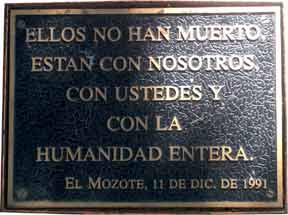
el-mozote-1991-memorialThere have been many effective antiwar movies made through the years, but the most moving antiwar movie about the US wars in Central America that our population funded back in the late ’70s and ’80s is a movie called Innocent Voices. It came out in 2005 and got little notice inside the US although it deserved to win the Academy Award for the best foreign film of that year. However with Bush firmly in power and the US government committing atrocities in Afghanistan and Iraq as elsewhere and as before, the film got downplayed here at home.

The film takes place in El Salvador and examines the lives of the children there during the ’80s. As grim a picture as the film paints, the reality was even worse, as the massacre at El Mozote underlines. I recommend watching this film with children ages 10 and above. They need to know why it is important to protest US war making and why it is relevant to them. as children.

To get a good idea of the themes of this film, be sure to check out all 3 of the clips on the link given above. This is definitely a film worth watching and I only wish that more Americans knew about it.

Following Obama out of La La Land

Rita and her GRANDMOTHERS FOR PEACE found change.gov and gave them an earful. (change.gov is the President-Elect’s change.org)

FOLLOWING OBAMA OUT OF LA LA LAND

I was afraid. The 2/26/08 e-mail from Bob Nemanich, Obama El Paso County Co-Coordinator, had come in minutes earlier. It read in part:

“Now this is important. Jay Ferguson, the vice chair of the El Paso County Democratic Party and I have been receiving numerous reports of curious and even worse descriptions of attempts, by some volunteers managing the entrance doors last Saturday morning, attempting to turn rightfully elected delegates away from the convention. This is serious stuff. If any of you witnessed or experienced an attempt by someone telling delegates who were in line Saturday morning and told to go home because: “the crowds were too big,” “no more room inside,” “they had enough delegates,” “the fire marshal was going to close us down,” or were told “their name was not on their lists” or other intimidations…You need to contact us immediately! We will need the description of th e person who was at the door making these or other statements or intimidating anyone, which line you were in, the time, and other circumstances which might further identify this person and activity of attempting to suppress the vote.”

I’d read the words and shuddered. What should I do?

I stood and walked away from the computer, passing the side-by-side pictures of my brother and son – both very precious to me and both very disabled. What could happen to them if I spoke out and told what I knew and had seen?

More than a decade ago, my “Rainman” duplicate son was working at his part-time job in the laundry of a local hotel. Suddenly a C.S.P.D. cop appeared and began roughing my boy up as he arrested him. The hotel maid who witnessed the arrest later told me she had begged the cop not to scare or hurt him, that he was autistic and retarded and didn’t understand what was happening. The cop ignored her as he threw my son against the wall, handcuffed him, and roughly led him to the waiting squad car and onto jail.

My boy’s “crime” was a false accusation beyond the belief of all who know my son and understand his limitations. Eventually the deputy district attorney dismissed all charges against him, but only after the nearly unsurmountable fear and suffering of my son and all who love him. His “crime” could have possibly have been based on his coming from a well-to-do family, thereby designating him and us as a target for monetary awards from fraudulent civil actions. And just as likely was the possibility that his being so brutalized, charged and arrested was a result of my political activism and stands against discrimination and intimidation. I’ll most likely go to my grave not knowing which was the case. One thing for certain – from now on I’ll be on guard against dirty political retaliation, particularly against those I love.

Months before my son’s false arrest, I had taken on an infamous Colorado Republican state senator who had publicly and to the press referred to all women of color as ‘promiscuous.” Following her nationally publicized remark, at a Colorado Springs “Cure Rally,” I had jokingly awarded her the “Jackass of the Year Award.” A few months later, at the urging of a retired judge and former colleague of mine, I had filed a criminal charge of harassment against the senator’s son, who had spear-headed the anti-gay Colorado Amendment Two, an amendment approved by the voters and later overturned by the U.S. Supreme Court.

Representing the Colorado Springs Minority Coalition, I had appeared on a local t.v. talk show with the senator’s son and responded to phone calls from viewers regarding the Minority Coalition’s stands on Amendment Two and other issues. Following the show, the senator’s son had invited me, along with a man from the N.A.A.C.P., into a studio back room where he had attempted to intimidate me by stating that it looked like we were going to fight. He then knuckle punched me in the arm. I followed the advice of my judicial friend, and reported the incident. Shortly thereafter, others came forward, citing similar attempts at intimidation by the senator’s son.

The same week my son was brutalized and falsely arrested, it was announced that the senator’s son was being removed from his job as head of “Colorado for Family Values,” the organization behind Amendment Two. A longtime observer of partisan politics in this one-party town of Colorado Springs observed that the senator’s son’s political career had been nipped the bud due to what had happened following the t.v. show.

I will always wonder if my son’s being charged and arrested for a crime he could never have committed was in reality an attack on me for standing up to blatant bigotry and an attempt at intimidation. And now I was being asked by an official of the Obama campaign to come forward once again, and stand up to undemocratic manipulation and outrageous intimidation. What should I do?

Torn by indecision, my view switched from the photo of my beautiful, autistic son, to the photo taken years earlier of my beloved brother, a mentally ill, fully disabled vet. And I was jolted into the present. Weeks earlier, my brother had gone into a local fast food restaurant, and had been questioned by the police for his part in a fist fight that had occurred in the restaurant.

My brother had watched and listened to a man in the restaurant as the man loudly and angrily berated the “stupid nigger” Barack Obama. My brother, a gently and caring person, had gone up to the man and told him he disagreed with him about Sen. Obama, and was offended at what the man was saying, and how he was saying it.

The man then swung at my brother twice, causing my brother to punch the man in defense, knocking the man to the floor and bloodying the man’s nose. The man ceased his hate filled outrage, and the police were called in. A restaurant employee explained to the police that it was not brother who had instigated the attack, but rather it was my brother who was defending himself. The man was arrested, and my brother, feeling very guilty for having struck someone, returned home to tell me the story. I consoled him, and complimented him for his bravery in speaking out against such hatred and bigotry.

And now, remembering my brother’s courage and glancing at my deceased uncle and god father’s purple heart from World War II, I made my decision. Courage is vital if heaven is to be gained and democracy is to be maintained. Scared as I was, I returned to the computer and began typing my affidavit, the soon to be sworn to statement of what I had witnessed at the El Paso County Democratic Assembly days earlier.

The story was not a pretty one. Elected Obama delegates and alternates had stood outside for hours in the frigid cold, only to be kept from entering the high school where the assembly was held. They were turned away in number at the door by none other than the then head of the Colorado Springs ACLU, a former NSA man. This former NSAer reportedly later stated he was merely following the directions of the local Democratic party chairman.

Within days of my submitting my signed and sworn to affidavit to the Obama and party official who had requested information, with copies to state and national party officials and ACLU officials, my house and grounds and the neighbor’s house was broken into in the middle of the night. According to both my neighbor and my brother who resides with me, the intruder appeared to be eager to be both heard and seen, and did not attempt to run and hide when spotted. This is the first break-in we have experienced since living here.

I went to the police station and added my brother’s citing of the intruder onto the neighbor’s report to the police the neighbor had made at the time of the incident. The police officer asked me if, to the best of my knowledge, anyone was attempting to intimidate me, my brother, or my neighbor. I gave the officer a copy of my affidavit, and told him an attempt to intimidate me had been made by the ACLU chairman immediately prior to my submission of my affidavit.

The officer then advised me to go as public as possible with the information I had. The officer state that his grandmother had been among those at the the Democratic assembly and, along with so many others, had wondered just what was going on.

Shortly thereafter, a representative from the local Democratic party notified me that the platform committee, to which I had been elected at the recent assembly, had been disbanded. It was hardly a surprise when three months later, two peace demonstrators were arrested at the Democratic state convention, which was held in Colorado Springs. The demonstrators were standing outside an area which was taped off by police, and were being cheered on and waved at by Obama delegates and alternates who were entering the World Arena building where the convention was being held.

The demonstrators were arrested, handcuffed, and transported first to a nearby station, then transported and left miles away from where the convention was being held. The support poles of the banner they displayed (“Dems – please stop funding the war in Iraq”) were destroyed by police. Significant rooftop audio surveillance occurred prior to and during the arrest, but was denied and not produced during the motions for discovery at time of preliminary hearings. Prior to going to trial, charges were dropped by the city, just as charges were eventually dropped by the city after the first trial against peace demonstrators (google Colorado Springs St. Patrick’s Day Parade 2007, n.b. “Police Brutality”) resulted in a hung jury.

This is not one person’s story – this is a city’s story, a state’s story, an entire country’s story. The coup d’etat of which President Eisenhower warned us during a radio address on his last day in office is well established and is going to be extremely difficult to undo. The undoing of the military/industrial/corporate coup will require courage and persistence of the highest order.

Forty fusion centers nationwide, and super fusion centers such as Colorado Springs, will continue to strip away basic civil rights by means of surveillance, and infiltration of peace, justice, and political organizations. These centers will not go away easily. The return of a free and non-spin press will not just happen. Improvement in education nationwide is essential if democracy is to return and survive. We must discontinue simply educating to enable every child to eventually get a bigger and better paying job so as to produce a bigger and better consumer, but rather we must provide truly meaningful education that turns out perpetually self-educating, critical thinkers who are impervious to spin and manipulation.

The need for change list goes on and one, and as long as President elect Obama hangs tough and maintains the heart, brains, and courage that are so necessary to oversee the change, hope we indeed survive. Then he can and will indeed lead us our of La La Land, and forward to the top of the mountain of all our dreams.

God bless and protect Barack Obama and his oh so wonderful and brave and bright family. And, please God, bless and protect not just America, but the entire world and all our sisters and brothers in it. Peace and love be with you and with us all.

Rita Walpole Ague

American medical facilities are spreading more dangerous runs of infectious diarrhea into the community

diarrheaMom, your kid has just come down with the Runs-from-Hell and you are without medical insurance, so what do you do? He needs hospitalization, but incredibly enough, it was probably hospitalization of Junior’s aunt that gave him what he has in the first place! Your kid picked up C-diff, an infectious diarrhea, during his visit to her in the hospital!

Diarrhea bacteria common in hospitals: survey

According to the the American Journal of Infection Control,

“Antibiotics don’t kill it and most germicides used for environmental cleaning don’t kill it. Only bleach does,” and by the time patients are diagnosed, they have had a day or two to contaminate their rooms and everyone who has had contact with them.

This study gives a really low undercount of this problem, too, since most facilities are not doing the testing and do not have the awareness about this disease that they should have. One big cause of the problem is the simple misappropriation of funds away from hiring enough nursing assistants to do decent care of the elderly in US hospitals and nursing homes. The money flows to the top reaches into the hands of people who do little to no actual hands-on work caring for the elderly and sick. I’m talking about insurance companies and all the administrative layers they create to pilfer funds away from the actual care givers themselves.

Uncle Tom’s Hotel Rwanda

Is the Don Cheedle?Let’s clear something up for the sake of poetic justice. Uncle Tom was a maltreated slave who bore his burden with dignity. He was no collaborator, no stool pigeon, no upper class of black slave that kept the lower savages in order. That “Uncle Tom” is what the term has come to mean: a white man’s black man, owing perhaps to the original character’s civilized humanity which a white reader might not have expected to be a capacity of an African slave. The neo-Uncle Tom is a Tutsi.

I heard the film Hotel Rwanda was just incredible, I’m sure it was. I watched the Frontline documentary to commemorate the anniversary of the genocide in Rwanda and so thought I knew the sad story already. Well I was right and I was wrong, but not about the film.

The mounting trouble in the Democratic Republic of Congo is causing leaders to forewarn of genocide such as Rwanda experienced in 1994. We’re told the same Hutus are marauding today. In addressing the issues of the Congo, do we have an understanding of what happened in 1994, beside the film dramatization?

The question to ask is whether what happened in Rwanda was genocide. That’s not to minimize the killings, but to scrutinize the motives. Was the fighting between Hutus and Tutsis racially motivated tribal warfare, or was it class warfare? Were the events of 1994 components of a peasant rebellion, distinguished by the opposing forces being from different ethnicities?

The distinction is critical. Behind the Hotel Rwanda imagery is the theme that African tribes need to be protected from each other. This happens in the form of UN intervention usually. The storytellers also know that if the narrative is bloody enough, a Western audience is just as ready to throw up its hands. Thus our impulse to join the Peace Corps or Medecins Sans Frontieres is quietly scrubbed in favor of calling in the cavalry. And then, only in the event of genocide.

Someone keeps wanting Westerners to believe that African tribes will continue to kill each other regardless what we do. Is it true? No, the Africans fight because of what we do.

The Tutsi victims of Hotel Rwanda were not just hotel keepers and clerks. The Tutsis were the administrative enforcers of post-colonial central Africa. The Hutus were the oppressed, and rose up against the Tutsis after generations of oppression and killings.

If Africa were let to develop autonomous states from its indigenous populations, its people could put their natural resources to use improving their lives. Instead, our post-colonial tentacles continue to stir up instability. Our business interests make sure that the native Africans never get their footing. We fund strong men to enforce violent rule over the inhabitants. It’s a controlled instability that facilitates the minimal societal infrastructure our traders require. But instability is difficult a balancing act. When the mayhem gets out of hand, peace-keepers are brought in at the people’s expense, to restore the disordered order.

McCain won’t need on the job training, he’s almost dead in this election

beam me upThe funniest part of the debate was McCain saying that he won’t need any on the job training for being President unlike how Obama supposedly would. That’s right, John, clones of Bush/ Reagan do not need any on the job training at all. However, neither do clones of Clinton.

But how stupid could McCain get with using this line? People aren’t comparing Obama’s ‘experience’ as a political hack with that of Old Fart John, they are comparing Obama’s experience with that of Sarah Palin since they figure that such a decrepit tottering old fool probably won’t last his 4 year term. In fact, McCain looked so bad health wise in tonight’s debate that many folk will have trouble thinking that he could make it through even another year!

As to substance? Well there was little. Neither candidate had anything to say about the effects of deficit spending for the military plunging (that’s today’s Wall Street word) the world economy into the deep, yet they blabbed on about it for most of their time. And to the military and what wars to fight, Obama outflanked General McCain to the far right, saying that we must go aggressively into Pakistan and Afghanistan yet more than has already been done! He wants to invade Sudan, too, it seemingly appears. McCain says that Obama speaks big, but carries a small stick, where as with Viagra McCain it is the other way around. Hey, that’s differences for you!

Obama seemed to score a point or two on the theme of health care, simply because McCain’s approach was to say let the poor die in the streets and don’t bother business folk with such picayune affairs. Obama replied that he was not so eager to napalm the American public.

Who won the debate in this debate of losers? Why Obama did. McCain is too cloned from a one letter President who is sinking faster than Wall Street stocks. It’s the economy, W. Look for the gap between McCain and Obama to grow wider with John’s weak punches. The Republican campaign is now on life support and needs Cheney to start a nuclear war to possibly rally the flag waving public back into their camp of Fantasy. We’re on to new fantasies instead! Clintonism just turned Blacker! Oh joy!

Hooters in time honored fashion

ritz bar and grill
COLORADO SPRINGS- At the Ritz Bar and Grill on Tejon St. downtown, waitresses have to bend over the counter to convey drink orders to the bartenders. There’s a raised platform to assist them in their short skirts. If the show outside is too tame for you.

I remember learning in high school that all the roles in Shakespeare’s plays, even the female characters, were portrayed by male actors. We were left to assume that women in Elizabethan England were not permitted on stage for the usual discriminatory reasons. But that was a simplification, which obscured the origins of sexism like the Burqa.

In Old England it was not that their gender was not talented enough, nor, directly, that women’s power challenged the men. Elizabethan rulers deemed it imprudent to let women advertise their wares on public stages. Women who were not at home with families, serving the domestic sex trade let’s say, were free-agent professionals. Inn keepers and barmaids had job descriptions not far removed from prostitutes, and a stage gave them too much marketing visibility. No doubt, obviously power.

I suppose sex also threatened to obscure the art of the theater. A favorite author once wrote he could only aspire to create a poem as immediately compelling as a pornographic photograph.

A friend of mine used to work at the Ritz, and assured me the skirt length was voluntary. Likewise the bar step at the center of everyone’s attention. Both great for tips she said.

Obama said The Ukraine not Ukraine tsk

Old map of Empire Russe with Russia and the UkraineOn the subject of spinning the debates…

Did you hear about Barack Obama’s horrible gaffe in the first debate?! According to public radio, Obama referred to “The Ukraine” instead of the less diminutive “Ukraine” sans-the. PRI’s The World trotted out tsk-tsks from a Ukrainian-accented expert who derided Obama for his un-PC insensitivity to her country’s post-Soviet independence.

Self-respecting nations don’t require “the” to distinguish them apparently. “The” is only for provinces or regions, the expert explained. The Balkins, the Riviera –I can’t remember her examples. Certainly you wouldn’t say The France, unless you were referring to the ocean liner. How undiplomatic for Obama to malign poor proud “Ukrayina.” The would-be statesman [in evident need of more experience] should come visit, suggested the expert. But the report revealed [Instead] Obama was campaigning in Ohio.

Shall we look into what the Ukrainian expert didn’t explain: why English speakers unconsciously need to add “the” before Ukraine? Is it simply because we used to, when Ukraine was a part of Russia, and then a member of the USSR. But we didn’t say the Georgia, or the Belorusse…

Unless we meant THE Republic of Belarus. But that rule applies to every formal title. Then also we say the United States, we say the UK, and we say the People’s Republic of China. We say the Netherlands, but not the Finland, nor the Afghanistan. We do not add THE to any of the -stan states, which was a Russian suffix meaning “land.” Perhaps as we don’t use THE for nations ending in -land either.

We say the Philippines. We say the the Maldives. There seems to be a pattern related to territories in the plural. So it’s nothing to do with client states but rather collected lands.

As usual, I’ve entertained myself before doing the research.

1. The Ukraine
Is the Ukraine (I can’t help but say it that way) a reference to plural regions? Or is there some other idiomatic pattern which governs usage for English-speakers? The answer turned out to be the former.

Apparentely, Ukrayina is named after the Old East Slavic for “border region.” The Territories of Ukraine were the old Russian empire’s western edge. Perhaps this suggests why Ukrainians want to be considered their own land, and not part of someone else’s.

There, the expert is right. A historically geographical name does not suggest a sovereign nation. The Transvaal, the Yukon, the Sahara, the Midlands on England’s border to Scotland. I think it’s interesting that no US state needs a “the,” compared to their previous incarnations as the Dakota Territories, the Louisiana Purchase, etc.

But to complicate the matter, in the Ukrainian language the word means “country.” Doesn’t it go against their own tongue to eliminate the definite article? To refer to either concept, country or border, requires “the.” At least I know it is so in English. Which is my point here.

Since their independence from the USSR the Ukraine has asserted an identity minus “the.” The distinction is for diplomatic papers. So I’m not sure that international conventions govern how foreign languages bend to suit another’s domestic decree. Germany for example is known by as many names as it has neighbors, and none of them is Deutschland.

How appropriate is it to try to mock Obama for speaking the King’s English, aka English?

Isn’t your interest piqued about other places to which a “the” wants to cling to an earlier vestige? The Ivory Coast would seem to have become an effortless Ivory Coast, maybe because the plurality of “coast” is ambiguous.

2. The Sudan
What about the Sudan versus Sudan? We know it through the English colonials as “the Sudan,” but now the post-colonial English-speaking diplomatic class asserts it’s just Sudan. I can’t help but wonder if there’s some Globalization edict for nation-state nomenclature compliance. Is it for the sake of easier alphabetization?

That reminds me of how China lined up the Olympic participants in the 2008 Opening Ceremonies. Nations were ranked based on how many strokes were required in their Chinese character. American commentators thought viewers would probably consider the order nonsensical. How much sense does it make to require state names to conform to an anglo-file system?

As an aside, is the French “Sud” for South, related to the Arabic “Sudan” for “Blacks?” Both that direction from the then-known world. Not so further aside, the French say “Le Sud” in the same way we use “the” to differentiate the destination from the direction.

In any event, in Arabic, the language of the population of Sudan, the country calls itself “al-Sudan.” Post-9/11 westerners know “al” translates to “the.” That would be Sudan with the “the.”

What does 9/11 have to do with this?

soldier praying9/11 has become the essential cornerstone of the new fusion of US imperialism, US Christian neo-theocracy, and US racism. God supposedly has chosen a victimized nation to become his Chosen People, etc. and so on. Evil Muslim Arab Devils lurk in the shadows and want the blood of good Christians and their Jewish servants. God Bless America!

Eric and I got a first hand glimpse of this current political theocracy in action at the Colorado Springs municipal government meeting this Tuesday, where 9/11 served to serve up an even bigger than normal dose of Pledge of Allegiance loyalism, pre-meeting prayer, and verbal hypocrisy. They even had a giant harp there on hand to make it all even more heavenly, I guess for the theocrats that run the city government here in the city? It was surreal and I stayed outside in the halls to keep from churning my lunch back up.

Eric proposed that the city look into why it’s police removed him and Peter illegally away from a political activity they and others were protesting, and then later harassed him and Peter legally for several months all in order to finally drop the framed up charges altogether? He linked it to the same sort of abuse of police power used against Democracy Now and Amy Goodman at the Republican Convention.

I used my time to ask that the city council members take their responsibility seriously as government leaders to pass a municipal resolution condemning the federal torture of US government held POWs, their illegal detention for years without charges, and their transport to foreign countries for torture there, too. All I got for my efforts was total silence as Republican Mayor Lionel Rivera chimed in about how he supported these abuses by the US military, while the other city council people sat by stupidly.

These Right Wing Americans, both Democratic and Republican Party leaders, use 9/11 to justify everything these days, no matter how backward and unconnected from 9/11. For example, what does 9/11 have to do with re-arming Georgia or putting missile systems into Poland and The Czech Republic? What does 9/11 have to do with the US government supporting and fomenting civil war in countries as diverse as Pakistan, Bolivia, the Caucasus region, Iran, China, and Ukraine? But 9/11 is the catch word for all of this, as the vacuous Global War on Terrorism forgets to target terrorists at all, but instead moves against everybody, everywhere, and at everytime!

Yes, 9/11 is also the excuse to move against the US population itself, as the stop terrorism line got reduced down to accusing protesters of planning to use urine and shit to terrorize just who at the ruling parties conventions? It doesn’t matter any more just how stupid and illogical and unbelievable all this really is anymore. We’re on Green light, Yellow light, Red light bullshit all the time.

So on this 9/11 worship day, ask yourselves….

Are you still proud to be an American?

If you are, then you are a real nitwit. This country is on the wrong track and you know it!

George Will’s vocabulary outshines him

George Will Hitler bowtieCOLORADO SPRINGS- Some people look smaller in person than they do on TV. Many of us only know George Will from newsprint, but in person he’s an organ grinder’s monkey, amusingly agile, if a little threatening, but basically smallish and tethered to somebody asking for money.

Maybe it was my perspective from the steep audience seating in the South Theater of CC’s new Cornerstone Arts Center. Maybe it was looking down at George as he walked in circles between folksy baseball anecdotes, over-simplified economics and patronizing criticism of the American culture of entitlement.

I wanted to ask how a gentleman of his obvious acuity got any pleasure from addressing audiences like they were idiots. People who applauded him, by the way, and laughed at the slightest old joke. “Half of all students are of below average intelligence.” Hahahahaha. “I’m glad you got that one.” Hahahahaha.

I remember a professor I had in an advanced math class who used to berate us undergrads for the time he had to waste with us. Tonight’s audience was filled to overflow with Colorado Springs’ better-heeled hayseeds, but George Will seemed perfectly at home.

Will’s “reflections on the 2008 election” consisted of the usual horse race stats about which states have to be won by whom in order to satisfy the probabilities of precedent. “History is consistent after all,” he was attributing this adage to someone I think, “right up until the moment it isn’t.” Hahahaha. Numbers and groups of states, etc. The next president may again win the necessary electoral votes and loose the popular vote.

As a gesture to the college age portion of tonight’s audience, Will offered that all the statistical stars were lining up for a Democratic win in November, but to his contemporaries in the theater Will later confided that he didn’t consider Obama ready to lead. He also opined that Sarah Palin would provide a refreshing change to Washington DC.

Thankfully the Pulitzer Prize rewardee soon wrapped up his election year remarks and got back on the horse he undoubtedly had been commissioned to ride. Scold Americans for their entitlement mentality and convince them to privatize Social Security. There followed a Libertarian mocking of all social responsibility, and an incredible stretching of credulity seeing the absence of ready rebuttal.

Take for example, Big Pharma. George Will applauds Big Pharma and the obscene profits they reap. Those profits are only appropriate, he says, considering the tremendous costs the pharmaceuticals bear with R&D and the circumnavigation of regulations. Really George? Profit is the product of income minus expense. You want to count the expenses twice? One might compare profit against expense in the light of risk, but wouldn’t that be to beg the definition of “obscene” profits, considering none have reported obscene losses?

Will chastised the growth of the Agricultural Department citing the narrowing ratio of Ag employees to American Farmers, without referencing the precipitous rise of Big Agra and the eclipse of family farms.

Of course, entitlement programs were the chief evil, while no mention was made to corporate entitlements or bailouts or subsidized banking or the federal deficit, EXCEPT where Americans will obviously have to borrow from the next generations to finance Medicare and Social Security.

While George Will admonished Americans for wanting more from their government, he expressed not a single curiosity for how every other developed nation is able to care for their sick, their poor, and their elderly. In fact, Will compared West Germany to East Germany as an example of Capitalism’s proven superiority to Socialism, without observing that modern Germany’s social system is not the heartless one he advocates for here.

Will got lots of applause, and fielded no challenging questions. A last answer, defined for me, the nature of his limited mindset. Will was asked if a sales tax mightn’t be a more equitable substitute for the income tax. Never mind it being regressive, the suggestion certainly pleased the crowd. George Will explained that a sales tax would have to be in excess of 20% to provide the same monies. This would be unfeasible, Will pronounced. But he didn’t say it was because neither the poor, nor the working class, nor the middle class could afford a 20% rise in the cost of living. No, Will described how buying a $500,000 home would mean an additional $100,000 in tax. Unthinkable he said. And he accuses Obama of being elitist. Hahahahaha.

Long distance winner

Running the Pikes Peak Ascent
I remember when running came to Colorado Springs. Jim Fixx’s The Complete Book of Running was published in the late seventies and preached running as the path to good health. The book spent 11 weeks at number one on the the bestsellers list and is credited for starting America’s fitness revolution.
 
I was part of that revolution. Not as a runner, but as a close observer. You see, I’m the sister of a running fanatic.

My brother’s friends opened a store called Runners Roost shortly after Fixx’s book hit the big time. Between his daily 15-mile runs, Jim worked there for years, while I worked for a bigger, more general sporting goods store at the Citadel. The two jobs hardly resembled each other.

I spent my days shoe-horning Air Jordans onto the feet of just-paid GIs, while Jim watched people run up and down Bijou so he could check their gaits, look for pronation or supination, and make sound footwear recommendations. I pulled Russell Athletic sweat shirts over the bellies of armchair quarterbacks, while Jim sold silky singlets and impossibly short running shorts to fat-free lunatics. Even when I was allowed to fit football helmets on 10-year-old pinheads, and wax the K2s of handsome ruddy-cheeked skiers, I still envied my brother’s life. To me, there was something enigmatic and appealing about a long-distance runner. I feel the same even now.

Today my 14-year-old son got up at 4 a.m. and ran to the top of Pikes Peak — a solitary 13-mile trek. I imagine he wouldn’t have mentioned his plan to anyone if he didn’t need a ride to the trailhead. Later he told me his finish time, and not much else.

After all these years, it looks like I may have another chance to unravel the mysterious runner’s mind.

Global economic rapists are at it again

G8 protest
Why protest the G8 Summit July 7-9? Those hoodlums always look so determined. Here’s the rationale by the Emergency Exit Collective:

The 2008 G8 on Hokkaido, a Strategic Assessment
Emergency Exit Collective
Bristol, Mayday, 2008

The authors of this document are a collection of activists, scholars, and writers currently based in the United States and Western Europe who have gotten to know and work with each other in the movement against capitalist globalization. We’re writing this at the request of some members of No! G8 Action Japan, who asked us for a broad strategic analysis of the state of struggle as we see it, and particularly, of the role of the G8, what it represents, the dangers and opportunities that may lie hidden in the moment. It is in no sense programmatic. Mainly, it is an attempt to develop tools that we hope will be helpful for organizers, or for anyone engaged in the struggle against global capital.

I
It is our condition as human beings that we produce our lives in common.

II
Let us then try to see the world from the perspective of the planet’s commoners, taking the word in that sense: those whose most essential tradition is cooperation in the making and maintenance of human social life, yet who have had to do so under conditions of suffering and separation; deprived, ignored, devalued, divided into hierarchies, pitted against each other for our very physical survival. In one sense we are all commoners. But it’s equally true that just about everyone, at least in some ways, at some points, plays the role of the rulers—of those who expropriate, devalue and divide—or at the very least benefits from such divisions.

Obviously some do more than others. It is at the peak of this pyramid that we encounter groups like the G8.

III
The G8’s perspective is that of the aristocrats, the rulers: those who command and maintain that global machinery of violence that defends existing borders and lines of separation: whether national borders with their detention camps for migrants, or property regimes, with their prisons for the poor. They live by constantly claiming title to the products of others collective creativity and labour, and in thus doing they create the poor; they create scarcity in the midst of plenty, and divide us on a daily basis; they create financial districts that loot resources from across the world, and in thus doing they turn the spirit of human creativity into a spiritual desert; close or privatize parks, public water taps and libraries, hospitals, youth centers, universities, schools, public swimming pools, and instead endlessly build shopping malls that channels convivial life into a means of commodity circulation; work toward turning global ecological catastrophe into business opportunities.

These are the people who presume to speak in the name of the “international community” even as they hide in their gated communities or meet protected by phalanxes of riot cops. It is critical to bear in mind that the ultimate aim of their policies is never to create community but to introduce and maintain divisions that set common people at each other’s throats. The neoliberal project, which has been their main instrument for doing so for the last three decades, is premised on a constant effort either to uproot or destroy any communal or democratic system whereby ordinary people govern their own affairs or maintain common resources for the common good, or, to reorganize each tiny remaining commons as an isolated node in a market system in which livelihood is never guaranteed, where the gain of one community must necessarily be at the expense of others. Insofar as they are willing to appeal to high-minded principles of common humanity, and encourage global cooperation, only and exactly to the extent that is required to maintain this system of universal competition.

IV
At the present time, the G8—the annual summit of the leaders of “industrial democracies”—is the key coordinative institution charged with the task of maintaining this neoliberal project, or of reforming it, revising it, adapting it to the changing condition of planetary class relations. The role of the G8 has always been to define the broad strategic horizons through which the next wave of planetary capital accumulation can occur. This means that its main task is to answer the question of how 3?4 in the present conditions of multiple crises and struggles 3?4 to subordinate social relations among the producing commoners of the planet to capital’s supreme value: profit.

V
Originally founded as the G7 in 1975 as a means of coordinating financial strategies for dealing with the ‘70s energy crisis, then expanded after the end of the Cold War to include Russia, its currently face a moment of profound impasse in the governance of planetary class relations: the greatest since the ‘70s energy crisis itself.

VI
The ‘70s energy crisis represented the final death-pangs of what might be termed the Cold War settlement, shattered by a quarter century of popular struggle. It’s worth returning briefly to this history.

The geopolitical arrangements put in place after World War II were above all designed to forestall the threat of revolution. In the immediate wake of the war, not only did much of the world lie in ruins, most of world’s population had abandoned any assumption about the inevitability of existing social arrangements. The advent of the Cold War had the effect of boxing movements for social change into a bipolar straightjacket. On the one hand, the former Allied and Axis powers that were later to unite in the G7 (the US, Canada, UK, France, Italy, Germany, Japan)—the “industrialized democracies”, as they like to call themselves—engaged in a massive project of co-optation. Their governments continued the process, begun in the ‘30s, of taking over social welfare institutions that had originally been created by popular movements (from insurance schemes to public libraries), even to expand them, on condition that they now be managed by state-appointed bureaucracies rather than by those who used them, buying off unions and the working classes more generally with policies meant to guarantee high wages, job security and the promise of educational advance—all in exchange for political loyalty, productivity increases and wage divisions within national and planetary working class itself. The Sino-Soviet bloc—which effectively became a kind of junior partner within the overall power structure, and its allies remained to trap revolutionary energies into the task of reproducing similar bureaucracies elsewhere. Both the US and USSR secured their dominance after the war by refusing to demobilize, instead locking the planet in a permanent threat of nuclear annihilation, a terrible vision of absolute cosmic power.

VII
Almost immediately, though, this arrangement was challenged by a series of revolts from those whose work was required to maintain the system, but who were, effectively, left outside the deal: first, peasants and the urban poor in the colonies and former colonies of the Global South, next, disenfranchised minorities in the home countries (in the US, the Civil Rights movement, then Black Power), and finally and most significantly, by the explosion of the women’s movement of the late ‘60s and early ‘70s—the revolt of that majority of humanity whose largely unremunerated labor made the very existence “the economy” possible. This appears to have been the tipping point.

VIII
The problem was that the Cold War settlement was never meant to include everyone. It by definition couldn’t. Once matters reached tipping point, then, the rulers scotched the settlement. All deals were off. The oil shock was first edge of the counter-offensive, breaking the back of existing working class organizations, driving home the message that there was nothing guaranteed about prosperity. Under the aegis of the newly hatched G7, this counter-offensive involved a series of interwoven strategies that were later to give rise to what is known as neoliberalism.

IX
These strategies resulted in what came to be known as “Structural Adjustment” both in the North and in the South, accompanied by trade and financial liberalization. This, in turn, made possible crucial structural changes in our planetary production in common extending the role of the market to discipline our lives and divide us into more and more polarized wage hierarchy. This involved:

· In the immediate wake of ‘70s oil shock, petrodollars were recycled from OPEC into Northern banks that then lent them, at extortionate rates of interest, to developing countries of the Global South. This was the origin of the famous “Third World Debt Crisis.” The existence of this debt allowed institutions like the IMF to impose its monetarist orthodoxy on most of the planet for roughly twenty years, in the process, stripping away most of even those modest social protections that had been won by the world’s poor—large numbers of whom were plunged into a situation of absolute desperation.

· It also opened a period of new enclosures through the capitalist imposition of structural adjustment policies, manipulation of environmental and social catastrophes like war, or for that matter through the authoritarian dictates of “socialist” regimes. Through such means, large sections of the world’s population have over the past thirty years been dispossessed from resources previously held in common, either by dint of long traditions, or as the fruits of past struggles and past settlements.

· Through financial deregulation and trade liberalization, neoliberal capital, which emerged from the G7 strategies to deal with the 1970s crisis aimed thus at turning the “class war” in communities, factories, offices, streets and fields against the engine of competition, into a planetary “civil war”, pitting each community of commoners against every other community of commoners.

· Neoliberal capital has done this by imposing an ethos of “efficiency” and rhetoric of “lowering the costs of production” applied so broadly that mechanisms of competition have come to pervade every sphere of life. In fact these terms are euphemisms, for a more fundamental demand: that capital be exempt from taking any reduction in profit to finance the costs of reproduction of human bodies and their social and natural environments (which it does not count as costs) and which are, effectively, “exernalized” onto communities and nature.

· The enclosure of resources and entitlements won in previous generations of struggles both in the North and the South, in turn, created the conditions for increasing the wage hierarchies (both global and local), by which commoners work for capital—wage hierarchies reproduced economically through pervasive competition, but culturally, through male dominance, xenophobia and racism. These wage gaps, in turn, made it possible to reduce the value of Northern workers’ labour power, by introducing commodities that enter in their wage basket at a fraction of what their cost might otherwise have been. The planetary expansion of sweatshops means that American workers (for example) can buy cargo pants or lawn-mowers made in Cambodia at Walmart, or buy tomatoes grown by undocumented Mexican workers in California, or even, in many cases, hire Jamaican or Filipina nurses to take care of children and aged grandparents at such low prices, that their employers have been able to lower real wages without pushing most of them into penury. In the South, meanwhile, this situation has made it possible to discipline new masses of workers into factories and assembly lines, fields and offices, thus extending enormously capital’s reach in defining the terms—the what, the how, the how much—of social production.

· These different forms of enclosures, both North and South, mean that commoners have become increasingly dependent on the market to reproduce their livelihoods, with less power to resist the violence and arrogance of those whose priorities is only to seek profit, less power to set a limit to the market discipline running their lives, more prone to turn against one another in wars with other commoners who share the same pressures of having to run the same competitive race, but not the same rights and the same access to the wage. All this has meant a generalized state of precarity, where nothing can be taken for granted.

X
In turn, this manipulation of currency and commodity flows constituting neoliberal globalization became the basis for the creation of the planet’s first genuine global bureaucracy.

· This was multi-tiered, with finance capital at the peak, then the ever-expanding trade bureaucracies (IMF, WTO, EU, World Bank, etc), then transnational corporations, and finally, the endless varieties of NGOs that proliferated throughout the period—almost all of which shared the same neoliberal orthodoxy, even as they substituted themselves for social welfare functions once reserved for states.

· The existence of this overarching apparatus, in turn, allowed poorer countries previously under the control of authoritarian regimes beholden to one or another side in the Cold War to adopt “democratic” forms of government. This did allow a restoration of formal civil liberties, but very little that could really merit the name of democracy (the rule of the “demos”, i.e., of the commoners). They were in fact constitutional republics, and the overwhelming trend during the period was to strip legislatures, that branch of government most open to popular pressure, of most of their powers, which were increasingly shifted to the executive and judicial branches, even as these latter, in turn, largely ended up enacting policies developed overseas, by global bureaucrats.

· This entire bureaucratic arrangement was justified, paradoxically enough, by an ideology of extreme individualism. On the level of ideas, neoliberalism relied on a systematic cooptation of the themes of popular struggle of the ‘60s: autonomy, pleasure, personal liberation, the rejection of all forms of bureaucratic control and authority. All these were repackaged as the very essence of capitalism, and the market reframed as a revolutionary force of liberation.

· The entire arrangement, in turn, was made possible by a preemptive attitude towards popular struggle. The breaking of unions and retreat of mass social movements from the late ‘70s onwards was only made possible by a massive shift of state resources into the machinery of violence: armies, prisons and police (secret and otherwise) and an endless variety of private “security services”, all with their attendant propaganda machines, which tended to increase even as other forms of social spending were cut back, among other things absorbing increasing portions of the former proletariat, making the security apparatus an increasingly large proportion of total social spending. This approach has been very successful in holding back mass opposition to capital in much of the world (especially West Europe and North America), and above all, in making it possible to argue there are no viable alternatives. But in doing so, has created strains on the system so profound it threatens to undermine it entirely.

XI
The latter point deserves elaboration. The element of force is, on any number of levels, the weak point of the system. This is not only on the constitutional level, where the question of how to integrate the emerging global bureaucratic apparatus, and existing military arrangements, has never been resolved. It is above all an economic problem. It is quite clear that the maintenance of elaborate security machinery is an absolute imperative of neoliberalism. One need only observe what happened with the collapse of the Soviet bloc in Eastern Europe: where one might have expected the Cold War victors to demand the dismantling of the army, secret police and secret prisons, and to maintain and develop the existing industrial base, in fact, what they did was absolutely the opposite: in fact, the only part of the industrial base that has managed fully to maintain itself has been the parts required to maintained the security apparatus itself! Critical too is the element of preemption: the governing classes in North America, for example, are willing to go to almost unimaginable lengths to ensure social movements never feel they are accomplishing anything. The current Gulf War is an excellent example: US military operations appear to be organized first and foremost to be protest-proof, to ensure that what happened in Vietnam (mass mobilization at home, widespread revolt within the army overseas) could never be repeated. This means above all that US casualties must always be kept to a minimum. The result are rules of engagement, and practices like the use of air power within cities ostensibly already controlled by occupation forces, so obviously guaranteed to maximize the killing of innocents and galvanizing hatred against the occupiers that they ensure the war itself cannot be won. Yet this approach can be taken as the very paradigm for neoliberal security regimes. Consider security arrangements around trade summits, where police are so determined prevent protestors from achieving tactical victories that they are often willing to effectively shut down the summits themselves. So too in overall strategy. In North America, such enormous resources are poured into the apparatus of repression, militarization, and propaganda that class struggle, labor action, mass movements seem to disappear entirely. It is thus possible to claim we have entered a new age where old conflicts are irrelevant. This is tremendously demoralizing of course for opponents of the system; but those running the system seem to find that demoralization so essential they don’t seem to care that the resultant apparatus (police, prisons, military, etc) is, effectively, sinking the entire US economy under its dead weight.

XII
The current crisis is not primarily geopolitical in nature. It is a crisis of neoliberalism itself. But it takes place against the backdrop of profound geopolitical realignments. The decline of North American power, both economic and geopolitical has been accompanied by the rise of Northeast Asia (and to a increasing extent, South Asia as well). While the Northeast Asian region is still divided by painful Cold War cleavages—the fortified lines across the Taiwan straits and at the 38th parallel in Korea…—the sheer realities of economic entanglement can be expected to lead to a gradual easing of tensions and a rise to global hegemony, as the region becomes the new center of gravity of the global economy, of the creation of new science and technology, ultimately, of political and military power. This may, quite likely, be a gradual and lengthy process. But in the meantime, very old patterns are rapidly reemerging: China reestablishing relations with ancient tributary states from Korea to Vietnam, radical Islamists attempting to reestablish their ancient role as the guardians of finance and piety at the in the Central Asian caravan routes and across Indian Ocean, every sort of Medieval trade diaspora reemerging… In the process, old political models remerge as well: the Chinese principle of the state transcending law, the Islamic principle of a legal order transcending any state. Everywhere, we see the revival too of ancient forms of exploitation—feudalism, slavery, debt peonage—often entangled in the newest forms of technology, but still echoing all the worst abuses of the Middle Ages. A scramble for resources has begun, with US occupation of Iraq and saber-rattling throughout the surrounding region clearly meant (at least in part) to place a potential stranglehold the energy supply of China; Chinese attempts to outflank with its own scramble for Africa, with increasing forays into South America and even Eastern Europe. The Chinese invasion into Africa (not as of yet at least a military invasion, but already involving the movement of hundreds of thousands of people), is changing the world in ways that will probably be felt for centuries. Meanwhile, the nations of South America, the first victims of the “Washington consensus” have managed to largely wriggle free from the US colonial orbit, while the US, its forces tied down in the Middle East, has for the moment at least abandoned it, is desperately struggling to keep its grip Mexico, Central America and the Caribbean—its own “near abroad”.

XIII
In another age all this might have led to war—that is, not just colonial occupations, police actions, or proxy wars (which are obviously already taking place), but direct military confrontations between the armies of major powers. It still could; accidents happen; but there is reason to believe that, when it comes to moments of critical decision, the loyalties of the global elites are increasingly to each other, and not to the national entities for whom they claim to speak. There is some compelling evidence for this.

Take for example when the US elites panicked at the prospect of the massive budget surpluses of the late 1990s. As Alan Greenspan, head of the Federal Reserve at the time warned, if these were allowed to stand they would have flooded government coffers with so many trillions of dollars that it could only have lead to some form of creeping socialism, even, he predicted, to the government acquiring “equity stakes” in key US corporations. The more excitable of capitalism’s managers actually began contemplating scenarios where the capitalist system itself would be imperiled. The only possible solution was massive tax cuts; these were duly enacted, and did indeed manage to turn surpluses into enormous deficits, financed by the sale of treasury bonds to Japan and China. Conditions have thus now reached a point where it is beginning to look as if the most likely long term outcome for the US (its technological and industrial base decaying, sinking under the burden of its enormous security spending) will be to end up serve as junior partner and military enforcer for East Asia capital. Its rulers, or at least a significant proportion of them, would prefer to hand global hegemony to the rulers of China (provided the latter abandon Communism) than to return to any sort of New Deal compromise with their “own” working classes.

A second example lies in the origins of what has been called the current “Bretton Woods II” system of currency arrangements, which underline a close working together of some “surplus” and “deficit” countries within global circuits. The macroeconomic manifestation of the planetary restructuring outlined in XIX underlines both the huge US trade deficit that so much seem to worry many commentators, and the possibility to continually generate new debt instruments like the one that has recently resulted in the sub-prime crisis. The ongoing recycling of accumulated surplus of countries exporting to the USA such as China and oil producing countries is what has allowed financiers to create new credit instruments in the USA. Hence, the “deal” offered by the masters in the United States to its commoners has been this: ‘you, give us a relative social peace and accept capitalist markets as the main means through which you reproduce your own livelihoods, and we will give you access to cheaper consumption goods, access to credit for buying cars and homes, and access to education, health, pensions and social security through the speculative means of stock markets and housing prices.’ Similar compromises were reached in all the G8 countries.

Meanwhile, there is the problem of maintaining any sort of social peace with the hundreds of millions of unemployed, underemployed, dispossessed commoners currently swelling the shanty-towns of Asia, Africa, and Latin America as a result of ongoing enclosures (which have speeded up within China and India in particular, even as “structural adjustment policies” in Africa and Latin America have been derailed). Any prospect of maintaining peace in these circumstances would ordinarily require either extremely high rates of economic growth—which globally have not been forthcoming, since outside of China, growth rates in the developing world have been much lower than they were in the ‘50s, ‘60s, or even ‘70s—or extremely high levels of repression, lest matters descend into rebellion or generalized civil war. The latter has of course occurred in many parts of the world currently neglected by capital, but in favored regions, such as the coastal provinces of China, or “free trade” zones of India, Egypt, or Mexico, commoners are being offered a different sort of deal: industrial employment at wages that, while very low by international standards, are still substantially higher than anything currently obtainable in the impoverished countryside; and above all the promise, through the intervention of Western markets and (privatized) knowledge, of gradually improving conditions of living. While over the least few years wages in many such areas seem to be growing, thanks to the intensification of popular struggles, such gains are inherently vulnerable: the effect of recent food inflation has been to cut real wages back dramatically—and threaten millions with starvation.

What we really want to stress here, though, is that the long-term promise being offered to the South is just as untenable as the idea that US or European consumers can indefinitely expand their conditions of life through the use of mortgages and credit cards.

What’s being offered the new dispossessed is a transposition of the American dream. The idea is that the lifestyle and consumption patterns of existing Chinese, Indian, or Brazilian or Zambian urban middle classes (already modeled on Northern ones) will eventually become available to the children of today’s miners, maquila or plantation laborers, until, ultimately, everyone on earth is brought up to roughly the same level of consumption. Put in these terms, the argument is absurd. The idea that all six billion of us can become “middle class” is obviously impossible. First of all there is a simple problem of resources. It doesn’t matter how many bottles we recycle or how energy efficient are the light bulbs we use, there’s just no way the earth’s ecosystem can accommodate six billion people driving in private cars to work in air-conditioned cubicles before periodically flying off to vacation in Acapulco or Tahiti. To maintain the style of living and producing in common we now identify with “middle classness” on a planetary scale would require several additional planets.

This much has been pointed out repeatedly. But the second point is no less important. What this vision of betterment ultimately proposes is that it would be possible to build universal prosperity and human dignity on a system of wage labor. This is fantasy. Historically, wages are always the contractual face for system of command and degradation, and a means of disguising exploitation: expressing value for work only on condition of stealing value without work— and there is no reason to believe they could ever be anything else. This is why, as history has also shown, human beings will always avoid working for wages if they have any other viable option. For a system based on wage labor to come into being, such options must therefore be made unavailable. This in turn means that such systems are always premised on structures of exclusion: on the prior existence of borders and property regimes maintained by violence. Finally, historically, it has always proved impossible to maintain any sizeable class of wage-earners in relative prosperity without basing that prosperity, directly or indirectly, on the unwaged labor of others—on slave-labor, women’s domestic labor, the forced labor of colonial subjects, the work of women and men in peasant communities halfway around the world—by people who are even more systematically exploited, degraded, and immiserated. For that reason, such systems have always depended not only on setting wage-earners against each other by inciting bigotry, prejudice, hostility, resentment, violence, but also by inciting the same between men and women, between the people of different continents (“race”), between the generations.

From the perspective of the whole, then, the dream of universal middle class “betterment” must necessarily be an illusion constructed in between the Scylla of ecological disaster, and the Charybdis of poverty, detritus, and hatred: precisely, the two pillars of today’s strategic impasse faced by the G8.

XIV
How then do we describe the current impasse of capitalist governance?

To a large degree, it is the effect of a sudden and extremely effective upswing of popular resistance—one all the more extraordinary considering the huge resources that had been invested in preventing such movements from breaking out.

On the one hand, the turn of the millennium saw a vast and sudden flowering of new anti-capitalist movements, a veritable planetary uprising against neoliberalism by commoners in Latin America, India, Africa, Asia, across the North Atlantic world’s former colonies and ultimately, within the cities of the former colonial powers themselves. As a result, the neoliberal project lies shattered. What came to be called the “anti-globalization” movement took aim at the trade bureaucracies—the obvious weak link in the emerging institutions of global administration—but it was merely the most visible aspect of this uprising. It was however an extraordinarily successful one. Not only was the WTO halted in its tracks, but all major trade initiatives (MAI, FTAA…) scuttled. The World Bank was hobbled and the power of the IMF over most of the world’s population, effectively, destroyed. The latter, once the terror of the Global South, is now a shattered remnant of its former self, reduced to selling off its gold reserves and desperately searching for a new global mission.

In many ways though spectacular street actions were merely the most visible aspects of much broader changes: the resurgence of labor unions, in certain parts of the world, the flowering of economic and social alternatives on the grassroots levels in every part of the world, from new forms of direct democracy of indigenous communities like El Alto in Bolivia or self-managed factories in Paraguay, to township movements in South Africa, farming cooperatives in India, squatters’ movements in Korea, experiments in permaculture in Europe or “Islamic economics” among the urban poor in the Middle East. We have seen the development of thousands of forms of mutual aid association, most of which have not even made it onto the radar of the global media, often have almost no ideological unity and which may not even be aware of each other’s existence, but nonetheless share a common desire to mark a practical break with capitalism, and which, most importantly, hold out the prospect of creating new forms of planetary commons that can—and in some cases are—beginning to knit together to provide the outlines of genuine alternative vision of what a non-capitalist future might look like.

The reaction of the world’s rulers was predictable. The planetary uprising had occurred during a time when the global security apparatus was beginning to look like it lacked a purpose, when the world threatened to return to a state of peace. The response—aided of course, by the intervention of some of the US’ former Cold War allies, reorganized now under the name of Al Qaeda—was a return to global warfare. But this too failed. The “war on terror”—as an attempt to impose US military power as the ultimate enforcer of the neoliberal model—has collapsed as well in the face of almost universal popular resistance. This is the nature of their “impasse”.

At the same time, the top-heavy, inefficient US model of military capitalism—a model created in large part to prevent the dangers of social movements, but which the US has also sought to export to some degree simply because of its profligacy and inefficiency, to prevent the rest of the world from too rapidly overtaking them—has proved so wasteful of resources that it threatens to plunge the entire planet into ecological and social crisis. Drought, disaster, famines, combine with endless campaigns of enclosure, foreclosure, to cast the very means of survival—food, water, shelter—into question for the bulk of the world’s population.

XV
In the rulers’ language the crisis understood, first and foremost, as a problem of regulating cash flows, of reestablishing, as they like to put it, a new “financial architecture”. Obviously they are aware of the broader problems. Their promotional literature has always been full of it. From the earliest days of the G7, through to the days after the Cold War, when Russia was added as a reward for embracing capitalism, they have always claimed that their chief concerns include

· the reduction of global poverty

· sustainable environmental policies

· sustainable global energy policies

· stable financial institutions governing global trade and currency transactions

If one were to take such claims seriously, it’s hard to see their overall performance as anything but a catastrophic failure. At the present moment, all of these are in crisis mode: there are food riots, global warming, peak oil, and the threat of financial meltdown, bursting of credit bubbles, currency crises, a global credit crunch. [**Failure on this scale however, opens opportunities for the G8 themselves, as summit of the global bureaucracy, to reconfigure the strategic horizon. Therefore, it’s always with the last of these that they are especially concerned. ]The real problem, from the perspective of the G8, is one of reinvestment: particularly, of the profits of the energy sector, but also, now, of emerging industrial powers outside the circle of the G8 itself. The neoliberal solution in the ‘70s had been to recycle OPEC’s petrodollars into banks that would use it much of the world into debt bondage, imposing regimes of fiscal austerity that, for the most part, stopped development (and hence, the emergence potential rivals) in its tracks. By the ‘90s, however, much East Asia in particular had broken free of this regime. Attempts to reimpose IMF-style discipline during the Asian financial crisis of 1997 largely backfired. So a new compromise was found, the so-called Bretton Woods II: to recycle the profits from the rapidly expanding industrial economies of East Asia into US treasury debt, artificially supporting the value of the dollar and allowing a continual stream of cheap exports that, aided by the US housing bubble, kept North Atlantic economies afloat and buy off workers there with cheap oil and even cheaper consumer goods even as real wages shrank. This solution however soon proved a temporary expedient. Bush regime’s attempt to lock it in by the invasion of Iraq, which was meant to lead to the forced privatization of Iraqi oil fields, and, ultimately, of the global oil industry as a whole, collapsed in the face of massive popular resistance (just as Saddam Hussein’s attempt to introduce neoliberal reforms in Iraq had failed when he was still acting as American deputy in the ‘90s). Instead, the simultaneous demand for petroleum for both Chinese manufacturers and American consumers caused a dramatic spike in the price of oil. What’s more, rents from oil and gas production are now being used to pay off the old debts from the ‘80s (especially in Asia and Latin America, which have by now paid back their IMF debts entirely), and—increasingly—to create state-managed Sovereign Wealth Funds that have largely replaced institutions like the IMF as the institutions capable of making long-term strategic investments. The IMF, purposeless, tottering on the brink of insolvency, has been reduced to trying to come up with “best practices” guidelines for fund managers working for governments in Singapore, Seoul, and Abu Dhabi.

There can be no question this time around of freezing out countries like China, India, or even Brazil. The question for capital’s planners, rather, is how to channel these new concentrations of capital in such a way that they reinforce the logic of the system instead of undermining it.

XVI
How can this be done? This is where appeals to universal human values, to common membership in an “international community” come in to play. “We all must pull together for the good of the planet,” we will be told. The money must be reinvested “to save the earth.”

To some degree this was always the G8 line: this is a group has been making an issue of climate change since 1983. Doing so was in one sense a response to the environmental movements of the ‘70s and ‘80s. The resultant emphasis on biofuels and “green energy” was from their point of view, the perfect strategy, seizing on an issue that seemed to transcend class, appropriating ideas and issues that emerged from social movements (and hence coopting and undermining especially their radical wings), and finally, ensuring such initiatives are pursued not through any form of democratic self-organization but “market mechanisms”—to effective make the sense of public interest productive for capitalism.

What we can expect now is a two-pronged attack. On the one hand, they will use the crisis to attempt to reverse the gains of past social movements: to put nuclear energy back on the table to deal with the energy crisis and global warming, or genetically modified foods to deal with the food crisis. Prime Minister Fukuda, the host of the current summit, for example, is already proposing the nuclear power is the “solution” to the global warming crisis, even as the German delegation resists. On the other, and even more insidiously, they will try once again to co-opt the ideas and solutions that have emerged from our struggles as a way of ultimately undermining them. Appropriating such ideas is simply what rulers do: the bosses brain is always under the workers’ hat. But the ultimate aim is to answer the intensification of class struggle, of the danger of new forms of democracy, with another wave of enclosures, to restore a situation where commoners’ attempts to create broader regimes of cooperation are stymied, and people are plunged back into mutual competition.

We can already see the outlines of how this might be done. There are already suggestions that Sovereign Wealth Funds put aside a certain (miniscule) proportion of their money for food aid, but only as tied to a larger project of global financial restructuring. The World Bank, largely bereft of its earlier role organizing dams and pipe-lines across the world, has been funding development in China’s poorer provinces, freeing the Chinese government to carry out similar projects in Southeast Asia, Africa, and even Latin America (where, of course, they cannot effectively be held to any sort of labor or environmental standards). There is the possibility of a new class deal in China itself, whose workers can be allowed higher standards of living if new low wage zones are created elsewhere—for instance, Africa (the continent where struggles over maintaining the commons have been most intense in current decades)—with the help of Chinese infrastructural projects. Above of all, money will be channeled into addressing climate change, into the development of alternative energy, which will require enormous investments, in such a way as to ensure that whatever energy resources do become important in this millennium, they can never be democratized—that the emerging notion of a petroleum commons, that energy resources are to some degree a common patrimony meant primarily to serve the community as a whole, that is beginning to develop in parts of the Middle East and South America—not be reproduced in whatever comes next.

Since this will ultimately have to be backed up by the threat of violence, the G8 will inevitably have to struggle with how to (yet again) rethink enforcement mechanisms. The latest move , now that the US “war on terror” paradigm has obviously failed, would appear to be a return to NATO, part of a reinvention of the “European security architecture” being proposed at the upcoming G8 meetings in Italy in 2009 on the 60th anniversary of NATO’s foundation—but part of a much broader movement of the militarization of social conflict, projecting potential resource wars, demographic upheavals resulting from climate change, and radical social movements as potential military problems to be resolved by military means. Opposition to this new project is already shaping up as the major new European mobilization for the year following the current G-8.

XVII
While the G-8 sit at the pinnacle of a system of violence, their preferred idiom is monetary. Their impulse whenever possible is to translate all problems into money, financial structures, currency flows—a substance whose movements they carefully monitor and control.

Money, on might say, is their poetry—a poetry whose letters are written in our blood. It is their highest and most abstract form of expression, their way of making statements about the ultimate truth of the world, even if it operates in large part by making things disappear. How else could it be possible to argue—no, to assume as a matter of common sense—that the love, care, and concern of a person who tends to the needs of children, teaching, minding, helping them to become decent , thoughtful, human beings, or who grows and prepares food, is worth ten thousand times less than someone who spends the same time designing a brand logo, moving abstract blips across a globe, or denying others health care.

The role of money however has changed profoundly since 1971 when the dollar was delinked from gold. This has created a profound realignment of temporal horizons. Once money could be said to be primarily congealed results of past profit and exploitation. As capital, it was dead labor. Millions of indigenous Americans and Africans had their lives pillaged and destroyed in the gold mines in order to be rendered into value. The logic of finance capital, of credit structures, certainly always existed as well (it is at least as old as industrial capital; possibly older), but in recent decades these logic of financial capital has come to echo and re-echo on every level of our lives. In the UK 97% of money in circulation is debt, in the US, 98%. Governments run on deficit financing, wealthy economies on consumer debt, the poor are enticed with microcredit schemes, debts are packaged and repackaged in complex financial derivatives and traded back and forth. Debt however is simply a promise, the expectation of future profit; capital thus increasingly brings the future into the present—a future that, it insists, must always be the same in nature, even if must also be greater in magnitude, since of course the entire system is premised on continual growth. Where once financiers calculated and traded in the precise measure of our degradation, having taken everything from us and turned it into money, now money has flipped, to become the measure of our future degradation—at the same time as it binds us to endlessly working in the present.

The result is a strange moral paradox. Love, loyalty, honor, commitment—to our families, for example, which means to our shared homes, which means to the payment of monthly mortgage debts—becomes a matter of maintaining loyalty to a system which ultimately tells us that such commitments are not a value in themselves. This organization of imaginative horizons, which ultimately come down to a colonization of the very principle of hope, has come to supplement the traditional evocation of fear (of penury, homelessness, joblessness, disease and death). This colonization paralyzes any thought of opposition to a system that almost everyone ultimately knows is not only an insult to everything they really cherish, but a travesty of genuine hope, since, because no system can really expand forever on a finite planet, everyone is aware on some level that in the final analysis they are dealing with a kind of global pyramid scheme, what we are ultimately buying and selling is the real promise of global social and environmental apocalypse.

XVIII
Finally then we come to the really difficult, strategic questions. Where are the vulnerabilities? Where is hope? Obviously we have no certain answers here. No one could. But perhaps the proceeding analysis opens up some possibilities that anti-capitalist organizers might find useful to explore.

One thing that might be helpful is to rethink our initial terms. Consider communism. We are used to thinking of it as a total system that perhaps existed long ago, and to the desire to bring about an analogous system at some point in the future—usually, at whatever cost. It seems to us that dreams of communist futures were never purely fantasies; they were simply projections of existing forms of cooperation, of commoning, by which we already make the world in the present. Communism in this sense is already the basis of almost everything, what brings people and societies into being, what maintains them, the elemental ground of all human thought and action. There is absolutely nothing utopian here. What is utopian, really, is the notion that any form of social organization, especially capitalism, could ever exist that was not entirely premised on the prior existence of communism. If this is true, the most pressing question is simply how to make that power visible, to burst forth, to become the basis for strategic visions, in the face of a tremendous and antagonistic power committed to destroying it—but at the same time, ensuring that despite the challenge they face, they never again become entangled with forms of violence of their own that make them the basis for yet another tawdry elite. After all, the solidarity we extend to one another, is it not itself a form of communism? And is it not so above because it is not coerced?

Another thing that might be helpful is to rethink our notion of crisis. There was a time when simply describing the fact that capitalism was in a state of crisis, driven by irreconcilable contradictions, was taken to suggest that it was heading for a cliff. By now, it seems abundantly clear that this is not the case. Capitalism is always in a crisis. The crisis never goes away. Financial markets are always producing bubbles of one sort or another; those bubbles always burst, sometimes catastrophically; often entire national economies collapse, sometimes the global markets system itself begins to come apart. But every time the structure is reassembled. Slowly, painfully, dutifully, the pieces always end up being put back together once again.

Perhaps we should be asking: why?

In searching for an answer, it seems to us, we might also do well to put aside another familiar habit of radical thought: the tendency to sort the world into separate levels—material realities, the domain of ideas or “consciousness”, the level of technologies and organizations of violence—treating these as if these were separate domains that each work according to separate logics, and then arguing which “determines” which. In fact they cannot be disentangled. A factory may be a physical thing, but the ownership of a factory is a social relation, a legal fantasy that is based partly on the belief that law exists, and partly on the existence of armies and police. Armies and police on the other hand exist partly because of factories providing them with guns, vehicles, and equipment, but also, because those carrying the guns and riding in the vehicles believe they are working for an abstract entity they call “the government”, which they love, fear, and ultimately, whose existence they take for granted by a kind of faith, since historically, those armed organizations tend to melt away immediately the moment they lose faith that the government actually exists. Obviously exactly the same can be said of money. It’s value is constantly being produced by eminently material practices involving time clocks, bank machines, mints, and transatlantic computer cables, not to mention love, greed, and fear, but at the same time, all this too rests on a kind of faith that all these things will continue to interact in more or less the same way. It is all very material, but it also reflects a certain assumption of eternity: the reason that the machine can always be placed back together is, simply, because everyone assumes it must. This is because they cannot realistically imagine plausible alternatives; they cannot imagine plausible alternatives because of the extraordinarily sophisticated machinery of preemptive violence that ensure any such alternatives are uprooted or contained (even if that violence is itself organized around a fear that itself rests on a similar form of faith.) One cannot even say it’s circular. It’s more a kind of endless, unstable spiral. To subvert the system is then, to intervene in such a way that the whole apparatus begins to spin apart.

XIX
It appears to us that one key element here—one often neglected in revolutionary strategy—is the role of the global middle classes. This is a class that, much though it varies from country (in places like the US and Japan, overwhelming majorities consider themselves middle class; in, say, Cambodia or Zambia, only very small percentages), almost everywhere provides the key constituency of the G8 outside of the ruling elite themselves. It has become a truism, an article of faith in itself in global policy circles, that national middle class is everywhere the necessary basis for democracy. In fact, middle classes are rarely much interested in democracy in any meaningful sense of that word (that is, of the self-organization or self-governance of communities). They tend to be quite suspicious of it. Historically, middle classes have tended to encourage the establishment of constitutional republics with only limited democratic elements (sometimes, none at all). This is because their real passion is for a “betterment”, for the prosperity and advance of conditions of life for their children—and this betterment, since it is as noted above entirely premised on structures of exclusion, requires “security”. Actually the middle classes depend on security on every level: personal security, social security (various forms of government support, which even when it is withdrawn from the poor tends to be maintained for the middle classes), security against any sudden or dramatic changes in the nature of existing institutions. Thus, politically, the middle classes are attached not to democracy (which, especially in its radical forms, might disrupt all this), but to the rule of law. In the political sense, then, being “middle class” means existing outside the notorious “state of exception” to which the majority of the world’s people are relegated. It means being able to see a policeman and feel safer, not even more insecure. This would help explain why within the richest countries, the overwhelming majority of the population will claim to be “middle class” when speaking in the abstract, even if most will also instantly switch back to calling themselves “working class” when talking about their relation to their boss.

That rule of law, in turn, allows them to live in that temporal horizon where the market and other existing institutions (schools, governments, law firms, real estate brokerages…) can be imagined as lasting forever in more or less the same form. The middle classes can thus be defined as those who live in the eternity of capitalism. (The elites don’t; they live in history, they don’t assume things will always be the same. The disenfranchized don’t; they don’t have the luxury; they live in a state of precarity where little or nothing can safely be assumed.) Their entire lives are based on assuming that the institutional forms they are accustomed to will always be the same, for themselves and their grandchildren, and their “betterment” will be proportional to the increase in the level of monetary wealth and consumption. This is why every time global capital enters one of its periodic crises, every time banks collapse, factories close, and markets prove unworkable, or even, when the world collapses in war, the managers and dentists will tend to support any program that guarantees the fragments will be dutifully pieced back together in roughly the same form—even if all are, at the same time, burdened by at least a vague sense that the whole system is unfair and probably heading for catastrophe.

XIX
The strategic question then is, how to shatter this sense of inevitability? History provides one obvious suggestion. The last time the system really neared self-destruction was in the 1930s, when what might have otherwise been an ordinary turn of the boom-bust cycle turned into a depression so profound that it took a world war to pull out of it. What was different? The existence of an alternative: a Soviet economy that, whatever its obvious brutalities, was expanding at breakneck pace at the very moment market systems were undergoing collapse. Alternatives shatter the sense of inevitability, that the system must, necessarily, be patched together in the same form; this is why it becomes an absolute imperative of global governance that even small viable experiments in other ways of organizing communities be wiped out, or, if that is not possible, that no one knows about them.

If nothing else, this explains the extraordinary importance attached to the security services and preemption of popular struggle. Commoning, where it already exists, must be made invisible. Alternatives— Zapatistas in Chiapas, APPO in Oaxaca, worker-managed factories in Argentina or Paraguay, community-run water systems in South Africa or Bolivia, living alternatives of farming or fishing communities in India or Indonesia, or a thousand other examples—must be made to disappear, if not squelched or destroyed, then marginalized to the point they seem irrelevant, ridiculous. If the managers of the global system are so determined to do this they are willing to invest such enormous resources into security apparatus that it threatens to sink the system entirely, it is because they are aware that they are working with a house of cards. That the principle of hope and expectation on which capitalism rests would evaporate instantly if almost any other principle of hope or expectation seemed viable.

The knowledge of alternatives, then, is itself a material force.

Without them, of course, the shattering of any sense of certainty has exactly the opposite effect. It becomes pure precarity, an insecurity so profound that it becomes impossible to project oneself in history in any form, so that the one-time certainties of middle class life itself becomes a kind of utopian horizon, a desperate dream, the only possible principle of hope beyond which one cannot really imagine anything. At the moment, this seems the favorite weapon of neoliberalism: whether promulgated through economic violence, or the more direct, traditional kind.

One form of resistance that might prove quite useful here – and is already being discussed in some quarters – are campaigns against debt itself. Not demands for debt forgiveness, but campaigns of debt resistance.

XX
In this sense the great slogan of the global justice movement, “another world is possible”, represents the ultimate threat to existing power structures. But in another sense we can even say we have already begun to move beyond that. Another world is not merely possible. It is inevitable. On the one hand, as we have pointed out, such a world is already in existence in the innumerable circuits of social cooperation and production in common based on different values than those of profit and accumulation through which we already create our lives, and without which capitalism itself would be impossible. On the other, a different world is inevitable because capitalism—a system based on infinite material expansion—simply cannot continue forever on a finite world. At some point, if humanity is to survive at all, we will be living in a system that is not based on infinite material expansion. That is, something other than capitalism.

The problem is there is no absolute guarantee that ‘something’ will be any better. It’s pretty easy to imagine “other worlds” that would be even worse. We really don’t have any idea what might happen. To what extent will the new world still organized around commoditization of life, profit, and pervasive competition? Or a reemergence of even older forms of hierarchy and degradation? How, if we do overcome capitalism directly, by the building and interweaving of new forms of global commons, do we protect ourselves against the reemergence of new forms of hierarchy and division that we might not now even be able to imagine?

It seems to us that the decisive battles that will decide the contours of this new world will necessarily be battles around values. First and foremost are values of solidarity among commoners. Since after all, every rape of a woman by a man or the racist murder of an African immigrant by a European worker is worth a division in capital’s army.

Similarly, imagining our struggles as value struggles might allow us to see current struggles over global energy policies and over the role of money and finance today as just an opening salvo of an even larger social conflict to come. For instance, there’s no need to demonize petroleum, for example, as a thing in itself. Energy products have always tended to play the role of a “basic good”, in the sense that their production and distribution becomes the physical basis for all other forms of human cooperation, at the same time as its control tends to organize social and even international relations. Forests and wood played such a role from the time of the Magna Carta to the American Revolution, sugar did so during the rise of European colonial empires in the 17th and 18th centuries, fossil fuels do so today. There is nothing intrinsically good or bad about fossil fuel. Oil is simply solar radiation, once processed by living beings, now stored in fossil form. The question is of control and distribution. This is the real flaw in the rhetoric over “peak oil”: the entire argument is premised on the assumption that, for the next century at least, global markets will be the only means of distribution. Otherwise the use of oil would depend on needs, which would be impossible to predict precisely because they depend on the form of production in common we adopt. The question thus should be: how does the anti-capitalist movement peak the oil? How does it become the crisis for a system of unlimited expansion?

It is the view of the authors of this text that the most radical planetary movements that have emerged to challenge the G8 are those that direct us towards exactly these kind of questions. Those which go beyond merely asking how to explode the role money plays in framing our horizons, or even challenging the assumption of the endless expansion of “the economy”, to ask why we assume something called “the economy” even exists, and what other ways we can begin imagining our material relations with one another. The planetary women’s movement, in its many manifestations, has and continues to play perhaps the most important role of all here, in calling for us to reimagine our most basic assumptions about work, to remember that the basic business of human life is not actually the production of communities but the production, the mutual shaping of human beings. The most inspiring of these movements are those that call for us to move beyond a mere challenge to the role of money to reimagine value: to ask ourselves how can we best create a situation where everyone is secure enough in their basic needs to be able to pursue those forms of value they decide are ultimately important to them. To move beyond a mere challenge to the tyranny of debt to ask ourselves what we ultimately owe to one another and to our environment. That recognize that none this needs to invented from whole cloth. It’s all already there, immanent in the way everyone, as commoners, create the world together on a daily basis. And that asking these questions is never, and can never be, an abstract exercise, but is necessarily part of a process by which we are already beginning to knit these forms of commons together into new forms of global commons that will allow entirely new conceptions of our place in history.

It is to those already engaged in such a project that we offer these initial thoughts on our current strategic situation.

Corporate Welfare Queens demand more war at Keystone family picnic Jun 23-25

“Integrating Air, Space, and Cyberspace Domains” is the theme of this year’s War in Outer Space crowd. Yes, these corporate Welfare Muthers will be bringing the kids to the summer picnic in Keystone Colorado next week. There’s so much to do at this Vail Resort property! I hear the food will be just marvelous! Space Warfare Symposium And the scenery!

My favorite Welfare Queen of them all is ATK where they give you a visual show at their web site that includes Space War craft, Pentagon sold fighter bombers buzzing The Statue of Liberty, and huge belts of ammo (their specialty in sales) for the hired mercenaries.

These Pentagon-fed Welfare Queens like to make you think that they are protecting ‘homeland security’, but they really are just selling the idea that they deserve to continue to be welfare recipients ….all the way to Mars and back! They are just pigs feeding at the trough.

Where’s the Justice and Peace paid staffers, too? The ‘Space War Symposium’ picnic will probably be able to hear their snoring all the way to Keystone! Another no-show for the paid supposed agitators it seems? They may well be too busy to come while occupying themselves trying to downsize the group, without giving up any of their own salaries, of course.

British and French imperialists are the problem, too

Together with the US, the British and French governments make up a trio of warlord imperialists that rule over the entire world in a not so benign manner at all. We in America often want to blame it all on George W. Bush and the US neo-cons, but they rule the world with the help of people like Tony Blair, Gordon Brown (current PM of Britain) and France’s Nicolas Sarkozy (the Dubya of France). Also in tow, are the Right Wing governments of Germany and Italy.

How do these gangsters operate? We can see the French fomenting war alongside the US in the Horn of Africa and in Chad-Sudan. Djibouti says France to send ships over Eritrea clash And we can see the Brits working together with Bush and Obama to threaten to extend the Middle East fighting into Syria and Iran. Bush and Brown’s warning to Iran

Why this grand alliance of gangsters? The answer is quite obvious and simple. All 5 of the these countries (US, France, Germany, Italy, Great Britain) are ruled over by the multi-national corporations HQ ed in those locales. Goodbye Democracy everywhere, as the corporate world determines for all of us the shape of the world we live in. It is not a pretty picture.

Lesson? The ‘presidential election’ is only about image changes, and not much else. There will be no real change coming about through voting to put Barack Obama into the office. Vote Obama, and you have done nothing.

In Britain, they thought getting Tony Blair into office would solve the problem of the conservative Tories. Then they thought getting Blair out and Gordon Brown in would help solve the problem of stopping British participation in all the US wars. Delusions! Nothing has changed.

If you want real change in the world, you can’t find it in simple ways. Your vote in the election will not do anything. Your message of putting Barack Obama in office will be nothing more than saying to the powers that be, that YES, they can manipulate you at will. Just like putting Carter and Clinton in office did nothing positive in the past, another corporate Democrat in office mouthing off sweet nothings ‘for the people’ will do nothing, too.

Until the populations of all the imperialist countries come alive, the world will be constantly engulfed in bloodshed, poverty, ecological destruction, and war. Passively mailing in your ‘vote’ accomplishes next to nothing at all. You must open your mouths, make your protests public and loud, and be vociferous in opposing society run by enslaved enterprise.

John McCain role model USAF pilot

Dr Barral interviewed John McCain while a prisoner at Hanoi HiltonWho is trying to taint Candidate McCain as a possible Manchurian Candidate? The theory is that Americans don’t know what was done to McCain while he was a prisoner of the North Vietnamese. Except we do know. This tactic reminds me of the far-out 911 theories which are being hyped to make all 911 conspiracy theories seem far-fetched.

A brain-washed POW is at odds with what we do know about McCain’s bombing-interuptus in 1967. As soon as his NV captors realized they held the son of a US admiral, they treated McCain with kid gloves. They even cautioned their press not to interview McCain on political issues lest he sound like he was kowtowing under torture.

Perhaps however the Manchurian Candidate accusations will prompt McCain to release the records of his years in captivity. He has previously worked to keep POW documents from the public. Now only he can authorize the release of his military records.

While a POW, McCain granted a public interview to a Cuban Psychiatrist who published

“From the psychiatric point of view, Dr Barral has the following opinion on the personality of the prisoner who is responsible for many criminal bombing of the people of DRV:

“He showed himself to be intellectually alert during the interview. From a moral point of view he is not in traumatic shock. He is neither dejected nor depressed. He was able to be sarcastic, and even humorous, indicative of psychic equilibrium. From the moral and ideological point of view he showed us he is an insensitive individual without human depth, who does not show the slightest concern, who does not appear to have thought about the criminal acts he committed against a population from the almost absolute impunity of his airplane, and that nevertheless those people saved his life, fed him, and looked after his health, and he is now healthy and strong. I believe that he bombed densely populated places for sport. i noted that he was hardened, that he spoke of banal things as if he were at a cocktail party.”