Denver Greens turn backs on candidate

Vote Green
Vote Green of course! Try to ignore the louses who presume to speak for them locally. First the Denver Greens fired off press releases insisting that Recreate 68 retract the announcement that Cynthia McKinney would be speaking at the Sunday antiwar rally. Now they’ve revised their initial statement, omitting the correction, saying only: “Nevertheless, the Green Party of Colorado is not in any way associated with Recreate ’68.”

So… are you going to tell your fellow greens, God Bless them, where they can come hear their presidential and vice-presidential candidates?

It’s encouraging that you are no longer sticking to your original invective:

“Both candidates, and the Green Party of Colorado, are refuting this announcement and are stating that neither candidate, nor the Green Party of Colorado, are in any way associated with Recreate ’68, nor will any of their candidates be speaking at or attending any event, nor are they in any way associated with the group Recreate ’68.”

But shouldn’t you retract your refutation?

No, the Green’s Claire Ryder won’t clarify the McKinney/Clemente appearance. She won’t correct the confusion she created, and she won’t temper disparagement of DNC protest organizers. No, but she will reiterate anew:

Let’s be real clear about this. The Green Party of Colorado, the Adams-Jeffco, Arapahoe and Denver Greens have absolutely no connection or affiliation with the group touting itself as ‘Recreate ’68’.

The problem is reversed with the Democrats. Those at the grassroots are activated by the best intentions. They are betrayed by the corporate top. In the case of the Greens, the candidates are about as bright and impressive as it gets, but the party dregs have their yard-sale mentality. They’ve got to deal with their neighbors who accuse them of spoiling the vote. I imagine it’s hard not to reassure your friends you will of course support Obama.

Oh, I’m sorry if I’ve confused what the Greens are about. Is it about supporting all green issues? Is it about backing greenish Dems? No doubt it has to be. But that’s not a political party.

If they won’t say it, I will! VOTE GREEN!

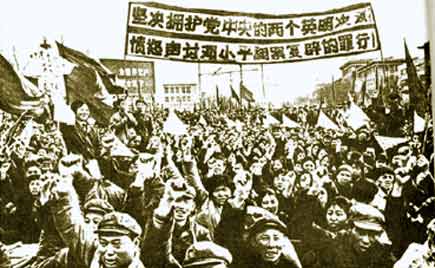
Mao’s Chinese Revolution responsible for China’s fast capitalist growth today

Communist Revolution
Many Americans don’t like to think about it this way (or admit it), but without the Mao Zedong led Chinese Revolution, China would not be doing as well as it is today. Because of the Chinese Revolution, China was able to free itself from the domination and control of other nations, and this has led to today’s large and still growing Chinese economy and today’s relatively stable government.

As comparison, take the Indian sub-continent, which was in a better state than was China post World War II. Today, this region has been torn asunder into three separate countries, two of which almost had a nuclear war between themselves, and one of which today is pretty much directly under US thumb. Also, one of these three countries, Bangladesh is the country most likely to be flooded by global warming, and the entire Indian sub-continent region continues to be torn by multiple regional, ethnic, religious, caste, and sectarian strife.

China today is a power that has the recourses to partially stand up to the US superpower, that wants to make all subordinate to its own needs. Thank the Mao Zedong led Chinese Revolution for that. It is not a nation that is totally servile to the mainstream capitalist world structure.

One cannot make too many apologies for China’s ruling group though, as they have now turned away from having any planned economy at all after some absolutely horrendous actions of Mao Zedong post Chinese Revolution. We are talking mainly about the deadly so-called ‘Cultural Revolution’, which was a giant murderous step backward, an action that actually destroyed both culture and economy, as well as much innocent individual life. It was the first step in China’s current Counter Revolution towards the restoration of the brutality of Capitalism in that country.

Despite the advances in economic life made in China due to its relative freedom from imperialist control, the current capitalist future looks grim for the Chinese. Ecologically the economy is being marched down a dead end alley. Yet is that not the fate of the entire world under capitalist domination? We can only wish the Chinese the best in the years ahead. They deserve it after what their society has been through.

Product Obama

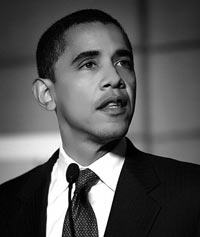
Young Barack“At the time when the American military industrial complex is despised around the world, [Barack Obama] is a front man out of central casting which will buy it more goodwill and new room to maneuver in the first 15 minutes after being sworn in that John McCain could in the next 100 years.”
 
Counterpoint columnist Joe Bageant was given the following essay by an unnamed political consultant:
Life in the Post-political Age.

Much has been written by political pundits in their attempt to explain the unexpected victory of Senator Barack Obama over Senator Hillary Clinton in this year’s Democratic Presidential Primary. When looking at the results of this race, none of the conventional political math that would help one handicap the outcome would make one conclude that Senator Obama would win this contest.

Inside a Democratic Party primary there is no demographic or political reason that a male first term African American senator from Illinois with an unorthodox name should come any where close to beating a white female senator, who happens to be the wife of the last Democratic President whose approval ratings are still above 70% with Democratic voters and who also happened to earn the endorsements of the substantial parts of the Democratic Party establishment.

The conventional analysis focused on the poor quality of the campaign run by Senator Clinton, her vote in support of the Iraq war and her advocacy of the cynical center-right triangulation policies of her husband, which soured her campaign to many primary voters and especially to Democratic Party activists. Senator Obama’s on the other hand was credited with running an innovative and inspiring campaign that excited primary voters and brought many new and especially younger voters into the electoral process.

There is some truth to this analysis, but as a whole it misses the underlying social change in society that had already laid the groundwork for a possible Obama victory. To get a clearer understanding of the results, we must better understand what this social change is and how its impact is far more significant than the dynamics of the two respective campaigns.

The underlying social change that led to the Obama victory is the unprecedented extent to which the narrative of popular consumer culture, and the media that drives it, has become the dominant influence on how Americans think, formulate their ideas and understand the world around them.

The most important result of this process has been the steady and consistent depoliticization of American society, to an extent that we can make the case that we are living at the dawn of the post political age.

The two primary features of the post political age are a politics completely drained of all its contents and ability or willingness to be used as an agent of change in social or economic policy, and its full integrations into the world of American popular, consumer and entertainment culture. To such an extent that there exists today a seamless web between our political, economic, media and consumer cultures wherein the modes and values of one are completely integrated and compatible with the others.

It should not come as a surprise that the dominant ideas and mores of popular culture have become the dominant ideas of our society. Popular culture is the breaker of customs, prejudice, tradition and relevant historical knowledge.

It is a result of this dynamic that the two consistent winners in American politics over the last 30 years have been the cultural left and the economic right. Despite the massive organizing drive of the religious right over the past three decades, they are further away from reversing the cultural liberalization of American society than when they started. On others side of the ledger, organized labor outside of a few urban pockets and industries is no longer a relevant force in American life. The ever greater electoral activism of both of these groups is generally misunderstood as a show of strength; in fact, it is the exact opposite. It is the desperate fight of the losing side of the American economic, cultural and political scene.

In essence the same forces that make it possible for the rapid acceptance of ideas such as gay marriage are the same force which can create a society that will accept massive social inequalities.

In the post political world and the candidates who can best thrive in it have tremendous appeal to the economic elites, a system that does not dwell on issues and will never ask the question, “who has power and why”, but simultaneously creates a social and media environment of stupefying distractions while destroying traditional social mores (under-credited as a source of much social solidarity). This can only benefit their continued rule of that society.

In such a setting our political choices like our consumer choices, regardless of the product, are primarily about what makes us more fulfilled and feel better about ourselves.

Senator Obama’s campaign understood much better the impact of these changes on our electoral system than any of his opponents’ campaigns. In the post political world, the campaign that is less political and less issue-based but is savvier in using new modes of communication technology will be the campaign to win the greatest market share of the electorate. The candidate in this case, Obama, was not a political entity but, in essence a product, an ornament that made his supporters feel better about themselves.

One of the most telling facts about the Obama’s constituency outside of African Americans (whose support needs no explanation) is that it is a coalition of people who need or demand the least amount of social benefit from our government. They are the under politicized younger voters and upper middle class whites. The two groups, coincidently, are the ones most influenced by trends in consumer popular culture and have the greatest of ease using the latest technologies.

In commercial advertising it is the poor commercial that lists the seventeen functions of the product being marketed. The best commercials are based on image associations entirely unrelated to the functions of the actual product. In the post political world, when the same principle is applied to the political realm, it makes complete sense how Barack Obama no longer is a black man with a strange name but the iPod to Hillary Clinton’s cell phone. In the world of toys it is the one that stands out the most is the most marketable.

The reality of the post political period is best highlighted in the failed themes and ideas of Barack Obama’s two primary opponents. The Clinton campaign was based on pushing two concurrent ideas: the inevitability factor of her candidacy and the other was her supposed experience. The only thing inevitable in the post political period is ceaseless change, which she could hardly offer while running against the candidate of “Change”. How valuable of an asset can experience be in a culture where knowledge, wisdom and history are frowned upon?

John Edwards campaign on the other hand was dead on arrival. His theme and emphasis was America’s ever widening class differences, a platform as truthful as it was irrelevant. The use of the word “class” will end any political career in America. That truth violates the primary narrative that our elite use to justify their legitimacy, which is the supposed meritocratic nature of America society. While the post political constituencies have absolutely no interest in class, whose very acknowledgment are the bases of all real politics and whose acknowledgement would only lead to an existential crisis in its ranks. In the post political period the only differences allowed can be in style and modes of consumption.

Given all this as the background, what are we to make of the campaign of the candidate of hope, audacity and change? The answer lies in understanding Senator Obama’s appeal to the brighter sections of the economic and political elite, and more importantly in the lack of any organized opposition against him, of the kind that within a matter of days destroyed Howard Dean’s campaign in 2004.

At the precise moment that the intellectual underpinnings of conservative free market ideas that have dominated politics for the past 30 years are crumbling across the globe. Obama calls for a post ideological and partisan world.

At the time when the American military industrial complex is despised around the world, he is a front man out of central casting which will buy it more goodwill and new room to maneuver in the first 15 minutes after being sworn in that John McCain could in the next 100 years.

His very presence, the color of his skin, the very strangeness of his name is the best guarantee of his betrayal of the expectations of the constituencies that will vote to elect him. Barack Obama is in short order a far more reassuring prospect for the continued dominance of the financial elite than another four years of neo-conservative rule which in an almost historically unique combination of greed, ill will, incompetence and stupidity have brought the country to the edge of disaster.

Audacity yes, change hardly.

Rodeo just says “No” to cattle prod (allegations)

According to a screamin’ big headline in todays Gag-zette.

And just last year we had a miniature debate with some woman who said that using things like a rope tied around the testicles or touching the genitalia or rectum of an animal with some high-amp low-voltage charges wouldn’t cause the animal any Pain.

I really do envy the Dr Doolittle types, the ones who can get word straight from the horses mouth that, ‘why no, Little Missy, it doesn’t hurt us a bit to have our nutsacks squeezed…’

But unfortunately, I can’t understand Simplified Cattle or Horse Talk, so I’ll just have to judge by the way their eyes roll and the high pitched screaming noises they make, and the way they suddenly go berzerk and try to KILL somebody immediately following these “painless” procedures.

And, going by that evidence, I can state with absolute confidence that, why yes, Little Missy, that shit really does hurt.

Global economic rapists are at it again

G8 protest
Why protest the G8 Summit July 7-9? Those hoodlums always look so determined. Here’s the rationale by the Emergency Exit Collective:

The 2008 G8 on Hokkaido, a Strategic Assessment
Emergency Exit Collective
Bristol, Mayday, 2008

The authors of this document are a collection of activists, scholars, and writers currently based in the United States and Western Europe who have gotten to know and work with each other in the movement against capitalist globalization. We’re writing this at the request of some members of No! G8 Action Japan, who asked us for a broad strategic analysis of the state of struggle as we see it, and particularly, of the role of the G8, what it represents, the dangers and opportunities that may lie hidden in the moment. It is in no sense programmatic. Mainly, it is an attempt to develop tools that we hope will be helpful for organizers, or for anyone engaged in the struggle against global capital.

I
It is our condition as human beings that we produce our lives in common.

II
Let us then try to see the world from the perspective of the planet’s commoners, taking the word in that sense: those whose most essential tradition is cooperation in the making and maintenance of human social life, yet who have had to do so under conditions of suffering and separation; deprived, ignored, devalued, divided into hierarchies, pitted against each other for our very physical survival. In one sense we are all commoners. But it’s equally true that just about everyone, at least in some ways, at some points, plays the role of the rulers—of those who expropriate, devalue and divide—or at the very least benefits from such divisions.

Obviously some do more than others. It is at the peak of this pyramid that we encounter groups like the G8.

III
The G8’s perspective is that of the aristocrats, the rulers: those who command and maintain that global machinery of violence that defends existing borders and lines of separation: whether national borders with their detention camps for migrants, or property regimes, with their prisons for the poor. They live by constantly claiming title to the products of others collective creativity and labour, and in thus doing they create the poor; they create scarcity in the midst of plenty, and divide us on a daily basis; they create financial districts that loot resources from across the world, and in thus doing they turn the spirit of human creativity into a spiritual desert; close or privatize parks, public water taps and libraries, hospitals, youth centers, universities, schools, public swimming pools, and instead endlessly build shopping malls that channels convivial life into a means of commodity circulation; work toward turning global ecological catastrophe into business opportunities.

These are the people who presume to speak in the name of the “international community” even as they hide in their gated communities or meet protected by phalanxes of riot cops. It is critical to bear in mind that the ultimate aim of their policies is never to create community but to introduce and maintain divisions that set common people at each other’s throats. The neoliberal project, which has been their main instrument for doing so for the last three decades, is premised on a constant effort either to uproot or destroy any communal or democratic system whereby ordinary people govern their own affairs or maintain common resources for the common good, or, to reorganize each tiny remaining commons as an isolated node in a market system in which livelihood is never guaranteed, where the gain of one community must necessarily be at the expense of others. Insofar as they are willing to appeal to high-minded principles of common humanity, and encourage global cooperation, only and exactly to the extent that is required to maintain this system of universal competition.

IV
At the present time, the G8—the annual summit of the leaders of “industrial democracies”—is the key coordinative institution charged with the task of maintaining this neoliberal project, or of reforming it, revising it, adapting it to the changing condition of planetary class relations. The role of the G8 has always been to define the broad strategic horizons through which the next wave of planetary capital accumulation can occur. This means that its main task is to answer the question of how 3?4 in the present conditions of multiple crises and struggles 3?4 to subordinate social relations among the producing commoners of the planet to capital’s supreme value: profit.

V
Originally founded as the G7 in 1975 as a means of coordinating financial strategies for dealing with the ‘70s energy crisis, then expanded after the end of the Cold War to include Russia, its currently face a moment of profound impasse in the governance of planetary class relations: the greatest since the ‘70s energy crisis itself.

VI
The ‘70s energy crisis represented the final death-pangs of what might be termed the Cold War settlement, shattered by a quarter century of popular struggle. It’s worth returning briefly to this history.

The geopolitical arrangements put in place after World War II were above all designed to forestall the threat of revolution. In the immediate wake of the war, not only did much of the world lie in ruins, most of world’s population had abandoned any assumption about the inevitability of existing social arrangements. The advent of the Cold War had the effect of boxing movements for social change into a bipolar straightjacket. On the one hand, the former Allied and Axis powers that were later to unite in the G7 (the US, Canada, UK, France, Italy, Germany, Japan)—the “industrialized democracies”, as they like to call themselves—engaged in a massive project of co-optation. Their governments continued the process, begun in the ‘30s, of taking over social welfare institutions that had originally been created by popular movements (from insurance schemes to public libraries), even to expand them, on condition that they now be managed by state-appointed bureaucracies rather than by those who used them, buying off unions and the working classes more generally with policies meant to guarantee high wages, job security and the promise of educational advance—all in exchange for political loyalty, productivity increases and wage divisions within national and planetary working class itself. The Sino-Soviet bloc—which effectively became a kind of junior partner within the overall power structure, and its allies remained to trap revolutionary energies into the task of reproducing similar bureaucracies elsewhere. Both the US and USSR secured their dominance after the war by refusing to demobilize, instead locking the planet in a permanent threat of nuclear annihilation, a terrible vision of absolute cosmic power.

VII
Almost immediately, though, this arrangement was challenged by a series of revolts from those whose work was required to maintain the system, but who were, effectively, left outside the deal: first, peasants and the urban poor in the colonies and former colonies of the Global South, next, disenfranchised minorities in the home countries (in the US, the Civil Rights movement, then Black Power), and finally and most significantly, by the explosion of the women’s movement of the late ‘60s and early ‘70s—the revolt of that majority of humanity whose largely unremunerated labor made the very existence “the economy” possible. This appears to have been the tipping point.

VIII
The problem was that the Cold War settlement was never meant to include everyone. It by definition couldn’t. Once matters reached tipping point, then, the rulers scotched the settlement. All deals were off. The oil shock was first edge of the counter-offensive, breaking the back of existing working class organizations, driving home the message that there was nothing guaranteed about prosperity. Under the aegis of the newly hatched G7, this counter-offensive involved a series of interwoven strategies that were later to give rise to what is known as neoliberalism.

IX
These strategies resulted in what came to be known as “Structural Adjustment” both in the North and in the South, accompanied by trade and financial liberalization. This, in turn, made possible crucial structural changes in our planetary production in common extending the role of the market to discipline our lives and divide us into more and more polarized wage hierarchy. This involved:

· In the immediate wake of ‘70s oil shock, petrodollars were recycled from OPEC into Northern banks that then lent them, at extortionate rates of interest, to developing countries of the Global South. This was the origin of the famous “Third World Debt Crisis.” The existence of this debt allowed institutions like the IMF to impose its monetarist orthodoxy on most of the planet for roughly twenty years, in the process, stripping away most of even those modest social protections that had been won by the world’s poor—large numbers of whom were plunged into a situation of absolute desperation.

· It also opened a period of new enclosures through the capitalist imposition of structural adjustment policies, manipulation of environmental and social catastrophes like war, or for that matter through the authoritarian dictates of “socialist” regimes. Through such means, large sections of the world’s population have over the past thirty years been dispossessed from resources previously held in common, either by dint of long traditions, or as the fruits of past struggles and past settlements.

· Through financial deregulation and trade liberalization, neoliberal capital, which emerged from the G7 strategies to deal with the 1970s crisis aimed thus at turning the “class war” in communities, factories, offices, streets and fields against the engine of competition, into a planetary “civil war”, pitting each community of commoners against every other community of commoners.

· Neoliberal capital has done this by imposing an ethos of “efficiency” and rhetoric of “lowering the costs of production” applied so broadly that mechanisms of competition have come to pervade every sphere of life. In fact these terms are euphemisms, for a more fundamental demand: that capital be exempt from taking any reduction in profit to finance the costs of reproduction of human bodies and their social and natural environments (which it does not count as costs) and which are, effectively, “exernalized” onto communities and nature.

· The enclosure of resources and entitlements won in previous generations of struggles both in the North and the South, in turn, created the conditions for increasing the wage hierarchies (both global and local), by which commoners work for capital—wage hierarchies reproduced economically through pervasive competition, but culturally, through male dominance, xenophobia and racism. These wage gaps, in turn, made it possible to reduce the value of Northern workers’ labour power, by introducing commodities that enter in their wage basket at a fraction of what their cost might otherwise have been. The planetary expansion of sweatshops means that American workers (for example) can buy cargo pants or lawn-mowers made in Cambodia at Walmart, or buy tomatoes grown by undocumented Mexican workers in California, or even, in many cases, hire Jamaican or Filipina nurses to take care of children and aged grandparents at such low prices, that their employers have been able to lower real wages without pushing most of them into penury. In the South, meanwhile, this situation has made it possible to discipline new masses of workers into factories and assembly lines, fields and offices, thus extending enormously capital’s reach in defining the terms—the what, the how, the how much—of social production.

· These different forms of enclosures, both North and South, mean that commoners have become increasingly dependent on the market to reproduce their livelihoods, with less power to resist the violence and arrogance of those whose priorities is only to seek profit, less power to set a limit to the market discipline running their lives, more prone to turn against one another in wars with other commoners who share the same pressures of having to run the same competitive race, but not the same rights and the same access to the wage. All this has meant a generalized state of precarity, where nothing can be taken for granted.

X
In turn, this manipulation of currency and commodity flows constituting neoliberal globalization became the basis for the creation of the planet’s first genuine global bureaucracy.

· This was multi-tiered, with finance capital at the peak, then the ever-expanding trade bureaucracies (IMF, WTO, EU, World Bank, etc), then transnational corporations, and finally, the endless varieties of NGOs that proliferated throughout the period—almost all of which shared the same neoliberal orthodoxy, even as they substituted themselves for social welfare functions once reserved for states.

· The existence of this overarching apparatus, in turn, allowed poorer countries previously under the control of authoritarian regimes beholden to one or another side in the Cold War to adopt “democratic” forms of government. This did allow a restoration of formal civil liberties, but very little that could really merit the name of democracy (the rule of the “demos”, i.e., of the commoners). They were in fact constitutional republics, and the overwhelming trend during the period was to strip legislatures, that branch of government most open to popular pressure, of most of their powers, which were increasingly shifted to the executive and judicial branches, even as these latter, in turn, largely ended up enacting policies developed overseas, by global bureaucrats.

· This entire bureaucratic arrangement was justified, paradoxically enough, by an ideology of extreme individualism. On the level of ideas, neoliberalism relied on a systematic cooptation of the themes of popular struggle of the ‘60s: autonomy, pleasure, personal liberation, the rejection of all forms of bureaucratic control and authority. All these were repackaged as the very essence of capitalism, and the market reframed as a revolutionary force of liberation.

· The entire arrangement, in turn, was made possible by a preemptive attitude towards popular struggle. The breaking of unions and retreat of mass social movements from the late ‘70s onwards was only made possible by a massive shift of state resources into the machinery of violence: armies, prisons and police (secret and otherwise) and an endless variety of private “security services”, all with their attendant propaganda machines, which tended to increase even as other forms of social spending were cut back, among other things absorbing increasing portions of the former proletariat, making the security apparatus an increasingly large proportion of total social spending. This approach has been very successful in holding back mass opposition to capital in much of the world (especially West Europe and North America), and above all, in making it possible to argue there are no viable alternatives. But in doing so, has created strains on the system so profound it threatens to undermine it entirely.

XI
The latter point deserves elaboration. The element of force is, on any number of levels, the weak point of the system. This is not only on the constitutional level, where the question of how to integrate the emerging global bureaucratic apparatus, and existing military arrangements, has never been resolved. It is above all an economic problem. It is quite clear that the maintenance of elaborate security machinery is an absolute imperative of neoliberalism. One need only observe what happened with the collapse of the Soviet bloc in Eastern Europe: where one might have expected the Cold War victors to demand the dismantling of the army, secret police and secret prisons, and to maintain and develop the existing industrial base, in fact, what they did was absolutely the opposite: in fact, the only part of the industrial base that has managed fully to maintain itself has been the parts required to maintained the security apparatus itself! Critical too is the element of preemption: the governing classes in North America, for example, are willing to go to almost unimaginable lengths to ensure social movements never feel they are accomplishing anything. The current Gulf War is an excellent example: US military operations appear to be organized first and foremost to be protest-proof, to ensure that what happened in Vietnam (mass mobilization at home, widespread revolt within the army overseas) could never be repeated. This means above all that US casualties must always be kept to a minimum. The result are rules of engagement, and practices like the use of air power within cities ostensibly already controlled by occupation forces, so obviously guaranteed to maximize the killing of innocents and galvanizing hatred against the occupiers that they ensure the war itself cannot be won. Yet this approach can be taken as the very paradigm for neoliberal security regimes. Consider security arrangements around trade summits, where police are so determined prevent protestors from achieving tactical victories that they are often willing to effectively shut down the summits themselves. So too in overall strategy. In North America, such enormous resources are poured into the apparatus of repression, militarization, and propaganda that class struggle, labor action, mass movements seem to disappear entirely. It is thus possible to claim we have entered a new age where old conflicts are irrelevant. This is tremendously demoralizing of course for opponents of the system; but those running the system seem to find that demoralization so essential they don’t seem to care that the resultant apparatus (police, prisons, military, etc) is, effectively, sinking the entire US economy under its dead weight.

XII
The current crisis is not primarily geopolitical in nature. It is a crisis of neoliberalism itself. But it takes place against the backdrop of profound geopolitical realignments. The decline of North American power, both economic and geopolitical has been accompanied by the rise of Northeast Asia (and to a increasing extent, South Asia as well). While the Northeast Asian region is still divided by painful Cold War cleavages—the fortified lines across the Taiwan straits and at the 38th parallel in Korea…—the sheer realities of economic entanglement can be expected to lead to a gradual easing of tensions and a rise to global hegemony, as the region becomes the new center of gravity of the global economy, of the creation of new science and technology, ultimately, of political and military power. This may, quite likely, be a gradual and lengthy process. But in the meantime, very old patterns are rapidly reemerging: China reestablishing relations with ancient tributary states from Korea to Vietnam, radical Islamists attempting to reestablish their ancient role as the guardians of finance and piety at the in the Central Asian caravan routes and across Indian Ocean, every sort of Medieval trade diaspora reemerging… In the process, old political models remerge as well: the Chinese principle of the state transcending law, the Islamic principle of a legal order transcending any state. Everywhere, we see the revival too of ancient forms of exploitation—feudalism, slavery, debt peonage—often entangled in the newest forms of technology, but still echoing all the worst abuses of the Middle Ages. A scramble for resources has begun, with US occupation of Iraq and saber-rattling throughout the surrounding region clearly meant (at least in part) to place a potential stranglehold the energy supply of China; Chinese attempts to outflank with its own scramble for Africa, with increasing forays into South America and even Eastern Europe. The Chinese invasion into Africa (not as of yet at least a military invasion, but already involving the movement of hundreds of thousands of people), is changing the world in ways that will probably be felt for centuries. Meanwhile, the nations of South America, the first victims of the “Washington consensus” have managed to largely wriggle free from the US colonial orbit, while the US, its forces tied down in the Middle East, has for the moment at least abandoned it, is desperately struggling to keep its grip Mexico, Central America and the Caribbean—its own “near abroad”.

XIII
In another age all this might have led to war—that is, not just colonial occupations, police actions, or proxy wars (which are obviously already taking place), but direct military confrontations between the armies of major powers. It still could; accidents happen; but there is reason to believe that, when it comes to moments of critical decision, the loyalties of the global elites are increasingly to each other, and not to the national entities for whom they claim to speak. There is some compelling evidence for this.

Take for example when the US elites panicked at the prospect of the massive budget surpluses of the late 1990s. As Alan Greenspan, head of the Federal Reserve at the time warned, if these were allowed to stand they would have flooded government coffers with so many trillions of dollars that it could only have lead to some form of creeping socialism, even, he predicted, to the government acquiring “equity stakes” in key US corporations. The more excitable of capitalism’s managers actually began contemplating scenarios where the capitalist system itself would be imperiled. The only possible solution was massive tax cuts; these were duly enacted, and did indeed manage to turn surpluses into enormous deficits, financed by the sale of treasury bonds to Japan and China. Conditions have thus now reached a point where it is beginning to look as if the most likely long term outcome for the US (its technological and industrial base decaying, sinking under the burden of its enormous security spending) will be to end up serve as junior partner and military enforcer for East Asia capital. Its rulers, or at least a significant proportion of them, would prefer to hand global hegemony to the rulers of China (provided the latter abandon Communism) than to return to any sort of New Deal compromise with their “own” working classes.

A second example lies in the origins of what has been called the current “Bretton Woods II” system of currency arrangements, which underline a close working together of some “surplus” and “deficit” countries within global circuits. The macroeconomic manifestation of the planetary restructuring outlined in XIX underlines both the huge US trade deficit that so much seem to worry many commentators, and the possibility to continually generate new debt instruments like the one that has recently resulted in the sub-prime crisis. The ongoing recycling of accumulated surplus of countries exporting to the USA such as China and oil producing countries is what has allowed financiers to create new credit instruments in the USA. Hence, the “deal” offered by the masters in the United States to its commoners has been this: ‘you, give us a relative social peace and accept capitalist markets as the main means through which you reproduce your own livelihoods, and we will give you access to cheaper consumption goods, access to credit for buying cars and homes, and access to education, health, pensions and social security through the speculative means of stock markets and housing prices.’ Similar compromises were reached in all the G8 countries.

Meanwhile, there is the problem of maintaining any sort of social peace with the hundreds of millions of unemployed, underemployed, dispossessed commoners currently swelling the shanty-towns of Asia, Africa, and Latin America as a result of ongoing enclosures (which have speeded up within China and India in particular, even as “structural adjustment policies” in Africa and Latin America have been derailed). Any prospect of maintaining peace in these circumstances would ordinarily require either extremely high rates of economic growth—which globally have not been forthcoming, since outside of China, growth rates in the developing world have been much lower than they were in the ‘50s, ‘60s, or even ‘70s—or extremely high levels of repression, lest matters descend into rebellion or generalized civil war. The latter has of course occurred in many parts of the world currently neglected by capital, but in favored regions, such as the coastal provinces of China, or “free trade” zones of India, Egypt, or Mexico, commoners are being offered a different sort of deal: industrial employment at wages that, while very low by international standards, are still substantially higher than anything currently obtainable in the impoverished countryside; and above all the promise, through the intervention of Western markets and (privatized) knowledge, of gradually improving conditions of living. While over the least few years wages in many such areas seem to be growing, thanks to the intensification of popular struggles, such gains are inherently vulnerable: the effect of recent food inflation has been to cut real wages back dramatically—and threaten millions with starvation.

What we really want to stress here, though, is that the long-term promise being offered to the South is just as untenable as the idea that US or European consumers can indefinitely expand their conditions of life through the use of mortgages and credit cards.

What’s being offered the new dispossessed is a transposition of the American dream. The idea is that the lifestyle and consumption patterns of existing Chinese, Indian, or Brazilian or Zambian urban middle classes (already modeled on Northern ones) will eventually become available to the children of today’s miners, maquila or plantation laborers, until, ultimately, everyone on earth is brought up to roughly the same level of consumption. Put in these terms, the argument is absurd. The idea that all six billion of us can become “middle class” is obviously impossible. First of all there is a simple problem of resources. It doesn’t matter how many bottles we recycle or how energy efficient are the light bulbs we use, there’s just no way the earth’s ecosystem can accommodate six billion people driving in private cars to work in air-conditioned cubicles before periodically flying off to vacation in Acapulco or Tahiti. To maintain the style of living and producing in common we now identify with “middle classness” on a planetary scale would require several additional planets.

This much has been pointed out repeatedly. But the second point is no less important. What this vision of betterment ultimately proposes is that it would be possible to build universal prosperity and human dignity on a system of wage labor. This is fantasy. Historically, wages are always the contractual face for system of command and degradation, and a means of disguising exploitation: expressing value for work only on condition of stealing value without work— and there is no reason to believe they could ever be anything else. This is why, as history has also shown, human beings will always avoid working for wages if they have any other viable option. For a system based on wage labor to come into being, such options must therefore be made unavailable. This in turn means that such systems are always premised on structures of exclusion: on the prior existence of borders and property regimes maintained by violence. Finally, historically, it has always proved impossible to maintain any sizeable class of wage-earners in relative prosperity without basing that prosperity, directly or indirectly, on the unwaged labor of others—on slave-labor, women’s domestic labor, the forced labor of colonial subjects, the work of women and men in peasant communities halfway around the world—by people who are even more systematically exploited, degraded, and immiserated. For that reason, such systems have always depended not only on setting wage-earners against each other by inciting bigotry, prejudice, hostility, resentment, violence, but also by inciting the same between men and women, between the people of different continents (“race”), between the generations.

From the perspective of the whole, then, the dream of universal middle class “betterment” must necessarily be an illusion constructed in between the Scylla of ecological disaster, and the Charybdis of poverty, detritus, and hatred: precisely, the two pillars of today’s strategic impasse faced by the G8.

XIV
How then do we describe the current impasse of capitalist governance?

To a large degree, it is the effect of a sudden and extremely effective upswing of popular resistance—one all the more extraordinary considering the huge resources that had been invested in preventing such movements from breaking out.

On the one hand, the turn of the millennium saw a vast and sudden flowering of new anti-capitalist movements, a veritable planetary uprising against neoliberalism by commoners in Latin America, India, Africa, Asia, across the North Atlantic world’s former colonies and ultimately, within the cities of the former colonial powers themselves. As a result, the neoliberal project lies shattered. What came to be called the “anti-globalization” movement took aim at the trade bureaucracies—the obvious weak link in the emerging institutions of global administration—but it was merely the most visible aspect of this uprising. It was however an extraordinarily successful one. Not only was the WTO halted in its tracks, but all major trade initiatives (MAI, FTAA…) scuttled. The World Bank was hobbled and the power of the IMF over most of the world’s population, effectively, destroyed. The latter, once the terror of the Global South, is now a shattered remnant of its former self, reduced to selling off its gold reserves and desperately searching for a new global mission.

In many ways though spectacular street actions were merely the most visible aspects of much broader changes: the resurgence of labor unions, in certain parts of the world, the flowering of economic and social alternatives on the grassroots levels in every part of the world, from new forms of direct democracy of indigenous communities like El Alto in Bolivia or self-managed factories in Paraguay, to township movements in South Africa, farming cooperatives in India, squatters’ movements in Korea, experiments in permaculture in Europe or “Islamic economics” among the urban poor in the Middle East. We have seen the development of thousands of forms of mutual aid association, most of which have not even made it onto the radar of the global media, often have almost no ideological unity and which may not even be aware of each other’s existence, but nonetheless share a common desire to mark a practical break with capitalism, and which, most importantly, hold out the prospect of creating new forms of planetary commons that can—and in some cases are—beginning to knit together to provide the outlines of genuine alternative vision of what a non-capitalist future might look like.

The reaction of the world’s rulers was predictable. The planetary uprising had occurred during a time when the global security apparatus was beginning to look like it lacked a purpose, when the world threatened to return to a state of peace. The response—aided of course, by the intervention of some of the US’ former Cold War allies, reorganized now under the name of Al Qaeda—was a return to global warfare. But this too failed. The “war on terror”—as an attempt to impose US military power as the ultimate enforcer of the neoliberal model—has collapsed as well in the face of almost universal popular resistance. This is the nature of their “impasse”.

At the same time, the top-heavy, inefficient US model of military capitalism—a model created in large part to prevent the dangers of social movements, but which the US has also sought to export to some degree simply because of its profligacy and inefficiency, to prevent the rest of the world from too rapidly overtaking them—has proved so wasteful of resources that it threatens to plunge the entire planet into ecological and social crisis. Drought, disaster, famines, combine with endless campaigns of enclosure, foreclosure, to cast the very means of survival—food, water, shelter—into question for the bulk of the world’s population.

XV
In the rulers’ language the crisis understood, first and foremost, as a problem of regulating cash flows, of reestablishing, as they like to put it, a new “financial architecture”. Obviously they are aware of the broader problems. Their promotional literature has always been full of it. From the earliest days of the G7, through to the days after the Cold War, when Russia was added as a reward for embracing capitalism, they have always claimed that their chief concerns include

· the reduction of global poverty

· sustainable environmental policies

· sustainable global energy policies

· stable financial institutions governing global trade and currency transactions

If one were to take such claims seriously, it’s hard to see their overall performance as anything but a catastrophic failure. At the present moment, all of these are in crisis mode: there are food riots, global warming, peak oil, and the threat of financial meltdown, bursting of credit bubbles, currency crises, a global credit crunch. [**Failure on this scale however, opens opportunities for the G8 themselves, as summit of the global bureaucracy, to reconfigure the strategic horizon. Therefore, it’s always with the last of these that they are especially concerned. ]The real problem, from the perspective of the G8, is one of reinvestment: particularly, of the profits of the energy sector, but also, now, of emerging industrial powers outside the circle of the G8 itself. The neoliberal solution in the ‘70s had been to recycle OPEC’s petrodollars into banks that would use it much of the world into debt bondage, imposing regimes of fiscal austerity that, for the most part, stopped development (and hence, the emergence potential rivals) in its tracks. By the ‘90s, however, much East Asia in particular had broken free of this regime. Attempts to reimpose IMF-style discipline during the Asian financial crisis of 1997 largely backfired. So a new compromise was found, the so-called Bretton Woods II: to recycle the profits from the rapidly expanding industrial economies of East Asia into US treasury debt, artificially supporting the value of the dollar and allowing a continual stream of cheap exports that, aided by the US housing bubble, kept North Atlantic economies afloat and buy off workers there with cheap oil and even cheaper consumer goods even as real wages shrank. This solution however soon proved a temporary expedient. Bush regime’s attempt to lock it in by the invasion of Iraq, which was meant to lead to the forced privatization of Iraqi oil fields, and, ultimately, of the global oil industry as a whole, collapsed in the face of massive popular resistance (just as Saddam Hussein’s attempt to introduce neoliberal reforms in Iraq had failed when he was still acting as American deputy in the ‘90s). Instead, the simultaneous demand for petroleum for both Chinese manufacturers and American consumers caused a dramatic spike in the price of oil. What’s more, rents from oil and gas production are now being used to pay off the old debts from the ‘80s (especially in Asia and Latin America, which have by now paid back their IMF debts entirely), and—increasingly—to create state-managed Sovereign Wealth Funds that have largely replaced institutions like the IMF as the institutions capable of making long-term strategic investments. The IMF, purposeless, tottering on the brink of insolvency, has been reduced to trying to come up with “best practices” guidelines for fund managers working for governments in Singapore, Seoul, and Abu Dhabi.

There can be no question this time around of freezing out countries like China, India, or even Brazil. The question for capital’s planners, rather, is how to channel these new concentrations of capital in such a way that they reinforce the logic of the system instead of undermining it.

XVI
How can this be done? This is where appeals to universal human values, to common membership in an “international community” come in to play. “We all must pull together for the good of the planet,” we will be told. The money must be reinvested “to save the earth.”

To some degree this was always the G8 line: this is a group has been making an issue of climate change since 1983. Doing so was in one sense a response to the environmental movements of the ‘70s and ‘80s. The resultant emphasis on biofuels and “green energy” was from their point of view, the perfect strategy, seizing on an issue that seemed to transcend class, appropriating ideas and issues that emerged from social movements (and hence coopting and undermining especially their radical wings), and finally, ensuring such initiatives are pursued not through any form of democratic self-organization but “market mechanisms”—to effective make the sense of public interest productive for capitalism.

What we can expect now is a two-pronged attack. On the one hand, they will use the crisis to attempt to reverse the gains of past social movements: to put nuclear energy back on the table to deal with the energy crisis and global warming, or genetically modified foods to deal with the food crisis. Prime Minister Fukuda, the host of the current summit, for example, is already proposing the nuclear power is the “solution” to the global warming crisis, even as the German delegation resists. On the other, and even more insidiously, they will try once again to co-opt the ideas and solutions that have emerged from our struggles as a way of ultimately undermining them. Appropriating such ideas is simply what rulers do: the bosses brain is always under the workers’ hat. But the ultimate aim is to answer the intensification of class struggle, of the danger of new forms of democracy, with another wave of enclosures, to restore a situation where commoners’ attempts to create broader regimes of cooperation are stymied, and people are plunged back into mutual competition.

We can already see the outlines of how this might be done. There are already suggestions that Sovereign Wealth Funds put aside a certain (miniscule) proportion of their money for food aid, but only as tied to a larger project of global financial restructuring. The World Bank, largely bereft of its earlier role organizing dams and pipe-lines across the world, has been funding development in China’s poorer provinces, freeing the Chinese government to carry out similar projects in Southeast Asia, Africa, and even Latin America (where, of course, they cannot effectively be held to any sort of labor or environmental standards). There is the possibility of a new class deal in China itself, whose workers can be allowed higher standards of living if new low wage zones are created elsewhere—for instance, Africa (the continent where struggles over maintaining the commons have been most intense in current decades)—with the help of Chinese infrastructural projects. Above of all, money will be channeled into addressing climate change, into the development of alternative energy, which will require enormous investments, in such a way as to ensure that whatever energy resources do become important in this millennium, they can never be democratized—that the emerging notion of a petroleum commons, that energy resources are to some degree a common patrimony meant primarily to serve the community as a whole, that is beginning to develop in parts of the Middle East and South America—not be reproduced in whatever comes next.

Since this will ultimately have to be backed up by the threat of violence, the G8 will inevitably have to struggle with how to (yet again) rethink enforcement mechanisms. The latest move , now that the US “war on terror” paradigm has obviously failed, would appear to be a return to NATO, part of a reinvention of the “European security architecture” being proposed at the upcoming G8 meetings in Italy in 2009 on the 60th anniversary of NATO’s foundation—but part of a much broader movement of the militarization of social conflict, projecting potential resource wars, demographic upheavals resulting from climate change, and radical social movements as potential military problems to be resolved by military means. Opposition to this new project is already shaping up as the major new European mobilization for the year following the current G-8.

XVII
While the G-8 sit at the pinnacle of a system of violence, their preferred idiom is monetary. Their impulse whenever possible is to translate all problems into money, financial structures, currency flows—a substance whose movements they carefully monitor and control.

Money, on might say, is their poetry—a poetry whose letters are written in our blood. It is their highest and most abstract form of expression, their way of making statements about the ultimate truth of the world, even if it operates in large part by making things disappear. How else could it be possible to argue—no, to assume as a matter of common sense—that the love, care, and concern of a person who tends to the needs of children, teaching, minding, helping them to become decent , thoughtful, human beings, or who grows and prepares food, is worth ten thousand times less than someone who spends the same time designing a brand logo, moving abstract blips across a globe, or denying others health care.

The role of money however has changed profoundly since 1971 when the dollar was delinked from gold. This has created a profound realignment of temporal horizons. Once money could be said to be primarily congealed results of past profit and exploitation. As capital, it was dead labor. Millions of indigenous Americans and Africans had their lives pillaged and destroyed in the gold mines in order to be rendered into value. The logic of finance capital, of credit structures, certainly always existed as well (it is at least as old as industrial capital; possibly older), but in recent decades these logic of financial capital has come to echo and re-echo on every level of our lives. In the UK 97% of money in circulation is debt, in the US, 98%. Governments run on deficit financing, wealthy economies on consumer debt, the poor are enticed with microcredit schemes, debts are packaged and repackaged in complex financial derivatives and traded back and forth. Debt however is simply a promise, the expectation of future profit; capital thus increasingly brings the future into the present—a future that, it insists, must always be the same in nature, even if must also be greater in magnitude, since of course the entire system is premised on continual growth. Where once financiers calculated and traded in the precise measure of our degradation, having taken everything from us and turned it into money, now money has flipped, to become the measure of our future degradation—at the same time as it binds us to endlessly working in the present.

The result is a strange moral paradox. Love, loyalty, honor, commitment—to our families, for example, which means to our shared homes, which means to the payment of monthly mortgage debts—becomes a matter of maintaining loyalty to a system which ultimately tells us that such commitments are not a value in themselves. This organization of imaginative horizons, which ultimately come down to a colonization of the very principle of hope, has come to supplement the traditional evocation of fear (of penury, homelessness, joblessness, disease and death). This colonization paralyzes any thought of opposition to a system that almost everyone ultimately knows is not only an insult to everything they really cherish, but a travesty of genuine hope, since, because no system can really expand forever on a finite planet, everyone is aware on some level that in the final analysis they are dealing with a kind of global pyramid scheme, what we are ultimately buying and selling is the real promise of global social and environmental apocalypse.

XVIII
Finally then we come to the really difficult, strategic questions. Where are the vulnerabilities? Where is hope? Obviously we have no certain answers here. No one could. But perhaps the proceeding analysis opens up some possibilities that anti-capitalist organizers might find useful to explore.

One thing that might be helpful is to rethink our initial terms. Consider communism. We are used to thinking of it as a total system that perhaps existed long ago, and to the desire to bring about an analogous system at some point in the future—usually, at whatever cost. It seems to us that dreams of communist futures were never purely fantasies; they were simply projections of existing forms of cooperation, of commoning, by which we already make the world in the present. Communism in this sense is already the basis of almost everything, what brings people and societies into being, what maintains them, the elemental ground of all human thought and action. There is absolutely nothing utopian here. What is utopian, really, is the notion that any form of social organization, especially capitalism, could ever exist that was not entirely premised on the prior existence of communism. If this is true, the most pressing question is simply how to make that power visible, to burst forth, to become the basis for strategic visions, in the face of a tremendous and antagonistic power committed to destroying it—but at the same time, ensuring that despite the challenge they face, they never again become entangled with forms of violence of their own that make them the basis for yet another tawdry elite. After all, the solidarity we extend to one another, is it not itself a form of communism? And is it not so above because it is not coerced?

Another thing that might be helpful is to rethink our notion of crisis. There was a time when simply describing the fact that capitalism was in a state of crisis, driven by irreconcilable contradictions, was taken to suggest that it was heading for a cliff. By now, it seems abundantly clear that this is not the case. Capitalism is always in a crisis. The crisis never goes away. Financial markets are always producing bubbles of one sort or another; those bubbles always burst, sometimes catastrophically; often entire national economies collapse, sometimes the global markets system itself begins to come apart. But every time the structure is reassembled. Slowly, painfully, dutifully, the pieces always end up being put back together once again.

Perhaps we should be asking: why?

In searching for an answer, it seems to us, we might also do well to put aside another familiar habit of radical thought: the tendency to sort the world into separate levels—material realities, the domain of ideas or “consciousness”, the level of technologies and organizations of violence—treating these as if these were separate domains that each work according to separate logics, and then arguing which “determines” which. In fact they cannot be disentangled. A factory may be a physical thing, but the ownership of a factory is a social relation, a legal fantasy that is based partly on the belief that law exists, and partly on the existence of armies and police. Armies and police on the other hand exist partly because of factories providing them with guns, vehicles, and equipment, but also, because those carrying the guns and riding in the vehicles believe they are working for an abstract entity they call “the government”, which they love, fear, and ultimately, whose existence they take for granted by a kind of faith, since historically, those armed organizations tend to melt away immediately the moment they lose faith that the government actually exists. Obviously exactly the same can be said of money. It’s value is constantly being produced by eminently material practices involving time clocks, bank machines, mints, and transatlantic computer cables, not to mention love, greed, and fear, but at the same time, all this too rests on a kind of faith that all these things will continue to interact in more or less the same way. It is all very material, but it also reflects a certain assumption of eternity: the reason that the machine can always be placed back together is, simply, because everyone assumes it must. This is because they cannot realistically imagine plausible alternatives; they cannot imagine plausible alternatives because of the extraordinarily sophisticated machinery of preemptive violence that ensure any such alternatives are uprooted or contained (even if that violence is itself organized around a fear that itself rests on a similar form of faith.) One cannot even say it’s circular. It’s more a kind of endless, unstable spiral. To subvert the system is then, to intervene in such a way that the whole apparatus begins to spin apart.

XIX
It appears to us that one key element here—one often neglected in revolutionary strategy—is the role of the global middle classes. This is a class that, much though it varies from country (in places like the US and Japan, overwhelming majorities consider themselves middle class; in, say, Cambodia or Zambia, only very small percentages), almost everywhere provides the key constituency of the G8 outside of the ruling elite themselves. It has become a truism, an article of faith in itself in global policy circles, that national middle class is everywhere the necessary basis for democracy. In fact, middle classes are rarely much interested in democracy in any meaningful sense of that word (that is, of the self-organization or self-governance of communities). They tend to be quite suspicious of it. Historically, middle classes have tended to encourage the establishment of constitutional republics with only limited democratic elements (sometimes, none at all). This is because their real passion is for a “betterment”, for the prosperity and advance of conditions of life for their children—and this betterment, since it is as noted above entirely premised on structures of exclusion, requires “security”. Actually the middle classes depend on security on every level: personal security, social security (various forms of government support, which even when it is withdrawn from the poor tends to be maintained for the middle classes), security against any sudden or dramatic changes in the nature of existing institutions. Thus, politically, the middle classes are attached not to democracy (which, especially in its radical forms, might disrupt all this), but to the rule of law. In the political sense, then, being “middle class” means existing outside the notorious “state of exception” to which the majority of the world’s people are relegated. It means being able to see a policeman and feel safer, not even more insecure. This would help explain why within the richest countries, the overwhelming majority of the population will claim to be “middle class” when speaking in the abstract, even if most will also instantly switch back to calling themselves “working class” when talking about their relation to their boss.

That rule of law, in turn, allows them to live in that temporal horizon where the market and other existing institutions (schools, governments, law firms, real estate brokerages…) can be imagined as lasting forever in more or less the same form. The middle classes can thus be defined as those who live in the eternity of capitalism. (The elites don’t; they live in history, they don’t assume things will always be the same. The disenfranchized don’t; they don’t have the luxury; they live in a state of precarity where little or nothing can safely be assumed.) Their entire lives are based on assuming that the institutional forms they are accustomed to will always be the same, for themselves and their grandchildren, and their “betterment” will be proportional to the increase in the level of monetary wealth and consumption. This is why every time global capital enters one of its periodic crises, every time banks collapse, factories close, and markets prove unworkable, or even, when the world collapses in war, the managers and dentists will tend to support any program that guarantees the fragments will be dutifully pieced back together in roughly the same form—even if all are, at the same time, burdened by at least a vague sense that the whole system is unfair and probably heading for catastrophe.

XIX
The strategic question then is, how to shatter this sense of inevitability? History provides one obvious suggestion. The last time the system really neared self-destruction was in the 1930s, when what might have otherwise been an ordinary turn of the boom-bust cycle turned into a depression so profound that it took a world war to pull out of it. What was different? The existence of an alternative: a Soviet economy that, whatever its obvious brutalities, was expanding at breakneck pace at the very moment market systems were undergoing collapse. Alternatives shatter the sense of inevitability, that the system must, necessarily, be patched together in the same form; this is why it becomes an absolute imperative of global governance that even small viable experiments in other ways of organizing communities be wiped out, or, if that is not possible, that no one knows about them.

If nothing else, this explains the extraordinary importance attached to the security services and preemption of popular struggle. Commoning, where it already exists, must be made invisible. Alternatives— Zapatistas in Chiapas, APPO in Oaxaca, worker-managed factories in Argentina or Paraguay, community-run water systems in South Africa or Bolivia, living alternatives of farming or fishing communities in India or Indonesia, or a thousand other examples—must be made to disappear, if not squelched or destroyed, then marginalized to the point they seem irrelevant, ridiculous. If the managers of the global system are so determined to do this they are willing to invest such enormous resources into security apparatus that it threatens to sink the system entirely, it is because they are aware that they are working with a house of cards. That the principle of hope and expectation on which capitalism rests would evaporate instantly if almost any other principle of hope or expectation seemed viable.

The knowledge of alternatives, then, is itself a material force.

Without them, of course, the shattering of any sense of certainty has exactly the opposite effect. It becomes pure precarity, an insecurity so profound that it becomes impossible to project oneself in history in any form, so that the one-time certainties of middle class life itself becomes a kind of utopian horizon, a desperate dream, the only possible principle of hope beyond which one cannot really imagine anything. At the moment, this seems the favorite weapon of neoliberalism: whether promulgated through economic violence, or the more direct, traditional kind.

One form of resistance that might prove quite useful here – and is already being discussed in some quarters – are campaigns against debt itself. Not demands for debt forgiveness, but campaigns of debt resistance.

XX
In this sense the great slogan of the global justice movement, “another world is possible”, represents the ultimate threat to existing power structures. But in another sense we can even say we have already begun to move beyond that. Another world is not merely possible. It is inevitable. On the one hand, as we have pointed out, such a world is already in existence in the innumerable circuits of social cooperation and production in common based on different values than those of profit and accumulation through which we already create our lives, and without which capitalism itself would be impossible. On the other, a different world is inevitable because capitalism—a system based on infinite material expansion—simply cannot continue forever on a finite world. At some point, if humanity is to survive at all, we will be living in a system that is not based on infinite material expansion. That is, something other than capitalism.

The problem is there is no absolute guarantee that ‘something’ will be any better. It’s pretty easy to imagine “other worlds” that would be even worse. We really don’t have any idea what might happen. To what extent will the new world still organized around commoditization of life, profit, and pervasive competition? Or a reemergence of even older forms of hierarchy and degradation? How, if we do overcome capitalism directly, by the building and interweaving of new forms of global commons, do we protect ourselves against the reemergence of new forms of hierarchy and division that we might not now even be able to imagine?

It seems to us that the decisive battles that will decide the contours of this new world will necessarily be battles around values. First and foremost are values of solidarity among commoners. Since after all, every rape of a woman by a man or the racist murder of an African immigrant by a European worker is worth a division in capital’s army.

Similarly, imagining our struggles as value struggles might allow us to see current struggles over global energy policies and over the role of money and finance today as just an opening salvo of an even larger social conflict to come. For instance, there’s no need to demonize petroleum, for example, as a thing in itself. Energy products have always tended to play the role of a “basic good”, in the sense that their production and distribution becomes the physical basis for all other forms of human cooperation, at the same time as its control tends to organize social and even international relations. Forests and wood played such a role from the time of the Magna Carta to the American Revolution, sugar did so during the rise of European colonial empires in the 17th and 18th centuries, fossil fuels do so today. There is nothing intrinsically good or bad about fossil fuel. Oil is simply solar radiation, once processed by living beings, now stored in fossil form. The question is of control and distribution. This is the real flaw in the rhetoric over “peak oil”: the entire argument is premised on the assumption that, for the next century at least, global markets will be the only means of distribution. Otherwise the use of oil would depend on needs, which would be impossible to predict precisely because they depend on the form of production in common we adopt. The question thus should be: how does the anti-capitalist movement peak the oil? How does it become the crisis for a system of unlimited expansion?

It is the view of the authors of this text that the most radical planetary movements that have emerged to challenge the G8 are those that direct us towards exactly these kind of questions. Those which go beyond merely asking how to explode the role money plays in framing our horizons, or even challenging the assumption of the endless expansion of “the economy”, to ask why we assume something called “the economy” even exists, and what other ways we can begin imagining our material relations with one another. The planetary women’s movement, in its many manifestations, has and continues to play perhaps the most important role of all here, in calling for us to reimagine our most basic assumptions about work, to remember that the basic business of human life is not actually the production of communities but the production, the mutual shaping of human beings. The most inspiring of these movements are those that call for us to move beyond a mere challenge to the role of money to reimagine value: to ask ourselves how can we best create a situation where everyone is secure enough in their basic needs to be able to pursue those forms of value they decide are ultimately important to them. To move beyond a mere challenge to the tyranny of debt to ask ourselves what we ultimately owe to one another and to our environment. That recognize that none this needs to invented from whole cloth. It’s all already there, immanent in the way everyone, as commoners, create the world together on a daily basis. And that asking these questions is never, and can never be, an abstract exercise, but is necessarily part of a process by which we are already beginning to knit these forms of commons together into new forms of global commons that will allow entirely new conceptions of our place in history.

It is to those already engaged in such a project that we offer these initial thoughts on our current strategic situation.


Britain and US have plans to invade Zimbabwe

Yes, Britain and the US have plans to invade and occupy Zimbabwe using primarily troops of the African Union to hide behind. Then of course, the United Nations also would step in to camouflage the neo-colonial military operation. MoD contingency plans for military action in Zimbabwe

Mugabe is a dictator, but this is not at all what bothers the US and Great Britain about him. What bothers the Western European governments allied around the US and Britain is that Mugabe is not their dictator. They do not control him therefore he must go.

The ‘elections’ that took place in Zimbabwe were the grand plan to move the imperialist countries back into controlling the Zimbabwe government, but Mugabe did not just fall down and surrender beneath the superior fire power of the outsiders. Now Britain and the US are really angry about this!

Once again we see how the US and Britain claim to be the ultimate guardians of all humanitarianism, even as they destroy entire regions of the world with their military industrial complexes. We in the British and American antiwar communities should not allow ourselves to be deceived by the con men that run our governments. There is absolutely nothing at all humanitarian in their plans for continual and perpetual global warfare. Their plans for Zimbabwe are just more of their around-the-clock, global inhumanitarian interventionism and we should not be fooled into thinking otherwise.

Torture by America, Mayor Lionel Rivera, and the Pikes Peak Justice and Peace Commission

The issue of how the US government under the Bush Administration, with the help of its Democratic Party and Republican Party collaborators, has legalized and openly allowed the use of torture despite it being internationally illegal is a big issue in our country. Many Americans are up in arms about this, and rightly so. One of the first duties that the pro-Peace/ antiwar community must do is to fight to end governmental use of torture on prisoners held. Common sense guides us on this one. We have to stop open US governmental use of torture NOW.

So where is the local Pikes Peak Justice and Peace Commission on this one? This is a group that has a pastor leading it at this time, and that also has 3 paid staff members working in its office. What are they doing to fight governmental use of torture against captured prisoners?

It has been months now when I first brought up the need for the PPJPC to demand that the city government pass a resolution against governmental use of torture. After all, Colorado Springs is a part of the USA, so governmental torture of prisoners is something done in our name.

Yes, they do claim that we have a democracy here in the US, so it is claimed that our government represents all of us when it makes policy decisions. Certainly a local peace group then should be demanding that government make the right policy decisions.

At the time it was proposed by me that the PPJPC make it our mission to go to the city government meetings held down at City Hall to try to get a resolution passed demanding an end to governmental use of torture, it was agreed that this was a good idea. It was agreed that the group would move on the issue.

Sad to say, the PPJPC has done absolutely nothing to bring any measure or resolution proposal to the mayor, Lionel Rivera, nor to the Colorado Springs city council. Nobody has ever in this group mentioned any reason to why it should not proceed with this campaign, but the paid office staff and pastor board director have merely chosen to silently do nothing.

These same people do often go to meetings arranged by the city police, where they then proceed to take their marching orders as to how to proceed with their ‘protests’, or not to proceed???, as spoon fed to them by Colorado Springs city attorneys. But they have not found the time to take a measure to the city government to demand that a resolution against the use of governmental torture be passed and sent to Washington DC. Do they really have any excuse for their inaction? I think not.

It is time that the PPJPC begin to carry out its mandate to oppose war and promote justice. We are not doing that at present, but instead are merely acting as a corporation, a non-profit one though. Yes at the present time, we in the PPJPC are of no particular profit to the community, since our group is failing to actually adequately fight on behalf of Justice and Peace.

We, as a group, are failing to demand something of Mayor Lionel Rivera and the city council, and are allowing them to be merely city government hacks captured by Pentagon and Lockheed Corporation. We, at the PPJPC, are failing in our mission to oppose war and injustice. We are failing at being a viable community action group, one that is activist and democratic. We are failing to oppose our government’s active use of torture on POWs.

Life not that great in the US for many Hispanic immigrants

”I hate Fidel Castro, but does that mean I should work in a cafeteria?” she said. “I am 44 years old, and the first and only time in my life I went hungry was in the United States. Here (in Cuba), I live in a four-bedroom house and have a car. Over there, I had to live in an apartment the size of a table.”

That was a brief excerpt from an article in the reactionary American paper, the Miami Herald… Some Cuban emigrants head back home

Yes, the fact of the matter is that life in the us is not that great for many, many Latin American immigrants, and they would be much happier if the US government would just stop fucking over their own home countries. That, of course, the US corporate elites that run the US will never, ever do. Their profits are dependent on running much of the rest of the world into the ground.

I just got back from visiting such a country, the country of Nicaragua, which the US has been destroying for many long decades. I will write more about what I saw and experienced in the weeks ahead, for Nicaragua is a prime example of why we must oppose the despicable bipartisan foreign policies of the US government. You might be planning to desperately vote for Barack Obama hoping for some sort of change towards decency? You are just being manipulated and deluding yourself if you think that the ‘defeat’ of the Republicans is all that is really necessary, for much more must be accomplished before change can come about.

Cuba is no absolute paradise, but compared to countries like Nicaragua it certainly is a paradise. At least the people do not have to live in squalor and misery even though the US has spent decades trying to break the people by waging an economic war on them. That is no small accomplishment!

Viva Cuba!

John McCain role model USAF pilot

Dr Barral interviewed John McCain while a prisoner at Hanoi HiltonWho is trying to taint Candidate McCain as a possible Manchurian Candidate? The theory is that Americans don’t know what was done to McCain while he was a prisoner of the North Vietnamese. Except we do know. This tactic reminds me of the far-out 911 theories which are being hyped to make all 911 conspiracy theories seem far-fetched.

A brain-washed POW is at odds with what we do know about McCain’s bombing-interuptus in 1967. As soon as his NV captors realized they held the son of a US admiral, they treated McCain with kid gloves. They even cautioned their press not to interview McCain on political issues lest he sound like he was kowtowing under torture.

Perhaps however the Manchurian Candidate accusations will prompt McCain to release the records of his years in captivity. He has previously worked to keep POW documents from the public. Now only he can authorize the release of his military records.

While a POW, McCain granted a public interview to a Cuban Psychiatrist who published

“From the psychiatric point of view, Dr Barral has the following opinion on the personality of the prisoner who is responsible for many criminal bombing of the people of DRV:

“He showed himself to be intellectually alert during the interview. From a moral point of view he is not in traumatic shock. He is neither dejected nor depressed. He was able to be sarcastic, and even humorous, indicative of psychic equilibrium. From the moral and ideological point of view he showed us he is an insensitive individual without human depth, who does not show the slightest concern, who does not appear to have thought about the criminal acts he committed against a population from the almost absolute impunity of his airplane, and that nevertheless those people saved his life, fed him, and looked after his health, and he is now healthy and strong. I believe that he bombed densely populated places for sport. i noted that he was hardened, that he spoke of banal things as if he were at a cocktail party.”

US terrorist attack in Somalia attracts little media attention

It is a sign of our times, that not only direct US government advocacy and use of torture on prisoners held by its military attracts little media attention or condemnation, but US government use of direct terrorism doesn’t either. The reason why is quite simple, and is that simply the international media is an integral part of the corporate world and corporate government propaganda system in support for continual militarism and war. Only the BBC seems to even notice this latest act of US terrorism that killed up to 30 people in Somalia. US confirms Somali missile strike

Sure this is terrorism, too. Sending a bomb hundreds of miles across the sky to crash into a civilian neighborhood is just as much a terrorist act as would be walking into a market or transportation hub and setting off a bomb is. What a sad day for Americans, who are largely just sitting by watching as their government engages in these crimes and doing absolutely nothing about it. We are disgraced by such citizen inaction. We are a disgrace as a nation of dimwits.

Thank you Obama’s Reverend Wright

What a fantastic development, to have Barack Obama unmasked still early into the election, bursting the giddy bubble which his fans regard as the change Obama offers from Centrism/Neoliberalism/Neoconartistry. Obama is not only denouncing Reverend Jeremiah Wright’s statements. Obama is now telling Americans over-regulation is a problem, Obama is endorsing charter schools, Obama is conceding that some Republican policies are preferable to those of Democrats…

Can you dispute any of the pronouncements of Obama’s Reverend? Even rephrased by critics, I found these criticisms are unassailable, if uncomfortably spirited. Here they are presented in an accusatory article on Barack Obama: WHAT DID HE KNOW AND WHEN?

Racism is alive and well. Racism is the American way.

Racism is how this country was founded, and how this country is still run.

No black man can ever be President.

No black woman will ever be considered for anything outside of what she can give with her body.

America is still the number one killer in the world.

We are deeply involved in the importing of drugs, the exporting of guns and the training professional killers.

We believe in white supremacy and black inferiority. And believe it more than we believe in God.

We supported Zionism shamelessly while ignoring the Palestinians, and branding anybody who spoke out against it as being anti-Semitic.

We do not care if poor black and brown children cannot read and kill each other senselessly

We started the AIDS virus, and now that it is out of control we still put more money in the military than in medicine. More money in hate than humanitarian concerns.

We are selfish, self-centered ego egotists, who are arrogant and ignorant.

The second to last statement may be extreme, but what’s to argue? Whether CIA labs produced an AIDs virus to arrest the exploding populations of Africa, or whether our exploitive capitalism / polluting industrialism / callous militarism / usurious enslavement systems precipitated the genocide over lands from which the developed nations need resources but not people, are either less murderous?

One could split the same hairs about 9/11. Whether our government colluded with the hijackers to facilitate/exacerbate a false flag attack against the first world, or whether our world trade banking policies finally so enraged its victims to goad their desperate symbolic strike on our WTC, are we any the less responsible?

Reverend Jeremiah Wright is absolutely right about all these points. In the tradition of MLK not by coincidence. Barack Obama is being compelled by the corporate mainstream to distance himself from what the American public knows are truths, and all the better. Those of us who know we need a change can see that Obama isn’t going to be it.

“The government gives them the drugs, builds bigger prisons, passes a three-strike law and then wants us to sing ‘God Bless America.’ No, no, no, God damn America, that’s in the Bible for killing innocent people. “God damn America for treating our citizens as less than human. God damn America for as long as she acts like she is God and she is supreme.

“We bombed Hiroshima, we bombed Nagasaki, and we nuked far more than the thousands in New York and the Pentagon, and we never batted an eye.

We have supported state terrorism against the Palestinians and black South Africans, and now we are indignant because the stuff we have done overseas is now brought right back to our own front yards. America’s chickens are coming home to roost.”

Of course the Reaganites don’t mean what they say…

But we kind of expected that, no?

For instance there was a United Nations mandate about Torture, and Shirley Temple Black was one of the signatories, which said Torture was not permissible under any circumstances.

Basically our solemn word as a Nation, and according to the Constitution, a Foreign Treaty ratified by Congress has as much weight in American jurisprudence as the Constitution itself does.

But alas, somebody in writing the law put in a few Weasel Words.

For instance, nobody is to be subjected to Severe pain either as punishment or to extract information. Nobody is to be subjected to unnecessarily cruel or harsh treatment.

So the Reaganite lawyers are now saying Ha ha ha, we lied to you and you can’t do a thing about it because we had some escape clauses in the treaty.

Now George Bush and Douche Lymphnode (Limbaugh) say “Who cares what the rest of the world thinks of us?”

Well, dumbasses, it’s like this… the only alternative to actually negotiating in good faith is to commit unjustifiable atrocities, like the Invasion of Iraq or perhaps the pending attack (using WMDs, no less) on the nation of Iran.

Not meaning what you say as a civilian, Joe Citizen type, means nobody will rent you a house without you paying all the rent in advance. People won’t give you credit.

Not meaning what you say as a representative of the people means you won’t be able to get anybody to agree to anything you ask for unless it’s under threat of absolute destruction.

To do that you would have to be at a level of International Bad-Ass which has never been reached.

You would have to be Untouchable.

The hijackers on 9/11 demonstrated for us that hell no, we ain’t untouchable.

But if we negotiate constantly in bad faith, our word as a nation means absolutely NOTHING, it would inevitably inspire people to negotiate with us at gunpoint… that is, THEM pointing the guns.

Or failing the ability to negotiate that way, simply saying “screw negotiating, we’re all going to die sooner or later anyway, why not just fuck these dudes up really really badly while we’re cashing out”…

And they throw airplanes at our buildings.

Way to GO! Ronnie and George and Rush, you and your socially retarded gang of thugs have already bought us a few nasty terrorist attacks.

Gosh, George and Rush, you must have felt a huge surge of pride when those towers fell, knowing you helped it to happen.

Higher food prices now being driven by higher fuel prices

We can now see the first effects of the world energy crisis, as local grocery stores are creeping their prices of basic foods upward. The dollar stores also are not exactly dollar stores these days, and never will be again. There are two reasons for these price hikes.

First off, the Pentagon is doing this to us. We are throwing them money (and hence the military suppliers and contractors money, too) like it is going out of style. This is money we simply don’t have, and therefore it is coming from loans to our government, who then passes it off to those that have literally bought the government.

We know who eventually will get stuck with paying off these bad debts, too. It will be the working class and lower middle class of our country. And meanwhile, the rich suck at this gigantic welfare program (teat) with absolutely no shame, as they wave the American flag outside all their offices pretending to be the great patriots. The lower echelons of this fraud get 10% off!

Second cause of the rising prices is simply that we have hit the crisis of declining world oil supplies head on, and nobody has any solution to it beyond trying to corner the world supply (Thank you, Dick Cheney and Dumbo Dubya). But capturing control of world petroleum supply doesn’t exactly increase it, even if such a plot were to be ever successful. All in all, we still have yet to come up with an alternative to the mobility of oil transport, and we are dependent on oil, as we have been for all the later half of the industrial revolution.

Some think that the solution is turning back to coal. Some think it is turning to the deadly nuclear option. Some dream of sun, hydrogen fuel cells, and wind. Meanwhile, in the real world, it is still oil that fuels civilization, uh ‘civilization’ as we know it.

We currently have a rapacious economic system that expands constantly at nature’s expense. Nature is now fed up with it, even if our family and neighbors are not. Nature is run down, and will be run out if we continue this way.

Meanwhile, the prices have begun to inch up and we grow uncomfortable here at home. Elsewhere, things have grown more desperate from the start. Ahead, it is $4/ gallon prices this summer, and the sky will certainly be the limit. Oil barrel prices flown up from below $10 a barrel (not adjusted for inflation) as close back as the mid- ’80s some 22 years ago, to heading towards $120 a barrel right now. It is easy to see how our dollars are now being turned to pennies and we haven’t seen anything yet.

There are some horrible times for the world ahead as the world begins to run into shorter and shorter supply of oil. Meanwhile, let’s shop if we can, shall we not? It’s going to be much harder to do that soon.

Resource Wars of the future and now

Why is it that none of the US and its power allies in Western Europe want to get out of their occupation of Iraq, Somalia, and Afghanistan, and even are planning to extend the fighting into more and more countries? Who are the true enemies as seen by the US rulers? Is it just Iraq and Afghanistan who are the principals involved from the point of view of the Rumsfields, Rices, Bushes, and Cheneys, not to mention the Obamas, Clintons, Gores, and Carters? What is the true reason for this fighting?

Many reasons have been offered up, including saving us from WOMD, bringing democracy to the Arab world, and liberating women, amongst others. Critics of the fighting, tend to say that the reason is to bring a police state to America, and to build up the companies of the military-industrial complex, who are always looking to max out their profits. I find none of the reasons just listed thoroughly convincing by themselves, though ordinary Americans have found all of these reasons to be in effect to some degree or other.

Most of the commentary about these wars centers on Iraq, and to a lesser degree Afghanistan. But there is a much wider field of combat that is mostly absolutely neglected by our intellectuals and press, since they cannot seem to bring themselves to see the war in other areas that is underway. Occasionally, some tidbit of news drops forth from the press in regard to Pakistan, Somalia, Gaze, and Lebanon, but these places are mere min or extensions of the Iraqi conflict in the minds of Americans. However, the elite think tanks and the Pentagon see much of this conflict quite differently than the Average Hometown Joe and Average Hometown Jane, and the talking heads that dish out the constant flood of misinformation about everything.

Believe it or not, but the ruling powers that run our European and assorted English speaking countries are worried about the ecology of Planet Earth. In short, they simply do not see enough to go around in the years ahead, and like the selfish thugs that the rich are, there is no plan to attack this problem with a shared vision that includes the lower classes, as well as themselves. Surprised?

When the rich look on a map, they see billions upon billions of lower class rabble that may get increasingly out of hand, as world resources begin to diminish. They see it better to grab 100% control now, than to wait until their response is purely defensive (from their point of view). Many of ‘the rabble’ actually habitat ares that have many of the scarce resources the rich of the planet hope to grab control over. They live in China, India, Russia, Indonesia, Nigeria, Brazil, and Pakistan to name just a few of the countries that are ‘loose’ from the point of view of the US government.

Two countries stand out amongst this group of countries with huge populations, for the nuclear weapons they still have from when they were ruled by Marxist-Leninist oriented leaderships. Those 2 countries are China and Russia, who now are impoverished (for the average citizen living inside their borders) capitalist societies. The US is the principle market population for world sales, and does not want to give up this position at all. But it is if current trends continue without any military conflict being forced on China and Russia by the US.

The conflicts in Iraq and Afghanistan are an opening battle in a world wide Resource War, that the Powers running it think will go on for a 100 years PLUS. They have a rational viewpoint of where they are from their point of view, and it is crazy to oppose them as they see it. It is for all of us to decide who is crazy and who is not?

Letter to the PPJPC from a member

peter sprunger-froese writes: Comrades. . .
Without belittling the positives of our parade experience, Saturday’s potluck discussion of it suggests to me we are in danger of overlooking important negatives. Irony beckons us to see at best a “mixed bag” in our part of the parade. Otherwise our own learning stops and history becomes meaningless. Details aside, over-arching and most troubling in my mind was the presence of the “Honor the troops…” banner on each side of the bus. Not wanting to be an individualistic sourpuss on our group, i continued to walk, yet how tempting it was to exit. As soon as i saw the banner i knew our peace message would be as non-controversial and without substance as that of the billions in this world who imagine peace and national primary loyalties can stand side by side.

That says not merely that everybody is for peace, including every tyrant there is or ever was. Logically –because of the nature of any provincialistic loyalty– that is also to say it is somehow valid to have peace on our terms, even at the expense of someone else’s life. In the U.S. this patriotic mindset has reached proportions far exceeding all other countries precisely because of its empire status. It has become the equivalent of narcissistic adolescents desperately scampering for an identity by comparing each other, using the familiar”I’m better than you” game. The near-sacrosanct role that U.S. national documents often play for us is but one example of this self-righteous comparing syndrome. Whatever their relative value, these documents’ inherently non-universal character and focus continue to be a severe blinding force for even the progressive segment of the U.S. public.

Yes, i know people’s typical reaction to this: peace is a stepping stone process; we must begin where people are at so as to avoid being offensive; therefore leave national symbolism intact. My immediate question to this liberalism, as applied to Saturday is, at what point does the quest for mainstream respectability contradict our message? Look, eg, at the word “Honor” on our banner. Core to its meaning in Saturday’s context was that we endorse, support and give moral approval to the troops’ behavior! So i ask, did we forget that troops are human, that regardless of how extensive the “economic draft” is, they are choice-capable human beings? They are fully capable of and responsible for applying moral scrutiny to the question of signing up for Uncle Sam. If we believe there are options –with our assistance as the public– for our “lazy bum” friends to get jobs and contribute to society, the same perspective surely applies to those considering the military. The question then becomes, why didn’t the banner instead say something true to who i believe we are: “Support the troops who dissent;” “Ware is never the answer;” “Convert the troops to non-violence;” or –in line with the primacy of world citizenship that the peace position inherently requires– “Stop the genocide of our Iraqi sisters and brothers.” You obviously could come up with more and better messages.

Correct me if i’m wrong… I think we were so “caught off guard” in being asked by officialdom to be in the parade this year that we quite forgot to discriminate between patriotic peace and universal, or true peace. The patriotic peace on our banner represents the always fictional “peace through violence!” It’s the Constantinian, Brady Boyd type of peace at the New Life Church that relies ultimately on violent security guards to “protect” their congregation. It’s the kind of peace that gains our mayor’s and the rest of officialdom’s approval. At last year’s press conference we stood up to this mindset. We declared that neither the Justice and Peace Commission (J&P) nor the Bookman broke any parade rules –nor intended to– and that the parade in fact contained myriad other social issues besides ours. This year, once we learned social issues would be accepted, we apparently became so compliant with parade organizers and the police as to seem apologetic for last year and for our non-patriotic peace stance.

First, we apparently forgot the injustice behind the Bookman’s not being invited, but only the J&P, to participate in the parade. The Bookman was as much maligned by the public and by officialdom last year as was the J&P. The matter, i assume, could have been easily settled with an upfront meeting of the permit issuers and representatives of our two entries.

Second, somehow –whether through the courtroom of a largely conservative public opinion and/or through officialdom’s court– we got derailed from our earlier sense of injustice by the police at last year’s parade. Meetings with them seem not to have reminded them that their professional ethics contain no valid reason or circumstance whatsoever that could justify their behavior –whether in the treatment of six of our parade friends, or more generally of our many mentally ill, often obstreperous and inebriated friends.

To prevent potential misunderstanding here, let me footnote, i am not necessarily expecting an official apology (tho perhaps City Councilman Larry Small did?) i assume –with probably most of you– that officialdom’s invitation for at least the J&P to participate in the parade, was an “olive branch,” an oblique, face-saving attempt to apologize and “make peace” with us. In the same way Mayor Rivera’s informally greeting us on Saturday can possibly be understood as a closeted apology for his claim last year that the police acted appropriately. We know that apologies, especially among leaders of countries, systems, traditions and ideologies are quite in vogue today. They generally follow delay, the usual fate of inconvenient truths (whenever outright concealment or else “psychological distancing” is impossible). That is, they mostly emerge when wrongs are already publicly abhorred and impossible to avoid.

In our case, whether or not to give local officialdom the “apologetic benefit of the doubt” at this point is discussable, in my opinion, as long as it does not amount simply to an atrophied “wishing the problem away” on our part. More critical in the long run, I believe, is that our nonviolent witness keep the human concern before the system. Partly that means, i believe, for us to promote accountability, that which comes not through coercion tactics, but through forthright truth-telling, remembering and forgiving. It is a step against the system’s domination, impersonalization, and patriotic self-righteousness. i can well imagine, with such violent persistence, that individuals –eg, police officer Paladino– can, just like anybody else in this world, come forth voluntarily to apologize, receive forgiveness from us, recognize the error of his and the system’s ways, and even begin working for either improved systemic change or else to withdraw from policing employment out of reasons of an enlarged conscience.

Meanwhile, none of this dare demure the fact that empires can’t be humble. Whether old or current, the are remarkably callous in the exercising of their power, and equally paranoid about any challenges to it. We probably all recall, almost fatuously were it not so real and sad, when a recent debate ran in the local Independent about a system possibly requiring police officers to wear patriotic yellow ribbons on their cruisers. (Whatever sliver remains of the First Amendment today actually ended that controversy in our favor.) I say this just to reinforce how deeply the imperial monster is tied also to the police office. Behind their facade of being servants to the public and “interested in working more with local groups,” the officers in fact are and must be declared our natural adversaries. Why? Their vows of commitment are to a value-system in which violence is the only trusted bottom line of effective problem solving (the myth of redemptive violence). The officers are required to be spies ad control-freaks for the empire. i’ve heard they’ve already asked what the J&P has “up its sleeve” for the Democratic Convention in Denver in August.

If we fail to identify the police officers as first representing a violent system, we will get snared by a “wold in sheep’s clothing.” In that subtle trap we’ll then get enticed to volunteer information to them and even request their permission for our planned protests. The net effect becomes a nearly unconscious Faustian pact on our part with what our “Honor the troops” banner symbolizes: a violence-driven peace commitment unable to discriminate between police and soldiers as individuals versus their role as robotic capitulators to a system we inherently oppose.

The nonviolent alternative we try to be and teach is troubling to this system. Partly that is because our analysis of it runs far beyond that offered by its administration or the myopia of partisan politics. More specifically, the system considers violence and control pivotal to its existence. Hence we are perceived as a type of loose cannon. That is because, contrary to our banner’s message, we don’t even believe in their system; the spirit of nonviolence defies any ultimate control mechanisms and seeks no security in any such systems as long as they are limited, flawed and made unreliable by their violence. Part of the consequence of this counter-position, from the system’s standpoint, as we noted, is the latter’s embarrassing difficulty projecting an apology to a group like ours. For ourselves, an obvious consequence of our position is that we must expect ostracism –not ontologically but sociologically. That means for us not withdrawal but ongoing critical engagement of the system, yet without ever expecting respectability for it. Kindred spirits from yesteryear have taught us the viability of such a road because deep convictions, when sincerely owned, have a way of preservation and growth not dependent on popular palatability.

With this in mind, it concerns me less (if I heard correctly), that some “Pied Piper” pressure probably underlay the presence of the two patriotic banners on the bus. Much more of a concern is how it happened. Not aware how the planning meetings somehow came to accept this (my apology for having been able to attend only one), i ask now: Was it a vote that decided our banners? Was it timidity on the part of some people at the meetings who i;m sure would have raised my concern too? Was it an inadvertent over-ruling of a dissenting perspective? Was it “ideological sloppiness” resulting from the weight of logistical detail in our parade preparation process? Was it insufficient overlap of meeting attenders? Was it the sway of postmodernism’s “diversity and tolerance” absolutism? Was it bits and pieces of all of the above?

If those banners were somehow the unintended conclusion of the meetings, let’s find ways to improve our collective thinking and planning. If they were intended, then i must at least cast my contrary vote now, belatedly: whether we come to our peace stance from a secular or religious grounding, i can se any and all construals of patriotic peace only as fundamentally contradictory. The non-negotiable first premise of peace –in both the educational and action components of the J&P– is surely the well-being of all human beings as equal agents of life on this beautiful, needy planet. Anything less mires us into a provincial loyalty, a tribalism. i implore us to disown this civil religion because its commitment –as our banners symbolized to the mainstream (part of who we seek to communicate with)– is an unambiguous loyalty first to nation state. Overall, the banner controversy reminds us that we are unavoidably all creatures of language. Therefore, according to my complaint here, attaching anything other than universalist-connoting words and symbolism to the peace message is not only its dilution but its negation; it’s to say the call and respect of the status quo is priority. i know we know ad can do better.

Dia de los desaparecidos

Remembrance demonstrationBUENOS AIRES, ARGENTINA- Yesterday was an important holiday for Argentina, which made for an unexpectedly exciting day for me! I have tons of pictures, taken while I had absolutely no idea what was going on. The experience reminded me of storm chasers, happily running after tornadoes, until the wind changes direction and the maelstrom comes full force back at them.
 
I am happy to report that I can, in fact, scale a wrought iron fence with the best of ’em. And, no, their riot police don´t use tasers — just water shot from moving tanks and tear gas.
 
How I wish I had Photoshop down here!

Betrayus redux

So, now, the one general Bush could find willing to be his bag-man and “take one for the Team” is apparently not happy taking one for the Team, and taking another one for the Team, and then taking another one…

Apparently, the Surge is not working as splendiferously as Mr Bush lies to us. It’s gotten so bad the trained liars are circumventing the story by screaming about shit that means absolutely nothing, but does keep our minds off the fact that the situation in Iraq sucks much dog. And now even Petraeus is saying it.

The latest “scandal! Outrage! there must be Blood shed!” is about a presidential candidates preacher saying that (gasp!) there’s RACISM IN AMERICA!

Hard to follow an act like that. WC Fields or Foy or one of those Last of the Vaudevilleans, great actors, said you should never try to follow an act involving animals or children. I guess the Chimp and his ministry of Lies kinda qualify as both.

But the slaughter goes on… sure, you can keep the boot heel firmly on the necks of the conquered, provided you’re willing to spend the economy of your entire nation to do it.

Then one day, you have to let up, you can’t keep the boot heel on the neck forever. Physical and logistical impossibility.

But it’s not really as sad and pathetic as it seems…

actually, it’s much much worse…

Maybe that’s part of the reason Bush is willing to put the already overstretched military, most of the combat-ready brigades are already in the line of fire, in the line of Further and More intense Fire with his really stupid idea to jump a nation with 5 times the population of the nation they can’t govern effectively.

Some of the Military in town here have called this “sedition” to say things like that.

The actual charge of sedition is to teach the violent overthrow of the government and laws of the united states.

George Bush has not only TAUGHT this doctrine, he and his Gang of Thugs have accomplished it. And put in place a system wherein they might be able to make their Terroristic Dictatorship permanent.

Soldiers and Airmen read this, I know because when I first looked for the blog (not knowing the name) I googled “camp casey colorado springs” and got a discussion forum for soldiers, who were saying that we are seditious.

Fellas, your Commander in Thief is the one committing sedition. You guys swore the same oath I did, and incidentally, the one Bush swore once when he joined the National Guard and twice as POTUS, to uphold and defend the Constitution against all enemies, foreign AND Domestic. That would be the same Constitution he and his group of thugs Openly Declared they would eliminate, by whatever means they considered necessary. The one Bush called “just a piece of goddamned paper” in one of his Imperial Hissie Fits when he was informed that the actions he was proposing were unconstitutional.

He wants to use you as instruments of his Imperial Will, and is willing to make a burnt offering of YOUR blood in the sands of Arabia, but, if you notice, not HIS blood.

To deny this, or denounce this, you first have to read it. Some of your officers will want to suppress this idea by mocking it into disappearing. Or use your muscle to Threaten it into disappearing.

The Romans tried that with Judaism and Christianity.

How’d that work out for y’all?

And I say that because you are the heirs to that empire. Have fun trying to destroy an idea.

You’ll drive yourselves mad trying.

Ask your General with the name of a Roman Legionnaire.

Ask your president whose foreign policy is an exact copy of that offered by Emperor Caligula “Let them hate, so long as they Fear”.

In praise of Pope Benedict and his boys

Get out of jail free monopolyThe Vatican has updated the list of the seven deadly sins! We are no longer to be concerned only with gluttony, lust, greed, sloth, wrath, envy, and pride. As if these weren’t more than enough! Oh, woe is I.

The new cardinal sins (those that require absolution from a priest to be forgiven — otherwise you’re lookin’ at a stint in Purgatory) are pollution, mind-damaging drug use, and genetic experimentation. Monsignor Gianfranco Girotti, the head of the Apostolic Penitentiary, also made mention of the ever-widening gap between the haves and have-nots. “The poor are always becoming poorer and the rich ever more rich, feeding unsustainable social injustice….If yesterday sin had a rather individualistic dimension, today it has a weight, a resonance, that’s especially social, rather than individual.”

The church seems to be walking the walk here, at least where the Earth’s fate is concerned. During Pope Benedict’s papacy, Vatican engineers have developed plans for some Holy See buildings to use solar energy, including photovoltaic cells on the roof of the auditorium for pilgrims’ audiences with the pontiff.

As for fighting social injustice, one needs only visit the Vatican to sense that perhaps the church has a way to go on this one. I’ve heard suggestions in the past that the church sell some of its astounding collection of artwork to help the poor. The reply is that the art should be considered public wealth, equally available for all to see. A reasonable argument, especially if one has the resources to make it to the Vatican.

As for the billions in real estate owned by the church, reference is usually made to Jesus’ obvious love for the temple in Jerusalem as justification. The big beautiful churches, after all, were not built at great monetary cost, but through the dedication of thousands of laborers and through the prayers of the faithful. Again, a reasonable position. The Vatican, the artwork, and the great churches of Europe are part of human history and probably shouldn’t be sold off to collectors and developers for fast cash.

It’s not often that I find myself in agreement with the Catholic church. But I have to say, I think they are on the right track here.

Propagandist for Jews only Israel in town ‘for Darfur’ end of month

I just got a notice from a leader and promoter of the local ‘Save Darfur’ crowd, that LA film director Mark Jonathan Harris would be in town the end of March pushing the need to intervene against Sudan and China in Africa. While the multiple civil wars in Sudan have been horribly destructive of human life and I wish for them to end like yesterday, I know where this campaign is getting its biggest push from. It is getting it from the Go-Zionism lobby that operates and flourishes in D.C., Florida, and Hollywood.

This film director, Mark Harris, has been sponsored before via The US Holocaust Museum, which is partially funded with America’s tax monies, though it principally promotes the foreign agenda of Israel. The principal angle the US Holocaust Museum is always working, is that US militarism is absolutely necessary to protect others from genocides, which of course, the US government is never supposedly responsible for. What a dubious supposition, too! But then again, what would one expect would be the main argument of an institution that is partially sponsored by our own government?

Harris is intimately tied to the US Holocaust Museum through one of his previous works (well promoted by ‘the museum’) about Jewish orphans after WW2. One will probably never get to see him doing a work about Palestinian, Afghan, or Iraqi orphans though, even if now he has a film out to supposedly educate the public about the need to ‘Save Darfur’.

Israel is trying so hard to justify their own repression against the Arab population the Jewish state has displaced and continues to displace, that the US Holocaust Museum is investing much of its funds to take public eyes off all the current Jewish and American sponsored slaughter thoughout the world. Through it’s joining and sponsoring the campaign to supposedly ‘Save Darfur’, The US Holocaust Museum hopes to justify the concept of supposedly just and humanitarian interventions coming from The Empire’s military power.

‘Genocide, Genocide, Genocide’ is what they want you to hear for the next 1,000 years, and they want you to hear it in a way that would justify next to anything Jewish Apartheid Israel might do to make itself yet larger in territory stolen away from another group of people. A US grab for Sudanese oil is nothing to them compared to their own desire to help Jewish Israel grab yet more land.

Mark Jonathan Harris and the US Holocaust Museum want to operate like stealth bombers inside the ‘Save Darfur’ push by the Israeli propaganda squad. It is important that the general American public not realize that this is part of a Zionist campaign, so The US Holocaust Museum’s front group is called Genocide Intervention Network instead. It’s a case really, of an institution sponsored by 2 governments (Israel and the US are behind the US Holocaust Museum), posing itself off as an activist coalition.

Actually, the only real thing important to Israel is to try to revitalize the idea that US government ‘humanitarian intervention’ will be needed over and over again. That is their big lie. Without it, Apartheid Jewish Israel would stand alone in the world.

Saving Darfur means less than nothing to Zionists. And neither does saving Sudan. They merely want to save Zionist Jews from world disapproval by distracting attention elsewhere. So far, they have partially succeeded, so beware new wars because of that. And yes, it’s a shame that some proPeace activists have gotten sucked into this Zionist campaign.

Racial separatism can be promoted as a supposedly humanitarian objective, but it really is not. Neither in Sudan, nor Israel/Palestine.

Sudan ultimately just cannot benefit by Europeans and Americans ‘saving it’, and then dividing it up into multiple new ‘countries’. See Iraq and Afghanistan today to get a take on what is meant by stating such. Partition under the direction of The Empire may ultimately be the fate that awaits all 3 of these widely different regions (present day Sudan, Iraq, Afghanistan), unless, of course, we can stop this continual military interventionism by the US.

The Rosa Parks Lone Rider Theory

Rosa Parks photographed after the Montgomery Bus Boycott, posed with newspaper reporter“Rosa Parks did so act on her own!” I’m faced with this repudiation yet again, as J’s high school class revisits the civil rights movement. Their reading list includes Howard Zinn, but still the lesson plan is determined to press home the Parks as lone rider theory.

It makes a heroic story, to tell of lone brave Parks (she’s even painted as elderly, are you kidding me?), riding home from a tiring day at work, so tired that she becomes tired of being told to go to the back of the bus. She stands her ground, an example to us all, and changes history.

Yes it is inspiring, yes it feels empowering. But IS it empowering? Does it empower you to stand up to injustice in the face of harsh, legal if also physical, consequence? Have you yet? You’re no Rosa Parks I could confidently guess, and it’s not your fault.

Do you doubt that there haven’t been countless upstarts, individuals railing against repressive authority, who’ve spoken their piece, made their gesture, only to be humbled by arrest, jail, judges, fines, and the ridicule of the community? It happens all the time. They are marginalized, broken, and ultimately worn down.

Let me describe another kind of heroism. Working for civil rights activists as a stenographer, being in on the discussions about who would make the strongest test case, and picking the right moment mindful of the preparations needed to mobilize colleagues to rally to your defense; thus committing your act of civil disobedience with ready support. Is that any less heroic? I’d suggest it takes more bravery because you know you are launching a political act that will have legs. And it will require more from you than just anger or being tired.

Cindy Sheehan didn’t just march down to Crawford Texas and pitch her lone tent. She consulted with an incredible network of organizers to conceive the plan, Code Pink maven Medea Benjamin among them

Rosa Parks and the bus she rode in on launched a key maneuver for the civil rights movement, and that’s certainly not a lesson the establishment wants to teach its children. Teach them that history is made by individuals, unique, gifted iconoclasts, with whom you’d have to have delusions of grandeur to identify. “You Sir, are no Kennedy,” or Gandhi, Mother Teresa, Rosa Parks. It’s the monarchist belief that only special people are endowed to rule. No need for commoners to concern themselves, the aptitude for nobility is hereditary.

Don’t teach children that to change anything you have to take on the establishment with its own weapons. Idealistic youth don’t want to hear that you have to fight politicians with politics.

You don’t have to become the system to defeat it, but you have to inhabit the system and understand that it operates with the mechanisms of human nature. You must play the system, and no one, absolutely no one, has ever done it alone. Not even Eve.

Was Rosa Parks an iPod-wearing  rebel-without-a-cause? Not hardly.

I am voting against McCain

I’m voting against McCain.
 
Saying there isn’t any difference between the candidates is like stating there’s no difference physically or philosophically between you and me, or me and Eric or you and Eric.

The Anti-Immigrant crowd are howling for Obama’s blood as well. They’re suggesting absurdly that his father planned to smuggle a future terrorist into america in the womb of an American citizen.

The Wall is so unworkable just as a physical engineering problem, it’s clear to you, clear to me, and probably clear to each and every candidate for any office higher than Dog Warden that it’s a massive, expensive Feel-Good giveaway to construction workers, until after the election at least.

Any one issue, like the Wall or the War or Health Care or Wiretapping, … they all converge on one simple, monstrous Elephant in the Parlor fact…

Allowing any Bush Annointed Bush Replacement, such as McCain, to win even by the slightest of margins, will be seen by the 19% Jackass Squad as an overwhelming mandate to Implement every stinkin’ one of the Chimp’s signing statements and Executive Orders, to replace the Constitution, as Bush put it “stop waving the Constitution in my face It’s just a goddamned piece of paper” yeah, THAT Constitution, with the so-called Patriot Act.

There’s plenty of criticism of the Constitution from the left as well, it seems to be somewhat of a dinosaur, it has regressive Articles, some of which were stricken from the use but not from the letter of the law, like a black man being worth 1/3 of a White man in the census.

BUT the Patriot Act in conjunction with the Signing Statements, the Executive Orders, the Attorney General refusing to enforce Contempt of Congress citations or subpoenas from Congress, the Supreme Court backing his sorry ass on that, the Vice President saying he’s neither Executive Branch nor Legislative, but instead is some kind of Super-Executive above all laws…
Pure retrogressive.

The trend wipes all legal issues raised since the Code of Hammurabi.

“Badges? We don’ need no steenkeeng Badges!” or warrants, or probable cause, or finding somebody guilty UNDER THE LAW, or a legitimate reason to invade any country on earth…

Any vote that will put that Jackass McCain on the throne will be a vote for the utter destruction of America and every place and person on Earth that the American Empire can take down with it.

It will be a vote for Absolute Rule, “we told you to, that’s why” Rule.

Tony, man, I love you brother, but pissing away your vote for Nader would be even worse than voting directly for McCain. Even worse than sitting home and refusing to vote.

Nader could have done something truly hellified in the political sphere by running for Congress, in the 60s or even today.

Under the Constitution the Congress would have an extreme hold over the power of the presidency. He had the support in and out of Congress to do it.

And the support to have effected some real hard-core changes over the past 40 years.

40 years of that kind of working for change would translate into a real chance for being President. I just get the feeling, though, that not putting in that kind of time or effort shows that he really doesn’t want to be the President.

He doesn’t actually want, at least in any way that’s obvious, to have the responsibility or be in the position of change.

Voting for him would be voting for No Change, save for the change in the number of milestones on the road to a collective National Grave.

I personally ain’t ready to do that.

You see the political situation here in the Springs, you saw it in Highland and University Parks, Houston, El Paso, and even in other countries, like in the Distrito Federal in Mexico. The situation of no change except for steady worsening.

No, Obama isn’t going to Save America. Not just no, but hell to da fuck no…
Despite the “Cult-like Supporters” slur, everybody or most everybody who intends to vote for him realizes that.

Voting for No Change, though, Guarantees the Damnation of America.

Stokely Carmichael on liberal pitfalls

Most liberals are naive to other thinking or to the insightful speeches of the socialist black activists of the 60’s. Stokely Carmichael saw the powerlessness of the liberal that other moderate Negro leaders wouldn’t attempt or couldn’t see.

The Black Panthers saw through the petty liberal ideology that always sought cooperation with the capitalists, or as Stokely put it, the oppressors. He talked of liberals and peace activists rejection of violence as a means to achieve real change. Real change defined as eliminating capitalism which is the very root of our dilemma. Is it that the progressive/liberal ideology is largely bankrupt? That it goes nowhere often and deceives its followers into static worn out Gandhi-Goodman, no alternative strategies that always succumb to the real power that is the fascists source of control? Violence? Yes is the answer.

Less a massive armed militant mobilization and a clean break from the stink that is capitalism, there will never be a fair social system that works for the vast working class population. And a re-education of our children away from fascisms model and as to the truth about democratic socialism.

“What we want to do for our people, the oppressed, is to begin to legitimize violence in their minds. So that for us violence against the oppressor will be expedient. This is very important, because we have all been brainwashed into accepting questions of moral judgment when violence is used against the oppressor.”

The Pitfalls of Liberalism
by Stokely Carmichael (Kwame Ture)
(From the book; “Stokely Speaks – From Black Power to Pan Africanism”)

Whenever one writes about a problem in the United States, especially concerning the racial atmosphere, the problem written about is usually black people that they are either extremist, irresponsible, or ideologically naive.

What we want to do here is to talk about white society, and the liberal segment of white society, because we want to prove the pitfalls of liberalism, that is, the pitfalls of liberals in their political thinking.

Whenever articles are written, whenever political speeches are given, or whenever analysis are made about a situation, it is assumed that certain people of one group, either the left or the right, the rich or the poor, the whites or the blacks, are causing polarization. The fact is that conditions cause polarization, and that certain people can act as catalysts to speed up the polarization; for example, Rap Brown or Huey Newton can be a catalyst for speeding up the polarization of blacks against whites in the United States, but the conditions are already there. George Wallace can speed up the polarization of white against blacks in America, but again, the conditions are already there.

Many people want to know why, out of the entire white segment of society, we want to criticize the liberals. We have to criticize them because they represent the liaison between other groups, between the oppressed and the oppressor. The liberal tries to become an arbitrator, but he is incapable of solving the problems. He promises the oppressor that he can keep the oppressed under control; that he will stop them from becoming illegal (in this case illegal means violent). At the same time, he promises the oppressed that he will be able to alleviate their suffering – in due time. Historically, of course, we know this is impossible, and our era will not escape history.

The most perturbing question for the liberal is the question of violence. The liberals initial reaction to violence is to try to convince the oppressed that violence is an incorrect tactic, that violence will not work, that violence never accomplishes anything. The Europeans took America through violence and through violence they established the most powerful country in the world. Through violence they maintain the most powerful country in the world. It is absolutely absurd for one to say that violence never accomplishes anything.

Today power is defined by the amount of violence one can bring against one’s enemy – that is how you decide how powerful a country is; power is defined not by the number of people living in a country, it is not based on the amount of resources to be found in that country, it is not based upon the good will of the leaders or the majority of that people. When one talks about a powerful country, one is talking precisely about the amount of violence that that country can heap upon its enemy. We must be clear in our minds about that. Russia is a powerful country, not because there are so many millions of Russians but because Russia has great atomic strength, great atomic power, which of course is violence. America can unleash an infinite amount of violence, and that is the only way one considers American powerful. No one considers Vietnam powerful, because Vietnam cannot unleash the same amount of violence. Yet if one wanted to define power as the ability to do, it seems to me that Vietnam is much more powerful than the United States. But because we have been conditioned by Western thoughts today to equate power with violence, we tend to do that at all times, except when the oppressed begin to equate power with violence….then it becomes an “incorrect” equation.

Most societies in the West are not opposed to violence. The oppressor is only opposed to violence when the oppressed talk about using violence against the oppressor. Then the question of violence is raised as the incorrect means to attain one’s ends. Witness, for example, that Britain, France, and the United States have time and time again armed black people to fight their enemies for them. France armed Senegalese in World War 2, Britain of course armed Africa and the West Indies, and the United States always armed the Africans living in the United States. But that is only to fight against their enemy, and the question of violence is never raised. The only time the United States or England or France will become concerned about the question of violence is when the people whom they armed to kill their enemies will pick up those arms against them. For example, practically every country in the West today is giving guns either to Nigeria or the Biafra. They do not mind giving those guns to those people as long as they use them to kill each other, but they will never give them guns to kill another white man or to fight another white country.

The way the oppressor tries to stop the oppressed from using violence as a means to attain liberation is to raise ethical or moral questions about violence. I want to state emphatically here that violence in any society is neither moral nor is it ethical. It is neither right nor is it wrong. It is just simply a question of who has the power to legalize violence.

It is not a question of whether it is right to kill or it is wrong to kill; killing goes on. Let me give an example. If I were in Vietnam, if I killed thirty yellow people who were pointed out to me by white Americans as my enemy, I would be given a medal. I would become a hero. I would have killed America’s enemy – but America’s enemy is not my enemy. If I were to kill thirty white policemen in Washington, D.C. who have been brutalizing my people and who are my enemy, I would get the electric chair. It is simply a question of who has the power to legalize violence. In Vietnam our violence is legalized by white America. In Washington, D.C., my violence is not legalized, because Africans living in Washington, D.C., do not have the power to legalize their violence.

I used that example only to point out that the oppressor never really puts an ethical or moral judgment on violence, except when the oppressed picks up guns against the oppressor. For the oppressor, violence is simply the expedient thing to do.

Is it not violent for a child to go to bed hungry in the richest country in the world? I think that is violent. But that type of violence is so institutionalized that it becomes a part of our way of life. Not only do we accept poverty, we even find it normal. And that again is because the oppressor makes his violence a part of the functioning society. But the violence of the oppressed becomes disruptive. It is disruptive to the ruling circles of a given society. And because it is disruptive it is therefore very easy to recognize, and therefore it becomes the target of all those who in fact do not want to change the society. What we want to do for our people, the oppressed, is to begin to legitimize violence in their minds. So that for us violence against the oppressor will be expedient. This is very important, because we have all been brainwashed into accepting questions of moral judgment when violence is used against the oppressor.

If I kill in Vietnam I am allowed to go free; it has been legalized for me. I has not been legitimatized in my mind. I must legitimatize it in my own mind, and even though it is legal I may never legitimatize in in my own mind. There are a lot of people who came back from Vietnam, who have killed where killing was legalized, but who still have psychological problems over the fact that they have killed. We must understand, however, that to legitimatize killing in one’s mind does not make it legal. For example, I have completely legitimatized in my mind the killing of white policemen who terrorize black communities. However, if I get caught killing a white policeman, I have to go to jail, because I do not as yet have the power to legalize that type of killing. The oppressed must begin to legitimatize that type of violence in the minds of our people, even though it is illegal at this time, and we have to keep striving every chance we get to attain that end.

Now, I think the biggest problem with the white liberal in America, and perhaps the liberal around the world, is that his primary task is to stop confrontation, stop conflicts, not to redress grievances, but to stop confrontation. And this is very clear, it must become very, very clear in all our minds. Because once we see what the primary task of the liberal is, then we can see the necessity of not wasting time with him. His primary role is to stop confrontation. Because the liberal assumes a priori that a confrontation is not going to solve the problem. This of course, is an incorrect assumption. We know that.

We need not waste time showing that this assumption of the liberals is clearly ridiculous. I think that history has shown that confrontation in many cases has resolved quite a number of problems – look at the Russian revolution, the Cuban revolution, the Chinese revolution. In many cases, stopping confrontation really means prolonging suffering.

The liberal is so preoccupied with stopping confrontation that he usually finds himself defending and calling for law and order, the law and order of the oppressor. Confrontation would disrupt the smooth functioning of the society and so the politics of the liberal leads him into a position where he finds himself politically aligned with the oppressor rather than with the oppressed.

The reason the liberal seeks to stop confrontation – and this is the second pitfall of liberalism – is that his role, regardless of what he says, is really to maintain the status quo, rather than to change it. He enjoys economic stability from the status quo and if he fights for change he is risking his economic stability. What the liberal is really saying is that he hopes to bring about justice and economic stability for everyone through reform, that somehow the society will be able to keep expanding without redistribution the wealth.

This leads to the third pitfall of the liberal. The liberal is afraid to alienate anyone, and therefore he is incapable of presenting any clear alternative.

Look at the past presidential campaign in the United States between Nixon, Wallace, and Humphrey. Nixon and Humphrey, because they try to consider themselves some sort of liberals, did not offer any alternatives. But Wallace did, he offered clear alternatives. Because Wallace was not afraid to alienate, he was not afraid to point out who had caused errors in the past, and who should be punished. The liberals are afraid to alienate anyone in society. They paint such a rosy picture of society and they tell us that while things have been bad in the past, somehow they can become good in the future without restructuring society at all.

What the liberal really wants is to bring about change which will not in any way endanger his position. The liberal says, “It is a fact that you are poor, and it is a fact that some people are rich but we can make you rich without affecting those people who are rich”. I do not know how poor people are going to get economic security without affecting the rich in a given country, unless one is going to exploit other peoples. I think that if we followed the logic of the liberal to its conclusion we would find that all we can get from it is that in order for a society to become suitable we must begin to exploit other peoples.

Fourth, I do not think that liberals understand the difference between influences and power, and the liberals get confused seeking influence rather than power. The conservatives on the right wing, or the fascists, understand power, though, and they move to consolidate power while the liberal pushes for influence.

Let us examine the period before civil rights legislation in the United States. There was a coalition of the labor movement, the student movement, and the church for the passage of certain civil rights legislation; while these groups formed a broad liberal coalition, and while they were able to exert their influence to get certain legislation passed, they did not have the power to implement the legislation once it became law. After they got certain legislation passed they had to ask the people whom they were fighting to implement the very things that they had not wanted to implement in the past. The liberal fights for influence to bring about change, not for the power to implement the change. If one really wants to change a society, one does not fight to influence change and then leave the change to someone else to bring about. If the liberals are serious they must fight for power and not for influence.

These pitfalls are present in his politics because the liberal is part of the oppressor. He enjoys the status quo while he himself may not be actively oppressing other people, he enjoys the fruits of that oppression. And he rhetorically tries to claim the he is disgusted with the system as it is.

While the liberal is part of the oppressor, he is the most powerless segment within that group. Therefore when he seeks to talk about change, he always confronts the oppressed rather than the oppressor. He does not seek to influence the oppressor, he seeks to influence the oppressed. He says to the oppressed, time and time again, “You don’t need guns, you are moving too fast, you are too radical, you are too extreme.” He never says to the oppressor, “You are too extreme in your treatment of the oppressed,” because he is powerless among the oppressors, even if he is part of that group; but he has influence, or, at least, he is more powerful than the oppressed, and he enjoys this power by always cautioning, condemning, or certainly trying to direct and lead the movements of the oppressed.

To keep the oppressed from discovering his pitfalls the liberal talks about humanism. He talks about individual freedom, about individual relationships. One cannot talk about human idealism in a society that is run by fascists. If one wants a society that is in fact humanistic, one has to ensure that the political entity, the political state, is one that will allow humanism. And so if one really wants a state where human idealism is a reality, one has to be able to control the political state. What the liberal has to do is to fight for power, to go for the political state and then, once the liberal has done this, he will be able to ensure the type of human idealism in the society that he always talks about.

Because of the above reasons, because the liberal is incapable of bringing about the human idealism which he preaches, what usually happens is that the oppressed, whom he has been talking to finally becomes totally disgusted with the liberal and begins to think that the liberal has been sent to the oppressed to misdirect their struggle, to rule them. So whether the liberal likes it or not, he finds himself being lumped, by the oppressed, with the oppressor – of course he is part of that group. The final confrontation, when it does come about, will of course include the liberal on the side of the oppressor. Therefore if the oppressed really wants a revolutionary change, he has no choice but to rid himself of those liberals in his rank.

Kwame Ture
(aka Stokely Carmichael)

Kwame Ture was born Stokely Carmichael on June 29, 1941 in Port of Spain, Trinidad, the son of Adolphus and Mabel Carmichael. He immigrated to the United States in 1952 with his family and settled in New York, New York. He graduated from the academically elite Bronx High School of Science in 1960 and made the decision to attend Howard University. Howard University conferred on him a Bachelor of Science Degree in Philosophy in 1964.

It was while in Washington that Stokely became deeply involved in the “Freedom Rides,” “Sit-Ins,” and other demonstrations to challenge segregation in American society. He participated with the Congress of Racial Equality (CORE) and the Nonviolent Action Group (NAG). He later joined the Student Nonviolent Coordinating Committee (SNCC) and was elected its National Chairman in June 1966. While in Greenville, Mississippi, he along with his friend and colleague Willie Ricks, rallied the cry “Black Power” which became the most popular slogan of the Civil Rights era. Consequently, he became the primary spokesman for the Black Power ideology. In 1967, he coauthored with Charles V. Hamilton, Black Power, the Politics of Liberation in America. That same year, Stokely was disassociated from SNCC and he became the Prime Minister of the Black Panthers, headquartered in Oakland, California. He soon became disenchanted with the Panthers and moved to Guinea, West Africa.

While residing in Africa, Stokely Carmichael changed his name to “Kwame Ture” to honor Kwame Nkrumah, who led Ghana to independence from Britain, and, Sekou Toure, who was President of Guinea and his mentor. For more than 30 years, Ture led the All-African People’s Revolutionary Party and devoted the rest of his life to Pan Africanism, a movement to uproot the inequities of racism for people of African descent and to develop an economic and cultural coalition among the African Diaspora.

In 1998, at the age of 57, Kwame Ture died from complications of prostate cancer. To the end he answered the telephone, “ready for the revolution.” His marriage to Miriam Makeba and Guinean physician Marlyatou Barry ended in divorce. He has one son, Bokar, who resides in the United States.

Malthus, Sisyphus and the truth of 911

911 inside job
A friend of mine, Dave, is a 911 nut. I don’t mean he’s a nutcase, I simply mean he plays into the unfortunate stereotype painted by those trying to discredit conspiracy theorists.
I don’t know how to help him.

Dave’s life priority is to expose the truth about 9/11. He maintains the websites 911blimp and 911university. I saw Dave tonight at our precinct caucus. He rose to every opportunity to speak for or against candidates, always on the theme of questioning what really happened when September 11, 2001 was used to transform our nation into a “homeland” preoccupied with its security. Each time, Dave’s presentation was tempered by the precinct chairman’s reminder of a two minute time limit. Dave spoke with clarity and passion, although often part of his audience would deliberately ignore him. Between pitches Dave circulated around the room to hand out business cards and CDs. It was a tough sell but he kept at it.

Dave may as well have been Malthus warning the end is nigh, but he cheerfully explained to me that he would regret later if he didn’t speak out as much as humanly possible. Our government’s duplicity about 9/11 is ground zero for reassessing the dysfunction of our political system. I told him I thought he was absolutely dead on, but that people were still not ready to hear it. In fact I was certain they were growing more and more blind. This crowd in particular, buzzing about Obama, was hanging on desperately to a hope it was not about to be told was false.

Perhaps another round of non-representative leadership will bring Americans around to the stench of deceit that flew into high gear on 911. It doesn’t matter what theory you favor, the official theory stinks.

Dave doesn’t want us to get bogged down with weighing the conspiracies and pseudo-conspiracies. And here I think he’s on the right track. Dave told me tonight: “You don’t have to know how the magician sawed the lady in half, to know it was a trick.”

It’s in the percentages

Apparently 30% of the most recent batch of Army recruits do not have a high school education. And by the Army’s own findings, 30% of soldiers returning from our occupations have Post Traumatic Stress Disorder. And a Colorado Springs school district has revealed that 25% of the children of the Fort Carson new arrivals are “Special Needs” students. Americans, and Colorado Springs in particular, have to live with these percentages. Are we 25% screwed or 30% screwed? At least we don’t have to look at these guys across the sights of their guns. Iraqis do, and over one million dead Iraqis it may now be deduced were 100% screwed.

I mean it, I find it an absolute nightmare to imagine soldiers in positions of authority, making life and death decisions over others, who don’t know right from wrong, history from high stakes poker, or intelligence from drunken stupor. How do you reason with someone whose only motivation is their next beer? Where they’d just as soon shoot you dead than worry about regretting not shooting you?

It’s a war crime to subject civilian populations to rule by incompetents. Just because Americans elect a certified idiot for president is no indication that anyone else, certainly not a more cultured society, would want their lives overseen by uneducated amoral brigands.

Unprincipled Colorado Springs businessmen salivate at the houses, cars, loans and strippers they can sell to uneducated soldiers. Colorado Springs residents better think hard about whether they make good neighbors.

A kernel of un-truth

food industry fascists
If you’ve met me, even for five minutes, you know that I hate the US food industry with great gusto. Every single day, though I try very hard not to, I read something about the obesity epidemic and the alarming rates of depression, anxiety, ADHD, heart disease, diabetes, cancer. The list of woes goes on ad fricking infinitum.

Before I rip on the government, who should be watching over the food industry to ensure that our food supply is safe and nutritious, but most assuredly isn’t, not only because they are fascist bastards who love corporate goodies, but also because they are fucking idiots who know absolutely nothing about health or nutrition…. breathe….. before I rip on them, let me say that the joke known as the food pyramid has actually, finally, been revised a tiny bit in the right direction. Still, the pyramid only addresses the quantities of food that should be consumed and doesn’t speak a word about nutrition, so it’s still pretty worthless.

What do you think of when you hear the word enrich? Does it conjure up images of a living thing, mangled and dissected until nothing of value remains? Do you picture its skeletal carcass, picked clean by vultures and bleached in the desert sun until it is devoid of not only life, but color as well? If somehow it fell upon you to enrich the poor dead thing, what would you do? Dress it up in fancy clothes? A nice hat? Maybe even googly eyes?

Do you know why the food industry is so good as to enrich wheat flour after they’ve milled it, discarded the nutritious parts, and bleached any remaining life out of it? Why they then throw worthless synthetic vitamins in the coffin? A guilt offering perhaps. But more likely its because they have to for their bleached white flour to be considered, get this, FOOD.

I’ll cut right to my point. A kernel of wheat, or a wheat berry, is a living thing, a seed. It consists of three separate parts: the bran, the germ and the inner core, the endosperm. A kernel of wheat contains over 30 different nutrients, dispersed throughout the component parts, and is the primary food source for most of the world. In the US, instead of acting as our nutritional savior, as the good Lord intended, most wheat isn’t even food.

But I don’t buy bleached flour! I buy stone ground whole wheat products! Sorry to tell you but once a kernel of wheat has been milled, even if it is not subjected to the atrocities committed on its less fortunate counterparts, it is still nearly worthless, possessing only 10% of all vitamins, minerals and trace elements found in a wheat berry. As soon as wheat is ground into flour it begins to oxidize. Within 24 hours, most nutrients have dissipated into the atmosphere, and spoilage sets in soon after. Freshly-milled, highly-nutritious whole wheat flour has almost NO shelf life. Which is why the food industry spends so much time and money on our eventual enrichment.

My poor kids have suffered for years under my ruthless hatred of American flour. They are the physically fit, calm and well-behaved little souls who forlornly peel their Clementines while cruel classmates taunt them with flour-y treats. They are the oddballs, the misfits, the outcasts. At least they were.

Now I buy hard red wheat kernels at Mountain Mamas for $.67/lb. I grind the flour in my handy Nutri-mill (For purposes of full disclosure, this runs about $250. I’ve had mine for 10 years, no trouble). Within minutes I use the freshly ground flour to make cinnamon rolls, muffins, cookies, waffles and other delicacies. My kids are popular again and, almost more importantly, stuffed full of 30 vital nutrients. They have good physical health and energy, good mental health, stable moods. It’s a happy place, this home.

If you do one thing this year to improve your life, grind your own flour and learn to bake a few things. And never ever ever believe that the US food suppliers, or the US government, cares one iota about your health and well-being.