Who says there is no good news?

1. Celebrity activists have joined to condemn the Toronto Film Festival’s celebration of the movie industry of Tel Aviv, inappropriate while an Israeli regime ruthlessly exterminates its Palestinian Problem by seizing their lands, driving them into exile, and interning those who refuse to leave in the ghettos of Gaza and the West Bank, then making warm fuzzy movies about it.
2. Iraqi Bush Shoe-Thrower Muntadhar al-Zaidi has been freed! He says he was tortured for his act, but he didn’t regret it. “I got my chance and I didn’t miss it,” he said, now missing a few teeth. The US media is equating Joe Wilson’s affront to earnest debate to al-Zaidi’s internationally-hailed angry repudiation of a lying mass-murderer. Good luck with that.
3. Activists have been arrested for protesting war recruiting in a Philadelphia mall where children were being offered an “Army Experience Center”. Alright, arrests are not good news, in particular when they include the OpEdNews reporter covering the action, but it’s always encouraging to see Americans stand between Army recruiters and their prey.

Note on #1: Signers of the complaint to the TIFF, who include Naomi Klein and Howard Zinn, explain that they are protesting the festival’s framing of the Israeli films, they are not “black listing” the films as the defenders of Israel charge. To me, equating a protest of the festival to blacklisting smacks of decrying “anti-Semitism.”

The chief celebrities rushing to counter the TIFF complainants are, according to the Toronto Star: Jerry Seinfeld, Natalie Portman, Sacha Baron Cohen , Lisa Kudrow, David Cronenberg, Minnie Driver, Simon Wiesenthal Center founder and filmmaker Marvin Hier, Cineplex Canada CEO Ellis Jacob, Norman Jewison, Lenny Kravitz, Sherry Lansing (former head of Paramount Studios), producer Robert Lantos, the UJA Federation of Greater Toronto and the Jewish Federation of Greater Los Angeles. Interesting pattern?

In the interim, a UN probe determines war crimes were committed in Gaza incursion, and US envoy seeks to reach compromise with Israel over illegal settlements.

National Assembly is antiwar exclusively

unite-against-the-warReports are emerging from July’s National Assembly, the vital effort to unite antiwar forces into a common movement. Delegates from the major peace organizations hammered out a strategy to address Iraq, Afghanistan, Pakistan and Palestine. Missing from the consensus? Nonviolence, and good riddance. It goes without saying that humanitarian activists are peaceful. To legislate a dogma of non-confrontation plays right into the hands of the authoritarians. Here’s the official report:

AN ASSESSMENT OF THE FIRST YEAR OF THE NATIONAL ASSEMBLY TO END THE IRAQ AND AFGHANISTAN WARS AND OCCUPATIONS

Address given by Marilyn Levin, member, National Assembly Administrative Body, and Planning Committee, Greater Boston United for Justice with Peace Coalition, to the National Antiwar Conference held July 10-12, 2009 in Pittsburgh, Pennsylvania

July 10-12, 2009, 255 people representing diverse organizations and constituencies from all over the country came together in Pittsburgh:

1) To look at where we are today,

2) To articulate our long range goals to rejuvenate the antiwar movement towards building a massive movement capable of forcing an end to their wars and occupations, to take our money back from the war machine to meet pressing social needs, and to save our planet for our children, and

3) To develop and vote for action plans as steps to realize these objectives.

All of our major objectives were accomplished and we leave today with a comprehensive action agenda to carry us through to next spring. Everyone had a chance to speak and differences were aired without rancor or splits to achieve unity in action.

Friday night’s speakers, along with many conference participants, grappled with how to unify and broaden the movement. Saturday afternoon and Sunday morning, we presented a great roster of workshops covering the major issues we face today. Saturday night’s rally was dynamic and inspiring.

There were two highlights of the conference for me. First was the international component where activist comrades joined us from Canada and courageous labor leaders of powerful mass movements in Haiti and Guadaloupe reminded us that imperialism and the struggle against it are global. There was a statement by members of the Viva Palestina aid convoy detained in Egypt. We passed motions in solidarity with the struggles of the people of Haiti, Honduras, and Palestine.

The second highlight was the discussion on Iran, where, in spite of strong passions stirred up by the rapidly evolving events there, we were able to illuminate the issues and debate our differences. Finally, we were able to agree on a unity position that all could embrace, as well as meeting the foremost call of the Iranians – US Hands off! No Sanctions! No interventions! Self-determination for the Iranian people! A wonderful example of a united front –- as inclusive as possible and taking principled positions that most will accept and act on.

So what is the National Assembly? What you saw this weekend explains who we are and how we function.

Democracy. All were invited and all perspectives welcomed. There was acceptance of the will of the conference even when it diverged from the proposals put forward by the leadership body. We were especially gratified that representatives from all the major antiwar coalitions came and addressed our conference.

Our willingness to struggle for unity and compromise when needed in order to move forward, as evidenced by a leadership that did not impose personal political views on others in service to unity.

An organization that admits to and learns from its mistakes and accepts its limitations when the unity we seek can’t yet be achieved.

An organization that has built a growing cadre of leaders that has developed trust, a structure that works, and a strong working relationship.

And finally, confidence, vision, and optimism. Confidence that we can provide leadership in rebooting our movement. A vision regarding how to accomplish that and an understanding of the necessity for these kinds of conferences leading to action. Optimism that masses of people will move in opposition to these horrendous policies that bring death and destruction and that they will have the power to change the world.

I’ve been asked to give an assessment of the first year since our initiation as an ongoing network with a mission, from our first conference in June, 2008 until today. Last year, we weren’t sure anyone would come and lo and behold 400 people came together in Cleveland to inaugurate a year of activities and set up a structure to maintain our work. A lot has transpired in that year and the National Assembly is well on its way as an established organization recognized throughout the movement as providing leadership and promoting a direction towards growth.

I need to start a little earlier and go back to why the National Assembly was called into existence in the first place.

What we saw, in the spring of 2008, was a movement at a low ebb – one that was shrinking rather than growing in spite of the war dragging on — this while the antiwar sentiment couldn’t be higher, and the disapproval rating for the Bush Administration couldn’t have been lower. From the high point of the largest action against the Iraq War in September, 2005 which drew 700,000 people, there was a pulling away from mass action by significant sections of the movement which supported electoral politics as the central strategy, in spite of a recurring pattern of disappointment when Democratic “antiwar” candidates voted again and again for war and war funding, and a split between the two major national coalitions, UFPJ and ANSWER, one that continues to this day. For the first time in five years, there was not enough unity or mass action perspective for any national demonstrations to take place marking the 5th year of the occupation of Iraq. Fundamentally, there was a vacuum of leadership.

Some far-sighted people like Jerry Gordon and Jeff Mackler, with experience gained from leadership in the last powerful antiwar movement that ended the Vietnam War, felt impelled to act. They began to organize a base of diverse but like-minded activists committed to building and expanding an effective antiwar movement in this country. The vehicle to accomplish this was the first national assembly, a national conference to pull activists together, to analyze the present state of the movement, to discuss where we needed to go and the actions that were needed to get us there.

We developed a unity statement with five basic principles that we hold today as the basis for where we stand:

1) Unity – all sections of the movement working together for common goals and actions;

2) Political Independence – no affiliations or support to any political party;

3) Democracy – decision-making at conferences with one person, one vote;

4) Mass Action – as the central strategy for organizing while embracing other forms of
outreach and protest; and

5) Out Now – the central demand to withdraw all military forces, contractors, and bases
from the countries where the U.S. was waging war on the people.

It seems simple but no one else saw it that way. Our conference was unique in the history of the present movement.

The organizers didn’t know what the mood and composition or strength of the conference would be, so we were cautious and minimal in the program we posed to the conference. We focused on Out Now from Iraq and modest action proposals, not being strong enough to initiate national actions on our own. The conference participants were ahead of us and ready to tackle the larger issues. Proposals were passed to add “Out Now from Afghanistan”, “End U.S. Support for the Occupation of Palestine”, and “Hands off Iran” to our set of demands, and given what has transpired in these areas, we were well prepared to take on a major role.

October 10th actions held in 20 cities were endorsed as well as a call for December actions building towards what we hoped would be unified, nationally coordinated bicoastal mass actions in the spring of 2009, the 6th year of the Iraq occupation. When Gaza was brutally assaulted, we joined with ANSWER and others to march in Washington and to demonstrate in the streets all over the country, and we’re still working under Palestinian leadership to bring justice and relief to a beleaguered population.

We made a concerted effort to find a common date for spring bi-coastal mobilizations. As you know, ANSWER chose March 21st as a day of united protests which we endorsed, while UFPJ called for a national march on Wall St. on April 4th. A number of National Assembly supporters who were also delegates to the UFPJ conference in December formed a mass action unity caucus and went to the conference with a resolution to allow delegates to vote for one or both actions but this was rejected. We’ll keep trying for 2010. The National Assembly endorsed and built both actions and marched behind our signs with our demands. The demonstrations were small (but spirited) and still of major importance.

For us, it’s quality, not quantity, as we position ourselves to be in the forefront as the pendulum swings in our direction once again.

Some take the position that mass demonstrations are not effective, unless we can pull 100,000 protestors into the streets. This is short-sighted and does not address how we get from small to large. Any successful movement for change doesn’t start with 100,000 people, and there has never been significant social change without mass actions. I remember my first anti-Vietnam war demonstration was in 1963 in Detroit and we had 15 people. In 1965, SDS called the first national march against the war in Washington. 25,000 people turned out and we thought it was huge!

Everyone talks about reaching out to the thousands of young people who mobilized to elect Obama. We agree, but we say the way to do this is by offering education and action. Action beyond calling, and emailing, and faxing the politicians they placed in office.

Why are mass demonstrations so important to building a powerful movement? It is because they accomplish so much in the process of building them. They provide:

Continuity. You can’t build anything by starting anew each time. Each action should lead to the next action or open national conference, with success building upon success. We need a continuity of leadership that builds trust and a reputation for integrity, and that learns lessons to improve. We need a continuity of organization and structure that can implement the tasks before us.

Visibility. Actions in the street give heart to the people the U.S. is attacking and occupying, letting them know that they are not alone. Mass actions create solidarity, offering support to anti-war soldiers, vets and their families, and a counter-force to the economic draft facing our youth, and they strengthen and deepen the antiwar sentiment of the people.

Inspiration. New people are brought into the movement, especially the youth, through activism. Have you ever talked to young people coming to a mass demonstration for the first time? They are inspired and thrilled to hear powerful speakers who are leaders of social justice movements and soldiers resisting the wars. They see they are not alone and get a taste of the power of large numbers of people marching together. They are energized to go home and join with others to continue to organize opposition to brutal U.S. wars and occupations. This is the way to reach out to the Obama supporters.

Explanation. An analysis of what is going on is offered along with tying together what seem at first to be disparate elements, i.e., war is tied to the economy, the war budget, bail-outs of the rich, the lack of basic needs being met, justice denied, and the impoverishment of the people.

Pressure on Government. People in this country are taught to be quiet. We’re told that our job is to elect officials whom we agree with periodically and then go home and wait while they fix things. This conveniently maintains the status quo but it sure doesn’t put pressure on them, or scare them, or force social change. Mass actions provide the most effective way to make significant change happen.

Let’s look at the present period. Obama’s election was based in large part on the hopes and aspirations of Americans for peace and a better life based on the promises and assumed promises that were made of peace, justice, and prosperity, which have not and will not be met.

Contrary to expectations, the previous administration’s policies are continued with a more handsome and articulate face. We all know that rather than winding down, wars and interventions are escalating and the rapacious greed of this immoral system knows no bounds.

Simultaneously, the economic crisis is causing terrible hardship for working people and for people who are no longer able to find work and their families. They are using this self-created financial disaster to further cut the standard of living and eliminate a secure future for older people and the young.

It was very moving and yet appalling to see this visually demonstrated when Robin Alexander of the United Electrical Workers Union asked people in the audience to stand who were unemployed, personally knew of soldier casualties, lived in communities where services were being cut, or who were otherwise negatively impacted by the wars and the failing economy. Nearly the entire room, a microcosm of the wider society, was standing by the end of that exercise.

It is inevitable that the present period of quiescence and hanging on to the hope that Obama and the new Congress will save us will come to a crashing end. People will not sit idly by forever while the world around them collapses. We are already seeing the beginnings of stirring. There is a greater willingness to go out in the streets to protest. There is more organizing taking place on campuses, more young people joining the movement. The many proposals for October actions are an indication that there is a widespread awareness of the need for actions this fall and the conviction that the movement must find common dates.

Brian Becker, National Coordinator of ANSWER, urged that we all work together to mount nationally coordinated actions next spring. Michael McPhearson, Co-Chair of UFPJ and Executive Director of Veterans for Peace, announced his support for October 17 and his willingness to do what he could to spur unified actions in the spring of 2010. We must have the faith and confidence that the people have the power to end the atrocities resulting from U.S. wars and occupations, and that they will recognize and utilize this power. As this happens, we must build a stronger antiwar movement that is able to provide leadership and the optimism to forge ahead no matter what the opposition throws at us.

The National Assembly to End the Iraq and Afghanistan Wars and Occupations is helping to provide that leadership and the vision that is needed. Although young and small, in one short year, we are now a force to be taken seriously and negotiated with, and by our persistent call for unity and mass action, our demonstrated ability to organize, and our coordinated strategy for revitalizing the movement, we are having an impact larger than our forces would indicate. In some ways, we too are a product of (and some say an antidote to) the 2008 election. To counter the malaise of the movement, we have quietly been building a solid core of activists and leaders around the country that understand the importance of a united front organized around principled demands and mass actions, not just calling Washington politicians when bills come up and crises happen.

At this conference, we have laid out an ambitious program of action that will take us through the spring of 2010. We are proud that we could provide the kick off for national organizing to bring a massive turnout to Pittsburgh for the G-20 protests September 25. Homeland Security is already making preparations to keep protesters hidden and stifle our right to speak out, but we won’t be silenced.

Following that, are a series of October building actions, culminating in large local and regional demonstrations on October 17 marking dates of significance related to the Iraq and Afghanistan wars and occupations and remembering the legacy of the anti-Vietnam war movement. Throughout the year, we will organize educational programs, support various forms of protest and organize around the inevitable emergencies caused by our government’s unholy interventions and threats to other nations.

We have initiated a Free Palestine Working Committee to ensure this work, which includes the growing boycott, divestment, and sanctions campaigns and the efforts to break the siege of Gaza, continues to be in the forefront and fully integrated in our work until justice and self-determination and return is in the hands of the Palestinians.

And lastly, we will continue to advocate for unity of the movement and once again bring thousands to Washington and the West Coast in the spring, to let our government and the world know that the U.S. movement against wars and occupations is alive and will not be quiet.

We will march and continue to march until all U.S. forces come home, bases are dismantled, and the sovereign people of the world have the right to control their own resources and determine their own futures, and the war budget becomes the peace budget.

Don’t sit on the sidelines and watch history being made. We urge all organizations to join the National Assembly and to play your part in building and shaping the powerful movement that is coming.

All out for the September 25 G-20 march in Pittsburgh! All out for the actions in early October! All out October 17!

High Country Earth First Denver Meeting

Earth First roadshowHigh Country Earth First is hosting the EF! ROADSHOW, in DENVER, May 25-26: Monday 2pm in Cheesman Park, and Tuesday 6pm at the Gypsy House.
 
Four ongoing EF! projects in Colorado: DENVER: Stop I-70 Expansion through North Denver; SAN LUIS VALLEY: Halt gas drilling in Baca National Wildlife Refuge: and WESTERN SLOPE: Red Cliff mine campaign and Feral Futures (May 24 – June 7).

From “Rockslide,” High Country Earth First!

The need for resistance in solidarity with the wild has never been louder or clearer than it is today; the EF! roadshow is a great tool for growing that resistance. There are countless examples to draw from in the story of radical movements before us: militant labor organizing tours, anti-fascist resistance recruitment and international speaking tours to build cross-border solidarity. The origin of Earth First! itself is credited to a few roadshows that kicked it all off in the early 1980s. We are building on this tradition; akin to a fellowship crossing Middle Earth to amass insurgents to face Mordor head-on.

List-serves and websites aren’t enough
This Roadshow’s primary intention is to strengthen our radical grassroots ecological network. For almost 30 years, we have been an organized voice bridging conservation biology with grassroots community organizing, road blockading and eco-sabotage. In the past 5 years we have seen numbers and experience-level in the EF! movement decline drastically. Yet, our place has never been more urgent. New groups are popping up across the country, but they are detached from many of the groups, history, and skills that came before them. We can’t afford to stumble and make the same mistakes over again.

We are at the tail end of a decade where corporate globalization rooted itself in the US and spread across the planet like a plague. And now that the reality of climate change is finally sinking into the mainstream consciousness, the same superpowers that pushed so-called ‘free trade’ policies to exploit wild nature more efficiently are promoting carbon trading in attempt to make a profitable industry out of the disasters they’ve created. The spineless Big Green environmental NGOs are scrambling for crumbs and cutting deals with the industry for shallow public relations victories. Earth First! must rise and recognize that it’s presence is a strong component of making the broader environmental movement truly effective. We are its spine, or as an EF! co-founder, Howie Wolke, has put it, we are the lions of a movement ‘ecosystem’. Our niche is critical, and its presence (or absence) is felt deeply by our surroundings.

We need to reconnect the multi-generational aspect of Earth First! that has fallen by the wayside in recent years. We need to broaden our network’s base—from radical rural grandparents to revolutionary urban youth. We need re-establish lost relationships with scholars and scientists who resonate with us. We need to re-inspire musicians and artists to contribute their passion to our battles.

When it comes down to it, solid movements are based on strong personal relationships; and real relationships don’t go very far over the internet. We need face-to-face interaction to build trust with—and support for—each other.

From EF! Here is a glimpse of ongoing local and national campaigns and projects related to EF!. They could all use your support in a variety of ways—from fundraising to showing up in person. Please contact the organizing groups directly to find out what they need most:

Northern California Redwood Defense
Since the fall of Maxxam/Pacific Lumber, forest defenders in the Redwoods have been directing attention on another logging empire: Green Diamond Resource Company (formerly Simpson). In the last 10 years they have clear-cut 52,000 acres of Northern California forests. They are killing off endangered Spotted Owls and have aspirations to sell off thousands of acres in Humboldt County for Salmon killing suburban development. We have set up multiple treesit villages to oppose the destruction, and we need your help TODAY.
www.efhumboldt.org

Appalachian Anti-Mountain Top Removal
The presence of coal plants are threats to the lives within both the human community and the mountain ecosystem. One of the most biologically flourishing areas of the world is being environmentally and socially impoverished by companies practicing mountain top removal. Mountain top removal clogs streams, destroys forests, threatens biodiversity and forces coalfield residents into the unjust choice between income and well-being.
www.blueridgeef.com

Stop I-69 in Indiana
I-69 is a NAFTA superhighway, already constructed from Canada to Indianapolis and projected to extend down into Mexico. This highway is intended for the mass transportation of goods and resources, to further exploit workers and the land, and to lessen companies’ accountability in terms of human and environmental rights. In 2008, they began construction of this road through southwestern Indiana, which will evict hundreds of rural families, destroy hundreds of acres of land, and devastate the habitats of countless species of animals, including the endangered Indiana Bat. www.stopi69.wordpress.com

Fight Development in the North Woods of Maine
The largest piece of undeveloped land east of the Mississippi is under attack. Plum Creek, the nation’s largest corporate landowner, is in the process of rezoning 20,000 acres of the Moosehead Lake region in Maine for luxury house and resorts, while trying to balance it off with a fraudulent conservation easement plan. This plan would still allow timber harvesting, commercial water extraction and the building of new infrastructure, among many other ecologically devastating practices. www.maineearthfirst.wordpress.com

Defend the Last Free-Roaming Wild Buffalo in Montana
The Buffalo Field Campaign (BFC) is the only group working in the field, everyday, to stop the slaughter and harassment of Yellowstone’s wild buffalo. Volunteers from around the world defend buffalo on their traditional winter habitat and advocate for their protection. Our daily patrols stand with the buffalo on the ground they choose to be on, and document every move made against them. Tactics range from video documentation to nonviolent civil disobedience. www.buffalofieldcampaign.org

Fight new Copper Mines and Roads in the Deserts of Arizona
Chuk’shon Earth First! is fighting the proposed Rosemont Copper Mine in the Santa Rita Mountains, which is greenwashing itself by claiming a need for increased copper extraction for the solar panel industry. The group is also opposing the expansion of I-10, part of the Department of Transportation’s “Corridors of the Future” program to increase capacity of global industrial commerce. The proposed I-10 Bypass would bisect wild/rural lands and facilitate more sprawl between Tucson and Phoenix. www.chukshonef.wordpress.com

Blue Mountain Biodiversity Project in eastern Oregon
Blue Mountains Biodiversity Project (BMBP) formed in 1991 to increase regional and national awareness of the Blue Mountains ecosystems, to ensure the protection for and reintroduction of diverse native wildlife species, to promote ecologically sound restoration and address the root causes of ecological and community instability. They have trained countless EF!ers is forest monitoring. They are one of the country’s premier grassroots ‘paper-wrenchers’, filing legal challenges that help make our blockades successful. They can be reached at 541-385-9167

Stop Florida Power & Light from trashing the Everglades
Everglades Earth First! (EEF!) have been battling FPL’s plans to build the country’s largest fossil fuel power plant in the Loxahatchee Basin; a headwaters to the remaining Everglades ecosystem. EEF! Is also challenging over 500 miles of new gas pipelines and 2 new Liquified Natural Gas (LNG) facilities. Get more details: www.evergladesearthfirst.org

Stop Gas Drilling in Western New York
There is a proposal on the table to begin one of the largest fossil fuel exploration projects in the country. This project would result hundreds of millions of tons of CO2 emissions, along with the impacts of pipelines, power plants, and new LNG storage facilities. Get in touch with Shale Shock: www.shaleshock.org

Bank of America, Stop Funding Coal!
A national campaign is well underway to stop Bank of America (BoA), who is the largest investor to Mountain Top Removal coal mining. The company recently offered lip-service to address their support for the coal industry, but have made no real steps towards cutting ties with King Coal. With BoA locations in cities across the U.S., this campaign can easily be supported in a decentralized fashion. Give ‘em hell! For more info: www.ran.org

No 2010 Olympics
The Native Youth Movement and other First Nations groups in occupied Canada have called for full-scale resistance to the Winter Olympics proposed in British Colombia. The Olympics proposal includes a mess of development, ski-resorts and infrastructure on indigenous land. Learn more at: www.no2010.com

Root Force
This project is a research database and strategic think tank for direct action intended to target corporate/colonial infrastructure, such as: roads, dams, power plants, and mines. Their website offers background information on transnational companies, government agencies and their local affiliations across the United States. www.rootforce.org

Virus H1N1 Pig Pork Ham Hog Swine Flu

Melissa Francis and Contessa BrewerMSNBC- Apparently “some importers don’t understand … you can’t catch Swine Flu from eating pork.” The perky MSNBC duo ridiculed China for banning pork from the US and Canada, but their guest expert interjected another priority: the correct term was “H1N1 virus,” not Swine Flu. Everyone agreed the distinction could quell international hysteria against the falsely accused.

Interesting that Health Officials should “STRESS THAT YOU CAN’T GET SWINE FLU FROM EATING PORK.” We need Health Officials to STRESS how to avoid Swine Flu, not where to avoid avoiding it. Leave it to the pork industry which brewed the swill, up from which Swine Flu had wafted, to clear their pork by-product for public consumption.

The Contessa Brewer & Melissa Francis Sweet Valley Twins act lets MSNBC set up contrived incredulity which consultants can confirm within the context of otherwise false assumptions. “Swine Flu has nothing to do with pigs, right? I mean, pigs don’t catch it, right?”

Neither Brewer nor Francis can be as dumb as they pretend. One graduated Magna Cum Laud, the other is a Harvard alumni. You might welcome an everywoman chattiness on a daytime news presentation, but playing to a lower denominator means that corporate spokesmen can relay their talking points without scrutiny.

On this program, the twin debs were perplexed by the apparent overreaction of Hong Kong officials, who quarantined a hotel, a vestage, it was determined, from their difficult experience with SARS. The MSNBC guest expert offered a further helpful obfuscation: medical researchers still don’t understand how SARS spread between hotel guests.

Thus, international scrutiny of hog production was greeted with an incurious derision. This has nothing to do with the pigs, right?

And you don’t get malaria from pools of standing water. Mosquitoes spread malaria and dengue fever among many tropical diseases. We can probably guess that Brewer, Francis and guest know that malaria control efforts center on mosquito breeding grounds.

But the guest kept up the ridicule of swine-focused measures. Egypt was trying to slaughter pigs which it considered vulnerable to the pandemic, how unfair. The expert wasn’t addressing the probable unfairness of the farmers targeted by the Egyptian government, the expert was speaking up for the poor hogs who would be slaughtered in vain. I may have mistaken a lament for lost pork chops, sooner than empathy for the misjudged pigs, but the latter seemed illogical. The poor hogs otherwise what future exactly, beside imminent slaughter?

AFA Colonel “cleared” of proselytizing

OFFICIALLY, the Pentagon forbids pushing one’s religion off on others.

Unofficially, they push Their Religion, Militarism, off on adherents of every other religion.

Like the Beast described in the Revelation, abandoning the gods of his fathers and instead worshipping the god of Forces.
Doesn’t matter what faith, or no faith, Atheist or Christian or Jew or Muslim or Hindu or Buddhist or Pagan or Heathen or Wiccan or Servants of Mumbo Jumbo the Crocodile King of the Upper Nile, all the people under their command have to worship the god of Forces.

The “Christianity” being foisted onto the airmen beneath the Colonel is merely Militarism with the name of Christ attached.

Basically the same “God commands you to go forth and KILL in His Name”.

I say that’s blasphemy of a high order.

Problem with it is, for those unfortunate enough to serve under these Creeps, what the Colonel says even a suggestion, is considered an order.

They’re not allowed to question it or to call it blasphemy.

The airmen who brought the charges against the Colonel are going to be punished for daring to defy the god of Forces.

It goes directly to the heart of the Anachronistic Feudalism that embodies the Military Rank system, “officers” are equivalent to “nobles” or “Lords”, and they still own the soldiers and marines and sailors and airmen under their command.

It started with the Knights actually owning everything about not only the soldiers under their command but the soldiers’ families, the lands they worked, the animals they tended, the wild animals in the Fiefdom….

And there’s the notion that when the Lord of the Realm, be it a King or Emperor or Baron or lowly Knight, converted to a new faith or a new version of the Old faith, every one of “his” Peasants had to convert right along with him.

That was Henry VIII’s gig, also Ferdinand and Isabella of Spain forcing the Native Americans to convert to their church, because they claimed their lands and therefore claimed the people on those lands as belonging exclusively to them.

It’s why the English and subsequently the Conquered Vassal states such as Ireland, Scotland, Wales and what’s now Canada and the United States were saddled with the Hanover mini-dynasty.

George the First was probably not the father of George the Second, (he was openly and promiscuously gay) and didn’t even bother to learn English, which he considered an inferior tongue and an inferior people.

He was appointed to rule over England and its Captured Lands and conquered peoples because he was the closest person in the line of Succession who wasn’t Catholic.

But “God Anointed his Majesty to be King”… according to the propaganda.

And, that’s what Colonel Crud is doing. Forcing her Subjects to accept her Religion or else.

Canada welcomes Bush, bars Galloway

Canada refused to bar entry to Ex-president George Bush, then declined calls for his arrest for war crimes and prevented attempts by others to make citizen’s arrests. But in the same breath, Canada denied entry to a prominent antiwar voice, British MP George Galloway, because HE was infandous. Clearly they have no standard at all.

The Canadian minister had to conjure an Old English word behind which to hide. And where hider handicap seekers with a countdown from an agreeable number, the Canadian obstructionist had to consult an Oxford Dictionary circa 1708, declaring Galloway to be persona-non-grata for unspeakably, unreference-able dastardliness. The trouble is, too many of us have seen Galloway’s un-despicableness on Youtube.

Galloway famously gave the Bush warmongers a dressing down rarely seen in the orchestrated political theater of today. Not only did Galloway show the emperor to have no clothes, he laughed at his teeny willy.

Galloway’s participation in RESIST WAR FROM GAZA TO KANDAHAR, seems most opposed by the Zionists. Here’s the letter which purportedly influenced the Canadians in their decision:

An Open Letter to the Government of Canada
Keep George Galloway out of Canada

It has come to the attention of the Jewish Defence League that a UK MP George Galloway, will be speaking in Toronto. As you are aware, anti Jewish attacks are on the rise across the world. Some of our campuses have given platforms to proxies from Radical Iran. It is our hope that the Government of Canada will not permit George Galloway entry into Canada. I have enclosed some information about George Galloway below;

“I don’t think Hamas is a terrorist organization” — Galloway

“Hezb’allah has never been a terrorist organization” –Galloway

“there’s no compulsion in Islam” — Galloway

George Galloway has spoken in Canada before, in 2006, at Carleton University and Concordia University. Here is a link exposing the fact that his visit was partly financed by the Syrian Social Nationalist Movement: splatto.net

I remember seeing an on-line poster of this outfit, advertising Galloway’s visit, on the now defunct Judeoscope Blog. The poster had neo-Nazi trappings, in bright red and black.
Blog describing the Galloway visit, the poster, and the SNNN: splatto.net

Mr. George Galloway, what is your connection with the organization “Toronto Coalition to Stop the War” ?

“Toronto Coalition to Stop the War” is organizing this Galloway event and they are one of the groups which attended the conferences organized by the Muslim Brotherhood in Egypt.

“Canadian antiwar activists sat down with terror groups”
Hamas, Hezbollah delegates among those at Cairo Conference
Don Butler, The Ottawa Citizen
Published: Tuesday, May 08, 2007

“… Canadian activists were out in force at a recent conference in Cairo that sought to … Many of the Canadian delegates were from the Canadian Peace Alliance, … banned Muslim Brotherhood and Egyptian opposition parties,”

It is my hope that the Government of Canada will do everything possible to keep this hater away from Canada.

Thank You,

Meir Weinstein, National Director
Jewish Defence League of Canada

Barack pledges to continue Republican Dunce Plan for privatizing Public Schools

test pencilThe Democrats pledged today to keep the Republican implementation of ‘No Child Left Behind’ intact, and as a result the nation’s corporate media is aglow celebrating the supposed great wisdom of Barack’s not so new Education Dunce Plan. Key points of Obama’s speech outlined that he would continue the previous efforts of the Republican dismantling of the public education system in our country, and continue the privatization of schools. Let’s take a look at what was encouraged in Obama’s speech…

1) More charter schools, less public ones. This is the key element of the previous run Republican plans to privatize education for young kids. It means less secular education, and more religious. It means money will go to make public schools nastier so that parents then feel obligated to move their kids into the religious and/or corporate ‘charter’ ones.

2) More testing of teachers to see if they are onboard this privatization program. If not, they get the axe under the guise of personally not meeting standards. They call this a ‘merit standard’ where teachers teaching in more difficult circumstances will get increased pressure, less administrative support than the already negligible support they are receiving, and more pressure from the top to perform (read conform). This is a measure by Barack to break the teacher’s unions, who are and would continue to be the strongest bloc opposed to further privatization of US education.

3) Yet more nonsensical ‘testing’ time for kids in place of actually educating them. More CSAP (as the Fed Mandated standardized testing is called here in Colorado) for the parent saps that think that Barack is doing something different now. Note*** each state has their own name for these Fed mandated tests, though they are basically all the exact same. Scientifically, one can measure and see that this mandatory testing has solved none of the US educational problems since its implementation by the Bush Klan, but there is no science behind this mandatory testing anyway. Still Barack wants to do more of it on your kids.

As usual, there is a lot of prettification of this reactionary agenda by the Democratic Party, most of it with $$$$$ signs attached to some promised trinkets ahead. We’d be donkeys with dollar signs hanging in front of our snouts to buy this stuff, wouldn’t we? Unfortunately, the Democratic party voters often are literal dumb donkeys when it comes to getting on board this sort of dressing up of Republican ideas done for them by their DP polis.

To see an example of the corporate daily press sell of this further privatization plan of Barack Obama for public education, go to Canada’s most important paper and read their editorial cheerleading- Obama’s revolutionary reform of U.S. education. And for some ‘read it and weep’ commentary, go see how even supposed American commies are even pushing for this Republican reaction posing itself as now Barack’s new reform… Read the People’s Weekly World opinion piece stupidly celebrating what is being proposed by the Democratic Party for America’s exploited kids- Obama admin. tackles comprehensive education reform

Of course these ‘commies’ are people who many of them for decades were subjected to standardized testing by Supreme Comrades, Joseph Stalin et al. What can one really expect from such nitwit supporters of the Democratic Party as the minuscule American Communist Party membership is? ..lol

When you don’t pay ‘war taxes,’ is it ‘peaceful nonviolence’ or more like smug self-righteous religious complacency?

Pontius Pilate chief tax manMonday night I got asked out of the clear blue sky at a meeting of self described ‘Peace’ advocates if I paid taxes? I was kind of drowsy from shift work I had just finished doing, and didn’t really consider the fact that Jesus was asked just about the same question in his time, but by those he considered to be spies of the Roman Empire. I was being asked the question though from a self righteous and complacent ‘Quaker’ woman who was in the process of giving me her idea of a litmus test, for whether I would be allowed by her and her husband to be in one local antiwar grouplet here in Colorado Springs called the PPJPC?

I failed her test when I answered that I did indeed pay taxes (too much so IMO), and my statement that it was so was soon followed by a self righteous and complacent harangue about her opinion that the woman and her ‘leader’ husband did not pay ‘war’ taxes and that that was that and why did I not do as they do? The implication was that I should just shut up and let them run things in the group and keep my mouth shut up for good. Why? Well because I pay my taxes!

Further I was told at the meeting by the Pikes Peak Justice and Peace Commission that I was not ever going to be considered a member of the group, no matter what. I was told that I gave neither time nor money to the group!, and that I was out of it in their eyes because I had written previously in the local press about how the leader of the group had called the cops on us for trying to hold a meeting to plan antiwar activities outside the locked doors of the group’s offices.

“All those bad things you said about us of the PPJPC!”

Locked out, because as members of the group we wanted some democracy inside an organization that has but one pretend membership meeting per year and is run by salaried office folk who want to be small business adminstrators instead of anything much else!

I have been told too that I must sign onto some sort of ‘adherence’ statement to the ‘non-violence’ aim of the group. Further the religious pacifists running the show have stated to the press that I and others, too, do not adhere to their Christian motivated ‘nonviolence’, implying to the police and press that we are time bombs about to go off! Meanwhile, they continually invite representatives of the police to ‘meetings’ with themselves so that they can supposedly make their events more ‘nonviolent’, I guess? A hug here, a handshake there, and let us know what you want us to do, Peace Officers?

So back to the question of whether it is peaceful nonviolence’ or self righteous complacency when one does pay taxes at this time of the year? Let us go to The War Resisters League and examine their understated list of the Consequences of War Tax Resistance some. What can happen if you just opt out and tell IRS to shove it? Here, these Christians tell you that you can go to jail but not to worry about it because almost nobody does (in the US). Go figure? To the feds it is more trouble to jail these few religious ‘resistoes’ than to just harass them in other ways. Why shoot down a gnat with an elephant gun?

However there are other consequences, including your right to travel freely outside the US terminated (one of local pacifist families has been confronting just such a restriction imposed most recently, as they were barred from visiting relatives in Canada). You can lose your income through a restriction coming about on licensing in the line of work you do. You can lose your property, much more of it than if you had actually paid those taxes to the government. That happens a lot per the War Resisters League, but they assure us that it all looks good on their own balance sheet of pros and cons! Well not on mine. Nor on Jesus’s balance sheet either! He was resurrected but I don’t know really whether that would happen to me if IRS decided to crucify?

But back to the case of the Quaker woman and her ‘leader’ husband who don’t pay taxes as they assured me that was the case. Her husband actually was in the military and supposedly gets some special pension for that, that I guess I am stupidly paying taxes for them to then lecture me about what a supposedly moral cretin I must be? Kind of a weird situation, ay?

But then again, let’s say that I’m wrong about that, and that these 2 Quakers get no income for that military ‘service’ at all? Where do they get their money from then? Stocks and bonds? Social Security? God? Plus, how can you draw a line between taxes for the military and taxes for other things, since Quakers do most often pay taxes for ‘other things’ and actually most just subtract some percent away (43%) from the taxes they in fact do pay to the government? Does that make it all Kosher then???

It really does not do anything at all from an individual angle, since the government just ‘garnishes’ the wages with interest added on directly from the salaries of religious protesters. However, non religious tax ‘protesters’ are often time not even given such benign treatment at all, since the government has codified well the idea that all ‘conscientious objection’ comes mainly about because ‘God forbids Believers to do something or other?’

No belief in God? Then you got no ‘Right’ to state morality coming from God as motivation, and no Right to really object, you damn atheists!

Does erecting this artificial accounting wall between supposedly taxes for good purposes and taxes for bad purposes help grind the War Machine down and then out? The AFSC (Quakers/ Friends) thinks it does, and is pushing to have 2 tax barrels put into Federal Law, where their religion’s membership can deposit funds into a ‘Peace’ Barrel, while the other religious folk can get the War Barrel! Is this really all that ‘peaceful non-violence’ comes down to in the concrete? Like it makes some dimes bit of difference to the government to separate ‘war taxes’ from a ‘Peace tax’?

Let’s say though, that you do not pay a cent to the government and some how keep them from garnishing your income with interest added in on top? That’s nice, and some few actually do just that and get away with it without being jailed. That is about as effective a route to fighting war as doing nothing though. To stop the war mass action is necessary, and not just becoming the one or two individuals here and there who sneak by the IRS.

So where does this Quaker couple now get their income from? Due to a successful career perhaps from stocks, and not a dime from military pensions or social security, they’re living off corporate dividends and previous savings not garnished by the government for ‘nonpayment’ of taxes? I can only speculate, however, I don’t think they have accomplished much at all, other than to make themselves smug in their religious complacency, as they drape themselves in flag and ‘peaceful’ Christian mantle for cops and other agents of the Roman Empire.

There are ways of resisting the War Machine but I do not think that trying to withhold tax monies is one of them? Neither did Jesus from what I gather from rather unreliable documentation, but he did try to evade the question of whether one should pay taxes with tricky ‘sayings.’ Ultimately that cleverness and not paying the tax are maybe the issues that got him the death penalty? I wasn’t there so I cannot really say.

Canada’s Christian genocide against its native population

Canadia
So sorry. Canada apologized for its Anglo Christian genocide against its native populations last year, but I wonder how many Christians anywhere in the world really took any notice? Playground bones force Canada to face genocide of Indian children Wonder how many Colorado folk even noticed the Canadian government apology?

Between this and two people asking what “genocide” means…

I sense a massive failure in our educational values, more deeply rooted than any Public Education Bureaucracy.

Another guy, stout fellow, started cursing us and saying he was a Marine and had fought for “us” and “our freedom” (and the implication that “How Dare We Criticize”)

So, here’s a question he didn’t want to face last night… are the Likud party and our Republican party anti-Semitic because they essentially set up the State of Israel in order to bring about the prophesied Destruction of the State of Israel?

He also identified himself as Jewish…

Or those “Jews” in the Likud-backed PNAC who stated that a biological warfare agent targeted to what is THEIR own genotype should be unleashed on the Arabian Peninsula?

For those who don’t study Geography very closely in our public schools, or private schools for that matter

(“what are the three members of the NAFTA agreement?” Correct answer, U.S., Mexico and Canada… A recent candidate for U.S. Vice President’s answer “I’ll have to get back to you on that”)

Israel is right there on the western edge of the Arabian Peninsula.

But basically the assumption was made that exactly NONE of us were veterans, and thus had no real Right to criticize.

Ignoring the logical answer that Israel isn’t officially fighting to maintain American Policy or American Freedom.

So it shows a basic unwillingness of the American educational philosophy to actually Question Illogical Rhetoric.

Like the paired statements “Only people who have fought in wars are qualified to question the ‘need’ for War” and it’s Evil Twin

“People who have not fought in wars can and indeed should SUPPORT the War”

Let’s take that further shall we?

“unless you have lived in slavery you are not qualified to oppose Slavery”

and the closely related

“unless you have been a Nazi or a Fascist you have no qualifications to question Nazism or Fascism”

Unless you have murdered you’re not qualified to condemn murder.

See, these are the kinds of Orwellian Madness that are necessary to have us accept living in a dictatorship.

Incidentally, Marine, if you read this or somebody tells you about it, Bush and Cheney and Wolfowitz and Rove et al…

They never fought in wars either.

But they DO make money off every human life destroyed in their wars, including their war-by-proxy in Gaza.

Jew, Arab, American Jew, American Christian, American Muslim, doesn’t matter.

They’re selling the lives of their fellow humans for money, and it’s WRONG even if you did fight for it.

They made money off the deaths of your fellow Marines, the ones that particularly insult you and every Real Marine were the ones who USMC Lieutenant Colonel Oliver North literally paid to have blown up in Beirut, and made money for brokering the deal.

Semper Fi.

Those are the Real Enemy, not me, not those of us who opposed it then and oppose the same deal being made now.

So do the most prominent members of Likud.

I realize, too, that Likud isn’t officially in power, but the Regime du Jour is sucking much Likud ass and there’s a strong probability that this past week’s actions were designed to appease the voters who might actually Vote Likud in a month.

Obama outed himself as a bigot when he crawled into bed with Rick Warren

Just like Clinton, Obama won’t hesitate to throw gays to the dogs if he thinks it will buy him a single vote from the rabid right. I told you he wasn’t to be trusted. And just as we saw with Prop 8, most of the black community only wants equal rights for themselves, not anybody else.
 
Say it out loud: Barack Obama is a coward.

Of course, Obama openly declared his bigotry against gays before the election, declaring they did not deserve equal rights in marriage. So this really shouldn’t surprise anyone that he would flip off the gay community like this. “Change we can believe in,” my ass.

During the campaign, I had so many arguments with his supporters, who insisted that he was the miracle that would make everything right with America. When confronted with the reality of his positions (as on gays) they would insist that was only to get elected, but, “just you watch,” once he was, then we would see the “real Obama.” Well, Ladies and Germs, the election is over, and there it is: the REAL Obama — flipping the bird to his supporters.

Only a moron would think his hiring every right winger he can find somehow doesn’t mean his is going to be a right wing administration.

What, am I the only one who realized what being a Chicago politician meant? It means he’s an asshole who can’t be trusted. But now I suspect a lot of his supporters are beginning to realize that. Though there will always be those who will defend him, no matter what — just like those Republicans who constantly made excuses for Dubya, or those born-again Christians who spend their entire lives dreaming up excuses for their “god.” People are pathetically stupid.

Disgraced: 66 nations in the UN have backed a resolution decriminalizing homosexuality.

Big hold outs: the USA, Russia, China, and the Vatican.

The nations that are more progressive than this dying backwater: Albania, Andorra, Argentina, Armenia, Australia, Austria, Belgium, Bolivia, Bosnia and Herzegovina, Brazil, Bulgaria, Canada, Cape Verde, Central African Republic, Chile, Colombia, Croatia, Cuba, Cyprus, Czech Republic, Denmark, Ecuador, Estonia, Finland, France, Gabon, Georgia, Germany, Greece, Guinea-Bissau, Hungary, Iceland, Ireland, Israel, Italy, Japan, Latvia, Liechtenstein, Lithuania, Luxembourg, Malta, Mauritius, Mexico, Montenegro, Nepal, Netherlands, New Zealand, Nicaragua, Norway, Paraguay, Poland, Portugal, Romania, San Marino, Sao Tome and Principe, Serbia, Slovakia, Slovenia, Spain, Sweden, Switzerland, the former Yugoslav Republic of Macedonia, Timor-Leste, United Kingdom, Uruguay, and Venezuela.

Excerpts from Thomas McCullock’s Dec 29 notes, thomasmc.com.

Salvation Army lives off government funding and pushes crazy religion too

Salvation Army kettleThe Salvation Army has steadfastly promoted itself as being a rather saintly organization and is out there every Christmas asking for your donations. Did you know that you already donate to them? That’s right! The Salvation Army, a religious charity, has received millions upon millions of government dollars to help spread their Far Right Wing brand of Christianity far and wide, but most surely off onto the homeless and more dependent populations of our country.

The Salvation Army has gotten much government money obtained through your taxes from all levels of government; local, state, and federal. It has gotten quite a bit of money from the government in Canada, too. Plus, many private corporations give special privilege to the Salvation Army, allowing them into areas with public access that they normally close off to almost all others. Every time you donate free items to the Salvation Army, the government is helping out their religious program by making the donation tax free. So there is a lot of government and major corporate assistance to this Right Wing Christian charity.

The Salvation Army no longer appears to be overtly turning away those who refuse to participate in the religious services at their shelters, but….. The need for Homeless service is nationally very poorly met, so there is still much pressure if you are in need of assistance to appear to fit in with any religious proselytizing done, simply to get any personal favoritism being dished out. And the Salvation Army is an rabidly anti-Gay, anti-Spanish speaking, and pro religious discrimination in their hiring practices. How bad can these Right Wing Christians get with their prejudices? MSNBC reports Salvation Army leader to lose job over marriage
Rules (which) require officers to only marry a person within the organization
Pretty bad, it would seem.

Why are the various government bodies helping promote this sort of stuff with tax monies pulled in from people with multiple religious and nonreligious points of view? By not providing adequate services run by government agencies for The Needy, government is promoting a need to go to these Right Wing Christian run shelters, too. The Christian lobbyists are always out to try to erase any separation of Church and State, and as a result, the Salvation Army keeps on kicking, though most people totally disagree with their brand of aggressive Religious nuttiness. Time to take these outfits off the government dole! There are simply many, many other ways to help The Needy out, and government should be forced to do their job, rather than you just dropping a buck or two into the kettle and going on your merry way.

WUO terrorized government property

weather undergroundTo clarify, the terrorist acts for which Bill Ayers and the Weather Underground are being demonized targeted only property damage and resulted in no casualties. Here is a list of 25 bombings attributed to the WUO, with notes from the FBI files, and the original communiques.

BOMBINGS BY WEATHERMEN / WEATHER UNDERGROUND

October 7, 1969
Haymarket Police Statue in Chicago. The Weathermen later claim credit for the bombing in their book, Prairie Fire.

December 6, 1969
Chicago Police cars parked in a precinct parking lot at 3600 North Halsted Street, Chicago. The WUO claims responsibility in Prairie Fire, stating it is a protest of the fatal police shooting of Illinois Black Panther Party leaders Fred Hampton and Mark Clark on December 4, 1969.

May 10, 1970
National Guard Association building in Washington, D.C. is bombed.

June 6, 1970
San Francisco Hall of Justice. (WUO claims credit for bombing although no explosion occurred. Months later, workmen locate an unexploded bomb).

June 9, 1970
New York City Police headquarters. The Weathermen state this is in response to “police repression.”

July 27, 1970
United States Army base at The Presidio in San Francisco, on the 11th anniversary of the Cuban Revolution.

September 12, 1970
California Men’s Colony prison break for Timothy Leary.

October 8, 1970
Marin County courthouse. WUO states this is in retaliation for the killings of Jonathan Jackson, William Christmas, and James McClain.

October 10, 1970
Queens traffic-court building. WUO claims this is to express support for the New York prison riots.

October 14, 1970
Harvard Center for International Affairs. WUO claims this is to protest the war in Vietnam.

March 1, 1971
United States Capitol. WUO states this is to protest the invasion of Laos.

August 29, 1971
Office of California Prisons, allegedly in retaliation for the killing of George Jackson.

September 17, 1971
New York Department of Corrections in Albany, New York. In protest of the killing of 29 inmates at Attica State Penitentiary.

October 15, 1971
MIT research center, William Bundy’s office.

May 19, 1972
Pentagon. “in retaliation for the U.S. bombing raid in Hanoi.”

May 18, 1973
103rd Police Precinct in New York. WUO states this is in response to the killing of 10-year-old black youth Clifford Glover by police.

September 28, 1973
ITT headquarters in New York and Rome, Italy. WUO states this is in response to ITT’s alleged role in the Chilean coup earlier that month.

March 6, 1974
Dept. of Health, Education and Welfare offices in San Francisco. WUO states this is to protest alleged sterilization of poor women. In the accompanying communiqué, the Women’s Brigade argues for “the need for women to take control of daycare, healthcare, birth control and other aspects of women’s daily lives.”

May 31, 1974
California Attorney General office. WUO states this is in response to the killing of six members of the Symbionese Liberation Army.

June 17, 1974
Gulf Oil Pittsburgh headquarters. WUO states this is to protest the company’s actions in Angola, Vietnam, and elsewhere.

September 11, 1974
Anaconda Corporation. WUO states this is in retribution for Anaconda/Rockefeller’s alleged involvement in the Chilean coup the previous year.

January 29, 1975
State Department. WUO states this is in response to escalation in Vietnam.

June 16, 1975
Banco de Ponce, NYC. WUO states this is in solidarity with striking Puerto Rican cement workers.

September, 1975
Kennecott Corporation. WUO states this is in retribution for Kennecott’s alleged involvement in the Chilean coup two years prior.

WUO COMMUNIQUES:

Communiqué #1, May 21, 1970

Hello. This is Bernardine Dohrn.

I’m going to read A DECLARATION OF A STATE OF WAR.

This is the first communication from the Weatherman underground.

All over the world, people fighting Amerikan imperialism look to Amerika’s youth to use our strategic position behind enemy lines to join forces in the destruction of the empire.

Black people have been fighting almost alone for years. We’ve known that our job is to lead white kids into armed revolution. We never intended to spend the next five or twenty-five years of our lives in jail. Ever since SDS became revolutionary, we’ve been trying to show how it is possible to overcome the frustration and impotence that comes from trying to reform this system. Kids know the lines are drawn revolution is touching all of our lives. Tens of thousands have learned that protest and marches don’t do it. Revolutionary violence is the only way.

Now we are adapting the classic guerrilla strategy of the Viet Cong and the urban guerrilla strategy of the Tupamaros to our own situation here in the most technically advanced country in the world.

Ché taught us that “revolutionaries move like fish in the sea.” The alienation and contempt that young people have for this country has created the ocean for this revolution.

The hundreds and thousands of young people who demonstrated in the Sixties against the war and for civil rights grew to hundreds of thousands in the past few weeks actively fighting Nixon’s invasion of Cambodia and the attempted genocide against black people. The insanity of Amerikan “justice” has added to its list of atrocities six blacks killed in Augusta, two in Jackson and four white Kent State students, making thousands more into revolutionaries.

The parents of “privileged” kids have been saying for years that the revolution was a game for us. But the war and the racism of this society show that it is too fucked-up. We will never live peaceably under this system.

This was totally true of those who died in the New York townhouse explosion. The third person who was killed there was Terry Robbins, who led the first rebellion at Kent State less than two years ago.

The twelve Weathermen who were indicted for leading last October’s riots in Chicago have never left the country. Terry is dead, Linda was captured by a pig informer, but the rest of us move freely in and out of every city and youth scene in this country. We’re not hiding out but we’re invisible.

There are several hundred members of the Weatherman underground and some of us face more years in jail than the fifty thousand deserters and draft dodgers now in Canada. Already many of them are coming back to join us in the underground or to return to the Man’s army and tear it up from inside along with those who never left.

We fight in many ways. Dope is one of our weapons. The laws against marijuana mean that millions of us are outlaws long before we actually split. Guns and grass are united in the youth underground.

Freaks are revolutionaries and revolutionaries are freaks. If you want to find us, this is where we are. In every tribe, commune, dormitory, farmhouse, barracks and townhouse where kids are making love, smoking dope and loading guns—fugitives from Amerikan justice are free to go.

For Diana Oughton, Ted Gold and Terry Robbins, and for all the revolutionaries who are still on the move here, there has been no question for a long time now—we will never go back.

Within the next fourteen days we will attack a symbol or institution of Amerikan injustice. This is the way we celebrate the example of Eldridge Cleaver and H. Rap Brown and all black revolutionaries who first inspired us by their fight behind enemy lines for the liberation of their people.

Never again will they fight alone.

/May 21, 1970/

Communique #2, June 9, 1970

SLIP NR 12 / 1909 / JUNE9-70 / POLICE HDQTRS / 77 BOMB EXPLOSION-240 CENTRE ST-POLICE HDQTRS-UNK

DAMAGE AND INJURIES AT THIS TIME — DETAILS LATER

Tonight, at 7 P.M., we blew up the N.Y.C. police headquarters. We called in a warning before the explosion.

The pigs in this country are our enemies. They have murdered Fred Hampton and tortured Joan Bird. They are responsible for 6 black deaths in Augusta, 4 murders in Kent State, the imprisonment of Los Siete de la Raza in San Francisco and the continual brutality against Latin and white youth on the Lower East Side.

Some are named Mitchell and Agnew. Others call themselves Leary and Hogan. The names are different but the crimes are the same.

The pigs try to look invulnerable, but we keep finding their weaknesses. Thousands of kids, from Berkeley to the UN Plaza, keep tearing up ROTC buildings.

Nixon invades Cambodia and hundreds of schools are shut down by strikes. Every time the pigs think they’ve stopped us, we come back a little stronger and a lot smarter. They guard their buildings and we walk right past their guards. They look for us—we get to them first.

They build the Bank of America, kids burn it down. They outlaw grass, we build a culture of life and music.

The time is now. Political power grows out of a gun, a Molotov, a riot, a commune … and from the soul of the people.

WEATHERMAN

Communiqué #3, July 31, 1970

From the /Berkeley Tribe/, July 31, 1970. The Red Mountain Tribe.

July 26, 1970
The Motor City

This is the third communication from the Weatherman underground.

With other revolutionaries all over the planet, Weatherman is celebrating the 11th anniversary of the Cuban revolution. Today we attack with rocks, riots and bombs the greatest killer-pig ever known to man—Amerikan imperialism.

Everywhere we see the growth of revolutionary culture and the ways in which every move of the monster-state tightens the noose around its own neck.

A year ago people thought it can’t happen here. Look at where we’ve come.

Nixon invades Cambodia; the Cong and all of Indochina spread the already rebelling US troops thin. Ahmed is a prisoner; Rap is free and fighting. Fred Hampton is murdered;

the brothers at Soledad avenge—”2 down and one to go.” Pun and several Weatherman are ripped; we run free. Mitchell indicts 8 or 10 or 13; hundreds of thousands of freaks plot to build a new world on the ruins of honky Amerika.

And to General Mitchell we say: Don’t look for us, Dog; We’ll find you first.

For the Central Committee, Weatherman Underground

Communiqué #4, September 18, 1970

From /San Francisco Good Times/, September 18, 1970. /San Francisco Good Times/.

September 15, 1970. This is the fourth communication from the Weatherman Underground.

The Weatherman Underground has had the honor and pleasure of helping Dr. Timothy Leary escape from the POW camp at San Luis Obispo, California.

Dr. Leary was being held against his will and against the will of millions of kids in this country. He was a political prisoner, captured for the work he did in helping all of us begin the task of creating a new culture on the barren wasteland that has been imposed on this country by Democrats, Republicans, Capitalists and creeps.

LSD and grass, like the herbs and cactus and mushrooms of the American Indians and countless civilizations that have existed on this planet, will help us make a future world where it will be possible to live in peace.

Now we are at war.

With the NLF and the North Vietnamese, with the Democratic Front for the Liberation of Palestine and Al Fatah, with Rap Brown and Angela Davis, with all black and brown revolutionaries, the Soledad brothers and all prisoners of war in Amerikan concentration camps we know that peace is only possible with the destruction of U.S. imperialism.

Our organization commits itself to the task of freeing these prisoners of war.

We are outlaws, we are free!

(signed) Bernardine Dohrn

Why not win the ‘Drug War’ by creating a Peace with Drugs?

junkieAs a professional drug pusher, I have seen the worst abuse with drugs comes most often from the doctors. Society doesn’t seem to much mind that though, because these doctors are considered esteemed members of society. On the other hand our Christianity influenced hate filled world does despise ‘self abuse’, whether it be masturbation, self medication for depression (often called alcoholism), or filling prescriptions without a doctor’s order. As a result of this madhouse way of thinking, people’s heads are being decapitated (in Mexico and other countries) and little babies and small children are getting shot down through apartment building walls. Is there not another approach other than the ‘Christian’ one of punishment?

Yes there is, and Vancouver, BC seems to be at least partially taking a different route toward winning the ‘Drug War’. It has declared Peace! Vancouver’s Radical Approach to Drugs: Let Junkies Be Junkies Good for them! For their approach to truly win the ‘War’ though, it must be made national, and not just local. Otherwise junkies in Canada will just migrate West until they reach Vancouver. Hey, they did that for years even before the change in local law! Even junkies like good scenery, it seems. And good Chinese food, too!

Canadian Palin prank call over our heads

ckoi-montreal-radio
American media outlets are distributing an expurgated transcript of the CKOI prank call to Governor Sarah Palin. Lots of the jokes made for International listeners were apparently lost on American reporters, as obviously on Palin. Prank caller assistant “Frank the Worker” introduces French President “Sarkozy” who then refers to French faux-ex-pat pop icon Johnny Hallyday as his American adviser, and the Quebec pop country buffoon Stef Carse as the Prime Minister of Canada, not Stephan Harper, the single Canadian we might know, in particular if we were governor of Alaska. Then the Masked Avenger tells Palin that his wife Carla Bruni wrote a song for her, “De rouge a levre sur un cochon” which means “lipstick on a pig!”

To be sure he speaks the phrase quickly, as if disbelieving himself that anyone would not recognize the joke.

The Masked Avengers, comedians Marc-Antoine Audette and Sebastien Trudel, often make fun of the typical American’s complete ignorance of Canadian politics. This prank call refers to the Prime Minister of Quebec Jean Charest, whom the caller assumes Palin would know, being “so next to him.” But they pretend his name is Richard Z. Sirois, who Canadian listeners would recognize is their CKOI cohost of “Les Cerveaux de l’info” (their radio show “The Info Brains”). It might be noted that the duo pulled an identical prank call on George W. Bush in 2000.

Here’s the full unexpurgated transcript of the CKOI prank call made to Governor Sarah Palin. Corrections are in bold. Notes and translations are in brackets.

HANDLER: This is Betsy.

RADIO HOST: Hello, Betsy.

HANDLER: Hi

RADIO HOST: Hi, this is Franc L’ouvrier, [trans. Frank the factory worker, a pun on Joe the Plumber] I am with president Sarkozy, on the line for Gov. Palin

HANDLER: Yes, one second please. Can you hold on one second, please?

RADIO HOST: Yeah, no problem.

HANDLER: Alright, thanks.

HANDLER 2: Hi, I’m gonna hand the phone over to her.

RADIO HOST: OK, thank you very much, I’m gonna put the president on the line

GOV. SARAH PALIN: This is Sarah.

RADIO HOST: Uh yeah, Gov. Palin?

GOV. PALIN: Hello.

RADIO HOST: Just hold on for President Sarkozy, one moment.

GOV. PALIN: [off line] Oh, it’s not him yet. I always do that.

FAKE SARKOZY: Yes, hello, Gov. Palin.

GOV. PALIN: [off line] I’ll just have people hand it to me right when it’s him.

FAKE SARKOZY: Yes, hello, Mrs. Governor?

GOV. PALIN: Hello, this is Sarah. How are you?

FAKE SARKOZY: Fine, and you? This is Nikolas Sarkozy speaking. How are you?

GOV. PALIN: Oh, so good, it’s so good to hear you. Thank you for calling us.

FAKE SARKOZY: Oh, it’s a pleasure.

GOV. PALIN: Thank you sir. We have such great respect for you, John McCain and I. We love you, and thank you for taking a few minutes to talk to me.

FAKE SARKOZY: I followed your campaigns very closely with my special American advisor, Johnny Hallyday.

GOV. PALIN: Yes, good.

FAKE SARKOZY: Excellent, are you confident?

GOV. PALIN: Very confident, and we’re thankful that polls are showing that the race is tightening.

FAKE SARKOZY: Well, I know very well that the campaign can be exhausting. How do you feel right now, my dear?

GOV. PALIN: I feel so good, I feel like we’re in a marathon and at the very end of the marathon you get your second wind and you plow through the finish.

FAKE SARKOZY: You see, I got elected in France because I’m real, and you seem to be someone who’s real as well.

GOV. PALIN: Yes, Nikolas we so appreciate this opportunity.

FAKE SARKOZY: You know, I see you as a president one day too.

GOV. PALIN: Haha, maybe in eight years.

FAKE SARKOZY: Well, I hope for you, you know we have a lot on common because personally, one of my favorite activities is to hunt, too.

GOV. PALIN: Oh, very good, we should go hunting together.

FAKE SARKOZY: Exactly, we could go try hunting by helicopter like you did. I never did that. Like we say in France, “on pourrait tuer des bebe phoques aussi.” [trans. “We could kill some baby seals too.”]

GOV. PALIN: Well, I think we could have a lot of fun together as we’re getting work done. We could kill two birds with one stone that way.

FAKE SARKOZY: I just love killing those animals, mm mm, take away a life, that is so fun. I’d really love to go as long as we don’t bring vice president Cheney, haha.

GOV. PALIN: No, I’ll be a careful shot, yes.

FAKE SARKOZY: Yes, you know we have a lot in common because except that from my house [note: bad French accent makes this sound like “ass”] I can see Belgium. That’s kind of less interesting than you.

GOV. PALIN: Well, see, we’re right next door to other countries that we all need to be working with, yes.

FAKE SARKOZY: Some people said in the last days, and I thought that was mean, that you weren’t experienced enough in foreign relations and you know, that’s completely false. That’s what I said to my great friend, Prime Minister of Canada, Steph Carse [local Canadian singer who rerecorded Achy Breaky Heart, not Stephen Harper].

GOV. PALIN: Well, you know, he’s doing fine too, when you come into a position underestimated, it gives you an opportunity to prove the pundits and the critics wrong. You work that much harder.

FAKE SARKOZY: I was wondering, because you are SO NEXT TO HIM, one of my good friends the PM of Quebec, Mister Richard Zed Sirois. [Mr. Richard Z. Sirois is their KVOI “Les Cerveaux de l’info” radio co-host, not Quebec Prime Minister Jean Charest] Have you met him recently? Has he come to one of your rallies?

GOV. PALIN: I haven’t seen him at one of the rallies, but it’s been great working with the Canadian officials in my role as governor. We have a great cooperative effort there, as we work on all of our resource development projects. You know, I look forward to working with you and getting to meet you personally and your beautiful wife, oh my goodness; you’ve added a lot of energy to your country with that beautiful family of yours.

FAKE SARKOZY: Thank you very much, you know my wife Carla would love to meet you. You know, even though she was a bit jealous that I was supposed to speak to you today.

GOV. PALIN: Well give her a big hug for me.

FAKE SARKOZY: You know my wife is a popular singer and a former HOT TOP MODEL. And she’s so hot in bed, she even wrote a song for you.

GOV. PALIN: Oh my goodness, I didn’t know that.

FAKE SARKOZY: Yes, in French it’s called “de rouge a levre sur une cochonne” [trans. “Lipstick on a pig!” but pig in the feminine can also mean a floozy], or if you prefer in English “Joe the Plumber” (sings:) “It is Life, Joe the Plumber”.

GOV. PALIN: Maybe she understands some of the unfair criticism, but I bet you she’s such a hard worker too and she realizes you just plow through that criticism.

FAKE SARKOZY: I just want to be sure, I don’t quite understand the phenomenon Joe the Plumber, that’s not your husband, right?

GOV. PALIN: That’s not my husband, but he’s a normal American who just works hard and doesn’t want government to take his money.

FAKE SARKOZY: Yes, yes, I understand. We have the equivalent of Joe the Plumber in France, it’s called “Marcel the Guy with Bread Under his Armpit”. Oui.

GOV. PALIN: Right, that’s what it’s all about, the middle class and government needing to work for them. You’re a very good example for us here.

FAKE SARKOZY: I seen a bit, but NBC, even Fox News wasn’t an ally, an ally, sorry about as much as usual.

GOV. PALIN: Yes, that’s what we’re up against.

FAKE SARKOZY: I must say, Gov. Palin, I love the documentary they made on your life – you know, Hustler’s “Nailin’ Palin”.

GOV. PALIN: Oh good, thank you.

FAKE SARKOZY: That was really edgy.

GOV. PALIN: Well good.

FAKE SARKOZY: I really loved you. And I must say something else Governor, [drops French accent] you’ve been pranked by the Masked Avengers, we’re two comedians from Montreal.

GOV. PALIN: Oh, [sic] we’ve been pranked. What radio station is this?

FAKE SARKOZY: This is for CKOY in Montreal.

GOV. PALIN: In Montreal? tell me their radio station call letters.

FAKE SARKOZY: CK… Hello? [to listeners] If one voice can change the world for Obama, one Viagra can change the world for McCain.

PALIN AID: I’m sorry, I have to let you go, thank you.

FAKE SARKOZY: Yay! Woohoo!

McCain THE BOLD NEW ECONOMIC PLAN: no taxes for the filthy-rich.

Halloween
Breaking news: McCAIN LINKED TO SADDAM HUSSEIN!

Must see: The bizarro NeoFascist mindset of Sarah Palin supporters. [video]

Ethics investigation of Sarah Palin expands. Will Republicans actually vote for a candidate who comes with her own built-in impeachable scandals? You betcha!

GOP strategist says McCain “put country at risk” by picking Palin.

It’s panic time for the GOP.

Comrade Bush to nationalize major banks. Who knew the Republicans were such closet Communists?

If you think Bush’s economy stinks, wait ’till you smell McCain’s!

Thou shalt not oppose the GOP. Student activist being tried as a terrorist for protesting at RNC.

Canada to shut down internet on election day.

The “success” of McCain’s surge: Iraqis who dare to return home are being killed.

Excerpts from Thomas McCullock’s Oct 14 notes, thomasmc.com.

Did you know Canada was under attack?

canada-firstI never knew? Canada is under attack and needs to spend about 1/2 trillion dollars in the next two decades to protect itself form hostile places like Haiti and Afghanistan! Canada First Defence Strategy underlines this horrible danger and came up with this plan to bankrupt the Canadian people before the Big, Bad Wolf gets them.

The Canadians are a generous and responsible people and never would want to allow the American people to bankrupt just themselves without they themselves offering to go bankrupt alongside of us. And you might not have thought about this but Canada protects us from Vladimir Putin and his mad, evil Russian Vodka drinking threat to us. With the Arctic being now ice free for a much longer season each year, the Russians might try to invade us by going over the North Pole, down into the Hudson Bay, and launching a surprise attack on Detroit, which is in entirely a too weakened condition to defend itself without Windsor taking up some of the slack.

So you might not know who PM Harper is, but he is a true friend of our own Pentagon. It’s even kind of kind of him to not have labeled his ‘defence’ plan The US First Defence Strategy instead of The Canada First Defence Strategy. That way us Americans can hardly feel too guilty about the sacrifice the Canadian people are making of themselves to join alongside us Americans at The Party. Still I at least am not one to forget that the Mounties are our friends, and the entire Canadian Policing-military-industrial complex, too.

Good people these and I believe that Sarah Palin is uniquely qualified in her foreign policy qualifications to lead us to better ties here. She knows the Canadian experience like no other American leader does, My Friends, and who more likely to put Northern Alberta to good use protecting us from the terrorists and meese?

Sympathy for Sarah Palin’s self mockery

Even with the official CBS transcript cleaned up, the Couric-Palin interview remains a riveting embarrassment. Fortunately online videos have archived poor Sarah Palin in all her Bush-league ignobility, if you can bear it. Don’t the Republicans appear to be unfathomable mockeries of themselves? Yet they elicit sympathy as they are seen being mocked.

If a person says something so irresistibly stupid that a bystander cannot fail to laugh, even if it’s embarrassed laughter, and if a third party characterizes the laughter as mockery, who comes out the winner?

(I once watched someone walk out of the bathroom with a tail of toilet paper sticking from his pants. Wherever he turned people were stifling their laughter, especially as he looked into our faces for what we found so funny. Finally he discovered the toilet paper, and I still ache at the memory of anticipating his next eye contact. I have no question who emerged the loser.)

But let’s resume our previously scheduled laugh track:

1. The Interview

COURIC: You’ve cited Alaska’s proximity to Russia as part of your foreign policy experience. What did you mean by that?

PALIN: That Alaska has a very narrow maritime border between a foreign country, Russia, and on our other side, the land — boundary that we have with — Canada. […]

COURIC: Explain to me why that enhances your foreign policy credentials.

PALIN: Well, it certainly does because our — our next door neighbors are foreign countries. They’re in the state that I am the executive of. And there in Russia —

The entire world has got to be referencing Miss South Carolina’s famous “US Americans, SUCH AS” essay answer. But these days who can doubt Ms. Upton was plenty qualified to be Miss Teen USA. It seems so long ago now, what was it? Early 2008? Now she could stand in for GOP running mate.

I’ll address the […] in a moment.

So now even some media talking heads are piling on, as if they cannot bear NOT TO call Sarah Palin on her obvious lack of qualification beyond the wading pool. I think the moral outrage is refreshing, and I love watching Wolf Blitzer for example, cling to the party line in the face of a colleague’s truth talking.

But I have to wonder, where were the dissenters when George Dubya was performing his interview follies? Did these now-malcontents think George Dubya was doing just fine? Were his answers making them proud? Was Dumbya’s imbecility just opaque enough that these same pundits could reassure us in good conscience that they thought Bush was the right man for the job?

2. The Debate
For yet other TV news personalities, next week’s Vice-Presidential debate cannot come soon enough. I’m sure their eagerness matches overwhelming public anticipation for Palin’s moose-in-the-headlights face plant. Oh My God is that going to be some Reality Television! It’ll be the Special Olympics, in the Roman Coliseum, costarring the Honorable Senator from Delaware as the lion.

I do not envy Joe Biden as he tries his best to be a kindly Ray Bolger Lion enlisting Dorothy’s help to find his heart. (Do you doubt that’s a task tailored for him?) While everyone knows he’s expected to eat her.

No, I think Senator Biden is going to prove his worth as a politician if he can pull this off. It’s hard enough for a man to play a woman in tennis without being seen as ruthless cad, or worse, a ruthless patronizing cad. You have to lob your serves, declare long balls to be in, spoil your swings, take foolish risks, fall behind in the score, and still rally for the win. Or not. To win.

I’m intending here only to contrast stronger athlete versus weaker, against a duel of experienced versus fish-out-of-league. But certainly sexism is going to be an elephantine domestic hazard for a rich white male, if not likely an imposing statesman chauvinist.

But mostly I do not envy Sarah Palin. She may be stupid. She may be stupid as a pit bull, as her hockey boast turns out to be more than literal. In a dog, Palin’s quality describes tenacity, in a human it distills into temerity. To judge from her interview performances so far, Sarah Palin doesn’t know much. I think it’s also clear, to paraphrase Donald Rumsfeld, Sarah Palin knows what she doesn’t know.

Would you have the courage to ascend a stage knowing what Sarah Palin knows? I’d sooner go up against Mohammad Ali.

* […]
Here’s the unexpurgated snippet:

PALIN: That Alaska has a very narrow maritime border between a foreign country, Russia, and, on our other side, the land-boundary that we have with Canada. It’s funny that a comment like that was kinda made to caric– I don’t know, you know reporters…

COURIC: Mocked?

PALIN: Yeah, mocked, I guess that’s the word, yeah.

3. “Mocked”
It was the worst acting I’ve nearly ever witnessed. Sarah Palin didn’t want to be seen accusing reporters of mockery, because a proper victim doesn’t point the finger. Nor could she be seen choosing the precise word which she wanted Couric to interject. So Palin started the word “caricature” but interrupted herself and then waited for her interviewer to finish the sentence.

Now if Couric was genuinely trying to fill in Palin’s phrase, she would have had to suggest “mock” in the present tense. Not “Mocked.”

And if Palin had really intended to use the word “caricature,” she would have had to preface it with something like “paint a caricature” to make sense. Although, should I presume to straighten Palin’s English mis-usage? Maybe she was about to invent the word “caricaturize,” the way I’m self-satisfied with misusage.

I am confident enough, however, to conclude that Couric was holding the “mocked” term at the ready. And Couric was probably plenty embarrassed at the awkwardness Palin displayed in delivering her cue. And to further taint Couric with complicity, it was imperative that “Mocked?” be conjugated in the past tense because it is declarative of a deed done, not timidly alleged.

Mockery has been an Election 2008 keyword ever since the RNC, where Rudy Giuliani led the Republicans in unspoken ridicule of the Democrats. “Community Organizer.” Arms punctuating the term as if it was a question. Pause for laughter. That was mockery, and yet ever since their convention, the inherently accusatory “mock” has been attributed as a perpetration of the Democrats. When Barack Obama criticizes McCain, it’s mockery.

Of course, if Obama so much as debunks an accusation of McCain’s, it’s mockery. But isn’t that due to the simplistic dishonesty of the Republican lie? Someone accuses you of being a Martian, any refutation is going to be a mockery of their intelligence. It’s a brilliant trap.

Probably there are a wonderful variety of words to describe it, but the media is keeping it simple for the American public. One slander fits all: MOCK. Specifically, Dems Mock GOP. I’ve yet to see it the other way around.

4. “Pushback”
Here’s another term that the media has been happy enough to adopt en masse. What does it mean? You tell a lie, you are called on that lie, you PUSH BACK. Tada!

Refutation doesn’t cut it, because you don’t actually make a case to justify your initial lie.

Repudiate fits. So does reject. So does deny. But those words explain a little too much about what you’re doing. If the media reported that the Republicans were standing behind their lie, and rejected what’s on record as contradicting the lie. They wouldn’t get far in the court of public opinion.

And the news reporter’s current function of avoiding having to challenge untruths would become untenable.

PUSHBACK gives the illogical untruth longer legs. It turns the debate into a shoving match, where arguments are treated as having equal weight. Push and push back. Playground verbal exchanges of nonesense. I know you are but what am I?

Robin Long gets Leavenworth, with help

ppjpc supporting Robin LongCOLORADO SPRINGS- Extradited desertion/political refugee Robin Long, spent several weeks jailed in Fort Carson after being refused political asylum in Canada. An army court let Long plead guilty to the charge of desertion based on a plea bargain agreement. The local PPJPC held vigils to publicize Long’s plight, and it turns out, did a little bit more.

In a just published letter to the Independent, indefatigably blow hardy local attorney Bill Durland was revealed to have been co-counsel. Durland assisted with arranging the guilty plea and as a result, Robin Long was sentenced to one and a quarter years in Leavenworth. Thanks a lot I’m sure.

Was Robin Long a war resister? Who would think he’d want to quit resisting being told by the Army what to do? Long fled to Canada because he wanted to be NOT GUILTY of war crimes. These have been his own arguments: Every soldier has a right to refuse illegal orders. The war in Iraq has been determined by international bodies to be an illegal war. Why is Robin Long pleading guilty?

Already reported was that Long’s first character witness was also someone from the PPJPC, whom Long had only just recently met, through three visitations. It was the mysteriously socially inept Pete Haney, the new-hire Dynamic Peace Director who’s presided over that organization’s declining participation. The Gazette reported Haney’s helpful testimony on behalf of Robin Long:

“I’ve observed Mr. Long in situations that would be trying to just about anyone,” Haney said. “He seemed to me to be extremely poised and lucid.”

In Colorado Springs it’s not enough that you find yourself up a creek without a paddle, you’ll find “friends” who’ll make sure to put holes in your canoe.

Global economic rapists are at it again

G8 protest
Why protest the G8 Summit July 7-9? Those hoodlums always look so determined. Here’s the rationale by the Emergency Exit Collective:

The 2008 G8 on Hokkaido, a Strategic Assessment
Emergency Exit Collective
Bristol, Mayday, 2008

The authors of this document are a collection of activists, scholars, and writers currently based in the United States and Western Europe who have gotten to know and work with each other in the movement against capitalist globalization. We’re writing this at the request of some members of No! G8 Action Japan, who asked us for a broad strategic analysis of the state of struggle as we see it, and particularly, of the role of the G8, what it represents, the dangers and opportunities that may lie hidden in the moment. It is in no sense programmatic. Mainly, it is an attempt to develop tools that we hope will be helpful for organizers, or for anyone engaged in the struggle against global capital.

I
It is our condition as human beings that we produce our lives in common.

II
Let us then try to see the world from the perspective of the planet’s commoners, taking the word in that sense: those whose most essential tradition is cooperation in the making and maintenance of human social life, yet who have had to do so under conditions of suffering and separation; deprived, ignored, devalued, divided into hierarchies, pitted against each other for our very physical survival. In one sense we are all commoners. But it’s equally true that just about everyone, at least in some ways, at some points, plays the role of the rulers—of those who expropriate, devalue and divide—or at the very least benefits from such divisions.

Obviously some do more than others. It is at the peak of this pyramid that we encounter groups like the G8.

III
The G8’s perspective is that of the aristocrats, the rulers: those who command and maintain that global machinery of violence that defends existing borders and lines of separation: whether national borders with their detention camps for migrants, or property regimes, with their prisons for the poor. They live by constantly claiming title to the products of others collective creativity and labour, and in thus doing they create the poor; they create scarcity in the midst of plenty, and divide us on a daily basis; they create financial districts that loot resources from across the world, and in thus doing they turn the spirit of human creativity into a spiritual desert; close or privatize parks, public water taps and libraries, hospitals, youth centers, universities, schools, public swimming pools, and instead endlessly build shopping malls that channels convivial life into a means of commodity circulation; work toward turning global ecological catastrophe into business opportunities.

These are the people who presume to speak in the name of the “international community” even as they hide in their gated communities or meet protected by phalanxes of riot cops. It is critical to bear in mind that the ultimate aim of their policies is never to create community but to introduce and maintain divisions that set common people at each other’s throats. The neoliberal project, which has been their main instrument for doing so for the last three decades, is premised on a constant effort either to uproot or destroy any communal or democratic system whereby ordinary people govern their own affairs or maintain common resources for the common good, or, to reorganize each tiny remaining commons as an isolated node in a market system in which livelihood is never guaranteed, where the gain of one community must necessarily be at the expense of others. Insofar as they are willing to appeal to high-minded principles of common humanity, and encourage global cooperation, only and exactly to the extent that is required to maintain this system of universal competition.

IV
At the present time, the G8—the annual summit of the leaders of “industrial democracies”—is the key coordinative institution charged with the task of maintaining this neoliberal project, or of reforming it, revising it, adapting it to the changing condition of planetary class relations. The role of the G8 has always been to define the broad strategic horizons through which the next wave of planetary capital accumulation can occur. This means that its main task is to answer the question of how 3?4 in the present conditions of multiple crises and struggles 3?4 to subordinate social relations among the producing commoners of the planet to capital’s supreme value: profit.

V
Originally founded as the G7 in 1975 as a means of coordinating financial strategies for dealing with the ‘70s energy crisis, then expanded after the end of the Cold War to include Russia, its currently face a moment of profound impasse in the governance of planetary class relations: the greatest since the ‘70s energy crisis itself.

VI
The ‘70s energy crisis represented the final death-pangs of what might be termed the Cold War settlement, shattered by a quarter century of popular struggle. It’s worth returning briefly to this history.

The geopolitical arrangements put in place after World War II were above all designed to forestall the threat of revolution. In the immediate wake of the war, not only did much of the world lie in ruins, most of world’s population had abandoned any assumption about the inevitability of existing social arrangements. The advent of the Cold War had the effect of boxing movements for social change into a bipolar straightjacket. On the one hand, the former Allied and Axis powers that were later to unite in the G7 (the US, Canada, UK, France, Italy, Germany, Japan)—the “industrialized democracies”, as they like to call themselves—engaged in a massive project of co-optation. Their governments continued the process, begun in the ‘30s, of taking over social welfare institutions that had originally been created by popular movements (from insurance schemes to public libraries), even to expand them, on condition that they now be managed by state-appointed bureaucracies rather than by those who used them, buying off unions and the working classes more generally with policies meant to guarantee high wages, job security and the promise of educational advance—all in exchange for political loyalty, productivity increases and wage divisions within national and planetary working class itself. The Sino-Soviet bloc—which effectively became a kind of junior partner within the overall power structure, and its allies remained to trap revolutionary energies into the task of reproducing similar bureaucracies elsewhere. Both the US and USSR secured their dominance after the war by refusing to demobilize, instead locking the planet in a permanent threat of nuclear annihilation, a terrible vision of absolute cosmic power.

VII
Almost immediately, though, this arrangement was challenged by a series of revolts from those whose work was required to maintain the system, but who were, effectively, left outside the deal: first, peasants and the urban poor in the colonies and former colonies of the Global South, next, disenfranchised minorities in the home countries (in the US, the Civil Rights movement, then Black Power), and finally and most significantly, by the explosion of the women’s movement of the late ‘60s and early ‘70s—the revolt of that majority of humanity whose largely unremunerated labor made the very existence “the economy” possible. This appears to have been the tipping point.

VIII
The problem was that the Cold War settlement was never meant to include everyone. It by definition couldn’t. Once matters reached tipping point, then, the rulers scotched the settlement. All deals were off. The oil shock was first edge of the counter-offensive, breaking the back of existing working class organizations, driving home the message that there was nothing guaranteed about prosperity. Under the aegis of the newly hatched G7, this counter-offensive involved a series of interwoven strategies that were later to give rise to what is known as neoliberalism.

IX
These strategies resulted in what came to be known as “Structural Adjustment” both in the North and in the South, accompanied by trade and financial liberalization. This, in turn, made possible crucial structural changes in our planetary production in common extending the role of the market to discipline our lives and divide us into more and more polarized wage hierarchy. This involved:

· In the immediate wake of ‘70s oil shock, petrodollars were recycled from OPEC into Northern banks that then lent them, at extortionate rates of interest, to developing countries of the Global South. This was the origin of the famous “Third World Debt Crisis.” The existence of this debt allowed institutions like the IMF to impose its monetarist orthodoxy on most of the planet for roughly twenty years, in the process, stripping away most of even those modest social protections that had been won by the world’s poor—large numbers of whom were plunged into a situation of absolute desperation.

· It also opened a period of new enclosures through the capitalist imposition of structural adjustment policies, manipulation of environmental and social catastrophes like war, or for that matter through the authoritarian dictates of “socialist” regimes. Through such means, large sections of the world’s population have over the past thirty years been dispossessed from resources previously held in common, either by dint of long traditions, or as the fruits of past struggles and past settlements.

· Through financial deregulation and trade liberalization, neoliberal capital, which emerged from the G7 strategies to deal with the 1970s crisis aimed thus at turning the “class war” in communities, factories, offices, streets and fields against the engine of competition, into a planetary “civil war”, pitting each community of commoners against every other community of commoners.

· Neoliberal capital has done this by imposing an ethos of “efficiency” and rhetoric of “lowering the costs of production” applied so broadly that mechanisms of competition have come to pervade every sphere of life. In fact these terms are euphemisms, for a more fundamental demand: that capital be exempt from taking any reduction in profit to finance the costs of reproduction of human bodies and their social and natural environments (which it does not count as costs) and which are, effectively, “exernalized” onto communities and nature.

· The enclosure of resources and entitlements won in previous generations of struggles both in the North and the South, in turn, created the conditions for increasing the wage hierarchies (both global and local), by which commoners work for capital—wage hierarchies reproduced economically through pervasive competition, but culturally, through male dominance, xenophobia and racism. These wage gaps, in turn, made it possible to reduce the value of Northern workers’ labour power, by introducing commodities that enter in their wage basket at a fraction of what their cost might otherwise have been. The planetary expansion of sweatshops means that American workers (for example) can buy cargo pants or lawn-mowers made in Cambodia at Walmart, or buy tomatoes grown by undocumented Mexican workers in California, or even, in many cases, hire Jamaican or Filipina nurses to take care of children and aged grandparents at such low prices, that their employers have been able to lower real wages without pushing most of them into penury. In the South, meanwhile, this situation has made it possible to discipline new masses of workers into factories and assembly lines, fields and offices, thus extending enormously capital’s reach in defining the terms—the what, the how, the how much—of social production.

· These different forms of enclosures, both North and South, mean that commoners have become increasingly dependent on the market to reproduce their livelihoods, with less power to resist the violence and arrogance of those whose priorities is only to seek profit, less power to set a limit to the market discipline running their lives, more prone to turn against one another in wars with other commoners who share the same pressures of having to run the same competitive race, but not the same rights and the same access to the wage. All this has meant a generalized state of precarity, where nothing can be taken for granted.

X
In turn, this manipulation of currency and commodity flows constituting neoliberal globalization became the basis for the creation of the planet’s first genuine global bureaucracy.

· This was multi-tiered, with finance capital at the peak, then the ever-expanding trade bureaucracies (IMF, WTO, EU, World Bank, etc), then transnational corporations, and finally, the endless varieties of NGOs that proliferated throughout the period—almost all of which shared the same neoliberal orthodoxy, even as they substituted themselves for social welfare functions once reserved for states.

· The existence of this overarching apparatus, in turn, allowed poorer countries previously under the control of authoritarian regimes beholden to one or another side in the Cold War to adopt “democratic” forms of government. This did allow a restoration of formal civil liberties, but very little that could really merit the name of democracy (the rule of the “demos”, i.e., of the commoners). They were in fact constitutional republics, and the overwhelming trend during the period was to strip legislatures, that branch of government most open to popular pressure, of most of their powers, which were increasingly shifted to the executive and judicial branches, even as these latter, in turn, largely ended up enacting policies developed overseas, by global bureaucrats.

· This entire bureaucratic arrangement was justified, paradoxically enough, by an ideology of extreme individualism. On the level of ideas, neoliberalism relied on a systematic cooptation of the themes of popular struggle of the ‘60s: autonomy, pleasure, personal liberation, the rejection of all forms of bureaucratic control and authority. All these were repackaged as the very essence of capitalism, and the market reframed as a revolutionary force of liberation.

· The entire arrangement, in turn, was made possible by a preemptive attitude towards popular struggle. The breaking of unions and retreat of mass social movements from the late ‘70s onwards was only made possible by a massive shift of state resources into the machinery of violence: armies, prisons and police (secret and otherwise) and an endless variety of private “security services”, all with their attendant propaganda machines, which tended to increase even as other forms of social spending were cut back, among other things absorbing increasing portions of the former proletariat, making the security apparatus an increasingly large proportion of total social spending. This approach has been very successful in holding back mass opposition to capital in much of the world (especially West Europe and North America), and above all, in making it possible to argue there are no viable alternatives. But in doing so, has created strains on the system so profound it threatens to undermine it entirely.

XI
The latter point deserves elaboration. The element of force is, on any number of levels, the weak point of the system. This is not only on the constitutional level, where the question of how to integrate the emerging global bureaucratic apparatus, and existing military arrangements, has never been resolved. It is above all an economic problem. It is quite clear that the maintenance of elaborate security machinery is an absolute imperative of neoliberalism. One need only observe what happened with the collapse of the Soviet bloc in Eastern Europe: where one might have expected the Cold War victors to demand the dismantling of the army, secret police and secret prisons, and to maintain and develop the existing industrial base, in fact, what they did was absolutely the opposite: in fact, the only part of the industrial base that has managed fully to maintain itself has been the parts required to maintained the security apparatus itself! Critical too is the element of preemption: the governing classes in North America, for example, are willing to go to almost unimaginable lengths to ensure social movements never feel they are accomplishing anything. The current Gulf War is an excellent example: US military operations appear to be organized first and foremost to be protest-proof, to ensure that what happened in Vietnam (mass mobilization at home, widespread revolt within the army overseas) could never be repeated. This means above all that US casualties must always be kept to a minimum. The result are rules of engagement, and practices like the use of air power within cities ostensibly already controlled by occupation forces, so obviously guaranteed to maximize the killing of innocents and galvanizing hatred against the occupiers that they ensure the war itself cannot be won. Yet this approach can be taken as the very paradigm for neoliberal security regimes. Consider security arrangements around trade summits, where police are so determined prevent protestors from achieving tactical victories that they are often willing to effectively shut down the summits themselves. So too in overall strategy. In North America, such enormous resources are poured into the apparatus of repression, militarization, and propaganda that class struggle, labor action, mass movements seem to disappear entirely. It is thus possible to claim we have entered a new age where old conflicts are irrelevant. This is tremendously demoralizing of course for opponents of the system; but those running the system seem to find that demoralization so essential they don’t seem to care that the resultant apparatus (police, prisons, military, etc) is, effectively, sinking the entire US economy under its dead weight.

XII
The current crisis is not primarily geopolitical in nature. It is a crisis of neoliberalism itself. But it takes place against the backdrop of profound geopolitical realignments. The decline of North American power, both economic and geopolitical has been accompanied by the rise of Northeast Asia (and to a increasing extent, South Asia as well). While the Northeast Asian region is still divided by painful Cold War cleavages—the fortified lines across the Taiwan straits and at the 38th parallel in Korea…—the sheer realities of economic entanglement can be expected to lead to a gradual easing of tensions and a rise to global hegemony, as the region becomes the new center of gravity of the global economy, of the creation of new science and technology, ultimately, of political and military power. This may, quite likely, be a gradual and lengthy process. But in the meantime, very old patterns are rapidly reemerging: China reestablishing relations with ancient tributary states from Korea to Vietnam, radical Islamists attempting to reestablish their ancient role as the guardians of finance and piety at the in the Central Asian caravan routes and across Indian Ocean, every sort of Medieval trade diaspora reemerging… In the process, old political models remerge as well: the Chinese principle of the state transcending law, the Islamic principle of a legal order transcending any state. Everywhere, we see the revival too of ancient forms of exploitation—feudalism, slavery, debt peonage—often entangled in the newest forms of technology, but still echoing all the worst abuses of the Middle Ages. A scramble for resources has begun, with US occupation of Iraq and saber-rattling throughout the surrounding region clearly meant (at least in part) to place a potential stranglehold the energy supply of China; Chinese attempts to outflank with its own scramble for Africa, with increasing forays into South America and even Eastern Europe. The Chinese invasion into Africa (not as of yet at least a military invasion, but already involving the movement of hundreds of thousands of people), is changing the world in ways that will probably be felt for centuries. Meanwhile, the nations of South America, the first victims of the “Washington consensus” have managed to largely wriggle free from the US colonial orbit, while the US, its forces tied down in the Middle East, has for the moment at least abandoned it, is desperately struggling to keep its grip Mexico, Central America and the Caribbean—its own “near abroad”.

XIII
In another age all this might have led to war—that is, not just colonial occupations, police actions, or proxy wars (which are obviously already taking place), but direct military confrontations between the armies of major powers. It still could; accidents happen; but there is reason to believe that, when it comes to moments of critical decision, the loyalties of the global elites are increasingly to each other, and not to the national entities for whom they claim to speak. There is some compelling evidence for this.

Take for example when the US elites panicked at the prospect of the massive budget surpluses of the late 1990s. As Alan Greenspan, head of the Federal Reserve at the time warned, if these were allowed to stand they would have flooded government coffers with so many trillions of dollars that it could only have lead to some form of creeping socialism, even, he predicted, to the government acquiring “equity stakes” in key US corporations. The more excitable of capitalism’s managers actually began contemplating scenarios where the capitalist system itself would be imperiled. The only possible solution was massive tax cuts; these were duly enacted, and did indeed manage to turn surpluses into enormous deficits, financed by the sale of treasury bonds to Japan and China. Conditions have thus now reached a point where it is beginning to look as if the most likely long term outcome for the US (its technological and industrial base decaying, sinking under the burden of its enormous security spending) will be to end up serve as junior partner and military enforcer for East Asia capital. Its rulers, or at least a significant proportion of them, would prefer to hand global hegemony to the rulers of China (provided the latter abandon Communism) than to return to any sort of New Deal compromise with their “own” working classes.

A second example lies in the origins of what has been called the current “Bretton Woods II” system of currency arrangements, which underline a close working together of some “surplus” and “deficit” countries within global circuits. The macroeconomic manifestation of the planetary restructuring outlined in XIX underlines both the huge US trade deficit that so much seem to worry many commentators, and the possibility to continually generate new debt instruments like the one that has recently resulted in the sub-prime crisis. The ongoing recycling of accumulated surplus of countries exporting to the USA such as China and oil producing countries is what has allowed financiers to create new credit instruments in the USA. Hence, the “deal” offered by the masters in the United States to its commoners has been this: ‘you, give us a relative social peace and accept capitalist markets as the main means through which you reproduce your own livelihoods, and we will give you access to cheaper consumption goods, access to credit for buying cars and homes, and access to education, health, pensions and social security through the speculative means of stock markets and housing prices.’ Similar compromises were reached in all the G8 countries.

Meanwhile, there is the problem of maintaining any sort of social peace with the hundreds of millions of unemployed, underemployed, dispossessed commoners currently swelling the shanty-towns of Asia, Africa, and Latin America as a result of ongoing enclosures (which have speeded up within China and India in particular, even as “structural adjustment policies” in Africa and Latin America have been derailed). Any prospect of maintaining peace in these circumstances would ordinarily require either extremely high rates of economic growth—which globally have not been forthcoming, since outside of China, growth rates in the developing world have been much lower than they were in the ‘50s, ‘60s, or even ‘70s—or extremely high levels of repression, lest matters descend into rebellion or generalized civil war. The latter has of course occurred in many parts of the world currently neglected by capital, but in favored regions, such as the coastal provinces of China, or “free trade” zones of India, Egypt, or Mexico, commoners are being offered a different sort of deal: industrial employment at wages that, while very low by international standards, are still substantially higher than anything currently obtainable in the impoverished countryside; and above all the promise, through the intervention of Western markets and (privatized) knowledge, of gradually improving conditions of living. While over the least few years wages in many such areas seem to be growing, thanks to the intensification of popular struggles, such gains are inherently vulnerable: the effect of recent food inflation has been to cut real wages back dramatically—and threaten millions with starvation.

What we really want to stress here, though, is that the long-term promise being offered to the South is just as untenable as the idea that US or European consumers can indefinitely expand their conditions of life through the use of mortgages and credit cards.

What’s being offered the new dispossessed is a transposition of the American dream. The idea is that the lifestyle and consumption patterns of existing Chinese, Indian, or Brazilian or Zambian urban middle classes (already modeled on Northern ones) will eventually become available to the children of today’s miners, maquila or plantation laborers, until, ultimately, everyone on earth is brought up to roughly the same level of consumption. Put in these terms, the argument is absurd. The idea that all six billion of us can become “middle class” is obviously impossible. First of all there is a simple problem of resources. It doesn’t matter how many bottles we recycle or how energy efficient are the light bulbs we use, there’s just no way the earth’s ecosystem can accommodate six billion people driving in private cars to work in air-conditioned cubicles before periodically flying off to vacation in Acapulco or Tahiti. To maintain the style of living and producing in common we now identify with “middle classness” on a planetary scale would require several additional planets.

This much has been pointed out repeatedly. But the second point is no less important. What this vision of betterment ultimately proposes is that it would be possible to build universal prosperity and human dignity on a system of wage labor. This is fantasy. Historically, wages are always the contractual face for system of command and degradation, and a means of disguising exploitation: expressing value for work only on condition of stealing value without work— and there is no reason to believe they could ever be anything else. This is why, as history has also shown, human beings will always avoid working for wages if they have any other viable option. For a system based on wage labor to come into being, such options must therefore be made unavailable. This in turn means that such systems are always premised on structures of exclusion: on the prior existence of borders and property regimes maintained by violence. Finally, historically, it has always proved impossible to maintain any sizeable class of wage-earners in relative prosperity without basing that prosperity, directly or indirectly, on the unwaged labor of others—on slave-labor, women’s domestic labor, the forced labor of colonial subjects, the work of women and men in peasant communities halfway around the world—by people who are even more systematically exploited, degraded, and immiserated. For that reason, such systems have always depended not only on setting wage-earners against each other by inciting bigotry, prejudice, hostility, resentment, violence, but also by inciting the same between men and women, between the people of different continents (“race”), between the generations.

From the perspective of the whole, then, the dream of universal middle class “betterment” must necessarily be an illusion constructed in between the Scylla of ecological disaster, and the Charybdis of poverty, detritus, and hatred: precisely, the two pillars of today’s strategic impasse faced by the G8.

XIV
How then do we describe the current impasse of capitalist governance?

To a large degree, it is the effect of a sudden and extremely effective upswing of popular resistance—one all the more extraordinary considering the huge resources that had been invested in preventing such movements from breaking out.

On the one hand, the turn of the millennium saw a vast and sudden flowering of new anti-capitalist movements, a veritable planetary uprising against neoliberalism by commoners in Latin America, India, Africa, Asia, across the North Atlantic world’s former colonies and ultimately, within the cities of the former colonial powers themselves. As a result, the neoliberal project lies shattered. What came to be called the “anti-globalization” movement took aim at the trade bureaucracies—the obvious weak link in the emerging institutions of global administration—but it was merely the most visible aspect of this uprising. It was however an extraordinarily successful one. Not only was the WTO halted in its tracks, but all major trade initiatives (MAI, FTAA…) scuttled. The World Bank was hobbled and the power of the IMF over most of the world’s population, effectively, destroyed. The latter, once the terror of the Global South, is now a shattered remnant of its former self, reduced to selling off its gold reserves and desperately searching for a new global mission.

In many ways though spectacular street actions were merely the most visible aspects of much broader changes: the resurgence of labor unions, in certain parts of the world, the flowering of economic and social alternatives on the grassroots levels in every part of the world, from new forms of direct democracy of indigenous communities like El Alto in Bolivia or self-managed factories in Paraguay, to township movements in South Africa, farming cooperatives in India, squatters’ movements in Korea, experiments in permaculture in Europe or “Islamic economics” among the urban poor in the Middle East. We have seen the development of thousands of forms of mutual aid association, most of which have not even made it onto the radar of the global media, often have almost no ideological unity and which may not even be aware of each other’s existence, but nonetheless share a common desire to mark a practical break with capitalism, and which, most importantly, hold out the prospect of creating new forms of planetary commons that can—and in some cases are—beginning to knit together to provide the outlines of genuine alternative vision of what a non-capitalist future might look like.

The reaction of the world’s rulers was predictable. The planetary uprising had occurred during a time when the global security apparatus was beginning to look like it lacked a purpose, when the world threatened to return to a state of peace. The response—aided of course, by the intervention of some of the US’ former Cold War allies, reorganized now under the name of Al Qaeda—was a return to global warfare. But this too failed. The “war on terror”—as an attempt to impose US military power as the ultimate enforcer of the neoliberal model—has collapsed as well in the face of almost universal popular resistance. This is the nature of their “impasse”.

At the same time, the top-heavy, inefficient US model of military capitalism—a model created in large part to prevent the dangers of social movements, but which the US has also sought to export to some degree simply because of its profligacy and inefficiency, to prevent the rest of the world from too rapidly overtaking them—has proved so wasteful of resources that it threatens to plunge the entire planet into ecological and social crisis. Drought, disaster, famines, combine with endless campaigns of enclosure, foreclosure, to cast the very means of survival—food, water, shelter—into question for the bulk of the world’s population.

XV
In the rulers’ language the crisis understood, first and foremost, as a problem of regulating cash flows, of reestablishing, as they like to put it, a new “financial architecture”. Obviously they are aware of the broader problems. Their promotional literature has always been full of it. From the earliest days of the G7, through to the days after the Cold War, when Russia was added as a reward for embracing capitalism, they have always claimed that their chief concerns include

· the reduction of global poverty

· sustainable environmental policies

· sustainable global energy policies

· stable financial institutions governing global trade and currency transactions

If one were to take such claims seriously, it’s hard to see their overall performance as anything but a catastrophic failure. At the present moment, all of these are in crisis mode: there are food riots, global warming, peak oil, and the threat of financial meltdown, bursting of credit bubbles, currency crises, a global credit crunch. [**Failure on this scale however, opens opportunities for the G8 themselves, as summit of the global bureaucracy, to reconfigure the strategic horizon. Therefore, it’s always with the last of these that they are especially concerned. ]The real problem, from the perspective of the G8, is one of reinvestment: particularly, of the profits of the energy sector, but also, now, of emerging industrial powers outside the circle of the G8 itself. The neoliberal solution in the ‘70s had been to recycle OPEC’s petrodollars into banks that would use it much of the world into debt bondage, imposing regimes of fiscal austerity that, for the most part, stopped development (and hence, the emergence potential rivals) in its tracks. By the ‘90s, however, much East Asia in particular had broken free of this regime. Attempts to reimpose IMF-style discipline during the Asian financial crisis of 1997 largely backfired. So a new compromise was found, the so-called Bretton Woods II: to recycle the profits from the rapidly expanding industrial economies of East Asia into US treasury debt, artificially supporting the value of the dollar and allowing a continual stream of cheap exports that, aided by the US housing bubble, kept North Atlantic economies afloat and buy off workers there with cheap oil and even cheaper consumer goods even as real wages shrank. This solution however soon proved a temporary expedient. Bush regime’s attempt to lock it in by the invasion of Iraq, which was meant to lead to the forced privatization of Iraqi oil fields, and, ultimately, of the global oil industry as a whole, collapsed in the face of massive popular resistance (just as Saddam Hussein’s attempt to introduce neoliberal reforms in Iraq had failed when he was still acting as American deputy in the ‘90s). Instead, the simultaneous demand for petroleum for both Chinese manufacturers and American consumers caused a dramatic spike in the price of oil. What’s more, rents from oil and gas production are now being used to pay off the old debts from the ‘80s (especially in Asia and Latin America, which have by now paid back their IMF debts entirely), and—increasingly—to create state-managed Sovereign Wealth Funds that have largely replaced institutions like the IMF as the institutions capable of making long-term strategic investments. The IMF, purposeless, tottering on the brink of insolvency, has been reduced to trying to come up with “best practices” guidelines for fund managers working for governments in Singapore, Seoul, and Abu Dhabi.

There can be no question this time around of freezing out countries like China, India, or even Brazil. The question for capital’s planners, rather, is how to channel these new concentrations of capital in such a way that they reinforce the logic of the system instead of undermining it.

XVI
How can this be done? This is where appeals to universal human values, to common membership in an “international community” come in to play. “We all must pull together for the good of the planet,” we will be told. The money must be reinvested “to save the earth.”

To some degree this was always the G8 line: this is a group has been making an issue of climate change since 1983. Doing so was in one sense a response to the environmental movements of the ‘70s and ‘80s. The resultant emphasis on biofuels and “green energy” was from their point of view, the perfect strategy, seizing on an issue that seemed to transcend class, appropriating ideas and issues that emerged from social movements (and hence coopting and undermining especially their radical wings), and finally, ensuring such initiatives are pursued not through any form of democratic self-organization but “market mechanisms”—to effective make the sense of public interest productive for capitalism.

What we can expect now is a two-pronged attack. On the one hand, they will use the crisis to attempt to reverse the gains of past social movements: to put nuclear energy back on the table to deal with the energy crisis and global warming, or genetically modified foods to deal with the food crisis. Prime Minister Fukuda, the host of the current summit, for example, is already proposing the nuclear power is the “solution” to the global warming crisis, even as the German delegation resists. On the other, and even more insidiously, they will try once again to co-opt the ideas and solutions that have emerged from our struggles as a way of ultimately undermining them. Appropriating such ideas is simply what rulers do: the bosses brain is always under the workers’ hat. But the ultimate aim is to answer the intensification of class struggle, of the danger of new forms of democracy, with another wave of enclosures, to restore a situation where commoners’ attempts to create broader regimes of cooperation are stymied, and people are plunged back into mutual competition.

We can already see the outlines of how this might be done. There are already suggestions that Sovereign Wealth Funds put aside a certain (miniscule) proportion of their money for food aid, but only as tied to a larger project of global financial restructuring. The World Bank, largely bereft of its earlier role organizing dams and pipe-lines across the world, has been funding development in China’s poorer provinces, freeing the Chinese government to carry out similar projects in Southeast Asia, Africa, and even Latin America (where, of course, they cannot effectively be held to any sort of labor or environmental standards). There is the possibility of a new class deal in China itself, whose workers can be allowed higher standards of living if new low wage zones are created elsewhere—for instance, Africa (the continent where struggles over maintaining the commons have been most intense in current decades)—with the help of Chinese infrastructural projects. Above of all, money will be channeled into addressing climate change, into the development of alternative energy, which will require enormous investments, in such a way as to ensure that whatever energy resources do become important in this millennium, they can never be democratized—that the emerging notion of a petroleum commons, that energy resources are to some degree a common patrimony meant primarily to serve the community as a whole, that is beginning to develop in parts of the Middle East and South America—not be reproduced in whatever comes next.

Since this will ultimately have to be backed up by the threat of violence, the G8 will inevitably have to struggle with how to (yet again) rethink enforcement mechanisms. The latest move , now that the US “war on terror” paradigm has obviously failed, would appear to be a return to NATO, part of a reinvention of the “European security architecture” being proposed at the upcoming G8 meetings in Italy in 2009 on the 60th anniversary of NATO’s foundation—but part of a much broader movement of the militarization of social conflict, projecting potential resource wars, demographic upheavals resulting from climate change, and radical social movements as potential military problems to be resolved by military means. Opposition to this new project is already shaping up as the major new European mobilization for the year following the current G-8.

XVII
While the G-8 sit at the pinnacle of a system of violence, their preferred idiom is monetary. Their impulse whenever possible is to translate all problems into money, financial structures, currency flows—a substance whose movements they carefully monitor and control.

Money, on might say, is their poetry—a poetry whose letters are written in our blood. It is their highest and most abstract form of expression, their way of making statements about the ultimate truth of the world, even if it operates in large part by making things disappear. How else could it be possible to argue—no, to assume as a matter of common sense—that the love, care, and concern of a person who tends to the needs of children, teaching, minding, helping them to become decent , thoughtful, human beings, or who grows and prepares food, is worth ten thousand times less than someone who spends the same time designing a brand logo, moving abstract blips across a globe, or denying others health care.

The role of money however has changed profoundly since 1971 when the dollar was delinked from gold. This has created a profound realignment of temporal horizons. Once money could be said to be primarily congealed results of past profit and exploitation. As capital, it was dead labor. Millions of indigenous Americans and Africans had their lives pillaged and destroyed in the gold mines in order to be rendered into value. The logic of finance capital, of credit structures, certainly always existed as well (it is at least as old as industrial capital; possibly older), but in recent decades these logic of financial capital has come to echo and re-echo on every level of our lives. In the UK 97% of money in circulation is debt, in the US, 98%. Governments run on deficit financing, wealthy economies on consumer debt, the poor are enticed with microcredit schemes, debts are packaged and repackaged in complex financial derivatives and traded back and forth. Debt however is simply a promise, the expectation of future profit; capital thus increasingly brings the future into the present—a future that, it insists, must always be the same in nature, even if must also be greater in magnitude, since of course the entire system is premised on continual growth. Where once financiers calculated and traded in the precise measure of our degradation, having taken everything from us and turned it into money, now money has flipped, to become the measure of our future degradation—at the same time as it binds us to endlessly working in the present.

The result is a strange moral paradox. Love, loyalty, honor, commitment—to our families, for example, which means to our shared homes, which means to the payment of monthly mortgage debts—becomes a matter of maintaining loyalty to a system which ultimately tells us that such commitments are not a value in themselves. This organization of imaginative horizons, which ultimately come down to a colonization of the very principle of hope, has come to supplement the traditional evocation of fear (of penury, homelessness, joblessness, disease and death). This colonization paralyzes any thought of opposition to a system that almost everyone ultimately knows is not only an insult to everything they really cherish, but a travesty of genuine hope, since, because no system can really expand forever on a finite planet, everyone is aware on some level that in the final analysis they are dealing with a kind of global pyramid scheme, what we are ultimately buying and selling is the real promise of global social and environmental apocalypse.

XVIII
Finally then we come to the really difficult, strategic questions. Where are the vulnerabilities? Where is hope? Obviously we have no certain answers here. No one could. But perhaps the proceeding analysis opens up some possibilities that anti-capitalist organizers might find useful to explore.

One thing that might be helpful is to rethink our initial terms. Consider communism. We are used to thinking of it as a total system that perhaps existed long ago, and to the desire to bring about an analogous system at some point in the future—usually, at whatever cost. It seems to us that dreams of communist futures were never purely fantasies; they were simply projections of existing forms of cooperation, of commoning, by which we already make the world in the present. Communism in this sense is already the basis of almost everything, what brings people and societies into being, what maintains them, the elemental ground of all human thought and action. There is absolutely nothing utopian here. What is utopian, really, is the notion that any form of social organization, especially capitalism, could ever exist that was not entirely premised on the prior existence of communism. If this is true, the most pressing question is simply how to make that power visible, to burst forth, to become the basis for strategic visions, in the face of a tremendous and antagonistic power committed to destroying it—but at the same time, ensuring that despite the challenge they face, they never again become entangled with forms of violence of their own that make them the basis for yet another tawdry elite. After all, the solidarity we extend to one another, is it not itself a form of communism? And is it not so above because it is not coerced?

Another thing that might be helpful is to rethink our notion of crisis. There was a time when simply describing the fact that capitalism was in a state of crisis, driven by irreconcilable contradictions, was taken to suggest that it was heading for a cliff. By now, it seems abundantly clear that this is not the case. Capitalism is always in a crisis. The crisis never goes away. Financial markets are always producing bubbles of one sort or another; those bubbles always burst, sometimes catastrophically; often entire national economies collapse, sometimes the global markets system itself begins to come apart. But every time the structure is reassembled. Slowly, painfully, dutifully, the pieces always end up being put back together once again.

Perhaps we should be asking: why?

In searching for an answer, it seems to us, we might also do well to put aside another familiar habit of radical thought: the tendency to sort the world into separate levels—material realities, the domain of ideas or “consciousness”, the level of technologies and organizations of violence—treating these as if these were separate domains that each work according to separate logics, and then arguing which “determines” which. In fact they cannot be disentangled. A factory may be a physical thing, but the ownership of a factory is a social relation, a legal fantasy that is based partly on the belief that law exists, and partly on the existence of armies and police. Armies and police on the other hand exist partly because of factories providing them with guns, vehicles, and equipment, but also, because those carrying the guns and riding in the vehicles believe they are working for an abstract entity they call “the government”, which they love, fear, and ultimately, whose existence they take for granted by a kind of faith, since historically, those armed organizations tend to melt away immediately the moment they lose faith that the government actually exists. Obviously exactly the same can be said of money. It’s value is constantly being produced by eminently material practices involving time clocks, bank machines, mints, and transatlantic computer cables, not to mention love, greed, and fear, but at the same time, all this too rests on a kind of faith that all these things will continue to interact in more or less the same way. It is all very material, but it also reflects a certain assumption of eternity: the reason that the machine can always be placed back together is, simply, because everyone assumes it must. This is because they cannot realistically imagine plausible alternatives; they cannot imagine plausible alternatives because of the extraordinarily sophisticated machinery of preemptive violence that ensure any such alternatives are uprooted or contained (even if that violence is itself organized around a fear that itself rests on a similar form of faith.) One cannot even say it’s circular. It’s more a kind of endless, unstable spiral. To subvert the system is then, to intervene in such a way that the whole apparatus begins to spin apart.

XIX
It appears to us that one key element here—one often neglected in revolutionary strategy—is the role of the global middle classes. This is a class that, much though it varies from country (in places like the US and Japan, overwhelming majorities consider themselves middle class; in, say, Cambodia or Zambia, only very small percentages), almost everywhere provides the key constituency of the G8 outside of the ruling elite themselves. It has become a truism, an article of faith in itself in global policy circles, that national middle class is everywhere the necessary basis for democracy. In fact, middle classes are rarely much interested in democracy in any meaningful sense of that word (that is, of the self-organization or self-governance of communities). They tend to be quite suspicious of it. Historically, middle classes have tended to encourage the establishment of constitutional republics with only limited democratic elements (sometimes, none at all). This is because their real passion is for a “betterment”, for the prosperity and advance of conditions of life for their children—and this betterment, since it is as noted above entirely premised on structures of exclusion, requires “security”. Actually the middle classes depend on security on every level: personal security, social security (various forms of government support, which even when it is withdrawn from the poor tends to be maintained for the middle classes), security against any sudden or dramatic changes in the nature of existing institutions. Thus, politically, the middle classes are attached not to democracy (which, especially in its radical forms, might disrupt all this), but to the rule of law. In the political sense, then, being “middle class” means existing outside the notorious “state of exception” to which the majority of the world’s people are relegated. It means being able to see a policeman and feel safer, not even more insecure. This would help explain why within the richest countries, the overwhelming majority of the population will claim to be “middle class” when speaking in the abstract, even if most will also instantly switch back to calling themselves “working class” when talking about their relation to their boss.

That rule of law, in turn, allows them to live in that temporal horizon where the market and other existing institutions (schools, governments, law firms, real estate brokerages…) can be imagined as lasting forever in more or less the same form. The middle classes can thus be defined as those who live in the eternity of capitalism. (The elites don’t; they live in history, they don’t assume things will always be the same. The disenfranchized don’t; they don’t have the luxury; they live in a state of precarity where little or nothing can safely be assumed.) Their entire lives are based on assuming that the institutional forms they are accustomed to will always be the same, for themselves and their grandchildren, and their “betterment” will be proportional to the increase in the level of monetary wealth and consumption. This is why every time global capital enters one of its periodic crises, every time banks collapse, factories close, and markets prove unworkable, or even, when the world collapses in war, the managers and dentists will tend to support any program that guarantees the fragments will be dutifully pieced back together in roughly the same form—even if all are, at the same time, burdened by at least a vague sense that the whole system is unfair and probably heading for catastrophe.

XIX
The strategic question then is, how to shatter this sense of inevitability? History provides one obvious suggestion. The last time the system really neared self-destruction was in the 1930s, when what might have otherwise been an ordinary turn of the boom-bust cycle turned into a depression so profound that it took a world war to pull out of it. What was different? The existence of an alternative: a Soviet economy that, whatever its obvious brutalities, was expanding at breakneck pace at the very moment market systems were undergoing collapse. Alternatives shatter the sense of inevitability, that the system must, necessarily, be patched together in the same form; this is why it becomes an absolute imperative of global governance that even small viable experiments in other ways of organizing communities be wiped out, or, if that is not possible, that no one knows about them.

If nothing else, this explains the extraordinary importance attached to the security services and preemption of popular struggle. Commoning, where it already exists, must be made invisible. Alternatives— Zapatistas in Chiapas, APPO in Oaxaca, worker-managed factories in Argentina or Paraguay, community-run water systems in South Africa or Bolivia, living alternatives of farming or fishing communities in India or Indonesia, or a thousand other examples—must be made to disappear, if not squelched or destroyed, then marginalized to the point they seem irrelevant, ridiculous. If the managers of the global system are so determined to do this they are willing to invest such enormous resources into security apparatus that it threatens to sink the system entirely, it is because they are aware that they are working with a house of cards. That the principle of hope and expectation on which capitalism rests would evaporate instantly if almost any other principle of hope or expectation seemed viable.

The knowledge of alternatives, then, is itself a material force.

Without them, of course, the shattering of any sense of certainty has exactly the opposite effect. It becomes pure precarity, an insecurity so profound that it becomes impossible to project oneself in history in any form, so that the one-time certainties of middle class life itself becomes a kind of utopian horizon, a desperate dream, the only possible principle of hope beyond which one cannot really imagine anything. At the moment, this seems the favorite weapon of neoliberalism: whether promulgated through economic violence, or the more direct, traditional kind.

One form of resistance that might prove quite useful here – and is already being discussed in some quarters – are campaigns against debt itself. Not demands for debt forgiveness, but campaigns of debt resistance.

XX
In this sense the great slogan of the global justice movement, “another world is possible”, represents the ultimate threat to existing power structures. But in another sense we can even say we have already begun to move beyond that. Another world is not merely possible. It is inevitable. On the one hand, as we have pointed out, such a world is already in existence in the innumerable circuits of social cooperation and production in common based on different values than those of profit and accumulation through which we already create our lives, and without which capitalism itself would be impossible. On the other, a different world is inevitable because capitalism—a system based on infinite material expansion—simply cannot continue forever on a finite world. At some point, if humanity is to survive at all, we will be living in a system that is not based on infinite material expansion. That is, something other than capitalism.

The problem is there is no absolute guarantee that ‘something’ will be any better. It’s pretty easy to imagine “other worlds” that would be even worse. We really don’t have any idea what might happen. To what extent will the new world still organized around commoditization of life, profit, and pervasive competition? Or a reemergence of even older forms of hierarchy and degradation? How, if we do overcome capitalism directly, by the building and interweaving of new forms of global commons, do we protect ourselves against the reemergence of new forms of hierarchy and division that we might not now even be able to imagine?

It seems to us that the decisive battles that will decide the contours of this new world will necessarily be battles around values. First and foremost are values of solidarity among commoners. Since after all, every rape of a woman by a man or the racist murder of an African immigrant by a European worker is worth a division in capital’s army.

Similarly, imagining our struggles as value struggles might allow us to see current struggles over global energy policies and over the role of money and finance today as just an opening salvo of an even larger social conflict to come. For instance, there’s no need to demonize petroleum, for example, as a thing in itself. Energy products have always tended to play the role of a “basic good”, in the sense that their production and distribution becomes the physical basis for all other forms of human cooperation, at the same time as its control tends to organize social and even international relations. Forests and wood played such a role from the time of the Magna Carta to the American Revolution, sugar did so during the rise of European colonial empires in the 17th and 18th centuries, fossil fuels do so today. There is nothing intrinsically good or bad about fossil fuel. Oil is simply solar radiation, once processed by living beings, now stored in fossil form. The question is of control and distribution. This is the real flaw in the rhetoric over “peak oil”: the entire argument is premised on the assumption that, for the next century at least, global markets will be the only means of distribution. Otherwise the use of oil would depend on needs, which would be impossible to predict precisely because they depend on the form of production in common we adopt. The question thus should be: how does the anti-capitalist movement peak the oil? How does it become the crisis for a system of unlimited expansion?

It is the view of the authors of this text that the most radical planetary movements that have emerged to challenge the G8 are those that direct us towards exactly these kind of questions. Those which go beyond merely asking how to explode the role money plays in framing our horizons, or even challenging the assumption of the endless expansion of “the economy”, to ask why we assume something called “the economy” even exists, and what other ways we can begin imagining our material relations with one another. The planetary women’s movement, in its many manifestations, has and continues to play perhaps the most important role of all here, in calling for us to reimagine our most basic assumptions about work, to remember that the basic business of human life is not actually the production of communities but the production, the mutual shaping of human beings. The most inspiring of these movements are those that call for us to move beyond a mere challenge to the role of money to reimagine value: to ask ourselves how can we best create a situation where everyone is secure enough in their basic needs to be able to pursue those forms of value they decide are ultimately important to them. To move beyond a mere challenge to the tyranny of debt to ask ourselves what we ultimately owe to one another and to our environment. That recognize that none this needs to invented from whole cloth. It’s all already there, immanent in the way everyone, as commoners, create the world together on a daily basis. And that asking these questions is never, and can never be, an abstract exercise, but is necessarily part of a process by which we are already beginning to knit these forms of commons together into new forms of global commons that will allow entirely new conceptions of our place in history.

It is to those already engaged in such a project that we offer these initial thoughts on our current strategic situation.

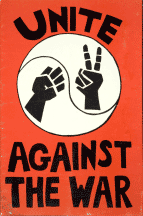
Chomsky: the US public is irrelevant

Al Jazeera’s INSIDE USA has a recent interview with Noam Chomsky. Chomsky: US public irrelevant. The partial transcript is mirrored below, as is the 2-part video: part 1 and part 2.

Part 2 of the interview:

Partial transcript:

AVI LEWSI: I’d like to start by talking about the US presidential campaign. In writing about the last election in 2004, you called America’s system a “fake democracy” in which the public is hardly more than an irrelevant onlooker, and you’ve been arguing in your work in the last year or so that the candidates this time around are considerably to the right of public opinion on all major issues.

So, the question is, do Americans have any legitimate hope of change this time around? And what is the difference in dynamic between America’s presidential “cup” in 2008 compared to 2004 and 2000?

NOAM CHOMSKY: There’s some differences, and the differences are quite enlightening. I should say, however, that I’m expressing a very conventional thought – 80 per cent of the population thinks, if you read the words of the polls, that the government is run by a few big interests looking out for themselves not for the population [and] 95 per cent of the public thinks that the government ought to pay attention to public opinion but it doesn’t.

As far as the elections are concerned, I forget the exact figure but by about three to one people wish that the elections were about issues, not about marginal character qualities and so on. So I’m right in the mainstream.

There’s some interesting differences between 2004 and 2008 and they’re very revealing, it’s kind of striking that the commentators don’t pick that up because it’s so transparent.

The main domestic issue for years … is the health system – which is understandable as it’s a total disaster.

The last election debate in 2004 was on domestic issues … and the New York Times the next day had an accurate description of it. It said that [former Democratic presidential candidate John] Kerry did not bring up any hint of government involvement in healthcare because it has so little political support, just [the support of] the large majority of the population.

But what he meant was it was not supported by the pharmaceutical industry and wasn’t supported by the financial institutions and so on.

In this election the Democratic candidates all have [health] programmes that are not what the public are asking for but are approaching it and could even turn into it, so what happened between 2004 and 2008?

It’s not a shift in public opinion – that’s the same as before, what happened is a big segment of US corporate power is being so harmed by the healthcare system that they want it changed, namely the manufacturing industry.

So, for example, [car manufacturer] General Motors says that it costs them maybe $1,500 more to produce a car in Detroit then across the border in Windsor, Canada, just because they have a more sensible healthcare system there.

Well, when a big segment of corporate America shifts its position, then it becomes politically possible and has political support. So, therefore, you can begin to talk about it.

AL: But those aren’t changes coming from pressure from below?

CHOMSKY: No, the public is the same, it’s been saying the same for decades, but the public is irrelevant, is understood to be irrelevant. What matters is a few big interests looking after themselves and that’s exactly what the public sees.

AL: And yet, you can see people agitating against the official story, even within the electoral process. There is definitely a new mood in the US, a restlessness among populations who are going to political rallies in unprecedented numbers.

What do you make of this well branded phenomenon of hope – which is obviously part marketing – but is it not also part something else?

CHOMSKY: Well that’s Barack Obama. He has his way, he presents himself – or the way his handlers present him – as basically a kind of blank slate on which you can write whatever you like and there are a few slogans: Hope, unity …

AL: Change?

CHOMSKY: Understandable that Obama is generating “enthusiasm” [Reuters]
For most people in the US the past 30 years have been pretty grim. Now, it’s a rich country, so it’s not like living in southern Africa, but for the majority of the population real wages have stagnated or declined for the past 30 years, there’s been growth but it’s going to the wealthy and into very few pockets, benefits which were never really great have declined, work hours have greatly increased and there isn’t really much to show for it other than staying afloat.

And there is tremendous dissatisfaction with institutions, there’s a lot of talk about Bush’s very low poll ratings, which is correct, but people sometimes overlook the fact that congress’s poll ratings are even lower.

In fact all institutions are just not trusted but disliked, there’s a sense that everything is going wrong.

So when somebody says “hope, change and unity” and kind of talks eloquently and is a nice looking guy and so on then, fine.

AL: If the elite strategy for managing the electorate is to ignore the will of the people as you interpret it through polling data essentially, what is an actual progressive vision of changing the US electoral system? Is it election finance, is it third party activism?

CHOMSKY: We have models right in front of us. Like pick, say, Bolivia, the poorest county in South America. They had a democratic election a couple of years ago that you can’t even dream about in the US. It’s kind of interesting it’s not discussed; it’s a real democratic election.

A large majority of the population became organised and active for the first time in history and elected someone from their own ranks on crucial issues that everyone knew about – control of resource, cultural rights, issues of justice, you know, really serious issues.

And, furthermore, they didn’t just do it on election day by pushing a button, they’ve been struggling about these things for years.

A couple of years before this they managed to drive Bechtel and the World Bank out of the country when they were trying to privatise the war. It was a pretty harsh struggle and a lot of people were killed.

Well, they reached a point where they finally could manifest this through the electoral system – they didn’t have to change the electoral laws, they had to change the way the public acts. And that’s the poorest country in South America.

Actually if we look at the poorest country in the hemisphere – Haiti – the same thing happened in 1990. You know, if peasants in Bolivia and Haiti can do this, it’s ridiculous to say we can’t.

AL: The Democrats in this election campaign have been talking a lot, maybe less so more recently, about withdrawing from Iraq.

What are the chances that a new president will significantly change course on the occupation and might there be any change for the people of Iraq as a result of the electoral moment in the US?

CHOMSKY: Well, one of the few journalists who really covers Iraq intimately from inside is Nir Rosen, who speaks Arabic and passes for Arab, gets through society, has been there for five or six years and has done wonderful reporting. His conclusion, recently published, as he puts it, is there are no solutions.

This has been worse than the Mongol invasions of the 13th century – you can only look for the least bad solution but the country is destroyed.

The war on Iraq has been a catastrophe, Chomsky says [AFP]
And it has in fact been catastrophic. The Democrats are now silenced because of the supposed success of the surge which itself is interesting, it reflects the fact that there’s no principled criticism of the war – so if it turns out that your gaining your goals, well, then it was OK.

We didn’t act that way when the Russians invaded Chechnya and, as it happens, they’re doing much better than the US in Iraq.

In fact what’s actually happening in Iraq is kind of ironic. The Iraqi government, the al-Maliki government, is the sector of Iraqi society most supported by Iran, the so-called army – just another militia – is largely based on the Badr brigade which is trained in Iran, fought on the Iranian side during the Iran-Iraq war, was part of the hated Revolutionary Guard, it didn’t intervene when Saddam was massacring Shiites with US approval after the first Gulf war, that’s the core of the army.

The figure who is most disliked by the Iranians is of course Muqtada al-Sadr, for the same reason he’s disliked by the Americans – he’s independent.

If you read the American press, you’d think his first name was renegade or something, it’s always the “renegade cleric” or the “radical cleric” or something – that’s the phrase that means he’s independent, he has popular support and he doesn’t favour occupation.

Well, the Iranian government doesn’t like him for the same reason. So, they [Iran] are perfectly happy to see the US institute a government that’s receptive to their influence and for the Iraqi people it’s a disaster.

And it’ll become a worse disaster once the effects of the warlordism and tribalism and sectarianism sink in more deeply.

NATO, Ukraine’s Orange Counter-Revolution

Ukraine President Viktor Yushchenko is a US puppet who wants to push Ukraine into NATO, although less than 30% of the Ukraine public backs the idea. NATO head pledges to forge consensus on Ukraine NATO is an offensive war alliance, led by the US government, whose main current goal in the world is to dominate China and Russia. Why doesn’t the US ‘Peace’ community talk about NATO more and oppose the alliance for war?

The answer is simple. The Democratic Party is thoroughly supportive of NATO, and the leadership of all these liberal church fed ‘peace’ groups is thoroughly tied into Democratic Party dope pushing, so you won’t see them talk about NATO much at all, except perhaps to call on NATO to militarily intervene in Darfur and Kosovo, and even to occupy these areas. Absent is any call for NATO to get out of Afghanistan, too.

The so-called Ukraine ‘Orange Revolution’ is in fact a counter-revolutionary, counter democracy movement largely funded from Western Europe, the US, and Canada. It is an anti-Russian movement, despite the fact that many Russians live in Ukraine itself. We need to watch these scoundrels as they try to get the US to take over Ukraine militarily through NATO. We need to demand that NATO be eliminated, not spread further throughout the world.

The US Antiwar Movement must open its eyes and ears! The time to do so about NATO is upon us.

Canadian government apologizes for allowing Christian abuse of Native population

The Canadian government, following in the footsteps of the New Zealand and Australian governments, today apologized for having institutionalized Christian missionaries’ abuse of their Native populations. See Canada apologizes for failing natives

Just as in the US, which has so far refused to apologize for much of anything in its bloody and racist history, the Christian churches of Canada were used as a government tool to stamp out the culture and languages of the indigenous populations. The Christan religious fanatics were used as agents of government planned and sponsored genocide.

Will the churches themselves ever offer an apology? One rather doubts it. Many of the Christian Right are most willing ‘little Eichmann’s’ in more than just a few ways. I guess that much more can be said about them here in Colorado Springs…. land of the dead Native.

New Police World Order comes home

Mary Sprunger-Froese brings balloon to bear against the St Patricks Day batonsJUST IN: The Springs’ own inveterate activist Mary Sprunger-Froese was turned away at the Canadian border owing to her political criminal record. She and her husband Peter who is a Canadian citizen, were paying a visit to his family in Saskatchewan on the occasion of his brother’s wedding. They borrow a car for this semiannual trip. Peter sometimes makes the journey by bike. This time Canadian border agents made an issue of Mary’s extensive civil disobedience arrest record and wouldn’t permit her entry. The couple had to turn back and subsequently got caught in the interstate closures due to weather. More after they get home.

Kosovo

Many liberals and Leftists support independence for Kosovo just as they have done previously with East Timor. In short, they have supported their own imperialist governments dividing up other countries, and this they call ‘supporting national self determination’!

Let’s face it though. The real reason the Western imperialist powers (NATO) went to war together back then against the government of Milosevic was to destroy the remnants of state socialism in Yugoslavia, and by doing so they split up the old multi-cultural Yugoslavia into many bits and pieces. The last battle was over Kosovo, where the US went to battle alongside allies and proponents of a Greater Albania together against the supporters of a Greater Serbia. Bombs away!

The collateral damage still remains, just as it does in Bosnia and throughout the former Soviet Union. Ethnic manipulation can get rather messy, USA, but of course, this is the preferred method of warfare for the US government, using one ethnic group against the next. We see it again and again and again. We see it in Afghanistan, Somalia, and Iraq.

So Kosovo’s Albanians demand ‘independence’ from Yugoslavia. They demand 2 ethnic Albanias then. Or rather, they demand (indirectly) confederation with Albania instead of with Serb dominated Yugoslavia. Should they get it? If so, will the Serb’s living within Kosovo demand an even smaller ‘state’? Yugoslavia will back that, but then should they, the Kosovar Serbs, get what they want? Is that, too, ‘national self determination’?

Kosovo demonstrates once again that a world where each national group demands an ethnic state of their own all the time will be a messy and continually contentious one. At one time, many American Blacks and groups supporting them against White racism toyed with the idea of demanding that a state like Mississippi or Alabama be made a Black country for ex-slaves to inhabit. In fact, throughout Canada and the US, indigenous groups have something like that already, called the ‘Indian reservations’. Where do we stop in supporting ‘national self determination’ then? Would America and its Black population have been better served by creating an ‘independent’ country back in the ’20s or ’30s in a Southern state? One doesn’t think so today.

Maybe Kosovo is the right place to stop splitting people up further. Instead of wars spent to do this why not support economic plans of peace that would unite Serb and Albanian within Kosovo? Is it really that hard to implement such a program? I thin not but the political will to start such a program is entirely absent, and no more so than in the imperialist countries themselves which continue to prefer to rule by divide and conquer.

NATO out of the Balkans NOW! US out of the Balkans NOW! Monery for economic assistance, not military occupation!