Flotilla not a Love Boat, it was a lynch, says Netanyahu, describing beating of IDF soldiers, not deaths of aid workers

What’s a lynch? I find it intriguing that Israel’s spin machine can drop an American pop culture reference like Love Boat, and simultaneously flub basic usage with “a lynch.” According to Israel, that describes what befell their crack-troop Mavi Marmara party-crashers. What does “a lynch” mean? Apparently someone feels at liberty to shorten Lynch Mob, or Lynching, to coin a new threat to Israel. But doesn’t it stretch credulity to imagine the IDF has never claimed to have been baited into an “ambush?”

Every modern military with a propaganda office, when it suffers a setback, attributes it to an ambush. When the US and Israel do it, it’s an attack; when our dastardly adversaries do it, it’s an ambush. Let’s set aside that the night watch on the Mavi Marmara’s deck might have been defending themselves. For the moment the IDF version of events is the only one Israel is allowing.

Ambush, trap, beating, getting jumped, wouldn’t these be appropriate descriptions for what Israel is asserting its night-vision video depicts? To lynch someone -it’s a verb- implies a hanging, extrajudicial, usually perpetrated by a crowd against a lone victim, unarmed. So where does the IDF get “lynch?”

To my mind, the Israeli-accented tender of “lynch” is feigned bad English, stuttered -I hope in shame- as perpetrator blames victim, but stuttered conveniently, to make the accusation less preposterous. Isn’t a rape victim who is too well versed in the crime perpetrated against her, less convincing than a victim who fumbles to comprehend the outrage she suffered? Poor Israel, its soldiers stepped into a, a, a lynch.

Emitted from military spokespeople however, one projects a reflexive followup “-that’s the ticket.”

I’m guessing grasping a straws like “lynch” is played for sympathy. And while I deconstruct the false unfamiliarity of otherwise precisely crafted English: PM Netanyahu’s mention of “Love Boat” had a bumbling Bush “the internets” ring to it. Anyone old enough to know the television show about the enchanted cruise ship knows there’s not “a Love Boat” but The Love Boat.

If the newly nouned “lynch” is intended to define a hate crime unique to anti-Semites, the motive fits with Israel’s insistence that first genocide, now holocaust, can only apply to Jews. Such an implication is aided by Netanyahu’s suggestion that the lynch was “plotted.” Because common understanding of mob misbehavior precludes a premeditated plot. This may reflect a naive dismissal of the responsibility of authorities who manipulated the lynch mobs and witch hunts, but dictionaries seldom chronicle the injustice of the victors who write the history. Conventional wisdom holds that lynchings were improvisational.

Perhaps the English speaking viewers are meant to associate the implicit racism of the term. Ambush after all doesn’t conjure the slightest whiff of antisemitism. But here’s where Israel’s liberal arts wordsmiths may have outsmarted themselves. While it’s true that thousands of African Americans were lynched through our nation’s history, to the average American who dwells not very often on shameful pasts, the definition of lynching encompasses simply an execution in lieu a trial. Even an unfair trial, or kangaroo court, can be called a lynching. A lynch mob is an enraged crowd meting vigilante justice, hanging high what to them is an indisputable wrongdoer. The overwhelming number of lynching victims in America’s lawless west were hunted criminals. While xenophobia may always have skewed the mob’s judgment against Indian, Chinese, Mexican, or Black, a lynching was not by definition about racial prejudice.

If the beating of the Israeli commandos illustrated a hatred, was it racist? One is meant to assume the motive was anti-Semitic, but I wonder if Arab-Israelies serving in the IDF, or foreign nationals or mercenaries, don’t garner antagonism as vociferous. The historic prejudice decried by ADL and holocaust remembrance stalwarts has been against Jews, but the world today reviles Israeli arrogance. The US has become universal despised, but American tourists are still assured the world hates America, not its people. It’s what we’re told, if even if it is untrue. I do not know of course if Israelis are proffered the same polite assurance.

Did Israel mean that the Freedom Flotilla was an attempted lynching of Israel’s international reputation? In that case, Israel’s predictable militant reaction made such a hanging a matter of assisted suicide. If the Israeli national character suffers irreparably, who’s going to be to bame?

Presuming to paint its soldiers into a lynching scene, which character does Israel assert they played? Were the IDF the horse thieves? Bandying about the connotations of lynchings makes for an interesting turning of the tables. Were the convoy defenders the ones pronouncing hasty judgment upon their dark-of-night assailants? Or were Israel’s commandos declaring themselves judge and jury on the alleged arms smugglers?

In cases of breaking and entering, the home field advantage is accorded the right to self-defense. A SWAT team might make the argument that identifying itself as law enforcement preempts a homeowner’s recourse to armed resistance, based on the principle that an arresting officer’s safety is inviolate. Israel may assert it was policing its border, but unfortunately last Monday it was operating beyond its border. What protection can a law enforcement function claim if outside its jurisdiction?

It might be well and good to say Israel reserves the right to protect itself from enemies anywhere in the world, but it can’t pretend its badge should command universal obeisance.

The Mavi Marmara had declared her intention to run Israel’s blockade, but hadn’t yet attempted the crossing. In fact the Freedom Flotilla was moving away from the contentious area at the time of Israel’s attack.

Who then was the victim of this “lynch?”

I’ll tell you why it’s lynch and not lynching. Because Israel’s soldiers weren’t killed, they were beaten. Not to diminish what might have been their adversaries’ worst intentions, but the gantlet the IDF commandoes received was not a hanging specifically, and not very effective in terms of proving fatal. On the other hand, the outcome was the killing of an as yet undisclosed multitude of civilians, unarmed to an extent that the killings can be defined as executions, the entire result already adjudged to have been a massacre.

Israel’s invention of “lynch” is an utterance which I believe betrays the sign of shame the world longs to see from Israel. Even as the public revels in watching the Israeli hubris on self-destruct, empathy has us hoping to see Israel grasp for its lost humanity. To describe the events on the Turkish passenger ship as a “lynch” is to fail to summon the chutzpah to bear false witness, to accuse the dead of capital murder. Neither does Israel dare to raise the specter that summary executions were committed that night at all.

There is a term to describe

a) Israel’s taking the law into its own hands by pirating a ship belonging to another nation while it sailed in international waters,

b) Israel’s soldiers not being a police force but an ideology-deputized posse,

c) opting in a confused fervor to punish outlaws thought to have been caught red handed,

d) issuing on the spot death sentences.

It’s called a mass lynching.

Robert Fisk and the language of power, danger words: Competing Narratives

Celebrated reporter -and verb- Robert Fisk had harsh words, “danger words” he called them, for host Al-Jazeera where he gave an address about the language of power which has infected newsman and reader alike. Beware your unambiguous acceptance of empty terms into which state propagandists let you infer nuance: power players, activism, non-state actors, key players, geostrategic players, narratives, external players, meaningful solutions, –meaning what?
I’ll not divulge why these stung Al-J, but I’d like to detail the full list, and commit not to condone their false usage at NMT, without ridicule, “quotes” or disclaimer.

Fisk listed several expressions which he attributes to government craftsmen. Unfortunately journalists have been parroting these terms without questioning their dubious meaning. Fisk began with a favorite, the endless, disingenuous, “peace process.” What is that – victor-defined purgatory? Why would “peace” be a “process” Fisk asks.

How appropriate that some of the West’s strongest critics are linguists. Fisk lauded the current seagoing rescue of Gaza, the convoy determined to break the Israeli blockade. He compared it to the Berlin Airlift, when governments saw fit to help besieged peoples, even former enemies. This time however, the people have to act where their governments do not.

I read recently that the Gaza Freedom Flotilla might be preparing accommodations for Noam Chomsky to join the passage. Won’t that be an escalation? I imagine if Robert Fisk would climb aboard too, it would spell doom for any chance the relief supplies would reach the Gazans. A ship convoy with Chomsky and Fisk on board would present an opportunity that an Israeli torpedo could not resist.

Here is his list. If you can’t peruse the lecture, at least ponder these words with as much skepticism as you can. The parenthesis denote my shorthand.

peace process (detente under duress, while enduring repression)

“Peace of the Brave” (accept your subjugation, coined for Algeria, then France lost)

“Hearts and Minds” (Vietnam era psych-ops, then US lost)

spike (to avoid saying: increase)

surge (reinforcements, you send them in you’re losing)

key players (only puppets and their masters need apply)

back on track (the objective has been on rails?)

peace envoy (in mob-speak: the cleaner)

road map (winner’s bill of lading for the spoils)

experts (vetted opinions)

indirect talks (concurrent soliloquies, duets performed solo in proximity to common fiddler calling tune)

competing narratives (parallel universes in one? naturally the perpetrator is going to tell a different tale, disputing that of victim’s; ungoing result is no justice and no injustice) examples:
occupied vs. disputed;
wall vs. security barrier;
colonization vs settlements, outposts or Jewish neighborhoods.

foreign fighters (them, but always us)

Af-Pak (ignores third party India and thus dispute to Kashmir)

appeasers (sissies who don’t have bully’s back)

Weapons of Mass Destruction (not Iraq, now not Iran)

think tanks (ministry of propaganda privatized)

challenges (avoids they are problems)

intervention (asserted authority by military force)

change agents (by undisclosed means?)

Until asked otherwise, I’ll append Fisk’s talk here:

Robert Fisk, The Independent newspaper’s Middle East correspondent, gave the following address to the fifth Al Jazeera annual forum on May 23.

Power and the media are not just about cosy relationships between journalists and political leaders, between editors and presidents. They are not just about the parasitic-osmotic relationship between supposedly honourable reporters and the nexus of power that runs between White House and state department and Pentagon, between Downing Street and the foreign office and the ministry of defence. In the western context, power and the media is about words – and the use of words.

It is about semantics.

It is about the employment of phrases and clauses and their origins. And it is about the misuse of history; and about our ignorance of history.

More and more today, we journalists have become prisoners of the language of power.

Is this because we no longer care about linguistics? Is this because lap-tops ‘correct’ our spelling, ‘trim’ our grammar so that our sentences so often turn out to be identical to those of our rulers? Is this why newspaper editorials today often sound like political speeches?

Let me show you what I mean.

For two decades now, the US and British – and Israeli and Palestinian – leaderships have used the words ‘peace process’ to define the hopeless, inadequate, dishonourable agreement that allowed the US and Israel to dominate whatever slivers of land would be given to an occupied people.

I first queried this expression, and its provenance, at the time of Oslo – although how easily we forget that the secret surrenders at Oslo were themselves a conspiracy without any legal basis. Poor old Oslo, I always think! What did Oslo ever do to deserve this? It was the White House agreement that sealed this preposterous and dubious treaty – in which refugees, borders, Israeli colonies – even timetables – were to be delayed until they could no longer be negotiated.

And how easily we forget the White House lawn – though, yes, we remember the images – upon which it was Clinton who quoted from the Qur’an, and Arafat who chose to say: “Thank you, thank you, thank you, Mr. President.” And what did we call this nonsense afterwards? Yes, it was ‘a moment of history’! Was it? Was it so?

Do you remember what Arafat called it? “The peace of the brave.” But I don’t remember any of us pointing out that “the peace of the brave” was used originally by General de Gaulle about the end of the Algerian war. The French lost the war in Algeria. We did not spot this extraordinary irony.

Same again today. We western journalists – used yet again by our masters – have been reporting our jolly generals in Afghanistan as saying that their war can only be won with a “hearts and minds” campaign. No-one asked them the obvious question: Wasn’t this the very same phrase used about Vietnamese civilians in the Vietnam war? And didn’t we – didn’t the West – lose the war in Vietnam?

Yet now we western journalists are actually using – about Afghanistan – the phrase ‘hearts and minds’ in our reports as if it is a new dictionary definition rather than a symbol of defeat for the second time in four decades, in some cases used by the very same soldiers who peddled this nonsense – at a younger age – in Vietnam.

Just look at the individual words which we have recently co-opted from the US military.

When we westerners find that ‘our’ enemies – al-Qaeda, for example, or the Taliban -have set off more bombs and staged more attacks than usual, we call it ‘a spike in violence’. Ah yes, a ‘spike’!

A ‘spike’ in violence, ladies and gentlemen is a word first used, according to my files, by a brigadier general in the Baghdad Green Zone in 2004. Yet now we use that phrase, we extemporise on it, we relay it on the air as our phrase. We are using, quite literally, an expression created for us by the Pentagon. A spike, of course, goes sharply up, then sharply downwards. A ‘spike’ therefore avoids the ominous use of the words ‘increase in violence’ – for an increase, ladies and gentlemen, might not go down again afterwards.

Now again, when US generals refer to a sudden increase in their forces for an assault on Fallujah or central Baghdad or Kandahar – a mass movement of soldiers brought into Muslim countries by the tens of thousands – they call this a ‘surge’. And a surge, like a tsunami, or any other natural phenomena, can be devastating in its effects. What these ‘surges’ really are – to use the real words of serious journalism – are reinforcements. And reinforcements are sent to wars when armies are losing those wars. But our television and newspaper boys and girls are still talking about ‘surges’ without any attribution at all! The Pentagon wins again.

Meanwhile the ‘peace process’ collapsed. Therefore our leaders – or ‘key players’ as we like to call them – tried to make it work again. Therefore the process had to be put ‘back on track’. It was a railway train, you see. The carriages had come off the line. So the train had to be put ‘back on track’. The Clinton administration first used this phrase, then the Israelis, then the BBC.

But there was a problem when the ‘peace process’ had been put ‘back on track’ – and still came off the line. So we produced a ‘road map’ – run by a Quartet and led by our old Friend of God, Tony Blair, who – in an obscenity of history – we now refer to as a ‘peace envoy’.

But the ‘road map’ isn’t working. And now, I notice, the old ‘peace process’ is back in our newspapers and on our television screens. And two days ago, on CNN, one of those boring old fogies that the TV boys and girls call ‘experts’ – I’ll come back to them in a moment – told us again that the ‘peace process’ was being put ‘back on track’ because of the opening of ‘indirect talks’ between Israelis and Palestinians.

Ladies and gentlemen, this isn’t just about clichés – this is preposterous journalism. There is no battle between power and the media. Through language, we have become them.

Maybe one problem is that we no longer think for ourselves because we no longer read books. The Arabs still read books – I’m not talking here about Arab illiteracy rates – but I’m not sure that we in the West still read books. I often dictate messages over the phone and find I have to spend ten minutes to repeat to someone’s secretary a mere hundred words. They don’t know how to spell.

I was on a plane the other day, from Paris to Beirut – the flying time is about three hours and 45 minutes – and the woman next to me was reading a French book about the history of the Second World War. And she was turning the page every few seconds. She had finished the book before we reached Beirut! And I suddenly realised she wasn’t reading the book – she was surfing the pages! She had lost the ability to what I call ‘deep read’. Is this one of our problems as journalists, I wonder, that we no longer ‘deep read’? We merely use the first words that come to hand …

Let me show you another piece of media cowardice that makes my 63-year-old teeth grind together after 34 years of eating humus and tahina in the Middle East.

We are told, in so many analysis features, that what we have to deal with in the Middle East are ‘competing narratives’. How very cosy. There’s no justice, no injustice, just a couple of people who tell different history stories. ‘Competing narratives’ now regularly pop up in the British press. The phrase is a species – or sub-species – of the false language of anthropology. It deletes the possibility that one group of people – in the Middle East, for example – are occupied, while another group of people are doing the occupying. Again, no justice, no injustice, no oppression or oppressing, just some friendly ‘competing narratives’, a football match, if you like, a level playing field because the two sides are – are they not – ‘in competition’. It’s two sides in a football match. And two sides have to be given equal time in every story.

So an ‘occupation’ can become a ‘dispute’. Thus a ‘wall’ becomes a ‘fence’ or a ‘security barrier’. Thus Israeli colonisation of Arab land contrary to all international law becomes ‘settlements’ or ‘outposts’ or ‘Jewish neighbourhoods’.

You will not be surprised to know that it was Colin Powell, in his starring, powerless appearance as secretary of state to George W. Bush, who told US diplomats in the Middle East to refer to occupied Palestinian land as ‘disputed land’ – and that was good enough for most of the American media.

So watch out for ‘competing narratives’, ladies and gentlemen. There are no ‘competing narratives’, of course, between the US military and the Taliban. When there are, however, you’ll know the West has lost.

But I’ll give you a lovely, personal example of how ‘competing narratives’ come undone. Last month, I gave a lecture in Toronto to mark the 95th anniversary of the 1915 Armenian genocide, the deliberate mass murder of one and a half million Armenian Christians by the Ottoman Turkish army and militia. Before my talk, I was interviewed on Canadian Television, CTV, which also owns the Toronto Globe and Mail newspaper. And from the start, I could see that the interviewer had a problem. Canada has a large Armenian community. But Toronto also has a large Turkish community. And the Turks, as the Globe and Mail always tell us, “hotly dispute” that this was a genocide. So the interviewer called the genocide “deadly massacres”.

Of course, I spotted her specific problem straight away. She could not call the massacres a ‘genocide’, because the Turkish community would be outraged. But equally, she sensed that ‘massacres’ on its own – especially with the gruesome studio background photographs of dead Armenians – was not quite up to defining a million and a half murdered human beings. Hence the ‘deadly massacres’. How odd!!! If there are ‘deadly’ massacres, are there some massacres which are not ‘deadly’, from which the victims walk away alive? It was a ludicrous tautology.

In the end, I told this little tale of journalistic cowardice to my Armenian audience, among whom were sitting CTV executives. Within an hour of my ending, my Armenian host received an SMS about me from a CTV reporter. “Shitting on CTV was way out of line,” the reporter complained. I doubted, personally, if the word ‘shitting’ would find its way onto CTV. But then, neither does ‘genocide’. I’m afraid ‘competing narratives’ had just exploded.

Yet the use of the language of power – of its beacon-words and its beacon-phrases -goes on among us still. How many times have I heard western reporters talking about ‘foreign fighters’ in Afghanistan? They are referring, of course, to the various Arab groups supposedly helping the Taliban. We heard the same story from Iraq. Saudis, Jordanians, Palestinian, Chechen fighters, of course. The generals called them ‘foreign fighters’. And then immediately we western reporters did the same. Calling them ‘foreign fighters’ meant they were an invading force. But not once – ever – have I heard a mainstream western television station refer to the fact that there are at least 150,000 ‘foreign fighters’ in Afghanistan. And that most of them, ladies and gentlemen, are in American or other Nato uniforms!

Similarly, the pernicious phrase ‘Af-Pak’ – as racist as it is politically dishonest – is now used by reporters when it originally was a creation of the US state department, on the day that Richard Holbrooke was appointed special US representative to Afghanistan and Pakistan. But the phrase avoided the use of the word ‘India’ whose influence in Afghanistan and whose presence in Afghanistan, is a vital part of the story. Furthermore, ‘Af-Pak’ – by deleting India – effectively deleted the whole Kashmir crisis from the conflict in south-east Asia. It thus deprived Pakistan of any say in US local policy on Kashmir – after all, Holbrooke was made the ‘Af-Pak’ envoy, specifically forbidden from discussing Kashmir. Thus the phrase ‘Af-Pak’, which totally deletes the tragedy of Kashmir – too many ‘competing narratives’, perhaps? – means that when we journalists use the same phrase, ‘Af-Pak’, which was surely created for us journalists, we are doing the state department’s work.

Now let’s look at history. Our leaders love history. Most of all, they love the Second World War. In 2003, George W. Bush thought he was Churchill as well as George W. Bush. True, Bush had spent the Vietnam war protecting the skies of Texas from the Vietcong. But now, in 2003, he was standing up to the ‘appeasers’ who did not want a war with Saddam who was, of course, ‘the Hitler of the Tigris’. The appeasers were the British who did not want to fight Nazi Germany in 1938. Blair, of course, also tried on Churchill’s waistcoat and jacket for size. No ‘appeaser’ he. America was Britain’s oldest ally, he proclaimed – and both Bush and Blair reminded journalists that the US had stood shoulder-to-shoulder with Britain in her hour of need in 1940.

But none of this was true.

Britain’s old ally was not the United States. It was Portugal, a neutral fascist state during World War Two. Only my own newspaper, The Independent, picked this up.

Nor did America fight alongside Britain in her hour of need in 1940, when Hitler threatened invasion and the German air force blitzed London. No, in 1940 America was enjoying a very profitable period of neutrality – and did not join Britain in the war until Japan attacked the US naval base at Pearl Harbour in December of 1941.

Ouch!

Back in 1956, I read the other day, Eden called Nasser the ‘Mussolini of the Nile’. A bad mistake. Nasser was loved by the Arabs, not hated as Mussolini was by the majority of Africans, especially the Arab Libyans. The Mussolini parallel was not challenged or questioned by the British press. And we all know what happened at Suez in 1956.

Yes, when it comes to history, we journalists really do let the presidents and prime ministers take us for a ride.

Today, as foreigners try to take food and fuel by sea to the hungry Palestinians of Gaza, we journalists should be reminding our viewers and listeners of a long-ago day when America and Britain went to the aid of a surrounded people, bringing food and fuel – our own servicemen dying as they did so – to help a starving population. That population had been surrounded by a fence erected by a brutal army which wished to starve the people into submission. The army was Russian. The city was Berlin. The wall was to come later. The people had been our enemies only three years earlier. Yet we flew the Berlin airlift to save them. Now look at Gaza today. Which western journalist – and we love historical parallels – has even mentioned 1948 Berlin in the context of Gaza?

Look at more recent times. Saddam had ‘weapons of mass destruction’ – you can fit ‘WMD’ into a headline – but of course, he didn’t, and the American press went through embarrassing bouts of self-condemnation afterwards. How could it have been so misled, the New York Times asked itself? It had not, the paper concluded, challenged the Bush administration enough.

And now the very same paper is softly – very softly – banging the drums for war in Iran. Iran is working on WMD. And after the war, if there is a war, more self-condemnation, no doubt, if there are no nuclear weapons projects.

Yet the most dangerous side of our new semantic war, our use of the words of power – though it is not a war since we have largely surrendered – is that it isolates us from our viewers and readers. They are not stupid. They understand words, in many cases – I fear – better than we do. History, too. They know that we are drowning our vocabulary with the language of generals and presidents, from the so-called elites, from the arrogance of the Brookings Institute experts, or those of those of the Rand Corporation or what I call the ‘THINK TANKS’. Thus we have become part of this language.

Here, for example, are some of the danger words:

· POWER PLAYERS

· ACTIVISM

· NON-STATE ACTORS

· KEY PLAYERS

· GEOSTRATEGIC PLAYERS

· NARRATIVES

· EXTERNAL PLAYERS

· PEACE PROCESS

· MEANINGFUL SOLUTIONS

· AF-PAK

· CHANGE AGENTS (whatever these sinister creatures are).

I am not a regular critic of Al Jazeera. It gives me the freedom to speak on air. Only a few years ago, when Wadah Khanfar (now Director General of Al Jazeera) was Al Jazeera’s man in Baghdad, the US military began a slanderous campaign against Wadah’s bureau, claiming – untruthfully – that Al Jazeera was in league with al-Qaeda because they were receiving videotapes of attacks on US forces. I went to Fallujah to check this out. Wadah was 100 per cent correct. Al-Qaeda was handing in their ambush footage without any warning, pushing it through office letter-boxes. The Americans were lying.

Wadah is, of course, wondering what is coming next.

Well, I have to tell you, ladies and gentlemen, that all those ‘danger words’ I have just read out to you – from KEY PLAYERS to NARRATIVES to PEACE PROCESS to AF-PAK – all occur in the nine-page Al Jazeera programme for this very forum.

I’m not condemning Al Jazeera for this, ladies and gentlemen. Because this vocabulary is not adopted through political connivance. It is an infection that we all suffer from – I’ve used ‘peace process’ a few times myself, though with quotation marks which you can’t use on television – but yes, it’s a contagion.

And when we use these words, we become one with the power and the elites which rule our world without fear of challenge from the media. Al Jazeera has done more than any television network I know to challenge authority, both in the Middle East and in the West. (And I am not using ‘challenge’ in the sense of ‘problem’, as in ‘”I face many challenges,” says General McCrystal.’)

How do we escape this disease? Watch out for the spell-checkers in our lap-tops, the sub-editor’s dreams of one-syllable words, stop using Wikipedia. And read books – real books, with paper pages, which means deep reading. History books, especially.

Al Jazeera is giving good coverage to the flotilla – the convoy of boats setting off for Gaza. I don’t think they are a bunch of anti-Israelis. I think the international convoy is on its way because people aboard these ships – from all over the world – are trying to do what our supposedly humanitarian leaders have failed to do. They are bringing food and fuel and hospital equipment to those who suffer. In any other context, the Obamas and the Sarkozys and the Camerons would be competing to land US Marines and the Royal Navy and French forces with humanitarian aid – as Clinton did in Somalia. Didn’t the God-like Blair believe in humanitarian ‘intervention’ in Kosovo and Sierra Leone?

In normal circumstances, Blair might even have put a foot over the border.

But no. We dare not offend the Israelis. And so ordinary people are trying to do what their leaders have culpably failed to do. Their leaders have failed them.

Have the media? Are we showing documentary footage of the Berlin airlift today? Or of Clinton’s attempt to rescue the starving people of Somalia, of Blair’s humanitarian ‘intervention’ in the Balkans, just to remind our viewers and readers – and the people on those boats – that this is about hypocrisy on a massive scale?

The hell we are! We prefer ‘competing narratives’. Few politicians want the Gaza voyage to reach its destination – be its end successful, farcical or tragic. We believe in the ‘peace process’, the ‘road map’. Keep the ‘fence’ around the Palestinians. Let the ‘key players’ sort it out.

Ladies and gentlemen, I am not your ‘key speaker’ this morning.

I am your guest, and I thank you for your patience in listening to me.

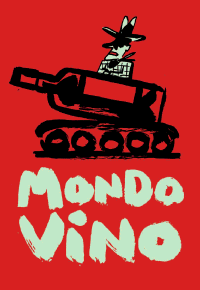
Mondovino: globalization and terroir, Robert Parker versus your good taste

American wine cowboy conquest with tankFor those with a curiosity for how wine terroir is holding up against the onslaught of wine factory farming, the 10-hour miniseries version of MONDOVINO is finally available on DVD. For viewers curious about viniculture globalization under Californian colonial domination, the original feature length documentary delivers, with a long finish. Any time critics accuse a film of being one sided, you know it’s about class war.

I had my first lesson in vineyard terroir when my college-aged aunt visited my family in Alsace and spent a season picking grapes. She informed us to our horreur that everything gets stomped in that barrel, bugs and all. I didn’t drink wine then, so what did I care, but it was easy to decide that such was the artistry that probably made French wines great.

But as I said, Mondovino was about much more than wine, and now I’ll get to the point. We may lament the new commercialization of wine, but historically the occupation has always had its strictly-business types. Vintners were rarely agriculturalists who subsisted, they were wine lovers subsidized. We can wince at the Napa Valley nouveau gauche, but even Bordeaux’s great chateaus, and especially all the Premiers Crus, are owned and have been owned by businessmen money lenders, going back centuries.

The modernization and standardization which is destroying contemporary wines is simply the evolution of production control. At last, technology and the ascent of a gilded age have brought vintners to believe they’ve bested nature. It’s true if you don’t care about wine, if you’re content to bottle a soft drink as opposed to allowing wine the breathing space to develop personality. Basically this documentary demonstrates that these gentlemen hobbyists, now plaintively bourgeois about profit, welcome the new global fascism.

Old World Fascists
Of course it is no stretch to imagine that the Mondovino filmmakers are going to ask, how did your father or grandfather like Fascism under the Nazis? They point the question at an Italian family who date their wealth back 900 years as bankers.

Any European documentary delving into family histories will always ask particularly about the war years. In America it’s what did you do during the war Daddy? In Europe it’s about weathering the occupation. Most working class French want to tell you what they did in the Resistance. Rich people you don’t ask because of course they were collaborateurs.

Mondovino’s subjects are the perpetually wealthy, who don’t even register the affront. Of course their families thrived under Fascism, quelle betise to imagine it would be otherwise. How curious it is we are surprised they embrace it so again.

Such moments are the highlights of Mondovino, rich folk posing in elaborate foyers, plaintively matter of fact about Fascism.

One opulent reception room in Florence is packed with ancient paintings, among them a painting of the very room full of paintings, you imagine if you peered closely enough you would see the infinity of mirrors scheme, a Baroque era black velvet number. The Grande Dame mentions that Prince Charles inquired about that painting at breakfast.

Let me add, critics have held Jonathan Nossiter’s camera work to be unstable. Actually he was very easily distracted by momentously relevant tchotchkes and biographical details few commoners are granted audience to encounter.

Fascists in the New World
Mondovino allowed the Napa Valley entrepreneurs to hang themselves. Open mouth, insert vacuous blather, often racist. These nouveau riches landscaped new vineyard for themselves, praising the terrain like it was classic architecture, their aesthetic tributes could only reference the National Mall. That classic.

Over at Mondavi, talk fixated of expansion and conquest. The film’s main plot addressed the Mondavi’s ongoing acquisition of the world’s most treasured appelations. For the worse of course, because what do they know about wine but that it should all taste the same? Son Mondavi dreams of someday having a vineyard on the moon, for no other reason than he thought of it. Wouldn’t it be exciting, he asks, to be able to say: “hey, let’s open a bottle from the moon,” my paraphrase.

The issue of terroir, English readers, has entirely to do with terre which is French for “earth.” Terre with a capital T is “Earth.” Of course the earthbound distinction was lost on this Californian.

Yes, Mondavi is surely alone in pondering what earth, sun and elements would have feed his moon vines.

Most vile of all the New World vintners was a family outfit in Argentina. They sit on a spacious veranda and explain how every boy in the family is named for founding father, the original title holder. Their wealth goes back to the early Spanish settlers and they express the perennial colonizer’s lament, that Los Indios of the regions have no work ethic. Centuries ago the Spaniard had to devise cruel torments to drive their slave laborers to produce. It was an inefficient system to impose on the indigenous and transplanted tribes, unaccustomed to a hierarchical workforce supporting do-nothings at the top.

Globalization
Key to Mondavi’s quest for wine world domination, is a market that has standardized the consumer’s taste. No longer are customers hopping in their car for a Sunday drive, to stop by a neighboring chateau to sample a vintage take a case home. Today the global consumption of wine has meant having to market it without being able to taste it. For that consumers have come to follow the ratings of critics. It was inevitable of course, but Mondovino reveals how hilariously flawed and phony the system is.

Mondovino focuses on two celebrity tasters who make or break wines. Robert Parker and James Suckling. Let’s dispatch the latter quickly.

James Suckling
James Suckling made a niche for himself nurturing Italian wines and coined the term “Super Tuscan.” I didn’t know that, but Mondovino records Suckling attributing the phenomena to the ether before being made to admit that the meme was his own.

More hilarious was a hypothetical question posed to the critic after confessing in an unguarded moment that he might have been too generous with the rating he gave a friend’s wine. The friend, a wealthy vintner, was letting Suckling a villa, which meant he was also his landlord. Naturally Mondovino asked if a discount on the rent would move Suckling to consider a more favorable rating. Suckling took the bait, laughingly nodding, of course, his friend under his breath suggested in such case he could have the villa for free.

It’s not corruption, merely a gentleman’s game. Can we even assert that the ordinary consumer suffers? Taste is subjective. Suckling’s ultimate rating is of negligible consequence to wine drinkers, except to commerce.

Robert Parker
I’m sorry to be getting around to Parker’s scheme so late in this article, because he plays such a profound part in the homogenizing of world wine production. The mechanism is beyond the pale, but it’s simple. Parker is influential and has a distinctive appetite, he has a best friend who consults with vintners about how to make their wine to Parker’s taste. The result has been devastating. Vines that have for ages had their own distinctive gouts have now been McParkered. The consultant charges a large fee to monitor an increasing stable of wines, for the camera his preoccupation was “micro-oxygenate,” and after it’s bottled parker comes around and bestows the high marks. The more they pay, the higher the score.

Mondovino underscores this plot by filming a Burger King billboard as Parker drives past it, while he sings the praises of uniform quality. The filmmakers notice an FBI cap on Parker’s desk and make sure to keep it in the frame. Parker is quite candid and friendly in Mondovino, probably because he had no inkling they did not share his eagerness to see viniculture’s eccentricities ironed to a uniform flat.

When the film was released and Robert Parker emerged as enterprising accomplice to Mondavi’s villain, Parker was enraged. He wrote rant after rant against the film and its makers. I’m not sure he’s over it yet. I wanted to be sure to document what I thought was Mondovino’s most brilliant assault on the witless benefit the Parker-Mondavi venture think they’re bequeathing with their anschluss of world wine. It’s about the subjectivity of taste. Robert Parker’s.

A recurring motif of Mondovino’s interviews was a fascination with dogs. It’s cute, and often we give ourselves leave to believe we have learned something about the owner by just looking at their dog.

In one memorable scene, we’ve met a quite unassuming South American vintner who has only one hectar, but is none the less generous with his wine, his time and friendship. He has a black dog, and when the filmmaker asks his name, the vintner laughs such that the revelation is self-effacing. “Luther King” is his name, because, he tells us in Spanish, he’s “negro.” Mondovino’s dark hats are so distasteful, it’s important that the heroic characters aren’t too pearly clean.

All the asides with the dogs were entertaining in their own right, but could have served entirely to set up Robert Parker’s scene. We’re invited to Parkers home and immediately discover he has something for bulldogs.

Do you like bulldogs? Taste is of course subjective. Robert Parker and his wife love their bulldogs, two, and their home is festooned with Bulldogephemera, statuettes, paintings, the camera frame’s worth. Imagine a wall covered with watercolors and oil portraits of bulldogs as you consider the subjectivity of taste.

Then just as Parker is prompted to discuss that his nose is ensured for a million dollars, we discover that one of the dogs has become incontinent, and there’s the near unbearable dog flatulence from which not even conversation can escape. Imagine Robert Parker’s nose not ensured against that. The interview concludes with Parker rambling about something as a bulldog sits sneering on the carpet forcing the filmmaker to keep a safe distance, and so he focuses in close capturing the ugly, perhaps infirm, definitely defensive, unlikable mug.

The next time you chose a wine because it has a high Parker score, ask yourself how it integrates an atmosphere of dog.

Betty White’s muffin on the boob tube

Which came first: the Snickers ad, the Facebook group, or SNL’s crowdsourced mandate to fete American sitcom icon Betty White? American as Apple Pie
To me this blonde’s netroots smack of a publicist’s hand, and White’s performance Saturday night all but validated SNL’s reluctance until now to spotlight the octogenarian’s one note routine. The SNL tribute could laud only her age, raising the specter that a proverbial domestic bread might have been named for her.

Betty White was a broadcast fixture, not a luminary. On the plus side, she hasn’t stooped to pitching life insurance on infomercials, although I suspect her screen persona lacked the gravitas. It does look like the Snickers “Divas” campaign wants to boost White’s brand recognition up to the visibility of its other stage and screen legends.

Of course Betty’s first name predates namesake archetypes of American comedy, but it’s no indication of her contribution. When a McGruber sketch had the title comic break character to wend an impassioned I Love You to grandmother White, I was horrified to predict that the actress’s persona had no stretch to stray from her signature negativity.

White may have begun her career in the age of the Honeymooners, but her caricatures belong squarely to the American sitcom as it devolved into cynicism. The high notes of Mary Tyler Moore and Golden Girls were achieved in spite of muddy cutouts like Betty White. The social relevance of every sitcom that followed was twilighted in my opinion by Oliver Stone’s brilliant parody of American television in Natural Born Killers.

Seeing Betty White on SNL reminded me of attending a celebration of another show business icon Shirley Jones. Both larger than life, both admirably spry, and both masters of well-honed chops, but we’re talking pork chops, with no more hue than the rosy cheeks of Paula Dean. Luminescent as they come, Jones could emote with a twinkle, but that didn’t make her Lena Horne. I know, apple pie is not an art medium.

Betty White can play the ditz or calculating shrew. Where else was SNL going to go with her but convalescent home vamp? I’m not sure the jokes made at the expense of her muffin weren’t clammier than Alec Baldwin’s Schweddy Balls. Hohoho, the ultimate promise of the boob tube.

Like surviving veterans of the wars quickly receding in our memories, White deserves honors rekindled with every new generation. Like the soldiers’ contributions, I’d say her deeds in particular were forgettable. We don’t ask our aging vets to reenact their killings. Bad jokes are worse than reenacted, they’re swung around afresh.

Leave Betty White to shill for candy bars, she’s part of America’s cultural pantheon and deservedly so. Laugh track optional.

Abe Obama Jordan Simpson Woods

Abraham ObamaLocal art luminary friends of mine are celebrating their election 2008 “Abraham Obama” project this weekend, end-capping a week where their President Nobel Laureate paid a midnight visit to his warriors in Afghanistan, signed an executive order to repudiate reproductive health rights of women, and today is scheduled to announce offshore oil drilling in Virginia. Surely there is a more apt figure against whom to compare Obama. Almost any other president would fall short. Warren G. Obama? Barack Taft? Actually I can’t conceive of anyone better than Dick Cheney.

My friends maintain this is more a tribute to Abraham Lincoln, highlighting his emancipation of the slaves, a black president being the ultimate result. I’d say morph his face into Michael Jordan or Michael Jackson if you want to pretend African Americans have come far enough by Lincoln’s hand. Or Bill Cosby, Sidney Poitier, OJ Simpson or Tiger Woods.

Rufus, Caccini, Kosma, French Chanson

Rufus Wainright’s GOING TO A TOWN (-THAT’S ALREADY BEEN BURNED DOWN in which he famously sings “I’m so tired of America”) replicates, it’s true, the jazz progression of AUTUMN LEAVES, and websmart-asses have pointed out the piano part is actually identical to the accompaniment of AVE MARIA by Baroque composer Giulio Caccini. At best reflecting Wainright’s unconscious classical pedigree. Fail.

I write at this late date because I looked it up once, and spent the equivalent effort retracing my steps when my curiosity outpaced my memory. This time I’m posting what I found for my own future reference. Just as the internet now substitutes for knowing, it serves as my backup for memory. Technicians no longer have to learn how, they have to know where to look it up online. You no longer have to remember it either, so long as the answers remain there.

Anyone who agrees with Earl Okin that French popular music has followed an endless downward spiral with the minor key fugues of Michel Legrand, has perhaps film composer Joseph Kosma to blame. The Hungarian born Kosma wrote the scores to the greatest French classics, among them RULES OF THE GAME, THE GRAND ILLUSION and CHILDREN OF PARADISE. It was from a 1946 Marcel Carne film that LES FEUILLES MORTE emerged, whose jazz chords perhaps doomed the melodic melancholy of the French to mordant sentimentality.

When Giulio Caccini’s “Ave Maria” was unearthed in 1970, anyone with an musical ear might have wondered how the exhausting blue chord progression found itself in the hands of a Baroque composer. The musical malaise was so distinctly contemporary to the 70s, coincidentally when the piece was supposedly rediscovered. Of course it turns out it hadn’t.

The Ave Maria appropriated by Rufus Wainright was written by Russian composer Vladimir Vavilov in 1970 attributed to “Anonymous” I’ll wager because he didn’t want to take credit for it either. Somebody else decided it would have more luster if thought to have come from a more pious age. Now it’s called “Ave Maria by Giulio Caccini” by Vavilov, although the association is absurd. This composition was a thoroughly natural denouement to Kosma’s French Blues. Ave Maria loses none of its divine beauty, though its provenance was a hoax. The joke is on the many prominent recording artists who thought they were channeling holy canon.

McDonalds: Eat Like Fat Olympians

The authentic moment in the McDonalds commercial “Eat Like Olympians” is where an athlete walks amazed past tables of A-list Olympians stuffing their faces with Chicken McNuggets. He’s not starstruck, but dumbstruck at the sight of athletes poisoning themselves/selling out. Would they, could they? Not and hope to win. Center stage is US speed skater JR Celski and it’s a damn shame. I always hope medalists will seize their moment in the spotlight to hold their fists high like Mexico 1968. No, they’re so self-obsessed they shill for McDonalds and dope the minds of their admirers with Olympic strength toxin.

Canadian audiences have to suffer a wide campaign of misinformation from a handful of their Olympic hopefuls: Cassie Campbell, Brad Martin, Crispin Lipscomb, Cindy Klassen, Shawn Johnson, and Patrick Chan. Each pretending to eat the garbage.

How is being received? Have a look at this preteen rebuttal on Youtube entitled Olympics + McDonalds = Fat Olympians whose main character is a loving tribute to Shaun White.

Would you believe Fortune 500 corps & “Bat Gangs?” Yeah, that’s the ticket.

Poverty threatens sense of prosperityFrom the same mouth that told reporters the ludicrous tale that scouts from two Fortune 500 companies told a local realtor (let’s leave her unnamed, shall we) they rejected locating in Colorado Springs on account of the city’s homeless camps along I-25 –yeah right– comes a really despicable meme she’s now trying to spread of teenage “bat gangs” purportedly terrorizing our homeless.

The fabrication serves two purposes: to lend urgency to efforts to get the homeless out of their tents, and to scare the vulnerable would-be victims themselves. A tent isn’t shelter enough if there are gangs of youth ready to bludgeon every homeless they encounter.

I was almost taken in myself when I received this email titled “HOMELESS ATTACKS”, the text of which has also been copy and pasted unto other online forums:

Sitting here with a homeless friend who got beat up by the Bat Gang on Saturday. He said it was 8 kids with baseball bats who attacked him under the Bijou Bridge. He was taken to Memorial Hospital and spent the night. He got stitches around his right eye and his right elbow.

We’re lucky he is alive! Again we need your support to transition the homeless out of the tent camps to shelters.

It turns out a user “Beepbeep” has been peddling this hard on local websites, luckily without much traction. Any ideas about how to intervene if she lands another TV interview? Fear-mongering like this slanders the CSPD and further erodes the image of Colorado Springs.

A search of the Gazette brings up the murder last year of a vagrant on the I-25 pedestrian overpass, killed with a baseball bat. A teen bragged to his a friend about the crime, and now the friend may be implicated as well. This is a development from the recent trial. From this our enterprising Iago has extrapolated a “bat gang” of malevolent teens, to put fear into stories told around homeless campfires.

Her most recent example cannot be corroborated. Even given the benefit of the doubt, our misinformant may have fallen dupe to a homeless cliche, the public drunk’s version of “a dog ate my homework.” I remember from friends cleaning up their act at the Salvation Army, when someone fell off the wagon and returned literally bruised, from a fall or fight they were too inebriated to remember, the blame was cast away from themselves. What happened was often a recurring theme, the bang-up attributed to “teenage tormentors” armed with bats.

Can you think of a more despicable strategy, to haunt the neighborhood with a fictional specter, all for the sake of trying to shoo the homeless out of town. It’s the KKK’s burning cross strategy isn’t it?

PPJPC pair returns from GFM. NBD?

GFM
The Colorado Springs peace envoys to the 2009 Gaza Freedom March in Palestine flew back to town last week with absolutely no fanfare, no media reception, no press releases, no coordination by organizers to make an event of their attempted peace mission. They will report on their adventure to the PPJPC at the end of January, but that’s the extent of what those who contributed funds to the project will get for their money.

It’s a furious criticism I maintain against the local Justice and Peace group. They have a paid staff, yet that staff won’t handle press releases nor promote actions. The best they can do is answer when the TV reporters call, to explain the little they know, and throw confusion into the actions of others. It’s despicable, and the sooner the donors and members figure out their best efforts are being sabotaged from within, the sooner that organization can get back on the ball.

Here they had a delegation to Egypt, part of a well planned action to bring attention to Gaza, and the staff can’t even promote it here. Elsewhere travelers coming and going gave interviews as part of events. When they raised funds to do it, I’m sure the benefactors had in mind that the money would go to more than providing a vacation, or pilgrimage, for two to the holy land.

Of course, the Gaza march didn’t build to critical mass, despite the convergence of 1,400 activists on Cairo. The anticipated climactic march through Gaza didn’t gel and thus the media spotlight couldn’t be drawn the way organizers had hoped, irresistible in spite of the blackout imposed by Israeli interests. Even the Viva Palestina aid convoy didn’t get media attention, even with the riveting confrontations and ultimate riot. That procession of predominantly European activists did ultimately reach the Gazans, but still the coverage was throttled.

Who knows what success the march might have found, if it had been permitted to leave Cairo. But the action’s only hope was to pressure the Egyptian government with the strength of all the internationals demonstrating in the streets. The many activists who struck out on their own didn’t help that effort a lick. They justified their decisions based on seeking out compromises to accomplish good, to pursue their own individual aid projects, instead of sticking to the GFM and no guarantee of success. The the goal of bringing public pressure was not helped by the PPJPC ambassadors who opted against team-playing.

Who am I to judge? It’s easy to see where the do-good in small steps can lead. For example, I’m certain that the same ethos would justify rescuing an inmate from Gaza, one by one, if circumstances permitted. No doubt it would be counted a miracle of one by one, all the Gazans were granted asylum somewhere far from the reaches of the IDF guns. In total, however, that would accomplish Israel’s goal, wouldn’t it? Pacifism goes hand in iron glove with tyranny. The Gazans needed unity from the freedom marchers, not peace tourists sneaking around doing quiet good deeds like sponging Christ’s wounds.

Drones vulnerable to P2P filesharing?

The WSJ headline screams “Insurgents Hack U.S. Drones … Iranian Backing Suspected.” Hmm. Why Iran — because insurgents can’t afford $25.99 SkyGrabber software? Captured Iraqi laptops have evidence of intercepted video feeds, not code. The hacking term is no misnomer. Instead of calling the footage “hijacked” or “received,” the data is described as “stolen” and “pirated,” which would seem to betray an inviting vulnerability to SkySoftware’s reach. Are they saying there’s a UAV feed that can be harvested by a distributed file-sharing exploit? Imagine a drone-watch network for nabbing unwarranted military surveillance: DroneWire. By going after too many birds with this story, the DoD confirms its armed unmanned vehicles are patrolling not just Iraq, Afghanistan and Pakistan, but Yemen and Somalia, where our distributed representative Democracy has no legal authority to conduct extrajudicial assassinations.

Vaneigem on energy as commodity

NMT’s in-house Situationist has been conceptualizing a way forward well expressed in this May 2009 interview of Raoul Vaneigem:
Situationist“We are being “offered” biofuels on the condition we agree to transgenic rapeseed farming. Eco-tourism will accelerate the plundering of our biosphere. Windmill farms are being built without any advantage to the consumers. Those are the areas where intervention is possible. Natural resources belong to us, they are free, they must be made to serve the freedom of life. It will be up to the communities to secure their own energy and food independence so as to free themselves from the control of the multinationals and their state vassals everywhere. Claiming natural power for our use means reclaiming our own existence first. Only creativity will rid us of work. …

Freeness is the only absolute weapon capable of shattering the mighty self-destruction machine set in motion by consumer society, whose implosion is still releasing, like a deadly gas, bottom-line mentality, cupidity, financial gain, profit, and predation. Museums and culture should be free, for sure, but so should public services, currently prey to the scamming multinationals and states. Free trains, buses, subways, free healthcare, free schools, free water, air, electricity, free power, all through alternative networks to be set up. As freeness spreads, new solidarity networks will eradicate the stranglehold of the commodity. This is because life is a free gift, a continuous creation that the market’s vile profiteering alone deprives us of.”
–Raoul Vaneigem, 2009

Interviewed by Hans Ulrich Obrist, for e-flux, Journal #6. See original article or the copy mirrored below:

In Conversation with Raoul Vaneigem

Hans Ulrich Obrist: I just visited Edouard Glissant and Patrick Chamoiseau, who have written an appeal to Barack Obama. What would your appeal and/or advice be to Obama?

Raoul Vaneigem: I refuse to cultivate any relationship whatsoever with people of power. I agree with the Zapatistas from Chiapas who want nothing to do with either the state or its masters, the multinational mafias. I call for civil disobedience so that local communities can form, coordinate, and begin self-producing natural power, a more natural form of farming, and public services that are finally liberated from the scams of government by the Left or the Right. On the other hand, I welcome the appeal by Chamoiseau, Glissant, and their friends for the creation of an existence in which the poetry of a life rediscovered will put an end to the deadly stranglehold of the commodity.

HUO: Could we talk about your beginnings? How did your participation in situationism begin, and what was your fundamental contribution? At the outset of your relationship with the SI, there was the figure of Henri Lefebvre. What did he mean to you at the time? Why did you decide to send him poetic essays?

RV: I would first like to clarify that situationism is an ideology that the situationists were unanimous in rejecting. The term “situationist” was ever only a token of identification. Its particularity kept us from being mistaken for the throngs of ideologues. I have nothing in common with the spectacular recuperation of a project that, in my case, has remained revolutionary throughout. My participation in a group that has now disappeared was an important moment in my personal evolution, an evolution I have personally pressed on with in the spirit of the situationist project at its most revolutionary. My own radicality absolves me from any label. I grew up in an environment in which our fighting spirit was fueled by working class consciousness and a rather festive conception of existence. I found Lefebvre’s Critique of Everyday Life captivating. When La Somme et le reste [The Sum and the Remainder] was published, I sent him an essay of sorts on “poetry and revolution” that was an attempt to unify radical concepts, Lettrist language, music, and film imagery by crediting them all with the common virtue of making the people’s blood boil. Lefebvre kindly responded by putting me in touch with Guy Debord who immediately invited me to Paris. The two of us had very different temperaments, but we would agree over a period of nearly ten years on the need to bring consumer society to an end and to found a new society on the principle of self-management, where life supersedes survival and the existential angst that it generates.

HUO: Which situationist projects remain unrealized?

RV: Psychogeography, the construction of situations, the superseding of predatory behavior. The radicality, which, notwithstanding some lapses, never ceased to motivate us, remains a source of inspiration to this day. Its effects are just beginning to manifest themselves in the autonomous groups that are now coming to grips with the collapse of financial capitalism.

HUO: The Situationist International defined the situationist as someone who commits her- or himself to the construction of situations. What were those situations for you, concretely? How would you define the situationist project in 2009?

RV: By its very style of living and thinking, our group was already sketching out a situation, like a beachhead active within enemy territory. The military metaphor is questionable, but it does convey our will to liberate daily life from the control and stranglehold of an economy based on the profitable exploitation of man. We formed a “group-at-risk” that was conscious of the hostility of the dominant world, of the need for radical rupture, and of the danger of giving in to the paranoia typical of minds under siege. By showing its limits and its weaknesses, the situationist experience can also be seen as a critical meditation on the new type of society sketched out by the Paris Commune, by the Makhnovist movement and the Republic of Councils wiped out by Lenin and Trotsky, by the libertarian communities in Spain later smashed by the Communist Party. The situationist project is not about what happens once consumer society is rejected and a genuinely human society has emerged. Rather, it illuminates now how lifestyle can supersede survival, predatory behavior, power, trade and the death-reflex.

HUO: You and Guy Debord are the main protagonists of the situationist movement. How do you see Debord’s role and your role?

RV: Not as roles. That is precisely what situationism in its most ridiculous version aims at: reducing us to cardboard cut-outs that it can then set up against one another according to the spectacle’s standard operating procedure. I am simply the spokesman, among others, of a radical consciousness. I just do what I can to see that resistance to market exploitation is transformed into an offensive of life, and that an art of living sweeps away the ruins of oppression.

HUO: What were your reasons for resigning from the group?

RV: Following the occupation movements of May 1968, we knew that some recuperation was afoot. We were familiar with the mechanisms of alienation that would falsify our ideas and fit them neatly into the cultural puzzle. It became clear to us, during the last conference in Venice, that we had failed to shatter those mechanisms, that in fact they were shattering us from the inside. The group was crumbling, the Venice conference was demonstrating its increasing uselessness, and the only answers put forward were commensurate with the self-parody we had fallen into. Dissension intensified to the point of paranoid denunciation: of betrayals of radicality, of breaches of revolutionary spirit, of dereliction of conscience. Those times of catharsis and anathema are now long past, and it might be useful to examine how it is that we sowed the seeds of failure for which the group ended up paying such a heavy price. The shipwreck, however, did not indiscriminately sweep away to the shores of oblivion all of us who participated in the adventure. The group vanished in such a way as to allow the individuals to either consolidate their radicality, disown it, or lapse into the imposture of radicalism. I have attempted to analyze our experimental adventure in Entre le deuil du monde et la joie de vivre [Between Mourning the World and Exuberant Life].

HUO: You have written a lot on life, not survival. What is the difference?

RV: Survival is budgeted life. The system of exploitation of nature and man, starting in the Middle Neolithic with intensive farming, caused an involution in which creativity—a quality specific to humans—was supplanted by work, by the production of a covetous power. Creative life, as had begun to unfold during the Paleolithic, declined and gave way to a brutish struggle for subsistence. From then on, predation, which defines animal behavior, became the generator of all economic mechanisms.

HUO: Today, more than forty years after May ‘68, how do you feel life and society have evolved?

RV: We are witnessing the collapse of financial capitalism. This was easily predictable. Even among economists, where one finds even more idiots than in the political sphere, a number had been sounding the alarm for a decade or so. Our situation is paradoxical: never in Europe have the forces of repression been so weakened, yet never have the exploited masses been so passive. Still, insurrectional consciousness always sleeps with one eye open. The arrogance, incompetence, and powerlessness of the governing classes will eventually rouse it from its slumber, as will the progression in hearts and minds of what was most radical about May 1968.

HUO: Your new book takes us on a trip “between mourning the world and exuberant life.” You revisit May ‘68. What is left of May ‘68? Has it all been appropriated?

RV: Even if we are today seeing recycled ideologies and old religious infirmities being patched up in a hurry and tossed out to feed a general despair, which our ruling wheelers and dealers cash in on, they cannot conceal for long the shift in civilization revealed by May 1968. The break with patriarchal values is final. We are moving toward the end of the exploitation of nature, of work, of trade, of predation, of separation from the self, of sacrifice, of guilt, of the forsaking of happiness, of the fetishizing of money, of power, of hierarchy, of contempt for and fear of women, of the misleading of children, of intellectual dominion, of military and police despotism, of religions, of ideologies, of repression and the deadly resolutions of psychic tensions. This is not a fact I am describing, but an ongoing process that simply requires from us increased vigilance, awareness, and solidarity with life. We have to reground ourselves in order to rebuild—on human foundations—a world that has been ruined by the inhumanity of the cult of the commodity.

HUO: What do you think of the current moment, in 2009? Jean-Pierre Page has just published Penser l’après crise [Thinking the After-Crisis]. For him, everything must be reinvented. He says that a new world is emerging now in which the attempt to establish a US-led globalization has been aborted.

RV: The agrarian economy of the Ancien Régime was a fossilized form that was shattered by the emerging free-trade economy, from the 1789 revolution on. Similarly, the stock-dabbling speculative capitalism whose debacle we now witness is about to give way to a capitalism reenergized by the production of non-polluting natural power, the return to use value, organic farming, a hastily patched-up public sector, and a hypocritical moralization of trade. The future belongs to self-managed communities that produce indispensable goods and services for all (natural power, biodiversity, education, health centers, transport, metal and textile production . . .). The idea is to produce for us, for our own use—that is to say, no longer in order to sell them—goods that we are currently forced to buy at market prices even though they were conceived and manufactured by workers. It is time to break with the laws of a political racketeering that is designing, together with its own bankruptcy, that of our existence.

HUO: Is this a war of a new kind, as Page claims? An economic Third World War?

RV: We are at war, yes, but this is not an economic war. It is a world war against the economy. Against the economy that for thousands of years has been based on the exploitation of nature and man. And against a patched-up capitalism that will try to save its skin by investing in natural power and making us pay the high price for that which—once the new means of production are created—will be free as the wind, the sun, and the energy of plants and soil. If we do not exit economic reality and create a human reality in its place, we will once again allow market barbarism to live on.

HUO: In his book Making Globalization Work, Joseph Stiglitz argues for a reorganization of globalization along the lines of greater justice, in order to shrink global imbalances. What do you think of globalization? How does one get rid of profit as motive and pursue well-being instead? How does one escape from the growth imperative?

RV: The moralization of profit is an illusion and a fraud. There must be a decisive break with an economic system that has consistently spread ruin and destruction while pretending, amidst constant destitution, to deliver a most hypothetical well-being. Human relations must supersede and cancel out commercial relations. Civil disobedience means disregarding the decisions of a government that embezzles from its citizens to support the embezzlements of financial capitalism. Why pay taxes to the bankster-state, taxes vainly used to try to plug the sinkhole of corruption, when we could allocate them instead to the self-management of free power networks in every local community? The direct democracy of self-managed councils has every right to ignore the decrees of corrupt parliamentary democracy. Civil disobedience towards a state that is plundering us is a right. It is up to us to capitalize on this epochal shift to create communities where desire for life overwhelms the tyranny of money and power. We need concern ourselves neither with government debt, which covers up a massive defrauding of the public interest, nor with that contrivance of profit they call “growth.” From now on, the aim of local communities should be to produce for themselves and by themselves all goods of social value, meeting the needs of all—authentic needs, that is, not needs prefabricated by consumerist propaganda.

HUO: Edouard Glissant distinguishes between globality and globalization. Globalization eradicates differences and homogenizes, while globality is a global dialogue that produces differences. What do you think of his notion of globality?

RV: For me, it should mean acting locally and globally through a federation of communities in which our pork-barreling, corrupt parliamentary democracy is made obsolete by direct democracy. Local councils will be set up to take measures in favor of the environment and the daily lives of everyone. The situationists have called this “creating situations that rule out any backtracking.”

HUO: Might the current miscarriages of globalization have the same dangerous effects as the miscarriages of the previous globalization from the ‘30s? You have written that what was already intolerable in ‘68 when the economy was booming is even more intolerable today. Do you think the current economic despair might push the new generations to rebel?

RV: The crisis of the ‘30s was an economic crisis. What we are facing today is an implosion of the economy as a management system. It is the collapse of market civilization and the emergence of human civilization. The current turmoil signals a deep shift: the reference points of the old patriarchal world are vanishing. Percolating instead, still just barely and confusedly, are the early markers of a lifestyle that is genuinely human, an alliance with nature that puts an end to its exploitation, rape, and plundering. The worst would be the unawareness of life, the absence of sentient intelligence, violence without conscience. Nothing is more profitable to the racketeering mafias than chaos, despair, suicidal rebellion, and the nihilism that is spread by mercenary greed, in which money, even devalued in a panic, remains the only value.

HUO: In his book Utopistics, Immanuel Wallerstein claims that our world system is undergoing a structural crisis. He predicts it will take another twenty to fifty years for a more democratic and egalitarian system to replace it. He believes that the future belongs to “demarketized,” free-of-charge institutions (on the model, say, of public libraries). So we must oppose the marketization of water and air.1 What is your view?

RV: I do not know how long the current transformation will take (hopefully not too long, as I would like to witness it). But I have no doubt that this new alliance with the forces of life and nature will disseminate equality and freeness. We must go beyond our natural indignation at profit’s appropriation of our water, air, soil, environment, plants, animals. We must establish collectives that are capable of managing natural resources for the benefit of human interests, not market interests. This process of reappropriation that I foresee has a name: self-management, an experience attempted many times in hostile historical contexts. At this point, given the implosion of consumer society, it appears to be the only solution from both an individual and social point of view.

HUO: In your writing you have described the work imperative as an inhuman, almost animal condition. Do you consider market society to be a regression?

RV: As I mentioned above, evolution in the Paleolithic age meant the development of creativity—the distinctive trait of the human species as it breaks free from its original animality. But during the Neolithic, the osmotic relationship to nature loosened progressively, as intensive agriculture became based on looting and the exploitation of natural resources. It was also then that religion surfaced as an institution, society stratified, the reign of patriarchy began, of contempt for women, and of priests and kings with their stream of wars, destitution, and violence. Creation gave way to work, life to survival, jouissance to the animal predation that the appropriation economy confiscates, transcends, and spiritualizes. In this sense market civilization is indeed a regression in which technical progress supersedes human progress.

HUO: For you, what is a life in progress?

RV: Advancing from survival, the struggle for subsistence and predation to a new art of living, by recreating the world for the benefit of all.

HUO: My interviews often focus on the connections between art and architecture/urbanism, or literature and architecture/urbanism. Could you tell me about the Bureau of Unitary Urbanism?

RV: That was an idea more than a project. It was about the urgency of rebuilding our social fabric, so damaged by the stranglehold of the market. Such a rebuilding effort goes hand in hand with the rebuilding by individuals of their own daily existence. That is what psychogeography is really about: a passionate and critical deciphering of what in our environment needs to be destroyed, subjected to détournement, rebuilt.

HUO: In your view there is no such thing as urbanism?

RV: Urbanism is the ideological gridding and control of individuals and society by an economic system that exploits man and Earth and transforms life into a commodity. The danger in the self-built housing movement that is growing today would be to pay more attention to saving money than to the poetry of a new style of life.

HUO: How do you see cities in the year 2009? What kind of unitary urbanism for the third millennium? How do you envision the future of cities? What is your favorite city? You call Oarystis the city of desire. Oarystis takes its inspiration from the world of childhood and femininity. Nothing is static in Oarystis. John Cage once said that, like nature, “one never reaches a point of shapedness or finishedness. The situation is in constant unpredictable change.”2 Do you agree with Cage?

RV: I love wandering through Venice and Prague. I appreciate Mantua, Rome, Bologna, Barcelona, and certain districts of Paris. I care less about architecture than about how much human warmth its beauty has been capable of sustaining. Even Brussels, so devastated by real estate developers and disgraceful architects (remember that in the dialect of Brussels, “architect” is an insult), has held on to some wonderful bistros. Strolling from one to the next gives Brussels a charm that urbanism has deprived it of altogether. The Oarystis I describe is not an ideal city or a model space (all models are totalitarian). It is a clumsy and naïve rough draft for an experiment I still hope might one day be undertaken—so I agree with John Cage. This is not a diagram, but an experimental proposition that the creation of an environment is one and the same as the creation by individuals of their own future.

HUO: Is Oarystis based on natural power, like the Metabolist cities? Rem Koolhaas and I are working on a book on the Japanese Metabolists. When I read your wonderful text on Oarystis, I was reminded of that movement from the 1960s, especially the floating cities, Kikutake’s water cities. Is Oarystis a Metabolist city?

RV: When Oarystis was published, the architect Philippe Rothier and Diane Hennebert, who ran Brussels’ Architecture Museum at the time, rightly criticized me for ignoring the imaginative projects of a new generation of builders. Now that the old world is collapsing, the fusion of free natural power, self-built housing techniques, and the reinvention of sensual form is going to be decisive. So it is useful to remember that technical inventiveness must stem from the reinvention of individual and collective life. That is to say, what allows for genuine rupture and ecstatic inventiveness is self-management: the management by individuals and councils of their own lives and environment through direct democracy. Let us entrust the boundless freedoms of the imaginary to childhood and the child within us.

HUO: Several years ago I interviewed Constant on New Babylon. What were your dialogues with Constant and how do you see New Babylon today?

RV: I never met Constant, who if I am not mistaken had been expelled before my own association with the SI. New Babylon’s flaw is that it privileges technology over the formation of an individual and collective way of life—the necessary basis of any architectural concept. An architectural project only interests me if it is about the construction of daily life.

HUO: How can the city of the future contribute to biodiversity?

RV: By drawing inspiration from Alphonse Allais, by encouraging the countryside to infiltrate the city. By creating zones of organic farming, gardens, vegetable plots, and farms inside urban space. After all, there are so many bureaucratic and parasitical buildings that can’t wait to give way to fertile, pleasant land that is useful to all. Architects and squatters, build us some hanging gardens where we can go for walks, eat, and live!

HUO: Oarystis is in the form of a maze, but it is also influenced by Venice and its public piazzas. Could you tell us about the form of Oarystis?

RV: Our internal space-time is maze-like. In it, each of us is at once Theseus, Ariadne, and Minotaur. Our dérives would gain in awareness, alertness, harmony, and happiness if only external space-time could offer meanders that could conjure up the possible courses of our futures, as an analogy or echo of sorts—one that favors games of life, and prevents their inversion into games of death.

HUO: Will museums be abolished? Could you discuss the amphitheater of memory? A protestation against oblivion?

RV: The museum suffers from being a closed space in which works waste away. Painting, sculpture, music belong to the street, like the façades that contemplate us and come back to life when we greet them. Like life and love, learning is a continuous flow that enjoys the privilege of irrigating and fertilizing our sentient intelligence. Nothing is more contagious than creation. But the past also carries with it all the dross of our inhumanity. What should we do with it? A museum of horrors, of the barbarism of the past? I attempted to answer the question of the “duty of memory” in Ni pardon, ni talion [Neither Forgiveness Nor Retribution]:

Most of the great men we were brought up to worship were nothing more than cynical or sly murderers. History as taught in schools and peddled by an overflowing and hagiographic literature is a model of falsehood; to borrow a fashionable term, it is negationist. It might not deny the reality of gas chambers, it might no longer erect monuments to the glory of Stalin, Mao or Hitler, but it persists in celebrating the brutish conqueror: Alexander, called the Great—whose mentor was Aristotle, it is proudly intoned—Julius Caesar, Genghis Khan, Tamerlane, Napoleon, the throngs of generals, slaughterers of peoples, petty tyrants of the city or the state, torturer–judges, Javerts of every ilk, conniving diplomats, rapists and killers contracted by religions and ideologies; so much high renown carved from baseness, wickedness, and abjection. I am not suggesting we should unpave the avenues of official history and pave the side alleys instead. We are not in need of a purged history, but of a knowledge that scoops out into broad daylight facts that have been obscured, generation after generation, by the unceasing stratification of prejudice. I am not calling for a tribunal of the mind to begin condemning a bunch of undesirables who have been bizarrely put up on pedestals and celebrated in the motley pantheons of official memory. I just want to see the list of their crimes, the mention of their victims, the recollection of those who confronted them added to the inventory of their unsavory eulogies. I am not suggesting that the name of Francisco Ferrer wipe out that of his murderer, Alfonso XIII, but that at the very least everything be known of both. How dare textbooks still cultivate any respect for Bonaparte, responsible for the death of millions, for Louis XIV, slaughterer of peasants and persecutor of Protestants and freethinkers? For Calvin, murderer of Jacques Gruet and Michel Servet and dictator of Geneva, whose citizens, in tribute to Sébastien Castellion, would one day resolve to destroy the emblems and signs of such an unworthy worship? While Spain has now toppled the effigies of Francoism and rescinded the street names imposed by fascism, we somehow tolerate, towering in the sky of Paris, that Sacré-Coeur whose execrable architecture glorifies the crushing of the Commune. In Belgium there are still avenues and monuments honoring King Leopold II, one of the most cynical criminals of the nineteenth century, whose “red rubber” policy—denounced by Mark Twain, by Roger Casement (who paid for this with his life), by Edward Dene Morel, and more recently by Adam Hochschild—has so far bothered nary a conscience. This is a not a call to blow up his statues or to chisel away the inscriptions that celebrate him. This is a call to Belgian and Congolese citizens to cleanse and disinfect public places of this stain, the stain of one of the worst sponsors of colonial savagery. Paradoxically, I do tend to believe that forgetting can be productive, when it comes to the perpetrators of inhumanity. A forgetting that does not eradicate remembering, that does not blue-pencil memory, that is not an enforceable judgment, but that proceeds rather from a spontaneous feeling of revulsion, like a last-minute pivot to avoid dog droppings on the sidewalk. Once they have been exposed for their inhumanity, I wish for the instigators of past brutalities to be buried in the shroud of their wrongs. Let the memory of the crime obliterate the memory of the criminal.
3

HUO: Learning is deserting schools and going to the streets. Are streets becoming Thinkbelts? Cedric Price’s Potteries Thinkbelt used abandoned railroads for pop-up schools. What and where is learning today?

RV: Learning is permanent for all of us regardless of age. Curiosity feeds the desire to know. The call to teach stems from the pleasure of transmitting life: neither an imposition nor a power relation, it is pure gift, like life, from which it flows. Economic totalitarianism has ripped learning away from life, whose creative conscience it ought to be. We want to disseminate everywhere this poetry of knowledge that gives itself. Against school as a closed-off space (a barrack in the past, a slave market nowadays), we must invent nomadic learning.

HUO: How do you foresee the twenty-first-century university?

RV: The demise of the university: it will be liquidated by the quest for and daily practice of a universal learning of which it has always been but a pale travesty.

HUO: Could you tell me about the freeness principle (I am extremely interested in this; as a curator I have always believed museums should be free—Art for All, as Gilbert and George put it).

RV: Freeness is the only absolute weapon capable of shattering the mighty self-destruction machine set in motion by consumer society, whose implosion is still releasing, like a deadly gas, bottom-line mentality, cupidity, financial gain, profit, and predation. Museums and culture should be free, for sure, but so should public services, currently prey to the scamming multinationals and states. Free trains, buses, subways, free healthcare, free schools, free water, air, electricity, free power, all through alternative networks to be set up. As freeness spreads, new solidarity networks will eradicate the stranglehold of the commodity. This is because life is a free gift, a continuous creation that the market’s vile profiteering alone deprives us of.

HUO: Where is love in Oarystis?

RV: Everywhere. The love affair, as complex as it is simple, will serve as the building block for the new solidarity relations that sooner or later will supersede selfish calculation, competition, competitiveness, and predation, causes of our societies’ dehumanization.

HUO: Where is the city of the dead? In a forest rather than a cemetery?

RV: Yes, a forest, an auditorium in which the voices of the dead will speak amidst the lushness of nature, where life continuously creates itself anew.

HUO: Have you dreamt up other utopian cities apart from Oarystis? Or a concrete utopia in relation to the city?

RV: No, but I have not given up hope that such projects might mushroom and be realized one day, as we begin reconstructing a world devastated by the racketeering mafias.

HUO: In 1991 I founded a Robert Walser museum, a strollological museum, in Switzerland. I have always been fascinated by your notion of the stroll. Could you say something about your urban strolls with and without Debord? What about Walser’s? Have other strollologists inspired you?

RV: I hold Robert Walser in high regard, as many do. His lucidity and sense of dérive enchanted Kafka. I have always been fascinated by the long journey Hölderlin undertook following his break-up with Diotima. I admire Chatwin’s Songlines, in which he somehow manages to turn the most innocuous of walks into an intonation of the paths of fate, as though we were in the heart of the Australian bush. And I appreciate the strolls of Léon-Paul Fargue and the learning of Héron de Villefosse. My psychogeographic dérives with Guy Debord in Paris, Barcelona, Brussels, Beersel, and Antwerp were exceptional moments, combining theoretical speculation, sentient intelligence, the critical analysis of beings and places, and the pleasure of cheerful drinking. Our homeports were pleasant bistros with a warm atmosphere, havens where one was oneself because one felt in the air something of the authentic life, however fragile and short-lived. It was an identical mood that guided our wanderings through the streets, the lanes and the alleys, through the meanderings of a pleasure that our every step helped us gauge in terms of what it might take to expand and refine it just a little further. I have a feeling that the neighborhoods destroyed by the likes of Haussmann, Pompidou, and the real estate barbarians will one day be rebuilt by their inhabitants in the spirit of the joy and the life they once harbored.

HUO: What possibilities do you see for disalienation and détournement in 2009?

RV: This is a time of unprecedented chaos in material and moral conditions. Human values are going to have to compensate for the effects of the only value that has prevailed so far: money. But the implosion of financial totalitarianism means that this currency, which has so tripped us up, is now doomed to devaluation and a loss of all meaning. The absurdity of money is becoming concrete. It will gradually give way to new forms of exchange that will hasten its disappearance and lead to a gift economy.

HUO: What are the conditions for dialogue in 2009? Is there a way out of this system of isolation?

RV: Dialogue with power is neither possible nor desirable. Power has always acted unilaterally, by organizing chaos, by spreading fear, by forcing individuals and communities into selfish and blind withdrawal. As a matter of course, we will invent new solidarity networks and new intervention councils for the well-being of all of us and each of us, overriding the fiats of the state and its mafioso-political hierarchies. The voice of lived poetry will sweep away the last remaining echoes of a discourse in which words are in profit’s pay.

HUO: In your recent books you discuss your existence and temporality. The homogenizing forces of globalization homogenize time, and vice versa. How does one break with this? Could you discuss the temporality of happiness, as a notion?

RV: The productivity- and profit-based economy has implanted into lived human reality a separate reality structured by its ruling mechanisms: predation, competition and competitiveness, acquisitiveness and the struggle for power and subsistence. For thousands of years such denatured human behaviors have been deemed natural. The temporality of draining, erosion, tiredness, and decay is determined by labor, an activity that dominates and corrupts all others. The temporality of desire, love, and creation has a density that fractures the temporality of survival cadenced by work. Replacing the temporality of money will be a temporality of desire, a beyond-the-mirror, an opening to uncharted territories.

HUO: Is life ageless?

RV: I don’t claim that life is ageless. But since survival is nothing but permanent agony relieved by premature death, a renatured life that cultivates its full potential for passion and creation would surely achieve enough vitality to delay its endpoint considerably.

HUO: The Revolution of Everyday Life was a trigger for May ’68, and you have stated in other interviews that it is your key book that you are continually rewriting. Was the book an epiphany? How did it change the course of your work? What had you been doing previously?

RV: The book was prompted by an urgent need I was feeling at the time for a new perspective on the world and on myself, to pull me out of my state of survival, by means other than through suicide. This critical take on a consumer society that was corrupting and destroying life so relentlessly made me aware and conscious of my own life drive. And it became clear to me very quickly that this wasn’t a purely solipsistic project, that many readers were finding their own major concerns echoed there.

HUO: The Revolution of Everyday Life ends on an optimistic note: “We have a world of pleasures to win, and nothing to lose but boredom.”4 Are you still an optimist today?

RV: “Pessimists, what is it you were hoping for?,” Scutenaire wrote. I am neither a pessimist nor an optimist. I try to remain faithful to a principle: desire everything, expect nothing.

HUO: What is the most recent version of the book?

RV: Entre le deuil du monde et la joie de vivre [Between Mourning the World and Exuberant Life].

HUO: What book are you working on at the moment?

RV: I would love to have the resources to complete a Dictionary of Heresies, so as to clarify and correct the historical elements included in The Movement of the Free Spirit and Resistance to Christianity.

HUO: The question of temporality also brings us to Proust and his questionnaire (see inset). What might your definition of happiness be in 2009?

RV: Living ever more intensely and passionately in an ever more intense world. To those who sneer at my ecstatic candor, I reply with a phrase that brings me great comfort: “The desire for an other life is that life already.”5

HUO: Do you have unrealized projects? Unrealized books, unrealized projects in fields other than writing, unrealized architectural projects?

RV: My priority is to live better and better in a world that is more and more human. I would love to build the “urban countryside” of Oarystis, but I’m not just waiting patiently, like Fourier at the Palais Royal, for some billionaire to decide to finance the project only to lose everything to the financial crash a minute later.

HUO: What about your collaborations with other artists, painters, sculptors, designers, filmmakers?

RV: I don’t collaborate with anyone. At times I have offered a few texts to artist friends, not as a commentary on their work but as a counterpoint to it. Art moves me when, in it, I can sense its own overcoming, something that goes beyond it; when it nurtures a trace of life that blossoms as a true aspiration, the intuition of a new art of living.

HUO: Could you tell me about Brussels? What does Brussels mean to you? Where do you write?

RV: I live in the country, facing a garden and woods where the rhythm of the seasons has retained its beauty. Brussels as a city has been destroyed by urbanists and architects who are paid by real estate developers. There are still a few districts suitable for nice walks. I am fond of a good dozen wonderful cafés where one can enjoy excellent artisanal beers.

HUO: Do you agree with Geremek’s view that Europe is the big concern of the twenty-first century?

RV: I am not interested in this Europe ruled by racketeering bureaucracies and corrupt democracies. And regions only interest me once they are stripped of their regionalist ideology and are experiencing self-management and direct democracy. I feel neither Belgian nor European. The only homeland is a humanity that is at long last sovereign.

HUO: You have used a lot of pseudonyms. Je est un autre [I is an other]? How do you find or choose pseudonyms? How many pseudonyms have you used? Is there a complete list?

RV: I don’t keep any kind of score. I leave it up to the inspiration of the moment. There is nothing secret about using a pseudonym. Rather, it is about creating a distance, most often in commissioned work. This allows me to have some fun while alleviating my enduring financial difficulties, which I have always refused to resolve by compromising with the world of the spectacle.

HUO: A book that has been used by many artists and architects has been your Dictionnaire de citations pour servir au divertissement et a l’intelligence du temps [Dictionary of Quotations for the Entertainment and Intelligence of Our Time]. Where did that idea come from?

RV: It was a suggestion from my friend Pierre Drachline, who works for the Cherche Midi publishing house.

HUO: You have often criticized environmental movements who try to replace existing capitalism with capitalism of a different type. What do you think of Joseph Beuys? What non-capitalist project or movement do you support?

RV: We are being “offered” biofuels on the condition we agree to transgenic rapeseed farming. Eco-tourism will accelerate the plundering of our biosphere. Windmill farms are being built without any advantage to the consumers. Those are the areas where intervention is possible. Natural resources belong to us, they are free, they must be made to serve the freedom of life. It will be up to the communities to secure their own energy and food independence so as to free themselves from the control of the multinationals and their state vassals everywhere. Claiming natural power for our use means reclaiming our own existence first. Only creativity will rid us of work.

HUO: Last but not least, Rilke wrote that wonderful little book of advice to a young poet. What would your advice be to a young philosopher-writer in 2009?

RV: To apply to his own life the creativity he displays in his work. To follow the path of the heart, of what is most alive in him.

Translated from the French by Eric Anglès

Leave it to pirates to run honest bourse

rocket propelled grenade RPG-22With investment bankers trying to weasel another broker’s percentage from a carbon-credit trading system, comes a living example of rudimentary venture capitalism. In Haradheere, Somalia, there’s a stock market for pirates, by comparison, something benefiting all participants.

The pirate’s market is no middleman’s monopoly. It works just like the collectives of investors who floated Britain’s privateers and the Dutch East Indies Trading Companies, just two examples of crown-sanctioned adventure-mercenary conquerors. Had you wondered why the definition of “float” includes the economies participant to navigational buoyancy?

Got a boat, a weapon, a tip on an incoming treasure galleon? Invest the pirates with your contribution and reap a stake in the rewards. Every successive stock market since the formative times, from commodities, to insurance, to futures, etc, have well surpassed the illegitimacy and immorality of the seafaring pirate variety.

Sang the Pirate King in The Pirates of Penzance: Away to the cheating world go you, Where pirates all are well-to-do.

While the corporate media decries the savagery of the lawless Somali coastal enterprises, sophisticated traders descend upon COP15 to extort a cap-and-trade protection racket from a world desperate to arrest climate change.

The pirate bourse is a reminder of what purpose the stock markets used to play. If you had a money-making idea, and needed investors, that’s where you went. But to describe a business proposal as germinating from an idea, is to peddle platitudes defining entrepreneurship as being about intellectual innovation. In practice, business opportunities chiefly present themselves from licenses obtained from the state, to operate lucrative monopolies. It usually takes the combination of disproportionate profits and manageable risk to interest wealthy investors.

I think I enjoy this Somalia juxtaposition particularly because Wall Street can’t get a piece of the pirate action. Only those with real pirate commodities need apply. And of course, only those financiers brave enough to circulate in a “pirate’s lair” like Haradheere. So the suddenly infamous Dalsan Bank of Haradheere is basically for scrappers and warlords only, and certainly no whites need apply, unless it’s to be ransomed.

Here’s a snippet from yesterday’s Reuters article:

Piracy investor Sahra Ibrahim, a 22-year-old divorcee, was lined up with others waiting for her cut of a ransom pay-out after one of the gangs freed a Spanish tuna fishing vessel.

“I am waiting for my share after I contributed a rocket-propelled grenade for the operation,” she said, adding that she got the weapon from her ex-husband in alimony.

“I am really happy and lucky. I have made $75,000 in only 38 days since I joined the ‘company’.”

If it sounds like a personal testament for a get-rich-quick scheme, it is! But unlike the television infomercials, this bourse is grounded in providing a legitimate function in Somalia.

Note that the ransom from which Ms. Ibrahim expects to profit was paid for the release of a “tuna fishing vessel.” For those who want to judge the pirates like terrorists, the inconvenient characteristic about the Somali pirates is the role they play as coast guard for a national government not up to the task. Somalia’s inability to police its waters means that international boats visit to plunder the fisheries and dump toxic waste. Illegally, obviously. The fishing villages of Somalia suffer the most, and it’s from their workforces that the pirates recruit their expeditions. The pirates arrest the wrongdoers and assess large penalties and criminal fines before the lawbreaking crews are released.

Someone please tell Mrs. Al-Ghizzawi that her husband is cleared for release

Guantanamo legal defense lawyer…if that means anything. It’s a long story, but after waiting eight years locked in Guantanamo, Abdul Hamid Al-Ghizzawi has a tale that could bear listeners. But his lawyer H. Candace Gorman is not allowed to tell it, she’s under court orders to keep mum. Even after details came through the foreign press, a judge ordered that Gorman remove two subsequent posts from The Guantanamo Blog which offered clarification. NMT learned from the Supreme Court Of the United States Blog (SCOTUSBLOG) that Gorman’s articles are still cached. Naturally we have reprinted them here.

Read them and become a state secret yourself.

Just kidding– the information is not ruled to be a state secret, only “protected,” whatever that means. Regardless that the information is already public, Ms. Gorman herself is not permitted to propagate it. You and I can divulge what we wish.

And divulge we must, I’m sure you’ll agree. Whether or not internet mirrors can be penalized, what is this sham of “protected” information? The concept defiles President Obama’s expressed objective of transparent government. This particular information shames our judicial system. Read it and judge for yourself.

You can keep up on Guantanamo attorney Candace Gorman’s latest efforts at gtmoblog.bogspot.com, but you won’t find these two posts: THE MUZZLE IS OFF, and THE MUZZLE IS BACK ON. I’ve also included the text of Judge John Bates’ gag order, and Ms. Gorman’s latest filing. Halfway down I will offer a summary, if you’re in a hurry.

November 17, 2009
THE MUZZLE IS OFF

In June of this year I received a call from a foreign reporter who asked if I could give her a profile of my client Al-Ghizzawi as he was on a list of men whom the US was looking for a new home and her country was considering accepting him. This was the first I had learned that Al-Ghizzawi had been “cleared” by the Obama review team for release. I gave her information about my client and for all I know a story was published about the plight of al-Ghizzawi at Guantanamo, his status as “cleared” and why he needed a country in Europe to take him.

A few days later an attorney from the justice department called to tell me that Al-Ghizzawi was cleared for release and we laughed about the fact that I already knew the information. However the laughing stopped when the attorney told me that the justice department had designated the information as “protected” and I could not tell anyone except my client and those people who had signed on to the protective order (a court document that outlines the procedures for the Guantanamo cases) about his status as “cleared for release.” I told the attorney that he could not declare something “protected” that was already in the public domain. To make a long story short we were not in agreement and the attorney filed an emergency motion with the judge to muzzle me. Despite the fact that the information was in the public domain I was muzzled by the good judge who apparently doesn’t believe that the constitution applies to me. I couldn’t even tell Mr. Al-Ghizzawi’s brother what I thought was good news (I didn’t know then that this was just another stall tactic by the justice department).

Not only was I muzzled but Mr. Al-Ghizzawi’s case was put on hold. The habeas hearing that we had been fighting to obtain literally for years was stayed by the judge despite the fact that the US Supreme Court held in June of 2008 that the men were entitled to swift hearings…. So much for the Supreme Court! The president asked the judges to stop the hearings for those men who were “cleared” for release and the judges have fallen into lockstep, shamefully abandoning their duties as judges.

A few months later when I visited Al-Ghizzawi (at the end of August) he had just received word from his wife that she could no longer wait for his release and she asked him if she would sign papers for a divorce. Bad news is an every day occurrence for Al-Ghizzawi and he was holding up well despite this latest blow.

When I returned from the base I asked the justice department to allow me to contact Al-Ghizzawi’s wife and tell her that he had been cleared for release. I hoped that if she knew he was to be released she would hang in there and not go through with the divorce. I was told they would get back to me. When they didn’t I asked again but they still would not give me the ok. In Court papers I pleaded with the judge to let me tell Al-Ghizzawi’s brother and wife, telling the judge about the wife’s request for a divorce, but the Judge, the same Judge who has apparently decided to ignore the supreme court’s directive for quick habeas hearings, ignored this plea as well.

I seriously thought about disobeying the order and trying to get word to Al-Ghizzawis’ wife and then taking whatever lumps were thrown my way….however, despite the fact that the judicial system has failed Al-Ghizzawi and most of the men at Guantanamo I could not bring myself to blatantly disobey a court order. For five months I have kept this information confidential despite the injustice to both my client, Mr. Al-Ghizzawi, and to what was our rule of law…. until yesterday, when the muzzle was lifted.

This is only part of the story. I will be writing more about this in the future and our friend the talking dog has more to say on this.

Click on the title for his take.

Meanwhile, if you hear from a habeas attorney that his or her case has been stayed you will know about the injustice that their client is continuing to suffer, you will know that the client has been cleared for release, that the attorney cannot discuss that fact and that the judge in that case has abandoned his or her duty to be a judge. You will also know that being cleared for release is just as meaningless as everything else that has been happening to these unfortunate men…. because being cleared for release means nothing.

And the follow-up:

Saturday, November 21, 2009
THE MUZZLE IS BACK ON

Fortunately for all of you….the muzzle only applies to me.

On Tuesday I reported that the Government finally allowed me to discuss matters that had previously been “protected” in regards to my client Al-Ghizzawi. In fact the Government unclassified and allowed for public release a Petition for Original Habeas Corpus that I filed in the U.S. Supreme Court. I released that Petition to the Public in accordance with the Government’s designation of “unclassified.” On Friday the Department of Justice (DOJ) told me that it had made a mistake and that it had apparently violated the Protective Order (an Order that sets out the rules for the DOJ and Habeas counsel in regards to the Guantanamo cases) entered in the case when it “unclassified” and allowed for public release information in the Petition that it wanted to “protect” and that therefore I must remove my post of November 17 because of the DOJ’s mistake. I explained to the DOJ attorneys that the Petition and my Post of November 17th were widely distributed and are available at various sites on the web… they do not seem to care about that ….they only care that I not report about what they are now trying to declare “protected information”…. 5 days after they unclassified the material and made it available for public release.

This is of course outrageous conduct by the DOJ…. in trying to declare something as “protected” after being clearly designated and distributed to the public but what else is new? For those of you who either remember my November 17th post or have it available on your website…. I originally learned of the so called “Protected” information from a public source and the Judge in Al-Ghizzawi’s case still ruled that I could not discuss it. Anyway, later this weekend I will try to provide all of the links that I can find from other sources who properly reported on the petition and my saga regarding it…. for now I am leaving you with these two links…. here and here as I happen to have these easily available.

I also expect several websites and other media outlets to be reporting on this and making the petition available at their websites because they received it from me back when I was allowed to distribute it or otherwise obtained it on the internet. I also provided interviews earlier this week and I expect that those will soon be available too. If any of you have time out there to find some of the websites where this story and petition are published please feel free to provide a link…or if you see it pop up on websites in the coming weeks please provide those links as well.

This is not the end of this story. Under the Protective Order the Government must actually get the Judge’s permission to retroactively keep me (and only me) from publishing and discussion the information that the Government now seeks to “Protect.” The DOJ will have to file a document with the Court explaining why this now very public information should be “protected.” Ultimately it will be the Judge’s decision. If you do not see my post back up that will mean that the Judge agreed with the Government, that I alone cannot talk about those things that you are privy to discuss.

I will just add…. this is just another day in the life of being a habeas counsel.

Are you looking for a summary? Mr. Al-Ghizzawi is among the Guantanamo inmates who have been “cleared for release.” Foreign governments know this, as well as the foreign press. But officially the status is “protected information.” Meanwhile, probably among other tragic developments, Al-Ghizzawi’s wife is seeking a divorce based on her impression that her husband will never be released. And attorney Gorman is forbidden to tell her she knows otherwise.

Except, that being “cleared for release” now has turned out to mean a worse limbo than before. It means all legal motions are suspended, pending a government action that is not forthcoming. Thus Mrs. Al-Ghizzawi’s prediction may be more accurate than the lawyer’s, that her husband is nowhere closer to being released.

And Judge Bates may understand this too.

Below is the Judge’s gag order:

UNITED STATES DISTRICT COURT FOR THE DISTRICT OF COLUMBIA

ABDUL HAMID AL-GHIZZAWI,
Petitioner,
v.
GEORGE W. BUSH, et al.,
Respondents.

Civil Action No. 05-2378 (JDB)

ORDER

Before the Court is [277] respondents’ emergency motion to enforce the protective orders in this case, which was filed yesterday. Respondents ask the Court to order petitioner’s counsel to remove an article from her website that respondents contend reveals protected information. See Resp’ts’ Mot. to Enforce the Protective Orders [Docket Entry 273], at 1. They also request that the Court direct petitioner’s counsel “not to further disseminate ‘protected’ information.” Id. For her part, petitioner’s counsel asserts that the information she posted on her website and used in the article was disclosed by the government before the present dispute. See Pet’r’s Opp’n to Respt’ts’ Mot. [Docket Entry 274], at 5. Accordingly, she offers, “it is an extraordinarily odd situation to permit everyone else in the world to discuss this matter except counsel.” Id. She also suggests that this Court has no jurisdiction to address a filing made in the Supreme Court in petitioner’s original habeas corpus proceeding. See Pet’r’s Supplemental Resp. to Resp’ts’ Mot. [Docket Entry 276], at 2-3.

Petitioner’s counsel is bound by the various protective orders in this case, whether or not any “protected” information is now available on the internet. Here, despite its apparent inadvertent disclosure, the disputed information remains “protected” material. And accordingly, petitioner’s counsel is precluded from disclosing it. Therefore, it is hereby

ORDERED that respondents’ motion is GRANTED pending further order of the Court; it is further

ORDERED that petitioner’s counsel shall remove the article entitled “The Muzzle is Back On” from her website because it contains “protected” information and derivative material; it is further

ORDERED that petitioner’s counsel shall not disclose “protected” information and information or documents derived from “protected” information as defined by the protective orders in this case; and it is further

ORDERED that the parties may file supplemental memoranda, limited to fifteen (15) pages, addressing this matter by not later than December 7, 2009.

SO ORDERED.

/s/
JOHN D. BATES
United States District Judge

Dated: November 25, 2009

And Gorman’s filing of Nov 25:

IN THE UNITED STATES DISTRICT COURT FOR THE DISTRICT OF COLUMBIA

ABDUL HAMID AL-GHIZZAWI
Prisoner, Guantanamo Bay Naval Station, Guantánamo Bay, Cuba;
Petitioner,

v.

Barack Obama, et. al.
Respondents.
)

RESPONSE
motion to
No. 05 cv 2378 (JDB)

PETITIONERS SUPPLEMENTAL RESPONSE IN OPPOSITION TO THE GOVERNMENT’S MOTION FILED UNDER SEAL

Petitioner Abdul Hamid Al-Ghizzawi (“Petitioner” or “Al-Ghizzawi”) hereby supplements her Response to the Governments Motion under seal as follows:

On November 24th, 2009 Counsel for Petitioner filed a Response to a Motion by the Government despite the fact that she had not actually seen the Motion. Counsel did this because of her well reasoned concern that the Government would wait as long as possible to send Counsel the actual Motion (it was emailed to her 1 ½ hours after the notice went out and one hour after she emailed counsel for a copy) and that it would not fully address all of the facts (as is shown by the Motion). Counsel was preparing and did leave for a family gathering prior to receiving the actual Motion by email. After Filing that Response the Government filed a subsequent “notice of classified filing” and according to an email from the Court Security Office that Motion is entitled “Supplemental Memorandum.” Counsel for Petitioner does not have access to that document, which awaits her at the Secure Facility, has no idea of its contents and is therefore not addressing anything that might be in that supplemental memorandum related to the issues herein.

The issue that Counsel seeks to address herein is surprisingly not addressed by the Government in its Motion and that is the jurisdiction of the District Court to address issues raised in Petitioner’s Supreme Court filing. Counsel does not have the answer to this question although she spent some time on the question over the past few days and had hoped that the Government would explain in its Motion how the District Court could provide a remedy to an issue that occurred in a Supreme Court filing. In essence what the Government is asking this Court to do is to apply district court orders to a Supreme Court case. The Government should have the burden of establishing the District Court’s jurisdiction in this uniquely extraordinary circumstance of attempting to have the District Court enjoin the Supreme Court- As it – as it was the in the United States Supreme Court itself where this document was unsealed. As the Government noted in its Motion, the Petition for Original Habeas Corpus was filed in the Supreme Court on October 2, 2009. Petitioner filed the document under seal. The Government then reviewed the Petition and notified counsel and the Supreme Court that the Petition was declassified for public release. A copy of the Petition was attached to the notice by the Government that noted on each and every page that the document was “declassified for public release.” The history of that document after it was cleared is fully set out in Petitioner’s Response. When the Government later decided that it did not want certain of the information in the Petition released to the public instead of seeking relief from the Supreme Court, where the now declassified petition was filed, it instead has come back to the District Court for relief.

When Counsel for Petitioner filed her original habeas case she simultaneously filed a motion with the Supreme Court to ask that the Petition be filed under seal and it was the Supreme Court that sought a declassified version of the Petition for public filing. Counsel for Petitioner believes that the proper course of action that the Government should have taken would have been to file a Motion with the Supreme Court asking to retroactively “protect” certain information that it “declassified for public release” and which it then later determined it wanted to protect.

Wherefore, for the reasons stated in Petitioners original response and this Supplement Counsel asks this Court to deny the Government’s “emergency” Motion.

Respectfully Submitted,

November 25, 2009

/s/
H. Candace Gorman
Counsel for Petitioner

Law Office of H. Candace Gorman
H. Candace Gorman (IL Bar #6184278)

I knew Black Friday, and You Sir, are no Black Friday

Robinson Crusoe illustration by OffterdingerIf this year’s “Black Friday” fails to pull retailers out of their red ink, should the dubious protologism retire its presumption to speak for consumer confidence? I think it should. Wasn’t it really just an economist’s “for the Gipper” meme –putting the solvency of the market on the shoulders of Christmas shoppers, rallying them to pull the economy into the black, regardless if it meant spending themselves into the red? I hate it when emotion-charged phrases are usurped by pretenders. Hiroshima was “Ground Zero” before the WTC, the “Homeland” was Nazi Germany, and “Black Friday” was Robinson Crusoe’s, well, Man Friday.

“Black Friday” in general has represented whichever awful event befell that day of the week of recent memory. It may be a wonderful anti-racism step to appoint a rare positive attribution to the word “black,” but I object to its use here to exacerbate affluenza, targeted against the best efforts of sustainability educators to reframe the day-after-Thanksgiving as Buy Nothing Day. If you are a booster for consumerism, black is an accounting concept meaning profitability. But how disingenuous to expect that those outside the balance sheet should share the enthusiasm. For example, it’s not everyone’s Good Friday just because Notre Dame wins that day. Good Friday, by the way, is also called Black Friday, as is any Friday that falls on the 13th.

Below I will list history’s Black Fridays, lest nocturnal Wikipedia cobbler elves continue their PR visits to bolster the retailer claim to the term. According to “Wikipedia” the earliest citation for a shopper’s “Black Friday” is 1966. But in actuality, the expression came from Philadelphia bus drivers and policemen referring to the traffic congestion created at their city center on the busiest shopping day of the year. But Philadelphia retailers objected to the negative connotation. Perhaps as a result, the “black ink” angle surfaces, attributed to a store clerk, offering a more upbeat, chamber-of-commerce-friendly spin. Hmm.

Many people think Black Friday recalls the Stock Market Crash of 1929. It does, and they’re right to be confused about which day of the week it was in particular, because the first day of the crash became known as Black Thursday, followed by Black Friday, then the next trading days, Black Monday and Black Tuesday.

What other occasions in man’s history have warranted the dark coloration? Let’s begin with Black Sabbath:

Black Saturdays
Sept 10, 1547, disaster for Scottish defenders at Battle of Pinkie Cleugh, Scotland
Aug 6, 1621, Mass hysteria caused by dark stormy night confirming Armageddon arrived with Episcopacy, Scotland
Dec 28, 1929, Massacre of Mau demonstrators by NZ police, Samoa
June 13, 1942, Disastrous UK Battle of Gazala against German Afrika Korps
June 29, 1946, UK Operation Agatha against Zionist terrorists in Palestine
Oct 8, 1962, height of A-bomb scare, Cuban Missile Crisis
Dec 6, 1975, Beirut massacres which started Lebanese Civil War, Lebanon
July 31, 1982, worst road accident in French history, (on annual “Black Saturday” when entire of population takes to the road for vacation)
July 14, 1984, Honk Kong exchange rates fall to all time low
Aug 20, 1988, worst day of Yellowstone Fires
Jan 20, 1990, January Massacre of Azeri demonstrators by Soviet Army, Azerbaijan
Feb 7, 2009, brush fires, Victoria, Australia

Black Sundays
Feb 14, 1926, bush fires, Victoria, Australia
April 14, 1935, “Black Blizzard” over Dust Bowl, the Great Plains of US and Canada
Feb 6, 1938, fatal waves on Bondi Beach, Australia
Nov 8, 1942, Nazi extermination of Jews in Staszow, Poland
June 11, 1944, disastrous Canadian battle against German Panzers, Normandy, France
Sept 24, 1950, sunlight blocked by forest fires, Pennsylvania
Jan 2, 1955, brush fires in Southern Australia
May 2, 1982, Exxon canceled shale oil project in Parachute, Colorado
Nov 24, 1991, extreme right party ascension in Belgium
May 1, 1994, San Marino Grand Prix death of Ayrton Senna
April 26, 1998, DIA inter-terminal subway fails, Denver
Jan 21, 2001, Direct TV purged viewers who were pirating signals
Feb 18, 2001, Datona 500 death of Dale Earnhart
Dec 28, 2008, Detroit Lions finished 0-16

Black Mondays
Easter, 1209, English settlers massacred in Dublin, Ireland
April 14, 1360, Easter misfortune during Hundred Years War
Feb 8, 1886, Pall Mall Riot, London, UK
Dec 10, 1894, Newfoundland bank failure, Canada
Oct 28, 1929, Stock Market Crash, 3rd day of trading
May 27, 1935, US Supreme Court overturns National Recovery Act
Sept 19, 1977, Shutdown of Youngstown, Ohio steel mill
Nov 27, 1978, Assassination of Harvey Milk
Oct 19, 1987, global stock market crash
Oct 8, 1990, Temple Mount Massacre by Israeli IDF, Palestine

Black Tuesdays
Oct 29, 1929, Stock Market Crash
1967, brush fires in Tasmania, Australia
Oct 20, 1987, global stock market crash, because Monday is Tuesday in Australia

Black Wednesdays
Sept 16, 1992, when UK withdrew currency from European Exchange Rate Mechanism, suffering a devaluation of 3.4 billion pounds.
Nov 3, 2004, John Kerry concedes 2004 election immediately after promising to challenge polling irregularities.

Had not the US Stock Exchange been shut down on Tuesday, there would have been a Black Wednesday 1929 as well.

Black Thursdays
Feb 6, 1851, brush fires, Victoria, Australia
Oct 24, 1929, start of US Stock Market Crash
Oct 14, 1943, disastrous US-UK bombing raid over Schweinfurt, Germany
Dec 16, 1943, disastrous UK bombing raid over Berlin, Germany
Aug 24, 1995, Moscow Interbank credit market collapse, Russia
Feb 8, 1998, Black World Wide Web Protest
July 24, 2003, Guatemala City riots, Guatemala

Black Fridays
Sept 24, 1869, collapse of price of gold.
Oct 14, 1881, Eyemouth Disaster, Scotland
Nov 11, 1887, Haymarket hangings of innocent anarchists, Chicago
Nov 18, 1910, Police assault of suffragettes, London, UK
Jan 31, 1919, George Square Riot, during strike for 40hr work week, Glasgow, Scotland
Oct 25, 1929, second day of Stock Market Crash
Jan 13, 1939, bush fires in Victoria, Australia
1940 movie starring Boris Karloff
Sept 18, 1942, Bombing of Dartmouth, Devon, UK
Oct 13, 1944, Disastrous Canadian raid, Battle of the Scheldt, Belgium
Feb 9, 1945, Disastrous UK air raid, Battle of Sunnfjord, Norway
Oct 5, 1945, Hollywood Warner Brothers union riot, led to Taft-Hartley Act
May 5, 1950, Red River Flood, Winnipeg, Manitoba, Canada
Oct 7, 1977, Phillies lost to Dodgers, game 3 of National League series
Sept 8, 1978, Massacre of protesters in Tehran, led to Iranian Revolution
May 31, 1985, US-Canadian Tornado outbreak
July 31, 1987, Edmonton Tornado, Alberta Canada
March 12, 1993 Bombay Bombings
Aug 12, 2004, suppression of protests, Male, Maldives
Sept 30, 2005, Students protesters killed in Meghalaya, India
Oct 3, 2008, EESA Wall Street Bailout
–AND–
Nov 28, 2009, the first day of the Christmas shopping season, when America’s retailers balance sheets are brought out of the red.

It fits right?

Obama imprisons civil rights attorney Lynne Stewart instead of George Bush

I’ll admit to a disquieting feeling of topsy-turvy. Until now I would have advised war resisters to take the brig and let Bush’s Democratic successor grant them amnesty. But now a trial for the accused 9/11 conspirators approaches, worrying some that the additional protections of a civilian court might result in the accused might be found not-guilty. To which Attorney General Eric Holder says “Failure is not an option.” Hello? And did I hear President Obama correctly –suggesting the 9/11 perpetrators will get the death penalty? I’d be all for it, IF Obama’s hangmen were eyeballing the real perps! Instead this administration has taking civil rights attorney Lynne Stewart to prison, and rehiring Bush spokesperson Dana Perino. What in Hope’s name is going on?

You can send a letter of support to Lynne Stewart at the following address.

Lynne Stewart
53504-054
MCC-NY
150 Park Row
New York, NY NY 10007

Here’s the interview she gave Democracy Now, in her way to turn herself in:

AMY GOODMAN: Civil rights attorney Lynne Stewart has been ordered to prison to begin serving a two-and-a-half-year sentence after a federal appeals court upheld her conviction on Tuesday.

Lynne Stewart was found guilty in 2005 of distributing press releases on behalf of her jailed client, Sheikh Omar Abdel-Rahman, also known as the “Blind Sheikh,” who’s serving a life sentence on terror-related charges. Prosecutors had sought a thirty-year sentence, but Stewart was sentenced to two-and-a-half years after the judge rejected the prosecutors’ argument that she threatened national security and ruled there was no evidence her actions caused any harm.

On Tuesday, a three-judge appeals court panel ordered the trial judge to revoke Stewart’s bond and said she must begin serving her twenty-eight-month sentence. The panel rejected Stewart’s claim she was acting only as a “zealous advocate” for her imprisoned client when she passed messages for him. The appellate ruling said, quote, “a genuinely held intent to represent a client ‘zealously’ is not necessarily inconsistent with criminal intent.”

The panel also described Stewart’s twenty-eight-month sentence as, quote, “strikingly low” and sent the case back to the trial judge to determine whether she deserved a longer prison term. The ruling said Stewart, who’s seventy years old, was to surrender to US marshals immediately, but her lawyers won her an extension until at least 5:00 p.m. today.

Well, Lynne Stewart has come to our studios here in New York. And we welcome you, Lynne, to Democracy Now! Can you describe your reaction to the ruling?

LYNNE STEWART: Well, in its sweeping and negative tone, I must say I was first a little bit shocked, because we had expected, or had hoped, at least, that some of these important constitutional issues would be decided, and then very disappointed, on my own behalf, certainly—personally, you can’t discount—but actually, for all of us, Amy, because these important constitutional issues—the right to speak to your lawyer privately without the government listening in, the right to be safe from having a search conducted of your lawyer’s office—all these things are now swept under the rug and available to the government.

AMY GOODMAN: Can you, for people who haven’t followed your case, explain exactly what happened, why you were charged?

LYNNE STEWART: I represented Sheikh Omar at trial—that was in 1995—along with Ramsey Clark and Abdeen Jabara. I was lead trial counsel. He was convicted in September of ’95, sentenced to a life prison plus a hundred years, or some sort—one of the usual outlandish sentences. We continued, all three of us, to visit him while he was in jail—he was a political client; that means that he is targeted by the government—and because it is so important to prisoners to be able to have access to their lawyers.

Sometime in 1998, I think maybe it was, they imposed severe restrictions on him. That is, his ability to communicate with the outside world, to have interviews, to be able to even call his family, was limited by something called special administrative measures. The lawyers were asked to sign on for these special administrative measures and warned that if these measures were not adhered to, they could indeed lose contact with their client—in other words, be removed from his case.

In 2000, I visited the sheikh, and he asked me to make a press release. This press release had to do with the current status of an organization that at that point was basically defunct, the Gama’a al-Islamiyya. And I agreed to do that. In May of—maybe it was later than that. Sometime in 2000, I made the press release.

Interestingly enough, we found out later that the Clinton administration, under Janet Reno, had the option to prosecute me, and they declined to do so, based on the notion that without lawyers like me or the late Bill Kunstler or many that I could name, the cause of justice is not well served. They need the gadflies.

So, at any rate, they made me sign onto the agreement again not to do this. They did not stop me from representing him. I continued to represent him.

And it was only after 9/11, in April of 2002, that John Ashcroft came to New York, announced the indictment of me, my paralegal and the interpreter for the case, on grounds of materially aiding a terrorist organization. One of the footnotes to the case, of course, is that Ashcroft also appeared on nationwide television with Letterman that night ballyhooing the great work of Bush’s Justice Department in indicting and making the world safe from terrorism.

The course of the case followed. We tried the case in 2005 to a jury, of course sitting not ten blocks from the World Trade Center, and an anonymous jury, I might add, which I think went a long way to contribute to our convictions. And all three of us were convicted. Since that time, the appeals process has followed. The appeal was argued almost two years ago, and the opinion just came like a—actually like a thunderclap yesterday. And to just put it in perspective, I think, it comes hard on the heels of Holder’s announcement that they are bringing the men from Guantanamo to New York to be tried. That—I’ll expand on that, if you wish, but that basically is where we’re at. It’s said that I should be immediately remanded, my bail revoked.

AMY GOODMAN: We’re talking to Lynne Stewart. She could be going to prison at any point. Lynne, I wanted to read to you from the Times, their description, saying,

“In addressing whether [Ms.] Stewart’s sentence was too lenient, Judge Sack wrote that Judge Koeltl had cited her ‘extraordinary’ personal characteristics, and had described her as ‘a dedicated public servant who had, throughout her career, “represented the poor, the disadvantaged and the unpopular.”’

“But Judge Koeltl had declined to determine whether Ms. Stewart had lied at trial, a factor he should have considered in weighing her sentence, Judge Sack wrote. ‘We think that whether Stewart lied under oath at her trial is directly relevant to whether her sentence was appropriate.’”

What they talking about? What is their accusation about you lying at trial?

LYNNE STEWART: Well, of course, I’m not rendering a legal opinion here, Amy, because I’m officially disbarred. But I will say that my understanding of the law is that the judge may consider whether or not a client or a person who testified in their own defense lied or even shaded the truth to their own benefit. And my sense of reading—and I haven’t read them over recently, but my sense of the sentencing was that the judge did consider it, at least in a manner. He basically said he did not think it was relevant, and the court of appeals argued with this.

I, of course, committed no perjury. I spoke on my own behalf. I described what I did. I’m not sure that the court of appeals may have liked what I said, but that is, you know, because the US attorney went into my politics at great length, as if to say, “See, she has radical politics, so we know she would have done something radical.” I’ve always said my politics are very, very different from the sheikh’s politics, and that was an unfair cut. But notwithstanding that, they do have the right to consider it. It can be something, if the judge believed you lied, that can increase your sentence.

I have every reason to believe that Judge Koeltl, who is a most careful judge, a most—a judge described, in the opinion by Judge Calabresi, as being someone who makes very wise decisions, considered it—considered it, rejected it, and went ahead. This was the number—the sentence he arrived at, twenty-eight months, and we hope that he will retain the courage that he had in making that sentence, to stick with it now that the government, through the Second Circuit, has challenged it.

AMY GOODMAN: Lynne Stewart, as you were being sentenced in 2006, you had breast cancer. How are you today? How’s your health?

LYNNE STEWART: The breast cancer is good; I have no recurrence. I just had a mammogram, even though I’m seventy. I don’t know how that falls into the new warnings. But at any rate, I’m cancer-free. I have some other aging problems, woman plumbing stuff, which I actually am scheduled for surgery on December 7th. My lawyers are hoping to be able to go to the Second Circuit and ask them to extend the period of time that I would have to surrender, in order that this surgery may be accomplished right here in New York at Lenox Hill Hospital. We’re not sure of that. It does seem that they’re—

AMY GOODMAN: Can you explain how this happens today, because at this point you have an extension until 5:00 p.m. today—

LYNNE STEWART: Yes.

AMY GOODMAN: —before going to prison? What will happen today?

LYNNE STEWART: Well, the judge has asked the lawyers to research whether he has the power at this point—I mean, this is like ancient English Magna Carta law. You know, the case has been appealed. It’s in the Second Circuit. In order for him to order me to prison, it has to be before him. In other words, the papers, I guess, have to be carried from the upper floor to the lower floor to the district court. He wanted them to research whether or not he can do anything before he has that mandate. He, of course, can decide that I’m turning myself in tomorrow. He can also decide that he doesn’t have it until—usually the mandate takes a week to ten days to come down. So we’re sort of on the edge. It will not preclude my lawyers from going to the circuit directly and asking them to stay their order of my immediate remand and revocation of bail. So we’re sort of on the edge. We’re—

AMY GOODMAN: Do you know where you will be imprisoned?

LYNNE STEWART: Say that again?

AMY GOODMAN: Do you know where you will be imprisoned?

LYNNE STEWART: No. See, that’s one of the other reasons. It’s not only my surgery. It also is the fact that I’ve never been designated and also the fact that the pre-sentence report on which they usually base these designations is three years old at this point. It doesn’t take into account anything that has happened since then.
So we think there are some grounds for extending the time, but I think it’s fair to say that at this point I have brought my books and my medicines with me to go to court this afternoon, and I expect—I expect the worst, being Irish, but hope for the best, because I’m a leftist and always optimistic.

AMY GOODMAN: What books have you brought with you?

LYNNE STEWART: I have Snow by—I never pronounce his name right—Orhan Pamuk. I have The Field of Poppies; I can’t remember the author, terrible, given to me by a dear comrade, Ralph Schoenman. And I have a couple of mysteries, because I’m an addict of mysteries, and it passes the time quickly for me.

AMY GOODMAN: Lynne, would you do anything differently today, or would you do anything differently back then, if you knew what you knew today?

LYNNE STEWART: I think I should have been a little more savvy that the government would come after me. But do anything differently? I don’t—I’d like to think I would not do anything differently, Amy. I made these decisions based on my understanding of what the client needed, what a lawyer was expected to do. They say that you can’t distinguish zeal from criminal intent sometimes. I had no criminal intent whatsoever. This was a considered decision based on the need of the client. And although some people have said press releases aren’t client needs, I think keeping a person alive when they are in prison, held under the conditions which we now know to be torture, totally incognito—not incognito, but totally held without any contact with the outside world except a phone call once a month to his family and to his lawyers, I think it was necessary. I would do it again. I might handle it a little differently, but I would do it again.

AMY GOODMAN: Lynne Stewart, I want to thank you for being with us. I hope we can talk to you in prison. Lynne Stewart has been sentenced to two-and-a-half years in jail, to be served beginning today, unless a judge is able to intervene. Thanks so much for being with us.

Child victims of American desperation

I like this last picture of Shaniya Davis, taken it appears, on the ordinary occasion of a new cellphone camera. Fayetteville, North Carolina The five-year-old’s body was just recovered by North Carolina police. Her mother Antoinette Davis, 25, has been arrested on charges of selling her daughter into prostitution.

Shaniya had only recently come under her mother’s custody:

The girl had only been living with her mother since last month. Her father, Bradley Lockhart, had previously raised the child but had agreed to let her live with her mother after she found employment and a place to live.

A second photograph in keeping with the “hoping there is a special place in hell” theme is of little Fatima Ahmed, born in Fallujah with two heads, among other deformities she shares with other Iraqi newborn and stillborn, representing an alarming 15 fold increase in birth defects.

Fallujah, Iraq 2009 Doctors attribute the probable cause as the depleted uranium and other exotic munitions employed by the American forces, but US military spokesmen urge caution in making a hasty judgement. Apparently as with smoking, and toxins with important industrial purposes, no causal link has yet to be established between DU, white phosphorous, other undisclosed agents and risks to human health.

Subcomandante Marcos on LA OTRA

EZLN Zapatistas Subcomandante MarcosReading more about the Tohono O’odham, I came across this speech by the EZLN’s masked leader Subcomandante Marcos, delivered at a 2006 tribal gathering of SW Native American insurgents. It’s about the other Mexico, in solidarity with the other Americas: “La Otra.”

Compared his words to President Obama today telling the tribal summit in DC: “You will not be forgotten.” Sounds like a eulogy.

Doesn’t it? Or simply another white man’s empty promise. It appears to me that Obama is playing the forked tongue white man to Americans of every color, giving them assurances that they are now in good hands, yet turning his back on them all when the speeches are through. It’s Obama the great equalizer, making sure that all Americans, Red, White, Brown and Black, get treated like they’re black.

EZLN: A Meeting with the O’odham
By Subcomandante Insurgente Marcos

O'odham meetingLa Otra – The Other Mexico
October 26, 2006

Bueno, Compañeras and Compañeros:

First we just want to thank the Monroy family, who is receiving the Sixth Commission and the Karavana’s compañeros, who are giving us lodging here, in… Rancho el Peñasco is it called? Thank you Compañeros and Compañeras. And thank you to all of you who have endured the six hours that we have been here, and I hope you have a little patience for what I am going to say.

We especially want to thank the traditional O’odham authorities. Don José, Doña Ofelia – I don’t see her anymore – Is Doña Ofelia still here? No? Brenda, Doña Brenda? They’re not here either, what a pity. Doña Alicia? Well, that’s what happened to us. The traditional authorities went away and we came to listen to them. No? But Don José is here, as I want to bring a message from the indigenous Zapatista communities to the Tohono O’odham people, and also for the Navajo and Cherokee people.

What the compañero, the Purépecha chief Salvador said, from the National Indigenous Congress, also represents our thinking. The traditional O’odham chief, Doña Ofelia, pointed out something that we already see in the papers. That thing that a few people are promoting here, the National Indigenous Convention, is a lie. It is really directed by someone who was an official under President Vicente Fox, and later was unemployed and is now involved with the National Indigenous Convention, which is really a movement to support López Obrador. The Indian peoples don’t interest them. The documents, which they are presenting, which those people are distributing, make no mention of the San Andrés Accords, which have cost blood and death not just to Zapatistas, but to more than 40 Indian peoples, tribes and nations of Mexico, who are in agreement with that struggle. We are in agreement with what was expressed by Doña Ofelia, the O’odham traditional authority.

“We are Zapatistas. We live in the last corner of this country. We are of Mayan roots. We are people of Tzeltal, Tzotzil, Tojolabal, Chol, Zoque and Mam roots.” And it is our custom at times to speak, when we speak with other Indian peoples, to use a symbolic language with tales and legends – ”sometimes we speak about our history, our goals, with tales, legends and symbolic language, and in this time that we have this message for the O’odham and Navajos and Cherokees, we take this root.” To pass on this message that the Compañeros sent me to tell you, we will use that resource. Our elders, our chiefs, say that the gods made the world, that they made the men and women of corn first. And they specifically put the heart of corn in them. But the corn ran out and some men and women didn’t get a heart. The color of the earth ran out, and they began to look for other colors. Then, the heart of corn touched people who are white, red or yellow. So there are people here who don’t have the dark color of indigenous people, but they have the heart of corn, so they are here with us. Our oldest ones say, our chiefs, that the people who didn’t get a heart, took care of it later, they occupied the empty space with money, and that it doesn’t matter what color those people have, they have a heart that is the green color of money. And our old ones also say that, every once in a while, the land seeks to protect its O’odham Representative Doña Ofeliaand Subcomandante Marcos children, the men and women of corn. And that a time comes – which is when the night is the most difficult – when the land gets tired and needs those men and women to help it live.

They were killing our people with diseases, we were going to disappear, just like the Kiliwa people are disappearing, a few hundred kilometers from here where we are, where there are only 54 families left. And of them, only four speak the Kiliwa language here in Mexico, on this side.

We want to say to the O’odham nation, to the Navajo – I don’t know if Michelle is still here? No, not her either, well, we don’t have any messenger, I hope that someone tapes it… pardon me, Michelle. What happened is that in our land, our chiefs – I am a Subcomandante, because I am not the chief – my chiefs are men and women like Doña Ofelia, like Don José, 100 percent indigenous. And it fell on me – together with other compañeros – to do other work.

We were already dead and we were called upon to become warriors, according to our legend. And as we were dead, we became what we are: shadows. And in a strict sense we are that: “shadow’s warriors or warriors of the shadows.” And January 1, 1994, on the wall of a bank in San Cristóbal de las Casas, appeared a sign that we painted which said: here we are the forever dead, dying again, but now to live. And that was the message that we were giving to the rest of the world: that in this country and on this planet, one had to fight and be willing to die to be able to survive.

In the story that we are telling – or what they ordered us to tell you – the land protected us after the Spanish invasion, and it made us survive and resist the North American invasion, and it made us live. And after the invasion of money or big capital, the land that made us survive is at the point of dying, precisely because of those above. If you think that they are going to conform themselves to seeing us as poor people, without schools, without medicine, you are wrong: they want us to disappear completely.

For entire decades we have been living with diseases, without education, scratching the earth to be able to take some produce from it. Now they also want that land. The Escalera Nautica will mean the total disappearance of the Yoreme, the Mayo, Cucapá and Yaqui peoples from the whole coast of Sinaloa, Sonora, Baja California and Baja Sur, for hotel and tourist businesses. There’s not going to be anything more than deceit from the government, for the Yoreme, the Yaqui, the O’odham, the Cucupá and the Kiliwa.

The governments and those who lead them want that land to convert it into a commodity. If we permit that, this land is going to be destroyed. And that which protected us, that made us survive, is also going to die. And if that land and that world die, there will be no reason to fight, or to live, or to study.

What we are proposing here is that we have to unite as Indian peoples. Land dies the same way in O’odham, Navajo, Cherokee, Tzeltal, Tzotzil, Purépecha and Náhuatl territory, and we must unite, but not only in Mexico, but on the whole continent.

They, those who are up above, have already shown for hundreds of years, for centuries, that the only thing that they have done has been to destroy the earth. No more – “no more that’s enough” – it’s sufficient. Now we have to take the land’s destiny and its defense into our hands. Don’t leave it one minute more in the hands of the rich. We, those who have the color of the earth and hearts of corn, without regard to our skin color – we have to do it, because if we don’t, the whole world is going to disappear.

To the one who has money, what’s happening is not important. O’odham and Navajo territory is now a territory of death. Your fields, where your culture flourishes, is where poor Mexicans are killed, families who try to cross to the other side. The O’odham and Navajo people cannot permit that. You know that they are converting our lands, besides, into their garbage can: we are their garbage dumps. Toxic wastes, nuclear wastes, are not going to the residential zones, not in New York or Washington: they are going to Indian lands. And land is like the human body; one cannot inject poison into one part without affecting the rest. They think that they will only poison O’odham and Navajo land. They are going to poison everything and they are going to destroy it.

As the National Indigenous Congress compañero said: “we came to invite you, not to ask the government, but to get rid of it.” Not to be praying that the North American and Mexican governments respect O’odham territory, which is divided by the borderline. And we know that the borderline crosses through your people’s ceremonial center. We want that border to disappear, so that once again the O’odham, Navajo and Cherokee nations exist, as well as our peoples, because they already demonstrated that they cannot conduct this world and take it to a good end. We have to do it, not just for our Indian peoples, but for all humanity. Therefore, we say that our struggle is for humanity and against neoliberalism.

We wanted to invite you to join this movement, which is called the Other Campaign, so that as Indian peoples, the history of each 100 years is not repeated again. It is going to be repeated, but one part is going to change.

In 1810, we struggled for independence against Spanish power; in 1910, against the landowner’s power. In 2010 – and even before – we will struggle against the power of money. But, differently than the 200 and 100 years before, now the Indian peoples will have to be respected. The same thing will not occur again: that another comes to power and the Indian peoples disappear again, or suffer the same poverty and scorn. Therefore, as Indian peoples, we form separately inside of the Other Campaign, and separately we talk to each other and separately we make agreements.

Those who are up there above, compañeros and compañeras of Sonora – Yaquis, Yoremes, Cucapás, O’odham – are only going to deceive you. They are going to buy off one or two of you, they are going to take them on a trip – like traveling around with those who distributed the paper just now – around the world, but their people are going to disappear. And if you are the leaders, it is certain, they are going to take you to hotels, or to the conventions those that the politicians have, but your people are going to disappear. And photos of your leaders are going to come out in the newspapers, but the garbage dump is going to poison your land.

And there will be many gatherings and declarations, but our poor Mexican men and women are going to continue dying on Navajo land, or on the land of the O’odham. Those things are not going to change if we continue believing in those above.

And that’s what the Sonoran government is going to do, after this meeting you are going to see it. It is going to declare that it will resolve the indigenous problem, it is going to seek you out and it is going to invite you to the big hotels; it’s going to give you good food, and it is going to put papers in front of you to sign. It is going to give you some aid and some credit. But nothing, absolutely nothing, is going to change in your territories.

The San Andrés Accords, which are the ones that represent the agreement of more than 40 peoples, tribes, nations and neighborhoods of the Indian peoples of Mexico, they say one thing that everyone forgets they say: that indigenous territory is indigenous. No one can do anything in indigenous territory if the community doesn’t accept it. Not putting a garbage dump, or a hotel, not even crossing through your territory without permission from the authorities – which is certainly what the compañera Ofelia was complaining about, and about which we also complain.

That is what we are saying wherever we go. And in this case, we were thinking that we were only going to talk with the O’odham people, or with Indian peoples, but how good it is that you arrived from many places. And especially, the people who are struggling on the other side in the United States, also with Indian peoples, and also with this injustice, this war of annihilation there is against the undocumented.

A little while ago when we were coming here, we crossed the border, there in Sonoyta, we crossed over on the other side and later we returned because we had to come here. But the big extension of the desert was seen and I was thinking – I imagined what all the compañeros from the Karavana – what it was going to mean crossing that desert, without food. If the heat or the cold doesn’t kill you, the Minutemen kill you, or the ranchers, or the motorcyclists, or La Migra. And no one was going to take count, not even the university studies. If we, as Indian people, do not unite… We are proposing a continental gathering of all the original peoples of these lands, in October of the coming year, when 515 years of the “discovery” are completed. Now it was good! 500 years are enough to show that they couldn’t.

And if the governments of the United States or Mexico didn’t see us when we were few, we will see if the world doesn’t see us when all the Indian peoples of this continent – from Tierra del Fuego to Alaska – unite and begin to tell of all the injustices and struggles. And that gathering is going to be in Northwest Mexico, near the border – which does not exist for us – in other words near the Oodham, Navajo, Cherokee, Cucapá, Kiliwa, Yoreme, Yaqui land, where we have been all these days. In a few days, we are making agreements with each other and taking votes, perhaps next month this call that we are proposing will come out.

That is more or less what we want to tell you. I hope you can pass the message to the traditional chiefs: Ofelia, Brenda, Alicia – Don José is here – Michelle: I ask a favor that you pass it to the Navajo people, the compañera with the Cherokee people.

We only ask you that, we are going to talk directly among ourselves and make an agreement. The next time that we come my chiefs will come, I will not come, they sent me first to see how it was. I report to them and then they will come, those that command me, because that is our way.

That is what we want to say, compañeros and compañeras. Many thanks, Good Night.

USS NY apt reincarnation of WTC steel

USS New York of World Trade Center steelFinally the USS New York, famously built from the steel of the fallen twin towers, sails into NY for a photo-op near the site of the WTC, looking every bit to me like a fortified extension of the official 9/11 cover up.

The wreckage of Ground Zero was carted off before forensic engineers could test the material and explain the mysterious collapse. Now the steel is back, albeit just two army trucks’ weight worth, in the bow of a floating fortress whose foreboding facade informs us, with a wicked armored smirk, that its secret will be remain off-limits to civilians forever. New Yorkers have to look across the water and be reminded the military laughs at the police and firemen, who bravely ascended buildings which should never have vaporized, who died on September 11, 2001 for reasons forever to remain unexplained.

The USS NY sailing up to NYC is gunboat diplomacy against America’s own people.

I’m no naval engineer, but the USS NY’s twin funnels are the most grotesque mimicry of the now iconic towers.

But how fitting a tribute, that the WTC remains –we might pretend even the dust of its victims, if military contractor shoddy standards follow precedent, are concealed in the steel– were used to build an amphibious transport ship, whose only military purpose is offensive. Unless you count America’s questionable dominion in the Pacific and Caribbean, to where would we need to ship troops in defense of our homeland. Lamentably, the USS New York is the perfect reincarnation of the World Trade Center, which engaged in relentless attacks on economies overseas, until cut brutally short by boxcutters and Third World anger. Of late, Americans may have glimpsed from the financial crisis that the WTC was also waging war on our own domestic economy. As these revelations dawn, so too will the USS N.Y. turn its guns against us.

Ward Churchill to speak for O’odham

O'odham rightsAccording to Censored News, Activist and scholar Ward Churchill will speak at the Unitarian Universalist Church of Tucson, 4831 W. 22nd St., on November 13, 2009 at 7:00 p.m. to benefit O’odham VOICE Against the Wall, which since 2003 has organized and advocated for the traditional O’odham leaders and elders of the Tohono O’odham communities in the southern territory of the United States and northern territory of Mexico. Professor Churchill’s talk is part of the “Apartheid in America: Surviving Occupation in O’odham Lands”

O’odham activist Ofelia Rivas will also participate. The event is sponsored by the Dry River Radical Resource Center, the Earth First! Journal, and Voices against the Wall.

Here’s some background on the O’odham struggle:

pamphlet cover illustrationBy J. D. Hendricks, 2004
TIAMAT PUBLICATIONS #5

The People Who Emerged From the Earth

Over two thousand years ago the descendents of the O’odham moved into the southwestern region of the area now claimed by the U.S. as the state of Arizona. 1 The O’odham have had one of the longest histories of contact with the forces of European colonization compared with the rest of the native North American peoples. The O’odham’s first contact with Spanish invaders took place in the mid 16th century; nearly one hundred years before the colonization of the North Atlantic coast and Great Lakes regions were begun by the French and English colonists. As such, the history of the O’odham provides a good context for an investigation of the colonization of Native North America, and more specifically, an investigation of the interplay between, and results of, the varied responses to colonization – that of collaboration, accommodation, and resistance.

Many histories of the O’odham refer to these desert people as the Papago. The term Papago was a name given to the O’odham by the Spanish colonizers, and is likely the result of a Spanish corruption of the O’odham word “papabi” which was the O’odham name for one of their principal bean varieties. Thus, the Spanish colonizers term for the O’odham (Papago) came to mean “the bean eaters.” 2 For the purposes of this study I will refrain from the use of the term Papago and will refer to “the people” 3 by their traditional pre-colonial name. 4

As is often the case, with the name Papago being a good example, European constructs are often imposed upon indigenous peoples by the historians that seek to portray their past. This result can occur when historians seek to glorify European norms and traditions at the expense of indigenous ones, and can also be the result of the subconscious indoctrination of the historian by the dominant culture – in this case that of western style industrial civilization. In other cases it can be the result of a simple uncritical usage of language.

One of the most dominant and reoccurring “civilized” constructs imposed upon indigenous peoples history is the commonly understood notion that the O’odham, or any other indigenous North American culture for that matter, existed as a totality or uniformed mass. This study will seek to use the history of the interaction between the O’odham peoples and the United States, both its government and its peoples, to deconstruct this myth of the totality and provide a history of the O’odham’s varied responses to colonization from an anti-colonial and anti-industrial perspective. By investigating various important case studies in O’odham history, and looking not only at resistance but also accommodation and collaboration, it is hoped that this work will help to provide a more realistic historical picture of the effects of colonization, and the intentions and reactions of both the colonizer and the colonized. Within the previously stated context and theoretical framework, this study will argue that while the O’odham responded to the U.S. invasion of their lands in various ways, the choices to resist, accommodate, or collaborate with the forces of colonization did not affect the overall U.S. policy concerning the O’odham – that policy being the eventual total assimilation of the O’odham into the dominant “civilized” industrial system. 5

This investigation will include a strong focus on O’odham resistance to colonization, as any anti-colonial history should, however it will not discount or ignore the many historical occurrences of accommodation, and in some cases outright collaboration, with the colonizers. It is important to always keep in mind that none of the actions and reactions in any of the case studies looked at are attributable to the O’odham as a “totality,” but rather are attributable only to the various groupings of O’odham, be they incarnated in the form of the individual, the clan, the village, an economic or spiritual grouping, or an established political organization.

A God of Civilization and Coercion Comes to the O’odham

The O’odham’s first encounter with Spanish invaders took place in the mid sixteenth century when a group of conquistadors led by Alvaro Nunez Cabeza de Vaca entered O’odham territory in search of gold. These men did not find the riches they were looking for and left the desert region to return to the Spanish colony. However, soon after word spread of the O’odham villages on the northern periphery of the Spanish colony, missionaries began to travel north to bring God and “civilization” to the native people residing there. By 1686, Catholic missionaries had formed a few small missions in O’odham territory using what they believed to be the influence of their soft power 6 techniques to lure the O’odham into their missions where they were then subjected to a rigorous schedule of cultural indoctrination. Most O’odham historians, including Winston Erickson, 7 and to a lesser extent, Bernard Fontana 8 have, during this time period, focused on the O’odham who chose to reside nearby and within these early missions, thus painting a picture of the O’odham as accepting of Spanish influence and cultural indoctrination.

However a closer look at this time period reveals that mission O’odham were only a small percentage of the total population of O’odham residing in the Sonoran desert 9 and that the ones who were there may not have been so for the reasons that the colonizers believed. San Xavier del Bac, the largest mission in O’odham lands, as well as many other missions, took advantage of the fact that the desert O’odham migrated in the dry winter months to the Northern Piman settlements along the rivers to work the small farm plots for sustenance. 10 The Catholic missions inserted themselves into this traditional pattern. Those O’odham who worked and lived near the missions were, for the most part, seasonal residents, which shows that the missions were viewed merely as being of utilitarian value. Thus, the O’odham as a totality were not necessarily accommodating to or interested in anything the missionaries had to offer per se, and when the missionaries began to employ “hard power” techniques and abuse or overstep the grounds for their welcome it did not go without consequence. 11

Accommodating and ignoring the missionaries was not the only response to colonization practiced by the O’odham during the seventeenth and eighteenth centuries. Although historians such as Erickson feel that “the missions did serve the O’odham well….,” 12 that assertion is contradicted by the fact that there were many large scale rebellions waged against the missions from outside and from within. In 1695, 1751, 1756, and 1776, large scale rebellions occurred in which missionaries were killed and their missions burned to the ground. 13 In some cases these rebellions were the doing of joint O’odham/Apache alliances, which is significant considering that many histories of the O’odham and Apache portray them as immemorial enemies. This may be the result of the fact that by the early nineteenth century the Spanish government initiated a campaign of divide and conquer that was continued later by the Mexican and U.S. governments to turn the O’odham and Apache against one another, thus easing the project of their subjugation.

A Change in the Occupation Government: Washington Enters O’odham Lands

In 1821, Mexican Independence from Spain was achieved and interest in the O’odham dropped away nearly entirely. By 1828, the new and secular Mexican government began the process of shutting down the missions in O’odham territory and by 1842, the last of the missions were closed. Soon after, in 1846, the United Stated initiated a war for territorial expansion against Mexico. This war was not of immediate consequence to the O’odham peoples. Isolated in desert regions, the fighting between the two occupation powers affected them little in the short run. However, the signing of the Treaty of Guadalupe Hidalgo in 1848, which ended the war, would lay the foundations for a series of disastrous events which would affect the O’odham in very negative ways.

Of greatest consequence to the O’odham was the fact that the boundary between the United States and Mexico was not finalized by the treaty of Guadalupe Hidalgo. The boundary was designated by Article Five of the Treaty as being an arbitrary line roughly following the 32nd parallel, an area which runs through the southern part of modern Arizona. To the east, the border was provided by the Rio Grande. The exact boundary line along the 32nd parallel was to be decided at a later date. It is also important to note here that the Treaty also provided that all Mexican citizens absorbed by the United States were to be granted U.S. citizenship, which included all indigenous peoples in the annexed territory since under Mexican law they were considered citizens. In the treaty the United States also assumed the responsibility for preventing cross border raiding into Mexico by the southwestern tribes, specifically the Apache. 14

In the aftermath of the signing of the treaty of Guadalupe Hidalgo, it became quickly apparent that an acceptable border between Mexico and the United States along the 32nd parallel would not be achieved. An official survey expedition was assembled by the United States and Mexico in 1849 to trace out the boundary between the two countries with little success. Various borderlines were agreed to and then abandoned and re-made by the United States, sometimes in a unilateral decision that dismissed the positions of the Mexican government altogether. 15

The principal concern for the United States was to secure title to an area of land in northern Sonora, Mexico that was ideally suited for the construction of a portion of the southern continental railroad whose building was being discussed in the U.S. Congress at the time. One of the main advocates for this southern railroad route was a South Carolina man by the name of Colonel James Gadsden. Gadsden’s history of connections to powerful business, military, and political leaders is very interesting and his appointment by the United States to be Minister to Mexico in 1853 serves as a very informative source to gauge the United States’ intentions towards Native Americans and the O’odham in particular.

James Gadsden was born into an influential southern family and graduated from Yale University. After enlisting and serving in the war of 1812, Gadsden was sent to the Florida territory with Andrew Jackson to aid in the campaign of removal and extermination being waged against the Seminole Indians, which took place from 1816-1818. After this war against the Seminole, Gadsden was appointed by President Monroe as commissioner to oversee the removal of the Seminole Indians to Indian Territory. Like the more famous removal of the Cherokee, the removal of the Seminole, and the high death rate suffered as a result, unarguably constituted genocide. 16 As a reward for a job well done, Gadsden was appointed by Monroe to a seat on the legislative council of the territory of Florida, thus beginning Gadsden’s political career. In 1840, Gadsden was elected President of the Louisville, Charleston, and Cincinnati Railroad. In 1853, the Secretary of War, an ardent white supremacist and slavery defender by the name of Jefferson Davis, appointed Gadsden to be Minister to Mexico. 17 As Minister to Mexico, one of Gadsden’s primary missions was to negotiate a final demarcation of the boundary between the U.S. and Mexico. Although Gadsden was a zealous believer in Manifest Destiny, his ideas concerning racial Anglo-Saxonism 18 caused him to be an opponent of the total annexation of Mexico. Gadsden, like many racist U.S. politicians of that time, felt that the total absorption of Mexico and its non-Anglo population into the United States would pollute the Anglo bloodline too much and thus he sought only to gain enough territory for the United States to build the southern pacific route. 19 Thus, a man who had presided over a war of genocide against the Seminole Indians, was a devout racist, and who had obvious conflicts of interest due to his connections to the railroads, was put into a position to determine the territorial boundary between the United States and Mexico and in the process also determine the boundaries of the O’odham’s land. With its appointment of Gadsden, the intent of the U.S. government could not be clearer. Business interests and territorial expansion were to run roughshod, by any means necessary, over any native peoples who stood in the way.

It is no surprise that when James Gadsden finally successfully negotiated a treaty with Santa Anna to secure what is now the southern portion of Arizona, the O’odham were not consulted. In fact, the Gadsden Treaty, signed into law in 1853, did not contain any mention of the O’odham at all. Considering that the new boundary line put in place by the Gadsden Treaty literally split the traditional O’odham lands in two, it is obvious that the intentions of the United States were in no way benevolent. Here it is also important to point out that the terms of the Gadsden Treaty specifically included the same citizenship provisions which were spelled out in the earlier Treaty of Guadalupe Hidalgo. 20 Although the Gadsden treaty was of great significance for the O’odham, their isolation and the outbreak of the Civil War enabled them to live another decade in relative isolation from Anglo encroachment.

Assimilation, Cultural Destruction, Double Speak and Ordained Genocide

The causes which the Almighty originates, when in their appointed time he wills that one race of men – as in races of lower animals – shall disappear off the face of the earth and give place to another race, and so on, in the great cycle traced out by Himself, which may be seen, but has reasons too deep to be fathomed by us. The races of the mammoths and mastodons, and the great sloths, came and passed away: The red man of America is passing away!
–United States Congress Committee on Indian Affairs report, 1865. 21

No doubt with similar justifications in mind as those of the Committee on Indian Affairs, Anglo settlers began their invasion of O’odham lands less than a year after the conclusion of the Civil War. The Homestead Act had opened up the lands of Southern Arizona to Anglo squatters and in 1866, one of the first of many bills was passed by Congress granting mineral rights to any citizen who claimed them. 22 Every one of these homesteads opened and every resource extraction operation initiated without the express consent of the O’odham represented an illegal action under the Gadsden Treaty. The citizenship provisions of the Gadsden Treaty had granted citizenship to all former Mexican citizens and the O’odham were, by legal definition, included in this formulation. The United States, however, refused to consider “uncivilized” peoples as being worthy of the protections granted to citizens by the fourth amendment of the U.S. Constitution, which prohibits the expropriation of property. This refusal of the United States government to follow its own laws pertaining to Native Americans when those laws happen to stand in the way of U.S. interests has been a common occurrence in United States Indian policy. This land grab was only the first of many illegalities committed against the O’odham people by the United States and its citizens. In this respect the O’odham are in a special position when compared with many other tribes. While the theft of native lands by the United States Government was usually legally justified by treaty stipulations signed between a tribe and the U.S. government, this justification could not and cannot be used in the case of the O’odham since no treaty was ever signed with the O’odham by the United States Government. 23

For the most part, the O’odham did not resist this initial incursion of Anglo settlement, rather the O’odham practiced accommodation and moved farther out into the desert to shield themselves from the new settlers invading their lands. Traditional ways were maintained with the exception of the introduction of cattle ranching. The O’odham territory was well suited for the raising of cattle and a good number of O’odham became cattle ranchers, both for purposes of subsistence as well as for sale to Anglos residing in and around Tucson. In the 1880s, as increasing numbers of Anglo cattle ranchers began to invade and take over their pasture, some O’odham began to resist.

The O’odham resisted by stealing the Anglo cattle herds which were rounded up and driven south to be sold on the Mexican market. The expropriation of Anglo cattle herds was not isolated, and it became a major concern for the settlers and the government. In at least one case, a large cattle outfit was driven out of business. 24 The concern over this outbreak of O’odham theft of Anglo cattle was large enough that newspapers as far away as Los Angeles ran stories about the phenomenon. For the most part these stories seem to have been deliberately used to justify the enclosure of the O’odham into reservations as the government and Anglo cattle ranchers seized the opportunity to gain even more O’odham land by arguing that it was an unfair burden for the Anglo cattle ranchers to have to “support” the O’odham. 25 Here, in previous case study, we have another common attribute of U.S. Indian policy in general, and one which occurs again and again in the history of O’odham contact with the U.S. government and Anglo settlers – blaming the victim.

Another official position of United States Indian policy during this time period was that everything done to the Indians was, in the words of Indian Commissioner J. Q. Smith, in their own “best interests.” 26 Whether this obvious sham was based on a subconscious guilt and delusion or was a cynical example of “double-speak,” it is obvious that Native American’s best interest’s were the last thing on the government’s mind. Nevertheless, with this reasoning as justification, the first official reservation for the O’odham was created by executive order of President Grant on July 1, 1874. This small reservation surrounded the Old Catholic mission at San Xavier del Bac. It is estimated that only about ten percent 27 of the desert O’odham took up residence within this reservation – these were labeled as “civilized” O’odham by U.S. census takers. The vast majority of O’odham were labeled as “wild” and continued to live in the vast desert regions west of San Xavier del Bac. While it is obvious that the desert O’odham were resisting cultural assimilation by avoidance, even the mission O’odham maintained a resistance to European culture as the next example will illustrate.

While visiting the old mission at San Xavier a newspaper columnist from the Los Angeles Times wrote that upon her visit in 1882, she could see “not a single civilized human habitation within miles.” This writer goes on to state that the O’odham’s dwellings were in the form of “conical mud huts.” In the casual racism and Social Darwinist rhetoric of the period she also adds that,

“The Papagos are but little in advance of gophers and prairie dogs in their habitations.” 28

The point is that after more than 200 years of European influence, even the mission O’odham continued to build their traditional shelters. 29

Progressivism and Cultural Genocide: The Dawes Act

In 1887, the General Allotment Act, also known as the Dawes Act, was signed into law. The Dawes Act was the staging point for the forced assimilation of those remnants of Native American groupings which had not been totally decimated by the preceding period of “Indian Wars” and forced relocations. The essential function of the Dawes Act was to disrupt traditional tribal land holding patterns and thus force Native Americans into the Anglo system of private property. The O’odham, like most other Native American cultures, did not have a concept of private property – land was held in common for the benefit of the village group. Communally held land was an essential pre-requisite for their Anarchistic political system and extremely de-centralized tribal structure. 30

The first section of the Dawes Act provides for equal “sections” of land to be parceled out to each “head of family.” This head of family was always understood to be the father of each family when land was allotted. Thus, this first section of the act not only attempted to destroy the communal land system of Native Americans, it also instituted Patriarchy as the basis for social functioning in Native America. 31 In addition, Section Five of the Act also provides that any un-allotted lands be subject to purchase by the United States government. Section Six and Seven provide that all monies paid by the U.S. for un-allotted Native lands be held for each tribe by the U.S. Treasury and “subject to appropriation” by the U.S. government to repay itself for the implementation of allotment as well as to provide for the “civilization” of Native Americans. 32 In less veiled words, these sections are basically stating that Native Americans will be forced to pay for their own cultural annihilation.

This interpretation of the intent of the Dawes Act becomes clearer when one looks at the arguments and debates that took place in Congress and within self described progressive “Indian rights” groups such as the Indian Rights Association. Critics of the Dawes Act in Congress such as Rep. Russell Errett understood that

“the main purpose of this bill is not to help the Indian troubles so much as it is to provide a method for getting at the valuable Indian lands and opening them up for settlement.” 33

And Senator Dawes, the namesake of the final bill, speaking of the land and resources of Native Americans stated that

“civilization has got after these possessions with a greed never before equaled but it is idle to expect to stay it….” 34

As for the progressive Indian Rights Association, they argued that

“the organization of the Indians into tribes is, and has been, one of the most serious hindrances to the advancement of civilization, and that every effort should be made to secure disintegration of all tribal organizations….” 35

And one of their leaders, Reverend L. Abbott, provided justification with the statement:

“Barbarism has no rights which civilization is bound to respect.” 36

So here we have a self-proclaimed progressive Indian Rights organization arguing for cultural genocide and against the notion that Native Americans have any rights that civilized people are bound to respect! This conclusion provides a perfect example of the essence of “progressive” or “civilized” thought.

The Dawes Act had a much less devastating effect for the O’odham than it did for many other Native American tribes. At the time of its passage, the only official reservation for the O’odham was the San Xavier reservation which, as was stated earlier, was only a small 71,090 acre reservation around the old mission San Xavier del Bac. When the allotment agent came to San Xavier in 1890, he allotted out 41,600 acres of land to the 363 O’odham whom he counted in his census as being resident at the time. 37 The vast majority of the O’odham still continued to live west of San Xavier in the expansive desert regions and were little affected by the allotment schemes. Even those O’odham who lived in San Xavier and were allotted land paid little attention to the artificial boundaries drawn on paper which supposedly privatized their land – they continued to farm and graze the land communally. 38 This refusal to abide by the provisions of the Dawes Act is also a form of resistance to cultural assimilation and adds one more example to show that for those O’odham who resisted, the most often employed method of resistance was non-compliance and avoidance. This specific response to colonization was made possible by the isolation and expansiveness of their desert home, which many Anglo’s continued to view as a “hopeless desert.” 39

The Domestication of the “Wild Papago”

The vast majority of the O’odham continued to resist assimilation and maintained a fairly traditional lifestyle – minus the introduction of cattle herding and horse rearing. In the twenty years following the passage of the Dawes Act, a growing effort was made to enclose the “Wild Papago” 40 and forcibly strip them of their traditional culture and instill them with the “civilized” values of the industrial Anglo. As was mentioned previously in the paper, ranchers and the government used O’odham cattle theft from Anglo ranchers as one tool to justify the enclosure of the O’odham within a reservation. During this period, Anglo Cattle ranchers continued to encroach deeper and deeper into O’odham territory and scuffles began to break out.

In another classic example of the “blame the victim” tactic, a pro-enclosure story was printed in the Los Angeles Times, no doubt to build public pressure for the domestication of the “Wild Papago.” The story concerns a group of O’odham who had resisted an Anglo cattleman’s attempts to enclose one of their water sources. When these O’odham continually tore down the fence that this cattleman had built, the rancher filed a report with the local Indian Agency sheriff to have the men arrested. When the sheriff arrived to arrest the O’odham responsible for defending their water source, he was taken hostage. The sheriff was later released unharmed; however, the incident was used to make the argument that such troubles can only be expected to increase if the O’odham were not enclosed on a reservation where they could be more easily controlled and monitored. 41

The tactic of occupying and diverting natural water sources was one of the tools used by the Anglo settlers and government to destroy the self sufficiency of the O’odham and force them into reservations where they would be dependent on the government for their water and would thus be easier to control and monitor. Some of the O’odham clearly understood what was happening, which is evidenced by instances of resistance both to the enclosure of natural water sources as well as resistance to the drilling of wells. One example of the U.S. government using water as a tool of forced cultural assimilation can be found by looking at an event recorded by an O’odham calendar stick 42 keeper. In 1912, the O’odham residing in the village of Santa Rosa, an isolated and traditional village in the western desert region of O’odham territory, were paid a visit by an Anglo Indian Commissioner who wished to drill a well for them. The Chief of the village objected to the drilling of the well on the grounds that it would disturb their culture, their autonomy and their self-sufficiency. The government agent proceeded to have the well drilled anyway. Upon completion of the well, the Chief of the village, according to the calendar stick keeper, stated that

“the well must be left alone and, in order that the Papagos might continue their old life, water must still be carried from the spring in the foothills.” 43

However, the prohibition by the Chief could not be upheld due to the overwhelming convenience of the new well and after a period of abstaining from its usage, the village of Santa Rosa (including the Chief) gave in and thus was assimilated into the industrial system by being made dependent on the Government well. 44 During this same time period, encroaching Anglo farmers engaged in the diversion of O’odham water sources to irrigate their farms. This practice served as another method of forcing the self sufficient O’odham into a relationship of dependence upon the government. In many areas so much water was diverted that the O’odham could no longer grow their traditional summer crops. 45

In 1919, the first incarnation of an O’odham reservation to enclose the nearly two million acres of desert that the “Wild Papago” were residing in was established. The formation of the desert O’odham reservation in 1919 ushered in a period of exponentially increased government interference in O’odham matters, and of course, the various forms of coercive assimilation were multiplied. By 1933, thirty-two unwanted wells were drilled all over the new reservation. 46 The well drilling was often opposed by those who were trying to maintain the O’odham Him’dag – the traditional ways of the desert people.

Resistance and Collaboration: O’odham Responses to Forced Modernization

In contrast to the traditional O’odham who had maintained resistance to cultural assimilation for the past 300 years, there was also a small number of O’odham based in the new reservation that welcomed collaboration with the forces of Anglo modernization and advocated for cultural accommodation and in some instances for total cultural assimilation. These men would later form an organization called the Papago Good Government League, which would serve as the propaganda arm of the Bureau of Indian Affairs and government policy in general. The leadership of this new faction had been taken from their families as youths and placed in Protestant boarding schools to be culturally indoctrinated. The Tucson Presbyterian Training School was one of the indoctrination centers where many future members of the Good Government League had been sent. 47

Religious indoctrination, whether Catholic or Protestant, has always been one of the most powerful tools of colonization and its justification used by European invaders against the indigenous peoples of the Americas. The necessary counterpart to the forced indoctrination of Christian principals and morals has always been the repression of indigenous spiritual practices. The United States government understood the profound power that traditional spiritual practices had in maintaining group solidarity and cohesion and it is for this reason that such spiritual practices were made illegal and repressed historically. In 1883, a Court of Indian Offenses was established by congress at the request of Secretary of Interior Henry M. Teller to eliminate traditional spiritual practices. In a report to the commissioner of Indian Affairs, Teller laid out his goals and his rationale stating that,

“If it is the purpose of the Government to civilize the Indians, they must be compelled to desist from the savage and barbarous practices that are calculated to continue them in savagery….”

Teller went on to associate those who resisted the repression of their spirituality with the “non-progressive” faction of Indians and labeled traditional spiritualism as “debauchery,” “diabolism,” and “savagery.” The overarching argument of his letter is that in order to civilize the Indians and bring them into the industrial system, their traditional spiritualism must be destroyed. As an initial step towards this end, Teller advised that Medicine Men be “compelled” to desist from their practice of “deception.” 48

Although the Court of Indian Offenses advocated that coercion be used to repress and destroy indigenous spiritualism, it failed to succeed in this project even when it used force to try to stop traditional spiritual rituals. According to Historian Edward Spicer, the only thing the Court succeeded in doing was driving traditional spiritual practices underground. In the case of many resistant O’odham, traditional spiritual practices were continued without regard to regulations or prohibitions against them, and in many cases, federal authorities resorted to repression and arrest to try to stop these practices. One traditional spiritual practice of the O’odham which was particularly hated by the Protestant Missionaries and Indian Agents was the Vi-kita ceremony.

The Vi-kita ceremony of the O’odham has been written about and studied by many Anglo historians and anthropologists, the most prominent being Columbia Anthropologist Ruth Underhill. 49 Before going into a short description of the Vi-kita it is important to understand that this ceremony varied depending on who was conducting it and where it was being conducted. Peter Blaine, an influential O’odham man sympathetic to the traditional ways, wrote in his autobiography about Underhill’s methods. Blaine explained the traditional way for the O’odham to tell about their past was to do it

“in a group so that everybody had a chance to talk and tell it their way. Underhill was talking to just one man…Dr. Underhill was wrong all the way in how she got her information.” 50

As scholars from the dominant culture often do, Underhill had applied her own notions of hierarchy, authority and individualism to her work with the O’odham and totally disregarded their traditional methods of conveying information in a communal fashion.

The Vi-kita itself was a yearly rain and fertility festival preformed to initiate and give thanks for the yearly summer rains. The ceremony itself consisted of the communal singing of rain songs, dancing, intimate encounters, and the consumption of Navait (Saguaro wine), an alcoholic drink made by the fermentation of Saguaro Cactus buds. The consumption of this wine was meant to symbolize the connection between the sky and the earth. The intake of the Navait was representative of the earth’s intake of rain. Participants drank Navait until vomiting occurred as this act embodied the clouds issuing forth rain unto the earth. It was a powerful ceremony that bonded the O’odham with the elements of nature.

When Protestant missionaries, and a small number of Protestant O’odham in the Good Government League, backed by U.S. Indian Agents, began their attempts to usurp power on the newly formed western O’odham (Sells) 51 reservation in the early 20th century, one of the first things they attacked was the practice of the Vi-kita ceremony. In the early 1930s, Peter Blaine explained that the traditional O’odham from the San Xavier reservation would travel to the western reservation for the Vi-kita. He states that,

“In the late 1920s the government tried to stop this wine drinking ceremony on the Sells reservation. But no Papago or Agency police could ever stop it.”

In one instance Blaine tells the story of how he helped defend three traditional O’odham Vi-kita ceremony leaders when they were arrested by agents from the Indian Bureau and jailed in Tucson. During the trial, a group of Protestant O’odham men from the Good Government League 52 argued for the repression of the ceremony – one of these men, Richard Hendrix, would continue to plague the traditional O’odham in future encounters. To respond to the collaborationist Good Government League, the resistant traditional O’odham formed the League of Papago Chiefs to counter the attempts of the Protestant Good Government League to usurp control on the reservation. 53

The Indian Reorganization Act and O’odham land rights

On June 18th, 1934, President Roosevelt signed into law the Indian Reorganization Act which finally stopped the forced allotment process initiated by the Dawes Act in 1887. The Indian Reorganization Act was viewed by its proponents as being in the best interests of the Indians. One of the reasons for this view was the fact that the Dawes Act and its forced allotment provisions had resulted in the loss of 90,000,000 acres of tribal lands and it was hoped by some, including then Indian Commissioner John Collier, that the Indian Reorganization Act could be used to regain some of this lost land.

The public was also encouraged to view the Indian Reorganization Act as being beneficial for Native Americans. A large article in the Los Angles Times entitled “The Bill to Return Indian Rights” stated that:

“After a century of graft, plunder and injustice, this bill has the objective of handing their own souls back to the Indians.” 54

However, such optimism and notions of cultural relativism were not held by all. As a precursor to the Indian Reorganization Act, a report was prepared for the Secretary of the Interior in 1928 to lay out the need for a change in Federal Indian Policy. The report stated that the “great majority of Indians are ultimately to merge into the general population” and that it was the government’s responsibility to assimilate Native Americans into “white civilization” because “the hands of the clock cannot be turned backwards.” Sympathetic attempts to help Native Americans retain their culture were stigmatized as attempts to “preserve them as museum specimens.” 55 Indian Commissioner John Collier was one of those who believed that Native Americans should retain their culture and that “the awakening of the racial spirit must be sustained….” 56 However, although the finalized Indian Reorganization Act did contain elements that were meant to “help” Native Americans, many of its articles were still designed to impose “civilized” systems on Native Americans.

It can be argued that the intent of the finalized Indian Reorganization Act was to initiate a new chapter in the push for the total cultural assimilation of the Native American tribes. The argument that there was no qualitative change between the Dawes Act and the Reorganization Act is legitimate. The Indian Reorganization Act provides the examples for the argument. The main tool of assimilation in the Indian Reorganization Act was the provision in Section 17 which allowed for Native American tribes to form their own tribal governments, constitutions and laws which, although it is not specifically stated, were intended to be Anglo in structure and functioning. In the case that these native governments were not sufficiently acceptable to the U.S. government, section 17 also provided that all Tribal Government formations must be “approved by the Secretary of the Interior.” 57 This clearly shows that the intent of the Act was not to allow Native Americans to become fully autonomous, either culturally or politically. For a tribe such as the O’odham, which had a long history of decentralization and consensus decision making, the imposition of western style liberal democracy, with its attendant centralization and majority rule system, was an obvious method of forced cultural indoctrination. Peter Blaine, who was mentioned earlier, was an O’odham man who had sympathy for the traditional, decentralized and communal way of O’odham societal organization. When the collaborationist Papago Good Government League began to maneuver themselves into the position of representing all of the O’odham, Blaine took it upon himself to lead the charge to discredit their assertions to business interests and the Federal Government that they represented the O’odham. Blaine wrote that:

“This so-called council represented only their own church people, but they took it upon themselves to become a council for all Papagos. They had meetings. Nobody attended them but these four guys because most people didn’t recognize them as leaders.” 58

In 1934 Blaine, along with another O’odham from the Gila Bend reservation named Leon Pancho became the first O’odham to travel to Washington D.C. These two men were sent as representatives of the traditional chiefs of the O’odham villages to argue against a recent court order that closed the Sells reservation to outside, Anglo owned, mining. The court order was a result of a lawsuit brought by the members of the Good Government League, including Richard Hendrix, who had teamed up with outside lawyers. These lawyers were to receive as payment a ten percent share of all land reclaimed from the mining companies, or a monetary equivalent. As this entire procedure was done behind the backs of the majority of the O’odham, when it was revealed, there was great resentment towards the Good Government League by many of the O’odham.

While in Washington D.C., Blaine was informed of the pending Indian Reorganization Act, and he became a supporter of the Act due to its provision allowing for the self government of Native Americans, as well as a provision in section Six that allowed the Secretary of Interior to manage mineral, mining, and livestock on the reservation. 59 In the case of the O’odham this meant that the reservation would be re-opened to mining and they would regain an important means of economic sustenance. According to Blaine, the mines were an important economic resource for the O’odham as they provided jobs and a market where beef and other O’odham products could be sold. 60 This is yet another unfortunate example of how the incursion of Anglo industrial technology served to destroy the self-sufficiency of the O’odham by making them dependent on it for survival.

Whether or not the mines were truly in the best interest of the O’odham is a complex topic which cannot be dealt with here. However it should be stated that Blaine and his companions’ trip to Washington D.C. was financed by the Tucson Chamber of Commerce, an organization that functioned in support of the mining interests, not the O’odham. This Tucson Chamber of Commerce was the same organization that had aggressively petitioned President Wilson to rescind his 1916 act forming the Sells reservation because it prevented Anglo agricultural interests from exploiting the area’s “best agricultural and grazing lands.” 61

Resistance to and Collaboration with the “White Man’s War”

Not long after the passage of the Indian Reorganization Act and the formation of the first O’odham Tribal Government, the United States declared war on Japan, thus entering World War II. The participation of Native Americans in World War II has been well publicized, especially the role the Dineh (Navajo) played as code talkers in the South Pacific. The United States government and the mainstream media portrayed Native Americans as being eager to fight for their homeland, and eager to assimilate into “white civilization” once they returned from the war. Nearly 25,000 62 Native Americans served in the United States military during World War II, many of whom were no doubt under the impression that their service would be rewarded with increased “rights” after the war’s end. Instead, as a “reward” for Native Americans participation in World War II the United States government established the Indian Claims commission in 1946 to legalize the U.S. occupation of Native American Lands never granted to the U.S. by treaty, passed House Concurrent Resolution 108 to terminate tribal recognition as separate entities from the Federal Government, and then instituted a plan in 1954 to relocate Native Americans off the reservation and into “Indian Ghettos” in the nation’s large cities. 63 These were the “rewards” for participation in World War II.

Like many other Native American Tribes, some of the O’odham Nations members participated in World War II. Ruth Underhill claims that the O’odham enlisted to serve in World War II “in droves” 64 and it is documented that the O’odham tribal government bought $10,000 in war bonds. 65 However, the extent of this involvement was distorted by the media, academia, and even some of the O’odham leaders in the tribal government. Richard Hendrix, a former member of the collaborationist Good Government League, had risen to prominence in the new O’odham tribal government by this time and was interviewed by the Arizona Archaeological and Historical Society on November 16, 1942. In this interview Hendrix exposed the extent to which he had allowed his mind to be colonized and assimilated into that of the dominant white culture. Speaking of colonization in general and World War II in particular, Hendrix stated that the O’odham had:

Learned to love the American government and they learned to love the Stars and Stripes. And when the war came and the time came for our boys to be registered, there was no exception. They registered just the same as white boys did. And now they are out fighting alongside the white boys, the American boys. They are just as anxious as the white boys to kill as many Japs, to kill as many Germans, and they are very anxious to win this great war so that the Papago people in this desert land may continue to enjoy the freedom of their homes. 66

Hendrix’s internalization of white supremacist racial notions is a heart breaking and shocking example of the extent to which he had accepted the ideology of “white civilization.” In addition, his assertion that every O’odham boy registered for the war with “no exception” is glaringly false.

Aside from the fact that there are always exceptions to everything, there was also a large scale organized resistance to World War II led by an old Chief and medicine man, Pia Machita, and his band of traditional O’odham who resided in an isolated village in the north western area of the Sells Reservation known as the Hickwan district. According to Peter Blaine, the O’odham residing in some of the most isolated villages in the Hickwan district had not seen a white man until the 1930s, and continued to practice the traditional O’odham Him’dag. 67 When Pia Machita was informed of the compulsory registration of young O’odham boys for induction into World War II, he instructed the youth of his village to refuse to sign the registration forms when they were visited by the local Indian Agent. Pia Machita was a very traditional leader who refused cultural assimilation and would not accept the authority of the Bureau of Indian Affairs or the O’odham tribal government. Finally, after all efforts to persuade Pia Machita’s village to register had failed, the tribal chief of police and a gang of Federal Marshals led by U.S. Marshall Ben McKinney invaded the village at two in the morning on October 16th, 1941, with tear gas bombs and guns drawn – when the Marshals attempted to take Pia Machita into custody some of the young men from the village used force to liberate him and severely beat one of the federal marshals. In the face of this resistance, the government agents and their local collaborators retreated to Tucson. When the Attorney General’s Office heard of the resistance on the O’odham reservation, they immediately got involved in the effort to repress this draft resistance movement as quickly as possible to prevent its possible spread to other reservations. By May 17th, 1941, after a period of about six months of trying to track down Pia Machita and his small band of men, Marshall McKinney and O’odham collaborators including Jose Ignacio from the tribal government, surrounded Pia Machita in the village of Stoa Pitk and took him into custody without incident. 68

Peter Blaine was the O’odham tribal chairman during the time that Pia Machita was leading the draft resistance movement. Although he did not believe that Pia Machita and his men were threats in any way, he was annoyed by what he perceived to be their stubbornness and attributed their draft resistance to his belief that they “didn’t really understand what they were doing.” 69 In reality, it was Blaine who did not understand the reasons behind Pia Machita and his men’s resistance to enlistment. Pia Machita and his men understood very well what they were doing – they were resisting giving aid to a government that they understood was their enemy. Given this understanding, and given the dictionary definition of the word “collaboration,” it becomes necessary to label those O’odham who participated in the arrest of Pia Machita as such – collaborators. The understanding that the U.S. government was the enemy of the traditional O’odham of the Hickwan district was based upon a long history of attempts by the U.S. government to force the Traditional O’odham of that area to abandon the Him’dag and embrace elements of Anglo “progress” such as dams, railroads, wells, and the protestant religion. Despite Peter Blaine’s inability to understand why the O’odham in the Hickwan district rejected Anglo-civilization in its totality, he still maintained sympathy for the people there. When Pia Machita and two co-defendants were finally sentenced to serve 18 months in prison at Terminal Island Federal Prison for their roles in leading the resistance movement, Peter Blaine eventually came to their aid and used his connections as tribal chairman to persuade the sentencing Judge to release Pia Machita early and allow him to return to the reservation and his family. 70

Conclusion

The history of the O’odham’s contact with the United States government has been one marked by a persistent current of resistance to cultural assimilation into “white civilization.” This resistance has included a variety of tactics and actions. The favored tactic of resistance to assimilation for many of the O’odham groupings seems to have been that of avoidance and feigned accommodation to Anglo culture when expedient. However, as was evidenced by the O’odham’s early history of contact with the Spanish, they did not refrain from waging armed resistance to colonization when they were pushed into a situation where other tactics might have been ineffectual.

In addition to resistance and accommodation, it has also been shown that some of the O’odham choose to engage in direct collaboration with the Anglo colonization of their lands and minds. As this paper has shown, the levels of collaborative activity amongst the O’odham varied, and so did the effects of such collaboration. When investigating instances of collaboration it is always important to understand the context which produced them and to remember that the ultimate blame for a situation of oppression should always be placed upon the group committing the acts of repression – in this case the United States government and allied business interests. It is important to show such examples of collaboration and to understand that all human cultures who have been the victim of colonization have invariably contained individuals who chose to collaborate for a variety of reasons. The O’odham are no exception to this rule. Making apologies for collaboration or failing to mention the instances where such collaboration did occur creates a historical distortion and does nothing to aid present struggles for liberation.

The O’odham responses to colonization never represented a totality, but a strong current of resistance is evident throughout their history. In regards to the United States government, it can be said, given the primary sources looked at, and the final drafts of laws signed and policies followed, that the intent of the United States government toward all Native American tribes, when it was not outright genocidal, has been the cultural destruction and absorption of remaining Native Americans into the dominant industrial culture of “white civilization.” Regardless of the varying tactics used, and the various lip service about “best interests” and “justice,” it has been shown that there has never been a qualitative change in United States policy toward the O’odham people and Native Americans in general. The O’odham have maintained aspects of their traditional culture despite the best efforts of the government to force assimilation, not as a result of such efforts. A continuing current of struggle between the forces of colonization and resistance has persisted for centuries, in all its various forms, within the minds and bodies of many O’odham and will continue until liberation.

NOTES:

1
This date is based on archeological evidence gathered by E.W. Haury in Ventana Cave. Haury, E.W. The Stratigraphy and Archeology of Ventana Cave Arizona. Tuscon: University of Arizona Press, 1950. Cited from Williams, Thomas R. “The Structure of the Socialization Process in Papago Indian Society.” Social Forces, Vol.36, No.3. p.253.

2
Fontana, Bernard L. Of Earth and Little Rain: The Papago Indians. Tuscon: University of Arizona Press, 1989. pp.37-39.

3
The name “O’odham” is roughly translated as “the people” in the Piman dialect spoken by the various O’odham groupings.

4
In 1986 the tribal government of the Papago reservation officially changed its name to the Tohono O’odham Nation.

5
The term “civilized” is a problematic historical term, and its definition tends to be very subjective. The meaning of the term and its use as a label is heavily influenced by how the author and the reader understand its meaning. For the purposes of this paper, the term “civilized” refers to the totality of the “western” cultural, political, and economic system – and most importantly the belief that technological/industrial progress is inherently beneficial and liberatory. For most, being labeled “civilized” is viewed as a positive and the label of “un-civilized” or “savage” is viewed in the reverse. However, for the purposes of this study it is imperative to understand that this author views “civilization” itself as an inherently oppressive and destructive entity, and this must be kept in mind to correctly understand the arguments and analyses in the paper.

6
The term “soft power” refers to the concept of gaining influence and control over another group by means of the attraction of the dominating group’s cultural attributes and the use of commodification rather than using military might and coercion (“hard power”) to gain that influence. See Joseph S. Nye, Jr. Soft Power: The means to success in world politics. New York: Perseus Books, 2004.

7
Erickson, Winston T. Sharing the Desert: The Tohono O’odham in History. Tucson: University of Arizona Press, 2003.

8
Fontana, Bernard L. Of Earth and Little Rain: The Papago Indians. Tucson: University of Arizona Press, 1989.

9
According to Catholic missionary records, the numbers of mission O’odham during this time period were somewhere around 2,000. However, according to population estimates there were at least 10,000 O’odham peoples living in this area. See Fontana, Bernard L. Of Earth and Little Rain . pp.11,46.

10
Fontana, Bernard L., p.40.

11
It is well documented that many of the Missions resorted to physical abuse, forced confinement and occasional murder to coerce the O’odham into compliance. San Xavier del Bac, the largest and most famous of Catholic missions in O’odham lands was built with forced labor. See Daniel McCool; “Federal Indian Policy and the Sacred Mountains of the Papago Indians.” Journal of Ethnic Studies 9.3 (1981).p59.

12
Erickson, Winston P., p.66.

13
Fontana, Bernard L., pp.61-64.

14
Treaty of Guadalupe Hidalgo, Feb 2nd, 1848. United States Statutes At Large, pp. 922-943

15
For a detailed treatment of this series of events see; Garber, Paul N. The Gadsden Treaty. Glouchester: Peter Smith, 1959.

16
For more information on the removal of the Seminole; Stannard, David E. American Holocaust: The Conquest of the New World. New York: Oxford University Press, 1992. P.124. For additional information about the Seminole Wars see; Churchill, Ward. “A Little Matter Of Genocide: Holocaust and Denial in the Americas 1492 to the Present.” San Francisco: City Lights Books, 1997.

17
All dates for the political appointments of James Gadsden are cited from Paul Garber’s “The Gadsden Treaty.” Pages 74-81.

18
Racial Anglo-Saxonism was a belief popular in the later 19th century which held that Europeans of Anglo-Saxon descent were at the forefront of evolution and were responsible to bring civilization to the world. This ideology was used as a convenient justification for the extermination and removal of Native Americans. For a detailed study of this ideology see: Horsman, Reginald. Race And Manifest Destiny: The Origins of American Racial Anglo-Saxonism. Cambridge: Harvard University Press, 1981.

19
For a detailed investigation of the role that the railroads played in the Gadsden purchase see; Schmidt, Louis B. “Manifest Opportunity and the Gadsden Purchase.” Arizona and the West, vol.3 (autumn 1961).

20
Forbes, Jack D. The Papago-Apache Treaty of 1853: Property Rights and Religious Liberties of the O’odham, Maricopa and Other Native Peoples. Davis: Native American Studies Tecumseh Center, U.C. Davis, 1979. p.1.

21
United States Congress. Joint Special Committee. Condition of The Indian Tribes. Report of the joint special committee, appointed under joint resolution of March 3, 1865. With an appendix. Washington, D.C.: United States Government Printing Office, 1865.

22
Erickson, p.77

23
During this time period many treaties were negotiated with native tribes in the regions west of the Mississippi to gain legal justification for the United States’ theft of their lands. For a detailed list of treaties signed between the United States and Native American tribes, see the compendium edited by Charles J. Kappler. Indian Affairs: Laws and Treaties. 7 volumes. Washington, D.C.: Unites States Government Printing Office, 1903-4.

24
Spicer, Edward H. Cycles of Conquest: The Impact of Spain, Mexico, and the United States on the Indians of the Southwest, 1533-1960. Tucson: The University of Arizona Press, 1962. p.138.

25
“Arizona News; Papago Cattle-thieves Brought to Justice.” Los Angeles Times. Feb 1, 1894. Also see: “Arizona News; Report Showing the Depredations Committed by Papago Indians on Stockmen’s Herds.” Los Angeles Times. June 8, 1895, In addition see; “Arizona News: Papagoes Destroying Cattle in Large Numbers.” Los Angeles Times. Mar 23, 1894.

26
Kehoe, Lawrence. “Our New Indian Policy and Religious Liberty.” Catholic World, vol. 26 (Oct. 1887). P.96.

27
Erickson p.78.

28
“Tucson And Fort Lowell; Notes of a Visitor – The Church of San Xavier.” Los Angeles Times. Nov 18, 1882.

29
The Spanish had brought the adobe style of construction to the O’odham but, although the resources for adobe construction were readily available to the O’odham at San Xavier, they continued to build their traditional grass huts.

30
For a detailed study of traditional O’odham tribal structure and life style see; Underhill, Ruth M. Social Organization of the Papago Indians. Columbia: Columbia University Press, 1939. ________. Papago Woman. New York: Holt, Rinehart and Winston, 1979.

31
For the most part, traditional Native American societies exhibited gender parallelism and were rarely if ever patriarchal by definition. For a detailed study of gender in Native America see: Allen, Paula G. The Sacred Hoop: Recovering the Feminine in American Indian Traditions. Boston: Beacon Press, 1986.

32
All direct quotations from Dawes Act. General Allotment Act (Dawes Act). February 8, 1887. Printed in its totality in: Prucha, Francis, P. ed. Documents of United States Indian Policy. 3rd ed. Lincoln: University of Nebraska Press, 2000.

33
U.S. Congress, House Committee on Indian Affairs, Lands in Severalty to Indians: Report to Accompany H.R. 5038, 46th Cong., 2nd sess., May 28, 1880, H. Rept. 1576, pp.7-10. Reproduced in: Washburn, Wilcomb E. The Assault on Indian Tribalism: The General Allotment Law (Dawes Act) of 1887. Philadelphia: J.B. Lippincott Co., 1975.

34
Letter from Henry L. Dawes to Henry M. Teller (Commissioner of Indian Affairs), September 19, 1882. Dawes Papers, Library of Congress, Washington, D.C. Reproduced in: Washburn, Wilcomb E. The Assault on Indian Tribalism: The General Allotment Law (Dawes Act) of 1887. Philadelphia: J.B. Lippincott Co., 1975.

35
Washburn, Wilcomb E. The Assault on Indian Tribalism: The General Allotment Law (Dawes Act) of 1887. P.12.

36
Washburn, p.16.

37
Fontana, pp. 77-79.

38
Erickson, p. 92.

39
“Baboquivari Peak.” Los Angeles Times. Nov 4, 1894.

40
The term “Wild Papago” was a term used by the government and media to marginalize those O’odham who continued to resist “civilization.”

41
“The Indian War Cloud.” Los Angeles Times. May 22, 1885.

42
The Calendar Stick was a device used by the O’odham as a tool to aid in the remembering of their history. The Calendar Stick itself was a cactus stick on which notches were carved at various intervals which aided the history keeper in the remembrance of events.

43
Fontana, p.54.

44
This example is meant to show the insidious nature of industrial technology and is not intended to place any blame on this specific group of O’odham for their ultimate choice to begin using the well. This example is given to show how industrial technology always comes with strings attached. In this case, once the village becomes dependent on the well they in turn become dependent on the Anglo civilization which is needed to maintain the functioning of such a well, and thus become less able to resist other Anglo incursions. In addition it must be pointed out here that the traditional water gathering procedure talked about was preformed by O’odham women. Due to this fact, some may feel that by resisting the building of the well, the male O’odham are in fact seeking to perpetuate patriarchy. It is true that the O’odham did have a system of gendered roles, but the overall system made room for exceptions and is best characterized as one of gender parallelism, not patriarchy. It is the Anglo industrial system that brought patriarchy to the O’odham. For more information see: Underhill, Ruth. Papago Woman. New York: Holt, Rinehart and Winston, 1979. Also see: Allen, Paula G. The Sacred Hoop: Recovering the Feminine in American Indian Traditions. Boston: Beacon Press, 1986.

45
Forbes, Jack D. The Papago-Apache Treaty of 1853: Property Rights and Religious Liberties of the O’odham, Maricopa and Other Native Peoples. Davis: Native American Studies Tecumseh Center, U.C. Davis, 1979. pp..5-8.

46
Spicer, p. 140.

47
Spicer, p.141.

48
All quotes taken directly from: House Executive Document no.1, 48th Cong., 1st sess., serial 2190, pp.x-xii. Reproduced in; Prucha, Francis, P. ed. Documents of United States Indian Policy. 3rd ed. Lincoln: University of Nebraska Press, 2000.

49
For a detailed account of the Vi-kita see: Davis, Edward H. The Papago Ceremony of Vikita. New York: Museum of The American Indian, 1920. Also see: Underhill, Ruth. Papago Woman. New York: Holt, Rinehart and Winston, 1979.

50
Blaine, Peter. Papagos and Politics. Tucson: The Arizona Historical Society, 1981. p.42.

51
The expansive western O’odham reservation was officially called the Sells reservation. It was named after the first Indian agent in the region, John Sells.

52
The Good Government League was formed by a small group of Protestant O’odham who used the organization to advocate for the assimilation of the O’odham into Anglo civilization as well as to promote general U.S. Indian policy.

53
Blaine, pp.40-50.

54
“Bill To Return Indian Rights ” Los Angeles Times. June 8, 1934.

55
Lewis Meriam et al., The Problem of Indian Administration. Baltimore: Johns Hopkins Press, 1928. Selection printed in: Prucha, Francis, P. ed. Documents of United States Indian Policy. 3rd ed. Lincoln: University of Nebraska Press, 2000.

56
Annual Report of the Secretary of Interior, 1934, pp.78-83. Reprinted in; Prucha, Francis, P. ed. Documents of United States Indian Policy. 3rd ed. Lincoln: University of Nebraska Press, 2000.

57
Wheeler-Howard Act (Indian Reorganization Act) June 18, 1934. U.S. Statutes at Large, 48:984-88. Re-printed in: Prucha, Francis, P. ed. Documents of United States Indian Policy. 3rd ed. Lincoln: University of Nebraska Press, 2000.

58
Blaine, p.50.

59
Wheeler-Howard Act (Indian Reorganization Act) June 18, 1934. U.S. Statutes at Large, 48:984-88. Re-printed in: Prucha, Francis, P. ed. Documents of United States Indian Policy. 3rd ed. Lincoln: University of Nebraska Press, 2000.

60
Blaine, pp.50-53.

61
McCool, Daniel. “Federal Indian Policy and the Sacred Mountains of the Papago Indians.” Journal of Ethnic Studies 9.3 (1981). p.62.

62
Holm, Tom. “Fighting A White Mans War: The Extent and Legacy of American Indian Participation in World War II.” The Journal of Ethnic Studies. 9.2. p.70.

63
For more on this aspect of the Indian Claims Commission, and a discussion about the termination act see: Forbes, Jack D. The Papago-Apache Treaty of 1853: Property Rights and Religious Liberties of the O’odham, Maricopa and Other Native Peoples. Davis: Native American Studies Tecumseh Center, U.C. Davis, 1979.

64
Underhill, Ruth. Papago Woman. New York: Holt, Rinehart and Winston, 1979. P.94.

65
Blaine, p.115.

66
Hendrix, Richard. Talk by Richard Hendricks, Prominent Papago Indian, Given at the Arizona Archaeological and Historical Society, November 16, 1942. The Kiva, vol. 8 (Nov. 1942).

67
Blaine, p.92.

68
Flaccus, Elmer. “Arizona’s Last Great Indian War: The Saga of Pia Machita.” The Journal of Arizona History, vol. 22 (1981).

69
Blaine, p.101.

70
Blain, pp.103-4.

© 2004, REPRODUCTION FOR NON-PROFIT INFORMATIONAL PURPOSES IS ALLOWED

The Famous Oprah Video punks who?

Oprah famous video black eyed peas good day
You find it by searching for FAMOUS + OPRAH + VIDEO. Because hyperbole arcs the hyperlink. Allegedly, the viral clip is being removed as fast as websites are putting it up. I’ll bet the reason would have more to do with James Frey and Augusten Burroughs baldfaced disingenuity than copyright infringement or Oprah being embarrassed by pedestrian plagiarism. The performance by the Black Eyed Peas, taped live in downtown Chicago for the 24th season of Oprah’s talk show, purports to ignite a spontaneous dance, to Oprah’s joyful astonishment. While the video may be a crowd-pleaser, it certifies corporate music’s lack of originality, and the American TV tube’s despicable boobness.

The jubilant TODAY’S GONNA BE A GOOD DAY scenario borrows of course from the T-mobile commercial featuring a dance production taped at a Liverpool train station, set to a medley of powerhouse dance numbers. At first fellow commuters are surprised. By the end we realize the entirety has been choreographed. Youtube viewers would recognize the contrivance from the Belgian train station scene, where ordinary commuters begin dancing to a favorite song from The Sound of Music, until the whole crowd is participating.

Is dance so highly infectious? There’s something people really love about seeing that theme play out. It gives viewers warm fuzzy feelings having to do with belonging to community. There’s nothing wrong with the Black Eyed Peas wanting to reap that same enthusiasm for their pretend live video. Who holds it against pop to imitate from anything?

Their job of commercial entertainment is to popularize, and an Antwerp central station is hardly a setting familiar to Americans. Better a live concert audience, youthful, outside, wearing the usual panoply of Disney colors, living in the moment, attached to no context of exterior lives, a high school musical on a sunny day, reality TV on vivid.

Both predecessors feature onlookers who stare transfixed, some calling friends on their cellphones, others recording what they see. In both sequences, often those standing on the periphery turn out also to be participants, eventually joining in the dance.

In Oprah’s version, she is the lone spectator, watching incredulous from onstage. Like the train station commuters, she holds a cellphone aloft, eager to record the dance epidemic as it spreads throughout her “audience.” Apparently, it’s not enough today to drop your jaw to show surprise, you have to pull out your camera to show how you know when seeing defies believing. What, is Oprah going to Youtube it? Would her television audience worry that the impromptu dance was going to pass without someone recording it for posterity?

Oprah’s spontaneous wonder may have passed for genuine before a television audience who didn’t see the dance coming, but on the instant replay, how will Oprah’s act play? Are we to believe she didn’t know about the Christo scale choreographed event? If the stunt had been planned as a surprise, do you suppose Oprah wouldn’t have noticed her audience was suddenly uniformly younger and more fit, wearing uniformly bright colors evenly distributed across the monitor screens. Failing that, do you imagine someone as skilled as Oprah at communicating with peoples en masse, wouldn’t detect that this audience had something up its sleeve? It’s probably no false flattery to brag that Chicago is not big enough for Oprah and a surprise party of thousands, without invitations coming across her desk.

The Black Eyed Peas dance bomb may have made wonderful television, and it might have been even better if Oprah had winked instead of gasped. Because now the scene is simply contrived. To watch it in hindsight, as has become the norm for television in the Youtube age, there’s Oprah punking us all.

CNN did it with Balloon Boy, FOX does it for politics, and the rest do it for the war: false concern, contrived conclusions. American media nourishes with falsity. Musicians lip-sinc, Yo-Yo Ma faked his performance at the inauguration, as we learned all instrumentalists do in cold weather.

Michael Moore CAPITALISM postscript

From Michael Moore: “15 Things Every American Can Do Right Now:”
> Friends, It’s the #1 question I’m constantly asked after people see my movie: “OK — so NOW what can I DO?!” You want something to do? Well, you’ve come to the right place! ‘Cause I got 15 things you and I can do right now to fight back and try to fix this very broken system. Here they are:

FIVE THINGS WE DEMAND THE PRESIDENT AND CONGRESS DO IMMEDIATELY:

1. Declare a moratorium on all home evictions. Not one more family should be thrown out of their home. The banks must adjust their monthly mortgage payments to be in line with what people’s homes are now truly worth — and what they can afford. Also, it must be stated by law: If you lose your job, you cannot be tossed out of your home.

2. Congress must join the civilized world and expand Medicare For All Americans. A single, nonprofit source must run a universal health care system that covers everyone. Medical bills are now the #1 cause of bankruptcies and evictions in this country. Medicare For All will end this misery. The bill to make this happen is called H.R. 3200. You must call AND write your members of Congress and demand its passage, no compromises allowed.

3. Demand publicly-funded elections and a prohibition on elected officials leaving office and becoming lobbyists. Yes, those very members of Congress who solicit and receive millions of dollars from wealthy interests must vote to remove ALL money from our electoral and legislative process. Tell your members of Congress they must support campaign finance bill H.R.1826.

4. Each of the 50 states must create a state-owned public bank like they have in North Dakota. Then congress MUST reinstate all the strict pre-Reagan regulations on all commercial banks, investment firms, insurance companies — and all the other industries that have been savaged by deregulation: Airlines, the food industry, pharmaceutical companies — you name it. If a company’s primary motive to exist is to make a profit, then it needs a set of stringent rules to live by — and the first rule is “Do no harm.” The second rule: The question must always be asked — “Is this for the common good?” (Click here for some info about the state-owned Bank of North Dakota.)

5. Save this fragile planet and declare that all the energy resources above and beneath the ground are owned collectively by all of us. Just like they do it in Sarah Palin’s socialist Alaska. We only have a few decades of oil left. The public must be the owners and landlords of the natural resources and energy that exists within our borders or we will descend further into corporate anarchy. And when it comes to burning fossil fuels to transport ourselves, we must cease using the internal combustion engine and instruct our auto/transportation companies to rehire our skilled workforce and build mass transit (clean buses, light rail, subways, bullet trains, etc.) and new cars that don’t contribute to climate change. (For more on this, here’s a proposal I wrote in December.) Demand that General Motors’ de facto chairman, Barack Obama, issue a JFK man-on-the-moon-style challenge to turn our country into a nation of trains and buses and subways. For Pete’s sake, people, we were the ones who invented (or perfected) these damn things in the first place!!

FIVE THINGS WE CAN DO TO MAKE CONGRESS AND THE PRESIDENT LISTEN TO US:

1. Each of us must get into the daily habit of taking 5 minutes to make four brief calls: One to the President (202-456-1414), one to your Congressperson (202-224-3121) and one to each of your two Senators (202-224-3121). To find out who represents you, click here. Take just one minute on each of these calls to let them know how you expect them to vote on a particular issue. Let them know you will have no hesitation voting for a primary opponent — or even a candidate from another party — if they don’t do our bidding. Trust me, they will listen. If you have another five minutes, click here to send them each an email. And if you really want to drop an anvil on them, send them a snail mail letter!

2. Take over your local Democratic Party. Remember how much fun you had with all those friends and neighbors working together to get Barack Obama elected? YOU DID THE IMPOSSIBLE. It’s time to re-up! Get everyone back together and go to the monthly meeting of your town or county Democratic Party — and become the majority that runs it! There will not be many in attendance and they will either be happy or in shock that you and the Obama Revolution have entered the room looking like you mean business. President Obama’s agenda will never happen without mass grass roots action — and he won’t feel encouraged to do the right thing if no one has his back, whether it’s to stand with him, or push him in the right direction. When you all become the local Democratic Party, send me a photo of the group and I’ll post it on my website.

3. Recruit someone to run for office who can win in your local elections next year — or, better yet, consider running for office yourself! You don’t have to settle for the incumbent who always expects to win. You can be our next representative! Don’t believe it can happen? Check out these examples of regular citizens who got elected: State Senator Deb Simpson, California State Assemblyman Isadore Hall, Tempe, Arizona City Councilman Corey Woods, Wisconsin State Assemblyman Chris Danou, and Washington State Representative Larry Seaquist. The list goes on and on — and you should be on it!

4. Show up. Picket the local branch of a big bank that took the bailout money. Hold vigils and marches. Consider civil disobedience. Those town hall meetings are open to you, too (and there’s more of us than there are of them!). Make some noise, have some fun, get on the local news. Place “Capitalism Did This” signs on empty foreclosed homes, closed down businesses, crumbling schools and infrastructure. (You can download them from my website.)

5. Start your own media. You. Just you (or you and a couple friends). The mainstream media is owned by corporate America and, with few exceptions, it will never tell the whole truth — so you have to do it! Start a blog! Start a website of real local news (here’s an example: The Michigan Messenger). Tweet your friends and use Facebook to let them know what they need to do politically. The daily papers are dying. If you don’t fill that void, who will?

FIVE THINGS WE SHOULD DO TO PROTECT OURSELVES AND OUR LOVED ONES UNTIL WE GET THROUGH THIS MESS:

1. Take your money out of your bank if it took bailout money and place it in a locally-owned bank or, preferably, a credit union.

2. Get rid of all your credit cards but one — the kind where you have to pay up at the end of the month or you lose your card.

3. Do not invest in the stock market. If you have any extra cash, put it away in a savings account or, if you can, pay down on your mortgage so you can own your home as soon as possible. You can also buy very safe government savings bonds or T-bills. Or just buy your mother some flowers.

4. Unionize your workplace so that you and your coworkers have a say in how your business is run. Here’s how to do it (more info here). Nothing is more American than democracy, and democracy shouldn’t be checked at the door when you enter your workplace. Another way to Americanize your workplace is to turn your business into a worker-owned cooperative. You are not a wage slave. You are a free person, and you giving up eight hours of your life every day to someone else is to be properly compensated and respected.

5. Take care of yourself and your family. Sorry to go all Oprah on you, but she’s right: Find a place of peace in your life and make the choice to be around people who are not full of negativity and cynicism. Look for those who nurture and love. Turn off the TV and the Blackberry and go for a 30-minute walk every day. Eat fruits and vegetables and cut down on anything that has sugar, high fructose corn syrup, white flour or too much sodium (salt) in it (and, as Michael Pollan says, “Eat (real) food, not too much, mostly plants”). Get seven hours of sleep each night and take the time to read a book a month. I know this sounds like I’ve turned into your grandma, but, dammit, take a good hard look at Granny — she’s fit, she’s rested and she knows the names of both of her U.S. Senators without having to Google them. We might do well to listen to her. If we don’t put our own “oxygen mask” on first (as they say on the airplane), we will be of no use to the rest of the nation in enacting any of this action plan!

I’m sure there are many other ideas you can come up with on how we can build this movement. Get creative. Think outside the politics-as-usual box. BE SUBVERSIVE! Think of that local action no one else has tried. Behave as if your life depended on it. Be bold! Try doing something with reckless abandon. It may just liberate you and your community and your nation.

To mandate health insurance premiums is to privatize tax collection & spending

Compulsory insurance premiums represent the privatization of taxes. Talk about taxation without representation. How would a personal expense mandated by the government be any different than a tax? The burden is contributed toward the common good, but administrated privately. While oversight might fall to civil service regulators, nowhere is an elected official part of the loop. They’re privatizing the public sector: the military, the utilities, the media, the schools, the Postal Service, and of course they’re after Social Security. Taxpayers pay for the social safety net. Making them pay health insurance premiums is to privatize their taxes.

Ten reasons to oppose I-70 expansion

Stop I-70 expansionHigh Country Earth First has set its sights on halting expansion of Interstate 70 through Colorado. This is more than a fight over urban neighborhoods, or Rocky Mountain foothills to be despoiled. The expansion of I-70, like I-29 and others, is about bulking up America’s commercial trucking thoroughfares, the infrastructure critical to greater NAFTA globalism, and the veins into which America feeds its addiction to oil.

Here’s the HCEF flier being distributed to Denver residences.

TOP TEN REASONS TO OPPOSE I-70 EXPANSION

Environmental Racism – More than 90% of the people in Elyria / Swansea neighborhood are people of color and about 30% are officially low-income. Even the government’s official Draft Environmental Impact Statement admits the expansion would have a disproportionate impact on minority and low-income people.

Pollution – I-70 expansion would multiply the long-term impact of noise and air pollution on the community in Elyria / Swansea. Emissions of some air pollutants are expected to increase by 50% in the next 20 years if I-70 is expanded. During the three years of construction, additional noise and air pollution would be created.

Displacement – I-70 realignment would demolish 18 to 53 homes in Elyria/ Swansea. The neighborhood post office would be lost, and residents would have to travel 2 or 3 miles to the nearest post office. Many low-income residents will have to find housing outside of Denver, increasing community destruction.

Job Loss – I-70 realignment would displace 52-58 businesses. The National Western Stock Show, which hires many local residents for temporary labor, would be moved to a new location. Other neighborhood emplowers will also be displaced by expansion or re-routing. Food Access – One of the two grocery stores in the neighborhood, a Latino grocery, would be demolished. The area of North Denver is already underserved by grocers; eliminating more only increases the problem.

Recreation – The I-70 realignment plan would place a vehicle bypass near Elyria Park, increasing vehicle noise, and would create new barriers to the Park by way of increased traffic. This will further the death of the neighborhood by making it even less enjoyable to live in.

Hazardous Wastes – Construction would disturb over 100 acres of hazardous materials sites where arsenic, lead, cadmium, and contaminated soil and groundwater are located. Increased trucking on I-70 will bring greater amounts of haz-mat through the area as well, increasing the risk of accidens and spills.

Land Use – The plan requires over 300 acres of urban land acquisition including 10-41 residential properties, 101-142 commercial properties, and 17 acres of Open Space, space that could be used for homes, schools, gardens, playgrounds, parks, and, more.

Cost – Expansion would cost between $1.3 and $1.9 billion, plus $7 to $10 million yearly in additional maintenance. This at a time when human services is facing massive cuts and education is on a $300 million chopping block.

Wildlife – Realignment would destroy 220 acres of resident mule deer area, 205 acres white tail deer overall range, 50 acres bald eagle winter range and winter prey, 21 acres prarie dog habitat, and increased invasive/noxious weed infestations.

The real solution isn’t expanding the highway, but reducing the traffic. Rather than displacing a neighborhood, destroying the environment, and contributing to global warming, lets create solutions that reduce our reliance on fossil fuels and cars.

The I-70 expansion, what is it? The Colorado Department of Transportation (CDOT) has decided that Interstate 70, the main east/west freeway through Denver needs to be expanded in the section which passes through north Denver, from its intersection with I-25 to Quebec street.

There are two main proposals being considered by CDOT. The first would expand the current viaduct from six to ten lanes and keep I-70 in its current location. The second proposal, and the one favored by the power brokers in Denver, is to reroute (detour) I-70 north from its intersection with I-25 along the Platte river/Brighton boulevard area, and then connect up with highway 270 to where in reconnects with the current I-70 path at Quebec street. This expansion/detour would be eight lanes and add roughly 2 miles to the length of I-70 through this section. The cost for these proposals ranges from 1.25 to 2 BILLION dollars. Either expansion will gut the neighborhoods of Globeville, Elyria, and Swansea, and increase air pollution in other North Denver neighborhoods. These plans are discussed in detail in the Environmental Impact Statement which can be found at www.i-70east.com/

But do we even need an I-70 expansion? CDOT justifies this expansion by saying that we need to expand I-70 to meet future traffic needs, based on growth in the eastern suburbs. However, this urban sprawl is completely unsustainable and may not even happen considering the housing market. The real reason CDOT wants to expand I-70 is to decrease congestion for cross-country truck traffic. Minor slowdowns in urban areas can cost trucking companies millions of dollars; CDOT is really working for the trucking companies, not us.

There’s no real reason to expand I-70. And considering the costs, financially and otherwise (see other side) it seems like more than just a stupid idea but also a downright bad one. Several groups are working to prevent the expansion. They need you to succeed.

Email: noi70expansion@gmail.com to get involved.

Sept 11 – America Reaps What It Sows!

A post-911 perspective by Black Liberation Army prisoner of war Jalil Muntaqim.

U.S. International Warfare Initiates World War III Human Rights During Wartime
By Jalil A. Muntaqim

In the aftermath of the September 11, 2001, attack on the World Trade Center and Pentagon, Americans have displayed their true colors of jingoism, a militaristic spirit of nationalism. Similarly, it was witnessed how the people of Iraq rallied in support of their President, Saddam Hussein, after the U.S. bombed to death 250,000 Iraqis, and continued devastation of that country with collateral damage of 1 million dead women and children. Hence, people rallying in support of their government and representatives is a common phenomenon when a country is attacked by an outsider. The U.S. has been foremost in the world extending foreign policy of free-market economy, to the extent of undermining other countries cultures and ideologies expressed as their way of life. Such conflicts inevitably positions the U.S. as the centerpiece, the bulls-eye for international political dissent, as indicated by demonstrations against the U.S. controlled IMF, WTO and World Bank conferences. The attack on the World Trade Center and Pentagon did not occur in a vacuum. The people that carried out the attacks were not blind followers or robots with an irrational hatred of the U.S. peoples. Rather, this attack was part of an overall blowback to U.S. imperialist policy in support of zionist Israel and opposition to fundamentalist Islam.

There are essentially three primary world ideologies or world views: the capitalist free-market economy/democracy; the socialist production economy; and Islamic theocratic government, of which has been in competition for many decades. However, in the last 20 years the socialist economies has been severely subverted and co-opted by free-market economies, the ideals of American style democracy. This isolated, for the most part, Islamic theocratic ideology and system of government as the principle target of the U.S. in its quest for world hegemony. This reality of competing world views and economies is further complicated due to religious underpinning of beliefs that motivates actions, especially as they are expressed by U.S. and Western European christianity and Israel zionist judaism in opposition to Islam. From the struggles of the Crusades to the present confrontation, the struggle for ideological supremacy reigns, as the faithful continue to proselytize in the name of the Supreme Being.

When geopolitics are combined with religious fervor in the character of nationalist identity and patriotism, rational and logical thinking is shoved aside as matters of the moment takes historical precedents. It has often been said that “Truth Crush to the Earth Will Rise Again”. Since truth is relative to ones belief, can it be safely said that America has reaped what it has sowed? The American truth of capitalist christian democracy and its imperialist hegemonic aspirations has crushed both socialist and Islamic world views. It has extended its avaricious tentacles as the world police and economic harbinger of all that is beneficent, in stark denial of its history as a purveyor of genocides, slavery and colonial violence.

The U.S. was the first to use biological-germ warfare on people when it distributed blankets infected with smallpox to Native Americans; it has refused to apologize for Afrikan slavery acknowledging it engaged in a crime against humanity requiring reparations; it is the first and only country to use the atomic bomb on the people of Hiroshima and Nagasaki and intern thousands of Japanese and Italians in this country; it used carpet bombing and defoliates against the peoples of Vietnam; it has initiated embargoes, coup d’etats and assassinations against those it opposes, while propping-up right-wing military dictators; as well as continued military bombing of Vieques. In essence, the U.S. governments hegemonic goals has created the ire of millions of people throughout the world. While domestically, racial profiling, police killing and mass incarceration of Black and Brown people has eroded patriotic sentiments in opposition to white supremacy.

As America weeps and laments its loss, the public find itself joining the torn ranks of those whose heartaches beat opposing U.S. greed and international profiteering. The American public acquiesce to U.S. international folly has cause them to feel the economic pains of those who live daily in poverty. Indeed, Americans should brace for years of economic uncertainty, where the American ideal of freedom and liberty will resemble plight of those who live under the right-wing dictatorships the U.S. has supported. The tyranny suffered by others in the world as a result of U.S. imperialism, has come full circle to visit this country with the wrath of the U.S. own mechanization. Since the U.S. taught and trained right-wing military dictators in the School of the Americas, including the CIA training of Osama bin Laden in the Afghanistan proxy war against the Russians, it will be this same kind of terrorist activist that will be unleashed on American soil, as El-Hajj Malik Shabazz stated after the assassination of John Kennedy, a matter of the chicken coming home to roost. Therefore, American civil liberties and human rights are being garrotted by the yoke of the right-wing in the name of national security. The legalization of U.S. fascism was initiated with the war against political dissent (Cointelpro); the war against organized crime (RICO laws); the war against illegal drugs (plethora of drug laws) and now culminating in the war against terrorism with the American Joint Anti-Terrorist Taskforce and Office of Home Security, further extending police, FBI and CIA powers to undermine domestic civil liberties and human rights.

The U.S. Secretary of Defense, Donald Rumsfeld, recently stated that the U.S. need to create a new language in defining how to combat terrorism. This Orwellian propaganda in the media espouses the U.S. is venturing in a new type of warfare to defend the American way of life. However, what this double-speak propagates as a long-term and sustained initiative against terrorism is essentially a way of embellishing and enlarging U.S. counter-insurgency activity it has been engaged in since the advent of the Green Berets, Rangers, Delta Force and Navy Seals. The U.S. has been involved in counter-insurgency activity in Afrika, Latin America and Asia for decades. But due to the September 11, 2001, attack on U.S. soil, the government has seized the opportunity to offensively pursue left-wing revolutionaries and Muslim insurgents throughout the world. This U.S. military action extends and substantiates its position as the international police.

Since the establishment of the Trilateral Commission that initiated the process for the development of one world government, the U.S. has broaden its capacity to impose and enforce its will on oppressed peoples globally. The FBI and CIA has been operating in Europe, Afrika, Asia and Latin America establishing the long arm of U.S. law and order. Its bases of operations have conducted surveillance, investigations to arrest, prosecute or neutralize left-wing revolutionaries or Muslim insurgents. As the U.S. consolidates its political and economic influence throughout the world, it will seek to protect its overall hegemonic imperialist goals. After the Gulf War, and the air (bombing) campaign in Yugoslavia, the U.S. has employed its military might to ensure its foreign policy are achieved.

Because NATO has evolved into a European military entity that Russia is seeking to join, today, the U.S. has positioned itself beyond the mission of NATO. The U.S. now concentrates its military might in opposing Islamic countries (Iran, Iraq, Libya, Sudan, Afghanistan, Philippines, etc.) and those the U.S. deem as rogue nations (North Korea, Vietnam, Cuba, etc.). The new military initiatives will be directed to towards Southeast Asia as the secondary target, as it continues to direct the Middle East conflict to preserve its oil investments and zionist interest. As the U.S. expand its imperialist military mission, as seen with committing military troops in Uzbekistan to also protect oil interest in the Caspian Sea, it has sought to redefine itself by targeting what it identify as the terrorist thereat wherever in the world it might exist. Hence, with the employment of conventional warfare combined with counter-insurgency tactical activities, the U.S. has pronounced itself as the military guardian of the world.

Although, the U.S. states its actions are in its self-interest, in terms of what is euphemistically defined as defending the free world, the truth of the matter is this action is a prelude to evolving one world government with the U.S. as its governing authority. Once the Peoples Republic of China becomes a full member of the WTO, and North Korea and Vietnam has been compromised, with Russia becoming an ally of NATO, the U.S. political-military influence in the world will be consolidated. The U.S. geopolitical strategy is not confined to the present crisis in the aftermath of the September 11, 2001, attack and targeting Osama bin Laden as the world’s nemesis. Rather, the U.S. strategy is to preserve its capacity to establish one world government as originally envisioned by the Trilateral Commission.

Nonetheless, there are some serious obstacles to this hegemonic goal, of which the world of fundamentalist Islam has become the principle target. Here, it should be noted that Islam condemns suicide or the mass killings of women, children and non-combatant males. Yet, the U.S., Israel, western Europe, Russia, India and China all view Islam as the enemy. Although, there are over 1.2 billion Muslims in the world, the current alliance of economic interest headed by the U.S., are united to vanquish what they consider the growing menace of fundamentalist Islam. It is with this understanding of U.S. geopolitics one is able to comprehend why the U.S. has redefine its military mission, as opposition to globalization and U.S. imperialism metamorph into a political struggle without borders or territorial imperatives.

The ideological struggle between capitalist free-market economy and Islamic theocratic determinates has exploded into an international conflagration of insurgency with the potential of initiating World War III. The Islamic fundamentalist movements throughout the world has the potential to test the U.S. military, political and economic resolve as the world’s leader and authority of an one world government. With over 1.2 billion adherents, Islam has become a formidable foe to contend with for ideological supremacy in the world’s geopolitics. Even without discussing the religious (moral and ethics) aspects that motivates the geopolitics of Islam in opposition to U.S. imperialist hegemony, the call for Jihad/Holy War against the U.S. presents a serious threat that could precipitate WW-III. Therefore, the U.S. find it necessary to redefine its military mission, develop new language to codify warfare and legitimize its international political and economic purpose. Yet, many of the world’s oppressed peoples’ have already experienced U.S. military counter-insurgency tactics (Ethiopia, Somalia, Nicaragua, Guatemala, Chile, Congo, etc.), including parts of the Islamic world. No matter how or why the U.S. attempts to persuade Americans that it is entering a new type of warfare, in reality it is more of the same, only extending the military arena to further protect its authority to establish one world government.

However, the U.S. is not the homogeneous country that people are deluded into believing exist. Rather, the U.S. has been held together due its ability to exploit the world’s resources and distribute (unequally) the profits amongst its citizens with its culture of conspicuous consumption. But, the recent attack on the U.S., and its aftermath may very well lead to the untangling and unraveling of the U.S. fabric as has been witnessed with the USSR and Yugoslavia. In understanding this true history of U.S. imperialism, outside and within its borders, essentially tells a story of why U.S. imperialism has been and will continue to be attacked.

Ultimately, the U.S. will eventually find itself at war with itself, as the ideology of a free democratic society will be found to be a big lie. This is especially disconcerting as greater restrictions on civil and human rights are made into law eroding the First and Fourth Amendment of the U.S. Constitution. As during the Vietnam conflict, internal contradictions of racism, poverty and inequality will be exacerbated as a result of the U.S. military campaign and domestic undermining of civil and human rights. It is expected that strife in America will eventually become violent dissolving any semblance of the illusion of America the Beautiful. In anticipation of U.S. progressive activist opposing this claimed war against terrorism, the federal government will pass new laws to severely restrict protest, demonstrations and dissent. In the ’60s, U.S. progressive activists evolved the slogan “Bring the War Home!” – the question is what will be the slogan this time, now that the war has been brought home?

Free the Land!!

Rock Creek Free Press available in COS

The Rock Creek Free Press is available online, but if you want it in print, the DC monthly is available in Colorado Springs at the Bookman, 3163 W. Colorado. The September issue features a speech given by legendary Australian journalist John Pilger on July 4th in San Francisco.

Here’s the RCFP transcript:

Two years ago I spoke at “Socialism in Chicago” about an invisible government which is a term used by Edward Bernays, one the founders of modern propaganda. It was Bernays, who in the 1920s invented public relations as a euphemism for propaganda. And it was Bernays, deploying the ideas of his uncle Sigmund Freud, who campaigned on behalf of the tobacco industry for women to take up smoking as an act of feminist liberation calling cigarettes “tortures of freedom”. At the same time he was involved in the disinformation which was critical in overthrowing the Arbenz government in Guatemala. So you have the association of cigarettes and regime change. The invisible government that Bernays had in mind brought together all media: PR, the press, broadcasting, advertising and their power of branding and image making. In other words, disinformation.

And I suppose I would like to talk today about this invisible government’s most recent achievement, the rise of Barrack Obama and the silencing of much of the left. But all of this has a history, of course and I’d like to go back, take you back some forty years to a sultry and, for me, very memorable day in Viet Nam.

I was a young war correspondent who had just arrived in a village in the Central Highlands called Tuylon. My assignment was to write about a unit of US Marines who had been sent to the village to win hearts and minds. “My orders,” said the Marine Sergeant, “are to sell the American way of liberty, as stated in the Pacification Handbook, this is designed to win the hearts and minds of folks as stated on page 86.” Now, page 86 was headed in capital letters: WHAM (winning hearts and minds). The Marine Unit was a combined action company which explained the Sergeant, meant, “We attack these folks on Mondays and we win their hearts and minds on Tuesdays.” He was joking, of course, but not quite.

The Sergeant, who didn’t speak Vietnamese, had arrived in the village, stood up on a Jeep and said through a bullhorn: “Come on out everybody we’ve got rice and candies and toothbrushes to give you.” This was greeted by silence. “Now listen, either you gooks come on out or we’re going to come right in there and get you!” Now the people of Tuylon finally came out and they stood in line to receive packets of Uncle Ben’s Miracle Rice, Hershey Bars, party balloons, and several thousand toothbrushes. Three portable, battery operated, yellow, flush lavatories were held back for the arrival of the colonel.

And when the colonel arrived that evening, the district chief was summoned and the yellow, flush lavatories unveiled. The colonel cleared his throat and took out a handwritten speech,

“Mr. District Chief and all you nice people,” said the colonel, “what these gifts represent is more than the sum of their parts, they carry the spirit of America. Ladies and gentlemen there’s no place on Earth like America, it’s the land where miracles happen, it’s a guiding light for me and for you. In America, you see, we count ourselves as real lucky as having the greatest democracy the world has ever known and we want you nice people to share in our good fortune.”

Thomas Jefferson, George Washington, even John Winthrope sitting upon a hill got a mention. All that was missing was the Star Bangled Banner playing softly in the background. Of course the villagers had no idea what the colonel was talking about, but when the Marines clapped, they clapped. And when the colonel waved, the children waved. And when he departed the colonel shook the Sergeant’s hand and said: “We’ve got plenty of hearts and minds here, carry on Sergeant.” “Yes Sir.” In Viet Nam I witnessed many scenes like that.

I’d grown up in faraway Australia on a cinematic diet of John Wayne, Randolph Scott, Walt Disney, and Ronald Reagan. The American way of liberty they portrayed might well have been lifted from the WHAM handbook. I’d learned that the United States had won World War II on its own and now led the free world as the chosen society. It was only later when I read Walter Lippmann’s book, Public Opinion, a manual of the invisible government, that I began to understand the power of emotions attached to false ideas and bad histories on a grand scale.

Now, historians call this exceptionalism, the notion that the United States has a divine right to bring what it calls “liberty” to the rest of humanity. Of course this is a very old refrain. The French and British created and celebrated their own civilizing missions while imposing colonial regimes that denied basic civil liberties. However, the power of the American message was, and remains, different. Whereas the Europeans were proud imperialists, Americans are trained to deny their imperialism. As Mexico was conquered and the Marines sent to Nicaragua, American textbooks referred to an Age of Innocence. American motives were always well meaning, moral, exceptional, as the colonel said, “There was no ideology” and that’s still the case.

Americanism is an ideology that is unique because its main feature is its denial that it is an ideology. It’s both conservative and it’s liberal. And it’s right and it’s left. And Barack Obama is its embodiment. Since Obama was elected leading liberals have talked about America returning to its true status as, “a nation of moral ideals”. Those are the words of Paul Krugman, the liberal columnist of The New York Times. In the San Francisco Chronicle, columnist Mark Morford wrote,

“Spiritually advanced people regard the new president as a light worker who can help usher in a new way of being on the planet.”

Tell that to an Afghan child whose family has been blown away by Obama’s bombs. Or a Pakistani child whose house has been visited by one of Obama’s drones. Or a Palestinian child surveying the carnage in Gaza caused by American “smart” weapons, which, disclosed Seymour Hersh, were re-supplied to Israel for use in the slaughter, and I quote; “Only after the Obama team let if be known, it would not object.” The man who stayed silent on Gaza is the man who now condemns Iran.

In a sense, Obama is the myth that is America’s last taboo. His most consistent theme was never “change”, it was power. “The United States,” he said, “leads the world in battling immediate evils and promoting the ultimate good. We must lead by building a 21st century military to ensure the security of our people and advance the security of all people.” And there is this remarkable statement, “At moments of great peril in the past century our leaders ensured that America, by deed and by example, led and lifted the world; that we stood and fought for the freedoms sought by billions of people beyond our borders.” Words like these remind me of the colonel in the village in Viet Nam, as he spun much the same nonsense.

Since 1945, by deed and by example, to use Obama’s words, America has overthrown 50 governments, including democracies, and crushed some 30 liberation movements and bombed countless men, women, and children to death. I’m grateful to Bill Blum for his cataloging of that. And yet, here is the 45th (sic) president of the United States having stacked his government with war mongers and corporate fraudsters and polluters from the Bush and Clinton eras, promising, not only more of the same, but a whole new war in Pakistan. Justified by the murderous clichés of Hilary Clinton, clichés like, “high value targets”. Within three days of his inauguration, Obama was ordering the death of people in faraway countries: Pakistan and Afghanistan. And yet, the peace movement, it seems, is prepared to look the other way and believe that the cool Obama will restore, as Krugman wrote, “the nation of moral ideals.”

Not long ago, I visited the American Museum of History in the celebrated Smithsonian Institute in Washington. One of the most popular exhibitions was called “The Price of Freedom: Americans at War”. It was holiday time and lines of happy people, including many children, shuffled through a Santa’s grotto of war and conquest. When messages about their nation’s great mission were lit up; these included tributes to the; “…exceptional Americans who saved a million lives…” in Viet Nam; where they were, “…determined to stop Communist expansion.” In Iraq other brave Americans, “employed air-strikes of unprecedented precision.” What was shocking was not so much the revisionism of two of the epic crimes of modern times, but the shear scale of omission.

Like all US presidents, Bush and Obama have very much in common. The wars of both presidents and the wars of Clinton and Reagan, Carter and Ford, Nixon and Kennedy are justified by the enduring myth of exceptional America. A myth the late Harold Pinter described as, “a brilliant, witty, highly successful act of hypnosis.”

The clever young man who recently made it to the White House is a very fine hypnotist; partly because it is indeed extraordinary to see an African American at the pinnacle of power in the land of slavery. However, this is the 21st century and race together with gender, and even class, can be very seductive tools of propaganda. For what is so often overlooked and what matters, I believe above all, is the class one serves. George Bush’s inner circle from the State Department to the Supreme Court was perhaps the most multi-racial in presidential history. It was PC par excellence. Think Condoleezza Rice, Colin Powell. It was also the most reactionary. Obama’s very presence in the White House appears to reaffirm the moral nation. He’s a marketing dream. But like Calvin Klein or Benetton, he’s a brand that promises something special, something exciting, almost risqué. As if he might be radical. As if he might enact change. He makes people feel good; he’s a post-modern man with no political baggage. And all that’s fake.

In his book, Dreams From My Father, Obama refers to the job he took after he graduated from Columbia in 1983; he describes his employer as, “…a consulting house to multi-national corporations.” For some reason he doesn’t say who his employer was or what he did there. The employer was Business International Corporation; which has a long history of providing cover for the CIA with covert action and infiltrating unions from the left. I know this because it was especially active in my own country, Australia. Obama doesn’t say what he did at Business International and they may be absolutely nothing sinister. But it seems worthy of inquiry, and debate, as a clue to, perhaps, who the man is.

During his brief period in the senate, Obama voted to continue the wars in Iraq and Afghanistan. He voted for the Patriot Act. He refused to support a bill for single payer health care. He supported the death penalty. As a presidential candidate he received more corporate backing than John McCain. He promised to close Guantanamo as a priority, but instead he has excused torture, reinstated military commissions, kept the Bush gulag intact, and opposed habeas corpus.

Daniel Ellsberg, the great whistleblower, was right, I believe, when he said, that under Bush a military coup had taken place in the United States giving the Pentagon unprecedented powers. These powers have been reinforced by the presence of Robert Gates – a Bush family crony and George W. Bush’s powerful Secretary of Defense. And by all the Bush Pentagon officials and generals who have kept their jobs under Obama.

In the middle of a recession, with millions of Americans losing their jobs and homes, Obama has increased the military budget. In Colombia he is planning to spend 46 million dollars on a new military base that will support a regime backed by death squads and further the tragic history of Washington’s intervention in that region.

In a pseudo-event in Prague, Obama promised a world without nuclear weapons to a global audience, mostly unaware that America is building new tactical nuclear weapons designed to blur the distinction between nuclear and conventional war. Like George Bush, he used the absurdity of Europe threatened by Iran to justify building a missile system aimed at Russia and China. In another pseudo-event, at the Annapolis Naval Academy, decked with flags and uniforms, Obama lied that America had gone to Iraq to bring freedom to that country. He announced that the troops were coming home. This was another deception. The head of the army, General George Casey says, with some authority, that America will be in Iraq for up to a decade. Other generals say fifteen years.

Chris Hedges, the very fine author of Empire of Illusion, puts it very well; “President Obama,” he wrote, “does one thing and brand Obama gets you to believe another.” This is the essence of successful advertising. You buy or do what the advertiser wants because of how they make you feel. And so you are kept in a perpetual state of childishness. He calls this “junk politics”.

But I think the real tragedy is that Obama, the brand, appears to have crippled or absorbed much of the anti-war movement – the peace movement. Out of 256 Democrats in Congress; 30, just 30, are willing to stand up against Obama’s and Nancy Pelosi’s war party. On June the 16th they voted for 106 billion dollars for more war.

The “Out of Iraq” caucus is out of action. Its member can’t even come up with a form of words of why they are silent. On March the 21st, a demonstration at the Pentagon by the once mighty United for Peace and Justice drew only a few thousand. The out-going president of UFPJ, Lesley Kagen, says her people aren’t turning up because, “It’s enough for many of them that Obama has a plan to end the war and that things are moving in the right direction.” And where is the mighty Move On, these days? Where is its campaign against the wars in Iraq and Afghanistan? And what, exactly, was said when Move On’s executive director, Jason Ruben, met Barack Obama at the White House in February?

Yes, a lot of good people mobilized for Obama. But what did they demand of him? Working to elect the Democratic presidential candidate may seem like activism, but it isn’t. Activism doesn’t give up. Activism doesn’t fall silent. Activism doesn’t rely on the opiate of hope. Woody Allen once said, “I felt a lot better when I gave up hope.” Real activism has little time for identity politics which like exceptionalism, can be fake. These are distractions that confuse and sucker good people. And not only in the United States, I can assure you.

I write for the Italian socialist newspaper, Il Manifesto, or rather I used to write for it. In February I sent the editor an article which raised questions about Obama as a progressive force. The article was rejected. Why, I asked? “For the moment,” wrote the editor, “we prefer to maintain a more positive approach to the novelty presented by Obama. We will take on specific issues, but we would not like to say that he will make no difference.” In other words, an American president drafted to promote the most rapacious system in history, is ordained and depoliticized by important sections of the left. It’s a remarkable situation. Remarkable, because those on the, so called, Radical Left have never been more aware, more conscious of the inequities of power. The Green Movement, for example, has raised the consciousness of millions, so that almost every child knows something about global warming. And yet, there seems to be a resistance, within the Green Movement, to the notion of power as a military force, a military project. And perhaps similar observations can also be made about sections of the Feminist Movement and the Gay Movement and certainly the Union Movement.

One of my favorite quotations is from Milan Kundera,

“The struggle of people against power is [the] struggle of memory against forgetting.”

We should never forget that the primary goal of great power is to distract and limit our natural desire for social justice and equity and real democracy.

Long ago Edward Bernays’ invisible government of propaganda elevated big business from its unpopular status as a kind of mafia to that of a patriotic driving force. The “American way of life” began as an advertising slogan. The modern image of Santa Claus was an invention of Coca Cola.

Today we are presented with an extraordinary opportunity. Thanks to the crash of Wall Street and the revelation, for many ordinary people, that the free market has nothing to do with freedom. The opportunity, within our grasp, is to recognize that something is stirring in America that is unfamiliar, perhaps, to many of us on the left, but is related to a great popular movement that’s growing all over the world. Look down at Latin America, less than twenty years ago there was the usual despair, the usual divisions of poverty and freedom, the usual thugs in uniforms running unspeakable regimes. Today for the first time perhaps in 500 years there’s a people’s movement based on the revival of indigenous cultures and language, a genuine populism. The recent amazing achievements in Bolivia, Ecuador, Venezuela, El Salvador, Argentina, Brazil, and Paraguay represent a struggle for community and political rights that is truly historic, with implications for all of us. The successes in Latin America are expressed perversely in the recent overthrow of the government of Honduras, because the smaller the country, the greater is the threat of a good example that the disease of emancipation will spread.

Indeed, right across the world social movements and grass roots organization have emerged to fight free market dogma. They’ve educated governments in the south that food for export is a problem, rather than a solution to global poverty. They’ve politicized ordinary people to stand up for their rights, as in the Philippines and South Africa. Look at the remarkable boycott, disinvestment and sanctions campaign, BDS, for short, aimed at Israel that’s sweeping the world. Israeli ships have been turned away from South Africa and Western Australia. A French company has been forced to abandon plans to build a railway connecting Jerusalem with illegal Israeli settlements. Israeli sporting bodies find themselves isolated. Universities in the United Kingdom have begun to sever ties with Israel. This is how apartheid South Africa was defeated. And this is how the great wind of the 1960s began to blow. And this is how every gain has been won: the end of slavery, universal suffrage, workers rights, civil rights, environmental protection, the list goes on and on.

And that brings us back, here, to the United States, because I believe something is stirring in this country. Are we aware, that in the last eight months millions of angry e-mails, sent by ordinary Americans, have flooded Washington. And I mean millions. People are outright outraged that their lives are attacked; they bear no resemblance to the passive mass presented by the media. Look at the polls; more than 2/3 of Americans say the government should care for those who cannot care for themselves, sixty-four percent would pay higher taxes to guarantee health care for everyone, sixty percent are favorable towards Unions, seventy percent want nuclear disarmament, seventy-two percent want the US completely out of Iraq and so on and so on. But where is much of the left? Where is the social justice movement? Where is the peace movement? Where is the civil rights movement? Ordinary Americans, for too long, have been misrepresented by stereotypes that are contemptuous. James Madison referred to his compatriots in the public as ignorant and meddlesome outsiders. And this contempt is probably as strong today, among the elite, as it was back then. That’s why the progressive attitudes of the public are seldom reported in the media, because they’re not ignorant, they’re subversive, they’re informed and they’re even anti-American. I once asked a friend, the great American war correspondent and humanitarian, Martha Gellhorn, to explain the term “anti-American” to me. “I’ll tell you what anti-American is,” she said in her forceful way, “its what governments and their vested interests call those who honor America by objecting to war and the theft of resources and believing in all of humanity. There are millions of these anti-Americans in the United States, they are ordinary people who belong to no elite and who judge their government in moral terms though they would call it common decency. They are not vain; they are the people with a waitful conscience, the best of America’s citizens. Sure, they disappear from view now and then, but they are like seeds beneath the snow. I would say they are truly exceptional.” Truly exceptional, I like that.

My own guess is that a populism is growing, once again in America evoking a powerful force beneath the surface which has a proud history. From such authentic grass roots Americanism came women suffrage, the eight hour day, graduated income tax, public ownership of railways and communications, the breaking of the power of corporate lobbyists and much more. In other words, real democracy. The American populists were far from perfect, but they often spoke for ordinary people and they were betrayed by leaders who urged them to compromise and merge with the Democratic Party. That was long ago, but how familiar it sounds. My guess is that something is coming again. The signs are there. Noam Chomsky is right when he says that, “Mere sparks can ignite a popular movement that may seem dormant.” No one predicted 1968, no one predicted the fall of apartheid, or the Berlin Wall, or the civil rights movement, or the great Latino rising of a few years ago.

I suggest that we take Woody Allen’s advice and give up on hope and listen, instead, to voices from below. What Obama and the bankers and the generals and the IMF and the CIA and CNN and BBC fear, is ordinary people coming together and acting together. It’s a fear as old as democracy, a fear that suddenly people convert their anger to action as they’ve done so often throughout history.

“At a time of universal deceit,” wrote George Orwell, “telling the truth is a revolutionary act.”

Thank you.