Costs rise with America’s ongoing ‘Health Care’ boondoggle

aclsCosts up almost 10% in 2 years? Poor delivery of care, many uncovered at all, and yet the price is almost 2 1/2 trillion per year now? This is America, Land of White Collar Run-Away Crime. This simply is not the best health care system in the world and far from that. See U.S. health care spending reaches $2.4 trillion in ’08

All this profiteering off human suffering caused not just by disease and old aging, but a human economic system that rewards greed, callousness, and sheer theft! Public health has been dismantled, and the role of poverty in making disease proliferate everywhere totally ignored. And we have a tiered system of delivery where some get superior care, and others get next to none. America is a sick country with a sick system of delivery of Medical Care. And it is not getting any better. We’ve been lying down and playing dead. We’ve been dying… PERIOD… because we have accepted this atrocity without fighting enough against it. In fact, most have gone along with it without giving it even a single thought.

No need to call EMS for this sick system. It is already dead!

Get out of Juarez, thieving abusive Mexican government soldiers!

Mexicans are increasingly getting fed up with ‘Fecal’ Calderon’s militarization of their country, an act that comes directive of Washington D.C. See Mexican protesters block bridges into Texas …How much bloodshed in the name of a ‘war on drugs’ will the US government enforce against the Mexican people? It comes, too, as the plunge of the American economy itself is destroying the Mexican economy alongside it. Bloodshed, violence, torture, mayhem, poverty? Thanks, Uncle Sam!

A little break for the AIPAC ChickenHawks Flooding the Site..

Something more the War-mongering Freaks can bitch whine and snivel about, Welcome back, David Haddad errr “Mary”
 
So, since unabashed ChickenHawks like Glenn Beck like to “donate” Tax Deductible stuff like free airtime on their “news” shows, and the USO is begging for money for the families of the troops…
How, then, can the Recruiters claim in other (taxpayer funded) advertisements that the Military is a Good Career?
A few background items, if you will.

Glenn Beck, Chickenhawk, in 2007 participated in a “charity” Auction and one of the articles he donated (For a Tax Break…) a really really butt-ugly painting.

The bidding on it at the point where I tuned in, was 3400 dollars.

That means, for a few minutes of his time, about $10 worth of paint and a $30 canvass, he was getting a Tax Break to the tune of $3400.00

And publicity for his show, which consists almost entirely of licking Government Boot for an hour at a time.

He earns Is GIVEN his pay for Promoting The War and thus the very poverty/slash/hardship conditions the Military Personnel have to endure.

An Establishment Media Whore like that then gets to Pretend that he gives a damn about the Soldiers, their wives and children/slash/widows and orphans…

Gets paid to spew his drivel on the Air and then gets paid again by “donating” something to the USO.

His equally Cowardly Loud-mouthed War-Monger Friend who bought the painting also got to take an equal tax deduction

So far, that was $6800 dollars taken off their taxes,

The Same Taxes Which Form The Basis For The Costs Of The War

So they’re not only getting OTHER People to Fight for their Obscene profit Margins Ooops I was supposed to say “our Freedom”, thus putting the Soldiers and their families in dire financial straits…

They’re Getting Paid To Sell the “necessity” of THEIR War to those of us who DO pay taxes, and thus PAY THEIR BILLS for THEIR War…

On a show that gets Government Subsidies as well,

And make a huge Show of Concern for those poor families of the Soldiers.

The Soldiers who are being aggressively recruited even before they leave high school, whose Parents are being told several times an hour to support the decisions of their sons and daughters Sign The Papers Allowing Their Underage CHILDREN to drop out of school and join the Killing Machine.

Because being an Imperial Storm Trooper is such a Good Economic and Educational Opportunity.

It’s Payday today. because the 1st is on a weekend.

Since the middle of the month Military families have been seeking donations to just feed the kids until the end of the month.

People who get Food Stamps.

That’s not a slur against the families or the soldiers themselves.

The “Welfare Cadillac” Food Stamp Queen (who is invariably depicted as Black, although our Republican “Friend” tells us that the propaganda they put out is not Racist at all in any way, shape or form) Is And Always Was a Mythological Construct.

People don’t get rich off being on welfare.

Although the Right Wing Professional Liars, like for instance Glenn Beck, tell us that they do.

Remember though, in the Information Age, their lies about How Righteous and Noble the War is, how we’re obviously Winning the War, how Everybody in the Army Loves The War, How Great a Career The Army is…

Get shown simultaneously with advertisements begging for relief for their families, ads for the Army recruiting CHILDREN to quit school, give up any chance of a real educational opportunity, and Join The Storm Troopers… because they can’t retain enough of the soldiers who are already in their Glorious Wonderful Marvelous Career to keep fighting a war that was supposedly won 5 years ago.

Excuse me, that last figure is inaccurate… it was 5 1/2 years ago.

I wonder if the AIPAC Anti-Semitic types who post all these long letters that say “blah blah blah Israel is always right blah blah blah you’re ignorant to say otherwise blah blah blah how DARE you criticize people for being Babykillers blah blah blah”

I wonder if they’re getting a tax-break for it, or maybe just making money from the “Defense” Industry which is supplyin’ the (Israeli Puppet) Army with the tools of the Trade?

Or is it

D) All Of The Above.

Pardon, your hypocrisy is showing.

Misery, poverty, unemployment are growing, and global capitalism is largely to blame

world-social-forum
“Misery, poverty, unemployment are growing, and global capitalism is largely to blame,” Chavez said in a convention center before 10,000 of the estimated 100,000 people gathered at the World Social Forum held in Belem, Brazil. Earlier in the day, advocates for landless Brazilians gathered in a sweltering gymnasium and roared in approval as Ecuadorean President Rafael Correa belted out the Cuban classic “Comandante Che Guevara.” South American leaders came together at the anti-Davos forum with Venezuela’s Hugo Chavez, Bolivia’s Evo Morales and Paraguay’s Fernando Lugo joining Brazil’s President Luiz Inacio Lula da Silva on stage at the very large gathering of those opposed to the ravages of international capitalism in South America and elsewhere.

So who says that the anti-capitalist Left is dead? It is not at all and Latin America is the epicenter of the resistance to this diseased economic system that is destroying the Planet Earth for good. Don’t expect this information to appear on your TV screen though. The sponsors just wouldn’t except that, now would they? You’re under an information blockade here in the US, and as the saying goes… The Revolution Will Not Be Televised.

(*note- the photo is from a previous World Social Forum gathering)

US ruling class tries to put new lipstick on its pig

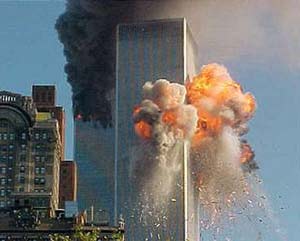
airplane crash wtcBanks crashed on the day of CHANGE that isn’t change, and the ruling class tried to put new lipstick on its pig. No major bank was spared the carnage as Bank of America’s shares plunged 29 percent; Citigroup’s 20 percent, and State Street Corp., which reported sharply lower earnings, saw its shares plummet 59 percent.

“The financial stocks got murdered,” said Jack A. Ablin, chief investment officer at Harris Private Bank in Chicago. “They were basically cut in half.” See the AP… Banks sink deeper into crisis on Obama’s first day Obama is now the newest lipstick to this pig, the same old US military-industrial-governmental complex.

Obama doesn’t have either a plan nor a clue. What he does have is the backing of the US ruling class elite and that is why he is in office today, and none of that has to do with a ‘new movement’ yet arising. All his (their) empty rhetoric is now about to come totally stripped off his Hawaiian toned body, and his groupies may now cheer but the final result will be quite grim for all soon to see. All that this Barack Brand Lipstick really has to offer is yet more and more attempted cosmetic sales for a decaying, disintegrating global economic system of war and poverty, racism and genocide.

There is no agenda for change in the making in the US of today. The population remains passively accepting of any sort of new cruelty offered up by its own ruling class to all others in the world, as somehow they still think that that will continue to salvage some sort of world for themselves by doing so? All we can do for the moment is wait and see if some new awakening will begin to come forth, though it appears that first total disintegrating disaster must gain the reign supreme.

Americans still just don’t want to change nor have CHANGE come about. And until they might, we will continue to plummet all into the abyss. Sorry, but one just cannot prettify much this new lipstick on the same old pig. It simply really is the same old stuff as before, and while we expect lots of prettifying of it in the press, some minor efforts to do away with some of the worst, and lots of talk, the reality of capitalist worldwide depression will soon hit. Then the real suffering will actually begin. We are in a complete economic down spin now and Pilot Barack will not be laying us down lightly into the Hudson River on this one.

MLK: Why I am Opposed to the War

Martin Luther King Jr“You’re too arrogant! And if you don’t change your ways, I will rise up and break the backbone of your power, and I’ll place it in the hands of a nation that doesn’t even know my name. Be still and know that I’m God.”
 
Sermon at the Ebenezer Baptist Church on April 30, 1967. Full text below.

The sermon which I am preaching this morning in a sense is not the usual kind of sermon, but it is a sermon and an important subject, nevertheless, because the issue that I will be discussing today is one of the most controversial issues confronting our nation. I’m using as a subject from which to preach,

“Why I Am Opposed to the War in Vietnam.”

Now, let me make it clear in the beginning, that I see this war as an unjust, evil, and futile war. I preach to you today on the war in Vietnam because my conscience leaves me with no other choice. The time has come for America to hear the truth about this tragic war. In international conflicts, the truth is hard to come by because most nations are deceived about themselves. Rationalizations and the incessant search for scapegoats are the psychological cataracts that blind us to our sins. But the day has passed for superficial patriotism. He who lives with untruth lives in spiritual slavery. Freedom is still the bonus we receive for knowing the truth. “Ye shall know the truth,” says Jesus, “and the truth shall set you free.” Now, I’ve chosen to preach about the war in Vietnam because I agree with Dante, that the hottest places in hell are reserved for those who in a period of moral crisis maintain their neutrality. There comes a time when silence becomes betrayal.

The truth of these words is beyond doubt, but the mission to which they call us is a most difficult one. Even when pressed by the demands of inner truth, men do not easily assume the task of opposing their government’s policy, especially in time of war. Nor does the human spirit move without great difficulty against all the apathy of conformist thought within one’s own bosom and in the surrounding world. Moreover, when the issues at hand seem as perplexing, as they often do in the case of this dreadful conflict, we’re always on the verge of being mesmerized by uncertainty. But we must move on. Some of us who have already begun to break the silence of the night have found that the calling to speak is often a vocation of agony. But we must speak. We must speak with all the humility that is appropriate to our limited vision, but we must speak. And we must rejoice as well, for in all our history there has never been such a monumental dissent during a war, by the American people.

Polls reveal that almost fifteen million Americans explicitly oppose the war in Vietnam. Additional millions cannot bring themselves around to support it. And even those millions who do support the war [are] half-hearted, confused, and doubt-ridden. This reveals that millions have chosen to move beyond the prophesying of smooth patriotism, to the high grounds of firm dissent, based upon the mandates of conscience and the reading of history. Now, of course, one of the difficulties in speaking out today grows the fact that there are those who are seeking to equate dissent with disloyalty. It’s a dark day in our nation when high-level authorities will seek to use every method to silence dissent. But something is happening, and people are not going to be silenced. The truth must be told, and I say that those who are seeking to make it appear that anyone who opposes the war in Vietnam is a fool or a traitor or an enemy of our soldiers is a person that has taken a stand against the best in our tradition.

Yes, we must stand, and we must speak. [tape skip]…have moved to break the betrayal of my own silences and to speak from the burnings of my own heart, as I have called for radical departures from the destruction of Vietnam. Many persons have questioned me about the wisdom of my path. At the heart of their concerns, this query has often loomed large and loud:

“Why are you speaking about the war, Dr. King? Why are you joining the voices of dissent?” Peace and civil rights don’t mix, they say.

And so this morning, I speak to you on this issue, because I am determined to take the Gospel seriously. And I come this morning to my pulpit to make a passionate plea to my beloved nation.

This sermon is not addressed to Hanoi, or to the National Liberation Front. It is not addressed to China or to Russia. Nor is it an attempt to overlook the ambiguity of the total situation and the need for a collective solution to the tragedy of Vietnam. Nor is it an attempt to make North Vietnam or the National Liberation Front paragons of virtue, nor to overlook the role they must play in a successful resolution of the problem. This morning, however, I wish not to speak with Hanoi and the National Liberation Front, but rather to my fellow Americans, who bear the greatest responsibility, and entered a conflict that has exacted a heavy price on both continents.

Now, since I am a preacher by calling, I suppose it is not surprising that I have seven major reasons for bringing Vietnam into the field of my moral vision. There is…a very obvious and almost facile connection between the war in Vietnam and the struggle I and others have been waging in America. A few years ago there was a shining moment in that struggle. It seemed that there was a real promise of hope for the poor, both black and white, through the Poverty Program. There were experiments, hopes, and new beginnings. Then came the build-up in Vietnam. And I watched the program broken as if it was some idle political plaything of a society gone mad on war. And I knew that America would never invest the necessary funds or energies in rehabilitation of its poor so long as adventures like Vietnam continued to draw men and skills and money, like some demonic, destructive suction tube. And you may not know it, my friends, but it is estimated that we spend $500,000 to kill each enemy soldier, while we spend only fifty-three dollars for each person classified as poor, and much of that fifty-three dollars goes for salaries to people that are not poor. So I was increasingly compelled to see the war as an enemy of the poor, and attack it as such.

Perhaps the more tragic recognition of reality took place when it became clear to me that the war was doing far more than devastating the hope of the poor at home. It was sending their sons, and their brothers, and their husbands to fight and die in extraordinarily high proportion relative to the rest of the population. We were taking the black young men who had been crippled by society and sending them eight thousand miles away to guarantee liberties in Southeast Asia which they had not found in Southwest Georgia and East Harlem. So we have been repeatedly faced with a cruel irony of watching Negro and white boys on TV screens as they kill and die together for a nation that has been unable to seat them together in the same school room. So we watch them in brutal solidarity, burning the huts of a poor village. But we realize that they would hardly live on the same block in Chicago or Atlanta. Now, I could not be silent in the face of such cruel manipulation of the poor.

My third reason moves to an even deeper level of awareness, for it grows out of my experience in the ghettos of the North over the last three years–especially the last three summers. As I have walked among the desperate, rejected, and angry young men, I have told them that Molotov cocktails and rifles would not solve their problems. I have tried to offer them my deepest compassion while maintaining my conviction that social change comes most meaningfully through non-violent action; for they ask and write me, “So what about Vietnam?” They ask if our nation wasn’t using massive doses of violence to solve its problems to bring about the changes it wanted.

Their questions hit home, and I knew that I could never again raise my voice against the violence of the oppressed in the ghettos without first having spoken clearly to the greatest purveyor of violence in the world today: my own government. For the sake of those boys, for the sake of this government, for the sake of the hundreds of thousands trembling under our violence I cannot be silent.

Been a lot of applauding over the last few years. They applauded our total movement; they’ve applauded me. America and most of its newspapers applauded me in Montgomery. And I stood before thousands of Negroes getting ready to riot when my home was bombed and said, we can’t do it this way. They applauded us in the sit-in movement–we non-violently decided to sit in at lunch counters. The applauded us on the Freedom Rides when we accepted blows without retaliation. They praised us in Albany and Birmingham and Selma, Alabama. Oh, the press was so noble in its applause, and so noble in its praise when I was saying, Be non-violent toward Bull Connor; when I was saying, Be non-violent toward [Selma, Alabama segregationist sheriff] Jim Clark.

There’s something strangely inconsistent about a nation and a press that will praise you when you say, Be non-violent toward Jim Clark, but will curse and damn you when you say, “Be non-violent toward little brown Vietnamese children. There’s something wrong with that press!

As if the weight of such a commitment to the life and health of America were not enough, another burden of responsibility was placed upon me in 1964. And I cannot forget that the Nobel Peace Prize was not just something taking place, but it was a commission–a commission to work harder than I had ever worked before for the brotherhood of Man. This is a calling that takes me beyond national allegiances.

But even if it were not present, I would yet have to live with the meaning of my commitment to the ministry of Jesus Christ. To me, the relationship of this ministry to the making of peace is so obvious that I sometimes marvel at those who ask me why I am speaking against the war. Could it be that they do not know that the Good News was meant for all men, for communists and capitalists, for their children and ours, for black and white, for revolutionary and conservative? Have they forgotten that my ministry is in obedience to the One who loved His enemies so fully that he died for them? What, then, can I say to the Vietcong, or to Castro, or to Mao, as a faithful minister to Jesus Christ? Can I threaten them with death, or must I not share with them my life?

Finally, I must be true to my conviction that I share with all men the calling to be the son of the Living God. Beyond the calling of race or nation or creed is this vocation of son-ship and brotherhood. And because I believe that the Father is deeply concerned, especially for His suffering and helpless and outcast children, I come today to speak for them.

And as I ponder the madness of Vietnam and search within myself for ways to understand and respond in compassion, my mind goes constantly to the people of that peninsula. I speak not now of the soldiers of each side, not of the military government of Saigon, but simply of the people who have been under the curse of war for almost three continuous decades now. I think of them, too, because it is clear to me that there will be no meaningful solution until some attempt is made to know these people and hear their broken cries.

Now, let me tell you the truth about it. They must see Americans as strange liberators.

Do you realize that the Vietnamese people proclaimed their own independence in 1945 after a combined French and Japanese occupation? And incidentally, this was before the Communist revolution in China. They were led by Ho Chi Minh. And this is a little-known fact, and these people declared themselves independent in 1945. They quoted our Declaration of Independence in their document of freedom, and yet our government refused to recognize them. President Truman said they were not ready for independence. So we fell victim as a nation at that time of the same deadly arrogance that has poisoned the international situation for all of these years. France then set out to reconquer its former colony. And they fought eight long, hard, brutal years trying to re-conquer Vietnam. You know who helped France? It was the United States of America. It came to the point that we were meeting more than eighty percent of the war costs. And even when France started despairing of its reckless action, we did not. And in 1954, a conference was called at Geneva, and an agreement was reached, because France had been defeated at Dien Bien Phu.

But even after that, and after the Geneva Accord, we did not stop. We must face the sad fact that our government sought, in a real sense, to sabotage the Geneva Accord. Well, after the French were defeated, it looked as if independence and land reform would come through the Geneva agreement. But instead the United States came and started supporting a man named Diem who turned out to be one of the most ruthless dictators in the history of the world. He set out to silence all opposition. People were brutally murdered because they raised their voices against the brutal policies of Diem. And the peasants watched and cringed as Diem ruthlessly rooted out all opposition. The peasants watched as all this was presided over by United States influence and by increasing numbers of United States troops who came to help quell the insurgency that Diem’s methods had aroused. When Diem was overthrown, they may have been happy, but the long line of military dictatorships seemed to offer no real change, especially in terms of their need for land and peace. And who are we supporting in Vietnam today? It’s a man by the name of general Ky [Air Vice Marshal Nguyen Cao Ky] who fought with the French against his own people, and who said on one occasion that the greatest hero of his life is Hitler. This is who we are supporting in Vietnam today. Oh, our government and the press generally won’t tell us these things, but God told me to tell you this morning. The truth must be told.

The only change came from America as we increased our troop commitments in support of governments which were singularly corrupt, inept, and without popular support and all the while the people read our leaflets and received regular promises of peace and democracy and land reform. Now they languish under our bombs and consider us, not their fellow Vietnamese, the real enemy. They move sadly and apathetically as we herd them off the land of their fathers into concentration camps, where minimal social needs are rarely met. They know they must move or be destroyed by our bombs. So they go, primarily women, and children and the aged. They watch as we poison their water, as we kill a million acres of their crops. They must weep as the bulldozers roar through their areas preparing to destroy the precious trees. They wander into the towns and see thousands of thousands of the children, homeless, without clothes, running in packs on the streets like animals. They see the children degraded by our soldiers as they beg for food. They see the children selling their sisters to our soldiers, soliciting for their mothers. We have destroyed their two most cherished institutions: the family and the village. We have destroyed their land and their crops. We have cooperated in the crushing of the nation’s only noncommunist revolutionary political force, the United Buddhist Church. This is a role our nation has taken, the role of those who make peaceful revolutions impossible but refusing to give up the privileges and the pleasures that comes from the immense profits of overseas investments. I’m convinced that if we are to get on the right side of the world revolution, we as a nation must undergo a radical revolution of values. We must rapidly begin the shift from a thing-oriented society to a person-oriented society. When machines and computers, profit motives and property rights are considered more important than people, the giant triplets of racism, militarism and economic exploitation are incapable of being conquered.

A true revolution of values will soon cause us to question the fairness and justice of many of our present policies. On the one hand, we are called to play the Good Samaritan on life’s roadside, but that will be only an initial act. One day we must come to see that the whole Jericho Road must be changed so that men and women will not be constantly beaten and robbed as they make their journey on life’s highway. True compassion is more than flinging a coin to a beggar. A true revolution of values will soon look uneasily on the glaring contrast of poverty and wealth with righteous indignation. It will look across the seas and see individual capitalists of the West investing huge sums of money in Asia, Africa, and South America, only to take the profits out with no concern for the social betterment of the countries, and say, “This is not just.” It will look at our alliance with the landed gentry of Latin America and say, “This is not just.” The Western arrogance of feeling that it has everything to teach others and nothing to learn from them is not just. A true revolution of values will lay hands on the world order and say of war, “This way of settling differences is not just.” This business of burning human beings with napalm, of filling our nation’s homes with orphans and widows, of injecting poisonous drugs of hate into the veins of peoples normally humane, of sending men home from dark and bloody battlefields physically handicapped and psychologically deranged, cannot be reconciled with wisdom, justice, and love. A nation that continues year after year to spend more money on military defense than on programs of social uplift is approaching spiritual death.

Oh, my friends, if there is any one thing that we must see today is that these are revolutionary times. All over the globe men are revolting against old systems of exploitation and oppression, and out of the wounds of a frail world, new systems of justice and equality are being born. The shirtless and barefoot people of the land are rising up as never before. The people who sat in darkness have seen a great light. They are saying, unconsciously, as we say in one of our freedom songs, “Ain’t gonna let nobody turn me around!” It is a sad fact that because of comfort, complacency, a morbid fear of communism, our proneness to adjust to injustice, the Western nations that initiated so much of the revolutionary spirit of the modern world have now become the arch anti-revolutionaries. This has driven many to feel that only Marxism has a revolutionary spirit. Therefore, communism is a judgment against our failure to make democracy real and follow through on the revolutions that we initiated. Our only hope today lies in our ability to recapture the revolutionary spirit and go out into a sometimes hostile world declaring eternal hostility to poverty, racism, and militarism. With this powerful commitment we shall boldly challenge the status quo, we shall boldly challenge unjust mores, and thereby speed up the day when

“every valley shall be exalted, and every mountain and hill shall be made low, and the rough places shall be made plain, and the crooked places straight. And the glory of the Lord shall be revealed, and all flesh shall see it together.”

A genuine revolution of values means in the final analysis that our loyalties must become ecumenical rather than sectional. Every nation must now develop an overriding loyalty to mankind as a whole in order to preserve the best in their individual societies. This call for a worldwide fellowship that lifts neighborly concern beyond one’s tribe, race, class, and nation is in reality a call for an all-embracing, unconditional love for all men. This oft misunderstood and misinterpreted concept, so readily dismissed by the Nietzsches of the world as a weak and cowardly force, has now become an absolute necessity for the survival of mankind. And when I speak of love I’m not speaking of some sentimental and weak response. I am speaking of that force which all of the great religions have seen as the supreme unifying principle of life. Love is somehow the key that unlocks the door which leads to ultimate reality. This Hindu-Muslim-Christian-Jewish-Buddhist belief about ultimate reality is beautifully summed up in the first epistle of John: “Let us love one another, for God is love. And every one that loveth is born of God and knoweth God. He that loveth not knoweth not God, for God is love. If we love one another, God dwelleth in us and his love is perfected in us.”

Let me say finally that I oppose the war in Vietnam because I love America. I speak out against this war, not in anger, but with anxiety and sorrow in my heart, and, above all, with a passionate desire to see our beloved country stand as the moral example of the world. I speak out against this war because I am disappointed with America. And there can be no great disappointment where there is not great love. I am disappointed with our failure to deal positively and forthrightly with the triple evils of racism, economic exploitation, and militarism. We are presently moving down a dead-end road that can lead to national disaster. America has strayed to the far country of racism and militarism. The home that all too many Americans left was solidly structured idealistically; its pillars were solidly grounded in the insights of our Judeo-Christian heritage. All men are made in the image of God. All men are bothers. All men are created equal. Every man is an heir to a legacy of dignity and worth. Every man has rights that are neither conferred by, nor derived from the State–they are God-given. Out of one blood, God made all men to dwell upon the face of the earth. What a marvelous foundation for any home! What a glorious and healthy place to inhabit. But America’s strayed away, and this unnatural excursion has brought only confusion and bewilderment. It has left hearts aching with guilt and minds distorted with irrationality.

It is time for all people of conscience to call upon America to come back home. Come home, America. Omar Khayyam is right: “The moving finger writes, and having writ moves on.”

I call on Washington today. I call on every man and woman of good will all over America today. I call on the young men of America who must make a choice today to take a stand on this issue.

Tomorrow may be too late. The book may close. And don’t let anybody make you think that God chose America as his divine, messianic force to be a sort of policeman of the whole world. God has a way of standing before the nations with judgment, and it seems that I can hear God saying to America,

“You’re too arrogant!

And if you don’t change your ways,

I will rise up and break the backbone of your power,

and I’ll place it in the hands of a nation that doesn’t even know my name.

Be still and know that I’m God.”

Now it isn’t easy to stand up for truth and for justice. Sometimes it means being frustrated. When you tell the truth and take a stand, sometimes it means that you will walk the streets with a burdened heart. Sometimes it means losing a job…means being abused and scorned. It may mean having a seven, eight year old child asking a daddy, “Why do you have to go to jail so much?” And I’ve long since learned that to be a follower to the Jesus Christ means taking up the cross. And my bible tells me that Good Friday comes before Easter. Before the crown we wear, there is the cross that we must bear. Let us bear it–bear it for truth, bear it for justice, and bear it for peace. Let us go out this morning with that determination. And I have not lost faith. I’m not in despair, because I know that there is a moral order. I haven’t lost faith, because the arc of the moral universe is long, but it bends toward justice. I can still sing “We Shall Overcome” because Carlyle was right: “No lie can live forever.” We shall overcome because William Cullen Bryant was right: “Truth pressed to earth will rise again.” We shall overcome because James Russell Lowell was right: “Truth forever on the scaffold, wrong forever on the throne.” Yet, that scaffold sways the future. We shall overcome because the bible is right: “You shall reap what you sow.”

With this faith we will be able to hew out of the mountain of despair a stone of hope.

With this faith we will be able to transform the jangling discords of our world into a beautiful symphony of brotherhood.

With this faith we will be able to speed up the day when justice will roll down like waters, and righteousness like a mighty stream.

With this faith we will be able to speed up the day when the lion and the lamb will lie down together, and every man will sit under his own vine and fig tree, and none shall be afraid because the words of the Lord have spoken it.

With this faith we will be able to speed up the day when all over the world we will be able to join hands and sing in the words of the old Negro spiritual, “Free at last! Free at last! Thank God Almighty, we’re free at last!”

With this faith, we’ll sing it as we’re getting ready to sing it now. Men will beat their swords into plowshares and their spears into pruning hooks. And nations will not rise up against nations, neither shall they study war anymore. And I don’t know about you, I ain’t gonna study war no more.

Germany the victim, Japan the victim, America the victim, Israel the victim?

victimWhat happens when imperialist states put on airs of victim-hood? First an imperialist state defined is simply a country that holds property of other nations, cultures, or religions, or a country that desires to do so. Or both covets new property and holds old properties of others, as the case of the United State so amply demonstrates.

Imperialist states are rarely to never satisfied with their actual criminal take in profits. But what happens when countries that are imperialist, develop in their populations the notion that they are somehow also the victims and not the aggressors, as has happened to Germany, Japan, the US, and Israel, as just a few most prominent examples to mention?

As one might remember from History lessons at school, Germany and Japan had populations of elites that began to feel that they were victimized by the other imperialist nations, whom all already had colonies to exploit. Japan wanted China to make up for that, and Germany wanted to compete with Britain, France, Holland, and Belgium in the imperialism arena, too. The German people chafed at having been given bad conditions by these other Powers post World War One, and they began to think that they were victims of a conspiracy, a conspiracy that denied them their just status, a conspiracy that exploited them financially and had thrown the majority of Germans into poverty.

Shoot to the US, which after the Pearl Harbor attack by Japan was where the US began to rally its population around the idea that America was the Grand Victim of conspiracy. Later the Americans dropped the only atomic bombs ever used on people, and they dropped them onto civilian Japanese. Everything went over smoothly morality wise for the Americans because they had convinced themselves they were victims. In fact, the American government then became the preachiest government ever seen around anywhere, as it began to define war crimes as being always the actions of others, and never themselves.

Now with 9/11, it is as if another dose of victim-hood has become injected into the modern US population.

‘We’re victims!’, shouts the American crowd once again. We must be allowed to do anything without the slightest recriminations against us, because? ‘We’re victims! We are targets from a criminal conspiracy!’ They are talking about Muslims now. The word the more direct Victim-hood fanatic uses is ‘Islamofascsits’ as code for Muslims. Yes, well that was what the Germans were convinced by Hitler to believe, too. Except the criminal conspiracy supposedly was from the Jews.

In WW2 the Jewish European population actually were victims. Most did not escape alive either. Certainly the Jewish population were victims much more than the Americans, the Germans, or the Japanese ever have been. Further, they were not people of an imperialist nation at the time when that happened. Many Jews found that status of having no imperialist nation (Homeland) impossible to maintain and tolerate without changing the situation to try to obtain an imperialist state of their own. They succeeded.

‘We, the Jews, are victims!’

Well, the Jewish survivors of the European Holocaust obtained their imperialist state, obtained their weaponry, and eventually obtained their nuclear arms. How prideful they became, and started to imitate the Americans themselves. They began to think of themselves as the country of the Mighty Mouse. They began to think of themselves as the Mighty Mouse that not only had been victimized before, but would always be victimized by those angry at their thefts of other people’s property and land. This Jewish sense of always feeling that they were about to be victimized again began to grow side by side with the Americans’ sense of the very exact same. So here we are today… Another imperialist nation feeling themselves the eternal Victim.

There is much destruction on the horizon and the people who will cause it consider themselves to be the victims of others. That’s the way it always is with imperialist nations, too. It is the mass psychology of the self-righteous Mob at work. Aggressors that see themselves as Victims will lash out at those that see through the ruse. They will lynch, they will bomb, they will burn alive The Other. The victim imperialist country always see themselves as The Pure surrounded by vicious animals. But it is always themselves that become The Rabid.

Cabinet candidate Bill Richardson was clean enough to run for president?

Doesn’t it strike you as a bit odd, that Arizona governor Bill Richardson withdraws his name from consideration for the Secretary of Commerce because of some unseemly quid pro quo scheme, yet it hadn’t stopped him from running for president? Where was the press to dig up the story when Richardson was still a potential Democratic presidential nominee?

It’s not as if the subject of corruption hadn’t come up. Greg Palast had exposed the governor in Armed Madhouse.

I like Palast’s extrapolation on Richardson’s ethnic heritage. To summarize, Richardson came by his Hispanic hyphen through his mom’s side. His dad was a Citibank executive, which qualifies Richardson to be a Citibank-American. As a partner in Henry Kissinger’s lobbying firm, Palast also terms him a Kissinger-American.

But what most interested Palast was the corrupt election of 2004, and how George Bush stole Arizona, under the nose of a supposedly Democratic governor. With Richardson momentarily in the spotlight, here’s an excerpt which Palast is circulating:

Bill Richardson – Kissinger-American
by Greg Palast, excerpted from Armed Madhouse

Henry Kissinger and Bill Richardson
January 5, 2009

Bill Richardson is out: Caught with his hand, if not exactly in the cookie jar, at least you could say his sticky finger were near it. I’m not surprised.

For years I’ve been investigating the second-most corrupt state in the USA (after Alaska). I like to check in on the enchanted state with my bud Santiago Juárez.

I knew it was not a polite question, but it was really bugging me, so I asked him, “Exactly how does a Mexican get the name William Richardson?”

Governor Richardson’s dad, Santiago explained, was a Citibank executive assigned to Mexico City. There he met Governor Bill’s mom, and-milagro!-a Mexican-American was born. Richardson gets big mileage out of his mother’s heritage, and that makes him, legitimately, a Mexican-American, a politically useful designation. But it’s just as legitimate to say that Richardson is a Citibank-American.

But Governor Richardson is more than that. Between leaving Bill Clinton’s cabinet where he was Secretary of Energy and grabbing a Hispanic-district seat in Congress, Richardson became a partner in (Henry) Kissinger and Associates. That would make Richardson a Kissinger-American as well.

In 2004, John Kerry won New Mexico-if you counted the votes. But they didn’t – and George Bush won the state and the presidency by just 5,000 ballots. Everyone was talking about the theft of Ohio by Republicans, but few noted that New Mexico was stolen as well. But one fact drove me straight nuts: In the end, this state and its damaged elections were in the hands of Richardson, A Democrat and a Mexican-American one at that.

In New Mexico the issue of uncounted votes is more than skin deep. Lots of Mexican-American votes don’t tally, but Citibank-American votes never get lost. Kissinger American votes always count. The story of America’s failed elections is not about undervotes. It’s about underclass. Disenfranchisement is class warfare by other means. It just happens that in New Mexico, the colors of the underclass are, for the most part, brown and red.

Class War by Other Means

As community organizer Santiago told me:

You take away people’s health insurance and you take their right to union pay scales and you take away their pensions-taking away their vote’s just one more on the list.

Some New Mexico Democrats have no trouble at the voting booth. In Santa Fe, you find trust-fund refugees from Los Angeles wearing Navajo turquoise jewelry and “casual” clothes that cost more than my car. Each one has a personal healer, an unfinished film script and a tan so deep you’d think they’re bred for their leather. They’re Democrats and their votes count. Voting-or at least voting that gets tabulated – is a class privilege. The effect is racial and partisan, but the engine is economic.

The second- and third-highest undervotes in New Mexico were recorded in McKinley and Cibola counties-85% and 72% Hispanic and Native. But the undervote champ is nearly the whitest county in New Mexico: DeBaca, which mangled and lost 8.4% of ballots cast. White DeBaca, whose average income hovers at the national poverty level, is poorer than Hispanic Cibola. No question, disenfranchisement gives off an ugly racial smell, but income is the real predictor of vote loss.

And what about those Bernalillo ghost voters for Bush? Those spirits are, it turns out, quite well-to-do, haunting the mesas west of Albuquerque where the real estate provides unobstructed views of Georgia O’Keeffe sunsets.

This was my third investigation in New Mexico in twenty years. The first time, the state’s Attorney General brought me in to go over the account books of Public Service of New Mexico (PNM), a racketeering enterprise masquerading as an electric company. Too young to understand what I wasn’t supposed to know, I proudly mapped out the sewerage lines of deceit connecting the gas drillers, water lords and political elite of New Mexico. The AG’s office handed me a nice check – which I took not as a reward, but as a payment to leave the state. After a decade away, I returned as a reporter, to look into prisons-for-pro?t out?t Wackenhut Inc. In September 1999, a company insider told me, Wackenhut was cutting costs at its New Mexico jails by sending guards alone into the cell blocks. Ralph Garcia of Santa Rosa, who’d lost his ranch to drought, took the $7.95-an-hour job guarding homicidal neo-Nazis and Mexican mafia thugs in the local Wackenhut lock-up. Inexperienced, untrained and alone, he was stabbed to death by inmates just two weeks after the insider’s warning. So that’s how Garcia became one more impoverished Chicano who lost his vote. No question, that’s not your typical case of voter disenfranchisement, but that’s the reality of the “Land of Enchantment.” New Mexico is the New America, where growing income inequality is creating a feudal divide between the prison-owning class and the prisoner-and-guard class.

Vote spoilage is the owning class’s weapon of choice.

Whose flag does Bill Richardson carry in the nouvelle class war? When I was checking out the New Mexico vote in 2005, my old friends Public Service of New Mexico hit the front page, sued by the State of California for conspiring with Enron to rig the California power market. It is still in court. It was a scam called “Ricochet.” Enron and PNM say it was not illegal. It played out about the time Garcia was walking the cell block. Where was Richardson? He was in Washington, Clinton’s Secretary of Energy, playing chubby cheerleader for PNM’s plan for “deregulation” of the energy market. Deregulation made PNM’s games possible-and Richardson’s employment by Kissinger inevitable.

Richardson, Ready for Takeoff

What about all those suspect spoiled votes in Hispanic and Indian precincts stuck inside the machines? Why didn’t this Mexican-American Democrat ask for a recount? It didn’t just slip Richardson’s little mind: He actively did everything in his power to stop a recount. I was told that it was Richardson himself who encouraged Secretary of State Vigil-Giron to reject the $114,000 payment from pissed-off Democrats and the Green Party. The Governor was too busy to speak with me about this.

Halting the 2004 recount wasn’t enough for Governor Bill, however. He demanded the legislature pass a “reform” law that would require anyone wanting a recount of a suspicious vote to put up a bond of over one million dollars. As a result, “free and fair elections” are now effectively outlawed in New Mexico. You can have a choice of a “free” election or a “fair” election, but not both. Want fair? Then you have to pay a million to recheck the ballots. In other words, it’s against the law to buy votes, but in New Mexico not against the law to buy the vote count.

On his phony reform law, Richardson was called out by a fellow Democrat, State Senator Linda Lopez-an act of indiscreet defiance that would not be forgotten by the Governor’s circle.

The centerpiece of the law signed by the Governor: Ms. Fox-Young’s proposal to require photo ID for new voters. Maybe the former Cabinet Secretary and United Nations Ambassador Richardson couldn’t imagine that photo IDs would be a problem for some voters. After all, Mexican-Americans in Little Texas may have trouble producing acceptable IDs, but it’s no problem at all for a Kissinger-American like Governor Richardson. The Governor and Jimmy Carter both have passports, they have credit cards and they have chauffeurs who will vouch for them.

Richardson wouldn’t speak with me about the 2004 vote fiasco. Instead, he busied himself with his space program. He announced the state would chip in $200 million to build a “spaceport” to land private rocket ships that will be launched beginning in 2009 by Richard Branson, the British billionaire. Passengers have already bought tickets for $200,000 each (round trip, they hope).

Arab dictator allies of US line up in support of Israeli terrorism against Gaza

Silence. Or worse yet even, efforts to blame Hamas instead of Israel for the new slaughter in Gaza. That’s what the US allied Arab dictatorships imposed on the Arab world offer their people. Complicity. Many of these Sunni Arab elites (Egypt, Saudi Arabia, et cetera) are eager for the US to hammer the Shiite led Iranians, and have no solidarity at all with their own poor let alone the Palestinian poor of Gaza…. or Palestinians elsewhere for that matter. This is the opening battle of the war to bring about regime change in Iran for the Washington, D.C. rat class, and the Arab dictatorships controlled by the US government are fully behind the effort.

Meanwhile the corporate media in the US and Britain keep a tight lid on the spin of the actual news, all in support of their own imperialist ruling cabals. At least, the European Union and the United Nations have had the decency to tokenly oppose this slaughter by this Jewish/ Christian Corporate Alliance centered in the US, Great Britain, and Israel. Everybody around the globe pretty much knows who holds the big guns, and it is the US government and its immediate side kicks that do. Everybody realizes that there is always the big price to pay if one gets too out of line with what these gangsters want from them.

The US antiwar community, dominated by phony ‘Peace’crat types, are immobilized. It seems that the script promised by the ‘Peace’crats with an Obama victory were as false as they come. They all voted for Obama and now don’t know what exactly to do? Really going out and protesting against their rulers is something that might make them embarrassed and scares them no end. Locally, not a word from the office clowns of the Pikes Peak Justice and Peace De-Commission, with them only wanting to turn the other cheek from reality, though reality just keeps on beating them about their public face.

So now we know why the Arab World hates us so? It has to do with their own gang of thugs kept in power by the US government. The US and Israel have even turned the Arabs into hating the PLO, now that the leader of the PLO, Abbas, is totally controlled by our sorry leaders in Washington, D.C. What a mess! And the world keeps on just getting more and more dangerous, more and more messed up, day after day. Nobody has any ‘national security’ these days, thinks to the Democratic and Republican gangsters that almost all voting Americans backed in the last election.

This Israeli bombing of mainly children Arab youngsters living in the most horrible poverty and isolation in Gaza, is their work. Aren’t you proud you voted for this, if in fact you did? Haven’t heard a word from Obama, have you? What does he care if a community of overwhelmingly young children is shut off, starved to death, and then bombed? He’s not for change at all. He’s simply for allowing the Jewish community of Israel to be allowed to steal yet more land from the Arabs that owned it.

Harold Pinter on drama and US banditry

“What has happened to our moral sensibility? Did we ever have any? What do these words mean? Do they refer to a term very rarely employed these days – conscience? A conscience to do not only with our own acts but to do with our shared responsibility in the acts of others? Is all this dead?”
-Harold Pinter (1930-2008)

I’m reminded of a friend of mine who asked “You know what PTSD is? It’s a bad conscience.”

An outspoken critic of the Iraq War, Harold Pinter died Christmas Eve. Here is the address he prerecorded for his acceptance of the Nobel Prize in 2005, when he had become too infirm to attend in person.

Nobel Lecture: Art, Truth & Politics

In 1958 I wrote the following:

‘There are no hard distinctions between what is real and what is unreal, nor between what is true and what is false. A thing is not necessarily either true or false; it can be both true and false.’

I believe that these assertions still make sense and do still apply to the exploration of reality through art. So as a writer I stand by them but as a citizen I cannot. As a citizen I must ask: What is true? What is false?

Truth in drama is forever elusive. You never quite find it but the search for it is compulsive. The search is clearly what drives the endeavour. The search is your task. More often than not you stumble upon the truth in the dark, colliding with it or just glimpsing an image or a shape which seems to correspond to the truth, often without realising that you have done so. But the real truth is that there never is any such thing as one truth to be found in dramatic art. There are many. These truths challenge each other, recoil from each other, reflect each other, ignore each other, tease each other, are blind to each other. Sometimes you feel you have the truth of a moment in your hand, then it slips through your fingers and is lost.

I have often been asked how my plays come about. I cannot say. Nor can I ever sum up my plays, except to say that this is what happened. That is what they said. That is what they did.

Most of the plays are engendered by a line, a word or an image. The given word is often shortly followed by the image. I shall give two examples of two lines which came right out of the blue into my head, followed by an image, followed by me.

The plays are The Homecoming and Old Times. The first line of The Homecoming is ‘What have you done with the scissors?’ The first line of Old Times is ‘Dark.’

In each case I had no further information.

In the first case someone was obviously looking for a pair of scissors and was demanding their whereabouts of someone else he suspected had probably stolen them. But I somehow knew that the person addressed didn’t give a damn about the scissors or about the questioner either, for that matter.

‘Dark’ I took to be a description of someone’s hair, the hair of a woman, and was the answer to a question. In each case I found myself compelled to pursue the matter. This happened visually, a very slow fade, through shadow into light.

I always start a play by calling the characters A, B and C.

In the play that became The Homecoming I saw a man enter a stark room and ask his question of a younger man sitting on an ugly sofa reading a racing paper. I somehow suspected that A was a father and that B was his son, but I had no proof. This was however confirmed a short time later when B (later to become Lenny) says to A (later to become Max), ‘Dad, do you mind if I change the subject? I want to ask you something. The dinner we had before, what was the name of it? What do you call it? Why don’t you buy a dog? You’re a dog cook. Honest. You think you’re cooking for a lot of dogs.’ So since B calls A ‘Dad’ it seemed to me reasonable to assume that they were father and son. A was also clearly the cook and his cooking did not seem to be held in high regard. Did this mean that there was no mother? I didn’t know. But, as I told myself at the time, our beginnings never know our ends.

‘Dark.’ A large window. Evening sky. A man, A (later to become Deeley), and a woman, B (later to become Kate), sitting with drinks. ‘Fat or thin?’ the man asks. Who are they talking about? But I then see, standing at the window, a woman, C (later to become Anna), in another condition of light, her back to them, her hair dark.

It’s a strange moment, the moment of creating characters who up to that moment have had no existence. What follows is fitful, uncertain, even hallucinatory, although sometimes it can be an unstoppable avalanche. The author’s position is an odd one. In a sense he is not welcomed by the characters. The characters resist him, they are not easy to live with, they are impossible to define. You certainly can’t dictate to them. To a certain extent you play a never-ending game with them, cat and mouse, blind man’s buff, hide and seek. But finally you find that you have people of flesh and blood on your hands, people with will and an individual sensibility of their own, made out of component parts you are unable to change, manipulate or distort.

So language in art remains a highly ambiguous transaction, a quicksand, a trampoline, a frozen pool which might give way under you, the author, at any time.

But as I have said, the search for the truth can never stop. It cannot be adjourned, it cannot be postponed. It has to be faced, right there, on the spot.

Political theatre presents an entirely different set of problems. Sermonising has to be avoided at all cost. Objectivity is essential. The characters must be allowed to breathe their own air. The author cannot confine and constrict them to satisfy his own taste or disposition or prejudice. He must be prepared to approach them from a variety of angles, from a full and uninhibited range of perspectives, take them by surprise, perhaps, occasionally, but nevertheless give them the freedom to go which way they will. This does not always work. And political satire, of course, adheres to none of these precepts, in fact does precisely the opposite, which is its proper function.

In my play The Birthday Party I think I allow a whole range of options to operate in a dense forest of possibility before finally focussing on an act of subjugation.

Mountain Language pretends to no such range of operation. It remains brutal, short and ugly. But the soldiers in the play do get some fun out of it. One sometimes forgets that torturers become easily bored. They need a bit of a laugh to keep their spirits up. This has been confirmed of course by the events at Abu Ghraib in Baghdad. Mountain Language lasts only 20 minutes, but it could go on for hour after hour, on and on and on, the same pattern repeated over and over again, on and on, hour after hour.

Ashes to Ashes, on the other hand, seems to me to be taking place under water. A drowning woman, her hand reaching up through the waves, dropping down out of sight, reaching for others, but finding nobody there, either above or under the water, finding only shadows, reflections, floating; the woman a lost figure in a drowning landscape, a woman unable to escape the doom that seemed to belong only to others.

But as they died, she must die too.

Political language, as used by politicians, does not venture into any of this territory since the majority of politicians, on the evidence available to us, are interested not in truth but in power and in the maintenance of that power. To maintain that power it is essential that people remain in ignorance, that they live in ignorance of the truth, even the truth of their own lives. What surrounds us therefore is a vast tapestry of lies, upon which we feed.

As every single person here knows, the justification for the invasion of Iraq was that Saddam Hussein possessed a highly dangerous body of weapons of mass destruction, some of which could be fired in 45 minutes, bringing about appalling devastation. We were assured that was true. It was not true. We were told that Iraq had a relationship with Al Quaeda and shared responsibility for the atrocity in New York of September 11th 2001. We were assured that this was true. It was not true. We were told that Iraq threatened the security of the world. We were assured it was true. It was not true.

The truth is something entirely different. The truth is to do with how the United States understands its role in the world and how it chooses to embody it.

But before I come back to the present I would like to look at the recent past, by which I mean United States foreign policy since the end of the Second World War. I believe it is obligatory upon us to subject this period to at least some kind of even limited scrutiny, which is all that time will allow here.

Everyone knows what happened in the Soviet Union and throughout Eastern Europe during the post-war period: the systematic brutality, the widespread atrocities, the ruthless suppression of independent thought. All this has been fully documented and verified.

But my contention here is that the US crimes in the same period have only been superficially recorded, let alone documented, let alone acknowledged, let alone recognised as crimes at all. I believe this must be addressed and that the truth has considerable bearing on where the world stands now. Although constrained, to a certain extent, by the existence of the Soviet Union, the United States’ actions throughout the world made it clear that it had concluded it had carte blanche to do what it liked.

Direct invasion of a sovereign state has never in fact been America’s favoured method. In the main, it has preferred what it has described as ‘low intensity conflict’. Low intensity conflict means that thousands of people die but slower than if you dropped a bomb on them in one fell swoop. It means that you infect the heart of the country, that you establish a malignant growth and watch the gangrene bloom. When the populace has been subdued – or beaten to death – the same thing – and your own friends, the military and the great corporations, sit comfortably in power, you go before the camera and say that democracy has prevailed. This was a commonplace in US foreign policy in the years to which I refer.

The tragedy of Nicaragua was a highly significant case. I choose to offer it here as a potent example of America’s view of its role in the world, both then and now.

I was present at a meeting at the US embassy in London in the late 1980s.

The United States Congress was about to decide whether to give more money to the Contras in their campaign against the state of Nicaragua. I was a member of a delegation speaking on behalf of Nicaragua but the most important member of this delegation was a Father John Metcalf. The leader of the US body was Raymond Seitz (then number two to the ambassador, later ambassador himself). Father Metcalf said: ‘Sir, I am in charge of a parish in the north of Nicaragua. My parishioners built a school, a health centre, a cultural centre. We have lived in peace. A few months ago a Contra force attacked the parish. They destroyed everything: the school, the health centre, the cultural centre. They raped nurses and teachers, slaughtered doctors, in the most brutal manner. They behaved like savages. Please demand that the US government withdraw its support from this shocking terrorist activity.’

Raymond Seitz had a very good reputation as a rational, responsible and highly sophisticated man. He was greatly respected in diplomatic circles. He listened, paused and then spoke with some gravity. ‘Father,’ he said, ‘let me tell you something. In war, innocent people always suffer.’ There was a frozen silence. We stared at him. He did not flinch.

Innocent people, indeed, always suffer.

Finally somebody said: ‘But in this case “innocent people” were the victims of a gruesome atrocity subsidised by your government, one among many. If Congress allows the Contras more money further atrocities of this kind will take place. Is this not the case? Is your government not therefore guilty of supporting acts of murder and destruction upon the citizens of a sovereign state?’

Seitz was imperturbable. ‘I don’t agree that the facts as presented support your assertions,’ he said.

As we were leaving the Embassy a US aide told me that he enjoyed my plays. I did not reply.

I should remind you that at the time President Reagan made the following statement: ‘The Contras are the moral equivalent of our Founding Fathers.’

The United States supported the brutal Somoza dictatorship in Nicaragua for over 40 years. The Nicaraguan people, led by the Sandinistas, overthrew this regime in 1979, a breathtaking popular revolution.

The Sandinistas weren’t perfect. They possessed their fair share of arrogance and their political philosophy contained a number of contradictory elements. But they were intelligent, rational and civilised. They set out to establish a stable, decent, pluralistic society. The death penalty was abolished. Hundreds of thousands of poverty-stricken peasants were brought back from the dead. Over 100,000 families were given title to land. Two thousand schools were built. A quite remarkable literacy campaign reduced illiteracy in the country to less than one seventh. Free education was established and a free health service. Infant mortality was reduced by a third. Polio was eradicated.

The United States denounced these achievements as Marxist/Leninist subversion. In the view of the US government, a dangerous example was being set. If Nicaragua was allowed to establish basic norms of social and economic justice, if it was allowed to raise the standards of health care and education and achieve social unity and national self respect, neighbouring countries would ask the same questions and do the same things. There was of course at the time fierce resistance to the status quo in El Salvador.

I spoke earlier about ‘a tapestry of lies’ which surrounds us. President Reagan commonly described Nicaragua as a ‘totalitarian dungeon’. This was taken generally by the media, and certainly by the British government, as accurate and fair comment. But there was in fact no record of death squads under the Sandinista government. There was no record of torture. There was no record of systematic or official military brutality. No priests were ever murdered in Nicaragua. There were in fact three priests in the government, two Jesuits and a Maryknoll missionary. The totalitarian dungeons were actually next door, in El Salvador and Guatemala. The United States had brought down the democratically elected government of Guatemala in 1954 and it is estimated that over 200,000 people had been victims of successive military dictatorships.

Six of the most distinguished Jesuits in the world were viciously murdered at the Central American University in San Salvador in 1989 by a battalion of the Alcatl regiment trained at Fort Benning, Georgia, USA. That extremely brave man Archbishop Romero was assassinated while saying mass. It is estimated that 75,000 people died. Why were they killed? They were killed because they believed a better life was possible and should be achieved. That belief immediately qualified them as communists. They died because they dared to question the status quo, the endless plateau of poverty, disease, degradation and oppression, which had been their birthright.

The United States finally brought down the Sandinista government. It took some years and considerable resistance but relentless economic persecution and 30,000 dead finally undermined the spirit of the Nicaraguan people. They were exhausted and poverty stricken once again. The casinos moved back into the country. Free health and free education were over. Big business returned with a vengeance. ‘Democracy’ had prevailed.

But this ‘policy’ was by no means restricted to Central America. It was conducted throughout the world. It was never-ending. And it is as if it never happened.

The United States supported and in many cases engendered every right wing military dictatorship in the world after the end of the Second World War. I refer to Indonesia, Greece, Uruguay, Brazil, Paraguay, Haiti, Turkey, the Philippines, Guatemala, El Salvador, and, of course, Chile. The horror the United States inflicted upon Chile in 1973 can never be purged and can never be forgiven.

Hundreds of thousands of deaths took place throughout these countries. Did they take place? And are they in all cases attributable to US foreign policy? The answer is yes they did take place and they are attributable to American foreign policy. But you wouldn’t know it.

It never happened. Nothing ever happened. Even while it was happening it wasn’t happening. It didn’t matter. It was of no interest. The crimes of the United States have been systematic, constant, vicious, remorseless, but very few people have actually talked about them. You have to hand it to America. It has exercised a quite clinical manipulation of power worldwide while masquerading as a force for universal good. It’s a brilliant, even witty, highly successful act of hypnosis.

I put to you that the United States is without doubt the greatest show on the road. Brutal, indifferent, scornful and ruthless it may be but it is also very clever. As a salesman it is out on its own and its most saleable commodity is self love. It’s a winner. Listen to all American presidents on television say the words, ‘the American people’, as in the sentence, ‘I say to the American people it is time to pray and to defend the rights of the American people and I ask the American people to trust their president in the action he is about to take on behalf of the American people.’

It’s a scintillating stratagem. Language is actually employed to keep thought at bay. The words ‘the American people’ provide a truly voluptuous cushion of reassurance. You don’t need to think. Just lie back on the cushion. The cushion may be suffocating your intelligence and your critical faculties but it’s very comfortable. This does not apply of course to the 40 million people living below the poverty line and the 2 million men and women imprisoned in the vast gulag of prisons, which extends across the US.

The United States no longer bothers about low intensity conflict. It no longer sees any point in being reticent or even devious. It puts its cards on the table without fear or favour. It quite simply doesn’t give a damn about the United Nations, international law or critical dissent, which it regards as impotent and irrelevant. It also has its own bleating little lamb tagging behind it on a lead, the pathetic and supine Great Britain.

What has happened to our moral sensibility? Did we ever have any? What do these words mean? Do they refer to a term very rarely employed these days – conscience? A conscience to do not only with our own acts but to do with our shared responsibility in the acts of others? Is all this dead? Look at Guantanamo Bay. Hundreds of people detained without charge for over three years, with no legal representation or due process, technically detained forever. This totally illegitimate structure is maintained in defiance of the Geneva Convention. It is not only tolerated but hardly thought about by what’s called the ‘international community’. This criminal outrage is being committed by a country, which declares itself to be ‘the leader of the free world’. Do we think about the inhabitants of Guantanamo Bay? What does the media say about them? They pop up occasionally – a small item on page six. They have been consigned to a no man’s land from which indeed they may never return. At present many are on hunger strike, being force-fed, including British residents. No niceties in these force-feeding procedures. No sedative or anaesthetic. Just a tube stuck up your nose and into your throat. You vomit blood. This is torture. What has the British Foreign Secretary said about this? Nothing. What has the British Prime Minister said about this? Nothing. Why not? Because the United States has said: to criticise our conduct in Guantanamo Bay constitutes an unfriendly act. You’re either with us or against us. So Blair shuts up.

The invasion of Iraq was a bandit act, an act of blatant state terrorism, demonstrating absolute contempt for the concept of international law. The invasion was an arbitrary military action inspired by a series of lies upon lies and gross manipulation of the media and therefore of the public; an act intended to consolidate American military and economic control of the Middle East masquerading – as a last resort – all other justifications having failed to justify themselves – as liberation. A formidable assertion of military force responsible for the death and mutilation of thousands and thousands of innocent people.

We have brought torture, cluster bombs, depleted uranium, innumerable acts of random murder, misery, degradation and death to the Iraqi people and call it ‘bringing freedom and democracy to the Middle East’.

How many people do you have to kill before you qualify to be described as a mass murderer and a war criminal? One hundred thousand? More than enough, I would have thought. Therefore it is just that Bush and Blair be arraigned before the International Criminal Court of Justice. But Bush has been clever. He has not ratified the International Criminal Court of Justice. Therefore if any American soldier or for that matter politician finds himself in the dock Bush has warned that he will send in the marines. But Tony Blair has ratified the Court and is therefore available for prosecution. We can let the Court have his address if they’re interested. It is Number 10, Downing Street, London.

Death in this context is irrelevant. Both Bush and Blair place death well away on the back burner. At least 100,000 Iraqis were killed by American bombs and missiles before the Iraq insurgency began. These people are of no moment. Their deaths don’t exist. They are blank. They are not even recorded as being dead. ‘We don’t do body counts,’ said the American general Tommy Franks.

Early in the invasion there was a photograph published on the front page of British newspapers of Tony Blair kissing the cheek of a little Iraqi boy. ‘A grateful child,’ said the caption. A few days later there was a story and photograph, on an inside page, of another four-year-old boy with no arms. His family had been blown up by a missile. He was the only survivor. ‘When do I get my arms back?’ he asked. The story was dropped. Well, Tony Blair wasn’t holding him in his arms, nor the body of any other mutilated child, nor the body of any bloody corpse. Blood is dirty. It dirties your shirt and tie when you’re making a sincere speech on television.

The 2,000 American dead are an embarrassment. They are transported to their graves in the dark. Funerals are unobtrusive, out of harm’s way. The mutilated rot in their beds, some for the rest of their lives. So the dead and the mutilated both rot, in different kinds of graves.

Here is an extract from a poem by Pablo Neruda, ‘I’m Explaining a Few Things’:

And one morning all that was burning,
one morning the bonfires
leapt out of the earth
devouring human beings
and from then on fire,
gunpowder from then on,
and from then on blood.
Bandits with planes and Moors,
bandits with finger-rings and duchesses,
bandits with black friars spattering blessings
came through the sky to kill children
and the blood of children ran through the streets
without fuss, like children’s blood.

Jackals that the jackals would despise
stones that the dry thistle would bite on and spit out,
vipers that the vipers would abominate.

Face to face with you I have seen the blood
of Spain tower like a tide
to drown you in one wave
of pride and knives.

Treacherous
generals:
see my dead house,
look at broken Spain:
from every house burning metal flows
instead of flowers
from every socket of Spain
Spain emerges
and from every dead child a rifle with eyes
and from every crime bullets are born
which will one day find
the bull’s eye of your hearts.

And you will ask: why doesn’t his poetry
speak of dreams and leaves
and the great volcanoes of his native land.

Come and see the blood in the streets.
Come and see
the blood in the streets.
Come and see the blood
in the streets!

Let me make it quite clear that in quoting from Neruda’s poem I am in no way comparing Republican Spain to Saddam Hussein’s Iraq. I quote Neruda because nowhere in contemporary poetry have I read such a powerful visceral description of the bombing of civilians.

I have said earlier that the United States is now totally frank about putting its cards on the table. That is the case. Its official declared policy is now defined as ‘full spectrum dominance’. That is not my term, it is theirs. ‘Full spectrum dominance’ means control of land, sea, air and space and all attendant resources.

The United States now occupies 702 military installations throughout the world in 132 countries, with the honourable exception of Sweden, of course. We don’t quite know how they got there but they are there all right.

The United States possesses 8,000 active and operational nuclear warheads. Two thousand are on hair trigger alert, ready to be launched with 15 minutes warning. It is developing new systems of nuclear force, known as bunker busters. The British, ever cooperative, are intending to replace their own nuclear missile, Trident. Who, I wonder, are they aiming at? Osama bin Laden? You? Me? Joe Dokes? China? Paris? Who knows? What we do know is that this infantile insanity – the possession and threatened use of nuclear weapons – is at the heart of present American political philosophy. We must remind ourselves that the United States is on a permanent military footing and shows no sign of relaxing it.

Many thousands, if not millions, of people in the United States itself are demonstrably sickened, shamed and angered by their government’s actions, but as things stand they are not a coherent political force – yet. But the anxiety, uncertainty and fear which we can see growing daily in the United States is unlikely to diminish.

I know that President Bush has many extremely competent speech writers but I would like to volunteer for the job myself. I propose the following short address which he can make on television to the nation. I see him grave, hair carefully combed, serious, winning, sincere, often beguiling, sometimes employing a wry smile, curiously attractive, a man’s man.

‘God is good. God is great. God is good. My God is good. Bin Laden’s God is bad. His is a bad God. Saddam’s God was bad, except he didn’t have one. He was a barbarian. We are not barbarians. We don’t chop people’s heads off. We believe in freedom. So does God. I am not a barbarian. I am the democratically elected leader of a freedom-loving democracy. We are a compassionate society. We give compassionate electrocution and compassionate lethal injection. We are a great nation. I am not a dictator. He is. I am not a barbarian. He is. And he is. They all are. I possess moral authority. You see this fist? This is my moral authority. And don’t you forget it.’

A writer’s life is a highly vulnerable, almost naked activity. We don’t have to weep about that. The writer makes his choice and is stuck with it. But it is true to say that you are open to all the winds, some of them icy indeed. You are out on your own, out on a limb. You find no shelter, no protection – unless you lie – in which case of course you have constructed your own protection and, it could be argued, become a politician.

I have referred to death quite a few times this evening. I shall now quote a poem of my own called ‘Death’.

Where was the dead body found?
Who found the dead body?
Was the dead body dead when found?
How was the dead body found?

Who was the dead body?

Who was the father or daughter or brother
Or uncle or sister or mother or son
Of the dead and abandoned body?

Was the body dead when abandoned?
Was the body abandoned?
By whom had it been abandoned?

Was the dead body naked or dressed for a journey?

What made you declare the dead body dead?
Did you declare the dead body dead?
How well did you know the dead body?
How did you know the dead body was dead?

Did you wash the dead body
Did you close both its eyes
Did you bury the body
Did you leave it abandoned
Did you kiss the dead body

When we look into a mirror we think the image that confronts us is accurate. But move a millimetre and the image changes. We are actually looking at a never-ending range of reflections. But sometimes a writer has to smash the mirror – for it is on the other side of that mirror that the truth stares at us.

I believe that despite the enormous odds which exist, unflinching, unswerving, fierce intellectual determination, as citizens, to define the real truth of our lives and our societies is a crucial obligation which devolves upon us all. It is in fact mandatory.

If such a determination is not embodied in our political vision we have no hope of restoring what is so nearly lost to us – the dignity of man.

The gilded age and the police nightstick

Oscar of the Waldorf cookbookA legacy institution of the Gilded Age is the Waldorf=Astoria Hotel. Most of us only know it from the nutty salad, the mysterious Red Velvet Cake recipe, Thousand Island Dressing and Veal Oscar named for the famous maitre d’ hotel. I encountered the book of recipes collected by “Oscar of the Waldorf” and its cover illustration caught my eye. The coachman and carriage don’t look so opulent to us today, but do you recognize a timeless trapping of affluence? There’s nothing else in the picture but the policeman and his nightstick.

We almost dismiss the incongruity of the attendant police officer. That’s because he’s Officer Friendly to us, circa the 1950s egalitarian economic boom, earned post New Deal and post WWII, when law enforcement began to serve and protect the middle class share of the pie. Before those times, whose order did the police enforce?

Could the Waldorf diorama have featured some other occupation at the curb? A newsboy, a shoeshine, or a traffic director? If the cabbie is picking up late night revelers, why not depict a doorman or lamplighter?

If this scene did not include the policeman, he’d be missing.

The Gilded Age of the soaring wealth of bankers and industrialists, of the steel, coal, and rail robber barons, came at the expense of poverty wages for all the rest. The homeless of America’s eastern cities died in the streets, if they crossed the paths of the leisure class at all. As in London, where the bobbies were celebrated for carrying no guns, cops on the beat didn’t need more than a nightstick to beat back beggars and riffraff.

Just as in the Waldorf illustration, the policeman’s nightstick isn’t holstered, it is fingered idly like a baton. We’ve seen it in countless Chaplin, Keaton, and Keystone reels. The policeman’s baton might be carried idly, and animated mindlessly as a clerk might twirl a pencil, but the gyrations telegraphed a swinging function meant to be understood.

Today, a modern financial crisis has finally hit the post industrial era, and unemployment is taking a precipitous plunge. The repercussions for the American middle class are yet unclear to most, their comforts still too tangible to fathom gone. But our modern times have already seen the resurgence of the Rich And Famous, (to even beyond the lunge of our Super-Lotto winners, who always chose the sub-six-figure annuity). Exclusive cars, toy submarines and tickets into space cost multi-millions, but the rich have that money to burn. Common Americans have also watched the armoring of their police, using weapons which offend us, but which protect the security of institutional wealth. Para-military police forces are the natural escalation of the right-to-bear-arms arms-race, the equivalent of nightsticks to quell our social disquiet.

Already aren’t we seeing the police block the public’s way, lest we soil the red carpet of the well-heeled? Aren’t police blocking free speech in public spaces, when the monied media has decided it wants the backdrop to serve their message? Wait until we are gazing covetously upon the gilded extravagances, from the alley side of the gilded wrought iron gate.
guilded age of the nightstick
Wiki notes:
Thousand Island Dressing came to the Waldorf from the so-named Lake Ontario waterway where New York’s super rich had their summer homes. The $100 recipe for Red Velvet Cake was the urban myth which resurfaced as the $250 Neiman Marcus chocolate chip cookie.

The original Waldorf Hotel was built by an Astor whose middle name was Waldorf, next door to an aunt with whom he was feuding. Later another Astor convinced her to move uptown and replaced her home with a taller hotel named the Astoria. The two luxurious hotels hyphened via the Peacock Alley, inspiring the popular song “Meet me at the hyphen.” In 1931 the landmark was moved to accommodate the Empire State Building, and was purchased in 1949 by Conrad Hilton who added the double-hyphen flourish, completely in the spirit of gilded ornamentation.

Colorization of the Grapes of Wrath

migrant-motherI think it’s time to colorize The Grapes of Wrath. And I don’t mean the Turner Classics process exactly. It may help to dumb down the artistic contrast of the black & white for a contemporary audience palate of splashy Disneycolor, but how about trying to make Steinbeck’s theme more accessible to today’s spoon-fed viewers? Let’s colorize the skin of the poor migrant workers to reflect the inhumanly-treated populations of today’s displaced im-migrants of color.

I can’t remember where I come down on colorizing the old movies. No one’s insisted on infusing CMYK into Ansel Adams or Picasso’s sketchbook, why are masterpieces filmed in black and white supposed to be pigment deficient? We don’t presume to dub dialog over the silent movies made before the age of the talkies. As yet. Of course, Ted Turner was concerned for reviving interest in old intellectual properties, many of which were already in-artful. And perhaps his salesmanship maneuver has been proven effective. When my family sat down to watch Grapes of Wrath, the grey image tuned a number of youthful eyes away.

Like Dorothea Lange’s famous photographs, John Ford’s film depicted disadvantaged Okies with whom the American audience could identify. We may not know what it feels like to be forced off our homes, but how the families cope with the hardship, we all can recognize. I’m curious how the film was received by Californians in 1940, coming less than ten years after the original plague of destitute Oklahoma refugees. How would the characters have faired with our sympathies if they had been played as coarse hillbilly Crackers with guns and a poor person’s chip-on-the-shoulder desperation?

The poor protagonists of The Grapes of Wrath were weakened skinny po-folk, who staked their relief on the strength of a single hopeful job listing flyer, who protested their oppression without resorting to violence, and who accepted hardship as their lot. Seeing into their daily lives, viewers were shown a dignified, earnest people who treated others with respect and compassion. Antagonist characters in the film were less charitable, taking advantage of the hard-luck migrants with guile, violence and authority. People into which the Oklahoma refugees traveled, New Mexico, Arizona and California, treated the migrants like vermin. Even as onlookers might express admiration for the Okies’ determination to cross Death Valley, the better fed Californians held them in disdain for not knowing enough to be in such a predicament. The Okies were blamed for their own poverty. They threatened to burden everyone’s already depleting resources. Only the viewers understood the unfair actions which had landed the otherwise self-sufficient sharecroppers to have to leave their livelihoods.

The circumstances of the Dust Bowl cum great depression era forced removal of the small Oklahoma farmers is eerily familiar to today’s economy and its foreclosures. Homesteaders find themselves made homeless, as a consequence of business decisions between corporations, banks and regulators. The Oklahoma farmers wanted to point their shotguns to warn the financial disruptors from their land, but found the conduits of the dirty work were their own neighbors and relatives. Everyone was merely following orders from someone higher up. That the system could be at fault, left the victims with no clear recourse.

Here’s the classic eviction exchange.

THE MAN
I can’t help that. All I know is I got my orders.
They told me to tell you you got to get off,
and that’s what I’m telling you.

MULEY
You mean get off my own land?

THE MAN
Now don’t go blaming me. It ain’t *my* fault.

SON
Whose fault is it?

THE MAN
You know who owns the land–the Shawnee Land and Cattle Company.

MULEY
Who’s the Shawnee Land and Cattle Comp’ny?

THE MAN
It ain’t nobody. It’s a company.

SON
They got a pres’dent, ain’t they?
They got somebody that knows what a shotgun’s for, ain’t they?

THE MAN
But it ain’t *his* fault, because the *bank* tells him what to do.

SON
All right. Where’s the bank?

THE MAN
Tulsa. But what’s the use of picking on him?
He ain’t anything but the manager, and half crazy hisself,
trying to keep up with his orders from the east!

MULEY
Then who *do* we shoot?

THE MAN
Brother, I don’t know. If I did I’d tell you.
But I just don’t know *who’s* to blame!

There was a lot more in The Grapes of Wrath which could inform a modern world view. The dreaded “Cats” for example. These were the Caterpillar tractors which were shown ravaging the land like locusts, arriving to demolish the houses of the reluctant dispossessed. Bulldozers are still used for that function today. In fact, Caterpillar manufactures armored versions to deploy in war zones for the destruction of houses. Palestinians have shown to be less reluctant than the poor Okies about trying to shoot the bulldozer drivers who are taking aim at their homes. Israel is expanding its settlements in Palestine with the aid of Caterpillar tractors which clear the land of its recalcitrant invadees.

Likewise, the union busting strategies portrayed in Grapes of Wrath are the same used today. Police officers are called in when work supervisors encounter workers who show too much skepticism for the employer’s scam. Troublemakers are arrested lest the workforce succeed in organizing itself. Instigators are paid to infiltrate a social event and start a fight, to give law enforcement the excuse to break in and make its calculated arrests. Casual viewers may think the famous 1939 film depicts a bygone age. Not at all.

Director John Ford made sure that the Okie migrants were deathly skinny, while everyone else, from gas station attendants to deputized union-busters, was immaculately dressed and well fed. But the audience could identify with both sides, because both were white. Imagine if the displaced peoples were not the same color.

Today’s migrant workers are hispanic. They are illegal immigrants, just like Okies passing through the Arizona checkpoint in Steinbeck’s novel.

GUARD
Where you going?

TOM
California.

GUARD
How long you plan to be in Arizona?

TOM
No longer’n we can get acrost her.

GUARD
Got any plants?

TOM
No plants.

GUARD
Okay. Go ahead, but you better keep movin’.

Could a modern audience appreciate the travails of a Mexican family in an exact same predicament? Mexican farmers have been forced from their land in an even less polite manner today. They have similar claim to their homesteads, some of them even have indigenous claims. But American and Mexican corporate interests have been forcing the Mexicans to flee. The migration north is not about seeking fortune; picking lettuce it most certainly is not. The work our illegal immigrants are willing to do is out of desperation and subsistence. Corporate America reserves our agricultural work for migrants because it’s cheaper. Otherwise American citizens have devised unions to ensure that workers are paid an honorable wage. Exploitation of the illegal immigrant is simply a bypass of decent labor practices meant to protect everyone.

In selfish, protectionist terms, hiring illegal immigrants undermines the strength of unionized labor. Ultimately the exploitation of others dehumanizes us all.

I wish Americans could see The Grapes of Wrath as a projection of the ongoing injustices suffered by all exploited migrants. As well-fed American citizens leading prosperous lives, wouldn’t it be our responsibility to help the victims of our system? Instead, we are those cold-hearted leather-jacketed Californians herding them into lives of slow death by hard labor and starvation.

The Grapes of Wrath offered a strong Socialist message, disguised in a protagonist who did not yet have all the answers. Before setting out to light the way, Henry Fonda’s character says this to his mom:

TOM
…maybe I can do sump’n. Maybe I can jus’ fin’ out sump’n.
Jus’ scrounge aroun’ an’ try to fin’ out what it is that’s wrong,
an then see if they ain’t sump’n could be done about it.
But I ain’t thought it out clear, Ma. I can’t.
I don’t know enough.

MA
How’m I gonna know ’bout you?
They might kill you an’ I wouldn’t know.
They might hurt you. How’m I gonna know?

TOM
Well, maybe it’s like Casy says, a fella ain’t got a soul
of his own, but on’y a piece of a big soul–the one big soul
that belongs to ever’body–an’ then…
Then it don’t matter. Then I’ll be all aroun’ in the dark.
I’ll be ever’where–wherever you look. Wherever there’s
a fight so hungry people can eat, I’ll be there.
Wherever there’s a cop beatin’ up a guy, I’ll be there.
I’ll be in the way guys yell when they’re mad
–an’ I’ll be in the way kids laugh when they’re
hungry an’ they know supper’s ready.
An’ when our people eat the stuff they raise,
an’ live in the houses they build, why, I’ll be there too.

I had to see The Grapes of Wrath in high school. It was required. Are schools today trying to infuse students with social wisdom? How about a Grapes Redux starring people of color? Imagine this closing line, spoken by a dark skinned mother, about the hardship that is her people’s fate:

MA
…Maybe that makes us tough. Rich fellas come up an’ they die, an’ their kids ain’t no good, an’ they die out. But we keep a-comin’. We’re the people that live. Can’t nobody wipe us out. Can’t nobody lick us. We’ll go on forever, Pa. We’re the people.

Stop the Senate of would-be thieves!

wallstreet-bailoutCall your Band of Thieving Senators now to tell them you don’t want to give $700 Billion –more honestly likely to be $5 Trillion– to the robber bankers of Wall Street! Telephone Colorado Senators Ken Salazar at 202.224.5852 and Wayne Allard at 202.224.5941 NOW. Why not call OBAMA too! (phone: 202-224-2854) Tell them you want them to consult with at least ONE economist of repute! At least one analyst not on the corporate payroll. As he promised yesterday, Michael Moore suggests a 10 PART PLAN, only IF pressure can be brought to bear right now to stop the Senate bill.

Friends,

The richest 400 Americans — that’s right, just four hundred people — own MORE than the bottom 150 million Americans combined. 400 rich Americans have got more stashed away than half the entire country! Their combined net worth is $1.6 trillion. During the eight years of the Bush Administration, their wealth has increased by nearly $700 billion — the same amount that they are now demanding we give to them for the “bailout.” Why don’t they just spend the money they made under Bush to bail themselves out? They’d still have nearly a trillion dollars left over to spread amongst themselves!

Of course, they are not going to do that — at least not voluntarily. George W. Bush was handed a $127 billion surplus when Bill Clinton left office. Because that money was OUR money and not his, he did what the rich prefer to do — spend it and never look back. Now we have a $9.5 trillion debt. Why on earth would we even think of giving these robber barons any more of our money?

I would like to propose my own bailout plan. My suggestions, listed below, are predicated on the singular and simple belief that the rich must pull themselves up by their own platinum bootstraps. Sorry, fellows, but you drilled it into our heads one too many times: There… is… no… free… lunch. And thank you for encouraging us to hate people on welfare! So, there will be no handouts from us to you. The Senate, tonight, is going to try to rush their version of a “bailout” bill to a vote. They must be stopped. We did it on Monday with the House, and we can do it again today with the Senate.

It is clear, though, that we cannot simply keep protesting without proposing exactly what it is we think Congress should do. So, after consulting with a number of people smarter than Phil Gramm, here is my proposal, now known as “Mike’s Rescue Plan.” It has 10 simple, straightforward points. They are:

1. APPOINT A SPECIAL PROSECUTOR TO CRIMINALLY INDICT ANYONE ON WALL STREET WHO KNOWINGLY CONTRIBUTED TO THIS COLLAPSE. Before any new money is expended, Congress must commit, by resolution, to criminally prosecute anyone who had anything to do with the attempted sacking of our economy. This means that anyone who committed insider trading, securities fraud or any action that helped bring about this collapse must go to jail. This Congress must call for a Special Prosecutor who will vigorously go after everyone who created the mess, and anyone else who attempts to scam the public in the future.

2. THE RICH MUST PAY FOR THEIR OWN BAILOUT. They may have to live in 5 houses instead of 7. They may have to drive 9 cars instead of 13. The chef for their mini-terriers may have to be reassigned. But there is no way in hell, after forcing family incomes to go down more than $2,000 dollars during the Bush years, that working people and the middle class are going to fork over one dime to underwrite the next yacht purchase.

If they truly need the $700 billion they say they need, well, here is an easy way they can raise it:

a) Every couple who makes over a million dollars a year and every single taxpayer who makes over $500,000 a year will pay a 10% surcharge tax for five years. (It’s the Senator Sanders plan. He’s like Colonel Sanders, only he’s out to fry the right chickens.) That means the rich will still be paying less income tax than when Carter was president. This will raise a total of $300 billion.

b) Like nearly every other democracy, charge a 0.25% tax on every stock transaction. This will raise more than $200 billion in a year.

c) Because every stockholder is a patriotic American, stockholders will forgo receiving a dividend check for one quarter and instead this money will go the treasury to help pay for the bailout.

d) 25% of major U.S. corporations currently pay NO federal income tax. Federal corporate tax revenues currently amount to 1.7% of the GDP compared to 5% in the 1950s. If we raise the corporate income tax back to the level of the 1950s, that gives us an extra $500 billion.

All of this combined should be enough to end the calamity. The rich will get to keep their mansions and their servants, and our United States government (“COUNTRY FIRST!”) will have a little leftover to repair some roads, bridges and schools.

3. BAIL OUT THE PEOPLE LOSING THEIR HOMES, NOT THE PEOPLE WHO WILL BUILD AN EIGHTH HOME. There are 1.3 million homes in foreclosure right now. That is what is at the heart of this problem. So instead of giving the money to the banks as a gift, pay down each of these mortgages by $100,000. Force the banks to renegotiate the mortgage so the homeowner can pay on its current value. To insure that this help does no go to speculators and those who have tried to make money by flipping houses, this bailout is only for people’s primary residence. And in return for the $100K paydown on the existing mortgage, the government gets to share in the holding of the mortgage so that it can get some of its money back. Thus, the total initial cost of fixing the mortgage crisis at its roots (instead of with the greedy lenders) is $150 billion, not $700 billion.

And let’s set the record straight. People who have defaulted on their mortgages are not “bad risks.” They are our fellow Americans, and all they wanted was what we all want and most of us still get: a home to call their own. But during the Bush years, millions of them lost the decent paying jobs they had. Six million fell into poverty. Seven million lost their health insurance. And every one of them saw their real wages go down by $2,000. Those who dare to look down on these Americans who got hit with one bad break after another should be ashamed. We are a better, stronger, safer and happier society when all of our citizens can afford to live in a home that they own.

4. IF YOUR BANK OR COMPANY GETS ANY OF OUR MONEY IN A “BAILOUT,” THEN WE OWN YOU. Sorry, that’s how it’s done. If the bank gives me money so I can buy a house, the bank “owns” that house until I pay it all back — with interest. Same deal for Wall Street. Whatever money you need to stay afloat, if our government considers you a safe risk — and necessary for the good of the country — then you can get a loan, but we will own you. If you default, we will sell you. This is how the Swedish government did it and it worked.

5. ALL REGULATIONS MUST BE RESTORED. THE REAGAN REVOLUTION IS DEAD. This catastrophe happened because we let the fox have the keys to the henhouse. In 1999, Phil Gramm authored a bill to remove all the regulations that governed Wall Street and our banking system. The bill passed and Clinton signed it. Here’s what Sen. Phil Gramm, McCain’s chief economic advisor, said at the bill signing:

“In the 1930s … it was believed that government was the answer. It was believed that stability and growth came from government overriding the functioning of free markets.

“We are here today to repeal [that] because we have learned that government is not the answer. We have learned that freedom and competition are the answers. We have learned that we promote economic growth and we promote stability by having competition and freedom.

“I am proud to be here because this is an important bill; it is a deregulatory bill. I believe that that is the wave of the future, and I am awfully proud to have been a part of making it a reality.”

This bill must be repealed. Bill Clinton can help by leading the effort for the repeal of the Gramm bill and the reinstating of even tougher regulations regarding our financial institutions. And when they’re done with that, they can restore the regulations for the airlines, the inspection of our food, the oil industry, OSHA, and every other entity that affects our daily lives. All oversight provisions for any “bailout” must have enforcement monies attached to them and criminal penalties for all offenders.

6. IF IT’S TOO BIG TO FAIL, THEN THAT MEANS IT’S TOO BIG TO EXIST. Allowing the creation of these mega-mergers and not enforcing the monopoly and anti-trust laws has allowed a number of financial institutions and corporations to become so large, the very thought of their collapse means an even bigger collapse across the entire economy. No one or two companies should have this kind of power. The so-called “economic Pearl Harbor” can’t happen when you have hundreds — thousands — of institutions where people have their money. When you have a dozen auto companies, if one goes belly-up, we don’t face a national disaster. If you have three separately-owned daily newspapers in your town, then one media company can’t call all the shots (I know… What am I thinking?! Who reads a paper anymore? Sure glad all those mergers and buyouts left us with a strong and free press!). Laws must be enacted to prevent companies from being so large and dominant that with one slingshot to the eye, the giant falls and dies. And no institution should be allowed to set up money schemes that no one can understand. If you can’t explain it in two sentences, you shouldn’t be taking anyone’s money.

7. NO EXECUTIVE SHOULD BE PAID MORE THAN 40 TIMES THEIR AVERAGE EMPLOYEE, AND NO EXECUTIVE SHOULD RECEIVE ANY KIND OF “PARACHUTE” OTHER THAN THE VERY GENEROUS SALARY HE OR SHE MADE WHILE WORKING FOR THE COMPANY. In 1980, the average American CEO made 45 times what their employees made. By 2003, they were making 254 times what their workers made. After 8 years of Bush, they now make over 400 times what their average employee makes. How this can happen at publicly held companies is beyond reason. In Britain, the average CEO makes 28 times what their average employee makes. In Japan, it’s only 17 times! The last I heard, the CEO of Toyota was living the high life in Tokyo. How does he do it on so little money? Seriously, this is an outrage. We have created the mess we’re in by letting the people at the top become bloated beyond belief with millions of dollars. This has to stop. Not only should no executive who receives help out of this mess profit from it, but any executive who was in charge of running his company into the ground should be fired before the company receives any help.

8. STRENGTHEN THE FDIC AND MAKE IT A MODEL FOR PROTECTING NOT ONLY PEOPLE’S SAVINGS, BUT ALSO THEIR PENSIONS AND THEIR HOMES. Obama was correct yesterday to propose expanding FDIC protection of people’s savings in their banks to $250,000. But this same sort of government insurance must be given to our nation’s pension funds. People should never have to worry about whether or not the money they’ve put away for their old age will be there. This will mean strict government oversight of companies who manage their employees’ funds — or perhaps it means that the companies will have to turn over those funds and their management to the government. People’s private retirement funds must also be protected, but perhaps it’s time to consider not having one’s retirement invested in the casino known as the stock market. Our government should have a solemn duty to guarantee that no one who grows old in this country has to worry about ending up destitute.

9. EVERYBODY NEEDS TO TAKE A DEEP BREATH, CALM DOWN, AND NOT LET FEAR RULE THE DAY. Turn off the TV! We are not in the Second Great Depression. The sky is not falling. Pundits and politicians are lying to us so fast and furious it’s hard not to be affected by all the fear mongering. Even I, yesterday, wrote to you and repeated what I heard on the news, that the Dow had the biggest one day drop in its history. Well, that’s true in terms of points, but its 7% drop came nowhere close to Black Monday in 1987 when the stock market in one day lost 23% of its value. In the ’80s, 3,000 banks closed, but America didn’t go out of business. These institutions have always had their ups and downs and eventually it works out. It has to, because the rich do not like their wealth being disrupted! They have a vested interest in calming things down and getting back into the Jacuzzi.

As crazy as things are right now, tens of thousands of people got a car loan this week. Thousands went to the bank and got a mortgage to buy a home. Students just back to college found banks more than happy to put them into hock for the next 15 years with a student loan. Life has gone on. Not a single person has lost any of their money if it’s in a bank or a treasury note or a CD. And the most amazing thing is that the American public hasn’t bought the scare campaign. The citizens didn’t blink, and instead told Congress to take that bailout and shove it. THAT was impressive. Why didn’t the population succumb to the fright-filled warnings from their president and his cronies? Well, you can only say ‘Saddam has da bomb’ so many times before the people realize you’re a lying sack of shite. After eight long years, the nation is worn out and simply can’t take it any longer.

10. CREATE A NATIONAL BANK, A “PEOPLE’S BANK.” If we really are itching to print up a trillion dollars, instead of giving it to a few rich people, why don’t we give it to ourselves? Now that we own Freddie and Fannie, why not set up a people’s bank? One that can provide low-interest loans for all sorts of people who want to own a home, start a small business, go to school, come up with the cure for cancer or create the next great invention. And now that we own AIG, the country’s largest insurance company, let’s take the next step and provide health insurance for everyone. Medicare for all. It will save us so much money in the long run. And we won’t be 12th on the life expectancy list. We’ll be able to have a longer life, enjoying our government-protected pension, and living to see the day when the corporate criminals who caused so much misery are let out of prison so that we can help reaclimate them to civilian life — a life with one nice home and a gas-free car that was invented with help from the People’s Bank.

Yours,
Michael Moore

P.S. Call your Senators now. Here’s a backup link in case we crash that site again. They are going to attempt their own version of the Looting of America tonight. And let your reps know if you agree with my 10-point plan.

Trickle-up Poverty, the DarkSide of Voodoo Reaganomics…

There’s a Fake Arabian Nights story, about Aladdin.

Seems he didn’t get the hang of the Genie all that quickly, he had a few mishaps along the way.

He rubs the lamp, tells Genie “Make me as rich as the Shah”

Great big ball of smoke, and a “POOF!” noise…

Aladdin looks around, he’s still in the same place, wearing the same ragged clothes and the same empty money-pouch.

Bewildered, he says “What the hell happened there?”

And the old wino standing next to him says “Damned if I know, two minutes ago I was walking around my Palace and all of a sudden POOF!”

US Labor Day turned into an extra day to shop for crap at Walmart

18volgaboatmen.jpg …The US Labor Movement is in shambles and is no force at all in the economic life of this country. This is as a result of having a group of labor union heads totally tied to the Democratic Party and co-opted by big business since the post World War 2 era. What was created by radicals amongst the working class way back in the ’30s has been thrown away, and today US Labor Day is nothing more than another day when workers go to Walmart.

Labor ‘solidarity’ has now been reduced to voting for the likes of Barack Obama and Joe Biden and praying that one does not lose the small equity one might have on a home or a car. It’s a sad day for the workers of America who face illness and old age with shredded full of holes retirement and medical care plans. Brother can you spare a dime? has been changed to ‘Brother can you spare a Hundred? My car ran out of gas and we got nothing to eat.’ Labor buys nothing more than poverty for so many.

Fodor’s guide to Denver and the DNC

Marie
To answer the obvious questions. If you’re worried about tear gas, saturate a bandana in Apple Cider Vinegar, and bring swimming goggles. For a tip of where you’ll find the action in the next several days, below is a list of where legal observers are planning to be. Meaning, where there might run afoul. Otherwise check with Recreate-68, Codepink, UFPJ and Unconventional Action.

The purpose of legal observing is to protect the civil liberties of political activists. Legal Observers do not intentionally become involved in the actions or intervene in any confrontations with police or others. Legal Observers strive to refrain from actions that could be construed as participating in the demonstration.

Legal Observers can make the following contributions:

– Legal Observers may deter police misconduct,

– Legal Observers may testify about their observations,

– Legal Observers may assist activists who are detained, arrested, or who need medical attention, by alerting the appropriate support teams associated with the demonstration.

CALENDAR

Sunday August 24, 2008

1. END THE OCCUPATIONS RALLY & MARCH
This is a permitted rally and march organized by the Re-Create 68 coalition and other groups. Due to expected large number of participants, many Legal Observers are needed. Please check in at the office at approximately 9:00 a.m. to obtain materials and hats. Please return materials to the PLP immediately after the March. For details about speakers and plans, go to: www.recreate68.org.

Rally at 9:00 AM
March steps off from the Capitol steps at 10:30 AM. End at approximately 3pm. Location: West Steps of the Capitol Building

2. CODE PINK FREEZE TO STOP THE WAR
CHECK IN AT NOON AT PLP OFFICE. 16th Street Mall

3. FUNK THE WAR DANCE FOR PEACE
This action is comprised of four feeder marches which will converge on the 16th Street Mall. It is sponsored by Tent State University. For details, see: http://tentstate.org/funkthewar.htm The Funk marches shall depart the following locations around 1:00 PM. CHECK IN AT NOON AT PLP OFFICE

The marches will converge at Union Station at 2:00 PM.
– Union Station (17th & Wynkoop) Women’s Convergence led by Code Pink
– Skate Park (2205 19th Street, near Coors Field) Youth Convergence w/ Ralph Nader
– MEPS Center (19th & Stout) Iraq Vets Against the War and Allies
– Curtis Park (30th & Curtis in Five Points) Power to the People led by C. McKinney

3. UNCONVENTIONAL ACTION – RECLAIM THE STREETS
From 3:00 to 5:00 PM. FLOATER LEGAL OBSERVERS CHECK IN AT 2 PM AT PLP. Legal observers may be dispatched to locations downtown, particularly near delegates’ hotels, where coordinated direct action and protests may take place after the End the Occupations march, per Unconventional Action (U/A) (see: http://www.unconventionalaction.org/downloads/Disrupt_the_DNC.pdf)

4. TENT STATE UNIVERSITY MOVE TO FREEDOM CAGE
CHECK IN AT 10:30 PM

Monday August 25, 2008

1. PROTEST THE FREEDOM CAGE
March sponsored by Re-Create 68 to call attention to the undemocratic clamp down on free speech, in particular the abysmal cage erected near the Pepsi Center where non-delegates have been relegated to a fenced-in pen obstructed by the massive Media tent. This march will leave Skyline Park South (15th & Arapahoe) at 9:00 a.m and go to the Pepsi Center. CHECK IN AT 8 AM AT PLP OFFICE

2. FREEDOM MARCH TO SUPPORT POLITICAL PRISONERS
Rally and speakers begin at 10:00 AM. Location: Civic Center Park amphitheater. March will proceed from Civic Center Park to the Federal Courthouse (19th & Champa). CHECK IN AT 9 AM AT PLP OFFICE

3. SHAKE YOUR MONEY MAKER
Demonstrators will surround the Denver Mint at approximately 5:00 PM in an effort to draw attention to issues of wealth and poverty. CHECK IN AT 4:30 PM AT PLP OFFICE. The Denver Mint is located at 320 W. Colfax and Cherokee Street.

4. NO BUSINESS AS USUAL
Theatrics and street actions at various locales, such as fundraisers, in downtown Denver sponsored by Unconventional Action. Begins at 6:00 PM at Civic Center. FLOATER LO’S CHECK IN AT 5:00 PM

5. FESTIVAL OF DEMOCRACY MUSIC SHOWCASE
3pm to 9pm at Civic Center Park. We will be dispatching a few Legal Observers to this location during the concerts. Please notify Heather about your availability.

6. TENT STATE UNIVERSITY AT THE FREEDOM CAGE
CHECK IN AT 10:30 PM AT OFFICE

Tuesday August 26, 2008

1. PROCESSION FOR THE FUTURE Puppet March
Starts at Civic Center Park at 9:00 AM.
CHECK IN AT OFFICE AT 8:30 AM

2. CODE PINK
CHECK IN AT OFFICE AT 10:30 AM

3. CONFRONT THE SPECTACLE
Marches beginning at approximately 3 PM near or at the Pepsi Center. Sponsored by Unconventional Action. Technical blockades, street theater, and other diverse actions may attempt to block the flow of delegates fro their afternoon platform meetings to the convention hall.

Legal Observers CHECK IN AT 2 PM AT PLP

3. TENT STATE
CHECK IN AT 10:30 PM for move from Cuernavaca Park to Pepsi Ctr Freedom Cage

Wednesday August 27, 2008

1. ECO ACTIONS – ALL DAY
Direct action for the environment all day downtown. Polluters and greenwashers’ corporate headquarters downtown Denver. Check in at 10 AM and throughout the day at PLP offices

2. WOMEN IN BLACK
12-2 PM at Skyline Park. Check in at 11:30 AM at PLP Office.

3. IRAQ VETS AGAINST WAR MARCH 3-6 PM
** LEGAL OBSERVER CHECK IN AT FOURNEY’S TRANSPORTATION MUSEUM ON BRIGHTON BLVD AT 3 PM.

4. CRITICAL MASS BIKE RIDE – NO WAR, NO WARMING

6 PM. Check in at PLP at 5:00 PM for details on locations.

Thursday August 28, 2008

1. DNC MOBILIZATION FOR JUST AND HUMANE IMMIGRATION REFORM
Potentially massive, epic march for immigrant rights. For details, see: www.weareamericadnc.org
Legal Observers meet at PLP office at 8:00 a.m. March Step-off at 9:00 a.m. from Rude Park (2855 W. Howard Place). Rally to follow at La Alma / Lincoln Park (W. 12th Ave. and Mariposa St)

2. LOCKSTEP BEHIND THE PARTY
Action at the Pepsi Center at 11:00 AM. Further details on this action needed.

3. END WHITE SUPREMACY – Media Savvy Actions sponsored by Unconventional Action.
Times and locations to be determined.

5. MARCH TO INVESCO FIELD
March starts at Lincoln Park (Mariposa Street) at 2:00 PM and goes to Obama’s acceptance speech at Invesco Field.

The for-profit medical system of the DRC

Anesthetic Nobel Prize.gifThe US is not the only country with a for-profit, corporate run medical system. Most of the world unfortunately has this sort of system where life and death medical decisions are strictly made on the basis of the patient’s ability to pay. Check out how capitalism in the DRC (Democratic Republic of Congo) has helped produce a genocide of over 5,000,000 dead.

Sure there is ongoing war there, but only 1% or so actually die directly due to wounds obtained in battle. The rest die through their capitalist for-profit medical structure of care delivery. It doesn’t work to deliver much actual health. That’s true in the DRC and also here in the USA. Congo’s silent harvest of death This report discusses the real cause of death in this African country where poverty, war, and the capitalist system of health care team up to kill people.

Americans are stealing babies from Guatemala after all

DNA tests have proven for the first time that a baby adopted in the US, was in fact stolen from a mother in Guatemala. Adopted Guatemala baby ‘stolen’

How many others have been stolen previously, but never were tracked down? Indigenous women in rural areas were always at risk in Guatemala of having their babies stolen, simply because it was so profitable for the criminals involved and because the mothers were so powerless.

This is reminiscent of another recent case of imperialist kidnapping, where a French agency was trying to steal children out of Chad, saying that they were ‘Lost Children’ from the war in Darfur. Chad Charges French Charity With Kidnapping When there is such a power imbalance like these between the US and Guatemala, between France and Chad, and between the US and Iraq and Afghanistan, abuses like this will be rampant.

Children should be treasured and not destroyed by war, poverty, disease, and other forms of criminality that help make the rich richer, and make the poor suffer in silence. What type of world is this where atrocities like kidnapping babies from their mothers goes virtually unnoticed? I have seen it for myself, and it was happening directly inside the US.

Cop torturing by taser gets a little out of hand down South

TaserYes, once again it is the State of Louisiana, which is the state the whole country has fallen into in actuality. Cop torture by taser gets yet more bad press, but cops like to torture at times, and here in Colorado Springs these cops have tasers, too. Dead Black Man Was Tasered Nine Times by White Cop

I mean you might have not even heard about this story, what with the press having to spend so much time talking about Commander-in-Chief-Wannabe Obama’s tour of the war lands? Why do Americans not protest these tortures by cops using taser? This is what the thugs at the top call ‘Homeland Security’? It seems like we’re getting National Insecurity worse than Obama Bin Laden ever could have delivered.

And let’s face it, being Black has gotten much more dangerous lately in this country not less. Blacks just don’t have as much money, poverty is a crime, and crime gets you tortured by cop tasers here in America the Beautiful. Let’s register these Black people by way of the criminal injustice system. Put a brand on them why not?

Baron ‘Scooter’ Pikes you had a bad attitude! See what you done? Now Taser International PR will have to work overtime to help the National Security State ‘protect life’, trademark impending.

Snappy music on the site there, Dudes. So let’s go torture! Got any more spare Black folk to electrocute? Long live the South! The KKK lives on! Ain’t that sweet? Department of Homeland Security? What a damn joke… What a Frankenstein this country is on tasers.

Update: Tony Snow still dead…

Now on the epitome of hubris, the Republicans are setting up a Trust Fund, and asking Americans to contribute.

Steely Dan, Jethro Tull and the Doobie Brothers are planning a benefit concert.

all contributions tax deductible of course. Meaning, we the people are going to be paying for it.

And, Tony Snow didn’t die in poverty. Had plenty of insurance. Got paid well for selling American Soldiers and Iraqis to their deaths based on what anybody who had any sort of sources of information, and the pure courage to use those sources, would know to be a LIE.

A whole series of lies.

Acting as GWs mouthpiece he deliberately joined him in Murder and Theft. That makes him an accomplice under any legal system on earth.

A lot of the people in the Springs don’t give a damn about any Iraqi people being killed, but they pretend to care about American casualties.

So I’ll focus on that. Tony Snow, like everybody associated with Bush, was heavily invested in the Oil and “defense” industries.

He, like the Bush family still do, made money every time an American soldier became a casualty.

I can easily picture him doing a little jig and saying “Cha-ching! yeah, baby, c’mon and die, daddy needs a new pair of dancin’ shoes! Cha-Ching! Cha-Ching!”

I strongly suspect the same thing about ALL supporters of this war. They no likey, me no givey damn they no likey.

Ali Burton, the Thief of Baghdad, makes enough money in One DAY to put the Poor, Impoverished Rich Widow on easy street for the rest of her unnatural life.

This is the widow of one of Bush’s accomplices, who made excuses for Mr Bush when Mr Bush refused to increase and tried to decrease VA benefits and other Veterans, their dependents or Widows and Orphans programs.

The widows and orphans of the soldiers Mr Bush and Mr Snow had Murdered for their fun and profit (mostly profit) are given the collective cold shoulder here, but one of the Murderers is being honored for his crimes,

and we, the people, are without our consent directly subsidizing the payments of a trust fund for the Murderer’s wife and children… because it’s a tax deduction…

Pride Fest a good place to avoid crackers

Pride FestCOLORADO SPRINGS-
Time for Pride Fest 2008, Sunday July 20 in Acacia Park. Its summer fair atmosphere is what Springs Spree used to be, reinforcing a fun, intimate sense of community. What’s Pride got that Springs Spree or Territory Days do not?
I have a theory. Homophobia.

It’s the same reason a gay bar has the best dance scene. Fewer idiots afraid of caching the gay bug. Bigotry, idiocy, poverty, obesity, fit a socio-economic profile that tends to be uneducated, uncultured and I’ll say it, lousy company. Homosexuality may cut across the same proportional demographic sample, but at least at the annual Pride Fest the conversationally-challenged are outnumbered by the heterosexual social-minded participants. My true colors.

Global economic rapists are at it again

G8 protest
Why protest the G8 Summit July 7-9? Those hoodlums always look so determined. Here’s the rationale by the Emergency Exit Collective:

The 2008 G8 on Hokkaido, a Strategic Assessment
Emergency Exit Collective
Bristol, Mayday, 2008

The authors of this document are a collection of activists, scholars, and writers currently based in the United States and Western Europe who have gotten to know and work with each other in the movement against capitalist globalization. We’re writing this at the request of some members of No! G8 Action Japan, who asked us for a broad strategic analysis of the state of struggle as we see it, and particularly, of the role of the G8, what it represents, the dangers and opportunities that may lie hidden in the moment. It is in no sense programmatic. Mainly, it is an attempt to develop tools that we hope will be helpful for organizers, or for anyone engaged in the struggle against global capital.

I
It is our condition as human beings that we produce our lives in common.

II
Let us then try to see the world from the perspective of the planet’s commoners, taking the word in that sense: those whose most essential tradition is cooperation in the making and maintenance of human social life, yet who have had to do so under conditions of suffering and separation; deprived, ignored, devalued, divided into hierarchies, pitted against each other for our very physical survival. In one sense we are all commoners. But it’s equally true that just about everyone, at least in some ways, at some points, plays the role of the rulers—of those who expropriate, devalue and divide—or at the very least benefits from such divisions.

Obviously some do more than others. It is at the peak of this pyramid that we encounter groups like the G8.

III
The G8’s perspective is that of the aristocrats, the rulers: those who command and maintain that global machinery of violence that defends existing borders and lines of separation: whether national borders with their detention camps for migrants, or property regimes, with their prisons for the poor. They live by constantly claiming title to the products of others collective creativity and labour, and in thus doing they create the poor; they create scarcity in the midst of plenty, and divide us on a daily basis; they create financial districts that loot resources from across the world, and in thus doing they turn the spirit of human creativity into a spiritual desert; close or privatize parks, public water taps and libraries, hospitals, youth centers, universities, schools, public swimming pools, and instead endlessly build shopping malls that channels convivial life into a means of commodity circulation; work toward turning global ecological catastrophe into business opportunities.

These are the people who presume to speak in the name of the “international community” even as they hide in their gated communities or meet protected by phalanxes of riot cops. It is critical to bear in mind that the ultimate aim of their policies is never to create community but to introduce and maintain divisions that set common people at each other’s throats. The neoliberal project, which has been their main instrument for doing so for the last three decades, is premised on a constant effort either to uproot or destroy any communal or democratic system whereby ordinary people govern their own affairs or maintain common resources for the common good, or, to reorganize each tiny remaining commons as an isolated node in a market system in which livelihood is never guaranteed, where the gain of one community must necessarily be at the expense of others. Insofar as they are willing to appeal to high-minded principles of common humanity, and encourage global cooperation, only and exactly to the extent that is required to maintain this system of universal competition.

IV
At the present time, the G8—the annual summit of the leaders of “industrial democracies”—is the key coordinative institution charged with the task of maintaining this neoliberal project, or of reforming it, revising it, adapting it to the changing condition of planetary class relations. The role of the G8 has always been to define the broad strategic horizons through which the next wave of planetary capital accumulation can occur. This means that its main task is to answer the question of how 3?4 in the present conditions of multiple crises and struggles 3?4 to subordinate social relations among the producing commoners of the planet to capital’s supreme value: profit.

V
Originally founded as the G7 in 1975 as a means of coordinating financial strategies for dealing with the ‘70s energy crisis, then expanded after the end of the Cold War to include Russia, its currently face a moment of profound impasse in the governance of planetary class relations: the greatest since the ‘70s energy crisis itself.

VI
The ‘70s energy crisis represented the final death-pangs of what might be termed the Cold War settlement, shattered by a quarter century of popular struggle. It’s worth returning briefly to this history.

The geopolitical arrangements put in place after World War II were above all designed to forestall the threat of revolution. In the immediate wake of the war, not only did much of the world lie in ruins, most of world’s population had abandoned any assumption about the inevitability of existing social arrangements. The advent of the Cold War had the effect of boxing movements for social change into a bipolar straightjacket. On the one hand, the former Allied and Axis powers that were later to unite in the G7 (the US, Canada, UK, France, Italy, Germany, Japan)—the “industrialized democracies”, as they like to call themselves—engaged in a massive project of co-optation. Their governments continued the process, begun in the ‘30s, of taking over social welfare institutions that had originally been created by popular movements (from insurance schemes to public libraries), even to expand them, on condition that they now be managed by state-appointed bureaucracies rather than by those who used them, buying off unions and the working classes more generally with policies meant to guarantee high wages, job security and the promise of educational advance—all in exchange for political loyalty, productivity increases and wage divisions within national and planetary working class itself. The Sino-Soviet bloc—which effectively became a kind of junior partner within the overall power structure, and its allies remained to trap revolutionary energies into the task of reproducing similar bureaucracies elsewhere. Both the US and USSR secured their dominance after the war by refusing to demobilize, instead locking the planet in a permanent threat of nuclear annihilation, a terrible vision of absolute cosmic power.

VII
Almost immediately, though, this arrangement was challenged by a series of revolts from those whose work was required to maintain the system, but who were, effectively, left outside the deal: first, peasants and the urban poor in the colonies and former colonies of the Global South, next, disenfranchised minorities in the home countries (in the US, the Civil Rights movement, then Black Power), and finally and most significantly, by the explosion of the women’s movement of the late ‘60s and early ‘70s—the revolt of that majority of humanity whose largely unremunerated labor made the very existence “the economy” possible. This appears to have been the tipping point.

VIII
The problem was that the Cold War settlement was never meant to include everyone. It by definition couldn’t. Once matters reached tipping point, then, the rulers scotched the settlement. All deals were off. The oil shock was first edge of the counter-offensive, breaking the back of existing working class organizations, driving home the message that there was nothing guaranteed about prosperity. Under the aegis of the newly hatched G7, this counter-offensive involved a series of interwoven strategies that were later to give rise to what is known as neoliberalism.

IX
These strategies resulted in what came to be known as “Structural Adjustment” both in the North and in the South, accompanied by trade and financial liberalization. This, in turn, made possible crucial structural changes in our planetary production in common extending the role of the market to discipline our lives and divide us into more and more polarized wage hierarchy. This involved:

· In the immediate wake of ‘70s oil shock, petrodollars were recycled from OPEC into Northern banks that then lent them, at extortionate rates of interest, to developing countries of the Global South. This was the origin of the famous “Third World Debt Crisis.” The existence of this debt allowed institutions like the IMF to impose its monetarist orthodoxy on most of the planet for roughly twenty years, in the process, stripping away most of even those modest social protections that had been won by the world’s poor—large numbers of whom were plunged into a situation of absolute desperation.

· It also opened a period of new enclosures through the capitalist imposition of structural adjustment policies, manipulation of environmental and social catastrophes like war, or for that matter through the authoritarian dictates of “socialist” regimes. Through such means, large sections of the world’s population have over the past thirty years been dispossessed from resources previously held in common, either by dint of long traditions, or as the fruits of past struggles and past settlements.

· Through financial deregulation and trade liberalization, neoliberal capital, which emerged from the G7 strategies to deal with the 1970s crisis aimed thus at turning the “class war” in communities, factories, offices, streets and fields against the engine of competition, into a planetary “civil war”, pitting each community of commoners against every other community of commoners.

· Neoliberal capital has done this by imposing an ethos of “efficiency” and rhetoric of “lowering the costs of production” applied so broadly that mechanisms of competition have come to pervade every sphere of life. In fact these terms are euphemisms, for a more fundamental demand: that capital be exempt from taking any reduction in profit to finance the costs of reproduction of human bodies and their social and natural environments (which it does not count as costs) and which are, effectively, “exernalized” onto communities and nature.

· The enclosure of resources and entitlements won in previous generations of struggles both in the North and the South, in turn, created the conditions for increasing the wage hierarchies (both global and local), by which commoners work for capital—wage hierarchies reproduced economically through pervasive competition, but culturally, through male dominance, xenophobia and racism. These wage gaps, in turn, made it possible to reduce the value of Northern workers’ labour power, by introducing commodities that enter in their wage basket at a fraction of what their cost might otherwise have been. The planetary expansion of sweatshops means that American workers (for example) can buy cargo pants or lawn-mowers made in Cambodia at Walmart, or buy tomatoes grown by undocumented Mexican workers in California, or even, in many cases, hire Jamaican or Filipina nurses to take care of children and aged grandparents at such low prices, that their employers have been able to lower real wages without pushing most of them into penury. In the South, meanwhile, this situation has made it possible to discipline new masses of workers into factories and assembly lines, fields and offices, thus extending enormously capital’s reach in defining the terms—the what, the how, the how much—of social production.

· These different forms of enclosures, both North and South, mean that commoners have become increasingly dependent on the market to reproduce their livelihoods, with less power to resist the violence and arrogance of those whose priorities is only to seek profit, less power to set a limit to the market discipline running their lives, more prone to turn against one another in wars with other commoners who share the same pressures of having to run the same competitive race, but not the same rights and the same access to the wage. All this has meant a generalized state of precarity, where nothing can be taken for granted.

X
In turn, this manipulation of currency and commodity flows constituting neoliberal globalization became the basis for the creation of the planet’s first genuine global bureaucracy.

· This was multi-tiered, with finance capital at the peak, then the ever-expanding trade bureaucracies (IMF, WTO, EU, World Bank, etc), then transnational corporations, and finally, the endless varieties of NGOs that proliferated throughout the period—almost all of which shared the same neoliberal orthodoxy, even as they substituted themselves for social welfare functions once reserved for states.

· The existence of this overarching apparatus, in turn, allowed poorer countries previously under the control of authoritarian regimes beholden to one or another side in the Cold War to adopt “democratic” forms of government. This did allow a restoration of formal civil liberties, but very little that could really merit the name of democracy (the rule of the “demos”, i.e., of the commoners). They were in fact constitutional republics, and the overwhelming trend during the period was to strip legislatures, that branch of government most open to popular pressure, of most of their powers, which were increasingly shifted to the executive and judicial branches, even as these latter, in turn, largely ended up enacting policies developed overseas, by global bureaucrats.

· This entire bureaucratic arrangement was justified, paradoxically enough, by an ideology of extreme individualism. On the level of ideas, neoliberalism relied on a systematic cooptation of the themes of popular struggle of the ‘60s: autonomy, pleasure, personal liberation, the rejection of all forms of bureaucratic control and authority. All these were repackaged as the very essence of capitalism, and the market reframed as a revolutionary force of liberation.

· The entire arrangement, in turn, was made possible by a preemptive attitude towards popular struggle. The breaking of unions and retreat of mass social movements from the late ‘70s onwards was only made possible by a massive shift of state resources into the machinery of violence: armies, prisons and police (secret and otherwise) and an endless variety of private “security services”, all with their attendant propaganda machines, which tended to increase even as other forms of social spending were cut back, among other things absorbing increasing portions of the former proletariat, making the security apparatus an increasingly large proportion of total social spending. This approach has been very successful in holding back mass opposition to capital in much of the world (especially West Europe and North America), and above all, in making it possible to argue there are no viable alternatives. But in doing so, has created strains on the system so profound it threatens to undermine it entirely.

XI
The latter point deserves elaboration. The element of force is, on any number of levels, the weak point of the system. This is not only on the constitutional level, where the question of how to integrate the emerging global bureaucratic apparatus, and existing military arrangements, has never been resolved. It is above all an economic problem. It is quite clear that the maintenance of elaborate security machinery is an absolute imperative of neoliberalism. One need only observe what happened with the collapse of the Soviet bloc in Eastern Europe: where one might have expected the Cold War victors to demand the dismantling of the army, secret police and secret prisons, and to maintain and develop the existing industrial base, in fact, what they did was absolutely the opposite: in fact, the only part of the industrial base that has managed fully to maintain itself has been the parts required to maintained the security apparatus itself! Critical too is the element of preemption: the governing classes in North America, for example, are willing to go to almost unimaginable lengths to ensure social movements never feel they are accomplishing anything. The current Gulf War is an excellent example: US military operations appear to be organized first and foremost to be protest-proof, to ensure that what happened in Vietnam (mass mobilization at home, widespread revolt within the army overseas) could never be repeated. This means above all that US casualties must always be kept to a minimum. The result are rules of engagement, and practices like the use of air power within cities ostensibly already controlled by occupation forces, so obviously guaranteed to maximize the killing of innocents and galvanizing hatred against the occupiers that they ensure the war itself cannot be won. Yet this approach can be taken as the very paradigm for neoliberal security regimes. Consider security arrangements around trade summits, where police are so determined prevent protestors from achieving tactical victories that they are often willing to effectively shut down the summits themselves. So too in overall strategy. In North America, such enormous resources are poured into the apparatus of repression, militarization, and propaganda that class struggle, labor action, mass movements seem to disappear entirely. It is thus possible to claim we have entered a new age where old conflicts are irrelevant. This is tremendously demoralizing of course for opponents of the system; but those running the system seem to find that demoralization so essential they don’t seem to care that the resultant apparatus (police, prisons, military, etc) is, effectively, sinking the entire US economy under its dead weight.

XII
The current crisis is not primarily geopolitical in nature. It is a crisis of neoliberalism itself. But it takes place against the backdrop of profound geopolitical realignments. The decline of North American power, both economic and geopolitical has been accompanied by the rise of Northeast Asia (and to a increasing extent, South Asia as well). While the Northeast Asian region is still divided by painful Cold War cleavages—the fortified lines across the Taiwan straits and at the 38th parallel in Korea…—the sheer realities of economic entanglement can be expected to lead to a gradual easing of tensions and a rise to global hegemony, as the region becomes the new center of gravity of the global economy, of the creation of new science and technology, ultimately, of political and military power. This may, quite likely, be a gradual and lengthy process. But in the meantime, very old patterns are rapidly reemerging: China reestablishing relations with ancient tributary states from Korea to Vietnam, radical Islamists attempting to reestablish their ancient role as the guardians of finance and piety at the in the Central Asian caravan routes and across Indian Ocean, every sort of Medieval trade diaspora reemerging… In the process, old political models remerge as well: the Chinese principle of the state transcending law, the Islamic principle of a legal order transcending any state. Everywhere, we see the revival too of ancient forms of exploitation—feudalism, slavery, debt peonage—often entangled in the newest forms of technology, but still echoing all the worst abuses of the Middle Ages. A scramble for resources has begun, with US occupation of Iraq and saber-rattling throughout the surrounding region clearly meant (at least in part) to place a potential stranglehold the energy supply of China; Chinese attempts to outflank with its own scramble for Africa, with increasing forays into South America and even Eastern Europe. The Chinese invasion into Africa (not as of yet at least a military invasion, but already involving the movement of hundreds of thousands of people), is changing the world in ways that will probably be felt for centuries. Meanwhile, the nations of South America, the first victims of the “Washington consensus” have managed to largely wriggle free from the US colonial orbit, while the US, its forces tied down in the Middle East, has for the moment at least abandoned it, is desperately struggling to keep its grip Mexico, Central America and the Caribbean—its own “near abroad”.

XIII
In another age all this might have led to war—that is, not just colonial occupations, police actions, or proxy wars (which are obviously already taking place), but direct military confrontations between the armies of major powers. It still could; accidents happen; but there is reason to believe that, when it comes to moments of critical decision, the loyalties of the global elites are increasingly to each other, and not to the national entities for whom they claim to speak. There is some compelling evidence for this.

Take for example when the US elites panicked at the prospect of the massive budget surpluses of the late 1990s. As Alan Greenspan, head of the Federal Reserve at the time warned, if these were allowed to stand they would have flooded government coffers with so many trillions of dollars that it could only have lead to some form of creeping socialism, even, he predicted, to the government acquiring “equity stakes” in key US corporations. The more excitable of capitalism’s managers actually began contemplating scenarios where the capitalist system itself would be imperiled. The only possible solution was massive tax cuts; these were duly enacted, and did indeed manage to turn surpluses into enormous deficits, financed by the sale of treasury bonds to Japan and China. Conditions have thus now reached a point where it is beginning to look as if the most likely long term outcome for the US (its technological and industrial base decaying, sinking under the burden of its enormous security spending) will be to end up serve as junior partner and military enforcer for East Asia capital. Its rulers, or at least a significant proportion of them, would prefer to hand global hegemony to the rulers of China (provided the latter abandon Communism) than to return to any sort of New Deal compromise with their “own” working classes.

A second example lies in the origins of what has been called the current “Bretton Woods II” system of currency arrangements, which underline a close working together of some “surplus” and “deficit” countries within global circuits. The macroeconomic manifestation of the planetary restructuring outlined in XIX underlines both the huge US trade deficit that so much seem to worry many commentators, and the possibility to continually generate new debt instruments like the one that has recently resulted in the sub-prime crisis. The ongoing recycling of accumulated surplus of countries exporting to the USA such as China and oil producing countries is what has allowed financiers to create new credit instruments in the USA. Hence, the “deal” offered by the masters in the United States to its commoners has been this: ‘you, give us a relative social peace and accept capitalist markets as the main means through which you reproduce your own livelihoods, and we will give you access to cheaper consumption goods, access to credit for buying cars and homes, and access to education, health, pensions and social security through the speculative means of stock markets and housing prices.’ Similar compromises were reached in all the G8 countries.

Meanwhile, there is the problem of maintaining any sort of social peace with the hundreds of millions of unemployed, underemployed, dispossessed commoners currently swelling the shanty-towns of Asia, Africa, and Latin America as a result of ongoing enclosures (which have speeded up within China and India in particular, even as “structural adjustment policies” in Africa and Latin America have been derailed). Any prospect of maintaining peace in these circumstances would ordinarily require either extremely high rates of economic growth—which globally have not been forthcoming, since outside of China, growth rates in the developing world have been much lower than they were in the ‘50s, ‘60s, or even ‘70s—or extremely high levels of repression, lest matters descend into rebellion or generalized civil war. The latter has of course occurred in many parts of the world currently neglected by capital, but in favored regions, such as the coastal provinces of China, or “free trade” zones of India, Egypt, or Mexico, commoners are being offered a different sort of deal: industrial employment at wages that, while very low by international standards, are still substantially higher than anything currently obtainable in the impoverished countryside; and above all the promise, through the intervention of Western markets and (privatized) knowledge, of gradually improving conditions of living. While over the least few years wages in many such areas seem to be growing, thanks to the intensification of popular struggles, such gains are inherently vulnerable: the effect of recent food inflation has been to cut real wages back dramatically—and threaten millions with starvation.

What we really want to stress here, though, is that the long-term promise being offered to the South is just as untenable as the idea that US or European consumers can indefinitely expand their conditions of life through the use of mortgages and credit cards.

What’s being offered the new dispossessed is a transposition of the American dream. The idea is that the lifestyle and consumption patterns of existing Chinese, Indian, or Brazilian or Zambian urban middle classes (already modeled on Northern ones) will eventually become available to the children of today’s miners, maquila or plantation laborers, until, ultimately, everyone on earth is brought up to roughly the same level of consumption. Put in these terms, the argument is absurd. The idea that all six billion of us can become “middle class” is obviously impossible. First of all there is a simple problem of resources. It doesn’t matter how many bottles we recycle or how energy efficient are the light bulbs we use, there’s just no way the earth’s ecosystem can accommodate six billion people driving in private cars to work in air-conditioned cubicles before periodically flying off to vacation in Acapulco or Tahiti. To maintain the style of living and producing in common we now identify with “middle classness” on a planetary scale would require several additional planets.

This much has been pointed out repeatedly. But the second point is no less important. What this vision of betterment ultimately proposes is that it would be possible to build universal prosperity and human dignity on a system of wage labor. This is fantasy. Historically, wages are always the contractual face for system of command and degradation, and a means of disguising exploitation: expressing value for work only on condition of stealing value without work— and there is no reason to believe they could ever be anything else. This is why, as history has also shown, human beings will always avoid working for wages if they have any other viable option. For a system based on wage labor to come into being, such options must therefore be made unavailable. This in turn means that such systems are always premised on structures of exclusion: on the prior existence of borders and property regimes maintained by violence. Finally, historically, it has always proved impossible to maintain any sizeable class of wage-earners in relative prosperity without basing that prosperity, directly or indirectly, on the unwaged labor of others—on slave-labor, women’s domestic labor, the forced labor of colonial subjects, the work of women and men in peasant communities halfway around the world—by people who are even more systematically exploited, degraded, and immiserated. For that reason, such systems have always depended not only on setting wage-earners against each other by inciting bigotry, prejudice, hostility, resentment, violence, but also by inciting the same between men and women, between the people of different continents (“race”), between the generations.

From the perspective of the whole, then, the dream of universal middle class “betterment” must necessarily be an illusion constructed in between the Scylla of ecological disaster, and the Charybdis of poverty, detritus, and hatred: precisely, the two pillars of today’s strategic impasse faced by the G8.

XIV
How then do we describe the current impasse of capitalist governance?

To a large degree, it is the effect of a sudden and extremely effective upswing of popular resistance—one all the more extraordinary considering the huge resources that had been invested in preventing such movements from breaking out.

On the one hand, the turn of the millennium saw a vast and sudden flowering of new anti-capitalist movements, a veritable planetary uprising against neoliberalism by commoners in Latin America, India, Africa, Asia, across the North Atlantic world’s former colonies and ultimately, within the cities of the former colonial powers themselves. As a result, the neoliberal project lies shattered. What came to be called the “anti-globalization” movement took aim at the trade bureaucracies—the obvious weak link in the emerging institutions of global administration—but it was merely the most visible aspect of this uprising. It was however an extraordinarily successful one. Not only was the WTO halted in its tracks, but all major trade initiatives (MAI, FTAA…) scuttled. The World Bank was hobbled and the power of the IMF over most of the world’s population, effectively, destroyed. The latter, once the terror of the Global South, is now a shattered remnant of its former self, reduced to selling off its gold reserves and desperately searching for a new global mission.

In many ways though spectacular street actions were merely the most visible aspects of much broader changes: the resurgence of labor unions, in certain parts of the world, the flowering of economic and social alternatives on the grassroots levels in every part of the world, from new forms of direct democracy of indigenous communities like El Alto in Bolivia or self-managed factories in Paraguay, to township movements in South Africa, farming cooperatives in India, squatters’ movements in Korea, experiments in permaculture in Europe or “Islamic economics” among the urban poor in the Middle East. We have seen the development of thousands of forms of mutual aid association, most of which have not even made it onto the radar of the global media, often have almost no ideological unity and which may not even be aware of each other’s existence, but nonetheless share a common desire to mark a practical break with capitalism, and which, most importantly, hold out the prospect of creating new forms of planetary commons that can—and in some cases are—beginning to knit together to provide the outlines of genuine alternative vision of what a non-capitalist future might look like.

The reaction of the world’s rulers was predictable. The planetary uprising had occurred during a time when the global security apparatus was beginning to look like it lacked a purpose, when the world threatened to return to a state of peace. The response—aided of course, by the intervention of some of the US’ former Cold War allies, reorganized now under the name of Al Qaeda—was a return to global warfare. But this too failed. The “war on terror”—as an attempt to impose US military power as the ultimate enforcer of the neoliberal model—has collapsed as well in the face of almost universal popular resistance. This is the nature of their “impasse”.

At the same time, the top-heavy, inefficient US model of military capitalism—a model created in large part to prevent the dangers of social movements, but which the US has also sought to export to some degree simply because of its profligacy and inefficiency, to prevent the rest of the world from too rapidly overtaking them—has proved so wasteful of resources that it threatens to plunge the entire planet into ecological and social crisis. Drought, disaster, famines, combine with endless campaigns of enclosure, foreclosure, to cast the very means of survival—food, water, shelter—into question for the bulk of the world’s population.

XV
In the rulers’ language the crisis understood, first and foremost, as a problem of regulating cash flows, of reestablishing, as they like to put it, a new “financial architecture”. Obviously they are aware of the broader problems. Their promotional literature has always been full of it. From the earliest days of the G7, through to the days after the Cold War, when Russia was added as a reward for embracing capitalism, they have always claimed that their chief concerns include

· the reduction of global poverty

· sustainable environmental policies

· sustainable global energy policies

· stable financial institutions governing global trade and currency transactions

If one were to take such claims seriously, it’s hard to see their overall performance as anything but a catastrophic failure. At the present moment, all of these are in crisis mode: there are food riots, global warming, peak oil, and the threat of financial meltdown, bursting of credit bubbles, currency crises, a global credit crunch. [**Failure on this scale however, opens opportunities for the G8 themselves, as summit of the global bureaucracy, to reconfigure the strategic horizon. Therefore, it’s always with the last of these that they are especially concerned. ]The real problem, from the perspective of the G8, is one of reinvestment: particularly, of the profits of the energy sector, but also, now, of emerging industrial powers outside the circle of the G8 itself. The neoliberal solution in the ‘70s had been to recycle OPEC’s petrodollars into banks that would use it much of the world into debt bondage, imposing regimes of fiscal austerity that, for the most part, stopped development (and hence, the emergence potential rivals) in its tracks. By the ‘90s, however, much East Asia in particular had broken free of this regime. Attempts to reimpose IMF-style discipline during the Asian financial crisis of 1997 largely backfired. So a new compromise was found, the so-called Bretton Woods II: to recycle the profits from the rapidly expanding industrial economies of East Asia into US treasury debt, artificially supporting the value of the dollar and allowing a continual stream of cheap exports that, aided by the US housing bubble, kept North Atlantic economies afloat and buy off workers there with cheap oil and even cheaper consumer goods even as real wages shrank. This solution however soon proved a temporary expedient. Bush regime’s attempt to lock it in by the invasion of Iraq, which was meant to lead to the forced privatization of Iraqi oil fields, and, ultimately, of the global oil industry as a whole, collapsed in the face of massive popular resistance (just as Saddam Hussein’s attempt to introduce neoliberal reforms in Iraq had failed when he was still acting as American deputy in the ‘90s). Instead, the simultaneous demand for petroleum for both Chinese manufacturers and American consumers caused a dramatic spike in the price of oil. What’s more, rents from oil and gas production are now being used to pay off the old debts from the ‘80s (especially in Asia and Latin America, which have by now paid back their IMF debts entirely), and—increasingly—to create state-managed Sovereign Wealth Funds that have largely replaced institutions like the IMF as the institutions capable of making long-term strategic investments. The IMF, purposeless, tottering on the brink of insolvency, has been reduced to trying to come up with “best practices” guidelines for fund managers working for governments in Singapore, Seoul, and Abu Dhabi.

There can be no question this time around of freezing out countries like China, India, or even Brazil. The question for capital’s planners, rather, is how to channel these new concentrations of capital in such a way that they reinforce the logic of the system instead of undermining it.

XVI
How can this be done? This is where appeals to universal human values, to common membership in an “international community” come in to play. “We all must pull together for the good of the planet,” we will be told. The money must be reinvested “to save the earth.”

To some degree this was always the G8 line: this is a group has been making an issue of climate change since 1983. Doing so was in one sense a response to the environmental movements of the ‘70s and ‘80s. The resultant emphasis on biofuels and “green energy” was from their point of view, the perfect strategy, seizing on an issue that seemed to transcend class, appropriating ideas and issues that emerged from social movements (and hence coopting and undermining especially their radical wings), and finally, ensuring such initiatives are pursued not through any form of democratic self-organization but “market mechanisms”—to effective make the sense of public interest productive for capitalism.

What we can expect now is a two-pronged attack. On the one hand, they will use the crisis to attempt to reverse the gains of past social movements: to put nuclear energy back on the table to deal with the energy crisis and global warming, or genetically modified foods to deal with the food crisis. Prime Minister Fukuda, the host of the current summit, for example, is already proposing the nuclear power is the “solution” to the global warming crisis, even as the German delegation resists. On the other, and even more insidiously, they will try once again to co-opt the ideas and solutions that have emerged from our struggles as a way of ultimately undermining them. Appropriating such ideas is simply what rulers do: the bosses brain is always under the workers’ hat. But the ultimate aim is to answer the intensification of class struggle, of the danger of new forms of democracy, with another wave of enclosures, to restore a situation where commoners’ attempts to create broader regimes of cooperation are stymied, and people are plunged back into mutual competition.

We can already see the outlines of how this might be done. There are already suggestions that Sovereign Wealth Funds put aside a certain (miniscule) proportion of their money for food aid, but only as tied to a larger project of global financial restructuring. The World Bank, largely bereft of its earlier role organizing dams and pipe-lines across the world, has been funding development in China’s poorer provinces, freeing the Chinese government to carry out similar projects in Southeast Asia, Africa, and even Latin America (where, of course, they cannot effectively be held to any sort of labor or environmental standards). There is the possibility of a new class deal in China itself, whose workers can be allowed higher standards of living if new low wage zones are created elsewhere—for instance, Africa (the continent where struggles over maintaining the commons have been most intense in current decades)—with the help of Chinese infrastructural projects. Above of all, money will be channeled into addressing climate change, into the development of alternative energy, which will require enormous investments, in such a way as to ensure that whatever energy resources do become important in this millennium, they can never be democratized—that the emerging notion of a petroleum commons, that energy resources are to some degree a common patrimony meant primarily to serve the community as a whole, that is beginning to develop in parts of the Middle East and South America—not be reproduced in whatever comes next.

Since this will ultimately have to be backed up by the threat of violence, the G8 will inevitably have to struggle with how to (yet again) rethink enforcement mechanisms. The latest move , now that the US “war on terror” paradigm has obviously failed, would appear to be a return to NATO, part of a reinvention of the “European security architecture” being proposed at the upcoming G8 meetings in Italy in 2009 on the 60th anniversary of NATO’s foundation—but part of a much broader movement of the militarization of social conflict, projecting potential resource wars, demographic upheavals resulting from climate change, and radical social movements as potential military problems to be resolved by military means. Opposition to this new project is already shaping up as the major new European mobilization for the year following the current G-8.

XVII
While the G-8 sit at the pinnacle of a system of violence, their preferred idiom is monetary. Their impulse whenever possible is to translate all problems into money, financial structures, currency flows—a substance whose movements they carefully monitor and control.

Money, on might say, is their poetry—a poetry whose letters are written in our blood. It is their highest and most abstract form of expression, their way of making statements about the ultimate truth of the world, even if it operates in large part by making things disappear. How else could it be possible to argue—no, to assume as a matter of common sense—that the love, care, and concern of a person who tends to the needs of children, teaching, minding, helping them to become decent , thoughtful, human beings, or who grows and prepares food, is worth ten thousand times less than someone who spends the same time designing a brand logo, moving abstract blips across a globe, or denying others health care.

The role of money however has changed profoundly since 1971 when the dollar was delinked from gold. This has created a profound realignment of temporal horizons. Once money could be said to be primarily congealed results of past profit and exploitation. As capital, it was dead labor. Millions of indigenous Americans and Africans had their lives pillaged and destroyed in the gold mines in order to be rendered into value. The logic of finance capital, of credit structures, certainly always existed as well (it is at least as old as industrial capital; possibly older), but in recent decades these logic of financial capital has come to echo and re-echo on every level of our lives. In the UK 97% of money in circulation is debt, in the US, 98%. Governments run on deficit financing, wealthy economies on consumer debt, the poor are enticed with microcredit schemes, debts are packaged and repackaged in complex financial derivatives and traded back and forth. Debt however is simply a promise, the expectation of future profit; capital thus increasingly brings the future into the present—a future that, it insists, must always be the same in nature, even if must also be greater in magnitude, since of course the entire system is premised on continual growth. Where once financiers calculated and traded in the precise measure of our degradation, having taken everything from us and turned it into money, now money has flipped, to become the measure of our future degradation—at the same time as it binds us to endlessly working in the present.

The result is a strange moral paradox. Love, loyalty, honor, commitment—to our families, for example, which means to our shared homes, which means to the payment of monthly mortgage debts—becomes a matter of maintaining loyalty to a system which ultimately tells us that such commitments are not a value in themselves. This organization of imaginative horizons, which ultimately come down to a colonization of the very principle of hope, has come to supplement the traditional evocation of fear (of penury, homelessness, joblessness, disease and death). This colonization paralyzes any thought of opposition to a system that almost everyone ultimately knows is not only an insult to everything they really cherish, but a travesty of genuine hope, since, because no system can really expand forever on a finite planet, everyone is aware on some level that in the final analysis they are dealing with a kind of global pyramid scheme, what we are ultimately buying and selling is the real promise of global social and environmental apocalypse.

XVIII
Finally then we come to the really difficult, strategic questions. Where are the vulnerabilities? Where is hope? Obviously we have no certain answers here. No one could. But perhaps the proceeding analysis opens up some possibilities that anti-capitalist organizers might find useful to explore.

One thing that might be helpful is to rethink our initial terms. Consider communism. We are used to thinking of it as a total system that perhaps existed long ago, and to the desire to bring about an analogous system at some point in the future—usually, at whatever cost. It seems to us that dreams of communist futures were never purely fantasies; they were simply projections of existing forms of cooperation, of commoning, by which we already make the world in the present. Communism in this sense is already the basis of almost everything, what brings people and societies into being, what maintains them, the elemental ground of all human thought and action. There is absolutely nothing utopian here. What is utopian, really, is the notion that any form of social organization, especially capitalism, could ever exist that was not entirely premised on the prior existence of communism. If this is true, the most pressing question is simply how to make that power visible, to burst forth, to become the basis for strategic visions, in the face of a tremendous and antagonistic power committed to destroying it—but at the same time, ensuring that despite the challenge they face, they never again become entangled with forms of violence of their own that make them the basis for yet another tawdry elite. After all, the solidarity we extend to one another, is it not itself a form of communism? And is it not so above because it is not coerced?

Another thing that might be helpful is to rethink our notion of crisis. There was a time when simply describing the fact that capitalism was in a state of crisis, driven by irreconcilable contradictions, was taken to suggest that it was heading for a cliff. By now, it seems abundantly clear that this is not the case. Capitalism is always in a crisis. The crisis never goes away. Financial markets are always producing bubbles of one sort or another; those bubbles always burst, sometimes catastrophically; often entire national economies collapse, sometimes the global markets system itself begins to come apart. But every time the structure is reassembled. Slowly, painfully, dutifully, the pieces always end up being put back together once again.

Perhaps we should be asking: why?

In searching for an answer, it seems to us, we might also do well to put aside another familiar habit of radical thought: the tendency to sort the world into separate levels—material realities, the domain of ideas or “consciousness”, the level of technologies and organizations of violence—treating these as if these were separate domains that each work according to separate logics, and then arguing which “determines” which. In fact they cannot be disentangled. A factory may be a physical thing, but the ownership of a factory is a social relation, a legal fantasy that is based partly on the belief that law exists, and partly on the existence of armies and police. Armies and police on the other hand exist partly because of factories providing them with guns, vehicles, and equipment, but also, because those carrying the guns and riding in the vehicles believe they are working for an abstract entity they call “the government”, which they love, fear, and ultimately, whose existence they take for granted by a kind of faith, since historically, those armed organizations tend to melt away immediately the moment they lose faith that the government actually exists. Obviously exactly the same can be said of money. It’s value is constantly being produced by eminently material practices involving time clocks, bank machines, mints, and transatlantic computer cables, not to mention love, greed, and fear, but at the same time, all this too rests on a kind of faith that all these things will continue to interact in more or less the same way. It is all very material, but it also reflects a certain assumption of eternity: the reason that the machine can always be placed back together is, simply, because everyone assumes it must. This is because they cannot realistically imagine plausible alternatives; they cannot imagine plausible alternatives because of the extraordinarily sophisticated machinery of preemptive violence that ensure any such alternatives are uprooted or contained (even if that violence is itself organized around a fear that itself rests on a similar form of faith.) One cannot even say it’s circular. It’s more a kind of endless, unstable spiral. To subvert the system is then, to intervene in such a way that the whole apparatus begins to spin apart.

XIX
It appears to us that one key element here—one often neglected in revolutionary strategy—is the role of the global middle classes. This is a class that, much though it varies from country (in places like the US and Japan, overwhelming majorities consider themselves middle class; in, say, Cambodia or Zambia, only very small percentages), almost everywhere provides the key constituency of the G8 outside of the ruling elite themselves. It has become a truism, an article of faith in itself in global policy circles, that national middle class is everywhere the necessary basis for democracy. In fact, middle classes are rarely much interested in democracy in any meaningful sense of that word (that is, of the self-organization or self-governance of communities). They tend to be quite suspicious of it. Historically, middle classes have tended to encourage the establishment of constitutional republics with only limited democratic elements (sometimes, none at all). This is because their real passion is for a “betterment”, for the prosperity and advance of conditions of life for their children—and this betterment, since it is as noted above entirely premised on structures of exclusion, requires “security”. Actually the middle classes depend on security on every level: personal security, social security (various forms of government support, which even when it is withdrawn from the poor tends to be maintained for the middle classes), security against any sudden or dramatic changes in the nature of existing institutions. Thus, politically, the middle classes are attached not to democracy (which, especially in its radical forms, might disrupt all this), but to the rule of law. In the political sense, then, being “middle class” means existing outside the notorious “state of exception” to which the majority of the world’s people are relegated. It means being able to see a policeman and feel safer, not even more insecure. This would help explain why within the richest countries, the overwhelming majority of the population will claim to be “middle class” when speaking in the abstract, even if most will also instantly switch back to calling themselves “working class” when talking about their relation to their boss.

That rule of law, in turn, allows them to live in that temporal horizon where the market and other existing institutions (schools, governments, law firms, real estate brokerages…) can be imagined as lasting forever in more or less the same form. The middle classes can thus be defined as those who live in the eternity of capitalism. (The elites don’t; they live in history, they don’t assume things will always be the same. The disenfranchized don’t; they don’t have the luxury; they live in a state of precarity where little or nothing can safely be assumed.) Their entire lives are based on assuming that the institutional forms they are accustomed to will always be the same, for themselves and their grandchildren, and their “betterment” will be proportional to the increase in the level of monetary wealth and consumption. This is why every time global capital enters one of its periodic crises, every time banks collapse, factories close, and markets prove unworkable, or even, when the world collapses in war, the managers and dentists will tend to support any program that guarantees the fragments will be dutifully pieced back together in roughly the same form—even if all are, at the same time, burdened by at least a vague sense that the whole system is unfair and probably heading for catastrophe.

XIX
The strategic question then is, how to shatter this sense of inevitability? History provides one obvious suggestion. The last time the system really neared self-destruction was in the 1930s, when what might have otherwise been an ordinary turn of the boom-bust cycle turned into a depression so profound that it took a world war to pull out of it. What was different? The existence of an alternative: a Soviet economy that, whatever its obvious brutalities, was expanding at breakneck pace at the very moment market systems were undergoing collapse. Alternatives shatter the sense of inevitability, that the system must, necessarily, be patched together in the same form; this is why it becomes an absolute imperative of global governance that even small viable experiments in other ways of organizing communities be wiped out, or, if that is not possible, that no one knows about them.

If nothing else, this explains the extraordinary importance attached to the security services and preemption of popular struggle. Commoning, where it already exists, must be made invisible. Alternatives— Zapatistas in Chiapas, APPO in Oaxaca, worker-managed factories in Argentina or Paraguay, community-run water systems in South Africa or Bolivia, living alternatives of farming or fishing communities in India or Indonesia, or a thousand other examples—must be made to disappear, if not squelched or destroyed, then marginalized to the point they seem irrelevant, ridiculous. If the managers of the global system are so determined to do this they are willing to invest such enormous resources into security apparatus that it threatens to sink the system entirely, it is because they are aware that they are working with a house of cards. That the principle of hope and expectation on which capitalism rests would evaporate instantly if almost any other principle of hope or expectation seemed viable.

The knowledge of alternatives, then, is itself a material force.

Without them, of course, the shattering of any sense of certainty has exactly the opposite effect. It becomes pure precarity, an insecurity so profound that it becomes impossible to project oneself in history in any form, so that the one-time certainties of middle class life itself becomes a kind of utopian horizon, a desperate dream, the only possible principle of hope beyond which one cannot really imagine anything. At the moment, this seems the favorite weapon of neoliberalism: whether promulgated through economic violence, or the more direct, traditional kind.

One form of resistance that might prove quite useful here – and is already being discussed in some quarters – are campaigns against debt itself. Not demands for debt forgiveness, but campaigns of debt resistance.

XX
In this sense the great slogan of the global justice movement, “another world is possible”, represents the ultimate threat to existing power structures. But in another sense we can even say we have already begun to move beyond that. Another world is not merely possible. It is inevitable. On the one hand, as we have pointed out, such a world is already in existence in the innumerable circuits of social cooperation and production in common based on different values than those of profit and accumulation through which we already create our lives, and without which capitalism itself would be impossible. On the other, a different world is inevitable because capitalism—a system based on infinite material expansion—simply cannot continue forever on a finite world. At some point, if humanity is to survive at all, we will be living in a system that is not based on infinite material expansion. That is, something other than capitalism.

The problem is there is no absolute guarantee that ‘something’ will be any better. It’s pretty easy to imagine “other worlds” that would be even worse. We really don’t have any idea what might happen. To what extent will the new world still organized around commoditization of life, profit, and pervasive competition? Or a reemergence of even older forms of hierarchy and degradation? How, if we do overcome capitalism directly, by the building and interweaving of new forms of global commons, do we protect ourselves against the reemergence of new forms of hierarchy and division that we might not now even be able to imagine?

It seems to us that the decisive battles that will decide the contours of this new world will necessarily be battles around values. First and foremost are values of solidarity among commoners. Since after all, every rape of a woman by a man or the racist murder of an African immigrant by a European worker is worth a division in capital’s army.

Similarly, imagining our struggles as value struggles might allow us to see current struggles over global energy policies and over the role of money and finance today as just an opening salvo of an even larger social conflict to come. For instance, there’s no need to demonize petroleum, for example, as a thing in itself. Energy products have always tended to play the role of a “basic good”, in the sense that their production and distribution becomes the physical basis for all other forms of human cooperation, at the same time as its control tends to organize social and even international relations. Forests and wood played such a role from the time of the Magna Carta to the American Revolution, sugar did so during the rise of European colonial empires in the 17th and 18th centuries, fossil fuels do so today. There is nothing intrinsically good or bad about fossil fuel. Oil is simply solar radiation, once processed by living beings, now stored in fossil form. The question is of control and distribution. This is the real flaw in the rhetoric over “peak oil”: the entire argument is premised on the assumption that, for the next century at least, global markets will be the only means of distribution. Otherwise the use of oil would depend on needs, which would be impossible to predict precisely because they depend on the form of production in common we adopt. The question thus should be: how does the anti-capitalist movement peak the oil? How does it become the crisis for a system of unlimited expansion?

It is the view of the authors of this text that the most radical planetary movements that have emerged to challenge the G8 are those that direct us towards exactly these kind of questions. Those which go beyond merely asking how to explode the role money plays in framing our horizons, or even challenging the assumption of the endless expansion of “the economy”, to ask why we assume something called “the economy” even exists, and what other ways we can begin imagining our material relations with one another. The planetary women’s movement, in its many manifestations, has and continues to play perhaps the most important role of all here, in calling for us to reimagine our most basic assumptions about work, to remember that the basic business of human life is not actually the production of communities but the production, the mutual shaping of human beings. The most inspiring of these movements are those that call for us to move beyond a mere challenge to the role of money to reimagine value: to ask ourselves how can we best create a situation where everyone is secure enough in their basic needs to be able to pursue those forms of value they decide are ultimately important to them. To move beyond a mere challenge to the tyranny of debt to ask ourselves what we ultimately owe to one another and to our environment. That recognize that none this needs to invented from whole cloth. It’s all already there, immanent in the way everyone, as commoners, create the world together on a daily basis. And that asking these questions is never, and can never be, an abstract exercise, but is necessarily part of a process by which we are already beginning to knit these forms of commons together into new forms of global commons that will allow entirely new conceptions of our place in history.

It is to those already engaged in such a project that we offer these initial thoughts on our current strategic situation.

Helen Keller: Oh blind vanity of slaves!

helen-keller-blind-soldier-socialist-isolationist-pacifist-sedition“It is in your power to refuse to carry the artillery … You do not need to make a great noise about it. With the silence and dignity of creators you can end wars and the system of selfishness and exploitation that causes wars. All you need to do to bring about this stupendous revolution is to straighten up and fold your arms.”

Strike Against War

To begin with, I have a word to say to my good friends, the editors, and others who are moved to pity me. Some people are grieved because they imagine I am in the hands of unscrupulous persons who lead me astray and persuade me to espouse unpopular causes and make me the mouthpiece of their propaganda. Now, let it be understood once and for all that I do not want their pity; I would not change places with one of them. I know what I am talking about. My sources of information are as good and reliable as anybody else’s. I have papers and magazines from England, France, Germany and Austria that I can read myself. Not all the editors I have met can do that. Quite a number of them have to take their French and German second hand. No, I will not disparage the editors. They are an overworked, misunderstood class. Let them remember, though, that if I cannot see the fire at the end of their cigarettes, neither can they thread a needle in the dark. All I ask, gentlemen, is a fair field and no favor. I have entered the fight against preparedness and against the economic system under which we live. It is to be a fight to the finish, and I ask no quarter.

The future of the world rests in the hands of America. The future of America rests on the backs of 80,000,000 working men and women and their children. We are facing a grave crisis in our national life. The few who profit from the labor of the masses want to organize the workers into an army which will protect the interests of the capitalists. You are urged to add to the heavy burdens you already bear, the burden of a larger army and many additional warships. It is in your power to refuse to carry the artillery and the dread-noughts and to shake off some of the burdens, too, such as limousines, steam yachts and country estates. You do not need to make a great noise about it. With the silence and dignity of creators you can end wars and the system of selfishness and exploitation that causes wars. All you need to do to bring about this stupendous revolution is to straighten up and fold your arms.

We are not preparing to defend our country. Even if we were as helpless as Congressman Gardner says we are, we have no enemies foolhardy enough to attempt to invade the United States. The talk about attack from Germany and Japan is absurd. Germany has its hands full and will be busy with its own affairs for some generations after the European war is over.

With full control of the Atlantic Ocean and the Mediterranean Sea, the allies failed to land enough men to defeat the Turks at Gallipoli; and then they failed again to land an army at Salonica in time to check the Bulgarian invasion of Serbia. The conquest of America by water is a nightmare confined exclusively to ignorant persons and members of the Navy League.

Yet, everywhere, we hear fear advanced as argument for armament. It reminds me of a fable I read. A certain man found a horseshoe. His neighbor began to weep and wail because, as he justly pointed out, the man who found the horseshoe might someday find a horse. Having found the shoe, he might shoe him. The neighbor’s child might some day go so near the horse’s heels as to be kicked, and die. Undoubtedly the two families would quarrel and fight, and several valuable lives would be lost through the finding of the horseshoe. You know the last war we had we quite accidentally picked up some islands in the Pacific Ocean which may some day be the cause of a quarrel between ourselves and Japan. I’d rather drop those islands right now and forget about them than go to war to keep them. Wouldn’t you?

Congress is not preparing to defend the people of the United States. It is planning to protect the capital of American speculators and investors in Mexico, South America, China, and the Philippine Islands. Incidentally this preparation will benefit the manufacturers of munitions and war machines.

Until recently there were uses in the United States for the money taken from the workers. But American labor is exploited almost to the limit now, and our national resources have all been appropriated. Still the profits keep piling up new capital. Our flourishing industry in implements of murder is filling the vaults of New York’s banks with gold. And a dollar that is not being used to make a slave of some human being is not fulfilling its purpose in the capitalistic scheme. That dollar must be invested in South America, Mexico, China, or the Philippines.

It was no accident that the Navy League came into prominence at the same time that the National City Bank of New York established a branch in Buenos Aires. It is not a mere coincidence that six business associates of J.P. Morgan are officials of defense leagues. And chance did not dictate that Mayor Mitchel should appoint to his Committee of Safety a thousand men that represent a fifth of the wealth of the United States. These men want their foreign investments protected.

Every modern war has had its root in exploitation. The Civil War was fought to decide whether the slaveholders of the South or the capitalists of the North should exploit the West. The Spanish-American War decided that the United States should exploit Cuba and the Philippines. The South African War decided that the British should exploit the diamond mines. The Russo-Japanese War decided that Japan should exploit Korea. The present war is to decide who shall exploit the Balkans, Turkey, Persia, Egypt, India, China, Africa. And we are whetting our sword to scare the victors into sharing the spoils with us. Now, the workers are not interested in the spoils; they will not get any of them anyway.

The preparedness propagandists have still another object, and a very important one. They want to give the people something to think about besides their own unhappy condition. They know the cost of living is high, wages are low, employment is uncertain and will be much more so when the European call for munitions stops. No matter how hard and incessantly the people work, they often cannot afford the comforts of life; many cannot obtain the necessities.

Every few days we are given a new war scare to lend realism to their propaganda. They have had us on the verge of war over the Lusitania, the Gulflight, the Ancona, and now they want the workingmen to become excited over the sinking of the Persia. The workingman has no interest in any of these ships. The Germans might sink every vessel on the Atlantic Ocean and the Mediterranean Sea, and kill Americans with every one–the American workingman would still have no reason to go to war.

All the machinery of the system has been set in motion. Above the complaint and din of the protest from the workers is heard the voice of authority.

“Friends,” it says, “fellow workmen, patriots; your country is in danger! There are foes on all sides of us. There is nothing between us and our enemies except the Pacific Ocean and the Atlantic Ocean. Look at what has happened to Belgium. Consider the fate of Serbia. Will you murmur about low wages when your country, your very liberties, are in jeopardy? What are the miseries you endure compared to the humiliation of having a victorious German army sail up the East River? Quit your whining, get busy and prepare to defend your firesides and your flag. Get an army, get a navy; be ready to meet the invaders like the loyal-hearted freemen you are.”

Will the workers walk into this trap? Will they be fooled again? I am afraid so. The people have always been amenable to oratory of this sort. The workers know they have no enemies except their masters. They know that their citizenship papers are no warrant for the safety of themselves or their wives and children. They know that honest sweat, persistent toil and years of struggle bring them nothing worth holding on to, worth fighting for. Yet, deep down in their foolish hearts they believe they have a country. Oh blind vanity of slaves!

The clever ones, up in the high places know how childish and silly the workers are. They know that if the government dresses them up in khaki and gives them a rifle and starts them off with a brass band and waving banners, they will go forth to fight valiantly for their own enemies. They are taught that brave men die for their country’s honor. What a price to pay for an abstraction–the lives of millions of young men; other millions crippled and blinded for life; existence made hideous for still more millions of human being; the achievement and inheritance of generations swept away in a moment–and nobody better off for all the misery! This terrible sacrifice would be comprehensible if the thing you die for and call country fed, clothed, housed and warmed you, educated and cherished your children. I thinkthe workers are the most unselfish of the children of men; they toil and live and die for other people’s country, other people’s sentiments, other people’s liberties and other people’s happiness! The workers have no liberties of their own; they are not free when they are compelled to work twelve or ten or eight hours a day. they are not free when they are ill paid for their exhausting toil. They are not free when their children must labor in mines, mills and factories or starve, and when their women may be driven by poverty to lives of shame. They are not free when they are clubbed and imprisoned because they go on strike for a raise of wages and for the elemental justice that is their right as human beings.

We are not free unless the men who frame and execute the laws represent the interests of the lives of the people and no other interest. The ballot does not make a free man out of a wage slave. there has never existed a truly free and democratic nation in the world. From time immemorial men have followed with blind loyalty the strong men who had the power of money and of armies. Even while battlefields were piled high with their own dead they have tilled the lands of the rulers and have been robbed of the fruits of their labor. They have built palaces and pyramids, temples and cathedrals that held no real shrine of liberty.

As civilization has grown more complex the workers have become more and more enslaved, until today they are little more than parts of the machines they operate. Daily they face the dangers of railroad, bridge, skyscraper, freight train, stokehold, stockyard, lumber raft and min. Panting and training at the docks, on the railroads and underground and on the seas, they move the traffic and pass from land to land the precious commodities that make it possible for us to live. And what is their reward? A scanty wage, often poverty, rents, taxes, tributes and war indemnities.

The kind of preparedness the workers want is reorganization and reconstruction of their whole life, such as has never been attempted by statesmen or governments. The Germans found out years ago that they could not raise good soldiers in the slums so they abolished the slums. They saw to it that all the people had at least a few of the essentials of civilization–decent lodging, clean streets, wholesome if scanty food, proper medical care and proper safeguards for the workers in their occupations. That is only a small part of what should be done, but what wonders that one step toward the right sort of preparedness has wrought for Germany! For eighteen months it has kept itself free from invasion while carrying on an extended war of conquest, and its armies are still pressing on with unabated vigor. It is your business to force these reforms on the Administration. Let there be no more talk about what a government can or cannot do. All these things have been done by all the belligerent nations in the hurly-burly of war. Every fundamental industry has been managed better by the governments than by private corporations.

It is your duty to insist upon still more radical measure. It is your business to see that no child is employed in an industrial establishment or mine or store, and that no worker in needlessly exposed to accident or disease. It is your business to make them give you clean cities, free from smoke, dirt and congestion. It is your business to make them pay you a living wage. It is your business to see that this kind of preparedness is carried into every department on the nation, until everyone has a chance to be well born, well nourished, rightly educated, intelligent and serviceable to the country at all times.

Strike against all ordinances and laws and institutions that continue the slaughter of peace and the butcheries of war. Srike against war, for without you no battles can be fought. Strike against manufacturing shrapnel and gas bombs and all other tools of murder. Strike against preparedness that means death and misery to millions of human being. Be not dumb, obedient slaves in an army of destruction. Be heroes in an army of construction.

-Helen Keller at Carnegie Hall, Strike Against War, New York City, January 5, 1916

British and French imperialists are the problem, too

Together with the US, the British and French governments make up a trio of warlord imperialists that rule over the entire world in a not so benign manner at all. We in America often want to blame it all on George W. Bush and the US neo-cons, but they rule the world with the help of people like Tony Blair, Gordon Brown (current PM of Britain) and France’s Nicolas Sarkozy (the Dubya of France). Also in tow, are the Right Wing governments of Germany and Italy.

How do these gangsters operate? We can see the French fomenting war alongside the US in the Horn of Africa and in Chad-Sudan. Djibouti says France to send ships over Eritrea clash And we can see the Brits working together with Bush and Obama to threaten to extend the Middle East fighting into Syria and Iran. Bush and Brown’s warning to Iran

Why this grand alliance of gangsters? The answer is quite obvious and simple. All 5 of the these countries (US, France, Germany, Italy, Great Britain) are ruled over by the multi-national corporations HQ ed in those locales. Goodbye Democracy everywhere, as the corporate world determines for all of us the shape of the world we live in. It is not a pretty picture.

Lesson? The ‘presidential election’ is only about image changes, and not much else. There will be no real change coming about through voting to put Barack Obama into the office. Vote Obama, and you have done nothing.

In Britain, they thought getting Tony Blair into office would solve the problem of the conservative Tories. Then they thought getting Blair out and Gordon Brown in would help solve the problem of stopping British participation in all the US wars. Delusions! Nothing has changed.

If you want real change in the world, you can’t find it in simple ways. Your vote in the election will not do anything. Your message of putting Barack Obama in office will be nothing more than saying to the powers that be, that YES, they can manipulate you at will. Just like putting Carter and Clinton in office did nothing positive in the past, another corporate Democrat in office mouthing off sweet nothings ‘for the people’ will do nothing, too.

Until the populations of all the imperialist countries come alive, the world will be constantly engulfed in bloodshed, poverty, ecological destruction, and war. Passively mailing in your ‘vote’ accomplishes next to nothing at all. You must open your mouths, make your protests public and loud, and be vociferous in opposing society run by enslaved enterprise.

Delinquencia vs Los Evangelicos and those caught in between

I haven’t yet written anything about my Nicaragua trip and I hesitated to do so without giving it some thought. Just what did I see when I was there and how to explain it to my fellow Americans… lol?

This was my second trip to Central America and my first since 1985, when I came across a universe devastated by US-funded armed warfare. What had ensued in the 23 years since?

What I found was a land full of delinquents (common street criminals), hordes of Bible toting Evangelicals (funded from the US), and those trapped in the ‘crossfire’ between these 2 groups of ‘warriors’. Yes, it was almost a daily occurrence to be mugged by those carrying the Holy Book, or to be picked off by panhandlers, beggars, pick pockets, muggers, etc.

In fact, we spent much time with the family of my friend, Rafa. The concerns of his sister, Coco, were about a man who pulls down his pants weekly or so, and shits in th middle of the street in front of the house! I saw on another occasion, a woman bathing herself nude in the median strip of a 4 lane highway! And on 2 separate occasions, saw live power lines fall into the middle of the street amidst children playing. The lines were left that way for a day or so, then duct taped!!! back up to fall once again the next week ahead! Amongst such chaos, come the sale people for Jesus in humble groups of head bowed youth talking it up for God.

So what about all the people in between living in barrios of total neglect? What about the young people who did not want to be forced to choose between the 2 groups of religious fanatics and criminal gangs? The hordes of youth whose parents earn between $2-$7 a day? How to explain their world to you, Fellow American?

I can’t do it, so I have turned to a Nicaraguan group called Grupo Armado This work is called ‘Deeds, Not Words’ and captures the essence of a country sick to death of all the rhetoric of the Right Wing- US allied politicos. I encourage you to explore on youtube other videos of this group titled songs like ‘Racist’ or ‘Nica (Nicaraguan) in Costa Rica’. You can get a feel for the rage the youth have about their prospects in Nicaragua through listening some to this Latin heavy metal group.

I will write more soon about the further impressions I got in my journey with my daughter to Central America, Land of the Volcanoes. But the fear of the rampant crime by ‘delinquents’ runs rampant itself throughout all the countries of Central America. This is a result of US government foreign policy in the region more than any other reason. It has produced poverty and misery which in turn produced hordes of petty criminals that now harass the rest of society in the region.