CSPD forced to give unwarranted tickets

COLORADO SPRINGS- Of course it’s imperative to take a hard line on dishonest officers of the law. But I have mixed emotions about these two: 2 MOTORCYCLE COPS FALSIFIED TICKET NUMBERS. They weren’t issuing unwarranted tickets. No, they were in trouble for wanting NOT to give out unwarranted tickets. Should that be discouraged? Let’s give the officers a medal for bringing a bad bit of law enforcement policy to light. But I want to see a third policeman in bigger trouble. incredibly, “A police spokesman said there are no ticket quotas.”

Wouldn’t you say that policemen who lie to us about how laws are being enforced are about as bad as it could possibly get? “Lt David Whitlock said no such order exists in the General Orders that govern Colorado Springs police.” Why were the traffic officers compelled to falsify their ticket numbers? The forked-tongue spokesman “could not rule out the possibility of a ‘minimum performance standard.’”

There it is. Totalitarian doublespeak. We don’t torture people in jail, we just have ‘minimum comfort requirements.’ What assholes!

We don’t want quotas by any definition! We may laugh about means to keep police officers from the donut shops, but it’s up to their supervisors to make sure they are doing their jobs. We don’t need them returning with scalps to prove they’ve been busy, regardless whether their victims were law-breakers. Can we mandate that traffic cops write forty tickets a day if they don’t encounter 40 infractions on their rounds? By relying on revenue from traffic citations to meet their budget requirements, the CSPD may be encouraging worse falsification. False charges, false witness, false arrest.

How exactly did management catch up with these two? Was there a budget shortfall when forecasted ticket earnings -based on the policemen’s paperwork- did not match the Municipal Court takings?

Global economic rapists are at it again

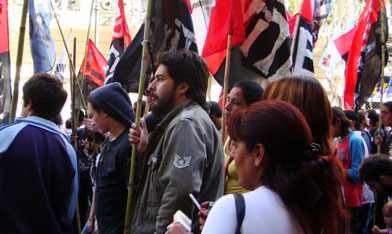
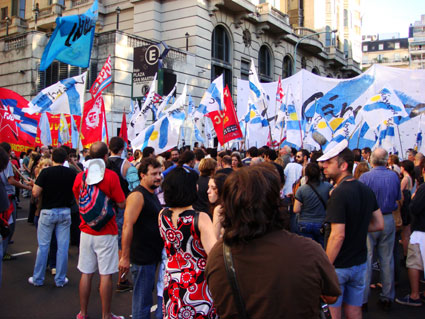
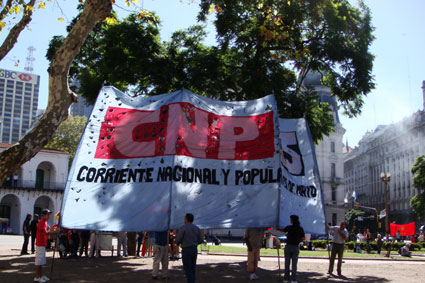
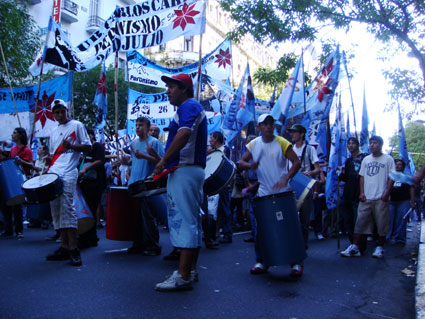
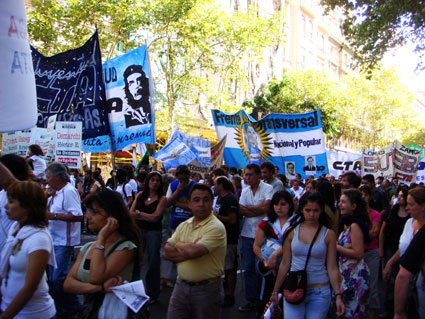
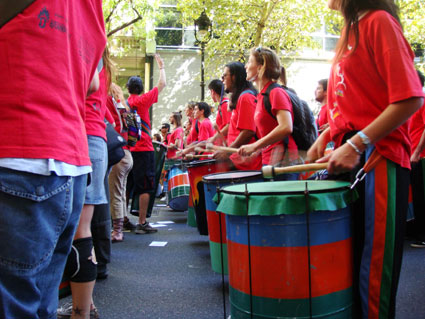
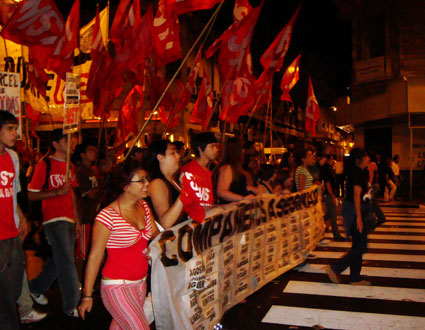
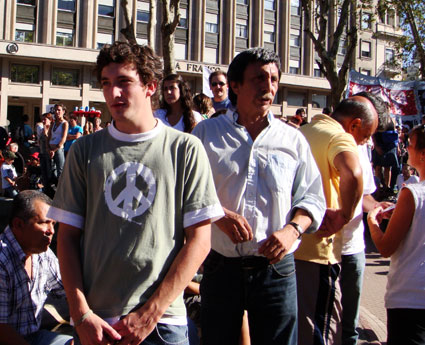
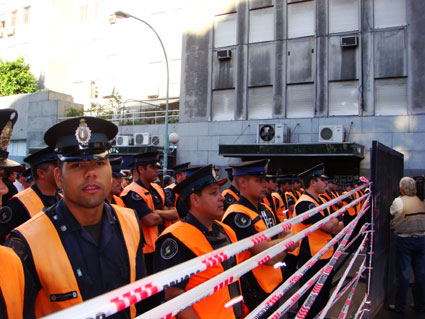
G8 protest
Why protest the G8 Summit July 7-9? Those hoodlums always look so determined. Here’s the rationale by the Emergency Exit Collective:

The 2008 G8 on Hokkaido, a Strategic Assessment
Emergency Exit Collective
Bristol, Mayday, 2008

The authors of this document are a collection of activists, scholars, and writers currently based in the United States and Western Europe who have gotten to know and work with each other in the movement against capitalist globalization. We’re writing this at the request of some members of No! G8 Action Japan, who asked us for a broad strategic analysis of the state of struggle as we see it, and particularly, of the role of the G8, what it represents, the dangers and opportunities that may lie hidden in the moment. It is in no sense programmatic. Mainly, it is an attempt to develop tools that we hope will be helpful for organizers, or for anyone engaged in the struggle against global capital.

I
It is our condition as human beings that we produce our lives in common.

II
Let us then try to see the world from the perspective of the planet’s commoners, taking the word in that sense: those whose most essential tradition is cooperation in the making and maintenance of human social life, yet who have had to do so under conditions of suffering and separation; deprived, ignored, devalued, divided into hierarchies, pitted against each other for our very physical survival. In one sense we are all commoners. But it’s equally true that just about everyone, at least in some ways, at some points, plays the role of the rulers—of those who expropriate, devalue and divide—or at the very least benefits from such divisions.

Obviously some do more than others. It is at the peak of this pyramid that we encounter groups like the G8.

III
The G8’s perspective is that of the aristocrats, the rulers: those who command and maintain that global machinery of violence that defends existing borders and lines of separation: whether national borders with their detention camps for migrants, or property regimes, with their prisons for the poor. They live by constantly claiming title to the products of others collective creativity and labour, and in thus doing they create the poor; they create scarcity in the midst of plenty, and divide us on a daily basis; they create financial districts that loot resources from across the world, and in thus doing they turn the spirit of human creativity into a spiritual desert; close or privatize parks, public water taps and libraries, hospitals, youth centers, universities, schools, public swimming pools, and instead endlessly build shopping malls that channels convivial life into a means of commodity circulation; work toward turning global ecological catastrophe into business opportunities.

These are the people who presume to speak in the name of the “international community” even as they hide in their gated communities or meet protected by phalanxes of riot cops. It is critical to bear in mind that the ultimate aim of their policies is never to create community but to introduce and maintain divisions that set common people at each other’s throats. The neoliberal project, which has been their main instrument for doing so for the last three decades, is premised on a constant effort either to uproot or destroy any communal or democratic system whereby ordinary people govern their own affairs or maintain common resources for the common good, or, to reorganize each tiny remaining commons as an isolated node in a market system in which livelihood is never guaranteed, where the gain of one community must necessarily be at the expense of others. Insofar as they are willing to appeal to high-minded principles of common humanity, and encourage global cooperation, only and exactly to the extent that is required to maintain this system of universal competition.

IV
At the present time, the G8—the annual summit of the leaders of “industrial democracies”—is the key coordinative institution charged with the task of maintaining this neoliberal project, or of reforming it, revising it, adapting it to the changing condition of planetary class relations. The role of the G8 has always been to define the broad strategic horizons through which the next wave of planetary capital accumulation can occur. This means that its main task is to answer the question of how 3?4 in the present conditions of multiple crises and struggles 3?4 to subordinate social relations among the producing commoners of the planet to capital’s supreme value: profit.

V
Originally founded as the G7 in 1975 as a means of coordinating financial strategies for dealing with the ‘70s energy crisis, then expanded after the end of the Cold War to include Russia, its currently face a moment of profound impasse in the governance of planetary class relations: the greatest since the ‘70s energy crisis itself.

VI
The ‘70s energy crisis represented the final death-pangs of what might be termed the Cold War settlement, shattered by a quarter century of popular struggle. It’s worth returning briefly to this history.

The geopolitical arrangements put in place after World War II were above all designed to forestall the threat of revolution. In the immediate wake of the war, not only did much of the world lie in ruins, most of world’s population had abandoned any assumption about the inevitability of existing social arrangements. The advent of the Cold War had the effect of boxing movements for social change into a bipolar straightjacket. On the one hand, the former Allied and Axis powers that were later to unite in the G7 (the US, Canada, UK, France, Italy, Germany, Japan)—the “industrialized democracies”, as they like to call themselves—engaged in a massive project of co-optation. Their governments continued the process, begun in the ‘30s, of taking over social welfare institutions that had originally been created by popular movements (from insurance schemes to public libraries), even to expand them, on condition that they now be managed by state-appointed bureaucracies rather than by those who used them, buying off unions and the working classes more generally with policies meant to guarantee high wages, job security and the promise of educational advance—all in exchange for political loyalty, productivity increases and wage divisions within national and planetary working class itself. The Sino-Soviet bloc—which effectively became a kind of junior partner within the overall power structure, and its allies remained to trap revolutionary energies into the task of reproducing similar bureaucracies elsewhere. Both the US and USSR secured their dominance after the war by refusing to demobilize, instead locking the planet in a permanent threat of nuclear annihilation, a terrible vision of absolute cosmic power.

VII
Almost immediately, though, this arrangement was challenged by a series of revolts from those whose work was required to maintain the system, but who were, effectively, left outside the deal: first, peasants and the urban poor in the colonies and former colonies of the Global South, next, disenfranchised minorities in the home countries (in the US, the Civil Rights movement, then Black Power), and finally and most significantly, by the explosion of the women’s movement of the late ‘60s and early ‘70s—the revolt of that majority of humanity whose largely unremunerated labor made the very existence “the economy” possible. This appears to have been the tipping point.

VIII
The problem was that the Cold War settlement was never meant to include everyone. It by definition couldn’t. Once matters reached tipping point, then, the rulers scotched the settlement. All deals were off. The oil shock was first edge of the counter-offensive, breaking the back of existing working class organizations, driving home the message that there was nothing guaranteed about prosperity. Under the aegis of the newly hatched G7, this counter-offensive involved a series of interwoven strategies that were later to give rise to what is known as neoliberalism.

IX
These strategies resulted in what came to be known as “Structural Adjustment” both in the North and in the South, accompanied by trade and financial liberalization. This, in turn, made possible crucial structural changes in our planetary production in common extending the role of the market to discipline our lives and divide us into more and more polarized wage hierarchy. This involved:

· In the immediate wake of ‘70s oil shock, petrodollars were recycled from OPEC into Northern banks that then lent them, at extortionate rates of interest, to developing countries of the Global South. This was the origin of the famous “Third World Debt Crisis.” The existence of this debt allowed institutions like the IMF to impose its monetarist orthodoxy on most of the planet for roughly twenty years, in the process, stripping away most of even those modest social protections that had been won by the world’s poor—large numbers of whom were plunged into a situation of absolute desperation.

· It also opened a period of new enclosures through the capitalist imposition of structural adjustment policies, manipulation of environmental and social catastrophes like war, or for that matter through the authoritarian dictates of “socialist” regimes. Through such means, large sections of the world’s population have over the past thirty years been dispossessed from resources previously held in common, either by dint of long traditions, or as the fruits of past struggles and past settlements.

· Through financial deregulation and trade liberalization, neoliberal capital, which emerged from the G7 strategies to deal with the 1970s crisis aimed thus at turning the “class war” in communities, factories, offices, streets and fields against the engine of competition, into a planetary “civil war”, pitting each community of commoners against every other community of commoners.

· Neoliberal capital has done this by imposing an ethos of “efficiency” and rhetoric of “lowering the costs of production” applied so broadly that mechanisms of competition have come to pervade every sphere of life. In fact these terms are euphemisms, for a more fundamental demand: that capital be exempt from taking any reduction in profit to finance the costs of reproduction of human bodies and their social and natural environments (which it does not count as costs) and which are, effectively, “exernalized” onto communities and nature.

· The enclosure of resources and entitlements won in previous generations of struggles both in the North and the South, in turn, created the conditions for increasing the wage hierarchies (both global and local), by which commoners work for capital—wage hierarchies reproduced economically through pervasive competition, but culturally, through male dominance, xenophobia and racism. These wage gaps, in turn, made it possible to reduce the value of Northern workers’ labour power, by introducing commodities that enter in their wage basket at a fraction of what their cost might otherwise have been. The planetary expansion of sweatshops means that American workers (for example) can buy cargo pants or lawn-mowers made in Cambodia at Walmart, or buy tomatoes grown by undocumented Mexican workers in California, or even, in many cases, hire Jamaican or Filipina nurses to take care of children and aged grandparents at such low prices, that their employers have been able to lower real wages without pushing most of them into penury. In the South, meanwhile, this situation has made it possible to discipline new masses of workers into factories and assembly lines, fields and offices, thus extending enormously capital’s reach in defining the terms—the what, the how, the how much—of social production.

· These different forms of enclosures, both North and South, mean that commoners have become increasingly dependent on the market to reproduce their livelihoods, with less power to resist the violence and arrogance of those whose priorities is only to seek profit, less power to set a limit to the market discipline running their lives, more prone to turn against one another in wars with other commoners who share the same pressures of having to run the same competitive race, but not the same rights and the same access to the wage. All this has meant a generalized state of precarity, where nothing can be taken for granted.

X
In turn, this manipulation of currency and commodity flows constituting neoliberal globalization became the basis for the creation of the planet’s first genuine global bureaucracy.

· This was multi-tiered, with finance capital at the peak, then the ever-expanding trade bureaucracies (IMF, WTO, EU, World Bank, etc), then transnational corporations, and finally, the endless varieties of NGOs that proliferated throughout the period—almost all of which shared the same neoliberal orthodoxy, even as they substituted themselves for social welfare functions once reserved for states.

· The existence of this overarching apparatus, in turn, allowed poorer countries previously under the control of authoritarian regimes beholden to one or another side in the Cold War to adopt “democratic” forms of government. This did allow a restoration of formal civil liberties, but very little that could really merit the name of democracy (the rule of the “demos”, i.e., of the commoners). They were in fact constitutional republics, and the overwhelming trend during the period was to strip legislatures, that branch of government most open to popular pressure, of most of their powers, which were increasingly shifted to the executive and judicial branches, even as these latter, in turn, largely ended up enacting policies developed overseas, by global bureaucrats.

· This entire bureaucratic arrangement was justified, paradoxically enough, by an ideology of extreme individualism. On the level of ideas, neoliberalism relied on a systematic cooptation of the themes of popular struggle of the ‘60s: autonomy, pleasure, personal liberation, the rejection of all forms of bureaucratic control and authority. All these were repackaged as the very essence of capitalism, and the market reframed as a revolutionary force of liberation.

· The entire arrangement, in turn, was made possible by a preemptive attitude towards popular struggle. The breaking of unions and retreat of mass social movements from the late ‘70s onwards was only made possible by a massive shift of state resources into the machinery of violence: armies, prisons and police (secret and otherwise) and an endless variety of private “security services”, all with their attendant propaganda machines, which tended to increase even as other forms of social spending were cut back, among other things absorbing increasing portions of the former proletariat, making the security apparatus an increasingly large proportion of total social spending. This approach has been very successful in holding back mass opposition to capital in much of the world (especially West Europe and North America), and above all, in making it possible to argue there are no viable alternatives. But in doing so, has created strains on the system so profound it threatens to undermine it entirely.

XI
The latter point deserves elaboration. The element of force is, on any number of levels, the weak point of the system. This is not only on the constitutional level, where the question of how to integrate the emerging global bureaucratic apparatus, and existing military arrangements, has never been resolved. It is above all an economic problem. It is quite clear that the maintenance of elaborate security machinery is an absolute imperative of neoliberalism. One need only observe what happened with the collapse of the Soviet bloc in Eastern Europe: where one might have expected the Cold War victors to demand the dismantling of the army, secret police and secret prisons, and to maintain and develop the existing industrial base, in fact, what they did was absolutely the opposite: in fact, the only part of the industrial base that has managed fully to maintain itself has been the parts required to maintained the security apparatus itself! Critical too is the element of preemption: the governing classes in North America, for example, are willing to go to almost unimaginable lengths to ensure social movements never feel they are accomplishing anything. The current Gulf War is an excellent example: US military operations appear to be organized first and foremost to be protest-proof, to ensure that what happened in Vietnam (mass mobilization at home, widespread revolt within the army overseas) could never be repeated. This means above all that US casualties must always be kept to a minimum. The result are rules of engagement, and practices like the use of air power within cities ostensibly already controlled by occupation forces, so obviously guaranteed to maximize the killing of innocents and galvanizing hatred against the occupiers that they ensure the war itself cannot be won. Yet this approach can be taken as the very paradigm for neoliberal security regimes. Consider security arrangements around trade summits, where police are so determined prevent protestors from achieving tactical victories that they are often willing to effectively shut down the summits themselves. So too in overall strategy. In North America, such enormous resources are poured into the apparatus of repression, militarization, and propaganda that class struggle, labor action, mass movements seem to disappear entirely. It is thus possible to claim we have entered a new age where old conflicts are irrelevant. This is tremendously demoralizing of course for opponents of the system; but those running the system seem to find that demoralization so essential they don’t seem to care that the resultant apparatus (police, prisons, military, etc) is, effectively, sinking the entire US economy under its dead weight.

XII
The current crisis is not primarily geopolitical in nature. It is a crisis of neoliberalism itself. But it takes place against the backdrop of profound geopolitical realignments. The decline of North American power, both economic and geopolitical has been accompanied by the rise of Northeast Asia (and to a increasing extent, South Asia as well). While the Northeast Asian region is still divided by painful Cold War cleavages—the fortified lines across the Taiwan straits and at the 38th parallel in Korea…—the sheer realities of economic entanglement can be expected to lead to a gradual easing of tensions and a rise to global hegemony, as the region becomes the new center of gravity of the global economy, of the creation of new science and technology, ultimately, of political and military power. This may, quite likely, be a gradual and lengthy process. But in the meantime, very old patterns are rapidly reemerging: China reestablishing relations with ancient tributary states from Korea to Vietnam, radical Islamists attempting to reestablish their ancient role as the guardians of finance and piety at the in the Central Asian caravan routes and across Indian Ocean, every sort of Medieval trade diaspora reemerging… In the process, old political models remerge as well: the Chinese principle of the state transcending law, the Islamic principle of a legal order transcending any state. Everywhere, we see the revival too of ancient forms of exploitation—feudalism, slavery, debt peonage—often entangled in the newest forms of technology, but still echoing all the worst abuses of the Middle Ages. A scramble for resources has begun, with US occupation of Iraq and saber-rattling throughout the surrounding region clearly meant (at least in part) to place a potential stranglehold the energy supply of China; Chinese attempts to outflank with its own scramble for Africa, with increasing forays into South America and even Eastern Europe. The Chinese invasion into Africa (not as of yet at least a military invasion, but already involving the movement of hundreds of thousands of people), is changing the world in ways that will probably be felt for centuries. Meanwhile, the nations of South America, the first victims of the “Washington consensus” have managed to largely wriggle free from the US colonial orbit, while the US, its forces tied down in the Middle East, has for the moment at least abandoned it, is desperately struggling to keep its grip Mexico, Central America and the Caribbean—its own “near abroad”.

XIII
In another age all this might have led to war—that is, not just colonial occupations, police actions, or proxy wars (which are obviously already taking place), but direct military confrontations between the armies of major powers. It still could; accidents happen; but there is reason to believe that, when it comes to moments of critical decision, the loyalties of the global elites are increasingly to each other, and not to the national entities for whom they claim to speak. There is some compelling evidence for this.

Take for example when the US elites panicked at the prospect of the massive budget surpluses of the late 1990s. As Alan Greenspan, head of the Federal Reserve at the time warned, if these were allowed to stand they would have flooded government coffers with so many trillions of dollars that it could only have lead to some form of creeping socialism, even, he predicted, to the government acquiring “equity stakes” in key US corporations. The more excitable of capitalism’s managers actually began contemplating scenarios where the capitalist system itself would be imperiled. The only possible solution was massive tax cuts; these were duly enacted, and did indeed manage to turn surpluses into enormous deficits, financed by the sale of treasury bonds to Japan and China. Conditions have thus now reached a point where it is beginning to look as if the most likely long term outcome for the US (its technological and industrial base decaying, sinking under the burden of its enormous security spending) will be to end up serve as junior partner and military enforcer for East Asia capital. Its rulers, or at least a significant proportion of them, would prefer to hand global hegemony to the rulers of China (provided the latter abandon Communism) than to return to any sort of New Deal compromise with their “own” working classes.

A second example lies in the origins of what has been called the current “Bretton Woods II” system of currency arrangements, which underline a close working together of some “surplus” and “deficit” countries within global circuits. The macroeconomic manifestation of the planetary restructuring outlined in XIX underlines both the huge US trade deficit that so much seem to worry many commentators, and the possibility to continually generate new debt instruments like the one that has recently resulted in the sub-prime crisis. The ongoing recycling of accumulated surplus of countries exporting to the USA such as China and oil producing countries is what has allowed financiers to create new credit instruments in the USA. Hence, the “deal” offered by the masters in the United States to its commoners has been this: ‘you, give us a relative social peace and accept capitalist markets as the main means through which you reproduce your own livelihoods, and we will give you access to cheaper consumption goods, access to credit for buying cars and homes, and access to education, health, pensions and social security through the speculative means of stock markets and housing prices.’ Similar compromises were reached in all the G8 countries.

Meanwhile, there is the problem of maintaining any sort of social peace with the hundreds of millions of unemployed, underemployed, dispossessed commoners currently swelling the shanty-towns of Asia, Africa, and Latin America as a result of ongoing enclosures (which have speeded up within China and India in particular, even as “structural adjustment policies” in Africa and Latin America have been derailed). Any prospect of maintaining peace in these circumstances would ordinarily require either extremely high rates of economic growth—which globally have not been forthcoming, since outside of China, growth rates in the developing world have been much lower than they were in the ‘50s, ‘60s, or even ‘70s—or extremely high levels of repression, lest matters descend into rebellion or generalized civil war. The latter has of course occurred in many parts of the world currently neglected by capital, but in favored regions, such as the coastal provinces of China, or “free trade” zones of India, Egypt, or Mexico, commoners are being offered a different sort of deal: industrial employment at wages that, while very low by international standards, are still substantially higher than anything currently obtainable in the impoverished countryside; and above all the promise, through the intervention of Western markets and (privatized) knowledge, of gradually improving conditions of living. While over the least few years wages in many such areas seem to be growing, thanks to the intensification of popular struggles, such gains are inherently vulnerable: the effect of recent food inflation has been to cut real wages back dramatically—and threaten millions with starvation.

What we really want to stress here, though, is that the long-term promise being offered to the South is just as untenable as the idea that US or European consumers can indefinitely expand their conditions of life through the use of mortgages and credit cards.

What’s being offered the new dispossessed is a transposition of the American dream. The idea is that the lifestyle and consumption patterns of existing Chinese, Indian, or Brazilian or Zambian urban middle classes (already modeled on Northern ones) will eventually become available to the children of today’s miners, maquila or plantation laborers, until, ultimately, everyone on earth is brought up to roughly the same level of consumption. Put in these terms, the argument is absurd. The idea that all six billion of us can become “middle class” is obviously impossible. First of all there is a simple problem of resources. It doesn’t matter how many bottles we recycle or how energy efficient are the light bulbs we use, there’s just no way the earth’s ecosystem can accommodate six billion people driving in private cars to work in air-conditioned cubicles before periodically flying off to vacation in Acapulco or Tahiti. To maintain the style of living and producing in common we now identify with “middle classness” on a planetary scale would require several additional planets.

This much has been pointed out repeatedly. But the second point is no less important. What this vision of betterment ultimately proposes is that it would be possible to build universal prosperity and human dignity on a system of wage labor. This is fantasy. Historically, wages are always the contractual face for system of command and degradation, and a means of disguising exploitation: expressing value for work only on condition of stealing value without work— and there is no reason to believe they could ever be anything else. This is why, as history has also shown, human beings will always avoid working for wages if they have any other viable option. For a system based on wage labor to come into being, such options must therefore be made unavailable. This in turn means that such systems are always premised on structures of exclusion: on the prior existence of borders and property regimes maintained by violence. Finally, historically, it has always proved impossible to maintain any sizeable class of wage-earners in relative prosperity without basing that prosperity, directly or indirectly, on the unwaged labor of others—on slave-labor, women’s domestic labor, the forced labor of colonial subjects, the work of women and men in peasant communities halfway around the world—by people who are even more systematically exploited, degraded, and immiserated. For that reason, such systems have always depended not only on setting wage-earners against each other by inciting bigotry, prejudice, hostility, resentment, violence, but also by inciting the same between men and women, between the people of different continents (“race”), between the generations.

From the perspective of the whole, then, the dream of universal middle class “betterment” must necessarily be an illusion constructed in between the Scylla of ecological disaster, and the Charybdis of poverty, detritus, and hatred: precisely, the two pillars of today’s strategic impasse faced by the G8.

XIV
How then do we describe the current impasse of capitalist governance?

To a large degree, it is the effect of a sudden and extremely effective upswing of popular resistance—one all the more extraordinary considering the huge resources that had been invested in preventing such movements from breaking out.

On the one hand, the turn of the millennium saw a vast and sudden flowering of new anti-capitalist movements, a veritable planetary uprising against neoliberalism by commoners in Latin America, India, Africa, Asia, across the North Atlantic world’s former colonies and ultimately, within the cities of the former colonial powers themselves. As a result, the neoliberal project lies shattered. What came to be called the “anti-globalization” movement took aim at the trade bureaucracies—the obvious weak link in the emerging institutions of global administration—but it was merely the most visible aspect of this uprising. It was however an extraordinarily successful one. Not only was the WTO halted in its tracks, but all major trade initiatives (MAI, FTAA…) scuttled. The World Bank was hobbled and the power of the IMF over most of the world’s population, effectively, destroyed. The latter, once the terror of the Global South, is now a shattered remnant of its former self, reduced to selling off its gold reserves and desperately searching for a new global mission.

In many ways though spectacular street actions were merely the most visible aspects of much broader changes: the resurgence of labor unions, in certain parts of the world, the flowering of economic and social alternatives on the grassroots levels in every part of the world, from new forms of direct democracy of indigenous communities like El Alto in Bolivia or self-managed factories in Paraguay, to township movements in South Africa, farming cooperatives in India, squatters’ movements in Korea, experiments in permaculture in Europe or “Islamic economics” among the urban poor in the Middle East. We have seen the development of thousands of forms of mutual aid association, most of which have not even made it onto the radar of the global media, often have almost no ideological unity and which may not even be aware of each other’s existence, but nonetheless share a common desire to mark a practical break with capitalism, and which, most importantly, hold out the prospect of creating new forms of planetary commons that can—and in some cases are—beginning to knit together to provide the outlines of genuine alternative vision of what a non-capitalist future might look like.

The reaction of the world’s rulers was predictable. The planetary uprising had occurred during a time when the global security apparatus was beginning to look like it lacked a purpose, when the world threatened to return to a state of peace. The response—aided of course, by the intervention of some of the US’ former Cold War allies, reorganized now under the name of Al Qaeda—was a return to global warfare. But this too failed. The “war on terror”—as an attempt to impose US military power as the ultimate enforcer of the neoliberal model—has collapsed as well in the face of almost universal popular resistance. This is the nature of their “impasse”.

At the same time, the top-heavy, inefficient US model of military capitalism—a model created in large part to prevent the dangers of social movements, but which the US has also sought to export to some degree simply because of its profligacy and inefficiency, to prevent the rest of the world from too rapidly overtaking them—has proved so wasteful of resources that it threatens to plunge the entire planet into ecological and social crisis. Drought, disaster, famines, combine with endless campaigns of enclosure, foreclosure, to cast the very means of survival—food, water, shelter—into question for the bulk of the world’s population.

XV
In the rulers’ language the crisis understood, first and foremost, as a problem of regulating cash flows, of reestablishing, as they like to put it, a new “financial architecture”. Obviously they are aware of the broader problems. Their promotional literature has always been full of it. From the earliest days of the G7, through to the days after the Cold War, when Russia was added as a reward for embracing capitalism, they have always claimed that their chief concerns include

· the reduction of global poverty

· sustainable environmental policies

· sustainable global energy policies

· stable financial institutions governing global trade and currency transactions

If one were to take such claims seriously, it’s hard to see their overall performance as anything but a catastrophic failure. At the present moment, all of these are in crisis mode: there are food riots, global warming, peak oil, and the threat of financial meltdown, bursting of credit bubbles, currency crises, a global credit crunch. [**Failure on this scale however, opens opportunities for the G8 themselves, as summit of the global bureaucracy, to reconfigure the strategic horizon. Therefore, it’s always with the last of these that they are especially concerned. ]The real problem, from the perspective of the G8, is one of reinvestment: particularly, of the profits of the energy sector, but also, now, of emerging industrial powers outside the circle of the G8 itself. The neoliberal solution in the ‘70s had been to recycle OPEC’s petrodollars into banks that would use it much of the world into debt bondage, imposing regimes of fiscal austerity that, for the most part, stopped development (and hence, the emergence potential rivals) in its tracks. By the ‘90s, however, much East Asia in particular had broken free of this regime. Attempts to reimpose IMF-style discipline during the Asian financial crisis of 1997 largely backfired. So a new compromise was found, the so-called Bretton Woods II: to recycle the profits from the rapidly expanding industrial economies of East Asia into US treasury debt, artificially supporting the value of the dollar and allowing a continual stream of cheap exports that, aided by the US housing bubble, kept North Atlantic economies afloat and buy off workers there with cheap oil and even cheaper consumer goods even as real wages shrank. This solution however soon proved a temporary expedient. Bush regime’s attempt to lock it in by the invasion of Iraq, which was meant to lead to the forced privatization of Iraqi oil fields, and, ultimately, of the global oil industry as a whole, collapsed in the face of massive popular resistance (just as Saddam Hussein’s attempt to introduce neoliberal reforms in Iraq had failed when he was still acting as American deputy in the ‘90s). Instead, the simultaneous demand for petroleum for both Chinese manufacturers and American consumers caused a dramatic spike in the price of oil. What’s more, rents from oil and gas production are now being used to pay off the old debts from the ‘80s (especially in Asia and Latin America, which have by now paid back their IMF debts entirely), and—increasingly—to create state-managed Sovereign Wealth Funds that have largely replaced institutions like the IMF as the institutions capable of making long-term strategic investments. The IMF, purposeless, tottering on the brink of insolvency, has been reduced to trying to come up with “best practices” guidelines for fund managers working for governments in Singapore, Seoul, and Abu Dhabi.

There can be no question this time around of freezing out countries like China, India, or even Brazil. The question for capital’s planners, rather, is how to channel these new concentrations of capital in such a way that they reinforce the logic of the system instead of undermining it.

XVI
How can this be done? This is where appeals to universal human values, to common membership in an “international community” come in to play. “We all must pull together for the good of the planet,” we will be told. The money must be reinvested “to save the earth.”

To some degree this was always the G8 line: this is a group has been making an issue of climate change since 1983. Doing so was in one sense a response to the environmental movements of the ‘70s and ‘80s. The resultant emphasis on biofuels and “green energy” was from their point of view, the perfect strategy, seizing on an issue that seemed to transcend class, appropriating ideas and issues that emerged from social movements (and hence coopting and undermining especially their radical wings), and finally, ensuring such initiatives are pursued not through any form of democratic self-organization but “market mechanisms”—to effective make the sense of public interest productive for capitalism.

What we can expect now is a two-pronged attack. On the one hand, they will use the crisis to attempt to reverse the gains of past social movements: to put nuclear energy back on the table to deal with the energy crisis and global warming, or genetically modified foods to deal with the food crisis. Prime Minister Fukuda, the host of the current summit, for example, is already proposing the nuclear power is the “solution” to the global warming crisis, even as the German delegation resists. On the other, and even more insidiously, they will try once again to co-opt the ideas and solutions that have emerged from our struggles as a way of ultimately undermining them. Appropriating such ideas is simply what rulers do: the bosses brain is always under the workers’ hat. But the ultimate aim is to answer the intensification of class struggle, of the danger of new forms of democracy, with another wave of enclosures, to restore a situation where commoners’ attempts to create broader regimes of cooperation are stymied, and people are plunged back into mutual competition.

We can already see the outlines of how this might be done. There are already suggestions that Sovereign Wealth Funds put aside a certain (miniscule) proportion of their money for food aid, but only as tied to a larger project of global financial restructuring. The World Bank, largely bereft of its earlier role organizing dams and pipe-lines across the world, has been funding development in China’s poorer provinces, freeing the Chinese government to carry out similar projects in Southeast Asia, Africa, and even Latin America (where, of course, they cannot effectively be held to any sort of labor or environmental standards). There is the possibility of a new class deal in China itself, whose workers can be allowed higher standards of living if new low wage zones are created elsewhere—for instance, Africa (the continent where struggles over maintaining the commons have been most intense in current decades)—with the help of Chinese infrastructural projects. Above of all, money will be channeled into addressing climate change, into the development of alternative energy, which will require enormous investments, in such a way as to ensure that whatever energy resources do become important in this millennium, they can never be democratized—that the emerging notion of a petroleum commons, that energy resources are to some degree a common patrimony meant primarily to serve the community as a whole, that is beginning to develop in parts of the Middle East and South America—not be reproduced in whatever comes next.

Since this will ultimately have to be backed up by the threat of violence, the G8 will inevitably have to struggle with how to (yet again) rethink enforcement mechanisms. The latest move , now that the US “war on terror” paradigm has obviously failed, would appear to be a return to NATO, part of a reinvention of the “European security architecture” being proposed at the upcoming G8 meetings in Italy in 2009 on the 60th anniversary of NATO’s foundation—but part of a much broader movement of the militarization of social conflict, projecting potential resource wars, demographic upheavals resulting from climate change, and radical social movements as potential military problems to be resolved by military means. Opposition to this new project is already shaping up as the major new European mobilization for the year following the current G-8.

XVII
While the G-8 sit at the pinnacle of a system of violence, their preferred idiom is monetary. Their impulse whenever possible is to translate all problems into money, financial structures, currency flows—a substance whose movements they carefully monitor and control.

Money, on might say, is their poetry—a poetry whose letters are written in our blood. It is their highest and most abstract form of expression, their way of making statements about the ultimate truth of the world, even if it operates in large part by making things disappear. How else could it be possible to argue—no, to assume as a matter of common sense—that the love, care, and concern of a person who tends to the needs of children, teaching, minding, helping them to become decent , thoughtful, human beings, or who grows and prepares food, is worth ten thousand times less than someone who spends the same time designing a brand logo, moving abstract blips across a globe, or denying others health care.

The role of money however has changed profoundly since 1971 when the dollar was delinked from gold. This has created a profound realignment of temporal horizons. Once money could be said to be primarily congealed results of past profit and exploitation. As capital, it was dead labor. Millions of indigenous Americans and Africans had their lives pillaged and destroyed in the gold mines in order to be rendered into value. The logic of finance capital, of credit structures, certainly always existed as well (it is at least as old as industrial capital; possibly older), but in recent decades these logic of financial capital has come to echo and re-echo on every level of our lives. In the UK 97% of money in circulation is debt, in the US, 98%. Governments run on deficit financing, wealthy economies on consumer debt, the poor are enticed with microcredit schemes, debts are packaged and repackaged in complex financial derivatives and traded back and forth. Debt however is simply a promise, the expectation of future profit; capital thus increasingly brings the future into the present—a future that, it insists, must always be the same in nature, even if must also be greater in magnitude, since of course the entire system is premised on continual growth. Where once financiers calculated and traded in the precise measure of our degradation, having taken everything from us and turned it into money, now money has flipped, to become the measure of our future degradation—at the same time as it binds us to endlessly working in the present.

The result is a strange moral paradox. Love, loyalty, honor, commitment—to our families, for example, which means to our shared homes, which means to the payment of monthly mortgage debts—becomes a matter of maintaining loyalty to a system which ultimately tells us that such commitments are not a value in themselves. This organization of imaginative horizons, which ultimately come down to a colonization of the very principle of hope, has come to supplement the traditional evocation of fear (of penury, homelessness, joblessness, disease and death). This colonization paralyzes any thought of opposition to a system that almost everyone ultimately knows is not only an insult to everything they really cherish, but a travesty of genuine hope, since, because no system can really expand forever on a finite planet, everyone is aware on some level that in the final analysis they are dealing with a kind of global pyramid scheme, what we are ultimately buying and selling is the real promise of global social and environmental apocalypse.

XVIII
Finally then we come to the really difficult, strategic questions. Where are the vulnerabilities? Where is hope? Obviously we have no certain answers here. No one could. But perhaps the proceeding analysis opens up some possibilities that anti-capitalist organizers might find useful to explore.

One thing that might be helpful is to rethink our initial terms. Consider communism. We are used to thinking of it as a total system that perhaps existed long ago, and to the desire to bring about an analogous system at some point in the future—usually, at whatever cost. It seems to us that dreams of communist futures were never purely fantasies; they were simply projections of existing forms of cooperation, of commoning, by which we already make the world in the present. Communism in this sense is already the basis of almost everything, what brings people and societies into being, what maintains them, the elemental ground of all human thought and action. There is absolutely nothing utopian here. What is utopian, really, is the notion that any form of social organization, especially capitalism, could ever exist that was not entirely premised on the prior existence of communism. If this is true, the most pressing question is simply how to make that power visible, to burst forth, to become the basis for strategic visions, in the face of a tremendous and antagonistic power committed to destroying it—but at the same time, ensuring that despite the challenge they face, they never again become entangled with forms of violence of their own that make them the basis for yet another tawdry elite. After all, the solidarity we extend to one another, is it not itself a form of communism? And is it not so above because it is not coerced?

Another thing that might be helpful is to rethink our notion of crisis. There was a time when simply describing the fact that capitalism was in a state of crisis, driven by irreconcilable contradictions, was taken to suggest that it was heading for a cliff. By now, it seems abundantly clear that this is not the case. Capitalism is always in a crisis. The crisis never goes away. Financial markets are always producing bubbles of one sort or another; those bubbles always burst, sometimes catastrophically; often entire national economies collapse, sometimes the global markets system itself begins to come apart. But every time the structure is reassembled. Slowly, painfully, dutifully, the pieces always end up being put back together once again.

Perhaps we should be asking: why?

In searching for an answer, it seems to us, we might also do well to put aside another familiar habit of radical thought: the tendency to sort the world into separate levels—material realities, the domain of ideas or “consciousness”, the level of technologies and organizations of violence—treating these as if these were separate domains that each work according to separate logics, and then arguing which “determines” which. In fact they cannot be disentangled. A factory may be a physical thing, but the ownership of a factory is a social relation, a legal fantasy that is based partly on the belief that law exists, and partly on the existence of armies and police. Armies and police on the other hand exist partly because of factories providing them with guns, vehicles, and equipment, but also, because those carrying the guns and riding in the vehicles believe they are working for an abstract entity they call “the government”, which they love, fear, and ultimately, whose existence they take for granted by a kind of faith, since historically, those armed organizations tend to melt away immediately the moment they lose faith that the government actually exists. Obviously exactly the same can be said of money. It’s value is constantly being produced by eminently material practices involving time clocks, bank machines, mints, and transatlantic computer cables, not to mention love, greed, and fear, but at the same time, all this too rests on a kind of faith that all these things will continue to interact in more or less the same way. It is all very material, but it also reflects a certain assumption of eternity: the reason that the machine can always be placed back together is, simply, because everyone assumes it must. This is because they cannot realistically imagine plausible alternatives; they cannot imagine plausible alternatives because of the extraordinarily sophisticated machinery of preemptive violence that ensure any such alternatives are uprooted or contained (even if that violence is itself organized around a fear that itself rests on a similar form of faith.) One cannot even say it’s circular. It’s more a kind of endless, unstable spiral. To subvert the system is then, to intervene in such a way that the whole apparatus begins to spin apart.

XIX
It appears to us that one key element here—one often neglected in revolutionary strategy—is the role of the global middle classes. This is a class that, much though it varies from country (in places like the US and Japan, overwhelming majorities consider themselves middle class; in, say, Cambodia or Zambia, only very small percentages), almost everywhere provides the key constituency of the G8 outside of the ruling elite themselves. It has become a truism, an article of faith in itself in global policy circles, that national middle class is everywhere the necessary basis for democracy. In fact, middle classes are rarely much interested in democracy in any meaningful sense of that word (that is, of the self-organization or self-governance of communities). They tend to be quite suspicious of it. Historically, middle classes have tended to encourage the establishment of constitutional republics with only limited democratic elements (sometimes, none at all). This is because their real passion is for a “betterment”, for the prosperity and advance of conditions of life for their children—and this betterment, since it is as noted above entirely premised on structures of exclusion, requires “security”. Actually the middle classes depend on security on every level: personal security, social security (various forms of government support, which even when it is withdrawn from the poor tends to be maintained for the middle classes), security against any sudden or dramatic changes in the nature of existing institutions. Thus, politically, the middle classes are attached not to democracy (which, especially in its radical forms, might disrupt all this), but to the rule of law. In the political sense, then, being “middle class” means existing outside the notorious “state of exception” to which the majority of the world’s people are relegated. It means being able to see a policeman and feel safer, not even more insecure. This would help explain why within the richest countries, the overwhelming majority of the population will claim to be “middle class” when speaking in the abstract, even if most will also instantly switch back to calling themselves “working class” when talking about their relation to their boss.

That rule of law, in turn, allows them to live in that temporal horizon where the market and other existing institutions (schools, governments, law firms, real estate brokerages…) can be imagined as lasting forever in more or less the same form. The middle classes can thus be defined as those who live in the eternity of capitalism. (The elites don’t; they live in history, they don’t assume things will always be the same. The disenfranchized don’t; they don’t have the luxury; they live in a state of precarity where little or nothing can safely be assumed.) Their entire lives are based on assuming that the institutional forms they are accustomed to will always be the same, for themselves and their grandchildren, and their “betterment” will be proportional to the increase in the level of monetary wealth and consumption. This is why every time global capital enters one of its periodic crises, every time banks collapse, factories close, and markets prove unworkable, or even, when the world collapses in war, the managers and dentists will tend to support any program that guarantees the fragments will be dutifully pieced back together in roughly the same form—even if all are, at the same time, burdened by at least a vague sense that the whole system is unfair and probably heading for catastrophe.

XIX
The strategic question then is, how to shatter this sense of inevitability? History provides one obvious suggestion. The last time the system really neared self-destruction was in the 1930s, when what might have otherwise been an ordinary turn of the boom-bust cycle turned into a depression so profound that it took a world war to pull out of it. What was different? The existence of an alternative: a Soviet economy that, whatever its obvious brutalities, was expanding at breakneck pace at the very moment market systems were undergoing collapse. Alternatives shatter the sense of inevitability, that the system must, necessarily, be patched together in the same form; this is why it becomes an absolute imperative of global governance that even small viable experiments in other ways of organizing communities be wiped out, or, if that is not possible, that no one knows about them.

If nothing else, this explains the extraordinary importance attached to the security services and preemption of popular struggle. Commoning, where it already exists, must be made invisible. Alternatives— Zapatistas in Chiapas, APPO in Oaxaca, worker-managed factories in Argentina or Paraguay, community-run water systems in South Africa or Bolivia, living alternatives of farming or fishing communities in India or Indonesia, or a thousand other examples—must be made to disappear, if not squelched or destroyed, then marginalized to the point they seem irrelevant, ridiculous. If the managers of the global system are so determined to do this they are willing to invest such enormous resources into security apparatus that it threatens to sink the system entirely, it is because they are aware that they are working with a house of cards. That the principle of hope and expectation on which capitalism rests would evaporate instantly if almost any other principle of hope or expectation seemed viable.

The knowledge of alternatives, then, is itself a material force.

Without them, of course, the shattering of any sense of certainty has exactly the opposite effect. It becomes pure precarity, an insecurity so profound that it becomes impossible to project oneself in history in any form, so that the one-time certainties of middle class life itself becomes a kind of utopian horizon, a desperate dream, the only possible principle of hope beyond which one cannot really imagine anything. At the moment, this seems the favorite weapon of neoliberalism: whether promulgated through economic violence, or the more direct, traditional kind.

One form of resistance that might prove quite useful here – and is already being discussed in some quarters – are campaigns against debt itself. Not demands for debt forgiveness, but campaigns of debt resistance.

XX
In this sense the great slogan of the global justice movement, “another world is possible”, represents the ultimate threat to existing power structures. But in another sense we can even say we have already begun to move beyond that. Another world is not merely possible. It is inevitable. On the one hand, as we have pointed out, such a world is already in existence in the innumerable circuits of social cooperation and production in common based on different values than those of profit and accumulation through which we already create our lives, and without which capitalism itself would be impossible. On the other, a different world is inevitable because capitalism—a system based on infinite material expansion—simply cannot continue forever on a finite world. At some point, if humanity is to survive at all, we will be living in a system that is not based on infinite material expansion. That is, something other than capitalism.

The problem is there is no absolute guarantee that ‘something’ will be any better. It’s pretty easy to imagine “other worlds” that would be even worse. We really don’t have any idea what might happen. To what extent will the new world still organized around commoditization of life, profit, and pervasive competition? Or a reemergence of even older forms of hierarchy and degradation? How, if we do overcome capitalism directly, by the building and interweaving of new forms of global commons, do we protect ourselves against the reemergence of new forms of hierarchy and division that we might not now even be able to imagine?

It seems to us that the decisive battles that will decide the contours of this new world will necessarily be battles around values. First and foremost are values of solidarity among commoners. Since after all, every rape of a woman by a man or the racist murder of an African immigrant by a European worker is worth a division in capital’s army.

Similarly, imagining our struggles as value struggles might allow us to see current struggles over global energy policies and over the role of money and finance today as just an opening salvo of an even larger social conflict to come. For instance, there’s no need to demonize petroleum, for example, as a thing in itself. Energy products have always tended to play the role of a “basic good”, in the sense that their production and distribution becomes the physical basis for all other forms of human cooperation, at the same time as its control tends to organize social and even international relations. Forests and wood played such a role from the time of the Magna Carta to the American Revolution, sugar did so during the rise of European colonial empires in the 17th and 18th centuries, fossil fuels do so today. There is nothing intrinsically good or bad about fossil fuel. Oil is simply solar radiation, once processed by living beings, now stored in fossil form. The question is of control and distribution. This is the real flaw in the rhetoric over “peak oil”: the entire argument is premised on the assumption that, for the next century at least, global markets will be the only means of distribution. Otherwise the use of oil would depend on needs, which would be impossible to predict precisely because they depend on the form of production in common we adopt. The question thus should be: how does the anti-capitalist movement peak the oil? How does it become the crisis for a system of unlimited expansion?

It is the view of the authors of this text that the most radical planetary movements that have emerged to challenge the G8 are those that direct us towards exactly these kind of questions. Those which go beyond merely asking how to explode the role money plays in framing our horizons, or even challenging the assumption of the endless expansion of “the economy”, to ask why we assume something called “the economy” even exists, and what other ways we can begin imagining our material relations with one another. The planetary women’s movement, in its many manifestations, has and continues to play perhaps the most important role of all here, in calling for us to reimagine our most basic assumptions about work, to remember that the basic business of human life is not actually the production of communities but the production, the mutual shaping of human beings. The most inspiring of these movements are those that call for us to move beyond a mere challenge to the role of money to reimagine value: to ask ourselves how can we best create a situation where everyone is secure enough in their basic needs to be able to pursue those forms of value they decide are ultimately important to them. To move beyond a mere challenge to the tyranny of debt to ask ourselves what we ultimately owe to one another and to our environment. That recognize that none this needs to invented from whole cloth. It’s all already there, immanent in the way everyone, as commoners, create the world together on a daily basis. And that asking these questions is never, and can never be, an abstract exercise, but is necessarily part of a process by which we are already beginning to knit these forms of commons together into new forms of global commons that will allow entirely new conceptions of our place in history.

It is to those already engaged in such a project that we offer these initial thoughts on our current strategic situation.

Delinquencia vs Los Evangelicos and those caught in between

I haven’t yet written anything about my Nicaragua trip and I hesitated to do so without giving it some thought. Just what did I see when I was there and how to explain it to my fellow Americans… lol?

This was my second trip to Central America and my first since 1985, when I came across a universe devastated by US-funded armed warfare. What had ensued in the 23 years since?

What I found was a land full of delinquents (common street criminals), hordes of Bible toting Evangelicals (funded from the US), and those trapped in the ‘crossfire’ between these 2 groups of ‘warriors’. Yes, it was almost a daily occurrence to be mugged by those carrying the Holy Book, or to be picked off by panhandlers, beggars, pick pockets, muggers, etc.

In fact, we spent much time with the family of my friend, Rafa. The concerns of his sister, Coco, were about a man who pulls down his pants weekly or so, and shits in th middle of the street in front of the house! I saw on another occasion, a woman bathing herself nude in the median strip of a 4 lane highway! And on 2 separate occasions, saw live power lines fall into the middle of the street amidst children playing. The lines were left that way for a day or so, then duct taped!!! back up to fall once again the next week ahead! Amongst such chaos, come the sale people for Jesus in humble groups of head bowed youth talking it up for God.

So what about all the people in between living in barrios of total neglect? What about the young people who did not want to be forced to choose between the 2 groups of religious fanatics and criminal gangs? The hordes of youth whose parents earn between $2-$7 a day? How to explain their world to you, Fellow American?

I can’t do it, so I have turned to a Nicaraguan group called Grupo Armado This work is called ‘Deeds, Not Words’ and captures the essence of a country sick to death of all the rhetoric of the Right Wing- US allied politicos. I encourage you to explore on youtube other videos of this group titled songs like ‘Racist’ or ‘Nica (Nicaraguan) in Costa Rica’. You can get a feel for the rage the youth have about their prospects in Nicaragua through listening some to this Latin heavy metal group.

I will write more soon about the further impressions I got in my journey with my daughter to Central America, Land of the Volcanoes. But the fear of the rampant crime by ‘delinquents’ runs rampant itself throughout all the countries of Central America. This is a result of US government foreign policy in the region more than any other reason. It has produced poverty and misery which in turn produced hordes of petty criminals that now harass the rest of society in the region.

The US media should be impeached!

If we do not report what falls in the forest the tree does not fallWhere is the news of the proposed Bush impeachment before Congress?

 
Kucinich puts forward articles of impeachment, the House has tomorrow to act on them. Are we going to learn that virtually all of our House representatives are going to look past those articles, each of which Kucinich backed up with unimpeachable citations, and they’re going to turn their backs on the courage of their Ohio colleague and give Bushco a pass again? No doubt. Because if Bushco is guilty, a solid preponderance of the Legislature has been complicit as well.

Before tomorrow’s decrescendo, what have we already learned today?

We’ve seen, in neon turncoat red, that there are no Benedict Quislings like the media. Where is the news coverage of the 35 charges leveled against Bush?

Except for C-Span, there is no coverage. C-Span was perhaps caught unawares and couldn’t go black on Kucinich when he sprung his five hour surprise on everyone.

But the major networks made nary a mention and the print media was dismissive. Shame on the bastards. Perhaps they are cocksure that if they don’t report it, for all intents and purposes it didn’t happen.

All the media really have to report, to cover themselves, is that Kucinich’s effort was diminutive, ill-advised, pro-forma, unsupported, etc, and having minimized it, they will virtually guarantee that the outcome will be just that.

The media keeps our naked emperor out of reach from impeachment. You want to blame the corrupt legislature? To the gallows with the so-called Fourth Estate as well!

Kucinich reads Articles of Impeachment!

Democrats.com is reporting that Dennis Kucinich, D-Ohio, is on the floor of the House reading 35 Articles of Impeachment against President George W. Bush. Finally! Watch it live on C-SPAN right now.
 
Any one Article would be sufficient grounds to impeach Bush and remove him from office; taken together, the case for impeachment is undeniable.
 
Even if our gutless leaders never vote to impeach Bush, and I’m too discouraged and jaded to believe they will, it’s still fun to hear the charges neatly laid out by an adorable and very earnest Dennis Kucinich!

Protesters forget thinking cap stamina

COLORADO SPRINGS- Such an unfortunate characterization of the J&P.
Gazette reported 5/29/2008- WAR PROTESTERS BAIL EARLY
In the Gazette coverage of the Air Force Academy graduation, the paper featured this teaser on the front page: “War protesters bail early.” The article on page 8 began: “Air Force Academy cadets apparently are made of sterner stuff.” We can’t deny “while the cadets and their families sat through the early morning fog and drizzle, war protesters left rather than wait for the late-arriving President Bush,” but Springs activists rarely show anything but tenacity in making their point. Why would they leave early and give the media such a predictable pot shot? Do we chalk it up exclusively to our antagonistic local daily newspaper?

While it might be unfair to compare the brawn of military officers to that of septuagenarian activists, I fear this was a test of brains, and the space cadets came out on top.

The AFA had announced that President Bush was expected at 9am. His motorcade not having turned up by then prompted diverse deductions: he might have sneaked through another entrance, he might have choppered in, or he might have been called away to emergency affairs of state. Activists might also have become discouraged by the diminishing flow of cars into the event. A lack of passersby is the surest way to take the wind out of a protester’s banner. But the number of incoming having petered to nil would have been the giveaway to Bush’s impending arrival.

A presidential motorcade along an interstate has few escape routes, and so cannot begin before all vehicles have been cleared from its course. Escorts block all on-ramps over 30 minutes before to ensure the procession will encounter nothing to threaten its pace. That the AFA gates were advertised as open to attendees until 9:30am puts to lie the suggestion that Bush was expected by nine. The path would not have been unencumbered until the later time. Indeed police did not begin emptying the interstate until after nine. The motorcade sped into the North Gate by 9:45. Bush was not due to speak until eleven.

Did the protesters lose heart and/or heat? I think what the participants forfeited was thinking for themselves. Through the PPJPC, activists let the AFA relegate demonstrations to the minimally visible North Gate, and they let the AFA misinform them about Bush’s ETA. Compound this to the lukewarm organizing effort and contradictory announcements of the action plans. It’s hard to see how the J&P could have done worse if they’d tried. Low turnout, TV interviews of unprepared interviewees, and the rag-tag bunch ultimately offering the Gazette a pithy swipe at their capitulated spirit.

These are otherwise very determined activists. Usually their self-sacrifice does not include their very mission.

Here’s the full text:

AFA graduation notebook
May 28, 2008 – 5:15PM
By BILL REED and LANCE BENZEL
THE GAZETTE

Protesters miss late-arriving Bush

Air Force Academy cadets apparently are made of sterner stuff than anti-war protesters.

While the cadets and their families sat through the early morning fog and drizzle, anti-war protesters left rather than wait for a late-arriving President Bush.

By the time Bush, whose motorcade was behind schedule, passed through the North Gate, a solitary protester – carrying a sign reading, “War is not the answer” and flashing a peace symbol – was all that remained of a band of 20 people who planned to greet the president.

The rest cleared out amid slate-gray skies before the president pulled past the gate at 9:45 p.m., 45 minutes after his scheduled arrival.

South of the academy, five other protesters stood on a hillside overlooking Interstate 25 near the Fillmore exit and unfurled a cryptic message.

Their 50-foot long banner read, “Mene Mene Tekel Upharsin,” an Aramaic phrase meaning, “It has been counted and counted, weighed and divided.”

The biblical figure Daniel interpreted the so-called “writing on the wall” as a judgment against the king Belshazaar, determining that his acts had been weighed and found deficient and that his kingdom would be divided.

“We wanted to speak to him in a language he purports to listen to, which is the Bible,” said Eric Verlo. “It was a great location for the motorcade to see us.”

Rush Limbaugh Deported For Terrorism!

…And placed on the National No-Fly List!

Ok, so that was just wishful thinking. But wouldn’t it be a more clear and righteous judgment if he and the other Animated Genitalia who rejoiced over

a) the destruction of an American city (New Orleans)

and

b) made an open call for Americans to kill Americans in riots (like in Denver)

and

c) openly encouraged vote fraud on the part of Republican voters

and

d) called for suppression of Democratic voters through Poll Watchers and insistence on current ID cards (upheld by the Fascist “due process” Supremely Servile Court)

would be judged by the same standard as those by which he and the other Animated Genitalia judge people for using terms like “America’s chickens have come home to roost”?

Yusuf Ibrahim for pointing out that there are in fact Islamic laws which support condemnation for blasphemy?

What if Dobson were placed on the same level of “adjusted freedom” for HIS very similar pronouncements?

What if Gunny Bob were to have the same “freedom adjustments” for his retarded statements that the Society of Friends was a Terrorist Hate Group?

What if THEIR anti-American hate speech were judged worthy of being censured by Congress on the same level as MoveOn and the New York Times being “condemned” for pointing out that Generally BetraysUs actually is the smarmy bootlicking traitor that he truly is?

A vaccine for PTSD.

There is a natural (perhaps “unnatural”) Immunity Factor to counter Post Traumatic Stress Disorder…

It’s called “sociopathy” and its evil twin “narcissism”.

I know, some people will only accept the opinion of Army scientists on what causes or prevents the disease, so I’ll use a paraphrase of their definitions.

It started to be a really really noticeable problem at the time of our Civil War and the Crimean War(s)…

A time when large standing armies of conscripts were suddenly the norm rather than an aberration.

A time of weapons technologies wherein somebody you could not see or hear, somebody perhaps miles away, could kill you, or your comrades, large numbers of you at a time.

But the truly extraordinary stress, wasn’t from the sudden spurts of violence, not directly, at least.

It was the vastly longer times Between barrages, between battles…

The disruption of you natural Circadian rhythms, sleep patterns and waking patterns, the “attack at dawn” because Dawn is the point at which all living creatures, from the lowest proto-bacterium to the Great Apes, and Humans, are at their lowest level of energy.

So you had to be awake, and aware, by dawn. Guards have to be maintained at all hours… thus intermittent episodes of sleep deprivation. And that not on a regular basis.

The randomness of that is also a factor.

Then there’s the acts of pure murder. You can train yourself to ignore your conscience, or be trained en masse to ignore your collective conscience… to supress the certain knowledge that you are doing something totally against your basic humanity…

But the Basic Training itself, aka Indoctrination, aka Pavlovian Conditioning, aka Brainwashing, is designed not to strenghten your resolve, or your ability to think logically… but to break those barriers, those mental and spiritual bits of armor provided by God, that keep most people from committing outrageous crimes.

You can, if your indoctrination is constantly reinforced, maintain that level of denial… but only for as long as your indoctrination is reinforced.

Once you are separated from your army, or from your cult, or whatever group is brainwashing you, the denial becomes harder and harder to maintain.

False “patriotism”, or devotion to whatever OTHER similar lower-case “g” god you’ve been trained to worship, and a simple fear of admitting, mostly to yourself or your comrades, that you have done wrong, is a very powerful reason to keep it sublimated, to bottle it and suppress it.

Alcohol and other drugs are one really commonly used method.

Perhaps it’s the reason members of the military are actually Encouraged to drink. Somebody who’s a total drunkard might be punished or looked down upon, but so are tee-totallers.

People who abstain from social drinking are actually looked upon as having antisocial tendencies, or at least, not being as suggestible, “not a team player”.

So, what would be a good, non-destructive vaccine, a good prevention for PTSD?

not maintaining a Standing Army for one.

It might sound kind of idealistic, like what would then prevent some foreign power from invading and enslaving America…

Well, for one thing, we haven’t been invaded since 1814. And then it was one of the Superpowers of its time, Great Britain. And they couldn’t maintain their other, bigger wars and still attempt to occupy even those small patches of American ground that they DID gain.

Too much drain on their manpower, materiel and other resources, especially money.

Much like our Federal Government spending DEFICIT after 7 years of Bush is now 5 times (approximately) the Government Budget for the entire 4 years of the “tax and spend liberal” Carter Administration. Add in, (or subtract) an equal amount which was the Projected SURPLUS for 2007, made in 2001 when Bush took office.

That might sound like phantom accounting, unless you realize that the “Liberation” was projected to actually make a profit.

Just not for, you know, the average American or the average “Liberated” Iraqi.

And this is from the economy that the Capitalist Masters say is “The Strongest on earth”.

Israel, one of our proxy states, could not maintain an occupation in Lebanon even with massive American money aid. They can’t maintain an occupation of the West Bank, populated with the poorest Arab nation there is, where their most advanced military technology is a reworked Russian rocket-propelled grenade… without massive American financing.

If we had simply left “goddam insane” alone in 1991, the other Arab nations, and the simple economics, would have ended the invasion.

We’re a rich nation, how would the poorest nations maintain it? Historically, they’ve done it the way Hussein maintained his battle with Iran… with massive amounts of money.

Donated money.

So it’s do-able. People who point out that it’s never worked before fail to recall the other side of that equation, it’s never been tried before.

The same people who say we need to pour (literally) countless trillions of dollars into occupying the Arabian Peninsula for the rest of our national existence, were the same ones who cut the funding for every actual Peace initiative whenever a snag was hit in the progress thereof.

That’s the REAL “surrender mentality”.

The notion that peace would be very difficult to achieve, therefore we shouldn’t even try, and just surrender to Endless War and the Dictatorship necessary to maintain it.

And the economic degradation. And the inescapable fact that our children or grandchildren or hell, maybe even our very own generation, would be occupied by a foreign power when the Empire falls.

And then there’s the medical costs, not least the cost of PTSD.

Even if somebody doesn’t have full-blown psychoses as a result of PTSD, it degrades the physical health, medical problems like Diabetes, Heart, lung, kidney diseases, even arthritis, become more common. The human immune system is suppressed by PTSD.

That’s the most common symptom of it, actually, according to the Army. The most expensive.

We have one candidate for president, has said that he WILL cut “social spending”, like public health, VETERANS health care, etc etc etc.. to fund his Masters (Satans) Endless War.

We need to innocculate the entire American public against PTSD, with the knowledge that war is NOT a “necessary evil”. With the knowledge of WHY it can be ended and HOW it can be ended.

It beats living Hell out of the alternative possibilities probabilities.

Support Our Homeless Troops

COLORADO SPRINGS- I watched yesterday as a group of homeless men disbanded beneath an underpass. I remarked how their yet unbent frames and close-shaved heads made them appear more menacing than usual. Then I noticed one had a graphite prosthetic calf, and I thought about our vets who disappear themselves into being vagabonds. Homelessness is elective you could say, like despondency or suicide. If one in four of America’s homeless are veterans, why not tell us what that fraction amounts to? They must know.

Americans were just leaked the number of suicides among our soldiers and veterans. It’s more even than have died in the Iraq war. We hear about the seemingly haphazard suicides, self-destructive acts and reckless endangerments, but who puts it together? Did you imagine the tally as a result of the war would be so high?

Probably the incidence of PTSD, they say now 30%, is equally under-documented. Who will contravene with the VA, the DoD and the State Department to give us the real totals?

Americans recently honored the 4,000th US casualty in Iraq. What was THAT milestone for? The American Friends Service Committee had been circulating a collection of army boots –Eyes Wide Open, before the number became unmanageable– to correspond to the official US losses. It didn’t occur to me how some military families might feel left out by that count. What about the non-combat deaths, or the wounded who expire stateside? What about the suicides, or the brain-dead? What about the broken bodies who would be over-represented by a pair of boots, who would need a single boot, or none at all?

What is the real figure so far, of US lives sacrificed to the war? What fraction of a Vietnam wall memorial are they setting aside for the true casualty count? Enough for ten thousand? Is our tally of wasted-lives several times that?

I want to know where are the yokels who make a big deal about supporting the troops? Where are they while homeless vets look for heat and food? Where is the support for young men haunted to the point of committing suicide? Is that yellow sticker on your car the furthest extent to which you support the troops? Do you hope your sticker remains obscured in the garage until the homeless vets pass?

I hope the yellow ribbon Support the Troops sticker comes to mean you’re good for a meal, a ride, a place to sleep, or spare change for a drink. I didn’t support the troops, what they did and still do, or the trouble they find themselves in now that their killing duty is served. You encouraged them, you’re still welcoming them home and cheering their continued deployment. You broke these young men, now support them.

April 22 is Ride the Bus for Free Day

COLORADO SPRINGS- Hop on as many Mountain Metro buses you like tomorrow, they’re free! It’s a Colorado Springs Earth Day gesture to encourage riding the bus instead of commuting to work by car. There still aren’t many routes, and buses run few and far between, but some are like-new, routes E3 and E4 have wireless, and you’ll have company tomorrow, more than the usual out-patients and DUI penitents.

Thank you, sir! May I have another?

Buenos Aires protest
This morning I clicked on our new upper-left graphic which imparts info about protesting the state democratic convention. What I discovered was page after page of terms to meet and rules to obey, laid out neatly by the powers-that-be, so that would-be activists can protest the most egregious war and power-hungry administration in our country’s history. Happily chirping about meetings with policemen and attorneys, the activists invite us to join them in defining the terms of their oppression.

I’m sorry, I know these people are wannabe do-gooders, but this bullshit is akin to meeting with a gang of rapists to consent to the terms of one’s degradation. Oh yes, please! Just use lubricant and let me lie in a comfortable bed!

It’s pathetic that our passionate anti-war activists have so little vision, so little faith in human history, such a lack of conviction and temerity that they can be contented to hand out fliers and maps, cower in a cage gilded especially for them, and be completely marginalized by the system they profess to oppose.

Here’s my idea. Do not legitimize the trampling of your civil liberties and the silencing of your voices by compliantly meeting with police officers and attorneys. Instead tell them that you’ll see them on Venetucci Boulevard with a thousand of your closest friends. You’ll have drums and cowbells and bullhorns and offensive banners and whatever fuck else you feel like bringing. Tell them you’ll sing and shout and march and cross every boundary they put up to keep you on the fringe. Tell them you’ll do whatever the fuck you want to in order to make your voices heard.

What the hell? The vast majority of Americans oppose this war and despise this administration. Why aren’t they out on the streets? Do you really believe they’ll join you there as soon as they are enlightened by Amy Goodman? No! They aren’t out on the streets because they are sheep waiting for a shepherd. So where are the shepherds, our visionary and inspiring leaders? Where are the men with balls, bravely putting their necks on the line in the name of peace and justice? Where are the courageous vaginas, fresh from their New Orleans beaver fest, newly empowered to fight violence against women all over the globe? The anti-war movement in Colorado Springs does not have a single leader. It has a few worker bees — banner painters and flier makers — who don’t have a clue about what it’s going to take to stop the machine.

If you are like me you are saying “Well, Marie, why aren’t you out there making a difference?” I’ll tell you why. I am the system’s bitch. I have assets that can be frozen by the IRS. I have children in the public school system. I have dough invested in Social Security. I am tied by law to an ex-husband which precludes me from moving my family to another neighborhood, let alone another country. I am a cog in the machine. And in the scheme of things, nothing more.

I am, by position and ultimately by choice, powerless. But at least I don’t pretend to be anything more.

———————

Here are some pictures from the protest I was inadvertently caught up in in Buenos Aires. Maybe because Argentinians recently lived under a military government, one that silenced dissenters by kidnapping them and dropping them into the ocean, they appreciate their regained freedoms enough to band together and make their voices heard.

Argentina protestors
Argentina plaza protest
Banner
Blue period
Che
Drums
After the main protest
In the street
Green peace shirt
Osama

POLICE AND MEDIA! ON THE FRINGE! BEHIND THE BARRIER!
Argentina cops behind the barrier
Argentina riot police behind the fence
Argentina protest media

Recreate-68 versus the City of Denver

Preparing for police brutality
DENVER- Glenn Spagnuolo of RECREATE-68 held his own against Denver City Councilman Charlie Brown at a symposium held today at the University of Denver about the upcoming DNC in August. Asked whether providing instruction for the use of shields truly constitutes advocating non-violent protest, Spagnuolo told of the permanent injuries which Police inflicted at previous demonstrations like the FTAA, and he described Denver’s newly requisitioned equipment such as shotguns which fire long distance tasers (XREP) and ear-piercing weapons systems (LRAD). Councilman Brown stressed the importance of protecting the upcoming DNC, its delegates, its protestors, the people of Denver, and the reputation of Denver, from the threat of terrorism.

The City of Denver refuses to release its security plan, to preempt a timely legal challenge. According to Spagnuolo, the city is considering a mile wide perimeter around Pepsi Stadium. Spagnuolo also clarified that Recreate-68 is not calling for repeating the violence of the 1968 Chicago convention, but instead hopes to re-activate the public to the level of engagement it exhibited in 1968, when the same Democratic Party refused to heed the will of the people to stop funding the illegal war in Vietnam. As history repeats itself forty years later, the anti-war movement has yet to summon the courage of the American people.

A couple of Recreate-68 innovations: Doc’s Place, a 24-hour people’s health clinic, to provide free conventional and alternative medical care for all for the duration of the DNC, “to deliver the promise no candidate has: Healthcare for all.” AS WELL, Recreate-68 is planning large FOOD NOT BOMBS events, to feed the homeless of Denver, to counter the efforts of the city to sweep its streets of the homeless in advance of the convention.

There did appear to be a conflict about how best to secure Denver’s image with the eyes of the world upon it.

Glenn Spagnuolo comes to Recreate-68 with experience leading to arrest and acquittal in demonstrations in 2005 and 2007 against the Columbus Day parade. He’s worked with the South Africa’s anti-apartheid struggle, ACT-UP, and against the FTAA in Florida.

Most recently, Denver held a lottery to allocate the choice protest venues for the duration of the DNC. Recreate-68 received some locations and time slots, but lost the prime spot and prime time to another candidate: the Democratic Party! Oddly, although the Democrats are going to be center-stage at the convention hall, they applied, and won, the right to occupy the main protest stage adjacent the Pepsi Center on the first evening of the convention.

Manitou Springs tribute to my mother

Lifetime achievement awardMANITOU SPRINGS- (Last night my mother Kathy Verlo was awarded a lifetime achievement award by the Open Space activists at the Manitou City Council. I was overcome by their gracious tribute. Here are the notes I prepared in thanks.)
 
I’d like to thank you so much for this recognition of my mother, and assure you that my father very much wanted to be here today. He intended to be here, but inadvertently scheduled a trip, and as an afterthought realized the conflict. He asked me to relay his gratitude and apology.

It is actually fitting that my father is missing this meeting by being away on a trip, because travel was always a bone of contention he shared with my mother. They both liked to maintain their connections around the world, but my mother’s sense of obligation to the local community was very strong, and when she served on the city council, her responsibilities became more regimented. When my father would propose an idea for a trip, my mother would agree, so long as she could be back to Manitou by the next Tuesday City Council meeting. This posed an interesting challenge for their travels. Sometimes Mom would have to return early, often she would not go along at all. So it is hardly a coincidence that after her death, my father has been away with more frequency.

I relate this detail about my mother, not to reflect on her dedication to this city, but to illustrate the determination she showed to make a difference, and the effort she knew it required. I can imagine that all of you serving on the council right now know full well this task. I’m sure a number of you are very reluctant to miss a single meeting, less the interests of opposing parties take advantage of your absence. This was how my mother was able to hold steadfast to the ideals she believed in. This was the strategy required to stand firm against the development of areas now celebrated as open space. She lost plenty of battles, but with a great deal of help from you, won some important ones, and that’s why we are here today.

Now… in Kathy’s spirit, I would like to divert my remarks for a moment. I’ll confess straight off I’m barely brave enough to do it without this preamble, but I’d like to take advantage of this podium to address an important issue, and I hope some of you recognize this as vintage Kathy. No matter the occasion, it was never about my mother, but about what could be accomplished with each given opportunity. You could be discussing last week’s flier, but at the same time, she would be handing you another flier.

I have to rush from this meeting, to another scheduled at the same time, the annual meeting of the ACLU, where we are discussing free speech and the limitations being considered at the State Democratic Convention to be held in Colorado Springs in May. There are plenty of issues to protest, relative to what neither major party is doing, and I hope any or all of you seize this chance to advocate for your particular concerns when the state delegates arrive to put together their party platform.

As well, I’ve passed out fliers to many of you already about an event happening this Sunday at Colorado College, related to KRCC 91.5 on the radio. Amy Goodman, of the news show Democracy Now, is paying a visit, and will speak about the current state of the nation at 3 o’clock on Sunday. Please come. We worked very hard to bring Democracy Now to KRCC, my mother included, but they’ve put the show in a terribly unpopular time-slot, 7pm weekdays. Are you able to listen to Amy Goodman at that time? Undoubtedly not. In fact, she’s on right now, and we are attending a meeting. One of many.

Democracy Now is a wildly popular news program, wherever it’s carried. Many people stream it off the internet, and it keeps everyone so much better informed than the usual corporate media sources, including NPR. Public radio listeners think they are well served by NPR until they hear Amy Goodman, and then they become just sick about how they are being betrayed by corporate spin.

We have to spread that sickness to as many people as possible. If we can convince KRCC to reschedule Democracy Now to the morning drive hour, many more people will, not by accident, become immediately better acquainted with world events. There will be no more uncritical interviews with only government spokesmen or think-tanks to hear “the surge is working” or to keep placing a question mark after “global warming.”

If more of your friends and neighbors get to hear more than the corporate-interest-only news, you won’t have to do as much proselytizing yourself. You will more readily find agreement on issues that benefit our community. Like the environment, and health care, and social inequity, and peace. Instead of the media diverting us with issues like Free-Tibet, more of us will question “hey, is the CIA behind the unrest in Tibet?” Fewer of us might advocate for militarized intervention to Save-Darfur if we are asking “hey, is this about our oil companies fighting with China over who gets their hands on the Sudan?” The list goes on.

The opportunity Democracy Now presents is an urgent one. All of you, I know, have interests in bettering our community and in particular issues you’d like to become better understood. Your biggest hurdle is an uniformed public, and your biggest adversary by far is the media which keeps them that way. We can seize hold of that media, locally, by making it more responsive to the people. Like any enterprise, there will be so much less to do later, if we do more now. Please come on Sunday and lobby KRCC to do this for the community.

I’m going to make this same appeal tonight to the ACLU folk, and other ensuing gatherings this week, so I hope we can bring some real support this weekend.

I impose on you like this with the full confidence that my mother would support this plea, as she was fully supportive of every of my efforts –like any good mother, and so I should add– in particular those that advocated for the benefit of all.

I thank you for this opportunity. I apologize if I’ve taken undue advantage, but in the spirit of my mother I remind you –and you know this– the struggle lives on. Thank you on behalf of my father, and my sisters. As much as my mother would have quickly turned to re-gift this award to the nearest person in the room who she considered more deserving or perhaps someone who she suspected would grow by the encouragement, I accept it on behalf of her family. Your recognition of my mother really does mean a great deal to us.

Eco-conscious, yes. Sustainable? Hardly.

COLORADO SPRINGS- Johann of First Affirmative Financial Network, asked me to relate my experience at the now notorious PPJPC meet-up to discuss Economic Sustainability. Though Tony wasn’t able to attend, he’s initiated a debate here: is there such a thing as “economic sustainability?” Since I was there, perhaps I could elucidate, because I believe I heard the answer.

I was quite impressed by the questions brought to the event by the audience, who proved to be no shrinking violets. The interests ranged from some who wanted to indict the Fed, to those who questioned economic growth as being sustainable. The housing market for example is predicated on real estate increasing in value. Must it? Should it? Can it? Successful investing is inherently about your investment growing, otherwise you are losing money. Can investment be done without growth? When posed this question, our intrepid investment-biz guest braved an answer: “I don’t know.”

I supposed as much, hence my initial skepticism about the subject of the talk. But I expected to hear about options, not to hear my foregone conclusion foreclosed. What then does FAFN, our fellow sustainability boosters, have to offer? It turns out it is the usual green investing. Working Assets was so 90s, “sustainability” is the eco catch-phrase of the new millennium. It’s still about the 3Es, as Johann told us they say in the greening biz, or the 3Ps: people, planet and profit.

Johann’s employer’s concrete claim to “sustainability” was a novel certification of a green office remodel. No small task, although the pitch from Johann is that it requires a surprisingly small expenditure. So, small task. And FAFN is all about giving recognition for setting a good example. Here’s how this works in their business model: Chiefly their portfolio is comprised of only green stocks, plus stocks you might want to encourage to be green. General Motors is decidedly not green, but you could recommend them as an incentive for GM to show some eco-thinking. That’s an actual example from our discussion. I’m hoping if Monsanto issued a press release that they would be recycling their break-room Dixie cups, our sustainability cheerleaders wouldn’t jump tp award the bold step with a buy recommendation.

I came to the PPJC meeting with an even more hardcore question. How can someone who makes a living from the interest earned on money, consider themselves sustainable? Our guest’s response was “there certainly are plenty of us around.” But is that an answer? Economically sustainable, yes. Environmentally? Hardly. I believe that is the crux of what Tony raises as a paradox.

Charging interest for the loan of money has presented an age-old moral dilemma. The function of money was to facilitate barter, as one good or service was exchanged for another. Religious thinkers have most often concluded that a person should not profiteer from the exchange of money itself, adding as they have, no value to the equation. Jesus was certainly against it. Although Johann interpreted “go forth and multiply” to mean you should multiply your money.

Whether it’s moral or not, how can money lending be environmentally sustainable? If you are producing no good or rendering no labor, what should you be taking out of the system for your consumption? Can a negative-contribution be sustainable?

When I first moved to UCLA, and saw the mass of wealth built around the west side of Los Angeles, the opulence seemed to me built on an intangible cloud of finance. I wondered what kind of bank vacuum lay behind the scene, sucking from the natural and human resources of the world to sustain the decadence beyond imagination of LA’s suburbs, foothills and ridge-tops. I concluded something then. The arbitrary financial arrangements, probably no more legitimate than royal lineage, or less usurious than a loan shark, were the only grip the owners had on the victims of their exploitation. Short of militarized enforcement, it would become tenuous at best, and certainly will not be sustainable, economic or otherwise.

Reverse ChickenHawk…

I know, I’ve written this theme before…
Just sometimes it bears repeating.

But there’s a certain consistency to the inconsistency of War Regime rhetoric.

You’re allowed to SUPPORT killing, unconditionally, if you yourself are not one of those who kill and are, in turn, killed, but to OPPOSE killing you’re supposed to have experience in the mass murder that is War.

Only murderers can say that murder is wrong, only rapists can say that rape is wrong, only thieves can say that stealing is wrong, everybody else has to STFU about it.

There’s a catch to it, though… the screams of STFU! and “How Dare You TRAITORS speak against The Leader!” and other verbal diarrhea
aren’t just directed against for instance, Jane Fonda… who did something her right wing counterparts wouldn’t do… she actually went to a war zone, to the DRVN, at a time when people like John McCain were carpetbombing Hanoi.

But also against people who fit into the category of Actual Experienced Killers.

A short (extremely) list would include
Max Cleland, who was “swift-boated” before the term was invented,
“Country” Joe McDonald,
(“and it’s one, two, three,
what are we fightin’ for?
Don’t ask me,
I don’t give a damn,
next stop is VietNam”)
John Kerry
and the rest of the VVAW,
and now the IVAW…

Mothers and fathers who have lost sons and daughters are allowed to SUPPORT the war, but get a Gold Star Mom like Cindy Sheehan, questioning the war, How Dare She Dishonor the sacrifice of her son… Right?

The Right Wing Freaks question her loyalty, her patriotism, her sanity and even her love for her son.

People who have lost pieces of themselves “over there” are allowed and encouraged to PROMOTE the war(s) but if they OPPOSE it,

Well, think “Born on the 4th of July”

The Stupid Squad take to screaming that anybody who lost a leg or arm or ability to move should be proud to have done it… then if you don’t immediately apologize to them for not groveling to the War Regime in a timely manner, they spread outright LIES that somehow your injury was caused by your own incompetence.

I’ve come to the unnatural conclusion that these guys are only happy if they’re bitching and whining… so, let’s make them happy…

Satisfy their appetite for Things Which Make Them Scream Like The Bitches They Truly Are.

Another log on that fire, just to build it up nice and HOT…

I know the natural reaction of the ChickenHawk and the Reverse ChickenHawk is to scream that somehow They Gave Me the right to free speech, so how Dare I criticize them…

If you fellas care to look over to the sidebar, (either one) you’ll see pictures of Noble Policemen “protecting” our rights that you “gave” us by beating on us for the so-called crime of actually using those rights.

And, in that incident, while all the soldiers in the crowd wisely didn’t jump right in and help the pigs violently deny us the very existence of our rights…

Not one of you stepped up and used your Uniform and the automatic level of influence it would give you… to actually DEFEND our rights.

You never gave us our rights, not on the battlefields of the Imperial Warz, and certainly not on the Streets of America.

An American Socialism?

In the current housing bankruptcy “crisis” which was in fact created by the privately owned Fed through interest rates that reached 1% in 2003 combined with lax oversight of the banks, the bail out now being talked about in Congress will help… no surprise… the banks by and large. It is meant to deceive the public again by using words such as “helping” the homeowners, or “saving” peoples homes. NOTE: When you save a mortgage you save the bank’s payments by insuring they keep coming in. Besides the fact that people don’t own their homes, the banks do!

Regardless, in a socialist system this kind of gross manipulation would never have happened in the first place. And the half honest sensible solution by these charlatans in Congress should be to refi these homes to these homebuyers at the new lesser value. Because the value is lost anyway. And these homes were wildly overvalued by an out of control speculatory financial cabal. Besides, the bundled debt obligations and structured investment vehicles are worthless. Adding misery, the value of these homes will keep crashing. The rub? The banks and Investors made millions off these paper schemes and walked away… and probably paid little or no taxes. And now, the home buyers who were preyed upon by these lenders, owe money on a devalued home that was used only as a commodity by the “gentlemen” on Wall St. to manipulate, through the creation of CDO’s and SIVs? Sure! That’s capitalism. Systemic political and corporate corruption. And it’s going to get worse.

Congress desperately needs this property tax, interest payment, revenue stream to keep flowing to the banks and the states. But the reason this is a problem for Congress of “what is the best poison” to cure this, is that to bail out the home buyer who got screwed, is using tax money to keep receiving tax money. It’s double taxation!! And a zero sum game… besides rewarding the crooks. More deficit spending. But the Fed doesn’t care about homeowners and thusly told Congress as much by introducing Paulson’s new scheme to have the Fed take over the duties of the SEC and oversight of the big investment banks and their financial debauchery and chicanery. To keep the graft and secret deals going. The “dark trades” as they’re called. And spineless Congress cannot protest. They are owned by the Fed. In fact they are linked in responsibility by their repealing of the Glass-Steagall act with Greenspan’s urging (which Clinton didn’t veto) and attaching the Commodities Reauthorization Act attached to an appropriations bill in 2000. Ahhh the rewards for the capitalist elite are sweet indeed. No accountability, no worries, no chance of getting the blame. The yellow press at their beckon call.

Socialism would put all properties under the ownership of the people with all rents going to the citizens public fund and distributed to each social association for necessary services, loans, needs. There is no reason for housing or land to have any kind of increased value over the years. NONE. Ask yourself why your car then, doesn’t appreciate in value? Or your furniture? Real estate has been another way to oppress and exploit people by putting them into massive debt and making them pay banks twice the value of the home over the term of the loan. Besides the fleecing by the middlemen realtors and speculators using homes as commodities,(thus the current death spiral in housing). Have you ever looked at your amortization schedule? On a fixed rate 30 year loan? You pay twice or more of purchase price, if you paid off your loan! And you’re paying the bank first. We are insane for agreeing to this but that’s why the banks are the most powerful sector of capitalism. Which include the privately owned Federal Reserve. Oh you say, I made thousands when the market was good! No, you made the banks richer and more powerful by putting the next person into new debt for 30 years at 1 1/2 to 2 times the mortgage payment. Now your house increasing in value, puts upward pricing pressure on all homes and finally drives them out of reach of buyers. Thus the 1% housing bubble. For every person who “wins” in the capitalist system, 8 people lose (and those who depend on them). Otherwise you wouldn’t have a system where 10% of the population own 85% of the household wealth and property. The trick is to keep you thinking you’re winning when you’re really just up to your neck in debt in this American Casino Land.

Capitalism is a constant barrage of fairy tales and propaganda aimed at deluding the masses into believing there is no other way a social/economic system can be run. And that to be rich (or at least have the opportunity-possibility to be) is the ultimate goal because that is the genuine expression of self freedom and self worth! Or the lie that mercantilism and worker owned production could not work alone… without the corporate structure or Wall St. But the facts on the ground show us the truth, that capitalism is a fascist system designed to concentrate wealth at the top, steal our productive gains, and by doing so, makes those at the top the most powerful, privileged members of a society. It’s Monarchical. A plutocracy. Oligarchs rule. Fascism! Congress, the court system and state/city regulatory systems are subservient in every way to maintaining the fascist construct. Question: Ever taken part in an organization by volunteering to help change one of the many injustices in this country? You know what I’m talking about then. Wall after wall after obstacle after pot hole after bought off politician …all lined up to trip you, slip you and flip you upside down. New rules to increase petition signatures required for public ballots. Electronic vote stealing and manipulation. Redistricting. Third parties crushed. City council and board meetings held during weekdays. Hundreds of fees and licenses required to run business. Lobbyists at every turn. Zoning codes that dis-allow creative housing solutions and energy use. State insurance commissions. Mineral rights sold for pennies on the dollar… On and on and on… Unless of course your organization/church is involved in taking up the slack for capitalisms failures… then you’re a Mother Theresa! What’s that saying? “I work to feed the poor, they call me a saint. I ask why the poor have no food, they call me a communist.”

Many people I talk to, on all fronts, are frustrated. And many realize that it is the corporate structure, their power to manipulate policy, to move jobs overseas, encourage wars, and the massive deregulated profit taking and currency manipulation that is at the center core of this American milieu. Besides the fact that no one I talk to has make a thin dime or dollar on Wall St. But the thing I keep running into are differences on how to solve the problem without changing the system drastically. A hypothesis that can be presented is that there is much delusion and neurosis in this land. The idea that we can somehow keep the system we have and make it work for the masses of productive working people, is the delusion as repeatedly, the corrupt one party system consistently proves otherwise. The neurosis is contained within this same idea that is the crux of the delusion. Knowing that something needs to change drastically and on the other hand knowing (by experience or observation) that it is irrational and impossible within the corrupt fascist matrix that will not allow drastic change that is needed. This creates neurosis. The constant tension of this negative psychic entrapment, is energy that has to be released and is finally. Usually negatively in some way. But it could be positive and productive IF there were a real alternative to work toward. Democratic socialism.

Socialists are realists. They are objective creative intelligent humanitarians who know that this delusion and neurosis is not healthy and requires a clean break from the causation. Often I am scoffed at by others for this view. Where? Where would – could this happen? I think that if it’s possible anywhere it would be in a state that seceded from the nation. Vermont’s trying and testing the water. Though even then, there would be no consensus for a socialist form of citizen led, decentralized government. No, until the public is re-educated as to the true intent and purpose of democratic socialism and its platform, and can be persuaded that exploitation of man by man is unacceptable, they will forever bicker and fight among themselves, as children who fight for a place in the lunch line or over possessions. Seemingly without the skills to reassess, re-strategise, and break away from the malignancy present all around us. Socialism takes a deep commitment and concentration to assess the situation on the ground (objectivism) and rationalize, then actualize the alternatives that will then benefit the real producers of capital (us) and replace the owners of the means of production and pushers of propaganda. It’s time to consider socialism as the correct answer to our dilemma.

Homophobic violence in Mexico threatens a youth culture sub-group- The Emos

There is a wave of homophobic violence currently rolling across Mexico against a youth sub-culture group called ‘Emos’, short for ‘Emotionals’. A quick look at youtube.com shows video after video in Spanish threatening these young teenagers with violence, usually for being considered effiminate and weak. You tube should be ashamed to allow this hate material to clog up its network as it is currently allowing.

Several violent attacks have occurred against EMO teenagers across Mexico and the Mexican federal government has had to step in. One gets the idea though that it is more to protect their tourism industry than for any other reason. This government is not known for its promotion of tolerance and multi-culturalism, with the ruling party, the PAN itself, having a long history of homophobic rhetoric employed in its political campaigns.

One notable feature of this wave of homophobic violence in Mexico, was the encouragement by the semi official Mexican TV network, Televisa, in the initial attacks against Emos, but now the realization that this wave of Nazi like behavior might actually hurt Mexico’s international image has braked their zeal for abusing young teenagers. What a cowardly media Mexico has! It reminds one of Fox News right here in the US.

See Mexico’s Emo-Bashing Problem for some reportage in the US of this situation.

Obama makes a potent flavor of Kool-Aid

Obama flavored Kool-Aid, Barack Obama now with vitamin R for RepublicanA Colorado College student was passing our antiwar banners today, and stopped to offer words of encouragement. “Thank you, she told us, you’re doing great work.” She offered the comfort that we had only to hold on until the fall election, when Obama would seize the reins. Were we as excited as she about Barack Obama?
 
Uh, if Obama was against the war.
 
Am I impressed with the Obama phenomena? I am. What are students reading between Obama’s lines? What are they not reading?

Advising Hillary about advising Obama

Weren’t they so cute, Mary Matalin and the bald guy, circa Election 1992, political advisers and marital partners, swinging for opposite teams, both obviously high-roller clever wits. It could have made a sitcom. Did it? I remember a Mork-n-Mindy-esque book cover. Mr. and Mrs. Smith of political hit-making, presumably. Now I hear there’s another Carville-Matalin academic dream pair advising the Democratic rivals. Christopher Edley and Maria Echaveste. He for Obama, she for Hillary. Isn’t that cute? Now wait a minute.

Are we to believe the stakes are so high, and political acumen such a rarity, that married couples have to divide their energies between political campaigns? Out of our entire population, or out of the small pool of “experts” consulted by the networks, the political campaigns have to hire professors whose partners are otherwise indisposed with the other side?!

In any other line of work, it would be called a conflict of interest. But in politics we’re supposed to think it’s a matter of tomayto or tomahto. Nothing you can’t resolve after the 9 to 5. At the end of the day, which candidate wins is a wash.

Probably we’re encouraged to make this comparison. But do you know any couple to survive even a mismatched allegiance to sports teams? The only way I know to stomach a partner’s at-odds political views is to have separate abodes. I’m thinking that elections have indeed become so sophisticated that in order to collude effectively, you have to have intimately briefed operators. What are they called? Bed fellows!

Competing businesses can’t even be caught meeting in the same hotel room without drawing an investigation into price fixing. Election fixing, even with Diebold’s collusion, has got to be quite a tenuous balancing act. You can’t have a Rove type working on both sides simultaneously, attending the meetings at least. But if you’ve got dueling advisers, perhaps they can coordinate the tempo, mood and fiddle, lest one side or the other fall out of step.

If you were being considered for a consultancy, wouldn’t you recuse yourself if your wife was already advising the competitor? If you didn’t offer up the info voluntarily, you could be liable for civil damages if it was found out.

But when it concerns politics, what? Never mind that your wife works for the other side. We need YOU. Oh, and you can tell us what she’s up to, without letting her in on the game. And make certain she isn’t playing you for the same. Or, your recruiters could make this pitch: The public loves a team couple. It dispels the wacky idea that politics have to do with class, or social differences.

Americans are such romantics. They believe (1) love conquers all, it even settles differences of opinion, and (2) that married couples are ultimately faithful to each other above all. One person playing double agent between rivals, betrays both naturally. But two people? They’re kept honest because they can’t lie to each other. Dirty politics become sanitized by Ward and June, each too much a patriot to betray each other.

Horton Hears Your Fetus

Horton Hears a Who
Do you remember the lesson of Horton Hears a Who? No matter how small, everyone matters. Fox has brought the theme to the animated screen and not-unlikely bedfellows are seizing on the message. Under the revival tents, the anti-abortion preachers want you to glean something further from Horton: that the very life of a tiny embryo could depend on you, if only your inner elephant can be persuaded you hear its call.

Although, they’re are not talking about the embryos deliberately created en vitro by fertility clinics, terminated when too many have taken to the uterine wall. Nor babies miscarried, nor still-born. Do the pro-life Hortons not hear them?

Let’s agree that abortion is tragic, and shouldn’t be bandied about as a lifestyle choice like a Brazilian wax or a boob job. Personally I’d prefer our culture wasn’t so enthralled with promiscuity. Don’t encourage drinking if you can’t live with the car wrecks. Don’t paint sex as the ultimate of fulfillments if your society has set as acceptable norm a procreative age over a dozen years later than we are biological capable.

Fighting Fifth Avenue and mankind’s propensity to hedonism is doubtless harder than bringing the hammer down on a pregnant teen. Shouldn’t the church come down on immorality instead of its victims? Abortion is a hard choice, like any harsh dilemma. We euthanize cats and dogs when there become too many. A “domestic” animal designates those in man’s care, which live to serve us, and die according to our dinner plan. We ride our horses but leave them to the French to eat. To our credit we show a reluctance to face nature’s difficult choices.

Religious beliefs have been the ultimate causes of war, justifying killings in fanatical number, to this present day. Religion is always behind genocide. What is it about pre-infanticide that’s got zealots so indignant?

Is this about an egg and sperm’s right to wed? Or about the church’s prerogative to mandate pregnancy? I think to a large extent, it’s about enforcing puritanism, the better to reserve the sex drive for manipulating people. You can’t have your masses contentedly debauched, they must be repressed and thwarted, being lured by sex to get married and pregnant to breed the next batch of easily motivated worker/consumer drones.

I admire the Right to Life credo that all life is sacred. But is it? Right to Lifers remind me of pedigree animal rescue outfits, only THEIR breed is sacred enough worth saving. What about other forms of life? Owls? Whales, small fish? Are these pious folks practicing vegans, concerned not to exploit any living being? Do they feed themselves like the Buddhists monks who consume liquids through a strainer, careful not to swallow even a flea?

The pro-lifer’s concern is not for the human being small person, it’s only for the unborn baby. And it’s only for the unborn of their likeness, and more than likely from their neighborhood. Other cultures’ offspring are mere driving factors of overpopulation, unless they are our colonial suppliers of cheap labor.

And what about already born babies? Or babies -or tiny children- belonging to foreigners, right now being shot at by our troops? Where is the Right to Life alarm about people we are depriving of life? Horton’s lesson was that others matter, regardless of size. Would that mean not just little people? What of adult people being exploited, tortured or condemned to death, who is concerned for their right to life?

One of the charms of Dr. Seuss is that his myriad creatures represent an incalculable gamut of fantasy beings. Horton does not hear a baby elephant for example, he hears a WHO. The Whos of Whoville are not of his world at all, and might well inhabit a forth dimensional anthill as far as Horton can figure. Would this not be quite the humanitarian message for religious nuts preoccupied only for their own? Miserably too, they are not obsessed with precisely their own, but about YOUR own, whom they claim as theirs to save. Their daughters are having abortions, to the last, I can assure you that.

The your-baby demagogues are motivated by penance, for deed past or to come, but instead of flagellating themselves, they’re beating on your daughter. They are concerned for the right to life of her baby, to be conceived unprepared for and un-afforded. They stand for that baby’s right to the unending cycle of ill-parenting, vocational training, indebtedness, and life of servitude.

Dr. Seuss lived long enough to see the Religious Right’s interest in exploiting the Horton Hears a Sinner theme. Both Theodor Geisel and his widow publicly repudiated the holier-than-thou interpretation being used to agitate against abortion. But now his earthly voice is extinguished, and we can see Pro-Lifers don’t respect the dead either.

Putting lipstick on a big fat pig

McDonald’s feng shui’dBrazenly pandering to a large local Asian population and hoping to attract members of a nearby Buddhist temple, a California McDonald’s has gone feng shui. The restaurant’s owners say the designs are aimed at creating a soothing setting that will encourage diners to linger over their burgers and fries and, of course, come back again and again.

Feng shui is the ancient Chinese practice of arranging objects to promote health, harmony and prosperity. The basic principles of feng shui include placing strategic representations of five natural elements — earth, water, fire, metal and wood — around the room to increase the flow of chi, or energy. The McDonald’s in this Los Angeles suburb boasts a wood ceiling, silver-coated chairs, rich leather booths, and red accents throughout the dining area to symbolize fire and good luck, laughter and prosperity. The textured walls patterned after ocean waves symbolize life and relaxation.

What could be more ludicrous than McDonald’s, one of the original fast food restaurants and a major contributor to overall American un-wellness, using interior design to promote health and prosperity? Maybe they mean franchise health and corporate prosperity? McDonald’s feng shui’dI can’t imagine that freely flowing chi is a pressing concern for diners who’ve just stuffed themselves with 1500 calories, none of which have provided them with any nutritional benefit whatsoever.

I will admit that the restaurant looks quite appealing. If only McDonald’s had anything on the menu worthy of consumption, a cup of coffee even, I might pop in for a bit to open up my chakras and seek enlightenment. But they don’t, so I won’t. And I hope no one else does either.

Parking spaces disguised as empty shops

Fake retail and office spaces given over to parking
You know your downtown is prospering when it cannot find the real estate space for parking structures. It’s not that we don’t have them, Colorado Springs likes to disguise them as real buildings.

The pitch is that these parking structures with the faux facades of plate-glass shop windows along the sidewalk, and reflective office windows above, can be readily converted to real shops and offices as the city requires. However do they propose to deal with the half of each parking deck floor which is angled as a ramp?

For the time being however the city has added three of these structures, to further encourage commuters to eschew mass transportation. Walking past on the sidewalk you get the impression of having chanced upon a car dealer showroom. But soon the oil stains and lack of doorways reminds you that the tenancy is metered. At night the un-upholstered concrete innards look even more deserted.

Is it a good idea, not having to look at our cars? And to further expand our false-urban neighborhood with unpopulated shops and public spaces?

The Cancer Cartel at work again

Think pink Nike jerseyI don’t know how many of you are women’s basketball fans, but just in case you missed last weekend’s action, most of the top-ranked college teams played their games bedecked from head to toe in pink uniforms, compliments of Nike. The Think Pink initiative is a global, unified effort of the Women’s Basketball Coaches Association (WBCA) to raise breast cancer awareness on the court, across campuses, in communities and beyond. More than 800 universities participated in some capacity in the event which happened to coincide with ESPN’s ‘February Frenzy’ of games. Fans of the game were encouraged to don pink in support of the cause.

Now, I don’t know if you’ve seen a typical women’s basketball fan, but I can assure you that pink is not her favorite color. However, like the rest of us, she’s always willing to do her part in the fight against breast cancer.

During last week’s action, in addition to the play-by-play reminder of breast cancer, fans were repeatedly encouraged to give generously to the Kay Yow/WBCA Cancer Fund. We were told that we must band together to stop this ruthless killer of women. Yes, we surely surely must.

My question is why didn’t Nike just write a big check to the fund and be done with it? We could’ve actually WATCHED the Rutgers-Tennessee game, a rematch of last year’s NCAA final; the fund would have its money; more “research” could be done; big Pharma and their minion-surgeons could have their pin money; big food could keep fucking with the food supply so that these fundraisers will always be necessary. And Nike will be at the ready to supply gear for each of them, swoosh color negotiable.

Even more importantly, more women would be convinced to cough up money for an annual mammogram, more biopsies of benign tissue would be done and, in the process, even more of them would get cancer from the large, very unnatural and unhealthy, doses of radiation they regularly receive. I mean, let’s forget that one of the world’s foremost authorities on radiation, John W. Gofman, (MD, PhD, Professor Emeritus at UC-Berkeley–no hack, this guy), estimates that 75% of breast cancer cases could be prevented by avoiding exposure to the ionizing radiation of mammography and x-rays.

Sounds like a win-win for everyone. Except, of course, the people who are supposedly benefiting by thinking pink. Maybe next year they could really get everyone’s attention, not just basketball fans, by naming the campaign Think Dead. Just a thought.

The Army wants you and for cheap

I just found this out a few minutes ago. It kind of dropped my jaw to the floor, the arrogance of it. Seems the Marines are E-mailing high school kids, the one in question is 15 years old. Offering 3 free music downloads, and in the fine print is, if they download them, a Marine Recruiter calls them.

That bullshit they’re using with the You made them strong, We’ll make them Army Strong and When your KID Talks To You About The Army…

You know, the only time your KID would need your permission to go into the military is if he actually is a KID, a minor, under 18.

There’s another, more sinister reason the Army wants to recruit kids straight out of high school. The pay.

The Army/Navy/Air Force/Marines don’t actually want your son or daughter to get a college education BEFORE going in, because They Would Be Promoted To The Pay Grade Of Sergeant Right Out Of Basic Training, And Would Be Sent To Officer Candidate School. In 3 months they would be commissioned and have the Rank, the Privileges and MOST IMPORTANTLY the PAY of Second Lieutenant, in the Navy it would be Ensign.

The Air Force and Navy and Marines will suck them in with pictures of Manly Men in Manly Flight Suits Striding Down the flight line in a Manly Manner to a Sleek Ultrapowerful Killing Machine….

But the only way you become a pilot is if you have a Bachelor’s Degree.
No way would you get in a plane if you only graduated High School, no matter what your GPA or how intelligent you are.

That’s how a Jackoff Agent like George W. Bush became a Lieutenant, even though he has no leadership ability, no physical courage and is dumb as a bag of hammers.

When they say that personal or family wealth doesn’t make a difference once you put on a Military Uniform they’re lying through their teeth.

Now, a job where you get to wear a flight suit on the flight line, without college, is the guys who stand out on the runways with the wand flashlights.

Of course, if they’re on the flight line when a plane makes a horribly wrong landing, they’re just as likely as the pilot to be killed.

More so, in fact. Because, you see, Pilots cost more to replace than mere enlisted men.

So the Medics will be forced, by Air Force rules, to save the Pilots first and enlisted men second.

And, the survivor’s benefits for the guy’s widow and orphans will depend on his pay grade. The Pilot’s widow and orphan will be paid more for Daddy being offed than the Flashlight Guy’s family will.

The Genetic Purity Kennel Club

Miniature Alsatian from MaltaThe 132nd Westminster Kennel Club Dog Show aired this week, much to my excitement and sheer delight. Broadcast from Madison Square Garden, the competition is the height of absurdity, but plenty of hilarious fun. In case you’ve never watched, dozens of dogs, broken into categories such as sporting, terrier, herding, or toy are placed, one by one, on a table draped with fine linens and examined by a stern-looking woman wearing a full-length silk dupioni skirt and fitted cropped jacket, pearls and heels. She dramatically pulls back the lips of each show dog to inspect the teeth and gums, checks the body position, runs her hands up and down the pooch’s torso to assess bone structure, lifts the tail for reasons unknown, and then grunts her assent.

The handler then puts the dog to the ground and somberly run-walks it in front of the bedecked judging panel. This is the best part of the circus. The women handlers are middle-aged, wearing knee-length skirts and sensible shoes and are usually rather frumpy. The male handlers, in great contrast, are young cute men wearing Armani suits. The spectacle never fails to make me laugh hysterically, even to the point of falling from my chair.

One of the more interesting things in the show is the commentary about the history of the various purebred dogs: where they originated and what their use was in bygone days. Dogs were domesticated generally not as pets, but as herders, hunters, workers, or for the amusement of the royal and wealthy.

There are 400 million domesticated dogs around the globe. Scientists looking into canine DNA have postulated that all dogs descended from gray wolves in East Asia about 15,000 years ago, and came to the New World across the Bering Straight with human nomads. Analysis of ancient canine skeletons from Alaska to Peru shows a genetic link to the Old World gray wolf. However, the DNA of modern New World dogs shows no evidence of Old World wolf genes, likely because European colonists brought their own hybrid dogs and systematically discouraged breeding of Native American dogs. Even the Mexican hairless dog, thought to have developed in the Americas nearly 2,000 years ago, possesses mostly European DNA.

Hybridization to develop new breeds began merely 500 years ago, and has resulted in the widely-divergent pure breeds we see today. This targeted breeding continues and each year another specimen or two is added to the American Kennel Club’s canine A-list. This year it is the French Beauceron and the Swedish Vallhund. As in human inbreeding, notably the royal families of Europe who have close blood ties which are strengthened by noble intermarriage, incestually-bred organisms are more likely to manifest genetic imperfections and problematic temperaments. Still, the lure of genetic purity remains.

A recent study reported in Science magazine found that dogs are perhaps the most perceptive species when it comes to recognizing and interpreting human behavior. A 15,000-year friendship between man and animal has engendered this symbiotic bond. Watching the Westminster Kennel Club Dog Show, with its products of purposeful breeding, had me wondering about man’s relationship with dogs in other parts of the world. Do they pamper, exercise, feed and water their dogs like we do? Are dogs beloved family members or communal property tended by all? What types of dogs have arisen when natural selection and breeding are allowed to reign?

On your travels, take note of the dogs. Are they skinny and neglected or, as in Peru, seemingly well-tended but running free? I was recently in Playa del Carmen walking along Fifth Avenue and noticed dogs of every shape and size, well-behaved and non-threatening, but seemingly never attached to an owner, let alone a leash. Try also to find out the dogs’ names. Rover, Spot, and Fido? Or are they named like the show pups: Roundtown Mercedes Of Maryscot, Cookieland Seasyde Hollyberry, or Jangio’s Ringo Starr Kurlkrek?

Below is a picture of a dog that was sitting at my feet in a cafe in Aguas Calientas, near Machu Picchu. If you are so inclined, take pictures of street dogs in your travels, or even dogs with owners, and send them to me. I will do the same on my upcoming trips to Argentina and Chile. I’d love to amass a collection of pictures and stories of dogs around the globe. There will be no trophies or prize money awarded. This will be purely for fun.

Street dog Peru