Labadee: Royal Caribbean’s Neo Haiti

Labadee oasis seas boi caimanFormer President Bill Clinton is heading to Haiti, again. As UN special envoy to Haiti, he paid a visit last year as a guest of the Royal Caribbean cruise ship line to promote their tourist facility at La’Badie. Said CEO Adam Goldstein: “Labadee is just a great example of the way that things can work in a very positive way in this country.” Are those new ways or old? The secured compound, laying under the protection of the old French colonial capitol, greets 7,000 cruise passengers a week, even this week, many of whom don’t know they’re in “Haiti,” on an old slave plantation, or what may have been the crucible of real Islamic rebel voodoo!

I didn’t know about the private resort of Labadee, but my attention was drawn in December to the announcement of the launch of The Oasis of the Seas, the largest cruise ship ever devised. It was leaving the shipyards of Finland, having to pass under a Danish suspension bridge at low tide, so titanic was she. I took note because the headline announced her maiden destination to be Haiti, an odd place I thought, to be ostentatious.

The spotlight which the recent earthquake has brought on the poverty in Haiti had me wondering if all seventeen decks of the Oasis of the Seas were gawking at the suffering masses awaiting aid in Port-au-Prince. Not a chance. The Oasis, and Royal Caribbean’s fleet of floating carbon boots harbor at a secluded oasis which the cruise line rents from Haiti. Its income represents the largest portion of Haiti’s tourism revenue. If you thought President Obama’s offer of $100 Million was stingy, you can calculate Royal Caribbean’s avarice on one hand.

The tragic earthquake hasn’t interrupted the cruises. It this tragedy has an upside, it’s that some vacationers are expressing less facility stuffing down a burger knowing most Haitians await relief.

Haiti receives $6 for each tourist who disembarks to zip-line, buy trinkets from licensed vendors, and sun on Christoper Columbus Beach. They’re told it was his old stomping ground –which actually can be said of Hispaniola’s entire northern coastline. Likewise the same is true about the slave plantations which, from the port of Cap Francois, provided 40% of Europe’s sugar and 60% of its coffee. Today Haiti is renowned as the poorest land in the Western Hemisphere. The verdant lands of La Partie Du Nord –of Les Grand Blancs— are separated from the Haitian population by a mountainous Massif, and in the case of Labadee, with barbed wire.

habitation-slave-plantationsRoyal Caribbean boasts that its operations are critical to the Haitian economy. It employs hundreds, but contrast that with what the coast could provide if it wasn’t privatized. The resort draws from a cheap labor pool of an unlimited mass of Haitians who are kept with no other options but to hope they can replace the couple hundred employees confined to the cruise line compound.

And yes, the cruise itineraries avoid mention of Haiti, attributing Labadee as a “private island” of Hispaniola. The private island concept is not new, cruise ship operators began several decades back to seek to give their customers refuge from the growing throngs of third world poor who paddle out to the ship hoping for first world largess. Another motive was that cruise lines could also monopolize where their passengers could spend their money while ashore. What began as exclusive contracts with port destinations, very notoriously the Alaskan inland passage, became ventures where cruise line operators bought entire tracks of properties retired from oil or military use, whether half islands, or merely beaches, recast as private beaches, populated by private workforces.

Disney Cruise Line: Castaway Cay, Bahamas
Princess Cruises: Princess Cays, Eleuthera, Bahamas
Norwegian Cruise Line: Great Stirrup Cay, Bahamas
Holland/Carnival: Half Moon Bay, Little San Salvador Island, Bahamas
Royal Caribbean/Celebrity: Coco Cay, Bahamas; Labadee, Hispaniola

According to the Royal Caribbean promotional material, the spelling Labadee is anglicized for English-speakers. It’s named after the Marquis de La’Badie, a “Frenchman who first settled the area in the 1600s.”

At one time the French plantation owners were comforted by their remote location, buffered they thought from the potential of slave rebellions from the south. In fact, Haiti’s famed uprising began in the north, not far at all from La’Badie. Off the Royal Caribbean itinerary, but only a stone’s throw away, that is to say, within distance of incoming stones, are landmarks important to the celebrated revolution: Haiti’s first copper mine, site of a lone concentration of Islamic slaves, and the Bois Caiman of lore.

The area of Cape Haitien, as it’s called today, holds two of Haiti’s geography secrets. One, the conclusive location of La Villa de Navidad, where Christopher Columbus built his first European settlement in the New World, a fort made of the timbers of the wrecked flagship Santa Maria; Columbus returned the next year to find his men murdered and the houses burned to the ground. Archeologists are still looking to find definitive traces in Caracol or Bord de Mer de Limonade.

Second, the site of the Bwa Kayiman, the ceremony which launched Haiti’s famed slave rebellion led by Toussaint Louverture. Some scholars have begun to question whether it happened at all. They base their skepticism on the absence of written testaments. Although it’s popularly understood that the gathering of conspirators was confessed under torture by rebels captured by the French authorities. The cynics suggest the story was a fabrication to demonize the black slaves and that:

the manuscript minutes of these interrogations have survived in the French National Archives and make no mention of this or any other vodun ceremony.

That’s something to wrap your mind around, that transcripts remain of torture sessions conducted so many years ago.

Naturally the secret gathering had to escape the suspicions of the French slaveholders, but the infamy of the declaration of the Bois Caiman has inspired every Bolivarian insurrection since, from Bolivar, to Marti, Sandino, Castro, Moralles and Chavez. Revisionists seeking to tamp the populist spirit question why its location remains a mystery. Oral tradition holds that the rebels gathered in an open space in the forests of Morne Rouge.

Morne Rouge, the place where BC ceremony hypotheses converge, is also the only place in Haiti to retain an important Islamic cult. This is because the first wave of slaves were from the Senegambian region and had already undergone heavy Islamic influence. Up to date, Mori Barthelemy and followers of the region maintain this tradition, with honor to the sun, specific funeral rites and so on. If one returns to sources of the 16th century, one finds that there is where the first copper mines were established by the Spaniards, when they started giving up on the gold.

You can find Labadee, 19° 47? 11? N, 72° 14? 44? W on any modern map. Pondering The Cape it occupies, and the deep water harbor it is able to afford a behemoth like the Oasis of the Seas, I was led to research the mysteries of Haiti’s NORD, and survey the progression of place names on European maps which span the years.

haiti
This is Cristóbal Colón‘s own recollection of the northern coast of what he called La Isla Española, marking his first landing at San Nicolas Môle, the island of Tortuga, Fort Navidad, and the landmark Monte Cristi whose height guided Columbus and led him to name Hispaniola after Spain.

haiti charlevoix
A later map made by the French attempts to show the divisions of the indigenous tribes. The site marked “Premier Etablissment” marks Navidad, built near the Taíno cultural center of Hayti-Bohío-Quisqueya.

haiti Vinckeboons
A 1639 Dutch map shows Cap François. On the south shore of Isla Tortuga lies the beach Playa Cyan, across the water from the river Rio dos Caymanis. Also note the hills to the east called Mançanilla, these divided the peaceful Taíno from the warring Caciq. The location name derives from the Manchineel Trees whose poison berries they used to poison the tips of their arrows.

haiti monte christo
French map circa 1723 marks Cayne opposite the Iron Coast of L’Ile de la Tortue. There’s also a typical sailor’s landmark: Pointe des Palmiers (trans. Point of the Palms). The promontory of Cap François has here become Le Cap (The Cape). It shelters Port St. François, east of the heights of Morne Rouge and Mines de Cuivre (trans. copper mines).

haiti labat
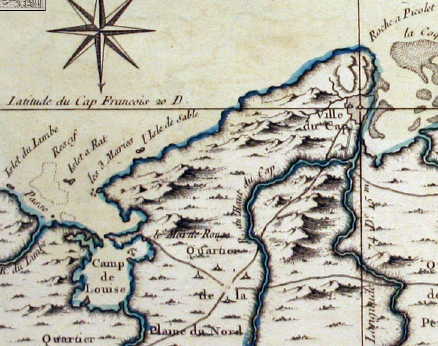
French map of Cape Francois dated 1722 adds Le Limbe, the first area which the rebel slaves put to the torch; and Le Chemin du Cap, the main road to the valleys of the south.

haiti Ponce
This 1796 French map features another sailor’s aid, Pointe Tête de Chein (trans. Dog’s Head Point). The fortification battery on the Cape was built upon Roche à Picolet. This map was drawn after the rebellion of 1791. The Morne Rouge (trans. Red Heights) is now designated as Ravine du Morne au Diable and the Acul à Sabal. The Devil’s Ravine is the present location of Royal Caribbean’s Labadee.

The poor of Haiti are still taking heat for the Bwa Kayiman having been a pact with the devil.

haiti bellin
I add this 1764 map for personal interest. Few maps even today mark L’Islet à Rat (trans. Rat Island), which Columbus called La Amiga, was an aid to navigation out of his anchorage at Bay of Acul which he called Cabo de Caribata.

This map also details how colonial French St Domingue was divided into districts, here the Ville du Cap, the Quartier de Plaine du Nord and Camp de Louise.

haiti moreau
This 1770 map of Cap François and Environs distinguishes the larger slavery plantations.

haiti labadi

On the subject of Columbus, isn’t it surprising to reconcile the current verdict on his genocidal behavior, with the histories which have glorified his stature? After all, the primary accounts have never changed. How did earlier biographers overlook the damning and salacious details? One very polite telling of Columbus’ adventures, written by Filson Young published in 1906 provides a prim example. Here Young addresses the kidnap and rape of the indians whom Columbus encountered:

…his taking of the women raises a question which must be in the mind of any one who studies this extraordinary voyage—the question of the treatment of native women by the Spaniards. Columbus is entirely silent on the subject; but taking into account the nature of the Spanish rabble that formed his company, and his own views as to the right which he had to possess the persons and goods of the native inhabitants, I am afraid that there can be very little doubt that in this matter there is a good reason, for his silence. So far as Columbus himself was concerned, it is probable that he was innocent enough; he was not a sensualist by nature, and he was far too much interested and absorbed in the principal objects of his expedition, and had too great a sense of his own personal dignity, to have indulged in excesses that would, thus sanctioned by him, have produced a very disastrous effect on the somewhat rickety discipline of his crew. He was too wise a master, however, to forbid anything that it was not in his power to prevent; and it is probable that he shut his eyes to much that, if he did not tolerate it, he at any rate regarded as a matter of no very great importance. His crew had by this time learned to know their commander well enough not to commit under his eyes offences for which he would have been sure to punish them.

[Giving a list of instructions to the men Columbus planned to leave behind at La Navidad, among them: ]

…and especially to be on their guard to avoid injury or violence to the women, “by which they would cause scandal and set a bad example to the Indians and show the infamy of the Christians.”

no kolumbus day christopher columbusAnd here’s the rub. In this passage the author shows if we do not absolve Columbus, we indict ourselves.

The ruffianly crew had in their minds only the immediate possession of what they could get from the Indians; the Admiral had in his mind the whole possession of the islands and the bodies and souls of its inhabitants. If you take a piece of gold without giving a glass bead in exchange for it, it is called stealing; if you take a country and its inhabitants, and steal their peace from them, and give them blood and servitude in exchange for it, it is called colonisation and Empire-building. Every one understands the distinction; but so few people see the difference that Columbus of all men may be excused for his unconsciousness of it.

Ward Churchill to speak for O’odham

O'odham rightsAccording to Censored News, Activist and scholar Ward Churchill will speak at the Unitarian Universalist Church of Tucson, 4831 W. 22nd St., on November 13, 2009 at 7:00 p.m. to benefit O’odham VOICE Against the Wall, which since 2003 has organized and advocated for the traditional O’odham leaders and elders of the Tohono O’odham communities in the southern territory of the United States and northern territory of Mexico. Professor Churchill’s talk is part of the “Apartheid in America: Surviving Occupation in O’odham Lands”

O’odham activist Ofelia Rivas will also participate. The event is sponsored by the Dry River Radical Resource Center, the Earth First! Journal, and Voices against the Wall.

Here’s some background on the O’odham struggle:

pamphlet cover illustrationBy J. D. Hendricks, 2004
TIAMAT PUBLICATIONS #5

The People Who Emerged From the Earth

Over two thousand years ago the descendents of the O’odham moved into the southwestern region of the area now claimed by the U.S. as the state of Arizona. 1 The O’odham have had one of the longest histories of contact with the forces of European colonization compared with the rest of the native North American peoples. The O’odham’s first contact with Spanish invaders took place in the mid 16th century; nearly one hundred years before the colonization of the North Atlantic coast and Great Lakes regions were begun by the French and English colonists. As such, the history of the O’odham provides a good context for an investigation of the colonization of Native North America, and more specifically, an investigation of the interplay between, and results of, the varied responses to colonization – that of collaboration, accommodation, and resistance.

Many histories of the O’odham refer to these desert people as the Papago. The term Papago was a name given to the O’odham by the Spanish colonizers, and is likely the result of a Spanish corruption of the O’odham word “papabi” which was the O’odham name for one of their principal bean varieties. Thus, the Spanish colonizers term for the O’odham (Papago) came to mean “the bean eaters.” 2 For the purposes of this study I will refrain from the use of the term Papago and will refer to “the people” 3 by their traditional pre-colonial name. 4

As is often the case, with the name Papago being a good example, European constructs are often imposed upon indigenous peoples by the historians that seek to portray their past. This result can occur when historians seek to glorify European norms and traditions at the expense of indigenous ones, and can also be the result of the subconscious indoctrination of the historian by the dominant culture – in this case that of western style industrial civilization. In other cases it can be the result of a simple uncritical usage of language.

One of the most dominant and reoccurring “civilized” constructs imposed upon indigenous peoples history is the commonly understood notion that the O’odham, or any other indigenous North American culture for that matter, existed as a totality or uniformed mass. This study will seek to use the history of the interaction between the O’odham peoples and the United States, both its government and its peoples, to deconstruct this myth of the totality and provide a history of the O’odham’s varied responses to colonization from an anti-colonial and anti-industrial perspective. By investigating various important case studies in O’odham history, and looking not only at resistance but also accommodation and collaboration, it is hoped that this work will help to provide a more realistic historical picture of the effects of colonization, and the intentions and reactions of both the colonizer and the colonized. Within the previously stated context and theoretical framework, this study will argue that while the O’odham responded to the U.S. invasion of their lands in various ways, the choices to resist, accommodate, or collaborate with the forces of colonization did not affect the overall U.S. policy concerning the O’odham – that policy being the eventual total assimilation of the O’odham into the dominant “civilized” industrial system. 5

This investigation will include a strong focus on O’odham resistance to colonization, as any anti-colonial history should, however it will not discount or ignore the many historical occurrences of accommodation, and in some cases outright collaboration, with the colonizers. It is important to always keep in mind that none of the actions and reactions in any of the case studies looked at are attributable to the O’odham as a “totality,” but rather are attributable only to the various groupings of O’odham, be they incarnated in the form of the individual, the clan, the village, an economic or spiritual grouping, or an established political organization.

A God of Civilization and Coercion Comes to the O’odham

The O’odham’s first encounter with Spanish invaders took place in the mid sixteenth century when a group of conquistadors led by Alvaro Nunez Cabeza de Vaca entered O’odham territory in search of gold. These men did not find the riches they were looking for and left the desert region to return to the Spanish colony. However, soon after word spread of the O’odham villages on the northern periphery of the Spanish colony, missionaries began to travel north to bring God and “civilization” to the native people residing there. By 1686, Catholic missionaries had formed a few small missions in O’odham territory using what they believed to be the influence of their soft power 6 techniques to lure the O’odham into their missions where they were then subjected to a rigorous schedule of cultural indoctrination. Most O’odham historians, including Winston Erickson, 7 and to a lesser extent, Bernard Fontana 8 have, during this time period, focused on the O’odham who chose to reside nearby and within these early missions, thus painting a picture of the O’odham as accepting of Spanish influence and cultural indoctrination.

However a closer look at this time period reveals that mission O’odham were only a small percentage of the total population of O’odham residing in the Sonoran desert 9 and that the ones who were there may not have been so for the reasons that the colonizers believed. San Xavier del Bac, the largest mission in O’odham lands, as well as many other missions, took advantage of the fact that the desert O’odham migrated in the dry winter months to the Northern Piman settlements along the rivers to work the small farm plots for sustenance. 10 The Catholic missions inserted themselves into this traditional pattern. Those O’odham who worked and lived near the missions were, for the most part, seasonal residents, which shows that the missions were viewed merely as being of utilitarian value. Thus, the O’odham as a totality were not necessarily accommodating to or interested in anything the missionaries had to offer per se, and when the missionaries began to employ “hard power” techniques and abuse or overstep the grounds for their welcome it did not go without consequence. 11

Accommodating and ignoring the missionaries was not the only response to colonization practiced by the O’odham during the seventeenth and eighteenth centuries. Although historians such as Erickson feel that “the missions did serve the O’odham well….,” 12 that assertion is contradicted by the fact that there were many large scale rebellions waged against the missions from outside and from within. In 1695, 1751, 1756, and 1776, large scale rebellions occurred in which missionaries were killed and their missions burned to the ground. 13 In some cases these rebellions were the doing of joint O’odham/Apache alliances, which is significant considering that many histories of the O’odham and Apache portray them as immemorial enemies. This may be the result of the fact that by the early nineteenth century the Spanish government initiated a campaign of divide and conquer that was continued later by the Mexican and U.S. governments to turn the O’odham and Apache against one another, thus easing the project of their subjugation.

A Change in the Occupation Government: Washington Enters O’odham Lands

In 1821, Mexican Independence from Spain was achieved and interest in the O’odham dropped away nearly entirely. By 1828, the new and secular Mexican government began the process of shutting down the missions in O’odham territory and by 1842, the last of the missions were closed. Soon after, in 1846, the United Stated initiated a war for territorial expansion against Mexico. This war was not of immediate consequence to the O’odham peoples. Isolated in desert regions, the fighting between the two occupation powers affected them little in the short run. However, the signing of the Treaty of Guadalupe Hidalgo in 1848, which ended the war, would lay the foundations for a series of disastrous events which would affect the O’odham in very negative ways.

Of greatest consequence to the O’odham was the fact that the boundary between the United States and Mexico was not finalized by the treaty of Guadalupe Hidalgo. The boundary was designated by Article Five of the Treaty as being an arbitrary line roughly following the 32nd parallel, an area which runs through the southern part of modern Arizona. To the east, the border was provided by the Rio Grande. The exact boundary line along the 32nd parallel was to be decided at a later date. It is also important to note here that the Treaty also provided that all Mexican citizens absorbed by the United States were to be granted U.S. citizenship, which included all indigenous peoples in the annexed territory since under Mexican law they were considered citizens. In the treaty the United States also assumed the responsibility for preventing cross border raiding into Mexico by the southwestern tribes, specifically the Apache. 14

In the aftermath of the signing of the treaty of Guadalupe Hidalgo, it became quickly apparent that an acceptable border between Mexico and the United States along the 32nd parallel would not be achieved. An official survey expedition was assembled by the United States and Mexico in 1849 to trace out the boundary between the two countries with little success. Various borderlines were agreed to and then abandoned and re-made by the United States, sometimes in a unilateral decision that dismissed the positions of the Mexican government altogether. 15

The principal concern for the United States was to secure title to an area of land in northern Sonora, Mexico that was ideally suited for the construction of a portion of the southern continental railroad whose building was being discussed in the U.S. Congress at the time. One of the main advocates for this southern railroad route was a South Carolina man by the name of Colonel James Gadsden. Gadsden’s history of connections to powerful business, military, and political leaders is very interesting and his appointment by the United States to be Minister to Mexico in 1853 serves as a very informative source to gauge the United States’ intentions towards Native Americans and the O’odham in particular.

James Gadsden was born into an influential southern family and graduated from Yale University. After enlisting and serving in the war of 1812, Gadsden was sent to the Florida territory with Andrew Jackson to aid in the campaign of removal and extermination being waged against the Seminole Indians, which took place from 1816-1818. After this war against the Seminole, Gadsden was appointed by President Monroe as commissioner to oversee the removal of the Seminole Indians to Indian Territory. Like the more famous removal of the Cherokee, the removal of the Seminole, and the high death rate suffered as a result, unarguably constituted genocide. 16 As a reward for a job well done, Gadsden was appointed by Monroe to a seat on the legislative council of the territory of Florida, thus beginning Gadsden’s political career. In 1840, Gadsden was elected President of the Louisville, Charleston, and Cincinnati Railroad. In 1853, the Secretary of War, an ardent white supremacist and slavery defender by the name of Jefferson Davis, appointed Gadsden to be Minister to Mexico. 17 As Minister to Mexico, one of Gadsden’s primary missions was to negotiate a final demarcation of the boundary between the U.S. and Mexico. Although Gadsden was a zealous believer in Manifest Destiny, his ideas concerning racial Anglo-Saxonism 18 caused him to be an opponent of the total annexation of Mexico. Gadsden, like many racist U.S. politicians of that time, felt that the total absorption of Mexico and its non-Anglo population into the United States would pollute the Anglo bloodline too much and thus he sought only to gain enough territory for the United States to build the southern pacific route. 19 Thus, a man who had presided over a war of genocide against the Seminole Indians, was a devout racist, and who had obvious conflicts of interest due to his connections to the railroads, was put into a position to determine the territorial boundary between the United States and Mexico and in the process also determine the boundaries of the O’odham’s land. With its appointment of Gadsden, the intent of the U.S. government could not be clearer. Business interests and territorial expansion were to run roughshod, by any means necessary, over any native peoples who stood in the way.

It is no surprise that when James Gadsden finally successfully negotiated a treaty with Santa Anna to secure what is now the southern portion of Arizona, the O’odham were not consulted. In fact, the Gadsden Treaty, signed into law in 1853, did not contain any mention of the O’odham at all. Considering that the new boundary line put in place by the Gadsden Treaty literally split the traditional O’odham lands in two, it is obvious that the intentions of the United States were in no way benevolent. Here it is also important to point out that the terms of the Gadsden Treaty specifically included the same citizenship provisions which were spelled out in the earlier Treaty of Guadalupe Hidalgo. 20 Although the Gadsden treaty was of great significance for the O’odham, their isolation and the outbreak of the Civil War enabled them to live another decade in relative isolation from Anglo encroachment.

Assimilation, Cultural Destruction, Double Speak and Ordained Genocide

The causes which the Almighty originates, when in their appointed time he wills that one race of men – as in races of lower animals – shall disappear off the face of the earth and give place to another race, and so on, in the great cycle traced out by Himself, which may be seen, but has reasons too deep to be fathomed by us. The races of the mammoths and mastodons, and the great sloths, came and passed away: The red man of America is passing away!
–United States Congress Committee on Indian Affairs report, 1865. 21

No doubt with similar justifications in mind as those of the Committee on Indian Affairs, Anglo settlers began their invasion of O’odham lands less than a year after the conclusion of the Civil War. The Homestead Act had opened up the lands of Southern Arizona to Anglo squatters and in 1866, one of the first of many bills was passed by Congress granting mineral rights to any citizen who claimed them. 22 Every one of these homesteads opened and every resource extraction operation initiated without the express consent of the O’odham represented an illegal action under the Gadsden Treaty. The citizenship provisions of the Gadsden Treaty had granted citizenship to all former Mexican citizens and the O’odham were, by legal definition, included in this formulation. The United States, however, refused to consider “uncivilized” peoples as being worthy of the protections granted to citizens by the fourth amendment of the U.S. Constitution, which prohibits the expropriation of property. This refusal of the United States government to follow its own laws pertaining to Native Americans when those laws happen to stand in the way of U.S. interests has been a common occurrence in United States Indian policy. This land grab was only the first of many illegalities committed against the O’odham people by the United States and its citizens. In this respect the O’odham are in a special position when compared with many other tribes. While the theft of native lands by the United States Government was usually legally justified by treaty stipulations signed between a tribe and the U.S. government, this justification could not and cannot be used in the case of the O’odham since no treaty was ever signed with the O’odham by the United States Government. 23

For the most part, the O’odham did not resist this initial incursion of Anglo settlement, rather the O’odham practiced accommodation and moved farther out into the desert to shield themselves from the new settlers invading their lands. Traditional ways were maintained with the exception of the introduction of cattle ranching. The O’odham territory was well suited for the raising of cattle and a good number of O’odham became cattle ranchers, both for purposes of subsistence as well as for sale to Anglos residing in and around Tucson. In the 1880s, as increasing numbers of Anglo cattle ranchers began to invade and take over their pasture, some O’odham began to resist.

The O’odham resisted by stealing the Anglo cattle herds which were rounded up and driven south to be sold on the Mexican market. The expropriation of Anglo cattle herds was not isolated, and it became a major concern for the settlers and the government. In at least one case, a large cattle outfit was driven out of business. 24 The concern over this outbreak of O’odham theft of Anglo cattle was large enough that newspapers as far away as Los Angeles ran stories about the phenomenon. For the most part these stories seem to have been deliberately used to justify the enclosure of the O’odham into reservations as the government and Anglo cattle ranchers seized the opportunity to gain even more O’odham land by arguing that it was an unfair burden for the Anglo cattle ranchers to have to “support” the O’odham. 25 Here, in previous case study, we have another common attribute of U.S. Indian policy in general, and one which occurs again and again in the history of O’odham contact with the U.S. government and Anglo settlers – blaming the victim.

Another official position of United States Indian policy during this time period was that everything done to the Indians was, in the words of Indian Commissioner J. Q. Smith, in their own “best interests.” 26 Whether this obvious sham was based on a subconscious guilt and delusion or was a cynical example of “double-speak,” it is obvious that Native American’s best interest’s were the last thing on the government’s mind. Nevertheless, with this reasoning as justification, the first official reservation for the O’odham was created by executive order of President Grant on July 1, 1874. This small reservation surrounded the Old Catholic mission at San Xavier del Bac. It is estimated that only about ten percent 27 of the desert O’odham took up residence within this reservation – these were labeled as “civilized” O’odham by U.S. census takers. The vast majority of O’odham were labeled as “wild” and continued to live in the vast desert regions west of San Xavier del Bac. While it is obvious that the desert O’odham were resisting cultural assimilation by avoidance, even the mission O’odham maintained a resistance to European culture as the next example will illustrate.

While visiting the old mission at San Xavier a newspaper columnist from the Los Angeles Times wrote that upon her visit in 1882, she could see “not a single civilized human habitation within miles.” This writer goes on to state that the O’odham’s dwellings were in the form of “conical mud huts.” In the casual racism and Social Darwinist rhetoric of the period she also adds that,

“The Papagos are but little in advance of gophers and prairie dogs in their habitations.” 28

The point is that after more than 200 years of European influence, even the mission O’odham continued to build their traditional shelters. 29

Progressivism and Cultural Genocide: The Dawes Act

In 1887, the General Allotment Act, also known as the Dawes Act, was signed into law. The Dawes Act was the staging point for the forced assimilation of those remnants of Native American groupings which had not been totally decimated by the preceding period of “Indian Wars” and forced relocations. The essential function of the Dawes Act was to disrupt traditional tribal land holding patterns and thus force Native Americans into the Anglo system of private property. The O’odham, like most other Native American cultures, did not have a concept of private property – land was held in common for the benefit of the village group. Communally held land was an essential pre-requisite for their Anarchistic political system and extremely de-centralized tribal structure. 30

The first section of the Dawes Act provides for equal “sections” of land to be parceled out to each “head of family.” This head of family was always understood to be the father of each family when land was allotted. Thus, this first section of the act not only attempted to destroy the communal land system of Native Americans, it also instituted Patriarchy as the basis for social functioning in Native America. 31 In addition, Section Five of the Act also provides that any un-allotted lands be subject to purchase by the United States government. Section Six and Seven provide that all monies paid by the U.S. for un-allotted Native lands be held for each tribe by the U.S. Treasury and “subject to appropriation” by the U.S. government to repay itself for the implementation of allotment as well as to provide for the “civilization” of Native Americans. 32 In less veiled words, these sections are basically stating that Native Americans will be forced to pay for their own cultural annihilation.

This interpretation of the intent of the Dawes Act becomes clearer when one looks at the arguments and debates that took place in Congress and within self described progressive “Indian rights” groups such as the Indian Rights Association. Critics of the Dawes Act in Congress such as Rep. Russell Errett understood that

“the main purpose of this bill is not to help the Indian troubles so much as it is to provide a method for getting at the valuable Indian lands and opening them up for settlement.” 33

And Senator Dawes, the namesake of the final bill, speaking of the land and resources of Native Americans stated that

“civilization has got after these possessions with a greed never before equaled but it is idle to expect to stay it….” 34

As for the progressive Indian Rights Association, they argued that

“the organization of the Indians into tribes is, and has been, one of the most serious hindrances to the advancement of civilization, and that every effort should be made to secure disintegration of all tribal organizations….” 35

And one of their leaders, Reverend L. Abbott, provided justification with the statement:

“Barbarism has no rights which civilization is bound to respect.” 36

So here we have a self-proclaimed progressive Indian Rights organization arguing for cultural genocide and against the notion that Native Americans have any rights that civilized people are bound to respect! This conclusion provides a perfect example of the essence of “progressive” or “civilized” thought.

The Dawes Act had a much less devastating effect for the O’odham than it did for many other Native American tribes. At the time of its passage, the only official reservation for the O’odham was the San Xavier reservation which, as was stated earlier, was only a small 71,090 acre reservation around the old mission San Xavier del Bac. When the allotment agent came to San Xavier in 1890, he allotted out 41,600 acres of land to the 363 O’odham whom he counted in his census as being resident at the time. 37 The vast majority of the O’odham still continued to live west of San Xavier in the expansive desert regions and were little affected by the allotment schemes. Even those O’odham who lived in San Xavier and were allotted land paid little attention to the artificial boundaries drawn on paper which supposedly privatized their land – they continued to farm and graze the land communally. 38 This refusal to abide by the provisions of the Dawes Act is also a form of resistance to cultural assimilation and adds one more example to show that for those O’odham who resisted, the most often employed method of resistance was non-compliance and avoidance. This specific response to colonization was made possible by the isolation and expansiveness of their desert home, which many Anglo’s continued to view as a “hopeless desert.” 39

The Domestication of the “Wild Papago”

The vast majority of the O’odham continued to resist assimilation and maintained a fairly traditional lifestyle – minus the introduction of cattle herding and horse rearing. In the twenty years following the passage of the Dawes Act, a growing effort was made to enclose the “Wild Papago” 40 and forcibly strip them of their traditional culture and instill them with the “civilized” values of the industrial Anglo. As was mentioned previously in the paper, ranchers and the government used O’odham cattle theft from Anglo ranchers as one tool to justify the enclosure of the O’odham within a reservation. During this period, Anglo Cattle ranchers continued to encroach deeper and deeper into O’odham territory and scuffles began to break out.

In another classic example of the “blame the victim” tactic, a pro-enclosure story was printed in the Los Angeles Times, no doubt to build public pressure for the domestication of the “Wild Papago.” The story concerns a group of O’odham who had resisted an Anglo cattleman’s attempts to enclose one of their water sources. When these O’odham continually tore down the fence that this cattleman had built, the rancher filed a report with the local Indian Agency sheriff to have the men arrested. When the sheriff arrived to arrest the O’odham responsible for defending their water source, he was taken hostage. The sheriff was later released unharmed; however, the incident was used to make the argument that such troubles can only be expected to increase if the O’odham were not enclosed on a reservation where they could be more easily controlled and monitored. 41

The tactic of occupying and diverting natural water sources was one of the tools used by the Anglo settlers and government to destroy the self sufficiency of the O’odham and force them into reservations where they would be dependent on the government for their water and would thus be easier to control and monitor. Some of the O’odham clearly understood what was happening, which is evidenced by instances of resistance both to the enclosure of natural water sources as well as resistance to the drilling of wells. One example of the U.S. government using water as a tool of forced cultural assimilation can be found by looking at an event recorded by an O’odham calendar stick 42 keeper. In 1912, the O’odham residing in the village of Santa Rosa, an isolated and traditional village in the western desert region of O’odham territory, were paid a visit by an Anglo Indian Commissioner who wished to drill a well for them. The Chief of the village objected to the drilling of the well on the grounds that it would disturb their culture, their autonomy and their self-sufficiency. The government agent proceeded to have the well drilled anyway. Upon completion of the well, the Chief of the village, according to the calendar stick keeper, stated that

“the well must be left alone and, in order that the Papagos might continue their old life, water must still be carried from the spring in the foothills.” 43

However, the prohibition by the Chief could not be upheld due to the overwhelming convenience of the new well and after a period of abstaining from its usage, the village of Santa Rosa (including the Chief) gave in and thus was assimilated into the industrial system by being made dependent on the Government well. 44 During this same time period, encroaching Anglo farmers engaged in the diversion of O’odham water sources to irrigate their farms. This practice served as another method of forcing the self sufficient O’odham into a relationship of dependence upon the government. In many areas so much water was diverted that the O’odham could no longer grow their traditional summer crops. 45

In 1919, the first incarnation of an O’odham reservation to enclose the nearly two million acres of desert that the “Wild Papago” were residing in was established. The formation of the desert O’odham reservation in 1919 ushered in a period of exponentially increased government interference in O’odham matters, and of course, the various forms of coercive assimilation were multiplied. By 1933, thirty-two unwanted wells were drilled all over the new reservation. 46 The well drilling was often opposed by those who were trying to maintain the O’odham Him’dag – the traditional ways of the desert people.

Resistance and Collaboration: O’odham Responses to Forced Modernization

In contrast to the traditional O’odham who had maintained resistance to cultural assimilation for the past 300 years, there was also a small number of O’odham based in the new reservation that welcomed collaboration with the forces of Anglo modernization and advocated for cultural accommodation and in some instances for total cultural assimilation. These men would later form an organization called the Papago Good Government League, which would serve as the propaganda arm of the Bureau of Indian Affairs and government policy in general. The leadership of this new faction had been taken from their families as youths and placed in Protestant boarding schools to be culturally indoctrinated. The Tucson Presbyterian Training School was one of the indoctrination centers where many future members of the Good Government League had been sent. 47

Religious indoctrination, whether Catholic or Protestant, has always been one of the most powerful tools of colonization and its justification used by European invaders against the indigenous peoples of the Americas. The necessary counterpart to the forced indoctrination of Christian principals and morals has always been the repression of indigenous spiritual practices. The United States government understood the profound power that traditional spiritual practices had in maintaining group solidarity and cohesion and it is for this reason that such spiritual practices were made illegal and repressed historically. In 1883, a Court of Indian Offenses was established by congress at the request of Secretary of Interior Henry M. Teller to eliminate traditional spiritual practices. In a report to the commissioner of Indian Affairs, Teller laid out his goals and his rationale stating that,

“If it is the purpose of the Government to civilize the Indians, they must be compelled to desist from the savage and barbarous practices that are calculated to continue them in savagery….”

Teller went on to associate those who resisted the repression of their spirituality with the “non-progressive” faction of Indians and labeled traditional spiritualism as “debauchery,” “diabolism,” and “savagery.” The overarching argument of his letter is that in order to civilize the Indians and bring them into the industrial system, their traditional spiritualism must be destroyed. As an initial step towards this end, Teller advised that Medicine Men be “compelled” to desist from their practice of “deception.” 48

Although the Court of Indian Offenses advocated that coercion be used to repress and destroy indigenous spiritualism, it failed to succeed in this project even when it used force to try to stop traditional spiritual rituals. According to Historian Edward Spicer, the only thing the Court succeeded in doing was driving traditional spiritual practices underground. In the case of many resistant O’odham, traditional spiritual practices were continued without regard to regulations or prohibitions against them, and in many cases, federal authorities resorted to repression and arrest to try to stop these practices. One traditional spiritual practice of the O’odham which was particularly hated by the Protestant Missionaries and Indian Agents was the Vi-kita ceremony.

The Vi-kita ceremony of the O’odham has been written about and studied by many Anglo historians and anthropologists, the most prominent being Columbia Anthropologist Ruth Underhill. 49 Before going into a short description of the Vi-kita it is important to understand that this ceremony varied depending on who was conducting it and where it was being conducted. Peter Blaine, an influential O’odham man sympathetic to the traditional ways, wrote in his autobiography about Underhill’s methods. Blaine explained the traditional way for the O’odham to tell about their past was to do it

“in a group so that everybody had a chance to talk and tell it their way. Underhill was talking to just one man…Dr. Underhill was wrong all the way in how she got her information.” 50

As scholars from the dominant culture often do, Underhill had applied her own notions of hierarchy, authority and individualism to her work with the O’odham and totally disregarded their traditional methods of conveying information in a communal fashion.

The Vi-kita itself was a yearly rain and fertility festival preformed to initiate and give thanks for the yearly summer rains. The ceremony itself consisted of the communal singing of rain songs, dancing, intimate encounters, and the consumption of Navait (Saguaro wine), an alcoholic drink made by the fermentation of Saguaro Cactus buds. The consumption of this wine was meant to symbolize the connection between the sky and the earth. The intake of the Navait was representative of the earth’s intake of rain. Participants drank Navait until vomiting occurred as this act embodied the clouds issuing forth rain unto the earth. It was a powerful ceremony that bonded the O’odham with the elements of nature.

When Protestant missionaries, and a small number of Protestant O’odham in the Good Government League, backed by U.S. Indian Agents, began their attempts to usurp power on the newly formed western O’odham (Sells) 51 reservation in the early 20th century, one of the first things they attacked was the practice of the Vi-kita ceremony. In the early 1930s, Peter Blaine explained that the traditional O’odham from the San Xavier reservation would travel to the western reservation for the Vi-kita. He states that,

“In the late 1920s the government tried to stop this wine drinking ceremony on the Sells reservation. But no Papago or Agency police could ever stop it.”

In one instance Blaine tells the story of how he helped defend three traditional O’odham Vi-kita ceremony leaders when they were arrested by agents from the Indian Bureau and jailed in Tucson. During the trial, a group of Protestant O’odham men from the Good Government League 52 argued for the repression of the ceremony – one of these men, Richard Hendrix, would continue to plague the traditional O’odham in future encounters. To respond to the collaborationist Good Government League, the resistant traditional O’odham formed the League of Papago Chiefs to counter the attempts of the Protestant Good Government League to usurp control on the reservation. 53

The Indian Reorganization Act and O’odham land rights

On June 18th, 1934, President Roosevelt signed into law the Indian Reorganization Act which finally stopped the forced allotment process initiated by the Dawes Act in 1887. The Indian Reorganization Act was viewed by its proponents as being in the best interests of the Indians. One of the reasons for this view was the fact that the Dawes Act and its forced allotment provisions had resulted in the loss of 90,000,000 acres of tribal lands and it was hoped by some, including then Indian Commissioner John Collier, that the Indian Reorganization Act could be used to regain some of this lost land.

The public was also encouraged to view the Indian Reorganization Act as being beneficial for Native Americans. A large article in the Los Angles Times entitled “The Bill to Return Indian Rights” stated that:

“After a century of graft, plunder and injustice, this bill has the objective of handing their own souls back to the Indians.” 54

However, such optimism and notions of cultural relativism were not held by all. As a precursor to the Indian Reorganization Act, a report was prepared for the Secretary of the Interior in 1928 to lay out the need for a change in Federal Indian Policy. The report stated that the “great majority of Indians are ultimately to merge into the general population” and that it was the government’s responsibility to assimilate Native Americans into “white civilization” because “the hands of the clock cannot be turned backwards.” Sympathetic attempts to help Native Americans retain their culture were stigmatized as attempts to “preserve them as museum specimens.” 55 Indian Commissioner John Collier was one of those who believed that Native Americans should retain their culture and that “the awakening of the racial spirit must be sustained….” 56 However, although the finalized Indian Reorganization Act did contain elements that were meant to “help” Native Americans, many of its articles were still designed to impose “civilized” systems on Native Americans.

It can be argued that the intent of the finalized Indian Reorganization Act was to initiate a new chapter in the push for the total cultural assimilation of the Native American tribes. The argument that there was no qualitative change between the Dawes Act and the Reorganization Act is legitimate. The Indian Reorganization Act provides the examples for the argument. The main tool of assimilation in the Indian Reorganization Act was the provision in Section 17 which allowed for Native American tribes to form their own tribal governments, constitutions and laws which, although it is not specifically stated, were intended to be Anglo in structure and functioning. In the case that these native governments were not sufficiently acceptable to the U.S. government, section 17 also provided that all Tribal Government formations must be “approved by the Secretary of the Interior.” 57 This clearly shows that the intent of the Act was not to allow Native Americans to become fully autonomous, either culturally or politically. For a tribe such as the O’odham, which had a long history of decentralization and consensus decision making, the imposition of western style liberal democracy, with its attendant centralization and majority rule system, was an obvious method of forced cultural indoctrination. Peter Blaine, who was mentioned earlier, was an O’odham man who had sympathy for the traditional, decentralized and communal way of O’odham societal organization. When the collaborationist Papago Good Government League began to maneuver themselves into the position of representing all of the O’odham, Blaine took it upon himself to lead the charge to discredit their assertions to business interests and the Federal Government that they represented the O’odham. Blaine wrote that:

“This so-called council represented only their own church people, but they took it upon themselves to become a council for all Papagos. They had meetings. Nobody attended them but these four guys because most people didn’t recognize them as leaders.” 58

In 1934 Blaine, along with another O’odham from the Gila Bend reservation named Leon Pancho became the first O’odham to travel to Washington D.C. These two men were sent as representatives of the traditional chiefs of the O’odham villages to argue against a recent court order that closed the Sells reservation to outside, Anglo owned, mining. The court order was a result of a lawsuit brought by the members of the Good Government League, including Richard Hendrix, who had teamed up with outside lawyers. These lawyers were to receive as payment a ten percent share of all land reclaimed from the mining companies, or a monetary equivalent. As this entire procedure was done behind the backs of the majority of the O’odham, when it was revealed, there was great resentment towards the Good Government League by many of the O’odham.

While in Washington D.C., Blaine was informed of the pending Indian Reorganization Act, and he became a supporter of the Act due to its provision allowing for the self government of Native Americans, as well as a provision in section Six that allowed the Secretary of Interior to manage mineral, mining, and livestock on the reservation. 59 In the case of the O’odham this meant that the reservation would be re-opened to mining and they would regain an important means of economic sustenance. According to Blaine, the mines were an important economic resource for the O’odham as they provided jobs and a market where beef and other O’odham products could be sold. 60 This is yet another unfortunate example of how the incursion of Anglo industrial technology served to destroy the self-sufficiency of the O’odham by making them dependent on it for survival.

Whether or not the mines were truly in the best interest of the O’odham is a complex topic which cannot be dealt with here. However it should be stated that Blaine and his companions’ trip to Washington D.C. was financed by the Tucson Chamber of Commerce, an organization that functioned in support of the mining interests, not the O’odham. This Tucson Chamber of Commerce was the same organization that had aggressively petitioned President Wilson to rescind his 1916 act forming the Sells reservation because it prevented Anglo agricultural interests from exploiting the area’s “best agricultural and grazing lands.” 61

Resistance to and Collaboration with the “White Man’s War”

Not long after the passage of the Indian Reorganization Act and the formation of the first O’odham Tribal Government, the United States declared war on Japan, thus entering World War II. The participation of Native Americans in World War II has been well publicized, especially the role the Dineh (Navajo) played as code talkers in the South Pacific. The United States government and the mainstream media portrayed Native Americans as being eager to fight for their homeland, and eager to assimilate into “white civilization” once they returned from the war. Nearly 25,000 62 Native Americans served in the United States military during World War II, many of whom were no doubt under the impression that their service would be rewarded with increased “rights” after the war’s end. Instead, as a “reward” for Native Americans participation in World War II the United States government established the Indian Claims commission in 1946 to legalize the U.S. occupation of Native American Lands never granted to the U.S. by treaty, passed House Concurrent Resolution 108 to terminate tribal recognition as separate entities from the Federal Government, and then instituted a plan in 1954 to relocate Native Americans off the reservation and into “Indian Ghettos” in the nation’s large cities. 63 These were the “rewards” for participation in World War II.

Like many other Native American Tribes, some of the O’odham Nations members participated in World War II. Ruth Underhill claims that the O’odham enlisted to serve in World War II “in droves” 64 and it is documented that the O’odham tribal government bought $10,000 in war bonds. 65 However, the extent of this involvement was distorted by the media, academia, and even some of the O’odham leaders in the tribal government. Richard Hendrix, a former member of the collaborationist Good Government League, had risen to prominence in the new O’odham tribal government by this time and was interviewed by the Arizona Archaeological and Historical Society on November 16, 1942. In this interview Hendrix exposed the extent to which he had allowed his mind to be colonized and assimilated into that of the dominant white culture. Speaking of colonization in general and World War II in particular, Hendrix stated that the O’odham had:

Learned to love the American government and they learned to love the Stars and Stripes. And when the war came and the time came for our boys to be registered, there was no exception. They registered just the same as white boys did. And now they are out fighting alongside the white boys, the American boys. They are just as anxious as the white boys to kill as many Japs, to kill as many Germans, and they are very anxious to win this great war so that the Papago people in this desert land may continue to enjoy the freedom of their homes. 66

Hendrix’s internalization of white supremacist racial notions is a heart breaking and shocking example of the extent to which he had accepted the ideology of “white civilization.” In addition, his assertion that every O’odham boy registered for the war with “no exception” is glaringly false.

Aside from the fact that there are always exceptions to everything, there was also a large scale organized resistance to World War II led by an old Chief and medicine man, Pia Machita, and his band of traditional O’odham who resided in an isolated village in the north western area of the Sells Reservation known as the Hickwan district. According to Peter Blaine, the O’odham residing in some of the most isolated villages in the Hickwan district had not seen a white man until the 1930s, and continued to practice the traditional O’odham Him’dag. 67 When Pia Machita was informed of the compulsory registration of young O’odham boys for induction into World War II, he instructed the youth of his village to refuse to sign the registration forms when they were visited by the local Indian Agent. Pia Machita was a very traditional leader who refused cultural assimilation and would not accept the authority of the Bureau of Indian Affairs or the O’odham tribal government. Finally, after all efforts to persuade Pia Machita’s village to register had failed, the tribal chief of police and a gang of Federal Marshals led by U.S. Marshall Ben McKinney invaded the village at two in the morning on October 16th, 1941, with tear gas bombs and guns drawn – when the Marshals attempted to take Pia Machita into custody some of the young men from the village used force to liberate him and severely beat one of the federal marshals. In the face of this resistance, the government agents and their local collaborators retreated to Tucson. When the Attorney General’s Office heard of the resistance on the O’odham reservation, they immediately got involved in the effort to repress this draft resistance movement as quickly as possible to prevent its possible spread to other reservations. By May 17th, 1941, after a period of about six months of trying to track down Pia Machita and his small band of men, Marshall McKinney and O’odham collaborators including Jose Ignacio from the tribal government, surrounded Pia Machita in the village of Stoa Pitk and took him into custody without incident. 68

Peter Blaine was the O’odham tribal chairman during the time that Pia Machita was leading the draft resistance movement. Although he did not believe that Pia Machita and his men were threats in any way, he was annoyed by what he perceived to be their stubbornness and attributed their draft resistance to his belief that they “didn’t really understand what they were doing.” 69 In reality, it was Blaine who did not understand the reasons behind Pia Machita and his men’s resistance to enlistment. Pia Machita and his men understood very well what they were doing – they were resisting giving aid to a government that they understood was their enemy. Given this understanding, and given the dictionary definition of the word “collaboration,” it becomes necessary to label those O’odham who participated in the arrest of Pia Machita as such – collaborators. The understanding that the U.S. government was the enemy of the traditional O’odham of the Hickwan district was based upon a long history of attempts by the U.S. government to force the Traditional O’odham of that area to abandon the Him’dag and embrace elements of Anglo “progress” such as dams, railroads, wells, and the protestant religion. Despite Peter Blaine’s inability to understand why the O’odham in the Hickwan district rejected Anglo-civilization in its totality, he still maintained sympathy for the people there. When Pia Machita and two co-defendants were finally sentenced to serve 18 months in prison at Terminal Island Federal Prison for their roles in leading the resistance movement, Peter Blaine eventually came to their aid and used his connections as tribal chairman to persuade the sentencing Judge to release Pia Machita early and allow him to return to the reservation and his family. 70

Conclusion

The history of the O’odham’s contact with the United States government has been one marked by a persistent current of resistance to cultural assimilation into “white civilization.” This resistance has included a variety of tactics and actions. The favored tactic of resistance to assimilation for many of the O’odham groupings seems to have been that of avoidance and feigned accommodation to Anglo culture when expedient. However, as was evidenced by the O’odham’s early history of contact with the Spanish, they did not refrain from waging armed resistance to colonization when they were pushed into a situation where other tactics might have been ineffectual.

In addition to resistance and accommodation, it has also been shown that some of the O’odham choose to engage in direct collaboration with the Anglo colonization of their lands and minds. As this paper has shown, the levels of collaborative activity amongst the O’odham varied, and so did the effects of such collaboration. When investigating instances of collaboration it is always important to understand the context which produced them and to remember that the ultimate blame for a situation of oppression should always be placed upon the group committing the acts of repression – in this case the United States government and allied business interests. It is important to show such examples of collaboration and to understand that all human cultures who have been the victim of colonization have invariably contained individuals who chose to collaborate for a variety of reasons. The O’odham are no exception to this rule. Making apologies for collaboration or failing to mention the instances where such collaboration did occur creates a historical distortion and does nothing to aid present struggles for liberation.

The O’odham responses to colonization never represented a totality, but a strong current of resistance is evident throughout their history. In regards to the United States government, it can be said, given the primary sources looked at, and the final drafts of laws signed and policies followed, that the intent of the United States government toward all Native American tribes, when it was not outright genocidal, has been the cultural destruction and absorption of remaining Native Americans into the dominant industrial culture of “white civilization.” Regardless of the varying tactics used, and the various lip service about “best interests” and “justice,” it has been shown that there has never been a qualitative change in United States policy toward the O’odham people and Native Americans in general. The O’odham have maintained aspects of their traditional culture despite the best efforts of the government to force assimilation, not as a result of such efforts. A continuing current of struggle between the forces of colonization and resistance has persisted for centuries, in all its various forms, within the minds and bodies of many O’odham and will continue until liberation.

NOTES:

1
This date is based on archeological evidence gathered by E.W. Haury in Ventana Cave. Haury, E.W. The Stratigraphy and Archeology of Ventana Cave Arizona. Tuscon: University of Arizona Press, 1950. Cited from Williams, Thomas R. “The Structure of the Socialization Process in Papago Indian Society.” Social Forces, Vol.36, No.3. p.253.

2
Fontana, Bernard L. Of Earth and Little Rain: The Papago Indians. Tuscon: University of Arizona Press, 1989. pp.37-39.

3
The name “O’odham” is roughly translated as “the people” in the Piman dialect spoken by the various O’odham groupings.

4
In 1986 the tribal government of the Papago reservation officially changed its name to the Tohono O’odham Nation.

5
The term “civilized” is a problematic historical term, and its definition tends to be very subjective. The meaning of the term and its use as a label is heavily influenced by how the author and the reader understand its meaning. For the purposes of this paper, the term “civilized” refers to the totality of the “western” cultural, political, and economic system – and most importantly the belief that technological/industrial progress is inherently beneficial and liberatory. For most, being labeled “civilized” is viewed as a positive and the label of “un-civilized” or “savage” is viewed in the reverse. However, for the purposes of this study it is imperative to understand that this author views “civilization” itself as an inherently oppressive and destructive entity, and this must be kept in mind to correctly understand the arguments and analyses in the paper.

6
The term “soft power” refers to the concept of gaining influence and control over another group by means of the attraction of the dominating group’s cultural attributes and the use of commodification rather than using military might and coercion (“hard power”) to gain that influence. See Joseph S. Nye, Jr. Soft Power: The means to success in world politics. New York: Perseus Books, 2004.

7
Erickson, Winston T. Sharing the Desert: The Tohono O’odham in History. Tucson: University of Arizona Press, 2003.

8
Fontana, Bernard L. Of Earth and Little Rain: The Papago Indians. Tucson: University of Arizona Press, 1989.

9
According to Catholic missionary records, the numbers of mission O’odham during this time period were somewhere around 2,000. However, according to population estimates there were at least 10,000 O’odham peoples living in this area. See Fontana, Bernard L. Of Earth and Little Rain . pp.11,46.

10
Fontana, Bernard L., p.40.

11
It is well documented that many of the Missions resorted to physical abuse, forced confinement and occasional murder to coerce the O’odham into compliance. San Xavier del Bac, the largest and most famous of Catholic missions in O’odham lands was built with forced labor. See Daniel McCool; “Federal Indian Policy and the Sacred Mountains of the Papago Indians.” Journal of Ethnic Studies 9.3 (1981).p59.

12
Erickson, Winston P., p.66.

13
Fontana, Bernard L., pp.61-64.

14
Treaty of Guadalupe Hidalgo, Feb 2nd, 1848. United States Statutes At Large, pp. 922-943

15
For a detailed treatment of this series of events see; Garber, Paul N. The Gadsden Treaty. Glouchester: Peter Smith, 1959.

16
For more information on the removal of the Seminole; Stannard, David E. American Holocaust: The Conquest of the New World. New York: Oxford University Press, 1992. P.124. For additional information about the Seminole Wars see; Churchill, Ward. “A Little Matter Of Genocide: Holocaust and Denial in the Americas 1492 to the Present.” San Francisco: City Lights Books, 1997.

17
All dates for the political appointments of James Gadsden are cited from Paul Garber’s “The Gadsden Treaty.” Pages 74-81.

18
Racial Anglo-Saxonism was a belief popular in the later 19th century which held that Europeans of Anglo-Saxon descent were at the forefront of evolution and were responsible to bring civilization to the world. This ideology was used as a convenient justification for the extermination and removal of Native Americans. For a detailed study of this ideology see: Horsman, Reginald. Race And Manifest Destiny: The Origins of American Racial Anglo-Saxonism. Cambridge: Harvard University Press, 1981.

19
For a detailed investigation of the role that the railroads played in the Gadsden purchase see; Schmidt, Louis B. “Manifest Opportunity and the Gadsden Purchase.” Arizona and the West, vol.3 (autumn 1961).

20
Forbes, Jack D. The Papago-Apache Treaty of 1853: Property Rights and Religious Liberties of the O’odham, Maricopa and Other Native Peoples. Davis: Native American Studies Tecumseh Center, U.C. Davis, 1979. p.1.

21
United States Congress. Joint Special Committee. Condition of The Indian Tribes. Report of the joint special committee, appointed under joint resolution of March 3, 1865. With an appendix. Washington, D.C.: United States Government Printing Office, 1865.

22
Erickson, p.77

23
During this time period many treaties were negotiated with native tribes in the regions west of the Mississippi to gain legal justification for the United States’ theft of their lands. For a detailed list of treaties signed between the United States and Native American tribes, see the compendium edited by Charles J. Kappler. Indian Affairs: Laws and Treaties. 7 volumes. Washington, D.C.: Unites States Government Printing Office, 1903-4.

24
Spicer, Edward H. Cycles of Conquest: The Impact of Spain, Mexico, and the United States on the Indians of the Southwest, 1533-1960. Tucson: The University of Arizona Press, 1962. p.138.

25
“Arizona News; Papago Cattle-thieves Brought to Justice.” Los Angeles Times. Feb 1, 1894. Also see: “Arizona News; Report Showing the Depredations Committed by Papago Indians on Stockmen’s Herds.” Los Angeles Times. June 8, 1895, In addition see; “Arizona News: Papagoes Destroying Cattle in Large Numbers.” Los Angeles Times. Mar 23, 1894.

26
Kehoe, Lawrence. “Our New Indian Policy and Religious Liberty.” Catholic World, vol. 26 (Oct. 1887). P.96.

27
Erickson p.78.

28
“Tucson And Fort Lowell; Notes of a Visitor – The Church of San Xavier.” Los Angeles Times. Nov 18, 1882.

29
The Spanish had brought the adobe style of construction to the O’odham but, although the resources for adobe construction were readily available to the O’odham at San Xavier, they continued to build their traditional grass huts.

30
For a detailed study of traditional O’odham tribal structure and life style see; Underhill, Ruth M. Social Organization of the Papago Indians. Columbia: Columbia University Press, 1939. ________. Papago Woman. New York: Holt, Rinehart and Winston, 1979.

31
For the most part, traditional Native American societies exhibited gender parallelism and were rarely if ever patriarchal by definition. For a detailed study of gender in Native America see: Allen, Paula G. The Sacred Hoop: Recovering the Feminine in American Indian Traditions. Boston: Beacon Press, 1986.

32
All direct quotations from Dawes Act. General Allotment Act (Dawes Act). February 8, 1887. Printed in its totality in: Prucha, Francis, P. ed. Documents of United States Indian Policy. 3rd ed. Lincoln: University of Nebraska Press, 2000.

33
U.S. Congress, House Committee on Indian Affairs, Lands in Severalty to Indians: Report to Accompany H.R. 5038, 46th Cong., 2nd sess., May 28, 1880, H. Rept. 1576, pp.7-10. Reproduced in: Washburn, Wilcomb E. The Assault on Indian Tribalism: The General Allotment Law (Dawes Act) of 1887. Philadelphia: J.B. Lippincott Co., 1975.

34
Letter from Henry L. Dawes to Henry M. Teller (Commissioner of Indian Affairs), September 19, 1882. Dawes Papers, Library of Congress, Washington, D.C. Reproduced in: Washburn, Wilcomb E. The Assault on Indian Tribalism: The General Allotment Law (Dawes Act) of 1887. Philadelphia: J.B. Lippincott Co., 1975.

35
Washburn, Wilcomb E. The Assault on Indian Tribalism: The General Allotment Law (Dawes Act) of 1887. P.12.

36
Washburn, p.16.

37
Fontana, pp. 77-79.

38
Erickson, p. 92.

39
“Baboquivari Peak.” Los Angeles Times. Nov 4, 1894.

40
The term “Wild Papago” was a term used by the government and media to marginalize those O’odham who continued to resist “civilization.”

41
“The Indian War Cloud.” Los Angeles Times. May 22, 1885.

42
The Calendar Stick was a device used by the O’odham as a tool to aid in the remembering of their history. The Calendar Stick itself was a cactus stick on which notches were carved at various intervals which aided the history keeper in the remembrance of events.

43
Fontana, p.54.

44
This example is meant to show the insidious nature of industrial technology and is not intended to place any blame on this specific group of O’odham for their ultimate choice to begin using the well. This example is given to show how industrial technology always comes with strings attached. In this case, once the village becomes dependent on the well they in turn become dependent on the Anglo civilization which is needed to maintain the functioning of such a well, and thus become less able to resist other Anglo incursions. In addition it must be pointed out here that the traditional water gathering procedure talked about was preformed by O’odham women. Due to this fact, some may feel that by resisting the building of the well, the male O’odham are in fact seeking to perpetuate patriarchy. It is true that the O’odham did have a system of gendered roles, but the overall system made room for exceptions and is best characterized as one of gender parallelism, not patriarchy. It is the Anglo industrial system that brought patriarchy to the O’odham. For more information see: Underhill, Ruth. Papago Woman. New York: Holt, Rinehart and Winston, 1979. Also see: Allen, Paula G. The Sacred Hoop: Recovering the Feminine in American Indian Traditions. Boston: Beacon Press, 1986.

45
Forbes, Jack D. The Papago-Apache Treaty of 1853: Property Rights and Religious Liberties of the O’odham, Maricopa and Other Native Peoples. Davis: Native American Studies Tecumseh Center, U.C. Davis, 1979. pp..5-8.

46
Spicer, p. 140.

47
Spicer, p.141.

48
All quotes taken directly from: House Executive Document no.1, 48th Cong., 1st sess., serial 2190, pp.x-xii. Reproduced in; Prucha, Francis, P. ed. Documents of United States Indian Policy. 3rd ed. Lincoln: University of Nebraska Press, 2000.

49
For a detailed account of the Vi-kita see: Davis, Edward H. The Papago Ceremony of Vikita. New York: Museum of The American Indian, 1920. Also see: Underhill, Ruth. Papago Woman. New York: Holt, Rinehart and Winston, 1979.

50
Blaine, Peter. Papagos and Politics. Tucson: The Arizona Historical Society, 1981. p.42.

51
The expansive western O’odham reservation was officially called the Sells reservation. It was named after the first Indian agent in the region, John Sells.

52
The Good Government League was formed by a small group of Protestant O’odham who used the organization to advocate for the assimilation of the O’odham into Anglo civilization as well as to promote general U.S. Indian policy.

53
Blaine, pp.40-50.

54
“Bill To Return Indian Rights ” Los Angeles Times. June 8, 1934.

55
Lewis Meriam et al., The Problem of Indian Administration. Baltimore: Johns Hopkins Press, 1928. Selection printed in: Prucha, Francis, P. ed. Documents of United States Indian Policy. 3rd ed. Lincoln: University of Nebraska Press, 2000.

56
Annual Report of the Secretary of Interior, 1934, pp.78-83. Reprinted in; Prucha, Francis, P. ed. Documents of United States Indian Policy. 3rd ed. Lincoln: University of Nebraska Press, 2000.

57
Wheeler-Howard Act (Indian Reorganization Act) June 18, 1934. U.S. Statutes at Large, 48:984-88. Re-printed in: Prucha, Francis, P. ed. Documents of United States Indian Policy. 3rd ed. Lincoln: University of Nebraska Press, 2000.

58
Blaine, p.50.

59
Wheeler-Howard Act (Indian Reorganization Act) June 18, 1934. U.S. Statutes at Large, 48:984-88. Re-printed in: Prucha, Francis, P. ed. Documents of United States Indian Policy. 3rd ed. Lincoln: University of Nebraska Press, 2000.

60
Blaine, pp.50-53.

61
McCool, Daniel. “Federal Indian Policy and the Sacred Mountains of the Papago Indians.” Journal of Ethnic Studies 9.3 (1981). p.62.

62
Holm, Tom. “Fighting A White Mans War: The Extent and Legacy of American Indian Participation in World War II.” The Journal of Ethnic Studies. 9.2. p.70.

63
For more on this aspect of the Indian Claims Commission, and a discussion about the termination act see: Forbes, Jack D. The Papago-Apache Treaty of 1853: Property Rights and Religious Liberties of the O’odham, Maricopa and Other Native Peoples. Davis: Native American Studies Tecumseh Center, U.C. Davis, 1979.

64
Underhill, Ruth. Papago Woman. New York: Holt, Rinehart and Winston, 1979. P.94.

65
Blaine, p.115.

66
Hendrix, Richard. Talk by Richard Hendricks, Prominent Papago Indian, Given at the Arizona Archaeological and Historical Society, November 16, 1942. The Kiva, vol. 8 (Nov. 1942).

67
Blaine, p.92.

68
Flaccus, Elmer. “Arizona’s Last Great Indian War: The Saga of Pia Machita.” The Journal of Arizona History, vol. 22 (1981).

69
Blaine, p.101.

70
Blain, pp.103-4.

© 2004, REPRODUCTION FOR NON-PROFIT INFORMATIONAL PURPOSES IS ALLOWED

Three meals away from revolution

Brochure from ready.govThe phrase is oft quoted, but no one knows who originated it –or, even if it’s true. It could just be an old pharah’s wives tale. But Obama buys it: from the people who brought you hope.gov we’ve now come to ready.gov. Where the White House assures you there is no need to fear coming plagues and pestilence so long as you “Prepare. Plan. Stay Informed.” and be sure to have food for three days.

Is it three meals or nine? Is the consequence anarchy or revolution? The “truism” is commonly sited as being an old Russian expression, but it’s so pithy, others guess it has a literary source like Dumas. A contemporary scholar placed it back much further:

The Romans believed that civilization is never more than three meals away from anarchy.

Of course, when Stalin or Trotsky are thought to have said it, the dire consequence for civilization is revolution. Which is where the saying catches the popular imagination. Internet sleuths are eager to credit the wisdom to a BBC situation comedy. “[Arnold] Rimmer said it in Red Dwarf.” Although two decades before, Science Fiction authors Larry Niven and Jerry Pournelle wrote in Lucifer’s Hammer, that civilization is “only three meals removed from savagery.”

Doubtless in earlier times, you ate well if you could rely on one solid meal every day, which no doubt holds true for the majority of the world still. In the developed nations of course, we cannot see ourselves subsisting on less than three.

The makers of the documentary King Corn interviewed Senator Chuck Grassley about America’s food supply, which is where the expression piqued my interest. Grassley explained: “A society is always nine meals away from a revolution. If you have people going without food for three days and there are enough of them out there, they will revolt.”

Like the “300 pound gorilla” which has now become 900lbs, the units have indexed with man’s inflated prosperity, likewise the vicarious sense that salvation from inequity might come by revolution. A better educated Briton is thought to have coined the nine meals abstraction. At the height of last year’s food crisis, it was recalled that Lord Cameron of Dillington, in his capacity of head of the UK’s Countryside Agency, coined version 2.0 “nine meals from anarchy.”

The distinction between anarchy and revolution was noted by Fredick Upham Adams in 1896, unearthed by Wikiquotes, who speculated on the veracity of the concept:

…I realize that the spirit of liberty does not exist in hungry men. People talked about a day coming when the people would become so hungry and desperate that they would rise in a revolution and sweep all before them. Such a day will never come. Hungry men may fight, but it will be for a bone—not for liberty. The perpetuity of liberty rests with those who eat three square meals a day.

Of course, Maslow would later quantify this with his hierarchy of needs, but I think modern man clings to the revolutionary idyll over anarchy because it gives him imaginary elbow room to believe right could prevail over the totalitarian misrule of the state. For the common man, it grants him reprieve from the likelihood that Orwell was correct to imagine that the future of mankind will be a soldier’s foot on your face forever. For the affluent, thoughts of a revolutionary cleansing assuage their guilt.

But Obama’s crew appears to be taking no chances. They’ve unveiled a website at www.ready.gov which expands on George W. Bush’s plastic and duct tape. Actually, the plastic and duct tape are still there, but at the top Obama wants us to be sure to get our three squares, for three days.

Ready
Prepare. Plan. Stay Informed.

EMERGENCY SUPPLY LIST

Recommended Items to Include in a Basic Emergency Supply Kit:

– Water, one gallon of water per person per day for at least three days, for drinking and sanitation
– Food, at least a three-day supply of non-perishable food
– Battery-powered or hand crank radio and a NOAA Weather Radio with tone alert and extra batteries for both
– Flashlight and extra batteries
– First aid kit
– Whistle to signal for help
– Dust mask, to help filter contaminated air and plastic sheeting and duct tape to shelter-in-place
– Moist towelettes, garbage bags and plastic ties for personal sanitation
– Wrench or pliers to turn off utilities
– Can opener for food (if kit contains canned food)
– Local maps
– Cell phone with chargers

Additional Items to Consider Adding to an Emergency Supply Kit:

– Prescription medications and glasses
– Infant formula and diapers
– Pet food and extra water for your pet
– Important family documents such as copies of insurance policies, identification and bank account records in a waterproof, portable container
– Cash or traveler’s checks and change
– Emergency reference material such as a first aid book or information from http://www.ready.gov
– Sleeping bag or warm blanket for each person. Consider additional bedding if you live in a cold-weather climate.
– Complete change of clothing including a long sleeved shirt, long pants and sturdy shoes. Consider additional clothing if you live in a cold-weather climate.
– Household chlorine bleach and medicine dropper – When diluted nine parts water to one part bleach, bleach can be used as a disinfectant. Or in an emergency, you can use it to treat water by using 16 drops of regular household liquid bleach per gallon of water. Do not use scented, color safe or bleaches with added cleaners.
– Fire Extinguisher
– Matches in a waterproof container
– Feminine supplies and personal hygiene items
– Mess kits, paper cups, plates and plastic utensils, paper towels
– Paper and pencil
– Books, games, puzzles or other activities for children

Through its Ready Campaign, the U.S. Department of Homeland Security educates and empowers Americans to take some simple steps to prepare for and respond to potential emergencies, including natural disasters and terrorist attacks. Ready asks individuals to do three key things: get an emergency supply kit, make a family emergency plan, and be informed about the different types of emergencies that could occur and their appropriate responses.

All Americans should have some basic supplies on hand in order to survive for at least three days if an emergency occurs. Following is a listing of some basic items that every emergency supply kit should include. However, it is important that individuals review this list and consider where they live and the unique needs of their family in order to create an emergency supply kit that will meet these needs. Individuals should also consider having at least two emergency supply kits, one full kit at home and smaller portable kits in their workplace, vehicle or other places they spend time.

US Air Force bombing is consistent

Stop the Bombing of El Salvador“At first the Air Force dropped bombs that knocked down trees and houses, killed people, and made 3-meter craters. Then they began to drop bombs that exploded before hitting the ground and others that made craters 8 meters deep to kill us as we hid in our shelters. Now they use worst bombs of all –the flaming liquid [napalm white phosphorous].”
-a refuge as told to the Christian Science Monitor, El Salvador, 1986

Ground Zero for The Empire’s Collapse- Depository Trust & Clearing Corporation?

DTCCThe Depository Trust & Clearing Corporation or DTCC is possibly Ground Zero for the US Empire’s potential coming economic collapse, because it is the primary and dominant insuring company that guarantees pay outs for those who hold junk stocks, if they go belly up.

‘DTCC’s DTC depository provides custody and asset servicing for 3.5 million securities issues, comprised mostly of stocks and bonds, from the United States and 110 other countries and territories, valued at $40 trillion, more than any other depository in the world. In 2007, DTCC settled the vast majority of securities transactions in the United States, more than $1.86 quadrillion in value.’ Taken from wikipedia’s DTCC entry

Looking to see who is in charge at DTCC? Nice group of pics, right? Nice people I’m sure… lol… Good patriotic Americans and what all.

The DTCC history show 2 events that pushed this corporate outfit to the head. One was Bill Clinton’s deregulation of securities signed into law in 2000 at the end of his presidency, and the other was 9/11.

9/11 effectively was the death blow to paper securities, and DTCC was right there offering electronic securities instead. Here at DTCC’s site one finds this brief explanation of No More Paper: The Problems with Paper …see below

Q. I have heard that many securities were lost on 9/11. Is that true?

A. Yes, although they were eventually all replaced. Some $16 billion worth of certificates disappeared in the collapse of the World Trade Center towers on 9/11, and it took many months and nearly $300 million in industry costs to replace them. During this period, electronic records were used to ensure the owners of the securities could be identified. Meanwhile, shares held electronically were not harmed at all on 9/11.

OK, that’s nice…. And here, written in 1999 about the Clinton Administration’s proposed financial deregulation of that year that then later allowed the rise of even more speculative securities and the eventual domination of DTCC over the securities market, is the following…

***Threat to financial stability***

The proposed deregulation will increase the degree of monopolization in finance and worsen the position of consumers in relation to creditors. Even more significant is its impact on the overall stability of US and world capitalism. The bill ties the banking system and the insurance industry even more directly to the volatile US stock market, virtually guaranteeing that any significant plunge on Wall Street will have an immediate and catastrophic impact throughout the US financial system.

The Glass-Steagall Act of 1933, which the deregulation bill would repeal, was not adopted to protect consumers, although one of its most celebrated provisions was the establishment of the Federal Deposit Insurance Corporation, which guarantees bank deposits of up to $100,000. The law was enacted during the first 100 days of the Roosevelt administration to rescue a banking system which had collapsed, wiping out the life savings of millions of working people, and threatening to bring the profit system to a complete standstill.

As a recent history of that era notes: “The more than five thousand bank failures between the Crash and the New Deal’s rescue operation in March 1933 wiped out some $7 billion in depositors’ money. Accelerating foreclosures on defaulted home mortgages—150,000 homeowners lost their property in 1930, 200,000 in 1931, 250,000 in 1932—stripped millions of people of both shelter and life savings at a single stroke and menaced the balance sheets of thousands of surviving banks” (David Kennedy, Freedom from Fear, Oxford University Press, 1999, pp. 162-63).

The separation of banking and the stock exchange was ordered in response to revelations of the gross corruption and manipulation of the market by giant banking houses, above all the House of Morgan, which organized huge corporate mergers for its own profit and awarded preferential access to share issues to favored politicians and businessmen. Such insider trading played a major role in the speculative boom which preceded the 1929 crash.

Over the past 20 years the restrictions imposed by Glass-Steagall have been gradually relaxed under pressure from the banks, which sought more profitable outlets for their capital, especially in the booming stock market, and which complained that foreign competitors suffered no such limitations to their financial operations. In 1990 the Federal Reserve Board first permitted a bank (J.P. Morgan) to sell stock through a subsidiary, although stock market operations were limited to 10 percent of the company’s total revenue. In 1996 this ceiling was lifted to 25 percent. Now it will be abolished.

The Wall Street Journal celebrated the agreement to end such restrictions with an editorial declaring that the banks had been unfairly scapegoated for the Great Depression. The headline of one Journal article detailing the impact of the proposed law declared, “Finally, 1929 Begins to Fade.”

This comment underscores the greatest irony in the banking deregulation bill. Legislation first adopted to save American capitalism from the consequences of the 1929 Wall Street Crash is being abolished just at the point where the conditions are emerging for an even greater speculative financial collapse. The enormous volatility in the stock exchange in recent months has been accompanied by repeated warnings that stocks are grossly overvalued, with some computer and Internet stocks selling at prices 100 times earnings or even greater.

And there is a much more recent experience than 1929 to serve as a cautionary tale. A financial deregulation bill was passed in the early 1980s under the Reagan administration, lifting many restrictions on the activities of savings and loan associations, which had previously been limited primarily to the home-loan market. The result was an orgy of speculation, profiteering and outright plundering of assets, culminating in collapse and the biggest financial bailout in US history, costing the federal government more than $500 billion. The repetition of such events in the much larger banking and securities markets would be beyond the scope of any federal bailout.

The complete article published back in 1999 at Clinton, Republicans agree to deregulation of US financial system Almost a totally prophetic article, as it turns out. So now we wait and see if all the government money thrown at these financial pirates…YES, financial pirates…’works’? Will it be capable of floating all this junk held insured by DTCC?

Ludlow Massacre or unhappy incident?

Ludlow Tent Colony 1914
COLORADO COLLEGE- CC is holding a symposium on the 1914 Ludlow Massacre. Actually, it’s only called the Ludlow Symposium. True to Colorado Springs form, several among the audience want to call it an “incidence,” instead of a “massacre.” One of the participants, author Scott Martelle, is willing to oblige, explaining that if the militia hadn’t known that women and children were taking shelter beneath the tents which they were putting to the torch, then the soldiers were guilty only of criminally negligent homicide.

(*Note 4/12/09: this article has been revised in light of helpful comments offered by symposium participants. Also: Differences of opinion aside, I am remiss if I do not praise the scholars who were very generous with their time and encyclopedic memories to enrich this symposium.
1. CC’s own Professor David Mason authored an evocative narrative of lives caught up in the 1914 events, written in verse, entitled Ludlow.
2. Journalist Scott Thomas researched the most recent definitive account to date, the 2007 Blood Passion: the Ludlow Massacre and Class War in the American West.
3. Thomas Andrews, Associate Professor at CU Denver, enlarged the context in 2008 with his award winning Killing For Coal: America’s Deadliest Labor War.
4. Zeese Papanikolas represented his authorative Buried Unsung: Louis Tikas and the Ludlow Massacre, written in 1984.)

Does it matter what it’s called, or with what certainty? The symposium is filled with public school system educators looking for an angle with which to approach Ludlow with their kids. One of them expresses her doubt about teaching about Mother Jones, having just heard from the panelists a probably too-nuanced assessment of the labor hero’s tactics. The political climate of our age can’t find any purchase with moral nuance.

I’m stuck thinking that in recording social history, scholars cannot avoid writing the victor’s narrative. In particular as regards the history of labor, because neither academics nor even middle class hobbyists in the symposium’s audience can look at the events from the perspective of the working class.

Even the scholar’s objectivity is middle class. The opinion was expressed by the panel that the Ludlow aftermath was one of the few occasions when the story was spun to the benefit of labor interests. But this does not account for why authors and educators find themselves having to resurrect the tale of Ludlow these many years later. When it occurred, Americans may have swallowed the hyperbole, but since that time they’ve internalized its internment, effaced by a corporate culture so as to have disappeared from even our school textbooks.

I think this may have been something of the question posed by symposium organizer Jaime Stevensen to the panel, when she asked how the authors insulated themselves from the fictions woven into their own perspectives of history. She didn’t get any takers.

The very concept that history adds up to only so much trivial pursuit, is inherently a view from the ivory tower. BLOOD PASSION by Scott Martelle Do the Ludlow scholars not recognize that common people today face the same foes as did the miners of Ludlow? With the added impediment of a corporate PR system erasing its malevolent deeds. Have not American unions been maligned to the point of extinction? Yet at the same time, capitalists have thoroughly reprised their Machiavellian ways. History can be a tool, not only for statecraft, but for the common American to protect his hard-fought democratic gains.

The United Mine Workers of America having successfully spun the deaths of the striking miner families as a “massacre” may have made an unmerited impact on the public’s sympathies, but likewise, deciding to call Ludlow “not a massacre” will be falsely charged as well. Is there a valuable lesson in unlearning that unbridled corporate greed can be unthinkably inhumane?

OUT OF THE DEPTHS by Barron BeshoarHistorians can fancy themselves objective to ambivalence, but is that a luxury their readers and in particular the schoolchildren can afford? As we witness today the gloves coming off of the globalisation taskmasters?

How I prefer the emotional truth of earlier chroniclers like Barron Beshoar, author of OUT OF THE DEPTHS, a 1942 account of Ludlow, whose preface included this gem:

“If the mine guards and detectives, the mercenaries who served as the Gestapo and the coal districts appear to be scoundrels who sold themselves and their fellowmen for a few corporation dollars, the author will consider them adequately presented.”

KILLING FOR COAL by Thomas AndrewsAt Colorado College the consensus of contemporary historical synthesis, embodied by CU Denver’s Thomas Andrews‘ excellent book KILLING FOR COAL, seems to conclude about Ludlow, “we may never know exactly what happened.” This may reflect the Factual Truth, but it does so at the expense of unrecorded oral accounts, by depreciating their traditional path to us through of folklore.

Buried UnsungAnother author made pains to debunk the lyrics “Sixteen tons, and what do you get, another day older and deeper in debt,” a cultural indictment of the “company store,” which was one of the grievances of the Ludlow strikers. He postulated that modern readers could be prone to let folklore color a predisposition against the company store. Perhaps a company store was in fact a convenience, derided because it was an arbitrary restriction against which human nature bucked. Trying to be helpful, another panelist suggested: “Imagine if the company store was 7-11, and you were told you could only shop there.” I believe both of these gentlemen are overlooking the much grosser complaint which the miners were protesting, that of insurmountable debt, systematically forced on them by their employers. That’s a phenomena on the rise today, if maybe not among college professors. Around the world, indentured servitude has never abated.

In our ivory tower we can debate which side, the union or the militia, fired the first shots on April 20. Who was at fault, seemed to be what that question would decide. At least panelist Anne Hyde had the presence of mind to lay some of the responsibility on the mine owners, who weren’t there of course, but whose stubborn greed played a not unsubstantial part in what the other panelists were attributing to “macho intransigence.”

That expression was in vogue to describe Cowboy presidencies. What an effete put down of militant activism. Are we to blame the striking miners for holding firm to their demands?

Thank goodness someone in the audience brought up recent efforts to deny the Sand Creek Massacre, which two panelists quickly weighed in to say “that was a real massacre,” discrediting Ludlow, obviously, and failing to grasp her point that indeed some Colorado Springs locals are rewriting Sand Creek as a battle, and not a massacre.

Another isolationist luxury has become to judge every action as it compares to a nonviolent ideal. It was noted that UMWA union leader John Lawson always recused himself from violent tactics. During the symposium’s opening reception, someone performed a song dedicated to the Ludlow martyr Louis Tikas, which lauded him for choosing to fight with words not guns, as if guns would discredit him.

I’ll play devil’s advocate and suggest that the miners fired the first shots. They saw Louis Tikas bludgeoned in the back of the head and then executed as he lay on the ground unconscious, they saw the National Guard move a machine gun into position above their tent city, and they probably began to fire at the soldiers lest a rain of bullets descend on miners’ wives and children before they had a chance to flee the camp.

The miners were asking that their union be recognized, that the Colorado eight hour work day be enforced, that the scales which determined their pay be verified, that their full hours be compensated, etc. The mine owners clung to their profits, and ordered the miners’ tent city, their only shelter and all their worldly possessions burned to the ground. Women and children were hiding in underground pits dug to escape the sniper fire which the mine guards sporadically aimed at the tents. The guards drove an armored car around the perimeter of the union camp, at all hours, for that purpose.

Ultimately this climate erupted into the violent clash on April 20, 1914, in which the miners battled with the far better equipped soldiers. The casualties were 25 to 1. I call that a massacre.

ADDENDUM: Photographs from visit to the Ludlow Memorial.
Site of Ludlow Massacre, photographed 2009
LUDLOW MEMORIAL, COLORADO- Day three of the Colorado College Ludlow Symposium featured a bus ride to the site of the 1914 Ludlow Massacre, then on to Trinidad to the grave of Union leader Louis Tikas. A reporter for Colorado Public Radio interviewed the symposium panelists at the U.M.W.A. memorial grounds.

April 2009 Visit to Ludlow site
David Mason is interviewed by a freelance reporter for Colorado Public Radio.

April 2009 Visit to Ludlow site
Scott Martelle and Thomas Andrews are interviewed above the fatal cellar.

April 2009 Visit to Ludlow site

April 2009 Visit to Ludlow site

TRINIDAD, COLORADO- Masonic Cemetary.
April 2009 Visit to Louis Tikas grave site

April 2009 Visit to Louis Tikas grave site
Zeese Papanikolas spoke about his protagonist’s gravestone and its reference to Tikas as a “Patriot.”

April 2009 Visit to Louis Tikas grave site

April 2009 Visit to Louis Tikas grave site

Strip Gaza bare to put down a prison riot

1971 Attica prisonersISRAEL IS READY TO DECLARE A CESSATION OF ITS MOP UP OF GAZA? Israel moved its troops into Gaza under the pretext that Palestinians imprisoned there had rioted. As if tanks can stop the rocket fire with brute force. What society has eradicated crime by threatening collective punishment of its subjects? As jailer of Gaza and the West Bank, Israel intends to strip the Palestinians of everything: food, shelter, dignity, even their children, but then Israel will have to throw away the key.

The world won’t stand idly by, but America, Israel’s lone supporter, and financier, is being kept in the dark by a corporate media which doesn’t want to interrupt the lucrative military contracts which depend upon unrest in the Middle East.

While Israel bombs hospitals and UN shelters, and blocks every effort to bring aid to the besieged civilians, Israeli pundits divert attention to envoys purportedly trying to discuss a ceasefire. Bombing the UN headquarters, full of food supplies, not to mention 700 refugees, with no less than the chemical weapon white phosphorous, and the leading news headline on US networks, including BBC World, is a casualty-free plane crash and, by the way, Israeli envoys waving a white flag while its soldiers continue to attack even the journalists who are trying to document their heavy handed repression?!

Peace or Rest In Peace.

Why else have Israeli soldiers been targeting hospitals, food supplies and aid providers? Why won’t Israel permit aid agencies to bring relief to the Gazans? Does Israel accuse the U.N. of smuggling rockets?

Attica riotThe Qassam rockets fired by Hamas were in response to Israel failing to lift its 18 month blockade of the Gaza borders, in default of their previous ceasefire agreement.

Here’s what the prisoners of Attica were rioting about:

“We are not beasts, and we do not intend to be beaten or driven as such…. What has happened here is but the sound before the fury of those who are oppressed.”

Who is the economy calling stupid?

Okay, I’ve had enough of our readiness to believe, about the economy, that nobody knows what’s going on. Nobody will tell you what’s going on, is what’s going on.

Even my deepest thinking friend tells me, “Eric, they really don’t know” (The game theorists, the would-be global axis shifters, don’t know.) He may be right, but that’s not who we’re talking about. Between those guys, and you and I, who have no clue about where the economy is going, is a hand-basket courier. That composite abstraction at the handlebars knows the destination, he’s being paid cost-plus for the delivery, and he knows enough to collect his fee in advance.

We thought “it’s the economy, stupid” was directed at George Bush the Senior. Who is/was stupid? I’m finding the syncronicity of Alanis Morissette’s Jagged Little Pill song “Isn’t it ironic?” superlatively ironic. The era when a mass audience un-learned the meaning of irony, was when the joke was really on us.

Today the accepted theme to describe the economy is: nobody knows. I recently heard the governor of Colorado speak to the need for budget cuts in these hard times. He introduced the subject of the economic downturn by explaining, almost as a throwaway foregone conclusion, “Nobody saw this coming.”

I thought, really? This is what Americans are satisfied to expect for leadership? Elected authority figures return our system to us, broken, with not a mea culpa, but mea confuso. And we buy it.

For me, this no-comprendo motif doesn’t play well in Adagio. Today DC’s new lawmakers want to know what’s become of the first half of the TARP bailout money, and the good-enough-for-primetime answer is “nobody knows.” Don’t you just want to stand up and beg your fellow audience members for a collective show of incredulity? “NOBODY KNOWS?!”

Whoever pocketed the 350 Billion, KNOWS.

From explanations of the graft in Iraq, we the television public KNOW that just one million dollars in t-bills weighs more than you can get past surveillance cameras.

From nighttime video of the economic collapse in Argentina, documentary footage viewers know it takes a continuous train of armored trucks to do a run on the banks before the public gets there.

By the way, I’m certain Billion is always capitalized, out of respect for its size.

“Nobody knows” where went the 350 Billion? No. Nobody who knows, intends to tell us.

Either way, we don’t get to know, but the distinction makes a difference, don’t you think? The excuse we’re given for not dwelling on this incongruity, nudge nudge wink wink, is that all misdirection is for the sake of consumer confidence.

To look behind the green curtain is to become dis-illusioned. If you explain the slight of hand, instead of building confidence, you throw fuel on consumer doubt.

The better economists opposed the bailout. Hundreds of them signed a petition to tell us what’s going on is a heist. Under George Bush, bankers have been making off with the US treasury. What they couldn’t spend pay themselves to foist a war, or give themselves in tax cuts, they are having to abscond with under cover of an eleventh hour “bailout.”

The best of the honest economists, Paul Krugman, was given a Nobel Prize. At the same time, our president-to-the-rescue is saying he’d consider the advice of “even Paul Krugman,” like Krugman is a fringe opinion.

Do we empower the American public beast with a truer education about what’s happening to their finances, or do we narrow their peripheral foresight like the gangway to the abbatoire?

P.T. Barnum said no one ever went broke underestimating the American public. Barnum saw opportunity and he took it. I’ll bet he wasn’t satisfied to invest his winnings on the advice of the public’s broker.

The economy is tanking because the Bush investment banker free-for-all is over.

The cash heart of the consumer confidence fattened-calf is already in the bloody hands of the high priests. The American consumer is what’s being thrown off the wall. And the communal wealth of America’s middle class can’t be put together again because the pieces which formed Humpty Dumpty’s actual pre-confidence-ballooned size are going to come up missing.

Not missing, exactly. Look at the corporate jets, private skyboxes, enormous estates, private island kingdoms and advance ticket sales of quarter-million-dollar fares into space.

With much recent ballyhoo, George Bush set aside for protection some nature preserves in the Pacific. Unlike Yellowstone, or Yosemite, these parks of azure coral reefs are inaccessible. To you.

Barack Obama’s spread-the-wealth-around campaign lingo had nothing to do with the mad scramble to divvy the pot. Obama represents our non-insider’s reflexive grab for the fewer spoons. If Obama represents a wisening up at all.

Beyond buy low, sell high, here’s an example of how the scam worked: If a $100K house can be made seem worth $500K, a broker gets five times the commission, say $60K instead of $12K, and collects that money in cash. When the cows come home, you’ve got just a house, and let’s admit that value is arbitrary. But the broker is free and clear, his gleaning of a cash value done.

And actually, your house is not even worth the cost to build it. As the democratic capitalist apparatus downgrades, and the wealthy lose empathy for the lower classes, your house is worth just the value of the shelter it provides. Look at the concern they show for your health care. Your well-being, food and shelter wise, is worth only as much as the value you add to your landlord’s pleasure.

Israel is just Nazi Germany in slow motion

Israeli massacres 800 Palestinians. World looks the other way, just as they did when Hitler was massacring the Jews. I thought we promised, “Never Again”.

Today’s Moron of the Day award goes to Senator Ben Nelson (D-NE), who on Tuesday’s Rachel Maddow Show tried to justify Israel’s murder of children in a school they bombed, saying “the conflict has been going on for centuries.” Apparently he is unaware that Israel didn’t even exist before 1948, when they stole the land from … the Palestinians.

“Our strength lies in our intensive attacks and our barbarity. After all, who today remembers the genocide of the Armenians?”
–Adolf Hitler

Democrats to blame for Zionist genocide in Gaza.

Conspiracy to commit crimes against humanity. US Senate passes resolution supporting Germany’s Israel’s right to kill off the Jews Palestinians.

You have been enslaved by the Zionist agenda. Did you know it is ILLEGAL to boycott Israel under US law? You WILL bow to the Master Race!

Jewish women arrested for protesting Zionist genocide in Gaza. Thou shalt not expose the truth about the Nazi State!

Video: CNN confirms it was Israel — not the Palestinians — who broke the cease-fire.

NAZI troops fired on a UN relief convoy in Gaza. The UN had coordinated with the IDF to make sure the convoy would be safe, and Israel promised they had a three hour window to deliver medical supplies, but as soon as the convoy was on its way the IDF attacked it anyway, killing relief workers. Anyone who doubts that Israel has become Nazi Germany, can just forget about it, that ship sailed a long time ago. This after Israel has repeatedly hit shelters the UN had set up to protect civilians, more NAZI war crimes.

Senate Democratic Majority Harry Reid says, “I don’t work for Obama.” Of course, not. He works for Dick Cheney. Always has, always will.

Excerpts from Thomas McCullock’s Jan 8 notes, thomasmc.com.

Harold Pinter on drama and US banditry

“What has happened to our moral sensibility? Did we ever have any? What do these words mean? Do they refer to a term very rarely employed these days – conscience? A conscience to do not only with our own acts but to do with our shared responsibility in the acts of others? Is all this dead?”
-Harold Pinter (1930-2008)

I’m reminded of a friend of mine who asked “You know what PTSD is? It’s a bad conscience.”

An outspoken critic of the Iraq War, Harold Pinter died Christmas Eve. Here is the address he prerecorded for his acceptance of the Nobel Prize in 2005, when he had become too infirm to attend in person.

Nobel Lecture: Art, Truth & Politics

In 1958 I wrote the following:

‘There are no hard distinctions between what is real and what is unreal, nor between what is true and what is false. A thing is not necessarily either true or false; it can be both true and false.’

I believe that these assertions still make sense and do still apply to the exploration of reality through art. So as a writer I stand by them but as a citizen I cannot. As a citizen I must ask: What is true? What is false?

Truth in drama is forever elusive. You never quite find it but the search for it is compulsive. The search is clearly what drives the endeavour. The search is your task. More often than not you stumble upon the truth in the dark, colliding with it or just glimpsing an image or a shape which seems to correspond to the truth, often without realising that you have done so. But the real truth is that there never is any such thing as one truth to be found in dramatic art. There are many. These truths challenge each other, recoil from each other, reflect each other, ignore each other, tease each other, are blind to each other. Sometimes you feel you have the truth of a moment in your hand, then it slips through your fingers and is lost.

I have often been asked how my plays come about. I cannot say. Nor can I ever sum up my plays, except to say that this is what happened. That is what they said. That is what they did.

Most of the plays are engendered by a line, a word or an image. The given word is often shortly followed by the image. I shall give two examples of two lines which came right out of the blue into my head, followed by an image, followed by me.

The plays are The Homecoming and Old Times. The first line of The Homecoming is ‘What have you done with the scissors?’ The first line of Old Times is ‘Dark.’

In each case I had no further information.

In the first case someone was obviously looking for a pair of scissors and was demanding their whereabouts of someone else he suspected had probably stolen them. But I somehow knew that the person addressed didn’t give a damn about the scissors or about the questioner either, for that matter.

‘Dark’ I took to be a description of someone’s hair, the hair of a woman, and was the answer to a question. In each case I found myself compelled to pursue the matter. This happened visually, a very slow fade, through shadow into light.

I always start a play by calling the characters A, B and C.

In the play that became The Homecoming I saw a man enter a stark room and ask his question of a younger man sitting on an ugly sofa reading a racing paper. I somehow suspected that A was a father and that B was his son, but I had no proof. This was however confirmed a short time later when B (later to become Lenny) says to A (later to become Max), ‘Dad, do you mind if I change the subject? I want to ask you something. The dinner we had before, what was the name of it? What do you call it? Why don’t you buy a dog? You’re a dog cook. Honest. You think you’re cooking for a lot of dogs.’ So since B calls A ‘Dad’ it seemed to me reasonable to assume that they were father and son. A was also clearly the cook and his cooking did not seem to be held in high regard. Did this mean that there was no mother? I didn’t know. But, as I told myself at the time, our beginnings never know our ends.

‘Dark.’ A large window. Evening sky. A man, A (later to become Deeley), and a woman, B (later to become Kate), sitting with drinks. ‘Fat or thin?’ the man asks. Who are they talking about? But I then see, standing at the window, a woman, C (later to become Anna), in another condition of light, her back to them, her hair dark.

It’s a strange moment, the moment of creating characters who up to that moment have had no existence. What follows is fitful, uncertain, even hallucinatory, although sometimes it can be an unstoppable avalanche. The author’s position is an odd one. In a sense he is not welcomed by the characters. The characters resist him, they are not easy to live with, they are impossible to define. You certainly can’t dictate to them. To a certain extent you play a never-ending game with them, cat and mouse, blind man’s buff, hide and seek. But finally you find that you have people of flesh and blood on your hands, people with will and an individual sensibility of their own, made out of component parts you are unable to change, manipulate or distort.

So language in art remains a highly ambiguous transaction, a quicksand, a trampoline, a frozen pool which might give way under you, the author, at any time.

But as I have said, the search for the truth can never stop. It cannot be adjourned, it cannot be postponed. It has to be faced, right there, on the spot.

Political theatre presents an entirely different set of problems. Sermonising has to be avoided at all cost. Objectivity is essential. The characters must be allowed to breathe their own air. The author cannot confine and constrict them to satisfy his own taste or disposition or prejudice. He must be prepared to approach them from a variety of angles, from a full and uninhibited range of perspectives, take them by surprise, perhaps, occasionally, but nevertheless give them the freedom to go which way they will. This does not always work. And political satire, of course, adheres to none of these precepts, in fact does precisely the opposite, which is its proper function.

In my play The Birthday Party I think I allow a whole range of options to operate in a dense forest of possibility before finally focussing on an act of subjugation.

Mountain Language pretends to no such range of operation. It remains brutal, short and ugly. But the soldiers in the play do get some fun out of it. One sometimes forgets that torturers become easily bored. They need a bit of a laugh to keep their spirits up. This has been confirmed of course by the events at Abu Ghraib in Baghdad. Mountain Language lasts only 20 minutes, but it could go on for hour after hour, on and on and on, the same pattern repeated over and over again, on and on, hour after hour.

Ashes to Ashes, on the other hand, seems to me to be taking place under water. A drowning woman, her hand reaching up through the waves, dropping down out of sight, reaching for others, but finding nobody there, either above or under the water, finding only shadows, reflections, floating; the woman a lost figure in a drowning landscape, a woman unable to escape the doom that seemed to belong only to others.

But as they died, she must die too.

Political language, as used by politicians, does not venture into any of this territory since the majority of politicians, on the evidence available to us, are interested not in truth but in power and in the maintenance of that power. To maintain that power it is essential that people remain in ignorance, that they live in ignorance of the truth, even the truth of their own lives. What surrounds us therefore is a vast tapestry of lies, upon which we feed.

As every single person here knows, the justification for the invasion of Iraq was that Saddam Hussein possessed a highly dangerous body of weapons of mass destruction, some of which could be fired in 45 minutes, bringing about appalling devastation. We were assured that was true. It was not true. We were told that Iraq had a relationship with Al Quaeda and shared responsibility for the atrocity in New York of September 11th 2001. We were assured that this was true. It was not true. We were told that Iraq threatened the security of the world. We were assured it was true. It was not true.

The truth is something entirely different. The truth is to do with how the United States understands its role in the world and how it chooses to embody it.

But before I come back to the present I would like to look at the recent past, by which I mean United States foreign policy since the end of the Second World War. I believe it is obligatory upon us to subject this period to at least some kind of even limited scrutiny, which is all that time will allow here.

Everyone knows what happened in the Soviet Union and throughout Eastern Europe during the post-war period: the systematic brutality, the widespread atrocities, the ruthless suppression of independent thought. All this has been fully documented and verified.

But my contention here is that the US crimes in the same period have only been superficially recorded, let alone documented, let alone acknowledged, let alone recognised as crimes at all. I believe this must be addressed and that the truth has considerable bearing on where the world stands now. Although constrained, to a certain extent, by the existence of the Soviet Union, the United States’ actions throughout the world made it clear that it had concluded it had carte blanche to do what it liked.

Direct invasion of a sovereign state has never in fact been America’s favoured method. In the main, it has preferred what it has described as ‘low intensity conflict’. Low intensity conflict means that thousands of people die but slower than if you dropped a bomb on them in one fell swoop. It means that you infect the heart of the country, that you establish a malignant growth and watch the gangrene bloom. When the populace has been subdued – or beaten to death – the same thing – and your own friends, the military and the great corporations, sit comfortably in power, you go before the camera and say that democracy has prevailed. This was a commonplace in US foreign policy in the years to which I refer.

The tragedy of Nicaragua was a highly significant case. I choose to offer it here as a potent example of America’s view of its role in the world, both then and now.

I was present at a meeting at the US embassy in London in the late 1980s.

The United States Congress was about to decide whether to give more money to the Contras in their campaign against the state of Nicaragua. I was a member of a delegation speaking on behalf of Nicaragua but the most important member of this delegation was a Father John Metcalf. The leader of the US body was Raymond Seitz (then number two to the ambassador, later ambassador himself). Father Metcalf said: ‘Sir, I am in charge of a parish in the north of Nicaragua. My parishioners built a school, a health centre, a cultural centre. We have lived in peace. A few months ago a Contra force attacked the parish. They destroyed everything: the school, the health centre, the cultural centre. They raped nurses and teachers, slaughtered doctors, in the most brutal manner. They behaved like savages. Please demand that the US government withdraw its support from this shocking terrorist activity.’

Raymond Seitz had a very good reputation as a rational, responsible and highly sophisticated man. He was greatly respected in diplomatic circles. He listened, paused and then spoke with some gravity. ‘Father,’ he said, ‘let me tell you something. In war, innocent people always suffer.’ There was a frozen silence. We stared at him. He did not flinch.

Innocent people, indeed, always suffer.

Finally somebody said: ‘But in this case “innocent people” were the victims of a gruesome atrocity subsidised by your government, one among many. If Congress allows the Contras more money further atrocities of this kind will take place. Is this not the case? Is your government not therefore guilty of supporting acts of murder and destruction upon the citizens of a sovereign state?’

Seitz was imperturbable. ‘I don’t agree that the facts as presented support your assertions,’ he said.

As we were leaving the Embassy a US aide told me that he enjoyed my plays. I did not reply.

I should remind you that at the time President Reagan made the following statement: ‘The Contras are the moral equivalent of our Founding Fathers.’

The United States supported the brutal Somoza dictatorship in Nicaragua for over 40 years. The Nicaraguan people, led by the Sandinistas, overthrew this regime in 1979, a breathtaking popular revolution.

The Sandinistas weren’t perfect. They possessed their fair share of arrogance and their political philosophy contained a number of contradictory elements. But they were intelligent, rational and civilised. They set out to establish a stable, decent, pluralistic society. The death penalty was abolished. Hundreds of thousands of poverty-stricken peasants were brought back from the dead. Over 100,000 families were given title to land. Two thousand schools were built. A quite remarkable literacy campaign reduced illiteracy in the country to less than one seventh. Free education was established and a free health service. Infant mortality was reduced by a third. Polio was eradicated.

The United States denounced these achievements as Marxist/Leninist subversion. In the view of the US government, a dangerous example was being set. If Nicaragua was allowed to establish basic norms of social and economic justice, if it was allowed to raise the standards of health care and education and achieve social unity and national self respect, neighbouring countries would ask the same questions and do the same things. There was of course at the time fierce resistance to the status quo in El Salvador.

I spoke earlier about ‘a tapestry of lies’ which surrounds us. President Reagan commonly described Nicaragua as a ‘totalitarian dungeon’. This was taken generally by the media, and certainly by the British government, as accurate and fair comment. But there was in fact no record of death squads under the Sandinista government. There was no record of torture. There was no record of systematic or official military brutality. No priests were ever murdered in Nicaragua. There were in fact three priests in the government, two Jesuits and a Maryknoll missionary. The totalitarian dungeons were actually next door, in El Salvador and Guatemala. The United States had brought down the democratically elected government of Guatemala in 1954 and it is estimated that over 200,000 people had been victims of successive military dictatorships.

Six of the most distinguished Jesuits in the world were viciously murdered at the Central American University in San Salvador in 1989 by a battalion of the Alcatl regiment trained at Fort Benning, Georgia, USA. That extremely brave man Archbishop Romero was assassinated while saying mass. It is estimated that 75,000 people died. Why were they killed? They were killed because they believed a better life was possible and should be achieved. That belief immediately qualified them as communists. They died because they dared to question the status quo, the endless plateau of poverty, disease, degradation and oppression, which had been their birthright.

The United States finally brought down the Sandinista government. It took some years and considerable resistance but relentless economic persecution and 30,000 dead finally undermined the spirit of the Nicaraguan people. They were exhausted and poverty stricken once again. The casinos moved back into the country. Free health and free education were over. Big business returned with a vengeance. ‘Democracy’ had prevailed.

But this ‘policy’ was by no means restricted to Central America. It was conducted throughout the world. It was never-ending. And it is as if it never happened.

The United States supported and in many cases engendered every right wing military dictatorship in the world after the end of the Second World War. I refer to Indonesia, Greece, Uruguay, Brazil, Paraguay, Haiti, Turkey, the Philippines, Guatemala, El Salvador, and, of course, Chile. The horror the United States inflicted upon Chile in 1973 can never be purged and can never be forgiven.

Hundreds of thousands of deaths took place throughout these countries. Did they take place? And are they in all cases attributable to US foreign policy? The answer is yes they did take place and they are attributable to American foreign policy. But you wouldn’t know it.

It never happened. Nothing ever happened. Even while it was happening it wasn’t happening. It didn’t matter. It was of no interest. The crimes of the United States have been systematic, constant, vicious, remorseless, but very few people have actually talked about them. You have to hand it to America. It has exercised a quite clinical manipulation of power worldwide while masquerading as a force for universal good. It’s a brilliant, even witty, highly successful act of hypnosis.

I put to you that the United States is without doubt the greatest show on the road. Brutal, indifferent, scornful and ruthless it may be but it is also very clever. As a salesman it is out on its own and its most saleable commodity is self love. It’s a winner. Listen to all American presidents on television say the words, ‘the American people’, as in the sentence, ‘I say to the American people it is time to pray and to defend the rights of the American people and I ask the American people to trust their president in the action he is about to take on behalf of the American people.’

It’s a scintillating stratagem. Language is actually employed to keep thought at bay. The words ‘the American people’ provide a truly voluptuous cushion of reassurance. You don’t need to think. Just lie back on the cushion. The cushion may be suffocating your intelligence and your critical faculties but it’s very comfortable. This does not apply of course to the 40 million people living below the poverty line and the 2 million men and women imprisoned in the vast gulag of prisons, which extends across the US.

The United States no longer bothers about low intensity conflict. It no longer sees any point in being reticent or even devious. It puts its cards on the table without fear or favour. It quite simply doesn’t give a damn about the United Nations, international law or critical dissent, which it regards as impotent and irrelevant. It also has its own bleating little lamb tagging behind it on a lead, the pathetic and supine Great Britain.

What has happened to our moral sensibility? Did we ever have any? What do these words mean? Do they refer to a term very rarely employed these days – conscience? A conscience to do not only with our own acts but to do with our shared responsibility in the acts of others? Is all this dead? Look at Guantanamo Bay. Hundreds of people detained without charge for over three years, with no legal representation or due process, technically detained forever. This totally illegitimate structure is maintained in defiance of the Geneva Convention. It is not only tolerated but hardly thought about by what’s called the ‘international community’. This criminal outrage is being committed by a country, which declares itself to be ‘the leader of the free world’. Do we think about the inhabitants of Guantanamo Bay? What does the media say about them? They pop up occasionally – a small item on page six. They have been consigned to a no man’s land from which indeed they may never return. At present many are on hunger strike, being force-fed, including British residents. No niceties in these force-feeding procedures. No sedative or anaesthetic. Just a tube stuck up your nose and into your throat. You vomit blood. This is torture. What has the British Foreign Secretary said about this? Nothing. What has the British Prime Minister said about this? Nothing. Why not? Because the United States has said: to criticise our conduct in Guantanamo Bay constitutes an unfriendly act. You’re either with us or against us. So Blair shuts up.

The invasion of Iraq was a bandit act, an act of blatant state terrorism, demonstrating absolute contempt for the concept of international law. The invasion was an arbitrary military action inspired by a series of lies upon lies and gross manipulation of the media and therefore of the public; an act intended to consolidate American military and economic control of the Middle East masquerading – as a last resort – all other justifications having failed to justify themselves – as liberation. A formidable assertion of military force responsible for the death and mutilation of thousands and thousands of innocent people.

We have brought torture, cluster bombs, depleted uranium, innumerable acts of random murder, misery, degradation and death to the Iraqi people and call it ‘bringing freedom and democracy to the Middle East’.

How many people do you have to kill before you qualify to be described as a mass murderer and a war criminal? One hundred thousand? More than enough, I would have thought. Therefore it is just that Bush and Blair be arraigned before the International Criminal Court of Justice. But Bush has been clever. He has not ratified the International Criminal Court of Justice. Therefore if any American soldier or for that matter politician finds himself in the dock Bush has warned that he will send in the marines. But Tony Blair has ratified the Court and is therefore available for prosecution. We can let the Court have his address if they’re interested. It is Number 10, Downing Street, London.

Death in this context is irrelevant. Both Bush and Blair place death well away on the back burner. At least 100,000 Iraqis were killed by American bombs and missiles before the Iraq insurgency began. These people are of no moment. Their deaths don’t exist. They are blank. They are not even recorded as being dead. ‘We don’t do body counts,’ said the American general Tommy Franks.

Early in the invasion there was a photograph published on the front page of British newspapers of Tony Blair kissing the cheek of a little Iraqi boy. ‘A grateful child,’ said the caption. A few days later there was a story and photograph, on an inside page, of another four-year-old boy with no arms. His family had been blown up by a missile. He was the only survivor. ‘When do I get my arms back?’ he asked. The story was dropped. Well, Tony Blair wasn’t holding him in his arms, nor the body of any other mutilated child, nor the body of any bloody corpse. Blood is dirty. It dirties your shirt and tie when you’re making a sincere speech on television.

The 2,000 American dead are an embarrassment. They are transported to their graves in the dark. Funerals are unobtrusive, out of harm’s way. The mutilated rot in their beds, some for the rest of their lives. So the dead and the mutilated both rot, in different kinds of graves.

Here is an extract from a poem by Pablo Neruda, ‘I’m Explaining a Few Things’:

And one morning all that was burning,
one morning the bonfires
leapt out of the earth
devouring human beings
and from then on fire,
gunpowder from then on,
and from then on blood.
Bandits with planes and Moors,
bandits with finger-rings and duchesses,
bandits with black friars spattering blessings
came through the sky to kill children
and the blood of children ran through the streets
without fuss, like children’s blood.

Jackals that the jackals would despise
stones that the dry thistle would bite on and spit out,
vipers that the vipers would abominate.

Face to face with you I have seen the blood
of Spain tower like a tide
to drown you in one wave
of pride and knives.

Treacherous
generals:
see my dead house,
look at broken Spain:
from every house burning metal flows
instead of flowers
from every socket of Spain
Spain emerges
and from every dead child a rifle with eyes
and from every crime bullets are born
which will one day find
the bull’s eye of your hearts.

And you will ask: why doesn’t his poetry
speak of dreams and leaves
and the great volcanoes of his native land.

Come and see the blood in the streets.
Come and see
the blood in the streets.
Come and see the blood
in the streets!

Let me make it quite clear that in quoting from Neruda’s poem I am in no way comparing Republican Spain to Saddam Hussein’s Iraq. I quote Neruda because nowhere in contemporary poetry have I read such a powerful visceral description of the bombing of civilians.

I have said earlier that the United States is now totally frank about putting its cards on the table. That is the case. Its official declared policy is now defined as ‘full spectrum dominance’. That is not my term, it is theirs. ‘Full spectrum dominance’ means control of land, sea, air and space and all attendant resources.

The United States now occupies 702 military installations throughout the world in 132 countries, with the honourable exception of Sweden, of course. We don’t quite know how they got there but they are there all right.

The United States possesses 8,000 active and operational nuclear warheads. Two thousand are on hair trigger alert, ready to be launched with 15 minutes warning. It is developing new systems of nuclear force, known as bunker busters. The British, ever cooperative, are intending to replace their own nuclear missile, Trident. Who, I wonder, are they aiming at? Osama bin Laden? You? Me? Joe Dokes? China? Paris? Who knows? What we do know is that this infantile insanity – the possession and threatened use of nuclear weapons – is at the heart of present American political philosophy. We must remind ourselves that the United States is on a permanent military footing and shows no sign of relaxing it.

Many thousands, if not millions, of people in the United States itself are demonstrably sickened, shamed and angered by their government’s actions, but as things stand they are not a coherent political force – yet. But the anxiety, uncertainty and fear which we can see growing daily in the United States is unlikely to diminish.

I know that President Bush has many extremely competent speech writers but I would like to volunteer for the job myself. I propose the following short address which he can make on television to the nation. I see him grave, hair carefully combed, serious, winning, sincere, often beguiling, sometimes employing a wry smile, curiously attractive, a man’s man.

‘God is good. God is great. God is good. My God is good. Bin Laden’s God is bad. His is a bad God. Saddam’s God was bad, except he didn’t have one. He was a barbarian. We are not barbarians. We don’t chop people’s heads off. We believe in freedom. So does God. I am not a barbarian. I am the democratically elected leader of a freedom-loving democracy. We are a compassionate society. We give compassionate electrocution and compassionate lethal injection. We are a great nation. I am not a dictator. He is. I am not a barbarian. He is. And he is. They all are. I possess moral authority. You see this fist? This is my moral authority. And don’t you forget it.’

A writer’s life is a highly vulnerable, almost naked activity. We don’t have to weep about that. The writer makes his choice and is stuck with it. But it is true to say that you are open to all the winds, some of them icy indeed. You are out on your own, out on a limb. You find no shelter, no protection – unless you lie – in which case of course you have constructed your own protection and, it could be argued, become a politician.

I have referred to death quite a few times this evening. I shall now quote a poem of my own called ‘Death’.

Where was the dead body found?
Who found the dead body?
Was the dead body dead when found?
How was the dead body found?

Who was the dead body?

Who was the father or daughter or brother
Or uncle or sister or mother or son
Of the dead and abandoned body?

Was the body dead when abandoned?
Was the body abandoned?
By whom had it been abandoned?

Was the dead body naked or dressed for a journey?

What made you declare the dead body dead?
Did you declare the dead body dead?
How well did you know the dead body?
How did you know the dead body was dead?

Did you wash the dead body
Did you close both its eyes
Did you bury the body
Did you leave it abandoned
Did you kiss the dead body

When we look into a mirror we think the image that confronts us is accurate. But move a millimetre and the image changes. We are actually looking at a never-ending range of reflections. But sometimes a writer has to smash the mirror – for it is on the other side of that mirror that the truth stares at us.

I believe that despite the enormous odds which exist, unflinching, unswerving, fierce intellectual determination, as citizens, to define the real truth of our lives and our societies is a crucial obligation which devolves upon us all. It is in fact mandatory.

If such a determination is not embodied in our political vision we have no hope of restoring what is so nearly lost to us – the dignity of man.

Salvation Army lives off government funding and pushes crazy religion too

Salvation Army kettleThe Salvation Army has steadfastly promoted itself as being a rather saintly organization and is out there every Christmas asking for your donations. Did you know that you already donate to them? That’s right! The Salvation Army, a religious charity, has received millions upon millions of government dollars to help spread their Far Right Wing brand of Christianity far and wide, but most surely off onto the homeless and more dependent populations of our country.

The Salvation Army has gotten much government money obtained through your taxes from all levels of government; local, state, and federal. It has gotten quite a bit of money from the government in Canada, too. Plus, many private corporations give special privilege to the Salvation Army, allowing them into areas with public access that they normally close off to almost all others. Every time you donate free items to the Salvation Army, the government is helping out their religious program by making the donation tax free. So there is a lot of government and major corporate assistance to this Right Wing Christian charity.

The Salvation Army no longer appears to be overtly turning away those who refuse to participate in the religious services at their shelters, but….. The need for Homeless service is nationally very poorly met, so there is still much pressure if you are in need of assistance to appear to fit in with any religious proselytizing done, simply to get any personal favoritism being dished out. And the Salvation Army is an rabidly anti-Gay, anti-Spanish speaking, and pro religious discrimination in their hiring practices. How bad can these Right Wing Christians get with their prejudices? MSNBC reports Salvation Army leader to lose job over marriage
Rules (which) require officers to only marry a person within the organization
Pretty bad, it would seem.

Why are the various government bodies helping promote this sort of stuff with tax monies pulled in from people with multiple religious and nonreligious points of view? By not providing adequate services run by government agencies for The Needy, government is promoting a need to go to these Right Wing Christian run shelters, too. The Christian lobbyists are always out to try to erase any separation of Church and State, and as a result, the Salvation Army keeps on kicking, though most people totally disagree with their brand of aggressive Religious nuttiness. Time to take these outfits off the government dole! There are simply many, many other ways to help The Needy out, and government should be forced to do their job, rather than you just dropping a buck or two into the kettle and going on your merry way.

World news and the everyday teenager

There wasn’t any conversation to speak of on the drive to school today, so I turned on the news. From the back a teen immediately interjected “Is that completely necessary?”

I muted the sound and turned around, completely incredulous. “What?”

“Is that completely necessary?” she repeated without a hint of what I hoped to have been mischievous insolence.

“Not really.” Is all I could muster as I turned the volume back up and refocused my attention. I can’t say that listening to corporate propaganda is necessary, or even a good idea. But I am at an equal loss for how else to stay tuned to what’s happening around us. It’s a good thing my honest ambivalence tripped up the teaching moment I might have offered.

There are probably far too many ways to get entangled in current affairs, but for children with school, sports, video games, television, play, music and the odd meal, there is no break for non-academic reality. One might argue that kids could be spared the complications of the world outside. I can hardly see the merit to that school of unthought. Especially as domestic politics have certainly invaded their education, the piss-poor vocational experience few are willing to admit that American schools have become.

This drive-time comment came after an evening spent not being forced to attend a journalist’s lecture last night. It was off-putting enough to have to wait in the atrium apparently. Although, as dense as the economic principles might have been, I sorely regretted that all of the kids, especially the girls, had not witnessed Naomi Klein, about as apt a role model as any young woman could dream.

So what if much would be above their head? Won’t they grow into it? Are there realities too shocking for children? Shouldn’t our challenge be to address those horrors, sooner than shield ourselves by pretending they do not exist? What a luxury that our children have even the choice to know how they are impacted.

It’s one thing to expose kids to pictures of highway accidents, or television programs about serial killers, quite another in my opinion to complicate their understanding of societal malevolence. Can they not gleam from parental example that such obstacles do not render life hopeless? We cope. We blot out certain realities to pamper our own delusions. Is that a difficulty level beyond young people?

There’s no doubt a fine line about forcing experiences on children, the morning news for example, but isn’t that to pretend that almost all their indoctrination isn’t involuntary? Can you think of any accomplished person who wasn’t pushed?

We can be thankful our children aren’t experiencing household raids, aerial bombings, and marketplace bombers which take the lives of their friends and relatives. How sheltered do children need to be? Even if their Social Studies will eventually teach them Zinn or Chomsky, aren’t the lessons sabotaged by the context of isolation? How are children really to learn that they aren’t working in factories but for blood spilled by labor unions; that their grandparents aren’t destitute or dead owing to collective efforts which demanded more from their government? Pop culture has already lulled kids to the politics of nothing matters. Is there any wrong time to try to right that lie? Or do YOU believe that individuals have no power to participate in the global community?

I need help buying the Wachovia building downtown…

I’ve got like 50¢ American, a couple of 20 peso notes and a Canadian quarter, I need about a dollar more… If I wait until next week when CitiGroup goes under I can probably get it for standing outside singing until they flip the deed my way and of course the keys.

My plans for it are either to offer a free shelter, aka Flophouse, got the idea from the notion that their executives have already flopped there…

OR,

Turn it into a Capitalist Re-Education Center. I wouldn’t call it that, of course, I would simply put an advertisement in the Gag-zette, offering a Commissions Only job for Experienced Stockbrokers.

Then have the Keyboards on the computers hotwired, also the mouse, the coffee cups, the Executive Plush High Back Office Chairs with armrests and cupholders, so that every time they try to complete a trade on Short or on Margin or any other form of “hey, I ain’t got the bread to cover this byotch if it don’t pay off right, but I’m betting all my money and yours too on it paying off” bullshit…

They get a painful electric shock in randomized places, and subliminals on the screen telling them not to do it again.

Of course, so many of them are Masochists that they’ll get a freaky little thrill out of it, and ALL of them are so damned greedy they would last a couple weeks before figuring out that something isn’t quite normal…

Sarah Palin is Just W in a Dress

Eight years ago, the Bush Error began when voters picked the guy they most wanted to have a beer with, today they are focused on which they would most like to have sex with. No wonder the country is swirling around the bottom of the toilet bowl.

Stock market crashing, after weekend bankruptcy of Lehman Bros., and Merril Lynch agreeing to be bought out by Bank of America for pennies on the dollar.

John McCain is the ultimate flip-flopper.

Wow, even Karl Rove says McCain’s ads have gone too far.

Sarah Palin is just W in a dress.

Sarah Palin lied about visiting Iraq.

Every word out of their mouths is a lie, including the words “and” and “the.” McCain lies and says Palin never requested federal earmarks, at the same time she was defending her requests for earmarks, the highest per capita in the nation.

Kinky. Sarah Palin’s husband Todd ordered to testify about her abuse of power.

Palin claims she has “nothing to hide” in TrooperGate. So why, then, has she been fighting tooth and nail to have the investigation quashed?

Joe Biden, tightwad. He just released his tax returns, and over the last 10 years he has given an average of one seventh of one percent of his income to charity. That’s 1/70th of the average for his income bracket.

Red Cross orders journalist/evacuee to leave hurricane Ike shelter, they can’t risk the press knowing how they actually treat evacuees.

Nothing says “Jesus” like genocide, eh?

Excerpts from Thomas McCullock’s Sept 15 notes, thomasmc.com.

How many homes does an Elitist own?

America the fucked. McCain promises to fix all of America’s problems by following the same policies that created those problems, and Obama promises to fix them by endlessly chanting the magic words “change” and “hope.” If the American voters are stupid enough to vote for either of them, then they’ll just get what they deserve.

“All your children are belong to US.” McCain says he “doesn’t disagree” with reinstating the military draft.

McCain: The Real Elitist

John McCain is such an ‘average guy’ that he doesn’t even know how many houses he owns.

McCain housing crisis

Forget “welfare queens”, how about “welfare billionaires”?

Poor old McCain, he gave up on learning new technology when the telephone was invented.

Nuclear Tit4Tat. In response to US plans to base missiles in Poland, Russia to base missiles in Syria. Which means if Israel attacks Iran, they won’t even have time to get to a shelter before Tel Aviv is vaporized.

Obama (Jackass Party) campaign caught selling “free” tickets for $1000 each. I guess in an Obama administration, “free” speech will be run the same way.

Location of DNC “freedom cages” and “lil’ Gitmo” announced. Because, let’s face it, the DNC is just as in love with the idea of a police state as the GOP.

Poll: majority of Americans say the church has no business in politics. First Church of the GOP disagrees, it’s their only business!

Excerpts from Thomas McCullock’s notes Aug 22, thomasmc.com.

Global economic rapists are at it again

G8 protest
Why protest the G8 Summit July 7-9? Those hoodlums always look so determined. Here’s the rationale by the Emergency Exit Collective:

The 2008 G8 on Hokkaido, a Strategic Assessment
Emergency Exit Collective
Bristol, Mayday, 2008

The authors of this document are a collection of activists, scholars, and writers currently based in the United States and Western Europe who have gotten to know and work with each other in the movement against capitalist globalization. We’re writing this at the request of some members of No! G8 Action Japan, who asked us for a broad strategic analysis of the state of struggle as we see it, and particularly, of the role of the G8, what it represents, the dangers and opportunities that may lie hidden in the moment. It is in no sense programmatic. Mainly, it is an attempt to develop tools that we hope will be helpful for organizers, or for anyone engaged in the struggle against global capital.

I
It is our condition as human beings that we produce our lives in common.

II
Let us then try to see the world from the perspective of the planet’s commoners, taking the word in that sense: those whose most essential tradition is cooperation in the making and maintenance of human social life, yet who have had to do so under conditions of suffering and separation; deprived, ignored, devalued, divided into hierarchies, pitted against each other for our very physical survival. In one sense we are all commoners. But it’s equally true that just about everyone, at least in some ways, at some points, plays the role of the rulers—of those who expropriate, devalue and divide—or at the very least benefits from such divisions.

Obviously some do more than others. It is at the peak of this pyramid that we encounter groups like the G8.

III
The G8’s perspective is that of the aristocrats, the rulers: those who command and maintain that global machinery of violence that defends existing borders and lines of separation: whether national borders with their detention camps for migrants, or property regimes, with their prisons for the poor. They live by constantly claiming title to the products of others collective creativity and labour, and in thus doing they create the poor; they create scarcity in the midst of plenty, and divide us on a daily basis; they create financial districts that loot resources from across the world, and in thus doing they turn the spirit of human creativity into a spiritual desert; close or privatize parks, public water taps and libraries, hospitals, youth centers, universities, schools, public swimming pools, and instead endlessly build shopping malls that channels convivial life into a means of commodity circulation; work toward turning global ecological catastrophe into business opportunities.

These are the people who presume to speak in the name of the “international community” even as they hide in their gated communities or meet protected by phalanxes of riot cops. It is critical to bear in mind that the ultimate aim of their policies is never to create community but to introduce and maintain divisions that set common people at each other’s throats. The neoliberal project, which has been their main instrument for doing so for the last three decades, is premised on a constant effort either to uproot or destroy any communal or democratic system whereby ordinary people govern their own affairs or maintain common resources for the common good, or, to reorganize each tiny remaining commons as an isolated node in a market system in which livelihood is never guaranteed, where the gain of one community must necessarily be at the expense of others. Insofar as they are willing to appeal to high-minded principles of common humanity, and encourage global cooperation, only and exactly to the extent that is required to maintain this system of universal competition.

IV
At the present time, the G8—the annual summit of the leaders of “industrial democracies”—is the key coordinative institution charged with the task of maintaining this neoliberal project, or of reforming it, revising it, adapting it to the changing condition of planetary class relations. The role of the G8 has always been to define the broad strategic horizons through which the next wave of planetary capital accumulation can occur. This means that its main task is to answer the question of how 3?4 in the present conditions of multiple crises and struggles 3?4 to subordinate social relations among the producing commoners of the planet to capital’s supreme value: profit.

V
Originally founded as the G7 in 1975 as a means of coordinating financial strategies for dealing with the ‘70s energy crisis, then expanded after the end of the Cold War to include Russia, its currently face a moment of profound impasse in the governance of planetary class relations: the greatest since the ‘70s energy crisis itself.

VI
The ‘70s energy crisis represented the final death-pangs of what might be termed the Cold War settlement, shattered by a quarter century of popular struggle. It’s worth returning briefly to this history.

The geopolitical arrangements put in place after World War II were above all designed to forestall the threat of revolution. In the immediate wake of the war, not only did much of the world lie in ruins, most of world’s population had abandoned any assumption about the inevitability of existing social arrangements. The advent of the Cold War had the effect of boxing movements for social change into a bipolar straightjacket. On the one hand, the former Allied and Axis powers that were later to unite in the G7 (the US, Canada, UK, France, Italy, Germany, Japan)—the “industrialized democracies”, as they like to call themselves—engaged in a massive project of co-optation. Their governments continued the process, begun in the ‘30s, of taking over social welfare institutions that had originally been created by popular movements (from insurance schemes to public libraries), even to expand them, on condition that they now be managed by state-appointed bureaucracies rather than by those who used them, buying off unions and the working classes more generally with policies meant to guarantee high wages, job security and the promise of educational advance—all in exchange for political loyalty, productivity increases and wage divisions within national and planetary working class itself. The Sino-Soviet bloc—which effectively became a kind of junior partner within the overall power structure, and its allies remained to trap revolutionary energies into the task of reproducing similar bureaucracies elsewhere. Both the US and USSR secured their dominance after the war by refusing to demobilize, instead locking the planet in a permanent threat of nuclear annihilation, a terrible vision of absolute cosmic power.

VII
Almost immediately, though, this arrangement was challenged by a series of revolts from those whose work was required to maintain the system, but who were, effectively, left outside the deal: first, peasants and the urban poor in the colonies and former colonies of the Global South, next, disenfranchised minorities in the home countries (in the US, the Civil Rights movement, then Black Power), and finally and most significantly, by the explosion of the women’s movement of the late ‘60s and early ‘70s—the revolt of that majority of humanity whose largely unremunerated labor made the very existence “the economy” possible. This appears to have been the tipping point.

VIII
The problem was that the Cold War settlement was never meant to include everyone. It by definition couldn’t. Once matters reached tipping point, then, the rulers scotched the settlement. All deals were off. The oil shock was first edge of the counter-offensive, breaking the back of existing working class organizations, driving home the message that there was nothing guaranteed about prosperity. Under the aegis of the newly hatched G7, this counter-offensive involved a series of interwoven strategies that were later to give rise to what is known as neoliberalism.

IX
These strategies resulted in what came to be known as “Structural Adjustment” both in the North and in the South, accompanied by trade and financial liberalization. This, in turn, made possible crucial structural changes in our planetary production in common extending the role of the market to discipline our lives and divide us into more and more polarized wage hierarchy. This involved:

· In the immediate wake of ‘70s oil shock, petrodollars were recycled from OPEC into Northern banks that then lent them, at extortionate rates of interest, to developing countries of the Global South. This was the origin of the famous “Third World Debt Crisis.” The existence of this debt allowed institutions like the IMF to impose its monetarist orthodoxy on most of the planet for roughly twenty years, in the process, stripping away most of even those modest social protections that had been won by the world’s poor—large numbers of whom were plunged into a situation of absolute desperation.

· It also opened a period of new enclosures through the capitalist imposition of structural adjustment policies, manipulation of environmental and social catastrophes like war, or for that matter through the authoritarian dictates of “socialist” regimes. Through such means, large sections of the world’s population have over the past thirty years been dispossessed from resources previously held in common, either by dint of long traditions, or as the fruits of past struggles and past settlements.

· Through financial deregulation and trade liberalization, neoliberal capital, which emerged from the G7 strategies to deal with the 1970s crisis aimed thus at turning the “class war” in communities, factories, offices, streets and fields against the engine of competition, into a planetary “civil war”, pitting each community of commoners against every other community of commoners.

· Neoliberal capital has done this by imposing an ethos of “efficiency” and rhetoric of “lowering the costs of production” applied so broadly that mechanisms of competition have come to pervade every sphere of life. In fact these terms are euphemisms, for a more fundamental demand: that capital be exempt from taking any reduction in profit to finance the costs of reproduction of human bodies and their social and natural environments (which it does not count as costs) and which are, effectively, “exernalized” onto communities and nature.

· The enclosure of resources and entitlements won in previous generations of struggles both in the North and the South, in turn, created the conditions for increasing the wage hierarchies (both global and local), by which commoners work for capital—wage hierarchies reproduced economically through pervasive competition, but culturally, through male dominance, xenophobia and racism. These wage gaps, in turn, made it possible to reduce the value of Northern workers’ labour power, by introducing commodities that enter in their wage basket at a fraction of what their cost might otherwise have been. The planetary expansion of sweatshops means that American workers (for example) can buy cargo pants or lawn-mowers made in Cambodia at Walmart, or buy tomatoes grown by undocumented Mexican workers in California, or even, in many cases, hire Jamaican or Filipina nurses to take care of children and aged grandparents at such low prices, that their employers have been able to lower real wages without pushing most of them into penury. In the South, meanwhile, this situation has made it possible to discipline new masses of workers into factories and assembly lines, fields and offices, thus extending enormously capital’s reach in defining the terms—the what, the how, the how much—of social production.

· These different forms of enclosures, both North and South, mean that commoners have become increasingly dependent on the market to reproduce their livelihoods, with less power to resist the violence and arrogance of those whose priorities is only to seek profit, less power to set a limit to the market discipline running their lives, more prone to turn against one another in wars with other commoners who share the same pressures of having to run the same competitive race, but not the same rights and the same access to the wage. All this has meant a generalized state of precarity, where nothing can be taken for granted.

X
In turn, this manipulation of currency and commodity flows constituting neoliberal globalization became the basis for the creation of the planet’s first genuine global bureaucracy.

· This was multi-tiered, with finance capital at the peak, then the ever-expanding trade bureaucracies (IMF, WTO, EU, World Bank, etc), then transnational corporations, and finally, the endless varieties of NGOs that proliferated throughout the period—almost all of which shared the same neoliberal orthodoxy, even as they substituted themselves for social welfare functions once reserved for states.

· The existence of this overarching apparatus, in turn, allowed poorer countries previously under the control of authoritarian regimes beholden to one or another side in the Cold War to adopt “democratic” forms of government. This did allow a restoration of formal civil liberties, but very little that could really merit the name of democracy (the rule of the “demos”, i.e., of the commoners). They were in fact constitutional republics, and the overwhelming trend during the period was to strip legislatures, that branch of government most open to popular pressure, of most of their powers, which were increasingly shifted to the executive and judicial branches, even as these latter, in turn, largely ended up enacting policies developed overseas, by global bureaucrats.

· This entire bureaucratic arrangement was justified, paradoxically enough, by an ideology of extreme individualism. On the level of ideas, neoliberalism relied on a systematic cooptation of the themes of popular struggle of the ‘60s: autonomy, pleasure, personal liberation, the rejection of all forms of bureaucratic control and authority. All these were repackaged as the very essence of capitalism, and the market reframed as a revolutionary force of liberation.

· The entire arrangement, in turn, was made possible by a preemptive attitude towards popular struggle. The breaking of unions and retreat of mass social movements from the late ‘70s onwards was only made possible by a massive shift of state resources into the machinery of violence: armies, prisons and police (secret and otherwise) and an endless variety of private “security services”, all with their attendant propaganda machines, which tended to increase even as other forms of social spending were cut back, among other things absorbing increasing portions of the former proletariat, making the security apparatus an increasingly large proportion of total social spending. This approach has been very successful in holding back mass opposition to capital in much of the world (especially West Europe and North America), and above all, in making it possible to argue there are no viable alternatives. But in doing so, has created strains on the system so profound it threatens to undermine it entirely.

XI
The latter point deserves elaboration. The element of force is, on any number of levels, the weak point of the system. This is not only on the constitutional level, where the question of how to integrate the emerging global bureaucratic apparatus, and existing military arrangements, has never been resolved. It is above all an economic problem. It is quite clear that the maintenance of elaborate security machinery is an absolute imperative of neoliberalism. One need only observe what happened with the collapse of the Soviet bloc in Eastern Europe: where one might have expected the Cold War victors to demand the dismantling of the army, secret police and secret prisons, and to maintain and develop the existing industrial base, in fact, what they did was absolutely the opposite: in fact, the only part of the industrial base that has managed fully to maintain itself has been the parts required to maintained the security apparatus itself! Critical too is the element of preemption: the governing classes in North America, for example, are willing to go to almost unimaginable lengths to ensure social movements never feel they are accomplishing anything. The current Gulf War is an excellent example: US military operations appear to be organized first and foremost to be protest-proof, to ensure that what happened in Vietnam (mass mobilization at home, widespread revolt within the army overseas) could never be repeated. This means above all that US casualties must always be kept to a minimum. The result are rules of engagement, and practices like the use of air power within cities ostensibly already controlled by occupation forces, so obviously guaranteed to maximize the killing of innocents and galvanizing hatred against the occupiers that they ensure the war itself cannot be won. Yet this approach can be taken as the very paradigm for neoliberal security regimes. Consider security arrangements around trade summits, where police are so determined prevent protestors from achieving tactical victories that they are often willing to effectively shut down the summits themselves. So too in overall strategy. In North America, such enormous resources are poured into the apparatus of repression, militarization, and propaganda that class struggle, labor action, mass movements seem to disappear entirely. It is thus possible to claim we have entered a new age where old conflicts are irrelevant. This is tremendously demoralizing of course for opponents of the system; but those running the system seem to find that demoralization so essential they don’t seem to care that the resultant apparatus (police, prisons, military, etc) is, effectively, sinking the entire US economy under its dead weight.

XII
The current crisis is not primarily geopolitical in nature. It is a crisis of neoliberalism itself. But it takes place against the backdrop of profound geopolitical realignments. The decline of North American power, both economic and geopolitical has been accompanied by the rise of Northeast Asia (and to a increasing extent, South Asia as well). While the Northeast Asian region is still divided by painful Cold War cleavages—the fortified lines across the Taiwan straits and at the 38th parallel in Korea…—the sheer realities of economic entanglement can be expected to lead to a gradual easing of tensions and a rise to global hegemony, as the region becomes the new center of gravity of the global economy, of the creation of new science and technology, ultimately, of political and military power. This may, quite likely, be a gradual and lengthy process. But in the meantime, very old patterns are rapidly reemerging: China reestablishing relations with ancient tributary states from Korea to Vietnam, radical Islamists attempting to reestablish their ancient role as the guardians of finance and piety at the in the Central Asian caravan routes and across Indian Ocean, every sort of Medieval trade diaspora reemerging… In the process, old political models remerge as well: the Chinese principle of the state transcending law, the Islamic principle of a legal order transcending any state. Everywhere, we see the revival too of ancient forms of exploitation—feudalism, slavery, debt peonage—often entangled in the newest forms of technology, but still echoing all the worst abuses of the Middle Ages. A scramble for resources has begun, with US occupation of Iraq and saber-rattling throughout the surrounding region clearly meant (at least in part) to place a potential stranglehold the energy supply of China; Chinese attempts to outflank with its own scramble for Africa, with increasing forays into South America and even Eastern Europe. The Chinese invasion into Africa (not as of yet at least a military invasion, but already involving the movement of hundreds of thousands of people), is changing the world in ways that will probably be felt for centuries. Meanwhile, the nations of South America, the first victims of the “Washington consensus” have managed to largely wriggle free from the US colonial orbit, while the US, its forces tied down in the Middle East, has for the moment at least abandoned it, is desperately struggling to keep its grip Mexico, Central America and the Caribbean—its own “near abroad”.

XIII
In another age all this might have led to war—that is, not just colonial occupations, police actions, or proxy wars (which are obviously already taking place), but direct military confrontations between the armies of major powers. It still could; accidents happen; but there is reason to believe that, when it comes to moments of critical decision, the loyalties of the global elites are increasingly to each other, and not to the national entities for whom they claim to speak. There is some compelling evidence for this.

Take for example when the US elites panicked at the prospect of the massive budget surpluses of the late 1990s. As Alan Greenspan, head of the Federal Reserve at the time warned, if these were allowed to stand they would have flooded government coffers with so many trillions of dollars that it could only have lead to some form of creeping socialism, even, he predicted, to the government acquiring “equity stakes” in key US corporations. The more excitable of capitalism’s managers actually began contemplating scenarios where the capitalist system itself would be imperiled. The only possible solution was massive tax cuts; these were duly enacted, and did indeed manage to turn surpluses into enormous deficits, financed by the sale of treasury bonds to Japan and China. Conditions have thus now reached a point where it is beginning to look as if the most likely long term outcome for the US (its technological and industrial base decaying, sinking under the burden of its enormous security spending) will be to end up serve as junior partner and military enforcer for East Asia capital. Its rulers, or at least a significant proportion of them, would prefer to hand global hegemony to the rulers of China (provided the latter abandon Communism) than to return to any sort of New Deal compromise with their “own” working classes.

A second example lies in the origins of what has been called the current “Bretton Woods II” system of currency arrangements, which underline a close working together of some “surplus” and “deficit” countries within global circuits. The macroeconomic manifestation of the planetary restructuring outlined in XIX underlines both the huge US trade deficit that so much seem to worry many commentators, and the possibility to continually generate new debt instruments like the one that has recently resulted in the sub-prime crisis. The ongoing recycling of accumulated surplus of countries exporting to the USA such as China and oil producing countries is what has allowed financiers to create new credit instruments in the USA. Hence, the “deal” offered by the masters in the United States to its commoners has been this: ‘you, give us a relative social peace and accept capitalist markets as the main means through which you reproduce your own livelihoods, and we will give you access to cheaper consumption goods, access to credit for buying cars and homes, and access to education, health, pensions and social security through the speculative means of stock markets and housing prices.’ Similar compromises were reached in all the G8 countries.

Meanwhile, there is the problem of maintaining any sort of social peace with the hundreds of millions of unemployed, underemployed, dispossessed commoners currently swelling the shanty-towns of Asia, Africa, and Latin America as a result of ongoing enclosures (which have speeded up within China and India in particular, even as “structural adjustment policies” in Africa and Latin America have been derailed). Any prospect of maintaining peace in these circumstances would ordinarily require either extremely high rates of economic growth—which globally have not been forthcoming, since outside of China, growth rates in the developing world have been much lower than they were in the ‘50s, ‘60s, or even ‘70s—or extremely high levels of repression, lest matters descend into rebellion or generalized civil war. The latter has of course occurred in many parts of the world currently neglected by capital, but in favored regions, such as the coastal provinces of China, or “free trade” zones of India, Egypt, or Mexico, commoners are being offered a different sort of deal: industrial employment at wages that, while very low by international standards, are still substantially higher than anything currently obtainable in the impoverished countryside; and above all the promise, through the intervention of Western markets and (privatized) knowledge, of gradually improving conditions of living. While over the least few years wages in many such areas seem to be growing, thanks to the intensification of popular struggles, such gains are inherently vulnerable: the effect of recent food inflation has been to cut real wages back dramatically—and threaten millions with starvation.

What we really want to stress here, though, is that the long-term promise being offered to the South is just as untenable as the idea that US or European consumers can indefinitely expand their conditions of life through the use of mortgages and credit cards.

What’s being offered the new dispossessed is a transposition of the American dream. The idea is that the lifestyle and consumption patterns of existing Chinese, Indian, or Brazilian or Zambian urban middle classes (already modeled on Northern ones) will eventually become available to the children of today’s miners, maquila or plantation laborers, until, ultimately, everyone on earth is brought up to roughly the same level of consumption. Put in these terms, the argument is absurd. The idea that all six billion of us can become “middle class” is obviously impossible. First of all there is a simple problem of resources. It doesn’t matter how many bottles we recycle or how energy efficient are the light bulbs we use, there’s just no way the earth’s ecosystem can accommodate six billion people driving in private cars to work in air-conditioned cubicles before periodically flying off to vacation in Acapulco or Tahiti. To maintain the style of living and producing in common we now identify with “middle classness” on a planetary scale would require several additional planets.

This much has been pointed out repeatedly. But the second point is no less important. What this vision of betterment ultimately proposes is that it would be possible to build universal prosperity and human dignity on a system of wage labor. This is fantasy. Historically, wages are always the contractual face for system of command and degradation, and a means of disguising exploitation: expressing value for work only on condition of stealing value without work— and there is no reason to believe they could ever be anything else. This is why, as history has also shown, human beings will always avoid working for wages if they have any other viable option. For a system based on wage labor to come into being, such options must therefore be made unavailable. This in turn means that such systems are always premised on structures of exclusion: on the prior existence of borders and property regimes maintained by violence. Finally, historically, it has always proved impossible to maintain any sizeable class of wage-earners in relative prosperity without basing that prosperity, directly or indirectly, on the unwaged labor of others—on slave-labor, women’s domestic labor, the forced labor of colonial subjects, the work of women and men in peasant communities halfway around the world—by people who are even more systematically exploited, degraded, and immiserated. For that reason, such systems have always depended not only on setting wage-earners against each other by inciting bigotry, prejudice, hostility, resentment, violence, but also by inciting the same between men and women, between the people of different continents (“race”), between the generations.

From the perspective of the whole, then, the dream of universal middle class “betterment” must necessarily be an illusion constructed in between the Scylla of ecological disaster, and the Charybdis of poverty, detritus, and hatred: precisely, the two pillars of today’s strategic impasse faced by the G8.

XIV
How then do we describe the current impasse of capitalist governance?

To a large degree, it is the effect of a sudden and extremely effective upswing of popular resistance—one all the more extraordinary considering the huge resources that had been invested in preventing such movements from breaking out.

On the one hand, the turn of the millennium saw a vast and sudden flowering of new anti-capitalist movements, a veritable planetary uprising against neoliberalism by commoners in Latin America, India, Africa, Asia, across the North Atlantic world’s former colonies and ultimately, within the cities of the former colonial powers themselves. As a result, the neoliberal project lies shattered. What came to be called the “anti-globalization” movement took aim at the trade bureaucracies—the obvious weak link in the emerging institutions of global administration—but it was merely the most visible aspect of this uprising. It was however an extraordinarily successful one. Not only was the WTO halted in its tracks, but all major trade initiatives (MAI, FTAA…) scuttled. The World Bank was hobbled and the power of the IMF over most of the world’s population, effectively, destroyed. The latter, once the terror of the Global South, is now a shattered remnant of its former self, reduced to selling off its gold reserves and desperately searching for a new global mission.

In many ways though spectacular street actions were merely the most visible aspects of much broader changes: the resurgence of labor unions, in certain parts of the world, the flowering of economic and social alternatives on the grassroots levels in every part of the world, from new forms of direct democracy of indigenous communities like El Alto in Bolivia or self-managed factories in Paraguay, to township movements in South Africa, farming cooperatives in India, squatters’ movements in Korea, experiments in permaculture in Europe or “Islamic economics” among the urban poor in the Middle East. We have seen the development of thousands of forms of mutual aid association, most of which have not even made it onto the radar of the global media, often have almost no ideological unity and which may not even be aware of each other’s existence, but nonetheless share a common desire to mark a practical break with capitalism, and which, most importantly, hold out the prospect of creating new forms of planetary commons that can—and in some cases are—beginning to knit together to provide the outlines of genuine alternative vision of what a non-capitalist future might look like.

The reaction of the world’s rulers was predictable. The planetary uprising had occurred during a time when the global security apparatus was beginning to look like it lacked a purpose, when the world threatened to return to a state of peace. The response—aided of course, by the intervention of some of the US’ former Cold War allies, reorganized now under the name of Al Qaeda—was a return to global warfare. But this too failed. The “war on terror”—as an attempt to impose US military power as the ultimate enforcer of the neoliberal model—has collapsed as well in the face of almost universal popular resistance. This is the nature of their “impasse”.

At the same time, the top-heavy, inefficient US model of military capitalism—a model created in large part to prevent the dangers of social movements, but which the US has also sought to export to some degree simply because of its profligacy and inefficiency, to prevent the rest of the world from too rapidly overtaking them—has proved so wasteful of resources that it threatens to plunge the entire planet into ecological and social crisis. Drought, disaster, famines, combine with endless campaigns of enclosure, foreclosure, to cast the very means of survival—food, water, shelter—into question for the bulk of the world’s population.

XV
In the rulers’ language the crisis understood, first and foremost, as a problem of regulating cash flows, of reestablishing, as they like to put it, a new “financial architecture”. Obviously they are aware of the broader problems. Their promotional literature has always been full of it. From the earliest days of the G7, through to the days after the Cold War, when Russia was added as a reward for embracing capitalism, they have always claimed that their chief concerns include

· the reduction of global poverty

· sustainable environmental policies

· sustainable global energy policies

· stable financial institutions governing global trade and currency transactions

If one were to take such claims seriously, it’s hard to see their overall performance as anything but a catastrophic failure. At the present moment, all of these are in crisis mode: there are food riots, global warming, peak oil, and the threat of financial meltdown, bursting of credit bubbles, currency crises, a global credit crunch. [**Failure on this scale however, opens opportunities for the G8 themselves, as summit of the global bureaucracy, to reconfigure the strategic horizon. Therefore, it’s always with the last of these that they are especially concerned. ]The real problem, from the perspective of the G8, is one of reinvestment: particularly, of the profits of the energy sector, but also, now, of emerging industrial powers outside the circle of the G8 itself. The neoliberal solution in the ‘70s had been to recycle OPEC’s petrodollars into banks that would use it much of the world into debt bondage, imposing regimes of fiscal austerity that, for the most part, stopped development (and hence, the emergence potential rivals) in its tracks. By the ‘90s, however, much East Asia in particular had broken free of this regime. Attempts to reimpose IMF-style discipline during the Asian financial crisis of 1997 largely backfired. So a new compromise was found, the so-called Bretton Woods II: to recycle the profits from the rapidly expanding industrial economies of East Asia into US treasury debt, artificially supporting the value of the dollar and allowing a continual stream of cheap exports that, aided by the US housing bubble, kept North Atlantic economies afloat and buy off workers there with cheap oil and even cheaper consumer goods even as real wages shrank. This solution however soon proved a temporary expedient. Bush regime’s attempt to lock it in by the invasion of Iraq, which was meant to lead to the forced privatization of Iraqi oil fields, and, ultimately, of the global oil industry as a whole, collapsed in the face of massive popular resistance (just as Saddam Hussein’s attempt to introduce neoliberal reforms in Iraq had failed when he was still acting as American deputy in the ‘90s). Instead, the simultaneous demand for petroleum for both Chinese manufacturers and American consumers caused a dramatic spike in the price of oil. What’s more, rents from oil and gas production are now being used to pay off the old debts from the ‘80s (especially in Asia and Latin America, which have by now paid back their IMF debts entirely), and—increasingly—to create state-managed Sovereign Wealth Funds that have largely replaced institutions like the IMF as the institutions capable of making long-term strategic investments. The IMF, purposeless, tottering on the brink of insolvency, has been reduced to trying to come up with “best practices” guidelines for fund managers working for governments in Singapore, Seoul, and Abu Dhabi.

There can be no question this time around of freezing out countries like China, India, or even Brazil. The question for capital’s planners, rather, is how to channel these new concentrations of capital in such a way that they reinforce the logic of the system instead of undermining it.

XVI
How can this be done? This is where appeals to universal human values, to common membership in an “international community” come in to play. “We all must pull together for the good of the planet,” we will be told. The money must be reinvested “to save the earth.”

To some degree this was always the G8 line: this is a group has been making an issue of climate change since 1983. Doing so was in one sense a response to the environmental movements of the ‘70s and ‘80s. The resultant emphasis on biofuels and “green energy” was from their point of view, the perfect strategy, seizing on an issue that seemed to transcend class, appropriating ideas and issues that emerged from social movements (and hence coopting and undermining especially their radical wings), and finally, ensuring such initiatives are pursued not through any form of democratic self-organization but “market mechanisms”—to effective make the sense of public interest productive for capitalism.

What we can expect now is a two-pronged attack. On the one hand, they will use the crisis to attempt to reverse the gains of past social movements: to put nuclear energy back on the table to deal with the energy crisis and global warming, or genetically modified foods to deal with the food crisis. Prime Minister Fukuda, the host of the current summit, for example, is already proposing the nuclear power is the “solution” to the global warming crisis, even as the German delegation resists. On the other, and even more insidiously, they will try once again to co-opt the ideas and solutions that have emerged from our struggles as a way of ultimately undermining them. Appropriating such ideas is simply what rulers do: the bosses brain is always under the workers’ hat. But the ultimate aim is to answer the intensification of class struggle, of the danger of new forms of democracy, with another wave of enclosures, to restore a situation where commoners’ attempts to create broader regimes of cooperation are stymied, and people are plunged back into mutual competition.

We can already see the outlines of how this might be done. There are already suggestions that Sovereign Wealth Funds put aside a certain (miniscule) proportion of their money for food aid, but only as tied to a larger project of global financial restructuring. The World Bank, largely bereft of its earlier role organizing dams and pipe-lines across the world, has been funding development in China’s poorer provinces, freeing the Chinese government to carry out similar projects in Southeast Asia, Africa, and even Latin America (where, of course, they cannot effectively be held to any sort of labor or environmental standards). There is the possibility of a new class deal in China itself, whose workers can be allowed higher standards of living if new low wage zones are created elsewhere—for instance, Africa (the continent where struggles over maintaining the commons have been most intense in current decades)—with the help of Chinese infrastructural projects. Above of all, money will be channeled into addressing climate change, into the development of alternative energy, which will require enormous investments, in such a way as to ensure that whatever energy resources do become important in this millennium, they can never be democratized—that the emerging notion of a petroleum commons, that energy resources are to some degree a common patrimony meant primarily to serve the community as a whole, that is beginning to develop in parts of the Middle East and South America—not be reproduced in whatever comes next.

Since this will ultimately have to be backed up by the threat of violence, the G8 will inevitably have to struggle with how to (yet again) rethink enforcement mechanisms. The latest move , now that the US “war on terror” paradigm has obviously failed, would appear to be a return to NATO, part of a reinvention of the “European security architecture” being proposed at the upcoming G8 meetings in Italy in 2009 on the 60th anniversary of NATO’s foundation—but part of a much broader movement of the militarization of social conflict, projecting potential resource wars, demographic upheavals resulting from climate change, and radical social movements as potential military problems to be resolved by military means. Opposition to this new project is already shaping up as the major new European mobilization for the year following the current G-8.

XVII
While the G-8 sit at the pinnacle of a system of violence, their preferred idiom is monetary. Their impulse whenever possible is to translate all problems into money, financial structures, currency flows—a substance whose movements they carefully monitor and control.

Money, on might say, is their poetry—a poetry whose letters are written in our blood. It is their highest and most abstract form of expression, their way of making statements about the ultimate truth of the world, even if it operates in large part by making things disappear. How else could it be possible to argue—no, to assume as a matter of common sense—that the love, care, and concern of a person who tends to the needs of children, teaching, minding, helping them to become decent , thoughtful, human beings, or who grows and prepares food, is worth ten thousand times less than someone who spends the same time designing a brand logo, moving abstract blips across a globe, or denying others health care.

The role of money however has changed profoundly since 1971 when the dollar was delinked from gold. This has created a profound realignment of temporal horizons. Once money could be said to be primarily congealed results of past profit and exploitation. As capital, it was dead labor. Millions of indigenous Americans and Africans had their lives pillaged and destroyed in the gold mines in order to be rendered into value. The logic of finance capital, of credit structures, certainly always existed as well (it is at least as old as industrial capital; possibly older), but in recent decades these logic of financial capital has come to echo and re-echo on every level of our lives. In the UK 97% of money in circulation is debt, in the US, 98%. Governments run on deficit financing, wealthy economies on consumer debt, the poor are enticed with microcredit schemes, debts are packaged and repackaged in complex financial derivatives and traded back and forth. Debt however is simply a promise, the expectation of future profit; capital thus increasingly brings the future into the present—a future that, it insists, must always be the same in nature, even if must also be greater in magnitude, since of course the entire system is premised on continual growth. Where once financiers calculated and traded in the precise measure of our degradation, having taken everything from us and turned it into money, now money has flipped, to become the measure of our future degradation—at the same time as it binds us to endlessly working in the present.

The result is a strange moral paradox. Love, loyalty, honor, commitment—to our families, for example, which means to our shared homes, which means to the payment of monthly mortgage debts—becomes a matter of maintaining loyalty to a system which ultimately tells us that such commitments are not a value in themselves. This organization of imaginative horizons, which ultimately come down to a colonization of the very principle of hope, has come to supplement the traditional evocation of fear (of penury, homelessness, joblessness, disease and death). This colonization paralyzes any thought of opposition to a system that almost everyone ultimately knows is not only an insult to everything they really cherish, but a travesty of genuine hope, since, because no system can really expand forever on a finite planet, everyone is aware on some level that in the final analysis they are dealing with a kind of global pyramid scheme, what we are ultimately buying and selling is the real promise of global social and environmental apocalypse.

XVIII
Finally then we come to the really difficult, strategic questions. Where are the vulnerabilities? Where is hope? Obviously we have no certain answers here. No one could. But perhaps the proceeding analysis opens up some possibilities that anti-capitalist organizers might find useful to explore.

One thing that might be helpful is to rethink our initial terms. Consider communism. We are used to thinking of it as a total system that perhaps existed long ago, and to the desire to bring about an analogous system at some point in the future—usually, at whatever cost. It seems to us that dreams of communist futures were never purely fantasies; they were simply projections of existing forms of cooperation, of commoning, by which we already make the world in the present. Communism in this sense is already the basis of almost everything, what brings people and societies into being, what maintains them, the elemental ground of all human thought and action. There is absolutely nothing utopian here. What is utopian, really, is the notion that any form of social organization, especially capitalism, could ever exist that was not entirely premised on the prior existence of communism. If this is true, the most pressing question is simply how to make that power visible, to burst forth, to become the basis for strategic visions, in the face of a tremendous and antagonistic power committed to destroying it—but at the same time, ensuring that despite the challenge they face, they never again become entangled with forms of violence of their own that make them the basis for yet another tawdry elite. After all, the solidarity we extend to one another, is it not itself a form of communism? And is it not so above because it is not coerced?

Another thing that might be helpful is to rethink our notion of crisis. There was a time when simply describing the fact that capitalism was in a state of crisis, driven by irreconcilable contradictions, was taken to suggest that it was heading for a cliff. By now, it seems abundantly clear that this is not the case. Capitalism is always in a crisis. The crisis never goes away. Financial markets are always producing bubbles of one sort or another; those bubbles always burst, sometimes catastrophically; often entire national economies collapse, sometimes the global markets system itself begins to come apart. But every time the structure is reassembled. Slowly, painfully, dutifully, the pieces always end up being put back together once again.

Perhaps we should be asking: why?

In searching for an answer, it seems to us, we might also do well to put aside another familiar habit of radical thought: the tendency to sort the world into separate levels—material realities, the domain of ideas or “consciousness”, the level of technologies and organizations of violence—treating these as if these were separate domains that each work according to separate logics, and then arguing which “determines” which. In fact they cannot be disentangled. A factory may be a physical thing, but the ownership of a factory is a social relation, a legal fantasy that is based partly on the belief that law exists, and partly on the existence of armies and police. Armies and police on the other hand exist partly because of factories providing them with guns, vehicles, and equipment, but also, because those carrying the guns and riding in the vehicles believe they are working for an abstract entity they call “the government”, which they love, fear, and ultimately, whose existence they take for granted by a kind of faith, since historically, those armed organizations tend to melt away immediately the moment they lose faith that the government actually exists. Obviously exactly the same can be said of money. It’s value is constantly being produced by eminently material practices involving time clocks, bank machines, mints, and transatlantic computer cables, not to mention love, greed, and fear, but at the same time, all this too rests on a kind of faith that all these things will continue to interact in more or less the same way. It is all very material, but it also reflects a certain assumption of eternity: the reason that the machine can always be placed back together is, simply, because everyone assumes it must. This is because they cannot realistically imagine plausible alternatives; they cannot imagine plausible alternatives because of the extraordinarily sophisticated machinery of preemptive violence that ensure any such alternatives are uprooted or contained (even if that violence is itself organized around a fear that itself rests on a similar form of faith.) One cannot even say it’s circular. It’s more a kind of endless, unstable spiral. To subvert the system is then, to intervene in such a way that the whole apparatus begins to spin apart.

XIX
It appears to us that one key element here—one often neglected in revolutionary strategy—is the role of the global middle classes. This is a class that, much though it varies from country (in places like the US and Japan, overwhelming majorities consider themselves middle class; in, say, Cambodia or Zambia, only very small percentages), almost everywhere provides the key constituency of the G8 outside of the ruling elite themselves. It has become a truism, an article of faith in itself in global policy circles, that national middle class is everywhere the necessary basis for democracy. In fact, middle classes are rarely much interested in democracy in any meaningful sense of that word (that is, of the self-organization or self-governance of communities). They tend to be quite suspicious of it. Historically, middle classes have tended to encourage the establishment of constitutional republics with only limited democratic elements (sometimes, none at all). This is because their real passion is for a “betterment”, for the prosperity and advance of conditions of life for their children—and this betterment, since it is as noted above entirely premised on structures of exclusion, requires “security”. Actually the middle classes depend on security on every level: personal security, social security (various forms of government support, which even when it is withdrawn from the poor tends to be maintained for the middle classes), security against any sudden or dramatic changes in the nature of existing institutions. Thus, politically, the middle classes are attached not to democracy (which, especially in its radical forms, might disrupt all this), but to the rule of law. In the political sense, then, being “middle class” means existing outside the notorious “state of exception” to which the majority of the world’s people are relegated. It means being able to see a policeman and feel safer, not even more insecure. This would help explain why within the richest countries, the overwhelming majority of the population will claim to be “middle class” when speaking in the abstract, even if most will also instantly switch back to calling themselves “working class” when talking about their relation to their boss.

That rule of law, in turn, allows them to live in that temporal horizon where the market and other existing institutions (schools, governments, law firms, real estate brokerages…) can be imagined as lasting forever in more or less the same form. The middle classes can thus be defined as those who live in the eternity of capitalism. (The elites don’t; they live in history, they don’t assume things will always be the same. The disenfranchized don’t; they don’t have the luxury; they live in a state of precarity where little or nothing can safely be assumed.) Their entire lives are based on assuming that the institutional forms they are accustomed to will always be the same, for themselves and their grandchildren, and their “betterment” will be proportional to the increase in the level of monetary wealth and consumption. This is why every time global capital enters one of its periodic crises, every time banks collapse, factories close, and markets prove unworkable, or even, when the world collapses in war, the managers and dentists will tend to support any program that guarantees the fragments will be dutifully pieced back together in roughly the same form—even if all are, at the same time, burdened by at least a vague sense that the whole system is unfair and probably heading for catastrophe.

XIX
The strategic question then is, how to shatter this sense of inevitability? History provides one obvious suggestion. The last time the system really neared self-destruction was in the 1930s, when what might have otherwise been an ordinary turn of the boom-bust cycle turned into a depression so profound that it took a world war to pull out of it. What was different? The existence of an alternative: a Soviet economy that, whatever its obvious brutalities, was expanding at breakneck pace at the very moment market systems were undergoing collapse. Alternatives shatter the sense of inevitability, that the system must, necessarily, be patched together in the same form; this is why it becomes an absolute imperative of global governance that even small viable experiments in other ways of organizing communities be wiped out, or, if that is not possible, that no one knows about them.

If nothing else, this explains the extraordinary importance attached to the security services and preemption of popular struggle. Commoning, where it already exists, must be made invisible. Alternatives— Zapatistas in Chiapas, APPO in Oaxaca, worker-managed factories in Argentina or Paraguay, community-run water systems in South Africa or Bolivia, living alternatives of farming or fishing communities in India or Indonesia, or a thousand other examples—must be made to disappear, if not squelched or destroyed, then marginalized to the point they seem irrelevant, ridiculous. If the managers of the global system are so determined to do this they are willing to invest such enormous resources into security apparatus that it threatens to sink the system entirely, it is because they are aware that they are working with a house of cards. That the principle of hope and expectation on which capitalism rests would evaporate instantly if almost any other principle of hope or expectation seemed viable.

The knowledge of alternatives, then, is itself a material force.

Without them, of course, the shattering of any sense of certainty has exactly the opposite effect. It becomes pure precarity, an insecurity so profound that it becomes impossible to project oneself in history in any form, so that the one-time certainties of middle class life itself becomes a kind of utopian horizon, a desperate dream, the only possible principle of hope beyond which one cannot really imagine anything. At the moment, this seems the favorite weapon of neoliberalism: whether promulgated through economic violence, or the more direct, traditional kind.

One form of resistance that might prove quite useful here – and is already being discussed in some quarters – are campaigns against debt itself. Not demands for debt forgiveness, but campaigns of debt resistance.

XX
In this sense the great slogan of the global justice movement, “another world is possible”, represents the ultimate threat to existing power structures. But in another sense we can even say we have already begun to move beyond that. Another world is not merely possible. It is inevitable. On the one hand, as we have pointed out, such a world is already in existence in the innumerable circuits of social cooperation and production in common based on different values than those of profit and accumulation through which we already create our lives, and without which capitalism itself would be impossible. On the other, a different world is inevitable because capitalism—a system based on infinite material expansion—simply cannot continue forever on a finite world. At some point, if humanity is to survive at all, we will be living in a system that is not based on infinite material expansion. That is, something other than capitalism.

The problem is there is no absolute guarantee that ‘something’ will be any better. It’s pretty easy to imagine “other worlds” that would be even worse. We really don’t have any idea what might happen. To what extent will the new world still organized around commoditization of life, profit, and pervasive competition? Or a reemergence of even older forms of hierarchy and degradation? How, if we do overcome capitalism directly, by the building and interweaving of new forms of global commons, do we protect ourselves against the reemergence of new forms of hierarchy and division that we might not now even be able to imagine?

It seems to us that the decisive battles that will decide the contours of this new world will necessarily be battles around values. First and foremost are values of solidarity among commoners. Since after all, every rape of a woman by a man or the racist murder of an African immigrant by a European worker is worth a division in capital’s army.

Similarly, imagining our struggles as value struggles might allow us to see current struggles over global energy policies and over the role of money and finance today as just an opening salvo of an even larger social conflict to come. For instance, there’s no need to demonize petroleum, for example, as a thing in itself. Energy products have always tended to play the role of a “basic good”, in the sense that their production and distribution becomes the physical basis for all other forms of human cooperation, at the same time as its control tends to organize social and even international relations. Forests and wood played such a role from the time of the Magna Carta to the American Revolution, sugar did so during the rise of European colonial empires in the 17th and 18th centuries, fossil fuels do so today. There is nothing intrinsically good or bad about fossil fuel. Oil is simply solar radiation, once processed by living beings, now stored in fossil form. The question is of control and distribution. This is the real flaw in the rhetoric over “peak oil”: the entire argument is premised on the assumption that, for the next century at least, global markets will be the only means of distribution. Otherwise the use of oil would depend on needs, which would be impossible to predict precisely because they depend on the form of production in common we adopt. The question thus should be: how does the anti-capitalist movement peak the oil? How does it become the crisis for a system of unlimited expansion?

It is the view of the authors of this text that the most radical planetary movements that have emerged to challenge the G8 are those that direct us towards exactly these kind of questions. Those which go beyond merely asking how to explode the role money plays in framing our horizons, or even challenging the assumption of the endless expansion of “the economy”, to ask why we assume something called “the economy” even exists, and what other ways we can begin imagining our material relations with one another. The planetary women’s movement, in its many manifestations, has and continues to play perhaps the most important role of all here, in calling for us to reimagine our most basic assumptions about work, to remember that the basic business of human life is not actually the production of communities but the production, the mutual shaping of human beings. The most inspiring of these movements are those that call for us to move beyond a mere challenge to the role of money to reimagine value: to ask ourselves how can we best create a situation where everyone is secure enough in their basic needs to be able to pursue those forms of value they decide are ultimately important to them. To move beyond a mere challenge to the tyranny of debt to ask ourselves what we ultimately owe to one another and to our environment. That recognize that none this needs to invented from whole cloth. It’s all already there, immanent in the way everyone, as commoners, create the world together on a daily basis. And that asking these questions is never, and can never be, an abstract exercise, but is necessarily part of a process by which we are already beginning to knit these forms of commons together into new forms of global commons that will allow entirely new conceptions of our place in history.

It is to those already engaged in such a project that we offer these initial thoughts on our current strategic situation.

The Nerve of Minerva

Nerves
Just as you thought it couldn’t get any worse, NORAD is running a Department of ‘Homeland Security Studies’ over at UCCS (The University of Colorado at Colorado Springs). The Pentagon has begun its Minerva Consortium, a program to help the Pentagon destroy and bomb to oblivion all university level Social Science Departments around the country!
 
The Pentagon is out to nuke American academia! Run to the bomb shelters NOW, Graduate Students!

Can you see it now? The Department of General Pinochet International Studies Center? The General Francisco Franco Spanish Studies Department? The General MacArthur Asian Studies Department? I’m really looking for a very liberal university environment in the days ahead! Students will be demonstrating to get the military off campus Directly inside the class room soon. Professor, your class really is a Five Star failure.

I hear that Professor General Petraeus’s courses are really easy to pass, but Professor General Colin Towel will give it to you right up the Rear Admiral! What courses are you going to take, Dwight? This will open up more Academic General Gates!

BlowJob Bill, Super Hero!

These days, Slick Willie is out there pretending to be helping the poor. See Bill Clinton has 1,000 pledges to aid world’s poor …At least, former president Jimmy Carter went out and pretended to build houses, and Al Gore pretends to be now saving the planet’s ecology. But Slick is out there working for the ‘Goodwill’ Corporate Monopoly getting big corporations to drop off their older clothes and furniture, all in the name of Hillary, one suspects!

Slick Willie, Humanitarian! Next you know, he’ll be turning up at shelters from domestic violence to help the women and kids! He’s BlowJob Bill, Super Hero!

Press release from Damien Moran

Irish anti-war activist Damien Moran [at Left], acquitted in Dublin Circuit court 18 months ago by jury trial of doing €2 million disarmament to a U.S. military plane at Shannon airport as a protest against the Iraq war, was deported from the U.S.A. Sunday by Homeland Security agents at Chicago’s O’Hare airport.
Damien Moran at left stands with his fellow Shannon Airport defendants and Archbishop Desmond Tutu.

Moran had been invited to attend and speak at a conference against the U.S. Government’s missile defence plans. The 27 year old Offaly native is a former seminarian with the Holy Ghost Fathers in Kimmage and is currently living and teaching in Poland. Prior to leaving for Poland he worked with the De Paul Trust at a homeless shelter
in Dublin’s city centre.

Regarding the deportation Moran stated: “I was immediately detained and questioned by Homeland Security officers about our nonviolent and legal action at Shannon in February 2003. The information the border authorities claimed to have was that I was arrested for damaging a U.S. fighter jet at Shannon. I let them know that their database was out of date and that it should also read acquitted as an Irish jury had decided unanimously we had a lawful excuse to help save life and property in Iraq.”

He continued: “My mobile phone was seized and I was interrogated about the purpose of my trip and why I had damaged U.S. military property. I had been invited to speak at a university in Colorado Springs and at a conference in Omaha on U.S. militarism in Poland and Ireland. I also had tickets to visit my brother and his family in Virginia. Homeland Security ‘s unjustified refusal to allow me enter the U.S. and meet family, speak with U.S. citizens is just another example of how quasi-fascist the U.S. State apparatus has become.”

Furthermore, Moran claims that modern-day America is summed up by “his deportation from to the U.S. to advocate for social investment and military divestment on the same weekend as the U.S. officially celebrates the life of Martin Luther King Jr. I was barred from entering due to my act of dissent at Shannon 5 years ago against their disastrous militaristic policies at home and abroad. Evidently there is no room for dissenters’ and foreign peace activists in America today ”

Furthermore the deportee claims “It is high time the omnipotent military -industrial complex in the U.S. is crushed by concerned citizens. When I informed them about our action and acquittal they were none too pleased. Unfortunately I’ve lost $350 dollars in flight expenses while the Global Network Against Weapons in Space organisation that invited me have been setback over $1,000. Albeit, it’s not much money compared to the $2 trillion plus bill that U.S. taxpayers have paid to help their government wage the Iraq war.”

Cynthia McKinney and Cindy Sheehan together in Mexico City!

Below, we reprint 2 speeches made in Mexico City Friday, just yesterday, April 4, 2008. The speech Greed … by Cindy Sheehan, and another speech by Cynthia McKinney that is without title.

Cynthia McKinney
Segundo Encuentro Continental de los Trabajadores
Mexico City, Mexico, April 4, 2008

Brothers and Sisters in the Movement

I am happy to be here in Mexico City where the people all over Latin
America are on the move:

On the move for justice, self-determination, and peace.

I love that you have created a Power to the People movement with your
votes that is stronger than the mightiest military force on the
planet!

With the power of your vote you have taken your countries back.

Now, all we have to do is to count all the votes in the United States
and Mexico!

In the 2000 U.S. Presidential election, an estimated six million
people went to the polls and voted, but their votes weren’t counted.

In 2000, and again in 2004, Democrats helped to install Republicans
into power rather than fight for the victory that the voters had
given them.

As a result of this kind of collusion, the Democratic majority in our
Congress has failed to impeach Bush. They have failed to institute a
livable wage, stop the multiple wars the U.S. is fighting right now,
and they have failed to protect human rights anywhere in the world,
including even at home.

That’s why I left the Democratic Party.

I refused to become complicit in war crimes, crimes against humanity,
crimes against the peace, spying on the American people, and ripping
our Bill of Rights to shreds.

And so I declared my independence from the U.S. leadership that gave
us tax cuts for the wealthy and a country 53 trillion dollars in debt
and Hurricane Katrina.

To my brothers and sisters at this Conference and in the United
States, I say:

Hands off Haiti!

Hands off Bolivia, Nicaragua, and Argentina now making a claim for
the Falklands!

Hands off Venezuela and Ecuador!

No to Plan Mexico; No to Plan Colombia! Hands off Pemex!

And finally, it was on this date, 40 years ago, that Dr. Martin
Luther King, Jr. was murdered.

We now know that Dr. King was murdered as part of a conspiracy that
included his own government. Hatched in the bowels of the Pentagon,
where so many other regime change operations have been hatched, the
government of the United States launched regime change at home on
Black America. We blacks in the United States have long known the
pain and the consequences of having authentic leadership snatched
from us; of having someone else pick our leaders before we pick them
ourselves.

I am proud to join this international movement for
self-determination; for justice and for peace. Despite today’s
difficulties, we must never let our dream be deferred. We in the U.S.
gain inspiration from your successes here so we can carry the
struggle to every nook and cranny of the United States.

Que vivan los pueblos de america!

Cindy Sheehan -Key Note Speech “GREED”
Segundo Encuentro Continental de los Trabajadores
Mexico City, Mexico, April 4, 2008

First of all I would like to thank the International Labor Council and the Electrician’s Union for such a warm welcome and I would like to assure you all, my brothers and sisters that I represent millions of North Americans who are in solidarity with you, because we are also plagued with an illegitimate President!

Once, a couple of years ago, I was getting a pedicure in the deep south in the USA, of all places, and my pedicurist was a Latina from Mexico. She lived two hours from where she and her husband owned the shop and she left her young son home with her mother-in-law for six days a week, while she and her husband toiled at the shop. She was very sweet and sympathetic to my situation as a mother whose son was killed in Iraq, but she looked up from my feet at one point and asked me: “Why do you Americans have to have everything. If you all weren’t so greedy, I could still live in my country with my family.” Greedy? Hmm? Her earnest and passionate comment gave me much to think about.

Dictionary.com defines greed as the rapacious desire, especially for wealth or possessions

Greed is also one of the seven deadly sins and I know more than most Americans that the same twisted drive for, not just a fair share of prosperity, but ALL the prosperity is what caused my son’s death and, similarly, my nail persons’ need to have to leave the beloved country of her birth.

Greed is not what drives Latin Americans to try and cross the border to go north, existential necessity is; but corporate-capitalist greed is what makes the dangerous journey necessary. Building walls on the border is not the way to solve the immigration “problem” just as invading two countries and killing innocent civilians was not the way to solve the terrorism problem. Healing the systems of oppression that cause immigration is the way to solve the “problem.” People in Latin America want the right to not have to emigrate. Like my pedicurist, they want to be able to make a good living in their own countries.

In a study done by the Economic Policy Institute in 2004, it was found that 5% of the US population owns 58% of the wealth and only 1.2% of the wealth is owned by 40% of our citizenry. I am sure if a similar study were done, this disparity would be much wider in these days of irresponsible corporate bailouts while Americans are losing their homes at the rate of 250,000 a month and the war economy has made the fat cats astronomical profits while robbing our communities of essential services and needed infrastructure improvements. The Milton Friedman model of disaster capitalism, which Naomi Klein exposes so well in her book, Shock Doctrine, is responsible for economic disaster from New Orleans to Baghdad and the basic underlying root sickness of this is greed.

Statistics can be easily manipulated as we know the statistics reporting the “success” of free trade agreements such as NAFTA are. Facts, numbers and experiential data cannot be so easily manipulated, though. In the years since the Clinton administration (with the support of my Congressional opponent, Nancy Pelosi) foisted NAFTA on our continent, both Mexico and the US have lost farmland and good paying jobs. Many of our manufacturing jobs have gone overseas to Indonesia or China and the Wal Martization of our cultures creeps up on us unchecked and corporations such as Wal Mart have been the main beneficiaries of NAFTA to the detriment of working class people in both countries.

What can we do to improve the situation and reclaim our prosperity from the control of the 21st Century Robber Barons and slave-traders?

First of all, “free” trade treaties should be replaced with fair trade agreements. Small business owners and workers should be protected from being crushed under the heels of multi-national corporations. Any agreement should have protection for workers. A worker who makes shoes, computers, cars, or grows crops should make the same livable wage in Mexico or China, as they would in America. There would be no incentive for off-shoring jobs or relocating manufacturing plants if workers in China made the same wages as workers in America.

All workers should be guaranteed the basic human right of being able to belong to a union. Unions elevate the conditions of workers and families and should remain a strong political force for good and not allow them selves to be beaten into submission or weakness by governmental or corporate pressure. (But aren’t the corporations and governments so intimately linked these days in their fascistic oppression of us average citizens?)

The fragile ecology of our planet must be protected in these agreements and the same standard of sustainability and environmental protections should be uniformly recognized and practiced globally.

Small farmers should be protected from the encroachment of “agri-giants” and their lands protected from the eminent domain of greed.

I know there are many more solutions and a comprehensive platform of “No human left behind” would guarantee the rights of all humans to safe and plentiful food and drinking water; shelter; good and free education; sustainable employment; security and safety from US corporate-militarism; and the basic rights that were guaranteed of: life, liberty and the pursuit of happiness.

For far too long, the United States of America has greedily gobbled up too much of global wealth and resources and our chickens of greed and violence are coming home to roost. As alarming as these trends are, we North Americans are only slightly beginning to feel the ravages of what we have been manufacturing and exporting for years: death and destruction. A new paradigm of global sharing and caring must be implemented and today is the beginning.

Today, as we commemorate and mourn the death of Dr. Martin Luther King, Jr who was assassinated 40 years ago in Memphis, Tn; and as I mourn the murder by the war machine of my son Casey, who was killed in Sadr City, Baghdad 4 years ago today—we must renew our commitment to peace and justice to honor their sacrifices and the sacrifices of others who have also gone before us. We just celebrated the birthday of Cesar Chavez who dedicated his life to the most marginalized and exploited of workers and I am constantly inspired by the devotion of people like Dr. King, Casey and Cesar Chavez andI hope that we all take inspiration to rededicate our lives to peace and justice.

We must build upon the coalition that we have gathered here in this beautiful and historic place to include every group that we are a part of. We can no longer say that we have to focus on “one” issue, because all the issues are the same. My country is waging deadly and lost-cause occupations of Iraq and Afghanistan and so many groups in my country say that we have to focus on bringing our troops home and not become “distracted” by other issues. Profound economic inequality and unchecked greed is the root cause of these occupations as it is the root cause of the occupation of Palestine by Israel and all the violence in the world’s hot-spots today.

In our coalition, we must educate our brothers and sisters that equalizing prosperity and neutralizing greed are the solutions to these acute problems.

I also stand here in solidarity with my brothers and sisters who are working in the Legitimate Government of Mexico to prevent the illegitimate government from privatizing PEMEX. The oil of Mexico belongs to the people of Mexico, and if I can’t be here with you all to block the crimes with my body then I will definitely be with you in spirit.

Thank you for allowing me to speak. It has been an honor to be here.

April 15 tax protest

Many people will be protesting April 15th. Will you? Non-compliance is key.
 
Why are we paying income taxes to a thoroughly corrupt and malfeasant federal government? Why are we timid and compliant in the face of, and with the daily evidence of, a well funded predatory fascist military state, protecting the profits and property of the wealthy corporate class, closing in all around us and robbing us of our children’s futures?

Should you stop paying income tax? You decide.

The income tax “law” was based on a fraud of a kind of taxation called un-apportioned direct tax that supposedly became legal through the 16th Amendment to the Constitution. But………the Supreme court ruled since 1914, 3 times no less, that the 16th Amendment conferred no new tax of personal income on the individual and changed no existing taxing power or category, nor added a new category (called un-apportioned direct tax) that didn’t exist before the 16th Amendment. That’s the truth of it. Though tax lawyers and CPAs wail and moan that the 16th amendment is what makes us pay taxes. They are ignorant. They are complicit. They do not know the Supreme court rulings. The extent of the governments taxing powers do not include the un-incorporated individual earner. Your earnings are fruits of your labor, not taxable profits or capital gains.

Don’t believe me?

Here I’ve attached, a brief from a man who has put 9 years of his life into researching the lie and is calling the DOJ, certain Congress members and the IRS out on the rug for this deception. You can use the exact same information of the Supreme Court cases to fight this. And when enough of us do, the IRS and the income tax will go away. On personal income anyway………not corporate earnings.

But don’t fall for a “Fair Tax” (30% sales tax) proposal to replace the lost IRS revenue that some in the tax protest movement are pushing. Very regressive tax as the wealthy will avoid it and buy goods offshore or through tax trusts, shelters etc… and the working and middle classes will foot the bill. (The poor would be exempt from it.) But……. point is, we wouldn’t need to replace the revenue if the Feds collected the money transferred away to shelters and off shore accounts by the wealthy elites/corporations, and cut the Pentagons budget by 75%. Including closing most of the bases around the world. Or nationalized our coal, gas, oil and mineral reserves to become the property of all Americans. Citizens in Alaska receive a monthly dividend from their oil! All gold mined in this country becomes the property of 2 giant corporations when it should be all of ours.

Think the rich corporations are paying more in income tax? Of the income tax money collected, the corporations pay approx. 270 bil. Individuals pay approx. 700 bil. Sure there are a lot more individuals than corporations. But the mass of the individuals are working and middle class paying an illegal tax on their labor. And with inflation (crashing dollar value due to lower Fed interest rate and mass infusion of more worthless money into the economy) you’re losing the battle to hold on to any gains.

Are you a W4 refund taxpayer? That is, do you get a refund at the end of the year by claiming withholding? Wouldn’t it make more sense to get your entire paycheck without withholding, thereby your full worth? Lets make the Federal govt. figure out another way. Read the W4 withholding fraud below.

Still feel like paying your personal income taxes? If so, is it because you’re afraid of the IRS? Sure it is. They don’t want you to discover the Supreme court rulings that make the 16th amendment irrelevant. But they know the deception is soon coming to an end.

Check these videos. Tom Cryer, a lawyer in Shreveport, found not guilty of tax evasion recently. Hasn’t filed for 10 years.
http://www.truthattack.org/page4.php

Information from lawmens listserve:
http://groups.yahoo.com/group/national_lawman/join

“The Michigan legislature is now in the process of repealing the state income tax, as they have been informed that the state income tax relies on the federal income tax being properly applied.”

A recent email:

Dear Lawmen and Others: The government has a headache and still it is trying to fool all the people all the time. Read the following:

The Justice Department, on the heels of a split verdict in its tax evasion prosecution of actor Wesley Snipes, is planning a crackdown on the so-called tax protester movement.

The protesters, or tax deniers, assert a constitutional right to avoid federal taxes, relying in part on century-old Supreme Court decisions. Their ranks are growing to include white-collar professionals, and they are costing the government millions in revenue, officials say.

“Too many people succumb to the fallacy, the illusion, that you don’t have to pay any tax under any set of conditions,” said Assistant Attorney General Nathan Hochman, the new head of the Justice Department’s tax division. “That is a growing problem.”

Notice how Mr. Hochman words his statement in an attempt to deceive the public. No one claims that we don’t have to pay any tax under any set of conditions! That is simply deception, lies and deceit. What Mr. Hochman is avoiding saying is that the income tax laws and the constitutional federal taxing powers are entwined into a massive scheme to deceive the American people. Mr. Hochman, we don’t pay you to lie to the American people and subvert our Constitution! The Constitutional taxing power of the federal government is limited to 1) Direct Apportioned taxes, 2) Excises, 3) Duties, and 4) Imposts. There are no other authorized taxing powers of the federal government, as has been stated in numerous Supreme Court rulings.

Mr. Hochman, are you trying to say that precedence law no longer applies if it is good case law and has never been overturned? Are you crazy? Mr. Hochman, where did you get your law degree? From Disney World? Are you trying to say that the Supreme Court of the U.S. did not have the authority to rule on these matters? Are you crazy?

Mr. Hochman, do you know that the Constitution is over 200 years old? Does that mean it is out of date in your eyes? Are you crazy? Are you saying that subject matter jurisdiction does not apply to the cases on income tax?

Mr. Hochman, do you know that the corporate income tax is a tax on the privilege of incorporation, and not a direct tax on the income of the corporation? Do you know that the corporate income tax is an excise tax? Do you know that a direct tax is a tax on the person, property or rights of an individual? Do you know that all direct taxes must be apportioned? Do you know that there has been no direct apportioned tax imposed on the general population since 1861? Do you know that Title 26 does not impose any direct apportioned tax on the general population?

Can you rebut any of these propositions, Mr. Hochman?

And if you find all this hard to believe, then why does 26 USC 7608 limit all enforcement authority of all domestic agents to ATF taxes? Why did the IRS have to stoop to out and out lies and claim that all persons, even private employees of private employers, must have deductions taken from their paychecks under the authority of 26 USC 3401-05? You are a lawyer, Mr. Hochman, and you can perfectly well read the regulations that explain who is an employee and who is not an employee, for the purposes of withholding.

Who are YOU, Mr. Hochman, to presume that your government position entitles you to deceive and defraud the American people? Are you crazy?

Have you ever heard of precedence decisions? Have you read the Anastasoff case of 2000, in which the 8th Circuit stated that the American Courts get their power from precedence? Do you know that? Do you believe that? If you don’t, then you should talk to a psychiatric counselor, not a legal counselor!

Let’s put our slogan out in front of the public so the government cannot suppress the information on direct un-apportioned taxes anymore. The government’s fraudulent claim that the prohibition was overturned by the 16th Amendment, is rebutted by the STEWARD case, 24 years after the 16th Amendment was passed. Nothing has changed that since 1937.The last direct apportioned tax was in 1861.

Everyone should put the slogan on direct taxes on their signature lines. That is the issue.
No direct un-apportioned tax confirmed by the US Supreme Court rulings in CHAS. C. STEWARD MACH. CO. v. DAVIS, 301 U.S. 548, 581-582(1937)

A recent email:
To make a provable case, just look at the STEWARD case (1937), 24 years after the passage of the 16th Amendment.
“Steward” ruled that the sovereign has the authority to impose 1) Direct Taxes with “apportionment”, 2) Excises, 3) Duties, and 4) Imposts. Then Stewart goes further to state that there are NO other taxing powers, even though there have been many attempts to claim there was another taxing power given to the sovereign. The Court stated that not in a hundred years has there been such a taxing power discovered. All federal taxes must fall into one of the four classes.

The Appeals Judge in my case made a false statement in his ruling. He said that Conces claims that the government cannot levy a tax on individuals and non-incorporated businesses. He is DEAD wrong! I didn’t say that. The Supreme Court said first, that individuals could always be taxed from the very beginning, but if it was a direct tax, it must be apportioned. The last apportioned tax was in 1861.

Climate Change -who benefits?

Are “Climate Change” and “Global Warming” a rather convenient way for the large investment companies (now that they’re all jumping on the bandwagon) to step forward, in lock step with the Congress, and find the ways in which they can become the “players” in the unfolding “crisis” and have a new tax that will, of course as always, be a burden most on those who can least afford it?

Or are they really concerned about the planet? Was Gore’s “An Inconvenient Truth” more of an investment talk aimed at these owners of capital getting in on a carbon tax and trading scheme, rather than a real debate that gave time to the dissenting scientific view? And, is the dogma now that CO2 and greenhouse effect are really driving the race toward ownership of emerging large alternative energy companies in which the corporations will likely win? Calling CO2 a pollutant is deception. It is what trees and plants thrive on.

Ethanol has now become the new “savior” in our effort of curbing the import of foreign oil. But ethanol is net-energy. That is, it takes more energy to create it than it gives back, besides the agricultural mess it will lead us to. How is it in past earth warming cycles, man’s absence was a causation? Seemingly impossible. Is the Solar cycle part of a natural global warming process? Why aren’t we moving instead to form citizen owned solar and wind utilities that will help the vast majority to utilize these energies without the huge up front costs usually associated? Or unless implemented immediately and widely, would it be all for naught as the worlds energy needs will never be affected by alternative energies? In other words, how do you replace the 85 million barrels of oil a day the planet uses? Not to mention the tons of coal and millions of cubic feet of natural gas?

Gore’s 7 good foot soldiers steps to reduce Co2 “pollution” is almost Hitlarian. Don’t think, just do what I say …from a spineless politician who wouldn’t stand up (and told others not to) for an investigation into the 2000 stolen election.

Capitalism will overtake any real discussion of problems we face and destroy dissenters who offer up real solutions to energy use that are owned by the populace at large. And once they’ve taxed us for carbon they will figure out a way to tax the sun or wind for those who take advantage of it for their homes. Yes, reduce your use of oil, gas, coal, etc… but beware who really benefits from this mostly un-debated scare of global warming.

What do we get for behaving as they want us to? A cleaner world? But no monetary gain for us? If our government was really serious about this the tax incentives would come back as in the 70’s and much bigger this time. And in all states. But that would hurt the oil-energy companies.

Some interesting articles and comments for your consideration:

Denial
By Frank Furedi, Spiked Online

“The charge of denial has become a secular form of blasphemy … The heretic is condemned because he has dared to question an authority that must never be questioned. Here, ‘overwhelming evidence’ serves as the equivalent of revealed religious truth, and those who question ‘scientists of unquestioned reputation’ — that is, the new priestly caste — are guilty of blasphemy … ‘Denial’ has become part of a secular inquisition that stigmatizes free thinking.”

Preaching the Climate Catechism
By Lorne Gunter, National Post

“Since 2003, the upper layer of the Atlantic has lost 25% of the extra heat it had built up in the past three decades…The broad consensus among solar scientists is that the Earth’s warming is almost entirely explicable by increased solar activity that began about 100 years ago, and which will end around 2020…But these inconvenient truths would be bad for the cause…”

Lehman Brothers contemplate and study profitability of Climate Change

Austrailian carbon credit purchase. Who owns the wind farm in China? Not the citizens.

Is carbon tax a shelter for the rich?

Industrial Society and Its Future

Theodore Kaczynski the UnabomberUnabomber Ted Kaczynski on how to get published (paragraph 96):
 
“If we had never done anything violent and had submitted the present writings to a publisher, they probably would not have been accepted. … In order to get our message before the public with some chance of making a lasting impression, we’ve had to kill people.”

On technology delivering mankind from menial labor:

“It has been suggested, for example, that a great development of the service industries might provide work for human beings. Thus people will spend their time shining each others shoes, driving each other around in taxicabs, making handicrafts for one another, waiting on each other’s tables, etc. “ (para. 176)

On genetic engineering:

“If you think that big government interferes in your life too much now, just wait till the government starts regulating the genetic constitution of your children. Such regulation will inevitably follow the introduction of genetic engineering of human beings, because the consequences of unregulated genetic engineering would be disastrous. … Just think—an irresponsible genetic engineer might create a lot of terrorists.” (para. 123, note 19)

For archival purposes, here is the 1995 “UNABOMBER MANIFESTO.”

Industrial Society and Its Future

Introduction

1.
The Industrial Revolution and its consequences have been a disaster for the human race. They have greatly increased the life-expectancy of those of us who live in “advanced” countries, but they have destabilized society, have made life unfulfilling, have subjected human beings to indignities, have led to widespread psychological suffering (in the Third World to physical suffering as well) and have inflicted severe damage on the natural world. The continued development of technology will worsen the situation. It will certainly subject human beings to greater indignities and inflict greater damage on the natural world, it will probably lead to greater social disruption and psychological suffering, and it may lead to increased physical suffering—even in “advanced” countries.

2.
The industrial-technological system may survive or it may break down. If it survives, it may eventually achieve a low level of physical and psychological suffering, but only after passing through a long and very painful period of adjustment and only at the cost of permanently reducing human beings and many other living organisms to engineered products and mere cogs in the social machine. Furthermore, if the system survives, the consequences will be inevitable: there is no way of reforming or modifying the system so as to prevent it from depriving people of dignity and autonomy.

3.
If the system breaks down the consequences will still be very painful. But the bigger the system grows the more disastrous the results of its breakdown will be, so if it is to break down it had best break down sooner rather than later.

4.
We therefore advocate a revolution against the industrial system. This revolution may or may not make use of violence: it may be sudden or it may be a relatively gradual process spanning a few decades. We can’t predict any of that. But we do outline in a very general way the measures that those who hate the industrial system should take in order to prepare the way for a revolution against that form of society. This is not to be a political revolution. Its object will be to overthrow not governments but the economic and technological basis of the present society.

5.
In this article we give attention to only some of the negative developments that have grown out of the industrial-technological system. Other such developments we mention only briefly or ignore altogether. This does not mean that we regard these other developments as unimportant. For practical reasons we have to confine our discussion to areas that have received insufficient public attention or in which we have something new to say. For example, since there are well-developed environmental and wilderness movements, we have written very little about environmental degradation or the destruction of wild nature, even though we consider these to be highly important.

The psychology of modern leftism

6.
Almost everyone will agree that we live in a deeply troubled society. One of the most widespread manifestations of the craziness of our world is leftism, so a discussion of the psychology of leftism can serve as an introduction to the discussion of the problems of modern society in general.

7.
But what is leftism? During the first half of the 20th century leftism could have been practically identified with socialism. Today the movement is fragmented and it is not clear who can properly be called a leftist. When we speak of leftists in this article we have in mind mainly socialists, collectivists, “politically correct” types, feminists, gay and disability activists, animal rights activists and the like. But not everyone who is associated with one of these movements is a leftist. What we are trying to get at in discussing leftism is not so much a movement or an ideology as a psychological type, or rather a collection of related types. Thus, what we mean by “leftism” will emerge more clearly in the course of our discussion of leftist psychology. (Also, see paragraphs 227-230.)

8.
Even so, our conception of leftism will remain a good deal less clear than we would wish, but there doesn’t seem to be any remedy for this. All we are trying to do is indicate in a rough and approximate way the two psychological tendencies that we believe are the main driving force of modern leftism. We by no means claim to be telling the whole truth about leftist psychology. Also, our discussion is meant to apply to modern leftism only. We leave open the question of the extent to which our discussion could be applied to the leftists of the 19th and early 20th century.

9.
The two psychological tendencies that underlie modern leftism we call “feelings of inferiority” and “oversocialization.” Feelings of inferiority are characteristic of modern leftism as a whole, while oversocialization is characteristic only of a certain segment of modern leftism; but this segment is highly influential.

Feelings of inferiority

10.
By “feelings of inferiority” we mean not only inferiority feelings in the strict sense but a whole spectrum of related traits; low self-esteem, feelings of powerlessness, depressive tendencies, defeatism, guilt, self-hatred, etc. We argue that modern leftists tend to have some such feelings (possibly more or less repressed) and that these feelings are decisive in determining the direction of modern leftism.

11.
When someone interprets as derogatory almost anything that is said about him (or about groups with whom he identifies) we conclude that he has inferiority feelings or low self-esteem. This tendency is pronounced among minority rights activists, whether or not they belong to the minority groups whose rights they defend. They are hypersensitive about the words used to designate minorities and about anything that is said concerning minorities. The terms “negro,” “oriental,” “handicapped” or “chick” for an African, an Asian, a disabled person or a woman originally had no derogatory connotation. “Broad” and “chick” were merely the feminine equivalents of “guy,” “dude” or “fellow.” The negative connotations have been attached to these terms by the activists themselves. Some animal rights activists have gone so far as to reject the word “pet” and insist on its replacement by “animal companion.” Leftish anthropologists go to great lengths to avoid saying anything about primitive peoples that could conceivably be interpreted as negative. They want to replace the world “primitive” by “nonliterate.” They seem almost paranoid about anything that might suggest that any primitive culture is inferior to our own. (We do not mean to imply that primitive cultures are inferior to ours. We merely point out the hypersensitivity of leftish anthropologists.)

12.
Those who are most sensitive about “politically incorrect” terminology are not the average black ghetto-dweller, Asian immigrant, abused woman or disabled person, but a minority of activists, many of whom do not even belong to any “oppressed” group but come from privileged strata of society. Political correctness has its stronghold among university professors, who have secure employment with comfortable salaries, and the majority of whom are heterosexual white males from middle- to upper-middle-class families.

13.
Many leftists have an intense identification with the problems of groups that have an image of being weak (women), defeated (American Indians), repellent (homosexuals) or otherwise inferior. The leftists themselves feel that these groups are inferior. They would never admit to themselves that they have such feelings, but it is precisely because they do see these groups as inferior that they identify with their problems. (We do not mean to suggest that women, Indians, etc. are inferior; we are only making a point about leftist psychology.)

14.
Feminists are desperately anxious to prove that women are as strong and as capable as men. Clearly they are nagged by a fear that women may not be as strong and as capable as men.

15.
Leftists tend to hate anything that has an image of being strong, good and successful. They hate America, they hate Western civilization, they hate white males, they hate rationality. The reasons that leftists give for hating the West, etc. clearly do not correspond with their real motives. They say they hate the West because it is warlike, imperialistic, sexist, ethnocentric and so forth, but where these same faults appear in socialist countries or in primitive cultures, the leftist finds excuses for them, or at best he grudgingly admits that they exist; whereas he enthusiastically points out (and often greatly exaggerates) these faults where they appear in Western civilization. Thus it is clear that these faults are not the leftist’s real motive for hating America and the West. He hates America and the West because they are strong and successful.

16.
Words like “self-confidence,” “self-reliance,” “initiative,” “enterprise,” “optimism,” etc., play little role in the liberal and leftist vocabulary. The leftist is anti-individualistic, pro-collectivist. He wants society to solve everyone’s problems for them, satisfy everyone’s needs for them, take care of them. He is not the sort of person who has an inner sense of confidence in his ability to solve his own problems and satisfy his own needs. The leftist is antagonistic to the concept of competition because, deep inside, he feels like a loser.

17.
Art forms that appeal to modern leftish intellectuals tend to focus on sordidness, defeat and despair, or else they take an orgiastic tone, throwing off rational control as if there were no hope of accomplishing anything through rational calculation and all that was left was to immerse oneself in the sensations of the moment.

18.
Modern leftish philosophers tend to dismiss reason, science, objective reality and to insist that everything is culturally relative. It is true that one can ask serious questions about the foundations of scientific knowledge and about how, if at all, the concept of objective reality can be defined. But it is obvious that modern leftish philosophers are not simply cool-headed logicians systematically analyzing the foundations of knowledge. They are deeply involved emotionally in their attack on truth and reality. They attack these concepts because of their own psychological needs. For one thing, their attack is an outlet for hostility, and, to the extent that it is successful, it satisfies the drive for power. More importantly, the leftist hates science and rationality because they classify certain beliefs as true (i.e., successful, superior) and other beliefs as false (i.e., failed, inferior). The leftist’s feelings of inferiority run so deep that he cannot tolerate any classification of some things as successful or superior and other things as failed or inferior. This also underlies the rejection by many leftists of the concept of mental illness and of the utility of IQ tests. Leftists are antagonistic to genetic explanations of human abilities or behavior because such explanations tend to make some persons appear superior or inferior to others. Leftists prefer to give society the credit or blame for an individual’s ability or lack of it. Thus if a person is “inferior” it is not his fault, but society’s, because he has not been brought up properly.

19.
The leftist is not typically the kind of person whose feelings of inferiority make him a braggart, an egotist, a bully, a self-promoter, a ruthless competitor. This kind of person has not wholly lost faith in himself. He has a deficit in his sense of power and self-worth, but he can still conceive of himself as having the capacity to be strong, and his efforts to make himself strong produce his unpleasant behavior.[1] But the leftist is too far gone for that. His feelings of inferiority are so ingrained that he cannot conceive of himself as individually strong and valuable. Hence the collectivism of the leftist. He can feel strong only as a member of a large organization or a mass movement with which he identifies himself.

20.
Notice the masochistic tendency of leftist tactics. Leftists protest by lying down in front of vehicles, they intentionally provoke police or racists to abuse them, etc. These tactics may often be effective, but many leftists use them not as a means to an end but because they prefer masochistic tactics. Self-hatred is a leftist trait.

21.
Leftists may claim that their activism is motivated by compassion or by moral principles, and moral principle does play a role for the leftist of the oversocialized type. But compassion and moral principle cannot be the main motives for leftist activism. Hostility is too prominent a component of leftist behavior; so is the drive for power. Moreover, much leftist behavior is not rationally calculated to be of benefit to the people whom the leftists claim to be trying to help. For example, if one believes that affirmative action is good for black people, does it make sense to demand affirmative action in hostile or dogmatic terms? Obviously it would be more productive to take a diplomatic and conciliatory approach that would make at least verbal and symbolic concessions to white people who think that affirmative action discriminates against them. But leftist activists do not take such an approach because it would not satisfy their emotional needs. Helping black people is not their real goal. Instead, race problems serve as an excuse for them to express their own hostility and frustrated need for power. In doing so they actually harm black people, because the activists’ hostile attitude toward the white majority tends to intensify race hatred.

22.
If our society had no social problems at all, the leftists would have to invent problems in order to provide themselves with an excuse for making a fuss.

23.
We emphasize that the foregoing does not pretend to be an accurate description of everyone who might be considered a leftist. It is only a rough indication of a general tendency of leftism.

Oversocialization

24.
Psychologists use the term “socialization” to designate the process by which children are trained to think and act as society demands. A person is said to be well socialized if he believes in and obeys the moral code of his society and fits in well as a functioning part of that society. It may seem senseless to say that many leftists are over-socialized, since the leftist is perceived as a rebel. Nevertheless, the position can be defended. Many leftists are not such rebels as they seem.

25.
The moral code of our society is so demanding that no one can think, feel and act in a completely moral way. For example, we are not supposed to hate anyone, yet almost everyone hates somebody at some time or other, whether he admits it to himself or not. Some people are so highly socialized that the attempt to think, feel and act morally imposes a severe burden on them. In order to avoid feelings of guilt, they continually have to deceive themselves about their own motives and find moral explanations for feelings and actions that in reality have a non-moral origin. We use the term “oversocialized” to describe such people.[2]

26.
Oversocialization can lead to low self-esteem, a sense of powerlessness, defeatism, guilt, etc. One of the most important means by which our society socializes children is by making them feel ashamed of behavior or speech that is contrary to society’s expectations. If this is overdone, or if a particular child is especially susceptible to such feelings, he ends by feeling ashamed of himself. Moreover the thought and the behavior of the oversocialized person are more restricted by society’s expectations than are those of the lightly socialized person. The majority of people engage in a significant amount of naughty behavior. They lie, they commit petty thefts, they break traffic laws, they goof off at work, they hate someone, they say spiteful things or they use some underhanded trick to get ahead of the other guy. The oversocialized person cannot do these things, or if he does do them he generates in himself a sense of shame and self-hatred. The oversocialized person cannot even experience, without guilt, thoughts or feelings that are contrary to the accepted morality; he cannot think “unclean” thoughts. And socialization is not just a matter of morality; we are socialized to conform to many norms of behavior that do not fall under the heading of morality. Thus the oversocialized person is kept on a psychological leash and spends his life running on rails that society has laid down for him. In many oversocialized people this results in a sense of constraint and powerlessness that can be a severe hardship. We suggest that oversocialization is among the more serious cruelties that human beings inflict on one another.

27.
We argue that a very important and influential segment of the modern left is oversocialized and that their oversocialization is of great importance in determining the direction of modern leftism. Leftists of the oversocialized type tend to be intellectuals or members of the upper-middle class. Notice that university intellectuals[3] constitute the most highly socialized segment of our society and also the most left-wing segment.

28.
The leftist of the oversocialized type tries to get off his psychological leash and assert his autonomy by rebelling. But usually he is not strong enough to rebel against the most basic values of society. Generally speaking, the goals of today’s leftists are not in conflict with the accepted morality. On the contrary, the left takes an accepted moral principle, adopts it as its own, and then accuses mainstream society of violating that principle. Examples: racial equality, equality of the sexes, helping poor people, peace as opposed to war, nonviolence generally, freedom of expression, kindness to animals. More fundamentally, the duty of the individual to serve society and the duty of society to take care of the individual. All these have been deeply rooted values of our society (or at least of its middle and upper classes[4]) for a long time. These values are explicitly or implicitly expressed or presupposed in most of the material presented to us by the mainstream communications media and the educational system. Leftists, especially those of the oversocialized type, usually do not rebel against these principles but justify their hostility to society by claiming (with some degree of truth) that society is not living up to these principles.

29.
Here is an illustration of the way in which the oversocialized leftist shows his real attachment to the conventional attitudes of our society while pretending to be in rebellion against it. Many leftists push for affirmative action, for moving black people into high-prestige jobs, for improved education in black schools and more money for such schools; the way of life of the black “underclass” they regard as a social disgrace. They want to integrate the black man into the system, make him a business executive, a lawyer, a scientist just like upper-middle-class white people. The leftists will reply that the last thing they want is to make the black man into a copy of the white man; instead, they want to preserve African American culture. But in what does this preservation of African American culture consist? It can hardly consist in anything more than eating black-style food, listening to black-style music, wearing black-style clothing and going to a black-style church or mosque. In other words, it can express itself only in superficial matters. In all essential respects leftists of the oversocialized type want to make the black man conform to white, middle-class ideals. They want to make him study technical subjects, become an executive or a scientist, spend his life climbing the status ladder to prove that black people are as good as white. They want to make black fathers “responsible.” They want black gangs to become nonviolent, etc. But these are exactly the values of the industrial-technological system. The system couldn’t care less what kind of music a man listens to, what kind of clothes he wears or what religion he believes in as long as he studies in school, holds a respectable job, climbs the status ladder, is a “responsible” parent, is nonviolent and so forth. In effect, however much he may deny it, the oversocialized leftist wants to integrate the black man into the system and make him adopt its values.

30.
We certainly do not claim that leftists, even of the oversocialized type, never rebel against the fundamental values of our society. Clearly they sometimes do. Some oversocialized leftists have gone so far as to rebel against one of modern society’s most important principles by engaging in physical violence. By their own account, violence is for them a form of “liberation.” In other words, by committing violence they break through the psychological restraints that have been trained into them. Because they are oversocialized these restraints have been more confining for them than for others; hence their need to break free of them. But they usually justify their rebellion in terms of mainstream values. If they engage in violence they claim to be fighting against racism or the like.

31.
We realize that many objections could be raised to the foregoing thumb-nail sketch of leftist psychology. The real situation is complex, and anything like a complete description of it would take several volumes even if the necessary data were available. We claim only to have indicated very roughly the two most important tendencies in the psychology of modern leftism.

32.
The problems of the leftist are indicative of the problems of our society as a whole. Low self-esteem, depressive tendencies and defeatism are not restricted to the left. Though they are especially noticeable in the left, they are widespread in our society. And today’s society tries to socialize us to a greater extent than any previous society. We are even told by experts how to eat, how to exercise, how to make love, how to raise our kids and so forth.

The power process

33.
Human beings have a need (probably based in biology) for something that we will call the “power process.” This is closely related to the need for power (which is widely recognized) but is not quite the same thing. The power process has four elements. The three most clear-cut of these we call goal, effort and attainment of goal. (Everyone needs to have goals whose attainment requires effort, and needs to succeed in attaining at least some of his goals.) The fourth element is more difficult to define and may not be necessary for everyone. We call it autonomy and will discuss it later (paragraphs 42-44).

34.
Consider the hypothetical case of a man who can have anything he wants just by wishing for it. Such a man has power, but he will develop serious psychological problems. At first he will have a lot of fun, but by and by he will become acutely bored and demoralized. Eventually he may become clinically depressed. History shows that leisured aristocracies tend to become decadent. This is not true of fighting aristocracies that have to struggle to maintain their power. But leisured, secure aristocracies that have no need to exert themselves usually become bored, hedonistic and demoralized, even though they have power. This shows that power is not enough. One must have goals toward which to exercise one’s power.

35.
Everyone has goals; if nothing else, to obtain the physical necessities of life: food, water and whatever clothing and shelter are made necessary by the climate. But the leisured aristocrat obtains these things without effort. Hence his boredom and demoralization.

36.
Nonattainment of important goals results in death if the goals are physical necessities, and in frustration if nonattainment of the goals is compatible with survival. Consistent failure to attain goals throughout life results in defeatism, low self-esteem or depression.

37.
Thus, in order to avoid serious psychological problems, a human being needs goals whose attainment requires effort, and he must have a reasonable rate of success in attaining his goals.

Surrogate activities

38.
But not every leisured aristocrat becomes bored and demoralized. For example, the emperor Hirohito, instead of sinking into decadent hedonism, devoted himself to marine biology, a field in which he became distinguished. When people do not have to exert themselves to satisfy their physical needs they often set up artificial goals for themselves. In many cases they then pursue these goals with the same energy and emotional involvement that they otherwise would have put into the search for physical necessities. Thus the aristocrats of the Roman Empire had their literary pretensions; many European aristocrats a few centuries ago invested tremendous time and energy in hunting, though they certainly didn’t need the meat; other aristocracies have competed for status through elaborate displays of wealth; and a few aristocrats, like Hirohito, have turned to science.

39.
We use the term “surrogate activity” to designate an activity that is directed toward an artificial goal that people set up for themselves merely in order to have some goal to work toward, or let us say, merely for the sake of the “fulfillment” that they get from pursuing the goal. Here is a rule of thumb for the identification of surrogate activities. Given a person who devotes much time and energy to the pursuit of goal X, ask yourself this: If he had to devote most of his time and energy to satisfying his biological needs, and if that effort required him to use his physical and mental facilities in a varied and interesting way, would he feel seriously deprived because he did not attain goal X? If the answer is no, then the person’s pursuit of a goal X is a surrogate activity. Hirohito’s studies in marine biology clearly constituted a surrogate activity, since it is pretty certain that if Hirohito had had to spend his time working at interesting non-scientific tasks in order to obtain the necessities of life, he would not have felt deprived because he didn’t know all about the anatomy and life-cycles of marine animals. On the other hand the pursuit of sex and love (for example) is not a surrogate activity, because most people, even if their existence were otherwise satisfactory, would feel deprived if they passed their lives without ever having a relationship with a member of the opposite sex. (But pursuit of an excessive amount of sex, more than one really needs, can be a surrogate activity.)

40.
In modern industrial society only minimal effort is necessary to satisfy one’s physical needs. It is enough to go through a training program to acquire some petty technical skill, then come to work on time and exert very modest effort needed to hold a job. The only requirements are a moderate amount of intelligence, and most of all, simple obedience. If one has those, society takes care of one from cradle to grave. (Yes, there is an underclass that cannot take physical necessities for granted, but we are speaking here of mainstream society.) Thus it is not surprising that modern society is full of surrogate activities. These include scientific work, athletic achievement, humanitarian work, artistic and literary creation, climbing the corporate ladder, acquisition of money and material goods far beyond the point at which they cease to give any additional physical satisfaction, and social activism when it addresses issues that are not important for the activist personally, as in the case of white activists who work for the rights of nonwhite minorities. These are not always pure surrogate activities, since for many people they may be motivated in part by needs other than the need to have some goal to pursue. Scientific work may be motivated in part by a drive for prestige, artistic creation by a need to express feelings, militant social activism by hostility. But for most people who pursue them, these activities are in large part surrogate activities. For example, the majority of scientists will probably agree that the “fulfillment” they get from their work is more important than the money and prestige they earn.

41.
For many if not most people, surrogate activities are less satisfying than the pursuit of real goals (that is, goals that people would want to attain even if their need for the power process were already fulfilled). One indication of this is the fact that, in many or most cases, people who are deeply involved in surrogate activities are never satisfied, never at rest. Thus the money-maker constantly strives for more and more wealth. The scientist no sooner solves one problem than he moves on to the next. The long-distance runner drives himself to run always farther and faster. Many people who pursue surrogate activities will say that they get far more fulfillment from these activities than they do from the “mundane” business of satisfying their biological needs, but that it is because in our society the effort needed to satisfy the biological needs has been reduced to triviality. More importantly, in our society people do not satisfy their biological needs autonomously but by functioning as parts of an immense social machine. In contrast, people generally have a great deal of autonomy in pursuing their surrogate activities.

Autonomy

42.
Autonomy as a part of the power process may not be necessary for every individual. But most people need a greater or lesser degree of autonomy in working toward their goals. Their efforts must be undertaken on their own initiative and must be under their own direction and control. Yet most people do not have to exert this initiative, direction and control as single individuals. It is usually enough to act as a member of a small group. Thus if half a dozen people discuss a goal among themselves and make a successful joint effort to attain that goal, their need for the power process will be served. But if they work under rigid orders handed down from above that leave them no room for autonomous decision and initiative, then their need for the power process will not be served. The same is true when decisions are made on a collective basis if the group making the collective decision is so large that the role of each individual is insignificant.[5]

43.
It is true that some individuals seem to have little need for autonomy. Either their drive for power is weak or they satisfy it by identifying themselves with some powerful organization to which they belong. And then there are unthinking, animal types who seem to be satisfied with a purely physical sense of power (the good combat soldier, who gets his sense of power by developing fighting skills that he is quite content to use in blind obedience to his superiors).

44.
But for most people it is through the power process—having a goal, making an autonomous effort and attaining the goal—that self-esteem, self-confidence and a sense of power are acquired. When one does not have adequate opportunity to go throughout the power process the consequences are (depending on the individual and on the way the power process is disrupted) boredom, demoralization, low self-esteem, inferiority feelings, defeatism, depression, anxiety, guilt, frustration, hostility, spouse or child abuse, insatiable hedonism, abnormal sexual behavior, sleep disorders, eating disorders, etc.[6]

Sources of social problems

45.
Any of the foregoing symptoms can occur in any society, but in modern industrial society they are present on a massive scale. We aren’t the first to mention that the world today seems to be going crazy. This sort of thing is not normal for human societies. There is good reason to believe that primitive man suffered from less stress and frustration and was better satisfied with his way of life than modern man is. It is true that not all was sweetness and light in primitive societies. Abuse of women was common among the Australian aborigines, transexuality was fairly common among some of the American Indian tribes. But it does appear that generally speaking the kinds of problems that we have listed in the preceding paragraph were far less common among primitive peoples than they are in modern society.

46.
We attribute the social and psychological problems of modern society to the fact that that society requires people to live under conditions radically different from those under which the human race evolved and to behave in ways that conflict with the patterns of behavior that the human race developed while living under the earlier conditions. It is clear from what we have already written that we consider lack of opportunity to properly experience the power process as the most important of the abnormal conditions to which modern society subjects people. But it is not the only one. Before dealing with disruption of the power process as a source of social problems we will discuss some of the other sources.

47.
Among the abnormal conditions present in modern industrial society are excessive density of population, isolation of man from nature, excessive rapidity of social change and the break-down of natural small-scale communities such as the extended family, the village or the tribe.

48.
It is well known that crowding increases stress and aggression. The degree of crowding that exists today and the isolation of man from nature are consequences of technological progress. All pre-industrial societies were predominantly rural. The industrial Revolution vastly increased the size of cities and the proportion of the population that lives in them, and modern agricultural technology has made it possible for the Earth to support a far denser population than it ever did before. (Also, technology exacerbates the effects of crowding because it puts increased disruptive powers in people’s hands. For example, a variety of noise-making devices: power mowers, radios, motorcycles, etc. If the use of these devices is unrestricted, people who want peace and quiet are frustrated by the noise. If their use is restricted, people who use the devices are frustrated by the regulations… But if these machines had never been invented there would have been no conflict and no frustration generated by them.)

49.
For primitive societies the natural world (which usually changes only slowly) provided a stable framework and therefore a sense of security. In the modern world it is human society that dominates nature rather than the other way around, and modern society changes very rapidly owing to technological change. Thus there is no stable framework.

50.
The conservatives are fools: They whine about the decay of traditional values, yet they enthusiastically support technological progress and economic growth. Apparently it never occurs to them that you can’t make rapid, drastic changes in the technology and the economy of a society without causing rapid changes in all other aspects of the society as well, and that such rapid changes inevitably break down traditional values.

51.
The breakdown of traditional values to some extent implies the breakdown of the bonds that hold together traditional small-scale social groups. The disintegration of small-scale social groups is also promoted by the fact that modern conditions often require or tempt individuals to move to new locations, separating themselves from their communities. Beyond that, a technological society has to weaken family ties and local communities if it is to function efficiently. In modern society an individual’s loyalty must be first to the system and only secondarily to a small-scale community, because if the internal loyalties of small-scale communities were stronger than loyalty to the system, such communities would pursue their own advantage at the expense of the system.

52.
Suppose that a public official or a corporation executive appoints his cousin, his friend or his co-religionist to a position rather than appointing the person best qualified for the job. He has permitted personal loyalty to supersede his loyalty to the system, and that is “nepotism” or “discrimination,” both of which are terrible sins in modern society. Would-be industrial societies that have done a poor job of subordinating personal or local loyalties to loyalty to the system are usually very inefficient. (Look at Latin America.) Thus an advanced industrial society can tolerate only those small-scale communities that are emasculated, tamed and made into tools of the system.[7]

53.
Crowding, rapid change and the breakdown of communities have been widely recognized as sources of social problems. but we do not believe they are enough to account for the extent of the problems that are seen today.

54.
A few pre-industrial cities were very large and crowded, yet their inhabitants do not seem to have suffered from psychological problems to the same extent as modern man. In America today there still are uncrowded rural areas, and we find there the same problems as in urban areas, though the problems tend to be less acute in the rural areas. Thus crowding does not seem to be the decisive factor.

55.
On the growing edge of the American frontier during the 19th century, the mobility of the population probably broke down extended families and small-scale social groups to at least the same extent as these are broken down today. In fact, many nuclear families lived by choice in such isolation, having no neighbors within several miles, that they belonged to no community at all, yet they do not seem to have developed problems as a result.

56.
Furthermore, change in American frontier society was very rapid and deep. A man might be born and raised in a log cabin, outside the reach of law and order and fed largely on wild meat; and by the time he arrived at old age he might be working at a regular job and living in an ordered community with effective law enforcement. This was a deeper change than that which typically occurs in the life of a modern individual, yet it does not seem to have led to psychological problems. In fact, 19th century American society had an optimistic and self-confident tone, quite unlike that of today’s society.[8]

57.
The difference, we argue, is that modern man has the sense (largely justified) that change is imposed on him, whereas the 19th century frontiersman had the sense (also largely justified) that he created change himself, by his own choice. Thus a pioneer settled on a piece of land of his own choosing and made it into a farm through his own effort. In those days an entire county might have only a couple of hundred inhabitants and was a far more isolated and autonomous entity than a modern county is. Hence the pioneer farmer participated as a member of a relatively small group in the creation of a new, ordered community. One may well question whether the creation of this community was an improvement, but at any rate it satisfied the pioneer’s need for the power process.

58.
It would be possible to give other examples of societies in which there has been rapid change and/or lack of close community ties without the kind of massive behavioral aberration that is seen in today’s industrial society. We contend that the most important cause of social and psychological problems in modern society is the fact that people have insufficient opportunity to go through the power process in a normal way. We don’t mean to say that modern society is the only one in which the power process has been disrupted. Probably most if not all civilized societies have interfered with the power process to a greater or lesser extent. But in modern industrial society the problem has become particularly acute. Leftism, at least in its recent (mid-to-late -20th century) form, is in part a symptom of deprivation with respect to the power process.

Disruption of the power process in modern society

59.
We divide human drives into three groups: (1) those drives that can be satisfied with minimal effort; (2) those that can be satisfied but only at the cost of serious effort; (3) those that cannot be adequately satisfied no matter how much effort one makes. The power process is the process of satisfying the drives of the second group. The more drives there are in the third group, the more there is frustration, anger, eventually defeatism, depression, etc.

60.
In modern industrial society natural human drives tend to be pushed into the first and third groups, and the second group tends to consist increasingly of artificially created drives.

61.
In primitive societies, physical necessities generally fall into group 2: They can be obtained, but only at the cost of serious effort. But modern society tends to guaranty the physical necessities to everyone[9] in exchange for only minimal effort, hence physical needs are pushed into group 1. (There may be disagreement about whether the effort needed to hold a job is “minimal”; but usually, in lower- to middle-level jobs, whatever effort is required is merely that of obedience. You sit or stand where you are told to sit or stand and do what you are told to do in the way you are told to do it. Seldom do you have to exert yourself seriously, and in any case you have hardly any autonomy in work, so that the need for the power process is not well served.)

62.
Social needs, such as sex, love and status, often remain in group 2 in modern society, depending on the situation of the individual.[10] But, except for people who have a particularly strong drive for status, the effort required to fulfill the social drives is insufficient to satisfy adequately the need for the power process.

63.
So certain artificial needs have been created that fall into group 2, hence serve the need for the power process. Advertising and marketing techniques have been developed that make many people feel they need things that their grandparents never desired or even dreamed of. It requires serious effort to earn enough money to satisfy these artificial needs, hence they fall into group 2. (But see paragraphs 80-82.) Modern man must satisfy his need for the power process largely through pursuit of the artificial needs created by the advertising and marketing industry,[11] and through surrogate activities.

64.
It seems that for many people, maybe the majority, these artificial forms of the power process are insufficient. A theme that appears repeatedly in the writings of the social critics of the second half of the 20th century is the sense of purposelessness that afflicts many people in modern society. (This purposelessness is often called by other names such as “anomie” or “middle-class vacuity.”) We suggest that the so-called “identity crisis” is actually a search for a sense of purpose, often for commitment to a suitable surrogate activity. It may be that existentialism is in large part a response to the purposelessness of modern life.[12] Very widespread in modern society is the search for “fulfillment.” But we think that for the majority of people an activity whose main goal is fulfillment (that is, a surrogate activity) does not bring completely satisfactory fulfillment. In other words, it does not fully satisfy the need for the power process. (See paragraph 41.) That need can be fully satisfied only through activities that have some external goal, such as physical necessities, sex, love, status, revenge, etc.

65.
Moreover, where goals are pursued through earning money, climbing the status ladder or functioning as part of the system in some other way, most people are not in a position to pursue their goals autonomously. Most workers are someone else’s employee and, as we pointed out in paragraph 61, must spend their days doing what they are told to do in the way they are told to do it. Even most people who are in business for themselves have only limited autonomy. It is a chronic complaint of small-business persons and entrepreneurs that their hands are tied by excessive government regulation. Some of these regulations are doubtless unnecessary, but for the most part government regulations are essential and inevitable parts of our extremely complex society. A large portion of small business today operates on the franchise system. It was reported in the Wall Street Journal a few years ago that many of the franchise-granting companies require applicants for franchises to take a personality test that is designed to exclude those who have creativity and initiative, because such persons are not sufficiently docile to go along obediently with the franchise system. This excludes from small business many of the people who most need autonomy.

66.
Today people live more by virtue of what the system does for them or to them than by virtue of what they do for themselves. And what they do for themselves is done more and more along channels laid down by the system. Opportunities tend to be those that the system provides, the opportunities must be exploited in accord with the rules and regulations,[13] and techniques prescribed by experts must be followed if there is to be a chance of success.

67.
Thus the power process is disrupted in our society through a deficiency of real goals and a deficiency of autonomy in pursuit of goals. But it is also disrupted because of those human drives that fall into group 3: the drives that one cannot adequately satisfy no matter how much effort one makes. One of these drives is the need for security. Our lives depend on decisions made by other people; we have no control over these decisions and usually we do not even know the people who make them. (“We live in a world in which relatively few people—maybe 500 or 1,000—make the important decisions”—Philip B. Heymann of Harvard Law School, quoted by Anthony Lewis, New York Times, April 21, 1995.) Our lives depend on whether safety standards at a nuclear power plant are properly maintained; on how much pesticide is allowed to get into our food or how much pollution into our air; on how skillful (or incompetent) our doctor is; whether we lose or get a job may depend on decisions made by government economists or corporation executives; and so forth. Most individuals are not in a position to secure themselves against these threats to more than a very limited extent. The individual’s search for security is therefore frustrated, which leads to a sense of powerlessness.

68.
It may be objected that primitive man is physically less secure than modern man, as is shown by his shorter life expectancy; hence modern man suffers from less, not more than the amount of insecurity that is normal for human beings. but psychological security does not closely correspond with physical security. What makes us feel secure is not so much objective security as a sense of confidence in our ability to take care of ourselves. Primitive man, threatened by a fierce animal or by hunger, can fight in self-defense or travel in search of food. He has no certainty of success in these efforts, but he is by no means helpless against the things that threaten him. The modern individual on the other hand is threatened by many things against which he is helpless; nuclear accidents, carcinogens in food, environmental pollution, war, increasing taxes, invasion of his privacy by large organizations, nation-wide social or economic phenomena that may disrupt his way of life.

69.
It is true that primitive man is powerless against some of the things that threaten him; disease for example. But he can accept the risk of disease stoically. It is part of the nature of things, it is no one’s fault, unless it is the fault of some imaginary, impersonal demon. But threats to the modern individual tend to be man-made. They are not the results of chance but are imposed on him by other persons whose decisions he, as an individual, is unable to influence. Consequently he feels frustrated, humiliated and angry.

70.
Thus primitive man for the most part has his security in his own hands (either as an individual or as a member of a small group) whereas the security of modern man is in the hands of persons or organizations that are too remote or too large for him to be able personally to influence them. So modern man’s drive for security tends to fall into groups 1 and 3; in some areas (food, shelter, etc.) his security is assured at the cost of only trivial effort, whereas in other areas he cannot attain security. (The foregoing greatly simplifies the real situation, but it does indicate in a rough, general way how the condition of modern man differs from that of primitive man.)

71.
People have many transitory drives or impulses that are necessarily frustrated in modern life, hence fall into group 3. One may become angry, but modern society cannot permit fighting. In many situations it does not even permit verbal aggression. When going somewhere one may be in a hurry, or one may be in a mood to travel slowly, but one generally has no choice but to move with the flow of traffic and obey the traffic signals. One may want to do one’s work in a different way, but usually one can work only according to the rules laid down by one’s employer. In many other ways as well, modern man is strapped down by a network of rules and regulations (explicit or implicit) that frustrate many of his impulses and thus interfere with the power process. Most of these regulations cannot be disposed with, because they are necessary for the functioning of industrial society.

72.
Modern society is in certain respects extremely permissive. In matters that are irrelevant to the functioning of the system we can generally do what we please. We can believe in any religion we like (as long as it does not encourage behavior that is dangerous to the system). We can go to bed with anyone we like (as long as we practice “safe sex”). We can do anything we like as long as it is unimportant. But in all important matters the system tends increasingly to regulate our behavior.

73.
Behavior is regulated not only through explicit rules and not only by the government. Control is often exercised through indirect coercion or through psychological pressure or manipulation, and by organizations other than the government, or by the system as a whole. Most large organizations use some form of propaganda[14] to manipulate public attitudes or behavior. Propaganda is not limited to “commercials” and advertisements, and sometimes it is not even consciously intended as propaganda by the people who make it. For instance, the content of entertainment programming is a powerful form of propaganda. An example of indirect coercion: There is no law that says we have to go to work every day and follow our employer’s orders. Legally there is nothing to prevent us from going to live in the wild like primitive people or from going into business for ourselves. But in practice there is very little wild country left, and there is room in the economy for only a limited number of small business owners. Hence most of us can survive only as someone else’s employee.

74.
We suggest that modern man’s obsession with longevity, and with maintaining physical vigor and sexual attractiveness to an advanced age, is a symptom of unfulfillment resulting from deprivation with respect to the power process. The “mid-life crisis” also is such a symptom. So is the lack of interest in having children that is fairly common in modern society but almost unheard-of in primitive societies.

75.
In primitive societies life is a succession of stages. The needs and purposes of one stage having been fulfilled, there is no particular reluctance about passing on to the next stage. A young man goes through the power process by becoming a hunter, hunting not for sport or for fulfillment but to get meat that is necessary for food. (In young women the process is more complex, with greater emphasis on social power; we won’t discuss that here.) This phase having been successfully passed through, the young man has no reluctance about settling down to the responsibilities of raising a family. (In contrast, some modern people indefinitely postpone having children because they are too busy seeking some kind of “fulfillment.” We suggest that the fulfillment they need is adequate experience of the power process—with real goals instead of the artificial goals of surrogate activities.) Again, having successfully raised his children, going through the power process by providing them with the physical necessities, the primitive man feels that his work is done and he is prepared to accept old age (if he survives that long) and death. Many modern people, on the other hand, are disturbed by the prospect of death, as is shown by the amount of effort they expend trying to maintain their physical condition, appearance and health. We argue that this is due to unfulfillment resulting from the fact that they have never put their physical powers to any use, have never gone through the power process using their bodies in a serious way. It is not the primitive man, who has used his body daily for practical purposes, who fears the deterioration of age, but the modern man, who has never had a practical use for his body beyond walking from his car to his house. It is the man whose need for the power process has been satisfied during his life who is best prepared to accept the end of that life.

76.
In response to the arguments of this section someone will say, “Society must find a way to give people the opportunity to go through the power process.” For such people the value of the opportunity is destroyed by the very fact that society gives it to them. What they need is to find or make their own opportunities. As long as the system gives them their opportunities it still has them on a leash. To attain autonomy they must get off that leash.

How some people adjust

77.
Not everyone in industrial-technological society suffers from psychological problems. Some people even profess to be quite satisfied with society as it is. We now discuss some of the reasons why people differ so greatly in their response to modern society.

78.
First, there doubtless are differences in the strength of the drive for power. Individuals with a weak drive for power may have relatively little need to go through the power process, or at least relatively little need for autonomy in the power process. These are docile types who would have been happy as plantation darkies in the Old South. (We don’t mean to sneer at “plantation darkies” of the Old South. To their credit, most of the slaves were not content with their servitude. We do sneer at people who are content with servitude.)

79.
Some people may have some exceptional drive, in pursuing which they satisfy their need for the power process. For example, those who have an unusually strong drive for social status may spend their whole lives climbing the status ladder without ever getting bored with that game.

80.
People vary in their susceptibility to advertising and marketing techniques. Some people are so susceptible that, even if they make a great deal of money, they cannot satisfy their constant craving for the shiny new toys that the marketing industry dangles before their eyes. So they always feel hard-pressed financially even if their income is large, and their cravings are frustrated.

81.
Some people have low susceptibility to advertising and marketing techniques. These are the people who aren’t interested in money. Material acquisition does not serve their need for the power process.

82.
People who have medium susceptibility to advertising and marketing techniques are able to earn enough money to satisfy their craving for goods and services, but only at the cost of serious effort (putting in overtime, taking a second job, earning promotions, etc.) Thus material acquisition serves their need for the power process. But it does not necessarily follow that their need is fully satisfied. They may have insufficient autonomy in the power process (their work may consist of following orders) and some of their drives may be frustrated (e.g., security, aggression) (We are guilty of oversimplification in paragraphs 80-82 because we have assumed that the desire for material acquisition is entirely a creation of the advertising and marketing industry. Of course it’s not that simple).

83.
Some people partly satisfy their need for power by identifying themselves with a powerful organization or mass movement. An individual lacking goals or power joins a movement or an organization, adopts its goals as his own, then works toward these goals. When some of the goals are attained, the individual, even though his personal efforts have played only an insignificant part in the attainment of the goals, feels (through his identification with the movement or organization) as if he had gone through the power process. This phenomenon was exploited by the fascists, Nazis and communists. Our society uses it, too, though less crudely. Example: Manuel Noriega was an irritant to the U.S. (goal: punish Noriega). The U.S. invaded Panama (effort) and punished Noriega (attainment of goal). The U.S. went through the power process and many Americans, because of their identification with the U.S., experienced the power process vicariously. Hence the widespread public approval of the Panama invasion; it gave people a sense of power.[15] We see the same phenomenon in armies, corporations, political parties, humanitarian organizations, religious or ideological movements. In particular, leftist movements tend to attract people who are seeking to satisfy their need for power. But for most people identification with a large organization or a mass movement does not fully satisfy the need for power.

84.
Another way in which people satisfy their need for the power process is through surrogate activities. As we explained in paragraphs 38-40, a surrogate activity that is directed toward an artificial goal that the individual pursues for the sake of the “fulfillment” that he gets from pursuing the goal, not because he needs to attain the goal itself. For instance, there is no practical motive for building enormous muscles, hitting a little ball into a hole or acquiring a complete series of postage stamps. Yet many people in our society devote themselves with passion to bodybuilding, golf or stamp collecting. Some people are more “other-directed” than others, and therefore will more readily attach importance to a surrogate activity simply because the people around them treat it as important or because society tells them it is important. That is why some people get very serious about essentially trivial activities such as sports, or bridge, or chess, or arcane scholarly pursuits, whereas others who are more clear-sighted never see these things as anything but the surrogate activities that they are, and consequently never attach enough importance to them to satisfy their need for the power process in that way. It only remains to point out that in many cases a person’s way of earning a living is also a surrogate activity. Not a pure surrogate activity, since part of the motive for the activity is to gain the physical necessities and (for some people) social status and the luxuries that advertising makes them want. But many people put into their work far more effort than is necessary to earn whatever money and status they require, and this extra effort constitutes a surrogate activity. This extra effort, together with the emotional investment that accompanies it, is one of the most potent forces acting toward the continual development and perfecting of the system, with negative consequences for individual freedom (see paragraph 131). Especially, for the most creative scientists and engineers, work tends to be largely a surrogate activity. This point is so important that is deserves a separate discussion, which we shall give in a moment (paragraphs 87-92).

85.
In this section we have explained how many people in modern society do satisfy their need for the power process to a greater or lesser extent. But we think that for the majority of people the need for the power process is not fully satisfied. In the first place, those who have an insatiable drive for status, or who get firmly “hooked” on a surrogate activity, or who identify strongly enough with a movement or organization to satisfy their need for power in that way, are exceptional personalities. Others are not fully satisfied with surrogate activities or by identification with an organization (see paragraphs 41, 64). In the second place, too much control is imposed by the system through explicit regulation or through socialization, which results in a deficiency of autonomy, and in frustration due to the impossibility of attaining certain goals and the necessity of restraining too many impulses.

86.
But even if most people in industrial-technological society were well satisfied, we (FC) would still be opposed to that form of society, because (among other reasons) we consider it demeaning to fulfill one’s need for the power process through surrogate activities or through identification with an organization, rather than through pursuit of real goals.

The motives of scientists

87.
Science and technology provide the most important examples of surrogate activities. Some scientists claim that they are motivated by “curiosity;” that notion is simply absurd. Most scientists work on highly specialized problems that are not the object of any normal curiosity. For example, is an astronomer, a mathematician or an entomologist curious about the properties of isopropyltrimethylmethane? Of course not. Only a chemist is curious about such a thing, and he is curious about it only because chemistry is his surrogate activity. Is the chemist curious about the appropriate classification of a new species of beetle? No. That question is of interest only to the entomologist, and he is interested in it only because entomology is his surrogate activity. If the chemist and the entomologist had to exert themselves seriously to obtain the physical necessities, and if that effort exercised their abilities in an interesting way but in some nonscientific pursuit, then they couldn’t give a damn about isopropyltrimethylmethane or the classification of beetles. Suppose that lack of funds for postgraduate education had led the chemist to become an insurance broker instead of a chemist. In that case he would have been very interested in insurance matters but would have cared nothing about isopropyltrimethylmethane. In any case it is not normal to put into the satisfaction of mere curiosity the amount of time and effort that scientists put into their work. The “curiosity” explanation for the scientists’ motive just doesn’t stand up.

88.
The “benefit of humanity” explanation doesn’t work any better. Some scientific work has no conceivable relation to the welfare of the human race—most of archeology or comparative linguistics for example. Some other areas of science present obviously dangerous possibilities. Yet scientists in these areas are just as enthusiastic about their work as those who develop vaccines or study air pollution. Consider the case of Dr. Edward Teller, who had an obvious emotional involvement in promoting nuclear power plants. Did this involvement stem from a desire to benefit humanity? If so, then why didn’t Dr. Teller get emotional about other “humanitarian” causes? If he was such a humanitarian then why did he help to develop the H-bomb? As with many other scientific achievements, it is very much open to question whether nuclear power plants actually do benefit humanity. Does the cheap electricity outweigh the accumulating waste and risk of accidents? Dr. Teller saw only one side of the question. Clearly his emotional involvement with nuclear power arose not from a desire to “benefit humanity” but from a personal fulfillment he got from his work and from seeing it put to practical use.

89.
The same is true of scientists generally. With possible rare exceptions, their motive is neither curiosity nor a desire to benefit humanity but the need to go through the power process: to have a goal (a scientific problem to solve), to make an effort (research) and to attain the goal (solution of the problem.) Science is a surrogate activity because scientists work mainly for the fulfillment they get out of the work itself.

90.
Of course, it’s not that simple. Other motives do play a role for many scientists. Money and status for example. Some scientists may be persons of the type who have an insatiable drive for status (see paragraph 79) and this may provide much of the motivation for their work. No doubt the majority of scientists, like the majority of the general population, are more or less susceptible to advertising and marketing techniques and need money to satisfy their craving for goods and services. Thus science is not a pure surrogate activity. But it is in large part a surrogate activity.

91.
Also, science and technology constitute a mass power movement, and many scientists gratify their need for power through identification with this mass movement (see paragraph 83).

92.
Thus science marches on blindly, without regard to the real welfare of the human race or to any other standard, obedient only to the psychological needs of the scientists and of the government officials and corporation executives who provide the funds for research.

The nature of freedom

93.
We are going to argue that industrial-technological society cannot be reformed in such a way as to prevent it from progressively narrowing the sphere of human freedom. But because “freedom” is a word that can be interpreted in many ways, we must first make clear what kind of freedom we are concerned with.

94.
By “freedom” we mean the opportunity to go through the power process, with real goals not the artificial goals of surrogate activities, and without interference, manipulation or supervision from anyone, especially from any large organization. Freedom means being in control (either as an individual or as a member of a small group) of the life-and-death issues of one’s existence; food, clothing, shelter and defense against whatever threats there may be in one’s environment. Freedom means having power; not the power to control other people but the power to control the circumstances of one’s own life. One does not have freedom if anyone else (especially a large organization) has power over one, no matter how benevolently, tolerantly and permissively that power may be exercised. It is important not to confuse freedom with mere permissiveness (see paragraph 72).

95.
It is said that we live in a free society because we have a certain number of constitutionally guaranteed rights. But these are not as important as they seem. The degree of personal freedom that exists in a society is determined more by the economic and technological structure of the society than by its laws or its form of government.[16] Most of the Indian nations of New England were monarchies, and many of the cities of the Italian Renaissance were controlled by dictators. But in reading about these societies one gets the impression that they allowed far more personal freedom than our society does. In part this was because they lacked efficient mechanisms for enforcing the ruler’s will: There were no modern, well-organized police forces, no rapid long-distance communications, no surveillance cameras, no dossiers of information about the lives of average citizens. Hence it was relatively easy to evade control.

96.
As for our constitutional rights, consider for example that of freedom of the press. We certainly don’t mean to knock that right: it is very important tool for limiting concentration of political power and for keeping those who do have political power in line by publicly exposing any misbehavior on their part. But freedom of the press is of very little use to the average citizen as an individual. The mass media are mostly under the control of large organizations that are integrated into the system. Anyone who has a little money can have something printed, or can distribute it on the Internet or in some such way, but what he has to say will be swamped by the vast volume of material put out by the media, hence it will have no practical effect. To make an impression on society with words is therefore almost impossible for most individuals and small groups. Take us (FC) for example. If we had never done anything violent and had submitted the present writings to a publisher, they probably would not have been accepted. If they had been accepted and published, they probably would not have attracted many readers, because it’s more fun to watch the entertainment put out by the media than to read a sober essay. Even if these writings had had many readers, most of these readers would soon have forgotten what they had read as their minds were flooded by the mass of material to which the media expose them. In order to get our message before the public with some chance of making a lasting impression, we’ve had to kill people.

97.
Constitutional rights are useful up to a point, but they do not serve to guarantee much more than what could be called the bourgeois conception of freedom. According to the bourgeois conception, a “free” man is essentially an element of a social machine and has only a certain set of prescribed and delimited freedoms; freedoms that are designed to serve the needs of the social machine more than those of the individual. Thus the bourgeois’s “free” man has economic freedom because that promotes growth and progress; he has freedom of the press because public criticism restrains misbehavior by political leaders; he has a rights to a fair trial because imprisonment at the whim of the powerful would be bad for the system. This was clearly the attitude of Simon Bolivar. To him, people deserved liberty only if they used it to promote progress (progress as conceived by the bourgeois). Other bourgeois thinkers have taken a similar view of freedom as a mere means to collective ends. Chester C. Tan, “Chinese Political Thought in the Twentieth Century,” page 202, explains the philosophy of the Kuomintang leader Hu Han-min: “An individual is granted rights because he is a member of society and his community life requires such rights. By community Hu meant the whole society of the nation.” And on page 259 Tan states that according to Carsum Chang (Chang Chun-mai, head of the State Socialist Party in China) freedom had to be used in the interest of the state and of the people as a whole. But what kind of freedom does one have if one can use it only as someone else prescribes? FC’s conception of freedom is not that of Bolivar, Hu, Chang or other bourgeois theorists. The trouble with such theorists is that they have made the development and application of social theories their surrogate activity. Consequently the theories are designed to serve the needs of the theorists more than the needs of any people who may be unlucky enough to live in a society on which the theories are imposed.

98.
One more point to be made in this section: It should not be assumed that a person has enough freedom just because he says he has enough. Freedom is restricted in part by psychological control of which people are unconscious, and moreover many people’s ideas of what constitutes freedom are governed more by social convention than by their real needs. For example, it’s likely that many leftists of the oversocialized type would say that most people, including themselves are socialized too little rather than too much, yet the oversocialized leftist pays a heavy psychological price for his high level of socialization.

Some principles of history

99.
Think of history as being the sum of two components: an erratic component that consists of unpredictable events that follow no discernible pattern, and a regular component that consists of long-term historical trends. Here we are concerned with the long-term trends.

First principle

100.
If a small change is made that affects a long-term historical trend, then the effect of that change will almost always be transitory – the trend will soon revert to its original state. (Example: A reform movement designed to clean up political corruption in a society rarely has more than a short-term effect; sooner or later the reformers relax and corruption creeps back in. The level of political corruption in a given society tends to remain constant, or to change only slowly with the evolution of the society. Normally, a political cleanup will be permanent only if accompanied by widespread social changes; a small change in the society won’t be enough.) If a small change in a long-term historical trend appears to be permanent, it is only because the change acts in the direction in which the trend is already moving, so that the trend is not altered but only pushed a step ahead.

101.
The first principle is almost a tautology. If a trend were not stable with respect to small changes, it would wander at random rather than following a definite direction; in other words it would not be a long-term trend at all.

Second principle

102.
If a change is made that is sufficiently large to alter permanently a long-term historical trend, then it will alter the society as a whole. In other words, a society is a system in which all parts are interrelated, and you can’t permanently change any important part without changing all the other parts as well.

Third principle

103.
If a change is made that is large enough to alter permanently a long-term trend, then the consequences for the society as a whole cannot be predicted in advance. (Unless various other societies have passed through the same change and have all experienced the same consequences, in which case one can predict on empirical grounds that another society that passes through the same change will be likely to experience similar consequences.)

Fourth principle

104.
A new kind of society cannot be designed on paper. That is, you cannot plan out a new form of society in advance, then set it up and expect it to function as it was designed to.

105.
The third and fourth principles result from the complexity of human societies. A change in human behavior will affect the economy of a society and its physical environment; the economy will affect the environment and vice versa, and the changes in the economy and the environment will affect human behavior in complex, unpredictable ways; and so forth. The network of causes and effects is far too complex to be untangled and understood.

Fifth principle

106.
People do not consciously and rationally choose the form of their society. Societies develop through processes of social evolution that are not under rational human control.

107.
The fifth principle is a consequence of the other four.

108.
To illustrate: By the first principle, generally speaking an attempt at social reform either acts in the direction in which the society is developing anyway (so that it merely accelerates a change that would have occurred in any case) or else it only has a transitory effect, so that the society soon slips back into its old groove. To make a lasting change in the direction of development of any important aspect of a society, reform is insufficient and revolution is required. (A revolution does not necessarily involve an armed uprising or the overthrow of a government.) By the second principle, a revolution never changes only one aspect of a society; and by the third principle changes occur that were never expected or desired by the revolutionaries. By the fourth principle, when revolutionaries or utopians set up a new kind of society, it never works out as planned.

109.
The American Revolution does not provide a counterexample. The American “Revolution” was not a revolution in our sense of the word, but a war of independence followed by a rather far-reaching political reform. The Founding Fathers did not change the direction of development of American society, nor did they aspire to do so. They only freed the development of American society from the retarding effect of British rule. Their political reform did not change any basic trend, but only pushed American political culture along its natural direction of development. British society, of which American society was an off-shoot, had been moving for a long time in the direction of representative democracy. And prior to the War of Independence the Americans were already practicing a significant degree of representative democracy in the colonial assemblies. The political system established by the Constitution was modeled on the British system and on the colonial assemblies. With major alteration, to be sure—there is no doubt that the Founding Fathers took a very important step. But it was a step along the road the English-speaking world was already traveling. The proof is that Britain and all of its colonies that were populated predominantly by people of British descent ended up with systems of representative democracy essentially similar to that of the United States. If the Founding Fathers had lost their nerve and declined to sign the Declaration of Independence, our way of life today would not have been significantly different. Maybe we would have had somewhat closer ties to Britain, and would have had a Parliament and Prime Minister instead of a Congress and President. No big deal. Thus the American Revolution provides not a counterexample to our principles but a good illustration of them.

110.
Still, one has to use common sense in applying the principles. They are expressed in imprecise language that allows latitude for interpretation, and exceptions to them can be found. So we present these principles not as inviolable laws but as rules of thumb, or guides to thinking, that may provide a partial antidote to naive ideas about the future of society. The principles should be borne constantly in mind, and whenever one reaches a conclusion that conflicts with them one should carefully reexamine one’s thinking and retain the conclusion only if one has good, solid reasons for doing so.

Industrial-technological society cannot be reformed

111.
The foregoing principles help to show how hopelessly difficult it would be to reform the industrial system in such a way as to prevent it from progressively narrowing our sphere of freedom. There has been a consistent tendency, going back at least to the Industrial Revolution for technology to strengthen the system at a high cost in individual freedom and local autonomy. Hence any change designed to protect freedom from technology would be contrary to a fundamental trend in the development of our society. Consequently, such a change either would be a transitory one—soon swamped by the tide of history—or, if large enough to be permanent would alter the nature of our whole society. This by the first and second principles. Moreover, since society would be altered in a way that could not be predicted in advance (third principle) there would be great risk. Changes large enough to make a lasting difference in favor of freedom would not be initiated because it would be realized that they would gravely disrupt the system. So any attempts at reform would be too timid to be effective. Even if changes large enough to make a lasting difference were initiated, they would be retracted when their disruptive effects became apparent. Thus, permanent changes in favor of freedom could be brought about only by persons prepared to accept radical, dangerous and unpredictable alteration of the entire system. In other words, by revolutionaries, not reformers.

112.
People anxious to rescue freedom without sacrificing the supposed benefits of technology will suggest naive schemes for some new form of society that would reconcile freedom with technology. Apart from the fact that people who make suggestions seldom propose any practical means by which the new form of society could be set up in the first place, it follows from the fourth principle that even if the new form of society could be once established, it either would collapse or would give results very different from those expected.

113.
So even on very general grounds it seems highly improbable that any way of changing society could be found that would reconcile freedom with modern technology. In the next few sections we will give more specific reasons for concluding that freedom and technological progress are incompatible.

Restriction of freedom is unavoidable in industrial society

114.
As explained in paragraph 65-67, 70-73, modern man is strapped down by a network of rules and regulations, and his fate depends on the actions of persons remote from him whose decisions he cannot influence. This is not accidental or a result of the arbitrariness of arrogant bureaucrats. It is necessary and inevitable in any technologically advanced society. The system has to regulate human behavior closely in order to function. At work, people have to do what they are told to do, otherwise production would be thrown into chaos. Bureaucracies have to be run according to rigid rules. To allow any substantial personal discretion to lower-level bureaucrats would disrupt the system and lead to charges of unfairness due to differences in the way individual bureaucrats exercised their discretion. It is true that some restrictions on our freedom could be eliminated, but generally speaking the regulation of our lives by large organizations is necessary for the functioning of industrial-technological society. The result is a sense of powerlessness on the part of the average person. It may be, however, that formal regulations will tend increasingly to be replaced by psychological tools that make us want to do what the system requires of us. (Propaganda 14, educational techniques, “mental health” programs, etc.)

115.
The system has to force people to behave in ways that are increasingly remote from the natural pattern of human behavior. For example, the system needs scientists, mathematicians and engineers. It can’t function without them. So heavy pressure is put on children to excel in these fields. It isn’t natural for an adolescent human being to spend the bulk of his time sitting at a desk absorbed in study. A normal adolescent wants to spend his time in active contact with the real world. Among primitive peoples the things that children are trained to do are in natural harmony with natural human impulses. Among the American Indians, for example, boys were trained in active outdoor pursuits—just the sort of things that boys like. But in our society children are pushed into studying technical subjects, which most do grudgingly.

116.
Because of the constant pressure that the system exerts to modify human behavior, there is a gradual increase in the number of people who cannot or will not adjust to society’s requirements: welfare leeches, youth-gang members, cultists, anti-government rebels, radical environmentalist saboteurs, dropouts and resisters of various kinds.

117.
In any technologically advanced society the individual’s fate must depend on decisions that he personally cannot influence to any great extent. A technological society cannot be broken down into small, autonomous communities, because production depends on the cooperation of very large numbers of people and machines. Such a society must be highly organized and decisions have to be made that affect very large numbers of people. When a decision affects, say, a million people, then each of the affected individuals has, on the average, only a one-millionth share in making the decision. What usually happens in practice is that decisions are made by public officials or corporation executives, or by technical specialists, but even when the public votes on a decision the number of voters ordinarily is too large for the vote of any one individual to be significant.[17] Thus most individuals are unable to influence measurably the major decisions that affect their lives. There is no conceivable way to remedy this in a technologically advanced society. The system tries to “solve” this problem by using propaganda to make people want the decisions that have been made for them, but even if this “solution” were completely successful in making people feel better, it would be demeaning.

118.
Conservatives and some others advocate more “local autonomy.” Local communities once did have autonomy, but such autonomy becomes less and less possible as local communities become more enmeshed with and dependent on large-scale systems like public utilities, computer networks, highway systems, the mass communications media, the modern health care system. Also operating against autonomy is the fact that technology applied in one location often affects people at other locations far away. Thus pesticide or chemical use near a creek may contaminate the water supply hundreds of miles downstream, and the greenhouse effect affects the whole world.

119.
The system does not and cannot exist to satisfy human needs. Instead, it is human behavior that has to be modified to fit the needs of the system. This has nothing to do with the political or social ideology that may pretend to guide the technological system. It is the fault of technology, because the system is guided not by ideology but by technical necessity.[18] Of course the system does satisfy many human needs, but generally speaking it does this only to the extent that it is to the advantage of the system to do it. It is the needs of the system that are paramount, not those of the human being. For example, the system provides people with food because the system couldn’t function if everyone starved; it attends to people’s psychological needs whenever it can conveniently do so, because it couldn’t function if too many people became depressed or rebellious. But the system, for good, solid, practical reasons, must exert constant pressure on people to mold their behavior to the needs of the system. Too much waste accumulating? The government, the media, the educational system, environmentalists, everyone inundates us with a mass of propaganda about recycling. Need more technical personnel? A chorus of voices exhorts kids to study science. No one stops to ask whether it is inhumane to force adolescents to spend the bulk of their time studying subjects most of them hate. When skilled workers are put out of a job by technical advances and have to undergo “retraining,” no one asks whether it is humiliating for them to be pushed around in this way. It is simply taken for granted that everyone must bow to technical necessity and for good reason: If human needs were put before technical necessity there would be economic problems, unemployment, shortages or worse. The concept of “mental health” in our society is defined largely by the extent to which an individual behaves in accord with the needs of the system and does so without showing signs of stress.

120.
Efforts to make room for a sense of purpose and for autonomy within the system are no better than a joke. For example, one company, instead of having each of its employees assemble only one section of a catalogue, had each assemble a whole catalogue, and this was supposed to give them a sense of purpose and achievement. Some companies have tried to give their employees more autonomy in their work, but for practical reasons this usually can be done only to a very limited extent, and in any case employees are never given autonomy as to ultimate goals—their “autonomous” efforts can never be directed toward goals that they select personally, but only toward their employer’s goals, such as the survival and growth of the company. Any company would soon go out of business if it permitted its employees to act otherwise. Similarly, in any enterprise within a socialist system, workers must direct their efforts toward the goals of the enterprise, otherwise the enterprise will not serve its purpose as part of the system. Once again, for purely technical reasons it is not possible for most individuals or small groups to have much autonomy in industrial society. Even the small-business owner commonly has only limited autonomy. Apart from the necessity of government regulation, he is restricted by the fact that he must fit into the economic system and conform to its requirements. For instance, when someone develops a new technology, the small-business person often has to use that technology whether he wants to or not, in order to remain competitive.

The ‘bad’ parts of technology cannot be separated from the ‘good’ parts

121.
A further reason why industrial society cannot be reformed in favor of freedom is that modern technology is a unified system in which all parts are dependent on one another. You can’t get rid of the “bad” parts of technology and retain only the “good” parts. Take modern medicine, for example. Progress in medical science depends on progress in chemistry, physics, biology, computer science and other fields. Advanced medical treatments require expensive, high-tech equipment that can be made available only by a technologically progressive, economically rich society. Clearly you can’t have much progress in medicine without the whole technological system and everything that goes with it.

122.
Even if medical progress could be maintained without the rest of the technological system, it would by itself bring certain evils. Suppose for example that a cure for diabetes is discovered. People with a genetic tendency to diabetes will then be able to survive and reproduce as well as anyone else. Natural selection against genes for diabetes will cease and such genes will spread throughout the population. (This may be occurring to some extent already, since diabetes, while not curable, can be controlled through the use of insulin.) The same thing will happen with many other diseases susceptibility to which is affected by genetic degradation of the population. The only solution will be some sort of eugenics program or extensive genetic engineering of human beings, so that man in the future will no longer be a creation of nature, or of chance, or of God (depending on your religious or philosophical opinions), but a manufactured product.

123.
If you think that big government interferes in your life too much now, just wait till the government starts regulating the genetic constitution of your children. Such regulation will inevitably follow the introduction of genetic engineering of human beings, because the consequences of unregulated genetic engineering would be disastrous.[19]

124.
The usual response to such concerns is to talk about “medical ethics.” But a code of ethics would not serve to protect freedom in the face of medical progress; it would only make matters worse. A code of ethics applicable to genetic engineering would be in effect a means of regulating the genetic constitution of human beings. Somebody (probably the upper-middle class, mostly) would decide that such and such applications of genetic engineering were “ethical” and others were not, so that in effect they would be imposing their own values on the genetic constitution of the population at large.[20] Even if a code of ethics were chosen on a completely democratic basis, the majority would be imposing their own values on any minorities who might have a different idea of what constituted an “ethical” use of genetic engineering. The only code of ethics that would truly protect freedom would be one that prohibited any genetic engineering of human beings, and you can be sure that no such code will ever be applied in a technological society. No code that reduced genetic engineering to a minor role could stand up for long, because the temptation presented by the immense power of biotechnology would be irresistible, especially since to the majority of people many of its applications will seem obviously and unequivocally good (eliminating physical and mental diseases, giving people the abilities they need to get along in today’s world). Inevitably, genetic engineering will be used extensively, but only in ways consistent with the needs of the industrial-technological system.

Technology is a more powerful social force than the aspiration for freedom

125.
It is not possible to make a lasting compromise between technology and freedom, because technology is by far the more powerful social force and continually encroaches on freedom through repeated compromises. Imagine the case of two neighbors, each of whom at the outset owns the same amount of land, but one of whom is more powerful than the other. The powerful one demands a piece of the other’s land. The weak one refuses. The powerful one says, “OK, let’s compromise. Give me half of what I asked.” The weak one has little choice but to give in. Some time later the powerful neighbor demands another piece of land, again there is a compromise, and so forth. By forcing a long series of compromises on the weaker man, the powerful one eventually gets all of his land. So it goes in the conflict between technology and freedom.

126.
Let us explain why technology is a more powerful social force than the aspiration for freedom.

127.
A technological advance that appears not to threaten freedom often turns out to threaten it very seriously later on. For example, consider motorized transport. A walking man formerly could go where he pleased, go at his own pace without observing any traffic regulations, and was independent of technological support-systems. When motor vehicles were introduced they appeared to increase man’s freedom. They took no freedom away from the walking man, no one had to have an automobile if he didn’t want one, and anyone who did choose to buy an automobile could travel much faster than the walking man. But the introduction of motorized transport soon changed society in such a way as to restrict greatly man’s freedom of locomotion. When automobiles became numerous, it became necessary to regulate their use extensively. In a car, especially in densely populated areas, one cannot just go where one likes at one’s own pace—one’s movement is governed by the flow of traffic and by various traffic laws. One is tied down by various obligations: license requirements, driver test, renewing registration, insurance, maintenance required for safety, monthly payments on purchase price. Moreover, the use of motorized transport is no longer optional. Since the introduction of motorized transport the arrangement of our cities has changed in such a way that the majority of people no longer live within walking distance of their place of employment, shopping areas and recreational opportunities, so that they have to depend on the automobile for transportation. Or else they must use public transportation, in which case they have even less control over their own movement than when driving a car. Even the walker’s freedom is now greatly restricted. In the city he continually has to stop and wait for traffic lights that are designed mainly to serve auto traffic. In the country, motor traffic makes it dangerous and unpleasant to walk along the highway. (Note the important point we have illustrated with the case of motorized transport: When a new item of technology is introduced as an option that an individual can accept or not as he chooses, it does not necessarily remain optional. In many cases the new technology changes society in such a way that people eventually find themselves forced to use it.)

128.
While technological progress as a whole continually narrows our sphere of freedom, each new technical advance considered by itself appears to be desirable. Electricity, indoor plumbing, rapid long-distance communications . . . how could one argue against any of these things, or against any other of the innumerable technical advances that have made modern society? It would have been absurd to resist the introduction of the telephone, for example. It offered many advantages and no disadvantages. Yet as we explained in paragraphs 59-76, all these technical advances taken together have created a world in which the average man’s fate is no longer in his own hands or in the hands of his neighbors and friends, but in those of politicians, corporation executives and remote, anonymous technicians and bureaucrats whom he as an individual has no power to influence.[21] The same process will continue in the future. Take genetic engineering, for example. Few people will resist the introduction of a genetic technique that eliminates a hereditary disease. It does no apparent harm and prevents much suffering. Yet a large number of genetic improvements taken together will make the human being into an engineered product rather than a free creation of chance (or of God, or whatever, depending on your religious beliefs).

129.
Another reason why technology is such a powerful social force is that, within the context of a given society, technological progress marches in only one direction; it can never be reversed. Once a technical innovation has been introduced, people usually become dependent on it, unless it is replaced by some still more advanced innovation. Not only do people become dependent as individuals on a new item of technology, but, even more, the system as a whole becomes dependent on it. (Imagine what would happen to the system today if computers, for example, were eliminated.) Thus the system can move in only one direction, toward greater technologization. Technology repeatedly forces freedom to take a step back—short of the overthrow of the whole technological system.

130.
Technology advances with great rapidity and threatens freedom at many different points at the same time (crowding, rules and regulations, increasing dependence of individuals on large organizations, propaganda and other psychological techniques, genetic engineering, invasion of privacy through surveillance devices and computers, etc.) To hold back any one of the threats to freedom would require a long and difficult social struggle. Those who want to protect freedom are overwhelmed by the sheer number of new attacks and the rapidity with which they develop, hence they become pathetic and no longer resist. To fight each of the threats separately would be futile. Success can be hoped for only by fighting the technological system as a whole; but that is revolution not reform.

131.
Technicians (we use this term in its broad sense to describe all those who perform a specialized task that requires training) tend to be so involved in their work (their surrogate activity) that when a conflict arises between their technical work and freedom, they almost always decide in favor of their technical work. This is obvious in the case of scientists, but it also appears elsewhere: Educators, humanitarian groups, conservation organizations do not hesitate to use propaganda or other psychological techniques to help them achieve their laudable ends. Corporations and government agencies, when they find it useful, do not hesitate to collect information about individuals without regard to their privacy. Law enforcement agencies are frequently inconvenienced by the constitutional rights of suspects and often of completely innocent persons, and they do whatever they can do legally (or sometimes illegally) to restrict or circumvent those rights. Most of these educators, government officials and law officers believe in freedom, privacy and constitutional rights, but when these conflict with their work, they usually feel that their work is more important.

132.
It is well known that people generally work better and more persistently when striving for a reward than when attempting to avoid a punishment or negative outcome. Scientists and other technicians are motivated mainly by the rewards they get through their work. But those who oppose technological invasions of freedom are working to avoid a negative outcome, consequently there are a few who work persistently and well at this discouraging task. If reformers ever achieved a signal victory that seemed to set up a solid barrier against further erosion of freedom through technological progress, most would tend to relax and turn their attention to more agreeable pursuits. But the scientists would remain busy in their laboratories, and technology as it progresses would find ways, in spite of any barriers, to exert more and more control over individuals and make them always more dependent on the system.

133.
No social arrangements, whether laws, institutions, customs or ethical codes, can provide permanent protection against technology. History shows that all social arrangements are transitory; they all change or break down eventually. But technological advances are permanent within the context of a given civilization. Suppose for example that it were possible to arrive at some social arrangements that would prevent genetic engineering from being applied to human beings, or prevent it from being applied in such a ways as to threaten freedom and dignity. Still, the technology would remain waiting. Sooner or later the social arrangement would break down. Probably sooner, given that pace of change in our society. Then genetic engineering would begin to invade our sphere of freedom, and this invasion would be irreversible (short of a breakdown of technological civilization itself). Any illusions about achieving anything permanent through social arrangements should be dispelled by what is currently happening with environmental legislation. A few years ago it seemed that there were secure legal barriers preventing at least some of the worst forms of environmental degradation. A change in the political wind, and those barriers begin to crumble.

134.
For all of the foregoing reasons, technology is a more powerful social force than the aspiration for freedom. But this statement requires an important qualification. It appears that during the next several decades the industrial-technological system will be undergoing severe stresses due to economic and environmental problems, and especially due to problems of human behavior (alienation, rebellion, hostility, a variety of social and psychological difficulties). We hope that the stresses through which the system is likely to pass will cause it to break down, or at least weaken it sufficiently so that a revolution occurs and is successful, then at that particular moment the aspiration for freedom will have proved more powerful than technology.

135.
In paragraph 125 we used an analogy of a weak neighbor who is left destitute by a strong neighbor who takes all his land by forcing on him a series of compromises. But suppose now that the strong neighbor gets sick, so that he is unable to defend himself. The weak neighbor can force the strong one to give him his land back, or he can kill him. If he lets the strong man survive and only forces him to give his land back, he is a fool, because when the strong man gets well he will again take all the land for himself. The only sensible alternative for the weaker man is to kill the strong one while he has the chance. In the same way, while the industrial system is sick we must destroy it. If we compromise with it and let it recover from its sickness, it will eventually wipe out all of our freedom.

Simpler social problems have proved intractable

136.
If anyone still imagines that it would be possible to reform the system in such a way as to protect freedom from technology, let him consider how clumsily and for the most part unsuccessfully our society has dealt with other social problems that are far more simple and straightforward. Among other things, the system has failed to stop environmental degradation, political corruption, drug trafficking or domestic abuse.

137.
Take our environmental problems, for example. Here the conflict of values is straightforward: economic expedience now versus saving some of our natural resources for our grandchildren. [22] But on this subject we get only a lot of blather and obfuscation from the people who have power, and nothing like a clear, consistent line of action, and we keep on piling up environmental problems that our grandchildren will have to live with. Attempts to resolve the environmental issue consist of struggles and compromises between different factions, some of which are ascendant at one moment, others at another moment. The line of struggle changes with the shifting currents of public opinion. This is not a rational process, nor is it one that is likely to lead to a timely and successful solution to the problem. Major social problems, if they get “solved” at all, are rarely or never solved through any rational, comprehensive plan. They just work themselves out through a process in which various competing groups pursuing their own (usually short-term) self-interest [23] arrive (mainly by luck) at some more or less stable modus vivendi. In fact, the principles we formulated in paragraphs 100-106 make it seem doubtful that rational, long-term social planning can ever be successful.

138.
Thus it is clear that the human race has at best a very limited capacity for solving even relatively straightforward social problems. How then is it going to solve the far more difficult and subtle problem of reconciling freedom with technology? Technology presents clear-cut material advantages, whereas freedom is an abstraction that means different things to different people, and its loss is easily obscured by propaganda and fancy talk.

139.
And note this important difference: It is conceivable that our environmental problems (for example) may some day be settled through a rational, comprehensive plan, but if this happens it will be only because it is in the long-term interest of the system to solve these problems. But it is not in the interest of the system to preserve freedom or small-group autonomy. On the contrary, it is in the interest of the system to bring human behavior under control to the greatest possible extent. [24] Thus, while practical considerations may eventually force the system to take a rational, prudent approach to environmental problems, equally practical considerations will force the system to regulate human behavior ever more closely (preferably by indirect means that will disguise the encroachment on freedom.) This isn’t just our opinion. Eminent social scientists (e.g. James Q. Wilson) have stressed the importance of “socializing” people more effectively.

Revolution is easier than reform

140.
We hope we have convinced the reader that the system cannot be reformed in such a way as to reconcile freedom with technology. The only way out is to dispense with the industrial-technological system altogether. This implies revolution, not necessarily an armed uprising, but certainly a radical and fundamental change in the nature of society.

141.
People tend to assume that because a revolution involves a much greater change than reform does, it is more difficult to bring about than reform is. Actually, under certain circumstances revolution is much easier than reform. The reason is that a revolutionary movement can inspire an intensity of commitment that a reform movement cannot inspire. A reform movement merely offers to solve a particular social problem. A revolutionary movement offers to solve all problems at one stroke and create a whole new world; it provides the kind of ideal for which people will take great risks and make great sacrifices. For this reason it would be much easier to overthrow the whole technological system than to put effective, permanent restraints on the development or application of any one segment of technology, such as genetic engineering, for example. Not many people will devote themselves with single-minded passion to imposing and maintaining restraints on genetic engineering, but under suitable conditions large numbers of people may devote themselves passionately to a revolution against the industrial-technological system. As we noted in paragraph 132, reformers seeking to limit certain aspects of technology would be working to avoid a negative outcome. But revolutionaries work to gain a powerful reward—fulfillment of their revolutionary vision—and therefore work harder and more persistently than reformers do.

142.
Reform is always restrained by the fear of painful consequences if changes go too far. But once a revolutionary fever has taken hold of a society, people are willing to undergo unlimited hardships for the sake of their revolution. This was clearly shown in the French and Russian Revolutions. It may be that in such cases only a minority of the population is really committed to the revolution, but this minority is sufficiently large and active so that it becomes the dominant force in society. We will have more to say about revolution in paragraphs 180-205.

Control of human behavior

143.
Since the beginning of civilization, organized societies have had to put pressures on human beings for the sake of the functioning of the social organism. The kinds of pressures vary greatly from one society to another. Some of the pressures are physical (poor diet, excessive labor, environmental pollution), some are psychological (noise, crowding, forcing humans behavior into the mold that society requires). In the past, human nature has been approximately constant, or at any rate has varied only within certain bounds. Consequently, societies have been able to push people only up to certain limits. When the limit of human endurance has been passed, things start going wrong: rebellion, or crime, or corruption, or evasion of work, or depression and other mental problems, or an elevated death rate, or a declining birth rate or something else, so that either the society breaks down, or its functioning becomes too inefficient and it is (quickly or gradually, through conquest, attrition or evolution) replaced by some more efficient form of society.[25]

144.
Thus human nature has in the past put certain limits on the development of societies. People could be pushed only so far and no farther. But today this may be changing, because modern technology is developing ways of modifying human beings.

145.
Imagine a society that subjects people to conditions that make them terribly unhappy, then gives them the drugs to take away their unhappiness. Science fiction? It is already happening to some extent in our own society. It is well known that the rate of clinical depression had been greatly increasing in recent decades. We believe that this is due to disruption of the power process, as explained in paragraphs 59-76. But even if we are wrong, the increasing rate of depression is certainly the result of some conditions that exist in today’s society. Instead of removing the conditions that make people depressed, modern society gives them antidepressant drugs. In effect, antidepressants are a means of modifying an individual’s internal state in such a way as to enable him to tolerate social conditions that he would otherwise find intolerable. (Yes, we know that depression is often of purely genetic origin. We are referring here to those cases in which environment plays the predominant role.)

146.
Drugs that affect the mind are only one example of the methods of controlling human behavior that modern society is developing. Let us look at some of the other methods.

147.
To start with, there are the techniques of surveillance. Hidden video cameras are now used in most stores and in many other places, and computers are used to collect and process vast amounts of information about individuals. Information so obtained greatly increases the effectiveness of physical coercion (i.e., law enforcement).[26] Then there are the methods of propaganda, for which the mass communication media provide effective vehicles. Efficient techniques have been developed for winning elections, selling products, influencing public opinion. The entertainment industry serves as an important psychological tool of the system, possibly even when it is dishing out large amounts of sex and violence. Entertainment provides modern man with an essential means of escape. While absorbed in television, videos, etc., he can forget stress, anxiety, frustration, dissatisfaction. Many primitive peoples, when they don’t have work to do, are quite content to sit for hours at a time doing nothing at all, because they are at peace with themselves and their world. But most modern people must be constantly occupied or entertained, otherwise they get “bored,” i.e., they get fidgety, uneasy, irritable.

148.
Other techniques strike deeper than the foregoing. Education is no longer a simple affair of paddling a kid’s behind when he doesn’t know his lessons and patting him on the head when he does know them. It is becoming a scientific technique for controlling the child’s development. Sylvan Learning Centers, for example, have had great success in motivating children to study, and psychological techniques are also used with more or less success in many conventional schools. “Parenting” techniques that are taught to parents are designed to make children accept fundamental values of the system and behave in ways that the system finds desirable. “Mental health” programs, “intervention” techniques, psychotherapy and so forth are ostensibly designed to benefit individuals, but in practice they usually serve as methods for inducing individuals to think and behave as the system requires. (There is no contradiction here; an individual whose attitudes or behavior bring him into conflict with the system is up against a force that is too powerful for him to conquer or escape from, hence he is likely to suffer from stress, frustration, defeat. His path will be much easier if he thinks and behaves as the system requires. In that sense the system is acting for the benefit of the individual when it brainwashes him into conformity.) Child abuse in its gross and obvious forms is disapproved in most if not all cultures. Tormenting a child for a trivial reason or no reason at all is something that appalls almost everyone. But many psychologists interpret the concept of abuse much more broadly. Is spanking, when used as part of a rational and consistent system of discipline, a form of abuse? The question will ultimately be decided by whether or not spanking tends to produce behavior that makes a person fit in well with the existing system of society. In practice, the word “abuse” tends to be interpreted to include any method of child-rearing that produces behavior inconvenient for the system. Thus, when they go beyond the prevention of obvious, senseless cruelty, programs for preventing “child abuse” are directed toward the control of human behavior of the system.

149.
Presumably, research will continue to increase the effectiveness of psychological techniques for controlling human behavior. But we think it is unlikely that psychological techniques alone will be sufficient to adjust human beings to the kind of society that technology is creating. Biological methods probably will have to be used. We have already mentioned the use of drugs in this connection. Neurology may provide other avenues of modifying the human mind. Genetic engineering of human beings is already beginning to occur in the form of “gene therapy,” and there is no reason to assume the such methods will not eventually be used to modify those aspects of the body that affect mental functioning.

150.
As we mentioned in paragraph 134, industrial society seems likely to be entering a period of severe stress, due in part to problems of human behavior and in part to economic and environmental problems. And a considerable proportion of the system’s economic and environmental problems result from the way human beings behave. Alienation, low self-esteem, depression, hostility, rebellion; children who won’t study, youth gangs, illegal drug use, rape, child abuse, other crimes, unsafe sex, teen pregnancy, population growth, political corruption, race hatred, ethnic rivalry, bitter ideological conflict (e.g., pro-choice vs. pro-life), political extremism, terrorism, sabotage, anti-government groups, hate groups. All these threaten the very survival of the system. The system will be forced to use every practical means of controlling human behavior.

151.
The social disruption that we see today is certainly not the result of mere chance. It can only be a result of the conditions of life that the system imposes on people. (We have argued that the most important of these conditions is disruption of the power process.) If the system succeeds in imposing sufficient control over human behavior to assure its own survival, a new watershed in human history will have passed. Whereas formerly the limits of human endurance have imposed limits on the development of societies (as we explained in paragraphs 143, 144), industrial-technological society will be able to pass those limits by modifying human beings, whether by psychological methods or biological methods or both. In the future, social systems will not be adjusted to suit the needs of human beings. Instead, human beings will be adjusted to suit the needs of the system.[27]

152.
Generally speaking, technological control over human behavior will probably not be introduced with a totalitarian intention or even through a conscious desire to restrict human freedom.[28] Each new step in the assertion of control over the human mind will be taken as a rational response to a problem that faces society, such as curing alcoholism, reducing the crime rate or inducing young people to study science and engineering. In many cases, there will be humanitarian justification. For example, when a psychiatrist prescribes an anti-depressant for a depressed patient, he is clearly doing that individual a favor. It would be inhumane to withhold the drug from someone who needs it. When parents send their children to Sylvan Learning Centers to have them manipulated into becoming enthusiastic about their studies, they do so from concern for their children’s welfare. It may be that some of these parents wish that one didn’t have to have specialized training to get a job and that their kid didn’t have to be brainwashed into becoming a computer nerd. But what can they do? They can’t change society, and their child may be unemployable if he doesn’t have certain skills. So they send him to Sylvan.

153.
Thus control over human behavior will be introduced not by a calculated decision of the authorities but through a process of social evolution (rapid evolution, however). The process will be impossible to resist, because each advance, considered by itself, will appear to be beneficial, or at least the evil involved in making the advance will seem to be less than that which would result from not making it (see paragraph 127). Propaganda for example is used for many good purposes, such as discouraging child abuse or race hatred. Sex education is obviously useful, yet the effect of sex education (to the extent that it is successful) is to take the shaping of sexual attitudes away from the family and put it into the hands of the state as represented by the public school system.

154.
Suppose a biological trait is discovered that increases the likelihood that a child will grow up to be a criminal and suppose some sort of gene therapy can remove this trait.[29] Of course most parents whose children possess the trait will have them undergo the therapy. It would be inhumane to do otherwise, since the child would probably have a miserable life if he grew up to be a criminal. But many or most primitive societies have a low crime rate in comparison with that of our society, even though they have neither high-tech methods of child-rearing nor harsh systems of punishment. Since there is no reason to suppose that more modern men than primitive men have innate predatory tendencies, the high crime rate of our society must be due to the pressures that modern conditions put on people, to which many cannot or will not adjust. Thus a treatment designed to remove potential criminal tendencies is at least in part a way of re-engineering people so that they suit the requirements of the system.

155.
Our society tends to regard as a “sickness” any mode of thought or behavior that is inconvenient for the system, and this is plausible because when an individual doesn’t fit into the system it causes pain to the individual as well as problems for the system. Thus the manipulation of an individual to adjust him to the system is seen as a “cure” for a “sickness” and therefore as good.

156.
In paragraph 127 we pointed out that if the use of a new item of technology is initially optional, it does not necessarily remain optional, because the new technology tends to change society in such a way that it becomes difficult or impossible for an individual to function without using that technology. This applies also to the technology of human behavior. In a world in which most children are put through a program to make them enthusiastic about studying, a parent will almost be forced to put his kid through such a program, because if he does not, then the kid will grow up to be, comparatively speaking, an ignoramus and therefore unemployable. Or suppose a biological treatment is discovered that, without undesirable side-effects, will greatly reduce the psychological stress from which so many people suffer in our society. If large numbers of people choose to undergo the treatment, then the general level of stress in society will be reduced, so that it will be possible for the system to increase the stress-producing pressures. In fact, something like this seems to have happened already with one of our society’s most important psychological tools for enabling people to reduce (or at least temporarily escape from) stress, namely, mass entertainment (see paragraph 147). Our use of mass entertainment is “optional”: No law requires us to watch television, listen to the radio, read magazines. Yet mass entertainment is a means of escape and stress-reduction on which most of us have become dependent. Everyone complains about the trashiness of television, but almost everyone watches it. A few have kicked the TV habit, but it would be a rare person who could get along today without using any form of mass entertainment. (Yet until quite recently in human history most people got along very nicely with no other entertainment than that which each local community created for itself.) Without the entertainment industry the system probably would not have been able to get away with putting as much stress-producing pressure on us as it does.

157.
Assuming that industrial society survives, it is likely that technology will eventually acquire something approaching complete control over human behavior. It has been established beyond any rational doubt that human thought and behavior have a largely biological basis. As experimenters have demonstrated, feelings such as hunger, pleasure, anger and fear can be turned on and off by electrical stimulation of appropriate parts of the brain. Memories can be destroyed by damaging parts of the brain or they can be brought to the surface by electrical stimulation. Hallucinations can be induced or moods changed by drugs. There may or may not be an immaterial human soul, but if there is one it clearly is less powerful than the biological mechanisms of human behavior. For if that were not the case then researchers would not be able so easily to manipulate human feelings and behavior with drugs and electrical currents.

158.
It presumably would be impractical for all people to have electrodes inserted in their heads so that they could be controlled by the authorities. But the fact that human thoughts and feelings are so open to biological intervention shows that the problem of controlling human behavior is mainly a technical problem; a problem of neurons, hormones and complex molecules; the kind of problem that is accessible to scientific attack. Given the outstanding record of our society in solving technical problems, it is overwhelmingly probable that great advances will be made in the control of human behavior.

159.
Will public resistance prevent the introduction of technological control of human behavior? It certainly would if an attempt were made to introduce such control all at once. But since technological control will be introduced through a long sequence of small advances, there will be no rational and effective public resistance. (See paragraphs 127,132, 153.)

160.
To those who think that all this sounds like science fiction, we point out that yesterday’s science fiction is today’s fact. The Industrial Revolution has radically altered man’s environment and way of life, and it is only to be expected that as technology is increasingly applied to the human body and mind, man himself will be altered as radically as his environment and way of life have been.

Human race at a crossroads

161.
But we have gotten ahead of our story. It is one thing to develop in the laboratory a series of psychological or biological techniques for manipulating human behavior and quite another to integrate these techniques into a functioning social system. The latter problem is the more difficult of the two. For example, while the techniques of educational psychology doubtless work quite well in the “lab schools” where they are developed, it is not necessarily easy to apply them effectively throughout our educational system. We all know what many of our schools are like. The teachers are too busy taking knives and guns away from the kids to subject them to the latest techniques for making them into computer nerds. Thus, in spite of all its technical advances relating to human behavior the system to date has not been impressively successful in controlling human beings. The people whose behavior is fairly well under the control of the system are those of the type that might be called “bourgeois.” But there are growing numbers of people who in one way or another are rebels against the system: welfare leaches, youth gangs, cultists, nazis, satanists, radical environmentalists, militiaman, etc..

162.
The system is currently engaged in a desperate struggle to overcome certain problems that threaten its survival, among which the problems of human behavior are the most important. If the system succeeds in acquiring sufficient control over human behavior quickly enough, it will probably survive. Otherwise it will break down. We think the issue will most likely be resolved within the next several decades, say 40 to 100 years.

163.
Suppose the system survives the crisis of the next several decades. By that time it will have to have solved, or at least brought under control, the principal problems that confront it, in particular that of “socializing” human beings; that is, making people sufficiently docile so that their behavior no longer threatens the system. That being accomplished, it does not appear that there would be any further obstacle to the development of technology, and it would presumably advance toward its logical conclusion, which is complete control over everything on Earth, including human beings and all other important organisms. The system may become a unitary, monolithic organization, or it may be more or less fragmented and consist of a number of organizations coexisting in a relationship that includes elements of both cooperation and competition, just as today the government, the corporations and other large organizations both cooperate and compete with one another. Human freedom mostly will have vanished, because individuals and small groups will be impotent vis-a-vis large organizations armed with super technology and an arsenal of advanced psychological and biological tools for manipulating human beings, besides instruments of surveillance and physical coercion. Only a small number of people will have any real power, and even these probably will have only very limited freedom, because their behavior too will be regulated; just as today our politicians and corporation executives can retain their positions of power only as long as their behavior remains within certain fairly narrow limits.

164.
Don’t imagine that the systems will stop developing further techniques for controlling human beings and nature once the crisis of the next few decades is over and increasing control is no longer necessary for the system’s survival. On the contrary, once the hard times are over the system will increase its control over people and nature more rapidly, because it will no longer be hampered by difficulties of the kind that it is currently experiencing. Survival is not the principal motive for extending control. As we explained in paragraphs 87-90, technicians and scientists carry on their work largely as a surrogate activity; that is, they satisfy their need for power by solving technical problems. They will continue to do this with unabated enthusiasm, and among the most interesting and challenging problems for them to solve will be those of understanding the human body and mind and intervening in their development. For the “good of humanity,” of course.

165.
But suppose on the other hand that the stresses of the coming decades prove to be too much for the system. If the system breaks down there may be a period of chaos, a “time of troubles” such as those that history has recorded at various epochs in the past. It is impossible to predict what would emerge from such a time of troubles, but at any rate the human race would be given a new chance. The greatest danger is that industrial society may begin to reconstitute itself within the first few years after the breakdown. Certainly there will be many people (power-hungry types especially) who will be anxious to get the factories running again.

166.
Therefore two tasks confront those who hate the servitude to which the industrial system is reducing the human race. First, we must work to heighten the social stresses within the system so as to increase the likelihood that it will break down or be weakened sufficiently so that a revolution against it becomes possible. Second, it is necessary to develop and propagate an ideology that opposes technology and the industrial society if and when the system becomes sufficiently weakened. And such an ideology will help to assure that, if and when industrial society breaks down, its remnants will be smashed beyond repair, so that the system cannot be reconstituted. The factories should be destroyed, technical books burned, etc.

Human suffering

167.
The industrial system will not break down purely as a result of revolutionary action. It will not be vulnerable to revolutionary attack unless its own internal problems of development lead it into very serious difficulties. So if the system breaks down it will do so either spontaneously, or through a process that is in part spontaneous but helped along by revolutionaries. If the breakdown is sudden, many people will die, since the world’s population has become so overblown that it cannot even feed itself any longer without advanced technology. Even if the breakdown is gradual enough so that reduction of the population can occur more through lowering of the birth rate than through elevation of the death rate, the process of de-industrialization probably will be very chaotic and involve much suffering. It is naive to think it likely that technology can be phased out in a smoothly managed orderly way, especially since the technophiles will fight stubbornly at every step. Is it therefore cruel to work for the breakdown of the system? Maybe, but maybe not. In the first place, revolutionaries will not be able to break the system down unless it is already in deep trouble so that there would be a good chance of its eventually breaking down by itself anyway; and the bigger the system grows, the more disastrous the consequences of its breakdown will be; so it may be that revolutionaries, by hastening the onset of the breakdown will be reducing the extent of the disaster.

168.
In the second place, one has to balance the struggle and death against the loss of freedom and dignity. To many of us, freedom and dignity are more important than a long life or avoidance of physical pain. Besides, we all have to die some time, and it may be better to die fighting for survival, or for a cause, than to live a long but empty and purposeless life.

169.
In the third place, it is not all certain that the survival of the system will lead to less suffering than the breakdown of the system would. The system has already caused, and is continuing to cause, immense suffering all over the world. Ancient cultures, that for hundreds of years gave people a satisfactory relationship with each other and their environment, have been shattered by contact with industrial society, and the result has been a whole catalogue of economic, environmental, social and psychological problems. One of the effects of the intrusion of industrial society has been that over much of the world traditional controls on population have been thrown out of balance. Hence the population explosion, with all that it implies. Then there is the psychological suffering that is widespread throughout the supposedly fortunate countries of the West (see paragraphs 44, 45). No one knows what will happen as a result of ozone depletion, the greenhouse effect and other environmental problems that cannot yet be foreseen. And, as nuclear proliferation has shown, new technology cannot be kept out of the hands of dictators and irresponsible Third World nations. Would you like to speculate about what Iraq or North Korea will do with genetic engineering?

170.
“Oh!” say the technophiles, “Science is going to fix all that! We will conquer famine, eliminate psychological suffering, make everybody healthy and happy!” Yeah, sure. That’s what they said 200 years ago. The Industrial Revolution was supposed to eliminate poverty, make everybody happy, etc. The actual result has been quite different. The technophiles are hopelessly naive (or self-deceiving) in their understanding of social problems. They are unaware of (or choose to ignore) the fact that when large changes, even seemingly beneficial ones, are introduced into a society, they lead to a long sequence of other changes, most of which are impossible to predict (paragraph 103). The result is disruption of the society. So it is very probable that in their attempt to end poverty and disease, engineer docile, happy personalities and so forth, the technophiles will create social systems that are terribly troubled, even more so than the present one. For example, the scientists boast that they will end famine by creating new, genetically engineered food plants. But this will allow the human population to keep expanding indefinitely, and it is well known that crowding leads to increased stress and aggression. This is merely one example of the predictable problems that will arise. We emphasize that, as past experience has shown, technical progress will lead to other new problems for society far more rapidly that it has been solving old ones. Thus it will take a long difficult period of trial and error for the technophiles to work the bugs out of their Brave New World (if they ever do). In the meantime there will be great suffering. So it is not all clear that the survival of industrial society would involve less suffering than the breakdown of that society would. Technology has gotten the human race into a fix from which there is not likely to be any easy escape.

The future

171.
But suppose now that industrial society does survive the next several decades and that the bugs do eventually get worked out of the system, so that it functions smoothly. What kind of system will it be? We will consider several possibilities.

172.
First let us postulate that the computer scientists succeed in developing intelligent machines that can do all things better than human beings can do them. In that case presumably all work will be done by vast, highly organized systems of machines and no human effort will be necessary. Either of two cases might occur. The machines might be permitted to make all of their own decisions without human oversight, or else human control over the machines might be retained.

173.
If the machines are permitted to make all their own decisions, we can’t make any conjectures as to the results, because it is impossible to guess how such machines might behave. We only point out that the fate of the human race would be at the mercy of the machines. It might be argued that the human race would never be foolish enough to hand over all the power to the machines. But we are suggesting neither that the human race would voluntarily turn power over to the machines nor that the machines would willfully seize power. What we do suggest is that the human race might easily permit itself to drift into a position of such dependence on the machines that it would have no practical choice but to accept all of the machines’ decisions. As society and the problems that face it become more and more complex and machines become more and more intelligent, people will let machines make more of their decisions for them, simply because machine-made decisions will bring better result than man-made ones. Eventually a stage may be reached at which the decisions necessary to keep the system running will be so complex that human beings will be incapable of making them intelligently. At that stage the machines will be in effective control. People won’t be able to just turn the machines off, because they will be so dependent on them that turning them off would amount to suicide.

174.
On the other hand it is possible that human control over the machines may be retained. In that case the average man may have control over certain private machines of his own, such as his car or his personal computer, but control over large systems of machines will be in the hands of a tiny elite—just as it is today, but with two differences. Due to improved techniques the elite will have greater control over the masses; and because human work will no longer be necessary the masses will be superfluous, a useless burden on the system. If the elite is ruthless they may simply decide to exterminate the mass of humanity. If they are humane they may use propaganda or other psychological or biological techniques to reduce the birth rate until the mass of humanity becomes extinct, leaving the world to the elite. Or, if the elite consist of soft-hearted liberals, they may decide to play the role of good shepherds to the rest of the human race. They will see to it that everyone’s physical needs are satisfied, that all children are raised under psychologically hygienic conditions, that everyone has a wholesome hobby to keep him busy, and that anyone who may become dissatisfied undergoes “treatment” to cure his “problem.” Of course, life will be so purposeless that people will have to be biologically or psychologically engineered either to remove their need for the power process or to make them “sublimate” their drive for power into some harmless hobby. These engineered human beings may be happy in such a society, but they most certainly will not be free. They will have been reduced to the status of domestic animals.

175.
But suppose now that the computer scientists do not succeed in developing artificial intelligence, so that human work remains necessary. Even so, machines will take care of more and more of the simpler tasks so that there will be an increasing surplus of human workers at the lower levels of ability. (We see this happening already. There are many people who find it difficult or impossible to get work, because for intellectual or psychological reasons they cannot acquire the level of training necessary to make themselves useful in the present system.) On those who are employed, ever-increasing demands will be placed; They will need more and more training, more and more ability, and will have to be ever more reliable, conforming and docile, because they will be more and more like cells of a giant organism. Their tasks will be increasingly specialized so that their work will be, in a sense, out of touch with the real world, being concentrated on one tiny slice of reality. The system will have to use any means that it can, whether psychological or biological, to engineer people to be docile, to have the abilities that the system requires and to “sublimate” their drive for power into some specialized task. But the statement that the people of such a society will have to be docile may require qualification. The society may find competitiveness useful, provided that ways are found of directing competitiveness into channels that serve that needs of the system. We can imagine a future society in which there is endless competition for positions of prestige and power. But no more than a very few people will ever reach the top, where the only real power is (see end of paragraph 163). Very repellent is a society in which a person can satisfy his needs for power only by pushing large numbers of other people out of the way and depriving them of their opportunity for power.

176.
One can envision scenarios that incorporate aspects of more than one of the possibilities that we have just discussed. For instance, it may be that machines will take over most of the work that is of real, practical importance, but that human beings will be kept busy by being given relatively unimportant work. It has been suggested, for example, that a great development of the service industries might provide work for human beings. Thus people will spend their time shining each others shoes, driving each other around in taxicabs, making handicrafts for one another, waiting on each other’s tables, etc. This seems to us a thoroughly contemptible way for the human race to end up, and we doubt that many people would find fulfilling lives in such pointless busy-work. They would seek other, dangerous outlets (drugs, crime, “cults,” hate groups) unless they were biologically or psychologically engineered to adapt to such a way of life.

177.
Needless to say, the scenarios outlined above do not exhaust all the possibilities. They only indicate the kinds of outcomes that seem to us most likely. But we can envision no plausible scenarios that are any more palatable than the ones we’ve just described. It is overwhelmingly probable that if the industrial-technological system survives the next 40 to 100 years, it will by that time have developed certain general characteristics: Individuals (at least those of the “bourgeois” type, who are integrated into the system and make it run, and who therefore have all the power) will be more dependent than ever on large organizations; they will be more “socialized” than ever and their physical and mental qualities to a significant extent (possibly to a very great extent) will be those that are engineered into them rather than being the results of chance (or of God’s will, or whatever); and whatever may be left of wild nature will be reduced to remnants preserved for scientific study and kept under the supervision and management of scientists (hence it will no longer be truly wild). In the long run (say a few centuries from now) it is likely that neither the human race nor any other important organisms will exist as we know them today, because once you start modifying organisms through genetic engineering there is no reason to stop at any particular point, so that the modifications will probably continue until man and other organisms have been utterly transformed.

178.
Whatever else may be the case, it is certain that technology is creating for human beings a new physical and social environment radically different from the spectrum of environments to which natural selection has adapted the human race physically and psychologically. If man is not adjusted to this new environment by being artificially re-engineered, then he will be adapted to it through a long and painful process of natural selection. The former is far more likely than the latter.

179.
It would be better to dump the whole stinking system and take the consequences.

Strategy

180.
The technophiles are taking us all on an utterly reckless ride into the unknown. Many people understand something of what technological progress is doing to us yet take a passive attitude toward it because they think it is inevitable. But we (FC) don’t think it is inevitable. We think it can be stopped, and we will give here some indications of how to go about stopping it.

181.
As we stated in paragraph 166, the two main tasks for the present are to promote social stress and instability in industrial society and to develop and propagate an ideology that opposes technology and the industrial system. When the system becomes sufficiently stressed and unstable, a revolution against technology may be possible. The pattern would be similar to that of the French and Russian Revolutions. French society and Russian society, for several decades prior to their respective revolutions, showed increasing signs of stress and weakness. Meanwhile, ideologies were being developed that offered a new world view that was quite different from the old one. In the Russian case, revolutionaries were actively working to undermine the old order. Then, when the old system was put under sufficient additional stress (by financial crisis in France, by military defeat in Russia) it was swept away by revolution. What we propose is something along the same lines.

182.
It will be objected that the French and Russian Revolutions were failures. But most revolutions have two goals. One is to destroy an old form of society and the other is to set up the new form of society envisioned by the revolutionaries. The French and Russian revolutionaries failed (fortunately!) to create the new kind of society of which they dreamed, but they were quite successful in destroying the existing form of society.

183.
But an ideology, in order to gain enthusiastic support, must have a positive ideal as well as a negative one; it must be for something as well as against something. The positive ideal that we propose is Nature. That is, wild nature; those aspects of the functioning of the Earth and its living things that are independent of human management and free of human interference and control. And with wild nature we include human nature, by which we mean those aspects of the functioning of the human individual that are not subject to regulation by organized society but are products of chance, or free will, or God (depending on your religious or philosophical opinions).

184.
Nature makes a perfect counter-ideal to technology for several reasons. Nature (that which is outside the power of the system) is the opposite of technology (which seeks to expand indefinitely the power of the system). Most people will agree that nature is beautiful; certainly it has tremendous popular appeal. The radical environmentalists already hold an ideology that exalts nature and opposes technology.[30] It is not necessary for the sake of nature to set up some chimerical utopia or any new kind of social order. Nature takes care of itself: It was a spontaneous creation that existed long before any human society, and for countless centuries many different kinds of human societies coexisted with nature without doing it an excessive amount of damage. Only with the Industrial Revolution did the effect of human society on nature become really devastating. To relieve the pressure on nature it is not necessary to create a special kind of social system, it is only necessary to get rid of industrial society. Granted, this will not solve all problems. Industrial society has already done tremendous damage to nature and it will take a very long time for the scars to heal. Besides, even pre-industrial societies can do significant damage to nature. Nevertheless, getting rid of industrial society will accomplish a great deal. It will relieve the worst of the pressure on nature so that the scars can begin to heal. It will remove the capacity of organized society to keep increasing its control over nature (including human nature). Whatever kind of society may exist after the demise of the industrial system, it is certain that most people will live close to nature, because in the absence of advanced technology there is no other way that people can live. To feed themselves they must be peasants or herdsmen or fishermen or hunters, etc.. And, generally speaking, local autonomy should tend to increase, because lack of advanced technology and rapid communications will limit the capacity of governments or other large organizations to control local communities.

185.
As for the negative consequences of eliminating industrial society—well, you can’t eat your cake and have it too. To gain one thing you have to sacrifice another.

186.
Most people hate psychological conflict. For this reason they avoid doing any serious thinking about difficult social issues, and they like to have such issues presented to them in simple, black-and-white terms: this is all good and that is all bad. The revolutionary ideology should therefore be developed on two levels.

187.
On the more sophisticated level the ideology should address itself to people who are intelligent, thoughtful and rational. The object should be to create a core of people who will be opposed to the industrial system on a rational, thought-out basis, with full appreciation of the problems and ambiguities involved, and of the price that has to be paid for getting rid of the system. It is particularly important to attract people of this type, as they are capable people and will be instrumental in influencing others. These people should be addressed on as rational a level as possible. Facts should never intentionally be distorted and intemperate language should be avoided. This does not mean that no appeal can be made to the emotions, but in making such appeal care should be taken to avoid misrepresenting the truth or doing anything else that would destroy the intellectual respectability of the ideology.

188.
On a second level, the ideology should be propagated in a simplified form that will enable the unthinking majority to see the conflict of technology vs. nature in unambiguous terms. But even on this second level the ideology should not be expressed in language that is so cheap, intemperate or irrational that it alienates people of the thoughtful and rational type. Cheap, intemperate propaganda sometimes achieves impressive short-term gains, but it will be more advantageous in the long run to keep the loyalty of a small number of intelligently committed people than to arouse the passions of an unthinking, fickle mob who will change their attitude as soon as someone comes along with a better propaganda gimmick. However, propaganda of the rabble-rousing type may be necessary when the system is nearing the point of collapse and there is a final struggle between rival ideologies to determine which will become dominant when the old world-view goes under.

189.
Prior to that final struggle, the revolutionaries should not expect to have a majority of people on their side. History is made by active, determined minorities, not by the majority, which seldom has a clear and consistent idea of what it really wants. Until the time comes for the final push toward revolution[31], the task of revolutionaries will be less to win the shallow support of the majority than to build a small core of deeply committed people. As for the majority, it will be enough to make them aware of the existence of the new ideology and remind them of it frequently; though of course it will be desirable to get majority support to the extent that this can be done without weakening the core of seriously committed people.

190.
Any kind of social conflict helps to destabilize the system, but one should be careful about what kind of conflict one encourages. The line of conflict should be drawn between the mass of the people and the power-holding elite of industrial society (politicians, scientists, upper-level business executives, government officials, etc..). It should not be drawn between the revolutionaries and the mass of the people. For example, it would be bad strategy for the revolutionaries to condemn Americans for their habits of consumption. Instead, the average American should be portrayed as a victim of the advertising and marketing industry, which has suckered him into buying a lot of junk that he doesn’t need and that is very poor compensation for his lost freedom. Either approach is consistent with the facts. It is merely a matter of attitude whether you blame the advertising industry for manipulating the public or blame the public for allowing itself to be manipulated. As a matter of strategy one should generally avoid blaming the public.

191.
One should think twice before encouraging any other social conflict than that between the power-holding elite (which wields technology) and the general public (over which technology exerts its power). For one thing, other conflicts tend to distract attention from the important conflicts (between power-elite and ordinary people, between technology and nature); for another thing, other conflicts may actually tend to encourage technologization, because each side in such a conflict wants to use technological power to gain advantages over its adversary. This is clearly seen in rivalries between nations. It also appears in ethnic conflicts within nations. For example, in America many black leaders are anxious to gain power for African Americans by placing black individuals in the technological power-elite. They want there to be many black government officials, scientists, corporation executives and so forth. In this way they are helping to absorb the African American subculture into the technological system. Generally speaking, one should encourage only those social conflicts that can be fitted into the framework of the conflicts of power-elite vs. ordinary people, technology vs nature.

192.
But the way to discourage ethnic conflict is not through militant advocacy of minority rights (see paragraphs 21, 29). Instead, the revolutionaries should emphasize that although minorities do suffer more or less disadvantage, this disadvantage is of peripheral significance. Our real enemy is the industrial-technological system, and in the struggle against the system, ethnic distinctions are of no importance.

193.
The kind of revolution we have in mind will not necessarily involve an armed uprising against any government. It may or may not involve physical violence, but it will not be a political revolution. Its focus will be on technology and economics, not politics.[32]

194.
Probably the revolutionaries should even avoid assuming political power, whether by legal or illegal means, until the industrial system is stressed to the danger point and has proved itself to be a failure in the eyes of most people. Suppose for example that some “green” party should win control of the United States Congress in an election. In order to avoid betraying or watering down their own ideology they would have to take vigorous measures to turn economic growth into economic shrinkage. To the average man the results would appear disastrous: There would be massive unemployment, shortages of commodities, etc. Even if the grosser ill effects could be avoided through superhumanly skillful management, still people would have to begin giving up the luxuries to which they have become addicted. Dissatisfaction would grow, the “green” party would be voted out of office and the revolutionaries would have suffered a severe setback. For this reason the revolutionaries should not try to acquire political power until the system has gotten itself into such a mess that any hardships will be seen as resulting from the failures of the industrial system itself and not from the policies of the revolutionaries. The revolution against technology will probably have to be a revolution by outsiders, a revolution from below and not from above.

195.
The revolution must be international and worldwide. It cannot be carried out on a nation-by-nation basis. Whenever it is suggested that the United States, for example, should cut back on technological progress or economic growth, people get hysterical and start screaming that if we fall behind in technology the Japanese will get ahead of us. Holy robots! The world will fly off its orbit if the Japanese ever sell more cars than we do! (Nationalism is a great promoter of technology.) More reasonably, it is argued that if the relatively democratic nations of the world fall behind in technology while nasty, dictatorial nations like China, Vietnam and North Korea continue to progress, eventually the dictators may come to dominate the world. That is why the industrial system should be attacked in all nations simultaneously, to the extent that this may be possible. True, there is no assurance that the industrial system can be destroyed at approximately the same time all over the world, and it is even conceivable that the attempt to overthrow the system could lead instead to the domination of the system by dictators. That is a risk that has to be taken. And it is worth taking, since the difference between a “democratic” industrial system and one controlled by dictators is small compared with the difference between an industrial system and a non-industrial one.[33] It might even be argued that an industrial system controlled by dictators would be preferable, because dictator-controlled systems usually have proved inefficient, hence they are presumably more likely to break down. Look at Cuba.

196.
Revolutionaries might consider favoring measures that tend to bind the world economy into a unified whole. Free trade agreements like NAFTA and GATT are probably harmful to the environment in the short run, but in the long run they may perhaps be advantageous because they foster economic interdependence between nations. It will be easier to destroy the industrial system on a worldwide basis if the world economy is so unified that its breakdown in any one major nation will lead to its breakdown in all industrialized nations.

197.
Some people take the line that modern man has too much power, too much control over nature; they argue for a more passive attitude on the part of the human race. At best these people are expressing themselves unclearly, because they fail to distinguish between power for large organizations and power for individuals and small groups. It is a mistake to argue for powerlessness and passivity, because people need power. Modern man as a collective entity—that is, the industrial system—has immense power over nature, and we (FC) regard this as evil. But modern individuals and small groups of individuals have far less power than primitive man ever did. Generally speaking, the vast power of “modern man” over nature is exercised not by individuals or small groups but by large organizations. To the extent that the average modern individual can wield the power of technology, he is permitted to do so only within narrow limits and only under the supervision and control of the system. (You need a license for everything and with the license come rules and regulations). The individual has only those technological powers with which the system chooses to provide him. His personal power over nature is slight.

198.
Primitive individuals and small groups actually had considerable power over nature; or maybe it would be better to say power within nature. When primitive man needed food he knew how to find and prepare edible roots, how to track game and take it with homemade weapons. He knew how to protect himself from heat, cold, rain, dangerous animals, etc. But primitive man did relatively little damage to nature because the collective power of primitive society was negligible compared to the collective power of industrial society.

199.
Instead of arguing for powerlessness and passivity, one should argue that the power of the industrial system should be broken, and that this will greatly increase the power and freedom of individuals and small groups.

200.
Until the industrial system has been thoroughly wrecked, the destruction of that system must be the revolutionaries’ only goal. Other goals would distract attention and energy from the main goal. More importantly, if the revolutionaries permit themselves to have any other goal than the destruction of technology, they will be tempted to use technology as a tool for reaching that other goal. If they give in to that temptation, they will fall right back into the technological trap, because modern technology is a unified, tightly organized system, so that, in order to retain some technology, one finds oneself obliged to retain most technology, hence one ends up sacrificing only token amounts of technology.

201.
Suppose for example that the revolutionaries took “social justice” as a goal. Human nature being what it is, social justice would not come about spontaneously; it would have to be enforced. In order to enforce it the revolutionaries would have to retain central organization and control. For that they would need rapid long-distance transportation and communication, and therefore all the technology needed to support the transportation and communication systems. To feed and clothe poor people they would have to use agricultural and manufacturing technology. And so forth. So that the attempt to insure social justice would force them to retain most parts of the technological system. Not that we have anything against social justice, but it must not be allowed to interfere with the effort to get rid of the technological system.

202.
It would be hopeless for revolutionaries to try to attack the system without using some modern technology. If nothing else they must use the communications media to spread their message. But they should use modern technology for only one purpose: to attack the technological system.

203.
Imagine an alcoholic sitting with a barrel of wine in front of him. Suppose he starts saying to himself, “Wine isn’t bad for you if used in moderation. Why, they say small amounts of wine are even good for you! It won’t do me any harm if I take just one little drink…” Well you know what is going to happen. Never forget that the human race with technology is just like an alcoholic with a barrel of wine.

204.
Revolutionaries should have as many children as they can. There is strong scientific evidence that social attitudes are to a significant extent inherited. No one suggests that a social attitude is a direct outcome of a person’s genetic constitution, but it appears that personality traits tend, within the context of our society, to make a person more likely to hold this or that social attitude. Objections to these findings have been raised, but objections are feeble and seem to be ideologically motivated. In any event, no one denies that children tend on the average to hold social attitudes similar to those of their parents. From our point of view it doesn’t matter all that much whether the attitudes are passed on genetically or through childhood training. In either case they are passed on.

205.
The trouble is that many of the people who are inclined to rebel against the industrial system are also concerned about the population problems, hence they are apt to have few or no children. In this way they may be handing the world over to the sort of people who support or at least accept the industrial system. To insure the strength of the next generation of revolutionaries the present generation must reproduce itself abundantly. In doing so they will be worsening the population problem only slightly. And the most important problem is to get rid of the industrial system, because once the industrial system is gone the world’s population necessarily will decrease (see paragraph 167); whereas, if the industrial system survives, it will continue developing new techniques of food production that may enable the world’s population to keep increasing almost indefinitely.

206.
With regard to revolutionary strategy, the only points on which we absolutely insist are that the single overriding goal must be the elimination of modern technology, and that no other goal can be allowed to compete with this one. For the rest, revolutionaries should take an empirical approach. If experience indicates that some of the recommendations made in the foregoing paragraphs are not going to give good results, then those recommendations should be discarded.

Two kinds of technology

207.
An argument likely to be raised against our proposed revolution is that it is bound to fail, because (it is claimed) throughout history technology has always progressed, never regressed, hence technological regression is impossible. But this claim is false.

208.
We distinguish between two kinds of technology, which we will call small-scale technology and organization-dependent technology. Small-scale technology is technology that can be used by small-scale communities without outside assistance. Organization-dependent technology is technology that depends on large-scale social organization. We are aware of no significant cases of regression in small-scale technology. But organization-dependent technology does regress when the social organization on which it depends breaks down. Example: When the Roman Empire fell apart the Romans’ small-scale technology survived because any clever village craftsman could build, for instance, a water wheel, any skilled smith could make steel by Roman methods, and so forth. But the Romans’ organization-dependent technology did regress. Their aqueducts fell into disrepair and were never rebuilt. Their techniques of road construction were lost. The Roman system of urban sanitation was forgotten, so that only until rather recent times did the sanitation of European cities equal that of Ancient Rome.

209.
The reason why technology has seemed always to progress is that, until perhaps a century or two before the Industrial Revolution, most technology was small-scale technology. But most of the technology developed since the Industrial Revolution is organization-dependent technology. Take the refrigerator for example. Without factory-made parts or the facilities of a post-industrial machine shop it would be virtually impossible for a handful of local craftsmen to build a refrigerator. If by some miracle they did succeed in building one it would be useless to them without a reliable source of electric power. So they would have to dam a stream and build a generator. Generators require large amounts of copper wire. Imagine trying to make that wire without modern machinery. And where would they get a gas suitable for refrigeration? It would be much easier to build an ice house or preserve food by drying or pickling, as was done before the invention of the refrigerator.

210.
So it is clear that if the industrial system were once thoroughly broken down, refrigeration technology would quickly be lost. The same is true of other organization-dependent technology. And once this technology had been lost for a generation or so it would take centuries to rebuild it, just as it took centuries to build it the first time around. Surviving technical books would be few and scattered. An industrial society, if built from scratch without outside help, can only be built in a series of stages: You need tools to make tools to make tools to make tools … . A long process of economic development and progress in social organization is required. And, even in the absence of an ideology opposed to technology, there is no reason to believe that anyone would be interested in rebuilding industrial society. The enthusiasm for “progress” is a phenomenon particular to the modern form of society, and it seems not to have existed prior to the 17th century or thereabouts.

211.
In the late Middle Ages there were four main civilizations that were about equally “advanced”: Europe, the Islamic world, India, and the Far East (China, Japan, Korea). Three of those civilizations remained more or less stable, and only Europe became dynamic. No one knows why Europe became dynamic at that time; historians have their theories but these are only speculation. At any rate, it is clear that rapid development toward a technological form of society occurs only under special conditions. So there is no reason to assume that long-lasting technological regression cannot be brought about.

212.
Would society eventually develop again toward an industrial-technological form? Maybe, but there is no use in worrying about it, since we can’t predict or control events 500 or 1,000 years in the future. Those problems must be dealt with by the people who will live at that time.

The danger of leftism

213.
Because of their need for rebellion and for membership in a movement, leftists or persons of similar psychological type are often attracted to a rebellious or activist movement whose goals and membership are not initially leftist. The resulting influx of leftish types can easily turn a non-leftist movement into a leftist one, so that leftist goals replace or distort the original goals of the movement.

214.
To avoid this, a movement that exalts nature and opposes technology must take a resolutely anti-leftist stance and must avoid all collaboration with leftists. Leftism is in the long run inconsistent with wild nature, with human freedom and with the elimination of modern technology. Leftism is collectivist; it seeks to bind together the entire world (both nature and the human race) into a unified whole. But this implies management of nature and of human life by organized society, and it requires advanced technology. You can’t have a united world without rapid transportation and communication, you can’t make all people love one another without sophisticated psychological techniques, you can’t have a “planned society” without the necessary technological base. Above all, leftism is driven by the need for power, and the leftist seeks power on a collective basis, through identification with a mass movement or an organization. Leftism is unlikely ever to give up technology, because technology is too valuable a source of collective power.

215.
The anarchist[34] too seeks power, but he seeks it on an individual or small-group basis; he wants individuals and small groups to be able to control the circumstances of their own lives. He opposes technology because it makes small groups dependent on large organizations.

216.
Some leftists may seem to oppose technology, but they will oppose it only so long as they are outsiders and the technological system is controlled by non-leftists. If leftism ever becomes dominant in society, so that the technological system becomes a tool in the hands of leftists, they will enthusiastically use it and promote its growth. In doing this they will be repeating a pattern that leftism has shown again and again in the past. When the Bolsheviks in Russia were outsiders, they vigorously opposed censorship and the secret police, they advocated self-determination for ethnic minorities, and so forth; but as soon as they came into power themselves, they imposed a tighter censorship and created a more ruthless secret police than any that had existed under the Tsars, and they oppressed ethnic minorities at least as much as the Tsars had done. In the United States, a couple of decades ago when leftists were a minority in our universities, leftist professors were vigorous proponents of academic freedom, but today, in those universities where leftists have become dominant, they have shown themselves ready to take away from everyone else’s academic freedom. (This is “political correctness.”) The same will happen with leftists and technology: They will use it to oppress everyone else if they ever get it under their own control.

217.
In earlier revolutions, leftists of the most power-hungry type, repeatedly, have first cooperated with non-leftist revolutionaries, as well as with leftists of a more libertarian inclination, and later have double-crossed them to seize power for themselves. Robespierre did this in the French Revolution, the Bolsheviks did it in the Russian Revolution, the communists did it in Spain in 1938 and Castro and his followers did it in Cuba. Given the past history of leftism, it would be utterly foolish for non-leftist revolutionaries today to collaborate with leftists.

218.
Various thinkers have pointed out that leftism is a kind of religion. Leftism is not a religion in the strict sense because leftist doctrine does not postulate the existence of any supernatural being. But for the leftist, leftism plays a psychological role much like that which religion plays for some people. The leftist needs to believe in leftism; it plays a vital role in his psychological economy. His beliefs are not easily modified by logic or facts. He has a deep conviction that leftism is morally Right with a capital R, and that he has not only a right but a duty to impose leftist morality on everyone. (However, many of the people we are referring to as “leftists” do not think of themselves as leftists and would not describe their system of beliefs as leftism. We use the term “leftism” because we don’t know of any better words to designate the spectrum of related creeds that includes the feminist, gay rights, political correctness, etc., movements, and because these movements have a strong affinity with the old left. See paragraphs 227-230.)

219.
Leftism is totalitarian force. Wherever leftism is in a position of power it tends to invade every private corner and force every thought into a leftist mold. In part this is because of the quasi-religious character of leftism; everything contrary to leftists beliefs represents Sin. More importantly, leftism is a totalitarian force because of the leftists’ drive for power. The leftist seeks to satisfy his need for power through identification with a social movement and he tries to go through the power process by helping to pursue and attain the goals of the movement (see paragraph 83). But no matter how far the movement has gone in attaining its goals the leftist is never satisfied, because his activism is a surrogate activity (see paragraph 41). That is, the leftist’s real motive is not to attain the ostensible goals of leftism; in reality he is motivated by the sense of power he gets from struggling for and then reaching a social goal.[35] Consequently the leftist is never satisfied with the goals he has already attained; his need for the power process leads him always to pursue some new goal. The leftist wants equal opportunities for minorities. When that is attained he insists on statistical equality of achievement by minorities. And as long as anyone harbors in some corner of his mind a negative attitude toward some minority, the leftist has to re-educate him. And ethnic minorities are not enough; no one can be allowed to have a negative attitude toward homosexuals, disabled people, fat people, old people, ugly people, and on and on and on. It’s not enough that the public should be informed about the hazards of smoking; a warning has to be stamped on every package of cigarettes. Then cigarette advertising has to be restricted if not banned. The activists will never be satisfied until tobacco is outlawed, and after that it will be alcohol then junk food, etc. Activists have fought gross child abuse, which is reasonable. But now they want to stop all spanking. When they have done that they will want to ban something else they consider unwholesome, then another thing and then another. They will never be satisfied until they have complete control over all child rearing practices. And then they will move on to another cause.

220.
Suppose you asked leftists to make a list of all the things that were wrong with society, and then suppose you instituted every social change that they demanded. It is safe to say that within a couple of years the majority of leftists would find something new to complain about, some new social “evil” to correct because, once again, the leftist is motivated less by distress at society’s ills than by the need to satisfy his drive for power by imposing his solutions on society.

221.
Because of the restrictions placed on their thoughts and behavior by their high level of socialization, many leftists of the over-socialized type cannot pursue power in the ways that other people do. For them the drive for power has only one morally acceptable outlet, and that is in the struggle to impose their morality on everyone.

222.
Leftists, especially those of the oversocialized type, are True Believers in the sense of Eric Hoffer’s book, “The True Believer.” But not all True Believers are of the same psychological type as leftists. Presumably a true believing Nazi, for instance, is very different psychologically from a true believing leftist. Because of their capacity for single-minded devotion to a cause, True Believers are a useful, perhaps a necessary, ingredient of any revolutionary movement. This presents a problem with which we must admit we don’t know how to deal. We aren’t sure how to harness the energies of the True Believer to a revolution against technology. At present all we can say is that no True Believer will make a safe recruit to the revolution unless his commitment is exclusively to the destruction of technology. If he is committed also to another ideal, he may want to use technology as a tool for pursuing that other ideal (see paragraphs 220, 221).

223.
Some readers may say, “This stuff about leftism is a lot of crap. I know John and Jane who are leftish types and they don’t have all these totalitarian tendencies.” It’s quite true that many leftists, possibly even a numerical majority, are decent people who sincerely believe in tolerating others’ values (up to a point) and wouldn’t want to use high-handed methods to reach their social goals. Our remarks about leftism are not meant to apply to every individual leftist but to describe the general character of leftism as a movement. And the general character of a movement is not necessarily determined by the numerical proportions of the various kinds of people involved in the movement.

224.
The people who rise to positions of power in leftist movements tend to be leftists of the most power-hungry type because power-hungry people are those who strive hardest to get into positions of power. Once the power-hungry types have captured control of the movement, there are many leftists of a gentler breed who inwardly disapprove of many of the actions of the leaders, but cannot bring themselves to oppose them. They need their faith in the movement, and because they cannot give up this faith they go along with the leaders. True, some leftists do have the guts to oppose the totalitarian tendencies that emerge, but they generally lose, because the power-hungry types are better organized, are more ruthless and Machiavellian and have taken care to build themselves a strong power base.

225.
These phenomena appeared clearly in Russia and other countries that were taken over by leftists. Similarly, before the breakdown of communism in the USSR, leftish types in the West would seldom criticize that country. If prodded they would admit that the USSR did many wrong things, but then they would try to find excuses for the communists and begin talking about the faults of the West. They always opposed Western military resistance to communist aggression. Leftish types all over the world vigorously protested the U.S. military action in Vietnam, but when the USSR invaded Afghanistan they did nothing. Not that they approved of the Soviet actions; but because of their leftist faith, they just couldn’t bear to put themselves in opposition to communism. Today, in those of our universities where “political correctness” has become dominant, there are probably many leftish types who privately disapprove of the suppression of academic freedom, but they go along with it anyway.

226.
Thus the fact that many individual leftists are personally mild and fairly tolerant people by no means prevents leftism as a whole form having a totalitarian tendency.

227.
Our discussion of leftism has a serious weakness. It is still far from clear what we mean by the word “leftist.” There doesn’t seem to be much we can do about this. Today leftism is fragmented into a whole spectrum of activist movements. Yet not all activist movements are leftist, and some activist movements (e.g., radical environmentalism) seem to include both personalities of the leftist type and personalities of thoroughly un-leftist types who ought to know better than to collaborate with leftists. Varieties of leftists fade out gradually into varieties of non-leftists and we ourselves would often be hard-pressed to decide whether a given individual is or is not a leftist. To the extent that it is defined at all, our conception of leftism is defined by the discussion of it that we have given in this article, and we can only advise the reader to use his own judgment in deciding who is a leftist.

228.
But it will be helpful to list some criteria for diagnosing leftism. These criteria cannot be applied in a cut and dried manner. Some individuals may meet some of the criteria without being leftists, some leftists may not meet any of the criteria. Again, you just have to use your judgment.

229.
The leftist is oriented toward large scale collectivism. He emphasizes the duty of the individual to serve society and the duty of society to take care of the individual. He has a negative attitude toward individualism. He often takes a moralistic tone. He tends to be for gun control, for sex education and other psychologically “enlightened” educational methods, for planning, for affirmative action, for multiculturalism. He tends to identify with victims. He tends to be against competition and against violence, but he often finds excuses for those leftists who do commit violence. He is fond of using the common catch-phrases of the left like “racism,” “sexism,” “homophobia,” “capitalism,” “imperialism,” “neocolonialism,” “genocide,” “social change,” “social justice,” “social responsibility.” Maybe the best diagnostic trait of the leftist is his tendency to sympathize with the following movements: feminism, gay rights, ethnic rights, disability rights, animal rights, political correctness. Anyone who strongly sympathizes with all of these movements is almost certainly a leftist.[36]

230.
The more dangerous leftists, that is, those who are most power-hungry, are often characterized by arrogance or by a dogmatic approach to ideology. However, the most dangerous leftists of all may be certain oversocialized types who avoid irritating displays of aggressiveness and refrain from advertising their leftism, but work quietly and unobtrusively to promote collectivist values, “enlightened” psychological techniques for socializing children, dependence of the individual on the system, and so forth. These crypto-leftists (as we may call them) approximate certain bourgeois types as far as practical action is concerned, but differ from them in psychology, ideology and motivation. The ordinary bourgeois tries to bring people under control of the system in order to protect his way of life, or he does so simply because his attitudes are conventional. The crypto-leftist tries to bring people under control of the system because he is a True Believer in a collectivist ideology. The crypto-leftist is differentiated from the average leftist of the oversocialized type by the fact that his rebellious impulse is weaker and he is more securely socialized. He is differentiated from the ordinary well-socialized bourgeois by the fact that there is some deep lack within him that makes it necessary for him to devote himself to a cause and immerse himself in a collectivity. And maybe his (well-sublimated) drive for power is stronger than that of the average bourgeois.

Final note

231.
Throughout this article we’ve made imprecise statements and statements that ought to have had all sorts of qualifications and reservations attached to them; and some of our statements may be flatly false. Lack of sufficient information and the need for brevity made it impossible for us to formulate our assertions more precisely or add all the necessary qualifications. And of course in a discussion of this kind one must rely heavily on intuitive judgment, and that can sometimes be wrong. So we don’t claim that this article expresses more than a crude approximation to the truth.

232.
All the same we are reasonably confident that the general outlines of the picture we have painted here are roughly correct. We have portrayed leftism in its modern form as a phenomenon peculiar to our time and as a symptom of the disruption of the power process. But we might possibly be wrong about this. Oversocialized types who try to satisfy their drive for power by imposing their morality on everyone have certainly been around for a long time. But we think that the decisive role played by feelings of inferiority, low self-esteem, powerlessness, identification with victims by people who are not themselves victims, is a peculiarity of modern leftism. Identification with victims by people not themselves victims can be seen to some extent in 19th century leftism and early Christianity but as far as we can make out, symptoms of low self-esteem, etc., were not nearly so evident in these movements, or in any other movements, as they are in modern leftism. But we are not in a position to assert confidently that no such movements have existed prior to modern leftism. This is a significant question to which historians ought to give their attention.

Notes

1. We are not asserting that all, or even most, bullies and ruthless competitors suffer from feelings of inferiority.

2. During the Victorian period many oversocialized people suffered from serious psychological problems as a result of repressing or trying to repress their sexual feelings. Freud apparently based his theories on people of this type. Today the focus of socialization has shifted from sex to aggression.

3. Not necessarily including specialists in engineering “hard” sciences.

4. There are many individuals of the middle and upper classes who resist some of these values, but usually their resistance is more or less covert. Such resistance appears in the mass media only to a very limited extent. The main thrust of propaganda in our society is in favor of the stated values.

The main reasons why these values have become, so to speak, the official values of our society is that they are useful to the industrial system. Violence is discouraged because it disrupts the functioning of the system. Racism is discouraged because ethnic conflicts also disrupt the system, and discrimination wastes the talent of minority-group members who could be useful to the system. Poverty must be “cured” because the underclass causes problems for the system and contact with the underclass lowers the morale of the other classes. Women are encouraged to have careers because their talents are useful to the system and, more importantly, because by having regular jobs women become better integrated into the system and tied directly to it rather than to their families. This helps to weaken family solidarity. (The leaders of the system say they want to strengthen the family, but they really mean is that they want the family to serve as an effective tool for socializing children in accord with the needs of the system. We argue in paragraphs 51,52 that the system cannot afford to let the family or other small-scale social groups be strong or autonomous.)

5. It may be argued that the majority of people don’t want to make their own decisions but want leaders to do their thinking for them. There is an element of truth in this. People like to make their own decisions in small matters, but making decisions on difficult, fundamental questions requires facing up to psychological conflict, and most people hate psychological conflict. Hence they tend to lean on others in making difficult decisions. The majority of people are natural followers, not leaders, but they like to have direct personal access to their leaders and participate to some extent in making difficult decisions. At least to that degree they need autonomy.

6. Some of the symptoms listed are similar to those shown by caged animals. To explain how these symptoms arise from deprivation with respect to the power process: Common-sense understanding of human nature tells one that lack of goals whose attainment requires effort leads to boredom and that boredom, long continued, often leads eventually to depression. Failure to obtain goals leads to frustration and lowering of self-esteem. Frustration leads to anger, anger to aggression, often in the form of spouse or child abuse. It has been shown that long-continued frustration commonly leads to depression and that depression tends to cause guilt, sleep disorders, eating disorders and bad feelings about oneself. Those who are tending toward depression seek pleasure as an antidote; hence insatiable hedonism and excessive sex, with perversions as a means of getting new kicks. Boredom too tends to cause excessive pleasure-seeking since, lacking other goals, people often use pleasure as a goal. See accompanying diagram. The foregoing is a simplification. Reality is more complex, and of course deprivation with respect to the power process is not the only cause of the symptoms described. By the way, when we mention depression we do not necessarily mean depression that is severe enough to be treated by a psychiatrist. Often only mild forms of depression are involved. And when we speak of goals we do not necessarily mean long-term, thought out goals. For many or most people through much of human history, the goals of a hand-to-mouth existence (merely providing oneself and one’s family with food from day to day) have been quite sufficient.

7. A partial exception may be made for a few passive, inward looking groups, such as the Amish, which have little effect on the wider society. Apart from these, some genuine small-scale communities do exist in America today. For instance, youth gangs and “cults.” Everyone regards them as dangerous, and so they are, because the members of these groups are loyal primarily to one another rather than to the system, hence the system cannot control them. Or take the gypsies. The gypsies commonly get away with theft and fraud because their loyalties are such that they can always get other gypsies to give testimony that “proves” their innocence. Obviously the system would be in serious trouble if too many people belonged to such groups. Some of the early-20th century Chinese thinkers who were concerned with modernizing China recognized the necessity of breaking down small-scale social groups such as the family: “(According to Sun Yat-sen) The Chinese people needed a new surge of patriotism, which would lead to a transfer of loyalty from the family to the state. . .(According to Li Huang) traditional attachments, particularly to the family had to be abandoned if nationalism were to develop to China.” (Chester C. Tan, Chinese Political Thought in the Twentieth Century,” page 125, page 297.)

8. Yes, we know that 19th century America had its problems, and serious ones, but for the sake of brevity we have to express ourselves in simplified terms.

9. We leave aside the underclass. We are speaking of the mainstream.

10. Some social scientists, educators, “mental health” professionals and the like are doing their best to push the social drives into group 1 by trying to see to it that everyone has a satisfactory social life.

11. Is the drive for endless material acquisition really an artificial creation of the advertising and marketing industry? Certainly there is no innate human drive for material acquisition. There have been many cultures in which people have desired little material wealth beyond what was necessary to satisfy their basic physical needs (Australian aborigines, traditional Mexican peasant culture, some African cultures). On the other hand there have also been many pre-industrial cultures in which material acquisition has played an important role. So we can’t claim that today’s acquisition-oriented culture is exclusively a creation of the advertising and marketing industry. But it is clear that the advertising and marketing industry has had an important part in creating that culture. The big corporations that spend millions on advertising wouldn’t be spending that kind of money without solid proof that they were getting it back in increased sales. One member of FC met a sales manager a couple of years ago who was frank enough to tell him, “Our job is to make people buy things they don’t want and don’t need.” He then described how an untrained novice could present people with the facts about a product, and make no sales at all, while a trained and experienced professional salesman would make lots of sales to the same people. This shows that people are manipulated into buying things they don’t really want.

12. The problem of purposelessness seems to have become less serious during the last 15 years or so, because people now feel less secure physically and economically than they did earlier, and the need for security provides them with a goal. But purposelessness has been replaced by frustration over the difficulty of attaining security. We emphasize the problem of purposelessness because the liberals and leftists would wish to solve our social problems by having society guarantee everyone’s security; but if that could be done it would only bring back the problem of purposelessness. The real issue is not whether society provides well or poorly for people’s security; the trouble is that people are dependent on the system for their security rather than having it in their own hands. This, by the way, is part of the reason why some people get worked up about the right to bear arms; possession of a gun puts that aspect of their security in their own hands.

13. Conservatives’ efforts to decrease the amount of government regulation are of little benefit to the average man. For one thing, only a fraction of the regulations can be eliminated because most regulations are necessary. For another thing, most of the deregulation affects business rather than the average individual, so that its main effect is to take power from the government and give it to private corporations. What this means for the average man is that government interference in his life is replaced by interference from big corporations, which may be permitted, for example, to dump more chemicals that get into his water supply and give him cancer. The conservatives are just taking the average man for a sucker, exploiting his resentment of Big Government to promote the power of Big Business.

14. When someone approves of the purpose for which propaganda is being used in a given case, he generally calls it “education” or applies to it some similar euphemism. But propaganda is propaganda regardless of the purpose for which it is used.

15. We are not expressing approval or disapproval of the Panama invasion. We only use it to illustrate a point.

16. When the American colonies were under British rule there were fewer and less effective legal guarantees of freedom than there were after the American Constitution went into effect, yet there was more personal freedom in pre-industrial America, both before and after the War of Independence, than there was after the Industrial Revolution took hold in this country. We quote from Violence in America: Historical and Comparative Perspectives, edited by Hugh Davis Graham and Ted Robert Gurr, Chapter 12 by Roger Lane, pages 476-478:

“The progressive heightening of standards of property, and with it the increasing reliance on official law enforcement (in 19th century America). . .were common to the whole society. . .[T]he change in social behavior is so long term and so widespread as to suggest a connection with the most fundamental of contemporary social processes; that of industrial urbanization itself. . .

“Massachusetts in 1835 had a population of some 660,940, 81 percent rural, overwhelmingly preindustrial and native born. Its citizens were used to considerable personal freedom. Whether teamsters, farmers or artisans, they were all accustomed to setting their own schedules, and the nature of their work made them physically dependent on each other. . .Individual problems, sins or even crimes, were not generally cause for wider social concern. . .

“But the impact of the twin movements to the city and to the factory, both just gathering force in 1835, had a progressive effect on personal behavior throughout the 19th century and into the 20th. The factory demanded regularity of behavior, a life governed by obedience to the rhythms of clock and calendar, the demands of foreman and supervisor. In the city or town, the needs of living in closely packed neighborhoods inhibited many actions previously unobjectionable. Both blue- and white-collar employees in larger establishments were mutually dependent on their fellows. As one man’s work fit into another’s, so one man’s business was no longer his own.

“The results of the new organization of life and work were apparent by 1900, when some 76 percent of the 2,805,346 inhabitants of Massachusetts were classified as urbanites. Much violent or irregular behavior which had been tolerable in a casual, independent society was no longer acceptable in the more formalized, cooperative atmosphere of the later period. . .The move to the cities had, in short, produced a more tractable, more socialized, more ‘civilized’ generation than its predecessors.”

—Roger Lane, Violence in America

[If copyright problems make it impossible for this long quotation to be printed, then please change Note 16 to read as follows:

16. When the American colonies were under British rule there were fewer and less effective legal guarantees of freedom than there were after the American Constitution went into effect, yet there was more personal freedom in pre-industrial America, both before and after the War of Independence, than there was after the Industrial Revolution took hold in this country. In “Violence in America: Historical and Comparative Perspectives,” edited by Hugh Davis Graham and Ted Robert Gurr, Chapter 12 by Roger Lane, it is explained how in pre-industrial America the average person had greater independence and autonomy than he does today, and how the process of industrialization necessarily led to the restriction of personal freedom.]

17. Apologists for the system are fond of citing cases in which elections have been decided by one or two votes, but such cases are rare.

18.

“Today, in technologically advanced lands, men live very similar lives in spite of geographical, religious and political differences. The daily lives of a Christian bank clerk in Chicago, a Buddhist bank clerk in Tokyo, a Communist bank clerk in Moscow are far more alike than the life any one of them is like that of any single man who lived a thousand years ago. These similarities are the result of a common technology. . .”

—L. Sprague de Camp, The Ancient Engineers, Ballentine edition, page 17.

The lives of the three bank clerks are not identical. Ideology does have some effect. But all technological societies, in order to survive, must evolve along approximately the same trajectory.

19. Just think—an irresponsible genetic engineer might create a lot of terrorists.

20. For a further example of undesirable consequences of medical progress, suppose a reliable cure for cancer is discovered. Even if the treatment is too expensive to be available to any but the elite, it will greatly reduce their incentive to stop the escape of carcinogens into the environment.

21. Since many people may find paradoxical the notion that a large number of good things can add up to a bad thing, we will illustrate with an analogy. Suppose Mr. A is playing chess with Mr. B. Mr. C, a Grand Master, is looking over Mr. A’s shoulder. Mr. A of course wants to win his game, so if Mr. C points out a good move for him to make, he is doing Mr. A a favor. But suppose now that Mr. C tells Mr. A how to make all of his moves. In each particular instance he does Mr. A a favor by showing him his best move, but by making all of his moves for him he spoils the game, since there is no point in Mr. A’s playing the game at all if someone else makes all his moves.

The situation of modern man is analogous to that of Mr. A. The system makes an individual’s life easier for him in innumerable ways, but in doing so it deprives him of control over his own fate.

22. Here we are considering only the conflict of values within the mainstream. For the sake of simplicity we leave out of the picture “outsider” values like the idea that wild nature is more important than human economic welfare.

23. Self-interest is not necessarily material self-interest. It can consist in fulfillment of some psychological need, for example, by promoting one’s own ideology or religion.

24. A qualification: It is in the interest of the system to permit a certain prescribed degree of freedom in some areas. For example, economic freedom (with suitable limitations and restraints) has proved effective in promoting economic growth. But only planned, circumscribed, limited freedom is in the interest of the system. The individual must always be kept on a leash, even if the leash is sometimes long (see paragraphs 94, 97).

25. We don’t mean to suggest that the efficiency or the potential for survival of a society has always been inversely proportional to the amount of pressure or discomfort to which the society subjects people. That is certainly not the case. There is good reason to believe that many primitive societies subjected people to less pressure than the European society did, but European society proved far more efficient than any primitive society and always won out in conflicts with such societies because of the advantages conferred by technology.

26. If you think that more effective law enforcement is unequivocally good because it suppresses crime, then remember that crime as defined by the system is not necessarily what you would call crime. Today, smoking marijuana is a “crime,” and in some places in the U.S., possession of any firearm, registered or not, may be made a crime; the same thing may happen with disapproved methods of child-rearing, such as spanking. In some countries, expression of dissident political opinions is a crime, and there is no certainty that this will never happen in the U.S., since no constitution or political system lasts forever. If a society needs a large, powerful law enforcement establishment, then there is something gravely wrong with that society; it must be subjecting people to severe pressures if so many refuse to follow the rules, or follow them only because forced. Many societies in the past have gotten by with little or no formal law-enforcement.

27. To be sure, past societies have had means of influencing behavior, but these have been primitive and of low effectiveness compared with the technological means that are now being developed.

28. However, some psychologists have publicly expressed opinions indicating their contempt for human freedom. And the mathematician Claude Shannon was quoted in Omni (August 1987) as saying, “I visualize a time when we will be to robots what dogs are to humans, and I’m rooting for the machines.”

29. This is no science fiction! After writing paragraph 154 we came across an article in Scientific American according to which scientists are actively developing techniques for identifying possible future criminals and for treating them by a combination of biological and psychological means. Some scientists advocate compulsory application of the treatment, which may be available in the near future. (See “Seeking the Criminal Element”, by W. Wayt Gibbs, Scientific American, March 1995.) Maybe you think this is OK because the treatment would be applied to those who might become drunk drivers (they endanger human life too), then perhaps to people who spank their children, then to environmentalists who sabotage logging equipment, eventually to anyone whose behavior is inconvenient for the system.

30. A further advantage of nature as a counter-ideal to technology is that, in many people, nature inspires the kind of reverence that is associated with religion, so that nature could perhaps be idealized on a religious basis. It is true that in many societies religion has served as a support and justification for the established order, but it is also true that religion has often provided a basis for rebellion. Thus it may be useful to introduce a religious element into the rebellion against technology, the more so because Western society today has no strong religious foundation.

Religion nowadays either is used as cheap and transparent support for narrow, short-sighted selfishness (some conservatives use it this way), or even is cynically exploited to make easy money (by many evangelists), or has degenerated into crude irrationalism (fundamentalist Protestant sects, “cults”), or is simply stagnant (Catholicism, main-line Protestantism). The nearest thing to a strong, widespread, dynamic religion that the West has seen in recent times has been the quasi-religion of leftism, but leftism today is fragmented and has no clear, unified inspiring goal.

Thus there is a religious vacuum in our society that could perhaps be filled by a religion focused on nature in opposition to technology. But it would be a mistake to try to concoct artificially a religion to fill this role. Such an invented religion would probably be a failure. Take the “Gaia” religion for example. Do its adherents really believe in it or are they just play-acting? If they are just play-acting their religion will be a flop in the end.

It is probably best not to try to introduce religion into the conflict of nature vs. technology unless you really believe in that religion yourself and find that it arouses a deep, strong, genuine response in many other people.

31. Assuming that such a final push occurs. Conceivably the industrial system might be eliminated in a somewhat gradual or piecemeal fashion (see paragraphs 4, 167 and Note 4).

32. It is even conceivable (remotely) that the revolution might consist only of a massive change of attitudes toward technology resulting in a relatively gradual and painless disintegration of the industrial system. But if this happens we’ll be very lucky. It’s far more probably that the transition to a nontechnological society will be very difficult and full of conflicts and disasters.

33. The economic and technological structure of a society are far more important than its political structure in determining the way the average man lives (see paragraphs 95, 119 and Notes 16, 18).

34. This statement refers to our particular brand of anarchism. A wide variety of social attitudes have been called “anarchist,” and it may be that many who consider themselves anarchists would not accept our statement of paragraph 215. It should be noted, by the way, that there is a nonviolent anarchist movement whose members probably would not accept FC as anarchist and certainly would not approve of FC’s violent methods.

35. Many leftists are motivated also by hostility, but the hostility probably results in part from a frustrated need for power.

36. It is important to understand that we mean someone who sympathizes with these movements as they exist today in our society. One who believes that women, homosexuals, etc., should have equal rights is not necessarily a leftist. The feminist, gay rights, etc., movements that exist in our society have the particular ideological tone that characterizes leftism, and if one believes, for example, that women should have equal rights it does not necessarily follow that one must sympathize with the feminist movement as it exists today.

Homeless vets, the Iraq generation

There’s a little discount store I like to frequent where I get inexpensive health food. I crossed paths there today with some homeless young men. It was only a matter of time I thought, before the truly needy discovered this little store, known so far only by less needy bohemians.

They were Iraq vets, young men, hair grown long, vagabonds, not unfriendly, not talkative either except with each other. The conversation didn’t get far because the three reeked of lived-in clothes. You think you can bear it when first one approaches, but in enclosed quarters the smell pierces your nostrils and persists even hours later. I had to leave.

They were vets yes, in a war they wanted nothing to do with. It was fucked up. Don’t blame me, one of them said, it’s the assholes in charge. They had more colorful words for assholes.

We’re not supposed to blame you, I countered? Well I do. I blame Rumsfeld of course, and Bush & Co, but I blame the soldiers too. I blame them plenty. The soldiers marched off to war, got in our face with their militarism, had their families cheerlead for them. Soldiers killed a mess of Iraqis, innocent people by the vast majority. Now the soldiers come home and threaten us with their PTSD and reckless anger. You three are choosing to protest militarism by dropping out, but what about protesting more visibly? What you’re doing now is as selfish as your decision to go along in the first place. You are vicitms, my God, look at you, but you were also the perpetrators.

Tell me, how do we send a message to the other soldiers? How do we reach the soldiers still doing the deeds, torturing, murdering, raping the prostitutes, raiding the houses, smashing the tableware, kicking the children?

I say, incarcerate them. Let them know the judgment awaiting them at home. Make them consider making a moral decision to stop providing the muscle for Bush’s crimes of war. Sure Rumsfeld is guilty, but you’re all guilty. It’s a tough break, but you’re complicit whether you agreed or not. The boys walked out as I walked out.

The Vietnam War left a legacy of homeless vets to roam our streets and parks to this day. Obviously the next generation is already on that trail, stretching their government checks to cover food and drug, here and there. In Manitou it’s easy to live in the foothills. A bum can be social or anti-social. When the weather gets cold he will move down to the shelter.

In the meantime the homeless vets will reek up my favorite places with their slept-in combat boots and their mental ill-health not up to facing their consciences. They might even pose a threat to the neighborhood when they’re drunk, I can’t judge them on that in advance.

These boys didn’t seem un-bright, but they’re adding nothing to the community once again. If they were not the dreck of society before they went to war, they are now.

Katrina relief: what can you do?

New Orleans

Katrina Relief- What should you do?
Hoist the Federal Governement up on its own petard!
Do not aid and abet the carpetbagger land grab!
Do not aid and abet the displacement and scattering of the Louisiana poor.

The poor are the ones who’ll have to stay and stand up for their rights to their land.
Recovery funds should go to them, not to the reconstruction companies, developers and gaming resorts. I’m sorry but that’s not going to happen if you are helping to ship them out of Louisiana and Mississippi to put them up here.

Immediately after the Katrina disaster, “philanthropists” from Colorado Springs hired buses to go down to the relief shelters. The “philanthropists” plastered the stricken areas with fliers advertizing COME TO SCENIC COLORADO SPRINGS, etc.

The “philanthropists” set up agencies here to allocate the refugees to hotels and then apartments and houses. They helped connect refugees with cars, appliances, furniture and clothing. Those “philanthropists” were also quite visionary, because they foresaw that FEMA would pay for it all!

So what did those “philanthropists” accomplish after all? That FEMA money would flow into Colorado Springs coffers! Apartments and homes that had been empty are now occupied! Colorado Springs goods and services are now getting Federal dollars. And who were those “philanthropists?” Wealthy, well-known, developers! And apartment complex owners! And local business leaders!

Many of the refugees have since returned to the south to be with their families and friends. But it looks like the “philanthropists” foresaw that too, because it didn’t matter, the rents on those now empty apartments are already paid! FEMA paid for a year’s rent on each of them.

That’s taxpayer money, going to those wealthy “philanthropists.” All the less money than can go to help the Katrina victims rebuild their homes and their lives.

What should you do for the Katrina victims? Wish them Godspeed, call your congressman to urge that more support be offered to Katrina’s real victims, then call the U.S. Attorney General and urge him to prosecute the “philanthropists” for profiteering and fraud.

That’s what you can do.

UPDATE
We’ve seen this before in the South. It was called THE RECONSTRUCTION. And the northern opportunists who plagued the Reconstruction? They were called CARPETBAGGERS.