Martial Law undeclared in New Orleans

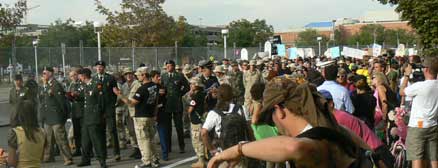
WE INTERRUPT WITH BREAKING NEWS- New Orleans is under MARTIAL LAW. It’s a scoop! The Breaking News keeps announcing the anticipation of Hurricane Gustav, without explaining the images which speak the obvious. The National Guard have arrived, and they’re not carrying sandbags. The soldiers are sitting in parked Hummers, with assault rifles across their knees.

As if what undid New Orleans and Baghdad was the looting pursuant to Katrina and Shock and Awe. Hurricanes and floodwaters can demolish homes in the wrong neighborhoods. The homes on higher grounds have to fear the looters.

So a curfew has been announced, starting at 9PM tonight, with no set end time. Is that a curfew or Marital Law? If the power goes out, how are you supposed to learn when “curfew” has been lifted? If you’re found outside your property lines, you face arrest for ignoring the mandatory evacuation. You’ll be presumed to have intentions on your neighbor’s property.

The Mayor of New Orleans is warning that potential looters will be sent directly to Angola [Prison.] There will be no quarter, he appears to be saying, no temporary holding facility between court and sentence. You’ll go directly into the General [Prison] Population. Adding, “May God have mercy on you,” as if pronouncing the last rites on a condemned man.

Can he do that? Can they throw away the key on citizens innocent until proven guilty? Mayor Ray Nagin is speaking down to his constituents as if they are adolescents he can scare straight. But I’m sure the same TV audience which cheers when their Law and Order heroes smack down suspects who don’t confess, are loving these tough words of warning. Here’s a black man speaking as if he knows that his constituents 1. have no self respect, and 2. can’t wait to loot.

I see the same public desensitivity to excessive police presence, as became apparent at the DNC. We may stand aghast, but few question if it’s appropriate. Tons of cops, heavily armed, even pointing their guns at you. Unless you find yourself brutalized, it’s just added security. And so long as you don’t have a problem with whose rule of law is being enforced, who can argue with absolute power?

Perhaps security developments in New Orleans are not called Martial Law, because they’re closer to everyday law as we’re coming to see it.

Here are Mayor Nagin’s condescending words:

You need to be scared.
You need to be concerned.
And you need to get your butts movin’
Out of New Orleans. Right now.

That’s the scare tactic used to justify police crackdown. It makes me laugh.

And then finally,
I just talked to the Sherif and to the Police Chief,
I just want to send a strong message out to anybody
who’s thinking about lingering around
and becoming a looter.

Looting will not be tolerated.
We have doubled the police force,
Doubled the National Guard force
that we had for Katrina,
And looters will go directly to jail.

You will not get out -uh uh-
You will not get a pass this time.
As a matter of fact,
anybody who’s caught looting
in the City of New Orleans
Will go directly to Angola.
Directly to Angola.
You will not have
a temporary stay in the city.
You go directly to the Big House
In General Population.
Aight?
So I want to make sure that every looter,
Potential looter, understands that.
You will go directly to Angola Prison.
And God Bless You, when you go there.

Undercover surveillance has uniform too

den-sun-under-civilian.jpgDENVER- DNC day 0, Undercover observers.

Could this NOT BE A COP? My goodness the cops had undercover uniforms too! White shirt, tan cargo shorts, white socks, running shoes, camera and backpack. This bicyclist was helping to track Unconventional Denver as they veered from the permitted parade route along 16th Street Mall.

den-undercover-videotape.jpgAnother barrel bellied gentleman was recording the Sunday antiwar rally. There were hundreds of police video cameras out there, not held at the ready for something to happen, like the other videographers, but constantly pointed. Wouldn’t that be recording a bunch of nothing, unless you’re simply trying to document faces?

I have another theory, which comes of imagining dozens of surveillance cameramen each shift, clocking out and depositing multitudes of digital videotape cassettes, marked by location, time, and perhaps incident. Would that seem to be a nightmare to organize? I’m thinking these cameras were up to something else.

Two cops a tapingThese two square pegs were videotaping the Sunday UA Lincoln Boulevard standoff. The person in the foreground is an example of what real participants look like. His camera is waiting for something to capture. The rear two have cameras aloft, whether they’re paying attention our not.

Third cop a watchingThe yellow shirted boy scout gestured to this third duffer behind them. I’m not sure the signal except that he stepped back as I photographed.

I wonder if these cameras held aloft haven’t been retrofitted to give live video feeds, instead of recording unto individual DATs. I bet they’re transmitting wireless signals to a communications truck nearby, where not only are the images being recorded into a data bank, likely they are being monitored for a real-time sense of what’s happening in the crowd. That might explain why the cameramen were seldom seen panning or changing their angle. It might also be possible that they were receiving their instructions through the camera viewfinders.

Undercover plantNow this guy isn’t wearing the day uniform. What’s he doing? I include him just for contrast. He’s wearing the black colors of a provocateur or plant and sure enough when the antiwar march came its closest to the Pepsi Center, suddenly he broke his silence. Where before he’s stood back, observing the morning rally. Now he was moving through the marchers offering instructions. Many of the organizers were trying to create something of a circle in front of the Pepsi Center entrance. This “marcher” who held no banner, and wore no political message, was now helpfully urging everyone to continue past.

McCain-Melnitz?

You know how sometimes something you see, hear or smell calls to mind another something? Something close yet inaccessible. It’s a bit like the feeling of deja vu, yet not exactly.

Janine Melnitz for VPAnyway, when I saw Sarah Palin for the first time yesterday, I had the sense that she reminded me of someone. For some reason, I kept thinking about the Teenage Mutant Ninja Turtles but couldn’t complete the mental thread. It gnawed at me all day. Kids show. It had to be late eighties when my boy was little. Whaaaat was it?
Janine Melnitz GhostbustersFinally it came to me. Ghostbusters! Janine Melnitz, aka Annie Potts, aka Sarah Palin. Now I can sleep.

COS drops convention trespass charges

Park sidewalk
COLORADO SPRINGS- At this morning’s motions hearing in Municipal Court, the city attorney asked Judge Spencer Gresham to dismiss their case. Due to “discovery issues we cannot resolve” and “internal misunderstandings,” the city dropped the trespassing charges against Peter Sprunger-Froese and I. So let’s see. They arrest us in front of hundreds at the World Arena, detain us until our chance to protest the State Convention is over, put us through five court appointments, then decide we shouldn’t have been arrested? And they didn’t even say that.

It was rather hard to stomach. A city prosecutor explaining that complications with the evidence led them to conclude the case wasn’t worth pursuing. No apology, no admission of error. Simply that taking us to trial was now thought be too inconvenient.

This after claiming there was no additional evidence from World Arena surveillance cameras, no tape from a the police observation van across the street, no recordings from the spooks with parabolic dishes above the Hampton Inn, no better audio track and additional footage to accompany the chopped up inaudible video they did offer us, no transcript of the public meetings beforehand where contradictory descriptions were given of a planned demonstration area.

This after maintaining that a “Free Speech Zone” was clearly marked when their own video showed that it wasn’t.

This even after fighting our request for a jury trial.

We walk into court and the same stonewalling city prosecutor declares that the City of Colorado Springs has decided to be magnanimous and drop the charges.

To his credit, Judge Gresham did ask if the city’s request was based on finding the new evidence exculpable. No, your honor, said the city prosecutor, this was just about the mounting difficulties of complying with the requested discovery.

The judge asked if the defendants had any objections. Our attorney said no.

This was not something we’d discussed as being an available options, but our lawyer answered on our behalf. Peter and I would be apprised later that voicing any objections would have been deleterious to being cleared of the charge. Otherwise, we for damn sure had objections!

Can you usurp someone’s free speech only to admit later you had no cause? There was no apology actually. Can they do that? I am Goddamn incensed that my rights were shoved aside, handcuffed, escorted, photographed, fingerprinted, detained, driven to the other side of the city, made to wait for a ride back to my car, denied the chance to return to what I was doing before I was arrested, now it turns out, for no cause!

What about the repercussions? I’ve got friends thinking I’m a troublemaker, when in fact I didn’t make trouble. It was heaped on me by uniformed misapplication of authority. Can they do that? Others are now sheepish about expressing themselves publicly because those police officers acted illegally. That’s the chilling effect of law enforcement given too much power. Now what? Honestly I’ve got friends who in the past have shown great courage in the face of repression and injustice, made into sheepish cowards who think speaking up means being insufficiently peaceful.

This is the result of the City of Colorado Springs police making arrests however they damn please. Is that going to stand? How many more acts of police intimidation are we going to tolerate before the chilling effect silences everyone?

Probably you’ve discerned where the meat of this case might have been found. It would seem to be what the city wants to avoid coming to light. It’s where a civil case is going to find incredibly flammable fuel.

Will the bear ever break its pact with the Devil?

BearThe Russian bear has made some pretty stupid political deals in recent modern times. Almost all of us know about the Stalin-Hitler Pact and the horrible price Russia paid for the stupidity of Joseph Stalin, but few of us have thought much about the stupid pact the Russians now have had with our own US Government Devil. Since the US dropped the former Soviet Union out of existence the new Russian capitalist regime has pretty much let the Devil have its own way all around the planet, but is that about to end? Maybe, and if so how would that be done?

Russia’s UN draft condemning the US murder of dozens of innocent civilian kids in Afghanistan is one indication of how the bear will move through the forest to confound The Devil. One is tempted to forget and have out of mind how Russia has passively allowed the US to rampage across Iraq, Iran, Pakistan, and Afghanistan while supporting this Devil diplomatically? Stupid, stupid, stupid.

Without the Russian bear on board the United Nations is left exposed as a total fraud. NATO then also becomes naked in the wind. n What has the bear been thinking by being so quiet for so long? Did it really think that once again a modern day version of the Stalin Hitler Pact was the way to go forth and prosper? Then what a dumb bear it has been!

The bear doesn’t want to break its pact with Our Devil, and without China at its side feels all alone. But it really has no choice at this point. It has to begin to oppose the US and its European cohorts as they commit genocide against Iraq and threaten to do so elsewhere, too. It’s time to pull the rug from out underneath of Our Devil before its too late.

ARD, Tent State surrogate for DNC cops

IVAW ARD march
DENVER- Accounts of the Wednesday march from the Colosseum to the DNC are only getting half the story. Can I recount my small part? We were at the Pepsi Center entrance, laying the groundwork for the arrival of the IVAW parade and became concerned when workers positioned large dump trucks to block the way, to corral the marchers into the fenced gauntlet traversing the Auraria campus.

When I caught up with the already diverted march, I found out the coordinators had been on the lookout for me. Legal observers informed me that marchers were being forewarned of a man with a green banner who would be trying to instigate trouble. The message was being spread as if coordinators had intercepted this information from police scanners. In reality this was deliberate disinformation being given them by their police liaisons. The common goal being to keep out of trouble.

Well it wasn’t disinformation, because I most definitely wanted to disrupt this surprising and disastrous turn. I sought to prevent the march from being led like sheep into a dead end. But the ARD collective had clearly promised an uneventful march, and they were bent on delivering it. At every turn, at every temptation, they policed the march so the police didn’t have to. Stay on the sidewalk, stay off the grass, go this way unless you want to be arrested, etc. Like overly cautious boy scouts.

Navigating the Auraria enclosures, the coordinator monkeys would circulate alongside their restless marchers admonishing them “Hey guys, let’s keep the focus: on the vets and off the fence.”
Bullhorn
So let me be less harsh in my criticism of the IVAW. A number of them are bright, well-motivated guys, but they are governed by committee decisions made by the predominant lessers, some about as daft as soldiers can get. On the Wednesday march too often the bullhorn was in the wrong hands. I have no sense yet of what their dressed-to-the-nines Marine official spokesman was thinking. But the other corrosive element in the event was mentioned in a comment to my previous post on this subject. Tent State/ARD.

Tent State idealists helped coordinate the Rage concert and the march. The parade monkeys who kept everyone in line were Tent State/ARD workers bent on civil disobedience minus any trace of disaffected incivility. Who do they think they are, telling angry constituents that they must accept their lot in the police state?

If Tent State has any role in the planned RNC protests, we must forewarn the activists in Minneapolis. They’re collaborator scum, every bit as fraudulent as the Democratic Party of good cop to the GOP bad cop. If we can salvage anything from our Debacle in Denver, it’s to ferret out these Quislings. Tent State, ARD, UFPJ, Code Pink and the Greens. Derelict saboteurs.

I love the spirit and wit of Code Pink, they show determination and stamina, but ultimately no savvy. Their I MISS AMERICA gag is dead on, but it’s a lament, isn’t it? She’s gone, their America. Where the occasion calls for drums, Code Pink would march us into battle to the beat of Kum ba yah.

IVAW betrays their youthful marchers and capitulates to the Democratic Party

IVAW march
DENVER- I have friends in Iraq Veterans Against the War, but their much anticipated action today was totally FUBAR. Given latitude by the other protest organizers to be the feature action on the last day of the DNC, the IVAW march aimed no higher than to ask that their rep be allowed to meet with a party representative. The IVAW had Rage Against the Machine do a free concert, asked the audience to follow them across town to lend moral support, and when the appointment with a DNC delegate was given them, the IVAW cheered, thanked their fellow marchers, and asked everyone to go home.

Denver Riot Police

This in the face of hundreds of cops in riot gear, heavy machinery, and a large audience of bystanders, delegates and press. The confrontation needed to put the spotlight of media attention on the issue of military imperialism and corporate fascism, passed like it some kind of Pirates of the Caribbean amusement ride, everyone smiling and posing for pictures under the noses of heavily armored riot police menacing the crowd with batons and riot control guns.

police state song and dance
Instead of chants like THIS IS WHAT A POLICE STATE LOOKS LIKE, or megaphone entreaties to ask why do nonviolent common citizens face such intimidation by police, the crowd watched Code Pink and other theatrical performances sing cutesy songs to recast the oppressive tone into a humorous light. They should have been signing “Just a spoonful of sugar makes the medicine go down.” Comedic relief is often laudable, but should we be laughing, instead of facing the militarization of our policeman stone cold sober?

No, instead of calling the Democratic Party and the City of Denver on their repressive ways to curb dissent, the situation was kept in check by the vets’ self-policing. The police never had to issue an order. Instead the IVAW coordinators were constantly detailing city ordinances and forewarning everyone about possible arrest. Every time, more and more people retreated from the action.

For example, the IVAW march was un-permitted, and yet they directed it into the allowed free speech area, instead of veering toward better visibility and “certain arrest.” Oh, you don’t have a “permit” for your march, but there are places that are off limits, meaning, for which you don’t have “permission?” Which is it then? The crowd of Rage fans wanted to have their voices heard. They didn’t want to be led in somber veteran respect mode until all their spirit was worn out of them. The IVAW march coordinators kept everyone in line, followed prearranged parade direction signs, and even allowed themselves to be led by the damn police golf cart whose backward facing sign flashed FOLLOW ME.

IVAW drama stop
So the crowd followed the IVAW into the Free Speech dead end, and they and a multitude of press waited for something to happen. I heard an IVAW coordinator phoning Barack Obama’s office from which they were expecting a phone call. When no Obama appearance materialized, the vets led everyone back out again and into the “forbidden area” with it’s oft-reminded possibility of arrest.

I was asked to stay back with the rest of the followers, and not crowd the IVAW formation. I told the coordinator that he had led us into the Auroria free speech maze and back, and I was not about to obey a single further idiotic command, no matter how much “respect” the veterans were needing.

Seriously. All “out of respect for the veterans.” Even reporters were barked orders as if they were subordinate to the vets. I took umbrage at being told constantly to stop every few minutes to listen to the vets give their witness of Iraq and wait as their spokesman gave further statements to the press. Staying behind, keeping a distance, or keeping the way clear was supposed to be honored “out of respect for the veterans.”

These were the same veterans who went to war when we asked them not to. I’m very thankful that each of them has changed their tune now, but where was their respect for us before more than a million Afghans and Iraqis were killed at their hands? No, the veteran worship was severely misplaced. They earn no points from me for “their sacrifices in the service.” The bastards killed innocent people, they should be begging forgiveness, not assuming to command our respect.

That said, I think the antiwar movement is misplacing its hopes thinking the IVAW can carry any sort of ball promoting an end to war. The vets are after a return of their comrades, and better veterans benefits. That’s a far cry from pacifism, or even a repudiation of US predatory militarism. And this DNC stunt proved it. Here’s how the self-aggrandized crunts blew the last opportunity to show dissent at the DNC.

They held a concert which pulled the youth element away from where they might have been participating in street actions. Of course this is no different than Tom Hayden and Ralph Nader drawing their audiences from likely people who had to choose whether to protest or go see them. Not such a big deal, but it got much worse.

This afternoon the IVAW shepherded a reported 5,000 supporters not to the Pepsi Center delegate entrance, but deep into the Free Speech Cage, away from sight of convention delegates. After a long delay they moved everyone into the promising area, but kept thinning the crowd with warnings of potential arrest. They also kept the marchers well out of proximity of the police lines. The IVAW limited what anyone could say, out of respect for the vets, led them in a last chanted instruction to Go Home, then reminded stragglers that it was the expressed wish of the veterans that everyone leave the area lest an ensuing disturbance mar the IVAW event. After everyone was gone, the veterans even gave a round of applause for a nearby contingent of cops. More in the morning when I’m feeling less enraged.

Sexy nuns, manly priests?

Nun costumeIt is getting so hard to rehabilitate the public image of the pedophile proliferating international Roman Catholic Church of worshiping papist dupes! Oops, I got a little bit out of hand there… (but really it is now). So I think it is a beautiful idea that Father Sadducee has come up with to have a nun beauty pageant! Priest to hold nun beauty pageant What’s not to like about this idea?

Nuns are beautiful creatures and such total submission to God’s teachings, too! I get a hard on thinking about it sometimes! Don’t you? I grew up as a Southern Baptist, but I just never found them to be as sexy as Roman Catholic nuns often can be. Especially when they keep saying, ‘Peace. Peace. Peace.’ That’s Virgin Mary like almost! I love nuns, I really do!

However, I think the Italian Padre is being too Conservative here with his proposals, not to say too sexist, too. He is being discriminatory against all the Manly Priests out there by limiting the beauty pageants to just nuns may apply. There are some damn good looking priests out there, too! And ex-priests, also! (some of them just can’t take the pressure to be constantly good…) Why not have them take their tops off? I don’t think that God would consider that little bit a sin, would he?

Think of all the potential here for the Modern Church? Wouldn’t it be great to see the Pope invigoratingly judging the nun beauty pageant? Wouldn’t it be wonderful, too, to see him judging the Manly Priest contest also? This is all very natural!

Now I know that a lot of Catholic clergy are already in secret nudist clubs, so it is natural to move on from this to celebrating nun’s beauty, too. I think the Catholic Church is finally beginning to change with the times, and for this, we all are very grateful. Now when we say 3 Hail Mary’s we can have some visual images in mind.

The Gazette stalethinkers

GazetteCOLORADO SPRINGS- The comical Gazette editorial staff today ranted against the Colorado Springs area’s atheist community in a headliner opinion piece, where the stalethinkers of The Gazette pedantically explained in their Bible Talk editorial opinion column ‘why rude guests are not welcome’.

The highlight of this comic strip was the stalethinker writer claiming that the atheists were ‘rude’ just from calling themselves ‘freethinkers’. That hurts their Christian feelings…booh-hoo-hoo… bring out the red, white, and blue hankies now. They claimed that ‘a few atheists have their panties in a twist again’ unlike the ever so courteous Gazette stalethinkers!

The stalethinkers base all their beliefs, they would have us believe…lol, because they are not free enough in their thinking to not follow the Bible all the time (but not so literally since they love killing so much). They believe in a stalethinking brand of Christianity that says the rich are God’s Chosen Ones, because they can freely and stalely kick the poor around all the time. Not to mention blow them up, shoot them down, and waterboard them at will.

I love these stalethinker farts from The Gazette! They called me up recently (3 weeks ago) and said that my subscription had expired several months ago, whereupon I replied let it be so! I’m still getting the staleness though? What should I do, tell them that I shall sue them unless they pay me for delivery to my house of their rag? I feel like I am ecologically personally destroying the planet by allowing this stalemate to continue. Adverts for Kohls, Safeway, Kroger, and Albertsons be damned! I don’t got religion like the stalethinkers at The Gazette do!

Artemev head shoulders and legs above

Sasha ArtemevDid you miss this spectacular moment in men’s gymnastics? It was the last round on the pommel horse. Team USA was going for silver, the Japanese were already looking dejected about being left the bronze.

The three Americans sent to cleanup were –ironically said the announcers– each of them alternate team members. And then the unthinkable happened.

Well it wasn’t unthinkable, I was thinking it. I was rooting against team USA with my blackest might, for being the ass-backward patriotic pawns the US athletes are. I was amused to see Raj trip up, and thrilled when the same thing happened to the Taiwanese-American. Yeeeee!

But next up was Sasha Artemev, whose erratic record, we were told, was what disqualified him from the original team. He failed 3/4 of the time. But the 1/4 performance ranked him as world champion on the pommel horse. So as the diminutive boy contemplated his mount, under all the pressure I’d wished upon team USA, it became impossible not to have a change of heart.

I’d barely ever watched gymnastics before, but Artemev’s performance went from dazzling to miraculous. As a teammate of his told reporters later, for a moment it looked like Artemev might have launched himself skyward from the horse, but he defied antigravity and hung on. Who has ever fought being earthbound except race cars? I doubt even Michael Jordan has to temper his air flight.

Never the less, Sasha Artemev whirled like a helicopter tugging against a leash and landed as solid as you hope every time that every gymnast could, beaming, and it was Seabiscuit, Rocky and the Little Engine That Could!

But the tension now mounted because Team USA’s score had slipped so badly that now the German team was in contention to reach the bronze. Would the Americans medal at all? Everything was up to the German pommel horse numbers.

As each German performed his routine, Artemev’s act looked all the more luminous. The German routines were executed well, but were completely earthbound by comparison. What could the poor Germans do to compete in such a fix, short of improvise Artemev’s leap to the heavens and court probably an infinitely greater than 3/4 chance of failure?

Here’s a video of an Artemev performance at an earlier gymnastic meet. In this minute and a half, you get to see what the coaches feared would happen in Beijing, then you’ll see a preview of what ultimately did.

Peterson Air Force Base has a riot squad

Protesters in custody
COLORADO SPRINGS- There is a postscript to the Sisters Witness Against War arrests at Peterson AFB last Friday. Where we left off, three women stepped across the line to protest our nation’s ongoing militancy, and the base commander’s refusal to hear the consciences of pacifists. Barbara, Mary Ann and Esther were led away to be processed, handed to the police, then released. Esther told me the sight that awaited her as she was taken out of our view.

Taking this step, this year, by the way, was in honor of Elizabeth. As the three women were being escorted around the security/reception building, out of view from the protest, they encountered a line of soldiers, dressed in riot gear, being put through various drills. Asking about the apparent extremity of such measures, the women were told that this happens every time there are protests on the other side of the gate. The preparations are standard procedure.

If you can imagine what it’s like from our side, fifty or more quiet nuns usually, once or twice a year, holding home-sewn banners or small signs, facing a security booth being manned by a dozen soldiers, some with binoculars, some in plain clothes. It’s quiet and uneventful. You’d never guess there are people in riot gear being put through their paces behind the scenes.

I laugh because it’s always a nearly-spoken hope that one day we will walk toward the gate, and all of us supplicate ourselves in a compassionate plea to end the war-making. While probably every participant certainly has the courage to be arrested, decorum and a sense of pragmatism hold us back. We await a better opportunity, an impassioned leader to follow, probably. And so through the years, the sisters have only ever mounted a limited nonviolent assault on that yellow line.

This year as the arrests were wrapping up, a soldier noticed that someone’s feet had unknowingly strayed over the line. He pointed sternly and the wouldn’t-be offender hopped giddily back like a new gambler who hadn’t intended a bet.

Even this time, we murmured to ourselves, if only all of us would simply cross that line, they wouldn’t know what to do with us.

Well, as Esther’s report clarifies, they would know what to do with us. And they ready themselves every year to do it. Which has me thinking that they have a higher respect for our potential than we do ourselves. They know what’s at stake, even as we yet do not.

I struggle questioning whether we can reach across to the military mindset with our pacifist ideology. Especially as their militarism extends to dealing peace-petitioners physical blows. Will there be human consciences to reach, or just gung-ho soldier appetites to satisfy? That question holds me back.

Crossing the line at Peterson AFB

North gate of Peterson AFB
COLORADO SPRINGS- The annual Sisters Witness Against War took an interesting step forward Friday when three sisters decided to step across the line. Ostensibly to deliver a letter which had gone thus far unanswered by the Peterson AFB commander. Event founder Barbara Huber decided she would commit herself to this act of Civil Disobedience and was joined by two others. A press release declared this intention, the Gazette was on hand to record it, and a local patrol car stood by as well.

Barbara explained her plan to the reporter. That she’d sent the letter several times but had not received a response. The only recourse she felt she had was to deliver the letter in person, to know it had reached him. Barbara also admitted knowing that the base commander was away, and so the best she could hope for was to deliver the letter into the hands of his secretary. PAFB confers with Gazette Plain-clothed security had been circulating through our demonstration, asking for specifics about our intentions. When I saw them conferring with the Gazette team, I immediately worried for Barbara’s plan. If the Air Force officers learned that Barbara need only be introduced to their commander’s secretary, that person could be waiting to meet us at the gate and the whole hoopla could be averted.

Fortunately, the Peterson machos seemed all too eager to create a confrontation. As the demonstrators neared the gate, a soldier with the gait of a Carabinieri grabbed a megaphone and cautioned us away. But the sisters continued. Several soldiers donned riot helmets.
Riot gear

Fed intervenesThe man in pink wore a badge on his folder. He couldn’t persuade Barbara to turn back.

Barbara deliberates

(More pictures at csaction.org)

EPILOGUE: PETERSON AFB HAS A RIOT SQUAD

Protesters in custody
COLORADO SPRINGS- There is a postscript to the Sisters Witness Against War arrests at Peterson AFB last Friday. Where we left off, three women stepped across the line to protest our nation’s ongoing militancy, and the base commander’s refusal to hear the consciences of pacifists. Barbara, Mary Ann and Esther were led away to be processed, handed to the police, then released. Esther told me the sight that awaited her as she was taken out of our view.

Taking this step, this year, by the way, was in honor of Elizabeth. As the three women were being escorted around the security/reception building, out of view from the protest, they encountered a line of soldiers, dressed in riot gear, being put through various drills. Asking about the apparent extremity of such measures, the women were told that this happens every time there are protests on the other side of the gate. The preparations are standard procedure.

If you can imagine what it’s like from our side, fifty or more quiet nuns usually, once or twice a year, holding home-sewn banners or small signs, facing a security booth being manned by a dozen soldiers, some with binoculars, some in plain clothes. It’s quiet and uneventful. You’d never guess there are people in riot gear being put through their paces behind the scenes.

I laugh because it’s always a nearly-spoken hope that one day we will walk toward the gate, and all of us supplicate ourselves in a compassionate plea to end the war-making. While probably every participant certainly has the courage to be arrested, decorum and a sense of pragmatism hold us back. We await a better opportunity, an impassioned leader to follow, probably. And so through the years, the sisters have only ever mounted a limited nonviolent assault on that yellow line.

This year as the arrests were wrapping up, a soldier noticed that someone’s feet had unknowingly strayed over the line. He pointed sternly and the wouldn’t-be offender hopped giddily back like a new gambler who hadn’t intended a bet.

Even this time, we murmured to ourselves, if only all of us would simply cross that line, they wouldn’t know what to do with us.

Well, as Esther’s report clarifies, they would know what to do with us. And they ready themselves every year to do it. Which has me thinking that they have a higher respect for our potential than we do ourselves. They know what’s at stake, even as we yet do not.

I struggle questioning whether we can reach across to the military mindset with our pacifist ideology. Especially as their militarism extends to dealing peace-petitioners physical blows. Will there be human consciences to reach, or just gung-ho soldier appetites to satisfy? That question holds me back.

We won’t attack Iran, our trigger finger will

Olmert and RiceCondi Rice says disingenuously that the US government can’t, just can’t stop its trigger finger, Israel, from shooting at Iran. See her shaking hands with Olmert though? The Haareetz report of her comments.

This obviously is somewhat of a change from the usual illogical Conservative mantra that guns don’t kill people, people do. Now they say that guns do kill others on their own, but only Jewish guns I guess are like that? Go figure?

One wonders who the Bush Administration and their Democratic Party coat tails think are fooled by this sort of crap? The same people that are fooled by them to thinking that torture is not torture if people like The Condi say it’s not? And the Democrats go along playing stupid?

The US government plans to attack Iran and that seems quite clear, but it is just that they don’t want responsibility for doing it so they do this song and dance.

Where’s Obama? Oh, I forgot. Barack is a friend of the Jewish theocracy of Israel. Now listen to all the American Jews shout out, ‘Israel is not a theocracy, it is a democracy!’

We won’t be attacking Iran, our trigger finger will. It is self-described as ‘The Jewish State’, but it is the Christian State that calls the shots, contrary to what the Bush Klan says.

No getting away from the repulsive in the Democratic Party

BillySlick Willie to Address Democrats, YES there is no getting away from the repulsive in the Democratic Party. I wouldn’t be surprised if Joe Lieberman speaks at the DNC either?

What do liberal nitwits think the Democratic Party is? It is the political party that worked together with the Republican Party since 1990 to demolish and terrorize the country of Iraq. No wait a second! They were working together back when they both had Saddam Hussein on board as an ally and agent which they used to batter the country of Iran, kill Iraqi Kurds with chemical weapons, and who now together again, the RP-DP once again want to terrorize the Iranians and demolish their country’s sovereignty to shreds ala like what they once did with their Holy Shah of Iran, may he rest in Hell where he currently resides!

And the Democrats are the party of national wealth give away to the military industrial complex in the country of Gulag prisons everywhere. What on earth do nitwit flag-draped liberals think this party is? Oh, I know! They think it marginally better than the party of the other nitwit Americans, the Republicans. Well they are flat out wrong since the Democrats might even be worse since they talk a little more confusingly to the general public. See… They certainly confused the nitwit Democratic Party voting liberal into thinking that they somehow represent democracy, when all they represent are the big corporations and their profit making off everybody else.

Personally I wouldn’t trust Barack Obama as next door neighbor let alone as president of the US. Of course we can only get the one or the other, but quite frankly they both suck and only nitwits could think otherwise. They both suck because both The Democratic and Republican Parties suck.

You don’t have to be an Einstein to figure that out yet somehow the liberal can’t? They will all be glued to the tube watching Slick Willie once again, just like in the Golden Times (to these nitwits) of the past. Choose your Klan to run the country for other folk than yourselves, Nitwits. That’s both Republican and Democratic voter version of the American nitwit species. You are a team!

Bootstraps? Fiddlesticks!

Sticks to play the fiddle? Absurd!
 
Here’s another sign our cultural literacy level can’t handle satire: “bootstraps.” It’s become a keyword for the conservative/libertarian dismissal of society’s need for a safety net. Apparently lazy welfare recipients won’t “pull themselves up by their own bootstraps.” As if it takes but the effort, even as we can only interpret what was the procedure, since few of us come close enough to wearing riding boots to recognize a bootstrap. But I’ve heard social advocates offer this meek argument for their disadvantaged/minority/ailing charges: “but what if you don’t have bootstraps?”

Well give that person a bootstrap if they think they can levitate with it. Bootstraps may be colloquial to us now, but they only ever could assist you to pull up your boots. Perhaps we could suggest new idioms for the poor like: lose weight by tightening your shoelaces. Or if that’s going to be dated soon: hang on to your earnings with Velcro.

When did hard nose conservatives assume command of the expression that used to ridicule the inhumanity of their tough-love logic? “Bootstraps” now asserts that taking care of oneself is so self-evident it doesn’t merit thinking about.

Does “let them eat cake” register as elite class disconnect anymore? I wonder because the affluence brought by modern capitalism has proved Marie Antoinette cynically prophetic. The disadvantaged have their cake these days. Little Debbie’s. It’s pseudo-food rat poison. We won’t give them bread.

I wore polka dots today

polka dots are the new black
…and felt like an idiot. Why? I think polka dots are adorable. They are playful and happy and youthful which are traits I value. And the outfit I had on was classy and cute. So why did I feel anxious that someone might pop over unexpectedly and see my polka dots? I’m not sure, but I changed rather than further contemplate the issue.

I think that maybe polka dots aren’t me. Whatever that means. Like all women, I have a closet full of clothes that I never wear. Truthfully, my closet is a schizophrenic mixed bag pining for psychiatric intervention. I must’ve worn these styles at one time, but I guess I’ve changed. Or, more likely, they were never me. I just didn’t know it, because I was adept at changing me to be a part of the crowd du jour.

I don’t think men are this way. A couple years ago, a friend and I took a getaway to Mexico for a few days. We hung out under a big beach umbrella, two pale obviously-American chubbies in a sea of gorgeous foreigners. The women were thin, tanned, and beautiful, but they couldn’t hold a candle to the men. Unbelievably fit, glistening brown skin, boy shorts. At once holding a cigarette and a partner’s perky breast, we couldn’t stop staring at the men.

When the couples eventually got up and dressed, the guys wore capri pants, silky dark shirts, and closed-toe leather sandals. But even through my drool I knew that, were I given the chance, I probably wouldn’t date any one of them. Seriously! They were not my type.

As pretty as the beach boys were, my type of guy doesn’t spend much time thinking about his hair and wardrobe. A makeover is buying his favorite shirt in another color. I’ve never succeeded in slipping Bruni Maglis over his tennis shoes, nor a man purse over his shoulder. Even the plain front/pleated front battle can rage for days, so sartorial transformation has never been in the cards. Men know what they are comfortable wearing, and are usually unwilling to indulge our female fantasies. Truly, I wouldn’t want it any other way.

If men can stay true to form, why do women’s closets suffer from bipolar disorder? Are we multifaceted and complex, or are we being unduly influenced the expectations of our mates, the opinions of our friends, and the daily media mind fuck?

Though my closet doesn’t reflect it yet, my chameleon days are over. I am newly unapologetic about my hairstyle, my yoga pants, and my Doc Martens. When I dress up I usually wear black from head to toe. I don’t show a lot of skin, and hide my few curves. I wear simple earrings, no other jewelry. I no longer worry about fashion trends, because I refuse to be trendy.

My manner of dress is merely an outward manifestation of the natural, unadorned, athletic, private girl that I am. I cover my body in such a way that I’m not constantly mindful of the fact that I’m wearing something. Something that feels foreign and awkward. Like polka dots.

The Conservative Motto: Greed is Good, Greed is God!

The trouble with optimism. I especially love the first quote, by Treasury Secretary Andrew Mellon, who made billions off the Great Depression.

War with Spain? Palestinians file war crimes charges against Israel. Probably moot, as both US presidential candidates would likely bomb any court that rules against US/Israeli war crimes.

Obama makes clear that he’s
sold his soul to the parasitic state
of Israel.

AntiChrist may endorse McCain, laments “It’s getting harder and harder to determine the greater of two evils in this election.”

Will Cheney have Iraqi PM Maliki killed for backing Obama’s withdrawal plan? “Oops, so sorry. We thought we were just bombing a wedding party!”

Evidence that McCain will pick Cheney as his VP?

Grumpy old man alert! NY Times rejects op-ed written by John McCain. I know what you’re thinking: “McCain can write?” Well, according to the NYT, no.

Best gov’t money can buy. Nevada GOP cancels façade of state convention, will instead just have private conference call, where largest donors will decide the nominees. Delegates, who have been locked out by the move, are suing the Nevada Republican Party. I guess it makes sense, though. The Republicans typically sell their votes to the highest bidder, so why not pick their candidates that way?

As the McCain campaign becomes little more than a joke… A senile old geezer, an angry woman and a charming black guy walk into a bar…

Compassionless Conservatives. Bob Novak isn’t just a traitor, he’s also a hit-and-run driver. He hit a pedestrian, and drove off pretending not to even notice the man splayed across his windshield.

Man ticketed for dying in car.

Will Obama “end the war” but continue the occupation?

Proof that Obama is just another war-mongering Republican.

Dark Knight, indeed! Batman arrested for assaulting his elderly mother.

Excerpts from Thomas McCullock’s notes July 23, thomasmc.com.

Barack Obama’s recent Bill Crosby style Jello moment

jello.jpg Pastor Obama says that, ‘Too many fathers are M.I.A., too many fathers are AWOL, missing from too many lives and too many homes. They have abandoned their responsibilities, acting like boys instead of men.” So spoke Obama while at church on last Father’s Day… This was Barack Obama’s Bill Crosby style Jello moment.

Lest we forget, Bill Cosby is a Black millionaire who popularized himself with Whites by acting Republican in this manner. Republicans love Black folk when they echo their own racist sentiments! Yes they do! They love it when somebody with a tan gets off on castigating cliché absent ghetto dads!

‘Bad boys bad boys, what you going to do when they come for you’ routines. Well yeah, get down with Jesse Helms and crowd, why don’t you?

But let us not forget, that these bad ‘boys’ that Obama and Cosby put the blame on simply don’t make those 6 figure annual salaries of their denouncers. They are not attorneys, politicians, and actors in Jello commercials. They live real lives, many of them lives of desperation due to the racist economic, legal, and educational structures of our racist USA. Why Hell, many of these men don’t even go to church so that they can spout off their hateful pseudo religiosity like Cosby and Obama are most prone to do.

Barack Obama is following in the media made footsteps of Bill Clinton, who the corporate press ludicrously dubbed as supposedly being ‘America’s First Black President’. Many bought for a while this nonsense, even many Blacks? What Clinton and his wife actually were were racists passing themselves off as being charitable to Blacks, even as they screwed the Black community as a whiole over royal. Now along comes Obama, who is actually part Black, who is totally prepared to do more of the same, all in the name of bringing America together!

What helps this campaign of promoting the Left image of Obama most of all towards having success is the rabidity of the nutty Right, who simply don’t think that Barack Obama hates Black males as much as say, a Jesse Helms does. They don’t find him intolerant enough of undocumented workers either. I mean Look, he even has the same skin color of some of them Haitian rabble! Sink that Obama boat! This sort of Republican Right rabies is enough to stampede the liberals into thinking that Obama must be a real sweetheart if the Nazis hate him so. But they are wrong.

In fact, I still can’t stomach watching that asshole Bill Cosby. Thank god he is rightfully retired (more or less) so that we don’t see him as often as we once did. Now I do like Redd Fox (also retired). He was a good dad and a better comedian still. True, he did run a junkyard but at least he won’t help make America into more of a junkyard, as the Democratic Party behind Obama’s imagery most certainly will.

Thank about it a little, Boys (and Girls). I like Cynthia, too, though the party she is a candidate for is a laughable charade. There are better choices than BO out there. One better choice is simply to not vote in this charade of pretend democracy that the corporations have sold to us as their product. Don’t buy.

Olympic audience cheers for Americans will be canned and jeers will be caned

Oh my goodness, I know why the 2008 Olympics are being hosted in China! If Beijing was decided in July 2001, the globalization overseers were certainly showing their forward thinking, knowing the imperial oil wars they were about to unleash, and acknowledging that American villainy was about to drop its humanitarian pretense in exchange for unapologetic carpet bombing of uncooperative peoples. Had the deciders previsioned Americans becoming so unpopular in the world that international audiences would boo US athletes at every chance? Of course the bid applications for hosting the Olympics would have been prepared long before I’d be comfortable to predict the Bush/CIA coup plan was hatched. Anyway, booing is easily masked for American TV viewers by interposing prerecorded cheers. It worked in Athens.

Although in Athens, the hatred of Americans wasn’t yet a rolling boil.

In 2004 the American public was still seen as a victim itself of the Florida coup. In August 2004 we had yet to RE-ELECT George the War Criminal. Later in November Americans showed the world our doofus mettle, proving to be a mass of reckless morons worse than Bush. The world could see Bush stole the 2004 election too, but to their horror the American public did not object, nor intervene to prevent US imperial aggressions from continuing unabated.

At the Athens Olympics there was also a greatly reduced turnout of international attendees. The terrorism threat had been amplified so that fewer travelers showed up. Olympic organizers had to discount the tickets and open the doors to the locals in an effort to fill the stadiums. TV cameras kept their shots closely cropped to avoid featuring the empty bleachers.

But really, how fortuitous that America’s Olympic athletes will be facing a predominantly Chinese audience. The Chinese are no friends of ours, certainly, but they will be the most gracious of hosts. How face-saving for us that the Chinese are the only thoroughly polite/subservient population one could entrust not to heckle the American team to tears. Westerners sitting among them will be those affluent enough to travel to China, putting them among the multinational profiteer class who knows on which side its bread is bloodied. If there are any regular sports fans in the crowd we’ll have a bedlam of jeers, but stateside who’ll know, because our television soundtrack will echo only the cheers.

US athletes know it already when they tour outside the homeland. The Stars and Stripes are reviled. The American team need only get possession of the ball and crowds boo. In this New American Century of US military supremacy, it’s all onlookers can do.

The next Olympic venues are safely scheduled within the empire’s anti-immigrant walls, London 2012 and Chicago 2016. By 2020 we will parade our athletes safely in Uzbekistan, where our regents there will boil hecklers in oil.

In the meantime the Chinese will play supplicant hosts, their polite culture several millennium ahead of the west in valuing saving face. Bush can keep politics out of the Olympics, where sweatshop gulags await Chinese dissenters.

Global economic rapists are at it again

G8 protest
Why protest the G8 Summit July 7-9? Those hoodlums always look so determined. Here’s the rationale by the Emergency Exit Collective:

The 2008 G8 on Hokkaido, a Strategic Assessment
Emergency Exit Collective
Bristol, Mayday, 2008

The authors of this document are a collection of activists, scholars, and writers currently based in the United States and Western Europe who have gotten to know and work with each other in the movement against capitalist globalization. We’re writing this at the request of some members of No! G8 Action Japan, who asked us for a broad strategic analysis of the state of struggle as we see it, and particularly, of the role of the G8, what it represents, the dangers and opportunities that may lie hidden in the moment. It is in no sense programmatic. Mainly, it is an attempt to develop tools that we hope will be helpful for organizers, or for anyone engaged in the struggle against global capital.

I
It is our condition as human beings that we produce our lives in common.

II
Let us then try to see the world from the perspective of the planet’s commoners, taking the word in that sense: those whose most essential tradition is cooperation in the making and maintenance of human social life, yet who have had to do so under conditions of suffering and separation; deprived, ignored, devalued, divided into hierarchies, pitted against each other for our very physical survival. In one sense we are all commoners. But it’s equally true that just about everyone, at least in some ways, at some points, plays the role of the rulers—of those who expropriate, devalue and divide—or at the very least benefits from such divisions.

Obviously some do more than others. It is at the peak of this pyramid that we encounter groups like the G8.

III
The G8’s perspective is that of the aristocrats, the rulers: those who command and maintain that global machinery of violence that defends existing borders and lines of separation: whether national borders with their detention camps for migrants, or property regimes, with their prisons for the poor. They live by constantly claiming title to the products of others collective creativity and labour, and in thus doing they create the poor; they create scarcity in the midst of plenty, and divide us on a daily basis; they create financial districts that loot resources from across the world, and in thus doing they turn the spirit of human creativity into a spiritual desert; close or privatize parks, public water taps and libraries, hospitals, youth centers, universities, schools, public swimming pools, and instead endlessly build shopping malls that channels convivial life into a means of commodity circulation; work toward turning global ecological catastrophe into business opportunities.

These are the people who presume to speak in the name of the “international community” even as they hide in their gated communities or meet protected by phalanxes of riot cops. It is critical to bear in mind that the ultimate aim of their policies is never to create community but to introduce and maintain divisions that set common people at each other’s throats. The neoliberal project, which has been their main instrument for doing so for the last three decades, is premised on a constant effort either to uproot or destroy any communal or democratic system whereby ordinary people govern their own affairs or maintain common resources for the common good, or, to reorganize each tiny remaining commons as an isolated node in a market system in which livelihood is never guaranteed, where the gain of one community must necessarily be at the expense of others. Insofar as they are willing to appeal to high-minded principles of common humanity, and encourage global cooperation, only and exactly to the extent that is required to maintain this system of universal competition.

IV
At the present time, the G8—the annual summit of the leaders of “industrial democracies”—is the key coordinative institution charged with the task of maintaining this neoliberal project, or of reforming it, revising it, adapting it to the changing condition of planetary class relations. The role of the G8 has always been to define the broad strategic horizons through which the next wave of planetary capital accumulation can occur. This means that its main task is to answer the question of how 3?4 in the present conditions of multiple crises and struggles 3?4 to subordinate social relations among the producing commoners of the planet to capital’s supreme value: profit.

V
Originally founded as the G7 in 1975 as a means of coordinating financial strategies for dealing with the ‘70s energy crisis, then expanded after the end of the Cold War to include Russia, its currently face a moment of profound impasse in the governance of planetary class relations: the greatest since the ‘70s energy crisis itself.

VI
The ‘70s energy crisis represented the final death-pangs of what might be termed the Cold War settlement, shattered by a quarter century of popular struggle. It’s worth returning briefly to this history.

The geopolitical arrangements put in place after World War II were above all designed to forestall the threat of revolution. In the immediate wake of the war, not only did much of the world lie in ruins, most of world’s population had abandoned any assumption about the inevitability of existing social arrangements. The advent of the Cold War had the effect of boxing movements for social change into a bipolar straightjacket. On the one hand, the former Allied and Axis powers that were later to unite in the G7 (the US, Canada, UK, France, Italy, Germany, Japan)—the “industrialized democracies”, as they like to call themselves—engaged in a massive project of co-optation. Their governments continued the process, begun in the ‘30s, of taking over social welfare institutions that had originally been created by popular movements (from insurance schemes to public libraries), even to expand them, on condition that they now be managed by state-appointed bureaucracies rather than by those who used them, buying off unions and the working classes more generally with policies meant to guarantee high wages, job security and the promise of educational advance—all in exchange for political loyalty, productivity increases and wage divisions within national and planetary working class itself. The Sino-Soviet bloc—which effectively became a kind of junior partner within the overall power structure, and its allies remained to trap revolutionary energies into the task of reproducing similar bureaucracies elsewhere. Both the US and USSR secured their dominance after the war by refusing to demobilize, instead locking the planet in a permanent threat of nuclear annihilation, a terrible vision of absolute cosmic power.

VII
Almost immediately, though, this arrangement was challenged by a series of revolts from those whose work was required to maintain the system, but who were, effectively, left outside the deal: first, peasants and the urban poor in the colonies and former colonies of the Global South, next, disenfranchised minorities in the home countries (in the US, the Civil Rights movement, then Black Power), and finally and most significantly, by the explosion of the women’s movement of the late ‘60s and early ‘70s—the revolt of that majority of humanity whose largely unremunerated labor made the very existence “the economy” possible. This appears to have been the tipping point.

VIII
The problem was that the Cold War settlement was never meant to include everyone. It by definition couldn’t. Once matters reached tipping point, then, the rulers scotched the settlement. All deals were off. The oil shock was first edge of the counter-offensive, breaking the back of existing working class organizations, driving home the message that there was nothing guaranteed about prosperity. Under the aegis of the newly hatched G7, this counter-offensive involved a series of interwoven strategies that were later to give rise to what is known as neoliberalism.

IX
These strategies resulted in what came to be known as “Structural Adjustment” both in the North and in the South, accompanied by trade and financial liberalization. This, in turn, made possible crucial structural changes in our planetary production in common extending the role of the market to discipline our lives and divide us into more and more polarized wage hierarchy. This involved:

· In the immediate wake of ‘70s oil shock, petrodollars were recycled from OPEC into Northern banks that then lent them, at extortionate rates of interest, to developing countries of the Global South. This was the origin of the famous “Third World Debt Crisis.” The existence of this debt allowed institutions like the IMF to impose its monetarist orthodoxy on most of the planet for roughly twenty years, in the process, stripping away most of even those modest social protections that had been won by the world’s poor—large numbers of whom were plunged into a situation of absolute desperation.

· It also opened a period of new enclosures through the capitalist imposition of structural adjustment policies, manipulation of environmental and social catastrophes like war, or for that matter through the authoritarian dictates of “socialist” regimes. Through such means, large sections of the world’s population have over the past thirty years been dispossessed from resources previously held in common, either by dint of long traditions, or as the fruits of past struggles and past settlements.

· Through financial deregulation and trade liberalization, neoliberal capital, which emerged from the G7 strategies to deal with the 1970s crisis aimed thus at turning the “class war” in communities, factories, offices, streets and fields against the engine of competition, into a planetary “civil war”, pitting each community of commoners against every other community of commoners.

· Neoliberal capital has done this by imposing an ethos of “efficiency” and rhetoric of “lowering the costs of production” applied so broadly that mechanisms of competition have come to pervade every sphere of life. In fact these terms are euphemisms, for a more fundamental demand: that capital be exempt from taking any reduction in profit to finance the costs of reproduction of human bodies and their social and natural environments (which it does not count as costs) and which are, effectively, “exernalized” onto communities and nature.

· The enclosure of resources and entitlements won in previous generations of struggles both in the North and the South, in turn, created the conditions for increasing the wage hierarchies (both global and local), by which commoners work for capital—wage hierarchies reproduced economically through pervasive competition, but culturally, through male dominance, xenophobia and racism. These wage gaps, in turn, made it possible to reduce the value of Northern workers’ labour power, by introducing commodities that enter in their wage basket at a fraction of what their cost might otherwise have been. The planetary expansion of sweatshops means that American workers (for example) can buy cargo pants or lawn-mowers made in Cambodia at Walmart, or buy tomatoes grown by undocumented Mexican workers in California, or even, in many cases, hire Jamaican or Filipina nurses to take care of children and aged grandparents at such low prices, that their employers have been able to lower real wages without pushing most of them into penury. In the South, meanwhile, this situation has made it possible to discipline new masses of workers into factories and assembly lines, fields and offices, thus extending enormously capital’s reach in defining the terms—the what, the how, the how much—of social production.

· These different forms of enclosures, both North and South, mean that commoners have become increasingly dependent on the market to reproduce their livelihoods, with less power to resist the violence and arrogance of those whose priorities is only to seek profit, less power to set a limit to the market discipline running their lives, more prone to turn against one another in wars with other commoners who share the same pressures of having to run the same competitive race, but not the same rights and the same access to the wage. All this has meant a generalized state of precarity, where nothing can be taken for granted.

X
In turn, this manipulation of currency and commodity flows constituting neoliberal globalization became the basis for the creation of the planet’s first genuine global bureaucracy.

· This was multi-tiered, with finance capital at the peak, then the ever-expanding trade bureaucracies (IMF, WTO, EU, World Bank, etc), then transnational corporations, and finally, the endless varieties of NGOs that proliferated throughout the period—almost all of which shared the same neoliberal orthodoxy, even as they substituted themselves for social welfare functions once reserved for states.

· The existence of this overarching apparatus, in turn, allowed poorer countries previously under the control of authoritarian regimes beholden to one or another side in the Cold War to adopt “democratic” forms of government. This did allow a restoration of formal civil liberties, but very little that could really merit the name of democracy (the rule of the “demos”, i.e., of the commoners). They were in fact constitutional republics, and the overwhelming trend during the period was to strip legislatures, that branch of government most open to popular pressure, of most of their powers, which were increasingly shifted to the executive and judicial branches, even as these latter, in turn, largely ended up enacting policies developed overseas, by global bureaucrats.

· This entire bureaucratic arrangement was justified, paradoxically enough, by an ideology of extreme individualism. On the level of ideas, neoliberalism relied on a systematic cooptation of the themes of popular struggle of the ‘60s: autonomy, pleasure, personal liberation, the rejection of all forms of bureaucratic control and authority. All these were repackaged as the very essence of capitalism, and the market reframed as a revolutionary force of liberation.

· The entire arrangement, in turn, was made possible by a preemptive attitude towards popular struggle. The breaking of unions and retreat of mass social movements from the late ‘70s onwards was only made possible by a massive shift of state resources into the machinery of violence: armies, prisons and police (secret and otherwise) and an endless variety of private “security services”, all with their attendant propaganda machines, which tended to increase even as other forms of social spending were cut back, among other things absorbing increasing portions of the former proletariat, making the security apparatus an increasingly large proportion of total social spending. This approach has been very successful in holding back mass opposition to capital in much of the world (especially West Europe and North America), and above all, in making it possible to argue there are no viable alternatives. But in doing so, has created strains on the system so profound it threatens to undermine it entirely.

XI
The latter point deserves elaboration. The element of force is, on any number of levels, the weak point of the system. This is not only on the constitutional level, where the question of how to integrate the emerging global bureaucratic apparatus, and existing military arrangements, has never been resolved. It is above all an economic problem. It is quite clear that the maintenance of elaborate security machinery is an absolute imperative of neoliberalism. One need only observe what happened with the collapse of the Soviet bloc in Eastern Europe: where one might have expected the Cold War victors to demand the dismantling of the army, secret police and secret prisons, and to maintain and develop the existing industrial base, in fact, what they did was absolutely the opposite: in fact, the only part of the industrial base that has managed fully to maintain itself has been the parts required to maintained the security apparatus itself! Critical too is the element of preemption: the governing classes in North America, for example, are willing to go to almost unimaginable lengths to ensure social movements never feel they are accomplishing anything. The current Gulf War is an excellent example: US military operations appear to be organized first and foremost to be protest-proof, to ensure that what happened in Vietnam (mass mobilization at home, widespread revolt within the army overseas) could never be repeated. This means above all that US casualties must always be kept to a minimum. The result are rules of engagement, and practices like the use of air power within cities ostensibly already controlled by occupation forces, so obviously guaranteed to maximize the killing of innocents and galvanizing hatred against the occupiers that they ensure the war itself cannot be won. Yet this approach can be taken as the very paradigm for neoliberal security regimes. Consider security arrangements around trade summits, where police are so determined prevent protestors from achieving tactical victories that they are often willing to effectively shut down the summits themselves. So too in overall strategy. In North America, such enormous resources are poured into the apparatus of repression, militarization, and propaganda that class struggle, labor action, mass movements seem to disappear entirely. It is thus possible to claim we have entered a new age where old conflicts are irrelevant. This is tremendously demoralizing of course for opponents of the system; but those running the system seem to find that demoralization so essential they don’t seem to care that the resultant apparatus (police, prisons, military, etc) is, effectively, sinking the entire US economy under its dead weight.

XII
The current crisis is not primarily geopolitical in nature. It is a crisis of neoliberalism itself. But it takes place against the backdrop of profound geopolitical realignments. The decline of North American power, both economic and geopolitical has been accompanied by the rise of Northeast Asia (and to a increasing extent, South Asia as well). While the Northeast Asian region is still divided by painful Cold War cleavages—the fortified lines across the Taiwan straits and at the 38th parallel in Korea…—the sheer realities of economic entanglement can be expected to lead to a gradual easing of tensions and a rise to global hegemony, as the region becomes the new center of gravity of the global economy, of the creation of new science and technology, ultimately, of political and military power. This may, quite likely, be a gradual and lengthy process. But in the meantime, very old patterns are rapidly reemerging: China reestablishing relations with ancient tributary states from Korea to Vietnam, radical Islamists attempting to reestablish their ancient role as the guardians of finance and piety at the in the Central Asian caravan routes and across Indian Ocean, every sort of Medieval trade diaspora reemerging… In the process, old political models remerge as well: the Chinese principle of the state transcending law, the Islamic principle of a legal order transcending any state. Everywhere, we see the revival too of ancient forms of exploitation—feudalism, slavery, debt peonage—often entangled in the newest forms of technology, but still echoing all the worst abuses of the Middle Ages. A scramble for resources has begun, with US occupation of Iraq and saber-rattling throughout the surrounding region clearly meant (at least in part) to place a potential stranglehold the energy supply of China; Chinese attempts to outflank with its own scramble for Africa, with increasing forays into South America and even Eastern Europe. The Chinese invasion into Africa (not as of yet at least a military invasion, but already involving the movement of hundreds of thousands of people), is changing the world in ways that will probably be felt for centuries. Meanwhile, the nations of South America, the first victims of the “Washington consensus” have managed to largely wriggle free from the US colonial orbit, while the US, its forces tied down in the Middle East, has for the moment at least abandoned it, is desperately struggling to keep its grip Mexico, Central America and the Caribbean—its own “near abroad”.

XIII
In another age all this might have led to war—that is, not just colonial occupations, police actions, or proxy wars (which are obviously already taking place), but direct military confrontations between the armies of major powers. It still could; accidents happen; but there is reason to believe that, when it comes to moments of critical decision, the loyalties of the global elites are increasingly to each other, and not to the national entities for whom they claim to speak. There is some compelling evidence for this.

Take for example when the US elites panicked at the prospect of the massive budget surpluses of the late 1990s. As Alan Greenspan, head of the Federal Reserve at the time warned, if these were allowed to stand they would have flooded government coffers with so many trillions of dollars that it could only have lead to some form of creeping socialism, even, he predicted, to the government acquiring “equity stakes” in key US corporations. The more excitable of capitalism’s managers actually began contemplating scenarios where the capitalist system itself would be imperiled. The only possible solution was massive tax cuts; these were duly enacted, and did indeed manage to turn surpluses into enormous deficits, financed by the sale of treasury bonds to Japan and China. Conditions have thus now reached a point where it is beginning to look as if the most likely long term outcome for the US (its technological and industrial base decaying, sinking under the burden of its enormous security spending) will be to end up serve as junior partner and military enforcer for East Asia capital. Its rulers, or at least a significant proportion of them, would prefer to hand global hegemony to the rulers of China (provided the latter abandon Communism) than to return to any sort of New Deal compromise with their “own” working classes.

A second example lies in the origins of what has been called the current “Bretton Woods II” system of currency arrangements, which underline a close working together of some “surplus” and “deficit” countries within global circuits. The macroeconomic manifestation of the planetary restructuring outlined in XIX underlines both the huge US trade deficit that so much seem to worry many commentators, and the possibility to continually generate new debt instruments like the one that has recently resulted in the sub-prime crisis. The ongoing recycling of accumulated surplus of countries exporting to the USA such as China and oil producing countries is what has allowed financiers to create new credit instruments in the USA. Hence, the “deal” offered by the masters in the United States to its commoners has been this: ‘you, give us a relative social peace and accept capitalist markets as the main means through which you reproduce your own livelihoods, and we will give you access to cheaper consumption goods, access to credit for buying cars and homes, and access to education, health, pensions and social security through the speculative means of stock markets and housing prices.’ Similar compromises were reached in all the G8 countries.

Meanwhile, there is the problem of maintaining any sort of social peace with the hundreds of millions of unemployed, underemployed, dispossessed commoners currently swelling the shanty-towns of Asia, Africa, and Latin America as a result of ongoing enclosures (which have speeded up within China and India in particular, even as “structural adjustment policies” in Africa and Latin America have been derailed). Any prospect of maintaining peace in these circumstances would ordinarily require either extremely high rates of economic growth—which globally have not been forthcoming, since outside of China, growth rates in the developing world have been much lower than they were in the ‘50s, ‘60s, or even ‘70s—or extremely high levels of repression, lest matters descend into rebellion or generalized civil war. The latter has of course occurred in many parts of the world currently neglected by capital, but in favored regions, such as the coastal provinces of China, or “free trade” zones of India, Egypt, or Mexico, commoners are being offered a different sort of deal: industrial employment at wages that, while very low by international standards, are still substantially higher than anything currently obtainable in the impoverished countryside; and above all the promise, through the intervention of Western markets and (privatized) knowledge, of gradually improving conditions of living. While over the least few years wages in many such areas seem to be growing, thanks to the intensification of popular struggles, such gains are inherently vulnerable: the effect of recent food inflation has been to cut real wages back dramatically—and threaten millions with starvation.

What we really want to stress here, though, is that the long-term promise being offered to the South is just as untenable as the idea that US or European consumers can indefinitely expand their conditions of life through the use of mortgages and credit cards.

What’s being offered the new dispossessed is a transposition of the American dream. The idea is that the lifestyle and consumption patterns of existing Chinese, Indian, or Brazilian or Zambian urban middle classes (already modeled on Northern ones) will eventually become available to the children of today’s miners, maquila or plantation laborers, until, ultimately, everyone on earth is brought up to roughly the same level of consumption. Put in these terms, the argument is absurd. The idea that all six billion of us can become “middle class” is obviously impossible. First of all there is a simple problem of resources. It doesn’t matter how many bottles we recycle or how energy efficient are the light bulbs we use, there’s just no way the earth’s ecosystem can accommodate six billion people driving in private cars to work in air-conditioned cubicles before periodically flying off to vacation in Acapulco or Tahiti. To maintain the style of living and producing in common we now identify with “middle classness” on a planetary scale would require several additional planets.

This much has been pointed out repeatedly. But the second point is no less important. What this vision of betterment ultimately proposes is that it would be possible to build universal prosperity and human dignity on a system of wage labor. This is fantasy. Historically, wages are always the contractual face for system of command and degradation, and a means of disguising exploitation: expressing value for work only on condition of stealing value without work— and there is no reason to believe they could ever be anything else. This is why, as history has also shown, human beings will always avoid working for wages if they have any other viable option. For a system based on wage labor to come into being, such options must therefore be made unavailable. This in turn means that such systems are always premised on structures of exclusion: on the prior existence of borders and property regimes maintained by violence. Finally, historically, it has always proved impossible to maintain any sizeable class of wage-earners in relative prosperity without basing that prosperity, directly or indirectly, on the unwaged labor of others—on slave-labor, women’s domestic labor, the forced labor of colonial subjects, the work of women and men in peasant communities halfway around the world—by people who are even more systematically exploited, degraded, and immiserated. For that reason, such systems have always depended not only on setting wage-earners against each other by inciting bigotry, prejudice, hostility, resentment, violence, but also by inciting the same between men and women, between the people of different continents (“race”), between the generations.

From the perspective of the whole, then, the dream of universal middle class “betterment” must necessarily be an illusion constructed in between the Scylla of ecological disaster, and the Charybdis of poverty, detritus, and hatred: precisely, the two pillars of today’s strategic impasse faced by the G8.

XIV
How then do we describe the current impasse of capitalist governance?

To a large degree, it is the effect of a sudden and extremely effective upswing of popular resistance—one all the more extraordinary considering the huge resources that had been invested in preventing such movements from breaking out.

On the one hand, the turn of the millennium saw a vast and sudden flowering of new anti-capitalist movements, a veritable planetary uprising against neoliberalism by commoners in Latin America, India, Africa, Asia, across the North Atlantic world’s former colonies and ultimately, within the cities of the former colonial powers themselves. As a result, the neoliberal project lies shattered. What came to be called the “anti-globalization” movement took aim at the trade bureaucracies—the obvious weak link in the emerging institutions of global administration—but it was merely the most visible aspect of this uprising. It was however an extraordinarily successful one. Not only was the WTO halted in its tracks, but all major trade initiatives (MAI, FTAA…) scuttled. The World Bank was hobbled and the power of the IMF over most of the world’s population, effectively, destroyed. The latter, once the terror of the Global South, is now a shattered remnant of its former self, reduced to selling off its gold reserves and desperately searching for a new global mission.

In many ways though spectacular street actions were merely the most visible aspects of much broader changes: the resurgence of labor unions, in certain parts of the world, the flowering of economic and social alternatives on the grassroots levels in every part of the world, from new forms of direct democracy of indigenous communities like El Alto in Bolivia or self-managed factories in Paraguay, to township movements in South Africa, farming cooperatives in India, squatters’ movements in Korea, experiments in permaculture in Europe or “Islamic economics” among the urban poor in the Middle East. We have seen the development of thousands of forms of mutual aid association, most of which have not even made it onto the radar of the global media, often have almost no ideological unity and which may not even be aware of each other’s existence, but nonetheless share a common desire to mark a practical break with capitalism, and which, most importantly, hold out the prospect of creating new forms of planetary commons that can—and in some cases are—beginning to knit together to provide the outlines of genuine alternative vision of what a non-capitalist future might look like.

The reaction of the world’s rulers was predictable. The planetary uprising had occurred during a time when the global security apparatus was beginning to look like it lacked a purpose, when the world threatened to return to a state of peace. The response—aided of course, by the intervention of some of the US’ former Cold War allies, reorganized now under the name of Al Qaeda—was a return to global warfare. But this too failed. The “war on terror”—as an attempt to impose US military power as the ultimate enforcer of the neoliberal model—has collapsed as well in the face of almost universal popular resistance. This is the nature of their “impasse”.

At the same time, the top-heavy, inefficient US model of military capitalism—a model created in large part to prevent the dangers of social movements, but which the US has also sought to export to some degree simply because of its profligacy and inefficiency, to prevent the rest of the world from too rapidly overtaking them—has proved so wasteful of resources that it threatens to plunge the entire planet into ecological and social crisis. Drought, disaster, famines, combine with endless campaigns of enclosure, foreclosure, to cast the very means of survival—food, water, shelter—into question for the bulk of the world’s population.

XV
In the rulers’ language the crisis understood, first and foremost, as a problem of regulating cash flows, of reestablishing, as they like to put it, a new “financial architecture”. Obviously they are aware of the broader problems. Their promotional literature has always been full of it. From the earliest days of the G7, through to the days after the Cold War, when Russia was added as a reward for embracing capitalism, they have always claimed that their chief concerns include

· the reduction of global poverty

· sustainable environmental policies

· sustainable global energy policies

· stable financial institutions governing global trade and currency transactions

If one were to take such claims seriously, it’s hard to see their overall performance as anything but a catastrophic failure. At the present moment, all of these are in crisis mode: there are food riots, global warming, peak oil, and the threat of financial meltdown, bursting of credit bubbles, currency crises, a global credit crunch. [**Failure on this scale however, opens opportunities for the G8 themselves, as summit of the global bureaucracy, to reconfigure the strategic horizon. Therefore, it’s always with the last of these that they are especially concerned. ]The real problem, from the perspective of the G8, is one of reinvestment: particularly, of the profits of the energy sector, but also, now, of emerging industrial powers outside the circle of the G8 itself. The neoliberal solution in the ‘70s had been to recycle OPEC’s petrodollars into banks that would use it much of the world into debt bondage, imposing regimes of fiscal austerity that, for the most part, stopped development (and hence, the emergence potential rivals) in its tracks. By the ‘90s, however, much East Asia in particular had broken free of this regime. Attempts to reimpose IMF-style discipline during the Asian financial crisis of 1997 largely backfired. So a new compromise was found, the so-called Bretton Woods II: to recycle the profits from the rapidly expanding industrial economies of East Asia into US treasury debt, artificially supporting the value of the dollar and allowing a continual stream of cheap exports that, aided by the US housing bubble, kept North Atlantic economies afloat and buy off workers there with cheap oil and even cheaper consumer goods even as real wages shrank. This solution however soon proved a temporary expedient. Bush regime’s attempt to lock it in by the invasion of Iraq, which was meant to lead to the forced privatization of Iraqi oil fields, and, ultimately, of the global oil industry as a whole, collapsed in the face of massive popular resistance (just as Saddam Hussein’s attempt to introduce neoliberal reforms in Iraq had failed when he was still acting as American deputy in the ‘90s). Instead, the simultaneous demand for petroleum for both Chinese manufacturers and American consumers caused a dramatic spike in the price of oil. What’s more, rents from oil and gas production are now being used to pay off the old debts from the ‘80s (especially in Asia and Latin America, which have by now paid back their IMF debts entirely), and—increasingly—to create state-managed Sovereign Wealth Funds that have largely replaced institutions like the IMF as the institutions capable of making long-term strategic investments. The IMF, purposeless, tottering on the brink of insolvency, has been reduced to trying to come up with “best practices” guidelines for fund managers working for governments in Singapore, Seoul, and Abu Dhabi.

There can be no question this time around of freezing out countries like China, India, or even Brazil. The question for capital’s planners, rather, is how to channel these new concentrations of capital in such a way that they reinforce the logic of the system instead of undermining it.

XVI
How can this be done? This is where appeals to universal human values, to common membership in an “international community” come in to play. “We all must pull together for the good of the planet,” we will be told. The money must be reinvested “to save the earth.”

To some degree this was always the G8 line: this is a group has been making an issue of climate change since 1983. Doing so was in one sense a response to the environmental movements of the ‘70s and ‘80s. The resultant emphasis on biofuels and “green energy” was from their point of view, the perfect strategy, seizing on an issue that seemed to transcend class, appropriating ideas and issues that emerged from social movements (and hence coopting and undermining especially their radical wings), and finally, ensuring such initiatives are pursued not through any form of democratic self-organization but “market mechanisms”—to effective make the sense of public interest productive for capitalism.

What we can expect now is a two-pronged attack. On the one hand, they will use the crisis to attempt to reverse the gains of past social movements: to put nuclear energy back on the table to deal with the energy crisis and global warming, or genetically modified foods to deal with the food crisis. Prime Minister Fukuda, the host of the current summit, for example, is already proposing the nuclear power is the “solution” to the global warming crisis, even as the German delegation resists. On the other, and even more insidiously, they will try once again to co-opt the ideas and solutions that have emerged from our struggles as a way of ultimately undermining them. Appropriating such ideas is simply what rulers do: the bosses brain is always under the workers’ hat. But the ultimate aim is to answer the intensification of class struggle, of the danger of new forms of democracy, with another wave of enclosures, to restore a situation where commoners’ attempts to create broader regimes of cooperation are stymied, and people are plunged back into mutual competition.

We can already see the outlines of how this might be done. There are already suggestions that Sovereign Wealth Funds put aside a certain (miniscule) proportion of their money for food aid, but only as tied to a larger project of global financial restructuring. The World Bank, largely bereft of its earlier role organizing dams and pipe-lines across the world, has been funding development in China’s poorer provinces, freeing the Chinese government to carry out similar projects in Southeast Asia, Africa, and even Latin America (where, of course, they cannot effectively be held to any sort of labor or environmental standards). There is the possibility of a new class deal in China itself, whose workers can be allowed higher standards of living if new low wage zones are created elsewhere—for instance, Africa (the continent where struggles over maintaining the commons have been most intense in current decades)—with the help of Chinese infrastructural projects. Above of all, money will be channeled into addressing climate change, into the development of alternative energy, which will require enormous investments, in such a way as to ensure that whatever energy resources do become important in this millennium, they can never be democratized—that the emerging notion of a petroleum commons, that energy resources are to some degree a common patrimony meant primarily to serve the community as a whole, that is beginning to develop in parts of the Middle East and South America—not be reproduced in whatever comes next.

Since this will ultimately have to be backed up by the threat of violence, the G8 will inevitably have to struggle with how to (yet again) rethink enforcement mechanisms. The latest move , now that the US “war on terror” paradigm has obviously failed, would appear to be a return to NATO, part of a reinvention of the “European security architecture” being proposed at the upcoming G8 meetings in Italy in 2009 on the 60th anniversary of NATO’s foundation—but part of a much broader movement of the militarization of social conflict, projecting potential resource wars, demographic upheavals resulting from climate change, and radical social movements as potential military problems to be resolved by military means. Opposition to this new project is already shaping up as the major new European mobilization for the year following the current G-8.

XVII
While the G-8 sit at the pinnacle of a system of violence, their preferred idiom is monetary. Their impulse whenever possible is to translate all problems into money, financial structures, currency flows—a substance whose movements they carefully monitor and control.

Money, on might say, is their poetry—a poetry whose letters are written in our blood. It is their highest and most abstract form of expression, their way of making statements about the ultimate truth of the world, even if it operates in large part by making things disappear. How else could it be possible to argue—no, to assume as a matter of common sense—that the love, care, and concern of a person who tends to the needs of children, teaching, minding, helping them to become decent , thoughtful, human beings, or who grows and prepares food, is worth ten thousand times less than someone who spends the same time designing a brand logo, moving abstract blips across a globe, or denying others health care.

The role of money however has changed profoundly since 1971 when the dollar was delinked from gold. This has created a profound realignment of temporal horizons. Once money could be said to be primarily congealed results of past profit and exploitation. As capital, it was dead labor. Millions of indigenous Americans and Africans had their lives pillaged and destroyed in the gold mines in order to be rendered into value. The logic of finance capital, of credit structures, certainly always existed as well (it is at least as old as industrial capital; possibly older), but in recent decades these logic of financial capital has come to echo and re-echo on every level of our lives. In the UK 97% of money in circulation is debt, in the US, 98%. Governments run on deficit financing, wealthy economies on consumer debt, the poor are enticed with microcredit schemes, debts are packaged and repackaged in complex financial derivatives and traded back and forth. Debt however is simply a promise, the expectation of future profit; capital thus increasingly brings the future into the present—a future that, it insists, must always be the same in nature, even if must also be greater in magnitude, since of course the entire system is premised on continual growth. Where once financiers calculated and traded in the precise measure of our degradation, having taken everything from us and turned it into money, now money has flipped, to become the measure of our future degradation—at the same time as it binds us to endlessly working in the present.

The result is a strange moral paradox. Love, loyalty, honor, commitment—to our families, for example, which means to our shared homes, which means to the payment of monthly mortgage debts—becomes a matter of maintaining loyalty to a system which ultimately tells us that such commitments are not a value in themselves. This organization of imaginative horizons, which ultimately come down to a colonization of the very principle of hope, has come to supplement the traditional evocation of fear (of penury, homelessness, joblessness, disease and death). This colonization paralyzes any thought of opposition to a system that almost everyone ultimately knows is not only an insult to everything they really cherish, but a travesty of genuine hope, since, because no system can really expand forever on a finite planet, everyone is aware on some level that in the final analysis they are dealing with a kind of global pyramid scheme, what we are ultimately buying and selling is the real promise of global social and environmental apocalypse.

XVIII
Finally then we come to the really difficult, strategic questions. Where are the vulnerabilities? Where is hope? Obviously we have no certain answers here. No one could. But perhaps the proceeding analysis opens up some possibilities that anti-capitalist organizers might find useful to explore.

One thing that might be helpful is to rethink our initial terms. Consider communism. We are used to thinking of it as a total system that perhaps existed long ago, and to the desire to bring about an analogous system at some point in the future—usually, at whatever cost. It seems to us that dreams of communist futures were never purely fantasies; they were simply projections of existing forms of cooperation, of commoning, by which we already make the world in the present. Communism in this sense is already the basis of almost everything, what brings people and societies into being, what maintains them, the elemental ground of all human thought and action. There is absolutely nothing utopian here. What is utopian, really, is the notion that any form of social organization, especially capitalism, could ever exist that was not entirely premised on the prior existence of communism. If this is true, the most pressing question is simply how to make that power visible, to burst forth, to become the basis for strategic visions, in the face of a tremendous and antagonistic power committed to destroying it—but at the same time, ensuring that despite the challenge they face, they never again become entangled with forms of violence of their own that make them the basis for yet another tawdry elite. After all, the solidarity we extend to one another, is it not itself a form of communism? And is it not so above because it is not coerced?

Another thing that might be helpful is to rethink our notion of crisis. There was a time when simply describing the fact that capitalism was in a state of crisis, driven by irreconcilable contradictions, was taken to suggest that it was heading for a cliff. By now, it seems abundantly clear that this is not the case. Capitalism is always in a crisis. The crisis never goes away. Financial markets are always producing bubbles of one sort or another; those bubbles always burst, sometimes catastrophically; often entire national economies collapse, sometimes the global markets system itself begins to come apart. But every time the structure is reassembled. Slowly, painfully, dutifully, the pieces always end up being put back together once again.

Perhaps we should be asking: why?

In searching for an answer, it seems to us, we might also do well to put aside another familiar habit of radical thought: the tendency to sort the world into separate levels—material realities, the domain of ideas or “consciousness”, the level of technologies and organizations of violence—treating these as if these were separate domains that each work according to separate logics, and then arguing which “determines” which. In fact they cannot be disentangled. A factory may be a physical thing, but the ownership of a factory is a social relation, a legal fantasy that is based partly on the belief that law exists, and partly on the existence of armies and police. Armies and police on the other hand exist partly because of factories providing them with guns, vehicles, and equipment, but also, because those carrying the guns and riding in the vehicles believe they are working for an abstract entity they call “the government”, which they love, fear, and ultimately, whose existence they take for granted by a kind of faith, since historically, those armed organizations tend to melt away immediately the moment they lose faith that the government actually exists. Obviously exactly the same can be said of money. It’s value is constantly being produced by eminently material practices involving time clocks, bank machines, mints, and transatlantic computer cables, not to mention love, greed, and fear, but at the same time, all this too rests on a kind of faith that all these things will continue to interact in more or less the same way. It is all very material, but it also reflects a certain assumption of eternity: the reason that the machine can always be placed back together is, simply, because everyone assumes it must. This is because they cannot realistically imagine plausible alternatives; they cannot imagine plausible alternatives because of the extraordinarily sophisticated machinery of preemptive violence that ensure any such alternatives are uprooted or contained (even if that violence is itself organized around a fear that itself rests on a similar form of faith.) One cannot even say it’s circular. It’s more a kind of endless, unstable spiral. To subvert the system is then, to intervene in such a way that the whole apparatus begins to spin apart.

XIX
It appears to us that one key element here—one often neglected in revolutionary strategy—is the role of the global middle classes. This is a class that, much though it varies from country (in places like the US and Japan, overwhelming majorities consider themselves middle class; in, say, Cambodia or Zambia, only very small percentages), almost everywhere provides the key constituency of the G8 outside of the ruling elite themselves. It has become a truism, an article of faith in itself in global policy circles, that national middle class is everywhere the necessary basis for democracy. In fact, middle classes are rarely much interested in democracy in any meaningful sense of that word (that is, of the self-organization or self-governance of communities). They tend to be quite suspicious of it. Historically, middle classes have tended to encourage the establishment of constitutional republics with only limited democratic elements (sometimes, none at all). This is because their real passion is for a “betterment”, for the prosperity and advance of conditions of life for their children—and this betterment, since it is as noted above entirely premised on structures of exclusion, requires “security”. Actually the middle classes depend on security on every level: personal security, social security (various forms of government support, which even when it is withdrawn from the poor tends to be maintained for the middle classes), security against any sudden or dramatic changes in the nature of existing institutions. Thus, politically, the middle classes are attached not to democracy (which, especially in its radical forms, might disrupt all this), but to the rule of law. In the political sense, then, being “middle class” means existing outside the notorious “state of exception” to which the majority of the world’s people are relegated. It means being able to see a policeman and feel safer, not even more insecure. This would help explain why within the richest countries, the overwhelming majority of the population will claim to be “middle class” when speaking in the abstract, even if most will also instantly switch back to calling themselves “working class” when talking about their relation to their boss.

That rule of law, in turn, allows them to live in that temporal horizon where the market and other existing institutions (schools, governments, law firms, real estate brokerages…) can be imagined as lasting forever in more or less the same form. The middle classes can thus be defined as those who live in the eternity of capitalism. (The elites don’t; they live in history, they don’t assume things will always be the same. The disenfranchized don’t; they don’t have the luxury; they live in a state of precarity where little or nothing can safely be assumed.) Their entire lives are based on assuming that the institutional forms they are accustomed to will always be the same, for themselves and their grandchildren, and their “betterment” will be proportional to the increase in the level of monetary wealth and consumption. This is why every time global capital enters one of its periodic crises, every time banks collapse, factories close, and markets prove unworkable, or even, when the world collapses in war, the managers and dentists will tend to support any program that guarantees the fragments will be dutifully pieced back together in roughly the same form—even if all are, at the same time, burdened by at least a vague sense that the whole system is unfair and probably heading for catastrophe.

XIX
The strategic question then is, how to shatter this sense of inevitability? History provides one obvious suggestion. The last time the system really neared self-destruction was in the 1930s, when what might have otherwise been an ordinary turn of the boom-bust cycle turned into a depression so profound that it took a world war to pull out of it. What was different? The existence of an alternative: a Soviet economy that, whatever its obvious brutalities, was expanding at breakneck pace at the very moment market systems were undergoing collapse. Alternatives shatter the sense of inevitability, that the system must, necessarily, be patched together in the same form; this is why it becomes an absolute imperative of global governance that even small viable experiments in other ways of organizing communities be wiped out, or, if that is not possible, that no one knows about them.

If nothing else, this explains the extraordinary importance attached to the security services and preemption of popular struggle. Commoning, where it already exists, must be made invisible. Alternatives— Zapatistas in Chiapas, APPO in Oaxaca, worker-managed factories in Argentina or Paraguay, community-run water systems in South Africa or Bolivia, living alternatives of farming or fishing communities in India or Indonesia, or a thousand other examples—must be made to disappear, if not squelched or destroyed, then marginalized to the point they seem irrelevant, ridiculous. If the managers of the global system are so determined to do this they are willing to invest such enormous resources into security apparatus that it threatens to sink the system entirely, it is because they are aware that they are working with a house of cards. That the principle of hope and expectation on which capitalism rests would evaporate instantly if almost any other principle of hope or expectation seemed viable.

The knowledge of alternatives, then, is itself a material force.

Without them, of course, the shattering of any sense of certainty has exactly the opposite effect. It becomes pure precarity, an insecurity so profound that it becomes impossible to project oneself in history in any form, so that the one-time certainties of middle class life itself becomes a kind of utopian horizon, a desperate dream, the only possible principle of hope beyond which one cannot really imagine anything. At the moment, this seems the favorite weapon of neoliberalism: whether promulgated through economic violence, or the more direct, traditional kind.

One form of resistance that might prove quite useful here – and is already being discussed in some quarters – are campaigns against debt itself. Not demands for debt forgiveness, but campaigns of debt resistance.

XX
In this sense the great slogan of the global justice movement, “another world is possible”, represents the ultimate threat to existing power structures. But in another sense we can even say we have already begun to move beyond that. Another world is not merely possible. It is inevitable. On the one hand, as we have pointed out, such a world is already in existence in the innumerable circuits of social cooperation and production in common based on different values than those of profit and accumulation through which we already create our lives, and without which capitalism itself would be impossible. On the other, a different world is inevitable because capitalism—a system based on infinite material expansion—simply cannot continue forever on a finite world. At some point, if humanity is to survive at all, we will be living in a system that is not based on infinite material expansion. That is, something other than capitalism.

The problem is there is no absolute guarantee that ‘something’ will be any better. It’s pretty easy to imagine “other worlds” that would be even worse. We really don’t have any idea what might happen. To what extent will the new world still organized around commoditization of life, profit, and pervasive competition? Or a reemergence of even older forms of hierarchy and degradation? How, if we do overcome capitalism directly, by the building and interweaving of new forms of global commons, do we protect ourselves against the reemergence of new forms of hierarchy and division that we might not now even be able to imagine?

It seems to us that the decisive battles that will decide the contours of this new world will necessarily be battles around values. First and foremost are values of solidarity among commoners. Since after all, every rape of a woman by a man or the racist murder of an African immigrant by a European worker is worth a division in capital’s army.

Similarly, imagining our struggles as value struggles might allow us to see current struggles over global energy policies and over the role of money and finance today as just an opening salvo of an even larger social conflict to come. For instance, there’s no need to demonize petroleum, for example, as a thing in itself. Energy products have always tended to play the role of a “basic good”, in the sense that their production and distribution becomes the physical basis for all other forms of human cooperation, at the same time as its control tends to organize social and even international relations. Forests and wood played such a role from the time of the Magna Carta to the American Revolution, sugar did so during the rise of European colonial empires in the 17th and 18th centuries, fossil fuels do so today. There is nothing intrinsically good or bad about fossil fuel. Oil is simply solar radiation, once processed by living beings, now stored in fossil form. The question is of control and distribution. This is the real flaw in the rhetoric over “peak oil”: the entire argument is premised on the assumption that, for the next century at least, global markets will be the only means of distribution. Otherwise the use of oil would depend on needs, which would be impossible to predict precisely because they depend on the form of production in common we adopt. The question thus should be: how does the anti-capitalist movement peak the oil? How does it become the crisis for a system of unlimited expansion?

It is the view of the authors of this text that the most radical planetary movements that have emerged to challenge the G8 are those that direct us towards exactly these kind of questions. Those which go beyond merely asking how to explode the role money plays in framing our horizons, or even challenging the assumption of the endless expansion of “the economy”, to ask why we assume something called “the economy” even exists, and what other ways we can begin imagining our material relations with one another. The planetary women’s movement, in its many manifestations, has and continues to play perhaps the most important role of all here, in calling for us to reimagine our most basic assumptions about work, to remember that the basic business of human life is not actually the production of communities but the production, the mutual shaping of human beings. The most inspiring of these movements are those that call for us to move beyond a mere challenge to the role of money to reimagine value: to ask ourselves how can we best create a situation where everyone is secure enough in their basic needs to be able to pursue those forms of value they decide are ultimately important to them. To move beyond a mere challenge to the tyranny of debt to ask ourselves what we ultimately owe to one another and to our environment. That recognize that none this needs to invented from whole cloth. It’s all already there, immanent in the way everyone, as commoners, create the world together on a daily basis. And that asking these questions is never, and can never be, an abstract exercise, but is necessarily part of a process by which we are already beginning to knit these forms of commons together into new forms of global commons that will allow entirely new conceptions of our place in history.

It is to those already engaged in such a project that we offer these initial thoughts on our current strategic situation.

Is it Rodeo time again? Damn…

Seems like only last year that somebody angrily was denouncing the contention that putting a pull-up cinch around the testicles of a bull in order to make him fight the rider more aggressively somehow causes PAIN to the animal.

Ummm… yeah.

And the presumably young lady who was so angry about our reporting of it, stating that somehow she knows for certain that a large mammal could not possibly be in pain, even though the bulls seem to be put into a killing rage by the practice, you know, having his ballocks squeezed.

I guess a bull told her that, calmly and assuredly, “Why no, little lady, doesn’t hurt us at all. We just naturally attack humans and try our level best to stomp their brains out.”

Before any of you yay-hoo goat-ropers start thinking that I’m some kind of Yankee elitist, allow me to point something out. You have shit for brains.

I hear so often (because I grew up in Texas, spent 40 damn years there, also Kansas, New Mexico and Here) that Rodeo is a reflection of ranch-hand work.

Must be reflected in one of those Fun-House mirrors at the associated carnivals, I guess.

My grandpa, his brother and their brother-in-law, Tom Blaylock, did trick riding for rodeos from time to time. One of their legendary accomplishments was when somebody who was very intoxicated challenged them to ride their horses on the Ferris Wheel. They were also very intoxicated and accepted said challenge. Fortunately their horses were smart enough not to get drunk. They also didn’t panic when they got on the ferris wheel.

That’s a Good Thing. Elseways I would have lost my grandpa and two uncles in the same incident long before I was born.

Uncle Tom grew up to become foreman at the Rolling Hills Ranch in Keene, Texas. Ok, in the middle of a trapezoid between Athens, Cleburne, Fort Worth and Keene. Had a Star Route address when they switched over from RFD. He died in 2002. In the summer of ’69 I was on the ranch, 8 years old, Woodstock was goin’ on but you wouldn’t have known it if you were just a kid on a ranch in Johnson County Texas. At the time I had never seen a man with long hair, Bearded men would have shocked livin’ hell out of me.

So I have plenty of first-hand experience with the Bucolic Lifestyle, plenty of truly rednecked close relatives, most of whom had plenty of experience with both Rodeo Cowboying and the Real Job. The two paths split and get further apart, one really really Far Away From Real Ranch Work issue is that of actually attempting to Ride Cattle.

A really important giveaway on that fact is that cattle in general and Bulls in particular just don’t have a docile attitude about people jumping on their backs. Especially if they have a Nutsack Cinch applying pressure to their testicles.

Now, here’s a challenge to all you wannabee cowboys out there… why not, when you’re on that bulls back, do it without the assurance that the clowns and other members of The Show aren’t going to try their level best to save your stupid ass once the inevitable happens and the bull throws you off, then turns around and tries to kill you.

Then, while you’ve got three-quarters of a ton of hate and mean and ugly dancing on your ribcage, maybe the last thing that goes through your pointy little head (besides a hoof) will be “You dumbass, whoever told you that Cattle were meant for ridin’?”

While we’re on the subject of gross and stupid habits, y’all can quit dippin’ snuff too.

Dudes, you project an image of ignorance on all Texans when you do stupid shit like that. Knock it the Hell off.

Is Bush slipping into irrelevancy?

The Bush Administration is increasingly taking a stealth bomber position with the media, and this has given many Americans the idea that ‘Bush is slipping into irrelevancy’ as I have seen it put in the press. Is this actually true though? Is Bush and his replacement, John McCain, out for the count?

It’s not just Americans that are feeling optimistic about thinking that the American Right Wing is being toppled somehow? I have been corresponding with a young Syrian, quite advanced in his English studies, and the subject of a possible US attack on his country recently came up. He assured me that Syrians felt completely safe because they all believed that the US has been severely crippled by its own dead-end policies in Iraq. However, I remember Iraqis once thinking that way believing that there would be no way their country would be invaded and occupied. Wrong they were as it turns out. And I believe my Syrian friend is wrong, too.

What is missing in these beliefs that the Bush Gang is slipping into irrelevancy is the lack of realization that it is not a Bush gang alone that is the problem. It is this gang’s alliance with the other gang around that is the real American Frankenstein we have to deal with. So don’t count your chickens before they are hatched, so to speak.

Sad to say, the corporate run 2 Party System remains entrenched in having total control over American government policy and power, and there is nothing about the Republicans that is slipping into irrelevancy at all, as long as that is so. They have the other guys on their team still, and we should have no doubts that that is so.

Really, did you ever think that it would be so easy to dislodge these criminals from their high positions of power? If so, then you are a dumb liberal… and I believe that my dog has more brains than that. Sorry about being so blunt and rude, but one just gets fed up with such stupidity.

The sad thing is that the anger just is lacking. The will power to bring about real change is still just lacking. The mindless brain wash and indoctrination of Americans is still there. America remains in deep sleep. Far from Bush slipping into irrelevancy, it is the average American himself that has allowed himself to be given that irrelevant role. The American must wake up before anything can change.

Britain and US have plans to invade Zimbabwe

Yes, Britain and the US have plans to invade and occupy Zimbabwe using primarily troops of the African Union to hide behind. Then of course, the United Nations also would step in to camouflage the neo-colonial military operation. MoD contingency plans for military action in Zimbabwe

Mugabe is a dictator, but this is not at all what bothers the US and Great Britain about him. What bothers the Western European governments allied around the US and Britain is that Mugabe is not their dictator. They do not control him therefore he must go.

The ‘elections’ that took place in Zimbabwe were the grand plan to move the imperialist countries back into controlling the Zimbabwe government, but Mugabe did not just fall down and surrender beneath the superior fire power of the outsiders. Now Britain and the US are really angry about this!

Once again we see how the US and Britain claim to be the ultimate guardians of all humanitarianism, even as they destroy entire regions of the world with their military industrial complexes. We in the British and American antiwar communities should not allow ourselves to be deceived by the con men that run our governments. There is absolutely nothing at all humanitarian in their plans for continual and perpetual global warfare. Their plans for Zimbabwe are just more of their around-the-clock, global inhumanitarian interventionism and we should not be fooled into thinking otherwise.

George Carlin follows Kurt and Utah shit- pissfuckcuntcocksuckermotherfuckertits


George Carlin died yesterday. Here’s his 2007 bit on Who Owns You.

Transcript of THE SEVEN DIRTY WORDS prepared for FCC:

Aruba-du, ruba-tu, ruba-tu. I was thinking about the curse words and the swear words, the cuss words and the words that you can’t say, that you’re not supposed to say all the time, [’cause] words or people into words want to hear your words.

Some guys like to record your words and sell them back to you if they can, (laughter) listen in on the telephone, write down what words you say. A guy who used to be in Washington knew that his phone was tapped, used to answer, Fuck Hoover, yes, go ahead. (laughter)

Okay, I was thinking one night about the words you couldn’t say on the public, ah, airwaves, um, the ones you definitely wouldn’t say, ever, [‘]cause I heard a lady say bitch one night on television, and it was cool like she was talking about, you know, ah, well, the bitch is the first one to notice that in the litter Johnie right (murmur)

Right. And, uh, bastard you can say, and hell and damn so I have to figure out which ones you couldn’t and ever and it came down to seven but the list is open to amendment, and in fact, has been changed, uh, by now, ha, a lot of people pointed things out to me, and I noticed some myself.

The original seven words were, shit, piss, fuck, cunt, cocksucker, motherfucker, and tits. Those are the ones that will curve your spine, grow hair on your hands and (laughter) maybe, even bring us, God help us, peace without honor (laughter) um, and a bourbon. (laughter)

And now the first thing that we noticed was that word fuck was really repeated in there because the word motherfucker is a compound word and it’s another form of the word fuck. (laughter) You want to be a purist it doesn’t really — it can’t be on the list of basic words.

Also, cocksucker is a compound word and neither half of that is really dirty. The word — the half sucker that’s merely suggestive (laughter) and the word cock is a half-way dirty word, 50% dirty — dirty half the time, depending on what you mean by it. (laughter) Uh, remember when you first heard it, like in 6th grade, you used to giggle. “And the cock crowed three times,” heh (laughter) the cock — three times. It’s in the Bible, cock in the Bible. (laughter) And the first time you heard about a cock-fight, remember — What? Huh? naw. It ain’t that, are you stupid? man. (laughter, clapping) It’s chickens, you know, (laughter)

Then you have the four letter words from the old Anglo-Saxon fame. Uh, shit and fuck. The word shit, uh, is an interesting kind of word in that the middle class has never really accepted it and approved it. They use it like, crazy but it’s not really okay. It’s still a rude, dirty, old kind of gushy word. (laughter)

They don’t like that, but they say it, like, they say it like, a lady now in a middle-class home, you’ll hear most of the time she says it as an expletive, you know, it’s out of her mouth before she knows. She says, Oh shit oh shit, (laughter) oh shit. If she drops something, Oh, the shit hurt the broccoli. Shit. Thank you. (footsteps fading away) (papers ruffling)

Read it! (from audience)

Shit! (laughter) I won the Grammy, man, for the comedy album. Isn’t that groovy? (clapping, whistling) (murmur) That’s true. Thank you. Thank you man. Yeah. (murmur) (continuous clapping) Thank you man. Thank you. Thank you very much, man. Thank, no, (end of continuous clapping) for that and for the Grammy, man, [‘]cause (laughter) that’s based on people liking it man, yeh, that’s ah, that’s okay man. (laughter) Let’s let that go, man. I got my Grammy. I can let my hair hang down now, shit. (laughter)

Ha! So! Now the word shit is okay for the man. At work you can say it like crazy. Mostly figuratively, Get that shit out of here, will ya? I don’t want to see that shit anymore. I can’t cut that shit, buddy. I’ve had that shit up to here. I think you’re full of shit myself. (laughter) He don’t know shit from Shinola. (laughter) you know that? (laughter) Always wondered how the Shinola people feel about that (laughter) Hi, I’m the new man from Shinola. (laughter) Hi, how are ya? Nice to see ya. (laughter) How are ya? (laughter) Boy, I don’t know whether to shit or wind my watch. (laughter) Guess, I’ll shit on my watch. (laughter) Oh, the shit is going to hit de fan. (laughter) Built like a brick shit-house. (laughter) Up, he’s up shit’s creek. (laughter) He’s had it. (laughter) He hit me, I’m sorry. (laughter)

Hot shit, holy shit, tough shit, eat shit, (laughter) shit-eating grin. Uh, whoever thought of that was ill. (murmur laughter) He had a shit-eating grin! He had a what? (laughter) Shit on a stick. (laughter) Shit in a handbag. I always like that. He ain’t worth shit in a handbag. (laughter) Shitty. He acted real shitty. (laughter) You know what I mean? (laughter) I got the money back, but a real shitty attitude. Heh, he had a shit-fit. (laughter) Wow! Shit-fit. Whew! Glad I wasn’t there. (murmur, laughter)

All the animals — Bull shit, horse shit, cow shit, rat shit, bat shit. (laughter) First time I heard bat shit, I really came apart. A guy in Oklahoma, Boggs, said it, man. Aw! Bat shit. (laughter) Vera reminded me of that last night, ah (murmur). Snake shit, slicker than owl shit. (laughter)

Get your shit together. Shit or get off the pot. (laughter) I got a shit-load full of them. (laughter) I got a shit-pot full, all right. Shit-head, shit-heel, shit in your heart, shit for brains, (laughter) shit-face, heh (laughter) I always try to think how that could have originated; the first guy that said that. Somebody got drunk and fell in some shit, you know. (laughter) Hey, I’m shit-face. (laughter) Shitface, today. (laughter)

Anyway, enough of that shit. (laughter)

The big one, the word fuck that’s the one that hangs them up the most. [‘]Cause in a lot of cases that’s the very act that hangs them up the most. So, it’s natural that the word would, uh, have the same effect. It’s a great word, fuck, nice word, easy word, cute word, kind of. Easy word to say. One syllable, short u. (laughter) Fuck. (Murmur) You know, it’s easy. Starts with a nice soft sound fuh ends with a kuh. Right? (laughter) A little something for everyone. Fuck (laughter) Good word.

Kind of a proud word, too. Who are you? I am FUCK. (laughter) FUCK OF THE MOUNTAIN. (laughter) Tune in again next week to FUCK OF THE MOUNTAIN. (laughter)

It’s an interesting word too, [‘]cause it’s got a double kind of a life — personality — dual, you know, whatever the right phrase is. It leads a double life, the word fuck. First of all, it means, sometimes, most of the time, fuck. What does it mean? It means to make love. Right? We’re going to make love, yeh, we’re going to fuck, yeh, we’re going to fuck, yeh, we’re going to make love. (laughter) we’re really going to fuck, yeah, we’re going to make love. Right?

And it also means the beginning of life, it’s the act that begins life, so there’s the word hanging around with words like love, and life, and yet on the other hand, it’s also a word that we really use to hurt each other with, man.

It’s a heavy. It’s one that you have toward the end of the argument. (laughter) Right? (laughter) You finally can’t make out. Oh, fuck you man. I said, fuck you. (laughter, murmur) Stupid fuck. (laughter) Fuck you and everybody that looks like you. (laughter) man.

It would be nice to change the movies that we already have and substitute the word fuck for the word kill, wherever we could, and some of those movie cliches would change a little bit. Madfuckers still on the loose. Stop me before I fuck again. Fuck the ump, fuck the ump, fuck the ump, fuck the ump, fuck the ump. Easy on the clutch Bill, you’ll fuck that engine again. (laughter)

The other shit one was, I don’t give a shit. Like it’s worth something, you know? (laughter) I don’t give a shit. Hey, well, I don’t take no shit, (laughter) you know what I mean? You know why I don’t take no shit? (laughter) [‘]Cause I don’t give a shit. (laughter) If I give a shit, I would have to pack shit. (laughter) But I don’t pack no shit cause I don’t give a shit. (laughter) You wouldn’t shit me, would you? (laughter) That’s a joke when you’re a kid with a worm looking out the bird’s ass. You wouldn’t shit me, would you? (laughter) It’s an eight-year-old joke but a good one. (laughter)

The additions to the list. I found three more words that had to be put on the list of words you could never say on television, and they were fart, turd and twat, those three. (laughter)

Fart, we talked about, it’s harmless It’s like tits, it’s a cutie word, no problem.

Turd, you can’t say but who wants to, you know? (laughter) The subject never comes up on the panel so I’m not worried about that one.

Now the word twat is an interesting word. Twat! Yeh, right in the twat. (laughter) Twat is an interesting word because it’s the only one I know of, the only slang word applying to the, a part of the sexual anatomy that doesn’t have another meaning to it. Like, ah, snatch, box and pussy all have other meanings, man. Even in a Walt Disney movie, you can say, We’re going to snatch that pussy and put him in a box and bring him on the airplane. (murmur, laughter) Everybody loves it. The twat stands alone, man, as it should. And two-way words. Ah, ass is okay providing you’re riding into town on a religious feast day. (laughter) You can’t say, up your ass. (laughter) You can say, stuff it! (murmur) There are certain things you can say its weird but you can just come so close.

Before I cut, I, uh, want to, ah, thank you for listening to my words, man, fellow, uh space travelers. Thank you man for tonight and thank you also. (clapping whistling)

Protesters forget thinking cap stamina

COLORADO SPRINGS- Such an unfortunate characterization of the J&P.
Gazette reported 5/29/2008- WAR PROTESTERS BAIL EARLY
In the Gazette coverage of the Air Force Academy graduation, the paper featured this teaser on the front page: “War protesters bail early.” The article on page 8 began: “Air Force Academy cadets apparently are made of sterner stuff.” We can’t deny “while the cadets and their families sat through the early morning fog and drizzle, war protesters left rather than wait for the late-arriving President Bush,” but Springs activists rarely show anything but tenacity in making their point. Why would they leave early and give the media such a predictable pot shot? Do we chalk it up exclusively to our antagonistic local daily newspaper?

While it might be unfair to compare the brawn of military officers to that of septuagenarian activists, I fear this was a test of brains, and the space cadets came out on top.

The AFA had announced that President Bush was expected at 9am. His motorcade not having turned up by then prompted diverse deductions: he might have sneaked through another entrance, he might have choppered in, or he might have been called away to emergency affairs of state. Activists might also have become discouraged by the diminishing flow of cars into the event. A lack of passersby is the surest way to take the wind out of a protester’s banner. But the number of incoming having petered to nil would have been the giveaway to Bush’s impending arrival.

A presidential motorcade along an interstate has few escape routes, and so cannot begin before all vehicles have been cleared from its course. Escorts block all on-ramps over 30 minutes before to ensure the procession will encounter nothing to threaten its pace. That the AFA gates were advertised as open to attendees until 9:30am puts to lie the suggestion that Bush was expected by nine. The path would not have been unencumbered until the later time. Indeed police did not begin emptying the interstate until after nine. The motorcade sped into the North Gate by 9:45. Bush was not due to speak until eleven.

Did the protesters lose heart and/or heat? I think what the participants forfeited was thinking for themselves. Through the PPJPC, activists let the AFA relegate demonstrations to the minimally visible North Gate, and they let the AFA misinform them about Bush’s ETA. Compound this to the lukewarm organizing effort and contradictory announcements of the action plans. It’s hard to see how the J&P could have done worse if they’d tried. Low turnout, TV interviews of unprepared interviewees, and the rag-tag bunch ultimately offering the Gazette a pithy swipe at their capitulated spirit.

These are otherwise very determined activists. Usually their self-sacrifice does not include their very mission.

Here’s the full text:

AFA graduation notebook
May 28, 2008 – 5:15PM
By BILL REED and LANCE BENZEL
THE GAZETTE

Protesters miss late-arriving Bush

Air Force Academy cadets apparently are made of sterner stuff than anti-war protesters.

While the cadets and their families sat through the early morning fog and drizzle, anti-war protesters left rather than wait for a late-arriving President Bush.

By the time Bush, whose motorcade was behind schedule, passed through the North Gate, a solitary protester – carrying a sign reading, “War is not the answer” and flashing a peace symbol – was all that remained of a band of 20 people who planned to greet the president.

The rest cleared out amid slate-gray skies before the president pulled past the gate at 9:45 p.m., 45 minutes after his scheduled arrival.

South of the academy, five other protesters stood on a hillside overlooking Interstate 25 near the Fillmore exit and unfurled a cryptic message.

Their 50-foot long banner read, “Mene Mene Tekel Upharsin,” an Aramaic phrase meaning, “It has been counted and counted, weighed and divided.”

The biblical figure Daniel interpreted the so-called “writing on the wall” as a judgment against the king Belshazaar, determining that his acts had been weighed and found deficient and that his kingdom would be divided.

“We wanted to speak to him in a language he purports to listen to, which is the Bible,” said Eric Verlo. “It was a great location for the motorcade to see us.”