Are Israeli settlers of occupied Sderot combatants or human shields of IDF?

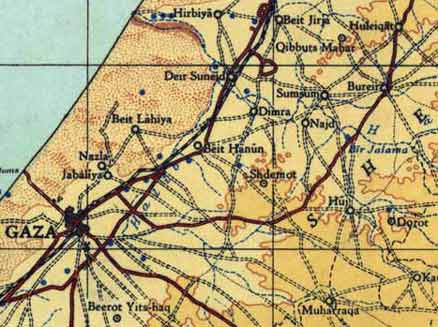
Though both Israel and Hamas are accused of war crimes during last year’s Operation Cast Lead, Human Rights Watch confirms its role as US policy whip by admonishing Hamas to account for its killing of civilians, yielding the AP headline: Human rights group: Hamas targeted civilians. February 5th is the deadline imposed by the UN for both parties to respond to charges made in the Goldstone Report. Fair enough, Hamas rockets killed three residents of Sderot while the IDF killed 1,400 in Gaza. But confusion always resurfaces about Sderot, formerly the Arab town of Najd. Can settlers deliberately mobilized to occupy Sderot, be excluded as legitimate targets of their dispossessed victims? Is Israel hiding behind civilian settlers which it moves illegally to advance its hold on conquered land?
Palestine 1947

The question of Sderot’s legitimacy provokes nothing but confusion. Some Israelis claim Sderot was part of the territory which the UN set aside for a Jewish State in 1947. Maps reveal rather that Sderot was seized in the warfare which erupted when the UN decision was announced. Sderot was overrun when Israel made its unilateral declaration of statehood, when Zionist forces expanded on the initial UN proposal, and fell back to the Green Line of 1949. Thus other Israelis defend Sderot as a “post-withdrawal” and “‘Green Line’ city.” A telling concession.

Both Israeli claims on Sderot profit by the confusion that the term “occupied territories” implies lands seized by Israel since 1967. Palestinians are constantly blamed for Arafat refusing to accept a compromise that would restore the 1967 boundaries. Ignoring the Palestinians’ right of return to properties taken well before.

Palestinians can be fully in the right to reject the UN’s reapportionment of their lands. But even if everyone was forced to adhere to the UN demarcations, Sderot would not be Israel’s. The dispossessed Palestinians have a right to reject the occupation of lands stolen in the wake of refugees fleeing the onslaught, now called the Nakba.

Labadee: Royal Caribbean’s Neo Haiti

Labadee oasis seas boi caimanFormer President Bill Clinton is heading to Haiti, again. As UN special envoy to Haiti, he paid a visit last year as a guest of the Royal Caribbean cruise ship line to promote their tourist facility at La’Badie. Said CEO Adam Goldstein: “Labadee is just a great example of the way that things can work in a very positive way in this country.” Are those new ways or old? The secured compound, laying under the protection of the old French colonial capitol, greets 7,000 cruise passengers a week, even this week, many of whom don’t know they’re in “Haiti,” on an old slave plantation, or what may have been the crucible of real Islamic rebel voodoo!

I didn’t know about the private resort of Labadee, but my attention was drawn in December to the announcement of the launch of The Oasis of the Seas, the largest cruise ship ever devised. It was leaving the shipyards of Finland, having to pass under a Danish suspension bridge at low tide, so titanic was she. I took note because the headline announced her maiden destination to be Haiti, an odd place I thought, to be ostentatious.

The spotlight which the recent earthquake has brought on the poverty in Haiti had me wondering if all seventeen decks of the Oasis of the Seas were gawking at the suffering masses awaiting aid in Port-au-Prince. Not a chance. The Oasis, and Royal Caribbean’s fleet of floating carbon boots harbor at a secluded oasis which the cruise line rents from Haiti. Its income represents the largest portion of Haiti’s tourism revenue. If you thought President Obama’s offer of $100 Million was stingy, you can calculate Royal Caribbean’s avarice on one hand.

The tragic earthquake hasn’t interrupted the cruises. It this tragedy has an upside, it’s that some vacationers are expressing less facility stuffing down a burger knowing most Haitians await relief.

Haiti receives $6 for each tourist who disembarks to zip-line, buy trinkets from licensed vendors, and sun on Christoper Columbus Beach. They’re told it was his old stomping ground –which actually can be said of Hispaniola’s entire northern coastline. Likewise the same is true about the slave plantations which, from the port of Cap Francois, provided 40% of Europe’s sugar and 60% of its coffee. Today Haiti is renowned as the poorest land in the Western Hemisphere. The verdant lands of La Partie Du Nord –of Les Grand Blancs— are separated from the Haitian population by a mountainous Massif, and in the case of Labadee, with barbed wire.

habitation-slave-plantationsRoyal Caribbean boasts that its operations are critical to the Haitian economy. It employs hundreds, but contrast that with what the coast could provide if it wasn’t privatized. The resort draws from a cheap labor pool of an unlimited mass of Haitians who are kept with no other options but to hope they can replace the couple hundred employees confined to the cruise line compound.

And yes, the cruise itineraries avoid mention of Haiti, attributing Labadee as a “private island” of Hispaniola. The private island concept is not new, cruise ship operators began several decades back to seek to give their customers refuge from the growing throngs of third world poor who paddle out to the ship hoping for first world largess. Another motive was that cruise lines could also monopolize where their passengers could spend their money while ashore. What began as exclusive contracts with port destinations, very notoriously the Alaskan inland passage, became ventures where cruise line operators bought entire tracks of properties retired from oil or military use, whether half islands, or merely beaches, recast as private beaches, populated by private workforces.

Disney Cruise Line: Castaway Cay, Bahamas
Princess Cruises: Princess Cays, Eleuthera, Bahamas
Norwegian Cruise Line: Great Stirrup Cay, Bahamas
Holland/Carnival: Half Moon Bay, Little San Salvador Island, Bahamas
Royal Caribbean/Celebrity: Coco Cay, Bahamas; Labadee, Hispaniola

According to the Royal Caribbean promotional material, the spelling Labadee is anglicized for English-speakers. It’s named after the Marquis de La’Badie, a “Frenchman who first settled the area in the 1600s.”

At one time the French plantation owners were comforted by their remote location, buffered they thought from the potential of slave rebellions from the south. In fact, Haiti’s famed uprising began in the north, not far at all from La’Badie. Off the Royal Caribbean itinerary, but only a stone’s throw away, that is to say, within distance of incoming stones, are landmarks important to the celebrated revolution: Haiti’s first copper mine, site of a lone concentration of Islamic slaves, and the Bois Caiman of lore.

The area of Cape Haitien, as it’s called today, holds two of Haiti’s geography secrets. One, the conclusive location of La Villa de Navidad, where Christopher Columbus built his first European settlement in the New World, a fort made of the timbers of the wrecked flagship Santa Maria; Columbus returned the next year to find his men murdered and the houses burned to the ground. Archeologists are still looking to find definitive traces in Caracol or Bord de Mer de Limonade.

Second, the site of the Bwa Kayiman, the ceremony which launched Haiti’s famed slave rebellion led by Toussaint Louverture. Some scholars have begun to question whether it happened at all. They base their skepticism on the absence of written testaments. Although it’s popularly understood that the gathering of conspirators was confessed under torture by rebels captured by the French authorities. The cynics suggest the story was a fabrication to demonize the black slaves and that:

the manuscript minutes of these interrogations have survived in the French National Archives and make no mention of this or any other vodun ceremony.

That’s something to wrap your mind around, that transcripts remain of torture sessions conducted so many years ago.

Naturally the secret gathering had to escape the suspicions of the French slaveholders, but the infamy of the declaration of the Bois Caiman has inspired every Bolivarian insurrection since, from Bolivar, to Marti, Sandino, Castro, Moralles and Chavez. Revisionists seeking to tamp the populist spirit question why its location remains a mystery. Oral tradition holds that the rebels gathered in an open space in the forests of Morne Rouge.

Morne Rouge, the place where BC ceremony hypotheses converge, is also the only place in Haiti to retain an important Islamic cult. This is because the first wave of slaves were from the Senegambian region and had already undergone heavy Islamic influence. Up to date, Mori Barthelemy and followers of the region maintain this tradition, with honor to the sun, specific funeral rites and so on. If one returns to sources of the 16th century, one finds that there is where the first copper mines were established by the Spaniards, when they started giving up on the gold.

You can find Labadee, 19° 47? 11? N, 72° 14? 44? W on any modern map. Pondering The Cape it occupies, and the deep water harbor it is able to afford a behemoth like the Oasis of the Seas, I was led to research the mysteries of Haiti’s NORD, and survey the progression of place names on European maps which span the years.

haiti
This is Cristóbal Colón‘s own recollection of the northern coast of what he called La Isla Española, marking his first landing at San Nicolas Môle, the island of Tortuga, Fort Navidad, and the landmark Monte Cristi whose height guided Columbus and led him to name Hispaniola after Spain.

haiti charlevoix
A later map made by the French attempts to show the divisions of the indigenous tribes. The site marked “Premier Etablissment” marks Navidad, built near the Taíno cultural center of Hayti-Bohío-Quisqueya.

haiti Vinckeboons
A 1639 Dutch map shows Cap François. On the south shore of Isla Tortuga lies the beach Playa Cyan, across the water from the river Rio dos Caymanis. Also note the hills to the east called Mançanilla, these divided the peaceful Taíno from the warring Caciq. The location name derives from the Manchineel Trees whose poison berries they used to poison the tips of their arrows.

haiti monte christo
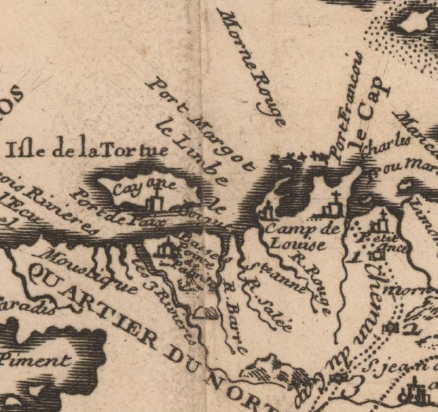
French map circa 1723 marks Cayne opposite the Iron Coast of L’Ile de la Tortue. There’s also a typical sailor’s landmark: Pointe des Palmiers (trans. Point of the Palms). The promontory of Cap François has here become Le Cap (The Cape). It shelters Port St. François, east of the heights of Morne Rouge and Mines de Cuivre (trans. copper mines).

haiti labat
French map of Cape Francois dated 1722 adds Le Limbe, the first area which the rebel slaves put to the torch; and Le Chemin du Cap, the main road to the valleys of the south.

haiti Ponce
This 1796 French map features another sailor’s aid, Pointe Tête de Chein (trans. Dog’s Head Point). The fortification battery on the Cape was built upon Roche à Picolet. This map was drawn after the rebellion of 1791. The Morne Rouge (trans. Red Heights) is now designated as Ravine du Morne au Diable and the Acul à Sabal. The Devil’s Ravine is the present location of Royal Caribbean’s Labadee.

The poor of Haiti are still taking heat for the Bwa Kayiman having been a pact with the devil.

haiti bellin
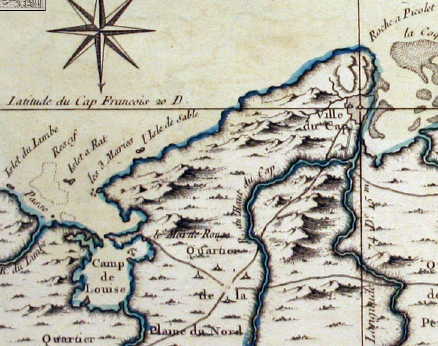
I add this 1764 map for personal interest. Few maps even today mark L’Islet à Rat (trans. Rat Island), which Columbus called La Amiga, was an aid to navigation out of his anchorage at Bay of Acul which he called Cabo de Caribata.

This map also details how colonial French St Domingue was divided into districts, here the Ville du Cap, the Quartier de Plaine du Nord and Camp de Louise.

haiti moreau
This 1770 map of Cap François and Environs distinguishes the larger slavery plantations.

haiti labadi

On the subject of Columbus, isn’t it surprising to reconcile the current verdict on his genocidal behavior, with the histories which have glorified his stature? After all, the primary accounts have never changed. How did earlier biographers overlook the damning and salacious details? One very polite telling of Columbus’ adventures, written by Filson Young published in 1906 provides a prim example. Here Young addresses the kidnap and rape of the indians whom Columbus encountered:

…his taking of the women raises a question which must be in the mind of any one who studies this extraordinary voyage—the question of the treatment of native women by the Spaniards. Columbus is entirely silent on the subject; but taking into account the nature of the Spanish rabble that formed his company, and his own views as to the right which he had to possess the persons and goods of the native inhabitants, I am afraid that there can be very little doubt that in this matter there is a good reason, for his silence. So far as Columbus himself was concerned, it is probable that he was innocent enough; he was not a sensualist by nature, and he was far too much interested and absorbed in the principal objects of his expedition, and had too great a sense of his own personal dignity, to have indulged in excesses that would, thus sanctioned by him, have produced a very disastrous effect on the somewhat rickety discipline of his crew. He was too wise a master, however, to forbid anything that it was not in his power to prevent; and it is probable that he shut his eyes to much that, if he did not tolerate it, he at any rate regarded as a matter of no very great importance. His crew had by this time learned to know their commander well enough not to commit under his eyes offences for which he would have been sure to punish them.

[Giving a list of instructions to the men Columbus planned to leave behind at La Navidad, among them: ]

…and especially to be on their guard to avoid injury or violence to the women, “by which they would cause scandal and set a bad example to the Indians and show the infamy of the Christians.”

no kolumbus day christopher columbusAnd here’s the rub. In this passage the author shows if we do not absolve Columbus, we indict ourselves.

The ruffianly crew had in their minds only the immediate possession of what they could get from the Indians; the Admiral had in his mind the whole possession of the islands and the bodies and souls of its inhabitants. If you take a piece of gold without giving a glass bead in exchange for it, it is called stealing; if you take a country and its inhabitants, and steal their peace from them, and give them blood and servitude in exchange for it, it is called colonisation and Empire-building. Every one understands the distinction; but so few people see the difference that Columbus of all men may be excused for his unconsciousness of it.

It’s a picture worth a thousand ships

Israeli Deputy Foreign Minster Ayalon and Turkish ambassadorAt first the story read like diplomatic sensitivities ruffled by no more than your typical office power feng shui: the Turkish ambassador to Israel was not seated at a height commensurate with his host, the flag of his nation was not displayed, the Israeli deputy minister would not shake his hand. Rather it was Deputy Foreign Minister Danny Ayalon himself who called the reporters’ attentions to the intentional affronts, lest it was not obvious enough from the photograph. To what do the Turks owe Israel’s displeasure? Turkey’s PM has been criticizing Israel’s crimes in Gaza, to no greater degree than has been confirmed by the UN Goldstone Report. Here’s to hoping that Turkish pride will answer appropriately.

It’s been a traditional role of ambassadors to suffer their host’s anger at a perceived provocation. Didn’t Ivan the Terrible once send emissaries packing after he’d nailed their hats to their heads? Often in less diplomatic times, envoys were beheaded, to usually ruinous result. In modern times, suffering indignity to foreign dignitaries is enough to send your message. But today too, media images have come to have a greater reach across the world. I’m thinking in particular the Muslim populaces. Let’s see what kind of posture of subservience Israel can expect of Turkey.

Said one Turkish parliamentarian: “The word scandal is not enough to describe this move.” And it seems unlikely that Israel will apologize, Ayalon already responding: “In terms of the diplomatic tactics available, this was the minimum that was warranted given the repeated provocations by political and other players in Turkey.”

Perhaps Israel was emboldened by Egypt’s recent display of obedience to the mission of starving Gaza. Israel’s violent repression of the people of Gaza is meeting with growing criticism, and perhaps they expect Turkish Prime Minister Recep Tayyip Erdogan to heel dutifully.

What might the minimum of responses be from Turkey, given the sway the US holds over its actions, in light too of its aspiration to rise through the EU?

With Egypt’s intention to fortify its Gaza border to curtail tunneling, and its announcement to permit no further aid from reaching the besieged Palestinians, the path remains only for someone to reach Gaza by sea. I’m hoping it will be the Turks.

Why couldn’t a Sea Shepherd Conservation Society type flotilla mount a seaborne rescue of Gaza? I’d bet televising such an adventure would find a bigger audience than Whale Wars.

Aid groups have been trying, with sporadic success, to breach Israel’s naval blockade of the Gaza coast. Perhaps it’s time for a nation to lend some military vessels to the task. Why not? The United Nations considers Israel’s embargo of Gaza to be illegal. Why shouldn’t a local power sail right before the Israeli warships to escort relief supplies to the Gazans? Let’s see whose ships will look down on whose.

israel-humiliates-turkey-ambassador

UPDATE: Here it is, the Free Gaza Movement is putting together a flotilla!

William Blum – Anti-Empire Report

Here’s William Blum’s latest essay, on Lincoln Gordon, Brazil, Cuba, and the 2009 Nobel Laureate, reprinted from www.killinghope.org.

THE ANTI-EMPIRE REPORT
By William Blum, January 6, 2009

The American elite

Lincoln Gordon died a few weeks ago at the age of 96. He had graduated summa cum laude from Harvard at the age of 19, received a doctorate from Oxford as a Rhodes Scholar, published his first book at 22, with dozens more to follow on government, economics, and foreign policy in Europe and Latin America. He joined the Harvard faculty at 23. Dr. Gordon was an executive on the War Production Board during World War II, a top administrator of Marshall Plan programs in postwar Europe, ambassador to Brazil, held other high positions at the State Department and the White House, a fellow at the Woodrow Wilson International Center for Scholars, economist at the Brookings Institution, president of Johns Hopkins University. President Lyndon B. Johnson praised Gordon’s diplomatic service as "a rare combination of experience, idealism and practical judgment".

You get the picture? Boy wonder, intellectual shining light, distinguished leader of men, outstanding American patriot.

Abraham Lincoln Gordon was also Washington’s on-site, and very active, director in Brazil of the military coup in 1964 which overthrew the moderately leftist government of João Goulart and condemned the people of Brazil to more than 20 years of an unspeakably brutal dictatorship. Human-rights campaigners have long maintained that Brazil’s military regime originated the idea of the desaparecidos, "the disappeared", and exported torture methods across Latin America. In 2007, the Brazilian government published a 500-page book, "The Right to Memory and the Truth", which outlines the systematic torture, rape and disappearance of nearly 500 left-wing activists, and includes photos of corpses and torture victims. Currently, Brazilian President Luiz Inácio Lula da Silva is proposing a commission to investigate allegations of torture by the military during the 1964-1985 dictatorship. (When will the United States create a commission to investigate its own torture?)

In a cable to Washington after the coup, Gordon stated — in a remark that might have had difficulty getting past the lips of even John Foster Dulles — that without the coup there could have been a "total loss to the West of all South American Republics". (It was actually the beginning of a series of fascistic anti-communist coups that trapped the southern half of South America in a decades-long nightmare, culminating in "Operation Condor", in which the various dictatorships, aided by the CIA, cooperated in hunting down and killing leftists.)

Gordon later testified at a congressional hearing and while denying completely any connection to the coup in Brazil he stated that the coup was "the single most decisive victory of freedom in the mid-twentieth century."

Listen to a phone conversation between President Johnson and Thomas Mann, Assistant Secretary of State for Inter-American Affairs, April 3, 1964, two days after the coup:

MANN: I hope you’re as happy about Brazil as I am.

LBJ: I am.

MANN: I think that’s the most important thing that’s happened in the hemisphere in three years.

LBJ: I hope they give us some credit instead of hell.1

So the next time you’re faced with a boy wonder from Harvard, try to keep your adulation in check no matter what office the man attains, even — oh, just choosing a position at random — the presidency of the United States. Keep your eyes focused not on these "liberal" … "best and brightest" who come and go, but on US foreign policy which remains the same decade after decade. There are dozens of Brazils and Lincoln Gordons in America’s past. In its present. In its future. They’re the diplomatic equivalent of the guys who ran Enron, AIG and Goldman Sachs.

Of course, not all of our foreign policy officials are like that. Some are worse.

And remember the words of convicted spy Alger Hiss: Prison was "a good corrective to three years at Harvard."

Mothers, don’t let your children grow up to be Nobel Peace Prize winners

In November I wrote:

Question: How many countries do you have to be at war with to be disqualified from receiving the Nobel Peace Prize?

Answer: Five. Barack Obama has waged war against only Pakistan, Afghanistan, Iraq and Somalia. He’s holding off on Iran until he actually gets the prize.

Well, on December 10 the president clutched the prize in his blood-stained hands. But then the Nobel Laureate surprised us. On December 17 the United States fired cruise missiles at people in … not Iran, but Yemen, all "terrorists" of course, who were, needless to say, planning "an imminent attack against a U.S. asset".2 A week later the United States carried out another attack against "senior al-Qaeda operatives" in Yemen.3

Reports are that the Nobel Peace Prize Committee in Norway is now in conference to determine whether to raise the maximum number of wars allowed to ten. Given the committee’s ignoble history, I imagine that Obama is taking part in the discussion. As is Henry Kissinger.

The targets of these attacks in Yemen reportedly include fighters coming from Afghanistan and Iraq, confirmation of the warnings long given — even by the CIA and the Pentagon — that those US interventions were creating new anti-American terrorists. (That’s anti-American foreign policy, not necessarily anything else American.) How long before the United States will be waging war in some other god-forsaken land against anti-American terrorists whose numbers include fighters from Yemen? Or Pakistan? Or Somalia? Or Palestine?

Our blessed country is currently involved in so many bloody imperial adventures around the world that one needs a scorecard to keep up. Rick Rozoff of StopNATO has provided this for us in some detail.4

For this entire century, almost all these anti-American terrorists have been typically referred to as "al-Qaeda", as if you have to be a member of something called al-Qaeda to resent bombs falling on your house or wedding party; as if there’s a precise and meaningful distinction between people retaliating against American terrorism while being a member of al-Qaeda and people retaliating against American terrorism while NOT being a member of al-Qaeda. However, there is not necessarily even such an animal as a "member of al-Qaeda", albeit there now exists "al-Qaeda in Iraq" and "al-Qaeda in the Arabian Peninsula". Anti-American terrorists do know how to choose a name that attracts attention in the world media, that appears formidable, that scares Americans. Governments have learned to label their insurgents "al-Qaeda" to start the military aid flowing from Washington, just like they yelled "communist" during the Cold War. And from the perspective of those conducting the War on Terror, the bigger and more threatening the enemy, the better — more funding, greater prestige, enhanced career advancement. Just like with the creation of something called The International Communist Conspiracy.

It’s not just the American bombings, invasions and occupations that spur the terrorists on, but the American torture. Here’s Bowe Robert Bergdahl, US soldier captured in Afghanistan, speaking on a video made by his Taliban captors: He said he had been well-treated, contrasting his fate to that of prisoners held in US military prisons, such as the infamous Abu Ghraib prison in Iraq. "I bear witness I was continuously treated as a human being, with dignity, and I had nobody deprive me of my clothes and take pictures of me naked. I had no dogs barking at me or biting me as my country has done to their Muslim prisoners in the jails that I have mentioned."5

Of course the Taliban provided the script, but what was the script based on? What inspired them to use such words and images, to make such references?

Cuba. Again. Still. Forever.

More than 50 years now it is. The propaganda and hypocrisy of the American mainstream media seems endless and unwavering. They can not accept the fact that Cuban leaders are humane or rational. Here’s the Washington Post of December 13 writing about an American arrested in Cuba:

"The Cuban government has arrested an American citizen working on contract for the U.S. Agency for International Development who was distributing cellphones and laptop computers to Cuban activists. … Under Cuban law … a Cuban citizen or a foreign visitor can be arrested for nearly anything under the claim of ‘dangerousness’."

That sounds just awful, doesn’t it? Imagine being subject to arrest for whatever someone may choose to label "dangerousness". But the exact same thing has happened repeatedly in the United States since the Bolshevik Revolution of 1917. We don’t use the word "dangerousness". We speak of "national security". Or, more recently, "terrorism". Or "providing material support to terrorism".

The arrested American works for Development Alternatives, Inc. (DAI), a US government contractor that provides services to the State Department, the Pentagon and the US Agency for International Development (USAID). In 2008, DAI was funded by the US Congress to "promote transition to democracy" in Cuba. Yes, Oh Happy Day!, we’re bringing democracy to Cuba just as we’re bringing it to Afghanistan and Iraq. In 2002, DAI was contracted by USAID to work in Venezuela and proceeded to fund the same groups that a few months earlier had worked to stage a coup — temporarily successful — against President Hugo Chávez. DAI performed other subversive work in Venezuela and has also been active in Afghanistan, Pakistan, and other hotspots. "Subversive" is what Washington would label an organization like DAI if they behaved in the same way in the United States in behalf of a foreign government.6

The American mainstream media never makes its readers aware of the following (so I do so repeatedly): The United States is to the Cuban government like al-Qaeda is to the government in Washington, only much more powerful and much closer. Since the Cuban revolution, the United States and anti-Castro Cuban exiles in the US have inflicted upon Cuba greater damage and greater loss of life than what happened in New York and Washington on September 11, 2001. Cuban dissidents typically have had very close, indeed intimate, political and financial connections to American government agents. Would the US government ignore a group of Americans receiving funds or communication equipment from al-Qaeda and/or engaging in repeated meetings with known leaders of that organization? In the past few years, the American government has arrested a great many people in the US and abroad solely on the basis of alleged ties to al-Qaeda, with a lot less evidence to go by than Cuba has had with its dissidents’ ties to the United States, evidence usually gathered by Cuban double agents. Virtually all of Cuba’s "political prisoners" are such dissidents.

The Washington Post story continued:

"The Cuban government granted ordinary citizens the right to buy cellphones just last year." Period.

What does one make of such a statement without further information? How could the Cuban government have been so insensitive to people’s needs for so many years? Well, that must be just the way a "totalitarian" state behaves. But the fact is that because of the disintegration of the Soviet bloc, with a major loss to Cuba of its foreign trade, combined with the relentless US economic aggression, the Caribbean island was hit by a great energy shortage beginning in the 1990s, which caused repeated blackouts. Cuban authorities had no choice but to limit the sale of energy-hogging electrical devices such as cell phones; but once the country returned to energy sufficiency the restrictions were revoked.

"Cubans who want to log on [to the Internet] often have to give their names to the government."

What does that mean? Americans, thank God, can log onto the Internet without giving their names to the government. Their Internet Service Provider does it for them, furnishing their names to the government, along with their emails, when requested.

"Access to some Web sites is restricted."

Which ones? Why? More importantly, what information might a Cuban discover on the Internet that the government would not want him to know about? I can’t imagine. Cubans are in constant touch with relatives in the US, by mail and in person. They get US television programs from Miami. International conferences on all manner of political, economic and social subjects are held regularly in Cuba. What does the American media think is the great secret being kept from the Cuban people by the nasty commie government?

"Cuba has a nascent blogging community, led by the popular commentator Yoani Sánchez, who often writes about how she and her husband are followed and harassed by government agents because of her Web posts. Sánchez has repeatedly applied for permission to leave the country to accept journalism awards, so far unsuccessfully."

According to a well-documented account7, Sánchez’s tale of government abuse appears rather exaggerated. Moreover, she moved to Switzerland in 2002, lived there for two years, and then voluntarily returned to Cuba. On the other hand, in January 2006 I was invited to attend a book fair in Cuba, where one of my books, newly translated into Spanish, was being presented. However, the government of the United States would not give me permission to go. My application to travel to Cuba had also been rejected in 1998 by the Clinton administration.

"’Counterrevolutionary activities’, which include mild protests and critical writings, carry the risk of censure or arrest. Anti-government graffiti and speech are considered serious crimes."

Raise your hand if you or someone you know of was ever arrested in the United States for taking part in a protest. And substitute "pro al-Qaeda" for "counterrevolutionary" and for "anti-government" and think of the thousands imprisoned the past eight years by the United States all over the world for … for what? In most cases there’s no clear answer. Or the answer is clear: (a) being in the wrong place at the wrong time, or (b) being turned in to collect a bounty offered by the United States, or (c) thought crimes. And whatever the reason for the imprisonment, they were likely tortured. Even the most fanatical anti-Castroites don’t accuse Cuba of that. In the period of the Cuban revolution, since 1959, Cuba has had one of the very best records on human rights in the hemisphere. See my essay: "The United States, Cuba and this thing called Democracy".8

There’s no case of anyone arrested in Cuba that compares in injustice and cruelty to the arrest in 1998 by the United States government of those who came to be known as the "Cuban Five", sentenced in Florida to exceedingly long prison terms for trying to stem terrorist acts against Cuba emanating from the US.9 It would be lovely if the Cuban government could trade their DAI prisoner for the five. Cuba, on several occasions, has proposed to Washington the exchange of a number of what the US regards as "political prisoners" in Cuba for the five Cubans held in the United States. So far the United States has not agreed to do so.

Notes

  1. Michael Beschloss, Taking Charge: The Johnson White House Tapes 1963-1964 (New York, 1997), p.306. All other sources for this section on Gordon can be found in: Washington Post, December 22, 2009, obituary; The Guardian (London), August 31, 2007; William Blum, "Killing Hope", chapter 27 ↩
  2. ABC News, December 17, 2009; Washington Post, December 19, 2009 ↩
  3. Washington Post, December 25, 2009 ↩
  4. Stop NATO, "2010: U.S. To Wage War Throughout The World", December 30, 2009. To get on the StopNATO mailing list write to r_rozoff@yahoo.com. To see back issues: http://groups.yahoo.com/group/stopnato/↩
  5. Reuters, December 25, 2009 ↩
  6. For more details on DAI, see Eva Golinger, "The Chávez Code: Cracking US Intervention in Venezuela" (2006) and her website, posting for December 31, 2009 ↩
  7. Salim Lamrani, professor at Paris Descartes University, "The Contradictions of Cuban Blogger Yoani Sanchez", Monthly Review magazine, November 12, 2009 ↩
  8. http://killinghope.org/bblum6/democ.htm ↩
  9. http://killinghope.org/bblum6/polpris.htm ↩

Gaza aid convoy united in El-Arish, but Egypt still moving the goalposts

viva palestina aid convoy ferry lattakiaJAN 5 PressTV update below.
Viva Palestina’s aid convoy was augmented by 47 additional vehicles impounded on a previous convoy run, bringing the total to 220, most ambulances. Why does Gaza need more ambulances, you might well ask.

It’s a question everyone is too polite to ponder. The answers are simply too cynical: because aid is being restricted to medical supplies, and because someone keeps shooting at ambulances. BTW the full Goldstone Report is now available online.

Press TV reports

The Cairo Declaration

gaza-freedom-march-cairo-egypt
Ambitions for a greater Gaza Freedom March have been set aside for another decade, but the hopeful delegates thwarted in Cairo issued the following declaration:

End Israeli Apartheid?
Cairo Declaration
?January 1, 2010

We, international delegates meeting in Cairo during the Gaza Freedom March 2009 in collective response to an initiative from the South African delegation, state:

In view of:

* Israel’s ongoing collective punishment of Palestinians through the illegal occupation and siege of Gaza;?

* the illegal occupation of the West Bank, including East Jerusalem, and the continued construction of the illegal Apartheid Wall and settlements;?

* the new Wall under construction by Egypt and the US which will tighten even further the siege of Gaza;?

* the contempt for Palestinian democracy shown by Israel, the US, Canada, the EU and others after the Palestinian elections of 2006;?

* the war crimes committed by Israel during the invasion of Gaza one year ago;?

* the continuing discrimination and repression faced by Palestinians within Israel;?

* and the continuing exile of millions of Palestinian refugees;?

* all of which oppressive acts are based ultimately on the Zionist ideology which underpins Israel;?

* in the knowledge that our own governments have given Israel direct economic, financial, military and diplomatic support and allowed it to behave with impunity;?

* and mindful of the United Nations Declaration on the Rights of Indigenous People (2007)

We reaffirm our commitment to:

Palestinian Self-Determination?Ending the Occupation?Equal Rights for All within historic Palestine?The full Right of Return for Palestinian refugees.

We therefore reaffirm our commitment to the United Palestinian call of July 2005 for Boycott, Divestment and Sanctions (BDS) to compel Israel to comply with international law.

To that end, we call for and wish to help initiate a global mass, democratic anti-apartheid movement to work in full consultation with Palestinian civil society to implement the Palestinian call for BDS.

Mindful of the many strong similarities between apartheid Israel and the former apartheid regime in South Africa, we propose:

1) An international speaking tour in the first 6 months of 2010 by Palestinian and South African trade unionists and civil society activists, to be joined by trade unionists and activists committed to this programme within the countries toured, to take mass education on BDS directly to the trade union membership and wider public internationally;

2) Participation in the Israeli Apartheid Week in March 2010;

3) A systematic unified approach to the boycott of Israeli products, involving consumers, workers and their unions in the retail, warehousing, and transportation sectors;

4) Developing the Academic, Cultural and Sports boycott;

5) Campaigns to encourage divestment of trade union and other pension funds from companies directly implicated in the Occupation and/or the Israeli military industries;

6) Legal actions targeting the external recruitment of soldiers to serve in the Israeli military, and the prosecution of Israeli government war criminals; coordination of Citizen’s Arrest Bureaux to identify, campaign and seek to prosecute Israeli war criminals; support for the Goldstone Report and the implementation of its recommendations;

7) Campaigns against charitable status of the Jewish National Fund (JNF).

We appeal to organisations and individuals committed to this declaration to sign it and work with us to make it a reality.

Signed by:

(* Affiliation for identification purposes only.)

1. Hedy Epstein, Holocaust Survivor/ Women in Black*, USA?
2. Nomthandazo Sikiti, Nehawu, Congress of South African Trade Unions (COSATU), Affiliate International Officer*, South Africa?
3. Zico Tamela, Satawu, Congress of South African Trade Unions (COSATU) Affiliate International Officer*, South Africa?
4. Hlokoza Motau, Numsa, Congress of South African Trade Unions (COSATU) Affiliate International Officer*, South Africa?
5. George Mahlangu, Congress of South African Trade Unions (COSATU) Campaigns Coordinator*, South Africa?
6. Crystal Dicks, Congress of South African Trade Unions (COSATU) Education Secretary*, South Africa?
7. Savera Kalideen, SA Palestinian Solidarity Committee*, South Africa?
8. Suzanne Hotz, SA Palestinian Solidarity Group*, South Africa?
9. Shehnaaz Wadee, SA Palestinian Solidarity Alliance*, South Africa?
10. Haroon Wadee, SA Palestinian Solidarity Alliance*, South Africa?
11. Sayeed Dhansey, South Africa?
12. Faiza Desai, SA Palestinian Solidarity Alliance*, South Africa?
13. Ali Abunimah, Electronic Intifada*, USA?
14. Hilary Minch, Ireland Palestine Solidarity Committee*, Ireland?
15. Anthony Loewenstein, Australia?
16. Sam Perlo-Freeman, United Kingdom?
17. Julie Moentk, Pax Christi*, USA?
18. Ulf Fogelström, Sweden?
19. Ann Polivka, Chico Peace and Justice Center*, USA?
20. Mark Johnson, Fellowship of Reconciliation*, USA?
21. Elfi Padovan, Munich Peace Committee*/Die Linke*, Germany?
22. Elizabeth Barger, Peace Roots Alliance*/Plenty I*, USA?
23. Sarah Roche-Mahdi, CodePink*, USA?
24. Svetlana Gesheva-Anar, Bulgaria?
25. Cristina Ruiz Cortina, Al Quds-Malaga*, Spain?
26. Rachel Wyon, Boston Gaza Freedom March*, USA?
27. Mary Hughes-Thompson, Women in Black*, USA?
28. David Letwin, International Jewish Anti-Zionist Network (IJAN)*, USA?
29. Jean Athey, Peace Action Montgomery*, USA?
30. Gael Murphy, Gaza Freedom March*/CodePink*, USA?
31. Thomas McAfee, Journalist/PC*, USA?
32. Jean Louis Faure, International Jewish Anti-Zionist Network (IJAN)*, France?
33. Timothy A King, Christians for Peace and Justice in the Middle East*, USA?
34. Gail Chalbi, Palestine/Israel Justice Project of the Minnesota United Methodist Church*, USA?
35. Ouahib Chalbi, Palestine/Israel Justice Project of the Minnesota United Methodist Church*, USA?
36. Greg Dropkin, Liverpool Friends of Palestine*, England?
37. Felice Gelman, Wespac Peace and Justice New York*/Gaza Freedom March*, USA?
38. Ron Witton, Australian Academic Union*, Australia?
39. Hayley Wallace, Palestine Solidarity Committee*, USA?
40. Norma Turner, Manchester Palestine Solidarity Campaign*, England?
41. Paula Abrams-Hourani, Women in Black (Vienna)*/ Jewish Voice for Just Peace in the Middle East*, Austria?
42. Mateo Bernal, Industrial Workers of the World*, USA?
43. Mary Mattieu, Collectif Urgence Palestine*, Switzerland?
44. Agneta Zuppinger, Collectif Urgence Palestine*, Switzerland?
45. Ashley Annis, People for Peace*, Canada?
46. Peige Desgarlois, People for Peace*, Canada?
47. Hannah Carter, Canadian Friends of Sabeel*, Canada?
48. Laura Ashfield, Canadian Friends of Sabeel*, Canada?
49. Iman Ghazal, People for Peace*, Canada?
50. Filsam Farah, People for Peace*, Canada?
51. Awa Allin, People for Peace*, Canada?
52. Cleopatra McGovern, USA?
53. Miranda Collet, Spain?
54. Alison Phillips, Scotland?
55. Nicholas Abramson, Middle East Crisis Response Network*/Jews Say No*, USA?
56. Tarak Kauff, Middle East Crisis Response Network*/Veterans for Peace*, USA?
57. Jesse Meisler-Abramson, USA?
58. Hope Mariposa, USA?
59. Ivesa Lübben. Bremer Netzwerk fur Gerechten Frieden in Nahost*, Germany?
60. Sheila Finan, Mid-Hudson Council MERC*, USA?
61. Joanne Lingle, Christians for Peace and Justice in the Middle East (CPJME)*, USA?
62. Barbara Lubin, Middle East Children’s Alliance*, USA?
63. Josie Shields-Stromsness, Middle East Children’s Alliance*, USA?
64. Anna Keuchen, Germany?
65. Judith Mahoney Pasternak, WRL* and Indypendent*, USA?
66. Ellen Davidson, New York City Indymedia*, WRL*, Indypendent*, USA?
67. Ina Kelleher, USA?
68. Lee Gargagliano, International Jewish Anti-Zionist Network (Chicago)*, USA?
69. Brad Taylor, OUT-FM*, USA?
70. Helga Mankovitz, SPHR (Queen’s University)*, Canada?
71. Mick Napier, Scottish Palestine Solidarity Campaign*, Scotland?
72. Agnes Kueng, Paso Basel*, Switzerland?
73. Anne Paxton, Voices of Palestine*, USA?
74. Leila El Abtah, The Netherlands?
75. Richard, Van der Wouden, The Netherlands?
76. Rafiq A. Firis, P.K.R.*/Isra*, The Netherlands?
77. Sandra Tamari, USA?
78. Alice Azzouzi, Way to Jerusalem*, USA?
79. J’Ann Schoonmaker Allen, USA?
80. Ruth F. Hooke, Episcopalian Peace Fellowship*, USA?
81. Jean E. Lee, Holy Land Awareness Action Task Group of United Church of Canada*, Canada?
82. Delphine de Boutray, Association Thèâtre Cine*, France?
83. Sylvia Schwarz, USA?
84. Alexandra Safi, Germany?
85. Abdullah Anar, Green Party – Turkey*, Turkey?
86. Ted Auerbach, USA?
87. Martha Hennessy, Catholic Worker*, USA?
88. Father Louis Vitale, Interfaile Pace e Bene*, USA?
89. Leila Zand, Fellowship of Reconciliation*, USA?
90. Emma Grigore, CodePink*, USA?
91. Sammer Abdelela, New York Community of Muslim Progressives*, USA?
92. Sharat G. Lin, San Jose Peace and Justice Center*, USA?
93. Katherine E. Sheetz, Free Gaza*, USA?
94. Steve Greaves, Free Gaza*, USA?
95. Trevor Baumgartner, Free Gaza*, USA?
96. Hanan Tabbara, USA?
97. Marina Barakatt, CodePink*, USA?
98. Keren Bariyov, USA?
99. Ursula Sagmeister, Women in Black – Vienna*, Austria?
100. Ann Cunningham, Australia?
101. Bill Perry, Delaware Valley Veterans for Peace*, USA?
102. Terry Perry, Delaware Valley Veterans for Peace*, USA?
103. Athena Viscusi, USA?
104. Marco Viscusi, USA?
105. Paki Wieland, Northampton Committee*, USA?
106. Manijeh Saba, New York / New Jersey, USA?
107. Ellen Graves, USA?
108. Zoë Lawlor, Ireland – Palestine Solidarity Campaign*, Ireland?
109. Miguel García Grassot, Al Quds – Málaga*, Spain?
110. Ana Mamora Romero, ASPA-Asociacion Andaluza Solidaridad y Paz*, Spain?
111. Ehab Lotayef, CJPP Canada*, Canada?
112. David Heap, London Anti-War*, Canada?
113. Adie Mormech, Free Gaza* / Action Palestine*, England?
114. Aimee Shalan, UK?
115. Liliane Cordova, International Jewish Anti-Zionist Network (IJAN)*, Spain?
116. Priscilla Lynch, USA?
117. Jenna Bitar, USA?
118. Deborah Mardon, USA?
119. Becky Thompson, USA?
120. Diane Hereford, USA?
121. David Heap, People for Peace London*, Canada?
122. Donah Abdulla, Solidarity for Palestinian Human Rights*, Canada?
123. Wendy Goldsmith, People for Peace London*, Canada?
124. Abdu Mihirig, Solidarity for Palestinian Human Rights-UBC*, Canada?
125. Saldibastami, Solidarity for Palestinian Human Rights-UBC*, Canada?
126. Abdenahmane Bouaffad, CMF*, France?
127. Feroze Mithiborwala, Awami Bharat*, India?
128. John Dear, Pax Christi*, USA?
129. Ziyaad Lunat, Portugal?
130. Michael Letwin, New York City Labor Against the War (NYCLAW)?
131. Labor For Palestine

Avatar: novel push for noble savage

Avatar movie poster based on the novel by SapphireI’d like to contrast the high-profile critical receptions being given two Hollywood films about darker-skinned-ness. Precious is about an African-American girl so dark she absorbs the light, without being about race at all. The movie tells a story of poverty, incest and the cycle of abuse, while tipping the scales with gratuitous stereotypes of Hottentot welfare mamas attendant their usual good-for-trouble black males. Vilifying the subjects it pretends to rescue, Precious has the blessing of the media, a shameless Oprah included. James Cameron’s Avatar on the other hand, opened to depth-charges of faint praise calculated to dim the buzz, perhaps because it packs the most subversive black-is-beautiful message since Muhammad Ali.

Avatar evokes rudimentary indigenous spirituality, peppered with what even elementary-schooled audiences can associate as Native American themes, from which we can infer the concepts are eternal, but idealizes an athletic aesthetic more human than the movie’s live-action characters. The “blue cat people,” as the critics have chosen to describe its Na’vi tribe, are but fantasy-striped, tailed Spartans, computer iterations of the Williams sisters and NBA dream teams. The real humans of Avatar tower in prowess, dignity and luminescence over their modern mensch oppressors.

Where racial equality on film is plotted according to how black figures are granted access to the world of white priviledge, Avatar celebrates the sovereignty of dark skin in its environment, where it’s not a barbershop, rapper’s crib, or street corner in Harlem. And instead of prepping the more palatable light-skinned negro for easier assimilation to the welcome-diversity crowd.

Precious: Based on the Novel “Push” by Sapphire, is an ugly project by and for gentrified American, whose title character is White-America’s usual avatar into their mysterious conception of Black America. I can do it no better justice than this review excerpt published Counterpunch:

A fiction whose “policy message is that welfare recipients are black women who wish to avoid work, who use their time having sex with their daughters, watching television and dining on pig leavings.” Is this a film – or a crime?

A crock and defamation that reinforces white man’s supremist burden.

Under Iran’s culturally repressive Islamic Revolution, the artists have produced a golden age of film. The greatest of these films have had to disguise their social message in analogies surrounding the concerns of children. Avatar takes perhaps a similar tack. Behind diversions of fantasy and special effects, is a profound morality tale. Critics can attack James Cameron for his simplistic storytelling, it’s the price to pay to bring the simplest of viewers along. Perhaps the director can release a final cut for cineastes which omits the redundant exposition. I don’t mind that Cameron uses a highlighter for the Cliftnote set. A survey of online comments shows me that some fans applaud themselves for getting Avatar’s message where they are certain their fellow audience members might not.

Most certainly the alarm most critics are raising has to do with the unpatriotic attitude which Avatar takes toward Capitalist imperialism. In GWOT America where we still “Support Our Troops” and still refrain from labeling our military contractors as mercenaries, this film will rub flag wavers the wrong way. I’d hate to be an active duty US soldier, watching Avatar in my uniform, as the audience roots for good to vanquish evil. It will probably be some time before Americans will want to see Iraqi or Afghan freedom fighters depicted as heroes. We’ve yet to see sympathetic accounts for example of the Vietcong holding down the Ho Chi Min Trail, or for that matter, the real Germans or Japanese beyond the Allied propaganda. But by disguising his story in science fiction, James Cameron has rehabilitated the Vandal and Visigoth, from the shadow of the Roman Empire. The shadow of man’s civilizing drive which grows darker the more it is illuminated.

And best of all, Cameron’s pagans are not whites like the typical Anglo Semites of the Christian holy lands. Cameron’s indigenous humans have the beautiful noses, skin and haunches indigenous to the climates which cradled humankind.

Americanface, ground floor

Youtube Spiders On Drugs creator apeman888
Remember Spiders On Drugs, of the 23 million views on Youtube? Victoria filmmaker Andrew Struthers, aka First Church of Christ, has followed it up with a series called AMERICANFACE, “an epic comedy adventure serial about a pilgrimage I once made to Tibet by mistake.” Struthers is digital age James Burke. Texts are published at The Tyee.

Daily 90 second episodes have been concatenated into weekly portions, hence parts 1-8. Americanface is on hiatus for the holidays.

At Struther’s column on The Tyee, you can see each episode with its accompanying text. Although this great bit of script seems to have been cut from the Schrodinger’s Cat segment:

The health club was in Kawanishi. Strange town. Streets crisscrossed by ditches that ran blue with dye from acres of drying frames, where stretched hundreds of leather hides, like the husks of indigo cows.

The club’s cavernous gymnasium rattled with cries and smashing sticks from a hundred housewives playing kendo. To drown it out, the PA blared techno beats and western pop songs, interrupted by Coppertone ads beseeching Japanese women to get a tan, “Like a healthy gaijin,” because the Geisha whiteface look had become passe.

One song played over and over until it wore out my mind like cheap underpants:

Touch me
Touch me
I want to feel your body
Your heart beat next to mine

Fortunately, in the weight room we had a boom box for tapes. But there was only one tape, and it played the same damn song:

Touch me
Touch me now!

After weeks of torment, I tried to destroy the tape. Turned out the singer was Samantha Fox, Rupert Murdoch’s golden girl. She’d gone from Page Three of the Sun to spokeswoman for the Times to international rock star. I had filed her under bimbo, but it looked like she knew something about Schrodinger’s Cat.

Can art rehabilitate a parking meter?

Colorado Springs Parking MeterIt’s become another art medium in itself. Like oil, watercolor, and macaroni sprayed gold, we now have painted industrial objects. I’ve seen fiberglass cows, pigs, and elk cast to provide uniform canvases for ensemble-scale kitsch. Colorado Springs is probably not the first municipality to recycle obsolete parking meters as art pieces. The scheme is actually fairly clever: scatter beautified meters around retail areas to collect spare change “for the homeless,” to scoop the tug of panhandlers who may have less responsible designs on charitable donations.

My favorite is a meter painted like a Muslim imam, with the time-expired flag made to be a cry for help showing through his clear forehead.

Of course, I interpret this “help” to be a desperate cry from embattled Islam, a message in a bottle aimed at the English-speaking westerners whose soldiers have the Islamic world besieged. But the artist might just as well have meant to portray this Muslim’s spiritual lobe as less pellucid than vacuous. Imprisoned behind the soundproof uniformity of Sharia grooming and dress might echo a lonely S.O.S. seeking a secular salvation.

After the city’s counter-sidewalk-insurgency fund-raising is through, the painted meters will be auctioned for charity. But would you want one?

As upcycled sculptures go, I’m not big on commemorating parking meters. Of all industrial contraptions, it’s hard to imagine a function less popular. Meter maids must vie with dentists for trying a therapist’s sympathies. For most people, paying for parking is an investment in nothing. Isn’t it inherently objectionable when civil authorities charge tolls on already tax-funded thoroughfares? One of the liberating feelings you experience from taking mass-transportation is not worrying about a ticking parking meter. We most often approach parking meters with great anxiety and at a run, they take our coins like terrible vending machines, returning sometimes not even the incremental reprieve for which we paied, with no one to call for a refund. When we return to find a parking ticket, it’s the meter who ratted us out. What are we supposed to do with one of these at home, but beat it?

The analog charm of these retired meters cannot help but remind us what mercenaries their replacements have become. Newer models have all sorts of digital enhancements. They can tell when the previous vehicle leaves the parking space so as to reset the timer to zero. They can monitor whether you’ve overstayed the posted time limit, preventing you from feeding the meter, although without refunding the excess of your solicitous enticements. And when your permission to park has expired, they can send off a wireless signal to alert a parking enforcement officer posthaste. Can you imagine one day we will be playfully decorating these humorless machines?

A coworker of mine was retiring from the payroll department at around the same time the factory was updating its time clocks. He’d spent virtually his entire career tabulating punch cards collected multiple times a day from the various department clock-in areas. Actually it was our employer’s policy to take a sledgehammer to all obsolete equipment, sooner than risk the liability posed by an uncertain post-operational utility. I suggested we decorate one of the antiquated models like a big hunting trophy to present as a retirement gift. In none too many words my friend was able to articulate his lack of even curiosity for my proposal.

There might be a call for imbuing nostalgic utilitarian items with a creative after-life: toasters and typewriters for example, even drill presses and lathes. But granting immortal persistence to machines whose function it was to measure our labor, or tax our time? I don’t think so.

Annie Leonard versus the people who brought you Enron and Goldman Sachs

Video by Annie Leonard
COLORADO COLLEGE- Environmentalist Annie Leonard of THE STORY OF STUFF visits CC’s Packard Hall. Here’s an inescapably blunt video she’s made in advance of the climate summit in Copenhagen, called The Story of Cap & Trade, where Leonard looks at the devils in the details: “free permits to big polluters, fake offsets and distraction from what’s really required to tackle the climate crisis.”

Leonard knocked it out of the park at CC, setting a fine example for forward-thinking reformers. Keep moving, come back for the stragglers later.

How exciting for this Colorado Springs audience that Leonard visits just as her internet impact is being targeted by those previously presumed to be her allies. It’s a clever move, before COP15, to unmask the delinquents in our midst. Normally eco-radical Grist is alight with attacks on Leonard’s Cap and Trade dressing down, but the charlatans can’t see the clearcut from the trees. They’re cap and trade insiders, who short Leonard for arguments she omits, although her video is only ten minutes long.

One accuses the “semi-famous” Leonard of missing the mark, the other scolds the first for going too easy on her, beginning a catalog of errors with “Just colossally ignorant.” Both Grist dopes with too much invested in eco-business as usual.

I knew Black Friday, and You Sir, are no Black Friday

Robinson Crusoe illustration by OffterdingerIf this year’s “Black Friday” fails to pull retailers out of their red ink, should the dubious protologism retire its presumption to speak for consumer confidence? I think it should. Wasn’t it really just an economist’s “for the Gipper” meme –putting the solvency of the market on the shoulders of Christmas shoppers, rallying them to pull the economy into the black, regardless if it meant spending themselves into the red? I hate it when emotion-charged phrases are usurped by pretenders. Hiroshima was “Ground Zero” before the WTC, the “Homeland” was Nazi Germany, and “Black Friday” was Robinson Crusoe’s, well, Man Friday.

“Black Friday” in general has represented whichever awful event befell that day of the week of recent memory. It may be a wonderful anti-racism step to appoint a rare positive attribution to the word “black,” but I object to its use here to exacerbate affluenza, targeted against the best efforts of sustainability educators to reframe the day-after-Thanksgiving as Buy Nothing Day. If you are a booster for consumerism, black is an accounting concept meaning profitability. But how disingenuous to expect that those outside the balance sheet should share the enthusiasm. For example, it’s not everyone’s Good Friday just because Notre Dame wins that day. Good Friday, by the way, is also called Black Friday, as is any Friday that falls on the 13th.

Below I will list history’s Black Fridays, lest nocturnal Wikipedia cobbler elves continue their PR visits to bolster the retailer claim to the term. According to “Wikipedia” the earliest citation for a shopper’s “Black Friday” is 1966. But in actuality, the expression came from Philadelphia bus drivers and policemen referring to the traffic congestion created at their city center on the busiest shopping day of the year. But Philadelphia retailers objected to the negative connotation. Perhaps as a result, the “black ink” angle surfaces, attributed to a store clerk, offering a more upbeat, chamber-of-commerce-friendly spin. Hmm.

Many people think Black Friday recalls the Stock Market Crash of 1929. It does, and they’re right to be confused about which day of the week it was in particular, because the first day of the crash became known as Black Thursday, followed by Black Friday, then the next trading days, Black Monday and Black Tuesday.

What other occasions in man’s history have warranted the dark coloration? Let’s begin with Black Sabbath:

Black Saturdays
Sept 10, 1547, disaster for Scottish defenders at Battle of Pinkie Cleugh, Scotland
Aug 6, 1621, Mass hysteria caused by dark stormy night confirming Armageddon arrived with Episcopacy, Scotland
Dec 28, 1929, Massacre of Mau demonstrators by NZ police, Samoa
June 13, 1942, Disastrous UK Battle of Gazala against German Afrika Korps
June 29, 1946, UK Operation Agatha against Zionist terrorists in Palestine
Oct 8, 1962, height of A-bomb scare, Cuban Missile Crisis
Dec 6, 1975, Beirut massacres which started Lebanese Civil War, Lebanon
July 31, 1982, worst road accident in French history, (on annual “Black Saturday” when entire of population takes to the road for vacation)
July 14, 1984, Honk Kong exchange rates fall to all time low
Aug 20, 1988, worst day of Yellowstone Fires
Jan 20, 1990, January Massacre of Azeri demonstrators by Soviet Army, Azerbaijan
Feb 7, 2009, brush fires, Victoria, Australia

Black Sundays
Feb 14, 1926, bush fires, Victoria, Australia
April 14, 1935, “Black Blizzard” over Dust Bowl, the Great Plains of US and Canada
Feb 6, 1938, fatal waves on Bondi Beach, Australia
Nov 8, 1942, Nazi extermination of Jews in Staszow, Poland
June 11, 1944, disastrous Canadian battle against German Panzers, Normandy, France
Sept 24, 1950, sunlight blocked by forest fires, Pennsylvania
Jan 2, 1955, brush fires in Southern Australia
May 2, 1982, Exxon canceled shale oil project in Parachute, Colorado
Nov 24, 1991, extreme right party ascension in Belgium
May 1, 1994, San Marino Grand Prix death of Ayrton Senna
April 26, 1998, DIA inter-terminal subway fails, Denver
Jan 21, 2001, Direct TV purged viewers who were pirating signals
Feb 18, 2001, Datona 500 death of Dale Earnhart
Dec 28, 2008, Detroit Lions finished 0-16

Black Mondays
Easter, 1209, English settlers massacred in Dublin, Ireland
April 14, 1360, Easter misfortune during Hundred Years War
Feb 8, 1886, Pall Mall Riot, London, UK
Dec 10, 1894, Newfoundland bank failure, Canada
Oct 28, 1929, Stock Market Crash, 3rd day of trading
May 27, 1935, US Supreme Court overturns National Recovery Act
Sept 19, 1977, Shutdown of Youngstown, Ohio steel mill
Nov 27, 1978, Assassination of Harvey Milk
Oct 19, 1987, global stock market crash
Oct 8, 1990, Temple Mount Massacre by Israeli IDF, Palestine

Black Tuesdays
Oct 29, 1929, Stock Market Crash
1967, brush fires in Tasmania, Australia
Oct 20, 1987, global stock market crash, because Monday is Tuesday in Australia

Black Wednesdays
Sept 16, 1992, when UK withdrew currency from European Exchange Rate Mechanism, suffering a devaluation of 3.4 billion pounds.
Nov 3, 2004, John Kerry concedes 2004 election immediately after promising to challenge polling irregularities.

Had not the US Stock Exchange been shut down on Tuesday, there would have been a Black Wednesday 1929 as well.

Black Thursdays
Feb 6, 1851, brush fires, Victoria, Australia
Oct 24, 1929, start of US Stock Market Crash
Oct 14, 1943, disastrous US-UK bombing raid over Schweinfurt, Germany
Dec 16, 1943, disastrous UK bombing raid over Berlin, Germany
Aug 24, 1995, Moscow Interbank credit market collapse, Russia
Feb 8, 1998, Black World Wide Web Protest
July 24, 2003, Guatemala City riots, Guatemala

Black Fridays
Sept 24, 1869, collapse of price of gold.
Oct 14, 1881, Eyemouth Disaster, Scotland
Nov 11, 1887, Haymarket hangings of innocent anarchists, Chicago
Nov 18, 1910, Police assault of suffragettes, London, UK
Jan 31, 1919, George Square Riot, during strike for 40hr work week, Glasgow, Scotland
Oct 25, 1929, second day of Stock Market Crash
Jan 13, 1939, bush fires in Victoria, Australia
1940 movie starring Boris Karloff
Sept 18, 1942, Bombing of Dartmouth, Devon, UK
Oct 13, 1944, Disastrous Canadian raid, Battle of the Scheldt, Belgium
Feb 9, 1945, Disastrous UK air raid, Battle of Sunnfjord, Norway
Oct 5, 1945, Hollywood Warner Brothers union riot, led to Taft-Hartley Act
May 5, 1950, Red River Flood, Winnipeg, Manitoba, Canada
Oct 7, 1977, Phillies lost to Dodgers, game 3 of National League series
Sept 8, 1978, Massacre of protesters in Tehran, led to Iranian Revolution
May 31, 1985, US-Canadian Tornado outbreak
July 31, 1987, Edmonton Tornado, Alberta Canada
March 12, 1993 Bombay Bombings
Aug 12, 2004, suppression of protests, Male, Maldives
Sept 30, 2005, Students protesters killed in Meghalaya, India
Oct 3, 2008, EESA Wall Street Bailout
–AND–
Nov 28, 2009, the first day of the Christmas shopping season, when America’s retailers balance sheets are brought out of the red.

It fits right?

DEC 28 mile long march for Gaza

gaza mile long march 2010 break siegeBill and Genie Durland, Colorado Springs’ most vocal champions for Palestine, will be among a tidal wave of peace activists converging on Palestine on the first anniversary of Israel’s unrestrained attack of Gaza. With a Mile Long March to break Israel’s blockade of Gaza, the UN Goldstone Report pushing Israeli IDF commanders inexorably to The Hague, the snowballing Boycott-Divestment-Sanctions campaign supported by Israel’s own peace activists, and Israeli professor Shlomo Sand unmasking the Zionist’s defrauding of Judaism, the self-righteous death grip on Palestinians will lose its cheerleaders.

Technology, is it science or alchemy?

Symbols for X and YWoman and man? The X and Y for creating life? Actually, symbols for copper and iron, designated by the alchemists; curiously, X/Y to the Bronze Age overtaken by Iron, the supremacy of technology.

Our sixth-graders are learning that alchemy was a science that is no longer practiced. I must be oversimplifying the lesson, because it occurs to me that modern science, on the contrary, has become exclusively alchemist.

Not in its eastern spiritual form seeking enlightenment, nor the pre-Chemistry Islamic alchemy of Geber, but its indecorous European operation in pursuit of wealth-conjuring.

We call it applied science, it’s the academic denomination which gets the funding, whose patrons justify their investment in exchange for technological leaps, intent to deliver mankind from the laws of nature, by spinning straw into gold.

It feels no less heretical to say it. Because we know something of alchemy’s prospects.

As distinguished from the spiritual seekers, the European alchemists were charged by their monarchs to make gold. They had very little to go on, except that lead was a substance closely resembling gold, it had the heft and malleability, it needed only luster. Those kings inclined to invest in laboratories jumped into the technology race. The more their scientists came to understand the material properties, the closer it seemed they got. Eventually of course we can all see on the Periodic Table that the alchemists had only to nudge Pb just a couple of frames over. But now we understand elements are as intractable as prime numbers.

In their early grasping at straws, the alchemists figured the seven heavenly bodies which moved across the stars, might have an influence over the metals they hoped to manipulate. Maybe not so strangely, they were never closer to the truth.

No, and not even.

A Wiki-tangent: the seven celestial objects visible to the ancients already held influence over the days of the week. They were, in order of proximity to the Earth from farthest to nearest: Saturn, Jupiter, Mars, the sun, Venus, Mercury, and the moon. The Romans believed that these beings kept watch over the Earth in hourly turns, repeating in cycles of seven. Thus the English days of the week are named for which god/planet took the first hour that day, starting with Saturn’s day, Sunday, Moon, Mars, Mercury, Jupiter, and Venus (we substituted their Norse god counterparts: Tiw, Wodan, Thor and Frigg).

Alchemy symbols for the metal

The celestial bodies were associated by many cultures with the classic elements, earth, fire, water, air. When the alchemists correlated the planets to the known metallic elements, the sun became gold; the moon, silver; Mercury, itself; Venus, copper; Mars, iron; Jupiter, tin; and Saturn, lead. Interesting alignment isn’t it? Lead and tin seemed the choicest starting blocks from which to morph a precious metal, but astronomically, they were the furthest away.

The answer was literally in the stars, and could have saved a lot of trouble.

Eventually man learned that he couldn’t change the elements. Since then, the gold-from-lead alchemist has gone the way of the druid. But what of today’s wealth-from-ether scientists? How is man’s presumption to master Gaia any less foolish than the gibberish of the alchemists?

I wonder where modern man should be looking for his best clues to scientific advances. For all we enhance our measure of the known world, progress seems to lead us further from a holistic understanding. Mankind’s earliest wisdom might lack for technological remedies, but may already have the answers to what will be sustainable.

This Israel public relations jig is up

Colorado College lecture in Gaylord HallCOLORADO COLLEGE- The news from the ISRAEL TODAY lecture is all good. If you’d been there, you might wonder how my takeaway from such a bilious gathering could be upbeat. I’ll tell you. The Palestinian voice was well represented, Israel’s presentation was Old Testament, and the writing on the wall grows ever more clear. And I got a few nice pics.

The Audience
To begin, I would certainly have preferred everyone had acted with more decorum. That is, if there had been impressionable attendees there. As it was, the seats were only half occupied. Except for the young men with “JEW CREW” on their backs, or girls with Hebrew script across their pullovers, there were almost no CC students. The audience was one third voices for Palestine, and two thirds vitriolic Jew, amazingly indignant to disruption of their world view. No one was there to listen, except to cheer for what they already believed. But I’m certain it was an eye opener for all.

My friends and I were sure to supplement the speaker’s pauses with color to augment his heavily loaded statements. For example, when Gil Artzyeli described the objective and feat of Israel’s 2006 incursion into Lebanon “to silence them,” and did that not prove effective? Who could refrain from adding “you killed them.” The 2/3 supporters grew more and more angry. But the speaker had an inopportune manner of posing rhetorical questions, which we couldn’t resist answering.

It almost got us kicked out. I spent the duration with security guards poised right behind me, ready to escort me out of the room. I learned it would be more prudent to avoid the back row at opportunities like this, because you can be pulled out of your chair, or distracted into involuntary conversation with security personnel more readily than if you were well ensconced among the other attendees.

Those voicing support for Palestinians were made to wait until question and answer portion to voice their objections. Even then, the pro-Israel audience would cut them off. It became impossible to ask a complex question without interruptions of “What is your question? State your question!” They hounded everyone who wasn’t setting the speaker up for a softy. It was a ruthless crowd with the civility of Tea Partiers. When the pro-Israel attendees took their turn posing questions, no one interrupted. When it was a detractor, their time suddenly became too valuable to entrust to us. Even a CC student from Gaza, who hasn’t been permitted to visit his family in two years, was not given a hearing.

I’m positive that as these rude people think on how the event transpired, they will not be able to help feeling ashamed. Our interactions were spirited and engaging, addressed to a speaker with the hubris to take us on. We interrupted the speaker, but never tried to drown him out. Our adversaries on the other hand tried to flat out shut their fellow audience members up.

That crowd is immovable. I’ve no optimism for influencing their resolve. On the other hand, their rigidity was laughable. Their logic will not sway anyone new. They were positively shrill about their speaker being permitted to deliver his message as abridged. “Let him speak!” they shouted, as if their attention was rapt by information they’d never heard before, a preposterous notion. I’m neither Palestinian nor American Jew, but this was Israel Foundation Myth for Dummies. I can only think that this crowd sat tightly clenched, thrilled that the others among the audience were forced to listen to their dogma.

The Presentation
Old school. Palestinians offered their own statehood, but rejected it. Israel is pretext for Arab countries to oppress their peoples. No such thing as a Palestinian, Jewish presence in Judea has been continuous, Palestinians teach their children to hate, Israelis teach love, etc, etc. The old greenhouses of Gaza story was the example given to show that Palestinians don’t want to help themselves. Arab neighbor states are blamed for not resettling the Palestinians. Gaza is free, it is not occupied.

Would you believe Israel justifies the force it used in Lebanon and Gaza based on what NATO was permitted to do in Bosnia? Those were war crimes too! Israel accuses its critics of anti-Semitism because they don’t take other militaries to task for their crimes. But really Israel gives itself the latitude to commit crimes commensurate with the worst.

And here’s a wild gem! Israel owes its enormously successful economy (no mention of US foreign aid or direct sponsorship by Jewish American interests) to, among progressive business practices, the fact that all Israelis, both men and women, have to serve compulsory military service. It gives them the skills and discipline to excel in business and strengthen Israel. Mr. Artzyeli showed a video clip taken from CNBC, recommending that such a policy in American would certainly greatly improve its prospects for an economic recovery!

A word about the delivery of the presentation. Though impeccably dressed Gil Artzyeli affected the presence of someone wearing a Tony Soprano tracksuit. He sat back on his heels, his eyes directed to the ceiling as he dismissed his questioners. When a Palestinian girl raised a specific instance of an IDF strategy deployed in Lebanon, wondering how it was not a war crime. Artzyeli ignored it completely, making an aside to someone up front that the he wasn’t about to dignify that accusation with a response.

It’s kinda the problem Israel is having, isn’t it?

The Jig is Up
Over the last weeks I’ve had a chance to participate in three presentation by Israeli officials. The sum experience has fortified me with hope. With world opinion against them, and now the Goldstone Report, Israel is on the run.

The first lecture by Uzi Landau was on the offensive, directed toward Iran. It went over poorly. The Q&A revealed that Landau hadn’t connected the dots at all. The audience he had hoped to rally became only more concerned about Israeli nukes than Iran’s.

The second presentation delivered by Nir Barkat was an encouragement to the Denver Jewish community to support Jerusalem, with donations, travel, and by encouraging emigration. There the audience was equally smug and oblivious to the notion that increased settlements constituted violations of international law. But Israel’s continuous push for Jewish immigrants provides the clue to what Barkat inadvertently confirmed. Jews are leaving Jerusalem. The balance of the population is shifting toward the non-Jew.

This third event with the Deputy Consul General took the rhetoric down to basics, a demonstration of how far Israel is slipping. The dogma behind Zionism’s right to its own state, and their right to defend themselves, used to go without saying. Today Gil Artzyeli was forced to defend the most basic assumptions. The Jewish diaspora, their right to return, the expanding borders, the wall, the military retaliation. I was thrilled to see arguments slip back past the basics.

The Jewish American communities may still be a resolute, but their numbers are not large. It appears to me that the compatriots they’ve recruited, from the Christian right and the neoliberal conservatives are receding quickly.

The image of the much-oppressed Jew is becoming eclipsed by the militant arrogant Zionist, earning no one’s sympathy.

A few pictures from the event:
Deputy Consul General Gil Artzyeli lecture November 12, 2009
Castigated for raising his voice, Ed Nace insisted on standing for the duration of the lecture, to lend omniscience to his objection.

Deputy Consul General Gil Artzyeli lecture November 12, 2009
Colorado College Poli-Sci professor, and Middle East specialist Bob Lee rose several times to forbid the impromptu participation by the audience. Here he calls for security to remove Ed.

Deputy Consul General Gil Artzyeli lecture November 12, 2009
Security reconsidered asking Ed Nace to leave as he informed them in his booming voice that he was a Colorado College alum.

Deputy Consul General Gil Artzyeli lecture November 12, 2009
Would you believe Mr. Artzyeli trotted out the old Farfur the Mouse clip, depicting Muslim children being taught to admire suicide bombers. It’s a favorite example whose relevant context was long ago dismissed.

Footnote
One lamentable observation I had regarded a member of the chaplain’s office at CC, who is also a peace community activist. She was not at liberty to take sides on the Palestinian – Israel discussions for fear of alienating the Jewish students. I do not personally doubt her motives, nor her sympathies for the victims of injustice in Palestine.

However, when our 85 year-old Ed Nace raised his voice, or stood angrily, the chaplain’s assistant moved to calm him down. She may have thought he needed assistance, but in reality his stubborn act was working. His offense at the slanders against Palestinians, his incredulity that such a one-sided presentation was being allowed, and his indignation at the ferocity with which he was being silenced, expressed itself as a hard-of-hearing old man who was not about to be bullied. His performance, even inadvertent, worked to disrupt the lecture and temper the smug untruths being passed as academic fact. But Ed’s act was not made any easier by a colleague trying to calm him down. To his credit, Ed persevered and was able to put a human emotional context to Mr. Artzyeli’s slick propaganda.

The chaplain is no doubt schooled in nonviolent communication. She needs to bone up on effective nonviolent theater. Non-confrontational communication isn’t going to bring racist bullies like Artzyeli to heel. Zionist Apartheid is going to fall when it is condemned and pilloried.

Israel sends deputy consul general to CC

End the occupationThe Israel Today event changed the speakers on us, instead of the Israeli Consul General to Los Angeles, it’s the Deputy Consul Gil Artzyeli. But the act’s still on. Get to Gaylord hall sometime before noon, it’s the conference room at the Southeast corner of the Worner Center building. We’ll stand outside with our repudiation of Mr. Artzyeli’s message, then go inside to assure the discussion steers toward being honest. I found this quote by Artzyeli, addressing the Denver Jewish community earlier this year about the Gaza incursion:

“This is not a war for territory … The first war is to protect the citizens of Israel, the second war is against Iran and the third war is against lies and disinformation.”

Any takers? My first question, if I’m given the chance: Mr. Artzyeli, are you here only to speak, or will you listen?

Cyndy Kulp put together a handout for the occasion:

Human Rights Issues in “Israel Today”

Israel is a pariah nation condemned by the UN and much of the international community for its multiple violations of international human rights law, including:

• Continuing the occupation of the Palestinian people

• Building housing settlements on confiscated land

• Seizing additional land and property from Palestinians to build “The Wall”, highways for the exclusive use of Israelis, and military areas, etc.

• Using extremely disproportionate and indiscriminate force in the invasion of the Gaza Strip during “Operation Cast Lead” in Dec. 2008

• Inflicting heavy casualties on Palestinians, many civilians and children with no way to escape the bombing

• Refusing to compensate the 5.8 million Palestinian refugees and their descendants who were displaced from their homes and properties during 1948

Israeli Diplomats, like our speaker today, should not be given a public platform from which to promote their views as long as they refuse to recognize and cooperate with international laws.

HERE ARE FURTHER DETAILS:

? In June 1967, the Israeli military invaded the West Bank, Gaza and East Jerusalem. These areas of historic Palestine under military control are the “Occupied Territories,” comprising some 3.5 million Palestinians, and they are systematically being incorporated into the state of Israel in violation of international law.

? Life under occupation is very harsh. The Palestinians have virtually no human or civil rights. Unemployment is rampant. In order to go about their daily lives, the people in the Occupied Territories must line up and go through multiple checkpoints manned by the Israeli army. Proper paperwork, including Palestinian ID’s, and permits are required to pass through, and many people are denied entry, even into East Jerusalem which is Palestinian territory and home to many hospitals, schools, and employers.

? Israel has built 200+ settlements in the West Bank, and over 400,000 Israelis have moved onto Palestinian land. Many of the settlers are armed and aggressive extremists, and their actions are regularly protected by Israeli Defense Forces.

? Israel has seized a majority of the West Bank land as military bases, settlements, security areas, “land reserves,” by-pass roads linking settlements with Israel, and other areas forbidden to Palestinians. Palestinians are confined to small fragmented areas resembling Bantustans in an Israeli version of Apartheid.

?? Israel’s sovereignty in Jerusalem is questioned by the international community, and contrary to what the Israelis would like you to believe, Jerusalem does not belong to Israel. This is why other nations have their embassies in Tel Aviv instead.

? East Jerusalem was declared as an occupied territory in UN Security Council Resolution 242 which specifically emphasized the “inadmissibility of the acquisition of territory by war.” Yet Israel continues to seize homes and land and allow Israeli settlers to move into East Jerusalem.

? Over 10,000 Palestinian homes have been destroyed, leaving 30,000 people homeless. Housing demolitions and displacement are common for Palestinian families, and they are powerless to protect their properties or get legal permission to build homes.

? The Gaza strip remains under siege today. Despite the withdrawal of Israeli settlers in 2005, Israel still controls entry into Gaza. People cannot leave and cannot get the goods and services they need. They are literally locked into a ghetto.

? In Dec. 2008, Israel invaded the Gaza strip, causing massive destruction and Palestinian causalities. The vast majority of the Palestinians killed in Israel’s operation were innocent civilians rather than combatants, according to a new report by B’Tselem, an Israeli human rights organization. Of the 1,387 deaths, 773 were non combatants. 320 of these were under the age of 18, and 109 were women.

? Nine Israelis were killed during the Gaza war — four by rocket fire on southern Israel, including three civilians and one soldier, while the other five were soldiers killed in combat, primarily from “friendly fire” incidents.

? The Goldstone Report which investigated the Gaza Invasion for the UN concluded that both Israel and the Palestinians had committed violations of International Law, but that Israel because of it’s huge army and sophisticated weaponry was more culpable and guilty of Crimes Against Humanity in it’s 2008/09 Gaza onslaught.

? U.S. aid has made Israel’s army one of the most powerful military forces in the world. Israel is using U.S. F-16 fighters and Apache helicopters in attacks against Palestinian civilians. This violates the U.S. Foreign Arms Export Act. Over $3 billion in US foreign aid is given to Israel, and most of it is used for military operations.

There Will Be No Security For ISRAEL Until There Is Justice For PALESTINE.

Resources For more information:
• Israeli Committee Against House Demolitions
• B’tselem: The Israeli Information Center for Human Rights in the Occupied Territories
• Bethlehem University
• Mazin Qumsiyeh
• Machsom Watch
• Breaking the Silence
• Women in Black
• Sabeel

• Stop the Wall Campaign

• US Campaign to End the Occupation

–END THE OCCUPATION
–COMPLY WITH INTERNATIONAL LAWS
–FREEZE SETTLEMENTS
–NEGOTIATE AN EQUITABLE SOLUTION ON LAND AND WATER

The US claims to be an “honest broker” –fair to both sides– in the so-called peace process. At the same time, the U.S. proclaimed itself the unswerving ally of Israel. These roles are contradictory. Massive U.S. aid funds the occupation. Since 1949, the U.S. has given Israel well over $100 billion in grants, loans and other assistance. This amounts to over $15,000 per Israeli citizen. ?
A genuine peace with a minimum of justice requires an independent and viable Palestinian state on the territories occupied by Israel in 1967 (West Bank, Gaza, East Jerusalem). Jerusalem should be shared as the capital of both Israel and Palestine. Palestine should be an equal neighbor alongside Israel with peace and security for both peoples. ?

Boycott Israeli propaganda lecture at CC

Israel consul general Dayan JacobSince the damning UN Goldstone Report about Gaza, Israel has intensified its US PR speaking engagements, but social justice activists have risen to the challenge: in London, the Israeli Ambassador had to flee a citizens arrest, the ambassador to Turkey was pelted with eggs, while another minister met similar trouble at a university in Holland. No wonder last week’s appearances by Uzi Landau at CU-Denver and Nir Barkat at DU were conducted behind rows of policemen. This week Colorado Springs gets a chance to confront an Israeli lecture circuit propagandist. On Thursday November 12 at noon, Israel Consul General Jacob Dayan visits Colorado College Gaylord Hall, to speak on “Israel Today.”

I do not know enough about Jacob Dayan to accuse him of war crimes, although before his current appointment he served as Chief of Staff for Tzipi Livni, who does stand accused of crimes against humanity. By his own words, Dayan is a genocide denier and an advocate of illegal acts.

Being Consul General to Los Angeles is no small assignment; the city’s population represents the largest Jewish community outside of Tel Aviv. Jacob Dayan is responsible for shoring up vital US support for Israel’s unpopular actions. While the subject of Thursday’s presentation sounds bucolic –you might think CC schedules periodic “(Countryname) Today” updates for all its homesick students– a survey of Mr Dayan’s current campus addresses points to an agenda much less agreeable.

First of all, Jacob Dayan’s appearance is sponsored by the same organizations which hosted Landau and Barkat in Denver, both of whom are actively engaged in violations of international law. The underwriters are the Institute for the Study of Israel in the Middle East, the Josef Korbel School of International Studies, the University of Denver, and Hillel.

(Last week, DU’s Hillel members serenaded Pro-Palestinian demonstrators with an endless stream of songs in Hebrew, while holding signs which read REMEMBER 9/11 and AMERICANS AGAINST TERRORISM.)

According to Jacob Dayan’s bio, his main themes stress the significance of the Israel Christian friendship. He most recently collected American rabbis from all extremes of the Jewish community, to send them as a delegation to Israel, so

that they will stand in the front lines of their communities and will strongly tell the true story of the state of Israel and of a democracy that is defending itself … And by standing on the front lines in the fight against extremism, they are defending the entire enlightened world and showing what a strong ally the state of Israel has with the U.S.”

Dayan’s current talking points are more focused: Iran is greatest threat to Western Civilization, All terrorists believe in fundamentalist Islam, and, paraphrased at UCLA:

The recent conflict in Gaza wasn’t a war between Israelis and Palestinians, nor between Israelis and Arabs, but a clash of civilizations pitting Israel against Iran and extremist groups supported by the Islamic state.

COME THURSDAY, AT NOON OR BEFORE, to give this Jacob Dayan a war propagandist reception. Colorado Springs needn’t always be counted on for stupidly following the call for war. We’re jingoists, most of us, and Christian Zionists many, but that shouldn’t translate to occupier oppressor. We’re American racists in our own right, we can leave semitic racism to the Israeli Zionists.

Let’s echo the international calls to Boycott Israel. Follow university campuses across the world to call for Boycott, Sanctions and Divestiture of Israel, until the Palestinian people are returned their human rights. Until Israel ceases its blockaid of Gaza, ceases its illegal collective punishment, its extrajudicial executions, its torture, and disproportionate use of military force.

Zionists accuse their critics of anti-Semitism because America and Britain commit these crimes too. So of course activists must not ignore that we have blood on their own hands. But that doesn’t grant Israel carte rouge.

As long as Israel sends envoys to urge American support for an attack on Iran, antiwar activists must protest. COLORADANS FOR PEACE URGES YOU: Send Jacob Dayan packing. We can protest his arrival outside, and lambaste him with ridicule inside. If his lecture-circuit colleagues are any indication, Dayan’s message is a sitting duck for critical thought.

Obama ate a fish who knew Lincoln

bottom feederFishermen have always called it the Slimehead fish. It’s sorta-scientific name is Darwin’s Slimehead. But when bottom-of-the-barrel scraping began for the ocean’s remaining fisheries, fishmongers created a market for the never-thought-palatable deep bottom feeder by renaming it the Orange Roughy.

That much you’ve probably heard before.

Really, what’s in a name? A fish by any other name will smell too. Is there a fish story without hyperbole, that does not smell fishy? The idiom comes from the experience-honed doubt that the fishmonger’s catch is not fresh. People know steak is dead cow, so does it matter that Orange Roughy is Slimehead, Monkfish is Goosefish, Rock Salmon is Spiny Dogfish, or Tilapia is Mouthbrooder?

Actually Israeli exporters wanted to give Tilapia a biblical makeover, asserting the Tilapia from the Sea of Galilee, should be called St. Peter’s Fish, but US regulators intervened. In the Gospel of Matthew 17:27, apostle Peter tells tax collectors where they can go. In more than that many words he tells them to go fish, and from the mouth of the “first fish they catch,” they will find the four drachmas he owes them. The FDA didn’t buy it either. By the way, if you doubt Wikipedia has Zionist preoccupations, sniff the first paragraph of their entry for Tilapia. Maybe we are about to see whether Wiki momentum can surfeit the vernacular.

The US government also intervened when fish wholesalers wanted to rename the Patagonian Toothfish as Chilean Sea Bass. It’s not a Bass. And the poor Teethfish, like the Slimehead, are now endangered.

Because man’s traditional food fishes have become depleted, we’re having now to make meals of the dregs. And the populations of these deep sea dwellers have less resiliency than the coastal stocks. In the case of the Toothfish and the Slimehead, it’s because they grow very slowly. The Slimehead can grow to be 150 years old. They don’t become sexually reproductive until they are 33, and that’s not in dogfish years. Fishing operations which harvest entire sea mounts decimate every generation at once, leaving none who can spawn.

Would it give you an unsettled feeling to consume something so ancient? If we’re talking a pre-Phylloxera wine, it could be a great thing. But a fish that old has been absorbing mercury from the height of the industrial revolution onwards. So there might be a health benefit for showing deference to your fish elders.

It recently upset me to learn that with modern agriculture we eat cattle before they’re two, when they’re barely adolescent. Now I wonder what’s too old. We revere elephants and tortoises for their longevity, such ancient beings we don’t eat.

I’m old enough to remember learning about the old carp in the fountains of Paris, who also lived quite long. French schoolchildren could marvel that some carp still lived who might have glimpsed Napoleon.

A Slimehead Orange Roughy caught today could have lived in the time of Lincoln. Certainly those fish drag-netted in the 1970s, when the Orange Roughy exotic star was contrived to rise, were contemporaries of John Wilkes Booth. Though swimming many thousand feet below sea level, Roughy might have encountered a fresh shipwreck of Lincoln’s era, carrying gold sent from the west coast to finance the Civil War.

Today finds Americans awaiting their and their fellow man’s emancipation from war, torture, illegal detention, economic enslavement, usury, exploitation, impoverishment, enfeeblement and poisoning. Since just the new millennium Americans learned quick to participate again in their political system. They elected what many thought impossible, an African American president. The voters placed all their hope in Barack Obama, and their faith in party politics foretold that Obama’s majority would deliver the mandate he was given. Obama’s first days were anticipated to rival FDRs. Obama’s legacy could already be measured for laurels because it meant simply reversing the calamity of his predecessor. By such a deliverance alone, it was visualized, Obama would stand beside Abraham Lincoln, America’s greatest president.

Abraham Obama may be an unjustly loft comparison, as wanting to believe Obama deserves the Nobel Peace Prize. But what else was an expectant public to do? They put him in office, they believed his promises. He spoke of change, they wanted change. What swiftly Bush had done, they wanted undone. And Obama assured all that he heard them.

And has it worked out that way? Obama’s speeches begin where the last one ends. They’re long, they’re reasoned, but where at first Americans reveled at a suddenly well-spoken president, now they wish he’d stop talking and start doing. Apparently “yes we can” meant “you can wait” –more likely “hi Mom” or “cheese.” Now the hand which Obama raises so famously to give assurance, is looking more like just the hand.

It may be dawning on many that this junior senator from Illinois didn’t have to debate Frederick Douglas, build a log cabin, read Aristotle by candlelight, or climb a long leadership ladder to get to Washington DC. It may be occurring to them that Obama’s speech at the 2004 Democratic National Convention, was the only accomplishment they’d seen of this unknown senator from the land of Lincoln.

An Orange Roughy served on fine porcelain may turn out to be the only thing our President Obama shares with Abraham Lincoln.

And very likely, you ate one too. So if stone-carvers are already bidding on the project to add someone’s face to Mount Rushmore, your likeness may be as appropriate as any.

Colorado reps support Israel war crimes

All 7 of Colorado’s US representatives voted to put their congressional stamp of approval on Israel’s war crimes in Gaza, joining 337 more yeas for House Resolution 867, Calling on the President and the Secretary of State to oppose unequivocally any endorsement or further consideration of the “Report of the United Nations Fact Finding Mission on the Gaza Conflict.”

What are US Congressmen doing standing between Israel and every other nation (except for the US and its territories) united in wishing to enforce international law? Did you elect your representative to brownshirt for Zionism? Below are lists of the 344 yeas (179 of the Dems), and the 36 nays.

WHO VOTED TO SUPPRESS THE GOLDSTONE REPORT: To recommend that the US use its veto in the UN Security Council to reject the will of the UN General Assembly:

(At best these legislators are bowing to the tremendous pressures imposed by AIPAC and other Jewish community lobbies. At worst, they believe a state can use disproportionate force and collective punishment against a civilian population under the pretext of defending itself.)

Aderholt, Adler (NJ), Akin, Alexander, Altmire, Andrews, Arcuri, Austria, Baca, Bachus, Barrow, Bartlett, Barton (TX), Bean, Berkley, Berman, Berry, Biggert, Bilbray, Bilirakis, Bishop (GA), Bishop (NY), Bishop (UT), Blackburn, Blunt, Boccieri, Boehner, Bonner, Bono Mack, Boozman, Boren, Boswell, Boyd, Brady (TX), Braley (IA), Bright, Broun (GA), Brown (SC), Corinne Brown, Ginny Brown-Waite, Buchanan, Burgess, Burton (IN), Butterfield, Buyer, Calvert, Camp, Campbell, Cantor, Cao, Capito, Cardoza, Carnahan, Carney, Carter, Cassidy, Castle, Castor (FL), Chaffetz, Chandler, Childers, Chu, Cleaver, Clyburn, Coble, Coffman (CO), Cohen, Cole, Conaway, Connolly (VA), Costa, Costello, Courtney, Crenshaw, Crowley, Cuellar, Culberson, Cummings, Davis (CA), Davis (IL), DeGette, DeLauro, Dent, L. Diaz-Balart, M. Diaz-Balart, Dicks, Donnelly (IN), Doyle, Dreier, Driehaus, Edwards (TX), Ehlers, Ellsworth, Emerson, Engel, Etheridge, Fallin, Fattah, Flake, Fleming, Forbes, Fortenberry, Foster, Foxx, Frank (MA), Franks (AZ), Frelinghuysen, Fudge, Gallegly, Garrett (NJ), Gerlach, Giffords, Gingrey (GA), Gohmert, Gonzalez, Goodlatte, Granger, Graves, Grayson, Al Green, Gene Green, Griffith, Guthrie, Hall (TX), Halvorson, Hare, Harman, Harper, Hastings (FL), Hastings (WA), Heller, Hensarling, Herger, Herseth Sandlin, Higgins, Hill, Himes, Hinojosa, Hodes, Hoekstra, Holden, Hoyer, Hunter, Inglis, Inslee, Israel, Issa, Jackson (IL), Jackson-Lee (TX), Jenkins, Johnson (IL), Sam Johnson, Jordan (OH), Kagen, Kanjorski, Kennedy, Kildee, Kilroy, Kind, King (IA), King (NY), Kingston, Kirk, Kirkpatrick (AZ), Kissell, Klein (FL), Kline (MN), Kosmas, Kratovil, Lamborn, Lance, Langevin, Larsen (WA), Larson (CT), Latham, LaTourette, Latta, Lee (NY), Levin, Lewis (CA), Lewis (GA), Linder, Lipinski, LoBiondo, Lowey, Lucas, Luetkemeyer, Lummis, Daniel Lungren, Mack, Maffei, Maloney, Manzullo, Marchant, Markey (CO), Markey (MA), Marshall, Massa, Matheson, Matsui, McCarthy (CA), McCarthy (NY), McCaul, McClintock, McCotter, McHenry, McIntyre, McKeon, McMahon, McMorris Rodgers, McNerney, Meek (FL), Melancon, Mica, Michaud, Miller (FL), Miller (MI), Miller (NC), Gary Miller, Minnick, Mitchell, Mollohan, Moore (KS), Moore (WI), Moran (KS), Murphy (CT), Murphy (NY), Tim Murphy, Murtha, Myrick, Nadler (NY), Napolitano, Neal (MA), Neugebauer, Nye, Oberstar, Olson, Ortiz, Paulsen, Pence, Perlmutter, Perriello, Peters, Peterson, Petri, Pitts, Platts, Poe (TX), Polis (CO), Pomeroy, Posey, Putnam, Quigley, Radanovich, Rangel, Rehberg, Reichert, Reyes, Richardson, Rodriguez, Roe (TN), Rogers (AL), Rogers (KY), Rogers (MI), Rohrabacher, Rooney, Ros-Lehtinen, Roskam, Ross, Rothman (NJ), Roybal-Allard, Royce, Ruppersberger, Rush, Ryan (OH), Ryan (WI), Salazar, Loretta Sanchez, Sarbanes, Scalise, Schakowsky, Schauer, Schiff, Schmidt, Schock, Schrader, Schwartz, Scott (GA), Scott (VA), Sensenbrenner, Serrano, Sessions, Sestak, Shadegg, Shea-Porter, Sherman, Shimkus, Shuler, Shuster, Simpson, Skelton, Slaughter, Smith (NE), Smith (NJ), Smith (TX), Smith (WA), Space, Spratt, Stearns, Sullivan, Sutton, Tanner, Taylor, Teague, Terry, Thompson (CA), Thompson (MS), Thompson (PA), Thornberry, Tiahrt, Tiberi, Titus, Tonko, Tsongas, Turner, Upton, Van Hollen, Visclosky, Walden, Walz, Wasserman Schultz, Watson, Waxman, Weiner, Westmoreland, Wexler, Whitfield, Wilson (OH), Wilson (SC), Wittman, Wolf, Yarmuth, Young (AK), Young (FL)

WHO VOTED AGAINST: Hoping the UN resolution will be allowed to prompt Israel to investigate the conduct of its IDF soldiers in Gaza, or face war crimes prosecution.

Baird, Baldwin, Blumenauer, Boustany, Capps, Carson (IN), Clarke, Clay, Davis (KY), Dingell, Doggett, Edwards (MD), Ellison, Filner, Grijalva, Hinchey, EB Johnson, Kilpatrick (MI), Kucinich, Lee (CA), Lynch, McCollum, McDermott, McGovern, Miller, George, Moran (VA), Olver, Pastor (AZ), Paul, Price (NC), Rahall, Snyder, Stark, Waters, Watt, Woolsey.

Ward Churchill to speak for O’odham

O'odham rightsAccording to Censored News, Activist and scholar Ward Churchill will speak at the Unitarian Universalist Church of Tucson, 4831 W. 22nd St., on November 13, 2009 at 7:00 p.m. to benefit O’odham VOICE Against the Wall, which since 2003 has organized and advocated for the traditional O’odham leaders and elders of the Tohono O’odham communities in the southern territory of the United States and northern territory of Mexico. Professor Churchill’s talk is part of the “Apartheid in America: Surviving Occupation in O’odham Lands”

O’odham activist Ofelia Rivas will also participate. The event is sponsored by the Dry River Radical Resource Center, the Earth First! Journal, and Voices against the Wall.

Here’s some background on the O’odham struggle:

pamphlet cover illustrationBy J. D. Hendricks, 2004
TIAMAT PUBLICATIONS #5

The People Who Emerged From the Earth

Over two thousand years ago the descendents of the O’odham moved into the southwestern region of the area now claimed by the U.S. as the state of Arizona. 1 The O’odham have had one of the longest histories of contact with the forces of European colonization compared with the rest of the native North American peoples. The O’odham’s first contact with Spanish invaders took place in the mid 16th century; nearly one hundred years before the colonization of the North Atlantic coast and Great Lakes regions were begun by the French and English colonists. As such, the history of the O’odham provides a good context for an investigation of the colonization of Native North America, and more specifically, an investigation of the interplay between, and results of, the varied responses to colonization – that of collaboration, accommodation, and resistance.

Many histories of the O’odham refer to these desert people as the Papago. The term Papago was a name given to the O’odham by the Spanish colonizers, and is likely the result of a Spanish corruption of the O’odham word “papabi” which was the O’odham name for one of their principal bean varieties. Thus, the Spanish colonizers term for the O’odham (Papago) came to mean “the bean eaters.” 2 For the purposes of this study I will refrain from the use of the term Papago and will refer to “the people” 3 by their traditional pre-colonial name. 4

As is often the case, with the name Papago being a good example, European constructs are often imposed upon indigenous peoples by the historians that seek to portray their past. This result can occur when historians seek to glorify European norms and traditions at the expense of indigenous ones, and can also be the result of the subconscious indoctrination of the historian by the dominant culture – in this case that of western style industrial civilization. In other cases it can be the result of a simple uncritical usage of language.

One of the most dominant and reoccurring “civilized” constructs imposed upon indigenous peoples history is the commonly understood notion that the O’odham, or any other indigenous North American culture for that matter, existed as a totality or uniformed mass. This study will seek to use the history of the interaction between the O’odham peoples and the United States, both its government and its peoples, to deconstruct this myth of the totality and provide a history of the O’odham’s varied responses to colonization from an anti-colonial and anti-industrial perspective. By investigating various important case studies in O’odham history, and looking not only at resistance but also accommodation and collaboration, it is hoped that this work will help to provide a more realistic historical picture of the effects of colonization, and the intentions and reactions of both the colonizer and the colonized. Within the previously stated context and theoretical framework, this study will argue that while the O’odham responded to the U.S. invasion of their lands in various ways, the choices to resist, accommodate, or collaborate with the forces of colonization did not affect the overall U.S. policy concerning the O’odham – that policy being the eventual total assimilation of the O’odham into the dominant “civilized” industrial system. 5

This investigation will include a strong focus on O’odham resistance to colonization, as any anti-colonial history should, however it will not discount or ignore the many historical occurrences of accommodation, and in some cases outright collaboration, with the colonizers. It is important to always keep in mind that none of the actions and reactions in any of the case studies looked at are attributable to the O’odham as a “totality,” but rather are attributable only to the various groupings of O’odham, be they incarnated in the form of the individual, the clan, the village, an economic or spiritual grouping, or an established political organization.

A God of Civilization and Coercion Comes to the O’odham

The O’odham’s first encounter with Spanish invaders took place in the mid sixteenth century when a group of conquistadors led by Alvaro Nunez Cabeza de Vaca entered O’odham territory in search of gold. These men did not find the riches they were looking for and left the desert region to return to the Spanish colony. However, soon after word spread of the O’odham villages on the northern periphery of the Spanish colony, missionaries began to travel north to bring God and “civilization” to the native people residing there. By 1686, Catholic missionaries had formed a few small missions in O’odham territory using what they believed to be the influence of their soft power 6 techniques to lure the O’odham into their missions where they were then subjected to a rigorous schedule of cultural indoctrination. Most O’odham historians, including Winston Erickson, 7 and to a lesser extent, Bernard Fontana 8 have, during this time period, focused on the O’odham who chose to reside nearby and within these early missions, thus painting a picture of the O’odham as accepting of Spanish influence and cultural indoctrination.

However a closer look at this time period reveals that mission O’odham were only a small percentage of the total population of O’odham residing in the Sonoran desert 9 and that the ones who were there may not have been so for the reasons that the colonizers believed. San Xavier del Bac, the largest mission in O’odham lands, as well as many other missions, took advantage of the fact that the desert O’odham migrated in the dry winter months to the Northern Piman settlements along the rivers to work the small farm plots for sustenance. 10 The Catholic missions inserted themselves into this traditional pattern. Those O’odham who worked and lived near the missions were, for the most part, seasonal residents, which shows that the missions were viewed merely as being of utilitarian value. Thus, the O’odham as a totality were not necessarily accommodating to or interested in anything the missionaries had to offer per se, and when the missionaries began to employ “hard power” techniques and abuse or overstep the grounds for their welcome it did not go without consequence. 11

Accommodating and ignoring the missionaries was not the only response to colonization practiced by the O’odham during the seventeenth and eighteenth centuries. Although historians such as Erickson feel that “the missions did serve the O’odham well….,” 12 that assertion is contradicted by the fact that there were many large scale rebellions waged against the missions from outside and from within. In 1695, 1751, 1756, and 1776, large scale rebellions occurred in which missionaries were killed and their missions burned to the ground. 13 In some cases these rebellions were the doing of joint O’odham/Apache alliances, which is significant considering that many histories of the O’odham and Apache portray them as immemorial enemies. This may be the result of the fact that by the early nineteenth century the Spanish government initiated a campaign of divide and conquer that was continued later by the Mexican and U.S. governments to turn the O’odham and Apache against one another, thus easing the project of their subjugation.

A Change in the Occupation Government: Washington Enters O’odham Lands

In 1821, Mexican Independence from Spain was achieved and interest in the O’odham dropped away nearly entirely. By 1828, the new and secular Mexican government began the process of shutting down the missions in O’odham territory and by 1842, the last of the missions were closed. Soon after, in 1846, the United Stated initiated a war for territorial expansion against Mexico. This war was not of immediate consequence to the O’odham peoples. Isolated in desert regions, the fighting between the two occupation powers affected them little in the short run. However, the signing of the Treaty of Guadalupe Hidalgo in 1848, which ended the war, would lay the foundations for a series of disastrous events which would affect the O’odham in very negative ways.

Of greatest consequence to the O’odham was the fact that the boundary between the United States and Mexico was not finalized by the treaty of Guadalupe Hidalgo. The boundary was designated by Article Five of the Treaty as being an arbitrary line roughly following the 32nd parallel, an area which runs through the southern part of modern Arizona. To the east, the border was provided by the Rio Grande. The exact boundary line along the 32nd parallel was to be decided at a later date. It is also important to note here that the Treaty also provided that all Mexican citizens absorbed by the United States were to be granted U.S. citizenship, which included all indigenous peoples in the annexed territory since under Mexican law they were considered citizens. In the treaty the United States also assumed the responsibility for preventing cross border raiding into Mexico by the southwestern tribes, specifically the Apache. 14

In the aftermath of the signing of the treaty of Guadalupe Hidalgo, it became quickly apparent that an acceptable border between Mexico and the United States along the 32nd parallel would not be achieved. An official survey expedition was assembled by the United States and Mexico in 1849 to trace out the boundary between the two countries with little success. Various borderlines were agreed to and then abandoned and re-made by the United States, sometimes in a unilateral decision that dismissed the positions of the Mexican government altogether. 15

The principal concern for the United States was to secure title to an area of land in northern Sonora, Mexico that was ideally suited for the construction of a portion of the southern continental railroad whose building was being discussed in the U.S. Congress at the time. One of the main advocates for this southern railroad route was a South Carolina man by the name of Colonel James Gadsden. Gadsden’s history of connections to powerful business, military, and political leaders is very interesting and his appointment by the United States to be Minister to Mexico in 1853 serves as a very informative source to gauge the United States’ intentions towards Native Americans and the O’odham in particular.

James Gadsden was born into an influential southern family and graduated from Yale University. After enlisting and serving in the war of 1812, Gadsden was sent to the Florida territory with Andrew Jackson to aid in the campaign of removal and extermination being waged against the Seminole Indians, which took place from 1816-1818. After this war against the Seminole, Gadsden was appointed by President Monroe as commissioner to oversee the removal of the Seminole Indians to Indian Territory. Like the more famous removal of the Cherokee, the removal of the Seminole, and the high death rate suffered as a result, unarguably constituted genocide. 16 As a reward for a job well done, Gadsden was appointed by Monroe to a seat on the legislative council of the territory of Florida, thus beginning Gadsden’s political career. In 1840, Gadsden was elected President of the Louisville, Charleston, and Cincinnati Railroad. In 1853, the Secretary of War, an ardent white supremacist and slavery defender by the name of Jefferson Davis, appointed Gadsden to be Minister to Mexico. 17 As Minister to Mexico, one of Gadsden’s primary missions was to negotiate a final demarcation of the boundary between the U.S. and Mexico. Although Gadsden was a zealous believer in Manifest Destiny, his ideas concerning racial Anglo-Saxonism 18 caused him to be an opponent of the total annexation of Mexico. Gadsden, like many racist U.S. politicians of that time, felt that the total absorption of Mexico and its non-Anglo population into the United States would pollute the Anglo bloodline too much and thus he sought only to gain enough territory for the United States to build the southern pacific route. 19 Thus, a man who had presided over a war of genocide against the Seminole Indians, was a devout racist, and who had obvious conflicts of interest due to his connections to the railroads, was put into a position to determine the territorial boundary between the United States and Mexico and in the process also determine the boundaries of the O’odham’s land. With its appointment of Gadsden, the intent of the U.S. government could not be clearer. Business interests and territorial expansion were to run roughshod, by any means necessary, over any native peoples who stood in the way.

It is no surprise that when James Gadsden finally successfully negotiated a treaty with Santa Anna to secure what is now the southern portion of Arizona, the O’odham were not consulted. In fact, the Gadsden Treaty, signed into law in 1853, did not contain any mention of the O’odham at all. Considering that the new boundary line put in place by the Gadsden Treaty literally split the traditional O’odham lands in two, it is obvious that the intentions of the United States were in no way benevolent. Here it is also important to point out that the terms of the Gadsden Treaty specifically included the same citizenship provisions which were spelled out in the earlier Treaty of Guadalupe Hidalgo. 20 Although the Gadsden treaty was of great significance for the O’odham, their isolation and the outbreak of the Civil War enabled them to live another decade in relative isolation from Anglo encroachment.

Assimilation, Cultural Destruction, Double Speak and Ordained Genocide

The causes which the Almighty originates, when in their appointed time he wills that one race of men – as in races of lower animals – shall disappear off the face of the earth and give place to another race, and so on, in the great cycle traced out by Himself, which may be seen, but has reasons too deep to be fathomed by us. The races of the mammoths and mastodons, and the great sloths, came and passed away: The red man of America is passing away!
–United States Congress Committee on Indian Affairs report, 1865. 21

No doubt with similar justifications in mind as those of the Committee on Indian Affairs, Anglo settlers began their invasion of O’odham lands less than a year after the conclusion of the Civil War. The Homestead Act had opened up the lands of Southern Arizona to Anglo squatters and in 1866, one of the first of many bills was passed by Congress granting mineral rights to any citizen who claimed them. 22 Every one of these homesteads opened and every resource extraction operation initiated without the express consent of the O’odham represented an illegal action under the Gadsden Treaty. The citizenship provisions of the Gadsden Treaty had granted citizenship to all former Mexican citizens and the O’odham were, by legal definition, included in this formulation. The United States, however, refused to consider “uncivilized” peoples as being worthy of the protections granted to citizens by the fourth amendment of the U.S. Constitution, which prohibits the expropriation of property. This refusal of the United States government to follow its own laws pertaining to Native Americans when those laws happen to stand in the way of U.S. interests has been a common occurrence in United States Indian policy. This land grab was only the first of many illegalities committed against the O’odham people by the United States and its citizens. In this respect the O’odham are in a special position when compared with many other tribes. While the theft of native lands by the United States Government was usually legally justified by treaty stipulations signed between a tribe and the U.S. government, this justification could not and cannot be used in the case of the O’odham since no treaty was ever signed with the O’odham by the United States Government. 23

For the most part, the O’odham did not resist this initial incursion of Anglo settlement, rather the O’odham practiced accommodation and moved farther out into the desert to shield themselves from the new settlers invading their lands. Traditional ways were maintained with the exception of the introduction of cattle ranching. The O’odham territory was well suited for the raising of cattle and a good number of O’odham became cattle ranchers, both for purposes of subsistence as well as for sale to Anglos residing in and around Tucson. In the 1880s, as increasing numbers of Anglo cattle ranchers began to invade and take over their pasture, some O’odham began to resist.

The O’odham resisted by stealing the Anglo cattle herds which were rounded up and driven south to be sold on the Mexican market. The expropriation of Anglo cattle herds was not isolated, and it became a major concern for the settlers and the government. In at least one case, a large cattle outfit was driven out of business. 24 The concern over this outbreak of O’odham theft of Anglo cattle was large enough that newspapers as far away as Los Angeles ran stories about the phenomenon. For the most part these stories seem to have been deliberately used to justify the enclosure of the O’odham into reservations as the government and Anglo cattle ranchers seized the opportunity to gain even more O’odham land by arguing that it was an unfair burden for the Anglo cattle ranchers to have to “support” the O’odham. 25 Here, in previous case study, we have another common attribute of U.S. Indian policy in general, and one which occurs again and again in the history of O’odham contact with the U.S. government and Anglo settlers – blaming the victim.

Another official position of United States Indian policy during this time period was that everything done to the Indians was, in the words of Indian Commissioner J. Q. Smith, in their own “best interests.” 26 Whether this obvious sham was based on a subconscious guilt and delusion or was a cynical example of “double-speak,” it is obvious that Native American’s best interest’s were the last thing on the government’s mind. Nevertheless, with this reasoning as justification, the first official reservation for the O’odham was created by executive order of President Grant on July 1, 1874. This small reservation surrounded the Old Catholic mission at San Xavier del Bac. It is estimated that only about ten percent 27 of the desert O’odham took up residence within this reservation – these were labeled as “civilized” O’odham by U.S. census takers. The vast majority of O’odham were labeled as “wild” and continued to live in the vast desert regions west of San Xavier del Bac. While it is obvious that the desert O’odham were resisting cultural assimilation by avoidance, even the mission O’odham maintained a resistance to European culture as the next example will illustrate.

While visiting the old mission at San Xavier a newspaper columnist from the Los Angeles Times wrote that upon her visit in 1882, she could see “not a single civilized human habitation within miles.” This writer goes on to state that the O’odham’s dwellings were in the form of “conical mud huts.” In the casual racism and Social Darwinist rhetoric of the period she also adds that,

“The Papagos are but little in advance of gophers and prairie dogs in their habitations.” 28

The point is that after more than 200 years of European influence, even the mission O’odham continued to build their traditional shelters. 29

Progressivism and Cultural Genocide: The Dawes Act

In 1887, the General Allotment Act, also known as the Dawes Act, was signed into law. The Dawes Act was the staging point for the forced assimilation of those remnants of Native American groupings which had not been totally decimated by the preceding period of “Indian Wars” and forced relocations. The essential function of the Dawes Act was to disrupt traditional tribal land holding patterns and thus force Native Americans into the Anglo system of private property. The O’odham, like most other Native American cultures, did not have a concept of private property – land was held in common for the benefit of the village group. Communally held land was an essential pre-requisite for their Anarchistic political system and extremely de-centralized tribal structure. 30

The first section of the Dawes Act provides for equal “sections” of land to be parceled out to each “head of family.” This head of family was always understood to be the father of each family when land was allotted. Thus, this first section of the act not only attempted to destroy the communal land system of Native Americans, it also instituted Patriarchy as the basis for social functioning in Native America. 31 In addition, Section Five of the Act also provides that any un-allotted lands be subject to purchase by the United States government. Section Six and Seven provide that all monies paid by the U.S. for un-allotted Native lands be held for each tribe by the U.S. Treasury and “subject to appropriation” by the U.S. government to repay itself for the implementation of allotment as well as to provide for the “civilization” of Native Americans. 32 In less veiled words, these sections are basically stating that Native Americans will be forced to pay for their own cultural annihilation.

This interpretation of the intent of the Dawes Act becomes clearer when one looks at the arguments and debates that took place in Congress and within self described progressive “Indian rights” groups such as the Indian Rights Association. Critics of the Dawes Act in Congress such as Rep. Russell Errett understood that

“the main purpose of this bill is not to help the Indian troubles so much as it is to provide a method for getting at the valuable Indian lands and opening them up for settlement.” 33

And Senator Dawes, the namesake of the final bill, speaking of the land and resources of Native Americans stated that

“civilization has got after these possessions with a greed never before equaled but it is idle to expect to stay it….” 34

As for the progressive Indian Rights Association, they argued that

“the organization of the Indians into tribes is, and has been, one of the most serious hindrances to the advancement of civilization, and that every effort should be made to secure disintegration of all tribal organizations….” 35

And one of their leaders, Reverend L. Abbott, provided justification with the statement:

“Barbarism has no rights which civilization is bound to respect.” 36

So here we have a self-proclaimed progressive Indian Rights organization arguing for cultural genocide and against the notion that Native Americans have any rights that civilized people are bound to respect! This conclusion provides a perfect example of the essence of “progressive” or “civilized” thought.

The Dawes Act had a much less devastating effect for the O’odham than it did for many other Native American tribes. At the time of its passage, the only official reservation for the O’odham was the San Xavier reservation which, as was stated earlier, was only a small 71,090 acre reservation around the old mission San Xavier del Bac. When the allotment agent came to San Xavier in 1890, he allotted out 41,600 acres of land to the 363 O’odham whom he counted in his census as being resident at the time. 37 The vast majority of the O’odham still continued to live west of San Xavier in the expansive desert regions and were little affected by the allotment schemes. Even those O’odham who lived in San Xavier and were allotted land paid little attention to the artificial boundaries drawn on paper which supposedly privatized their land – they continued to farm and graze the land communally. 38 This refusal to abide by the provisions of the Dawes Act is also a form of resistance to cultural assimilation and adds one more example to show that for those O’odham who resisted, the most often employed method of resistance was non-compliance and avoidance. This specific response to colonization was made possible by the isolation and expansiveness of their desert home, which many Anglo’s continued to view as a “hopeless desert.” 39

The Domestication of the “Wild Papago”

The vast majority of the O’odham continued to resist assimilation and maintained a fairly traditional lifestyle – minus the introduction of cattle herding and horse rearing. In the twenty years following the passage of the Dawes Act, a growing effort was made to enclose the “Wild Papago” 40 and forcibly strip them of their traditional culture and instill them with the “civilized” values of the industrial Anglo. As was mentioned previously in the paper, ranchers and the government used O’odham cattle theft from Anglo ranchers as one tool to justify the enclosure of the O’odham within a reservation. During this period, Anglo Cattle ranchers continued to encroach deeper and deeper into O’odham territory and scuffles began to break out.

In another classic example of the “blame the victim” tactic, a pro-enclosure story was printed in the Los Angeles Times, no doubt to build public pressure for the domestication of the “Wild Papago.” The story concerns a group of O’odham who had resisted an Anglo cattleman’s attempts to enclose one of their water sources. When these O’odham continually tore down the fence that this cattleman had built, the rancher filed a report with the local Indian Agency sheriff to have the men arrested. When the sheriff arrived to arrest the O’odham responsible for defending their water source, he was taken hostage. The sheriff was later released unharmed; however, the incident was used to make the argument that such troubles can only be expected to increase if the O’odham were not enclosed on a reservation where they could be more easily controlled and monitored. 41

The tactic of occupying and diverting natural water sources was one of the tools used by the Anglo settlers and government to destroy the self sufficiency of the O’odham and force them into reservations where they would be dependent on the government for their water and would thus be easier to control and monitor. Some of the O’odham clearly understood what was happening, which is evidenced by instances of resistance both to the enclosure of natural water sources as well as resistance to the drilling of wells. One example of the U.S. government using water as a tool of forced cultural assimilation can be found by looking at an event recorded by an O’odham calendar stick 42 keeper. In 1912, the O’odham residing in the village of Santa Rosa, an isolated and traditional village in the western desert region of O’odham territory, were paid a visit by an Anglo Indian Commissioner who wished to drill a well for them. The Chief of the village objected to the drilling of the well on the grounds that it would disturb their culture, their autonomy and their self-sufficiency. The government agent proceeded to have the well drilled anyway. Upon completion of the well, the Chief of the village, according to the calendar stick keeper, stated that

“the well must be left alone and, in order that the Papagos might continue their old life, water must still be carried from the spring in the foothills.” 43

However, the prohibition by the Chief could not be upheld due to the overwhelming convenience of the new well and after a period of abstaining from its usage, the village of Santa Rosa (including the Chief) gave in and thus was assimilated into the industrial system by being made dependent on the Government well. 44 During this same time period, encroaching Anglo farmers engaged in the diversion of O’odham water sources to irrigate their farms. This practice served as another method of forcing the self sufficient O’odham into a relationship of dependence upon the government. In many areas so much water was diverted that the O’odham could no longer grow their traditional summer crops. 45

In 1919, the first incarnation of an O’odham reservation to enclose the nearly two million acres of desert that the “Wild Papago” were residing in was established. The formation of the desert O’odham reservation in 1919 ushered in a period of exponentially increased government interference in O’odham matters, and of course, the various forms of coercive assimilation were multiplied. By 1933, thirty-two unwanted wells were drilled all over the new reservation. 46 The well drilling was often opposed by those who were trying to maintain the O’odham Him’dag – the traditional ways of the desert people.

Resistance and Collaboration: O’odham Responses to Forced Modernization

In contrast to the traditional O’odham who had maintained resistance to cultural assimilation for the past 300 years, there was also a small number of O’odham based in the new reservation that welcomed collaboration with the forces of Anglo modernization and advocated for cultural accommodation and in some instances for total cultural assimilation. These men would later form an organization called the Papago Good Government League, which would serve as the propaganda arm of the Bureau of Indian Affairs and government policy in general. The leadership of this new faction had been taken from their families as youths and placed in Protestant boarding schools to be culturally indoctrinated. The Tucson Presbyterian Training School was one of the indoctrination centers where many future members of the Good Government League had been sent. 47

Religious indoctrination, whether Catholic or Protestant, has always been one of the most powerful tools of colonization and its justification used by European invaders against the indigenous peoples of the Americas. The necessary counterpart to the forced indoctrination of Christian principals and morals has always been the repression of indigenous spiritual practices. The United States government understood the profound power that traditional spiritual practices had in maintaining group solidarity and cohesion and it is for this reason that such spiritual practices were made illegal and repressed historically. In 1883, a Court of Indian Offenses was established by congress at the request of Secretary of Interior Henry M. Teller to eliminate traditional spiritual practices. In a report to the commissioner of Indian Affairs, Teller laid out his goals and his rationale stating that,

“If it is the purpose of the Government to civilize the Indians, they must be compelled to desist from the savage and barbarous practices that are calculated to continue them in savagery….”

Teller went on to associate those who resisted the repression of their spirituality with the “non-progressive” faction of Indians and labeled traditional spiritualism as “debauchery,” “diabolism,” and “savagery.” The overarching argument of his letter is that in order to civilize the Indians and bring them into the industrial system, their traditional spiritualism must be destroyed. As an initial step towards this end, Teller advised that Medicine Men be “compelled” to desist from their practice of “deception.” 48

Although the Court of Indian Offenses advocated that coercion be used to repress and destroy indigenous spiritualism, it failed to succeed in this project even when it used force to try to stop traditional spiritual rituals. According to Historian Edward Spicer, the only thing the Court succeeded in doing was driving traditional spiritual practices underground. In the case of many resistant O’odham, traditional spiritual practices were continued without regard to regulations or prohibitions against them, and in many cases, federal authorities resorted to repression and arrest to try to stop these practices. One traditional spiritual practice of the O’odham which was particularly hated by the Protestant Missionaries and Indian Agents was the Vi-kita ceremony.

The Vi-kita ceremony of the O’odham has been written about and studied by many Anglo historians and anthropologists, the most prominent being Columbia Anthropologist Ruth Underhill. 49 Before going into a short description of the Vi-kita it is important to understand that this ceremony varied depending on who was conducting it and where it was being conducted. Peter Blaine, an influential O’odham man sympathetic to the traditional ways, wrote in his autobiography about Underhill’s methods. Blaine explained the traditional way for the O’odham to tell about their past was to do it

“in a group so that everybody had a chance to talk and tell it their way. Underhill was talking to just one man…Dr. Underhill was wrong all the way in how she got her information.” 50

As scholars from the dominant culture often do, Underhill had applied her own notions of hierarchy, authority and individualism to her work with the O’odham and totally disregarded their traditional methods of conveying information in a communal fashion.

The Vi-kita itself was a yearly rain and fertility festival preformed to initiate and give thanks for the yearly summer rains. The ceremony itself consisted of the communal singing of rain songs, dancing, intimate encounters, and the consumption of Navait (Saguaro wine), an alcoholic drink made by the fermentation of Saguaro Cactus buds. The consumption of this wine was meant to symbolize the connection between the sky and the earth. The intake of the Navait was representative of the earth’s intake of rain. Participants drank Navait until vomiting occurred as this act embodied the clouds issuing forth rain unto the earth. It was a powerful ceremony that bonded the O’odham with the elements of nature.

When Protestant missionaries, and a small number of Protestant O’odham in the Good Government League, backed by U.S. Indian Agents, began their attempts to usurp power on the newly formed western O’odham (Sells) 51 reservation in the early 20th century, one of the first things they attacked was the practice of the Vi-kita ceremony. In the early 1930s, Peter Blaine explained that the traditional O’odham from the San Xavier reservation would travel to the western reservation for the Vi-kita. He states that,

“In the late 1920s the government tried to stop this wine drinking ceremony on the Sells reservation. But no Papago or Agency police could ever stop it.”

In one instance Blaine tells the story of how he helped defend three traditional O’odham Vi-kita ceremony leaders when they were arrested by agents from the Indian Bureau and jailed in Tucson. During the trial, a group of Protestant O’odham men from the Good Government League 52 argued for the repression of the ceremony – one of these men, Richard Hendrix, would continue to plague the traditional O’odham in future encounters. To respond to the collaborationist Good Government League, the resistant traditional O’odham formed the League of Papago Chiefs to counter the attempts of the Protestant Good Government League to usurp control on the reservation. 53

The Indian Reorganization Act and O’odham land rights

On June 18th, 1934, President Roosevelt signed into law the Indian Reorganization Act which finally stopped the forced allotment process initiated by the Dawes Act in 1887. The Indian Reorganization Act was viewed by its proponents as being in the best interests of the Indians. One of the reasons for this view was the fact that the Dawes Act and its forced allotment provisions had resulted in the loss of 90,000,000 acres of tribal lands and it was hoped by some, including then Indian Commissioner John Collier, that the Indian Reorganization Act could be used to regain some of this lost land.

The public was also encouraged to view the Indian Reorganization Act as being beneficial for Native Americans. A large article in the Los Angles Times entitled “The Bill to Return Indian Rights” stated that:

“After a century of graft, plunder and injustice, this bill has the objective of handing their own souls back to the Indians.” 54

However, such optimism and notions of cultural relativism were not held by all. As a precursor to the Indian Reorganization Act, a report was prepared for the Secretary of the Interior in 1928 to lay out the need for a change in Federal Indian Policy. The report stated that the “great majority of Indians are ultimately to merge into the general population” and that it was the government’s responsibility to assimilate Native Americans into “white civilization” because “the hands of the clock cannot be turned backwards.” Sympathetic attempts to help Native Americans retain their culture were stigmatized as attempts to “preserve them as museum specimens.” 55 Indian Commissioner John Collier was one of those who believed that Native Americans should retain their culture and that “the awakening of the racial spirit must be sustained….” 56 However, although the finalized Indian Reorganization Act did contain elements that were meant to “help” Native Americans, many of its articles were still designed to impose “civilized” systems on Native Americans.

It can be argued that the intent of the finalized Indian Reorganization Act was to initiate a new chapter in the push for the total cultural assimilation of the Native American tribes. The argument that there was no qualitative change between the Dawes Act and the Reorganization Act is legitimate. The Indian Reorganization Act provides the examples for the argument. The main tool of assimilation in the Indian Reorganization Act was the provision in Section 17 which allowed for Native American tribes to form their own tribal governments, constitutions and laws which, although it is not specifically stated, were intended to be Anglo in structure and functioning. In the case that these native governments were not sufficiently acceptable to the U.S. government, section 17 also provided that all Tribal Government formations must be “approved by the Secretary of the Interior.” 57 This clearly shows that the intent of the Act was not to allow Native Americans to become fully autonomous, either culturally or politically. For a tribe such as the O’odham, which had a long history of decentralization and consensus decision making, the imposition of western style liberal democracy, with its attendant centralization and majority rule system, was an obvious method of forced cultural indoctrination. Peter Blaine, who was mentioned earlier, was an O’odham man who had sympathy for the traditional, decentralized and communal way of O’odham societal organization. When the collaborationist Papago Good Government League began to maneuver themselves into the position of representing all of the O’odham, Blaine took it upon himself to lead the charge to discredit their assertions to business interests and the Federal Government that they represented the O’odham. Blaine wrote that:

“This so-called council represented only their own church people, but they took it upon themselves to become a council for all Papagos. They had meetings. Nobody attended them but these four guys because most people didn’t recognize them as leaders.” 58

In 1934 Blaine, along with another O’odham from the Gila Bend reservation named Leon Pancho became the first O’odham to travel to Washington D.C. These two men were sent as representatives of the traditional chiefs of the O’odham villages to argue against a recent court order that closed the Sells reservation to outside, Anglo owned, mining. The court order was a result of a lawsuit brought by the members of the Good Government League, including Richard Hendrix, who had teamed up with outside lawyers. These lawyers were to receive as payment a ten percent share of all land reclaimed from the mining companies, or a monetary equivalent. As this entire procedure was done behind the backs of the majority of the O’odham, when it was revealed, there was great resentment towards the Good Government League by many of the O’odham.

While in Washington D.C., Blaine was informed of the pending Indian Reorganization Act, and he became a supporter of the Act due to its provision allowing for the self government of Native Americans, as well as a provision in section Six that allowed the Secretary of Interior to manage mineral, mining, and livestock on the reservation. 59 In the case of the O’odham this meant that the reservation would be re-opened to mining and they would regain an important means of economic sustenance. According to Blaine, the mines were an important economic resource for the O’odham as they provided jobs and a market where beef and other O’odham products could be sold. 60 This is yet another unfortunate example of how the incursion of Anglo industrial technology served to destroy the self-sufficiency of the O’odham by making them dependent on it for survival.

Whether or not the mines were truly in the best interest of the O’odham is a complex topic which cannot be dealt with here. However it should be stated that Blaine and his companions’ trip to Washington D.C. was financed by the Tucson Chamber of Commerce, an organization that functioned in support of the mining interests, not the O’odham. This Tucson Chamber of Commerce was the same organization that had aggressively petitioned President Wilson to rescind his 1916 act forming the Sells reservation because it prevented Anglo agricultural interests from exploiting the area’s “best agricultural and grazing lands.” 61

Resistance to and Collaboration with the “White Man’s War”

Not long after the passage of the Indian Reorganization Act and the formation of the first O’odham Tribal Government, the United States declared war on Japan, thus entering World War II. The participation of Native Americans in World War II has been well publicized, especially the role the Dineh (Navajo) played as code talkers in the South Pacific. The United States government and the mainstream media portrayed Native Americans as being eager to fight for their homeland, and eager to assimilate into “white civilization” once they returned from the war. Nearly 25,000 62 Native Americans served in the United States military during World War II, many of whom were no doubt under the impression that their service would be rewarded with increased “rights” after the war’s end. Instead, as a “reward” for Native Americans participation in World War II the United States government established the Indian Claims commission in 1946 to legalize the U.S. occupation of Native American Lands never granted to the U.S. by treaty, passed House Concurrent Resolution 108 to terminate tribal recognition as separate entities from the Federal Government, and then instituted a plan in 1954 to relocate Native Americans off the reservation and into “Indian Ghettos” in the nation’s large cities. 63 These were the “rewards” for participation in World War II.

Like many other Native American Tribes, some of the O’odham Nations members participated in World War II. Ruth Underhill claims that the O’odham enlisted to serve in World War II “in droves” 64 and it is documented that the O’odham tribal government bought $10,000 in war bonds. 65 However, the extent of this involvement was distorted by the media, academia, and even some of the O’odham leaders in the tribal government. Richard Hendrix, a former member of the collaborationist Good Government League, had risen to prominence in the new O’odham tribal government by this time and was interviewed by the Arizona Archaeological and Historical Society on November 16, 1942. In this interview Hendrix exposed the extent to which he had allowed his mind to be colonized and assimilated into that of the dominant white culture. Speaking of colonization in general and World War II in particular, Hendrix stated that the O’odham had:

Learned to love the American government and they learned to love the Stars and Stripes. And when the war came and the time came for our boys to be registered, there was no exception. They registered just the same as white boys did. And now they are out fighting alongside the white boys, the American boys. They are just as anxious as the white boys to kill as many Japs, to kill as many Germans, and they are very anxious to win this great war so that the Papago people in this desert land may continue to enjoy the freedom of their homes. 66

Hendrix’s internalization of white supremacist racial notions is a heart breaking and shocking example of the extent to which he had accepted the ideology of “white civilization.” In addition, his assertion that every O’odham boy registered for the war with “no exception” is glaringly false.

Aside from the fact that there are always exceptions to everything, there was also a large scale organized resistance to World War II led by an old Chief and medicine man, Pia Machita, and his band of traditional O’odham who resided in an isolated village in the north western area of the Sells Reservation known as the Hickwan district. According to Peter Blaine, the O’odham residing in some of the most isolated villages in the Hickwan district had not seen a white man until the 1930s, and continued to practice the traditional O’odham Him’dag. 67 When Pia Machita was informed of the compulsory registration of young O’odham boys for induction into World War II, he instructed the youth of his village to refuse to sign the registration forms when they were visited by the local Indian Agent. Pia Machita was a very traditional leader who refused cultural assimilation and would not accept the authority of the Bureau of Indian Affairs or the O’odham tribal government. Finally, after all efforts to persuade Pia Machita’s village to register had failed, the tribal chief of police and a gang of Federal Marshals led by U.S. Marshall Ben McKinney invaded the village at two in the morning on October 16th, 1941, with tear gas bombs and guns drawn – when the Marshals attempted to take Pia Machita into custody some of the young men from the village used force to liberate him and severely beat one of the federal marshals. In the face of this resistance, the government agents and their local collaborators retreated to Tucson. When the Attorney General’s Office heard of the resistance on the O’odham reservation, they immediately got involved in the effort to repress this draft resistance movement as quickly as possible to prevent its possible spread to other reservations. By May 17th, 1941, after a period of about six months of trying to track down Pia Machita and his small band of men, Marshall McKinney and O’odham collaborators including Jose Ignacio from the tribal government, surrounded Pia Machita in the village of Stoa Pitk and took him into custody without incident. 68

Peter Blaine was the O’odham tribal chairman during the time that Pia Machita was leading the draft resistance movement. Although he did not believe that Pia Machita and his men were threats in any way, he was annoyed by what he perceived to be their stubbornness and attributed their draft resistance to his belief that they “didn’t really understand what they were doing.” 69 In reality, it was Blaine who did not understand the reasons behind Pia Machita and his men’s resistance to enlistment. Pia Machita and his men understood very well what they were doing – they were resisting giving aid to a government that they understood was their enemy. Given this understanding, and given the dictionary definition of the word “collaboration,” it becomes necessary to label those O’odham who participated in the arrest of Pia Machita as such – collaborators. The understanding that the U.S. government was the enemy of the traditional O’odham of the Hickwan district was based upon a long history of attempts by the U.S. government to force the Traditional O’odham of that area to abandon the Him’dag and embrace elements of Anglo “progress” such as dams, railroads, wells, and the protestant religion. Despite Peter Blaine’s inability to understand why the O’odham in the Hickwan district rejected Anglo-civilization in its totality, he still maintained sympathy for the people there. When Pia Machita and two co-defendants were finally sentenced to serve 18 months in prison at Terminal Island Federal Prison for their roles in leading the resistance movement, Peter Blaine eventually came to their aid and used his connections as tribal chairman to persuade the sentencing Judge to release Pia Machita early and allow him to return to the reservation and his family. 70

Conclusion

The history of the O’odham’s contact with the United States government has been one marked by a persistent current of resistance to cultural assimilation into “white civilization.” This resistance has included a variety of tactics and actions. The favored tactic of resistance to assimilation for many of the O’odham groupings seems to have been that of avoidance and feigned accommodation to Anglo culture when expedient. However, as was evidenced by the O’odham’s early history of contact with the Spanish, they did not refrain from waging armed resistance to colonization when they were pushed into a situation where other tactics might have been ineffectual.

In addition to resistance and accommodation, it has also been shown that some of the O’odham choose to engage in direct collaboration with the Anglo colonization of their lands and minds. As this paper has shown, the levels of collaborative activity amongst the O’odham varied, and so did the effects of such collaboration. When investigating instances of collaboration it is always important to understand the context which produced them and to remember that the ultimate blame for a situation of oppression should always be placed upon the group committing the acts of repression – in this case the United States government and allied business interests. It is important to show such examples of collaboration and to understand that all human cultures who have been the victim of colonization have invariably contained individuals who chose to collaborate for a variety of reasons. The O’odham are no exception to this rule. Making apologies for collaboration or failing to mention the instances where such collaboration did occur creates a historical distortion and does nothing to aid present struggles for liberation.

The O’odham responses to colonization never represented a totality, but a strong current of resistance is evident throughout their history. In regards to the United States government, it can be said, given the primary sources looked at, and the final drafts of laws signed and policies followed, that the intent of the United States government toward all Native American tribes, when it was not outright genocidal, has been the cultural destruction and absorption of remaining Native Americans into the dominant industrial culture of “white civilization.” Regardless of the varying tactics used, and the various lip service about “best interests” and “justice,” it has been shown that there has never been a qualitative change in United States policy toward the O’odham people and Native Americans in general. The O’odham have maintained aspects of their traditional culture despite the best efforts of the government to force assimilation, not as a result of such efforts. A continuing current of struggle between the forces of colonization and resistance has persisted for centuries, in all its various forms, within the minds and bodies of many O’odham and will continue until liberation.

NOTES:

1
This date is based on archeological evidence gathered by E.W. Haury in Ventana Cave. Haury, E.W. The Stratigraphy and Archeology of Ventana Cave Arizona. Tuscon: University of Arizona Press, 1950. Cited from Williams, Thomas R. “The Structure of the Socialization Process in Papago Indian Society.” Social Forces, Vol.36, No.3. p.253.

2
Fontana, Bernard L. Of Earth and Little Rain: The Papago Indians. Tuscon: University of Arizona Press, 1989. pp.37-39.

3
The name “O’odham” is roughly translated as “the people” in the Piman dialect spoken by the various O’odham groupings.

4
In 1986 the tribal government of the Papago reservation officially changed its name to the Tohono O’odham Nation.

5
The term “civilized” is a problematic historical term, and its definition tends to be very subjective. The meaning of the term and its use as a label is heavily influenced by how the author and the reader understand its meaning. For the purposes of this paper, the term “civilized” refers to the totality of the “western” cultural, political, and economic system – and most importantly the belief that technological/industrial progress is inherently beneficial and liberatory. For most, being labeled “civilized” is viewed as a positive and the label of “un-civilized” or “savage” is viewed in the reverse. However, for the purposes of this study it is imperative to understand that this author views “civilization” itself as an inherently oppressive and destructive entity, and this must be kept in mind to correctly understand the arguments and analyses in the paper.

6
The term “soft power” refers to the concept of gaining influence and control over another group by means of the attraction of the dominating group’s cultural attributes and the use of commodification rather than using military might and coercion (“hard power”) to gain that influence. See Joseph S. Nye, Jr. Soft Power: The means to success in world politics. New York: Perseus Books, 2004.

7
Erickson, Winston T. Sharing the Desert: The Tohono O’odham in History. Tucson: University of Arizona Press, 2003.

8
Fontana, Bernard L. Of Earth and Little Rain: The Papago Indians. Tucson: University of Arizona Press, 1989.

9
According to Catholic missionary records, the numbers of mission O’odham during this time period were somewhere around 2,000. However, according to population estimates there were at least 10,000 O’odham peoples living in this area. See Fontana, Bernard L. Of Earth and Little Rain . pp.11,46.

10
Fontana, Bernard L., p.40.

11
It is well documented that many of the Missions resorted to physical abuse, forced confinement and occasional murder to coerce the O’odham into compliance. San Xavier del Bac, the largest and most famous of Catholic missions in O’odham lands was built with forced labor. See Daniel McCool; “Federal Indian Policy and the Sacred Mountains of the Papago Indians.” Journal of Ethnic Studies 9.3 (1981).p59.

12
Erickson, Winston P., p.66.

13
Fontana, Bernard L., pp.61-64.

14
Treaty of Guadalupe Hidalgo, Feb 2nd, 1848. United States Statutes At Large, pp. 922-943

15
For a detailed treatment of this series of events see; Garber, Paul N. The Gadsden Treaty. Glouchester: Peter Smith, 1959.

16
For more information on the removal of the Seminole; Stannard, David E. American Holocaust: The Conquest of the New World. New York: Oxford University Press, 1992. P.124. For additional information about the Seminole Wars see; Churchill, Ward. “A Little Matter Of Genocide: Holocaust and Denial in the Americas 1492 to the Present.” San Francisco: City Lights Books, 1997.

17
All dates for the political appointments of James Gadsden are cited from Paul Garber’s “The Gadsden Treaty.” Pages 74-81.

18
Racial Anglo-Saxonism was a belief popular in the later 19th century which held that Europeans of Anglo-Saxon descent were at the forefront of evolution and were responsible to bring civilization to the world. This ideology was used as a convenient justification for the extermination and removal of Native Americans. For a detailed study of this ideology see: Horsman, Reginald. Race And Manifest Destiny: The Origins of American Racial Anglo-Saxonism. Cambridge: Harvard University Press, 1981.

19
For a detailed investigation of the role that the railroads played in the Gadsden purchase see; Schmidt, Louis B. “Manifest Opportunity and the Gadsden Purchase.” Arizona and the West, vol.3 (autumn 1961).

20
Forbes, Jack D. The Papago-Apache Treaty of 1853: Property Rights and Religious Liberties of the O’odham, Maricopa and Other Native Peoples. Davis: Native American Studies Tecumseh Center, U.C. Davis, 1979. p.1.

21
United States Congress. Joint Special Committee. Condition of The Indian Tribes. Report of the joint special committee, appointed under joint resolution of March 3, 1865. With an appendix. Washington, D.C.: United States Government Printing Office, 1865.

22
Erickson, p.77

23
During this time period many treaties were negotiated with native tribes in the regions west of the Mississippi to gain legal justification for the United States’ theft of their lands. For a detailed list of treaties signed between the United States and Native American tribes, see the compendium edited by Charles J. Kappler. Indian Affairs: Laws and Treaties. 7 volumes. Washington, D.C.: Unites States Government Printing Office, 1903-4.

24
Spicer, Edward H. Cycles of Conquest: The Impact of Spain, Mexico, and the United States on the Indians of the Southwest, 1533-1960. Tucson: The University of Arizona Press, 1962. p.138.

25
“Arizona News; Papago Cattle-thieves Brought to Justice.” Los Angeles Times. Feb 1, 1894. Also see: “Arizona News; Report Showing the Depredations Committed by Papago Indians on Stockmen’s Herds.” Los Angeles Times. June 8, 1895, In addition see; “Arizona News: Papagoes Destroying Cattle in Large Numbers.” Los Angeles Times. Mar 23, 1894.

26
Kehoe, Lawrence. “Our New Indian Policy and Religious Liberty.” Catholic World, vol. 26 (Oct. 1887). P.96.

27
Erickson p.78.

28
“Tucson And Fort Lowell; Notes of a Visitor – The Church of San Xavier.” Los Angeles Times. Nov 18, 1882.

29
The Spanish had brought the adobe style of construction to the O’odham but, although the resources for adobe construction were readily available to the O’odham at San Xavier, they continued to build their traditional grass huts.

30
For a detailed study of traditional O’odham tribal structure and life style see; Underhill, Ruth M. Social Organization of the Papago Indians. Columbia: Columbia University Press, 1939. ________. Papago Woman. New York: Holt, Rinehart and Winston, 1979.

31
For the most part, traditional Native American societies exhibited gender parallelism and were rarely if ever patriarchal by definition. For a detailed study of gender in Native America see: Allen, Paula G. The Sacred Hoop: Recovering the Feminine in American Indian Traditions. Boston: Beacon Press, 1986.

32
All direct quotations from Dawes Act. General Allotment Act (Dawes Act). February 8, 1887. Printed in its totality in: Prucha, Francis, P. ed. Documents of United States Indian Policy. 3rd ed. Lincoln: University of Nebraska Press, 2000.

33
U.S. Congress, House Committee on Indian Affairs, Lands in Severalty to Indians: Report to Accompany H.R. 5038, 46th Cong., 2nd sess., May 28, 1880, H. Rept. 1576, pp.7-10. Reproduced in: Washburn, Wilcomb E. The Assault on Indian Tribalism: The General Allotment Law (Dawes Act) of 1887. Philadelphia: J.B. Lippincott Co., 1975.

34
Letter from Henry L. Dawes to Henry M. Teller (Commissioner of Indian Affairs), September 19, 1882. Dawes Papers, Library of Congress, Washington, D.C. Reproduced in: Washburn, Wilcomb E. The Assault on Indian Tribalism: The General Allotment Law (Dawes Act) of 1887. Philadelphia: J.B. Lippincott Co., 1975.

35
Washburn, Wilcomb E. The Assault on Indian Tribalism: The General Allotment Law (Dawes Act) of 1887. P.12.

36
Washburn, p.16.

37
Fontana, pp. 77-79.

38
Erickson, p. 92.

39
“Baboquivari Peak.” Los Angeles Times. Nov 4, 1894.

40
The term “Wild Papago” was a term used by the government and media to marginalize those O’odham who continued to resist “civilization.”

41
“The Indian War Cloud.” Los Angeles Times. May 22, 1885.

42
The Calendar Stick was a device used by the O’odham as a tool to aid in the remembering of their history. The Calendar Stick itself was a cactus stick on which notches were carved at various intervals which aided the history keeper in the remembrance of events.

43
Fontana, p.54.

44
This example is meant to show the insidious nature of industrial technology and is not intended to place any blame on this specific group of O’odham for their ultimate choice to begin using the well. This example is given to show how industrial technology always comes with strings attached. In this case, once the village becomes dependent on the well they in turn become dependent on the Anglo civilization which is needed to maintain the functioning of such a well, and thus become less able to resist other Anglo incursions. In addition it must be pointed out here that the traditional water gathering procedure talked about was preformed by O’odham women. Due to this fact, some may feel that by resisting the building of the well, the male O’odham are in fact seeking to perpetuate patriarchy. It is true that the O’odham did have a system of gendered roles, but the overall system made room for exceptions and is best characterized as one of gender parallelism, not patriarchy. It is the Anglo industrial system that brought patriarchy to the O’odham. For more information see: Underhill, Ruth. Papago Woman. New York: Holt, Rinehart and Winston, 1979. Also see: Allen, Paula G. The Sacred Hoop: Recovering the Feminine in American Indian Traditions. Boston: Beacon Press, 1986.

45
Forbes, Jack D. The Papago-Apache Treaty of 1853: Property Rights and Religious Liberties of the O’odham, Maricopa and Other Native Peoples. Davis: Native American Studies Tecumseh Center, U.C. Davis, 1979. pp..5-8.

46
Spicer, p. 140.

47
Spicer, p.141.

48
All quotes taken directly from: House Executive Document no.1, 48th Cong., 1st sess., serial 2190, pp.x-xii. Reproduced in; Prucha, Francis, P. ed. Documents of United States Indian Policy. 3rd ed. Lincoln: University of Nebraska Press, 2000.

49
For a detailed account of the Vi-kita see: Davis, Edward H. The Papago Ceremony of Vikita. New York: Museum of The American Indian, 1920. Also see: Underhill, Ruth. Papago Woman. New York: Holt, Rinehart and Winston, 1979.

50
Blaine, Peter. Papagos and Politics. Tucson: The Arizona Historical Society, 1981. p.42.

51
The expansive western O’odham reservation was officially called the Sells reservation. It was named after the first Indian agent in the region, John Sells.

52
The Good Government League was formed by a small group of Protestant O’odham who used the organization to advocate for the assimilation of the O’odham into Anglo civilization as well as to promote general U.S. Indian policy.

53
Blaine, pp.40-50.

54
“Bill To Return Indian Rights ” Los Angeles Times. June 8, 1934.

55
Lewis Meriam et al., The Problem of Indian Administration. Baltimore: Johns Hopkins Press, 1928. Selection printed in: Prucha, Francis, P. ed. Documents of United States Indian Policy. 3rd ed. Lincoln: University of Nebraska Press, 2000.

56
Annual Report of the Secretary of Interior, 1934, pp.78-83. Reprinted in; Prucha, Francis, P. ed. Documents of United States Indian Policy. 3rd ed. Lincoln: University of Nebraska Press, 2000.

57
Wheeler-Howard Act (Indian Reorganization Act) June 18, 1934. U.S. Statutes at Large, 48:984-88. Re-printed in: Prucha, Francis, P. ed. Documents of United States Indian Policy. 3rd ed. Lincoln: University of Nebraska Press, 2000.

58
Blaine, p.50.

59
Wheeler-Howard Act (Indian Reorganization Act) June 18, 1934. U.S. Statutes at Large, 48:984-88. Re-printed in: Prucha, Francis, P. ed. Documents of United States Indian Policy. 3rd ed. Lincoln: University of Nebraska Press, 2000.

60
Blaine, pp.50-53.

61
McCool, Daniel. “Federal Indian Policy and the Sacred Mountains of the Papago Indians.” Journal of Ethnic Studies 9.3 (1981). p.62.

62
Holm, Tom. “Fighting A White Mans War: The Extent and Legacy of American Indian Participation in World War II.” The Journal of Ethnic Studies. 9.2. p.70.

63
For more on this aspect of the Indian Claims Commission, and a discussion about the termination act see: Forbes, Jack D. The Papago-Apache Treaty of 1853: Property Rights and Religious Liberties of the O’odham, Maricopa and Other Native Peoples. Davis: Native American Studies Tecumseh Center, U.C. Davis, 1979.

64
Underhill, Ruth. Papago Woman. New York: Holt, Rinehart and Winston, 1979. P.94.

65
Blaine, p.115.

66
Hendrix, Richard. Talk by Richard Hendricks, Prominent Papago Indian, Given at the Arizona Archaeological and Historical Society, November 16, 1942. The Kiva, vol. 8 (Nov. 1942).

67
Blaine, p.92.

68
Flaccus, Elmer. “Arizona’s Last Great Indian War: The Saga of Pia Machita.” The Journal of Arizona History, vol. 22 (1981).

69
Blaine, p.101.

70
Blain, pp.103-4.

© 2004, REPRODUCTION FOR NON-PROFIT INFORMATIONAL PURPOSES IS ALLOWED

Israeli war criminal to speak in Denver on premise of Iran having WMDs

uzi-landau-israel-minister-internal-security-infrastructureThis alert just in from Denver. Zionist war criminal Uzi Landau (who denies Amnesty International report that Palestinians are withheld their own water) is scheduled to speak tomorrow at CU Denver. Landau’s visit is part of a renewed Israeli PR campaign to refute the UN Goldstone Report and to advocate for military strikes against Iran. A spirited protest scheduled for 1PM. CFP will be joining in. Below is full action alert:

Former Israeli Minister of Internal Security and Zionist hard-line supporter of genocide of the Palestinian people, Uzi
Landau, will be speaking about the supposed threat of Iranian Nuclear Weapons on his first trip to the United States. The speech will be taking place at the University of Colorado at Denver on the Auraria Campus on Wednesday Oct. 28 from 1:30pm – 3:30pm at Saint Cajetan’s Church across from the King Building (please come early around 1pm)

For those of you unfamiliar with this war criminal and human rights violator, he was opposed to the 2004 disengagement plan from the Gaza Strip. He encouraged armed resistance by settlers to the plan and was actually banned from traveling abroad by Ariel Sharon due to his extreme views (hard to believe he was too extreme for Sharon). He was also Minister of Internal Security at the time of Rachael Cory’s murder by Israeli forces. He was previously sponsored by the Zionist of America in a failed speaking tour and continues to support human rights violations of the Palestinian people.

Please come with signs and a spirit of “vigorous” protest. This should not go un-resisted!!!

Turkish TV series AYRILIK shows IDF crimes in Gaza, unauthorized portrayal

Israeli Foreign Minister Avigdor Lieberman has summoned Israel’s ambassador in Ankara to complain that a TV series on Turkey’s state television station TRT1 is inciting anger at Israeli human rights abuses in Palestine. The drama series AYRILIK (“Farewell”) is set in current day Gaza, against a backdrop of the brutality lDF soldiers shown shooting innocent children of the occupation and military incursions. Israel most objects to scenes of IDF forces shown killing civilians and children. One might ask, what would you have the IDF shooting?

What crimes have not been substantiated by numerous humanitarian groups? Only Israel and the US have been blocking the Goldstone Report at the UN, which urges scrutiny of the 2009 incursion into Gaza.

Columbus fall from grace not predicted by Mayan Long Count Calendar

1977 Playboy cartoonFor centuries, we’ve had only engravings to depict the Christopher Columbus discovery of the New World. With the moving pictures of today (a growing number in color according to IMdB), you’d think by now one or two would have caught the real Admiral Cristóbal Colón in blood-red technicolor, terrorizing his new minions with cruel Spanish steel.

Today is still celebrated by the US as Columbus Day. Elsewhere, October 10 is designated International Indigenous Peoples Day.

Accounts in Mexico say the Maya predicted the European invasion which was to plunge the Americas into eternal darkness. They foretold when, 1492 and how, bearded white men delivering uncompromising savagery. Based on the accuracy of this prediction, supposedly, many now have begun to scrutinize another pre-Columbian calculation, the end of the world in the year 2012. It’s odd we accept an unflattering characterization of our scourge, without embracing our inheritance and ongoing role. The villains were our ancestors. We are our fathers.

It’s not just the Italian Americans who cling to the heroic myth of Christopher Columbus. Every white immigrant, and let’s be fair, the hispanic are white too, has an interest in soft-pedalling over the Columbus genocides. The European program of enslavement and pillage continues on these continents today, even as the North American colony serves as platform for the exploitation of all the developing worlds. Every Anglo-Iberian is complicit in extorting indigenous peoples of their well-being and heritage. It would probably be no exaggeration to say that the modern equivalent is not far removed from forcing native populations to slave for gold on pain of dismemberment. Columbus’s men grilled the Indians slowly over spits, or cut off both hands so victims couldn’t staunch their own bleeding. Today’s conquistadors on Capitalism’s wild frontiers use much the same methods.

To re-frame Spain’s discovery with a genocidal agenda is to understand how the competing French and English enterprises redoubled the brutality. Western expansion was invasion. Manifest Destiny was promised land rationalization. Settlements were occupation, and are occupation. To see Columbus in his true horror is to see today’s Indian reservations for what they are, concentration camps for the last embers of the American insurgency. We Anglos and Iberians are inheritors of stolen destinies. Lives stolen 500 years ago and futures we are stealing still.

Meanwhile, Westerners distract their consciences with THE END IS NIGH prophesies. Has there been a lifetime since creation when mankind didn’t fear the end of the world? In recent decades it wasn’t the Rapture, it wasn’t Y2K, so now it’s the end of the Mayan Calendar, whose schedule of events ends in 2012. New Age astrologists have pinpointed a specific date, December 21, 2012. Really. To me that date bears a suspicious resemblance to the symmetric time events which thrill digital watch wearers. December 21 is of course the Day After the end of time, the unknowable vacuum which follows the end: 12-20-2012. On a metric calendar, that’s 20.12.2012. Spooky.

Honeybees were dying because?

Lollipop by MikaNon-Bing-ers know the net is about the journey, not the destination. My search yesterday became the acquisition: from a Posterous tweet, to revisiting OK Go’s 2006 treadmill video, to their backyard dance gone-viral, to choreographer sister Trish Sie in LOLLIPOP (new tab: Mika’s highschool anthem WE ARE GOLDEN), to Sie’s PSA for Saatchie & Saatchie: HELP THE HONEY BEES. When the worry was climate change or pesticides: poor bees. Then the suspect was GMOs.

US Senate represents Insurance, Israel

Are you represented by a US senator? I doubt it. Today the Senate Finance Committee rejected Public Option amendments to the health care reform legislation; continued to vilify ACORN based on fraudulent accusations hyped the MSM; and thirty two senators signed a letter drafted by AIPAC, to urge Secretary of State Clinton to block further investigation of Israel for its crimes in Gaza based on the findings of the Goldstone Report.
 
Abolish the Senate! Does America have any use for a House of Lords?

Today five Democrats joined the ten Republicans on the Senate Finance Committee to reject a PUBLIC OPTION. The senators voting no were: Max Baucus (D-MT), Kent Conrad (D-ND), Blanche Lincoln (D-AR), Thomas Carper (D-DE), Bill Nelson (D-FL), Orrin Hatch (R-UT), Charles Grassley (R-IA), John Ensign (R-NV), Olympia Snowe (R-ME), Jon Kyl (R-AZ), Jim Bunning (R-KY), Mike Crapo (R-ID), Pat Roberts (R-KS), Mike Enzi (R-WY), John Cornyn (R-TX)

Senator Rockerfeller promoted his public option saying that “the public option is on the march.” There should be more pitchforks than that on the march. Who are these rich bastards who lord over our representatives in Congress? It’s a House of Lords, representing America’s moneyed interests, against the needs of the common people.

Senators Saxby Chambliss (R-Ga) and Johnny Isakson (R-Ga) collected signatures last week to urge the GAO to investigate ACORN. I mention this letter because of similar source of today’s letter.

Isakson and Kirsten Gillibrand (D-NY) circulated the letter to block the UN from taking action against Israel. The other senators, among them 16 Democrats, are: Charles Schumer (D-NY), Robert Menendez (D-NJ), Carl Levin (D-MI), Barbara Boxer (D-CA), Tim Johnson (D-SD), David Vitter (D-ND), Evan Bayh (D-IN), Mark Begich (D-AK), Benjamin Cardin (D-MD), Barbara Mikulski (D-MD), Byron Dorgan (D-ND), Ron Wyden (D-OR), Russ Feingold (D-WI), Dan Inouye(D-HI), Frank Lautenberg (D-NJ), Arlen Specter (D-PA), Joe Lieberman (I-CT), Mike Crapo (R-ID), Jon Kyl (R-AZ), James Risch (R-ID), Pat Roberts (R-KS), Susan Collins (R-ME), Jim DeMint (R-SC), John Ensign (R-NV), Orrin Hatch (R-UT), Mike Johanns (R-NE), Roger Wicker (R-MS), John McCain (R-AZ), John Thune (R-SD), and Lisa Murkowski (R-AK).

Do these people represent the American People? Here is their letter sent on behalf of Israel:

Dear Madam Secretary,

We appreciate the State Department publicly raising significant concerns about the United Nations Fact-Finding Mission led by Justice Richard Goldstone. We believe it is critical that the U.S. continue to work very hard to block any punitive actions against Israel that this report mentions, whether at the Security Council or other U.N. bodies. The loss of innocent lives is unfortunate wherever it occurs – in Israel or in Gaza. But this biased report ignores many of the key facts, and this should be recognized by the international community.

We commend the State Department statements criticizing the one-sided mandate directing the Goldstone report and highlighting the real causes of the war between Israel and Hamas. In particular, we are gratified that the Department has very serious concerns about the report’s recommendations, including calls that this issue be taken up in international fora outside the Human Rights Council and in national courts of countries not party to the conflict. As the United Nations Human Rights Council moves toward a resolution on the Goldstone report, we trust you and your team will denounce the unbalanced nature of this investigation.

There are many serious flaws with the Goldstone report and the investigatory process. The Goldstone mission’s mandate was problematic from the start. The fact that the mission exceeded this mandate by also criticizing some of Hamas’ activities does not diminish the problem that the vast majority of the report focuses on Israel’s conduct, rather than that of Hamas. The report further fails to acknowledge Israel’s right to defend itself against terrorism and other external threats, a right of all UN Members under Article 51 of the UN Charter. The report ignores the fact that Israel acted in self-defense only after its civilian population suffered eight years of attacks by rockets and mortars fired indiscriminately from Gaza. Furthermore, the report does not adequately recognize the extraordinary measures taken by the Israel Defense Forces to minimize civilian casualties, which frequently put Israeli soldiers at risk.

As the State Department has stated, Israel is a democratic country, like the United States, with an independent judiciary and democratic institutions to investigate and prosecute abuses. The Israel Defense Forces have a reputation for investigating alleged violations of international law and its internal military code of conduct. As a law-abiding state, Israel is in the process of conducting numerous investigations for which it should be commended not condemned.

We hope you will succeed in your efforts to ensure that consideration of the report at the current meetings of the UN Human Rights Council will not provide an opportunity for Israel’s critics to unfairly use the Council and the report to bring this matter to the UN Security Council.

Sincerely,

Senator Kirsten E. Gillibrand

Senator Johnny Isakson

For the record, here also is Isakson’s letter trying to bring heat to the poverty-rights advocacy group ACORN:

The Honorable Gene L. Dodaro
Acting Comptroller General
U.S. Government Accountability Office

Dear Mr. Dodaro,

I am writing to request that the Government Accountability Office (GAO) undertake a review of ACORN, otherwise known as the Association of Community Organizations for Reform Now. For purposes of this letter, the term ACORN shall mean the organization itself, its subsidiaries, its affiliates, and the employees of all such organizations.

Any such investigation should:

(1) Analyze the business structure and organizational management of ACORN.

(2) Analyze ACORN’s compliance with state, local and federal law.

(3) Examine ACORN’s tax structure focusing on a delineation of what activities fall under their 501(c)3 umbrella and what, if any, do not.

(4) Compile a comprehensive list of all federal funding that ACORN has received since its inception; including, but not limited to, contracts, cooperative agreements, grants, appropriations and emergency funding.

(5) Examine grants or payments for services made by ACORN, its subsidiaries or affiliates.

(6) Examine grants or payments for services received by ACORN, its subsidiaries or affiliates.

Current voter fraud investigations in several states, prior fraud convictions, and new video showing apparent illegal activity by ACORN employees suggest that at the very least the organization warrants a top to bottom investigation on behalf of the taxpayer. Taxpayers deserve nothing less than a thorough and transparent accounting of ACORN’s activities.

Don’t buy Israeli Apartheid

Boycott, Divest, IsraelInteresting counterpoint in Ha’aretz this morning about the Goldstone Report on the recent war crimes committed in Gaza, where the UN commission found grounds to investigate both Hamas and Israel for violations.

Hamas rejects the charges based on population’s right to resist illegal occupation. The Israeli administration was indignant with a more complicated rationale. In the face of having inflicted 100 times more casualties, most of them civilian, Amira Hass wrote about The one thing worse than denying the Gaza report, which is to justify the crimes. Ari Shavit took a further tack, arguing that the UN must hold Obama to same standard as Israel. My favorite analysis of the moral predicament Israel finds itself rationalizing, is by Jihad el-Khazen.