Does work make you strong, or does it make you sick?

work-clean-and-soberEverywhere you go in America, people tell you how happy they are with having a capitalist economy! They say they can’t imagine it being any other way, in fact, and that Capitalism is Nature’s very own best way. That’s what it comes down to when you are brainwashed from birth, kept ignorant and uninformed all your life, and YES, when you keep yourself just a tad bit deluded. So, does work under capitalism make you strong, or does it make you sick? After all, you spend a lot of your lifetime at work, do you not? I think that you know the answer already, don’t you? Work makes you sick!

It doesn’t have to either, because what makes work a sickening experience for people today is class society. We’re like a herd of chimpanzees with it, and just like they do, we have a murderous pecking order that can be dangerous to an individual’s health. True, humans add money to their pecking order, and chimps do not, but some humans horde the wealth to themselves, horde the power to themselves, and then tell all others to go fuck themselves. Basically just like the powerful chimp might do to other chimps with the necessities of life needed for their species. Those with the wealth and power call this setup: FREEDOM, LIBERTY, JUSTICE, and so on… They are full of bullshit though.

In our capitalist society there is great pressure on all of us to declare ourselves HAPPY, HAPPY, HAPPY!!!!!!!! Why are you depressed, they will ask? You need counseling! You need some medication! You need a change in philosophy! And so on and so on and so on. You need JESUS!!!!!!!!!!!!!!!!

But work in capitalist society makes us sick. Not like work once did back in more primitive times, where work actually… believe it or not… made people happier. Hard to imagine that nowadays…

Before some numbskull writes to tell us we need to get a job, or get a different job, or says any of the other things that numbskulls always say when it is mentioned that work makes one sick (times of unemployment or not), here is something a numbskull ought to read: Survey says work really is hazardous to your health

Hey what a surprise! Only 20% say that the job is killing them? There are just so many, many, many people who are dishonest with themselves, and others. These cowards don’t have the courage of their convictions to tell people the truth about their work, simply because they think, that others think, that all should smile, grin, and chirp about how happy their society is making them. But how many folk are on antidepressants, tranquilizers, alcohol, coffee, soda pop, food! –yeah food– as medication for their unhappiness in the work environment? Get a clue, People! Your job is simply hazardous to your health!

Oh well… Some people just seem bred to deny reality all the time. Go figure? Work is so fucked up under capitalism that many prefer fantasy to reality.

Springs ranks 3rd in arresting drinkers

IS COLORADO SPRINGS THE NATION’S 3RD DRUNKEST CITY? Relax, we rank third in criminalizing social drinkers for the sake of city revenues. The statistics used in the Men’s Health Magazine study do not measure per capita consumption of alcohol as the title might imply, but are weighed heavily with law enforcement figures, among them, the number of DUI arrests and number of M.A.D.D. programs mandated.

Denver ranked first in the nation, which could indicate the law enforcement methods are related. Both are cities spread over large expanses, with terrible public transportation systems. If there is more drinking in the Rocky Mountains than elsewhere, obviously the Front Range is the most inhospitable environment.

The regions also share the same MADD administrator, publicity hound Pam Vanoverbeke, who’s always ready to tell anyone within earshot that drinking + automobile = death. Vanoverbeke will often ignore the vehicular variable altogether. After all, and increase in drinking does mean an increase in accidents, the number of vehicles remaining fixed.

For example, arguing against relaxing enforcement of drinking on college campuses, Vanoverbeke warns: “If you make alcohol more accessible to youth more youth are going to die.”

Vanoverbeke tells her captive audiences at the court-ordered MADD events that she’s been personally impacted by five drunk driving accidents. Apparently that personal epidemic is translating into an ever alarmist image for the Front Range. And building municipal revenues. This funding method amounts to a regressive tax, because those who can afford it can opt out of the corrections treadmill with a good lawyer.

American medical facilities are spreading more dangerous runs of infectious diarrhea into the community

diarrheaMom, your kid has just come down with the Runs-from-Hell and you are without medical insurance, so what do you do? He needs hospitalization, but incredibly enough, it was probably hospitalization of Junior’s aunt that gave him what he has in the first place! Your kid picked up C-diff, an infectious diarrhea, during his visit to her in the hospital!

Diarrhea bacteria common in hospitals: survey

According to the the American Journal of Infection Control,

“Antibiotics don’t kill it and most germicides used for environmental cleaning don’t kill it. Only bleach does,” and by the time patients are diagnosed, they have had a day or two to contaminate their rooms and everyone who has had contact with them.

This study gives a really low undercount of this problem, too, since most facilities are not doing the testing and do not have the awareness about this disease that they should have. One big cause of the problem is the simple misappropriation of funds away from hiring enough nursing assistants to do decent care of the elderly in US hospitals and nursing homes. The money flows to the top reaches into the hands of people who do little to no actual hands-on work caring for the elderly and sick. I’m talking about insurance companies and all the administrative layers they create to pilfer funds away from the actual care givers themselves.

Pushing computers on school children

playColorado Springs D-11 is one of the worst examples of pushing computers onto children in a mindless and destructive manner. I have seen children that are forced onto the computers as supposedly a form of tutoring there, and the children often respond by just shutting the material out altogether from their minds.

Nobody likes to be programed by computers it seems, but the D-11 Adminstrators haven’t figured that out. Or is it that teachers work and get paid for it, but computers don’t? Never mind the actual results here. Never mind the damage to children done. Computers are in, and teaching is not.

There is big money in pushing these computers onto the kids, and the Alliance for Childhood does a good job of exposing that at their website. Also their film, Where do the choildren play? will be shown next week Thursday 11-13-2008 at 7pm locally at the Mountain Park Environmental Center in Beulah. Worth a watch if you have the time and can get out there?

And here is another question? Where do the children play in Iraq?

Republicans admit! Not-Joe the Not-Plumber Welfare Fraud!!

They’re calling it persecution and retaliation for standing up and basically Lying His Ass Off for McCain…

But there is a closed investigation by the Ohio welfare officials. The only way there could be an investigation by the agency is the Not-Plumber, who says he makes more than three times Minimum Wage, $40K per year… was getting public assistance of some type.
And still not being able to pay his taxes.

The nature of the investigation is sealed, “privacy issues”, but the fact remains, if he hadn’t gotten Welfare the welfare officers couldn’t investigate.

Protective Services, say you? Not so, says I.

That would be something started by the Police, not the welfare folks.

Now, I know, somewhere deep in his nasty little heart, John McCain actually does care as much for the people who only earn Minimum Wage, as he does for somebody making what should be a comfortable living.

Just, you know, voting against raising Minimum Wage every time it comes up for a vote, spends more in a DAY to run the Straight Talk Express Bus than a minimum wage worker makes in ten months.

Never disagrees with the Repuke-lickin’ position that “Working Poor” is a contradiction in terms.

And that deregulation, lots of it, breaking unions, Tax breaks for the rich, all the goodies that would supposedly make a non-union non-certified non-plumber probably would, according to Repuke Propaganda, make him a successful businessman, right…

But he apparently not only couldn’t pay his very low taxes he also took Welfare.

Now, it’s not unusual for Republicans to lie.

In fact, they make a habit of it and they seem to be proud of how effectively they Lie.

Kind of like, a Young, healthy Not-Joe the Not-Plumber supposedly supports the war but ain’t over there fighting in it.

The Personal Cowardice inherent in it is deeply ingrained in the Republican Experience.

But if anything, the fact that Sam the Non-Plumber couldn’t make it in what the Repukes feel is the Ideal Business Environment, then blames it on somebody who was not in power and policies that are not even in place… and have never actually been in place in America.

That’s equally as Hypocritical as their positions on the war.

Cutting edge technology of wind power

You gotta love how wind power is the poster child for alternative energy. wind-power-turbines News segments about energy self-reliance begin with a depiction of wind turbines. Election ads about the imperative to invest in other energies, more wind turbines. Is energy from the wind a new technology? I’m not sure it isn’t actually the oldest, next to kindling wood. Wind might tie with the water wheel, another energy they’re lauding as alternative.

We’ve had windmills since man needed energy to push water against the tendencies of gravity. Man reversed the scheme when he needed to moving water to put muscle into his mechanical devices. Both came many millennium before steam and oil.

So what is the technology we need to invest in wind power, beside optimization of process, storage and transmission? Hahaha. The hurdle to overcome with wind power is the will to surround ourselves with windmills. Even if it means the quaint windmills of the Dutch lowlands, I’m not sure the public is prepared to despoil its open space, its peripheral view-shed, with lumbering omniscient propeller blades, squeaking when they need oiling.

What kind of landscape maintains its serenity with the constant grinding of wingless, flightless single-prop stick-planes going forever nowhere?

The call for alternative sources of energy is less about inaccessible technology. It’s about making compromises which we’ve already declined. Off-shore platform oil spills, no thank you. Nuclear reactors courting unthinkable cataclysm? No. Ungainly wind machines generating unceasing turbulence? Nimby. Coal. Choke. Clean Coal. Gag me with oxymoronic insolence.

The least palatable of all the unfortunate last resorts is the energy alternative never mentioned because it means less investment and fewer jobs. It’s the only remedy that doesn’t resemble a hammer to our environmental coffin nail, and it counters our consumer culture. Energy conservation. It may cast a cold shadow like a windmill, but isn’t it the only sustainable solution of the bunch?

If you don’t want a nuclear meltdown, nor large bird-slashing knives spinning your thinking space, nor toxin spewing coal, nor combustibles cooking the earth, why not invest your efforts in being personally energy independent. The logo for alternative energy should be a smart smiling face.

No blank-check bailout for Wall Street

COLORADO SPRINGS, CO – Organizations in Southern Colorado will participate in a National Day of Action in opposition to the no-strings attached, $700 billion corporate bailout plan advanced by President Bush and Treasury Secretary Paulson. A press conference will take place 2PM on Thursday, Sept. 25 in front of the Department of Human Services Sand Creek Office at 1635 South Murray Blvd., Colorado Springs.

From the LOCAL PRESS RELEASE:

“We believe the bailout is wrong headed – it’s low-wage working families struggling to make ends meet, who will most suffer the consequences of this kind of bad economic policy,” said Dennis Apuan, community leader and Democratic candidate for Statehouse, District 17. “We must press on our elected officials to ensure that families do not have to make impossible choices between feeding their children, heating their homes and filling their prescriptions. We need leaders who know how to respond to the growing need in our communities – lost jobs, threatened homes, and surging food and energy prices,” Apuan added.

The National Day of Action will feature more than 75 press conferences, demonstrations and other public events throughout the United States. Some of the events are being held by local and national organizations; others will be citizen-organized, involving taxpayers angered by the proposed corporate bailout, as introduced in Congress. The local event will include a voter registration drive and sign-up opportunities to volunteer in community civic engagement.

“With so many of the citizens and residents of House District 17 suffering from the downturn in the economy, it is important that they have a voice in these ill-advised corporate bailouts,” said Rosemary Harris, President of the Colorado Springs Branch NAACP. “This is a diverse community, with people from all racial, social and economic backgrounds. Our lives matter. Our voices matter. And our vote is our true voice. Registering voters who will determine the future policies and future leaders of this House District, this state, and this country is perhaps the best way to respond to the actions of those in Washington,” Harris added.

Among the leaders of the national organizing effort are TrueMajority.org, US Action Education Fund, ACORN, Campaign For America’s Future, Coalition on Human Needs, Military Spouses For Change, National Priorities Project and many others.

From the INDYPENDENT’s Arun Gupta, the ORIGINAL EMAIL CALL-OUT:

NO BAILOUT FOR WALL STREET
Protest on Wall Street this Thursday at 4pm!

Call to Self-Organize

This week the White House is going to try to push through the biggest robbery in world history with nary a stitch of debate to bail out the Wall Street bastards who created this economic apocalypse in the first place.

This is the financial equivalent of September 11. They think, just like with the Patriot Act, they can use the shock to force through the “therapy,” and we’ll just roll over!

Think about it: They said providing healthcare for 9 million children, perhaps costing $6 billion a year, was too expensive, but there’s evidently no sum of money large enough that will sate the Wall Street pigs. If this passes, forget about any money for environmental protection, to counter global warming, for education, for national healthcare, to rebuild our decaying infrastructure, for alternative energy.

This is a historic moment. We need to act now while we can influence the debate. Let’s demonstrate this Thursday at 4pm in Wall Street (see below).

We know the congressional Democrats will peep meekly before caving in like they have on everything else, from FISA to the Iraq War.

With Bear Stearns, Fannie and Freddie, AIG, the money markets and now this omnibus bailout, well in excess of $1 trillion will be distributed from the poor, workers and middle class to the scum floating on top.

This whole mess gives lie to the free market. The Feds are propping up stock prices, directing buyouts, subsidizing crooks and swindlers who already made a killing off the mortgage bubble.

Worst of all, even before any details have been hashed out, The New York Times admits that “Wall Street began looking for ways to profit from it,” and its chief financial correspondent writes that the Bush administration wants “Congress to give them a blank check to do whatever they want, whatever the cost, with no one able to watch them closely.”

It’s socialism for the rich and dog-eat-dog capitalism for the rest of us.

Let’s take it to the heart of the financial district! Gather at 4pm, this Thursday, Sept. 25 in the plaza at the southern end of Bowling Green Park, which is the small triangular park that has the Wall Street bull at the northern tip.

By having it later in the day we can show these thieves, as they leave work, we’re not their suckers. Plus, anyone who can’t get off work can still join us downtown as soon as they are able.

There is no agenda, no leaders, no organizing group, nothing to endorse other than we’re not going to pay! Let the bondholders pay, let the banks pay, let those who brought the “toxic” mortgage-backed securities pay!

On this list are many key organizers and activists. We have a huge amount of connections – we all know many other organizations, activists and community groups. We know P.R. folk who can quickly write up and distribute press releases, those who can contact legal observers, media activists who can spread the word, the videographers who can film the event, etc.

Do whatever you can – make and distribute your own flyers, contact all your groups and friends. This crime is without precedence and we can’t be silent! What’s the point of waiting for someone else to organize a protest two months from now, long after the crime has been perpetrated?

We have everything we need to create a large, peaceful, loud demonstration. Millions of others must feel the same way; they just don’t know what to do. Let’s take the lead and make this the start!

AGAIN:
When: 4pm – ? Thursday, September 25.
Where: Southern end of Bowling Green Park, in the plaza area
What to bring: Banners, noisemakers, signs, leaflets, etc.
Why: To say we won’t pay for the Wall Street bailout
Who: Everyone!

PETITION LETTER from 200 ECONOMISTS:

To the Speaker of the House of Representatives and the President pro tempore of the Senate:

As economists, we want to express to Congress our great concern for the plan proposed by Treasury Secretary Paulson to deal with the financial crisis. We are well aware of the difficulty of the current financial situation and we agree with the need for bold action to ensure that the financial system continues to function. We see three fatal pitfalls in the currently proposed plan:

1) Its fairness. The plan is a subsidy to investors at taxpayers’ expense. Investors who took risks to earn profits must also bear the losses. Not every business failure carries systemic risk. The government can ensure a well-functioning financial industry, able to make new loans to creditworthy borrowers, without bailing out particular investors and institutions whose choices proved unwise.

2) Its ambiguity. Neither the mission of the new agency nor its oversight are clear. If taxpayers are to buy illiquid and opaque assets from troubled sellers, the terms, occasions, and methods of such purchases must be crystal clear ahead of time and carefully monitored afterwards.

3) Its long-term effects. If the plan is enacted, its effects will be with us for a generation. For all their recent troubles, America’s dynamic and innovative private capital markets have brought the nation unparalleled prosperity. Fundamentally weakening those markets in order to calm short-run disruptions is desperately short-sighted.

For these reasons we ask Congress not to rush, to hold appropriate hearings, and to carefully consider the right course of action, and to wisely determine the future of the financial industry and the U.S. economy for years to come.

Signed (updated at 9/25/2008 8:30AM CT)

Acemoglu Daron (Massachussets Institute of Technology)
Adler Michael (Columbia University)
Admati Anat R. (Stanford University)
Alexis Marcus (Northwestern University)
Alvarez Fernando (University of Chicago)
Andersen Torben (Northwestern University)
Baliga Sandeep (Northwestern University)
Banerjee Abhijit V. (Massachussets Institute of Technology)
Barankay Iwan (University of Pennsylvania)
Barry Brian (University of Chicago)
Bartkus James R. (Xavier University of Louisiana)
Becker Charles M. (Duke University)
Becker Robert A. (Indiana University)
Beim David (Columbia University)
Berk Jonathan (Stanford University)
Bisin Alberto (New York University)
Bittlingmayer George (University of Kansas)
Boldrin Michele (Washington University)
Brooks Taggert J. (University of Wisconsin)
Brynjolfsson Erik (Massachusetts Institute of Technology)
Buera Francisco J. (UCLA)
Camp Mary Elizabeth (Indiana University)
Carmel Jonathan (University of Michigan)
Carroll Christopher (Johns Hopkins University)
Cassar Gavin (University of Pennsylvania)
Chaney Thomas (University of Chicago)
Chari Varadarajan V. (University of Minnesota)
Chauvin Keith W. (University of Kansas)
Chintagunta Pradeep K. (University of Chicago)
Christiano Lawrence J. (Northwestern University)
Cochrane John (University of Chicago)
Coleman John (Duke University)
Constantinides George M. (University of Chicago)
Crain Robert (UC Berkeley)
Culp Christopher (University of Chicago)
Da Zhi (University of Notre Dame)
Davis Morris (University of Wisconsin)
De Marzo Peter (Stanford University)
Dubé Jean-Pierre H. (University of Chicago)
Edlin Aaron (UC Berkeley)
Eichenbaum Martin (Northwestern University)
Ely Jeffrey (Northwestern University)
Eraslan Hülya K. K.(Johns Hopkins University)
Faulhaber Gerald (University of Pennsylvania)
Feldmann Sven (University of Melbourne)
Fernandez-Villaverde Jesus (University of Pennsylvania)
Fohlin Caroline (Johns Hopkins University)
Fox Jeremy T. (University of Chicago)
Frank Murray Z.(University of Minnesota)
Frenzen Jonathan (University of Chicago)
Fuchs William (University of Chicago)
Fudenberg Drew (Harvard University)
Gabaix Xavier (New York University)
Gao Paul (Notre Dame University)
Garicano Luis (University of Chicago)
Gerakos Joseph J. (University of Chicago)
Gibbs Michael (University of Chicago)
Glomm Gerhard (Indiana University)
Goettler Ron (University of Chicago)
Goldin Claudia (Harvard University)
Gordon Robert J. (Northwestern University)
Greenstone Michael (Massachusetts Institute of Technology)
Guadalupe Maria (Columbia University)
Guerrieri Veronica (University of Chicago)
Hagerty Kathleen (Northwestern University)
Hamada Robert S. (University of Chicago)
Hansen Lars (University of Chicago)
Harris Milton (University of Chicago)
Hart Oliver (Harvard University)
Hazlett Thomas W. (George Mason University)
Heaton John (University of Chicago)
Heckman James (University of Chicago – Nobel Laureate)
Henderson David R. (Hoover Institution)
Henisz, Witold (University of Pennsylvania)
Hertzberg Andrew (Columbia University)
Hite Gailen (Columbia University)
Hitsch Günter J. (University of Chicago)
Hodrick Robert J. (Columbia University)
Hopenhayn Hugo (UCLA)
Hurst Erik (University of Chicago)
Imrohoroglu Ayse (University of Southern California)
Isakson Hans (University of Northern Iowa)
Israel Ronen (London Business School)
Jaffee Dwight M. (UC Berkeley)
Jagannathan Ravi (Northwestern University)
Jenter Dirk (Stanford University)
Jones Charles M. (Columbia Business School)
Kaboski Joseph P. (Ohio State University)
Kahn Matthew (UCLA)
Kaplan Ethan (Stockholm University)
Karolyi, Andrew (Ohio State University)
Kashyap Anil (University of Chicago)
Keim Donald B (University of Pennsylvania)
Ketkar Suhas L (Vanderbilt University)
Kiesling Lynne (Northwestern University)
Klenow Pete (Stanford University)
Koch Paul (University of Kansas)
Kocherlakota Narayana (University of Minnesota)
Koijen Ralph S.J. (University of Chicago)
Kondo Jiro (Northwestern University)
Korteweg Arthur (Stanford University)
Kortum Samuel (University of Chicago)
Krueger Dirk (University of Pennsylvania)
Ledesma Patricia (Northwestern University)
Lee Lung-fei (Ohio State University)
Leeper Eric M. (Indiana University)
Leuz Christian (University of Chicago)
Levine David I.(UC Berkeley)
Levine David K.(Washington University)
Levy David M. (George Mason University)
Linnainmaa Juhani (University of Chicago)
Lott John R. Jr. (University of Maryland)
Lucas Robert (University of Chicago – Nobel Laureate)
Luttmer Erzo G.J. (University of Minnesota)
Manski Charles F. (Northwestern University)
Martin Ian (Stanford University)
Mayer Christopher (Columbia University)
Mazzeo Michael (Northwestern University)
McDonald Robert (Northwestern University)
Meadow Scott F. (University of Chicago)
Mehra Rajnish (UC Santa Barbara)
Mian Atif (University of Chicago)
Middlebrook Art (University of Chicago)
Miguel Edward (UC Berkeley)
Miravete Eugenio J. (University of Texas at Austin)
Miron Jeffrey (Harvard University)
Moretti Enrico (UC Berkeley)
Moriguchi Chiaki (Northwestern University)
Moro Andrea (Vanderbilt University)
Morse Adair (University of Chicago)
Mortensen Dale T. (Northwestern University)
Mortimer Julie Holland (Harvard University)
Muralidharan Karthik (UC San Diego)
Nanda Dhananjay (University of Miami)
Nevo Aviv (Northwestern University)
Ohanian Lee (UCLA)
Pagliari Joseph (University of Chicago)
Papanikolaou Dimitris (Northwestern University)
Parker Jonathan (Northwestern University)
Paul Evans (Ohio State University)
Pejovich Svetozar (Steve) (Texas A&M University)
Peltzman Sam (University of Chicago)
Perri Fabrizio (University of Minnesota)
Phelan Christopher (University of Minnesota)
Piazzesi Monika (Stanford University)
Piskorski Tomasz (Columbia University)
Rampini Adriano (Duke University)
Reagan Patricia (Ohio State University)
Reich Michael (UC Berkeley)
Reuben Ernesto (Northwestern University)
Roberts Michael (University of Pennsylvania)
Robinson David (Duke University)
Rogers Michele (Northwestern University)
Rotella Elyce (Indiana University)
Ruud Paul (Vassar College)
Safford Sean (University of Chicago)
Sandbu Martin E. (University of Pennsylvania)
Sapienza Paola (Northwestern University)
Savor Pavel (University of Pennsylvania)
Scharfstein David (Harvard University)
Seim Katja (University of Pennsylvania)
Seru Amit (University of Chicago)
Shang-Jin Wei (Columbia University)
Shimer Robert (University of Chicago)
Shore Stephen H. (Johns Hopkins University)
Siegel Ron (Northwestern University)
Smith David C. (University of Virginia)
Smith Vernon L.(Chapman University- Nobel Laureate)
Sorensen Morten (Columbia University)
Spiegel Matthew (Yale University)
Stevenson Betsey (University of Pennsylvania)
Stokey Nancy (University of Chicago)
Strahan Philip (Boston College)
Strebulaev Ilya (Stanford University)
Sufi Amir (University of Chicago)
Tabarrok Alex (George Mason University)
Taylor Alan M. (UC Davis)
Thompson Tim (Northwestern University)
Tschoegl Adrian E. (University of Pennsylvania)
Uhlig Harald (University of Chicago)
Ulrich, Maxim (Columbia University)
Van Buskirk Andrew (University of Chicago)
Veronesi Pietro (University of Chicago)
Vissing-Jorgensen Annette (Northwestern University)
Wacziarg Romain (UCLA)
Weill Pierre-Olivier (UCLA)
Williamson Samuel H. (Miami University)
Witte Mark (Northwestern University)
Wolfers Justin (University of Pennsylvania)
Woutersen Tiemen (Johns Hopkins University)
Zingales Luigi (University of Chicago)
Zitzewitz Eric (Dartmouth College)

You can lead a horse to water, but can you keep him from pissing in it?

COLORADO COLLEGE, COLO- I just attended an INDY “Sustainability Movement” event at CC’s Shove Chapel featuring Reverand Richard Cizik, orchestrated to unite Evangelicals and Environmentalists along the “non-wedge” issue of eco-stewardship. The two demographics find themselves traditionally polarized, even in the face of an imminent climate cataclysm. A shared concern for health and survival would seem only rational, but isn’t rationality precisely what divides them?

First of all, kudos to the Independent for bringing the issue before a public audience. But shame on Colorado College for preventing any discourse.

To better understand the disparate perspectives, let’s narrow the comparison using a neutral control group. What’s the difference between someone concerned for the environment, and someone not, regardless of spiritual belief? Would the answer have to do with being educated about the issues? Becoming informed is certainly also limited to people who have the curiosity, and the capacity to acknowledge complexity. NASCAR minds, to pick on an example, may lack the dexterity to absorb personal responsibility in the abstract, or the fertile mind to grow in consciousness.

What’s the difference between Evangelicals and non? Adherents who require literal absolutes, as opposed to figurative nuance? There might also be a differential having to do with personal initiative, because by very definition, evangelicals are followers. The news offered tonight by one of their leaders, the Reverand Richard Cizik, is that Evangelicals are on board the sustainability bandwagon, awaiting to be led. If environmentalists would kindly please befriend them.

My take? Whoa Nelly! There was no mention tonight of accusations of nature-worship idolatry, or signs of the Revelations being welcomed by end-timers. Are Evangelicals setting aside those arguments out of self-interest for their own worldly preservation? I’ve no doubt that could be in their character, but I’d like to hear it from their ambassador. Instead, he stressed that environmental wrongs are now being sold to his flock as a moral issue.

On a side note, could this Evangelical outreach be something else altogether, characteristic of the church’s usual call to witness? Specifically, was this minister’s outreach really aimed at us Environmentalists, to recruit non-believers into a dialog about morality, the pretext of which appear to be on our terms?

These might have been my arguments if Colorado College had allowed public discussion. Instead CC Dean Celeste smarmly declared the presentations to have been a “full meal” and entreated the audience to repair to the much smaller Gates Common Room where private questions could be asked of the speakers. Of course he offered the audience the option of awkwardly juggling a microphone in Shove Chapel versus a convivial exchange of camaraderie over snacks. The net effect was to curtail a public discussion.

Which it can be noted has been the direction many Colorado College symposiums have been taking. The school provides a forum for unquestioned indoctrination. And the voices visiting the campus have become progressively regressive.

You might think there’s nothing to argue about “sustainability.” In fact, the tone of all the speeches was feel-good encouragement. Reverand Cizik praised people willing to go against the grain, though there was not a single dissenter in the crowd.

The program featured Cizik’s homey homily and personal witness about his conversion to Sustainability. His act followed a Jim Hightower pep talk about the positive signs that a grassroots revolution is happening around us in spite of our cynicism. Hightower was preceded by announcements from local charities, assembled under the Sustainability banner. Sustainability is the new Green. Address eco-sensibility and you’re a member.

The best news was that Richard Skorman is opening an Environmental Hardware Store which will sell eco-oriented hardware at cost.

Care N Share was represented, promoting a sustainability concept of redistributing bounty, from abundance to need. They boast a state of the art warehouse system at Powers and Constitution, that’s built according to Green standards, but I think that’s it. How sustainable is it to have affluent people purchase canned goods to fill paper bags to deliver to the warehouse, to be distributed to the poor?

Had critical voices been permitted, would those really have been my questions? No, actually. There are far easier concerns to raise about this wunder-ideal “sustainability.” It’s a new mind-set. It’s a quantum leap into an evolved consciousness. It embraces Capitalism in a warm-fuzzy Jesus way. Is that sustainable? No really?

A friend of mine might have brought up the example of Israel’s Kibutzes. Those were environmentally sustainable communes which taught higher ideals to Israeli youth, and international Jewish youth recruited to support Zionism, while in actuality providing cover for illegal Zionist settlements upon conquered lands. The self-important “sustainability” ideal was warped to turn desert land into oasis, at the cost of the water of others. The Kibutz fad is largely over, and in its place we now have unbridled Zionist Fascism, a religious state where non-Jews are second and third class citizens, and what remains of Palestine is kept under permanent occupation. So that was Zionist “sustainability.”

Before that, who did we see posing in the boots of sustainable agriculture? Why, that be the Nazis, promoting Aryan supremacy and glorifying the equilibrium of the German farmer. We found out where sustainable genetics got us. In America the movement was called Eugenics. Bad enough when it was simply Behavioral Sociology hacks. What happens when religion gets in on the act?

Both the Zionists and the Nazis had God on their side. Now the American Evangelicals want to bring morality into the cause. Reverand Cizik explained that the coming Climate Crisis “will separate the winners from the losers.” I kid you not. We’re at a turning point in history, he warned, where mankind can decide who survives and who will not.

What exactly will be Capitalism’s version of sustainability? The sustainable exploitation of underclasses sounds damn Fascist to me. Doubtless those making the pitch in Shove Chapel know it too. No questions allowed.

Colorado Springs declared Dog Town USA

COLORADO SPRINGS- Are you hearing it here first?! We witnessed the ceremony at today’s city council meeting, and it was news to them. DOG FANCY MAGAZINE awarded Colorado Springs this year’s title DOG TOWN USA. The decision was based on 27 criteria which measure a dog friendly environment: proportion of hotels which allow dogs, number of restaurants that permit dog dinning, disregard for enforcing leash laws on nature trails, preponderance of female joggers who don’t feel safe outside their homes without a big dog companion, regional shortcoming of beauty and/or character? Compared to the rest, Top Dog Springs knows how to heel!

A letter from an American Soldier

I received a well written letter yesterday from an American Soldier. It was addressed to me, but I thought I’d post his arguments for general comment.

Mr. Verlo,

I stumbled upon your website by a pure stroke of accidental misfortune while searching for current news on the Fort Carson Installation.. My wife, my son and I are from Colorado, and I am an American Soldier. I am college educated and studied Middle-Eastern history, and I am well versed as it pertains to Mesopotamia, global-terror and global insurgencies.

I have deployed to Iraq twice and Afghanistan once. In 2003-2004 I served in Al-Fallujah and Ar-Ramadi in the Al-Anbar province, and in 2005-2006 in Tal’afar in the western Ninewah province with the 3d Armored Cavalry from Fort Carson (maybe you heard about the letter that Najim Abdullah wrote to George Bush about my unit?).

I spent seven months in Afghanistan training Afghani Security Forces, and would go back again to either country to serve for one reason only: to support my Soldiers. Although I am career-military, I do not now, nor did I ever support the Bush Administration or the pretenses under which we invaded Iraq. But, unfortunately, our elected officials thrust us into this mess, and we (Americans and American Military alike) are essentially left to deal with it. I am writing to you to comment on a few articles that you have authored, and provide my own opinions and citations.

First, in your article titled: “It’s in the Percentages”, you note that “apparently” 30% of Soldiers don’t have a high school education, 30% are returning with PTSD and 25% percent of their children are considered “special needs”. These are very interesting statistics, yet, you provided no citations. You go on to state that (and I quote): “I find it an absolute nightmare to imagine soldiers in positions of authority, making life and death decisions over others, who don’t know right from wrong, history from high stakes poker, or intelligence from drunken stupor. How do you reason with someone whose only motivation is their next beer?” and “It’s a war crime to subject civilian populations to rule by incompetents”. Again, very interesting. Here are some solid statistics for you, as well as citations. I chose to contrast military service members to college students in this case, but the same could be applied to any demographic (i.e., individuals who were recently laid off nation-wide, or illegal immigrants).

– 40% of college students who come from middle to upper class families engage in binge drinking on a regular (weekly) basis, as opposed to 26% of military personnel who have recently returned from combat tours overseas, where they suffered some sort of physical and/or emotional trauma (ABC news poll, 2007/2008). In addition, over 22,000 service members have called suicide hotlines in an attempt to get help (VA poll, 2008).

– 20% of college students engage in heavy drug use, as opposed to less than 5% of military personnel (ABC News Poll, 2007).

Here’s my favorite one:

3% of all college women report sexual assault at some point in their college career. In 2007, there were 2,212 reported cases of sexual assault on military installations by service members. In a military that exceeds roughly 2,000,000 people, that’s less than 1%.

Second, in your article titled: “Turning out to support fewer Troops”, you allude to Soldiers “riding in on a black cloud”. Hmmm, I’m not quite sure I understand that one. Is this a reference to the environmental damage we do with our vehicles, or the perceived “evil” that we bring with us because we are all, in fact, rapists, murderers and psychopaths?

Third, in your article titled: “Colorado Springs Military Community”, you state that (and I quote) “FIVE MAJOR MILITARY INSTALLATIONS ALREADY AND THE CITY AND COUNTY ARE BROKE”. El Paso County is broke? Since when? I would love to see a citation in reference to this one, because I have “Googled” it to no end and have found nothing that would lead me to believe anything but the contrary. The Colorado Springs Economic Development Corporation reports that: “Colorado Springs has a 3.1 million labor force within an hour radius, a Fast track permitting and planning program (30-60 days), 27 Fortune 500 Companies and a quality of life which is 70% the cost of coastal communities” (CSEDC 2008).

Sir, I have read your opinions on the media (many of which I share with you, by the way), so I would presume that you think this is a fabrication. Here’s the bottom line; the military presence in Colorado (the big, scary war-machine that we are) boosts the economy of the area due to its service members buying cars, houses (and paying taxes on their properties), shopping at local businesses, applying for and receiving loans from local banks, etc. There is no doubt in my mind that if the military left Colorado Springs, the city would continue to thrive, but the economy would noticeably decline anywhere that 30,000 people leave, military or not.

Fourth and final, in your article titled: “On Jan 14 let us not expand Fort Carson”, you state that more military in the area would make (and I quote) “Colorado Springs even more dependent on poor paying jobs, predatory businesses, and skyrocketing social problems. Only developers, car-dealers, pawn shops, strip clubs, liquor stores, social workers, jails and mortuaries benefit from a higher soldier population”. Wow, seriously? These are only issues tied to the influx of more military in the area? So, if 3,000 recently released convicted felons chose Colorado Springs as their new home, it would have less of an impact? Or how about 3,000 illegal immigrants, or 3,000 pregnant teenagers?

Well, let’s go ahead and analyze this a bit further. Developers and car-dealers will benefit from ANY new arrivals to the area, not just military. In reference to pawn shops and strip clubs, the owners of these businesses know exactly what they are doing by placing them outside of military installations. Service members are targeted by these establishments. That’s why they are placed where they are in the community. The same can be said for pay-day loan houses and used car dealerships on Powers and Academy blvd. But if you placed strip clubs next to colleges, would it still be the military that held the higher attendance record? It’s all about business strategy my friend, not the assumption that all military service members are sex-crazed, alcoholic lunatics.

Social workers, jails and mortuaries benefit wherever there are people with problems, criminals and people who have died. I suppose that again, it’s only military who fall into these categories. Ah yes, and our children are even more screwed up than we are. The fact that you said (and I quote): “The rest of us suffer increased crime and their children’s behavioral problems in our schools” vividly displays your utter incompetence and lack of any compassionate notion. You realize that less than 30% of military children who have been separated from a parent experience behavioral issues (USA Today poll, 2008)? The percentage of non-military children who experience behavioral issues as a result of a parent’s incarceration, or divorce, or even domestic abuse is almost twice as high.

Sir, I will be the first to admit that military service members are not perfect. But we are human beings, who are susceptible to the same things that civilians are. We are an easy target, because so many of us are returning home from Iraq and Afghanistan with severe problems, after having served in a war that has lost most of it’s public support (and rightly so).

What I have a hard time understanding is why people such as you exercise your freedoms of speech, protest, religion, etc, and then malign the very people who provide, protect and preserve those liberties? I am as anti-Bush as the average American left-wing protestor, but to blame service members for the actions of their elected leadership is immoral. You are essentially grouping us with Nazi’s, which is absolutely ridiculous. The Nazis’ goal was global domination, and they had no clearly defined rule of engagement. They knew that what they were doing was wrong, and did it anyway.

Does the US Military have people who behave in this manner? Absolutely, and they are dealt with within the justice system for their actions. We are in fact “just following orders” with our presence in the Middle-East. As I realize that this was also the defense of Nazi war criminals at Nurnberg, allow me to elaborate. The US military has clearly defined Rules of Engagement, and our greater mission is to stabilize an unstable region, not global control as conspiracy theorists would have everyone believe. Unless you have a solid understanding of counter-terror and counterinsurgency doctrine, you are in no position to presume anything about the US Military in the Middle-East (unless YOU have been there) other than the fact that we invaded Iraq under false pretenses. I’ll give you that one, and take it for myself as well.

Sir, have you ever held a young Iraqi child in your arms, returning him to his parents as they kiss you and your Soldiers’ cheeks, after he had been treated at a US facility because terrorists sodomized him and cut out his tongue? Have you ever looked straight into the eyes of a terrorist, who swore allegiance to Zarqawi and proclaimed himself a “holy warrior”, and seen pure evil? And while your medical personnel treated him for burns (which were sustained when he poured kerosene on a child and his father and attempted to set them on fire publicly, only succeeding to set himself on fire) he spoke perfect English and vowed to remember your name and kill your family? I presume you would view this as our fault, correct?

But here’s the difference between the American Soldier and everyone else: when it is our fault, we acknowledge it, and DO something about it. We help people, good and bad, bottom line. Do bad things happen? Of course. Are all Soldiers and Marines upright citizens? Of course not.. That’s why one Marine out of 30,000 threw a puppy off of a cliff, and four Soldiers out of 121,000 raped a 14-year old girl and killed her family. These actions were inexcusable and tragic, and the individuals in question were/are being dealt with. To generalize every American service member based on these isolated incidents vividly shows your lack of any rational thought.

So in closing, allow me to say that whether you care to acknowledge it or not, it is the MILITARY who grant and preserve liberties and who TRULY make a difference, not politicians, protestors, or half-minded anti-war bloggers. And understand (or don’t) why we are involved in the Global War on Terror, it is because it doesn’t matter whether or not you are white, black, Canadian, American, gay, straight, blind, deaf, or how many anti-Bush websites you manage or protests you attend, there are fundamentalist extremists who want to murder you and your family because you represent western culture.

I want this war to be over so badly that it consumes me at times. I do not want my son to have to see what I have seen as a result of a failed administration. Sir, we are human beings also, and I gladly serve to protect the liberty and freedom of individuals like you who don’t support me at all. So at your next rally, or the next article you write which slanders US service members, take a moment to reflect on your freedoms, and understand who it is that truly grants them. I wish you all continued health and happiness.

Sincerely,

[D.]

Fodor’s guide to Denver and the DNC

Marie
To answer the obvious questions. If you’re worried about tear gas, saturate a bandana in Apple Cider Vinegar, and bring swimming goggles. For a tip of where you’ll find the action in the next several days, below is a list of where legal observers are planning to be. Meaning, where there might run afoul. Otherwise check with Recreate-68, Codepink, UFPJ and Unconventional Action.

The purpose of legal observing is to protect the civil liberties of political activists. Legal Observers do not intentionally become involved in the actions or intervene in any confrontations with police or others. Legal Observers strive to refrain from actions that could be construed as participating in the demonstration.

Legal Observers can make the following contributions:

– Legal Observers may deter police misconduct,

– Legal Observers may testify about their observations,

– Legal Observers may assist activists who are detained, arrested, or who need medical attention, by alerting the appropriate support teams associated with the demonstration.

CALENDAR

Sunday August 24, 2008

1. END THE OCCUPATIONS RALLY & MARCH
This is a permitted rally and march organized by the Re-Create 68 coalition and other groups. Due to expected large number of participants, many Legal Observers are needed. Please check in at the office at approximately 9:00 a.m. to obtain materials and hats. Please return materials to the PLP immediately after the March. For details about speakers and plans, go to: www.recreate68.org.

Rally at 9:00 AM
March steps off from the Capitol steps at 10:30 AM. End at approximately 3pm. Location: West Steps of the Capitol Building

2. CODE PINK FREEZE TO STOP THE WAR
CHECK IN AT NOON AT PLP OFFICE. 16th Street Mall

3. FUNK THE WAR DANCE FOR PEACE
This action is comprised of four feeder marches which will converge on the 16th Street Mall. It is sponsored by Tent State University. For details, see: http://tentstate.org/funkthewar.htm The Funk marches shall depart the following locations around 1:00 PM. CHECK IN AT NOON AT PLP OFFICE

The marches will converge at Union Station at 2:00 PM.
– Union Station (17th & Wynkoop) Women’s Convergence led by Code Pink
– Skate Park (2205 19th Street, near Coors Field) Youth Convergence w/ Ralph Nader
– MEPS Center (19th & Stout) Iraq Vets Against the War and Allies
– Curtis Park (30th & Curtis in Five Points) Power to the People led by C. McKinney

3. UNCONVENTIONAL ACTION – RECLAIM THE STREETS
From 3:00 to 5:00 PM. FLOATER LEGAL OBSERVERS CHECK IN AT 2 PM AT PLP. Legal observers may be dispatched to locations downtown, particularly near delegates’ hotels, where coordinated direct action and protests may take place after the End the Occupations march, per Unconventional Action (U/A) (see: http://www.unconventionalaction.org/downloads/Disrupt_the_DNC.pdf)

4. TENT STATE UNIVERSITY MOVE TO FREEDOM CAGE
CHECK IN AT 10:30 PM

Monday August 25, 2008

1. PROTEST THE FREEDOM CAGE
March sponsored by Re-Create 68 to call attention to the undemocratic clamp down on free speech, in particular the abysmal cage erected near the Pepsi Center where non-delegates have been relegated to a fenced-in pen obstructed by the massive Media tent. This march will leave Skyline Park South (15th & Arapahoe) at 9:00 a.m and go to the Pepsi Center. CHECK IN AT 8 AM AT PLP OFFICE

2. FREEDOM MARCH TO SUPPORT POLITICAL PRISONERS
Rally and speakers begin at 10:00 AM. Location: Civic Center Park amphitheater. March will proceed from Civic Center Park to the Federal Courthouse (19th & Champa). CHECK IN AT 9 AM AT PLP OFFICE

3. SHAKE YOUR MONEY MAKER
Demonstrators will surround the Denver Mint at approximately 5:00 PM in an effort to draw attention to issues of wealth and poverty. CHECK IN AT 4:30 PM AT PLP OFFICE. The Denver Mint is located at 320 W. Colfax and Cherokee Street.

4. NO BUSINESS AS USUAL
Theatrics and street actions at various locales, such as fundraisers, in downtown Denver sponsored by Unconventional Action. Begins at 6:00 PM at Civic Center. FLOATER LO’S CHECK IN AT 5:00 PM

5. FESTIVAL OF DEMOCRACY MUSIC SHOWCASE
3pm to 9pm at Civic Center Park. We will be dispatching a few Legal Observers to this location during the concerts. Please notify Heather about your availability.

6. TENT STATE UNIVERSITY AT THE FREEDOM CAGE
CHECK IN AT 10:30 PM AT OFFICE

Tuesday August 26, 2008

1. PROCESSION FOR THE FUTURE Puppet March
Starts at Civic Center Park at 9:00 AM.
CHECK IN AT OFFICE AT 8:30 AM

2. CODE PINK
CHECK IN AT OFFICE AT 10:30 AM

3. CONFRONT THE SPECTACLE
Marches beginning at approximately 3 PM near or at the Pepsi Center. Sponsored by Unconventional Action. Technical blockades, street theater, and other diverse actions may attempt to block the flow of delegates fro their afternoon platform meetings to the convention hall.

Legal Observers CHECK IN AT 2 PM AT PLP

3. TENT STATE
CHECK IN AT 10:30 PM for move from Cuernavaca Park to Pepsi Ctr Freedom Cage

Wednesday August 27, 2008

1. ECO ACTIONS – ALL DAY
Direct action for the environment all day downtown. Polluters and greenwashers’ corporate headquarters downtown Denver. Check in at 10 AM and throughout the day at PLP offices

2. WOMEN IN BLACK
12-2 PM at Skyline Park. Check in at 11:30 AM at PLP Office.

3. IRAQ VETS AGAINST WAR MARCH 3-6 PM
** LEGAL OBSERVER CHECK IN AT FOURNEY’S TRANSPORTATION MUSEUM ON BRIGHTON BLVD AT 3 PM.

4. CRITICAL MASS BIKE RIDE – NO WAR, NO WARMING

6 PM. Check in at PLP at 5:00 PM for details on locations.

Thursday August 28, 2008

1. DNC MOBILIZATION FOR JUST AND HUMANE IMMIGRATION REFORM
Potentially massive, epic march for immigrant rights. For details, see: www.weareamericadnc.org
Legal Observers meet at PLP office at 8:00 a.m. March Step-off at 9:00 a.m. from Rude Park (2855 W. Howard Place). Rally to follow at La Alma / Lincoln Park (W. 12th Ave. and Mariposa St)

2. LOCKSTEP BEHIND THE PARTY
Action at the Pepsi Center at 11:00 AM. Further details on this action needed.

3. END WHITE SUPREMACY – Media Savvy Actions sponsored by Unconventional Action.
Times and locations to be determined.

5. MARCH TO INVESCO FIELD
March starts at Lincoln Park (Mariposa Street) at 2:00 PM and goes to Obama’s acceptance speech at Invesco Field.

Police Liaison is double-edged handcuff

Large demonstrations such as planned at the DNC invite a basic need for crowd management. From any standpoint there is an inherent requirement to involve officer friendly. Pardon my sophomoric wonder about how this can be done with sufficient prudence.

The term Police Liaison is self-explanatory. In the context of an organized public demonstration, police liaisons channel communication between organizers and law enforcement commanders. If crowd behavior diverts from what was permitted, liaisons are the last chance for diplomacy before an escalation of violence.

This can serve both sides. A crowd could be steered away from trouble, in particular if someone has been tasked with the responsibility for their actions. As well, police over-reaction can be countermanded if police leaders are alerted to their subordinates’ misbehavior.

In a perfect scenario, liaisons facilitate a smooth, legal public action. But what if events develop imperfectly? i wonder what vulnerabilities are created by having named liaisons.

At minimum, liaisons have been personally introduced to police and vice versa. They are given the police commander’s telephone number, and likewise the police are able to contact the liaisons. But in what further ways does having the liaison telephone numbers benefit the police?

It’s not hard to imagine that a police department could justify getting permission to conduct surveillance on those contact numbers. The liaisons are self-avowed protest organizers, aiming only to conduct fully legal activities, activities which they’ll fully admit however are often out of their control. They should have no objections to serving as extra eyes for law enforcement, whose expressed interest is providing a safe secure environment for all. A FISA court would be hard pressed to oppose such preventive oversight. The liaisons have as much as volunteered. Surveillance could consist of monitoring phone calls, passive bugging of all activities within earshot of the discretely activated phone units, or of course, GPS tracking of liaison movements. Why not? It’s for the security of all concerned.

Alternately, and let’s presume the police department would only do this if crowd actions were heading south, the police could elect to round up the liaisons in a preemptory arrest, to severe what they perceive to be the leadership from the crowd of followers. Such a preemptive move could also be decided merely from early plan-making overheard from the eavesdropping.

It could be presumed that law enforcement is already monitoring the phones of activists whom they consider to be persons of interest. But those activists who volunteer to be police liaisons in effect offer up their responsibility for their compatriots’ actions. They represent themselves as authority sufficient to try to steer protests from trouble. Liaisons as much as formalize their participation in the outcomes that eventually develop.

Should some terrible illegal act be committed, be it real or a frame-up, have the liaisons bound themselves to subsequent conspiracy charges that an investigation would trace in order to declare guilty parties? Imagine if such acts were terrible enough to warrant calling the organizing body a terrorist entity. Would the formalized police liaisons be considered its de facto signatories? Whoever would imagine that peaceful protesters exercising their right to assemble to petition their government for redress of their grievances should fall under the scrutiny of the Department of Homeland Security?

Nero fiddled while Rome burned, but Cheney masturbates to fantasy of WW3

Bush to gut Endangered Species Act. EPA will shift its focus from protecting the environment to protecting corporate profits.

Because the last person who would ever vote Republican is an Iraq war veteran: Bush bans voter registration at VA facilities.

“No peace, ever” candidate expected to be next Israeli PM. Sieg Heil!

Surprise…or not. Israel’s hand behind Russia-Georgia war.

The real reason we went to war: It’s the War Profiteers, stupid!

Excerpts from Thomas McCullock’s notes Aug 12, thomasmc.com.

We are just wiping out primates

Ernest Cline One of the most disturbing things about lifestyle vegetarians and the group PETA is that they consistently distract people from paying attention to the real dangers to animals on this planet. They want to fight about whether one should have a hamburger or not and often engage in tactics that are just plain stupid.

They consistently seem to have a fetish about ‘liberating’ animals from cages, for just one example. It puts them in the news but not in a great way when they go about ‘freeing’ other people’s animals. I don’t like animal abuse by science either, but that is not the main threat facing animal life on this planet.

And just several weeks ago, local animal rights people were out in front of the KFC on Nevada doing their parade as big chickens! Really now, I just don’t think they are going to move people on the plight of chickens in this cruel hard world we live in. Will they show up at Petco and Petsmart some time soon to protest the mistreatment of fish there? Oh the horrors of selling feeder fish!

Meanwhile, there hardly is any animal rights movement at all to stop the animalcide of multiple species around the planet. The movement to protect natural areas where these animal species reside is quite separate from the PETA gang’s general activities. It is the Environmental Movement that does this work and not the animal rights gang.

The simple fact of the matter, is that if people are treated right on this planet, then so will animals as a whole. It doesn’t really do to single out the treatment of animals as the big issue above all else, it just makes one look rather silly. However that is not the case in regards to animalcide. When animal and plant biodiversity is destroyed, then all plants, animals, humans, are threatened at one and the same time.

At the top of our list of issues involving animals has to be the fact that Primates ‘face extinction crisis’. We are definitely talking about dangers to ourselves here and animal rights activists would do themselves and animals a favor by concentrating on this sort of major issue, rather than the chickens at KFC or the primates in cages over at the University’s labs. They would do us all right by doing that, and by stopping being media hounds through silly and poorly thought out activism.

Mary McFate Sapone aka non-profit spy

Aka Mary Sapone McFateWhile Dennis Kucinich begins to shed light on the intelligence infiltration of civic and community groups, Mother Jones has tracked down a non-profit for-profit snoop. She’s volunteer over-achiever Mary McFate to her gun control do-gooder colleagues, and Mary Jo Sapone to her do-much-badder private security firm and its client the NRA. Here’s a prophetic snapshot of a running SolutionGal from her blogspot site.

Before gun control advocates, Sapone infiltrated animal rights groups, once urging a reluctant activist to plant a bomb. An co-worker infiltrator/provocateur drove the would-be bomber to the site.

The whole Sapone family was in on the spying business, her daughter-in-law Montgomery advertised these skills: “Collect and analyze intelligence on European activities of major international environmental organization for a company specializing in domestic and internal opposition research, special investigations, issues management and threat assessment. Write weekly intelligence update on European animal rights and eco-terrorist activity. Assist in confidential litigation support research.”

While her son Sean takes credit for organizing “the first major legal arms shipment to Liberia in 15 years.” Daughter Shelley helped to develop political strategies against the social reform groups. All of the Sapones were pro-war. I’d have thought that would be a giveaway.

Now Montgomery and Sean Sapone have adopted the last name McFate, and advise DC think tanks and the Pentagon on “Mercenary Anthropology.”

Index to Not My Tribe mastheads

A few words about the changing NMT masthead. This is a partial listing of what we are not. Themes include war, environmental devastation, and the soulless invasion of man’s spirit. Special attention to riot police, Chinese repression, offshore drilling, and Las Vegas.

Guernica
Crazed warriors
AU peacekeepers
Pershing cavalry
CSPD tear gas 2003
Reenlistment Iraq
Fallujah offensive
Navy Seal divers
National Guard Kent State
Black Hawk helicopters
Helmeted riot police
Mexican riot police
Miami riot police
NYPD blue
Monster truck airborne
Lurking crocodile
Gestapo dead-checking
Chinese riot police
Debutante prom dresses
Cog wheels
Reef bleaching
Traffic exhaust
Mall of America
Gridlock on 405
Excavation
Chinese oil field
Landfill dump
Critical Mass vs NYPD
Mexican city
Tract housing sprawl
Chinese recruits
Shanghai cityscape
Chinese police
Beijing police exercises
Beijing Olympic security
Beijing riot police
Chinese Segway assault
Beijing smog
Forbidden City
Tiananmen Square standoff
Canadian oil rigs
Offshore oil rigs
Chinese oil platforms
Oil rig sunset
Irish offshore rigs
Three offshore oil rigs
Santa Barbara rig spill
Aerial view of spill
Four offshore oil rigs
More offshore platforms
Offshore oil spill
Oil tanker spill
Oil spill close-up
Oil spill clean-up
Oil rigs illuminated
Motorcycles in motorcade
Open pit mining
Long Beach oil derricks
Signal Hill oil
Early industrial pollution
Vegas circa 1950
Vegas downtown
Vegas circa 1980
Vegas neon
Vegas strip
Blackjack table
Neon cityscape
Los Angeles smog
Southern Cal suburb
Mall
Hazmat fire
Iraq salute
Redeployment
Enlistment oath
Police funeral motorcade
Tiananmen soldiers
Factory hog farming
Cattle feed lot
Caged chickens
Poultry processing
RNC riot sticks
Riot gas
DNC Denver
DNC Denver
DNC mounted
DNC Denver
DNC Denver
DNC Denver
DNC Denver
RNC Minneapolis
Army pledge
Junior Marines
Junior Marines
Junior Marines
Junior Marines
Vacant parking
Hi-tech border patrol
Bishops
Boxing
DNC beating
Military academy
Military fitness
Marching
Church and Tank
Bomber
Chinese soldiers
Putin between 41 and 43
President
Zionists
Roadside harassment
Food processing plant
Cheerleaders
National anthem
Boots
Shorts
Conference table
Food packing
Streetwalkers
Tanning bed
Theater seating
Lonely reef
Monster truck
Motorization
Coral bleaching

Chipotle and its crappy, sappy White Bread food comes under attack

TomatoesChipotle’s ‘Mexican’ food is pretty bad IMO. It’s expensive and the ingredients are put together without any cooking skill at all. In fact, it basically is factory preparation of food masquerading as being a model of health food and local ecological responsibility.
Now, like Nike beforehand, all its phony corporate image building is getting exposed to scrutiny, all because they are such cons they thought they could ignore decency in its relations with exploited workers, the farm workers of America.

“We decided long ago that we didn’t want Chipotle’s success to be tied to the exploitation of animals, farmers, or the environment.” Thus speaks Chipotle CEO Steve Ells on sustainable agriculture

But what about the farmworkers? It seems that their demand of 1 cent more a pound of Florida tomatoes has Chipotle turning to other sources of tomatoes to buy from. Because of that, there is now a national campaign to stop them from cutting and running when a group of workers put a simple economic demand on them to wage substandard wages a tiny increment.

See the Coalition of Immokalee Workers site about their expose Chipotle campaign.

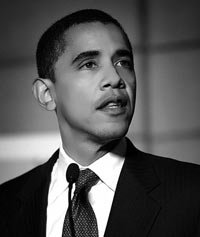
Product Obama

Young Barack“At the time when the American military industrial complex is despised around the world, [Barack Obama] is a front man out of central casting which will buy it more goodwill and new room to maneuver in the first 15 minutes after being sworn in that John McCain could in the next 100 years.”

 
Counterpoint columnist Joe Bageant was given the following essay by an unnamed political consultant:
Life in the Post-political Age.

Much has been written by political pundits in their attempt to explain the unexpected victory of Senator Barack Obama over Senator Hillary Clinton in this year’s Democratic Presidential Primary. When looking at the results of this race, none of the conventional political math that would help one handicap the outcome would make one conclude that Senator Obama would win this contest.

Inside a Democratic Party primary there is no demographic or political reason that a male first term African American senator from Illinois with an unorthodox name should come any where close to beating a white female senator, who happens to be the wife of the last Democratic President whose approval ratings are still above 70% with Democratic voters and who also happened to earn the endorsements of the substantial parts of the Democratic Party establishment.

The conventional analysis focused on the poor quality of the campaign run by Senator Clinton, her vote in support of the Iraq war and her advocacy of the cynical center-right triangulation policies of her husband, which soured her campaign to many primary voters and especially to Democratic Party activists. Senator Obama’s on the other hand was credited with running an innovative and inspiring campaign that excited primary voters and brought many new and especially younger voters into the electoral process.

There is some truth to this analysis, but as a whole it misses the underlying social change in society that had already laid the groundwork for a possible Obama victory. To get a clearer understanding of the results, we must better understand what this social change is and how its impact is far more significant than the dynamics of the two respective campaigns.

The underlying social change that led to the Obama victory is the unprecedented extent to which the narrative of popular consumer culture, and the media that drives it, has become the dominant influence on how Americans think, formulate their ideas and understand the world around them.

The most important result of this process has been the steady and consistent depoliticization of American society, to an extent that we can make the case that we are living at the dawn of the post political age.

The two primary features of the post political age are a politics completely drained of all its contents and ability or willingness to be used as an agent of change in social or economic policy, and its full integrations into the world of American popular, consumer and entertainment culture. To such an extent that there exists today a seamless web between our political, economic, media and consumer cultures wherein the modes and values of one are completely integrated and compatible with the others.

It should not come as a surprise that the dominant ideas and mores of popular culture have become the dominant ideas of our society. Popular culture is the breaker of customs, prejudice, tradition and relevant historical knowledge.

It is a result of this dynamic that the two consistent winners in American politics over the last 30 years have been the cultural left and the economic right. Despite the massive organizing drive of the religious right over the past three decades, they are further away from reversing the cultural liberalization of American society than when they started. On others side of the ledger, organized labor outside of a few urban pockets and industries is no longer a relevant force in American life. The ever greater electoral activism of both of these groups is generally misunderstood as a show of strength; in fact, it is the exact opposite. It is the desperate fight of the losing side of the American economic, cultural and political scene.

In essence the same forces that make it possible for the rapid acceptance of ideas such as gay marriage are the same force which can create a society that will accept massive social inequalities.

In the post political world and the candidates who can best thrive in it have tremendous appeal to the economic elites, a system that does not dwell on issues and will never ask the question, “who has power and why”, but simultaneously creates a social and media environment of stupefying distractions while destroying traditional social mores (under-credited as a source of much social solidarity). This can only benefit their continued rule of that society.

In such a setting our political choices like our consumer choices, regardless of the product, are primarily about what makes us more fulfilled and feel better about ourselves.

Senator Obama’s campaign understood much better the impact of these changes on our electoral system than any of his opponents’ campaigns. In the post political world, the campaign that is less political and less issue-based but is savvier in using new modes of communication technology will be the campaign to win the greatest market share of the electorate. The candidate in this case, Obama, was not a political entity but, in essence a product, an ornament that made his supporters feel better about themselves.

One of the most telling facts about the Obama’s constituency outside of African Americans (whose support needs no explanation) is that it is a coalition of people who need or demand the least amount of social benefit from our government. They are the under politicized younger voters and upper middle class whites. The two groups, coincidently, are the ones most influenced by trends in consumer popular culture and have the greatest of ease using the latest technologies.

In commercial advertising it is the poor commercial that lists the seventeen functions of the product being marketed. The best commercials are based on image associations entirely unrelated to the functions of the actual product. In the post political world, when the same principle is applied to the political realm, it makes complete sense how Barack Obama no longer is a black man with a strange name but the iPod to Hillary Clinton’s cell phone. In the world of toys it is the one that stands out the most is the most marketable.

The reality of the post political period is best highlighted in the failed themes and ideas of Barack Obama’s two primary opponents. The Clinton campaign was based on pushing two concurrent ideas: the inevitability factor of her candidacy and the other was her supposed experience. The only thing inevitable in the post political period is ceaseless change, which she could hardly offer while running against the candidate of “Change”. How valuable of an asset can experience be in a culture where knowledge, wisdom and history are frowned upon?

John Edwards campaign on the other hand was dead on arrival. His theme and emphasis was America’s ever widening class differences, a platform as truthful as it was irrelevant. The use of the word “class” will end any political career in America. That truth violates the primary narrative that our elite use to justify their legitimacy, which is the supposed meritocratic nature of America society. While the post political constituencies have absolutely no interest in class, whose very acknowledgment are the bases of all real politics and whose acknowledgement would only lead to an existential crisis in its ranks. In the post political period the only differences allowed can be in style and modes of consumption.

Given all this as the background, what are we to make of the campaign of the candidate of hope, audacity and change? The answer lies in understanding Senator Obama’s appeal to the brighter sections of the economic and political elite, and more importantly in the lack of any organized opposition against him, of the kind that within a matter of days destroyed Howard Dean’s campaign in 2004.

At the precise moment that the intellectual underpinnings of conservative free market ideas that have dominated politics for the past 30 years are crumbling across the globe. Obama calls for a post ideological and partisan world.

At the time when the American military industrial complex is despised around the world, he is a front man out of central casting which will buy it more goodwill and new room to maneuver in the first 15 minutes after being sworn in that John McCain could in the next 100 years.

His very presence, the color of his skin, the very strangeness of his name is the best guarantee of his betrayal of the expectations of the constituencies that will vote to elect him. Barack Obama is in short order a far more reassuring prospect for the continued dominance of the financial elite than another four years of neo-conservative rule which in an almost historically unique combination of greed, ill will, incompetence and stupidity have brought the country to the edge of disaster.

Audacity yes, change hardly.

Speaking of toilets

if it’s yellow if it’s brownWhen I visited Southern California in the mid-eighties, I was bedazzled by my boyfriend’s beachside neighborhood. Tiny stucco houses. Flowering vines crawling weatherworn trellises. Impossibly narrow streets. Sandy restaurants serving fish tacos. Cramped outdoor patios overlooking the ocean — the vast inconceivable Pacific ocean. An exciting vista for a Colorado girl.

As with all lovers’ trysts, the visceral has faded to ephemera, and I am left with only a sense of place and time. However, one tangible relic remains from my visit, and it was recently brought to mind afresh. If it’s yellow let it mellow; if it’s brown flush it down. In case you’ve not heard this California incantation, it is a reference to pee and poo, number 1 and number 2, realities that, to my mind, are best left behind stall doors. In any case, they should not be fodder for a state mantra. Drought be damned!

After many years of recklessly rejecting the admonition, I am prepared to pass California wisdom on to my Colorado offspring. Why? The Gazette reported this week that 1/3 of a typical household’s water usage goes to flushing the toilet. 1/3! I have six Kool-aid swilling children so the flushing in our house, reinforced rigidly by prissy mother me, is nonstop.

No more. New rule. If it’s yellow let it mellow; if it’s brown flush it down. I have yet to divine an apt consequence for willful disobedience.

American government and business refuse to take any measures to conserve energy

All American businesses are trying to pose themselves as being respecters of the environment, energy efficient, and Green, and so is the Federal Government and Pentagon, too. However, even a cursory examination of policies by these organizations show that American government and businesses, at all levels, simply refuse to take any major measures to reduce energy consumption by our country.

Big Business controls government in our country, which can scarcely be considered a democracy due to this business control. We are a corporate plutocracy instead. So, at this time, it is really in corporate hands to control major government policy regarding energy use. What are the needed measures in this country to reduce energy use? These measures are never mentioned or talked about, simply because Big Business and corporate Big government do not want to implement them.

To reduce energy use in the future, government would have to take major steps to change previous and current urban planning and transportation policies. A federal zoning policy would have to be instituted that would make it impossible to stretch out construction of our cities over huge expanses of land as they are stretched out now. Also, measures would have to be taken to push back our overly extended cities into more manageable arenas of human activity. As we can see, corporate government has no plans to do any of this, even though doing it is necessary to reduce energy use.

Too much energy is used in getting people to work, and allowing them to try to escape our ugly cities. Many of our cities are quite frankly pure hell to live in. There is little escape from noise pollution, few clean public spaces of any real beauty, and a boring monotony in our public space. Our cities are making people ill, and most try to escape the cities as much as they can afford. That uses up a lot of fuel.

Simply investing in a really functioning public transit around our country would take a tremendous federal commitment to change the energy inefficient system of public transport we are presently saddled with. There currently are ZERO signs that any of big business and government agencies at almost all levels see any need to change their behaviors, and hence ours. There is nothing on the books other than continuing to fund huge amounts of pavement stretching into infinity.

This is not the time (nor do I have the time now) to discuss the many ways that energy policy must be redirected. Simply enough to just say that American government and Big Business, contrary to how they project themselves in their propaganda, are not interested in taking any measures to conserve energy use in a real manner. They are lying to us when thy talk about being Green. They are ignoring our needs, and are destroying the word for future generations all because they simply want to keep making money in the same old manners they have grown accustomed to. To reduce energy use, our cities must be made into livable places, which most are not.

iN line for the iPhone

As one who doesn’t like to leave the house, I am a big fan of the internet. In truth, I can hardly speak a negative word about it. The web has given us unfettered access to news and information, consumer goods, visions pleasing to the eye, sounds pleasing to the ear, easy communication one step removed. I can’t say I miss a single thing about the “good ol’ days.” Except waiting in line for concert tickets.

I love live music. I’ve been to zillions of concerts. In fact, I am going to a 2-day concert event in Denver this weekend. The headliners are Tom Petty and the Dave Matthews Band (woot! woot!). Over the years I’ve seen the Stones, the Who, the Grateful Dead, Elton John, Bob Dylan, Pink Floyd, Bruce Springsteen, James Taylor, Michael Jackson — the list goes on and on. And, so I don’t date myself too closely, I’ve even seen ‘N Sync and James Blunt.

Raised in an environment of easy internet access, my poor darling children have never had to stand in line for anything. Until last week when the new iPhone was to be released. After I made the big mistake of describing the many reasons I was considering an iPhone purchase, they decided that their future health and happiness was predicated on having 16GB iPhones. With no advice from me, they decided that they had to get to the store very early or risk failure.

They got to the AT&T store at 1 a.m. They were 22nd and 23rd in line. By the time Eric and I arrived shortly before 8, there were 100 people in line. There were camping chairs and coolers, even a gas grill. Decks of cards, pop cans and water bottles, fast food litter. I imagine there were a few dead soldiers (uh, empty beer containers) although I didn’t see any. The atmosphere was convivial. The camaraderie palpable.

They allowed people into the store 6 at a time. As each lucky buyer emerged, a bright orange AT&T bag signaling victory, their fellow consumers clapped and yelled in celebration.

We (read: they) left with our iPhones at 8:30. I later read that they’d sold out in 40 minutes — many campers went home empty-handed. But my two lucky ducks were thrilled with their phones, made all the more precious by the procurement experience.

Peacefully lost in the fog: American liberals’ denial of reality

Last week saw many a liberal author writing about why, in their opinions, the US government will not start a war against Iran. This is true lost-in-the-fog liberal denial of reality, though why is it? By what combination of stumbles in thought did they reach their conclusions?

These liberal academics (that’s what they are mainly), that believe that an attack on Iran is improbable, simply misread the general US public mindset. They believe that since Bush is so unpopular now that he has become entirely neutered and restrained by general disapproval. But is that really true?

Bush is unpopular so much not because Americans believe that the Iraq War was wrong, but rather because Americans think it wrong that Bush did not wrap up ‘victory’ there as quickly and as easily as they were promised. That does not mean that the general American public is now somehow a group of anti-imperialists. Quite the contrary. They still love American imperialism but just want it done more successfully.

Most liberals actually think that ‘the tide has turned’. As usual, they are totally out of touch with reality in this. Here liberals cannot even organize small street demonstrations against the Pentagon wars currently underway, yet somehow they think that they have the public behind them all the way! Talk about lost in inner space!

Quite simply, liberals mistake the fact that the corporate elite wants a new team in office for a while, with their own delusions that now they are going to get more say in management through the Democrats. You are not, Dummies! You are a side show, and the US government has a bipartisan corporate consensus that their war needs to be extended even more and this time towards Iran.

Real political power comes from independent organization, but liberals mistake groups like MoveOn for being such. They mistake all their tiny little office paid ‘peace’ groups for being a real antiwar movement. They mistake their liberal church group participation for being the necessary work that has to be done. They simply do not get it. They don’t want to get it!

The liberals simply do not have a movement going and neither do we more radical types. We have not yet currently constructed a Labor Movement, a Black or Hispanic Movement, or a Movement to Defend the Environment. These Movements simply do not exist at this time, and without them in place, the US government does not feel restrained in the least.

The government is simply going to continue with their so-called ‘Global War on Terrorism’ until we are able to do something about through our own independent organization. We have not even begun to do that yet, and we certainly are not entrenched in any sort of major success. We are losers up to now, and the liberal Democratic Party voters amongst us are addicted to losing. They lose most often when they ‘win’ even! They mistake losing for victory, thus liberal authors can write about how the Bush Administration will not do this or that, like they, the liberals, are in control now!

Yes, the sad fact of the matter is that America remains with a pro-war mindset. Americans love war! They believe that all war is theirs for the easy win. They simply do not understand why Bush and his Administration are such failures at doing just that. They are simply not antiwar in the least.

Strangely enough, liberals have been developing delusions of grandeur recently. They do think that the tide has changed. However, what evidence is there really that that is actually true? Obama might win? Talk about being really out of the loop in understanding one’s own society though!

We are in a definite danger period now. The oil industry and all the other major corporate industries, too, all want a continued and prolonged global war. They have no public opposition to this so far inside the US. And sad to say, the European middle classes are behind this game plan, too. The European populations are simply not mobilizing themselves against this global warfare. Where is this supposed change in the tide then? Certainly not in Europe, and certainly not here in America.

Sitting around with their thumbs up their rear ends saying that it is improbable that the US will attack Iran is pathetic. It is an excuse for continuing their own lack of success in actually building an independent movement against the war. The liberal community is not doing anything much other than taking it as it comes, and pretending that it won’t come when it will.
They are going to vote, and that is about all.

Global economic rapists are at it again

G8 protest
Why protest the G8 Summit July 7-9? Those hoodlums always look so determined. Here’s the rationale by the Emergency Exit Collective:

The 2008 G8 on Hokkaido, a Strategic Assessment
Emergency Exit Collective
Bristol, Mayday, 2008

The authors of this document are a collection of activists, scholars, and writers currently based in the United States and Western Europe who have gotten to know and work with each other in the movement against capitalist globalization. We’re writing this at the request of some members of No! G8 Action Japan, who asked us for a broad strategic analysis of the state of struggle as we see it, and particularly, of the role of the G8, what it represents, the dangers and opportunities that may lie hidden in the moment. It is in no sense programmatic. Mainly, it is an attempt to develop tools that we hope will be helpful for organizers, or for anyone engaged in the struggle against global capital.

I
It is our condition as human beings that we produce our lives in common.

II
Let us then try to see the world from the perspective of the planet’s commoners, taking the word in that sense: those whose most essential tradition is cooperation in the making and maintenance of human social life, yet who have had to do so under conditions of suffering and separation; deprived, ignored, devalued, divided into hierarchies, pitted against each other for our very physical survival. In one sense we are all commoners. But it’s equally true that just about everyone, at least in some ways, at some points, plays the role of the rulers—of those who expropriate, devalue and divide—or at the very least benefits from such divisions.

Obviously some do more than others. It is at the peak of this pyramid that we encounter groups like the G8.

III
The G8’s perspective is that of the aristocrats, the rulers: those who command and maintain that global machinery of violence that defends existing borders and lines of separation: whether national borders with their detention camps for migrants, or property regimes, with their prisons for the poor. They live by constantly claiming title to the products of others collective creativity and labour, and in thus doing they create the poor; they create scarcity in the midst of plenty, and divide us on a daily basis; they create financial districts that loot resources from across the world, and in thus doing they turn the spirit of human creativity into a spiritual desert; close or privatize parks, public water taps and libraries, hospitals, youth centers, universities, schools, public swimming pools, and instead endlessly build shopping malls that channels convivial life into a means of commodity circulation; work toward turning global ecological catastrophe into business opportunities.

These are the people who presume to speak in the name of the “international community” even as they hide in their gated communities or meet protected by phalanxes of riot cops. It is critical to bear in mind that the ultimate aim of their policies is never to create community but to introduce and maintain divisions that set common people at each other’s throats. The neoliberal project, which has been their main instrument for doing so for the last three decades, is premised on a constant effort either to uproot or destroy any communal or democratic system whereby ordinary people govern their own affairs or maintain common resources for the common good, or, to reorganize each tiny remaining commons as an isolated node in a market system in which livelihood is never guaranteed, where the gain of one community must necessarily be at the expense of others. Insofar as they are willing to appeal to high-minded principles of common humanity, and encourage global cooperation, only and exactly to the extent that is required to maintain this system of universal competition.

IV
At the present time, the G8—the annual summit of the leaders of “industrial democracies”—is the key coordinative institution charged with the task of maintaining this neoliberal project, or of reforming it, revising it, adapting it to the changing condition of planetary class relations. The role of the G8 has always been to define the broad strategic horizons through which the next wave of planetary capital accumulation can occur. This means that its main task is to answer the question of how 3?4 in the present conditions of multiple crises and struggles 3?4 to subordinate social relations among the producing commoners of the planet to capital’s supreme value: profit.

V
Originally founded as the G7 in 1975 as a means of coordinating financial strategies for dealing with the ‘70s energy crisis, then expanded after the end of the Cold War to include Russia, its currently face a moment of profound impasse in the governance of planetary class relations: the greatest since the ‘70s energy crisis itself.

VI
The ‘70s energy crisis represented the final death-pangs of what might be termed the Cold War settlement, shattered by a quarter century of popular struggle. It’s worth returning briefly to this history.

The geopolitical arrangements put in place after World War II were above all designed to forestall the threat of revolution. In the immediate wake of the war, not only did much of the world lie in ruins, most of world’s population had abandoned any assumption about the inevitability of existing social arrangements. The advent of the Cold War had the effect of boxing movements for social change into a bipolar straightjacket. On the one hand, the former Allied and Axis powers that were later to unite in the G7 (the US, Canada, UK, France, Italy, Germany, Japan)—the “industrialized democracies”, as they like to call themselves—engaged in a massive project of co-optation. Their governments continued the process, begun in the ‘30s, of taking over social welfare institutions that had originally been created by popular movements (from insurance schemes to public libraries), even to expand them, on condition that they now be managed by state-appointed bureaucracies rather than by those who used them, buying off unions and the working classes more generally with policies meant to guarantee high wages, job security and the promise of educational advance—all in exchange for political loyalty, productivity increases and wage divisions within national and planetary working class itself. The Sino-Soviet bloc—which effectively became a kind of junior partner within the overall power structure, and its allies remained to trap revolutionary energies into the task of reproducing similar bureaucracies elsewhere. Both the US and USSR secured their dominance after the war by refusing to demobilize, instead locking the planet in a permanent threat of nuclear annihilation, a terrible vision of absolute cosmic power.

VII
Almost immediately, though, this arrangement was challenged by a series of revolts from those whose work was required to maintain the system, but who were, effectively, left outside the deal: first, peasants and the urban poor in the colonies and former colonies of the Global South, next, disenfranchised minorities in the home countries (in the US, the Civil Rights movement, then Black Power), and finally and most significantly, by the explosion of the women’s movement of the late ‘60s and early ‘70s—the revolt of that majority of humanity whose largely unremunerated labor made the very existence “the economy” possible. This appears to have been the tipping point.

VIII
The problem was that the Cold War settlement was never meant to include everyone. It by definition couldn’t. Once matters reached tipping point, then, the rulers scotched the settlement. All deals were off. The oil shock was first edge of the counter-offensive, breaking the back of existing working class organizations, driving home the message that there was nothing guaranteed about prosperity. Under the aegis of the newly hatched G7, this counter-offensive involved a series of interwoven strategies that were later to give rise to what is known as neoliberalism.

IX
These strategies resulted in what came to be known as “Structural Adjustment” both in the North and in the South, accompanied by trade and financial liberalization. This, in turn, made possible crucial structural changes in our planetary production in common extending the role of the market to discipline our lives and divide us into more and more polarized wage hierarchy. This involved:

· In the immediate wake of ‘70s oil shock, petrodollars were recycled from OPEC into Northern banks that then lent them, at extortionate rates of interest, to developing countries of the Global South. This was the origin of the famous “Third World Debt Crisis.” The existence of this debt allowed institutions like the IMF to impose its monetarist orthodoxy on most of the planet for roughly twenty years, in the process, stripping away most of even those modest social protections that had been won by the world’s poor—large numbers of whom were plunged into a situation of absolute desperation.

· It also opened a period of new enclosures through the capitalist imposition of structural adjustment policies, manipulation of environmental and social catastrophes like war, or for that matter through the authoritarian dictates of “socialist” regimes. Through such means, large sections of the world’s population have over the past thirty years been dispossessed from resources previously held in common, either by dint of long traditions, or as the fruits of past struggles and past settlements.

· Through financial deregulation and trade liberalization, neoliberal capital, which emerged from the G7 strategies to deal with the 1970s crisis aimed thus at turning the “class war” in communities, factories, offices, streets and fields against the engine of competition, into a planetary “civil war”, pitting each community of commoners against every other community of commoners.

· Neoliberal capital has done this by imposing an ethos of “efficiency” and rhetoric of “lowering the costs of production” applied so broadly that mechanisms of competition have come to pervade every sphere of life. In fact these terms are euphemisms, for a more fundamental demand: that capital be exempt from taking any reduction in profit to finance the costs of reproduction of human bodies and their social and natural environments (which it does not count as costs) and which are, effectively, “exernalized” onto communities and nature.

· The enclosure of resources and entitlements won in previous generations of struggles both in the North and the South, in turn, created the conditions for increasing the wage hierarchies (both global and local), by which commoners work for capital—wage hierarchies reproduced economically through pervasive competition, but culturally, through male dominance, xenophobia and racism. These wage gaps, in turn, made it possible to reduce the value of Northern workers’ labour power, by introducing commodities that enter in their wage basket at a fraction of what their cost might otherwise have been. The planetary expansion of sweatshops means that American workers (for example) can buy cargo pants or lawn-mowers made in Cambodia at Walmart, or buy tomatoes grown by undocumented Mexican workers in California, or even, in many cases, hire Jamaican or Filipina nurses to take care of children and aged grandparents at such low prices, that their employers have been able to lower real wages without pushing most of them into penury. In the South, meanwhile, this situation has made it possible to discipline new masses of workers into factories and assembly lines, fields and offices, thus extending enormously capital’s reach in defining the terms—the what, the how, the how much—of social production.

· These different forms of enclosures, both North and South, mean that commoners have become increasingly dependent on the market to reproduce their livelihoods, with less power to resist the violence and arrogance of those whose priorities is only to seek profit, less power to set a limit to the market discipline running their lives, more prone to turn against one another in wars with other commoners who share the same pressures of having to run the same competitive race, but not the same rights and the same access to the wage. All this has meant a generalized state of precarity, where nothing can be taken for granted.

X
In turn, this manipulation of currency and commodity flows constituting neoliberal globalization became the basis for the creation of the planet’s first genuine global bureaucracy.

· This was multi-tiered, with finance capital at the peak, then the ever-expanding trade bureaucracies (IMF, WTO, EU, World Bank, etc), then transnational corporations, and finally, the endless varieties of NGOs that proliferated throughout the period—almost all of which shared the same neoliberal orthodoxy, even as they substituted themselves for social welfare functions once reserved for states.

· The existence of this overarching apparatus, in turn, allowed poorer countries previously under the control of authoritarian regimes beholden to one or another side in the Cold War to adopt “democratic” forms of government. This did allow a restoration of formal civil liberties, but very little that could really merit the name of democracy (the rule of the “demos”, i.e., of the commoners). They were in fact constitutional republics, and the overwhelming trend during the period was to strip legislatures, that branch of government most open to popular pressure, of most of their powers, which were increasingly shifted to the executive and judicial branches, even as these latter, in turn, largely ended up enacting policies developed overseas, by global bureaucrats.

· This entire bureaucratic arrangement was justified, paradoxically enough, by an ideology of extreme individualism. On the level of ideas, neoliberalism relied on a systematic cooptation of the themes of popular struggle of the ‘60s: autonomy, pleasure, personal liberation, the rejection of all forms of bureaucratic control and authority. All these were repackaged as the very essence of capitalism, and the market reframed as a revolutionary force of liberation.

· The entire arrangement, in turn, was made possible by a preemptive attitude towards popular struggle. The breaking of unions and retreat of mass social movements from the late ‘70s onwards was only made possible by a massive shift of state resources into the machinery of violence: armies, prisons and police (secret and otherwise) and an endless variety of private “security services”, all with their attendant propaganda machines, which tended to increase even as other forms of social spending were cut back, among other things absorbing increasing portions of the former proletariat, making the security apparatus an increasingly large proportion of total social spending. This approach has been very successful in holding back mass opposition to capital in much of the world (especially West Europe and North America), and above all, in making it possible to argue there are no viable alternatives. But in doing so, has created strains on the system so profound it threatens to undermine it entirely.

XI
The latter point deserves elaboration. The element of force is, on any number of levels, the weak point of the system. This is not only on the constitutional level, where the question of how to integrate the emerging global bureaucratic apparatus, and existing military arrangements, has never been resolved. It is above all an economic problem. It is quite clear that the maintenance of elaborate security machinery is an absolute imperative of neoliberalism. One need only observe what happened with the collapse of the Soviet bloc in Eastern Europe: where one might have expected the Cold War victors to demand the dismantling of the army, secret police and secret prisons, and to maintain and develop the existing industrial base, in fact, what they did was absolutely the opposite: in fact, the only part of the industrial base that has managed fully to maintain itself has been the parts required to maintained the security apparatus itself! Critical too is the element of preemption: the governing classes in North America, for example, are willing to go to almost unimaginable lengths to ensure social movements never feel they are accomplishing anything. The current Gulf War is an excellent example: US military operations appear to be organized first and foremost to be protest-proof, to ensure that what happened in Vietnam (mass mobilization at home, widespread revolt within the army overseas) could never be repeated. This means above all that US casualties must always be kept to a minimum. The result are rules of engagement, and practices like the use of air power within cities ostensibly already controlled by occupation forces, so obviously guaranteed to maximize the killing of innocents and galvanizing hatred against the occupiers that they ensure the war itself cannot be won. Yet this approach can be taken as the very paradigm for neoliberal security regimes. Consider security arrangements around trade summits, where police are so determined prevent protestors from achieving tactical victories that they are often willing to effectively shut down the summits themselves. So too in overall strategy. In North America, such enormous resources are poured into the apparatus of repression, militarization, and propaganda that class struggle, labor action, mass movements seem to disappear entirely. It is thus possible to claim we have entered a new age where old conflicts are irrelevant. This is tremendously demoralizing of course for opponents of the system; but those running the system seem to find that demoralization so essential they don’t seem to care that the resultant apparatus (police, prisons, military, etc) is, effectively, sinking the entire US economy under its dead weight.

XII
The current crisis is not primarily geopolitical in nature. It is a crisis of neoliberalism itself. But it takes place against the backdrop of profound geopolitical realignments. The decline of North American power, both economic and geopolitical has been accompanied by the rise of Northeast Asia (and to a increasing extent, South Asia as well). While the Northeast Asian region is still divided by painful Cold War cleavages—the fortified lines across the Taiwan straits and at the 38th parallel in Korea…—the sheer realities of economic entanglement can be expected to lead to a gradual easing of tensions and a rise to global hegemony, as the region becomes the new center of gravity of the global economy, of the creation of new science and technology, ultimately, of political and military power. This may, quite likely, be a gradual and lengthy process. But in the meantime, very old patterns are rapidly reemerging: China reestablishing relations with ancient tributary states from Korea to Vietnam, radical Islamists attempting to reestablish their ancient role as the guardians of finance and piety at the in the Central Asian caravan routes and across Indian Ocean, every sort of Medieval trade diaspora reemerging… In the process, old political models remerge as well: the Chinese principle of the state transcending law, the Islamic principle of a legal order transcending any state. Everywhere, we see the revival too of ancient forms of exploitation—feudalism, slavery, debt peonage—often entangled in the newest forms of technology, but still echoing all the worst abuses of the Middle Ages. A scramble for resources has begun, with US occupation of Iraq and saber-rattling throughout the surrounding region clearly meant (at least in part) to place a potential stranglehold the energy supply of China; Chinese attempts to outflank with its own scramble for Africa, with increasing forays into South America and even Eastern Europe. The Chinese invasion into Africa (not as of yet at least a military invasion, but already involving the movement of hundreds of thousands of people), is changing the world in ways that will probably be felt for centuries. Meanwhile, the nations of South America, the first victims of the “Washington consensus” have managed to largely wriggle free from the US colonial orbit, while the US, its forces tied down in the Middle East, has for the moment at least abandoned it, is desperately struggling to keep its grip Mexico, Central America and the Caribbean—its own “near abroad”.

XIII
In another age all this might have led to war—that is, not just colonial occupations, police actions, or proxy wars (which are obviously already taking place), but direct military confrontations between the armies of major powers. It still could; accidents happen; but there is reason to believe that, when it comes to moments of critical decision, the loyalties of the global elites are increasingly to each other, and not to the national entities for whom they claim to speak. There is some compelling evidence for this.

Take for example when the US elites panicked at the prospect of the massive budget surpluses of the late 1990s. As Alan Greenspan, head of the Federal Reserve at the time warned, if these were allowed to stand they would have flooded government coffers with so many trillions of dollars that it could only have lead to some form of creeping socialism, even, he predicted, to the government acquiring “equity stakes” in key US corporations. The more excitable of capitalism’s managers actually began contemplating scenarios where the capitalist system itself would be imperiled. The only possible solution was massive tax cuts; these were duly enacted, and did indeed manage to turn surpluses into enormous deficits, financed by the sale of treasury bonds to Japan and China. Conditions have thus now reached a point where it is beginning to look as if the most likely long term outcome for the US (its technological and industrial base decaying, sinking under the burden of its enormous security spending) will be to end up serve as junior partner and military enforcer for East Asia capital. Its rulers, or at least a significant proportion of them, would prefer to hand global hegemony to the rulers of China (provided the latter abandon Communism) than to return to any sort of New Deal compromise with their “own” working classes.

A second example lies in the origins of what has been called the current “Bretton Woods II” system of currency arrangements, which underline a close working together of some “surplus” and “deficit” countries within global circuits. The macroeconomic manifestation of the planetary restructuring outlined in XIX underlines both the huge US trade deficit that so much seem to worry many commentators, and the possibility to continually generate new debt instruments like the one that has recently resulted in the sub-prime crisis. The ongoing recycling of accumulated surplus of countries exporting to the USA such as China and oil producing countries is what has allowed financiers to create new credit instruments in the USA. Hence, the “deal” offered by the masters in the United States to its commoners has been this: ‘you, give us a relative social peace and accept capitalist markets as the main means through which you reproduce your own livelihoods, and we will give you access to cheaper consumption goods, access to credit for buying cars and homes, and access to education, health, pensions and social security through the speculative means of stock markets and housing prices.’ Similar compromises were reached in all the G8 countries.

Meanwhile, there is the problem of maintaining any sort of social peace with the hundreds of millions of unemployed, underemployed, dispossessed commoners currently swelling the shanty-towns of Asia, Africa, and Latin America as a result of ongoing enclosures (which have speeded up within China and India in particular, even as “structural adjustment policies” in Africa and Latin America have been derailed). Any prospect of maintaining peace in these circumstances would ordinarily require either extremely high rates of economic growth—which globally have not been forthcoming, since outside of China, growth rates in the developing world have been much lower than they were in the ‘50s, ‘60s, or even ‘70s—or extremely high levels of repression, lest matters descend into rebellion or generalized civil war. The latter has of course occurred in many parts of the world currently neglected by capital, but in favored regions, such as the coastal provinces of China, or “free trade” zones of India, Egypt, or Mexico, commoners are being offered a different sort of deal: industrial employment at wages that, while very low by international standards, are still substantially higher than anything currently obtainable in the impoverished countryside; and above all the promise, through the intervention of Western markets and (privatized) knowledge, of gradually improving conditions of living. While over the least few years wages in many such areas seem to be growing, thanks to the intensification of popular struggles, such gains are inherently vulnerable: the effect of recent food inflation has been to cut real wages back dramatically—and threaten millions with starvation.

What we really want to stress here, though, is that the long-term promise being offered to the South is just as untenable as the idea that US or European consumers can indefinitely expand their conditions of life through the use of mortgages and credit cards.

What’s being offered the new dispossessed is a transposition of the American dream. The idea is that the lifestyle and consumption patterns of existing Chinese, Indian, or Brazilian or Zambian urban middle classes (already modeled on Northern ones) will eventually become available to the children of today’s miners, maquila or plantation laborers, until, ultimately, everyone on earth is brought up to roughly the same level of consumption. Put in these terms, the argument is absurd. The idea that all six billion of us can become “middle class” is obviously impossible. First of all there is a simple problem of resources. It doesn’t matter how many bottles we recycle or how energy efficient are the light bulbs we use, there’s just no way the earth’s ecosystem can accommodate six billion people driving in private cars to work in air-conditioned cubicles before periodically flying off to vacation in Acapulco or Tahiti. To maintain the style of living and producing in common we now identify with “middle classness” on a planetary scale would require several additional planets.

This much has been pointed out repeatedly. But the second point is no less important. What this vision of betterment ultimately proposes is that it would be possible to build universal prosperity and human dignity on a system of wage labor. This is fantasy. Historically, wages are always the contractual face for system of command and degradation, and a means of disguising exploitation: expressing value for work only on condition of stealing value without work— and there is no reason to believe they could ever be anything else. This is why, as history has also shown, human beings will always avoid working for wages if they have any other viable option. For a system based on wage labor to come into being, such options must therefore be made unavailable. This in turn means that such systems are always premised on structures of exclusion: on the prior existence of borders and property regimes maintained by violence. Finally, historically, it has always proved impossible to maintain any sizeable class of wage-earners in relative prosperity without basing that prosperity, directly or indirectly, on the unwaged labor of others—on slave-labor, women’s domestic labor, the forced labor of colonial subjects, the work of women and men in peasant communities halfway around the world—by people who are even more systematically exploited, degraded, and immiserated. For that reason, such systems have always depended not only on setting wage-earners against each other by inciting bigotry, prejudice, hostility, resentment, violence, but also by inciting the same between men and women, between the people of different continents (“race”), between the generations.

From the perspective of the whole, then, the dream of universal middle class “betterment” must necessarily be an illusion constructed in between the Scylla of ecological disaster, and the Charybdis of poverty, detritus, and hatred: precisely, the two pillars of today’s strategic impasse faced by the G8.

XIV
How then do we describe the current impasse of capitalist governance?

To a large degree, it is the effect of a sudden and extremely effective upswing of popular resistance—one all the more extraordinary considering the huge resources that had been invested in preventing such movements from breaking out.

On the one hand, the turn of the millennium saw a vast and sudden flowering of new anti-capitalist movements, a veritable planetary uprising against neoliberalism by commoners in Latin America, India, Africa, Asia, across the North Atlantic world’s former colonies and ultimately, within the cities of the former colonial powers themselves. As a result, the neoliberal project lies shattered. What came to be called the “anti-globalization” movement took aim at the trade bureaucracies—the obvious weak link in the emerging institutions of global administration—but it was merely the most visible aspect of this uprising. It was however an extraordinarily successful one. Not only was the WTO halted in its tracks, but all major trade initiatives (MAI, FTAA…) scuttled. The World Bank was hobbled and the power of the IMF over most of the world’s population, effectively, destroyed. The latter, once the terror of the Global South, is now a shattered remnant of its former self, reduced to selling off its gold reserves and desperately searching for a new global mission.

In many ways though spectacular street actions were merely the most visible aspects of much broader changes: the resurgence of labor unions, in certain parts of the world, the flowering of economic and social alternatives on the grassroots levels in every part of the world, from new forms of direct democracy of indigenous communities like El Alto in Bolivia or self-managed factories in Paraguay, to township movements in South Africa, farming cooperatives in India, squatters’ movements in Korea, experiments in permaculture in Europe or “Islamic economics” among the urban poor in the Middle East. We have seen the development of thousands of forms of mutual aid association, most of which have not even made it onto the radar of the global media, often have almost no ideological unity and which may not even be aware of each other’s existence, but nonetheless share a common desire to mark a practical break with capitalism, and which, most importantly, hold out the prospect of creating new forms of planetary commons that can—and in some cases are—beginning to knit together to provide the outlines of genuine alternative vision of what a non-capitalist future might look like.

The reaction of the world’s rulers was predictable. The planetary uprising had occurred during a time when the global security apparatus was beginning to look like it lacked a purpose, when the world threatened to return to a state of peace. The response—aided of course, by the intervention of some of the US’ former Cold War allies, reorganized now under the name of Al Qaeda—was a return to global warfare. But this too failed. The “war on terror”—as an attempt to impose US military power as the ultimate enforcer of the neoliberal model—has collapsed as well in the face of almost universal popular resistance. This is the nature of their “impasse”.

At the same time, the top-heavy, inefficient US model of military capitalism—a model created in large part to prevent the dangers of social movements, but which the US has also sought to export to some degree simply because of its profligacy and inefficiency, to prevent the rest of the world from too rapidly overtaking them—has proved so wasteful of resources that it threatens to plunge the entire planet into ecological and social crisis. Drought, disaster, famines, combine with endless campaigns of enclosure, foreclosure, to cast the very means of survival—food, water, shelter—into question for the bulk of the world’s population.

XV
In the rulers’ language the crisis understood, first and foremost, as a problem of regulating cash flows, of reestablishing, as they like to put it, a new “financial architecture”. Obviously they are aware of the broader problems. Their promotional literature has always been full of it. From the earliest days of the G7, through to the days after the Cold War, when Russia was added as a reward for embracing capitalism, they have always claimed that their chief concerns include

· the reduction of global poverty

· sustainable environmental policies

· sustainable global energy policies

· stable financial institutions governing global trade and currency transactions

If one were to take such claims seriously, it’s hard to see their overall performance as anything but a catastrophic failure. At the present moment, all of these are in crisis mode: there are food riots, global warming, peak oil, and the threat of financial meltdown, bursting of credit bubbles, currency crises, a global credit crunch. [**Failure on this scale however, opens opportunities for the G8 themselves, as summit of the global bureaucracy, to reconfigure the strategic horizon. Therefore, it’s always with the last of these that they are especially concerned. ]The real problem, from the perspective of the G8, is one of reinvestment: particularly, of the profits of the energy sector, but also, now, of emerging industrial powers outside the circle of the G8 itself. The neoliberal solution in the ‘70s had been to recycle OPEC’s petrodollars into banks that would use it much of the world into debt bondage, imposing regimes of fiscal austerity that, for the most part, stopped development (and hence, the emergence potential rivals) in its tracks. By the ‘90s, however, much East Asia in particular had broken free of this regime. Attempts to reimpose IMF-style discipline during the Asian financial crisis of 1997 largely backfired. So a new compromise was found, the so-called Bretton Woods II: to recycle the profits from the rapidly expanding industrial economies of East Asia into US treasury debt, artificially supporting the value of the dollar and allowing a continual stream of cheap exports that, aided by the US housing bubble, kept North Atlantic economies afloat and buy off workers there with cheap oil and even cheaper consumer goods even as real wages shrank. This solution however soon proved a temporary expedient. Bush regime’s attempt to lock it in by the invasion of Iraq, which was meant to lead to the forced privatization of Iraqi oil fields, and, ultimately, of the global oil industry as a whole, collapsed in the face of massive popular resistance (just as Saddam Hussein’s attempt to introduce neoliberal reforms in Iraq had failed when he was still acting as American deputy in the ‘90s). Instead, the simultaneous demand for petroleum for both Chinese manufacturers and American consumers caused a dramatic spike in the price of oil. What’s more, rents from oil and gas production are now being used to pay off the old debts from the ‘80s (especially in Asia and Latin America, which have by now paid back their IMF debts entirely), and—increasingly—to create state-managed Sovereign Wealth Funds that have largely replaced institutions like the IMF as the institutions capable of making long-term strategic investments. The IMF, purposeless, tottering on the brink of insolvency, has been reduced to trying to come up with “best practices” guidelines for fund managers working for governments in Singapore, Seoul, and Abu Dhabi.

There can be no question this time around of freezing out countries like China, India, or even Brazil. The question for capital’s planners, rather, is how to channel these new concentrations of capital in such a way that they reinforce the logic of the system instead of undermining it.

XVI
How can this be done? This is where appeals to universal human values, to common membership in an “international community” come in to play. “We all must pull together for the good of the planet,” we will be told. The money must be reinvested “to save the earth.”

To some degree this was always the G8 line: this is a group has been making an issue of climate change since 1983. Doing so was in one sense a response to the environmental movements of the ‘70s and ‘80s. The resultant emphasis on biofuels and “green energy” was from their point of view, the perfect strategy, seizing on an issue that seemed to transcend class, appropriating ideas and issues that emerged from social movements (and hence coopting and undermining especially their radical wings), and finally, ensuring such initiatives are pursued not through any form of democratic self-organization but “market mechanisms”—to effective make the sense of public interest productive for capitalism.

What we can expect now is a two-pronged attack. On the one hand, they will use the crisis to attempt to reverse the gains of past social movements: to put nuclear energy back on the table to deal with the energy crisis and global warming, or genetically modified foods to deal with the food crisis. Prime Minister Fukuda, the host of the current summit, for example, is already proposing the nuclear power is the “solution” to the global warming crisis, even as the German delegation resists. On the other, and even more insidiously, they will try once again to co-opt the ideas and solutions that have emerged from our struggles as a way of ultimately undermining them. Appropriating such ideas is simply what rulers do: the bosses brain is always under the workers’ hat. But the ultimate aim is to answer the intensification of class struggle, of the danger of new forms of democracy, with another wave of enclosures, to restore a situation where commoners’ attempts to create broader regimes of cooperation are stymied, and people are plunged back into mutual competition.

We can already see the outlines of how this might be done. There are already suggestions that Sovereign Wealth Funds put aside a certain (miniscule) proportion of their money for food aid, but only as tied to a larger project of global financial restructuring. The World Bank, largely bereft of its earlier role organizing dams and pipe-lines across the world, has been funding development in China’s poorer provinces, freeing the Chinese government to carry out similar projects in Southeast Asia, Africa, and even Latin America (where, of course, they cannot effectively be held to any sort of labor or environmental standards). There is the possibility of a new class deal in China itself, whose workers can be allowed higher standards of living if new low wage zones are created elsewhere—for instance, Africa (the continent where struggles over maintaining the commons have been most intense in current decades)—with the help of Chinese infrastructural projects. Above of all, money will be channeled into addressing climate change, into the development of alternative energy, which will require enormous investments, in such a way as to ensure that whatever energy resources do become important in this millennium, they can never be democratized—that the emerging notion of a petroleum commons, that energy resources are to some degree a common patrimony meant primarily to serve the community as a whole, that is beginning to develop in parts of the Middle East and South America—not be reproduced in whatever comes next.

Since this will ultimately have to be backed up by the threat of violence, the G8 will inevitably have to struggle with how to (yet again) rethink enforcement mechanisms. The latest move , now that the US “war on terror” paradigm has obviously failed, would appear to be a return to NATO, part of a reinvention of the “European security architecture” being proposed at the upcoming G8 meetings in Italy in 2009 on the 60th anniversary of NATO’s foundation—but part of a much broader movement of the militarization of social conflict, projecting potential resource wars, demographic upheavals resulting from climate change, and radical social movements as potential military problems to be resolved by military means. Opposition to this new project is already shaping up as the major new European mobilization for the year following the current G-8.

XVII
While the G-8 sit at the pinnacle of a system of violence, their preferred idiom is monetary. Their impulse whenever possible is to translate all problems into money, financial structures, currency flows—a substance whose movements they carefully monitor and control.

Money, on might say, is their poetry—a poetry whose letters are written in our blood. It is their highest and most abstract form of expression, their way of making statements about the ultimate truth of the world, even if it operates in large part by making things disappear. How else could it be possible to argue—no, to assume as a matter of common sense—that the love, care, and concern of a person who tends to the needs of children, teaching, minding, helping them to become decent , thoughtful, human beings, or who grows and prepares food, is worth ten thousand times less than someone who spends the same time designing a brand logo, moving abstract blips across a globe, or denying others health care.

The role of money however has changed profoundly since 1971 when the dollar was delinked from gold. This has created a profound realignment of temporal horizons. Once money could be said to be primarily congealed results of past profit and exploitation. As capital, it was dead labor. Millions of indigenous Americans and Africans had their lives pillaged and destroyed in the gold mines in order to be rendered into value. The logic of finance capital, of credit structures, certainly always existed as well (it is at least as old as industrial capital; possibly older), but in recent decades these logic of financial capital has come to echo and re-echo on every level of our lives. In the UK 97% of money in circulation is debt, in the US, 98%. Governments run on deficit financing, wealthy economies on consumer debt, the poor are enticed with microcredit schemes, debts are packaged and repackaged in complex financial derivatives and traded back and forth. Debt however is simply a promise, the expectation of future profit; capital thus increasingly brings the future into the present—a future that, it insists, must always be the same in nature, even if must also be greater in magnitude, since of course the entire system is premised on continual growth. Where once financiers calculated and traded in the precise measure of our degradation, having taken everything from us and turned it into money, now money has flipped, to become the measure of our future degradation—at the same time as it binds us to endlessly working in the present.

The result is a strange moral paradox. Love, loyalty, honor, commitment—to our families, for example, which means to our shared homes, which means to the payment of monthly mortgage debts—becomes a matter of maintaining loyalty to a system which ultimately tells us that such commitments are not a value in themselves. This organization of imaginative horizons, which ultimately come down to a colonization of the very principle of hope, has come to supplement the traditional evocation of fear (of penury, homelessness, joblessness, disease and death). This colonization paralyzes any thought of opposition to a system that almost everyone ultimately knows is not only an insult to everything they really cherish, but a travesty of genuine hope, since, because no system can really expand forever on a finite planet, everyone is aware on some level that in the final analysis they are dealing with a kind of global pyramid scheme, what we are ultimately buying and selling is the real promise of global social and environmental apocalypse.

XVIII
Finally then we come to the really difficult, strategic questions. Where are the vulnerabilities? Where is hope? Obviously we have no certain answers here. No one could. But perhaps the proceeding analysis opens up some possibilities that anti-capitalist organizers might find useful to explore.

One thing that might be helpful is to rethink our initial terms. Consider communism. We are used to thinking of it as a total system that perhaps existed long ago, and to the desire to bring about an analogous system at some point in the future—usually, at whatever cost. It seems to us that dreams of communist futures were never purely fantasies; they were simply projections of existing forms of cooperation, of commoning, by which we already make the world in the present. Communism in this sense is already the basis of almost everything, what brings people and societies into being, what maintains them, the elemental ground of all human thought and action. There is absolutely nothing utopian here. What is utopian, really, is the notion that any form of social organization, especially capitalism, could ever exist that was not entirely premised on the prior existence of communism. If this is true, the most pressing question is simply how to make that power visible, to burst forth, to become the basis for strategic visions, in the face of a tremendous and antagonistic power committed to destroying it—but at the same time, ensuring that despite the challenge they face, they never again become entangled with forms of violence of their own that make them the basis for yet another tawdry elite. After all, the solidarity we extend to one another, is it not itself a form of communism? And is it not so above because it is not coerced?

Another thing that might be helpful is to rethink our notion of crisis. There was a time when simply describing the fact that capitalism was in a state of crisis, driven by irreconcilable contradictions, was taken to suggest that it was heading for a cliff. By now, it seems abundantly clear that this is not the case. Capitalism is always in a crisis. The crisis never goes away. Financial markets are always producing bubbles of one sort or another; those bubbles always burst, sometimes catastrophically; often entire national economies collapse, sometimes the global markets system itself begins to come apart. But every time the structure is reassembled. Slowly, painfully, dutifully, the pieces always end up being put back together once again.

Perhaps we should be asking: why?

In searching for an answer, it seems to us, we might also do well to put aside another familiar habit of radical thought: the tendency to sort the world into separate levels—material realities, the domain of ideas or “consciousness”, the level of technologies and organizations of violence—treating these as if these were separate domains that each work according to separate logics, and then arguing which “determines” which. In fact they cannot be disentangled. A factory may be a physical thing, but the ownership of a factory is a social relation, a legal fantasy that is based partly on the belief that law exists, and partly on the existence of armies and police. Armies and police on the other hand exist partly because of factories providing them with guns, vehicles, and equipment, but also, because those carrying the guns and riding in the vehicles believe they are working for an abstract entity they call “the government”, which they love, fear, and ultimately, whose existence they take for granted by a kind of faith, since historically, those armed organizations tend to melt away immediately the moment they lose faith that the government actually exists. Obviously exactly the same can be said of money. It’s value is constantly being produced by eminently material practices involving time clocks, bank machines, mints, and transatlantic computer cables, not to mention love, greed, and fear, but at the same time, all this too rests on a kind of faith that all these things will continue to interact in more or less the same way. It is all very material, but it also reflects a certain assumption of eternity: the reason that the machine can always be placed back together is, simply, because everyone assumes it must. This is because they cannot realistically imagine plausible alternatives; they cannot imagine plausible alternatives because of the extraordinarily sophisticated machinery of preemptive violence that ensure any such alternatives are uprooted or contained (even if that violence is itself organized around a fear that itself rests on a similar form of faith.) One cannot even say it’s circular. It’s more a kind of endless, unstable spiral. To subvert the system is then, to intervene in such a way that the whole apparatus begins to spin apart.

XIX
It appears to us that one key element here—one often neglected in revolutionary strategy—is the role of the global middle classes. This is a class that, much though it varies from country (in places like the US and Japan, overwhelming majorities consider themselves middle class; in, say, Cambodia or Zambia, only very small percentages), almost everywhere provides the key constituency of the G8 outside of the ruling elite themselves. It has become a truism, an article of faith in itself in global policy circles, that national middle class is everywhere the necessary basis for democracy. In fact, middle classes are rarely much interested in democracy in any meaningful sense of that word (that is, of the self-organization or self-governance of communities). They tend to be quite suspicious of it. Historically, middle classes have tended to encourage the establishment of constitutional republics with only limited democratic elements (sometimes, none at all). This is because their real passion is for a “betterment”, for the prosperity and advance of conditions of life for their children—and this betterment, since it is as noted above entirely premised on structures of exclusion, requires “security”. Actually the middle classes depend on security on every level: personal security, social security (various forms of government support, which even when it is withdrawn from the poor tends to be maintained for the middle classes), security against any sudden or dramatic changes in the nature of existing institutions. Thus, politically, the middle classes are attached not to democracy (which, especially in its radical forms, might disrupt all this), but to the rule of law. In the political sense, then, being “middle class” means existing outside the notorious “state of exception” to which the majority of the world’s people are relegated. It means being able to see a policeman and feel safer, not even more insecure. This would help explain why within the richest countries, the overwhelming majority of the population will claim to be “middle class” when speaking in the abstract, even if most will also instantly switch back to calling themselves “working class” when talking about their relation to their boss.

That rule of law, in turn, allows them to live in that temporal horizon where the market and other existing institutions (schools, governments, law firms, real estate brokerages…) can be imagined as lasting forever in more or less the same form. The middle classes can thus be defined as those who live in the eternity of capitalism. (The elites don’t; they live in history, they don’t assume things will always be the same. The disenfranchized don’t; they don’t have the luxury; they live in a state of precarity where little or nothing can safely be assumed.) Their entire lives are based on assuming that the institutional forms they are accustomed to will always be the same, for themselves and their grandchildren, and their “betterment” will be proportional to the increase in the level of monetary wealth and consumption. This is why every time global capital enters one of its periodic crises, every time banks collapse, factories close, and markets prove unworkable, or even, when the world collapses in war, the managers and dentists will tend to support any program that guarantees the fragments will be dutifully pieced back together in roughly the same form—even if all are, at the same time, burdened by at least a vague sense that the whole system is unfair and probably heading for catastrophe.

XIX
The strategic question then is, how to shatter this sense of inevitability? History provides one obvious suggestion. The last time the system really neared self-destruction was in the 1930s, when what might have otherwise been an ordinary turn of the boom-bust cycle turned into a depression so profound that it took a world war to pull out of it. What was different? The existence of an alternative: a Soviet economy that, whatever its obvious brutalities, was expanding at breakneck pace at the very moment market systems were undergoing collapse. Alternatives shatter the sense of inevitability, that the system must, necessarily, be patched together in the same form; this is why it becomes an absolute imperative of global governance that even small viable experiments in other ways of organizing communities be wiped out, or, if that is not possible, that no one knows about them.

If nothing else, this explains the extraordinary importance attached to the security services and preemption of popular struggle. Commoning, where it already exists, must be made invisible. Alternatives— Zapatistas in Chiapas, APPO in Oaxaca, worker-managed factories in Argentina or Paraguay, community-run water systems in South Africa or Bolivia, living alternatives of farming or fishing communities in India or Indonesia, or a thousand other examples—must be made to disappear, if not squelched or destroyed, then marginalized to the point they seem irrelevant, ridiculous. If the managers of the global system are so determined to do this they are willing to invest such enormous resources into security apparatus that it threatens to sink the system entirely, it is because they are aware that they are working with a house of cards. That the principle of hope and expectation on which capitalism rests would evaporate instantly if almost any other principle of hope or expectation seemed viable.

The knowledge of alternatives, then, is itself a material force.

Without them, of course, the shattering of any sense of certainty has exactly the opposite effect. It becomes pure precarity, an insecurity so profound that it becomes impossible to project oneself in history in any form, so that the one-time certainties of middle class life itself becomes a kind of utopian horizon, a desperate dream, the only possible principle of hope beyond which one cannot really imagine anything. At the moment, this seems the favorite weapon of neoliberalism: whether promulgated through economic violence, or the more direct, traditional kind.

One form of resistance that might prove quite useful here – and is already being discussed in some quarters – are campaigns against debt itself. Not demands for debt forgiveness, but campaigns of debt resistance.

XX
In this sense the great slogan of the global justice movement, “another world is possible”, represents the ultimate threat to existing power structures. But in another sense we can even say we have already begun to move beyond that. Another world is not merely possible. It is inevitable. On the one hand, as we have pointed out, such a world is already in existence in the innumerable circuits of social cooperation and production in common based on different values than those of profit and accumulation through which we already create our lives, and without which capitalism itself would be impossible. On the other, a different world is inevitable because capitalism—a system based on infinite material expansion—simply cannot continue forever on a finite world. At some point, if humanity is to survive at all, we will be living in a system that is not based on infinite material expansion. That is, something other than capitalism.

The problem is there is no absolute guarantee that ‘something’ will be any better. It’s pretty easy to imagine “other worlds” that would be even worse. We really don’t have any idea what might happen. To what extent will the new world still organized around commoditization of life, profit, and pervasive competition? Or a reemergence of even older forms of hierarchy and degradation? How, if we do overcome capitalism directly, by the building and interweaving of new forms of global commons, do we protect ourselves against the reemergence of new forms of hierarchy and division that we might not now even be able to imagine?

It seems to us that the decisive battles that will decide the contours of this new world will necessarily be battles around values. First and foremost are values of solidarity among commoners. Since after all, every rape of a woman by a man or the racist murder of an African immigrant by a European worker is worth a division in capital’s army.

Similarly, imagining our struggles as value struggles might allow us to see current struggles over global energy policies and over the role of money and finance today as just an opening salvo of an even larger social conflict to come. For instance, there’s no need to demonize petroleum, for example, as a thing in itself. Energy products have always tended to play the role of a “basic good”, in the sense that their production and distribution becomes the physical basis for all other forms of human cooperation, at the same time as its control tends to organize social and even international relations. Forests and wood played such a role from the time of the Magna Carta to the American Revolution, sugar did so during the rise of European colonial empires in the 17th and 18th centuries, fossil fuels do so today. There is nothing intrinsically good or bad about fossil fuel. Oil is simply solar radiation, once processed by living beings, now stored in fossil form. The question is of control and distribution. This is the real flaw in the rhetoric over “peak oil”: the entire argument is premised on the assumption that, for the next century at least, global markets will be the only means of distribution. Otherwise the use of oil would depend on needs, which would be impossible to predict precisely because they depend on the form of production in common we adopt. The question thus should be: how does the anti-capitalist movement peak the oil? How does it become the crisis for a system of unlimited expansion?

It is the view of the authors of this text that the most radical planetary movements that have emerged to challenge the G8 are those that direct us towards exactly these kind of questions. Those which go beyond merely asking how to explode the role money plays in framing our horizons, or even challenging the assumption of the endless expansion of “the economy”, to ask why we assume something called “the economy” even exists, and what other ways we can begin imagining our material relations with one another. The planetary women’s movement, in its many manifestations, has and continues to play perhaps the most important role of all here, in calling for us to reimagine our most basic assumptions about work, to remember that the basic business of human life is not actually the production of communities but the production, the mutual shaping of human beings. The most inspiring of these movements are those that call for us to move beyond a mere challenge to the role of money to reimagine value: to ask ourselves how can we best create a situation where everyone is secure enough in their basic needs to be able to pursue those forms of value they decide are ultimately important to them. To move beyond a mere challenge to the tyranny of debt to ask ourselves what we ultimately owe to one another and to our environment. That recognize that none this needs to invented from whole cloth. It’s all already there, immanent in the way everyone, as commoners, create the world together on a daily basis. And that asking these questions is never, and can never be, an abstract exercise, but is necessarily part of a process by which we are already beginning to knit these forms of commons together into new forms of global commons that will allow entirely new conceptions of our place in history.

It is to those already engaged in such a project that we offer these initial thoughts on our current strategic situation.

Fort Carson’s boot on your 4th of July

Colorado Springs Gazette Telegraph July 4, 2008I just love the Gazette’s headline on their July 4th front page: POST IS KEEPING TABS ON ITS ‘BOOTPRINT’. Is it a cute eco play on words, or an ironic malapropism? About collateral damage, Rumsfeld famously said the US doesn’t do body counts. I am reminded of course of George’s Orwell’s foretelling: “If you want a vision of the future, imagine a boot stamping on a human face — forever.”

Certainly the PR crew at Fort Carson meant to imply the equivalent of an environmental footprint in Army lingo. But footprint is itself no longer the literal track left behind you as you walk. It has come to mean the space you occupy, or the resources you consume. Or that of your computer or the printer on your desk for example. The portion of surface resources which each item displaces.

There must be a semantic fallacy which applies here, a mixed semaphore perhaps? As if you could tell me “put a sock in it.” And the Army would add “Put a BOOT in it. HA HA.”

If the Fort Carson sustainability spin doctors want to call the Army eco impact a “bootprint” instead, it probably is more accurate. Their activities have devastation-unleashing consequences. And as the interviews in the article reveal, the warrior’s real passion is in the warfare, hybred-whatsits be damned.

On this Independence Day when we’re all wishing ourselves “Happy” Patriotism, let’s reflect on the full context of Orwell’s 1984 passage:

Always, at every moment, there will be the thrill of victory, the sensation of trampling on an enemy who is helpless. If you want a picture of the future, imagine a boot stamping on a human face — forever.

Stop the War in Iraq and BTTHN

Open National Conference to Stop the War in Iraq and Bring the Troops Home Now
Cleveland, Ohio, June 28-29, 2008

National Assembly Endorser List (Partial Listing)
( * = organization or position for identification only)

1. Cindy Sheehan, Gold Star Families for Peace*
2. Howard Zinn, Author, Historian, Social Critic, Political Scientist, Playwright
3. U.S. Labor Against the War (USLAW)
4. Veterans for Peace
5. Vietnam Veterans Against the War, Utah Chapter
6. National Lawyers Guild
7. North Shore AFL-CIO Federation of Labor (Formerly Cleveland AFL-CIO)
8. Donna Dewitt, President, South Carolina AFL-CIO*
9. Navy Petty Officer Jonathan W. Hutto, Author of “Anti-War Soldier” and Co-Founder of Appeal For Redress*
10. Los Angeles County Federation of Labor, AFL-CIO, Los Angeles, CA
11. Progressive Democrats of America
12. A.N.S.W.E.R. Coalition (Act Now to Stop War and End Racism)
13. The Iraq Moratorium
14. United Teachers Los Angeles
15. Northeast Ohio Anti-War Coalition (NOAC)
16. Ramsey Clark, former U.S. Attorney General
17. Green Party of Ohio
18. Progressive Action, a coalition of the Duluth Central Labor Body, Democratic Farmer-Labor Party, and the Duluth Area Green Party
19. Scott Ritter
20. Anti-War Committee of the Thomas Merton Center, Pittsburgh, PA
21. Colia Lafayette Clark, Chair, Richard Wright Centennial Committee, Philadelphia, PA
22. Ohio State Council UNITE HERE
23. Women Speak Out for Peace and Justice – the Cleveland Branch of Women’s International League for Peace and Freedom
24. Chris Silvera, Secretary-Treasurer, Teamsters Local 808*, Long Island, NY
25. Cleveland Peace Action
26. Peninsula Peace and Justice Center, Palo Alto, CA
27. Greater Boston Stop the Wars Coalition (STWC)
28. John W. Braxton, Co-President, American Federation of Teachers Local 2026*; Faculty and Staff Federation of Community College of Philadelphia*
29. Eduardo Rosario, Executive Board, NY City Chapter – Labor Council for Latin American Advancement*
30. RI Mobilization Committee to Stop War and Occupation
31. Steve Early, Member, National Writers Union/UAW*, Labor Journalist
32. Bethlehem Neighbors for Peace
33. Northeast Ohio American Friends Service Committee
34. Cynthia McKinney, Former Congresswoman from Georgia
35. Allen Cholger, United Steelworkers Union Staff Representative*, Southfield, MI
36. Malcolm Suber, Reconstruction Activist; 2007 City Council Candidate in New Orleans, LA
37. Greg Coleridge, Coordinator, Northeast Ohio Anti-War Coalition; Economic Justice & Empowerment Program Director, Northeast Ohio American Friends Service Committee
38. Marilyn Levin, Member, Coordinating Committee, Greater Boston United for Justice with Peace; Founder, Middle East Crisis Coalition
39. Jeff Mackler, Founder, Mobilization for Peace, Jobs and Justice, San Francisco, CA
40. Jerry Gordon, former National Co-Coordinator of the Vietnam-era National Peace Action Coalition (NPAC); Member, U.S. Labor Against the War Steering Committee, Cleveland, OH
41. Barbara Lubin, Director, Middle East Children’s Alliance
42. Jamilla El-Shafei, Kennebunkport, Maine, (the Kennebunkport Peace Department)
43. Mumia Abu-Jamal
44. Alan Netland, President of the Duluth Central Labor Body and AFSCME Local 66*
45. Will Rhodes, Chair, Minnesota 8th Congressional District, Green Party; Steering Committee of the Duluth Area Green Party
46. Leonard Weinglass, Attorney for the Cuban Five
47. Gail Schoenfelder, Co-Chair, Clayton-Jackson-McGee Memorial; Board Member of the Duluth League of Women Voters*
48. California Peace and Freedom Party
49. Greater Cleveland Immigrant Support Network
50. Wasatch Coalition for Peace and Justice of Northern Utah
51. Alan Benjamin, Member, Executive Board, San Francisco Labor Council; Member, National Steering Committee, U.S. Labor Against the War
52. Rev. Dr. Diana Gibson, Co-Director, Council of Churches of Santa Clara County, San Jose, CA*
53. Sacramento Chapter, Labor Council for Latin American Involvement (LCLAA), AFL-CIO, Sacramento, CA
54. Iranians for Peace and Justice, CT and Texas Chapters
55. Youth Against War & Racism, MN
56. Samina Faheem, Executive Director, American Muslim Voice
57. National Education Association Peace and Justice Caucus
58. Union de Trabajadores Inmigrantes (Union of Immigrant Workers), Madison, WI
59. The L.A. Palestine Labor Solidarity Committee, Los Angeles, CA
60. San Jose Peace and Justice Center
61. Andy Griggs, Board of Directors, United Teachers Los Angeles; Chair, National Education Association Peace and Justice Caucus; Continuations Committee, American Federation of Teachers Peace and Justice Caucus*; Steering Committee Member, U.S. Labor Against the War, Los Angeles, CA
62. Office of the Americas, Los Angeles, CA
63. Fernando Suarez del Solar, Founder and Director, Guerrero Azteca Peace Project Escondido, CA
64. Doug Bullock, 1st Vice President, Albany Federation of Labor and Member of the Albany County Legislature
65. Arlington (MA) United for Justice with Peace
66. Sarah Martin, Member, Women Against Military Madness, MN
67. Paul Krehbiel, Iraq Moratorium, Los Angeles, CA
68. Sharon Smith, Haymarket Books
69. Francesca Rosa, Member SEIU Local 1021, Delegate, San Francisco Labor Council*, Member, Bay Area Labor Committee for Peace and Justice*
70. National Benedictines for Peace
71. Elizabeth Aaronsohn, Professor of Education and Faculty in the Peace Studies Program*, Central CT State University, New Britain, CT
72. Adirondack Progressives
73. Pam Africa, International Concerned Family and Friends of Mumia Abu-Jamal and Move Organization
74. AfterDowningStreet.org
75. Kali Akuno, Member, Malcolm X Grassroots Movement, Gulf Coast Reconstruction Movement activist, New Orleans, LA*
76. Richard Brooks Alba, Co-Chair Emeritus, SF Pride at Work (AFL-CIO), Berkeley, CA
77. Mike Alewitz, Labor Art and Mural Project, New Britain, CT
78. All-African People’s Revolutionary Party (G-C), Washington, D.C.
79. Stephen Allen, Steve Allen Painting, Akron, OH
80. Alliance for Global Justice
81. Dr. Sabah Alwan, Associate Professor of Leadership & Organizational Behavior, College of St. Scholastica, Duluth, MN
82. American Federation of Musicians Local 1000, NY, NY
83. Andy Anderson, Veterans for Peace, Chapter 80
84. Jeff Anderson, Duluth City Councilor
85. Thomas Atwood, Community Organizer, Peninsula Interfaith Alliance (PICO); Unitarian Universalist Fellowship of Redwood City, CA*
86. Mark Bailey, member and seminary student, United Church of Christ*, Elyria, OH
87. Jared A. Ball, Producer, Independent/Mixtape Journalism: FreeMix Radio, Words, Beats and
Life Global Journal of Hip-Hop Culture, Washington, D.C.*
88. Russ Banner, Co-Coordinator, Pax Christi – Manasota Chapter, FL
89. Hans Barbe, Iraq Moratorium, Students for a Democratic Society, Grosse Pointe Park, MI
90. Ana Barber, UTLA Board of Directors, Long Beach, CA
91. Bay Area United Against the War
92. Karen Bernal, International Longshore Workers Union Project Organizer, San Francisco, CA
93. Dennis Bernstein, Producer Flashpoint/KPFA Radio, Berkeley, CA
94. Marcia Bernsten, North Shore Coalition for Peace & Justice, Evanston, IL
95. Prof. Hal Bertilson, Professor of Psychology and UWS Psychology Program; Coordinator; Member, Amnesty International; Unitarian Universalist Congregation of Duluth Peace and Justice Committee
96. Thomas Bias, President, Northwest New Jersey Peace Fellowship
97. Stephen Bingham, Attorney, Political Activist, San Francisco, CA
98. Bloomington Peace Action Coalition, Nashville, IN
99. Roy Blount, President, Taxi Workers Alliance of Pennsylvania
100. Iver Bogen, Progressive Action Secretary, Duluth, MN
101. Scott Bol, St. Croix Valley Peacemakers, Stillwater, MN
102. Bolivarian Circle of Los Angeles “Ezequiél Zamora”, Sherman Oaks, CA
103. Blasé Bonpane, Director, Ofice of the Americas, Los Angeles, CA
104. Theresa Bonpane, Executive Director, Office of the Americas, Los Angeles, CA
105. Boston May Day Coalition, http://www.bostonmayday.org
106. Laura Bothwell, Founder of the St. Scholastica College Democrats; Former Director, Programs at the Columbia Univ. Center for the Study of Science and Religion; NY, NY
107. Frank Boyle, Wisconsin State Representative, 73rd Assembly District
108. Patrick Boyle, Progressive Action Steering Committee, Duluth, MN
109. Heather Bradford, Co-Founder, Students Against War, College St. Scholastica
110. Lenni Brenner, Author, Zionism in the Age of the Dictators
111. Lyn Broach, Steve Allen Painting, Akron, OH
112. Brooklyn Greens, Brooklyn, NY
113. Don Bryant, President, Greater Cleveland Immigrant Support Network
114. Cafe Intifada, Los Angeles, CA
115. California Federation of Teachers
116. Joseph Callahan, member, Coalition to March on the Republican National Convention & Stop the War; Iraq Peace Action Coalition; Twin Cities, MN*
117. Campaign for Labor Rights
118. Campus Antiwar Network
119. Campus Anti-War Network, Fordham University Chapter
120. Michael Carano, Ohio Progressive Democrats of America State Co-Coordinator
121. Patrick Carano, Ohio Progressive Democrats of America State Co-Coordinator
122. Steve Carlson, Peace North, Northern Wisconsin Coordinator for the Iraq Moratorium Project
123. Mary Carmichael, Northwoods People for Peace, Ironwood, MN
124. Tim Carpenter, National Director, Progressive Democrats of America
125. Central CT State University Progressive Students Alliance, New Britain, CT
126. Central CT State University Peace Studies Program, New Britain, CT
127. Central Ohioans for Peace
128. Chapter 39 (Northeast Ohio) Veterans for Peace
129. Chatham Peace Initiative
130. Chelsea Unièndose en Contra de la Guerra, Chelsea, MA
131. Chicago Coalition Against War and Racism, Chicago, IL
132. Chicago Labor Against the War, an affiliate of U.S. Labor Against the War
133. Chicago Socialist Party
134. Chippewa County Anti-War Coalition, Dafter, MI
135. Jim Ciocia, Staff Representative, Ohio Council 8, American Federation of State, County and Municipal Employees (AFSCME)*, Cleveland, OH
136. Citizen Soldier
137. Cleveland Middle East Peace Forum
138. Coalition for World Peace (CFWP) – An affiliate of UFPJ, Los Angeles, CA
139. Code Pink, Pittsburgh Chapter
140. Columbus Campaign for Arms Control/For Mother Earth
141. Committee in Solidarity with the People of El Salvador (CISPES – Los Angeles, CA)
142. Common Ground Relief/New Orleans – Malik Raheem, Co-Founder
143. Dave Conley, Douglas County Board Supervisor, WI
144. Jan Conley, Founder and President of Environmental Assn. for Great Lakes Education
145. Polly Connelly, International Representative, United Auto Workers (retired), Tucson, AZ
146. Cliff Conner, Author, “A People’s History of Science” New York, NY
147. Victor Crews, Utah Jobs with Justice, Wasatch Coalition for Peace and Justice, United for Peace and Justice Steering Committee Member
148. Cuba Solidarity, NY, NY
149. Tony Cuneo, Duluth City Council*
150. Denise D’Anne, Senior Action Network, San Francisco, CA*
151. DailyRadical.org, Boston, MA
152. Alan Dale, member, Iraq Peace Action Coalition, MN
153. Warren Davis, Former International Executive Board Member, United Auto Workers, Cleveland, OH
154. De Kalb Interfaith Network for Peace and Justice, De Kalb, IL
155. Declaration of Peace – San Mateo County, San Mateo, CA
156. Declaration of Peace, Bloomington, IN
157. Democratic Socialists of Central Ohio
158. Jesse Diaz, Jr., University of California, Riverside; Political Action Committee – La Hermandad Mexicana Transnacional, Riverside, CA
159. Ron Dicks, International Vice President, Western Region, International Federation of Professional and Technical Employees (IFPTE), San Francisco*
160. Different Drummer
161. Frank Dorrell, Addicted to War, Los Angeles, CA
162. Doug Dowd – Political economist, author, professor, Bologna, Italy
163. Dubuque Peace & Justice, Dubuque, IA
164. Mark Dudzic, National Organizer, Labor Party*
165. Larry Duncan, Labor Beat Co-Producer, Chicago, IL
166. East Central Ohio Green Party
167. Jebb Ebben, lead vocal of The Dear Astronaut band, Milwaukee, WI
168. Charlie Ehlen, Member, Veterans for Peace, Glenmora, LA
169. El Militante Sin Fronteras
170. Erie Benedictines for Peace, PA
171. Every Church a Church of Peace (Duluth, MN area chapter)
172. Farid Farahmand, Iranians for Peace, New Britain, CT
173. Christian Fernandez, Greater Boston Stop the Wars Coalition
174. Bob Fertik, founder of Democrats.com
175. Jeanne Finley, Albany, NY
176. First Presbyterian Church of Palo Alto, CA
177. Milton Fisk, South Central Indiana Jobs with Justice; Emeritus Prof. of Philosophy, Indiana Univ.- Bloomington
178. Jon Flanders, member and past president IAM Local Lodge 1145; Trustee, Troy Area Labor Council, NY
179. Carlos Flores, Secretary-Treasurer, Graphic Communications Conference-IBT Local 4N*
180. Focus the Nation, Portland, OR
181. Folk the War, Kent, OH
182. Dennis Foster, Westlake, OH
183. Christine Frank, Climate Crisis Coalition of the Twin Cities, Minneapolis, MN
184. FreedomJournal.Tv, Akron, OH
185. Freedom Socialist Party, Seattle, WA, Henry Noble, National Secretary
186. Frente de Mexicanos en el Exterior/FME (Front of Mexicans Aboard), Sacramento, CA
187. Anna Fritz, Retiree, Cleveland Heights, OH
188. Emily Gaarder, Assistant Prof. of Sociology/Anthropology, Univ. of MN-Duluth, MN
189. GABNet, a Philippines women’s organization
190. Dennis Gallie, Member UAW Local 235, St. Louis, MO*
191. Sharla Gardner, Duluth City Councilor and Former Executive Board Member of AFSCME Local 66, Duluth, MN
192. Christine Gauvreau, Organizing Committee, CT United for Peace*
193. Gay Liberation Network, Chicago, IL
194. Paul George, Director, Peninsula Peace and Justice Center, Palo Alto, CA
195. Mirène Ghossein, member of Adalah-NY: Coalition for Justice in the Middle East*, WESPAC (Westchester County Peace and Action Network)*
196. Isaac Alejandro Giron, Chairman of the SLC Autonomous Brown Berets
197. Martin Goff, Minnesota UNITE HERE Organizer*
198. David Goldberg, UTLA Treasurer, Los Angeles, CA
199. Sam Goldberger, We Refuse to Be Enemies, West Hartford, CT*
200. Marty Goodman, Transport Workers Union Local 100*, NY, NY, former Executive Board member
201. Dayne Goodwin, Secretary, Wasatch Coalition for Peace and Justice, Salt Lake City, UT
202. Steve Gordon, Former President of UTU Local 1732 & Lead Vocalist for the bands Workerand Black Market Bombs, Conway, SC
203. Kevin Gosztola, Author for OpEdNews; member, Peace Movement
204. Grandmothers for Peace, Northland Chapter
205. Grandmothers for Peace International, Elk Grove, CA
206. Greater Glastonbury for Peace and Justice, Glastonbury, CT
207. Green Party of Brooklyn, Brooklyn, NY
208. Green Party of Rhode Island, Providence, RI
209. Suzanne Griffith, Professor of Counseling, Univ. of Wisconsin-Superior; Member of Women in Black
210. Guerrero Azteca Peace Project, Escondido, CA
211. Cheryl Gustafson, Western University (Salt Lake City) Community Relations*
212. Ioanna Gutas, Middle East Crisis Committee, New Haven, CT*
213. Guyanese American Workers United, New York, NY
214. Jim Hamilton, St. Louis; Member, State Executive Board of American Federation of Teachers, MO*
215. Carol Hannah, Peace North, Hayward, WI
216. Mo Hannah, Ph.D., Chair, Battered Mothers Custody Conference
217. John Harris, Co-Founder, Greater Boston Stop the Wars Coalition, Boston, MA; Co-Founder, Chelsea Uniéndose en Contra de la Guerra, Chelsea, MA; Regional Coordinating Committee member, New England United*
218. Alan Hart, Managing Editor, UE News, United Electrical, Radio and Machine Workers of America (UE)*
219. Hawaii Solidarity Committee, NY, NY
220. Rose Helin, Former President, Students Against War, Univ. of Wisconsin-Superior
221. Stan Heller, The Struggle Video News Network, West Haven, CT*
222. Melissa Helman, former School of the Americas Protest Prisoner of Conscience, Ashland, WI
223. Inola F Henry, UTLA Board of Directors, Los Angeles, CA
224. Laura Herrera, Co-Coordinator, The Mobilization to Free Mumia Abu-Jamal, Northern California
225. Fletcher Hinds, Vietnam Veteran, MN Veterans & Military Families for Progress*, Duluth, MN
226. Fred Hirsch, Plumbers and Fitters Local 393 Executive Board; Delegate to the South Bay AFL-CIO Labor Council, San Jose, CA*
227. Suzanne and William Hodgkins, Niskayuna, NY
228. Marvin Holland, http://www.homestationonline.org, Jersey City, NJ
229. Julie Holzer, Staff Representative, District 12, United Steelworkers Union*
230. Dr. Bill Honigman, Progressive Democrats of America, California State Coordinator, Laguna Hills, CA
231. Kathleen Hopton, Mentor, OH
232. Houston Coalition for Justice Not War, Houston, TX
233. Humanity, Asheville, NC
234. Jeff Humfeld, Board of Directors, KKFI Community Radio, Kansas City, MO*
235. ICUJP-Interfaith Communities United for Justice and Peace, Los Angeles, CA
236. Interfaith Council for Peace in the Middle East, Cleveland, OH
237. International Socialist Organization (ISO)
238. Iraq Peace Action Coalition, Twin Cities. MN
239. Khalil Iskarous, Middle East Crisis Committee, New Haven, CT*
240. lbrahim Jibrell, Trinity College Antiwar Coalition, Hartford, CT*
241. Jeni Johnson, Former News Editor for the Promethean newspaper
242. Laurie Johnson, Former Duluth City Councilor; Business Agent AFSCME Council 5, Duluth, MN
243. Peter Johnson, Progressive Action Steering Committee & Duluth Professional Firefighters Union*, Duluth, MN
244. Todd Jordan, Future of the Union, UAW Local 292*, Kokomo, IN
245. Paul Kangas, Vice President, Veterans for Peace
246. Kansas City Labor Against the War, a U.S. Labor Against the War affiliate
247. Dan Kaplan, Executive Director, AFT Local 1493; San Mateo (CA) Community College Federation of Teachers*
248. David Keil, Greater Boston Stop the Wars Coalition; New England United*
249. Kemetic Inst, Columbus, OH
250. Kent State Anti-War Committee, Kent, OH
251. Sky Keyes, CT United for Peace, Middletown, CT
252. Tim Kettler, Secretary, Green Party of Ohio
253. Joel Kilgour, Truth in Recruiting Committee, Duluth, MN
254. John Kirkland, Stop the War Committee, Carpenters Local 1462*, Bristol, PA
255. Philip Koch, Professor, Maryland Institute College of Art, Baltimore, MD
256. Dr. Gary Kohls, Every Church a Church of Peace
257. Bob Kosuth, Steering Committee of the Northland Anti-War Coalition
258. Gene Kotrba, Northeast Ohio Anti-War Coalition (NOAC), Berea, OH
259. Dennis Kucinich, U.S. Representative, Lakewood, OH
260. Rev. Kurt Kuhwald, Unitarian Universalist Church of Palo Alto, Palo Alto, CA*
261. Rick Kurki, Board Member of the Tyomies Society, Highbridge, WI
262. Zev Kvitky, President, SEIU Local 2007, Stanford, CA
263. La Hermandad Transnacional , Los Angeles, CA
264. Ray LaForest, International Haiti Support Network, New York, NY
265. Lake Superior Greens
266. Werner Lange, Professor of Sociology, Edinboro University of Pennsylvania*
267. Ben Larson, Singer for the band Crew Jones
268. Prof. Mark Lause, Department of History, University of Cincinnati
269. Peter LaVenia, Co-Chair, New York Green Party
270. Paul Le Blanc, Prof. of History, LaRoche College; Member, Anti-War Committee, Thomas Merton Center, Pittsburgh
271. James Marc Leas, National Lawyers Guild
272. Fernando B. Ledezma, UTLA Board of Directors, El Monte, CA
273. Rosemary Lee, Member, CFT Civil, Human and Women’s Rights Committee*, Los Angeles,
CA
274. Pat Levasseur, East Coast Director, Lynne Stewart Defense Committee; former political prisoner, Ohio 7
275. Libertarian Party of Northeast Ohio
276. Liberty Street Agitators, Ann Arbor, MI
277. Jack Lieberman, Jewish Arab Dialog Association*, Miami , FL
278. Jerimarie Liesagang, CT Transadvocacy Coalition, Hartford, CT
279. Peter Linebaugh, Author, Magna Carta Manifesto
280. Michael Livingston, Professor of Psychology, St. John’s University, Collegeville, MN
281. Janet Loehr, Middle East Peace Forum, Cleveland, OH
282. Joe Lombardo, Bethlehem Neighbors for Peace and Coordinator, Northeast Peace and Justice Action Coalition
283. Los Altos Voices for Peace, Los Altos, CA
284. Jennifer Lyon, Iraq Veterans Against the War (IVAW)*, Las Vegas, NV
285. David Macko, Chairman, Libertarian Party, Northeast Ohio*, Solon, OH
286. Dorotea Manuela, Co-Coordinator, Boston May Day Coalition, Boston, MA
287. Jorge Marin, Circula Bolivarimo – Martin Luther King, Jr.*, Boston MA
288. Jennifer Martin-Romme, Editor, Zenith City Weekly Newspaper
289. Logan Martinez, Green Party West Central Ohio
290. Jamshid Marvesti, M.D., Author of four books, most recently “Psycho-Political Aspects of Suicide Warriors, Terrorism and Martyrdom,” Manchester, CT
291. James Mattingly, Kaukauna, WI
292. Mayday Books, MN
293. Bob McCafferty, Andover, NJ
294. Prof. Bud McClure, Faculty Against War, Univ. of Minnesota-Duluth
295. Rick McDowell, Belmont, ME
296. Kay McKenzie, Douglas County Board Supervisor, WI
297. Michigan Emergency Committee Against War & Injustice, Detroit, MI
298. The Middle East Crisis Committee, CT
299. Mimbrez Publishers, Oklahoma City, OK
300. Judy Miner, Office Coordinator, Wisconsin Network for Peace and Justice*, Madison, WI
301. Minnesota Labor Against the War
302. Mobilization to Free Mumia Abu-Jamal
303. Suren Moodliar, Mass Global Action*
304. Hal Moore, Progressive Action Treasurer, Duluth, MN
305. More than Warmth, Nashville, TN
306. Tess Moren, Intl. Peace Studies Student Assn., Univ. of Wisconsin-Superior
307. Dorinda Moreno, Co-Moderator, indyiraqaction; Convenor, Fuerza Mundial Collaborative, Santa Maria, CA*
308. Amy Moses, Leader, Young Adult Group, of the 1st Unitarian Universalist Society of SF
309. Denis Mosgofian, Graphic Communications Conference-IBT Local 4N, past president,
current Delegate to San Francisco Labor Council*
310. Peter and Gail Mott, Co-Editors INTERCONNECT: (national newsletter)
311. David Moulton, Loaves & Fishes Catholic Worker Community, Duluth, MN
312. MoveOn/East Bay, Barrington, RI
313. Bill Moyer and The Backbone Campaign
314. Jorge Mujica, March 10 Coalition*
315. MJ Muser, World Can’t Wait-Cleveland
316. Muslim Solidarity Committee
317. Muslim Youth Brotherhood for Political Action (MYB). Chaplin, CT
318. My Homework Channel, Cambridge, MA
319. National Network on Cuba, San Francisco, CA
320. Native Earth Education Project, Shelburne, MA
321. Kamran Nayeri, Political Economist, University of California
322. Near West Citizens for Peace and Justice
323. Neighbors for Peace, IL
324. Nevada Workers Against the War, Las Vegas, NV
325. New England United
326. New York State Greens/Green Party of New York, New York, NY
327. Nicaragua Network
328. Mary Nichols-Rhodes, Ohio Progressive Democrats of America State CD Organizer
329. Victor Nieto, President of Lodge 1043 Transportation and Communications Union*, Bronx, NY
330. North Shore Coalition for Peace and Justice, IL
331. Northland Anti-War Coalition
332. Jim Northrup, Native American Playwright, Poet, Author and Syndicated Columnist of Column “Fond du Lac Follies”
333. NY Metro Raging Grannies, New York, NY
334. Ohio State Labor Party
335. Barb Olsen, President, Progressive Action, Political Commentator for KUMD-FM Radio and Political Columnist for the Reader Weekly Newspaper
336. Bill Onasch, Midwest Chapter Representative, Labor Party Interim National Council*
337. Steve O’Neil, St. Louis County Board Commissioner, Duluth, MN.
338. Organized Workers for Labor Solidarity, Seattle, WA
339. Debbie Ortman, National Field Director of the Organic Consumers Assn.; Former Hermantown, MN City Councilor; President, Duluth League of Women Voters
340. Our Spring Break, Washington D.C.
341. Pan-African Roots, Washington, D.C.
342. Jeff Panetiere, Western Connecticut State Univ. Youth for Justice, Danbury, CT*
343. Parma Democratic Committee, Hilton, NY
344. Pax Christi Northern California, San Jose, CA
345. PDX Peace Coalition, Portland, OR
346. Peace & Social Justice Committee*, La Roche College, Pittsburgh, PA
347. Peace Action of San Mateo County, San Mateo, CA
348. Peace and Freedom Party, Sacramento, CA
349. Peace and Justice Center of Eastern Maine, Bangor, ME
350. PeaceMajority Report, Lindenhurst, IL
351. Josh Pechthalt, UTLA/AFT Vice President, Los Angeles, CA
352. Paula J. Pedersen: Assistant Professor of Psychology, Univ. of MN-Duluth
353. Penn Action, Pittsburgh, PA
354. Helen Pent, President, Northland College Student Assn.
355. People of Faith CT, West Hartford, CT
356. Peoples Fightback Center, Cleveland, OH
357. John Peterson, National Secretary, U.S. Hands Off Venezuela
358. Millie Phillips, Editorial Board, The Organizer Newspaper*
359. Physicians for Social Responsibility, Hudson-Mohawk Chapter
360. Jan Pierce, Retired National Vice President – Communications Workers of America District One
361. Angela T. Pineros, Greater Boston Stop the Wars Coalition
362. Larry Pinkney, Black Activist Writers Guild & Columnist, Twin Cities, MN*
363. Andy Pollack, Adalah–NY: Coalition for Justice in the Middle East,* Brooklyn, NY
364. Joseph Pollard, Transport Workers Union Local 100*, NY,NY
365. Portage Community Peace Coalition, Brady Lake, OH
366. Michael L. Postell, Transport Workers Union Local 250A, Chairperson, Green Division, San Francisco Municipal Railway*, San Francisco, CA
367. Dolores Perez Priem, Iraq Moratorium and UUs for Peace, San Francisco, CA
368. Progressive Action Steering Committee, Duluth, MN
369. Progressive Democrats of America Los Angeles (PDALA) Los Angeles, CA
370. Progressive Democrats of America – Ohio
371. Progressive Peace Coalition, Columbus, OH
372. Radical Women, San Francisco, CA
373. Radio Free Maine, Augusta, ME
374. Dr. Chengiah Ragaven, Professor of International Relations, Central CT State Univ., New Britain, CT*
375. Rainbow Affinity Tribe/Yippies, Brooklyn, NY
376. Walter Raschik, Host, Walt Dizzo Show on KUWS-FM Radio
377. Jack Rasmus, Co-Chair, Natl. Writers Union, UAW Local 1981, Richmond, CA*
378. Sami Rasouli , Founder & Director, Muslim Peacemaker Teams*, Najaf, Iraq
379. Austin Reams, Oklahoma City, OK
380. Revolutionary Workers Group, San Francisco, CA
381. Rogelio Reyes, California Faculty Association, Calexico, CA *
382. Sergio Reyes, Co-Coordinator, Boston May Day Coalition
383. Marc Rich, Delegate, LA County Federation of Labor
384. Walter Riley, Civil Rights Attorney, Political Activist, San Francisco, CA
385. Adam Ritscher, Douglas County Board Supervisor; Northland Anti-War Coalition
386. Christopher Robinson, Cambridge, MA
387. Rockland Coalition for Peace and Justice, Chestnut Ridge, NY
388. Lorena Rodriguez, International Partnership Coordinator of the Student Trade Justice Campaign, Duluth, MN/Montevideo, Uruguay
389. Mike Rogge, Co-Founder, Students Against War, College of St. Scholastica.
390. Al Rojas, Coordinator, FME (Front of Mexicans Abroad), Sacramento, CA
391. Emma Rosenthal, Los Angeles, CA
392. Martin Rosner, NY Social Activist
393. Donald Rucknagel, M.D., Ph.D., Cincinnati, OH
394. Barb Russ, Progressive Action, Duluth, MN
395. Carl Sack, Northland Anti-War Coalition, former Northland College Student Senator
396. Sacramento for Democracy, Sacramento, CA
397. Sundiata Sadiq, Former President, Ossining, NY NAACP
398. San Diego Coalition for Peace and Justice, San Diego, CA
399. San Mateo County Central Labor Council AFL-CIO, Foster City, CA
400. Ajamu Sankofa, National Conference of Black Lawyers*, Brooklyn, NY
401. Tony Saper, ATU Local 1287 Representative to the Kansas City Regional Transit Alliance, Kansas City, MO
402. Evan Sarmiento, Outreach Coordinator, Greater Boston Stop the Wars Coalition
403. Renee Saucedo, Director, La Raza Centro Legal; Member, SEIU Local 1021, San Francisco*
404. Fred Schnook, former Mayor of Ashland, WI.
405. Ralph Schoenman and Mya Shone, Co-producers, Taking Aim-WBAI Radio-NY, Vallejo, CA
406. Paul Schrade, former International Executive Board Member, United Auto Workers, Los Angeles, CA
407. John Schraufnagle, Northland Anti-War Coalition, Superior, WI
408. Michael Schreiber, Editor, Socialist Action, San Francisco, CA
409. Rodger Scott, Delegate and Past President, American Federation of Teachers Local 2121, City College of San Francisco
410. Mary Scully, member, Iraq Peace Action Coalition, Twin Cities
411. Steve Seal, UTLA Board of Directors/Chair, Human Rights Committee*, Los Angeles, CA
412. Vann Seawell, Assistant Director, UNITE HERE, Columbus, OH
413. Leonard Segal, UTLA Board of Directors, Northridge, CA
414. Rob Segovia-Welsh, Agriculture Rural Labor Inspector for the State of North Carolina
415. Dallas Sells, Director, Ohio State Council, UNITE HERE
416. Shaker Heights High School Students for a Democratic Society (SDS), Shaker Heights, OH
417. Peter Shell, Anti-War Committee of the Thomas Merton Center, Pittsburgh, PA
418. Adam Shils, Vice-President, Aptakisc Education Association (NEA)*
419. Shura Council, Anaheim, CA
420. Joel Sipress, Duluth Area Green Party, former candidate for MN State Senate, Duluth, MN
421. Debbie Ginsberg Smith, Social Activist, New York
422. Michael Steven Smith, Co-Producer, Law and Disorder, WBAI radio
423. Social Action Committee, Unitarian Universalist Fellowship of Redwood City, CA
424. Social Action Committee, West Shore Unitarian Universalist Church, Rocky River, OH
425. Socialist Action
426. Socialist Alternative
427. Socialist Organizer
428. Socialist Party, Boston
429. Socialist Party of CT
430. Socialist Party of Massachusetts
431. Socialist Party USA (National Committee)
432. Socialist Viewpoint
433. Solidarity, Detroit, MI
434. Asiyahola Somburu, Co-Chair of the Emerging Black Leadership Symposium
435. Gary Sorenson, President of Veterans for Peace, Chapter 80
436. South Dakota A.N.S.W.E.R. Coalition, Brandon, State Council
437. Southeast Minnesota Alliance of Peacemakers, Rochester, MN
438. Mark Stahl, Event Coordinator, Rhode Island Community Coalition for Peace
439. Lynne Stewart, Lynne Stewart Organization, NY, NY
440. Judith Stoddard, First Unitarian Universalist Society of San Francisco*
441. Students for a Democratic Society, Kirtland, OH
442. Students for Change, Norwich, CT
443. Hal Sutton, Member, UAW Local 1268 Retirees Chapter, Rockton, IL*
444. David Swanson, Washington Director, Democrats.com and of Impeachpac.org; Co-Founder, AfterDowningStreet.org
445. Shakeel Syed, Executive Director, Shura Council, Culver City, CA
446. Teach Peace Foundation
447. Tennessee Code Pink, Summertown, TN
448. Texans for Peace, Austin, TX
449. Linda Thompson, Guilford Peace Alliance, AFSCME Retirees, CT United for Peace
450. Sara Thomsen, singer/songwriter, South Range, WI
451. Gale Courey Toensing, Editor, The Corner Report, NW CT and Member, Middle East Crisis Committee, CT*
452. Troops Out Now Coalition, New York, NY
453. Troy Area Labor Council, Troy, NY
454. Jerry Tucker, former International Executive Board Member, United Auto Workers, St. Louis, MO
455. Twin Cities Peace Campaign-Focus on Iraq
456. Twin Cities Year 5 Committee to End the War Now
457. U.S. Hands Off Venezuela
458. Imam Warith Deen Umar, Chaplain for 25 years in New York state prisons
459. United Educators of San Francisco
460. Unitarian Universalist Fellowship of Redwood City (entire congregation), Redwood City, CA
461. University of Toledo Anti-War, Toledo, OH
462. Upper Hudson Peace Action, Albany, NY
463. Utah Jobs with Justice, Salt Lake City
464. Utah Peace & Freedom Party, Salt Lake City, UT
465. James E. Vann, Architect; Co-Founder, Oakland Tenants Union, Oakland, CA
466. Chuck Vaughn, UTLA Board of Directors, Pico Rivera, CA
467. Venezuela Solidarity Network
468. Veterans for Peace, Chapter 80
469. Veterans for Peace, Chapter 118, Utah
470. Veterans for Peace – Chapter 153, Iraq Moratorium Project, Peace North, Hayward, WI
471. Carlos Villarreal, Executive Director, National Lawyers Guild*, San Francisco Bay Area Chapter
472. Voters Evolt!, Long Beach, CA
473. Voters for Peace, Baltimore, MD
474. Julie Washington, UTLA Elementary Vice President, Los Angeles, CA
475. Washington Peace Center, Washington D.C.
476. Harvey Wasserman, Founder of Solartopia.org, Bexley, OH
477. WE Project, Los Angeles, CA
478. Carl Webb, Iraq War Veteran; Texas National Guard
479. Tegan Wendland, Douglas County Board Student Representative, WI
480. Coly Wentzlaff, Students for Peace, Univ. of Minnesota-Duluth
481. West Shore Unitarian Universalist Church Social Action Committee, Rocky River, OH
482. Don White, Peace and Justice Activist, Los Angeles, CA
483. Craig Wiesner, President, MicahsCall.org, Palo Alto, CA*
484. David Wilson, Nicaragua Solidarity Network of Greater New York*, NY,NY
485. Marcy Winograd, President, Progressive Democrats of Los Angeles*, Los Angeles, CA
486. Dorothy Wolden, Events Coordinator for the Northland Chapter of Grandmothers for Peace and former Douglas County Board Supervisor, WI
487. Women Against War, Capital District, New York
488. Women for Democracy and Fair Elections, Chicago, IL
489. Women’s International League for Peace and Freedom, Peninsula Branch, Palo Alto, CA
490. Women’s International League for Peace and Freedom, Pittsburgh Chapter, Pittsburgh, PA
491. Women’s International League for Peace and Freedom, U.S. Section; Philadelphia, PA
492. Kent Wong, Founding President of the Asian Pacific American Labor Alliance, Los Angeles, CA
493. Worker to Worker Solidarity Committee, Tucson, AZ
494. Workers International League (Socialist Appeal)
495. World Prout Assembly, Highland Heights, KY
496. Mark Wutschke, UTLA Board of Directors, Los Angeles, CA
497. Gustav Wynn, Writer & Contributing Editor, OpEd News, NY,NY
498. Carol F. Yost, Member, ADALAH-NY Coalition for Justice in the Middle East* Steering Committee Member, Private Health Insurance Must Go Coalition*
499. Youth for International Socialism
500. Marela Zacarias, Founder of Latinos Against the War, Hartford, CT
